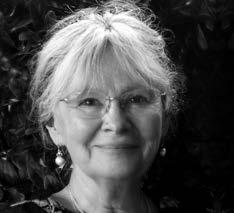
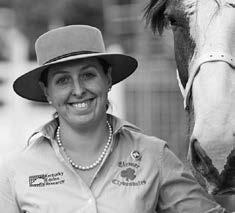
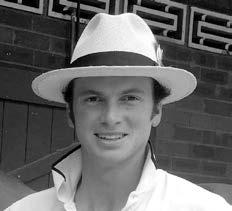
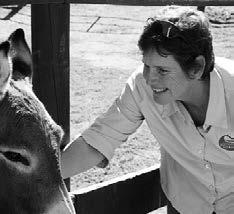
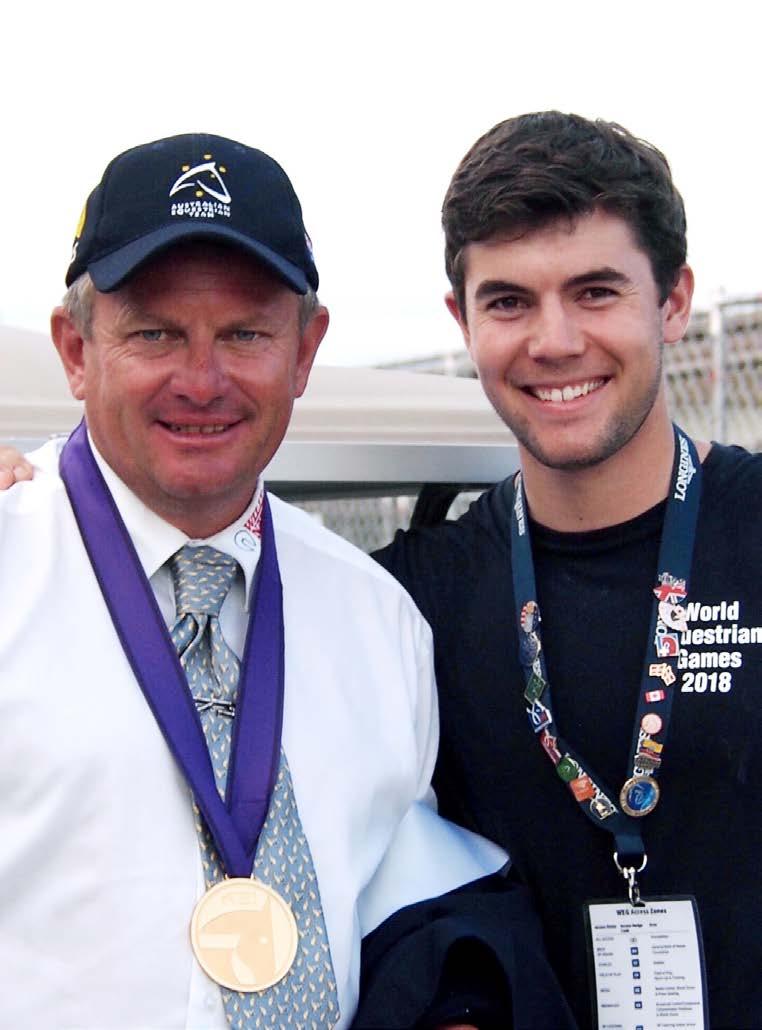
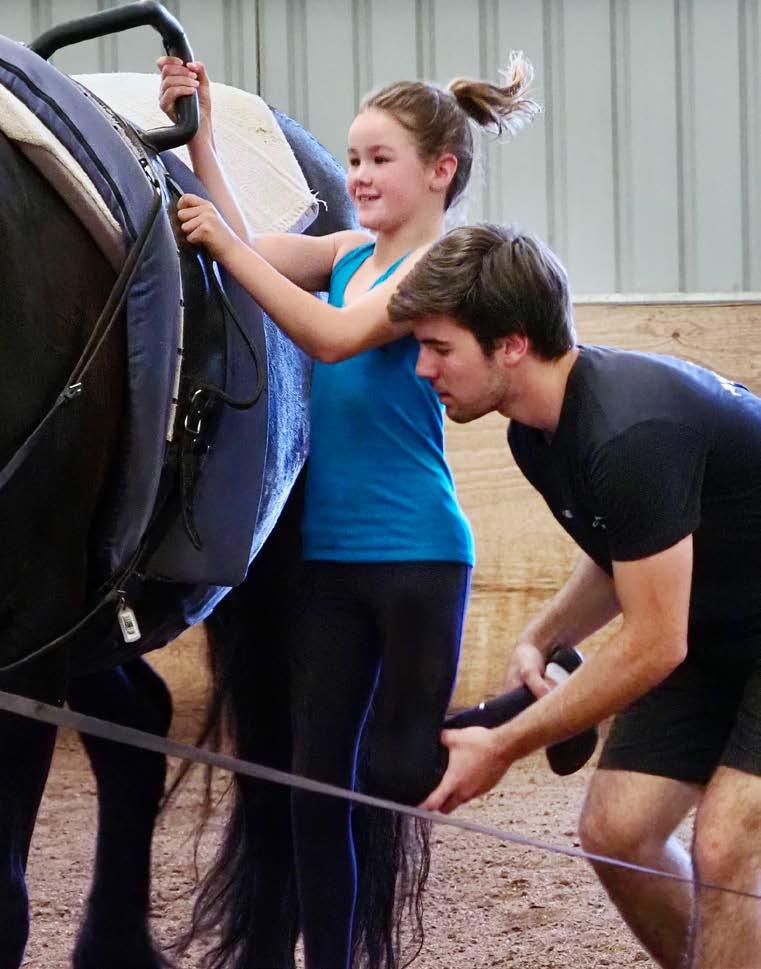
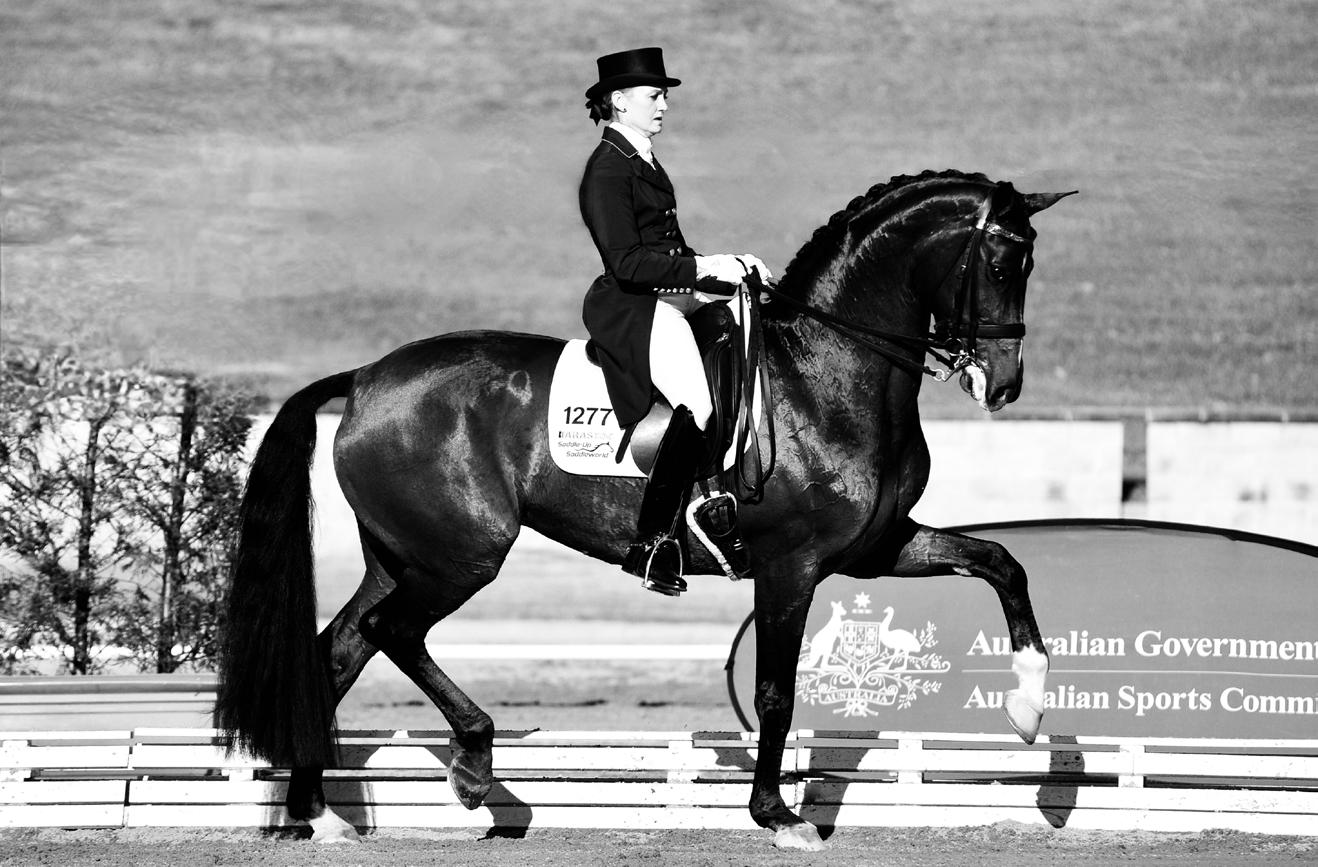
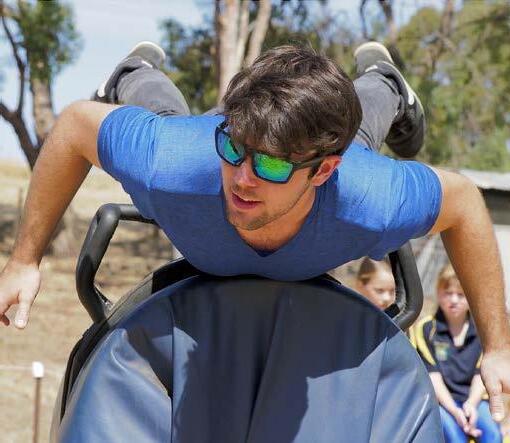
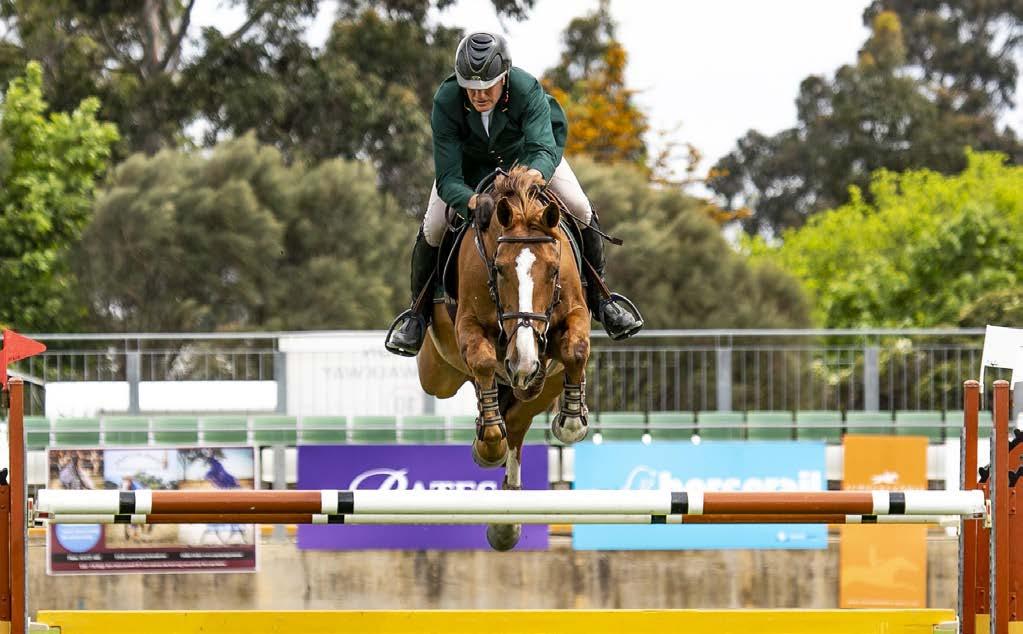
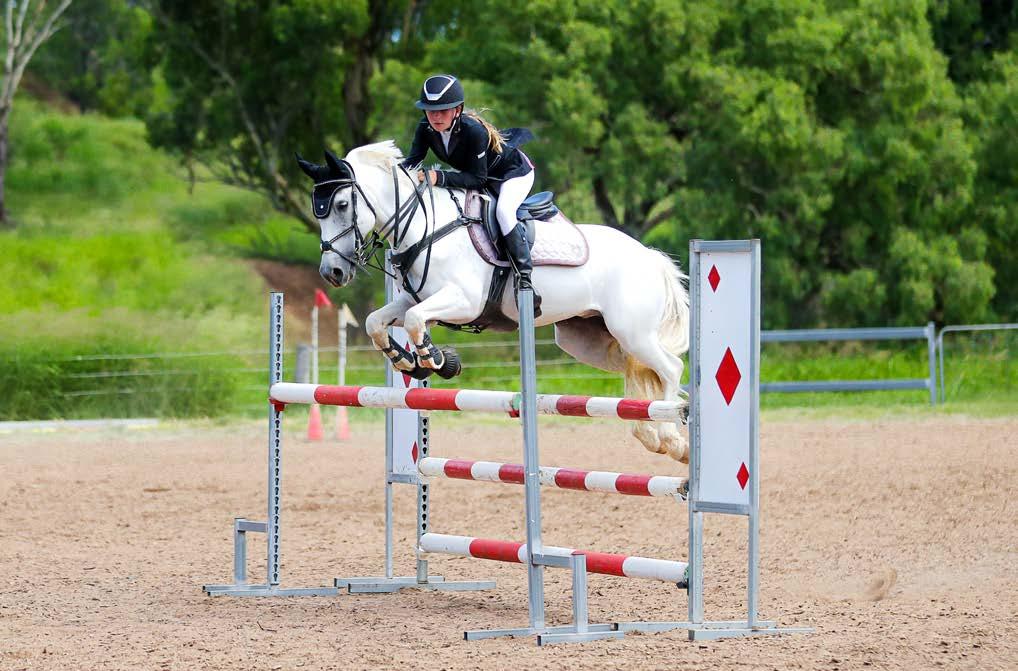
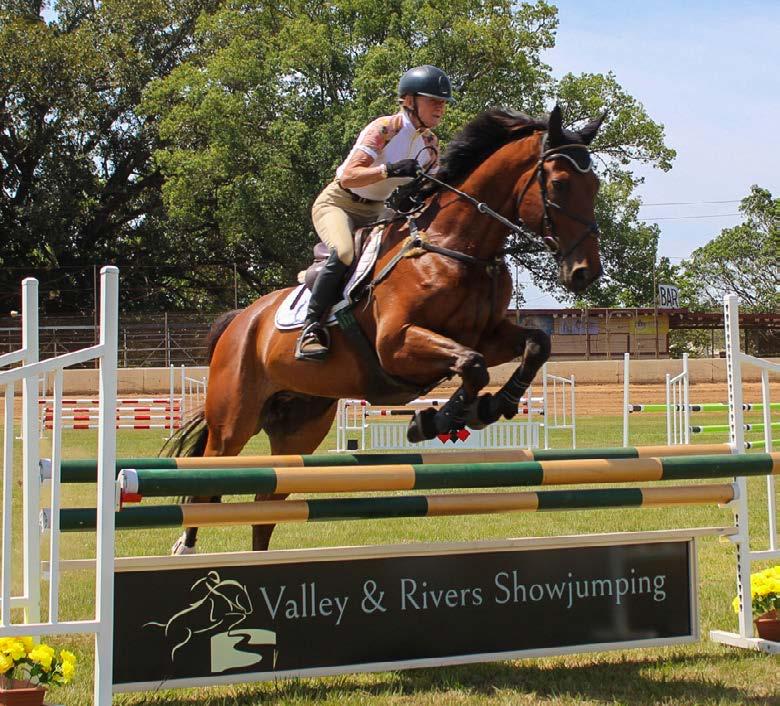
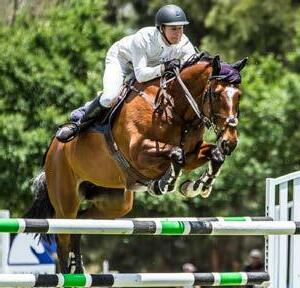
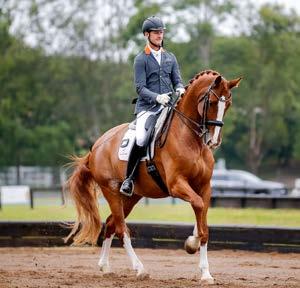
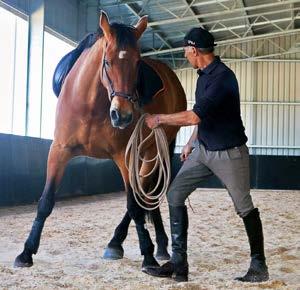
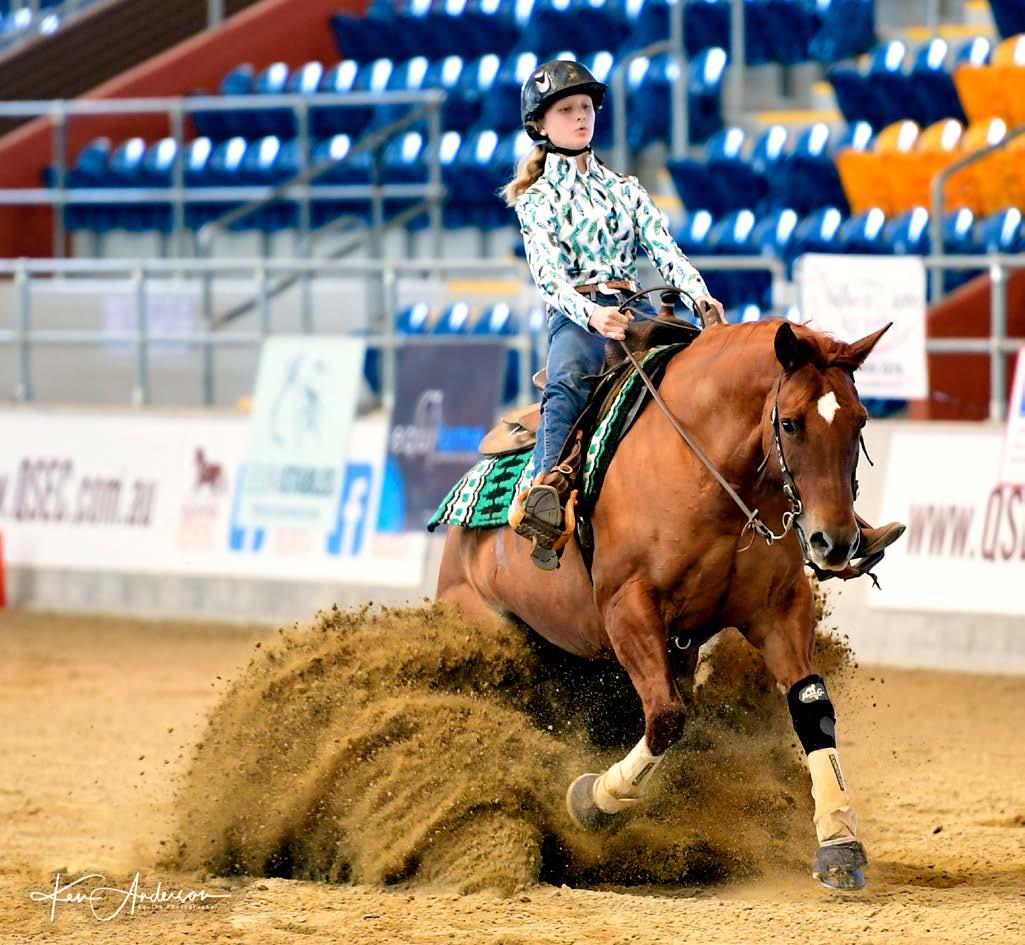
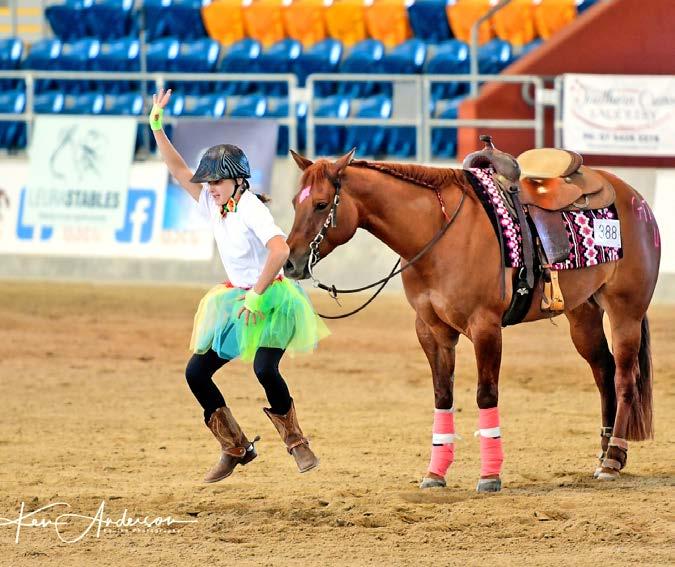
Michael is a FEI and EA Level 3 show jumping judge, an EA Level 1 Course Designer, Steward and Accredited Trainer, and member of the EA Rules Review Panel. President of the Ground Jury at a number of World Cup Qualifiers, State and Australian titles, he explains why the sport needs more ground level volunteers.
Larissa Bilton
OUR CONTRIBUTORS
Amanda Mac
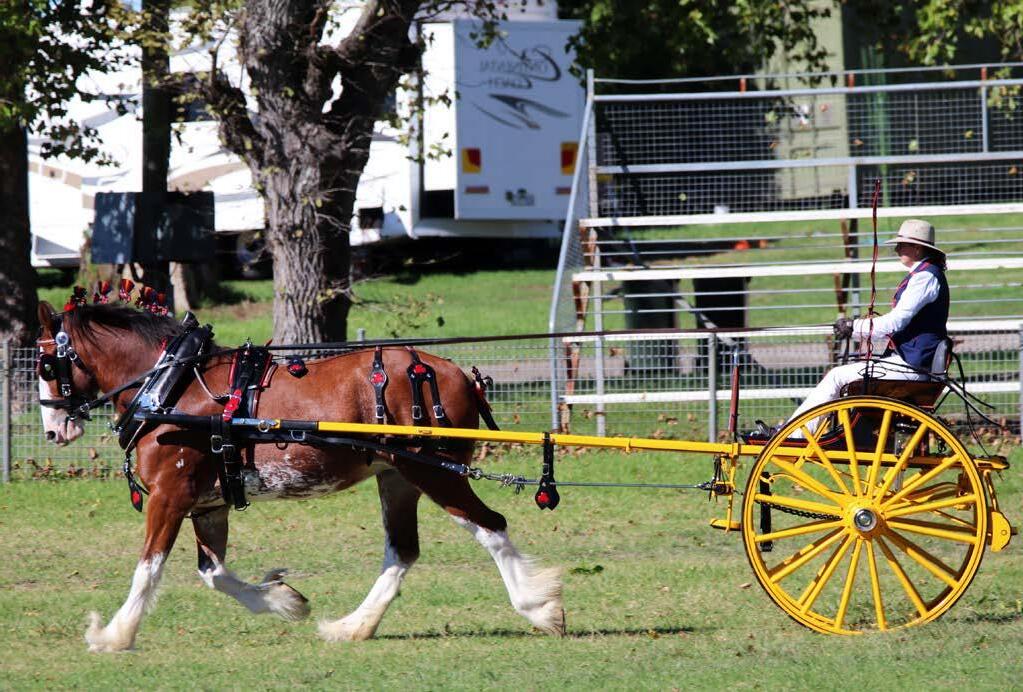
Amanda has had two lifelong love affairs: one with horses, and the other with writing. Now she happily combines the two as editor of HorseVibes. In this issue, she talks to down-to-earth Olympian and Tokyo contender Amanda Ross about keeping things real, and to Liz Lewis about the joys of Clydesdales in harness.
Liz Lewis
Linda Shore
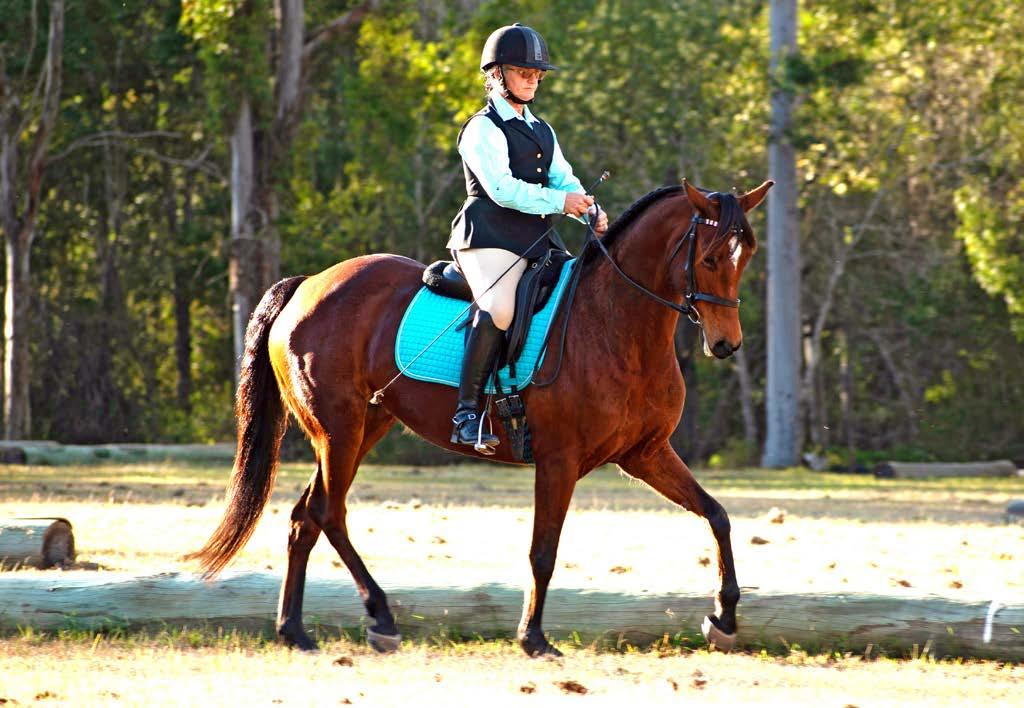
Linda operates River Range Warmblood Stud, runs Darling Downs Western Dressage Club, and is a member of the Toowoomba Dressage Committee. She’s presented Western dressage at Equitana, and for the past two years has focused on Working Equitation (WE). If you’d like to improve your WE scores, turn to Training Tips where Linda explains how.
Liz’s fascination with horses began in childhood. At 15 she was given her first horse and eventing became her discipline of choice. She trained and competed in the sport until around five years ago, when a passion for Clydesdales kicked in. Since then she has made her mark driving Clydesdales in the show ring.
Larissa, BAgrSc (Hons I) is the Nutritionist for Farmalogic, where she developed Equine Vit&Min and the Farmalogic Equine range. Her extensive experience is highly regarded by trainers, riders and owners who understand the importance of good nutrition. In her article she discusses the importance of balancing your weanling’s rations to avoid nutritional insufficiencies.
N.G. Quinlan
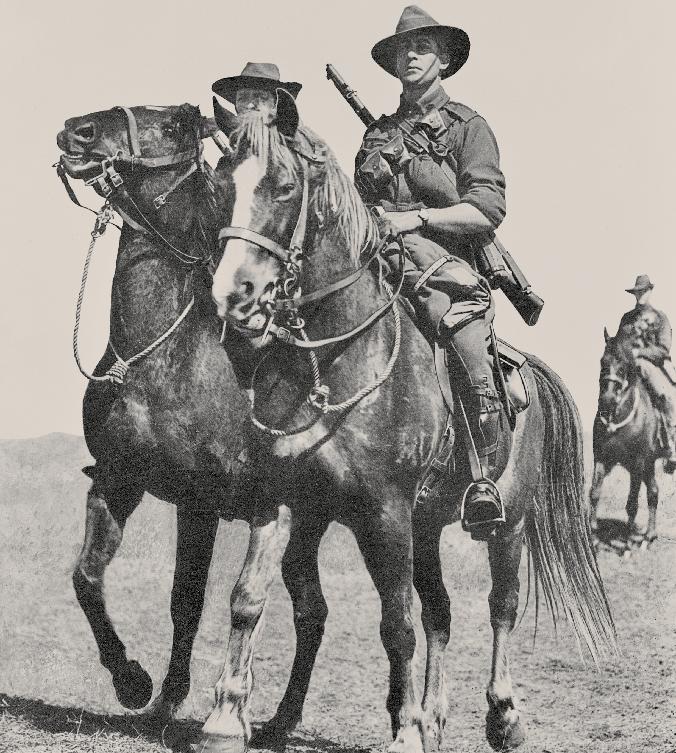
N.G. Quinlan, otherwise known as ‘Q’, is a writer, musician, poet, and regular HorseVibes contributor. With ANZAC Day fast approaching, we bring you a tribute to the men of the 4th and 12th Australian Light Horse Regiments and their Waler partners, whose exceptional bravery rightfully earned them a place in Australian military history.
Charlie Brister
Regular columnist
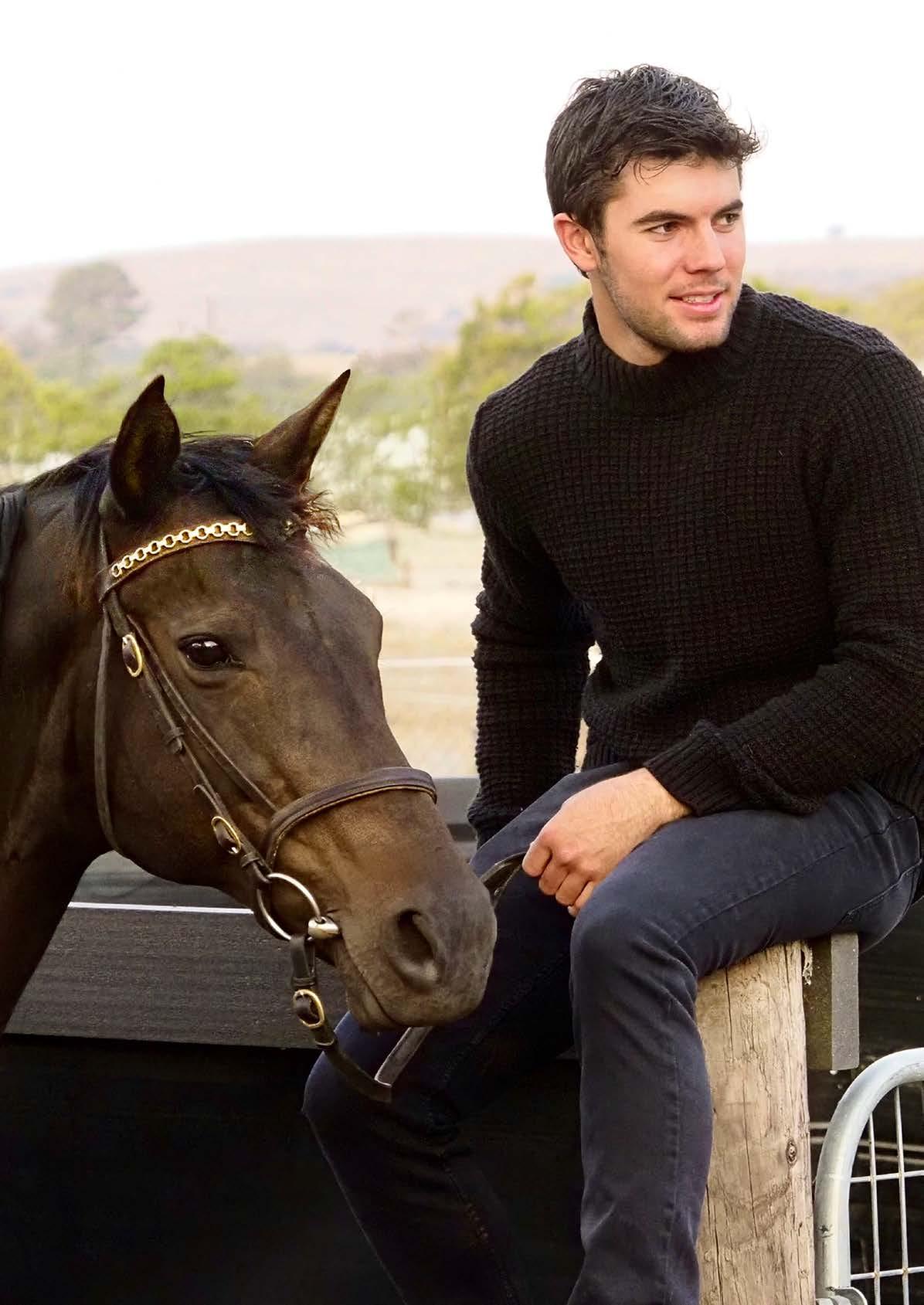
Charlie is an allround horseman whose expertise is in re-training problem horses, as well as coaching riders in the art of cross country, show jumping and dressage. If you and your pony don’t see eye to eye when it comes to bridling, Charlie has some tips to help make the experience blissful for you both.
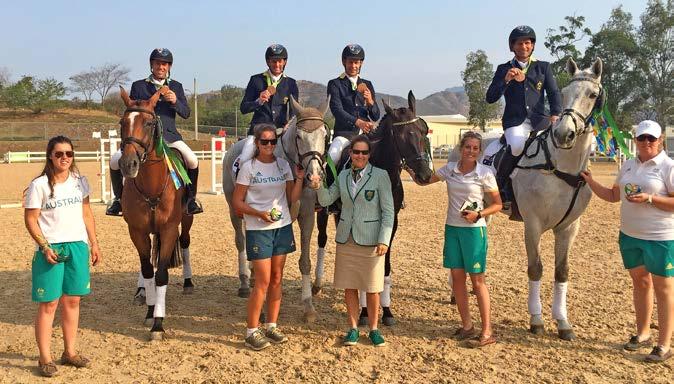
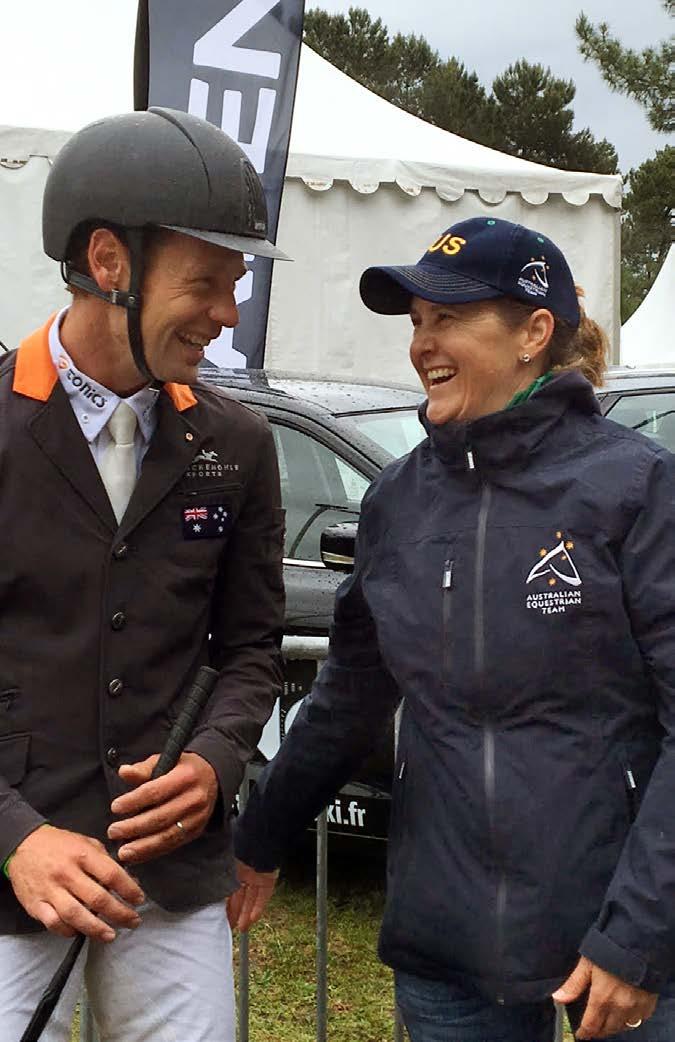
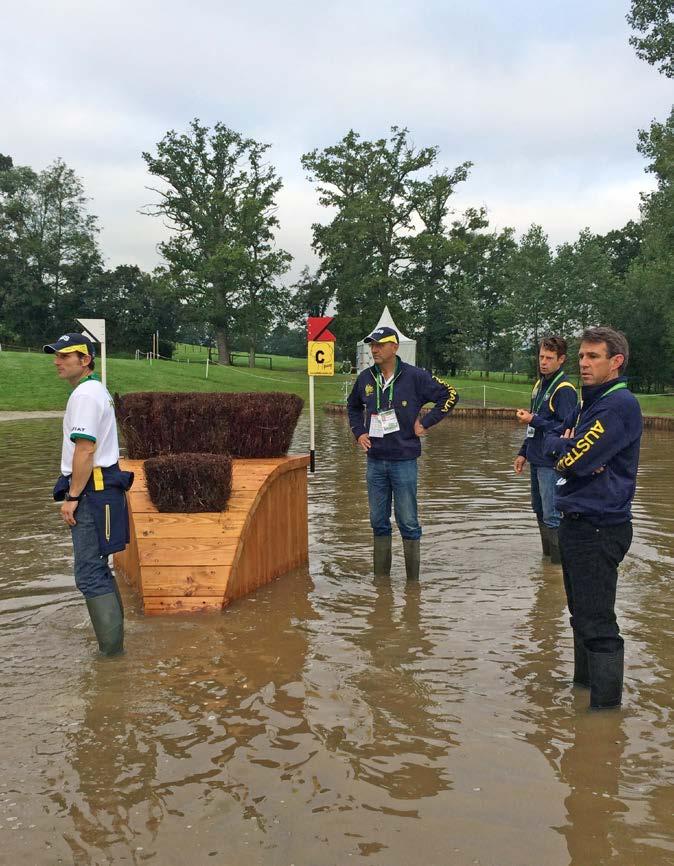
Prue Barrett Chef d’Equipe and eventing coach for the bronze medal winning 2016 Australian team, Prue Barrett is an experienced equestrian athlete, coach, and program manager, and she knows a thing or two about collaboration! Turn to her story for a fascinating glimpse into the life of an Olympic Chef d’Equipe.
OUR CONTRIBUTORS
Dr Doug English
A veterinarian and longtime turmeric researcher, Doug completed his Bachelor of Veterinary Science at the University of Queensland in 1974. He’s well-known throughout Australia for his work in the equine industry and is a long-time Equine Veterinarians Australia member. Turn to his article of enteroliths to find out what they are and why they’re a problem.
Sonia Caeiro Alvarez
Christine Armishaw
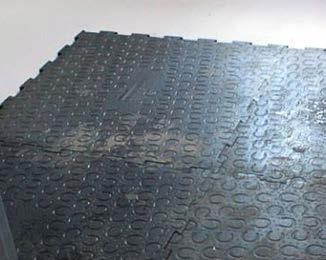
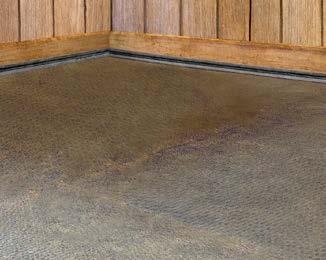
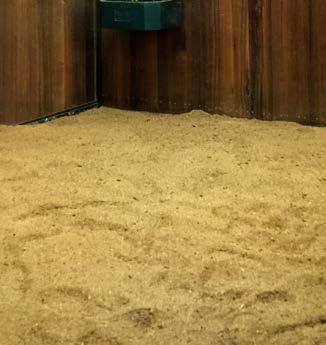
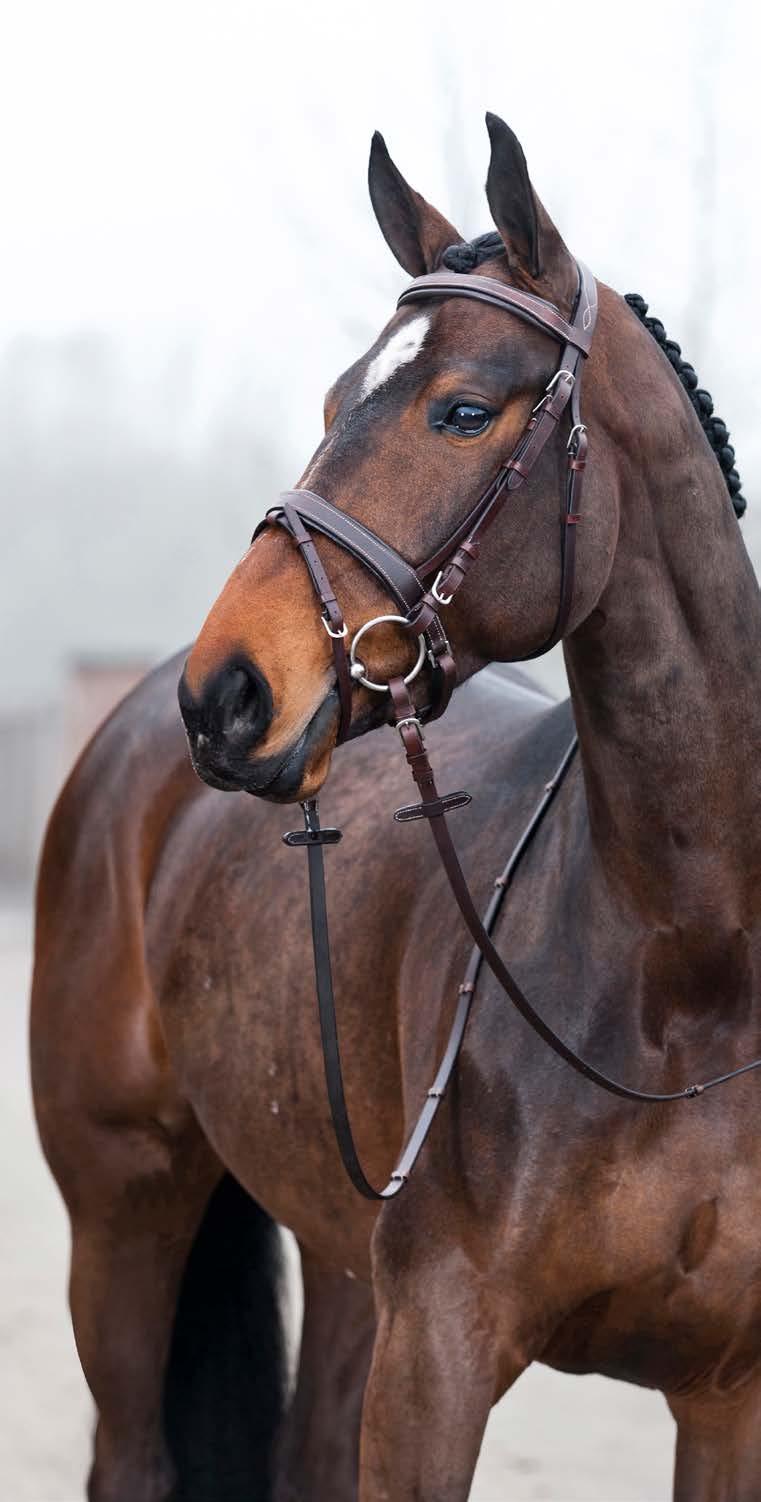
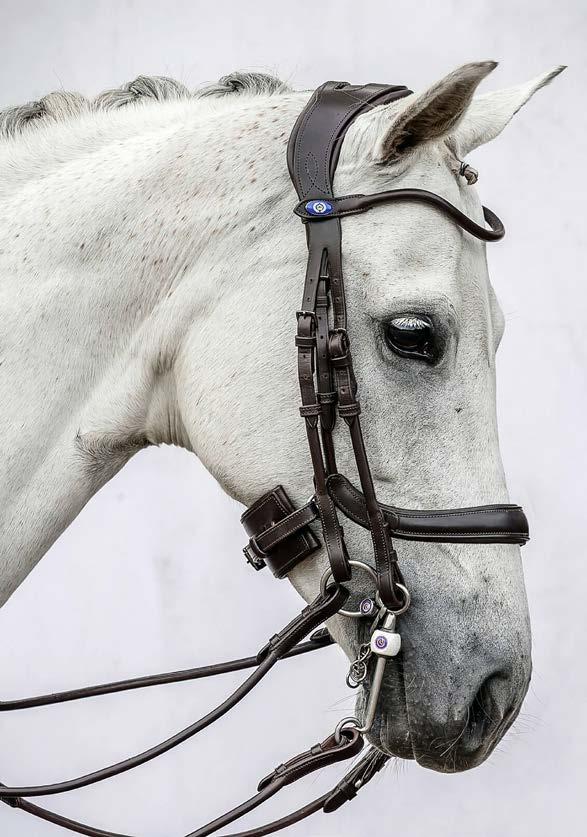
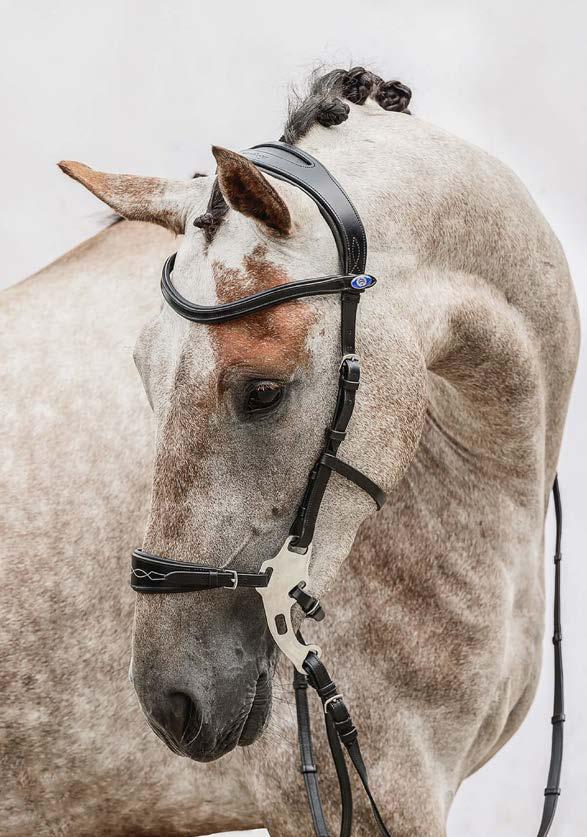
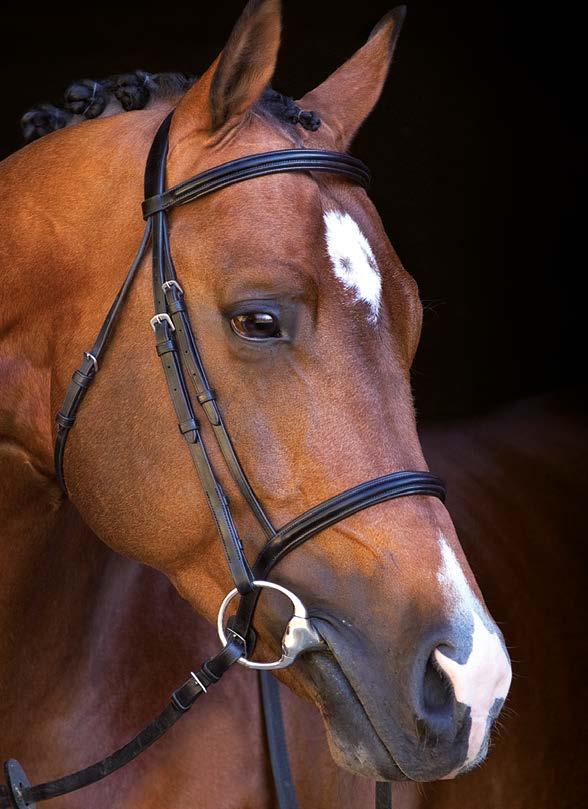
Christine is a horse trainer, riding coach and passionate eventing and jumping rider. A Kiwi girl based in NSW, she teaches others not just how to ride, but also how to understand their horses. She took time out to bring us up to speed on current bridle types, and on some interesting innovations in stable flooring.
Jamie Hocking
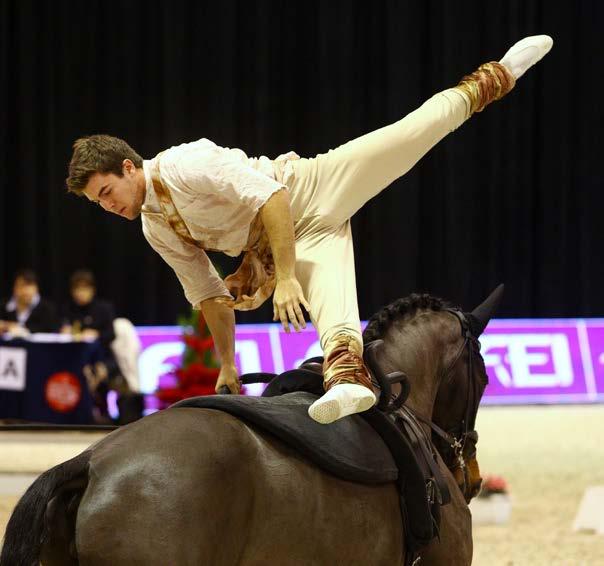
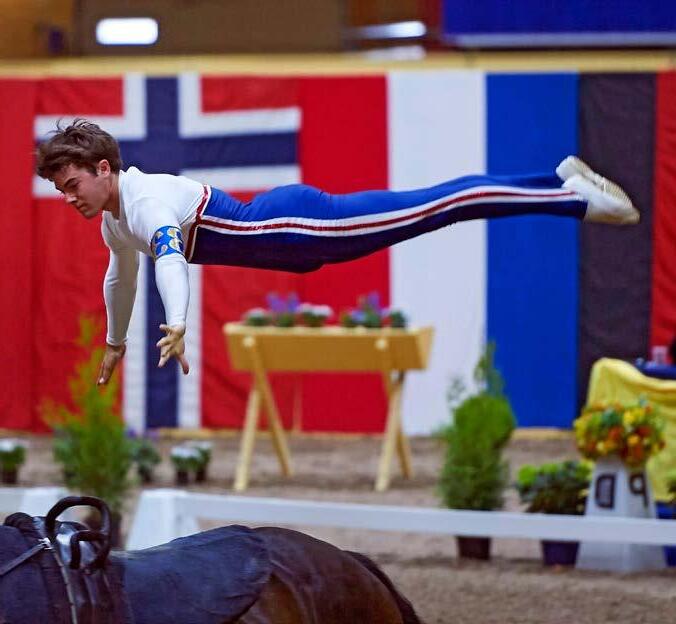
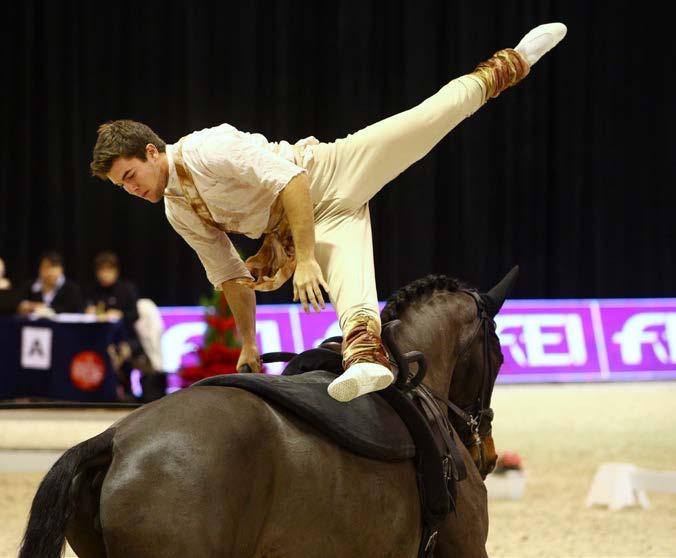
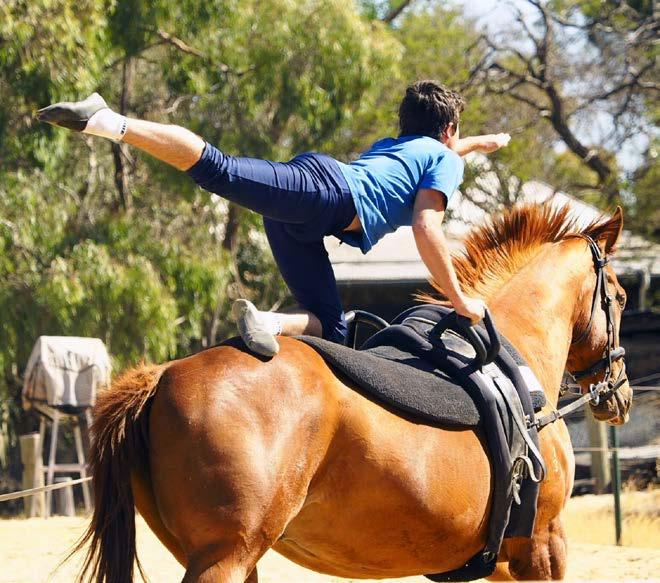
Jamie is one of our two 2020 Delivering Dream Scholarship recipients. Determined to reach the top of his chosen sport, equestrian vaulting, he’s well on his way. The road he’s travelled so far has been far from ordinary, and in this issue, he shares stories from the past, and his dreams and hopes for the future.
Paul Symes
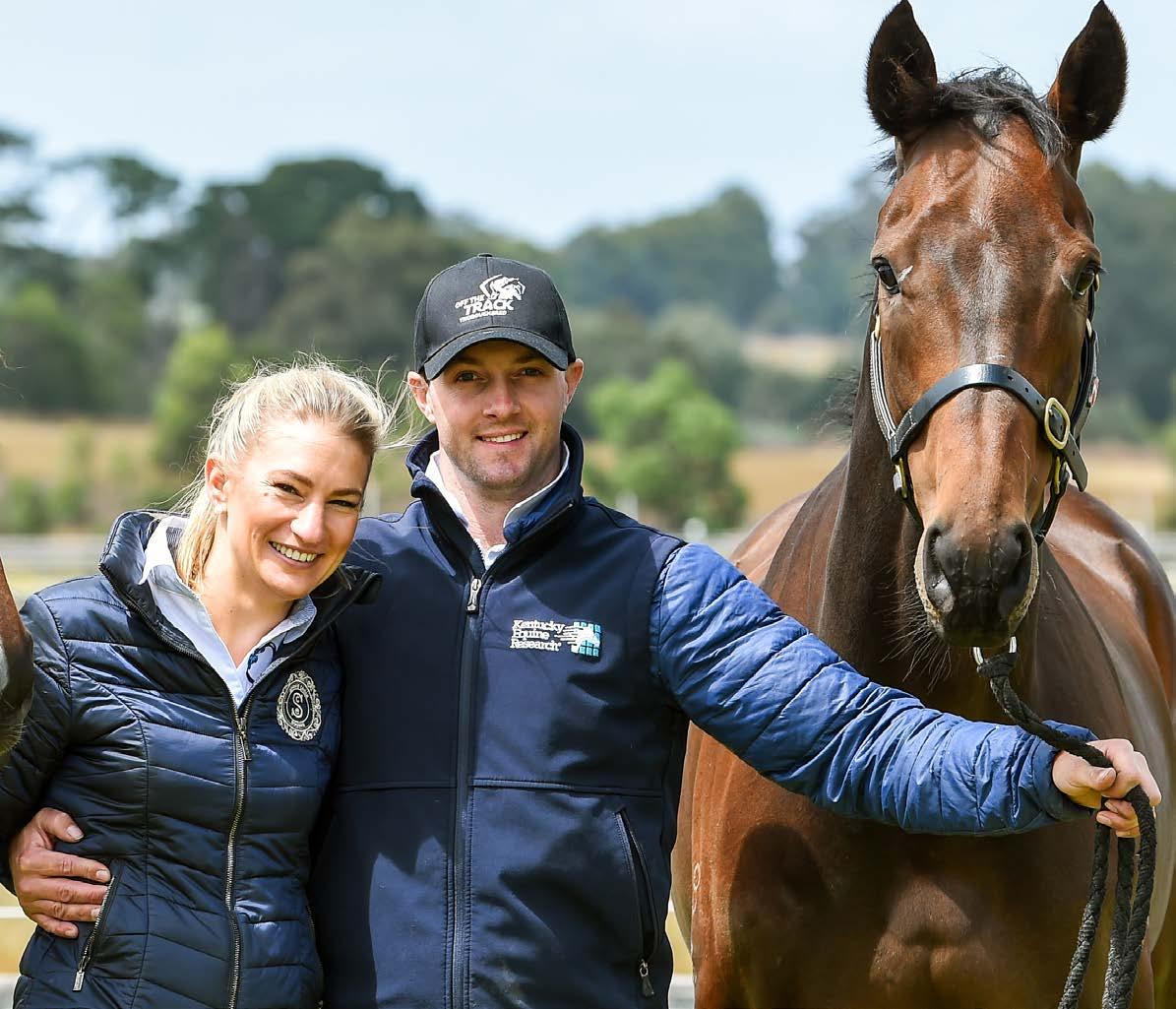
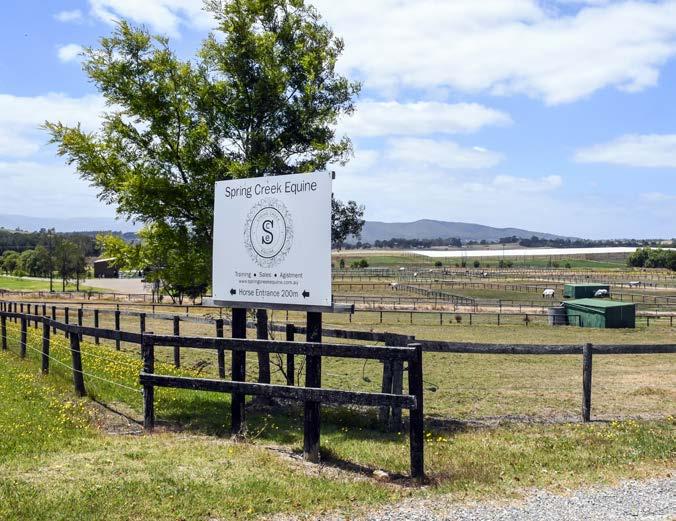
Paul is a senior communications professional and content writer at Racing Victoria. He plays a vital role in creating awareness of the various life after racing pathways for retired racehorses in Victoria. In this issue, he chats with Samantha and Chris from Spring Creek Equine about their involvement in Racing Victoria’s RESET program.
Terry Snow
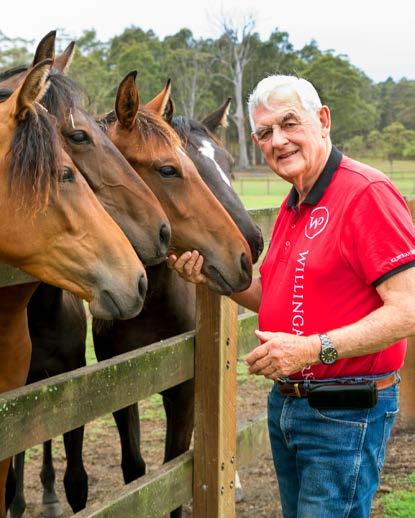
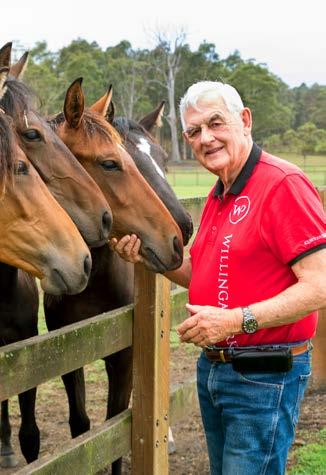
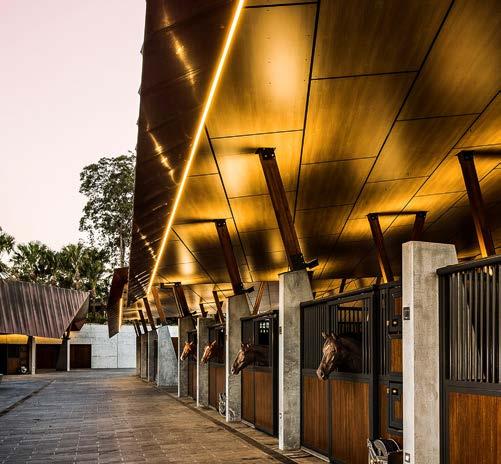
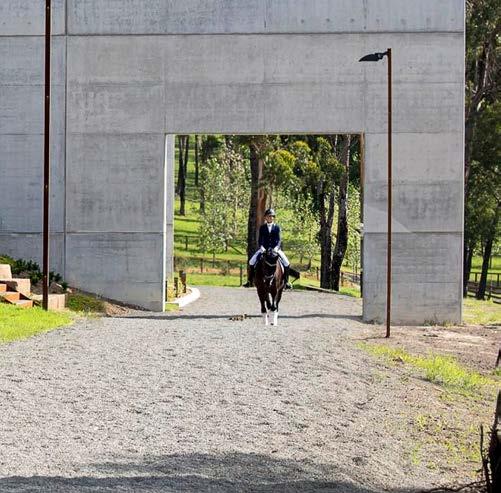
Terry Snow AM, is an Australian businessman, entrepreneur, and philanthropist. He is also the driving force behind Willinga Park, the magnificent awardwinning 810 hectare equine facility located at Bawley Point on the NSW’s South Coast. A generous and enthusiastic supporter of Australian equestrian sports, Terry kindly took the time to join us for 20 Questions.
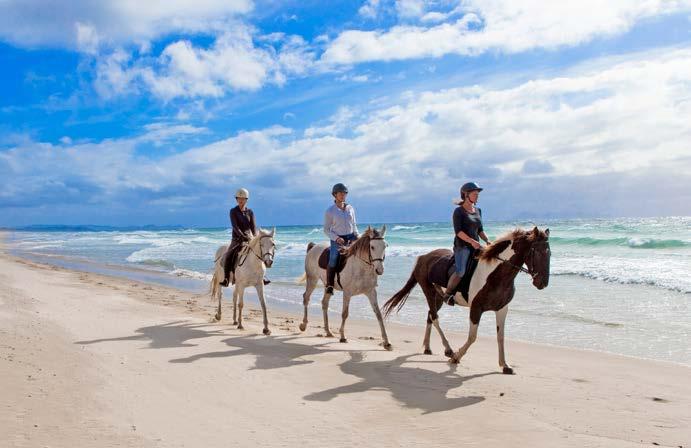
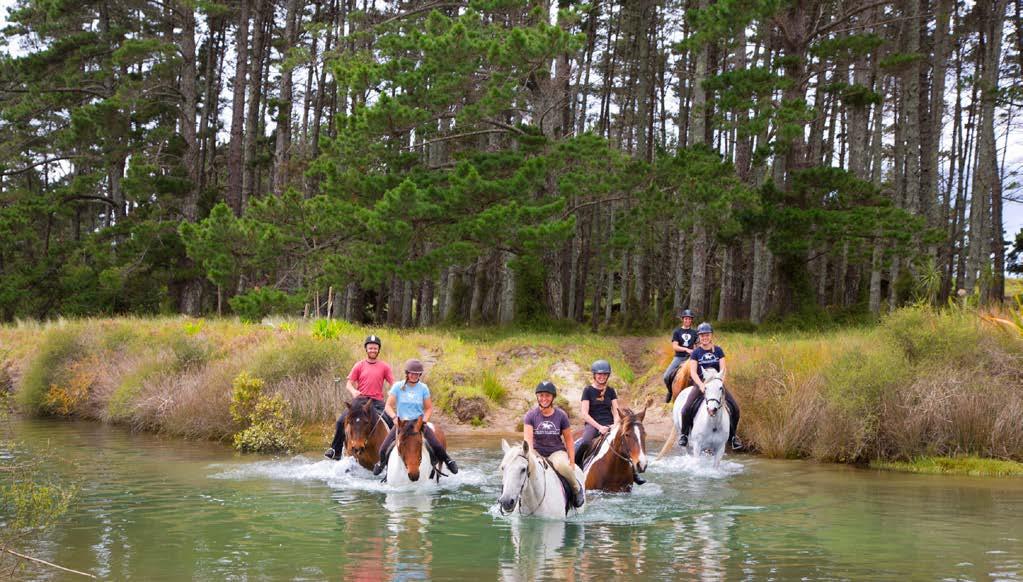
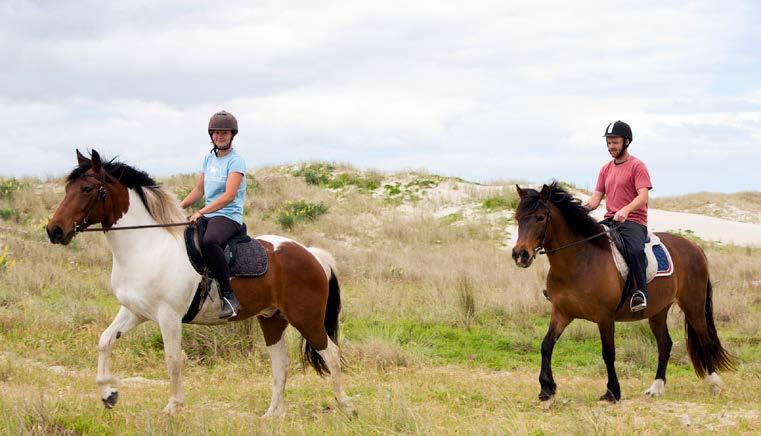
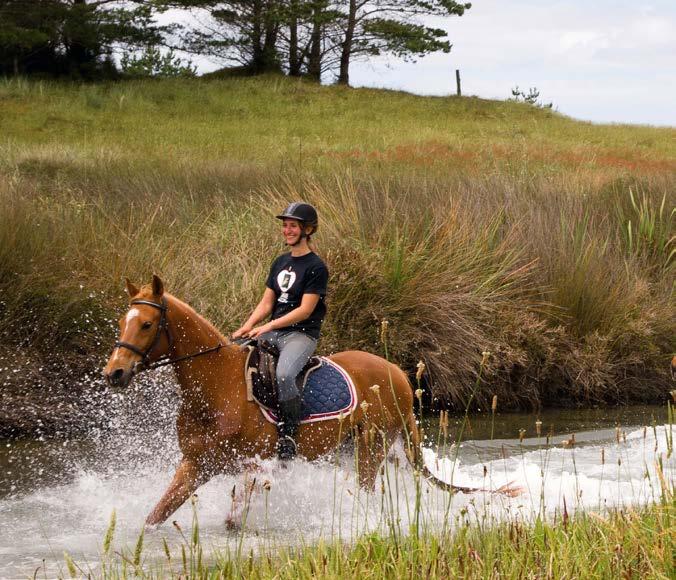
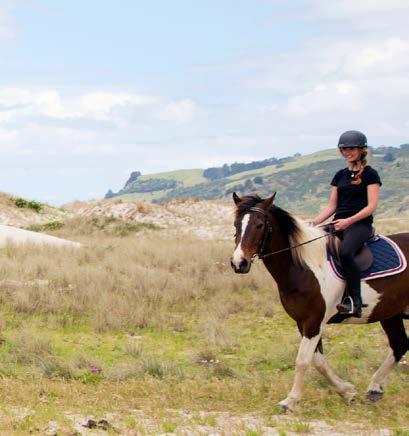
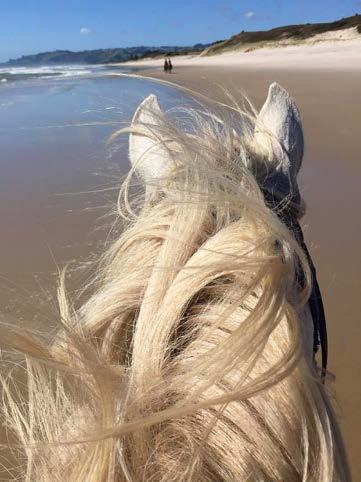
Sonia is a journalist, editor and writing workshop facilitator. She’s had a lifelong love affair with horses, although sadly does not own any so lives out her passion vicariously through her friends. COVID restrictions notwithstanding, Sonia armchair travels to New Zealand’s North Island and explores with Pakiri Beach Horse Rides.
Obelia McCormack
With years of industry experience, our wonderful designer Obelia is an expert in publication production and design, with a knack for combining copy and images into eyecatching layouts. Her client list is impressive and a wide variety of publications have benefited from her considerable talents, including our own very beautiful HorseVibes.
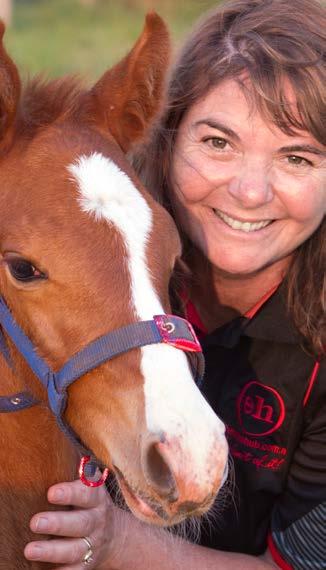
Fiona Todd Fiona’s love of animals in general, and horse’s in particular, has been life-long. Driven by a desire to support and inspire equestrians from all disciples, she first launched The Saddle Hub, a hugely popular pre-loved saddle online store, closely followed by HorseVibes, the magazine dedicated to Australian riders and their faithful equine companions.
PUBLISHER’S LETTER
From the Horse’s Mouth
With Fiona Todd
It was around this time 12 months ago that the world was struck down by the dreaded pandemic – and what a journey for everyone, ourselves included.
But the COVID-induced lull gave us time to explore some exciting new options for you, our much loved readers. Firstly, HorseVibes is even more jam packed with the info, tips and inspiration you need to make your equestrian life more successful and fulfilling.
Secondly, for all our annual print and digital subscribers, we now have a VIP area that will blow your prettily patterned socks off! (Need a new pair? We have a sensational range available at the Equestrian Hub shop.)
Our VIP area is where you’ll find, among other things, some super products at very special VIP prices. Plus, we have many more exciting benefits coming - so definitely watch this space. You’ll also notice that HorseVibes and the The Saddle Hub are now stable mates on the Equestrian Hub website, so everything you need is right there at your fingertips.
In this issue, our editor Amanda Mac has, as always, assembled a collection of amazing people and stories. We shine our spotlight on Amanda Ross, a totally inspiring equestrian on every level. Our Amanda also speaks to Liz Lewis about the majestic Clydesdale.
Charlie Brister has an in-depth discussion with my rather tall pony about the correct way to behave when being bridled. And if you’re an annual subscriber, you’ll find video footage on
this hot topic in the VIP area. Charlie also manages to chat to Terry Snow of Willinga Park fame, and asks him 20 pertinent questions.
Working Equitation is rapidly growing in popularity and Linda Shore shares some top tips on what we need to do to improve our skills and get the most out of this exciting discipline.
Have you ever wondered what it takes to become one of the best at what you do? Jamie Hocking, one of our 2020 Delivering Dreams Scholarship recipients, has shown amazing determination and commitment to achieve what he has – and in this issue he opens up a little and shares some tales about his journey to the top.
Dr. Doug, our resident vet, takes on Enteroliths and explains some of the how, the what, and the why you need to know about them. Christine Armishaw learns just how many hats a Chef d’Equipe must wear, before getting down to the basics of stable flooring: what’s best for your horse’s health and comfort as well as your wallet. And if you’re confused about which bridle to buy, she then delves deep into this very topic in our equipment article.
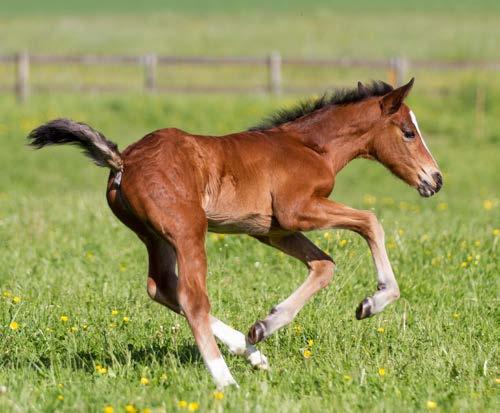
Nutrionist Larissa Bilston gives us the low down on feeding weanlings. Weaning can be a stressful time for foals, but careful planning can make it much easier for both mum and bub.
Missing going on holiday? Sonia Caeiro Alvarez reckons you should be doing your research now so that when travel bans are lifted, you’re good to go - and in this issue she explores horseback riding on New Zealand’s North Island.
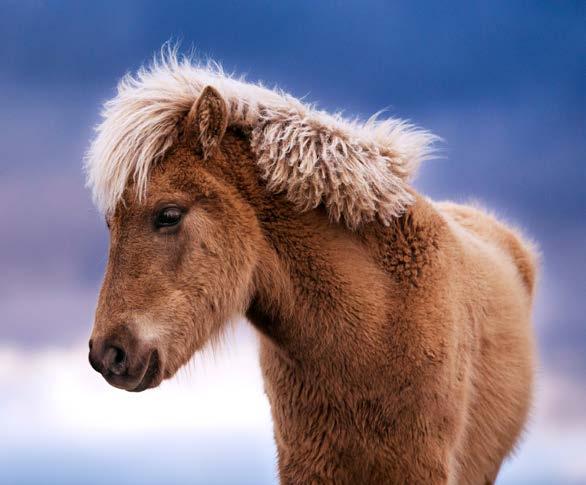
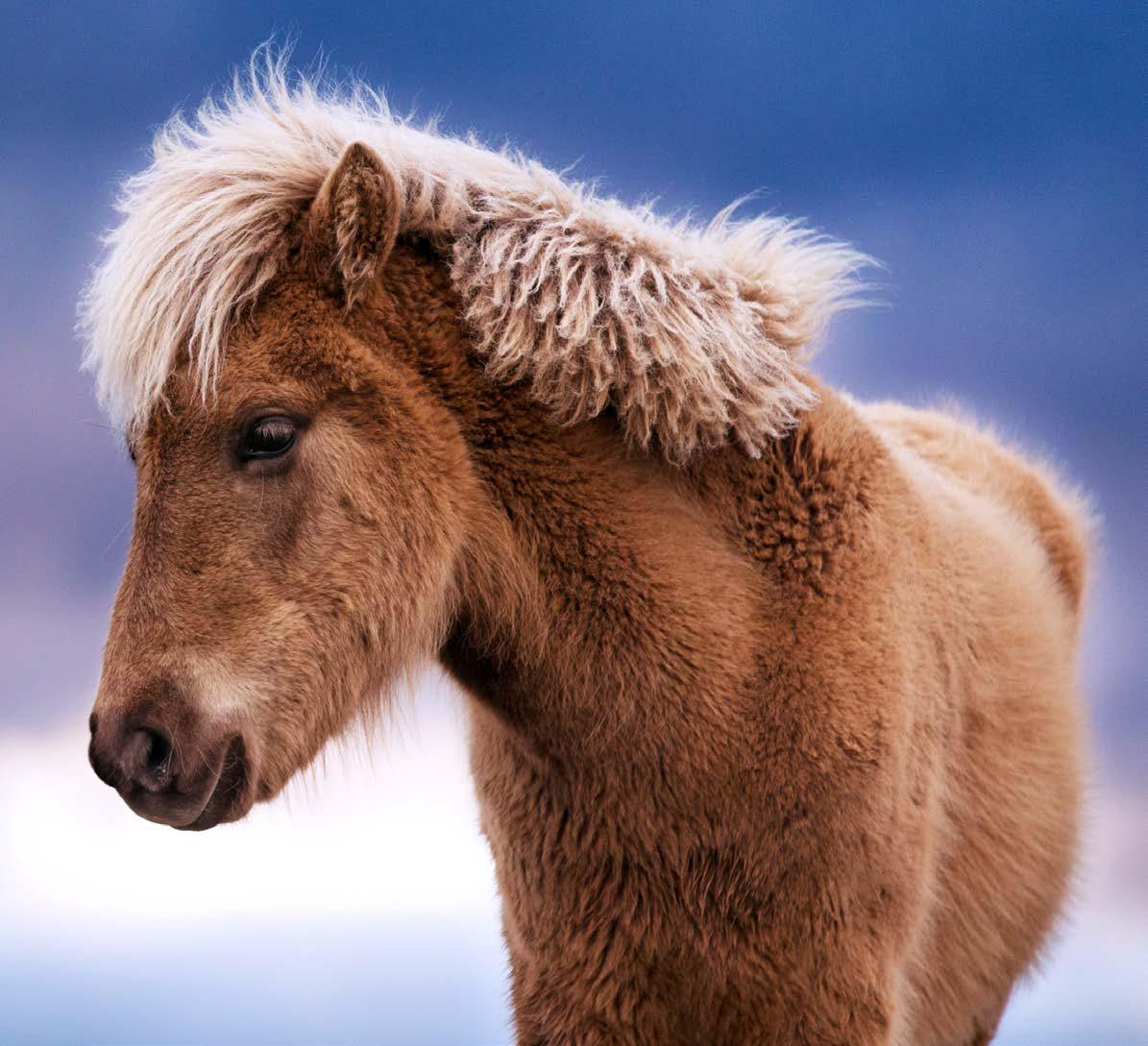
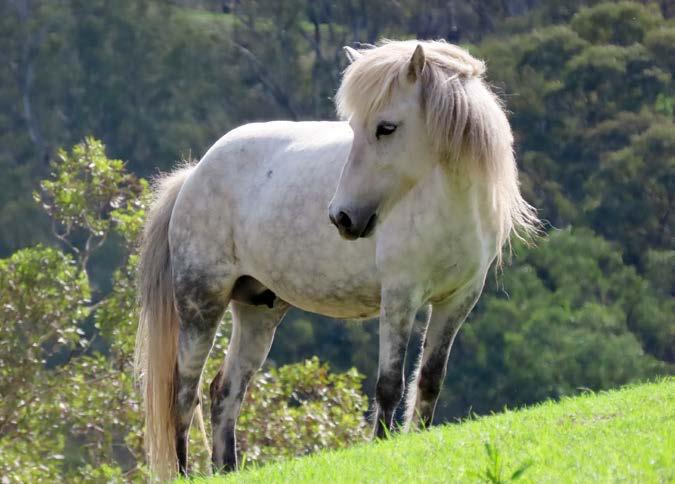
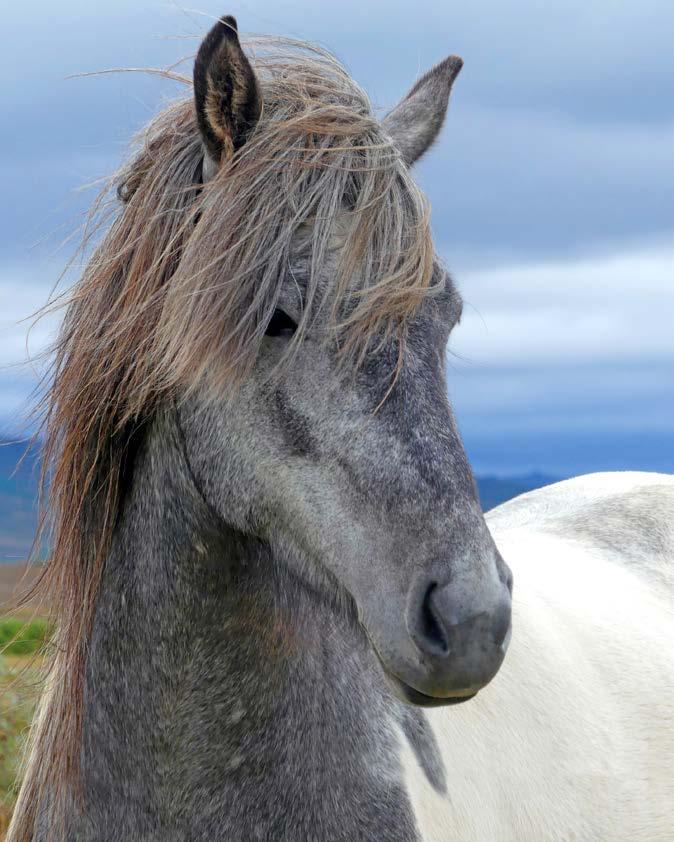
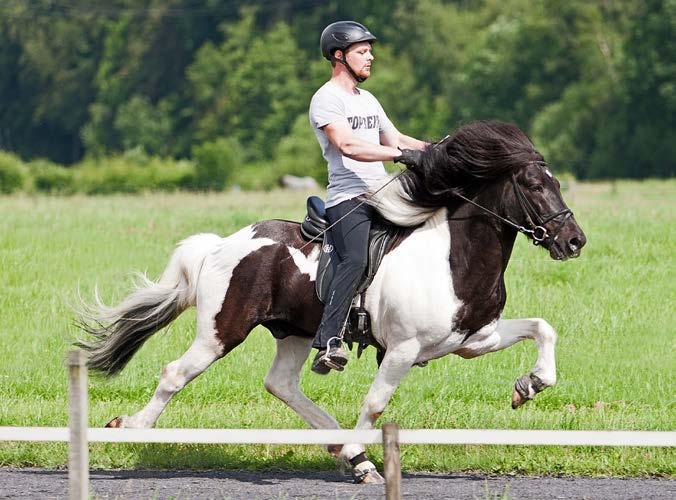
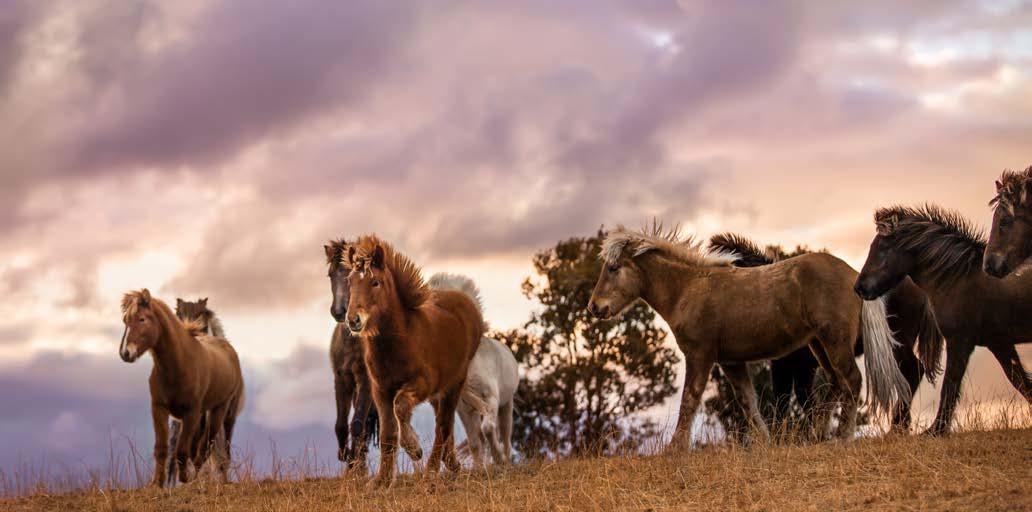
Paul Symes talks to Samantha Cesnik and Chris Height about Racing Victoria’s exciting Life After Racing options, and our featured breed is the Labrador of the horse world, the rather gorgeous Icelandic Horse, reputed to have the smoothest trot of them all.
It’s no secret that I love jumping, so I’m delighted that Michael Archer has climbed onto the Tackbox to give a heads up on the need for volunteers and the value they add to the sport.
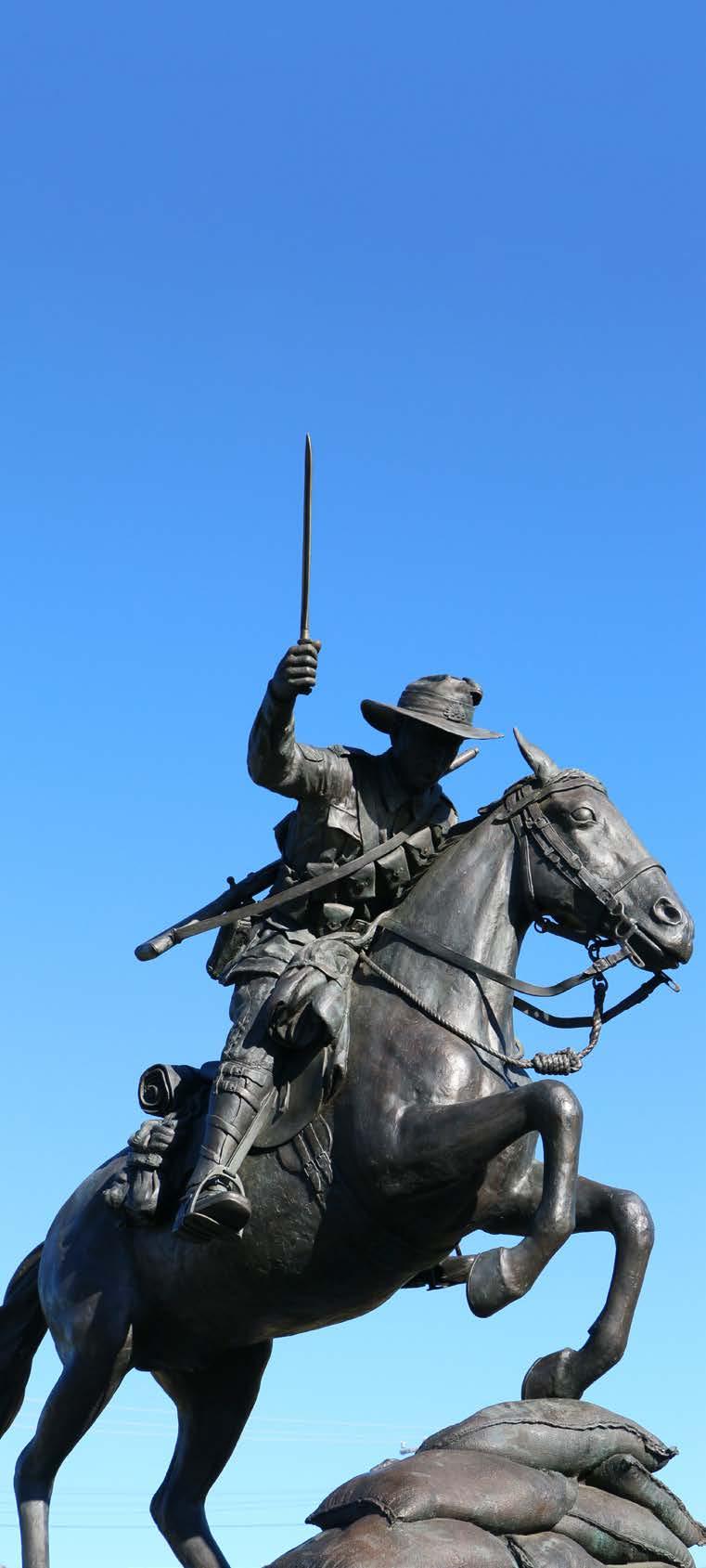
As ANZAC Day is approaching, our Perfect Partner feature looks at the Australian Light Horse regiments, their Waler partners and the historic battle for Beersheba.
And of course there is so much more: so as usual, pour your favourite tipple, relax and enjoy the March/April edition of HorseVibes
Keeping it real
Olympian Amanda Ross is an equestrian coach, professional athlete and personal trainer with a refreshingly down to earth take on life. She recently spoke to AMANDA MAC about the journey so far.
It’s around 7:00 o’clock on a Monday night and in the background I can hear the clatter of pots and pans, and possibly something being stirred. I’m a virtual, mobile phone facilitated presence in Amanda Ross’s kitchen and she’s busy food prepping. “I was feeling guilty thinking I should have ridden a couple of horses today,” she tells me, “but then I thought no, you have to have one day a week where you don’t ride. A day off when you do your human things – so that’s what I’m doing now.”
A great believer in healthy eating and with a fitness level that’s through the roof, the word ‘powerhouse’ comes to mind, which is very likely what Anni Sedgwick, Amanda’s mother, was referring to when she dubbed her daughter the ‘energizer bunny’.
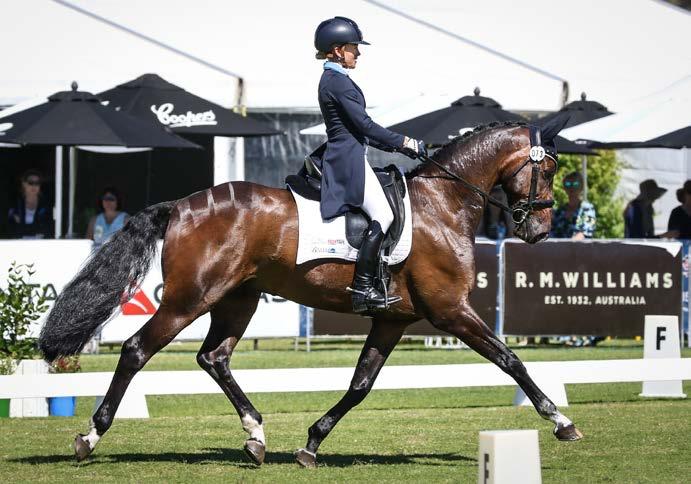
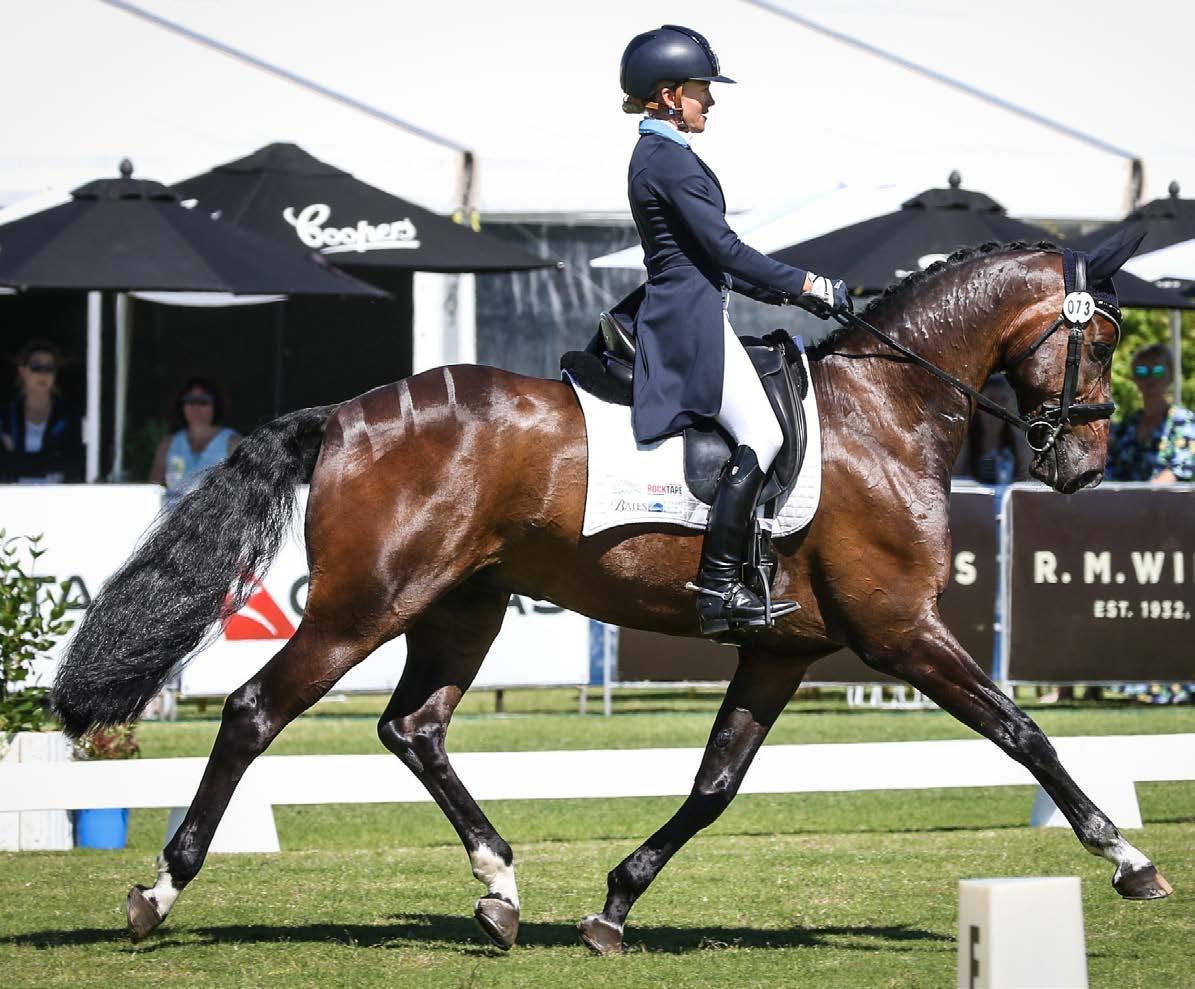
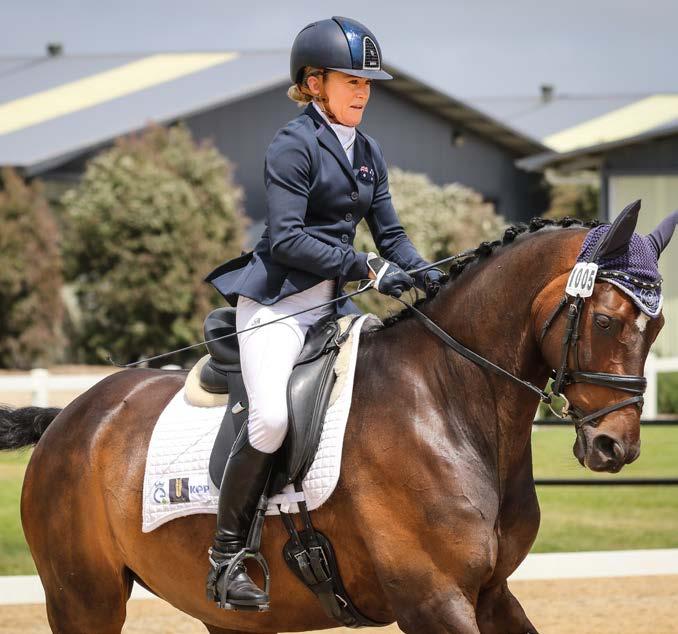
Amanda and Dicavalli Diesel's magnificent test put them in the lead in the dressage phase of the 2018 R.M. Williams CIC3.
(All images by Michelle Terlato Photography)
At the time of writing, Amanda is among the top 60 in the FEI Eventing World Athlete rankings. She competed in the Sydney 2000 Olympics, and is a serious contender for the Tokyo Games (when they eventuate). But she also has her feet planted firmly on solid ground – a realist who at one time faced the possibility that her career as a professional rider might be over.
Amanda grew up between Brighton and Mt Eliza in suburban Victoria. Although her mother, a keen rider at hobbyist level, stopped riding when she first married, she took the sport up again when Amanda was very young.
A good thing all round really, because that’s what kindled Amanda’s passion for horses. “Mum used to ride with the Francis family, originally in Mt Eliza. Later the Francis’ moved to Tooradin, and Mum
Amanda and Koko Popping Candy go clear in front of a full grandstand.
At the time of writing, Amanda is among the top 60 in the FEI Eventing World Athlete rankings.
started riding again when I was two. She took me with her and plonked me on a horse. I thoroughly enjoyed it and screamed when I was taken off.”
Having cut her early equestrian teeth on trail rides around the property, her first pony arrived when she was eight and at last, she was allowed to join Pony Club. “I got a Welsh A and she was just that typical naughty little grey pony who
basically wouldn’t go where you wanted her to, ate hay bales when they were under jumps instead of jumping them, and I loved her,” she laughs. “But my next pony, Sharma, was the best pony ever. He was also a Welshy and he was amazing, a wonderful, wonderful pony and very versatile.”
If the mention of Francis in combination with Tooradin rang a bell, you’re almost certainly thinking of Tooradin Estate, home of the now late equestrian Judy Francis, and her daughter Sally, who in 2019 was awarded an OAM for her contribution to equestrian sport and riders with a disability.
And it was the Tooradin Pony Club that Amanda had the very great fortune to join. “We were very lucky because we were taught by Judy and Sally, who had spent some time in the US learning equitation and taught us their jumping style. We did everything at Pony Club,” Amanda recalls, “games, eventing, dressage. Our parents dropped us down there, and we’d spend the whole day riding our ponies over the 400 acres. It was just a fabulous place for a kid to grow up and learn horsemanship. And that grounding in equitation shaped both the way I ride today, and my love of eventing – and I’m forever grateful for that.”
The horse-fixated Amanda continued to ride into her teens, but when her days at high school came to an end, the expectation was that she would go to university. Grudgingly - “I didn’t want to, I just wanted to ride horses” - she signed up for Phys Ed.
After completing the first year, fate mercifully intervened when her stepfather was offered, and accepted, a job in the UK. Recognising this was a golden opportunity, Amanda opted to move with the rest of the family, taking her recently purchased horse with her. “At 19 I flew to the UK with 52 polo ponies, six piglets, a Dobermann, and my horse. It was an eye-opening experience. I’ve had many a trip since then but that was the very memorable beginning,” she recalls.
Fresh on the ground in the UK, Amanda
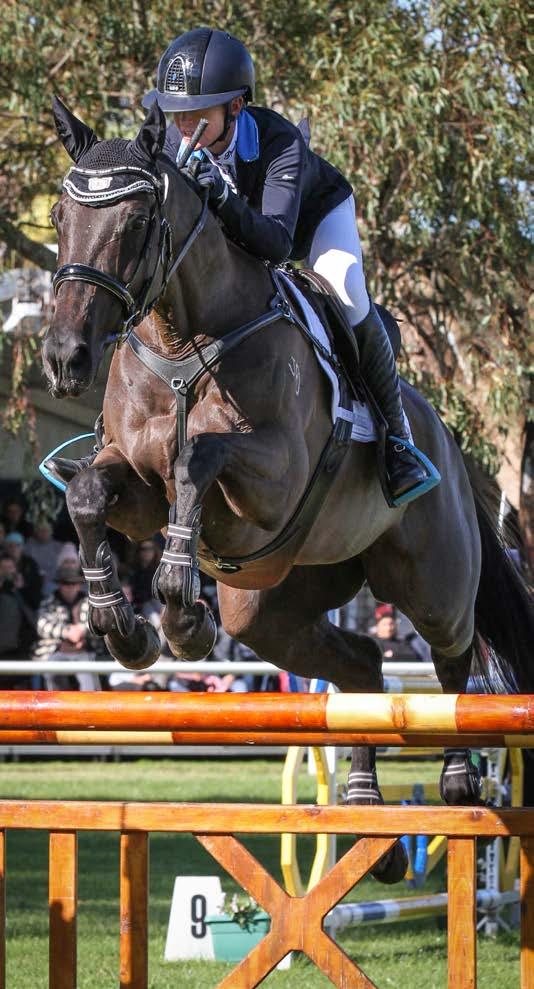
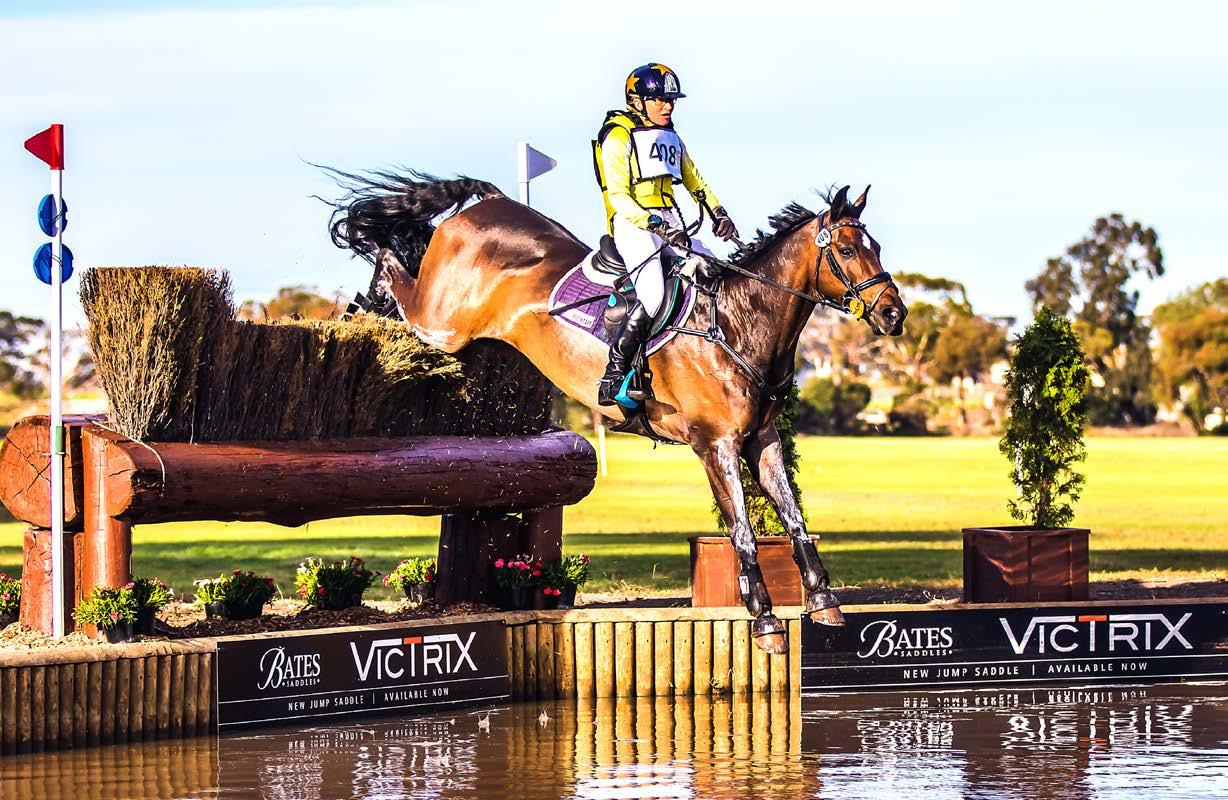
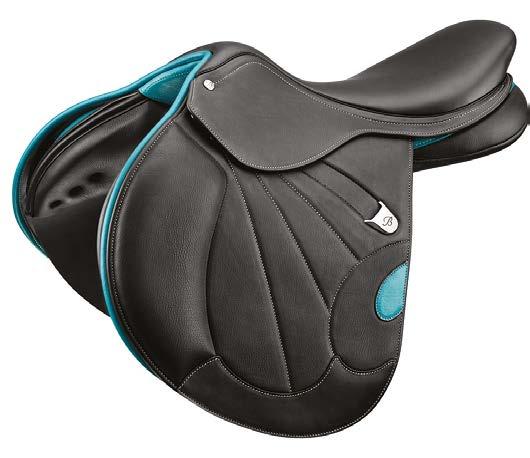
Unleash your horse’s true power in the Bates Victrix.
Unleash your horse’s true power in the Bates Victrix.
Unleash your horse’s true power in the Bates Victrix.
Unleash your horse’s true power in the Bates Victrix.
Lightweight and compact, the ultra-close Bates Victrix
Lightweight and compact, the ultra-close Bates Victrix offers your horse complete comfort and freedom in every stride, giving your partnership the edge over the competition.
Lightweight and compact, the ultra-close Bates Victrix offers your horse complete comfort and freedom in every stride, giving your partnership the edge over the competition.
Lightweight and compact, the ultra-close Bates Victrix offers your horse complete comfort and freedom in every stride, giving your partnership the edge over the competition.
When every second matters and you are powered by instinct… trust in the Bates Victrix to be your ultimate secret weapon.
When every second matters and you are powered by instinct… trust in the Bates Victrix to be your ultimate secret weapon.
When every second matters and you are powered by instinct… trust in the Bates Victrix to be your ultimate secret weapon.
When every second matters and you are powered by instinct… trust in the Bates Victrix to be your ultimate secret weapon.
competed in novice level eventing, worked in a variety of yards and met some interesting people along the way, including British dressage great Spencer Wilton. “Then I worked in a fantastic yard with a lady called Frances ‘Mouse’ Berry who at one point groomed for Sam Griffiths with his eventers. She had everything: hunters, cobs, show ponies – and I learned how to muck out, set the yard fair, and clean tack. Monday was the day when the entire yard got cleaned from head to toe. So I learned all about the systems we didn’t really have in Australia,” she explains.
And what trip to the UK would be complete without a visit to the world famous Badminton Horse Trials? But not just any old visit: “I went to Badminton behind the scenes,” Amanda tells me, “because I’d met a lovely guy whose family ran the caravan park at Badminton every year. So I stayed with them and got to go to the official cocktail party, and met the course designers, and that was a really wonderful experience.”
While Amanda didn’t go to the UK as a great competitor, she did go hungry to grow. She’d been offered a fabulous opportunity, grabbed it, and was rewarded with a once in a lifetime experience. “I learned how to set up a yard and make sure the horses were well cared for, with a system to keep tack packed and organised. And I’d seen how the big events were run, so in 1993 I returned to Australia as a 20-year-old with a vision, I guess.”
Back home in suburban Victoria it was time for a new chapter, and having sold her horse in the UK, Amanda was in the market for a replacement … or two.
After scanning the For Sale columns in The Weekly Times, then the selfproclaimed ‘voice of the country’, she came up trumps when she bought Otto Schumaker, a six-year-old Thoroughbred. “Otto had been registered as a racehorse, although I don’t know if he was even trialled. I think he was a bit crazy,” she laughs. She also acquired an off the track three-year-old nicknamed Bumble, and bestowed on him the show name London’s Night Owl, a homage to
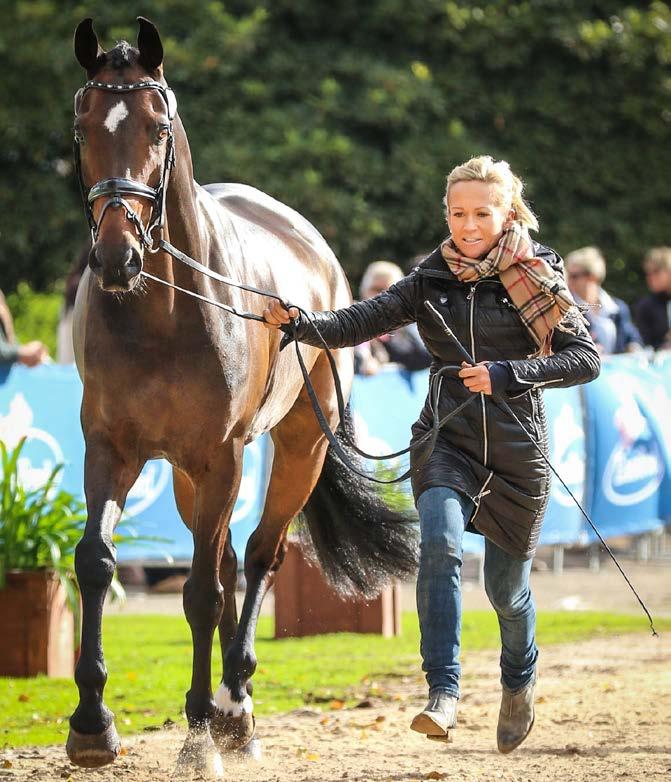
The stunningly presented Dondiablo and Amanda in the CCI4_L Trot Up.
one of international eventing great Sir Mark Todd’s horses.
Otto had competed in a couple of prenovice events with John Francis, who has a sizeable reputation for producing some very nice horses. However, Otto proved to be quite a handful, so for a time Amanda became a working pupil for eventer Michael Baker in exchange for lessons, which she says, helped considerably.
When Amanda and Otto began competing, their first six competitions, all pre-novice, were far from memorable - dressage turned out to be the pair’s Achilles heel. But as their results improved, other riders took note and approached Amanda wanting lessons, which kicked off her income-earning capacity as a Level 1 coach.
Without a property of her own, Amanda had never had a lot of horses in work. But that changed in her mid-twenties
when she moved in to her soon to be husband’s property and began to produce, compete and sell event horses.
Which in a very roundabout way brings us to the 2000 Sydney Olympics: “Qualifying for the Olympics was one of those things that happened organically. I’d won Gawler 1* in 1995 on Otto and that was the first time anybody had actually paid any attention to who Amanda Ross was. Otto was 2* by the end of that year, and the following year I won the Gawler 1* for the second time but on a different horse, GS Chevalier, which attracted even more attention. I remember Wayne Roycroft saying, ‘Did she win the 1* again?’, like who actually is this girl,” Amanda laughs, “and that’s when the coaching picked up too.”
It would be nice to think that from then on all was plain sailing – but it wasn’t. Following a 3* win at the Lochinvar Three Day Event, the Olympics were next on the agenda. But Otto had some issues
with his soundness. “It was just arthritis, there was nothing particularly dodgy, but leading into the games there was a concern he wasn’t going to be sound,” Amanda explains. “But funnily enough he was more sound after the cross country then before. So the Olympics, although there were some amazing things about it – with a home Olympics the support’s incredible, you don’t have to travel, you’ve got your friends and family there – it was actually a really anxious time because we were trying to make sure Otto stayed sound. I’d love to say Sydney 2000 was amazing, fantastic and wonderful, but if I’m honest, there were parts that were really quite stressful.”
Following a good dressage test, Otto, always a hot and very strong horse, was so affected by the Games atmosphere that by the end of the course, Amanda couldn’t hold him. While it didn’t look as if she was lacking much control, she had a fall three fences from home, and although she got back on board and finished, any chances of winning a medal were gone
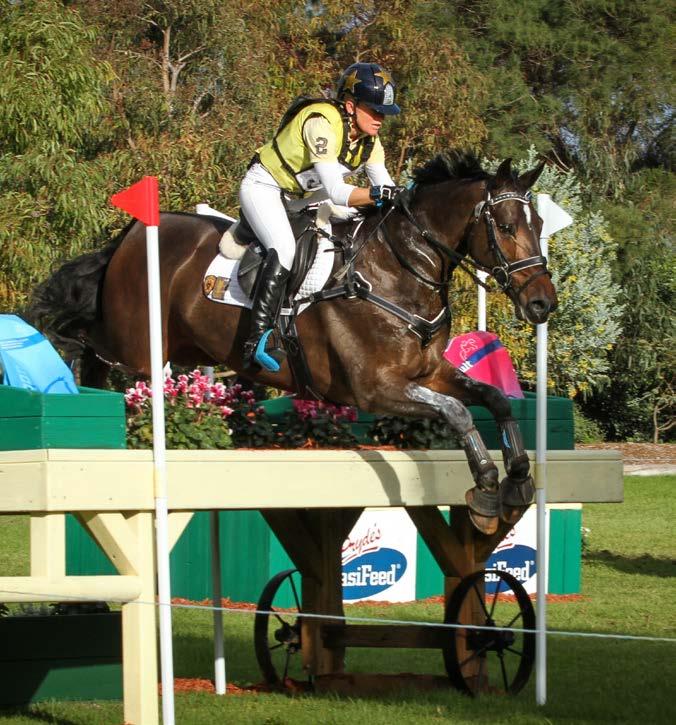
Powering through the cross country with Dicavalli Diesel.
... while you’ve been chasing this elusive dream, you’ve forgotten all the other things you’ve done really well. You have to stop and smell the roses.
- a disappointing and demoralising end to her first Olympics. “I’d really wanted to prove that I was good enough. I had quite a bit of imposter syndrome and felt that there were other riders who should have been there instead of me, so I was desperate to prove I was worth the spot –and that probably haunted me for a good ten years,” she says.
Since then, Amanda has adopted a more down to earth approach to the Olympics. “Going to the Olympics is
very interesting. From an outsider’s perspective it’s absolutely wonderful, but from a competitor’s point of view you only get a once in every four year shot. So if your sole focus is the Olympics, you could possibly have quite a disappointing life because we know how hard it is to be prepared and on form at exactly the right time, and with horses things can go so wrong. While I really want to go back to the Olympics and prove I can do better, it’s now been 20 years and since then I’ve been reserve for the World Games three times. So you have to really love what you do every single day, or down the track you might turn around and realise that while you’ve been chasing this elusive dream, you’ve forgotten all the other things you’ve done really well. You have to stop and smell the roses.”
As it happened, there were more challenges coming down the line. It was 2005. Pop diva Kylie Minogue had just been diagnosed with breast cancer, which triggered a public awareness campaign encouraging younger woman to routinely check their breasts for abnormalities. Now in her early thirties, Amanda fortunately took that advice to heart and discovered a small lump. A subsequent doctor’s appointment was the beginning of a dark and frightening journey. “I had a mastectomy and went through chemo, and luckily I’m now out the other side. Thankfully I had the horses,” she says of that time, “because they kept me sane. As a Type A personality I saw a therapist for a bit, because I didn’t know how I was going to deal with the unknown of putting my life on hold. But it taught me that you don’t have to ride every single day. If you’ve schooled them well they’ll still be there. So yeah, that was an interesting learning curve.”
Other difficulties were to follow. After divorcing in 2008, and without a property of her own, Amanda agisted her horses and often lived on other people’s properties, enjoying some beautiful locations in the process. But the day came when a painful reality check hit home, and she recognised that her two 2* horses, Loxley and William
Wordsworth, didn’t have the ability to go any further. “At the time I was living in a beautiful place near Boneo Park, but it wasn’t where I wanted to live. So push came to shove and I thought, I’m going to have to give up riding professionally, I think I’m actually going to have to give up. I looked at my bank balance and realised I was spending everything I had on horses that were lovely but lacked ability, I wasn’t making enough money, and life was really, really difficult there. So I decided to do the adult thing, pull the pin, and sell the horses.”
Amanda admits that it was absolutely the hardest decision she has ever had to make, particularly as it was coupled with the self-imposed proviso that if she came back to professional riding it would be subject to strict terms: “I wanted to work with people who were into the competitive side of horse ownership rather than just making money, and I wanted to love the horses that I rode like I was a 12-year-old kid again – which was something I was really missing. Rather than just working horses I wanted to enjoy the daily process because I really love riding. I also wanted to live closer to Balnarring because all my coaching clients and my folks were there.”
Interestingly, it was after swallowing that very bitter pill that magic began to happen. A real estate agent helped her find a house to rent on a property just 10 minutes out of Balnarring that had recently been purchased by Fraser and Chrissie Brown. After a string of crazy coincidences, Amanda met the couple, who although they had had no previous connection to the equestrian world, decided to invest in a horse for Amanda to campaign - which is when her beautiful and brave dream horse Dicavalli Diesel came along. “I look back on it now and everything I’d put out to the Universe that I felt would make life work for me again actually came to fruition,” she says. Things were improving! But where there are ups, there will inevitably be a few downs. Diesel did well at Adelaide in 2015, and 3* was on the horizon for 2016. Because she felt she needed another horse, Amanda had just invested
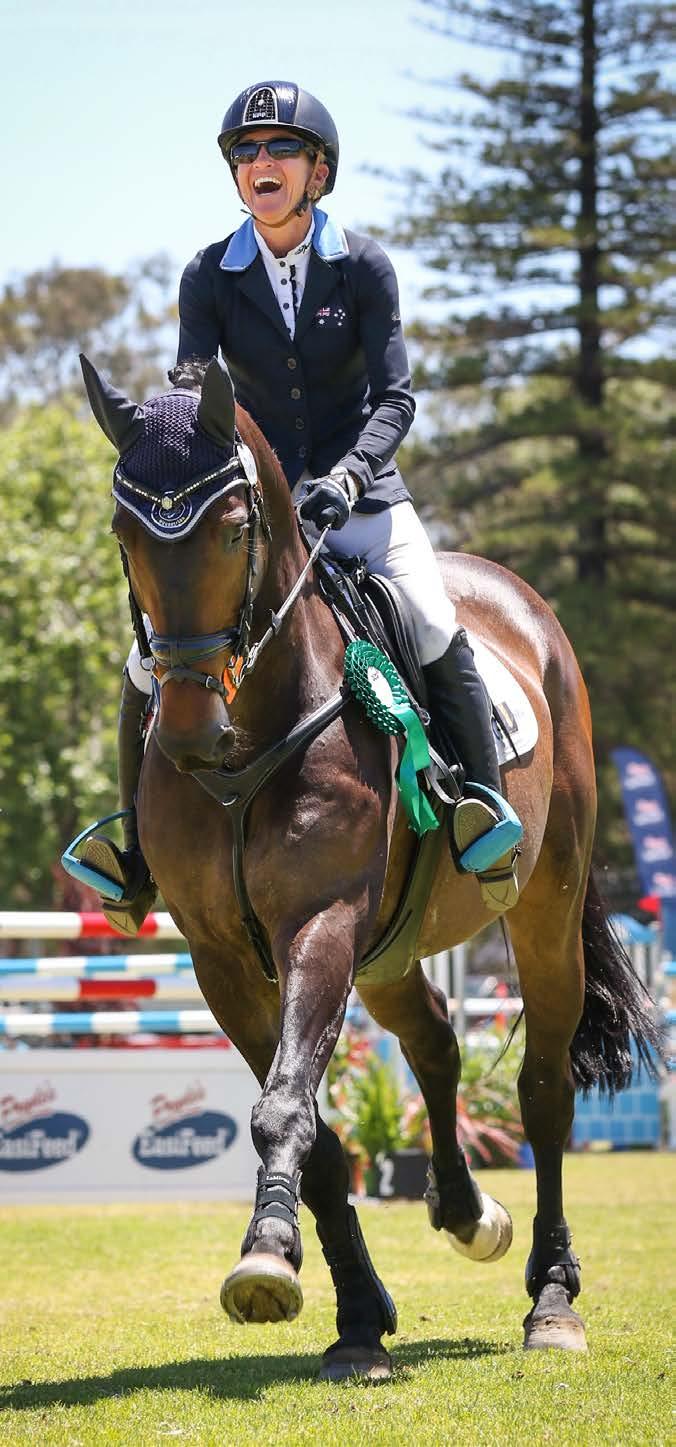
Amanda was clearly thrilled with her placings in the 2018 CIC3: 4th on RLE Poynstown Will and 6th on Dicavalli Diesel.
in Dondiablo, a green eight-year-old, when Diesel suddenly broke down with tendinitis, leaving the inexperienced Dondiablo as Amanda’s one and only.
“So Fraser decided we needed another top level horse,” Amanda tells me.
“Sharon Ridgway of eventers.com.au, who I’ve known for years and knows the way I ride, suggested that I look at Koko Popping Candy (Zarzy), a black Thoroughbred mare. And there was something about her that I really loved. I knew she was a somewhat unorthodox jumper, but her owners, Rob and Cassie Palm, said she was the most amazing cross country horse ever,” Amanda explains.
Recognising that Zarzy had potential on the flat, with an untapped resource in her trot, the deal was done. “Rob and Cassie had done a really good job getting her from off the track to eventing. I respected their training and what they said about her,” Amanda tells me, “and she’s been an extraordinarily interesting horse to work with because she’s not very orthodox at all. She’s very careful, she’s definitely a Thoroughbred mare, and she’s also the best cross country horse I’ve ever ridden, hands down.”
... I have such a great connection with Thoroughbreds that I was really keen to support them.
I mention noticing that Zarzy had scooped Equestrian Victoria’s 2020 Off the Track Eventing and Dressage Horse of the Year awards – “I know right! She’s pretty fancy on the flat,” chimes in an obviously delighted Amanda. And to top off an otherwise COVIDgloomy year, the Victoria Racing Club (VRC) announced that Amanda was to be their new Ambassador. “I didn’t realise how important it was until I got about 70 responses when I put it out on social media!” she laughs. “And we’ve been able to cut a deal which is really supportive of my Tokyo plan, which is exciting.”
With her long-held habit of staying open to new opportunities, Amanda recognised the Ambassadorship would allow her to branch out and do something
different with horses. “I’ve grown up riding Thoroughbreds. I’ve got Zarzy, and Otto was a Thoroughbred too. Even though we’ve got some Warmbloods in the yard I have such a great connection with Thoroughbreds that I was really keen to support them. So when this came up I thought it was a great opportunity to learn more about racing, which is a fascinating industry. I’ve never gone to track work or worked with racehorses at that level, so I’m looking forward to learning a lot.”
Right now, Amanda’s horizons are looking not just rosy, but energizer bunny busy. Foremost is Tokyo, which she began preparing for the moment events were back on track at the end of last year. “I got some competitions in, doing some dressage comps, and two to three day jumping shows, and that type of thing.” This season, the pressure is on to get in several more runs including the Sydney CCI-L.
Ever pragmatic, Amanda is fine with the idea that at the end of the day, she’ll have to be better than everyone else, and with a sound horse that’s primed and ready at the right time.
While Tokyo is her initial focus, she also has the 2022 World Games in her sights, and is very keen to pursue her role as the VRC’s Ambassador. But, of course, there’s more: “I really want to show jump at World Cup level successfully. I’ve evented all my life, and I want a new challenge and I find show jumping super exciting. I would absolutely love to have horses good enough to do that.”
And then there’s her Eventing Fit business, and her YouTube channel that she says needs some work, not to mention cooking up a storm in her cottage kitchen.
Seriously? I am in awe.
Catch up with Amanda (if you can) at www.facebook.com/AmandaRoss-Eventing-Fit-141845645983791, www.youtube.com/channel/ UC58IAOy0xoA5hym-BC9oO5g, and www.instagram.com/ amandarosseventingfit/?hl=en
With Dondiablo in the Boneo dressage area, November 2020.
BRISTER’S BRIEF
Bridling your horse
If you find yourself reaching for a stepladder every time you try to bridle your horse, CHARLIE BRISTER has some advice to help make bridling blissful … for both of you.
Most people who ride use a bridle. So it’s fair to say that there’s likely to be some of you who might need a little help making bridling a better experience. It’s easy to think that the horse is at fault if they’re difficult to bridle, when in reality we need to realise it’s up to us to make it easy for the horse, not for the horse to make it easy for us.
Like most things with horses there are a couple different ways to approach it. Sometimes what works for one horse doesn’t always work for another.
Even before you put the bridle on, notice what your horse does when you put a halter over their head. If that’s hard to do, then you are most likely going to have even more issues when it comes to bridling.
Horses are generally trying to protect themselves from things that cause them discomfort, or things they are uncertain about. So make sure that any gear you’re going to use will fit correctly and cause as little discomfort as possible.
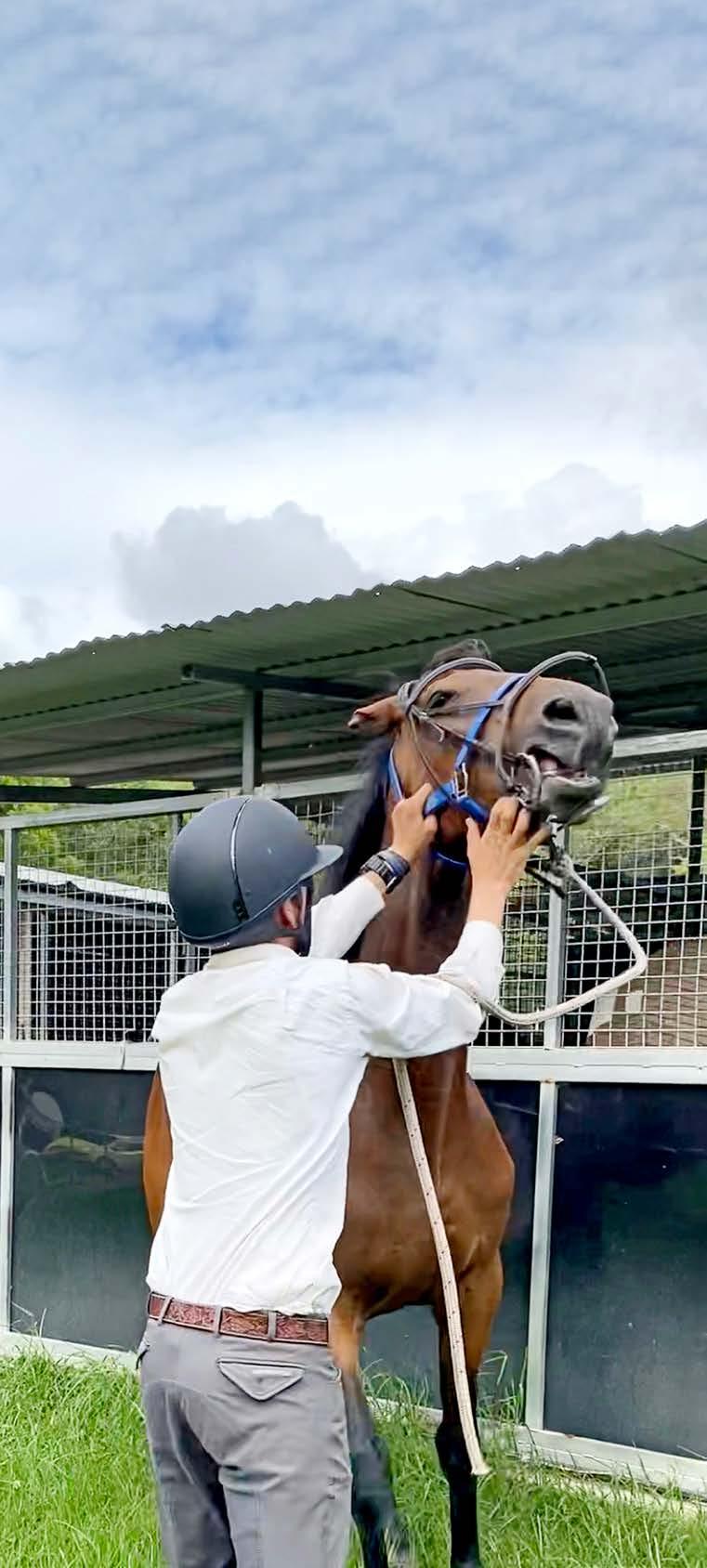
Two common problems are either the horse putting their head up in the air or not opening their mouth easily for the bit. Let’s focus on these two issues. This can occur with young horses, but also older horses who have been competing successfully for years. Some people don’t see it as a problem or don’t address it, but it’s probably one of the easier things to work on with your horse, requiring only patience and good timing. Sounds easy, right!
Sometimes bridling your horse doesn’t go quite as planned.
Start with your horse (or pony) in an area where they feel comfortable. That could be the stable or a paddock. If the horse is anxious and fidgety it’s probably not worth dealing with the bridling issue until you’ve looked at what’s causing them to fidget.
Relaxing the poll
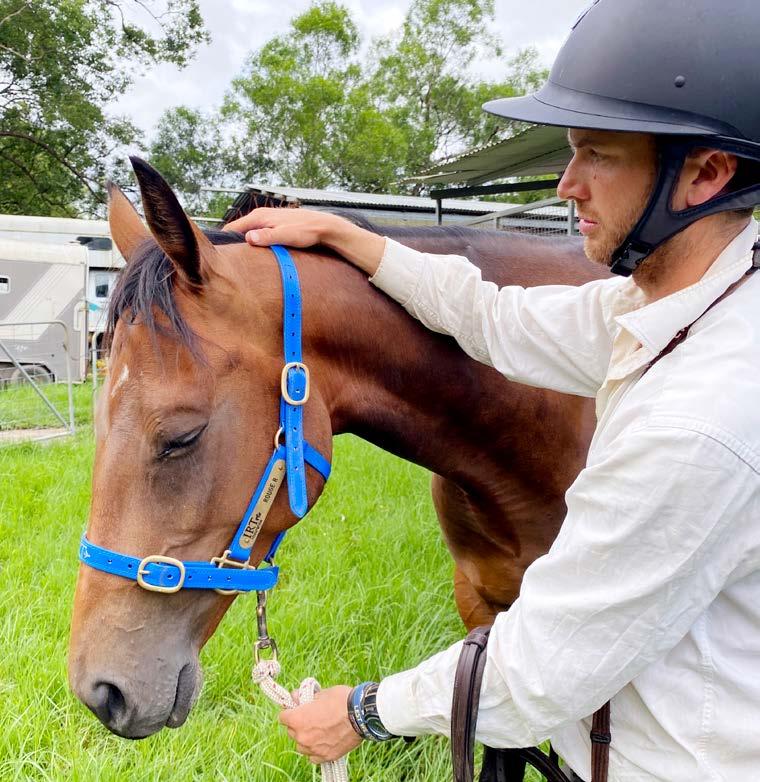
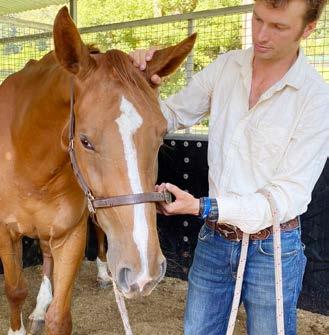
While your horse is wearing their halter, stand on their near side with the lead rope in your left hand. Run your right
hand up their neck along the mane. If your horse is quite sensitive you might not even get close to the ears before they’re already putting their head up. This is a sign that they aren’t a fan of what you’re doing, so don’t go any further with your hand until they relax a little.
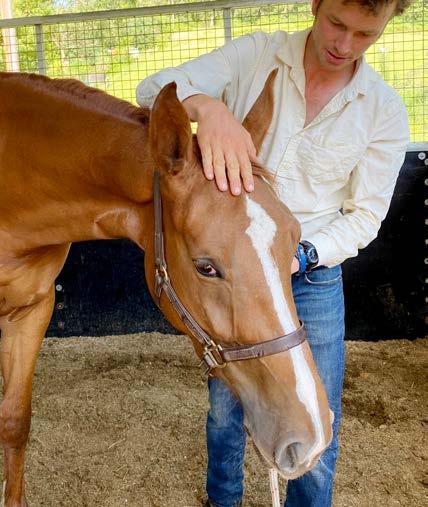
When you can successfully rest the palm of your right hand on their poll, apply a small amount of downward pressure on the lead rope with your left hand. Let your right hand just rest there, not pushing down. Sometimes if you push they will resist against the pressure. Be softer in the beginning and with patience they will come around with less resistance.
After the horse lowers the poll from the gentle downward pressure, release the pressure on the lead rope and give them a whither scratch to reward the good behaviour. When your horse lowers their head smoothly and doesn’t raise it as soon as the pressure is removed, you know you’re making progress. Then you can try gently rubbing their ears. When the bridle comes over their face they need to be comfortable with the ears being moved around so make sure you practice it. If it causes them discomfort and there’s an adverse reaction take a step back to what they were comfortable with before you started touching their ears and work your way towards them again after they’ve relaxed.
This next step is really important. Getting your horse comfortable with you rubbing all over their forehead, ears and poll will make a big difference! The emphasis here is on being ‘comfortable’ - some horses are tolerant but not that relaxed about it!
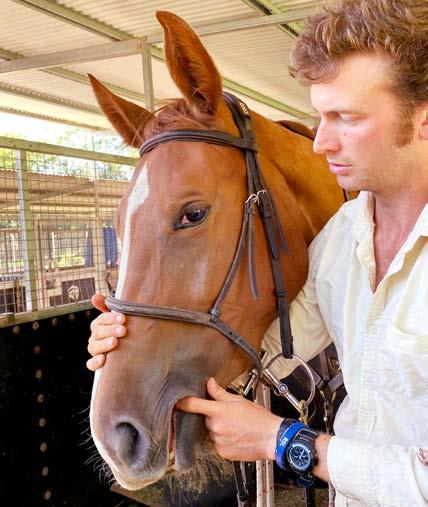
Once you have the horse to where they lower their head and are comfortable with the ears being rubbed, check to see if they will accept the bit. Do this by gently pushing your thumb or index finger between their lips on the side of the mouth where there are no
teeth to bite you. If they keep their mouth clenched, gently rub the inside of the gum until they lick and chew. As soon as they do that take your hand away and give them a whither scratch. Repeat this until they open their mouth easily when you place your finger between their lips. It’s also important that they don’t raise their head when you do this, which would be another sign that you need to do more work before putting the bridle on.
Putting the bridle on
Do you lift the noseband up? Do you leave the noseband down? Maybe you don’t even ride with a noseband. For me, it never gets in the way. If you loosen the bridle's cheek straps, that’s one of the best ways to ensure that it goes on smoothly.
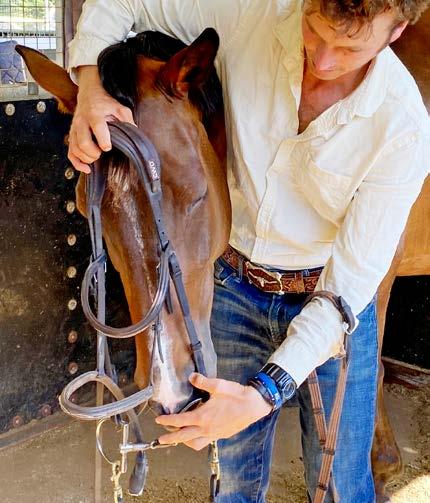
Ask your horse for a slight lowering of the poll. For the green horse, take the bridle over the ears but have the bit under the chin. This gives you a chance to check they are still comfortable with their mouth. Take the bridle off then go again. Holding the top of the bridle in your right hand you can hold the bit in your left and use your thumb to encourage your horse to open their mouth.
When you put the bit into your horse’s mouth, be gentle. Banging a metal bit on the horse’s teeth is a good way to annoy them.
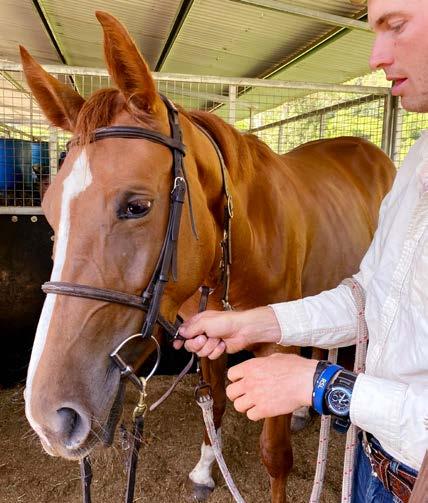
ABOVE: With the lead rope in your left hand, run your right hand up their neck along the mane.
BELOW: Get your horse comfortable with having their forehead, ears and poll rubbed.
RIGHT: Holding the top of the bridle in your right hand, hold the bit in your left hand and use your thumb to encourage them to open their mouth.
FAR RIGHT:
Gently adjust the fit of the bridle once it’s comfortably in place.
If they lift their head after the bridle is on, calmly ask for them to lower their head again. If you have plenty of time on your hands, repeat the entire process until you get a little bit of improvement.
Taking the bridle off
This is just as important. Gently removing the bridle will make sure the horse finishes on a good note for the day. Ask for a little head lowering before sliding it off over their ears. Use both hands so you can prevent the bit from banging their teeth on the way out.
I’ve mentioned lowering the poll quite a
FAR LEFT: When you can successfully rest the palm of your right hand on their poll, apply a small amount of downward pressure on the lead rope with your left hand.
LEFT: Gently push your thumb or index finger between their lips while the bit rests under their chin.
few times. As well as making it easier to bridle, it also helps to lower the horse’s heart rate and encourage general relaxation. Having your horse really well trained to respond in this way can also help when it comes to other things, such as when you worm them.
If your horse moves their head around a lot, try leaving the halter on while you bridle them. This will allow you to keep slightly better control, and it’s easy to undo the halter once the bridle is on.
Imagine if you were running late for your competition and you hadn’t trained
your horse to be comfortable and keep their head down for bridling. A situation like that can easily raise stress levels and cause you to get frustrated with the horse. Or, if you’re going to sell your horse to someone who’s vertically challenged, you can be pretty sure they won’t want to buy a horse they can’t get the bridle on. All the more reason to get your horse more soft and accepting of this at home.
Just remember though, Rome wasn’t built in a day.
The Right Rein
Jamie with Charlotte, his beautiful Aussie Warmblood mare.
FACING PAGE: Jamie and French Kiss competing at the 2017 Swedish International.
Adventures of an Aussie vaulter
So far, it’s been a life less ordinary for JAMIE HOCKING, one of our two 2020 Delivering Dreams Scholarship recipients. We asked Jamie to share some of his memories, and lessons he’s learned along the way.
Growing up in Woolsheds in rural South Australia was idyllic in many ways. We had a pony, horses, sheep, cattle, cats, dogs and a free-flying tame magpie. And, of course there was vaulting
There are several great things about vaulting, over other sports. The first is that even at a local level, you will meet a whole bunch of vaulters of various ages, because it’s teams based. With barrel and ground work and short performance times on the horse, the horses are often shared, even sometimes at the international level. That made it a perfect sport for me, because although I was a bit shy, I loved mixing horses and making new friends.
When I was still very young, one of my biggest thrills was going to the National Equestrian Centre in Canberra for a week of training with Aussie and international coaches, most of whom I would eventually visit for training and competition overseas. At the end of a jam-packed week every kid was exhausted and ready to go homebut not me. I abandoned my manly pretences and howled my eyes out because it was time to go. I vowed then to return the next year, which was a vow I kept for fourteen years straight, even
after growing up and transitioning into coaching roles.
One of the team
Some of my greatest horse adventures happened while travelling as part of a team. When I was 11, Tristyn Lowe, a world class competitor in her own right and later my national coach, formed an Australian composite team from
vaulters all around Australia. I wasn’t a great vaulter but my other passion, gymnastics, helped me score a place as a team flyer. It was a tentative start for an inexperienced vaulter, not helped by a curious possum sliding down the arena wall and scaring our horse. Needless to say my team and I got tipped into the dirt – quite a distance to the ground for me given that at the time I was ‘flying’ on top of two other vaulters and three meters off the ground!
With help from the older vaulters, I improved quickly. At age 12 I went on my first overseas Australia/Germany vaulting exchange - without my parents. I was the youngest and a real daydreamer. Fortunately for me, the others in my team were older and a lot more responsible. They kept me grounded, both on and off the horse and taught me heaps about sportsmanship, good habits, values and how to look after horses.
The stars in Kentucky
In 2010, when I was 13, the team qualified for the World Equestrian Games
To find out more, or to lodge your application visit www.horsevibes.com.au/horesvibes-delivering-dreams-sholarship
Photo: Nadeen Davis Photography & Digital Art
(WEG) in Kentucky, an Australian first. I cheerfully skipped out of school again for 6 weeks, supposedly with a bundle of homework to do ‘on the road’ but I don’t recall ever doing any. I celebrated my 14th birthday a week or two before the WEG opening ceremonies, and my team mates watched anxiously in case I had a sudden growth spurt and become too heavy to lift. As luck had it, I stayed shrimpy!
When the Games finally kicked off and we moved into the athletes village in Kentucky, I met for the first time many Australian superstars from other disciplines, including Stuart Tinney, Brett Parbury, Lyndall Oatley, para-dressage riders Grace Bowman and Sharon Jarvis, plus Warwick Schiller and champion of champions, the driving superstar Boyd Exell.
It was confidence-building to be in the spotlight alongside your team members, and a thrill to place 10th. Our team disbanded on a high, and I went home to cope with a growth spurt, a heap of homework, and farm chores to catch up on. I spent even more time daydreaming about performing in the big stadiums, so I guess by then I’d decided that one day I’d be a world class individual vaulter.
From then on, the desire to find adventure was locked in and vaulting was the perfect sport for it. I struck a deal with my parents about homework and saving for my own airfares, and so began a period where I would plan a six week training and competition trip every year, sometimes with other vaulting friends and sometimes on my own. I was fortunate that my parents believed that childhood adventures and life experience were just as important as school, because I sure missed a heck of a lot of school time.
Globetrotting
In high level vaulting, there is so much emphasis on the human athlete, that local competitors are often willing
Jamie and driving legend Boyd Exell meet again, this time at WEG 2018.
I suddenly realised I just couldn’t go to WEG without her. With support from the Danes, kind friends, family and strangers too, I made it, although it took me another year to pay back my debts.
to share their horses with overseas athletes. Before my mare, French Kiss and I became partners, I had competed on around 25 different European, American and Australian international level horses, which meant I lived and trained with new people for five or six weeks every year. My vaulting improved out of sight, as did my list of friends and contacts.
In 2012, aged 15, I competed in the European Junior Championships in Slovakia, where I surprised myself by finishing 12th on a borrowed horse. After the Juniors came six years of travel, chasing competition opportunities in Europe and the USA. Earning the airfare at home on the farm was the easy part. Finding horses to borrow overseas
before leaving home was stressful, especially as there was never any chance to try the horses beforehand.
Slow and steady
I was thrilled to get a WEG 2014 qualifier, but I didn’t nominate because I was still a junior. My parents reminded me to keep it slow and steady before putting up my hand, and that was good advice.
Now my competition records show that I’ve vaulted in 36 international competitions in 14 different countries, including the USA, Slovakia, Czech Republic, Hungary, Austria, Germany, France, Switzerland, Belgium, the Netherlands, Sweden and Denmark, where I now live and train since leaving high school.
WEG 2018
The thrill of being selected for WEG in 2018 was all the sweeter for having decided to take French Kiss to the USA to compete with me, rather than borrow a horse again. I’ve grown tall and French doesn’t look big when we compete together, but in fact she’s 17.3 and a very big girl, so she needed a double stall on the cargo airplane. Gulp! I was desperately short of money and saving every cent I could.
It seemed impossibly expensive but important to do, given all the hours French and I were training and living together [Jamie lives in a barn with French to help make ends meet], and I suddenly realised I just couldn’t go to WEG without her. With support from the Danes, kind friends, family and strangers too, I made it, although it took me another year to pay back my debts.
Being thankful
I’m 24 now and just starting to realise how fortunate I’ve been to have such contrast in my upbringing. All my memories of the last 15 years are sharp and clear and important to hang onto. It helps that I’ve never been a drinker although I love a good aftercompetition party. I’m the guy on a
ABOVE: Coaching Dixie at the National Equitation Centre in Canberra.
LEFT: Meeting fellow competitors and forging longlasting friendships are features of the sport that Jamie loves.
“From our Diamantina babies, all the way through the young horse classes, the FEI classes, Grand Prix, and even into old age, Barastoc comes with us on our journey.
Maree Tomkinson
,,
PE R FO R MAN CE F E E D DS
COMMAND
Barastoc Command is a high energy, high performance oat-free muesli.
Developed with lower starch, higher fat, cooked grains and beet-pulp for cooler energy and ease of digestibility.
Formulated with Gastrolize™ for hindgut support and relief from gastric ulcers, Diamond V® XPC to reduce lactic acid accumulation and bio-available V itamin E to support your horse’s immunity and assist in recovery.
SOCIAL SCENE
For more information on our products, call: 1300 666 657 • visit: barastochorse.com.au • email: enquiries@ridley.com.au
permanent budget, partying all night on low-fat milk before finishing my night as designated driver. It’s surreal, a guy from Woolsheds, South Australia, driving through dark streets in Le Mans, France on the ‘wrong’ side of the road in a manual-drive Citroen loaded full of world famous athletes. Wow! Makes me glad to have grown up driving tractors and manual utes!
I’ve had many adventures, made many new international friends and had the support of many helping hands, but I’ve also had a few moments of fear, and some real disappointments where I’ve stuffed up or someone else has maybe let me down.
I’ve found out for myself that there are options to solve any problem, even when things seem a bit bleak. With a little time and a calm mind and things always work out, even if it puts a few character-building scratches on your psyche.
It’s important to pause and realise that it’s all making you more wise and experienced. My sport has taught me that some days I’ll be the one who loses, but those are still great days because of adventures, friendships and time with the coolest of people and horses.
With a little time and a calm mind, things always work out, even if it puts a few character-building scratches on your psyche.
I really believe all young Aussie’s should experience challenges, not just through video games or social media, but in the real world of different people, different countries and different cultures. Getting out there builds resilience and pride in who you are, regardless of how you look, your clothes, or money.
Keep up with Jamie’s adventures at www.jamiehocking.com.au, and on Instagram @James.Hocking96/
Competing with French Kiss at the 2017 World Cup in Paris (Image by PSV Photo).
Want to be a world class vaulter? Then be prepared for plenty of practice.
The Majestic Clydesdale
Named after their place of origin in Scotland, Clydesdales are known for their gentle natures and big hearts. Liz Lewis has fallen under their sizeable spell and spoke to AMANDA MAC about her love of all things Clydesdale.
Liz Lewis’s fascination with horses goes back as far as she can remember, and her passion didn’t wane as she grew up. When she was 15-years-old, her parents presented her with her first horse, and eventing became Liz’s discipline of choice. She trained and competed in the sport up until around five years ago, when, I guess it’s fair to say, another love kicked in.
Liz’s husband Erin has an extensive background in harness: from running a horse and carriage business in Sydney’s historic Rocks area, through to movie work and horse stunts. “I started off holding the reins for Erin and helping out in general when he worked his horses in harness,” Liz tells me, “but the passion really ignited when we went on a road trip in February 2015 to look at some Clydesdales that were up for sale. That’s when he bought Sunny for me, and Sunny has turned out to be my heart horse.”
You may be surprised to learn that in a global context, the Clydesdale breed is considered vulnerable. As it happens, Australia is one of the world’s most prolific producers of Clydesdales, with studs here breeding around 300 registered foals in 2020 alone. While the Clydesdale is popular under saddle, they are absolutely majestic in harness - and interestingly, there are a significant number of female drivers
who have taken up the reins. Liz has a theory about that: “I think women like the temperament and trainability of these enormous horses. They really are an absolute pleasure to work with, and to be around.”
And she should know. Liz and Erin own Elemer Clydesdales, a boutique stud in Bargo on the outskirts of the NSW’s Southern Highlands. “We stand one stallion at stud, Jeanal Summer Solstice (Sunny), and have four broodmares, two purebred, and two part-bred,” she says. “We produce up to four foals a year, so we’re not inundated with progeny and therefore have the time to train, show, and break them in before they’re ready for sale. It gives us peace of mind to know that our horses have had the best possible start in life before they go to their new homes.”
And the couple’s training philosophy is commendable: “There’s good handling of horses, and then there can be bad,” Liz comments. “Training begins at birth. Every time we’re around the foals they’re always learning a lesson. From the basics - teaching them to lead, tie up, and hobble - through to breaking them in. All these lessons eventually come together over a number of years to create a confident, happy, respectful, safe and educated horse.”
But back to harness, and this is a learning curve all on its own. Liz tells me that there are three harness categories:
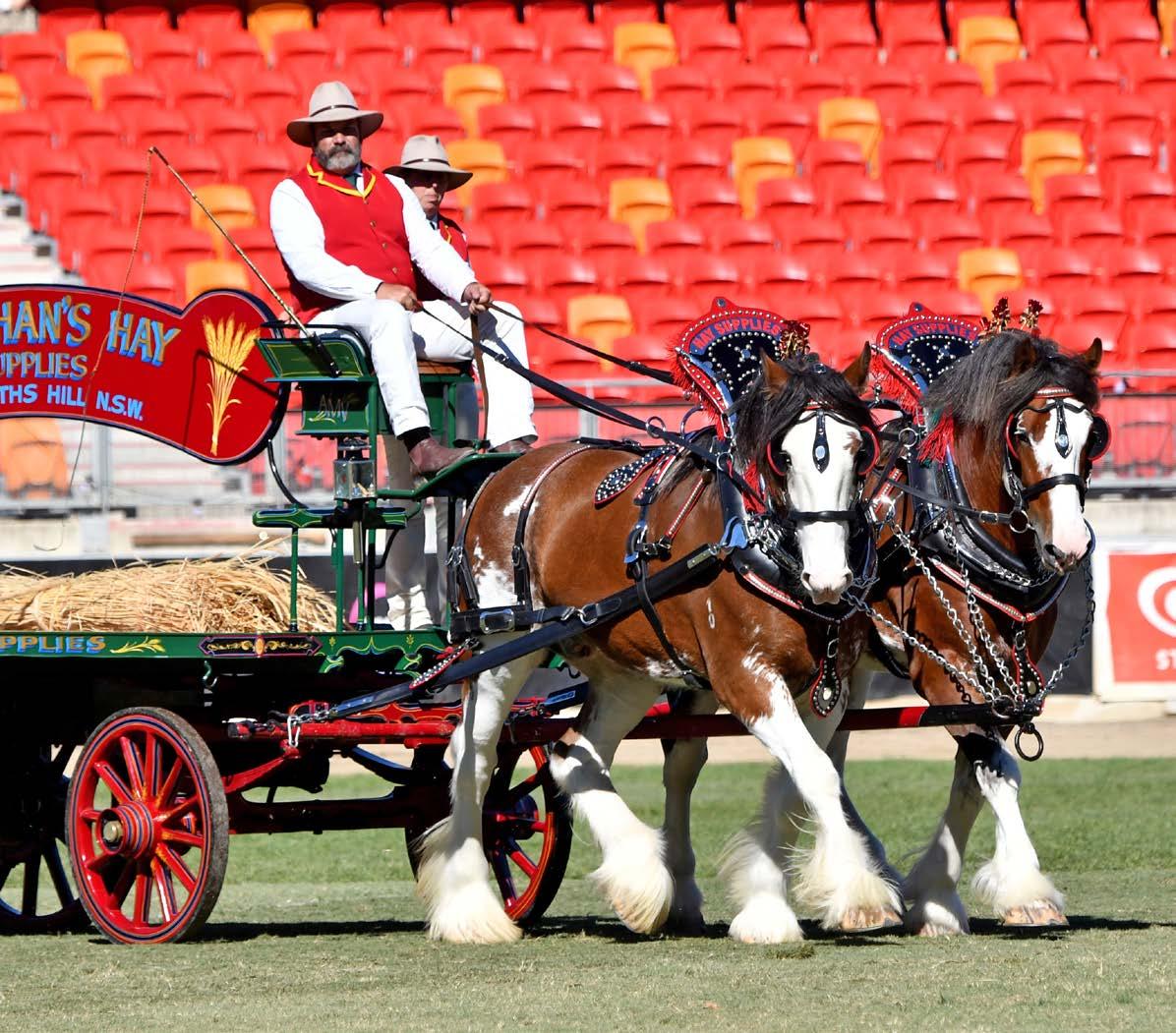
trade, agricultural and non-traditional. Trade, as the name suggests, includes turnout classes for the uniquely Australian harness and vehicles traditionally used prior to the 1960s by the likes of milkmen, bakers, breweries, and produce merchants.
Show judges score on a points system: 50 for the horse - its type, conformation, and suitability for the trade it’s being shown in - and for workout, including movement, action, obedience, and ability to perform certain manoeuvres such as fanning (turning the vehicle on itself), and reversing, necessary for backing a vehicle into a loading bay.
A further 30 points are allocated for the vehicle itself: “Judges assess its
authenticity, the paint and line work, and whether it’s set up with a correct load, and with the appropriate tools or equipment,” Liz explains. “Then a further 10 points are awarded for clean, safe harness, whether it fits properly, and whether the horse is correctly harnessed. Decorations should be in colours appropriate for the business or trade, and these days are often matched to the vehicle’s signage. The bottom line is that every single element must suit the trade being depicted.”
The last 10 points are for general appearance, including how the driver and passengers are dressed, how the horses are presented, and the overall look of the turnout.
Agricultural classes are for exhibiting
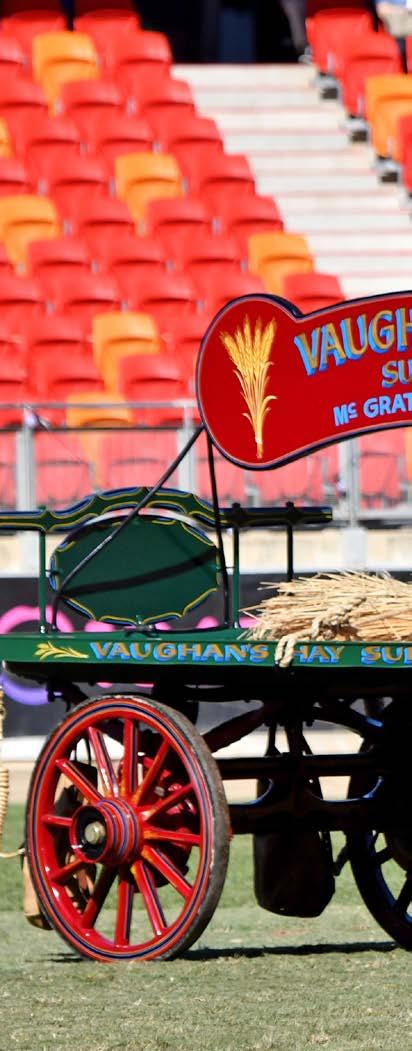
TOP: Erin driving Sunny and Rhuben, winners of the 2019 Champion Multiple Horse Business Turnout and 2018 Reserve Champion Multiple Horse Business Turnout (Image by Julie Wilson).
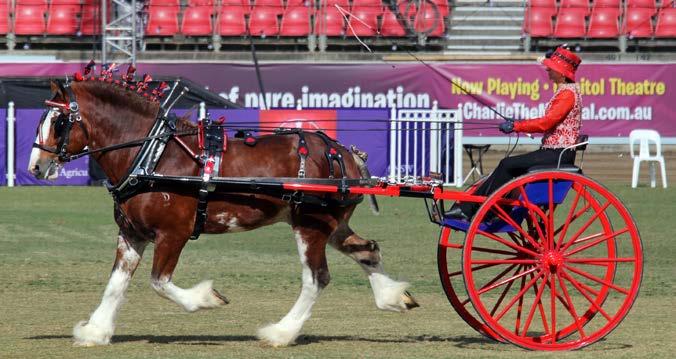
ABOVE: Liz and heart horse Sunny – complete with snappy red standards – competing in a non-traditional harness class at the Sydney Royal (Image by Jacinta Vanessa Photography).
farm implements and equipment traditionally used for growing and harvesting crops, road grading and building dams.
Lastly, the non-traditional harness classes primarily give owners the chance to show off their horse, its movement and action. “This usually involves a lightweight vehicle, which is easier for the horse to pull, giving the driver more opportunity to show their horse to the best possible advantage,” Liz says, “and these days, competitors are using harness made of materials such as BioThane, which is very lightweight compared to leather, and that helps with the horse’s ability to step and move.”
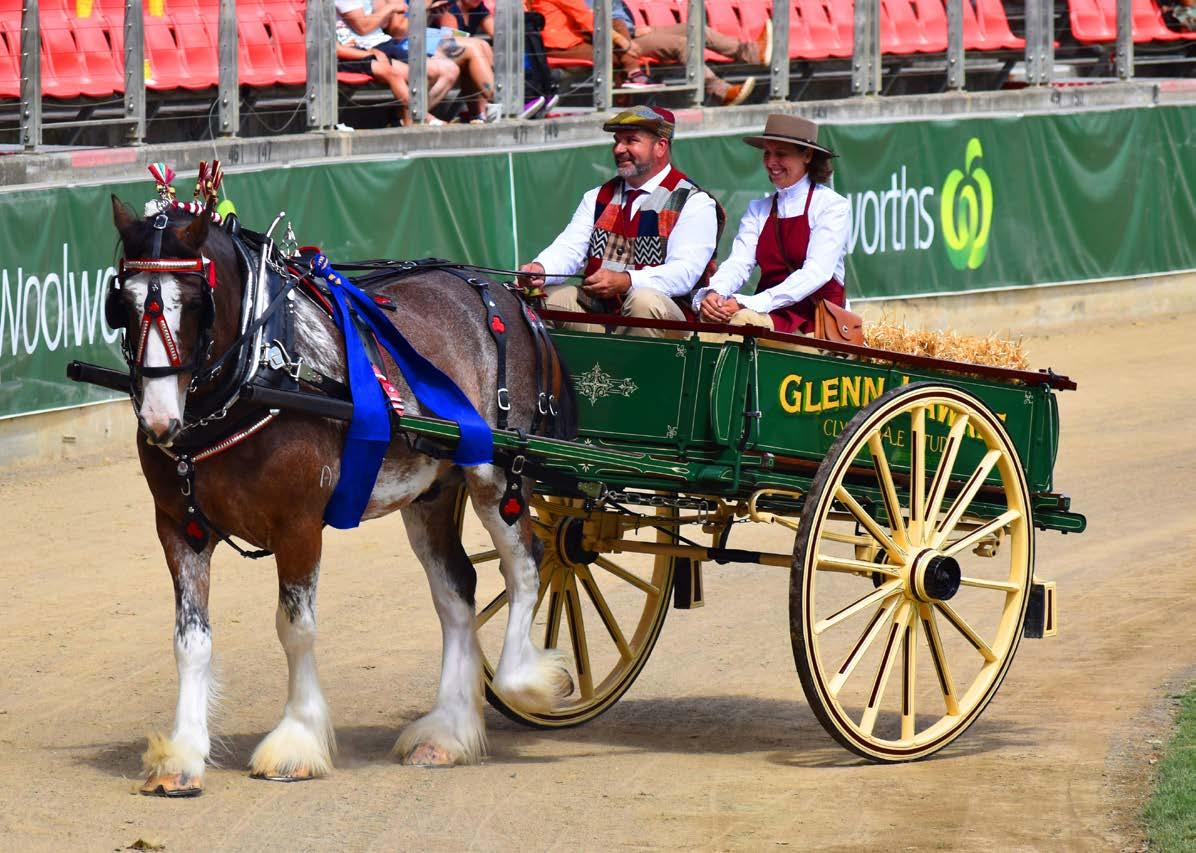
Preparing a Clydesdale for a show is, as you may have suspected, a bit of an art form. “Traditionally Clydesdales are shown with a mane roll, which is wool braided through their mane, and ‘standards’, a decoration that stands upright and enhances the neck,” Liz tells me. “The colours used for both the mane
The colours used for both the mane and tail decorations were once blue and white, the colours of the Scottish flag, but exhibitors can now choose whichever colours they like
and tail decorations were once blue and white, the colours of the Scottish flag, but exhibitors can now choose whichever colours they like.”
In the old days tails were docked, a practice that’s thankfully long gone.
However, during the show season, Clydesdale’s docks are often shaved, with the remaining hair braided upwards into a bun. That’s done so the judges can view the horse’s hocks and action clearly, and check for unsoundness. It’s also for the horse’s safety. Long tails can easily become caught in equipment, causing injury and a great deal of unnecessary pain.
However, Liz has become aware of some misunderstanding surrounding this practice: “People think the short tails are cruel, but I can assure you that exhibitors love their horses and use rugs and repellents to protect their equine friends from insects and flies. And for their added comfort, horses are often stabled during show season. When the season is over, their tails are left to grow long again.”
A Clydesdale’s feathers are one of their most recognisable features – and months of preparation go into ensuring that before entering the show ring,
Liz driving stud mare McMurchie Kendall in a long shaft breaking-in gig (Image by Jacinta Vanessa Photography).
Photo GRC Photography
they’re as clean, white, soft and silky as they possibly can be.
Also requiring considerable care is the harness, which is polished and cleaned regularly to prevent chrome fittings from tarnishing – maximum sparkle in the ring is the goal. Vehicles need their fair share of TLC too: wheels are maintained so they roll smoothly, and the cart is cleaned regularly to help prevent paint peeling, and housed to avoid heat or water damage.
I ask Liz whether there any special considerations regarding the driver’s clothing: “Most definitely! We have an entire wardrobe of various outfits and uniforms to suit the various classes. For a non-traditional harness class, I like to dress in something feminine and sparkly, with a pretty, broad brimmed hat. For a traditional trade harness class we’ll either wear a uniform, or a felt Akubra hat, moleskin pants and leather boots, whatever best suits the
We also have hand-sewn woollen patchwork vests and peaked caps with leather covered buttons ... outfits appropriate to the task and era.
business or trade we’re portraying. We also have hand-sewn woollen patchwork vests and peaked caps with leather covered buttons. They’re for some of the traditional classes where the driver would be delivering goods to market, so we wear outfits appropriate to the task and era.”
And if you thought that level of detail was pretty amazing, there’s more! “Most
trade harness carriages are fitted with lamps, so does the lamp look as if it’s in use? Is there an original candle inside? Has the wick been burnt and the wax melted? Do you have wax matches of a type that suit the period? Extra points are awarded for details like these,” Liz explains.
There are other judge-pleasing details too, such as milk in the milk cart vats, and bread aboard the bread cart. And you should consider a docket book and pencil, because pre-smart phone, that’s how delivery drivers recorded their orders. One final delightful touch? The driver must carry a traditional leather moneybag, preferably complete with coins and notes of the era.
I don’t know about you, but to me, this all sounds like a lot of fun. It’s also reminiscent of a by-gone time, when the flow of life was not quite so frantic –and that’s something that really is very appealing.
Erin and Liz with Aarunga Dillon in a spring cart. Erin sports a woollen patchwork vest and peak cap, while Liz wears a leather money bag in which she carries a docket book and era-specific currency (Image by Emma Lewis).
Enteroliths are at their most dangerous when they become large enough to block the colon, or have sharp edges that could potentially cut the bowel and cause peritonitis.
The problem with enteroliths
Enteroliths are mineral masses that can form in a horse’s colon. Veterinarian DOUG ENGLISH explains the how, the why, and what you need to know.
Enteroliths, also known as fecaliths or phytobezoars, are stones composed of magnesium ammonium phosphate hexahydrate, or struvite. They mostly form in the right dorsal colon in horses and can subsequently cause partial or complete blockage of the right dorsal, transverse, or descending colon.
Many cases of enteroliths were reported in the 19th century, but the number greatly decreased in the early 20th century. However, in recent years cases in certain parts of the United States, California for example, have greatly increased.
Although several reasons for enterolith formation have been suggested,
VET VIBES
why, exactly, these stones form in the intestinal tract remains unclear.
The occurrence of enteroliths varies quite a lot all over the world. They are rare in many areas and endemic in others. I think one of the main issues comes down to water quality and the volume consumed. Water with a high mineral content, and excessive addition of minerals to the diet are factors. The intake of nitrogen, magnesium and phosphorus (the primary components of enteroliths) from water and food is a likely contributor to their formation. Sodium chloride (common salt) is not implicated.
Clean pure water in clean troughs is essential for many good reasons, and one at the top of the list is that if your horse likes the water, they’ll drink more, and that’s good. I cringe when I see some of the stagnant pools that horses have to drink from. No good aye!
The problem with small dams is that horses can walk into them and foul them – and I’m very much not in favour of any animal being able to walk into a dam that they must drink from. It’s best to fence the dam off and pump the water to a clean trough. But that creates the need for daily checks to make sure the trough is full. There is a trade-off between optimum health and convenience.
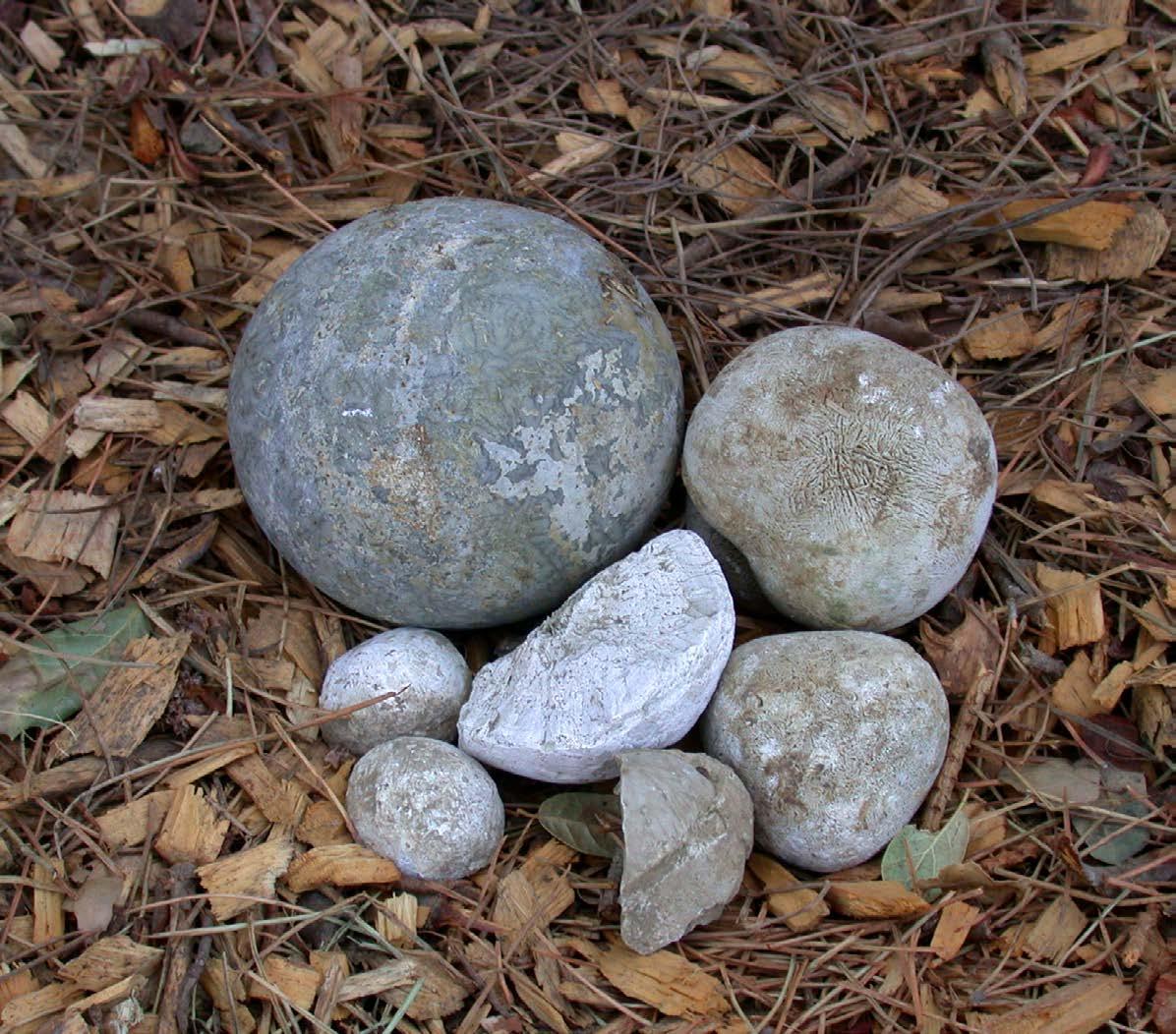
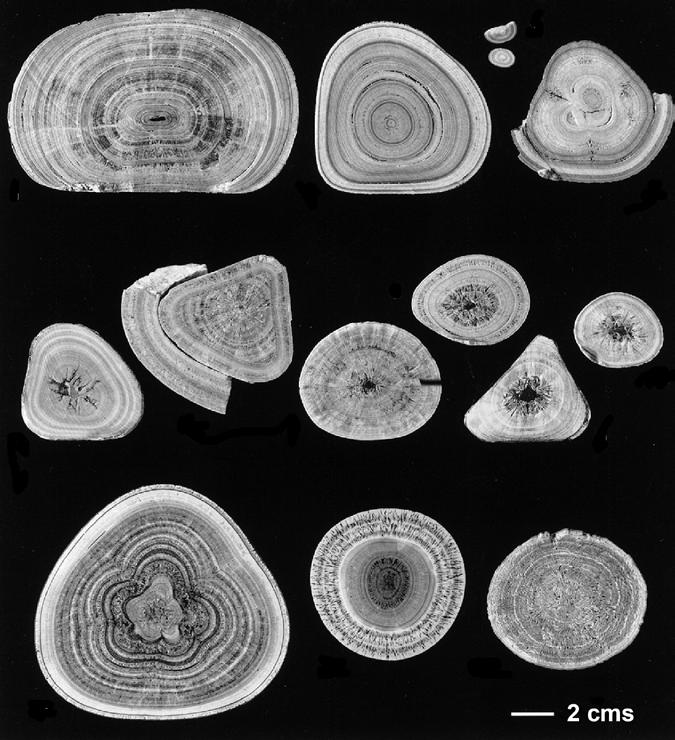
Most enteroliths are formed by minerals being deposited in concentric layers around a central spherical or pyramid shaped piece of ingested material, often a small bit of baling twine or a stone, known as a nidus. In fact a nidus has been found in every enterolith that has been examined. The enteroliths themselves were found to consist primarily of ammonium magnesium phosphate. Most, if not all, involve a single slow growing enterolith which can exist for years without causing any problems because the diameter of the intestine where it sits is large enough to allow contents to pass. Occasionally a smooth egg sized one is found passed in manure.
Limited studies evaluating dietary and environmental management practices have identified an association between enterolithiasis and certain breeds (Arabian or miniature breeds had an increased risk), the feeding of lucerne hay, and spending less than 50 per cent of time outdoors. However, many other factors including water supply, exposure to nidi such as bits of plastic baling twine, and the feeding of bran, grain, and other supplements have been suspected of playing a role in enterolith formation. However, these factors have not yet been properly evaluated.
In a larger retrospective study of
horses with enterolithiasis, 29 per cent of horses received bran and 52 per cent were fed grain regularly, but the significance of these values is unknown without studying a comparative population. Brans are rich in phosphorus and magnesium, and grains are rich in phosphorus, but they contribute to a more acidic environment in the colon, which is less conducive to enterolith formation. Excessive levels of dietary magnesium, nitrogen, and phosphorus, combined with alkaline conditions within the ascending colon are believed to contribute to the formation of enteroliths.
So, one conclusion is that dietary
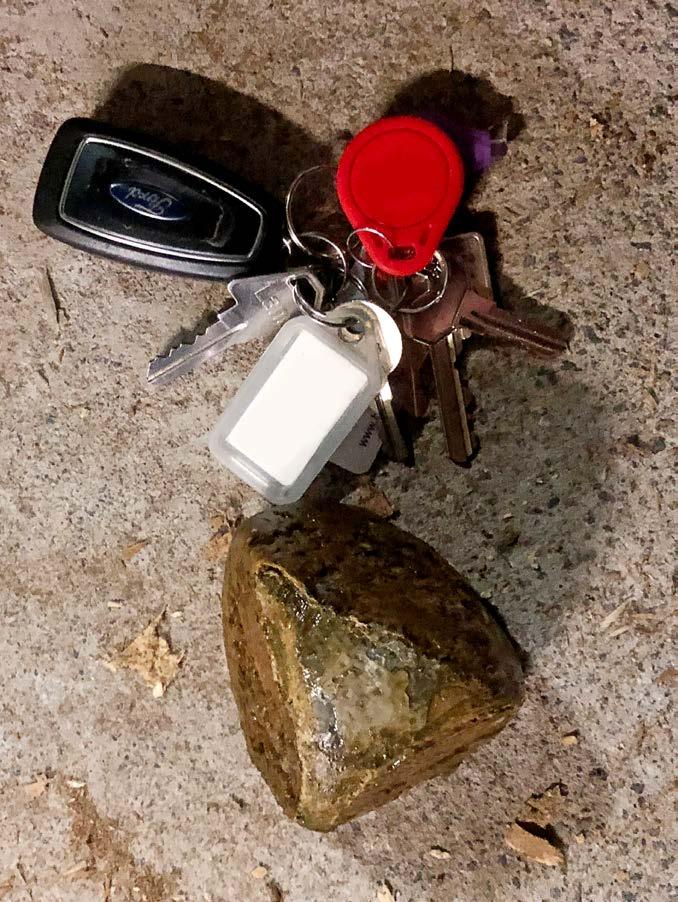
A bunch of keys next to a pyramid shaped enterolith gives a sense of its size.
manipulation to maximise carbohydrate (grass, cereal or grass hays) fermentation and minimise protein fermentation in the large intestine may help prevent enterolithiasis.
The following factors were found to be significantly associated with enterolithiasis: feeding more than 50 per cent of the diet as lucerne; feeding less than 50 per cent of the diet as oat hay; feeding less than 50 per cent of the diet as grass hay; and lack of daily access to pasture grazing, resulting in a lack of fibre from grasses.
Furthermore, researchers surveyed 900 horses with enteroliths that were admitted to the University of California in the US, and found:
• 15.1% of the patients were admitted for the treatment of colic.
• 27.5% of patients required surgery for correction of colic.
• Arabian and Arabian crosses, Morgans, American Saddlebreds, and donkeys were significantly overrepresented, and Thoroughbreds, Standardbreds, Warmbloods, and stallions were significantly underrepresented.
• The horses’ average age was 11.4 years.
• The most common historic findings were signs of intermittent colic (33.3%) and passage of enteroliths in the faeces (13.5%).
• 15% developed a gastrointestinal tract rupture caused by an enterolith, which necessitated euthanasia.
• Short-term and one-year survival rates for horses undergoing surgery for the treatment of enterolithiasis and recovering from anaesthesia were excellent (96.2 and 92.5% respectively), and postoperative complications were uncommon.
• Recurrence of enterolithiasis was identified in 7.7% of the study population.
Most cases are asymptomatic and affected horses can carry an enterolith
for years without problems, but when issues do occur the prominent clinical features are recurrent mild abdominal pain, lack of appetite, gaseous distension, and minimal intestinal motility due to the partial or complete blockage caused by the enterolith.
Although symptoms are generally less severe than with other forms of colic, if there is a complete blockage then the signs are severe and the only solution is surgical removal, except in cases where an experienced veterinarian can feel, manipulate, and remove the mass through the rectum by hand.
Twice in the past I have seen cases where an enterolith has formed in separate pieces that had moulded into a roundish shape before some force separated them causing sharp edges to become exposed, cutting the bowel and
causing peritonitis and certain death.
Interestingly, a dead male bottlenose dolphin was found with an enterolith that completely obstructed their intestinal lumen (the opening inside the bowels). Further examination of the enterolith revealed a stingray spine nidus. Most enteroliths occurring in land animals are composed primarily of struvite (magnesium ammonium phosphate). However, the enterolith discovered in the stranded dolphin was mainly composed of calcium phosphate carbonate.
Diagnosing enterolithiasis is often very difficult and is frequently arrived at either by conjecture, rectal palpation or ultrasound, or by x-ray if a very high quality equine x-ray machine (usually only located at a university or other large institution) is available.
VET VIBES
Polished slices of equine enteroliths showing concentric layers of mineral deposited around a central spherical or pyramid shaped nidus.
Coaching and collaboration
A Chef d’Equipe is traditionally the team manager and sometimes also a team coach. Prue Barrett has worked in both capacities and spoke to CHRISTINE ARMISHAW about life as an Olympic Chef d’Equipe.
Employed by Equestrian Australia in a full-time role from the beginning of 2011 to the end of 2016, Prue Barrett managed and coached the riders of the Australian eventing program all the way through to the 2016 Rio de Janeiro Olympic Games, where the team won bronze. She managed both the domestic and overseas based athletes, with two other coaches on board as dressage and show jumping trainers.
I asked Prue for a glimpse into her life as an Olympic Chef d’Equipe, a role that included organising training camps, and coaching: “I chose the dressage and jumping trainers and then I worked with the team on their cross country. The Chef d’Equipe role entails managing the other trainers, as well as being the overarching person who organises the whole training schedule,” she tells me.
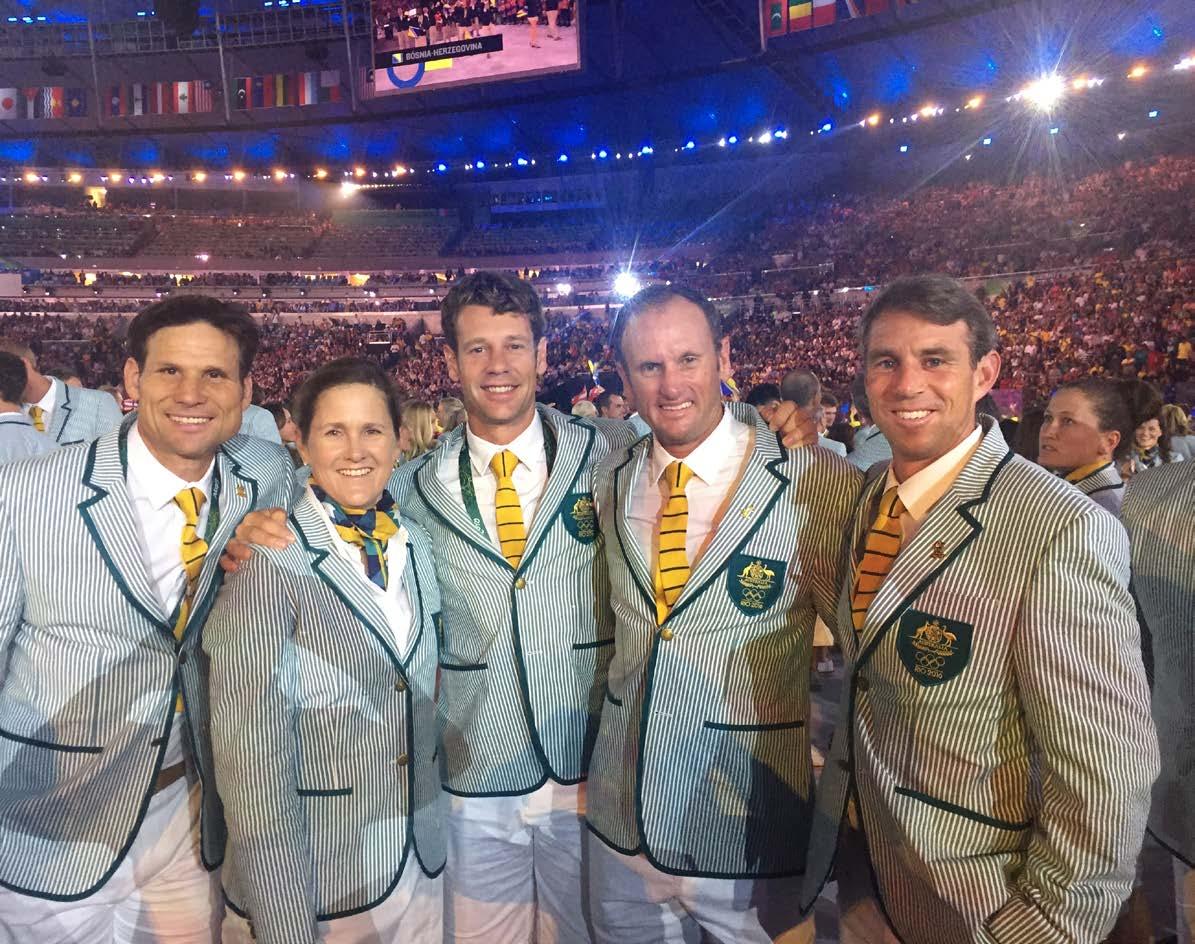
The Rio Opening Ceremony (LtoR) Shane Rose, Prue Barrett, Chris Burton, Stuart Tinney and Sam Griffiths (Image courtesy Prue Barrett).
In Prue’s opinion, it’s a people management job. “To be a good Chef you have to be really good at herding cats,” she laughs, “but you also have to understand what everybody’s roles are, you need to be a people person and understand the pressures on each individual on the team.”
The Chef’s job starts long before the Games even appear in the distance. As we all know, anything can happen with horses, so the pool of people and ponies preparing is initially large, before the numbers are gradually whittled down to the final team. “It’s more involved than people realise. Even though you might only have four or five athletes at the actual Games, you would tend to have seven to eight leading into camp, and you would have managed around fifteen combinations prior to that,” Prue explains.
To be an effective Chef takes a whole lot of skill, and the more useful experience up one’s sleeve, the better. And that’s what Prue has in spades: “I was fortunate that I had been an athlete at a major championship, I had coached at a major championship, I’d managed the program, and I understood the management structure of the program. That entire skillset came together in what ended up as me being in the Chef d’Equipe role for the Rio Olympics,” Prue tells me.
The Chef might also sit on the team selection panel. Prue started off as a selector, then for the next period wasn’t a selector, then was again. She says she prefers to be involved in the selection of the team she’ll be charged with managing at the Olympic Games, and for good reason: “Being so involved, you’re probably the person who knows everything about everyone,” she says.
Training for the ultimate event
The Chef d’Equipe is responsible for each combination’s training from the early days in the cycle, right up until the Games. So just how detailed does
ABOVE: Squad training trip to Portugal (LtoR) Emma McNab, Kevin McNab, Sam Griffiths, Chris Burton and Prue Barrett (Image by Guillaume Béguin).
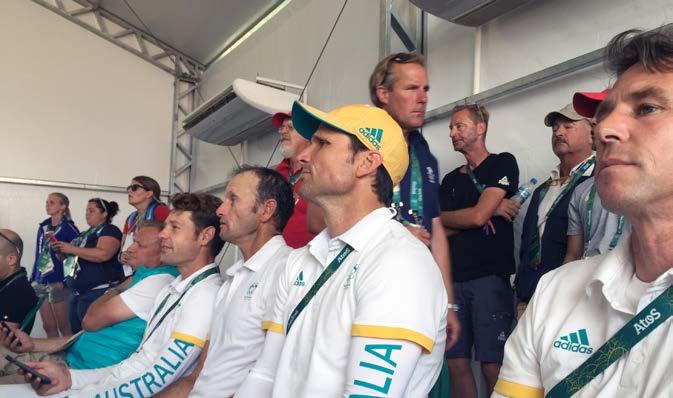
ABOVE: The Aussie team in Rio watching cross country rounds on the CCTV, crucial to the analysis of team tactics (Image courtesy Prue Barrett).
ABOVE: The bronze medal team and their grooms (LtoR) Imogen Mercer, Sam Griffiths, Robyn Carter, Stuart Tinney, Prue Barrett, Chris Burton, Jade Rudman, Shane Rose and Rachel Watts (Image courtesy Prue Barrett).
the Chef’s training program have to be and how specific to each rider? “We have to work on individual performance planning,” Prue says. “It’s not so much ‘dressage today, show jumping tomorrow’, but more of an overarching plan, working towards twelve months out, then six months out and so on. Considering things like which horse is going to which event, what they’re going to do at that event, how fast they’re going to run at that event.”
Towards the pointy end, closer to selection, it’s always a balance between what the horse needs to do and what the selectors want to see. “With eventing, there are about two longformat events a year, so you only get a couple of stabs at this. It really is an eighteen month process,” Prue tells me. “Saying right, well this is what we need the horse to do to be selected, so what do we need in the management of the horse, in its development, leading up to that point? Then you select the events accordingly. With eventing, there’s always a plan B and a plan C!”
Lengthy logistics
The last six months before the Games is where it all starts to ramp up. Uniform fittings, meetings, and nominations from the eventing selectors turning into official athlete selections by the Australian Olympic Committee.
Each Olympics has their own nuances and getting packed to go to Rio was no different. Quite some time before the event, every single item a rider planned to take had to be itemised and added to an inventory. “Getting all that information from riders and grooms, making sure all feed, supplement and equipment lists are submitted and signed off, it can be quite a nightmare,” says Prue. And what’s more, this includes all the riders on the long list, some of whom won’t make the final cut.
The lists had to be carefully reviewed to make sure everything required was added. “Finding the things that were
Prue congratulates Chris Burton on his Saumur victory prior to the Rio Olympics, a win which ensured his Olympic selection (Image courtesy Prue Barrett).
missing was harder than reading all the stuff that was listed,” says Prue. I asked her what happened if someone wanted to change something on the list. Her answer was simple: “they can’t.”
Managing riders across two hemispheres adds an extra layer of challenge, but all the athletes attend a major training camp before the Games. “Once you get everyone there, things
are a bit easier,” Prue tells me. While training is in the name, the purpose of this camp is more about getting everyone in one spot and co-ordinating transport, working out how much storage will be needed and so on.
And as far as flying the horses goes? “To Rio, that side of it was actually quite easy. We just got the flight times and when we had to be there, the transport
• Proudly Australian Made
company organised the details,” Prue explains. The trickiness in this situation was centred around the classic drop-off and pick-up: “Not everybody can fly with the horses. We halved the riders and grooms, some staying behind to assist in loading them all, while the others flew ahead to be there to help unload them
Once there, the grooms and riders at Rio were accommodated in separate quarters, about 45 minutes apart by bus. So there was a lot to factor in, with getting people
horse throws a shoe, so that person’s not going to make their 9:00am lesson. So I have to find someone to swap with them, but I don’t go and pick the least adaptable person in the team,” Prue explains.
The golden key
It doesn’t matter where you sit on the equestrian ladder, beginner or elite, it’s all about confidence. The Chef d’Equipe’s
It all revolves around getting the best performances out of them on the day ... and the Olympics are no different
role in helping to create that mindset is important, and includes working with the riders to help them see their own potential. “It’s a collaboration, not a dictatorship,” she says.
When someone feels that they perform
best riding in a certain spot in the team, Prue will have them ride in a different position at a lead-up event. When they have a good result, it helps give them the confidence to take ownership of that position and ride well in the same spot in the championship. “It all revolves around getting the best performances out of them on the day,” Prue tells me, “and the Olympics are no different. People are people no matter what level they ride at.”
On top of all the months of planning, training and unwavering commitment to the cause, creating a winning mindset is the golden key to being a great Olympic Chef d’Equipe – and Prue’s bronze medal winning Australian Eventing Team is a testament to her ability to do just that.
Shane Rose, Bill Levett, Chris Burton and Sam Griffiths walking the course at the 2014 Normandy World Equestrian Games. One of the innovations Prue initiated was walking the course as a team (Image courtesy Prue Barrett).
Feeding weanlings
The impacts of nutritional insufficiencies during growth can last a lifetime, affecting longterm health, soundness and even behaviour, writes
LARISSA BILSTON
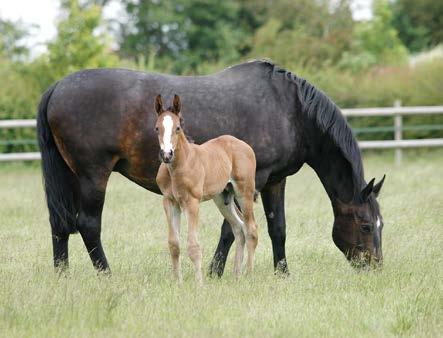
Weaning can be a very stressful time for a young horse and his or her dam.
But strategies such as progressive weaning or weaning foals in groups can help to reduce stress. Correct nutrition and strategic use of probiotics before, during and after weaning can contribute significantly to the health and well-being of mare and foal alike.
Starting slow
Prior to weaning, your foal would most likely have been sharing the mare’s roughage and hard feed, taking an increasing share of her food each week. As the foal starts eating more it will drink less milk and the mare’s feed requirements begin to reduce gradually. During the first week of weaning,
Green leafy plants are high in omega-3 but levels rapidly decline in dry plants and hay.
continue the foal on the proportion of each meal you estimate s/he was taking from the mare’s feed. Do not change the foal’s feed during weaning.
If you need to improve the weanling’s diet, make changes over a two week period, gradually increasing the new feeds as you slowly phase out the old.
Weaning time is hard on the mare too, due to stress and the risk of mastitis. Feed her hay and dry pasture supplemented with mineral balancer pellets or powders mixed into a token hard feed. Avoid lush grass and do not give the mare grains or pellets for a few days post-weaning while she stops producing milk. Re-introduce hard feed if necessary once her udder softens.
The stress of weaning can have negative
impacts on the digestive tract and beneficial gut flora, causing digestive upset and diarrhea in both mare and foal. Research shows that use of oral probiotics, including strains of live yeast from the genus Saccharomyces, reduce diarrhea and help to maintain a more stable gut microbiome during times of stress.
Balancing your weanling’s ration
1. Roughage is always the basis of a healthy ration: The first rule of good horse nutrition is to feed plenty of roughage as pasture, hay or chaff. Unless your weanling is overweight, it is safe to feed free choice grass-based roughage. When the pasture is not plentiful, replace it with grass hay.
2. Sufficient quality protein: Whilst roughage provides some protein to the diet, weanlings usually need high quality protein added to their diets – especially lysine, a key amino acid which they are unable to produce in their bodies. Other important essential amino acids are methionine, threonine and leucine. Weanling diets deficient in essential amino acids will produce stunted animals with poor muscle development.
Legume forages and grains including lucerne, clover and soybean meal are effective options for adding essential amino acids to growing horse rations and are commonly found in commercial feeds formulated for breeding horses. Pure amino acid supplements can also be used in carefully calculated amounts to meet shortfalls if necessary.
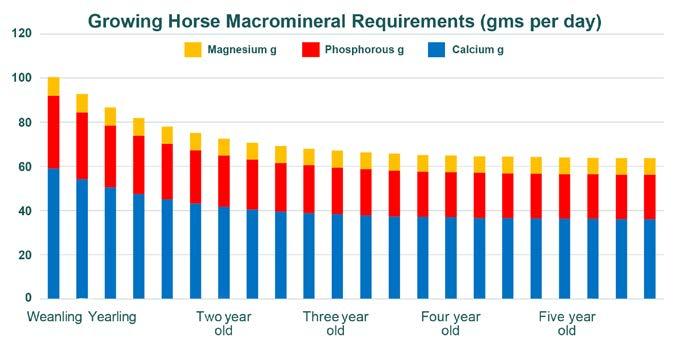
Weanlings need more digestible energy (measured in calories or megajoules) and protein than yearlings and two year olds. By three years of age, the energy and protein requirements are similar to those of a mature horse. However, the relatively high requirement for protein and lysine coupled with the smaller daily intake of a weanling means that weanlings need a diet with a higher percentage of high-quality protein than mature horses
Body condition, growth rates and developmental orthopaedic disease
Veterinary advice to reduce the risk of growing horses developing OCD is to limit calories to prevent very fast growth whilst ensuring enough amino acids, vitamin, minerals and polyunsaturated fatty acids (especially omega-3s) are provided for development of strong bones, muscle and other tissue.
Foals and weanlings should not be overweight – aim to maintain body condition score (BCS) at 4.5 to 5.5 on a 9 point scale. You want to be able to just see the ribs - and always ensure that ribs can be felt in growing horses.
3. Only add calories if necessary: Some weanlings can get all the energy required from roughage alone but to avoid a drop in body condition, it is common to need to supplement with an energy source at times of the year when pasture quality drops, as well as when the weanling undergoes growth spurts. Pasture quality is highest in young, leafy plants and declines as the plants mature and dry off.
The best way to determine a weanling’s energy requirements is to carefully and regularly monitor their body condition score and, if possible, measure growth rate by regularly weighing on scales.
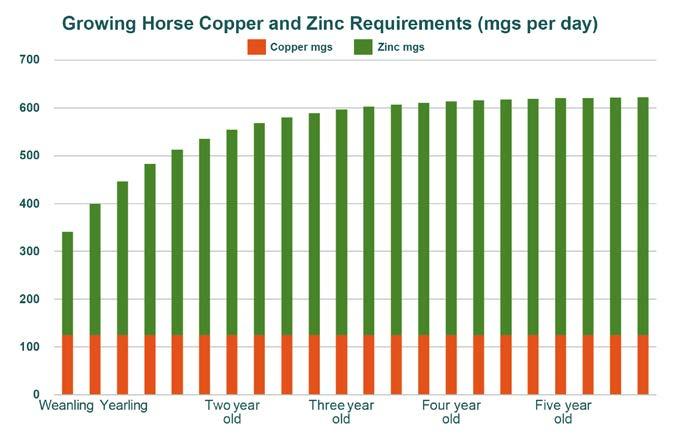
4. Balance with vitamins, minerals and oils: It is critical to provide vitamin and mineral supplementation to satisfy your weanling’s daily requirements. Failure
Give your breeding and young stock the winning edge with Farmalogic's
HEALTHY WEANLINGS
begin with optimal broodmare nutrition & lifetime correct feeding.
u i n e V i t & M i n ' s r a n g e o f q u a l i t y
p p l e m e n t s m a k e s c o r r e c t i n g t h e m i n e r a l
Equine Vit&Min's range of quality supplements makes correcting the mineral ratios of any feeds simple. Use with Farmalogic Omega Balancer to give mares the edge for conception, healthy foal development and recovery from foaling.
s o f a n y f e e d s s i m p l e . U s e w i t h
m a l o g i c O m e g a B
f o r c o n c e p t i o n ,
t h y f o a l d e v e l o p m
r e c o v e r y f r o m f o
A T W E A N I N G A T W E A N I N G
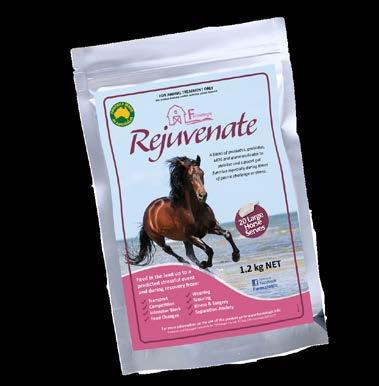
A d d F a r m a l o g i c R e j u v e n a t e t o f e e d s a t w e a n i n g
p r o v i d e s p r e b i o t i c s a n d p r o b i o t i c l i v e y e a s t t o r e d
t h e i m p a c t o f s t r e s s o n g u t h e a l t h . R e j u v e n a t e s t i
t h e i m m u n e s y s t e m , i m p r o v e s f e e d u s e e f f i c i e n c y
i n c i d e n c e o f d i a r r
Add Farmalogic Rejuvenate to feeds at weaning to provides prebiotics and probiotic live yeast to reduce the impact of stress on gut health. Rejuvenate stimulates the immune system, improves feed use efficiency and reduces the incidence of diarrhoea caused by stress or sudden change of feed.
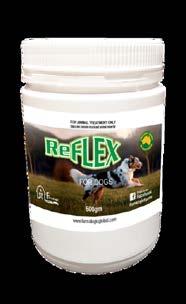
We know that lots of horse-owners are dog lovers (and we are too)! That's why we've packaged the popular Farmalogic ReFLEX joint supplement into a 500g pack for dog owners. Enter the draw here: https://mailchi.mp/farmalogic/reflex4dogs
NUTURITION
to do so will compromise the long-term structural soundness of your young horse.
Forages and protein sources do not contain enough minerals to meet basic requirements, and do not provide optimum and balanced levels. Weanlings usually require more calcium, sodium, phosphorous and manganese than that provided by pasture.
A growing horse’s calcium and phosphorous requirements are much higher during the first two years than in later life. A weanling’s diet must contain supplementary calcium and phosphorous with the levels balanced over the whole intake to provide approximately twice as much calcium as phosphorous.
All equine forage-based diets need added copper, zinc, iodine and often selenium. It is also essential that the critical mineral ratios are balanced over the entire diet to optimise availability and uptake.
Copper requirements remain steady from weaning to maturity, but the zinc requirement increases as the foal matures.
Vitamins and oils help sustain healthy growth and development in young horses. Green, leafy pasture is rich in most of the vitamins that horses require, but vitamin levels decline in mature
and drying plants, including hay. It is advisable to provide weanlings with a source of supplementary vitamins, including vitamins A, B, E, K, folate and biotin.
A small amount of oil is also essential in any equine diet. Ensuring a good balance of omega-3 polyunsaturated fatty acids relative to omega-6 is important for many reasons, including correct functioning of the immune
Only add calories if necessary. Some weanlings get all the energy they require from roughage alone.
BELOW: Copper requirements remain steady from weaning to maturity, but the zinc requirement increases as the foal matures.
system. Green leafy plants are high in omega-3 but levels rapidly decline in dry plants and hay, therefore a supplementary form of omega-3 is needed when green grass is not available.
Should I feed a commercial breeding horse pellet?
A quality breeding-specific commercial premixed feed can simplify the process of feeding your weanling a wellbalanced diet, but only when they need the full recommended amount of the feed. If he or she needs less calories than the feed provides, you will need to separately supplement extra protein and mineral levels to avoid a deficiency.
For this reason, it may be simpler to provide a protein source and vitamin, mineral and omega-3 supplements separately from the energy source. This allows you to easily change the diet in response to seasonal changes as well as your yearling’s changing needs over time.
If I mix my own concentrates, what sorts of feed should I use?
1. Extra energy sources to top up calories from roughage if required:
• Super Fibres – energy sources that are high in digestible fibre. These include beet pulp, copra or legume hulls such as soy hulls.
Saddle
BUY ONLINE SAFELY
Secure payments with no risk of being scammed. NO SURPRISES
Confidence that saddles listed are described accurately, photographed honestly and the model you pay for is the one you get.
PROFESSIONAL SERVICE
Helpful, friendly saddle advice and service from our team before and after your purchase.
MORE WAYS TO PAY
Wide range of payment options to suit your budget and finances getting you in a new saddle sooner.
LOW RISK
We inspect saddles, provide an accurate description and reject any that are not suitable for sale. You won’t receive a saddle with unexpected or undisclosed damage or blemishes.
TRIAL FOR 14 DAYS
We want to make sure you and your horse get the right fit and love your new saddle. 5 5 5 5 5
• Legume grains – the most commonly available is lupins. Legumes also contribute a concentrated source of protein to the diet. Due to their hard seed coat, soak to soften prior to feeding or buy processed lupins.
• Cereal grains – oats contain starch in a form which is easily digested by horses when fed raw. Other cereals such as barley and corn are poorly digested unless cooked so choose boiled, extruded, micronized or pelleted grains. Cereal by-products such as bran, pollard and millrun are lower in energy than whole grains.
• Fats and oils – can be used judiciously to boost the energy density of the diet but must be introduced very gradually to avoid digestive upset. Take care to maintain the right omega-3 to omega-6 balance.
A growing horse's calcium and phosphorous requirements are much higher during the first two years.
2. Extra protein to top up amino acids
– especially those high in lysine:
• Lucerne, clover or other legumes in the hay or pasture.
• Full fat soybean meal (only ever buy correctly processed soybeans which have been cooked to remove trypsin inhibitors).
• Pure amino acid supplements.
• If using legume grains such as lupins for energy, they will contribute crude protein to the diet, but are lower in lysine than soybeans.
3. Vitamins and minerals:
• A quality vitamin and mineral supplement rich in macrominerals,
If your broodmare has been fed correctly, your weanling has had every chance to develop a strong body, good immunity and digestive health.
trace minerals and vitamins. Look for one designed to balance mineral ratios across the whole diet.
• Salt – sodium chloride can be purchased as table salt, stock salt, flossy salt or pool salt.
• Omega-3 balancing oils or powders –these need to contain more omega-3 than 6 to balance the high omega-6 levels naturally occurring in diets where green grass is limited. Consider choosing one which contains DHA and EPA rather than ALA alone.
• Consider a probiotic live yeast so your weanlings get better value from their food. Saccharomyces cerevisiae live yeast is scientifically proven to boost forage utilisation by turning indigestible fibre into usable energy.
The take home message
Roughage forms the foundation of every healthy horse diet. It must be balanced with vitamins, minerals and omega-3 fatty acids. It can be a wise investment to seek the advice of a qualified equine nutritionist during this critical stage of the life of your young horse.
Larissa Bilston BAgrSc (Hons 1), is a nutritionist with Farmalogic.
Enjoy flexible payment solutions at The Saddle Hub
No matter how lux your stables, it’s what’s under your horses hooves that counts.
FEATURE
Innovations in stable flooring
When it comes to stable flooring, optimising the health, comfort and safety of your horse is paramount. CHRISTINE ARMISHAW investigates the new, the innovative and the downright desirable.
Of all the components that can be held accountable for horse health in a stable, flooring is pretty close to top of the list. A suitable base provides comfort and encourages a horse to lie down and properly rest. While standing, your horse’s precious legs and joints need to be adequately supported by means of suspension and a level of ‘give’ underfoot. The floor should be easy to keep clean and dry, while offering enough traction to prevent your horse from slipping. Good drainage and preventing odour retention are important factors. Strong smells are unpleasant and high levels of ammonia in the air put your horse at risk of developing respiratory conditions. And finally, there’s affordability. There
The floor should be easy to keep clean and dry, while offering enough traction to prevent your horse from slipping
are certain items on which you may wish to cut costs, visual stable trimmings for example, so you can redirect your funds into the more important area of providing comfort and safety for your horse.
With this battle plan in hand, combat begins. But first, here are some fundamentals to ponder to help set you on a clear course for stable glory. Consider how long you plan on keeping your horse indoors. Will it be intermittently, or will he be stabled most of the time? If your needs are more short-term, like housing your steed overnight before a competition to keep him clean and handy to catch in the
morning, then a stall with basic flooring and a deep covering of shavings may suit your needs. But for horses who will be spending a lot of time in their private quarters, what they are standing on becomes even more important. Over the long-term, stable flooring will impact a horse physically and contribute either positively or negatively to his way of going.
Softer floors, less sores
At a base level you have a couple of choices, dirt or concrete. The former is hard to keep clean and horses may dig holes or walk wear marks into the ground. Traditional concrete ticks a few boxes: it is relatively cheap, durable, hard to damage and can be fairly easily cleaned. However, it offers no give to your horse’s joints, it’s cold, and it simply cannot be used on its own. It needs to be partnered with a whole lot of bedding to offer cushioning, some warmth, and to provide protection between its hard grey exterior and your horse. Any savings made at the outset may be outweighed as time goes by, in the form of time spent mucking out barrow load upon barrow load of dirty bedding, not to mention the cost of copious amounts of whatever your bedding of choice happens to be.
But there is an entry-level flooring product which offers a straightforward solution that decreases the difficulties of dirt and saves you from pouring concrete. Diamond Grid mesh provides drainage, remains even, and is kinder than plain terra firma on your horse’s joints when they’re standing for long periods of time. It’s easy to lay and can be used straight on top of a level dirt surface.
If you’re working with an existing concrete stable floor, covering with rubber is the way to go. Interlocking rubber mats are a starting point in creating that desired cushioning effect. They’re easy to move around due to the small size of each component and fairly easy to install as they simply
The novelty of mucking out barrow loads of dirty bedding usually wears off pretty quickly.
BELOW: Red Barn’s rubber flooring, a sensible addition in any equine wash bay.
BELOW RIGHT:
This thick, padded flooring system significantly reduces the amount of bedding you require.
lock into one another. However, the drawback of these puzzle pieces is that urine and muck get in between each square, making the area rather hard to adequately clean. This is unhygienic and can potentially lead to a smelly stable if the mats are not hauled out regularly for a proper scrub.
Going one better
The next option is to go big and get the floor covered in rubber sheeting. Fewer joins mean less potential for liquid leakage. Of course, as is the way in this world, not all rubber covers are created equal. Killahy Equine’s Business Manager, Charlie Hay, who has a degree
in chemical process engineering, shares his insider tip on how to test the quality of rubber: “Get a piece and bounce it on the ground. If it doesn’t bounce and it just kind of thuds, you know it’s got volatiles in it and is not a full, compacted kind of rubber.” Basically, if it has no bounce, it will have no spring under hoof
for your horse either.
Once you’ve found bouncy rubber, the thickness required depends on foreseeable usage. Thinner rubber may not offer as much comfort as other coverings, but it can be combined with shavings. This may be a perfectly
suitable option for ponies coming in off the grass for a couple of hours, or for other occasional use.
Need a late checkout? If you plan on keeping horses inside for longer periods, there are other solutions that may suit. By the time you factor in the cost of all that bedding you end up shovelling, thicker rubber that costs more at the outset may actually be a more economical long term option.
Jason Carter, Director at JDC Flooring, explains the benefits their Red Barn equine rubber represents over standard rubber matting. “Ours is a very heavy-duty rubber mat of 19mm thick, compacted rubber,” says Jason. “It offers your horse suspension for their joints and is quite comfortable.” And this is where your savings come in; the more padding and suspension you cover your concrete with, the less bedding you need to keep your horse comfortable. The thickness of JDC’s Red Barn rubber makes it stand out from the crowd. “You’re still using shavings, but you’re down to just a quarter of what you would normally use, just to soak up any spills,” says Jason. “That way, you can be paying for a new stable within two to three years with your savings on the shavings.”
For those of us who have an eye for the bigger picture, this product is also right in line with the ever-increasing need to protect our environment. A great example of clever recycling, the big, thick, non-absorbent Red Barn rubber mats are made in Canada from 100% recycled truck tyres. That’s a potential tyre mountain going to much better use! Plus, it’s such a tough product that the company offers a 15-year warranty.
Less shavings also means less dust in the air, a positive contribution to keeping your horse’s respiratory system in a healthy state. While this is a particularly serious consideration for racehorses and performance horses, it’s equally important for any and every horse being kept indoors.
New innovations for happier housing
Killahy Equine have a few more tricks up their sleeves with German-made Belmondo rubber flooring solutions. If you have horse with a proclivity to paw, their rubber topped with a 4mm Tefloninfused wear layer may be just the ticket. “It’s got a hardened, engineered rubber compound over the top. It’s designed for shod horses so it doesn’t wear out,” explains Killahy Equine’s Charlie Hay.
Keeping in mind how important underfoot suspension is for joint protection, the next type of flooring Killahy offers is thick and cushioned with air pockets under the rubber, providing even more give and pressure relief to the stall inhabitant. Like the Red Barn mats mentioned earlier, this product also
Of all the components that contribute to horse health in a stable, flooring is pretty close to top of the list.
This option is so comfy they don’t even refer to it as rubber flooring. It’s like a mattress.
reduces the quantity of bedding you require.
Finally, there’s the King Duo, a flooring system to trump all others. This option is so comfy they don’t even refer to it as rubber flooring. “It’s like a mattress,” explains Charlie. Comprised of two different layers that have been bonded
To help prevent unwanted seepage, interlocking rubber mats should be fitted together with as little gap as possible.
A completed rubber floor installation with plastic skirting board locking the matting in place.
While shavings are often used as bedding, the dust they produce can be detrimental to your horse’s respiratory system.
together, the base is a compilation of rubber cups, not dissimilar to the design of an egg carton, with a blanket of 18mm thick rubber spliced on top. A special system is used to etch and frame your stable floor during fit-out so that there are no gaps – making it easy to clean and preventing unwanted seepage. Finally, a plastic skirting board locks the mat down, so there’s no need for additional glue or sealant. “It’s kinda the ducks nuts,” grins Charlie.
With options aplenty in the evolving realm of stable flooring solutions, you can wave goodbye to the days of painstakingly spreading half a truck load of shavings over a cold concrete floor – cleaner, affordable and more manageable alternatives are ready and waiting.
B-COMPLETE BY BANANA FEEDS AUSTRALIA- THE GUT HEALTH REVOLUTION
Banana Feeds Australia has developed ‘B-Complete™, Nature’s Elite Equine Supplement’.
100% Australian owned, 100% Australian made, and a family business, Banana Feeds Australia has made waves within the equine supplement market in a truly short time. A 100% natural supplement focused on Equine Gut Health, and indeed a world first has resonated with the masses.
The patent protected product, consists of whole dried green bananas, including the skin, the pulp, the stem and the flower ends, and horse owners across the country are expressing disbelief about the positive results they are seeing.
WHY GREEN BANANAS AND WHY B-COMPLETE™?
Green bananas have long been the subject of intrigue, from use in the Sydney Olympics, to consumption in space, but with correct dosages of B-Complete™ the true benefits become obvious.
EQUINE GUT HEALTH -The health benefits that derive from supplementary feeding of dried green bananas are broad and include:
Green bananas have been shown to have antiulcerogenic properties, an
area widely accepted as needing a solution in the equine industry, other than expensive medications.
The insoluble fibre act as prebiotics to favour the nourishment of microflora in the gut (particularly the hindgut) to stabilise the microbiome.
This stability in the gut promotes immune competence allowing horses to counter bacterial, fungal, viral, or parasitic challenges whilst also improving digestion, feed utilisation and temperament. Other reported benefits include: Antimicrobial, Hypoglycemics, and Anti-lithiatic (prevent kidney stones).
GENERAL WELL-BEING Active compounds like dopamine, norepinephrine and serotonin all act to calm the animal and promote a sense of well-being, helping to make the animal more relaxed and easier to manage.
ANTIOXIDANT CAPACITY Green banana is recognised as antioxidant rich, with a wide spectrum of antioxidant compounds (phenolics, carotenoids, ascorbic acid or Vitamin C, tocopherols or Vitamin E, dopamine, flavonoids, norepinephrine) which are primarily located in the peel. All improve gut health.
“B-Complete is widely used in our stable. It has had a profound impact on the performance of our horses. I consider it a game changer. Our horses are working better, performing better, getting better results - particularly the ones we know are ulcer-prone. Very happy.”
- David Tootell
“Since I have been using B-Complete, our racehorses have better gut digestion, are healthier & maintain their condition easily. Their coats are amazing. We also found it extremely beneficial for highly-strung horses, making them safer and more manageable.”
- Rob Wilkinson
AROUND THE TRAPS
AROUND THE TRAPS
LEFT: Candace Brigden and McMurchie Odette won Champion Clydesdale Filly at the Hawkesbury Ag Hack & Breed Shows (Image by A & H Photography).
RIGHT: Sophie Thurgood and Riley roaming free at Lancefield Bloodstock in Merton, Victoria (Image by Bianca Shambrook).
ABOVE: Eight months ago, 10-year-old Kassie Pontifex rescued Disney from a dogger and brought him back to good health. The pair have developed a beautiful bond (Image by Steven Pontifex).
LEFT: Antonia Bearda and Up To No Good competing at the 2020 Tamworth International Eventing One Day Event (Image by Gavin Inglis, Shots by Gav Photography).
Bridles unbuckled
In
The primary purpose of a bridle has always been to steer and communicate with the horse, usually by way of holding a bit in their mouth. Archaeologists have discovered examples of very early bridles with cheekpieces made from antler or bone, and mouthpieces of softer materials such as hemp, sinew or rawhide. The skill of the riders of this time was relatively basic. Their primary concerns were controlling speed and turning, which the bridles of that era allowed them to do.
Over the years bridles evolved, as did bits. The latter were swapped out for metal as it was longer lasting than the original soft mouthpieces. During medieval times, knights rode horses into battle and needed more manoeuvrability, so harsher bits were designed. Young horses were trained using the same severe bits, a trend which, thankfully, eventually died out. The bridles themselves were embellished with gold or silver buckles and other decorations, giving the horses a decidedly regal air.
Coming into the 18th century, horses became an increasingly popular option with noblemen for both transport and sport. Riding developed into an art form and times changed in the way horses were educated. Trainers sought to build trust and cooperation with their mounts, instead of simply using brute force as a means of control. The sensitivity of a horse’s mouth was recognised, and young horses began their ridden careers in a cavesson noseband, featuring a ring on each side to which the reins were attached. The bit rings weren’t used until the horse was older and more developed. Throughout the world, wherever there were horses, there was some form of bridle. Be they colourful and adorned with tassels, or plain and constructed simply from animal hide, the basic design hasn’t changed much throughout the ages. So let’s delve into the bridles commonly available today and their applications.
EQUIPMENT
English bridles
An English bridle usually consists of a headpiece that rests behind the ears, cheekpieces that run down each side of the face to hold the bit in place, a browband above the eyes to maintain correct bridle positioning and a throatlash under the jowl for the same purpose. Reins are connected to the bit and held by the rider to relay information to the horse.
Components don’t alter greatly from one bridle to the next. While there are multiple browband options out there, including straight, ‘U’ shaped, ‘V’ shaped, padded, beribboned, and diamante studded, these change the look of the bridle, but not the mechanics. That said, there are two bridles that deserve special mention:
The Micklem bridle: With similar versions marketed by some companies as ‘anatomically correct’ bridles, today’s Micklem is a new spin on an old style designed by international coach William Micklem. Shaped to follow the anatomy of the skull, the wide headpiece alleviates pressure on the poll and the back of the ears. The noseband is cut forward from the sides of the face in an ‘L’ shape, eliminating nerve pressure often exerted by traditional bridles. This flows into a drop-style noseband, which is fitted higher to avoid the soft tissue of the horse’s nose. The bit is attached to the noseband component (rather than to cheekpieces), which helps alleviate bar pressure in the mouth. The throatlash is set much lower and sits snug against the horse’s face, helping to keep the entire bridle securely positioned. Finally, the Micklem can be converted into a bitless bridle or halter, while some designs allow it to also be used as a lunging cavesson.
The Double bridle: As the name suggests, a double bridle features two bits connected by two sets of cheekpieces and a cavesson noseband. The main bit is a curb and behind it sits a smaller version of a snaffle, called
Riding developed into an art form ... Trainers sought to build trust and cooperation with their mounts, instead of simply using brute force as a means of control.
Venice bridle with padded pull-back noseband for extra comfortable fit (available in black and brown from Ashbree Saddlery).
a bradoon. Most commonly used in the higher levels of dressage and in show horse classes, a double bridle, in experienced hands, is used to refine communication from rider to horse.
Nosebands
There is one interchangeable component of a standard English bridle which actually alters its function: the noseband.
Cavesson noseband: This is the simplest type, consisting of a band that loops around the horse’s nose, ideally two finger widths below the protruding cheekbone, but above the bit, and buckling up under the jaw. In measuring tightness, two fingers should fit between the front of the horse’s nose bone and the noseband (the same is true for the cavesson on a double bridle). Sometimes, a cavesson features the addition of a flash strap. This connects at the front of the noseband and does up below the bit, under the chin. The purpose of a flash is to help close the mouth of a horse who chomps, puts their
Sometimes, a cavesson features the addition of a flash strap. This connects at the front of the noseband and does up below the bit, under the chin.
tongue over the bit, or has a tendency to grab the bit between their teeth. A flash can be removed from the bridle when not required.
Drop noseband: Positioned lower on the horse’s face than a cavesson, a drop noseband does up under the chin and below the bit, and is used to help remedy the same issues as a flash -
but because it’s purpose built, a drop noseband can’t be ‘disconnected’ in the same way as a flash.
Grackle noseband: Also known as a ‘figure eight’ or ‘Mexican’, this noseband criss-crosses over the front of the horse’s nose. It’s fixed just over or above the protruding cheekbones and, like a flash strap, does up below the bit under the chin. Also used to help prevent the horse opening the mouth or crossing the jaw, the benefit of this style, when compared to a drop noseband or cavesson combined with a flash, is that it provides more space around the nostrils making breathing easier for the horse. Western bridles
A traditional Western bridle does away with the noseband altogether, leaving the headpiece, cheekpieces, browband and throatlash. However, what they lack in strapping they often make up for in the form of extravagant buckles, embossed leather and other bold embellishments.
Hackamore bridle by PS of Sweden (available at leaderequine. com.au).
Paragon Double bridle by PS of Sweden (available at leaderequine. com.au).
With only the headpiece, cheekpieces and a loop that fits around one ear of the horse, ‘one ear’ Western bridles are for headgear minimalists. A curb bit suits this type of bridle as there is a slight downward pressure on the headpiece when the reins are engaged, reducing the chances of the bridle slipping off over the ears. A snaffle bit has the reverse effect when both reins are engaged, with the bridle loosening slightly, in which case riding with a throatlash is recommended.
Bitless bridles
Bitless options are available in both English and Western styles, but they are not permitted for use in all disciplines. If you are aiming to compete, always check the rules!
Hackamore: technically not a bridle itself, it references the piece of equipment that replaces both the noseband and the bit in a bitless set up. Sometimes thought to be kinder than a bit, a hackamore can actually be quite severe as it acts on the soft tissue and cartilage of the horse’s nose. Much the
Mio ecofriendly leather bridle with cavesson noseband (available at leaderequine. com.au).
RIGHT: A one ear bitless bosal bridle.
When choosing the right bridle for your horse, select one that’s appropriate for your needs and your discipline ... and make sure that it fits well.
same as a bitted bridle, it’s only as kind as the hands that hold the reins.
Side-pull bridle: This bridle is comprised of a noseband with no cheekpieces. There are rings fixed to each side to attach the reins, applying direct pressure to the horse’s cheek when the reins are pulled.
Bosal bridle: A Western-style bitless bridle made up of a rigid loop of braided rawhide that loosely encircles
the horse’s nose. The bosal rests on a hanger (a type of headpiece) and may have a browband to hold it in place. The reins, usually rope, are both attached at the same point under the chin. Opposite to the clear tug of a side-pull, the bosal works by pushing into the cheek, with the horse moving away from the pressure.
Cross-under bitless bridle: This has a noseband and would-be cheekpiece straps that cross under the jaw, linking to the noseband on the opposing side. Reins attach to rings on the ends of the straps and pull the head in the intended direction of travel when a rein is applied.
Final thoughts
When choosing the right bridle for your horse, select one that’s appropriate for your needs and your discipline (check the rules if you are planning on competing), and make sure that it fits well. If you are not sure how a certain style should be correctly fitted, seek the advice of your trainer or an experienced horseperson. A comfortable horse is a much happier horse.
Trails across the Tasman
While travel restrictions limit us still, the Land of the Long White Cloud is likely to beckon sooner than most. SONIA CAEIRO ALVAREZ
armchair travels to New Zealand’s North Island and a unique, and long-established riding destination.
Only 90 minutes from Auckland on the pristine sands of the Matakana Coast in Wellsford is a riding experience developed lovingly by the Haddon family for over 40 years. Pakiri Beach Horse Rides was established in 1981 during a severe downturn in the New Zealand agriculture sector.
The downturn, coupled with a deep farming recession, was a bleak period. Farmers walked off their lands with little or no prospects for the young, and the Haddon’s were forced to diversify. “We were making nothing on the farm and were breeding Arabians at the time,” Sharley Haddon tells me. “Horses were too expensive to run then, and strangely
we were receiving lots of requests to trail ride. After deep discussions my husband gave me an ultimatum – we had six weeks to see whether it might work.”
The operation started with no capital whatsoever, just two ponies and an Arabian guide horse. Pony by pony they built the herd, one pony paying for the next. From these modest beginnings Pakiri built up a substantial herd and was featured in the Lonely Planet Rough Guides and Getaway television programs, as well as its famous inclusion in the BBC publication Unforgettable Things to do Before You Die
Guests can choose from 1-2 hour rides, half, full day and sundowner rides along
superb beaches, through coastal forest and over snow white dunes. With views extending out to the islands of the Gulf, many trails include sighting coastal sea birds and occasional orcas and dolphins frolicking in the surf.
Other day rides, such as the Tomarata Te Arai Ride, encompass beach and forest trails to freshwater lakes, where riders can swim with their horse, enjoy a packed lunch then head over Te Arai Point and its spectacular views of endless white beaches stretching as far to the north and south as the eye can see.
On the Sundowner Beach Ride held in summer, guests ride along the beach sands as the sun sets below hills
magically draped with pink and gold.
For those who can’t bear to leave after just one day, Pakiri Beach Horse Rides also offer a range of longer two to five day treks along beaches and through high country, forest and native bushland encompassing some of New Zealand’s most breathtaking seaside headland views.
An ultimate five-day experience, the Warrior Trail of beach, forest and coastal high country riding, follows the ancient trails of Maori warriors. The ride concludes with a visit to Te Kiri Marae - the ancestral home of the local Ngatiwai and Ngati Manuhiri people –before overnighting in nearby boutique accommodation.
Yogi, Morgan and Beckham escort their riders along a stretch of pristine beach.
RIGHT: Enjoying the tranquillity of a beachside bush track.
Pakiri offers a variety of intimate and larger family style accommodation including private riverside, beach view and dune nestled cabins, a beach house and lakeside chalet. The four bedroom Ngapeka house on a pristine beachfront location features spacious and comfortable open plan living with a fireplace for toasty winter stays, and a breezy outdoor flow with BBQ and entertaining areas for relaxed summer breaks, including an outdoor bath to relax and stargaze after a long day’s ride.
Invigorating mini-breaks include delicious homestyle meals, allowing guests to truly wind down, connect deeply with their horse and absorb the grandeur of the landscapes. Native bush walks to the rear of the property, with views to Little Barrier and Great Barrier Islands, are near a small cafe and bar, perfect for guests seeking a little more social activity.
As well as riding and bushwalking, the area is a popular destination for surfing, fishing on the beach, and kayaking in the estuary. Nearby are the renowned Matakana vineyards and wineries, five
golf courses, tennis courts, the world famous Goat Island Marine Reserve, Matakana Village cinemas, shopping, weekend farmers markets and excellent cafes and restaurants at Matakana, Puhoi and Mangawhai. After all that activity riders may be tempted to end their day at the hot pools and natural spa of Waiwera.
There have been changes in New Zealand, with many expat buyers cutting big properties into small blocks. This has brought the future sustainability
The freedom, sea air, and open space of the headland.
for long trail ride businesses like Pakiri into question – although Sharley hopes to find a solution that will safeguard her legacy. “Maintaining large riding properties like this has become challenging,” she says. “We have great rides and great horses, and before COVID we had riders visit from all over the world. They represented almost 50 per cent of our custom so revenue was halved. So in order to pivot we no longer do nose-to-tail beginner treks, or our long coast-coast seven day tours, although we still occasionally host
The Pakiri Beach horses are forward going rides, happy to go where the mood takes you.
school holiday camps for horse-mad 11 to 15 year-olds during the summer.”
Pakiri Beach Horse Rides currently has 60 trekking horses, as well as Arabian stud horses ridden by guides and by experienced riders on multi-day treks. The natural herd is managed on two spacious 40 acre grassy properties and in winter they strip graze like dairy cattle. Two Arabian stallions and young stock being weaned or shown are stabled, but only at night.
The Pakiri Beach horses are chosen
LEFT: If you tire of the beach, there’s always the high country to explore.
BELOW: Is there any better way to see the world?
for their kind temperaments and unflappable attitudes. “We keep them kind by rotating their work schedules and treating them well. Those used on the long multi-day rides are chosen for their courage, fitness and dependability in all and unexpected situations,” Sharley tells me. “They are unshod, and we very rarely have any issues. I handle most of the veterinary work myself, unless it’s a dire situation, and I also have a great barefoot farrier on hand.”
Although it’s unusual to see a large herd so relaxed, they’re happy to just lie down and simply bask in the sunshine together. “If we do have a problem horse, the older girls in the herd generally sort them out, which is interesting, but it tends to calm them all down,” Sharley says. “We also don’t tie up on cross reins to saddle up – we just move amongst the herd to prepare for the rides. There is no skittering, or any nervous mounts. They are also full forward going rides, not plodders.”
Running the business alone after the passing of her beloved husband seven years ago, Sharley scaled down slightly and, with her five loyal staff, focuses
on competent and experienced riders of at least an intermediate level. At the age of 74, the remarkable Sharley still maintains the workload she has had for the past 40 years, and while COVID has been difficult she has kept the horses in work, “otherwise they turn into naughty little fellows,” she says. “My dad was Australian, and my sister still lives in Sydney. I travelled the country when I was younger, and I remember clearly riding in native bushland in regional Victoria quite close to Melbourne. The tree ferns, tea-trees and other flora here seemed so familiar I could have almost been back home.”
And so, as we turn to the possibilities of a trans-Tasman bubble making New Zealand one of our first overseas destinations, Sharley is enthused by the possibility of welcoming back NZ’s nearest neighbours. “Australians are hands down my favourite guests by far,” she says. “I’m very much looking forward to having the Aussies back at Pakiri as soon as possible.”
Want to know more? Visit www. horseride-nz.co.nz to plan your Pakiri Beach experience.
LIFE AFTER RACING
R&R at Spring Creek Equine
While the Yarra Valley is world-renowned for its vineyards and winemakers, the region could soon be known as a hotbed for horses, writes PAUL SYMES.
After spending a number of years competing in eventing at the highest level, and having operated their own separate businesses, Samantha Cesnik and Chris Height decided to join forces and combine their skillsets, knowledge and vast experience of all things equine.
The result is Spring Creek Equine, which they established in Coldstream – a township approximately 35 kilometres north-east of Melbourne’s CBD – around five years ago.
After the couple shed some blood, sweat and perhaps even the occasional tears along the journey, the centre is now leading the way in helping to rehabilitate horses and prepare them for new homes and careers.
Spread across 35 acres, the stunning facility provides a variety of services, from coaching and clinics to equine rehabilitation and agistment to name but a few.
Approximately 12 months ago, Samantha and Chris added another string to their bow by joining Racing Victoria’s (RV) network of Acknowledged Retrainers, taking recently retired racehorses and helping their transition from the racetrack to other pursuits.
More recently, they consolidated their relationship with RV through the RESET
We’ve absolutely loved having Pie with us, he’s fitted in so well at the farm
Tattersalls.
program, a new pathway designed specifically for Victorian Thoroughbreds which may have struggled to transition to the right home after the end of their racing careers.
RESET – an acronym for Racehorse, Evaluation, Support, Education and Transition – was introduced in July 2020 to complement RV’s successful
Off The Track program, which promotes retired Thoroughbreds to the equestrian community.
Recognising that RESET was a really interesting new initiative, the couple jumped at the chance to get involved. “In the past we had to be quite selective about the Off The Track horses we took, because not all retired racehorses are well-suited to our retraining program and so we would’ve needed to devote an awful lot of time and effort to transition them into secondary careers,” explained Chris. “But the RESET program gives us and other retrainers the opportunity to work with horses which may be less commercially viable and which won’t make the grade in equestrianism, but which still have a very good chance
Piemonte, Samantha, Chris and
LEFT: Samantha and barn favourite, Pie. (All images courtesy of Racing Victoria)
of going on to enjoy a productive and prosperous life post-racing.”
And that includes horses needing recovery time: “We’ve taken in horses which have come to the end of their careers because of tendon injuries or other muscular issues that can take some time to heal, but don’t prevent them from becoming riding horses further down the track,” Chris says. “On average, we probably take in two or three Off The Track horses every month and we can now probably take on another two horses at a time through the RESET program, so it fits in really well with our business.”
Through the RESET program, Chris and Samantha recently acquired Piemonte –
or ‘Pie’, as he’s now affectionately known – a five-year-old gelding (formerly trained by Robbie Griffiths) whose tendon issues forced his retirement from the racetrack after just six career starts.
When he first arrived at Spring Creek, Pie was a little reserved and took some time to adapt to his new surroundings. However, aided by the centre’s water treadmill and other methods which have assisted with his rehabilitation, he is now thriving and will soon have a saddle on his back – albeit to participate in rather more sedate pursuits than chasing glory on the racetrack. “We’ve absolutely loved having Pie with us, he’s fitted in so well at the farm,” says Samantha. “We now know what he likes and what he doesn’t like, and he feels very calm and
comfortable with the set-up and all our staff.”
It can take up to six weeks for horses to adjust once they have left the racetrack, and although Pie hasn’t been back under a saddle yet, his retraining process is well under way. “When he first came to us, he wasn’t sure what to make of everything. But he soon settled in really well and has allowed his personality to come out, so he’s become a favourite in the barn,” Samantha explains. “He starts ridden work next week, he’s very fit and sound now that he’s completed his full rehab program. The last time he was ridden was in a race so it’s going to be very interesting to see how he goes, but we’re all quietly confident he’ll take to it.”
Pie has a pre-existing injury and so will not become an elite horse; but Samantha says that everyone who comes into contact with him falls in love with him, so the couple are hopeful that he’ll go on to have a very nice life in another discipline.
Whilst Piemonte – who was sired by the 2013 Melbourne Cup winner Fiorente – showed plenty of promise during his brief career with two wins and one minor placing, the same could not be said for another resident at Spring Creek, Tata Ma Pick.
The ‘highlight’ of the bay gelding’s career came very early on, when he finished fourth of six runners on debut – after which he came a distant last in five of his next seven starts. “It’s fair to say his racing career never really took off,” says Chris with a degree of understatement. “I think he spent more time with his legs in the air than on the ground! We didn’t get him directly off the track, but he hadn’t done much postracing so he spent a bit of time with us and we turned him into an eventer.
Now known as Tattersalls, Chris reports that he is going really well: “He even won the Young Eventing Horse Challenge at the Melbourne
Spring Creek graduate Tattersalls won the Young Eventing Horse Challenge at the 2019 Furphy Media Melbourne International 3 Day Event.
were pretty pleased with that, and
now hopeful he’ll go on to much bigger and better things in the future.”
Whilst ribbons and trophies are hugely rewarding and testament to their hard work, what perhaps gives Chris and Samantha the most satisfaction about their jobs is simply the opportunity it affords to work with such beautiful and emotionally intelligent animals day in, day out. “The horses are our work colleagues and even part of the family,”
Spring Creek Equine: a stunning 35 acre property to Melbourne’s north-east.
Samantha. “We obviously see them every day but when you love working with them and hopefully they love what they do, it makes your lives so much easier. Every horse is different, and we’ve all got our favourites even if we might not admit it!”
While the horses “definitely keep you on your toes”, one of the things the couple love most is that no two days are the same. Samantha likens it to most jobs: “You have good days and bad days but the good definitely outweigh the bad, and we can always look on the bright side and have a laugh because we’re lucky that we’ve got great staff around us. It’s so exciting and rewarding for us to see horses go on and achieve great things after their racing careers.”
It can be a little sad when horses eventually leave their care, but the upside for Chris and Samantha is knowing that if a horse spends enough time at Spring Creek, they’ll be moving on to a satisfying new life.
To learn more, visit springcreekequine. com.au, and for information about Racing Victoria’s Off The Track and RESET programs, go to racingvictoria. com.au/the-horse/off-the-track.
International 3 Day Event in 2019. So we
we’re
says
HORSE BREED
Don’t call me pony
They may be small, but the Icelandic is always referred to as a horse - and they certainly pack much more than a pony-sized punch, writes AMANDA MAC.
You’ve probably heard the old adage ‘good things come in small packages’ – and if ever there was an equine breed that proves the rule, it’s the Icelandic Horse.
But what’s all the fuss about? Standing on average between 13 and 14hh, surely they must have something more going for them other than their distinctive thick (and often double-sided) mane, long tail, and wide variety of colours. And, of course, they do!
The Icelandic Horse is renowned for being hardy, athletic, independent yet adaptable, spirited but friendly, willing, and sure-footed. Some have not four but five (yes, five) natural gaits, and they’re valued as a versatile family riding horse. Bred to easily carry adults, they can move along at a cracking but very comfortable pace over quite long distances.
In Australia, you’ll find Icelandics showing off their prowess in any number of disciplines, including working equitation, dressage, agility events, trail riding, extreme cowboy racing, jumping, endurance and vaulting.
Origins
The horse of Norse myths and legends, Icelandics have an interesting history that can be traced back to the late 9th century when Viking settlers first arrived in Iceland. With them they brought horses from Norway and the British Isles, which were the main form of transport across the
country’s vast tracts of rugged terrain until roads were built in the 1870s.
Since those early days, the importation of horses into Iceland has been banned. Opinions are widely divided as to exactly when this occurred, some sources say as early as 982 CE, while others suggest the late 1880s. But no matter what the date, the end result is the same: the purity of the Icelandic breed has been rigorously safeguarded.
So fierce is this protection that when in the 1920s a Norwegian Fjord stallion was bred with some Icelandic mares, the experiment was conducted on an island off the coast of Reykjavik, Iceland’s capital. It was not an outstanding success and all
for adults and children alike
bets were off when the foals failed to meet expectations. Neither the stallion nor his offspring were allowed onto the mainland, and were instead exported abroad.
Often a medieval Icelander's most prized possession, Icelandics are now seen as a way of preserving the country’s agricultural traditions while at the same time improving its economy. Long distance horse trekking is popular among both locals and tourists, while horse shows and races always draw good crowds.
The export of Icelandic Horses has increased since the first contingent was sent to Germany in the 1940s. Currently there are some 80,000 Icelandics in Iceland, and an estimated further 70,000
LEFT: The Icelandic is an ideal companion
(Image by Jane Gregor).
With their distinctive thick mane and double coat, the Icelandic is well insulated (Image by Elsa
scattered throughout the Federation of Icelandic Horse Association’s 21 member countries.
In Australia, records indicate the presence of Icelandic Horses as early as 1863. Not much else is known of any other purebred imports until the mid-1990s, when eight fillies and a colt arrived from Denmark. After 2000, several horses where imported from New Zealand to start small breeding herds, followed by imports of breeding horses from Iceland, Germany, the USA and Canada. The purebred numbers in Australia now sit at just over 330, and come under the umbrella of the Icelandic Horse Association of Australia (IHAA).
Marchenay Photography).
BELOW: All colours are accepted in the Icelandic breed (Image courtesy Megalong Icelandic Horses).
Rigorously safeguarded, the Icelandic breed has remained pure (Image by Jane Gregor).
Why call them horses?
A good question! And there are several theories: one suggests that it’s to do with the Icelandic’s spirited temperament and huge, larger-than-pony personality. The breed’s weight-carrying ability and bone structure has been offered as another explanation, and to seal the deal, there’s no word in the Icelandic language for pony. Whatever the reason, never use the words Icelandic and pony together – it isn’t tolerated!
The Icelandic packs quite a punch. A hardy and easy keeper, they have wellproportioned heads with a straight profile and broad forehead, short muscular necks and shoulders, and a deep chest. The withers are broad and low, and relative to their somewhat short stature, their backs are quite long. They have a
They’re the Labradors of the horse world. In Iceland they have no natural predators so they don’t have the fight or flight response.
broad, muscular, slightly sloping croup and low set tail. Their legs are short and strong, with long cannon bones and a shorter pastern. And to cope with colder temperatures, the Icelandic has a double coat for extra insulation.
The Icelandic in Australia
One of several Icelandic Horse studs in Australia, Megalong Icelandic Horses produces around 12 purebred foals each year. Located in the Blue Mountains of New South Wales, the stud belongs to IHAA President David Harris and his wife Cathy. And there’s an interesting back story. David was in his 50s when he first learned to ride. Since then, he and Cathy have enjoyed many overseas riding holidays. But when they visited Iceland and experienced Icelandic Horses for the first time, it was game over. “We instantly loved their size, their unique and incredibly smooth gait, and their gentle friendliness,” says David.
And Cathy makes an interesting point regarding the Icelandics’ nature: “They’re the Labradors of the horse world,” she says. “In Iceland they have no natural predators so they don’t have the fight or flight response. When you walk into their paddock, they rush up to greet you. We feel so safe with them that we ride with our young grandchildren, who absolutely adore them.”
Interestingly, the Icelandic’s life expectancy is considerably longer than that of many other breeds. The oldest Icelandic on record was a mare who died in Denmark at the age of 57. Usually they’re not bred from until they’re five, and it’s not uncommon for them to still be producing foals into their mid-twenties, nor for them to be ridden until they’re 30.
Training
Traditionally, Icelandics are not ridden until they are four years old, and David tells me that at Megalong, they train the traditional way. “We don’t start them until they’re around four-and-a-half. The first three months of education is much the same as any other breed. They’re taught the basics: leading, floating, lunging and so on. Then they have six months rest before specialised gait training for the tölt and flying pace begins.”
There are no Australians who can train Icelandics in these unique gaits, so David
employs trainers from horse farms in the Nordic countries to come to Australia specifically to train the Megalong horses. Whether this will continue in our COVID world is another question altogether.
So
what is the tölt?
One of the Icelandic’s unique characteristics is the way in which they move, in that they can be either four or five gaited. A four gaited horse has walk, trot, tölt, and gallop/canter, while a five gaited horse has walk, trot, tölt, gallop/canter and the flying pace or skeið.
The tölt and the skeið are completely natural and are the result of a mutation in the DMRT3 gene, which is responsible for synchronising the left and right sides of a horse's body. In the Icelandic (and some other breeds), this mutation allows their legs to move laterally as well as diagonally.
The tölt is a fluid movement, during which at least one foot is always in contact with the ground. Unlike the diagonal leg action of the trot, the tölt is a lateral movement (the near side foreleg moves in unison with the near side hind leg). Even quite young
foals will tölt when they’re in the paddock. The four-beat tölt is extraordinarily fast and smooth, giving the rider an almost bounce-free ride, even up to speeds of 32 kilometres an hour.
As the name suggests, faster still is the skeið or flying pace. This gait produces speeds of just under 50 kilometres an hour. It can equal the speed of a full gallop and is primarily used for racing over short distances. During the skeið, both legs on one side of the horse simultaneously touch the ground – and because it’s a two-beat gait, at one point in the stride all four hooves of the horse are suspended above the ground, hence the name ‘flying pace’.
Getting to know you
If by now you’ve joined the ranks of Icelandic Horse fandom, we can’t say we blame you! As David Harris points out: “In the years since we started Megalong, we’ve enjoyed getting to know the breed better, as well as each of our individual horses, and the Icelandic really is ideal for all ages and abilities.”
Visit www.icelandhorse.com.au, www.megalongicelandichorses.com.au and www.icelandichorseassociationaustralia. org.au to find out more about the truly unique Icelandic Horse.
Megalong Icelandics at home in the Blue Mountains (Image by Elsa Marchenay Photography).
Icelandic stallion Lotto von Svada-Kol-Kir demonstrates the skeið gait at a 2016 breed evaluation (Image by Krijn Buijtelaar).
AROUND THE TRAPS
Play time – Chelsea Johnson and her stallion Cayuse Xxtra Grand (left) with Antonia Bearda and OTT Thoroughbred Up To No Good on Gerroa’s Seven Mile Beach (Image by Kia Loveday, Spirit Fire Photography).
Annabel Cusack and Dynamoey rode into 3rd place in the Gow Gates International 3DE CCI-1*L Jr. at Wallaby Hills (Image by Rodney’s Photography).
Pessoa Dressage
With no topline and a typical Thoroughbred wither, fitting a saddle could have been tricky – but Panda was no match for a Pessoa and The Saddle Hub.
Maia Olup has been riding for seven years. She started when she was 12, and since then has mostly been interested in dressage. “I’ve never competed. It’s just been a hobby, a bit of a passion really. Mum had a friend who teaches dressage. I started lessons and I grew a love for it through the time I spent with her,” she explains. There have been some sad and disappointing times for Maia when it comes to her horses. “Unfortunately my first horse, a beautiful grey Stock Horse, passed away two years into owning him. We were at the stage where I probably would have taken him out and maybe
gone to Pony Club and competed. Then after he passed I bought another horse but she didn’t work out, so now I’m up to my third horse.”
And Maia’s third time lucky is Panda, an OTT Thoroughbred gelding who retired from racing in 2016, and spent a few years settling into his new life before Maia bought him six months ago. “He was in quite poor condition at first and he still has no real top line. He’s quite slim with the typical Thoroughbred wither, so I needed to find a saddle that fitted him really well,” she says.
Maia reached out to a saddle fitting company who recommended a visit
to The Saddle Hub. “I didn’t have a particular brand in mind when I visited their website. So I contacted Shae, The Saddle Hub’s manager, and because I live quite close by she actually came out to me with quite a few saddles in her car. We went through them all, and then I trialed the two that were the best fit – the Pessoa Dressage and one other – but I was happier with the Pessoa. It just felt right and was a better match for Panda,” she says.
Maia is particularly happy with the Pessoa’s level of fit and feel: “The saddle I rode in for years was an allpurpose saddle. It was quite nice but it never felt quite right. I think it might have been a little too big for me. The Pessoa is very comfortable, it fits us both really well. Shae was super helpful and very professional. I’m beyond happy with my purchase and would recommend The Saddle Hub to anybody on the lookout for a saddle. The service is excellent.”
So with her new equine partner and a super comfy saddle, will Maia consider competing in the future? “I might, I’m not quite sure yet. I’ll see how we go but yeah, it’s a possibility.”
The Equestrian Hub has a wide variety of second-hand saddles, so be sure to visit www.equestrianhub.com.au and browse through their fantastic range.
All saddles come with a twoweek trial, finance options, and a courier right to your door.
Maia and Panda enjoying their Pessoa dressage saddle.
For the love of jumping
Renowned show jumping judge Michael Archer has officiated at numerous events, including those attended by the likes of Chris Chugg, Olivia Hamood and Aaron Hadlow. Here he goes behind the scenes and explains why we need more people to volunteer at ground level. ON MY T ACKBOX
The addictive sport of show jumping: who does it take to run a competition? The course designer and assistants, judges, stewards, the penciller, ring and warmup marshals, rail replacement officers, first aiders, announcer, plus the organising committee and support staff. To keep on running and developing, the sport needs to attract people to fill these roles.
I started out as a Pony Club parent. Not knowing much about show jumping, I volunteered at events. My first role was pole picking and helping to build the courses. I asked a lot of questions and, I think, drove the course designers crazy. Then I attended a course designing clinic, which at the time didn’t mean a lot to me, but I kept going. I was then encouraged to shadow some of the judges at competitions to get an understanding of the rules, which I found more to my liking.
2020 Delivering Dreams finalist Kelsie Cranston and Showtown have a promising future.
The point I’m trying to make here is that we continually need people to enter the sport to help, learn, and follow their interest or passion. A lot of clubs struggle to get the people power they need to setup, run, and pack up an event.
As a judge I have noticed a change in the sport as we try to embrace the use of technology. In my early days there were paper score sheets, stopwatches and quite complex timing systems that were transported around in trailers. Now we have systems that can be carried in a suitcase, integrate with scoring and result systems, and take data from online entry forms - all of which make results immediate and transparent.
The education is continual, with regular training and refresher clinics happening at all levels, and is aimed at creating an ever increasing level of knowledge and experience.
The emergence of ‘live streaming’ has created its own challenges in the sport, that being to first get the information and data from the judge’s box to connect and talk with the streaming equipment.
Perhaps the greatest challenge of all is to get the event running in ‘draw order’: the correct person on the correct horse in the correct draw number. As simple as that sounds, it can be one of the more difficult things to manage, and the production crew go scrambling if there is the slightest of changes.
The stronger we get at providing a smooth running, entertaining product, the better the chance of getting commercial partners on board. The growth of the Thoroughbred series and the Australian Teams League series has also created a different style of competition and requires an increase in the official and commentary teams required to produce the end product.
Officials have varying levels of qualifications: Judges at Equestrian Australia (EA) level have preliminary, Level 1, Level 2 and Level 3; Judges at FEI (International Level) have Level 1, Level 2, Level 3 and Level 4. Course Designers have similar levels, and
Olivia Hamood and Sundance GHP, a winning team at the 2019 Chatham Park Summer Classic (Image by Stephen Mowbray).
Aaron Hadlow and Vahlinvader at the 2017 Sale World Cup (Image by Bronwyn Evans Photography).
we have both EA level and FEI level stewards.
The number of positions and levels required in each role are dictated by the rule books and depend on the classification of the event: whether, for example, it is a national or international event, or a local, state or national title.
With varying clubs, organisations, states and disciplines running events most weeks, there is quite often a drain on resources, in particular the availability of suitably accredited officials to officiate.
So the more officials we have, the better we can service the sport on a local, state and national level.
The rules come from the FEI. They are reviewed annually and are then reviewed by a panel of local judges appointed by Equestrian Australia and the National Jumping Committee. Any recommended changes to the rules made by the judges’ panel are referred to the National Jumping Committee and forwarded to Equestrian Australia for ratification. These are normally passed for implementation effective January 1st or July 1st. The rules are available on the Equestrian Australia website
Along with upholding the rules for the various types of competitions, officials are also responsible for the welfare of the athletes, both the horse and rider, which includes taking into account temperature and weather conditions, stabling and facilities.
Equestrian sport is quite unique in that both females and males of varying ages can all compete against each other in the same event.
Behind every event is a hard working committee who plan for months, get the event schedule together, and arrange venues, equipment, sponsors, and officials. The people who volunteer to help build the courses, pole pick, and marshal (which in my opinion is one of the toughest jobs) in all types of weather for sometimes long periods of time, these are the people who quite often need a “thank you” for helping with the sport.
As I said before, we need people to become involved in the sport at all levels, from starting as a volunteer to help with the course and other activities, to following the various pathways available to become an official. Every week there
are any number of events taking place, and for the sport to continue to prosper it needs fresh faces and a willingness to participate, learn, and grow.
The state bodies offer courses and training in the various roles at all levels and encourage mentoring, study, and show experience, also at all levels. I would encourage anyone to step up and show their interest in participating at any level. New challenges, development opportunities, and travel opportunities abound.
The sport is unique, I find it addictive. I’ve made some great friends and I’ve made some tough decisions in the sport, some popular some not, but at the end of the day we all strive to make a competition fair and equal for all who compete in it.
There is a lot to the sport, much more than just the average two minutes you see when a competitor is on the course.
I trust I have encouraged some to step forward and become involved, and for others that I have provided a brief snap shot of the workings of official roles.
So from a judge, and in the words of a colleague, “See horse, judge horse!”
Chris Chugg and KG Queenie 3 (courtesy of Australian Jumping).
AROUND THE TRAPS
ABOVE: Annabel Cusack and Dynamoey, stylish winners of the Gow Gates International 3DE Dapple EQ Trot Up at Wallaby Hills (Image by Tazzie Eggins Photography).
LEFT: Damien Lynes and Sugar High at the Casino Rodeo and Campdraft Association's December 2020 campdraft (Image by Serene Lynes).
ABOVE: Nora Palasthy and her Connemara Pony Kahean Trooper Diamond scooped 2nd in the 105cm class, 3rd in the Junior Championships and 1st in the 100cm at the Toowoomba Australia Day Championships (Image by Jedd Johnstone, The J’Taime).
LEFT: Karen Mitchell and Tarraleah Revielle won the 1.05m Super Two Phase at the inaugural Valley & Rivers Showjumping event in Grafton (Image by Jade Crystal Photography).
Collecting rings requires the horse to maintain the line so the rider can focus on spearing the ring with the garrocha (Image by Adam Kemp).
FACING PAGE: Linda and Gabby navigate the bridge at the 2019 Logan River Redlands Working Equitation event (Image by Crick Hollow Endurance).
TTRAINING TIPS
Breaking it down
Seasoned equestrian LINDA SHORE knows that if you want to improve your working equitation performance, attention to detail and practice are key.
here are four phases in a working equitation (WE) competition: dressage; maneability, in which horse and rider are judged on how calmly and stylishly they deal with obstacles; a speed trial to assess agility and athleticism around obstacles; and a cattle test, the only non-compulsory phase, which assesses the ability of horse and rider to work with cattle.
But as Linda Shore will tell you, while this discipline is a lot of fun, it’s definitely not a ‘let your hair down and go for broke’ kind of sport, quite the reverse. Linda has trained dressage horses right up to Grand Prix level. She promoted Western dressage in Australia, twice presenting at Equitana, and for the
past two years has focused on working equitation, taking her part-bred Morgan mare Boulevarde Gabrielle (Gabby) right up to Consagrados 1, the second highest level in the sport.
Based for the past 18 years at East Greenmount near Toowoomba in Southern Queensland, Linda operates the River Range Warmblood Stud, trains horses and riders, runs Darling Downs Western Dressage Club, and has been on the Toowoomba Dressage committee since moving to the area. She was also the Event Director for the 2007 Brisbane CDI. Busy? Yes, she certainly is!
In this article, Linda kindly takes time out to share some invaluable tips that will help you make some serious improvements to your WE scores:
Breaking it down
First, understand that WE is based around dressage movements. This calls for refined communication between you and your horse. There’s no room for confusion with your aides, especially around the obstacles. I find that it’s a level of collection that many riders don’t understand. Even at the introductory competition level, collection in the trot is required to comfortably and easily manoeuvre around obstacles.
Having a horse that’s adjustable and manoeuvreable is critical. I’ve noticed that most riders focus on just getting around the obstacles, but, like dressage, you’re judged out of 10 for your style and competence. So for each obstacle, break down the dressage movements you’ll need to successfully negotiate that particular obstacle. Then, before putting them together into the required sequence, practice the individual movements until they become easy. And that will enormously improve your marks overall because you’re not just
concentrating on getting through the obstacles, you’re focussing on how well you can control your horse and keep them round, soft, and flowing.
Your aim should be to have your horse participate as you go around the course, rather than just reacting because you’ve pointed them at an obstacle. With training, you’ll develop a horse that knows what’s required because you’ve broken down the different dressage movements and put in the necessary practice.
For example, going through a gate and getting it closed properly requires you to approach it, transition to walk, turn 90 degrees and come to a nice halt. As you open the gate, you have to ride one-handed while you rein back for a couple of steps, then do a quarter turn on the haunches followed by a quarter turn on the forehand, another couple of rein back steps, and a halt. They’re the movements that make up the gate. I see riders focussed on hanging onto the gate while randomly moving their
Working equitation dressage is a classical style where emphasis is placed on the lightness, balance and straightness of the horse (Image by Aaron Brown).
BELOW: Circling the barrels in a clover leaf pattern. ‘X’ marks the point where you leave one circle and move onto the next.
horse because they haven’t realised that if you break down the movements and teach them to the horse, it makes the gate, which is quite a complex manoeuvre, very, very simple. When done correctly, it’s almost as if the horse is working on their own. They know what to do and are simply waiting for the rider to indicate when to move.
And as you progress up the competition levels and start negotiating obstacles at speed, that’s where all the extra training will come into play. Although you’re approaching the gate at speed, you’ll still have that fine-tuned control to get through the gate quickly and calmly.
A custom fit
Breaking down the moves required for an obstacle before practicing the complete pattern is something I often teach in clinics. For example, obstacles such as the barrels and slalom require a lot of changes in direction. Say the obstacle is three barrels. That requires
a circle and a quarter around the right barrel, three quarters of a circle around the second barrel, and a circle and a quarter around the last barrel to create a clover leaf pattern (see diagram).
Riders tend to complete a circle and then head straight on to the next. Instead, come into your first barrel and sit on your circle until you establish the precise size the circle needs to be for your horse to give you good collection, while maintaining their rhythm, bend, balance, relaxation and suppleness. Then you go to your second barrel and repeat the process until you get the perfect size for that one before going on to the third barrel and doing the same.
The number of circles you do in training doesn’t matter. It’s all about staying on the circle and getting the horse to understand exactly what it needs to do to maintain the circle with precision. The required size of the circle depends on the competition level. In the lower levels the circles around barrels are quite large, while at the higher levels they’re considerably smaller. So taking the time to establish the size that your horse can comfortable maintain, while making the whole thing look effortless, should be your goal. Practice your circle, then change direction and get the next circle right, and then when it comes to riding the pattern you
suddenly realise that you hardly need to touch your horse because they understand what to do and can maintain the circle at the appropriate size. I can’t stress enough the importance of breaking everything down and learning what’s best for your horse. Another horse might need a larger circle, while yours might be able to do a smaller circle and still maintain its roundness, collection and balance. So don’t just ride a particular size because that’s what everyone else is doing. Instead of fighting your horse’s natural comfort zone and ability, know your horse really well so that you have a harmonious partnership. It’s all about breaking down what’s required for each obstacle and then setting the movements up so that they’re a perfect fit for you, your horse, and the level you’re currently competing at.
Giving you a hand
At clinics, everyone wants to practice
with the garrocha! They’re keen to get in, pick it up and ride off. But you still need to break things down and teach your horse what it needs to know for that obstacle. And the first thing to consider is: can I ride my horse onehanded? Because in the garrocha, it’s a must – and that’s where a lot of riders fail. Their horse might carry the garrocha really comfortably, but the rider doesn’t have the partnership they need with their horse to ride one-handed.
And it’s not the only obstacle that’s onehanded: there’s the gate, and the cup switch as well, and these are all included in the introductory level competitions. So you have to be able ride one-handed and control your horse while you’re doing it. Practice riding different shapes and movements, holds, and backups, all while riding one-handed. Then teach your horse to switch from two hands to one hand and back again, because your body changes as you go to one hand and some horses really react to
Negotiating the gate requires a complex series of dressage movements, and all must be ridden one-handed (Image by DGW Photography).
that. Failing to practice this may mean you line up the garrocha only to find you’ve lost the fine tune control of your horse. Your body has suddenly changed, your horse doesn’t understand, and it’s now giving you different answers.
It’s about connection
It comes down to the connection you have with your horse. Watch a really good horse and rider during a WE test and you can see the horse’s participation and their understanding. The rider is hardly asking anything but the horse knows what to do on the obstacle and how to manage itself. It’s in tune with the rider right down to those finer points, and that can only come with practice, and plenty of it.
Linda will be presenting working equitation at this year’s Equitana, or you can find her at www.riverrange.com.au and www.facebook.com/dressage2bshore.
THE ULTIMATE RELIEF PACKAGE
Technyflex® Equine
Derived from 100% enriched NHNZ™ Green lipped Mussel. All natural with no added fillers or preservatives. Providing a rich source of essential fatty acids and joint building properties, this all-natural product acts to provide relief from joint pain (arthritis).
• PROVEN Anti Inflammatoryrejuvenates cartilage
• 100% Natural
• Safe and Effective
Mobicosa®
A KEY COMPONENT TO A HORSERIDER'S ONGOING FITNESS Another natural product from the unique Green lipped Mussel of NZ that is known to:
• Alleviate arthritic symptoms.
• Has an array of natural properties that assist in reducing the symptoms of arthritis
• Provide relief from inflammation of the joints (anti inflammation) and assist in rejuvenation of cartilage and connective tissue.
YOUNG RIDER
Success in the show pen
In a Western reining competition, the rider guides their horse through a set pattern of circles, spins, and stops. It requires skill, which Clare Neylon has in spades, writes AMANDA MAC.
Clare Neylon is from Queensland’s Sunshine Coast. She first sat on a horse at the age of three, and now at 14, she’s making her mark in the show pen as a talented reiner.
Clare’s parents, Dennis and Erin Neylon of Neylon Performance Horses, were her early inspiration. Both parents are successful competitors and Clare says that after watching them in action, the bug bit and she wanted to experience the adrenalin rush too. “I first realised that reining was a lot of fun when I was about four or five years old. After that I kept asking Mum and Dad if
we could go and ride,” she recalls.
Clare’s current equine partner in the pen is Lil Miss Genius, more usually known as Genie. “She’s a nine-year-old Quarter Horse who can be a bit lazy,” says Clare. “Dad also lets me hop on his horse, Lil’ Nu It All. I don’t compete with him though because he’s a stallion. So I only ride him at home and that’s a lot of fun. He’s really athletic, and responsive, and that’s a bit different to Genie!”
Clare’s most recent successes include winning the Youth 13 and Under Class at the 2019 Nationals in Tamworth, as well as the Youth Tournament with team mates Kelsie Moyce, Reese Keenan and Isobel Hughes. “I was awarded two beautiful buckles which was a great way to finish off that show year,” she says. In the 2019 Queensland State Reining Championships, she also took out Reserve in the Youth 13 and Under event, and Reserve in Green Rider Level 1.
So, are there any pre-competition jitters?
“It’s very nerve racking when you first walk in but then you get into the zone and do your pattern. It’s really exciting when you feel the butterflies before you step into the pen,” she says.
Success takes commitment, and Clare trains three to five days a week, depending on how much homework she has. “I usually only ride for 30 to 40 minutes each time because Genie is an older horse and doesn’t need much work. I mainly practice what we need to do in competitions, but I mix it up with trail rides too.”
And there’s a longer term dream to show a horse in the Derby. “The Derby is a competition at pretty much every State and National show,” she tells me. “It’s for four to seven-year-old horses, and I have my eyes on Billie Gean, a filly by Lil Joe Cash out of my mare Genie. She’s only a couple of months old now and she’s very pretty.”
With her families support, Clare already
has some significant wins under her belt, and is more than appreciative of what she’s achieved so far: “I’d like to thank both my parents for giving me these amazing opportunities, and for cheering me on as I go round the pen. Dad gives me some great pointers at home while training, and Mum is always there to give me little pep talks just before I go into the pen. I’m really grateful for all their help.”
Our Young Riders are always an inspiration and this one is no exception. Congratulations on your achievements so far, Clare, and we wish you a very successful 2021.
FACING PAGE: Sliding to an impressive stop at the 2019 Queensland State Reining Championships.
TOP: Clare and Genie freestyling at the 2019 Queensland Championships.
ABOVE LEFT: Taking out Reserve in the Youth 13 and Under.
ABOVE RIGHT: In the zone during the Rookie competition at the 2019 Queensland State Championships.
ABOVE: Harrison Light and Sammy came 3rd in the Encouragement Class at the inaugural Valley & Rivers Showjumping day (Image by Jade Crystal Photography).
Antonia Bearda and Up To No Good competing at the 2020 Tamworth International Eventing One Day Event (Image by Gavin Inglis, Shots by Gav Photography).
If you have a great photo of you and your equine partner while you’ve been out and about competing or simply enjoying yourselves, submit your photo to info@horsevibes.com.au to be considered for a starring role!
If your image is selected it will be published in Around the Traps (in both our print and digital magazines), on the HorseVibes website, and possibly in social media shout-outs across our brands.
www.horsevibes.com.au
PERFECT PARTNERS
The Walers and the Australian Light Horse
As we prepare to commemorate ANZAC Day, what better time for N. G. QUINLAN to recount the truly extraordinary tale of the great WW1 cavalry charge at Beersheba.
Just over 100 years ago, on the evening of October 31st 1917, the mounted infantry of the 4th and the 12th Australian Light Horse Regiments prepared for an all-out attack on Beersheba, a small settlement about 120 kilometres southwest of Jerusalem. The town’s military importance lay in the fact that it was to the east of Gaza, a stronghold of Turkish forces, against which two attacks had already failed. If the Light Horse could take Beersheba, they could outflank Gaza and gain a military advantage.
Some of the horses had gone two days without water and if none were found soon, the searing heat of the Negev desert would surely begin to claim the lives of both horses and soldiers. Dusk was approaching and the capture of Beersheba’s wells was crucial to their survival.
What happened next has been called the last great cavalry charge of history. That’s something of a misnomer, given that both the 4th and the 12th Light Horse regiments were the Australian Imperial Force mounted infantry rather than ‘true’ cavalry. However, semantics do nothing to minimise the bravery of those men who galloped their mounts straight at the Turkish position. The Turks expected them to dismount before they reached the trenches and then fight on foot, but the Australians had no such intention. They cantered for over three kilometres before spurring their horses into a gallop and riding straight for the enemy. Their furious advance meant that the Turkish gunners couldn’t find their range.
The Turkish trenches were about three metres deep and over a metre wide. The Light Horse soldiers jumped straight over them, then dismounted and turned to fight hand-to-hand, using their freshly sharpened bayonets as swords. The attack was successful and the Aussies claimed the town of Beersheba, rightfully taking their place in Australian military history.
ANZAC Centenary monument in Pialba, QLD.
The men of the Australian Light Horse regiments rode sturdy horses known as Walers. The name came from the fact that they were originally bred in the Hunter Valley region of New South Wales. They first were known as New South Walers, which later was abbreviated to Walers. In fact, the Walers were not a separate breed at all, nor were they bred exclusively for military use. They were Australian stock horses, bred for farm work and boundary riding. As such, they were rugged and strong, usually standing between 15 and 16hh. It is thought that their bloodline can be traced back to a mix of Arab, Thoroughbred, Cape Horse and Timor Pony.
Walers had been used in previous conflicts including the Boer War (18991902), the Russo-Japanese war (19041905) and also during the British Raj, the British rule of India. They were known for their strength and endurance and were much beloved by the soldiers. One young trooper by the name of Hendrickson was demoted for striking an officer. The reason he gave was that the officer had “belted” his horse. Hendrickson said, “No one hits my horse. My horse has saved my life and we’re mates!”
Many soldiers were known to have wept when their horses were wounded or killed in action. When the soldiers of the Light Horse heard that due to quarantine restrictions, none of their horses were to be repatriated to Australia after the war, many of them took matters into their own hands and shot the animals themselves rather than leave them to suffer possible mistreatment in Egypt and Palestine. It was a heartbreaking task and the men were shattered to see their noble, faithful horses meet such an ignominious end.
In his 1982 memoir The Great Ride: The Diary of a Light Horse Brigade Scout, Henry P. Bostock recalls the fate of the Walers: “All those under a certain age
were transferred to other cavalry units”, he wrote, “but they were few. The rest had the hair cut from their tails and manes. These were the unlucky ones shortly to meet their end, but before this we held a last race meeting, giving them one last duty to perform. Then came the sad day, when we had to lead them away to an olive grove, where they were to be shot … To me, the most cruel part was having to lead them through the dead to be shot themselves. Don’t tell me the horses did not know what was going to happen to them … mine kept shaking his head, as he always did when in action and the bullets were hissing around.”
Of the 136,000 Walers sent overseas during WW1, about 30,000 of them died in battle. Many of the old or sick were destroyed and most of those remaining were transferred to service with the British or Indian armies. In total, it is
Men of the original (1st) Light Horse Regiment at Roseberry Park Camp, near Merriwa, NSW, before departure from Australia.
estimated that around 70,000 of the original number died overseas.
Only one Waler came home. His name was Sandy, and he belonged to MajorGeneral Sir William Bridges, Commander of the 1st Australian Division. After Bridges was killed at Gallipoli in May 1915, Sandy was shipped back to Egypt and then, six months later, to France. He served at Calais with the Australian Veterinary Corps Hospital, and was ridden by vets attempting to treat wounded animals.
In 1918 Sandy was shipped to England and then on to Australia, accompanied by his groom, Private Archie Jordon. The brave bay spent his remaining years at Remount Hill in Maribyrnong, Melbourne. In 1923, blind and in poor health, he was euthanised and buried in an unmarked grave. Private Jordon outlived him by a mere three months.
20 Questions with Terry Snow
Terry Snow AM, is an Australian businessman, entrepreneur, and philanthropist. He is also the heart, soul and driving force behind Willinga Park, the award-winning 810 hectare equine facility located at Bawley Point on the NSW’s South Coast.
Q: What is your earliest memory of horses?
A : When I was about six or seven watching the baker’s cart going past.
Q: What led you into the horse business?
A: I rode the Bicentennial Trail, bought a couple of horses, then bought a couple of mares and started to breed.
Q: When you were young, what did you want to be when you grew up?
A : Not sure, I had no fixed plan but I probably wanted to be an auctioneer.
Q: Is there any advice you received as a young man that has stuck with you?
A : A job worth doing is worth doing well!
Q: What does a day in the life of Terry Snow look like?
A : 6:00am get up, 7:00am out onto the worksite, and into the office around 9:00am. Then I take what comes from there.
Q: Did anything good come out of COVID-19 for you, or was it just a major inconvenience?
A : It taught us to tighten up the expense structure. That was the only thing that was good for us.
Q: If you weren’t so involved in the equestrian world, what sport would
you like to be a part of?
A : I don’t think I would.
Q: Have you had any bad injuries?
A: I’ve had plenty from horses: a broken hip, smashed my shoulder up. I had my liver reduced twice from drinking. Now I haven’t had a drink in 42 years. You’re only allowed so much alcohol in your life and I had mine in the early days.
Q: Favourite breed of horse?
A: To ride a Stock Horse, I enjoy that. The sheer beauty and athleticism of the Warmblood I enjoy watching, as I do with Thoroughbreds as well.
Q: So do you have a few Thoroughbred horses?
A: Yeah, about half a dozen in training.
Q: What needs to happen to improve the care of Thoroughbreds post racing?
A: Unless we get our minds around the after racing cycle we are going to have a big problem. The Thoroughbred industry needs to put more effort into retraining and holding competitions for off the track horses. Now, there are some horses you can’t do anything with, but there are a lot you can work with. Until they’re treated properly and educated they will remain a statistic.
Q: What can people learn from horses?
A : You learn a lot things. Patience, how to handle a horse, being sensitive, how to be thoughtful, doing things gradually so they understand. It’s like when you use a stock whip. You don’t just get on and crack it, although some people do. You might crack one in the distance before getting closer and eventually you can do it from their back. Particularly as an owner/rider you might want to blame the horse but it’s usually the jockey who’s made the mistake and needs to listen to the horse better.
Q: How long did it take for you to find the perfect location for Willinga?
A: The property found me really. I bought it to land a helicopter on for my beach house at Bawley Point. Then I needed some stock yards for horses I was riding and taking north. So it all started from there.
Q: Is Willinga’s out of the way location an issue?
A: It’s not ideal. The ideal location might be more like Yass or Murrumbateman, which have access to the Hume Highway. People do travel down here though. We had a big dressage competition in February. Two lots of 4* dressage, which has never been done in Australia before. People come from Brisbane, Victoria and all over NSW. When they get here they have a ball. The Campdrafting is the same. You
wouldn’t think so, but we get about three to four thousand people for the Golden Buckle. Build it and they will come.
Q: Was there anything out of the ordinary you had to consider in Willinga’s construction?
A : The power here on the South Coast is not so good. They weren’t going to put in a system that would cope. They couldn’t guarantee uninterrupted power. I wanted uninterrupted power so we put in 2,000 solar collectors and four big generators for backup. It works well. We can take mains power if we need it.
Q: Do you have a motto or
quote you use regularly?
An afternoon’s reflection at Willinga Park.
TOP LEFT: Dusk at Willinga Park’s stables.
LEFT: A horse path runs under a concrete arch below the facility’s Equine Education Centre.
FACING PAGE: Terry Snow, the driving force behind Willinga Park.
times up to 70 to 80 contractors.
A : Just ‘work hard’! You need passion to drive it all. If you have the passion and work hard it will be a success.
Q: Any new projects on the horizon for Willinga?
A : We’re putting in a big veterinary hospital, which will be the leading vet hospital in Australia, a gymnasium and a 42k mountain bike track. That’s the end of the infrastructure for the moment.
Q: How many staff are required to keep Willinga in pristine condition?
A : Probably about 30. And currently around 20 to 30 contractors, with at
Q: Do you have any other properties that keep you busy?
A : We run a farm at Murrumbateman and 100,000 acres up in Queensland. When we’re finished it will have around 20,000 head of cattle. We have good people running the farm. They’re hard to get.
Q: What are your tips for staff retention?
A: Pay them properly and treat them decently. But also give them the authority to get on and do the job. Clearly articulate what they have to do and let them go and do it.