Official Magazine
States Equestrian Federation | Summer 2022
YOUR BEST SHOT Vaccine Best Practices
CAN YOUR FARM GO GREEN? Ideas to Get Started
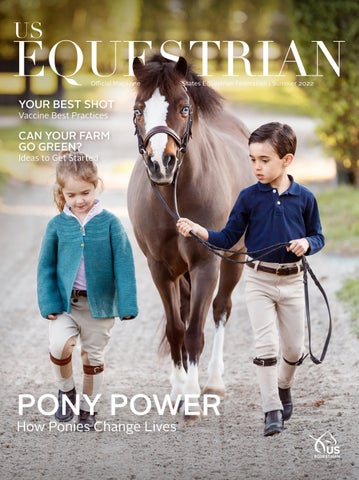
PONY POWER How Ponies Change Lives
PHOTO: SHELLEY PAULSON PHOTOGRAPHY
80 80 SUMMER SUMMERISSUE ISSUE2022 2022
TAKE YOUR BEST SHOT BY GLENYE CAIN OAKFORD
Dr. Kevin Hankins, Managing Equine Veterinarian at the global animal health company Zoetis, shares his wisdom on equine vaccination best practices that can help you make the most of your horse’s vaccines.
What equine vaccines are musthaves? What role does your horse’s location play in vaccination? How can drought contribute to a mosquito-borne disease like West Nile? And why can giving a five-in-one vaccine be better than five individual injections? Understanding these factors and making a plan with your veterinarian are key to creating an effective vaccination plan for your equine operation. And before you compete, remember to consult the United States Equestrian Federation’s Equine Vaccination Rule in the General Rules section of the Rulebook. We sat down with Dr. Kevin Hankins of Zoetis to get his perspective—as both an equine veterinarian and a horse owner—on creating an equine vaccine regimen that maximizes a horse’s protection. When he’s not carrying out his duties for Zoetis and running his own practice in Olsburg, Kan., Hankins can be found riding Western pleasure or roping off of one of his Quarter Horses. Let’s start with the fundamentals: what are “core vaccines” and which vaccines are they?
The core vaccines contain the antigens that every horse needs to be vaccinated for every year, no matter their age or what they do or where they are located. Those vaccines are for Eastern and
Western equine encephalitis, tetanus, West Nile virus, and rabies. Those five are core because those five diseases either have basically no treatment and a high mortality rate or, as with rabies, zoonotic potential, meaning it can spread from an animal to a human. There are also risk-based vaccines that veterinarians might recommend. What are those, and how can people find out what risk-based vaccine their particular horse needs? The most common risk-based vaccines are for equine influenza and equine herpesvirus-1 and -4. Those three antigens are responsible for a large majority of the respiratory disease that’s out there. The next most common is probably strangles, or Streptococcus equi subspecies equi. That one is something that should be really discussed with your veterinarian. It’s not a standard vaccine that you’d recommend for every horse. It depends on their risk or the facility that they’re in and whether they’ve had a previous strangles problem. With strangles, in addition to potentially vaccinating for it, you also do a lot with biosecurity to try to prevent it. The American Association of Equine Practitioners provides a list of risk-based vaccines that includes those as well as anthrax, botulism, equine viral arteritis, rotaviral diarrhea, Potomac horse fever, snake bite, and Venezuelan equine encephalomyelitis. USEQUESTRIAN.ORG 81
Those are things that the horse owner really needs to sit down with their veterinarian and determine whether their horse is at risk for those diseases.
Above: Having your horse vaccinated two weeks before they travel will allow time for their immune response to offer good protection. Right: Dr. Kevin Hankins is managing equine veterinarian at the global animal health company Zoetis and also owns Quarter Horses.
Absolutely, because you do get diseases like Potomac horse fever, which is more common on the East Coast than on the West Coast. This brings up a good point with one of the core diseases, too: West Nile. The five core diseases require vaccinations once a year, but in some areas of the country, especially in the South where you get almost a year-round mosquito population, it’s probably advisable to give a West Nile booster. So you might actually give West Nile twice a year in southern Florida, Louisiana, places that might be prone to or locations geographically that might be having West Nile incidents that year. That can apply here in Kansas, as well. There are times here in the Midwest when West Nile really surges and we actually recommend a second West Nile booster. What’s really interesting is that we see some of the highest West Nile instances during drought conditions. When West Nile first hit, and when it got really bad in the Midwest, we were under a large drought condition. What happens is that the mosquitoes reproduce and the virus replicates at about 86 degrees ambient temperature. So what happens when you have drought conditions? You can have small pools of water that feed mosquito reproduction more than usual. They lead to great breeding grounds for the virus and the mosquitoes both. So you’ll have a drought, it’ll help replicate the mosquitoes and the virus, and then when you get a big rain after that, it distributes those infected mosquitoes to a larger area. So, typically, any year that we have big West Nile outbreaks they are usually preceded by drought conditions. Horse owners should work with their veterinarians and be aware of things that are going on in their area, because the geography where they are could really change what they would vaccinate for that year and maybe even the next year or so. So it’s important to communicate closely with your veterinarian about each horse’s circumstances and vaccination needs. The relationship between the horse owner and the veterinarian is really important. The horse owner can sit down with their veterinarian and say, “Okay, what does my horse do for a living?
82 SUMMER ISSUE 2022
PHOTOS: SHELLEY PAULSON PHOTOGRAPHY, COURTESY DR. KEVIN HANKINS
Should an owner consider their horse’s geographic location when they talk to their vet about risk-based vaccines?
“THE BIG TAKE-HOME MESSAGE IS Where’s it going to travel? What’s going on geographically in my area? What are some of the disease concerns? What am I going to be doing with my horse in the future? Is my mare going to become a broodmare?” There are so many things that can come into play. It’s important for the veterinarian and the horse owner to sit down together and not only make a plan for right now, but also look down the road a little to see what that horse owner is going to be doing with their horse in the future. You want to make sure that the horse is receiving the vaccines it’s going to need and also that it’s not getting over-vaccinated. I know a lot of people like to go to Dr. Google, and some horse owners might think, “Oh my God, I need to vaccinate for everything.” But over-vaccinating can be just as bad as under-vaccinating. So having that guidance from your veterinarian is important. It’s also really important to have your veterinarian vaccinate that horse instead of trying to do it yourself. If you aren’t a veterinarian and you vaccinate your horse, in the case of rabies, it can cause your horse to be considered to be unvaccinated. With rabies—and this is one disease that really comes into play in all 50 states in the U.S.—if a horse owner who isn’t a veterinarian acquires a rabies vaccine on their own and vaccinates their horse for rabies, that horse is considered unvaccinated for that disease. That really comes into play in case of exposure. Most states require unvaccinated horses that have been exposed to rabies or bitten by a rabid animal to go into six months quarantine or to be euthanized. So even if a horse owner has a videotape of themselves getting that vaccine and vaccinating their horse for rabies, the states are going to consider it non-vaccinated.
TO WORK WITH THEIR VETERINARIAN TO SET UP A PROGRAM FOR THEIR HORSES.”
Dr. Kevin Hankins Another good reason to have your veterinarian handle vaccination is the chain of custody. You can be assured that those vaccines have been handled adequately coming from the manufacturer to the veterinarian to the horse owner. You can be assured it’s been appropriately refrigerated, kept out of direct sunlight, and administered appropriately. That doesn’t always happen when a horse owner acquires a vaccine from other sources. You kind of lose that custody chain. Here’s another thing that I really like, too, something Zoetis offers that others don’t: if a horse owner has their licensed veterinarian vaccinate their horse with the Zoetis vaccines, they’re covered up to $5,000 dollars per horse for diagnostics and treatment and farm call if that horse becomes ill. For instance, if your licensed veterinarian administered
Fluvac Innovator® 300 days ago and your horse comes down with a snotty nose, Zoetis will pay to have that veterinarian come out, diagnose it, do all the testing, and pay for the farm call. Even if it doesn’t come up as equine influenza, they still pay. It doesn’t cost the horse owner anything. But the big thing is, it keeps those vaccines in the hands of a licensed veterinarian. And it gives that horse owner peace of mind that, “Hey, if something happens, I’ve got a free insurance policy, where Zoetis will cover all this, including treatment, up to $5,000 per horse per year.” The owner doesn’t have to do anything except have their veterinarian vaccinate and keep good records. What are the advantages of a single, all-in-one core vaccination like Core EQ InnovatorTM to vaccinate against all five diseases covered by the core vaccines? Having a single injection for the core vaccines raises compliance, for one thing, especially for the rabies vaccine—because, believe it or not, there’s not a very high percentage of rabies vaccination in horses. That’s surprising, considering the zoonotic potential of rabies and the fact that people exposed to rabies will have to go through the post-exposure series of injections. In addition to increasing vaccine compliance, it also makes it very easy and puts it in a one-milliliter (or 1 cc) dose. So for the veterinarian to go out in the spring and be able to give a single onemilliliter dose vaccine to cover all five core vaccines, that makes it very convenient for the veterinarian and the horse owner, too. The more times you inject a horse, the higher the chance of a reaction. So having USEQUESTRIAN.ORG 83
“OVERVACCINATING CAN BE JUST AS BAD AS
Is there any advantage in terms of not interrupting a training or competition schedule? And is it wise to rest a horse after any vaccination?
UNDER-
Yes, because in general you do want to rest a horse after vaccination. Typically, I recommend that you rest the horse the day after vaccination, just because I want the immune system to be able to focus on those antigens that we just gave the horse. We want to keep interruptions to training to a minimum, so I think giving them a day off is important while they mount an immune response. If you vaccinate them and then put them right back out into work, or, worse yet, put them right in a trailer and haul them someplace, the immune response to that vaccine is not going to be adequate yet and you’re not going to protect your horse very well. So if they’re going into competition or if they’re going someplace for a show, I think the general recommendation is that you vaccinate them at least two weeks before they travel. That way they mount a proper immune response. The nice thing about Core EQ Innovator and Fluvac InnovatorTM is that you can give the core vaccine along with the Fluvac equine influenza/equine rhinopneumonitis vaccine on the same day. Even though there’s basically seven antigens going in there, the horse’s immune system responds very well. In fact, they get a little over four times the immune response to the flu antigen when we separate our flu vaccine from the core vaccine. So in early spring, your veterinarian can give your horse the core and the flu/ rhino vaccines. Your horse’s immune 84 SUMMER ISSUE 2022
VACCINATING. HAVING GUIDANCE FROM YOUR VETERINARIAN
IS IMPORTANT.” Dr. Kevin Hankins system can handle that very well. Then give them that day off. For those competition horses, you might come back in the fall and give them a flu/rhino vaccine again if they need it. It’s interesting that a horse can get more protection against equine influenza if you separate that vaccine out from the core vaccines. Can you explain how that works? There’s an effect called antigen interference, and it actually happens in the syringe itself, or in the manufacturing process instead of in the horse, when you blend those antigens together.
Every antigen thrives under a different pH level. When you mix a whole bunch of them together, they try to find an average pH level where they kind of all get along together. The assumption is that maybe that pH level is not very friendly to equine influenza. So taking the flu and the herpesvirus part out of the mix of the core vaccines allows the antigen for equine influenza, which is one of the most important respiratory diseases, to get about four to 4.7 times greater immune response when we measure titer levels than when it’s included with the core diseases. That’s a huge difference, especially for horses that are at stables or in training or traveling. You want to make sure they maximize their immune response, because that correlates with protection. Recent EHV outbreaks have made people even more aware of the importance of vaccinating against equine herpesvirus. Can you explain why it’s important to be aware of and protect a horse against equine influenza, too? With equine influenza, it’s not only the acute phase of the disease, it’s what happens to the lining and the protection of their respiratory tract. What happens with flu is that when a horse inhales the flu virus, it attaches to the lining of their lungs and the respiratory tract, which has all these little finger-like projections called cilia. They’re there to protect and move bad stuff up and out of the lungs. But when the equine influenza virus attaches to the cilia, it starts destroying them. It’s going to take a minimum of three weeks for that horse to regenerate the cilia. When they don’t have that protective cilia, you don’t want those horses in training and shipping anywhere. If they
PHOTOS: SHELLEY PAULSON PHOTOGRAPHY
the single vaccine also brings down the possibility of a reaction, as well.
breathe in bacteria, fungus, anything like that, it can go right to the endothelial lining of the lungs, which cannot be protected by that cilia. So with flu and a performance horse, first you lose that six to eight days where they feel horrible and they’re coughing like crazy. Once that’s over, you’ve lost another minimum of three weeks. And if they get a bad enough case of flu, their oxygen exchange capability will never be the same again. A lot of times these horses that have flu chronically have inflammatory airway disease the rest of their lives. So it’s really important to protect them from flu. What is your take-home message for horse owners and barn managers regarding vaccines for horses? The big take-home message is to work with their veterinarian to set up a program for their horses. It’s good for the horse’s health and for the horse owner’s pocketbook to have a plan in place. I can’t stress enough that it’s so important for the horse owner to develop that relationship. It’s great for them to go off and search Dr. Google and learn as much as they can. But the one who knows their horses is their veterinarian.
Above: Before competing, also remember to consult the United States Equestrian Federation’s Equine Vaccination Rule in the General Rules section of the Rulebook. Left: Talk with your veterinarian not only about your horse’s general health, but also about their competition and travel plans, as well as any future plans like breeding, as part of making a vaccine plan together.
USEQUESTRIAN.ORG 85