Published at 4001 Wing Commander Way, Lexington, Ky 40511 USequestrian.org
AWARDS
The magazine staff is pleased to share these notable accomplishments it has received at the American Horse Publication Media Awards.
2024
First Place: Advertisement
Second Place: Editorial Design Honorable Mention: Editorial Design
2022
Third Place: Cover Design Honorable Mention: Feature Article
2021 Honorable Mention: Editorial Design
2020
First Place: Advertisement
Third Place: Editorial Design Honorable Mention: Editorial Design
2019
Third Place: Cover Design
2018
Overall Publication Winner
First Place: General Excellence
First Place: Editorial Design
Second Place: Feature Article
2017
Second Place: Digtial Publishing
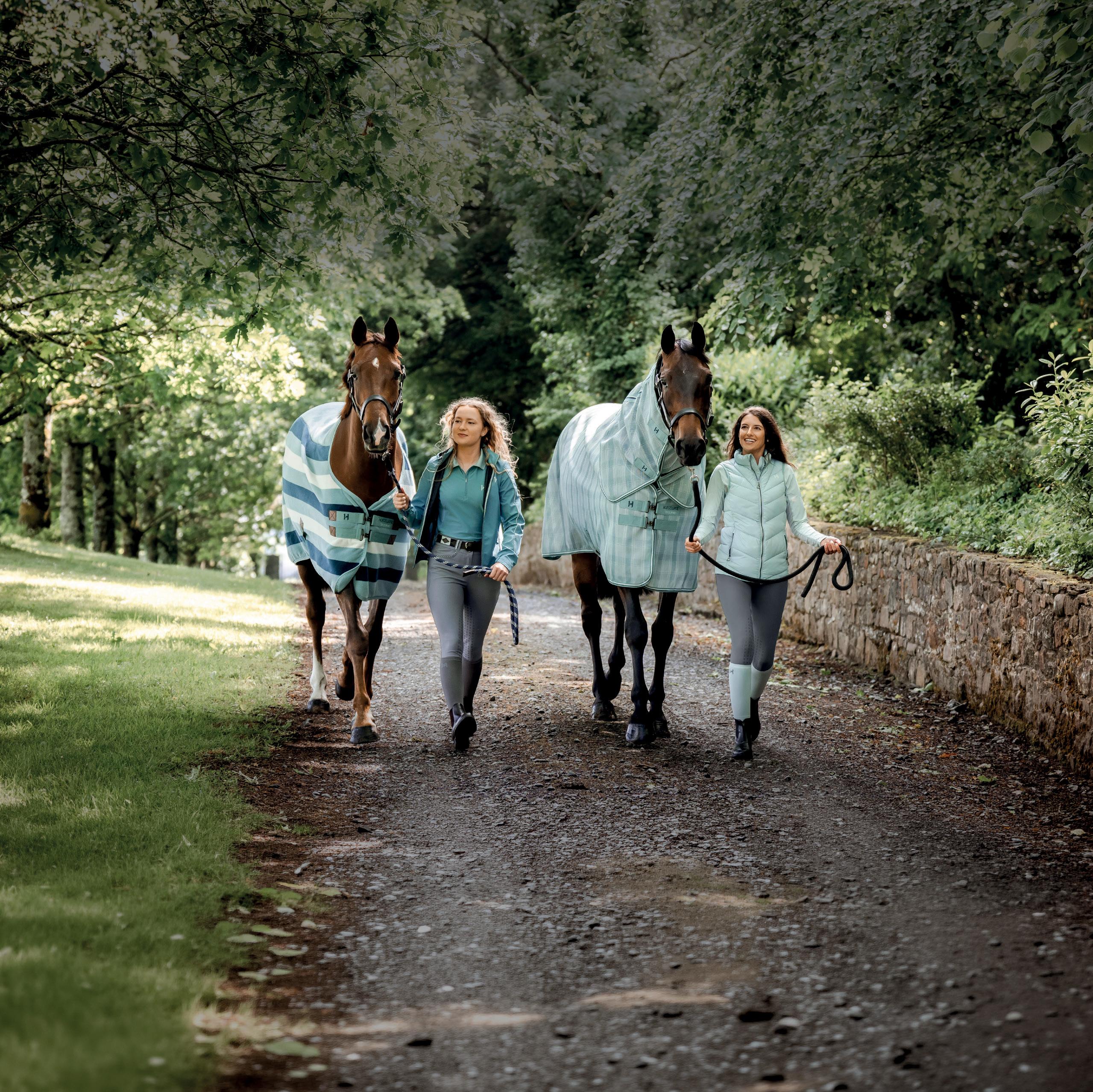
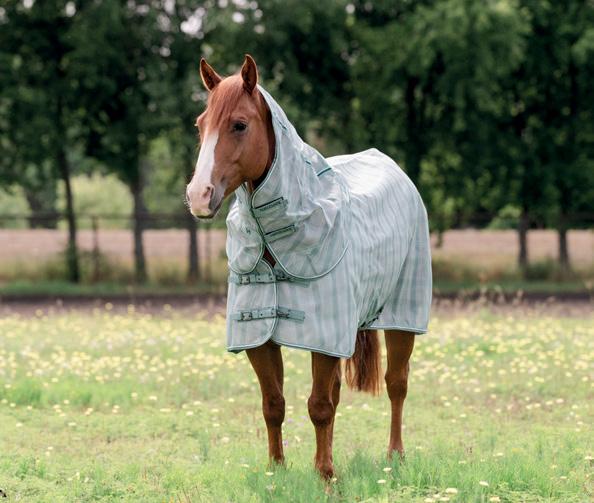
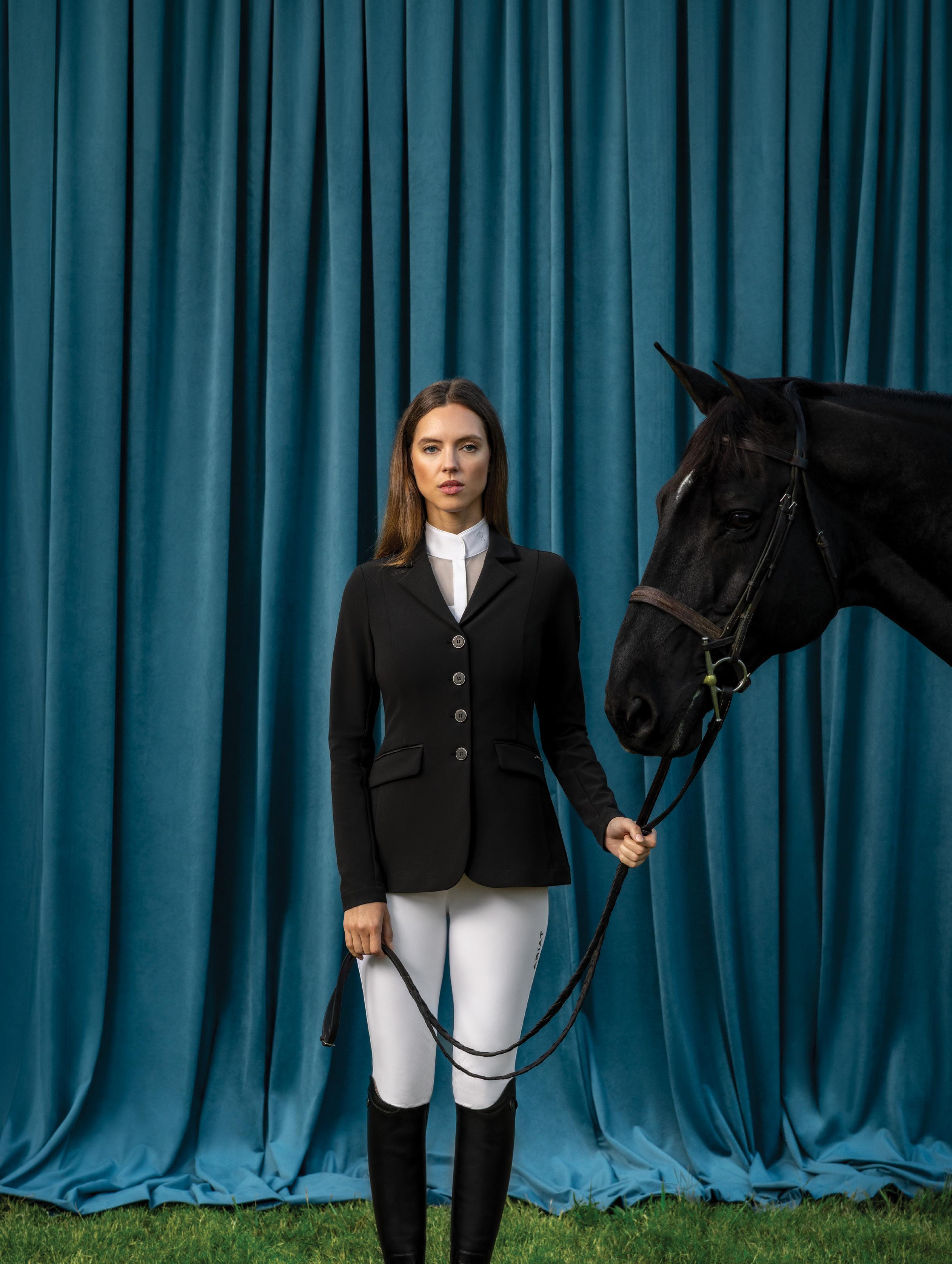
Discover the SS26 Newmarket Collection
PARTNERS
SPONSORS
The only FDA-approved PSGAG for the treatment of equine arthritis proven to:1,2
• Reduce inflammation
• Restore synovial joint lubrication
• Repair joint cartilage
• Reverse the disease process
Adequan® i.m. (polysulfated glycosaminoglycan) is recommended for the intramuscular treatment of non-infectious degenerative and/or traumatic joint dysfunction and associated lameness of the carpal and hock joints in horses. WARNING: Not for use in humans. CAUTION: Federal law restricts this drug to use by or on the order of a of a licensed veterinarian.
BRIEF SUMMARY: Prior to use please consult the product insert, a summary of which follows: CAUTION: Federal law restricts this drug to use by or on the order of a licensed veterinarian. INDICATIONS: Adequan® i.m. is recommended for the intramuscular treatment of non-infectious degenerative and/or traumatic joint dysfunction and associated lameness of the carpal and hock joints in horses. CONTRAINDICATIONS: There are no known contraindications to the use of intramuscular Polysulfated Glycosaminoglycan. WARNINGS: Do not use in horses intended for human consumption. Not for use in humans. Keep this and all medications out of the reach of children. PRECAUTIONS: The safe use of Adequan® i.m. in horses used for breeding purposes, during pregnancy, or in lactating mares has not been evaluated. For customer care, or to obtain product information, visit www.adequan.com. To report an adverse event please contact American Regent, Inc. at 1-888-354-4857 or email pv@americanregent.com.
1. Kim DY, Taylor HW, Moore RM, Paulsen DB, Cho DY. Articular chondrocyte apoptosis in equine osteoarthritis. The Veterinary Journal 2003; 166: 52-57. 2. Burba DJ, Collier MA, DeBault LE, Hanson-Painton O, Thompson HC, Holder CL: In vivo kinetic study on uptake and distribution of intramuscular tritium-labeled polysulfated glycosaminoglycan in equine body fluid compartments and articular cartilage in an osteochondral defect model. J Equine Vet Sci 1993; 13: 696-703.
Sponsor of the Brentina Cup & Junior Dressage Championship adequan.com Official Equine Insurance Sponsor of the US Equestrian Open Series greatamerican.com Official Sponsor of the USEF Eventing Young Rider Championships
Sponsor of US Equestrian uspa.com Official Riding Gloves of US Equestrian
Parner of US Equestrian Safety Awareness evoke-group.com Official Saddle Pad of the U.S. Equestrian Endurance Team Official Bit of U.S. Equestrian
Official MemberPerk Sponsor of US Equestrian choicehotels.com
MemberPerk Sponsor of US Equestrian Toklat.com Official Shock Wave Therapy Supplier of US Equestrian Team Vets pulsevet.com Official Tack Locker of US Equestrian Official MemberPerk Sponsor of US Equestrian flexiequinetack.com
Official Ribbon Supplier of US Equestrian hodgesbadge.com Official Horse Van of US Equestrian theault.us
MemberPerks Sponsor of US Equestrian dollamur.com Official Helmet of US Equestrian
Sponsor of U.S. Equestrian Teams roeckl.com Official Barn Management Software of US Equestrian Official MemberPerk Sponsor of US Equestrian barnmanager.com Official Stall Mat of US Equestrian
The Future Is Bright
Dear USEF Members:
As the days get longer and the sun starts shining more, springtime naturally brings positive feelings of growth and possibility.
It is also a good time to reflect on my favorite event of the year: the US Equestrian Annual Meeting in Louisville, Ky., when I get to listen to riveting educational panels, present countless awards, and most importantly, meet so many of our members. Talking with you all about your achievements, goals, what you appreciate about the Federation, and where you would like to see change is an extremely valuable experience as we strive to serve you better.
The highlights of the Annual Meeting are always the Pegasus Awards Gala and the Horse of the Year Awards Dinner. This year, we celebrated a very special pair — Amanda Delgado and Athenian Lady, who went from being a neglected rescue horse to becoming a western dressage world champion and the 2025 USEF National Horse of the Year.
We also honored another deserving horse when Kiss Me Blue, affectionately known as Chrissy, was crowned the 2025 USEF Heart Horse of the Year for her service at Maryland Therapeutic Riding, where she has changed the lives of so many people.
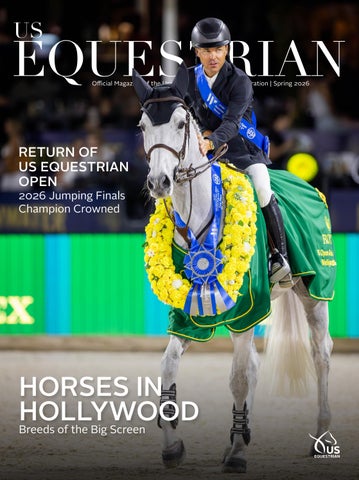
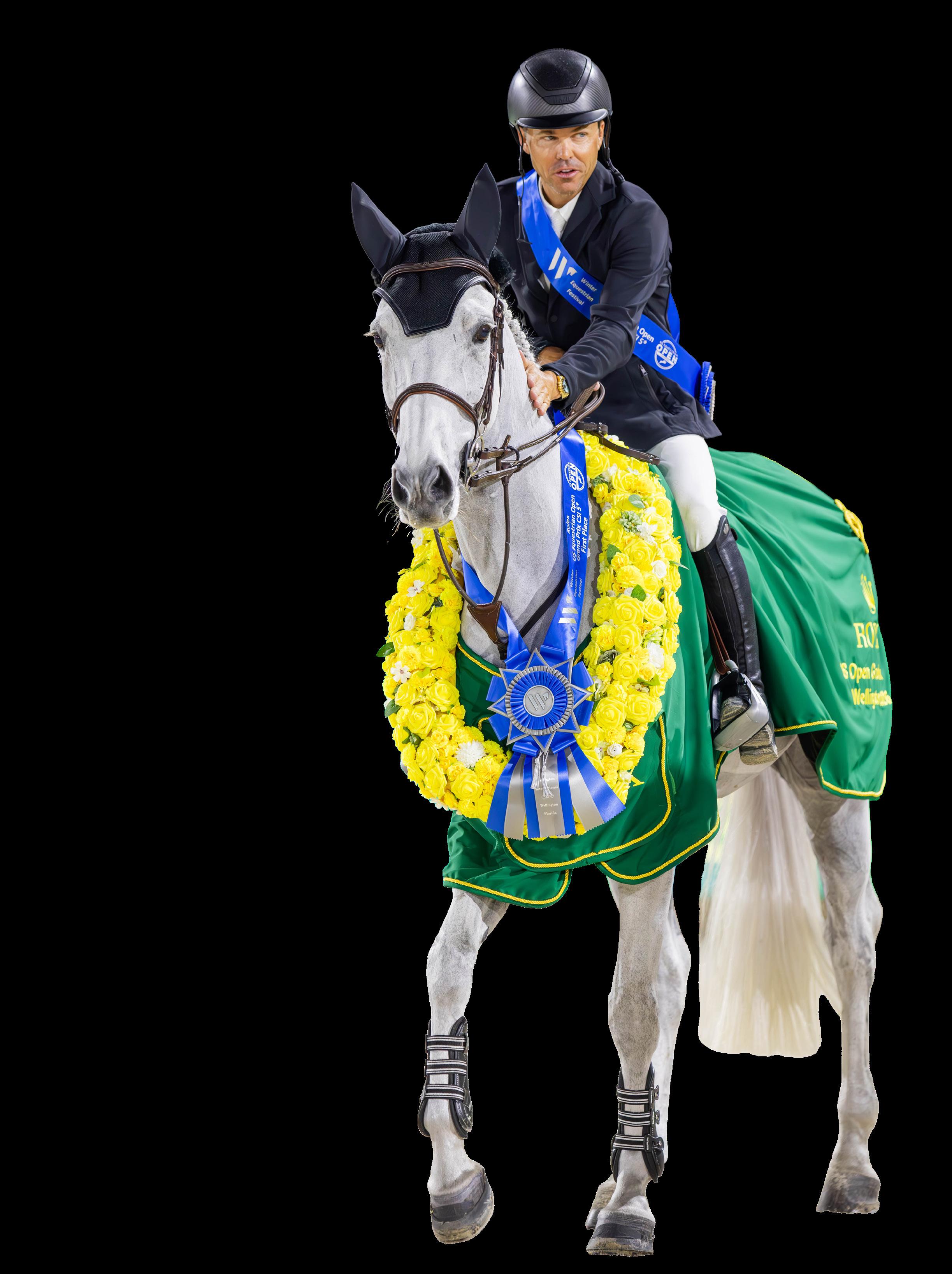
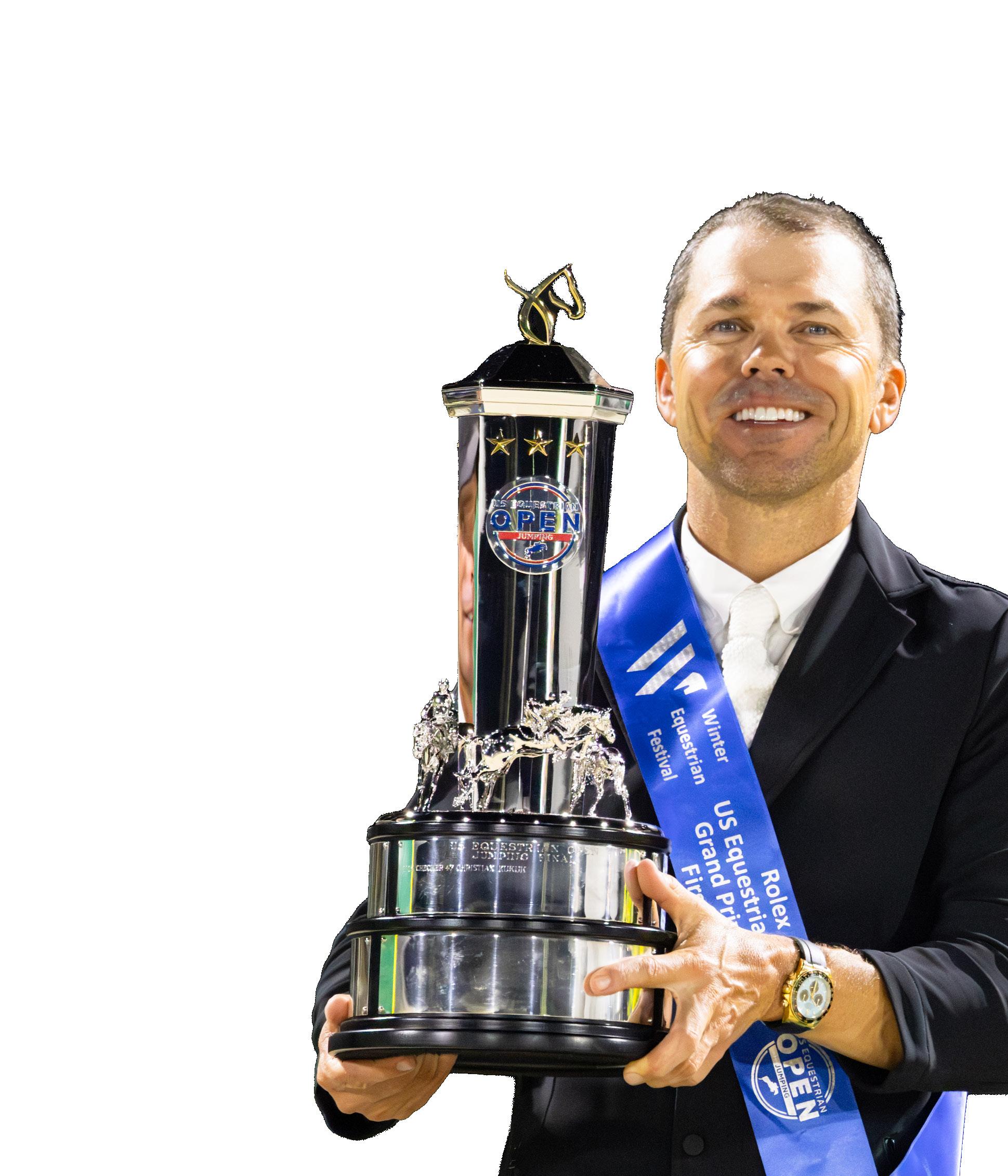
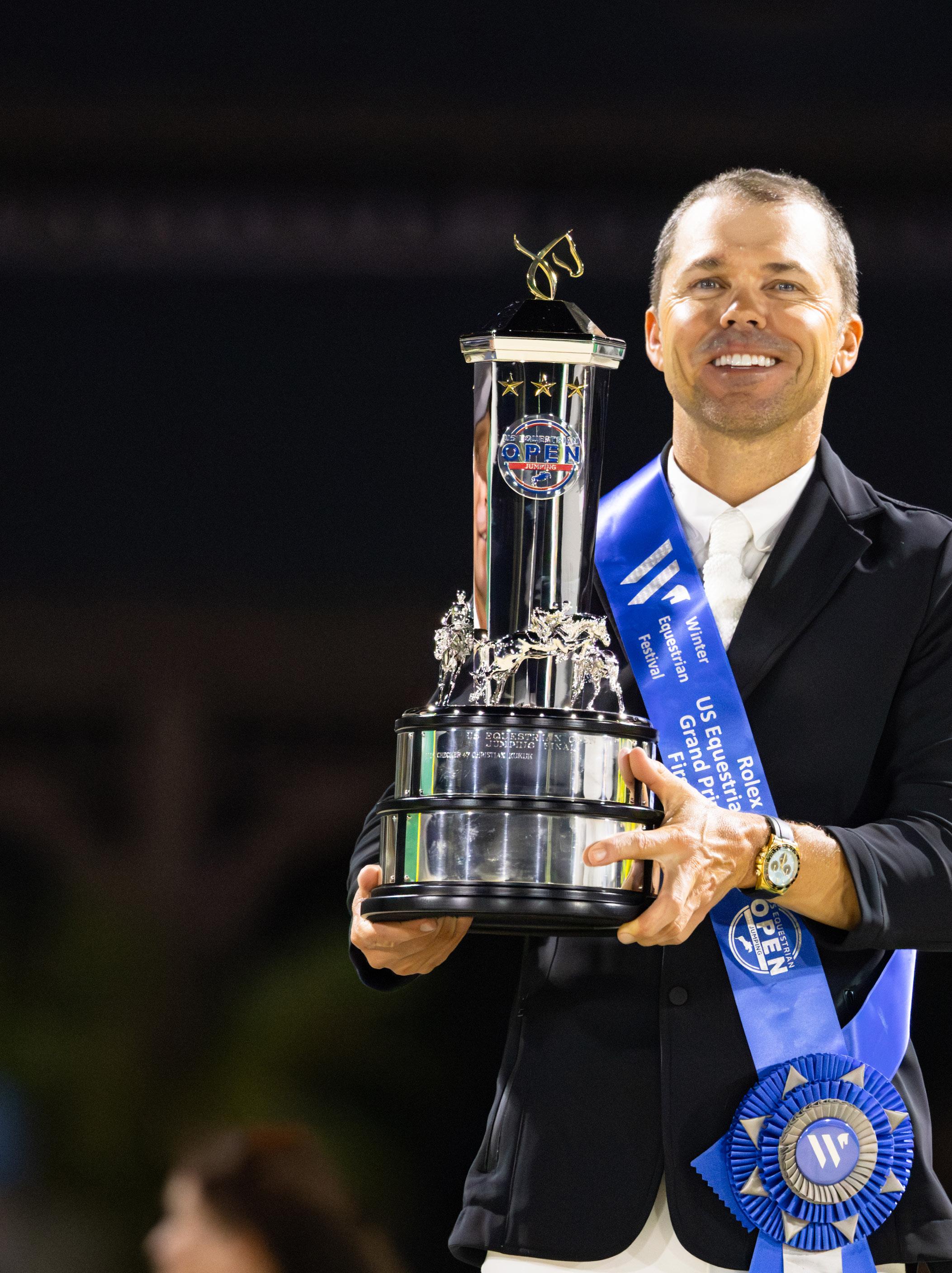
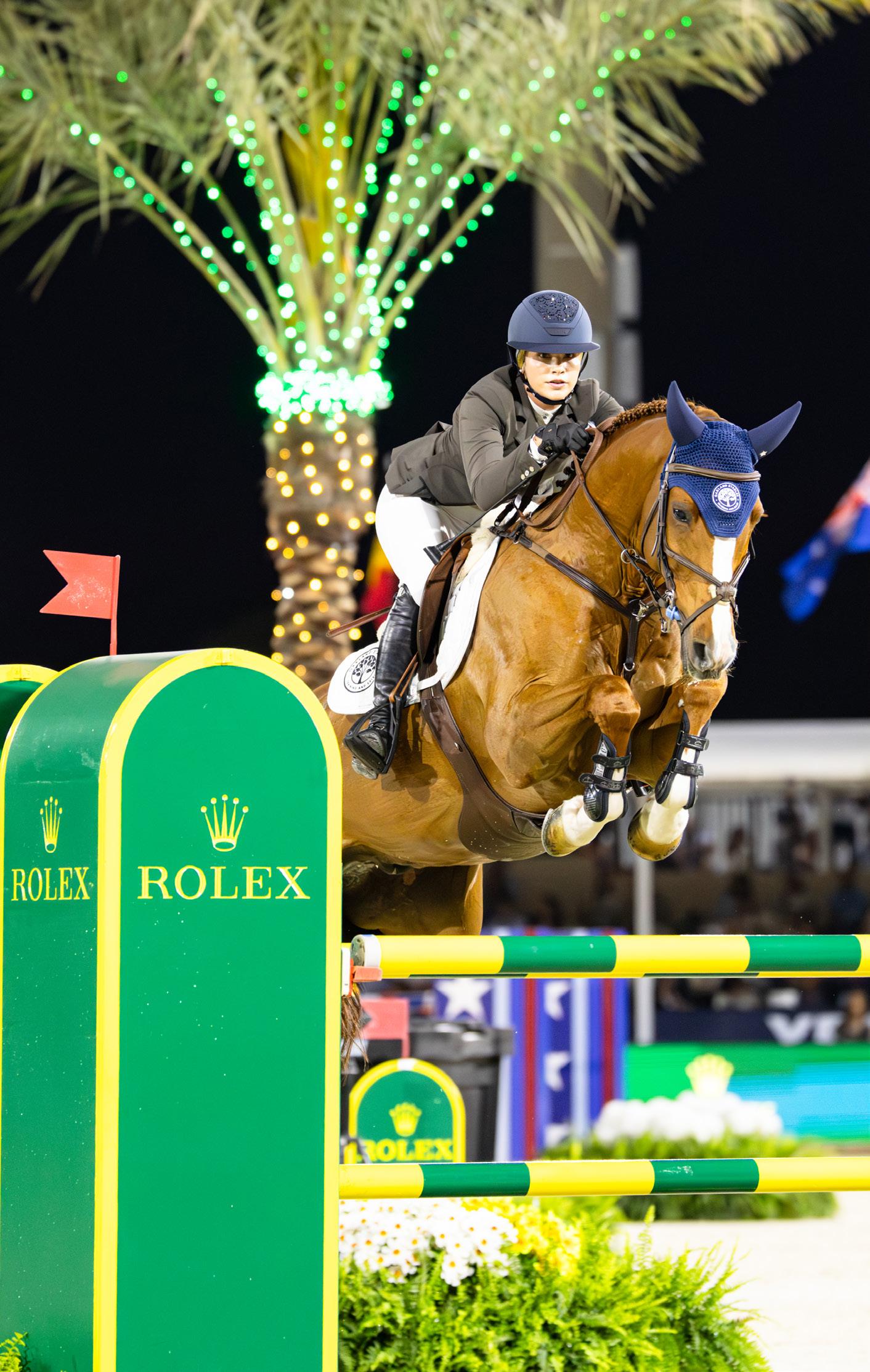
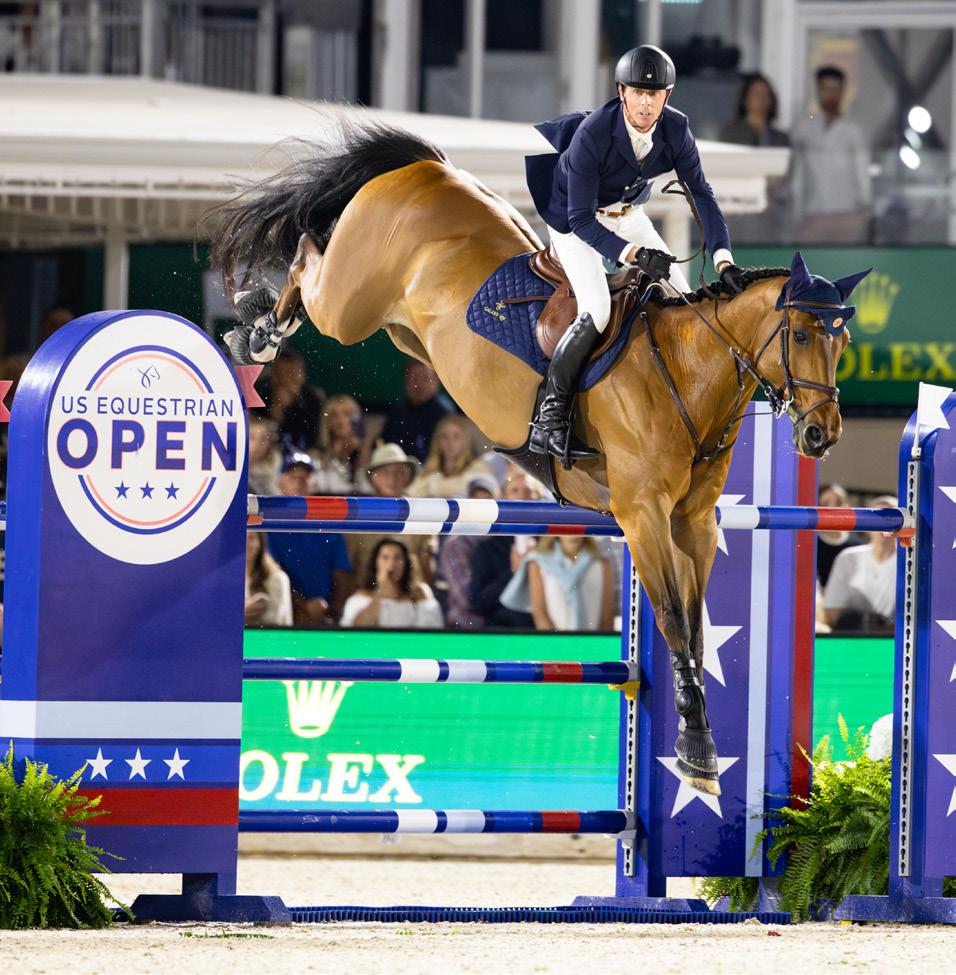
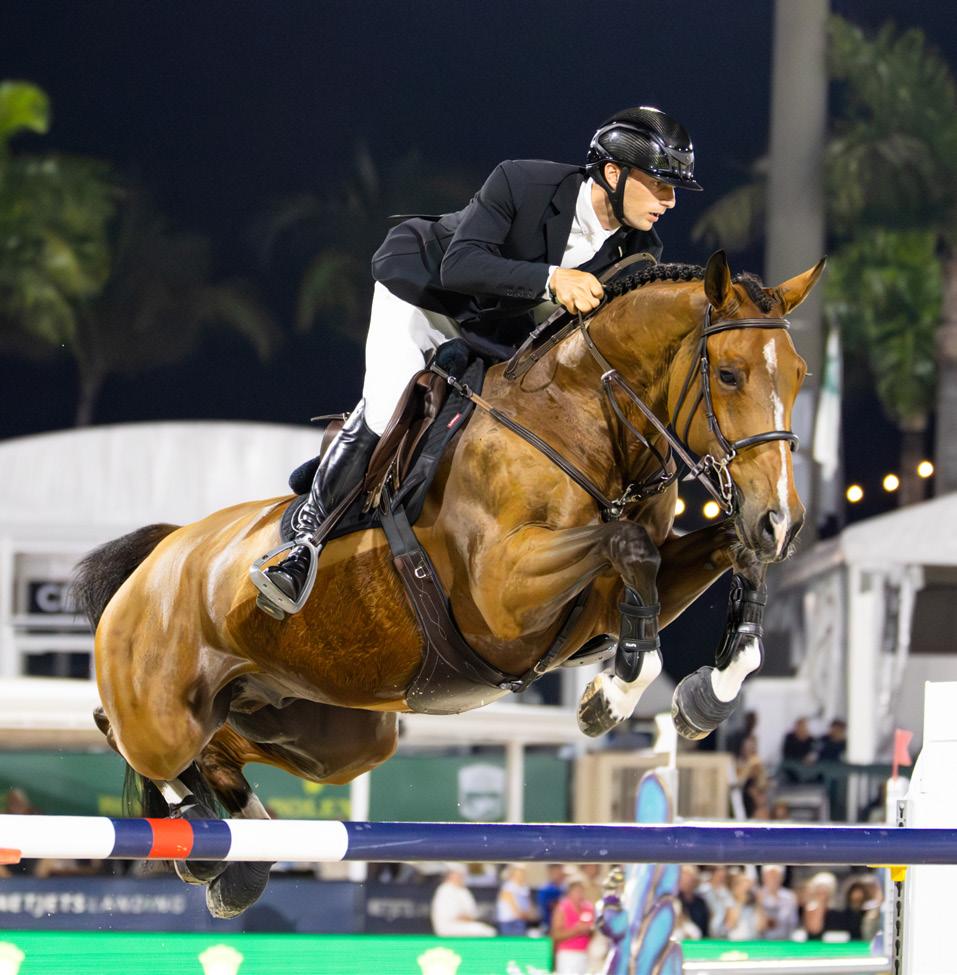
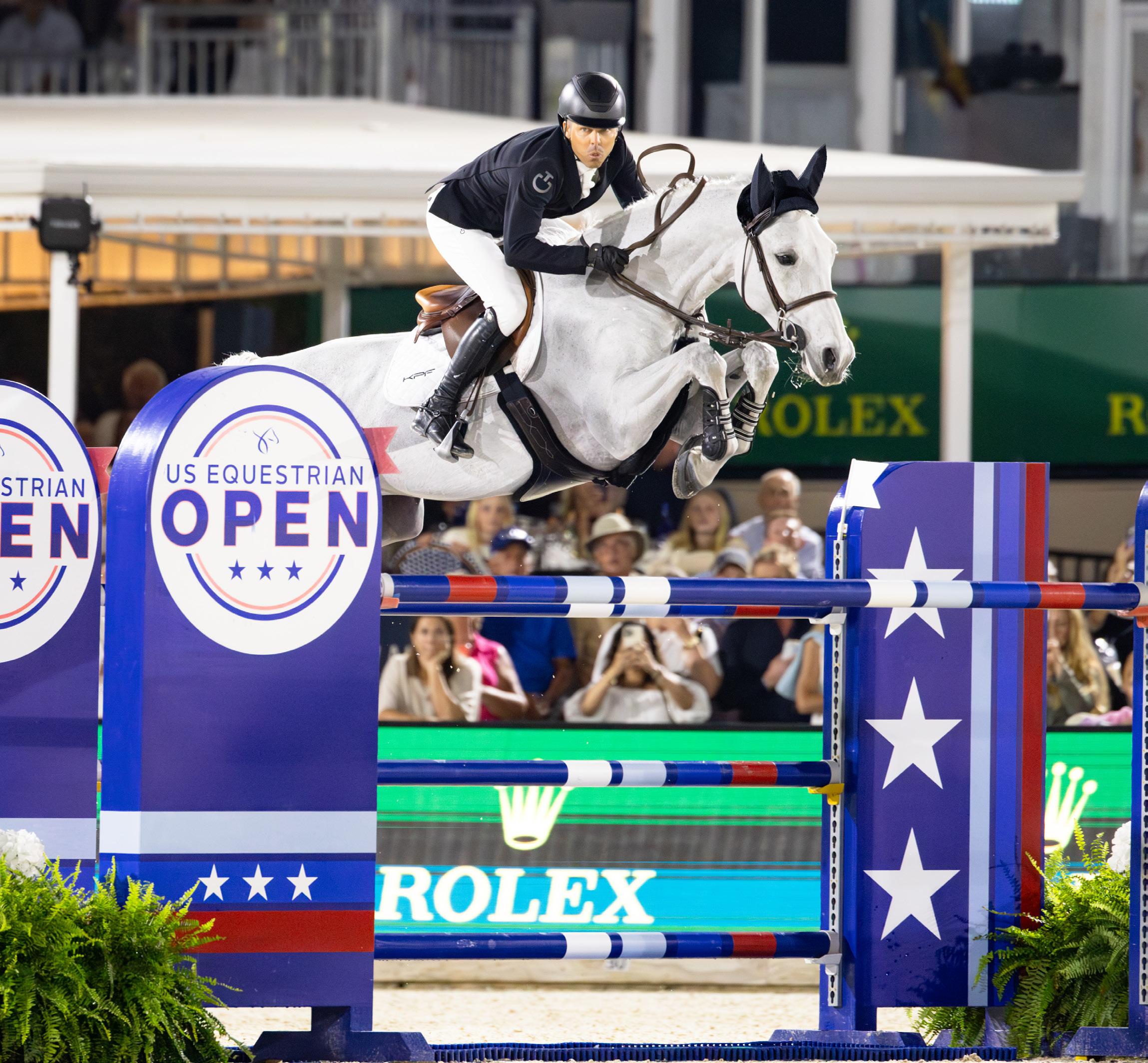
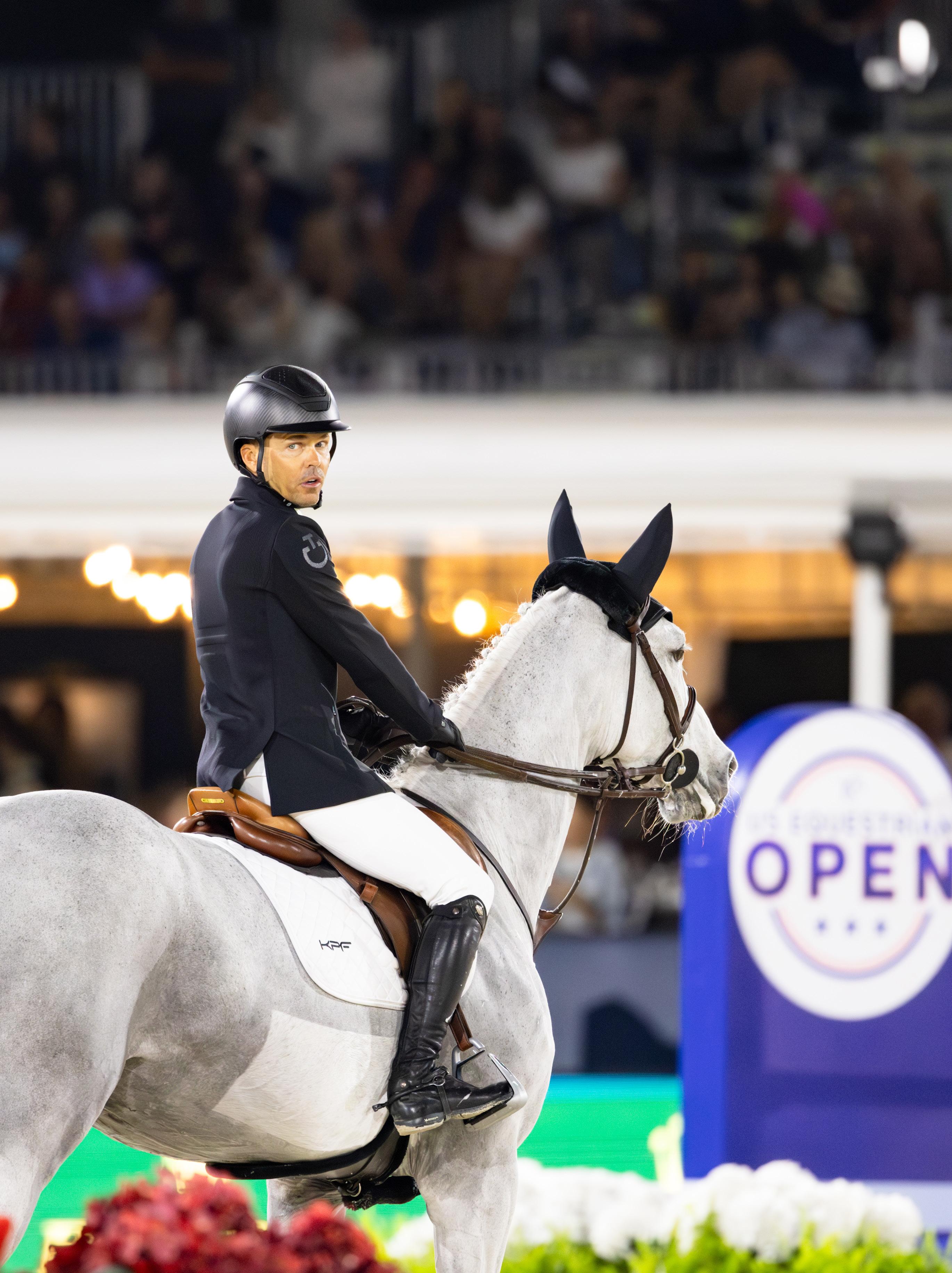
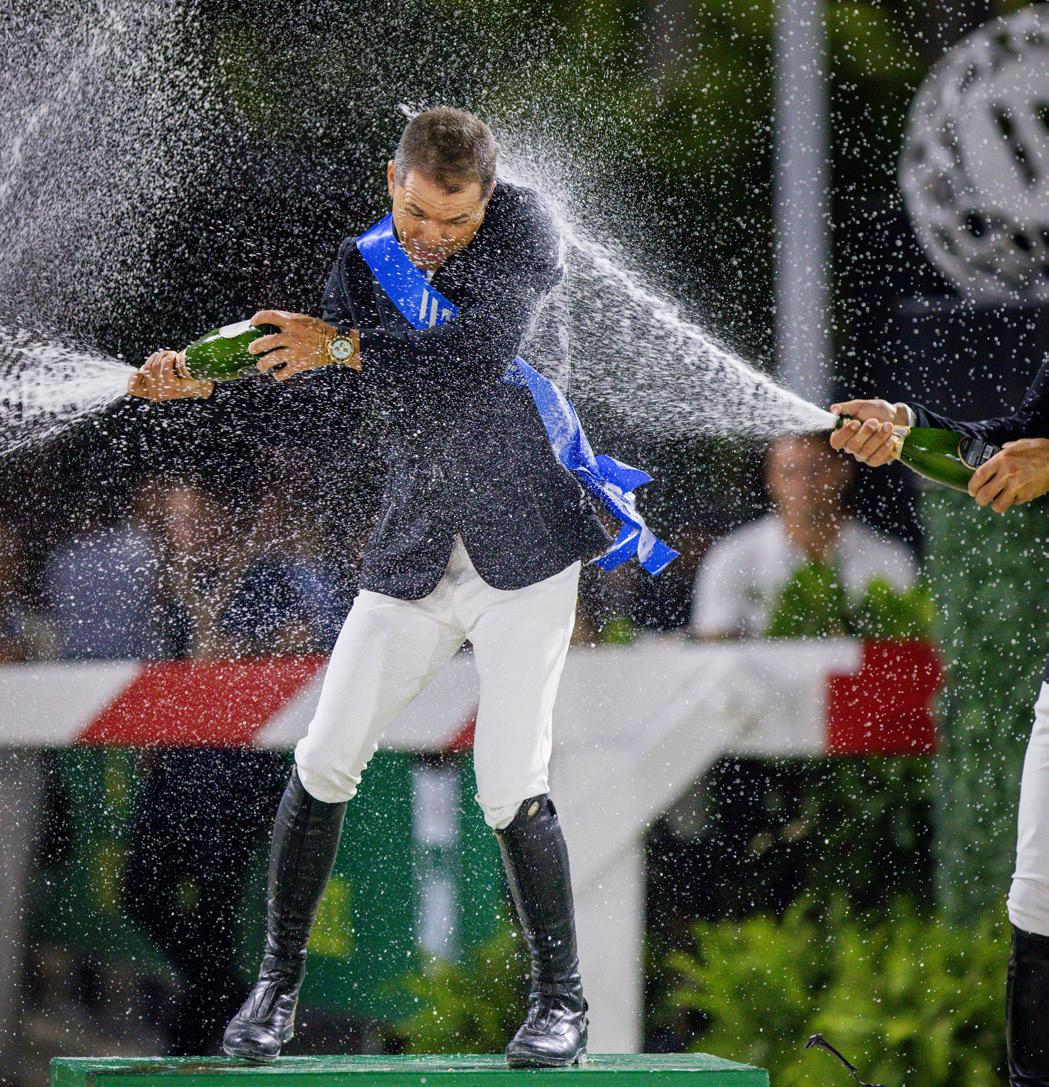
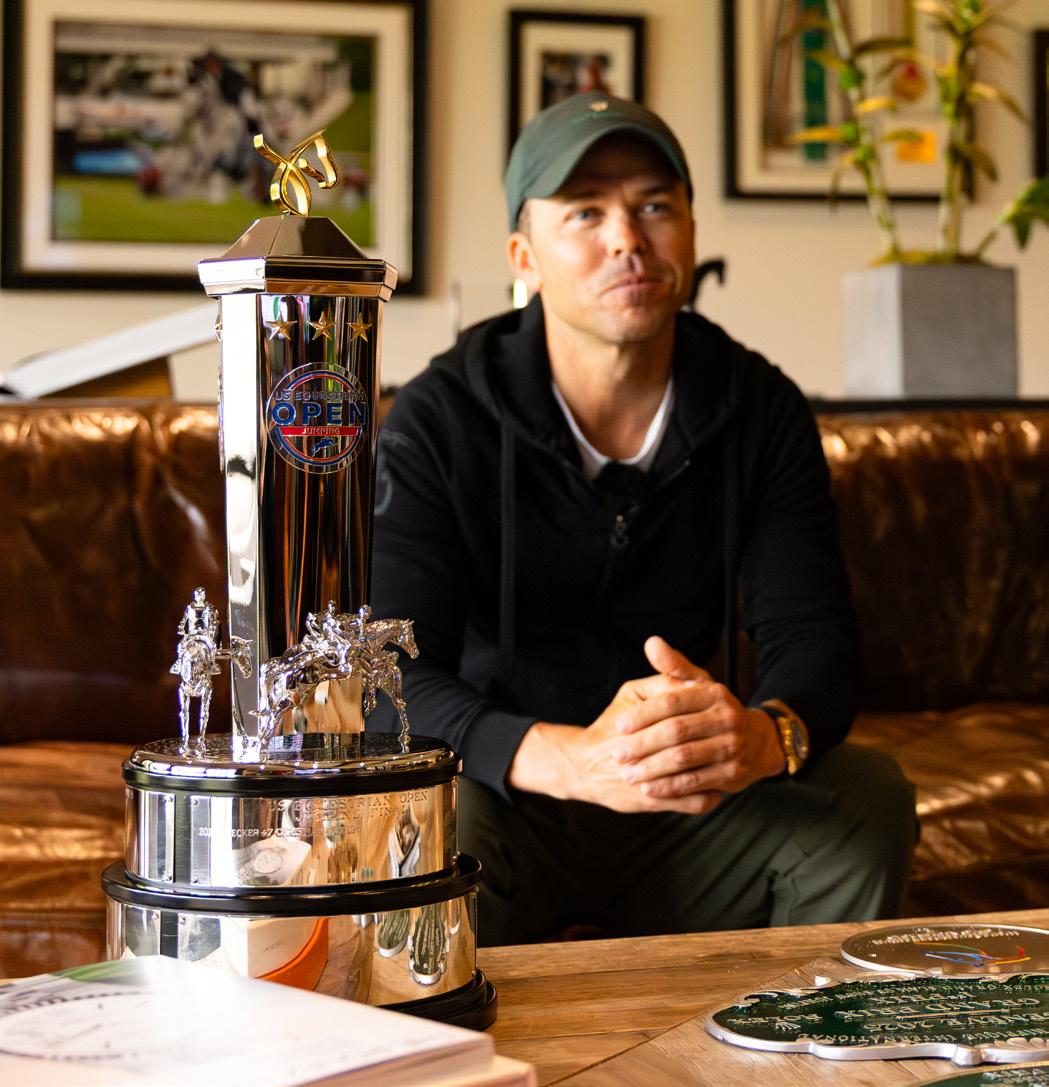
It’s hard to believe it has been a year since the inaugural US Equestrian Open Jumping Final, and we are now celebrating the second winner of this iconic event! Once again, we hosted the best international athletes in the sport at Wellington International for another thrilling showdown. You can read all about competition and the winners in our special feature in this issue. Events like this truly draw in equestrian and non-equestrian viewers alike and elevate our sport as we count down to LA28!
Los Angeles will be the epicenter of equestrian sport during the Olympic Games in two years, but before then, we wanted to recognize some of the famous horses of Hollywood who have helped build the movie industry. Our “Breeds of the Big Screen” feature looks at the many different breeds who have starred in Hollywood’s iconic films, and what traits made them perfect for their roles. Be sure to also check out the I Am US Equestrian profile of actress Selma Blair, as she shares her story on how riding has helped her tackle multiple sclerosis.
Improving horse welfare has been at the forefront of our conversations and our work as the National Governing Body for equestrian sport, and I am excited to announce the launch of a new section of the US Equestrian magazine titled Horses First, which is dedicated to educating members on horse welfare. The first article in this issue focuses on tell-tale signs that our horses are uncomfortable or in distress that are often easy to miss, such as ear movement, eye size, and tail swishing. As guardians of the horse, it is imperative that we all know how to read their behavior.
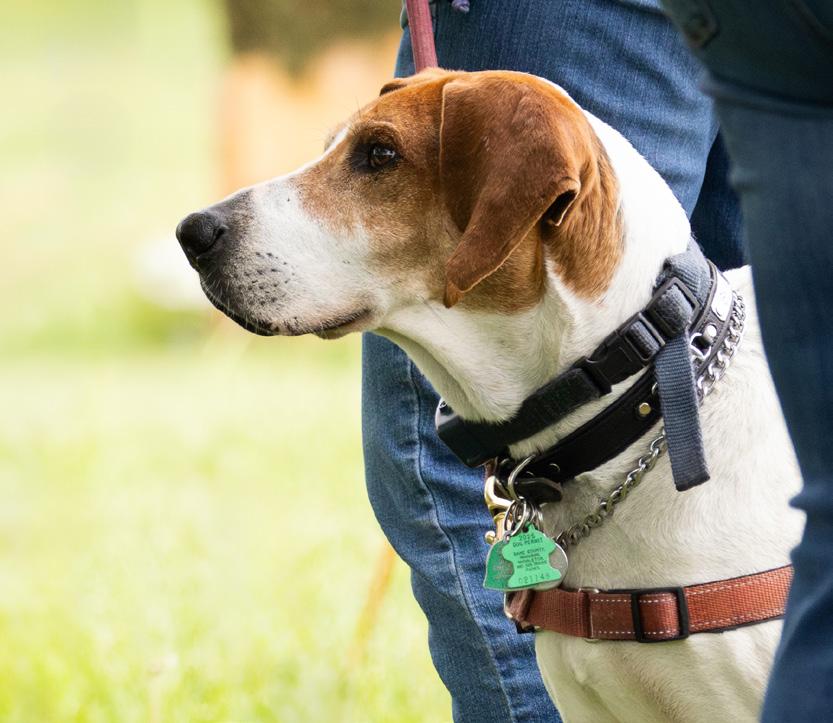
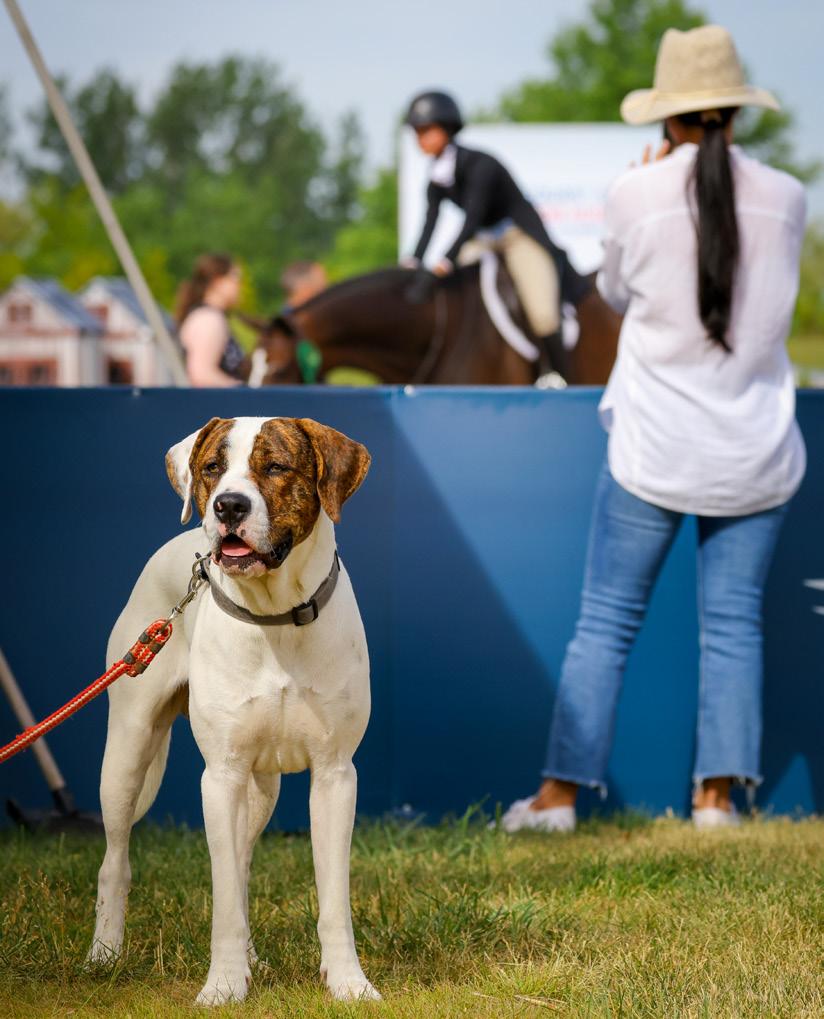
As horse owners, many of us are also dog owners — and while we may want to bring our canines everywhere we go, it is wise to take precautions when at the barn or at shows. Our article on dog safety offers advice on how to create a safe and harmonious environment for dogs, horses, and people.
If you are a parent of teenagers, you understand the pressure surrounding college applications. In this issue, Juniors’ Ring provides expert guidance on how equestrian achievements can strengthen an application and outlines opportunities within US Equestrian for high school students. These young athletes represent the future of our sport, and our goal is to equip them with the tools and resources they need to succeed.
With 2026 marking the Year of the Horse, there is no better time to honor our equine partners and reflect on how we can better serve them. I wish you and your horses success and good fortune in the year ahead, whether that means reaching new competitive goals, building stronger partnerships at home, or simply enjoying more meaningful days together in the saddle.
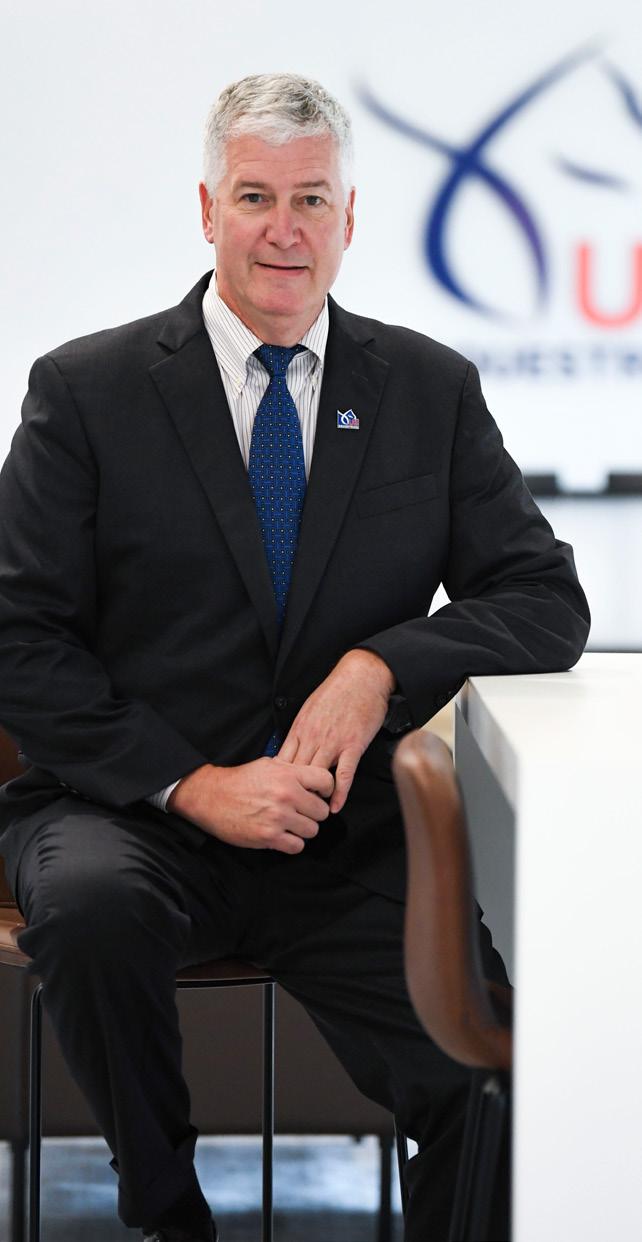
Tom O’Mara President
THE ALLURE COLLECTION INTRODUCING
In & Around the Ring
“People really enjoy seeing the harmony between para horses and riders ... I think we bring a certain awareness to accessibility and safety other sports might not be aware of.”
- Para dressage rider and USEF board member Ellie Brimmer
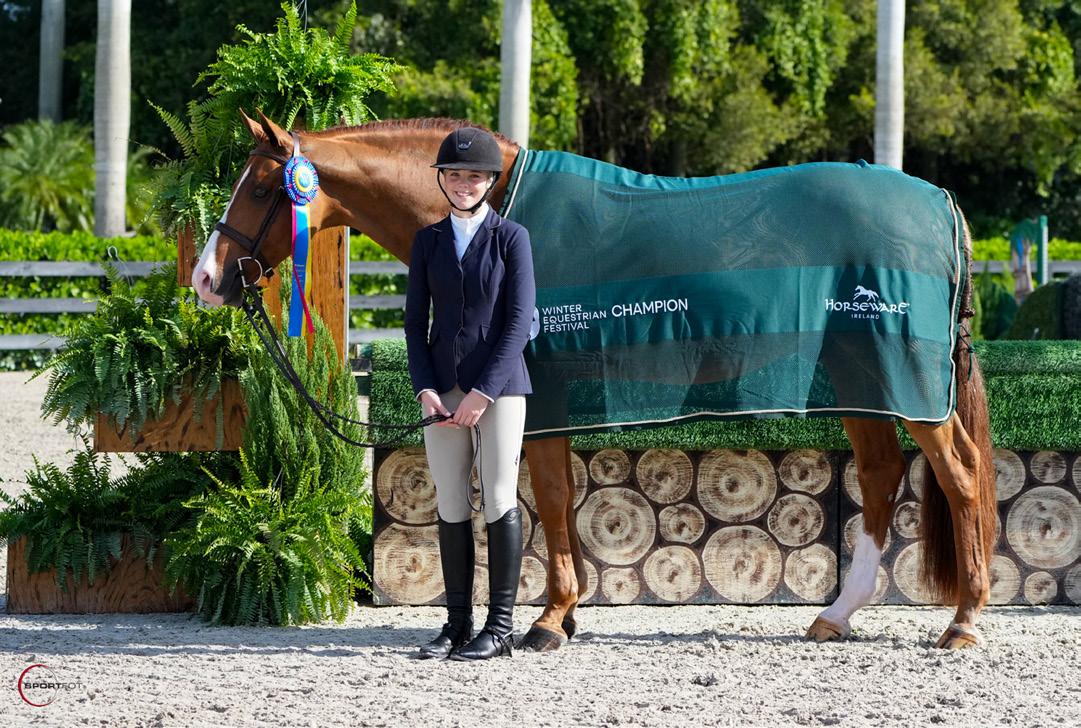
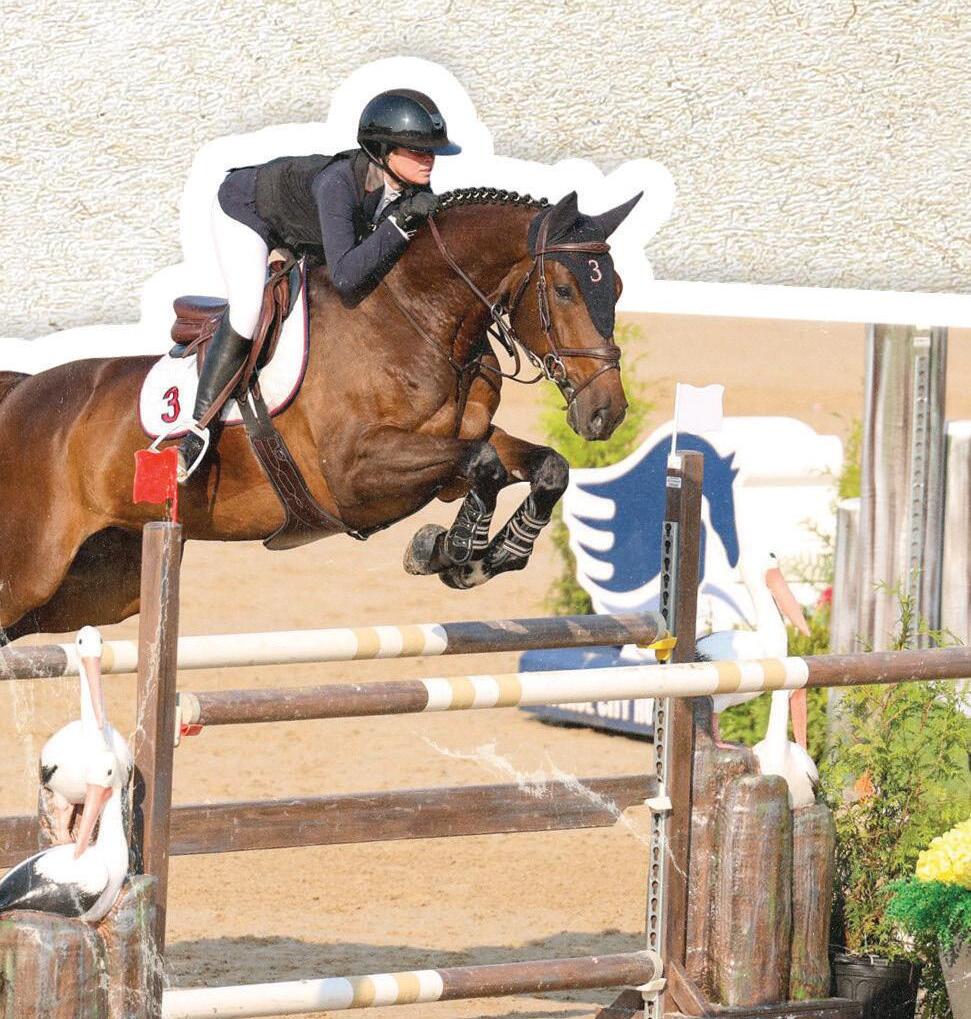
Inset: Ava Barnes and her horse, Unprecedented, started the 2026 Winter Equestrian Festival at Wellington International with a win in the 3’6” Large Junior Hunter 16-17 division.
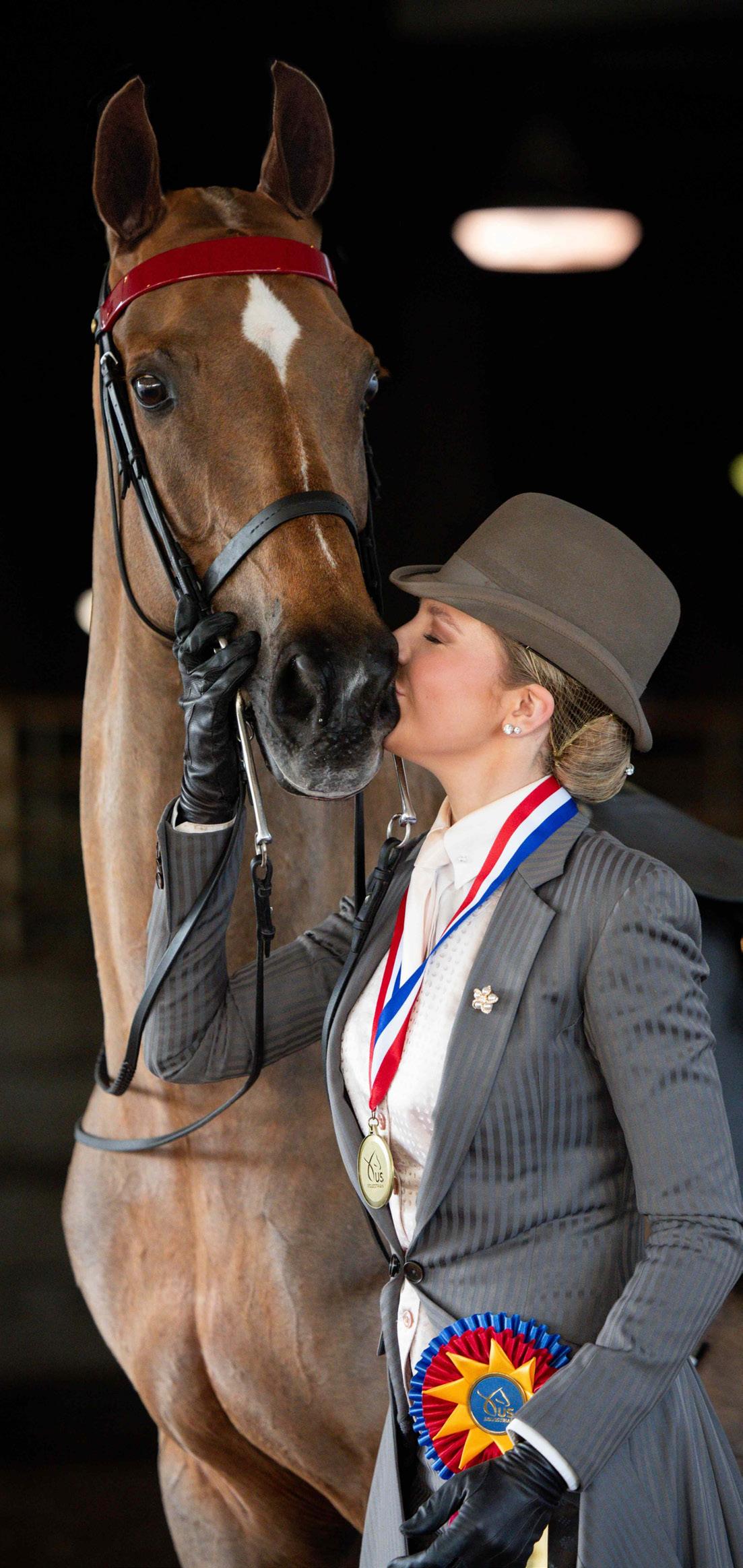
Finley Wood and American Saddlebred mare, Seven Oaks Heir Show, secured the 2025 USEF Saddle Seat Medal National Final champion title after two nearly perfect patterns.
“Iam a big believer [that] everyone has something to share from their personal and professional experiences. I try to learn something from every official, organizer, rider, groom, and volunteer I interact with.
- FEI Eventing Steward Alex Ambelang
“Iwant
to encourage [everyone] to have a look at rescue horses standing in a desolate pasture or in a kill pen. You might be looking at your next partner. You might be looking at a World Champion. You might be looking at the next USEF Horse of the Year.”
- Amanda Delgado, owner of Athenian Lady, the 2025 National Horse of the Year
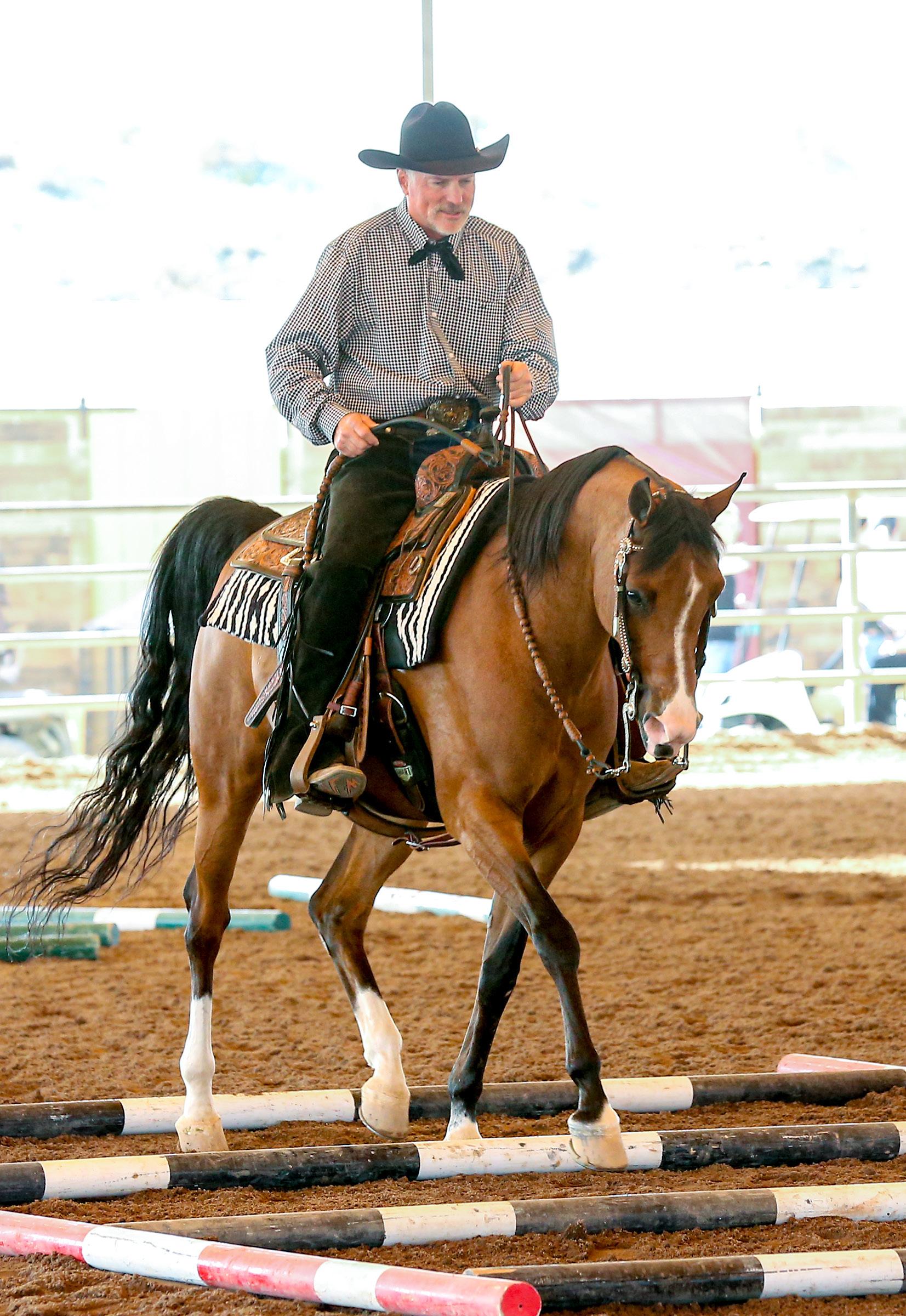
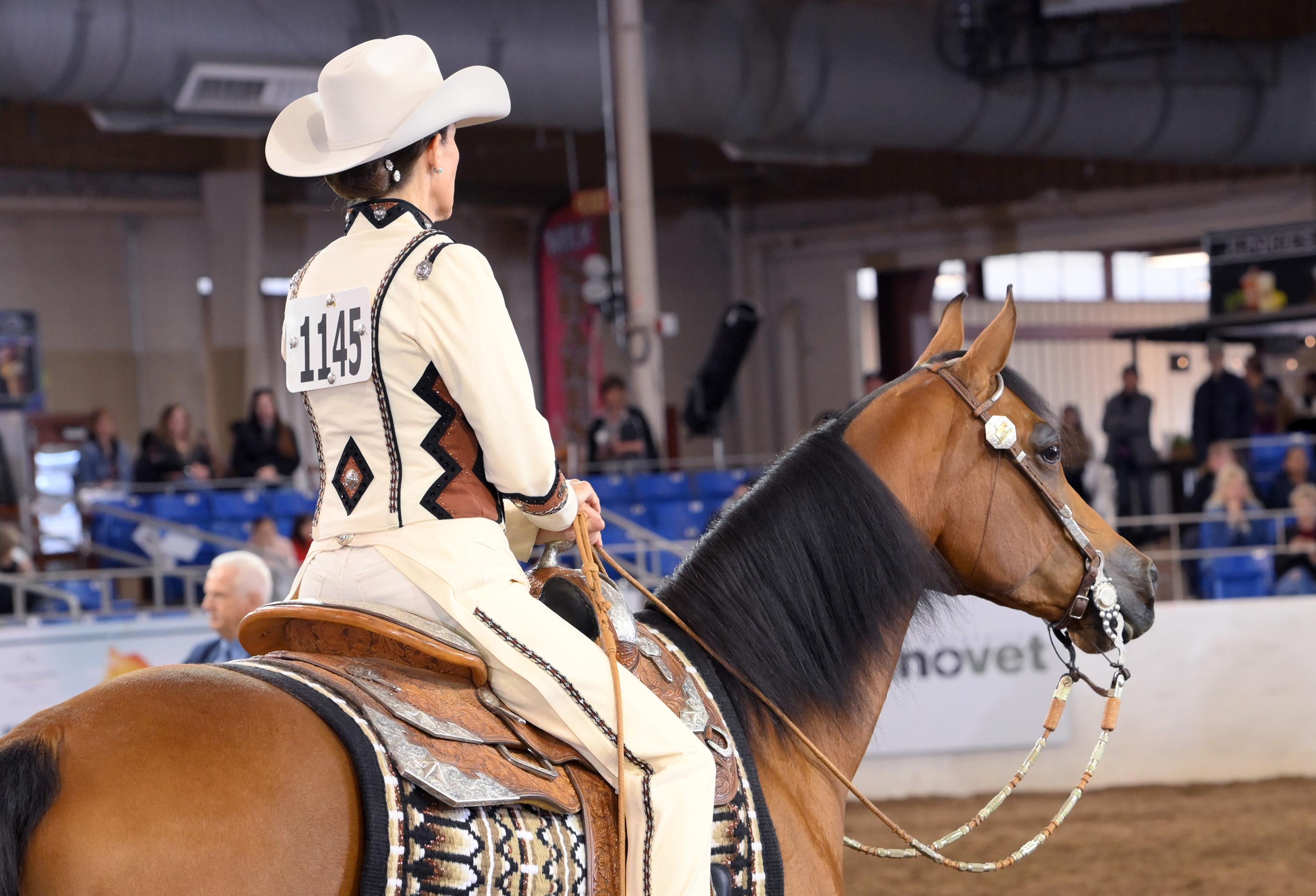
Top: The 2026 Scottsdale Arabian Horse Show, which ran from Feb. 12-22, featured multiple disciplines, including western trail, English pleasure, hunter seat equitation, and English and western dressage.
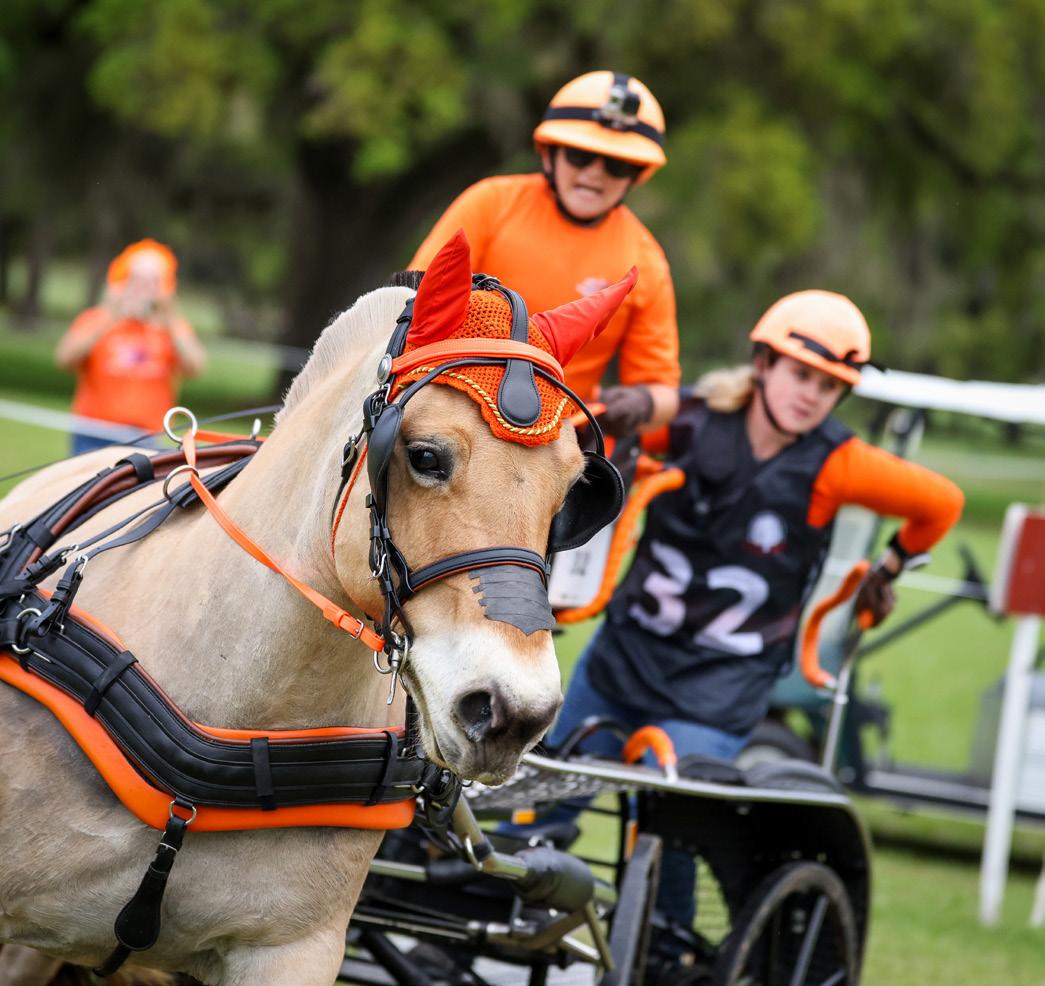
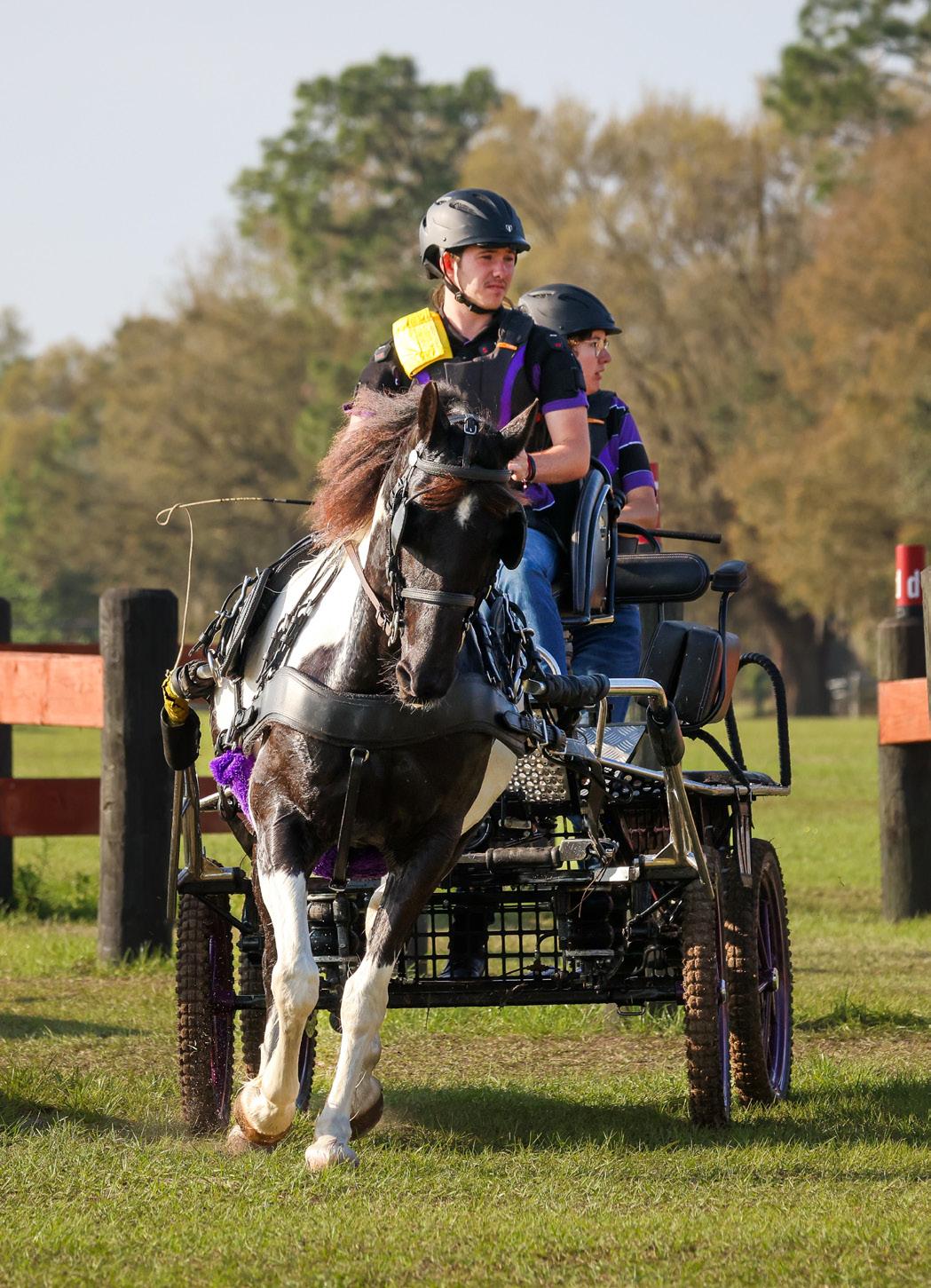
Above: Ben Riesse and Norwegian Fjord mare, Isla, competed in the youth driving division at the 2026 Live Oak International in Ocala, Fla.
“Riding Has Become My Lifeline”
by Selma Blair
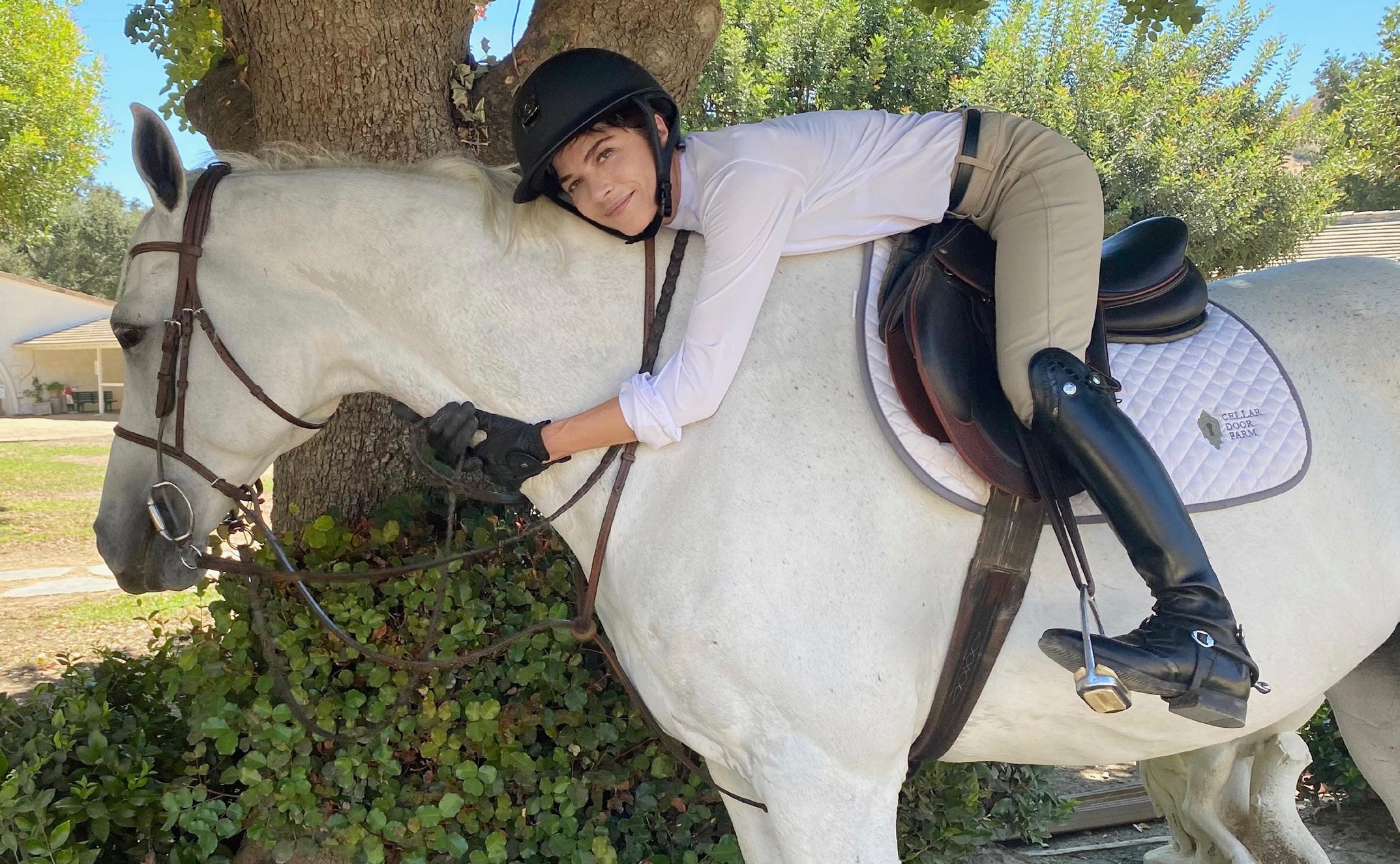
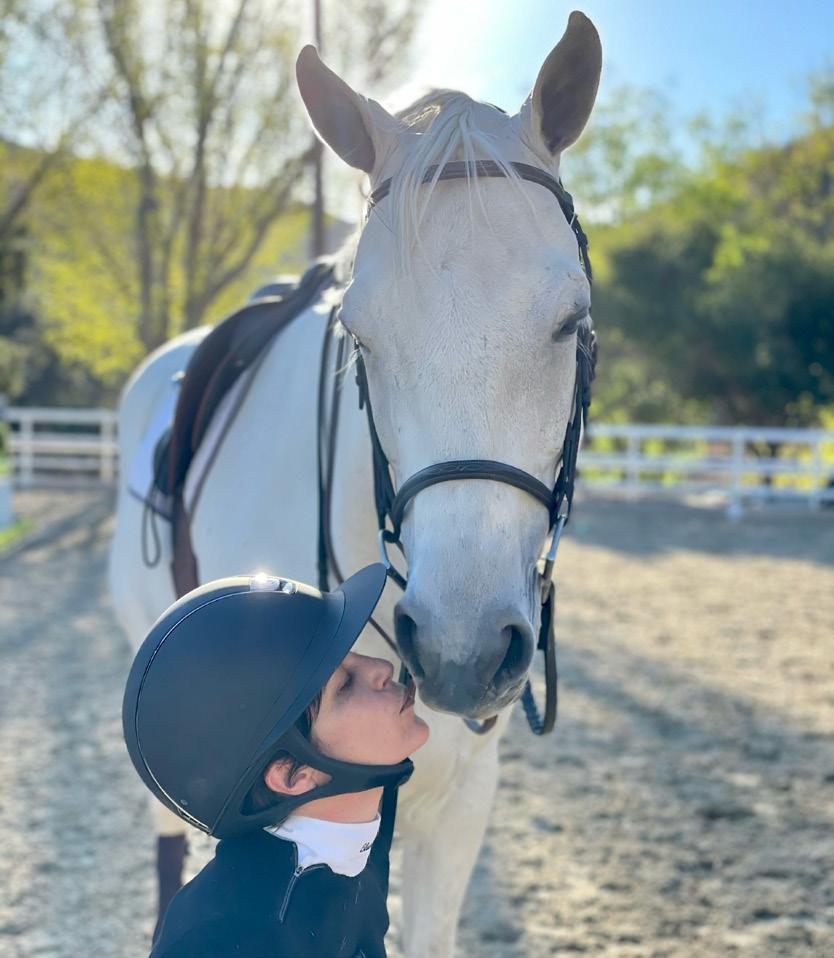
“Cruel Intentions” and “Legally Blonde” actress Selma Blair credits her horse, Mr. Nibbles, with helping her manage life after being diagnosed with multiple sclerosis in 2018.
Riding has become a huge part of my adult life now in ways that I never thought it would be — it has become my lifeline.
My first love of horses was probably typical of many girls. It was sparked by reading “Black Beauty” and “The Black Stallion,” and watching Tatum O’Neal in “International Velvet.”
I didn’t come from a horsey family, although my mother’s taste veered towards equestrian chic. Riding was just something that my sister, Lizzie, and I both wanted to do. I have three sisters, but only one is also a horse lover. We would ride on each other’s backs and pretend one was a horse as we’d canter around the house. We’d even do it in front of the mirror and assess our positions.
My parents both worked, so they didn’t have time to take us to riding lessons. Eventually, my mother gave in and said we’d start lessons when I was six years old, and Lizzie was eight. I was so happy! We went to Haverhill Farms in White Lake, Mich., and I was terrible. My horse, Homer, put his head down and started grazing, and I just didn’t know what to do. Meanwhile, my sister
was off trotting with a dust cloud behind her. My mom said, “Well, that’s it. No lessons for you. Lizzie will go.”
When I started riding again a year later, I remember falling off because the girth was loose and the saddle slipped. I was seven and no one told me to check the girth. It was really such a surprise to find myself on the ground at the same eye level as my horse, but it all turned out fine, and I got back on.
My mother wouldn’t give me lessons after that, so I went to a horseback riding camp, which meant I was around horses all day just playing around. It was heaven.
When I got older, I fell in love with someone who was an avid rider, so he taught me a lot. I competed in everything when I was 17 and 18; I was very serious, but only for a short time. I loved doing hunter/jumpers. I’m not a show jumper. I don’t have that mentality, as I’m more languid.
After I became an actress and moved to California, I had to wait to save up enough money for rent, board, etc., because as an actress, you have to save your pennies.
Years later, I got a rescue horse, but he is now out to pasture. When I bought my current horse, Mr. Nibbles, I said to myself: “I’m going to treat myself to the fancy horse I could never have before.”
I was not yet diagnosed with multiple sclerosis (MS), but I suffered from fatigue and was never feeling well. I was tired, de-
PHOTO: COURTESY OF SELMA BLAIR
Equine laundry care
Effectively dry your gear after riding in the rain or washing, with gentle, heated airflow inside our drying cabinets
EFFICIENT DRYING
Quickly and effectively dry wet gear, including saddles, blankets, boots, and more. Ensuring everything is ready for your next ride.
ENHANCED LONGEVITY
By minimizing wear and tear, drying cabinets help prolong the life of expensive equestrian gear, saving on replacement costs.
HYGIENE AND SAFETY
Thorough drying prevents mold and bacteria growth, ensuring clean, hygienic equipment for both you and your horse.
pressed, and needed to find one joy in my life. That had always been riding, so I wanted to learn, show and be serious about it in a fun way. It was time for me as I realized life is short.
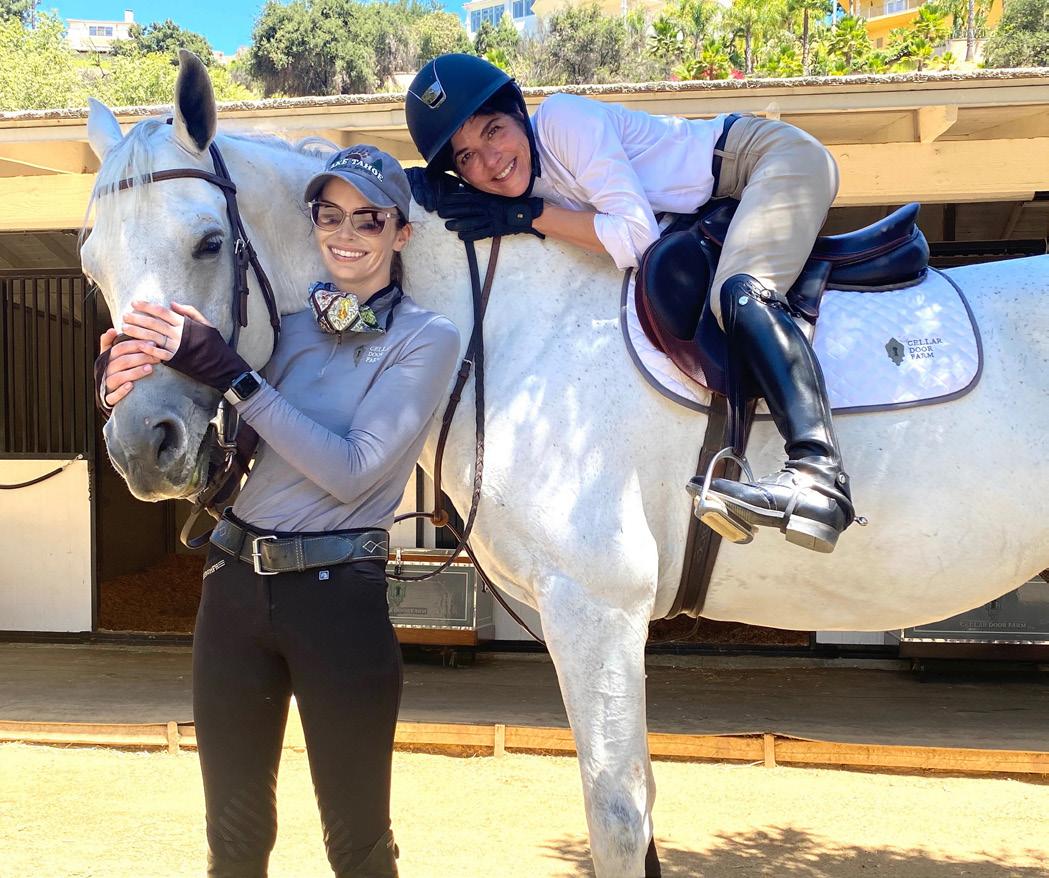
I made a real commitment when I got Mr. Nibbles, and went to a great trainer, Kelly Jennings at Cellar Door Farm in Los Angeles, Calif. I love her horsemanship, and her respect for her riders and horses. She’s given me a whole new world and is an excellent trainer.
Mr. Nibbles came from New Jersey and was out to pasture before I got him because his owner had died of cancer, so he never got real training, but he was an incredible horse. My trainer got on him and jumped him around, he just went along his business and I thought, “This is a perfect horse for me to grow old with.”
The name he came with was Sky Top, but he’s Mr. Nibbles to me or “His Royal Highness.” He looks great and is really fancy. I have big hopes for him.
One of the first indicators that I had MS is that when I was showing and my horse would yank on me a little, I’d get a concussion and whiplash. Even when I wasn’t riding him — just grazing him or hand walking — any simple thing would do weird things to my neck. I didn’t know my body was so weak that I couldn’t even hold my head up.
The MS diagnosis changed me. I had to take three years off from riding when I was diagnosed. I had so much spasticity (muscle stiffness and spasms) and dystonia (involuntary contractions) that there was no way I could even get on my horse. My trainer brought him to my house one day and I grazed him on my lawn. She let me get on him bareback, I just cried and smelled him and thought, “What a lucky girl I am. This is more than I could have ever asked for.” It was such a dream come true to have my horse on my front lawn in the middle of L.A.
I couldn’t go to the barn during that time as I couldn’t handle car rides, walk very well, or tolerate the sun (it will still take away my speech if I’m outside). We don’t have an indoor arena in California, and I can’t ride in the sunshine, so I go to the barn early in the morning as I get very weak and uncoordinated in the sun.
It’s been several years since I started riding again after my diagnosis. I can’t believe so much time has passed! Every time I get on, it’s like I’m a beginner again ... I can’t find my legs. I don’t know where my body is in space. But then I also think part of that is about growing older as it happens to a lot of people, not just those with MS. We get stiff and we train our muscles in different ways through life. It’s not always as automatic as just getting on a horse and jumping around. We lose body awareness with aging and menopause, but luckily enough, my horse has not lost his body awareness.
Mr. Nibbles takes care of me; he’s always watching out for me when I’m on his back. If I get off balance, he’ll start to slow down. He doesn’t get insecure. He just listens if I’m falling or something, but I haven’t fallen too much. I don’t suspect I’ll ever find a horse like him again. He is my dream horse and I cannot believe that I’ve had my chance to have him.
Time matters to me so much when I’m on or with Mr. Nibbles. I get to really pay attention to things I don’t usually acknowledge in my own life. I’ve noticed my gait has improved immensely since trying to strengthen my left leg through riding
and lengthening my leg by doing work without stirrups, which is what I need because I brace my legs when I use my stirrups. I’m a little bit tipsy now ... it is humbling, but it’s also fascinating if I don’t take it personally. My body twists in ways that it never did, and I don’t really feel where I am in space. When I
“ I THOUGHT, ‘THIS IS A PERFECT HORSE FOR ME TO GROW OLD WITH.’”
“My horse is perfect ... I love everything about him,” said Selma of Mr. Nibbles, a.k.a. Sky Top.
do feel Mr. Nibbles, that gives me energy like a strength that I don’t have any longer.
I really hope I can get better so that I can show again. It’s just difficult building up the stamina when it feels like I’m resetting every time I ride. If I go to a show, my trainer will probably just have me do a couple of amateur hunter classes and a little derby, whereas when I was young — for the couple of summers that I really showed and I was getting points — I must have done 25 classes in a weekend. It was just nonstop catch riding on different horses for different people.
I definitely hope to show this summer because it teaches me so much; I need to push myself but also have a reason to do it. I would love to do some bigger circuit shows with Mr. Nibbles. My big goal is to have the energy and ability to ride in the sun. I would also love to take him on an inn-to-inn ride. I did one years ago through Equitours with my sister, but I want to do it with my horse because he would love that.
PHOTO: COURTESY OF SELMA BLAIR
“ MR. NIBBLES TAKES CARE OF ME; HE’S ALWAYS WATCHING OUT FOR ME WHEN I’M ON HIS BACK.”
I took part in a Boyd Martin clinic in January 2025, and I came alive there and had no problems. Boyd would give me higher fences and didn’t care about my health history, he just cared about what was going on. I think because I love performing and because it was Boyd, I got a little starstruck and had adrenaline, which I don’t normally have. He’s so hardworking and generous with the horses and the riders; it was such a pleasure to ride for him. I really came alive and I thought, “Oh my God, I have to show again.” That was a turning point because I did absolutely fine in his clinic, he even said I was a very good rider, which I never thought I’d hear again in my life.
When I introduced myself, I said: “I have MS. I’m doing well, but if I’m a bit uncoordinated for certain things, I might just look a bit weird for a minute.” And he said, “I don’t even see that.” It felt really good to be seen in the present for what you’re bringing.
Mr. Nibbles is usually a bit slow to get going. He’s really balanced, but he’s a horse I have to get after in the beginning of the lesson. At Boyd’s clinic, he felt my excitement, so he was ready to go and I loved it. It was so great because that was less work for me.
When I wasn’t riding — either when I was working or when I was sick — I missed jumping and the rhythm of a good gallop. I missed being that high up and having that point of view every time I get on a horse. It’s amazing how much it changes my horizon line and everything else. I realized I don’t look up when I walk, and I am still having to teach myself when I am riding because something in my body wants to look down. I forget to look where I’m going, which my trainer reminds me all the time as I space out because my vision has changed. I have a narrow hallway of vision, which is one of those things I always took for granted.
Horseback riding is an exact mirror of what I do in my day. Sometimes I’ll get so tired during the first 10 minutes of riding that I feel like I can’t continue. I just have to get over those 10 minutes until my body softens and stops some of the spasticity. I need to remember that during challenges throughout the rest of my day, and have little touchstones like, “You can get past this. This too shall pass.”
My horse is perfect, so I always think at least something is going right. I love everything about him. It’s changed my life to have that energy from him and the care of my trainer at the barn. The way she’ll sort out our bodies throughout the lesson and the way she’ll come up with our plans for gymnastics or even having me hold onto a neck strap to get my hands to sit still because they’re fidgety between fences. I get a little stutter step of anxiety or excitement and my hands will fidget. It’s an annoying thing to my horse and myself, so now I am using a neck strap. I realize how my center of balance is just different now, but that can be changed with practice. There are little solutions we can find that make me realize there are solutions for the bigger issues in my life.
I think riding has taught me to get along with people. If you’re at a barn when you’re younger with a bunch of other juniors, you have to learn to respect each other’s space and have admiration for each other and your horses, or else you’re not going to be happy. You learn to look at things more positively. I’ve never been really negative around a horse, but I am a negative girl by nature.
I wish I were showing and doing grand prix-classes, and seeking out movies, and buying rights to books, and all those things. But I remember, you have what you have ... I’m still so grateful that I have plenty of things to be happy about, even if my fences are not over three feet high anymore.
PHOTO: COURTESY OF SELMA BLAIR
Selma and Mr. Nibbles train with Kelly Jennings at Cellar Door Farm in Los Angeles.
What Your Horse Is Telling You
Subtle changes in your horse’s ears, eyes, tail, and stance can signal discomfort, stress, or pain.
by Debbie Elliot
Your horse doesn’t always make dramatic statements like bucking or rearing to show that they are uncomfortable or in pain. Subtle signs and small behavioral changes are indicators they are in distress, and that your actions need amending. By being observant of our horses’ moods and body language, we can build a strong human-equine partnership and be better caretakers for them.
“To assess a horse’s state of mind, you always have to look at the full picture, just like you do with people,” said David O’Connor, decorated Olympian and US Equestrian Chief of Sport. “Look at not only their facial expressions, but also everything from tail swishing to excessive sweating.”
You can naturally see the whites (the sclera) of the eyes in some horses more than others.
O’Connor pointed out that some equine behaviors are prompted by sudden, short-term changes in the environment, such as a squirrel jumping into the arena.
“There’s a clear line between a horse bolting across the arena because a squirrel jumped out of a tree, to systemic tension through training that causes long-term discomfort,” he said.
“You can see anger in horses, you can see tension in horses, and you can see relaxation in horses. You have to always try to find out what the reason is for their discomfort and then figure out how to deal with it: Is it physical? Is it mental? Is it from outside influences?”
Eyes
There is an old age saying that the eyes are the windows of the soul. With horses, the eyes are the windows of their mood. A soft, calm eye shows they are relaxed and comfortable, whereas a hard, wide-eyed look is a sign of tension.
“Take notice if their eye is getting wide, tight, or rolling up, as these can be signs of anxiety or fear,” said Dr. Christin Finn, DVM, VSMT, CVA, CCRT.
You can naturally see the whites (the sclera) of the eyes in some horses more than others, which is known as a whale eye. However, if this is not usual for your horse and you are suddenly seeing a lot of white, it could be because they are scared, anxious, stressed out, or on high alert.
HORSES FIRST
“Epinephrine (adrenaline) makes you open your eyes wider, which can be a sign of excitement, but can also show that your horse is not completely comfortable,” said Dr. Katherine Houpt, Professor Emeritus at Cornell University in Ithaca, N.Y.
If the eyelids are closed or partially closed and the eye size is reduced, that can be an indicator that the horse is in pain. This expression is called “orbital tightening” or “eye narrowing,” making the eye look squinted or heavy-lidded. Tension can also cause the muscle above the eye to contract, prompting the underlying bone surfaces to be more visible.
Ears
The ears on a happy, well moving, comfortable horse are forward or straight up, said Dr. Finn. If they are sideways, back, or pinning, then that is a tell-tale sign of discomfort or stress.
“The ears are how horses communicate, and they don’t ever move them for nothing — there’s always a reason, whether it is a sound they hear or a concern they are feeling,” she said. “When you are riding, their ears are right in front of you and they are like a television screen of communication. The ears are always telling a story.”
Horses often pin their ears when having their girth done up, and instead of just dismissing them as being “cinchy” or “girthy,” Dr. Finn encourages people to look deeper into the reason, such as does their saddle fit correctly or is it pinching?
“People often expect a cinchy horse to whip around and try to bite them — everything else goes either unnoticed or unacknowledged as important — but there is so much more going on in the ears and the head that we have to listen to,” she said.
When you put on the saddle or when you mount, take a moment to observe your horse’s ears and see what messages they are trying to tell you.
“Do their ears do a momentary look back and then forward?” Dr. Finn asked. “There’s a lot of things that people accept as normal and we are missing vital communication.”
Tail
It is common to see horses swishing their tail at flies or other irritants, especially in the summer, and they are
Horses can communicate a multitude of moods through their ears.
not necessarily stressed when they do it. However, anger or tension can prompt a more intense form of tail swishing.
“When they are frightened, they tuck their tails. When they are annoyed, they lash their tails,” Dr. Houpt said.
“There are nuances to it,” O’Connor continued. “I don’t know if you can totally put it into a place where there’s an absolute, but you recognize it when you see it, just like you do with people.”
An overly active tail when being ridden can be a sign that the horse is angry or uncomfortable, Dr. Finn stated.
“Whipping the tail or holding it very rigid is a sign of a frustrated horse,” she said.
Dr. Finn noted that there are some famous horses who compete at the upper levels who have active tails and appear happy, so you must be aware of behavior that is normal or abnormal for your horse.
Mouth
“Tightness in the muzzle where the lips become firm and the chin gets stronger shows the horse is uncomfortable,” said Dr. Houpt.
The upper lips draw back, and the lower lip creates a pronounced chin. Pain or tension can also cause the chewing muscles around the mouth to become more strained and visible.
Chomping on or fighting against the bit can be a sign of tension, especially when the horse is being ridden.
“Some people say, ‘My horse just does that.’ Well, that may be true, but they
weren’t born that way,” Dr. Finn said. Actions like chomping come when a person inadvertently restricts a horse from expressing themselves out of a desire to have an obedient mount.
Excessive Sweating
Many horses sweat or foam a little (especially between the upper legs) on hot and humid days, but it is important to recognize the difference between heat-induced sweating and stressinduced sweating.
“When you see lathered sweat or foam profusely all the way across their neck and shoulders and down into their chest, then that is a red flag and should prompt a change in your behavior,” O’Connor warned.
Disassociation
Similar to people who have experienced trauma, horses can disassociate when in uncomfortable or stressful situations.
“Horses can take themselves into another world to protect themselves, and show no expression or any type of emotion,” O’Connor explained. “It is an inherent behavioral response for them as they have grown up disassociating when things become uncomfortable and distressing. It is how they protect themselves.” The difference is that it is not submission but self-protection.
Signs of disassociation can be subtle but usually involve a dull, apathetic, withdrawn expression. O’Connor compares it to a human who has broken a bone but doesn’t feel pain right away. “Our bodies have that powerful instinct to be able to shut themselves off from that type of pain or discomfort,” he said.
Body Tension
Aside from visually seeing your horse is distressed, you can physically feel it when in the saddle. Irregularity of gait is another indicator, especially if it results in tight, short, restricted action instead of the horse using their whole body.
“Become aware of distress signals when you are riding by looking out for anything that feels irregular, causes tension or is abnormal behavior,” O’Connor said. “You can feel it through their back, through your hands, and by knowing if they have accepted your aids or not.”
Optimal
To find a veterinarian near you who offers PulseVet® shock wave therapy, visit Zomedica.com/PulseVet
To learn more, call or click Zomedica.com • 800.245.4417 info@zomedica.com
•90% success in treating back pain and kissing spines
•Helps speed the healing of tendon and ligament injuries
•81% improvement in horses with Navicular Syndrome
•Clinically proven to reduce lameness associated with chronic orthopedic conditions
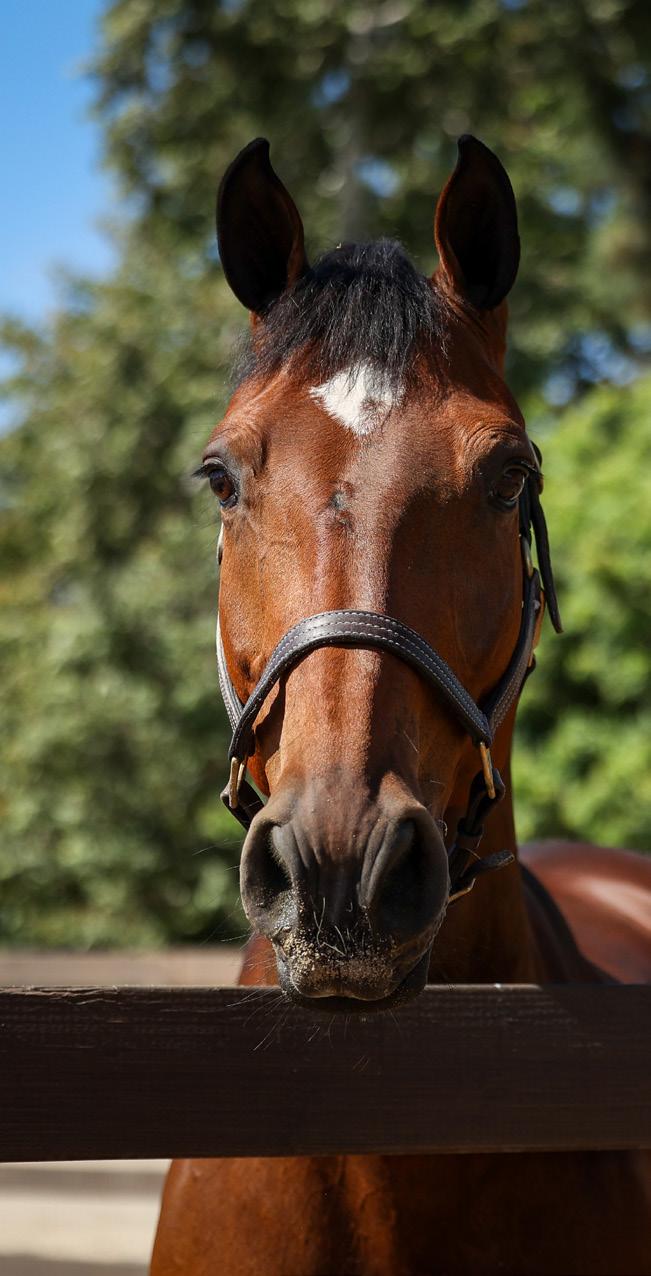
Left: A soft eye and pricked ears show calm and comfort, whereas hard eyes and pinned ears indicate distress.
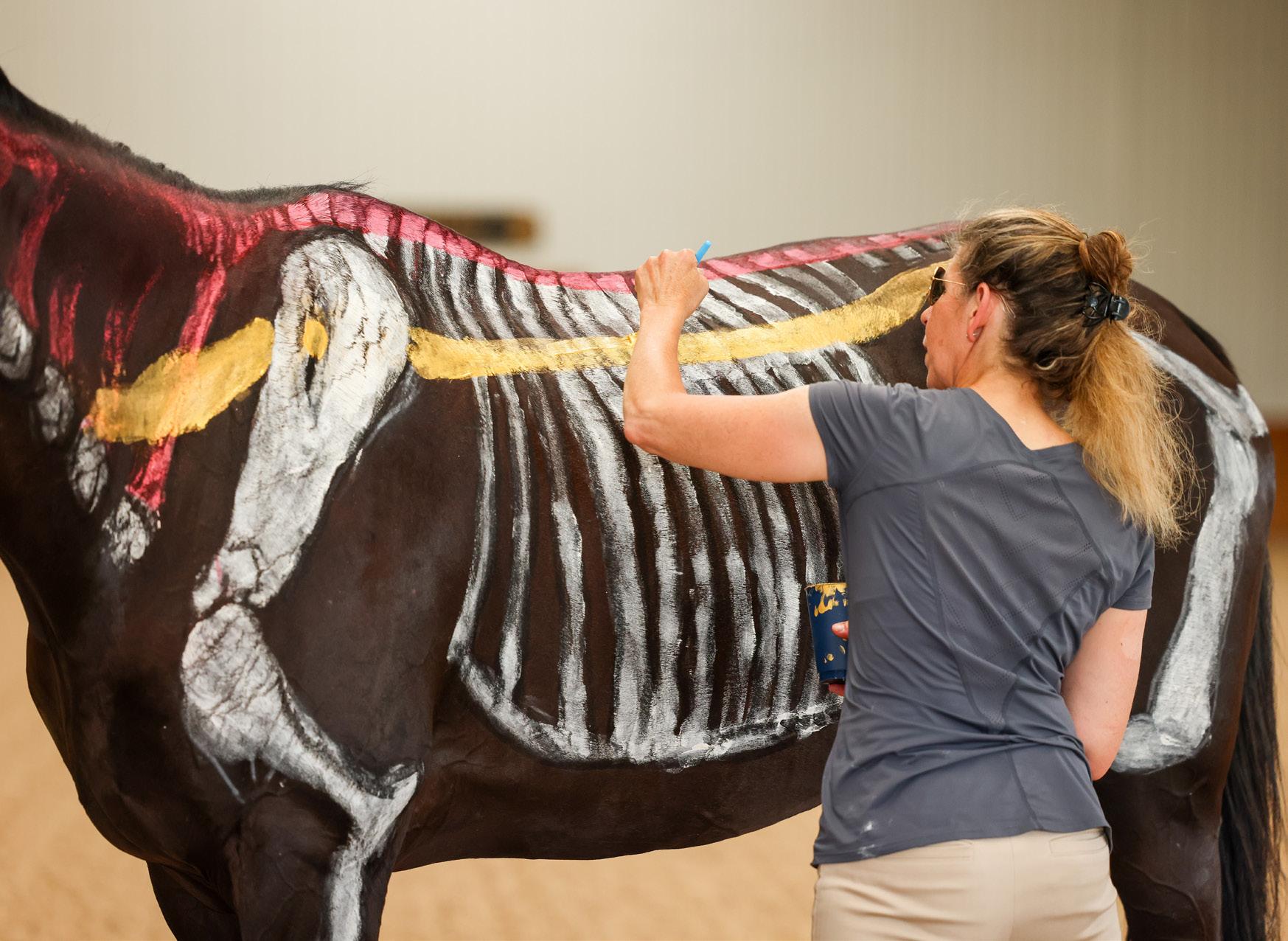
Right: In a USEF horse welfare video, Dr. Finn painted the muscles, ligaments and skeleton onto O’Connor’s horse, Sammy, to indicate areas of potential tension.
O’Connor said he uses the word “acceptance” rather than “submission,” as riders should focus on what their horse has accepted and understands rather than forcing them to submit.
“Horses enjoy the relationship that they have with humans, the riding and the games that we play,” he said. “That doesn’t mean they don’t have good days and bad days like we all do, but there’s usually a reason for a good day or a bad day with horses. They are always telling you something. Learning to hear that and understand it is the goal of a horse person.”
Horse Show Anxiety
It is especially important to monitor your horse’s behavior when boarding overnight at a show, as traveling in a trailer and being in a strange stall can cause undue stress.
“The not-so-subtle signs are if the horse doesn’t eat or drink — some people even bring their own water to the show to make them feel at home,” Dr. Houpt said. Other owners have security cameras on their horses to make sure they are sleeping. Any change in routine can cause sleep disruption, so make sure your horse is comfortable lying down in a new place.
Yawning
Rather than being an indication of boredom or tiredness, a full yawn is actually a positive sign in horses.
A full yawn is often associated with a release of tension, said Dr. Finn. It involves a deep inhalation and exhalation and mobilizes the tongue, larynx, and hyoid — a complex of bones and muscles in the throat that suspends the tongue and supports the airway.
“We always want to ask ourselves, is it a full yawn or just a partial yawn? A true yawn is where you can see their tongue, and they are really opening their mouth, which means they are relaxed,” she stated.
To learn more about tell-tale signs of distress in the head, neck, and mouth, please watch the USEF horse welfare video by scanning the QR code to open the link.
The US Equestrian horse welfare stoplight guidelines can be found at usef.org/formspubs/qtrB-ZMCyCE/usef-horse-welfare-guidelinesstoplight.
How Equestrian Achievements Can Impact College
Colleges look for well-rounded students who display drive, coachability, empathy, and conflict-resolution skills.
by Debbie Elliot
The college application process is more competitive than ever, and impressive GPAs are no longer enough for students to gain admission to the schools of their dreams. For young equestrians who have spent much of their non-school time riding or showing, it can be difficult to know what to include in those crucial college application essays. However, whether you hope to compete on a college equestrian team, major in equine science, or take a break from riding while at school, your equestrian achievements can still have a meaningful impact on your college applications.
According to Odessa Thacker, Equestrian Recruitment Specialist in the Office of Admissions at Emory & Henry University in Emory, Va., the applicants who stand out from the crowd are those who make a social impact. This can involve volunteering at therapeutic equine facilities, summer camps, and horse rescues; or even creating
a nonprofit to raise awareness of issues such as bullying in the horse industry.
“I look for students who want to make a difference and can show the drive to do something that is not just about getting to the next level of riding but about making an impact on the community or the horse industry in general,” Thacker explained. “If they can accomplish that before they get to college, who knows what they can get done after college.”
Another way for young riders to develop more management skills and learn how to network is by volunteering at the show office during competitions, said Randi C. Heathman, an independent educational consultant who works with equestrian students.
“It’s about taking things that are horse adjacent and of interest to you and exploring them further,” she said. “It is also important to display what you are learning from these volunteer-
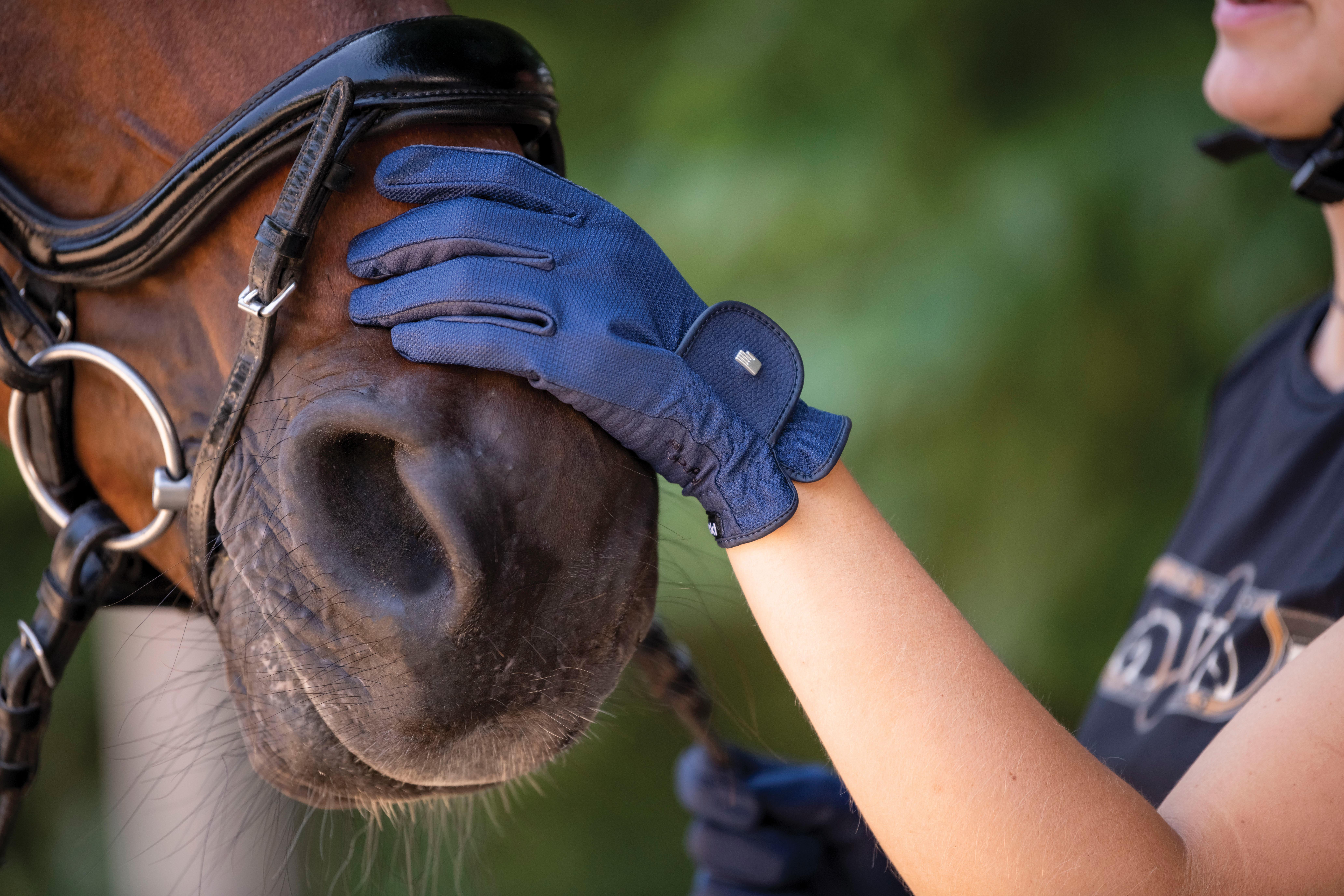
Roeck-Grip® Lite gloves are made with Roeckl's exclusive Roeck-Grip® material that provides soft, breathable comfort on hot summer days! Like Roeck-Grip and Roeck-Grip Winter, the Roeck-Grip Lite fits like a second skin, giving the rider a close contact feel, and is even touchscreen compatible! Roeck Grip Lite gloves are available in Black, White, and the new Naval Blue!
ing experiences, such as what makes a great therapeutic horse versus an accomplished show horse.”
Mira Korber, founder of Blue Ribbon Scholars in Ocala, Fla., works with students who aspire to be on an NCAA, NCEA, or IHSA equestrian team.
“For students hoping to ride NCEA, we help them navigate the recruitment process and teach them how to present themselves, create a résumé, and communicate professionally with coaches,” she said. “I see each student as a completely unique Rubik’s Cube, and they are all at a different point, so I have to figure out their algorithm to help them be successful.”
Blue Ribbon Scholars also specializes in tutoring competitive student athletes in their pre-college years, such as those who go to online schools while on the show circuit, so Korber often assists with college applications for students whom she has worked with for many years.
One of the challenges in building applications for students who went to an online school versus brick-and-mortar institution is how to show that they were involved in extracurricular activities or clubs in school.
“It requires parental involvement, such as taking them to museums or reading the news together. This helps create a mature and unique perspective,” Korber said.
Valuable Soft Skills
Colleges are looking for well-rounded people who can navigate conflict and build consensus through respectful disagreement.
“Managing expectations and disappointments, handling them and growing from the experience is a timeless theme that is valuable in college applications,” Korber said.
“When showing, if you chased the points and got to the final, was that really what mattered? Or was caring for your horse, seeing yourself become a stronger rider, and overcoming your areas of weakness important? Those are relevant to you as a person, not just to you as a rider.”
Thacker said that one of her favorite things when reviewing applications is to discover an underdog. “I like finding the riders who have tried and failed and know how to fail gracefully. Those who can handle failure like an adult and understand that it is part of life, while still having empathy for their horse and for themselves,” she explained. “A lot of riders are perfectionists, they have drive and they want it all for themselves, but they’re allowed to make mistakes too.”
Having that competitive drive to win — in the show ring or in the classroom — is an asset, Thacker continued, while also still being emphatic toward your teammates if they falter. “Empathy and being able to put yourself in other people’s shoes are important personality skills,” she stated.
Writing a Personal Essay
Like with any intense activity or sport, there are always opportunities to discuss riding in the 650-word personal statement that most colleges require — but you have to keep your prospective audience in mind.
“There is always a fundamental dilemma of ‘how do you explain that riding is a sport?’ as it is foreign to most people,” Korber explained.
Heathman suggests avoiding the use of specific horse terms, such as stating, “I was in the 3’6” Hunter division,” or using equestrian acronyms that most people will not understand. “You almost have to equate it to another sport, something that the general public is more familiar with,” she said.
Actions that show leadership and involvement with the community are sought after by college admissions departments, Korber stated. She recalled a personal essay written by a student who was interested in sports psychology and compared issues she was having with horses to Olympic gymnast Simone Biles’ spotlight on mental health in sports. Another student wrote that she had learned empathy and how to listen to people who weren’t speaking up loudly by working with an animal who couldn’t speak.
“I love helping students find compelling examples to put in their application essays to put an original spin on what they learned from their experiences,” Korber said.
Layne Brogden, who has worked with Blue Ribbon Scholars since she was in seventh grade, is now a freshman at the University of Kentucky in Lexington, Ky., majoring in integrated strategic communication. She said her equestrian achievements were a big part of her personal essay.
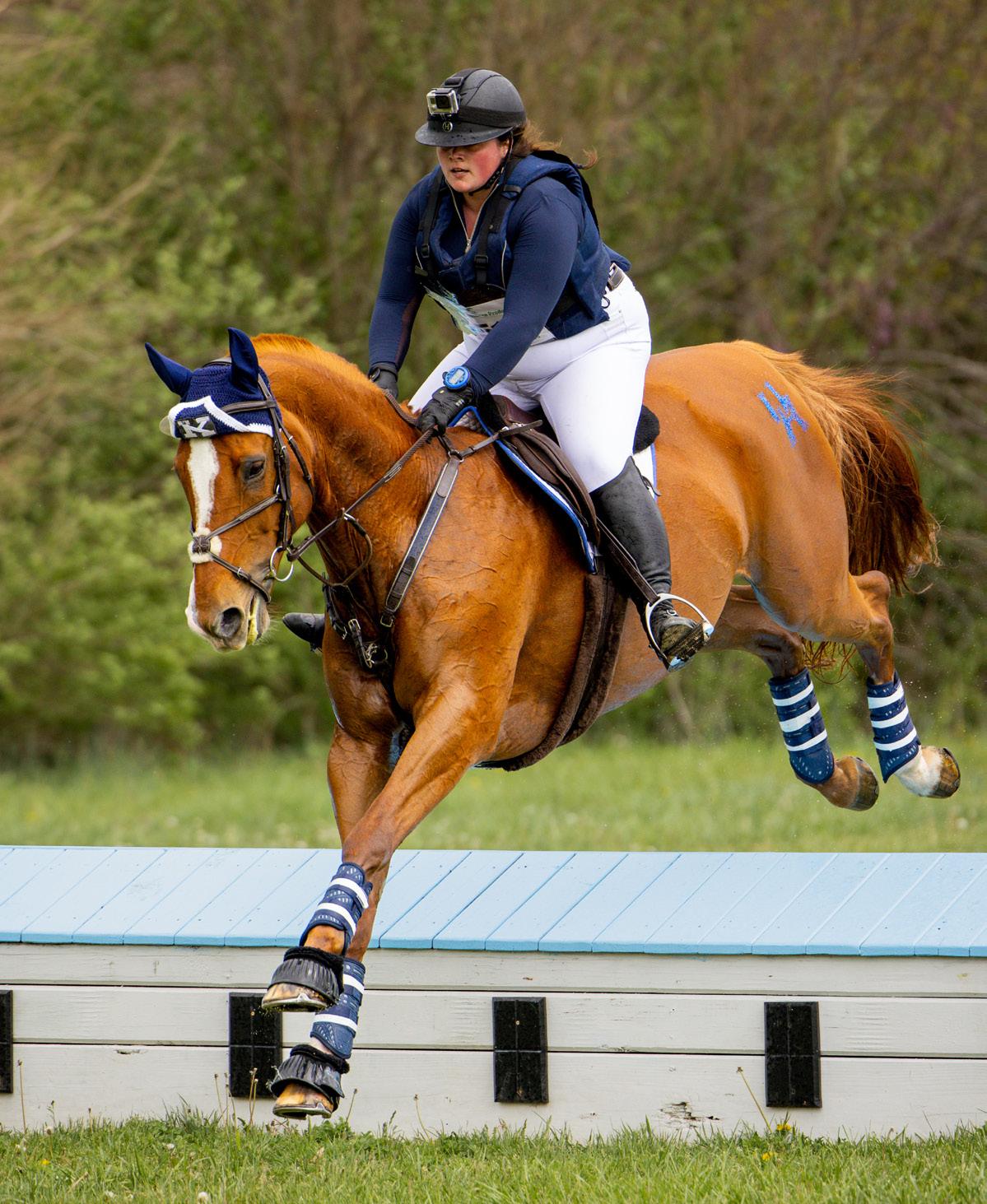
A University of Kentucky Eventing team member at 2023 Spring Bay Horse Trials.
PHOTO:
“We put together a résumé and an essay for my applications,” she said. “The résumé was all about the horses I’ve trained and resold, detailing the overall revenue it brought in and the privilege of helping a horse find their perfect person.”
Brogden was in online school from 9th to 11th grade as she lived in Florida for the winter show circuit, then went back to regular school for her senior year.
“My essay was about moving away from home, living on the show circuit, traveling and then deciding to come home for my senior year. It focused on the importance of me getting this experience, but then the ultimate decision to come back home and be with my family,” Brogden continued. “We put a lot of emphasis on growing as a person and real-world experiences. I definitely think that is what set my application apart.”
Heathman stressed that colleges want students who are a good academic and social fit for their institution, and who will be able to succeed there. In addition, they look at how they spend their time outside of the classroom, and why they are doing that activity. “Sometimes students struggle with how to articulate that in their essay,” Heathman said.
She advises taking part in clubs or activities outside of riding to show a broader range of interests.
“Maybe joining the debate club will conflict with riding, but you can find something that works with your barn schedule,” she said. “It is possible to have it all. You just have to plan and evaluate what’s important to you.”
Korber suggested that if a student is good at English, they could look into a two-week intensive writing summer program that they can fit into their horse-show schedule.
Currently a freshman studying finance at Southern Methodist University (SMU) in Dallas, Texas, and a member of the school’s equestrian team, Anna Markcrow worked with Korber to focus on sharing experiences in her personal essay that weren’t just about equestrian pursuits.
To learn more about IEA, please watch this USEF Learning Center video by scanning the QR code below.
“I talked about my personal friendships, relationships, and how riding affected those. Then I included other activities to show I was grounded,” said Markcrow, who volunteered preparing food for people in need.
Being a member of the Interscholastic Equestrian Association (IEA) or the United States Pony Clubs, Inc. (USPC) can help to build skills that are beneficial in college,
especially for students who aspire to ride on their college equestrian team.
“IEA teams provide a place where there’s more of a social or leadership opportunity, which is often harder to access with horses because it is an individualized sport,” Korber said.
Heathman is a big proponent of the USPC as it has a structure that allows you to learn both horsemanship and academic skills.
“You take examinations so you can demonstrate progress, which is a great thing to be able to articulate in a college application,” she said.
When to Start Thinking About College
Korber said that it is never too early to cultivate passions and interests, and she encourages middle schoolers through ninth grade to explore activities they like and enjoy. “It’s not about forming yourself into a specific mold. It’s about developing your interests as early as possible so that you can have a well-constructed set of activities later on,” she said.
Parents need to support kids as their goals change and evolve, said Heathman, who thinks it is OK to foster college awareness in middle school. “If you’re vacationing near where there’s a college campus, go take the tour. If a relative is a graduate of a particular college and you think it might be of interest, talk to them about it,” she recommended. “If an older girl or boy from the barn is now riding at a university, ask about their experiences. It is about building general awareness and starting to think about subjects you might want to learn more about or careers you might be interested in.”
Thacker believes that students should start looking at options when they enter high school. Although it is not necessary to visit colleges at that age, if a student wants to talk to someone in the admissions office, the staff will usually be happy to meet with them.
The FEI North American Youth Championships (NAYC) features competitors ages 12 through 21.
All About the US Equestrian Interscholastic Athlete Program
The US Equestrian Interscholastic Athlete Program (formerly known as the Lettering Program) celebrates equestrian student athletes and ensures they get the recognition they deserve at their junior high or high school. The program is open for students in 5th through 12th grade who have a USEF subscriber or competing membership, and it runs from June 1 to May 31 of the following year. In order to participate, students need to show proof of school participation (a report card or any official school document), and either verification that they participated in three competitions (these do not have to be USEF-sanctioned shows) over the course of a year, or a 100hour log of doing equestrian activities (riding of any discipline, driving or vaulting, but not barn chores).
When they apply to the program, they receive a letter from the US Equestrian president that can then be sent to their school stating that USEF is the national governing body of equestrian sport, and explaining why the Federation recognizes these students — and how much time and effort goes into equestrian sports. When they finish their requirements, they get a letter congratulating them on their completion, which is sent to both the student and the school. Each year of completion is rewarded with a custom USEF prize, such as a pin, patch, or water bottle.
“It is a good educational tool for schools to learn a little bit more about how the equestrian-sport world works,” said Lexie Stovel, USEF National Breeds & Disciplines program manager.
However, the biggest benefit of participation is that it looks impressive on college applications.
“Even if they are applying for a course that is completely nonequestrian related, it showcases an extracurricular activity that the student has continued to participate in, and put in time and effort into,” Stovel said. Those who complete multiple years in the program while also getting good grades demonstrate balance and commitment.
US Equestrian also hosts the National Youth Sportsman’s Award, which aims to identify future leaders within the equine industry from across all breeds and disciplines. It is open to members age 17 or younger (as of Dec. 1 of the current competition year), who show an ongoing commitment to equestrian sport, serve as positive role models, and promote good horsemanship. Applicants must submit a personal essay and two letters of recommendation. The winner and runner-up receive $1,000 and $500, respectively, to be paid to their college or education center.
“The award is aimed at freshman entering college who show a commitment to continuing with equestrian sport,” Stovel said.
Please visit usef.org/learning-center/youth-programs/interscholastic to learn more about the US Equestrian Interscholastic Athlete Program, and visit usef.org/learning-center/youthprograms/grants-scholarships/youth-sportsman to read about the National Youth Sportsman’s Award.
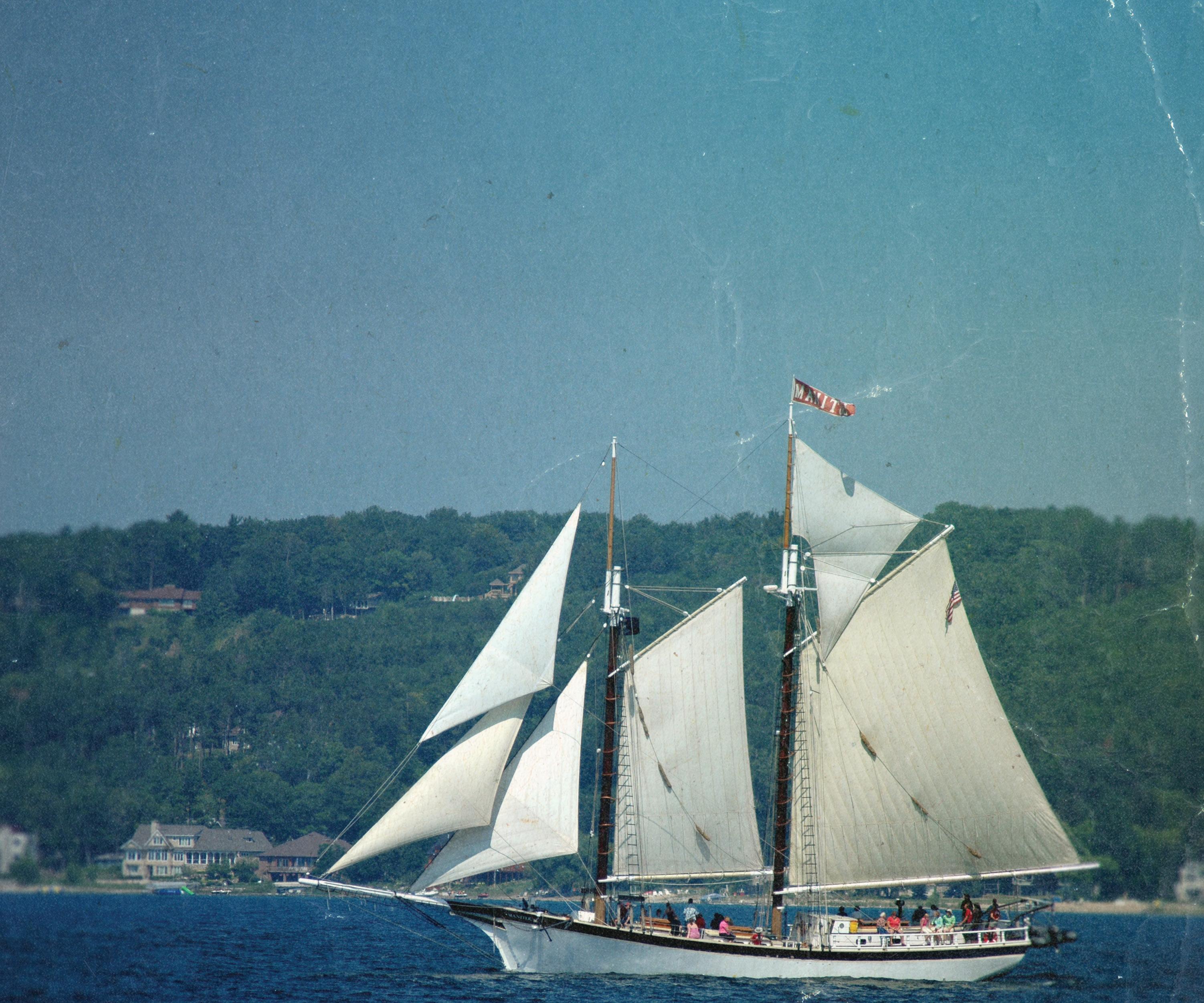
A TRIP TO TRAVERSE CITY, MICHIGAN
Two (2) VIP Tickets to attend FEI/North American Youth Championships
Scan to learn more
One (1) Event Parking Pass
PRIZES
Two (2) Night Hotel accommodations
Two (2) $500 Flight Vouchers
One (1) Traverse City VIP Experience
One (1) Elk Rapids Marina Cruise Experience
One (1) Wine Tasting Experience
One (1) Dinner Reservation and Gift Card
The Ultimate Digestive Aid
Around 60 to 70% of horses suffer with some level of digestive disturbance.
Researched and veterinarian-approved AssureGuard Gold provides powerful digestive support in an easy-to-feed, daily pelleted formula.
Our proprietarily processed psyllium and special enteric coated pellets ensure delivery of beneficial microbes and other key ingredients to the hindgut, where they are most effective.
AssureGuard Gold’s patented formula works to support the entire digestive tract, from the stomach to the hindgut, offering a complete solution for common digestive challenges.
Horse Couture
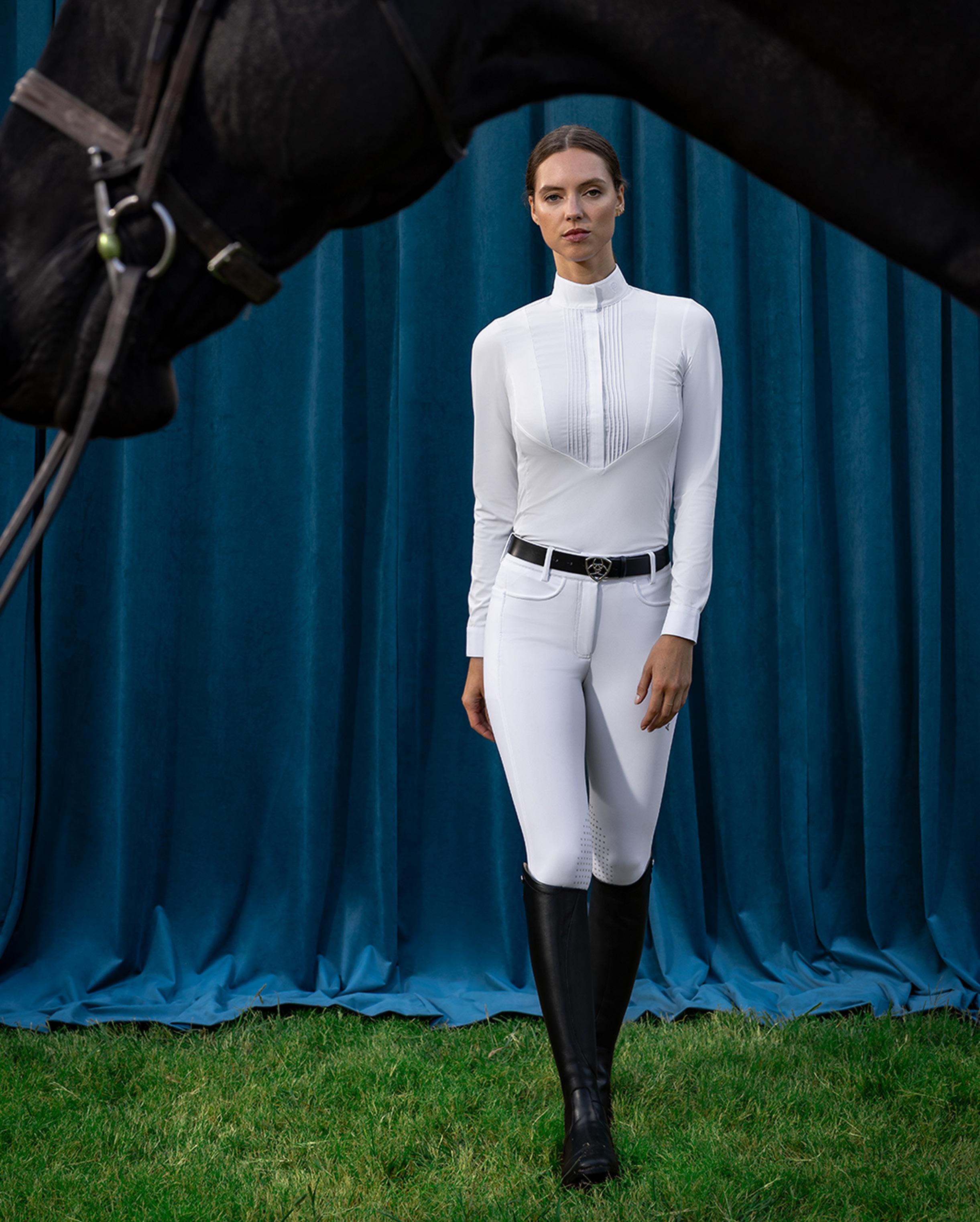
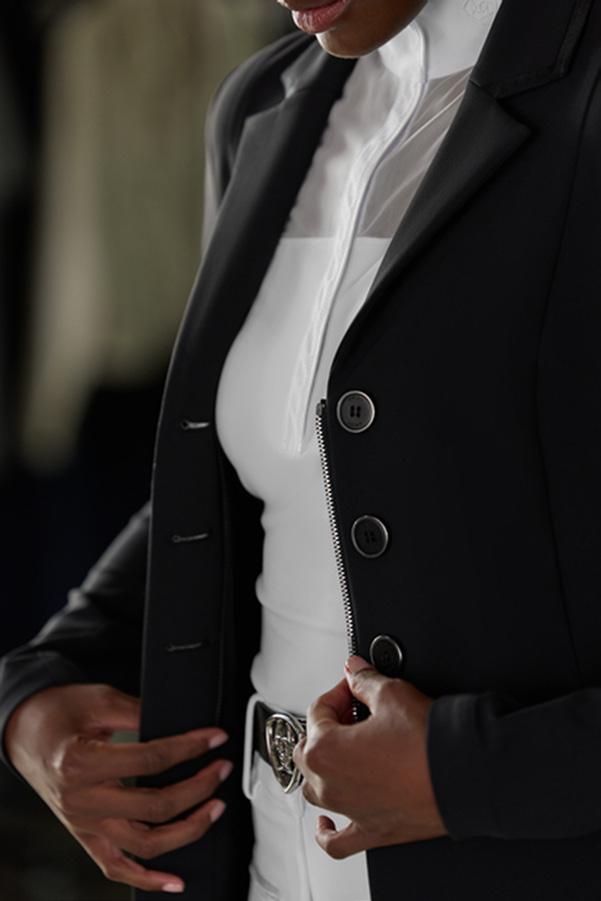
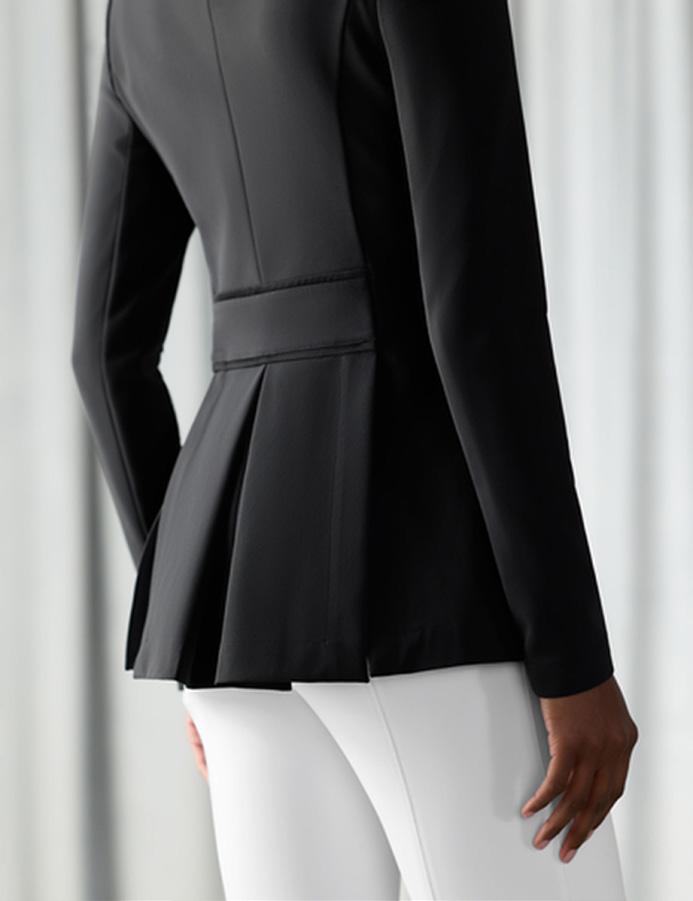
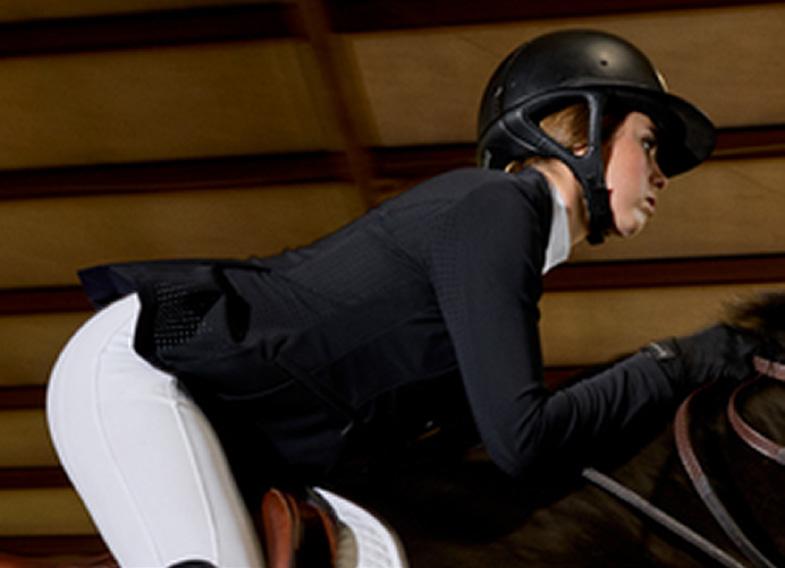
Part of Ariat’s Allure Collection, the Allure Show Coat brings haute couture to the show ring. Its meticulously cut design is form-fitting and feminine, while satin piping offers the perfect amount of stretch. A tailored box pleat with subtle waist shaping will give you confidence as you enter the ring, and a hidden front zipper smooths your silhouette and ensures a no-gap fit. The Allure Show Coat features cooling ClimateTEK, FreshTEK odor control, and a stainrepellent finish.
Elegant and Enduring
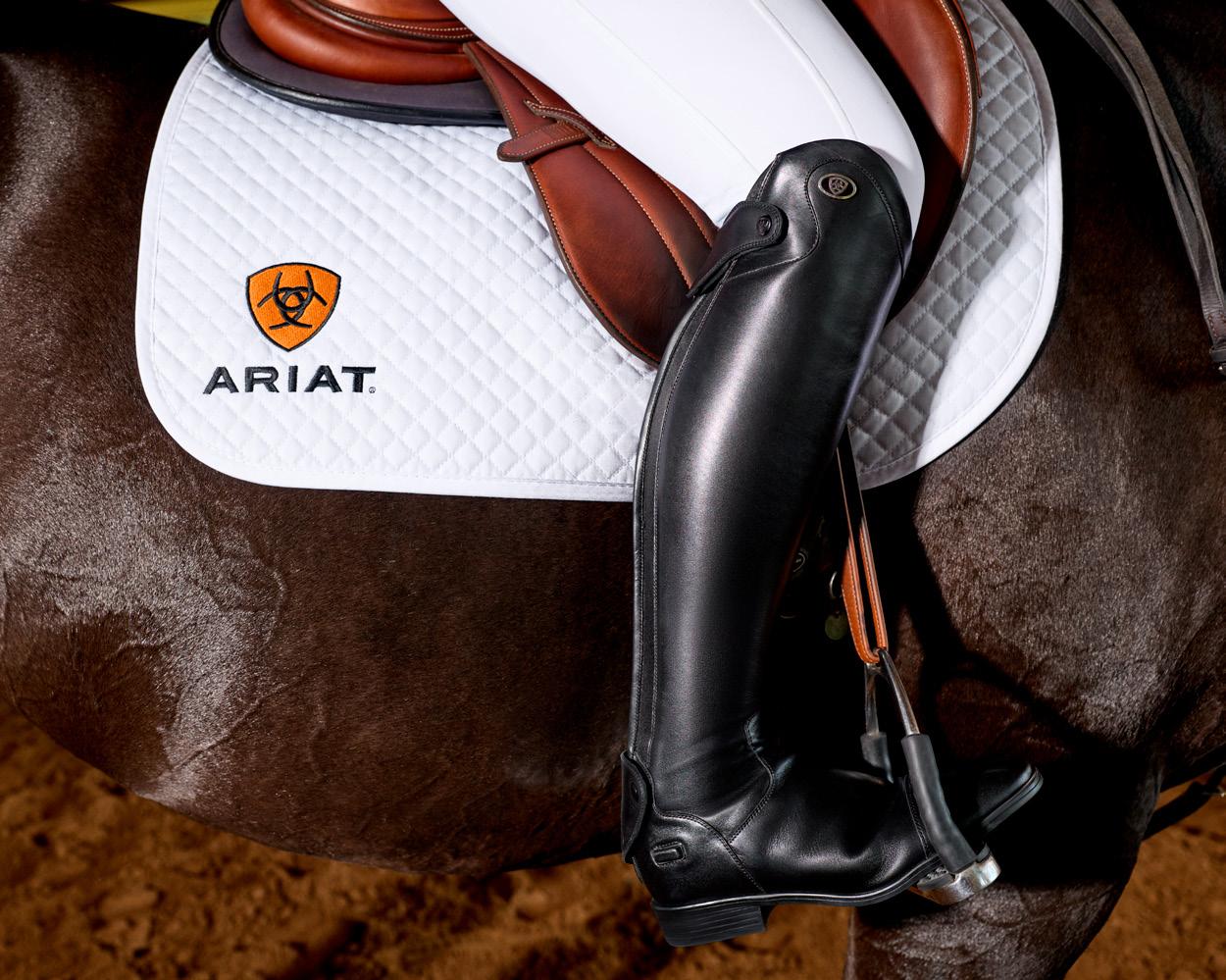
With a Spanish-cut topline and elite branded hardware, the Ravello Dress Tall Riding Boot brings timeless elegance to any show outfit. Handcrafted from premium Italian leather, the sophisticated design pairs with a luxurious glove-like fit that will endure the whole show day. The Ravello features ATS® technology for lightweight support that helps your foot adapt to uneven surfaces; a Duratread™ sole for optimal traction in the stirrup; and a removeable All Day Cushioning insole for comfort and support. Design highlights include oiled leather inner calf panels, full-length YKK® zippers with keepers and zipper guards, elastic gusset on the inside knee, and a behind-the-knee mobility curve. The Ravello Dress boot is made responsibly from leather produced at Leather Working Group-certified tanneries. It is available in foot sizes 6 through 10; short, medium, or tall height; and calf width from X-Small to Full.
Flow State
The Compel Show Coat was developed in collaboration with Ariat’s elite equestrian athletes to create a silhouette that is both functional and fashionable. Made from highstretch Italian knit fabric, the coat is perforated in high-heat areas to allow air flow and flexibility so that it moves as you do. The Compel Show Coat’s performance-driven tailored fit flatters all body shapes and is sure to keep you comfortable and performing at your best.
All-Day Comfort
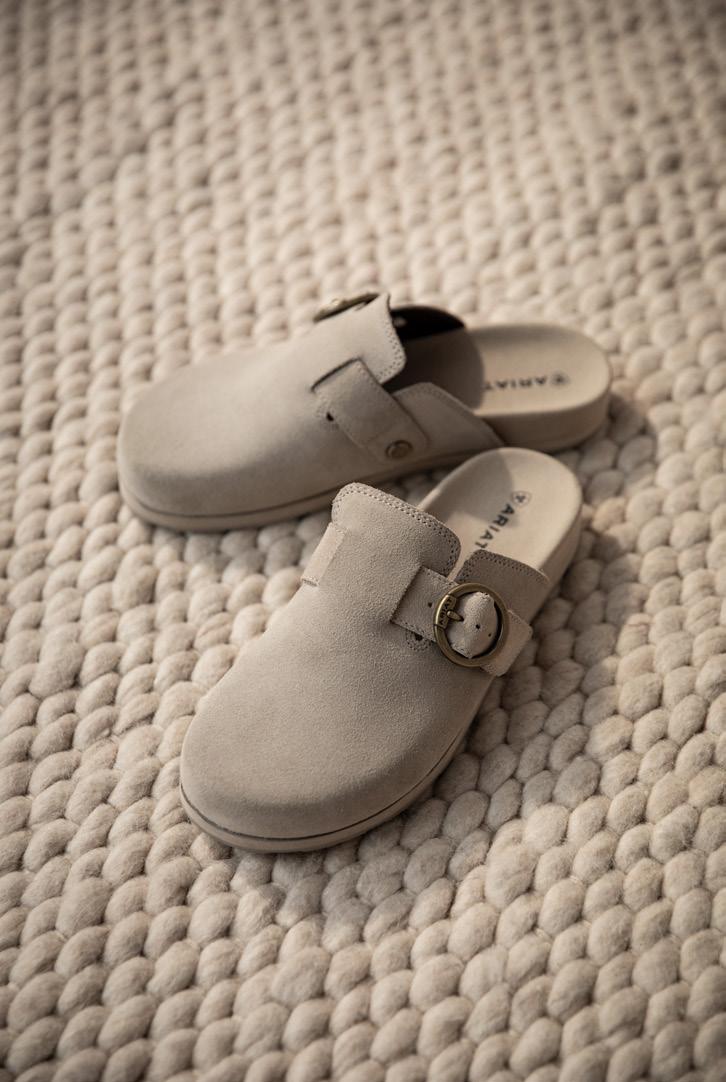
A comfortable shoe to wear around the grounds between classes is an often-overlooked part of our horse-show preparation. Ariat’s Country Mule is sure to become your go-to choice of footwear at shows, at the barn, and even at the grocery store. The comfortable slip-on mule has an equestrian-inspired buckle that adds horsey style, while all-day cushioning keeps your feet happy for hours. The Country Mule has a lightweight EVA midsole to help absorb shock and a Duratread sole for durability and flexibility. It comes in sizes 5.5 through 11, and is available in four colors.
PHOTOS: COURTESY OF ARIAT
McLain Ward riding HH Azur
Retro Layers
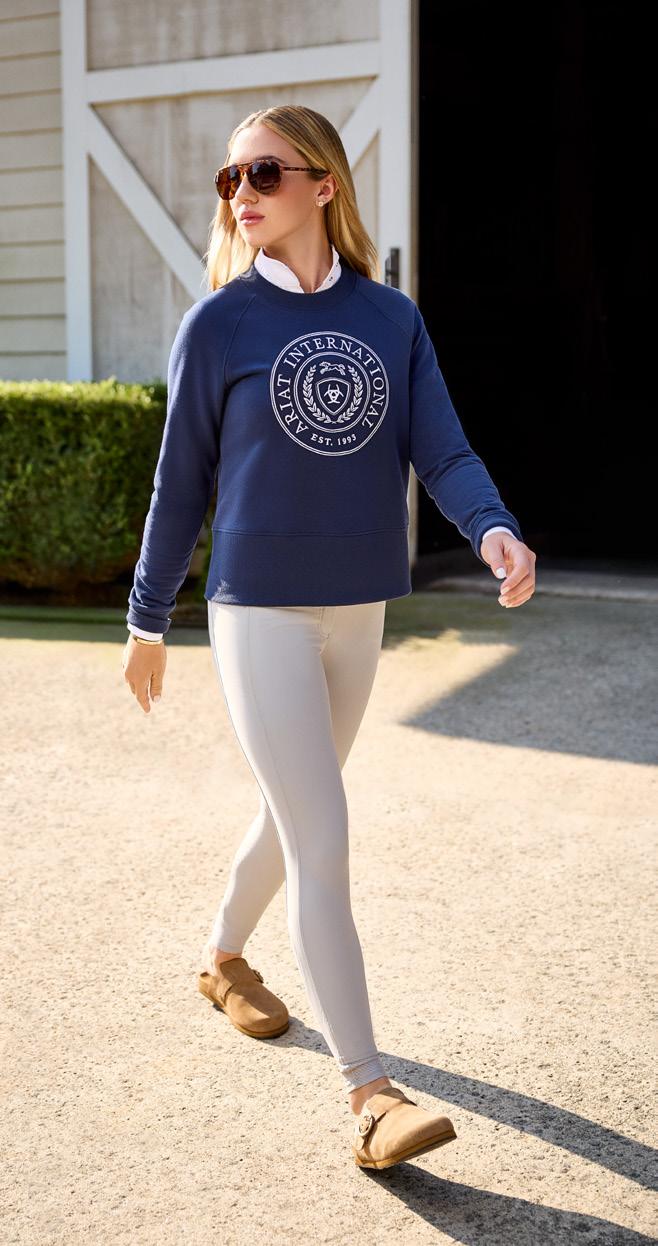
The Martine retro-inspired sweatshirt pulls off that perfect combination of preppy but casual, adding a touch of class and some added warmth for when the sun goes down. Made from ultrasoft fabric and with a cropped hem, it can easily be worn between rounds to keep your show shirt clean. The Martine comes in navy with the Ariat International logo in white and features retro crew styling and an embroidery detail. It is available in sizes X-Small through 2X-Large.
All-Season Essential
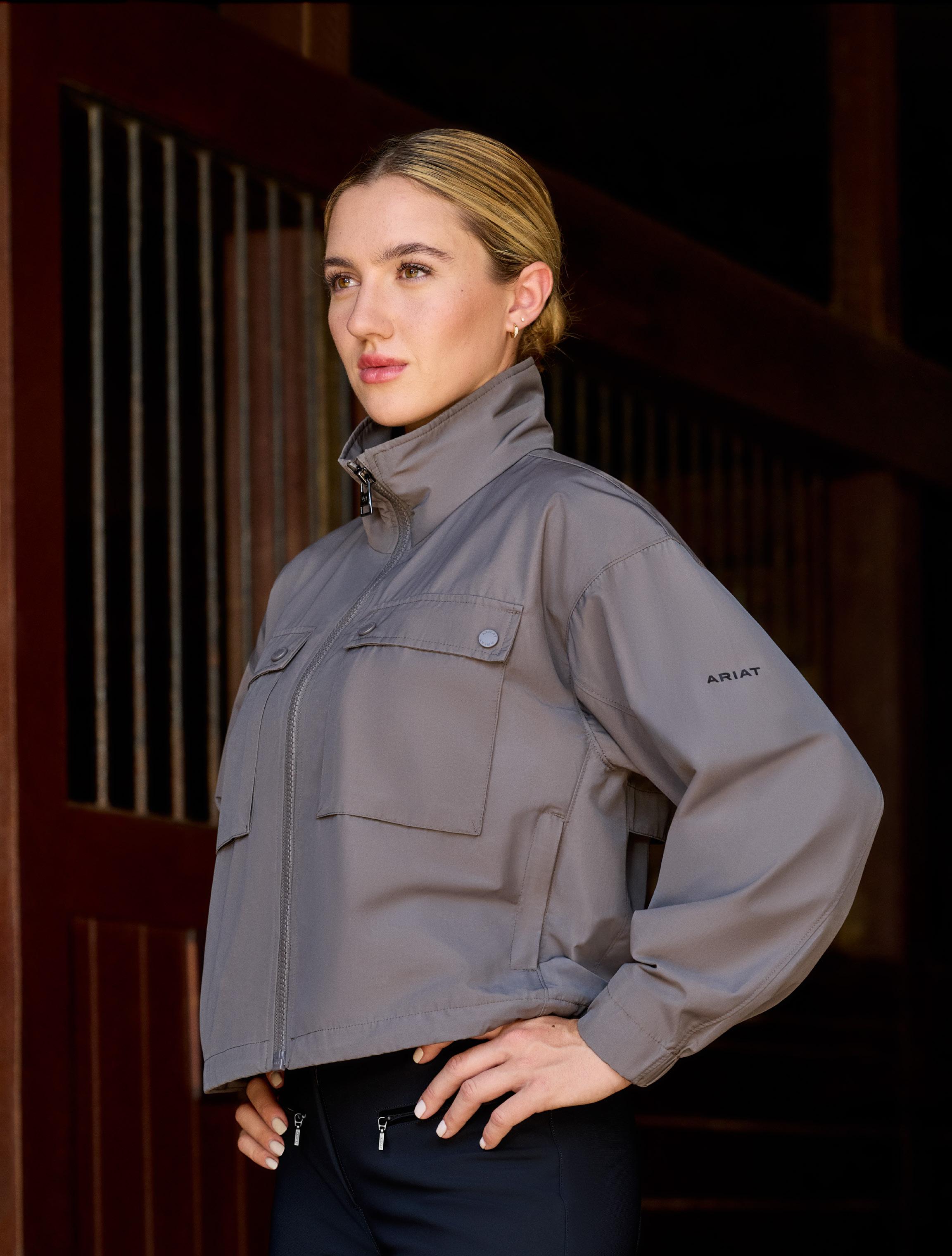
The Breathe X Jacket is an ultralight windbreaker that is so versatile; it can be worn anytime you need an escape from the elements. A cinchable hem, oversized chest pockets, and bomber styling make it suitable for wearing in the saddle with breeches or in your everyday life with jeans. The Breathe X has a water-resistant PFCfree finish to protect against light rain and wind during spring’s changeable weather, and a back vent for air cooling flow if it heats up. Zippered hand pockets offer secure storage for small essentials like horse treats. The jacket comes in Plum Grey and is available in sizes XX-Small to X-Large.
Keep on Running
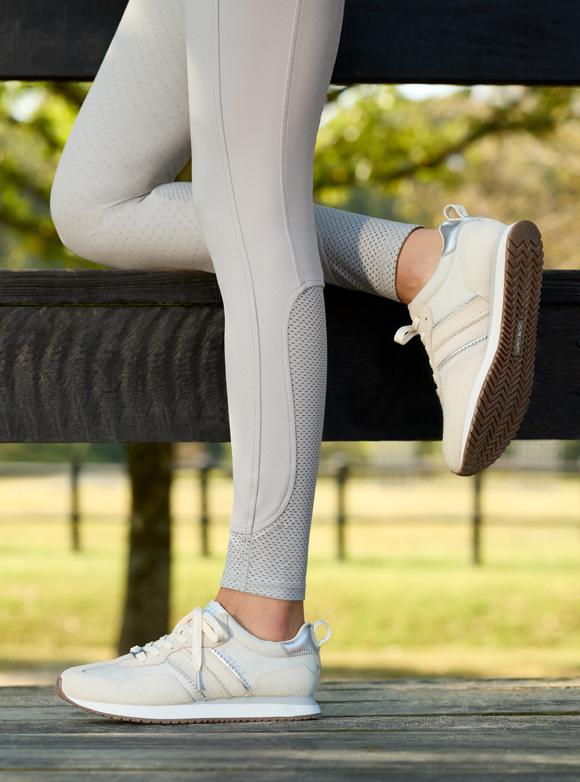
As equestrians, we are always on the run, whether it is dashing from ringside to the show office to check our placings, or running to the barn to give our horse some well-deserved love. The Ranch Runner Sneaker allows you to move comfortably and speedily over showground terrain thanks to a lightweight EVA midsole for extra shock-absorption. The low profile and retro lines are inspired by 1970s running fashion, and the Butter Cream color will flawlessly match any shade of show breeches. The 3-inch-high Ranch Runner Sneaker also features lace entry, a round toe, mesh lining, leather upper, and Duratread sole.
PHOTOS: COURTESY OF ARIAT
Symptoms
While often not a deadly disease, equine strangles shouldn’t be taken lightly as it can spread rapidly through horse populations.
by Sarah E.
Coleman
Horses housed in larger groups, such as at boarding facilities, are generally at higher risk of infectious disease transmission than those kept in smaller groups or alone. Likewise, horses that travel off property to competitions or other events are even more at risk of contagion if diligent biosecurity measures are not taken.
One of the most contagious diseases a horse can contract is equine strangles, a bacterial infection caused by Streptococcus equi.
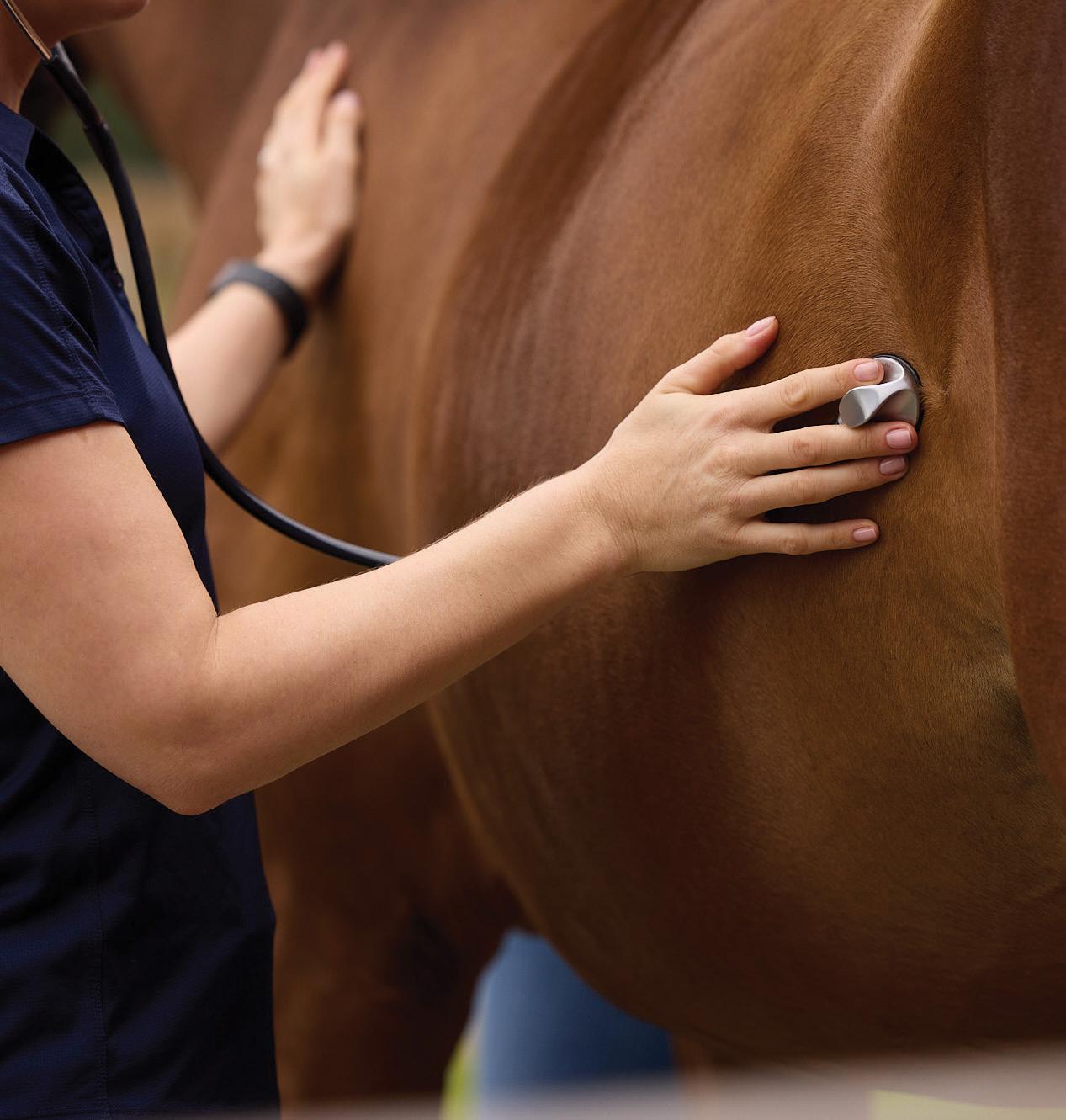
“Strangles is spread from horse to horse through direct contact, a contaminated surface or fomite [objects that carry infection, like clothes, pitchforks, grooming supplies, tack and bedding],” said Dr. Katie Flynn, USEF senior staff veterinarian.
Most horses with strangles will develop large masses of infection in the lymph nodes under their jaw, which is the hallmark of the disease.
“That is why it is called ‘strangles,’ because the abscesses can block the horse from breathing if they get too big,” said Dr. Flynn.
Affected horses often also have difficulty swallowing and may wheeze and cough.
However, any lymph node in the horse’s body can hold pockets of infection, not just those in the head, explained Dr. Melissa Fenn, Internal Medicine Specialist at Littleton Equine Medical Center in Colorado.
“On rare occasions, horses can get infections in the lymph nodes of other body systems like in the abdomen or the chest, which we call ‘bastard strangles,’ but that is a rarer complication of the disease,” Dr. Fenn said.
In addition to these tell-tale swellings, a horse with strangles often has nasal discharge that is yellow or whiteish yellow and which commonly occurs 24 to 48 hours after the contamination. However,
the first indication that a horse has contracted strangles is a spike in temperature.
“A change in temperature is usually the first clinical sign of disease,” said Dr. Flynn. “It occurs one or two days prior to any other clinical signs. Sometimes this fever comes before the horse starts shedding bacteria out of his nasal passage.”
Taking a horse’s temperature daily is vitally important to address the illness when it starts, and before it exposes other horses to a virus or bacteria. If there is an ongoing outbreak, twice daily temperatures are worthwhile. Biothermal microchips when scanned can detect any change in temperature, alerting owners or barn managers to a potential illness.
As soon as a horse’s fever spikes, it is imperative that they are isolated from other horses to minimize the spread of infection, said Dr. Flynn. She recommends moving the ill horse to a separate isolation barn or, at minimum, to an end stall of the barn as far away from other horses as possible, and leaving empty stalls between them in order to minimize the horse’s contact with people, equines and other animals (including dogs).
PHOTO:
Due to the wide spectrum of the disease, it is important to have veterinary involvement right away, not just for individual management, but also for herd health.
“Some cases of strangles can be incredibly mild — the horse may get just a snotty nose and a little lymph node swelling that will eventually clear — but strangles can range from mild all the way to fatal,” said Dr. Fenn. “Sometimes it is just an individual case, and sometimes it is an entire outbreak on the farm.”
Diagnosis
Younger horses are often more vulnerable to strangles as their immune systems have not built up low exposure over time, said Dr. Fenn. In addition, springtime often sees a rise in cases as there is more movement of horses to shows, clinics, etc.
If strangles is suspected, the most accurate way to test for it is by a guttural pouch endoscopy, where a vet threads a scope up the horse’s nose into the guttural pouches to view the inside of the pouch. They then flush it with saline to obtain a sample for testing.
“From an anatomic standpoint, the guttural pouches almost act like a one-way valve, and they can trap bacteria,” said Dr. Fenn. “If you were to just swab the nose, you might not actually get the bacteria that’s way back there in the guttural pouches, and you could miss a positive strangles test.”
However, it is not always practical to scope all the horses that are suspected of having strangles.
“That is why a lot of time we’ll do a nasopharyngeal lavage (also known as a nasal wash) in the field, where we basically squirt saline up the nose, catch it, and then submit that for testing,” Dr. Fenn explained.
A horse is not considered stranglesfree until they have had three consecutive negative nasal washes or three consecutive negative guttural pouch washes. One of the hard parts about strangles is that horses don’t need to be symptomatic to carry strangles or to shed it.
“You can have a clinically healthy horse who still sheds the bacteria,” said Dr. Fenn. “A horse who has recovered from strangles can also be a potential source for infection as they can shed bacteria for up to six weeks after the clinical signs have been resolved. Some horses can be long-term shedders that periodically shed, and that is typically how outbreaks occur.”
Additionally, how long the bacteria survives in the environment can depend on the weather.
“Strangles tends to last considerably longer in colder, wetter, grayer environments,” said Dr. Fenn. “On a beautiful, warm, sunny day, the bug might get killed in the environment in one to three days, but in the winter when it is overcast, wet and there’s snow, it can last for 34-plus days. There’s a lot of variability depending on climate.”
The unpredictability of spring weather — from sunny to cloudy and rainy — makes it difficult to determine how long strangles bacteria will remain in the environment. Because of the lengthy window for recurrence and survival of the disease, it is imperative that owners and barn managers remain diligent in assessing horse and herd health long after the last horse has had three clear tests.
Treatment
Not every horse that has contracted or been exposed to strangles needs to be treated with antibiotics, and, according to Dr. Fenn, doing so can limit their protective immunity and make them susceptible again in the future.
“There are different reasons as to why the vet might put one case on antibiotics and not another case,” she said.
Dr. Fenn also stressed that it is important not to vaccinate horses during an outbreak as that can have side effects. Each case has to be uniquely managed, which is why veterinary input is essential.
“There are two types of vaccine,” she said. “An intramuscular killed vaccine, and the more commonly used intranasal modified live vaccine.”
While most horses experiencing strangles can recover on the farm with supportive care and fever management, often in the form of anti-inflammatory administration, other horses who are more seriously affected require hospitalization.
“At the equine hospital, we have horses referred to us that have high fever or such significant swelling of their throat that they can’t eat and drink, leading to dehydration,” Dr. Fenn explained. “They have so much pus that they’re aspirating it and get a secondary pneumonia … Those are the cases that really need to be on antibiotics, usually penicillin.”
It is often helpful for an affected horse to have their hay and grain dampened,
Leave empty stalls between an infected horse and other animals to minimize contamination.
reducing any irritation to an already-sore throat. Applying warm compresses to the abscesses will encourage them to mature and drain. Once the abscesses begin to drain, your veterinarian may recommend flushing them with saline until they heal and surrounding the area with petroleum jelly (to prevent scalding the skin around the abscess). Preventative treatment for gastric ulcers may also be advised by the treating veterinarian.
Don’t Panic!
Although an infectious disease outbreak in a barn can be scary, there is no need to panic, and a thoughtful, thorough approach to horse care and disease control is paramount. A well-executed biosecurity plan can minimize the duration and disruption of even a strangles outbreak.
“It is usually a very emotionally charged situation. Avoiding placing blame and having everyone focus on how to get through it quickly with smart biosecurity is the best strategy,” assured Dr. Fenn.
Once an infectious disease such as strangles has been confirmed and a veterinarian becomes involved, they will often create a color-coded system to determine the exposure risk of each horse on the property.
“The veterinarian and barn management will go through to color-code each horse and their equipment,” said Dr. Fenn, since the equipment each horse uses can also transmit disease. “Red horses and equipment are considered infected, yellow horses are the ones that have had known direct or indirect contact with those infected horses, and green is where there’s no apparent direct or indirect contact.”
Another key to controlling the disease is taking the temperatures of every horse at least twice a day.
“If you identify a fever on a horse, you can then put him in that ‘red’ category and potentially limit the shedding,” Dr. Fenn explained.
Also, don’t be alarmed if barn management restricts access to horses, even by owners. Only essential workers should be allowed on the property, and everyone should practice biosecurity measures before handling each horse. This includes changing gloves between each temperature check; utilizing foot baths before entering barns and stalls; and having
different equipment for infected and noninfected horses.
All essential service providers, like veterinarians, farriers, and feed and hay deliveries, should be made aware of the outbreak, and care should be taken to ensure their protection if they have to be on the property. This means that they should plan on completely changing clothing and shoes before they go to the next farm, along with disinfecting tires and any equipment.
All horses on the property should be in the green zone before horses begin traveling off the property, or for outside horses to be allowed in.
Many horse owners are anxious to get back in the saddle, but it is important not to rush it. “When your horse can return to work after strangles is dependent on what their fitness level was prior to the outbreak and how much time off they had,” said Dr. Flynn. “Cases that linger and take time to clear the guttural pouches may have six or seven weeks of restricted exercise.”
Horses who have complications like secondary pneumonia will take even longer to return to work.
Strangles is reportable in some states of the U.S. The Equine Disease Communication Center reportable disease page at equinediseasecc.org shows a list of reportable diseases for each state. The website also features alerts for confirmed cases of many infectious diseases.
Prevention
As with most diseases, prevention is key. While it is not always possible to completely mitigate contamination if the horse is exposed to unknown equine populations at a show or event, these steps can minimize the risk of contracting strangles:
• Vaccinating horses annually
• Cleaning and disinfecting stalls and equipment, at shows and at home
• Monitoring horse health regularly, including taking temperatures daily
• Not sharing equipment, brushes or tack
• Limiting the number of people who can contact the horse
• Avoiding communal water troughs and buckets
• Quarantining new horses on the farm for 21 days to ensure they are healthy.
To limit the spread of strangles, avoid using communal water troughs or shared buckets.
TRUSTED BY THE BEST
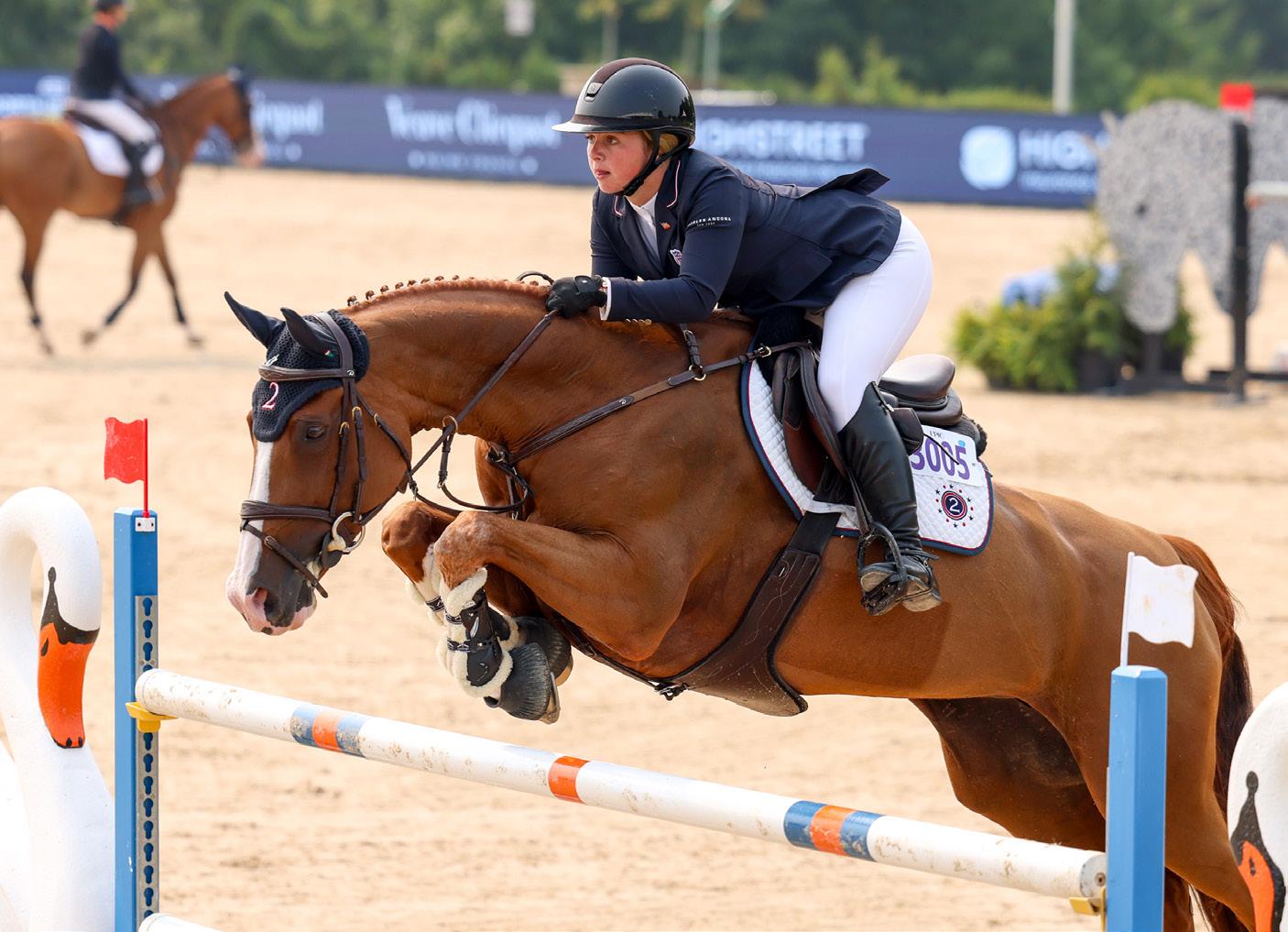
CHARLES ANCONA
NEW YORK
CUSTOM FIT & DESIGN
USEF Mythbusters: What Happens After an Investigation Is Completed
Cases that go to a hearing are heard by a three-person panel tasked with applying rules objectively and thoughtfully.
by Natalie Voss
“Why did the USEF staff give him/her that suspension?”
“This person got treated differently from someone else who did the same thing.”
“USEF picks and chooses how they handle violations.”
Look hard enough on the internet, and you’ll find statements like these about the US Equestrian case resolution process. Many of them are rooted in misunderstandings of how the system works.
In our fall 2025 US Equestrian magazine, we published an explainer on the way the investigation process works, detailing what happens when a complaint comes to our Regulation Department. However, many members have asked: “What happens next?”
Informal Resolutions
After the investigation process is complete, the Regulation Department works with the US Equestrian Legal Department to determine whether to move forward with a case. The process from there differs in many key ways from the criminal justice system, but one thing you may be familiar with from watching or reading legal dramas on television is that these decisions are all based on evidence. An investigator may believe the story of someone who comes to them to report a rules violation, but
how the Federation chooses to proceed depends on the evidence investigators have gathered and the credibility of the witnesses who are willing to participate in the hearing process.
“Members alleged to have violated a rule have a right to a thorough investigation and a fair process,” said Sonja Keating, Chief Operating Officer and General Counsel for US Equestrian. “Ensuring that our members are treated fairly and respectfully through the process is paramount. Through the investigation process, we are seeking all the facts surrounding the situation. We receive many reports that cannot be substantiated. This does not mean people are making false reports, it simply means that we do not have the evidence necessary to meet the legal burden of proof. Our cases must withstand legal scrutiny.”
When the investigation is complete and there is evidence to support a violation of Federation rules, US Equestrian may file a complaint and prosecute the case. This does not mean that all cases go before the Hearing Committee. For certain types of minor offenses, the person may be issued a warning. If the offense is more significant, the Federation may offer the person an informal resolution. The vast majority of cases are resolved this way, which is a good thing for members.
“An informal resolution enables both the member and the Federation to avoid the time and expense of a hearing and
PHOTO:
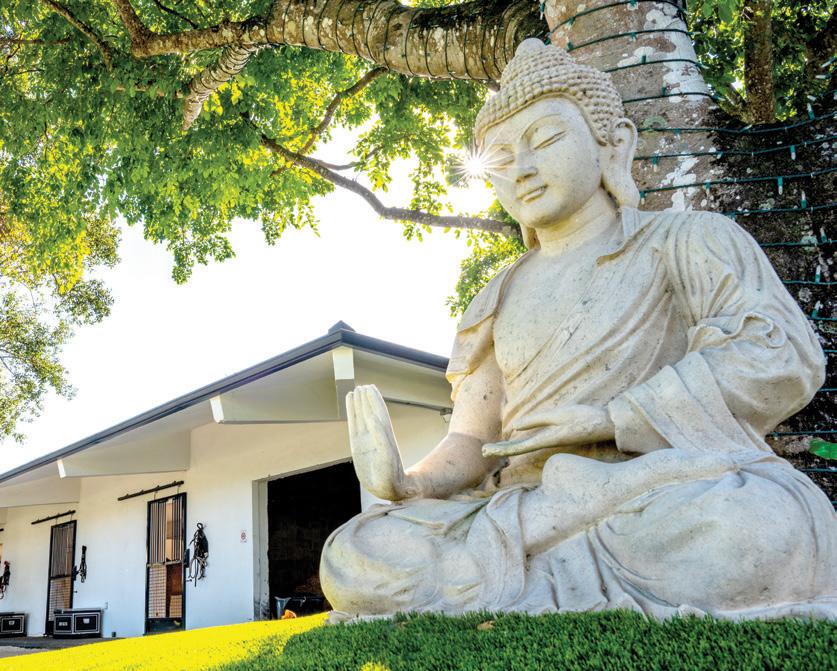
Zen Elite Equestrian Center, located in Southwest Ranches, Florida is everything the name suggests and much more.
The state-of-the-art facility hosts a spacious covered arena, two huge outdoor arenas and a full rehab/spa.
From the cascading waterfalls in the rider’s lounge, to its peaceful statues and inviting gardens, Zen Elite Equestrian Center envelops visitors in a spa-like relaxed atmosphere.
But Zen Elite is more than just soothing to the soul. The facility is unique in its scope, hosting grassroots dressage and jumping lesson programs in the same arenas where international trainers are preparing for national and world competitions.
Owner, Heidi Humphries’ vision is legendary, in that it supports the future of horse sport in the spa-like serene atmosphere that is Zen Elite Equestrian Center.
Throughout the investigation, it is important to seek all the facts surrounding the situation.
eliminates the necessity for what members may view as an adversarial process. This approach facilitates a more efficient resolution,” said Keating.
The penalties offered in the informal resolution process will depend on a range of factors — guidance from the rulebook, existing penalty guidelines, the person’s violation history (if any), and aggravating or mitigating circumstances found in the evidence. Because the penalty sought by the Federation is often a complex formula of all these factors, it’s not unusual for two cases with similar violations (the same drug or same rule violated) to result in different offered penalties. Those who readily admit to a violation and demonstrate regret can often mitigate the penalty to some extent.
“We understand members find this confusing,” said Keating. “What many people don’t realize is that one case may involve someone with repeated violations while the other is someone’s first offense, or the strength of evidence may be very different between the two cases — especially if witnesses become reluctant and will no longer participate in the proceedings. Unfortunately, this is not an uncommon occurrence. We have an anti-retaliation policy to protect whistleblowers, but for many people, that is not enough to give them the comfort they need.”
Sometimes, the available evidence is such that USEF’s legal team offers a penalty that’s lighter than what they would like.
If the two sides cannot agree to an informal resolution, the individual alleged to have violated a rule has the right to request a hearing before the USEF Hearing Committee.
The Hearing Stage
The Hearing Committee serves as a pool from which a panel of three members are selected to hear a case that’s moving through the hearing process. One of the three panelists is an athlete. Committee members are appointed by USEF every two years, but the Federation is not involved in deciding which group of three will hear a specific case.
Dan Danford, an attorney and member of law firm Stites & Harbison PLLC, serves as outside counsel for US Equestrian and oversees the hearing process. Danford said that Hearing Committee members already have extensive experience in the sport, so while the hearing process is likely new to them when they begin, their familiarity with rules and regulations provides them with a good guide on how to proceed.
Hearing Committee members get considerable onboarding from Danford, with emphasis on the need for confidentiality and impartiality in the process.
“It’s not the role of the Hearing Committee to find in the Federation’s favor,” said Danford. “Instead, it’s the role of the Hearing Committee to review the evidence and render the correct ruling under the USEF rules and bylaws.”
The Federation bears the burden to prove that the violation occurred. Simply bringing a case forward does not satisfy that burden. The Federation must introduce sufficient evidence to establish a violation.
The panel is instructed not to discuss the case with anyone before or after the hearing, and that they should walk into the hearing with an open mind. In fact, the panel does not receive any evidence in the case until the day before the proceedings begin and are encouraged to check any preconceived notions about the case at the door.
Before the hearing starts, the panel is sworn in, and each side has the opportunity to make an opening statement and to make objections to the procedure or admissibility of evidence. Both sides have a full opportunity to present their case by calling witnesses, offering evidence, and crossexamining each other’s witnesses. The rules of evidence and proceedings in these cases are not the same as one would find in a civil court. For example, administrative hearings have more leeway on rules about hearsay and other types of evidence.
Panelists are encouraged to question witnesses but are admonished to refrain from sharing personal observations or making statements about legal issues, such as the proper interpretation of a rule at issue. Danford often sees a mix of personality types on panels, with some panelists succeeding in asking probing questions, while others prefer to sit back and listen carefully.
Hearings generally run between two and four hours, although Danford says in rare instances he has known some to stretch over more than a day.
US Equestrian’s Bylaw 702 outlines the rights someone has as they move through the hearing process, which are standard for any type of administrative hearing.
Utilize the latest technology with T3 Matrix Saddle Pads for maximum comfort and freedom of moment
BUCAS ROECKL
MYLER BITS®
“My goal as counsel to the Hearing Committee is, regardless of how people perceive the hearing process, to make sure the process is fair,” said Danford. “If a respondent ends up getting penalized for something, I can’t control how they feel about the reasoning of the panel, but what I can do is make sure they actually got a fair process.”
Safe Sport Cases Can Be Different
In the instance of a Safe Sport complaint, the process may look different because the Federation does not handle the investigation and adjudication process for all Safe Sport cases. In accordance with federal law, USEF maintains its own Safe Sport policies which govern bullying, hazing and physical or emotional misconduct, and a complaint falling into one of these categories is often handled by US Equestrian. If the complaint involves any sexualized misconduct, including child sex abuse, non-consensual sexual conduct, sexual harassment, or intimate relationships where there is a power imbalance, it must be referred to the U.S. Center for SafeSport. If a minor is involved, it must also be reported to the authorities.
Cases referred to the national center are investigated and adjudicated by them. Safe Sport has its own processes and a wider range of potential resolutions. Once a case is resolved, either by a resolution or after arbitration, the final conclusion is relayed to US Equestrian, and the Federation is required to enforce it. The same applies to any interim measures, like suspensions issued while the investigation proceeds. The Federation is not
involved in the investigation or adjudication process by design, since the 2017 federal law mandating Safe Sport requires that sexual abuse investigations be handled independently.
After the Hearing
After the USEF hearing has concluded, the panel will discuss the case and come to a conclusion. Danford is available if they have a question about the technical elements of the rules but does not have a vote on the case. Once the panel reaches its ruling, Danford prepares a draft decision that includes the panel’s findings and the rationale for those findings, and the panel has the final say on the language of the decision.
In the past, only a limited synopsis of a decision was shared with the membership, and these mostly served to outline the alleged offense and penalties (if any). In January 2026, the Hearing Committee decided that, going forward, full decisions would be available to the membership after each hearing. These are similar to the documents published by the FEI and go into detail about the evidence the panel reviewed and the determinations they made that led them to their final conclusion.
Danford is hoping that more disclosure will help members understand how things work behind the scenes and will avoid misconceptions about the hearing process.
“The panel wants to give the respondent the best chance to make their case,” he said. “If the Federation doesn’t bring the evidence, these panels don’t hesitate to go against them. I don’t think everyone sees that.”
The Hearing Committee listens to cases from all the breeds and disciplines recognized by US Equestrian.
How breeding, movement, and temperament shape the horses we see in Hollywood movies and TV shows.
BY DEBBIE ELLIOT
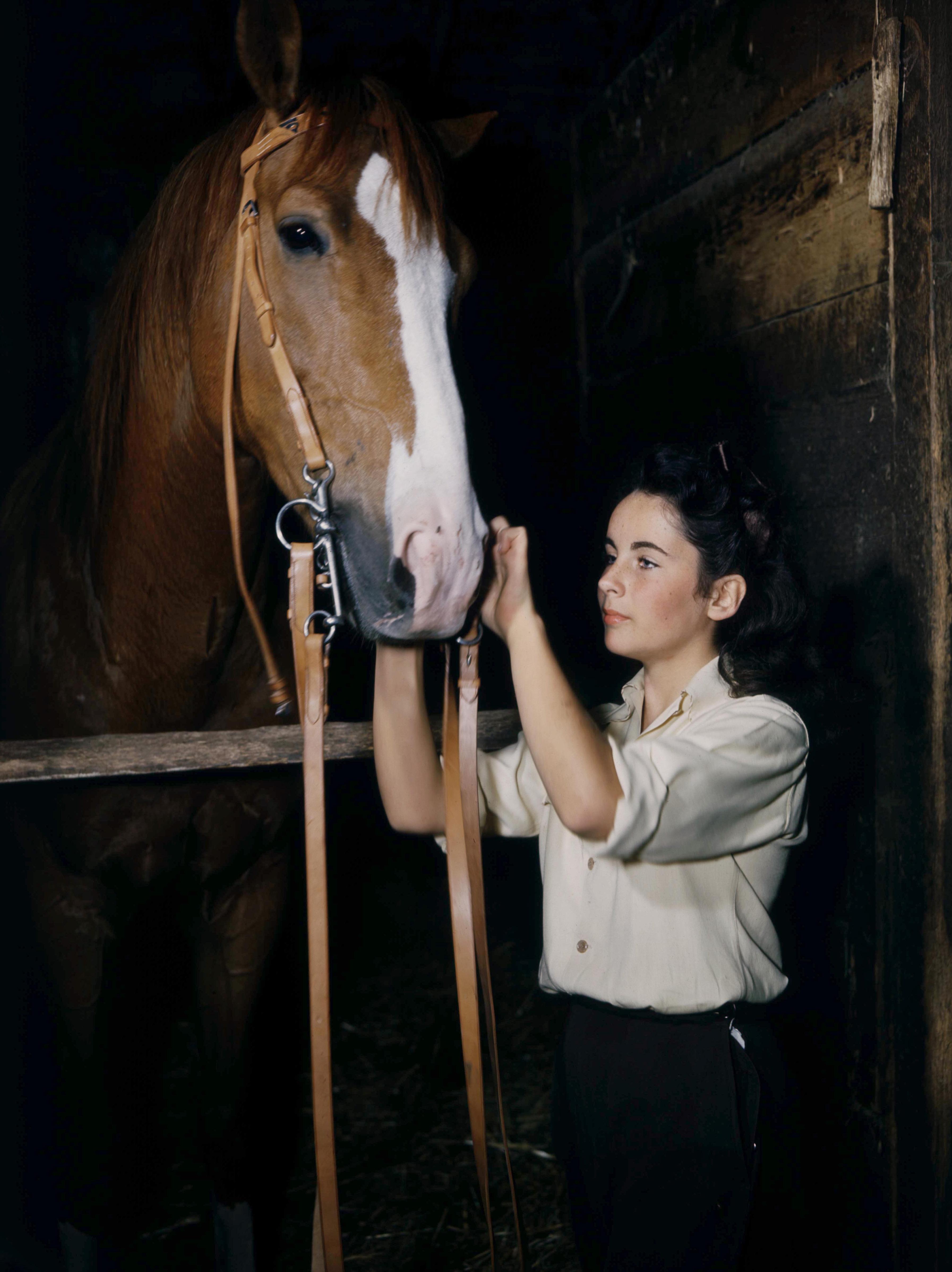
Elizabeth Taylor with King Charles, the Thoroughbred who played The Pie in “National Velvet.”
The biggest stars in equestrian sport will head to Los Angeles in summer 2028 for the Olympic Games. Long before that, horses played a pivotal role in the City of Angels, shaping its early development and becoming instrumental in the rise of Hollywood filmmaking.
It is not just Quarter Horses appearing in westerns who have become equine movie stars. Breeds such as Thoroughbreds, Saddlebreds, Andalusians, Friesians, Connemaras, Spanish Mustangs, Arabians and even a Chincoteague Pony have all appeared on the big screen and become part of Hollywood history.
“Horses have always had a big part in the film industry,” said John Scott, a wrangler, horse trainer and stunt performer who has worked on blockbuster and Oscarwinning films since 1969. “It goes back to the silent film days when Tom Mix was riding a horse called Tony the Wonder Horse. Back then, the actor was billed with his horse, such as Gene Autry and Champion; Roy Rogers and Trigger; Hopalong Cassidy and Topper; and the Lone Ranger and Silver. The horses were the heroes and they were a great attraction to kids.”
One of the first horses in movies was a Morgan stallion named Rex — also known as The Wonder Horse or The Devil Horse, as he sometimes attacked the actors, according to Roberta Smoodin, author of the book “Horses of Hollywood.”
Rex began his career in a 1924 silent Western titled “The King of Wild Horses,” then transitioned to sound films in the ‘20s and ‘30s. Smoodin said the key to Rex’s acting success was his sentience as viewers could see what he was thinking.
“In many ways, Rex was the ultimate silent-film actor, who emoted more believability and subtly than the greatest human silent-film actors,” she said.
Displaying sentience and expressing emotions is what really makes an equine actor stand out from the herd, according to Smoodin. These horses move the plot forward rather than acting as background props or simply vehicles for cowboys.
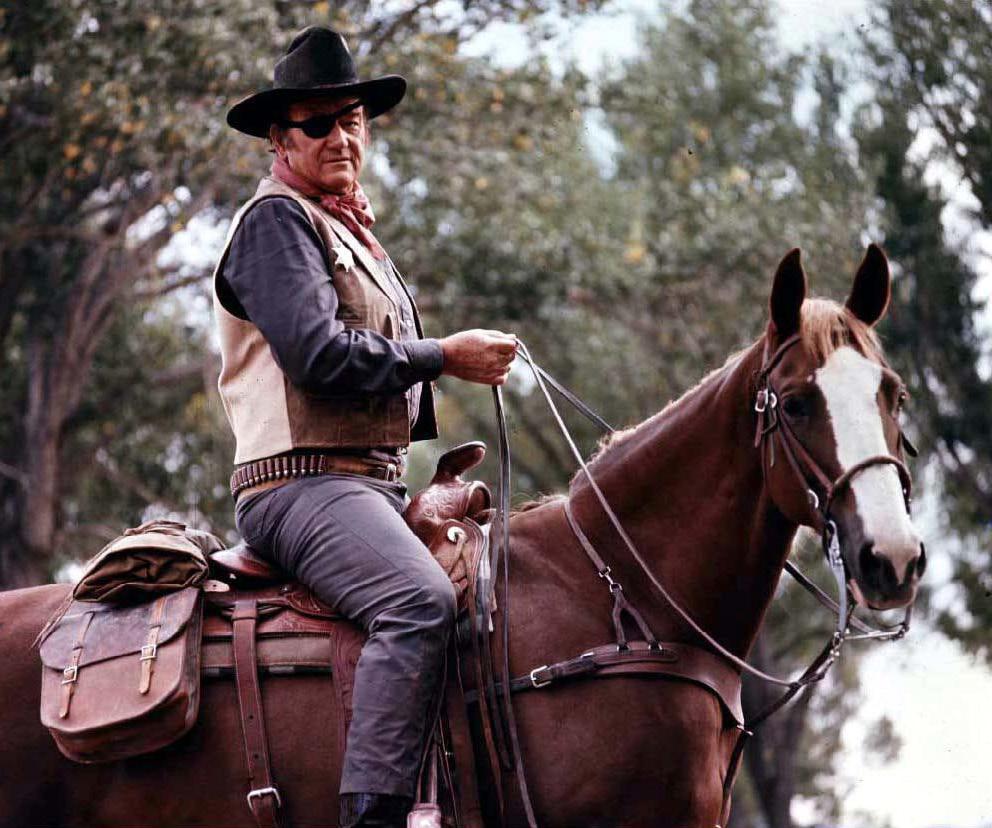
“A lot of the horses John Wayne rode in his films demonstrated kindness and concern for him, and did errands when needed,” she said.
One of Wayne’s most famous mounts, Duke — who was thought to be an Arabian-Quarter Horse — got top billing in some of his early films.
“This horse was an organizer who could carry out life or death missions on his own. His sentience, not to mention his leadership ability, could not be questioned,” Smoodin said.
Smoodin believes that the key to a great horse on screen is their intelligence.
“With some horses, you look in their eyes and they understand every word you say,” she said. “That helps create a bond with the human actor.”
“HORSES HAVE ALWAYS HAD A BIG PART IN THE FILM INDUSTRY.”
- John Scott
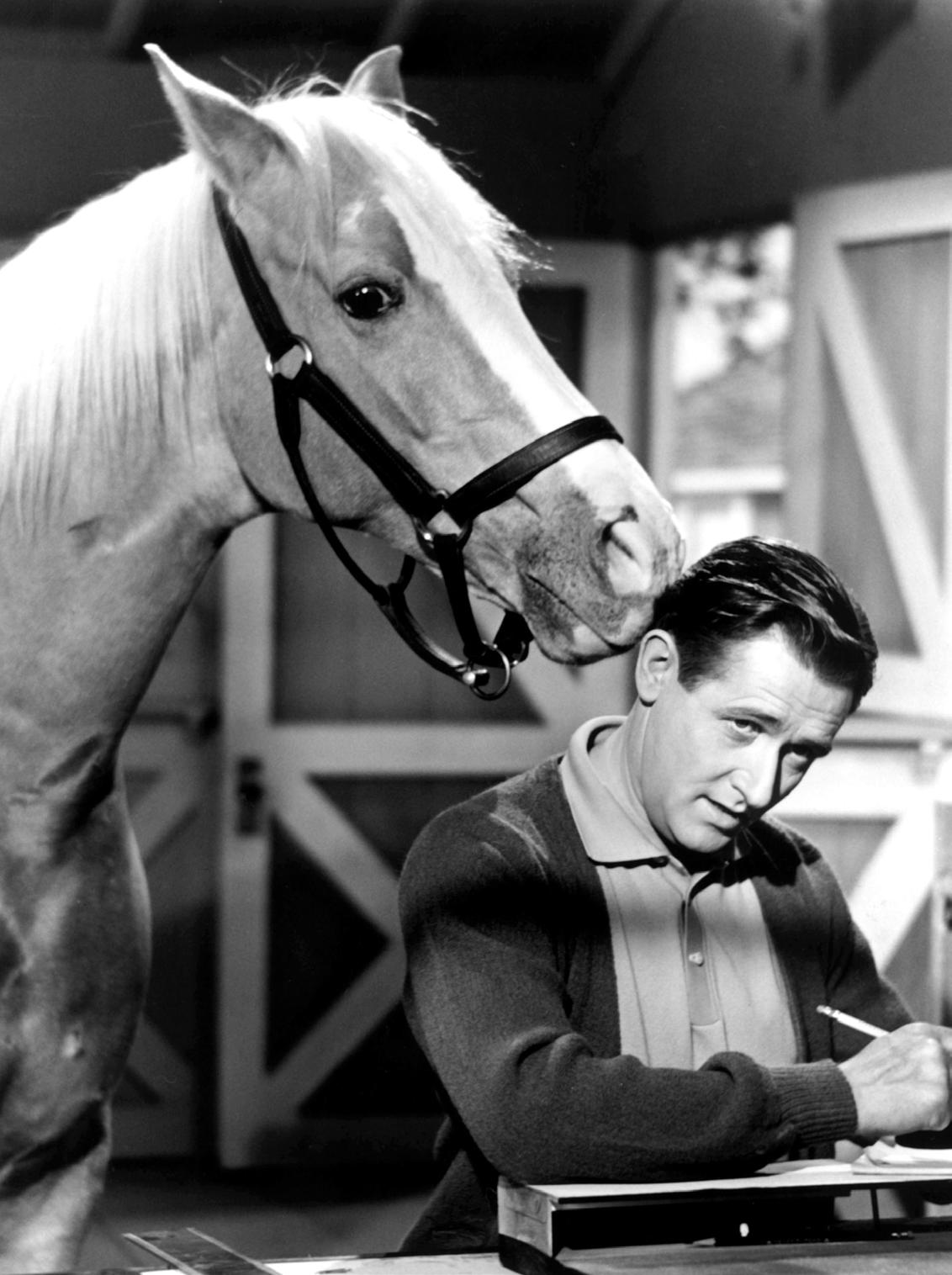
Mister Ed, a.k.a. Bamboo Harvester, shooting a scene with his co-star, Alan Young.
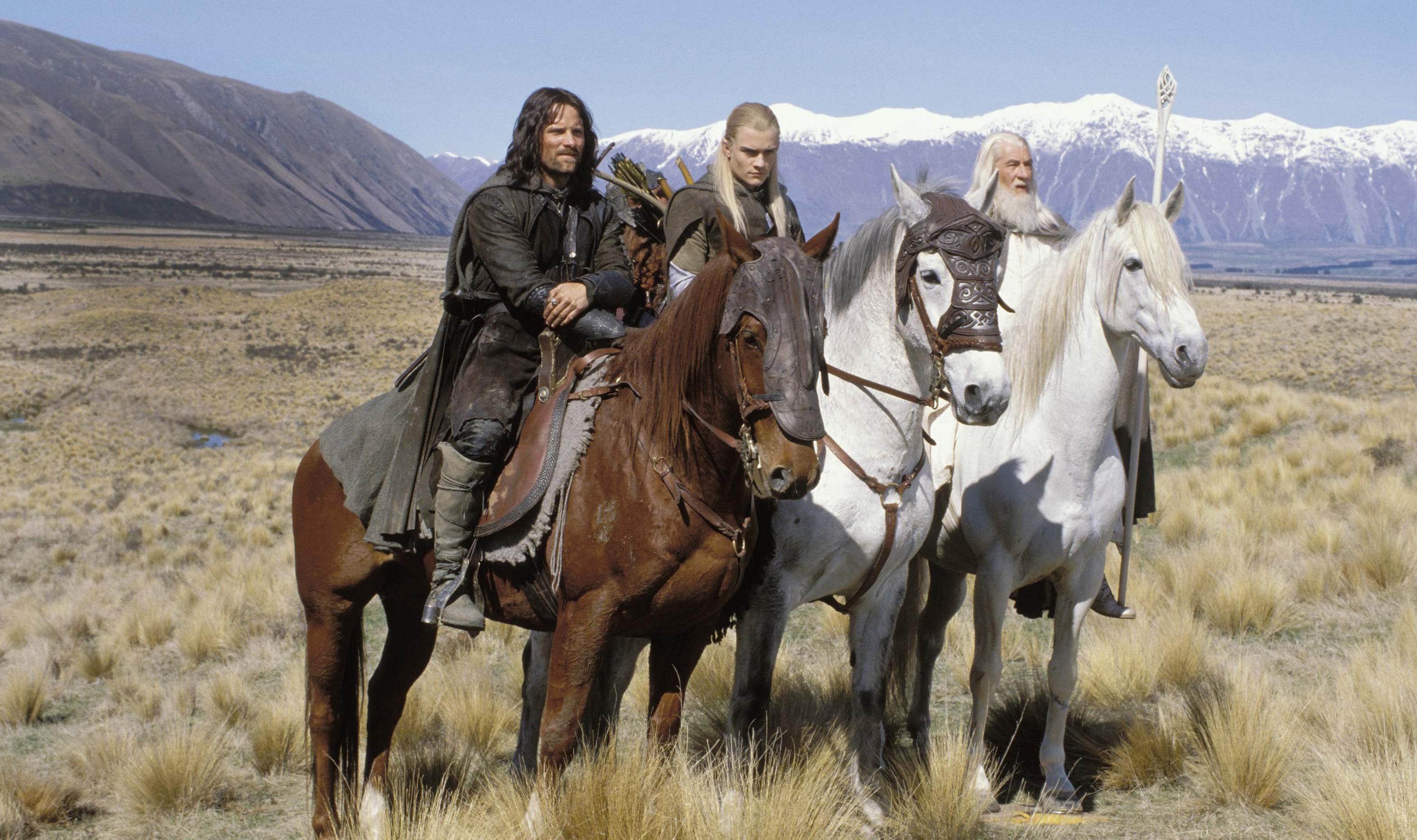
“The Lord of the Rings” actors
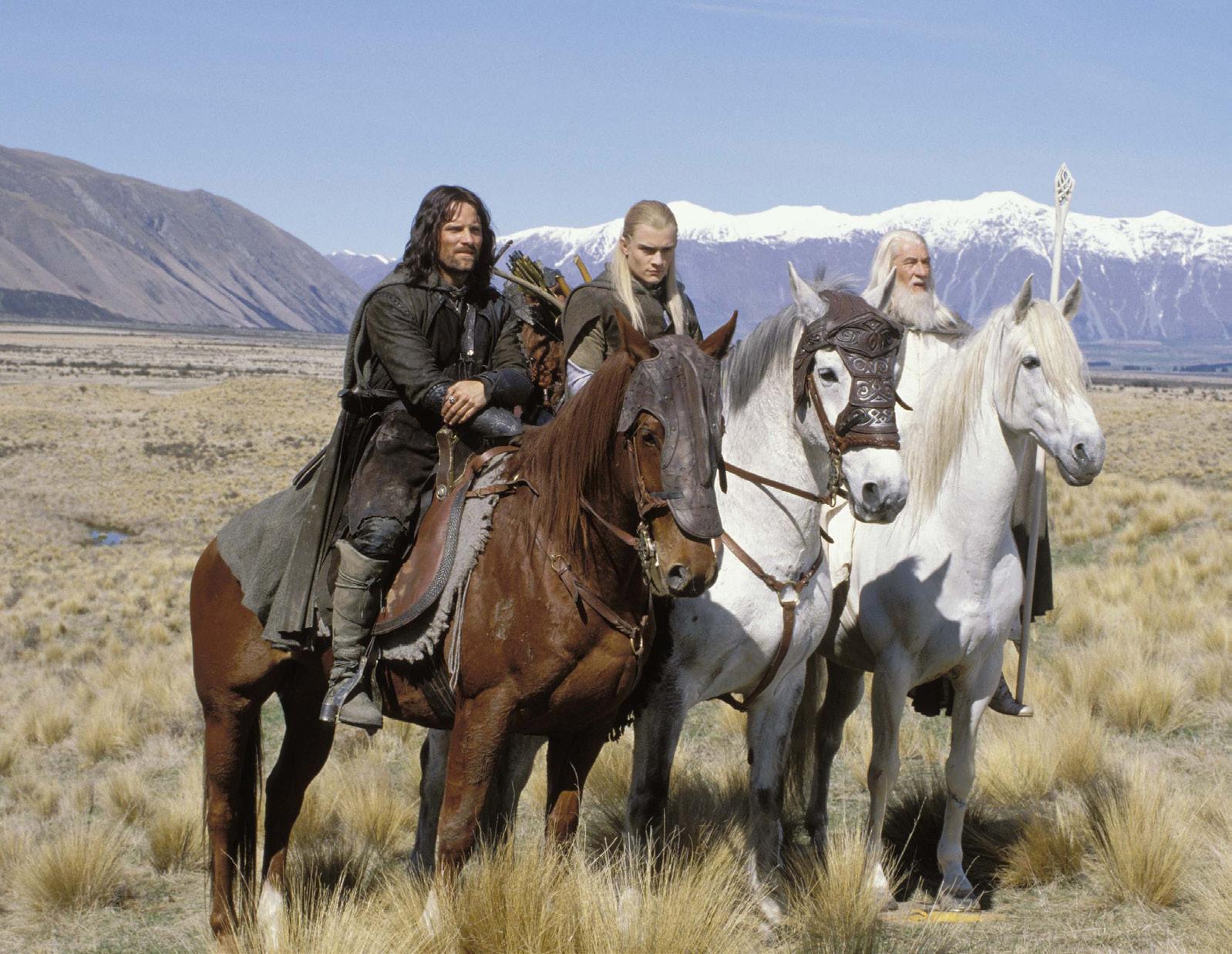
Viggo Mortensen, Orlando Bloom and Ian McKellen (mounted on Shadowfax who was played by Andalusian stallions Blanco and Domero.)
While any horse — no matter their bloodlines — can be trained to appear on film, there are some breeds that are more popular with filmmakers than others. Scott has an affinity to Quarter Horses due to their versatility and their ability to stand on set for long hours.
“If a horse is fidgeting around, then the actor blames it on the horse if he can’t get his lines right,” Scott explained.
He also regularly uses Quarter Horses crossed with draft types, such as Percherons or Belgian Drafts, as they are patient and sturdy.
Scott, whose resume includes classic films such as “Little Big Man,” “The Revenant,” “Lord of the Rings,” “Legends of the Fall,” and “Unforgiven,” finds the right horse to fit the director and the actor, while also consulting with the wardrobe department on what the star is wearing. “Usually if you’ve got a bad guy, you put them on a black horse as he’s got a black outfit,” he said.
“The horses have got to have a good, soft eye and they’ve got to have a great attitude,” Scott said of his equine casting strategy. “There is so much for the horse to see on a movie set, such as smoke, gunfire and people walking beside them with anything from umbrellas to sheets of plywood. Only three out of 10 horses work for me to be a movie horse because they have to be able to handle the stress of that environment.”
Scott likes to work with older horses as they have more experience traveling, loading onto trailers and being moved to different places than young horses.
“You can’t have a horse who will get spooked, or kick and bite an actor or member of the crew,” he stressed.
The challenge is selecting a horse you have never seen before and understanding what they like and don’t like, Scott explained.
“They will tell you with their ears, eyes and disposition, and if they settle into everything, then you have got a good foundation to go on with. If they get hyper and they don’t want to be there, the best thing to do is get them off the movie set.
“I find that if you prep the horse, let them see what’s going on and allow them to understand what you want them to do, they’ll work for you. The key is to make the horse as comfortable as you’d like to be yourself. Let them go through it at their own pace, as that takes the fear away and builds up confidence.”
While some movie stars have a lot of experience in the saddle, it is also important to select horses who will put non-equestrian actors at ease. Scott recalled working on “Night at the Museum” with Robin Williams, who played Theodore Roosevelt.
“He was very scared of horses and didn’t want to ride because his friend (and college roommate) Christopher Reeve had fallen off a horse while eventing and suffered a spinal cord injury, but I told him I had just the horse for him,” Scott said.
He put the comic actor on his number one horse, a chestnut Quarter Horse-Belgian Draft cross named Tonto, and by the end of the film, Williams loved the horse so much he wanted to buy him.
“I’d never sell that horse,” pledged Scott, who still has the 34-year-old favorite at his ranch.
Other stars are particular about what they ride on screen, with Clint Eastwood requesting a flea-bitten grey for films such as “Pale Rider.” Eastwood was also very fond of Andalusians, and the breed appeared in many of his iconic Westerns.
A new obstacle for trainers is drones on set, as the drone operators often want to fly them over the horses’ heads.
“We had to educate them on how to shoot with horses,” Scott said. “We told them, ‘If you come at him from the front, he’ll accept it, but if you come over his back and head, it’s going to spook him.’”
SATURDAY 12:30 CINEMA NATIONAL VELVET
SATURDAY 12:30 CINEMA NATIONAL VELVET
SATURDAY 2:45
THE RIGHT HORSE FOR THE ROLE
He also helps directors understand that when a horse has had enough, he’s had enough.
“Some directors will take 20 takes of a scene, and that will wear the horse out,” he said. “We always have a double for our cast horses, in case the horse is having an off day, or he comes off the trailer and he’s lame, so sometimes we have to switch horses out if the main horse is tired.”
NO ANIMALS WERE HARMED
Aside from ensuring the horses are not overworked, the growth of natural horsemanship and American Humane Society regulations have prioritized horse welfare on film sets.
CINEMA
NATIONAL VELVET
“Liberty horse trainers really excel at promoting our business in a safe way, making it easy on the horse, making the horse look good and doing terrific work,” Scott said. “People like to see a horse running free, rearing, or doing tricks like pawing the air.”
SATURDAY 12:30
CINEMA
LORD OF THE RINGS
SATURDAY 2:45
In the American Humane Society’s “Guidelines for the Safe Use of Animals in Filmed Media,” horses can be taught to fall or lay down from a stationary position, but not from a gallop, canter, trot, or forced trip, and rocks must be removed from cushioned fall sites. There are also strict regulations on safety issues, such as how close they can be to fire or motorized vehicles with cameras on them; the angle that a pistol can be fired from horseback to prevent powder flashes burning the horse’s eyes; and shoeing rules, especially when the horse is walking on asphalt or cement. In addition, there are in-depth welfare regulations that cover feed, water, shelter, rest, weight for pulling and riding, and saddle time.
CINEMA
THE BLACK STALLION
SATURDAY 11:20
The American Humane Society’s “No Animals Were Harmed” program ensures the safety and wellness of all animals on set. Their Certified Animal Safety Representatives start working with crews before filming begins by reviewing scripts, consulting during pre-production, inspecting filming locations, and monitoring sets. They are also on-set during filming to supervise production and ensure all guidelines are followed. The American Humane Society gives No Animals Were Harmed™ certifications to TV and film productions that meet their high standards of animal welfare.
FROM T HE SHOW RING TO THE FILM SET
Louisiana-based Conne mara breeder and trainer Raelin Schenck’s life revolved around working at a hunter/jumper barn until one day someone suggested her Connemara stallion, Wildwych Wily Casanova (“Sly”), audition for a role in “NCIS: New Orleans.” Sly won the part, despite auditioning against a number of other white horses, and his acting career began.
Prior to appearing on the CBS crime drama, Sly was a show horse who had competed in everything from the 1.10m jumpers at rated shows to lead line with little kids.
“He’s been all over the place, so walking onto a set was no big deal to him,” Schenck said.
One of Schenck’s other Connemaras, Porker, had previously been taught to do tricks, and he and Sly were both cast in the 2020 film, “The Lovebirds,” also filmed in New Orleans.
As more calls for movies and TV shows came in and her ponies’ acting careers took off, Schenck decided to pivot her own career from hunter/jumper training to the entertainment industry. One of their biggest roles was in AMC’s “Interview With a Vampire” series, for which Sly shot scenes where he had to drive a cart through the French Quarter, then Porker would be swapped in for stunt work like rearing on command.
“Both of them had been going to horse shows for years, so they didn’t even blink an eye at all the movie props and sets,” Schenck said. “You want to put a gigantic light on top of their head? They don’t care! They’ve been there, done that. We’ve stood under tents in the pouring rain waiting to go into our classes at horse shows, so times like that were great preparation for life on a set.”
Schenck said the Connemaras’ crazy pony humor and attitude is a big advantage while filming, as they will quite happily shoot the same scene over and over if they are going to get a treat at the end. Their endless patience and good brains are also an asset when working with people who have limited horse experience. Ireland’s only native horse breed is known for its hardiness, adaptability, and gentle stamina, which makes them natural movie horses.
“Standing around for hours is something they had to learn,” Schenck explained. “We used Sly in the movie ‘Sinners,’ and while the horses don’t show up on-screen a whole lot in it, they shot extensive footage of him. We were on set all night long with Sly standing in front of a big wagon. He had his harness on, but we didn’t even hook him up to it because it wasn’t going anywhere. He never moved; he would literally stand there and go to sleep.”
Schenck ensures that Sly and Porker always have hay to eat and water in front of them, and take breaks when needed.
“It’s kind of like being at a horse show, but without all the other horses around,” she said. “Sly and Porker love going to new places. I don’t even think they understand there’s a
“He’s ready to go to work at all times and he loves his job.”
“He’s ready to go to work at all times and he loves his job.”
- Raelin Schenck
Top: Actors Mickey Rooney and Kelly Reno with Arabian stallion, Cass Ole, in “The Black Stallion.”
Opposite Top: John Wayne was known for having sentient horses in his famous western movies.
Opposite Bottom: Wildwych Wily Casanova, a.k.a. Sly, braided and ready for his big scene.
difference between what they’re doing now and what they used to do. They probably like the movie business a little better as they get lots of attention and pets.”
Schenck makes sure she hacks the ponies in between takes to keep them active.
“We wander around the huge studios in the parking lots — and find craft services, which is where the treats are all the time! The crew started bringing granola bars and apples for the ponies, who relish the attention,” she said.
Along with driving and rearing on command, Schenck has taught her Connemaras several tricks of the trade, such as teaching them to go to a spot on the ground by starting out with the command “go to your bucket.” She then cut the bottom out of the bucket so they were directed to a flat disc, which she made smaller and smaller until the pony learned to go to any specific spot even without a marker there.
One challenging trick was teaching the Connemaras to walk through fake rain when it was dry on either side.
“It was just a small little area of rain and the horse has to stay walking in it,” Schenck explained. “Of course, they wanted to just take two steps to the right where it wasn’t raining anymore to stay dry.”
Despite some strange requests from directors, the ponies are embracing their new careers and enjoying stardom. “I don’t think Sly wants to go back to horse showing,” Schenck concluded. “I think he wants to stay on set. He’s ready to go to work at all times and he loves his job.”
For more information on Connemaras, please visit usef. org/learning-center/videos/the-connemara-pony
Iconic Film Horses and Their Breeds
The Black Stallion: Arabian
One of the most iconic horses on screen, The Black in the 1979 film, “The Black Stallion,” was portrayed by Arabian Cass Ole. The Texas-bred stallion had a sevenyear career as a show horse before becoming a movie star, winning over 50 championships including National Champion in Arabian Western Pleasure in 1975. Cass Ole’s looks and temperament caught the attention of movie trainers Glenn Randall Sr. and his son, Corky, who brought him to their Newhall, Calif., ranch to train him for the role of a lifetime. His owners stipulated that he was not to be used for running or swimming scenes, so three equine stand-ins were used for those shots.
Breed Traits: Arabians’ suppleness, balance, athleticism, naturally high tail carriage, and superior endurance and stamina make them stand out in movies. They are highly adaptable horses and have no problem traveling long distances over extended periods of time. For more information on Arabians, please visit usef.org/learning-center/ videos/history-heritage-of-arabian-horse
The Mask of Zorro: Friesian
While Antonio Banderas’ horse Tornado in 1998’s “The Mask of Zorro” and the 2005 sequel “The Legend of Zorro” was supposed to be an Andalusian, he was in fact played by multiple Friesians. The breed’s natural jet-black color, impressive on-screen presence, and flowing manes and tails were among the reasons for the switch. Their calm and predictable behavior made them very trainable, while their dramatic eyes and expressive faces fit the comedic aspect of the films.
Breed Traits: Friesians are intelligent, elegant performers who are willing to learn. They are unique as they are large and gentle in stature and are notably recognizable for their black coats, as this is the only color recognized in the breed. For more information on Friesians, please visit usef.org/learning-center/videos/the-friesian-horse
National Velvet: Thoroughbred
Many of us grew up watching Elizabeth Taylor play a horse-crazy girl determined to race in the Grand National in the 1944 classic, “National Velvet.” While The Pie in Enid Bagnold’s original novel was a mixed-breed piebald (hence his name), he was changed to a chestnut Thoroughbred for the film adaptation. The Pie was portrayed by King Charles, a grandson of Man O’ War whom MGM studio purchased for the film and then gifted to Taylor once it wrapped. He went to live with the thenteenage actress at her family’s property in California and was her personal riding horse until his retirement.
Breed Traits: Thoroughbreds are renowned for their agility, speed, and stamina. They are well-rounded athletes with powerful hindquarters that make them highly successful in the racing world.
Mister Ed: American Saddlebred/Arabian
Undoubtedly the most recognizable horse on TV, Mister Ed was played by a palomino American Saddlebred/ Arabian gelding named Bamboo Harvester. The expressive “talking horse” was trained by Will Rogers’ protégé, Les Hilton, who reportedly taught him to move his lips on command by touching his hoof. Bamboo Harvester was famed for his big personality, which aligned with the wise-cracking Mister Ed, and was known to walk off set when he was done filming. Actor Alan Young, who played Wilbur Post in the CBS sitcom, described Bamboo Harvester as his “best-behaved” co-star.
Breed Traits: Saddlebreds are praised for their bravery, confidence, personality, willingness to work, intelligence, and versatility. They boast a picturesque shape and smooth gaits. For more information on American Saddlebreds, please visit usef.org/learning-center/videos/ american-saddlebred-what-makes-winner
The Roy Rogers Show: Thoroughbred/Quarter Horse
A dashing palomino stallion, Trigger became as famous as his rider, Roy Rogers, in the 1940s and ‘50s. Golden Cloud, who portrayed Trigger, was known for his intelligence and was taught over 100 tricks by Rogers. They included walking on his hind legs, rearing on command, unlatching gates, taking off gloves, playing dead or lying down for a nap under a blanket. However, according to trainer Glenn Randall Sr., Golden Cloud’s greatest achievement was that he was housebroken. The character of Trigger was featured in numerous films and TV shows, such as “The Roy Rogers Show,” “My Pal Trigger,” and “The Golden Stallion.” He is immortalized with his hoofprints on the sidewalk in front of Grauman’s Chinese Theatre in Hollywood.
Breed Traits: Known for their compact build and speed over short distances, Quarter Horses are bred for work. Their strength, power, and quickness make them particularly effective for ranch work and cow herding.
Hidalgo: American Paint Horse
Based on the real-life story of Frank Hopkins and his Spanish Mustang, Hidalgo, this 2004 biopic stars actor Viggo Mortensen and a horse named Oscar. While Oscar played a Mustang, he was in fact an American Paint Horse, as the breed was deemed bombproof and quiet. In the
PHOTOS: LESLIE POTTER/US EQUESTRIAN, COURTESY OF JOHN SCOTT, COURTESY OF RAELIN SCHENCK
film, Hopkins and Hidalgo embark on a 3,000-mile race across the Najid desert, competing against purebred Arabians. Oscar was trained in liberty movements for the shoot, such as learning to walk behind Mortensen without a lead rope, follow ear and hand cues for emotional expression, and lie down calmly. Screenwriter John Fusco bought Oscar after filming ended and jumped him in local shows before retiring him at his American Indian horse conservancy. Mortensen took home another horse from the shoot, RH Tecontender, who also played Hidalgo in the movie. He joined horses from “The Lord of the Rings” on Mortensen’s Idaho ranch.
Breed Traits: Similar to Quarter Horses, American Paint Horses are known for their strength, balance, and speed over short distances. They are intelligent, trainable, personable, and calm under pressure.
The Lord of the Rings: Andalusian
The Oscar-winning fantasy trilogy featured several stunning horses, one of which was Shadowfax, Gandalf the Grey’s mount. The striking white horse was a fictional breed called Mearas — known for exceptional speed and intelligence — in the films and books, but in real life he was played by two New Zealand-bred Andalusian stallions, Blanco and Domero. Known as the “Horse of Kings” for their noble and majestic appearance, the Andalusian was the perfect breed choice to portray Shadowfax, chief of the Mearas. While Gandalf appears to ride Shadowfax without tack in the films, Blanco and Domero wore nearly invisible rope reins, neck straps and a specially designed “sneaky saddle” that was hidden under Ian McKellen’s robes.
Breed Traits: Andalusians are admired for their strong arched necks; flowing manes; and long tails. Athletic, intelligent, precise, and graceful, they are historically known for being horses desired by kings, as they moved beautifully, but also had athleticism in battle. For more information on Andalusians, please visit usef.org/compete/breeds/andalusian-lusitano
The athleticism, grace, and beauty of majestic Andalusians make them a popular choice for historical dramas, where they often carry kings into battle.
Robin Williams riding John Scott’s horse, Tonto, on the set of “Night at the Museum.”
Sly hitched to a cart on the set of horror series, “Mayfair Witches.”
PHOTO:
Dogs can be trained to be around horses from a young age.
SETTING SAFE BOUNDARIES FOR DOGS & HORSES
Expert advice on how to protect the well-being of all your fourlegged friends at the barn and at horse shows.
BY DEBBIE ELLIOT
As natural animal lovers, horse people are very often also dog people. According to the American Veterinary Medical Association (AVMA), horse-owning households rank among the highest of any group for also owning a dog. While we would always love our animals to be compatible with each other, we have to ensure that interactions are safe and enjoyable for the canines, equines and humans involved.
“You have a prey species and a predator species, and that can lead to dangerous situations,” said Dr. Christin Finn, DVM, VSMT, CVA, CCRT. “You love your horse — that is why you are at the barn or a show — and you love your dog, so you don’t want to leave them at home but you have to make sure they interact safely.”
While dogs can potentially cause chaos if not handled properly, they are also at risk from horses, who might bite, kick or trample them if scared or threatened.
“A lot of horses will either run away from a dog or will tolerate crazy behavior by tuning them out, depending on if they have been around dogs all their life,” said Irith Bloom, dog trainer and founder of The Sophisticated Dog in Los Angeles, Calif. “However, other horses are going to respond with aggression because they feel threatened, especially if they’re cornered and don’t have anywhere to go.”
Left to right: USEF rule GR1301 states that dogs must always be held on a leash or otherwise restrained at sanctioned competitions.
Horse people are often also dog people .
Left to right: Herding, dogs such as Corgis, make popular barn dogs.
Giant breeds, like Great Danes, are prone to bloat from overeating (especially before exercise), so be sure to keep horse feed and treats securely contained.
A USEF bandana makes a great accessory for your dog.
can be toxic to certain breeds, in particular herding dogs, such as Collies, Shetland Sheepdogs, Old English Sheepdogs, and Australian Shepherds.
While getting into a bag of feed or horse treats may not be fatal to a dog, it could make them sick, explained Dr. Finn, who warned that giant breeds like Great Danes who are prone to bloat can twist their stomachs and die if they overeat.
Most dogs will gather around the farrier on shoeing day as they scour the ground for snacks of hoof trimmings. Occasional ingestion of small pieces of clean hoof trimmings may not pose a major health risk, but they can cause blockages or irritation to the digestive tract, according to Dr. Morton.
“It’s always safest to distract your dog with a chew toy or have them on a leash during shoeing, and then be sure to pick up hoof trimmings after the farrier visit to minimize risk,” she said.
DOG ETIQUETTE AT HORSE SHOWS
Dogs in the barn area, sitting ringside or riding on golf carts are common sights at most horse shows and events, but bringing your four-legged friend to watch you compete is not always the wisest choice.
“If you’re at a horse show, your focus has to be on your horse. You can’t focus on your dog at the same time, and you can’t expect your dog to make good decisions while you are distracted,” said Dr. Finn, adding that there is the potential risk of a horse standing on your dog, your dog biting a horse or person, or spooking a horse and causing it to bolt. “There are so many unpredictable aspects about horse shows, especially as you often have an anxious person walking an anxious horse to the arena.”
People should also take into account that just because their horse isn’t afraid of dogs, that doesn’t mean all horses are comfortable around them. Some horses have past trauma from being chased or attacked by a dog that can be triggered by seeing canines at a show ground.
Bloom suggests having both a collar and a harness on your dog while at a horse show, and a leash attached to each, so that if one leash is pulled out of your hand then you still have hold of the second.
Just like at the barn, dogs can also be kept in crates at shows when they can’t be fully supervised (always make sure they
have water). However, if your dog is reactive and likely to bark at horses walking past, consider putting a lightweight sheet or blanket over the crate so that they won’t be agitated, Bloom suggested. When you need to take them out of the crate, walk to a designated area away from horses so as not to cause a distraction.
Most of the canine-related violations at USEF sanctioned events involve loose dogs, such as a dog pulling away from the person holding them and then getting their leash caught around another person or dog. Occasionally dogs have run into competition rings or into barns or bitten other dogs.
Under GR1301 in the USEF Rulebook, dogs are not permitted to be loose on competition grounds and must be held on a leash or otherwise restrained. Individuals must not lead dogs on a leash while mounted. Dog owners are solely responsible for any damages, claims, losses, or actions resulting from their dogs’ behaviors. Dog owners failing to comply are issued a yellow warning card and may be subject to penalty.
While incidents involving dogs at high-level competitions are rare, British eventer Tom McEwen, who was on the gold medal-winning team at the Paris 2024 Summer Olympics, suffered a fall with his mount, Bob Chaplin, at the Luhmühlen Horse Trials in Germany in 2022 after a dog with an extendable leash ran out onto the track. The dog pushed Bob Chaplin to the left, forcing him to take the widest corner of a jump, and while the horse managed to stay on his feet and was uninjured, McEwen suffered a fall.
The dog-induced accident opened up a debate about the use of extendable leashes, which many dog trainers do not consider to be safe, and shone the spotlight on the FEI rule regarding dogs, which states: “If allowed at the event, all dogs must be leashed and affixed to a human or stationary object.” Violation of the rule incurs a CHF100 ($125) fine.
Veteran show manager Hugh Kincannon, who has managed the American Jumping Classic, the Washington International Horse Show, and the USEF Pony Finals, among others, said the shows he runs generally have more attendees who bring dogs than those who don’t.
“I think it would be very difficult to tell people they couldn’t bring dogs to shows,”
he said. “We need to try to have them managed in such a way that they’re not a threat to people, other dogs and horses. The stewards do a very good job of handling any issues that arise, so I don’t think it is a huge problem. That’s not to say that we don’t get loose dogs as you are never going to have absolute control over it.”
As the Managing Partner of Kentucky Horse Shows, LLC, Kincannon works with several competitions held at the Kentucky Horse Park in Lexington, Ky., which spans 1,224 acres and has approximately 1,500 horses competing at each show.
“The Kentucky Horse Park police take a hand in controlling the situation. When they see loose dogs, they will say something about it,” Kincannon said. “It has gotten better over the last four to five years and we don’t have as many problems as we used to. If I see someone walking with a loose dog then I will ask them to put it on a leash, but if we have repeat offenders, then we may take it a step further and file an official preliminary warning.”
Be sure to read the showground rules for every competition you attend, as venues may have additional pet policies. The Defender Kentucky Three-Day Event, held at the horse park each April, has a thorough explanation of their dog rules on the event website at kentuckythreedayevent.com
The rules state:
• All dogs must be leashed at all times.
• Dogs are not allowed in Rolex Stadium, Alltech Arena, any grandstands, hospitality tents, museums, the theater, or restaurants at The Kentucky Horse Park.
• Service animals trained to perform tasks for individuals with disabilities are permitted in accordance with ADA and Kentucky law. Service animals must remain under control and off
tables/seats and cannot come into contact with food or service items in accordance with food safety regulations. Establishments may refuse service if a dog poses a risk.
• Emotional support animals are not permitted as service animals; misrepresenting a service animal is a legal offense.
• Dogs exhibiting aggressive behavior or causing excessive noise may be removed from the event at the discretion of event staff.
• Bring waste bags to clean up after your dog and dispose of them in trash cans throughout the park, including on the crosscountry course.
In addition, the Lexington Humane Society offers an on-site doggie daycare during the event, and all proceeds benefit the Lexington Humane Society.
Kincannon recommends that anyone planning to bring their dog to a show needs to know what the rules are in advance, and to keep their dog under control on a leash, tied up at the barn or in a crate.
“There are probably some dogs who should not be at horse shows, so if you have a dog that has personal behavior problems when it’s out in public, then I think it behooves you to take a long hard look at that,” he said. “Horse show management can’t control the situation 100%, so we have to rely on the good efforts of our customers, and I think in most cases, we get that.”
Middle: Be sure to read the showground rules for every competition you attend, as venues may have additional pet policies.
Bottom: Dogs can be desensitized before going to the barn or shows, to encourage them to be calm and relaxed around horses.
Barn-Trained Rescue Dogs
Thrive Animal Rescue in San Diego, Calif., specifically trains their rescue dogs to be calm around horses so they can be adopted by equestrians, and brought to barns and shows.
“It is a symbiotic relationship — horses and dogs go together. Horse people are the best adopters, and we have a zero-return rate from show people,” said CeCe Bloum, co-founder of the non-profit organization.
Bloum owns show stable Newmarket Farms and lives on the property, so all of the rescue dogs encounter horses early in their time at Thrive.
“We walk them past the horses onleash to slowly desensitize them; some are a little afraid at first but then each day they get better and better. They see where the horses are housed, they watch the vans coming and going, and when we have turnouts, we walk them through the turnout lanes,” Bloum said. “We don’t let them go nose to nose right away; instead they sit and look at the horses. We give them treats so they associate it as a positive experience, and everyone is happy.”
Thrive also has a dog trainer who comes out to the facility four times a week to work with the rescues.
When they take the pack to shows, such as at Desert International Horse Park or Jump Nee in Southern California, for adoption events, the dogs are kept in an X pen and have a volunteer watching them at all times.
“We don’t charge an adoption fee at horse shows; it is all donation based and we require an interview process,” said Bloum, who added that the rescue dog pens are set up in vendor row as to not disturb any horses. To find your next adoptable horse show dog, please visit thriveanimalrescue.com
Other horse shows around the country feature rescue dogs, such as the Hampton Classic Horse Show’s annual Animal Adoption Day, and the All American Quarter Horse Congress’ Puppy Alley and Rescue Row.
Left: Dog trainer Irith Bloom recommends having leashes on both a collar and a harness.
DESTINY
AT THE OPEN
US EQUESTRIAN
U.S. combination Kent Farrington and Greya won the $1,000,000 Rolex US Equestrian Open Grand Prix CSI5* at Wellington International and became the series’ second jumping champions.
by Debbie Elliot
The second annual $1,000,000 Rolex US Equestrian Open Grand Prix CSI5*, a Rolex Series Event, came to a thrilling conclusion on March 28, 2026, when a sell-out crowd in Wellington, Florida, witnessed the world’s greatest jumping talent compete under the Saturday night lights.
By the end of the evening, it was U.S. Olympic team silver medalist Kent Farrington and his mount Greya who reigned supreme at the highest-rated Grand Prix in Wellington International history, with British rider Ben Maher and Enjeu De Grisien, and Germany’s Richard Vogel and Gangster Montdesir, coming in second and third respectively.
Farrington and Greya — a 2014 Oldenburg mare (Colestus x Contessa 128) owned by Kent Farrington, LLC, and cared for by Denise Moriarty — set a high bar from the outset by posting the fastest clear effort of the first round with a time of 79.87 seconds.
The Rolex US Equestrian Open Grand Prix starting list featured many of the world’s top combinations, including six athletes currently ranked inside the Top 10 of the Longines FEI Jumping World Rankings, alongside numerous Olympians and World Championship combinations. From a total of 40 qualified athletes who competed in the final, only five horse and rider combinations made it to the jump-off.
Maher and 2014 Selle Français mare Enjeu De Grisien set the jump-off time to beat with 43.72 seconds, but then Farrington and Greya topped that by nearly a second, finishing on 42.99. Vogel and 2016 Selle Français gelding Gangster Montdesir were the final pair to enter the ring, but a rail down at the end of the course sealed the victory for the U.S. combination.
Ireland’s Darragh Kenny on Eddy Blue and Jordan Coyle on Chaccolino finished fourth and fifth, both with one rail down.
An audience of over 10,000 people witnessed Farrington, who’s based in Wellington, make history as the first American rider to win the US Equestrian Open Series Jumping Final. In 2025, Germany’s Christian Kukuk won the inaugural flagship event on Checker 47. (Laura Kraut was the highestplaced U.S. rider in 2025, finishing second on Bisquetta.)
Kukuk and Checker 47 had a miscommunication at the wall in the first round and ultimately retired, taking them out of the running for a repeat victory.
With Farrington currently ranked No. 2 in the Longines FEI Jumping World Rankings, behind Great Britain’s Scott Brash, and Greya named the 2025 USEF International Horse of the Year, the pair look increasingly unstoppable after their latest achievement.
Farrington, 45, described his relationship with the grey mare as a once-in-a-lifetime partnership. “You do this for a long time, and you have some good horses, maybe some great horses, and then you have horses that are an outlier athlete like I believe Greya is,” he said. “She can do everything. She’s fast, she’s careful, she’s scopey, and she’s rideable. She is just an incredible horse, and that is what you are seeing [in the arena].”
According to stats provided by EquiRatings, the pair were competing in their 16th CSI5* 1.60m jump-off together, boasting an impressive 60% -win rate from those jump-offs. The victory also marked Greya’s 10th CSI5* Grand Prix win. With her impressive jump-off record and ability to shine under pressure,
Greya was the favorite to win the Rolex US Equestrian Open Grand Prix CSI5* if the pair qualified for the jump-off.
Michael Stone, President of Wellington International, expressed how impressed he was by both the atmosphere and the caliber of competition at the US Equestrian Open Jumping Final. “I’ve been in the sport almost all my life and to be able to sit here and watch a Grand Prix like tonight — it is mind blowing how good it was,” he said following the event. “The fact that the crowd silenced when the riders and horses were on course, you could hear a pin drop, and then as they came down to the last fence, everyone was cheering. It was really amazing.”
The evening represented not only a milestone for equestrian sport, but also a glimpse into its future as we head towards LA28. “We’ve always strived to elevate the sport in the U.S.,” Stone continued. “This is what we are trying to achieve, and it drives us to achieve more, to make it better, and to continue onwards and upwards.”
The challenging track for the Rolex US Equestrian Open Grand Prix CSI5* featured 18 efforts and was designed by Brazilian course designer Guilherme Jorge. It demanded accuracy, scope, and tremendous athleticism from the 40 qualified combinations. Jorge, a local Wellington resident who has designed the Finale Grand Prix for 12 consecutive years, said it has been consistently getting better, and this year had the highest level of competitors ever.
Farrington praised Jorge’s demanding course, saying it was exactly how it should have been for the competition, and that the balance was just right. “It’s a million-dollar purse, you have the best riders in the world, and an incredibly strong starting field. If you under build the course even a little bit, you could easily see 20 clears,” he said. “It’s very possible to jump clear, and I think that is what this level of competition should be about.”
Riding third in the eight-fence jump-off, one of the keys to Farrington’s win was his decision to take a different line through the second turn than second-place finisher Maher. Greya rose to the challenge, and the tactical move proved decisive in the final podium standings.
“I knew it was going to be a tough competition. I really trusted [Greya’s] speed tonight,” Farrington said in the postcompetition press conference. “I tried to go fast enough to put pressure on the others but not take any ridiculous risks. I think the plan luckily paid off.”
With his name now etched on the bespoke US Equestrian Open trophy, Farrington shared his thoughts on the incredible impact that the series could have. “People start to understand. They start to follow, they start to know who the riders are, they know who the horses are,” he said. “I think that’s really what our sport becomes about. It’s starts with a community here knowing what to cheer for.”
The US Equestrian Open Jumping Final was the first of three finals to be hosted in 2026 as part of the new US Equestrian Open Series, which launched in 2025. The next final will be the US Equestrian Open Eventing Final hosted at Morven Park International in Leesburg, Va., from Oct. 8-11, followed by the US Equestrian Open Dressage Final to be hosted at Desert International Horse Park in Thermal, Calif., from Nov. 13-14.
To learn more about the US Equestrian Open, please visit the series’ microsite at usequestrianopen.org and follow all the qualifying and story-telling action throughout the year.
Above: U.S. rider Elena Haas, of Oakland, Calif., competed in the Rolex US Equestrian Open Grand Prix on her 2012 Westphalian gelding, Claude.
Top Right: Ben Maher and Enjeu De Grisien finished second after an impressive jump-off.
Middle: German pair Richard Vogel and Gangster Montdesir finished in third place overall.
Bottom: Kent Farrington treats Greya with well-deserved carrots the day after the competition.
“ WE’VE ALWAYS STRIVED TO ELEVATE THE SPORT IN THE U.S.”
- Michael Stone, President of Wellington International
Kent Farrington and Greya fly over the signature US Equestrian Open fence.
“She can do everything. She’s fast, she’s careful, she’s scopey, and she’s rideable.”
- Kent Farrington describing Greya
Kent Farrington and the 2014 Oldenburg mare, Greya, as they enter the iconic arena.
Bottom Left: Kent Farrington is covered in champagne on the winners’ podium.
Bottom Right: Kent Farrington reflected on his and Greya’s championship-winning performance as he sat with the US Equestrian Open trophy.
Greya relaxing in her stall the day after being crowned the 2026 Rolex US Equestrian Open Grand Prix CSI5* champion.
Penalties for Rule Violations
OFFICIAL NOTICES
Contributed by the Regulation Department unless otherwise indicated. The following official notices are only intended to give penalty information for a given case and not to disclose the factual basis for each violation or penalty. For matters heard by the Hearing Committee, a Hearing Panel decides each case based on the evidence presented at the hearing and takes into account many factors that may raise or lower a given penalty. For example, the Hearing Committee takes into account such things as whether the violation was intentional or unintentional, the nature of the violation, the credibility of witnesses, Penalty Guidelines, penalties in similar cases, past violations of Federation rules by a respondent, and many other mitigating factors.
US Equestrian members can access and search the USEF Suspension List at usef.org/compete/ regulation/ineligibility-list
Please note that at the January meeting of the US Equestrian Board of Directors, the Hearing Committee agreed to publish full decisions (not just conclusions) from cases that appear before them. For hearings conducted after January 2026, those decisions will be available on USEF.org at usef.org/ compete/regulation/rulings-findings
This is official notice of actions taken by the United States Equestrian Federation, Inc. Hearing Committee on August 14, 2025.
TRACI BROOKS , of Los Angeles, CA, as Trainer, agent, or other Person Responsible as defined by GR148 and GR404, violated Chapter 4, GR410, of this Federation, in connection with the Desert Circuit 1 Horse Show held January 8-12, 2025, in Thermal, CA, in that on or about January 11, 2025, the horse, ON POINT, was exhibited after it had been administered and/or contained in its body 7-carboxycannabidiol.
In addition, TRACI BROOKS, of Los Angeles, CA, as Trainer, agent, or other Person Responsible as defined by GR148 and GR404, violated Chapter 4, GR410, of this Federation, in connection with the Desert Circuit 2 Horse Show held January 15-19, 2025, in Thermal, CA, in that on or about January 16, 2025, the horse, CARRAWAY, was exhibited after it had been administered and/or contained in its body 7-carboxycannabidiol.
During a Zoom video hearing, the Hearing Panel gave consideration to the written submissions and evidence submitted by the parties, as well as to the testimony of the parties and witnesses. Ms. Brooks was given proper notice of the Complaint and Hearing, and was represented by Counsel. Ms. Brooks did not contest the Federation’s case with regard to the selection, collection, testing, or analytical results with regard to either horse.Instead, Ms. Brooks acknowledged that the horses at issue were given cookie-type products that were left in the barn by an unassociated vendor. The Federation did not dispute that the ingestion of the unmarked product was consistent with the
analytical results. Based on the testimony at the hearing and the analytical results, the Hearing Panel determined unanimously that Ms. Brooks violated Federation rules as charged with regard to both Complaints.
While the Federation has spent considerable effort in educating trainers against giving unlabeled substances to their horses, the Hearing Panel did not believe that the evidence supported a deliberate attempt by Ms. Brooks to gain a competitive advantage. At the same time, trainers are responsible for safeguarding their horses from even inadvertent administrations. Accordingly, the Hearing Panel ruled unanimously that Ms. Brooks violated Federation rules as charged, as through documentary evidence and the live testimony of expert witnesses, the Federation met its burden of establishing violations of GR410 with regard to the presence of 7-carboxycannabidiol in the bodies of the above referenced horses.
For her violations of Federation rules, the Hearing Panel directed that pursuant to Chapter 7, GR703.1.b and GR7031.f, TRACI BROOKS be found not in good standing, suspended from membership, and forbidden from the privilege of taking any part whatsoever in any Licensed Competition for two months and excluded from all Competition grounds (cannot be on grounds from the time participants are admitted on the Competition grounds until the last time for departure). For example, suspended individuals may not be on Competition grounds during schooling or other such days prior to the start of the Competition for any purpose,
including such things as: coaching riders, training or schooling horses or trailering horses on or off Competition grounds) during Licensed Competitions for that period. Furthermore, suspended individuals are excluded from (1) competition grounds as an exhibitor, participant or spectator; (2) from participating in all Federation affairs and activities, (3) from holding or exercising office in the Federation or in any Licensed Competition; and (4) from attending, observing or participating in any event, forum, meeting, program, clinic, task force, or committee of the Federation, sponsored by or conducted by the Federation, or held in connection with the Federation and any of its activities. Regulations as to suspended persons are set forth in detail in General Rule 704.
The two-month suspension commenced on October 10, 2025, and terminated at midnight on December 10, 2025. Any horse or horses, completely or in part owned, leased, or of any partnership, corporation or stable of hers, or shown in her name or for her reputation (whether such interest was held at the time of the alleged violation or acquired thereafter), were also suspended pursuant to General Rule 703.1.c for the same time period.
The Hearing Panel further directed that TRACI BROOKS be fined the sum of $3,000, pursuant to Chapter 7, GR703.1.k. It was further directed that for this violation of the rules, all trophies, prizes, ribbons, and monies, if any, won by ON POINT and CARRAWAY, at the respective competitions, must be redistributed pursuant to Chapter 7, GR703.1.h.
Scan QR code for the complete list
SHERI BRANDL, of Ixonia, WI, violated Chapter 4, GR410-411, of this Federation, in connection with the Midwest Charity Horse Show held June 10-14, 2025, in Springfield, IL, in that she, as Trainer, exhibited the horse, STONECROFT MYSTIFY, after it had been administered and/or contained in its body o-desmethylpyrilamine.
For this violation it was determined that pursuant to Chapter 7, GR703.1.b and GR703.1.f, SHERI BRANDL shall be found not in good standing, suspended from membership, and forbidden from the privilege of taking any part whatsoever in any Licensed Competition for one month, and is excluded from all Competition grounds (cannot be on grounds from the time participants are admitted on the Competition grounds until the last time for departure). For example, suspended individuals may not be on Competition grounds during schooling or other such days prior to the start of the Competition for any purpose, including for things such as: coaching riders, training or schooling horses, or trailering horses on or off Competition grounds during Licensed Competitions for that period. Furthermore, suspended individuals are excluded (1) from competition grounds as an exhibitor, participant or spectator; (2) from participating in all Federation affairs and activities; (3) from holding or exercising office in the Federation or in any Licensed Competition; and (4) from attending, observing, or participating in any event, forum, meeting, program, clinic, task force, or committee of the Federation, sponsored by or conducted by the Federation, or held
in connection with the Federation and any of its activities.
The one-month suspension shall commence on June 1, 2026, and terminate at midnight on June 30, 2026. Any horse or horses, completely or in part owned, leased, or of any partnership, corporation, or stable of hers, or shown in her name or for her reputation (whether such interest was held at the time of the alleged violation or acquired thereafter), shall also be suspended pursuant to General Rule 703.1.c for the same time period. Regulations as to suspended persons are set forth in detail in General Rule 704.
SHERI BRANDL was also fined $1,500, pursuant to Chapter 7, GR703.1.k. In connection with this penalty all trophies, prizes, ribbons, and monies, if any, won by STONECROFT MYSTIFY at said competition must be redistributed pursuant to Chapter 7, GR703.1.h.
KIMBERLY BRUNSON , of Lindale, TX, violated Chapter 4, GR410 and GRG414, of this Federation, in connection with the Texas Rose Classic Horse Show held September 10-14, 2025, in Tyler, TX, in that as Trainer, she exhibited the horse, UNTITLED
STORM, after it had been administered and/or contained in its body flunixin in a plasma concentration exceeding the maximum permitted level, which was injected within twelve hours of competition.
For this violation it was determined that pursuant to Chapter 7, GR703.1.b and GR703.1.f, KIMBERLY BRUNSON shall be found not in good standing, suspended from membership, and forbidden from the privilege of taking any part whatsoever in any Licensed Competition for one (1) month, and excluded from all Competition grounds (cannot be on grounds from the time participants are admitted on the Competition grounds until the last time for departure). For example, suspended individuals may not be on Competition grounds during schooling or other such days prior to the start of the Competition for any purpose, including such things as coaching riders, training or schooling horses, or trailering horses on or off Competition grounds during Licensed Competitions for that period. Furthermore, suspended individuals are excluded from: (1) competition grounds as an exhibitor, participant, or spectator; (2)
from participating in all Federation affairs and activities, (3) from holding or exercising office in the Federation or in any Licensed Competition; and (4) from attending, observing, or participating in any event, forum, meeting, program, clinic, task force, or committee of the Federation, sponsored by or conducted by the Federation, or held in connection with the Federation and any of its activities. Regulations as to suspended persons are set forth in detail in General Rule 704.
The one-month suspension commenced on February 1, 2026, and terminated at midnight on February 28, 2026. Any horse or horses owned, leased, or of any partnership, corporation or stable of hers, or shown in her name, or for her reputation (whether such interest was held at the time of the alleged violation or acquired thereafter), were also suspended, pursuant to Chapter 7, GR703.1.c for the same period.
KIMBERLY BRUNSON was also fined $3,000, pursuant to Chapter 7, GR703.1.k. It was further directed that for this violation of the rules, all trophies, prizes, ribbons, and monies, if any, won by UNTITLED STORM at said
competition must be redistributed pursuant to Chapter 7, GR703.1.h.
BARBARA CHAPPELL , of Warrenton, VA, violated Chapter 4, GR410, of this Federation, in connection with the Warrenton Pony Show held June 25-29, 2025, in Warrenton, VA, in that she, as Trainer, exhibited the horse, HANMERE SYNTHERNEY, after it had been administered and/or contained in its body 7-carboxycannabidiol.
For this violation it was determined that pursuant to Chapter 7, GR703.1.b and GR703.1.f, BARBARA CHAPPELL shall be found not in good standing, suspended from membership, and forbidden from the privilege of taking any part whatsoever in any Licensed Competition for two months, and excluded from all Competition grounds (cannot be on grounds from the time participants are admitted on the Competition grounds until the last time for departure). For example, suspended individuals may not be on Competition grounds during schooling or other such days prior to the start of the Competition for any purpose, including for things such as: coaching riders,
training or schooling horses, or trailering horses on or off Competition grounds during Licensed Competitions for that period. Furthermore, suspended individuals are excluded (1) from competition grounds as an exhibitor, participant or spectator; (2) from participating in all Federation affairs and activities; (3) from holding or exercising office in the Federation or in any Licensed Competition; and (4) from attending, observing, or participating in any event, forum, meeting, program, clinic, task force, or committee of the Federation, sponsored by or conducted by the Federation, or held in connection with the Federation and any of its activities.
The two-month suspension commenced on October 27, 2025, and terminated at midnight on December 27, 2025. Any horse or horses, completely or in part owned, leased, or of any partnership, corporation, or stable of hers, or shown in her name or for her reputation (whether such interest was held at the time of the alleged violation or acquired thereafter), were also suspended pursuant to General Rule 703.1.c for the same time period. Regulations as to suspended persons are set forth in detail in General Rule 704.
BARBARA CHAPPELL was also fined $3,000, pursuant to Chapter 7, GR703.1.k. In connection with this penalty all trophies, prizes, ribbons, and monies, if any, won by HANMERE SYNTHERNEY at said competition must be redistributed pursuant to Chapter 7, GR703.1.h.
EVAN COLUCCIO , of Marshall, VA, violated Chapter 4, GR410-411, of this Federation, in connection with the Winter Spectacular V Horse Show held January 28-February 2, 2025, in Ocala, FL, in that he, as Trainer, exhibited the horse, BROADWAY, after it had been administered and/or contained in its body 3-carboxydetomidine.
The Federation resolved this matter through an informal resolution with Mr. Coluccio, to which he fully cooperated with the Federation and was represented by Counsel. In determining the proper penalty, the Federation took into account the facts and mitigating factors in this case and determined, with the approval of a Hearing Committee Panel, that the following penalties were appropriate.
For this violation it was determined that pursuant to Chapter 7, GR703.1.b and GR703.1.f, EVAN
COLUCCIO shall be found not in good standing, suspended from membership, and forbidden from the privilege of taking any part whatsoever in any Licensed Competition for two (2) months, and excluded from all Competition grounds (cannot be on grounds from the time participants are admitted on the Competition grounds until the last time for departure). For example, suspended individuals may not be on Competition grounds during schooling or other such days prior to the start of the Competition for any purpose, including such things as coaching riders, training or schooling horses, or trailering horses on or off Competition grounds during Licensed Competitions for that period. Furthermore, suspended individuals are excluded from: (1) competition grounds as an exhibitor, participant, or spectator; (2) from participating in all Federation affairs and activities, (3) from holding or exercising office in the Federation or in any Licensed Competition; and (4) from attending, observing, or participating in any event, forum, meeting, program, clinic, task force, or committee of the Federation, sponsored by or conducted by the Federation, or held in connection with the Federation and any of its activities. Regulations as to suspended persons are set forth in detail in General Rule 704.
The two-month suspension commenced on December 1, 2025, and terminated at midnight on January 31, 2026. Any horse or horses owned, leased, or of any partnership, corporation or stable of his, or shown in his name, or for his reputation (whether such interest was held at the time of the alleged violation or acquired thereafter), were also suspended, pursuant to Chapter 7, GR703.1.c for the same period.
EVAN COLUCCIO was also fined $3,000, pursuant to Chapter 7, GR703.1.k.
CADIE ESTES HAMMOND, of Virginia Beach, VA, violated Chapter 4, GR410, of this Federation, in connection with the Tryon Summer 6 Horse Show held July 15-20, 2025, in Mill Spring, NC, in that she, as Trainer, exhibited the horse, GOLDEN HOUR, after it had been administered and/or contained in its body gabapentin.
The Federation resolved this matter through an informal resolution with Ms. Estes Hammond, to which she fully cooperated with the Federation and was represented by Counsel. In determining the proper penalty, the Federation took into account the facts
and mitigating factors in this case and determined that the following penalties were appropriate.
For this violation it was determined that pursuant to Chapter 7, GR703.1.b and GR703.1.f, CADIE ESTES HAMMOND shall be found not in good standing, suspended from membership, and forbidden from the privilege of taking any part whatsoever in any Licensed Competition for one (1) month, and excluded from all Competition grounds (cannot be on grounds from the time participants are admitted on the Competition grounds until the last time for departure). For example, suspended individuals may not be on Competition grounds during schooling or other such days prior to the start of the Competition for any purpose, including such things as: coaching riders, training or schooling horses, or trailering horses on or off Competition grounds during Licensed Competitions for that period. Furthermore, suspended individuals are excluded from: competition grounds as (1) an exhibitor, participant or spectator; (2) from participating in all Federation affairs and activities; (3) from holding or exercising office in the Federation or in any Licensed Competition; and (4) from attending, observing, or participating in any event, forum, meeting, program, clinic, task force, or committee of the Federation, sponsored by or conducted by the Federation, or held in connection with the Federation and any of its activities. Regulations as to suspended persons are set forth in detail in General Rule 704.
The one-month suspension commenced on March 1, 2026, and terminated at midnight on March 31, 2026. Any horse or horses, completely or in part owned, leased, or of any partnership, corporation, or stable of hers, or shown in her name or for her reputation (whether such interest was held at the time of the alleged violation or acquired thereafter), were also suspended pursuant to General Rule 703.1.c for the same time period.
CADIE ESTES HAMMOND was also fined $1,500, pursuant to Chapter 7, GR703.1.k. In connection with this penalty all trophies, prizes, ribbons, and monies, if any, won by GOLDEN HOUR at said competition were redistributed pursuant to Chapter 7, GR703.1.h.
DENISE FINCH, of Las Vegas, NV, violated Chapter 4, GR410, of this Federation, in connection with the Tryon Welcome 1 Horse Show held March 20-23, 2025, in Mill Spring, NC, in that she,
as Trainer, exhibited the horses, BERNADETTE, GIORGIO Z, and LIBERTY TOUCH 3 after they had been administered and/or contained in their bodies 7-carboxycannabidiol. The facts and mitigating factors in this case supported the following penalties even though they are below the suggested range for Category III Violations as outlined in the Drugs and Medications Penalty Guidelines.
The Federation resolved this matter through an informal resolution with Ms. Finch, to which she fully cooperated with the Federation and was represented by Counsel. In determining the proper penalty, the Federation took into account the facts and mitigating factors in this case and determined that the following penalties were appropriate.
For these violations it was determined that pursuant to Chapter 7, GR703.1.b and GR703.1.f, DENISE FINCH shall be found not in good standing, suspended from membership, and forbidden from the privilege of taking any part whatsoever in any Licensed Competition for three (3) months, and excluded from all Competition grounds (cannot be on grounds from the time participants are admitted on the Competition grounds until the last time for departure). For example, suspended individuals may not be on Competition grounds during schooling or other such days prior to the start of the Competition for any purpose, including for things such as: coaching riders, training or schooling horses, or trailering horses on or off Competition grounds during Licensed Competitions for that period. Furthermore, suspended individuals are excluded (1) from competition grounds as an exhibitor, participant or spectator; (2) from participating in all Federation affairs and activities; (3) from holding or exercising office in the Federation or in any Licensed Competition; and (4) from attending, observing, or participating in any event, forum, meeting, program, clinic, task force, or committee of the Federation, sponsored by or conducted by the Federation, or held in connection with the Federation and any of its activities.
The three-month suspension commenced on October 1, 2025, and terminated at midnight on December 31, 2025. Any horse or horses, completely or in part owned, leased, or of any partnership, corporation, or stable of hers, or shown in her name or for her reputation (whether such
interest was held at the time of the alleged violation or acquired thereafter), were also suspended pursuant to General Rule 703.1.c for the same time period. Regulations as to suspended persons are set forth in detail in General Rule 704.
DENISE FINCH was also fined $3,000, pursuant to Chapter 7, GR703.1.k. In connection with this penalty all trophies, prizes, ribbons, and monies, if any, won by the horses at said competition must be redistributed pursuant to Chapter 7, GR703.1.h.
KELLY GAGE of Lexington, KY, violated Chapter 7, GR702.1.c and GR702.1.d, of this Federation, and the USEF Code of Conduct, in that on or about December 13, 2023, she was charged with nine counts of Cruelty to Animals in the Second Degree in violation of KRS 525.130 in Scott County, Kentucky. Further, on September 19, 2024, she pled guilty to these charges in Scott District Court, Case No. 24-M-00435, and was sentenced to probation and payment of restitution and other monetary penalties.
The Federation resolved this matter through an informal resolution, accepted by Ms. Gage during which she took full responsibility for her actions, was remorseful for her actions, and was able to demonstrate steps she has taken to rehabilitate herself to ensure this never happens again. The Federation commends Ms. Gage for her candor and cooperation throughout the process.
While the Federation commends Ms. Gage on the steps, she has taken to better herself and trusts that she will stay committed to these steps into the future, the safety and wellbeing of our equine athletes is paramount. The Federation, as the National Governing Body of Equestrian sport has a mission and purpose to advance and safeguard the horses that make the sport possible. The Federation is focused on ensuring that our horses are protected, at all times, and that everyone is held to the highest standard of ethical treatment. In determining the appropriate resolution of this matter, the Federation weighed the seriousness of her actions against the responsibility to protect horses.
For this violation it was determined that pursuant to Chapter 7, GR703.1b and GR703.1f, KELLY GAGE shall be found not in good standing, suspended from membership, and forbidden from the privilege of taking any part whatsoever in any Licensed Competition for twelve (12) months
and excluded from all Competition grounds (cannot be on grounds from the time participants are admitted on the Competition grounds until the last time for departure). For example, suspended individuals may not be on Competition grounds during schooling or other such days prior to the start of the Competition for any purpose, including such things as: coaching riders, training or schooling horses, or trailering horses on or off Competition grounds during Licensed Competitions for that period. Furthermore, suspended individuals are excluded from: competition grounds as (1) an exhibitor, participant or spectator; (2) from participating in all Federation affairs and activities; (3) from holding or exercising office in the Federation or in any Licensed Competition; and (4) from attending, observing, or participating in any event, forum, meeting, program, clinic, task force, or committee of the Federation, sponsored by or conducted by the Federation, or held in connection with the Federation and any of its activities. Regulations as to suspended persons are set forth in detail in General Rule 704.
The 12-month suspension commenced on November 7, 2025, and terminate at midnight on November 7, 2026. Any horse or horses owned, leased, or of any partnership, corporation or stable of hers, or shown in her name or for her reputation (whether such interest was held at the time of the alleged violation or acquired thereafter), shall also be suspended, pursuant to Chapter 7, GR703.1c, for the same period.
KELLY GAGE was also fined $12,000, pursuant to Chapter 7, GR703.1k.
FRANK MADDEN , of Wellington, FL violated Federation policies and rules including Chapter 7, GR702.1.a and GR702.1.d; and the USEF Code of Conduct, in connection with the USHJA Gladstone Cup at the Adequan/USEF Junior Hunter National Championship – East Horse Show held in Lexington, KY, in that on or about June 18, 2025, he demonstrated unsportsmanlike conduct towards other participants by standing in an obstructive position at the ingate during an exhibitor’s ride. He was also observed loudly and repeatedly complaining about a decision on eligibility under the class specifications despite being told by competition officials that there was no conflict.
The Federation resolved this matter through an informal resolution with Mr. Madden following
Vetericyn® makes the most advanced, effective, and safe products to keep horses healthy. Whether it’s cleaning wounds, treating hoof or eye issues, or conditioning and cleaning the coat, horse lovers trust Vetericyn for total equine wellness.
an investigation and review. Mr. Madden was represented by Counsel. In determining the proper penalty, the Federation took into account the facts and mitigating factors in this case, including Mr. Madden’s stature in the sport and his position as a Licensed Official where it is expected that he will uphold the highest ideals of sportsmanship and professionalism, and treat other exhibitors with respect and integrity, and determined that the following penalties were appropriate.
For this violation it was determined that pursuant to Chapter 7, GR703.1.b and GR703.1.f, FRANK MADDEN shall be found not in good standing, suspended from membership, and forbidden from the privilege of taking any part whatsoever in any Licensed Competition for two months, and excluded from all Competition grounds (cannot be on grounds from the time participants are admitted on the Competition grounds until the last time for departure). For example, suspended individuals may not be on Competition grounds during schooling or other such days prior to the start of the Competition for any purpose, including for things such as: coaching riders, training or schooling horses, or trailering horses on or off Competition grounds during Licensed Competitions for that period. Furthermore, suspended individuals are excluded (1) from competition grounds as an exhibitor, participant or spectator; (2) from participating in all Federation affairs and activities; (3) from holding or exercising office in the Federation or in any Licensed Competition; and (4) from attending, observing, or participating in any event, forum, meeting, program, clinic, task force, or committee of the Federation, sponsored by or conducted by the Federation, or held in connection with the Federation and any of its activities.
The two-month suspension commenced on November 3, 2025, and terminated at midnight on January 3, 2026. Any horse or horses, completely or in part owned, leased, or of any partnership, corporation, or stable of his, or shown in his name or for his reputation (whether such interest was held at the time of the alleged violation or acquired thereafter), were also suspended pursuant to General Rule 703.1.c for the same time period. Regulations as to suspended persons are set forth in detail in General Rule 704.
Furthermore, FRANK MADDEN is forbidden from the privilege of taking any part whatsoever in the 2026 USHJA Gladstone Cup Equitation Classic (“Gladstone Cup”) which is scheduled to be held during the 2026 USEF Junior Hunter Finals East and West.
FRANK MADDEN was also fined $2,000 pursuant to Chapter 7, GR703.1.k.
JENNIFER MADDEN , of Colts Neck, NJ violated Federation policies and rules including Chapter 7, GR702.1.a and GR702.1.d; and the USEF Code of Conduct, in connection with the USHJA Gladstone Cup at the Adequan/ USEF Junior Hunter National Championship – East Horse Show held in Lexington, KY, in that on or about June 18, 2025, she demonstrated unsportsmanlike conduct towards other participants by yelling across the in-gate area immediately before an entry entered the arena for the final round about altering the nose band of the horse the rider was riding.
The Federation resolved this matter through an informal resolution with Ms. Madden following an investigation and review. Ms. Madden was represented by Counsel. In determining the proper penalty, the Federation took into account the facts and mitigating factors in this case, including Ms. Madden’s stature in the sport and her position as a Licensed Official where it is expected that she will uphold the highest ideals of sportsmanship and professionalism, and treat other exhibitors with respect and integrity, and determined that the following penalties were appropriate.
For this violation it was determined that JENNIFER MADDEN be issued an Official Warning and that she be fined $1,000 pursuant to Chapter 7, GR703.1.k.
STACIA MADDEN, of Colts Neck, NJ, violated Chapter 4, GR410 and GR411.1.b, of this Federation, in connection with the Devon Horse Show held May 21-June 1, 2025, in Devon, PA, in that she, as Trainer, exhibited the horse, HALIFAX, after it had been administered and/or contained in its body butorphanol.
For this violation it was determined that pursuant to Chapter 7, GR703.1.b and GR703.1.f, STACIA MADDEN shall be found not in good standing, suspended from membership, and forbidden from the privilege of taking any part whatsoever in any Licensed Competition for one month, and excluded from all Competition grounds (cannot be on grounds from the time participants are admitted on the Competition grounds until the last time for departure). For example, suspended individuals may not be on Competition grounds during schooling or other such days prior to the start of the Competition for any purpose, including for things such as: coaching riders, training or schooling horses, or trailering horses on or off Competition grounds during Licensed Competitions for that period. Furthermore, suspended individuals are excluded (1) from competition grounds as an exhibitor, participant or spectator; (2) from participating in all Federation affairs and activities; (3) from holding or exercising office in the Federation or in any Licensed Competition; and (4) from attending, observing, or participating in any event, forum, meeting, program, clinic, task force, or committee of the Federation, sponsored by or conducted by the Federation, or held in connection with the Federation and any of its activities.
The one-month suspension commenced on November 3, 2025, and terminated at midnight on December 3, 2025. Any horse or horses, completely or in part owned, leased, or of any partnership, corporation, or stable of hers, or shown in her name or for her reputation (whether such interest was held at the time of the alleged violation or acquired thereafter), were also suspended pursuant to General Rule 703.1.c for the same time period. Regulations as to suspended persons are set forth in detail in General Rule 704.
STACIA MADDEN was also fined $1,500, pursuant to Chapter 7, GR703.1.k. In connection with this penalty all trophies,
prizes, ribbons, and monies, if any, won by HALIFAX at said competition must be redistributed pursuant to Chapter 7, GR703.1.h.
This is official notice of actions taken by the United States Equestrian Federation, Inc. Hearing Committee on September 10, 2025. CHRISTOPHER MEGAHEY, of Belgium, violated Chapter 8, GR870 and Chapter 7, GR702.1.d, of this Federation, in connection with the Desert Circuit 5 Horse Show held February 5-9, 2025 in Thermal, CA, in that on or about February 8, 2025, a febrile horse under his care, tested positive for EHV and was placed in isolation.While he fully cooperated in relation to the care of this horse, Mr. Megahey refused to allow the Competition to test the three other horses under his care and refused to remove the horses from the grounds.Mr. Megahey finally consented to testing days later, but his actions jeopardized the health and safety of other horses on the Desert International Horse Park property.
During a Zoom video hearing, the Hearing Panel gave consideration to the written submissions and evidence submitted by the parties. The Panel noted that Mr. Megahey was given proper notice of the Complaint and hearing yet did not participate in the hearing and did not submit any witnesses to rebut the Federation’s evidence. Mr. Megahey did provide a written statement in defense of his actions.
Based on the unrebutted proof, the Hearing Panel ruled unanimously that Mr. Megahey violated GR870—which required him to “abide by and comply with biosecurity measures and equine health requirements imposed by the Federation, Competition Management, and local, state and federal animal health officials”—and GR702.1.d. Although it is fortunate that Mr. Megahey’s other three horses eventually tested negative, the consequences of Mr. Megahey’s repeated refusal to comply with biosecurity directives from the Federation and the Competition could have impacted hundreds or thousands of horses and caused severe consequences for the Competition and its competitors.Mr. Megahey’s refusal to allow testing or remove his other horses from Competition grounds also required the Competition to unnecessarily expend time and expense on ensuring compliance and clearing the barn.
Given the potentially devastating impact of Mr. Megahey’s refusals to comply, the Hearing Panel ruled unanimously that
the following significant penalty is appropriate to address the seriousness of the violations.
For these violations of the rules, the Hearing Panel determined that pursuant to Chapter 7, GR703.1.b and GR703.1.f, CHRISTOPHER MEGAHEY shall be found not in good standing, suspended from membership, and forbidden from the privilege of taking any part whatsoever in any Licensed Competition for four (4) months and excluded from all Competition grounds (cannot be on grounds from the time participants are admitted on the Competition grounds until the last time for departure). For example, suspended individuals may not be on Competition grounds during schooling or other such days prior to the start of the Competition for any purpose, including such things as: coaching riders, training or schooling horses, or trailering horses on or off Competition grounds during Licensed Competitions for that period. Furthermore, suspended individuals are excluded: (1) from competition grounds as an exhibitor, participant or spectator; (2) from participating in all Federation affairs and activities; (3) from holding or exercising office in the Federation or in any Licensed Competition; and (4) from attending, observing, or participating in any event, forum, meeting, program, clinic, task force, or committee of the Federation, sponsored by or conducted by the Federation, or held in connection with the Federation and any of its activities. Regulations as to suspended persons are set forth in detail in General Rule 704.
The four-month suspension commenced on November 10, 2025, and terminated at midnight on March 10, 2026. Any horse or horses owned, leased, or of any partnership, corporation or stable of his, or shown in his name or for his reputation (whether such interest was held at the time of the alleged violation or acquired thereafter), were also suspended, pursuant to Chapter 7, GR703.1.c, for the same period.
CHRISTOPHER MEGAHEY was also fined $8,000, pursuant to Chapter 7, GR703.1.k.
KRISTEN MARTALOCK , of Milton, WI, violated Chapter 4, GR410, of this Federation, in connection with the St. Louis National Charity Horse Show held September 24-27, 2025, in Lake Saint Louis, MO, in that she, as Trainer, exhibited the horse, NIRVANA QUEEN, after it had been administered and/or contained in its body 7-Carboxycannabidiol. The facts and mitigating factors in
this case supported the following penalty even though it is below the suggested range for Category III Violations as outlined in the Drugs and Medications Penalty Guidelines.
For this violation it was determined that pursuant to Chapter 7, GR703.1.b and GR703.1.f, KRISTEN MARTALOCK shall be found not in good standing, suspended from membership, and forbidden from the privilege of taking any part whatsoever in any Licensed Competition for two (2) months, and is excluded from all Competition grounds (cannot be on grounds from the time participants are admitted on the Competition grounds until the last time for departure). For example, suspended individuals may not be on Competition grounds during schooling or other such days prior to the start of the Competition for any purpose, including such things as: coaching riders, training or schooling horses, or trailering horses on or off Competition grounds during Licensed Competitions for that period. Furthermore, suspended individuals are excluded from: competition grounds as (1) an exhibitor, participant or spectator; (2) from participating in all Federation affairs and activities; (3) from holding or exercising office in the Federation or in any Licensed Competition; and (4) from attending, observing, or participating in any event, forum, meeting, program, clinic, task force, or committee of the Federation, sponsored by or conducted by the Federation, or held in connection with the Federation and any of its activities. Regulations as to suspended persons are set forth in detail in General Rule 704.
The two-month suspension shall commence on August 1, 2026, and terminate at midnight on September 30, 2026. Any horse or horses, completely or in part owned, leased, or of any partnership, corporation, or stable of hers, or shown in her name or for her reputation (whether such interest was held at the time of the alleged violation or acquired thereafter), shall also be suspended pursuant to General Rule 703.1.c for the same time period.
KRISTEN MARTALOCK was also fined $3,000, pursuant to Chapter 7, GR703.1.k. In connection with this penalty all trophies, prizes, ribbons, and monies, if any, won by NIRVANA QUEEN at said competition must be redistributed pursuant to Chapter 7, GR703.1.h.
SCOTT MATTON, of Hartland, WI, violated Chapter 4, GR410 and GR414, of this Federation,
in connection with the St. Louis National Charity Horse Show held September 24-27, 2025, in Lake Saint Louis, MO, in that he, as Trainer, exhibited the horse, WHO’S ON FIRST NOW, after it had been administered and/or contained in its body dexamethasone in a plasma concentration exceeding the maximum permitted level, which was injected within twelve hours of competition.
For this violation it was determined that pursuant to Chapter 7, GR703.1.b and GR703.1.f, SCOTT MATTON shall be found not in good standing, suspended from membership, and forbidden from the privilege of taking any part whatsoever in any Licensed Competition for one (1) month, and is excluded from all Competition grounds (cannot be on grounds from the time participants are admitted on the Competition grounds until the last time for departure). For example, suspended individuals may not be on Competition grounds during schooling or other such days prior to the start of the Competition for any purpose, including such things as: coaching riders, training or schooling horses, or trailering horses on or off Competition grounds during Licensed Competitions for that period. Furthermore, suspended individuals are excluded from: competition grounds as (1) an exhibitor, participant or spectator; (2) from participating in all Federation affairs and activities; (3) from holding or exercising office in the Federation or in any Licensed Competition; and (4) from attending, observing, or participating in any event, forum, meeting, program, clinic, task force, or committee of the Federation, sponsored by or conducted by the Federation, or held in connection with the Federation and any of its activities. Regulations as to suspended persons are set forth in detail in General Rule 704.
The one-month suspension shall commence on September 1, 2026, and terminate at midnight on September 30, 2026. Any horse or horses, completely or in part owned, leased, or of any partnership, corporation, or stable of his, or shown in his name or for his reputation (whether such interest was held at the time of the alleged violation or acquired thereafter), shall also be suspended pursuant to General Rule 703.1.c for the same time period.
SCOTT MATTON was also fined $3,000, pursuant to Chapter 7, GR703.1.k. In connection with this penalty all trophies, prizes, ribbons, and monies, if any, won
by WHO’S ON FIRST NOW at said competition must be redistributed pursuant to Chapter 7, GR703.1.h.
KEELYANN O’HARA , of Stamping Ground, KY, violated Chapter 4, GR410 and GR411.1.b, of this Federation, in connection with the New York Horse & Pony Show held July 30-August 3, 2025, in Kingston, NY, in that she, as Trainer, exhibited the horse, KINGSMAN, after it had been administered and/or contained in its body acepromazine and 2-(1-hydroxyethyl) promazine sulfoxide.
The Federation resolved this matter through an informal resolution with Ms. O’Hara, to which she fully cooperated with the Federation and was represented by Counsel. In determining the proper penalty, the Federation took into account the facts and mitigating factors in this case and determined that the following penalties were appropriate.
For this violation it was determined that pursuant to Chapter 7, GR703.1.b and GR703.1.f, KEELYANN O’HARA shall be found not in good standing, suspended from membership, and forbidden from the privilege of
taking any part whatsoever in any Licensed Competition for three (3) months, and excluded from all Competition grounds (cannot be on grounds from the time participants are admitted on the Competition grounds until the last time for departure). For example, suspended individuals may not be on Competition grounds during schooling or other such days prior to the start of the Competition for any purpose, including such things as: coaching riders, training or schooling horses, or trailering horses on or off Competition grounds during Licensed Competitions for that period. Furthermore, suspended individuals are excluded from: competition grounds as (1) an exhibitor, participant or spectator; (2) from participating in all Federation affairs and activities; (3) from holding or exercising office in the Federation or in any Licensed Competition; and (4) from attending, observing, or participating in any event, forum, meeting, program, clinic, task force, or committee of the Federation, sponsored by or conducted by the Federation, or held in connection with the Federation and any of its activities. Regulations as to suspended persons
Get access to exciting horse-themed
coloring pages, & more!
are set forth in detail in General Rule 704.
The three-month suspension commenced on November 19, 2025, and terminated at midnight on February 19, 2026. Any horse or horses, completely or in part owned, leased, or of any partnership, corporation, or stable of hers, or shown in her name or for her reputation (whether such interest was held at the time of the alleged violation or acquired thereafter), were also suspended pursuant to General Rule 703.1.c for the same time period. Regulations as to suspended persons are set forth in detail in General Rule 704.
KEELYANN O’HARA was also fined $3,000, pursuant to Chapter 7, GR703.1.k. In connection with this penalty all trophies, prizes, ribbons, and monies, if any, won by KINGSMAN at said competition were redistributed pursuant to Chapter 7, GR703.1.h.
JENNIFER PRIOR, of Wellington, FL, violated Chapter 4, GR410, of this Federation, in connection with the WEC OCALA SUMMER #4 Horse Show held July 1-6, 2025, in Ocala, FL, in that she, as Trainer, exhibited the horse, LE CHAT NOIR, after it had been
administered and/or contained in its body temazepam. The facts and mitigating circumstances in this case supported the following penalty, even though it is below the suggested penalty range for a Category III violation as outlined in the USEF Drugs and Medications Penalty Guidelines.
For this violation it was determined that pursuant to Chapter 7, GR703.1.b and GR703.1.f, JENNIFER PRIOR shall be found not in good standing, suspended from membership, and forbidden from the privilege of taking any part whatsoever in any Licensed Competition for three (3) months, and excluded from all Competition grounds (cannot be on grounds from the time participants are admitted on the Competition grounds until the last time for departure). For example, suspended individuals may not be on Competition grounds during schooling or other such days prior to the start of the Competition for any purpose, including such things as: coaching riders, training or schooling horses, or trailering horses on or off Competition grounds during Licensed Competitions for that period. Furthermore, suspended individuals
are excluded from: competition grounds as (1) an exhibitor, participant or spectator; (2) from participating in all Federation affairs and activities; (3) from holding or exercising office in the Federation or in any Licensed Competition; and (4) from attending, observing, or participating in any event, forum, meeting, program, clinic, task force, or committee of the Federation, sponsored by or conducted by the Federation, or held in connection with the Federation and any of its activities. Regulations as to suspended persons are set forth in detail in General Rule 704.
The three-month suspension commenced on February 1, 2026, and terminated at midnight on April 30, 2026. Any horse or horses, completely or in part owned, leased, or of any partnership, corporation, or stable of hers, or shown in her name or for her reputation (whether such interest was held at the time of the alleged violation or acquired thereafter), were also suspended pursuant to General Rule 703.1.c for the same time period.
JENNIFER PRIOR was also fined $3,000, pursuant to Chapter 7, GR703.1.k. In connection with
this penalty all trophies, prizes, ribbons, and monies, if any, won by LE CHAT NOIR at said competition were redistributed pursuant to Chapter 7, GR703.1.h.
This is official notice of actions taken by the United States Equestrian Federation, Inc. Hearing Committee on September 23, 2025. BRENDAN WILLIAMS, of Wellington, FL, as Trainer, agent, or other Person Responsible as defined by GR148 and GR404, violated Chapter 4, GR410-411, of this Federation, in connection with the WEF 3 Horse Show held January 21 – 26, 2025, in Wellington, FL, in that on or about January 25, 2025, the horse, PAISLEY PARK, was exhibited after it had been administered and/or contained in its body 3-carboxydetomidine.
During a Zoom video hearing, the Hearing Panel gave consideration to the written submissions and evidence submitted by the parties, as well as to the testimony of the parties and witnesses. Mr. Williams was given proper notice of the Complaint and hearing and was represented by Counsel. Mr. Williams admitted that detomidine was administered to the horse the day prior to testing, on the advice of the veterinarian who was
treating the horse for an eye issue. Mr. Williams determined the horse would not compete the next day. However, his direction was not followed by his staff, and the horse competed on the next day without his consultation. At the time, Mr. Williams testified that he was not on competition grounds and was unreachable.
Upon arrival at the barn the next day, he became aware that the horse had been taken to the competition ring to compete. He then filed a Medication Report Form. However, the horse had already competed and been selected for testing prior to the time he filed the Medication Report Form, so it was deemed an untimely filing under GR411.At the hearing, Mr. Williams argued that he reasonably relied upon an earlier version of GR411.1 in the 2024 Equine Drugs and Medications Guidelines (“2024 Guidelines”) with regards to when a Medication Report Form could be considered “timely submitted.”
The Hearing Panel found that the 2024 Guidelines did not provide any basis to conclude that “timely submitted” could mean filing after the horse competed and prior to the end of the Competition. The
Hearing Panel also found that Mr. Williams immediately filed the Medication Report Form once he was told the horse was competing and so did not refrain from filing in reliance on the 2024 Guidelines. The Hearing Panel thus found that the Medication Report Form was untimely under either the 2024 or 2025 version of the rules, and that Mr. Williams could not establish reasonable reliance on the 2024 Guidelines.
In determining the proper penalty for the violation, the Hearing Panel considered the testimony of the Federation’s expert witness that detomidine falls on the higher end of a Category II violation of the Drugs and Medications Penalty Guidelines. While inconsistencies were alleged by Mr. Williams as to the collection and testing process, the Hearing Panel was not convinced there were any substantive flaws in the selection, sample collection, storage and shipping, or testing processes. The Hearing Panel was, however, concernedwith the lack of institutional controls by Mr. Williams and were surprised that his staff would unilaterally decide to allow the horse to compete after he had determined that the horse
Sports & Entertainment
Sally Slater, Equestrian Real Estate Broker of Choice
As a life-long equestrian with deep connections in that world and over 30 years of working in real estate sales, Sally can help you find your perfect horse property in this tight market.
In 2026 already, Sally has closed on two off-market equestrian properties in North Salem and Bedford. She has a small inventory of off-market farms and land in the Northern Westchester and Fairfield.
#1 Agent at Elliman in Westchester 2022, 2023, 2024 & 2025*
Voted Favorite Equestrian Realtor in the East by Equestrian Living 2022, 2023 & 2024
Sally Slater
Lic. Assoc. R.E. Broker, Sports & Entertainment Division O 914.234.4590 | M 914.584.0137 sally.slater@elliman.com
would not compete that day.The Hearing Panel was also concerned that Mr. Williams had done nothing to investigate the matter with his staff.
Based on the proof in this case, the Hearing Panel ruled unanimously that Mr. Williams violated Federation rules as charged, and that the Federation met its burden of establishing a violation of GR410 with regard to the presence of 3-carboxydetomidine in the body of PAISLEY PARK.
For his violations of Federation rules, the Hearing Panel directed that pursuant to Chapter 7, GR703.1.b and GR7031.f, BRENDAN WILLIAMS be found not in good standing, suspended from membership, and forbidden from the privilege of taking any part whatsoever in any Licensed Competition for two months and excluded from all Competition grounds (cannot be on grounds from the time participants are admitted on the Competition grounds until the last time for departure). For example, suspended individuals may not be on Competition grounds during schooling or other such days prior to the start of the Competition for any purpose, including such things as: coaching riders, training or schooling horses or trailering horses on or off Competition grounds) during Licensed Competitions for that period. Furthermore, suspended individuals are excluded from (1) competition grounds as an exhibitor, participant or spectator; (2) from participating in all Federation affairs and activities, (3) from holding or exercising office in the Federation or in any Licensed Competition; and (4) from attending, observing or participating in any event, forum, meeting, program, clinic, task force, or committee of the Federation, sponsored by or conducted by the Federation, or held in connection with the Federation and any of its activities. Regulations as to suspended persons are set forth in detail in General Rule 704.
The two-month suspension commenced on December 30, 2025[1], and terminated at midnight on February 28, 2026. Any horse or horses, completely or in part owned, leased, or of any partnership, corporation or stable of his, or shown in his name or for his reputation (whether such interest was held at the time of the alleged violation or acquired thereafter), were also suspended pursuant to General Rule 703.1.c for the same time period.
The Hearing Panel further directed that BRENDAN
WILLIAMS be fined the sum of $3,000, pursuant to Chapter 7, GR703.1.k. It was further directed that for this violation of the rules, all trophies, prizes, ribbons, and monies, if any, won by PAISLEY PARK at the competition must be redistributed pursuant to Chapter 7, GR703.1.h.
BRENDAN WILLIAMS appealed the Hearing Committee’s decision. On December 30, 2025, following a hearing held on December 17, 2025, before a neutral Arbitrator from New Era ADR, the Arbitrator upheld the Hearing Panel’s decision. The Arbitrator found that Mr. Williams failed to demonstrate, by a preponderance of the evidence, that the decision or the imposed sanction was arbitrary or capricious. Accordingly, his claims and request for relief were denied.
[1] The decision from the Arbitrator was issued on the afternoon of December 30, 2025, and therefore the suspension of Mr. Williams did not begin until approximately 4.30 p.m. Eastern Time on December 30, 2025.
BRENDAN WILLIAMS , of Wellington, FL, as Trainer, agent, or other Person Responsible as defined by GR148 and GR404, violated Chapter 4, GR410-411, of this Federation, in connection with the WEF 6 Equestrian Sport Productions, LLC Horse Show held February 11–16, 2025, in Wellington, FL, in that on or about February 15, 2025 the horse, SPOKEN, was exhibited after it had been administered and/or contained in its body cetirizine. The facts and mitigating factors in this case supported the following penalty even though it is below the suggested range for Category II Violations as outlined in the Drugs and Medications Penalty Guidelines.
The Federation resolved this matter through an informal resolution with Mr. Williams, to which he fully cooperated with the Federation and was represented by Counsel. In determining the proper penalty, the Federation took into account the facts and mitigating factors in this case and determined with the approval of a Hearing Committee Panel that the following penalties were appropriate.
For this violation it was determined that BRENDAN WILLIAMS be censured pursuant to Chapter 7, GR703.1.a, and fined $1,500, pursuant to Chapter 7, GR703.1.k. It was further directed that for this violation of the rules, all trophies, prizes, ribbons, and monies, if any, won by SPOKEN at said
competition must be redistributed pursuant to Chapter 7, GR703.1.h.
SHANNON WILSON , of Springfield, MO, violated Chapter 7, GR702.1.a, GR702.1.d, and GR702.1.f, and Chapter 8, GR838.1.a, of the Federation’s Rules, as well as the USEF Code of Conduct, in connection with the Arabian & Half Arabian Youth & Mid-Summer National Championship Horse Show held in Oklahoma City, Oklahoma, in that on or about July 26, 2025, the horse MISTER BRIGHTSIDE was witnessed in the paddock prior to competing with a visible welt mark on its offside hindquarters. Furthermore, Mr. Wilson had to be asked by a Steward to stop repeatedly tapping the horse with a whip above the hocks while a junior exhibitor was mounted.
The Federation resolved this matter through an informal resolution with Mr. Wilson, to which he fully cooperated with the Federation and was represented by Counsel. In determining the proper penalty, the Federation took into account the facts and mitigating factors in this case and determined, with the support of the Competition Officials, that the following penalties were appropriate.
SHANNON WILSON was censured, pursuant to Chapter 7, GR703.1.a, and fined $1,000, pursuant to Chapter 7, GR703.1.k.
CHRIS WYNNE , of Virginia Beach, VA, violated Chapter 4, GR410, of this Federation, in connection with the Tryon Spring 6 – TR & HC Charity Horse Show held June 3-8, 2025, in Mill Spring, NC, in that he, as Trainer, exhibited the horse, UP, after it had been administered and/or contained in its body flunixin in a plasma concentration exceeding the maximum permitted level.
For this violation it was determined that pursuant to Chapter 7, GR703.1.b and GR703.1.f, CHRIS WYNNE shall be found not in good standing, suspended from membership, and forbidden from the privilege of taking any part whatsoever in any Licensed Competition for two months, and excluded from all Competition grounds (cannot be on grounds from the time participants are admitted on the Competition grounds until the last time for departure). For example, suspended individuals may not be on Competition grounds during schooling or other such days prior to the start of the Competition for any purpose, including for things such as coaching riders, training or schooling horses, or trailering horses on or off
Competition grounds during Licensed Competitions for that period. Furthermore, suspended individuals are excluded (1) from competition grounds as an exhibitor, participant or spectator; (2) from participating in all Federation affairs and activities; (3) from holding or exercising office in the Federation or in any Licensed Competition; and (4) from attending, observing, or participating in any event, forum, meeting, program, clinic, task force, or committee of the Federation, sponsored by or conducted by the Federation, or held in connection with the Federation and any of its activities.
The two-month suspension commenced on November 1, 2025, and terminated at midnight on December 31, 2025. Any horse or horses, completely or in part owned, leased, or of any partnership, corporation, or stable of his, or shown in his name or for his reputation (whether such interest was held at the time of the alleged violation or acquired thereafter), were also suspended pursuant to General Rule 703.1.c for the same time period. Regulations as to suspended persons are set forth in detail in General Rule 704.
CHRIS WYNNE was also fined $3,000, pursuant to Chapter 7, GR703.1.k. In connection with this penalty all trophies, prizes, ribbons, and monies, if any, won by UP at said competition must be redistributed pursuant to Chapter 7, GR703.1.h.
Members enjoy 10% off Dover Saddlery purchases through the member perks program. Restrictions may apply