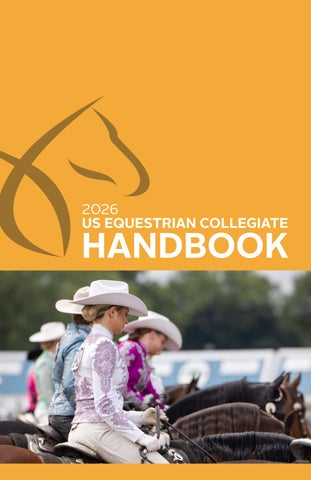
2026 US EQUESTRIAN COLLEGIATE
HANDBOOK
FIND THE BEST COLLEGE MATCH FOR YOU
ADMITTANCE TO SELECTIVE SCHOOLS SINCE 2013
OUR EXPERTS PLAN YOUR COLLEGE VISITS FROM A to Z
ONE-ON-ONE COUNSELING LOCAL & REMOTE
From finding the perfect secondary school placement to navigating NCAA recruiting and organizing seamless campus visit travel, we’ve got you covered. FULL SERVICE COLLEGE COUNSELING PROVEN TO DELIVER POSITIVE RESULTS Developing a Balanced College List
Personal Statements
NCAA Athletic Recruitment
Supplemental Essays
Academic Advising
Interview Preparation
Activities/Extracurricular Resume
Gap Year Programs
SPEAK TO AN ADVISOR TODAY! (636) 566-5959 AlexanderAcademics.com
TURN YOUR PASSION
INTO A PROFESSION
with Midway University’s hands-on learning and personalized support
DEGREE PROGRAMS Bachelor’s Degrees
Equine MBA
Equine Studies • Management • Rehabilitation • Science Equine Business & Sales (online)
• 100% Online • Complete in 12–15 Months • Only 33 Credit Hours
Hunt Seat and Western Competitive Teams 200 Acre Working Horse Farm On Campus
800.952.4122
MIDWAY.EDU/EQUINE Collegiate Equestrian Handbook
//
1
A boarding and day school for girls in grades 9-12 & post-grad
©Erin Gilmore Photography
Where Each Girl Can Pursue Her Passion for Riding Hunters • Jumpers • Equitation • Foxhunting
www.foxcroft.org | admission@foxcroft.org | 540.687.4340 22407 Foxhound Lane, Middleburg, VA 20117
2
// Collegiate Equestrian Handbook
Collegiate Equestrian Handbook
//
3
4
// Collegiate Equestrian Handbook
Collegiate Equestrian Handbook
TRAINING FOR
TRANSITION BY GLENYE OAKFORD
The transition from junior equestrian to collegiate team or adult competitor isn’t always easy. We spoke with equestrian mental coach Annette Paterakis about how juniors, parents, and trainers can help young riders take the next step. The transition from junior competitor to collegiate or adult athlete can be challenging for some young equestrians, as equestrian mental coach Annette Paterakis knows first-hand. Paterakis studied applied psychology and is a mental coach who works with equestrians; she participated in that capacity at the 2023 USEF Horsemastership Training Series. Paterakis was a successful young rider competing internationally in her early teens. But when she aged into open competition, she struggled— and the more her tension and confusion grew, the more her competition results suffered. “Before, I was basically placed in the top three almost every weekend, and how wonderful that is for the ego. What came next was therefore more of a shock,” she explained. “Suddenly, I was surrounded by better horses and better riders, and sometimes also riders who were more experienced at that level. Suddenly, I was getting very different results than I used to, to the point that there were quite a lot of eliminations, because I wasn’t really ready to ride at that level yet. It was very challenging for me at that age, and I didn’t really accept that I wasn’t getting the results I want. I wanted to prove myself, and I got very upset when I made mistakes. I’m sure a lot of young riders relate to that. I got more and more in my head. I got more and more focused on proving myself and getting the results, and less and less focus on what actually made the difference.” Part of the solution, Paterakis said, was to shift her focus to the process of learning and developing, and to see competition results as only a part of that process.
Collegiate Equestrian Handbook
//
5
“I saw failure in a very, very negative way and became afraid of making mistakes,” she said. “The moment that happens, it means you’re very attached to certain outcomes. When we’re attached to an outcome, nine out of 10 times, that means that we don’t get that outcome. It doesn’t work that way. We have to learn to let go of the results, so that we can focus on the process. But I didn’t know any of that at the time.” We sat down with Paterakis to discuss strategies that young equestrians, their parents or guardians, and their trainers can employ to help juniors transition to intercollegiate or adult competition. What are some of the common challenges junior equestrians face in making the change to intercollegiate or adult competition? First of all, it’s important to understand that around that age, they’re also developing from a teenager into an adult. This transition does come with a few challenges, but it’s important to embrace them and see them as a beautiful growth process. This can be a challenging time for both athletes and trainers. For a junior rider, their role has been a child role, and the trainer is in a kind of parent role, telling them what to do: “This is how you want to approach the course, this is how many strides you want to do between these fences.” It can be tricky when a child starts to have their own identity and their own ideas; it’s new and comes with different behaviors and communications that can be challenging for both sides. The important thing to realize is that becoming an adult also comes with responsibility. Thinking for yourself is a helpful skill; you should embrace it. It also comes with making mistakes. For some people, when they make a mistake, they return to the child role and say, “My trainer will just have to tell me what to do next” or become upset without really doing anything about it. As a parent or coach, invite the child to rise into that adult position. Have an adult conversation. Ask questions. Encourage them. Instead of telling them how it went in the ring, ask them how they think it went. What did they think happened? How is their development going? What did they learn? Another way is to encourage them to think for themselves. When they are about to walk a jumping course, maybe say, 6
// Collegiate Equestrian Handbook
Collegiate Equestrian Handbook
“Hey, why don’t you look at it yourself first and come up with a plan. Then you walk me through it, and I can give you feedback. What do you think?” In the ring, even if you have a solid plan, there are always moments when we need to make a decision for ourselves. What mental strategies should juniors consider during this transition phase, in your view? Know that when you bring yourself down because your results are not where you think they should be, thinking in that way can result in you being more focused on the results and less on what you actually have control over: the process. This is where taking responsibility comes in. If you wanted do better, you have to train better. Don’t compare yourself to others. Compare yourself to who you were last week. Think, “What can I do better? What’s one thing that if I work on it, I would increase my statistics, my chance of going clear?” Then work on that with your trainer. Just being critical or negative about yourself is unhelpful. What often does tend to work is analyzing and reflecting after a show—not every single day and not during your competition, because you need to be focused. But afterwards, reflect and look at whether there is a pattern that suggests an issue you can correct with training. Comparing yourself to others can also play a role when you transition onto a college team. You can get distracted by the other students, the rest of the team, fitting in, and worrying that you’re going to let other people down. We can worry about all sorts of things when we transition into the very different dynamic of being a team rider. It’s important for these riders to refocus on what they can control. You can’t control your teammates. Instead, notice that you’re distracted and bring the focus back onto yourself and tuning in to your horse. Go back in your mind to your best ride ever and that feeling of being connected to your horse and present in the moment. If you shrink because you’re worried, you’re not going to perform at your best. You want to step into that powerful you, that adult, that professional. You can’t be critical with yourself and drag yourself down internally. You have to manage your internal dialogue. Collegiate Equestrian Handbook
//
7
As a young rider I was very critical of myself, and I wasn’t enjoying riding because I put too much pressure on myself and was too hard on myself. I see that in a lot of young people. A much better, productive, and even fun way to transition through that is to keep trusting yourself instead of constantly doubting yourself. If you look at any top rider going into the ring and performing at their best, they have this deep trust that even if they don’t know exactly what is coming at them, they trust that they’ll figure it out in that moment. We can do a lot of training at home. At the show, it’s about stepping into trusting that you’ve trained enough, you know enough, and you are enough. For riders going on to ride with a team, how can they also add value as a teammate? If you aren’t picked for the team for a show, think about how you will deal with that. Are you going to sit in a corner or show up to support the team? When you are riding on a team, get to know your teammates. You can ask them what they like, if they want feedback or information from your ride or if they would rather just focus on their own class or ride. Ask them, “Hey, what do you need from me?” We are competitive beings, and we do get angry or frustrated, and that’s totally fine. We want to learn as adults to deal with that. It’s something you have to train: to refocus and put disappointment aside, because it’s distracting. Being an adult doesn’t mean you don’t feel emotions. On the contrary, you’re aware of those emotions, and then we take the next step and say, “Right now, my team needs me” or “Right now, I have a class to ride in” or whatever it is. That is something we can all train ourselves to do at home so it’s easier when we get to a show. How does that contribute to improving performance? You need to focus on what actually gets you there, which is being deliberate about your training. There are so many elements that play a role when it comes to becoming better as a rider. It’s not just about riding better horses, riding more horses, or working with the best trainer. It is a lot more about what you can actually control yourself, which is extremely exciting. There are no limits. The only limit we find is the limit in our own mind. If you keep taking the next step and you believe that it’s possible to improve, then you will keep improv8
// Collegiate Equestrian Handbook
Collegiate Equestrian Handbook
ing. Personally, I think that’s incredibly exciting. When I was a teenager, this would have changed my world. But, at the time, I was fixated on being good enough, on proving that I was a good rider, and that became my focus instead of what actually made a difference. When we’re trying to feel validated or good enough, when we are comparing ourselves to others, it’s very distracting. This kind of mental training takes place over time, doesn’t it? I think it’s important that mental training should be a normal aspect of your development, not something you only do when you have a problem. It’s something that can help you avoid problems as part of your overall training as an equestrian. Just as you want to train yourself to avoid injury, you want to mentally train yourself to avoid being inconsistent. You can see mental training as a journey rather than as fixing a problem and then you’re done. If you go to a gym and work out for six months and then you stop going, you lose that fitness. It’s the same with your brain. You really need to use it or you lose it. Investing in yourself this way has a lot of elements to it and is about more than just what you’re doing in the saddle in the show ring. That gives a lot of opportunity. So start somewhere, by reading a book or asking questions or by researching online or working with a mental coach to better yourself mentally, to learn about yourself and how your brain works. You’ll be training that muscle, too, to be prepared for the important moments.
Collegiate Equestrian Handbook
//
9
US EQUESTRIAN INTERSCHOLASTIC ATHLETE PROGRAM
FOR RIDERS IN 5TH-12TH GRADE You don’t have to be a record setting quarterback, point guard or track star to be recognized for junior high or high school sports anymore. US Equestrian is writing a new chapter in the recognition of student athletes – one that honors Equestrians. The US Equestrian Interscholastic Athlete Program is open to equestrian athletes who participate in any breed or discipline. To earn recognition, athletes should be a subscriber or competing member of US Equestrian. Students may complete their requirements in two different ways based on either the number of hours spent in the saddle or the number of competitions he or she competes in during the year. The program year runs from June 1 - May 31 of the following year and honors those who document their involvement with a number of exciting prizes! An Interscholastic Athlete patch and pin are awarded at the completion of your first year in the program. For each additional year completed in the program, you will receive a different branded item that you can use to show your involvement with equestrian sport. Additional Lettering merchandise is also available for purchase with Shop USEF. A student wishing to log his or her time needs to record a minimum of 100 hours of riding/driving/training. A student wishing to use his or her competition experience must participate in at least three (3) competitions (both USEF licensed and/or non-USEF licensed) of any level or type to complete the requirements for that year. Students may apply retroactively for previous years if they are still in grades 5-12 and can provide verification for each year. As you look to build your resume and establish your professional portfolio, US Equestrian encourages student athletes 10 //
Collegiate Equestrian Handbook
Collegiate Equestrian Handbook
to include the number of Interscholastic years of achievement. It is important to highlight your dedication and commitment to the program by listing the number of years you were a lettering athlete. US Equestrian also provides athletes the option to send your current school a letter from our president, Tom O’Mara, showcasing your achievements. View the full requirements and Frequently Asked Questions here: usef.org/forms-pubs/2puL6-uiDiE/faqs-requirements
The US Equestrian Interscholastic Athlete Program is the first phase of an upcoming series of programs that will recognize achievement for time spent in the saddle for members of all ages. Learn more about the programs offered by US Equestrian and the benefits of membership at USEF.org.
Collegiate Equestrian Handbook
//
11
COLLEGIATE
RIDING PROGRAMS USEA INTERCOLLEGIATE EVENTING In 2014, the United States Eventing Association (USEA) Board of Governors approved the creation of the Intercollegiate Eventing Program as an official program of the USEA. Originally proposed with input from the Intercollegiate Eventing League, the program was established to provide a framework on which eventing teams and individual competition could flourish at universities and colleges across the country. Collegiate athletic programs have been the training grounds for Olympians, amateur athletes and professional athletes for generations. Enabling students to train in the Olympic sport of eventing is a natural addition. Intercollegiate Team Challenges are quickly becoming popular additions to recognized horse trials in the United States. Teams competing in events identified as Intercollegiate Team Challenges are able to self-identify to the competition organizer, and will compete in the regular horse trial competition as individuals. Combining their individual scores, their team scores will be tabulated and matched against other teams. The inaugural USEA Intercollegiate Championships were held in 2016 and continues to grow each year. The Intercollegiate Eventing Championships offers all USEF recognized and FEI equivalent levels and no qualification is necessary, however schools represented must be registered Affiliates of USEA and competitors must be enrolled as undergraduate students or have graduated no earlier than six months prior to the championship. For more information about the USEA Intercollegiate Eventing Program please visit useventing.com/membership/intercollegiate.
NATIONAL COLLEGIATE EQUESTRIAN ASSOCIATION (NCAA Emerging Sport) The National Collegiate Equestrian Association (NCEA), in concert with the mission and vision of the National Collegiate Athletic Association (NCAA), is committed to providing col12
// Collegiate Equestrian Handbook
Collegiate Equestrian Handbook
legiate opportunities for female equestrian student-athletes to compete at the highest level, while embracing equity, diversity and promoting academic and competitive excellence. NCAA Equestrian student-athletes, coaches, and programs adhere to their respective NCAA Division rules and regulations. Currently 28 colleges and universities sponsor equestrian as an NCAA Emerging Sport for Women with more being added each year. More than 1,400 women are listed on NCAA team rosters across the United States. The NCEA features a head-to-head team competition format for Dual Discipline Teams (Jumping Seat and Western) in four events: Jumping Seat Flat and Fences, Western Horsemanship and Reining. The NCEA features a head-to-head team competition format for Single Discipline Teams (Jumping Seat) in two events: Jumping Seat Flat and Fences Student-athletes from each team are matched to their mounts by random draw prior to each meet. Horses are designated by event to be ridden by each pair of opposing student-athletes competing head-to-head. The rider receiving the higher score from the judges earns a point for her team. The team with the most combined points from the events is the winner. The NCEA National Championship is held in April each year. Qualification for this seeded bracket championship requires participation in a minimum of three NCEA regular season meets. The NCEA National Champion is determined by competition between the two teams that advance from the semifinal meets. The NCEA promotes the advancement of NCAA Equestrian within college athletics and its guiding vision is to be recognized globally as the premier level of competition for elite female collegiate equestrian student-athletes. For more information, please visit our website collegiateequestrian.com.
Collegiate Equestrian Handbook
//
13
US EQUESTRIAN
COLLEGE SEARCH The US Equestrian Higher Education Scholarship for Graduating High School Seniors will provide 5 $1,000 grants to high school seniors graduating in the Spring of the current competition year, who plans to continue his/her involvement in equestrian activities through an equestrian related degree or participation on a collegiate equestrian team. Applicants must be active members of US Equestrian. Essays and application forms must be submitted to the US Equestrian office before the deadline. Visit usequestrian.org/learning-center/youth-programs/grants-scholarships/high-school-scholarship for more information. The search for the right college is considered one of the most exciting and potentially overwhelming times for young adults. With all of the information available and factors to consider, it can be especially difficult for young equestrians to narrow the search to schools that fit them best. Between academic courses and equestrian opportunities, the idea that you may not have come across your “perfect” school is a constant concern. The US Equestrian College Search was created to make the process of finding a school easier for equestrian athletes. This online tool is designed to guide students in making an informed decision by matching them with colleges that meet their academic and equestrian goals. The Search provides a list of institutions that meet the criteria provided by the students. Students are then able to view the profile of each institution that meets their goals. Visit the US Equestrian College Search at usequestrian.org/youth to find a school that matches your needs!
14
// Collegiate Equestrian Handbook
Lillian Valiquette Class of 2025
Leap toward your future. www.laurelsprings.com | (866)-871-6323 Collegiate Equestrian Handbook
//
15
The school that goes where you go u s pa G R A D U AT E
DEVON TRESAN
Online School for grades 6-12
Official academic partner of scan to Learn more gouspa.org/usef
16
// Collegiate Equestrian Handbook
A day in the life of a student Lulu Carney
Equestrian, USPA Student Lulu Carney is a current junior at USPA and enrolled with us in 2025.
why uspa? No more missed school No more missed assignments No more missed events/competitions
School/Life BALANCE Lulu is able to prioritize training and horse shows with the help of her learning coach, who helps her manage her schedule and stay on track for graduation.
“
USPA gives me more flexibility in my schedule while allowing me to maintain academic rigor. It alleviates stress from missing so many days of school while horse showing. USPA’s flexibility has made it so I can have many more learning opportunities with my horse.
“
-Lulu Carney
Collegiate Equestrian Handbook
//
17
get the support you need Stay on track, no matter the show schedule Expert support for students and parents Community and connection Start when you’re ready, ride when you need!
uspa GRADUATE
Keen Davies
18
// Collegiate Equestrian Handbook
Self-Paced classes flexible school year dedicated Learning coach College counselor learning specialist club & social opportunities peer & teacher interaction Rolling admissions learn on your schedule
Life after college prep support College Counseling A+ Rating on AP Courses NCAA-approved Summer Programs NCAA Guidance Dual Enrollment with Arizona State University
100%
96%
of students who applied were of students were admitted to accepted to a college or their top-choice college or university university
USPA Equestrian students have enrolled in the following colleges/universities
scan to Learn more gouspa.org/usef
Collegiate Equestrian Handbook
//
19
Jumpstart Your Equestrian Career Bachelor of Science Degree
Equine Science & Management Applications for the Fall 2026 Cohort are now open.
Learn more today at s.uconn.edu/equine
Equestrian Program For more than 100 years, Garrison Forest School riders have been learning self-confidence, improving their skills, having fun and making friends through our nationally recognized equestrian programs.
Visit us at: gfs.org/riding GIRLS’ DAY, K-12 / COED PRESCHOOL & DAYCARE GIRLS’ NATIONAL & INTERNATIONAL BOARDING, GRADES 8-12 300 Garrison Forest Road, Owings Mills, MD 21117
20 //
Collegiate Equestrian Handbook
Collegiate Equestrian Handbook
//
21
Do what you love. Our Equestrian Center is home to the following: • 2024 Intercollegiate Dressage Association National Championships 4th Place Team. • 2024 Intercollegiate Horse Show Association (IHSA) Western National Championships 8th Place Team. • 2024 IHSA Cacchione Cup Qualifier. • 2023 IHSA Area 10 Regional Champion Western Team. • 2023 Reserve Champion College at the IHSA Holiday Tournament of Champions. • 2023 IHSA Hunter Seat Equitation National Championships Fifth Place team. • 2023 Intercollegiate Dressage Association Reserve National Champions. • 2018 IHSA Hunter Seat Equitation National Championships Reserve Champion team. 413-538-2023 | mtholyoke.edu
22 //
Collegiate Equestrian Handbook
• 2017 Intercollegiate Dressage Association Reserve National Champions. • 2013 Intercollegiate Dressage Association National Champions. • United States Dressage Federation medalists and USDF-certified instructional staff. • Leading-edge equine boarding with experienced care from permanent staff. • Modern facility with two indoor arenas, 200 x 200 outdoor arena, cross-country course, paddocks and miles of trails.
Do you have a student interested in applying? Please contact admissions@mtholyoke.edu. Horse donations or leases are gladly considered. Please contact Paula Pierce at ppierce@mtholyoke.edu.
1:1 Subject Tutoring NCEA & College Admissions Advising
Online School Advising Community at Shows around the USA
ACADEMIC SUPPORT FOR RIDERS, BY RIDERS We get what it’s like to be an equestrian balancing the demands of school with showing. We offer a full suite of academic services that equestrian athletes need to thrive.
s in action! See u
(443) - 257 - 9549 www.blueribbonscholars.com info@blueribbonscholars.com
Collegiate Equestrian Handbook
//
23
The Art of Horsemanship Athletic excellence • Elite academics • World-class resources
2025 IHSA Region and Zone Champions
2025 National Tournament of Champions
2025 ANRC National and Reserve National Champions
Scan to learn more
24 //
Collegiate Equestrian Handbook
Collegiate Equestrian Handbook
//
25
DOES YOUR CHILD LOVE HORSES? SIGN THEM UP TO BE A
STABLE STAR Get access to exciting horse-themed activities, educational videos, fun coloring pages, & more!
1
SIGN INTO YOUR USEF DASHBOARD
2
CLICK THE KIDS CLUB TILE
3
ENTER YOUR CHILD’S FIRST NAME & BIRTH YEAR
Learn more at usef.org/ join-usef/kids-club 26 //
Collegiate Equestrian Handbook
EXPERIENCE ELEVATES SUCCESS. Delaware Valley University graduates have success in the real world because they have already been there. Employers appreciate the hands-on learning that defines a DelVal education. That is why 94.4% of our students from the Class of 2022 are employed, in service to our country, or in graduate school within one year of graduation. Students who graduate from DelVal’s equine programs find success in the equine field and beyond. Nina Dellarte ’21 and Madison Lofgren ’22 are just two of the 25 DelVal graduates who have started veterinary school in the past two years. Many of our equine graduates are trainers, managers, breeders or riders, or work for companies that support the equine industry. You see, we love horses too. In fact, we have had horses on our campus
Nina graduated from DelVal in 2021 with a B.S. in Animal Science (Pre-Veterinary) and minor in Equine Science. She is currently attending University of Pennsylvania School of Veterinary Medicine where she is president of the Class of 2025.
EQUINE DEGREES: Equine Management
Equine Science
• Assisted Therapies • Breeding • Business Management • Pre-Professional • Instruction and Training • Media and Communication
since we were founded in 1896 as the National Farm School.
EXPERIENCE DELVAL.
delval.edu/equine
700 East Butler Ave. | Doylestown, PA 18901 | delval.edu
Collegiate Equestrian Handbook
//
27
S to chol a eq uin rship eb s usi ava ne ilab ss ma le jor s
WHEN IT COMES TO HORSES WE MEAN BUSINESS
Study the business of horses in the only equine program within an AACSB accredited college of business.
Equine Degree Programs: • BSBA in Equine Business • Equine Business Minor • Equine Business Certificate • Horse Racing Industry Graduate Certificate
Riding Opportunities: • IHSA Hunt Seat Team • IHSA Western Team • ISSRA Saddle Seat Team • USPA I/I Polo Team • USEA Eventing Team
UofL Equine uofl_equine uofl.edu/equine
28 //
Collegiate Equestrian Handbook
RACHEL MILEWSKI/USHJA
FUND YOUR DREAMS USHJA FOUNDATION GRANTS AND SCHOLARSHIPS $385k+ given back to members in 2024 10 grant and scholarship opportunities Support for competition, education, training, and humanitarian needs
Learn more at ushja.org/Grants.
1 2
8
7
JOIN THE INNER CIRCLE TO EARN YOUR STARS!
3
6 4 5
Are you a student equestrian athlete in grades 5 through 12? Join the USEF Interscholastic Athlete Program to be recognized for your equestrian activities! Simply upload your report card or transcript along with proof of three competitions or a 100 riding hour log for each year to receive a letter of recognition for your school and one of our exciting new prizes. Earn a new prize for each year you complete!