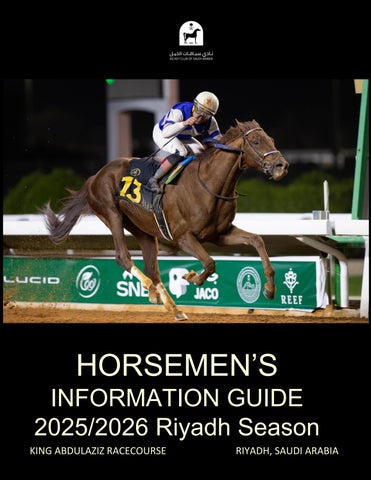
HORSEMEN’S INFORMATION GUIDE 2025/2026 Riyadh Season KING ABDULAZIZ RACECOURSE
RIYADH, SAUDI ARABIA
The 2025/2026 edition of The JCSA Riyadh Season Horsemen’s Guide.
WELCOME This guide has been published to provide you with information about the KSA domestic races open to horses trained outside of KSA.
Table of Contents Welcome……………......................................... 2 Race Programme ......................................... 4 GCC Pattern Book………………………………………. 6 Nomination Procedures…………………………….. 7 Field Selection System….……………….……….….. 8 Prize Money…………….…………......................... 8 Track Information …………………………………..…. 9 Horse Connections Travel & Accommodation....................................... 9 Shipping/Quarantine/Stabling……............... 10 Medication, Testing & Safety ….……………… 17 Training……………………………......................... 20 Race Day Procedures / Equipment………….. 21
Jockey Rules & Guidance……..…………………. 26 General Information................................... 26 Map King Abdulaziz Racecourse……………... 27 Contacts…………………..….………………………….. 29
Major Races – Riyadh 25/26
THOROUGHBRED Date
Sex
Age
Distance Surface
Open
3YO+
2,400
Dirt
SAR 750,000
Open
2YO
1200
Dirt
Dec 6, 2025 GCC Race – GCC Owned (Cup)
SAR 750,000
F&M
3YO+
1600
Dirt
Dec 6, 2025 GCC Race – GCC Owned (Cup)
SAR 750,000
C&G
3YO+
1600
Dirt
Dec 26, 2025 Prince Naif Ben Abdulaziz Cup
SAR 700,000
Dom G2
Open
3YO
1,600
Dirt
Dec 26, 2025 Prince Sultan Ben Abdulaziz Cup
SAR 700,000
Dom G2
F&M
3YO+
2,000
Dirt
Dec 27, 2025 King Faisal Cup
SAR 800,000
Listed
Open
3YO+
1,600
Dirt
Dec 27, 2025 King Saud Cup
SAR 800,000
Listed
Open
3YO+
2,000
Dirt
Jan 16, 2026 1351 Turf Sprint Qualifier
SAR 165,000
Open
4YO+
1,351
Dirt
Jan 16, 2026 Red Sea Turf Handicap Qualifier
SAR 165,000
Open
4YO+
3,000
Dirt
Jan 16, 2026 Prince Khalid Abdullah Cup
SAR 1,000,000
Open
4YO+
2,100
Turf
Jan 17, 2026 KSA 2000 Guineas
SAR 465,000
Open
3YO
1,600
Dirt
Jan 17, 2026 KSA 1000 Guineas Custodian of the Two Holy Jan 17, 2026 Mosques Cup Jan 17, 2026 Riyadh Dirt Sprint Qualifier King Abdulaziz Racetrack Jan 30, 2026 Champion
SAR 300,000
Fillies
3YO
1,600
Dirt
Open
4YO+
1,800
Dirt
Open
3YO+
1,200
Dirt
Open
4YO+
2,000
Dirt
Race Dec 5, 2025 Crown Prince Cup
Prizemoney SAR 1,000,000
Dec 6, 2025 GCC Race – GCC Owned (Cup)
|4|
SAR 1,500,000
Class Listed
Listed
G3
SAR 165,000 SAR 300,000
Listed
All races are run under IFHA regulations.
Major Races – Riyadh 25/26 cont. THOROUGHBRED cont. Date
Race
Feb 13, 2026 Fillies Mile Feb 13, 2026 Saudi International Handicap 90-110 Feb 14, 2026 Tuwaiq Cup Feb 14, 2026 Saudi Derby Feb 14, 2026 Riyadh Dirt Sprint Feb 14, 2026 1351 Turf Sprint Feb 14, 2026 Neom Turf Cup Feb 14, 2026 Red Sea Turf Handicap Feb 14, 2026 Saudi Cup
Class
Sex
Age
Distance Surface
US250,000 US$500,000 US$1,000,000 US$1,500,000 US$1,500,000 US$2,000,000 US$3,000,000 US$2,500,000 US$20,000,000
Listed G3 G2 G2 G1 G2 G1
Fillies Open Open Open Open Open Open Open Open
3YO 4YO+ 4YO+ 3YO 3YO+ 4YO+ 4YO+ 4YO+ 4YO+
1,600 2,100 1,800 1,600 1,200 1,351 2,100 3,000 1,800
Dirt Turf Dirt Dirt Dirt Turf Turf Turf Dirt
SAR 95,000
Listed
4YO+
2,000
Dirt
SAR 1,500,000
G1
Open
4YO+
1800
Dirt
SAR 750,000 SAR 900,000
G3
Open Open
3YO+ 4YO+
1400 1,600
Dirt Dirt
US$ 500,000
G3
Open
4YO+
1,600
Dirt
F&M
4YO+
1,600
Dirt
Prizemoney
PUREBRED ARABIAN Nov 15, 2025 JCSA Cup The UAE President Cup for Arabian Nov 21, 2025 Horses Dec 6, 2025 GCC Race (Cup) - GCC Owned Dec 27, 2025 Imam Turki bin Abdullah Sword Al Khalediah Stables International Jan 8, 2026 Cup The Princess Munirah bint Abdulaziz Jan 9, 2026 bin Musaad bin Jiluwi Cup Prince Sultan bin Abdulaziz Jan 9, 2026 International Cup Jan 16, 2026 Sprint Championship Cup
US$ 300,000 US$ 1,500,000
G1
Open
4YO+
1,800
Dirt
SAR 150,000
G3
Open
4YO+
1,200
Dirt
Open
4YO
1,600
Dirt
Open Open Open Open
4YO+ 4YO+ 4YO+ 4YO+
2,000 1,600 2,100 2,000
Dirt Dirt Turf Dirt
Jan 17, 2026 King Abdulaziz Cup (KSA Bred)
SAR 5,000,000
Jan 17, 2026 Al-Dareyah Cup (Obaiyah Qualifier) Jan 30, 2026 King Abdulaziz Racetrack Champion Feb 13, 2026 Al Mneefah Cup Feb 14, 2026 Obaiya Arabian Classic
SAR 165,000 SAR 300,000 US$1,500,000 US$2,000,000
G3 Listed G1 G1
Please click here to view the complete 2025/2026 Riyadh race programme: Riyadh Race Programme 2025/2026 – English Riyadh Race Programme 2025/2026 - Arabic All races are run under IFHA regulations. |5|
NOMINATION PROCEDURES The Jockey Club of Saudi Arabia (JCSA) reserves the right to refuse the entry of any horse, at the JCSA’s sole discretion, for any reason, including but not limited to situations where any connection (e.g. owner, trainer, jockey) of such horse has engaged or may have engaged in conduct, or become the subject of a regulatory or law enforcement inquiry or action alleging conduct that is unlawful, unethical or which may otherwise compromise the integrityof racing. All races are free to enter and free to run for any trainer based outside of the KSA. Please refer to the race conditions for the qualification rules. Nominations to be made a minimum of three weeks before each race date, for all trainers based outside of KSA to allow for shipping and import procedures. Nominations to be forwarded to Yousef Albhaijani via email yalbhaijani@jcsa.sa, and CC Emer Fallon efallon@jcsa.sa clearly stating the details below: Race Name:
Country of Birth:
Trainer:
Sex:
Owner:
Colour:
Horse Name:
Sire:
Date of Birth:
Dam:
Please ensure you receive an emailed reply confirming receipt of your entry.
|6|
FIELD SELECTION SYSTEM The JCSA Handicappers will assign a rating to each horse that is entered for these races. The JCSA reserves the right and has the sole authority to decide on the number of runners in the race, after careful consideration of any entry’s overall standing and potential to perform
adequately in the race. The JCSA reserves the right to invite a representative field of horses from a variety of countries where relevant.
PRIZE MONEY Prize Money Distribution
Owner – 80% Jockey – 10% Trainer – 10% Please note that this will differ for the races held on The Saudi Cup weekend of racing. PRIZE MONEY WILL NOT BE TAXED BY THE KSA AUTHORITIES
|7|
Lorem Ipsum dolor sit
TRACK INFORMATION
Dirt Course Characteristics The dirt track is 2000m with a 450m chute and a 400m home straight. The turns are 500m in length and the width of the track is 25m wide.
Turf Course Characteristics The turf course is 1828m around with 400m straight. The turns are 478m in length and the track width is 19m.
HORSE CONNECTIONS TRAVEL & N ACCOMMODATION (Non Saudi Cup Races) Travel Information All travel for horse connections will be at the owners’ expense. The JCSA will assist with visas to enter KSA, please contact Mohammed Harandah MHarandah@jcsa.sa for assistance. Accommodation No hotel accommodation will be provided. Subject to availability, grooms may be accommodated in the on-site villas at the racecourse near the quarantine stables. If long term accommodation is required (over 10 days) a cost will be incurred. Transport Service On-site buggies or bicycles will be provided for movement between the villas and the quarantine stables. |8|
SHIPPING, QUARANTINE & STABLING
(Non Saudi Cup Races) All horse connections (including jockeys and grooms) should have their own insurance arrangements in place. Shipment of horses must be arranged by the owner/trainer and will be at the owner’s expense. Stables, bedding, hay and bottled water will be provided free of charge if coming to Riyadh to participate in one race. If the horse is to stay for a prolonged period (longer than 10 days) there will be a cost incurred Please note all horses must enter the quarantine stables a minimum of 72 hours prior to race day. IMPORTATION OF GCC HORSES INTO KSA Conditions for the importation into KSA of horses to compete in any of the above races and return to their country of origin: Horses from all GCC countries will be assumed to be travelling on a GCC certificate and are required to meet, as a minimum, the KSA temporary import conditions* appropriate to the country of origin. See Conditions below. Whilst in the KSA, International Racehorses will be stabled in Regional Groups, in designated Isolation Stables, separately from local horses. Access will be restricted. All horses are required to be in the International Quarantine Stables 72 hours prior to race day.
|9|
SHIPPING, QUARANTINE & STABLING Cont… Post Arrival Recovery Period Note: After arrival in the KSA, horses will be restricted to the allocated compound at the quarantine facility for 48 hours, post arrival, if they have travelled more than six hours stable door to stable door. If a horse has travelled less than six hours, they will be confined to the barn area for 12 hours. They will not be allowed access to the main track during this time. These rules are intended to reduce the risk of respiratory disease developing in the horses and possibly spreading to earlier arrivals. Each compound has a walking area. *Import Conditions applicable to all horses from the GCC 1. 2. 3.
No pre-export isolation is required All horses will require certain blood tests (negative) within 30 days of export to meet the KSA Import conditions. All horses must have received, during the 90 days immediately prior to export but not within 14 days: Either, two primary vaccinations against Equine Influenza, between 21 and 42 days apart with the same vaccine; Or
a booster vaccination against equine influenza which was given within 12 months of a certified primary course, or within 12 months of a certified booster vaccination where it and any previous booster vaccinations, had been administered annually within a regular 12-month period since the primary course. All vaccinations need to be certified.
For KSA import purposes a primary course of vaccinations against equine influenza will be considered to consist of at least two doses of the same vaccine between 21 and 42 days apart. Original certification showing all relevant vaccinations must travel with the horse.
|10|
SHIPPING, QUARANTINE & STABLING Cont… Return Conditions Please note; the conditions below are for horses returning directly to the country of origin (the country from which they were exported to KSA). Horses exiting to a country other than the country of origin may have to meet different conditions. Your shipping agents will be able to advise you on this matter. All horses - Insecticide Treatment In order to meet most countries return conditions and KSA temporary import protocols all horses must be treated with an approved insecticide/repellent every time they leave the stables for training. The products approved for use in KSA contain pyrethroids and have been used for several years without problem. If trainers know of any problems related to the use of such products on their horses, they should advise JCSA prior to horses being shipped so alternative products can be considered and obtained. If the horse is not returning directly to your home country after the race, please discuss with the appointed shipping agent on the various logistics and certification required.
International Quarantine Barns There are 18 barns of six to ten boxes each in the International Quarantine Stable area with a minimum of 50m between each barn. Horse contact areas are double fenced with a 5m separation between the fences. Each barn is a separate unit that is separated from the other barns by mesh fencing with signs indicating that this is a restricted area. |11|
Isolation Barn& SHIPPING, QUARANTINE STABLING Cont… The Isolation barn is completely enclosed with vector screening to prevent insects from entering the barn. This reduces the chance of a disease spreading and provides a comfortable environment for the horses.
Each box within the isolation barn measures approximately 3.6m by 3.6m. The floor has a nonslip rubberised surface with an open area protected by vector screening over the breezeway to allow plenty of light and air into the barns.
Each barn has a large central breezeway, approximately 6m wide, to allow multiple horses to enter and leave the barn at the same time as well as a very high ceiling to produce a large volume barn.
|12|
SHIPPING, QUARANTINE & STABLING Cont… Each separate barn is linked by a sand track to a light work track. The entire isolation complex is approximately 400m (1/4 mile) from the main track. Horses will be permitted to train on the main track, both dirt and turf, at training times organised according to the regional group to which the horse belongs. Apart from the time of racing, all horses will be kept separated in the regional groups.
Biosecurity Procedures for the Isolation Facility 1.
Only accredited visiting international stable personnel and essential JCSA employees will be allowed access to the isolation facility. No children under 12 years old are permitted without permission.
2.
No animals, other than quarantine horses, may be brought into the facility.
3.
No media (private photography of own horses and personnel allowed).
4.
A maximum of two registered owners per trainer permitted during visiting hours of 6am to 10.30am and 4pm to 5.30pm. All owners must be accompanied by a trainer or representative at all times. The JCSA reserves the right to refuse admission or expel from the premises any person.
5.
Only the trainer or in their absence, representative, and grooms will be permitted access to horses in quarantine for the first 48 hours after arrival.
6.
All visitors (not including trainers/grooms) must wear protective clothing provided, wash hands before and after entry to the barn and sign the visitors record forms. Trainers and grooms will not have access to barns where they do not have horses.
7.
Only official accredited vehicles will be allowed in the isolation area. |13|
SHIPPING, QUARANTINE & STABLING Cont… 8.
Only medications and treatments issued by The Equine Hospital (TEH) and/or approved by JCSA Veterinary Services are permitted. Only TEH or TEH approved vets and JCSA Veterinary Services approved therapists and farriers are allowed to tend to international horses. TEH vets will be prepared to liaise and work with home vets when required. Locally based freelance vets will not be permitted access to isolation facilities.
9.
Vector screens must be closed at all times and only opened for the entry/exit of horses.
10.
It is the trainers/representative’s responsibility to ensure all horses exercising outside the barns are wiped down with the insect repellent provided in each barn prior to exiting the barns. Where required the daily treatment must be recorded and signed.
11.
During exercise periods instructions of track marshals must be obeyed and a minimum 50m separation maintained between groups of horses. Failure to do so may result in a revision of export requirements and an extended quarantine period.
12.
Safety vests and skull caps to be worn at all times when mounted in the Isolation Facility.
13.
Horses and personnel must enter and leave the Isolation Facilities through approved gateways.
14.
Any suspected contagious or infectious disease of people or horses must be reported immediately to isolation management.
15.
No smoking is permitted in the barns. Alcohol is not permitted in KSA.
16.
All persons attending horses in the facility are subject to the Rules and Regulations of the JCSA.
17.
The trainer or representative must monitor and record their horse’s temperature twice daily.
|14|
SHIPPING, QUARANTINE & STABLING Cont… The JCSA and its transport agents will not be liable for any death of injury or illness to any invited horses during transportation to and from the KSA or while in the KSA. The JCSA or its agents, will not be responsible for horse insurance. The JCSA will not provide any local horse to serve as a companion horse. The JCSA reserves the right to carry out random inspections of all trainers’ equipment during their time in Riyadh. The JCSA reserves the right to put any horse under CC TV surveillance. No prohibited substances – alcohol – medicine or veterinary products are permitted on the JCSA premises.
All horses must travel with their passport and any other official identification papers, which must be available for inspection and collection by the veterinary authorities upon their arrival at the isolation barns. These documents will be endorsed and returned prior to the horses’ departure from KSA. All requested documents must be submitted to the shippers in a timely manner where time frames are requested. Trainers are to ensure these are fully completed and eligible.
|15|
MEDICATION, TESTING & SAFETY All trainers must complete a medication declaration and vet history form for each horse prior to shipping. A link will be sent to you after we receive your nomination. This form will include the following: Pre-Travel Veterinary History Declaration The veterinary history declaration must: • Disclose all relevant recent veterinary history including routine and ongoing medications; • Disclose previous episodes of the appearance of blood at both nostrils; • Disclose previous episodes of cardiac arrhythmias including atrial fibrillation; • Provide details of previous surgeries performed including but not limited to orthopedic and respiratory tract procedures; and • Confirm that the Influenza vaccination is compliant for travelling to KSA and JCSA Rules of Racing. Gait-analysis/Trot-up Video The trainer will be sent a link to the SLEIP app, where they will be required to upload a trot-up video recording. The app will give you full directions on what is needed in the video. Requirements will be communicated directly and repeat submissions may be requested prior to travel to KSA. Please note: the SLEIP app is compatible with iPhone only (iPhone 8 onward). For more information on the SLEIP App please click here. |16|
MEDICATION, TESTING & SAFETY Cont… Medication Declaration The MDF will require the trainer to list any long acting medications administered within six months prior to departure for KSA as well as all other medications administered within four weeks of departure. The Veterinary Inspection (IN RIYADH) All horses will be subject to veterinary inspections prior to their race by JCSA Veterinary Services. The examination will include a trot-up in hand on a firm level surface (a video for gait analysis may be taken). Routine exercise will be monitored by the appointed JCSA appointed veterinarian. Further examination procedures may be performed to help assess the musculoskeletal system to quantify potential risk, at the direction of JCSA Veterinary Services. Connections of all horses are obliged to cooperate with this process. The club reserves the right to refuse any horse to run if it is deemed necessary for any reason, as determined by JCSA Stewards. Upon arrival into KSA, all horses may have blood and hair samples taken at any time for analysis for prohibited substances, including those substances that are prohibited at all times and those that are considered to have a legitimate therapeutic use. Please click here to view the JCSA prohibited substances and medication rules: JCSA Rules & Regulations
|17|
MEDICATION, TESTING & SAFETY Cont… The Equine Hospital Our onsite equine hospital consists of two theatres and 29 boxes. The hospital and its staff are capable of performing elective and emergency surgeries including fracture repair and colic surgery. Radiography, ultrasonography, and endoscopy, including gastroscopy are also available. Tel: +966 112540162
|18|
TRAINING Track Work for Visiting Horses The JCSA will inform you of the training times for your region and will schedule turf works with the trainer.
Work on outside of the turf track • Only fast work must take place on the rail of the dirt track. • Ponies can be made available for training upon request. • Ponies will be ridden by the JCSA outriders only Pre-Race Parade Ring Schooling The JCSA will provide the opportunity to school horses in the Pre-Parade/Parade Ring at scheduled times. Safety Helmet The JCSA will not permit any person to be mounted on a horse, or work as a member of the gate crew on any racing surface, unless the person is wearing a properly fastened safety helmet. All helmets must have chin straps. .,
Safety Vest No jockey or apprentice jockey shall ride in a race unless wearing a safety vest, nor shall a jockey, apprentice jockey, or exercise rider, train or exercise any horse unless wearing a safety vest.
|19|
RACE DAY PROCEDURES & EQUIPMENT Licensing If an international horse runs once, connections will run under their own national licenses. If an international horse races more than once the connections will need to be registered with the JCSA. Jockeys will need clearances from their national governing body. Testing • Horses may be sampled at any time pre-race, including but not limited to TCO2 testing. • Nebulisers are not allowed on race day. • No medication will be permitted on race day. • Only water may be used on race day to wash a horse’s mouth. Throat flushes, no matter how innocuous their ingredients are, are not accepted.
|20|
RACE DAY PROCEDURES & EQUIPMENT Cont… Shoes and Shoeing •
Hoof casts and glue-on aluminum racing plates are permitted, provided they are fitted to the satisfaction of an approved farrier and must be approved by the Stewards at the time of declaration. It is not permitted for glue on shoes or hoof casts to be re-applied less than 2 hours prior to the start of the horse’s race.
•
Glue-on shoes are permitted on all surfaces, provided they are fitted to the satisfaction of an approved farrier.
•
Plates and tips must not exceed 150 grams in weight. However, the Stewards may grant permission for the use of approved therapeutic plates up to 170 grams.
•
The use of any non-standard shoes, including bar shoes, pads, substances adhering to the sole, or any other specialised design, requires prior approval from the Stewards.
•
Nail heads must not protrude more than 2mm from the shoe's surface. If the shoe has multiple planes, the measurement shall be taken from the plane that results in the maximum height.
Any mishap involving a plate or tip during a race must be reported immediately by the Trainer to the Stewards. SURFACE
FRONTS
HINDS
DIRT
Maximum 2mm full outer rim permitted only
Maximum 4mm full outer rim or 4mm grabs permitted only
TURF
No traction devices
No traction devices
NOTE: Queens XTs and similar shoes are NOT permitted on turf or on front shoes on dirt. Races on Turf: Horses are not permitted to race in shoes with any protrusions.
|21|
RACE DAY PROCEDURES & EQUIPMENT Cont… Ponies Ponies will be available in every race upon request only. The request must be submitted at the time of declaration. Grooms All grooms and handlers should be neatly dressed when taking horses to the paddock.
Scratching Scratch time will be 10:00 on the day of the race (excluding Saudi Cup weekend where the Scratch time will be 8:00 for all races run on the 13th and 14th Feb). Any horse scratched after scratch time must file, in writing, such intention with the Stewards. The JCSA reserve the right to have up to two reserves at the time of declaration. These reserves can draw into the race up to scratch time.
Horse Equipment 1. The saddle comprises the saddle itself, the girth, the surcingle, the stirrup irons and the leathers or webs and the jockey is responsible for the fit condition of the saddle which he uses. 2. If a horse is to wear blinkers, visor, hood, eye shield, eye cover, sheepskin cheek pieces or any combination thereof they must be reported at the declaration to run. When a horse has been declared to run in the above, they must be worn by the horse on the way to the start and during the race. If they are not worn on the way to the start the horse is to be withdrawn by the starter and the horse shall not run. |22|
RACE DAY PROCEDURES & EQUIPMENT Cont… 2.
cont… When no declaration of blinkers, visor, hood, eye shield, eye cover, sheepskin cheek pieces or any combination thereof has been made they must not be worn on the way to the start and during the race. If they are worn on the way to the start the horse is to be withdrawn by the starter and the horse shall not run. Blinkers, visor, hood, eye shield, eye cover and pacifier should all be worn under the bridle. 3. A trainer must request permission from the Stewards should they require their horse to wear a red hood in the parade ring and/or on the way to the start, this will then be announced over the public address system. In these cases, the hood is not declared in the normal manner, it will be removed at the start and it must not be worn during the race. 4. Should any horse require a stall rug we advise you to bring your own to ensure availability. Clearance of use must be obtained by the Stewards at time of declaration. 5. No horse may run in a race wearing a garment fitted over its head or ears other than blinkers, visor, hood, eye shield, eye cover, cheek pieces or any combination of these. Nasal Dilators are allowed for use in races but must be of a design approved by the Stewards. They must be fitted in accordance with the manufacturer's instructions. 6. If a horse is to wear earplugs in a race, they must be worn on the way to the start. A horse can also go to the start wearing earplugs and on reaching the start, they can be removed by the starter. For these instances, the earplugs should not be fastened to the bridle. Under no circumstances can earplugs be removed during the race by its rider. 7. Lip chains may be allowed, based on prior written approval being obtained from JCSA Stewards, however, they must remain covered at all times. They must then be removed upon arrival in the parade ring, as per normal JCSA procedures. |23|
RACE DAY PROCEDURES & EQUIPMENT Cont… Horse Equipment Cont… 7.
|24|
If a horse is to wear a tongue strap it must be reported at the declaration to run. When a horse has been declared to run in the above, but the trainer is unable to tie the tongue strap down satisfactorily or if it comes loose and cannot be refitted the horse may still run. However, if the horse does not run at the insistence of the trainer, or it is withdrawn by the starter, the penalty will be waived by order of the Stewards. When no declaration of a tongue strap has been made a tongue strap must not be worn by the horse in the parade ring, on the way to the start or during the race.
JOCKEYS RULES & GUIDANCE Jockeys are reminded that it is their responsibility to be familiar with the Rules of Racing. Please click here for a detailed summary of the JCSA Race Rules & Regulations: JCSA Race Rules & Regulations If you are unsure about the meaning or application of any Rules, please ask Stipendiary Steward Rion Charles Hitchener on the racecourse or, in advance of a meeting, by email: rcharles@jcsa.sa. For enquiries in Arabic, please direct your queries to Mukhlid Alotaibi: M.alotaibi@jcsa.sa Insurance It is strongly recommended that all international jockeys ensure that they have their own insurance policy in place prior to riding in Riyadh.
GENERAL INFORMATION Address:
Web Address: www.jcsa.sa
The Jockey Club of Saudi Arabia PO Box 26323 Riyadh 11486 Saudi Arabia
Twitter: @JCSA_Racing
|25|
King Abdulaziz Racecourse
|26|
King Abdulaziz Racecourse
|27|
CONTACTS JOCKEY CLUB OF SAUDI ARABIA:
Ziad AlMogren Chief Executive Officer JCSA E-mail: zalmogren@jcsa.sa Mukhled Alotabi Chairman of the Stewards Mobile: +966 50 545 3960 E-mail: M.alotaibi@jcsa.sa
Emer Fallon Director of International Racing Mobile: +966 55 095 0040 E-mail: efallon@jcsa.sa Martin Talty Director of Racing Mobile: +966 53 720 7081 E-mail: mtalty@jcsa.sa
Rion Charles Hitchener Chief Steward (English Speaking) Mobile: +966 53 894 4049 E-mail: rcharles@jcsa.sa
Tracy Wyngard-Gill International Racing Liaison Manager Mobile: +966 53 112 6992 E-mail: tgill@jcsa.sa
Saeed Omar Quarantine Manager Mobile: +966 54 084 9668 E-mail: saeed@jcsa.sa
Mohammed Harandah International Racing Manager Mobile: +966 54 040 5333 E-mail: mharandah@jcsa.sa
Yousef Albhaijani Director of Registrations Mobile: +966 55 445 0749 Email: yalbhaijani@jcsa.sa |28|
CONTACTS HANDICAPPER: Sam Watson Handicapping Manager Mobile: +966 53 815 7449 E-mail: swatson@jcsa.sa RACECOURSE: Keith Ottesen Clerk of the Course Director Mobile: +966 53 767 2054 E-mail: kottesen@jcsa.sa Robert Keith Blackburn Racecourse Tracks Supervisor Mobile: +966 53 236 3144 Email: rblackburn@jcsa.sa VETERINARY OFFICERS: Dr Toby Koenig BVSc (Hons) Director of Veterinary Services (English Speaking) Phone: +966 53 797 4450 Email : tkoenig@jcsa.sa Dr Hakeem Ali Racecourse Veterinary Assistant (Arabic Speaking) Phone: +966 58 304 0316 Email : ahakeem@jcsa.sa