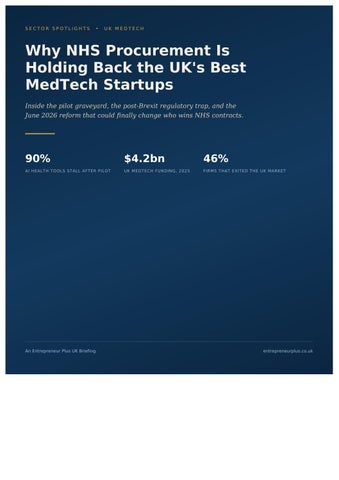
TheNHSsitsononeofthelargestlongitudinalpatientdatasetsontheplanet,tensofmillions of people, decades of clinical records. And yet roughly nine in ten AI health tools built on that data never make it past a pilot They get built, trialled, validated, and then quietly shelved beforeprocurementeverletsthemscale.
ThatgapisoneofthemoreunderreportedstartupfounderstoriesinUKtechrightnow,notbecause it surprises anyone working inside the health system, but because it points to what's actually hard aboutUKMedTechin2026 Itisn'tthescience
Britain builds genuinely world-class medical technology. Cambridge alone is home to surgical robotics firms operating across 40 countries, and UK-built AI diagnostics tools are already cutting the need for specialist consultations at scale The sector pulled in $42 billion in funding in 2025, second only to fintech among UK innovation sectors. By almost any measure, UK MedTech is thriving,rightupuntilafoundertriestoactuallysellintotheNHS.
ThePilotGraveyardNobodyTalksAbout
Picture a healthtech team that spends three years building an AI triage tool, runs a controlled trial, and finds their software beats consultants at spotting early-stage disease They win NHS pilot funding Thepilotworks Theclinicalevidenceholdsupunderscrutiny
Then nothing happens The pilot runs for two more years The clinical champion who backed it changes roles. A new trust IT policy demands a fresh cybersecurity review. Procurement simply moves at a different speed to clinical adoption. Eventually the project is quietly wound down. This isn'taone-offstory,itisclosetothestandardtrajectoryforAIhealthtoolsinBritain.
Around 90% of AI health tools commissioned by NHS trusts never scale beyond the pilot phase The science holds up The clinical evidence holds up What's missing is a procurement system built to scale things that already work
The root issue is that NHS procurement is fragmented by design Approval at trust level in one city carries no automatic weight in another Every trust runs its own IT governance, its own cybersecurity sign-off, its own clinical adoption committee. What looks from the outside like one customerisactuallywellover200separatepurchasingdecisions.Thegraveyarddoesn'tfillupwith badideas Itfillsupwithgoodonesthatranoutofrunwaynavigatingthesystem
ARegulatoryTrapLayeredonTop
Underneath the pilot problem sits something even harder to navigate. Since Brexit, UK medical devices need a UKCA mark, UK Conformity Assessed, rather than the EU's CE mark The goal was regulatory independence The result has been a capacity crunch: the UK Approved Bodies responsible for issuing UKCA certification simply cannot process applications as fast as the market producesthem.
Theconsequenceisstark.NearlyhalfofUKmedtechfirms,46%,havepulledproductsfromtheUK market entirely, not because the products don't work, but because the certification queue is too long, the cost is too high, and the process duplicates work many companies had already done for FDAorEUapproval
The government's proposed fix is the International Reliance Pathway, a framework that would let devicesalreadyclearedbytheUSFDA,HealthCanadaorAustralia'sTGAfast-trackUKregistration without redundant testing. It's a sensible idea, but it won't be fully operational until 2027, which
leaves 2026 founders facing an uncomfortable choice: sink time and capital into the existing UKCA processnow,orwaitayearforabetterroutethatdoesn'texistyet Foracash-constrainedstartup, that'snotaminorregulatorywrinkle,it'sadecisionaboutwhethertoprioritisetheUKmarketatall Coverage of this exact tension has been showing up more often in UK tech news over the past few months.
SomethingActuallyChangedinJune2026
In June 2026, NHS England, the Department of Health and Social Care, and NHS Supply Chain jointly published new Value-Based Procurement guidelines, arguably the most significant change to NHSpurchasinglogicinadecade Mostfoundersoutsidethehealthsectorstillhaven'theardabout it.
The old model rewarded the cheapest compliant product, which meant global manufacturers with scaleandframeworkrelationshipstendedtodominateNHScontractsregardlessofclinicalmerit.A UKstartupwithstrongerevidencebutahigherunitcoststoodlittlechance.Thenewrulesflipthat: NHScontractsnowcarryaminimum60%weightingonqualityandoutcomes,andamaximum40% weightingonwhole-lifecost Theconversationhasshiftedfromhowcheapaproductistohowmuch itsavesthesystemovertime.
That doesn't make NHS procurement easy. But it changes who is positioned to win. A startup that canputanumberonhowitsproductcutspatientbed-days,lowersreadmissions,orfreesupclinical staff hours can now defend a higher price on those grounds, which is a genuinely different game to theonethatexistedayearago
FourCompaniesThatCrackedtheCodeEarly
Beforethenewrulesexisted,ahandfulofUKMedTechcompanieshadalreadyworkedoutwhatthe systemwasabouttoreward Theirapproachesaretheclearestguidetowhatactuallyworks
CMR Surgical designed directly around the NHS's capital constraints Its main rival, Intuitive Surgical'sdaVinciXi,requiresupfrontcapitalnorthof£16millionperinstallation CMR'sVersius system is compact, modular and moveable between theatres instead. The company has raised £1.03billionacrossninefundingroundsandisreportedlyexploringa$4billionsale.
Skin Analytics built a teledermatology platform that uses AI to triage skin cancer referrals, and spent early years proving pathway savings in hard economic terms before chasing national scale. In deploying trusts, the platform has removed the need for more than 64% of face-to-face urgent specialist consultations, effectively building a value-based-procurement-ready evidence file before value-basedprocurementexisted
Quanta Dialysis Technologies built a portable haemodialysis device for home use and targeted clinical settings and home patients at the same time, rather than waiting years for NHS central procurement alone. That dual revenue base meant it wasn't fully dependent on NHS commissioning timelines. It has raised £294 million across six rounds, including a £47 million SeriesEinNovember2024.
Proximie built augmented reality software for surgical collaboration and made a deliberate early call to expand internationally first, gather global clinical evidence, and use that evidence to reenterUKprocurementfromapositionofstrength Ithasraised$118 millionto date Thepattern across all four companies is consistent: none of them waited for NHS procurement to get easier beforebuildingaroundit
InApril2026,theBritishBusinessBankcommitted£100milliontoAppositeHealthcareGrowthI,a fund specifically backing health technology startups at growth stage, a signal of institutional confidencethatthesectorismaturingratherthanjustgrowing
$18.4bn
UK DIGITAL HEALTH MARKET VALUE, 2026
£2bn+ LIFE SCIENCES SECTOR PLAN FUNDING, 2025
£600m
COMMITTED TO AI-READY HEALTH DATA INFRASTRUCTURE
The UK now has the research base, the clinical datasets, the regulatory infrastructure, and the capital behind MedTech. What it has lacked for years is a procurement model that rewards value over cost, and June 2026 changed that, at least on paper It's the kind of shift worth watching for anyonefollowingUKbusinessnewsonthesectorthisyear
WhatThisMeansBeyondMedTech
The NHS pilot problem is really an extreme version of a challenge every startup selling to large institutional buyers eventually runs into Proof of concept is achievable Proof of scalability is hard Procurement cycles routinely outlast a startup's runway, and the buyer is structurally fragmented evenwhenitpresentsitselfasasinglecustomer.
The lesson from CMR Surgical, Skin Analytics, Quanta and Proximie isn't really about healthcare specifically It'saboutwhatittakestosellintoinstitutionsgenerally:designaroundthebuyer'sreal constraints, build economic evidence alongside clinical evidence, and use markets that move faster tovalidateyourselfbeforetacklingtheonesthatdon't It'sapatternthatkeepsrecurringacrossthe widerUKstartupecosystem,wellbeyondhealthtech.
The gap between building something excellent and deploying it at scale inside a large institution is where most startups stall. In MedTech, that gap has a name, the pilot graveyard, and in 2026 the rulesforescapingitfinallystartedtoshift Whousesthatshiftwellisthestoryworthwatchingnext
AboutThisBriefing