FOUNDER STORIES
•
UK FINTECH
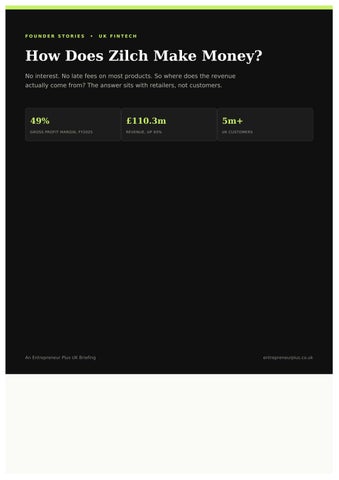
How Does Zilch Make Money? No interest. No late fees on most products. So where does the revenue actually come from? The answer sits with retailers, not customers.
49%
£110.3m
5m+
GROSS PROFIT MARGIN, FY2025
REVENUE, UP 93%
UK CUSTOMERS
An Entrepreneur Plus UK Briefing
entrepreneurplus.co.uk
At checkout, the screen offers four interest-free instalments, no fees mentioned, no catch flagged. It's the kind of offer that makes anyone pause and wonder what's actually funding it. Zilch doesn't charge interest or late-payment penalties on most of its products, though some payment options can carry upfront or transaction fees. So how does Zilch make money at all? The answer sits largely with retailers and the broader payments ecosystem, not with the customer holding the card.
The Ad-Subsidised Model, Explained Zilch makes money through a combination of merchant commissions, performance-based advertising fees and other transaction-related revenue, rather than interest or late-payment charges on consumers. The company brands this as an "Ad-Subsidised Payments Network," or ASPN. Retailers pay for placement, pay commission on completed sales, and pay for advertising inside the app, and Zilch uses that revenue to subsidise credit, cashback and rewards for its more than 5 million UK customers. Merchant commissions: Zilch earns a commission when customers make purchases through participating merchants. Advertising fees: merchants pay for premium placement and performance-based advertising within Zilch's network. Transaction-related revenue: Zilch also earns from transactions and its payment products directly, meaning advertising is an important part of the model but not the company's only revenue source. Founder and CEO Philip Belamant has compared the idea to what Google did for search, give the core product away free, and get paid by the businesses competing for the customer's attention instead. It's a genuinely different answer to how does Zilch make money compared with much of the wider BNPL sector, where merchant integration fees at checkout are the standard lever. Zilch's own FY2025 annual report puts a number on how well the model scales: gross profit margin hit 49%, up from 39% the year before.
How the ASPN Model Differs From Klarna and Clearpay Zilch differs from Klarna and Clearpay because its model doesn't depend on a retailer integrating a Zilch checkout button for every transaction. Zilch offers a virtual Visa card usable wherever Visa is accepted, subject to the applicable product and transaction terms. For anyone asking how does Zilch work, the important distinction is that its payment and advertising network lets the company interact with customers and merchants beyond a conventional BNPL checkout button. That distinction reshapes the commercial relationship. Klarna and Clearpay have historically built significant parts of their businesses around retailer integrations and checkout products, while Zilch can earn through merchant commission and advertising spend inside its own app. That's what makes the ad-subsidised model work at scale.
Zilch does not charge interest or late-payment penalties, but some payment options can carry upfront or transaction fees. Miss a payment and Zilch may pause the account rather than impose a late fee, though missed payments can still be reported to a credit reference agency. From July 2026, qualifying UK Deferred Payment Credit products came under FCA regulation.
Merchant Commissions and Advertising Fees Explained Merchants pay Zilch through a mix of commission on completed sales and performance-based advertising fees for premium placement in the app, and the FY2025 numbers show how lucrative that mix has become. Zilch's revenue take rate, the share of transaction value it earns, rose to 6.08% in the year to March 2025, up from 5.44% the year before, as merchants paid more for affiliate commission and visibility.
When Zilch opened ASPN to third-party partners in 2023, it disclosed that its top 30 merchant partners alone generated a combined $700 billion in annual revenue and paid Zilch an average commission north of 6% on every purchase made through the platform. The company also points to conversion as the reason retailers keep paying: ASPN reportedly converts at up to 55%, more than ten times the average for standard digital advertising, with Amazon and eBay listings converting around 59% and food and drink brands closer to 70%. Return rates, Zilch says, average just 7% against a typical ecommerce range of 20 to 30%. These are Zilch's own figures rather than independently audited numbers, but they help explain why the balance keeps tilting further toward advertising and further away from pure lending. Metric
FY2025
Change on FY2024
Gross profit margin
49%
up from 39%
Revenue take rate
6.08%
up from 5.44%
Revenue
£110.3m
up 93%
Gross Merchandise Value
£1.9bn
up 73%
Net loss
£10.5m
down 79%
Growth and Profitability Trajectory Zilch turned its first month of operating profit in July 2024, and by the year ending March 2025 the business had reported a sharply reduced full-year loss. Revenue climbed 93% to £110.3 million and net losses were cut 79% to £10.5 million, while Gross Merchandise Value, the total value of purchases running through the platform, rose 73% to £1.9 billion. Monthly GMV exceeded £200 million for the first time in 2024.
+93%
-79%
£2,369
REVENUE GROWTH, FY2025
NET LOSS REDUCTION
AVERAGE CUSTOMER ANNUAL SPEND
The FY2025 numbers show three real changes in the economics of the business: revenue scaled faster than costs, rising 93% against administrative expenses up just 7%; margins improved to a 49% gross profit margin, from 39% in FY2024; and losses narrowed sharply, down 79% to £10.5 million. Together, they show how Zilch makes money at scale: transaction volume is growing while the company captures more revenue from every pound of activity running through its platform. Zilch had more than 5 million customers, with the average customer spending £2,369 a year through the app, up 27% on the year before. Backing all of this is a £150 million debt securitisation facility agreed with Deutsche Bank in 2024, with the structure underpinning approximately £3 billion of annual origination volume, the kind of institutional credit facility that supports Zilch's ability to scale its lending operations.
Regulation and FCA Authorisation Yes, Zilch is FCA regulated, and has been since 2020, years before most of the wider BNPL sector was required to be. Zilch entered the FCA's Regulatory Sandbox to trial its consumer credit product that year, and in December 2025 it went further, securing a full FCA payments services licence that lets it build payment infrastructure in-house rather than lean on third-party providers, alongside becoming a Principal Member of Visa. That head start matters because the regulatory gap narrowed on 15 July 2026. From that date, qualifying UK BNPL products, formally classified as Deferred Payment Credit, came under FCA regulation, including requirements around affordability, clearer repayment disclosures and access to the Financial Ombudsman Service. For anyone asking whether is Zilch legit, that regulatory track record, rather than customer-review scores alone, is the more meaningful evidence.
Frequently Asked Questions 1. Is Zilch legit and FCA regulated?
Zilch has held FCA consumer credit authorisation since 2020 and secured a full FCA payments services licence in December 2025, alongside becoming a Principal Member of Visa. On Trustpilot, Zilch currently holds a 4.4 out of 5 TrustScore from more than 80,000 reviews, with 83% of reviewers giving five stars, useful context on sentiment, though FCA authorisation remains the relevant evidence of its regulatory status. 2. What's the difference between Zilch and Klarna?
The core difference is reach and revenue. Zilch offers a virtual Visa card usable wherever Visa is accepted, subject to applicable product terms, while Klarna and Clearpay have historically relied heavily on retailer integrations and checkout products. Zilch takes merchant commission and in-app advertising revenue rather than relying solely on traditional checkout fees, and doesn't charge late-payment penalties. 3. How does Zilch work?
Zilch gives customers access to flexible payment options through its app and virtual Visa card. Depending on the product and transaction, customers can spread payments over time while Zilch earns revenue through merchant commissions, advertising, transaction-related revenue and other payment-product fees. The adsubsidised model lets merchant revenue offset the cost of providing credit and customer rewards. 4. What do Zilch reviews say about the app?
Zilch reviews are largely positive, with a Trustpilot score of around 4.4 out of 5 from more than 80,000 ratings and 83% of reviewers giving five stars. The recurring praise is ease of use and the no-interest, nolate-fee structure; the recurring criticism, echoed across several independent reviews, is slower customer service response times on account issues.
The Bottom Line How does Zilch make money without charging customers in the traditional way? Merchant commissions, in-app advertising and transaction-related fees, an ad-subsidised model that turns the businesses competing for a customer's attention into the actual revenue engine, not the customer's interest payments. With gross profit margins climbing, losses narrowing sharply, and full FCA regulation now in place, it's a genuinely different answer to an old BNPL question, and one reshaping how the model can work more broadly.
About This Briefing This briefing was repurposed from original reporting first published by Entrepreneur Plus UK, a UK-based entrepreneur magazine readers turn to for founder stories, sector analysis and practical startup guidance across British business. It draws on Zilch's FY2025 Annual Report and Financial Statements as reported by FinTech Magazine, Zilch's own press releases and Help Centre, the Financial Conduct Authority, and Trustpilot, current as of publication. Source article: How Does Zilch Make Money, The Ad-Subsidised BNPL Model, Entrepreneur Plus UK, August 2026.
3 2 1 4