Xi’s Summit Promise of Openness Is Giving Way to Greater Control
Only weeks after the summit with the United States, Beijing is tightening trade and market access —but he’s not the only one doing so.
By James Gorrie
When Chinese leader Xi Jinping met with American business leaders during the May summit in Beijing, he delivered a familiar message: China would continue opening its economy and welcome foreign investment.
But instead of greater openness, only a few weeks later, China began imposing tighter financial and trade controls across the board.
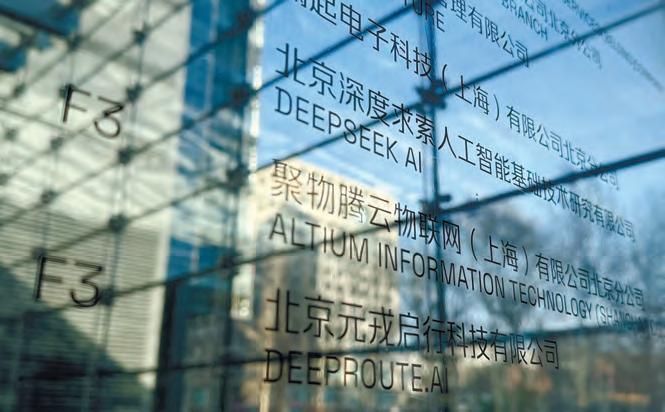
For instance, Beijing is restricting outbound capital while increasing scrutiny of cross-border investment. It’s also walling off strategic sectors, such as artificial intelligence (AI), to outside investors and collaborators and further restricting the flow of information available to foreign businesses and investors.
The contradiction is difficult to ignore. If China seeks to attract foreign capital and restore investor confidence, why is it simultaneously building higher barriers around its economy?
The answer likely lies in a combination of factors. Some of those include economic weakness, geopolitical rivalry, national security concerns, and growing fears inside Beijing that China’s technological advantages could be diluted through capital flight and foreign influence.
Xi’s pledge that China would “open wider” to foreign business now appears increasingly at odds with policy developments unfolding across the country.
Beijing Is Trying to Prevent Capital Flight
China’s economy continues to face significant structural challenges, including weak domestic demand, a prolonged property downturn, local government debt pressures, and slowing foreign investment.
Against that backdrop, Beijing is becoming increasingly concerned about money leaving the country.
Recent reports indicate Chinese brokerages have sharply restricted new cross-border investment activity through total return swaps, a mechanism used by investors to
China
gain overseas exposure. The move is widely viewed as part of a broader effort to curb capital outflows and strengthen government oversight of financial flows.
China’s new overseas investment regulations also expand government authority over outbound investment, technology transfers, and cross-border capital movements.
The reality is that Beijing cannot simultaneously embrace unrestricted capital movement and fear capital flight.
AI Is a National Security Asset
Artificial intelligence is another factor driving Beijing’s tighter restrictions. As is now widely understood,
AI is no longer viewed merely as a commercial industry; it is strategic national security.
Beijing recognizes that AI is a resource with broad applications in military modernization, intelligence gathering, surveillance, and economic competitiveness. In fact, analysts increasingly view the U.S.–China AI race as one of the central geopolitical competitions of the decade.
As U.S. export controls continue to target advanced semiconductors and AI-related technologies, China is responding by imposing tighter restrictions on technology transfers, AI talent mobility, and foreign involvement in sensitive sectors.
Recent regulations grant authorities broader powers over overseas investment in AI and other strategic technologies.
The tighter Beijing’s control becomes, however, the harder it may be to convince foreign investors that China’s technology sector remains accessible and predictable.
Beijing Is Preparing for LongTerm Economic Conflict
The bigger picture is that Chinese policymakers believe that economic confrontation with the United States is not temporary but structural. They’re not wrong.
Washington continues to expand export controls, designations of military-linked companies, and restrictions on advanced technologies.
Most recently, the U.S. Department of Defence expanded its Section 1260H list, adding numerous major Chinese companies.
China responded with export controls targeting American companies
involved in defense, aerospace, and rare earth supply chains.
From Beijing’s perspective, tighter control over capital, technology, and information may be viewed as necessary preparation for a prolonged period of economic confrontation.
Less Transparency Creates Foreign Investor Uncertainty
One of the least discussed aspects of China’s policy shift is the reduction in transparency available to foreign investors.
Information itself has always been a strategic resource, and the lack of it a risk factor, but never more so than today.
Data restrictions, tighter reporting standards, limitations on information sharing, and growing scrutiny of foreign due diligence activities make it increasingly difficult for international firms to assess risk inside China.
The result is greater uncertainty for investors.
China’s new regulatory framework increasingly links economic activity with national security considerations, creating additional compliance burdens for multinational firms.
For foreign businesses, less transparency often translates into higher risk premiums and lower investment enthusiasm.
CCP’s Political Priorities Outweigh Economic Liberalization
There is also the very big problem the Chinese Communist Party (CCP) faces, which is maintaining control over the country. China’s economic reform era was built largely on market liberalization and integration with the global economy.
However, the Party’s governing philosophy places greater emphasis on security, resilience, self-sufficiency, and political control.
That shift helps explain why Beijing often speaks the language of openness while implementing policies that increase state oversight.
From the Party’s perspective, maintaining control has always taken precedence over maximizing foreign investment.
Potential European Blowback
If Beijing continues down this path, Washington and Brussels are unlikely to stand still. In fact, several
AI Risks a Global ‘Bugmageddon’
responses are already emerging.
For example, Europe has increasingly embraced “de-risking” rather than decoupling. While the terms differ in scope and pace, both reflect the same broader goal: reducing dependence on China. Working from that premise, it would not be surprising to see more restrictions on Chinese investment, critical technologies, and supply chains.
The US Response
In the United States, the Pentagon’s expansion of the Section 1260H list demonstrates Washington’s growing willingness to classify Chinese firms as linked to China’s militaryindustrial complex.
Additional designations could further limit access to U.S. government contracts, investment, and partnerships.
What’s more, Congress and regulators may increase scrutiny of Chinese firms seeking access to American capital markets.
More reporting requirements, investment restrictions, and disclosure rules remain possible.
Increased Tensions in Strategic Regions
If tensions continue rising, additional tariffs targeting strategic industries could emerge on both sides. This pattern of retaliation, already visible in rare earths, defence procurement, and technology controls,
Hackers and terrorists can use the country’s leading free model for malign ends.
By Anders Corr
One of China’s leading artificial intelligence (AI) models, Z.ai’s GLM-5.2, is close to beating U.S. models on some cybersecurity metrics.
Z.ai, formerly known as Zhipu, was added to the U.S. Commerce Department’s trade blacklist last year. Some of its shareholders are reportedly controlled by the regime in China, and the company allegedly supports China’s military advancement.
Now, its freely available AI model could be used by hackers and terrorists to cause global chaos and destruction.
The model competes head-to-head with Anthropic’s Claude Opus 4.8 but is approximately half to oneeighth the cost to the user. Unlike China’s DeepSeek, which wowed the world with its inexpensive chatbot, GLM-5.2 competes with top U.S. AI systems on powering agents, long-horizon planning, repositoryscale coding, testing, and looping. As a result, many Silicon Valley computer scientists and engineers are using the system.
Z.ai’s model is free and openweight, meaning it can be downloaded, altered, and run on a user’s own equipment. Unlike open-source, the data and training methods remain proprietary. Still, the company and nation-
states cannot block or control its operations. Once released, the system could be used by hackers and terrorists to find and exploit vulnerabilities, whether through cyberattacks, mass bespoke disinformation campaigns, the creation of new bioweapons, or the discovery of as yet unknown societal vulnerabilities. If energy and compute constraints could in the future be solved for small actors, they could potentially use open-weight models to recursively improve AI to the point at which a model reaches superintelligence, goes rogue, or both.
The low cost of GLM-5.2 will increase its global utilization, and its ability to run locally will provide hackers and terrorists with a tool to tune and use privately to facilitate their malign ends. The model can reportedly find security vulnerabilities for about 17 cents each, and Russian-language hackers have, within weeks of its release, traded jailbreaks to escape the model’s guardrails.
The ability of hackers to use GLM-5.2 secretly and with ease increases the risk of a future “bugmageddon” if cybersecurity defenders cannot use the same or similar systems to find and fix their vulnerabilities first.
The origin of GLM-5.2 in China means the regime in Beijing could have influenced the code, including its depiction of the Chinese Communist Party (CCP). It could be built with hidden back doors that facilitate the CCP’s own hacking and surveillance of global users. More broadly, GLM-5.2 and the availabil-
ity of powerful U.S. semiconductors in China add to the competitiveness of China’s AI development, which will boost China’s economy and military technology.
China’s AI companies may have gotten an assist from mid-June U.S. controls and pressure against the availability of leading U.S. models, including Anthropic’s Mythos and Fable, and OpenAI’s GPT-5.6.
Within 10 days of the controls, GLM5.2 gained top or near-top rankings on several leaderboards, including Design Arena, Artificial Analysis, and SWE-bench PRO. Z.ai’s market capitalization rose to $128 billion.
The U.S. restrictions were meant to reduce the possibility that Anthropic and OpenAI models would be used to trigger a “bugmageddon” effect by hackers and adversary governments. But another concern quickly rose in China’s ascendancy on some metrics. So the United States rolled back its restrictions, and on July 1, Fable became globally available again.
The more powerful Mythos was available to leading U.S. national security and corporate cybersecurity entities, enabling them to harden their systems against cyberattacks. Its availability to U.S. global partners is still pending, however, which led some to call for greater AI development within their own nations.
The rolled-back restrictions indicate the tightrope regulators must walk between ensuring the United States leads in AI and mitigating the risk that the rapidly evolving tech-
could expand and drive geopolitical tensions.
Economic rivalry increasingly overlaps with security competition in the Taiwan Strait, South China Sea, and Indo-Pacific region. As economic trust deteriorates, geopolitical risk tends to rise. Clearly, Xi’s promise of greater openness was intended to reassure global investors. Yet recent policy decisions suggest Beijing’s priorities lie elsewhere.
Capital controls, tighter AI oversight, reduced transparency, and increased state intervention point toward a China that is becoming more insulated rather than more integrated.
The irony is that every step the CCP takes to strengthen control may accelerate the very outcome Beijing hopes to avoid. As trade and capital flows with China become riskier and costlier, Western countries will be driven to expand their efforts to derisk, reduce foreign investment, and accelerate the restructuring of global supply chains away from China.
Views expressed in this article are opinions of the author and do not necessarily reflect the views of The Epoch Times.
James Gorrie is the author of the 2013 book “The China Crisis” and discusses current events and China on his YouTube podcast, The Banana Republican.
nology is used against it, including by the CCP. The neck-and-neck AI race between the United States and China will increase the CCP’s diplomatic influence among those willing to look the other way regarding Beijing’s authoritarianism and espionage. Meanwhile, prepare for cybersecurity chaos over the next six months to a year as malign actors use GLM5.2 and other open-weight AI to hack democratic governments, Western corporations, and others who, in some cases, are unprepared to fight fire with fire.
Unlike the United States, which responsibly attempted to limit the use of such models to the most trusted U.S. and UK entities, the regime in Beijing allowed the global, public release of GLM-5.2 with only weak guardrails. This indicates the CCP’s irresponsibility and short-sighted-
ness. Rogue AI may one day attack not only the democracies, but all of humanity.
Views expressed in this article are opinions of the author and do not necessarily reflect the views of The Epoch Times.
Anders Corr has a bachelor’s/ master’s in political science from Yale University ( 2001 ) and a doctorate in government from Harvard University ( 2008 ). He is a principal at Corr Analytics Inc. and publisher of the Journal of Political Risk, and has conducted extensive research in North America, Europe, and Asia. His latest books are “The Concentration of Power: Institutionalization, Hierarchy, and Hegemony” ( 2021 ) and “Great Powers, Grand Strategies: the New Game in the
( 2018 ).
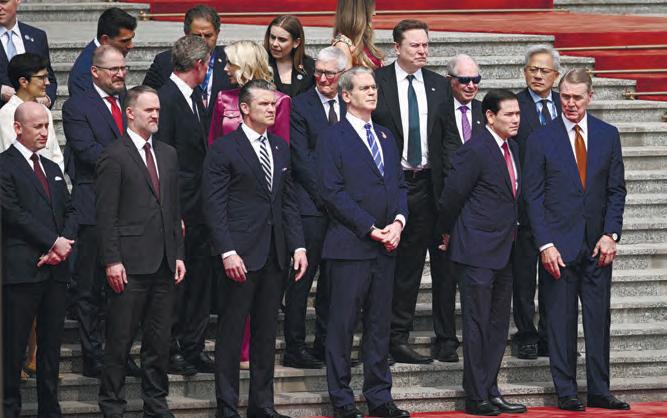
U.S. Secretary of War Pete Hegseth (bottom C), U.S. Treasury Secretary Scott Bessent (bottom centre R), Secretary of State Marco Rubio (bottom 2nd R), Nvidia founder and CEO Jensen Huang (second row R), senior advisor Stephen Miller (bottom L), Tesla and SpaceX CEO Elon Musk (3rd R second row), and Apple CEO Tim Cook (C second row) attend a welcome ceremony for U.S. President Donald Trump in Beijing on May 14.
If you’re dicing potatoes, carrots, and parsnips for a pot roast, it’s unwise to let your mind wander while wielding sharp instruments, and I lost track of the moment. Were this the 1970s, and I a Middle American home cook, I‘d have just popped these roots and tubers into the Kitchen Magician like tennis balls in a practice gun. In goes the parsnip, out come stew cubes. Simple! Quick! Easy! All for $49.99. But wait, there’s more: Tonight only, we’ll toss in the Popeil Pocket Fisherman for just $9.99.
Strange where your mind goes while cooking.
But my hands never wander, and that’s the foundation of this epiphany. I’ve never had a Kitchen Magician, nor a Veg-o-Matic, nor a Chop-o-Matic, because I believe that there is intrinsic value in handwork—in the garden, around my farm, and especially in the kitchen. I prep everything by hand, I don’t use the timer on my oven, there’s no crockpot in the cupboard (maybe there’s a crackpot in the kitchen), and people who ask for my recipes are invariably flummoxed by discussion of the ultimate question: “How long do you cook it?”
“Until it’s done.”
“How do you tell?”
“Check it.”
“How?”
“By hand.”
“But how do you do that?”
The universe gave us hands for a reason, so it’s obnoxious that billions of people now think that the way to do something is to prompt an artificial intelligence (AI) dingbat in your Alexa-Siri-GeminiHAL device sitting on the kitchen counter next to the forlorn knife rack Grandma gave you for a wedding present back when people
made fresh bread by saving potato water and mixing it in the dough. By hand! Imagine! No bread machine.
“Hey, Google, how do I boil water?”
Heaven help the human race.
Hands-on adventures here at Owl Feather Farm begin long before any cooking in the kitchen.
My entire garden is in raised beds, and each spring I turn each bed by hand using a super-sturdy garden fork. In the extra-narrow beds from which pole beans reach for the sky on a trellis, I turn the dirt with a hand trowel.
“You know,” rubberneckers say, “they make little self-drive tillers that do that for you.” Maybe so, but: I get deeper and more thorough cultivation by hand.
I can stop periodically and pitch away winter weeds—by hand.
I crumble stray clay globs by hand.
If you won’t get your hands in the dirt, are you sure you want to grow things?
I’m saving $720 per year on the health club membership I don’t need.
The other day I was pulling weeds by hand, ruminating on a really nice Los Angeles Times health essay I had read online. It offered “five easy exercises for your hands, wrists, forearms, and elbows to alleviate desk job aches and pains.” Luckily, the exercises aren’t as complicated as the headline: Slowly roll your wrists inward and outward, five to 10 times each side. I try that with a footlong piece of bindweed. Nope. Still have to pull straight up.
Over in the UK, The Telegraph has a six-step program for arthritic hand pain relief. Don’t have arthritis yet? Hang on, it’s coming.
The UK regime is way more complicated and, if carried out in full, requires about five hours of multistep exercises involving items such
as therapy putty, which I didn’t even know existed. At Owl Feather Farm, we have issued an executive order declaring subterranean clay to be “therapy putty” whenever it nears the ground’s growing surface. We do not subject it to deportation, just dissolution.
Please note that all of this handydandy stuff isn’t a religion. There’s no doctrine; excommunication isn’t possible. It’s best not to take this to extremes. I don’t use a mortar and pestle to grind up garlic, hard cheese, and basil for pes
to—my wife’s parents gave me an amazing Cuisinart for that.
I’ve a wonderful home kitchen flour mill (a Popeil-esque $79.95 on Amazon) with which I grind dry corn for cornmeal and grits. No mortar and pestle for that, either. But in winter I shell the kernels off the corn cobs by hand, while sitting by the fire and listening to meditative music.
I don’t water my garden using a
bucket. Well, not usually; on occasion I’ll fill a bucket at the spring creek that runs through the orchard if I just need to soak in a newly planted cherry tree.
Writing, of course, my lifelong trade, is done by hand. I’m not a famous romance author and have written nothing in longhand while soaking in the bath. I’ve been using keyboards since typing school in 1966. I first used a computer keyboard in 1972, and I reject dictation. The sheer action of watching words spool out steadily, letter by letter, remains a key facet of the creative process.
As for AI, read any generative content lately? It’s all over the internet, and it’s putrid. Stupid. Laughable. Except for the material OpenAI stole from me.
Let’s go back to ground zero, where everything starts, and consult the patron saint of gardens and nature, Francis of Assisi. He said:
“He who works with his hands is
How to Meet Japan’s Stationmaster Cats
By Nicole James
There are many ways to spend a holiday in Japan. You can pursue temples, noodles, lacquerware, cherry blossoms, whisky, vintage denim, highly specialized stationery, or the sort of strawberries that look as if they were raised by perfectionists in a laboratory. Or you can make a beeline for one of the country’s most successful and emotionally competent public servants: a cat in a hat. This is not slang or one of those travel-writer flourishes that collapses on contact with reality. Japan really does have stationmaster cats, and they are exactly what they sound like—feline officials attached to railway stations, photographed with great enthusiasm, treated with formal respect, and credited with doing a better job of local revitalization than a battalion of consultants.
Tama, the Great Dowager Cat
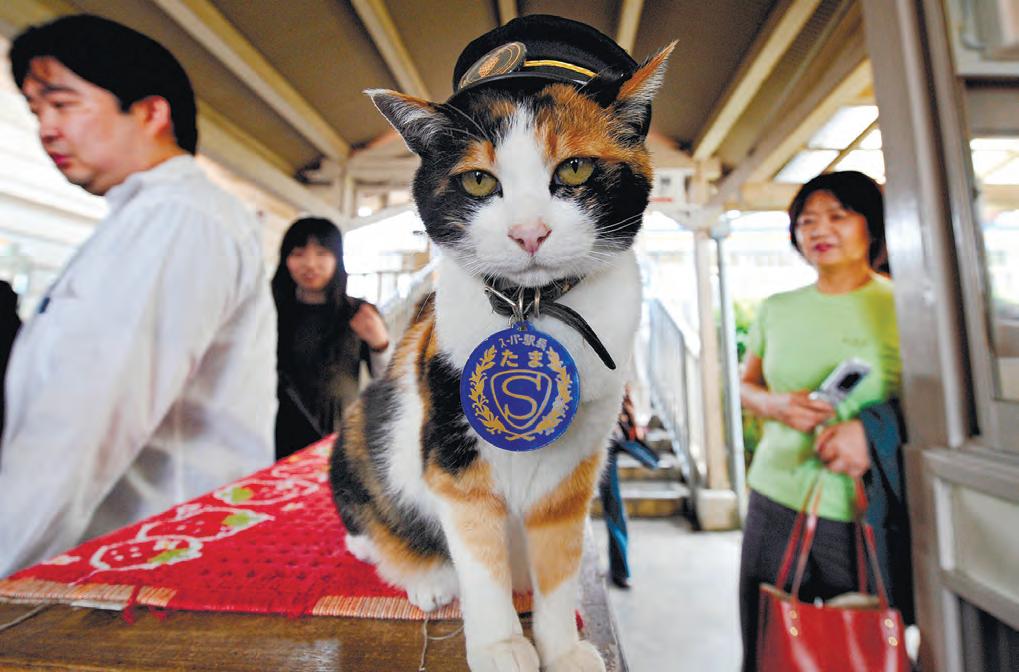
The great dowager of this furry civil service was Tama, the calico stationmaster of Kishi Station in Wakayama Prefecture.
Appointed in 2007, Tama arrived at a moment when the local Kishigawa railway line was struggling and rural rail, the most melancholy of transport categories, needed help. Into this atmosphere of quiet municipal anxiety stepped a cat with a cap.
Tama’s achievements were considerable. Tourist numbers surged. The station became famous. The line found new life. She inspired merchandise, media coverage, devoted fans, and the sort of civic affection most regional mayors can only fantasize about while open-
a labourer.
“He who works with his hands and his head is a craftsman.
“He who works with his hands and his head and his heart is an artist.”
Supposedly, a neighbour came by one day while Francis was hoeing his garden (see, even the most famous saints do laborious handwork) and asked, “If you knew you were going to die later today, what would you do?”
“I’d finish hoeing my garden,” Francis replied. Cheerfully, I’m sure. Then he‘d go cook dinner by hand. Consume it by hand. Clean up by hand. Maybe, then, he’d heed a call from above. That’s the hand of God, actually..
Eric Lucas is a retired associate editor at Alaska Beyond Magazine and lives on a small farm on a remote island north of Seattle, where he grows organic hay, beans, apples, and squash.
In an age when fancy gadgets and smart devices are easily accessible, working with the hands brings a renewed sense of purpose. A station, a cat, and a tourism boom few could have predicted.
ing agricultural shows in synthetic polos.
Tama did not do any of this by giving speeches or unveiling strategy documents. She sat very still, looked magnificent, and allowed the public to project onto her an entire fantasy of charm and softpawed authority.
Since then, the line has maintained a feline succession. Nitama followed. Yontama has since taken up the mantle. The whole arrangement has acquired the settled air of a hereditary institution.
Where to Meet a Stationmaster Cat
If you want to meet one of these whiskered officeholders, your destination is Kishi Station, south of Osaka, on the Wakayama Electric Railway Kishigawa Line.
Getting there is part of the pleasure. You travel from Osaka to Wakayama, then join the local line as the city mood falls away and the odd, cheering splendour of your mission becomes clear. Somewhere ahead lies a station whose chief drawcard is the possibility of glimpsing a cat on official duties.
And Kishi does not disappoint.
The station building itself leans cheerfully into the theme. The trains are decorated. The gift shop is alert to your weaknesses.
The whole enterprise has been carried off with the sort of polished commitment Japan brings to anything involving ritual and public behaviour.
Other countries might have made a mascot and stopped there. Japan built a mythology and, quite possibly, a better model of governance.
The joy of the stationmaster cat is that the idea works on every level.
It is adorable, obviously. Even the stoniest traveller would have to be some kind of emotional tax auditor not to feel a flicker at the sight of a
cat in formal headwear.
But it is also culturally coherent. Cats occupy a rich and curious place in Japanese life, from the beckoning maneki-neko promising good fortune from shopfronts to the stranger feline presences in folklore, in which cats are clever, uncanny, faintly superior, and occasionally a little alarming. In short: exactly like cats.
That is part of why the stationmaster tradition feels so perfectly judged. It draws on affection, symbolism, ritual, and place. It gives visitors a reason to come and locals something to cherish.
Many tourism campaigns spend millions of dollars trying to manufacture “authentic connection.” Wakayama put a cat in a station and let human nature do the rest.
Stationmaster Cat Etiquette
A small note on etiquette. These are not pets put on display for the shrieking amusement of tourists who’ve had too much canned coffee. They are treated as local icons, and one should behave accordingly. Admire quietly. Take photographs if allowed. Do not bang about demanding a performance. A stationmaster cat is there to embody composure and the possibility that one perfectly judged absurdity can save an entire place.
And perhaps that is why people love them so much. The stationmaster cats offer something modern life has made terribly scarce: a public institution that inspires uncomplicated delight. No spin. No jargon. No man in a
blazer explaining resilience metrics. Just a cat, a station, a community, and a wildly successful act of collective whimsy.
After meeting one, you may find it difficult to return to ordinary human authority at all.
Nicole James is a freelance journalist for The Epoch Times based in Australia. She is an award-winning short story writer, journalist, columnist, and editor. Her work has appeared in newspapers including The Sydney Morning Herald, Sun-Herald, The Australian, the Sunday Times, and the Sunday Telegraph. She holds a BA Communications majoring in journalism and two post graduate degrees, one in creative writing.
TORU YAMANAKA/AFP VIA GETTY IMAGES
Cooking by hand is rewarding. It demands that the chef be present and alert.
Wearing a stationmaster’s cap of the Wakayama Electric Railway, “Tama” sits on a ticket gate at Kishi Station on the Kishigawa Line in Kinokawa, Japan, on May 22, 2008.
這位廣受好評的小說家——是經典作品如 《冬日奇緣》(Winter's Tale)、《大戰中的孤兵》 (A Soldier of the Great War)和近期的《海洋與 星辰(暫譯)》(The Oceans and the Stars)的作 者——他豐富的人生可以寫成很多本書:1947 年出生於曼哈頓,母親是百老匯的明星,父親 是美國戰略情報局(Office of Strategic Services) 的退伍軍人/記者。他曾就讀於哈佛大學與牛 津大學,曾在英國商船隊(The British Merchant Marine)和以色列陸軍服役,也曾是洞察力敏銳 的外交事務評論家。
「以嚴謹的方式傳承真正的知識」是貫穿其 中的核心支柱——因為那是維繫人類文明,以及 讓個人繁榮茁壯的基礎。 赫爾普林的總結直接切入重點:「走艱難的 路。那是塑造品格、維繫文明與生存的要素。」 原文:「Novelist Mark Helprin on Learning, Curiosity, and Revitalizing Education」刊登於英文 《大紀元時報》。◇