Pages for readers, Opportunities for writers
01.10.26
§v
f
Bristol university’s independent newspaper & the UK’s best student publication 2025
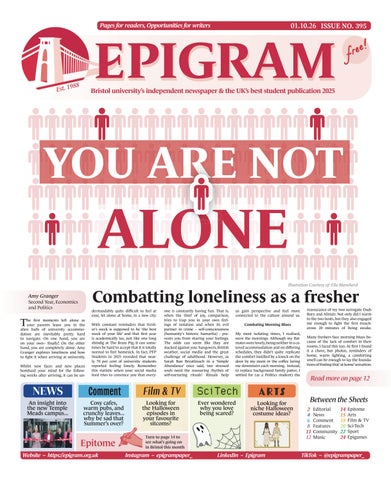
YOU ARE NOT
ALONE Illustration Courtesy of: Ella Blanshard
Combatting loneliness as a fresher
Amy Granger Second Year, Economics and Politics
derstandably quite difficult to feel at ease, let alone at home, in a new city.
T
he first moments left alone as your parents leave you in the alien halls of university accommodation are inevitably pretty hard to navigate. On one hand, you are on your own– finally! On the other hand, you are completely alone. Amy Granger explores loneliness and how to fight it when arriving at university. Whilst new faces and new places bombard your mind for the following weeks after arriving, it can be un-
With constant reminders that fresher’s week is supposed to be ‘the best week of your life’ and that first year is academically lax, just like one long shindig at The Brass Pig, it can sometimes be hard to accept that it is totally normal to feel homesick. In fact, PFP Students in 2025 revealed that nearly 70 per cent of university students reported feeling lonely. Remember this statistic when your social media feed tries to convince you that every-
one is constantly having fun. That is, when the thief of joy, comparison, tries to trap you in your own feelings of isolation and when its evil partner in crime – self-consciousness (humanity’s historic hamartia) - prevents you from sharing your feelings. The odds can seem like they are stacked against you: hangovers, British weather, social media and the great challenge of adulthood. However, as Sarah Ban Breathnach in a ‘Simple Abundance’ once said, ‘our stressed souls need the reassuring rhythm of self-nurturing rituals’. Rituals help
us gain perspective and feel more connected to the culture around us. Combating Morning Blues My most isolating times, I realised, were the mornings. Although my flatmates were lovely, being neither in a catered accommodation and on differing schedules, they didn’t quite replicate the comfort instilled by a knock on the door by my mum or the coffee luring me downstairs each morning. Instead, to replace background family patter, I settled for (as a Politics student) the
NEWS
Comment
Film & TV
SciTech
Arts
An insight into the new Temple Meads campus...
Cosy cafes, warm pubs, and crunchy leaves... why be sad that Summer’s over?
Looking for the Halloween episodes in your favourite sitcoms?
Ever wondered why you love being scared?
Looking for niche Halloween costume ideas?
Epitome Website – https://epigram.org.uk
Turn to page 14 to see what’s going on in Bristol this month
Instagram – epigrampaper_
LinkedIn – Epigram
reassurance of my two surrogate Dads Rory and Alistair. Not only did I warm to the two hosts, but they also engaged me enough to fight the first treacherous 20 minutes of being awake. Many freshers face morning blues because of the lack of comfort in their rooms, I faced this too. At first I found it a chore, but photos, reminders of home, warm lighting, a comforting smell can be enough to lay the foundations of finding that ‘at home’ sensation.
Read more on page 12
Between the Sheets 14 Epitome 2 Editorial 15 Arts 4 News 6 Comment 18 Film & TV 20 Sci-Tech 8 Features 11 Community 22 Sport 24 Epigames 12 Music
TikTok – @epigrampaper_
02 EPIGRAM 01.10.26
Write for us!
Editorial Jed Dixon Co Editor-in-Chief
G
etting back into the routine of university sounds like a great idea on paper, but it has reminded me that there is, unfortunately, work to be done. As my fellow final year students will know, the start of the year and the end of the year are much closer together than you might think. At least there’s some decent music on to keep my spirits up. I think it’s always a good idea to have an event booked in advance to look forward to - for me at the moment it’s LSD and the Search for God at Thekla, but if you haven’t got anything lined up then check out Epitome for some ideas. Here at Epigram we have had a great start to the year, with a (‘slightly’ hungover) coffee morning, our fully booked GIAG session, and only minor amounts of window climbing required for Freshers fair. If you missed these but are interested in writing, photographing, or illustrating, check out the QR codes on the page over, or better yet, come to one of our socials! Heading into the winter months it’s important to make sure you get out the house and stay connected with people, and we’ve got a great community for just that. As always, if you miss our commissions (on the 1st of every month), then remember you can still pitch your article ideas to us. Get in touch with a section editor on the respective WhatsApp chat, or find the section specific email on the website and send over a message.
Did you know you can find our papers online too? Head over to https://issuu.com/epigrampaper or go to Issuu’s website and search for Epigram. Here, you’ll get a flip through of our papers each month, on their release date. Not interested in the flipbook layout? Find all of our aticles on www.epigram.co.uk, ready for you to read and enjoy. Plus, if you’re looking for a specific author or article, you can just type it into the sear ch bar.
Writing in print is not only a great addition to the CV, but can also be pretty meaningful if you put the effort in. I interviewed my old drum teacher the other day about his experience after university for a longread I’ve been planning on writing, and it was one of the most meaningful experiences I’ve had in a while. Sitting down and really getting to know the ins and outs of someone’s life is a pretty intimate experience, and I think we both came out of it with a better grasp of the people we want to be. Journalism can be a beautiful thing, and I think it’s as important as it’s ever been to remember that now. Telling real stories the right way will always be vital, and no amount of political, social, or technological upheaval can change that. So, if you have a story to tell, write it down. We would love to hear it, and I’m sure the world would too. Give it a go, what’s the worst that could happen?
26 / 27
Jed & Emma
Head of Photography: Emilia Ibarguen Donoso Head of Illustration: Romina Trevino
NEWS
Senior Editorial Team
Editor: Lenny Osler Deputy Editor: Dana Datu Deputy Editor: Ariella Greenfield Subeditor: Nyx Osborne Sandford Subeditor: Hannah Roberts
Co Editor-in-Chief: Emma Coleman Co Editor-in-Chief: Jed Dixon Deputy Editor: Hannah Corcoran Print Editor: Ella Blanshard Digital Editor: Tylah Hendrickson
Comment
Business Team President: Ella Joshi Secretary: Isaac Osborne Vice Secretary: Florence Grant Treasurer: Bethalhim Asres EDI Officer: Alice Benjamin Head of Advertising: Chloe Wong Head of Technology: Miles Gilroy Social Secretary: Rosa Dunford
Did you spot us at the Freshers Fair?
Editor: Theodora Stuttaford Deputy Editor: Maddy Spitzer Deputy Editor: Ruby Hargreaves Subeditor: Matthew Brown Subeditor: Lianne Ponferrada
Features Editor: Grace Bourne Deputy Editor: Harry Gillingham Deputy Editor: Luke Buckland Subeditor: Ivy Nicholls Subeditor: Disha Angadi
Community
Editor: Olivia Hunt Deputy Editor: Emine Arslan Deputy Editor: Lucie Weston Subeditor: Natalie Payne Subeditor: Ruby Wright Epitome Curator: Lily Phillips Sharp Epitome Curator: Hannah Poulter
Arts Editor: Leo Sefton Deputy Editor: Claresta Terleph Deputy Editor: Bea Thomas Subeditor: Francesca O’Connor Subeditor: Oscar Degirolamo Literature Columnist: Sonal Korlipara Literature Columnist: Mary Allen Book Club Leader: Rosy Brown
Film & TV Editor: Katerina Ralli Deputy Editor: Charles Hubbard Deputy Editor: Lottie Merchant Subeditor: Poppy Heath Subeditor: Eve Perrins
Music Editor: Lucy Bevan Deputy Editor: Tom Foley Deputy Editor: Katie Asha Subeditor: Stas Forte Subeditor: Anastasia Baker
SciTech Editor: Ilgin Guzel Deputy Editor: Alice Guskov Deputy Editor: Beth Robinson Subeditor: Luke Beaumont Subeditor: Alejandra Bonwick Epigreen Columnist: Izzy Geddes
Sport Editor: Edward Wallace Deputy Editor: Ava Featon Deputy Editor: Louis Parry-Garnaud Subeditor: Rachael Ginn
EPIGRAM 01.10.26
03
editor.epigram@gmail.com
You don't have to write to be part of Epigram's community...
Interested in photography? We are looking for photographers to contribute on an ad-hoc basis. Your role would consist of taking high-quality photographs that we can use both in print and online. Join the WhatsApp chat
1) Your name, course and year group 2) A simple portfolio of your work
•
Be the first to hear breaking news on campus and student analysis on a wide variety of issues at university and nationally.
•
Contibute to Epigram's agony aunt column, exclusive to the print & take part in interviews for our features articles! Keep up with our editorial team behind the scenes. See details of our socials, upcoming formals and paper distribution days.
Email us • •
Or are you an illustrator? We are always looking for illustrators and graphic designers to create art for both print and online. 1) Your name, course and year group 2) A simple portfolio of your work or illustrate something for any existing Epigram article
Email us
Join the WhatsApp chat
04 EPIGRAM 01.10.26
NEWS
Editor’s Choice We’ve featured an article on Young Bob (p. 4), a controversial right-wing activist and commentator whose visit to campus in September reignited the debate as to where the boundary lies between legitimate free speech and unlawful hate speech.
Right-wing TikToker returns to University of Bristol, calling for ‘mass deportations’ The political activist, known on social media as ‘Young Bob’, debated students and staff as onlookers reported verbal abuse and racial slurs.
Lenny Osler News Editor
Grace Rose Community Subeditor
Y
oung Bob, an 18-year-old political activist whose real name has been variably reported as both Thomas and Gregory Moffitt, stationed himself outside Senate House on September 15 from 12 PM until 4 PM to debate passers-by. With Moffitt were three men and a woman, who appeared to be provide him with security and record footage of the debates. University of Bristol security services were at the scene, alongside several officers from Avon and Somerset Police. Moffitt displayed banners calling for the deportation of ‘millions’ and referring to the LGBTQIA+ community as ‘mentally ill’. Around 50 people gathered to
watch as students debated Moffitt on issues from immigration to religion and transgender rights. Throughout, Moffitt was heard using racial slurs and ‘verbally abusing’ a University staff member. Police said Moffitt’s statements likely ‘towed the line’between lawful freedom of speech and unlawful hate speech. Several students, and representatives from Bristol Revolutionary Communist Party (RCP), staged protests, chanting slogans denouncing anti-immigration politics. The 18-year-old has over 100,000 Instagram followers, and more than 90,000 on TikTok. Moffitt came to the University of Bristol in April, where he claimed he was ‘assaulted’ after displaying a banner calling for a total ban on abortions.
himself as a ‘Christian Pro-life Remigration activist’ and has expressed support for Restore Britain, a political party to the right of Reform UK. Moffitt told Epigram he was making a ‘statement of freedom of speech’. He called the University of Bristol an ‘unstable’ institution that ‘does not promote freedom of speech’. Agnes, a mental health adviser at the University of Bristol, said Moffitt told her she ‘ought to be sacked’ for ‘simply disagreeing with him’. ‘I believe in freedom of speech, but not people making unwelcome comments on campus’, said Agnes. Makam, a third year student, danced around Moffitt’s table to loud music in an attempt to drown out and distract from the TikToker’s statements. Moffitt referred to Makam as a ‘Chinaman’ - widely considered a racial slur saying he was ‘entitled’ to use the term.
He just wants to get TikTok famous
The TikToker was heard referring to another student wearing a headscarf as an ‘Arabian prince’.
He is known for attending university campuses across the country to debate students and promote right-wing politics.
Cole, a first year student, said he welcomed the opportunity to debate Moffitt. However, he said he was ‘repeatedly interrupted’, claiming the TikToker’s goal was to ‘antagonise’ and ‘clip farm’. ‘He just wants to get TikTok famous’, said Cole.
In his Instagram bio, Moffitt describes
A University of Bristol spokesperson said: ‘We are aware that a person, who had no affiliation to the University, set up on the public highway outside Senate House on Wednesday. ‘Freedom of expression and academic freedom are foundational rights at the heart of our mission and our values. We affirm the vital importance of the right of all to speak openly without fear of censorship or limitation, provided that this right is exercised responsibly, within the law, and with respect for others who may have differing views.’
Photos courtesy of: Epigram / Lenny Osler A Bristol SU spokesperson said: ‘We’re aware that there was some disruption outside of the Senate House due to the presence of Young Bob on Monday 14 September. ‘Young Bob does not share our values or commitment to diversity and inclusion, and it’s disappointing that some students’ enjoyment at Welcome Week may have been affected by their presence. ‘If anyone has been impacted by what they heard, we encourage them to reach out to support available.’
Bristol scholars in Gaza ‘over the moon’ as emergency funding kickstarts evacuation process Fortunes change for Palestinians hoping to enrol at the University of Bristol this year.
Lenny Osler News Editor
T
he University of Bristol has promised emergency funding to cover living expenses, travel, and visa costs for six Palestinian students set to begin master’s
At around 2 PM BST, the students, currently in Gaza, learned the University had found the funds necessary to support their maintenance costs. Crucially, proof of funding for maintenance costs is required, under Home Office regulations, for international students to receive CAS (Confirmation of Acceptance for Studies) - allowing them to apply for student visas. The six students are to study on the University’s Sanctuary Scholarship - intended to cover tuition fees and
living expenses for students from refugee and asylum-seeking backgrounds. Less than 24 hrs before the news broke, the hopeful postgraduates spoke to Epigram. They voiced their concern and fear as the University seemed, at the time, unable to cover their living expenses - placing their visa and evacuation processes in deadlock. Since the postgraduates are ineligible for UK Student Finance, and have no local financial resources in Gaza, they relied entirely on
the University to cover all costs. Just yesterday, the students’ futures appeared to hang in the balance. However, in the past hours, the University’s emergency funding has appeared to enable them to leave Gaza to study in the UK. Weam Abu Daqqa, one of the students accepted onto MSc International Relations at the University, had called yesterday for ‘emergency institutional support’ to restart their visa and evacuation processes before the new term begins.
Photos Courtesy of: Weam Abu Daqqa
courses at the University this term.
To read more, go to epigram.org.uk
01.10.26 EPIGRAM
Editor Deputy Editor Deputy Editor Subeditor Subeditor
University of Bristol opens first international campus in Mumbai The University’s first campus abroad welcomes its founding cohort.
Hannah Roberts News Subeditor
T
he University of Bristol has opened its Mumbai Enterprise Campus, welcoming its inaugural cohort of students at a ceremony this week. The opening comes in the same week the University unveiled its Temple Quarter Enterprise Campus in Bristol, a month before its 150th anniversary, with both campuses focussed on skills in fast-moving fields such as data science and finance.
campus like this, while understanding there is a cost-of-living crisis.’
The new campus, connected to Bristol Temple Meads station, will provide a collaborative space for students, businesses, and local residents.
O
n September 7, the University of Bristol’s new Temple Quarter Enterprise Campus (TQEC) officially opened, as University administrators, local and regional government, businesspeople, and student leaders gathered to mark the result of a £500m investment. The event coincided with the opening of Bristol Temple Meads station’s new eastern entrance, which opens directly onto the new campus.
The centrepiece of the innovation-focussed campus is the Sloane Robinson Building, a five-storey facility named after Hugh Sloane and George Robinson.
To read more, go to epigram.org.uk
Asked about the nature of donations the University received to fund TQEC, V-C Welch said:
News Editor
The Mumbai Enterprise Campus is based at Cignus Powai, near Powai Lake, one of the city’s leading innovation and technology hubs, and sits directly opposite the Indian Institute of Technology Bombay.
Bristol alumna Dr Shanta Gokhale, a writer, journalist, translator, and theatre critic who graduated in 1962, received an honorary degree at the ceremony - becoming the Mumbai campus’s first graduate 64 years on.
Sloane Robinson, the hedge fund that donated £20m to TQEC through its charitable foundation, was ordered in 2012 to pay £13m in unpaid tax after participating in a tax-avoidance scheme.
Lenny Osler
TQEC is part of Bristol Temple Quarter - one of the UK’s largest regeneration projects, which seeks to bring housing, education, and workspaces to a previously derelict brownfield site.
A traditional lamp-lighting ceremony marked the opening, attended by Vice-Chancellor Prof Evelyn Welch and Director and Executive Dean Prof Michelle Jones.
Lenny Osler Dana Datu Ariella Greenfield Nyx Osborne Sandford Hannah Roberts
University of Bristol opens £500m campus at Temple Meads, as Deputy V-C promises ‘new way of working’
The University pointed to Mumbai’s standing in technology, innovation, and the arts as the reasons for the choice, saying this reflects similar strengths at Bristol.
Approval for the campus was granted in July 2025 at an event in New Delhi that marked five years of India’s National Education Policy 2020.
05
Sloane, a hedge fund manager and Bristol alumnus, and the Sloane Robinson Foundation donated £20m to the development of TQEC.
The building houses teaching and study spaces, 22 Active Learning Studios, an SU Living Room, corporate offices, and ‘civic spaces’ open to the public. On the ground floor, teaching will take place in a ‘lecture theatre in-the-round’ with the capacity for 300 students. The West of England Mayoral Combined Authority (WECA) also invested £35m in TQEC, hoping to ‘connect industry, investors and innovators with University of Bristol research, talent and space.’ Notable features of TQEC include Bristol Innovations Zone, providing labs and workspaces for businesses developing ‘critical and frontier technologies’. The University’s Business School will expand into the Sloane Robinson Building from its previous location in Howard House, while the Centre for Innovation and Entrepreneurship will also be based there. Students enrolled on courses within the Business School, and those studying Innovation alongside their degree, will be taught at the new campus. Epigram spoke to Prof Evelyn Welch, Vice Chancellor and President of the University of Bristol, alongside Deputy V-C and TQEC lead Prof Judith Squires, and Sharan Khemlani, Bristol SU’s Postgraduate Education Officer. On the benefits TQEC would bring to University of Bristol students, V-C Welch said:
‘TQEC is designed for students studying innovation and entrepreneurship as part of their degree, students in their final year of degrees within the Business School, or postgraduate taught students on innovative courses that mix business and leadership with deep tech. ‘For a first-year undergraduate primarily studying in Clifton, TQEC is
‘This donation underwent an extremely rigorous process of evaluation - both of where the money came from and what it would be used for.’ Deputy V-C Squires said TQEC was ‘porous’, keeping cafés and laptop study spaces open to the public throughout the Sloane Robinson building ‘right up to the fifth floor’. ‘We want people to feel that it’s the “University for Bristol”, not just the University of Bristol.’
Questioned on the environmental impact of the new campus, DepuThere is no trade-off between ty V-C Squires assured it this building and bus passes ‘met the highest standards of sustainability’. She emphasised the progress TQEC would bring towards the a great stop-off point as you come University Climate Action Plan by out of Bristol Temple Meads station.’ ‘moving more of the University’s activities into more sustainable facilities’. Sharan said students had ‘been involved for many years’ with deHelen Godwin, Mayor of the West of signing TQEC, with Deputy V-C England, praised the opening of TQEC, Squires adding the new spaces ‘came promising it would help deliver 10,000 out of conversations with our stuhomes and 10,000 new jobs to the area. dents about how they like to learn’. Asked to justify the scale of University investment in TQEC alongside recent cuts to essential student services, V-C Welch said: ‘There is no this building
trade-off between and bus passes.
‘We need to see these not as being in opposition to each other, but as part of the conversation about how we give all our students the very best experiences. ‘Thanks to Bristol SU, transport and laundry costs are at the top of our agenda at the moment.’ Sharan stressed the need for conversations between Bristol SU and the University to ‘balance the need for a
On TQEC’s location - distanced from the University’s Clifton campus - she said: ‘I think there’s something really positive about students walking across a city and being part of it. ‘As a student, walking through [Liverpool] city centre gave me an appreciation of the place and its culture outside the university experience. ‘We understand people are having to make different decisions about where, or whether, to go to university because of rising costs. We [WECA] want to be a good partner to the University of Bristol, but also to students.’
Photos courtesy of: Epigram / Emilia Ibarguen Donoso
06 EPIGRAM 01.10.26
Comment Stop complaning summer is over: embrace the season of the soul As we enter the colder months, Alice persuades us to embrace the changing seasons.
Alice Lewis Third Year, English and Film
S
ummer 2026 was a scorcher, but autumn has arrived in Bristol. Storms greet the start of term. Parched grass absorbs rain like thirsty freshers guzzle buzz balls at an awkward Welcome Week pres. And as we trace our teary reflections in the window of our hall, flat or student house, it’s hard not to feel a sadness for summer’s end. Our memories are caught up in empty glasses and bottles. We yearn wistfully for long summer evenings, drinking beer on the Downs, sipping Pimm’s in Channings or gulping something French by the harbour. Oh, cry me an Avon-sized river, Bristol students! Think yourselves
lucky. You’re young, free, the clubs are open, and winter is coming in, so be like Virginia Woolf and embrace autumn, ‘the season of the soul.’ Poet William Blake had this figured out long before Bristol students were made to take Science of Happiness units: ‘without contraries there is no progression.’ Why dread the transition into autumn and then winter? Is it the walking between germ-filled lecture halls in total darkness? Is it the grim inevitability of jean bottoms being ring-soaked by puddle water? Or is it the fear of public humiliation outside Senate House when losing a battle against a shape-shifting brolly and trying, and failing, to force
it to become a mushroom again? These…paghh. Mere irritations only. Overcome such inconveniences by attending fewer lectures, wearing platform shoes, and acquiring a Malacca wood umbrella from Turnbull & Asser (other brands are available). Some may say: ‘What about clubbing in winter? Who wants to play a personalised buckaroo with the many layers required to make getting there bearable in the first place? Who enjoys clinging to the aforementioned clothes all night or to their resentment at having to pay £2 to hang them up?’ I say: suck it up! Wear less. Feel a cold that makes you dance harder. Pay for an Uber, or the cloakroom. Enjoy the advantages of layering. How often do you get to wear so many different outfits in one night? It’s not the end. Besides, Bristol’s autumnal attire possesses a visual drama that is absent in summer. As the leaves change colour, words like ‘russet’ and ‘vermillion’ come into their own. Conkers fall. Autumnal Bristol puts on a display that would send Rory Gilmore into an aesthetic frenzy. Bristol quite literally takes on a new light at night. The suspension bridge illuminates travellers to and from the city, and Park Street alike is lit up by festive fairy lights that reflect off the Harbourside’s glinting water. Forget your visible breath in the cold air, and it is hard not to be romantic over such a cityscape. The red, orange and gold foliage of Woodland Road paints the picture of a New England College, exuding less of the incriminating intellectualism of Donna Tartt’s classics students in The Secret History (an honorary read to welcome the seasonal change). Alas, a rainy evening is a legitimate excuse to stay in and do nothing without guilt. The cold creates a newfound appreciation for the warmth that you don’t get in summer. A flat white tastes better when you have earned it against the whistling wind on Park Street than when it’s just 25
degrees on your average weekday and nothing to walk in from.
fore migrating indoors to a fireplace corner. For students, it seems the drinking never stops, even if the seasons do. Autumn brings its own Mourning summer is not special pleasures, namely Halloween. For one wrong; it’s just premature. You night a year, people need the short, cold days to make make more memories, the long warm ones mean anyand bad decisions, than an entire summer put thing at all. together. Get dressed up and head out, go to the seasonal club nights, Bristol’s masses of independent cafes go to the socials, find your people. If and kitchens know this, which is why this is your first one, the discomfort the city’s winter comfort food econois not a sign that something is going my kicks into gear the second the temwrong; it’s doing the same job as the perature drops. The Albion’s Sunday cold outside of the pub: making whatroast is not just food; it’s a reward sysever comes next, the first time you go tem for having survived the walk there. back home, the first house that feels like yours land harder than it would With shorter days come longer have if everything had just stayed evenings, more intentional than easy from September. You have nothever. Plans start earlier, the night ing to lose and everything to gain! gets longer, and Bristol provides no shortage of things to do. None of this makes Bristol better than Watch what happens to a beer garsummer, but the seasons were never den crowd the moment it gets cold: in competition with one another. A if outside, everyone huddles under board game night under a blanket a heater clutching their pint beonly means something because you
know exactly what a Downs barbecue in May feels like and vice versa. Again, Blake had it right before Bristol students had beer gardens to lose, we cannot appreciate one without
experiencing another. So no, it will not always be this cold, but that’s not a reason to wish it away. It’s the reason the warmth, when it returns, will feel like something at all.
All photo Courtesy of: Alice Lewis
01.10.26 EPIGRAM
Editor Deputy Editor Deputy Editor Subeditor Subeditor
From Samhain to student nights out, does it really matter that Halloween has been refashioned?
Zenobia Motl, Second Year, English
E
very October, university students willingly become someone or something they are not. We dress as vampires, witches, cowboys, and characters from whatever television show happens to be popular that year, and for one night nobody quite looks like themselves. Halloween is often dismissed as little more than an excuse to buy a costume and go out drinking. But I think that misses what makes the tradition so enduring. For all its modern absurdity, Halloween still gives us something people have always wanted: permission to step outside ordinary life. Halloween can be traced back to Samhain (sow-win), an ancient Celtic festival marking the end of summer and the arrival of the dark half of the year; in later traditions, the boundaries between the living and the dead became less distinct. Over time, Christian traditions became intertwined with existing customs and the 31st of October became known as All Hallows’ Eve, a night when the boundary separating the living and the spirit world was at its thinnest. Halloween continued to evolve, particularly after traditions travelled to North America. Costumes, trick-ortreating, and pumpkin carving became increasingly associated with the celebration, eventually creating the Halloween that is now familiar to people across Britain and much of the world. Halloween has never been a completely fixed celebration. Peo ple have continually changed it to fit their own time and culture. That history makes the modern student Halloween look rather less ridiculous. The student queuing outside a club in a cowboy hat may seem a world away from an ancient seasonal festival, but the underlying principle has not changed. For one night, we can become someone else. We can dress differently, behave differently, and take part in rituals that would seem completely
For university students, that reason might simply be the opportunity to have fun with friends. University life can sometimes feel repetitive: lectures, deadlines, seminars, and exams all follow a familiar pattern. Halloween provides an opportunity to interrupt that routine. For one night, there is an excuse to be ridiculous, creative, and slightly different from the person you are every other day So, the student dressed as a vampire stumbling home from a Halloween party has more in common with the festival’s historical traditions than they realise. Both involve community, ritual, and the temporary abandonment of the ordinary. Halloween has survived for so long not because we have carefully preserved its original meaning, but because we have continually reinvented it. Students are not ruining Halloween by turning it into a night of costumes, parties, and questionable outfits. We are rather continuing the tradition in exactly the way generations before us have, by changing it, adapting it and making it our own Halloween has survived for centuries because it has never stayed the same, and there is no reason for its modern form to be any different. And if that means wearing a costume and going to a party on Tuesday night when you have a 9am lecture the next morning, well, the ancient Celts probably had their own versions of questionable decisions too.
Theodora Stuttaford Maddy Spitzer Ruby Hargreaves Matthew Brown Lianne Ponferrada
Veganism: You don’t have to be perfect to make an impact
Have we ruined Halloween? strange on any other night of the year. Of course, most students are not thinking about the changing of the seasons or the relationship between life and death when deciding whether to dress as a cowboy or a character from a television show. Halloween has also become increasingly commercial, with shops, bars, and clubs all benefiting from our enthusiasm for costumes and themed events. UK shoppers were forecast to spend £537 million on Halloween last year. It is therefore easy to dismiss modern Halloween as another excuse to spend money and go out. But most of the traditions we value have changed over time. Christmas, birthdays and even university graduations look very different from the traditions that originally inspired them, yet we continue to celebrate them because they have acquired new meanings. Halloween may have travelled from ancient seasonal ritual to Christian observance to modern popular culture, but at each stage people have found a reason to keep celebrating it.
07
All photo courtesy of: Mia Goldberg
Should we be taking smaller steps to combat climate change?
Mia Goldberg Fourth Year, French and Spanish
T
his summer felt endless. I soaked up the sun, pottering around Bristol in shorts and flip flops. But by August, it was hard not to complain about the dystopian sight of the downs or castle park; the grass turned barren and lifelessly brown.
sition is entirely negative. In fact, this makes total sense. As vegan options are more readily available, it has become easier to reduce the amount of animal products we consume. Perhaps many of us are adopting a more flexible attitude towards limiting our meat consumption - that something is better than nothing. On the other hand, many people still eat meat and dairy products, myself included. Maybe we reduce the amount we consume, or try to reduce our carbon footprint elsewhere; trains instead of planes, e-bikes instead of taxis, cutting down on plastic purchases and shopping local.
Some may not feel bothered to make any effort to reduce their carbon footIn England the relentless heatwaves print at all, maybe feeling as if climate showed us what has been clear elsewhere for decades; climate change is knocking at our You no longer need to be as doors. Therefore, it’s strict as Freelee the ‘Banana Girl’ only natural to consider whether there’s anything more we change is not their problem (but it will should be doing to decrease our carbe). This mindset is a symptom of our bon footprint. Despite this, it doesn’t current model of late stage neoliberfeel like there’s quite the same buzz al capitalism– the hyperindividualist around veganism as there used to ‘survival of the fittest,’ outlook, which be, and I want to explore why… removes our responsibility to look out for other people to the benefit of corpoI think there are many reasons, from rations, millionaires, and billionaires. protein focused gym culture to veThis is propagated through diet and ganism becoming more accessible gym culture online, subtly advising us and more normalised, and thereon how we can be an ideal employee. fore requiring less conversation. Veganism is not just a diet but a lifeIn recent years, there has been a style choice with undeniable bencultural obsession with protein, efits for the environment and anispecifically animal-based sources. mals. I have many friends who were Fitness influencers often recommend committed vegans and vegetarians much higher levels of protein than the for years, but upon writing this I reNHS and British Heart Foundation alised that none of my friends are verecommends as part of a healthy and gan anymore. However this doesn’t balanced diet. This shouldn’t come as mean we’ve all switched to steak for a surprise as diet culture has consistbreakfast, lunch and dinner - whilst ently been aesthetic based as opposed none of my friends use the vegan to health focused. Where the diet label any longer, many of them and fitness world once pushed prostill buy and eat vegan alternatives. cessed Weight Watchers microwave meals and Fibre One 90 calorie cake The thing is, I don’t think this tranbars, it now offers Fuel protein bowls and Huel meal replacement drinks Veganism, in its simplest form, contradicts this notion. It not only promises to reduce your carbon footprint, and ensures that animals are not needlessly mistreated for our benefit nor to the detriment of the planet, but can be your escape from the push
to strive for a certain aesthetic. You no longer need to be as strict as Freelee the ‘Banana Girl’ and her raw vegan diet. You don’t have to purchase pricey fake meat options, supermarkets like Lidl offer their own, alongside the less processed tinned pulses, grains, and beans. The normalisation of vegan alternatives suggests that the movement is an accessible way to do our part. After a climate change sponsored summer, why haven’t we been discussing whether or not we should all switch to veganism? This may reflect how many are already doing what they can, and that we have grown out of the extreme online rhetoric that once followed the vegan label. Nonetheless, at the end of the day, as much as the individual can play their part, much of the power to create change lies in our government. Whilst Bangladesh suffers from flooding and droughts year on year, and France catches fire, the government approves unregulated AI data centres. Whilst England is ‘[one of the leading countries] demonstrating sustained emissions reduction,’ we are outsourcing production that is not climate conscious to countries in the Global South, damaging their land and lives and hiding the consequences of our actions. We have a lot to feel angry and hopeless about. However, let this not discourage you from taking small actions and steps. Changing everyday habits to contribute to systemic change are key in highlighting to ourselves and those around us that we do have autonomy, agency and power. The Clifton Down Shopping Centre’s Starbucks closing down shows us our individual choices do make an impact. Opting for a mostly plant-based diet can benefit our planet, as well as yourself. Taking these small actions are an important part of turning the wheel towards definitive change.
08 EPIGRAM 01.10.26
Features The under 16s social media ban: a worthy effort or a wate of time? Jed Dixon explores the downsides of the blanket ban on social media for under 16s, discussing with experts in the field why it is likely not the most effective way to reduce the harms of social media on young people.
Jed Dixon Co Editor-in-Chief
I
n June, the UK government announced that starting from Spring 2027 social media would be banned for under 16s. According to their consultations, 9 in 10 parents and two thirds of young people agreed with the ban, aligning with the 67 per cent of Epigram readers polled on the subject. Why, then, do many experts on the effects of social media on children seem far less supportive of the ban? While public perception has been generally positive, professors around the country have cited a wide variety of reasons for disagreeing with the policy. The majority of the criticism is not levied at the spirit of a social media ban (protecting young people from online harms), but rather the manner in which the government is attempting to achieve this goal. The UK is not the first to implement an age-based ban on social media, with Australia prohibiting children under 16 holding accounts on social media platforms as of December 2025. While the policy is still in it’s early stages, early evidence suggests it has had very little effect in cutting down social media use for under 16s so far. Contrast this blanket ban strategy to the result of recent legal rulings against Meta in the US. As part of the settlement agreement, Meta must implement a variety of changes aimed at protecting children, including a default two-hour daily time limit, hiding like counts on teens’ profiles, and the ability to choose a feed that is not driven by an algorithm. I spoke to Dr Lizzy Winstone, a senior research
associate at Bristol Medical School, who agreed that these algorithmic changes were a step in the right direction. She believes the debate around social media has been too focused on the notion that ‘harms arise because children spend too much time online, encounter individual pieces of bad content, or make poor choices.’
These positives, however, do not exist in a vacuum. Even content that is ‘supportive, funny, or informative can become overwhelming if an algorithm repeatedly pushes increasingly similar or emotionally intense material,’ and high algorithmic awareness is often insufficient to prevent this. This again highlights the importance of propely enfroced algorithmic regulations.
‘The US cases have started to place Clearly, the success of such regulation much greater scrutiny on commercial incentives or platform business models, including profit-making Even content that is ‘supportive, design features intended to maxfunny, or informative can become imise attention overwhelming if an algorithm and engagement.’ In contrast, it repeatedly pushes increasingly seems that a similar or emotionally intense blanket ban for material’- Dr Lizzie Winstone children is more geared towards the harms created rather than depends on it actually being enforced the root causes of them. by social media companies. While the recent ruling against Meta de‘Age restrictions could potentially form one part of a precautionary approach, mands algorithmic changes and time controls for children, it remains to but they shouldn’t become a substitute be seen whether these will be implefor addressing the underlying systems. If engagement-maximising and harmmented in a way that allows tech-savvy teens to circumvent them. Former ful recommendation systems remain Meta safety engineer Arturo Béjar unchanged, we don’t deal with the testified that the company adopted mechanism that I feel generates many a ‘don’t ask, don’t tell’ strategy to of these problems, we’re just changing the age at which people encounter it.’ child safety, despite being repeatedly being made aware of the dangers. Furthermore, a ban potentially ignores the upsides of social media use, Dr Winstone warns. Young peoSo, where does this leave the ban for under 16’s? Dr Winstone thinks ple use these spaces for ‘friendship, the best solution involves ‘multiple entertainment, creativity, identity layers of protection’, including ‘safer exploration, information and soplatform design and algorithmic regcial support,’ with online communities being particularly important ulation at the structural level; schools for those who feel isolated offline. supporting algorithmic and media literacy; families having useful tools and guidance; and young people having meaningful control over their feeds.’ The future of social media regulation remains to be decided, but the next few years will undoubtedly be vital in shaping the online landscape for generations to come. While broad sweeping policies like complete bans may garner popular support, we must strive to understand the deeper rooted issues at play for a safer and happier future.
Image credits: Epigram / Cathy (aged 11)
Image credits: Epigram / Griselda Yorke
‘Age restrictions could potentially form one part of a precautionary approach, but they shouldn’t become a substitute for addressing the underlying systems. If engagement-maximising and harmful recommendation systems remain unchanged, we don’t deal with the mechanism that I feel generates many of these problems, we’re just changing the age at which people encounter it.’ - Dr Lizzie Winstone
Interested in reading more from our features section? Scan this QR code on the right to get to our page --> Alternatively, go to www.epigram.co.uk and select “Features”.
01.10.26 EPIGRAM
Editor Deputy Editor Deputy Editor Subeditor Subeditor
09
Grace Bourne Harry Gillingham Luke Buckland Ivy Nicholls Disha Angadi
The student housing rush: the losing battle for quality student housing Finding student housing can add unwelcome stress to the many responsibilities that you take on going to university. Felix Pitman explores the challenges Bristol students face and reveals new Epigram data on how students feel about sourcing housing.
Felix Pitman Second Year, Modern Languages
H
ousing is a constant thought in the minds of many students. Whether you are sorting out bills and peeling walls in your current one or preparing for next year’s home, it provides a constant source of pressure.
alone in my worries about the student housing rush, and I do not think in the coming years less people will be either. Price is the number one factor for most students regarding their housing: on top of tuition fees, nobody wants to tack on any more cost to that number than they can let on. 77 per cent of students answered on an Epigram poll that their accommodation was more expensive than they hoped. This is something I have personal experience with. Even with three picks to choose from for my first year accommodation, I was denied from them all and sent to Marlborough house, three thousand pounds above my budget. The fact that students get strong-armed into paying far more than they want just to have a place to live at university is a big problem. But students often aren’t offered another option.
Image courtesy of: Epigram / Emilia Ibarguen Donoso
In addition, the growing number of students is likely to harden the yearly blow. While numbers for students past 2024 aren’t available for public use, the steadily increasing yearly influx of students before 2024 suggests similar rises in 2025 and 2026. As more students come to Bristol, more housing is needed. It also means more competition between students finding housing in their later years. For my own second year, we had multiple situations where houses were snatched up the day we went to view them. We had to do the same ourselves, and though this search is competitive, it is seemingly not a shock to most students. 58 per cent of students on Epigram’s poll answered that finding their housing was how they expected, and 20 per cent even said it was easier than expected. It does seem that the numerous warnings shared down by past students has an effect on normalising and potentially preparing students for the rush. Speaking of, what else can really be done to tackle the student housing rush? In light of dealing with poor housing quality, Epigram launched the ‘Break the
I remember before I went to university, I was told that most students get second year housing sorted by October. I was worried: was I really meant to choose flatmates, search and then find a house in the span of a month whilst also balancing getting used to university itself? I doubt that I was
Photo Courtesy Of: Epigram / Ella Blanshard Mould’ campaign in 2025 to call for a ‘rent review’ system. It allows poor housing to be properly called out by the students who have to deal with it. Emma Coleman, current leader of the movement, spoke to me about how the student rush often lowers standards for students. ‘You feel like everything “good” is being taken or will be gone.’ She noted, ‘when you view houses you otherwise would have said no to, you think, “well this is better than what will be left in January.”’ She went on to say how often students have little to no renting experience which also
factors into choosing poor housing. Aside from the recently opened ‘Avon Point’ accommodation, the University appears to have no news on opening new housing next year. It raises concerns for first year students in light of the growing numbers of students. As expected as the housing rush is, it remains a constant problem. Just being early enough may not always be enough to handle the rush and if you do manage to get in there, you know that if it is not you, someone else will suffer from being behind the curve.
Work-life balance: A Gen z invention or a necessity for maintaining good mental health at university? Lily Clark Second Year, English Literature
C
ountless first impressions, dancing neon lights, spilled laughter on the kitchen table – and before you realise, welcome week comes to a close. University life quickly becomes a frantic blur of assignment deadlines and new responsibilities, leaving your organisation pushed to the footnotes. But surviving the intensity of university does not mean you have to sacrifice your wellbeing. A recent Epigram poll revealed that 48 per cent of students were
not confident in saying that they had a good work life balance. An additional question investigated what the majority believed to be the thing they found most difficult to manage at university. Sleep was the answer. 32 per cent of students identified this, and earning second place with 26 per cent of votes was social life. Waking up, realising half of the day has already disappeared and you weren’t even there to see it is a mandatory part of being a student. Or suddenly realising you have to read hundreds of pages for your seminar the next morning and pulling an all-nighter in the ASS, your vision blurring under the fluorescent lights. Of course, these things will happen throughout your degree, but even slightly altering your
attitude on time management can stop this from becoming your narrative. Considering the colossal effects that one’s mental health can have on their university experience, it is vital that we do everything to inform students how to make this time as worry-free as possible. Statistics highlight that up to 50 per cent of students struggle with their mental wellbeing, and a major 20 per cent endure this for at least 12 months. Although many see having a work-life balance as an unnecessary overcomplication designed by Gen Z, it actually has much more profound origins. In 1817, Welsh socialist, Robert Owen, pioneered the phrase ‘eight hours labour, eight hours recreation, eight hours rest.’ After transforming the village of New Lanark into a model of utopian
socialism, he was able to evidence that it means and some tips and tricks on epigram.co.uk having a harmony of labour, education, and leisure Image credits: Epigram / Lily Clark only bettered one’s welfare. Repeatedly, history has shown that having a work-life balance is essential for productivity and more significantly, for your mental state – so, why is it so often a forgotten a f t e r t h o u g h t? Read moreabout work life balance, what
10
EPIGRAM 01.10.26
Features How United really is the Kingdom: Is Britain in the midst of a generational war? cultural clashes within an increasingly polarised political landscape.
Clarrie Terleph explores the growing generational divide in the United Kingdom which is increasingly impacting our politics and causing growing intergenerational resentment.
Clarrie Terleph Third Year, Arts Deputy Editor
I
n the past decade, Britain has witnessed dramatic political shifts and turbulent transformations. From the Brexit referendum in 2016 to the Covid-19 pandemic just four years later, and the country now being in the grip of a worsening cost-of-living crisis, it seems there is no end to the uncertainty. What once appeared to be a united country, from the optimism surrounding the 2012 London Olympics to the excitement of William and Kate’s wedding, seems to have rapidly unravelled, replaced by growing levels of division and dissent. But to what extent do people really feel this divide, and why? I spoke to people from a range of generations to explore whether Britain’s divisions are a product of conflicting generational experiences, economic pressures or
In a survey conducted by Epigram, 75 per cent of participants felt that economic factors were driving division between generations. While the cost of living does not discriminate in who it affects, the impact seems particularly visible among younger adults, for whom traditional markers of adulthood are drifting out of reach. One Gen Z respondent told Epigram that they felt many disillusioned youths view it is them who face an unemployment crisis and a lack of housing more than older generations, who own their homes and enjoy the protections the previous conservative governments provided while another Gen Z stated that there is a ‘huge imbalance which protects the older generations.’ Similarly, many Gen X participants expressed concerns for the futures of their children as getting on the property ladder becomes increasingly difficult. The BBC reported in July 2026 that the number of young people out of work could hit 1.25 million by the early 2030s and found that 42 per cent of 25-year-olds are living at home with their parents, in comparison to 25 per cent in the 1990s. Against this backdrop, it appears unsurprising that some young people perceive the generational divide a direct result of housing, employment and financial security, particularly
when comparing their experience with those of previous generations. But are Gen X and Boomers the only ones to blame? Epigram found that for some older respondents, the country’s sense of division was less about economics and more about a perceived decline in traditional values and community. One Gen X wrote they felt that basic values are being eroded by the huge influence of social media which has reduced people’s connection to the real world, while a Boomer pointed to a perceived decline in community spirit. It seems for the older generations, there is a belief that the divide has arisen as a result of social media and an increasingly self-interested society. Online culture may fuel these tensi ons further through its determination to categorise and generalise different generations, arguably pitting them against each other in the process. Terms popular on social media such as Karen and Boomer can reuce large and complex groups of people to negative stereotypes, reinforcing division between age groups. While the economic divide may be at the forefront of Britain’s concerns and generational tension, a social divide appears to be quietly developing alongside it - one which, as the country’s political landscape becomes increasingly divided, is causing political consequences. One Gen Z respondent criticised social media for its political impact, arguing
it consistently creates an echo chamber of extremist ideologies which overtime slowly bleed into the political mainstream. While it is difficult to establish how far social media is responsible for political division; there does seem to be growing electoral support for more extreme political parties. Local elections in May earlier this year saw significant gains for Reform UK and the Green Party at the expense of Labour and the Conservatives. Reform UK secured 1,349 seats and control of 14 councils, while the Greens won 376 seats and now lead five councils, highlighting how Britain’s political landscape is becoming more fragmented. In addition, analysis of the elections by the Guardian discovered Reform UK performed better in areas with larger over-65 populations, while the Greens did better in younger areas, demonstrating how generational differenes are impacting voting and contributing to significant political change. However, age is only one factor, and generational disagreements are only one source of division in Britain. The Guardian’s analysis also considered education, deprivation and housing tenure, finding that Reform performed strongly in economical-
ly deprived and less educated areas, while Greens won in highly educated areas and in wards with more renters. Together, these patterns suggest deeper demographic and socioeconomic factors are also reshaping voters’ motivations across the country, and as one Gen Z participant told Epigram ‘the divide therefore arrives in the issue that a party does not offer policies that benefit both ends of the generational spectrum, but in fact pits them against one another.’ Perhaps then, the generational divide is not simply about young people blaming older generations for their economic struggles, and older generations blaming younger generations for changing social norms, but about people across generations interpreting the same period of rapid social and economic change in fundamentally different ways.
Illustration Courtesy of: Romina Treviño
‘CHUG, CHUG, CHUG:’An exploration of the social pressure to drink at university Sophia Scott explores alcohol culture at university and the pressure that can arise in certain social environments to drink.
Sophia Scott Second Year, Liberal Arts
I
’ve never been a massive drinker. As Frank Sinatra once sang, ‘I get no kick from champagne, mere alcohol doesn’t thrill me at all.’ And so, from the age of zero to eighteen, I got my kick from other things, like music and cake (God, I love cake). It never really bothered me until I started going to sec-
ondary school house parties, where someone would say, ‘Sophia, why aren’t you drinking?’ So, when university was right around the corner, I feared that my social life and capacity to make friends would be hindered by not partaking in alcohol culture. Would I miss out? Would people think I was a square? Would I feel obliged to do something I didn’t want to do?
drinking six drinks or more in one sitting each month. Not to mention, new trends, such as the growing popularity of buzzballs amongst young people. In many ways alcohol consumption feels integral to the university lifestyle, whether that’s a pint with some mates, ‘pres’ before a night out, or even the USP of the University of Bristol’s end of year ball, Winestock.
of anxiety, isolation and alienation. What this means long term is anyone’s guess. If you look at those who have surpassed their twenties, there is a trend of higher alcohol consumption. Nearly one in five of those in their 40s exceed government regulations around alcohol. So, only time will tell whether Gen Z will follow in the footsteps of their millennial predecessors or carve their own path.
Gen Z is often labelled as the most sober generation. Some research suggests that less than two per cent of those in their twenties drink daily, while only forty-one per cent of university students report drinking once a week or more. That said, alcohol culture is still alive and well among Gen Z and university students, with so-called ‘binge drinking’ remaining prevalent as nearly a third of 23 year-olds admit to
While alcohol consumption at university can seem harmless, there can be various negative side effects. Shortterm consequences may be things like missing a lecture or being unable to recall what happened the night before. But there are also the more serious effects like injuring yourself or worsening an existing mental condition. Of course, those who don’t partake in such activities may experience feelings
With anything in life, different people choose to do different things. The partygoers and night owls, the morning people and go-getters. You will find that there are people in life who judge you for what you decide to do, but you will also find that there are more who don’t. Neither lifestyle is wrong or right, it is about figuring out what works best for you.
TOP TIPS ON MANAGING SOCIAL PRESSURE TO DRINK: ‘With the right people, you will never feel pressure.’ Amy Elliott, Second Year, Law ‘There are so many societies that do alcohol-free events, so I would seek those kinds of people and societies out!’ Anonymous ‘Even though it is easier said than done, just try your hardest to not let others’ opinions bother you.’ Gracie Linehan-Cooke, Second Year, Theatre and Film
Epitome University of Bristol students told to stock up on cigarettes in new guidance Amid fears for a national emergency, government officials have advised students to stock up on what they cannot live without, nicotine.
Third Year, Community Sub Editor
New advice expected to be officially released in the coming weeks will encourage students to plan ahead, making sure to account for drunk cigs as well as how many people may be sharing one vape. The recommendation will be part of new national guidance on how to best prepare for a large-scale crisis and comes after a summer of heat waves that damaged crops and provided a dark glimpse into our future. According to the minister, the section of the guidance dedicated to University of Bristol students also recommends a sufficient supply of Gail’s sourdough bread. Despite its hefty price, the loaf from the harbinger of gentrification is a staple in many students’ diets; second-year student Minty Bendicks said to Epigram, ‘I go to Gail’s more than I go to my lectures, not having access would be the worst effect of climate change that humanity could face.’ Another Bristol classic that will be mentioned is Old Bristolian cider, with Countability explaining that ‘the Hope and Anchor is a pub loved by many. Of course, the apple and pear cider should be first choice, but we have concerns that its popularity could spark violence and an eventual societal collapse. We went for the Old Bristolian because its divisive taste makes it a last resort for some students, and its strength means that less is required to help people forget about the realities of the climate crisis. It’s all about efficiency.’ News of the forthcoming advice will undoubtedly unsettle students who already struggle to afford their weekly shop, bringing into question why the government is placing the responsibility of survival into the hands of the people. Controversially, plans for more oil and gas drilling in the North Sea are expected to be approved in the near future, which may lead students to wonder how the government can feel justified in choosing the fossil fuel industry over the welfare of its countrymen.
Epitome Curator Epitome Curator A Letter Home Curator A Letter Home Curator
11
Lily Phillips Sharp Hannah Poulter Natalie Payne Ruby Wright
Curator’s Choice Our top pick for this month has to be Pink Floyd’s audio-visual show at the Planetarium. Sink in to a 44 minute immersive fulldome experience, letting the sound and colourscape of Dark Side of The Moon completely run through you. I fear this event is as close to levitation one may ever be
October Calendar Pink Floyd
Brasil Funk Party
Bristol Planetarium 02/10
£17 - £21
To celebrate 50 years of Pink Floyd’s album Dark Side of the Moon, join the team at Bristol Planetarium for a striking audio-visual show. Created in collaboration with Pink Floyd’s creative director Aubrey Powell, the 360° visuals are sure to take your breath away. History Of Rave
17/10
£36.20
Unusual suspects: Halloween Weekender
Lost Horizon 24/10
£11.30
Get groovy dancing the night away at the UK’s biggest Baile Funk Party! Experience cross-continental tunes from the heart of our own city with performances from DJs such as DJ Coco Mansilla!
Toto’s Bar & Restaurant 24/10
The Boxing Gym 30/10
£21.55
A vibey evening of 70’s and 80’s club classics at a great harbourside venue! A night of funk, soul and disco that is bound to get you on your feet.
The Halloween Ball
Soul City
The Prospect Building
Natalie Payne
01.10.26 EPIGRAM
£9.07
Get stuck into a celebration of rave’s legacy with Eats everything and Groove Armada.
A vibey evening of 70’s and 80’s club classics at a great harbourside venue! A night of funk, soul and disco that is bound to get you on your feet.
Prodigal Arts Exhibition: Where Creativity Grows, A Decade That Shows
Pumpkin Carving
Electric 31/10
£10.92
For the first time ever, The Halloween Ball is coming to Bristol. Expect various Halloween themed activities, spooky drinks, scare actors and killer DJs all night long.
Halloween Carnival of the Dead x Love saves the Day The Prospect Building 31/10
£43.88
Celebrate the spookiest night of the year with one of the biggest names currently in jungle music, 4am Kru who are teaming up with Love Saves the Day to create a Halloween party to remember. A multi-stage show, with DJ’s across two stomping grounds mixing bassline, hardtek and 4x4. Among the chaos is a live band outside who will be playing folk, jazz, rock and funk fusions followed by a haunted halloween cabaret. A truly mixed bag, don’t miss it!
King Street Brewery The Island 22 - 25/10
Free
This exhibition marks ten years of Prodigal Arts work to support artists in prison with their release and their development of creative programmes for community groups affected or at risk of involvement in the criminal judicial system. The exhibition represents the journey over the last ten years as well as displaying new commissions by the theme Trees.
28/10
£8.50
Get in the Halloween spirit with some pumpkin carving at one of Bristol’s most lively pubs. All carving equipment is provided and no expertise is needed. This event provides a great creative outlet and theopportunity to meet new people in the Bristol community.
Illustration Courtesy of: Miles Gilroy
A Letter Home Each issue, one of our students on a year abroad is going to write “A Letter Home” about their experiences and favourite moments on their year abroad. Read below to hear from our subeditor Ruby who gives some advice in tackling Freshers Week abroad!
How to survive French Freshers
Photo Courtesy Of: Ruby Wright
The only guide you will need to navigate language barriers, awkward Erasmus events and cultural drinking differences. All kinds of Freshers weeks are intimidating; anyone reading this will remember the daunting feeling of moving into their first year flat for the first time, the inaugural flat pres and having to endlessly ask people what course they are doing. It’s always a transitional period, and experiencing it in a different country, sometimes continent, only intensifies the challenges you are reckoning with in those first few days. Going abroad you can’t be entirely sure of what to expect. A lot of the hallmarks of the UK freshers experience that are familiar for most students get lost in translation here. To try and help you land on your feet, here is a survival guide with all the essential skills, props, and international hand gestures to help you pull through the first few weeks.
France Ruby Wright Community Subeditor, Third Year, English andFrench
EPIGRAM 01.10.26
Community
Editor Deputy Editor Deputy Editor Subeditor Subeditor
Olivia Hunt Emine Arslan Lucie Weston Natalie Payne Ruby Wright
Society Spotlight: Pottery Society Do sober societies really exist? Rosie Napthine uncovers this arty society.
Rosie Napthine Third Year, English
W
hat do we class as a sober society? Those that offer some events sans alcohol, or ones that simply never consume it? Depending on our criteria, the margins change. For those who really see no enjoyment in the art of getting drunk, there are benefits to a society that doesn’t revolve around intoxication. With plenty groups offering sober training, sober matches, sober events, yet let off steam afterwards on Bristol’s triangle (we see you La Rocca Saturday footballers) lets spotlight those on the other end of the spectrum. Pottery society seems a sure-fire place to start for a highly sober society. With none of its activities focused on drinking, only creativity, it ‘gives students options to still participate in university activities without the pressure of alcohol being present.’ (Saphina Caselberg, Treasurer of the society). For the many students who may struggle with activities based around alcohol, despite choosing to abstain themselves, this is a valuable society to be in. It is also a great chance to
Continuation of front cover Post-Night Out Debriefs Whatever the weather; dark grey clouds, rain, light grey clouds, howling 50knot wind, post night out debriefs are a must. This could mean going for a stroll to reconnect with nature, spiritually cleansing the system of toxins and letting yourself take a break. It could also look like being slumped on the outdoor seating at the W.G Grace, drinking the bottomless £1.60 coffee. When recollections of home and old friends begin to dawn, piecing together a night out with giggles and surrounded by your university friends can be the perfect way to ward off the hangover, anxiety and homesickness. Pierce through the stigma Be the one to pierce through the stig-
learn a new skill that is otherwise financially inaccessible. Though pottery studios are easy enough to find, they are not so easy to fund, with most requiring high monthly payments, and the material costs on top. The studio itself becomes a place of therapy, a space to unwind. Where many may choose to drink and party to release
Logo Photo Credits: Pottery Society Photo Credits: Rosie Napthine
You are not alone: Combatting loneliness as a fresher ma: organise a Tuesday £2 Black Sheep coffee tradition, win last place at the Mother’s Ruin Pub quiz or a trip to the scenic Clifton Suspension Bridge and head to any of the give it a go’s until you find the society you truly connect to. When the momentum of university life picks up and all you want to do is curl up in bed after a busy day. Instead, chatting with a flatmate, cup of tea in hand, can be the best medicine for feeling homesick. Try out Intramural Sports Among the people I interviewed for this article, intramural sports was mentioned the most as the best way to combat loneliness. Intramural’s triumph is their relaxed and mixed status provides a light-hearted and
If you’re looking for a calm hobby amidst the spur of changing weather, Pottery Society might be just for you! I’ve always liked to start a new hobby each academic year as it keeps me motivated through the colder months. With a studio so close and available to use at the SU, maybe I’ll get into ceramics!
dreds of entries into the twice-yearly ballots, with the society coined as exclusive and too difficult to join. This is where the committee aim to improve.
September will mark not only the continuation of previous non-member events such as life sculpting, but the beginning of new ones also. The first in this series will be the pottery painting, aiming to use existing bisqueware to allow anyone to come in and dec‘I found it to be an incredorate ceramics. This is a valibly helpful way to unwind uable way to recycle as well as open up the studio and after a tough day and just allow those curious to ‘come be present in the moment along and paint a new mug, or miscellaneous ceramic in during the making process.’ a friendly, creative environment!’ (Eden, Organiser).
their stress, others turn to a more meditative creativity. Toby Nathan, president of Pottery society, claimed. With the studios opening times aligning with those of the Richmond Building, late night catharsis is still a valuable option for members. However, with space in the studio limited, so must be the number of members. A big difference between this society and the less sober sports teams is the numbers. With societies such as football having opportunity for many different teams, from competitive to intramural, ‘PotSoc’ as it is colloquially known, takes on less than a 100, with automatic membership given to returners. Often there are hun-
Editor’s Choice
unpressurised atmosphere, ideal for having a laugh and forming friendships. Join the society that matches your course. It may sound obvious but seeing politics students at the white bear over a pint, dressed as your favourite politician proved a much easier way to connect with course mates than being sat down side by side in a lecture hall, trying to awkwardly whisper and listen. When scrolling through the societies, the events page on the Bristol SU website should not be underestimated, offering an endless plethora of events all throughout the year, they morph to match your daily energy levels: from sunset yoga, paint and sip to Document fresher’s finale. Explore the Music Scene When in Bristol explore the mu-
Dear
Agony Aunt ...
Photo Courtesy of: Jump Studio / Adobe Stock
12
Will my seminar tutor hate me if I never contribute?
Obviously contributing answers in a seminar can be super important! Discussion-based learning is one of the best methods in exploring ideas. However, people learn in very different ways and if talking in front of people isn’t your favourite thing to do then that’s okay too! Just be respectful of others’ ideas and maybe take advantage of those office hours.
I have had some really bad experiences with group presentations and found out recently that I have quite a few this year. What do I do!
The key thing about a group presentation, at least in my case, is managing time and ensuring everyone is on the same page. It may sound nit-picky and a bit keen but try to keep track of what everyone is doing. Arrange those meetings, ensure people are at those meetings and if they aren’t complying, contact your tutor as early as possible – they can always ‘nudge’ them along. Presentations do truly suck and I’m sorry you’ve had bad experiences (I’m sure everyone has felt that at some point) but being as prepared as possible is the best solution. Make a script and stick to it!
t n u A Love from, y n o g A sic scene, Clockwork Factory raves, Underground Music society, Gig Society and of course jazz night at Mr Wolf’s every Tuesday. Pub quizzes are a fan favourite, of which the venues are numerous such as the Hope and Anchor with a special shoutout to the apple and pear cider, Bag of Nails cat pub, Mothers Ruin
(half-time chilli con carne included). Being a Fresher is both challenging and exhilarating at the same time - feeling lonely is completely normal. Instead of allowing it to overwhelm or consume you, remember that your university years bring you newfound freedom and a chance to find your tribe and yourself.
EPIGRAM 01.10.26
Arts
Editor Deputy Editor Deputy Editor Subeditor Subeditor
13
Leo Sefton Claresta Terleph Bea Thomas Francesca O’Connor Oscar Degirolamo
Press START to Read: The Importance of Video Games as An Art Form and How This Section Will Cover Them Leo Sefton introduces Video Games as an upcoming feature in this section. But why?
Leo Sefton, Arts Editor When you hear “video games” what comes to mind? For many, the phrase evokes an image of a sleep deprived teenager staying up all night to play Fortnite, spending their parents’ hard-earned money on intangible in-game items, and revelling in the gratuitous violence splashed across the all-consuming computer screen he worships. For decades, video games have had an unjust reputation among the public for being
mass-produced, inconsequential, and even harmful to the young people who form their most devoted demographic. This year, Epigram Arts will seek to highlight the craft and beauty of the rich world of video games by focusing on their artistic merits and the overwhelming effort which goes into creating and producing them. Like any major creative industry, achievement in this digital medium is celebrated primarily through yearly award shows. Perhaps the most successful is The Game Awards, established in 2014. The categories up for grabs each year are a testament to how video games unite a plethora of artistic mediums, including visual art direction, best narrative, and best score and music. In the UK, the British Academy of Film and Television Arts (BAFTA) host their own game awards ceremony which draws steady view-
ership nationally and across Europe. Recent releases to dominate across categories at award shows are smash hit turn-based RPG Clair Obscur: Expedition 33, and Sony’s much awaited in house first-party sequel Ghost of Yotei. A personal favourite case study for the artistic merits of video games is the work of Finnish studio Remedy. Perhaps most famous for the iconic Max Payne series in the early noughties, their more recent games which comprise their pioneering Remedyverse consistently push the boundaries of narrative, visual and sonic artistry. Recent critical darling Alan Wake 2 was acclaimed for its use of motion capture cut scenes which blur the lines between film and computer graphics and accentuate the surreal pulp-horror of the game, which wears its Lynchian influences on its sleeve. Remedy takes a filmmaker’s
approach to game design, providing legitimacy to their artistic credentials. Their next game, Control Resonant, is due on the 24th of September, and has garnered strong early praise. A further example of the artistic heights that game design can achieve is the work of Japanese studio FromSoftware, known for the Dark Souls trilogy, Bloodborne, and Elden Ring. The award-winning team’s games draw their inspiration in large part from literature, which heavily informs both the visual style, as well as the narrative background. Bloodborne, already a modern classic, draws heavy stylistic inspiration from the cosmic horror of H.P Lovecraft to encapsulate the player in a masterfully constructed gothic world. The literary inspirations behind FromSoftware’s most recent game, Elden Ring, are decidedly more direct and contem-
porary, with the worldbuilding provided by none other than Game of Thrones writer George R.R. Martin. All of this goes to explain how video games are inextricably interwoven with more traditional pillars of artistic creation and deserve a greater level of respect on their own merits. With this in mind, throughout this year the Arts Section will seek to highlight video games with at least one article a month, primarily focusing on the artistic craft and innovation which they take to produce. This will usually take the form of a review of a recent release or a deep dive into a particular studio or individual in the games industry, all written through an arts appreciator’s lens. I hope that our existing readers are just as excited by this new addition to the section as I am, but also that this new focus attracts a new, even wider audience!
What We Can’t Name: Student Theatre Spotlight Series Bea Starr discusses her upcoming play What We Can’t Name which centres around the long-forgotten aspects of adolescence that shape the people we become. She explores the different techniques and themes used in the play to produce desired dramatic effects, and the result is a raw and comical depiction of teenagers that you don’t want to miss out on.
Bea Starr Arts Deputy Editor
W
hat We Can’t Name began in a coffee shop when I heard a song I had forgotten about a long time ago. Whilst taking the moment to reflect
on the days that shaped who I am, I thought to myself, why hasn’t anyone written a play about this? So, I did. An ode to my teen angst, my new play aims to navigate the world of adolescence and the enormity of emotions we repress as we struggle to find our place in the world. Who are those people that change everything? Who do you think of when you hear that song? What happens when you can no longer distinguish between desire, fear and your relationships? A new play centred on a homoerotic friendship, performed by Lily Steed and Isha Yeadon, What We Can’t Name begs the question: What would you do if you saw THAT person ten years later?’ Encapsulated in a conversation between two old friends, the play follows the characters as their lives intertwine over five intense years together. Told through fragmented, non-chronological vignettes, we see the ups and downs of their relationship defined by tension. When writing the play, I focused on
how I could create a strong energy of unspoken desire, a tension so strong you could cut it with a knife. I chose to combine quipped sentences and moments of silence to embody those things we choose not to say. I paired this language with the increasingly popular clowning style. After completing training with clowning expert, Jon Davis, I learnt what clowning does best; embarrass you. When performing in this style, you are vulnerable, entirely reliant on your audience, but most of all that feeling of shame isn’t performed, it’s real. This gave me, and my co-director Noah Pechey, an avenue to direct heartfelt monologues with action which not only inspired more tension as the girls divulged their inner feelings to the audience but further exposed the sheer awkwardness of teenagerhood. Whilst the act of clowning brings the audience some comic relief, I felt the performance was yet to give the audience an insight into the uneasy balance of repressed emotions between the girls. For this, I took reference from Steven Berkoff ’s Kvetch, a
Photo Courtesy Of: Daisy Nissen play in which he utilises ‘Kvetching’ or ‘masking’ to give the audience a glimpse into the characters inner emotions in the moment. Think of Miranda Hart or Pheobe Waller Bridge when they look directly into the camera and show you how they’re truly feeling, but in a tiny snapshot. In moments of high tension; a failed hug, the mention of a boy or another girl, the characters would snap their heads to the audience with an exaggerated expression of their inner feelings. This November a new and improved What We Can’t Name will return to the Alma Tavern Theatre. You can expect the same stifling tension with new scenes giving you a deeper insight
into the individual girl’s stories. With extended movement sequences, choreographed by Molly Parnell, effortless and iconic costume designed by Dora Critchley and a fresh new perspective from co-director Matilda Busby-Wilcox. Join us on our mission to stage raw emotion in not just exciting but compelling and comical fashion. Brought to you by emerging theatre company, Quick Brown Fox Theatre Co.
You can find tickets for the performance at https://www. tickettailor.com/events/almatheatrecompany/2364817
14 EPIGRAM 01.10.26
Arts
Editor Deputy Editor Deputy Editor Subeditor Subeditor
Leo Sefton Claresta Terleph Bea Thomas Francesca O’Connor Oscar Degirolamo
Cannibalism, Tyranny and Terror: The Myth We Can’t Stop Retelling Photo Coutesy of: Francisco Goya / Wikimedia Commons
Mila Jefferies explores Francisco Goya’s ‘Saturno Devorando a un Hijo’, and the feelings and meanings conveyed from this unique artistry.
Mila Jefferies Second Year, English
H
orrifying. Satanic. Haunting. All common ways to describe Francisco Goya’s ‘Saturno Devorando a un Hijo’; the crazed, ravenous look in Saturn’s eyes as he devours his son is haunting. Why has such an image hung in the Museo Nacional del Prado for over a century? And why does an instinctual, and rather morbid, part of you feel drawn to it? You are not alone in that feeling. Goya’s painting is inspired by an Ancient Greek myth that, over thousands of years, has been reimagined, repainted and retold. It’s clear why such a gruesome tale keeps resurfacing. Within the taboo, we see a version of ourselves, a reflection of our own lives. That’s the beauty that attracts us to this terrible image: it’s relatable. The myth itself comes from Hesiod’s Theogony, an epic poem written thousands of years ago. In traditional epic fashion, it’s very long, but the main premise follows Cronus, who hears of a prophecy that one of his children will overthrow him. Consumed by his greed for power, he resorts to eating his children. Rhea, his wife, hides their youngest child, Zeus, who later goes on to overthrow his father, fulfilling the prophecy. Then, the Romans got hold of the myth, marking the start of the many adaptations. They renamed Cronus ‘Saturn’, and, transformed the God that so mercilessly ate his children into a
peaceful, beloved ruler of Italy. They even threw him a festival, Saturnalia, characterized by total harmony and equality. How could a God, guilty of such heinous crimes, have undergone such a drastic rebrand? The Romans acknowledged this contradiction but accepted that their God could have both loving and evil qualities at the same time. They clearly reshaped this myth to resonate within their own culture; it portrayed their God as imperfect, just like humanity. It mirrored their own ideal of paternal authority: a father who is stern but loving. Fast forward to the Seventeenth-century; the Thirty Years War is still raging in Europe, bringing famines, diseases, and acute suffering. This was when Peter Paul Rubens painted ‘Saturn De-
vouring His Son’, and his interpretation of Saturn feels much crueler than the original myth. In Hesiod’s version, the children are swallowed whole, a quick, clinical death. But Rubens shows us Saturn devouring his son limb by limb. The child’s death is no doubt slow and agonising. This is intentional. Rubens has reshaped the myth to mirror the cultural suffering he had watched firsthand, at the hands of those in power. And yet, he paints Saturn himself as rather beautiful. Rubens was heavily influenced by Michelangelo, having studied him in Italy, and Saturn’s chiseled, classical body is a clear reflection of this. Why would Rubens paint such a monster to be so God-like? This guise is unsettling and perhaps that’s the point; it shows that evil is not something we can see, it is disguised within something we’d trust. The irony of this is not lost when we consider that this piece was commissioned by the Spanish monarch himself, a key contributor to the funding of the war. It seems that the myth got darker with each retelling. Goya took everything these earlier interpretations gave him and produced the most disturbing version yet. Like Rubens, Goya opts for a more gruesome death for Saturn’s children. But what’s striking is the difference in Saturn’s appearance. He doesn’t look at all godly or composed, but the complete opposite. His skin is discoloured, his body disfigured, almost corpse-like. It’s hard not to read this as politically charged. Goya, like Rubens, used the myth of Saturn to acknowledge the corruption and greed he saw within his own culture, and perhaps his own suffering too. Thus, this deterioration in Saturn’s appearance portrays the hunger for power as a disease; it can never be satisfied, and has stripped Saturn of his humanity, leaving behind a shell of what he once was. Perhaps we could argue that Goya intends to portray greed itself as the true tyrant; Saturn is merely a vessel, a victim.
Photo Coutesy of: Peter Paul Rubens / Wikimedia Commons The myth of Saturn exem-
plifies that greed, power and tyranny seem to be forever prevalent, across cultures and time periods. Although they might manifest in different ways, they show up in each reinterpretation we have looked at. The Greeks followed their own literary tradition: Saturn’s tyranny serves as a warning against the greed for power, legacy, and the inevitability of fate. Yet, to the Romans, he didn’t serve as a moral lesson, but as a relatable, endearing figure. It’s interesting how two cultures, with relatively similar contexts, could arrive at such a contrast in interpretation of Saturn. However, Rubens and Goya’s interpretations are more alike, both darker in essence. But the opposing portrayal of Saturn himself is fascinating. When Goya painted his version in the nineteenth-century, he was in his seventies, deaf, severely ill and tormented by the fear of his own madness. He had lived through war, and a very unstable Spanish political climate. I believe that this influenced his terrifying, crazed Saturn; it reflected both the cultural suffering, and Goya’s own internal struggles with his mental health. It represents an innate, primitive fear of growing old, of dying, of losing oneself. Likewise, Rubens’ position as both a peace negotiator and diplomat made him witness to both the uncensored brutality of war, and those in power commanding it. He saw the suffering first-hand and powerfully critiques the façade of trust and ‘goodness’ of the elite within his painting. So, as Jay Scott Morgan argues, Saturn is ‘a cannibal father, jealous of our freedoms, determined to destroy us, our ideals, our hopes’ 1. So why has this ancient figure found a way to
resonate with people across the span of its existence? My answer would be going back to my original statement: Saturn is relatable. Not literally, but we relate to the symbolism he evokes: greed, power, tyranny. This begs the question: what would a 21st century Saturn look like? How could an artist generate the same anxiety as Rubens, Goya or Hesiod? Perhaps our version of Saturn would manifest through a different medium, a viral image or a film. He wouldn’t need his own hands to devour his children, but a warming climate, an unstable economy, or an ideological divide. The possibilities are endless. That is why artists continually return to the myth of Saturn; he is malleable and can be shaped to draw attention to their critiques Morgan, Jay Scott. “The Mystery of Goya’s ‘Saturn.’” New England Review (1990-), vol. 22, no. 3, 2001, pp. 39–43. JSTOR, http://www.jstor.org/stable/40243981. Accessed 10 Sept. 2026..
1
01.10.26 EPIGRAM
15
LITERATURE COLUMN Literature Columnist Literature Columnist
Sonal Korlipara Mary Allen
Rosy Brown
Book Club Leader
An Esoteric Halloween Captain Robert Walton Erin Disney compiles the most unique Halloween costumes around, so that everyone around you has no choice but to admit just how niche and cultured you are.
Erin Disney Third Year, French & Politics
The lonely sailor, Captain Walton, is often forgotten as one of the most pivotal characters in the novel - having been the one to restore victor to health after he nearly freezes to death in the arctic. Grab a sailor’s cap and skip the monster in favour of this underrated icon. Ship captain is an easy costume and super reusable. Ask around for the obvious bits (collar, hat, etc.) and pair it with a chunky jumper for that gothic sailor look. Want to be even more committed? Write some of his letters out and carry them around with you to really show off how much you know.
Victor Frankenstein
M
ary Shelley’s iconic gothic novel about the eponymous failed scientist turned insane by his own creation has lost a bit of its plot throughout its 208 years. With so many renditions of this landmark story, parts of the original text are easily buried among re-interpretations and its many film adaptations. Maybe you’re a STEM student saying goodbye to the freedom of summer before being locked in a lab, or maybe you’re just into reanimating corpses. While the films like to portray Victor as a confident genius, in the book he’s described as sickly and pretentious, (albeit still annoyingly clever). Driven mad by his own hubris, Frankenstein has a complete mental breakdown becoming paranoid and incredibly ill. Now, if you’re a drama student or simply fond of the dark academia aesthetic, you might already have a waistcoat lying around. Pairing this with a frilly white shirt, some fitted trousers, and the deepest purple eyebags you can paint on should give you that mad, sickly vibe. For extra pretentious points, carry a book on natural philosophy!
Read more Arts and Literature articles at www.epigram.co.uk
The ancient Greek myth of two people so in love that one journeys to the Underworld to save the other is quite literally as old as time. Perfect for those couples who would go further than the ends of the earth for each other (keep the PDA to a minimum, please!), or just best friends who can’t live apart, this myth will show off your esoteric knowledge. The story of these two is probably one of the oldest tropes we have, inspiring Shakespeare's Romeo and Juliet and most of the Brothers Grimm’s fairytales. Boy and girl fall in love, girl dies, boy goes through a hero's journey to bring her back, they almost succeed but boy messes up. Classic.
Orpheus
The Six wives of Henry VIII Finally! You get to put your history lessons from year 7 to use! Perfect for big groups, or people who just like the Tudors. The six wives have been fixed in pop culture since their weddings, so pick between Queen Catherine of Aragon, the ambitious Anne Boleyn, Henry’s ‘true love’ Jane Seymour, the wealthy Anne of Cleves, poor Katherine Howard, and the survivor, Katherine Parr, for a group costume with an individual look for everyone involved. While the Broadway show SIX (2021) portrayed the wives as colour-coordinated, historians do believe the women wore more than one colour their entire lives so whether you want to lean more into the Tudor vibe with frills and skirts or just a chance to reuse those coloured Amazon corsets, the choice is yours. Complete the outfit with accessories iconic to the queens like Boleyn’s “B” choker, a bloody neck for Howard, more gold necklaces than you can manage for Cleves, and you’re set to make history.
Book Club: Glyph by Ali Smith
Orepheus and Eurydice
The son of a Greek muse (Goddesses of the arts), blessed with incredible musical talent yet entirely unable to follow simple instructions is one of the oldest myths around. Go for his mythical Greek origins with a towel toga or lean for a more modern rendition inspired by the musical Hadestown (2022) with suspenders and a handkerchief. Just make sure you have a musical instrument – a lyre is most accurate but a ukulele will suffice.
Eurydice For the tragic muse of Orpheus and sufferer of snake bites (points if you get that one), you could go the musical route again or go full Greek with flowy fabric and lots of gold jewellery. You could even go the extra mile with a more “corpse bride” style of zombie- makeup to really emphasise the fate of poor Eurydice.
Rosy Brown reviews this month’s Book Club recommendation: Ali Smith’s masterful new anti-war novel, Glyph (2026). Rosy Brown Book Club Leader
A
WW2 soldier flattened into the road, resurrected as a young girl’s imaginary friend. The apparition of a sightless horse ransacking a London flat. Two sisters chatting effortlessly after years of estrangement. While it might not be the typical ghost story expected from our Halloween edition, I can guarantee Ali Smith’s latest novel will haunt you for much longer – because its phantoms are real. Glyph tells the story of two sisters, Petra and ‘Patch’ Wild, who are reunited when the threads of childhood stories begin unravelling into their adult lives, dissolving their alienation but fraying the boundaries of reality. The novel follows Smith’s homophonically titled Gliff (2025). Although it acts loosely as a prequel to the genre-bending dystopia, Smith describes Glyph as a ‘companion’ novel. Neither, in my experience, are required as prerequisite reading for the other. At its core, Glyph asks what a story is and where it comes from. Are stories not like ghosts – lingering visions woven out of the shadows of the lives we live and all the little
For the chance to have your review featured in next month’s book club article send it in via the QR code to the right.
details we collect? And where truly is the line between fiction and actuality when the ringing in the ear of a man with tinnitus is louder to him than the tangible radio he plays to try and drown it out? Smith’s images exist in constant conversation with each other and every idea bleeds into the next, so that by the end of the novel she has carved an entire symbiotic ecosystem out of puns and double entendre. Moments of striking figurative language return with a sombre thud as their thematic resonance slots into place a few chapters later: the journey between two raised orange banks, like travelling between the parting in a large scalp. War after war, treading bodies into the ground. Rather than an immediately visible dual narrative, Glyph demonstrates the constancy of the human condition by weaving a tapestry of stories. By jostling this historical pastiche with the markedly modern descriptions of news coverage of the genocide in Palestine, the effects of AI, and the proscription of protest groups as terrorist organisations, Smith presents story as an enduring antidote for reality. Glyph is a confronting, tender, and remarkably human novel. While it might not be full of the gloomy atmosphere and sense foreboding that make Frankenstein and Dracula perfect stories to read in the light of a pumpkin-spiced candle, the terror it provokes is not fictional. It is a forced look in the mirror – and that feels far more important.
Image Courtesy of: Rosy Brown
16 EPIGRAM 01.10.26
Film & TV
Editor’s Choice: Happy spooky season! In honour of their 10th year anniversary, Bristol Film Festival brings some familiar Halloween favourites to some unfamiliar venues such as the Redcliffe Caves and Ashton Court Mansion to elevate the horror experience.
Halloween with Bristol Film Festival: a truly meaningful spooky experience Image courtesy of: Bristol Film Festival
Janine Tan Second Year, Law
O
ne of the most exciting things in Bristol’s film scene is the Bristol Film Festival (BFF). Perhaps you remember going somewhere special to watch a film, somewhere so unusual that it felt like an adventure in itself? BFF is committed to this tradition of pop-up cinema. All year round, it screens wonderfully eclectic films in a host of venues important to Bristol’s cultural landscape. The Festival began with the same philosophy it still has 10 years later; to transform a venue into a cinema, to give it its own character, and to pair a worthy film with it. Horror, you can imagine, is uniquely suited for this. Starting from 14th October, the Festival is rolling out their Halloween programme. Their offerings include anything from 1920s and 40s black-and-white horror (such as Faust (1926) and Night of the Demon (1956)), to cult ‘video nasty’ horrors (like Ghostwatch (1992)), and even quasi-horror cultural institutions (like Twilight (2008) and The Rocky Horror Picture Show (1975)). If you think that each of these films are intended for a certain audience, you’d be wrong. A big part of this, says festival director Owen Franklin, is that there’s
no such thing as a set demographic. Many of their films overlap in terms of audiences massively, because of the weird and wonderful way that a classic film has a transcendental appeal. A special few of these films will be screened in the Redcliffe Caves. These historic caves are usually closed to the public, but BFF hosts its annual ‘Horror In The Caves’ cinema season here. This year’s selections are about delving into the depths of darkness — literally, in the subterranean nightmare of The Descent (2005), and more metaphorically too, in the found-footage classic The Blair Witch Project (1999) and Sam Raimi’s The Evil Dead I and II (1981, 1987). A new venue, even for BFF regulars, is the Ashton Court Mansion. This is one of West England’s most beautiful country houses from the 14th century and, not to mention, deliciously on the nose to host two English haunted house films for its 10th anniversary. This includes the ‘Hammer horror’ The Woman in Black (2012), from the company which reintroduced icons like Dracula to the public in the 1950s, and The Others (2001), that won Nicole Kidman a BAFTA and Golden Globe nomination. In quintessential BFF style, you can expect special food and drinks in homage to the screenings. Some highlights are the ‘blood red’ drinks paired with Stanley Kubrick’s The Shining (1980) as well as some New Zealand wines for the infamous Wellington-set
What We Do in the Shadows (2014). But what is the point, other than a little fun, of adding all these extra frills? As the Festival says, it’s to create a film experience unlike any other. There is a theory about this from Riana Slyter, a Communication Studies professor. She says that watching a horror movie is a ‘snapshot memory’. You tend to remember these films well because it’s so intense and comes with so much adrenaline. It’s like how you’d remember facing a huge phobia, like public speaking. It’s scary, and that’s why it’s so memorable. But there is a lot of conversation now, especially within the
horror community, about the ever-increasing threshold of fear. You may hear more and more people walking out of horror films saying, ‘that wasn’t scary’. So the problem becomes, how do we help people engage more intimately with horror, when it doesn’t scare them anymore? Perhaps BFF’s approach is important, then, because it puts us in the shoes of the characters. Not literally, of course — they can’t recreate the exact events of The Shining in the real Overlook Hotel (or at least, let’s hope not). But what they can do is take us out of the four walls of a cinema,
bring us to a hotel lobby in Bristol, and serve us bloodlike drinks. They can put us in a real, dark cave as we watch the characters from The Descent get trapped in a monstrous cave. They can do all these things to take us deeper into the narrative, deeper into the characters’ shoes, so that, even for a second, our sense of artifice shatters. That is the very cool paradox of Bristol Film Festival this October. That you can be up against immersive and enhanced feelings of fear, but equally, tremendous bouts of joy and fun. And this, I think, is a very sacred thing that makes movies meaningful.
Sitcom Halloween episodes to rewatch this October
Molly Pullen Third Year, English
Images courtesy of: IMDb
Modern Family (2009-2020): S2xE6 ‘Halloween’
Abbott Elementary (2021-): S2xE6 ‘Candy Zombies’
Friends (1994-2004): S8xE6 ‘The One With the Halloween Party’
The Office (2005-2013): S2xE5 ‘Halloween’
Claire gathers the extended family to host a haunted house for trick-or-treating neighbours. This episode has everything, from Spiderman trapped in a bathroom to a man punching a depressed scarecrow, tune in to see how the Dunphys, Pritchetts and Tuckers manage to pull off the evening.
Set to a backdrop of thunder and rain, ‘Candy Zombies’ illustrates a true horror story: hundreds of school children running riot on a sugar high. Abbott’s staff attempt to restore order, including a fantastic handheld shot of Mr Hill clambering through a canteen serving hatch.
In the series’ only Halloween-themed episode, Monica hosts a Halloween party for the friends whilst Phoebe attempts to disprove the lies her twin Ursula has been feeding to her fiancée, and Rachel attempts to connect with her maternal side by overgenerously gifting trick-or-treaters who arrive at the door.
Boss Michael Scott has been ordered to fire one member of staff due to budget cuts, but has procrastinated until his deadline of Halloween (we’ve all been there). He spends the entire episode interviewing each employee and attempting to shift the responsibility onto someone else.
01.10.26 EPIGRAM
Editor Deputy Editor Deputy Editor Subeditor Subeditor
Horror vs. Terror in cinema Content Warning: Discussion of violence/gore Francesca O’Connor Arts Subeditor
H
orror is a film genre which has, historically, failed to receive serious critical recognition. It is a genre constantly in conflict with itself, with the recent swing towards the ‘elevated horror’ subgenre suggesting its need to suppress a frivolous predecessor. However, the policing of the horror genre is not a recent trend. Instead, its roots can be traced to the discourses on 18th-19th Century Gothic literature. In her critical essay On the Supernatural in Poetry (1826), the acclaimed Gothic author Anne Radcliffe distinguished between the poetics of terror, which were superior in their use of atmosphere to ‘excite forlorn, melancholy and solemn feelings’, and works of horror, which shock rather than producing the ‘deep and solemn’ feelings associated with terror. Whilst Radcliffe’s critique was aimed against the sensationalist techniques of her contemporaries, especially Matthew Lewis, her praise for ‘sublime’ terror above graphic depictions of violence and sexual taboo bears parallels to some modern debates within the horror film genre, particularly relating to the genre’s reliance on gore, jumpscares and obscenity. Looking first at terror in cinema I
have chosen Suspiria (1977) and Black Christmas (1974). The story of a veiled coven and a voyeuristic killer hiding in a sorority house respectively, both films exemplify Radcliffe’s theory of terror since they rely on obscurity and atmosphere to stir the viewer’s imagination. To construct a terrifying villain, both films rely on absence. Suspiria is often likened to a Phantasmagoria (an early form of horror theatre which used lanterns to project frightening images) and this is best seen in the shared bedroom scene, where the ancient witch, Helena Markos, is reduced to a shadow behind a sheet. Alongside her strange rasping snoring, shadows and outlines of the Mater Suspiriorum are the only representations of the witch in the film until its final scene. This aligns with Radcliffe’s notion of terror, where an absence of images produces a much more unnerving picture in the audience’s mind.
Due to its use of shocking and vulgar imagery, it is looked at with disdain; horror, for Radcliffe, does not produce a lasting or meaningful effect. To exemplify horror I have picked Clive Barker’s Hellraiser (1987), whose unrestrained portrayal of sexual unorthodoxy, human sacrifice and bodily mutilation would certainly not appeal to Ms. Radcliffe. But, I would argue, some of the sublime qualities which Radcliffe seeks from terror can be found in this confrontational form of horror.
Similarly, in Bob Clarke’s slasher film, Black Christmas, a shaky POV-shot is used to introduce the killer, who scales the girls’ sorority house and hides in their attic. The killer’s identity remains hidden and his presence in the home is unknown to the girls. Once again, terror is constructed through anonymity, where the identity of a malevolent Villain is obscured for both the characters within the film and the viewers.
Ambiguity and the unidentifiable are also key to Julia Kristeva’s exploration of horror and her theory of the ‘abject’. Kristeva describes the abject as a destabilising feeling where boundaries – between life/death, self/other – are broken down. Horror is produced through a transcendent confrontation with death, which is usually evoked by depictions of bodily excretions, mutilation and ‘the greatest concentration of abjection’: the human corpse.
Alternatively, Radcliffe’ characterises ‘horror’ by its reliance on revulsion.
Radcliffe pursues Edmund Burke’s interpretation of the sublime, the powerful effects of which he rooted in an artwork’s use of ‘uncertain and confused’ qualities to stir a viewer, or reader’s, imagination. For this reason, Radcliffe sees that the sublime work of terror should rely only on ambiguity and strange environments to produce a deeper level of fear.
Image courtesy of: IMDb
17
Katerina Ralli Charles Hubbard Lottie Merchant Poppy Heath Eve Perrins
The Needle-drop: Horror’s secret weapon Luca Woodruff Third Year, Law
S
ome of the best moments of modern cinema are the so-called needle-drops: when an existing song plays to accompany on-screen action. Its utility is vast, serving anything from a rom-com montage to a closing message; a journey sequence or a brutal fight scene. And within horror, the needle-drop can play a significant role in enhancing tension, dissolving it, and connecting the viewer to the characters. Take the biggest horror-hit of the year so far: Curry Barker’s Obsession (2026). A cautionary tale of romantic insecurity and ruminative cowardice, Barker primarily explores the devastation that can be caused by selfish men. Obsession’s soundtrack features a few known songs which play at various points within the story, the most interesting being the use of ‘Kids’ by Current Joys in a scene between protagonist Bear (Michael Johnston) and his friend Sarah (Megan Lawless). As its name suggests, it is a youthful track of reminiscence and regret, with a melancholic hope for the future. Its placement in the scene allows the audience to feel that same hope in a way that mere dialogue is unable, as Sarah excitedly holds her college acceptance letter. Those who have seen the film will know this is quite literally short-lived,
Image courtesy of: IMDb
but the use of a mellow, nostalgic track concisely elevates the connection between viewer and character. Obsession is a great example of using the needle-drop to achieve tonal dissonance. A comforting song in an uncomfortable narrative provides sensory security, perceived by our ears as brief shelter. Even if we refuse to sympathise with Bear, a tender, personal song can plead us to – it is an efficient tool of evoking empathy. Another is Adrian Chiarella’s Leviticus (2026), which features Frank Ocean’s ‘Self Control’ in the final frames of the film, filling the silence as the credits roll. An intimate song of subdued affection between two men, it’s a befitting end to a symbolic story of religious guilt and sexual shame. The two boys share a headphone each as the song floods the speakers. It’s a relief; a way of letting the audience feel the comfort of acceptance that the characters have finally grasped themselves. And, in the latest instalment of ‘28 Years Later’, Nia DaCosta’s The Bone Temple (2026) incorporates Duran Duran’s ‘Ordinary World’, giving Dr Ian Kelson (Ralph Fiennes) a tangible relic of the time before the rage virus.
To read the rest of this article, visit epigram.org.uk
18
EPIGRAM 01.10.26
Music Money money money: Concert ticket pricing in 2026 ets to see top artists didn’t come with such an extravagant price tag.
One night of heading out, letting loose, and dancing to your favourite songs, but is it worth hundreds of pounds?
Erin O’Connor Second Year, English If you’ve ever tried to buy concert tickets, you’ll know the feeling. Your favourite artist announces a tour, so you set your alarm for the presale. You open the website to see your options: a ticket worth a month of groceries that puts you a kilometre away from the stage, or one that’s a bit closer but will require you to remortgage your hypothetical future house to afford. You antagonise over whether or not to buy the former when the artist is so far away you may as well be taking an eye test to see them, but realise you’ll regret it if you don’t, so you buy it anyway. That sense of excitement mingled with a hint of lamentation as you watch the hefty sum leave your bank account.
Illustration courtesy of: Romina Trevino
Year on year, ticket prices continue to soar, seemingly unchecked, but why? Is there a light at the end of the tunnel? I must admit, I have been victim to paying more than I’m comfortable with for concert tickets; however, when the time comes, I never regret the investment. Yet, there was a time when tick-
Digital marketing agency Dark Horse published a report in 2025 which compared ticket prices for several festivals and popular artists to what they were in 2005, accounting for inflation; the majority of tickets they compared had more than doubled, with many being over 200 per cent more expensive than they were in 2005. So what has prompted this massive jump in prices? Post-lockdown, concerts and festivals became even more popular than they had been previously as people gained a greater appreciation for the necessity of live music after not experiencing it for so long. With this increase in demand, ticketing companies realised people were willing to spend more money, so ‘price gouging’ became more widespread. Price gouging includes both ‘dynamic pricing,’ where primary platforms (think Ticketmaster and the like) automatically increase prices as demand increases, and ‘touting’. This is when tickets are bought at face value on a primary platform, then resold for an extortionate price on a secondary platform; this often involves resellers using ‘bots’ to buy hundreds of tickets in bulk, which in turn increases dynamic pricing, as demand is artificially inflated. The UK government has been struggling to control the secondary ticket market since 2017, including criminalising the use of bots to buy excessive numbers of tickets, although this
Photo courtesy of: @guigliotto
is harder to police in practice. In 2021, the Competition and Markets Authority (CMA) published recommendations on improving consumer protection in the sector; one of its recommendations was to require all
Get stuck in to Bristol’s music community! Gig Society The Apple Every Monday 19:00 - 23:00
Photo courtesy of: Lucy Bevan secondary ticketing platforms to have a licence before they can operate in the UK. However, the UK government claimed it was ‘too soon to conclude that the only way forward was further legislation.’ While this doesn’t fill consumers with confidence, those within the industry are also doing their part to combat egregious ticket prices. In 2023, Robert Smith, The Cure’s frontman, demanded Ticketmaster refund extortionate and unnecessary fees to fans who were charged almost double the face value of their tickets. Last year, over forty artists, including Dua Lipa, Coldplay, Radiohead, and Sam Fender to name a few, also signed a letter asking Keir Starmer (the then Prime Minister) to introduce a price cap on resale tickets. Despite several consultations and assurances, this pre-election promise has still not been fulfilled, with resale sites Viagogo and Stubhub claiming a price cap would force consumers towards unregulated sites due to ticket shortages.
To read more head to epigram.co.uk!
For any gig-loving freshers coming to Bristol with no clue where to start, you’re in for a treat. Bristol’s Gig society not only provides a community of concert lovers alike, but also hosts socials every Monday at none other than The Apple Cider Boat. Here, you can talk all things niche, new, old, popular, live, recorded… you get the gist. Head down to the bottom of King Street this Freshers’ Week; bring your mates or come alone, this music-led community is very excited to welcome you.
Photo courtesy of: @brisgigsoc
The Scratch Café
Photo courtesy of: Lucy Bevan
Lost Horizon Second Wednesday of every month at 19:00 Looking to get into DJing but have no idea where to start? On the second Wednesday of every month, head down to Lost Horizon HQ in St Jude’s for an evening of learning and jamming, and become part of a very special community, no matter whether you’ve never touched a vinyl before or if you want to improve your current skills. For anyone inexperienced, host Dan invites complete beginners to join him an hour early (18:00) to get to grips with the equipment before the regulars arrive. The tickets are completely free, and we have no doubt you’ll leave counting down the days until the next one.
01.10.26 EPIGRAM
Editor Deputy Editor Deputy Editor Subeditor Subeditor
19
Lucy Bevan Tom Foley Katie Asha Stas Forte Anastasia Baker
AI Music: What is it, where is it coming from, and is anyone listening to it? W With a sudden rise in AI ‘artists’ being plastered all over streaming platforms and social media, Ivy Nicholls investigates if anyone actually cares for these songs, and why they are being produced in the first place.
Ivy Nicholls Third year, Liberal Arts
hat is music without a story, a human voice or a personality? It’s hard to conceptualise this question until you’ve had the jolt of hearing a song and thinking, ‘is this AI?’ It’s a feeling of deception - the person you thought you were engaging with is a patchwork of data in the shape of a song, barely hidden like three raccoons in a trench coat. According to streaming platform Deezer, only 5% of British users can correctly identify artificial tracks - if you haven’t ever questioned this, you may be in the majority. Nonetheless, artificial intelligence was detected in 40% of music released in July 2026. As it becomes both inescapable and harder to detect, the music industry faces new questions regarding authorship. We are also forced to confront the role of a listener and how technology has shaped it
The most popular AI music spans the bland and the comedic. Many have the uncanny familiarity of the out-of-copyright music played at a McDonald’s at 2am; others are built on absurdity and irreverence in the spirit of meme couture. They are shortcuts to crudely rendered atmosphere or cheap laughs. Sometimes the line between the two is lost to internet post-irony, leaving me wondering what the intention is. What is music if it just exists to amass streams? The popularity of AI music reflects a music industry that serves the passive mind, the backgrounds of videos and cafes, leaving the most lucrative gaps in the spaces between thinking. Where generations of convoluted, misremembered nostalgia make complete derivation the final goal. As critic Da-
vid Quantick prophesied in 1986, ‘pop will eat itself’, obsessed with its own past. The algorithmic optimisation of this process leaves the only opening for the computers themselves. When all of music history is flattened into data, time is elastic. Michael Jackson can be resuscitated to perform a country version of ‘Billie Jean’ to 1.6 million views. Genres can be switched with the click of a button on Suno, and 50 Cent can perform ‘In Da Club’ from a 1950s soul club. I assumed that these novelty tracks fell under the comedic umbrella, but many comments express their support in earnest, some even wishing ‘he sung it like that.’ It may be harmless fun, but it makes me wonder if children with internet access understand the difference between these hallucinations and the work of the artists they are parodying. What
if both end up being valued equally? This projection may be far-fetched. The influx of AI music in the last few years is not without resistance, Australia banning it from their charts and Spotify labelling AI artists and blocking them from personalised recommendations. It may disappear into obscurity once well-regulated, but it is important to consider how this absurd phenomenon has been made possible. It doesn’t surprise me that the force that assesses and creates demand through streaming platforms has the power to supply as well. However, in a world of AI slop, human innovation holds a premium. Would you ever listen to AI music?
Have mobile phones killed the concert? Photo courtesy of: Lucy Bevan
Eluned Darwin Goss Fourth year, Law and French
Generation documentation
S
ince the millennium, cameras have become all the more accessible because they are combined with mobile phones. It’s unsurprising that people are now obsessed with documenting the things they love. Generation ‘Z’ and ‘alpha’ have grown up in a world where the content an individual documents and uploads is reflective of their identity. Some young fans said that Phoebe Bridgers was ‘insane’ for banning photography and phones at her gig – they cannot comprehend an experience lacking the freedom to capture it or to occasionally check their notifications. Is it self-righteous and self-indulgent of artists to only perform if they can have the crowd’s attention throughout the entire event? Is it ignorant of the fact that their target audience is an audience who knows no differently? The live music industry has become more expensive. According
to WWorldmetrics, ticket prices increased on average by £7 between 2022 and 2023. This is because of advanced technology and incentives to make shows greener. People cannot afford to attend as many gigs as they would have been able to in the past, nor as many as they would like to. Picture a young person who has saved up to see their idol perform and finally gets the chance to attend a concert; it is hard to blame them for wanting to savour it, to watch it back and to share it.
keeping with modern media culture but will also accommodate artists. Have phones killed the concert, or will the ban on phones kill the industry?
Is there a compromise? We cannot label music artists either way: pretentious and ignorant of the privilege that the internet has given them, or simply in search for a new period in their music career, one that feels more intimate and real. Where do we draw the line of criticism between artists who have reached a success where they no longer need to be documented, and artists who grew up in a world where documentation was rare – like Bob Dylan and Jack White? If artists want to ban phones and photography, they should be free to do so but a middle ground may be a way of appeasing fans. If they can have free access to a recording or video of the performance, it will be much more in
Photo courtesy of: Erin O’Connor
20
EPIGRAM 01.10.26
SciTech The Thrill of Fear: Why do we love to be scared?
Illustration courtesy of: Romina Trevino
drawn in and addicted to the way they make you feel. But why is this?
Freddy Bucks dives into human brain to explain our love for being scared, as everyone’s favorite season coming soon Freddy Bucks
Fear stimulants such as scary movies evoke the prefrontal cortex of the brain, the hippocampus, and the amygdala, making up the limbic system, which acts as the emotional regulation centre, where the spooky stimulus is pro-
ulus or face it head-on. Scary movies, however, pose no real threat to us, and we consciously know this. Research has found that during horror films, we have a protective frame allowing us to know the film is not real, and so we can enjoy the thrill of it. Scientists suggest that by taking the context into account, we shift from a high-arousal state of fear
Second Year, Neuroscience
I
f you’ve ever wondered why you or someone you know loves a good horror film, rollercoaster or even why people actively pursue dangerous hobbies like skydiving, this article will answer those questions. Fear is something hardwired into humans, something that has been learnt through our ancestors to keep us safe and alive, and so it seems rather irrational for us to experience such high levels of euphoria from something designed to keep us from harm. However, since we are coming up to my favourite season, Halloween, so many of us will be settling down to watch a few scary films with our flatmates, attending scare mazes and fright nights, or even telling ghost stories late at night. These are things I did in my first year, and you can’t help but find such fear and anxiety-inducing experiences fun, almost as if you are
Test your knowledge! How much do you know about the science behind the spooky season?
Ilgin Guzel
cessed and a fear response is activated. This in turn activates our sympathetic nervous system, triggering a release of adrenaline from our adrenal cortices. We commonly know this as the fight-or-flight response, causing reactions such as pupil dilation, sweating, and increased heart rate. This is all designed to give us the best physiological state to flee the stim-
to a state of excitement as we know we are safe. The hippocampus and prefrontal cortex play a major role in this by interpreting risk levels and situational
volved in thrilling activities, often context. Higher-level processing from referred to as “adrenaline junkies”. these two brain structures, with the hippocampus acting as a memory liSuch thrill-seeking behavbrary to install wider context to the iours can lead to social bonding. situation and the prefrontal cortex governing reasoning and consequences to a stimulus, allows us to perceive the threat as You can’t help but find such not real when it comes experiences fun, almost as if to scary movies and scare mazes. This shift you are drawn in and addicted from danger to safety to the way they make you feel. triggers the release of endorphins and dopamine. Dopamine is part of our reward As I can imagine, this autumn, many system and is associated with exciteof you will be watching horror films ment. For instance, the anticipation with flatmates or your friends, rather of a monster attacking your favourthan watching alone. This is because ite character in a film poses no real frightful activities not only release danger; because we can take this into adrenaline and dopamine but also account, we shift from fear to safety oxytocin. This is a social bonding and thrill, reducing the sympathethormone which can create a sense of ic nervous system response since closeness between you and others. But the threat is not real. Whereas being also, in the past we thrived thanks to home alone and hearing noises in safety in numbers. Being with more our flat/house could be a real danpeople meant a higher chance of ger, and so you stay in a state of fear. survival and reduced danger. Whilst no real threat exists when watching Dopamine, as part of our reward a horror film, the same idea applies; system, targets other brain regions the same way anxiety nowadays has like the basal ganglia, a group of generalised to your essay deadline. nuclei found within the brainstem. The basal ganglia is often associated So next time you think about watching with habitual and addictive behava horror film, going to a fright night or iour. Hence, the surge in dopamine going on a rollercoaster, bring a few from scary movies activates the bafriends, as you now know the benefits sal ganglia and ultimately feeds this neurologically behind doing so, and it thrill behaviour and explains why may help bring your flat even closer people can’t help but watch horror and make new friends whilst doing so. films, go to scare mazes and get in-
Spooky Science
Illustrations courtesy of: Miles Gilroy, Romina Trevino
1. Which fungus is named for Halloween and glows green in the dark? a) Death cap b) Jack-o’-lantern c) Destroying angel
4. Vic Tandy traced his lab’s “ghost” cold dread, a grey figure - to: a) Carbon monoxide b) 19Hz infrasound c) Mould spores
2. In the 1970s hundreds of Bristolians were kept awake by a low throbbing “Bristol Hum”. The likely cause? a) Industry and traffic b) Bridge cables c) A secret bunker
5. Waking unable to move, with a weight on your chest, happens because: a) Blood sugar crashes b) REM paralysis lingers c) Oxygen drops
6. The first jack-o’-lanterns in Britain and Ireland were carved from: a) Turnips b) Pumpkins c) Beetroot
8. Something leaps out. Which bit of your brain reacts before you know what it is? a) Amygdala b) Hippocampus c) Cerebellum 9. Psychologists call enjoying a fright you know can’t hurt you: a) Benign masochism b) Thrill bias c) Fear inversion
SciTech Editor 10. “Bleeding tooth fungus” oozes red droplets. They are: a) Digested insects b) Its own fluid, squeezed out c) Spore ink
Answers: 1b ( the glow is luciferin, same chemistry as fireflies). 2a. 3a. 4b (19Hz is close to the resonant frequency of the human eyeball). 5b. 6a.7a. 8a. 9a. 10b.
3. Vampire bat saliva contains an anticoagulant scientists named: a) Draculin b) Nosferatin c) Vladase
7. The corpse flower reeks of rotting meat to attract: a) Carrion beetles and flesh flies b) Bats c) Rats
01.10.26 EPIGRAM Editor Deputy Editor Deputy Editor Subeditor Subeditor Epigreen Columnist
21
Ilgin Guzel Alice Guskov Beth Robinson Luke Beaumont Alejandra Bonwick Izzy Geddes
Plants That Glow Grace Golby explains how plants glow, in case you might want to use glowing plants instead of pumpkins this Halloween.
Grace Golby Fourth Year, German, Russian and Spanish
I
magine a street lit not by street lamps... but rather by glowing plants? Perhaps you picture bouquets of luminous flowers, vines like fairy lights, stars lining the bottoms of rivers... sounds like something out of the film Avatar, right? For those students lucky enough to have a garden in their student accommodation (apologies to the flat dwellers), the scene outside of your window might just be a sea of plain green, nowhere near the Blackpool Illuminations previously described. But what if I told you that plants really do glow, even if it’s not quite to that extent, and that this has driven innovation serving communities globally.
A Look at Chlorophyll So why do we see the green, and not so much of the glowing? To understand why the colour, and not the fluorescence, is visible to the human eye, we must look at chlorophyll; a term that takes us back to our GCSE days. Chlorophyll is a green pigment found in a plant cell’s chloroplasts. This larger organelle (chloroplast) has a specialised internal structure called thylakoid membranes, where chlorophyll sits and collects light. This light is a key component of photosynthesis, which involves the exchange of carbon dioxide, water, and light for glucose and oxygen. Converting solar energy into chemical energy in this way is critical in sustaining the entire planet. It regulates the Earth’s carbon cycle, removing carbon dioxide from the atmosphere; it produces the oxygen that we breathe; and it allows plants to grow, creating the base of the broader food chain.
The Green But now we all know what it is; let’s move back to the chlorophyll, today’s star of the show. Chlorophyll is the reason that many plants are green. More specifically, it absorbs red and blue light from sunlight ef-
fectively, yet reflects green light, giving a burst of the colour. The green is not a product of the chlorophyll, but rather what it refuses to absorb.
The Glow
down to the overwhelming amount of energy dissipated as heat. The resultant weak, red glow is largely overpowered by ambient light reflecting off the plant, meaning students in Bristol will not be able to pick their clubbing glow sticks from
example is seen in an article from Technology Networks, commenting on how these “satellite measurements detected declining photosynthetic activity in Western U.S. forests two years before bark-beetle mortality appeared in aerial detection surveys”. It is clear
And the glowing element of these green plants comes from solar energy not used in the process of Looking beyond the glowing aesthetics, ... can be used to supphotosynthesis, meaning port communities, particularly in discovering plant health and from light actually taken in, and then rejected, by the impacts of such upon human lives and the wider planet. the chlorophyll. More energy is absorbed by the chlorophyll than can be foliage en route. Regardless, the existused by the plant, with the National that, looking beyond the glowing ence of chlorophyll fluorescence has Centre for Earth Observation placing aesthetics, solar-induced fluorescence opened opportunities for innovation. the total percentage of energy used can be used to support communiin photosynthesis at “approximately ties, particularly in discovering plant 80%”. In order to protect cells from health and the impacts of such upon The Innovation overexposure damage, the extra energy human lives and the wider planet. is mainly dissipated as heat in a process Namely, measuring solar-induced called non-photochemical quenching. And so... fluorescence allows scientists a current and noninvasive insight into the This heat, however, is not what we process of photosynthesis. SpectromPlants really do glow! Perhaps not are interested in today. It is the fureters on satellites orbiting our planto the extent that you don’t have to ther, smaller amount of energy diset can collect data on this weak, red worry about purchasing Christmas sipated not as heat, but as light, that glow across large areas of land. This lights this year, but there is more to becomes our glow, also known as can assist with the monitoring of the plants than the simple green we ofchlorophyll fluorescence. It is energy global carbon cycle, the indication of ten associate with nature, with the re-emitted in long, red wavelengths. plant health in specific areas, such as glow even aiding environmental disThese are too faint for human vifarms or protected environments, and coveries. With summer drawing to a sion; their lack of visibility comes the support of drought warnings. An close, let’s hope winter is just as bright.
In conversation with Interleaved: The creative outlet of a long-standing friendship Olivia Hunt speaks with Interleaved about the importance of using the arts and humanities to talk about environmental concerns.
Olivia Hunt Community Editor
I
nterleaved is less scientifically focused, its aim to interrogate environmental issues through the arts and humanities. The publication widens the close-knit circle of technical eco-critical language. Concepts of conservation and various challenges are made more accessible as they are explained through prose, poetry and collage. Sofia (Biology BSc,
Science Communications MSc) and Lotte (Zoology BSc, Environmental Humanities MA) have interdisciplinary backgrounds that conjoin science and the humanities/arts, a concept heavily evident in the content and design of their beautifully curated zine. What had initially attracted me to Interleaved was their approach towards science through a humanities lens. As an English student, I understood their work from a completely different perspective. My ideas of the natural world are bound by verse and rhythm, rather than graphs and formulae; their efforts in forming a ‘middle ground’ (as Lotte had put it) intrigued me. I had followed their Instagram almost a year ago due to a post featuring the song ‘Nettles’ by Ethel Cain, of which Lotte took credit for with a laugh. I ask what motivated the duo to start Interleaved. ‘Well, we’ve known each other since we were seventeen years old,’ Sofia states, ‘Lotte is a great writer, and I wanted a creative outlet for things I was interested in.’
‘Hang on.’ Lotte interrupts, ‘Sofia is also a great writer and artist. We wanted to combine both interests; I had experience in writing essays in my master’s about these issues and Sofia had also written some articles in her master’s too.’ Speaking about the boundaries between the language of science and the arts/humanities, they tell me that ‘Science is so important and we want to compliment it, but we realised we don’t have the brains for graphs and stats as much as we do for poetry and art’ and switched to more humanities focused, or creative master’s programmes at Bristol. Interleaved combines the duo’s interests and allows others to reflect on their own sets of interdisciplinary tools. What is the most important thing about Interleaved? ‘Accessibility is the number one priority,’ says Lotte, ‘we wanted to ensure that everyone could contribute and that the zine was informative, but as a nice and inviting process too. We didn’t want any pay-walls, […] the zine is available on an open-access forum.’
As I question the duo about their Old/Middle English titles and medieval aesthetic in tying their aims together, Lotte tells me, ‘We’re just nerdy, really’ and they both unveil matching Lord of the Rings tattoos. Interleaved seems to be more than an environmentally conscious passion project, it’s also the product and creative outlet of a lengthy friendship. In moving away from their previous themes associated with seasonality (for example issues Werm and Flumen), Sofia points out that Interleaved aims to be ‘rooted in something older and something set before,’ in that their aesthetic is ‘mixed and based on our own interests.’ Pointing to her room, a somewhat maximalist and expressive backdrop fitted with a Yayoi Kusama poster, is a contrast to the dusky, ancient feel of the publication. The publication allows Sofia to creatively control and display her perhaps hidden interests of an archaic aesthetic. Lotte is also drawn to the publication’s
aesthetics and adds ‘We want the zine to be read in spaces like a spooky graveyard.’ This unique suggestion for a reading spot shows Interleaved is a world away from the academically mundane and blindingly lit atmosphere of settings like the ASS library.
Read more at epigram.co.uk
22 EPIGRAM 01.10.26
Sport The House Always Wins: The Rise of Student Gambling Photos Courtesy of: Emilia Ibarguen Donoso simply because it is ‘something to do.’
Max Bruce-Ball Second Year, English and History
S
o alarmed was Labour MP Richard Quigley by student gambling that he raised his concerns in Parliament earlier this year. He was responding to a 2025 survey by YGAM, the UK’s leading charity dedicated to preventing gaming and gambling harms among young people, which found that one in four male students actively take part in online sports betting, betting 91 days a year on average. This equates to every other working day in a typical university term. Student gambling is on the rise, and sports betting now seems to be as much a part of university life as instant noodles and cheap ‘Spoons’ drinks. But and
why what
is this effect is
the case, it having?
Speaking to former students who gambled during their time at university, it becomes clear why student life lends itself so perfectly to gambling. Not only is this the moment these people are legally able to open gambling accounts for the first time, but they are also spending increased periods of time alone without much to do. Among those canvassed in this highly unscientific poll, the motivation for gambling among students seems fuelled less by financial incentive and more
First-time welcome offers on online gambling sites are often too tempting for students to ignore. Coupons are a staple of the freshers’ experience: everyone remembers the free Domino’s from the freshers’ fair, or a tub of ‘pick n mix’ sweets for filling out a housing survey. Less spoken about is the spate of welcome offers from online gambling sites, tempting students with the promise of free money and an activity to fill their new, dead time. Couple this with the exponential growth of gambling adverts within the modern sporting climate, and their use of celebrities and TikTok memes (whether it’s Danny Murphy talking about his dead cat, or Mick McCarthy claiming ‘it can’ go on like this), and the growing number of students betting is no surprise. Gambling companies are clearly targeting younger adults, and with great success. Numerous students view gambling as part of the novelty of university life. At this stage of life, the money spent on sports betting sites is minimal, but the lasting effects can be severe. One former student claimed that they ‘bet less at uni’ when they had a tighter budget, with betting only taking up ‘two or three per cent’ of their weekly budget. They said they did not consider themselves a gambler while at university, but definitely would now. So while gambling is not necessarily detrimental to the student experience from a financial perspective, university can be the start of a slippery slope
when it comes to betting later in life. The availability and accessibility of gambling sites to students, alongside the adverts mentioned above, have ensured that online sports betting has become not only a normalised part of the university experience, but a key part of it, and a way to make some much-needed money. The more savvy students can reap some big rewards from their betting. So is sports betting at sity necessarily a bad
univerthing?
There is a case to be made for what sports betting as a teenager can actually teach you. There are similarities with the stock market, for starters. It can also teach a quick lesson in being accountable for your own money, after experiencing the pain of some losses. One former student said it helped him deal with rejection and learn how to ‘lose well.’ Another said they made good friends through betting, and now regularly meets up with fellow bettors at Aintree and York. In an era when men’s mental health and the male loneliness epidemic are at the forefront of society’s collective psyche, might it be too hasty to dismiss any avenue that could be helpful to young people, both emotionally and socially? But if any of this is going to be possible, sports betting and its widespread nature within university environments needs to become less taboo. The ubiquitous slogan ‘When the fun stops, stop’ is often redundant among a student populace renowned for a lack of moderation and a struggle to
stop. The need for a new approach to promoting safer gambling is clear, but what this looks like, how it is carried out, and by whom, are the key questions. While it feels (and surely is) completely wrong to promote gambling as a means of acquiring valuable life lessons, the fact that it is already such a normalised part of student life means it might be equally pointless to unilaterally tell students that they should not gamble. Instead, could betting companies run student-specific campaigns with guidance on how gambling responsibly can be fun and have positive, life-enhancing effects, alongside the numerous shiny first-time offers they already promote? Contrary to MP Quigley, I do not believe students are more at risk of problem gambling than other adults, but I do believe that student life lends itself to normalising gambling. Students are able to gamble with little consequence in the short term, but perhaps without realising, or being taught, the lasting impact of this ‘bit of fun’ they are partaking in. And that is where the danger lies. Until universities and betting firms move past outdated warnings and
1
Ngetich Breaks Half Marathon Record Kenya’s Agnes Ngetich won the world half marathon title in Copenhagen on Sept 20 in a women-only world record of 1:05:15
Sport Headlines
2
Europe Reclaim Solheim Cup
Anna Nordqvist’s Team Europe beat the USA 15-13 at Bernardus Golf in the Netherlands on Sept 13
3
engage in transparent, realistic dialogue, this normalisation will continue unchecked. The goal should be education (after all, isn’t that why people go to university?), equipping young adults with the financial literacy and self-awareness needed to recognise when a casual habit is quietly turning into a lifelong risk. Sports betting may well offer camaraderie and short-term thrills, but without proactive guardrails, it risks leaving a generation paying the price long after graduation.
Edward Wallace Sports Editor
Zverev Wins US Open Title
Alexander Zverev beat Ben Shelton 6-3, 7-6, 5-7, 6-2 in the final on Sept 13, taking his second Grand Slam title and first at the US Open
01.10.26 EPIGRAM
Editor Deputy Editor Deputy Editor Subeditor
23
Edward Wallace Ava Featon Louis Parry-Garnaud Rachael Ginn
Beyond BUCS: Why intramural sport might be the smarter choice You don't need years of club training to enjoy university sport. Bristol's intramural leagues are built for anyone who just wants to turn up and play. Louis Parry-Garnaud Sports Deputy Editor
S
everal training sessions a week, travelling across the country and sacrificing your Wednesday afternoon off lectures to play a BUCS (British Universities and Colleges Sport) fixture. For many students, that hardly sounds like the ideal way to spend university. Perhaps that is why intramural sport might just be the smarter choice. The University of Bristol’s intramural sport set-up offers a much less demanding alternative to the BUCS grind, providing students with
the chance to play competitively without allowing sport to take over your entire university life. With over 3,000 students taking part every year across 250 teams and seven different sports, it is clearly a popular venture. You can turn up once a week, spend time with your mates and still get the satisfaction of competing in a league. The biggest advantage is the commitment - or lack of it. Whilst competitive university sport can be hugely rewarding, it can also very quickly become another responsibility to juggle alongside lectures, coursework, part-time jobs and trying to maintain some sort of a social life. Having to attend training sessions and away fixtures can turn what started as a hobby into a significant weekly commitment. Intramural sport gives students the opportunity to avoid that. Everything is brilliantly organised by the SU team, with league tables and fixtures updated on a weekly basis. While nobody wants to lose, the consequences of defeat are considerably less serious. Lose an important BUCS fixture against fierce
rivals whilst competing for the title and you might spend the entire coach journey back home analysing every single moment. Lose an intramural game against ‘Expected Toulouse’ or ‘Unathletico’ (personal favourite
university sport is not for them. Not everyone arrives at university having played a sport since they were five, and not everyone wants to attend trials to compete for a spot against experienced players. This might be your first real experience of organised sport. There is no pressure to prove yourself or justify your place in the team; you can simply turn up and improve as you go. The leagues are designed for people of all abilities, ranging from complete beginner to advanced. There is the option to Photo Courtesy of: Bristol SU represent your halls, names of mine in this year’s intracourse, society or simply put together mul football 6-a-side league), and a team with your friends. That social you will probably be having a laugh element is arguably just as important about it before you have even takas the sport itself. From personal expeen your boots off. It is competitive rience, having an organised reason to enough to make winning enjoyable, see friends that you might otherwise without making losing too painful. barely see during a busy week, while keeping active at the same time, can It is also far more accessible for stuonly be a positive. You get the camaradents who might otherwise feel that derie of being part of a team, without
the commitment that comes with playing for one of the competitive sides. There is, of course, nothing wrong with taking university sports seriously. Representing Bristol and competing at a high level is exactly what makes university sport so rewarding for some students. Almost all of the sports available at the University are involved in BUCS, with Bristol being ranked ninth in the UK in 2026, showcasing the strength of its sporting set-up. But intramural sport is not an alternative because BUCS is too serious; it is an alternative because different students want different things from sport. University is already competitive enough - grades, internships, careers and everything in between. Sport does not always need to be another thing to take seriously. Sometimes, turning up once a week, having fun and trying to win is more than enough. That is the beauty of intramural sport: you can care about winning without needing to care too much about losing.
What England’s World Cup run taught us about Patriotism Arthur Baldwin Third year, History
I
n the wake of this summer’s World Cup, I recognised that I had felt an enormous sense of pride in being English in moments such as Harry Kane’s hilarious post-match interview in the Azteca, Jude Bellingham’s equaliser just before half-time against Norway or Djed Spence’s crunching tackle against Argentina. This felt strange as I am not normally a very patriotic person. However, a World Cup can invoke pride and even help to unite the nation. This summer’s World Cup was my fourth as someone old enough to remember, and in the three before it, the streets used to be littered with the St George’s cross. This time, there were noticeably fewer flags. The reason for this was because of a recent shift in what the flag represents. A shift towards a more divisive
and
exclusionary
representation.
Since the Brexit debates, the flags increasingly became a symbol of right-wing politics. Operation ‘Raise the Colours’ in August 2025 saw the St George’s cross and the Union Jack raised up and down the country and was said to symbolise Patriotism. However, as the flags began to be filled with hate speech, it became clear that the movement’s intention went beyond just spreading patriotic sentiment. The movement’s connections to the English Defence League (EDL) were recognised by many media outlets. Following the stunt, the meaning of the flag has become even more associated with far-right sentiment. A YouGov Poll at the end of 2025 found that 69% of English people thought that the St George’s cross was a way of expressing anti-migrant or anti-ethnic minority sentiment. It has not always been like this. What
the Union Jack and the St George’s Cross flags have stood for has changed over the years. For example, in the 1970s the Union Jack also had a rightwing representation, with the National Front attempting to adopt it. However, in the 1990s this changed drastically, and it became synonymous with music. Whether it was Noel Gallagher’s Union Jack guitar at Maine Road, or Geri Halliwell’s Union Jack dress at the 1997 Brit Awards, the flag was a massive symbol of Britpop or ‘Cool Britannia’. Sociologists in 2005 writing at the University of Leeds found that the British Pakistani community were proudly waving the St George’s cross and saw it as a reflection and celebration of multi-ethnic Britain during the 2002 World Cup. *The meaning of the flag has changed before, it can change again. Benedict Anderson in his book ‘Imagined Communities’ (1983) looked to understand the origins of nationalism.
He argued that the only way we feel connected to the nation is through our imagination. When I think about how I felt patriotic this summer, I find Anderson’s view very convincing. I celebrated Anthony Gordon’s opener against Argentina and was surrounded by just three people, but I could imagine the shared joy I felt with the rest of the country. But even if the connection is imagined, it still existed. Because Britain, like every country, is an ‘imagined community’, we can shape what we feel patriotic about. If the current meaning of the flag is to exclude people and create a divisive culture in England, then what the National Team did during the World Cup seems to be the perfect antidote. Diversity makes us more interesting, but it also makes us better. Run through England’s starting eleven at the World Cup and you find players born in Sunderland (Jordan Pickford) alongside players born in the Ivory Coast (Marc Guehi). In fact, the team was filled
with players whose ancestors were immigrants such as Bukayo Saka, Declan Rice, Harry Kane and Jude Bellingham. The team united England, the country felt proud of them, and it felt distinctly English. The images of the team singing Wonderwall with the fans were especially nice. However, I was disappointed that the England flag was less seen at this World Cup. The flag seems to have always been the subject of a tug of war, as people try to make it represent different visions for England. The England squad’s performances this summer will not be enough for the meaning of the flag to change quickly, but I hope the type of Patriotism generated by the team can at least contribute to winning the flag back away from far-right protestors’ image of a divided and exclusionary England. It could stand for something more uniting, something that the football team encapsulated, to be proud of what England is, not despite our diversity but because of it.
24 EPIGRAM 01.10.26 Curated by Miles Gilroy, illustrations by Miles Gilroy
Epigames
Find all the answers online at epigram.org.uk
SUDOKU By Alice Guskov
WORD HUNT By Miles Gilroy
Psst... Hey you Are you interested in making puzzles? Send your creations to games.epigram@gmail.com and maybe you’ll feature in a future edition.
How to play: Find all the words hidden within this 4x4 grid of letters
HOROSCOPES
Rules: 1. All words are at least 4 letters long 2. All words are relatively common
By Zenobia Motl and Ines Wotton
7 Letters
4 Letters
___ ___ ___ ___ ___ ___ ___
___ ___ ___ ___
___ ___ ___ ___
___ ___ ___ ___ ___ ___ ___
___ ___ ___ ___
___ ___ ___ ___
___ ___ ___ ___ ___ ___ ___
___ ___ ___ ___
___ ___ ___ ___
___ ___ ___ ___ ___ ___ ___
___ ___ ___ ___
___ ___ ___ ___
___ ___ ___ ___
___ ___ ___ ___
___ ___ ___ ___
___ ___ ___ ___
___ ___ ___ ___
___ ___ ___ ___
5 Letters
___ ___ ___ ___
___ ___ ___ ___
___ ___ ___ ___ ___
___ ___ ___ ___
___ ___ ___ ___
___ ___ ___ ___ ___
___ ___ ___ ___
___ ___ ___ ___
___ ___ ___ ___ ___
___ ___ ___ ___
___ ___ ___ ___
___ ___ ___ ___ ___
___ ___ ___ ___
___ ___ ___ ___
___ ___ ___ ___ ___
___ ___ ___ ___
___ ___ ___ ___
___ ___ ___ ___ ___
___ ___ ___ ___
___ ___ ___ ___
___ ___ ___ ___ ___
___ ___ ___ ___
___ ___ ___ ___
___ ___ ___ ___ ___
___ ___ ___ ___
___ ___ ___ ___
___ ___ ___ ___ ___
___ ___ ___ ___
___ ___ ___ ___
6 Letters ___ ___ ___ ___ ___ ___
___ ___ ___ ___ ___
___ ___ ___ ___
ARIES
TAURUS
GEMINI
September ends on an emotional high as the Full Moon illuminates your deepest desires. October asks you to release old compromises and reclaim your independence. With Mars testing your patience, protect your boundaries and choose authenticity over conflict.
Relationships take centre stage as Venus retrograde brings unresolved feelings and past connections back into focus. Mercury retrograde makes you pause before reacting. Use this to break unhealthy cycles and have vulnereable conversations.
A period of reinvention begins as Uranus retrograde invites you to question old beliefs and reshape your path. Meanwhile, Mercury retrograde asks you to slow down, catch up and prioritise your wellbeing.
CANCER
LEO
VIRGO
This is a particularly fortunate month, with Jupiter bringing warmth, optimism and unexpected opportunities your way. Embrace the abundance, but remember that your generosity has limits. Protect your energy and leave space for yourself.
October offers a quieter moment before the spotlight returns. Use this time to reflect and prepare for what’s ahead. Venus retrograde may surface unresolved relationship or family issues — clear them now to make space for your next chapter.
Your social world is expanding as Jupiter opens doors to new friendships, connections and opportunities. Keep putting yourself out there. Mercury retrograde reminds you to stay honest, especially when conversations become complicated.
LIBRA
SCORPIO
SAGITTARIUS
Venus retrograde turns the spotlight inward, inviting deep self-reflection. Are your relationships balanced? Are your boundaries respected? Reassess where your energy goes and make sure you’re showing up as your authentic self.
Your intensity is amplified this month as Mars fuels passion, creativity and determination. Guard against impulsive reactions when emotions run high. Mercury in Scorpio gives your words extra power — use them wisely.
Venus retrograde turns your attention inward, bringing past relationships and emotional patterns back into focus. Rather than revisiting the past, seek understanding. Slow down, rest, journal and protect your peace.
CAPRICORN
AQUARIUS
PISCES
Venus retrograde brings a social spark, encouraging you to reconnect, go out and have fun. But beneath the excitement lies a chance to reassess draining friendships and decide where your energy truly belongs.
Pluto direct brings clarity to the transformation already unfolding within you. Venus retrograde highlights your career and reputation, asking you to rethink professional relationships, recognition and what success truly means to you.
October invites you inward. Slow down, trust your intuition and reflect on what truly fulfils you. Old emotions may resurface for closure, but remember: not every problem is yours to solve.