Pages for readers, Opportunities for writers
18.09.26
§v
f
Bristol university’s independent newspaper & the UK’s best student publication 2025
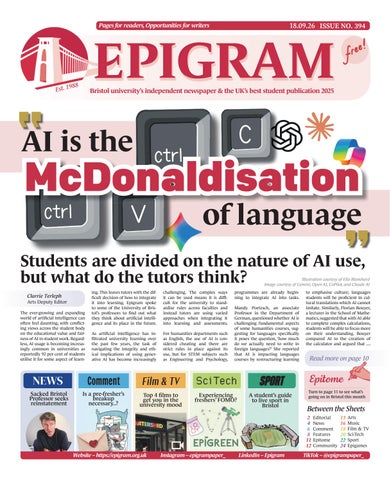
AI is the of language Students are divided on the nature of AI use, but what do the tutors think?
Illustration courtesy of Ella Blanshard Image courtesy of Gemini, Open AI, CoPilot, and Claude AI
Clarrie Terleph Arts Deputy Editor The ever-growing and expanding world of artificial intelligence can often feel daunting, with conflicting views across the student body on the educational value and fairness of AI in student work. Regardless, AI usage is becoming increasingly common in universities as reportedly 92 per cent of students utilise it for some aspect of learn-
ing. This leaves tutors with the difficult decision of how to integrate it into learning. Epigram spoke to some of the University of Bristol’s professors to find out what they think about artificial intelligence and its place in the future.
challenging. The complex ways it can be used means it is difficult for the university to standardise rules across faculties and instead tutors are using varied approaches when integrating it into learning and assessments.
As artificial intelligence has infiltrated university learning over the past few years, the task of navigating the integrity and ethical implications of using generative AI has become increasingly
For humanities departments such as English, the use of AI is considered cheating and there are strict rules in place against its use, but for STEM subjects such as Engineering and Psychology,
programmes are already beginning to integrate AI into tasks. Mandy Poetzsch, an associate Professor in the Department of German, questioned whether AI is challenging fundamental aspects of some humanities courses, suggesting for languages specifically it poses the question, ‘how much do we actually need to write in foreign languages?’ She reported that AI is impacting languages courses by restructuring learning
NEWS
Comment
Film & TV
SciTech
Sport
Sacked Bristol Professor seeks reinstatement
Is a pre-fresher’s breakup necessary..?
Top 4 films to get you in the university mood
Experiencing freshers’ FOMO?
A student’s guide to live sport in Bristol
to emphasise culture; languages students will be proficient in cultural translations which AI cannot imitate. Similarly, Florian Bouyer, a lecturer in the School of Mathematics, suggested that with AI able to complete complex calculations, students will be able to focus more on their understanding. Bouyer compared AI to the creation of the calculator and argued that ....
Read more on page 10
Epitome Turn to page 11 to see what’s going on in Bristol this month
Between the Sheets 13 Arts 2 Editorial 16 Music 4 News 6 Comment 18 Film & TV 20 Sci-Tech 8 Features 22 Sport 11 Epitome 12 Community 24 Epigames
Website – https://epigram.org.uk
Instagram – epigrampaper_
LinkedIn – Epigram
TikTok – @epigrampaper_
02 EPIGRAM 18.09.26
Write for us!
Editorial
26 / 27
NEWS Editor: Lenny Osler Deputy Editor: Dana Datu Deputy Editor: Ariella Greenfield Subeditor: Nyx Osborne Sandford Subeditor: Hannah Roberts
Comment
Jed & Emma Emma Coleman & Jed Dixon Co Editors-in-Chief
S
o it begins. A warm welcome to all the freshers and first time readers, and happy returns to the regulars - you all have a great year of Epigram to look forward to. For those unfamiliar, Epigram is the University of Bristol’s independent student newspaper. Some would call it award-winning or the UK’s best student publication, but I just leave that kind of thing to the judges. If this sounds interesting to you, good news! Look no further than the QR codes on the page over (or @epigrampaper_ on Instagram) to join our section WhatsApp chats and get involved writing, photographing, or illustrating with us. Commissions are open to all and released on the first of every month, and editors are always open to hearing your pitches for articles. This year marks the introduction of our new Longreads section for more in-depth investigative or narrative pieces. If you want to get off your phone and read something interesting this should be your first stop, and if you have a burning passion you want to share with the world there’s no better place to give it a shot. Another new introduction is our year abroad column in which you can find the experiences, high and low, that a Study Abroad year brings. For those of you considering taking a year out, and those simply interested in what it’s really like, head over to Community to see it all. We are also happy to announce Epigreen (our environmental column) now has its own columnists and is officially a part of SciTech. With Bristol being one of the UK’s greenest cities, there will be tons of exciting things to read and get involved with. On top of that, what better way to make new friends as a fresher than to bond over some great reads. Well now you can in the Literature Column’s most recent addition, Epigram’s own book club - share your review by mid-month for the opportunity to feature in the next print edition! Let’s be real, loneliness is a feeling we all experience at university at some point or another, especially if you have travelled far from home or
across countries to be here. On my first night I remember looking at trains and thinking I couldn’t possibly last an entire year, but here I am writing to you in my third and final year at Bristol. Epigram is not just a newspaper but a community that wants to welcome everyone from all backgrounds going through this shared experience. Come to our socials, write for us and, most importantly, create friendships that will last a lifetime. Lastly, you would not be holding this paper if it weren’t for all the hard work of the Business team, Senior team, Heads of Design, Editors, writers and everyone in between, who make Epigram what it is. So, we want to thank you for all the hard work we know you will put in this year. Being your Editor-in-Chiefs is an honour and we cannot wait to watch Epigram flourish under such intelligent and passionate individuals.
Find us at the Bristol SU Welcome Fair on the 18/09. Don’t forget to bring your UCards for free entry!
Editor: Theodora Stuttaford Deputy Editor: Maddy Spitzer Deputy Editor: Ruby Hargreaves Subeditor: Matthew Brown Subeditor: Lianne Ponferrada
Editorial Team
Features
Co Editor-in-Chief: Emma Coleman Co Editor-in-Chief: Jed Dixon Deputy Editor: Hannah Corcoran Senior Print Editor: Ella Blanshard Senior Digital Editor: Tylah Hendrickson
Business Team President: Ella Joshi Secretary: Isaac Osborne Vice Secretary: Florence Grant Treasurer: Bethalhim Asres Head of Advertising: Chloe Wong Head of Technology: Miles Gilroy Social Secretary: Rosa Dunford
Editor: Grace Bourne Deputy Editor: Harry Gillingham Deputy Editor: Luke Buckland Subeditor: Ivy Nicholls Subeditor: Disha Angadi
Community
Editor: Olivia Hunt Deputy Editor: Emine Arslan Deputy Editor: Lucie Weston Subeditor: Natalie Payne Subeditor: Ruby Wright Epitome Curator: Lily Phillips Sharp Epitome Curator: Hannah Poulter
Arts
Editor: Leo Sefton Deputy Editor: Claresta Terleph Deputy Editor: Bea Thomas Subeditor: Francesca O’Connor Subeditor: Oscar Degirolamo Literature Columnist: Sonal Korlipara Literature Columnist: Mary Allen Book Club Leader: Rosy Brown
Film & TV Editor: Katerina Ralli Deputy Editor: Charles Hubbard Deputy Editor: Lottie Merchant Subeditor: Poppy Heath Subeditor: Eve Perrins
Music Editor: Lucy Bevan Deputy Editor: Tom Foley Deputy Editor: Katie Asha Subeditor: Stas Forte Subeditor: Anastasia Baker
SciTech Editor: Ilgin Guzel Deputy Editor: Alice Guskov Deputy Editor: Beth Robinson Subeditor: Luke Beaumont Subeditor: Alejandra Bonwick Epigreen Columnist: Amelia McCabe Epigreen Columnist: Izzy Geddes
Sport Editor: Edward Wallace Deputy Editor: Ava Featon Deputy Editor: Louis Parry-Garnaud Subeditor: Rachael Ginn
04 EPIGRAM 18.09.26
NEWS
Editor’s Choice As universities make sweeping cuts to student services and humanities courses, we’ve featured Matthew Brown’s article (p. 5) to highlight how academic institutions are shifting spending towards lucrative, but increasingly controversial, industries.
Sacked Bristol professor seeks reinstatement after court victory EAT, dismissed the University’s appeal.
Former professor David Miller, dismissed in 2021 for his anti-Zionist views, says he wants his job back. Lenny Osler News Editor
Dana Datu News Deputy Editor
O
n August 4, the University of Bristol lost its appeal against the 2024 court decision which found that David Miller, former professor of political sociology, was ‘wrongfully dismissed’ from his post at the University. Miller has since said he is ‘looking forward’ to returning to work at the University ‘without fear of intimidation or reprisal’. The recent ruling does not guarantee him reinstatement at the University. This week’s ruling is the latest in a lengthy legal battle between the University and Miller, who was sacked by the University in October 2021 after he ‘did not meet the [university’s] standards of behaviour’.
Fairley found ‘no good reason’ why Miller’s anti-Zionism should be excluded from legal protection. However, the EAT also upheld that Miller’s comments amounted to misconduct. The conflict began after a complaint was issued against Miller in 2019, after he said in a lecture the Zionist movement was one of ‘five pillars driving Islamophobia in the UK’. Prior to his dismissal, Miller was criticised for using what was described as a ‘false, vile… antisemitic slur’ during a lecture. He was accused of referring to Jewish student groups as ‘political lobby groups’ and claiming British Jewish students were ‘political pawns’ of Israel. Bristol Jewish Society (JSoc) praised the University’s decision to dismiss the former professor in a 2021 statement, describing ‘harassment, targeting and vicious diatribe’ from Miller and his students. In a post on X responding to the recent decision, Miller said the University sought to ‘criminalise’ his ‘anti-Zionist worldview’.
‘We must not allow activists to weaponise this judgment; to use it to validate antisemitic, hateful abuse and harassment. ‘There is a clear distinction between criticism of the actions of a state and hateful rheztoric that casts Jewish students and their communities as the enemy. Jewish students experience extreme hate and racism as real-world threats to their safety, as harassment, and as exclusion - compounded by the sense that speaking up on campus leads nowhere. ‘Universities must ensure they protect all students in an era where protests, social media and external actors amplify harm. Jewish students are not asking for special treatment - they are asking for education without fear, identity without penalty, and institutions to act when they are unlawfully targeted. The collective moral responsibility on campuses and beyond to protect all
He described the latest decision as a ‘precedent’ that ‘secures the rights of all critics of Zionism and supporters of the Palestinian people in Britain’. The University of Bristol recognised the judgement but was ‘disappointed’ with the findings, saying in a statement:
...a precedent that secures the rights of all critics of Zionism
‘Our core objectives are to ensure all our students thrive at the University of Bristol and to protect freedom of speech and expression, a fundamental part of that care and consideration.
The former professor took this decision to the Employment Tribunal (ET) and won in February 2024. However, Miller’s comments towards Jewish students were found to qualify as blameworthy misconduct, halving his compensation.
‘At the same time, we have an obligation to make sure that these essential and important freedoms are exercised appropriately and in line with our codes of conduct and the expectation of the highest standards of behaviour.
The ET also found that Miller had been discriminated against for his anti-Zionist beliefs - which in this case were classed as philosophical beliefs protected under the 2010 Equality Act.
‘We will continue to provide an environment where our staff and students can debate difficult and contentious issues, fostering a positive working and learning environment where free speech and academic freedom are championed.’
students against discrimination and abuse has never been greater.’
Bristol JSoc the recent
UoB Friends of Palestine (PalSoc)
In 2025, the University appealed against the 2024 ruling at the Employment Appeal Tribunal (EAT). On August 4, 2026, Lord Fairley, president of the
commented on ruling, saying:
were contacted for comment, but have not responded. PalSoc have not recently commented on Miller on social media or elsewhere.
Jewish students experience extreme hate and racism An anonymous student describing themselves as anti-Zionist told Epigram: ‘If
you
interested in advocacy and supporting Palestinians and their loved ones living through a genocide and occupation as a student, I would recommend following @bristol_leftist_collective on Instagram for news such as learning sessions, bake sales on campus, film fundraisers and more across the city. ‘There is also an SU affiliated group called UoB Friends of Palestine (PalSoc) for students who wish to learn about and show support to Arab and Palestinian students, which is great way to show solidarity and meet new people.’
are
Photo: Jewish News
18.09.26 EPIGRAM
Editor Deputy Editor Deputy Editor Subeditor Subeditor
Student heads to Gaza on aid mission from Bristol harbour
C
hannon ‘Chan’ Lawrence, a third-year Biochemistry student due to graduate later this year, joined veteran activists on the Kate as it set off this morning on a 4000-odd nautical mile voyage to Gaza. The Kate is part of the FFC (Freedom Flotilla Coalition)’s second flotilla mission of 2026 – the first having been hijacked by the IDF (Israel Defence Forces) in international waters in May of this year. Alongside Chan is Iris Haynei, head of FFC UK, Raid, ambassador for the Samir Foundation, and other activists from Bristol and across the UK.
Photo: SaiKrishna Saketh Yellapragada via Unsplash
The controversial partnership centres skills and research, but could push institutions to ‘align with military priorities’. Matthew Brown Comment Subeditor
T
he University of Bristol will be one of 35 founding members of the new Defence Universities Alliance (DUA), which aims to build on existing ties between academia and the defence sector. The initiative is part of a £182 million government-led investment package to develop skills and opportunities in defence and national security. It aims to ‘support a pipeline of skilled graduates’ into careers including cyber
‘I lived on [the Kate] before the Freedom Flotilla bought it, which is how I, personally, got involved. I offered my help because it is probably the most important cause in the world right now.’
To read more, go to epigram.org.uk
security, robotics, AI, aerospace engineering and advanced manufacturing.
ing the Alliance would ‘transform our campus into an academic army base.’
The government’s Defence Industrial Strategy also outlines plans to ‘increase places on defence-related courses’.
Bristol SU has not yet released a statement on the DUA. Various Bristol student groups have previously protested over the University’s partnerships with arms firms, which they claimed amount to over £75 million.
The DUA Charter commits member universities to advancing defence research, providing graduates with relevant skills and promoting careers in the sector. The alliance’s launch at the University of Manchester was met with heavy student protest. Manchester SU’s Executive Officer Team released a statement condemning their university’s participation. They said the University of Manchester was ‘happy to prioritise the escalating drive to war, over the needs of students and staff.’ Manchester SU’s statement also criticised an apparent drive towards the ‘militarisation of young people’, warn-
ethical standards, and transparency.’ However, campaign group Demilitarise Education (dED) said the Alliance threatens academic freedom by making universities ‘dependent’ on arms funding and creating ‘institutional pressure’ to align with military priorities.
Prof. Evelyn Welch, Vice-Chancellor and President of the University of Bristol, said joining the DUA reflects the ‘strength of our existing work with organisations across a wide range of sectors, including those aligned to considerations of national security and resilience.’ She added the University remained committed to ‘safeguarding academic freedom,
Body found in mountains where Bristol student went missing
An event was held on August 16 to fundraise for the trip, which included a charity concert. Chan’s decision to join the flotilla stemmed from her personal connection to the Kate, though she has been involved in pro-Palestinian activism for almost a decade:
Lenny Osler Dana Datu Ariella Greenfield Nyx Osborne Sandford Hannah Roberts
University of Bristol to join new defence alliance
She describes the mission as a ‘moral obligation’. Nyx Osborne Sandford News Subeditor
05
The body is believed to be that of 18-yearold George Smyth.
Dana Datu News Deputy Editor
A
von and Somerset Police confirmed that Romanian local authorities located a body in the region where George Smyth, a firstyear Geology student at the University of Bristol, first disappeared. While no formal identification has been made, the body is believed to be that of the 18-year-old. Forensic enquiries are taking place, while efforts are being made to transfer the body back to the UK.
Smyth first went missing on November 23, 2025, while solo-hiking in Romania’s Bucegi mountain range. He reportedly left the UK without notifying his family. The 18-year-old was last believed to have been en route to Bran, the site of Count Dracula’s castle in popular legend. However, extreme weather conditions led Smyth to contact rescuers from Tiganesti, a nearby village, when he reported feeling extreme physical exhaustion and hypothermia. Rescuers pinpointed his location in a ‘very isolated and hard-to-access mountain area’. However, rescue efforts were halted for the remainder of November due to hazardous conditions. The search resumed in December, with Smyth’s whereabouts unknown until now. Smyth’s family thanked the Romanian mountain rescue services for their eight-
month rescue efforts despite ‘very difficult and often dangerous conditions’. They also thanked Avon and Somerset Police and the University of Bristol for support. Smyth’s family said:
‘Although this latest news is incredibly painful, the torture of waiting is finally over, so we can now focus on bringing George home and saying goodbye. We would appreciate privacy while we continue to come to terms with this loss.’
Photo: Smyth family
06 EPIGRAM 18.09.26
Comment AI cheating is a problem and no one is asking why sionate about their chosen course.
Meg argues that ‘hustle culture’ has pushed students within higher education to use AI.
Meg Pantry Third Year, Law
T
he frequency with which Artificial Intelligence (AI) is misused by students has been the subject of much debate, but what I find striking is that one of the most important questions seems to be absent from the conversation: why? Why are some of the most selective academic institutions worldwide struggling with an epidemic of students not wanting to learn? It is not exactly controversial to say that the misuse of AI is ubiquitous in universities. It is increasingly rare to have a group project discussion without the words ‘just ChatGPT it’ being spoken; to see a library without an Large Langauge Model interface open on a laptop screen; or to have a conversation with a friend that does not feature a shameless confession to cheating on an assessment with generative AI. The statistics tell the same story, too: according to The Student Eye, the University of Bristol has issued 686 penalties for AI misuse since 2021, and it is not the only institution dealing with this problem. The Times revealed that over 2000 undergraduates at Russell Group universities faced sanctions for AI misuse in the last academic year, and that even the University of Cambridge has seen a fourfold increase in academic misconduct allegations since the launch of ChatGPT. But, AI misuse can’t be viewed as one isolated problem. I think it’s a symptom of something bigger that universities fail to address: a culture of academic apathy among Gen Z. Anecdotally, upon starting university I was dismayed to find that very few of my peers seemed excited or pas-
Embarrassing as it may be to admit, my teenage self’s fixation on ‘dark academia’ Pinterest boards, the Beat Generation, and Donna Tartt novels had given me a very romantic notion of universities – as hubs of intellectual curiosity for bright-eyed and bushy-tailed swots – which was very quickly shattered upon realising that the majority of students I spoke to simply did not want to be there. I’m not saying that all of my fellow students are philistines, but rather that something has gone wrong if so many people pursuing higher education find no joy in it. I can think of some possible culprits: the effect of social media on young people’s attention spans (resulting in education being understimulating) combined with a rise in ‘hustle culture’ (which rewards productivity and financial success above all else). Interestingly, although it feels like I rarely encounter curiosity, I see ambition everywhere. It seems that every course will have a handful of students who somehow juggle endless society committee roles, ambassadorship positions, networking events, work experience, etc. And, while I do find these students unbelievably admirable, I find it telling that their dedication often appears to be divorced from a passion for their subject and instead tied to a goal of maximising employability — updating their LinkedIn or perfecting their CV. For me, this is the clearest cause: hustle culture’s prioritisation of productivity above all else has contributed to a culture where intellectual curiosity and the importance of the learning process is downplayed, resulting in students turning to AI. And, considering that studies show that 58 per cent of Gen Z experience ‘productivity anxiety’ multiple times a week as a result of this mentality, perhaps it is not surprising that so many students are taking shortcuts to be as productive as possible. So what does investigating the reasons behind AI misuse tell us about how universities should respond? Mostly, that simply burying our heads in the sand by trying to pry all AI out of
students’ hands is not enough. For one, the two main methods of doing this – AI checkers, and a return to closed-book in-person exams – each have their shortcomings. On the other hand, replacing openbook and coursework-based assessments with closed-book, in-person exams often results in excessive workloads, as students are forced to memorise curriculums that have not been properly adapted for this examination style. It also fails to account for the fact that every student willing to use AI to get ahead at university is potentially a future doctor, lawyer, engineer, etc. willing to use AI to get ahead in their career, where such obstacles would not be in place to deter AI use. lums that have not been properly adapted for this examination style. It also fails to account for the fact that every student willing to use AI to get ahead at university is potentially a future doctor, lawyer, engineer, etc. willing to use AI to get ahead in their career, where such obstacles would not be in place to deter AI use. So, the best solution is for universities to target the real motivations behind students’ misuse of AI by encouraging genuine curiosity and passion about the course content and the pursuit of learning for its own sake, while also educating students about why AI should be avoided in certain contexts. In one of my first year modules, for example, the formative assessment involved writing a critique of an AI-generated essay about the course content, which lets students discover for themselves how AI can hallucinate sources and misrepresent facts. Hopefully, the University of Bristol can continue to employ similar methods of targeting the motivations underlying AI cheating while using AI detectors as a final check (rather than as the primary method of discouraging AI misuse). But, even if universities were to change the way they think about AI, I am doubtful this problem will be solved. AI cheating is linked to a much deeper cultural problem of prioritising productivity over curiosity. And it will remain an issue until this culture changes.
Photo Courtesy of: Alice Benjamin
Gap years: Privilege or rite of passage? Reflecting on her gap year, Alice recognises privilege they require.
Alice Benjamin Second Year, Politics
W
ith a new academic year approaching and first year friendships blossoming, gap years are always a hot topic. But, does reminiscing on past travels serve as a friendly icebreaker, or simply reinforce the blatant wealth gap amongst students? Having been in first year twice after deciding to change course, I experienced my first Freshers’ Week straight from school and my second one full of tales of traversing Thailand. It was absolutely worth taking the leap. Nevertheless, between exchanges of missed flights and full moon parties, are the students who cannot relate socially ostracised? Bristol’s student population is made up of nearly 40 per cent privately educated students, a hugely disproportionate minority given that just 7 per cent of the nation falls into this category. Approximately, 26 per cent of students at Bristol University chose to take a year out. I’m left wondering whether taking a gap year is a once-in-a-lifetime experience or a trust-funded “rite of passage.” Remarks such as ‘You didn’t take a gap year?’ or ‘You haven’t visited Ha Giang Loop?’ can feel exclusi-onary, whether it be unintentionally or not. They reinforce the divide those who could afford a gap year, and those who couldn’t, whilst revealing the out-oftouch attitudes some students at the university have. A year abroad can be enormously expensive. Not all of us can live by the mantra, ‘The memo-
ries last forever, money comes back.’ I didn’t consider a gap year until I started a course I wasn’t enjoying. Friendless and burnt out, I was set on leaving by Christmas. Upon my return to Bristol, I had a more positive outlook on the academic year. The most important takeaways from my year out wasn’t how many motorbikes I’d ridden, or tours I’d taken. It was how to feel more confident speaking to strangers. I wouldn’t have otherwise developed this newfound bravery without pushing myself even further out of my comfort zone. Regardless, I have no regrets on how either first terms had went. It was all invaluable experience, where I learnt about myself academically and personally. I’d highly recommend a gap year abroad, but I’d be lying if I said the experience was different from those who seem to have endless funds, in case something went wrong. I saved up, travelling on a budget, which meant I had to take a more conscious approach to travelling. Each risk looks a lot less terrifying when you know you can return to the comforting bosom of your parent’s money. If you can afford the travel costs, you most likely will not regret it. But, the truth is, gap years and private education go hand in hand, so we must stop pretending that a gap year is nearly mandatory. The switch from “finding yourself” to trying to find a seatbackpacking across Asia or not, fresher’s anxiety is inevitable. So I say, take that opportunity if you can – just keep in mind that the tales you return with are a privilege, not proof that you are more prepared for Bristol life than others.
18.09.26 EPIGRAM
Editor Deputy Editor Deputy Editor Subeditor Subeditor
07
Theodora Stuttaford Maddy Spitzer Ruby Hargreaves Matthew Brown Lianne Ponferrada
Photo Courtesy of: RawPixel.com
New university, same boyfriend? At times, the £60 distance was a struggle, but it has been and is still worth it. After spending an entire gap year together, my first term was definitely
Millie asserts that the pre-fresher’s breakup may not be necessary...
Milly Middlehurst, Fourth Year, German and Italian
A
re you going to stay together for university? I was asked this question countless times before moving to Bristol. Honestly? The thought had never crossed my mind. Personally, staying together was a no-brainer. Entering my final year, I have been with my boyfriend for over five years. I don’t regret it one bit!
Illustrations courtesy of: Romina Trevino
the hardest. Nonetheless, we powered through and having finished my year abroad, our long distance relationship only gets easier to manage. Living apart allowed us to develop as people, giving us enough time to explore various hobbies and interests, whilst our fortnightly and monthly visits during the holidays kept our relationship strong. Many are shocked that we have managed this, but it’s not as hard as it seems. All it takes is not expecting to be at each other’s whims 24/7, taking everything as it comes, and most importantly, not sacrificing the things important to us to see each other. That is crucial in preventing resentment from building up. Long-distance relationships during university fail when you don’t let each other blossom as individuals, depending on each other too much. I love my partner and our decision to go the distance. However, this choice might not work for everyone. Long-distance relationships are a commitment
that require steady communication and a lot of trust. For some, this arrangement might be anything but easy. I’ve witnessed plenty of my friends’
Freshers, put that phone down Disha advises freshers to take univesity-related content with a grain of of salt... Disha Angadi, Second Year, Law
I
remember when I was a doeeyed fresher anxiously anticipating the coveted years where I’d “find myself” and “my people”. I couldn’t wait to immerse myself into the glory of University. Nervous, I didn’t dare arrive without investigating the university experience on social media. I was inundated with advice from TikToks and pristine study vlogs videos on YouTube. I yearned for the aesthetic life I saw online. But, after a couple of weeks at university, the cracks in the perfect mirage began to appear. After all, real life cannot be edited down into an Instagram reel … These online resources might have been golden a decade ago. Who
Photo Courtesy of: RawPixel.com
wouldn’t want a foolproof guide on how to make friends? On easy recipes that you can make in your microwave? Or, on how to get a first in all your essays? But, I find that with the sheer volume of content out there, often contradictory, this genre is no longer as effective as it once was. I feel as if this content no longer represents the university experience well. With the evergreen Capitalist machine shaping our posts, life at university stops feeling like an experience, but a performance. From “uni-maxxing” and picture-perfect “day-in-a-life” vlogs setting unrealistic expectations, I was left feeling self-conscious. This led to what I’d describe as “performative productivity.” I’d try to go to all the freshers events, spend too much on an Instagrammable coffees, and pretending that I wasn’t as stressed as I really was… It wasn’t wrong to want to fit in or to indulge in some good ol’ coffee from Nero, but was I doing this because I wanted to or felt like I had to? My focus shifted from my interests to external perception (no thanks to
my perfectly curated Pinterest boards). The truth is that university life is not a one-size-fits-all situation. There will be days where you’re down with fresher’s flu, exhausted from that society’s pub crawl, or ones where you spent hours faffing about in the library, instead of working on your dissertation. It is on these days that the “day-in-mylife” videos where someone spends ages over their iPad, with a fresh manicure and £4 iced matcha in hand and the LinkedIn posts about someone’s swanky internship hit the hardest. They create the illusion of an idealised university experience, one with all highs and no lows. This content conditions students to believe that they are one step closer to being an “academic weapon” if they buy that new iPad or pay for Notion premium. We all fall into this trap, hoping that purchasing a new item translates into a steady stream of productivity (or at least, looking like we’re productive). This narrative is not restricted to academics. It bleeds into every aspect of university life. This type of content contributes to the pressure to experi-
relationships crumble under the pressure of university. Occasionally, it was harder for them to make meaningful connections with new people when their minds were always wandering back to their partner at home. My flatmate’s long-term relationship ended by the beginning of second year. She wishes she had spent that time single, instead of spending nearly every weekend with him. Prioritising her partner throughout first year, she now regrets not spending more time exploring Bristol with her new friends. For many, the pre-freshers break is likely the better option. But, that decision requires hindsight. In the moment, it is difficult to judge. Ultimately, I have no regrets. I still enjoyed both the “traditional university experience” and my relationship. I went clubbing every night during ‘Welcome Week’ and continued to do so throughout the years. I found my friends for life and joined societies just like everyone else.
Read more articles from our Comment section at
ence all three years of university in one! Instagram reels and TikToks often advise students to say ‘yes’ to everything, which exacerbates burnout. The lines between choice and compulsion are blurred, causing us to make decisions we might regret.
www.epigram. co.uk
So, what’s the upside to ‘studytube’ and university vlogs? Students make this content to encourage others to make the most of their days. This only becomes harmful when it is portrayed as the one way to enjoy your university experience, when, in truth, it is one person’s ideal day. Rather than pointing our pitchforks at these ‘studytubers,’ incoming first years should consider them a separate experience, and set off to fresher academic pastures with an open mind, ready to build their own lives.
Or, if you would like to write for us, scan the link below to join the WhatsApp channel and keep an eye out for commisions!
08 EPIGRAM 18.09.26
Features ‘Everyone’s going right?’: The manufactured FOMO of Freshers’ Week Meg Pantry investigates hidden club promotors cashing in on fresher group chats and the culture of FOMO it produces. Meg Pantry Third Year, Law
W
here there is FOMO, there is moneymaking potential. And so, as each September sees Bristol taken over by a throng of new students anxious to make the most of the ever mythologised Freshers’ Week, there is no shortage of opportunities for marketing strategies to exploit their fears. This phenomenon is most noticeable in fresher’s group chats which, though ostensibly created with the intention of giving prospective students the opportunity to connect with each other prior to arriving at university, may be more insidious than meet the eye. Although the groups are undoubtedly useful in fostering communication between students, it quickly becomes apparent that each is inundated with links to events, invariably accompanied by a question along the lines of ‘This is the event that everyone bought
a ticket to, right?’ And, like clockwork, a barrage of responses follow: ‘Yeah, i did, then i added on the queue jump’; ‘I think literally everyone has so those should be gooddd’; ‘me too, it’s on sale right now as well so its cheaper’. A little digging reveals a shocking truth about what appears to be harmless conversations between students. It’s all staged. The accounts do not participate in any conversation in the group chats other than talking to the same people, time and time again, about a given event; how its almost sold out, how everyone is going, how everyone is buying the add-ons.
A survey conducted by Epigram revealed that 82 per cent of respondents felt pressure and/or FOMO as a This suggests that fear mongering result of these promotional strategies. club promoters are not an unwelAlthough only 18 per cent of students reported actually buying an The Gen Z Screen Time Report unofficial wristband or freshers’ 2026 found that Gen Z spends an event ticket, those average of 7 hours and 43 minutes who did were generally critical on screens per day. of the experience with only 10 per cent of buyers describing the experience as ‘largely come side effect of freshers’ group positive’. One student commented: chats created with good intentions, ‘They’re not that good, so you end up rather that the group chats are often disappointed whether you go or stay at created for the sole purpose of mishome and experience FOMO’, while another lamented that it is ‘disappointing that so many of the freshers group chats were run by these companies’.
Image credits: Epigram / Meg Pantry
leading freshers into buying tickets. In spite of the fact that freshers’ group chats are often created for the sole purpose of misleading
Image credits: Epigram / Meg Pantry
freshers into buying tickets these. groupchats remain genuinely useful tools that allow students to get to know their course mates and flatmates prior to arriving at university. However, the culture of commercialisation does produce a myriad of negative effects. For many, Freshers’ Week is already an overwhelming experience, as students find themselves tasked with adapting to a new city, new people, and a new way of life. By targeting freshers’ fears of being left out, these club promoters only compound the amount of stress put on new students.
Interestingly, it is also possible that this kind of marketing contributes to a changing perception of Freshers’ Week as revolving around nightlife. This isn’t to say that clubbing hasn’t always been a significant part of the student experience, but that the ubiquity of FOMO-based club advertising may give students the impression that going out every night is the sole function of Freshers’ Week. This results in a plethora of potential consequences for students. For one, clubbing is not for everyone., and so the expectation that Freshers’ week must be a week of non-stop partying risks ostracising students who prefer not to engage in nightlife, for example, neurodivergent students overwhelmed by clubs, students who do not drink, and students who simply do not enjoy the experience.
It is worth acknowledging, however, that this club-centric image of Freshers’ Week may not be entirely bad.
is reflected in the unprecedented rates of loneliness and mental health issues reported amongst Gen Z
Overall, the impression given by statistics is of a genThe majority of accounts eration plagued proselytising about these events by self-isolation, and feeling the are administrators and creators consequences. So, of the group chats that the it is certainly possible that pressure to conversations are taking place on. get out and socialise, however ill-intentioned, might have some benefit. What is important, though, is that The Gen Z Screen Time Report 2026 found that Gen Z spends an averfreshers keep in mind that there is no ‘right’ way to spend freshers’ week, age of 7 hours and 43 minutes on and resist the pressure from bad actors screens per day, with this number only increasing. The impact of this that seek to profit from their FOMO.
Image credits: Epigram / Hanno Sie
18.09.26 EPIGRAM
Editor Deputy Editor Deputy Editor Subeditor Subeditor
09
Grace Bourne Harry Gillingham Luke Buckland Ivy Nicholls Disha Angadi
Burnham’s bus cap: Is it enough to keep students afloat?
Image credits: Epigram / Hannah Corcoran
Faith Moss explores the potential benefits of Andy Burnham’s new bus cap initiative and whether it goes far enough to help Bristol students. Faith Moss Third Year, English
N
ew Prime Minister Andy Burnham has recently announced that the price of a single bus journey will be capped at £2.00, an initiative that will begin to be rolled out across the country from January 2027. However, is this the most effiecnt way to save students travel costs and why is thereso much contrevesy surrounding the new policy attempting to tackle the cost of living?
from just outside Bath about three or four times a week. Hannah travels by train to Bristol Temple Meads and then catches the bus to Clifton. She estimates that she spends around £50 on transport per week, which includes the cost of both her train and bus fares. Hannah predicts that the bus price cap will save her £2.40 a week, which she admits is ‘barely a coffee at Parsons bakery,’ but she still believes the cap is ‘a really good place to start.’ The price cap will only alleviate transport costs for students travelling by bus. It will do little for the many students who commute to university by train or drive themselves by car. Earlier this year, the surge in fuel prices put financial pressure on lots of drivers across the country. Second year Politics and International Relations student Summayyah pointed out that in Bristol ‘parking costs are insanely high,’ an additional costly pay-out for students commuting by car. Despite
The introduction of A welcome initiative but his the bus fare cap will offer some relief for funding proposal throws global students commuting to south countries under the bus University from North village halls. From September 2026 the U1 bus pass, which was previously included in the accombringing her car to university for the modation fee for students, will no next academic year, Summayyah is longer be complimentary. Similarly, choosing to mostly commute by bus. for the students who live in private housing and rely on the bus, the lessThe financial pressures on drivers, in ened fare will reduce transport costs. conjunction with the bus price cap, may lead more students to opt for I spoke to Hannah, a third year English public transport. Postgraduate stustudent who commutes to University dent Amy says that the bus price cap is
Image credits: Epigram / Sophie Maclaren
a ‘good idea,’ but thinks that ‘other good ideas need to run concurrently’ and that train prices should also be addressed. Burnham has outlined that he also has plans to reform the rail system. He is considering making the 16-17 railcard valid for the entire year after purchase, even after the user turns eighteen, which will assist students travelling by train. He would also like to see ‘an overhaul of train fares,’ which should assist us all with the hefty cost of journeying home to visit loved ones over the holidays. In an article focused on the positive impact of the price cap, Jonathan Freedland points out that ‘you need to do something for the voters that is immediate, tangible and uncomplicated.’ Considering the big swing of working class voters from Labour to Reform in recent times, perhaps Burnham is seeking to bring disillusioned voters back to Labour through this quick-fix, ‘feel good’ scheme. In fact, More in Common’s weekly tracker of voting intention, reveals that support for Labour has risen since Burnham’s introduction of measures to help with the cost of living. However, some students questioned whether this price cap is enough to significantly aid with weekly budgeting. Whilst postgraduate student Vincent claims he’d take ‘any price cap, even 10p less,’ third year Law student Lizzie questions whether it would perhaps be more productive to introduce a system akin to one in London which enables people to ‘get unlimited buses within the hour’ for £1.75. When asked if there were other costs that the prime minister should
be focusing on instead, Summayyah pointed out that ‘things like rent prices are important, especially in Bristol.’ She says ‘if I can’t afford to live near university, then I have to move further out of Bristol,’ which in turn increases transport costs.
global south countries under the bus.’ In the pursuit of slashing public transport costs for Britons, Joanne O’Neil elaborated that ‘those most impacted by a climate crisis they did not create’ will be forced into debt.
Upon asking students where funding for the bus price cap should come from, most students felt that there was no straightforward alternate source of funding, or that they Unless they’re doing a did not know restriction on the total fare for enough to comment. Vincent the day, I don’t personally see two said, ‘I’d rather pounds as being that cheap. tax a billionaire you know, but ~ Lizzie you’ve got to get the money from somewhere.’ cost of transport for students, throughGreen MP Ellie Chowns agreed, ‘inout the process of writing this piece, stead the Government should tax I discovered this policy opens up far extreme wealth to help provide the broader conversations. Burnham says resources needed to tackle poverthe scheme will be paid for by ‘reprity…and make the biggest polluters oritising government funds,’ which pay for the crisis they have caused!’ on closer look, means that 400 million of the 500 million pound scheme Whilst this scheme is a positive step will come from ‘replacing grants for towards helping to reduce the cost of international climate projects wiht some people’s daily travel, is this polloans.’ The co-director of advocacy at icy going to significantly impact stuActionAid UK stated that Burnham’s dents’ living costs, and is it fair to divert price cap scheme is ‘a welcome initimoney from climate grants to fund it? ative but his funding proposal throws Whilst I initially sought to solely highlight the impact of this scheme on the
10 EPIGRAM 18.09.26
Features The gap year divide at university Having taken a gap year or not is one of the first defining and dividing factors when starting university. Bethan ParryJones explores the lasting impacts of a gap year on the university experience as a whole.
Bethan Parry-Jones Third Year, Spanish and History
W
hile sources such as The National refer to the reduced popularity of the gap year, the results of the 2025 UCAS end of cycle survey showed 32 per cent of respondents deferred or had considered deferring. Additionally, these figures do not include those who went straight into a gap year and applied for university during this year off. Of the eight of us in my first-year flat,
we were all at least 19 and had all taken a gap year in some shape or form. Of the most common travel destinations for keen-to-experience-the-world 18-yearolds, including Australia, Thailand, New Zealand and Peru, between us we had ticked off each one. Was our experience starting university then different from those who had arrived straight from school, some of them barely 18? In some ways, yes. We perhaps had more experience of caring for ourselves, as well as managing our own time. Having worked for a year, some of us came into university with a better idea of budgeting and how far your money goes- in Bristol, not that far. This may have made us feel more mature, but that veneer of maturity that a gap year allows you to create often does not outlive those first couple of weeks. Settling into university is an experience shared by those who have had a gap year and those who have not, the excitement, the anxiety, the homesickness. It would be tone-deaf of me at this point to ignore the reality that the true ‘gap year divide’ refers
to the socioeconomic inequality which divides young people into those who can and those who cannot afford to take a year off before university, just as there is a divide between those who can afford to go to university or not. Over 20 per cent of students feel they are not in the position, for financial reasons, to commit to a year out and only 10 per cent of students that take a gap year, fully fund it themselves. There are wildly different versions of ‘the gap year experience’, just as peoples’ experiences of school differ. The gap year experience is affected often by the reason for having a year out in the first place, whether this is to travel, to recharge after exams, to save money or even to develop maturity (not to be taken as a guarantee). It is also worth mentioning that the effect of the pandemic on gap year figures is considerable; a 2021 Prospects Luminate survey of +300 students and graduates noted that one fifth of those deferring until 2022/23 had done so directly as a result of the COVID-19 pandemic. One of the big questions surrounding
a gap year is whether the break from scholarly pursuits makes you academically rusty? In my experience, no. I spent a couple of months as an au pair in the north of Spain, and a short period in Central and South America (via Machu Picchu, of course). As a humanities and modern languages student, I found that a year off gave me time to build my confidence and confirmed why I had chosen to study a language - to speak it. The idea of academic rust and skill decay, however, is most often discussed in relation to the STEM subjects. That said, having spoken to Cerys Roach, a Biology student, this is not necessarily the case. The recovery period often needed after the universal A-level burn out can be a number of months. The break from education also offers a chance to unlearn various A-level techniques, something which is often recommended when you start university. I did, however, find it to be true that my attention span had reduced after a year away from education, calling for an adjustment period for those first few weeks of classes and set readings.
Does having a gap year fundamentally change your university experience? No. While you may start university slightly closer to the final growth of your frontal lobe, a year out, well spent or not, will not magically make you a fully functional adult. The gap year you did or did not have will not be the be-all and end-all, and we all miss home after two weeks.
Illustration Courtesy of: Romina Treviño
Students are divided on the nature of AI use, but what do the tutors think? Continuation of front article
Clarrie Terleph Arts Deputy Editor
Similarly, Florian Bouyer, a lecturer in the School of Mathematics, suggested that with AI able to complete complex calculations, students will be able to focus more on their understanding. Bouyer compared AI to the creation of the calculator and argued that while the role of a mathematician might change, they will always be essential. In both of these cases, departments seem to be anticipating changes to courses in order to accommodate the impact of AI.
In contrast, other tutors aren’t certain that there are convincing ways AI can be used for learning. Senior English lecturer Pam Lock believes artificial intelligence prevents students from learning crucial processes of editing and re-reading, ultimately leaving them reliant on someone else. Simultaneously, there are ethical and moral crossroads which complicate whether tutors want to use the software. For English Exams Officer, Timothy Gao, while AI can be useful, ‘we can’t start thinking of those things because of the way AI has been released and marketed by the companies which are controlling it.’ Chatbots like ChatGPT and Grok are controlled by companies incentivised by profit and a desire for intellectual dependence upon the software. They have been ‘released as cheating machines’, Gao says, which turn all pedagogical relationships into a game of cops and robbers by fostering suspicion and paranoia. He is not alone in his concern, both Lock and Bouyer shared similar reservations regarding the ethical
and ecological implications of AI use. Despite widespread belief that there is a divide in opinions between STEM and Humanities departments, many tutors appear to be united in their opinions on the ethical and moral concerns of increased AI use. Not only are there these concerns surrounding the use artificial intelligence, but tutors also reported that work easily identifiable as AI is repetitive and formulaic. Gerald Jordan, a lecturer in the school of Psychological Science, has noticed general changes in the way students write, calling it the ‘McDonaldisation’ of language and says he misses seeing mistakes and quirkiness. ‘It’s scary that thoughts are being driven by a machine that standardises things’ says Jordan. This assertion was mirrored by Oscar Banjamin, a senior lecturer in the school of Engineering Mathematics and Technology, who reported he finds it reassuring to see typos in work. This creates a difficult disposition for students who both want to produce grammatically correct pieces of work,
yet fear being suspected of AI use. This does not mean that attitudes towards AI are entirely negative however, as several tutors reported they do see benefits in incorporating this software into future learning, if in a controlled way. Bouyer, for example, is of the view that students need to be trained better in order to draw out the benefits of AI, and Jordan stated that in the past he has tasked students with using AI to conduct systematic reviews of scientific literature which proved beneficial when used in conjunction with solid prior knowledge. In discussion with Oscar Benjamin, he believes it is ‘hopelessly naïve to think you can tell people not to use it’ and argued that rules will not deter students from using it, even with the promise of harsh punishments. His approach is instead shaped by a desire for students to grow alongside AI, allowing them the freedom to use the software if they wish. He reported that the Engineering department is moving towards an AI proof first year, meaning in the subsequent years of their de-
gree students will be able to use AI without the danger of it impacting their understanding. These beliefs suggest that, at least for STEM, there are useful applications for AI’s integration into future learning, provided it is paired with a strong independent foundation. Ultimately, AI is not going away anytime soon, meaning we have no choice but continue to learn and adapt alongside large language models. That being said, Poetzsch speculates that tutors know as little or as much as their students and worries they have little breathing space to experiment with AI as guidance is changing constantly. All tutors interviewed stated that there have not yet been (as of May 2026) department wide meetings regarding the threat of artificial intelligence and rather it is currently a casual conversation between colleagues. This begs the question; what will the future look like if the influence of AI only continues to increase?
Epitome University of Bristol lecturer left ‘seething’ after student reciprocates eye contact
18.09.26 EPIGRAM
Curator’s Choice Our choice for this month is the Vintage Thrift Sale in the Richmond Building! With prices Varying from £2 to £15 there is simply no better place to spend your student loan on a new Bristol wardrobe. Get to know the SU building, protect the planet through sustainable fashion choices and bond with new friends over your shared love of vintage clothing. on the cards, or a jumper that will become your closest ally during the many library sessions on your horizon. Either way, if you are in need of a wardobe refresh this is the spot!
September Calendar Bristol Coffee Festival
Week 2
Beth Robinson
12/09
£18 - £33
Sober Social: Taskmaster
Post-Grad Pints
Freshers’ Fair 2026
The Beckford
Clifton Down
Miles, still furious, has accused the University of ‘looking the other way’ and has stated that moving forwards, all students should wear sunglasses and face masks in his lectures, to help support a ‘return to normalcy’ and ‘so that nothing like this can ever happen again.’ In a moment of rage, he was also overheard shouting ‘I know how to make an atomic bomb for goodness sake - these kids really shouldn’t be testing me!’
Week 3 Week 4
Grahams, the student in question, said ‘this weird stand-off has been going on for almost three years now. I was just thinking surely, I can get his attention somehow - I came to Bristol to learn, I don’t want to spend almost £10,000 per year to sit in silence, I’d like some level of engagement. I don’t want that money wasted,’ a comment reportedly met by gasps from senior university administration.
Free entry
18/09
Richmond Building
Sustainable shopping is always great and is even better when the prices don’t break the bank. Vintage Folk supplies amazing garments at reasonable prices, helping you to look your best for your new life at university.
SteamFest
Find hundreds of student groups hosting stalls and explore our diverse range of clubs and societies! Buy merch, eat local food and take part in the Give it a Go! Arena.
Document Opening Party
Blue Metaphor Presents: Stories of Epic Queers
19/09
The Space Free entry
Dance the night away in a high-energy, warehouse vibe that celebrates darker nights and crowded dancefloors while listening to House and UK Garage.
The outcome of Miles’ complaint is expected to be revealed within the next year or so, and with Grahams set to graduate soon, it remains unclear as to the ripple effect her actions may have across the department and indeed the wider university.
25/09
Free entry / £5 happy hour
For those needing that last dose of summer, this event will be an afternoon of sunsoaked street food, a live DJ and a chill festival atmosphere.
Document 25/09
£8
An event centred around filmmaking, highlighting the presentation of queer stories on screen.
Kings Street 25/09
Free entry
The Bristol based band’s regular performances on King Street are unmissable with a range of 90s, 00s and modern tunes to keep you on your feet all night.
A Letter Home Each issue, one of our students on a year abroad is going to write “A Letter Home” about their experiences and favourite moments on their year abroad. Read below to hear from our subeditor Natalie, about her time in Peru, with a ‘stamp’ from her trip!
Hola from Peru! Well, not actually from Peru. I recently returned from six weeks in the homeland of Paddington bear, where I attended an intensive language course at Amauta Spanish School in Cusco for the first part of my year abroad. I stayed with a host family in a residential area away from the historic centre, which was one of the best parts of my experience. They took me to a Quinceañera and several regional fairs, and we never spoke in English! Bearing witness to incredible Incan architechture at Machu Picchu and around the Sacred Valley was also a highlight.
Illustration Courtesy of: Romina Trevino
Three Scots and a Bar man
Steam, Stokes Croft
Free entry
This is a great way to connect with fellow postgraduate students on campus and to make new friends at the beginning of your PG journey.
Free entry
15/09
Free
14/09
The Student Union is running great sober socials throughout freshers week as a way to meet people and try new things away from the nightlife scene. As seen on television, the Taskmaster social will be filled with chaos and laughs with prizes up for grabs.
17/09
Vintage Thrift Sale
Senate House
For caffeine lovers who want to discover all the best coffee Bristol can offer. Meet local vendors and learn about the importance of coffee in communities.
PG, Science Communication
In the complaint, Miles writes ‘it wasn’t just the ridiculousness of the eye contact, but the long and deliberate smile that followed, which was, quite frankly, an act of aggression and violation of the power dynamic I’ve worked so hard to achieve.’ He went on to describe how ‘one second, I was looking at my notes, the next second I was looking at her (Grahams’) smile. It made me forget everything I thought I knew about reality, and that’s saying a lot. For the first time I felt seen, and that’s obviously completely unacceptable.’
Lily Phillips Sharp Hannah Poulter Natalie Payne Ruby Wright
Epitome Curator Epitome Curator A Letter Home Curator A Letter Home Curator
Bristol Beacon A professor at the University of Bristol has filed a complaint following an incident he described as a ‘criminally intimidating breach of etiquette’ in his lecture hall.
11
Photo Credit: Natalie Payne
I feel so grateful for the opportunity and can’t wait to see what Munich brings in September.
Peru Natalie Payne French, German, and Spanish
EPIGRAM 18.09.26
Community
Editor Deputy Editor Deputy Editor Subeditor Subeditor
Olivia Hunt Emine Arslan Lucie Weston Natalie Payne Ruby Wright
So you’ve just moved in. Where do you go? ART
A quick run through what Bristol has to offer.
Sophia Scott Second Year, Liberal Arts
PARKS
A
djustment can feel overwhelming; there is so much change, and your brain is absorbing a million things at once. So, if you find yourself feeling a bit lost, why not go for a walk through some greenery. The Clifton Downs are one of Bristol’s most widely spoken of green spaces. These massive plains of grass are perfect to immerse yourself in nature. A space fantastic for a jog or simply a walk. Whether you are a Metal Works resident or just find yourself in Bedminster, Victoria park also offers a break from city life. It provides a sense of community and is surrounded by the prettiest pastel streets. For extra special views of Bristol, check it out at sunset!
Bristol is famous for its art scene, museums, and street art sprawling all over the city. Better still and every student’s favourite word: it’s free! Arnolfini is a modern art museum, situated right along the harbour. It has rotating art exhibitions, a café, and bookshop. Just across Prince Street Bridge you’ll find M Shed, an old cargo warehouse-turned-museum which takes you through Bristol’s history. If you’re feeling outdoorsy, take a street art tour around the city.
PUBS & CLUBS Now for the important bit. From a club on a boat, to a pub with a pool table, Bristol has nightspots for everyone. Many students head to the nearest Weatherspoons and that is less down to the extensive menus, and more because of the very cheap drinks. Bristol’s landmark Weatherspoons is The Berkley; its convenient location (opposite Wills Memorial Building) makes it great for post-study nights out and pres. Other fan favourites include The WG Grace, The Commercial Rooms, The Knights Templar, and V-Shed.
Editor’s Choice I am incredibly jealous of first-years newly approaching this city… As a thirdyear now it is all second nature, and I feel I’m sometimes too passive to what Bristol has to offer! I’d love to go back and re-meet Bristol all over again. Use this guide even if you are familiar with Bristol!
But if you grow sick of pitchers, there are some great local pubs too! The Hope and Anchor has cosy indoor seating, a lovely pub garden and the most delicious chips. The Channings has the size of a Weatherspoon’s but the sophistication of an independent, with a massive pub garden. Then there’s the clubs! Bristol has some fabulous night outs on offer. There are loads of opportunities for Freshers’ Week themed tickets (checkout the Bristol SU website) but consider this your guide to nightlife when welcome week is over. Thekla is a club on a boat which has classic themed nights from indie to musical theatre (I mean there’s nothing quite like head banging to the prologue from Little Shop of Horrors). OMG is pink, fun, and fabulous. Perfect if you want an evening of singing along to bubble gum pop bangers! You’ll find peak foot flow at OMG on a Friday. In short, Bristol has everything for everyone. Your first week is going to be filled with so many great memories, but there will be highs and lows too. Wobbles are completely normal, and we all have them. But in those moments, let yourself feel those feelings and keep going.
Starting over Overseas: Freshers’ week in a different time zone
Dear
Agony Aunt ...
Photo Courtesy of: Jump Studio / Adobe Stock
12
I broke up with my boyfriend weeks before starting study abroad and I can’t get him out of my head. We would be together if it weren’t for the distance. How do I move on with him in the back of my mind? Is it okay to secretly hope we will get back together?
It’s completely normal to miss him and to hope to get back together, and as the reason for the breakup was distance, it’s not an unrealistic goal for when you return. If you guys haven’t done this already, consider the possibility of going no contact, as it could help you to move on whilst you’re away. Take this time for yourself, and try something new.
How do I deal with imposter syndrome in university as a second year?
Tim Weber
History & German
B
eing a fresher once is hard enough. For many it means living in a new city – perhaps away from home for the first time, as well as meeting a large amount of people in the space of a week whose names you probably won’t remember anyway. So it’s no surprise that being dropped in a new city on your own, trying to figure out what on earth Flunkyball is, and socialising in a foreign language, can all be a tad overwhelming. The first thing to remember is that the UK university system is quite special; things work very differently abroad. Be ready for unforeseen quirks, I can guarantee you’ll appreciate Bristol a lot more by the end of it.
My first week in Heidelberg commenced with the Chancellor and all faculty heads addressing the new students on the city’s Universitätsplatz (University square), followed by an orchestral performance. The official welcome for the international students included the university choir singing ‘Thank You For the Music’, to welcome us to our new place of study. Certainly, a memorable beginning. Yet some quirks are less entertaining than others. Unlike at the University of Bristol, the History Department’s seminar group selection wasn’t done months ahead on Microsoft Forms, and I couldn’t figure out how to choose. It turned out that it’s done in-person during freshers’ week –
Hunger Games style: all the students’ names are put in a hat, then you pray that yours is picked quickly to be able to sign up whilst there’s still space. I got scared and didn’t go. You certainly leave with a newfound appreciation for the way we do things in Bristol. The first week at your new university will be a lot to process, but also the start of something great. Things will go wrong, you probably will feel alone, and that’s natural. You’ve mastered it all before, this time is no different. Don’t expect to get the same support as in Bristol, however, and things will get tough throughout the term. Many a tear was shed during my first week, as it can feel intense when you’re the sole person fully responsi-
Firstly, this feeling is universal. Everyone has had the same thought at some point, you aren’t alone! Remember that you are here for a reason and now matter how ‘smart’ or ‘put-together’ your course mates are, they are probably struggling too. Second year, for me, was a year in which I grew up loads. I will admit that the ‘second-year-curse’ is real (at least from my experience), but all you can do is grow from it. Good luck!
Love from,
t n u ony A
Ag
ble for organising your life, especially when things go wrong. Sometimes the best solution is just to ask, ask other freshers, definitely ask older students if you can. Being clueless is
a great way to bond, as undoubtedly, you’re not the only one overwhelmed by this completely new situation. Chances are that you’ll come out of it loving Bristol just a little bit more.
EPIGRAM 18.09.26
Arts
Editor Deputy Editor Deputy Editor Subeditor Subeditor
13
Leo Sefton Claresta Terleph Bea Thomas Francesca O’Connor Oscar Degirolamo
Homeric Hues: The Odyssey in Paintings Image Courtesy of: Wikimedia Commons (Public Domain)
An examination of The Odyssey through the paintings it has inspired, from the realist to the revolutionary.
Leo Sefton, Arts Editor
S
ince its transcription around the 8th or 7th century BC, Homer’s Odyssey has been a source of constant artistic inspiration. Nowhere is that more apparent than in the legion of paintings the story has spawned. In this article, I’ll look at the literal depictions of this great text as well as those that portray the story subversively, and even those which go further than the original text and depict unwritten scenes just like modern fan fiction. While Christopher Nolan’s recent film adaptation has been rightly heralded as a brilliant retelling of the story, the following paintings strike just as deep into its core. In John William Waterhouse’s ‘Circe Offering the Cup to Ulysses (Odys-
seus)’, the sorceress Circe sits upon her throne with two pigs, once members of Odysseus’s crew, at her feet. In her hand is a cup containing a potion to bring Odysseus under her spell. Waterhouse places a large mirror behind Circe, a device he used on a handful of occasions, to highlight Odysseus’s cunning, which is yet unknown to the sorceress. Odysseus is reflected in the mirror behind Circe’s back, highlighting how though Circe sees him, she does not know that he has taken an herb to make him immune to her curse. This is a physical depiction of Odysseus’ crafty and deceitful nature, always approaching the enemy while their back, metaphorically, is turned. JMW Turner’s ‘Ulysses Deriding Polyphemus’ captures the atmospheric in a way that swallows up the interpersonal. Odysseus cuts a striking figure in scarlet robes and helmet aboard his ship, his ego on full display in his posture as he taunts the cyclops Polyphemus, who he has just blinded. The giant, while obviously larger than Odysseus, still seems small, partially hidden behind the cliffs in the left of the painting, and both figures can easily be lost in the vast expanse of the light filled composition. Here, Turner’s focus on the environment and its atmosphere
highlights the foolishness of Odysseus’ overconfidence, as he is dwarfed by nature, and the gods who rule over it, including the father of the cyclops, one hell of a pissed off Poseidon. Returning to the personal, ‘Ulysses and Argus’ by Briton Rivière depicts with a certain quietness and tenderness the reunion of Odysseus and his loyal canine companion Argus. The way they are centred in the painting portrays a kind of equality between them, like two old friends together again rather than a dog and his master. Shortly after this scene, Argus passes away, content with Odysseus’ return. While the human characters of the story largely await the return of Odysseus as a ruler, Argus welcomes him home even disguised as a beggar. In this way, Argus is portrayed as a symbol of devotion, and in Rivière’s work serves as a contrast to other, often more bombastic and impersonal, depictions of The Odyssey. The Odyssey also creates rich meaning for paintings that may not literally depict any particular scenes but focus on characters that play a part in the text, seen in a different light. This is the case with Odilon Redon’s ‘The Cyclops’, which depicts a different story involving Polyphemus gazing longingly at the sea nymph Galatea. Here, Polyphemus is portrayed as
calm and pensive, the softness of his gaze and features invoking a deep sympathy. Without the aggressive, violent portrayal of Polyphemus in The Odyssey as a contrasting depiction and as most people’s initial impression, this piece would lose some of its power. While it doesn’t literally rewrite the Cyclops’ story, it shows him from a different emotional angle, at peace among the verdant hills. Another work that goes beyond the confines of Homer’s tale is Angelica Kauffman’s ‘The Sorrow of Telemachus’, based on Fénelon’s later expansion of the story. While the painting initially seems grand, featuring numerous characters, this is at its core
Image Courtesy of: Wikimedia Commons (Public Domain)
another deeply personal and emotional exploration of the text. As nymphs sing of Odysseus, the goddess Calypso attempts to silence them as Telemachus grows distressed. This depiction of emotional fragility, and of an act of kindness by Calypso subverts grand narratives of battle and toughness and adds reality to the motivations of Telemachus to find his missing father. Together, these works should serve to highlight the broad range of artistic interpretations that The Odyssey has inspired, as well as explaining part of the enduring appeal of the story – its malleability which makes it such a rich source of inspiration for varied depictions of its characters and narrative.
14 EPIGRAM 18.09.26
Arts
Editor Deputy Editor Deputy Editor Subeditor Subeditor
Leo Sefton Claresta Terleph Bea Thomas Francesca O’Connor Oscar Degirolamo
Freshers Edition: Intros to the Arts Many freshers may find themselves perplexed by the art scene. However, the key is to trust your taste.
Ella Joshi Epigram President
B
ananas are being duct-taped to walls and urinals are displayed in the Tate Modern - what happened to art? Living in a postmodern world means that our definition of art is constantly pushed to its limit, and sometimes it feels like pretentiousness has taken over. This article discusses different ways to experience art in the modern-day and whether it must always be understood to be enjoyed. It has been seven years since artist Maurizio Cattelan first displayed his artwork Comedian - or as some might know it, a banana duct-taped to a wall. Since its debut, that banana has sparked both outrage and praise from art critics, been stolen and eaten by gallery visitors, and most recently sold for approximately $6.2 million to a crypto entrepreneur - who promptly ate it. Even as a passionate defender of postmodern art, I can see why many insist that Cattelan’s piece simply is not art. The piece is neither beautiful nor technically skillful, has no obvious emotional depth, no creative medium, and is seemingly repeatable by anyone
Bristol is a bustling hub for the arts and and those who love them. Here’s a few ways you can get involved.
James Hattan Theatre and English
A
rts people are, in my humble opinion, the coolest type of people. The good news is that Bristol is packed full of them. Whether you want to make short movies with mates, or stage a full Shakespeare production over a term, there are literally hundreds of
with £1.62 and a bit of wall space. To some, Comedian represents a creeping pretentiousness that threatens the sincerity and accessibility of the art world, where art is no longer a form of expression but a superficial gimmick to be bought and ‘understood’ exclusively by wealthy art collectors. So how can the average person like or understand this kind of art? As a Bristol student and avid enjoyer of abstract and experimental art forms, I suggest a change of perspective. Imagine this: you walk into the Arnolfini Gallery in Bristol and head upstairs to their new exhibition. Before you enter the gallery space, you are met with a description of the exhibition you are about to see. It reads, Mellifluous Subliminalities: A Meditation on Existence. The description talks about the artist’s passions and creative techniques, their exploration of the ‘liminal tension between existence and non-existence’ that ‘coagulates into a tangible, raw expression of human autonomy and psychospiritual transcendence.’ Now that sounds pretty exciting, whatever it may mean. Imagine then walking into the room and there is a single smiley face scribbled in crayon on the wall. I think that plenty of people would feel cheated at this point, with many thinking, ‘That’s not art’ or ‘A child could do that.’ The epic, sweeping tones of the exhibition’s description fall flat when compared with its visual reality. Although this scenario is fictional, the experience is not. The phenomenon of ‘Art Speak’ describes the language of convoluted nonsense used
opportunities to get your creative juices flowing. Unfortunately I don’t have enough words to list them all. So, instead here’s just a glimpse at the exciting places you could head, both in and out of Uni, to find creative folk and the work they produce. I’ve found amazing opportunities with all of the societies, locations and companies mentioned below – I hope you do too! Dramsoc is the University of Bristol’s main performing arts society. The variety of opportunities that this historic society offers is staggering – from 4 main shows and 2 showcases, to writing and directing schemes, plus an Edinburgh Fringe run in the summer. There’s also a delightful number of socials to enjoy, with the Christmas dinner especially offering a chance for its members to dress up fancy. You are sure to find like-minded peo-
to overexplain and inflate artworks beyond what they can ultimately deliver. This extravagant, wordy way of describing art, although a lovely piece of literature to read in isolation, can make the artworks themselves feel disappointing, artificial or pompous. My
suggestion?
Don’t
read
it!
At least, not when you first enter the gallery. Instead, allow yourself to form your own opinions and emotional responses to the art without external intervention. If you see a room full of scribbles and feel cheated, or think ‘I could have done that’, your next move could be to think about why. Why do we feel anger or frustration if an artwork doesn’t live up to our expectations? What are those expectations? Does art need detail, realism, colour, technique, a fancy description or deeper meaning to be considered ‘good’? Is it offensive that the artwork displayed in front of you could be recreated by you or a child, or does it remind you of all the times you have doodled that same symbol on a napkin or a letter? Does art have to be ‘clever’, or can it be simple and repeatable? Allow yourself to indulge and interrogate every emotion and reaction to the art without the imposing shadow of ‘Art Speak’ telling you what to think. Don’t be afraid of disliking an artwork - but also ask yourself why you don’t. Usually the reasons are tied to our expectations that art must always be beautiful, impressive, or complex. Art exists as a way to communicate the human experience, and that includes our curiosity. Often, mod-
ple here, and have an absolute blast creating shows in the many spaces around Bristol that work is produced in. If you want to get involved now, sign up to audition for TRASH (That Arty Showcase), a show with hundreds of cast members that is based on scenes from movie history. It’s a LOT of fun. Whether you have had your work displayed at the Tate, or are more used to scribbling stickmen, Art Society is the perfect place for you to find a creative outlet. Their opportunities include weekly life drawing classes, drink n’ draw, mixed-media workshops, and regular outdoor painting socials. Also, being the largest art group in the Uni, you are sure to find hundreds of like-minded art enthusiasts eager to connect and socialise. An annual exhibition in which your work can be shown finishes off the
Image Courtesy of: Ella Joshi ern art involves simply asking the question, ‘What if I did this?’ and following through with the result, however nonsensical or ridiculous.
What does the response to art say about society or how people think?
What if my painting had no subject? Can colour have meaning without words or shapes? What if I stopped using colour altogether? What if I stopped using materials? What if I tape a banana to a wall and sell it? Will people find it ridiculous, or buy it because it’s on display?
Generations of artists have found inspiration by questioning the possibilities of art. As viewers, enjoyers, and even participants in art, I suggest that we ask questions of our own about the artworks we consume, how they make us feel, and why. Stay curious, and don’t be put off by not ‘understanding’ art - that’s part of the experience!
year, with DJs and prize money (which sounds particularly appealing...) Admittedly a little basic, but Waterstones Bristol is genuinely terrific. You can find every book under the sun and it brings that reliably cosy Waterstones energy that soothes like hot tea whenever Uni stress may creep up. Also, the Café is integrated into the shop, so you can study with a slice of cake whilst being in a little book haven. Most excitingly, Waterstones run a series of talks with famous authors throughout the year, with this term’s speakers including Anthony Scharamucchi, Lucy Clarke, and Jack Shoulder. As a side note, students flock to The Last Bookshop on Park Street also, which seems to hold a perpetual £5 sale with most course-books included There are plenty of high-quality music ensembles at Bristol, but Sympho-
nia Symphony Orchestra really does take the cake. Part-auditioned, the quality here is high; yet it is also the most sociable of the music societies. Perhaps that’s because it’s the only student-run full orchestra in the Uni; or because of the now-iconic post-rehearsal cooldowns at pubs around the city. Either way, with music veteran Finlay Cooper now taking on the conductor’s baton, rehearsals are sure to be an absolute hoot, whilst playing a varied and challenging repertoire. P.S. Tickets to the Symphonia’s performances are discounted for Bristol Uni students, so anyone can come along!
Stay tuned throughout the rest of the year for more recommendations to make the most out of the arts scene in Bristol!
18.09.26 EPIGRAM
LITERATURE COLUMN Six events for literary lovers in Bristol this autumn Gina Nevin provides book-loving students with six low cost or free events in Bristol this autumn.
Gina Nevin, Business Management & Innovation, 2nd Year
Cr-afternoons Having only been open for a few months, the Book Cellar already has tons of events - including five bookclubs. But if you’re in the mood for something a little different, they also host a crafteroon on the second Sunday of each month. Bring whatever you’re working on at the moment and enjoy the atmosphere! The Book Cellar
B
ristol is often touted as one of England’s most culture-rich cities. And the literary scene is no exception! But get
a
So, we have rounded up some low-cost (and some free!) writing, poetry and book events coming up in September and October.
Bristol New Writers Festivals, New for 2026 The Bristol New Writers Festival is a not-for-profit initiative. Over two days, there are workshops, poetry open mics and interviews with authors. You can buy tickets to one or all seven of the events; prices range from free to £15.
Paintworks Event Space and Martin Parr Foundation
Free
Saturday 17th of October at 10:00 to 18:00 pm and Sunday 18th of October at 10:00 to 16:00
Raise the Bar: UK Poetry All-Stars
Free entry, £4 to attend an artist talk
A night of exceptional live poetry, hosted by Danny Carlo Pandolfi, with appearances from Jordan Stephens, Hollie McNish, Muni Pilgrim and more. See the full line up.
Midnight Book Launch of A Court of Thorns and Roses Six
Bristol Beacon Sunday, 27th of September, 19:00 to 21:30 £16.80 (student concession)
Free to £15
Rosy Brown Book Club Leader
Since the carnage associated with Freshers’ Week can hardly be expected to fill you with the sort of ennui that seeks escape in a classic opus, our very first recommendation, The Good Eye by Jess Gibson, is a punchy, fast-paced debut collection of short stories that you can pick up over a drowsy mcmuffin and put down before pres. The collection, which came out in May, contains 12 compelling, snappy stories diving deep into the human psyche – sometimes
Gather at Waterstones for a fantasy ball for the midnight launch of Sarah J Maas’ sixth instalment of the A Court of Thorns and Roses series. They promise a costume competition, ballroom and, of course, the book.
Bristol Girl Book Club
Monday, 26th of October at 22:00 to 00:00
Bristol Girl’s October book club is reading a classic - Twilight by Stephanie Meyer! They meet monthly, so you can look out for what else they’re reading on City Girl Network.
£7 admission or £30 (includes a copy of the book)
Ritorno Lounge
Read more Arts and Literature articles at www.epigram.co.uk
Epigram introduces its first book club recommendation! Whether canonical or hot off the press, each month we will select a relevant story, share our review, and invite you to send us your own!
skimming the fantastical – to explore themes of obsession, aging, infidelity, and hiring an animal medium to deal with the rat infestation in your garden. Gibson commands complete control of the uncanny, beguiling, and delightfully disquieting atmosphere she creates. With so much packed into such a narrow spine, every detail feels incredibly deliberate. Gibson has undoubtably mastered the art of the Irish goodbye; her stories seem to pull out right from underneath you just as you are expecting a crescendo. Yet every ending still feels satiating. Although they do not always reach the resolution you anticipate, Gibson has already lit the rest of the way. Through each slight nod and subtle character detail, we know exactly where to end up when we allow our minds to wander through the remaining blanks – she has always said just enough. In this way, she has produced not only a brisk, enthralling read ideal for the busy, fastpaced first month of university, but also a breeding ground for the imagination, perfectly suited to get your minds whirring.
Waterstones, Bristol Galleries
Bristol Folk House 5th and 6th of September
This annual event from The Martin Parr Foundation sees publishers, photographers and exhibitors come together to celebrate all things photo-books! The 2026 programme schedule is yet to be announced but previous BOP fairs have seen appearances from the Podcast ‘Photoslut’, first editions of artists’s books, and plenty of food.
Sonal Korlipara Mary Allen Rosy Brown
Book Club: The Good Eye by Jess Gibson
Books on Photography (BOP) Fair
Sunday, 13th of September and 11th of October at @ 14:00
book habit can expensive fast…
Literature Columnist Literature Columnist Book Club Leader
15
Monday, 19th of October at 18:30pm to 21:30pm £3
For the chance to have your review featured in next month’s book club article send it in via the QR code to the right.
Photo Courtesy of: Epigram / Rosy Brown
16
EPIGRAM 18.09.26
Music Soundtrack to Freshers’ Week: what you can expect to hear in Bristol’s best clubs
In conversation with: Pixie McCann
Photos courtesy of: Tom Foley
Sophie Robinson
P
Third Year, Film TV
H
aving been in Bristol for 2 years now, I feel as though I have a leg to stand on when I say there is a somewhat unspoken schedule of where you should go for a night out depending on the day of the week - unless I’m showing myself to be a creature of habit… Bristol is renowned for its vibrant and diverse music scene, but we’re all human, and sometimes the most human thing you can do is give in to the lure of The Triangle and enjoy a bit of cheesy pop (in a classy way, of course). The way I see it, anyway, is you’re probably going to end up in The Berkeley until close (01:00) and realise that you want to carry on the night, so why not get acquainted early with the likes of The Brass Pig, Daisy’s, Sixty-Six, and La Rocca? Triangle Tuesdays are a great way to spread the love and figure out a favourite without taking up too much time in your packed Freshers’ Week. With Brass Pig and Daisy’s playing cheesy pop day in, day out, perhaps you’d like to head over to Sixty-Six and indulge in a bit of funk/house/disco/pop for a change. But don’t fret, you’ll probably still hear Disclosure and Aluna George’s ‘White Noise.’ Alternatively, you can head into the city centre to Mr Wolf’s and enjoy an open-mic jam sesh from the Jazz Funk Soul Bristol student society. Get excited for a cover of Amy
Winehouse’s ‘Valerie’ downstairs or brave the queue and have a boogie on the terrace upstairs to live vinyl mixes of ‘Never Too Much’ by Luther Vandross, ‘September’ by Earth, Wind & Fire, and ‘Play That Funky Music’ by Wild Cherry to name a few staples. Thursday nights in Bristol are a contentious topic as you’ll quickly discover that there are two places to be that are worth your time. Whether I was going to Thekla or OMG became my biggest problem in first year and was a perfect lesson in compromise. Once you’ve endured the long queue onto the Bristol landmark boat, Thekla, you can choose between the alternative/emo/rock tunes of My Chemical Romance, Paramore, and Linkin Park on ‘top deck,’ or head down to ‘bottom deck’ for the sound of indie classics, all supplied by Pressure. As a bot-
tom deck frequenter, at some point you are going to hear ‘My Number’ by Foals, Wet Leg’s ‘Chaise Longue,’ and more than likely Sombr’s ’12 to 12’ amongst loved Britpop classics and a sprinkling of The 1975 and Fontaines D.C. Don’t be surprised that once the clock strikes midnight and you’re belting out ‘Friday, I’m In Love’ by The Cure. In contrast, OMG Thursdays provide the early 2000s pop classics. If you want Lady Gaga’s 2008 album ‘The Fame’ and Rihanna’s 2007 album ‘Good Girl Gone Bad: Reloaded’, you’ll want to make your way to the bottom of Park Street. When the music stops at roughly 01:00 for the iconic drag queen-run strip show for a chance to win a printer or air fryer, don’t be alarmed… the tunes will start up again shortly until 04:00. Finally, if you have somehow made it to Saturday, you can relive Thekla Thursdays at The Fleece’s Propaganda night, or enjoy Thekla’s Pop Confessional. It is largely the same old pop anthems, but a particular treat is the Grease (1978) Medley. Have fun, stay safe, and try not to lose your voice for the week one ice breakers!
Photo courtesy of: Lucy Bevan
ixie McCann is a UK-based artist known for her alternative pop and immersive worldbuilding in her music. Her Spotify bio reads ‘making music for the weird girls’, and it appears that the primary weird girl she is making music for is herself – McCann is consistently and carefully involved in every step of her songmaking process, from writing to production, and her discography is incredibly well-executed and cohesive accordingly. The singer has a distinctive sound of childlike whimsy that still goes directly into the belly of the beast with existential topics. She frequently makes performance videos in forests or other outdoor settings with just herself and a looping machine, home turf for someone whose first experience of performance was busking. On 12th June McCann released her sophomore EP, Indigo, Vibrant and New, which cemented her as someone to watch. She is in the middle of a run of UK festivals this summer, spanning from Truck and Photo courtesy of: Mia Knott
Latitude Festival to upcoming sets at Boardmasters and All Points East. The singer will also be bringing her headline tour to Bristol this Autumn on the 6th of October — a perfect start to spooky season and opportunity for a great night. Pixie picks up the phone the morning after an overnight flight from LA, and answers honestly when I ask her how she is. ‘Really jetlagged, to be honest with you… I’m so thrown off time-wise.’ We are both outside: I am in Greece with suncream sinking into my shoulders, perched on the hotel balcony with slightly janky WiFi, and Pixie is sitting outside on what looks like a front porch, tools leaned up against a wall in the pixelated background behind her. We both exchange some pleasantries (‘It’s so weird how no one walks in America!’) and then jump right into the conversation. To read the full interview by our deputy editor- Katie Asha, go to epigram.org. co.uk!
18.09.26 EPIGRAM
Editor Deputy Editor Deputy Editor Subeditor Subeditor
17
Lucy Bevan Tom Foley Katie Asha Stas Forte Anastasia Baker
Turn it up: what is the government actually doing for music? Following the government’s recent £45 million investment in the UK music industry, Lysander Pierce explores where the money is actually going and what it means for students and creatives.
Lysander Pierce irst Year, F English and French
I
s the government’s recently announced ‘Turn it Up’ funding package a whole load of nothing? Or is it an exciting move in the right direction with heaps of potential to help music creators, listeners, and everyone in between?
The government’s aims, as outlined in their official policy paper, are wide-ranging but largely positive, affecting music creators, fans, and the businesses and venues that keep the sector alive and kicking. Their main investment plan is the Music Growth Package, for which funding has been increased from £30m to £45m over three years. Its three separate ‘strands’ mean this funding can benefit a wide variety of industry roles, from individual musicians and bands to small independent venues and festivals.
government also previously announced a crackdown on ticket reselling or secondary sales, banning resale platforms from listing tickets above their original price. In the big picture, though, students and young people will likely benefit greatly from these new policies, whether you’re an aspiring artist or simply hoping for more accessible and frequent gigs!
The government will also continue to support previous policies that provide relief for music venues and for fans. You may be familiar with the £1 ticket levy, a voluntary measure that means an addition of £1 on each ticket sold for a gig will be invested in grassroots music venues. The
Photo courtesy of: Lucy Bevan
Our moving out playlist
Image credits: Dualtone Music Group, a division of MNRK Records Tamara Hendin’s discography is the perfect way to reflect, feel and relate to a fellow University of Bristol student about the trials and tribulations of being a teenager. In ‘Traffic Jam’ specifically, Hendin discusses the feeling of what she describes as being in a ‘rut’ and getting out of it, one that undoubtedly resonates with many students. After all, a traffic jam in Bristol is not a rare occurrence.
Image credits: Motown Records, a Division of UMG Recordings, Inc. Using his music as an outlet to speak up on his political beliefs, Gaye’s ‘Where Are We Going?’ was a chance for him to outwardly question the future of America whilst exploring his funk and R&B style. Interviewer David Ritz described him as having ‘the unique talent of turning the listener into a cvonfidante’, which makes the song feel like home. We have no doubt the whole family will love this one.
Image credits: Universal Music Operations Limited As part of his second album Not Waving, But Drowning, the opening track ‘Dear Jean’ details how Carner felt when moving out of home and leaving his mum. Not only do the lyrics perfectly capture the guilt and sorrow that come with moving out, but the album also features his mum’s response to the song in the closing track ‘Dear Ben’, which rounds off the album in a perfect full circle.
18 EPIGRAM 18.09.26
Film & TV Lights, Camera, Bristol: Getting involved with Film and TV Photo courtesy of: Felix Glanville
Lottie Merchant Film and TV Deputy Editor
I
f you’re a film obsessed fresher, there’s nowhere better to have landed than Bristol. Its film scene most definitely goes beyond a couple of multiplex cinemas dotted around with nothing else going on. It’s a working film city, and there’s a route in for absolutely everyone, whether you want to watch, make, or write. In terms of cinemas, top of list is the Watershed, Bristol’s beloved harbourside cinema and Epigram’s own long-running partner venue. Three screens, a café-bar and tickets at £6.50 for under-24s make it the obvious first stop. Beyond Watershed, keep an eye on the Cube Microplex: equal parts cinema, gig venue and community hub. The Cube is a Volunteer-run, slightly ramshackle arthouse cinema where the crowd skews earnestly avant-garde and everyone has an opinion on 16mm versus digital. If you’re looking for something a little plusher
there’s also the Everyman cinema that trades the Cube’s eclectic charm for velvet armchairs and a glass of wine with your screening. Additionally, another venue of note is the Bristol Aquarium, home to the Bristol Megascreen, formerly known as the Bristol IMAX and the largest screen in the city, also located on the harbourside. Bristol’s festival calendar is just a rich as its cinema catalogue. To name a few, Encounters Film Festival (of which Aftersun (2022) director Charlotte Wells is an alumna), Forbidden Worlds Festival, Bristol Film Festival and Slapstick all run through the year, mostly centred on the harbourside (clearly the place to be when it comes to film). If you’d rather do than watch, the University of Bristol’s societies scene has you covered. InFilm is the university’s only dedicated filmmaking society, open to total beginners and seasoned auteurs alike, running regular short film challenges and workshops on everything from cinematography to sound. There’s also FilmSoc, the university’s home of cinemagoing, where you can attend bi-weekly screenings and enjoy mem-
Disha Angadi Features Subeditor
Photos courtesy of: IMDb
ber’s vote nights. Add UBTV, Bristol student’s TV station, into the mix and you’ve got a properly complete ecosystem, wherever your interest lies. You also only have to walk up Whiteladies Road to be walking through what’s been nicknamed ‘Green Hollywood.’ This is the historic home of the BBC Natural History Unit, founded in 1957 and responsible for Blue Planet, Planet Earth and decades of David Attenborough’s finest work, alongside Plimsoll Productions, one of the largest independent natural history production companies in the world. Aardman Animations, of Wallace and Gromit fame, also calls Bristol home. With the established industry right on your doorstep, exciting opportunities may be more in reach here in Bristol than anywhere else! Whichever path you decide to take, whether that be a cinema seat, a society sign-up sheet, or a camera right in your hand, Bristol makes it easy to stay close to film all year round. And if you end up with strong feelings about any of it, maybe you should consider writing for Epigram Film and TV!
Films to get you into the University mindset
1
2
3
4
The Social Network (2010)
The Theory of Everything (2014)
Starter for 10 (2006)
Legally Blonde (2001)
The Socal Network presents a tale of ambition, drive, and copious self-belief. Following Mark Zuckerberg as he builds Facebook at the cost of his relationships, it holds two crucial lessons: dreams can only become reality when pursued with the right speed, and not at the cost of human connection.
This film best portrays the balancing act. It follows the journey of Stephen Hawking as he achieves academic milestones, grappling with Motor neuron disease diagnosis and growing complexity in his marriage, demonstrating the importance of having an unshakeable support system.
Remarkably close to home, Starter for 10 follows Brian Jackson, a working class Essex freshman at Bristol in 1985, whose dream is to compete in the University Challenge. This film encourages us to be true to our background and appreciate the experiences that have shaped us.
Saving the best for last, a core insight in this wonderful movie is that outward perception should never bar your own growth. Elle Woods was often underestimated because of her fashion choices and blonde hair (god forbid a girl likes pink!), but was instead driven by her own self-belief.
18.09.26 EPIGRAM
Editor Deputy Editor Deputy Editor Subeditor Subeditor
19
Katerina Ralli Charles Hubbard Lottie Merchant Poppy Heath Eve Perrins
‘There’s been a murder, yah’: Fargo (1996) and its influence 30 years later Photo courtesy of: IMDb
Thirty years ago, the Coen brothers’ hit crime thriller Fargo (1996) opened with this line, setting the scene for a story and mythology which blurs the lines of the real and the farfetched. At the time of its release, it was groundbreaking. Made on a relatively modest budget of $7 million, it went on to gross over $60 million and won numerous awards, including two Oscars and three Golden Globes. Narratively, it was on relatively unfamiliar ground, with its emphasis on ‘normal’ characters rath-
Hapless car salesman Jerry Lundegaard (William H. Macy) hires two untrustworthy hitmen (Steve Buscemi and Peter Stormare) to kidnap his wife so that he can get the ransom money from his father-in-law to pay off his debts. However, when the kidnapping plan goes horribly wrong, pregnant police chief Marge Gunderson (Frances McDormand) sets off on their trail of bloodshed, misplaced number plates and Minnesotan sex workers in order to jail them for good. The most direct manifestation of Fargo’s influence is the TV adaptation of the same name (2014-2023) helmed by Noah Hawley, who also created Legion (2017-2019) and Alien: Earth (2025).
Of course, Fargo’s influence runs deeper than direct adaptation. Many big screen crime thrillers have taken cues from the Coens’ classic, including Sam Raimi’s acclaimed neo-noir A Simple Plan (1998). The film stars, among others, Billy Bob Thornton, who would later go on to play the iconic villain in Fargo’s first season, Lorne Malvo.
To read the full article, go to: epigram.org.uk
The Venice Film Festival Charles Hubbard Film and TV Deputy Editor
W
e have come to the beginning of another autumn festival season. It feels like only yesterday that Paul Thomas Anderson’s superbly prescient One Battle After Another (2025) swept the above-the-line categories and Michael B. Jordan deservedly took home the acting world’s biggest prize for Sinners (2025) at last year’s Academy Awards. However, the annual grind of awards season stops for no one and the first stop on the pre-Oscars hype train - the Venice Film Festival - is already here. The second most prestigious film festival in the world (after Cannes, which took place in May), Venice is prime real estate for filmmakers wishing to plant their flag in the ground early on in awards season. Last year’s ed Guillermo
offerings includDel Toro’s divi-
sive Netflix adaptation of Mary Shelley’s Frankenstein, Yorgos Lanthimos’ deeply disquieting state-of-the-nation tale Bugonia and Park Chan-wook’s wickedly funny satire of capitalism No Other Choice (all 2 0 2 5 ) . Starting with Bucking Fastard, this cheekily titled offering from German existentialist filmmaker Werner Herzog, made quite a splash in film nerd circles when it released its first trailer. The sneak peek sees Rooney Mara and Kate Mara, dressed identically, being questioned in court and answering with the exact same words simultaneously. This clip, already made fascinating by the metatextual casting of real-life sisters, calls to mind the work of movement director Akram Khan, who specialises in this kind of simultaneous delivery of verbatim dialogue. Based on James Graham’s Olivier and Tony-winning 2017 play of the same name, Ink retells the story of how Rupert Murdoch bought The Sun from its parent newspaper, The Mirror’s editor Larry Lamb, and thus began his long-term consolidation of the Brit-
www https:// com/ .imdb ti . medi tle/tt3567 0577 aview / e rm27 2718 r/ 4130 mi_m /?ref_ i_1 =tt-
ish media ecosystem. Danny Boyle, while a relative stranger to the festival circuit outside of Slumdog Millionaire (2008) which won the Audience Award at the Toronto International Film Festival, has proven himself to be a master of detailing ugly corporate backstabbings known to go on behind closed doors with his electric and thoroughly underrated 2015 biopic of Steve Jobs. Newly reinvigorated by the critical and commercial success of his zombie threequel 28 Years Later (2025), it seems that Boyle is making a defiant play to win back highbrow respectability outside of the horror genre, and I can’t wait to see the result. With The Drama, The Odyssey, and his appearance in Dune Part Three (all 2026), the fact that Robert Pattinson is playing Chris Hansen, the host and creator of the deeply controversial TV show To Catch a Predator (2004-2007) in Lance Oppenheim’s Primetime, has been somewhat lost in the shuffle.
To read the full article, go to: epigram.org.uk
b
his is a true story. The events depicted in this film took place in Minnesota in 1987. At the survivors’ request, the names have been changed. Out of respect for the dead, the rest has been told exactly as it occurred.
f: IMD
T
tesy o
Arts Editor
s cour
Leo Sefton
While a sixth season has been planned out, it is still in the early stages of development due to Hawley’s busy schedule. The TV adaptation, just like the film, has gained a strong cult following and is praised for its anthology format, which encourages fresh narrative and visual creativity with every distinct season.
Photo
er than scheming villainous masterminds and oversimplified victims. It’s no wonder why Fargo has had such a lasting effect on both film and television in the thirty years since its release.
20
EPIGRAM 18.09.26
SciTech Escaping freshers’ FOMO: How social media tricks your brain Photos courtesy of: Alejandra Bonwick Why Does Your Brain Care So Much About Belonging?
Luke Beaumont dives into how our brains are wired to feel FOMO and our algorithms are wired to make it worse Luke Beaumont SciTech Subeditor
I
Humans are fundamentally social creatures. Throughout our evolutionary history, belonging to a group wasn’t simply comforting; it was essential for survival. Being excluded from your ‘tribe’ could mean losing protection, food, and opportunities to reproduce. Although university accommodation is thankfully less dangerous than prehistoric life (ignoring the viscous prices), your brain still treats social belonging as incredibly important. Research shows that feeling left out triggers the exact same parts of your
t’s your third evening in Bristol. You’ve met two people, accidentally joined three group chats you’ll never use, and eaten pesto pasta three nights in a row. We don’t keep refreshing You then open Instabecause every scroll is gram for five minutes before bed. Somehow rewarding. We keep refreshing everyone else appears because the next one might be. to be at the perfect party. They are surrounded by twenty new best friends. Within minutes, excitement turns into a quesbrain that process physical pain. tion: ‘Have I already fallen behind?’ Freshers’ Week amplifies this vulnerability, as almost every asBut why does scrolling through pect of your identity changes at someone else’s Freshers’ Week feel once. Your brain is overwhelmed emotionally worse? Why do we adapting to a whole new life. feel FOMO (fear of missing out)? Modern psychologists have long known that people compare themselves with others most when they are Photos courtesy of: uncertain about their progress. During freshers, uncertainty is everywhere. Julia Mullins
The Algorithm Isn’t Showing You Reality This is where social media enters the picture. Unlike many people assume, social media presents a version of reality selected by algorithms. Nobody shares the evening spent awkwardly eating a Pot Noodle alone in their room or the afternoon they felt too anxious to leave their room. They post a ‘perfect’ party, or a group photo
hanging off the Gromit outside Wills Memorial Building. The algorithms then learn exactly what your attention captures. If you pause on photos of parties, friend groups or events, the platform interprets this as success. It then responds by showing you more, until your entire feed is covered with people apparently having the best week of their lives. Well, this isn’t an accurate depiction of student life. It’s an engagem e n t- m a x i m i s e d highlight reel. Ironically, while you’re convinced everyone else is making lifelong friends, thousands of other students are in their rooms scrolling the same content, wondering why everyone except them seems to have it all figured out.
But Why Can’t You Stop Scrolling? What makes social media so difficult to put down lies in the brain’s reward system. Unpredictability of excitement keeps us checking. Neuropsychologists call this phenomenon ‘variable reward’, and it’s remarkably effective at holding our attention span. It’s the same principle utilised by gambling machines. Unfortunately, this created the perfect conditions for FOMO. Every post on your screen is another chance to discover an event you weren’t invited to or a friendship group that seems to have formed overnight. Thankfully, your mum was right: appearances are often deceptive. Psychologists describe something called the ‘spotlight effect’: our tendency to overestimate how much other people notice and evalu-
ate us. During freshers, it’s easy to believe everyone is judging you. In reality, people are far busier worrying about themselves. The confident-appearing student may have actually spent an hour last night, preparing for what they were going to say. The flatmate constant-
partying tonight – apart from you! Many of the friendships that last throughout university actually develop through seminars, societies and shared trauma during exam seasons. Social media compresses these gradual relationships into a series of images.
But that’s simply because the ordinary moments that make up most of university life rarely appear online.
ly posting nights out may return home feeling as lonely as you do. Ultimately, social confidence and certainty aren’t the same thing. Our brains rely on a mental shortcut named ‘availability heuristic’. We estimate how common something is based on how easily examples come to mind. If Instagram shows you fifty parties in one evening, your brain concludes that everyone must be
So, if your Freshers’ Week doesn’t resemble the one on your phone, pause for a moment and don’t assume you’re doing university wrong.
Your brain evolved to monitor belonging because for thousands of years, belonging kept us alive. Algorithms have learnt to exploit that instinct. The result, a perfect psychological illusion: everyone else seems socially successful while you feel left behind. Sometimes the healthiest thing you can do is to close the app, knock on your flatmates’ doors, and remember that the person on the other side is probably wondering the same thing as you.
18.09.26 EPIGRAM
Editor Deputy Editor Deputy Editor Subeditor Subeditor
Ilgin Guzel Alice Guskov Beth Robinson Luke Beaumont Alejandra Bonwick
Epigreen Columnist Epigreen Columnist
21
Amelia McCabe Izzy Geddes
Are ket and alcohol a good mix? alongside pain relief and memory loss.
Spoiler: no... Beth Robinson explains what happens to your body if the two substances are combined Beth Robinson SciTech Deputy Editor
P
ure ketamine is a psychoactive, tranquillising drug that blocks receptors on neurons - especially in the prefrontal cortex - causing disinhibition and a state of ‘dissociative anaesthesia’. This can lead to trancelike experiences, hallucinogenic trips,
Alcohol acts on some of the same receptors as ketamine, with many similar effects, though combining alcohol doesn’t necessarily increase the psychoactive ‘buzz’ of ketamine. Rather, mixing the two is more likely to increase memory loss, reduce co-ordination and increase dissociation, making some people anxious. As both drugs are depressants, their combination can increase physiological risks, such as shallow breathing and loss of muscle control. The pain-dulling effect of ketamine can also make it difficult to know if you’re hurt should you fall over from the effects of alcohol. Both drugs take a similar time to impact the brain (20 minutes on av-
‘The only time I mixed ket with alcohol was at afters because I thought I’d be sober by then. Mostly that was true until my friend gave me a different supply. I k-holed and threw up. I’m still annoyed with her, but I’m glad I had other people around to support me and hold my hair back!’
Illustration courtesy of: Alice Guskov
Solar eclipse left you starry-eyed? Alice Guskov sets out how to see the best of Bristol’s night skies Alice Guskov SciTech Deputy Editor
A
ugust has been a great month for astronomy, with the total solar eclipse and the Perseid meteor shower captivating the world. If these astronomical events have sparked a new hobby within you, stargazing is a great way to spend time waiting for the next meteor shower (in October, if you were wondering) and explor-
erage), so taking them together can intensify any combined impact, with effects of alcohol and ketamine lasting around six and two hours, respectively. The impacts of mixing any substances can vary greatly person-to-person and batch-to-batch, so I spoke to two students who have used alcohol with ketamine to hear their experiences: Mixing alcohol and ketamine is not recommended. As with any substance, remember to stay informed, know the risks, and ensure you have support around you.
of Bristol uses a harm-reduction model regarding substance use, so if you have any questions, concerns, or want to test the purity of your substances, please speak to a GP or someone from the Students’ Union.
‘My previous experience with mixing ketamine and alcohol came from my ‘all-or-nothing’ mindset: once I passed a drinking threshold, I found it very difficult to say no to drugs offered to me, and the repercussions were often ignored.’ Photo courtesy of: Cesar Wild
Please note I am not a medical doctor, and the above refers to the short-term impacts of combining ketamine and alcohol. The University
Illustration courtesy of: Alejandra Bonwick
Stargazing in Bristol ing the city. In September, the best constellations to look out for are Aquila, Cygnus, and Capricornus. Actually seeing them is a whole another battle. First, you need to find an open place that isn’t completely spoiled by air pollution, the classic option in Bristol being The Downs. Other large green areas such as Blaise Court Castle, Ashton Court, or Stoke Park are also great for getting a clear view of the sky. Next, you need to know what you’re looking for. My favourite method is using an app called Stellarium (not sponsored) that can help you orient yourself and help pick out the shape of the constellation you’re looking for,
along with the position of any planets visible at the time. If you’d rather stargaze with other people, there are options for that too! For example, the Bristol Astronomical Society runs public stargazing events between October and March, and the University’s very own Chaos Society runs astronomy events such as trips to the Clifton Observatory and eclipse viewings using solar telescopes. Of course, these are all weather- dep endent, but there is a way around that as well -
the Planetarium at We the Curious! They run planetarium shows throughout the day, sometimes at night, and
A SciTech column focussing on environmental developments and green spaces in Bristol. Scan the QR code to read more about what the city’s nature has to offer and all things environment:
it is the UK’s only 3D planetarium. With all these options available, why not give stargazing a go this academic year?
22 EPIGRAM 18.09.26
Sport Ashton Gate
It’s hard to keep track of what’s on in Bristol, so here’s Louis’ sports insight. Louis Parry-Garnaud Sports Deputy-Editor
Ashton Gate
Live sport in Bristol: A student’s practical guide Shaftesbury Park / North Bristol RFC
Planet Ice
Seat Unique Stadium
Ice hockey: Bristol Pitbulls, National Ice Hockey League
Cricket: Gloucestershire Cricket
Atmosphere: Fast, physical, and unlike anything else on this list, most people are converted within five minutes. The crowd is small but ferociously passionate, with interest rising fast thanks to the show Heated Rivalry. Travel: 2 bus from Park Street Top to The Venue (45 min). Next fixture: Pitbulls vs Romford Raiders - 19 Sept, 19:00
Football: Bristol City (M & W), Championship & WSL 2 / Rugby: Bristol Bears (M), Premiership
Atmosphere: One of the most picturesque grounds in English cricket, tucked into the heart of the city. The mood is far more relaxed than football or rugby, everyone’s just there for a good day in the sun. Travel: 74, 75, or 76 bus from city centre to Haverley Road (20 min). Next fixture: Gloucestershire vs Middlesex - 15 Sept (last home fixture before exam season).
SGS College Arena
A
tmosphere: A big, buzzing matchday venue with full stands and a real sense of occasion. Both football and rugby crowds here are loud, welcoming, and easy to get swept up in even as a first-timer.
Illustration Courtesy of: Romina Trevino
Rugby: Bristol Bears (W), Premiership Atmosphere: A friendlier, more relaxed rugby crowd than the Ashton Gate men’s games, with fans always willing to explain the game if you’re new to it. It’s a great way to get behind a genuinely exciting, world-class squad without the big-stadium scale. Travel: Y2 from city centre to Hambrook (Shaftesbury Park)(35 min) / T1 from city centre to Almondsbury Depot (North Bristol RFC)(40 min). Next fixture: Bears (W) vs Trailfinders Women 19 Sept, 13:00 (North Bristol RFC)
Seat Unique Stadium Shaftesbury Park
Travel: 505 bus from Queen’s Road, or X1/X4/X6 from city centre to Winterstoke Road (20 min). 15-min cycle from Senate House. Next fixture: Bristol City (M) vs Watford (M) - 18 Sept, 20:00
Plan
et Ic e
Memorial Stadium Football: Bristol Rovers, League Two Atmosphere: An old-school ground with real character, still mostly standing terraces rather than seats. The football is less polished than the Premier League but the atmosphere is raw, dramatic, and passionate. Travel: 74, 75, or 76 bus from city centre (20 min). Next fixture: Bristol Rovers (M) vs Exeter (M) - 26 Sept, 16:00
SGS College Arena Basketball : Bristol Flyers, British Basketball League Atmosphere: An indoor venue that keeps you close to the action throughout, ideal once the weather turns. The fast pace of BBL basketball makes it easy to follow even on a first visit. Travel: 74 bus from The Centre, or to Stoke Gifford via train (45 min) Next fixture: Bristol Flyers (M) vs London Lions (M) - 18 Sept, 19:30
Outside Your Comfort Zone: The Case for Bristol’s Lesser-Known Sporting Societies Ava Featon, Sports Deputy-Editor
Korfball
F
ormat: Korfball is a fun, beginner-friendly society with both a social and competitive side, letting members get involved as much or as little as they like. Training: 4 sessions a week, plus a club social every Wednesday evening. Getting started: Multiple ‘Give It a
Go’ sessions run at the start of the year. No experience is required; these are aimed squarely at freshers wanting to try the sport and meet members. Trials follow for anyone wanting to play competitively for the University. Results: Last season, the 1st team won the National Trophy. The 2nd team reached the National Plate. Club Captain Saskia Hekkelman says: “The Wednesday socials are always the highlight of my week, and I love that playing competitively doesn’t come with huge amounts of pressure.”
Shooting Whether you’ve shot at school, with your family, or never at all, Bristol’s
shooting society could be for you. Format: The club uses clay pigeons and shotguns only. No game is shot, making the club animal cruelty free. Training: Weekly shoots take place on Wednesdays and Saturdays, typically starting around midday and running well into the afternoon. Trials are available for those wanting to compete. Getting started: ‘Give It a Go’ sessions are relaxed and always run by an instructor, who coaches all ability levels. Ava Summer, one of the club’s members, says: “Shooting is a really social sport and doesn’t have to be competitive at all. Getting dressed up for the black tie dinners after competitions is definitely a highlight.”
Ultimate Frisbee Ultimate Frisbee is one of the fastest-growing sports in the UK, and Bristol is no exception.
beginner-friendly and inclusive club, open for everyone and anyone of different backgrounds and abilities to join.”
Format: A non-contact, self-refereed sport with no neutral referee or umpire. The club runs 3 divisions: Open, Women’s, and Mixed. Training: 4 indoor and outdoor sessions a week, plus a Wednesday social. There is no obligation to attend every session. Getting started: ‘Give It a Go’ sessions run both before and after the Freshers’ Fair. Most club members had never touched a disc before university. President Ruth Lim says: “We are a
Photo Courtesy of: Bristol Korfball Society
18.09.26 EPIGRAM
23
Join a Bristol sports society!
Jealousy, Jealousy: The FIFA crisis explained Sports Subeditor
C
orruption, blackmail, jealousy, greed: these are just a few of the allegations levelled at FIFA President Gianni Infantino by the press, fans and politicians alike. At the centre of the storm is his plan to sell 20% stakes in the World Cups to private investors through a scheme known as FIFA Forward Enterprise (FFE), leaked on 28th July. The backlash was immediate, with Infantino accused of selling off football itself. The Union of European Football Associations (UEFA) and its 55 members threatened to boycott FIFA competitions, and that threat still stands despite the FFE proposal being abandoned earlier this month. Infantino’s misjudgement speaks to a wider problem in world sport, where too many tournaments now maximise conglomerate income at the expense of athlete health and the game’s integrity. Here, the situation is stark: football’s governing body wants to sell shares in the sport itself to boost income that had already reached $7bn across the 2022 Qatar World Cup cycle. Infantino more than doubled that to $15bn over the following cycle, ESPN
reported, despite FIFA being a registered non-profit supposed to redistribute its profits back into the game. Over-commercialisation has crept into too many sports at the expense of those the game exists for: athletes and fans. Tennis, football and rugby, among others, have suffered overcrowded calendars and rising physical demands keeping athletes on the edge of injury. FIFA’s headline tournaments still come only every four years, yet the drive to squeeze every penny from fans has gone too far regardless. Hydration breaks, punishing ticket prices and allegations of bribery point to a beautiful game bloodied once more by poor governance, leaving fans powerless to do anything but watch. Infantino now faces a genuine threat of ouster at March 2027’s presidential election, after his unopposed re-election had looked all but certain. As it turns out, the Women’s U20 World Cup itself looks set to escape the fallout. The tournament kicks off in Poland on 5 September, and reports suggest the boycott’s first real test will actually come in October, when senior nations play 2027 World Cup qualifiers. Poland’s federation says it has received no word of withdrawals, and
France, New Zealand and others have already confirmed they will travel. But the fact this question was even asked, that a youth tournament briefly sat on the table as collateral in a row over men’s-dominated revenue, says something uncomfortable about football’s priorities. It was women’s players and coaches, not FIFA’s leadership, left wondering if their careers would become a bargaining chip in a dispute not of their making.
Sports Editor
S
ome players chase form. Izzy van der Straaten is chasing a pathway, and so far it has yielded to her at every turn. A Gold Scholar at the University of Bristol, a front-row presence for Bristol Bears Women’s Senior Squad in Premiership Women’s Rugby, and a graduate of the England U18s system with Six Nations caps to her name, van der Straaten is the first name in a new series profiling the athletes quietly turning Bristol into a breeding ground for the professional game. It began with an 8-year-old drawn less to the ball than to the huddle around it. Team sport was new territory, and it was the collective pull of it that stuck. ‘I hadn’t really played
any team sports before, so being part of a group working towards the same goal really captivated me’, van der Straaten says. The conversion from curious to hooked took barely a season; by her first U9 fixture, something had already clicked into place. ‘The game suddenly made sense, I felt like I belonged on the pitch’, she recalls, ‘and belonging has been the operative word ever since’. Debut arrived, tries already on the board in the Premiership Cup, alongside a crash course in what the top tier actually demands. ‘The biggest adjustment has been the physicality and speed of the game’, she admits, ‘as well as the consistency and high standards expected every day in training’. One piece of advice has followed her from age-grade rugby into senior colours: ‘Wherever you think you should be aiming, aim higher’. The standards extend past the whitewash. Training alongside teammates
Sky News correspondent Rob Harris suggested that Infantino’s push for more revenue stems from jealousy of the Premier League’s superior earnings. FIFA’s annual revenue (distinct from its total World Cup-cycle revenue) sits at $3.5bn, against the Premier League’s $9.1bn. Comparing an annual competition to one held every four years is a stretch, but Infantino maintains that as other leagues capture more revenue, football development funding gets squeezed. Premier League chief Richard Masters told BBC Sport that FIFA “pressed the self-destruct button.” England’s FA was among the first to denounce Infantino, with Prime Minister Andrew Burnham voicing personal outrage.
That is the deeper fracture this saga exposes. Football no longer operates as one sport with a shared set of interests; it is a patchwork of federations and confederations, each hoarding leverage and threatening to withhold it the moment their revenue feels threatened. UEFA’s boycott, whatever its merits, is itself a form of the same brinkmanship it condemns in Infantino: using competitions, and the athletes inside them, as instruments of power. Women’s football, still fighting for parity in pay and investment, is the likeliest casualty whenever the men who run the game go to war. Infantino’s leaked document never mentioned women’s football once, which tells its own story about whose interests actually drive these boardroom battles. Although Infantino has withdrawn
The Gold Standard: Izzy van der Straaten Edward Wallace,
the policy, the episode has been revealing about the direction he is taking global football: a story of money, power and jealousy, the opposite of what football is meant to be.
balancing rugby against parenthood and separate professions has recalibrated what ‘professional environment’ means. Recovery has become as central to the job as anything done with ball in hand: ‘Learning how to look after my body and prioritise recovery has become just as important as what I do on it’, she states. That discipline will be tested off the pitch this year. A second season at Bristol brings heavier Bears commitments layered onto university deadlines, and van der Straaten, a second-year Geography student, is under no illusions about what keeps that balance from tipping. ‘Planning ahead, staying on top of coursework and deadlines, and making sure I recover properly around training will be key’, she says. The destination remains unmistakably professional, but the route there is being taken one deliberate step at
So the FFE is dead, but the abuse of power it exposed remains. UEFA has pledged not to rest until Infantino is ousted, with all eyes on next March’s elections as the clock ticks down to kick-off at the U20s World Cup. Who will rescue FIFA? Or is women’s football the price Infantino is willing to pay?
Photo courtesy of: Bristol Bears/ Bristol SU
Rachael Fay,
a time. England U20s honours sit within reach after involvement already this year. ‘It’s about continuing to learn, developing my game, and taking every opportunity to prove myself with the Bears and, hopefully, internationally’, she says of the path toward the professional ranks; no shortcuts claimed, no ceiling assumed. The season proper is still to come, and so is the next conversation.
Aikido American Football Archery Athletics & Cross Country Badminton Basketball Boat Club (Rowing) Boxing Boat Club (Rowing) Boxing Brazilian Jiu-Jitsu Calisthenics Society Canoe Club Clay Pigeon Shooting Climbing and Mountaineering Combat Karate Cricket Cycling & Mountain Biking Fencing Football - Men’s Football - Women’s Futsal Golf Society Gymnastics Hockey - Men’s Hockey - Women’s Japanese Jiu Jitsu Jets Cheerleading Squad Kickboxing Kitesurfing Lacrosse - Men’s and Mixed Lifesaving Lifting Mixed Martial Arts Muay Thai Netball Orienteering and Trail Running Padel Pickleball Polo Pole and Aerial Arts Society Riding Rounders Rugby Union - Men’s Rugby Union - Women’s Sailing Silat Seni Gayong UK Skate Soc Snowsports Squash Surf Swimming Synchronised Swimming Table Tennis Taekwondo Tennis Touch Rugby Trampoline Triathlon TUBES - Engineering Sports Soc United Hospitals Rugby Football Ultimate Frisbee (Mythago Underwater (SCUBA) Volleyball Windsurfing Women’s Lacrosse
24 EPIGRAM 18.09.26 Curated by Miles Gilroy
Epigames CROSSWORD By Miles Gilroy
Find all the answers online at epigram.org.uk New to Bristol? Complete this crossword to
DOWN 1. University of Bristol’s radio station (5) 2. Uncategorised (4) 3. What you might say while witnessing 4-Down (4) 4. Astronomical event that happened in August (5, 7) 5. Great place to visit after moving into a new house (4) 8. Bristol’s International Centre for Contemporary Arts, located on the harbourside (9) 11. Home of SS Great Britain (9) 14. Independent Bristolian cinema with £6.50 tickets for under 24s (9) 15. Famous market next to Castle Park (2, 8) 16. Bristol suburb full of charity shops and notoriously leafy avenues (6) 19. Famous Bristolian nightclub floating in the harbour (6) 25. The University of Bristol’s awardwinning broadcast media society (4) 27. Type of digital camera invented at Eastman Kodak (4) 30. Subtle, attention-grabbing noise (3)
Libra
(September 23 - October 22) For Libras, it’s all about your communication and diplomacy in September. Communication is what you do best. As Mercury enters Libra on the 10th and the Sun enters Libra on the 22nd, a social spark is lit within you just in time for a month of networking and chatting. Take a moment with the Tauruses in your life to check in and prepare for Venus retrograde to begin in October.
Scorpio
(October 23 - November 21) Venus and Mercury both enter Scorpio throughout the month of September, these transits are perfect for prioritizing what you desire. You are deeply magnetic this month but don’t get drawn in by all that emotional intensity surrounding you, think carefully about what and who you let in.
Sagittarius
(November 22 - December 21) For Sagittarius, September is all about your professional life, your growth and your future. That sense of direction and strong belief you hold inside is a beautiful thing, let it drive you to develop and better yourself throughout the month. This is the perfect time to start a new term on a strong note.
ACROSS
discover some great places to visit, activities to get involved with, and societies to join!
1. Bristol University music society (4) 6. The University of Bristol’s physics society (5) 7. Vessel you can ride in the harbour (5) 9. Campervans, for example (3) 10. The University of Bristol’s American football team, for short (4) 12. Famous Bristolian tavern and theatre (4) 13. Pen juice (3) 17. Teammate (4) 18. Vibrant nightlife alternative to the Triangle (6, 5) 20. German shark (3) 21. Four-ringed car brand (4) 22. Tall, elegant bird (5) 23. Life-saving practice (3) 24. A true princess would find this uncomfortable (3) 26. Where a footballer may aim to be (6) 28. What you may purchase from Jason Donervan (5) 29. Commonly torn knee tissue (3) 31. Tall building at the top of park street, or a university halls (4) 32. Music shop found in the Bristol Shopping Quarter (3) 33. Bristolian wine bar and shop (4) 34. University of Bristol’s intersectional feminist magazine, for short (4)
Horoscopes By Inés Wotton and Zenobia Motl
Capricorn
Aries
(December 22 - January 19)
(March 21 - April 19)
September asks Capricorns to be patient, and harness their inherent practicality. Saturn remains in retrograde! Things are still working themselves out - you are in a period of transition until December. Plan forward for a great year but make no rash decisions. If you feel a conflict in your self expression, wait for the Mars square Saturn transit to pass and things will begin to appear clearer.
For Aries, September is a busy cosmic month that will create the conditions for self reflection and creativity. As the month builds up to a full moon in Aries, take a moment to think about your alignment with creation and passion. Do you feel like your truest, creative self?
Aquarius
(January 20 - February 18) On the 10th of the month, your ruling planet, Uranus, enters retrograde until February and asks for introspection from Aquariuses. Despite the fast moving setting of Freshers week and the first few weeks of classes, you may feel a pull to stop moving and slow down. Be aware of Mars entering Leo at the end of the month, and a potential demand for compromise.
Pisces
Illustrations by Zenobia Motl
Cancer
(June 21 - July 22) Despite the intensity and expectations of Freshers week, don’t push yourself to appear as somebody else. Mars remains ininto your internal world if you feel drawn to. A Mars-Saturn square at the beginning of the month may create a bit of tension between your drive forward and something slowing you down. Navigate this month by remembering to check in with yourself consistently.
Leo
(July 23 - August 22)
Taurus
(April 20 - May 20) September can be seen as a period of calm before the storm for Tauruses as Venus prepares to enter retrograde in October. Don’t panic. Use this time to organise, evaluate boundaries and take it slow. As your sign ruler, Venus, is in Scorpio you may feel a light shining on your close partnerships. Evaluate them carefully before Venus retrograde begins to shake things up.
For Leos, September should feel significantly calmer as the intensity of the solar eclipse in Leo fades. Take a well needed deep breath! Mars enters Leo at the end of the month and allows your best traits to shine. Don’t slip backwards, remain passionate and lead that positive change that started with the solar eclipse, channel this into a positive and powerful start to your new academic year.
Virgo
Gemini
(February 19 - March 20)
(May 21 - June 20)
As Neptune remains in retrograde and Uranus stationing retrograde in your 4th house, Pisces might begin to question living situation or university overall. It’s okay to miss home! Call someone to talk about it and remind yourself that your deep compassion and your strange charm will eventually land you exactly where you need to be.
September is always a time for new starts, change and innovation. This is especially true for Geminis as Uranus moves into retrograde in your sign from the 10th, which traditionally signals a shift in perspective. If you feel the world very intensely in this period, sit with it! Allow the breakthroughs to wash over you.
(August 23 - September 22) A new moon in Virgo on the 10th comes at a perfect time. That fresh start feeling that Virgos love is perfectly highlighted - write a list, start something new, organise yourself! As the sun remains in your sign until the 22nd, it’s time to recalibrate and realign your identity. Prioritise your physical self-care and achieve those personal goals whilst remembering to enjoy yourself.