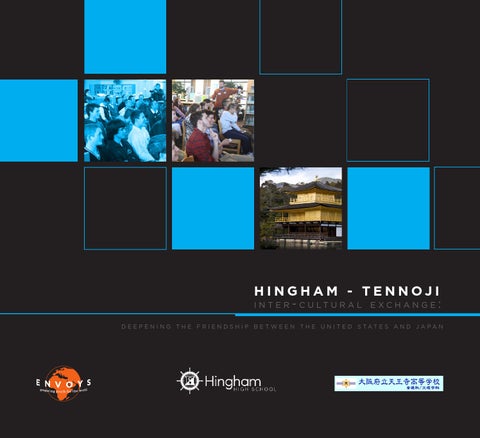
HINGHAM - TENNOJI
i n t e r - c u lt u r a l e xc h a n g e : D E E P E N I N G T H E F R I E N D S H I P B E T W E E N T H E U N I T E D S TAT E S A N D J A PA N
T A B L E
O F
CONTENTS Introduction General Objectives Educational Objetives Itinerary Options Price Chart Terms and Conditions
2
3 4 8 10 26 27
As an educational organization dedicated to nurturing global perspectives and cross-cultural communication based on cutting-edge research from organizations including Harvard University’s Graduate School of Education and UNESCO, Envoys combines online coursework, focused international travel, and high-quality learning outputs to nurture global vision and leadership for youth. Following Hingham and Tennoji’s milestone exchange program and exhibition game in March 2014, Envoys is excited to become a partner in deepening the friendship between the two schools, and between the United States and Japan through our programming—this time through a focused program for Hingham High School in Japan.
3
Envoys believes that objectives must be framed as outcomes for learning and development. Delineating these outcomes must come before any thought is given to the process by which they will be achieved. Our objective is never the implementation of a flawless travel ‘experience.’ Conflating the goal of an educational program with the means by which it is achieved is perhaps the most insidious form of lowing expectations. Instead, we choose to be judged by how well students learn.
4
STUDENTS OPEN THEIR MINDS, HEARTS, AND EYES TO THE WORLD AROUND THEM
STUDENTS ARE ABLE TO THINK CRITICALLY ABOUT GLOBAL ISSUES AND THE ROLE THAT AMERICANS PLAY IN THE INTERCONNECTED WORLD
How we do it
How we do it
Students take a series of preparatory courses that focus on navigating the world around them with empathy and respect. These courses are conducted through a blend of online classes and in-person activities. Envoys pedagogical team and Hingham faculty work together to ensure the quality and appropriateness of course content. We explore the concept of empathy and assist students to develop individualized lesson plans for improving their empathic skills. Students taking these courses will have a greater sense of personal identity and how their actions impact those around them.
Working in tandem with Hingham faculty, Envoys provides online courses exploring specific topics of global importance relevant to each destination. These courses blend multi-media content with discussion groups and engaging assignments that foster motivation, and frame the trip as a learning experience. Before being allowed to board the plane to Japan, students are required to demonstrate knowledge of their destination, and a plan for learning more during their trip.
While in the destination country, we execute activities that enable students to interact with their peers from other nations, as well as community members around them. We provide regular and structured opportunities for students to reflect on their experiences, voice their questions, and discuss their challenges.
While in the destination country, we challenge students with a mixture of experimental, and academic learning opportunities. We utilize frameworks provided by systems thinking to help students delineate variables and make connections between their observations from traveling and their lives at home.
During the final days on the trip, students create a plan for sharing their program with their community back home. This process of summarizing and communicating learning points ensures that students internalize their experience and make actual change in their lives. 5
日本 6
本
JA PAN AN ULTRA-MODERN COUNTRY FOUNDED UPON ANCIENT TRADITIONS
7
Educational
OBJECTIVES
8
1.Equipped with a deeper understanding of Japan, it’s culture, and US-Japanese relations, students are able to operate in Japanese society.
ing students to see the sites and enjoy their time in country. Many activities are unique to Envoys programs due to our extensive networks in countries we work.
HOW WE DO IT:
Through travel (and some struggle), students quickly discover they are resourceful and can function well in new environments, including a country over 6000 miles away.
Envoys provides a blend of online and in-person learning experiences in collaboration with Hingham High School faculty prior to the start of the in-country curriculum. Through these, students will widen their knowledge of topics relevant to the programmatic objectives, including Japanese history, culture, and the country’s relationship with the United States.
HOW WE DO IT:
In Japan, targeted lectures, activities, and discussions serve to deepen the knowledge acquired from the pre-trip portion of the programming. Each activity is set up to meet a particular programmatic objective, while still allow-
Specific lessons and activities pre-trip and in country are designed to bring out our commonalities, embrace our differences, and highlight our shared humanity. Using Japan and our relationship with the country as a spring-
2. Despite differences in culture, language, and geography, students recognize our commonalities and shared humanity.
board, lessons further encourage students to think beyond Japanese and our bilateral relationship, and to apply them to a larger global context. Envoys asks: If mortal enemies can become the closest allies in less than a century, what else is possible on the world stage, what does it take to get us there, and who will step up? Often, in addition to differences, misunderstandings and stereotyping detract from the ability to recognize our collective humanity. Therefore, other in-country activities are designed to clarify historic misunderstandings between our two countries, such as stereotypical imaginings that are relics of WWII or academic Orientalism. Ending misunderstanding, students deepen their empathy skills and glimpse our collective humanity, while increasing their ability to function in a foreign culture.
3. Students are able to transfer lessons from baseball and other passions to positive action on topics of global significance.
HOW WE DO IT: HOW WE DO IT:
3
“Baseball is a martial art,” says Masa Sensei of Tennoji High School. Skills attained through sports education, and other areas students are passionate about, can be applied to other aspects of their lives—it’s bigger than baseball! Using facilitation techniques, students are guided by staff to not only discover their passions in the context of the program, but to take such passion to other levels throughout their lives, including college study and beyond. Beyond conversations that allow students to think outside the box, and follow their passions to global citizenship, Envoys’ research project serves as a
capstone to unlocking individual potential. We challenge students to build individualized learning and research plans for their time in Japan. These plans comprise the questions students have around multiple themes covered in the pre-trip materials, as well as strategies for obtaining answers by asking good questions. Students will have remedial Japanese language, and assistance from bi-lingual staff to inform their research. The research component further allows students the space and opportunity to discover their specific passions, deepening their personal relationship with Japan.
9
ITINERARY OPTION A D AY 1 / 2
D AY 3
INTERNATIONAL TRAVEL / TOKYO
TOKYO
Crossing the international dateline, we land at Narita Int’l Airport in the afternoon the day after our departure from Boston. The express train then takes us into downtown Tokyo, where our program begins. After getting acclimated to their new host country, students will head to Shiba Park, where they see the famous Zojoji Buddhist Temple, and examples of nature in harmony with one of the world’s largest and most technologically advanced cities.
Students visit the United States Embassy in the morning to understand modern US-Japanese diplomacy, including people-to-people diplomacy. We reflect on the significance of their exchange with Tennoji High School, diplomacy through sports, and other themes. Afterwards, students visit the Asakusa district. Students explore Tokyo’s traditional side, including Sensoji Buddhist Temple and thoroughfare. After lunch, we head to the Showakan to discuss life for Japanese citizens during and after WWII, and the country was affected by the war.
At sunset, students go to the top of Tokyo Tower to watch the city lights come on, and see how expansive Tokyo really is. A Japanese dinner and discussion on students’ observations and cultural customs follows. Students are encouraged to begin brainstorming or refining topics for their research projects.
Shifting gears from human to natural disasters, we meet with staff from the Japan Emergency NGO (JEN) to discuss the aftermath of the 2011 Tohoku Earthquake and Tsunami, both it’s environmental and social challenges, as well as Japan’s recovery efforts. In the evening, we enjoy dinner and a shamisen (a traditional Japanese stringed instrument) performance at a modern Tokyo art café.
10
JA PA N
D AY 4 TOKYO Students wake up early (4am) and head to the Tsukiji Fish Market—the largest wholesale fish market in the world. After the tour, they discuss the impacts of the fishing industries on the environment over breakfast. Then students head to Temple University Japan (TUJ) to hear a brief lecture on US-Japanese relations from the 19th century to today. Students tour TUJ, the only accredited American university in Japan, and Keio University, one of the country’s premiere private universities. They learn about college life in Japan, and opportunities for study post-high school. After lunch, students have the rare opportunity to enter the interior sanctum of a local Shinto shrine, and learn more about Japan’s indigenous religious tradition from a bi-lingual Shinto priest. Then it’s off to Harajuku to explore the center of Japanese teenage fashion, set against the backdrop of the iconic Meiji shrine. We explore Shibuya in the evening, and round off the night with a group karaoke competition—students vs. teachers!
11
D AY 5 OSAKA We depart Tokyo for Osaka in the morning on the shinkansen (bullet train), and are met by our friends from Tennoji High School. Students head to Tennoji High School for our Osaka program orientation and inter-cultural exchange. After lunch together and settling in, students go on a tour of Osaka Castle & Park, and the Dotonbori area. In the evening, we enjoy an Osaka-style meal, and receive a lecture on what makes the city so unique culturally and economically. Students also practice some phrases in the local Osaka dialect. We end our first day in Osaka in the Tenjinbashi-suji shopping street.
D AY 6 OSAKA Students meet their Tennoji friends early in the morning and go on a walking tour of the Tennoji area. After the walk, students participate in the first of two exhibition games between Hingham and Tennoji. The exhibition game is followed by a facilitated discussion by both American and Japanese teachers on lessons from baseball, and the possibility of carrying those lessons into other areas they are passionate about.
12
JA PA N
D AY 8 HIROSHIMA Departing Tennoji, students have a private tour of Koshien, the stadium where the Hanshin Tigers play and where the Japanese High School Baseball Tournament takes place each year. Students are welcomed into the homes of their Tennoji friends to discover Japanese home life upon returning from Koshien.
D AY 7 OSAKA / KOBE In the morning we take a trip to Kobe to see one of the only cities opened to foreigners for trade before the 1868 Meiji Restoration and enjoy the atmosphere of this international city. Students visit foreign residences unlike anywhere else in Japan, as well as one of only three designated Chinatowns in Japan. We discuss why Japan would not open its ports to foreigners, what changed during the Meiji Restoration, and backlash that resulted. After a delicious Kobe beef lunch, we head to an exhibition and memorial for the Great Hanshin Earthquake in 1995, and learn about Kobe’s recovery. In the evening, students return to Osaka and Koshien to enjoy a live Hanshin Tigers game. Root for the home team the Japanese way! We unpack the day over dinner, discussing student observations.
On August 6, 1945 the United States dropped the first of two atomic bombs on Japan, hitting Hiroshima. Students embark on a trip to Hiroshima to see the famous Genbaku Dome (one of the only structures to remain standing after the bomb detonated), the Peace Memorial Museum & Park, and the Children’s Peace Memorial. Students learn how to make paper cranes and reflect on their significance to Hiroshima and the Japanese. Using the Peace Park as a sobering outdoor classroom, students discuss WWII, the costs of warfare, ‘Othering,’ and the resolution of international conflicts. We leave the cranes in Hiroshima with our wishes inscribed on them as homage. Students then visit the seaside Miyajima Shrine before returning to Osaka in the evening. Students unpack their feelings from this emotional day.
D AY 9 OSAKA Students head to Tennoji High School in the morning for the second exhibition game. This time, each team shall consist of mixed players from both Hingham and Tennoji, and they are required to work together without common language or culture to win the match. After the game, students reflect on this unique exercise. A farewell party 13
at Tennoji High School follows the exhibition game in which teachers, administration, and families are encouraged to attend. Student are taken up to the famous Umeda Sky Building and Floating Garden to catch a last glimpse of the city of Osaka, and then have dinner in Dotonburi. They see a traditional Osaka Bunraku performance in the evening.
D AY 1 0 KYOTO In the morning, we take the shinkansen to Kyoto — Japan’s old capital. After checking into a traditional ryokan, students will go on a walking tour of the Higashiyama area and Gion district —the largest hanamachi (geisha district) in Japan. Students enjoy the sites and thoroughfare leading to Kyomizudera, a Buddhist temple constructed entirely from wood. In the afternoon, we participate in a traditional tea ceremony and one of Kyoto’s idyllic teahouses, followed by a nature walk through Fushimi Inari Jingu. On the walk, we discuss living in harmony with our environment us-
14
ing Japanese culture and the Kyoto Protocol as springboards to the discussion. Then as evening falls and the lanterns are lit, students have the rare chance to gain a deeper glimpse into the geisha world by meeting a maiko (apprentice geisha) over dinner, and witness a dance performance. Stereotypes about geisha are shattered, and students come away with a profound understanding of this uniquely Japanese profession. Students discuss Western stereotypes about geisha and gender in Asia resulting from wartime history, and how to dispel them.
D AY 1 1 KYOTO In the morning, students head for the old royal palace and receive a guided tour of the complex to learn about palace life, and the role of the Emperor throughout Japan’s history. The Tale of Genji—the oldest novella in the world—was written here by a woman named Murasaki Shikibu between 1000-1012 CE. Afterwards, students will be taken to Kokedera Zen Temple to witness a Zen Prayer Ceremony and one of the country’s most spectacular Japanese gardens.
JA PA N
In the afternoon, students are divided into groups and free to explore the city with chaperones, and purchase souvenirs. Then we take the shinkansen back to Tokyo at nighttime. Overnight in Tokyo.
D AY 1 2 TOKYO / INTERNATIONAL TRAVEL Students unpack and wrap-up their experiences over breakfast, and enjoy their last hours in Tokyo together. Then, it’s off to Narita Int’l Airport for our flight home — sayonara, Japan! Until next time…
15
ITINERARY OPTION B D AY 1 / 2
D AY 3
INTERNATIONAL TRAVEL / TOKYO
TOKYO
Crossing the international dateline, we land at Narita Int’l Airport in the afternoon the day after our departure from Boston. The express train then takes us into downtown Tokyo, where our program begins. After getting acclimated to their new host country, students will head to Shiba Park, where they see the famous Zojoji Buddhist Temple, and examples of nature in harmony with one of the world’s largest and most technologically advanced cities.
Students visit the United States Embassy in the morning to understand modern US-Japanese diplomacy, including people-to-people diplomacy. We reflect on the significance of their exchange with Tennoji High School, diplomacy through sports, and other themes. Afterwards, students visit the Asakusa district. Students explore Tokyo’s traditional side, including Sensoji Buddhist Temple and thoroughfare. After lunch, we head to the Showakan to discuss life for Japanese citizens during and after WWII, and the country was affected by the war.
At sunset, students go to the top of Tokyo Tower to watch the city lights come on, and see how expansive Tokyo really is. A Japanese dinner and discussion on students’ observations and cultural customs follows. Students are encouraged to begin brainstorming or refining topics for their research projects.
16
After lunch, students have the rare opportunity to enter the interior sanctum of a local Shinto shrine, and learn more about Japan’s indigenous religious tradition from a bi-lingual Shinto priest. Then it’s off to Harajuku to explore the center of Japanese teenage fashion, set against the backdrop of the iconic Meiji shrine. We explore Shibuya in the evening, and round off the night with a group karaoke competition—students vs. teachers!
JA PA N
D AY 4 OSAKA We depart Tokyo for Osaka in the morning on the shinkansen (bullet train), and are met by our friends from Tennoji High School. Students head to Tennoji High School for our Osaka program orientation and inter-cultural exchange. After lunch together and settling in, students go on a tour of Osaka Castle & Park, and the Dotonbori area. In the evening, we enjoy an Osaka-style meal, and receive a lecture on what makes the city so unique culturally and economically. Students also practice some phrases in the local Osaka dialect. We end our first day in Osaka in the Tenjinbashi-suji shopping street.
17
D AY 5 OSAKA In the morning, students have a private tour of Koshien, the stadium where the Hanshin Tigers play and where the Japanese High School Baseball Tournament takes place each year. Then students participate in the first of two exhibition games between Hingham and Tennoji. The exhibition game is followed by a facilitated discussion by both American and Japanese teachers on lessons from baseball, and the possibility of carrying those lessons into other areas they are passionate about. Students are later welcomed into the homes of their Tennoji friends to discover Japanese home life. In the evening, students return to Koshien to enjoy a live Hanshin Tigers game. Root for the home team the Japanese way! We unpack the day over dinner, discussing student observations.
D AY 6 HIROSHIMA / OSAKA On August 6, 1945 the United States dropped the first of two atomic bombs on Japan, hitting Hiroshima. Students embark on a trip to Hiroshima to the famous Genbaku Dome (one of the only structures to remain standing after the bomb detonated), the Peace Memorial Museum & Park, and the Children’s Peace Memorial. Students learn how to make paper cranes and reflect on their significance to Hiroshima and the Japanese. 18
JA PA N
Using the Peace Park as a sobering outdoor classroom, students discuss WWII, the costs of warfare, ‘Othering,’ and the resolution of international conflicts. We leave the cranes in Hiroshima with our wishes inscribed on them as homage. Students then visit the seaside Miyajima Shrine before returning to Osaka in the evening. Students unpack the feelings from this emotional day.
D AY 7 OSAKA Students head to Tennoji High School in the morning for the second exhibition game. This time, each team shall consist of mixed players from both Hingham and Tennoji, and they are required to work together without common language or culture to win the match. After the game, students reflect on this unique exercise. A farewell party at Tennoji High School follows the exhibition game in which teachers, administration, and families are encouraged to attend. Student are taken up to the famous Umeda Sky Building and Floating Garden to catch a last glimpse of the city of Osaka, and then have dinner in Dotonburi. They see a traditional Osaka Bunraku performance in the evening.
19
D AY 8 KYOTO In the morning, we take the shinkansen to Kyoto — Japan’s old capital. After checking into a traditional ryokan, students go on a walking tour of the Higashiyama area and Gion district —the largest hanamachi (geisha district) in Japan. Students enjoy the sites and thoroughfare leading to Kyomizudera, a Buddhist temple constructed entirely from wood. In the afternoon, we participate in a traditional tea ceremony and one of Kyoto’s idyllic teahouses, followed by a nature walk through Fushimi Inari Jingu. On the walk, we discuss living in harmony with our environment using Japanese culture and the Kyoto Protocol as springboards to the discussion. 20
Then as evening falls and the lanterns are lit, students have the rare chance to gain a deeper glimpse into the geisha world by meeting a maiko (apprentice geisha) over dinner, and witness a dance performance. Stereotypes about geisha are shattered, and students come away with a profound understanding of this uniquely Japanese profession. Students discuss Western stereotypes about geisha and gender in Asia resulting from wartime history, and how to dispel them.
JA PA N
D AY 9
D AY 1 0
KYOTO
TOKYO / INTERNATIONAL TRAVEL
In the morning, students head for the old royal palace and receive a guided tour of the complex to learn about palace life, and the role of the Emperor throughout Japan’s history. The Tale of Genji—the oldest novella in the world—was written here by a woman named Murasaki Shikibu between 1000-1012 CE. Afterwards, students will be taken to Kokedera Zen Temple to witness a Zen Prayer Ceremony and one of the country’s most spectacular Japanese gardens.
Students unpack and wrap-up their experiences over breakfast, and enjoy their last hours in Tokyo together. Then, it’s off to Narita Int’l Airport for our flight home — sayonara, Japan! Until next time…
In the afternoon, students are divided into groups and free to explore the city with chaperones, and purchase souvenirs. Then we take the shinkansen back to Tokyo at nighttime. Overnight in Tokyo. 21
ITINERARY OPTION C D AY 1 / 2 INTERNATIONAL TRAVEL / TOKYO
TOKYO
Crossing the international dateline, we land at Narita Int’l Airport in the afternoon the day after our departure from Boston. The express train then takes us into downtown Tokyo, where our program begins. After getting acclimated to their new host country, students head to Shiba Park, where they see the famous Zojoji Buddhist Temple, and examples of nature in harmony with one of the world’s largest and most technologically advanced cities.
Students visit the United States Embassy in the morning to understand modern US-Japanese diplomacy, including people-to-people diplomacy. We reflect on the significance of their exchange with Tennoji High School, diplomacy through sports, and other themes. Afterwards, students visit the Asakusa district. Students explore Tokyo’s traditional side, including Sensoji Buddhist Temple and thoroughfare. After lunch, we head to the Showakan to discuss life for Japanese citizens during and after WWII, and the country was affected by the war.
At sunset, students go to the top of Tokyo Tower to watch the city lights come on, and see how expansive Tokyo really is. A Japanese dinner and discussion on students’ observations and cultural customs follows. Students are encouraged to begin brainstorming or refining topics for their research project.
22
D AY 3
After lunch, students will have the rare opportunity to enter the interior sanctum of a local Shinto shrine, and learn more about Japan’s indigenous religious tradition from a bi-lingual Shinto priest. Then it’s off to Harajuku to explore the center of Japanese teenage fashion, set against the backdrop of the iconic Meiji shrine. We explore Shibuya in the evening, and round off the night with a group karaoke competition—students vs. teachers!
JA PA N
D AY 4 OSAKA We depart Tokyo for Osaka in the morning on the shinkansen (bullet train), and are met by our friends from Tennoji High School. Students head to Tennoji High School for our Osaka program orientation and inter-cultural exchange. After lunch together and settling in, students go on a tour of Osaka Castle & Park, and the Dotonbori area.
Students are later welcomed into the homes of their Tennoji friends to discover Japanese home life. In the evening, students return to Koshien to enjoy a live Hanshin Tigers game. Root for the home team the Japanese way! We unpack the day over dinner, discussing student observations.
In the evening, we enjoy an Osaka-style meal, and receive a lecture on what makes the city so unique culturally and economically. Students also practice some phrases in the local Osaka dialect. We end our first day in Osaka in the Tenjinbashi-suji shopping street.
D AY 6
D AY 5 OSAKA In the morning, students have a private tour of Koshien, the stadium where the Hanshin Tigers play and where the Japanese High School Baseball Tournament takes place each year. Then students participate in the first of two exhibition games between Hingham and Tennoji. The exhibition game is followed by a facilitated discussion by both American and Japanese teachers on lessons from baseball, and the possibility of carrying those lessons into other areas they are passionate about.
HIROSHIMA / OSAKA On August 6, 1945 the United States dropped the first of two atomic bombs on Japan, hitting Hiroshima. Students embark on a trip to Hiroshima to the famous Genbaku Dome (one of the only structures to remain standing after the bomb detonated), the Peace Memorial Museum & Park, and the Children’s Peace Memorial. Students learn how to make paper cranes and reflect on their significance to Hiroshima and the Japanese. Using the Peace Park as a sobering outdoor classroom, students discuss WWII, the costs of warfare, ‘Othering,’ and the resolution of international conflicts. We leave in Hiroshima the cranes with our wishes inscribed on them as homage. Students then visit the seaside Miyajima Shrine before returning to Osaka in the evening. Students unpack the feelings from this emotional day. 23
D AY 7 OSAKA Students head to Tennoji High School in the morning for the second exhibition game. This time, each team shall consist of mixed players from both Hingham and Tennoji, and they are required to work together without common language or culture to win the match. After the game, students reflect on this unique exercise. A farewell party at Tennoji High School follows the exhibition game in which teachers, administration, and families are encouraged to attend. Student are taken up to the famous Umeda Sky Building and Floating Garden to catch a last glimpse of the city of Osaka, and then have dinner in Dotonburi. They see a traditional Osaka Bunraku performance in the evening.
D AY 8 KYOTO In the morning, we take the shinkansen to Kyoto — Japan’s old capital. After checking into a traditional ryokan, students go on a walking tour of the Higashiyama area and Gion district —the largest hanamachi (geisha district) in Japan. Students enjoy the sites and thoroughfare leading to Kyomizudera, a Buddhist temple constructed entirely from wood. 24
JA PA N
In the afternoon, we participate in a traditional tea ceremony and one of Kyoto’s idyllic teahouses. Then students are able to divide into groups and explore the city with chaperones, and purchase souvenirs. Then as evening falls and the lanterns are lit, students have the rare chance to gain a deeper glimpse into the geisha world by meeting a maiko (apprentice geisha) over dinner, and witness a dance performance. Stereotypes about geisha are shattered, and students come away with a profound understanding of this uniquely Japanese profession. Students discuss Western stereotypes about geisha and gender in Asia resulting from wartime history, and how to dispel them.
D AY 9 KYOTO / TOKYO / INTERNATIONAL TRAVEL Students unpack and wrap-up their experiences over breakfast, and head to the Narita Int’l Airport via shinkansen from Kyoto for our flight home — sayonara, Japan! Until next time…
25
Price
CHART
PRICES INCLUDE ONLINE COURSE DEVELOPMENT AND IMPLEMENTATION
PRICES ARE BASED ON A MINIMUM OF 20 STUDENTS
ITINERARY OPTION
26
NUMBER O F D AY S
PRICES INCLUDE 2 ACCOMPANYING TEACHERS AND 2 FULLTIME TRIP LEADERS FROM ENVOYS
PER-STUDENT COST (not including int’l airfare)
A
12
$3,470
B
10
$3,180
C
9
$2,980
PRICES DO NOT INCLUDE INTERNATIONAL AIRFARE
Terms
& CONDITIONS
PRICES INDICATED IN THIS PROPOSAL INCLUDE: • Design of itineraries and activities based on guidelines provided by the school. • Design and implementation of online courses to a reasonable and mutually agreed-on extent. • Leadership of all activities described in the itineraries. Academic activities will be led jointly with the team of teachers attending the trip. Teachers are expected to provide support during non-academic activities. • All meals (daily breakfast, lunch, dinner and morning and afternoon snacks). • Multiple accommodations for students and teachers in hotels, hostels, campsites or locally operated lodges according to the description of each itinerary. • All air, land, and water transportation as described in each itinerary. • Group equipment required for each activity. Students must secure their personal equipment as indicated in the corresponding packing lists of the respective trip. • Search and Rescue, Evacuation, and Medical insurance for each student and teacher. Coverage limits apply. • Prices in this proposal will be subject to change upon
requests of changes to the itinerary by the school. • Per-student airfare will be charged on a pass-through basis. The airfare for accompanying teachers will be covered by Envoys. • Prices of air tickets are subject to change pending approval of this proposal by the school. Taxes and surcharges may be subject to change by the government or airlines; in such event, changes will be reflected in the final per-student price.
27
PAYMENTS, REGISTRATIONS, TRACKING SERVICES. • Multiple direct payment options for parents: Online, credit and debit cards and wire transfers. Envoys will conduct regular payment reminders to parents upon reception of the corresponding databases from the school. • Parents will have the option of purchasing an insurance policy that will reimburse the cost of the trip in case of cancellation due to medical conditions. This insurance will be optional and carry an additional cost. • Online Registrations will be available for parents. • Real-time online tracking system for parents includes satellite location, pictures, video and updates. Amount and type of information in the feed may vary depending on the corresponding destination.
PLANNING AND INFORMATIONAL SESSIONS • Envoys senior staff will regularly visit with school faculty for trip preparation and preparatory course delivery. • Multiple parent, teacher and student meetings for each trip. • A minimum of one day will be devoted to Teacher/ Counselor Training. • School staff members may accompany Envoys staff on scouting trips according to the price table at the right.
28
CANCELLATIONS AND CHANGES • Cancellations originating from a duly documented safety warning issued by the US Embassy will involve no cancellation fees. Envoys will reimburse 100% of land and air portions to parents. • Changes in air tickets can be made up to 8 days prior to the commencement of the trip with no cost to the school. Envoys will make every effort to arrange changes requested after said deadlines but cannot guarantee that such changes will be possible. • Cancellations of land portions by parents will be managed according to the following policy:If cancellation is made 30 days before the program starts: -80% refund of the amount paid. • Between 29 and 15 days: -50% refund of the amount paid. • Between 14 and 9 days: -25% refund of the amount paid. • Cancellations occurring 8 days or less before the beginning of the program will not be eligible for refunds. • Cancellations of air portions by parents will be possible until the date of issuance of the corresponding ticket. Once the ticket is issued, no refund will apply, but parents will receive the corresponding air ticket for future use in accordance with airline policies. Issuances of air tickets typically occur 3 to 4 weeks prior to the beginning of the trip, depending on airline policies.
Cambridge, MA 02142 One Broadway 14th Floor 1 (800) 515 6523 www.envoys.com info@envoys.com ENVOYS INTERNATIONAL Bogotá – Colombia Cra. 11B # 98-08 Of: 501 PBX: (571) 6910684
29
30