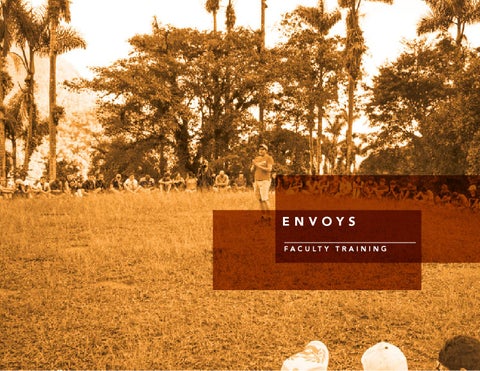
ENVOYS FA C U LT Y T R A I N I N G
1
Cambridge, MA 02142 One Broadway 14th Floor 1 (800) 515 6523 www.envoys.com info@envoys.com ENVOYS INTERNATIONAL Bogotá – Colombia Cra. 11B # 98-08 Of: 501 PBX: (571) 6910684 2
Background Workshops
4 6
Online Courses International Travel
12
Timeline
20
3
16
Background
Q
uality global education programs comprise a wide range of critical elements, including risk management, parent communications, medical care, budget maintenance, and travel logistics. In the course of designing and implementing programs abroad, faculty often are required to take on these roles, in collaboration with school administration and outside organizations. Regardless of the program, however, all faculty members have one common responsibility:
to create opportunities for transformational learning.
4
This training focuses on improving the core competencies of faculty in order to ensure that they reach their maximum potential.
Participants completing this series of workshops, online courses, and travel programs will: • Be better able to act as an educator inside and outside of the classroom context • Have a practical understanding of the pedagogical basis behind global education practices • Get better at developing rich curriculum with both structured and unstructured activities • Develop a personalized and adaptable ‘toolkit’ of activity options for use in the field • Be better equipped to prepare students to navigate the world with empathy, understanding, and respect 5
6
Content Areas
The training covers three content areas that comprise a complete program, prioritizing the development of essential skill-sets for experiential educators.
Planning and Preparation
Leading Experiential Learning
Integration and Transferral
We learn to design more effective learning contexts, including both structured and unstructured pathways for transformational learning experiences to occur.
We learn how to fulfill the role of an educator outside of the context of our classrooms, building the skills to manage groups, develop teamwork, and support students through their individual learning journeys abroad.
We learn to help students transfer skills, maximize opportunities and translate their knowledge into action.
7
Training Methods
During the training, we switch between three lenses to facilitate deeper engagement with the content and ensure the development of lasting skills.
PEDAGOGICAL
PRACTICAL
EXPERIENTIAL
We build a working knowledge of the key approaches that comprise global education programming, including the experiential learning cycle, crosscultural competency, service learning, and empathy development.
Global educators need a selection of potential routines, games, activities, and protocols that they can call on.
Acquiring useful skills requires gaining experiences outside of the classroom environment.
We work together to develop a toolkit of activities for our students, ensuring that all participants are able to do the ‘stuff that works’ both in their classroom and in the field.
Participants have opportunities to develop personal perspectives on global education through international travel programs.
Understanding of the pedagogical basis allows participants to more confidently set priorities and make decisions during the course of program design. We move quickly through the extant research, pushing participants to make decisions about the relevance and applicability of different models to their own learning context and teaching style.
We utilize a variety of scenariobased design protocols to help craft and refine our practice. Working individually and together, participants build solutions, test them out, and see how we can 8 better serve our students.
While abroad, participants engage with local communities and conduct research relevant to their teaching area. We also visit schools and meet with fellow educators, establishing connections necessary to continue and deepen relationships after returning home.
Workshop: Preparing and Planning
PEDAGOGICAL
From cultural competency to increasing language fluency to building empathic outlooks we work to understand what has been proven (so far) to work for all the things that we try to achieve.
PRACTICAL
Focusing on program design, we learn to develop ‘SMART’ objectives for our programs and how to sequence activities to expand student comfort zones and create leadership opportunities. We consider different approaches to service learning programs and how to utilize backwards planning to create programs in which we can take pride. 9
EXPERIENTIAL
We test out our knowledge through a fast-paced series of design challenges using different programmatic starting points. Participants work to sketch out itineraries and activities, exercising their creativity in making programs that will ‘work’ within their school context.
Workshop: Leading Experiential Learning 8-10 HOURS PEDAGOGICAL
We unpack the elements of the experiential learning cycle, considering how our personal histories of skill development reconcile with the framework. We review research on culture shock and work on ways to better support students to process their reactions to the unfamiliar.
PRACTICAL
EXPERIENTIAL
Participants develop confidence in the ‘nuts and bolts’ of experiential education, including: • Setting expectations and helping students to develop objectives • Framing activities and allowing ‘challenge by choice’ • Adapting to change and taking advantage of ambiguity • Managing groups and building student leadership • Facilitating meaningful reflections • Maintaining relationships with community partners .
We undertake a series of scenariobased challenges from the field to test out our newly formed experiential learning ‘toolkits’.
10
We utilize a three-part learning model whereby participants cycle between roles as leaders, students, and observers, closing with frank discussions about how each activity could be improved.
Workshop: Integration and Transferral 3-5 HOURS
PEDAGOGICAL
We delve into the various models and studies around global competency, seeking some clarification on the skill-sets that matter for success now and in the future. Participants develop individualized viewpoints on what students need to thrive in a fast changing environment and to be of value in an increasingly interdependent world.
PRACTICAL
EXPERIENTIAL
We review different methods to assist students in translating skills developed on global education programs to other parts of their lives, as well as means for evaluating skill improvement and helping students to fix areas of weakness.
Participants undertake exercises to better understand their own narratives around skill development and identity construction, in order to be better placed to engage students in this work.
Participants learn about the potential avenues for capitalizing on the motivation from global programs to engage in new initiatives in the school community. We then analyze case studies on individual students to draw out and discuss 11 potential learning routes.
We undertake final activities to ensure that we have made a longlasting community of practice that models empathy, understanding and respect.
12
Why Online Courses The advent of the internet age has given us an array of tools for distributing information, engaging in meaningful discussions, and collaborating on projects. For teachers, this means that it is possible to engage in ongoing professional development without disrupting the schedules necessary to be an effective professional.
CO L L A B O R AT I V E L E A R N I N G A S A CO MMUN I T Y O F O N L I N E L E A R N E R S
We approach online learning as a means to build a community that carries over into our trip. Students report that greater understanding comes from interactions with content, participants, technology, and the instructor. Within this model, the components can be viewed independently, while their interconnectivity leads to collaborative learning.
Participants are able to take the courses on their own time, working both individually and in groups through asynchronous formats. Envoys online courses blend video, reading, discussions, interesting projects, realtime lectures, and assessments to ensure that learners receive the maximum benefit from their time.
13
course Global Citizenship 101
This course is designed to build knowledge and facilitate reflective conversations around how the ideal abstractions of global citizenship are translated into the realities of our personal and professional lives.
C O U R S E M O DU L ES
Looking Back: History of Global Citizenship Participants delve into the history of global citizenship education, looking at how different countries have taken alternative approaches to preparing youth to engage with the world.
Looking Inward: Personal Identity and Cross-Cultural Sensitivity Through a series of introspective and collaborative exercises, we begin the process o f examining our assumptions around culture and identity. Participants tackle the concept of ‘the other’, seeking to better understand how instinctive reactions can color our framing of observations and thus influence our subsequent behaviors.
Looking Outwards: Immigration and Nationalism National borders simultaneously define and restrict our world. We dig into the reasons and methods for immigration, and engage in fact-based debates around responses to modern immigration challenges. Participants are challenged to reconcile the innate advantages of nationalism with the ideals of global citizenship.
14
course Travel Well
This course is designed to provide the information, structures, and time necessary to think widely and deeply about the relationship between international travel and global citizenship. Participants confront tough questions around how and why they travel, and how they can improve in the future.
C O U R SE M O DUL ES
Who helps whom? The Business of Volunteer Aid Many volunteer programs promise that they will “make a difference”. We confront the reality of development aid regimes, building knowledge around the true costs and beneficiaries. Each participant is tasked with expressing and defending a personal stance on the ongoing debates around the optimal size, scope, and necessity for international aid. Responsible Tourism and Cultural Preservation We analyze the amazing growth of the global tourism industry, the world’s largest economic sector and source of employment. Through a series of ‘tracing exercises’ we delve into how the economic choices made by travelers change families, communities, and cultures.
Being Safe vs Being Rude We begin by reviewing common disease pathways and risk factors for international travel. Participants engage in directed research, team-building of ‘mustknows’, and discussions around their reactions to various scenarios. We continue with an analysis of community behavioral ‘norms’ and reactions to violations, considering how we can best mitigate how our actions are perceived abroad.
15
16
Why we travel
Acquiring useful skills requires gaining experiences outside of the classroom environment. Therefore, it is critical to provide opportunities to develop personal perspectives on global education through international travel programs. While abroad, participants engage with local communities and conduct research relevant to their teaching area. We engage in a variety of intercultural activities, pushing our own comfort zones and developing personal skills for interacting across linguistic and cultural boundaries. On a daily basis, we review these activities through our pedagogical and practical lenses, thinking about how we can tailor them to meet our educational teachers try out the ‘scouting mindset’ to establish connections, screen potential partners, and build the relationships necessary for global education programs. We also visit schools and meet with fellow educators, developing networks to draw on after returning home.
17
Travel Program Colombia D AY S 1 - 4 B O G O TA
D AY S 4 - 6 PA L O M I N O
Participants spend the initial days meeting with Colombian instructors at public and private schools to discuss approaches to global citizenship education. Translators are provided when necessary to ensure that a wider range of faculty can participate.
We journey into the Sierra Nevada de Santa Marta region. A trek through the Colombian rainforest leads us to a unique educational organization; a boarding school developed for the indigenous Kogui people. We are received by leaders from the indigenous community, who share their traditions for educating youth. Participants explore the use of bilingual education and parallel curriculum delivery to meet government and indigenous requirements.
During the evenings, we meet with Colombian ministry officials, businesspeople, educators, and social changemakers to learn about efforts underway for peacebuilding by domestic and international partners. We discuss the differences in standards and approaches among Colombian schools, gaining a more nuanced view of educational opportunities around the world. 18
D AY S 7 - 1 0 B A R R A N Q U I L L A
D AY S 1 1 - 1 3 C A R TA G E N A
We spend three days working with teachers and students from low-income schools in the Barranquilla region. We partner with the municipal government and the Volunteers Colombia organization, an NGO that places native speaker teachers in low-income schools around the country to teach ESL.
We close the program in the famed city of Cartagena, a UNESCO World Heritage Site and the epitome of ‘magical realism’. Participants consider the impact of the program on their personal and professional lives, and make commitments to bring their experiences back to their school community.
19
Recommended Timeline Model ONLINE COURSES
Global Citizenship 101
Travel Well
Preparing and Planning
IN-SCHOOL WORKSHOPS
Leading Experiential Learning
Integration and Transferral Colombia Travel Program
I N T E R N AT I O N A L T R AV E L D AT E S
Oct 2015
Nov 2015
Dec 2015
Jan 2016
20
Feb 2016
Mar 2016
April 2016
May 2016
June 2016
Cambridge, MA 02142 One Broadway 14th Floor 1 (800) 515 6523 www.envoys.com info@envoys.com ENVOYS INTERNATIONAL Bogotá – Colombia Cra. 11B # 98-08 Of: 501 PBX: (571) 6910684 21