GETTING ISO certification gives Minnesota manufacturers ISO RIGHT a significant competitive edge. Here’s how.
WINTER 2026
Helping Manufacturing Enterprises Grow Profitably
A N N UA L S U RV E Y
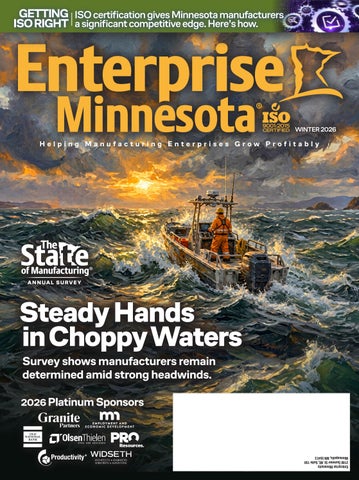
Steady Hands in Choppy Waters Survey shows manufacturers remain determined amid strong headwinds. 2026 Platinum Sponsors
Enterprise Minnesota 2100 Summer St. NE, Suite 150 Minneapolis, MN 55413
WINTER 2026
16
A N N UA L S U RV E Y
STEADY HANDS IN CHOPPY WATERS Survey shows manufacturers remain determined amid steady headwinds.
22
A N N UA L S U RV E Y
28
Deep Dive
Thinking Like Owners
Conversations with manufacturers shed light on State of Manufacturing® survey results.
Scipi’s ESOP structure does more than build retirement accounts. It gives employees the information, authority, and incentive to improve the business every day.
32
36
Mission Ready
Getting ISO Right
A new leadership team sharpens Atscott Manufacturing’s technological capabilities to compete in defense and aerospace.
ISO certification gives Minnesota manufacturers a significant competitive edge. Here’s how.
2
10
12
40
Tough and Smart
Smoothing Out the Ride
Whimsy as a Strategy
A Call to Action
Manufacturers are facing challenges with confidence and innovation.
Loll Designs’ strategy levels out sales and levels up efficiency.
General Pattern makes fun a core value.
Minnesota needs to become, once again, the state manufacturers choose first.
Visit the Enterprise Minnesota website for more details on what’s covered in the magazine at enterpriseminnesota.org. Subscribe to The Weekly Report and Enterprise Minnesota® magazine today! Get updates on the people, companies, and trends that drive Minnesota’s manufacturing community. To subscribe, please visit enterpriseminnesota.org/subscribe. WINTER 2026 ENTERPRISE MINNESOTA /
1
Mark R.O’Leary Helping Manufacturing Enterprises Grow Profitably
Tough and Smart The news in this year’s State of Manufacturing survey isn’t the challenges manufacturers face. It’s the confidence they bring to them. shifted sourcing back to the U.S., and one bought a key supplier to secure a steady flow of materials. They bring the same mindset to what may be their biggest long-term barrier to growth: labor. They can’t control Minnesota’s new employee paid leave requirements that went live Jan. 1, but they can recruit and train differently. Some have hired seasoned workers who were pushed out by other companies but still want to contribute. One offers a paid one-day trial so the candidate and the company can see whether it’s a good fit. About 90% of the time, it is. Mark O’Leary is president and CEO of Enterprise Minnesota.
M
y rookie season with the survey and its focus groups confirmed what manufacturers already know: Almost nothing about running a business today is predictable. Punishing tariffs come, go, and return. Material costs soar, some doubling in less than a year. New regulations compound workforce challenges that have dogged manufacturers for more than a decade. And more than half now say Minnesota’s business climate is getting worse, up from about 15% as recently as 2019. And yet nearly nine in 10 still feel good about the year ahead for their business. Nine in 10! I struggled to reconcile those two realities. I couldn’t imagine planning, predicting and managing a business in this environment, let alone feeling optimistic about it. So in every focus group, I listened for how they do it. The answer is that they’re tough and smart. They look at a problem, decide whether they can control it, and act with flexibility, sacrifice, and innovation. Take material costs. Those with the space have stockpiled. Others have absorbed price increases to protect supplier and customer relationships. Some have methodically
2
/ ENTERPRISE MINNESOTA WINTER 2026
I couldn’t imagine planning, predicting, and managing a business in this environment, let alone feeling optimistic about it. Some are also investing in automation and AI. They’re absorbing the up-front cost so that fewer employees can produce as much as, or more than, today’s workforce, so operations keep running through shortages and unexpected absences. That’s the confidence I was trying to understand. It isn’t blind optimism. They earn it, one decision at a time. It’s also the standard our clients set for us at Enterprise Minnesota. If manufacturers can find a way through doubled costs and shifting rules, we can find new ways to reach more of them and help them grow profitably. And when half of them say Minnesota is becoming a harder place to do business, we owe it to them to make sure policymakers, community leaders, and the public hear it. For 18 years, this survey has given Minnesota manufacturers a voice. Our job is to be as tough and smart as they are, and to make sure that voice can’t be ignored.
9001:2015
Publisher Lynn K. Shelton Editorial Director Kate Peterson Creative Director Scott Buchschacher Copy Editor Judy Arginteanu Writers Amanda Dyslin Suzy Frisch Elizabeth Millard Gene Rebeck Mary Lahr Schier Photographers Alex Carroll Mike Knaak Elizabeth Millard Lynn K. Shelton
Contacts To subscribe or change an address ldapra@enterpriseminnesota.org For back issues, additional magazines, and reprints ldapra@enterpriseminnesota.org 612-455-4202 For permission to copy lynn.shelton@enterpriseminnesota.org 612-455-4215 To make event reservations events@enterpriseminnesota.org 612-455-4239 To advertise or sponsor an event chip.tangen@enterpriseminnesota.org 612-455-4225
Enterprise Minnesota, Inc. 2100 Summer St. NE, Suite 150 Minneapolis, MN 55413 612-373-2900 ©2026 Enterprise Minnesota ISSN#1060-8281. All rights reserved. Reproduction encouraged after obtaining permission from Enterprise Minnesota magazine. Enterprise Minnesota magazine is published by Enterprise Minnesota. 2100 Summer St. NE, Suite 150 Minneapolis, MN 55413 POSTMASTER: Send address changes to Enterprise Minnesota 2100 Summer St. NE, Suite 150 Minneapolis, MN 55413
Printed with soy ink on recycled paper, at least 10% post-consumer waste fiber.
I N N OVAT I O N S
POLITICS & POLICY
On the Record Enterprise Minnesota asks candidates where they stand on manufacturing.
M
innesota’s small and mid-sized manufacturers share an electionyear frustration: They often don’t know where candidates actually stand on issues that could affect the prosperity of their companies and their employees’ jobs.
This fall, Enterprise Minnesota is trying to close that gap. The organization is asking candidates for the Minnesota Legislature, governor, and Congress to respond to a manufacturing-specific questionnaire and go on the record about
the economy, workforce, taxes, regulation, and the skilled-trades pipeline that keeps the state’s manufacturers running. The 16-question document doesn’t ask candidates to endorse any particular policy position. It asks something more basic: What do you actually believe, and will you put it in writing? Lynn Shelton, Enterprise Minnesota’s vice president of marketing and external relations, says many manufacturers have learned in recent years that they don’t have the luxury of guessing how deeply elected officials understand their industry. Before joining Enterprise Minnesota, Shelton spent years working at the seniorWINTER 2026 ENTERPRISE MINNESOTA /
3
I N N OVAT I O N S staff level in state and federal policy and politics. She knows firsthand that the gap between campaign rhetoric and legislative behavior can be significant. “Campaign flyers invariably claim that candidates are ‘pro-business,’ pledging support for ‘a strong economy’ or ‘good jobs,’” she says. “That’s not information a manufacturer can use. We’re asking for specifics: How do you feel about the state’s competitiveness on energy costs? Do you think Minnesota’s new paid leave law recognizes that a machinist can’t just log in from home when they’re out? Will you talk to manufacturers in your district before you vote on something that changes their cost structure overnight? Those are relevant questions, and manufacturers deserve answers.”
Why a Questionnaire? The timing is not accidental. Manufacturers are now operating under Minnesota’s Paid Leave program, which took effect in January. The questionnaire asks candidates directly about its financial, administrative, and scheduling impact on small manufacturers, which often cannot redistribute production work, allow an employee to work from home, or quickly replace a skilled welder or machinist mid-shift.
“This isn’t a gotcha exercise. We’re not trying to trap anybody or manufacture a controversy. Their answers can be clarifying for them too.” –Lynn Shelton, Enterprise Minnesota
At the same time, manufacturers across Greater Minnesota continue to report difficulty finding qualified workers, a challenge that touches everything from housing and child care to transportation and technical education. Enterprise Minnesota’s questionnaire treats those two realities — a new employer requirement and a persistent labor shortage — as part of the broader question of whether Minnesota is becoming more or less competitive as a place to make things. It asks candidates to identify the two or three state policies they believe would most encourage manufacturers to expand in Min-
4
/ ENTERPRISE MINNESOTA WINTER 2026
Manufacturers across Greater Minnesota continue to report difficulty finding qualified workers, a challenge that touches everything from housing and child care to transportation and technical education. nesota rather than elsewhere. It also asks them to consider tax, regulatory, energy, infrastructure, and workforce policies as an interconnected system rather than a collection of unrelated issues. The questionnaire also asks whether Minnesota’s K-12 schools give students enough exposure to manufacturing and skilled-trades careers, and whether the education system has placed too much emphasis on four-year degrees while giving too little attention to apprenticeships, technical colleges, and industry credentials. “This isn’t a gotcha exercise,” Shelton says. “We’re not trying to trap anybody or manufacture a controversy. What tends to happen, honestly, is that a lot of candidates haven’t been asked these questions in this level of detail. Their answers can be clarifying for them, too. That’s a different exercise than talking about jobs in the abstract.” In her 25 years at Enterprise Minnesota, Shelton has helped manage nearly 500 tours that bring legislators into manufacturing facilities in their districts. She says she is frequently surprised by how much elected officials learn during those visits — and “how grateful they can be for new insights.” Beyond the questionnaire itself, Enterprise Minnesota is asking candidates to sign a set of 10 commitments. They include
meeting regularly with a manufacturing advisory group in their district, visiting local manufacturing facilities, seeking input from small employers before voting on legislation that imposes new costs or mandates, and supporting reviews of major employment legislation after it takes effect to identify unintended consequences. Candidates are also encouraged to attend one of Enterprise Minnesota’s State of Manufacturing® events, scheduled across the state in November and December.
How Enterprise Minnesota Will Handle the Answers As a nonprofit corporation, Enterprise Minnesota does not endorse political candidates. Instead, it plans to use the questionnaire as a transparency tool so voters — and manufacturers in particular — can see where candidates stand in their own words. “Our job isn’t to tell anyone how to vote. It’s to make sure the information exists in the first place,” Shelton says. “These responses are a good way for a plant manager in Greater Minnesota to know which candidates understand what it takes to run a production floor or to market goods in increasingly complicated international markets. We’ll circulate the answers to manufacturers so that they
can read a candidate’s own words on paid leave, on workforce policy, on tax competitiveness, side by side. “We’ll also use the information in aggregate. If we get responses back from candidates across the state and see, say, that housing availability keeps coming up as the barrier candidates most want to address, that tells us something important about where the Legislature’s attention might actually be next session.” Enterprise Minnesota has also built accountability into the process beyond Election Day. The commitments candidates are asked to make — regular manufacturing company visits, consultation with a district manufacturing advisory group, and reviews of legislation for unintended consequences — would give manufacturers a set of benchmarks they can revisit after the votes are counted.
How Manufacturers Should Handle the Answers For manufacturers, Shelton is direct about the ask: Read the answers, and use them.
“The responses are only as useful as what manufacturers do with them,” she says. “That starts with something simple — actually reading what your own legislative candidates said, not just the ones running statewide.
“Our job isn’t to tell anyone how to vote. It’s to make sure the information exists in the first place.” “Share it with your leadership team. Talk about it at your next chamber meeting or manufacturing roundtable. If a candidate is committed to visiting local facilities or consulting a manufacturing advisory group, invite them. And candidates who don’t respond to our questions are also providing valuable information.” Shelton says the questionnaire is a starting point for relationships that manufacturers
can build independently of the election calendar. A candidate who commits to visiting manufacturers in the district, she notes, is opening the door to an invitation that can be acted on immediately — giving that candidate an opportunity to see a shop floor firsthand rather than encountering the industry only through committee testimony. “The questionnaire is a modest attempt to change the dynamic for an industry that spends most election seasons on the receiving end of policy rather than at the table shaping it,” Shelton says. “Manufacturers tell us they frequently feel invisible in these conversations, even though they’re the ones creating the jobs and paying the taxes that fund the things everybody’s debating,” Shelton says. “This is one way of making sure we’ll have their answers on the record — and so will every manufacturer in their district.” Enterprise Minnesota also plans to use the questionnaire results to add context to discussions at this fall’s State of Manufacturing® events. –Tom Mason
Since 1991
WINTER 2026 ENTERPRISE MINNESOTA /
5
I N N OVAT I O N S
the physical toll of work in manufacturing and other industries. Greg Hunsaker, an Enterprise Minnesota business growth consultant, invited Fernholz to the meeting after Peer Council members asked about tools that could help experienced employees remain healthy and productive longer, which is a growing concern. About 26.1% of Minnesota’s manufacturing workforce is 55 or older, according to the Minnesota Department of Employment and Economic Development (DEED). The wearables sold by The Exoskeleton Store aim to ensure an aging workforce remains healthy for years to come.
Filling a Need
Suiting Up for the Future The Exoskeleton Store offers wearable technology designed to reduce fatigue, protect workers, and keep experienced employees contributing longer.
J
ason Esch took a few small, slow steps at first, just to get a feel for the Hypershell X exoskeleton around his legs. Something in his movement felt a bit different. But then he took a few long, quick strides. “Oh, yeah,” says Esch, global vice president of punching operations at Wilson Tool in White Bear Lake.
6
/ ENTERPRISE MINNESOTA WINTER 2026
“Now it really wants to go. Wow.” The AI-powered wearable was designed to boost leg power and enhance mobility. It was one of several exoskeletons Ryan Fernholz, CEO of The Exoskeleton Store, brought to a recent Enterprise Minnesota Peer Council meeting in North Mankato to demonstrate technologies that can reduce
The Exoskeleton Store evaluates whether products fit a wide variety of body sizes and whether workers can realistically wear them throughout a shift. Galarneau first encountered exoskeleton technology overseas and saw an opportunity to make it accessible to American workers. He tapped Fernholz, who has experience in engineering, industrial sales, and e-commerce, to serve as CEO about a year after starting the company. The Exoskeleton Store doesn’t manufacture wearables, but sells products from several manufacturers, primarily from Europe and Asia, along with a handful from the United States. “We don’t want to represent every exoskeleton suit that exists. We just want the best,” Fernholz says.
A Spectrum of Options The technology is designed to fit a range of body sizes and address particular needs. Some devices support the shoulders during overhead work. Others assist the back during repetitive bending, help support the neck when workers must look up or down for extended periods, or strengthen the
PHOTOGRAPH BY AMANDA DYSLIN
WORKFORCE
Ryan Fernholz, left, CEO of The Exoskeleton Store, watches as Jason Esch of Wilson Tool tries out the Hypershell X. The AI-powered device gives the wearer more leg power and mobility.
Greg Galarneau founded The Exoskeleton Store in Farwell, near Alexandria, in 2024. The idea grew from his years performing physically demanding work on dairy farms and in warehouses and servicing industrial automation equipment.
while ice fishing, when hours of watching the hole left his neck and back sore. “It was an absolute game changer for me,” he says.
Comfort Is King
The technology is designed to fit a range of body sizes and address particular needs. user’s grip when using tools. The company’s bestselling occupational product is a lightweight back-support unit that weighs about 2 pounds and costs $1,695. It supports a worker’s back and hips for repetitive lifting and bending. Fernholz says passive devices — which use springs, elastic bands, or flexible rods rather than motors and range from $999 to $5,200 — are currently the most practical option for many manufacturers because they are relatively light and mobile. The technology is particularly well-suited for jobs involving repetitive motion, moderate loads, or prolonged work in awkward positions. Fernholz showed the Peer Council a robotic glove equipped with artificial tendons and small motors ($11,495). Pressure sensors detect when the user begins to grip an object, and the glove assists with completing or maintaining that motion. Fernholz also demonstrated necksupport technology that can be attached to a welding helmet, baseball cap, or other headwear. The device, which costs $295, provides gentle upward tension for employees who spend much of the day looking down or holding their head in a fixed position. He became a believer after trying one
An effective device provides little value if employees refuse to wear it, making comfort critical, Fernholz says. The Exoskeleton Store evaluates whether products fit a wide variety of body sizes and whether workers can realistically wear them throughout a shift. Heat is also a concern, particularly in foundries, steel plants, outdoor jobs, and other warm environments. Exoskeletons add material and weight to the body, potentially increasing heat stress. “Heat stress can ultimately mitigate any benefit you’re getting from any exoskeleton,” Fernholz says, noting his company also offers cooling apparel. To help manufacturers decide how the technology might help their workforce, The Exoskeleton Store conducts on-site assessments and reviews videos of employees performing specific tasks. AI-powered ergonomic analysis software can map a worker’s movements and flag areas of elevated risk. Fernholz says the company encourages manufacturers to begin with a limited trial rather than buying equipment for an entire workforce. “We don’t want you to buy 10 and then regret it because nobody’s going to wear it,” he says. Sales grew about 500% between the company’s first and second years, and Fernholz expects revenue will double again in its third year. The company’s rapid growth reflects increasing awareness of the technology. Fernholz and Galarneau expect future growth to come from powered technology. Motors are becoming smaller, more powerful, and less expensive, opening the possibility of lighter devices that can assist with walking, standing, squatting, and lifting. Exoskeletons won’t replace sound ergonomics, automation, lifting equipment, or proper training. But as companies look for ways to protect workers, retain experienced employees, and make physically demanding jobs more sustainable, wearable support gives them one more tool to tackle those challenges. “The need was always there,” Fernholz says. “Now the technology is available.” –Amanda Dyslin
Member FDIC
GateCity.Bank/Business
BUSINESS MINDED + PEOPLE CENTERED
Architecture & Interior Design
popedesign.com
WINTER 2026 ENTERPRISE MINNESOTA /
7
I N N OVAT I O N S
Early Collaborator Boosting energy like that is a collaborative effort, and Otte is well positioned to embody that community spirit. He cultivated that quality growing up in the small town of Stevens Point, Wisc., then enlisting in the U.S. Army after high school. “I wanted to serve our country because I believe that’s an honor and a responsibility,” he says. He became a medic and paratrooper so he could assist people in challenging circumstances. When he finished his Army service after three years, he wanted to continue focusing on supporting others and entered a law enforcement program.
Inside Enterprise Minnesota
An ongoing series.
Winning Together Leadership consultant amps up the energy for manufacturers to create more collaboration and confidence
C
oaches don’t just create action plans and expect others to follow — they inspire others to rally, in large part by showing them they already have qualities allowing them to shine, Rob Otte says. When that happens, it can send powerful energy through an entire organization. Seeing that in action is what fuels Otte as a talent and leadership development consul-
8
/ ENTERPRISE MINNESOTA WINTER 2026
tant for Enterprise Minnesota. “If I can help a leader have more confidence and know their value, that is so meaningful for me, because it can change an entire organization,” he says. “When a leader has more assurance in their strength and capabilities, it’s a force multiplier. It creates a ripple effect helping others to know their value.”
Shortly after beginning his courses, he attended a class taught by a county prosecutor, who recognized how well he understood the law and encouraged Otte to pursue a legal career. That led Otte to earn an undergraduate degree from Metropolitan State University and a law degree from Hamline University School of Law (now Mitchell Hamline). He enjoyed law school and the friendships he made, and it helped sharpen his analytical skills, but when he started practicing, he found a mismatch. That deep interest in supporting others and being part of a team wasn’t reflected in a law career, he realized, because the legal system is largely adversarial; the opportunity to collaborate and help others tap into their own capabilities simply wasn’t there. Instead, he envisioned decades of arguing. The idea of that future was draining, he says. “I don’t want to beat other people or be the ‘winner.’ I much prefer that everyone does well, and when we collaborate, we
PHOTOGRAPH BY ALEX CARROLL
“The heart of coaching isn’t telling someone what to do and when to do it. It’s helping others understand their own intelligence, knowledge, and capabilities and how to apply those assets to their objectives.”
can all win,” he adds. “I didn’t want to look back at my career and say I fought with people for 30 years. I wanted to contribute in a way more aligned with my nature and my values to make a positive contribution.”
Career Pivot After returning to Wisconsin to figure out his next steps, he responded to a want ad from a large trucking company. He took advantage of an opportunity to champion a new safety program that also included a significant organizational change. Otte was a perfect fit, because the role required that he work with managers to help them more effectively coach drivers on safety and other performance matters like on-time delivery, fuel efficiency, and trip planning. He embraced the idea of powering up both the technical aspects of performance and interpersonal skills like listening, providing feedback, and setting expectations. “That’s where I feel I hit my stride. It felt like I figured out what I was on the planet to do,” he says. “I started on the path of
organizational development and leadership and loved that work. It created a solid foundation for what I’m doing now.” Building on that base, Otte joined Enterprise Minnesota at the end of May, drawn to the position because it involves traveling across the state and working with manufacturers of various sizes and in different industries. He particularly appreciates the small pockets of manufacturing throughout the metro area and Greater Minnesota, which he calls “hidden gems of productivity and innovation.” He also values manufacturers in general because there’s such strong energy in an industrial environment, and he’s so impressed by and respects people who make things. “Too often this important work gets taken for granted, and the folks who do it don’t get the tip of the hat they deserve,” Otte says. “The truth is they very much deserve to be recognized for being able to build things and contribute to the state, national, and global economy in such an important way.”
Throughout his career and now with Enterprise Minnesota, Otte has appreciated being able to build his own “thinking muscles” by taking on challenges and pivoting when the time felt right. He’s energized knowing he can make a difference in careers and lives, for the leaders he gets to work with and throughout an organization when those leaders do well in their roles. “I believe when you support leadership, it builds people up and helps them more fully understand the dignity and meaning in their work.” “The heart of coaching isn’t telling someone what to do and when to do it,” he says. “It’s helping others understand their own intelligence, knowledge, and capabilities and how to apply those assets to their objectives. Everyone has insight and capability. Too often, they haven’t gotten the chance to really understand and leverage that. I’m here to draw that out and help them apply it in meaningful ways to do well and find their success.” –Elizabeth Millard
LEADERS IN
manufacturing LENDING
TRUSTED BY BUSINESSES FOR 140 YEARS - VISIT US TODAY! WINTER 2026 ENTERPRISE MINNESOTA /
9
I N N OVAT I O N S
Kyle Blood, director of manufacturing operations, says employees go through a four-week on-boarding and training program. The company closely monitors trainees to spot any issues and provide feedback early.
STRATEGY
Smoothing Out the Ride B
orn from the waste of a company that made municipal skateparks, Duluthbased Loll Designs has figured out how to even out the swoops and downturns inherent in the outdoor furniture business. They’ve done it by moving into steadier commercial markets, building their sales force and managing manufacturing processes and workforce for greater efficiency. Formed in 2006, Loll’s founders designed and built municipal skate parks using high-density polyethylene (HDPE) from recycled milk jugs. They had a lot of No. 2 plastic waste and from it created extremely durable outdoor chairs. “We joke that not only are we in the land of 10,000 lakes, it’s the land of 10 million Adirondack chairs,” says Eric Swanson, Loll president, who joined the firm in 2021 when it was acquired by Michigan-based Landscape Forms, Inc., a manufacturer of outdoor furniture, lighting, and decor. The acquisition came at a turning point for Loll, a startup that emphasized fun design,
10
/ ENTERPRISE MINNESOTA WINTER 2026
sustainability, and custom manufacturing of its tables, couches, seasonal decor, and other items. Its name came from “lollygagger,” expressing the firm’s creative energy. “We were really good at the front end of the business — design, sales, marketing,” says Nate Heydt, vice president of sales, an original Loll employee. “Landscape Forms provided the resources and know-how to help us move from a made-to-order business to a shipping-from-inventory business.”
Going Commercial In the consumer outdoor business, May is the month that matters. Loll ships four times as much product then than in January. With a focus on mostly residential sales, that seasonality meant the company had to hire and train extra workers every spring or burden its permanent staff with lots of overtime. It also created a revenue stream that crashed every fall. To smooth out sales, the company began selling directly to hotels, schools, colleges,
and multifamily housing builders. Over a few years, commercial sales grew from 15% to 40% of revenue. Bringing the sales function for commercial in house required increasing staff to develop a sharp directmail program, adding about 30 independent sales representatives, and cultivating relationships with interior and exterior designers who promote Loll’s products. “Scaling up was the biggest challenge. But right out of the gate, it resonated with our customers to have a direct relationship with us,” Swanson says. It also meant changing how products are manufactured and shipped. “We had to rethink what our inventory strategy looked like, what our SKU-level forecasting looked like. In building inventory, our manufacturing team has been able to create new efficiencies in products and materials,” Swanson says. The company currently runs three shifts in its CNC shop year-round, with some of its six machines dedicated to cutting the
PHOTOGRAPHS BY LYNN SHELTON
Loll Designs manages its workforce and market position to level out sales and level up efficiency.
same part faster than before. With a more automated process, one operator can run two machines. Parts are more frequently nested in each sheet of HDPE, reducing waste and improving production speed. With the increase in output, Loll has maintained over 98% on-time performance, says Kyle Blood, manufacturing operations director. But hiring and training employees has been a challenge. Loll has stepped up its recruitment efforts, standardized onboarding and training programs, and aggressively cross-trained employees. The company is reaching out to local universities and technical schools, and it attends events like career fairs to build a pipeline of workers, especially in areas like engineering, which have been a challenge to fill. New employees go through a detailed four-week onboarding and training program. “Because we track output and efficiencies closely, we know what an average rate of learning looks like,” Blood says. “That allows us to provide early feedback and get ahead of any issues they are
having.” The program has led to a lower percentage of new hires remaining at 90 days, but those who get through it are more likely to stay for several years. Loll also has focused on cross-training to manage seasonal shifts. For instance, shipping department workers typically aren’t as busy after the summer rush and can move into assembly, CNC, or other areas. To encourage cross-training, the company developed an incentive program so workers can receive a pay increase. “For those who really go for it, they could have a 25 to 30 percent hourly rate increase over a couple of years,” Swanson says. “If they are crosstrained in a number of areas, the employee becomes much more valuable to us.” The program has been so successful in the shop, the company is working to implement cross-training in the office as well.
Built on Sustainability Loll’s focus on sustainability carries over to the commercial market. “It’s in our DNA,” Heydt says. “One of the most important
components in sustainability is how long after you ship a new product does it exist in the world.” Plastic lasts nearly forever, so Loll designs its parts to be replaceable. If a dog chews an arm on a chair, the customer can replace the arm rather than the chair. “To me, that is a really big sustainability factor,” Heydt says. “And, let’s be honest, it’s a value driver too.” Recycled materials make up 25% to 80% of each product. Pallets are reused, and heat generated in one part of the 110,000 square feet of manufacturing space is redirected to warm other parts of the building. Loll has earned sustainability recognition including Cradle to Cradle certification and a gold certification from Total Resource Use and Efficiency (TRUE), a zero-waste certification program of the U.S. Green Building Council. The company conducts a waste audit each year and discovered 89% of its waste is recyclable. “Right now, the biggest culprit is pizza boxes,” Swanson says. –Mary Lahr Schier
A LEGACY OF TRUSTED ACCOUNTING & CONSULTING Olsen Thielen has many decades of experience in partnering with Minnesota manufacturers to provide accounting and proactive advisory consulting. With an emphasis on client-first service, detailed and customized financial advice, and expertise across many different specialty areas, Olsen Thielen is committed to helping you operate your business more efficiently.
Our Manufacturing & Distribution services include: Proactive tax planning
Business valuations
Financial statement audits, reviews, or compilations
Retirement plans and employee benefits
Internal control assessments and analysis
Ownership succession and exit planning
Research and development credits
Mergers and acquisitions
Cost and budgeting analysis, forecasting Inventory pricing
Fraud and forensic accounting
PARTNER WITH OLSEN THIELEN’S TRUSTED ACCOUNTING EXPERTS AND EMPOWER YOUR BUSINESS TODAY
WINTER 2026 ENTERPRISE MINNESOTA /
11
I N N OVAT I O N S
General Pattern CEO Denny Reiland with daughter and company president Staci Thill in General Pattern’s 16,000-square-foot holiday village. Employees are encouraged to contribute and implement ideas for new exhibits and activities.
EMPLOYEE ENGAGEMENT
Whimsy as a Strategy M
ost companies have some type of holiday party, either at a rented offsite location or by reconfiguring a conference room or lobby with a few decorations. Then there’s General Pattern Company, a fast-growing fourth-generation manufacturer that serves OEMs with a complete range of services, including design, engineering, prototyping, tooling, production, assembly, and distribution. The company’s nearly 500% growth in the last 10 years isn’t the only reason it stands out. The Blaine-based company also has a holiday village that’s so elaborate and astounding that there’s a line stretching down the block well before the doors open
12
/ ENTERPRISE MINNESOTA WINTER 2026
for employees, customers, and, by invitation, some community members. Set up year-round, the space has also been used for baby showers, local events, a barbecue every week in the summer, and even a wedding. Walking through the 16,000-square-foot space involves one jaw-dropping installation after another — Santa’s sleigh is prominent, but there’s also a games section with a “Price Is Right” replica prize wheel, a workshop similar to Build-A-Bear where kids (and adults) can make their own stuffed friend, a performance stage, and plenty of food options, including handmade Christmas candy, minidonuts, and pizza — all at no cost to partygoers.
“We want people to look forward to coming to work and being here. As a result, employee turnover is very low, and many people here refer their friends and family whenever there’s an opening.” –Denny Reiland, CEO, General Pattern Company
PHOTOGRAPHS BY ELIZABETH MILLARD
General Pattern makes fun a core value.
The Christmas village is a project that began in 2001 when a tool shop section was repurposed as a holiday area. The concept really took off in 2008, however, when the global recession caused a significant drop in orders for General Pattern’s products, which include custom plastic parts, prototypes, and tooling. Instead of laying off employees in the face of the downturn, the company asked them to come up with ideas for the village and implement them during work hours. Since then, the enthusiasm for expanding and decorating the space has been steady — and it reflects the company’s overall approach to keeping employees engaged and uplifted, according to CEO Denny Reiland.
Serious About Fun “One of our core values here is fun, and we chose that very deliberately,” he says, sitting at a conference room table that features thousands of tiny pieces from board games inlaid under a glass top. “Even before the Christmas party space was developed, we understood the importance of being lighthearted. We want people to look forward to coming to work and being here. As a result, employee turnover is very low, and many people here refer their friends and family whenever there’s an opening.” Employees are often asked for ideas on outfitting other shared spaces as well, he adds. For example, one conference room can only be accessed via a secret door and features Harry Potter-themed artwork. Another meeting area is decked out in 1960s decor, with bright colors and multiple record players. An office area for designers has a steampunk vibe with a blend of 19th century retro with futuristic touches, awash in brass, copper, and wood. An enormous Victorian-style clock dominates the center of the room and wouldn’t look out of place at a theme park. Another space has walls
and ceilings that look like enormous Lego pieces, and there’s a table where employees can construct small Lego creations. In a more standard room, Reiland looks around and envisions what could come next. He’s picturing a jungle theme with ample tropical plants, and he pulls up a video he took at IKEA of plush toy monkeys that could hang from vines on the ceiling.
whimsy,” he jokes. “But if you think about it, why wouldn’t you want to work someplace that emphasizes fun? The world is so serious, especially now, and we don’t get a feeling of play as much as we should.” That playful approach is paired with some serious strategy and processes. Over the past 10 years, the company has doubled its workforce to 200 employees, and it hit $50 million in 2025 sales. In its 20 facility Play Pays Off buildings representing 400,000 square “We’ve kind of wrecked the idea of workfeet, there are 45 3D printers and 65 CNC ing someplace else for our employees, machines, as well as a state-of-the-art autosince they’ve come to expect this level of matic toolmaker. Founded in 1922, General Pattern is now in its fourth generation of leadership as a family business, and the fifth is on deck, with Reiland’s granddaughter doing an internship. In addition to making fun a priority, the company is deeply invested in supporting the local community. There’s a toy drive during the Christmas party for Toys for Tots, and the manufacturer sponsors youth sports teams and encourages food shelf donations. Every year, General Pattern partners with MakeGood Inc. to produce a 3D-printed mobility chair for children who will eventually transition to a wheelchair. Reiland and his daughter, company president Staci Thill, point out photos in the showroom of recent recipients using the brightly colored chairs, which the children help design by picking their favorite colors. “Everything we do is about relationships — our relationship to the community, to our employees, and to our customers,” says Thill. “We are so proud of what we’ve built here, and it shows in everything we do, from what we manufacture to the Christmas party to the commitment we have to staying innovative. Plus, we have a secret conferAmong the attractions is a games section, above, where ence room where you can guests can win prizes, such as those that line the wall. pretend to be at Hogwarts. A small section of the Christmas display includes multiple How many companies can storefronts and a hall leading to a minidonut stand. say that?” –Elizabeth Millard WINTER 2026 ENTERPRISE MINNESOTA /
13
I N N OVAT I O N S
Four Questions Susan Brower
Minnesota State Demographer
M
anufacturers have faced workforce challenges for more than a decade. Do you have any insight for them about the ongoing labor shortage? While you don’t necessarily need our data to know that the labor shortage is happening, our data can help explain why it’s happening and also point to the fact that it’s likely to be more or less permanent. That permanence is based on data from the U.S. Census Bureau and from the American Community Survey that surveys 65,000 households each year in Minnesota. We also use birth records to get a good read on what birth rates are. We apply that to the number of people who are living in each area. We can look at all those numbers for future decades and see that this is something that is likely to continue because of the demographic shifts that are happening. We’re at what people in higher ed call a demographic cliff, where 2025 was the largest cohort of high school graduates coming out of Minnesota high schools, and from here on out we will have fewer graduates coming down the pipeline. It’s likely to be more or less a permanent situation. The only question mark about whether those forecasts will materialize is what happens with immigration.
As Minnesota’s state demographer, Susan Brower collects and analyzes data that provides context for Minnesotans, including manufacturers, as they face the future. She has degrees from the University of Minnesota’s Humphrey School of Public Policy and the University of Michigan, where she earned a Ph.D. An astute observer of the trends that impact communities across the state, Brower relishes the opportunity to zero in on some of the most significant demographic trends, and she notes that they are mostly immovable, regardless of how we feel about them. She spoke recently about her thoughts on the persistent workforce shortage that manufacturers have wrestled with for years. 14
/ ENTERPRISE MINNESOTA WINTER 2026
Let’s talk about immigration. What role has it played in Minnesota’s labor force, and how much could it change the outlook? It’s hard to predict what flows of international immigration might look like in the future, especially since federal policy has been so varied over the past decade or longer. We saw between 2022 and 2024 a surge of immigration
that kept labor force growth much higher than it otherwise would have been without that flow of immigrants up from the southern border of the U.S. We saw an increase in immigration in Minnesota during those years as well. So what I had been predicting in terms of slower growth has continued, but it’s been buoyed a little bit by that temporary increase in immigration. We can look at other countries and how they’ve dealt with this issue, but there are not other ways for countries to grow their workforce other than migration or having more children. Those that have tried to impact birth rates have sometimes seen a small increase for a short period of time, but then the birth rates continue to decline.
We’re at what people in higher ed call a demographic cliff, where 2025 was the largest cohort of high school graduates coming out of Minnesota high schools, and from here on out we will have fewer graduates coming down the pipeline. Almost universally, immigration has been what countries have looked to as they try to counter the slowdown in growth and try to bolster the labor force. Some countries have done it on a short-term basis, like Japan. And others have had more or less unrestrictive immigration policies where people might come more permanently. I’m thinking of Germany, for example. When it comes to the long-term decline in the labor force, I could be wrong about the permanence of it, but I think the only way that I’m wrong is if there is a substantial change in immigration policy. Are all areas of the state, and all types of companies, affected the same way, or are some regions and businesses bucking the trend? It’s more acute in some areas of Greater Minnesota, particularly in the
north. You’re even seeing a shrinking labor force rather than a slower-growing labor force. We don’t expect a lot of growth for much of Greater Minnesota, and we expect slower growth in the metro areas than we’ve seen in past decades. For manufacturers, it doesn’t necessarily mean it’s going to be that their growth will slow or that they won’t be able to find workers, but this is the context that they’ll be operating in. And so that part is certain. What they do in response, or how they recruit, or how they focus on their markets — those will be the decisions that they have to make as they align with this reality. What steps can manufacturers take to improve their chances of maintaining a robust workforce? Usually economic growth slows as labor force growth slows. I’m not an economist, but I dabble in it because of what I do. One possibility for manufacturers is to increase productivity, which might mean fewer people doing more. It also might mean increasing the value of the goods and services that they’re creating. Can you be more efficient, more productive in other ways that offset those workforce slowdowns? I also know manufacturers that have changed how they recruit. One was telling me that he’s done a lot of work with the local trade school, including adjusting the shifts that people come in so they can work around the classes that they need to take to move up. The manufacturer created pathways where they promise them that if they take those classes and if they stay in their position that they will continue to advance. This permanent, slow-, or nogrowth labor market is the context in which you have to build policies and practices. But I’m not saying that there’s nothing to be done. AI and other technologies have the potential to improve productivity in manufacturing, but we should be careful not to overstate their near-term impact. I would encourage employers to identify specific opportunities to improve efficiency and then consider whether AI or other technologies could help. Starting with the problem rather than the technology will lead to a more realistic assessment of AI’s potential.
Markets waver. Our commitment does not. Your business deserves a bank that’s in it for the long haul. With responsive support from your UMB team, you have access to trusted solutions that can flex with you— year after year. UMB.com/business
MEMBER FDIC
Mark Geier Shareholder
Legal guidance, designed and built for manufacturers.
Scan to Learn More
WINTER 2026 ENTERPRISE MINNESOTA /
15
A N N UA L S U RV E Y
Steady Hands in Choppy Waters By Suzy Frisch
2026 State of Manufacturing: More than half of manufacturers sour on Minnesota’s business climate while remaining confident in their own companies.
16
/ ENTERPRISE MINNESOTA WINTER 2026
M
innesota manufacturers’ pessimism about the state business climate continues its march, as business leaders face multiple challenges. Yet even as leaders confront rising health care costs, inflation, and new government regulations, they feel confident about steering their own businesses to success, according to the 2026 State of Manufacturing® (SOM) survey. Enterprise Minnesota’s 18th annual survey finds leaders statewide navigating their companies through choppy waters. They are calling on their innate innovation, experience with tough times, and perseverance to find a way forward. Challenges facing manufacturers are coming from predictable places and those that are less familiar. On top of rising health care costs and new benefits requirements, manufacturers are contending with economic and global uncertainty related to the Iran war, taxes, and inflation, especially in energy and raw materials. “In addition to the consistent, historic headwinds they’ve had in the past — access to labor, the tax situation in Minnesota, some of the legislative mandates around family and medical leave — now you also have market-level uncertainty coming out of the Gulf that is affecting material prices. It makes it challenging for them to plan,” says Mark O’Leary, president and CEO of Enterprise Minnesota. Still, manufacturing leaders made it clear that they “feel good about their companies’ ability to perform in 2027 and that they felt better about their prospects compared to this year,” O’Leary said. There are still a lot of obstacles, “but manufacturers are exceptional in the way they manage to navigate through them. It’s incredibly impressive,” he says. Pollster Rob Autry, founder of awardwinning Meeting Street Insights, has conducted the SOM survey of 400 manufacturing executives across Minnesota since it began in 2008. Respondents represent a diverse mix of companies by annual revenue, region, and employee count. The SOM captures the pain and the promise of manufacturing in Minnesota, assessing the current sentiment in areas like economic confidence, growth, supply chain, and workforce.
A random sample of executives participated in the telephone survey, including owners, CEOs, COOs, CFOs, vice presidents, and managing officers. The SOM also completes an oversampling of 50 leaders in each of the six McKnight Initiative Foundation regions. The survey has a margin of error of ±4.9%. Enterprise Minnesota paired this year’s polling research with eight focus groups conducted around the state, where manufacturing leaders provide context and a deeper understanding of their views on their industry. The survey informs decision makers in government, business, economic development, and education about the industry’s health, opportunities, and obstacles to growth. It also provides a bullhorn for manufacturers — one that leaders should listen to, says Lynn Shelton, Enterprise Minnesota vice president of marketing and external affairs. Manufacturing is a growth
Manufacturers are still reeling from paid leave laws that went into effect in 2024 and 2026. Eight in 10 businesses agree that the mandates have impacted them. engine for the Minnesota economy, contributing $50 billion annually and providing high-wage, stable careers. “You can’t manage what you don’t measure. For 18 years we have given Minnesota’s small and medium-sized manufacturers a voice. It’s not a guess — it’s real data from the people making payroll and products every day,” Shelton says. “When hundreds of manufacturing executives echo the same theme year after year, it’s pretty powerful.” This year, the SOM found that 55% of respondents believe the Minnesota business climate has gotten worse, up two points from last year. A shrinking number of manufacturers think that the state’s business climate is getting better, dropping to 12% in 2026 compared to 17% last year. This year, 32% find the business climate WINTER 2026 ENTERPRISE MINNESOTA /
17
A N N UA L S U RV E Y
the same, four points more than last year. The number of manufacturers who believe that the economy will be flat shifted in 2026 to 51%, down from 59% last year. One-quarter expect a recession in 2026, while 20% anticipate economic expansion. Both metrics are up slightly from the 2025 survey, when 22% predicted a recession, and 18% anticipated a year of economic expansion. Respondents are feeling even better about 2027: 31% predict that the
Minnesota Initiative Foundations The State of Manufacturing survey did an oversample of 50 interviews with manufacturers in each of the six Minnesota Initiative Foundation regions.
Small and medium-sized manufacturers feel the pain of price spikes in materials the most. economy will be in expansion mode, 36% think it will be flat, and 25% still anticipate a recession.
Individual confidence rises
• Northwest Minnesota
Foundation • West Central Initiative • Northland Foundation • Initiative Foundation • Southern Minnesota Initiative Foundation • Southwest Initiative Foundation
18
/ ENTERPRISE MINNESOTA WINTER 2026
Despite pessimism about the state’s business climate, manufacturers feel confident about their own businesses. This year, 88% are confident in the future of their companies. Manufacturers’ strong assurance in their firms has been a consistent aspect of the SOM during its 18-year history, says Autry. Autry notes that despite economic pressures, manufacturers anticipate jumps in gross revenue and profit. That’s an indication that they have learned to adjust to inflation, tariffs, and rising health care costs — all consistent problems in recent years. “These issues aren’t new to them,” Autry says. “Despite the choppy waters, manufacturers seem to feel like they have a pretty good handle on it.” Respondents are bullish on their own companies’ prospects for more revenue and profitability this year, including 39% who expect revenue growth. Two years ago, just 24% predicted revenue growth, so 2026
metrics represent a 15-point jump. Expectations for profitability grew 10 points, from 21% in 2024 to 31% in 2026. As for plans for capital spending, 33% anticipate an increase compared to 29% two years ago. Other encouraging signs have emerged. Fewer manufacturers expect revenue decreases in 2026 than at any time since early 2020, dropping from 48% in 2020 to 17% this year. “There is more optimism and less pessimism,” Autry says. “In 2025, just as many people thought they would see an increase as a decrease. This year, by a 22-point margin, more expect to see an increase.” Large manufacturers are driving that confidence, with 61% feeling upbeat about their potential to grow revenue, compared to smaller companies at 35%. Similarly, 43% of larger companies are confident that their profits will increase, compared to 28% for smaller companies. Tariffs are one consistent challenge that manufacturers nonetheless feel they can meet successfully. Across the state and among manufacturers of all sizes, 82% are confident, including 38% who are very confident, about handling the current tariff
and trade environment. Currently, 60% are passing on tariff-related costs to customers, and 52% are increasing their sourcing from domestic suppliers. Some manufacturers are even benefitting from other companies’ reshoring efforts, O’Leary says.
Regulatory pain
Manufacturers are still reeling from paid leave laws that went into effect in 2024 and 2026. Eight in 10 businesses agree that the mandates have impacted them. Regarding family and medical leave, 85% say that the policy negatively affected their business. Of those respondents, 38% report that it had a major impact, while 47% note a minor impact. A total of 80% indicate that the new sick and safe time policy affected their companies, split evenly at 40% between a major and minor effect. Three-fourths of respondents report that the new benefits policies make
Manufacturers are feeling confident about their own companies: 61% of large manufacturers feel upbeat about their potential to grow revenue, while smaller companies are at 35%. Similarly, 43% of larger companies are confident that profits will increase, compared with 28% for smaller companies. Minnesota a less attractive place to do business, including 51% who call it much less attractive; in Greater Minnesota, 82% of manufacturers think the requirements make Minnesota less attractive. These laws are a prime example of the “death by 1,000 cuts” that state leaders are inflicting on the industry, making it difficult for manufacturers to thrive, Shelton says. Adding insult to injury, manufacturers believe that legislators don’t consult enough with the industry on how such changes will affect them.
Fig. 1 Most still say Minnesota’s business climate has gotten worse, similar to levels we have seen over the last three years.
How to use th Enterprise Min PowerPoint co
Primary Brand Co WHITE
stillabout say Minnesota’s climate has gottento, worse, similar Q:Most Thinking the business business climate in Minnesota compared to levels we have seen over the last three years. say, five years ago, would you say the business climate has gotten better, Q: Thinking about the business climate in Minnesota compared to say five years ago, would you say the business climate has gotten gotten worse orstayed stayed about better, gotten worse or about the same? the same? 56%
54%
55% Worse
53% 46%
BLU
Avoid these col
50% 45%
BLACK
Extra
Darker Colors
46%
Lighter Colors
41% 35% 39%
37%
37%
35%
32%
30%
34%
32%
32% Same
28%
27% 18%
14%
2017
15%
2018
2019
2020
17%
16%
20%
2021
2022
14%
12%
2023
2024
12% Better 2025
2026 14
Always copy slides into a new presentation using Hom e Tab Paste Paste Special Use Destination Theme
To add / change / rem ov e footer text use Insert Tab Header & Footer Enter / change text Click Apply All.
Fig. 2 Half of manufacturers see 2026 as an economically flat year, while expectations of both expansion and recession up a few points. Half of manufacturers see 2026have as anedged economically flat year, while
Q: Even though we a few months in 2026, as you think about expectations of only bothhave expansion andleft recession have edged up a few points. this year as a whole, do you think this year will be one of economic expansion, Q: flat And, even though we or onlyahave a few months left in 2026, as you think about this year, 2026, as a economy, recession? a whole, do you think this year will be one of economic expansion, a flat economy, or a recession? 64% 56%
53%
55%
49%
54%
34%
32%
34%
42%
40%
37%
32% 15%
19%
9%
10%
13%
28%
39%
43%
18%
4%
51% Flat
42% 41%
33%
25% Recession 20% Expansion
22%
16%
20% 4%
45%
35%
36%
15%
7%
44% 35%
32%
42%
26%
8%
49%
48%
46%
40%
59%
58%
18%
19% 12%
5%
2008 2010 2011 2012 2013 2014 2015 2016 2017 2018 2019 2020 2021 2022 2023 2024 2025 2026 15 Always copy slides into a new presentation using Hom e Tab Paste Paste Special Use Destination Theme
To add / change / rem ov e footer text use Insert Tab Header & Footer Enter / change text Click Apply All.
Fig. 3 Expectations for revenue and profitability are up for the second straight year, and capital spending Expectations revenue are up for the second growth hasfor inched upand asprofitability well. straight year, and capital spending growth has inched up as well.
H En P
Pr
W
Percent of Manufacturers Expecting Percent of Manufacturers Expecting Increases in 2026 for…Increases in 2026 for… 60%
59%
55% 51%
51% 47%
44%
45%
41%
39%
31%
36%
45%
32%
44%
44%
24%
27%
28%
45%
44%
35%
41% 31%
30% 27%
27%
19%
39% Gross Revenue
39%
37%
32% 23%
47%
32%
25%
23%
31%
25% 24% 21%
32%
30% 26%
31%
32%
29% 31% 24% 27%
33% Cap Expenditures
31% Profitability
21%
17%
2008 2010 2011 2012 2013 2014 2015 2016 2017 2018 2019 2020 2021 2022 2023 2024 2025 2026 18 To add / change / rem ov e footer text use Insert Tab Header & Footer Enter / change text Click Apply All.
Always copy slides into a new presentation using Hom e Tab Paste Paste Special Use Destination Theme
WINTER 2026 ENTERPRISE MINNESOTA /
19
A N N UA L S U RV E Y
How to use the Enterprise Minnesota PowerPoint colors:
Fig. 4 Health care costs now top manufacturers’ concerns. Economic uncertainty and inflation Health care costs now top concerns. Economic Tariffs are one consistent worries have jumped upmanufacturers’ in this year’s data. uncertainty and inflation worries have jumped up in this year’s data. Primary Brand Colors WHITE
BLACK
BLUE
RED
Avoid these colors!
Ranked by % Concern
challenge that manufacturers nonetheless feel they can meet successfully. Across the state and among manufacturers of all sizes, 82% are confident, including 38% who are very confident, about handling the current tariff and trade environment.
Change Since 2025
Costs of health care
61%
Government policies and regulations
Not Asked
+2
55%
Taxes Economic and global uncertainty
47%
+9
Overall inflation
46%
+16
Attracting qualified workers
41%
Tariffs
40%
-2
Costs of employee salaries and benefits
39%
Even
Retaining qualified workers
Lighter Colors
+5
27%
Recession
Darker Colors
+1
33%
Energy costs
Extra Colors
+7
51%
Not Asked
-4
25%
Developing future leaders
23%
Even
Artificial Intelligence
23%
Not Asked
22 How to use the
Always copy slides into a new presentation using Hom e Tab Paste Paste Special Use Destination Theme Enterprise Minnesota
To add / change / rem ov e footer text use Insert Tab Header & Footer Enter / change text Click Apply All.
PowerPoint colors:
Fig. 5 Health care cost concerns are up Health care cost concerns are–upthe 20 points sincelevel 2022 –we’ve the highest 20 points since 2022 highest level we’ve seen in our surveys since 2013. seen in our surveys since 2013.
Primary Brand Colors WHITE
BLACK
BLUE
RED
Avoid these colors!
Health Care Costs
% Concerned (8-10) Over Time
“Every new mandate that is passed by the Legislature is a headwind challenge for manufacturers and an invitation to other states that are trying to attract our companies,” she says. “There is well-meaning policy, but they aren’t getting input from manufacturers about them. Extra Colors
64%
68%
71%
68%
Darker Colors
67% 59%
56%
59%
60%
51%
58%
Lighter Colors
61% 50%
50%
51%
41%
43%
2008 2010 2011 2012 2013 2014 2015 2016 2017 2018 2019 2020 2021 2022 2023 2024
Inflation and hiring woes
2026
The top two challenges to growth that manufacturers cited last year remain the same: the increasing cost of materials and attracting and retaining a qualified Fig. 6 Material costs and workforce remain the top workforce. The unfavorable business Enterprise Enterprise Minnesota Enterprise Minnesota Minnesota climate and health care costs ranked third PowerPoint PowerPoint colors: PowerPoint colors: colors: challenges to growth, as tariffs have faded and fourth again. Small and medium-sized from being a top-tier challenge a year ago. manufacturers feel the pain of price spikes Material Material Material costs costs costs and and and workforce workforce workforce remain remain remain the the top the top challenges top challenges challenges toto growth, growth, to growth, asas asin materials the most. Manufacturers with Q: What would you say are the one or two biggest challenges your company Avoid Avoid Avoid tariffs tariffs tariffs have have have faded faded faded from from from being being being a top a top atier top tier challenge tier challenge challenge a year a year a year ago. ago. ago. more than $5 million in revenue are most these these colors! colors! these colors! is facing that might negatively impact future growth? Q: What Q: What Q: would What would you would you saysay are youare the saythe one areone the or two or one two biggest orbiggest two challenges biggest challenges challenges youryour company your company company is facing is facing isthat facing that might might that negatively might negatively negatively impact impact future impact future growth? future growth? growth? impacted by employee hiring and retention struggles. 2026 2026 2026 2025 2025 2025 Increasing Increasing Increasing costs costs ofcosts materials of materials of materials for for your your for products your products products 29% 29% 29% 34% 34% 34% However, respondents did note less Attracting and retaining a qualified workforce Attracting Attracting andand retaining retaining a qualified a qualified workforce workforce 28% 28% 28% 30% 30% 30% concern about workforce issues than in years past. In 2026, 41% report chal24% 24% 24% Unfavorable business climate Unfavorable Unfavorable business business climate climate 21% 21% 21% lenges with hiring and 33% with reten21% 21% 21% Cost ofcare health care insurance Cost Cost of health of health care insurance insurance 17% 17% 17% tion. Hiring difficulties have remained Not Asked Not Asked Not Asked Business uncertainty or difficulty planning Business Business uncertainty uncertainty or difficulty or difficulty planning planning 15% 15% 15% relatively steady, while retention saw a Inflation Inflation Inflation 12% 12% 12% 15% 15% 15% five-point increase in concern compared 26% 26% 26% 15% 15% 15% Tariffs Tariffs Tariffs to last year. Hiring overall has edged up 17% 17% 17% Increasing cost of wages Increasing Increasing costcost of wages of wages 10% 10% 10% slightly in 2026, with 49% actively hir7% 7% 7% Cost or availability ofto capital to invest Cost Cost or availability or availability of capital of capital invest to invest 3% 3% 3% ing compared to 47% in 2025. But most Not Asked Not Asked Not Asked Taxes TaxesTaxes 2% 2% 2% manufacturers have only a small number Not Asked In 2025
To add / change / rem ov e footer text use Insert Tab Header & Footer Enter / change text Click Apply All.
23
Always copy slides into a new presentation using Hom e Tab Paste Paste Special Use Destination Theme
How to How usetothe use Howthe to use the
PrimaryPrimary Brand Colors Brand Primary Colors Brand Colors WHITE
BLACK WHITE
BLACK BLUE WHITEBLUE RED BLACK REDBLUE
RED
Extra Colors Extra Colors Extra Colors
Darker Darker Colors Colors Darker Colors Lighter Lighter Colors Colors Lighter Colors
26 26
20
To add /To change add //change rem Toovadd e/ footer rem / change ov text e footer /use remtext Insert ov euse footer Tab Insert text Header Tab use & Insert Header Footer Tab & Footer Enter Header / change Enter & Footer /text change Enter Click text/Apply change Click All.text Apply All. Click Apply All.
/ ENTERPRISE MINNESOTA WINTER 2026
26
Always copy Always slides copy into Always slides a new copy into presentation aslides new presentation into using a new Hom presentation using e Tab Hom Paste eusing Tab Hom Paste e Tab Special Paste Paste Special Use Paste Destination Use Special Destination Theme Use Theme Destination Theme
Fig. 7 Most still find it hard to attract qualified workers, though the share saying it’s very difficult has the past couple years. Mostleveled still find itoff hard to attract qualified of workers, though the share
H E P
P
W
saying it’s very difficult has leveled off the past couple of years. Q: Overall, how difficult do you think it is to attract qualified candidates to Q: Overall, how difficult do you think it is to attract qualified candidates to manufacturers like you? manufacturers like you? Total Difficult
PHOTOGRAPH BY IAN DEWAR PHOTOGRAPHY / SHUTTERSTOCK.COM
87%
of jobs open, at 1 to 5% of positions. Autry highlights another indicator in hiring: The share of employers who find it very difficult to attract and hire staff (32%) has declined 23 points from 2021 to 2026. Still, 81% of respondents found it difficult to staff their businesses. Adopting automation and AI tools isn’t top of mind for many manufacturers. This year, 42% are not considering adding automation technology. High up-front investment is the main barrier to integrating automation at their businesses (38%) followed by a lack of internal technical expertise (21%) and the difficulty of integrating new technology into their existing systems (20%). Overall, 69% are concerned about adopting AI, mainly due to worries about privacy, cybersecurity, and data governance issues (36%). Autry says interest in adding AI or automation may have stalled this year because smaller companies don’t have the bandwidth or expertise to experiment with new technologies.
EDITOR’S NOTE: Full results of the State of Manufacturing® survey can be viewed at www.enterpriseminnesota.org.
84%
84%
79%
% Very Difficult to Attract Qualified Candidates 80%
81%
2021
55%
2022
48%
2023
41%
2024
39%
2025
32% 32%
2026 2021
2022
2023
2024
2025
▼ 23 points in "Very Difficult" since 2021
2026
30 Always copy slides into a new presentation using Hom e Tab Paste Paste Special Use Destination Theme
To add / change / rem ov e footer text use Insert Tab Header & Footer Enter / change text Click Apply All.
Fig. 8 Up-front costs remain the biggest barrier Upfront cost remains the biggestby barrier to automation, followed by a to automation, followed a lack of technical lack of technical expertise and system integration. expertise andhave system Q: What challenges or obstacles you faced, if any,integration. when trying to implement automation in your operations?
Ho En Po
Pr
W
Other Challenges:
38%
Lack of Internal Technical Expertise
21%
Difficulty Integrating with Existing Systems
20% 13%
Unsure Where to Start or What to Automate Resistance From Employees and Management
Cite high up-front investment or cost — the #1 barrier
11% 8%
Disruption to Current Workflows
Nearly 2x the next-closest obstacle
27% say they have NOT faced any challenges implementing automation. 35 Always copy slides into a new presentation using Hom e Tab Paste Paste Special Use Destination Theme
To add / change / rem ov e footer text use Insert Tab Header & Footer Enter / change text Click Apply All.
Fig. 9 Every type of manufacturer is feeling the effects of these laws – now more than a year ago andofthe impact rises sharply with of these laws Every–type manufacturer is feeling the effects – now more than a year ago – and the impact rises sharply with company revenue. company revenue.
Total Impacted by Revenue Level Total Impacted by Revenue Level All
Manufacturers Paid Family & Medical Leave Costs Costs of funding the program through a new payroll tax, split between employer and employee
Paid Sick & Safe Time Requirements Requirements on an employer for paid sick and safe time
To add / change / rem ov e footer text use Insert Tab Header & Footer Enter / change text Click Apply All.
85%
79%
$
$$
$$$
Under $1M
$1–5M
Over $5M
Over $5M vs. under $1M
+15
InReve nue
79%
86%
94%
▲ 11 vs. 2025
▲ 11 vs. 2025
▲ 13 vs. 2025
72%
81%
91%
▲ 4 vs. 2025
▲ 12 vs. 2025
▲ 10 vs. 2025
Gap
+19
Always copy slides into a new presentation using Hom e Tab Paste Paste Special Use Destina
WINTER 2026 ENTERPRISE MINNESOTA /
21
A N N UA L S U RV E Y
Deep Dive
Conversations with manufacturers shed light on State of Manufacturing® survey results. The eight focus groups conducted in conjunction with the State of Manufacturing® survey provide real-world context to how manufacturing leaders see economic and industry trends impacting their businesses. Following is an edited sample of responses from focus groups held virtually, as well as in Alexandria, Bemidji, Duluth, Golden Valley, Roseville, and St. Cloud in September and October.
22
/ ENTERPRISE MINNESOTA WINTER 2026
H
“I would absolutely start a business again, but would I do it in the fifth highest tax state in the union? No.”
ow do you feel about 2027 for your business and for the economy as a whole? • The stock market’s been pretty good for a long time, and I worry about a bubble. I think the political situation both nationally and locally is unsettling. I think although next year looks pretty good, if I look a little further out, I wonder where we’re going. • I see it being very resilient right now. The stock market is up. Our customers are generally busy. I’m not overly worried about the economy next year. • We’re expecting to be flat in revenue, but for our construction revenue, we’re expecting to be down 30%. • We have quite a bit of defense work. … We’ve heard a lot more from our defense customers that everything’s going to ramp up and it’s really busy and really good, but I have to get the people there to do it. • We have a number of agriculture customers, and every one of them is down significantly. … It’s just one thing after another in the ag sector. • We have a projection for next year, and we’re already 62% there. So we’re hoping by the end of the first quarter of 2027, we’ll have our annual revenue for the year, which is unheard of. • The pipeline is definitely full. Our backlog is the biggest we’ve seen it in probably 25 years, so I feel good about things. • I’m not worried in the next few years. I think, though, around 2030, early 2030s, our debt can’t just keep climbing on a national level. It just can’t. • I think it rains where it’s wet. People have money and they’re making more. There’s a divide, though. We can see that in our workforce at what we’ll call the lower tier of income. It’s a struggle.
How are material costs, supply issues and tariffs affecting your ability to plan? • Inflation may not be that bad right now, but it doesn’t seem like the price of any sort of raw materials is coming down. • We carry a far higher volume of inventory of raw material than we ever have.
“We think we can substantially increase our output without any more people, but it’s going to mean a lot more high-dollar equipment and automation.” • We have to order the material today, especially something like aluminum, because that’s the price that we’re giving our customer. So we’re sitting on raw stock in our facility for six weeks, eight weeks, because if we don’t, it might cost us 20% more when the time comes to purchase it. WINTER 2026 ENTERPRISE MINNESOTA /
23
• Regular steel, whether it be 16 gauge, 14 gauge, those common thicknesses that might be out there for a lot of different companies like us, are just simply not available within a week or sometimes even two weeks … so we’re adding probably two to sometimes three weeks to our lead times. • Tariffs have definitely made an impact on us, even though we normally buy domestic material. When the price goes way up for import material, people look at domestic, which raises the price of that as well. Some of our nickel alloys and titanium — those prices have probably doubled since the beginning of the year. • We’ll get in a batch of stock lengths for aluminum, open the first one, and reject the whole thing.
“We have to order the material today, especially something like aluminum, because that’s the price that we’re giving our customer. So we’re sitting on raw stock in our facility for six weeks, eight weeks, because if we don’t, it might cost us 20% more when the time comes to purchase it.” • The Canadian tariffs that have just been proposed here and are going through, that’s beneficial for us. • The steel prices per ton are skyrocketing … If 50% of your billables are material related, it’s awful. • Energy costs are affecting us the most right now with the cost of diesel fuel. … Our suppliers have absorbed it up to this point, but they’ve reached their breaking
24
/ ENTERPRISE MINNESOTA WINTER 2026
“We have a whole AI road map, and it is part of the core strategy. It’s going to be how we stay competitive when we’re competing with China on cost — it is huge.”
point now. They’re starting to raise pricing. • On the plastic we purchase, we’ve seen surcharges over 30% through the summer. It’s been really difficult. • Our lead times for our couple of primary suppliers have doubled. It’s now upwards of 90 days for steel fabrication. • Our biggest challenge right now is parts and supply and suppliers doing what they said they’re going to do … I bet you half of our products are stuck on the shop floor right now because of parts. Are you planning to invest in equipment and automation next year? • We’re investing probably more than we ever have. We’re having to do some machine replacement, but I’d say on average probably 80% of it’s going towards automating because we can’t count on the workforce. • We have a strategic initiative to spend 5% of our yearly revenue on capital. So that’s not going to change. • I would say 2027 will be a substantially bigger spending year for us on automation and improvements …We think we can substantially increase our output without any more people, but it’s
going to mean a lot more highdollar equipment and automation. • The last two years I pulled back drastically on capital investment. • We’re automating more of our equipment, getting more energy efficient equipment, and looking at that kind of smaller capital expenditure as a way to reduce other costs. • We’re doing it with our own cash. I don’t want to borrow money for cap-ex. I think interest rates are too high right now. • We bought our first robotic loaded mill in 2012, and one of the older guys told me at the time it was a waste of money. But I was standing there during break while the other machines finished their cycles, and this one kept chugging away. Now we have five robot mills. … What human would want to load a part every 13 seconds? • I can now put a machine in there to help offset [the labor shortage], but now I need to hire a skilled person to run these four machines just to make sure they’re going. You’ve solved this problem but created another one. How do your employees react to automation? • Most shop floor guys see it as an opportunity. They see that we’re investing in the company
… We’ve even found it easier to hire some people, especially the younger generation. They want the more automated piece of equipment. • I just got a robot, and they’re already asking me for the second one because they love the idea. They like working on it, they think it’s exciting, and those jobs are not fun. • One of the first things our team asked was: Why would I help automate and improve the efficiency of our work environment when it’s going to mean I lose my job? What impact do you expect AI to have on your business, and do you have a plan for using it? • We have a whole AI road map and it is part of the core strategy. It’s going to be how we stay competitive when we’re competing with China on cost — it is huge. • I would just say three years ago we had a pretty negative outlook on it. … But in the last year, we’ve found a few great things with it. It’s helping us go through documents faster, so there’s less paperwork, and more time on the floor with people. We put it into some cameras and some testing. It can actually watch heat on bearings and machinery and iden-
tify smoke. So safety-wise that’s amazing. …We’re slowly finding ways it can make things better. • We’ll run the schematic through AI along with our questions that we would ask as part of our QC process. It’s catching things that our engineers aren’t catching. • I’m a little nervous about it. We’re conservative with how we introduce anything new into the business specifically because 90% of our customers have very stringent NDAs that we sign with them. • Some of our estimators would spend two, three days just going through a bid package. Now we have an AI tool that consumes it and spits it back out with their to-do list and even does some of the takeoffs. So we’ve gone from eight estimators to four, and we didn’t lay anybody off. • AI is not free. We’re using it for receivables and payables. The cost to run that software is equivalent to about $10 an hour for an employee. • I’m getting contracts that are now building in clauses for AI and prohibiting the use of it. … We knew that our government customers wouldn’t let us. • Do we have a real plan? I wouldn’t say that we do right now. It’s formulating. • There are machine programming AI tools that may not get you 100% there, but they may program 80% of your part. … It has to be the right fit. Is it easier or harder than a year ago to find and keep qualified employees, and how much does your company’s culture help? • Our biggest constraint is labor right now. And I would say if I could hire who I needed to hire in the next three to six months, I could have a fabulous 2027. • We might be a little better off. We’ve done some hiring of some younger people. We’re doing some training with them. It seems like there’s a little better availability than there was, but that’s a pretty small gain. • Skilled CNC machinists are hard to come by. We’ve had a lot of people retire, and not many young people are going into the
industry. We have a technical college right here, and I believe last year they graduated five or six people from the program. • The days of having somebody that’s going to work in a manufacturing environment for a 30year career, I’m convinced it’s no longer going to be the case. • We’re finding good employees from other manufacturers because they’re overworked, they’re stressed, they have to save the world every day inside the factory they’re working. • We could probably hire 10 people, but it takes us a year to hire one good one. • We’ve increased our entry-level wage substantially. There’s not a
“We’re investing probably more than we ever have. We’re having to do some machine replacement, but I’d say on average probably 80% of it’s going towards automating because we can’t count on the workforce.” position around here that doesn’t make 23, 24 bucks an hour. Three years ago, it was 15, 16. • Our turnover rate was north of 50%. That’s not sustainable. … We’re at roughly 12% right now. • After the interview, if there’s interest, we’ll say, ’Come on in and spend a day with us.’ We’ll pay them for their time… I would say our success rate with that is about 90%. • I bet you I’ve had a maintenance technician position open 15 of the last 17 years. Does your business have a plan or a strategy around succession or exit planning? • We’ve actually started that a couple of years ago, and it’s very much in place now. We’ve added WINTER 2026 ENTERPRISE MINNESOTA /
25
“Over half of my employees are in their mid-50s or older. I’d like to say we’ve got a great plan behind it, but we just know what the problem is. We don’t know how to fix it.” Manufacturing Warehousing SwedeBro.com 763-434-9237 estimating@swedebro.com
Member SIPC
As a business owner, what's most important to you? We’re proud to serve business owners and their unique financial needs. Let’s plan your future together. Rob Stark ChFC®, CEPA®
Financial Advisor 11 Division Street E Suite 400 Buffalo, MN 55313 763-682-1671
> edwardjones.com EFA-22039-A-E-AD AECSPAD 28429254
26
/ ENTERPRISE MINNESOTA WINTER 2026
positions literally for secondtier leadership development. … We kind of know who the next person up is at this point. • This last two years, in almost every key position we’ve had somebody retire, either from the shop floor or senior person. So we’re feeling it, and it’s been a little rough. We had a pretty good plan, but even so it wasn’t enough. • Over half of my employees are in their mid-50s or older. I’d like to say we’ve got a great plan behind it, but we just know what the problem is. We don’t know how to fix it. • We have probably a third of our company that are going to retire in the next 10 years. We have a huge knowledge base that we have to figure out how to effectively replace in a relatively short period of time. • We have none, and I’m embarrassed to say that. I wish we did. We just don’t have the resources in house to spend time, effort, or energy on that. And so we fight a fire when someone leaves. • Not really. I just plan on working till I’m 80.
• We had no succession plan, and we started the ESOP journey in January. We just made a big transition to 100% ESOP, and now half of everybody is on their way out … I do wish we would have thought about it. If you had to do it all over again, would you start your business today? And the second part of that is, would you do it in Minnesota? If no, why not? • I would absolutely start a business again, but would I do it in the fifth highest-tax state in the union? No. • I would say there was a time that it would have been a no-brainer, absolutely yes. I would start it and start it here, but with the direction we’ve taken the last, I’d say four years or so, I would consider other options. • The last, I’ll say five to seven years, I think we’ve taken a bad turn. • I feel that the priority right now is scary as to what the government thinks of us. We’re just a polluter to them. • I’m not sure if it would be Minnesota or not. I know we have had calls from other states about
locations and economic growth and opportunities. • Border towns make leaving so easy. You don’t have to move your house or your family and you can stay in the same school district. • I probably would’ve done it in Wisconsin. • Tax differences alone can make or break. For some companies with low margins, 9% is a big deal. • 100% no. There’s not enough business-friendliness here. • No, because of Minnesota paid leave, and because it doesn’t feel like we have a quality employee base. • Going back to 1984, I would start the company. Today, definitely not in Minnesota. There are far better places to do industrial manufacturing. • In some cases I’m the dumbest guy in the world because I just did a major expansion in Minnesota, and the data said I shouldn’t have. • I would definitely do it again. It’s been a very good life for me. … It is getting more difficult to be in Minnesota with the taxes, although we’re in medical, and the Twin Cities are a hot spot for medical, so being here is a big deal. • If I could just afford to pick up every punch press and press brake and laser we have and move it over, we would do that. It’s just not feasible. • I would say Minnesota is good, could be better, but I still think we’re good because I’ve seen worse. • I probably would not do it in Minnesota, because we’re a border town with South Dakota and Iowa, and the taxation is quite a difference. … South Dakota is trying to woo people all the time, and there are some real advantages. • Businesses in our town have moved to South Dakota, and it’s the tax advantages. We’re only eight miles from Iowa. … There are advantages and disadvantages, but we’re here and we’re doing it.
MEMBER FDIC
Let’s Drive Your Business Forward. Where Relationships Drive Results.™ Visit oldnational.com/commercial to connect.
A TO P 25 BANK 1 M A NU FACT U RING EXPERT ISE LOCAL FINANCING D ECISIO NS
1 Top 25 largest bank in the United States. Pro-forma results as of May 6, 2026.
WINTER 2026 ENTERPRISE MINNESOTA /
27
CONTINUOUS IMPROVEMENT
THINKING
LIKE OWNERS BY TOM MASON
Scipi’s ESOP structure does more than build retirement accounts. It gives employees the information, authority, and incentive to improve the business every day.
S
unburst Memorials’ new 42,000-squarefoot manufacturing facility in St. Cloud is more than twice the size of the nearby plant the firm has occupied since 1917. Inside the new building, material flows efficiently from raw granite at one end to finished memorials at the other. But the building’s most distinctive feature isn’t its size: It’s that the people who work there helped design it. Before a single shovel broke ground, Dylan Gertken, Sunburst’s director of operations, led his team through four Kaizen events to imagine how each segment of the plant should function.
28
/ ENTERPRISE MINNESOTA WINTER 2026
“We leaned on them,” Gertken says. “They’re the subject matter experts.” That bottom-up, teamdriven commitment to continuous improvement has become a defining characteristic of Scipi, Sunburst’s parent company, which is also based in St. Cloud. More than an operational strategy, it conveys a culture built over five decades around a simple, powerful belief: that when employees think and behave like owners — especially because they
PHOTOGRAPHS BY MIKE KNAAK
are owners — many challenging obstacles in business begin to solve themselves.
Surprising Scope That philosophy extends across Scipi’s unusually diverse portfolio. On its face, it can look like a puzzling collection of businesses. Its holdings include North Central Bus Sales and North Central Upfitting, which sell school and commercial buses and customize light- and medium-duty fleet, commercial, and public safety vehicles; Parts Midwest and Vehicle Personalization of Canada, which sell and distribute OEM vehicle accessories; and Sunburst Memorials, which manufactures and sells granite cemetery monuments. CEO Matt Gaffy, who has been with the company for 33 years, has a practiced way of describing Scipi’s collection of companies: He leads with the transportation and automotive companies, where there’s an obvious thread. He saves the memorials business for last. “That typically raises an
“If we want our people to think and behave like owners, we have to treat them like owners by empowering them in the position they’re in as much as we can and trust them with confidential information.” –Matt Gaffy, CEO, Scipi
eyebrow,” he says. The tissue that connects Scipi isn’t product. It’s structure. All five companies operate as subsidiaries. Scipi provides shared services in finance, HR, IT, and marketing. Each company has its own president who reports to Jason Klinefelter, Scipi’s COO. And every employee across all of them — bus technicians, granite carvers, warehouse workers, and office staff — is an owner. Scipi became employee-owned in February 1975, one of the first ESOPs formed in Minnesota after federal legislation created the legal framework. The shift came from then-CEO Don Schiffler, who recognized the opportunity when one of the founding partners retired. It became 100% employeeowned in 2014. With roughly 300 employees, Scipi is among the oldest continuously operating ESOPs in the country.
From left: Scipi’s CEO Matt Gaffy, COO Jason Klinefelter, chief human relations officer Jen Matzke, and Sunburst Memorials’ director of operations Dylan Gertken
“It’s been a wonderful thing for people at Scipi for 50 years,” Gaffy says. The business was founded in 1959 by Ken Gross and Earl Butweiler — “Uncle Earl” to longtime employees — who pooled $500 each to start Earl’s Welding Supply. From that start, Scipi has grown roughly tenfold since Gaffy arrived in the early ’90s, buying and selling companies along the way. The most meaningful acquisition was Sunburst Memorials in 1990, which Gertken estimates comprises about a tenth of Scipi’s overall revenue, but roughly a third of its profitability — a function of its unusual degree of vertical integration. “We’re pretty unique in the industry,” Gertken says. Sunburst controls almost every step of its operation, from sourcing raw stone in quarries across North America, Norway, India, and China, through cutting, polishing, sandblasting, and carving in St. Cloud to 25 company-owned retail stores and 15 installation crews operating across six Midwestern states. “We don’t sell blank headstones,” Gertken says. “Everything gets carved and lettered.” That level of control over product and customer experience is rare in the industry, and it shows in the margins. Sunburst’s growth strategy sets it apart from other Scipi companies: It acquires family-owned memorial businesses across the Midwest that have been in their communities for generations but lack succession plans. After an acquisition, production consolidates in St. Cloud while the retail operation continues operating under its local name. Gertken says Sunburst aims to add two or three stores per year.
“The plan is that we’re going to be in this facility for another one hundred years, just like the last one,” he says.
Lessons in Lean With companies separated by geography and market, leaders knew they could benefit from a companywide lean effort. Employees were always invested in the company’s success, but leaders wanted to give them the tools for improvement through lean and continuous improvement. By the time Klinefelter became Scipi’s COO about two years ago, the company had already learned some hard lessons about implementing lean principles. He had joined Scipi in 2021 after selling the family-owned law enforcement products business he had led for two decades. Years earlier, Scipi had launched a companywide lean initiative, but the effort never gained lasting traction. Different companies got different implementations, buy-in was inconsistent, and momentum faded. “We didn’t do it strategically,” Gaffy says. “It was just like, let’s do this thing.” Klinefelter admits he repeated a version of that same mistake early in his tenure. In search of a visible win, he pushed to implement 5S before building support on the shop floor. “There wasn’t buy-in,” he recalls today. “It didn’t need to come from me. It needed to start from the ground level and work its way up.” Those experiences reshaped Scipi’s approach. Rather than rolling out an expansive lean transformation, the company distilled lean into practical concepts that WINTER 2026 ENTERPRISE MINNESOTA /
29
apply whether employees work in the granite shop, the bus fabrication shop, or the accounting office. Today, every Scipi employee receives Lean 101 training on the eight forms of waste, 5S, and the fundamentals of process flow. Klinefelter’s goal is to create a common language across the company. “When we speak of waste or efficiency,” he says, “we want everyone thinking about it in the same way.” From that shared foundation, teams progress into value stream mapping, the cross-departmental exercises in which employees trace how work actually flows, counting every handoff, every redundancy, every step that doesn’t add value. Kaizen events, facilitated with support from Enterprise Minnesota, transform those findings into real-time action. “Without that structure,” Klinefelter says, “it can be a whole slew of talking points that never really get realized.” Gaffy recalls asking two veteran employees — 50 years at the company between them — to assess a recent round of Kaizens. He expected ambivalence. Instead, “We should have done this years ago. This is amazing.” He pauses at the memory. “It felt good that they were
“The plan is that we’re going to be in this facility for another one hundred years, just like the last one.” –Dylan Gertken, director of operations, Sunburst Memorials
included in the discussion.” The lean journey has been especially visible at Sunburst. Gertken, who in nine years has worked his way from estimator to director of operations, holds a Lean green belt, a significant achievement in Six Sigma development. The Kaizen process became the mechanism for designing the new plant from scratch rather than simply replicating what had been done for a century. “We didn’t want to duplicate something we were already doing,” Gertken says. It’s working. Last year, relying on common sense more than technology, Sunburst reduced its shipping lead time by roughly 40%. Instead of waiting to fill a truck before booking a shipment, they extended routes and added more stops, getting products to families faster. “Our goal is to get the product into the family’s hands as fast as we can,” Gertken says. The company also switched from
30
/ ENTERPRISE MINNESOTA WINTER 2026
stacking products directly on truck decks, which required cranes. Instead, they use pallets on a Moffett trailer, allowing faster loading and delivery without crane access. And the new facility’s Kaizen-inspired layout moves material through the plant without unnecessary cross-floor travel. Gertken is clear-eyed about the value of those improvements. “We knew when we moved in here that we’d be 25% wrong,” he says. A warehouse section that made sense on paper, for example, turned out to obstruct crane access in practice. The team is already planning to move it, with an upcoming Kaizen event planned with Enterprise Minnesota.
The ESOP Changes the Equation Outsiders might be tempted to conclude that an ESOP makes the road on a lean journey easier to travel. Employees with a personal interest in boosting their company’s bottom line will eagerly address profit-enhancing efficiencies, right? Not automatically, Gaffy says. Successful ESOPs understand the value of building a culture of ownership. It doesn’t arrive automatically. But when it is built, the alignment between ownership thinking and continuous improvement can be powerful. “If we want our people to think and behave like owners,” Gaffy says, “we have to treat them like owners by empowering them in the position they’re in as much as we can and trust them with confidential information.” Scipi puts that philosophy into practice. Team members see highlevel financials for their divisions monthly; enterprisewide strategic updates circulate quarterly. At Sunburst, Gertken frames the connection simply. “Lean has two pillars: respect for people and continuous improvement,”
he says. “It’s symmetrical with what we already valued as a company before lean. It just helped us live that a little better.” Newer employees often need time to appreciate the value of Scipi’s ESOP culture. “People start to get it when they see their first ESOP statement and see the funds put in there at no cost to them. And then they watch it grow,” Gertken says. “It’s not just this mysterious thing. It’s real.” Klinefelter regularly asks employees to “put on their owner hats” and evaluate processes through the lens of cost and value. At Sunburst, that exercise has a particular texture, since every order is tracked by families served, not as units of production. The company will serve more than 7,000 families this year, he says, most of them in the middle of a loss. “Every stone is going to somebody,” he says. “It will be there forever, representing someone’s life for all eternity. It underscores the level of care we put into our work.”
Building the Team Scipi’s lean initiative runs alongside a parallel investment in its people. Jen Matzke joined the company three years ago as chief human resources officer after three decades in higher education — most recently as dean of students at St. Cloud State University. She was hired to build something that didn’t exist: visible career pathways, structured development, and a learning culture that employees would value. The centerpiece is Scipi University, a learning management system with more than 20,000 modules that covers topics from Excel basics to customer service to respectful workplace relationships. Compliance and safety training runs at about 90% completion. Supervisors use a development platform to document performance and build career paths for employees.
Matzke joined Scipi, she says, because she wanted to be part of an organization willing to “break the rules when it made sense” and to make people a priority in decisions. After years of navigating six unions at a university, the contrast is illuminating. “This is wonderful,” she says. The ESOP philosophy also shapes how Scipi recruits, she says. The company screens for what Matzke calls an “ownership mindset” — the inclination to face challenges by taking ownership of what you can control, rather than blaming external factors. Current employees are among the most successful recruiters, she says, because they understand how the wrong hire can undermine the ownership culture. “They bring people to the table through referrals who they already know have an owner mindset,” Matzke says. External validation also helps, she says. Scipi has been named one of the top 200 workplaces in Minnesota by the Star Tribune and last year won the Employer of Choice Award from Greater St. Cloud, both earned through employee feedback, not marketing. “We lead with culture when we’re recruiting,” Matzke says. “And that helps us fill our seats.”
Thinking about Automation?
We Can Help.
RoboFlex® pre-engineered solutions for job shops. Introducing the newest addition to your shop floor. RoboFlex handles the repetitive load/unload work — your team does the skilled work instead. Built specifically for job shops, RoboFlex integrates into your existing workflow to boost efficiency, eliminate bottlenecks, and scale capacity as you grow. Pre-engineered packages, priced and ready for job shops. See how RoboFlex can fit on your floor.
CONTACT US TODAY | 763.476.8600 | PRODUCTIVITY.COM
What Comes Next Scipi’s owner-employees are well aware of the company’s internal goal of a fourfold increase in the ESOP share by the end of 2033. They plan to get there through internal growth and acquisitions. Sunburst has already acquired two companies this year, and Klinefelter says the company is actively searching for a “significant acquisition,” potentially in an entirely new industry. Lean will play a role. To Gertken, the connection is incremental improvement. “We’re managing cost,” he says, gesturing around the new plant. “That’s why we’re doing all this lean work.” But there’s more to it than cost management, and everyone at Scipi seems to understand that. Lean, ESOP transparency, Scipi University, and the company’s ownership culture are all expressions of the same belief: that when people understand the mission, trust their leaders, and share in the rewards, they’ll continuously improve the business in ways no topdown initiative ever could. They’ll find and eliminate the waste that others simply walk past. After 50 years as an employeeowned company, Scipi has every reason to believe it’s a bet worth making. “When we do that well,” Klinefelter says, “many of the other things take care of themselves.”
KEEPING MINNESOTA A MANUFACTURING LEADER Our programs and services here at the Minnesota Department of Employment and Economic Development (DEED) can help you expand and succeed.
Look to DEED for: ● Business financing programs
Look to CareerForce for: ● Virtual and in-person hiring events
●
An Automation Loan Program
●
Job posting and hiring guidance
●
Export and trade assistance
●
Workforce strategy assistance and more
Visit our Hub for Minnesota Business at mn.gov/deed/dobusiness
Visit CareerForce.MN.gov
WINTER 2026 ENTERPRISE MINNESOTA /
31
CEO Steve Birch, left, and COO Scott Sikkink
Y BOOSTING PERFORMANCE
MISSION READY
BY GENE REBECK
A new leadership team sharpens Atscott Manufacturing’s technological capabilities to compete in defense and aerospace.
32
/ ENTERPRISE MINNESOTA WINTER 2026
ou could say that for these two U.S. Army veterans, taking charge of a Minnesota manufacturer is a new mission. On Jan. 1, Steve Birch became CEO of Atscott Manufacturing, a contract machine shop that has called Pine City home since its founding in 1963. In April, Atscott made another crucial hire: Scott Sikkink, whose title is chief operating officer. Working together, they’re applying the skills they learned in the Army and in the private sector to ensure that a long-established manufacturer can meet the big challenges of an ever-changing, more demanding marketplace.
An Unexpected Opportunity What’s remarkable about Birch’s hiring is that he didn’t have a background in manufacturing. Birch retired from the Army as
PHOTOGRAPHS BY MIKE KNAAK
a colonel in 2014 after a 31-year career in which he specialized in communications and IT organizational strategy. Upon retiring, he moved to his wife’s home state of Minnesota. He spent 10 years working for Minnetonka-based travel company CWT (now American Express Global Business Travel), where he held management positions in data and analytics. Birch might not have known much about manufacturing, but he did know John Norris, Atscott’s longtime owner and the founder of Mendota Heights-headquartered Tower Solutions, Atscott’s sister company. The latter company markets self-erecting towers primarily for military applications, as well as for lighting, surveillance, and communications. In the mid-2010s, a mutual friend introduced Birch to Norris and his businesses. In 2016, Norris asked Birch to join the Tower board of directors to help identify opportunities to improve marketing to the Department of Defense. Four years later, Norris combined Tower and Atscott under a holding company called ATS, and Birch became an ATS director. Back then, “I had no idea — no idea! — that I would sitting where I am now,” he says.
Atscott expects to approach $20 million in sales in 2026. And the company is preparing itself for continued growth in the coming year. Birch enjoyed his work at CWT. “It was a wonderful job,” he says. But when Norris asked Birch to become Atscott’s CEO, “I felt an obligation or a sense of duty to say yes,” Birch says. “Honestly, there’s not a person I respect more than John in terms of being a good role model and an ethical business leader. He cares about his employees, and he cares about Pine City.” He also responded to what he saw as a “great opportunity to do work that is important in the last five to seven years of my working life. If you believe that it’s important to keep jobs in small-town America, you have an obligation to respond.” Birch acknowledges that he doesn’t know a lot about manufacturing, at least not yet. “Everyone in the plant knows that I don’t
A stable group of outstanding line managers has enabled a smooth leadership transition while ensuring operations continue to go smoothly.
know it. I do know the difference between a mill and a lathe now. I know it because these guys will teach me what I need to know about the machining part,” he says. That noted, he adds, “I do know a lot about organizational change. I do know a lot about computer systems — the heart and soul of a company is often the automation systems it uses.” Another strength, based on his Army experience, is leadership: coaching, teaching, training, and planning. Besides serving as Atscott’s CEO, Birch is CEO of ATS Holdings, which owns both Atscott and Tower Solutions. The two companies are tightly intertwined: About half of Atscott’s business is devoted to manufacturing the products that Tower Solutions designs, engineers, and sells. “I work to keep both companies in sync with each other,” says Birch, who is ATS’s only employee. He spends one day a week in Mendota Heights to keep the two businesses aligned in terms of schedules and delivery. Tower Solutions has its own CEO, David Kensinger, and employs about 20. Most of Atscott’s non-Tower work involves assembly and components machining for defense and aerospace businesses, and it provides contract component machining for a variety of industrial and medical customers. Its products include parts for aircraft subassemblies and optical sights for laser and radar systems. Atscott currently employs over 70. “We’ve had a good year,” Birch says. “We’ve added 17 new hires in 2026.” The company’s 2025 sales were more than $16 million, a 23% increase from 2024. Atscott expects to approach $20 million in sales in
2026. And the company is preparing itself for continued growth in the coming year.
Meeting of Minds Birch knows Atscott can’t rest on its laurels if it’s going to continue to be one of Pine City’s premier employers. And in Scott Sikkink, Birch has a right-hand man with the expertise to help him engineer the changes the company needs to continue thriving. After graduating from high school in Minnesota, Sikkink joined the U.S. Army, where he served in Special Operations in locations including South America and the Middle East. After seven years, wishing to spend more time at home with his growing family, he became a police officer in the Fayetteville, N.C., area near the Army base where he had been stationed. A few years later, he switched careers again, returning to Minnesota to earn a degree in mechanical engineering at the University of Minnesota. Upon graduation, Sikkink worked for a Minnesota construction equipment manufacturer, moved to Detroit to work for Ford, then came home again to become an engineering manager and a business development manager for vehicle maker Polaris. In 2024, with its businesses under stress, Polaris began laying off about 500 of its senior managers worldwide, and Sikkink would be one of them. He was considering retirement when a chance meeting at a Cambridge shopping mall changed everything. While buying a present for his son at a game store, Sikkink discovered that the mall was hosting a career fair. Atscott had a booth there, and a mutual friend introduced him to a recruiter at the company, who enWINTER 2026 ENTERPRISE MINNESOTA /
33
couraged Sikkink to send his resume. This began what Sikkink describes as a “gentle, patient courtship.” In early 2026, Atscott offered him the COO position. “The Army taught me leadership and discipline,” Sikkink says. “Law enforcement gave me the perspective of understanding cause and effect. Engineering strengthened my analytic and problem-solving skills.” Add his product development experience, and he’d built a varied career that “prepared me for the broad operational responsibility that I carry as a COO.” As Atscott’s COO, Sikkink manages day-to-day plant operations, including safety oversight, quality management, performance monitoring, resource allocation, and equipment maintenance. A key aspect of his work is communication with his production team, which he believes is essential to success. “People have to feel ownership,” he says. “People have to be rewarded with the ability to contribute and be decisionmakers.” On a broader level, “I serve as Steve’s execution partner,” Sikkink adds. “I focus less on external vision and positioning and more on making sure the organization is functioning smoothly and effectively from within — guiding that internal vision and positioning.” The two newcomers’ partnership seems to be gelling. “Working with Steve has been one of my greatest pleasures,” Sikkink says. “I’ve never experienced such synergy. It’s crazy how identical our thoughts are on approaches and strategies.” For his part, Birch talks about Sikkink’s diverse background in engineering and manufacturing. “He does a lot of things I can’t,” Birch says. In addition, “we also have a great longtime staff.” That includes Joe Plasek, an employee of more than 40 years who is head of machining. “He’s the backbone of the company’s manufacturing operations,” Birch says. “In addition to Plasek, we have Kristy Reiser managing the front office and financial operations. The longtime staff has kept things moving along while I’ve learned and figured things out. For that, I am eternally grateful.” Now the two Army veterans — one focused on broader organizational change, the other on internal process improvement — are looking to build on the solid foundation that John Norris has put in place.
Building the Future That positioning focuses Atscott on growth opportunities in defense and aerospace. The company has earned AS9100 certification, an internationally recognized quality management standard for the aviation,
34
/ ENTERPRISE MINNESOTA WINTER 2026
Atscott has many employees with over 30 years’ experience at the company, ensuring stability across all departments and a seasoned staff to assist in onboarding new employees and enforcing workfloor standards.
space, and defense industries. In addition, Atscott has achieved the U.S. Department of Defense’s Cybersecurity Maturity Model Certification (CMMC), which verifies that the company has established online protocols to protect sensitive defense-contract information. “Since we’ve spent the money, we want to harvest the opportunities that come in those markets,” Birch says. One way that Atscott is preparing to take advantage of those opportunities is by transitioning to a new ERP system. “An ERP platform is the main operating system of a company,” Birch says. “It’s how we inflow work, it’s how we process work, it’s how we outflow work. It doesn’t run a machine, but all the business runs off that system.” Atscott’s previous system had been in place for about 45 years, and it lacked the capability to provide information for quick decisions. For instance, the old platform didn’t allow management to easily visualize production schedules. It also couldn’t fully accommodate cybersecurity protocols. Birch says the new system enables managers to see where the production stands by reading a few screens instead of “trying to guess off of a printed sheet.” Quick decision-making is critical to Atscott’s drive to build its defense and aerospace business. The company wants to be able to respond more quickly to requests for quotes (RFQ). “We have a good process of looking at quotes, but it’s not timely,” Birch says. “We’re trying to improve the ability we have to talk to the companies that give us the RFQ and ask us questions.” Sikkink says data he’s seen suggests that the first business that responds to an RFQ wins the contract about 70% of the time. The challenges for Atscott, he adds, are
“making sure that Atscott’s responses are accurate as well as timely, ensuring that our margins are maintained, and that we’re incorporating all the different operations, quality checks, and print callouts that the RFQ is demanding.” Not only was Atscott’s RFQ response system slow, Sikkink says, it wasn’t good at data analytics. It couldn’t tell Atscott what types of quotes the company was winning, or not winning. The system also wasn’t tracking what kinds of RFQs the company wasn’t quoting at all. Recently, he has found a solution that will help Atscott determine where it can add production capabilities to win projects promising good margins. This data-driven tracking also will help Sikkink make informed proposals for acquiring new equipment that would provide enough growth to pay off in a reasonably short period. To generate that growth, Birch wants Atscott to machine higher-tolerance, higher-value components, which would allow the company to compete and stay in that marketplace, he says. He cites a California customer that’s willing to sign a long-term contract for Atscott to do this more advanced type of manufacturing. To accommodate customers like this, Birch and Sikkink are adding new equipment that can handle those types of projects. Atscott is currently constructing a 12,000-squarefoot assembly building, which will give the manufacturer space for new machines in its main facility. Some of that new equipment began arriving this fall. One is a Swiss machine that performs CNC milling at high speeds while machining parts at the very tight tolerances — as close as .0003 inches — that
aerospace companies specify. Atscott also has acquired a laser welder that can make cleaner, faster welds with better penetration. Sikkink is currently putting together the business case for purchasing a mill turn, which would allow a CNC machinist to perform multiple operations simultaneously to efficiently construct parts with very complex geometries. What’s more, Atscott has incorporated new software designed to reduce tooling costs. “Tooling in the machining world is expensive,” Sikkink says. There were situations where operators setting up a job would grab a new cutting tool because they don’t want to risk ruining the job with an older one, even if an older tool might still have been functional. Atscott is addressing this by acquiring tool crib maintenance software that incorporates RFID technology to indicate
The two Army veterans — one focused on broader organizational change, the other on internal process improvement — are looking to build on the solid foundation that John Norris has put in place. how much a tool has been used, its life expectancy, and whether it’s more costeffective to repair or replace the tool. This allows Atscott to do just-in-time tooling, resulting in greater efficiency and lower equipment costs. Most of the company’s machines, whether new or not, require specialized servicing. But service calls can sometimes take three weeks to complete, and “that means I have a machine that’s either not operating properly or not operating at all,” Sikkink says. Atscott has purchased software that alerts managers when tools and equipment need repair, maintenance, upgrading, or replacement. The company also has hired a facilities manager focused on safety and maintenance. John Norris is pleased with his company’s new leadership. A couple of years ago, at age 74, he decided he needed to step back from running Atscott and ATS day to day. While it’s hard for a longtime entrepreneurial leader to loosen his hold
on the reins, Norris has had no qualms. “I knew Steve, I trusted him,” he says. “And his vision is identical to mine.” Norris knew that for Atscott to keep growing, it had to be positioned to pursue new opportunities in defense and aerospace. Birch’s positivity and military background were two key reasons Norris asked him to be CEO. And Birch “has a gift for leadership,” Norris says. “He’s a great communicator and a great listener.” In addition, “we needed a manufacturing management structure for growth,” Norris says. In hiring Sikkink, Atscott has a COO with the background and insight to identify the reorganization and technology strategies required to build that structure.
Staying Agile As Birch and Sikkink continue to pursue Atscott’s more automated, higher-value future, they’ll be seeking ways to address one potentially daunting challenge. Atscott has had the good fortune to find the skilled, hard-working people it needs as it grows. But what about 10 years from now? That’s one of Birch’s biggest worries, and he knows that as a manufacturer in a smaller town outside of the Twin Cities, he’s far from alone. “One, it’s a demographic issue — we don’t have as many young people [in the Pine City region],” he notes. “Two is the disinclination of kids to work in manufacturing.” Investing in automation and technology can draw young people to manufacturing, Birch believes. He praises the training programs at nearby Pine Technical and Community College, hoping that they will continue to prepare students with the skills to run automated machinery. These future employees also need to develop “the patience to run the machines to produce consistently high-quality work.” Birch also is contemplating an internal program that would encourage experienced machinists to provide mentoring to the next generation. “The skilled trades positions are getting harder to staff,” Sikkink agrees. “That makes it increasingly important as leadership to think carefully about recruiting, professional development and training, retention, and creating opportunities for rewarding growth to the people who also grow our organization.” To meet whatever challenges the future brings, Sikkink believes it’s important for Atscott to remain agile and continually improve. “The opportunity,” he says, “is to build our capabilities, invest in and build our people, and invest in and build our systems.” That’s how Birch and Sikkink plan to fulfill the mission.
Insurance partners you can trust. Our offerings include Business Insurance, Employee Health & Benefits, Private Client Services and Retirement & Wealth
MarshMMA.com | Minneapolis, Duluth & locations throughout the Upper Midwest
WINTER 2026 ENTERPRISE MINNESOTA /
35
QUALITY
Getting ISO Right ISO certification gives Minnesota manufacturers a significant competitive edge.
Here’s how.
BY KEITH GADACZ
36
/ ENTERPRISE MINNESOTA WINTER 2026
W
Keith Gadacz is a business growth consultant with Enterprise Minnesota with extensive experience in implementing and managing quality management systems.
PHOTOGRAPH BY ALEX CARROLL
hen manufacturers seek consulting advice from Enterprise Minnesota, they aren’t looking for insight on how to make better products. They’re already good at production, so we’re not there to explain how to mold plastic better, assemble a lighting fixture better, or cut granite better. Where they need help is connecting everything else to the operational excellence that already exists within their company. “Everything else” has a name: a quality management system. And most manufacturers don’t have a certified one. Just 18% of manufacturers have earned ISO certification, according to the last time our State of Manufacturing® survey asked about it. Compare that to what we heard from buyers in last year’s SOM survey: Roughly half of manufacturers say a formal quality program is what they look for when choosing a supplier. Highlighting that gap isn’t a knock on the other 82% — plenty of them run solid shops. What it means is that companies without a formal quality system in place have a lot of potential for growth by becoming certified to an ISO quality management system. Manufacturers who pursue certification know that the benefits go well beyond earning more business. Adopting a formal quality system also boosts employee engagement, customer satisfaction, and overall performance. Some companies fear that ISO certification is too big a lift. I remind them that every manufacturer already has a management system. It might be written down, or it might live entirely in the company’s culture: the way it handles customers, trains new hires, and responds when things go wrong. Whether it’s documented or “just
the way we do things,” that’s the management system. ISO doesn’t create one. It strengthens the one that’s already there, making it durable enough to survive when the leader isn’t in the room. That’s why the benefits don’t stay in the quality department. They touch the whole company. Here’s the framework I walk manufacturers through to get there.
Who cares Before I help a company write a single procedure, I ask one question: Who cares about your success? Four groups always show up: customers, the business itself (meaning shareholders and lenders), employees, and management. Customers want good products, on time and at a fair price, along with easy-to-
ISO certification doesn’t require adopting a new system. It takes the one a company already has and makes it more mature by documenting it, standardizing it, and making it durable enough to survive when the leader isn’t in the room. navigate relationships. The business itself, including owners and the bank holding the company’s line of credit, is looking for cash-flow stability and appropriate growth. Employees want stability, respect, fair wages and benefits, and flexibility. Management expects adequate resources, buy-in to the vision, and team members who are engaged and pulling in the same direction. Imagine these four stakeholders each hold one corner of a sheet: Pull too hard on any one corner and the others suffer. A company chasing customer satisfaction at all costs can run its employees ragged. A company focused only on the bottom line can let customer relationships and culture go stale. A mature management system enables WINTER 2026 ENTERPRISE MINNESOTA /
37
leaders to keep that balance on purpose instead of by accident. ISO is the key to maturing the management system companies already have in place. It’s also how companies rise above average. No one raves about average, and average is exactly what happens when one group’s needs crowd out everyone else’s.
The Deming Cycle
STEP 1: PLAN Once a manufacturer knows who it’s taking care of, the next question is: How do we do it? That starts with leadership taking real ownership and not handing the whole effort to a quality manager and walking away. Leaders who take charge realize the value of the system comes from its touching every aspect of the company. It has to be a shared responsibility with leadership driving authentic engagement, not top-down command. A real plan does three things: It sets objectives, it assesses the risks that could knock the company off course, and it prepares for handling change. How a manufacturer measures progress toward the objectives matters less than ensuring they’re tracked. Monitoring can be done with a formal scorecard, a whiteboard, a spreadsheet, or a note on somebody’s phone. It doesn’t matter which method a company uses, as long as the objective and the result both get written down. The result —
A good plan cascades: Company strategy turns into a department’s goals, which turn into this week’s production target, which connects to what one person is responsible for today. and accountability — is what enables leaders to make the next decision. And a good plan cascades: Company strategy turns into a department’s goals, which turn into this week’s production target, which connects to what one person is responsible for today. Smaller shops with tight resources should focus on foundational versus decorative pieces of the system. Ensuring appropriate training and developing a system for handling nonconformities that is consis-
38
/ ENTERPRISE MINNESOTA WINTER 2026
tently applied are foundational; a polished quality policy plaque is decorative. And that carefully crafted policy won’t move the needle. Neither will downloading some procedures off the internet and calling it a system. Written procedures alone won’t change behavior. Engaging employees in the process means that what is said is likely to match what is done. One of the best examples I’ve seen is a company whose core values spell out the word COLOR — communication, ownership, leadership, opportunity, respect. It’s not abstract to those who work there. I once heard a second-shift employee explain what it meant to him: At the end of his shift, he puts his tools away so the guy on the next shift can find them in the morning. That manufacturer’s values are living in real behavior, not framed on a wall. The second part of a plan, assessing risk, is where a lot of leadership teams get vague. Risk assessment doesn’t have to be elaborate. It can be as concrete as asking whether a company is about to overreach on a growth target, or whether a new customer is actually the right fit for its capabilities. The last piece, developing a plan to handle change, matters more than people think. I tell manufacturers “the plan is the plan until it changes, and then it’s still the plan.” This happens frequently. If a leadership team sets a quarterly goal to land three new customers, but only knocks on two of the three doors, it has to decide next quarter whether door three is still worth knocking on. That’s not a failed plan. That’s a plan doing its job.
STEP 2: DO This is where the operations come in. It’s not about how a manufacturer makes its products within the value stream. It’s about how the pieces around it connect. Every task in a business, no matter what it is, runs on the same pattern. There are inputs — people, equipment, information, materials. And there’s a process that turns those inputs into an output — a shipped order, an onboarded supplier, a finished part. There’s also a way of knowing whether that process is working: a key performance indicator (KPI) that tells a leader if today was a “green day or a red day.” When the output isn’t right, the question is always the same: Which input caused it? Was it the equipment, the documentation, the people? Was the process itself poorly executed? I worked with Duluth-based Van Technologies during COVID. Our work was entirely remote, which is unusual for this kind of engagement, but was necessary because of the pandemic. The company earned ISO certification in about five months instead of the usual 10 to 12, a remarkably fast turnaround. Then everything a company would expect improved: predictability, training, the ability to bring a new hire up to speed with documentation instead of tribal knowledge. Would Van Technologies have improved without ISO? Probably. Did they get there faster, more methodically, and as a unified leadership team because of it? No question. Small fixes compound too. Another company I worked with kept losing time to a stop-ask-go-back cycle. An engineer would finish a project packet, hand it off, and the person receiving it would have questions that sent the whole thing back up the chain before work could start. By adding a few questions to the order review checklist, the packet answered those questions before anyone had to ask. That one small change cut downtime by roughly 30%. The “Do” aspect of quality isn’t always about bigger systems. Often it’s about making sure the information moves with the part instead of trailing behind it. The real value of the Do step is making sure the call-to-cash chain — quoting, order entry, purchasing, production, quality, shipping — actually hands off cleanly from one department to the next, instead of leaking time and rework at every seam.
STEP 3: CHECK Once a system is running, the next question is simple: Is it working? That’s where data comes in. Most of the manufacturers I work with have fewer than 50 employees, with an owner, a small leadership team, supervisors, and employees. The data they care about is usually close to the floor: machine uptime, attendance, scrap rate. The leadership team adds items like revenue and on-time delivery to its list of trackable data. If the overall on-time rate comes out to 40%, is that acceptable? Is that risk tolerable for the business? If yes, a leader can choose to do nothing. However, if that on-time rate jeopardizes future business, it’s time to go back and find the cause. There’s a limit to how many items are genuinely useful for decision making. One leadership team I worked with had built a scorecard with 47 different KPIs. The owner liked having the information — and there’s nothing wrong with that. Still, we wanted to understand which of those KPIs actually drove the next steps. Only seven did. Those seven now run the weekly production meeting; the other 40 stay available for anyone who wants to dig deeper. Another company I worked with had the opposite problem: barely any data at all, just a production schedule on a spreadsheet.
That shift, from needing outside permission to trusting a team to test and adjust, is what continual improvement actually looks like on the floor. We built a simple scorecard that included on-time delivery, training status, maintenance and calibration status, uptime, and efficiency. Nothing fancy, just enough to know whether today was a good day or a bad one. Their production meeting went from 90 minutes to 15 because they could focus on what was worth talking about. When it comes to checking the process, every piece of data ultimately leads to one of three choices: Do something now, do something later, or do nothing. Doing nothing gets a bad reputation, and yet sometimes it’s the right call. It’s important, though, to ensure that’s a decision made on purpose and not just the default because nobody checked.
What’s Next for ISO 9001? If you’re already ISO certified, or thinking about it, there’s a new wrinkle on the horizon. ISO 9001 was just revised this past September, the first revision since 2015. Every certified manufacturer will have roughly three years to upgrade to the new standard. Two new requirements stand out. The first formalizes something that’s always been implied and never spelled out: quality culture. Leadership teams will need to show, not just claim, how their culture supports the quality system. The same say-do alignment I already push companies toward will now be written into the standard itself. The second is new territory: business ethics. It’s not about writing a code of conduct and filing it away. Instead, manufacturers will need to show that they did what they documented and documented what they did. A company that logs a maintenance task it never performed has an ethics problem, not just a paperwork problem. The new clause makes that distinction part of the audit. Neither change should concern companies with a mature system already in place. If your culture and your documentation already match, you’re most of the way there. If they don’t, this is as good a reason as any to close that gap now. –Keith Gadacz
STEP 4: ACT This is the step people misunderstand the most. ISO uses the word continual improvement, not “continuous.” The difference matters more than it sounds like it should. Continuous is a straight line, moving all the time. Continual is a staircase, with plateaus. A company builds something, uses it for a while, adjusts, and uses the improved version for a while before changing it again. That plateau period is where the real gains show up. It’s also, not coincidentally, why the whole ISO certification process tends to take around 10 months from start to finish. That includes five months for building a system, three months living with it and adjusting, and two months for certification audits. The company with the COLOR values has grown roughly 4X over the past four
years. ISO alone isn’t responsible; plenty of factors go into growth like that. A leadership team that formalized its culture and its decision making was in a far better position to handle that growth than one running on instinct. I’ve also watched this play out in real time at a shop where, early on, an idea would only get traction if someone said “Keith from Enterprise Minnesota said we should try that.” A few years later, nobody needs to invoke my name. They just ask, “Could you try this?” That shift, from needing outside permission to trusting a team to test and adjust, is what continual improvement looks like within a mature organization. The value of ISO doesn’t come in one big leap. Every day, teams move a step or two higher, until the next plateau comes into view. Manufacturers earn a real edge taking one landing at a time. WINTER 2026 ENTERPRISE MINNESOTA /
39
Final Word
A Call to Action Minnesota needs to become, once again, the state manufacturers choose first.
Lynn Shelton is vice president of marketing and external affairs.
W
e ended every State of Manufacturing focus group this year with the question: “If you could do it all over again, would you start your business, and would you start it in Minnesota?” It was meant as a quick wrap-up. Instead, it drew some of the most eye-opening answers of each session. Nearly every participant would start their business again. Fewer would start it here. It’s like someone who would gladly marry again … just not the same person. Their commitment to manufacturing is as strong as ever. Their confidence in Minnesota as a place to grow has slipped, and that deserves some attention. Participants answered the first question without hesitation. The second gave them pause. Many said neighboring states now look more welcoming, and some com-
40
/ ENTERPRISE MINNESOTA WINTER 2026
panies weighing expansion are already comparing sites across the border. That’s useful feedback for anyone who wants that growth to happen here. For too long, the public discourse around business leaders — including manufacturing — has cast them as adversaries of regulation rather than architects of community prosperity. Legislators sometimes speak of “corporate interests” as though they were distant, faceless entities. Our research tells a very different story. These are people who built their companies from the ground up, often over generations, navigating recessions, supply chain disruptions, and workforce shortages along the way. They provide family-sustaining wages and benefits in both rural and urban communities, frequently serving as the largest employer in town. They partner with schools and technical colleges to build tomorrow’s workforce, funding scholarships and apprenticeship programs. They reinvest in the regions where their employees live, shop, and raise families, sponsoring youth sports teams and showing up at school board meetings. They are not obstacles to good policy. They are essential partners in it. When the overwhelming majority of manufacturers say they would choose a different state today, that is not rhetoric — it is a competitiveness indicator. It reflects real concerns about tax structure, regulatory complexity, and workforce availability. For legislators crafting tax and other policies, educators shaping workforce pipelines, and economic developers courting new investment, this data point should inform strategy. Ignoring this signal doesn’t make it disappear. It simply means the next expansion, the next headquarters, the next generation of good-paying jobs may land somewhere else — in Iowa, in the Dakotas, in Wisconsin — while Minnesota wonders what happened. This is not a call for deregulation at any cost, nor a plea for special treatment. It is a
call for collaboration — for policymakers, educators, and business leaders to sit at the same table and build a Minnesota where growing a manufacturing business is not an act of loyalty despite the odds, but a smart, sustainable choice. Minnesota has real strengths to build on: a skilled workforce, strong educational institutions, and a legacy of innovation that stretches back generations. But strengths alone won’t keep manufacturers here if the cost of doing business keeps climbing relative to our neighbors. The fix doesn’t require reinventing the wheel — it requires listening to the people already invested in our state’s success and acting with urgency. Small, consistent wins on tax policy, labor mandates, permitting timelines, and
Minnesota’s manufacturers are not looking to leave. They are looking for a reason to stay. workforce development can rebuild the confidence this year’s survey revealed is fraying. Minnesota doesn’t need to become a different state. It needs to become, once again, the state manufacturers choose first. To the legislators and congressional delegation heading to St. Paul and Washington, to the educators shaping our future workforce, to the economic developers marketing our state, and to the media shaping public understanding: Minnesota’s manufacturers are not looking to leave. They are looking for a reason to stay. That distinction matters. It should shape every conversation, every bill, and every classroom curriculum this coming year. The question is no longer whether we understand the challenge. It’s whether we’re ready to meet it — together.
Reliable Manufacturing Solutions. Lasting Workforce Impact. MINNCOR helps incarcerated individuals build job skills to prepare them for a successful return to their communities. We deliver reliable and cost-effective solutions to meet your business needs so you can focus on long-term growth.
Reliable solutions for your business. Life-changing opportunities for Minnesotans. Looking for a dependable production partner?
651-361-7500 | www.minncor.com
Scan to: ✓ View capabilities ✓ Explore product and serivce offerings
GROWING COMPANIES ENHANCING COMMUNITIES Granite Partners is a private investment firm based in St. Cloud, Minnesota. We partner with retiring owners of niche-leading companies to sustain across generations. With an evergreen structure, we provide long-term ownership, growth resources, and stewardship to create value and enhance wellbeing for all stakeholders.
Granite.com