from Douglas Machine’s ESOP FABLE Lessons employee ownership story.
FALL 2026
Helping Manufacturing Enterprises Grow Profitably
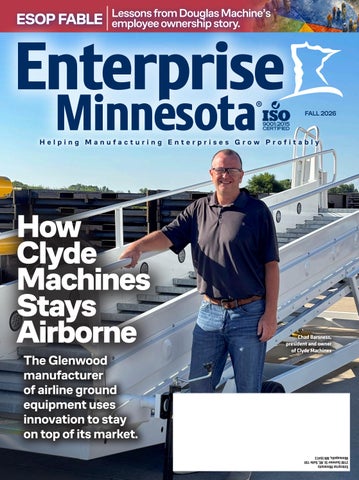
The Glenwood manufacturer of airline ground equipment uses innovation to stay on top of its market.
Chad Barsness, president and owner of Clyde Machines
Enterprise Minnesota 2100 Summer St. NE, Suite 150 Minneapolis, MN 55413
How Clyde Machines Stays Airborne
18
FALL 2026
HOW CLYDE MACHINES STAYS AIRBORNE
The Glenwood manufacturer of airline ground equipment uses innovation to stay on top of its market.
22
26
Building Second Chances
ESOP Fable
At MINNCOR, advanced practices and continuous improvement contribute to better products and processes — and help prepare future employees for a brighter post-incarceration future.
The story of employee ownership at Douglas Machine holds lessons for manufacturers considering exit options.
30
34
Head of the Class
Taking the Initiative
More high schools opt for programs that lead to manufacturing careers.
As they mark 40 years since their founding, the six Minnesota Initiative Foundations remain hyperfocused on building thriving communities in Greater Minnesota.
2
12
14
40
The Work Behind the Numbers
Cash Advance
Rapat Transit
Foreign Trade Zones help Minnesota manufacturers manage cash flow and boost growth.
Business is booming for manufacturer that builds equipment to move massive volumes of material.
Model City
Manufacturing matters.
Alexandria shows what happens when a community and its manufacturers invest in each other for the long haul.
Visit the Enterprise Minnesota website for more details on what’s covered in the magazine at enterpriseminnesota.org. Subscribe to The Weekly Report and Enterprise Minnesota® magazine today! Get updates on the people, companies, and trends that drive Minnesota’s manufacturing community. To subscribe, please visit enterpriseminnesota.org/subscribe. FALL 2026 ENTERPRISE MINNESOTA /
1
Mark R.O’Leary Helping Manufacturing Enterprises Grow Profitably
The Work Behind the Numbers Manufacturing matters.
Mark O’Leary is president and CEO of Enterprise Minnesota.
S
ince joining Enterprise Minnesota in March, I’ve realized that many manufacturers don’t fully understand what our organization does. A large number associate us primarily with this magazine, which publishes outstanding and actionable information and celebrates the accomplishments of the manufacturing industry. But we’re so much more than that. Enterprise Minnesota consists of manufacturing experts who live and work in communities throughout the state. Since 1987, when the Minnesota Legislature created Enterprise Minnesota as a statutory nonprofit, we’ve offered affordable consulting services that help clients boost productivity, sales, and profits. Our consultants walk production floors with clients to offer insight that helps increase productivity. They help leadership teams build strategies that turn a good year into a decade of good years. They help improve talent and leadership development, because a company’s ceiling for growth is usually determined by its people. They also guide manufacturers through ISO 9001:2015 certification, opening doors to customers and supply chains. And they
2
/ ENTERPRISE MINNESOTA FALL 2026
run executive peer councils where leaders compare notes on the headwinds that keep them up at night. Manufacturing fuels economies and strengthens communities across the state. Data from the Minnesota Chamber of Commerce shows that manufacturers employ roughly 320,000 Minnesotans and contribute $46 billion to our gross domestic product, accounting for 12% of economic output. The same report shows that in 2024, the average annual wage for manufacturing jobs in Minnesota was $83,000, 12% higher than the average across all industries. The impact of manufacturing is felt across the state. In five of six regions in Greater Minnesota, and in the Twin Cities metro area, manufacturing was the secondlargest industrial sector. Our mission is to build on that strength — to help companies turn potential into progress and progress into enduring profitability. Over the past five years, we’ve worked alongside 510 manufacturing clients who report that we’ve helped them boost sales by $696 million, invest $289 million, and reduce costs by $131 million. Just as important, they’ve retained or added 6,600 jobs. Consider the return on investment: Our clients report an ROI of at least $15 for every $1 spent on our services. With every company tour I take, employee meeting I attend, or industry gathering I join, I see more clearly what those numbers represent. I see determined ingenuity behind difficult decisions — and how our consultants help manufacturers become more productive, competitive, and resilient. So, yes, Enterprise Minnesota is a great magazine, but only insofar as it represents a team of quality consultants whose cutting-edge expertise helps manufacturers become better prepared to grow through whatever our domestic economy and world markets throw their way.
9001:2015
Publisher Lynn K. Shelton Editorial Director Kate Peterson Creative Director Scott Buchschacher Copy Editor Judy Arginteanu Writers Amanda Dyslin Suzy Frisch Elizabeth Millard Gene Rebeck Mary Lahr Schier Photographers Alex Carroll Robert Lodge Elizabeth Millard Mary Lahr Schier Lynn K. Shelton
Contacts To subscribe or change an address ldapra@enterpriseminnesota.org For back issues, additional magazines, and reprints ldapra@enterpriseminnesota.org 612-455-4202 For permission to copy lynn.shelton@enterpriseminnesota.org 612-455-4215 To make event reservations events@enterpriseminnesota.org 612-455-4239 To advertise or sponsor an event chip.tangen@enterpriseminnesota.org 612-455-4225
Enterprise Minnesota, Inc. 2100 Summer St. NE, Suite 150 Minneapolis, MN 55413 612-373-2900 ©2026 Enterprise Minnesota ISSN#1060-8281. All rights reserved. Reproduction encouraged after obtaining permission from Enterprise Minnesota magazine. Enterprise Minnesota magazine is published by Enterprise Minnesota. 2100 Summer St. NE, Suite 150 Minneapolis, MN 55413 POSTMASTER: Send address changes to Enterprise Minnesota 2100 Summer St. NE, Suite 150 Minneapolis, MN 55413
Printed with soy ink on recycled paper, at least 10% post-consumer waste fiber.
PHOTOGRAPHS BY ROBERT LODGE
I N N OVAT I O N S
Business growth consultant Ryan Steinert leads participants through a lean workshop sponsored by the Initiative Foundation.
CONTINUOUS IMPROVEMENT
Leaning on Lean Partnership enables central Minnesota manufacturers to learn and practice key principles at Lean workshops.
M
any manufacturers turn to continuous improvement and lean manufacturing to operate as efficiently as possible. But small- and mediumsized manufacturers often lack that expertise in house — losing potential for operational gains or a cushion to carry
them through rough times. Enterprise Minnesota and the Little Falls-based Initiative Foundation wanted to change that by offering a workshop for area manufacturers. In early May, the organizations hosted Lean sessions for central Minnesota manufacturers with
fewer than 150 employees. The Initiative Foundation reached out to Enterprise Minnesota to partner on the workshops, aiming to advance its mission to foster thriving economies and communities in its 14-county region, says Donniel Robinson, entrepreneurship programs manager at the Initiative Foundation. “Small manufacturers are very core in our region, and they help with economic stability and provide good-paying jobs,” Robinson says. “Lean principles help small- and mid-sized manufacturers work smarter, not harder. We want to help them improve their bottom line through efficiency.” The Initiative Foundation provided a grant that let manufacturers particiFALL 2026 ENTERPRISE MINNESOTA /
3
I N N OVAT I O N S pate without cost, removing the financial barriers that might prevent small- and medium-sized manufacturers from participating in training opportunities. Robinson teamed up with Andrew Busta, a business development consultant at Enterprise Minnesota, to design the workshop. Together, they created the half-day workshop called Lean Principles in Practice: Lean Fundamentals for the Modern Manufacturer.
Quick hits Enterprise Minnesota and the Initiative Foundation sought to provide information and insight on lean manufacturing that employees could bring back to their companies and implement on the production floor. “We want to get lean into the bones of the organization if it’s not already thinking lean,” Busta says.
Focusing on inefficient processes and waste with production teams gave participants an immediate return on investment. The partners targeted the halfday sessions to production teams, front-line leaders, and supervisors with any level of experience in lean manufacturing. They asked manufacturers to send at least two people to the workshops so employees could work together to put their new knowledge into action, Busta says. All told, nearly 80 people attended. Focusing on inefficient processes and waste with production teams gave participants an immediate return on investment. “Some initiatives that work to increase efficiency have a longer timeline to come into fruition, where this simple and quick workshop sends people home with same-day action items,” Busta says. “Companies can see immediate, palpable results on a day-to-day basis.” That objective came true for Josh “Willy” Willenbring and Nicole Seybert of Create a Legacy, a 128-year-old Little Falls company that makes memorials for indi-
4
/ ENTERPRISE MINNESOTA FALL 2026
viduals, cemeteries, funeral homes, and monument dealers. Seybert and Willenbring attended one of the Lean Principles workshops in the morning. By that afternoon, they were meeting with co-workers to discuss ways to incorporate some of these practices at Create a Legacy. “The workshop was mind-blowing,” says Willenbring, company president, who heard about the opportunity at a meeting of his Enterprise Minnesota Peer Council. “We both had a pile of takeaways. It was a big eye-opener.” They realized the importance of getting employees involved in any continuous improvement initiative, Willenbring says. He saw that a team’s hands-on engagement helps ensure that the changes last. Willenbring and Seybert, who has recently stepped into a role focused on continuous improvement, already had started bringing the company’s lean work in house instead of relying on outside experts. They continue to call on the workshop’s lean concepts as Create a Legacy implements changes. Currently, the team is redesigning its purchasing and inventory processes and remaking its yard to incorporate a more efficient flow of materials.
In the past, the company hired consulting engineers to create a lean plan. The consultants would inform employees how to roll it out without really engaging them. “It caused confrontation and conflict. By the time they left, it just never happened,” Willenbring says. Thanks to the lean workshop, Willenbring and Seybert now see the value of integrating staff in all aspects of lean initiatives. “Having people involved in the process, making suggestions, and having the buy-in from the team helps the solution become more efficient, safe, and productive,” he says.
Concepts in action
Participants complete a simulation to apply lean concepts learned in the workshop.
The workshop’s flexible design allowed manufacturers to send one employee to a morning session and a second person to the afternoon session to prevent production delays. Two sessions were held May 12 in Little Falls, and two were held May 19 in Big Lake, covering as much of the Initiative Foundation’s region as possible. The hands-on events used a simulation format involving Legos to introduce and reinforce lean concepts in an engaging way. Ryan Steinert, a business growth consultant at Enterprise Minnesota, led the workshops. A continuous improvement and lean manufacturing expert, Steinert first taught participants the eight wastes of
Member SIPC
As a business owner, what's most important to you? We’re proud to serve business owners and their unique financial needs. Let’s plan your future together. Rob Stark ChFC®, CEPA®
Financial Advisor
lean manufacturing — including inventory, waiting, defects, and underutilized talent — as well as 5S visual management, quick changeover, and other efficiency practices. Then participants completed three rounds of the simulation to apply the concepts they learned. Called Dots, the simulation involved teams working on assembly lines with Legos. Each participant was assigned a role — team leader, assembler, or material handler — along with work instructions. After an initial round of manufacturing, they assessed results, identifying waste and opportunities to deploy their lean tools, Steinert says. Then it was rinse and repeat, becoming more efficient in the second and third rounds. “We want them to get a good core of lean tools they can use in the future and get them grounded in the idea of seeing waste in their processes,” Steinert says. “Typically, people have some ‘aha!’ moments and come up with ideas or actions that they can apply in their workplace.” At the end of the workshop, facilitators asked the participants to identify how they will tackle waste in their operations and name a lean action they plan to try. Having a partner to work with on the action item was a key reason the sponsors requested that each company send two employees, Busta says. Enterprise Minnesota staff plans to follow-up with participants to check each team’s progress, ensuring the teachings from the workshops stick. “In my experience, if you do training and don’t
The Initiative Foundation provided a grant that let manufacturers participate without cost, removing the financial barriers that might prevent small- and medium-sized manufacturers from participating in training opportunities.
11 Division Street E Suite 400 Buffalo, MN 55313 763-682-1671
> edwardjones.com EFA-22039-A-E-AD AECSPAD 28429254
apply it right away, you lose that knowledge,” Steinert says. “This way, they have an action to take with something they learned, and they can apply those concepts.” Robinson was pleased that the workshops reached a large number of manufacturers with useful and actionable advice. “When we talked about what would be helpful to the community at this time, lean surfaced as a way to help small manufacturers be the best, most efficient manufacturers. We wanted to support their bottom line and help them be stronger manufacturers,” she says. “Ongoing process improvements are a great entry point for small manufacturers.” —Suzy Frisch FALL 2026 ENTERPRISE MINNESOTA /
5
From left: InLine Motion’s Lucas Hoffman, chief financial officer, Tony Friesen, chief operating officer, and Marco Fenu, president and CEO
GROWTH INDUSTRY
Moving Forward Innovation and customer service keep food conveyance manufacturer InLine Motion growing.
F
ood conveyance designer and manufacturer InLine Motion is expecting 2026 to be a stellar year. The Detroit Lakes company is building many of the conveyances and coordinating other vendors for an expansion at health brand Amylu Foods in Chicago. The project will more than double the line’s production of frozen chicken products. InLine Motion is also designing the layout and equipment for the packaging side of a $135 million pork processing and packaging plant in Iowa for multinational JBS Foods. Combined with sales to other food companies, the firm expects to top $7 million in revenue this year as it celebrates its 10th year in business. Not bad for a company that started with two engineers and basically no cash. Founders Marco Fenu, president
6
/ ENTERPRISE MINNESOTA FALL 2026
and CEO, and Lucas Hoffman, chief financial officer, attribute the growth to a “squeaky clean” approach to engineering and design, a laser focus on customer satisfaction, and constant awareness of cash flow. With 15 employees and a 22,000-square-foot facility, the company is close to the growth projections the two hoped to achieve when they started the firm in 2016 — and the potential is much greater. “This could be a $70 million company someday,” Fenu says. The size and stability of the food conveyance industry is one reason for optimism. Building and installing conveyors, platforms, hoppers, and accessories for food processing and packaging is a $1.7 billion-a-year global business today, with compound annual growth rates of 3.5%, according to market research firm Data
Insights Reports. Changes in eating habits, new food safety regulations, and technology advances all require food processors and packagers to improve or replace equipment regularly.
Getting rolling Breaking into the industry was not easy, however. Fenu, 35, and Hoffman, 45, graduated from North Dakota State University in Fargo about 10 years apart. They met when working as mechanical engineers at another food conveyance firm and decided to strike out on their own. While the industry is large, many food processing firms have established connections with conveyance suppliers and are wary of switching vendors. Designbuild companies also require capital to start, something the two young engineers lacked. They were fortunate to get their first job within weeks of starting the firm and often used the cash from one job to fund the materials needed for the next. That’s where squeaky-clean design comes in. Every aspect of food processing requires attention to frequently changing safety regulations. Material selection is limited to stainless steel and a few types of engineered plastic. And because of the constant cleaning required, designs have to consider water
PHOTOGRAPH BY MARY LAHR SCHIER
I N N OVAT I O N S
flow to avoid spreading germs as water pools or oozes behind parts. For its first seven years, InLine Motion’s founders focused on those challenges with impeccable engineering and design while contracting with Neuweg Industries in Milnor, N.D., about two hours away, for laser cutting and machining of parts. “The parts would come in, and Marco and I would put it together, test it, and then go out and install it,” says Hoffman. “We were extremely careful,” says Fenu of how products were engineered. “If anything did not work, it was two extra weeks on the build and a whole bunch of extra money that we needed to pay.”
Exceptional customer service “The first opportunity we get with a customer, typically we get it because they are impressed with our designs or our lead time,” Fenu says. “But the reason somebody comes back is because we went the extra mile to take care of something.” In one case, the (literal) extra mile meant a $1,200 airplane ticket. Fenu and a crew of employees had just finished installing a large conveyance system for a customer. Everything seemed to work well during initial tests, but during an overnight shift, one of the shafts broke, stopping the line. Engineers at InLine Motion figured out how to fix the problem, fabricated the part in Detroit Lakes, then sent an employee, with the shaft in his luggage, to install it. Building a reputation for unmatched service has allowed the company to expand its book of business by one or two companies a year. Its list of customers currently includes food processing giants such as Tyson Foods, Monogram Foods, and JBS. A mix of smaller jobs along with the big ones has allowed the company to manage cash flow and grow steadily.
Next steps As sales increased, the founders hired Tony Friesen, chief operating officer, to manage fabrication, and they brought the welding and assembly in house. In 2022, the firm moved into its current building, with ample space for large projects and state-of-the-art equipment, including a 12 kilowatt fiber laser cutter and a 245-ton CNC press brake.
With excess capacity on both the laser cutter and the press brake, employees can try different designs and work through options in a few hours rather than days or weeks, which has given them more freedom to develop custom equipment. It also has given the company the flexibility to provide some on-the-job training for designers. Two of their four current designers came from the shop floor — one was a laser cutting operator, the other an assembler. “When we have people who we sense can do more, we want to give them a chance,” says Friesen. Among the company’s recent innovations is a line that feeds packages through a conveyor, closes one of the flaps at the top of the box, then automatically lays down a bead of glue, folds in the other flap, and seals it. Other custom
Changes in eating habits, new food safety regulations, and technology advances all require food processors and packagers to improve or replace equipment regularly. projects include a cat-food packaging system that can process and pack up to 1 million cans a day and create variety packs with the push of a button; a fully custom extruder for twisted licorice; and a robotic arm that transfers boxes from one conveyor to another. Having a dedicated, flexible workforce has been essential, since one of the company’s growth goals is a ratio of one employee per $500,000 of billings, says Hoffman. “We have to have efficiency in the shop.” With its team in place, customers returning for more of InLine Motion’s innovative designs, and a sustainable cash management strategy, the company is ready for its next steps. It owns 11 acres around its current plant, so there is plenty of room to grow as the food business expands and changes. —Mary Lahr Schier
Markets waver. Our commitment to you will not. Your business deserves a bank that’s in it for the long haul. With responsive support from your UMB team, you have access to trusted solutions that can flex with you —year after year. UMB.com/Business
Your business goals. Achieved.
MEMBER FDIC
FALL 2026 ENTERPRISE MINNESOTA /
7
Inside Enterprise Minnesota
An ongoing series.
Enterprise Minnesota employees honored at this year’s annual employee recognition event
PHOTOGRAPHS BY LYNN SHELTON
I N N OVAT I O N S
Esteemed Colleague Business growth consultant Amy Thimmesh, described as ‘high-impact, low-ego,’ wins Enterprise Minnesota’s top award for 2026.
P
eers nominate and bestow Enterprise Minnesota’s Esteemed Colleague award, making it one of the organization’s highest honors. Each year it recognizes a colleague who consistently lives out the organization’s core values and delivers exceptional results for clients. This year’s recipient, business growth consultant Amy Thimmesh, embodies those qualities through her deep expertise in manufacturing, steady collaborative approach, and unwavering commitment to clients. “We’re just so pleased to recognize Amy. Her client feedback is incredible, and she is well-respected and well-liked by everyone on the Enterprise Minnesota team,” says Mark O’Leary, president and CEO. “Client feedback shows the meaningful impact she makes.” Thimmesh joined Enterprise Minnesota three years ago after spending much of her career in manufacturing and now specializes in quality management systems, helping manufacturers develop and implement systems that support ISO certification, compliance, and
8
/ ENTERPRISE MINNESOTA FALL 2026
long-term operational improvement. Her philosophy is simple: to build systems that work for companies. “I always tell clients that I want to help them to build a system that works for them, not a system that they have to work,” Thimmesh says. “It’s about getting to know the customer and building something together. We want to tailor it for them while still meeting the requirements of the standard.” That approach has helped her develop strong, lasting relationships with manufacturers across Minnesota. Many of the companies she works with continue working with Enterprise Minnesota after their initial implementation projects through an approach called ISO Sustain. ISO Sustain involves ongoing support through a structured review and coaching program. It focuses on evaluating the effectiveness of the quality management system and its alignment with the organization’s business goals, customer requirements, operational risks, and con-
tinuous improvement initiatives. “I build relationships with my clients,” Thimmesh says. “They’re more than just customers to me.” Thimmesh’s connection to manufacturing began long before her consulting career. Growing up in Garfield, Minn., near Alexandria, she was introduced to manufacturing through her father’s career at 3M. She earned degrees in computer programming and supervisory management before beginning her own manufacturing journey in 1998 at Alexandria Industries, then Alexandria Extrusion, where she spent nearly 24 years. She later worked at Aagard in Alexandria before joining Enterprise Minnesota. Today, Thimmesh says she enjoys the variety of consulting work and the opportunity to connect with people throughout an organization. “I’m never in the same company two days in a row,” she says. “I get to work with people from the production line all the way up to CEOs. It’s fun to see these companies at all different levels.”
Colleagues say her ability to create trust is one of the qualities that sets Thimmesh apart. In one of the nominations, a colleague notes that Thimmesh’s attention to detail and thorough approach give clients confidence that they are building sustainable systems that will support their organizations for years to come. “Amy is a great partner to both clients and colleagues,” the colleague says. “She is responsive, dependable, and always willing to go the extra mile to ensure projects are successful.” Her work has led to repeat engagements, including companies that continue working with her after achieving certification. Client testimonials reflect the impact she makes. “Amy is amazing to work with. She understands what it takes to get you to the finish line,” says Krystal Kotewa of Wiederhoeft Manufacturing in Fairmont. “Not only did she help us to understand the standard and the requirements, but how we adapted that to our business. She
Business growth consultant Amy Thimmesh receives the Esteemed Colleague award from Mark O’Leary, president and CEO.
works with you as if she’s on your team.” Thimmesh’s impact extends beyond individual client projects. Colleagues point to her willingness to step up and support Enterprise Minnesota’s broader work, including leading internal auditor training, supporting business develop-
ment efforts, and helping strengthen the organization’s ISO services. “She is the quiet engine that powers our team’s success and the steady hand that guides our most complex work,” one colleague says. “She is the definition of a high-impact, low-ego colleague.” That description captures a theme repeated throughout the nominations: Thimmesh brings expertise and confidence paired with a deep-seated collaborative attitude. She creates calm in complicated situations, helps teams solve problems, and treats everyone from shop floor employees to CEOs with the same respect. Although she is grateful for the recognition, Thimmesh is quick to share credit with those who have supported her along the way. “It takes a village,” she says. “I didn’t earn this by myself. I needed colleagues to help me, business developers to get contracts signed, and people to train me when I started. There are a lot of people who helped.” —Amanda Dyslin
LEADERS IN manufacturing LENDING
TRUSTED BY BUSINESSES FOR 140 YEARS - VISIT US TODAY! FALL 2026 ENTERPRISE MINNESOTA /
9
I N N OVAT I O N S display, sale, and consumer use. Aagard, founded in 1997, builds the advanced equipment required to complete that process. “Our purpose-built approach certainly sets us apart. We tailor our machines to every unique situation,” says Jason Norlien, vice president of technical sales, noting that Aagard has nearly doubled both its headcount and revenue in the past five years.
Dave Lamb (left), manufacturing manager, leads a tour of Aagard with Mark O’Leary, Enterprise Minnesota president and CEO, Minnesota Sen. Torrey Westrom, and Nicole Fernholz, executive director of the Alexandria Area Economic Development Commission.
TALENT DEVELOPMENT
PHOTOGRAPH BY LYNN SHELTON
Every order is a challenge
Aagard’s Best Creation? Its Workforce. The greatest competitive advantage for a manufacturer of customized equipment for the consumer-packaged goods market lies close to home.
I
n the western Minnesota city of Alexandria, population 14,700, Aagard has built an international manufacturing operation that serves Fortune 500 companies in the booming consumer-packaged goods market. By customizing every piece of equipment it builds and anticipating market shifts to help customers
10
/ ENTERPRISE MINNESOTA FALL 2026
stay ahead of the competition, Aagard is booming too. Ask company leaders what drives its success, and the answer isn’t the machinery. It’s the people. From batteries to guacamole to Peeps, every item that goes into a package gets there through a highly advanced machine that readies the final product for shipping,
Aagard’s work with Energizer demonstrates its highly customized approach. When Walmart asked the battery producer to eliminate all plastic in its packaging, Energizer partnered with Aagard to find a solution. Aagard teamed up with a crew from Energizer — including marketing, sales, engineering, and production specialists — to create a system that meets sustainability demands and improves the consumer experience. The project required a blankslate approach, with partners from Energizer and Aagard rethinking formats, consumer usability, and end-to-end packaging automation. They developed a fully recyclable package that’s easier to open, better at protecting and organizing the product, and optimized for automated production. Aagard’s experience with Energizer shows how shifting trends and consumer sentiment drive demand for new packaging systems. From economic downturns to hot new food trends, these shifts can necessitate entirely new packaging systems. The 2008 economic crisis drove growth at Aagard as consumers cut back on dining out and replaced restaurant spending with packaged food. A similar trend drove sales during the pandemic. “Our food customers couldn’t keep enough food on the shelf, so they were buying automated equipment, even in the middle of the COVID crisis, because they couldn’t keep up with production,” Norlien says. Aagard equipment enables them to make more product in the same amount of time, he says. Smaller trends also drive demand for Aagard’s equipment. “Think about the consumer demand for high-protein foods,” he says. “You wouldn’t believe how many product launches and reformulations there are. Now everybody’s buying Greek yogurt and cheese.” Norlien and his team monitor industry trends, join trade associations, and attend conferences to gauge trends. “We want to be looked at as a strategic vendor, helping educate them versus them coming to us with
what they need, and we give them exactly that,” he says. Those market shifts can occur every two to three years. “Whoever serves that market now needs new or different equipment. They’re seeing their volumes double or triple in just a few years, and they need to automate,” Norlien says. Each piece of customized equipment represents a significant capital expenditure. To make those investments more palatable to customers, Aagard integrates “future-proofing” into design processes. “We have a plan to reconfigure the equipment to accommodate changes, which means they don’t have to spend the money today; but they have a plan, and they know what it will cost, how long it will take, and how they can reutilize as much of the asset as possible,” Norlien says. Customers can also call on Aagard to retrofit equipment to meet changing demands. “We actually do more retrofit projects per year than new machine sales, just because there’s so much equipment out there,” he says.
Building a team Each machine Aagard creates or retrofits requires an extraordinarily talented team to design, build, test, and refine the new system. Of the company’s 300-plus employees, roughly a third are engineers. They work hand-in-hand with the CNC machinists who make the parts, the assembly team that builds the machines, and the technicians who service them. To recruit and retain employees, Aagard builds strong connections within the region. Michele Neale, an independent certified advisor with Enterprise Minnesota, who has decades of expertise in employee engagement and talent development, praises Aagard’s multipronged approach. “They sponsor everything from the new community splash pad to a wing at the high school to programs at Alexandria Technical & Community College,” Neale says. “People in the Alexandria area know the company and want to work there.” Norlien likens the approach to recruiting engineers to baseball’s farm team sys-
tem. “We have robust internship programs and partnerships with colleges. We have dual training grants through the state of Minnesota that we use to give scholarships to some of our interns and get them exposed to the business,” he says. “We have a very high conversion rate of interns to full-time hires.” A key aspect of Aagard’s recruiting success is its focus on local and regional talent. The company partners with colleges and communities where Alexandria feels like a big town, with Target, Fleet Farm, Menards, and the lakes area, Norlien says. Recruits from northern Minnesota, the Dakotas, Iowa, and Nebraska tend to look at Alexandria and see amenities their hometowns don’t have, and “they are likely to be very happy and stay here.” That’s a good thing for Aagard, since the company’s success depends on its people. “Our growth is not constrained by how much we can sell. It’s all about how fast we can recruit, train, and retain key technical talent,” Norlien says. —Kate Peterson
Tired of the Stress and Burden of HR Management? { What would your business look like if your leadership teams had more time to focus on other priorities? }
“We deliver Workforce Solutions that empower supervisors and drive better results for the Manufacturing Industry.” Andy Wills HR Consultant
218.846.8097 awills@proresourceshr.com
Human Resources
Dramatically Reduce Your HR Admin Expenses. Call Today, To Schedule a FREE HR Assessment!
HR Risk Mitigation
Payroll & Compliance
Since 1991
Workers Compensation
Benefits Administration
Wellness & Safety
FALL 2026 ENTERPRISE MINNESOTA /
Human
HR Risk
Payroll &
Workers
Benefits
Wellness
11
I N N OVAT I O N S
INTERNATIONAL TRADE
Cash Advance
Foreign Trade Zones help Minnesota manufacturers manage cash flow and boost growth.
S
hortly after Doug Jackson set up a Foreign Trade Zone (FTZ) at Storm Creek, the Eagan-based apparel company he founded, he made a bold prediction: The company would grow by 40% that year. “We’re going to have more money, so we’re going to grow more,” he remembers thinking.
12
/ ENTERPRISE MINNESOTA FALL 2026
By forming an FTZ, Storm Creek stopped paying import duties the moment goods arrived from overseas and started paying them when the product shipped to a customer, often months later. Money that had been tied up in duties paid up front went into inventory, translating into that growth surge.
“We hit that goal,” Jackson says. “With a new bank line we were able to manage the cost of establishing an FTZ, and that gave us the ability to buy more inventory and go after more business.” Here’s how an FTZ works: Normally, a company pays U.S. import duties as soon as goods cross the border. A Foreign Trade
Zone lets the company set up a secured area inside its own warehouse or plant that the government treats as if it were outside the U.S. Goods can sit there, untaxed, until they leave the zone. If they’re sold to a U.S. customer, the company pays the duty then, not before. If they’re shipped to another country, no U.S. duty is owed.
A Foreign Trade Zone lets the company set up a secured area inside its own warehouse or plant that the government treats as if it were outside the U.S. Goods can sit there, untaxed, until they leave the zone. David Heyer, the Minnesota Department of Employment and Economic Development’s Foreign Trade Zone administrator for the Minneapolis-St. Paul area, says the program is dynamic. The Minneapolis-St. Paul Area FTZ deactivated two zones in 2025 but added four new zones that year. He thinks FTZs could help more importers and manufacturers, especially since 26% of respondents cited duties and tariffs as a top concern in Enterprise Minnesota’s most recent State of Manufacturing® survey.
Deferred tariffs boost cash flow AGCO, an agricultural equipment manufacturer in Jackson, Minn., began operating an FTZ in 2018, says Bradley Dick, the company’s FTZ administrator and materials supervisor. AGCO’s nearly 1,000 employees use an array of international parts to build high-horsepower trac-
tors and application equipment for brands such as Fendt and Massey Ferguson. The lead time to build the equipment means those parts need to be on hand well in advance of production. “We’re looking out 18 months in advance,” Dick says, and deferring duty payment for that period is an enormous boost to cash flow. For companies holding significant inventory, the savings can be significant. Tariffs currently average 35% on Storm Creek’s imports from China and Vietnam. Every $1 million is $350,000 in deferred payment, Jackson says. That’s money that stays in the business instead of going to customs while goods sit unsold. There’s an even bigger advantage when products are ultimately sold outside the U.S. Jackson says Storm Creek often ships orders directly out of his FTZ to Canadian customers. “The goods come in, and they’re in our FTZ,” he says. “So if I get an order from Canada, I can ship it from here and never end up importing the goods into the U.S.” He pays Canadian duties, not the 32% U.S. rate his knit garments would otherwise carry. FTZs also give businesses time to secure buyers, further reducing their need for cash. “You can hold it in your inventory duty-free for as long as you need,” Heyer says. That’s huge for companies that import and stock inventory for annual events like the Fourth of July, Halloween, Christmas, and back-to-school, he says. Heyer cites two other benefits of FTZs. Importers can consolidate multiple inbound shipments into one weekly customs entry, effectively capping the merchandising processing fee at around $634 per week. “For frequent importers, this replaces hundreds of per-shipment fees and saves thousands of dollars annually.” The program also allows manufacturers to avoid customs duties on raw materials that become scrap or waste during production. If you operate outside an FTZ, you pay duties on all imported materials — even the parts that get thrown away. In an FTZ, duties are only paid on the finished goods that actually enter the U.S. market.
Weighing costs The benefits are enormous for certain companies, but setup demands legal work, employee background checks, inventorytracking software, and physical security upgrades, including video monitoring and security fencing with badge-access gates. Items must be delivered to the area by a
bonded carrier. Additional employees, vendors, or both, are often needed to ensure compliance. Dick runs AGCO’s FTZ using software from Thomson Reuters and a brokerage arrangement with UPS. Those hurdles almost kept Storm Creek’s Jackson from forming an FTZ. “Every time I looked into it, I thought we couldn’t afford it,” he says, noting that applying involves volumes of paperwork and requires legal counsel, which is why having that additional line of credit from the bank was necessary to make it possible. Ongoing costs are also significant. Annual fees in the Minneapolis-St. Paul zone run $7,825 for warehousing operations and $15,650 for manufacturers, on top of a one-time $1,000 non-refundable application fee. The real hurdle, though, is discipline. Both Jackson and Dick describe rigorous inventory practices required by the program. Jackson emphasizes that point to his team. He knows that other companies’ FTZs have been shut down because of inventory mismanagement; if that should happen, “we have to come up with a bunch of money right away,” he says.
FTZs also give businesses time to secure buyers, further reducing their need for cash. “You can hold it in your inventory dutyfree for as long as you need,” Heyer says. That added discipline has benefits beyond maintaining compliance. “Our job is to be really good at managing our inventory, which every business owner wants anyway,” Jackson says. Not every importer will benefit enough to offset the costs associated with FTZs. But for manufacturers who hold inventory for months, order ahead of demand, or export internationally, an FTZ can turn a significant cost of doing business into a substantial financing advantage. The question is simple, says Dick: “How long does your inventory sit on the shelf?” If the answer is longer than a few weeks, a Foreign Trade Zone might be worth it. —Kate Peterson FALL 2026 ENTERPRISE MINNESOTA /
13
“Designing and building each system around a customer’s specific needs is our niche in the industry, and it’s an approach that works for us.” –David Kerr, general manager, Rapat Corp.
CUSTOMIZATION
Rapat Transit Business has never been better for a smalltown Minnesota manufacturer that has spent 50 years designing and building equipment to move massive volumes of material.
O
n a short industrial stretch in Hawley, Minn., (pop. 2,300), Rapat Corp. might seem, at first glance, like a standard manufacturer, with offices in front and a warehouse and production floor tucked behind. But that larger building just keeps stretching on and on down the small-town road, with employee cars parked like it’s a parade route. The company utilizes every square foot of that space, and those employees are
14
/ ENTERPRISE MINNESOTA FALL 2026
why it all works, according to Todd Sparrow, Rapat’s president. Down that road, employees are designing and building belt conveyors, bucket elevators, drag conveyors, structural steel trusses, belt feeders, and hoppers for mining and industrial markets. Celebrating its 51st year, Rapat now has 80 employees. What sets the company apart and drives its growth is a focus on custom work — if a customer needs a support tower, ladder, platform, or non-standard
conveyor system, Rapat’s designers and engineers are happy to take on the task. “Designing and building each system around a customer’s specific needs is our niche in the industry, and it’s an approach that works for us,” says David Kerr, general manager. “Rapat handles everything from drafting and design to manufacturing.” Like any manufacturer, the company faces challenges, particularly maintaining a skilled workforce, but Sparrow is looking forward to many more anniversaries. “We’ve established a reputation for continuous innovation, and we make sure to invest in our people and our equipment,” he says. “We’ll keep building on that.”
From blacksmithing to material handling Rapat’s roots extend back to a blacksmith shop in Hitterdal, Minn., in the 1940s, that supplied parts and made repairs for the agriculture industry. In the 1960s, the company was purchased and moved to Hawley
PHOTOGRAPHS BY LYNN SHELTON
I N N OVAT I O N S
by Ray Peschel and Arnold Tingstall (the name Rapat comes from a combination of their names). In 1975, when there were only two employees, Tom Sparrow, Todd’s father, acquired the company, and almost immediately, Rapat pivoted into custom projects and problem-solving when a large grain company needed to move 50-pound bags of seed and fertilizer into trucks, but existing conveyor systems weren’t working. The success around finding a creative solution led Rapat to shift from producing wrought iron railings and standard ag equipment into customized bulk conveying and material handling, Todd Sparrow says. That specialization has fueled growth and allowed the company to build robust, in-house design and manufacturing capabilities. Under the roof of the sprawling building, Rapat employees display a breadth of skills, including engineering, welding, structural steel fabrication, powder coating and sandblasting, assembly, tagging, and logistics.
From left: David Kerr, general manager, Rapat; Mark O’Leary, president and CEO, Enterprise Minnesota; Todd Sparrow, president, Rapat
The company’s long-established operation in Hawley means it’s known as a key employer in the area, and the tight-knit employee community tends to inspire loyalty and low turnover.
walkways — and the customer asked for everything on a “right now” basis. (Fracking sand is a highly specialized quartz sand used in hydraulic fracturing.) It took Rapat just seven months from start to finish, allowing the Texas company to go to market faster than competitors could, and become the largest sand producer within the largest shale play in the country. Not all projects are huge; a malt processing facility in Canada asked Rapat for a way to transfer green malt to a kiln with a standard conveyor, but had very limited space at the location, making off-theshelf equipment unworkable. Rapat created a custom-built conveyor to fit the area, and, because of its length and the need to regularly wash it down, the company opted for a forge-steel chain and stainless steel fabricated enclosure, with access doors for the wash-down process. “Our engineers appreciate a challenge, and they work together to come up with material-handling systems that fit our customers’ requirements,” Kerr says.
Customer stories highlight how Rapat and its workforce understand material-handling challenges and apply their decades of experience to develop tailored solutions. For example, a fracking sand processing facility in Texas needed large conveyor systems along with a drive tower and
Because of its innovative work in the material handling industry, Rapat’s reputation is firmly established, Sparrow says. But being in a rural location and needing such a skilled workforce is tricky, he adds. “We know we’re not alone in competing for employees,” he says. “Added to
Maintaining a deep talent pool
that, like many manufacturers, we have an aging workforce, so we’re looking at numerous retirements in the next few years. In the same way that we’re creative with our projects, we have to be that way with recruiting as well.” Rapat is using several workforce-attraction tactics, including investment in training and skill development so employees can advance within the company in a number of roles, including project management and engineering. The company has established relationships with local high schools and technical colleges as well, says Sparrow. Rapat’s leaders also use its location as a retention tool. The company’s long-established operation in Hawley means it’s known as a key employer in the area, and the tight-knit employee community tends to inspire loyalty and low turnover. As the company continues to address challenges from large and small customers across the U.S. and world, Rapat will stay committed to building the best workforce it can and developing employees at every level. “There’s a reason some people have been working here for decades,” Sparrow says. “There’s an emphasis on making sure everyone at this company, no matter what they do, feels that their job is important, that they’re solving problems and supporting one another along the way.” —Elizabeth Millard FALL 2026 ENTERPRISE MINNESOTA /
15
I N N OVAT I O N S
Four Questions John Bolanda, training specialist, Metal Craft & Riverside
H
John Bolanda sees manufacturing from two angles. A training specialist at custom precision manufacturing and engineering company Metal Craft & Riverside, Bolanda has decades of experience in manufacturing, first as a machinist and then in quality. (Metal Craft is in Elk River and Riverside is in Eau Claire, Wisc.) He also teaches quality and inspection courses at Anoka Technical College. Active in Elk River schools’ career and technical education (CTE) program and on the advisory committee that connects employers with students, Bolanda believes the industry could be a great source of instructors when technical programs are shorthanded.
16
/ ENTERPRISE MINNESOTA FALL 2026
Is there a shortage of instructors for technical programs, and does it limit how many students can enter the field? Absolutely, and it’s a real problem. At the collegiate level, instructors are stretched thin, and everybody is trying to figure out how to help students who come with all kinds of challenges. One of my students can’t return because she needs to work more hours to send money home to her family. Those are the realities instructors navigate. At the high school level, not every school in the Elk River district has a machine shop. And the teachers who
PHOTOGRAPH BY ALEX CARROLL
ow did you become an instructor at Anoka Technical College? I was a machinist for many years, and after I went back to North Hennepin Technical College to learn inspection, the dean wanted to offer me a teaching position because of how I helped my fellow students. But I didn’t have the credentials the state required, so they couldn’t make the offer. Fast-forward to Metal Craft & Riverside, where I’ve been since 2011 in a variety of quality roles. Through our involvement in the Elk River school district’s CTE program, I met Matt Rogers, a machining instructor at Anoka Technical College, who had started a quality technician program five years ago. He didn’t have enough time to teach all the credits himself and asked if I’d like to help out part time in the evening. There was no course to teach me how to build a syllabus or create tests, so I spent extra time with Matt to understand those things and basically learned on the job. The state has standards for how instructors qualify, and with 16 years in quality and another 15 as a machinist, but no college degree, it took a while for them to figure out where I fit. But we got there.
run those programs are stretched pretty thin, too. But there are a lot of people in manufacturing, and I see them every day at Metal Craft & Riverside, who have the knowledge and the passion to be excellent instructors. They just don’t know it, and the pathway to get them into a classroom isn’t clear. I’d love to see the industry figure out a way to get those people teaching. What does demand look like for graduates, and how can employers stand out as they search for qualified workers? We have 100% placement right now, and I don’t see that changing. Employers show up toward the end of the semester looking for quality technicians, and I have to tell them they should have been here a year and a half ago, because other companies have already hired these students. This spring, a recruiter from Los Alamos National Laboratory came up because he couldn’t find a diploma-based quality technician program anywhere else in the country. He offered jobs on the spot to all
five of my graduating students. With a security clearance, they could be earning six figures within a year. Closer to home, Metal Craft & Riverside have hired 38 new employees since last summer and still have 15 openings, including some entry-level positions. The pipeline simply isn’t keeping up. Manufacturing is the second-largest contributor to Minnesota’s economy. Quality, in particular, tends to be an afterthought. Companies will move someone off the production floor into inspection, and it usually doesn’t work well. You wear a different hat in quality. You have to know how to say, “This part doesn’t meet spec” and still maintain a good working relationship with the person who made it. That takes training and real-world practice. Why do careers in manufacturing make sense for the next-gen workforce? When I bring high school students into Metal Craft & Riverside through the CTE program, they are little spong-
es. They’re committed and eager to learn. I have one young man who did a “cool jobs” tour here as an eighthgrader, met our recruiter, kept her card all through high school, and is now a college intern studying mechanical engineering]. He’s been with us six years and is already coming up with ideas I never would have thought of. What we teach is also AI-resistant. You still have to operate equipment, analyze results, and interface with engineers and machinists. Those interpersonal skills aren’t going away. And the industries we serve, medical devices and aerospace, aren’t going away either. People will always need spine surgery and knee replacements. Defense systems will always need to be built and maintained. I tell every student: When you find work where you look at the clock and think “I need four more hours” instead of “I have four more hours left,” you’ll know you’ve found the right path. Manufacturing can be that for a lot of people. We just need more of them to find out.
A LEGACY OF TRUSTED ACCOUNTING & CONSULTING Olsen Thielen has many decades of experience in partnering with Minnesota manufacturers to provide accounting and proactive advisory consulting. With an emphasis on client-first service, detailed and customized financial advice, and expertise across many different specialty areas, Olsen Thielen is committed to helping you operate your business more efficiently.
Our Manufacturing & Distribution services include: Proactive tax planning
Business valuations
Financial statement audits, reviews, or compilations
Retirement plans and employee benefits
Internal control assessments and analysis
Ownership succession and exit planning
Research and development credits
Mergers and acquisitions
Cost and budgeting analysis, forecasting Inventory pricing
Fraud and forensic accounting
PARTNER WITH OLSEN THIELEN’S TRUSTED ACCOUNTING EXPERTS AND EMPOWER YOUR BUSINESS TODAY
FALL 2026 ENTERPRISE MINNESOTA /
17
Chad Barsness, president and owner of Clyde Machines
D I V E R S I F I C AT I O N
How Clyde Machines Stays Airborne BY GENE REBECK
The Glenwood manufacturer of airline ground equipment uses innovation to stay on top of its market. 18
/ ENTERPRISE MINNESOTA FALL 2026
that operate their own aircraft, along with specialists such as Swissport and dnata that provide ground-handling services to commercial carriers. But when the new building was finished, the company’s high-flying ambitions suddenly plummeted. “As we all know, COVID was coming in hot,” Barsness says. It was a turbulent time for most businesses. For Clyde Machines, the pandemic could have grounded its operations, perhaps for good. “We’re in the airline industry. All our customers put their orders on hold or canceled them because they were all grounded. And I had a shiny new monthly payment — and no work.” Barsness found himself wishing all his company’s revenue eggs weren’t in one basket. “But we made it through,” he says. “Amazon was one of our big customers through that time, and they were growing like crazy because everyone was shopping from home.” Shipping and logistics company DHL also gave Clyde Machines a large order in support of Amazon. “I knew that was going to buy us enough time to figure out what was going to be next. “Then the faucet turned back on, and we were way busier than we were preCOVID.” Since 2008, Clyde Machines has experienced 971% growth in sales, according to Barsness. Still, Barsness thinks it essential that his company develop a diversification strategy that emphasizes the company’s many strong selling points as it pursues new types of customers. Those selling points are rooted in the company’s commitment to technological innovation.
Tech-driven productivity gains
I
t was February 2020, and Glenwoodbased Clyde Machines had just completed construction of a new 100,000-square-foot manufacturing facility. When drawing up plans for the new building that would double the size of its operations, the company had desperately needed the additional space. “We were working on top of each other in the old building,” owner and president Chad Barsness recalls. Clyde Machines’ business was flying high. Since its founding in 1961, it had become one of the world’s largest manufacturers of ground support equipment for commercial airlines across the globe. Clyde’s customers also include freight shippers such as Amazon, FedEx, and DHL
A one-stop shop for airlines, Clyde Machines manufactures aircraft towbars, pallet and container trailers, baggage carts, passenger stairs, and maintenance stands. The manufacturer competes with about eight companies in the U.S. and Canada, but, Barsness says, “Many of them do just one product line. We make everything.” There’s an even bigger reason Clyde dominates its market: “All the technology in our buildings to produce what we produce,” Barsness says. “That’s driven our costs down — which is always attractive to a customer — while maintaining and improving our quality.” Barsness became driven to make Clyde Machines’ products more cost-competitive in 2008, when he took over the company’s sales department. Before then, he had worked on the shop floor and was familiar
with all the operations. “I knew we had to produce things more efficiently to be cost-competitive,” Barsness says. Optimizing manufacturing processes “would make my sales job easier. So I was a little bit selfish,” he adds with a chuckle. He started by pushing for production technology in the machining department. The company bought a CNC vertical mill and several CNC lathes. “One of our big steps was our first CNC high-def plasma cutting table,” Barsness says. “That really changed how engineering was able to design components and products.” Clyde would later replace the table with fiber lasers, with even more accuracy and speed. About four years ago, Clyde Machines acquired a fiber tube laser cutting machine, which has been “another game changer for engineering,” Barsness says. “The welding department loves it just as much as fabrication does because the fit-up is perfect.” Fit-up refers to alignment and positioning of metal components before final welding or joining. With the fiber tube laser’s multiple operational axes, employees can create precise cuts, complex contours, and bevels in metal tubes and pipes. Barsness soon saw that the machine had an even bigger impact than he first anticipated. “I was hoping for six times faster than our current processes. We ended up at 18 times faster for parts coming off that machine.” More recently, Clyde added robotic bending, which can run overnight without human supervision; it also acquired a CNC tube bender. Because of their speed and precision, each item “changes the whole game in all our hand railings and maintenance stands,” as well as for other products, Barsness says. Production technology isn’t the only way Clyde Machines has made itself more efficient. As the company grew, founder Clyde Olson (Barsness’ grandfather) and the family members who succeeded him added on to the original Glenwood facility, ultimately totaling about 100,000 square feet. Even so, by the late 2010s, the company realized it needed that second building. But the new building provided more than extra square footage. “We gained major efficiencies through the layout of the new space,” Barsness says. For instance, “we were able to automate our paint line. We designed that with the building so that the structure in the ceiling carries the entire weight of the paint line.” That means there are no additional support beams disrupting the workflow on the floor. The newer building houses the welding, painting, and assembly departments. The FALL 2026 ENTERPRISE MINNESOTA /
19
Rural site, global reach The company’s strategic approach to automation and efficiency keeps Clyde Machines at the forefront of its industry. It has also allowed the company to overcome what Barsness calls its biggest challenge: “world events,” particularly 9/11 and COVID. “They’re a challenge for everybody,” he acknowledges. “The whole country suffers together.” Still, global disruptions hit airlines especially hard — think of the spike in the cost of aviation fuel resulting from the Strait of Hormuz crisis. Clyde Machines’ rural location has not created any difficulties as it serves a global market. “Our customers are in the travel business, so it doesn’t faze them to come for a visit,” Barsness says. “They come to our factory, and they say, ‘Wow, this is modern.’ It’s way nicer than they expect. I get that all the time.” Nor does shipping pose a problem. Clyde Machines trucks out its products on flatbeds or in shipping containers, which the company loads at its Glenwood campus. Trucks then transport the shipments to rail yards and on to coastal multimodal ports. In other words, there’s no need to uproot Clyde Machines from Glenwood, a town of about 2,600 a couple of hours northwest of the Twin Cities. Before Clyde Olson launched Clyde Machines, he was an engineer for Melroe Manufacturing, which originally produced the Bobcat skid-steer loader. Olson would take Highway 55 for business trips from Melroe’s headquarters
20
/ ENTERPRISE MINNESOTA FALL 2026
PHOTOGRAPH BY LYNN SHELTON
old building houses the machining, fabrication, and shipping and receiving departments. In pursuing automation strategies for the various operations, “I always try to find the jobs that aren’t glamorous — jobs that are repetitious,” Barsness says. “Those are the easiest to automate.” Case in point: “Not a lot of people love sandblasting. We have robots in the sandblast booth in the new building that completely automate that whole process.” To Steve Haarstad, a business growth consultant with Enterprise Minnesota specializing in strategic planning and revenue growth, Clyde Machines’ strategy makes perfect sense. Automation, as Clyde Machines’ experience demonstrates, opens up numerous opportunities, he says. It “can allow manufacturers to make their products fully in house, without having to use outside vendors as part of that manufacturing process. They can produce a part or product in a much shorter time. It’s a huge process improvement. It also maximizes the profitability of producing that item.”
in Gwinner, N.D., into the Twin Cities, and he found himself falling in love with the Glenwood area. When he decided to start his own company, he knew Glenwood was just the place to do it. Olson timed the start and the location of his entrepreneurial endeavor just about perfectly. His new company tapped into two industries that were booming in the region in the early 1960s. For rural utilities, Clyde Machines manufactured a hydraulic attachment for trucks that tamped down soil after insertion of power poles. And it made equipment for the agriculture sector, including transport vehicles for farmers’ grain drills. Clyde Machines might have continued down this profitable but earthbound path had it not been for a chance meeting. While flying on a business trip in the mid-1960s, Olson met a Northwest Airlines executive. They fell into conversation, and the executive told Olson that Northwest needed stands for servicing new jet engines. Olson designed and built one — and “that part of the business took off like crazy,” Barsness says. In time, the hydraulic tamper and agricultural business lines disappeared, with Clyde Machines focusing on airline ground equipment. (A tiny part of Clyde’s revenue still comes from machine-shop work it performs for companies in and around Glenwood.) Olson died before Barsness was born. After his passing in 1971, his daughters (including Barsness’ mother) ran the company. Barsness began working for Clyde Machines in 1995 and became the sales manager in 2008. Ten years later, he became the company’s president and owner. Barsness credits the enormous growth in sales over the past 18 years to outstanding employees, as well as manufacturing process improvements. “We have an amazing team that we’ve worked hard to assemble,” he says. “All our supervisors are home-
grown.” What’s more, they’re all in their mid-30s to early 40s. They’ve grown with the company, and they’re young enough so “they will be with us for a long time.”
‘We’ll continue to innovate’ Barsness certainly doesn’t need to replace his durable customer base. But he does want to be prepared should world events put Clyde Machines at risk of crashing. Though COVID didn’t sicken his company, it provided enough of a scare to push Barsness into exploring diversification. The problem: “It takes months and even years to crack into other industries, not days and weeks when you really need it,” he says. “And it’s hard to focus on that when we’re record-breaking busy like we are now.” Especially if the profit margins of a new market might not be as high. Still, Barsness and his team carved out time to pursue a foray into a potentially lucrative new market: the trucking industry. “A lot of our products are very similar,” he says. “To work on an aircraft, you need a maintenance platform. To work on a reefer [refrigerated truck], you need the same type of platforms and safety stands.” For trucking applications, Clyde needs to engineer some significant modifications, but the components and materials are very similar. “We wouldn’t have to retool anything. It’s just a matter of different shapes and sizes.” To give some sense of the potential: In 2025, the U.S. trucking industry generated $940 billion in revenue. That’s not far behind the $1 trillion that the global airline sector posted. Barsness believes that trucking could become an even larger market than aviation for the types of equipment Clyde Machine manufactures. As part of its effort to enter this new market, Clyde has been working with one
of its vendors that also supplies the trucking industry. “We’ve given them lots of prototypes,” Barsness says. “And it sounds like there’s some excitement in that world.” One of his company’s selling points, Barsness says, “is the durability of our products. They have to be super-robust because they have to be on the ramp of the aircraft.” Those products are more expensive than most of what is available to truckers, but Barsness believes that Clyde’s equipment is safer and sturdier. “We’ve had a few sales,” he says. “But we’re at the infant stage of laying this out.” Whatever opportunities and changes the future brings, Barsness says the company will continue to innovate and automate wherever possible. One of the drivers is that Barsness is a big proponent of doing things in-house — “controlling our destiny as much as possible.” Some outside vendors are absolutely crucial, such as suppliers of tires and castors. But there are other types of equipment on Barsness’ wish list that he sees as crucial to improving quality and efficiency. “I’d like to get more into robotic painting,” Barsness says. “I’m just trying to be patient and waiting for AI to catch up to that industry so that the programming isn’t so heavily dependent upon humans to program the different components that are coming through.” He foresees a future where “you’ll be able to scan a part on the paint line and AI will figure out the best tool path for the paint gun to coat that part.” He says this is being done on a small scale right now. “I need it to be done on an automobile-size scale. But that’s just a matter of time.” Mention AI and many people conjure images of pink slips. But Barsness says his employees are “just as excited as I am when we bring a new piece of equipment into the building.” That’s because these technology innovations automate the boring, repetitive jobs, he says. “We still need goodquality employees, but they’re able to use their brains more than their brawn.” In fact, the number of employees hasn’t changed all that much. Clyde’s headcount is currently 116, compared to 136 pre-COVID. “But we’re probably getting 30 to 40% more out the door,” Barsness says. “We have openings now that we’re trying to fill on assembly. It’s hard to automate assembly on a short-run scale.” Barsness will keep looking for places where Clyde Machines can both boost production and trim costs — and keep flying high.
MEMBER FDIC
Let’s Drive Your Business Forward. Where Relationships Drive Results.™ Visit oldnational.com/commercial to connect.
A TO P 25 BANK 1 M A NU FACT U RING EXPERT ISE LOCAL FINANCING D ECISIO NS
1 Top 25 largest bank in the United States. Pro-forma results as of May 6, 2026.
Thinking about Automation?
We Can Help.
Productivity delivers cutting-edge industrial automation and robotics solutions designed to boost manufacturing efficiency, eliminate production bottlenecks, and reduce operational downtime. By seamlessly integrating advanced robotic systems into existing workflows, we empower shops to optimize consistency, scale capacity, and confidently transition toward “lights-out” manufacturing.
CONTACT US TODAY MINNESOTA
IOWA
NEBRASKA
UTAH
COLORADO
TEXAS
NEW MEXICO
763.476.8600
319.734.3403
402.330.2323
801.886.2221
303.571.4933
972.231.2802
505.883.9363
FALL 2026 ENTERPRISE MINNESOTA /
21
WORKFORCE TRAINING
BUILDING SECOND CHANCES
BY ELIZABETH MILLARD
At MINNCOR, advanced practices and continuous improvement contribute to better products and processes — and help prepare future employees for a brighter postincarceration future. 22
/ ENTERPRISE MINNESOTA FALL 2026
PHOTOGRAPHS BY ELIZABETH MILLARD
M
uch like thousands of manufacturing employees across Minnesota, Brad makes sure he gets to work in time to set up his workstation, gather materials, assess production goals, and chat with coworkers about the day’s tasks before he begins production — in his case, making blankets for the military. “I’ve learned about how materials stretch and move, and the need to be precise when working with them,” he says. “More than that, I’ve become more patient and knowledgeable, and I think with the skills I’ve developed from this job, I have the confidence that I can go anywhere and do good work when I leave.” The difference between Brad and other manufacturing employees is that he’s not considering quitting or switching companies — instead, he’s thinking about what he’ll do after he’s released, since he’s an incarcerated person (IP) at Moose Lake Correctional Facility, a medium-security prison.
“More than that, I’ve become more patient and knowledgeable, and I think with the skills I’ve developed from this job, I have the confidence that I can go anywhere and do good work when I leave.” –Brad, MINNCOR employee, Moose Lake Correctional Facility
His work is part of MINNCOR, a program of the Minnesota Department of Corrections (DOC), which employs IPs in six facilities to manufacture a breadth of goods, from custom cabinetry and print materials to license plates, clothing including high-visibility safety wear, custodial products, docks, and even mattresses and pillows. Although, much like any manufacturer, MINNCOR is adapting to market changes — through continuous improvement in processes, expansion of training opportunities, and investment in innovative technology — the mission statement of “Transforming lives for a safer Minnesota” conveys its deeper focus to reduce recidivism by
creating pathways to post-incarceration employment. Here are some key facts about the program.
An enduring mission MINNCOR officially began in 1994, when the DOC consolidated and centralized its individual facility programs into a single statewide entity. But the state’s correctional facilities have operated industrial programs since the late 19th century, beginning with manufacturing twine at
The numbers back that up: The national rate for recidivism is 24.2% for those working in correctional industries like MINNCOR, compared with 40% for the average incarcerated person. A significant factor that accounts for this difference is employment that gives a sense of purpose, says Taly — and the majority of former IPs do join the workforce after MINNCOR experience. A report from the Minnesota Department of Management and Budget on adult criminal justice
Jack Taly, who retired in June after serving as vice president of business development for MINNCOR, shows license plates manufactured at a Minnesota corrections facility.
Stillwater state correctional facility. Over time, that initial endeavor expanded into numerous trades, including woodworking, textiles, printing, carpentry, and assembly. Although these efforts help IPs pass time productively, the drive toward transformation has always been the foundation of MINNCOR, according to Jack Taly, who was an account manager and then vice president of business development for MINNCOR for 20 years before retiring this past June. “Our mission isn’t to make widgets or to provide products and services — those are simply the outcome and output of what we’re really doing,” he says. “We’re helping IPs develop skills that make them employable, so that when they’re released, they have better opportunities. That greatly reduces recidivism, and it adds to our state’s workforce in a meaningful way.”
found that nearly 70% of those leaving MINNCOR found employment within three months after release.
Investing in up-to-date skills MINNCOR understands that technology and innovation are driving today’s manufacturing and production processes, which is why there’s strong investment in precision equipment and continuous improvement. For example, the textiles floor at Moose Lake doesn’t rely on IPs to measure and cut fabrics, which would be time-consuming and could result in unnecessary waste if measurements are imprecise. Instead, a state-of-the-art intelligent machine is given instructions on which products are needed, and, after creating a plan, uses lasers to make the cuts. On another part of the floor, IPs are FALL 2026 ENTERPRISE MINNESOTA /
23
designing signage, brochures, and other printed materials using advanced technology that could be found in any high-end design and production firm. Across the way, the facility has a warehouse space used to fill canteen orders (a store at the facility where IPs purchase goods like snacks, electronics, hygiene products, and art materials) from Moose Lake and other correctional locations, and IPs there rely on an automated system that helps them sort and manage orders quickly. Down the hall, there’s a training space with a bank of computer stations, where IPs can learn skills to land jobs in network cabling, including satellite and ethernet installation. Outside the main building, there’s the education department’s tiny-home program — an initiative that trains IPs in carpentry, contracting, and installation of electrical, solar, and geothermal systems. While hands-on construction of tiny homes is not part of MINNCOR, programs such as these provide industry-recognized training that connects classroom instruction with meaningful work experience. An IP who completes all seven certifications available in the program will be a valuable addition to any construction crew or could become a contractor on their own, says Kris Rish, warden at Moose Lake.
The national rate for recidivism is 24.2% for those working in correctional industries like MINNCOR, compared with 40% for the average incarcerated person. “There are just under 200 IPs working here, and they do an amazing job,” she says. “More than that, they’re learning skills that transfer to any workplace, such as punctuality, quality control, collaboration, and problem-solving.”
Involved at every level Although IPs do some assembly work, there’s a misconception that MINNCOR is simply a factory-style endeavor, says Taly, adding that many people still tend to think of IPs stamping out license plates. They do make those plates — but they also have a part in designing them. They experience numerous levels of responsibility, including estimating, proj-
24
/ ENTERPRISE MINNESOTA FALL 2026
“We’re helping [incarcerated persons] develop skills that make them employable, so that when they’re released, they have better opportunities. That greatly reduces recidivism, and it adds to our state’s workforce in a meaningful way.” –Jack Taly, former vice president of business development, MINNCOR
ect management, marketing, production optimization, and more. “When I decided to apply for the printing shop here, I didn’t have experience in any of the technology needed to design materials,” says Ronald, an IP who’s been working for MINNCOR since 2022. “I thought it would just be something new to learn and a way to keep from getting bored. But it’s given me so much more than I would have thought.” He’s developed technology skills but also feels a sense of teamwork and camaraderie, he says. He now feels more proficient in troubleshooting and being more inventive in finding solutions to printing challenges. “When I walk out of the print shop every day, I’m just bursting with creativity from what I’ve accomplished,” he says. That’s led him to learn to play the violin, write a novel, and work on poetry, essays, and a screenplay. “It doesn’t seem like my work here would be connected to those efforts, but it really is, because it’s about keeping my mind busy and thinking
in new ways.” Another common misconception is that every IP in a correctional facility is expected to work, which means jobs are mandatory, says Taly. In fact, both the skillstraining tracks and the jobs are competitive, requiring applications and interviews, just like any job. Career-focused education and workforce training programs continue to generate significant interest among incarcerated persons. For example, the program for network cabling and installation has nearly 500 IPs on the waiting list for training — in part, because work is nearly guaranteed once they’re released. That program has 24 company partners that hire directly, with an 87% job placement rate. Spots in the other programs also fill quickly, providing incentive for IPs who didn’t graduate from high school to complete their GEDs, since it’s a requirement to apply, says Rish. MINNCOR also supports employment opportunities after IPs are released, with job fairs that bring together former IPs and
employers. This past February, MINNCOR and the DOC hosted their second Fair Chance Reentry Job Fair at MINNCOR headquarters in Roseville, with 366 job seekers and 19 employers attending. Jobseekers also could receive one-onone coaching from volunteers on how to discuss their background and interview for open positions. “This is an excellent example of how we play a role in supporting a skilled workforce in Minnesota,” says Taly. “Many IPs who do work for MINNCOR come out of their sentences feeling motivated and empowered, with training and experience that is valued by employers. That benefits everyone.”
No taxpayer funding Another common misconception is about use of taxpayer funds for these programs, including IP training, according to Paul Schnell, commissioner of the Minnesota DOC. However, while the DOC itself is funded by the state Legislature with taxpayer money, MINNCOR is a fully self-supporting enterprise with no public funding, he says. Revenue is generated through the products and services it sells, both to state agencies such as the Department of Transportation and the Department of Natural Resources, as well as to private businesses.
The program for network cabling and installation has nearly 500 IPs on the waiting list for training — in part, because work is nearly guaranteed once they’re released. That program has 24 company partners that hire directly, with an 87% job placement rate. MINNCOR uses the revenue to purchase the technologically advanced machines and pay the wages for IPs, Schnell adds. “In addition to that, you have people who are engaged in what they’re doing every day. We have to understand the reality here; prisons are tough environments. It’s very easy for IPs to become demoralized.” MINNCOR has been financially self-
sufficient since 2003, and any cash reserves go toward education and reentry programs, along with investments in more hightech equipment. MINNCOR also supports the state’s economy by spending more than $19 million a year for raw materials, goods, and services from Minnesota businesses, Taly says. In terms of indirect financial benefits, he notes that MINNCOR reduces the taxpayer cost of incarceration by offsetting the need for more IP supervision and alternate programs to keep IPs engaged every day. Like many correctional programs across the country, MINNCOR faces criticism of IP wages, and the ethics of prison labor in general. Schnell expects this conversation will continue for the foreseeable future. The notion that IPs are making almost nothing and being exploited for their labor is the No. 1 misperception about IP work at correctional facilities, Schnell says. “But that simply isn’t true,” he says. “It’s essential to recognize that MINNCOR needs to remain self-supporting, and while wages are on the lower side, there are other benefits to IPs here, including training and job placement services.” Another vital point, Taly adds, is that MINNCOR doesn’t set the wages for IPs; state and federal laws mandate IP pay. “When people are working and feel part of a community, that benefits all of us, because they are much less likely to reoffend,” says Schnell.
Ready for more expansion Although MINNCOR has evolved considerably since its founding, ongoing reinvest-
ment and numerous success stories are fueling more growth. Taly says that areas likely to expand include more industry certifications that will further improve IP employability and increased employer partnerships that can strengthen the releaseto-employment pipeline already in place. Another strong focus will be on keeping up with technological shifts in equipment, so IPs leave knowing the latest machinery, including automation, digital inventory systems, and advanced production technology. As workforce shortages continue to be a concern across Minnesota, particularly in manufacturing, correctional work programs like MINNCOR may become a model for training and experience development. More than that, the program helps IPs develop “soft skills” like accountability, leadership, responsibility, and confidence that reduce the likelihood of recidivism, while also making correctional facilities safer by reducing idleness and promoting a positive work ethic. These outcomes are an advantage for everyone — not only the IPs who participate, but also employers, taxpayers, and communities, Schnell suggests. Because of that, MINNCOR’s most important product may not be the neon vests highway workers wear or the IPproduced license plates on thousands of Minnesota vehicles — it’s in the second chances for people like Brad and Ronald, who come to their workstations every weekday, eager to learn more and do more. “Coming here and doing good work has given me much more confidence about what I can accomplish,” says Brad. “Every day, I feel like I learn something new, both about my specific job, and about myself.” FALL 2026 ENTERPRISE MINNESOTA /
25
E M P L OY E E O W N E R S H I P
ESOP Fable
The story of employee ownership at Douglas Machine holds lessons for manufacturers considering exit options.
T
om Wosepka has spent his career in three very different kinds of companies: a large publicly traded corporation, a large privately held one, and now, for more than two decades, an employee-owned manufacturer in Alexandria, Minn. Of the three, he says employee ownership stands out. “It’s been very rewarding to see, literally, how lives have been changed by our ownership
26
/ ENTERPRISE MINNESOTA FALL 2026
structure,” says Wosepka, the CFO and CEO of Douglas Machine, which designs and manufactures packaging equipment for major food and beverage companies. It’s also been good business. Douglas has been 100% employee owned through its ESOP (employee stock ownership plan) since 2007. Wosepka says the company’s revenue has grown seven to eight times over that period. That expansion has meant steady jobs and, for many
BY KATE PETERSON
longtime employees, a level of retirement wealth unusual for manufacturing workers. Because company employees live in Alexandria, it’s wealth that has largely stayed in the community rather than flowing to owners elsewhere. Wosepka is quick to caution that solid company performance is a key part of the success equation. “ESOPs aren’t a magic bullet,” he says. Plenty of employee-owned companies struggle, and some fail outright.
A company still has to take care of its customers, maintain quality standards, innovate, and operate efficiently, regardless of structure. But Wosepka says that at Douglas, reaching those goals has been easier because the company is built around employee ownership. The story of Douglas and what its ESOP culture has meant for the people who work there and for the community they live in offers a window into an ownership model more manufacturers are starting to consider.
Succession planning Kirsten Kennedy, executive director of the Minnesota Center for Employee Ownership, estimates that more than 52,000 business owners in the state are over age 62 and facing decisions about what happens to their companies next. Most, she says, don’t know about the ESOP option, despite its substantial tax advantages and the ability to keep the company locally owned. ESOPs are federally regulated corporate structures that allow business owners an avenue to sell part or all of a company to employees, often with significant tax advantages. An ESOP is a separate entity that typically takes out a loan to purchase the company. As the loan is paid down with company profits, shares are allocated to individual employee accounts. Wosepka explains that with a 401(k), employees can contribute their own dollars, but with the ESOP, “you can’t buy shares, you can only have them given to you.” The employees’ stake in the company grows as they accumulate more shares and as the value of the company rises. When they retire or leave the company, the company buys back the employees’ shares, with the proceeds typically rolled into a retirement account held by the employee. The appeal of ESOPs as a succession planning option often comes down to legacy. Charlie Sparks, a CPA at Olsen Thielen who works with ESOP transactions, says owners selling to an ESOP tend to have more confidence that the business will continue operating in something like its current form, with its existing culture and its commitment to the community, than owners who sell to a larger outside company. “The business will live on in their image beyond their years of ownership,” Sparks says. In a sale to a large conglomerate, the buyer “folds you under their model.” At Douglas, the path to employee ownership didn’t begin with a retiring founder looking for a legacy-minded exit. The
company was sold to a British publicly traded firm in the mid-1980s, then bought back, roughly 75 percent by a private equity firm and 25 percent by company management. Then the private equity investor looked for its own exit, which private equity firms almost always do, Wosepka says. For Douglas, which moved to full ESOP ownership over a few years, the goal was to regain control of the company. Owners don’t have to choose between full control and a full sale. Sparks says partial or gradual ESOP transactions are far from rare. The gradual approach allows an owner to test the model while still holding on to some control and still receiving a portion of available tax advantages. The first step for any owner considering the option, according to Kennedy, is one many haven’t taken: a proper business valuation. She estimates that 80% of the owners she works with haven’t had one done in the past five years. In her view, that’s the most critical piece of information for owners determining whether an ESOP is a viable option.
Tax advantages Beyond succession planning, the tax structure of an ESOP sale is often what makes it an attractive option for both the seller and for the employee-owned company moving forward. If an owner files as a C corporation and then sells to an ESOP, Sparks says a provision known as a Section 1042 rollover can defer, or in some cases eliminate, the tax owed on the gain from the sale, depending on how the deal is structured. After the sale, the ESOP-owned company has an even greater tax advantage, Sparks says. Taxes on profits are exempted based on the proportion of the company owned by the ESOP. So an ESOP that owns 60% of a company as a pass-through entity pays no tax on 60% of its profits. Corporate structure matters, though, Sparks cautions, noting that a C corp owned by an ESOP would still be subject to income tax. Kennedy credits that freed-up capital with fueling substantial expansion at other Minnesota ESOP companies, citing Plastic Products Company, with operations in Lindstrom and Princeton, and Windings Inc. in New Ulm, as businesses that grew from small local operations into much
Top: Douglas Machine CEO/CFO Tom Wosepka serves at a company Employee Ownership Month picnic. Bottom: Employee-owners celebrate at a week-long employee appreciation event.
FALL 2026 ENTERPRISE MINNESOTA /
27
larger enterprises on the strength of reinvested tax savings. The tax advantages are critical, since the cost of setting up and maintaining an ESOP is substantial. Sparks says an ESOP often requires a six-figure investment in attorneys and initial compliance work to get started. Once it’s established, the ESOP must complete an annual independent valuation that can run from $15,000 to $30,000 or more for a larger company. General administration and trustee fees can add another $20,000 to $50,000 annually. Kennedy estimates that for smaller ESOPs, startup costs run as low as $6,000, but she still puts ongoing trustee and reporting costs at roughly $20,000 to $30,000 a year. Neither Sparks nor Kennedy sets a hard cutoff for company size to make an ESOP worth the cost, but general guidelines can help owners assess the viability of the ESOP option. Kennedy recommends at least 25 employees and around $1 million in profitability before an ESOP makes sense. Below that, the fixed costs of compliance can outweigh the tax benefits an ESOP is designed to deliver. There are exceptions, she says. AbleNet, a Roseville company that develops, manufactures, and provides assistive technologies for individuals with disabilities across the globe, became an ESOP with 15 employees, but had $7 million in profitability. “Today the company has $2 million-plus per individual in their ESOP retirement account,” Kennedy says. “Some smaller companies have effectively used ESOPs as a growth strategy.”
Employee engagement Ask Tom Wosepka what changes when employees are also owners, and he doesn’t speak in abstractions. He tells a story from earlier in his career. Years ago, working in the auto industry, Wosepka noticed how hourly employees at unionized plants talked about their jobs. Ask who they worked for, he says, and the answer was often the union, not the company. In that kind of environment, he says, it wouldn’t be unusual for an employee to get injured over the weekend, then, on Monday morning, claim it happened on the job. The coworker standing next to him would know exactly what had really happened and look the other way. “Stick it to the man,” as Wosepka puts it. “Why do I care?” At Douglas, he says, the same scenario would play out very differently. The coworker still knows the score, but instead of shrugging it off, he pushes back, because
28
/ ENTERPRISE MINNESOTA FALL 2026
Douglas designs and manufactures automated secondary packaging solutions for paperboard, corrugate, and shrink film.
a fraudulent claim ultimately costs every employee-owner. “That’s just one example of where you’ve got people who think about the company as something more than just a paycheck transaction,” Wosepka says. That mindset reflects how the company communicates. Douglas shares its financial results with employees monthly, a level of transparency Wosepka says isn’t required of ESOP companies, but one he believes pays off. “The more we’re transparent, the better off we’re going to be.” Douglas’s transparent communication strengthens employee engagement. “I’d be naive to say that we’ve got 850 employees who all absolutely think and act like owners, but, actually, the vast majority of them do,” he says. Clear communication with employeeowners also helps the company weather ups and downs in the industry. “We’re in a lumpy business. We’re selling big-ticket capital equipment, which can get hit harder in downturns,” Wosepka says. When business slows, the company is up-front that overtime may disappear and belts may need tightening. Employee ownership also shapes how Douglas handles growth. “It’d be easy to just hire a bunch of people, but what about six months from now? What do we do with all those people?” he says. During Wosepka’s tenure, which has spanned the 2008 recession, the COVID-19 pandemic, and recent tariff and inflation pressures, the company has never had a layoff. “We don’t want our employment levels to be the means by which we manage the ups and downs of our business,” he says. Those engaged employee-owners tend to stick around, Sparks says. The ESOP model is an effective recruitment and retention tool, a way for employees to share in the upside benefits of business ownership “with a little bit of a safety net.” Kennedy’s data suggests just how meaningful that upside can be. The average Minnesotan has roughly $75,000 saved for retirement, and half have saved nothing at all. Against that backdrop, she points to
Minnesota ESOP employees who’ve built dramatically different futures. She shares a story from Landscape Structures Inc., a playground equipment design company in Delano. One of the company’s custodians wanted to know if he was financially able to retire. He asked the CFO, who suggested he take his ESOP account balance and divide it by his annual wages; 25 times his annual wages would be a good target. The employee caught up with the CFO the next day, excited to tell him his balance was around 60 times his wages. This doesn’t happen automatically just because a company is employee-owned on the books, Wosepka says. The key at Douglas is how employee ownership shapes the company’s identity. “This isn’t a ‘by the way, we’ve got this retirement thing,’” he says. Employee ownership is central to the company’s core values, not appended to its benefits package. “If it’s just a ‘by the way,’” Wosepka says, “you’re not going to get the cultural impact.”
Community vitality For Benya Kraus, president and CEO of the Southern Minnesota Initiative Foundation, the case for local ownership starts with a pattern she sees across rural America: extractive economies, where the people who own the wealth generated by a business don’t live in the community that generates it. “The wealth from that resource doesn’t stay or get recirculated back in our communities,” she says, “but gets taken out elsewhere.” Employee ownership, in her view, is one of the best avenues to correct that pattern. When the people who own and manage a company’s wealth also belong to the community it operates in, she says, that wealth tends to stay local, reinvested in schools, main streets, and other local businesses, rather than flowing out to far-flung shareholders. It’s a local multiplier effect. Kraus has seen that dynamic firsthand as a board member of Bevcomm, a regional broadband provider that converted to an
ESOP in the past year. In an industry defined by consolidation, where small local providers are frequently acquired by larger outside companies, she says the ESOP model gave Bevcomm’s employees a stake in the company’s future, avoiding an exit to a buyer who might not share the region’s values or priorities. Douglas’s footprint in Alexandria offers a concrete illustration of the same principle. Wosepka notes that the company is the largest private employer between St. Cloud and Fargo, and its payroll alone represents a significant economic force in the region. But the effect goes beyond payroll. When Douglas’s employee-owners retire and cash out their shares, Wosepka says, the vast majority of that wealth stays in the Alexandria area, rather than going to a private equity firm in a distant city or to an out-of-state parent company. Local financial advisors, he says, have come to know by name which of their clients are Douglas retirees, evidence, in his view, of just how much wealth the company’s ESOP has generated locally, and how visibly it shows up in the community once it’s spent. For Kraus, that’s the throughline connecting a single manufacturer in Alexandria to a broader argument about rural economic health. Ownership structures that keep decision-making and wealth close to home don’t just benefit the individual employees who build equity. They help determine whether a community itself has a durable economic future.
A model worth understanding None of this happens automatically. An ESOP doesn’t replace the fundamentals of running a good business, and it comes with real costs: the setup expenses, the annual valuations, and the ongoing administration that Sparks and Kennedy both describe. What it changes is who benefits when a company gets those fundamentals right. In a conventional sale, the financial upside of decades of hard work typically flows to whoever buys the business, often an outside investor or a distant corporation with no ties to the community. An ESOP redirects that upside to the employees instead. At Douglas, that’s meant a business that has grown substantially over two decades as an ESOP-owned company. It’s meant an engaged workforce that has weathered major economic blows, without a single layoff. And it’s meant a hometown that benefits when employees retire with substantial wealth that stays in the community.
KEEPING MINNESOTA A MANUFACTURING LEADER Our programs and services here at the Minnesota Department of Employment and Economic Development (DEED) can help you expand and succeed.
Look to DEED for: ● Business financing programs
Look to CareerForce for: ● Virtual and in-person hiring events
●
An Automation Loan Program
●
Job posting and hiring guidance
●
Export and trade assistance
●
Workforce strategy assistance and more
Visit our Hub for Minnesota Business at mn.gov/deed/dobusiness
Visit CareerForce.MN.gov
FALL 2026 ENTERPRISE MINNESOTA /
29
FUTURE WORKFORCE
Head of the Class More high schools opt for programs that lead to manufacturing careers. BY MARY LAHR SCHIER 30
/ ENTERPRISE MINNESOTA FALL 2026
PHOTOGRAPHS BY ALEX CARROLL
I
t’s early June, and even before the bell for fourth hour rings at Centennial High School in Circle Pines, students in Joel Depies’ Pathways to Manufacturing class get to work. They trickle into the expansive shop room and go right to their individual projects. One uses a press brake to shape an anchor she’s making for her family’s boat, while two others begin manually milling a fixture to be used in cutting and shaping a bolt for snowplows. Other students have fabricated metal fire pits as they develop their skills. They have also built fixtures for the classroom, such as the metal shelf that Cole Skoy built to store up to 2,000 pounds of materials donated by local companies.
Like other high schools around the state, Centennial’s program has found willing partners among local business leaders eager to introduce students to the skills and opportunities in manufacturing. “We have local companies banging down our door to be part of this,” says principal Tom Breuning. “The welds have to be pretty strong to hold up that kind of weight, especially the ones at the bottom,” says Skoy, a senior in that Centennial classroom who hopes to pursue a career in fabrication and welding. “I like working with my hands. I like making things that are useful and work and have their place.” The manufacturing program at Centennial is only in its fourth year, says Depies, but interest among students is high and growing. Centennial is one of dozens of high schools in Minnesota that are strengthening
Tom Breuning (left), principal of Centennial High School, and Joel Depies, technical education teacher
industrial technology and other skills-based programs to help students find careers in the trades. According to Minnesota Career and Technical Education, a statewide organization that recruits and trains teachers, the number of Minnesota high schools offering programs in trades and industry increased by 9% between the 2023-24 school year and the 2024-25 school year. In the past two years, Centennial’s shop has gone from what Depies calls a “hodge-podge of stuff” to a place where students have equipment similar to what they might use on the job someday, much of it donated by local companies. The classroom includes several welding booths, a sheet metal shearer, a press brake, CNC machines and lathes, tools for manual milling, and metal for projects. “We could not have done this without our business partners,” Depies says, who has taught for 10 years and joined the staff at Centennial a year ago. “I had not been planning to move here, but when I walked through and saw what they have done, it was amazing.” Independent School District 12, where Centennial is located, has made growing its manufacturing-focused offerings a funding priority in the past few years, says principal Tom Breuning. Like other high schools around the state, Centennial’s program has found willing partners among local business leaders, who are eager to introduce students to the skills and opportunities in
manufacturing. “We have local companies banging down our door to be part of this,” Breuning says.
Giving back One of Centennial’s partners is Josh Kissick, owner of G&K Machining in East Bethel. A 2003 graduate of Centennial, Kissick didn’t have a chance to learn about manufacturing as a high school student. “When I was there, they had limited shop classes. There were no small engines or metal working,” he recalls. “I didn’t like school, and back then they were pushing everyone to go to college and get a fouryear degree.” Kissick found his way into manufacturing through a work-study program and assistance from his uncle, one of the founders of G&K. “I was in middle school when he started the company. I used to go in on weekends and help him out,” Kissick says. By his last year of high school, Kissick worked part time at the company, making deliveries and cleaning the shop. Over time, he learned the trade, became a machinist, and eventually took the helm of the company. While G&K has diverse services — “If it’s made out of metal, we can make it,” Kissick says — the firm specializes in fabricating metal regulator bodies for industries such as health care and semiconductors. “Now as a business owner, I see how FALL 2026 ENTERPRISE MINNESOTA /
31
manufacturing has not been promoted to kids,” he says. “It’s really hard to find people who even know what machining is or what it does for everybody and all the industries out there that rely on it.” So when friends told him that his alma mater was looking for equipment and donations to build its programs in the trades, he stepped up. A year and a half ago, G&K donated a CNC lathe that it was replacing. “I know the cost of manufacturing equipment,” he says. “It’s not cheap.” In addition to donating materials and equipment, Kissick gives his time to the program. He’s assisted in classes and invited students to his shop for a field trip so they can see the diverse types of work environments in manufacturing. While his 20-employee company has not hired anyone from the program yet, building the manufacturing workforce is a clear goal for Kissick. “Even if I don’t get employees out of it,” he says, “it’s still helping the industry.”
Same mission, varied approaches Of Minnesota’s 329 public school districts, 253 have some kind of program focusing on construction, transportation, or manufacturing. However, the programs’ approaches, even among those dedicated to manufacturing skills, vary widely. What they share is a focus on teaching basic skills to students and introducing them to equipment they might use on the job. Many programs allow students to earn an OSHA-10 certification as part of their coursework. In the Cambridge-Isanti school district, students can take multiple classes in welding, machining, and computer-aided drafting and design. To give students even more experience, the district launched the Bluejacket Advanced Manufacturing Program (AMP) in 2025, which introduces students to local manufacturing companies and job opportunities. In addition to plant tours and weekly seminars, students can apply for paid internships at local manufacturers to gain experience. “We wanted a specialized work-based program for manufacturing,” says Katie Soler, career and college coordinator at the district. Funded through a Youth Skills Training grant from the Minnesota Department of Labor and Industry, 22 CambridgeIsanti students found jobs at 12 businesses in the area during the 2025-26 school year. “My goal was twofold,” says Soler. “I wanted to get the kids on their track, realizing that not all kids are going to go to college and not all should. I also wanted kids to find out they
32
/ ENTERPRISE MINNESOTA FALL 2026
could be contributing members of society, that they could go to work and contribute while still in high school.” Matching students to companies and teaching them job-seeking skills proved an interesting challenge, Soler says. Because they had to apply for the jobs — something most had not done before — teachers worked with them on job hunting basics, such as writing a resume and making a phone call to set up an interview. For a generation raised on texting and social media, making a professional phone call and leaving a message was a stretch, Soler says. At the same time, the school sought out companies with a culture that had the flexibility and communication styles younger workers thrive on. “The work ethic is different,” Soler says of younger workers. “It’s not that they don’t want to work. But they have to feel a connection to their work. They want things to be more relevant to them.”
“As a business owner, I see how manufacturing has not been promoted to kids. It’s really hard to find people who even know what machining is or what it does for everybody and all the industries out there that rely on it.” –Josh Kissick, owner, G&K Machining
The district’s matchmaking efforts paid off, Soler says. Most of the students who were placed earned $14 to $18 an hour. “Across the board, 100%, students loved working with the companies we partnered with,” she says. In addition to placing students in jobs, Hutchinson High School created an inhouse manufacturing center. Tiger Manufacturing has operated for eight years as a student-run company, doing projects for local manufacturers, according to Gary Koehring, technology teacher at the high school. It’s received more than $4 million in donations of cash and equipment from local partners. Working at Tiger Manufacturing is the capstone to many students’ high school careers. Students start taking classes in woodworking, welding, drafting, and
machine tooling in ninth and 10th grade, Koehring says. In their junior or senior years, they must apply to work with the student-run company. “We want the program to be impactful,” he says. “We want the right kids to be there.” Student projects range from building gates for the local elementary school to producing laser-cut maps of nearby lakes. They’ve done projects for local manufacturers such as 3M and RD Machine, as well as the city of Hutchinson. In addition, some students are placed in internships at area companies, such as MITGI, a Hutchinson-based manufacturer of precision cutting tools. The company got approval from OSHA and the Youth Skills Training program to have students work in its production facilities. To become an intern, students go through the same interviewing process as regular applicants, says Katie Bruns, chief human resources officer at MITGI. Those accepted are trained by skilled MITGI employees and can work three to four hours a day for up to 90 days. “If they enjoyed their time and were a good fit for our company, we would work with them as they furthered their education at the Hutchinson community college,” says Bruns. In the past five years, MITGI has hired more than a dozen students full or part time through the program; some have worked their way up to leadership positions at the company. “Getting to work with the candidates when they are young allows us to develop in them the culture and work ethic that our team has,” says Bruns. “It helps them with soft skills. If individuals possess good soft skills, everything else is trainable.” Not all students go on to careers in welding or manufacturing, Koehring says, but no matter what their career choice is, students gain valuable life and work skills. “The main benefit is the students learn job responsibilities,” says Koehring. “They learn to meet deadlines and maintain quality standards, and they know that is important because they are doing work for a real company, a real project.” Programs similar to the one in Hutchinson are growing in many schools around the state, including St. Francis, Lakeville North, Minneapolis Roosevelt, Bemidji, and St. Cloud. More schools are reviving and expanding trades education as families and educators realize — as Josh Kissick did years ago — that a four-year college is not always the best option or a good financial investment for many students.
Centennial students Tim Knott (left) and Indy Jones work on a manual milling machine in Depies’ Pathways to Manufacturing class.
Responding to demand Ten years ago, Westonka High School in Minnetrista formed the Tonkabots, a robotics team that has gone on to win state and regional championships. “When we started looking for mentors for the team, we found them in the manufacturing fields,” says Mark Femrite, assistant superintendent for the school district. “That led to great discussions about the needs those companies have.”
“Getting to work with the candidates when they are young allows us to develop in them the culture and work ethic that our team has. It helps them with soft skills. If individuals possess good soft skills, everything else is trainable.” –Katie Bruns, chief human resources officer, MITGI
Next year, the high school will complete its first significant remodel since the building opened in 1972. As part of that $93.4 million project, a manufacturing lab will be available to students, including a Haas CNC mill, as well as equip-
ment for manual milling, computer-aided design and computer-aided manufacturing programming, welding, and other skills that machinists need. The machining program is one of three trades-oriented programs the school is introducing in the new building. Along with programs to train students in nursing, emergency medicine, and construction, the manufacturing programs are part of a “recalibrating” of the high school curriculum to reflect industry needs as well as student interest. More than twice as many students applied for the machining program as slots were available its first year, Femrite says. The nursing and construction programs saw similar levels of interest. “For us, this was a great opportunity,” says Femrite, “because we needed to remodel the high school and we could move this need into the remodeling process.” The goal was to give the students exposure to what manufacturing is and what a career pathway in machining would be. “We know there is a need,” Femrite says. “There are jobs to be filled in these areas.” As high schools offer more students an introduction to manufacturing, technical colleges are working to create easy transitions from high school to postsecondary educational programs and on to the workplace, says Lori Kloos, president of St. Cloud Technical & Community College (SCTCC) and a member of the Enterprise Minnesota board of directors. “It’s really exciting,” says Kloos. “There are so many options for students to explore those pathways. Many don’t have any idea of what advanced manufacturing is like. They don’t understand how much automa-
tion there is, how creative the work is, and that they can be in great careers.” While SCTCC consistently fills its welding and construction programs, it has more capacity for students in machining and instrumentation. “The challenge is having students understand what those jobs are and getting students interested earlier,” she says. To encourage a “seamless transition” to manufacturing jobs, Kloos is working with local school districts and businesses to create a curriculum map showing how students might begin their technical education as early as ninth grade with an introduction to equipment and skills, then moving to advanced programs later in high school, followed by enrollment in one of the technical programs at SCTCC. The college also offers a Rising Stars program to bring middle and high school students to campus to explore career options such as robotics and instrumentation.
Beyond the skills Trades-centered programs also attract students who might not have considered a technical or manufacturing career without this exposure. Margaret Turgeon, a Centennial senior, signed up for metal shop because of her interest in art. In Depies’ class, she worked on a bouquet of metal flowers, carefully shaping each petal using a metal snip, then welding the blooms to a metal rod for a stem. “I’ve always enjoyed doing more handson stuff,” she says. “I registered late for school and was surprised they had a metal shop. I knew immediately that I wanted to do it. I kind of fell in love with it.” Through the metal class, she met a fellow student who was involved in Centennial’s robotics club. Now she’s interested in robotics, too. Nearby, seniors Tim Knott and Indy Jones reworked a fixture they made to hold a bolt during CNC shaping. When the pair first took on the project, they decided to use a 3D-printed plastic fixture, but on the first test run, the fixture cracked. Seeing the problem, they decided to switch to steel, hand-milling a fixture that would give them the same shape but more strength. Learning to troubleshoot problems and solve them is one of the main benefits for students in the class, says Depies. “Some students just look at things and can figure it out instantly,” says Depies, but most build skills gradually through instruction and trial and error. “It’s like math,” he says. “We start with the lower-level skills. When the machine stops working, they have to troubleshoot.” FALL 2026 ENTERPRISE MINNESOTA /
33
Tom and Sarah Barrett of Barrett Petfood Innovations received financial support from the Initiative Foundation in Little Falls, enabling the company’s xpansion.
MILESTONE C E L E B R AT I O N
Taking the
Initiative
BY SUZY FRISCH
As they mark 40 years since their founding, the six Minnesota Initiative Foundations remain hyperfocused on building thriving communities in Greater Minnesota.
34
/ ENTERPRISE MINNESOTA FALL 2026
PHOTO PROVIDED BY THE INITIATIVE FOUNDATION
Tapping into local insight and ingenuity became the driver as the McKnight Foundation developed the regional MIFs, says Ben Goldfarb, director of strategic initiatives, democracy, media, and policy. The McKnight Foundation set out to help. Its staff spent a year talking with rural residents, business owners, and local and tribal leaders across Minnesota about what they needed most. McKnight leaders realized that a cookie-cutter approach to problem solving would be ineffective. In 1986, McKnight provided seed funding to launch Minnesota Initiative Foundations in six regions. Since then, local leaders have operated the MIFs as independent entities, determining how to best support people and communities in their region. Tapping into local insight and ingenuity became the driver as McKnight developed the regional MIFs, says Ben Goldfarb,
director of strategic initiatives, democracy, media, and policy at McKnight. “It all started with trusting people and places to make good decisions when they have the resources. The brilliance was the simplicity and recognition that people close to the challenges are the ones who know what the potential solutions are,” Goldfarb says. “We feel very strongly that this is one of the most consequential things we’ve ever done as we’ve seen the MIFs grow into incredible impactful, place-based organizations.”
Initiative Foundation, and Southwest Initiative Foundation — have many core functions in common. They provide financing to established and startup businesses, fund philanthropic ventures, and serve as cheerleaders for their regions, coalescing the support of state and federal government and other partners to better their communities. Since 1986, the Minnesota Initiative Foundations have distributed $439 million in grants to communities statewide, made $364.1 million in local business invest-
Since CAST Corporation started in Hibbing 25 years ago, the machine shop has expanded its footprint three times and added a foundry, each time with financing assistance from the Northland Foundation.
The six Initiative Foundations have served as integral partners for Enterprise Minnesota as it works to advocate for manufacturers and help them thrive, says Mark O’Leary, president and CEO of Enterprise Minnesota. This spirit of collaboration with manufacturers, other industries, and community partners has made the MIFs essential assets to Minnesota’s economy for the last 40 years. “Small businesses, entrepreneurs, and manufacturers have benefited from the foundations’ work across the state to keep small cities and towns vibrant places to live and work,” O’Leary says. “The Initiative Foundations and their mission to support the economies of Greater Minnesota have made a real difference in every corner of the state.” The six MIFs — Northland Foundation, Northwest Minnesota Foundation, West Central Initiative, Initiative Foundation in central Minnesota, Southern Minnesota
ments, and attracted $876 million from government, other foundations, businesses, and individuals to Greater Minnesota. MIFs address regional and statewide issues including childcare, housing, downtown revitalization, climate change, belonging, and leadership development. “There is no question that across Greater Minnesota, you can go town by town and see that MIFs have played a direct role in slowing and stopping — and, in some ways, reversing — the population decline,” Goldfarb says. “There is an enthusiasm and pride. Main Streets are hopping, there are new businesses with beautiful facades and public arts, and people are proud to be from there.” The tide has turned, and people now see more opportunities and brighter futures in Greater Minnesota. “There is no question that the MIFs have built the platform where regions can be stabilized and have the potential to grow,” Goldfarb FALL 2026 ENTERPRISE MINNESOTA /
35
PHOTOGRAPH PROVIDED BY THE NORTHLAND FOUNDATION
W
here would Greater Minnesota be without the Minnesota Initiative Foundations (MIFs)? Six MIFs have served the regions beyond the Twin Cities since 1986, working to address economic, environmental, cultural, and social needs. Backed by the McKnight Foundation, the MIFs have added nearly $1.7 billion in 40 years to their areas through grants, investments, and capital attraction from government, other foundations, businesses, and individuals. Now part of the fabric of the state’s economy, the MIFs addressed a deep need when they were created. Minnesota was in rough shape in the mid-1980s. Major industries like mining and manufacturing were on the ropes, paired with a raging farm crisis. People had been fleeing rural areas for years, fed up with mass layoffs and a lack of opportunity. Downtowns were struggling, and there was little hope for a brighter future.
says. “They have made it possible for people who love a place and want to raise a family there to stay and invest and connect. That’s a huge legacy.” Here’s a look at what each of the MIFs has achieved since 1986.
Brian Voerding
What have been the Initiative Foundation’s biggest impacts? The most meaningful work we have done across the region is helping support folks with the right resources at the right time to move good work forward. Sometimes it’s a grant or a loan or a workshop or a connection. We are here to listen deeply, understand the needs, and build an organization to be as responsive and nimble as we can. Whatever people have needed in central Minnesota, we have worked to deliver it to them to turn their vision into reality.
The Northwest Minnesota Foundation received a $2 million federal grant to fund a collaborative effort to support Indigenous youth facing housing instability and homelessness.
and build new facilities. Some of our first loans were to small manufacturers. Manufacturing is a big job base and a critical part of our region. It creates really good jobs that support families and opportunities for community investment. We have tried to be a real difference maker for manufacturers.
— Mark O’Leary, president and CEO, Enterprise Minnesota
How has the Initiative Foundation made an impact through partnerships? We have close partnerships with the technical and community colleges, and we work with them on developing workforce solutions. Then there are partnerships with community banks and lenders, and organizations like the Central Minnesota Manufacturers Association and the Central Minnesota Jobs and Training Services. We have a revolving loan fund and one of the oldest CDFIs [Community Development Financial Institutions] in the country. It provides gap lending and has been a core part of our work. Community banks often can’t lend 100% of what businesses need to grow and may not be able to serve brand-new entrepreneurs, so we are ready to provide direct and gap loans to help. We have provided access to advanced training through Enterprise Minnesota, and cost-share grants and funding that small manufacturers need for professional development and to grow skills at their companies. We also support succession planning. There is a tradition of homegrown manufacturing and multigenerational manufacturing in central Minnesota, and we are eager to help keep that here.
How has the foundation helped manufacturers? We support entrepreneurs and specifically local manufacturers by delivering capital and giving them resources they need to do work, have better access to new markets, take on new product lines,
How else does the foundation contribute to life in central Minnesota? We’re supporting structural things like childcare, nonprofits, downtowns, arts and culture — the things that make communities strong and vital. We also support people. We have the Thriving
“Small businesses, entrepreneurs, and manufacturers have benefited from the foundations’ work across the state to keep small cities and towns vibrant places to live and work. The foundations and their mission to support the economies of Greater Minnesota have made a real difference in every corner of the state.”
36
/ ENTERPRISE MINNESOTA
FALL 2026
Communities program, where we train small-town leaders and residents to bring people together and take action. It’s one of our most successful programs. What are you looking forward to most about the foundation’s work? One of the undertold stories of central Minnesota and rural Minnesota is that there is incredibly strong, vital work happening every day. In an era of division and isolation and polarization, these things are here, but they are not preventing people from doing this work. We have a strong shared vision of the future. That gives me tons of excitement about the future. This region is connected and caring, and people are coming together because they believe in this place.
Anna Wasescha President of West Central Initiative. Based in Fergus Falls, West Central Initiative serves 236,500 people in nine counties and one Native nation. How does the West Central Initiative approach its work? West Central Initiative is a community foundation, so we raise money and help communities raise money — then we grant it to support projects designed to improve people’s lives in our region. One of the ways we’re different from the other Minnesota Initiative Foundations is that in the early 1990s, we became a regional development organization. We took on that role because it’s nearly impossible to get the federal government to allocate funds for large infrastructure projects, such as wastewater treatment plants, without a regional development plan. Our superpower is turning data into action. We gather and interpret information about our region, then use those insights to shape our phil-
PHOTOGRAPH PROVIDED BY THE NORTHWEST MINNESOTA FOUNDATION
President of the Initiative Foundation in Little Falls. It serves 14 counties and two Native American nations, reaching 750,000 central Minnesota residents.
What does West Central focus on? Our work is centered on four priorities: climate, democracy, rural belonging, and civic engagement. We work on childcare availability and affordability. We do transportation planning for the region. That work includes projects such as roundabouts, bike lanes, trails, and Safe Routes to School. We offer a full array of ways to encourage people to be civically engaged. One of those programs is Run4Rural, which teaches people how to run for office. And we host an annual Rural Democracy Summit to spotlight ways to build networks of citizens actively participating in their communities. What is the role of manufacturing in west-central Minnesota? Health care and government make up the largest sectors of our economy, but manufacturing is everywhere — in small towns and big towns alike. It’s a durable, fundamental sector that fuels small-town vitality. A lot of value-added food products come from here, including cheese, potato chips, pet food, and candy. Ethanol is produced in this region, and on the horizon are developments in sustainable aviation fuel and green ammonia. How does the foundation work with partners? Partnerships are the only way we’ll be successful, and we have many of them. The University of Minnesota is an important partner, especially for our climate programs. One of our employees serves in a shared position with the Minnesota Climate Adaptation Partnership. That group is developing tools to help communities and sectors, such as agriculture, adapt to a changing climate and extreme weather. What is the foundation planning to work on in the future? Our love of this region guides everything we do, and that means we need to continuously learn and adapt as things change. When we see an opportunity to strengthen the region and no one else is positioned to lead, and we have or can get the skills, we’re going to step in and do it. We have strong financial systems and a staff who love their work, is always curious, and is doing more and better things. We also host five interns and fellows. These are the people who will be build-
ing the future, and we can help them get started with real-world experience.
Karen White President/CEO of the Northwest Minnesota Foundation, based in Bemidji. It serves 169,400 people in 12 counties and two Native nations. What is the economic landscape in northwestern Minnesota? Our region is as large as six or seven states, and our population is approximately 170,000, so we’re sparsely populated. On the west side, manufacturing is a major industry, with large legacy manufacturers like Marvin, Polaris, Arctic Cat, and DigiKey (technically a logistics and distribution company). Employment on the east side is more driven by tourism, government, health care, and some timber and logging. We work to strengthen and stabilize communities by helping them realize their own goals through local giving and supporting philanthropy. What are some of the key areas the foundation addresses? Part of our organization is being a community foundation, and we hold almost 450 funds. Through that and our programs, we work to be a stabilizing force in child care, housing, ending homelessness, and small business and entrepreneur development through lending and providing technical assistance to businesses. We are working to understand services for aging and elder care. We see that as very critical for the success of com-
munities. We have some partnerships with manufacturing companies on helping new residents feel welcome and connected to their communities. Where are community funds being distributed? They are a mix of fund types. One type of fund is scholarships. We support about $350,000 in scholarships for graduates annually. We’re trying to keep their connection to our region so if they move away for school, they come back again. We also have 24 community funds that have been developing assets over the years to support nonprofits and larger projects. One example is in Fertile. Friends of the Fair in Pope County decided to turn it into a year-round community facility with childcare, a walking track, and a larger food shelf. We’re here to help communities with that kind of vision. In 40 years, we have awarded over $65 million in grants and $35 million in loan capital to small businesses. How has the foundation made an impact? There was a devastating flood in Roseau in 2002, and we were one of the first to provide assistance for small businesses. We created special loan products to help them stay afloat as they were getting back to normal. We’ve done that with other disasters, like when the derecho went through Bemidji last year. We’re here, and we know what is happening. We try to be some of the first resources for communities to tap into after something bad happens.
PHOTOGRAPH PROVIDED BY THE SOUTHERN MINNESOTA INITIATIVE FOUNDATIION
anthropic strategy, resulting in stronger planning and more effective giving.
Little Wonders Child Care’s Brenda Novack attended the Southern Minnesota Initiative Foundation’s continuing education for early childhood professionals.
FALL 2026 ENTERPRISE MINNESOTA /
37
Scott Marquardt President of the Southwest Initiative Foundation. Based in Hutchinson, it serves 280,000 people in 18 counties and two Native nations.
What is the foundation’s approach to serving your region? Our region is where agriculture and bioscience and manufacturing align, so there is a lot of beautiful growth with agriculture-related processing businesses and ag biotech. A priority for us has been rural entrepreneurship, micro loans, and business loans. We are a community foundation by charter, with 31 affiliate community foundations plus dozens of other donor-advised funds, designated funds, and economic development work. We work with private and public donor money and community banks. Our secret weapon that I hope to take to the next level is the relationship between philanthropy and economic development. How do you unite philanthropy and economic development? We bring in infrastructure so that the local communities can have their own community foundation without needing an independent staff and overhead. We provide all of that because there is such a passion for giving locally. I’m hoping we can reimagine donor-advised funds and ways for folks who have had business success to use their charitable dollars to reinvest in other businesses. It’s a different way to engage in philanthropy, but we have the system in place for that. How does the foundation partner with manufacturing? The Southwest Initiative Foundation and the Southern Minnesota Initiative Foundation did a study of the southern Minnesota economy, and we learned that we have a disproportionate share of manufacturing jobs. Ten years ago, 20% of the jobs in the region were in manufacturing. That data still informs our loan policies today. We make loans to small and medium manufacturers with financing for startups or expansions. We also support infrastructure organizations like chambers of commerce and economic development agencies, groups that support manufacturers, and things like childcare and housing that manufacturers need for their employees.
The Southwest Initiative Foundation provided loan assistance to finance startup costs for Metal Trade Solutions in Winsted, Minn.
38
/ ENTERPRISE MINNESOTA
FALL 2026
What else will SWIF focus on in the future? We’re going to launch our Community Development Financial Institutions fund. Our loan fund is at the highest level of deployment, with 22% of our lifetime loan volume in the last 40 years on our books now. If someone gave us
$2 million to do more economic development loans, I could have it out in a month for startups, expansions, and ownership transitions. Good things are happening in our region; we’re seeing a lot of activity around childcare and around critical community needs; we’re retaining grocery stores, veterinarians, plumbers, and welders in the three-digit-population towns. If you lose those businesses, those small towns hurt. How has the foundation most helped your region? Access to capital for 40 years has been a big piece. I think we were the capital that made some projects get across the finish line. Also, our investments in leadership development for the next generation of leaders and childcare. I became the president three years ago, and the childcare shortage is the biggest reason I get calls. I’m also proud of our community foundations and donor-advised funds that have made an impact in their own way. We’ve done well over 1,000 loans.
Benya Kraus President and CEO of the Southern Minnesota Initiative Foundation in Owatonna. It covers 20 counties in south-central and southeastern Minnesota and one Native nation, serving 755,000 people. How has the Southern Minnesota Initiative Foundation evolved its work in the past 40 years? We made our first loan in 1987, and several of our first clients are still growing and thriving. Our key roles are being a lender with a big focus on community impact, and we have a grantmaking role that has evolved. We’re focusing on grants to small towns to bring different parts of the community together to solve shared challenges. Our third area is being a connector, convenor, and capital builder (3Cs). We recently did a 3C around early childhood where we’re supporting providers with training and different business models so that we can solve the childcare shortage. We’re also working with entrepreneurs, doing lending, capacity building, and training to strengthen their businesses and connect them to the right resources. How do your initiatives with entrepreneurs work? One recent program was our Rural Entrepreneurial Venture program. Small towns would enter a cohort training
PHOTOGRAPH PROVIDED BY THE SOUTHWEST INITIATIVE FOUNDATION
What will you focus on in the future? We are wrapping up our first year with a new strategic framework. We’ve keyed in on what is essential for northwest Minnesota and our communities — the people and the connections among them and to their natural environment and to their communities. We think that we build vibrant communities by welcoming newcomers and fostering inclusive relationships. Safe and affordable housing and a strong economy, livable wages and care for all stages of life, childcare, elder care, belonging, and cultural heritage are very important to us. We’re also interested in environmental resilience and disaster recovery. We really lean on the core tools in our toolbox, which are grantmaking and loans, and we can activate those quickly because we’ve been doing it for 40 years.
model. We helped communities see how they can get more resources to entrepreneurs, whether that was helping them start a revolving loan fund or storefront beautification grants or do businesssupporting events. Sometimes we provided technical assistance like developing financial statements or a marketing strategy — things that could be tailored to their needs.
How else has the foundation helped southern Minnesota? It’s both the work and the relationships that the work has unlocked. When we invest in businesses, we also see them invest in the needs of their community — whether it be through childcare, the community foundation, housing, or downtown revitalization. That relationship between a business and the community they’re a part of is vital to sustaining a strong, vibrant southern Minnesota. That’s how we get the region to thrive — by having everyone see their stake in the future of our place. What’s next for the foundation? I’m interested in entrepreneurship through acquisition and what that means as the baby boomers in our region age. How do we make sure we don’t lose an entire generation of locally owned businesses? That means doing succession planning and finding tools that encourage and make it possible for the next generation to buy these businesses. Across our region and in Greater Minnesota, we’re seeing this brain gain of young families choosing rural communities. How do we make sure that they are places they can call home, with childcare and a strong education system? How do our small
The West Central Initiative Foundation hosted the Longest Table event to celebrate local generosity, regional belonging, and community connections.
towns have an identity that they feel they can be a part of? That sense of belonging for this next generation is really important.
erated by our friends and neighbors and ourselves. When people have good ideas, they can take it from their workbench to scaling it up, and we can help with that.
Tony Sertich
Where has the foundation made the biggest impact? We’re most proud of going back to the value that local communities know what is best for themselves, developing relationships in a region about the size of West Virginia with communities and the sovereign nations that we share the land with. Hopefully we have been a committed partner to stand by their side and support them, whether with a business loan or grant or assistance to help a childcare center that was on the brink. It’s being that reliable partner for 40 years.
President/CEO of the Northland Foundation. The Duluth-based foundation serves 325,700 people in five Native nations and seven Minnesota counties. How does the Northland Foundation approach its work? We serve a quarter of the land mass of Minnesota, with only 325,000 people. It’s as rural as you get per capita. We’ve taken to heart the McKnight Foundation belief that there are unique assets in different parts of the state, strengths and challenges, and incredible people. That means not being top-down and assuming that the same approach will work everywhere. That has led us to three legs of a stool for our work: Grantmaking in priority areas, business services, and programming primarily focused on youth and childcare. We have a gap financing program, and we took over administering the Small Business Development Center for the region, so we can provide technical support that businesses need to get established or grow. What are your biggest priorities? We look at what it takes to be healthy, thriving rural communities. We give grants to nonprofits doing basic needs, a lot of work around issues for kids and families, and the economy. We need every able-bodied person in the workforce to contribute to a healthy society and gain dignity from work. We want to help with the barrier of having an early childhood [provider] desert in this region. We know how important that is for rural communities to own their own futures. A big part of that are the businesses that are owned and op-
How does Northland work with manufacturers and other partners? Manufacturing is such an important sector for the economy in our state and region. We provide technical assistance or loan capital to help manufacturers purchase equipment and find opportunities to expand. We partner with a lot of banks and nontraditional lenders and other economic development folks. We try to make sure we hand folks off to the right resources that can help. What will Northland focus on in the future? It’s a lot more of the same: showing up for communities and seeing what they need. The needs of our communities might feel the same as they did 40 years ago. We always want well-paying jobs, and we still need people in the communities to fill them. Childcare and housing need unique solutions based on where you are. We have to see what the communities need. We’re going to continue to be that flexible partner to come in and support their vision. FALL 2026 ENTERPRISE MINNESOTA /
39
PHOTOGRAPH PROVIDED BY THE WEST CENTRAL INITIATIVE FOUNDATION
What are some of the foundation’s biggest accomplishments? Some of our proudest achievements are providing capital access for businesses and entrepreneurs and keeping that wealth local. One of our first loan clients was Valley Design in Fountain. It’s building and selling table bases across the country and the world. Local high schoolers do summer internships there. The founding owner’s son is taking over the business; he’s a volunteer firefighter and on the local economic development agency. This speaks to the role that capital can play in supporting and sustaining our businesses. When they succeed, families grow their roots and contribute by volunteering and supporting the next generation of workers in their region.
Final Word
Model City Alexandria shows what happens when a community and its manufacturers invest in each other for the long haul.
Lynn Shelton is vice president of marketing and external affairs.
I
wish everyone could visit Alexandria, Minn. Not as a stop on the way to the lake, but as a case study in what a manufacturinganchored community can look like: wellpaying jobs with potential for growth, a community where employers and employees are committed to each other, and a future that looks remarkably secure. With a population of 14,700, the western Minnesota city is home to Aagard, an international manufacturer of highly customized packaging equipment for Fortune 500 companies, and Douglas Machine, a 100% employee-owned manufacturer of packaging equipment that Tom Wosepka, its CEO and CFO, says is the largest private employer between St. Cloud and Fargo. Together, the two companies, both featured in this issue, employ more than 1,000 local
40
/ ENTERPRISE MINNESOTA FALL 2026
workers, and show what jobs, community, and a shared stake in the future look like when manufacturing is done right. The community is a classic “hinterland hot spot,” a category coined by Fred Zimmerman, the iconic professor emeritus at the University of St. Thomas who we interviewed last fall in this magazine. After studying all 3,142 U.S. counties, Fred discovered areas like the Alexandria region, with no major cities nearby, that have become thriving pockets of prosperity because they have a solid manufacturing base. It starts with jobs. Aagard has nearly doubled its headcount and revenue over the past five years. Ask its leaders what drives that growth, and they point to their people, and to the town that helps them find and keep those people. Roughly a third of Aagard’s 300-plus employees are engineers, working alongside CNC machinists, assembly teams, and technicians to design and build equipment customized for every client. Jason Norlien, the company’s vice president of technical sales, says Aagard’s growth “is not constrained by how much we can sell. It’s all about how fast we can recruit, train, and retain key technical talent.” That’s why Aagard invests heavily in the community that supplies its workforce, sponsoring everything from a new splash-pad to a wing at the high school to programs at Alexandria Technical & Community College. Enterprise Minnesota business growth consultant Michele Neale puts it simply: “People in the Alexandria area know the company and want to work there.” Douglas has equally deep roots in the community. Since converting to a full ESOP in 2007, the company’s revenue has grown seven to eight times. That translates into real retirement wealth for employees. Because the employee-owners live in Alexandria, that wealth tends to stay there
rather than flowing to a private equity firm or an out-of-state parent company. Benya Kraus, president and CEO of the Southern Minnesota Initiative Foundation, calls this a local multiplier effect: Wealth owned locally gets reinvested in schools, main streets, and other local businesses instead of flowing out to distant shareholders. Wosepka points to another aspect of that stability. Through the 2008 recession, the pandemic, and recent tariff and inflation pressures, Douglas has never had a layoff. That’s exactly what Zimmerman says separates thriving manufacturers from struggling ones. Small- and mid-size companies, he told us, “can be quietly sensible and benevolent, and they will hold their employment.”
Areas like the Alexandria region, with no major cities nearby, have become thriving pockets of prosperity because they have a solid manufacturing base. Douglas and Aagard are two of those quietly sensible companies, and the whole community shows it, with a vibrant technical college partnership, a commitment to community investment, and a culture that nurtures its workforce. These aren’t coincidences. They’re what it looks like when manufacturers and their hometowns grow together. Every community can learn from what Alexandria has proved: When manufacturers attract good people, treat them well, and reinvest in the place those people call home, jobs stay, wealth stays, and the town has a bright future to look forward to.
Empowering Minnesota’s Workforce Building skilled labor for a stronger tomorrow MINNCOR helps incarcerated individuals build job skills to prepare them for a successful return to their communities. We deliver reliable and cost-effective solutions to meet your business needs so you can focus on long-term growth.
Together, we can help your business thrive while shaping a brighter future.
Transforming lives for a safer Minnesota www.minncor.com | 651-361-7500
Ready for a skilled, reliable workforce? Call us today or scan the code to start a conversation.
GROWING COMPANIES ENHANCING COMMUNITIES Granite Partners is a private investment and long-term holding company founded in 2002 in St. Cloud, Minnesota, with a mission to grow companies and create value for all stakeholders. We advance a culture of trust, innovation, and excellence as essential to 100-year sustainability, and we aspire to world-class wellbeing for everyone in the Granite community.
Granite.com