Protein Market Update
April 2026
Red Meat
Beef
The French GBEA index decreased over the last two weeks (-1.3%), this is the first decrease in 2026, the GBEA remains +2.7% above opening cattle price average at year open. Cattle pricing remains overall in a plateau position across rest of Europe, slight MoM decrease (~-1.5% MoM), this price stabilisation includes Sweden, which saw Q1 cattle price increases. Hindquarter cuts (steaks & roasting joints) are the largest demand drop as consumer spending tightens, this contributes to slow down in cattle price, we can see retailers in the UK have reduced on shelf pricing for steaks & round cuts however they remain at record highs vs. historic pricing. Cull cow pricing remains high, YoY (~+5-12%) as demand remains in mince & mince products (e.g. burgers), low returns for dairy will support higher cull cow kill numbers.
We have a challenge with data visibility for the US market and a time-lag in reporting indexes. Available market reports describing “buoyant” 90CL market, like Europe. Production challenges MoM due to JBS Greeley factory workforce striking – this has been resolved over the last few weeks; this site alone represents ~5% of total USA production. Australia exporter insight into US suggesting still high demand for lean trims remains and they do not expect this demand to soften within 2026.
The Brazilian cattle price has risen +7% MoM as further rush to fill China orders and new (reduced) quota volumes, when the quota is filled (in next 1-2 months) it is highly likely we will see export demand drop. Some processors have reduced production to force lower prices from farmers. Traded Brazilian meat in Europe remains stagnant, solidifying view that European QSR demand & hindquarter cut (steaks) demand has softened.
Protein Market Update
April
2026
Red Meat
Pork
EU pig pricing has stabilised post seasonal expected increase going into Easter. This remains ~15-27% lower YoY. The expectation remains within supply base that deadweight pricing will increase towards summer where demand for pork typically increases. The summer period is where adjusted/reduced supply will take effect on the market, noting farmers in Europe are currently losing ~€20-25 per pig. In the last month it has been reported that Pig Numbers in the Netherlands have reduced -7.4% YoY as part of Government buyout scheme.
China pork prices have continued to reduce, with pricing now reaching the lowest level since 2018. This will continue to support a softer pricing environment on globally traded pork market vs. previous years.
The USA market has plateaued in month, pricing remains ~+3% YoY, USA increased consumption due to demand rotation from beef, the +2.3% production figures for ‘26 not likely to drive an over-supply scenario.

Protein Market Update
April 2026
Poultry
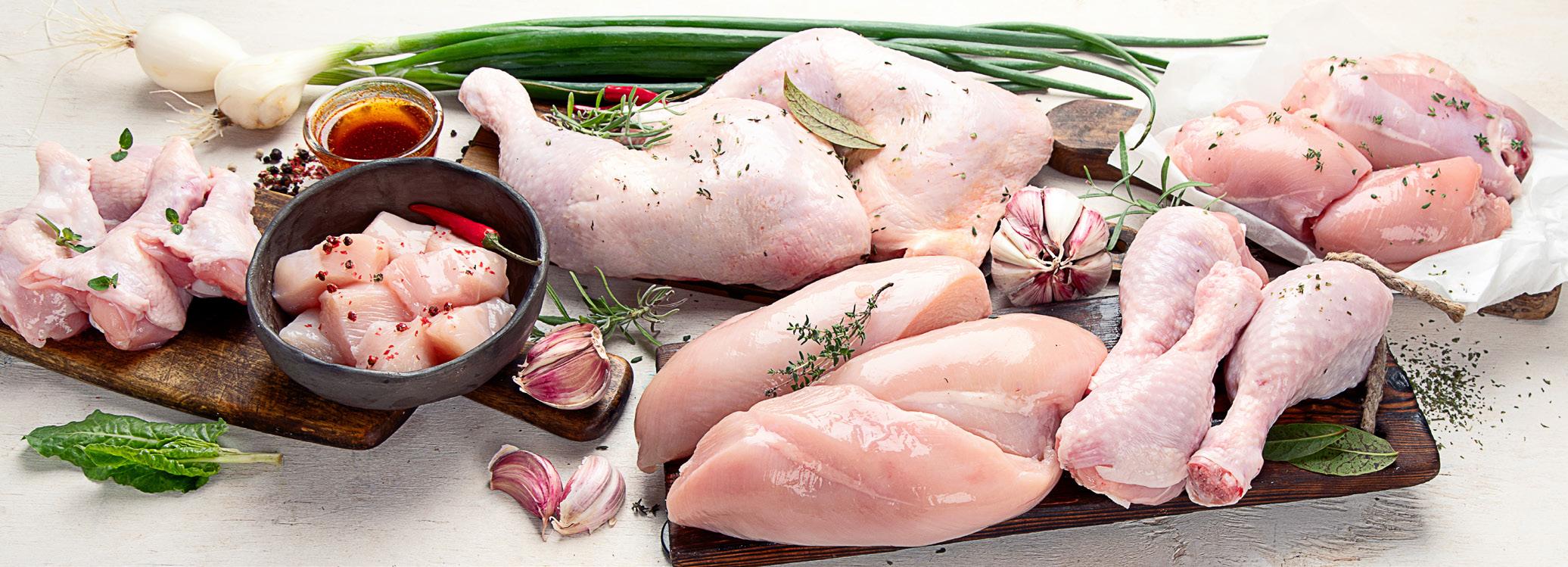
The global chicken industry is expected to grow 2.5% to 3% in 2026 but is also moving into a new phase of volatility, driven by geopolitics. The feed market is a major concern due to potential impact on fertilizer prices.
The European market is currently weak, with demand running below year-ago levels despite remaining relatively strong in absolute terms. With the ongoing Iranian conflict, exports from Ukraine and Brazil may be rediverted to Europe, increasing available supply and driving a shortterm bearish price trend. Two watch outs remain avian influenza and the feed price volatility.
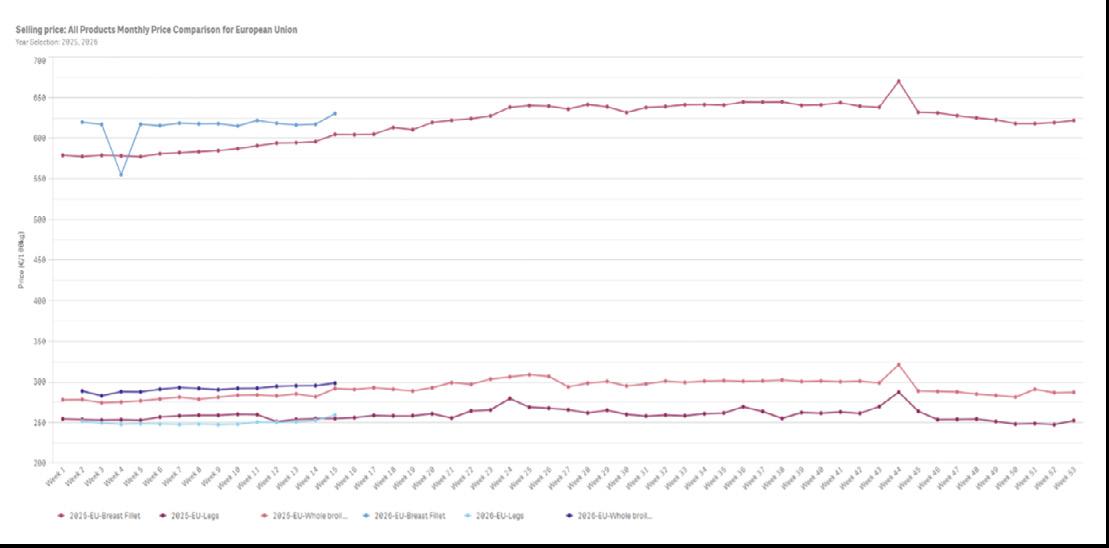
The US market is expected to remain range-bound, as production continues to outpace incremental gains in demand. Furthermore, following a stronger close to 2025, US broiler exports have lost traction in early 2026, effectively leaving more product in the domestic market and adding to local supplyside pressure.
In Brazil, after 6 months of continuous price decrease, prices have started to rebound early April. The slowdown in production combined with consumption pick up after lent is now bringing more balance on the market and providing support to prices.
Protein Market Update
April 2026
Fish & Seafood
Atlantic Cod prices have found its peak and stabilized but still 45% higher than one year ago. Saithe continue to go up reaching 40% increase YoY. The inflation on all whitefish is starting to materialise as old stocks are depleted, and buyers must pay new market prices.
Russian Alaska pollock Season A 2026 closed on April 10th with a 3.5% decline YoY, although volumes remain 6% above the five-year average. Despite relatively stable catch volumes, market conditions are increasingly constrained, with H&G Alaska pollock prices rising sharply +70% YoY. Suppliers are reporting a lack of product availability, and further price increases are expected. In the United States, the most recent A-season was severely disrupted by extreme winter conditions, forcing an early shutdown of factories. As a result, an estimated 4,000 to 6,000 tonnes of frozen finished products, including blocks and surimi, were not produced, further tightening global availability.
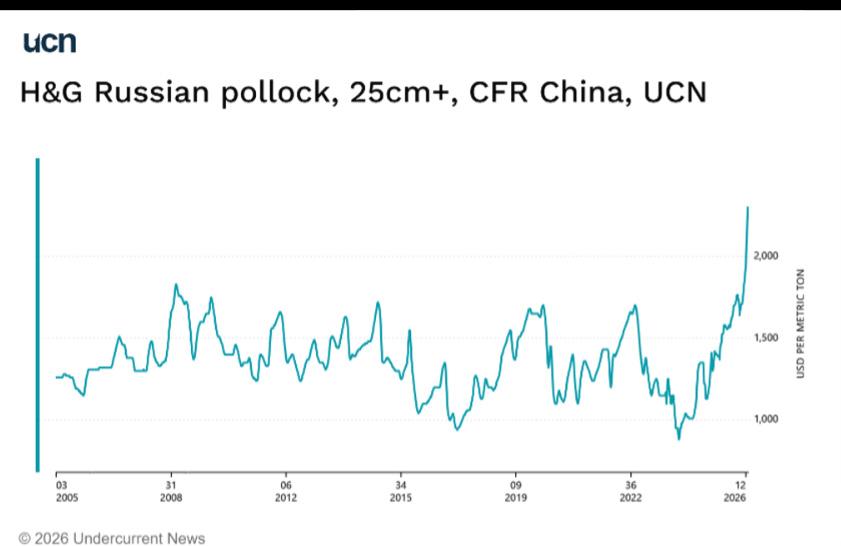
At the same time, both Russia and the United States are retaining a larger share of Alaska pollock production for domestic consumption and local processing. China is also consuming more Alaska Pollock with a 30% growth since 2023 and additional 10-15% growth until 2030. This strategic shift is significantly reducing volumes available for export markets, particularly China and Europe, which traditionally rely on imported raw materials for further processing.
The current raw material shortage must be viewed within the broader context of the global whitefish market. Supply of key species such as cod, haddock and other North Atlantic whitefish remains structurally tight, driven by quota constraints, biological pressures and ongoing cost inflation. As availability and affordability of these species continue to deteriorate, demand is increasingly migrating towards Alaska pollock as a substitute, creating additional demand pressure despite its comparatively stable supply base.

Protein Market Update April 2026
Fish & Seafood
China is now increasingly exposed to these upstream constraints. Reduced inflows of raw material from both Russia and the United States are creating tangible supply shortages, and Chinese processors could struggle to fulfil contractual commitments.
A good alternative to Alaska Pollock would be Pacific Hake that has its fishing season resuming in July. An important fish of the Merluccius family had its quota reduced by 5% in 2026. Pacific Hake had its supply impacted over the past 2 years with vessels chasing the fish for weeks and not able to catch anything. Consequently, we should expect another difficult year with tight supply and higher prices.
The key risks for the remainder of 2026 centre on continued raw material tightness, further demand migration from other whitefish species into Alaska pollock and increasing fragility in the Asian processing supply base. These risks are amplified by geopolitical uncertainty, rising logistics (fuel surcharge circa $100/ton) and energy costs, and the limited ability of Chinese processors to absorb cost shocks given structurally thin margins, raising the likelihood of contract non-performance for European customers.

Protein Market Update
April 2026
Market Prices
MARKET PRICE TRACKER - April 2026
* Last price updated April 2026.