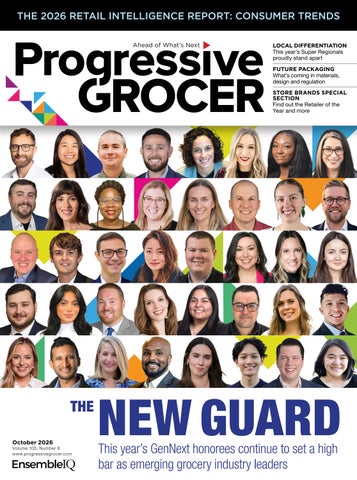
THE 2026 RETAIL INTELLIGENCE REPORT: CONSUMER TRENDS LOCAL DIFFERENTIATION This year’s Super Regionals proudly stand apart FUTURE PACKAGING What’s coming in materials, design and regulation STORE BRANDS SPECIAL SECTION Find out the Retailer of the Year and more
THE October 2026
Volume 105, Number 8 www.progressivegrocer.com
NEW GUARD This year’s GenNext honorees continue to set a high bar as emerging grocery industry leaders
Contents
105 10.26 Volume Issue 8
18 COVER STORY
The New Guard This year’s GenNext Awards honorees continue to set a high bar as emerging grocery industry leaders.
38 FEATURE
50 CATEGORY REVIEW
Follow the Leaders
Fountain of Youth
The seven 2026 Super Regionals are excelling at differentiation.
38
A supersize assortment of soft-drink innovations is reaching younger shoppers via their modern purchase path.
54 CATEGORY REVIEW
Bracing for the Storm
Communication, planning and flexibility among trading partners are the keys to navigating produce supply chain volatility.
Departments
12 MINTEL
14 ALL’S WELLNESS
Paper Products
Eating Healthfully on a Budget
6 EDITOR’S NOTE
’Tis (Nearly) the Season 8 IN-STORE EVENTS CALENDARS
14
50
84 EDITORS’ PICKS
For Innovative Products
December 2026 86 AHEAD OF WHAT’S NEXT 10 NIELSEN’S SHELF STOPPERS
Uncorking Wine’s Power
General Merchandise PROGRESSIVE GROCER October 2026
3
Contents 105 10.26 Volume Issue 8
International Category Reviews 60 DELI
A World of Difference
Global flavors can help the in-store deli thrive. 64 CENTER STORE
Sense of Adventure
Flavors from a range of cuisines can help bring curious customers to the center store. 70 BAKERY
Fresh Ideas
International baked goods give retailers the chance to offer innovation.
74 TECHNOLOGY
The 2026 Retail Intelligence Report
60
64
70
74
Progressive Grocer and Placer.ai present a data-driven deep dive into the consumer trends carrying food retail through 2026 and beyond.
80 GROCERY IMPACT PREVIEW
Leading and Influencing Change
How Acosta Group’s chief strategy officer leads through disruption.
82 OPERATIONAL SPOTLIGHT
Packaging 2030: What’s Next in Materials, Design and Regulation
From paper wrappers to reusable bins, grocery’s packaging future takes shape.
80 SB1
Store Brands Special Section The pulse of Private Label
82 4 progressivegrocer.com
As the holidays approach...
Holiday Gift Checks are coming to your stores! Consumers will soon redeem their Holiday Gift Checks at grocery stores nationwide. Holiday Gift Checks can be presented at checkout in denominations ranging from m $5 to $50 and be applied to o their grocery purchase.
Dollar Am
ount Prin
Your Shop
ts Here
pers to U
se in Your
Dollar Amount
Stores
Your Signatu Date specified re
Your Cashiers Simply ly 1 Accept the Holiday Gift Check as part of the payment. 2 Scan or process the gift check using the normal check-processing procedures. 3 Apply the full value of the gift check toward the customer’s holiday purchase.
It’s that easy! Traditional Holiday Gift Checks provide an easy, convenient way for local businesses and large corporations to give employees and clients the gift of a holiday meal — while bringing additional holiday sales to your store!
For more information, visit www.giftcheckprogram.com 1400 Opus Place, Suite 810 Downers Grove, IL 60515 Phone (630) 986-5081 • Fax: (630) 390-1146
Holiday Gift Checks — Celebrating 38 years of providing companies the ideal gift giving solution!
EDITOR’S NOTE By Emily Crowe
‘Tis (Nearly) the Season
A
HOW CAN GROCERS BAL ANCE SE ASONAL SPEND WITH INFL ATION PRESSURE? s the crisp autumn air settles in this year, many consumers find themselves balancing two competing desires: a craving for comforting fall and holiday traditions, and the reality of tight budgets due to lingering food inflation. For grocers, this means finding ways to blend value, convenience, dynamic multimedia elements and private label innovation, in an effort to attract these shoppers throughout the remainder of 2026 and beyond. Indeed, grocers of all stripes are working to elevate their value and convenience positioning while also driving basket size, all without triggering sticker shock. Last year, food retailers, including Kroger, Lidl, Hy-Vee and ALDI, offered affordable Thanksgiving meal bundles, often priced below $10 per person, in an effort to attract price-conscious holiday shoppers. Walmart, meanwhile, locked in rolled-back prices on its holiday meal packages, including turkey dinners priced below prior-year inflation levels. The big-box retailer has also integrated its retail media network with connected TV partnerships, allowing convenience-seeking consumers to seamlessly scan QR codes on recipe videos to auto-populate their digital Walmart carts. Then there’s Trader Joe’s, which treats seasonal transitions like major drop events to generate excitement around its private label products. Hundreds of limited-run items are released in waves, including Maple Butterscotch Blondie mixes, Pumpkin Bagels, Pink Peppercorn Fontina and cult favorite Candy Cane Joe-Joe’s. Trader Joe’s also leans into strategic placement of these items at endcaps, cheese cases and checkout aisles to encourage quick, low-cost add-ons to standard grocery trips. Finally, Texas powerhouse H-E-B executes seasonal themes across every aisle of the store. The grocer extends seasonal scent and flavor profiles beyond food into private label dish soaps, trash bags, paper goods and even pet snacks, while also using strategic marketing to connect traditional autumn and winter themes with regional priorities like football tailgating. To win this Q4, grocers should focus on a few practical next steps, including pairing budget-friendly meal bundles with exciting, limited-edition private label novelties; designing displays that appeal both to value-driven Boomers and experience-driven younger shoppers; and synchronizing promotions across digital apps, endcaps and cross-category departments. By offering a mix of convenience, essential savings and celebratory indulgences, retailers can successfully ease inflation pressures this holiday season while driving lasting customer loyalty. Emily Crowe Editor-in-Chief ecrowe@ensembleiq.com
6 progressivegrocer.com
8550 W. Bryn Mawr Ave. Ste. 225, Chicago, IL 60631 Phone: 773-992-4450 Fax: 773-992-4455
www.ensembleiq.com BRAND MANAGEMENT SENIOR VICE PRESIDENT, GROUP BRAND DIRECTOR Eric Savitch esavitch@ensembleiq.com VICE PRESIDENT OF CONTENT Lisa Johnston ljohnston@ensembleiq.com EDITORIAL EDITOR-IN-CHIEF Emily Crowe ecrowe@ensembleiq.com MANAGING EDITOR Bridget Goldschmidt bgoldschmidt@ensembleiq.com SENIOR DIGITAL EDITOR Marian Zboraj mzboraj@ensembleiq.com SENIOR EDITOR Julia Tabisz jtabisz@ensembleiq.com ASSOCIATE EDITOR Samantha Schober sschober@ensembleiq.com CONTRIBUTING EDITORS James Dudlicek and Jenny McTaggart ADVERTISING SALES & BUSINESS GROUP SALES DIRECTOR Mike Ketcham mketcham@ensembleiq.com ASSOCIATE PUBLISHER, REGIONAL SALES MANAGER Tammy Rokowski (INTERNATIONAL, SOUTHWEST, MI) 248-514-9500 trokowski@ensembleiq.com REGIONAL SALES MANAGER Theresa Kossack (MIDWEST, GA, FL) 214-226-6468 tkossack@ensembleiq.com SENIOR ACCOUNT EXECUTIVE Johanna Lupardus (CT, DE, MA, ME, RI, SC, TN, NH, VT, MD, VA, KY) 330-990-4635 jlupardus@ensembleiq.com PROJECT MANAGEMENT/PRODUCTION/ART PRINT DESIGNER Catalina Carrasco cgonzalezcarrasco@ensembleiq.com ADVERTISING/PRODUCTION MANAGER Pat Wisser pwisser@ensembleiq.com SENIOR DIRECTOR OF MARKETING Nicola Tidbury ntidbury@ensembleiq.com SUBSCRIPTION SERVICES LIST RENTAL mbriganti@anteriad.com SUBSCRIPTION QUESTIONS contact@progressivegrocer.com
CORPORATE OFFICERS CHIEF EXECUTIVE OFFICER Jennifer Litterick CHIEF FINANCIAL OFFICER Jane Volland CHIEF OPERATING OFFICER Derek Estey CHIEF PEOPLE OFFICER Ann Jadown
PROGRESSIVE GROCER (ISSN 0033-0787, USPS 920-600) is published monthly, except for July/August and November/December, which are double issues, by EnsembleIQ, 8550 W. Bryn Mawr Ave. Ste. 225, Chicago, IL 60631. Single copy price $18.20, except selected special issues. Foreign single copy price $21.80, except selected special issues. Subscription: $134 a year; $246 for a two year supscription; Canada/Mexico $182 for a one year supscription; $249.90 for a two year supscription (Canada Post Publications Mail Agreement No. 40031729. Foreign $182 a one year supscription; $249.90 for a two year supscription (call for air mail rates). Digital Subscription: $78 one year supscription; $144 two year supscription. Periodicals postage paid at Chicago, IL 60631 and additional mailing offices. Printed in USA. POSTMASTER: Send all address changes to brand, 8550 W. Bryn Mawr Ave. Ste. 225, Chicago, IL 60631. Copyright ©2024 EnsembleIQ All rights reserved, including the rights to reproduce in whole or in part. All letters to the editors of this magazine will be treated as having been submitted for publication. The magazine reserves the right to edit and abridge them. The publication is available in microform from University Microfilms International, 300 North Zeeb Road, Ann Arbor, MI 48106. The contents of this publication may not be reproduced in whole or in part without the consent of the publisher. The publisher is not responsible for product claims and representations.
ONLY AOP TURNS GRUYÈRE INTO GOLD. AOP isn‘t just a seal, it‘s a guarantee. As a protected designation of origin, it means the Gruyère you‘re buying is the original: Made only in Switzerland, from cows grazing in local meadows. Copied around the world, but never equaled. Every wheel must meet 16 pages of strict requirements, upheld by dedicated farmers, master cheesemakers, and affineurs who‘ve been perfecting this craft since 1115. That‘s the noble character — and the gold standard — of Le Gruyère AOP.
LEARN MORE
IN-STORE EVENTS
Calendar S
12.26
M
National Cat Lovers’ Month National Handwashing Awareness Month National Pear Month National Volunteers Month
T
W
Root Vegetables and Exotic Fruit Month Safe Toys and Gifts Month Seasonal Affective Disorder (SAD) Awareness Month Worldwide Food Service Safety Month
T
F
S
1
2
3
4
5
Rosa Parks Day. To honor this civil rights hero, run an essay contest for middle schoolers on how they try to emulate her.
World Pollution Prevention Day. Take part in a cleanup project at a site near your store(s).
National Roof Over Your Head Day. Support organizations that help find places to live for the unhoused.
Hanukkah, the Jewish festival of lights, begins at sundown and runs through sundown on Dec. 12.
Krampusnacht. It’s time to bring Krampus – the Alpine anti-Santa – to the United States in a bigger way.
6
7
8
9
10
11
12
13
14
15
16
17
18
19
20
21
22
23
24
25
26
27
28
29
30
31
National Microwave Oven Day. Where would we be without this modern marvel that heats up food so quickly?
U.S. National Guard Birthday. Salute those who serve with a special discount.
National Wreaths Across America Day. Sponsor a wreath or enable associates to volunteer at a cemetery to honor our nation’s fallen.
National Make Cut-Out Snowflakes Day. Ask your young shoppers to help decorate your windows for winter.
National Illinois Day. The Land of Lincoln is also home to a wide variety of foods and beverages.
National Lard Day. Cooking with rendered pork fat results in exceptionally flaky pastry.
More Good Today International Tea Day. Kindness always Day. Introduce the counts. coffee drinkers in your midst to the myriad varieties of one of the world’s oldest beverages.
Winter Solstice. Wow, it’s dark already?
National Card Playing Day. Snacks are a must while engaging in a game of poker or pinochle.
8 progressivegrocer.com
National Date Nut Bread Day. Request that customers share their home-baked versions online.
Still Need to Do Day. Here’s a good opportunity to get stuff done before the new year brings a whole bunch of new tasks.
Christmas Card Day. Let shoppers know that you have a robust selection for the holiday.
To celebrate the life and legacy of Jane Austen, who was born on this day in 1775, suggest that shoppers recreate her favorite snack, toasted cheese, in their own kitchens.
National Christmas Movie Marathon Day. This year, add “Dolly Parton’s Christmas on the Square” to the lineup.
National Resolution Planning Day. Be ready to better yourself in 2027.
It’s Bobby Flay’s birthday, so invite shoppers to an instore demo of one of his signature recipes.
National Device Appreciation Day. Since they are so necessary, keep them in good working order by doing all necessary software updates.
Christmas Eve is also Last-Minute Shopper’s Day, so be sure to have a range of appropriate gifts in an easy-to-find section.
New Year’s Eve. Offer recipes and entertaining tips for those celebrating at home.
National Stretching Day. Encourage your associates to stay limber with 5-minute exercise breaks at work.
Bake Cookies Day. Then take them to a holiday gathering – if they haven’t already been eaten.
Christmas Day. Hold a small holiday party for those who are working today.
National Ding-ALing Day. Despite the silly name, this observance reminds people to get back in touch with old friends or distant family members.
National Hard Candy Day. Pro tip: It makes a great stocking stuffer.
For Kwanzaa, which runs through Jan. 1, learn this modern pan-African holiday’s seven principles.
Smooth. Ri Sm S Rich.
DELICIOUS. D
©
rom our velvety GOYA® Coconut Milk to our rich GOYA® Cream of Coconut, each offers an authentic tropical flavor and ideal consistency for any dish Whether your customers are making family favorites, crafting sweet or savory dishes, or embracing a plant-based lifestyle, Goya® provides the trusted coconut products they depend on tock the brand that consistently meets—and drives—demand
ontact your
*Source: Circana Total U.S. -Multi Outlet+ with Conv Time: Latest 52 Weeks Ending 08-09-26
representative or email salesinfo@goya com |
oyaTrade com
FRONT END
Shelf Stoppers
Average Unit Price
General Merchandise Dollar Sales
% Change Year Ago
Unit Sales
% Change Year Ago
Appliances
$8,580,099,645
-0.6%
199,658,972
-7.8%
Kitchen Accessories
$5,947,373,473
3.4%
1,031,315,688
-7.4%
Home, School & Office Supplies
$5,211,625,826
1.6%
1,759,232,138
-3.6%
Storage & Space Management
$3,837,252,212
-1.0%
602,184,039
-4.3%
Food & Beverage Containers
$3,486,579,159
-1.9%
601,164,463
-10.9%
Automotive Additives
$3,541,641,858
-0.1%
329,550,290
1.2%
Total Category
$52,920,388,749
1.20%
7,809,719,202
-5.0%
Category
Source: NIQ, Total U.S. (all outlets combined) during the 52 weeks ending Aug. 22, 2026
$42.97
for appliances, up 7.8% compared with a year ago
$5.77
for kitchen accessories, up 11.6% compared with a year ago
$2.96
Index by Age and Presence of Children
Appliances
Kitchen Accessories
Home, School & Office Supplies
Storage and Space Management
Food & Beverage Containers
Age < 6
92
109
121
128
123
Age 6-17
100
101
124
105
122
Age < 6 & 6-17
96
101
152
123
147
No Children
101
99
88
94
89
for home, school and office supplies, up 5.4% compared with a year ago
$6.37
for storage and space management, up 3.4% compared with a year ago
Source: Spectra
Value Per Occasion What is the value per occasion for food and beverage containers versus the year-ago period per generation? Greatest Generation
Boomer
Gen X
Gen Y/Gen Z
$7.09
$7.85
$9.49
$9.64
up 1.6% compared with a year ago
up 6.1% compared with a year ago
up 8.9% compared with a year ago
up 4.6% compared with a year ago
Source: NIQ, Total U.S. (all outlets combined) during the 52 weeks ending Aug. 22, 2026
10 progressivegrocer.com
$5.80
for food and beverage containers, up 10.0% compared with a year ago
$10.47
for automotive additives, up 4.8% compared with a year ago Source: NIQ, Total U.S. (all outlets combined) during the 52 weeks ending July 25, 2026
ADVERTORIAL
Interstore transforms stores into revenue drivers.
DeCicco & Sons Greenwich, USA | Opening: September 2026
Interstore is the only retail design agency that has its own shopfitting company, Schweitzer.
Making Freshness, Craftsmanship and Heritage Visible For the new store concept of DeCicco & Sons, Interstore developed a premium food retail environment centered around the guiding idea “Make Visible.” Combining retail design, layout planning and storytelling expertise with Schweitzer’s shopfitting and implementation capabilities, Interstore created and realized a store concept that brings freshness, craftsmanship and heritage to the forefront. DeCicco & Sons is known for its exceptional product variety, Italian American roots and strong focus on in-house production. The new concept builds on these strengths by transforming the store into a stage where quality, preparation and product expertise are no longer hidden behind the scenes but become visible and engaging parts of the customer journey. The experience begins at both entrances; each designed with its own character and immediate fresh food impact. One entrance welcomes
customers with a vibrant berry bar and fresh produce destination, creating an instant feeling of freshness and abundance. Within the produce department, preparation moments such as fresh guacamole made according to DeCicco’s own recipe bring authenticity and interaction directly into the shopping experience. Across the store, traditional back-of-house processes are transformed into customerfacing experiences. In the bakery, production becomes part of the presentation: ovens and preparation areas are positioned visibly, while fresh bread takes center stage before packaged products. The coffee area follows the same philosophy, creating the atmosphere of an Italian bar and connecting the coffee experience with DeCicco’s own family-recipe biscuits. The kitchen, traditionally separated from customers, has been brought into the heart of the store. A transparent glass façade allows shoppers to see the cooking process, the team and the passion behind the food. This visibility strengthens the perception of freshness, authenticity and trust. At the second entrance, customers are introduced to the cheese experience through a combination of flowers, specialty cheese and craft beer. Fresh mozzarella production is staged directly within the department, turning craftsmanship into an engaging moment. The
meat department follows the same principle: cutting and preparation areas are brought forward, making expertise and service visible while enhancing the premium shopping experience. The design concept supports this storytelling approach through a carefully curated material and color palette. Marble, brass accents, a focused blue color scheme and exposed brick walls create a balance between premium quality and authentic heritage. New graphic elements throughout the store communicate the DeCicco family story and strengthen the emotional connection with customers. Interstore’s approach “Make Visible” is more than a design concept — it is a strategic approach that reveals what makes DeCicco & Sons unique. By showcasing products, people and craftsmanship, the store becomes a destination where customers can discover the story behind the food and experience the brand’s heritage in every department.
GET IN TOUCH WITH US: Vera Leonardelli, Director of International Sales vera.leonardelli@interstore-schweitzer.com Tel.: +39 0473 670656
MINTEL CATEGORY INSIGHTS
Global New Products Database
Paper Products Where We Are Now
In the Future
In most markets, private labels are winning share from name brands, highlighting that consumers are looking to reduce spending in the paper category.
Think about how functional innovations can drive value for belt-tightening consumers by improving dispensing systems for convenience, preventing trading down during economic pressures and creating multipurpose products to deliver versatility and value.
However, there is still room for improved functionality, provided that performance enhancements meaningfully improve the consumer experience. If not, much of the world will see a continuation of household paper’s value decline. Brands must also take a pragmatic approach to sustainability, an especially poignant insight considering that price is the biggest barrier to sustainable purchases in many countries.
Promote recycled fiber as the sustainable option by positioning recycled fiber as a sustainable, high-quality option while addressing performance misconceptions, and highlighting environmental benefits like lower energy use and reduced deforestation compared with virgin pulp and trending alternative fiber sources. Develop more nuanced consumer segmentation for revenue growth by targeting specific groups with products like allergy-relief or oil-control tissues. In the longer term, embrace bioengineered fibers to drive sustainability in household paper products by investing in lab-grown cellulose to create high-performance, eco-friendly materials, and prioritizing scalability and cost efficiency to make bioengineered supply chains accessible to mainstream markets.
12 progressivegrocer.com
FOR MORE INFORMATION, VISIT WWW.MINTEL.COM OR CALL 800-932-0400
Key Takeaways Tailor products for more nuanced segmentation: One way to grow the market can come from a more nuanced consumer segmentation strategy that expands usage occasions. Tissues that absorb oil on skin are one example. Merge functionality with affordability: There are a few innovations that reduce costs while driving consumer value. For instance, interfolded toilet paper in compressed packaging reduces distribution costs while improving household storage options. Explore bioengineered fiber for sustainability: It will be years before bioengineered fibers hit the mainstream household paper market. However, new research suggests this could be the paper market’s best option for long-term, cost-effective sustainability.
PUT BRIOCHE IN YOUR STARTING LINEUP Discover Brioche Gourmet
Distributed by KLT Global info@kltglobal.com | 877.302.5710
ALL’S WELLNESS
By Diane Quagliani, MBA, RDN, LDN
Eating Healthfully on a Budget SHOPPERS ARE FEELING THE CRUNCH, BUT RE TAIL DIE TITIANS CAN HELP.
O
ver the past few years, food costs have jumped by about 33%, far outpacing wage increases and catalyzing changes in shopping behavior. Many shoppers are spending less on groceries by trading nutritious but pricier foods, such as fresh produce, meat and seafood, for less nutritious, lower-cost alternatives. Some are buying fewer groceries altogether. Cuts in government SNAP benefits are also fueling these changes. Your retail dietitians are experts at helping shoppers to maximize both their dollar and nutrition on a tighter budget. Count on them to develop creative programs, communications and resources to educate your shoppers on cost-saving tactics like those below. Meal planning and prep. Following a healthful, budget-friendly diet starts at home. Offer shoppers guidance on how to use weekly sale items and coupons to plan meals and create a shopping list, and how to take a pantry, fridge and freezer inventory to avoid buying unneeded items. Provide quick ideas and thrifty recipes for preparing more meals at home to save money on eating out or ordering in. Centering on nutrition. When it comes to healthful eating, popular advice to “shop the perimeter” for fresh food items gives short shrift to the many nutritious — and often more economical — frozen, canned and shelf-stable foods found in the center aisles. A few examples are frozen, canned and dried fruits and vegetables; cans and pouches of seafood; dry or canned beans, peas and lentils; nut butters; and whole grain breads and cereals. And because these foods are long-lasting, shoppers can stock up when they’re on sale. Highlight these items and include recipes and related ingredients nearby. Getting cost-wise in the aisles. Encourage shoppers to use unit pricing to compare costs among nutritionally equivalent national and store brands. Make sure WIC- and SNAP-eligible items are easy to spot. Reducing food waste. A recent report by the Environmental Protection Agency notes that more than a third of the food in the United States goes
14 progressivegrocer.com
uneaten, and food waste costs each consumer an estimated $728 per year — a big bite out of anyone’s budget. Provide information at the point of purchase and on your website about how to safely store perishable and shelf-stable foods to maintain freshness. Offer tips for freezing foods to use later and repurposing leftovers for other meals and snacks. If your store has bulk bins, point out the cost benefit of buying only needed amounts of ingredients like spices, dried fruit, nuts and seeds, rather than full-size packages that might go unused. Currently, uniform standards for date labels on foods don’t exist, which accounts for about 20% of food waste, according to the U.S. Food & Drug Association. Many consumers mistakenly believe that terms like “Sell By” (indicating the last display date) or “Best Before or Best if Used By” (indicating peak flavor and quality) are related to safety, causing them to unnecessarily toss out perfectly edible food. Retail dietitians can save shoppers money by explaining date labels during store tours and cooking demos, and on your website.
Your retail dietitians are experts at helping shoppers to maximize both their dollar and nutrition on a tighter budget. Count on them to develop creative programs, communications and resources to educate your shoppers on cost-saving tactics.
Diane Quagliani, MBA, RDN, LDN, specializes in nutrition communications for consumer and health professional audiences. She has assisted national retailers and CPGs with nutrition strategy, web content development, trade show exhibiting, and the creation and implementation of shelf tag programs.
Trion WonderBar ®
®
Sell More in the Same Space ®
Storewide Applications
Oversize Packages
Vac Pack Meat
Dual Lane Merchandising
Bagged Salads
Trion
®
WonderBar Trays ®
Maximize Your Merchandising Space ■ Increases product facings and rows, lifts sales as much as 20%. ■ Maximizes visibility and shopability and billboards package design.
Auto-feed trays and hooks assure a continuously well-faced display. ■ Simple design allows one-man installation in as little as one-tenth
the time of traditional systems. Reset 48 facings in as little as 15 minutes. Replanogramming any product is a snap. ■ Easy tray dismount and rear-loading reduce labor, speed restocking,
ensure product rotation, and reduce shrinkage. ■ Designed for center store, perimeter, general merchandise,
soft goods, cooler and freezer use. Tool-free universal mount adapts to all major gondola and upright configurations. ■ Choice of 3 bar profiles in 30," 3' and 4' lengths accommodate
trays and baskets, bar-mount and plug-in hooks, pouch hooks, auto-feed and security hooks, and horizontal and vertical sign and label holder systems. ■ System design allows 1" vertical adjustment and increased
usable tray and hook depth for even greater display capacity. ■ As many as 7 standard tray depths ranging from 13" to 24" are
available. Trays adapt to fit the width of virtually all products and package styles with Oversize, Standard, Dual and Mini Trays accommodating lane widths from 13/4" to 17 1/2". ■ A store tested solution with more than 16 million trays sold and
in use across retail. Proudly Made in the U.S.A.
Cheese and Fresh Pasta
Frozen Food
Candy and Gum
Scan QR for details on WonderBar
Tall Products
Trion WonderBar ®
®
Dual Lane Merchandising Create Exciting New Cross Sells
With the WonderBar® Tray & Bar Merchandising System, now you can bring related products neatly together in ways not previously possible. Fit many more items, sell families of products in different sizes, and increase impulse buying with cross-sells and adjacencies. ■ Dual Lane Tray accepts two narrow items for
side-by-side merchandising. ■ Unique design features separate paddles to
push each lane forward individually. ■ Asymmetrical lanes sell different-width products.
Each lane adjusts to fit products as small as 1¾" wide. Mini and Standard width trays available. ■ WonderBar offers a full range of bars, trays,
hook styles, pushers, spring tensions, label holders and signs adapt to any product, any size, storewide. ■ Consistently better product presentation with
less labor time spent facing. ■ Trays lift out for rear restocking and proper rotation.
Proudly Made in the U.S.A.
Quick Re-Planogramming
Choice of 3 Bar Profiles
Tool-Free Installation
Adjustable Width
Trion Industries, Inc.
60
Y E A R S of
American Manufacturing
297 Laird Street, Wilkes-Barre, PA 18702 Phone 570-824-1000 Fax 570-823-4080 Toll-Free In U.S.A. 800-444-4665 info@triononline.com www.TrionOnline.com
Trion WonderBar ®
®
Pouch Hook Merchandising ™
Pouch Sales Simplified
Trust the hook-makers at Trion to invent creative solutions specifically for the new wave of pouch packaging and merchandising. Field-tested and already in retail use, Trion’s new Pouch Hook is ready to back your expansion into this exciting new venue of product promotion. ■ Standard and Gravity-Feed configurations available
to keep items forwarded and automatically faced. ■ Proprietary gate keeps product from being jostled
off rear. ■ Flip-front Label Holder swings up for easy access
and product removal. ■ Loads from rear, or easily dismounts to insure fast
restocking, product rotation and reduced shrinkage. ■ Saddle mounts on a Universal Bar design allowing
tool-free installation on most common gondola and cooler uprights. ■ Stocked in 4 lengths compatible with all standard
shelf sizes allowing mixed use in display. ■ Also available in Pegboard/Slatwall-Mount Design. ■ Custom sizes and short-run configurations possible.
Proudly Made in the U.S.A.
Proprietary Rear Gate
Insures Product Rotation
Easy Vending Front
Gravity-Feed Available
Trion Industries, Inc.
60
Y E A R S of
American Manufacturing
297 Laird Street, Wilkes-Barre, PA 18702 Phone 570-824-1000 Fax 570-823-4080 Toll-Free In U.S.A. 800-444-4665 info@triononline.com www.TrionOnline.com
Trion Security Anti-Theft Products ®
Anti-Theft Solutions Cut Theft, Boost Profits
ScanLock® Anti-Sweep™
■ Scan Lock® Hook Locks are an easy-to-use,
inexpensive key-lock system, securing most common scan hooks, and even retrofits existing hooks right in place! Secure all items or display some unlocked. ■ Anti-Sweep™ Hooks are a simple solution
to multiple item theft and mass “sweeping” losses. Grants direct access by customers but deters high-volume shoplifting allowing only one product to be removed easily at a time. ■ Your single source for a full offering of hooks
for every purpose. Trion fields a complete line of Display, Scan and Specialty Hooks for any surface including: Pegboard, Slatwall, Grid, Cross Bar, Corrugated, Plastic Panel, Perforated Metal, Slatwire, Uniweb, and Flat and Rectangular Bar.
Hooks for Every Purpose Proudly Made in the U.S.A.
Trion Industries, Inc.
60
Y E A R S of
American Manufacturing
297 Laird Street, Wilkes-Barre, PA 18702 Phone 570-824-1000 Fax 570-823-4080 Toll-Free In U.S.A. 800-444-4665 info@triononline.com www.TrionOnline.com
Trion Cooler and Storewide ®
AMT Adjustable Merchandising Tray ®
Organize Chaos, Increase Sales
Designed for yogurts; dips; spreads; puddings, gelatins and snacks; ice cream and sherbet; instant soup cups; microwave single-serves; food-to-go offerings; tubs, bottles and other difficult to organize products. ■ Small AMT adjusts from 2 11/16" to 3 5/16" wide for
4-6 ounce yogurt cups and similar small products. ■ Medium AMT adjusts from 3 5/16" to 3 15/16" wide for
5-6 ounce greek yogurt cups and mid-range offerings. ■ Large AMT adjusts from 4" to 4 5/8" wide for tub,
pint, 11/2 pint, ice cream and large containers. ■ Width adjusts in 1/8" increments and locks in place.
Two breakaways allow easy adjustment in the field from standard 22" length to 20" and 18." ■ Built-in manual feed allows trouble-free
forwarding and facing of products for increased sales and profits. ■ Trays lift out for rear restocking and proper rotation. ■ Durable, easy-clean plastic construction for long-life,
even under heavy use and in harsh environments. ■ Optional plain-paper label, sign and flag holder
provides a protected home for product & price information and improves promotional opportunities. Proudly Made in the U.S.A.
Built-in Manual Feed
Adjustable Width & Length
Built-in Handles & Ventilation
Paddle & Sidewall Extenders
Trion Industries, Inc.
60
Y E A R S of
American Manufacturing
297 Laird Street, Wilkes-Barre, PA 18702 Phone 570-824-1000 Fax 570-823-4080 Toll-Free In U.S.A. 800-444-4665 info@triononline.com www.TrionOnline.com
Trion Cooler and Storewide ®
Clear Scan Label Holders ®
The Complete Labeling System
■ Easy-to-use design flexes open at a touch for fast,
drop-in plain paper labeling, then automatically springs shut to secure the label in place. ■ See-through front with protective roof overhang
shields your labels from dirt, spills, moisture and wear so they last longer, read easier and scan more accurately. ■ Flip-up Label Holders with flexible living hinge
allows the holder to swing up, out of the way for easier product access, then fall back to vertical. ■ Built-in Promo Clips eliminate the need for
separate clips. Insert your sales message instantly for a quick, cost-effective signage program. ■ Clear Scan mounts directly to all popular makes of
metal, wire, glass and wood shelving. Choose from magnetic, adhesive or clip-on mounting systems. ■ Unsurpassed range of sizes, styles and lengths. ■ Clear Scan Label Holders can be ordered
cooler-capable for harsh environments and freezer use. Proudly Made in the U.S.A.
Drop-In Labeling
Built-in Promo Clip
Pallet Rack
Wire Shelving, Baskets & Fencing
Trion Industries, Inc.
60
Y E A R S of
American Manufacturing
297 Laird Street, Wilkes-Barre, PA 18702 Phone 570-824-1000 Fax 570-823-4080 Toll-Free In U.S.A. 800-444-4665 info@triononline.com www.TrionOnline.com
800-444-4665 | ¡Hablamos Español!
Trion Headquarters, main plant & off-site warehouse offers a 500,000 square-foot, state-of-the-art, computerized production facility, featuring the greatest number of automated wire forming machines of any factory complex in the industry.
Trion® revolutionized merchandising with the introduction of the first straight-entry display hook in 1965, and the first scanning hook in 1978. It has since earned over 120 United States and international patents for innovations. Today, Trion is rated among the Top-50 North American Retail and Point-of-Purchase fixture makers and is the world’s leading manufacturer of display and scanning hooks. An award winning website, TrionOnline offers a complete collection of product lines, including cooler and freezer merchandising systems, case studies, product test drives and more.
Trion Industries, Inc.
60
Y E A R S of
American Manufacturing
297 Laird Street, Wilkes-Barre, PA 18702 Phone 570-824-1000 Fax 570-823-4080 Toll-Free In U.S.A. 800-444-4665 info@triononline.com www.TrionOnline.com
©2026 Trion Industries, Inc. Patents and patents pending. Product photography is a simulation of a retail environment and is not meant to imply endorsement by or for any brand or manufacturer.
Congratulations to our 2026 GenNext winners!
Dionis Mateo-Pujols
Preston Petro
Brian Schneider
Crystal Smith
ADVERTORIAL
DRIVING BAKERY GROWTH:
St. Pierre Previews What’s Ahead for 2027 After a year that saw the launch of its first-ever limitededition product, St. Pierre, America’s No. 1 brioche brand, is heading into 2027 with ambitious plans for innovation. With shoppers continuing to seek premium quality, elevated meal experiences and products that bring excitement to everyday occasions, St. Pierre remains focused on helping retailers unlock growth through category-leading insights, innovation and shopper engagement. Progressive Grocer spoke with Brandi Unchester, Director of St. Pierre U.S. Commercial Excellence, about the brand’s standout successes in 2026, what retailers can expect from its innovation pipeline in 2027, and how data-led category expertise is helping drive growth across the bakery aisle. PG: Let’s talk about some St. Pierre products that are driving bakery category sales. Is there anything you would like to highlight that has been especially successful this year? Brandi Unchester: One of the biggest highlights for us in 2026 was the launch of our Spicy Brioche Buns. It was the first limited-edition product in St. Pierre’s history and represented an exciting opportunity to bring something genuinely new to the bakery aisle. Consumers continue to look for products that help them recreate restaurant-quality experiences at home, while social media is accelerating the speed at which food trends gain traction. We developed Spicy Brioche Buns to tap into those behaviors while staying true to the premium quality and authentic bakery credentials that shoppers expect from St. Pierre. The response was fantastic. The product generated significant engagement on social channels, helping introduce the brand to new consumers while creating excitement around
the broader brioche category. Beyond the buzz, it demonstrated that shoppers are willing to try something new when innovation is rooted in quality and delivers a meaningful flavor experience. The Spicy Brioche Buns also offered new opportunity for retailers to ‘build the retail basket’ while meeting shopper trends by cross-merchandising with sauces, cheeses and hot honey products that also deliver on the ‘swicy’ movement. More broadly, the launch reinforces what we’re seeing across the category. Shoppers continue to trade up into premium bakery, seeking products that elevate everyday meals without breaking the bank. Year to date, St. Pierre is growing in both dollars and volume, while private label is in value decline, demonstrating the continued strength of branded innovation within the category.1 As America’s number one brioche brand, St. Pierre holds a 77% share of the in-store bakery brioche segment and leads the category in household penetration, giving us a unique view of how shopper preferences continue to evolve.1 PG: How do you plan to build on the momentum from 2026 in 2027? Are there any new LTOs or other products on the horizon that retailers can look forward to? BU: Innovation will remain a key focus for us in 2027 because it plays such an important role in driving shopper engagement and category growth. One product we’re particularly excited about is our Croissant Loaf, which combines the indulgent, buttery characteristics consumers love about croissants with the versatility of a loaf format. It creates opportunities from breakfast and brunch through to sandwiches and entertaining.
ADVERTORIAL
What’s important to us is that innovation is never innovation for innovation’s sake. Every product must bring something genuinely distinctive to the shelf and meet a clear shopper need. Retailers recognize that commitment to quality. St. Pierre lays claim to America’s No. 1 burger bun and three of the five best-selling brioche products in in-store bakery, demonstrating the brand’s broad appeal and the trust shoppers place in our products. That gives us confidence as we continue to expand our pipeline and explore new ways to bring excitement to the bakery aisle. While we’re not ready to reveal everything that’s coming in 2027, retailers can expect to see innovation that builds on emerging consumer trends, including small indulgence and onthe-go snacking, while staying true to the premium French-inspired bakery experience that differentiates St. Pierre. PG: You lead the Commercial Excellence team. What does it do, and how does it benefit retailers who partner with St. Pierre? BU: At its core, the team exists to help retailers drive growth through insight-led decision making. We bring together expertise in category management, shopper insights, analytics and customer strategy to understand not just how St. Pierre is performing, but what’s happening across the bakery category and where opportunities exist for retailers to unlock incremental growth. We’re seeing that premium bakery often overdelivers beyond the category itself. When shoppers choose premium brioche buns or rolls, they’re often building a more premium meal occasion overall. They’re adding higher-value proteins and accompaniments, which can positively impact total basket spend. Our role is to identify trends and translate them into practical recommendations around assortment, merchandising, product innovation and category development. We work with retailers to understand their shoppers and help ensure the bakery aisle is meeting changing consumer expectations. Because St. Pierre leads in brioche market share and household penetration, we have access to category insights that allow us to identify opportunities and emerging trends early. We view that as a responsibility to help grow the category for everyone.
PG: What else you would like grocery retailers to know about how partnering with St. Pierre can help bring growth, innovation and excitement to the bakery aisle? BU: Retailers today need partners that do more than supply products. They need brands that can bring category expertise, shopper understanding, and a pipeline of innovation that keeps consumers engaged. We believe that means helping retailers merchandise moments, not just products. Consumers aren’t shopping for brioche buns or croissants in isolation. They’re shopping for burger night, brunch with family, entertaining guests or a small indulgence. Helping retailers build solutions around those occasions can drive incremental growth across the store, not just within bakery. That’s where St. Pierre adds real value. Our focus isn’t just on growing our brand. It’s on helping retailers create a premium bakery destination that inspires shoppers, drives trial and encourages repeat purchase. Consumers continue to seek affordable indulgence and elevated eating experiences at home, and bakery is one of the most powerful categories for delivering both. Through category-leading insights, shopper-focused innovation and strong collaboration with our retail partners, we’re helping ensure the aisle remains relevant, exciting and growth-oriented. Looking ahead to 2027, we’re incredibly optimistic. We have exciting new products in development, a growing commercial excellence capability, and a clear view of trends shaping the future of bakery. That will continue to drive growth, bring innovation to shelf, and deliver the premium experiences shoppers are increasingly looking for. Circana, Total Baked Goods/Bread/SBG Multi Outlet+, YTD ending 09-06-26).
1
TO BRING AN AUTHENTIC TASTE OF PARIS TO YOUR INSTORE BAKERY VISIT www.stpierretrade.com.
FEATURE
2026
Awards
THE
NEW GUARD This year’s honorees continue to set a high bar as emerging grocery industry leaders. By Progressive Grocer Editorial Staff
T
he future of food retail is bright – especially if this year’s 98 GenNext Award honorees have anything to say about it. Winners range in age from just 24 up to 39, and each one has a unique story to share about their time in the grocery industry.
This year’s roster of honorees across retailers, suppliers and solution providers has driven revenue and sales growth through high-impact campaigns, multiretailer partnerships and strategic expansions; mentored and developed other industry talent and led employee resource groups to foster inclusive team cultures; improved processes and operational efficiency by redesigning workflows and reducing shrink; and promoted cross-functional collaboration by working to bridge gaps between disparate teams. And the list goes on. Most importantly, these 98 people are proving what it means to be an exceptional part of an industry that finds itself in a constant state of change. They are adapting right along with it, and becoming an integral part of the food retail engine that keeps our country moving forward. Read on to learn more about the 2026 honorees.
18 progressivegrocer.com
MONICA BATTLES
JAMES HARKINS
REBEKAH HENRY
Director, Business Development, Product Connections, Acosta Group
VP, Client Development, Acosta, Acosta Group
Senior Director, Client Services, Product Connections, Acosta Group
Age 28
Age 38
Age 39
Battles has made shopper marketing a growth engine at Acosta Group, leading more than 100 programs and 40 creative workflows in 2025. She spearheaded a first-of-its-kind multi-retailer partnership spanning three major grocers that generated $7.1 million in campaign sales and more than $200,000 in incremental lift while nearly doubling click-through benchmarks. Battles also expanded client programs into mass and club channels, developing more than $4.4 million in annual proposals across 15 retailers. Her approach centered on bringing brands, agencies and retailers together around clear goals and outcomes.
Harkins has turned strategic thinking into growth for Acosta Group clients. During a national-brand launch, he hit ambitious annual contract value goals in 12 weeks while building a $5 million, 40-plus-person retail team to support execution. His strategic assessment platform has uncovered roughly $9 million in incremental opportunity for one client, with $1 million already in pursuit. Earlier, Harkins helped integrate five acquisitions representing more than $700 million in investment and developed a modeling tool showing that agency sales can deliver 20%-30% savings versus direct selling. He also mentored emerging leaders and served on Acosta’s AI Excellence Council.
Leading 26 associates supporting more than 90,000 retail events each year across food and adult beverage programs, Henry has strengthened training, standardized processes and improved cross-functional coordination to help Acosta Group manage growing program volume. Her revamped training materials boosted efficiency an estimated 25%-30%, while process changes cut rework by about 20% and improved project turnaround 15%-20%. More than 95% of teams have adopted standardized processes under her leadership. Henry also mentored emerging leaders and supported women’s advancement through NextUp.
ELLIE HINCK
JESS PETERSEN
MEREDITH RODRIGUEZ
National Business Manager, Acosta, Acosta Group
Manager, Training and Development, Product Connections, Acosta Group
Director, Client Services, Product Connections, Acosta Group
Age 33
Age 30
Age 29
Hinck has grown from supporting marketing efforts into leading high-profile programs spanning brand, communications and client engagement. She oversaw such Tier 1 trade shows as Expo West, Groceryshop and NACS, and for four years she has led Acosta’s flagship event at The PLAYERS Championship, welcoming more than 165 attendees and 40 clients. Her work also included launching an internal web store, strengthening social media strategy and supporting acquisitions. Known for taking ownership amid change, Hinck has brought a proactive, collaborative approach to complex initiatives.
Petersen has helped turn training and development at Product Connections into a strategic resource supporting performance and growth. Her work included a six-week Walmart Scan & Go pilot, training for the Byrna less-lethal pistol program, and a leadership curriculum serving more than 650 Sam’s Club employees. The last one paired 12 microlearning modules with virtual workshops and e-learning. Petersen also earned trust by setting candid expectations with senior leaders and then finding practical alternatives when requests exceeded available time or resources. Her adaptable, transparent approach has kept teams aligned while protecting quality.
Rodriguez brought a steady hand to complex client challenges, helping Product Connections move from reactive problem-solving to clearer ownership and faster resolutions. She reshaped escalation management, clarified cross-functional roles and strengthened communication in high-pressure situations. Rodriguez also gave her team greater ownership of client deliverables and coached emerging leaders. Her approach balanced support with accountability, building confidence while expanding team capabilities. By addressing process gaps and rethinking workflows, she helped create a more scalable model for sustained client and team performance.
PROGRESSIVE GROCER October 2026 19
FEATURE
2026
Awards
KRISSY STOLPMAN
KEVIN WEINGART
JOHN WESTERMANN
KATHRYN BATTLE
Director, Client Development, Acosta, Acosta Group
Director, Impact Natural, Acosta, Acosta Group
Director, P&G HQ, Acosta, Acosta Group
Distribution and Transportation Operations Manager, ADUSA Distribution
Age 39
Age 39
With more than 15 years at Acosta Group, Stolpman has helped turn client challenges into growth opportunities. She has led more than 50 high-stakes RFPs, supported the company’s expansion from 7,000 employees to more than 60,000 and helped launch an automated insights platform that saves more than 1,000 hours annually. In her current role, she secured a new multimillion-dollar client expected to generate $1 million in additional revenue next year, and renegotiated another contract for $400,000 in incremental annual revenue. In each instance, Stolpman’s leadership centered on collaboration, clarity and a people-first approach.
Weingart has paired hands-on leadership with a people-first approach at Acosta Group in his job overseeing the Upper Central natural team. His direction helped the region post yearover-year sales growth while building a culture grounded in trust, accountability and open communication. When staffing challenges arose, Weingart stepped in personally to keep client promotions and sales plans moving. He also tackled complex problems collaboratively, meeting all stakeholders’ needs. A recent reporting project gave Acosta and its client clearer visibility into National Co+op Grocers’ off-shelf promotion opt-ins by retailer, helping teams identify barriers and target future opportunities.
Age 34
Age 33
Westermann took the helm of a client-dedicated team in 2020 and helped grow its regional business 25% over five years. He strengthened the group through individualized coaching, clearer processes and a more disciplined approach to tradefund planning. When the partnership expanded, Westermann onboarded nine retailers, hired three team members and trained them on the client’s business. Those retailers have since delivered 22% collective growth. He also introduced joint-business planning with retailers, creating a framework that has been adopted as a best practice elsewhere across the organization.
Battle brought a data-first mindset to some of ADUSA Distribution’s toughest operational questions. She built a configurable model to help leaders assess when third-party labor could fill seasonal staffing gaps while controlling costs. Her analysis helped one site put the strategy into practice and deliver measurable savings. Just as important, Battle made complex information easier to act on, clearly explaining the thinking behind the numbers. Her persistence and ability to build trust across teams have helped turn analytics into practical tools for better labor decisions.
MCKENNA BORRELL
BRODY GUILD
KATHERINE OLSON
MICHAEL RICCI
Vendor Compliance Manager, ADUSA Distribution
Distribution Inventory Manager, ADUSA Distribution
Distribution Operations Director, ADUSA Distribution
Reporting and Analysis Analyst, ADUSA Distribution
Age 24
Age 26
Age 35
Age 29
Borrell made her mark by turning distribution data into practical results. Her work helped cut distribution center-driven shrink 10.6% year over year, while a new child purchase order policy reduced incorrect purchase orders by 70.3%. She also helped improve symmetric mean absolute percentage error by 4.75% and increased vendor damage detection more than sixfold. When she spotted short-coded turkey shipments that could have caused more than $500,000 in losses, Borrell acted quickly to protect inventory. Along the way, she has strengthened collaboration across distribution, analytics and vendor management teams while mentoring site leaders.
Guild has discovered a knack for turning warehouse challenges into practical gains. At ADUSA Distribution, he overhauled slotting in underperforming warehouse sections, helping transform one of the weakest areas into a top-performing shipping operation. He also improved grocery cube use and built a workload-balancing tool that helped teams coordinate staffing, shipping and transportation. As chair of the associate engagement committee, Guild gave associates a voice in operational changes while mentoring emerging leaders. He has grounded his approach in three words: influential, accountable and empowering.
At ADUSA Distribution, Olson has improved operations while helping the next generation of leaders find their footing. Her work on succession planning, onboarding and talent development contributed to 16 internal promotions. She also reworked the company’s reclaim station process, lifting scan rates 20.5% and turning the approach into a best practice across product return center locations. Through the SPARC business resource group, Olson created a biweekly leadership series for interns, with 18% of participants going on to establish mentorship relationships.
A rising star who turns complicated data challenges into tools that help grocery teams make faster, smarter decisions, Ricci rebuilt ADUSA Distribution’s transportation reporting for large-scale SQL data, replacing a costly third-party tool with a more efficient solution. He also upgraded staffing and retention reporting by cutting unnecessary queries and calculations, speeding up analysis for users. Working with food safety, Ricci built key performance indicators and trend and scorecard reporting from the ground up. He also shared technical know-how with colleagues, helping strengthen both the team and ADUSA’s data capabilities.
20 progressivegrocer.com
PROGRESSIVE GROCER’S GENNEXT AWARDS Meijer congratulates this year’s honorees, recognized for fostering innovation, leading with purpose and bringing more good to food retail.
Jack Davis
Doug Earhart
David Hohs
Elizabeth Miling
Amanda Smrstick
Connor Reed
Ross DeYoung
Kody Lake
Matt Sjostrom
Ethan Thomas
Liz Doerr
Brendan Birchmeier
Kate MacMillan
Christian Fatica
Alex Harrison
Jacob Kaastra-Smiley
FEATURE
2026
Awards
JESSICA ROSS
JORDAN SCOTT
CONNOR RAY
SARA QAWWAS
Finance Analyst, ADUSA Distribution
Distribution Operations Manager, ADUSA Distribution
Transportation Supervisor, ADUSA Transportation
Software Engineer, Ahold Delhaize USA Services LLC
Age 33
Age 25
Age 35
Scott is reshaping warehouse operations while keeping associates at the center of change. He led a move from manual selection to a system-directed model, improving workflow visibility, traceability and productivity while reducing labor hours. Scott also reworked scheduling to cut unnecessary overlap without compromising guaranteed hours. The results extended beyond efficiency: Safety incidents declined, while associate engagement, growth indicators and inclusion improved. Scott partnered with an on-site engineer on rootcause analysis and sought front-line feedback, pairing data with first-hand experience to build stronger, more accountable teams.
When a transportation team was leaning on outside labor every week, Ray saw an opportunity to fix the underlying problem. He revamped recruiting and onboarding, helping build a steadier workforce while maintaining strong on-time delivery. His influence extends beyond his Greencastle, Pa., distribution center, where he has helped standardize leadership practices across sites. Ray also championed fairer pay for driver trainers and guided a department of more than 200 associates through a major management transition. Meanwhile, he’s earning a bachelor’s degree in business administration, maintaining a 4.0 GPA.
When Ahold Delhaize USA reorganized its digital teams, Qawwas was among those who helped keep the mobile experience on track. She built a scalable process for more than 10 cross-functional teams, bringing product, technology and design leaders into closer alignment while keeping releases on schedule. Qawwas also championed ADAaligned accessibility improvements, creating guidelines that made inclusive design easier to build into mobile and web products. As workflows changed, she redesigned the release process to balance team autonomy with the coordination needed to keep customer-facing projects moving.
Age 24
At ADUSA Distribution, Ross has become the person teams can count on when complicated financial data needs to make sense. Promoted to a higher-level analyst role in 2025, Ross expanded her reach across distribution and transportation while taking on critical supply chain cost modeling. She also helped guide a complex P&L accounting change and developed a structured way to sort thousands of data points, giving teams a clearer view of product and freight cost drivers.
ERIN QUINN
VIRAMYA SHAH
BLAINE WHITESTONE
JESSE BURCHFIELD
Business Intelligence Retail Media Analytics Manager, Ahold Delhaize USA Services LLC
Senior AI/Machine Learning Engineer, Ahold Delhaize USA Services LLC
Fulfillment Solutions Director, Ahold Delhaize USA Services LLC
Store Director, Albertsons Cos.-Southern California Division
Age 29
Age 38
Age 39
Helping turn AI into practical tools for Ahold Delhaize USA, Shah led development of an AI-powered agent that made it easier for associates to find and navigate complex internal information, taking the project from concept to deployment on a compressed timeline. He also served as product owner for a major data science initiative, balancing technical modeling with operational needs and coordinating stakeholders along the way. While Shah’s work spans semantic search and personalization, an annual office ping-pong tournament reflects his knack for building connections beyond the tech side.
Whitestone’s strategy for building a successful e-commerce business started with finding the right people. He enabled Ahold Delhaize USA to reach sustained e-commerce profitability while developing teams that can carry the business forward. Whitestone worked across product, technology and company teams to turn big ideas into practical results, helping colleagues embrace new capabilities along the way. His leadership also helped pave the way for multiple internal promotions. Outside the office, he gave back through food bank partnerships, community revitalization and workforce programs.
Burchfield excels at both turning operational challenges into sustained progress and developing teams into high performers. This combination has allowed him to deliver year‐over‐year sales growth and in‐stock execution results for his store, which outperformed the district. Faced with a chronically underperforming produce department, Burchfield zeroed in on identifying the root causes of persistent shrink, and then he focused on disciplined process execution and clear accountability to remedy those issues. The result was a 190-basis-point improvement in shrink in just four weeks. Burchfield’s approach to problem-solving as a team effort continues to produce meaningful results.
Age 28
Quinn helped drive the U.S. launch of Ahold Delhaize Retail Media’s proprietary EDGE advertising platform, translating a global capability for the U.S. market. She built a retail media data mart integrating more than 40 data sources and led the rollout of 25-plus interactive Power BI reports, giving teams greater access to campaign and business insights. Quinn also connected U.S. stakeholders with global product and analytics teams, helping align data requirements and keep the platform launch on track during a complex migration.
22 progressivegrocer.com
6 2 0 2 R U O O T S N O I T CONGRATULA
! S R E N N I W T X E GENN
Harris Teeter would like to H Congratulate our 2026 GenNext Winner!
Emma St E Stacy
David D id Murdock M d k
Manager Category Insights & Analytics
Store Manager
FEATURE
2026
Awards
MARIO FUENTES
PAUL GAURA
CHANTEL KNUDSON
JARED LABAR
Manager, Learning and Development, Albertsons Cos.-Southern California Division
Patient Care Services Manager, Albertsons Cos.-Southern California Division
Pavilions Grocery Operations Specialist, Albertsons Cos.-Southern California Division
Senior Director of Sales SupportMerchandising and Marketing, Albertsons Cos.-Southern California Division
Age 38
Gaura is expanding the role of pharmacy teams across Southern California through hands-on training, community partnerships and patient-focused care. In fiscal 2025, associates under his guidance delivered more than 6,000 clinical services spanning travel health, diabetes management and health screenings. He also helped facilitate 1,600 on-site immunization clinics, contributing to more than $80 million in immunization revenue. His community work included a Homeboy Industries partnership that brought more than 200 vaccinations to a local 5K, while his CPR training initiative equipped more than 500 associates with emergency-response skills.
Age 37
Age 39
Pairing high-velocity execution with disciplined profitability, Knudson delivered standout results in the liquor category. Through activation of meaningful promotional deals, she generated more than $10 million in incremental sales, driving a 30% increase in identical sales, a 35% lift in units and a strong 31% margin. She also had a measurable impact on operational performance through disciplined inventory management and deliberate focus on top-line growth. The result was a 0.02% year-to-date grocery shrink reduction, which led to $200,000-plus in savings. Knudson has continued to scale growth without sacrificing financial discipline.
Labar helped reshape merchandising across Albertsons’ Southern California division, developing a planning tool that brought greater consistency to 296 stores. He also strengthened vendor collaboration, led seven holiday store walks spanning 13 districts and expanded culturally relevant assortments. His work growing kosher offerings included a new sales program that lifted unit sales 6.56%. Labar also refreshed training for about 60 store directors and assistant store directors while helping bridge merchandising, operations and procurement. His influence has now extended across sales, marketing, fresh, loyalty and supply planning.
ADRIANA VENEGAS
ELENA HARRINGTON
JESSICA JARRETT
LIZ ROCHE
Pavilions Floral Operations Specialist, Albertsons Cos.-Southern California Division
Senior Marketing Manager, Albertsons Media Collective
Senior Marketing Manager, Albertsons Media Collective
VP of Media and Measurement, Albertsons Media Collective
Age 35
Age 33
Age 37
Harrington transformed communications from a support function into a strategic growth driver, elevating brand credibility, executive authority and industry influence during a period of rapid category expansion. Through her leadership, Albertsons Media Collective generated more than 300 earned media stories and 300 million-plus earned media impressions. Additionally, her decision to pivot the external narrative away from volume‐driven advertising claims toward more rigorous conversations about incrementality, measurement and transparency strengthened the organization’s credibility and trust with agencies and advertisers.
In her role of senior marketing manager, Jarrett led the strategic overhaul of the previously underused Albertsons Media Collective website, relaunching it as a modern, content-rich destination for clients and partners. The result was an impressive 400% year-over-year increase in site traffic. Jarrett also built a robust thought leadership and content strategy, authoring and publishing nearly 20 in-depth blog posts that spotlighted case studies, innovation and industry insights. Across social channels, she delivered exceptional results by growing the organization’s organic LinkedIn following by 56% and driving millions of impressions through a disciplined, data-informed content approach.
By embedding measurement, accountability and performance at the core of media strategy, Roche played a pivotal role in advancing the organization’s retail media capabilities and brought greater focus to the future of retail media measurement. She was instrumental in the launch of the in‐store digital display network, which transformed in‐store media into a scalable, data‐ driven, full‐funnel channel at the point of purchase. Roche also led the launch of incrementality measurement for in‐store media campaigns, a pioneering initiative that advanced the industry’s ability to link ad exposure — particularly within the store — to incremental sales outcomes.
Age 35
Fuentes helped the division become the first — and industry leader — in the Retail Management Certificate (RMC) program to surpass 1,000 graduates. To drive participation, Fuentes elevated the blue RMC graduate name badge as a daily, visible symbol of achievement, fueling peer recognition, credibility and sustained momentum across stores. For the Store Director Training program, he identified overlap with assistant store director training, expanded the program from eight to 12 weeks and included two store director mentors per trainee, strengthening the connection between classroom learning and real‐world store execution.
Age 39
Venegas’ strategic focus and ability to drive consistent, high-level performance helped her exceed sales targets in her district by more than $100,000 last year. Also notable was her ability to keep her team focused and motivated despite high-pressure conditions. Venegas delivered sustained financial results while strengthening the operational foundation of the business. In regard to floral upgrades, she elevated in-store presentation standards, highlighted premium options and identified opportunities to improve product mix and margin management — strategies that led to these upgrades exceeding target by 13%.
24 progressivegrocer.com
ai179036391234_AD_7_25x4_875_Congrats_AndreaYarrington_GenNext CG.pdf
1
2026-09-25
3:18 PM
Congratulations
Andrea Yarrington Sales Director We proudly celebrate Andrea Yarrington for being honoured with the Progressive Grocer 2026 Generation Next Award. Andrea's inspiring leadership and dedication continue to champion strategic initiatives and drive progress within our company and the grocery industry.
Well done from all of us at Kruger Products!
atulations to our GenNe t Award winners! Your leadership our cust
Sar
awwas
Software
er
vative ation to ser Business Intel ence Retail dia Analytic na er
s
utur ocery. We are proud to celebrate your achiev act you re very day.
Vir
ya Shah chine Lear
er
Blaine Whitestone Fulfil www.adusa. https://www.linkedin.
any/ahold-delhaize-usa/
nt Solutions Director
FEATURE
2026
Awards
ELLA KING
AYRTON BRYAN
MICHAEL OLIVIERI
MATTHEW CHIOCCHI
Segment Solutions Manager, Avery Dennison
Senior Manager of Sustainability, Avery Dennison/Vestcom
Senior Manager of E-Commerce Operations, Bel Brands
Age 28
Age 35
Age 28
Director Business Intelligence, Marketing Strategy and Brand Development, C.A. Ferolie
King played a key role in integrating digital tagging into complex packaging environments such as vacuum shrink and high-speed manufacturing lines, helping the industry move toward a more transparent supply chain that allows grocers to track product journey and freshness with unprecedented accuracy. By defining technical parameters for microwave safety and material integrity, she helped mitigate liability risks and established new safety protocols that protect both the retailer and the end consumer. King also transformed complex technical requirements into accessible process guides for store teams, work that significantly improved inventory accuracy and reduced manual labor.
Bryan solidified Vestcom’s reputation as a sustainable leader and a reliable partner. By transitioning waste practices from disposal to repurposing, he helped modernize the company’s environmental footprint and helped further the organization’s advanced status from 35% to 82% landfill-free across eight U.S. sites in one year. He also transitioned paper sourcing to more than 99% certified sustainable mills, ensuring that Vestcom’s growth supports responsible and economically viable forest management. By prioritizing facility engagement and associate career development, he helped foster a high-performance environment maintaining a 99.8% on-time and in-full (OTIF) delivery rate for retail clients.
While at Acosta Group, Olivieri helped reshape how it manages digital shelf programs by replacing manual processes with tailored systems for portfolio and enterprise clients. He developed a SKU-level content tracker that evolved from an Excel tool into a digitized platform, and he then built Asana workflows and live Power BI dashboards for complex accounts. Those systems track such measures as handle time, first-time accuracy and speed to market, giving teams clearer performance data while reducing executive touchpoints from monthly reviews to twice-yearly engagements. Olivieri’s cross-functional approach has made Acosta’s scalable digital shelf execution more consistent.
Age 28
Chiocchi rebuilt C.A. Ferolie’s marketing communications platform, which included redesigning and relaunching the company website. His leadership has led to a dramatic surge in social media engagement and overall brand visibility. He also led the creation and production of the C.A. Ferolie Industry Update, a weekly publication reaching several thousand subscribers. Chiocchi made the company’s co-op program into a sought-after experiential opportunity offering meaningful, transferable learning for students while strengthening the company’s talent pipeline. Additionally, he helped streamline C.A. Ferolie’s business development process.
BILL SERVER
MARIAH CALDERON
IAN NEITZKE
MEAGHEN MURRAY
Director Sales Development, C.A. Ferolie
Chief Client Officer, C.A. Fortune
Senior Director, Client Engagement, C.A. Fortune
Director National Sales-Dollar General, The Coca-Cola Co.
Age 38
Age 36
In 2025, Neitzke successfully onboarded and managed a Top 2 client with strong year-over-year growth potential. Onboarding required coordination across many pillars, navigating system complexities and guiding a transformational shift on the client side, all while delivering against aggressive goals. His leadership directly contributed to securing two major corporate bonuses, among them a significant onboarding bonus that positively affected total firm performance. Neitzke also assumed leadership of a new client management service, and his direction resulted in $900,000 in annual client expansions and additional corporate bonuses, despite having to deal with high-demand, under-resourced clients.
Murray built collaborations with popular brands like Takis, Planters, TGI Fridays snacks and Pringles to unlock incremental demand and create exclusive meal and snacking solutions tailored for the Dollar General shopper, and she spearheaded the development of a new multi-pack format introduced as a pilot exclusive to the dollar store chain, balancing affordability and variety with margin and assortment complexity. What’s more, Murray ran a Dollar General-exclusive America 250 summer barbecue program supporting the USO, and she also prioritized community engagement through the Coca-Cola Holiday Caravan and volunteer efforts with the Dollar General Literacy Foundation.
Age 34
Age 36
Server evolved special market and alternative retail channels into a significant and strategic customer base for C.A. Ferolie. Leveraging established relationships and deep channel knowledge, he was able to expand distribution, strengthen partnerships and unlock sustainable growth across multiple product categories. This enabled him to open new revenue streams and drive incremental revenue. Under his capable leadership, sales within special market and alternative channels more than doubled in a short time period. His peerless ability to navigate nontraditional retail environments and tailor solutions to unique customer needs helped convert exploratory business into consistent, scalable opportunities.
Calderon helped define how C.A. Fortune serves its clients and created the infrastructure to fuel growth for years to come. She played a critical role in building a best-in-class client service model that has become a core differentiator for the business. Under her leadership, the company’s client management approach evolved into a highly strategic, insight-driven function that strengthens partnerships, drives measurable results for clients and reinforces long-term retention. In her role leading new business development, Calderon built and scaled the function from a single team member to a high-performing team of 10-plus in five years.
26 progressivegrocer.com
Celebrating our
Rebekah Henry
Monica Battles
Meredith Rodriguez
Krissy Stolpman
Kevin Weingart
Senior Director, Client Services
Director, Business Development
Director, Client Services
Director, Client Development
Director, Impact Natural
John Westermann
Jess Petersen
James Harkins
Ellie Hinck
Director, P&G HQ
Manager, Training & Development
VP, Client Development
National Business Manager
acosta.group
Congratulations to Stop & Shop’s Progressive Grocer GenNext Winner!
Alina Dimitriu Vice President Strategy, eCommerce, and Chief of Staff
FEATURE
2026
Awards
TIM MAHONEY
SERENA KIM
MARIAH SAMPSEL
JARED ANDERSON
Director of Information Security, Festival Foods
Lead Product Designer, Flashfood
Store Director, The Fresh Market
Age 35
Age 30
Vegetable Category Manager, Fresh Thyme Market
As the lead on the redesign of Flashfood’s Partner App, Kim’s primary goal was to reduce friction at all touchpoints for grocers operating Flashfood in their stores. To that end, she introduced a structured usability testing methodology and coordinated with the partnerships team to run instore tests with real store associates, as well as virtual sessions with grocery managers. The strategy validated assumptions and refined workflows to collect real partner feedback through the design process. The result: a new Partner App that enables bulk posting of up to 10 items at once in 30 seconds.
Sampsel led her store to a 6% year-over-year sales increase and beat labor targets by 1.6%. She also delivered EBITDA results $300,000 above plan and $175,000 better than the prior year, earning a spot in the 2025 President’s Club. Her focus on consistent execution, store conditions and customer service transformed a struggling location with declining sales into one of the company’s top-performing stores. Beyond her own location, Sampsel served as a go-to regional trainer for major system rollouts, helping other company leaders adopt new processes. Additionally, she actively supported new store openings and special projects.
Recognizing a shift in customer preferences toward cleaner, higher-quality ingredients, Anderson transitioned the hot soup program to an organic offering, a strategic decision that led to double-digit sales growth. He also led the development and launch of a refreshed in-store sandwich program that enhanced both quality and assortment, launched a successful line of Own Brand bowls that doubled sales, and introduced programs centered on premium, clean ingredients. Further, Anderson’s strong leadership in vendor negotiations and category strategy allowed him to make key strategic sourcing improvements.
Age 38
Mahoney’s leadership was foundational during Schnucks’ recent acquisition of Festival and HGI. He and his team remediated 98% of identified threats during due diligence, lowering the organization’s observed risk to an acceptable level and giving Schnucks confidence that the acquisition was a secure investment. His Cyber 90-Day post-acquisition integration project, instituted to better align the company’s security posture with Schnucks’ standards and practices, allowed for discovery to full execution in 83 days, beating an aggressive deadline while remaining under budget. Mahoney’s proactive risk management led to an 8% reduction in cyber insurance premiums for 2025.
Age 39
BRIANNA CHIN
MANNY PEREZ
ZACHARY ROBBINS
JOSEPH SANCHEZ
Natural Living Category Manager, Fresh Thyme Market
IT Network and Systems Infrastructure Manager, Fresh Thyme Market
Store Director, Fresh Thyme Market
Deli Category Manager, Fresh Thyme Market
Age 30
Age 36
Chin refined the bakery assortment to create a more differentiated, customer-centric offering and drove meaningful improvements in store execution and merchandising. She effectively navigated operational complexity and cross-functional dependencies to launch a new bake-inhouse cookie program that delivered $100,000 in incremental sales. Chin also launched an exclusive peach pie using a specialty peach variety from Fresh Thyme’s produce department, selling more than 5,000 pies in just six weeks, and introduced new and exciting seasonal items that generated $400,000 in incremental sales.
During a major network crash, Perez kept stores running by finding and fixing a single point of failure between two critical systems. By quickly securing a backup connection and strictly managing the technology upgrade schedule, he prevented massive business disruptions and protected the company’s vital retail store operations. Perez also led the upgrade to a new store network system by directing critical reliability testing, coordinating teams for a smooth transition, creating easy-to-understand system guides and rescheduling maintenance to avoid disrupting customers and sales. His collaborative approach has improved knowledge sharing and strengthened operational readiness.
28 progressivegrocer.com
Age 34
Robbins received the Legacy Award at Fresh Thyme Market for leading a store with negative profits into profitability last year. He guided his team to drive improvements in every area of the business, from sales growth and gross margin gains to a 1.90% reduction in shrink. Every manager in the store hit their sales goal, shrink goal and gross margin goals, and his store had record-setting employee satisfaction results. Robbins’ support, mentoring and development of employees to foster a positive, collaborative culture has resulted in higher engagement and productivity, notching a huge win for his store.
Age 29
Sanchez delivered exceptional performance, achieving more than 7.5% year-to-date comp growth while also increasing units and transactions in a non-commodity category. At one location, he created and executed the chain’s first The Cheese Board storewithin-a-store concept, which included a cut-and-wrap cheese counter staffed by a dedicated cheesemonger to elevate customer engagement and product education. The result has been double-digit comp growth, increased transactions and strong unit performance. Sanchez also launched a large-scale celebration of National Cheese Day, offering a unique digital experience with a 99-cent private label specialty cheese promotion.
Companies of Ahold Delhaize USA
Delivering excellence every day is more than what you do. It’s who you are. Congratulations to our ADUSA Distribution and ADUSA Transportation GenNext Award winners for your leadership, innovation and commitment to making a difference for our associates, customers and communities.
Kathryn Battle
McKenna Borrell
Distribution and Transportation Operations Manager, ADUSA Distribution
Vendor Compliance Manager, ADUSA Distribution
Brody Guild
Katherine Olson
Distribution Inventory Manager, ADUSA Distribution
Distribution Operations Director, ADUSA Distribution
Connor Ray
Michael Ricci
Transportation Supervisor, ADUSA Transportation
Reporting & Analysis Analyst, ADUSA Distribution
Jessica Ross
Jordan Scott
Finance Analyst, ADUSA Distribution
Distribution Operations Manager, ADUSA Distribution
www.adusadistribution.com https://www.linkedin.com/company/adusa-distribution https://www.linkedin.com/company/adusa-transportation ai1787001439133_PG-GenNext_ad-7p254p875-PR.pdf
1
8/17/26
4:17 PM
CONGRATS TO OUR 2026 LEADERS IN GROCERY Thank you for your commitment to excellence, passion for our business, and ability to inspire those around you.
Joseph Sanchez
Zachary Robbins
Bri Chin
Jared Anderson
Manny Perez
Deli Category Manager
Store Director
Natural Living Category Manager
Vegetable Category Manager
IT Network & Systems Infrastructure Manager
FEATURE
2026
Awards
PRESTON PETRO
DIONIS PUJOLS
BRIAN SCHNEIDER
CRYSTAL SMITH
Internal Communications Manager, The Giant Co.
Store Manager, The Giant Co.
Manager Promotion Execution, The Giant Co.
Category Manager, The Giant Co.
Age 38
Age 34
Age 36
Age 35
At his current store, Pujols achieved a nearly 7% year-over-year improvement in the Associate Engagement Survey score during a major store remodel by remaining visible, listening to team members and providing necessary support. Through consistent coaching and reinforced standards, his store’s nonperishable shrink finished 20%-plus better than the established target. He also led an increase in food safety performance, improving audit scores by more than 6% year over year. Pujols has been recognized across the organization as an accountable, results-driven servant leader who balances empathy with accountability, maintains fairness and respect, and focuses on removing barriers for his team.
Schneider’s collaboration with the category merchandising, pricing and advertising teams achieved a 20%-plus reduction in in-store price discrepancies for 53% of tracked categories in 2025, lowering store labor and operational costs. Also last year, he transitioned the ad circularplanning process to a data-based approach, contributing to a 66% reduction in unplanned ad blocks during the first six periods of 2026. Further, by introducing extended validation steps for deal sheets, coupons and ad circulars, his team drove a 21% decrease in missing items, improving customer satisfaction and capturing more sales at the point of sale.
Over the past year, Smith led the pet and baby categories through a significant transitional period, turning a newly built team into a high-performing organization that delivered sustained, measurable growth. She established strong cross-functional alignment and created a shared roadmap that enabled the rapid execution of business initiatives. Smith also collaborated closely with supplier partners to ensure that the company was first to market on such key innovations as lickable pet treats, effectively driving customer loyalty and brand differentiation, and she designed a dedicated baby coupon program for expectant mothers, to support families early on.
ERIN FREY
LIZ LIBELL
ZACHARY SAYLOR
MICHAEL BRUSOE
Manager, Financial Planning and Analysis, Giant Eagle
Category Merchant-Bakery, Giant Eagle
Director, Supply Chain Technology, Giant Eagle
Age 39
Challenged with boosting engagement within a reorganized marketing team, Petro assembled a cross-functional group to implement team-building events, leadership touchpoints and learning opportunities. This initiative resulted in a nearly 9% year-over-year increase in the marketing engagement score. Further, his small team drove significant cost savings for The Giant Co. by managing writing, photography and channel management, as well as expanding into in-house production. Petro also managed the rollout of the company’s refreshed brand strategy and visual identity, helping update internal templates and dynamically presenting the changes to hundreds of employees.
Age 34
Frey built weekly summaries, dashboards and leadership-ready one-page recaps that changed how merchants and executives understand performance. These tools standardized communication and turned raw data into insight, driving clarity and focus across teams that enabled faster alignment, clearer decision-making and consistent visibility while ensuring that data was accurate, usable and leadership ready. Frey additionally resolved critical reporting errors and collaborated cross-functionally to validate root causes, protect against inaccurate data and ensure that leadership could fully trust financial numbers.
30 progressivegrocer.com
Age 38
Over the past year, Libell has led the rollout of online cake payment across more than 200 stores, a major enterprise initiative that has transformed and modernized the customer experience and already contributed to more than $4 million in sales. With regard to cakes – the core of the bakery department and a critical driver of shopper engagement – she has spearheaded a strategic evolution to ensure that the category remains on‐trend, relevant and reflective of rapidly shifting shopper demographics and preferences. Through new product ideas, updated designs and more contemporary offerings, Libell has modernized the category.
Age 37
Saylor partnered with operations to drive measurable results, including increased case‐pick productivity and the elimination of approximately 145,000 annual manual tasks. He led improvements that strengthened labor efficiency and accuracy, modernized distribution center operations through autonomous robotic pallet jacks, implemented system enhancements in a unionized environment, managed union outbound loaders and provided daily leadership to operational support staff. Further, as a way to foster collaboration and shared ownership, Saylor has built strong, trusting relationships with teams in the United States and at Giant Eagle’s Global Capability Center in Bangalore, India.
Merchandising Manager, Giant Food
Under his leadership as a store director, Brusoe’s Bethesda, Md., location achieved strong sales growth and a $399,000 EBIT improvement against forecast while maintaining elite food safety scores and reducing shrink below budget. Brusoe introduced innovative labor-planning efficiencies that drove productivity to more than 100% and secured a 79% Net Promoter Score. A resilient leader, he navigated operational pressures with poise, implemented proactive issue-resolution processes and actively cross-trained his team. By empowering associates, Brusoe transformed store culture and consistently elevated performance and people.
DARIAN DOVE-SETTLES
KIM KELM
MARIA GRIFFIN
EURO WANG
Category Manager, Giant Food
Social Media Manager, Giant Food
Senior Product Analyst, Grocery Outlet Inc.
Co-Founder and CEO, Guac
Age 32
Age 28
Age 30
Age 25
Dove-Settles has delivered exceptional growth at Giant Food, earning a promotion to category manager in 2025. Leading the pet and baby divisions, he leveraged deep market insights to drive strategic assortment decisions, fill market voids and build brand loyalty. Within the pet category, Dove-Settles spearheaded complex, capital-intensive vendor investments, including refrigerated coolers, while protecting financial interests. For baby, his compliance-driven execution ensured that WIC requirements were met and essential items remained in stock. An analytical, accountable leader, Dove-Settles consistently drove cross-functional alignment, shaping the future of food retail.
At Giant Food, Kelm redefined digital engagement by leading a transition to bring organic social fully in-house. This move, which meant that the company was no longer reliant on agencies, delivered seven-figure annual savings while establishing a high-impact, agile team. Kelm built a customer-first strategy that generated $1.5 million in attributed mid-year sales and achieved triple-digit engagement growth. Her platform-native approach transformed TikTok and YouTube performance, producing viral, culture-defining content. Beyond the metrics, Kelm actively partnered across merchandising and community teams, elevating social media into a vital, strategic growth driver for retail.
Griffin has been a driving force behind the new GO Brands private label team, launching the company’s first private label frozen programs for ice cream and pizza. She originally joined the deli team, where she negotiated opportunistic buys and drove double-digit growth. An analytical and enthusiastic leader, Griffin revolutionized advertising execution by developing proactive selection approaches and strict quality controls – processes now adopted company-wide. She also established complex import protocols to ensure timely deliveries. Passionate about talent development, Griffin mentored new hires and fostered cross-functional collaboration, ensuring flawless execution and sustained operational success.
Driven by his personal observation of out-of-stock items, Wang co-founded Guac to solve grocery’s forecasting challenges with flexible, AI-driven inventory management. Despite lacking prior retail experience, he immersed himself in the industry to build a dynamic platform that adapts to unique operational needs. Wang’s collaborative approach actively integrated feedback from store-level operators, allowing for rapid feature deployment. Under his visionary leadership, Guac currently manages billions in annual inventory, helping its retail partners reduce food waste by 38%, increase sales by 3% and decrease workflow time by 50%, according to the company.
PHIL LUNDIN
DAVID MURDOCK
EMMA STACY
ELISE FENWICK-SANDERS
Benefits Manager, Harris Teeter
Store Director, Harris Teeter
Age 37
Age 30
Manager Category Insights and Analytics, Harris Teeter
Senior E-Commerce Growth Lead, The Kroger Co.-Store Support Center
In his former role at Harris Teeter, Lundin spearheaded a complex, enterprise-wide benefits strategy RFP affecting 10,000-plus associates and $100 million in annual spend. He also guided the selection of a new health care provider, improving care access and affordability. Lundin championed high-performing networks, securing extra company contributions for health savings account (HSA) enrollees, which drove a 46% increase in HSA enrollment. Additionally, he enhanced 401(k) matches and held 50 on-site wellness events. His approach combined financial stewardship with unwavering advocacy for total employee well-being. Lundin has since moved on to a company outside of the grocery industry.
A results-oriented leader, Murdock balances operational excellence with talent development. As a store director in Vienna, Va., he logged three of the location’s top five historical sales weeks and a $765,000 year-over-year increase in operating profit. Additionally, his methodical approach secured the district’s lowest controllable out-of-stock percentage for two consecutive years. Beyond his store, Murdock provided regional merchandising support and served as a leadership trainer. In 2025 alone, he trained 11 future leaders and successfully guided multiple assistants toward store management promotions.
Age 36
Age 37
Stacy has evolved into a transformational leader at Harris Teeter. She played a pivotal role in scaling the category analyst role by establishing structured training programs that improved cross-functional execution. Stacy advanced the company’s analytics capabilities through the adoption of Circana and 84.51° Stratum, shifting teams toward actionable, strategic insights. She also built the Category Advisor Program from inception into a core merchandising process, strengthening supplier collaboration. A people-first leader, Stacy co-led a vital initiative to establish lactation room standards for returning mothers, earning her a Corporate Hero Award nomination.
Fenwick-Sanders has shaped enterprise-level e-commerce strategy and guided key digital merchandising initiatives, leading high-impact projects, creating data-driven roadmaps and laying the groundwork for new revenue and growth initiatives. She partnered with leadership and stakeholders across merchandising, technology and business operations to identify problems and model revenue impact for two capital-funded initiatives worth $2.5 billion in revenue potential, with the aim of creating a best-in-class online fresh product experience and improving product assortment availability. She also belongs to Kroger’s internal Our Promise e-commerce culture team.
PROGRESSIVE GROCER October 2026 31
FEATURE
2026
Awards
ISSAC FREEMAN III
DYLAN MCMAHAN
EMILY POFF
SARAH REIGLE
Associate Communications and Engagement Manager, The Kroger Co.Delta Division
Store Leader, The Kroger Co.-Mid-Atlantic Division
People Strategy, Coordination and Communication Leader, The Kroger Co.Store Support Center
Construction Procurement Manager, The Kroger Co.-Store Support Center
Age 31
Age 32
Age 36
Age 33
Reigle created a structured forum to facilitate training and open dialogue between experienced and newer project managers supporting new store construction. This provided many participants with their first indepth exposure to site work and new builds, accelerating readiness and reducing execution risk. Working with sourcing and suppliers, she helped shift switchgear procurement directly to vendors. This decision generated approximately $150,000 in savings per store, translating to an estimated $6 million annually enterprise-wide. Meanwhile, Reigle’s collaboration with Kroger subsidiary Harris Teeter has driven an anticipated $200,000 in savings on a single store.
Freeman joined Kroger in 2022 as an assistant store leader and was promoted to Fresh and Friendly coach for District 3 before advancing to his current division-wide leadership position. In his present role, he identified gaps in store-level recognition, championed intentional appreciation efforts and helped initiate annual assistant store leader meetings that combined comprehensive training with associate recognition. Further, as co-chair of Delta’s Young Professionals associate resource group (ARG), Freeman developed professional training materials, networking initiatives and a framework to measure ARG impact.
Promoted to store leader in 2025, McMahan transformed a store struggling with low morale and performance into a top-performing location within nine months. He was recognized for his leadership by being named a Mid-Atlantic division nominee for the FMI Store Leader of the Year in his first year in the role. Demonstrating exceptional passion, collaboration and determination, McMahan also spearheaded high-impact community drives that directly boosted store sales, including an animal shelter partnership, which led to a 15% grocery sales increase, and a Stuff the Bus campaign, which resulted in a 45% drug/general merchandise sales increase.
TYLER SAWYER
JACOB VINCENT
ANDREA YARRINGTON
MEGAN LAWLEY
General Manager, The Kroger Co.-Supply Chain-Logistics
Store Leader, The Kroger Co.-Nashville Division
Sales Director, Kruger Products (USA) Inc.
Director of Retail Sales, Marianne’s Harvest
Age 31
Age 30
Under Sawyer’s leadership, the Monroe fulfillment network grew nearly $100 million in net sales from 2024 to 2025, with projections to grow another $100 million in 2026. Further, his strategic focus on quality improvements and cross-functional problem-solving reduced canceled orders by more than 0.5% year over year, improved same-day order availability by 7% and reduced controllable shrink by $200,000-plus per period. Sawyer has built a resilient, empathetic and authentic culture centered on safety — notably making the difficult but necessary decision to pause operations during severe weather conditions, to protect drivers.
Vincent progressed from assistant store leader to store leader in less than three years; he has since managed multiple high-volume locations. He successfully guided his team through a comprehensive store remodel and secured the top ranking in the division for perfect orders in online grocery. Additionally, he delivered the most improved total-store shrink in his district. Known for his people-first approach, Vincent is a member of the Pride associate resource group, fills district operational leadership gaps, supports grand openings and was selected as a certified district trainer to help develop the next generation of leaders.
32 progressivegrocer.com
Poff streamlined Kroger’s Annual Insights Survey, reducing complexity and expanding access channels to achieve a 74% participation rate. She also established accountability measures that drove the completion of more than 2,700 action plans to improve the associate experience. Poff worked with data scientists, division HR leaders and business insights on a weekly report tracking key human capital metrics, empowering leaders to make data-backed improvements at stores, sites and offices. Further, she oversaw the execution of annual mystery shops while realigning the metrics to support Kroger’s total store customer strategy.
Age 38
Yarrington made an impact by translating operational expertise into smarter customer strategies. Progressing from supply chain manager to sales director, she built Kruger’s U.S. supply chain organization from the ground up. Acting as the crucial liaison between sales and production, Yarrington broke down historical silos, introducing vital transparency regarding capacity. During unprecedented supply shortages, she made steadfast decisions that balanced service expectations with severe constraints. By connecting logistics and manufacturing, she ensured that commercial commitments remained realistic and data-driven, fostering deep trust.
Age 30
A strategic force behind transformative growth at Marianne’s Harvest, Lawley spearheaded the national expansion of a newly launched consumer brand, scaling distribution into more than 1,100 retail doors within just six months. This achievement established an immediate national footprint and accelerated revenue. Previously, Lawley rose from an entry-level warehouse role to director of sales at Bitchin’ Sauce, playing a pivotal part in scaling that brand into a category leader. At both companies, she has drawn on her authenticity to build enduring partnerships with key distributors and empower her internal teams to achieve their long-term goals.
COLT HARDEE
BRENDAN BIRCHMEIER
JACK DAVIS
ROSS DEYOUNG
TABASCO Brand E-Commerce and Amazon Sales Manager, McIlhenny Co.
Store Director, Meijer
Inventory Manager, Meijer
Age 37
Age 29
Director, Compensation and Integrated Leave Management, Meijer
Exemplifying impactful, intentional leadership by driving enterprise results while building inclusive talent pipelines, Birchmeier launched Meijer’s first Project SEARCH program. This initiative gave young adults with disabilities immersive, hands-on experience and reinforced the company’s commitment to future-ready talent. He also organized the company-wide Meat Yield Project, reducing beef shrink and delivering more than $600,000 in savings during its first year. What’s more, he successfully led regional initiatives that grew prepared food, deli and bakery sales, capturing nearly 25% of total company sales. A collaborative innovator, Birchmeier continuously empowered teams and strengthened cross-functional accountability.
Davis developed the inventory flow strategy that enabled the successful chainwide scale of Meijer’s frontof-store program while maintaining optimal on-hand inventory levels. He partnered with supply chain, merchant and store teams to stabilize inventory flow during major space and assortment changes; this cross-functional collaboration led to record-high product availability for the pet and consumables departments. Davis also navigated high-volume seasons for seasonal and card and party products during a period of tariff volatility, protecting profitability and in-stock performance. Beyond his day-to-day job duties, he dedicated time to coaching company interns on retail and inventory fundamentals.
Age 28
Hardee has more than quadrupled the TABASCO Brand’s e-commerce gross revenue, transforming it into a profitable, multimillion-dollar growth engine. A forward-thinking builder, he developed the company’s Amazon business from the ground up, successfully propelling the brand to the No. 1 best-seller ranking in hot sauce. Hardee drove this exceptional growth by implementing AI-driven retail media strategies, optimizing the digital shelf and launching such targeted product offerings as an exclusive Amazon variety pack. His analytical approach and cross-functional leadership have firmly established e-commerce as a core strategic capability for long-term success.
Congratulations to our GenNext winners!
Age 36
Overseeing Meijer’s self-administered programs for disability, workers’ compensation, FMLA and ADA, as well as leading the compensation team, DeYoung innovated FMLA administration by leveraging existing technology within Workday and Origami to eliminate added software costs, earning a Risk & Insurance Theo Award for excellence in workers’ compensation. He also streamlined ADA compliance with interactive leader training and served as interim HR director for Fresh Thyme Market (majority owned by Meijer) during a vital transition. His authentic, strategic leadership blended compassionate, people-first care with stringent regulatory compliance and operational efficiency.
Elise Fenwick-Sanders
Issac Freeman
Dylan McMahan
Senior eCommerce Growth Lead Store Support Center Kroger Technology & Digital
Associate Communications & Engagement Manager Delta
Store Leader Mid-Atlantic
Thank you for your leadership and dedication to our associates, customers and communities.
Emily Poff
Sarah Reigle
Jacob Vincent
Tyler Sawyer
People Strategy, Coordination & Communication Leader Store Support Center Associate Experience
Construction Procurement Manger Store Support Center Real Estate
Store Leader Nashville
General Manager, Logistics Supply Chain-Logistics
FEATURE
2026
Awards
LIZ DOERR
DOUG EARHART
CHRISTIAN FATICA
ALEX HARRISON
Food Safety Specialist, Meijer
Buyer, Meijer
Store Director, Meijer
Supply Chain Planning Manager, Meijer
Age 38
Age 35
Age 30
Age 33
Doerr elevated food safety standards across her 50-store region by rolling out a company-wide digital temperature monitoring system and updated logs, reducing manual tracking. Through consistent coaching, Doerr reduced regulatory temperature violations from 27% to less than 8% and increased food safety exam pass rates to more than 95%. Notably, she identified the root cause of systemic false temperature alarms, developing a targeted cleaning protocol that was later adopted across the organization. Her steadfast dedication earned her region Meijer’s Best Food Safety Leadership award for three consecutive years.
Earhart led a cross-functional team to redevelop and bid out a key own-brand portfolio, improving the customer experience, increasing development flexibility and achieving a significant margin improvement; this allowed Meijer to compete effectively with self-manufacturing retailers and react faster to customer trends. He also negotiated restructured annual funding models with suppliers by digging deeply into vendor-specific funding structures, establishing a new negotiation framework adopted by the company’s other buyers. Perhaps most crucially, Earhart managed an ice cream supplier transition that positioned Meijer for long-term growth and influenced organizational thinking toward future vision over short-term gains.
An empowering and resilient leader, Fatica has opened three new stores in northeast Ohio over the past three years and onboarded more than 600 team members into the Meijer family. Dedicated to talent development, he has consistently mentored associates into leadership roles. As store director in Marysville, Ohio, Fatica achieved a region-leading 32.3% turnover rate – a 14.4% reduction – while elevating on-shelf availability to 96.9%. Committed to community enrichment, he also secured a $1,500 donation to fund a local elementary school’s first Scholastic Book Fair in eight years, actively living Meijer’s core values in the process.
A strategic, collaborative and analytical leader, Harrison has delivered significant impact as Meijer’s supply chain planning manager. He optimized the distilled water inventory flow program, saving $350,000 by using internal manufacturing capacity instead of outsourcing. Harrison also spearheaded the implementation of a centralized grocery node within a general merchandise distribution center, yielding a 7% reduction in product costs while improving onshelf availability. He also proactively navigated holiday supply chain surges through innovative peak mitigation strategies. Passionate about talent development, Harrison continuously mentored his planning team to make smart, data-driven decisions.
DAVID HOHS
JACOB KAASTRA-SMILEY
KODY LAKE
KATE MACMILLAN
Manager, Produce Business, Meijer
Logistics Manager, Meijer
Market Asset Protection Manager, Meijer
Store Director, Meijer
Age 35
Age 30
Age 30
Age 38
Hohs has optimized system-replenished product flow across Meijer’s six-state footprint. Transitioning from over-the-counter health care inventory to produce merchandising, he developed a “win the holidays” strategy that drove the vegetables team to an all-time high for fourth-quarter sales in 2025. Hohs maintained freshness as his primary focus, using SKU rationalization and tailored planograms to achieve a 40-basis-point reduction in shrink and a 6% boost in turns. An analytical, collaborative leader, Hohs overhauled the monthly promotional planning process for produce, establishing clear strategies that consistently drove growth, efficiency and exceptional on-shelf availability.
Kaastra-Smiley has strengthened Meijer’s pharmacy supply chain, making the network more flexible, resilient and data-driven. An adaptive and collaborative leader, he identified bottlenecks and successfully shifted critical transportation lanes in-house, reducing external costs while boosting facility production capacity. He developed a comprehensive Power BI dashboard that consolidated complex operational and financial data, enabling faster, high-quality decision-making. Further, Kaastra-Smiley spearheaded a full pharmacy network redesign that scaled delivery models to build resilience. By uniting cross-functional teams, he consistently ensured that critical prescriptions were reliably delivered to Meijer’s customers.
Lake has proved that exceptional results follow a strong culture. Leading with empathy and trust, he successfully reduced shrink for consecutive years at Meijer. Lake introduced intentional recognition programs, using trophies and challenge coins to celebrate teamwork; this move significantly boosted Mculture scores and overall employee satisfaction. By empowering his team and fostering cross-functional collaboration, Lake tripled his market’s key theft-prevention metrics. His commitment to open communication and shared ownership has enabled his asset protection team to remain confident, highly engaged and consistently effective in driving long-term company success.
At the Alpine Meijer, in Grand Rapids, Mich., MacMillan demonstrated exceptional leadership through disciplined execution and intentional people development. By reinforcing essential daily routines, including targeted aisle work and manual audits, she drove significant improvements in the Net Promoter Score, on-shelf availability and cashier performance. MacMillan proved that true innovation often stems from simplicity, consistency and steadfast accountability. A dedicated mentor, she coached assistant store directors, empowering them for future roles. Her strategic, results-driven approach has elevated store culture, increased associate retention and consistently delivered a superior shopping experience.
34 progressivegrocer.com
ELIZABETH MILING
CONNOR REED
MATT SJOSTROM
Director of Toys, Seasonal, Card and Party, Meijer
Senior Real Estate Analyst, Meijer
Store Director, Meijer
Inventory Manager, Meijer
Age 32
Age 27
Age 37
Reed modernized Meijer’s real estate analytics program by transitioning legacy systems into scalable, automated solutions. He developed self-service analytics dashboards and automated trade area research methodologies, which directly supported Meijer’s market deployment into western Pennsylvania. Reed also led teams of intermediate analysts on bespoke market analysis and model development projects for various Meijer store formats. His leadership approach can best be described as curious, relationship-oriented and growth-focused, prioritizing regular individual engagement with his team members to foster strong team chemistry and continuous learning.
Progressing from a general merchandise team member to store director in seven years, Sjostrom has proved a consistent and accountable leader at Meijer. During a major leadership restructuring at his Sycamore, Ill., store, he realigned his team to foster cross-training. This revitalization led the frozen department to a 5.5% year-over-year sales gain and a 306-basis-point increase in on-shelf availability. Overall, Sjostrom drove store availability above 95% and secured a record 71.9 Net Promoter Score, the highest in his region. He also strengthened his community through active partnerships with Northern Illinois University and Habitat for Humanity.
Smrstick has excelled at connecting commercial strategy and store execution, drawing on her foundational experience as a grocery buyer to optimize product flow and inventory health. She played a key leadership role in navigating shifting tariff landscapes, mitigating risk to secure $2.6 million in order cancellations while preserving customer value and supply continuity. An empowering, supportive leader, Smrstick revolutionized vendor accountability in high-velocity categories. By holding suppliers to rigorous fill-rate standards and eliminating operational friction, she drove record-high on-shelf availability, ensuring that customers can reliably find essential items every day.
Age 37
Miling led her team to double-digit growth in 2025, consistently outpacing the general market. She played a pivotal role in negotiating new import agreements to proactively offset tariff pressures across Meijer’s hardlines business. In partnership with the company’s Front-End Reinvention initiative, Miling spearheaded the Thrifty Shop strategy, scaling it to more than 260 stores to drive incremental sales. She also supported the launch of two new private label lines – Snugglewumps and Wonderfully You – and championed “Meijer Love” items celebrating Midwest heritage. Miling continuously invested in her team’s development while advancing everyday retail innovation.
AMANDA SMRSTICK
ETHAN THOMAS
ROBBIE AREND
ZACHARY HANSHAW
LAQUEISHA BROWN
Store Director, Meijer
Store Director, Oliver’s Market
General Manager, Pontiac Street Market
Age 27
Age 37
Senior Key Account Manager, Pepsi Bottling Ventures
A compassionate and empowering leader, Thomas has excelled in his second assignment as a store director at Meijer. Renowned for prioritizing talent development, he drove an unprecedented 22 promotions within his market, including the advancement of his assistant to store director. When another store lacked a director during the demanding fourth quarter, Thomas volunteered to lead it as well. Under his guidance, that location achieved double-digit sales increases and also significantly reduced shrink. Fostering a highly collaborative, inclusive work environment, Thomas consistently achieved outstanding on-shelf availability and Net Promoter Scores while driving long-term operational excellence.
In April 2024, Arend became the youngest store director in Oliver’s Market’s 37-year history. Under his leadership, the Stony Point location’s sales growth increased from 0.93% before his promotion to 2.0% in 2024, while in 2025, sales growth accelerated to 5.0%, turning one of the company’s lower-performing stores into a success. Arend also implemented a “lead by example” philosophy, actively assisting in various areas like the deli or checkstands to build mutual respect. His focus on fostering an engaging, positive work environment that balances high standards with humor has successfully boosted employee morale and engagement.
Age 38
Age 35
As business lead for Harris Teeter, Hanshaw helped the business achieve No. 1 growth in the South division and No. 2 nationally. He unified corporate and franchise bottler approaches by strategically aligning direct-store-delivery and warehouse execution for Harris Teeter, which resolved previous inconsistencies and accelerated growth. He also led the end-to-end commercialization of new products by partnering across supply chain, sales operations, marketing and finance to bring innovation to market profitably, and integrated syndicated data and shopper insights to strengthen joint business planning. His industry impact was recognized with the PepsiCo Chairman’s Ring of Honor award.
Brown has transformed Pontiac Street Market, a nonprofit grocery store in a food desert, into a comprehensive ecosystem for health equity. She implemented free city-wide delivery across Fort Wayne, Ind., and a loyalty program that awards double points on fresh produce and nutrient-dense foods. Brown integrated such on-site services as community nursing, immunizations and a diaper pickup point into the market’s footprint, and she introduced dietitian shopping support and food education in the aisles. Her collaborative procurement program, in which local organizations purchase food from the market, fosters a circular economy that reinvests resources locally.
PROGRESSIVE GROCER October 2026 35
FEATURE
2026
Awards
SHOUVIK MAHAMUD
SARAH GROVES
ALINA DIMITRIU
ASHLEY VOSBURGH
Senior Manager, Sales, Procter & Gamble
VP of Foraging, Sprouts Farmers Market
Age 35
Age 37
VP Strategy, E-Commerce, and Chief of Staff, Stop & Shop
Digital Media and Marketing Manager, Tabañero Holdings
Mahamud built data-driven forecasting capabilities to help category managers improve decision quality. His cross-functional partnerships with the supply chain, marketing and digital teams improved in-store availability, strengthened display compliance and enhanced marketing effectiveness. Further, Mahamud developed advanced shopper-based assortment forecasting models allowing category managers to evaluate scenario-based options and identify incremental upside, and he identified regional assortment opportunities to capture incremental growth by addressing local consumer needs. He also shared his knowledge across the broader Procter & Gamble analytics community.
While at C.A. Fortune, Groves helped shape a new client service model through thoughtful, strategic recommendations to improve how the company serves its clients at scale. She built deep, trust-based relationships and served as a strategic advisor, bringing insights, thought leadership and clear direction that helped drive clients’ businesses forward. Her work has directly contributed to significant growth, including expanding partnerships, securing new business and influencing long-term client strategies. In one instance, she helped transform a challenged client relationship into a high-performing partnership, driving substantial revenue growth and laying the foundation for future collaboration.
Age 34
Age 26
Dimitriu developed a tiered remodel approach with four distinct levels of investment based on a store’s sales potential and asset age, maximizing customer-facing and financial impacts. This program drove significant improvements in sales and unit trends, as well as an 18-point year-over-year Net Promoter Score increase. Additionally, by creating a data model analyzing store performance and potential, she gained alignment for store open/close recommendations and targeted capital investments. Stop & Shop President Roger Wheeler has praised Dimitriu’s exceptional intelligence, collaborative nature across global functions and strong self-awareness.
Vosburgh established a fully integrated, data-driven strategy across major platforms. By aligning digital campaigns with in-store promotions and launches at major partners like Walmart and Food Lion, she directly improved units per store per week. Vosburgh’s modern content strategy on TikTok and Instagram significantly increased engagement and brand relevance with younger consumers. She also led the creation of a scalable micro-/nano-influencer program, an initiative that maximized budget efficiency generated authentic retail-focused content and strengthened retailer relationships by driving in-store traffic. Additionally, Vosburgh mentored and trained interns.
RYAN ORSI
JESSICA PICHE
SAVIA GORDON
NATALIE PAULY
Product Business Manager, United Natural Foods Inc. (UNFI)
Salesforce Enablement Manager, United Natural Foods Inc. (UNFI)
Category Strategy Manager, Walgreens
VP HR and Accounting, White’s Foodliner
Age 30
Age 32
Age 31
Age 36
Orsi co-developed a comprehensive launch strategy for first-to-market Woodstock Organic Banana Water, including timelines, pricing, promotions and ad hoc programs such as in-store sampling with coupons, signage and point-of-sale support. Right after launch, tariff impacts significantly increased the cost of goods, so he made the tough decision to hold pricing and absorb margin compression, since an early price increase could jeopardize the product’s success. His judgment proved effective: More than a year later, Organic Banana Water is Woodstock’s top-selling item. Orsi’s ability to balance short-term risk with long-term growth demonstrated leadership that drove sustainable success.
An innovative, strategic and influential leader, Piche modernized sales execution by implementing UNFI’s first agentic Salesforce layer. This move drastically reduced enhancement delivery timelines from 88 days to around two days, enabling real-time responsiveness to business needs. She led Salesforce adoption for about 800 users, boosting pipeline visibility and forecasting accuracy while driving an approximately 12% boost in sales performance. Piche also developed executive dashboards adopted by senior management to guide strategic decisions. Meanwhile, she found the time to contribute to various mentorship, inclusion and community initiatives.
While working as a category manager at Fresh Thyme Market, Gordon propelled the grocer’s general merchandise and nonfood categories to 3% sales growth while enhancing overall profitability, despite persistent economic headwinds. Through data-driven insights, innovative category management and unwavering alignment with shopper values, she turned underperforming areas into high-growth drivers. In the declining household supplies category, she discontinued conventional products misaligned with the brand, pivoting to natural and sustainable alternatives. The relaunch yielded impressive results: 15% sales growth and 9% unit growth.
Pauly grew sales from $60,000 in 2020 to $4.5 million in 2025 across online platforms. When the shipping director left right before peak season (October–December), she hired and onboarded a new team, managing the department through its busiest period while continuing her regular duties. A dedicated student of the business and a self-starter, Pauly frequently worked on the retail floor alongside store teams, handling everything from front end processes and stocking to meat and deli department tasks. Additionally, she leveraged AI tools daily to streamline processes and trained team members on effective tool adoption.
36 progressivegrocer.com
FEATURE
2026 Super Regionals
FOLLOW THE LEADERS THE SEVEN 2026 SUPER REGIONALS ARE EXCELLING AT DIFFERENTIATION. By PG Editorial Staff
T
his year’s Progressive Grocer Super Regionals are pulling out all the stops when it comes to cementing their unique value propositions. Many are actively growing their physical presence through new store openings and fulfillment centers, as well as making supply chain and infrastructure investments to support future growth. Others still are modernizing the customer and operational experience through AI-powered shopping assistants, automated fresh item management, enhanced mobile apps, digital retail media networks and more. Through all of this, a shared foundational priority is giving back through robust food donation programs, local farm partnerships, hunger relief initiatives, and measurable progress in reducing environmental impact and food waste. Read on for more about how these seven grocers are setting themselves apart from a crowded food retail field.
38 progressivegrocer.com
PET SPECIALTY
SUPPLIER PERSPECTIVES
Creating Change at Both Ends of the Leash: How Retailers Can Help Make Communities Safer for People and Pets By Joe Toscano, Vice President, Trade & Industry Development at Purina
The Purple Leash® Project is helping Purina® transform the domestic violence landscape, and retailers have an important role to play. For millions of people experiencing domestic violence, leaving an unsafe situation is not as simple as walking out the door. When a beloved pet is involved, the decision can become even more complicated. In fact, nearly half of abuse survivors delay leaving because they cannot take their pets with them – yet just 20% of U.S. domestic abuse shelters currently accept pets. At Purina, we believe pets and people are better together. No one should have to choose between their own safety and the safety of their pet. That belief inspired Purina and our nonprofit partner RedRover® to launch the Purple Leash Project in 2019, with the goal of helping more domestic abuse shelters become pet friendly so survivors and their pets can escape and heal together. Since its creation, the Purple Leash Project has provided more than 65 grants to domestic violence shelters, helping fund the improvements and resources needed to accommodate pets. These grants are helping shelters create more safe spaces where survivors can arrive with the pets they love, rather than face the impossible choice of leaving them behind. Awareness is a key part of creating meaningful change in the domestic violence landscape. Purina works to elevate the issue on a national scale, including through its partnership with Variety to create the Variety Courage Award, presented by Purina. Since 2024, the award has honored advocates for domestic abuse survivors at the Variety Power of Women event in Los Angeles. Purina will continue the award in 2026 at the Variety Power of Women event in Los Angeles this September, helping amplify the voices of survivors and advocates while challenging the stigma that so many survivors face. But raising awareness is only the beginning. Retailers have an opportunity to turn visibility into action by helping to share this important cause with their customers and communities. Starting September 1 through November 15, Purina and its brands will support the
Purple Leash Project through a special consumer giving program. For every purchase of specially marked Purina packages during the promotion period, Purina will donate $0.05 to RedRover, up to $500,000. This creates an opportunity for retailers to engage their shoppers around a meaningful cause while helping fund safe spaces for survivors and their pets. Retailers can also make an impact beyond the point of purchase. By partnering with Purina and the Purple Leash Project, retailers can help raise awareness and connect customers with resources and opportunities to support survivors in their own communities. There are many ways to get involved, including in-store and online merchandising, promotions, donation or round-up programs, supply drives, retail gift card donations and volunteer partnerships with local shelters. We’ve seen retailers and customers create meaningful change through these efforts, and shelters tell us that strong community support can provide
the resources and encouragement they need to expand their services, including becoming pet friendly. For retailers, supporting the Purple Leash Project is an opportunity to do more than demonstrate social responsibility. It is a chance to use their reach, resources and community relationships to address a critical need while supporting the people and pets who live in the communities they serve. We are proud of the progress we’ve made with RedRover, but with just 20% of domestic abuse shelters currently accepting pets, there is still significant work ahead. Creating more pet-friendly shelters requires continued investment, awareness and collaboration across communities. Together, retailers, brands, nonprofits and consumers can help create a future where no survivor has to choose between their own safety and the safety of their pet. To learn more about the Purple Leash Project and ways to get involved, visit Purina.com/Together or reach out to your
Purina representative. Purina trademarks are owned by Société des Produits Nestlé S.A. Any other marks are property of their respective owners.
FEATURE
2026 Super Regionals WEGMANS FOOD MARKETS
HEADQUARTERS: Rochester, N.Y. STORE COUNT: 115 CEO: Colleen Wegman OPERATING AREA: New York, Pennsylvania, New Jersey, Virginia, Maryland, Massachusetts, North Carolina, Delaware, and Washington, D.C.
W
egmans Food Markets is no stranger to PG’s Super Regionals, and this year has proved to be no exception to its inclusion. The venerable grocer is steadily expanding its footprint and upgrading its technology stack while keeping a laser focus on community engagement and creating a superior associate experience. Poised to celebrate its entry into North Carolina as it cuts the ribbon on a full-service location in the Charlotte area, Wegmans has also shared details about its first supermarket near Pittsburgh. The grocer has begun work on the foundation for its new 115,000-square-foot store in Cranberry Township, Pa., and is aiming to open this location in the fall of 2027. Leaning into additional future growth, Wegmans this year made a $110 million supply chain investment, which includes a new, state-of-the-art refrigerated facility in its hometown. These facilities will offer an improved work environment, add capacity to serve stores and create opportunities for its distribution employees. Wegmans will also be able to reduce reliance on third-party providers. The company further delved into next-gen technology with the launch of its AI Assistant, which helps customers plan meals, find new items and build lists. Several app enhancements also went live this year, including detailed aisle locations in several departments to help shoppers locate items easier and faster. Users can now scan a paper list into the app while also being able to import recipes from a URL, photo or screenshot to instantly create a digital cookbook with shoppable ingredient lists. Among Wegmans’ most impressive feats this year is its list of hard-won awards and accolades. The grocer was the highest-ranking food retailer on the 2026 PEOPLE Companies that Care list, coming in at No. 2. Additionally, the company was named No. 5 on Fortune’s list of 100 Best Companies to Work For this year and came in at No. 20 on the Fortune Best Workplaces for Women 2025 list. “Wegmans is a values-based, family-owned company that has always put our people first,” a Wegmans spokesperson tells Progressive Grocer. “Caring for the success and well-being of our employees, while creating opportunities for them to learn, grow and build meaningful careers, has long been one of our highest priorities.” According to Wegmans, it has strengthened its relationships with employees through a focus on engagement, experience and wellness, including new tools and resources like the Eat Well, Live
Well Challenge; the Know Your Blood Pressure campaign; and the Noom app, paid for by Wegmans. The grocer has also invested in learning and development opportunities such as updates and expansions to its Team Leader Trainee Program and its Building Relationships instructor-led course. Finally, Wegmans made a big impact this year in terms of environmental, social and governance goals, as well as giving back to the communities it serves. In May, Wegmans reached a major milestone: All of the products sold in its in-store bakeries met the retailer’s Food You Feel Good About standard, meaning that they’re made without artificial colors, dyes, flavors or unnecessary preservatives. In 2026, Wegmans focused on expanding and improving food donation efforts across the company, and increased donations by 1.3 million pounds in the first half of the year compared with the same period last year. Wegmans also diverted nearly 90% of its food waste from landfills, reducing environmental impact while supporting local communities. Meanwhile, the company has continued to evolve its community giving approach to better address the economic challenges facing the communities that it serves. Hunger relief remains its highest priority, and Wegmans also works to strengthen the partnerships and systems that help create long-term food security, including regional food banks, local pantries, soup kitchens and school-based food programs. To that end, last year Wegmans donated 36.8 million pounds of food to neighbors in need across communities in its market area. In-store scan campaigns raised millions of dollars for the cause, and hundreds of employees volunteered with food banks and other community organizations. “Together with our food bank partners, customers, employees and local organizations, we’re helping meet immediate needs while building stronger, more resilient communities for the future,” the Wegmans spokesperson notes.
“Caring for the success and well-being of our employees, while creating opportunities for them to learn, grow and build meaningful careers, has long been one of our highest priorities.”
40 progressivegrocer.com
TH FUTU OF P O UC IS At Sun World, 50 years of breeding innovation and brand-building have defined what's next for fresh fruit categories. Learn more at Sun-World.com
THE
EFFECT What happens when produce starts acting like a brand?
+25% +90% Category Growth*
Brand Sales Growth*
*Results are based on specific circumstances. Past performance does not guarantee future results.
FEATURE
2026 Super Regionals GIANT EAGLE
HEADQUARTERS: Pittsburgh STORE COUNT: 200-plus under the Giant Eagle and Market District banners CEO: Bill Artman OPERATING AREA: western Pennsylvania, north central Ohio, northern West Virginia, Maryland and Indiana
H-E-B
HEADQUARTERS: San Antonio STORE COUNT: 455-plus under the H-E-B, Joe V’s Smart Shop, Central Market and Mi Tienda banners PRESIDENT: Roxanne Orsak OPERATING AREA: Texas, Mexico
T
exas-based H-E-B takes home another Super Regional crown this year as it continues to expand and thrive in its home state. North Texas has swallowed most of H-E-B’s attention lately, with the chain opening stores in Forney, Mid-Cities, Irving and Murphy this year, pushing its Dallas-Fort Worth (DFW) count past a dozen namesake locations, plus the Joe V’s Smart Shop and Central Market banners. Irving marked a milestone as the retailer’s first Dallas County store, employing more than 600 people and debuting Masala House, an in-house Indian food line with chicken masala and naan. More store sites are already staked out in Garland, Walsh Ranch, Carrollton, Denton and Dallas proper.
N
o surprise here: The big news regarding Giant Eagle is that The Kroger Co. intends to acquire it for $1.65 billion, comprising $1.25 billion in cash consideration and the assumption of approximately $400 million in outstanding liabilities. Kroger CEO Greg Foran described the pending deal, which is slated to close next year, as a strategic fit. “Giant Eagle expands our reach into attractive adjacent markets, allowing us to do what we do best: Run outstanding stores, deliver fresh foods and convenient meal solutions at affordable prices, and take care of our customers and associates every single day,” he said this past July, when the news went public. As for how the acquisition will affect the long-established character of local Giant Eagle stores; the prices of the items carried; the chain’s strategy in such areas as retail media, loyalty and marketing; or how many of its stores will need to be divested, only time will tell. Meanwhile, store ambiance was very much on Giant Eagle’s mind as it rolled out a new rebrand campaign for its upscale Market District banner. Following in the footsteps of Giant Eagle’s major Because It Matters rebrand campaign last year, Discover Great Taste aims to position Market District as an elevated culinary destination offering rich shopper experiences. Those experiences no doubt include the ability to enjoy such offerings as the Beef Graffiti smash burger restaurant that opened within a Market District in Fox Chapel, Pa., in May of this year. Helmed by Chef Mark Mammone, the independent eatery offers a self-order counter and booth seating, with ample access to Market District’s lounge bar serving beer and wine. Meanwhile, in keeping with the retailer’s focus on food as medicine, since it serves a market area where healthy food access and chronic-condition issues remain concerns, Giant Eagle teamed up with NationsBenefits, a provider of health care fintech and integrated benefit solutions. The partnership “allows eligible shoppers to use their health benefits seamlessly for the items that matter most to their families, while maintaining a frictionless, trusted checkout experience across all of our supermarkets,” noted Giant Eagle SVP of Pharmacy Mike Chappell this past February.
44 progressivegrocer.com
To back up that retail muscle, state filings revealed a $14.4 million, 51,599-square-foot fulfillment center planned for Frisco, meant to ease aisle congestion and speed curbside orders across North Texas. Supply chain investment followed in May, when H-E-B unveiled plans to pour $700 million into its Foster Road campus on San Antonio’s East Side. The project is projected to create 720 jobs by 2028 and more than 1,200 over the next decade. Meanwhile, the retailer’s 13th annual Quest for Texas Best program for local products drew a record 978 entries from more than 500 companies this year. Ten finalists now head to San Antonio this month to compete for $100,000 in combined prizes. “Quest for Texas Best is more than a competition; it is a launchpad for Texas entrepreneurs,” said James Harris, H-E-B’s senior director of diversity, inclusion and supplier diversity. For Earth Day, H-E-B handed out 276,000 reusable bags featuring Garner State Park, the final entry in a three-year state-park bag series, while its School Plastic Bag Recycling Challenge pulled in a record 8.4 million bags from 816 schools, topping last year’s 6.7 million. Four communities split new recycling grants, part of the nearly $1 million awarded by the chain since 2021. The company’s commitment to community engagement showed up in smaller ways, too: Just before the holidays in 2025, H-E-B surprised travelers with vending-machine pop-ups at airports in Austin, San Antonio, Houston and DFW, handing out concha slippers, tortilla blankets and other cult-favorite merch via a redeemable “boarding pass.”
AS CLOSE TO THE ORCHARD AS IT GETS.
NO FILLERS. NO CONCENTRATES. JUST WHOLE-PRESSED ORGANIC APPLES YOU CAN TRUST.
LEARN MORE
FEATURE
2026 Super Regionals MEIJER
HEADQUARTERS: Grand Rapids, Mich. STORE COUNT: 500-plus supercenters, grocery stores, neighborhood markets and express locations PRESIDENT AND CEO: Rick Keyes OPERATING AREA: Michigan, Ohio, Indiana, Illinois, Kentucky and Wisconsin
M
eijer has kept construction crews busy over the past year, opening or announcing new stores across three states while also investing in private label nutrition, pharmacy access, advertising technology and more. The retailer opened its fourth Meijer Grocery location in Rochester Hills, Mich., this year. The chain is doubling down on the smaller-footprint concept, with a fifth location, a 75,000-squarefoot store in Fishers, Ind., opening last month. Supercenters have grown alongside the smaller stores. Meijer opened three 159,000-square-foot supercenters across northeast Ohio last May, and then added a fourth on the site of an old amusement park. New supercenters are also planned for Indiana and Ohio. A supercenter opening in Plymouth Township, Mich., will push the chain’s home-state store count to 130. On the shelf, Meijer rolled out more than 300 new products built around fiber and protein content this past spring. More than 120 Meijer-exclusive items now contain at least 5 grams of fiber per serving, and its private label lineup includes 700-plus products with 10 grams of protein or more. With wellness in its crosshairs, the chain has also upped its pharmacy game. Meijer has been running wellness events at its supercenter and grocery locations, spotlighting products across pharmacy, fresh food, everyday essentials and over-the-counter categories. The chain also added advance scheduling for vaccination appointments this past summer, covering RSV, shingles, pneumonia and COVID shots alongside its usual flu offerings.
Meijer’s refrigeration practices also drew attention this year. The Environmental Investigation Agency’s 2026 Climate-Friendly Supermarkets Scorecard, which grades food retailers on hydrofluorocarbon refrigerant use, ranked Meijer first among grocers on refrigerant management, with a reported average annual leak rate below 8%, well under the EPA-reported industry average of 25%. On the advertising side, Meijer struck a partnership with adtech firm Pentaleap this spring to bring a new optimization layer to Meijer Media, its retail media network, letting the team test ad variants faster and lean on more granular data.
46 progressivegrocer.com
THE RALEY’S COMPANIES
HEADQUARTERS: West Sacramento, Calif. STORE COUNT: 230-plus under the Raley’s, Bel Air, Nob Hill Foods, Raley’s O-N-E Market, Bashas’, Food City and AJ’s Fine Foods banners CEO: Mike Teel OPERATING AREA: Seven states – Alaska, Arizona, California, Nevada, New Mexico, Oregon and Washington – and four Tribal Nations: Navajo Nation, White Mountain Apache, San Carlos Apache and Tohono O’odham
I
t has been a year of transition and strategic realignment for The Raley’s Companies. After 11 years with the grocer, President and CEO Keith Knopf departed earlier this year, paving the way for owner and Chairman Mike Teel to return to the chief executive role he previously held. This shift at the top was accompanied by another round of key leadership changes, including the appointment of a new chief communications officer and other executives transitioning to advisory roles, ultimately positioning the retailer for its next phase of omnichannel growth. While the food retailer made the difficult decision to close certain locations as part of a targeted downsizing plan, it has simultaneously continued to invest in strategic expansion. Illustrating this dual approach, Raley’s broke ground on a second store in California’s Madera County, signaling a commitment to finding the right fit for expansion of its physical footprint. Beyond its store count, Raley’s has spent the year enhancing its in-store experience, digital capabilities and external partnerships. In a move focused on digital media, the company launched an expansive in-store media network in partnership with Grocery TV, transforming the traditional shopping environment into a dynamic, engaging and monetizable touchpoint for customers and CPG brands alike. The company’s Bashas’ banner also partnered with Amazon in Arizona to expand the e-commerce giant’s third-party grocery delivery network. The collaboration underscores Raley’s commitment to providing flexible, omnichannel fulfillment options to its shoppers. On the loyalty front, the grocer continued to find new ways to deliver value, recently rolling out its Member Prices program to ensure seamless, competitive savings for its most dedicated customers at checkout. By balancing calculated footprint optimization with bold investments in technology, e-commerce and executive leadership, Raley’s will remain a dominant force in the western United States.
Your produce cooler is costing you more than you think. Switch to ModoShelf™ — Built for less shrink, less labor, more sales.
Accessories to face product
Easy access to well
Cut cleaning time in half
Fits in any produce cooler
If your shelving isn’t working as hard as you are, it’s time to switch. Every hour spent scrubbing shelves is an hour not spent serving customers. Every skipped cleaning cycle risks a health score hit. Every rigid fixture limits how you show product — and how much you sell.
◆
Fits any produce cooler — no retrofitting required
◆
Microban® protection combats bacteria and mold between routine cleans
◆ ModoShelf™ changes the math. Lightweight, flexible tiles fit any cooler configuration and hold up to 250 lbs. of product. ◆ Microban® antimicrobial protection built into every tile fights odor and stain-causing bacteria between cleans — so your ◆ team does less, and your cooler performs more. ◆
Lightweight design — easy for any team member to install and handle Flexible tile system adapts to any planogram Accessories for facing, easy well access, and cleaner product display NSF certified — meets food-safe regulatory standards
Call us at 800.422.2547 or visit www.siffron.com Microban® antimicrobial product protection is limited to the product itself and is not designed to protect the users of these products from disease causing microorganisms, food borne illnesses, or as a substitute for normal cleaning and hygiene practices. Microban International, Ltd. makes neither direct nor implied health claims for the products containing Microban® antimicrobial product protection. Data, photomicrographs and information presented are based on standard laboratory tests and are provided for comparative purposes to substantiate antimicrobial activity for non-public health uses. Microban® is a registered trademark of Microban Products Company.
FEATURE
2026 Super Regionals SCHNUCK MARKETS
HEADQUARTERS: St. Louis STORE COUNT: 160-plus under the Schnucks, Festival Foods and Hometown Grocers banners CEO: Todd Schnuck OPERATING AREA: Illinois, Indiana, Missouri and Wisconsin
S
chnuck Markets continues to demonstrate its strength in the Midwest. Through a strategic blend of community-focused local sourcing, artificial intelligence and targeted store investments, the grocer is modernizing its operations while staying true to its roots. A major focus for Schnucks is its commitment to regional suppliers and hyper-local products. This year, the grocer assembled the third cohort for its Emerging-Business Accelerator Program, adding 10 Midwest makers to the Springboard class. Consequently, Schnucks debuted 10 new local brands in its St. Louis-area stores. This dedication to its communities is further amplified by its expanded farm-to-store delivery partnership with Foodshed.io. The program reduces transportation time and allows Schnucks to deliver hyper-local produce to its shelves just hours after harvesting. Adding a nostalgic touch to its local flavor, the grocer also revived its founder’s long-lost original potato salad recipe for shoppers this year. On the technology front, Schnucks is leveraging AI to elevate both the omnichannel shopping experience and its operational sustainability. Moving away from traditional print, the grocer discontinued its mailed circulars in favor of an interactive weekly ad. This digital shift coincided with the debut of an AI-powered agentic shopping assistant developed in partnership with VitalityIP.
Behind the scenes, data-driven solutions are tackling food waste: Schnucks deployed Logile’s Fresh Item Management Solutions to automate and optimize fresh food operations, minimizing overproduction and shrinkage, and it installed Picadeli modular salad bars using AI to analyze sales and inventory data, ensuring assortments with minimal waste. Freshness and neighborhood-level store investments remain at the core of Schnucks’ strategy. Along with backing its fresh departments with a new official guarantee, the company has rolled out the Culinaria Italian Table private label line to emphasize the quality of its owned brands. Schnucks has also reinvested in its physical footprint, completing store remodels in the St. Louis area.
48 progressivegrocer.com
WAKEFERN FOOD CORP.
HEADQUARTERS: Keasbey, N.J. STORE COUNT: 350-plus under the ShopRite, Price Rite Marketplace, The Fresh Grocer, Dearborn Market, Gourmet Garage, Fairway Market, Di Bruno Bros. and Morton Williams banners PRESIDENT: Mike Stigers OPERATING AREA: New Jersey, New York, Connecticut, Pennsylvania, Maryland, Delaware, Massachusetts, New Hampshire and Rhode Island
T
here’s plenty to celebrate at Wakefern Food Corp. these days. This past August, the retailer co-op’s flagship banner, ShopRite, marked its 75th anniversary with two weeks of special savings, digital offers and promotions. The campaign highlighted the Northeast chain’s long-standing commitment to local ownership, sourcing, service and community outreach. Wakefern’s commitment to local includes a pledge made this past July to invest $500 million in sourcing fresh produce from regional farmers and growers throughout its market area over the next five years. The co-op also recently teamed with solution provider iA to centralize pharmacy fulfillment at 149 ShopRite stores and two The Fresh Grocer locations at a new facility. Expected to open early next year, the 12,000-square-foot fulfillment center is part of Wakefern’s effort to streamline back-end pharmacy operations so that pharmacists can provide better patient care. Additionally, Wakefern has been working on its private-brand lines, redesigning the packaging of its Wholesome Pantry Organic and Wholesome Pantry free-from products to spotlight quality, ingredients and value, and committing to remove all synthetic dyes and additional ingredients from its Bowl & Basket products by January 2027. On the corporate level, Wakefern reorganized its sales and marketing teams, with the aim of outsourcing the company’s advertising wing. Chief Communications Officer Karen Meleta explained to Progressive Grocer last May that as the co-op’s family of banners grew from one to eight, a new strategy was needed to adapt to “changing market needs.” Meanwhile, in the area of customer amenities, Wakefern is continuing to expand EV charging access at ShopRite locations and support sustainable infrastructure in surrounding communities, with recent installations at stores in Daleville and Yardley, Pa.
The Next Trip Is Already in Your Data. AI Is How You Find It. For regional grocers, meaningful growth doesn’t always require a dramatic change in strategy. In fact, our grocers constantly tell us that all they need is “just one more” to make a real difference. One more trip from a shopper who already knows your store, one more item in the basket, one more offer that turns into a purchase. At scale, those small gains can have a significant impact on revenue. The challenge has always been knowing which shopper is most likely to take that next trip or add that next item, and what will actually motivate them. AI is giving regional retailers a new way to answer those questions and turn the data they already have into measurable growth. Inside a typical grocery store, recent data shows that roughly 10 percent of shoppers are heavy loyalists driving half of total sales, while the other 70 percent of occasional, valuedriven shoppers are only driving 30 percent of the dollars.1 Understanding how to get those 70 percent of shoppers to come in one more time matters more than it might seem. Most regional grocers chase growth in the wrong place, going after the new customer down the street, even though acquiring one costs five to twenty-five times more than keeping the shopper you already have.2 Most grocers know that math, yet the playbook, broader promotions, bigger loyalty discounts, more frequent sales, treats every shopper the same. Sometimes pushing harder doesn’t change the result. It costs more. The real opportunity is personalization, and the numbers back it up. Retailers growing the fastest generate 40 percent more of their revenue from personalization than their slowergrowing competitors.3
The difference isn’t more new customers. It’s understanding existing customers well enough to offer something that fits, and only AI makes it achievable at the scale regional grocers need. That’s exactly what Swiftly’s AI platform was built to do. It runs on one of the largest proprietary retail datasets in the industry, live transactions, millions of products and closed-loop outcomes across tens of thousands of stores. That gives Swiftly’s AI real retail context. It learns what shoppers buy, how they engage and what drives a sale. That intelligence starts with one of grocery’s most trusted marketing tools, the weekly circular. Nearly three-quarters of shoppers check it on every trip or almost every one.
SmartCircular™ takes that trust and makes it intelligent, automatically turning an existing print circular into a fully interactive digital experience. Swiftly’s AI can see every tap, zoom, or item a shopper adds to their list, shaping the offers they see next and creating a bridge between print and digital so shoppers move seamlessly between the two, while retailers see what’s actually working. That personalization goes down to the individual product. For example, a shopper who drinks Diet Coke Caffeine Free sees that exact SKU featured with offers built around it, while a shopper who typically buys Sprite sees Sprite SKU’s and related deals. The circular is no longer one, generic static layout anymore. It’s a unique, relevant version for each shopper who opens it. Audience Optimizer™ takes that same intelligence and turns it into a deal that reaches every shopper’s mailbox, even the ones who’ve stopped checking the mail. Instead of sending one generic promotion to an entire mailing list, it builds a personalized profile for every shopper from their own transaction and loyalty history, then delivers the offer most likely to bring each one back, wherever they shop online. A shopper who buys the same few categories every week sees the item most likely to become their “one more.” That same intelligence also learns what shoppers tend to buy together. If someone adds pasta to their cart, it might suggest the sauce that usually goes with it, turning one item into two. It also tracks each shopper’s habits closely enough to notice when someone who used to shop every week starts skipping trips, and it can step in with the right offer before that shopper drifts to a competitor. Together, SmartCircular and Audience Optimizer close a loop most regional grocers have never had, surfacing the right deal on whichever channel a shopper is using and measuring results. Swiftly’s AI keeps learning, making every next interaction more relevant. That’s the real shift AI makes possible for regional grocers. Not a bigger marketing budget, and not a flood of new customers, but the one more that’s already sitting in the data. SmartCircular and Audience Optimizer turn that customer data into personalized action: the right offer, to the right shopper, at the right moment. For the retailers who put that to work this year, one more trip and one more item are just the beginning. The same AI that finds them once keeps finding them again, all year long.
1. Swiftly Internal Data 2. Bain & Company research, as cited across customer retention industry analyses, 2026. 3. McKinsey & Company, “Next in Personalization” research.
Learn more about Swiftly’s AI platform at swiftly.com
CATEGORY REVIEW
Beverage Trends Jel Sert’s on-the-go powdered drink mixes have been a big hit with Gen Alpha and Gen Z consumers.
Bolder Flavors and Campaigns
Fountain of Youth A SUPERSIZE ASSORTMENT OF SOF T-DRINK INNOVATIONS IS RE ACHING YOUNGER SHOPPERS VIA THEIR MODERN PURCHASE PATH.
Y By Jenny McTaggart
ou are what you drink, at least in the eyes of upand-coming soft-drink consumers. For Gen Alpha and Gen Z shoppers, beverage choice is more intentional, emotional and personal — and they’re selecting drinks based on how they feel, what they’re doing and how they want to show up, according to recent consumer research from Keurig Dr Pepper (KDP). Dr Pepper and other leading soft-drink brands are responding by rolling out a supersize slew of novel, limited-edition, seasonal and globally inspired soft drinks, along with buzzworthy social media campaigns that speak directly to these consumers’ interests. Retailers have a part to play in creating this “soda fountain of youth” as well: They can better capture consumer interest in store by creating more captivating displays, arranging soft drinks in a needs-based assortment and offering more sampling. And, of course, they need to be locked in with their digital strategies, since younger shoppers are using digital media for discovery and, increasingly, for the purchase itself. Katie Webb, SVP of transformation, innovation and insights at Frisco, Texasbased KDP, notes that nearly six in 10 Gen Z and Gen Alpha consumers say what they drink reflects who they are, according to the company’s “State of Beverages 2026 Trend Report,” released this past May. Webb adds that 63% of these consumers say social media influences what they try. “Beverages are increasingly becoming an expression of identity, mood and lifestyle, creating new opportunities for brands and retailers to connect with consumers in more meaningful ways,” she observes.
50 progressivegrocer.com
KDP has acted on these insights by introducing bold new flavors, limited-time offerings and brand extensions throughout 2026. Just in time for summer, KDP’s 7UP brand released an exclusive flavor with Cincinnati-based Kroger: 7UP Endless Summer Mandarin Orange. The company chose the citrus profile after learning from its research that citrus continues to dominate as the No. 1 preferred flavor profile among younger shoppers. Now the beverage maker is gearing up for the reintroduction of 7UP Shirley Temple (across all retailers) for the 2026 holiday season, following its success last year as a limited-edition flavor. The festive soda pairs sweet pomegranate and lemon-lime flavors for a “playful twist on the nostalgic mocktail,” according to the company. And in September, KDP unveiled a “refreshed” 7UP Lime Lemon lineup featuring a more lime-forward taste, updated packaging and an unconventional campaign. Ahead of the launch, consumers began encountering mysterious social content from “Lime-onymous.” That led to Flip the Sip, a multiplatform campaign spanning social media, culture and experiential activations. 7UP also brought Lime-onymous into the real world through a surprise activation at the 2026 U.S. Open, introducing “Lululime,” an exclusive tennis-inspired athleisure line created only for brand representatives. Influencer and tennis personality Morgan Riddle was spotted wearing Lululime at the event, while other current professional tennis players also sported the apparel. Other major soft-drink players have also made headlines this year with new products and youth-oriented campaigns. Atlanta-based Coca-Cola noted in its second-quarter earnings report on July 28 that the company is establishing innovation hubs across each of its operating units to translate consumer insights into “locally relevant innovations” to capture more drinking occasions. One example is Coca-Cola
BRINGING A TROPICAL TIDAL WAVE OF FLAVOR Calypso Singles T To G Go!! pairs classic lemonade flavors with zero sugar, low calories, and proven online demand. TM
• Reached No. 3 on Amazon’s Powdered Soft Drink Mixes Best Sellers list. Remains Top 20 • Over 25,000 TikTok Shop customers in six months • Reached No. 3 in TikTok Shop’s Food & Beverage category
LOW CALORIE. ZERO SUGAR.
Four classic flavors. More flavors and pack sizes in development.
MANUFACTURED BY THE JEL SERT COMPANY WEST CHICAGO, IL 60186, U.S.A. www.jelsert.com SINGLES TO GO! IS A TRADEMARK OF THE JEL SERT COMPANY AND USED WITH PERMISSION. © Calypso 2026. Calypso Brand used under license. www.drinkcalypso.com
CATEGORY REVIEW
Beverage Trends Zero Sugar, which was redesigned with black-and-gold packaging after consumer research revealed changing preferences regarding caffeine intake during the day. Another of its soft-drink brands, Mr. Pibb, was reformulated with more caffeine and a stronger cherry flavor. This month, Coca-Cola’s Fanta brand is going all in on Halloween by unleashing Fanta’s Haunted Universe, a new world of four original characters inspired by classic horror legends (and featuring four new limited-edition versions of Fanta orange-flavored soda). Fanta is joining forces with Ghost Face, one of the world’s most recognizable Halloween characters, made famous by the iconic “Scream” movies, to offer a limited-edition flavor called Ghost Face Punch. Meanwhile, Purchase, N.Y.-based PepsiCo introduced Pepsi Prebiotic Cola at the beginning of the year, and its iconic Mountain Dew brand recently released limited-edition sodas via a collaboration with the Trolli candy brand for the second year in a row. Mountain Dew x Trolli Mango Pineapple Punch, billed as a “bold, fizzy soda with tropical mango, pineapple and a hint of strawberry flavors,” is designed to be paired with Trolli Spicy Crawlers gummi worms. The beverage will be available through October.
To create more buzz around its lime-forward brand refresh, 7UP introduced Lululime, an athlete-endorsed athleisure line, during the U.S. Open.
Powdered Beverages Are Having a Moment
The innovation in soft drinks isn’t just limited to carbonated sodas in cans and bottles, though — West Chicago, Ill.-based Jel Sert, a leader in the powdered beverage category, is getting in on the action, too, with products like Dunkin’ Refreshers Singles To Go! drink mixes. “This is a good example of where we believe the powdered beverage category is headed,” explains Joe Bouma, Jel Sert’s EVP of sales. “Dunkin’ has tremendous relevance with younger consumers, and Refreshers already represent the type of flavorful, customizable beverage experience they’re looking For Halloween, Coca-Cola brand Fanta’s Haunted Universe features packaging inspired by classic horror legends.
52 progressivegrocer.com
for. We’ve been able to take that experience and translate it into a convenient powdered format that consumers can make at home or take with them on the go.” Bouma continues: “We’re thinking differently about innovation. It’s not just about launching another flavor. We’re looking at hydration, energy, protein and other functional benefits, along with single-serve formats and brands that can bring new consumers into the aisle.” At the same time, Jel Sert and other suppliers are finding that their promotions must evolve along with their products. “Younger consumers are discovering brands through social media, creators, e-commerce and digital retail platforms, so we have to show up in those environments as aggressively as we do at the physical shelf,” Bouma observes.
The New Path to Purchase
Both Jel Sert’s Bouma and KDP’s Webb offer some inspiration for their retail partners as they strive to draw in the next generations of consumers. Bouma notes that the path to purchase is very different than those of previous generations. “Discovery increasingly happens through social media, creators, e-commerce and friends — often before they ever walk into a store,” he says. “For retailers, the opportunity is to connect that discovery to the physical shelf. Secondary displays and cross-merchandising around hydration, energy and back to school, along with digital offers and sampling, can all help drive trial.” According to Webb, KDP has found that while social media strongly influences trial, 75% of Gen Z and Gen Alpha consumers say eye-catching in-store displays affect their purchase decisions. “For retailers, there’s an opportunity to connect those worlds through bold displays, limited-time offerings, sampling and merchandising that highlights occasions, meals and new flavors,” she notes. “Today’s shoppers are looking for discovery, not just refreshment, and the retailers that make it easy to find what’s new can help drive incremental traffic and purchases.” As Bouma and Webb consider the future of soft drinks, they both believe that the category will continue to change — and that traditional categories aren’t so important to the latest generations. “We see a strong future for soft drinks, and what we’re seeing is younger consumers increasingly think less in terms of categories and more in terms of occasions, moods and needs,” Webb asserts. “They move fluidly between soda, water, energy and other beverages throughout the day. That means successful brands will continue delivering variety, bold flavors, limited-time innovation and personalized experiences while remaining rooted in the products consumers know and love.”
ZIP UP BEVERAGE PROFITS With The Most Versatile System for Grab-and-Go Beverage Sales. Adaptable, multi-use Zip Track® system handles different size and shape packages with ease.
ZIP Track® is a modern merchandising system that forwards and faces its product offerings at all times. Quickly add new facings with this cost-effective easy to install and adjust system.
1
ZIP IT
Use actual product to set lane width. Slide product front-to-back to ‘ZIP’ tracks together in final position.
2 FILL IT Perfect for all beverages including alcohol
Fill it with product. ZIP Track® maintains its width accurately for the entire length of facing without the need for a rear anchoring system.
3 SELL IT Deploy ZIP Track® for many different size and shape beverages.
Use in multiple storewide categories
800-444-4665 Trion Industries, Inc. TrionOnline.com/ZipTrack info@triononline.com ©2022 Trion Industries, Inc.
CUSTOM DEPTH
ADJUSTABLE SPRING TENSION
ADJUSTABLE WIDTH
match any shelf depth
7 tensions
2.00”- 3.75”
PHOTO CREDIT: FABIAN STURM, FAIRTRADE SWEDEN
CATEGORY REVIEW
Produce
Bracing for the Storm COMMUNICATION, PL ANNING AND FLE XIBILIT Y AMONG TR ADING PARTNERS ARE THE KE YS TO NAVIGATING PRODUCE SUPPLY CHAIN VOL ATILIT Y.
M By Jim Dudlicek
ost supermarket shoppers probably don’t stop to consider the journey that a bunch of bananas takes on its way to their cart – if they did, they might think it a bargain at any price, current economic pressures notwithstanding. “Produce growers are dealing with a storm of challenges,” says Rob Desson, North American produce lead for Washington, D.C.-based nonprofit Fairtrade America. “Extreme weather patterns in growing regions are becoming more frequent and severe, threatening farm yields and farmer livelihoods. Add to that the very strong El Niño effects expected to bring droughts, floods, heatwaves and hurricanes, and farmers the world over face a monumental threat.” Additionally, the cost of production is increasing with the rising prices of important inputs like fertilizer, fuel, packaging and labor, according to Desson. “These spikes are especially burdensome as war in the Middle East drags on,” he asserts. “The impacts of all these factors are compounded by shrinking margins for financially strained producers as prices, particularly for bananas, fail to rise in parallel to the cost of production.” That’s why it’s getting harder and more expensive to reliably grow quality fresh produce in the quantity that the U.S. market expects. “This is felt in unique ways by different supply chain participants,” Desson notes. “Consumers may notice more limited or sporadic inventory of the products they’re looking for, retailers are anxiously searching for stable and reliable supply, importers are trying to negotiate a deal that doesn’t lose them money, and producers are absorbing more and more risk as they try to stay afloat, or they’re pivoting to more profitable crops altogether.” What can be done to blunt the impact of this collective volatility? “Growers are doing the work already, but this comes with a cost that’s often shouldered by growers alone,” Desson says. “Mitigating supply chain volatility should be a shared responsibility between buyers, importers, exporters and growers. The default industry response of asking growers to solve this crisis alone is no longer tenable. I encourage retailers in particular to consider how they can leverage their enormous influence in redefining the value of something like a banana.”
Partnering for Stability
Businesses that are committed to long-term partnerships with producers are better positioned to weather the inevitable storms that come to agricultural industries, Desson says. “When producers are able to sell at prices that reflect the real cost of sustainable production and they can plan for the future with trading partners, supply chains are less vulnerable to shocks,” he adds. Desson points to Montreal-based importer Equifruit as an example. “They’ve committed to sourcing 100% of their bananas on Fairtrade terms, and despite
54 progressivegrocer.com
Banana producer Fernando Castillo Huanca checks on the bananas on his farm, part of Fairtrade certified organization AGRONORTE in Peru.
the significant challenges to banana production over the last year, their supply has remained stable,” he says. The company’s long-term relationships with growers in Ecuador and its commitment to Fairtrade sourcing help “protect us and our retail partners from some of the supply fluctuations that the non-Fairtrade market experiences,” notes Equifruit co-owner Kim Chackal. Whole Foods Market’s partnership with Fairtrade America has helped the Austin, Texas-based, Amazon-owned supermarket chain build relationships with growers “that are good for farming communities and good for the quality of what ends up on our shelves,” says Jacob Liebenskind, senior manager of produce sourcing for Seattlebased Amazon World Wide Grocery Stores. “Our customers care about how their food was produced, and they want to see that reflected in the brands they shop. That is what builds trust with our customers over time. ... Responsible sourcing can really work at scale, and our customers notice. When they pick up a bunch of bananas at Whole Foods Market, they know their purchase is making a difference for farming communities.” Weather-sensitive categories like organic berries can be affected when growing conditions shift unexpectedly in a particular region, Liebenskind notes. “Our approach is to maintain relationships with growers across multiple origins so we can keep our shelves stocked with the quality our customers are looking for, even when conditions are challenging in one area,” he says. According to Jerry Goldsmith, SVP of fresh conventional for Providence, R.I.-based wholesale food distributor UNFI, strong collaboration across the supply chain helps retailers balance value, assortment and quality while adapting to changing conditions.
BUILDING A SWEETER
FROM OUR BEEKEEPERS. FOR GENERATIONS TO COME. Sioux Honey is more than a honey company. We’re a beekeeper-owned cooperative, built by families who have worked together for generations. This new facility is an investment in that legacy and in the future of honey.
THE NEXT 100 YEARS START HERE. INCREASED CAPACITY •
680,000-square-foot state of the art facility
•
Built for growth
•
More than double current processing and storage capacity
MORE INNOVATION • Modern space for new products and packaging • Flexibility to bring honey to consumers in new ways • Designed for innovation and efficiency
BUILT FOR THE FUTURE • Production, warehouse and corporate office in one complex
The same trusted brands & quality consumers know and love. siouxhoney.com
• Significant investment in our people, products and communities • Built to support our beekeeper-owners for generations
CATEGORY REVIEW
Produce
“Our focus is on helping customers navigate that complexity by staying closely connected to growers and suppliers, improving visibility across the supply chain and identifying alternative sourcing options when needed,” Goldsmith says. “We’re also continuing to strengthen our capabilities, including demand planning and technology, to help customers maintain product availability and deliver the quality and value shoppers expect.” Bananas are typically one of the best-selling and most affordable items in most grocery stores, which makes them an excellent opportunity for stores to put their values front and center, notes Matt Olson, fresh retail strategist for St. Paul, Minn.-based INFRA, a purchasing cooperative of independent organic and natural food and wellness retailers. “The story of the fair-trade banana and how it is a more equitable supply chain works in tandem with many INFRA stores’ mission to support local farmers and communities,” Olson says.
forecasts, sourcing strategies, inventory-planning promotions and potential risks. “Don’t wait for problems to emerge,” he advises. “Success stories happen when retailers and suppliers work together closely to identify challenges early and develop contingency plans. In many cases, the difference between a disruption and a non-event comes down to communication and planning.” Innovations that aim to streamline the produce supply chain include deploying technology to map weather patterns, developing new disease-resistant plant varieties and leveraging the possibilities of artificial intelligence, Fairtrade’s Desson says. “But the most important and effective efforts aren’t new and sexy,” he asserts. “It is imperative that the produce industry as a whole invests in fortifying the foundation of the supply chain: growers. When banana farms can afford to innovate within their own businesses, everyone downstream wins. No amount of technological innovation can match the impact of a healthy, well-resourced and innovative supplier.”
Planning for Flexibility
Thinking Beyond Efficiency
The most effective strategy for stabilizing the produce supply chain is developing redundancy in sourcing options while creating flexibility across the supply network, according to Jose Rossignoli, president of Eden Prairie, Minn.-based produce distributor Robinson Fresh. “When disruption occurs, flexibility and optionality often matter more than optimization,” Rossignoli explains. “Retailers benefit when suppliers can source from multiple regions, adapt quickly when conditions change, and leverage strong transportation networks to keep products moving.” Rossignoli also has observed significant improvements in visibility and forecasting. “The earlier a retailer or supplier can identify a potential issue, the more options they have to mitigate it before it affects consumers,” he says. “One of the lessons of the past several years is that availability is no longer simply a sourcing or transportation challenge. It’s an end-to-end supply chain challenge that requires real-time coordination across growers, suppliers, logistics providers, warehouse operators and retailers.” According to Rossignoli, retailer-supplier relationships thrive on an ongoing conversation regarding demand
“Success stories happen when retailers and suppliers work together closely to identify challenges early and develop contingency plans.” —Jose Rossignoli, Robinson Fresh
56 progressivegrocer.com
Despite ongoing attempts to ease it, supply chain volatility is likely to get even worse, Desson warns. “Farmers, weather and commodity experts, and pretty much everyone in the private sector who relies on agricultural supply chains are bracing for what is predicted to be a historic El Niño,” he says, noting that growers are taking steps to mitigate its impact. “Conflict in the Middle East has disrupted the transport of fuel needed for farming, and recent tariff decisions have affected imported produce and key agricultural inputs such as steel, aluminum, packaging materials and food-processing equipment.” According to Desson, produce importers that invest in long-term relationships with growers are well positioned to offer stable supply to the retailers that rely on them. “It’s this commitment to supporting farming communities that builds resilience and reliability all the way down the chain,” he says. “It’s time for North American suppliers and retailers to recognize their role in sharing the costs and risks associated with sustainable production. Investing in growers and their farms today can help reduce disruptions to produce availability, quality and prices in the future.” Likewise, Rossignoli expects volatility to remain a defining feature of the operating environment. “What gives me confidence is that the industry has become significantly more resilient,” he observes. “Growers, suppliers and retailers have built stronger planning processes, improved visibility and developed greater flexibility. Organizations that prepare for multiple scenarios generally respond more effectively when conditions change.” Rossignoli encourages retailers and suppliers to think beyond efficiency and cost alone. “The companies that will be most successful aren’t necessarily those trying to predict every disruption,” he says. “They’re the ones that are building resilient organizations capable of responding effectively, regardless of what happens next.”
THE PROOF IS IN THE NUMBERS M BERS
OOF
T HE
PR
I
N
BANANAS: NON-FAIRTRADE
THE N
BANANAS: FAIRTRADE
Cost of Sustainable Production
EX Works Payment
U
IS
* Ecuador Organic by 40lb case, 2026 cost estimate
65
9
Fairtrade Premium Investment
Cost of Sustainable Production
EX Works Payment
65
65
Fairtrade Premium Investment
-$1.65
$1.00
Farming Community Benefit
Farming Community Benefit
S k L
fairtrade.net
GET HOOKED! ANCHORED IN ALASKA: A Prized Catch for Your Seafood Set Trident Seafoods brings 50-plus years of supply chain transparency and responsible fishing from Alaska to your grocery aisle. Retailers partnering with Trident have access to a supply chain they can trust; new products that keep margins growing; and healthy, convenient
seafood options that shoppers truly crave.
ANCHORED IN SUSTAINABILITY Sustainably sourced seafood is no longer a niche perk. Research shows that American shoppers see sustainable seafood as an important purchase motivator, right behind quality, health and price.1 Trident’s company-owned and operated fleet, along with our family of independent fishermen, catch wild Alaska pollock, Alaska salmon, cod and other species of seafood specifically and only in American waters. When it comes to the species we don’t catch ourselves, we work closely with trusted suppliers to ensure their fisheries meet both Trident’s and our customers’ sustainability, quality assurance, food safety and traceability standards While moving products from sea to shore (and straight to your shoppers’ tables), we carefully manage transport for efficient, timely arrivals while striving to minimize the environmental impact.
FROM FLEET TO FORK: Optimize Freshness, Quality and Consistency By owning the supply chain from harvest to packaging, customers are afforded consistent supply and quality in every catch.
Catch is flash-frozen at peak quality within hours of harvest at Trident-owned and operated primary processing facilities and all-season plants in Alaska.
Value-added processing maintains texture, flavor and moisture, delivering restaurantquality products customers return for repeatedly.
MAKE WAVES WITH INNOVATIVE NEW PRODUCTS Frozen seafood generated $8.6 billion in 2025, up 1.7 percent but down 1.9 percent in volume.2 That means retailers need to reel in innovative products that generate units, expand usage occasions and attract new consumers. Our latest retail innovations are built to attract shoppers and ensure your frozen seafood set commands attention.
SALMON STRONGEST was Among Seafood’s
2025 PERFORMERS, Growing in Both Dollars and Volume 6
Online Searches for the Phrase "CRAB RANGOON BOMBS"
INCREASED 3,700% VS. Prior Year
Online Searches for "FROZEN CRAB RANGOON APPETIZER"
INCREASED 400% In 2025 3
LAND LOYAL SEAFOOD CUSTOMERS WITH OUR CORE PRODUCT PORTFOLIO Trident’s product portfolio is swimming with delicious, high-quality core items ideal for any customer’s needs:
WILD ALASKA POLLOCK
WILD ALASKA SALMON
WILD ALASKA COD
breaded and battered fillets and fish sticks, as well as surimi
fresh/frozen fillets and burger patties
beer-battered cod and precut tender pieces
CHARTING THE COURSE WITH GROCERY RETAILERS At Trident, we do so much more than supply seafood; we collaborate with retailers to shape product innovation and respond to evolving consumer demands.
1. Marine Stewardship Council, June 2026 2. FMI Power of Seafood 2026 coverage 3. Food Institute, October 2025 4. FoodNavigator, December 2025
5. IFIC Seed Oil Survey, February 2025 6. BCG, November 2025 7. FMI, March 2025
REEL IN THE HIGH-QUALITY SUSTAINABLE SEAFOOD YOUR CUSTOMERS CRAVE.
39% OF FREQUENT SEAFOOD SHOPPERS
Live in Households with Children, Yet Only 17% of Those Children Eat Seafood
FUN FORMATS Can Make Seafood Less Intimidating 7
THE GLUTEN - FREE Market Exceeded
$7 BILLION, with Growth Increasingly Driven by Mainstream Shoppers 4
When Presented with a Range of Fats and Oils,
38% OF AMERICANS Selected Avocado Oil as the Healthiest Type 5
INTERNATIONAL CATEGORY REVIEW
Deli
IN PARTNERSHIP WITH
Innovative global flavors can drive traffic and create differentiation.
Beyond prepared foods, Palmer-Kern believes that the bulk deli meat category is similarly well positioned to respond to these trends. “Innovative flavors can help drive traffic and create differentiation within the service deli,” she says.
No-Fuss Formats
A World of Difference GLOBAL FL AVORS CAN HELP THE IN-STORE DELI THRIVE.
A By Bridget Goldschmidt
s inflation makes dining out prohibitively expensive for many consumers, shoppers are increasingly turning to the supermarket deli/ prepared food department for a takeout-style experience of some of their favorite global cuisines. “Mexican- and Chinese-inspired offerings continue to have broad appeal among U.S. shoppers, while Mediterranean, Japanese, Thai and Korean flavors are drawing growing interest,” affirms Tori Palmer-Kern, associate insights manager-deli and prepared foods at Wayzata, Minn.-based Cargill North America. “Mediterraneaninspired products are often perceived as healthy or better-for-you options, while Japanese, Thai and Korean cuisines can appeal to shoppers seeking flavors and dishes that may be more difficult to recreate from scratch at home.” Palmer-Kern also points out that sweet-and-spicy flavor combinations – often referred to by the portmanteau word “swicy” – are big as well, thanks to interest in bold, globally inspired taste experiences. “Korean flavors are especially relevant [in this area] because they naturally pair heat, sweetness, savory depth and umami,” she observes.
“Pre-sliced, packaged, grab-and-go and portioned products can help shoppers explore new flavors without adding risk or complexity to their routines.” —Tori Palmer-Kern, Cargill North America
60 progressivegrocer.com
The key for retailers, however, is to ensure that these deli and prepared food items are accessible and easy to use. “Products that balance familiar formats with globally inspired flavors may be especially approachable for U.S. shoppers,” Palmer-Kern suggests. “Versatile products that can be used across sandwiches, wraps, snack plates, charcuterie-style boards, salads and quick meals can make it easier for shoppers to incorporate new flavors into familiar routines.” As an example of this, she cites Koreaninspired items pairing “bold flavor with formats shoppers already recognize, from sliced proteins and sandwiches to prepared meals and grab-and-go options.” Convenience and portability are also crucial. “Pre-sliced, packaged, grab-and-go and portioned products can help shoppers explore new flavors without adding risk or
Key Takeaways Retailers must ensure that international deli and prepared food products are accessible and easy to use. Shoppers may need guidance on how best to enjoy what may be unfamiliar flavors, so retailers can help with usage suggestions and crossmerchandising. The next phase of these offerings will be determined by shopper needs, with swicy flavor profiles likely to remain influential.
INTERNATIONAL CATEGORY REVIEW
Deli
A Dutch Masterpiece recently changed the name of its cheese brand to Rembrandt.
Creating a “Discovery Point”
With globally inspired items, retailers may need to offer shoppers a little guidance on how best to enjoy what may be unfamiliar flavors. “Retailers can help shoppers connect international deli products to real usage occasions,” Palmer-Kern says. “In addition to merchandising deli meats as individual ingredients, retailers can show how globally inspired products can support quick meals, snacking and at-home entertaining.” She continues: “In-store marketing and merchandising can make the category easier to complexity to their routines,” Palmer-Kern advises. “Variety packs, shop by pairing deli proteins with complementary items smaller pack sizes and products designed for multiple usage occasuch as breads, cheeses, sauces, spreads, produce sions may also help encourage trial.” and sides. Clear signage, usage ideas and meal-soluShe adds that “Cargill’s recent work in deli has focused on tion merchandising can help shoppers understand how format expansion, packaging solutions and customer-specific line to use international deli products and encourage trial.” extensions designed to address retailer needs and evolving conAn example of such inspiration is Gayo Azul’s rollout sumer preferences.” of a promotion tied to Hispanic Heritage Month (Sept. 15-Oct. 15), during which the Caribbean cheese brand from FrieslandCampina highlighted “the What’s in a Name? One Dutch cheese brand’s bid flavors, recipes and shared meals that have “This isn’t about changing to strengthen its connection brought families together for generations.” the cheese, it’s about giving with U.S. consumers has led As Rosen noted in September, “We’re consumers a brand that better to a strategic name change: A proud to celebrate that history while conreflects the artistry, patience Dutch Masterpiece, from farmtinuing to give today’s cooks new ways to er cooperative Royal Frieslandand craftsmanship behind every bring those flavors to the table.” Campina, is now known as Gayo Azul specifically featured Cotija, wheel.” Rembrandt, after one of the a Mexican-style aged cow’s milk cheese —Josh Rosen, FrieslandCampina Consumer Dairy Netherlands’ greatest artists. named for the town of Cotija, Mexico, which Along with the new name, the it recommended as a taco topper, a soup premium product line has received refreshed packaging inspired by and salad enhancer, a partner for elote (Mexican street the Dutch Master. corn), a bean booster, and an addition to morning egg The collection features smooth, creamy 6-Month Aged Gouda dishes or breakfast burritos. The brand also shared its PDO; 12-Month Aged Gouda PDO, offering rich caramel notes, recipe for Chilaquiles Verdes with Gayo Azul Cotija, a roasted nuttiness and delicate crunchy protein crystals; bold, colorful, flavorful dish that can be eaten any time of day. firm-textured 8-Month Aged Robusto; and 8-Month Aged Goat, Gayo Azul’s other cheese varieties include Queso combining the tang of goat’s milk with the traditional craftsmanship Blanco, Queso Para Freir and, reflecting its cheeseof authentic Dutch Gouda. making roots in the Netherlands, Gouda and Dutch “This isn’t about changing the cheese,” said Josh Rosen, direcEdam. Like its sister brand Rembrandt, it offers items tor of marketing for FrieslandCampina Consumer Dairy, whose U.S. in the refrigerated cheese case as well as at the deli business is based in Paramus, N.J., this past August. “It’s about counter. giving consumers a brand that better reflects the artistry, patience Regarding the service deli, Palmer-Kern encourages and craftsmanship behind every wheel. The cheese people love retailers to employ it “as a discovery point for globally hasn’t changed — only the name that tells its story.” inspired flavors. Rotating or featured flavor profiles can
62 progressivegrocer.com
IN PARTNERSHIP WITH
The Gayo Azul cheese brand released a recipe for chilaquiles during Hispanic Heritage Month.
help create excitement and give shoppers a reason to revisit the deli case.”
Swicy’s Just the Start
The next phase of global deli and prepared food offerings will be determined by shopper needs. “Looking ahead, international deli products will likely be shaped by the same consumer shifts influencing the broader deli category: convenience, flavor and texture exploration, cleaner-label expectations, protein-forward eating, and demand for products that fit multiple occasions,” Palmer-Kern predicts, adding that swicy profiles will likely remain influential. She singles out Korean-inspired flavors in particular “because they align with that sweet-heat profile and can translate across multiple deli applications, from sliced meats and sandwiches to prepared foods, bowls and snacking formats.”
Noting that the service deli can play an important role in bringing globally inspired items to shoppers, Palmer-Kern concludes, “Innovative international flavors can support differentiation, encourage discovery and help retailers connect global flavor exploration to everyday eating occasions.”
OOD OOD
T T C
OCT
CT US
INTERNATIONAL CATEGORY REVIEW
Center Store
Sense of Adventure FL AVORS FROM A R ANGE OF CUISINES CAN HELP BRING CURIOUS CUSTOMERS TO THE CENTER STORE.
C
By Bridget Goldschmidt
enter store is often overlooked when industry observers discuss global flavor innovation, but it’s happening there just as much as in the perimeter. “Global flavors have helped satisfy shoppers’ unabated appetite for new twists on standard fare,” affirms Arlin Wasserman, founder and managing director of Philadelphia-based consultancy Changing Tastes, citing such “everyday product line extensions” as sriracha-flavored potato chips. Tonya Mangels, head of marketing at The Paris Group, a Kansas City, Mo.-based specialty food and beverage company, asserts that “international foods have moved from occasional trial to everyday habit. Many younger consumers do not even think of these foods as ‘international.’” Mangels also observes: “Discovery has become an affordable indulgence. A new sauce, pasta shape, seasoning, chile crisp or coffee origin can transform an ordinary meal without the cost of dining out. … Social media or foodservice may create the first trial, but center store gives consumers the tools to recreate and personalize the experience at home.” Asked which global cuisines are currently making the biggest impact in center store, she notes: “Italian and Mexican remain the two anchors because they have fully crossed from occasional cuisines into enduring household habits. They are not fleeting trends. The growth opportunity within both now comes from elevated quality, greater flavor variety, more authentic products and deeper regional specificity.” Beyond those two anchors, she highlights Southeast Asian, Middle Eastern and Eastern Mediterranean cuisines, since “curry pastes, pho kits, chile-forward condiments, harissa and tahini introduce distinctive flavors while also aligning with broader consumer
“Discovery has become an affordable indulgence. A new sauce, pasta shape, seasoning, chile crisp or coffee origin can transform an ordinary meal without the cost of dining out. … Social media or foodservice may create the first trial, but center store gives consumers the tools to recreate and personalize the experience at home.” —Tonya Mangels, The Paris Group
64 progressivegrocer.com
The Paris Group’s Cervasi Pasta is imported from Italy and made the traditional way.
priorities such as freshness, customization, plant-forward eating, protein and convenient meal assembly.” Mangels also pays particular attention to Korean cuisine, which “has outsized influence because its flavor systems travel exceptionally well across formats … [and its] growth is being supported by restaurants, entertainment and social media as much as by traditional grocery discovery.”
K-Food and More
Young Chang, CEO of Alhambra, Calif.-based A-Sha Foods USA, agrees wholeheartedly with that last assessment. “Korean foods specifically are having a moment, with the trend in Korean music and film bridging over into the food space,” he says. “It’s a very interesting shift from other Asian global cuisines.” A-Sha is leveraging Korean-inspired pop culture to drive sales and trial of its products. A prime example is the company’s recent collab with KATSEYE in the form of eye-catching endcaps. The displays, which rolled out this past summer at Target, include A-Sha’s boba tea and ramen in packaging featuring members of the
Key Takeaways Global flavors help satisfy shoppers’ appetite for new twists on standard center store fare. Retailers can move international products beyond traditional category definitions and position them as everyday cooking solutions. Shoppers will want to learn more about where these foods come from and how to prepare them properly.
IN PARTNERSHIP WITH
A-Sha Foods USA teamed up with global girl group KATSEYE on eye-catching endcaps.
global girl group. “Winning space in the aisle is critical to getting in front of consumers, while social media drives traffic to stores,” Chang explains. “Casual shoppers are attracted to merchandising, so in-store displays are critical.” Product development is also key to maintaining shopper interest in global flavors. “A-Sha is constantly trying to innovate the category with our products and our collaborations,” Chang says. “Finding relevant IP to work with in the U.S. market helps our brand gain more exposure. Additionally, working with relevant U.S. chefs like Andrew Zimmern allows us to further bridge gaps between Eastern and Western cuisines.” Case in point: The company recently launched the Zimm’s product line featuring chili crisp peanut butter as well boxed cheesy ramen items. Despite American consumers’ interest in novel global flavors, what they already know and love is still important. “Products that have a common thread back to U.S. shoppers, like familiar formats and flavors, work best,” Chang notes. “Also, it’s important that packaging clearly speaks to the consumer and is not intimidating; that’s important so that the consumer understands what the product is and what they are getting. Usually, if you are able to communicate that on the package, you’ve got a good chance to win the consumer.”
easy squeezy
A little squeeze here, a little squeeze there, and you’re in business — ready to display your small grocery signs, ready to draw attention to products and specials, and ready to generate sales. When products rotate, when offers end, all it takes is a couple more squeezes to refresh your signage. It’s as easy as can be!
Reach out to Popco. We’ll tell you all about the ease of the squeeze.
hang, stic The Zimm’s product line from A-Sha Foods USA features chili crisp peanut butter and boxed cheesy ramen.
stand out
popco-usa.com 5405 Opportunity Court, Minnetonka, MN 55343 sales@popco-usa.com | 800.557.6726 | 952.352.0887
INTERNATIONAL CATEGORY REVIEW
Center Store
Everyday Authenticity
“Retailers have a unique opportunity to move international products beyond traditional category definitions and position them as everyday cooking solutions,” says Melanie Cappella, chief growth officer at Knorr, a brand of multinational CPG giant Unilever, which brings products from such markets as Mexico, India, the Philippines, China, Vietnam, Egypt and Nigeria to U.S. shelves. “For example, bouillon is often merchandised as a soup ingredient, but consumers increasingly use it to season proteins, build flavor in rice dishes, enhance roasted vegetables and create marinades.” She notes the continuing double-digit growth of granulated bouillon, a signature Knorr product, “as more shoppers discover what Hispanic cooks have known for generations: Bouillon is one of the fastest ways to create rich, slow-cooked flavor at home.” To aid that momentum, she offers a suggestion: “Cross-merchandising bouillon with fresh proteins, rice, beans or meal solutions can help shoppers discover new uses while driving basket growth.”
Knorr is branching into ready-to-heat Indian meals with a product line set to hit shelves in early 2027.
In developing new products, Knorr looks to make things easier for home cooks. “Consumers increasingly want high-quality and culturally authentic home-cooked meals, but many do not have the time, or the familiarity with more complex, globally inspired ingredients, to prepare these dishes from scratch,” Cappella explains. “Our role is to remove those barriers while preserving the culinary integrity and
IN PARTNERSHIP WITH
flavor profiles that make these cuisines special.” With that goal in mind, in January 2027, Knorr will expand into ready-to-heat Indian meals with a product line launching in both the United States and Canada. Featuring six popular North Indian dishes – Chana Masala, Rajma Masala, Dal Makhani, Dal Tadka, Paneer Makhani and Kadhai Paneer – the new collection will give consumers a convenient way to enjoy authentic Indian cuisine at home. According to Cappella, “The most successful retailers are helping consumers answer the question, ‘What can I make with this?’ through recipes, meal inspiration and secondary displays that make global flavors feel approachable and relevant to everyday meals.” One way that Knorr is doing this is by leaning into tamale season, which typically runs from late fall through the winter holidays. The company’s tamale recipe appears on various in-store vehicles and retail media, as well as in social activations, a move that “ultimately helps retailers connect trusted, authentic products and recipe inspiration with consumers preparing traditional holiday meals,” Cappella notes.
NE
Knorr is leaning into tamale season with various in-store vehicles.
“Consumers increasingly want high-quality and culturally authentic home-cooked meals, but many do not have the time, or the familiarity with more complex, globally inspired ingredients, to prepare these dishes from scratch, Our role is to remove those barriers while preserving the culinary integrity and flavor profiles that make these cuisines special.” —Melanie Cappella, Knorr
W
The perfect tastemaker for pasta and pizza, & livens up everyday meals
INTERNATIONAL CATEGORY REVIEW
Center Store
IN PARTNERSHIP WITH
The Global Center Store
Regardless of a food’s origin, shoppers often need an incentive to try an item they haven’t encountered before. “Products with familiar formats and elevated quality have a natural advantage,” Mangels notes, partly echoing Chang. “Consumers already understand pasta, salsa, olive oil and coffee. They are willing to explore when the product offers a meaningful difference: simpler, more recognizable ingredients; an authentic origin; a distinct regional recipe; or a noticeably better cooking experience.” In common with Cappella, she believes that merchandising these products must go beyond the center store itself. “Retailers should show the complete solution: Pair specialty pasta with the sauce best suited to its shape; frozen dumplings with chile crisp and dipping sauce; salsa with tortillas, beans and seasonings; or a Mediterranean base with tahini, grains, vegetables and several protein options,” Mangels advises. Sampling can also play a meaningful role. “Unfamiliar products create predictable questions: What does it taste like? Is it very spicy? How do I use it? What should I serve with it?” Mangels says. “Tasting lets the flavor answer those questions immediately. Sampling can be concentrated around hero products, launches, high-traffic periods and complete meal occasions rather than requiring constant labor throughout the store.” Additionally, digital education should be shared by brands and retailers. “Brands are closest to the product and should provide accurate usage guidance, recipes, preparation videos, origin stories and flexible content assets,” Mangels counsels. “Retailers are closest to the shopper and can make that information discoverable through their apps, digital shelves, loyalty communications, shoppable recipes, QR codes and in-store displays.”
“Global flavors have helped satisfy shoppers’ unabated appetite for new twists on standard fare.” —Arlin Wasserman, Changing Tastes Authentic single-origin varieties from The Paris Group’s Parisi Coffee can help consumers explore unfamiliar global products.
68 progressivegrocer.com
The Paris Group can help retailers create impactful merchandising for taco night.
From the General to the Particular
Going forward, retailers can expect to help shoppers learn more about where global foods come from and how to prepare them properly. “Consumers will continue moving away from generalized ‘Italian,’ ‘Mexican,’ ‘Asian’ or ‘Mediterranean’ products toward particular regions, ingredients and preparation styles,” Mangels predicts. “Authenticity will increasingly mean a specific and credible product story — not simply international-looking packaging. … The winners will make authentic flavors accessible without stripping away what made them interesting in the first place.” Cappella agrees with this shift toward regional specialties and culturally specific dishes, noting: “What makes this trend particularly exciting is that consumers are not just looking for new flavors; they’re looking for trusted ingredients that help them recreate those flavors themselves. That’s creating new opportunities for products like bouillon, seasonings and other pantry staples that serve as flavor builders across multiple cuisines. … Ultimately, the next chapter of international foods will be less about novelty and more about helping consumers incorporate globally inspired flavors into their everyday cooking routines.” Chang is a bit more succinct about the category’s future: “Convenience, taste and price will still win out over gimmicks and trends.”
192
t h i n
Authentic traditional fine pastry, crafted in Verona since 1905 Distributed by KLT Global - info@kltglobal.com - 877.302.5710
c r i s p y
l a y e r s
INTERNATIONAL CATEGORY REVIEW
Bakery
Fresh Ideas INTERNATIONAL BAKED GOODS GIVE RETAILERS THE CHANCE TO OFFER INNOVATION.
G By Bridget Goldschmidt
rocery retailers that want to revitalize their bakery assortment might try looking abroad for inspiration. Doing so, however, doesn’t mean discounting the tried and true. “Consumers are gravitating toward familiar bakery favorites that feel fresh through premium ingredients, layered textures and global flavor influences,” notes Bill Heiler, senior customer marketing manager at Buffalo, N.Y.-based Rich Products. “The popularity of Dubai chocolate brought pistachio, chocolate and texture back into focus, and we are now seeing that approach evolve into a broader formula: pairing complementary flavors and textures, including fruits, nuts, spices, tea and chocolate, to create new bakery experiences that still feel approachable.”
“The strongest innovations strike a careful balance between comfort and discovery: They give shoppers a familiar starting point, then layer in a global flavor, unexpected texture or premium filling to make the experience feel fresh and new.” —Bill Heiler, Rich Products
IN PARTNERSHIP WITH
Heiler goes on to observe: “The strongest innovations strike a careful balance between comfort and discovery: They give shoppers a familiar starting point, then layer in a global flavor, unexpected texture or premium filling to make the experience feel fresh and new.” In addition to similarly highlighting what he calls “hybrid” products – that is, familiar but with a touch of the exotic – Fabrice Guinchard, director of bakery innovation, research and development at Sterling, Va.-based Cuisine Solutions, a maker of sous vide prepared foods, adds: “Individual, ready-to-eat formats with a generous filling (egg, cheese, protein) are proving very successful, as are sweet-savory hybrids that are immediately easy to understand. Visual and textural appeal also plays a key role – a very stretchy milk bread or a pastry with pronounced lamination sells as much on appearance as on taste, at a time when a product needs to perform just as well on the shelf as in a photo. Finally, better-for-you versions of international classics – enriched with protein or fiber, or gluten-free – allow for more frequent consumption without the sense of compromise that used to hold some purchases back.” In fact, according to Guinchard, “International bakery today is built around two combined forces: indulgence and health benefits (protein, fiber, fermentation), to which texture contrast (soft/crunchy) adds itself as a genuine point of differentiation.” Asked which international cuisines are exerting the most influence in the retail bakery sector, he embarks on a veritable world tour. “French viennoiserie [a yeast-leavened, bread-like breakfast pastry] remains the absolute technical benchmark,” Guinchard asserts. “Asian influences dominate the sandwich category and texture trends, while Latin American trends are gaining ground in the United States, thanks
Key Takeaways U.S. consumers are interested in familiar bakery favorites offering a touch of the exotic, with visual and textural appeal playing a key role. Retailers should pair international bakery products with “world cuisine” sections rather than isolating them in the traditional bakery aisle.
Cuisine Solutions’ Fabrice Guinchard believes that international bakery is built around two combined forces: indulgence and health benefits.
70 progressivegrocer.com
Future product development will center on combining global ingredients, layered textures and dessert-inspired flavors across formats and markets.
EUROPEAN BAKERY SOLUTIONS FOR RETAIL
Distributed by KLT Global info@kltglobal.com | 877.302.5710
INTERNATIONAL CATEGORY REVIEW
Bakery
to their texture and strong Instagram appeal. … Younger, more well-traveled generations are accelerating the spread of these influences, including Middle Eastern flavors, driven by social media.” For his part, Heiler points to South Korea’s multi-sensory textures and visually dramatic creations, India’s health-conscious solutions, China’s intriguing fusion concepts, and Japan’s many-layered, contrast-driven formats as major influences on international bakery. He also cites matcha, ube, floral flavors, tropical fruit pairings and cheese-forward applications as areas to watch in bakery, as they’re all gaining momentum across multiple regions.
Latest Products
A couple of recent items illustrate some of the trends discussed above. Rich’s most recent addition, Our Specialty Treat Shop Chocoflan, features rich chocolate cake layered with creamy caramel flan, offering a familiar Hispanic-style dessert in a convenient, portioned format. “To date, U.S. consumers have shown especially strong engagement with Mexican-inspired bakery products, including tres leches cakes, flan, conchas and polvorones,” Heiler says. He notes that Rich’s helped introduce tres leches to the U.S. market more than 25 years ago and continues to build on that foundation through new flavors and formats meeting shopper demands for both authenticity and convenience. However, Heiler is quick to point out that the appeal of these items extends well beyond Latino consumers: “The shopper demographics for our Hispanic-inspired portion dessert cups closely mirror the broader U.S. grocery population, with only a slight skew toward Hispanic shoppers.” Guichard notes that Cuisine Solutions has developed a sous vide-cooked bun, whose French-derived method of preparation “reproduces a texture and freshness close to artisanal quality while guaranteeing perfect consistency at industrial scale.” The company is also working on higher-protein offerings and those made from less-processed flour.
Leveraging the Trends
Once they’ve identified the trends and some of the latest products, retailers must position and promote these items to stimulate consumer interest. “In stores, we have seen customers use small international flags and global messaging in refrigerated showcases to quickly signal discovery and draw shopper attention to internationally inspired items,” Heiler says. “We are also seeing retailers dedicate specific days or weeks to bakery discoveries from certain countries, often tied to cultural holidays or major events such as this [past]
72 progressivegrocer.com
IN PARTNERSHIP WITH
Rich’s Our Specialty Treat Shop Chocoflan offers a familiar Hispanic-style dessert in a portioned format.
summer’s soccer World Cup tournament. These activations can create in-store excitement while also giving retailers strong, timely content for social media.” Further, for those retailers that need help with product development and presentation in the bakery section, Rich’s can lend a hand. “Our in-store technical team works closely with customers to help deliver food as art, transforming cakes, cheesecakes and even doughnuts into canvases for global ingredients such as tropical fruits, using components retailers already have in their stores,” Heiler observes. Guinchard shares a more expansive view of the category. “Retailers should prioritize cross-merchandising, pairing international bakery products with ‘world cuisine’ sections rather than isolating them in the traditional bakery aisle, and should treat this section as a genuine travel experience organized by culinary region rather than by product category,” he advises. “Ingredient storytelling (origin, craftsmanship) on labeling or at point of sale creates more perceived value than price promotion alone. Sous vide also makes it easier to stage ‘freshness’ in self-service or deli cases. Pairing these products with accompaniments from the same cultural origin (jams, beverages) is also an excellent way to increase basket size while reinforcing the coherence of the offering. Finally, the premium and frozen segments are both growing in parallel, allowing for clear segmentation by consumption occasion – everyday versus indulgence – and therefore an offering better suited to each type of buyer.” Both Heiler and Guinchard believe that international influences will continue to hold sway in bakery. Heiler calls special attention to Thai-inspired bakery, with its smaller portions and use of coconut milk, evaporated milk, and vegetable oils in place of butter, as aligning with the ongoing convergence of health and indulgence in the category. Still, he predicts a move away from any particular cuisine, noting: “Rather than focusing too narrowly on one specific region, we see the next wave of international bakery innovation centering on how global ingredients, layered textures and dessert-inspired flavors can come together across formats and markets.”
Registration is Officially Open
New York 2027 Where Data, Innovation, and Industry Leaders Come Together Join grocery, retail, and CPG leaders for an in-person conference on the foot traffic data and strategy shaping the year ahead – live in New York. D AT E & T I M E
L O C AT I O N
April 8, 2027 10am – 6pm
Pier Sixty, Chelsea Piers New York, NY
IN-PERSON LEADERSHIP CONFERENCE
SCAN TO REGISTER
Reserve Your Seat for Placer Discover: New York 2027 Limited seating – sponsorship opportunities available. U S E C O D E : P R O G R E S S I V E G R O C E R 2 0 F O R 2 0 % O F F YO U R T I C K E T hubs.li/Q04xwzPn0
TECHNOLOGY
Data Analytics
The 2026 Retail Intelligence Report PROGRESSIVE GROCER AND PL ACER.AI PRESENT A DATA-DRIVEN DEEP DIVE INTO THE CONSUMER TRENDS CARRYING FOOD RE TAIL THROUGH 2026 AND BE YOND.
M By Julia Tabisz
oving through 2026, groAt the same time, traffic has fluctuated throughout cery retailers continue to 2026, Placer.ai found. In January and February, foot navigate a shifting economtraffic was up 3.2% and 2%, respectively, compared ic environment marked by with the same months in 2025. Shopping trips stabilized evolving consumer habits, mid-year, with June foot traffic showing a 0% change selective wallet tightening year over year and July showing a slight 1.6% increase, and dynamic differences before closing out August down slightly by 0.2%. across regions. Following “Grocery remains one of the most resilient categories years of inflationary presPlacer.ai tracks,” says R.J. Hottovy, the company’s sures and shifting househead of analytical research. “Month-to-month traffic hold budgets, foot traffic across food retailers has stabilized into a can swing due to the calendar and weather, but the steady baseline, posting a modest 1% increase in overall store visits underlying trend in 2026 has been steady, positive visit from January through August 2026 compared with the same period growth.” in 2025, according to data from location intelligence and foot traffic Looking at foot traffic by format, Placer.ai’s data analytics platform Placer.ai. found that fresh-format grocers recorded the highest Beneath this aggregate stability lies a growing gap between the year-over-year visit growth in 2026, with visits to these behaviors of different groups of shoppers. Value-oriented grocers locations in January through August up 5% from the continue to expand their market share among some households, same period in 2025 – marking strong consumer while others drive growth across fresh-format and specialty demand for health-focused and specialty offerings. grocers. Meanwhile, traditional supermarkets face ongoing market Meanwhile, value grocers continued to gain traction in share pressure even as they remain a bedrock of the industry. 2026, with visits to stores in this category up 1.4% year Coupled with a distinct regional migration over year. Ethnic grocers also posted a toward the south, understanding the dynamics steady 1.6% increase year over year in Fresh-format grocers of foot traffic, peak shopping windows and the overall visits this year. recorded the highest state of shopper loyalty is essential for grocers “Fresh-format grocers posted the year-over-year visit as they take their businesses beyond 2026. strongest year-over-year visit gains, while growth in 2026, with value grocers kept building momentum,” Fresh-Format Grocers Post visits to these locations Hottovy notes. “Shoppers are telling us they want better food or better prices, Strong Traffic Gains, While in January through and ideally both.” Traditional Grocers Show August up 5% from It’s also worth noting that traditional Resilience According to data from Placer.ai, foot traffic at grocers have shown resilience this year, the same period in food retailers has seen steady baseline growth in 2025 — marking strong with modest visit growth of 0.4% year 2026. Overall, grocery foot traffic grew by 1% in over year and a 0.7% year-over-year rise consumer demand for January through August 2026 compared with the in average visits per location. health-focused and same period last year, while average visits per Fresh-format retailers have also shown location saw a slight year-over-year dip of 0.2%. strength in average visits per location specialty offerings.
74 progressivegrocer.com
TECHNOLOGY
Data Analytics so far this year, posting a 1.1% increase over last year. Value and ethnic grocers, on the other hand, have seen average visits per location fall slightly this year, by 1.9% and 0.4%, respectively. Placer.ai’s data also found that fresh-format grocers are attracting the highest earners this year, with a median captured household income of $113,900 among shoppers in the category. Comparatively, traditional grocers have logged shoppers with a median household income of $89,000 so far this year, ethnic grocers’ shoppers have a median household income of $83,700, and value grocers’ shoppers come in with a median household income of $80,700, marking a value-conscious base of customers who are stretching their budgets.
H-E-B, Food Lion, Kroger Lead in Shopper Loyalty This Year
Placer.ai found that, so far this year, weekend traffic remains dominant across all grocery formats. Saturday is the biggest day for grocery shopping, with 16.5% of overall visits happening on that day of the week. Sunday follows, with 15.8% of visits, and 15.1%
Saturday is the biggest day for grocery shopping, with 16.5% of overall visits happening on that day of the week.
of grocery visits take place on Friday. Grocery stores see the lowest share of visits on Tuesdays (12.8%) and Wednesdays (12.9%). According to the data, the majority of shopping happens between the hours of noon and 6 p.m. – 53% of overall daily foot traffic was reported during that time. Fresh-format grocery stores see the most foot traffic during those hours, with 55.7% of traffic coming through at that time, followed by value grocery stores, which see 55.2% of daily foot traffic between noon and 6 p.m. Placer.ai’s data found that, this year, regional grocers lead the way in shopper loyalty. For Texas-based grocery chain H-E-B, 51.1% of its monthly unique visitors shop at the stores three or more times per month, making it the top-ranked grocer when it comes to shopper loyalty this year.
TOP TRADITIONAL RETAIL LOYALTY LEADERS Food Lion
43.4%
Kroger
39.6%
Meijer
37.6%
ShopRite
35.7%
Stop & Shop Walmart Neighborhood Market
33.3% 29.7%
Get industry news, trends, and insights to drive your business forward. Be the First to Know!
Scan to Get Our Daily Newsletter.
H-E-B is followed by Southeastern chain Food Lion, which has seen 43.4% of its monthly visitors come to stores at least three times per month. The Kroger Co., which has various banners across much of the country, rounds out the top three, with 39.6% of monthly shoppers visiting at least three times per month. “The top brands for loyalty have built deep regional roots, offering an assortment and a store experience shoppers want to return to,” Hottovy observes. “These chains have become part of shoppers’ weekly routines, and that familiarity is hard for competitors to break.” On the other hand, regional grocer WinCo Foods gets 25.2% of its monthly visits from shoppers who come to its stores at least three times per month, ALDI sees 21.2% of its monthly traffic from its most loyal shoppers, and Trader Joe’s gets at least three monthly visits from just 14.2% of shoppers – reflecting its role as a secondary or specialty fill-in shop.
Publix, Kroger, ALDI Boast the Highest Share of Grocery Visits
Publix Super Markets claims the highest share of grocery visits nationwide, according to Placer.ai’s data: 7.8% of grocery visits from January through August of this year took place at Publix. Kroger comes in just behind, with a 7.7% share of grocery visits this year, followed by ALDI, which claims 5.9% of grocery visits in 2026. Overall, traditional grocers’ share of visits has declined by 2.3 percentage Publix Super Markets points in the last three years. In 2023, traditional claims the highest grocers claimed 74.6% share of grocery visits of all grocery visits, nationwide, according compared with 72.3% in 2026. Ethnic grocers’ to Placer.ai’s data: share has remained 7.8% of grocery visits steady since 2023, from January through with just a 0.1 percentAugust of this year age-point increase through 2026. took place at Publix.
On the other hand, value grocers have seen their share of visits increase by 1.3 percentage points in the last three years, from 15.3% in 2023 to 16.6% in 2026. Fresh-format grocers have also seen their share grow slightly, from 6.4% three years ago to 7.3% this year, according to Placer.ai’s data. Interestingly, while Placer.ai’s data shows that Trader Joe’s isn’t necessarily a standout when it comes to shopper loyalty, the retailer has seen strong overall traffic growth this year. Visits to Trader Joe’s have increased by 7.3% since last year, marking the biggest percentage growth among grocers. Grocery Outlet also saw a big year-over-year jump in traffic: Visits to the discount grocer’s stores are up 6.2% year over year. H-E-B has also seen noteworthy traffic growth in 2026, with visits to its stores up 5.8% over last year. On the other end of the spectrum, Fry’s Food Stores saw a 2.1% decline in visits between January and August 2026, compared with the same period in 2025, while Fred Meyer stores saw visits decline 1.9% year over year, ShopRite saw a 0.9% decline and Giant Eagle saw a 0.5% decline, according to the data.
NATIONAL MARKET SHARE LEADERS BY GROCERY VISIT SHARE (JAN–AUG 2026) Traditional
Value
Fresh Format
Publix
7.8%
Kroger
7.7%
ALDI
5.9%
Safeway
4.7%
H-E-B
4.2%
Walmart Neighborhood Market
4.0%
Food Lion
3.9%
Meijer
2.9%
Trader Joe’s
2.6%
Whole Foods Market
2.2%
The South Proves a Stronghold for Grocery Expansion
Placer.ai’s data shows that store visits in the South were up 2% between January and August of this year, compared with the same period last year. Mississippi showed the strongest growth among individual states, with visits growing 4.4% in 2026, followed by Arkansas, which saw 4.2% growth in visits year over year. Oklahoma also posted a strong 3.9% increase in store visits this year. Traditional grocers lead the food retail market in the South, according to the data. Traditional grocery stores account for 80.2% of the market share in the region – 7.8 percentage points higher than the national average. Value formats have the lowest share in the South, accounting for just 11.7% of the market share there. PROGRESSIVE GROCER October 2026
77
TECHNOLOGY
Data Analytics Surveying the Horizon of Grocery Beyond 2026
Looking ahead, Placer.ai’s data points to a shift toward polarization among grocery shoppers, particularly when it comes to value-format grocers and premium or fresh-format grocers. According to the data, shoppers in trade areas with a median household income of $113,900 have driven a 5% year-over-year increase in total foot traffic for fresh-format and specialty grocers. At the same time, shoppers in trade areas with a median income of $80,700 have driven value-focused grocers’ share of overall grocery visits to expand to 16.6% in 2026. “The grocery shopper is splitting in two directions,” Hottovy says. “Consumers are spending on fresh, convenient experiences on one end and trading down to value formats on the other.” Traditional mid-tier grocers remain caught Mississippi showed In the West, fresh-format grocers in the middle: As shoppers favor specialized premium lead the way, with a market share of the strongest growth grocers or value-focused retailers, traditional grocers 11.4%, followed by ethnic-format grohave seen their share of visits steadily slide from 74.6% among individual cers, which claim 7.2% of the market in 2023 to 72.3% in 2026. states, with visits share in the region. According to the “That polarization is putting real pressure on tradidata, the both the Midwest and the tional mid-tier supermarkets that lack a clear reason to growing 4.4% in Northeast over-index on value grocers, exist in the middle,” Hottovy adds. 2026, followed by with that format accounting for 20.4% One important note moving forward is the cost and Arkansas, which saw dilution of rapid physical expansion. While such expanof the market in the Midwest and 19.2% 4.2% growth in visits sion drives gains in total visits, as is the case for Dollar in the Northeast. The South has been a significant General, Sprouts and ALDI this year, it can also dilute year over year. area of growth for Trader Joe’s and per-location traffic performance. For instance, Sprouts Sprouts Farmers Market, in addition to several value-focused saw average visits per location fall by 4.7% nationwide grocers, the data shows. Visits to Trader Joe’s stores in the South this year, while ALDI’s per-store traffic fell 1.7%. jumped 15.8% from January through August 2026, versus the At the same time, though, the southern market repsame period in 2025. Nationwide, the retailer’s growth rate was 7%. resents a major opportunity for growth moving beyond Value-focused Harps Food Stores saw year-over-year store visit 2026. The grocers expanding into this market – Trader growth of 10.8% in the South, while Key Food stores saw visits Joe’s, ALDI and Dollar General, for example – are capgrow 9.5% in the region. WinCo Foods and ALDI also saw strong turing significant tailwinds from population shifts, and, growth in visits to their southern stores this year, with year-overwith 2% year-over-year growth in total grocery visits, year growth of 7.9% and 7.7%, respectively. the data shows that the South is the highest-growing Sprouts Farmers Market saw visits grow 7.4% year over year at grocery region in the United States. its stores in the South, although average visits per location fell 4.5% Final noteworthy data points for grocers to take for the retailer this year. away from Placer.ai are that more than 53% of visits Overall, Dollar General’s expansion surged in the Midwest, where take place between 12 p.m. and 6 p.m. each day, and store visits were up 41.1% year over year, and the South, where that more than 32% “The grocery shopper visits were up 20.6% – increases that drove overall visit growth of grocery shopping nationwide of 17.2% for the retailer in 2026, compared with 2025. happens on weekis splitting in two directions. Consumers ends. This means that VALUE EXPANSION INTO THE SOUTH retailers should take are spending on fresh, these high-density Harps Food Stores +10.8% convenient experiences windows into account Key Food +9.5% on one end and trading when scheduling labor, down to value formats restocking inventory WinCo Foods +7.9% and planning retail meon the other.” dia campaigns beyond ALDI +7.7% 2026. R.J. Hottovy, Placer.ai
78 progressivegrocer.com
Calling on the grocery industry to showcase its leaders in environmental stewardship and social responsibility. Progressive Grocer is accepting nominations for the 2027 Most Sustainable Grocers Awards, which recognize companies that are transforming the retail landscape into an Earth-friendly business environment.
PROGRESSIVEGROCER.COM
NOMINATE
BY NOVEMBER 25, 2026
GROCERY IMPACT PREVIEW
Transformation
Leading and Influencing Change HOW ACOSTA GROUP’S CHIEF STR ATEGY OFFICER LE ADS THROUGH DISRUPTION.
A
s grocery and consumer goods organizations navigate ongoing disruption, transformation is no longer episodic — it’s a core leadership capability. The most successful teams are those that align around clear outcomes, move quickly with imperfect information and build the trust needed to execute across functions, markets and teams
closest to the customer. Here, Lisa Koth, chief strategy officer at Jacksonville, Fla.-based Acosta Group and EVP of Acosta Group Europe, shares her leadership advice on these issues ahead of her session at Progressive Grocer’s Grocery Impact event in November.
Progressive Grocer: In cross-functional transformations where teams report to different leaders, what tactics have you used to build trust and rally people behind a vision, even if you don’t have direct management control? Lisa Koth: Trust in cross-functional transformation starts with inclusion, transparency and a shared view of the destination. I find it is critical for teams to feel they are part of the solution — and that their perspective has been considered in the outcome we are working toward. One tactic I often use is conducting interviews in the earliest stages of a transformation to understand a variety of perspectives, then creating forums for larger groups, often through workshops, to come together as the work progresses. This helps to identify areas of consensus, surface potential friction and create broader ownership before decisions are finalized. It sounds simple, but investing time upfront to develop a clear roadmap is one of the most important ways to build trust. Teams often want to jump straight into execution, especially when there is pressure to move quickly. Taking the time to define the intended outcome and build a practical path forward — even if it is only 60% right — creates a starting point for stakeholders. It also gives teams a shared reference point when the work becomes complex. When transformations struggle, it often comes back to teams operating day to day without clarity on how they fit in, what comes next or how their work affects others. Transparency reduces uncertainty and helps maintain momentum. PG: When leading initiatives that span both North American and European markets, how do you adapt
80 progressivegrocer.com
your influence style to account for regional differences in organizational culture and resistance? LK: A few specific areas I currently find myself adapting include: 1. Resistance doesn’t sound the same in every market. In some markets, disagreement is overt and arrives quickly. In others, a team may appear to agree with a plan, but misalignment shows up later through missed deliverables or slow adoption. I have learned to create more collaborative forums and feedback loops to uncover concerns earlier. 2. The role of hierarchy varies significantly by culture. I am naturally quite non-hierarchical and often prefer to go directly to the person closest to the answer. In some cultures and markets, however, that approach can be disruptive or create unintended swirl. I am continuing to learn how to adapt my style to respect local norms, build credibility and reduce friction. 3. I don’t assume the North American answer is automatically the right answer. Taking time to understand how markets operate differently has led to better recommendations for our European business. Our global business is stronger when teams have the opportunity to learn across
geographies and cultures. Creating room for cross-cultural dialogue and decision flexibility leads to stronger outcomes. PG: When competing business units have conflicting priorities, such as short-term targets versus long-term digital evolution, how do you get stakeholders to align on shared compromises? LK: Within the context of my current role, I find myself frequently remembering that we are one team, working toward the same strategy and the same collective set of goals. In choosing between delivering short-term targets and making long-term digital investments, there is rarely a single perfect answer. The right balance varies by circumstance and requires context unique to each business. It is one of the most critical roles that a leader plays. When faced with these tradeoffs, I map the range of options and build a recommendation around the outcome I believe creates the most value – considering outcomes for our customers, employees and shareholders. One tactic we frequently use is to break an investment commitment into stages. For example, with AI capabilities, we have explored whether we can prove value through an MVP [minimum viable product] or targeted use case before making a full-scale investment. That approach gives our organization a way to learn quickly while simultaneously managing risk. PG: Knowing when to push a team forward versus when to stop and listen can be tough during intense change. What internal signals or feedback mechanisms do you rely on to make that call? LK: During intense change, the decision to push forward or pause should be guided by both execution metrics and human signals. There is a limit to how much change a team can absorb at once. Over time, we have raised our expectations for what must be clear before a major change program begins. Is there a clear owner? Are the outcomes defined? Have we identified the stakeholders? Are we aligned on what outcome the program will deliver? Answering those questions upfront helps us evaluate the total change agenda across the portfolio and ensure we have the right resources in place. It also helps avoid situations where one person is carrying too many initiatives at once. Early signals that a team may need support include missed milestones, a noticeable shift in morale, a proliferation of meetings, more people being pulled into discussions, or meetings ending without an actionable outcome. Those patterns can point to unclear decision rights, missing stakeholders, capacity constraints or a team struggling to create clarity around an ambiguous problem. When that happens, leaders need to make it safe to escalate issues. Adding resources, adjusting a timeline or even pausing work
“The reality is that the pace of change is only accelerating, and adaptability has become one of the most important leadership and organizational capabilities.” —Lisa Koth, Chief Strategy Officer, Acosta Group, and EVP of Acosta Group Europe
can be the right answer. It is not a failure to encounter these challenges; transformation leadership exists to help teams identify a path to resolution. PG: Looking back at your leadership trajectory across complex global operations, what is one assumption about organizational change you used to hold that you’ve since completely reconsidered? LK: Two critical evolutions in my thinking on organizational change have been: 1. Change does not have an end date. Earlier in my career, I expected that once a major project or organizational change was implemented, things would settle. The reality is that the pace of change is only accelerating, and adaptability has become one of the most important leadership and organizational capabilities. 2. Technology is not the bottleneck. For most of my career, it was always the tech lead times that informed a project plan. What we face now is technology innovation is moving faster than enablement of the workforce and teams who will use it. To maximize the technology investments, we need to invest in the enablement and upskilling of the team as well. In my opinion, companies that choose to make this investment will outperform those who don’t in a material way over the next five to 10 years. PG: When you look at the grocery industry’s current trajectory, what separates the organizations that successfully adapt to ongoing disruption from those that are paralyzed by it? LK: We are in such a pivotal moment right now – not just in the rise of AI, but shifting shopper pressures, cost inflation, digital acceleration and an evolving geopolitical landscape. It may sound cliché, but businesses that can lean into getting comfortable with being uncomfortable will outperform. What I mean by that is, every analysis, every forecast is likely wrong to some extent. I used to believe an analysis or a plan had to be perfected for it to be successful, but analysis is such a small part of an organization successfully implementing a change. Rather, how can a business get to the 60%-80% answer as fast as possible, and then move into the hardest, and oftentimes less glamorous, work of implementing? What must complement this point is focus. The world is changing too quickly for organizations to chase every opportunity at once. Leaders need to be clear on the biggest bets and prioritize relentlessly against them. My advice to any leader embarking on transformation is simple: Do something, but do not try to do everything. We cannot afford to stay static. Every thoughtful action creates new information, and that information allows the organization to learn, adapt and build momentum. PROGRESSIVE GROCER October 2026
81
OPERATIONAL SPOTLIGHT
Packaging
PACKAGING 2030:
What’s Next in Materials, Design and Regulation FROM PAPER WR APPERS TO REUSABLE BINS, GROCERY’S PACK AGING FUTURE TAKES SHAPE.
T By Samantha Schober
he grocery package of 2030 is already taking shape. Grocery packaging is moving in several directions at once, driven less by any single “sustainable” fix than by a mix of material innovation, reuse, shelf design and a sprawling web of state and federal rules. Consider the range of changes already on shelves. KIND recently piloted a curbside-recyclable paper wrapper at 160 Whole Foods Market stores across eight states, the New York-based snack brand’s second and larger test after a 2023 online-only trial. Phoenix-based Sprouts Farmers Market became the first retailer to stock mushrooms in flow-wrapped bamboo tills, a renewable-material tray paired with perforated BOPP film to manage moisture and extend shelf life. And reuse has graduated from pilot programs into standard distribution, with retailers expanding container programs across produce departments nationwide. By 2030, the defining shift in grocery packaging may not be a single new material at all. It may be an industry-wide habit of asking, for every product, what the right package actually is.
A More Sustainable Design
Sustainability pressure is reshaping materials, but packaging is also being asked to work harder visually. Private label redesigns from Keasbey, N.J.-based Wakefern Food Corp.’s Wholesome Pantry, Kansas City, Kan.-based Associated Wholesale Grocers’ (AWG) Always Save and Scarborough, Maine-based Hannaford’s ownbrand refresh all look to updated color systems and clearer labeling to help shoppers identify attributes faster across categories. AWG’s overhaul reportedly drew on feedback from member retailers, employees and younger consumers while aiming to preserve the value brand’s identity. However, “sustainable design” is increasingly a material-efficiency exercise rather than a material-substitution one; it involves right-sizing boxes, cutting label ink, favoring mono-material structures and printing Sprouts Farmers Market is reducing single-use plastics in the produce aisle by introducing fresh mushrooms packaged in flow-wrapped bamboo tills.
82 progressivegrocer.com
Hannaford’s packaging overhaul aims to streamline shelf navigation for shoppers while strengthening the grocer’s private label visibility.
clearer recycling instructions. The package of 2030 will likely be engineered simultaneously for the shopper, the supply chain and the waste stream, not for one of those audiences at the expense of the others.
Branching Into New Materials
The material story is not plastic giving way to paper; it’s paper and fiber taking on jobs that once required plastic’s performance characteristics. Sayreville, N.J.-based Sabert’s PFAS-free pulp trays keep proteins fresh for up to 30 days using a proprietary coated formulation, while a companion produce tray holds up for a week in the refrigerated case. Meanwhile, Cincinnati-based ProAmpac’s FiberCool insulated delivery bag pushes fiber into cold-chain territory, aiming to cut materials and assembly steps while staying curbside recyclable. Minneapolis-based Target has pushed the format furthest, with wine: Its Collective Good line, sold through nearly 1,200 stores, comes in a paper bottle made from 94% recycled paperboard fitted with a food-grade pouch, a design the manufacturer says weighs roughly five times less than glass. None of this displaces conventional plastic outright, though. Packaging still needs to survive distribution, preserve food safety and work inside whatever recycling or composting infrastructure actually exists in a given market, which is why recycled content is expanding within plastic packaging, too. Bentonville, Ark.-based Walmart introduced a potato bag with 30% post-consumer recycled content in 2025, and several retailers have set portfolio-wide targets for cutting virgin plastic use.
Produce Packaging Takes a Sustainable Turn
Produce is where reusable packaging has moved fastest from experiment to infrastructure. Stater Bros. Markets has expanded its multi-year agreement with German company IFCO to route a broader range of fruits and vegetables through reusable plastic containers instead of single-use corrugated boxes. “As we continue to reduce single-use packaging in our stores, we’re changing our store environment,” said Jacob Cadwallader, the San Bernardino, Calif.-based chain’s director of produce, earlier this year,
adding that the switch cuts down on shrink while freeing up staffers. Sprouts and Santa Fe Springs, Calif.-based Superior Grocers made similar moves with IFCO the same year. Nude Foods Market, a Boulder, Colo.-founded grocer that has since opened a second location in Denver, sells pantry staples and prepared foods in returnable glass jars that customers bring back for cleaning and refilling. “We wanted to create a place where people could shop for beautiful, delicious, high-quality food and household essentials without all the waste,” co-founder Verity Noble told Denver Life magazine this past August. The company’s business model suggests that by 2030, some retailers won’t be asking what material a package should use, but whether the product needs single-use packaging in the first place.
A Tightening Regulatory Landscape
Regulation is another force that will shape what reaches the shelf. Extended producer responsibility (EPR) is already appearing on retailers’ strategic agendas. Christine Boenig, president of Stamford, Conn.based Daymon North America, identifies packaging
NEW!
PFAS-free pulp trays from Sabert offer a sustainable alternative for foodservice providers.
lifecycle rules such as EPR among the five regulatory areas that retailers should be monitoring. She also pointed to California, Oregon and Colorado as states to watch as more jurisdictions consider EPR requirements. “When you think about regulation, there are five core buckets that retailers should be considering,” Boenig says. “There’s the ingredients, and the bans taking place there. The packaging lifecycle rules such as EPR, and then packaging and sustainability claims, which are very important. There are product quality claims. And then there is genuine product safety. And that one’s not new, but it’s definitely a part of [the] regulatory [landscape] that I think you have to be very hypersensitive to.” Chemical restrictions will add another layer. PFAS-free packaging is already appearing in newer products. Sabert’s 2024 pulp produce and protein trays, for example, were designed without PFAS and were positioned as alternatives to traditional foam trays while maintaining food protection and refrigeration performance. By 2030, packaging teams will have to think about a range of issues before a package ever reaches the production line. Material selection, recyclability, chemical composition, environmental claims and end-of-life options are increasingly connected.
CREATE ATTRACTIVE DISPLAYS AND PROTECT SHOPPERS FROM EXPOSED PALLETS. Interlocking, adjustable Pallet Guards install in seconds.
SEE MORE STORAGE AND MERCHANDISING SOLUTIONS AT MASONWAYS.COM
PLT777
PALLET GUARDS
Display Bases
Dunnage Racks
masonways.com | 1.800.837.2881
Merchandisers
EDITORS’ PICKS
Food, Beverage & Nonfood Products
Skip the Dipping Sauce
Get Into Gazpacho
TAST!EZ, a restaurant-quality frozen snack brand from McCain Foods USA, has launched TAST!EZ Flavor-Fulls, items featuring cheese- and sauce-filled centers that provide bold taste. Offering a unique multi-sensorial snacking experience, the product line consists of Mini Marinara Mozzarella Sticks with melty cheese and marinara sauce inside, wrapped in a crispy coating; Mini Creamy Garlic Mozzarella Sticks with crispy breading, melty mozzarella and a creamy garlic sauce center; and Cheddar & Bacon Potato Bites packed with their namesake cheese and meat ingredients. Instead of coming with a dipping sauce, each snack has consumers’ favorite sauces built right in, with no extra prep or condiments required. Ready after just minutes in an air fryer or oven, TAST!EZ Flavor-Fulls are now available in the frozen snack aisle at select retailers nationwide, including Walmart and Wakefern Food Corp. stores, at a suggested retail price of $4.99 per 11-ounce box of any variety. The brand first launched in 2024 with such popular snacks as Mini Mozzarella Sticks and Garlic Cheese Curds. https://mccainusafoodservice.com/; https://www.tastiez.com/
As PepsiCo continues to expand into fresh, meal-adjacent foods and the growing refrigerated category, the CPG giant has launched Alvalle gazpacho, Spain’s No. 1 brand of ready-to-eat Mediterranean-style chilled soup, in the United States. Inspired by Spanish culinary tradition and made with such simple, recognizable ingredients as sun-ripened tomatoes, cucumber, peppers and extra-virgin olive oil, the product offers a convenient option that time-starved consumers can use as a small meal, snack or meal component. Alvalle is now available at select U.S. Whole Foods Market stores in a 250-milliliter (8.5-ounce) bottle of Original Gazpacho retailing for a suggested $3.49 and a 1-liter (33.8-ounce) carton of Original or Spanish Gourmet Gazpacho retailing for a suggested $9.49. https://www.pepsico.com/; https://www.alvalle.com/us
The Frontier of Fusion Cuisine
Pioneering food brand Maya Kaimal is launching the first-ever widely available line of Chinese Indian cuisine – one of India’s most popular culinary traditions – in the United States for the first time. Originating from the Chinese immigrant community that settled in Kolkata in the 19th century, Indo-Chinese cuisine has been a feature of Indian street carts, restaurants and home kitchens for generations. Uniting the bold aromatics of Indian cooking, including ginger, garlic and green chili, and the soy-forward, wok-inspired flavors of Chinese tradition, the line consists of ready-to-eat Pineapple and Toasted Garlic Fried Rice (each a suggested $4.99 per 8.5-ounce package) and Hakka and Sweet Chili Crisp Noodles (each a suggested $4.99 per 5.2-ounce package), now available at Whole Foods Market and Sprouts Farmers Market stores nationwide, and Soy Ginger, Hot Garlic and Honey Chili StirFry Sauces, each a suggested $5.99 per 8-ounce jar, carried at Sprouts. In common with all Maya Kaimal offerings, the products are made with clean, carefully sourced Non-GMO-certified ingredients free from preservatives and artificial flavors. https://www.mayakaimal.com/
84 progressivegrocer.com
Hydration to Go
V8 Energy, a better-for-you energy drink from the original 100% vegetable juice brand, has expanded its portfolio with V8 Energy with Electrolytes, a beverage line combining steady energy with refreshing hydration. The line comes in two formats – ready-to-drink cans and convenient on-the-go drink mix packets – and three flavors to fit any routine: crisp, citrusy Lemon Lime; sweet-tart Strawberry Passionfruit; and soft, juicy White Peach. The mixes provide a good source of magnesium electrolytes in every stick pack, as well as being high in antioxidant vitamins A, C and E, and an excellent source of B vitamins, while the no-added-sugar canned drinks are a good source of potassium and magnesium electrolytes, and an excellent source of B vitamins. Both formats contain 80 milligrams of caffeine per serving – comparable to a cup of coffee – to help support focus. V8 Energy with Electrolytes drinks are currently available online at Amazon and Walmart.com and will roll out to retailers nationwide in early 2027. Drink mix packets will be available online at Amazon and Walmart.com this fall and are set to arrive at retailers nationwide early next year. A 10-count package of 0.14-ounce stick packs of any flavor or a 6-pack of 8-fluid-ounce cans of any flavor retails for a suggested $5.12. V8 is a brand of The Campbell’s Co. https://www.campbells.com/v8/v8-energy/; https://www.campbells.com/
Fruit-Forward Yerba Mate
Saint James Iced Tea has now come out with a certified-organic, nonGMO Yerba Mate line with 150 milligrams of natural caffeine, 20-25 calories and just 3-4 grams of sugar per bottle. The introduction brings the brand into a growing category while maintaining its focus on clean, organic ingredients and premium flavor. To create the beverage, Saint James ethically sourced leaves from the yerba mate plant (ilex paraguariensis) in South America, where yerba mate has been consumed for centuries. The line’s flavors are Mango Passionfruit, Raspberry Lemon and Strawberry Tangerine. As an introduction to the beverage line, Saint James has rolled out its first national 360-degree multi-celebrity marketing campaign, featuring NHL star Jack Hughes, former NFL player and media personality Victor Cruz, and entrepreneur and creative Isabela Rangel Grutman, along with out-of-home placements, a consumer sampling program, and ambassador partnerships with college students and athletes. Retailing for a suggested $3.49 per 100% recyclable, resealable 16-fluid-ounce aluminum bottle sporting an updated green chrome design, Saint James Yerba Mate is currently available on the brand’s website and Amazon, with retail availability rolling out to Kroger and Albertsons locations nationwide. https://saintjamesicedtea.com/
Chili Crisp, Italian Style
For the first time since launching its well-regarded line of pasta sauces, New York City-born Carbone Fine Food has entered an entirely different category with the launch of Carbone Italian Chili Crisp. Inspired by the bold flavors of some of the most requested dishes at Carbone restaurants, the product line offers a uniquely Italian version of chili crisp. Both varieties are made with 100% olive oil: Calabrian Chili Crisp, featuring Calabrian chili heat balanced with red bell pepper, onion, garlic and a signature crunch, and Aglio e Peperoncino, based on a Carbone restaurant favorite, with green bell pepper, hot pepper, onion, garlic and parsley, for a milder but still zesty flavor. A 6-ounce jar of either variety retails for a suggested $13.99 exclusively at Whole Foods Market, with additional availability on Amazon and Carbone Fine Food’s website. https://www.carbonefinefood.com/
Snacking Solutions
Featuring a sturdy, scoop-like design, Pringles Dippers are the iconic snack brand’s first-ever thicker, sturdier and wavier crisp created especially for dipping. The salty, savory product line comes in three flavors: Original (5.0 ounces), French Onion (5.3 ounces) and Bacon Cheddar (5.3 ounces). Additionally, inspired by the bowtie of beloved brand mascot Mr. P, the Pringles Mingles lineup of light, airy, crispy puffs has expanded to include a Sweet & Salty flavor. All are available at retailers nationwide. Pringles Dippers cans retail for a suggested $2.69 per can, while the Sweet & Salty Mingles flavor goes for a suggested $3.99 per 5.5-ounce bag. Pringles is a brand of Mars Inc. https://www.pringles.com/en-us/home.html; https://www.mars.com/
Energy + Protein
The CLIF brand’s first-ever CLIF High Protein Bar combines the brand’s signature energy with 20 grams of protein. Made with such quality real-food ingredients as rolled oats, creamy nut butters, almonds, soy and whey protein, the bars were developed in response to consumer demand for high-protein bar options. The line comes in two indulgent flavors: sweet-and-savory Peanut Butter Chocolate Chip and breakfast-inspired Cinnamon French Toast. In addition to protein, each bar contains 5 grams of fiber and has no artificial sweeteners. A 4-count box of 2.4-ounce bars of either flavor retails for a suggested $7.49. https://www.clifbar.com/clif PROGRESSIVE GROCER October 2026
85
AHEAD OF WHAT’S NEXT Bridget Goldschmid
Uncorking Wine’s Power
W
A NE W STUDY UNCOVERS HOW RE TAILERS CAN GROW SALES IN THIS CATEGORY. ith alcohol consumption at an all-time low – in August, Gallup reported that for the second year in a row, just 54% of Americans say they partake – retailers of all kinds, including grocers, may be A recent study from the Wine Market Council and searching for new ways to engage Material aims to help retailers make the beverage shoppers in the beverage alcohol more approachable for consumers. section. A recent national study from the Wine Market Council and from the grocery retail community,” notes customer intelligence provider Material, “Wine, Reframed: Making the Category Michelle Egan, president of the Yountville, More Relevant for Today’s Consumers,” may have some answers. Calif.-based council, which focuses on forCaroline Hisey, director, insights at New York-based Material, says that the ward-looking research into U.S. wine conresearch shows “how retailers can make wine feel more approachable and sumer buying habits, attitudes and trends. relevant to the occasions consumers are already shopping for.” “For grocery retailers, membership Tactics to achieve those goals include: provides access to proprietary consumer Shelf Strategy: “There’s an opportunity to merchandise wine around ocresearch that can help them better undercasions rather than just varietal or type,” Hisey explains. “This could be displays stand who is drinking wine, how different tied to things like girls’ night, game day, generations are engaging with easy weeknight dinners, hosting, holidays, the category, what influences “Anything that takes some etc. – basically, helping consumers quickly purchase decisions, where conof the intimidation out of connect a wine to a reason to drink it.” sumers are discovering wine and choosing can help make the Make Wine Feel Less Formal: “One of what can help make wine relecategory feel more accessible.” vant to more occasions,” Egan the bigger themes from the research is that wine doesn’t always need to live in a formal adds. “Having grocery retailers —Caroline Hisey, Material or special-occasion space,” she observes. at the table also strengthens our “Grocery retailers can help reinforce that through more casual, fun language research. They bring a valuable perspective and merchandising that makes wine feel appropriate for everyday occasions.” from closer to the point of purchase, comSampling and Discovery: “If in-store wine sampling is doable, this is a plementing the views of … other members natural way to help consumers explore without needing to know a ton about across the wine industry.” wine upfront,” Hisey advises. “Sampling packs or smaller discovery sets could Wine Market Council membership is accomplish something similar and make trying something new feel lower risk.” open to organizations connected to the Pair Wine With the Rest of the Basket: “Themed endcaps are a great wine industry, among them retailers, opportunity here,” she suggests. “Instead of wine living on its own, think wine + wineries, distributors, importers, trade aseverything someone needs for a specific occasion or meal. This can make sociations and other affiliated businesses. the wine choice feel easier and bring it into occasions where consumMembers receive access to the council’s ers may not have automatically thought about it.” research reports and data resources, Simplify the Decision: “There may also be an opportunity exclusive webinars and annual research for straightforward on-shelf guidance based on taste or occasion, conference. They also have opportunities rather than assuming consumers understand varietals, regions, to offer input into future research topics, etc.,” Hisey notes. “Anything that takes some of the intimidation helping ensure that the council’s work out of choosing can help make the category feel more accessible.” addresses the questions and challenges facing the wine industry.
The Grocery Perspective
In 2025, Albertsons Cos. became the first grocery retailer to join the Wine Market Council, followed by The Kroger Co. this past June. “We would love to see continued participation
86 progressivegrocer.com
Bridget Goldschmidt Managing Editor bgoldschmidt@ensembleiq.com
SAVE THE DATE
EVENT
2027
Intelligence in Action
MAY 11-13, 2027 | CHICAGO GROCERYTECHEVENT.COM
THE PULSE OF PRIVATE LABEL
NOVEMBER 2026
2026 RETAILER OF THE YEAR:
ALDI
Deep discounter succeeds with growth, innovation and value
TRADE SHOW PREVIEW PLMA president discusses what attendees can expect
ADVERTORIAL
From Southern Italy to Your Grocery Store’s Aisles: How La Doria Is Strengthening Retail Partnerships THE RETAIL FOOD LANDSCAPE IS SHIFTING TOWARD
global retailers to build custom lines that fit local tastes,
HIGH-QUALITY STORE BRANDS, as grocery retailers pivot
whether that’s organic, low-sodium, or premium specialty
from national brands to counter the economic challenges
sauces. And we’re with them from beginning to end end-
today’s consumers face. La Doria, with its deep roots in
to-end so their store brands can go toe-to-toe with the
southern Italy, has worked for more than seven decades to
big names on quality, not just price.
become an indispensable co-manufacturer and supplier of private label products for major grocery chains worldwide. Progressive Grocer asked Diodato Ferraioli, Chief Commercial Officer of La Doria, how the com-
PG: Global supply chains have been on a rollercoaster lately, and market conditions keep changing. How is La Doria making sure it stays a partner retailers can
pany is leveraging that storied history and
count on?
stellar reputation to strengthen its position
DF: Resilience is everything to us right now. Over the years,
as player in the global food industry —
we’ve developed strong partnerships with our suppliers,
specifically in the realm of grocery retailing.
many of whom we’ve been working with for a long time. These trusted relationships are a real strength for us, giving
Progressive Grocer: La Doria has built a formidable pres-
us confidence in the continuity and reliability of our supply
ence as a supplier of Italian food products. How does
chain, even when market conditions are unpredictable.
your heritage inform the way you’re moving forward to become an even stronger player in the international
PG: Looking ahead, what are La Doria’s primary priorities
private label space?
for driving future growth across international grocery
Diodato Ferraioli: Heritage is really our foundation. But let’s
markets?
be honest, heritage alone doesn’t win you shelf space in
DF: Our target is clear: to solidify our leadership in estab-
today’s global marketplace. Retailers want products con-
lished European markets while accelerating growth in
sumers trust, of course — but they also need a partner who
key international regions, including North America. We
can guarantee reliability, hit rigorous safety standards, and
are actively diversifying our portfolio to capture emerging
flex production when demand shifts.
consumer trends, such as plant-based proteins, conven-
La Doria can be that partner because we pair authentic
ient meal solutions, and eco-friendly packaging formats.
Italian roots — especially in categories like canned toma-
By combining robust capacity, agile innovation, and deep
toes, pasta sauces, legumes, and dry pasta — with the scale
category expertise, La Doria is positioned to help retail
and expertise to deliver those products to grocery retailers
partners build resilient, high-margin food categories that
worldwide. Heritage gives us an authenticity story to tell,
resonate with modern consumers around the world.
while our continued investment in technology and automation lets us finish that story by delivering on a scale that global grocers demand. PG: Private label has evolved from a budget alternative into a category leader. How are you helping retailers navigate that shift? DF: For today’s shoppers, private label isn’t strictly about value; they expect high-quality products made with healthier ingredients, too. To ensure grocers can source the products their shoppers demand, we partner directly with
11.26 6
Private Label Evolves From Fast Follower to Trendsetter
Centric Software leader discusses how this fits into the store of the future.
8
Shaping the Next Era of Store Brands PLMA President Peggy Davies shares a preview of the group’s upcoming Chicago trade show.
14 4
2026 RETAILER OF THE YEAR: ALDI
The deep-discount grocer’s growth, innovation and commitment to value set it apart this year.
Store Brands l November 2026
November 2026 l Store Brands
5
SPECIAL SECTION: STORE BRANDS
PRIVATE LABEL EVOLVES FROM FAST FOLLOWER TO TRENDSETTER CENTRIC SOFTWARE LEADER DISCUSSES HOW THIS FITS INTO THE STORE OF THE FUTURE. By Julia Tabisz
IN
a tricky environment for consumer spending, private label is shifting from a budget fallback to a primary driver of store loyalty. According to Reid Swanson, VP, Americas sales, grocery/ retail at Campbell, Calif.-based Centric Software, the grocery retailers that capitalize on this shift will use real-time data and agile development to transform their private labels into standout brands. With private-brand assortment in the United States averaging just 21%, compared with 44% in Europe, Swanson notes a massive opportunity for growth. As shoppers actively seek out more affordable alternatives to national brands, retailers have a unique window to capture long-term loyalty and improve margins. “There are some companies that are doing a great job at becoming brands themselves with that brand recognition with the consumer,” Swanson says. “These new products are going to build brand loyalty, they’re going to build customer loyalty and they’re going to improve the margin.” Streamlining Data for Safety and Compliance To scale private labels successfully, retailers must first overcome the risks associated with siloed information, Swanson notes. When grocers rely on disparate systems, miscommunications with comanufacturers have consequences, such as failing to declare a major allergen on a product label. “If you’re not able to streamline that communication internally and externally for that collaboration, there’s significant risk for safety, for regulation, for compliance,” he explains. “Especially as grocers are taking more responsibility for that private label product, they need to be able to make sure that the product is exactly what they’re saying it is.” Designing for the Consumer Pulse In the store of the future, Swanson says that private label portfolios must be tied closely to evolving consumer health and lifestyle trends, such as the rapid rise of GLP-1 medications. With a significant portion of households using these drugs, shopper appetites 6
Store Brands l November 2026
are shifting toward higher protein, higher fiber and smaller portion sizes. “Grocery retailers … need to make sure that they have their fingers on the pulse of the consumer,” Swanson asserts. Rather than simply acting as fast followers, he says that forwardthinking grocers are leveraging their own data to get ahead of trends, offering innovative products before established national manufacturers do. Accelerating Innovation with AI To reduce time to market, retailers are increasingly turning to artificial intelligence. Swanson notes that companies are leveraging AI to build dynamic consumer personas that allow them to test product concepts and gather real-time feedback without conducting lengthy traditional market research. AI is also streamlining the actual recipe formulation process, according to Swanson. “I have my blueberry muffin, but now I need to add protein, I need to add fiber, I need to maybe scale down the size, because [of] GLP-1,” he says. “AI is really allowing companies to leverage this information to get to market quicker.”
Especially as grocers are taking more responsibility for that private label product, they need to be able to make sure that that product is exactly what they’re saying it is.” — Reid Swanson, VP, Americas Sales, Grocery/Retail, Centric Software
Explore What California Can Bring to Your Private Label.
Give your private label dairy portfolio a California connection. Source all of your Dairy category ingredients, retail and foodservice products, and processing with California milk. Leverage our strength in marketing, support, and innovation R+D through the Real California Milk Seal program.
Contact:
LOOK FOR THE SEAL.
Ben Yee, VP of Processor Partnerships Email: byee@cmab.net Phone: 510.882.8650 RealCaliforniaMilk.com
Connect with our team at PLMA, Chicago, IL November 16-17, booth #F8700
CMAB, an instrumentality of the CA Department of Food & Agriculture.
SPECIAL SECTION: STORE BRANDS Samples were on offer at last year’s PLMA Private Label Trade Show in Chicago.
SHAPING THE NEXT ERA OF STORE BRANDS PLMA PRESIDENT PEGGY DAVIES SHARES A PREVIEW OF THE GROUP’S UPCOMING CHICAGO TRADE SHOW. In the run-up to the annual Private Label Manufacturers Association (PLMA) Private Label Trade Show, taking place Nov. 15-17 in Chicago, Store Brands spoke with PLMA President Peggy Davies about the upcoming event, market momentum, driving loyalty, the organization’s strategic partnerships, its future outlook and much more.
8
Store Brands l November 2026
STORE BRANDS: Private label market share continues to set new records. How would you characterize the current strength of store brands? Peggy Davies: Store brands have tremendous momentum, and we’re seeing signs that this growth is here to stay. At mid-year, store brands reached a record 23.8% unit share, with store-brand units growing while national-brand units declined. The numbers reflect a broader change in how consumers view store brands. Consumers increasingly trust them for quality, innovation and value, and store brands are becoming an important part of how retailers differentiate themselves and build loyalty. Store brands have moved from being an alternative on the shelf to becoming an important reason consumers choose a retailer.
Better for consumers; better for your brand!
NUTRIENT GAPS IN PRODUCTS? PUT THE GOOD BACK INTO ULTRA-PROCESSED FOODS! NutriFusion® works directly with manufacturing companies to enhance the ultra-processed foods that dominate the modern human diet. We’ve created a concentrated vitamin and mineral powder—sourced from fruits and vegetables—that can be added to foods, beverages, supplements, and pet food to create “better for you” products.
> Squeaky clean labels > Concentrated for ease of use > Nutritionally dense bio-absorbable powder
> Free of synthetic vitamins > No costly reformulations > Rich in antioxidants REQUEST A FREE SAMPLE and see how NutriFusion can help your business!
NutriFusion.com
SPECIAL SECTION: STORE BRANDS
SB: What has changed in the consumer relationship with store brands — and what is driving continued loyalty? PD: Inflation certainly accelerated trial, while what happened after that trial is the bigger story. Consumers tried more store brands, liked what they found and continued buying them. Quality and innovation — not simply lower prices — are increasingly driving that relationship. Consumers also define value much more broadly today. It includes price, quality, convenience, innovation and relevance. Price may have opened the door for some consumers; the overall product experience is what keeps them coming back. This gives each answer a distinct job: No. 1 = market momentum and changing perception; No. 2 = why consumers are staying. SB: As store brands become more important to retailer differentiation, how are retailers and manufacturers working together to drive the next stage of growth? PD: The strongest retailer-manufacturer relationships are becoming increasingly strategic rather than transactional. Manufacturers are working to understand the retailer’s consumer, category strategy and broader business objectives, and to bring insights, innovation and solutions — not simply products. That’s also why PLMA is investing in consumer research. We are launching PLMA Shopper Intelligence, a new research series designed to provide actionable insights into how consumers perceive, evaluate and choose store brands. The first report, “Store Brand Reach in Personal Care,” found that performance trust is five times more predictive of store-brand adoption than price. Insights like these can help retailers and manufacturers better understand what actually drives consumer adoption and identify opportunities for category growth. The strongest partnerships are those that create something distinctive for the retailer and meaningful for its consumer. SB: Where are you seeing the most exciting store-brand innovation today, and where do you see the biggest opportunities over the next 12 months? PD: We’re seeing innovation throughout the store. In food and beverage, high-protein products, functional beverages, globally inspired flavors and convenient meal solutions continue to stand out. In health, beauty and personal care, we’re seeing more sophisticated formulations and elevated skin and hair care. Pet continues to offer opportunities around premium nutrition and functional benefits. Nonfood also represents significant white space as retailers extend the trust consumers have developed in their food brands into additional categories. Our personal care research reinforces that opportunity. Storebrand adoption in personal care is already widespread yet still relatively shallow across categories, suggesting considerable room to expand consumer reach. What is exciting is that retailers’ own brands increasingly have the freedom to identify an emerging need, move quickly and bring something distinctive to the consumer.
10
Store Brands l November 2026
PLMA’s role is increasingly about helping the industry understand what’s changing, prepare for what’s next and create stronger connections throughout the year.” — Peggy Davies, President, PLMA
SB: What can attendees expect to see at PLMA’s Chicago trade show this November? PD: The show continues to evolve with the industry, with an even greater emphasis on discovery, education and productivity. Attendees will see continued strength across food and beverage, health and wellness, beauty, pet, wine and spirits, and nonfood, along with new and expanded international pavilions. Israel, Japan, the UAE and Vietnam will also be represented for the first time, and Australia is expanding beyond food into nonfood. The World of Ideas, formerly the Idea Supermarket, will bring together product innovation, retail trends, Salute to Excellence winners and other sources of inspiration and discovery. There is also more to experience than the exhibit floor. Sunday will be a day of learning. On Sunday morning, our new Executive Education Insight Series will offer four sessions featuring timely business insights, practical strategies and actionable takeaways. Our opening seminars will feature industry and trend perspectives from Circana and Kantar, consumer insights from PLMA’s personal care research, and a live edition of Policy Watch. Show Navigator will help attendees discover exhibitors and products, build their schedules and navigate the show more efficiently,
HOW OW OW SWEET You've got the product and you're ready to scale — packing shouldn’t become the bottleneck. With the flexibility and capacity to pack your product in all different formats, we open up more ways to sell it, more places to put it and more opportunities to grow. SCAN TO WATCH
200 million pouch capacity monthly
450,000 Sq Ft spanning 2 Facilities
Founded in 1995
750 dedicated employees
100 trailer loads handled daily
120,000 Sq Ft nut free facility option
1.845.534.1015 superiorpackgroup.com
SPECIAL SECTION: STORE BRANDS Attendees at this year’s PLMA Private Label Trade Show will encounter more exhibits and features.
supported by an instructional video showing how to maximize its features and content. We’re also changing the networking experience. Mix, Mingle & Unwind, formerly the Opening Reception, moves to the conclusion of the first show day, creating a natural opportunity to connect after a full day on the show floor. Our goal isn’t simply a bigger show — it’s an increasingly valuable and productive show. SB: Target and Ahold Delhaize USA executives will headline this year’s show. What does their participation tell us about the strategic importance of store brands to retailers today? PD: Their participation reflects how strategically important retailers’ own brands have become. These brands are increasingly central to how retailers differentiate, compete and grow. The conversation has moved well beyond sourcing and merchandising. PLMA is reflecting that shift in our programming — from Meet the Retailer and keynote speakers from leading retailers at the show to holding our Annual Meeting & Leadership Conference in key retail markets. These programs are designed to give manufacturers greater insight into how retailers are thinking, not simply what they are buying. SB: Beyond the trade show, how is PLMA expanding its role as a year-round resource for the industry? PD: PLMA’s role is increasingly about helping the industry understand what’s changing, prepare for what’s next and create stronger connections throughout the year. We’re investing more in proprietary research and actionable con-
12
Store Brands l November 2026
During the event, retailers and manufacturers have the opportunity to meet and discuss ideas on the show floor.
sumer insights, expanding professional development and education, and creating new ways for retailers and manufacturers to engage with one another beyond our flagship events. We’re also extending the conversation beyond the industry. Store Brands Month gives retailers and manufacturers a unified platform to communicate the value of store brands directly to consumers, while PLMA’s year-round consumer outreach keeps that conversation going beyond January. This evolution is part of BRIDGE, PLMA’s five-year strategic plan to build on the association’s leadership in world-class events and expand its role as a year-round industry resource. It is about making PLMA increasingly relevant and valuable 365 days a year. PLMA will be a resource the industry can turn to throughout the year — for insight, education, connection and a better understanding of what’s coming next. SB: Looking ahead to 2027, what do you believe will shape the next era of store-brand growth? PD: One word: differentiation. Value will remain fundamental, while consumers increasingly define value by more than price. They expect quality, innovation, convenience and relevance. The next opportunity is understanding unmet consumer needs and creating products and experiences that give shoppers a reason to choose one retailer over another. Technology, including AI and digital commerce, will create new ways to understand and reach consumers. Ultimately, success will still depend on delivering something distinctive and meaningful. Store brands have earned consumer trust. The next opportunity is to turn that trust into even greater loyalty — to the product, the brand and ultimately the retailer.
SPECIAL SECTION: STORE BRANDS
R E TA I L E R O F T H E Y E A R
ALDI
The deep-discount grocer’s growth, innovation and commitment to value set it apart this year. By Store Brands
14
Store Brands l November 2026
ALDI has been having a moment as of late, with unprecedented nationwide expansion, operational discipline and an unwavering commitment to value setting it apart in the grocery space. Opening 180 new stores across 31 states in 2026 alone, the Batavia, Ill.based value grocer is rapidly advancing toward its target of 3,200 stores nationwide by 2028. A major driver of ALDI’s strategic growth has been its successful acquisition and integration of Southeastern Grocers and Winn-Dixie locations, converting nearly 80 stores across Alabama, Florida, Georgia, Louisiana and Mississippi in 2026. ALDI is on pace to complete more than 200 conversions by the end of 2027, with the expansion significantly elevating its market presence across the Southeast. At the core of ALDI’s strategy is a private label business model that accounts for more than 90% of its total product assortment. Rather than offering an overwhelming array of national brands, ALDI curates a selection of approximately 2,100 high-quality products. Paired with time-tested operational efficiencies, such as its quarter-cart system and multi-barcode packaging, the grocer keeps store operations lean and overhead low, passing the resulting cost savings directly on to consumers. ALDI’s success is further amplified by its agility and rapid prod-
We don’t just make caps. We make W possibilities. We believe every project we work on is a way to create a dynamic customer experience. That’s why we design customized packaging solutions to fit exactly what your customer needs. To find out how we can help, visit us at mrpsolutions.com
SPECIAL SECTION: STORE BRANDS
While ALDI didn’t invent private label, we like to say we perfected it.” — Dave Rinaldo, COO, ALDI USA
uct development cycle. Working closely with an expanded network of suppliers, ALDI frequently brings trending products, like prebiotic sodas and high-protein/high-fiber options, from concept to shelf in as little as eight months. ALDI’s 50-year legacy in the United States is proving that low prices, high quality and premium innovation are a winning combination for today’s consumers, cementing it as Store Brands’ 2026 Retailer of the year. To mark this achievement, we spoke with ALDI USA COO Dave Rinaldo about growth, consumer trends, private label innovation and more. STORE BRANDS: ALDI revealed plans to open more than 180 stores in 2026 while pushing toward 3,200 stores nationwide by 2028. How is the 2026 rollout progressing, and is ALDI on pace to hit its target number of store openings? DAVE RINALDO: It has been a busy and exciting year for us, and the best part for me is that our growth is coming in direct response to Americans asking for ALDI in their neighborhoods. In 2026, we’re opening 180 new stores across 31 states, and entering new markets like Midtown Manhattan and our 40th state, Maine. And, of course, we’re continuing expansion in the Southeast and Southwest. More people are discovering that they can count on us for quality, affordable groceries every day. Whether that’s stocking up on the staples they rely on week to week or finding something new in our rotating seasonal products or ALDI Finds aisle, we’re building
16
Store Brands l November 2026
our fan base every year. In fact, today one in three U.S. households shop ALDI, and our goal is to continue growing that figure. SB: The conversion of Southeastern Grocers and WinnDixie locations has been a major component of ALDI’s growth. What key operational lessons from the initial wave of conversions are shaping the remaining integration plan through 2027? DR: So far, we’ve converted nearly 80 Southeastern Grocers locations this year across Alabama, Florida, Georgia, Louisiana and Mississippi, and we expect to hit more than 200 conversions by the end of 2027. What we’ve continued to see throughout this process is that the ALDI model translates exceptionally well in new markets. Shoppers throughout the Southeast represent what everyone wants and needs today – a simpler, quicker grocery experience where they don’t have to sacrifice quality for low prices. Today, more than 30% of shoppers in the Southeast already choose ALDI, and we’re confident that will continue to grow. SB: At the store level, how is ALDI balancing keeping storelevel operations lean while meeting the demands that come with additional foot traffic, offering store pickup and other facets of running a grocery store day to day? DR: This is the beauty of our operating model, where simplicity works to our advantage. Many of the things that made ALDI different when we first opened in the U.S. 50 years ago are the
We improve everyday lives by o ering hygiene products for daily comfort and care. Contact us to learn more eacl.sales@drylocktechnologies.com
ACTIONABLE INSIGHTS & CONNECTIONS POWERING BUSINESS GROWTH EnsembleIQ is the premier resource of actionable insights and connections powering business growth throughout the path to purchase. We help retail, technology, consumer goods, healthcare and hospitality professionals make informed decisions and gain a competitive advantage.
EnsembleIQ delivers the most trusted business intelligence from leading industry experts, creative marketing solutions and impactful event experiences that connect best-in-class suppliers and service providers with our vibrant business-building communities. ENSEMBLEIQ.COM
SPECIAL SECTION: STORE BRANDS
same things that help our teams deliver for DR: Private label has been a differentiator our shoppers today. Our formula is rather for ALDI long before it became an indussimple and timeless, and it’s driven by try trend, and we’re more motivated than We’ve always our people and culture, across our stores, ever to remain ahead of the pack. Our been intentional in corporate offices and our warehouses. secret is always listening to our shoppers selecting the right Without their commitment, we would not about where they want us to go next, and partners who share our be where we are today. sometimes giving it to them before they vision and commitment Our smaller stores and intentional know they wanted it. This is how fandom to quality and keeping selection of around 2,100 products make is built. costs low so we can it easier for our teams to stock shelves One area where we’ve seen a lot of interpass savings on to our and help shoppers find what they need est is functional foods and beverages, and shoppers.” quickly. Our quarter-cart system means in response, we’ve expanded our beverage our teams spend less time collecting carts, assortment by nearly 20% since 2022, — Dave Rinaldo, COO, ALDI USA and we even put multiple barcodes on adding options like Simply Nature Organic products to help customers move through Coconut Water, PurAqua Fizzer Sparkling checkout faster. Water and PurAqua Hydration Drink Mix These seemingly small but intentional Sticks. differences add up to a lot of saved time and money, allowing our When we see something really resonate with our shoppers, we teams to focus on serving shoppers, even as more people come move fast to expand supply. Summit Popz Prebiotic Soda, for through our doors and we give them more ways to shop. instance, went from concept to shelf in just eight months. Today, we sell 22,000 cans a day. That kind of response gives us confidence SB: As economic pressures drive more shoppers to priin our strategy, and you can expect us to keep exploring new prodvate label, consumer expectations around quality have ucts and categories we know our shoppers can get excited about. heightened. How is your product development team balancing low-cost positioning with premium, trending SB: Beyond economics, health and wellness is a major topic product innovation? of discussion in the grocery world. How is this, and issues DR: While ALDI didn’t invent private label, we like to say we such as growth in GLP-1 use, impacting ALDI’s business? perfected it. As more customers realize that today’s store brands DR: A heightened focus on the power of food to support health offer quality equal to or even greater than national brands, they’re and wellness is something we’ve seen for years, but that focus turning to us for their shopping. In fact, shoppers say ALDI has has accelerated over the last year or so. Today, the trending the best-quality store brands compared to competitors. Part of conversations are around protein-rich, high-fiber and better-forthat is simply because we’ve been at it awhile. And over time, our you products. approach has gotten better and better. We see that demand showing up at the checkout. Sales of our Today, we’re very proud of the fact that more than 90% of Specially Selected Autumncrisp Grapes, for instance, increased by our assortment is ALDI-exclusive SKUs. Because of that, we’re more than 125% last year. Our Simms Beef and Turkey Snack able to work directly with our suppliers to develop products Sticks are another strong example. They’re outselling the nationalquickly to stay ahead of trends and have greater control over brand benchmark by nearly 150%. quality and price. These time-tested relationships allow us to As consumer preferences around health and wellness evolve, you move fast when we see shoppers gravitating toward a new flavor can be sure ALDI will be evolving our assortment in parallel to or category, often taking a product from concept to shelf faster give shoppers more choices that support their goals while keeping than the competition. our products accessible at ALDI prices. Take, for instance, the speed at which we moved to introduce products like Barissimo Cold Foam, Emporium Selection Hot SB: When looking at the current product assortment at Honey Gouda and Specially Selected Sourdough Loaves. Our ALDI, which offers the greatest opportunity for growth goal is always to give shoppers the on-trend products they want as we move into 2027? at the low prices they expect from ALDI. DR: I’m excited about what we’re seeing in functional foods and beverages. Shoppers are looking for more from the foods they SB: A majority of consumers view private brands as, eat every day — whether that’s more protein, more fiber or other at least, on par with national brands. With shoppers functional benefits. We see a big opportunity to keep building having this confidence, has this given ALDI more out that part of our assortment. motivation to expand into new product categories? We’ve already introduced products like Popz Protein Sparkling
18
Store Brands l November 2026
STRONG FOR YOU. KIND TO OUR PLANET.
Strong, soft, and sustainable household essentials your family can trust.
with imported and domestic materials.
SUSTAINABLY SOURCED MATERIALS
RESOURCE EFFICIENT MANUFACTURING
SPECIAL SECTION: STORE BRANDS
SB: When looking at ALDI’s growth in recent years, coupled with the challenges that have faced shoppers, what impact do you feel ALDI has had on the broader grocery/ retail industry? DR: My view is we’re more essential than ever. We’re showing the industry it is possible to deliver on quality, convenience and value simultaneously. Yes, that applies to grocery, SB: How are supplier relationships and private label but it also has implications across the entire retail industry. And sourcing strategies adapting to support ALDI’s rapid we’ve stood the test of time – 50 years of proof that low prices and geographic expansion and heightened volume demands? quality can go hand in hand. DR: With more than 90% of our assortment private label, it’s hard We built our business around private label long before it became to overstate the importance of our relationships with our suppliers. the industry trend it is today, and we’re seeing more retailers embrace And as we continue to grow and expand into new markets, we need a similar approach. If that means other competitors are working partners who can grow with us. harder to deliver better private label products at lower prices, we While many of our supplier relationships go back 30 years or think that’s a good thing. More competition around value ultimately more, we’ve added thousands of new partners to support our growbenefits the shopper. ing supply chain in the last five years alone. We’re expanding our Marketplace forces aside, our focus is on network where we need additional continuing to raise the bar on what shoppers capacity, while continuing to work can expect from ALDI. That means maintainclosely with our longtime partners ing our laser focus on quality, bringing our who understand our standards, busishoppers the best new innovations and ensurness and pace. We’ve always been intentional in ing the same, simple shopping experience that Our secret is selecting the right partners who share saves people time and money every trip. always listening to our our vision and commitment to qualThat will guarantee our shoppers remain our shoppers about where ity and keeping costs low so we can fans. Whether they’re lining up for a new store they want us to go next, pass savings on to our shoppers. As our opening, wearing ALDI Gear or sharing their and sometimes giving footprint grows, those relationships latest ALDI Finds online, we’re committed to it to them before they become even more important to ensure keeping our shoppers excited and energized know they wanted it.” we can keep shelves stocked and shopabout our brand. As we’re on track for 1 bil— Dave Rinaldo, COO, ALDI USA pers happy without eroding the quality lion customer transactions this year, we’ve got or value our customers expect from us. momentum on our side. Beverage, L’Oven Fresh Protein Bagels and Elevation Ultra Filtered Milkshakes, each of which contain at least 15 grams of protein. And we have some exciting protein- and fiber-focused launches coming in the months ahead. It’s an area where shopper interest is moving quickly, so you can count on us moving quickly, too.
20
Store Brands l November 2026
I e: ALD
RE POWE
Balanc
e
s Price
D BY
net and Pla UNTY at N’S BO OCEA re about wh afood se Learn mo tes Alaska tia differen MEAT t health- and S T’ LE rs n attrac Beef ca cious shoppe ns eco-co EY DO ng GS TH eti E THIN rages are me THOS l beve s na tio ed Func ra of ne a pletho
Holi
tertain day En
ing Gu
ide: Sp
ri
umme ng & S
r Editio
n
ep D iv ile r De
d BACON BIG ON this favorite foo Promote yparts da across SAFETY OD L FO , OPTIMA tech-enabled s ion Win with s-based solut standard Y PAY NABILIT SUSTAI ways to KE MA st t the be Find ou I through ESG boost RO
Reta
e: Walm
art Em
Ada brace s
ptive R
etail
& DELI BAKERYTION ent INNOVAcers can reinv How gro y departments ke se the EAN for CL OF E gies CULTUR right strate the Deploy stores g sparklin S GN THE SI READ vises on ad ions Expert ul solut impactf
P LU
PO WE
nnu a l ’s 91 A S ! PG st
Report
/The P
G 10 0
WAL on bscripti
and Sands s, g Sand ts, d Marke , of towicz . wing Co
y 2024 er 2
3, Nu mb co m eg roc er. res siv
DE PE
ND EN
M ER TH O N SU 75 C U DY ES ST D ITU R
TS
LOCAL HEROES
OU TS
TA ND
IN G IN
EXPE N
din g u tsta n u ely P G ’s O ts a re u niq s need enden In d e p e d into th e nities u m tu n m ir co of th e 2024 March103, Numb er 3
er.c Vo lum e siveg roc rog res ww w.p
Shop sMOST BLE r e t f 0 i 1 h S A IN A
om
S U S T ER S G R OC
g sformin r is tran io flation pper behav o How in sh
riendly t eco-f excel a panies m o c g in g These messa s and action
ril 2024
Ap er 4 Nu mb e 103 , er.co m Vo lum siveg roc rog res ww w.p
R E AS O N S WHY
newed as a re cery h st Gro ccess su Northea il ta y for re strateg
PRINT & DIGITAL
To receive Progressive Grocer
SUBSCRIBE TODAY! Visit:
progressivegrocer.com and click the SUBSCRIBE button
RE D BY
c : In Syn ITION y PROPOS VALUE case for qualit Make the um meats mi with pre IRY BY DA elevate T GH DO RI , novelty can Nutrition category stalwart Y NABILIT SUSTAI X is IN A BOen packaging How gre the moment ng eti me