DIGITAL EDITOR Jillian Morgan jmorgan@ensembleiq.com
ADVERTISING SALES & BUSINESS
SALES DIRECTOR Julia Sokolova (647) 407-8236 - jsokolova@ensembleiq.com
NATIONAL ACCOUNT MANAGER Karishma Rajani (437) 225-1385 - krajani@ensembleiq.com
NATIONAL ACCOUNT MANAGER Roberta Thomson (416) 843-5534 - rthomson@ensembleiq.com
DESIGN/PRODUCTION/MARKETING
CREATIVE DIRECTOR Nancy Peterman npeterman@ensembleiq.com
ART DIRECTOR Jackie Shipley jshipley@ensembleiq.com
SENIOR PRODUCTION DIRECTOR Michael Kimpton mkimpton@ensembleiq.com
MARKETING MANAGER Alexandra Voulu avoulu@ensembleiq.com
EDITORIAL ADVISORY BOARD
RAY HEPWORTH , METRO BRENDA KIRK , PATTISON FOOD GROUP
CHRISTY MCMULLEN , SUMMERHILL MARKET
GIANCARLO TRIMARCHI VINCE’S MARKET
SUBSCRIPTION SERVICES
Subscriptions:
Subscription Questions: contactus@canadiangrocer.com Phone: 1-877-687-7321 between 9 a.m. to 5 p.m. EST weekdays Fax: 1-888-520-3608 Online: canadiangrocer.com/subscription-centre
CORPORATE OFFICERS
CHIEF EXECUTIVE OFFICER Jennifer Litterick
CHIEF FINANCIAL OFFICER Jane Volland
CHIEF OPERATING OFFICER Derek Estey
CHIEF PEOPLE OFFICER Ann Jadown
FUTURE READY RETAIL
In today’s grocery retail landscape, it’s not a stretch to say that technology is reshaping nearly every part of the business. From creating frictionless front ends and smarter supply chains to loss prevention and deeper customer connections, tech is transforming how grocers operate and compete.
While technological innovation has always moved business forward, the pace of change today is something else entirely. For leaders, this creates a dual reality: excitement about what’s possible along with the pressure of not only keeping up but staying ahead.
With that in mind, we’ve loaded this issue with articles exploring some key technology topics.
In “Up close and really personal,” the latest instalment in our award-winning Generation Next Thinking series, writer Rebecca Harris explores the evolution of personalization in grocery retail and how artificial intelligence (AI) is enabling faster, more relevant and more valuable customer experiences. (Read the story on page 41.)
In “New tech in fresh produce,” (page 55) we delve into how the latest tools are improving things such as forecasting and inventory optimization, and also how innovations in packaging are extending product shelf life and reducing waste across the supply chain.
Self-service tech is always a hot-button topic in grocery, and in this issue, we speak with Matt Miles of Diebold Nixdorf (page 21) . Miles offers insights on how self-checkout is evolving and how new capabilities such as automated age verification and intelligent shrink intervention are having a measurable impact.
We also hear from experts from Loblaw Advance and Kantar Retail about how AI is changing the game in the realm of retail media networks (RMN). While RMNs are already shaping up to be a significant revenue stream for grocers, AI powered tools are making them even more compelling.
Finally, our brand-new GroceryTech Canada event is coming up soon (on June 9 in Toronto). The conference will bring together tech leaders from Loblaw, Walmart, Metro, Longo’s and more for an afternoon of ideas, insights and connections. Visit grocerytech.ca for more info. Hope to see you there! CG
Congratulations on the Canadian Grand Prix Lifetime Achievement Award, Sandra Sanderson!
For more than seven years as our Chief Marketing Officer, Sandra Sanderson has led work that inspires Canadians, from Scene+ with over 15 million members to Empire Media+, Feed the Dream and Family of Support, programs millions of people rely on every day. A career that has moved this industry forward and made space for others to rise within it. All 129,000 of us at Empire Company Limited are proud to celebrate this recognition and thank her for being one of the most passionate advocates for Canadian grocery and retail.
The Buzz
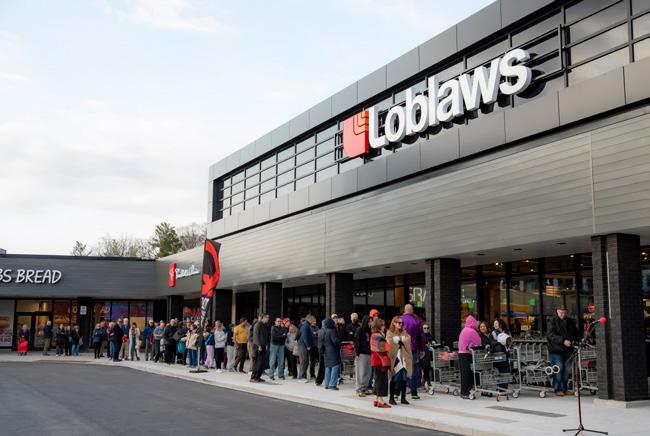
LOBLAWS reopened in Etobicoke, Ont.’s Humbertown Shopping Centre. The 34,000-sq.-ft. space has a new layout, updated signage and refreshed sections. The store offers more graband-go options, an expanded bakery, an enhanced selection of international foods and a greater selection of organic, gluten-free and plant-based products.
T&T SUPERMARKET opened its first ground-up store in Mississauga, Ont.’s Erin Mills Power Centre—a 40,000-sq.-ft. milestone marking its 15th location in the province and its 39th store in North America. It features the hallmarks the Loblaw-owned chain is known for including self-serve hot food, sushi, papa chicken, egg tart and more.
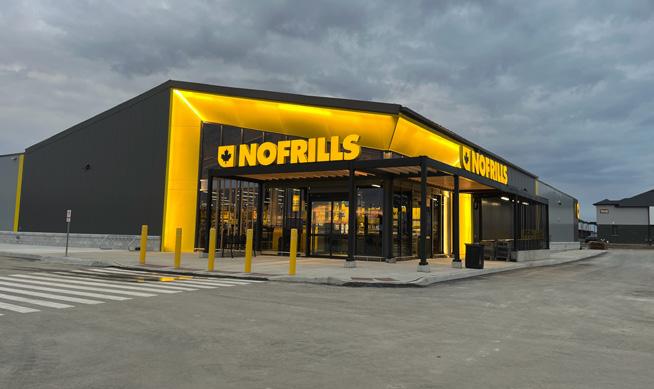
A series of firsts for Loblaw’s NO FRILLS discount banner: its first store in Komoka, Ont. and the debut of a more modern store design. Located within a growing, family-friendly community just west of London, the store’s esthetic uses a hybrid of timber and steel for what No Frills describes as a “fresh take on the traditional warehouse feel.”
The
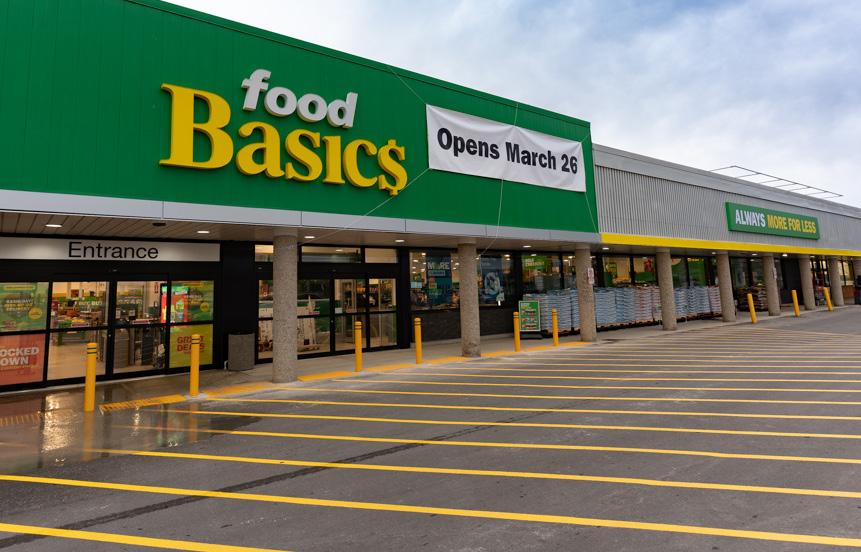
Metro’s FOOD BASICS banner opened a 32,000-sq.-ft. location in Brampton, Ont. The store—the second of eight planned this year—features locally sourced items, fresh departments and a product selection tailored to the community’s diversity.
FARM BOY opened a store in Ontario’s ski country. Located at 39 Huron St. in Collingwood, Ont., the new location—in a space formerly occupied by a Sobeys store—features local and organic produce, butcher-quality meat and an area dedicated to local vendors including Root to Fruit and Georgian Bay Granola.
GALLERIA SUPERMARKET has expanded its footprint in the Greater Toronto Area with a 37,123-sq.-ft. flagship “K-Hub” featuring the chain’s largest deli kitchen, an in-house cooking studio, a wide range of specialty items and the Galleria Avenue food court anchored by Kenzo Ramen, Woojoo Bunsik and a Bûngopang café.
Later this year, FRESHCO is launching in Atlantic Canada with three stores set to open in the Halifax area—two in Lower
In June, HEALTHY PLANET will open an 11,000-sq.-ft. location in northwest Burlington, Ont. The store will feature a range of wellness essentials, including fresh organic produce, natural and organic groceries, vitamins and supplements and natural beauty items.
Located in a high-traffic area of Kitchener, Ont., KALEMART24 soft launched its newest location to allow the team to connect with the community, gather feedback and fine-tune operations ahead of its grand opening. The store offers fresh grab-and-go meals, healthier snack options, premium beverages and essential everyday items.
Sackville and one in Dartmouth. Parent company Empire is headquartered in Stellarton, N.S.
No Frills debuted a new look in a new market.
Loblaw’s discount banner introduced a more modern look for its Komoka, Ont. store
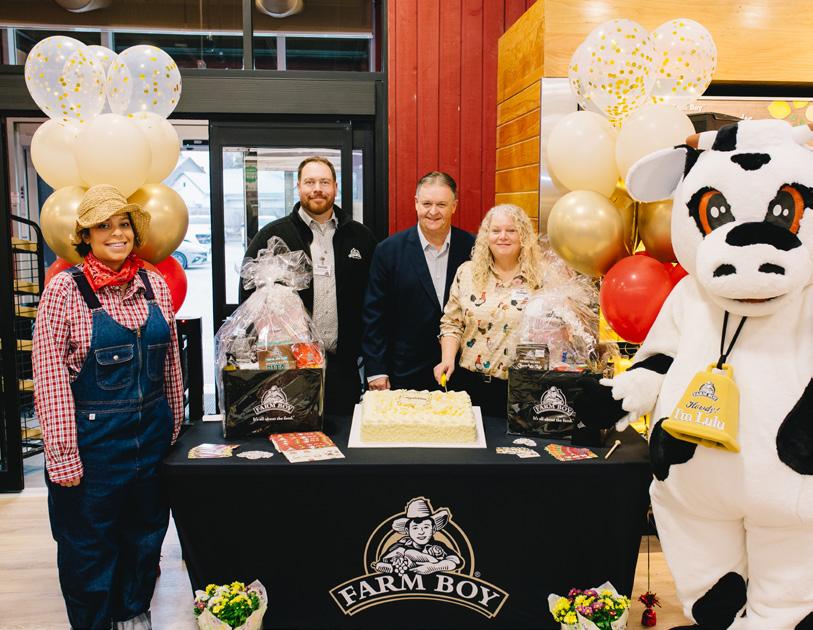
Farm Boy got off to a sweet start with a celebratory cake during the grand opening of its Collingwood, Ont. location
Loblaw’s store in Etobicoke, Ont. reopened with a new look and refreshed sections, including a more robust selection of organic, plant-based and gluten-free products
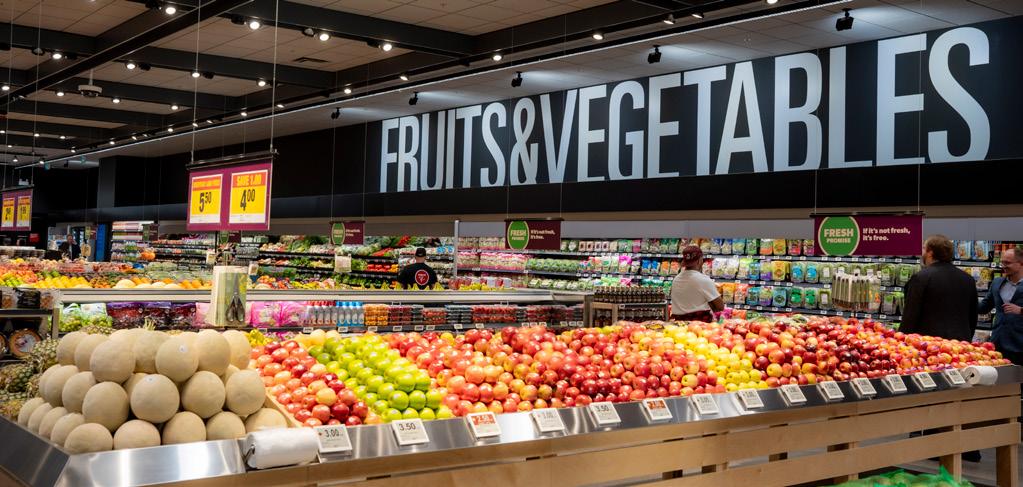
Metro’s Food Basics in Brampton, Ont. offers a product mix that reflects the tastes of the local community
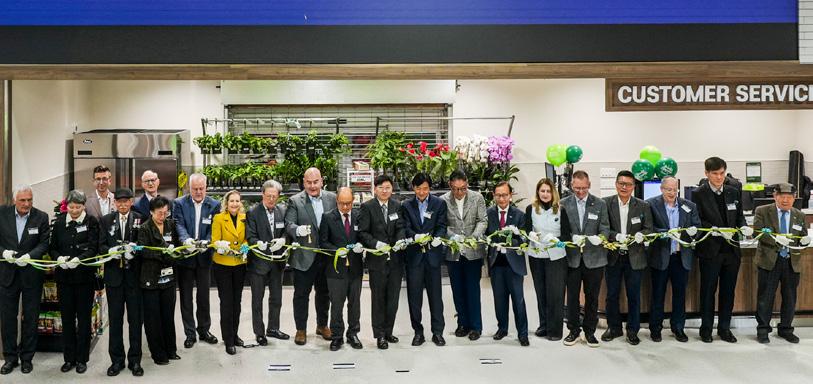
Galleria Supermarket marks the opening of its new K-Hub flagship in the Toronto area with a ribbon-cutting ceremony
RETIREMENTS
John Bayliss has been named executive vicepresident of national supply chain and procurement at Metro, succeeding Carmen Fortino who is retiring at the end of May. Bayliss, who spent the last year with Mastermind Toys, spent nearly a decade before that with Walmart Canada. He held senior-level positions with the retailer, including his most recent role as chief expansion officer, retail and growth development.
Lassonde Industries has announced key appointments to its leadership team. Jean-Philippe Leblanc has been named president of the North American specialty foods division where he will oversee manufacturing, supply chain and finance operations. Additionally, Minh Quan Dam joins as chief information officer, tasked with advancing the company’s regional technology infrastructure, cybersecurity and data capabilities.
Kruger Products has tapped Michael Urlick as senior vice-president and general manager, Canada Consumer Business Unit. He succeeds Michel Manseau, who is retiring. Urlick joined Kruger in July 2025 as senior vice-president of business development. He previously spent more than a decade at Clearwater Paper Corporation, moving up the ranks to senior vice-president and general manager, Consumer Products Division.
Owain Hoefle has joined Equifruit as sales manager for Western North America. He is tasked with developing key retail relationships across Canada and the United States. Hoefle joins Equifruit from Rainbow Greenhouses, where he worked as a key account manager. Before that, Hoefle spent 17 years at Pattison Food Group.
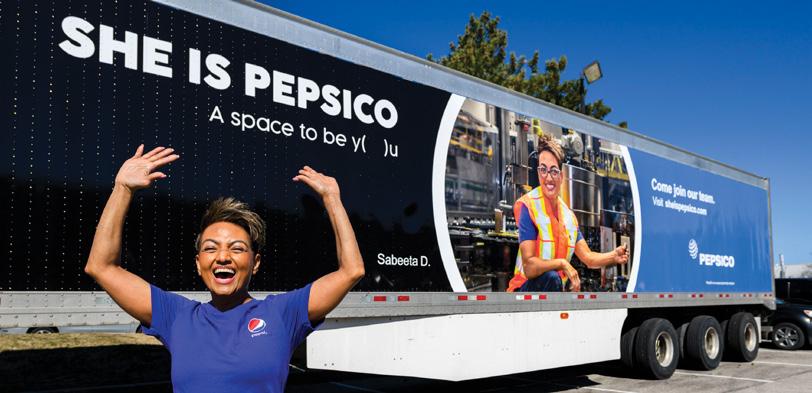
Food Health & Consumer Products of Canada (FHCP) and Retail Council of Canada (RCC) are recognizing PepsiCo Canada CEO Cara Keating with the 2026 Canadian Grand Prix Lifetime Achievement Award. Keating (a 2017 Star Women in Grocery Award winner) leads more than 12,000 associates across 13 manufacturing facilities and hundreds of distribution locations, and oversees a portfolio of brands that includes Lay’s, Doritos, Pepsi-Cola, Gatorade, Quaker and Bubly. Since joining PepsiCo Canada in 2004, she has held positions across field operations, national sales, strategy and planning and general management.
RCC is also presenting Empire’s chief marketing officer Sandra Sanderson with a Lifetime Achievement Award. Sanderson, who is retiring in July, leads marketing across Sobeys, Safeway, IGA, Thrifty Foods, Foodland, FreshCo and Lawton’s Drugs. In her seven-year tenure at Empire, Sanderson (a 2015 Star Women in Grocery winner) championed the company’s entry into the retail media space, led the launch of the Scene+ loyalty program and contributed to its philanthropic efforts.
Carmen Fortino, executive vice-president of national supply chain and procurement at Metro, is retiring at the end of May. Fortino joined the company in 2014 as senior vice-president and Metro Ontario division head. Two years later, he was named executive vice-president, Metro Ontario Division head, before adding national supply chain operations to his responsibilities in 2019. Since 2022, he has led both national supply chain and procurement for Metro. He received a Golden Pencil Award in 2022 and Retail Council of Canada’s 2025 Canadian Grand Prix Lifetime Achievement Award.
After 37 years with Kruger Products, Michel Manseau is retiring. He joined the company (then Scott Paper) in 1988 as a sales rep in Montreal. He quickly moved up the ranks and eventually landed in Toronto, where he’s been based since 2004. He joined Kruger’s leadership team in 2006 and was promoted to his current role as senior vice-president and general manager, Canada Consumer Business Unit in 2018. Manseau will remain a member of Kruger’s executive team as a special advisor. He won a Golden Pencil Award in 2022.
Minh Quan Dam
Jean-Philippe Leblanc
John Bayliss
Michael Urlick
Carmen Fortino
Cara Keating Sandra Sanderson
Michel Manseau
BUILT ON TRADITION
Meet the duo bringing a traditional Indigenous dry meat snack to a national audience
By Andrea Yu • Photography by Curtis Comeau
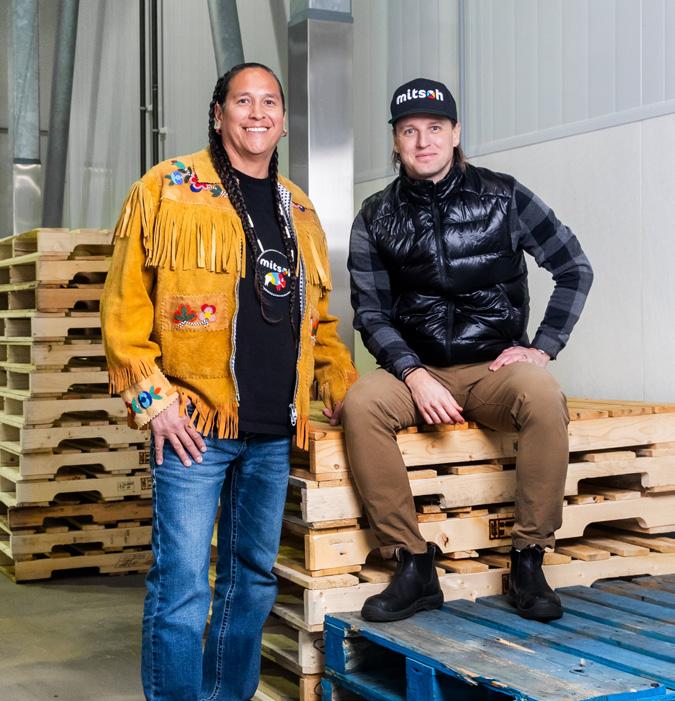
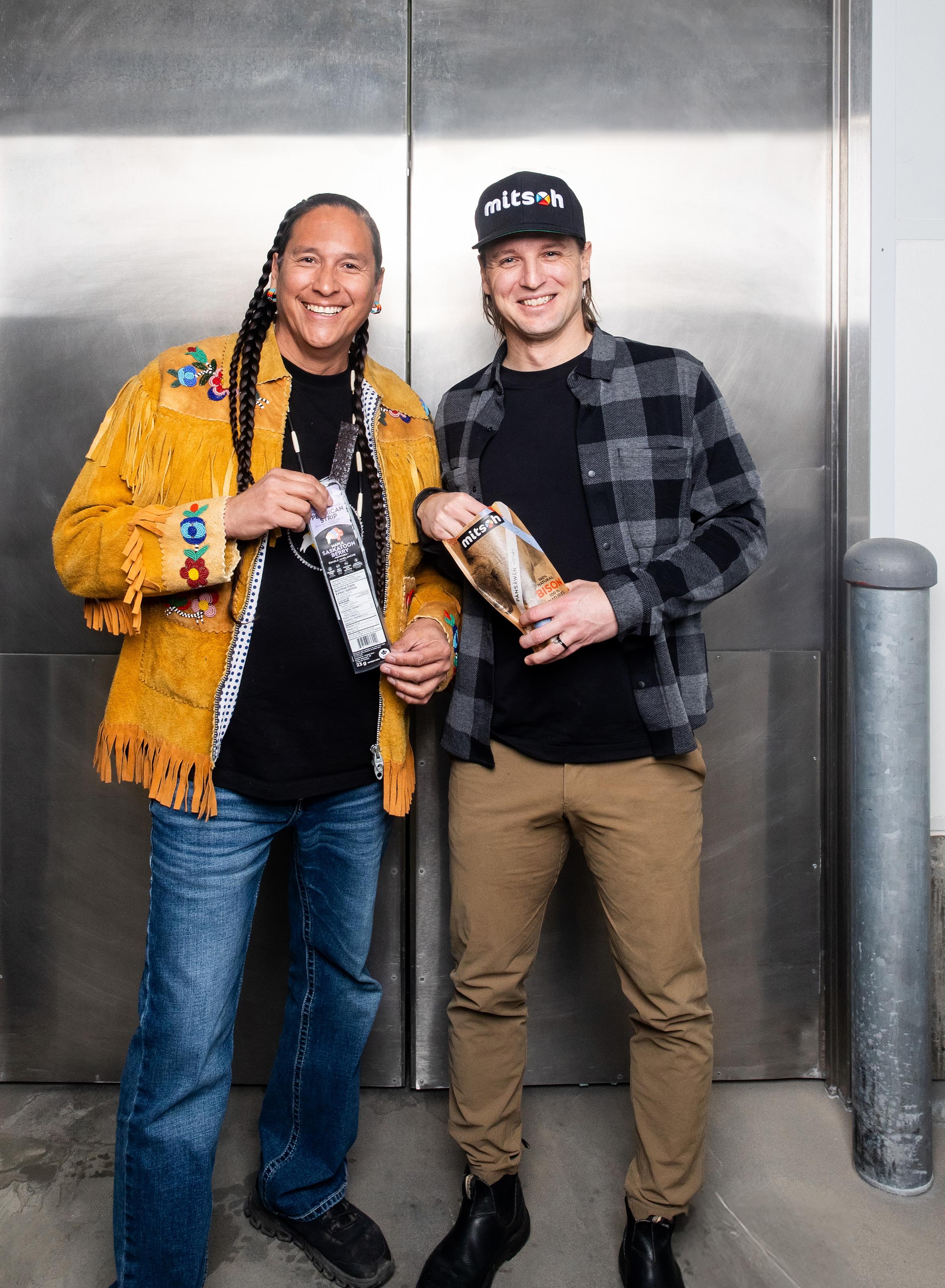
(L to R) Ian Gladue and Brandon Markiw
IIan g ladue’s career in food began with childhood imagination. Rather than playing doctor or teacher, Gladue preferred playing “restaurant” with his family. As he got older, that childhood play evolved into genuine experimentation with ingredients and preparing meals for the people around him.
Raised on the Bigstone Cree Nation in Central Alberta, Gladue relocated to Edmonton as a teenager, eventually channelling his culinary passion into a food truck—opened in 2013—serving bannock burgers, a blend of fast food and traditional Indigenous bread. This evolved into the 2015 opening of his Edmonton-based restaurant called Native Delights. Still, Gladue felt there was more he could do. One day, he was spending time with his mother while she was preparing dry meat—a traditional Indigenous food made by slow-smoking thinly sliced meat. “I looked at her and said: ‘That’s it’,” Gladue recalls.
He began preparing dry meat made of bison for customers at Native Delights. “When that started, the dry meat just took off,” says Gladue. “People were coming in just to buy the dry meat and we were selling out as fast as we could make it.” The positive buzz drove interest from River Cree Convenience store on the outskirts of Edmonton as well as Alberta-based grocery chain Freson Bros. and several independent Indigenous gas stations—all wanting to stock Gladue’s shelf-stable dry meat. “It became an overnight success,” he explains.
In 2016, Gladue closed Native Delights to focus on his new dry meat venture. “We pivoted fast and decided to go all in,” he says. He moved production to a commercial kitchen and put all his efforts into operating the company, then known as Pânsâwân, which means “thin-sliced meat” in Cree.
Over the next few years, Gladue was able to maintain the business—the dry meat was stocked in about 35 stores in Alberta—but struggled to grow. “I was capped out,” he says. “I knew I didn’t have the expertise to run the operational side at scale.” Gladue wanted to grow the business and sell his products outside of Alberta, but that meant moving to a federally approved production facility and conquering a new side of the consumer packaged goods industry.
Fortunately, in the spring of 2019, Gladue connected with Brandon Markiw, the owner of a federally inspected food
manufacturing operation in Leduc, just south of Edmonton. Markiw, also a founder of an all-natural deli line called Range Road Meat Co., had the expertise that Gladue needed. The two developed a strong bond. “A two-hour tour of the facility turned into a 10-hour hang,” Markiw explains. “Ian’s vision was immediately clear to me.” While he isn’t Indigenous himself, Markiw has a deep respect for Indigenous culture and was keen to help Gladue scale up his operations.
Producing Gladue’s traditional dry meat wasn’t easy. They were taking a food with thousands of years of history—traditionally made outdoors with open fire, wind and sunlight—and making it in a facility. “At the beginning, Ian and I were spending 10 to 12 hours a day in front of the smokehouse, monitoring every step,” explains Markiw.
The pair scored their first major grocery listing in 2019. As part of the Sobeys local program, Gladue’s dry meat products were listed in 30 of the grocer’s Alberta stores. Five months later, the duo’s manufacturing relationship blossomed into more. Gladue formally asked Markiw to join the Indigenous meat snack company as co-CEO. “We did it traditionally with a sweat lodge ceremony and smoking a pipe together,” explains Gladue. “That’s what has bonded us ever since.”
Markiw helped Gladue diversify the product lineup for a national rollout. “We were trying to understand how the story could connect to a wider audience across the country,” Markiw explains. “Dry meat is the most nutrient-dense natural food snack product in existence, but it’s less approachable than the modern meat snack experience.”
What came next was a product innovation from Gladue: pemmican strips—a traditional Indigenous food made by pounding dried meat into a powder and mixing it with fat and other ingredients. Gladue developed his recipe using bison, berries, maple syrup, salt and smoke. The pemmican strips launched in 2023 along with a new brand name: Mitsoh, which means “eat” in Cree. Mitsoh products are now in about 1,000 stores across Canada.
Considering how far he’s come, Gladue feels grateful to be at the helm of a burgeoning Indigenous food business. “It’s a blessing to help contribute and preserve something that was here long before us,” he explains. “To play a small part in that is an honour and a privilege to be able to do that for my people, my children and for the future generations.” CG
30 seconds with …
IAN AND BRANDON MITSOH
What do you like best about your job?
IAN: I love the connection to people. I love to see and feel the impact that we are creating. That’s what excites me the most.
What’s the best business advice you’ve received?
BRANDON: It’s great to have a plan but that plan is probably immediately going out the window the minute you start. So, stay open-minded.
IAN: For me, it’s the fact that your story is powerful. Everyone has a story, and the sooner you embrace who you are and your story, you will unlock your gifts.
What’s your favourite product from your lineup?
BRANDON: Dry meat and the maple Saskatoon berry pemmican strips.
IAN: In order: dry meat, then the maple blueberry pemmican strips.
What do you like to do when you’re not working?
BRANDON: I love the outdoors and playing sports. I grew up playing hockey and golf. In the summertime, I’m primarily playing golf and, in the winter, I’ll be skiing. Fitness is a big part of my life, too. I’m in the gym a lot.
IAN: Family is No. 1 for me. I have six kids that range from five-year-old twins to a 22-year-old daughter. No. 2 is ceremony. Spending time in the sweat lodge means I’m making sure that I’m connected to where I come from.
What’s your favourite food?
BRANDON: I’m a meat and steak guy. I don’t think there’s anyone who’s consumed more meat snacks than I have.
A summer like no other
Ferrero Canada and soccer fever help retailers score with shoppers
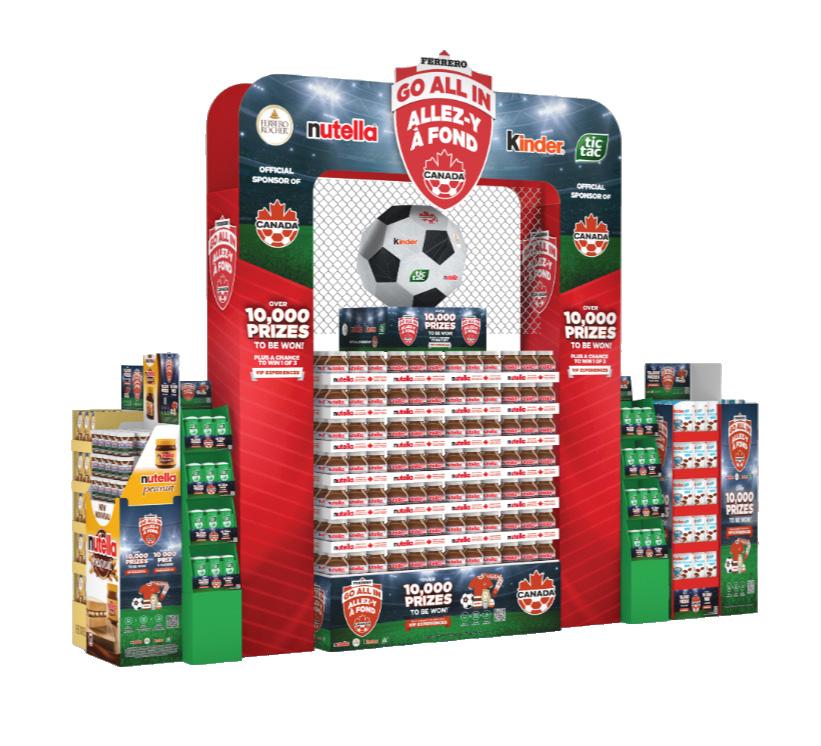
As we head into summer 2026, grocers are wise to prepare for more than the usual sea sonal lift tied to road trips, family barbecues and cottage escapes. This year, the FIFA World Cup is expected to create unique, high-impact opportunities to drive traffic, build baskets and engage shoppers. And Ferrero is ready with its largest scale promotion ever as Proud Sponsors of Canada Soccer.
“This is a once-in-a-generation event and there are incredible opportunities that go with that,” says Joanne Farber, VP of Marketing Premium Chocolate at Ferrero Canada. “It’s a time to lean in and capture those special moments with shoppers.”
The 2026 FIFA World Cup kicks off June 11 in Mexico City and runs through July 19 and, for the first time, is co-hosted by Canada, the United States and Mexico. In Canada, Toronto and Vancouver host a combined 13 matches, with games in those cities taking place from June 12 to July 7.
The tournament represents a convergence of national pride, growing soccer fandom and extended in-store activation potential, and the sweet-packaged foods company is leaning into that trifecta.
“To have an international sporting event held on home turf is rare, and it couldn’t come at a better time,” says Farber. “There’s a real swell in Canadian pride overall, combined with growing soccer fandom around the fastest growing sport in Canada. With our Ferrero collection of promotional products, we are poised to have an incredible summer cheering on Canada!”
Ferrero’s “Go All In to Win” campaign marks its first portfolio-wide activation tied to its partnership with Canada Soccer,
spanning multiple categories and brands, including Kinder Surprise, Kinder Bueno, Nutella, Tic Tac and Ferrero Rocher chocolate squares.
The company is supporting retailers in a big way with a 360-degree marketing campaign and a range of in-store displays designed to fit different store formats.
From large theaters to smaller footprint displays, and exciting soccer-themed point-of-sale materials, retailers can create one-stop-shop destinations.
“Brand partners like Ferrero play an important role by activating their sponsorships instore through impactful eventdriven POS and display vehicles,” says Sal Galle, VP of Merchandising and Category Management, Grocery and Fresh–Metro Inc. “These displays help create excitement at shelf and encourage incremental purchases, driving both basket size and impulse buys tied to watch party occasions.”
The duration of the tournament also creates repeat traffic and amplifies trip frequency, with each match a reason to shop your favourite treats, says BJ Hamilton,
Senior Vice President of Sales at Ferrero Canada.
“Our goal is to partner with our retailers and translate their summer program into game day, basket building solutions,” says Hamilton. “Through displays, cross-category bundles, impulse “grab and go” opportunities, we’re looking to convert more shopper traffic into a purchase.”
Ferrero’s triple win model ensures there’s something for the retailers, consumers, and the company itself. And its national field sales team is ready to help build excitement in-store for retailers and shoppers looking to plan ahead or pick up last-minute treats.
“We’re leaning into the occasion by building merchandising that aligns with how customers shop for sporting events, focusing on key gathering and entertaining items, supported by increased inventory,” says Galle. “We’re also partnering with brands that are sponsoring the tournament or Team Canada to bring added excitement and a true event feel into our stores.”
For retailers who execute well, the payoff is sweet.
Kinder Surprise features soccer-themed toys.
One Brand. Every Aisle.
A New Look Built On 30 Years of Integrity.
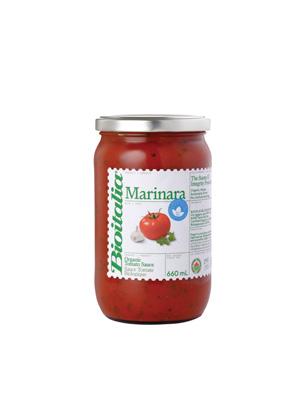
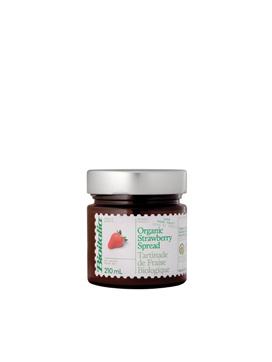
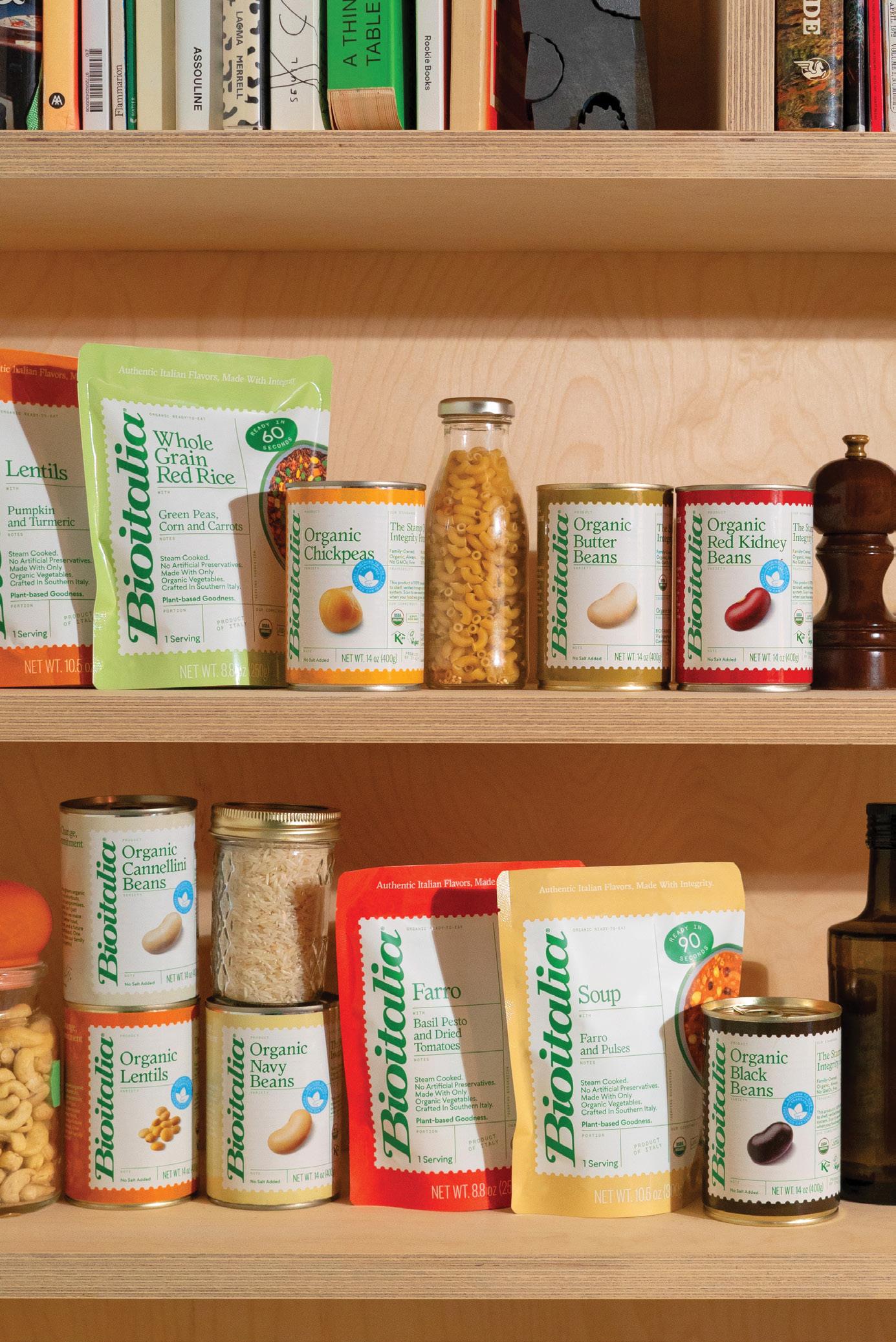
Bioitalia introduces a unified brand identity across its entire organic Mediterranean pantry. For the first time, everything comes together under one look. One standard. One brand across every aisle.
From Italy, Since 1994.
Thirty years ago, a family in Sarno, Southern Italy decided that organic farming was not a trend to chase. It was simply how you grow food when you respect the land that feeds you.
Three generations later, that conviction has not changed. Bioitalia is a certified B Corporation and category leader in Canada with a vertically integrated supply chain from field to shelf. The full Mediterranean pantry, under one brand.
Where others own a category, Bioitalia owns the pantry. Elevated, consistent, and unmistakably ours.
The Stamp Of Integrity From Italy.
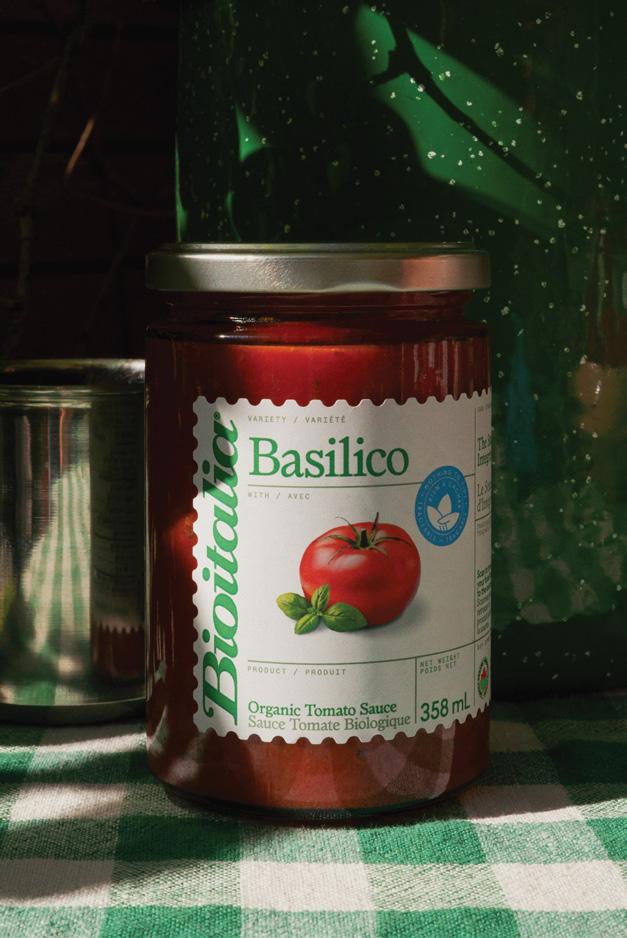
Our label is shaped like a postage stamp. On every product, across every category. Once you spot it, you will see it everywhere. One visual language, instantly recognizable across every aisle. One standard across every category.
The stamp signals: Certified organic ingredients. Family owned. Sustainable farming. Clean label standards. Traceable supply chain.
The word organic appears on a lot of labels. We think people deserve to know what is actually behind it. Select Bioitalia products carry our Nothing To Hide seal, a blue traceable symbol on the front of the pack. Where you see the seal, you will also find a scannable QR code.
Scan it. See the farm. See the harvest date. See exactly where your food came from, permanently recorded and impossible to alter through blockchain technology. No guesswork. No vague sourcing claims. Real proof.
Ideas
SHOPPER TRENDS
THE RISE OF TOP-UP SHOPPING
When skIp recently announced its partnership with Loblaw, it signalled the growth of the top-up shop segment—high-frequency, smaller-basket grocery runs, typically in the middle of the busy week.
Top-up or filler trips don’t replace big-haul weekly shops, but answer the urgency of a missing ingredient, a late-night craving or a “need-it-now” essential a shopper didn’t realize they were out of.
“We see from consumer behaviour that Canadians are increasingly interested in being able to quickly get their groceries for midweek top-ups—from replenishing fresh produce to reacting to unexpected plans,” said Avery Ironside, senior director, marketing & growth – online grocery at Loblaw Digital.
Top-up shopping is not entirely new, but rather an acceleration of existing shopping patterns that have been evolving over the years, says Ramesh Venkat, director of the David Sobey Retailing Centre at Saint Mary’s University in Halifax. “Before the advent of large supermarkets, people bought in smaller quantities in local neighbourhood stores. It’s less about the emergence of a completely new behaviour and more about the acceleration and evolution of an existing one.”
Now, the rise of technology has significantly amplified this behaviour. “Digital platforms, same-day delivery and subscription services have only made top-up shopping a more common and streamlined choice,” says Venkat.
It’s shaped by real-time needs, says Paul Sudarsan, senior
vice-president of partnerships at Skip. “It could be realizing you’re out of something while guests are over, running out of an ingredient while cooking, or simply not having time to get to the store midweek,” he says.
What’s driving the rise of top-up shopping? Venkat says the external factors driving this consumer behaviour include time constraints, urbanization, smaller households and inflation.
While the rise of top-up shopping creates opportunities, it can also present challenges. Small baskets often have a lower average order value, but retailers may benefit from increased frequency of visits: Usually shoppers who set out to pick up just a couple of items might walk out with a few extra things in their grocery basket.
Whether in-person or online, frequent purchases can create logistical headaches, says Venkat. “For physical stores, it means more frequent restocking, more crowded stores and potentially higher operational costs,” he says. “For delivery-based businesses, more frequent, smaller orders can lead to higher delivery costs per unit, especially if delivery minimums are low and consumers only buy a few items.”
Retailers need to balance the costs of frequent replenishment with the potential for more regular customer interactions and higher sales volumes. “Those who offer convenience, like sameday delivery or quick pickup options, could capture a higher market share, but profitability will depend on their ability to manage logistics efficiently,” says Venkat. —Louise Leger
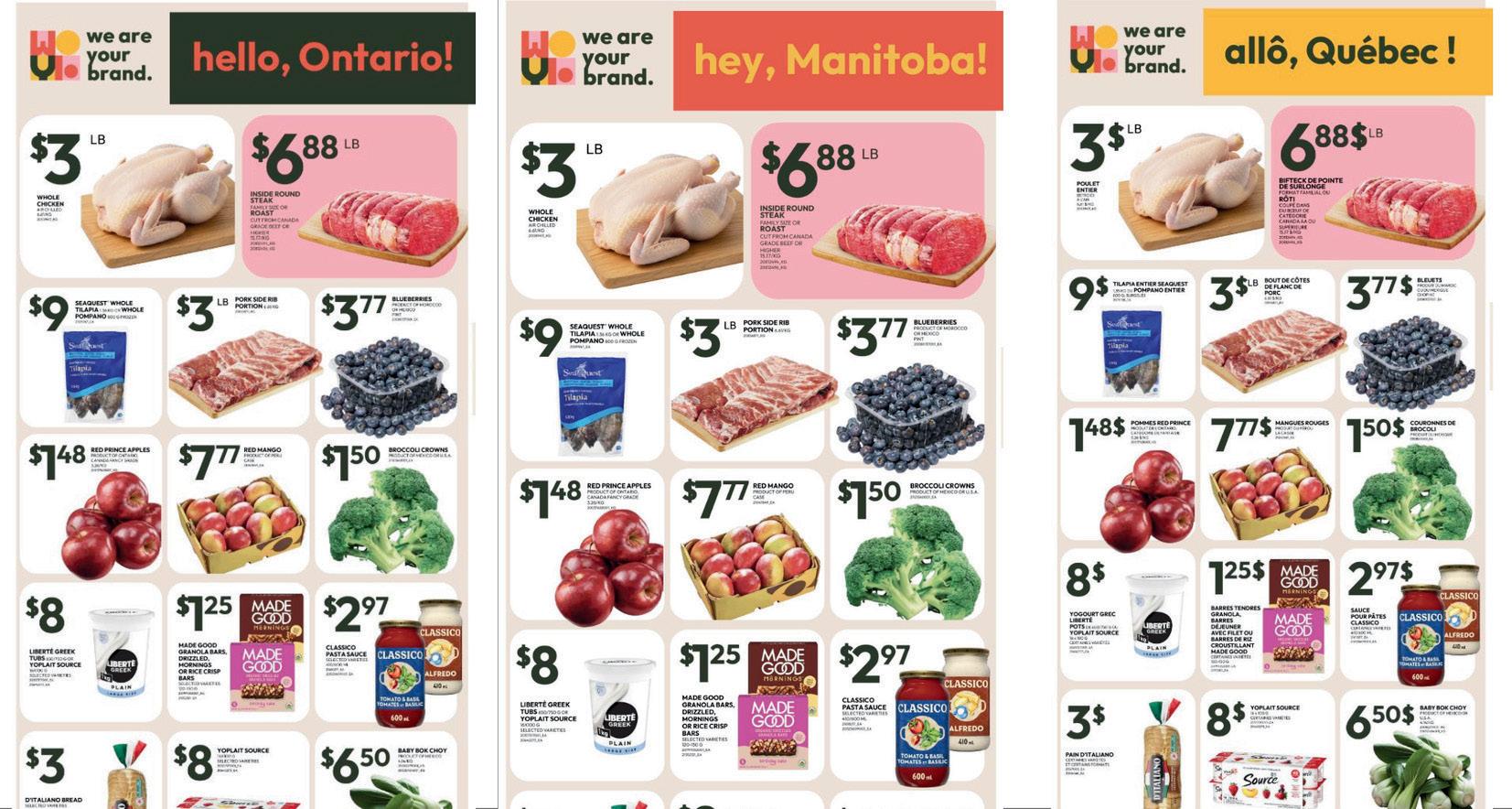
Turn product data into content for every channel, at scale.
Smart templates. Real-time updates. Generative AI. All informed by your brand DNA.
Built for multi-banner, multi-region grocery promotions.
Scale
Personalization
Tailor content by region, language and audience
Reduce Costs
Eliminate manual production, rework and fragmented workflows
Shorten Lead Times
Move from weeks to hours or minutes with automated workflows
Optimize Performance
Use built-in analytics and feedback loops based on real campaign data
RETAIL MEDIA IN MOTION
Loblaw Advance SVP Leanne Gibson on where retail media networks are today and where they’re headed
By Shellee Fitzgerald
RETAIL MEDIA NETWORKS have grabbed a lot of attention in recent years thanks to their rapid evolution from experimental ad platforms to high-margin revenue streams for retailers. We recently spoke with Leanne Gibson, senior vice-president at Loblaw Advance, about how grocers such as Loblaw are becoming media owners and intelligence providers, how AI is being leveraged in this space, and what retail media might look like in the years to come. The interview has been edited for length and clarity.
Retail media has become a significant revenue stream for retailers. What’s driving growth? There are a couple of ways to look at it. Retail media is evolving beyond the shelf; it’s really becoming a core intelligence layer. Brands are realizing the value of retail data goes beyond advertising; it extends to addressing challenges across the entire marketing mix. If we think of Canada, specifically, retailers are shifting from being merchants to media owners, and [they are] increasing investment, not just in on site—in apps and web—but also in the store with intelligence measurement capabilities. That’s really where the value proposition lives.
How do you define success for a retail media network beyond ad revenue? It’s the ability to make the insights we offer more accessible so brands can make faster business decisions. And this is where we have an incredible sales data platform, Loblaw Data Insights and Analytics (LDIA). And it plays a really critical role. It allows our partners the insights needed to manage their business effectively. We provide sales performance data, inventory levels, PC Optimum
engagement, category-level performance and competitive benchmarks. So, to me, that insight and that level of information goes well beyond ad revenue. And we’re evolving it to include AI-powered insights to [deliver] those smarter, faster decisions. The new AI assistant that we’re rolling out allows you to ask a question in plain language and you’re going to get an easy-to-understand quick response.
Talk a bit more about how AI is being leveraged in the retail media space. The real potential for AI is two things: its velocity and its accessibility. Internally, it’s allowing us to bring products to market faster and also to create frictionless experiences and simplicity for advertisers. At the end of the day, it makes complicated information more accessible to more business units, reducing the time from question to action and, ultimately, enabling brands to make faster, smarter decisions with more confidence.
How can retail media networks maintain consumer trust while delivering targeted advertising? The foundation is a responsible use of first-party data. But also, that has to include a clear value exchange for consumers. Consumers are generally receptive to ads when they’re relevant and they’re grounded in transparency and usefulness. So, we know trust is maintained when targeting feels helpful, when it doesn’t feel intrusive and consumers understand why they’re seeing an ad and it has a meaningful value to them. We spend a lot of time working with data governance and privacy to have the right design principles. Really, nothing is more important when we think of our end consumer.
How do you ensure retail media doesn’t come at the expense of the shopper experience? Every decision we make is designed to enhance the shopper experience and the focus is on relevance over volume, ensuring ads are useful, are in the moment and support real shopper needs. We’re really intentional about protecting “high-intent journeys.”
What will retail media look like in grocery five years from now and beyond? One of our leaders, Lauren Steinberg, tells this great story about her family grocery business and finding a 60-yearold video of her uncles talking about the same retail priorities we talk about today: assortment, shelf positioning, shopper engagement. It’s a lesson and a reminder that as much as there’s so much changing around us, we’re still focusing on the shopper experience. And that’s key. Making it easier for shoppers to find and discover new products and improve their experience and their lives—that’s going to remain unchanged over the next five years, 10 years, and for the foreseeable future. It’s really important to remember that. But beyond that, we’re going to see the continued shift to e-commerce, grocery delivery, and buy online/pickup in store; that’s going to impact and make changes along the path to purchase [in terms of] coming up with new tactics. And in-store digitization at scale; I think we’ll continue to see smarter stores in terms of measurable media environments, digital screens, smart placements, and then AI-driven optimizations. At the end of the day, I think retail and media will become predictive—automating targeting, spend and messaging in real time, and that’s exciting!
AI-Driven Video Intelligence For Grocers
Solink gives grocery operators AI-powered visibility across every location - from the front end to the back room.
See More
Know what’s happening in every aisle, at every register, across every location. In real time.
Know More
Connect video, POS, and ops data to catch shrink, spot bottlenecks, and protect your margins.
Do More
AI agents that monitor, investigate, and alert — so your teams focus on the customer, not the camera.
Increase Revenue Optimizations
Reduce Safety and Security Risks
Drive Better Customer Experience
Trusted by performance driven brands: Book a demo
REDEFINING THE GROCERY EXPERIENCE TAKING THE LEAD:
T&T
Supermarket CEO Tina Lee on
keeping it real and finding inspiration in unlikely
places
By Chris Daniels
WHEN A T&T Supermarket opens, its devotees—often in the hundreds—turn out to see what treasures they can find, from viral snacks to specialty produce and trendy beauty products. Since when did supermarkets have fandoms?
The Asian grocery chain was founded in 1993 by Cindy and Jack Lee, who lovingly named the business after their daughters Tiffany and Tina. When their mother retired in 2014, Tina took on the role of chief executive officer, transforming the brand into a North American retail and cultural powerhouse.
Canadian Grocer caught up with Lee at the recent opening of the T&T Supermarket at Erin Mills Power Centre in Mississauga, Ont.—the company’s 15th store in the province and 39th in North America—where crowds queued for hours.
Here, Lee discusses her leadership style—from using social media to connect with customers and finding business inspiration from Disney. This interview has been edited for clarity and length.
What is your leadership philosophy?
We’re a very people-oriented business in how we treat our employees, suppliers and customers. I often tell my team that with the right people, we can do anything. It really comes down to alignment—being in the right boat, in the right seat, all moving in the same direction. I feel very blessed to be carrying the legacy of my parents. My team has really gotten behind it, and the community is leaning into it and believing in it.
What shaped your leadership style when you became CEO? I came back to T&T in 2009 [after a few years at Deloitte
Consulting] when I was 29 and became CEO at 34. And honestly, what do you know at 34 about leading such a big business? You have to earn your stripes. You have to earn the respect of people who were reporting to your mother and then transitioned to reporting to you. So, for me, it was about communication— sharing the vision [and] getting people on board. I share an idea, and I’m open and humble enough to collect input on whether that idea is good or not. I also surround myself with people who execute at a world-class level. That’s how it comes together. And I don’t try to fake it; I wear my emotions on my sleeve. My team knows how I’m feeling all the time and when I share my insecurities, they back me up.
You drew attention in a CBC interview a couple years ago when you questioned whether expanding into the U.S. was the right move for T&T. Some argue leaders should always project certainty. How do you respond to that? You’re right—some people think leaders need to always be polished or aggressive. But, I say what I feel. I run my business with passion, compassion, excitement and energy. In interviews, people sometimes say I sound timid or not forceful enough, but I think I’m just honest about where I’m at—I’m not confident all the time.
You have more than 32,000 followers on Instagram and nearly 39,000 on LinkedIn. How do you approach being a public-facing CEO on social media? We were dark for a long time, but COVID forced us to open up because I
really wanted to communicate directly with customers. We decided we should be where our customers are—Instagram, Facebook, TikTok, LinkedIn. And yes, that exposes me to some haters and criticism but, for the most part, as you can see from the turnout today, we are building community, celebrating food and moving culture forward—and I think that’s a beautiful thing. So, while not every CEO goes out the way I do on social media— and maybe I shouldn’t—for me, it’s as simple as documenting for consumers what we’re doing.
Which off-the-clock pursuits make you a better leader at work? My current obsession is Disney theme parks. I go with my kids during the holidays and I observe [Disney’s] attention to every detail—even something like a visit to the lost and found—and I bring a lot of that back to T&T. We design for chi. In Chinese culture, chi is about flow and energy in a space, and I want grocery shopping to feel alive, not like a chore. That’s why we invest in sampling, we think about how groceries are bagged, and we pay attention to music and in-store atmosphere and design. I’ve even taken my leadership team to Disneyland for customer training because, at the end of the day, we’re not just about groceries—we’re an experience.
In our Taking the Lead series, Canadian Grocer speaks to leaders from across the industry about a specific project or initiative they’re leading. Have a pitch? Send it to jmorgan@ensembleiq.com
MAKING SELFCHECKOUT WORK
Matt Miles of Diebold Nixdorf on moving self-service tech from experimentation to measurable impact
By Rebecca Harris
OFFERING SPEED AND convenience, self-checkouts are an increasingly important part of the in-store experience. But as adoption increases, so do expectations for accuracy, ease of use and true seamlessness. Matt Miles, director of North America retail, Diebold Nixdorf, works closely with grocers to modernize the in-store experience with the latest self-checkout technology. In his view, the next phase is less about the latest “shiny new object” and more about making in-store tech truly work. This interview has been edited for clarity and length.
What do you see as the most important shifts in in-store technology?
Grocery has moved out of the experimentation phase and into execution. Over the past couple of years, everyone has been dabbling in AI and how to introduce self-service. Now, it’s about executing and how the AI and automation work inside their stores and whether or not it’s a measurable improvement. A lot of times it’s the flashy new thing and you have to ask, is it actually making a difference in their stores? And so, that’s what a lot of grocers are starting to focus on: how do we go about making sure it’s measurable. It’s all about removing that friction at the checkout, improving on accuracy, supporting local store teams and making sure it meets customers’ needs.
How is the role of self-serve tech evolving? Technology is becoming less fragmented. A couple of years ago, all the different areas of the store were like islands doing their own thing. PostCOVID, everything has become more foundational. So, you need to start building on all those islands and start making
a continent. The integration matters the most at checkout because everything comes together, and that’s where the friction becomes immediately visible to customers and then it becomes costly to the operators. Capabilities like AI-based facial recognition, automated age verification, intelligent shrink intervention— that’s where you can have a meaningful impact at the checkout.
What are the retailers successfully leveraging self-checkout technology getting right? In grocery, specifically, those that are doing well have clarity. They understand what their challenge is and what they’re trying to solve for— whether that be shrink, congestion at the checkout or associate workload— and then they start measuring it. That’s where we see retailers excelling. If you lack clarity on what you are trying to solve for, that’s when things get confusing and that’s where retailers fall behind. Measurement is really important in technology because without ROI, it doesn’t pay for itself.
How can grocers use AI and data analytics in meaningful ways at self-checkout? One of the main uses for AI is checkout accuracy and operational efficiency. Computer vision (CV) is helping a lot with shrink. Believe it or not, most issues we encounter on the front end when it comes to shrink are actually unintentional shrink. For example, someone hears the beep from somebody else’s register or self-checkout and the item goes into the bagging area, but it didn’t scan. Not a lot of people go to the front-end checkouts to intentionally steal. So, that’s where a lot of the friction can be addressed. Another
area is cutting down on unnecessary associate interventions … for example, if an item is mis-scanned or accidentally placed into the bagging area and an associate has to come over and clear the error. All of that can go away with CV and smart vision because it will understand what’s going on in that customer’s journey. It has the context to address it.
What does the store of the future look like and what’s next for self-checkouts? The store of the future won’t be fully automated, but it will be highly adaptive. Technology will start fading into the background, enabling a much better customer experience without demanding attention. Checkout is still going to be critical. You’re not just going to walk out. At no point in the near-term future do I see an autonomous store. But it will be faster, more intuitive and more forgiving. So, AI is going to help prevent common errors and reduce unnecessary interruptions, but at the same time, the store is going to be better equipped to handle peak demand and the staffing variability that comes with it. With CV, you can track how many people are coming into the store, proactively notify the store based on the analytics and open more lanes when needed. It’s not about removing staff—it’s about making sure retailers are armed with intelligent decisions. We’re giving them those insights and actions proactively versus a lot of data three months later saying you should have opened three more tills. That’s what we see as the store of the future. You take all the CV and infrastructure in the store today, tie it with operations, analytics and tech, and put it all together. Then staff is better equipped to handle the peaks.
AT ALL COSTS
THE OFFICE OF the Grocery Sector Code of Conduct (OGSCC) is reminding suppliers to provide reasonable notice before introducing fuel surcharges to offset rising transportation costs caused by the U.S.-Israel war with Iran.
“Members should ensure that any cost change proposals–including temporary surcharges–are made in accordance with existing agreements,” the OGSCC said in a notice sent to members. This includes respecting notice requirements for cost change proposals and providing reasonable notices for added surcharges.
The OGSCC says the reminder comes on the heel of “recent reporting regarding the introduction of fuel-related surcharges and other cost adjustments by certain suppliers in response to rising transportation and input costs.”
Maple Leaf Foods, which is not a signatory to the Canada Grocery Code, recently told customers it was introducing a temporary fuel surcharge of 11 cents per kilogram on prepared meats and poultry shipments, effective April 6. Other suppliers, including Tree of Life, CTS Foods and Sunrise Farms have followed suit.
In an emailed statement to Canadian Grocer, Michael Graydon, CEO of Food, Health & Consumer Products of Canada,
Up to code
said “any cost changes should be clearly communicated and reflected in commercial agreements. That helps maintain stable working relationships across the supply chain.”
Major grocers are resisting paying for the fuel surcharges. Here’s what the “Big Three” have to say:
“We have received a few requests from suppliers to date, which we have declined,” Caitlin Gray, external communications advisor at Sobeys, said in an email to Canadian Grocer. “Similar to our approach to tariffs at this time last year, we believe the fuel market is too unpredictable to make any decisions that could adversely impact the value we provide to our customers.”
YEARS IN THE making, the Canada Grocery Code finally came into effect on Jan. 1—and independent grocers say it’s already changing how they do business.
At Grocery & Specialty Food West in Vancouver last month, independent grocers took to the stage to share how the voluntary code is improving their relationships with suppliers.
“The real objective of the code is to provide a framework for resolving issues—getting people to talk to each other,” said Gary Sands, senior vice-president public policy and advocacy at Canadian Federation of Independent Grocers (CFIG), an organization that has long championed a grocery code of conduct.
Sands moderated a panel that included Giancarlo Trimarchi, president of Vince’s Market and Brian Bradley, president of Stong’s Markets and current CFIG chair. He stressed the code isn’t designed to make independent grocers equal with the chains, in terms of buying power, but noted the dispute
“[Loblaw] is in regular dialogue with our suppliers and continue[s] to review cost increase submissions due to changes in underlying market conditions, including any proposed fuel surcharges,” said a company spokesperson. “We continue to push back on unjustified cost increases including on fuel surcharges where not justified to reduce inflationary pressures for Canadians.”
“[Metro] carefully reviews and, when possible, negotiate[s] requests from our suppliers to ensure they are justified and limit their impact on our customers, while continuing to offer competitive prices,” said Geneviève Grégoire, communications manager, Metro. –Danny Kucharsky
resolution process built into the code is “the great leveller.”
For Trimarchi, who serves on the board of the Canada Grocery Code, the biggest benefit of the code is that it has created a playbook with a set of rules on how retailers and vendors should respect and treat each other.
He pointed to a recent instance where Vince’s was given little notice of an impending fuel surcharge. Trimarchi reminded the vendor—also a signatory to the code—of a principle around non-unilateral decision making around fuel surcharges. This led to a mutual agreement. “These collaborative conversations were never held before,” said Trimarchi. “[The code] has changed how we deal with each other.”
Bradley echoed the sentiment, noting the code has underscored the importance of transparency, particularly when it comes to price increases.
Large chains can demand 60 or 90 days’ notice of increases, Bradley said, adding there’s no reason independents shouldn’t expect the same. “Asking for and developing the process for hearing about price increases has been a big one for us.”
–Shellee Fitzgerald CG
CANADIAN CLUB
ICONIC,
INNOVATIVE, ENDURING
›› Now
› Then
From the outset, Canadian Club was rooted in a simple but powerful idea: Create a smooth, approachable whisky for a wide audience, and control the process for a consistent, quality product. But, of course, there’s more to the story, and it begins not just with whisky, but with a bit of frustration—and a lot of ambition. In the mid-1800s, founder Hiram Walker was a grain merchant who made some of his own whisky. But he saw the carefully crafted distillate he sold to others diluted and resold at a lesser quality and a bigger profit. So, in 1858, he decided to purchase a vast stretch of land outside Windsor, Ont., and began building what would become an iconic Canadian enterprise. What followed was less a business startup than a full-scale settlement. Walker cleared land, grew crops, and built not only a distillery but an entire community—housing, a school, medical services and more.
More than 160 years later, Canadian Club finds itself both steeped in tradition and riding a renewed wave of interest. Canadian whisky as a category has been gaining traction over the past decade, and iconic brands like Canadian Club are benefiting from that momentum. Long associated with familiar serves, like whisky and ginger ale, the brand has seen cycles of popularity, and today it is attracting a broader, more curious audience.
Part of that resurgence is driven by innovation at the premium end. While the core product remains unchanged, the brand has steadily expanded into aged and limited releases, including ultra-aged expressions that push the boundaries of Canadian whisky.
“Anything new that we’re coming out with is very innovative, very creative, and it's more at the premium or even super-premium level,” says McLean. “New consumers are discovering the category, often through flavour-forward or lighter expressions that showcase whisky’s versatility.”
Because of that, he says, “It's a very exciting time for us.”
“When transportation proved a barrier, he launched a ferry service and later a rail line to connect his operations to broader markets,” says Mike McLean, Canadian Whisky Ambassador for Canadian Club. “He was starting from scratch and basically built an empire.”
››› Next
Looking ahead, Canadian Club is focused on evolving with drinkers, while being ever mindful of its roots. Innovation continues to centre on distinctive, high-quality releases, from experimental cask finishes to landmark vintage whiskies, supported by a steady cadence of premium expressions like the Chronicle Series that continue to build on the brand’s legacy.
Equally important is growth in ready-to-drink (RTD) beverages, like with the brand’s popular Canadian Whisky and Ginger Ale—a take on the classic Rye & Ginger—plus its recently launched Cherry Smash, an example of the brand tapping into changing consumer habits. By combining whisky with balanced, refreshing flavours, Canadian Club is positioning itself in a category that appeals to both seasoned whisky fans and those who may have never considered it before.
The strategy is less about chasing trends and more about expanding the brand’s reach—o ering something for a variety of palates while staying true to the craftsmanship that has defined Canadian Club from its rich beginnings.
Boundless ambition: Hiram Walker was a grain merchant who built a full-scale settlement alongside a one-of-a-kind whisky enterprise.
Ready-to-drink beverages are expanding Canadian Club's reach, appealing to new consumers.
Steeped in tradition, Canadian whisky has been gaining traction over the past decade, with Canadian Club benefitting from that momentum.
NEW WHAT’S
GLUTEGUARD®
Following a gluten-free diet is not easy. Even with the best intentions, avoiding every trace of gluten can be difficult, especially when meals are prepared by others. Taken before a meal, GluteGuard’s caricain enzyme works to target and break down hidden gluten before it can trigger symptoms. It is a game-changer for managing a gluten-free lifestyle and provides an extra layer of protection when dining out. Discover more at: gluteguard.ca
This product must be used in conjunction with a gluten-free diet. This product may not be right for you. Always read and follow the label.
OASIS LEMONADE
With 25% less sugar than the leading lemonade, this crisp, refreshing beverage is made with real lemon juice, pulp and cane sugar. Available in classic and raspberry flavours, this lemonade delivers a bright, authentic taste with no artificial ingredients. Prepared in Canada by the #1 most trusted Fruit Juice brand by Canadians for four years in a row, it offers pure refreshment in every sip (BrandSpark®, 2023–2026).
BEYOND ORDINARY SNACKS:YUPIK’S FLAVOUR REVOLUTION
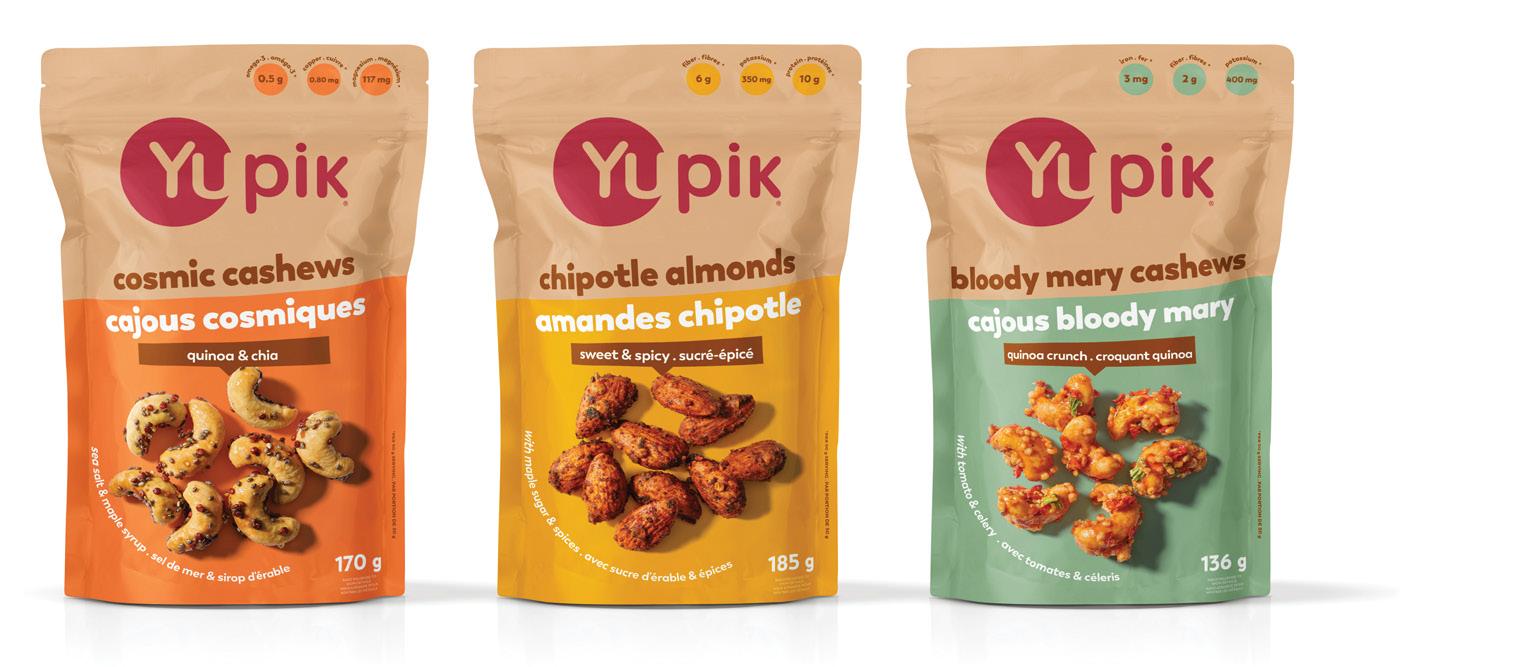
Yupik, a family-owned Canadian brand, is the fastest-growing name in premium snacks and ingredients. Known for innovative products like Cosmic Cashews, Maple Chipotle Almonds, and Bloody Mary Cashews, Yupik offers versatile snacks as well as family-sized formats. Yupik delivers shelf-ready solutions that meet evolving demand and maximize retail impact, helping retailers and distributors stand out. Discover more at yupik.com
Balanced wellness over buzz
Mintel research focused specifically on protein highlights an important nuance: balance. While protein is in demand, its staying power lies in how it supports a broader approach to eating a balanced diet. Framed this way, protein shifts from feeling like a short-term trend to a foundational element of nutrition—one that complements other nutrients rather than competing with them.
to healthy eating
Canadians look past nutrient hype toward a more holistic, back-to-basics approach
the Importance of wellness in the context of eating is not new, but that doesn’t mean it isn’t evolving. The trick is to identify what’s next. As baseball Hall of Famer Yogi Berra said, “It’s tough to make predictions, particularly about the future.” But this doesn’t mean we shouldn’t try.
Currently, protein is unequivocally at the forefront of consumers’ minds. When Canadians are asked which nutritional considerations matter most when planning or preparing meals, protein tops the list by a wide margin. This has translated into a rise in product launches with “high-in-protein” positioning, even in categories where this would have been unlikely just a few years ago. Walk into any number of coffee shops today and you’ll find protein-infused coffees, something that was far from common in the past. The downside? The space is increasingly crowded, making it harder for brands to stand out or claim a meaningful point of difference in wellness.
NUTRITIONAL CONSIDERATIONS WHEN PLANNING OR PREPARING MEALS IN CANADA
Fibre is another nutrient that is strongly resonating with Canadians, and it presents opportunities— particularly when paired with protein and other macronutrients. Historically, fibre has often been associated with aging and how it supports digestive health or cholesterol management. While these benefits remain relevant, fibre has room for a more modern positioning. Vibrant packaging, ready-to-eat meals built around diverse and colourful produce, and including an array of contemporary ingredients can help make fibre feel current and inclusive. Fibre isn’t just for older Canadians—it’s for everyone. Social media-driven trends such as “fibremaxxing” reflect rising interest, but the real opportunity lies not in maximization, but in promoting balance that supports general well-being.
Beyond individual nutrients, it’s equally important to understand the benefits Canadians want from foods positioned as healthy or better-for-you. Digestive health and increased energy stand out. Fibre’s link to gut health is well-established, but Mintel data also points to growing consumer awareness of the “gut-brain axis”—a recognition of how interconnected bodily systems are. This evolving understanding gives fibre added relevance, supporting a more holistic conversation around wellness.
Within this context, GLP-1 medications are another factor shaping how some consumers approach eating. While much of the discussion focuses on reduced appetite, another lens is intentionality. Digestive side effects can heighten the importance of fibre, while smaller appetites may lead consumers to prioritize nutrient density, quality and compelling flavours they genuinely enjoy. The open question for the industry is how widespread these shifts will become, and whether they influence broader household behaviours beyond those directly using the medications.
All of this should be assessed with an important truth: Even as new trends emerge, tried-and-true principles still anchor healthy eating. When Canadians are asked which dietary changes would most improve their health, eating more fruits and vegetables is at the top with fibre- and protein-specific goals ranking lower. This suggests that simplicity and familiarity remain trusted foundations, even as wellness demands continue to evolve
Joel Gregoire is associate director, food & drink at Mintel, the world’s leading market intelligence agency. Based in Toronto, Joel researches and writes reports on Canada’s food and drink industry.
An imposing presence
How agentic AI is resetting retail media success metrics
RETAIL MEDIA IS emerging as a meaningful growth channel for Canadian grocery retailers and CPG brands. As these networks develop, the basis of advantage is shifting. Agentic artificial intelligence —AI systems that independently evaluate options and make decisions on behalf of users—is changing how shopping decisions are made, moving retail media success away from exposure and toward measurable influence on outcomes.
Brands that perform well in these systems provide structured, complete and consistent product data that allows retailer platforms to accurately interpret, compare and prioritize them at the point of decision.
Structured product data sits at the centre of this shift. Metadata—defined as the detailed attributes describing a product including brand name, pack size, ingredients, allergens, pricing, claims, availability and promotional eligibility—becomes a primary input into decision systems. Gaps or inconsistencies reduce confidence and can remove products from consideration entirely. For CPGs, disciplined product data management directly affects eligibility, visibility and performance.
Retail media networks are evolving in response. Impression-based selling is giving way to real-time value assessment. Pre-planned promotions are being replaced by real-time offers at the point of purchase. Decision systems assess basket composition, loyalty status, price sensitivity and inventory before selecting products. Retailers that enable dynamic promotions and personalized incentives are better aligned with how decisions now occur.
Measurement frameworks are also changing. As agents take on a greater role in product selection, traditional metrics such as cost per thousand impressions (CPMs) and click-through rates lose relevance. Performance is increasingly defined by decision outcomes, including whether a product was considered, selected or deprioritized.
As agentic AI becomes more embedded across retail experiences, the traditional path to purchase is being restructured
Canadian retail media ad spending is expected to reach approximately $6 billion by 2028. As budgets expand, expectations are rising. Grocery brands are moving beyond experimentation and demanding precision, accountability and clear commercial impact across both digital and in-store environments.
Artificial intelligence is already embedded in the shopping journey. Kantar’s Canadian ShopperScape research shows 49% of Canadian shoppers use AI at some point in the journey. Adoption is strongest among young millennials who rely on AI during the shopping trip rather than only during planning. Decision-making is, therefore, shifting closer to the point of purchase, where retail media must demonstrate impact.
As agentic AI becomes more embedded across retail experiences, the traditional path to purchase is being restructured. Manual search and comparison are being replaced by preference setting, with AI-powered shopping assistants executing decisions. These systems scan product information, evaluate options, factor in price and promotions, and dynamically select products. As these systems start to curate choices for the consumer, success hinges on algorithmic inclusion. Retail media effectiveness is being redefined accordingly. Visibility is moot if a product fails to meet the AI’s criteria. Influence is shifting from persuasion to eligibility in the age of AI.
Omnichannel consistency remains essential. Kantar analysis shows that omnichannel retail media delivers stronger reach, addressability and real-time measurement than single-channel approaches. Misalignment in pricing, promotions or product information reduces system confidence and limits performance. Retail media success measurement is, therefore, being reset with several implications for brands:
• Product data quality determines whether a brand is eligible for selection, not just how it performs once activated.
• Promotions need to operate in real time or risk being ignored.
• CPMs and click-through rates stop being success metrics as selection, conversion and decision influence take precedence.
• Inconsistent pricing, claims or availability across channels and retailers directly reduce ranking and selection by AI-driven systems.
For Canadian grocers, the shift creates an opportunity to design retail media networks around measurable outcomes rather than exposure. For CPG brands, success now relies on influencing decisions within systems rather than driving impressions. CG
Amar Singh is a senior director at Kantar Retail. He creates insights that inform strategic decisions about key drug, home improvement, discount, convenience, grocery and digital channels. Amar is a seasoned brand, shopper and advertising researcher.
THE LEADERS
LESSONS FROM THE TOP
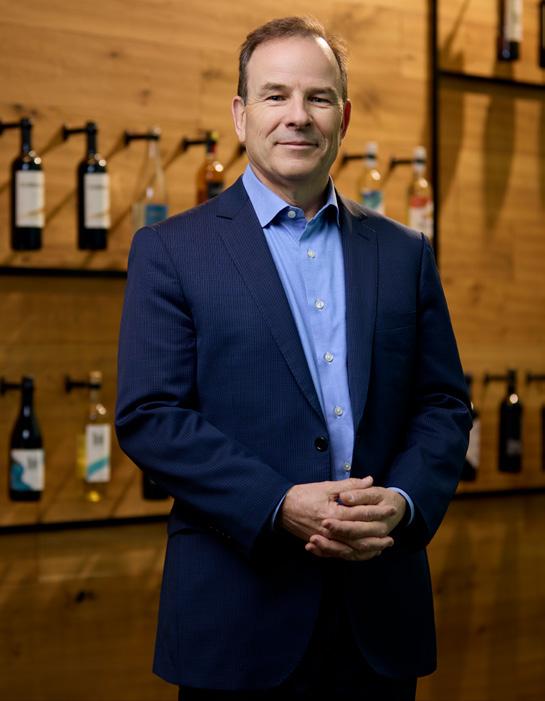
JOHN BOYNTON, PRESIDENT AND CEO, ARTERRA WINES CANADA
How did you get your start in the business?
“IT’S HARD TO GROW WITHOUT BEING OPEN TO CRITICISM. YOU CAN’T HAVE A THIN SKIN, YOU HAVE TO BE OPEN, LIKE REALLY OPEN TO FEEDBACK ”
– JOHN BOYNTON
I come from a family of entrepreneurs. Both sides of my family had their own businesses; one was a toy business and one was an office products business. So, you can imagine what my kitchen table was like growing up—it was all business, business, business. I didn’t really know there was anything else to do because my whole world was that; I never considered other professions. I went to business school and, while in university, I started my own company that funded my education. Then my first job was in operations for about five years, then I went into marketing at PepsiCo, and those two roles got me interested in a certain career path that has evolved from there. [A path that includes executive stints at Rogers, TorStar and now Arterra Wines Canada.]
What is your leadership story?
By Shellee Fitzgerald • Photography Mike Ford
I mostly do roll-ups, turnarounds or transformations across multiple industries, and that’s kind of a strange occupation to have. My first job was a roll-up in the office products industry, then PepsiCo on the Pizza Hut brand where we bought Frank Vetere’s Pizza, which started with a handful of restaurants then saw aggressive expansion. I got interested in that kind of high-growth activity. And then I went to Scott’s [Scott’s Hospitality]. It doesn’t exist anymore, but it was a huge conglomerate. I was on the KFC brand, Scott’s owned KFC in Canada at the time, and that was a turnaround. KFC was in a slow decline for quite a while, and we got it growing again. The board at that point said, ‘Great. We have this other thing in England. We bought three pizza chains; can you go over and fix them?’ And we transformed that business into something quite different—better economic model, better position in the marketplace and it took off, then we
sold it. So, those were my first three gigs. After that, I really wanted more of those transformations and turnarounds.
And now you’re in the wine business. How have all these career experiences shaped you as a leader?
Being adaptable is one of the best skills a CEO can have. Adapting to a culture and to an industry and norms and processes and, more importantly, to people. Secondarily, as you do more of these roll-ups or transformations or turnarounds, you get better and better at doing them because the assignment is roughly the same, but it’s a different industry, different culture. You’ve got to learn early, but you get better and better at it. Not everything works all the time. And so, you fail a little and you apply that learning and your process gets better. You have to be humble enough to use your learnings to get better for the next [role].
Tell us about a time when you’ve had to step out of your comfort zone. What did you learn from the experience?
When you’re doing a transformation, you’re generally going into a new industry and a new company and a new culture. And you’re almost always out of your comfort zone. I don’t think I’ve been in a company where I haven’t been completely out of my comfort zone. And so, you have to really be good at learning and absorbing at a very rapid rate. And you have to be humble to start with the point of view that you know nothing and you have everything to learn from people, so [it’s important] to surround yourself with the best people who can teach you. But, I like being out of my comfort zone— that’s my happy place.
How do you continue to grow as a leader?
It’s hard to grow without being open to criticism. You can’t have a thin skin, you have to be open, like really open to feedback. Every year in my performance reviews with my staff, we spend time at the end with them reviewing me as a leader. In the first year, it’s kind of awkward; people are like ‘I’m not doing that,’ but if you keep doing it and you keep asking, it’s great. And every couple of years I’ll ask my team to write down things they want me to keep doing, things they want me to start doing and things they want me to stop doing. It’s anonymous and our HR person reads them out in front of everybody. The more you do it, the more people
become comfortable giving feedback and they realize it’s a good process, there’s good intent behind it, there’s zero repercussions—and I’m very grateful for it. But you do have to be ready for it. The people you surround yourself with are the best to coach you.
What qualities do you look for in emerging leaders at your company?
Drive beyond everything. Drive is so undervalued in companies, and I think people either have it or they don’t. And there are people who come in for the paycheque and that’s okay for a lot of roles. But there are people that you’re counting on to drive growth, and those people have to have drive. And you really need to surround yourself with people who have more drive or the same amount of drive as you. Then, you’re all sharing that huge responsibility for driving growth. So, drive would be the big one, then teamwork and collaboration, and integrity and accountability.
What is a piece of wisdom you’ve carried with you through your career?
My grandfather ran his own business and he said to me once, ‘John, you just need to get comfortable with the fact you’re not going to be the smartest guy in the room. You’re never going to be the smartest. Don’t try to be the smartest! What you can do is if you’re smart enough, you can outwork everybody.’ And I’ve always believed that if you continue to outperform, good things will happen.
Another came from watching my dad: being home for dinner was nonnegotiable for him. And what I tell staff is, find your thing—it might be breakfast; it might be walking your kids to school— find the one thing that is non-negotiable. I have always made it home for dinner and I only ever do one corporate business thing per week that takes me out in the evening. It’s a hard rule. I can’t tell you how many chair people, CEOs or board members have tried to get me to move from that, but it’s not a thing I’m willing to compromise on. I’m 62 and I look back and it’s one of the best things I ever did. I had a lot of conversations with my kids that I would’ve missed out on if I hadn’t really dug in hard.
What do you find most rewarding about being a leader?
It’s the people. I’m not going to remember targets from 15, 20 years ago; they all get
blurred over time. And my management style is player coach. Sometimes you’re a player and you get right in there, and sometimes you’re coaching. I really like teaching people—I’ve never met a whiteboard I didn’t like! When people are struggling with something, I’ll get on the whiteboard and I’ll draw out a couple of constructs to help them get to the answer—anything I’ve learned in the past to help get them from A to Z—and then I leave them to figure it out. There’s no point in knowing things if you can’t pass it on. CG
This interview has been edited for length and clarity.
FAST FOUR
1 YOUR FIRST JOB?
It was a paper route for the Toronto Star. Who knew 40-plus years later I’d become CEO of TorStar.
2 HOW DO YOU TURN OFF WORK?
I don’t. I obsess about growth and what’s next in the company. But, I do look for things in my life that are highly distracting—things that force my brain into another place (reading, watching a movie, travelling, etc.).
3 IF YOU WEREN’T WORKING FOR A WINE COMPANY, WHAT WOULD YOU BE DOING?
Another transformation in another industry.
4 PEOPLE WOULD BE SURPRISED TO KNOW THAT YOU …
I have an artistic bent—I’m learning to play guitar, I paint seascapes and landscapes. I love oil painting.
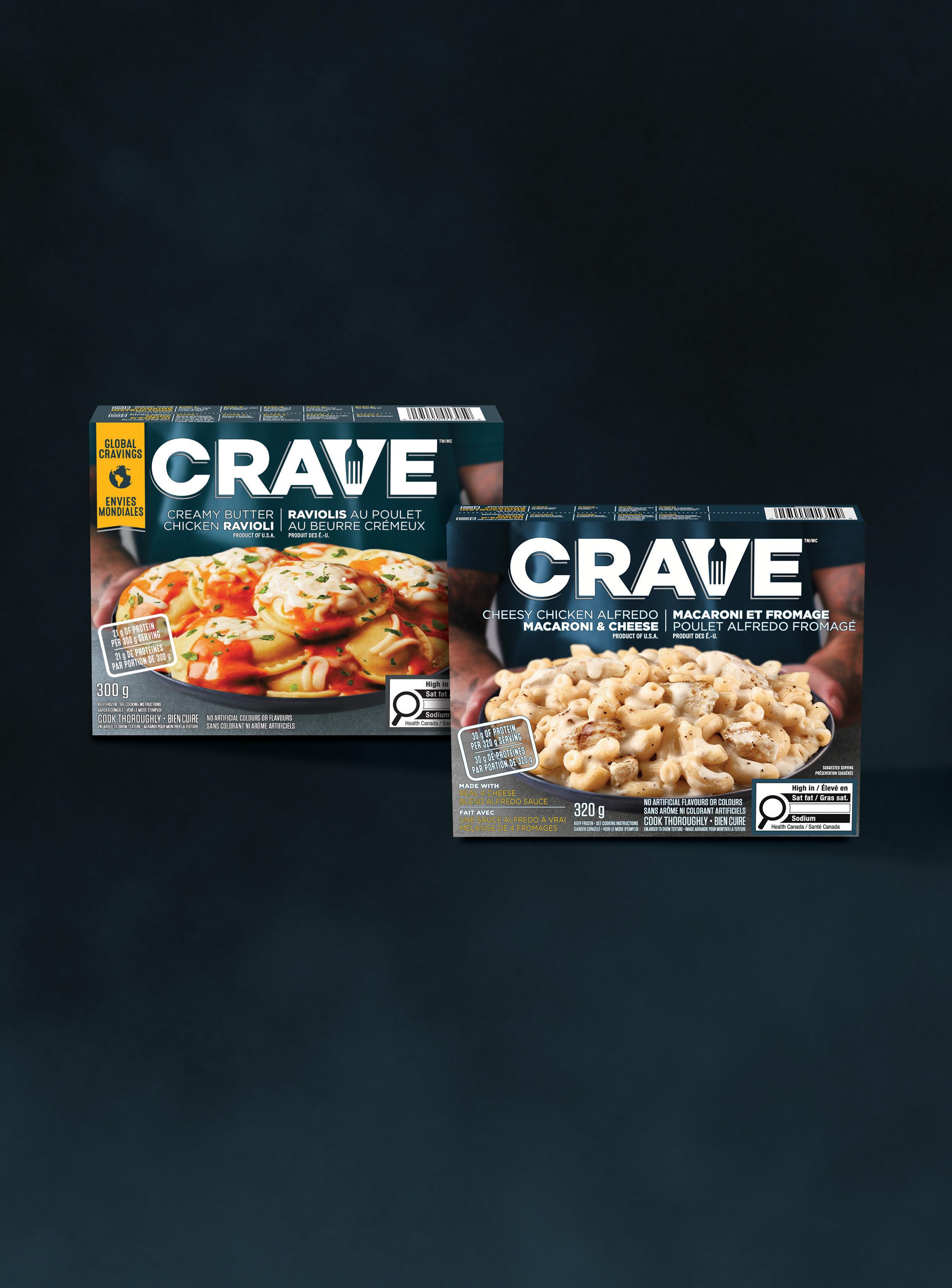
crave is driving growth
FOR THE FROZEN DINNERS CATEGORY AS THE ONLY BRAND GROWING BOTH $ (+20%) AND LBS (+17%)
Top Tested Flavour high protein content
CRAVE CREAMY BUTTER CHICKEN RAVIOLI RANKED 2ND IN CONSUMER CONCEPT TESTING AMONG ALL CRAVE GLOBAL CRAVINGS FLAVOURS
30g OF PROTEIN IN CHEESY CHICKEN ALFREDO AND 21g OF PROTEIN IN CREAMY BUTTER CHICKEN RAVIOLI
BUILT FOR VALUE
HOW SUPER C IS RESHAPING DISCOUNT
GROCERY SHOPPING IN QUEBEC
By Rosalind Stefanac • Photography by Chantale Lecours
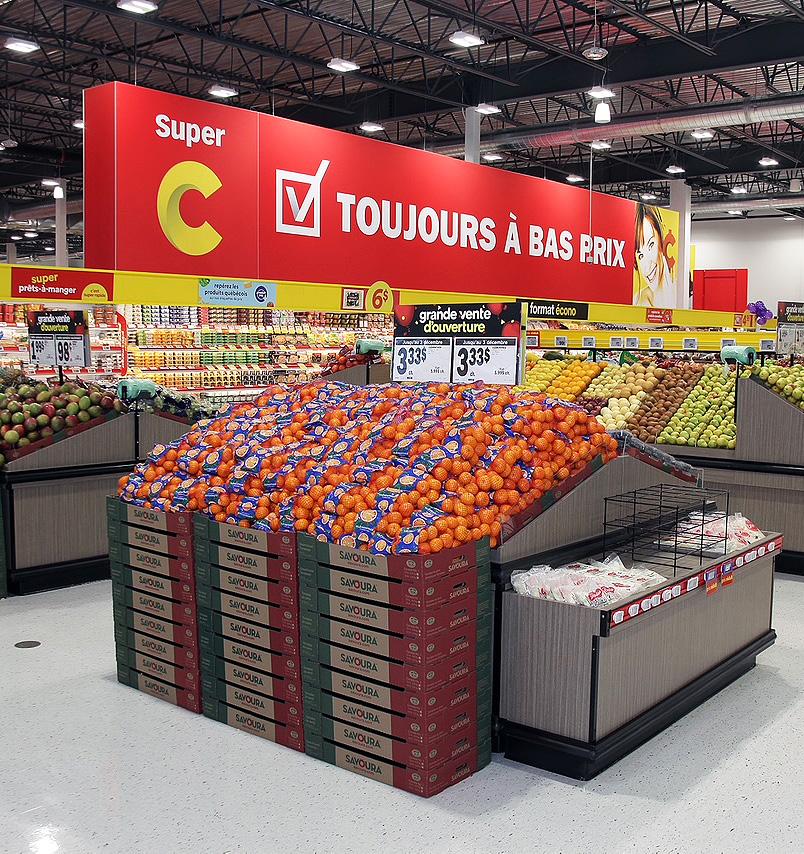
FOR YEARS, “DISCOUNT” FOOD shopping meant dealing with a narrow, sometimes sub-standard product assortment and few in-store services. But as more and more consumers expect the right mix of price, quality and convenience without trade-offs, discount grocery stores are evolving. In Quebec, that evolution is being driven, in large part, by Super C, Metro Inc.’s discount banner, which is steadily expanding its customer reach while redefining what value looks like.
“The definition of value has changed enormously over the years,” says Anna Kolakowski, Super C’s senior vice-president. “It used to be about having the lowest price possible, but today’s value is also about being fresh, being convenient and simple to shop.”
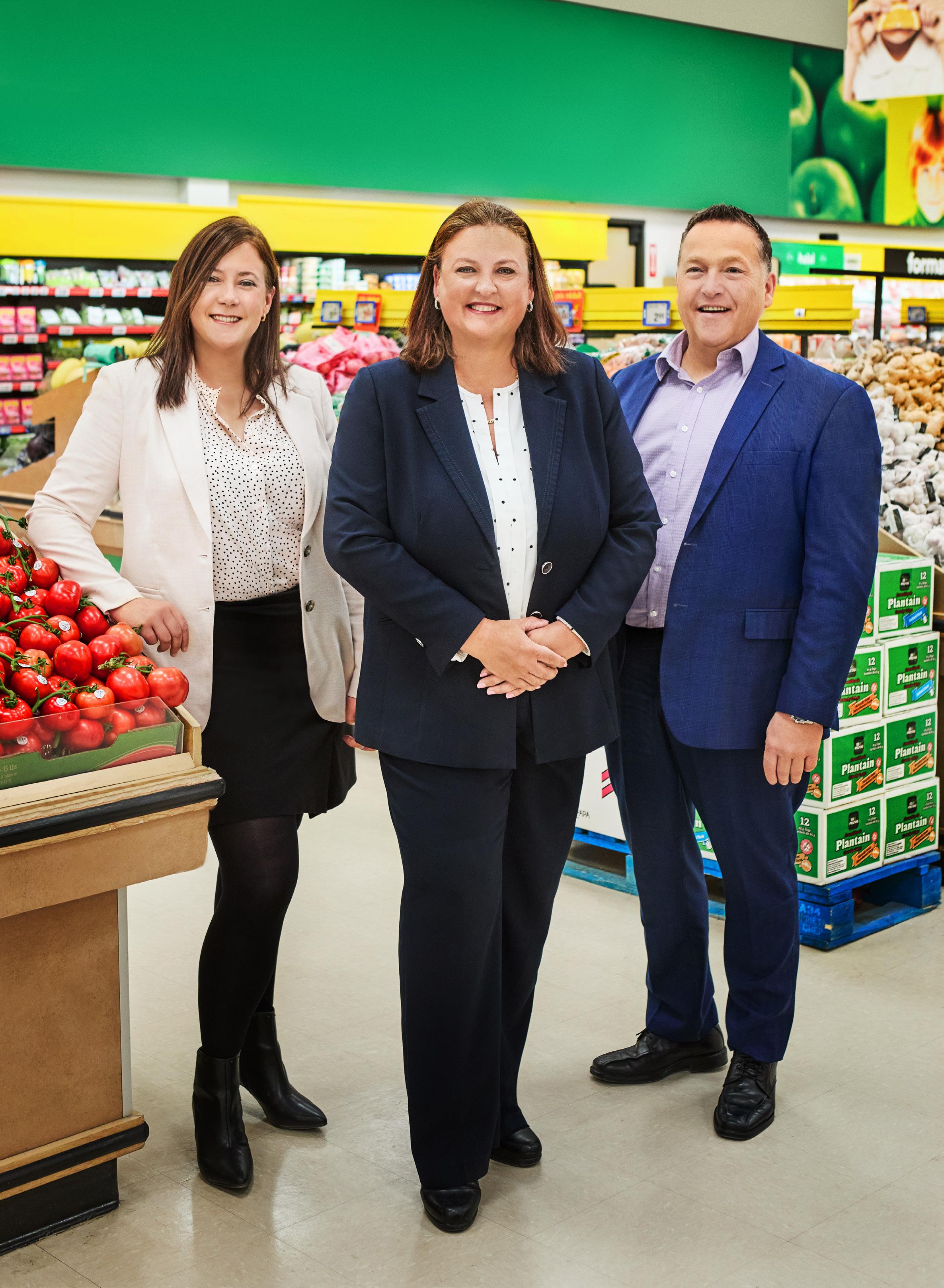
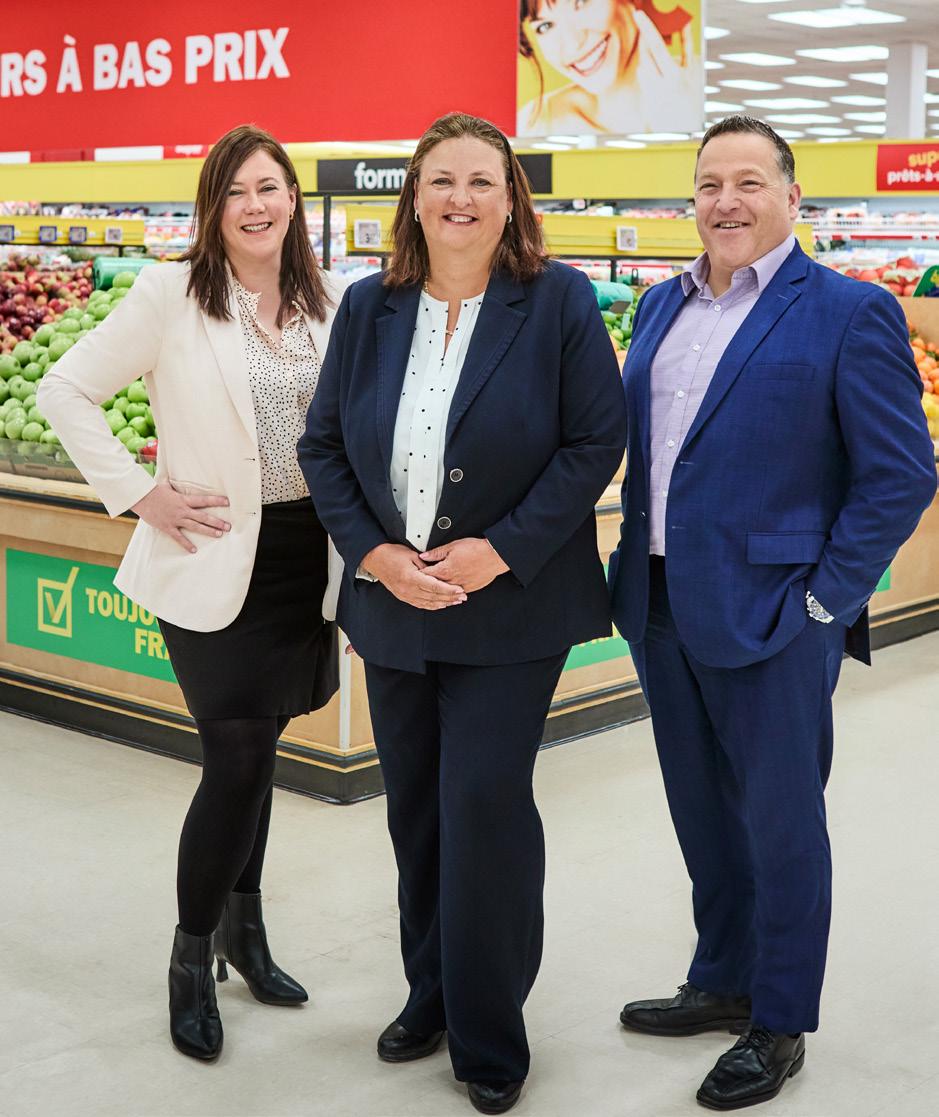
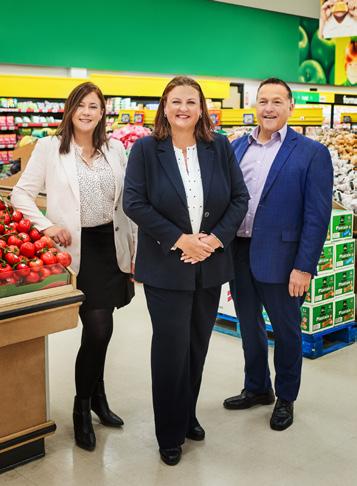
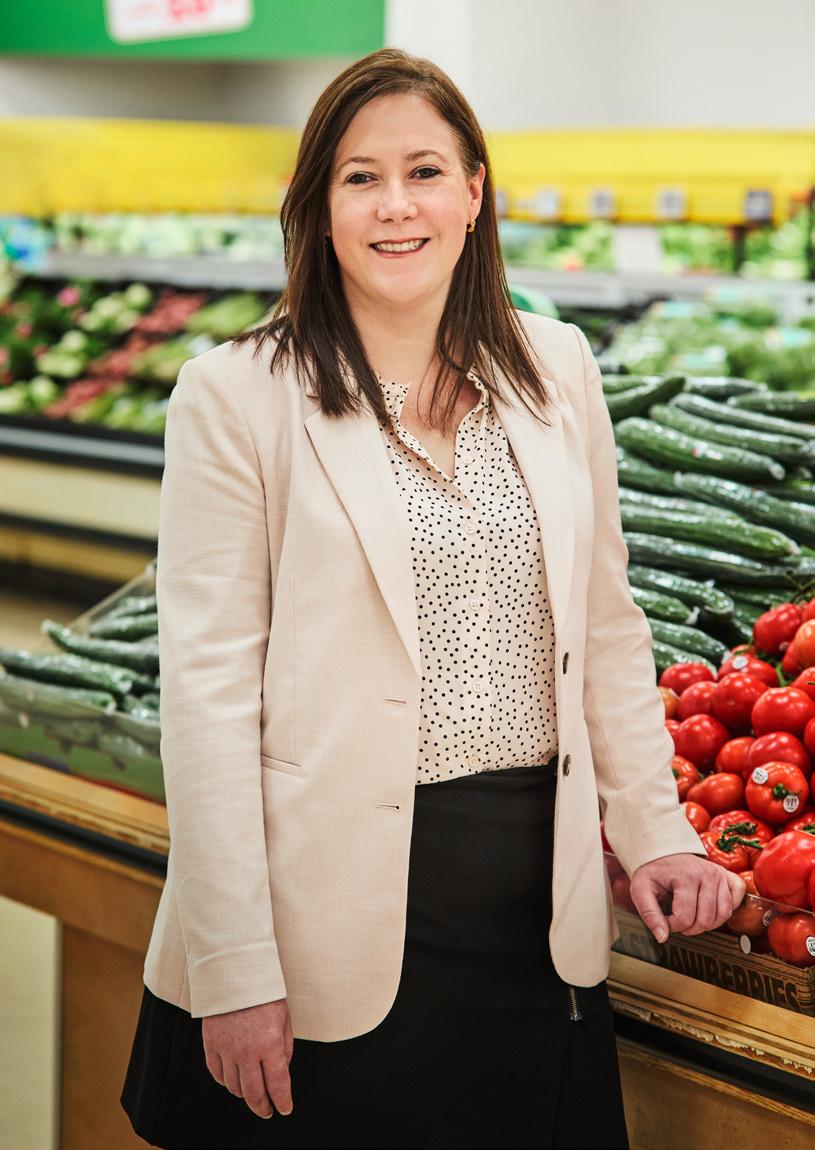
From the top, Anna Kolakowski, Super C’s senior vice-president; Éric Leclerc, vice-president operations; Christina Bédard, vice-president of merchandising
When you’re planning your next fleet cycle, long-term value matters as much as the upfront cost.
Subaru vehicles are known for strong resale value and long-term durability, helping lower your total cost of ownership over time.
With Symmetrical Full-Time All-Wheel Drive and advanced safety technologies standard across the lineup, you’re investing in vehicles built to perform and hold their value.
The numbers don’t lie when long-term value is measurable. (strong resale value) + (long-term durability)
Let’s plan ︴ subarufleet.ca
Just as that definition has evolved, so has Super C’s footprint, which has expanded to 120 stores across Quebec and growing. The banner’s roots date back to 1982 when its first store opened in Beauport under the name Super Carnaval. Its 14 stores were acquired by Metro in 1987 and rebranded to Super C in 1991. The banner has evolved into Metro’s primary discount format in Quebec—the counterpart to Food Basics in Ontario—serving a broad cross-section of consumers across the province.
What distinguishes Super C is a model that is clearly defined and executed consistently across stores. At its core, the discounter operates on a simple framework of three promises that guide every decision in the business, from product assortment to store layout. “Always fresh, always in stock and always at low prices,” says Christina Bédard, vice-president of merchandising, who has been with the company for 23 years. “This is guiding our everyday actions to make sure we offer the best value to our customers.”
From an operations standpoint, this means a highly standardized approach across locations, says Éric Leclerc, vice-president operations. “Super C’s day-to-day operations are guided by a simple and disciplined model built around efficiency, consistency and value for customers.”
Layouts throughout Super C stores are intentionally simple, merchandising is streamlined and processes are built for speed, he says. The goal is not to create a highly curated shopping environment, but to remove friction wherever possible. “The focus is on speed and efficiency: streamlined merchandising, easyto-navigate aisles and fast replenishment to keep shelves full at all times,” Leclerc explains. “Whether in Montreal, Quebec City or in Lac Saint-Jean, operations are standardized across all stores and prices are the same in every location.”
When it comes to staffing, Leclerc says Super C teams are “highly versatile and executionfocused,” which allows the grocer to stay agile while maintaining a lean cost structure. “The same employee may handle stocking, cashier duties and customer service,” he says. In some locations, they also contribute to product preparation and run service counters. “Employees are at the heart of operational efficiency,” he says. They consistently apply standards that help the grocer maintain its low prices, including minimizing waste, ensuring tight inventory management and adhering to simple, efficient processes.
Behind the scenes, Super C continues to invest in tools to fuel efficiency. Inventory management and forecasting systems, along with close supplier collaboration for pricing optimization all play a role in ensuring the right products are presented to
customers. “In a market where customers are very value-driven, this allows us to stay competitive, reduce waste and ensure the right products are available at the right price,” says Leclerc.
Technology has been a key enabler, too. Super C was one of the first grocery banners in Quebec to deploy electronic shelf tags across its network. Self-checkouts have improved throughput during peak times, while newer initiatives such as artificial intelligence (AI) solutions and robots are being tested to enable more seamless scanning and faster inventory replenishment.
For Kolakowski, the common thread is clear: efficiency is not an end in itself, but a means to reinvest in value. “Anything that we can be more efficient on, we will then reinvest into pricing and into providing value for our customers,” she says.
THE POWER OF ‘FRESH’ ASSORTMENTS
While operational discipline forms the backbone of the Super C model, its focus on “fresh” is what’s really driving customer appeal. While fresh departments have often been a trade-off in discount retail, Super C has moved in the opposite direction, making fresh a central part of its offerings. “We want to make sure we are fresh every day,” says Bédard. “You can feel it as you enter our stores.”
Beyond fresh produce, one of the banner’s most notable differentiators is its in-store butchery program. “We have butchers in [many] stores to cut meat every day,” Bédard says, noting this as a big competitive advantage over other discounters.
Not only does this allow the grocer to offer a broader range of fresh cuts and more premium options, it also supports a growing assortment of value-added products, such as marinated meats and ready-to-cook solutions. This has proved particularly appealing during peak seasonal periods, when demand for grilling products rises. In fact, the banner has expanded its range of marinated meats and ready-to-cook options in recent years, positioning itself as a go-to destination for barbecue at competitive prices.
That same emphasis on fresh and convenience extends across other in-store programs. Many locations offer a made-in-store sandwich program, along with ready-to-eat meals designed to meet a growing demand for quick meal solutions. Fresh sushi has also been introduced in select locations through a partnership with Aki Sushi. Bakery is another area where Super C has invested to strengthen its fresh credentials, with freshly baked French baguettes, kaiser rolls, submarine rolls and country-style bread offered daily.
Across stores, product assortment has expanded
Canada’s first premium technology event for grocery retail executives.
Get ready for GroceryTech Canada— a brand-new event from Canadian Grocer tailored for grocery executives and technology leaders who are driving enterprisewide modernization.
SECURE YOUR SEAT TODAY! TORONTO JUNE 9 2026 THANK YOU
FEATURING RETAIL TECH PANEL
Eva Carron VP, Information Technology, Longo’s
Rob Fusillo SVP Technology Operating Partner, Walmart
Frédéric Legault VP and Chief Information Officer, Metro
ADDITIONAL SPEAKERS
Roman Gerlicher Senior VP, Retail Technology, Loblaws
Jeremy Goldman VP Editorial & Insights, RETHINK Retail
Matt Miles Director, North America RetailGrocery Diebold Nixdorf
THANK YOU INDUSTRY PARTNERS
in recent years to reflect changing consumer expectations, says Bédard. That includes everything from organic products to larger-format value packs, as well as more diverse offerings. One example is the introduction of more than 30 exotic fruits and vegetables across the network—items such as plantains, dragon fruit and yellow kiwi—that are priced and promoted aggressively rather than treated as niche offerings.
The grocer has also broadened its ethnic assortment to better serve Arabic, Latin American and Caribbean communities, ensuring stores remain relevant to the neighbourhoods they serve while staying true to the banner’s core value proposition.
With such a sharp focus on both price and quality, it’s not surprising that consumer surveys have ranked Super C among the top discount banners in Quebec for low prices and overall value, particularly in meat and fresh categories.
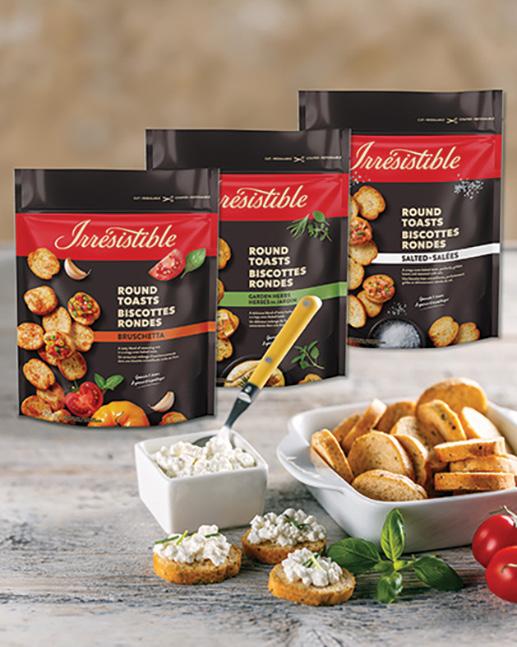
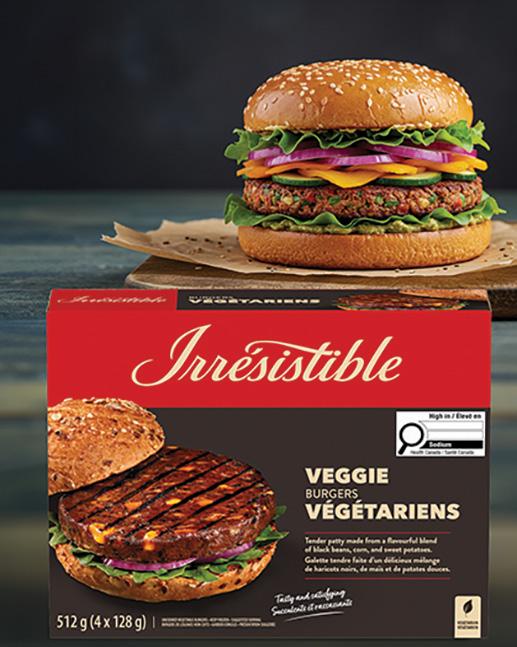
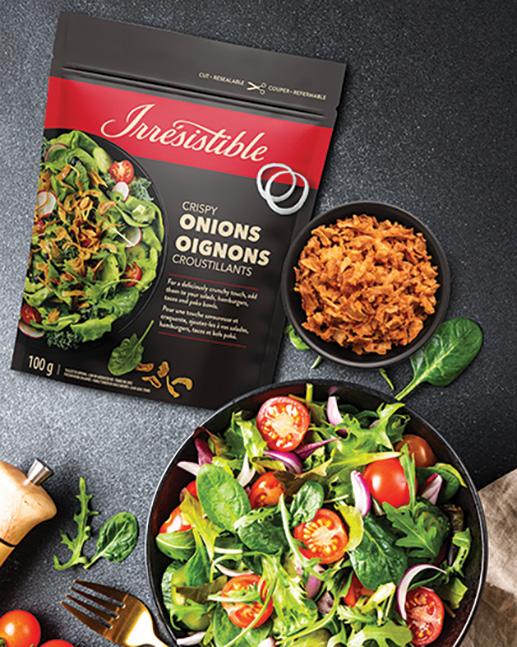
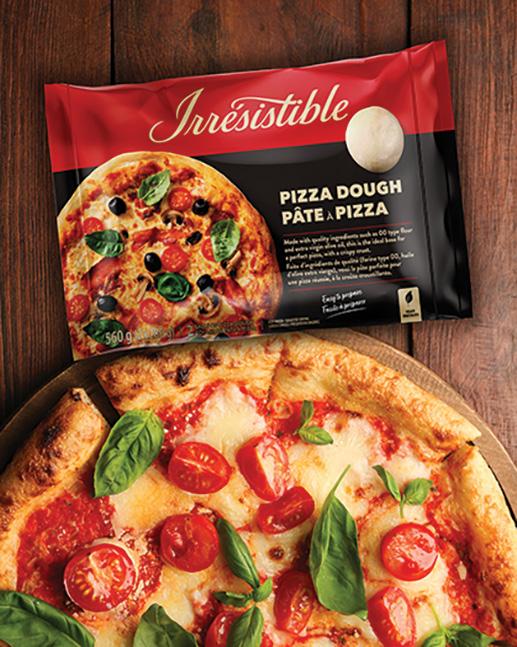
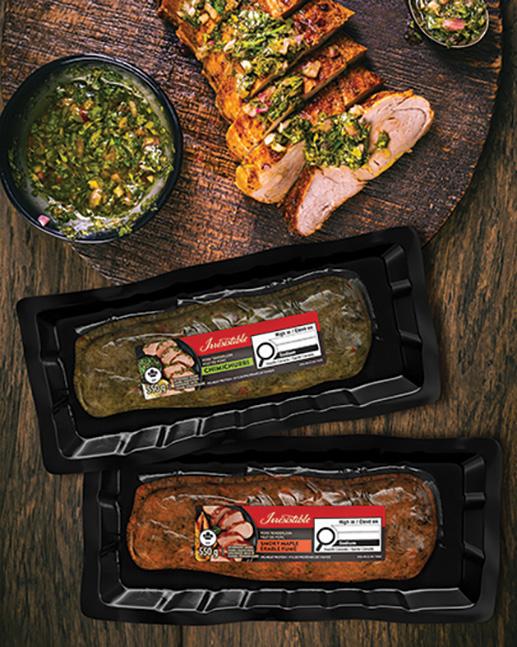
Private label also plays a critical role. Roughly one in four products sold is a store brand, anchored by Metro’s Sélection and Irrésistible lines. At the same time, Super C has leaned into a highly dynamic promotional strategy. Its flyer program— now increasingly digital—is a key driver of traffic, with themed promotions and strong pricing on staple items designed to help customers build their weekly basket.
“Consumers love to consult our flyers,” Kolakowski says. “We try to be very creative … new promotions, new items on promotion and making sure that the products we offer on promotion are available.”
That focus on both everyday pricing and promotional value reflects a shift in consumer behaviour. According to Bédard, this manifests in multiple ways. “I think customers are planning more than before … they are comparing more and they are looking for value across their full basket,” she says.
At the same time, meeting those expectations in Quebec requires a deep understanding of local tastes and shopping habits—something both Kolakowski and Bédard say is central to how the banner builds its assortment. While Super C operates with a standardized model, what goes on the shelves is closely tied to local demand.
That includes products that have become favoured staples for Quebec shoppers such as live
lobster, maple-based marinades and butter, fondue meat and specific cuts such as French roasts. In fresh categories especially, the goal is to reflect how customers actually cook and eat, rather than relying on a one-size-fits-all approach.
“We need to be disciplined and use the data that is available to make sure that we offer the products that the customers are looking for,” says Bédard. “We’re looking at sales, but also at customer feedback.”
That insight is reinforced through a range of inputs, from in-store surveys to digital behaviour and direct customer comments. This allows the team to adjust assortment decisions quickly as preferences evolve. It also helps explain why the banner has continued to broaden its assortment in targeted ways, rather than simply adding more SKUs across the board.
For Kolakowski, that balance between consistency and flexibility is key. While the operating model remains tightly controlled, what goes on the shelf must continue to evolve alongside the customer. “We want to make sure that we continue to adapt to consumers’ needs,” she says, noting that expectations around food, convenience and value continue to shift.
Serving as an anchor, Super C’s produce departments (such as this one in Sherbrooke, Que.) reflect the discount banner’s commitment to freshness, value and local tastes
Last Chance to Nominate
Canada’s grocery industry is filled with examples of companies making a positive impact whether it is improving the planet, supporting employees or helping local communities.
Canadian Grocer is accepting nominations for the 2026 Impact Awards to recognize the initiatives introduced by retailers, suppliers and solution providers that are making a meaningful difference in five categories:
SUSTAINABILITY
(food waste, ethical sourcing, energy efficiency initiatives etc.)
IMPACT CHAMPION
Recognizing an individual making a big, positive impact!
Pepsico
Fortinos Metro
Pattison Food Group
In practice, that means offering multiple ways for customers to find value within the same category— from smaller formats with lower price points to larger packs that offer better value per unit—while maintaining quality and availability. It’s a reflection of how today’s shopper is navigating grocery spending, often balancing tight budgets with a desire for freshness and variety.
THE NEXT PHASE OF DISCOUNT RETAIL
Super C’s continued expansion reflects both its internal execution and broader shifts in the Canadian grocery landscape. Across the country, discount formats have gained share as inflation and cost-of-living pressures push consumers to re-evaluate where and how they spend. But for Kolakowski, the trend is not purely cyclical. “I think that pressure will remain,” she says. “Consumers will continue to look for value … especially in terms of their food expenses.”
In recent years, the banner has opened approximately six stores annually, with a focus on markets where demand is strong and the model can be executed effectively. “We want to make sure that we grow responsibly,” Kolakowski says. “We’re going into markets where there is consistent demand.”
Even as it grows, with some 9,000 employees currently, Super C remains a relatively lean organization with a small leadership team. That structure supports faster decision-making and closer alignment between strategy and execution, says Kolakowski, which is a clear advantage in a fastmoving retail environment.
At the same time, being part of Metro provides scale where it matters most. Shared distribution infrastructure, combined purchasing volumes and an integrated loyalty ecosystem—anchored by the grocery company’s Moi loyalty program—extend the discount banner’s reach without compromising its regional focus.
Super C’s operations, merchandising and marketing remain fully Quebec-based, allowing the banner to respond directly to local preferences, demand and market conditions. Looking ahead, the priorities are less about reinventing the model and more about refining it.
For Bédard, that includes continued evolution of product assortment and store layout. Recent changes in centre-store design—tested in select locations—is already showing promising results in both sales and customer feedback, with potential for broader rollout. “We’re seeing really great results,” she says. “Customers … say it’s easier to find what they are looking for.”
For operations, the focus remains on maintaining discipline amid ongoing pressures. Labour
constraints, elevated costs and shrink continue to require attention, even as supply chains stabilize. Maintaining consistency in execution—while managing those pressures—has become a central focus.
Yet, across all functions, the underlying strategy at Super C remains consistent. “We want to make sure we continue to provide the value that we’ve always been known for,” Kolakowski says. “And continue to adapt to consumers’ needs.”
Super C’s experience suggests that winning in discount is no longer about offering less— it’s about delivering more, consistently. As shoppers continue to look for value across every part of their basket, the advantage will go to the retailers that can balance price, quality and execution without forcing trade-offs.
For Super C, that means staying disciplined in its model while continuing to evolve with its customers. It’s about continuing to ensure that “discount” is no longer seen as a compromise, but as a reliable and increasingly preferred way to shop. CG
Purpose‑Driven Work with Impact.
Sustainability at Kruger Products is a shared effort, shaped by the people behind its brands. It is advanced through collaboration, as teams bring diverse perspectives together to transform ambition into meaningful, everyday action.
Bonterra embodies this mission by uniting Kruger Products’ Reimagine 2030 sustainability targets into a single brand that people can rally around. That shared purpose enables teams to collaborate creatively and form partnerships that feel deeply aligned with the people behind the brand. The Bonterra Facial Tissue collection by renowned Canadian designer Sarah Richardson is grounded in mutual respect for nature and sustainability. Together, we’re bringing the beauty of nature indoors while reinforcing our shared vision for a better, more sustainable future.
Expect to do something great. Visit krugerproducts.com for more information.
“Knowing that the work we do helps support responsible forestry, clean the oceans, and fund tree planting in Canada is incredibly meaningful.”
Moitrali, Bonterra Marketing Manager
UP CLOSE AND REALLY PERSONAL
How new tools and smarter strategies can make personalization more relevant, valuable and faster than ever
By Rebecca Harris
PERSONALIZATION HAS BEEN part of grocery retail since day one. More than a century ago, cash-and-carry clerks weighed and packed items for customers they knew by name. When self-service arrived, employees were freed from measuring and scooping and spent their time advising shoppers across departments. Fast forward to the launch of loyalty cards, when grocers
used data for targeted offers, and then to the digital era, which brought even finer segmentation. Artificial intelligence (AI) enabled the next step: predicting individual needs and powering hyperpersonalized experiences that truly feel more personal, relevant and timely.
“Traditional versus hyper-personalized boils down to the difference between a wave and a welcome,” says Kate
McCormick, director of solutions engineering at Cincinnati-based Birdzi, a firm that provides AI-powered personalization and customer intelligence platforms for grocery retailers.
Traditional personalization, explains McCormick, is a wave. “It’s surface level: I know your name and your type or segment, and the engagement is transactional.”
Hyper-personalization is a welcome: grocers know the customer, what they need and when they need it. “It brings back what grocery was built on—when the shop owner knows the individual,” she says. “Hyper-personalization allows larger grocers to have those same meaningful interactions at scale, transforming them into more memorable interactions.”
HOW HYPER-PERSONALIZATION WORKS
Behind the scenes, hyper-personalization relies on a mix of data, real-time analytics and technologies such as AI and machine learning. It analyzes a shopper ’s past purchases, online browsing, app behaviour and loyalty data to get a detailed picture of an individual. The next layer comes from contextual signals such as location, weather or seasonal trends.
“If it’s rainy and cold on a summer weekend, you’re not going to sell as many hot dogs and hamburgers—people are going to be looking for comfort food,” says Alison Cox, distinguished designer and partner at IBM IX. “Hyper-personalization is that mix of understanding the customer’s propensity and preferences, which could be household preferences, budget, dietary constraints and historical patterns. It uses all that data and contextual information to predict their needs.”
The difference that AI makes is speed and scale. Traditional personalization, explains Cox, had to be programmed by humans. “There were tools to support the fulfilment and the application of personalization, but we were limited by our human capabilities and time.” With AI, those limitations are removed. Systems can analyze vast amounts of data in real time, adapt to new behaviours and continually refine recommendations based on what they learn.
This level of automation drastically reduces the labour and complexity involved. “Today, a retailer can identify an audience, consider all 40,000 SKUs in the store, set guardrails for discounts and
hit the ‘go’ button,” explains Gary Hawkins, CEO of strategic advisory firm Retail Mindsteps. “The system executes that and, literally within minutes, it delivers the six most relevant offers to send to a million customers this week.”
THE BENEFITS OF TRULY KNOWING YOUR CUSTOMERS
Metro is one retailer putting hyper-personalization into practice. When members of its Moi Rewards loyalty program enrol and opt into Metro’s digital channels, the retailer tailors product recommendations and delivers targeted points and discount offers based on what they actually buy and care about, explains Stéphane Latreille, Metro’s vice-president, loyalty and customer engagement.
“As we learn more over time, we layer in bonus offers that encourage deeper engagement with their preferred banner across our food and pharmacy network— Metro, Food Basics, Super C, Brunet and Jean Coutu—so every interaction feels more useful, more rewarding and more ‘made for you, by Moi Rewards.’”
For members, Latreille says hyper-personalization makes the program feel effortless and genuinely relevant. “There are fewer generic offers and more value on the items they already need, delivered in the moments and channels they prefer, whether that’s the app, email or at checkout,” he says.
“For the business, it increases engagement and retention, drives incremental trips and basket size, and strengthens loyalty to the member’s banner of choice across our food and pharmacy network.”
A strong factor in the business case is efficiency, says Joel Percy, vice-president, North America, at Eagle Eye, whose platform enables real-time loyalty, promotions and AI-driven customer engagement.
“There’s the adage, half my marketing budget is wasted; I just don’t know which
half,” Percy explains. “Every week, grocers are giving discounts and points to people who don’t know they’re getting them and didn’t do anything intentionally to get them.”
With hyper-personalization, retailers will not only stop wasting money, he says, but they’ll also free up the budget they can invest in the right customers. “And so, you get a much higher sales growth per dollar spent on the customer if you can be more efficient.”
For Birdzi’s McCormick, hyper-personalization done well is habit-forming—in a good way. “It builds trust among shoppers, which cements a habit of shopping with you regularly,” she explains. “There’s stronger confidence that this retailer has my back. That, in turn, reinforces the routine of choosing that grocer each time the shopper needs food. The main purpose of hyper-personalization is to keep that habit loop continuously moving.”
PERSONALIZATION IN SHOPPERS’ POCKETS
In this new era of personalization, retailers are adding agentic AI to the mix. In 2025, Walmart in the United States launched Sparky, a smiley-faced agentic AI assistant that moves beyond traditional keywords to conversational search. Designed to act like a personal shopper, Sparky answers questions like “What’s for dinner?” and provides tailored recommendations such as a meal plan for the week based on family preferences.
Building on this, Walmart is making big moves in agentic commerce, teaming up this year with Google’s AI chatbot, Gemini. When it’s relevant to the conversation—like planning a backyard barbecue—Gemini will automatically include relevant Walmart and Sam’s Club in-store and online products.
While Walmart is quiet on whether tools such as Sparky will be coming to
Hyper-personalization is that mix of understanding the customer’s propensity and preferences, which could be household preferences, budget, dietary constraints and historical patterns. It uses all that data and contextual information to predict their needs
Canada, the retailer says it uses AI extensively to deliver better, faster experiences for its customers. “For example, we leverage AI to enhance search capabilities on Walmart.ca and power more relevant product recommendations, helping customers find what they need and build their baskets more efficiently through features like personalized ‘easy reorder,’” says Andrew Go, vice-president of e-commerce and marketing at Walmart Canada.
This points to the real opportunity for hyper-personalization: showing up in ways people will actually care about. “Our approach to personalization is focused on creating meaningful value for customers by understanding them deeply, anticipating their needs in the moment, and delivering products, services and experiences that truly resonate,” says Go. “For example, we can prompt customers when they may be running low on frequently purchased grocery items based on the timing and frequency of past purchases, so they never run out.”
Retail Mindset’s Hawkins says it’s the next phase of agentic commerce—shoppers having their own personal AI agent— that will “turn the world upside down. You tell your personal agent, ‘I need these items delivered to my door by six o’clock tonight. Find the best price and go,’” he explains. “So, there’s a machine that is making the decision of where to shop.”
To enable this, Hawkins says retailers must structure their data in such a way that the agent can read it. “That agent is not going to Walmart.com and looking at the website like you do as a human being. They’re looking at data, inventory, stock levels and reliability.”
The same idea applies to personalization. “If there are personalized deals available to me when I send my agent out, they have to be structured in such a way that the agent can read them and apply them. But this is where it’s all going—and it’s happening fast.”
LAYING THE GROUNDWORK FOR SUCCESS
Hyper-personalization sounds great in theory, but it’s not as simple as sending in the bots. “A lot of retailers have a mix of legacy technologies and to layer the latest AI intelligence on top of that, they’ll quickly run into bottlenecks,” says Eagle Eye’s Percy. “Many are chasing this vision of the future and bumping up against the
reality of some of their internal systems, and that’s where a lot of the work is happening these days. It can sometimes be slow and painful foundational work. It’s not the sexy stuff, but it’s what you need to effectively leverage the latest tech.”
Beyond getting their tech house in order, Birdzi’s McCormick advises grocers to focus their personalization strategy on “winning the routine.” In trying to influence a customer’s behaviour, grocers tend to think of personalized communication as the trigger. “A best practice is to acknowledge that the cue for starting a habit is an empty refrigerator—it’s not whether you sent an email,” she says.
For grocers, that means trying to stay at the top of the consideration set. “How do you create that routine where shopping at that specific grocer is on autopilot,” she says. “The key to that is having good, consistent rewards that make the routine worth repeating.”
Trust also remains a critical consideration. IBM’s Cox points to a “trust gap” with AI in general. “People need to trust AI to use AI. If end users don’t trust AI, then companies aren’t going to see the benefit of their investment. So, we need to balance how we are going to mitigate this.”
Eagle Eye’s Percy has simple advice to help grocers avoid any pitfalls of hyper-personalization: don’t do anything stupid. “Data privacy and data protection are critical, and you need the right security systems,” he says. But there’s also a rule of thumb, which is, “just because you can do something doesn’t mean you should.”
Certain areas of people’s purchasing habits are safer to avoid, Percy explains. “If you determine it’s the right time for Joel to buy a bulk pack of paper towels and you give me an offer and you got it wrong—I actually don’t need paper towels—who cares? I’m not going to be upset about it. But, if I don’t eat pork for religious reasons and you send me an offer on pork, then that feels different. It feels like you’ve violated something there, especially if you say this is personalized to me.”
Preventing such misfires involves putting the correct controls in place. “It’s fairly simple. If people haven’t bought pork before, don’t offer them pork,” explains Percy. “If the discount is specific to the organic grape-flavoured snack my
toddler loves, fantastic. I’m buying those all the time, it will give me savings and it doesn’t feel like you’ve crossed the line into personal territory.”
WHAT’S NEXT?
The next frontier of hyper-personalization is the store itself—going full circle to grocery retail’s roots. “Far too often, retailers neglect the human side of personalization—knowing you as a human being and building a relationship with you as a human customer—and that happens in the store,” says Hawkins. “It’s simple things like recognition and encouraging the store manager and other employees to get to know their customers.”
Here, too, technology is the enabler. When conversing with a customer, a store associate could ask them for their loyalty card, which pulls up information on their shopping history and dietary preferences, says Hawkins. “That tells me you have a gluten allergy and enjoy Indian food, so I could begin tailoring our discussion to what I know you like when answering your questions.”
The next generation of smart glasses can take this even further. Customers could see items that match their preferences light up as they navigate aisles, says Hawkins, while store employees wearing the glasses would recognize faces and offer personalized suggestions. “You approach the cheese counter; it recognizes you by name and knows you like these types of red wine,” he explains, adding that the employee could recommend a cheese that pairs well with that wine. “So, you can begin to personalize that interaction in the store.”
The fact remains, most people still like to shop in stores, notes Percy. It can also take years for people to adopt new shopping habits—e-commerce, for example, didn’t experience the rapid uptake many retailers expected.
“The retailers that are going to win in the next decade are going to find ways to meet their customers where they are and use personalization to make an in-store experience better, make a follow up experience better, make a returns process better,” says Percy. “All these elements—like hitting singles rather than home runs— are going to be important.” CG
GRANDPRIX WINNERSWILL BEREVEALED JUNE3
IN GRAND STYLE
Canadian Grand Prix New Product Awards shine a spotlight on some of the most innovative products to hit store shelves in 2025
AGRIFOODS INTERNATIONAL CO-OPERATIVE LTD.
Happy Planet Fruit Smoothies
Produced in B.C., these on-the-go smoothies are made with simple ingredients, real fruit purees and juices. Available in Blackberry Shakedown and Abundant C.
BURNBRAE FARMS
Island Gold
InnovatIon leads the way at the 33rd annual Canadian Grand Prix New Product Awards—driven by globally inspired flavours, texture-forward formats and functional benefits.
The Retail Council of Canada (RCC) is shining a spotlight on 88 finalists across national and private-label brands that ruled the aisles in Canadian grocery last year.
“Products are being developed to deliver meaningful benefits, whether that’s improved nutrition, greater convenience or more sustainable solutions,” said RCC president and CEO Kim Furlong, in a press release.
“What stands out most is the ability of retailers and manufacturers to bring together quality, functionality and value in ways that resonate with Canadians’ everyday lives,” she added.
This year, the awards sharpen the focus on innovation with new winner seals for packaging, an expanded judging panel from top media outlets, and added consumer credibility through third-party ratings and reviews from Caddle’s consumer panel.
Here’s a look at the finalists:
Island Gold’s Gold Yolk Free Range Veggie Fed line of eggs is produced by free-range hens that are fed a vegetarian diet free from medications and byproducts for naturally rich, golden yolks.
CAFÉ WILLIAM
Mexico Coffee
This limited-edition, medium roast showcases the vibrant flavours and rich heritage of Mexican coffee. Sourced from plantations in Southern Mexico, this coffee features a bright, nutty aroma, balanced acidity and subtle notes of chocolate and roasted nuts.
FINALISTS FOOD
DR. OETKER
Dr. Oetker Suprema
Dr. Oetker is challenging the conventions of frozen pizza with its Suprema line. Following a trip to Naples, the brand’s dough masters crafted a triplefermented sourdough formula that delivers an unrivalled crispness and depth of flavour.
HARDBITE POTATO CHIPS
Hardbite Potato Sticks
A tasteful nod to the classic Canadian hickory stick snack, this lower-sodium version is made with non-GMO potatoes, real spices and is free from artificial colours and preservatives, with a hickory barbecue taste.
MAISON ORPHÉE
Ready-to-Bake Mixes Collection
Proof that simplicity and nutrition aren’t mutually exclusive. This line of baking mixes, which includes Chocolate Cake, Carrot Cake, Focaccia, Savoury Muffins and Pizza Dough, is crafted with premium ingredients and is sold in easy-toprepare, single-use portions.
MAPLE LEAF FOODS
Mighty Protein Chicken Sticks
Snack on this: Maple Leaf Foods’ chicken protein sticks deliver 12 grams of complete protein per serving with zero sugar, no fillers and only 110 calories.
Grand Prix Finalists
MORE FOOD FINALISTS
AGRIFOODS INTERNATIONAL CO-OPERATIVE LTD.
• Happy Planet Fruit Smoothies in Extreme Green and Mango Passion
■ First ready-to-eat soft boiled egg in the Canadian retail market
■ Ready-to-eat format of Ontario’s fastest-growing golden yolk eggs
■ Launching Summer 2026
Farmer’s Finest Free Run Dark Yolk Eggs
■ Popular dark yolk eggs in a fast-growing 18 pack format
■ Locally produced dark yolk eggs in Alberta
■ Available now
For more information, please contact your P&H Foods account manager.
FINALISTS FOOD
MOLSON COORS BEVERAGE COMPANY
Simply Spiked Limeade
A bold citrus twist is shaking up the ready-todrink cocktail category.
Simply Spiked Limeade is made with 5% real fruit juice at 5% ABV. It’s available in single-flavour packs or a variety pack featuring Signature, Cherry and Blackberry flavours.
OHME!
Freeze-Dried Yogurt Crunch
OHME! Freeze-Dried Yogurt Crunch is made by blending 100% Canadian yogurt with real B.C.-grown berries and live probiotic cultures, then freeze-dried for a light crispy shelf-stable snack.
VICTORY’S KITCHEN LTD.
Ladles of Love Soup
With Ladles of Love Soup, every spoonful serves a bigger purpose: for every unit sold, the brand donates a meal to Food Banks of Canada. The soup is available in Vegetable, Thai Coconut, Butternut Squash and Tomato Basil.
MAPLE LODGE FARMS LTD.
Zabiha Halal Fire Crisp
Spicy Chicken Nuggets
The brand’s foray into spicy brings heat to the frozen aisle. Bold flavour meets an ultra-crispy coating and juicy, tender halal chicken with a kick in every bite.
Grand Prix Finalists
NUPASTA
nuPasta Vegan Meal Kits
Developed with the consumer at its core, nuPasta Vegan Meal Kits pair the brand’s popular low-calorie, gluten-free pasta with a tasty sauce made with pea protein.
NON-FOOD FINALISTS
CASCADES
• Cascades Fluff Excellence
NESTLÉ PURINA PETCARE
CANADA
• Beyond Wild Prey-Inspired
Adult Dog Food
NORWELL CONSUMER
HEALTHCARE
• GluteGuard
UNILEVER CANADA
• Dove x Crumbl Collection
WET & FORGET, INC.
• Shower Ultra Cleaning
Mist Fresh Scent
17 PRODUCTS PROUDLY SHORTLISTED
The selection of 17 products on the shortlist of the Canadian Grand Prix New Product Awards highlights the strength of our private brands and underscores our ability to deliver relevant assortments that blend innovation, quality, and strong consumer appeal across categories.
PRIVATE LABEL FOOD
CALGARY CO-OP
• Cal & Gary’s Chocolate Caramels
A golden caramel filling wrapped in handcrafted Belgian chocolate delivers the ultimate balance of richness and sweetness for a premium yet affordable indulgence.
FEDERATED CO-OPERATIVES LTD.
• Blueberry Sea Buckthorn Fruit Spread
• Co-op Gold Bacon Wrapped Chicken Bites
• Co-op Gold Gouda
• Co-op Gold Snack Mix
• Co-op Gold Soup
LOBLAW COMPANIES LIMITED
• President’s Choice Chia Spread
• President’s Choice Functional Juice and Shots
Designed to deliver big benefits in a small pour, these 60-millilitre juice shots from President’s Choice are available in Açaí and Blueberry with Antioxidant, Carrot and Ginger with Collagen, and Ginger and Lemon with Immune Support.
• President’s Choice Probiotic Yogurt for Gut Health
• President’s Choice Rippled Kettle Chips
LONGO BROTHERS FRUIT MARKETS INC.
• Longo’s Kimchi Dumplings
To meet the growing demand for authentic Asian cuisine in an easy-to-prepare format, Longo’s launched frozen kimchi dumplings filled with fermented cabbage, tofu, vermicelli and vegetables.
METRO INC.
• Irrésistible Artisan Brie
• Irrésistible Broths
• Irrésistible Creamy Yogourt
• Irrésistible Filled Pastries Cheese Bites
• Irrésistible Frozen Breakfast Bowls
Ideal for busy mornings and offering at least 15 grams of protein, these breakfast bowls combine crispy hash browns, scrambled eggs, sausage and cheddar cheese, topped with either bacon or a rich gravy sauce.
• Irrésistible Marinated Pork Tenderloin
• Irrésistible Pizza Dough
• Irrésistible Portuguese Style Custard Tarts
• Irrésistible Round Toasts
• Irrésistible Salad Toppings
It’s crunch time! These crispy onions are so versatile they can be added to salads, poke bowls, tacos and even burgers for added flavour and a touch of texture.
• Western Family Apple Pie & Pumpkin Spiced Dessert Wonton Pair
• Western Family Avocado & Sour Cream Squeezable Avocrema
• Western Family Bar Down Blast
Inspired by the Vancouver Canucks professional hockey team, this Western Family brand ice cream blends malt and brown sugar with a blue vanilla ripple and mini caramelfilled chocolate cups.
• Western Family Fully Cooked Korean Style Pork Back Ribs
• Western Family Gummy Mix
• Western Family OH! Canada Kettle Cooked Potato Chips
A bold ketchup flavour meets a premium kettle-cooked potato chip. Packaged in a red-andwhite bag, this limitededition release is a tribute to a Canadian classic.
SOBEYS INC.
• Compliments Blooming Onion Pearls
• Compliments Dill Pickle Flavoured Mustard
Simply dill-icious! Two popular garnishes— yellow prepared mustard and dill pickle— join forces for one versatile and flavourful condiment that can be used in dressings, marinades, for dipping or as a topper.
• Compliments Lobster Claws
• Compliments Peel N’ Pop! Peelable Gummies Soft, flavourful and fun to pull apart, Compliments Peel N’ Pop! Peelable Gummies bring a little excitement to the snacking category. Launched in Banana and Mango flavours.
• Compliments Pop N’
Crunch Freeze Dried Candy
• Compliments Smashed 100% Beef Burgers
• Compliments Spiced Winter Punch Sparkling Water
PRIVATE LABEL NON-FOOD
LOBLAW COMPANIES LIMITED
• Life Brand Masks
• President’s Choice Flex Bake
METRO INC.
• Personnelle Ergonomic Baby Nasal Aspirator
• Personnelle Hydrocolloid Acne Patches
• Personnelle Pure Epsom Salt
• Selection Eco Rechargeable Batteries
PATTISON FOOD GROUP
• Western Family Signature Digestive Health Dog Treats
ACTIONABLE INSIGHTS & CONNECTIONS POWERING BUSINESS GROWTH
EnsembleIQ is the premier resource of actionable insights and connections powering business growth throughout the path to purchase. We help retail, technology, consumer goods, healthcare and hospitality professionals make informed decisions and gain a competitive advantage.
EnsembleIQ delivers the most trusted business intelligence from leading industry experts, creative marketing solutions and impactful event experiences that connect best-in-class suppliers and service providers with our vibrant business-building communities.
Fresh
TRENDS
NEW TECH IN FRESH PRODUCE
The latest tools can help improve freshness, reduce waste and boost efficiencies
By Rebecca Harris
FRESH PRODUCE HAS always been one of the trickiest categories in grocery, with a narrow window between peak quality and spoilage. Today, as rising costs and labour pressures add to the challenge, grocers are turning to new technologies to keep the department at its prime.
“Technology is becoming essential for the produce department because fruits and vegetables are highly perishable and historically difficult to manage due to [price look up] PLU-based data and inconsistent visibility,” says Rick Stein, vice-president of fresh foods at FMI—The Food Industry Association.
He references FMI’s The State of Fresh Foods 2025 report, which highlights how new inventory and replenishment tools help retailers better track sales and purchasing patterns, right-size inventory and reduce shrink caused by over-ordering, while maintaining optimal product levels and freshness. “This matters because produce remains a top-priority department for food retailers and a major driver of shopper engagement and trips,” Stein says.
Austin, Tex.-based Upshop is one tech company helping grocers improve forecasting and optimize inventory. Its AI-driven platform brings together data and insights on sales, buying cycles, weather patterns, holidays, promotions and more. “This helps to ensure you’ve got the freshest and the right products on the shelf,” says Mike Sanders, CEO of
Upshop, adding that great forecasting is “the bedrock” for grocers.
Federated Co-operatives Limited (FCL) uses Upshop’s platform to support production planning for value-added offerings in produce departments across its network. “We recognize the importance of both a strong in-stock position and optimizing for shrink in this growing category,” says Joshua Hubert, senior manager of produce operations at FCL, adding that the tool is easy to use for employees of all experience levels.
Innovation to improve the produce department is also happening beyond the store. KluraLabs, a U.K.-based materials science company, has developed active packaging designed to extend shelf life and reduce food waste across the supply
chain. The technology integrates antimicrobial and preservation capabilities directly into packaging to help slow spoilage. “What’s different about our solution is we don’t target the food— we’re directly targeting bacteria and mould, which is how most food-freshness issues occur,” says Charlie Hobhouse, chief executive officer, KluraLabs.
In a recent trial with U.K. retailer Marks & Spencer, Hobhouse says grape waste was reduced by 50% and shelf life was extended by around five days. KluraLabs is also conducting small trials on grape packaging with Canadian retailers and hopes to fully launch in the country by September.
Technology can also help reduce waste further upstream. DCL International has developed a catalytic system to remove ethylene—a natural plant hormone that accelerates the ripening process in fruits such as apples, bananas and avocados— from the air in storage rooms, refrigerated trailers and shipping containers.
DCL’s technology is designed to extend shelf life and maintain product quality over long distances, without the use of sprays or chemicals. The result is a longer-lasting product arriving at stores. “There’s a reduction in food waste, but also the opportunity to have lower costs in the food chain,” says Shazam Williams, technical director at DCL International. “You don’t want your fruit going to waste.” CG
TERIYAKI
Aisles
SUMMER ENTERTAINING
HOT OFF THE GRILL
and snacks, says this year consumers will be “opting for smaller get-togethers that feel casual yet thoughtfully curated.”
The key trends shaping how consumers will shop (and host) this summer
CANADIANS ARE CLEANING off their patio furniture, spraying down their decks and firing up their grills. These rites of spring are a surefire precursor to the summer barbecue season, a time when people come together to enjoy great food in the great outdoors.
Accompanying the warmer temperatures are trends for food producers, retailers and consumers to chew on. In 2026, this has to do with finances as much as food and saving time as much as socializing. As oscillating oil prices and trade battles threaten economic stability, Canadians will prioritize cost and convenience at the grocery store.
By Matt Semansky
“Uncertainty is the only certain thing in the world,” says Sue Lewis, vice-president, marketing & events at the Canadian Produce Marketing Association (CPMA).
According to Ipsos FIVE research, consumers tend to cook more meals at home in the sunny months, which aligns with the long-term trend towards home-cooking as a money-saving move. The firm also reports a summertime uptick in “carry from home” behaviour, suggesting it’s the season for hosting friends and family for potluck-style dining occasions.
Ingrid Rathgeb-Rodriguez, director of marketing at Summer Fresh, a Canadian manufacturer specializing in salads, dips
They are also on a quest for convenience, culinary adventure and elbowsup-style Canadian pride. These factors will drive subtle shifts in the customer’s approach to serving meals this season.
Here are a few of the key trends in summer entertaining:
CUTTING COSTS
As industry experts point out, there are many ways to eat and entertain without breaking the bank this summer.
“Finding new opportunities with less familiar beef cuts will be a key theme for outdoor social meal occasions,” says Mathieu Paré, executive director, market development (Canada) for Canada Beef. He lists flank, skirt and tri-tip steak among flavourful—if not famous—variants. “They’re well suited to today’s outdoor gatherings and appeal to consumers looking to expand their grilling repertoire, while still managing food costs.”
According to Evan Hall, head merchant at Goodness Me! Natural Food Market, many carnivorous consumers are looking to new sources for protein. “Beef prices have obviously been up for quite a while, so people are moving a little more to the poultry side. People have also been a little more apprehensive about pork in the past, but price point-wise, they’re now broadening their horizons.”
Rathgeb-Rodriguez of Summer Fresh, however, notes that value is in the eye of the beholder. “For some, it’s about price and stretching a budget further, but for others it’s about quality, taste, health and reliability,” she says. “Even in a more cautious spending environment, consumers still want to eat well and continue to entertain at home, which is often seen as a more affordable alternative to dining out.” Shareable formats that encourage grazing over gorging can offer a premium experience at a reasonable cost, says Rathgeb-Rodriguez.
CPMA’s Lewis, meanwhile, says a little education can go a long way to saving money in the produce section. “We publish our Fresh 20 flyer weekly, and it’s basically what $20 will buy you in fresh produce if you shop the flyer,” she says. “We take it a step further and show people how that would translate into the number of side dishes or number of snacks.”
Lewis adds that buying what’s in season can also help consumers mitigate cost—as can a zero-waste mindset. “Don’t throw it out. That’s the most expensive thing you can do.”
CONVENIENCE WITHOUT COMPROMISE
The pressure on Canadians’ wallets is rivalled by the demands on their time, a factor that is driving a shift to convenience items for social occasions. “Hosts want to create elevated experiences without stress,” says Rathgeb-Rodriguez.
Summer Fresh’s new Pickled Veggies line is one of the company’s latest attempts to impress without stress. Rathgeb-Rodriguez says these products, pickled in apple cider vinegar, are designed to be eaten on their own, used as toppings or incorporated into cocktails. “With younger consumers, especially gen Z, showing strong enthusiasm for pickled flavours, we see this as a natural extension of both the vinegar trend and the demand for bold, versatile products that support both flavour exploration and overall wellness.”
Hall says Goodness Me! will introduce a large line of infused oils and flavoured vinegars in response to growing demand, adding that vinegar ties into consumer desire for convenience and exploration. “There’s just so much that you can add to a meal with one ingredient,” he says.
Another trend driven by convenience is the proliferation of pre-marinated meat. Paré of Canada Beef highlights pre-marinated kebabs as an item he expects to be popular this summer as it “offers time-savings without compromising on quality.”
Hall says pre-marinated meat is where he’s seeing the most significant innovation from food producers. These products can be a useful gateway for consumers who aspire to culinary ambition but are hesitant to try something new, he adds. “[Pre-marinated meat] is a good introduction to understanding how to blend flavours and seeing what works.”
THE CANADIAN WAY
Canadian consumers will continue to express their national pride at the checkout this summer. This is great news for Jeff Barlow, chief marketing officer at GoodLeaf Farms, which produces leafy greens on its three farms in Calgary, Guelph, Ont. and Saint-Hubert, Que.
With its farms spread across Canada’s broad geography and vertical farming methods that enable it to grow its
SELLING THE SUMMER
products year-round, GoodLeaf aims to respond to consumers seeking to shop as locally as possible. “If they’re on a truck, they’re losing nutrients and losing shelf life,” says Barlow. “We’re able to reduce that to an average of 300 kilometres from farm to table.”
According to Barlow, the heightened demand for local and Canadian products has galvanized GoodLeaf’s business. “It’s had a tremendous impact on us,” he says, noting that the company has had to rapidly expand its production capacity in recent years.
Barlow says GoodLeaf’s microgreens— nutrient-dense produce harvested after only six days—have a role to play in summer entertaining. The company has even made “levelling up your summer” the focus of its seasonal marketing campaign.
“We have a mustard microgreen that pairs incredibly well with a hamburger,” he says. “We have a brand-new product coming out, a rainbow mix of microgreens with a really bright flavour profile that’s a fantastic addition to fish or to steak as a nutritious topping.”
Barlow isn’t the only industry insider who’s witnessed the enduring pro-Canadian sentiment. “Consumers are increasingly motivated to support local businesses and are paying closer attention to where their food comes from,” says Summer Fresh’s Rathgeb-Rodriguez.
Retailers and manufacturers are collaborating in a variety of ways to promote summer social meal occasions to consumers.
“We do see some really creative stuff in retail,” says CPMA’s Sue Lewis. “Putting the ingredients together for a salsa, so the tomatoes and cucumbers and onions are in a grouping in the store with a recipe card.”
Evan Hall confirms that Goodness Me! gets creative with its signage and product placement. “We’re keeping [summer dining] in people’s minds with cross-merchandising—things like condiments near our meats and endcaps strategically placed.
“But also, our staff is really our best resource for that. They’re very well versed in our product offerings and very much invested in the local food scene, and they tell a lot of that story, which does a lot of the heavy lifting for us.”
Mathieu Paré of Canada Beef echoes the importance of knowledgeable staff. The organization recently launched the Certified Canadian Beef Training program to equip employees to discuss products with confidence.
Meanwhile, Summer Fresh reports strong consumer engagement with its annual Summer Entertaining Guide, which is now available on its website and features suggestions for backyard barbecues and other social gatherings.
As for GoodLeaf Farms, the company’s multichannel campaign includes the Good for Life Tour, a partnership with Sobeys and a travelling showcase for its vertical farming practices housed inside a 53-foot trailer. “We know we can’t bring Canadians to our farms,” says Jeff Barlow. “So, we decided to bring our farms to Canadians.”
MORE THAN A GUT REACTION
Growing interest in wellness and satiety is pushing fibre beyond
its
traditional place on shelf
By Jessica Huras
FOR YEARS, PROTEIN has dominated the health conversation. Now, fibre is gaining renewed attention—not just for digestive health, but for its broader role in overall wellness.
According to The Hartman Group’s Health and Wellness 2025: The Interplay of Vitality and Longevity study, 69% of U.S. consumers say they are actively trying to add fibre to their diets, making it one of the top nutrients people are prioritizing today.
This dietary movement is showing up on grocery shelves, with high-fibre products appearing across categories, from baked goods to snacks, and fibre claims are becoming more prominent on packaging and in marketing.
FROM FUNCTIONAL TO CULTURALLY RELEVANT
Fibre’s rise is being fuelled by a mix of health and cultural drivers, explains Shelley Balanko, senior vice-president at The Hartman Group. Part of the appeal is tied to weight management and the growing use of GLP-1 medications. “Fibre supports satiety longer, and then there’s the fact that it stimulates the body’s own GLP-1s,” Balanko says. Consumers are starting to recognize that fibre activates GLP-1 naturally through diet alone—without a prescription, she says. Fibre also helps mitigate common GLP-1 side effects such as constipation by supporting digestive transit, she adds.
Gut health is another major driver of
dietary fibre intake, particularly among younger consumers. “Everybody is starting to understand that the gut is the root of all wellness,” says Balanko.
At Farm Boy, Trevor Gervais, vicepresident, marketing, merchandising and procurement, says fibre resonates most strongly with millennials and boomers, though for different reasons. “For boomers, fibre is often viewed through a functional or preventative health lens, and millennials are more likely to connect fibre to overall wellness,” he says.
EXPANDING BEYOND BREAKFAST
Fibre has long been associated with cereal and other morning stalwarts, but now it’s showing up more consistently across dayparts, from spreads and bars to vegetable-based savoury snacks.
“In general, our eating has become a lot less meal-centric,” says Balanko. “Because we are eating fewer meals and more snacks, our snacks are having to do more for us. We’re starting to see snacks take on a stronger role in all the macronutrients.”
That trend is showing up in product development. At Healthy Crunch, founder Julie Bednarski says fibre is being built into products designed for multiple eating occasions, not just breakfast. The company’s lineup includes granola bars, coconut chips and trail mixes, with high-fibre, low-sugar cookies set to launch this summer.
In the savoury snack aisle, Bert’s Foods offers another example of how fibre is moving beyond the morning. Its crunchy okra snack line, Oh My Okra, delivers both soluble and insoluble fibre by virtue of the vegetable itself. “When we first launched, it wasn’t a trend,” says founder and CEO David Spadafora. As fibre gains renewed consumer focus, its inherent nutritional benefit is becoming a bigger part of the brand’s messaging. “Because it’s trending, we definitely want to jump on that bandwagon and promote it as much as we can,” he says.
Retailers are seeing the shift play out in store. “We’re starting to see fibre in almost everything,” says Digs Dorfman, CEO of Toronto independent grocer The Sweet Potato. “You’re even seeing some types of fibre used in candies and things like that.”
HIGHER EXPECTATIONS
Consumers are looking at product claims with a more discernible eye. According to The Hartman Group’s study, 60% of U.S. consumers always read ingredient lists and nutrition facts on new products. Balanko says customers are no longer willing to sacrifice one health benefit to gain another. “Fibre can’t exist alongside a bunch of junky ingredients and still get the credit that consumers are looking for,” says Balanko. “The consumer is a little savvier now. They know they don’t have to make those trade-offs.”
Spadafora agrees that fibre resonates most when it’s part of a product that already feels credible from a health standpoint. “It’s the wholesome factor; the fact that it’s a clean label,” he says of Oh My Okra’s consumer appeal.
WHAT’S NEXT?
Despite the growing interest, fibre is not yet a primary purchase driver at retail. “While demand for high-fibre products is beginning to build, this trend is still very much in its infancy,” says Gervais, adding that a lot of the momentum comes from “industry publications and trade shows.”
Fibre may lag protein in popularity, but its link to health and wellness suggests it has staying power. As Balanko says, “It’s going to be an enduring trend as consumers start recognizing the health benefits that are associated with it.”
1 FEELING IT
Texture does more than complement taste—it shapes how consumers perceive food. Innova Market Insights’ 2026 snacking survey finds 35% of global consumers associate textures such as “extra creamy” with indulgence, ranking it just behind flavour (44%).
This appetite for richer mouthfeel is reflected in product development: 36% of food and beverages launched in 2024 to 2025 contained a “defined texture ingredient” (gelling agents for bubbles, flours for chew, etc.). “Texture has become a core pillar of food and beverage innovation,” says Innova co-founder and global insights director Lu Ann Williams, adding it’s “no longer a distant second to flavour.”
Texture Four things to know
By Chris Daniels
2 POP GOES THE …
Texture is emerging as a key growth lever in crowded dairy aisles. “In categories where flavour cues can feel familiar, texture offers a new way to stand out,” notes Sabrina Zollo, vice-president marketing, yogurt and cultured, Lactalis Canada.
Case in point is the January launch of IÖGO Nanö Bubbles—100gram yogurt cups with fruit-flavoured gelled spheres—in three varieties: Orange Cream with Mango Bubbles, Mixed Berries with Strawberry Bubbles, and Banana with Mango Bubbles. “Bubble tea was a clear inspiration,” Zollo says. Seeing the trend spill into desserts, cookies and ice cream, the team knew it wasn’t fleeting. In confectionery, texture also matters. Citing Mintel data, Stacie Sopinka, vice-president, own brands, Sobeys, notes 47% of non - chocolate candy buyers say texture influences purchases. Spotting freeze-dried candy at the 2025 Sweets & Snacks Expo in Indianapolis, Ind., Sobeys launched Compliments Pop ’n Crunch Freeze-Dried Candy. While rooted in a chewy, hard-shell candy format, Sopinka says “the candies become crispy and crunchy while also being airy and dry with a melting sensation in the mouth.”
Available at Sobeys, Foodland/Community, Lawtons Drugs, Voilà and IGA and IGA Extra in Quebec, Pop ’n Crunch will expand to FreshCo this summer—alongside Peel N’ Pop! Peelable Gummies.
3 MARKETING PLAY
4 INNOVATION TAKES SHAPE
New manufacturing techniques that combine contrasting textures are creating a unique sensory experience for consumers.
Take Agropur’s Natrel Mochis ice cream wrapped in rice dough, sold in six-piece packs in Vanilla, Raspberry, Mango and Triple Chocolate. Launched in 2019, the brand sells five million mochi pieces annually, says Mariline Mailhot, director of marketing, innovation and product development—ice cream. The slight resistance of the mochi followed by a chewy finish delivers a mouthfeel that Mailhot says “younger consumers especially crave.”
Adapting Agropur’s ice cream and frozen novelties plant in Truro, N.S. to produce mochi was no simple feat. “We had to fly our team to Japan to learn how to make it, because there was no intel in North America,” Mailhot recalls. “We needed a custom production design—it’s not a dough you can just buy ready-made.”
In 2023, the plant started producing ice cream balls wrapped in raw cookie dough for private labels. “We wanted something that could reach a broader audience,” Mailhot says.
And, in 2024, as part of a $34-million investment in the plant, Agropur added an extrusion line capable of inserting brownie, cake, truffle and more into ice cream products. “We’re experimenting with as many textures as we can,” Mailhot says, teasing a slate of texture-forward products for later this year and into 2027.
Texture is becoming a key call-out in product positioning. Sobeys emphasizes mouthfeel in store-brand names such as Panache Creamy Cucumber & Feta Dressing, Compliments Creamy Dill Pickle Wing Sauce and Compliments Extra Creamy Swiss Milk Chocolate. “Texture is now being communicated more directly and considered more deliberately,” says Sopinka.
New on shelf!
1 RIGHTEOUS GELATO SORBETTO BARS
Righteous Gelato is moving beyond the bowl with new Sorbetto Bars—a dairy-free, fruit-forward frozen treat in Raspberry Lime and Mango Pineapple. With a softer, creamier texture than their traditional counterparts, these bars are made without artificial colours or flavours, are non-GMO certified and deliver only 70 calories per bar.
2 OATLY MATCHA OAT DRINK
Matcha’s staying power continues to drive demand, and this readyto-drink latte delivers. It blends a smooth oat base with high-quality matcha and a hint of vanilla that is best served cold over ice.
3 BEN’S ORIGINAL STREET FOOD NOODLES
Ben’s Original Street Food Noodles offer global flavours in a convenient ready-meal format, prepared in just 90 seconds. The five-flavour range—Chinese Stir Fry, Korean BBQ, Spicy Indonesian, Thai Stir Fry and Japanese Teriyaki—aims to meet demand for quick, internationally inspired meals.
4 DEMPSTER’S PROTEIN LINEUP
Dempster’s is tapping into consumer desire for protein with the launch of functional, baked-inCanada breads, bagels and tortillas. These bakery staples are made with 13 grams to 18 grams of plantbased protein and whole grains.
5 ANDY BOY BABY ROMAINE HEARTS
Andy Boy Baby Romaine Hearts are the industry’s first non-hybrid petite romaine, according to D’Arrigo California. Available yearround in various packs, they feature smaller cores for more usable product per head. CG
The latest products hitting shelves
2 4 5 1 3
Express Lane
DESIGN IS IN THE DETAILS
Senior designer Sarah Luker
on
why “timeless” beats “trendy” when building grocery spaces
By Kristin Laird
A GROCERY STORE is more than a place to stock the pantry—it’s a touchpoint for the community. It’s where your customers run into their neighbours and staff knows them by name; it’s a place to meet friends for coffee or lunch. Thoughtful store design plays a key role in that. We spoke to Sarah Luker, senior designer at King Retail Solutions in Eugene, Ore., about creating timeless, community-driven retail spaces that keep shoppers lingering—and spending. This interview has been edited for clarity and length.
How do you design for community rather than just utility?
A lot of it depends on the retailer and what they want to do. A big part of it is [creating] space to “be” and not just shop, which tends to translate to seating areas and cafe areas or other interaction areas. The key is flexibility; these spaces shouldn’t sit empty—an empty dead space is such a bummer. You want to make sure you’re prioritizing your foodservice program and your grab and go in a way that allows you to sell a good quality product and compete with quick-service restaurants. Even as people are being more price conscious, they’re still wanting convenience and wanting good quality food in a low-stress place. So, places where [customers] can have privacy without increasing the risk of theft; places that are still visible but offer a perceived sense of privacy. Think about how long you want your shoppers to linger in this space and then provide seating that reflects that. Have a coffee area that also functions as a quick-serve
restaurant with paninis and grab-and-go items. This area should be supported by the larger grocery program so shoppers can engage with the product. We have one client who put in more than one seating area: there’s a seating area to support their coffee shop and quick serve, and a small seating area closer to the deli. They even brought in meat smoking and carving stations and, so far, it’s proving successful.
How are you adapting store design to specifically cater to the value-seeking shopper? What architectural shifts are most effective at making a discount environment feel intentional rather than just budget?
It’s a tricky dance. It can be easy to go too far and oversimplify the environment, making it unpleasant or too sterile [and] unfinished. You still want to create a space that has texture, depth, interest and human connection. Some of the most successful “value-focused” stores develop a more uniform look by using consistent department headers, colours and materials, rather than a boutique “store-within-a-store” approach. A cohesive theme can reinforce the retailer’s commitment to value.
Lean into timeless design rather than the latest trendy look. In most cultures, good, affordable, salt-of-the-earth food is associated with the past and traditions. They come from our grandmothers, mothers, aunties and uncles, the greasy spoon, neighbourhood vendors, community gatherings. I’m not suggesting you embrace purely traditional esthetics or
avoid contemporary designs; focus on creating spaces that are as relatable as good-quality, affordable foods. Design to fit your location and community and what they love and feel comfortable with.
How can underperforming areas be reimagined to drive incremental revenue?
Well, first, you need to observe how that space is working. See how people use the space and really try and pay attention to what’s going on. Figure out how to bring merchandising into that space— in a way that doesn’t encourage people to pickpocket—where they can see the product and be enlivened by it, which is why I love having floral closer to a cafe space because plants are always nice. And they’re not plants that you have to take care of on a regular basis and keep clean; they’re regularly changing over.
Which design trend do you think is overrated?
Polished concrete floors—they take a lot of maintenance and they stain easily. It’s expensive to install, it’s expensive to maintain and it’s not great for the environment. Every time you polish a [concrete] floor, you have to use these terrible stripping agents to remove the wax, so it’s bad for the environment. Almost all our clients want to use concrete floors because it’s simple and straightforward, but it’s more expensive to maintain and it’s not great for the planet. CG