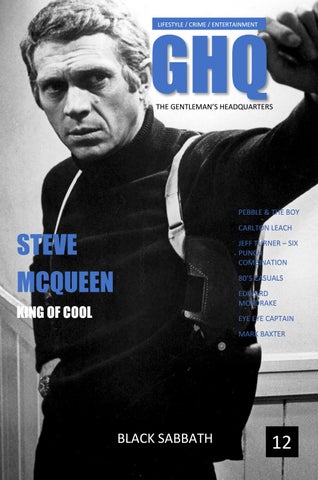
GHQ LIFESTYLE / CRIME / ENTERTAINMENT
THE GENTLEMANS HEADQUARTERS
THE GENTLEMAN’S HEADQUARTERS
PEBBLE & THE BOY CARLTON LEACH
STEVE MCQUEEN
JEFF TURNER – SIX PUNCH COMBINATION 80’S CASUALS EDWARD MORDRAKE
KING OF COOL
EYE EYE CAPTAIN MARK BAXTER
BLACK SABBATH
12
Ghqmagazine.com
THE GENTLEMANS HEADQUARTERS
THE GENTLEMANS HEADQUARTERS
KING OF
CONTENT ISSUE 12 - 2021
PEBBLE & THE BOY BLACK SABBATH 80’S CASUALS JEFF TURNER EDWARD MORDRAKE EYE EYE CAPTAIN MARK BAXTER STEVE MCQUEEN KING OF COOL
THE GENTLEMANS HEADQUARTERS
The body, the look, the lifestyle, the gamble, the money, the entertainment, the sports, the cars and of course the women. Welcome aboard and to Gentleman’s Head Quarters. We live in a world that is ever-changing. Success can be measured in different contexts and on any level of what is deemed important, what is found within and how it is delivered. That is exactly what GHQ is! Each and every issue, GHQ will deliver a full content, no holds barred insight to everything you’d expect for the discerning gentlemen and all others who wish to follow. So tie up your laces, pop your collars and get ready for a nitrofuelled cutting edge delivery of nothing short of the dogs bollocks!
THE GENTLEMANS HEADQUARTERS
FILM WITH GHQ
Writer and Director Chris Green with GHQ Magazine The Pebble and the Boy Born in Salford, writer, director and occasional film producer Chris first enjoyed success when he came runner up in the RED Productions/CH4 Northern Soul new writers’ competition back in 2000. Since then, he's worked with some amazing talents in both TV and Film including Rise of the Foot soldier's Ricci Harnett, This is England's Stephen Graham and Patsy Kensit to name but a few.
THE GENTLEMANS HEADQUARTERS
He's written for Hollyoaks, but the less said about that the better, SKY and CH4 but his main focus has been on creating and making independent feature films. His first film, the micro budget Desperate Measures was made for £40,000 and since then he has gone on to write and/or direct a further four films including Best Laid Plans which starred Stephen Graham as a chancer who uses his huge friend Adewale Akinnouye-Agbaje to pay off his debts by engaging in a series of cage fights, Strangeways Here We Come which featured This is England's Perry Fitzpatrick and Chanel Cresswell as well as Michelle Keegan, Me, Myself and Di which is released later this year and stars former glamour model turned actress Lucy Pinder as well as Larry Lamb and his passion project the Mod road movie The Pebble & the Boy which is inspired by and features the music of Paul Weller. He is also in pre-production on the comedy film Thick as Thieves, a buddy film akin to 21 Jump Street, but without the sunshine or the budget which is to be set at the height of Britpop in 1995 and will heavily feature the fashions and the music of the time.
THE GENTLEMANS HEADQUARTERS
. Chris gives an insight to the film The Pebble & the Boy, that he wrote and directed. The story follows John Parker, a 19-yearold from Manchester who embarks on a journey to Brighton, the spiritual home of the Mods, on an old Lambretta scooter left to him by his late father. It's a film that takes a nostalgic look at the Mod scene of the early 80's through the eyes of a young boy tracing his father's steps and learning about the man he was and the impact he had on people’s lives. There are a few twists and turns along the way, but the film, despite the nature of the story is a celebration of all things Mod and youthful adventure. GHQ: You’ve been inspired, largely by artists that encapsulated ‘The Mod scene’. With films of past, namely Quadrophenia, what would you say is the most notable difference about The Pebble and the Boy and its predecessors? Chris: The biggest inspiration for me when it came to writing the script that would later become the film was the music of Paul Weller. For me, as a fourteen-year-old working-class boy in Salford during the early 1980’s Weller was the Mod scene. He opened my teenage eyes to a style and ethos of being ‘well turned out’ during his time in The Jam, and even more so when he formed The Style Council.
THE GENTLEMANS HEADQUARTERS
I had the posters on the wall, the records in my collection and the clothes on my back, and even at school myself and my mates always made sure we looked smart. And it was through the Jam that I became aware of other great bands like Secret Affair, The Chords and The Lambretta’s. But when it came to making my ‘Mod’ film I was careful not to try and make ‘another Quadrophenia’ and there are two big reasons for doing this. One, you can’t touch a classic and two, if I was making a film partly inspired by my own and experiences then it would be disingenuous to try and set it around the original Mod’s of the 60’s as that’s not my area of influence. We’ve worked really hard to make The Pebble & the Boy a film that tells a story about a boy and his father rather than a film about a young Mod and mix up the music by featuring the big Mod bands of the 80’s and some great current Mod influenced music from The Electric Stars and a great singer songwriter called Sammie Harris. Our producer Mike Knowles has described the film as a ‘Jukebox movie’ and I have to agree as it does feature a lot of songs that people will love.
THE GENTLEMANS HEADQUARTERS
GHQ: Britain has birthed some amazing, multi-generational sub-cultures; Mods being one. But the cult following Mods has had since its inception back in the 60’s, it’s a sub-culture that can be found globally – comment Chris: For a relatively small nation, Britain has had a major influence on music and literature and I believe it’s the same for style and youth movements. I think we’re pretty unique when it comes to youth-oriented fashions and sub-cultures. It’s born from a desire to belong and also distinguish yourself from those around you at the same time. It’s a bit like pack mentality, but within that pack are individuals trying to establish themselves. But yeah, we seem to have a lot of influence over the rest of the world when it comes to sub-cultures. For instance, there is a strong affiliation to ‘Skins’ in places like South America and a love off all things ‘Mod’ in Thailand, but yet it’s here on the working-class streets of the UK where these styles have originated from, albeit with a smattering of other influences thrown into the mix along the way, i.e. Preppy American wear and Italian suits to name but two
THE GENTLEMANS HEADQUARTERS
And although in most cases these sub-cultures have dissipated over time, mainly due to the fact that we all get old and responsible there are those that endure with Mod being the one that stands out more than the rest, although the Casual’s among your readership may disagree. But one thing’s for certain, there are more Mods about than Punks and Teddy Boys! But I think a lot of credit to the longevity of Mod should go to those who were around in the 6o’s, who nurtured the look and the attitude that still resonates and excites people all around the globe. Who doesn’t love the sight of a 1964 Lambretta and a Parka wearing Mod in full flight? Vespa riders probably….. GHQ: Style and a level of class is an easy one that identify what Mods was and represented. What else would you say are the ‘trademarks’ not often seen with Mods as a sub-culture? Chris: I think one of the trademarks of being a Mod is the fact that they are still ‘active’, and by that, I mean they’re still living that ‘clean living in difficult circumstances’ ethos. How many Punks get together and have an annual bash like the Mods do in Brighton every year? OK, the vast majority of them are in their 50’s and carrying a few extra pounds, but they’re still proud, and still striving to be the coolest, the smartest and the ones that attracts the admiring looks. And there’s bloody hundreds of them! It’s a great spectacle, especially when the sun is shining and the scooters are gleaming. That sense of belonging that may have been formed in the 60’s or the 80’s is still going strong and still recognized by the media and the rest of the world.
THE GENTLEMANS HEADQUARTERS
GHQ with actor Michael Ayiotis Black Sabbath: Breaking The Band Documentary.
For lovers of heavy-metal they were heaven, for everyone else around them, they were hell – the general public got to hear and know them as Black Sabbath.
‘Black Sabbath: Breaking The Band’, focuses and details Black Sabbath’s huge success and subsequent downfall. The group is still considered to be one of the godfathers of all the heavy metal bands and music. The documentary follows the iconic bands journey from their humble early start in working class, industrial Birmingham, England in the 1960s, becoming a heavy metal band with a God-like status, to their eventual break up.
THE GENTLEMANS HEADQUARTERS
The documentary combines behind-the-scenes footage, with added well played ‘stylised dramatic reconstructions’ that would have otherwise been missed and largely not believed if not seen in the production. Also included are extensive archive and revealing interviews, that allow viewers to witness the turbulent history of the band, the members and their drug fueled egos, personal demons and alleged music business gangsters, who almost robbed them of everything they had once earned.
Sharing their personal stories of the band are former road managers Geoff Lucas and Graham Wright, and Ozzy’s former personal assistant David Tangye, along with insight from band biographer Steven Rosen and music journalist Sylvie Simmons. The part of Ozzy Osbourne in the documentary was played by actor, Michael Ayiotis.
THE GENTLEMANS HEADQUARTERS
GHQ. The film follows the iconic outfit’s journey from the band’s early beginnings in Birmingham to heavy metal infamy and their eventual break-up. What did you learn or experience playing the part of the angel of darkness – Ozzy Osbourne? Michael: I think that growing up in the 90’s, Ozzy at the time was already established as the icon that he is. For some reason it never occurred to me that he had this journey from nothing to everything, I was quite oblivious to the journey. You know, I knew the classic rock and roll antics, the drugs and parties, and smashing of hotel rooms, biting a head off of a bat, all of the “good stuff”, and I won’t lie that some of most fun I’ve ever had recreating those shots. But from this portrayal I really learnt about his determination and grit.
GHQ. Looking at the artist and front man of Black Sabbath, do you think inspiration for Ozzy came from his ‘wildness’ or was there something not captured in the documentary? Michael: Honestly, despite all of the drink and drugs, I watched a lot of interviews about Ozzy before taking this role on, and everyone just loves how fun he is. That wild part of him, from what people say about him is perhaps this child like fearlessness to do whatever he wants to, and he feels no pressure from anyone to act in a certain way, he isn’t scared of being in trouble, he’s going to do whatever he wants to anyway.
THE GENTLEMANS HEADQUARTERS
That is my favourite thing about him, and something I think I can try take away from the role for myself. He also just loves it! You can see it particularly when the band plays, he is the front man, and he’s brilliant, but as soon as there’s a guitar solo, he’s stood off to the side just taking it in, and his passion for it is just infectious. The documentary does a great job with showing this because the people they interview and talk to, have been with Ozzy through a lot of it, and they still choose to speak about him in the way they do, and that speaks volumes.
GHQ. If there was one thing or piece of Ozzy’s life that best encapsulates who he is, what part of the documentary best describes or shows that? Michael: Through all years in the band, he fought so many demons; substance abuse, falling out with the band members, the label doing them dirty, but honestly; it’s Ozzy’s vision to crack on with it. His self-belief is second to none. When he first thought of creating a band, was he a singer? No, yet he did it. He had so many push backs, when the band members saw it was Ozzy looking to start the band they recognised him from school and were really sceptical, but he won them over. They lost all their money to the record label, and he started over, making a lot of the same mistakes again, but he did it. He battled the demons he had to and he bounced back every single time, with full conviction and he didn’t try to hide anything, ever. He was so open about everything that he just fell into the hearts of people. And when you watch it, you’ll learn a bit more and be like “wow, I didn’t know he went through that…” and I think we can all take a lesson from that.
THE GENTLEMANS HEADQUARTERS
GHQ. What did you enjoy most about playing the part? Michael: There are two stand out moments. Firstly, they called me onto set, and they were like “Okay, we’ve got one take on this shot..” and I remember thinking, “this is it. I’m gonna trash a hotel room.” They told me “Hey, go for it, throw whatever”, and they were pointing at everything in the room like “this breaks, this breaks, you can break this” and my eyes just lit up! They cut small holes in the feathered pillows so when we got to smashing them up, it was just chaos. The hardest thing about that was to not enjoy it, because it was him being in a drunken rage, so having to make I don’t sneak in a smile was quite the challenge.
THE GENTLEMANS HEADQUARTERS
And the second moment, we’d just finished filming this party scene by the pool, so I’m on a high already, having the time of my life just sat there in of the time swim wear, which I found hilarious in itself. But crew turned to me and were like “okay, go get changed, we don’t have long to get this shot done” and I was just in work mode, so I was head down, running across this mansion in these skimpy trunks. Got changed, and walked outside, and at this moment, I’m feeling like a full on child, the day is just so much fun; and I’m suddenly presented in front of this very tall and sturdy man who stand there, looks me dead in the face and says in a very proper voice “Hello Sir, this is the shotgun you’ll be firing today.” And it had completely crossed my mind that I was doing this, and my jaw just hit the floor, and crew asked me to check, “you are okay with this, right?” and I was on such a high I just stood there like “Abso-bloodylutely! I’m Ozzy Osbourne!” and I got to keep some of the shells as a little thing to remember the day.
THE GENTLEMANS HEADQUARTERS
The Circle of Trust – Carlton Leach I could have entitled this piece the cycle of trust instead, read on to find out why. Not so long ago I had so many people around me that we couldn't all fit through a nightclub door at the same time! A few years on and my circle is much smaller, but one fact remains consistent; I can count the people I can trust on one fucking hand! It's an age-old story, when you have something people want or want to be a part of, you have more 'friends' than you can shake a stick at, but when it seems to the masses like you're not so valuable anymore, the phone stops ringing! I realized a long time ago that this is actually a good thing, a process worth going through in fact, because it gets rid of the dead wood, the hangers on, the ones who bring no value to the table and what you're left with is a handful of people who are much more likely to stand the test of time!
THE GENTLEMANS HEADQUARTERS
There’s a number of people I’ve parked up over time and I’m confident that their loss is much greater than mine! Think about the film industry for example; some people in that industry could really do with using my name to make their piss poor work credible, but due to some of the low-life moves they’ve pulled in the past I refuse to associate myself with them, whatever money they try to throw at me. It’s the same in other business deals and from time to time I get call: “Carlton, how are you brother, how’s your family, everything ok?” Seconds later comes the line: “You couldn’t do me a favour could ya mate?” Sometimes I will do that favour, at a cost! Other times, I politely inform that I’m far too busy, and that takes me full circle back to my point about keeping your circles small, I don’t need those people round me anymore, dragging me into their shit! The people I keep close to me now don’t use me and they’ve earnt my trust and confidence over several years. I hope the readers of this are safe and well. Until next time…C
THE GENTLEMANS HEADQUARTERS
An unsolved case – The death of The Somerton Man The death of the Somerton Man, also known as the “Tamam Shud case”, is still one of Australia’s most baffling unsolved mysteries. It was a warm summer day in Southern Australia, the date was December 1st, 1948. At appx 6:30 am, a man walked along his local beach; Somerton beach, and saw something laying on the beach. Upon investigation and getting a closer look, he noticed a man lying in the sand; his feet were crossed and his head resting against the sea wall. Sensing something was ‘off’, he took note of the situation. The passer by observed that the man in the sand was dressed too nicely to be sleeping on the beach, was clean-shaven and was smartly dressed - a button down shirt, tie, slacks, cardigan, socks, shoes, and a high-quality double-breasted jacket. When the man approached the motionless man, he then realised the well-dressed man in the sand was not sleeping at all - He was dead!
THE GENTLEMANS HEADQUARTERS
. The police arrived on the scene and when they searched the dead man, they found a number of items: an unused train ticket from Adelaide to Henley Beach, an unused bus ticket, an aluminum comb, a half pack of Juicy Fruit gum, an Army Club cigarette packet with seven non-Army Club brand cigarettes inside, and a half-used box of matches. An unlit cigarette lay on the right collar of the man’s coat. To further complicate the situation, he had no wallet and carried no identification. This then led the police to conclude the unknown man committed suicide. But, one thing did stand out – all of the labels on the man’s clothing had been removed!
An autopsy was ordered and carried out – this would surely help answer questions to the man and his death. The pathologist noted that the man looked ‘British’, estimated that he was in his early to mid 40’s, grey eyes and fair, ginger hair. He also made comment that the man was in “top physical condition” and that the man’s physique resembled that of a “ballet dancer.” Also, he had delicate hands and nails that did not show signs of manual labor.
THE GENTLEMANS HEADQUARTERS
Following simple protocol, the Police appealed to the public for information, hoping to piece together the mysterious death. Some came forward and confirmed that they had seen someone resembling the dead man lying on his back in the same spot on the evening of November 30th. One couple reported to have seen the man early that evening, and they saw him move his arm, another report to saw him between 7:30 and 8:00 pm, but could not remember if he had changed positions at all. Another witness advised police that she saw different man at the top of the steps watching the sleeping man on the beach for some time and then he left. On December 10th, just ten days after the discovery, authorities had the Somerton Man’s body embalmed. On the 14th of January, a member of staff at the train station found a brown suitcase with an interesting detail - the label had been removed! Records showed the suitcase had been checked into the station’s cloakroom on November 30th. The man had arrived in Adelaide by overnight train and bought the second (unused) train ticket from Adelaide to Henley Beach that same morning. The train to Henley Beach departed at 10:50 am, but it is not clear why the Somerton Man did not get on that train.
THE GENTLEMANS HEADQUARTERS
Following simple protocol, the Police appealed to the public for information, hoping to piece together the mysterious death. Some came forward and confirmed that they had seen someone resembling the dead man lying on his back in the same spot on the evening of November 30th. One couple reported to have seen the man early that evening, and they saw him move his arm, another report to saw him between 7:30 and 8:00 pm, but could not remember if he had changed positions at all. Another witness advised police that she saw different man at the top of the steps watching the sleeping man on the beach for some time and then he left. On December 10th, just ten days after the discovery, authorities had the Somerton Man’s body embalmed.
On the 14th of January, a member of staff at the train station found a brown suitcase with an interesting detail - the label had been removed! Records showed the suitcase had been checked into the station’s cloakroom on November 30th. The man had arrived in Adelaide by overnight train and bought the second (unused) train ticket from Adelaide to Henley Beach that same morning. The train to Henley Beach departed at 10:50 am, but it is not clear why the Somerton Man did not get on that train.
THE GENTLEMANS HEADQUARTERS
An item in the suitcase that provided a definitive link to the Somerton Man was a card of orange waxed thread. The brand was unusual and not available in Australia; however, the same thread was found on the pocket lining of the dead man. He had used it to repair a small hole.
Similar to the clothing found on the deceased man, the labels on the clothing found inside the suitcase had also been removed, but police did manage to gain one small clue…..the style of stitching on a coat that was found inside the case indicated that the coat was made in the U.S. None had been imported into Australia.
In June of 1949, the same pathologist was called to re-examine the body, but this time he found new evidence. He noted that the Somerton man’s shoes were extremely clean and polished. If the man had been walking around town (or a beach) all day, they would’ve shown more wear. There was no vomit or sign of convulsions in the location where he was found, which then ruled out poisoning. Lastly, the pathologist learned of a group of drugs that were very toxic and nearly impossible to detect: digitalis and ouabain. Could the Somerton man have died elsewhere and been brought to the beach later?
Not any closer to knowing the man’s identity, a plaster cast was made of the man’s head and shoulders. And then things got weird… When the dead man’s clothing was re-examined, it gave police a clue that further confused them - there was a hidden pocket sewn within man’s trousers. Within the hidden pocket, they found a small rolled up piece of paper with the words: Tamám Shud. When translated, the text means “ended” or “finished”
THE GENTLEMANS HEADQUARTERS
It was then asked if police find the exact copy of the book with these words torn out, they might be able to add another piece of the jigsaw and solve the man’s identity. The authorities once again appealed to the public and this time, they got lucky! A man called detectives, claiming he found the book in the rear foot well of a car around the same time the dead man was found. Microscopic tests confirmed that the piece of paper found in the Somerton Man’s pocket was an identical match to the tears in the paper of the recovered book. The book contained more clues. Inside of the back cover, they found pressure marks from a pen that revealed a phone number and lines of text that appeared to be an encrypted message.
The phone number written in the back of the book belonged to a nurse named Jessica Thomson. Jessica lived close to where the man’s body was found. She told police that she did not know the dead man or anything about how her phone number ended up in that book and that she did not know who the man was. When asked about the book, she admitted that she owned a copy of the book while she was working in the Hospital in Sydney during WWII and that she had given it to an army lieutenant named Alf Boxall in 1945. He was staying at the Clifton Gardens Hotel during that time, but after the war, she never saw him again. The Somerton man was laid to rest in Adelaide’s West Terrace Cemetery in 1949.
THE GENTLEMANS HEADQUARTERS
Police investigated many claims throughout the years. None of the leads were viable, but in 1959, a witness came forward and told authorities he saw a well-dressed man carrying another man on his shoulders on Somerton Beach on November 30. Police waited 61 years for a breakthrough.
In 2009, an anatomy professor at the University of Adelaide, examined the images of the Somerton Man and made a startling discovery – the cymba (upper ear hollow) was larger than his cavum (lower ear hollow). This feature only appears in 1% of Caucasians. The professor invited some dental experts to look at the photos. They concluded that the deceased man also had hypodontia - this is only present in 2% of the population. Police decided to re-visit Jessica Thomson (the woman whose phone number was written in the back of the deceased man’s book).
THE GENTLEMANS HEADQUARTERS
Liverpool Experts then obtained a picture of her eldest son, for analysis. They found that her son had both a larger cymba than cavum and hypodontia. The chances of this being a total coincidence are said to be at least 20 million to 1! Many believe that Jessica’s son, who was 16 months old at the time the Somerton Man was found, was the Somerton Man’s son. His name was Robin Thomson and passed away in 2009. Here, it gets really ‘weird’ - In June of 1945, a man named Joseph Marshall was found dead in a park with a copy of the same book on his chest. The park was located right next to the Clifton Gardens Hotel in Mosman, Sydney. This was the same hotel that Jessica’s friend, Alf was staying at the time. The cause of death – Poison! Not long after, a woman named Gwenneth Dorothy Graham testified at his inquest. Two weeks after the inquest, Gwenneth was found dead in her bath with her wrists slit in what have said was suicide.
In 2014, Jessica’s daughter, Kate, appeared in a T.V. Interview with 60 Minutes. In the interview Kate speculated that her mother did know the dead man. Jessica told Kate that she lied to police because the Somerton Man’s identity was known to an even more powerful organization - Kate believed that both her mother and the Somerton Man were actually spies and told her interviewer that her mother taught English to migrants, she was interested in communism, and was fluent in Russian (she never learned where or why her mother picked up the language).
To this day – no one knows the identity or meaning behind the body or cause of death.
THE GENTLEMANS HEADQUARTERS
WERE CASUALS – ORIGINAL HYPERBEATS Hypebeasts are generally young adults & teenagers that will pay hundreds of pounds for rare & exclusive items, but did ‘Hype’ culture as we know it today actually start with the Casuals back in the 1980s? How we now shop for apparel & trainers has changed massively since the 1980s, but the demand for certain styles still remains. Some adidas trainer releases have seen re-sale values in their thousands with the demand for sought after trainers now at an all-time high. Whether you’re a 3 stripes fanatic or just like a decent pair of trainers you’ve probably heard of the term “Hypebeast” before. So what actually are Hypebeasts and how relevant are they, if at all, to the original Casual scene of the 1980s?
THE GENTLEMANS HEADQUARTERS
Hypebeasts are generally in their late teens or early 20s and collect highly sought-after streetwear & trainers from brands’ that are deemed “super cool” by other fellow Hypebeasts. If you’ve ever seen the queues outside Supreme stores on release-day then the odds are that 99% of them are “Hypebeasts” whether they like to admit it or not. Hypebeast culture in general has sky-rocketed in recent years thanks to social media & the accessibility of product online. Raffles have made certain releases even more “Hyped” and resale values of items have gone through the roof.
But, and it’s a big but, buying rare and exclusive trainers or apparel is certainly nothing new. Here in the UK it was the Casuals that really started our own homegrown trainer scene. Coming off the back of B-Boy culture from the Bronx, style driven sportswear, European football glory, a new generation of fitness freaks & highly profiled tennis stars, the late 70s & early 80s became a melting pot of casual sportswear & athletic trainers
THE GENTLEMANS HEADQUARTERS
It was all about who had the best gear on and a way for the young working classes to look & feel good. Sourcing rare & exclusive adidas trainers, wearing the latest Tacchini track top, Benetton rugby shirt or Pringle Argyle knit became almost cult like. Entrepreneurial retailers like Wade Smith in Liverpool cashed in on the Casual scene by spotting the new trend. Smith would drive over to Germany in a van and bring back unknown adidas models with Casuals flocking to his store in their thousands to bag a pair of Trimm Trab or Forest Hills.
After Margaret Thatcher came into power in 1979, unemployment in the UK had literally doubled by 1985. Times were hard for the average working-class family and if you were struggling to put food on the table, spending £100 on a pair of trainers for your teenage son wasn’t really an option. The majority of Casuals were working class & grafted for their “grails”. The ones that didn’t have the money would just simply steal from sportswear shops. Moody Lacoste polo shirts were a cheaper alternative than the real thing, but no-one really wanted to be associated with wearing fakes.
THE GENTLEMANS HEADQUARTERS
. It was all about following the latest terrace trends, oneupmanship and who had the most expensive gear on. If you didn’t “Dress” the part you weren’t a Casual, it was as simple as that. So how do modern Hypebeasts compare with the original Casuals? The concept is relatively the same. Collecting & sourcing rare trainers is certainly nothing new. However, Hypebeast culture is largely controlled by the brands themselves by only releasing limited numbers of a product to create further “Hype”. This particular retail model continues to dominate the majority of releases. Back in the early 80s it was the Casuals that dictated what was cool and what wasn’t. Let’s not also forget that it took adidas a good 5-10 years from the early 80s to market their gear with a more lifestyle approach. It wasn’t until 1986 when Run DMC signed an endorsement deal with adidas for $1.6 million, that adidas really started to see the impact of subculture & music for the German sportswear brand moving forward. The adidas trainers’ the Casuals were sourcing were originally made for playing sports like tennis, handball & running. They were performance shoes, not something that were really designed to sell out in seconds on release day.
THE GENTLEMANS HEADQUARTERS
It’s also worth pointing out that a lot of Hypebeats don’t actually buy products to wear, they buy them to sell on and make a profit. The ones who are splashing out £1000 on the latest “drops” to wear themselves aren’t exactly painters & decorators on an apprentice wage from a council estate are they? There’s a general conception that a lot of Hypebeasts are just spoilt little rich kids who can get what they want on tap thanks to the bank of mummy & daddy. Some are however quite entrepreneurial in how they source and resell items. You could argue that modern day Casuals have become more like “Hypebeasts” in recent years with how they buy their products. One thing is for sure though, it was the Casuals that really kicked off trainer culture in the UK back in the 1980s & not some Z rate celebrity influencer on Instagram. Just remember to keep it Casual!
THE GENTLEMANS HEADQUARTERS
Jeff Turner’s - 6 Punch Combination
You’ve got some front
Hello good people. It’s been 41 years since I got behind a microphone and screamed me head off, spearheading the Cockney Rejects primal assault. Was great fun throwing myself about in a shit hole basement, making a noise. Never thought I would amount to anything. Low and behold 18 months later the band were signed to the biggest record company in the world (EMI) after playing only 5 gigs! I had been into my music since an early child and always dreamt of playing lead guitar in a rock band, but it was the singer of a group who really got my attention. Being total shit musically I never thought that I would ever be in a band until my bother Mick started self-teaching himself guitar.
THE GENTLEMANS HEADQUARTERS
My big bro always took me under his wing and when he started the idea of a band, he said I could be the singer (and I use that term very loosely!) I couldn’t hold a fucking tune to save my life but being in the punk era this was a massive asset. Being 14 years old and having boundless bravado I took to it like a duck to water. Writing lyrics and bellowing into a mic in a recording studio was a doddle but stepping onto a stage in front of the audience was an entirely different ball game!
My first live gig was in June 1979 at the legendary Canning Town Bridge House on a fucking Monday night in front of about 30 punters! Went ok tho! I was brought up listening to and watching the Robert Plants and Paul Rodgers of this word and this was light years away from them. As time went on I always tried to steal a bit from each of my favourite stage stars when performing to make up for my huge lack of vocal talent. Being a front man takes some front, trust me! The nerves before any show will never go from me, I feel them before every gig and I’ve done over 750 of them.
THE GENTLEMANS HEADQUARTERS
Early Rejects shows when a young teenager were bedlam and in 1980 particularly we were involved with some brutal battles with our audiences! Strangely that never phased me! I’ve played in kharzis and dangerous places all over the world and some fantastic festivals in front of thousands and the butterflies have always been in my stomach beforehand no matter where. Being a front man means you have to give 100 per cent entertainment every time, no matter whether your playing to 50, 500, or 50,000 people. Punters pay good hard earned money so you have to give nothing but your best.
I’ve manged to train hard over the years. Running miles a week, boxing and weight training to stay on top of my game. You have to be dedicated and fucking focused. The day when your top level can no longer be achieved is the time to call it a day. That’s just my take on it, I don’t judge others. A concert can be like a stand up gig, I respect anybody who gets up on that stage like I do anybody who jumps in a boxing ring. I’ve been influenced by many front men in my lifetime and everything I take to the stage I’m still living the dream. I’m going to list my 10 best front men of all time. I’m not a fan of the music of everybody on this list but its my appreciation of what they have brought to my table. From number 10 to number 1, I salute them all.
THE GENTLEMANS HEADQUARTERS
10) Axl Rose
I’m not a fan of guns and roses and Axl Rose’s vocal style reminds me of a strangled cat. But credit due where credits due he was a livewire on stage. He was quite reserved when starting out as part of The Poodle looking glam revival days of the mid 80s in LA. But late 80s to the early 90s with a hard rock makeover teres no doubt that he was the front of front men at that time.
9) Joe Strummer
I love The Clash and see The Clash many times in the late 70s. Musically live The Clash seemed all over the place. They seemed to play many a song completely out of tune but it was the hight of punk and nobody gave a shit. What they did have was a fantastic fucking energy along with great songs. Whether singing while playing rhythm guitar or just with a mic in his hands, Strummer was 100 percent full on. He meant every word that came out of his mouth. He was like a coiled spring.
THE GENTLEMANS HEADQUARTERS
8) Iggy Pop
Iggy Pop is a trailblazer for sure. Started performing in the late 60s and in 1973 ith his band the stooges released his debut album Raw Power. It never bothered the charts, but Iggy made everybody sit up and take notice with his stage antics. He took to self-mutilation on stage, rolled around on broken glass and is credited with inventing the stage dive. A bundle of activity of activity with every performance right through his whole career. 7) Dave Lee Roth
From the late 70s through the 80s “Diamond” Dave was as great a character as anybody. I love Van Halen and Roth was a superb entertainer with a distinctive voice. He was a rock n roll version of Dean Martin. Van Halen was a juggernaut with Roth at the helm. High rise kicking, energetic and totally captivating.
THE GENTLEMANS HEADQUARTERS
6) Jimi Hendrix
Hang about! A guitar player as a legendary front man? Yep, Hendrix fronted the Jimi Hendrix Experience and he’s band of Gypies. For me the greatest rock guitar player of them all and a great showman. Hendrix playing, vocal delivery and character were totally mesmerising on stage. He wiped the floor with every other artist at the Monterey Festival in 1967. Hendrix in full flow was jaw dropping.
5) John Lydon
Maybe not in his Public Image days but with the Pistols he was something else. The sneer, the anger, the mad movements and his evil eye made him must watch. For me the Pistols are the ultimate punk band and Lydon captured everything about that era. Watch there’ll always be an England, the Pistols live at the Brixton Academy in 2007 and you will see him at the top of his game. Sarcastic and funny as fuck. A combination of vaudeville, stand-up comedy and serious punk anthems, he inspired so many.
THE GENTLEMANS HEADQUARTERS
4) Steve Tyler
Tyler for me is a totally gifted singer, songwriter and performer with a fucking massive ego. As he moves into his 6th decade of rocking, he should be revered as an all-time great. I see the mighty Aerosmith at Hammersmith Odeon in 1989 and it was one of the top 3 shows I’ve ever witnessed. Being a huge fan of the band since their first coming in the 70s, their demise soon followed. With their resurrection in the mid 80s with the rise of MTV they came back as good as ever. Watching Tyler in his forties doing somersaults on stage was truly brilliant. His stage presence and bravado is something to behold. It will be a very sad day when his curtain comes down.
3) Angus Young
I first went to see AC/DC live in 1978 at 14 years old. A life changing experience. The power left my ears ringing for days. Singer Bon Scott was as cool as fuck, but lead guitarist Angus Young blew my teenage mind, it stayed with me. I’ve never ever seen anybody on any stage give so much. How he could run around like that while playing shit kicking rock n roll will always be beyond me. Night after night, month after month, year after year he never failed to deliver. Watch Let There be Rock live in 1978 on Youtube and its fucking mind blowing. I see them in the early 80s and 2015 and he still had the same level of performance. A phenomenon.
THE GENTLEMANS HEADQUARTERS
2) Freddie Mercury
Greatest singer of all time period. I am a massive Queen fan, their first 4 albums for me are as good as it gets. Watching Queens 1974 concert at The Rainbow I get the impression that Freddie was a little unsure of himself on stage. Vocal delivery outstanding but a little hesitant with his movement. He gradually developed into a legendary entertainer. By the late 70s and into the 80s he came into his own. How the fuck he could run around a stage like a maniac while still singing notes perfectly is a testament to his greatness. Live Aid 85 is arguably the greatest ever performance from any front man in Rock n Roll history. He is the only singer I can watch perform who makes the hairs stand up on the back of my neck. A supreme talent which was taken away from us too soon. He could captivate 80,000 people and hold them in the palm of his hand.
THE GENTLEMANS HEADQUARTERS
1)
Mick Jagger
The guvnor, the inspiration, the finest front man to ever strut his stuff. From early doors Jagger stamped his mark. The pout, the confidence, his shit crazy dancing just worked wonders. Perpetual motion, Jagger worked that stage like nobody else, he held command of every inch of it. How many front men have tried to imitate him? I’ve always tried to add a bit of Jagger into every gig I’ve done and aint ashamed to admit it. For me as a front man he is the boss of bosses. When he spoke to an audience between songs in the USA his tongue was a fake American drawl. In the UK a fake Cockney monologue. Classic king of his trade. Even now in his 70s he has more energy and presence that any 20 something or anybody else for that matter. The king of Rock n Roll.
Nuff said!
THE GENTLEMANS HEADQUARTERS
Edward Mordrake – The Devil made Me Do It! Edward Mordrake was born in the 19th century. He was the only son of the Earl of Darlington. Along with his two sisters, was the air of one of the richest and most powerful families in the County of Portsmouth in England. It is said that after having their two daughters the Earl and his wife were waiting for a male son to be born. Soon after, their wish came true – the family was blessed with the birth of a son, but even though Edward was a boy there was something equally extraordinary as there was chilling about this newborn. Edward had been born with two faces - one of them located in the back of his neck. What was said to be especially terrifying about the second face, was it wasn’t only smaller with different features, it was perfectly formed, including eyes, nose, mouth – everything identifiable as a normal functioning face.
THE GENTLEMANS HEADQUARTERS
Due to his birth malformation, Edward was forced to grow up isolated from society, some have suggested even from his own family. However, even though his confinement allowed him to become a learned and educated man as well as a skilled musician, this now new learned skill and academic achievement came with a hurtful and spiteful price – ‘with great silence comes pain’; the second adjoining face started to show its evil nature. It has been reported and noted in several journals by various people that whenever they walked behind Edward, the second heads eyes followed their actions and direction. Another unsettling written record talks of how the second face would smile or smirk when Edward would cry or feel pain, and how the second face would actually talk to Edward, who claimed his evil twin would whisper to him “such things that he could only be heard in hell.”
THE GENTLEMANS HEADQUARTERS
Edward showed signs that he was suffering from a great depression. He even begged his doctors to remove the devil that would only talk to him at night. But because there wasn’t any proven successful procedure or medicine at the time, the Drs refused to operate or treat him. Some have suggested because the unwanted face wasn't developed enough and the operation was too complex for the time, Edward would have to live with his second face.
According to a testimony in George M. Gould’s book on anomalies and curiosities of medicine, Edward said, “no imagination can conceive the dreadful temptations it sets before me, for some unforgiven wickedness of my forefathers, I admit to this fiend, for offended it surely is, I beg and beseech you to crush it out of human semblance, even if I die for it.”
There are several theories around Edward Mordrake’s death. One of them suggests that when he was 23 years old he decided to end his life by ingesting poison; others say that he hung himself, but whatever theory you subscribe to, they both have something in common – Edward’s second face was said to be smiling when he was found dead. In his suicide note, that was addressed to his family, Edward wrote that he was sorry for the pain he might cause them with his decision to end his own life and that after his death his last wish was to have the Devils face removed from his dead body, the same face that had tormented him his whole life so he could rest in peace.
THE GENTLEMANS HEADQUARTERS
Jason: An eye for an eye – comment
Edward Mordrake was buried in an undisclosed location with no gravestone. According to modern medicine, Mordrake suffered from a birth defect called the Diprosopus; it consists of the duplication of parts of the face of the person or host. It’s accepted by leading researchers the ‘condition’ is not Siamese Twins, but a defect caused by the excessive SHH protein; that is responsible for the development of the backbone structures in the brain or the face.
But what remains both a mystery and a medical anomaly with Edward Mordrake, as to date, there has never been anyone that has survived past childbirth with this condition, as all babies born with the same condition as Edward, died days after they're born and none like Edward lived for 23 years. There is some question if Edward could’ve lived to a much older age, given his medical condition, but it’s worth mentioning there were no other recorded medical abnormalities and he could’ve in fact lived to a normal healthy old age.
THE GENTLEMANS HEADQUARTERS
Eye- Eye, Captain! The all-seeing pirate.
Not that it’s a subject or a question that may have had you awake at night, but have you ever wondered why pirates wore an eye patch? The trademark ensemble is as much an identifying piece of pirate wear as the wooden-leg and the parrot on their shoulder.
We all grew up reading storybooks or watching pirate movies. When people talk about pirates, we have all imagined desert islands, treasure and of course patches over one eye. Some people believe that pirates wore an eye patch to hide their missing eye, or to cover an eye disfigurement or injury from battle. But some have concluded that it has nothing to do with a missing eye at all. In fact, there’s a consensus that the rascals of the open sea wore an eye patch so that they could fight and see clearly below the deck in the dark.
THE GENTLEMANS HEADQUARTERS
Pirates used to fight during the day as well as in the dark. So, they wore an eye patch over one eye to prepare that eye to see in the dark. Whenever they went below deck, they switch the eye patch to the outdoor eye and see with the eye which is prepared for low light conditions. With this practice, pirates can instantly see better in the darkness. Jim Sheedy, a director of the Vision Performance Institute at Oregon’s Pacific University and Doctor of vision science stated in the journal Wall Street that the average human eye takes about 25 minutes to adapt fro bright light to the darkness that requires the regeneration of photopigments. MythBusters also tested also this hypothesis in their pirate special in 2007 and determined that it was plausible (only due to the lack of historical sources that kept it from being confirmed). It has also been suggested it allowed for ‘faster focusing’ when using an eye piece such as a pocket telescope. Hollywood myth? There are no recorded historical precedents to prove the fact, but it is an aeronautical fact that many pilots cover one eye to ensure they have both day and night vision when they operate flights. The FAA elaborated about pilots using night vision and stated, “A pilot should close one eye when using a light to preserve some degree of night vision.”
Further fact – Walking the plank and burying their loot was a rarity (just 3 pirates) and wasn’t common-place at all!
THE GENTLEMANS HEADQUARTERS
Mark Baxter with GHQ – The Fashion of Football Stay-press trousers, Dr Martin boots…..Fila, Sergio Tacchini, Lyle and Scott…. even through later brands including C.P and the rebirth of Fred Perry (and its popularity), fashion has unquestionably been part of football terrace history and by the fans that fill them. Every brand has at one time or another, played a major part in the elevation of footballers to iconic status in modern society. No one can argue the impact, popularity and over-familiar sight of the iconic brand and badge seen on a high percentage of lads left-arm.
Whether it be Bobby Moore’s famous sports shop, Kevin Keegan’s legendary wavy perm or David Beckham's sharp dress sense, the brands and labels of fashion seen with the football crowds have quite often intermittently intertwined.
THE GENTLEMANS HEADQUARTERS
This often, unique relationship witnessed over the generations was expertly and meticulously shown by Mark Baxter back in 2006 (First published in 2004) with his book, appropriately titled, "The Fashion of Football".
GHQ: The book and your journey started with the players themselves – you focused on stars such as football icons George Best, Bobby Moore, Steve Perryman, Alan Hudson, Mike Summerbee, Darren Ward and David Beckham. Did you see the players as much purveyors of fashion as the fans?
Mark: Well, going back to the start of it all, the original idea for the book came from me trying to buy a book like this, but discovering no one had written one at the time. To me, the correlation between football and fashion within it and on the terrace was obvious. Not finding a book, it appeared I was wrong. So I resolved to write it myself. Only, I was very much a punter back in 2003, so I needed help to bring this idea to the table.
THE GENTLEMANS HEADQUARTERS
This was going to be my first attempt at writing and so I was delighted that celebrated writer Paolo Hewitt had agreed to get involved. I had already done a lot of research and so I fed that to him as he began to write. For me, this was always going to be a story of fashion within the game, be that on the terraces or the pitch. When we got down to it, those names you mention above just jumped off the research notes at the time. Each of them characters with their own unique story to tell. Clothing to them was a way of signaling to the wider world, they more than just a player and in most cases they wore it well.
GHQ: The tailor Dougie Hayward, who was well known for designing the suits for West Ham’s all-time favourite, Bobby Moore – That, for my own biased reasons, is a must read. But what drew you to write about Dougie?
THE GENTLEMANS HEADQUARTERS
Mark: I was working for a property company back in 2003 based in Mayfair and I would from time to time walk past Dougie’s shop and always wanted to go in. Stories around him and the people he made suits for were legendary. If like me you were fascinated with the 60s and all that went into that glorious decade his was a name that popped up all the time. I mean Dougie made for Michael Caine and Steve McQueen among many others who were household names of that time, he was very high end, and well respected. He was also part of the ‘Mayfair Orphans’ a group of guys who met each week for lunch, and around that table at any one time, would be Roger Moore, Peter Sellers, Terry O’Neill, Michael Parkinson, Johnny Gold and Michael Caine. You can just imagine the stories. When we walked in the shop looking to interview Doug, we were immediately made very welcome by Audie Charles who looked after front of house and Dougie himself, couldn’t have been sweeter to talk to.
GHQ: You chart the many influential street fashions that have emanated from the crowds filling the terraces over the generations. One of the more ‘notable’ were the Skinheads in the late '60s and early 70’s. Are there any myths and or misconceptions about skinheads that you discovered when writing about that base?
THE GENTLEMANS HEADQUARTERS
Mark: I was born in 1962, so I can remember seeing the original Skinhead/Suedehead guys wearing that look in the late 60’s early 70s. To me it was a fantastic style. Sharp, clean, hard, but also colourful and oh so precise. Of course they had their ugly side, with aggro and racism following them wherever they went, but the late 60s/early 70s were violent times in general and racist behavior was commonplace back then, that just cannot be denied. For me though, I concentrated on the clobber and music, which of course originated from the Jamaican ‘rude boy’ culture, so it was a complicated picture, when you were made aware of that. I think a lot of people get the later Skins, the more ‘Oi’ fixated mob of the late 70s, mixed up with the originals, which is a shame. It does the first wave a major disservice really. GHQ: The birth of the uber famous and forever talked about casuals in the mid-'70s. A forever talked about and will remain an argument that will stay (largely) unresolved; the ‘who started the casual movement.’ What were the more enjoyable elements of that era you found? .
THE GENTLEMANS HEADQUARTERS
Mark: Blimey, that question of who started will never go away will it? Funnily enough, I was well into the tennis of that era, so seeing Bjorn Borg and John McEnroe in the latest Fila and Tacchini togs at Wimbledon, was my first exposure of that look I guess? Then all of a sudden, it was everywhere. Estate, school, football, night out. It was hard to escape it. Everybody was basically smothered in labels. The element I really enjoyed was picking up on brands that maybe others weren’t wearing. This of course, was always risky, because if you got it wrong, it was often a very expensive mistake to make. Both to your pocket and your standing among your peers. I read The Face magazine religiously back then and seem to remember a Benetton advert that had me tracking that down where to buy that brand, with the blue rugby shirt of course being at the forefront of any wardrobe back then. Then subsequent trips to Fiorucci on the Kings Road and picking up jeans with the yellow plastic tag attached and from there to a shop in Lewisham, where word had it, they had a great stock of Lois at silly prices. It was like a full time job, keeping up with it all.
THE GENTLEMANS HEADQUARTERS
GHQ: Fans of all persuasions have contributed their testimonies, including the singer Kevin Rowland, the writer Irvine Welsh and members of Cardiff's hooligan fan base the Soul Crew. Was there a common element regarding ‘fashion’ and football?
Mark: I think we hooked those guys in to be part of the book, because of the novelty of someone writing about a scene that had largely been ignored. With Paolo involved, they knew this would be a proper job, and not some cheap expose of it all. I’d say these ‘faces’ had lived it, and had been on terraces and therefore been exposed first hand to what was in and what was out. They were also from different parts of the country, which was good to take the narrative away from being too London-centric. As we know this was a countrywide phenomenon, and any differences were important details. First hand knowledge like this, was so important. Kevin is a stickler for detail with an amazing memory, so we couldn’t really ask for anymore in nailing it down.
THE GENTLEMANS HEADQUARTERS
GHQ: Fashion has been part of a lot of very successful mediums; film, tv, music…… what do you think is the uniqueness of fashion and football?
Mark: To me, it’s living by a code really. Certainly in music that applies, especially to scenes like 2 Tone and the Mod movements. As for football, especially in the early days of Casual, it stayed underground and in many ways remained that was as far as the general media of the day was concerned. Now of course, with the majority of terraces awash with replica shirts and scarves etc. those with a keen eye spot someone wearing something else, immediately. As you will know, a lot of the guys involved in the Casual days, never wore colours to football. They just wore what they were out and about in. They didn’t consider anyone else apart from their crew. You either got it or you didn’t. If you did, you might be made welcome, if you didn’t, well, in effect you were ignored. It was plainly obvious; this life was not for you. GHQ: Would you say there is one ‘style’ or fashion era that encapsulates football and fashion more than any other?
Mark: It has be the Casuals. That and football go hand in hand. They were simply made for each other. GHQ: I’ve always maintained the belief that ‘mainstream’ or ‘the establishment’ could never have predicted or emulated the casual scene/ movement.
THE GENTLEMANS HEADQUARTERS
Mark: I agree. As with most of the predominant looks of the last 60 years, Mod, Skin, Casuals, they have been driven by those on the street. ‘We’ would pick up on a look or a style, and then subvert it in such a way that the ‘fashion industry’ never could. Doing that, ‘we’ took ownership of it. By the time, the media/ industry caught on, the top boys had moved on and abandoned it, in most cases. ‘We’ had no wish to fit in with anything mainstream. Simple as that. I don’t think that is the case today. Social media has broken all that down to a large extent. Nothing is given time to grow quietly, everything and anything ‘new’ is over exposed far too soon and thus dies before it can really achieve anything of note.
GHQ: Terry O'Neill, is said to be one of the first lensmen to spot and celebrate this remarkable relationship between football and fashion.
Mark: Terry was from the street really. He had no real formal training in photography; he just picked it up as he went along. He was also young when he started it as a career. What he did have however was an amazing eye, which picked up trends quickly. He would also be the same age as a Beatle or a Rolling Stone, when he first started snapping them, so he quickly became part of their world and accepted into it. Subsequently, he was became friends of many from the world of TV, film, music and sport and football in particular. He was taking photos of Bobby Moore and his missus Tina one minute and ‘The Clan’ which included Terry Mancini, David Webb, Alan Hudson, Geoff Hurst, Alan Ball, Terry Venables and Rodney Marsh, all having a nice boozy lunch the next. To get accepted into that little lot, you had to know the coup and Terry certainly knew that.
THE GENTLEMANS HEADQUARTERS
THE GENTLEMANS HEADQUARTERS
(Still) The King of Cool – Steve McQueen “Somewhere, right now, there are kids going through what I went through. Maybe if they know I survived, they can find hope. I can’t promise they’ll ever forget what happened to them. But if they hold out, they’ll get through okay and learn to live with the bad memories…and still learn to love.” Steve McQueen
Steve McQueen was once and still recognized as one of the most popular and successful film actors of the 1960s and 1970s.
THE GENTLEMANS HEADQUARTERS
A 'Wild Kid' Terrence Steven McQueen was born on March 24, 1930, Indiana, U.S. It is said that he had no relationship with his father, as he barely knew him. William, who abandoned McQueen and his mother, Julian, when he was still an infant. It was also reported (largely) that McQueen’s mother, was more interested in her own life, who then soon left the young McQueen in the care of his great-granduncle Claude Thompson. He stayed with his great-granduncle on his farm in Slater, Missouri, for many years, seeing his mother only occasionally.
THE GENTLEMANS HEADQUARTERS
Before the young star had even reached his teens, McQueen, reunited with his mother who’d now remarried. The young family moved to Los Angeles, California, where it is said that he became involved with local gangs. A short encounter with crime (stealing hubcaps from cars) eventually landed him in reform school, the California Junior Boys Republic in Chino, CA. Initially showing signs of struggling in fitting in with his ‘new environment’, he continued to break the rules and on one occasion escaped the reform school (some reports suggest there were several escapes). Some have said that it was only after McQueen befriended a member of staff at the facility, who encouraged McQueen to finally settle down. He later believed that the experience changed his life, saying, "I would have ended up in jail or something. I was a wild kid," according to My Husband, My Friend, by McQueen's first wife, Neile McQueen Toffel.
THE GENTLEMANS HEADQUARTERS
After McQueen agreed to join his mother back on the east coast (New York City) in 1946, found out that his mother had actually put him up in another apartment, instead of letting him live with her as agreed. This could’ve been the deciding factor that lead McQueen to simply take off, then joining the Merchant Marines. Some might suggest that the rebel side of McQueen would never conform to an authority figure, and this may be true as history showed that the spell in the Marines didn't work out either. Soon after he left the ship while it was docked in the Dominican Republic. Before making his way back to the United States, McQueen worked in a brothel as a towel boy for a time. Upon returning to the U.S, he floated around from state to state, filling a series of odd jobs In 1947, McQueen enlisted in the U.S. Marine Corps and became a tank driver. Showing his rebellious streak, U.S military records showed he ended up in the brig for extending a weekend pass into a two-week holiday. McQueen was far from the model marine: "I was busted back down to private about seven times. The only way I could have been made corporal was if all the other privates in the Marines dropped dead," he said, according to Marshall Terrill's Steve McQueen: Portrait of an American Rebel.
THE GENTLEMANS HEADQUARTERS
McQueen studied acting and began competing in motorcycle races. He made his big-screen debut with a tiny role in 1956’s Somebody Up There Likes Me, starring Paul Newman. He first earned both national widespread attention in 1958, with his starring role in the cult and the sci-fi classic The Blob and shortly after the TV western Wanted: Dead or Alive. McQueen was largely known for his rugged good looks and cool, tough-guy persona, highlighted in such films as The Great Escape (1963), Bullitt (1968), The Thomas Crown Affair (1968) and The Getaway (1972)
In 1974, he became the highest paid movie star in the world, although he did not act in films again for four years. McQueen was to continue with his ‘anti-authority’ stance, becoming known to be ‘confrontational’ with directors and producers, but due to his popularity, this placed the actor in high demand and enabled him to command large salaries and leading roles. McQueen developed a persistent cough in 1978. This then forced him to give up cigarettes, but even after undergoing antibiotic treatments (without improvement) his shortness of breath grew more pronounced and on December 22, 1979 and after filming, The Hunter, a medical biopsy revealed pleural mesothelioma, a cancer associated with asbestos exposure for which there was no known cure. The cause, he believed was asbestos used in movie sound stage insulation and race-drivers' protective suits and helmets may have been involved, but he thought it more likely that his illness was a direct result of massive exposure while removing asbestos lagging from pipes aboard a troop ship while he was in military service. On November 7, 1980, McQueen died of cardiac arrest at 3:45 a.m. at a Juárez clinic, 12 hours after surgery to remove or reduce numerous metastatic tumors in his neck and abdomen. He was only 50 years old.
THE GENTLEMANS HEADQUARTERS