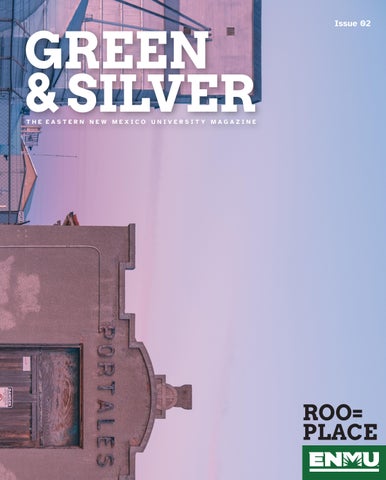
GREEN & SILVER
Issue 02
THE EASTERN NEW MEXICO UNIVERSITY MAGAZINE
ROO= PLACE
The Artist James Idsinga is local to Portales, New Mexico. He graduated from ENMU with a Bachelor of Social Work in 2016 and works as the tasting room manager at Enchantment Vineyards, a winery and vineyard in Portales.
4
GREEN & SILVER
The Art “This photo series is a nod to both Portales’ past and future. Windmills. Railroads. The homesteaders, farmers, and ranchers who started their lives here. Photos of a community that has developed and grown over time. The open plains, skies, and far-off horizons that give us glimpses into the possibilities beyond. Visions of infinite futures that we might continue to build. The sunsets and painted skies. A beauty that binds us all, in the community we remain part of. The setting suns that we all celebrate with. Something that reminds us, at the end of the day, we’re all in this together. I hope it gives us hope for the future we might create.” – James Idsinga
Issue 2 | Spring 2026
5
IN THIS ISSUE 10
A Study on Belonging
16
BONE-ified
18
The Seed and the Spark
Dr. Anu Ogunleye by Tymber Wolf and Malia Santana
by Ruby ROO
by Tymber Wolf
Backbone of Eastern 22 The New Mexico University by Sarah Ortega
24 From the Wisdom of Places by Cori Snobble and Editorial Team
30 The DOC-ett by Doc Elder
32 Curiosity to Conservation A Mission to Protect Local History by Malia Santana
Scan to view the complete photo essay on the Silver Pack.
34 One ROO Inspiring Many by those impacted by Noelle Bartl’s amazing work
36
Letter from the President
by Dr. James Johnston
2
Photo Essay by James Idsinga also on the cover
38 Class Notes
7
Letter from the Editor
40 In Memoriam
8
Between Two Skies, Portales
6
by Tymber Wolf
Portales in Your Words Poetry and Prose Competition Winner by Climensia Elikplim Soglohu
GREEN & SILVER
41
A Steady Hand and a True Greyhound Remembering Dr. Robert L. “Bob” Matheny
LETTER FROM THE EDITORS Dear Greyhounds, I didn’t grow up in rural western America, but I remember when I was first awed by the mileage of the sunset and the whimsy of wild horses. I was on my first trip across the country with my best friend from college, and we were making our way to the Grand Canyon from Palm Beach, Florida (a 30-hour drive). We spent days in the summer rains of the Southeast, the smog of big city Texas, and when we crossed the border into New Mexico, the clouds went away and all we could see was the open road. I kept a travel journal with me, and following the pink trail of sunset, looking up at stars I could have grabbed and put in my pocket, I wrote, “Dream State.” This state of dreams and a million horizons is where intentions are realized in a way that is quiet, genuine, respected, and hard-earned. In the past eight months of working with Eastern New Mexico University, I have learned that our faculty, staff, students, and community partners have the interest and intention of working from a feeling and a hope they harbor rather than toward a finish line. For me, I work toward honest and exciting storytelling. I love making art from experience. Uplifting our community through storytelling is important to me. Creating something relatable, exciting, and interesting for other people to recognize themselves in is a driving force behind my work. Getting to know the people and faces of our university and sharing the stories of our region is special and meaningful work for me. My why, my hope, MY ROO is telling people’s stories.
You will read stories about our students, faculty, alumni, and staff and get a glimpse of what it means to ROO. From faculty members following their passions and impacting our campus through time and dirt, staff members working tirelessly to keep our institution running, alumni facilitating and uncovering the beauty and interest hidden within our region, and the students researching and workshopping ways to help others, you might find a little piece of your hopes and dreams, too. In this issue, you will find two new additions. Starting with our sports column, The Doc-ett, written by the venerable Doc Elder, who has been announcing sports at ENMU since 1996. We are excited to share his run-down of the sports teams’ scores and updates from the 2025-26 seasons. Next, a column of tips and tricks and stories of interest, BONE-ified, by Ruby ROO, written by Zoe Winfield, the associate director of alumni affairs. This column is for those looking for fun ideas and things to do on campus and in Portales. We are excited to have a young, Portales born-and-raised ENMU alumna who will keep our magazine up with the times, trends, and know-hows. Give a warm welcome to our columnists. As you read this issue, I hope you find pieces of your dreams and see Portales, ENMU, our community, and our ROO in new ways. Enjoy,
A ROO equals something. A feeling. A drive. A dream. Everyone has those, but ENMU encourages our Greyhounds to follow their unique ROO by inspiring academic passions, supporting its community and students, and instilling a curiosity about the world and connecting us to it. Our Greyhounds can grab dreams like they can the stars, putting their ROO in their pockets. I don’t want to say that it is something in the water that makes it possible, but it is something in the way our people connect and learn that makes ENMU’s connection to dreams and place the catalyst for this issue.
Tymber Wolf Chief Editor and Writer
Sara Wright Design Editor
So, we took the idea of a ROO and gave it a place. We chose to exhibit how our Greyhounds enact their dreams within our region, our campus, and our connections to one another. The way people enact their dreams is a vast landscape of time, hope, wildflowers, and the occasional trip to an archaeological dig site. Each page in this issue is telling the story of someone living their life in pursuit of a dream, a ROO.
Issue 2 | Spring 2026
7
Between Two Skies, Portales I arrived with a suitcase, a passport heavy with goodbyes, and the quiet fear that my name might not fit in anyone’s mouth. Portales opened like a small door in the plains my first soft landing, my gateway that didn’t ask me to be ready, just let me step through. Wide sky first, then wind, then streets that don’t hurry, and campus sidewalks that learn your steps the way old paths do back home slowly, faithfully, as if they’ve been expecting you. The people move like the land teaches them: older faces, calm hands, farmers with patient seasons in their eyes, the kind of steadiness that reminds me of where I come from that same quiet rhythm that makes a day feel honest.
And the seasons I love them most. Portales gives me all four without trying to break me for it: winter that arrives without cruelty, spring that actually means green, summer that stretches out like a song, and fall that knows how to let go. In this town, sunsets don’t whisper they flare, unapologetic, as if the horizon is practicing courage. I watch and think: maybe that’s what home does not a single place, but a feeling you carry forward through every doorway. And some evenings, walking back from campus, I hear my two worlds click together old memories, new laughter and I understand the town’s name differently: Portales not just where I live, but how I arrived: a portal, too, opening.
Author Bio Climensia Elikplim Soglohu is a Ghanaian MS Chemistry student at ENMU. An ardent reader with a deep love for words, she lives by the motto, “Life is what you make it.” When she’s not in the lab, she’s probably lost in a book.
A Study on Belonging:
Dr. Anu Ogunleye Written by Tymber Wolf and Malia Santana
Abstract
The Life Philosophy Dr. Anuoluwapo “Anu” Ogunleye measures her life by an enduring philosophy: when you are in the right place, you can achieve anything you set your mind to. She says, “If I’m doing what I’m supposed to be doing, everything comes together.” Understanding this journey through the lens of Ogunleye’s philosophy will provide others with the knowledge, inspiration, and connection they need to keep seeking a place that truly offers them a sense of belonging, and that place might even be Eastern New Mexico University. Keywords: life philosophy; inspiration; knowledge; connection; richness of life
10
GREEN & SILVER
“If I’m doing what I’m supposed to be doing, everything comes together.”
1.0 Introduction How it started Ogunleye, a professor of agricultural science at ENMU, discovered her interest in plants around age 14. Fascinated by her neighbor’s vibrant golden Ficus garden, she took some clippings and planted them in soil-filled plastic bags outside her childhood home. The first four attempts failed, but on the fifth, about 70% of the plants survived. Though not a formal experiment, she observed their growth over the following weeks. She eventually moved them to the ground in front of her home, where they still grow today.
Ogunleye grew up in a home where giving was second nature. Her mother, whom she describes as her biggest influence, modeled an ethic of service. “Even if she only had 10, she would give away seven or eight,” she said. Ogunleye describes her generosity as part of what she sees as a God-given responsibility to give when she can. At times, that belief also has allowed her to accept from others, trusting in reciprocity. This mindset grounded her when the Nigerian school system set her on a path she hadn’t initially planned.
In Nigeria, academic specialization begins early. Though Ogunleye had planned to study medicine, she pivoted to the agricultural track because of the program’s competitiveness. Rather than feeling discouraged, she embraced the shift, vowing to master the craft. “If I am going to study this, I am going to get all the degrees that there are,” she repeated this to herself until she believed it, “I am going to master this craft.” She developed an interest in in food science and in how agriculture, when combined with public health, can help people around the world, keeping her ethics and interests at the center of her studies.
Issue 2 | Spring 2026
11
2.0 Methodolgy Materials and Methods To prove the hypothesis, we follow Dr. Anu Ogunleye’s lifetime of choices, belonging, and happiness in knowing she is where she should be. The trusty materials of our voices and human connection were used. Sitting with Ogunleye in the ENMU Golden Student Success Center to test the hypothesis and find the moments in her life that led to her belief in belonging and following her passions. In the moments that Ogunleye describes as “the feeling of being in the right place, and being on the right path,” she notices a settling of the nerves deep in her spine that travels all the way through the doubts in the back of her brain. The feeling of belonging is deeply ingrained in the body, and Ogunleye knows what it feels like for her. When she recognizes the feeling, she knows that the challenges are worth it because she is where she belongs, and anything is possible.
3.0 Lived Observations Steps on the Right path 1. After earning her bachelor’s and master’s degrees in Nigeria, Ogunleye set her sights on a Ph.D. abroad. Canada seemed like a good option since she had some friends and family there, but repeated obstacles such as Graduate Record Examination (GRE) requirements, several visa and admission denials, and higher tuition fees made the process increasingly discouraging. Just as her dream began to feel out of reach, she received an unexpected call from an old friend. The moment she heard her friend’s voice, a settling of nerves washed over her.
12
GREEN & SILVER
As they talked, the conversation turned to Ph.D. opportunities in the United States, and something clicked. She knew she had to start looking into programs nationwide. After applying to multiple Ph.D. programs across the U.S., Ogunleye ultimately chose the University of Nevada, Reno, feeling it was the right place to begin the next chapter. 2. As her move to the U.S. approached, Ogunleye went to the embassy to secure visas for herself and her two children. Waiting in a single line, she watched officers issue quick denials and quietly hoped to be interviewed by the one who seemed to take more time with applicants. Minutes after she prayed to be routed to him, a security officer broke the single-file line and moved her to the front, where she began a new queue with the officer she had hoped for. Their visas were approved. “That was the beginning of my journey,” she says, the feeling of stress and hope in her memory, tugging at a humble smile on her lips.
The feeling of belonging is deeply ingrained in the body, and Ogunleye knows what it feels like for her.
It was one of many moments that confirmed she was exactly where she was meant to be.
3. Traveling to the United States with her two children, then ages 3 and 6, Ogunleye navigated a nine-hour layover with restless kids and a mounting concern about how she would cover tuition once she arrived. With no scholarship in place and payment due within the week, she recalls silently praying for help. As passengers were called to board the final flight to Reno, a woman approached and offered to help with her luggage while she managed her children. In conversation, Ogunleye explained that she had been admitted to a Ph.D. program at the University of Nevada, Reno (UNR), but had no funding. The woman introduced herself as Jill Heaton, one of UNR’s provosts, and handed Ogunleye her business card. “Contact me when you get to Reno,” she told her. The next business day, Ogunleye visited Heaton’s office. She recalls Heaton introducing her to several administrators, including Dr. David Shintani, explaining that Ogunleye needed funding and assistance as she settled in. Soon after, her tuition balance was reduced to $855 and she was placed on a three-month payment plan. She also was awarded a paid graduate assistantship and completed her program without taking on student loans. Ogunleye describes the encounter as one of several moments she believes affirmed her decision to continue her studies by faith. 4. Ogunleye turned her attention toward reuniting her family. Her husband remained in Nigeria and originally planned to join them six months later. As the separation stretched on, she purchased an earlier plane ticket and surprised him with the new departure date. He dropped everything and made the move happen within the week. One day after Ogunleye picked him up from the airport, international travel shut down due to the COVID-19 pandemic. She described the timing as divine. 5. Freed from the burden of financial uncertainty and with her family finally reunited, Ogunleye accelerated through her program. With the opportunities and the feeling of peace and support, Ogunleye completed her Ph.D. in Environmental Science and Health in four years instead of the standard six. Her mother flew in from Nigeria to watch her defend her thesis. After the presentation, her mother spoke with her about cover crops, and that’s when Ogunleye knew she was doing what she was meant to be doing, “To have someone that is not a scientist understand my work and ask me questions, that is when I know I am doing good.”
Issue 2 | Spring 2026
13
14
GREEN & SILVER
“To have someone that is not a scientist understand my work and ask me questions, that is when I know I am doing good.”
6. After graduation, Ogunleye launched an exhaustive nationwide job search, applying to over 60 positions. This persistence led her to New Mexico State University’s agricultural research station in Clovis, where she spent six months working until she saw a job opening at ENMU. Her husband was taking classes at ENMU at the time, but she didn’t tell him she was interviewing. She was excited about the job prospect but did not want to get her hopes too high. She narrowly avoided being seen by her husband as she got the tour around campus. She joined ENMU in August 2023 and has since been an integral member of the Department of Agriculture, Food Science and Kinesiology.
4.0 Conclusion Serenity at Eastern Marked by uncertainty, redirection, and grace, her path offers proof of what can grow when the conditions are right. She proves that even the smallest acts, when done with intention, can leave something lasting behind. When Ogunleye sees a need, she fills it. That is her main goal at Eastern. In her first year as a professor at Eastern, Ogunleye faced steep challenges. Student outcomes fell short, and she questioned her effectiveness. But Dr. Kalynn Baldock, department chair, reassured her that she was in the right place and had the support at the university to overcome the challenges she faced. Ogunleye dove into the work, redesigning courses and creating a classroom environment for students new to
academic research. Over time, student engagement grew. She was able to secure grant money and student help to create a one-acre farm to feed the students in need and bring agricultural knowledge and learning to Roosevelt County. There, she and students plant vegetables and fruits for the campus community. Ogunleye named the farm and the food sharing initiative, “Feed the Hounds.” The obstacles at ENMU didn’t make Ogunleye quit; they made her want to try harder and find new ways to teach, engage, and explore with our university and our region. Looking back, Ogunleye feels that setbacks are less like obstacles and more like intentional redirections. For Ogunleye, difficulty is part of growth, but persistent resistance signals misalignment. She describes her approach to uncertainty as one of release, offering her efforts without trying to control the outcome. “Cast my bread upon the waters,” she said. “God will do with it what He wants.” Ogunleye has been finding exciting ways to get our students involved and engaged with their education. When Ogunleye is not teaching college students, she is at home teaching young kids how to cook during the summer, or she is making and designing her family’s clothing. She engages with our community and follows her faith in belonging here. She is often found with a comforting smile on her face and welcoming attitude, following her life philosophy that has yet to prove her wrong. “The richness of life is not in the quantity of years we are rich, but in the number of lives we have touched,” she believes this whole-heartedly.
Issue 2 | Spring 2026
15
Hi Greyhounds! Welcome to the first edition of BONE-ified. Here I will give tips and tricks about anything, everything, and the little in-between moments that make up campus life. I was practically born and raised in Portales, and ENMU holds a very special place in my heart. Both my parents and I are graduates of Eastern. I hope that while reading BONE-ified you can feel my love and passion for Eastern and the unique community here. And since spring has sprung here at ENMU, this is a great chance to introduce BONE-ified to you all!
1. Enjoy your Breaks
I like to use this time to rest and relax. Things like meditating and journaling help me get back to school and ready for the semester. But also, a little party never killed nobody (Cue: the Fergie song from 2013). My favorite break trip was when we went to Panama City Beach, Florida and we relaxed on the beach for an entire week, truly one of my favorite memories. Be sure to take advantage of the time you get during your breaks, because you only get so many while attending ENMU.
2. Connect with friends.
With the wind going and my comfy clothes on, I catch myself not wanting to brave the dust storms to spend time with my friends. And that stinks! But even with my strong opinions about comfort and safety, I push through this feeling of wanting to stay home and embrace the fact that it isn’t freezing anymore, I think spring is maybe the best time to plan a fun game night with friends. Good snacks, a good mocktail (or a Rooing Hound Brew), and the right group of people can help break up the monotony. Some of my favorite games to play with a group are Jackbox, Mario Party, and Dutch Blitz (a group card game)! Coziness and competition just feel like they go together!
16
GREEN & SILVER
3. Grow the Garden of Life
To me, investing in myself means trying something new. I feel like spring is a great time to try out a new hobby, it is all about new beginnings. I don’t like to start anything too committal, but something that either makes me use my brain for myself (and not just work), or something that allows me to move my body, is fun and brings some joy to my life! For example, ENMU has a few elective classes that anyone can take! Try out things like yoga, cooking, pottery, and financial literacy.
4. Go on “Hot Girl” Walks
I like to connect my Bluetooth headphones to my phone, set up an interesting audiobook, album, podcast, or even call my mom, and go for a long walk. Enjoying the sun after a long day at school is a great way to get some outside time. You can walk fast or keep it leisurely to enjoy the views. My favorite place to walk is the Portales Recreation Trail! You should go check it out. (Don’t forget your sunscreen!)
5. Do some Cleaning
The dirt that the wind brings in can feel barely manageable! I think it is important to keep your space clean. I find that I work better, study harder, and my mental health feels better when my home is clean. Whip out your gloves, broom, and get to cleaning! I like to start in the kitchen, then work my way to the living room, and then bedroom/bathroom. Let me know if you have a different order of cleaning.
I hope these tips help you embrace new beginnings and the changing of the seasons! Write to me if you would like, send your messages through to portales.silver.pack@enmu.edu I love getting mail!
Signing off
Ruby ROO Issue 2 | Spring 2026
17
“The biggest thing that’s wrong with people these days is that they refuse to see the spark and the seed and the potential that is inside of themselves.”
The Seed and the Spark Written by Tymber Wolf “The biggest thing that’s wrong with people these days is that they refuse to see the spark and the seed and the potential that is inside of themselves,” said Blake Curtis (BA 82), Eastern New Mexico University alum, fourth-generation New Mexican, mentor, storyteller, seed enthusiast, deeply connected to blue grama covered Shortgrass Plains of New Mexico, little bluestem on most days, loving brother, legend of the Llano Estacado, sparker of passions, and living life to the fullest potential.
18
GREEN & SILVER
In the business of seeds, one can never be too interested in the hope of growth and a seed’s potential. Curtis has spent years surveying native New Mexico grasses and flowers with his brother, Tye Curtis (BBA 78), from the cockpit of a small plane to find plants for good harvesting. Flying above a sea of colors, the Curtis brothers can pick out the seeds and their potential from hundreds of feet in the sky. Each plant has a different story, and a different purpose to fulfill.
Sideoats Grama
The best time to plant sideoats grama is in the summer before the first rains of the monsoon season, so its roots have time to grab the soft ground of late summer, establishing life where it is planted. Much like this, the Curtis family held the soft, sandy loam of Eastern New Mexico in the late 1800s and made it their home. Spreading deep roots, George Curtis and his wife, Vera, Blake Curtis’ great-grandparents, became homesteaders on a plot of land in Forrest, New Mexico, planting trees and building a life of raising children, grandchildren, and great-grandchildren. An old barn from George and Vera’s time remains on the property, weathered and covered by tall grass; they call this barn “Grandmother’s.” She is sturdy, powerful, and drought-tolerant, watching over her family who still work on the land. Angus cattle have been living on the land alongside the family; they meander the property, eating the grasses and seed. One of the three things in his life he is most proud of is carrying on what was given to him. Curtis honors the sacrifices of his ancestors by continuing his love of the land through the next generation of his family to continue their passions, find their sparks, and set their roots into the soil when the time is right.
Blue Grama Blue grama is known for its deep roots and forage material that comes in large amounts. “The life of it provides value,” Blake Curtis says about blue grama grass, which he would like to emulate, “it stabilizes the soil with its deep roots. It is tenacious, and high quality.” Though Curtis’s life might be deeply connected to this plant now, he didn’t always have the soil between his fingers and the heart to navigate the path he was on. He left home for years before coming back and understanding his passions and goals. “I was at New Mexico State University while my mother and father started their business in 1956. They named it Curtis and Curtis Seed, after the two of them,” Curtis mentions. He was working full-time and going to school, but he didn’t know what he wanted to do with his education. Sometimes seeds need to be uprooted to find their place. His parents were well educated and valued their childrens education. When they needed a new manager for their company, they knew they could rely on the roots sown by their own hands, but they had one stipulation:
their son would have to enroll at ENMU and work hard in school if he was going to work for them. Curtis said the deal was that he couldn’t only work with the dirt and the roots and seeds; he needed to receive a degree. When he came home, accepting the bargain, he rediscovered his ties to the land. His passion for school and business was sparked just by being home. He managed his parent’s seed company and to uphold his end of the deal, took night classes at Eastern. Back then, our school had outlet classrooms spread throughout Clovis, New Mexico, and Curtis would go to business classes after a long day of work. His brother, Tye Curtis, also took classes at ENMU and ran the business alongside Blake. They both spent their days collecting seeds, managing business deals, and learning whatever they could. Blake Curtis found himself focused and excited about the future, and his passion for the land, for his family, and for seeds was only deepening. Like the blue grama, his days were busy and fulfilling; he was providing and creating value for himself and his family’s business, stabilizing himself and his replanted roots. Issue 2 | Spring 2026
19
Little Bluestem Little bluestem is known as a decorative and ornamental plant, but, when planted in the ground, it restores the land by providing nutrients to the soil and making it possible for the earth to heal from natural and manmade disasters. For Curtis, the work he does is about the land, the plants, and life in New Mexico. His years at ENMU were life-changing because of a simple but thrilling philosophy he follows, “It’s as good as you’ll make it.” When he was just out of school, and a larger company began closing in on his parents’ seed business, Curtis stepped into the deal, using what he had learned from mentors in the College of Business. “Our ENMU education gave [my brother and me] the wherewithal to go toe-to-toe with some of the top-educated businessmen in the U.S., and we won.” The reddish-blue hue of little bluestem can be seen when it waves in the wind, standing tall and golden in the sun until it moves, and the red peeks out between its golden and green stalks. “The fun [of my work] is in consulting ... in helping others face their unique challenges and educating people around the world,” Curtis says, like when he can peek out, like little bluestem, from behind his seeds and help others get what they want with the optimum return for the land in mind. Like the little bluestem, Curtis takes pride in providing the land with the nutrients it needs to overcome unforeseen challenges.
Llano Estacado Wildflower Mix The Llano Estacado is our region. Eastern New Mexico and Western Texas sit proudly on the High Plains above 3,000 feet in elevation with inclines of only about 10 feet every mile. Pinks, purples, yellows, and greens of the Llano Estacado’s native flowers can be seen for miles from the road, whispering in the wind made by the trains. This sea of colors is the second of the three proudest accomplishments Curtis has in his life. When he is driving up and down the highways with his brother, the two of them can see through the tufts of color along the highway just enough to point out the plants they had a part in planting. “There is seldom a day that I don’t look out on the road and can truly say ‘I planted that’,” Curtis laughs humbly at this, but it isn’t a joke. He calls himself “Johnny Appleseed” because of his hand in the regional and international seed business.
20
GREEN & SILVER
Rehabilitating the land and creating continuity in this region is the spark that ignites and inspires Curtis’s business. In a sea of flowers, it can be hard to notice where a single seed makes a difference, but throughout his career, Curtis hasn’t let that stop him from continuing in the work he believes in. In a box of old business, he pulls out a photo of himself in a field of wild grass that makes his tall frame look short, where he is demonstrating how to harvest seed. In the photo he is surrounded by seed company executives, each man in the photo in a 10-gallon hat and sunglasses. For each of those men, he made a difference in their planting and harvesting efforts. The tufts of color and leadership in his action and passion show through the national and global seed business, no matter how humble he remains. He had a hand in trading, leading, and teaching companies how to harvest seeds and what to grow. He jokes about being Johnny Appleseed, but we can call him a legend on the Llano Estacado.
“The world is going to be a better place when I leave here.”
Wildfire Restoration Blend Curtis and Curtis Seed can hold seeds up to five years in inventory, and these seeds become necessary when wildfires strike vulnerable areas in our region. Most recently, this blend was used by the Curtis and Curtis Seed company to begin rehabilitation for the 2022 Hermit’s Peak wildfire. “I am energized by the idea of repairing the most important resource to us,” Curtis says, explaining the blend of native grasses. The seeds used were from his own hands, and the hands of the next generation of seed harvesters. When he walks over to a stalk of native grass on his property and bends its head, thousands of seeds slip into his palm, and he smiles as the seeds are carried off into the wind. Beginning a new life. He has passed on the passion of seeds to his son, nephew, and their business partner, who run Curtis and Curtis Seed together, the third of his proudest accomplishments, instilling the spark of a passion into the next generation of his family. “The world is going to be a better place when I leave here,” Curtis says with grounded and poised conviction, looking back at the sea of colors he had a hand in sowing.
Issue 2 | Spring 2026
21
The Backbone of ENMU Written by Sarah Ortega The Physical Plant is the backbone of Eastern New Mexico University. Physical Plant employees work on campus to fix buildings and machines, and work tirelessly to keep the premises clean. During the early mornings and overnight shifts, the Physical Plant strives to find the best ways to work together and finish their projects efficiently. Each employee believes that the collective ROO of the physical plant is to “not only help others around campus but to help each other as well.”
ROBERTA ROMERO “My ROO is to keep the safety and health of the students by keeping areas disinfected, communicating with others, and directing students to resources when needed.”
22
GREEN & SILVER
RAY NATIONS “My ROO is to work together at a good enough pace, to get tasks done efficiently.”
KATHY BACHICA VIGIL “My ROO is to make the students comfortable and happy and give them a good place to live.”
PHILLIP DURAN “My ROO is to serve the students who are attending college and make sure that Eastern is a clean campus for them to stay.”
KAREN EVANS “My ROO is to help maintain the buildings as well as keeping them safe for all the students.”
STEPHEN FIELDS “My ROO is to help others when I can, whether that be my coworkers or other staff on campus.”
Scan to read the complete story on the Silver Pack.
Issue 2 | Spring 2026
23
From the Wisdom of Places Written by Cori Snobble and the Editorial Team It’s November 2025, and the hardwood chairs creak slightly as John Montgomery sits down with us around a half-century-old conference table. Through the refinished surface of the table, carvings of artwork and names of former students show faintly through. Behind the table is a wall of books and bound journals spanning the history of anthropology, archeology, and ENMU. The office is filled with framed conference and exhibition posters, artwork and artifacts, collected over the course of Montgomery’s long career. In a nook by the north facing window, a poster reads: “Save Our Past, For Our Future.”
It’s 13,000 years ago,
and The Milky Way appears as a crystalline source of light. Dust and starlight joining, creating a hazy horizon. The Clovis people are highly attuned to small nuances in the atmosphere and changing weather patterns. Lightning and unsettled earth signal a storm, sending large megafauna into motion. The Clovis group moves into a hunt.
It’s 1929,
and at Blackwater Draw the remains of a Columbian mammoth are found pierced with a Clovis spear point, an early form of lithic technology. The Clovis point proved that communities of early hunters populated the Eastern Plains 13,000 years ago. This is the first academic evidence of Paleo-Indian communities in the North American continent. Excavations begin in 1932, and the site becomes internationally known among scientists and revolutionizes theories of human history. Blackwater Draw, only a few miles outside of Portales, is now operated by ENMU.
He apologizes about the chairs, “They might be slightly uncomfortable, they are old...” “These chairs and table were Patrice Caldwell’s,” he continues, referring to the former ENMU chancellor, president, and English professor. She acquired them from an auction after the 2018 ENMU library remodel. “Patrice brought the furniture with her when she moved into this office,” he tells us. “You know...” he says, dawning a slight smile, “before Dr. Caldwell occupied this space it was Dr. Everett Frost’s office.” Caldwell tells us later she left the chairs and table for Montgomery because he was someone who would understand the importance and significance of their histories and also uphold them. The chairs transform any discomfort into a kind of privilege. Occupying them is inhabiting a part of history. From stars to bone, we are shaped by what comes before us.
24
GREEN & SILVER
It’s 1964,
and a group of five 14-yearold boys bounce off the seats of a maroon AMC Rambler. They are members of the South Plains Astronomy Club on their way to look at the stars. Imagine the scene from high on the edge of an arroyo: the car pushing over the dirt road, leaving a meandering path of dust, sky, and light. From this far they look like a herd of animals. Montgomery, one of the boys in the Rambler, has always had an affinity for space. The astronomy club used a small telescope lab at the university close to his childhood home.
Walking to the telescope lab one evening, Montgomery recalls looking through the ground-level basement windows into an archaeology lab, where he saw fossils for the first time. Though fascinated by the stones that contained the shapes of the past, he continued walking. His mind, for the time being, was set on the stars.
It’s 1970,
and Montgomery enters the University of Arizona as an astronomy major. His curiosity guided him quickly through high school, where he took the maximum number of advancedplacement courses. He chose an introduction to anthropology course to satisfy the only social science requirement left.
In his first anthropology course, he met the young, charismatic, Dr. William Rathje. Rathje received his Ph.D. from Harvard and was creating an entirely new field of archeology now known as garbology. “As soon as I met Bill, I was hooked,” Montgomery says. Through an Arizona field school, now known as the Tucson Garbage Project, Rathje and his students investigated contemporary trends in discarded and overlooked objects to better understand human behavior.
In garbology, Montgomery began to understand the wisdom of everyday objects; how they hold history, provide insight, and serve a specific purpose. Looking through garbage felt like pondering the vast stars above. There were opportunities in the piles of discarded items that he had never imagined. His sights began to shift, seeing the world in a whole new way.
Later in 1970,
she is looking across a low-lit dance hall when she notices him for the first time. Cori Snobble is a young, fiery, Asian Studies major when she meets John Montgomery. “We were at a freshman dance at the University of Arizona, and the men were six deep,” she tells us through quick laughter. Cori had no interest in a serious relationship until she had a degree in her hands, but the two of them
entered a long engagement anyway and unearthed a shared love of history, Southwestern archeology, and culture.
Every place unearths layers of memory.
The iconic peak of Mount Sopris towers over the Roaring Fork Valley, where Cori grew up. The great mountain inspired her connection to place, land, and history. As a young girl, she explored archaeological sites with her three sisters and parents on family camping trips in southeast Utah and southwest Colorado. She grew up with a profound understanding
of what it means to dig up history and learn from it. As a “faculty brat” of parents who taught at Colorado Rocky Mountain School, she rode with students in open cattle trucks. Jostling on wooden benches under canvas tops and singing bawdy songs, the students ventured to camp or dig sites for field trips. Cori’s heart was made in those mountains.
It’s 1976,
and Cori marries John in Carbondale, Colorado, in the view of Mount Sopris.
It’s 1978,
and the couple moves to Boulder, Colorado, for John to continue his studies and pursue a Ph.D. They winter in an uninsulated cabin in Boulder’s Chautauqua Park. In that cabin, Cori Snobble looked west toward the mountains, her home, and John Montgomery looked east toward the plains, his home.
It’s 1984,
and Dr. Everett Frost, vice president of Planning and Analysis, who later served as ENMU president, offers Montgomery a job as director of the Agency for Conservation Archeology. When John accepted the position, the couple did not yet know they eventually would be tasked with developing the Blackwater Draw Archaeological Site for the public. Just a year later, Montgomery was made director of the Blackwater Draw Museum.
At the same time,
they move to New Mexico, descending the peaks of the Rockies, slipping through foothills, and finding themselves in the shortgrass plains. They establish a new, shared home in Eastern New Mexico, connecting to the ancient histories of the landscape and finding purpose in sharing the story of the Clovis people, a prehistoris Paleo-Indian culture, who once called this place home.
It’s 1990,
and Cori Snobble becomes Blackwater Draw’s unofficial ambassador as her husband works to build the site. She volunteers on behalf of the Blackwater Draw. Each school year, she carries artifacts, including a mammoth tooth, into Steiner Elementary School, inspiring and educating first-grade students and their parents about the importance of our shared history. Frost sees in Montgomery the passion and persistence needed to open the Blackwater Draw site to the public. Eagerly, Montgomery designed, applied for grants, and built an observatory to cover and protect the dig site at Blackwater Draw.
26
GREEN & SILVER
Curiosity plus patience over time equals wisdom.
It’s 1997,
and “New Mexico Magazine” writer, Gussie Fauntleroy, details that “La querencia,” “is an old Spanish word ... derived from the verb querer, to love, to desire. It means homeland, a place in the heart, a place to which one is deeply drawn. ... the place you love like a child; where you feel completely at home, where you belong.” While many feel a deep connection to where they were born and raised, many are displaced and find or develop second and third “las querencias.” Like her querencia, Mount Sopris, Cori is dynamic, confident, and ambitious; her ideas are rapid and blue eyes piercing, like the granite peak. Describing the peak in winter’s alpenglow, she says, “That mountain is my ‘querencia’. That’s where my soul is.”
John Montgomery, too, is like his “querencia,” expansive, calm, and deliberate. Like the wideopen fields of the High Plains, his hazel eyes offer comfort to those looking for it. He feels most at home on the gradual incline of the High Plains, where his heart was born.
It takes time for starlight to reach us, guiding us into the future with light from the past.
It’s November 2025, and both Cori Snobble and John Montgomery are well known for being instrumental in raising the visibility of Blackwater Draw. They still have more to do. When we ask Cori and John how they envision the future of Blackwater Draw, their imagination spans time, space, and disciplines, widening the breadth and deepening the impact of our regional history. They have a vision for the Blackwater Draw as a “Collaboratory.” A place
where team-taught interdisciplinary curriculum can inspire anyone to learn and create. With continuing fieldwork and research at the site, they also anticipate finding more buried wisdom. “Two thirds of the site remain to be explored,” Montgomery says. The couple trusts that the work will add to the history already discovered and to the stories, research, and wisdom the site will reveal.
In late 2025, we are thinking about seeing Blackwater Draw, not just as it is today, but as it must have been. When we ask Dr. Brendon Asher, assistant professor of anthropology and Blackwater Draw director, what life would have been like at night on the High Plains of Eastern New Mexico at the end of the Pleistocene Epoch, he emphasizes the darkness.
Issue 2 | Spring 2026
27
Through dusk a star signals we are home.
It’s winter 2025,
28
GREEN & SILVER
and ENMU art historian and artist, Dr. Julian Francolino, has a deep interest in the site, not just for its historical relevance, but also for the way it can re-contextualize Southwestern landscape painting. He often spends time at or near the site drawing and painting. When we ask about his goals for his students, he thoughtfully pauses under the rim of his cowboy hat, and replies: “I’m trying to help my students learn how to see. Through careful attention to the quotidian, to the mundane things that go unnoticed,
like the vast plains out at Blackwater Draw, for example,” he says, sweeping his arm “…or the objects we look beyond in everyday life, one can find wonder. A subtle shift in seeing can change one’s life.” Examining more closely what is right in front of us or seeing things from a slightly different perspective brings us closer to life and those around us.
As the sun lowers outside Montgomery’s window, the same window out of which past presidents Frost and Caldwell peered, the sense of what it means to care and believe in a place settles in. Caldwell’s old chairs creak as Montgomery tells us about the Blackwater Draw site, his love for Cori, this region, and what they have built together
from the history and wisdom of the places they have inhabited. We ask him for his understanding of what it means to inhabit and uphold a place. Montgomery refers to Keith Basso’s famous book about Apache place naming, answering with its title, “Wisdom sits in places.”
Answer the call. Answer the ROO for ENMU and give online today at giving.enmu.edu
THE HELPFUL PLACE
Run with your pack, no matter the distance Explore stories and share your voice at enmu.edu/SilverPack
1300 S Ave D, Portales, NM 88130 | 575.356.5827 acehardware.com
Introduction During my first year as a History professor at Eastern New Mexico University, the Athletic Department asked me to broadcast one of our baseball games in February 1996. Since then, I have had the opportunity to broadcast virtually all the sports that the University offers. I am honored to write a year-end review of our sports programs. As Greyhound Athletics begins a new year of competition, fans can expect another year of success both on and off the field from the student-athletes who proudly wear the Green and Silver.
Nona Borden Women’s Soccer
Karli Bustos Volleyball
New Head Coaches For Eastern New Mexico University, 2025 saw both change and continuity in the realm of Athletics. First and foremost, by the end of the year, four sports had new head coaches. In mid-season 2024, the University appointed Nona Borden as the interim Women’s Soccer coach; in early 2025, she received the position on a full-time basis. Her squad struggled offensively in her first year, but the majority of her players will return in 2026, boding well for the future. After long-time Volleyball Coach Sia Poyer retired following the fall 2024 season, the University hired
30
GREEN & SILVER
Art Briles Football
New Mexico native Karli Bustos to replace him. Her squad improved as the season progressed, culminating in a season-ending victory on the road at Cameron University in Lawton, Oklahoma. In November 2025 the University hired Art Briles as its head Football coach. A former Division I Coach of the Year, Briles promises to put an exciting offensive playbook on the field during the 2026 season. First-year Rodeo Coach John Sharp has a strong connection to the Land of Enchantment, having graduated from Tatum High School. Sharp’s men’s and women’s teams enjoyed numerous
John Sharp Rodeo
Daven Võ Men’s Basketball
successes in his first year, placing in the top three in most fall rodeos. Two of his athletes rank in the top three in their respective regional events going into spring competition. Daven Võ’s first year as the head Men’s Basketball coach came tantalizingly close to qualifying for the NCAA Division II tournament. His team lost an overtime contest to Lubbock Christian University in a game that determined which of the two teams would receive a bid to that event. In fall 2025, Võ’s squad picked right up where it left off in the spring, running off 10 straight wins and earning a berth in the NCAA Division II Top 25 rankings for the first time since 1996.
HOUND HIGHLIGHTS
NATIONAL RECOGNITION
RECORD-BREAKING OFFENSE
One of the highlights for Greyhound Athletics in 2025 came in Track and Field. For Josh Harden’s squad, Jodian Stewart (BS 24) finished fourth in the nation in the long jump, becoming the first female Track and Field athlete from ENMU to earn All-American status since 2021.
The Greyhound Baseball team missed out on going to the Lone Star Conference tournament by one game, while setting numerous offensive records.
HISTORIC BREAKTHROUGH
RISING TALENT The future looks bright for Greyhound Cross Country, as Chama el-Hadiri (BBA 29) was named the Lone Star Conference Freshman of the Year.
Earlier in 2025, Blake Huber’s Women’s Basketball team achieved something that no previous ENMU squad had accomplished when it won a first-round NCAA Division II tournament game. His 2025-26 squad finished up the first half of the season by taking Division I in-state rival New Mexico State University into overtime before succumbing to the Lady Aggies.
LSC QUALIFIED Greyhound Softball had a better success, as the squad not only qualified for the Lone Star Conference tournament, but also won a first-round matchup.
Issue 2 | Spring 2026
31
“It’s been nice to have support and mentorship, even though I’m all the way in Florida.”
Curiosity to Conservation A Mission to Protect Local History Written by Malia Santana Virginia McCue (MA 27), a remote graduate student from Florida, spent her childhood immersed in the mysteries of the ancient world. While many of her peers were occupied with modern toys, she and her grandfather were often found in the glow of the History Channel or returning to the library for another stack of books, dissecting the secrets of lost civilizations together. They studied the lives of people who lived thousands of years ago, then they’d sit and discuss their own theories on what they had found.
A veteran of the United States Air Force, her grandfather spent a career traversing the globe, with postings in Korea, Vietnam, and across Europe that immersed him in cultures far beyond his own. During a European assignment, he met her grandmother in a bustling Spanish market that he loved to describe. Those memories formed the foundation of McCue’s upbringing and offered her an early window into the world’s diversity. Exposure to foreign traditions, unfamiliar clothing, and local cuisines sparked McCue’s curiosity, drawing her into the mystery of how different cultures thrived and evolved. But perhaps the most impactful lesson her grandfather taught her was that the pursuit of knowledge has no limit. In 2016, she enrolled in college to study anthropology while working full-time and raising her child. The academic environment transformed her childhood curiosity into a professional lens, allowing her to see that she didn’t need to travel to the distant lands her grandfather had visited to find history, because it was embedded in the local terrain. Florida’s coastline is dotted with shell middens, ancient burial mounds, and pottery fragments that mark centuries of Indigenous life. Among these local treasures, one discovery resonated most deeply. The Windover Archaeological Site, located near Titusville, Florida, stood out in particular. As a peat-pond cemetery dating back over 7,000 years, the site’s oxygenfree, waterlogged layers acted as a natural preservative, maintaining human remains with an extraordinary level of detail. Visiting the nearby Brevard Museum of History and
32
GREEN & SILVER
Natural Science, which houses the Windover collection, became a point of fascination; she felt the same sense of wonder she had once felt in the glow of the television. “It was really inspiring,” she said, “just how vast Florida itself is in terms of archaeological remains.” Following her associate degree, McCue enrolled in the University of Central Florida’s anthropology program, eventually leading to an application to Eastern New Mexico University’s graduate program. ENMU offered a legacy that resonated with her ambitions. “Dr. Clyde Snow actually graduated from ENMU,” she noted, referring to the pioneering figure considered the father of forensic anthropology. Snow’s career proved how much weight the ENMU name carried in the field and inspired McCue to go down the same path. McCue was accepted, and in 2024, she began her remote graduate work. Though she expected the physical distance to be a barrier, the experience at ENMU proved otherwise. The department bridged the 1,500-mile gap through remote-access conferences and a culture of immediate support. “They make themselves available to online students so that we don’t feel like we’re left out or having a hard time,” she said. “It’s been nice to have that support and mentorship, even though I’m all the way in Florida.” When McCue first entered the graduate program, her sights were set on the deep past of Paleo-Indian archaeology. However, a course in historic preservation with Assistant Professor Dr. Elizabeth Lynch fundamentally shifted her perspective. The class introduced her to a form of archaeology centered on living communities, standing structures, and the rigorous legal frameworks required to protect them. What surprised McCue was how deeply the work resonated. Preservation offered a way to connect her lifelong fascination with the ancient past to the present.
The turning point came through a collaborative project: drafting a “mock nomination” for the National Register of Historic Places. The assignment challenged the class to select a site, in this case, the Roosevelt County Museum, and build a case for its protection through exhaustive research, documentation, and justification. McCue found herself unexpectedly captivated by the process. She spent weeks coordinating with classmates, combing through archives, and untangling property records. It was a masterclass in advocating for local history that might otherwise be forgotten. As her investment in the work deepened, she confronted a grave truth: historical sites are not protected by default. “You would assume anything that’s archaeological or even little towns that were part of history would be on the register,” she said. “But they’re not.” The experience shifted how McCue understood preservation and her place in it. “You have to explain and defend to the state why this site is important and deserves to be preserved,” she explained. At ENMU, she has gained working fluency in the field’s “detective work.” She is learning how the careful data organization and archival documentation can determine whether a site is preserved or overlooked. Through Eastern’s online coursework, she has learned to use tools like Geographic Information System mapping, photo editing, and high-fidelity document scanning, skills foundational to both formal site nominations and public education. As she moves toward her career, the infinite capacity for learning demonstrated by her grandfather remains her guiding light. She will ensure that the stories behind human history, the mystery that once filled her childhood living room, is preserved, defended, and shared with a world that needs it now more than ever. The girl who once sat in the glow of the television, trying to solve the secrets of the ancient world, is now the woman ensuring those secrets aren’t paved over.
One ROO Inspiring Many Written by those impacted by Noelle’s amazing work For many Greyhounds, Noelle Bartl (BA 92) doesn’t only work at Eastern New Mexico University, she is the face and the heart of generosity at Eastern. For our alumni who are nostalgic for reminiscing and our community partners that want to be a part of something impactful, Noelle is the person on campus to connect with Eastern. Bartl is the executive director for the ENMU Foundation, which she directs in collaboration with the board. She started 26 years ago with a mission to inspire giving. Bartl describes herself as a “bridge” for donors at ENMU, “Eastern has a need, someone has a calling, and I find where the pieces fit together.” She can be found checking in with her constituents with rare, deep kindness. The warmth and sincerity that Bartl brings to the role is what inspires many to give back. Bartl says that “Empathy is not about the many but making genuine connections.” She leads with a clear focus on companionship.
34
GREEN & SILVER
Her ROO is, “the moment a donor’s generosity becomes a student’s possibility. As an ENMU alumna who has spent more than 25 years serving this university, I do this work because every gift tells a student, ‘You belong here, and your future matters.’ Philanthropy is inspiring.” Former ENMU President Patrice Caldwell says that Noelle is, “Articulate, has solid experience in the field, and is enthusiastic about working for her alma mater. Everything Noelle does demonstrates integrity, loyalty and kindness. She is your friend, eager to help and show that she values your ideas and wishes. Only when she finds the right fit will she invite your collaboration to advance the University we love. Every comment she makes stresses the kindness and generosity of ENMU alums, donors, and our students. I am so grateful she is one of ours and always will be.”
Darwin and Patricia Ludi, longtime donors and ENMU supporters, note that “Noelle is the type of person who is there for ENMU no matter the circumstances. Having been there over 20 years says something. Many university Foundation leaders are in place for a short time, and what they accomplish is only on the surface. Noelle is someone we can trust and someone who has ENMU students as a priority.” Steve (BS 73) and Linda Loy (BBE 74) say, “Noelle has been a Guardian Angel for our family since the day we met. In many ways, if not for Noelle continuing to reach out and include our family, our Foundation gifts to ENMU would still be only a thought. The Loy Family loves Noelle. GO HOUNDS!” Dr. Joseph Gallegos (BS 91, MED 98) says, “I serve on the Foundation Board of Directors because Noelle asked me to, and I could not say no to her. Noelle’s passion for the work of the Foundation comes from her passion for Eastern. Her work on the Foundation is a mirror to the uniqueness and passion of Eastern culture. She enjoys seeing the students succeed because of her work.” Steve and Carol Henderson (ED 58, MBA 81), generous donors and ENMU community members, say that “Noelle’s dedication and leadership in fundraising has strengthened relationships and opportunities for generations of students. Her passion, commitment and impact have shaped the University and inspires many. We are deeply grateful for her continuing service and legacy.” Sandra Hansen Matheny (BBA 72, MBA 78), wife of late ENMU president Bob Matheny, writes that “Under the likes of Noelle, the Foundation has been taken from the college level to the University level of giving. She has raised more money for scholarships than was ever dreamed of. She is an important silent arm of the University, reaching out to the public to build Eastern Scholarships.” Warren Lloyd, vice president of Advancement and Public Relations at ENMU, recounts, “When I came to ENMU to build the first division of advancement in ENMU’s history, I knew I needed a caring and considerate partner who not only knew the community and the University, but who was open to sharing. I found that in Noelle and then some. She has been a significant part of our success and continues to shine, especially when she is able to help our donors see the impact of their generosity.”
Issue 2 | Spring 2026
35
LETTER FROM THE PRESIDENT
Dear Greyhound Family, As we explore and celebrate our call to purpose at ENMU, our unique ROO, several themes run through the stories in this issue. As Hounds, we hold true to our legacies. We honor those who came before us. We embody our traditions. We celebrate our culture. And we consider the importance of our unique ‘place’ in the world as we build and nurture our future here in Portales. Our ‘place’ on the High Plains is special for all of the reasons that have been explored in this issue and more. This year, Stephanie and I have been focused on the values that growing up in this region has instilled in us. Through our work with the University and Stephanie’s work at Roosevelt General Hospital, we are patiently and thoughtfully building cultures using the same values we learned from our families, mentors, and from growing up in rural New Mexico and West Texas. These same values drew us both into careers as healthcare providers, researchers, and leaders in education. They are why we are here. In addition to being the First Lady of ENMU, Stephanie is also a highly regarded mammographer. Her credentials are too long to list here but they are extensive (I am biased)
36
GREEN & SILVER
and include being the former president of the largest radiologic sciences association in the world, the American Society of Radiologic Technologists. She is currently a mammographer at Roosevelt General Hospital. Before I entered higher education administration, I was trained as a radiographer and enjoyed a long career in healthcare, holding posts and building programs at various institutions, including MD Anderson in Houston and Midwestern State University. Stephanie and I share an important set of deeply embedded values that were responsible for our call to purpose as healthcare leaders and for the work we do at Eastern. We were both blessed to have caring and supportive families who nurtured our imagination and encouraged our sense of curiosity. I often think about my maternal and paternal grandparents. What they likely considered crafts, hobbies, or necessity are now treasured heirlooms. My maternal grandmother, Thelma Winterroad, was a ceramicist and china painter. I have a bolo and belt buckle with country scenes painted by her and assembled by my grandfather, among many other things. I didn’t know it when I was younger, but their influence in my life taught me to think creatively about solving problems. From furniture to wood carving, I’ve carried on their traditions of creative hobbies as well as making practical items when I need them. When I carved three-dimensional, cross-sectioned models of organs for healthcare provider
students to train with, I did not think of it as a creative solution. It was one of the only ways to solve a pressing problem, creating a new way for students to visualize and learn complicated procedures. Stephanie’s grandmother was also a creative influence in her life. She crocheted and cross-stitched among other handcrafts, and her grandfather was a skilled woodworker and jewelry maker. So, when Stephanie hit a wall in her career as a manager in a restaurant, it didn’t feel like a creative solution to move into a more stable career in healthcare. It was natural for her to stitch together a new path. She was drawn to mammography because, like education, it is a basic necessity and has such a dramatic impact. Women who undergo regular screenings have a 66-72 percent lower rate of death. And while it is such a basic and impactful procedure, many people, especially in rural communities like ours, do not feel comfortable or welcome undergoing such an intimate and vulnerable procedure. She has been committed to changing this throughout her career. We are both committed to developing a culture at Eastern that continues to be a unique ‘place’ of belonging where vulnerability is seen as a necessary part of the process for building confidence and opportunity.
a period where all they do is dream about getting away. We were lucky to have connected with three values in the fields we pursued in healthcare that strengthened the values we already had deeply ingrained in us growing up in West Texas and rural New Mexico: compassion, integrity, and service. When you grow up in a small town, everyone helps everyone. Everyone may know what everyone else is doing, but when the time comes, we drop everything and serve our neighbors, our community, our family, and our friends. This compassion for others and service to them defines our integrity here on the High Plains, and it defines the kind of culture we are working to build for our students at ENMU. They are values born from this specific region and values we are working to cultivate in others for our shared future. Go HOUNDS!
Dr. James Johnston President and Chancellor
Most people, no matter where they are born, go through
Issue 2 | Spring 2026
37
CLASS NOTES Cassandra Carmen FloresSanchez (MED 24)
Cassandra enjoys traveling and working. She shares that earning her degree from ENMU was a significant accomplishment, especially while balancing life as a young parent. She credits ENMU’s online courses for helping her achieve her master’s degree.
Karina Rae Horton (BA 16)
While working at the ENMU dorms, Karina began creating art videos on YouTube. Since graduating, she has grown her channel to over 2 million subscribers, visited YouTube HQ and gave speeches. She remains grateful for the foundation she built at ENMU.
Douglas P Jones (BS 86)
Douglas lives in the Boston area, where he works as a Principal IT technical architect for a medical device company.
Julie B LaScala (BA 86, MED 88)
Margaret M McLain (BSE 65)
After teaching for 33 years in Albuquerque Public Schools, Julie B. LaScala retired in May 2023. Now living in Albuquerque, she cares for her elderly parents and delights in her role as a grandmother. In her free time, she enjoys camping, fishing, reading, and crafting.
Margaret has been married to Donald L. McLain for 55 years. After a 25year career at a hospital pharmacy in San Jose, California, she retired to Tucson in 2019. Margaret has enjoyed traveling across the U.S., Canada, Western Europe, and the South Pacific.
Sara Elizabeth Lee (Szelazkiewicz) (BA 04)
Libbye A Morris (AA 81)
Sara is completing her 20th year of teaching. She lives in Baltimore, Maryland, where she teaches fourth grade for Baltimore County Public Schools. Sara also taught in New Hampshire, Kentucky, and Las Cruces, New Mexico, where she began her teaching career.
Nancy Lemmond (Behnken) (BS 83)
Nancy earned her master’s and Ph.D. from the University of Colorado Colorado Springs. She serves as Deputy Superintendent in District 49 in eastern Colorado Springs. Nancy has been married for 38 years and is the proud mother of three children.
Libbye, founder and CEO of Legacy Ghostwriter, LLC, writes legacy books for CEOs, professional athletes, and organizations, as well as memoirs for families. She holds degrees in journalism from NMSU and LSU. After spending many years in Northern Virginia, Libbye now lives in Albuquerque with her pug, Pancho.
Gregory M Rapp (MA 15)
Gregory works as a public school teacher after a decade in higher education. He develops games, including one with a successful 2023 Kickstarter campaign. Gregory also freelances as a writer, researcher, and video editor for a popular military-affairs YouTuber.
GIVE US AN UPDATE! 38
GREEN & SILVER
CLASS NOTES Juan M Rivas (BS 07, MA 26)
Juan M. Rivas serves as an online advisor for Colorado State University (CSU) and hosts the longrunning podcast Let’s Talk TRIO, now in its seventh season. He plans to attend CSU for a second master’s program in Communication and Media Management.
Maria RodriguezGomez (MED 21)
Maria serves as a CTE teacher and Educators Rising sponsor at Hatch Valley High School. She participated in the PDK Educators Rising curriculum team and contributed to the New Mexico Task Force white papers. Maria is grateful to ENMU for its guidance and engagement as she continues her education journey.
Andrew Sanchez (BA 18, MA 21)
Andrew works as a middle school counselor at Carlsbad Municipal School District in New Mexico. He serves as the Sources of Strength coordinator for his building and teaches psychology courses online as a virtual adjunct instructor for ENMU-Ruidoso.
Taghi M Sadeghi (MBA 89)
Taghi continues to work as the controller at Raulerson & Son, Inc.
Laurie Timkey (BBA 89)
Laurie has retired from the Department of Homeland Security and currently resides in Niagara Falls.
Sandra Lynn Troyer-Richmond (BS 88)
Sandra is completing her 36th year in education. After 29 years as an English teacher, she has spent the last six as the Assistant Principal of Dalhart High School in Dalhart, Texas. She is also the proud grandmother of four
Lorrie Willey (BA 82)
Lorrie has lived in Colorado Springs since 2017, where she loves the mountains. She and her husband, Lew, have three Shih Tzus and a son in the Air Force. Now semiretired, she enjoys spending time with family.
David Michael Wilson (BS 05)
Inspired by his time at ENMU, David spent 15 years in university student affairs. He now oversees technology and digital media for the Diocese of Amarillo and recently launched a podcast network. David married his wife, Neely, in June 2024.
Isaac Watts (BAAS 24)
Isaac is a production manager for an aircraft manufacturing company in Albuquerque, New Mexico. He was recently accepted into the MBA program at Eastern New Mexico University and looks forward to continuing his academic journey.
Scan to submit your class note!
Issue 2 | Spring 2026
39
IN MEMORIAM Recognized here are students, alumni, and staff of whose passing was notified to our group of writers between August 2025 and March 2026.
‘50s Roger Harrell (BS 56) August 1, 2025 Marilyn Kay Belcher (Attended) August 21, 2025
Jeffrey David McCarty (Attended 71–75) December 4, 2025
August 16, 2025
Roy Alexander (BS 71, MED 72) December 16, 2025
Priscilla Diana Martinez (81-82) August 29, 2025
Francisca Lugo (MED 75) December 16, 2025
‘60s
John Larry Russellp (BS 70) December 19, 2025
Dr. Robert “Bob” L. Matheny (MA 62, BA 60)
Robery G. Newburry (Attended 70) December 25, 2025
August 23, 2025
Travis Dean Engelage (BBA 71) Decemeber 19, 2025
James Ray Owen (BA 68) August 2, 2025 Tommy Joe Smith (BBA 64) September 20, 2025
Rodney Glenn Bryant (Attended 70–71) January 8, 2026
Marvin Ray Aaron (MA 69) September 23, 2025
Seferino Montano (Attended 73–76) January 10, 2026
Doffel “Delano” Arnold (Attended) October 10, 2025
Gerald Arthur McDowell (MED 78) January 23, 2026
Clara “Wanda” Stevens (MBE 66) October 22, 2025
Larry Wayne Vanzant (BBA 71) January 25, 2026
Dr. Clarence Bernard Fitzner, Jr. (BS 62) November 7, 2025
Rita M. Yarbrough (Attended 61–77) February 6, 2026
Larry Don Goolsby (BBA 66) January 3, 2026 David Yoresh (BS 67) January 11, 2026 Fred Patterson (BS 65) January 28, 2026 Evertt C. Hesser Jr. (BS 65) February 26, 2026
‘70s John Henry Fisher (BUS 73) June 9, 2025
Pamela K Richards (BS 76) February 19, 2026 Michael Avery Rogers (BBA 70) February 23, 2026 Toliver Ratcliff Thomas (BIE 75) February 12, 2026 Vicki May Muller (BS 74) March 28, 2026 Suzanne Elizabeth Long (Humphrey) (BS 74, MA 75) Unknown Lucille Cutrone (Ed. Spec. 75) Unknown
District Judge Ricky Dale Purcell (BS 71) September 5, 2025
Sandy Hays (BBE 76) September 14, 2025
George Schrank (MBA 76) October 23, 2025
‘80s
Marilyn Yvonne Everett (MED 75) October 29, 2025
Derwin E. Cherry (Attended)
Douglas D. Hill (Attended) August 21, 2025
Crystal Louise Carman Corn (MED 81) July 31, 2025 Brian Haun (BS 84) September 21, 2025 Jacqulin (Jackie) Cooper Ingle (Attended) November 3, 2025 Madelaine Mason Nyffeler (BSE 88) November 18, 2025 Shawn Salce Steele (BBA 82) December 9, 2025 Richard Owen Robertson (BS 84) December 13, 2025 Ana Angelica Rivero (MA 80) December 13, 2025 Larry Roy Cloud (BS 74, MA 80) December, 2025 Penny Burns (BS 83) December 22, 2025 Pamela Lou Inge (BS 84) Febrauary 14, 2026 Joseph T. Guyt (Attended 82-83) Febrauary 19, 2026 Anna Ruth Fraze Black (Attended 52-85) Febrauary 16, 2026
‘90s Mark Haywood McAllister (Attended 94-95) August 20, 2025 Pamela Sue Holden (MS 93) October 5, 2025 Bruce Rockford Burris (BS 92) October 27, 2025 Clinton Dewey Harden Jr. (MBA 94) October 18, 2025 David R. Segura (BS 90)
Scan to see more of their lives or add your loved ones to the ENMU page managed by Legacy.com.
October 31, 2025 William M. Goldsmith (MA 90) November 18, 2025 Donna Lynn Hammons (BSE 93) November 26, 2025 Dustin Duane Arnold (Attended 92) December 10, 2025 Bernadine Cordova (Attended 91-94) December 26, 2025 Mary “Susan” Griebel (MED 92) January 11, 2026 Joyce Helen Jones McCollaum (Attended 45-47, BUS 97) January 25, 2026
‘00s Jimmie Ruth “Alford” Nunnally (Attended) August 27, 2025 Derwin E. Cherry (Attended) August 16, 2025 Jeffrey Allen Cox (BUS 09) September 12, 2025 Lisa Gayle Summers (BUS 09) December 23, 2025
‘10s Christopher Wade Jaco (Attended) August 19, 2025 Michael Wiley Trumbly (MBA 17) August 19, 2025
‘20s Haley Michelle Randolph (BS 20) August 19, 2025 Dameon Frutis (BBA 23) August 16, 2025
A Steady Hand and a True Greyhound:
Remembering Dr. Robert L. “Bob” Matheny Written by Noelle Bartl and Dr. Patrice Caldwell At a pivotal moment in Eastern New Mexico University’s history, Dr. Robert “Bob” L. Matheny (MA 62, BA 60), the sixth president, and only alumnus to serve in the position, brought exactly what the University needed most: steadiness, integrity, and an unwavering belief in students, faculty, and the quiet power of doing things the right way. In 1983, Eastern needed a president who understood its mission and believed in its future. Dr. Bob Matheny was that leader. His legacy lives not only in policies, programs, or buildings, but in a culture shaped by respect, collaboration, and quiet excellence.
Pamela Christina Gutierrez (Attended 18-20) January 11, 2026 Issue 2 | Spring 2026
41
Dr. Matheny spoke of ENMU as a place that improved lives because people genuinely cared about one another. That belief guided his presidency. His leadership was grounded in listening, trust, and a deep respect for the academic mission of the University. When Dr. Matheny assumed the presidency, ENMU was navigating challenges, including limited resources and the need to strengthen academic quality while remaining accessible and student-centered. What he offered was perspective. He understood ENMU as a community. As an alumnus, former faculty member, and administrator, he led with institutional memory and purpose. Colleagues described him as a steady presence. Dr. Matheny believed that leadership required patience, fairness, and consistency. He noted that universities move forward through shared understanding and mutual respect rather than force. Under his guidance, ENMU emphasized collaboration and long-term stewardship. One of Dr. Matheny’s most enduring impacts was his commitment to academic integrity and faculty governance. He worked to strengthen policies and support faculty as the heart of the institution. Colleagues recall a president who valued thoughtful discussion, respected expertise, and trusted people to do their work well. He helped create a stable foundation for the University’s academic enterprise. Equally important was his focus on students. Dr. Matheny believed in access to education and its transformative power,
42
GREEN & SILVER
especially for first-generation students and those from rural communities. He reminded others that ENMU’s mission was to support students and prepare them for meaningful lives and careers. Even after completing his presidency, Dr. Matheny continued to teach, mentor, and remain engaged with students. This connection to the classroom reflected his belief that leadership is an act of service. Beyond campus, he earned respect across the state of New Mexico as a thoughtful and credible voice for higher education. Legislators and peers valued his honesty and balanced judgment. His leadership strengthened the University’s reputation as a principled and dependable institution. Those who wish to honor Dr. Matheny’s life and legacy may do so by contributing to the Robert L. Matheny and Sandra Hansen Matheny Endowed Scholarship through the ENMU Foundation. This scholarship, established by Bob and his wife Sandra, reflects their belief in the power of education and their commitment to helping students reach their full potential. A gift made in his memory ensures that future generations of Greyhounds will benefit from the same opportunity Dr. Matheny extended throughout his life and service to ENMU. ENMU is stronger because he led it and better because he loved it.
Eastern New Mexico University Office of Advancement and Public Relations Station 62 1500 S Ave K Portales, NM 88130 Return Service Requested
COVER