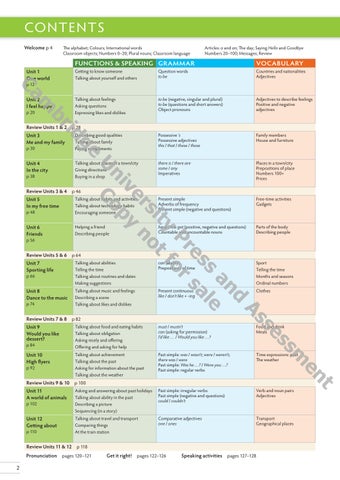
CONTENTS Welcome p 4
The alphabet; Colours; International words Classroom objects; Numbers 0–20; Plural nouns; Classroom language
Unit 1 One world
Articles: a and an; The day; Saying Hello and Goodbye Numbers 20–100; Messages; Review
FUNCTIONS & SPEAKING GRAMMAR
VOCABULARY
Getting to know someone Talking about yourself and others
Question words to be
Countries and nationalities Adjectives
Talking about feelings Asking questions Expressing likes and dislikes
to be (negative, singular and plural) to be (questions and short answers) Object pronouns
Adjectives to describe feelings Positive and negative adjectives
Describing good qualities Talking about family Paying compliments
Possessive ’s Possessive adjectives this / that / these / those
Family members House and furniture
Talking about places in a town/city Giving directions Buying in a shop
Places in a town/city Prepositions of place Numbers 100+ Prices
m Ca
p 12
Unit 2 I feel happy
br
p 20
Unit 3 Me and my family p 30
there is / there are some / any Imperatives
Unit 5 In my free time
Co
Present simple Adverbs of frequency Present simple (negative and questions)
Free-time activities Gadgets
p 48
Talking about habits and activities Talking about technology habits Encouraging someone
Unit 6 Friends
Helping a friend Describing people
have / has got (positive, negative and questions) Countable and uncountable nouns
Parts of the body Describing people
p 38
Review Units 3 & 4 p 46
p 56
Review Units 5 & 6 p 64
As d an s le es sa Pr r y fo it t rs no ve y ni p
U
Unit 4 In the city
ge
id
Review Units 1 & 2 p 28
Unit 7 Sporting life
Talking about abilities Telling the time Talking about routines and dates Making suggestions
can (ability) Prepositions of time
Sport Telling the time Months and seasons Ordinal numbers
Unit 8 Dance to the music
Talking about music and feelings Describing a scene Talking about likes and dislikes
Present continuous like / don’t like + -ing
Clothes
Food and drink Meals
p 66
p 74
Review Units 7 & 8 p 82
Talking about food and eating habits Talking about obligation Asking nicely and offering Offering and asking for help
must / mustn’t can (asking for permission) I’d like … / Would you like …?
Unit 10 High flyers
Talking about achievement Talking about the past Asking for information about the past Talking about the weather
Past simple: was / wasn’t; were / weren’t; there was / were Past simple: Was he …? / Were you …? Past simple: regular verbs
Time expressions: past The weather
Review Units 9 & 10 p 100 Unit 11 A world of animals
Asking and answering about past holidays Talking about ability in the past Describing a picture Sequencing (in a story)
Past simple: irregular verbs Past simple (negative and questions) could / couldn’t
Verb and noun pairs Adjectives
Unit 12 Getting about
Talking about travel and transport Comparing things At the train station
Comparative adjectives one / ones
Transport Geographical places
p 102
p 110
Review Units 11 & 12 p 118 Pronunciation pages 120–121
2
Get it right! pages 122–126
Speaking activities pages 127–128
t
en
p 92
m ss
p 84
se
Unit 9 Would you like dessert?
THINK
SKILLS
/h/ or /w/ in question words
Values: The Olympic Spirit Self-esteem: The ‘Me’ flag
Reading Website: Mad about The Olympics Dialogue: Favourite football teams Photostory: Just a little joke Listening Radio quiz: The One-Minute Challenge Writing Completing a questionnaire: Personal information
Values: Welcoming a new classmate Train to Think: Categorising
Reading Text messages: Hi there! Dialogue: Deciding what to do Culture: Masks from around the world Listening Dialogues: Talking about feelings Writing Text message: Describing feelings and things
Values: Families Self-esteem: Being part of a family
Reading Article: Kate Middleton Dialogue: Agata’s family Photostory: A song for Ruby Listening Dialogues: Describing family Writing Description: Your favourite room
Values: My town/city Train to Think: Exploring numbers
Reading Brochure: Window of the World Dialogues: In the shops Culture: Parks around the world Listening Dialogues: Asking for directions Writing Brochure: A brochure for your town / city
m Ca
PRONUNCIATION
Vowel sounds – adjectives
id
br this / that / these / those
ge
Co
As d an s le es sa Pr r y fo it t rs no ve y ni p
U
Word stress in numbers
Values: Better together or better alone? Self-esteem: What makes me happy?
Reading Newsletter: I love Glee club! Quiz: Does TV control your life? Photostory: The school play Listening Monologues: Describing electronic gadgets Writing Paragraph: Days in your life
Long vowel sound /eɪ/
Values: Helping a friend Train to Think: Attention to detail
Reading Article: A real friend Dialogue: A surprise for Olivia Culture: Welcoming people around the world Listening Interview: Friendship bands Writing Paragraph: Describing a friend
Long vowel sound /ɔ:/
Values: The importance of sport Self-esteem: My time cake
Reading Article: They’re good! Article: The Other Final Photostory: The big match Listening Phone call: Making arrangements Writing Paragraph: My favourite sportsperson
Intonation – listing items
Values: Music Train to Think: Memorising
Reading Tweets: #musicinsupermarket Dialogue: A conversation at a party Culture: Musical instruments around the world Listening Radio programme: Dances around the world Writing Tweet: Describing a scene
Intonation – giving two choices
Values: How you eat is important. Self-esteem: You are what you eat.
Reading Article: Young kitchen stars Menu and dialogue: In a restaurant Photostory: The pizza Listening Dialogue: Cooking Writing Menu: A meal plan for your friend
Past simple regular verbs
Values: Hard work and achievement Train to Think: Sequencing
Reading Article: It was her dream to be an astronaut Article: Fictional heroes Culture: Statues Listening Dialogue: Freddie’s Saturday evening Writing Proposal: A statue in my town
Past simple irregular verbs
Values: Animals and us Self-esteem: Animals and nature
Reading Article: Erin and Tonk to the rescue Article: Extinct animals Photostory: The spider Listening Dialogue: Becky’s holiday Writing Blog entry: A day in the life of an animal
Word stress – comparatives
Values: Transport and the environment Train to Think: Comparing
Reading Article: The great race Article: My favourite journey Culture: Transport around the world Listening Dialogue: At the train station Writing Description: Unusual forms of transport
t
en
m ss
se
Present simple verbs – third person
3
WELCOME m Ca
The alphabet
Colours 1 Write the colours in the correct places in the key.
Aa Bb Cc Dd
ge
id
br
black | blue | brown | green | grey | orange pink | purple | red | white | yellow
As d an s le es sa Pr r y fo it t rs no ve y ni p
U
Ee Ff Gg Hh
Co
Ii Jj Kk Ll
Mm Nn Oo
Pp Qq Rr Ss
Tt Uu Vv Ww Xx Yy Zz
1.02 Listen to the alphabet. Then listen again and repeat. 1.03
Listen to the sounds and repeat. /i:/
/e/
a h j k
b c d e g p t v
f l m n s x z
/aɪ/
i y
/əʊ/
/u:/
o
q u w
/ɑ:/
Key 1
r
white
7
2
8
3
9
4
10
5
11
6
3
4
SPEAKING Work in pairs. Spell your name to your partner. Your partner writes your name. Is he/she correct?
2
SPEAKING Work in pairs. What colours can you see around you? Tell your partner.
t
/eɪ/
en
m ss
2
se
1
WELCOM E
A
m Ca
B
C
1
ge
id
br D
E
Co
As d an s le es sa Pr r y fo it t rs no ve y ni p
U
F
H
G
I
K
J
L
se
International words the pictures. Write 1–16 in the boxes.
2 3
1.04
M
N
O
P
t
1 airport | 2 bus | 3 café 4 city | 5 football | 6 hamburger 7 hotel | 8 phone | 9 pizza 10 restaurant | 11 sandwich 12 sushi | 13 taxi | 14 television 15 tablet | 16 wi-fi
en
m ss
1 Match the words in the list with
Listen, check and repeat.
SPEAKING Work in pairs. Choose one of the words in Exercise 1 and spell it to your partner. He/She writes the word. Is he/she correct?
5
Articles: a and an
The day
1 Match the sentences in the list with the pictures.
1 Write the words in the list under the pictures.
Write 1–4 in the boxes.
afternoon | evening | morning | night
1 It’s a blue football.
1
2 It’s an orange football.
m Ca
3 It’s a red football. 4 It’s a black and white football.
ge
id
br evening
U
A
Co
As d an s le es sa Pr r y fo it t rs no ve y ni p
2
B
1
3
C
1 2 3 4 5 6 7
6
an
airport Italian restaurant red bus sandwich yellow taxi orange phone American football player famous actor
t
0
en
2 Write a or an.
4
m ss
se
D
WELCOM E
Saying Hello and Goodbye 1
Complete the dialogues with the words in the list. Listen and check. 1.05
Bye | Good | have | Hi | How | morning night | See you | thanks | this
m Ca id
br 3
ge
DAVE MR THOMAS
U
DAVE
As d an s le es sa Pr r y fo it t rs no ve y ni p
MR THOMAS
Good 5 , Mr Thomas. Hello, Dave. How are you? I’m fine, thank you. Good. I’ll see you in class. 6 , Mr Thomas.
DAVE
Co
1 ANDY TOM LUCY ANDY
Hello. My name’s Andy. Hi, Andy. I’m Tom, and 0 1 , Andy. Hi, Tom. Hi, Lucy.
this
is Lucy.
4
JIM
RACHEL JIM
Bye, Rachel. Bye, Jim. 7 Yeah, 8
later. a good day.
t
en
m ss
se
2 ABI
2
MRS HAMILTON
Hi, Abi. 3
ABI MRS HAMILTON
afternoon, Mrs Hamilton. are you? 4 Great, . And you? I’m fine, thanks.
5 SUE MUM
Good 9 , Mum. Night, Sue. Sleep well. 7
Classroom objects
Numbers 0–20
1 Look at the pictures. Do you know these words?
1
If not, ask your teacher: What’s … in English?
1.07
repeat. 0 1
m Ca 0
2 3 4
door
5
1
br
6 7
id
8
ge
9
2
10
3
3
Co
4
zero/‘oh’ one two three four five six seven eight nine ten
eleven 12 twelve 13 thirteen 14 fourteen 15 fifteen 16 sixteen 17 seventeen 18 eighteen 19 nineteen 20 twenty 11
Work in pairs. Choose three numbers from Exercise 1. Tell a partner to write them. Is he/she right? SPEAKING
As d an s le es sa Pr r y fo it t rs no ve y ni p
U
2
Look at the numbers 0–20. Listen and
5
4
1.08
hear.
Listen and write the phone numbers you
1
3
2
4
What’s your favourite number? Compare with a partner. SPEAKING
Plural nouns
6
7
8
9
Write the words in the list under the pictures in Exercise 1. Listen, check and repeat. 1.06
0
two chairs 1
3
4
m ss
board | book | chair | computer | desk door | pen | pencil | projector | window
3 Are there any other classroom objects you can Work in pairs. Point to the pictures in Exercise 1. Ask and answer questions.
SPEAKING Work in pairs. Find things in your classroom and say the colours.
a red pen 8
It’s a desk.
an orange chair
t
SPEAKING
What’s this in English? 5
en
think of?
4
2
se
2
1 Write the words under the pictures.
5
2 Match the singular and plural nouns. Singular 0 one man 1 one woman 2 one person 3 one child
b
Plural a three people b four men c six children d five women
WELCOM E
Classroom language 1
Listen and number the phrases in the order you hear them. Write 1–10 in the boxes. 1.09
2
1.10
Listen again and repeat.
m Ca br
Open your books.
b Listen!
c
Put your hand up.
e
What does this mean?
f
g
That’s right.
h That’s wrong.
i
Close your books.
j
ge
id
a
Co
As d an s le es sa Pr r y fo it t rs no ve y ni p
U d Look at the picture.
Sorry, I don’t understand.
t
en
m ss
se
1
Work with a partner. 9
Numbers 20–100 1
Match the numbers with the words. Listen and check. 1.11
a b
m Ca
c
20 30 40 50 60 70 80 90 100
d e f
h
LOOK!
ge
id
i
a
br
g
fifty eighty ninety seventy one hundred thirty twenty sixty forty
33 = thirty-three
56 = fifty-six
2
24 2 87 3 33
0 1 2 3 4 5 6
97 = ninety-seven
7
24 47 60 89 30 58 72 91
twenty-four
1.14
to Abi.
Now listen and complete the message
Hi, Abi,
Hi, Liam,
Message from Mrs Davis.
r Holmes.
Message from Olive
His house number is The bus number is
74 8 95 7
As d an s le es sa Pr r y fo it t rs no ve y ni p 2
Read and listen to the message. Complete the message to Liam. 1.13
4
3 Write the numbers.
Co
1
49 5 54 6 62
1
U Messages
How do you say these numbers? Listen, check and repeat. 1.12
2
The bus number is 2
.
3
.
Her telephone number is 3
. . .
t
en
m ss
se
His phone number is
Her house number is 1
.
1
10
WELCOM E
Review 1
Work in groups. Play the first letter game. Listen to the letter of the alphabet. How many examples can you find for each category in the table? You get one point for each correct answer. The winner is the group with the most points. 1.15
● ● ●
0
m Ca
p pink purple Penelope Cruz Peter Jackson pen pencil –
Colour
id
br
Actor
Classroom object
1
2
3
4
5
ge
Number (0–20)
As d an s le es sa Pr r y fo it t rs no ve y ni p
pizza phone 8
Co
Total Points
U
International word
2 Complete the words with the missing vowels
and then write them in the correct column in the table below. 0 1 2 3 4 5
f o o tb a ll d r r st r nt r ng p n n n
International words
football
7 8 9 10 11
Colours
ch r f v y ll w rp rt gr n ght
Numbers
Classroom objects
1
JIM
1 JIM
FRED FRED
Great, thanks. And you? Good morning, Fred. I’m fine, thanks. Hi, Jim. How are you?
2
LUCY LUCY
SARA
Yeah, have a good day. Bye, Sara. Bye, Lucy. See you later.
t
en
m ss
SPEAKING Work in pairs. Choose three pictures and spell the words for your partner to write. Is he/she correct?
the boxes.
se
3
6
4 Put the dialogues in order. Write 1–3 and 1–4 in
11
1 WORLD ON E
OBJECTIVES FUNCTIONS: getting to know someone;
talking about yourself and others
GRAMMAR: question words; the verb
to be
VOCABULARY: countries and
nationalities; adjectives
m Ca
br ge
id
I
As d an s le es sa Pr r y fo it t rs no ve y ni p
U G
Co
1
H
C
E
F
B
D
A
J
se
SPeaKing Work in pairs. Talk about famous people from different countries.
Neymar is from Brazil.
places on the map. Write 1–10 in the boxes. 1 2 3 4 5
the UK Mexico the USA Spain Russia
6 7 8 9 10
Brazil Portugal Japan Turkey South Africa
1.16 Read and listen to the website and choose the correct words.
0 1 2 3 4 5 6 7
12
Pedro is from Brazil / the USA. Pedro is 10 / 11. Brittany is from London / Manchester. Missy Franklin is a swimmer / runner. Oleg is Portuguese / Russian. Oleg is 11 / 12. Haruka is from Japan / the UK. Zheng Jie is a runner / tennis player.
t
1 Match the names of the countries with the
en
3
Reading
m ss
2
1 O N E WO R LD
Mad about the Olympics HOME
ABOUT
NEWS
CONTACT
m Ca
Tell us about your Olympic favourites! Who’s your favourite athlete? Usain Bolt.
id
br
What’s your name? Pedro.
ge
Where are you from? I’m Brazilian. I’m from a city called Belo Horizonte.
Why is he/she your favourite athlete? Because he’s amazing!
As d an s le es sa Pr r y fo it t rs no ve y ni p
U
How old are you? I’m 10.
Co
What’s your name? My name is Brittany.
Where are you from? I’m British. I’m from Manchester. How old are you? I’m 12.
Who’s your favourite athlete? My favourite athlete is Missy Franklin. She’s a swimmer. Why is he/she your favourite athlete? Because she’s great!
What’s your name? I’m Oleg.
Who’s your favourite athlete? Mariya Savinova. She’s a runner.
Where are you from? I’m from Russia. I live in Moscow.
Why is he/she your favourite athlete? Because she’s fast!
How old are you? I’m 11.
How old are you? I’m 11. Who’s your favourite athlete? Zheng Jie. She’s a tennis player from China.
The Olympic Spirit
Choose a slogan for the website.
t
Where are you from? I’m Japanese. I’m from Tokyo.
en
m ss
se
What’s your name? My name is Haruka.
One world together. exercise is fun. Win, win, win!
Why is he/she your favourite athlete? Because she’s awesome!
13
VOCaBULaRY Countries and nationalities 1
2 Look at exercise 1. Complete the table with the nationalities of the countries. -an
Write the country under the flag. Listen and check. 1.17
m Ca
Brazil | Japan | Mexico | Portugal | Russia South Africa | Spain | the UK | the USA | Turkey
-ish
Spanish 3
SPeaKing Work in pairs. describe a flag to your partner. He/She guesses which it is.
This flag is red and blue.
br ge
Russia
1
Workbook page 13
gRaMMaR Question words 1 Look at the website on page 13 and complete
As d an s le es sa Pr r y fo it t rs no ve y ni p
U
the questions with the words in the list. Then choose the correct words to complete the rule.
Co
2
Is it the Russian flag?
Yes, it is!
id 0
-ese
How | What | Where | Who | Why 0
3
What ’s your name?
are you from? old are you? ’s your favourite athlete? is he/she your favourite athlete?
1 2 3 4
RULE: How, Who, Where, What and Why are 1question / because words.
4
We often use the word 2question / because to answer a Why question.
5
2 Choose the correct words. 0 2 4
7
3
Work in pairs. ask and answer the questions in exercises 1 and 2. SPeaKing
My name is Belena.
Workbook page 10
Pronunciation /h/ or /w/ in question words 8
14
9
go to page 120.
t
What’s your name?
en
6
m ss
3
se
1
How / Why old is your best friend? What / Where is your mother from? How’s / What’s your favourite colour? Where / Who is your favourite pop star? Why / Where is he/she your favourite pop star?
1 O N E WO R LD
LiSTening
2 Look at the sentences from the radio quiz. Choose the correct words. Then complete the rule.
1 Work in pairs. Look at the photos and tick (✓)
I am / are from London. You am / are wrong. 3 They am / are from Rio de Janeiro in Brazil. 1
the correct flag for each photo.
2
1
m Ca
RULE: The verb to be changes for different subject pronouns. I am American. You/We/They 1 American. He/She/It 2 American. We often use contracted forms after pronouns. I am = I’m You/We/They are = You’re / We’re / They’re He/She/It is = He’s / She’s / It’s
✓
3
ge
id
br
2
U
As d an s le es sa Pr r y fo it t rs no ve y ni p
Co
4
LOOK!
Singular
Plural
I
we
you
you
he/she/it
they
3 Complete the sentences. Use contracted forms where possible.
5
0 1 2 3
2
4
Listen to a radio quiz called OneMinute Challenge and check your answers. 1.20
gRaMMaR to be
e f g h
They are Brazilian. It’s food. He’s a singer. They are from Rio de Janeiro. She’s a tennis player. He’s American.
2
●
two activities
SPeaKing Use your ideas from exercise 1 to draw your flag. Tell your partner about it.
t
She’s Russian.
●
one colour one animal
en
d
●
e
b It’s Japanese. c
1 Choose things that are important to you.
m ss
a
se
letters in the boxes. Bruno Mars 2 Maria Sharapova 3 sushi 4 cariocas
Workbook page 11
The ‘Me’ flag
1 Match sentences a–h with items 1–4. Write the 1
5
I 'm from New York. She a famous actor. Jacob from the USA. Liam and Ben my best friends. We in Class 2B. You wrong. Sorry.
My flag is blue and red. They’re my favourite colours. Here is a football. It’s my favourite sport. Here is music. I love music. Here is a panda. It’s my favourite animal. 15
Reading 1
1.21
Read and listen to the dialogue. Who knows more about football, Jamie or Marta?
m Ca ge
id
br JAMIE MARTA JAMIE MARTA JAMIE MARTA JAMIE MARTA JAMIE MARTA MARTA MARTA JAMIE JAMIE
1 2
3
Marta is Spanish. 2 Marta is from a big town. 3 Tony Kroos is Italian. 4 Tony Kroos is a Barcelona player.
FUNCTIONS Getting to know someone 1
1.22 Put the dialogue in order. Listen and check.
PAOLO
Nice to meet you, too. I’m from Paris. Yes, it is. I’m Gina. What’s your name? Nice to meet you, Gina. Where are you from, Gina? Paris is a beautiful city. I’m Paolo. And you?
SPEAKING
Work in pairs. Act out the
GINA GINA GINA GINA
1 GINA PAOLO PAOLO PAOLO
2
1
16
Tony Kroos.
3
dialogue.
SPEAKING Work in pairs. Make your own dialogue.
t
Jamie is a Barcelona fan.
F
I’m from a small town called Teruel.
Q
A
F (false). Write the correct sentences. Jamie is a Real Madrid fan.
I’m Jamie.
Q
A
2 Read the dialogue again. Mark the sentences T (true) or 0
Q
A
en
MARTA
3 Write the questions.
m ss
JAMIE
Nice shirt. Thank you. It’s the new Barcelona shirt. I know. I’m a Barcelona fan, too. So what’s your name? Marta. And what’s your name? I’m Jamie. Nice to meet you, Jamie. Nice to meet you, too. Where are you from, Marta? I’m from Spain. I’m from a small town called Teruel. Spain is a beautiful country. Yes, it is. So who’s your favourite Barcelona player? Umm … er … Tony Kroos? The German player? Yes, he’s great. Yes, he is. But he isn’t a Barcelona player. No? He’s a Real Madrid player. Oh! It’s late. Time to go. Bye, Jamie. Oh, OK!
se
JAMIE
Co
MARTA
As d an s le es sa Pr r y fo it t rs no ve y ni p
U JAMIE
1 O N E WO R LD
VOCaBULaRY adjectives 1
1.23 Write the words in the list under the pictures. Listen and check.
m Ca
a big TV | a dirty football | a fast car | a new pen a slow bus | a small pizza | an expensive computer an old phone | cheap tickets | clean shirts
0
1
a big TV
ge
id
br 5
4
U 3
2
As d an s le es sa Pr r y fo it t rs no ve y ni p
Co 7 6
2 Match the opposites. 0 1 2 3
d
WRiTing Personal information
Look at the questionnaire. answer the questions about you in full sentences.
a
b c
d e
slow expensive small old clean
The York English Summer Camp
We’re really excited about your visit next month. Answer the questions about yourself to find the perfect roommate.
3 Put the words in order. 0
old / computer / an
What’s your name?
an old computer
1 3 5
How old are you?
LOOK! In English, adjectives always stay the same. new pens nOT news pens green cars nOT greens cars
t
4
Where are you from?
en
2
a / bike / new expensive / an / restaurant train / fast / a dirty / shoes book / cheap / a
m ss
se
4
new big dirty cheap fast
9
8
Who’s your favourite pop star?
What’s your favourite colour? Workbook page 13
17
PHOTOSTORY: episode 1
le tt i l a t s Ju joke
1 Look at the photos and answer the questions. How many people can you see? Where are they?
2
1.24 now read and listen to the photostory. Check your answers.
m Ca ge
id
br Co
As d an s le es sa Pr r y fo it t rs no ve y ni p
U 1
RUBY Hi, Ellie. ELLIE Hi, Ruby. How’s it going? RUBY Great, thanks. Oh, hello, Dan. DAN Hi, you two.
RUBY Who’s that? DAN That’s Thomas. ELLIE Who’s he? DAN He’s in my class. He’s new.
2
t
en
m ss
se
ELLIE Where’s he from? DAN He’s from Paris. He’s cool. OK, time to go
now. See you tomorrow. RUBY Bye, Dan. ELLIE See you later.
18
3
4 ELLIE He’s from Paris? RUBY Paris. That is so awesome! ELLIE I know!
1 O N E WO R LD
deVeLOPing SPeaKing 3
eP1 Watch to find out how the story continues.
1 2
Is Thomas from France? Where is he from?
FUnCTiOnS Talking about yourself and others 1 Match the questions and answers. Who’s that? Where’s he from? 2 How old are you? 3 Who’s your favourite singer? 0
m Ca 4
Watch again. Choose the correct word in each sentence. eP1
They are in an ice cream / a fast food shop. The chocolate ice cream is for Ellie / Ruby. 2 Thomas (Tom) is American / French. 3 He’s from Paris, Texas / Paris, France. 4 The ice cream is very good / isn’t very good. 0
br
1
a
ge
Beyoncé. d I’m 11. c
U
2 Put the words in the correct order to make dialogues.
Co
How’s it going? 2 See you later. 3 That is so awesome! 4 I know! 1
As d an s le es sa Pr r y fo it t rs no ve y ni p
1 Find the expressions 1–4 in the story. Who says them?
He’s from Paris.
b That’s Thomas.
id
PHRaSeS FOR FLUenCY
b
1
2 How do you say the expressions in exercise 1 in your language?
3 Change the underlined expressions. Use an expression from exercise 1. 1
a This is my new bicycle.
Great! 2 Hi, George. How are you? 3 a This is a nice computer. B Yes, it is. 4 OK, I’m off now. Goodbye! B
1
Who's that?
B
Mario / are / and / they / Alex . a are / from / where / they ? B from / they / Mexico / are .
? 3
a Look at my new phone.
B
Bob / I’m .
a old / you, / how / are / Bob ?
t
!
a Goodbye, Mike. B
a Hi, / your / name / what’s ?
en
3
a they / are / who ? B
!
a Hello, Ben!
B
the UK / from / she’s .
m ss
I know
B 2
2
a Moscow is a city in Russia. B
1
B
se
0
Mary / that’s .
a she / from / where’s ?
4 Complete the dialogues with the expressions from exercise 1.
a that / who’s ?
12 / I’m . a favourite / your / singer / who’s ? B Ed Sheeran . B
, Annie.
3
SPeaKing Work in pairs. act out the dialogues. Then make similar dialogues.
19
2 HAPPY
OBJECTIVES
I FEEL
m Ca
READING
3
br
1 Match the phrases with the photos. Write 1−6
id
in the boxes.
on a train 2 on a plane 3 at a stadium 1
at school 5 on a beach 6 on a bus 4
ge
Work in pairs. Student A, close your book. Student B, test your partner. SPEAKING
1.25 Read and listen to the text messages on page 21. Where are the people? Write the names under the correct photos in Exercise 1.
4 Read the text messages again. Mark the sentences T (true) or F (false). 0 1 2
Nicky is worried. Andrea is at school. Andrea, Amy and Katie are on holiday. Ryan is bored. The bus driver isn’t angry. James isn’t happy.
T
B
E
1
3 4 5
C
F
t
en
m ss
se
D
It’s ‘on a beach.’
Co
A
asking questions; expressing likes and dislikes GRAMMAR: to be (negative, singular and plural); to be (questions and short answers); object pronouns VOCABULARY: adjectives to describe feelings; positive and negative adjectives
As d an s le es sa Pr r y fo it t rs no ve y ni p
What’s A?
U
2
FUNCTIONS: talking about feelings;
20
2 I FEEL H A PPY
Hi there!
m Ca
Andrea Look at my photo. I’m on the beach. It’s hot and sunny. I’m very happy. I’m with 2 American girls, Amy and Katie. It’s fun! What about you? How’s your holiday? Is it nice there?
Nicky
br
ge
id
Hi there, I’m at school. There are 12 girls and 15 boys in my new class. They aren’t very friendly. I’m a little worried. But the teacher’s really cool. How are you? Are you OK? See you soon.
3.26
Co
As d an s le es sa Pr r y fo it t rs no ve y ni p
U
10.06
James
Ryan
Hi, I’m at the stadium. It’s 4–0 to the other team. The players in my team aren’t good. Are they tired or bored? I’m sad. Football is a great game, but this match isn’t great. Bye.
I’m on the bus to school and I’m not very happy. It’s so full and I’m very hot. The driver isn’t very nice and he’s angry. Ten more minutes to get to school. See you soon!
4.58
8.16
or not OK
0
1 Look at the picture and answer the questions.
1 2 3 4
3
The first day at my new school. I’m worried and I’m sad. Where are my friends?
SPEAKING
t
5
en
Where is Emily? 2 How is she? 3 Why isn’t Emily happy? 1
talk to Emily help Emily smile at Emily laugh at Emily not talk to Emily ask Emily questions
m ss
Welcoming a new classmate
?
se
2 Imagine you are Emily’s classmate. What’s OK
Compare your ideas with a partner.
It’s OK to smile at Emily. It isn’t OK to … 4
SPEAKING Work in pairs. Think of other things you can do to help Emily on her first day.
21
VOCABULARY Adjectives to describe feelings
GRAMMAR to be (negative, singular and plural)
1
1 Look at the text messages on page 21. Complete
1.26 Match the feelings in the list with the pictures. Write 1−10 in the boxes. Listen and check.
the sentences. Then complete the rule. They 2 The driver 1
m Ca
1 angry | 2 bored | 3 cold | 4 excited 5 hot | 6 hungry | 7 sad | 8 thirsty 9 tired | 10 worried
br B
C
9
F
G
H
U
E
RULE: We form the negative of to be with subject + be + 1 . I’m not sad. (am not) You aren’t sad. (are not) He/She/It 2 sad. (is not) We aren’t sad. (are not) They 3 sad. (are not)
D
ge
id
A
very friendly. very nice and he’s angry.
As d an s le es sa Pr r y fo it t rs no ve y ni p
2 Complete the sentences with the correct negative form of to be. 0
J
Co
I
1 2
2 Match the sentences with the pictures. Write 1−6 in the boxes.
3 4
Adelaide isn’t happy today. She’s very sad. You in my team. You’re in Mike’s team. They eleven years old. They are ten. No pizza for me, thanks. I hungry. Angie’s favourite colour is blue. It green.
3 Complete the sentences with the correct form of to be.
A
1
0
B
1 2 3 4
C
We ’re ✓ American. We aren’t ✗ British. I ✗ sad. I ✓ happy! Danny ✓ twelve. He ✗ eleven. It ✗ hot. It ✓ cold! Lucy ✓ worried. She ✗ excited. Workbook page 18
D
Pronunciation Go to page 120.
1 2 4 6
3
Work in pairs. Tell your partner how you feel in the situations in Exercise 2. Your partner guesses the situation.
1 Read the words in the list. Put them into four
categories. There are four words for each category. afternoon | angry | book | bored | chair | desk evening | excited | grey | morning | night orange | pencil | purple | white | worried
SPEAKING
I’m excited.
Number 1? Workbook page 21
22
Categorising
t
5
It’s your birthday. It’s one o’clock in the morning. There’s a great film on TV but the TV is broken. It’s an awful day. Your mum is angry with you. You’re on a plane.
en
3
F
m ss
E
se
Vowel sounds – adjectives
2
Work in pairs. Compare your categories. Think of a title for each one. SPEAKING
Category 1 - grey, orange, …
2 I FEEL H A PPY
LISTENING 1
Listen to four dialogues. Match two of the dialogues with the pictures. Write a number (1–4) in the boxes.
2
Listen again. Complete the dialogues with cold, tired, excited and angry. 0 A Is Noah’s mum sad? B No, she isn’t. She’s angry . 1 A Are Chris and David worried? B No, they aren’t. They’re . 2 A Is Ted worried? B No, he isn’t. He’s . 3 A Is Ashley hot? B No, she isn’t. She’s very .
1.29
1.29
m Ca
A
ge
id
br
As d an s le es sa Pr r y fo it t rs no ve y ni p
U
GRAMMAR to be (questions and short answers)
1 Look at picture A in Exercise 1. Choose the correct
Co
answer. Then complete the rule and the table. A Are you hot, Ashley? B
Yes, I am. / No, I’m not.
3 Look at the rule again. Complete the dialogues. 1
+ subject. + subject + to be
2
Short negative answer
Am I in your team? Are you OK? 1 he/she/it OK? Are we in your team? 2 they OK?
Yes, you are. Yes, I am. Yes, he/she/it is.
No, you aren’t. No, I’m not. No, 4 .
4
Yes, we are.
No, 5
.
5
Yes, they
No, they aren’t.
6
2 Put the words in order to make questions. Write the answers.
B
B
4 5
A B
4
SPEAKING
Work in pairs. Ask and answer.
Is football your favourite sport?
African / he / is / South / ? (yes)
Are you cold?
hungry / you / are / ? (no) Brazil / they / from / are / ? (yes) you / 12 / are / ? (yes) she / is / tired / ? (no) late / I / am / ? (no)
t
3
A
friends? Yes, they . They in my class at school. Ms Brown your English teacher? No, she . She’s my mother’s friend. Am I in your team? No, you . You’re in Pam’s team. Jules French? . He’s from Paris. we late? . We’re early.
en
2
A
B
Is he South African? Yes, he is.
1
A
you angry, Keira? . I’m just tired. James and Tim your best
m ss
.
3
No, I
Are
se
Short positive answer
0
A
B
Question
3
A
B
RULE: We form questions with 1 We form short answers with 2 (+ not).
B
Are your best friends from the USA? Is your teacher in the classroom? 5
SPEAKING Think of three more questions to ask your partner. Then ask and answer. Workbook page 18
23
READING 1
3 Correct the sentences. 0
Read and listen to the dialogue and choose the correct option. 1.30
Nick is tired.
He isn’t tired. He’s bored.
The Formula One race is at eight. Johnny Depp is in the film. 3 The song is by The Feeling. 4 The new T-shirt shop in town is open. 5 Nick is a member of the club for teenagers. 1
Nick and Connor decide to … a go to the cinema. b listen to music. c go to a club for young people.
2
m Ca
2 Read the dialogue again. Number the photos in the
CONNOR NICK
CONNOR
CONNOR NICK CONNOR NICK CONNOR NICK CONNOR NICK CONNOR CONNOR CONNOR NICK NICK NICK CONNOR NICK
D
E 24
1
t
CONNOR
en
CONNOR
C
m ss
NICK
B
se
NICK
Co
NICK
A
As d an s le es sa Pr r y fo it t rs no ve y ni p
NICK
What’s the matter, Nick? Are you tired? Tired? No, no. I’m not tired. I’m bored. Why are you bored? Because there’s nothing to do. Nothing to do at all. Well, there’s a Formula One race at five. It’s on TV. Formula One? I don’t like it. Really? What about a film? There’s a new film on at the cinema. A film? Who’s in it? Ben Stiller. He’s so funny. Ben Stiller? I don’t like him. He’s not funny. He’s terrible. Erm. What about some music? Listen to this song. It’s the new one from One Direction. One Direction! Are you joking? I don’t like them. Well do you like ice cream? The new ice cream shop in town is open. Ice cream? No, I don’t like it. What! You don’t like ice cream? No, I don’t. OK, what about the club? What club? The new club for teenagers. Hmm, I’m not sure. But Jenny is a member. Jenny? Yes, Jenny Carter. Jenny Carter? Yes, she goes there every Friday. Really? Let’s go!
U
CONNOR
ge
id
br
order that Connor talks about them. Write 1−5 in the boxes.
2 I FEEL H A PPY
GRAMMAR Object pronouns 2 Complete the dialogues with the correct object
1 Complete the dialogues with them, it and him.
pronouns.
Read the dialogue on page 24 again and check. Then use the words to complete the table.
m Ca
CONNOR NICK
CONNOR NICK
There’s a Formula One race at five. Formula One? I don’t like 1
I
2
Listen to this song. One Direction! I don’t like 3
3
.
4 5
U
6
Dad’s angry. Yes, he isn’t very happy with us Do you like Maroon 5? No, I don’t like . Do you like Jennifer Lopez? Yes, I like . She’s great. Do you like ? Yes, I think you and Peter are great. Do you like ? Yes, I think Jack is funny. Do you like my new bike? Yes, I like . Bob, I really like . I really like you too, Alice.
us
Workbook page 19
Co
they
, Tom.
As d an s le es sa Pr r y fo it t rs no ve y ni p
A B
2
we
A B
her
it
A B
1
she
A B
Object you
he
A B
me
you
A B
ge
Subject
1
Ben Stiller is so funny. I don’t like 2 .
id
NICK
A B
.
br
CONNOR
0
3
VOCABULARY Positive and negative adjectives
FUNCTIONS Expressing likes and dislikes
1 Look at the words in the list. Write N (negative)
1 Which of these sentences means ‘is good’? Which
or P (positive) in the boxes.
2
awful
N | bad
funny
| good
| excellent
P | exciting
| great
| terrible
Work in pairs. Give one example for each of the following. SPEAKING
means ‘is bad’?
I don’t like Taylor Swift. 2 I like Shakira. 1
2 Put the words in the correct order to make questions.
A you / like / The Rolling Stones / do / ?
b c e g h i
No, I don’t like them. They’re terrible. 2 Yes, I like her. She’s great. 1
4
SPEAKING Work in pairs. Talk about the films, actors, bands or singers you really like / don’t like.
t
f
3 Match the answers to the questions in Exercise 2.
a funny film an excellent actor a bad film an exciting computer game a great sportsperson a terrible singer a great country a good book an awful actor
en
d
you / Katy Perry / like / do / ?
m ss
a
B
se
How To Train Your Dragon 2 is a funny film.
Do you like Lorde? Workbook page 21
Yes, I like her. I think she’s great. Do you like the Divergent films? No, I don’t like them. They’re terrible. 25
Culture Masks from around the world m Ca
1
This is a lion mask from China. In many countries in Asia, there are lion dances. There are always two people in a lion – the mask is on the head of one dancer. The lion dances are very beautiful. Tourists love them.
br ge
id
2
Co The masks here are from Greece. They are 2,000 years old. They are masks for the actors in the Greek theatre.
4
As d an s le es sa Pr r y fo it t rs no ve y ni p
U
3
This mask is from North America. It’s a mask from the First Nations people in Canada. The mask is for the medicine man.
5
t
en
m ss
se
Masks are an important part of the carnival in Venice, Italy. There are many different types of carnival masks. For example, the mask in this picture is called the Colombina. Carnival masks are often very beautiful and some are very expensive. 26
These are Halloween masks. Halloween is on 31st October. Children in many countries around the world, for example, the USA and the UK, wear Halloween masks. They go from house to house and say ‘Trick or treat’. People give them sweets (‘treats’).
2 I FEEL H A PPY 1 Look at the photos on page 26. Find these things.
4 Read the article again. Mark the sentences T (true) or F (false).
masks | a lion a mask from the First Nations people one dancer | sweets | tourists
0 1 2
2 What feelings can you see in the masks?
3
m Ca
Mask number 1 is happy.
3
4
Read and listen to the article. Which countries are the masks from? 1.31
5
F
The Lion dance is from Canada. The North American mask is for a doctor. The Greek masks are 200 years old. Halloween is only a holiday in the USA and the UK. Colombina is a type of Italian mask.
ge
id
br
SPEAKING Which of the masks do you like? Which do you not like? Why? Tell your partner.
5 Use your answers in Exercise 4 to write a text message (35−50 words) to a friend.
U
WRITING Describing feelings and things the photos.
As d an s le es sa Pr r y fo it t rs no ve y ni p
1 Read the text messages. Write the names under
Tom
questions. 1 2 3 4 5 6
Where is Henry? Is he happy? Why? / Why not? Where is Tom? Is he happy? Why? / Why not?
Co
2 Read the text messages again and answer the
Hi, Sara. I’m at school. It’s lunchtime and I’m really hungry. But I’m sad. The lunch at school today isn’t good. I’m also cold. The sun isn’t out. It’s not a great day. What about you? Is your day good? Bye.
21/1, 13.12
3 How do Tom and Henry … start their text? 2 finish their text? 1
Henry
Hi, Annie. I’m in the car with my fam ily. I’m excited because I’m on holiday. Yeah! Two more hours to get to the beach! How are you? Are you OK? See you soon!
4 Imagine you want to write a text message to a friend. Think of answers to these questions. 2
16/6, 10.03
B
t
en
m ss
A
se
Where are you? Are you happy? 3 Why? / Why not? 1
27
CAMBRIDGE ENGLISH: TOWARDS Key
m Ca
READING AND WRITING Part 3: Multiple-choice replies 1 Complete the five conversations. Choose the correct answer A, B or C. 0
It’s Kylie. C Yes, I am. B
How old are you?
A I’m Brazilian.
ge
id
2
A I’m 11.
br
1
What’s your name?
Are we late?
Do you like Beyoncé?
A Yes, we are. B
No, I’m not.
C Yes, he is.
As d an s le es sa Pr r y fo it t rs no ve y ni p
U
3
I’m 12. C It’s John. B
A No, I like her.
Co
B
Yes, I am.
C Yes, I like her.
4
Where are you from?
A I’m 13. B
Yes, I am.
C Mexico.
5
Is Tom your friend?
A Yes, we are.
Yes, he is. C Yes, I am. B
Part 2: Multiple-choice sentence completion
2 Read the sentences about Jim. Choose the best word (A, B or C) for each space. 0 1
Hi, my name A am It
Jim.
B
is
C are
B
on
C to
my school.
I like Ed Sheeran. He’s a(n) A great like sport. A aren’t
singer. B awful
C terrible
I
t
28
C is
en
5
am
m ss
4
I am A at
B
12 years old.
A am 3
C are
se
I
is
my birthday today.
A are 2
B
B
don’t
C isn’t
TEST YOUR SELF
U N ITS 1 & 2
VOCABULARY 1 Complete the sentences with the words in the list. There are two extra words.
m Ca
awful | Brazil | clean | excited | expensive | hot hungry | old | Russian | Spain | Spanish | thirsty 1 2 4
7 8
/10
Co
GRAMMAR
As d an s le es sa Pr r y fo it t rs no ve y ni p
10
U
9
ge
6
id
5
br
3
I want a sandwich. I’m . She’s from Moscow. She’s . Open the window, please. I’m ! This pizza is . I don’t like it! He’s . I think he’s from Madrid. I’m 12 and my big brother Jack is 23. He’s ! Are you ? OK, here’s a glass of water. £175? Oh, it’s very . Brasilia is a big city in . We’re on the train to Paris! We’re very !
2 Complete the sentences with the words in the list. don’t | her | How | it | Where | Why 1 2 3 4 5 6
Mike and Annie aren’t here. are they? This is my new shirt. I really like . She’s my friend. I like a lot. old are you? I like hamburgers. A are you here? B Because it’s a nice place.
3 Find and correct the mistake in each sentence. 1 2 3 5
FUNCTIONAL LANGUAGE 1
A Who A B
3
A B
4
A B
t
B 2
she? She’s Maria. She’s Mexico. are they from? Spain. They Spanish. you like Taylor Swift? Yes, I do. She a great singer. I like this film. It’s awful! Oh, really? I it. It’s funny!
en
4 Write the missing words.
/12
m ss
6
se
4
I not like football. What old is your brother? Are them from Italy? It aren’t an expensive computer. He’s the new boy in the class. I like he. What is your favourite singer?
/8
MY SCORE
/30
22 – 30 10 – 21 0–9
29
3 FAMILY M E A N D MY
OBJECTIVES FUNCTIONS: describing good qualities;
m Ca
talking about family; paying compliments GRAMMAR: possessive ’s; possessive adjectives; this / that / these / those VOCABULARY: family members; house and furniture
ge
id
br Co
As d an s le es sa Pr r y fo it t rs no ve y ni p
U
A
READING
B
1 Match the family members with the photos. Write 1–4 in the boxes. 2
2
2 3 4 5
a husband and wife a mother and daughter a father and son sisters brothers
Brad Pitt and Angelina Jolie are a famous husband and wife. 30
3
SPEAKING Look at the photos on page 31. Use words from Exercise 1 to talk about the people.
4
1.32 Read and listen to the article. Mark the sentences T (true) or F (false).
t
1
1
en
SPEAKING Think of famous examples of the following. Tell your partner.
D
C
m ss
se
brother and sister mother and son 3 father and daughter 4 husband and wife 1
0 1 2 3 4 5
Kate Middleton is from England. She’s got three brothers and sisters. Kate’s picture is never in the newspapers. William’s father is Prince Charles. Kate’s home is new. Kate and William’s apartment is small.
T
3 M E A N D MY FA M I LY
William and Kate have a son called George and a daughter called Charlotte. George was born in 2013 and Charlotte was born in 2015.
m Ca ge
id
br As d an s le es sa Pr r y fo it t rs no ve y ni p
U Co
Kate and William’s home is an apartment in Kensington Palace, in London. The palace is 300 years old. Their apartment is really big, with twenty bedrooms and three kitchens.
Kate Middleton
Families
en
m ss
Kate’s family is from Berkshire in England. She has a sister called Pippa and a brother called James.
se
Kate Middleton is an English woman. She likes sport (especially hockey) and photography. She’s a very busy person. She works with many organisations to help children and sportspeople.
1 Complete the sentences with at least one word
Not really. Now, she’s famous all over the world. Her photograph is often in the newspapers and she’s often on TV. She’s The Duchess of Cambridge. Her husband is Prince William, the Duke of Cambridge. William’s father is Prince Charles and his grandmother is Queen Elizabeth II of Britain.
friendly | interested in … | patient helpful | kind | strict | generous
t
from the list. Use a dictionary to help you.
So, is she a normal woman?
A good brother/sister is A good father is 3 A good mother is 4 A good grandfather/grandmother is
. . . .
1 2
2
SPEAKING
the class.
Compare your ideas with others in 31
GRAMMAR Possessive ’s
LOOK! We use ’s for both possessives and contractions. Tom’s house is big. (The house of Tom is big.) She’s my cousin. (She is my cousin.)
1 Look at the examples. Then complete the rule. Kate’s family is from Berkshire in England. 2 William’s father is Prince Charles. 1
m Ca
RULE: We talk about possession with noun + ’s.
Peter
sister = the sister of Peter
Workbook page 28
VOCABULARY Family members
br
1
2 Look at the photos and write the correct words
aunt | brother | cousin | father | grandfather grandmother | mother | sister | uncle
ge
id
with ’s.
1.33 Complete Nicolás’ family tree with the words in the list. Then listen and check.
0
As d an s le es sa Pr r y fo it t rs no ve y ni p
U my sister
Maria
my sister’s phone
Co
0
Patrick 1
grandmother
Pablo
2
1
Susana
2
Mrs White
José
Jaime
3
Nicolás
Antonio
6
Marta
4
5
Ana
Sara
7
8
se
my cousin
m ss
2 Look at the text on page 31. Complete the
3
sentences with the words in the list.
brother | father | grandfather | son | wife 1 2 3
4
4
3 my uncle 5
32
t
Wendy
William is George’s father . Kate is William’s . George is Kate’s . Prince Charles is George’s James is Kate and Pippa’s
en
0
. .
SPEAKING Write three or four sentences about your family. Tell your partner.
My uncle Antonio is my mother’s brother. Workbook page 31
3 M E A N D MY FA M I LY
GRAMMAR Possessive adjectives
LISTENING 1
1 Look at the article on page 31. Complete
Listen to three people talking about their family. Write 1–3 in the boxes. 1.34
the sentences and match them with the people. Then complete the table. grandmother is Queen Elizabeth. 2 husband is Prince William. 3 apartment is really big.
m Ca
1
A
B
br
Subject
Possessive adjective
U
C
2
1 2
its our 3
Listen again and complete the sentences. Write one word in each space. 1.34
As d an s le es sa Pr r y fo it t rs no ve y ni p
my your
Jordan’s family is very . His uncle Jack is always very . 2 Tania’s are in Australia. Her Clare is nice but sometimes she’s difficult, too. 3 Manuel has cousins. His cousin Monica is very to her brothers, sisters and friends. 1
Co
I you he she it we they
ge
id
William and Kate b William c Kate a
2 Complete the dialogue with words from Exercise 1. STEVE JANE
STEVE RENATA STEVE
JANE
Workbook page 28
ME
Name
Adjective
1 2 3 4
PARTNER
Name
Adjective
1 2 3
t
RENATA
people in your family who are important to you and a word to describe them.
en
RENATA
1 Complete the ‘ME’ table. Write the names of four
m ss
JANE
Being part of a family
se
RENATA
Hello. 0 My name’s Steve. What’s 1 name? Hi. I’m Jane and this is Renata. She’s Brazilian. She’s here on holiday with 2 mother and father. Hi, Renata. Hi, Steve. How are you? Fine, thanks. So, you and 3 parents are from Brazil? That’s right – we speak Portuguese. It’s 4 first language. Have you got any brothers or sisters? No, just me! And you? Yes, I’ve got two brothers. 5 names are Alex and Ricky. They love football! And they love Brazilian football! Great! My father is a football fan, too – 6 favourite team is Flamengo.
4
2
SPEAKING Work in pairs. Ask your partner what he/she wrote. Write his/her answers in the ‘PARTNER’ table.
3
SPEAKING
a
Tell the class about …
your table.
b your partner’s table.
33
READING 1
Read and listen to the dialogue and answer the questions. 1.35
GRAMMAR this / that / these / those 1 Match the sentences with the pictures. Write 1–4 in the boxes. Then choose the correct words to complete the rule.
Where are the two girls? 2 Who is Brian? 1
m Ca
2 Read the dialogue again and answer the questions. 1 3 5
AGATA
AGATA
DEBBIE AGATA DEBBIE AGATA BRIAN AGATA
BRIAN BRIAN
BRIAN
3
Complete the dialogue with the words in the list. Listen and check. 1.35
this (x2) | that (x3) | these | those 34
This is my sister. That’s my brother. 3 These are my pens. 4 Those are my friends. 1 2
RULE: The words this and that are 1singular / plural. The words these and those are 2singular / plural. We use this and these to talk about things that are 3near to / far from us. We use that and those to talk about things that are 4near to / far from us.
2 Look at the pictures in Exercise 1 again. Complete the sentences with this, that, these or those. 0
Picture A: Is
1
Picture B: Are
2
Picture C: Are
3
Picture D: Is
this
your phone? your books? your books? your phone?
t
AGATA
D
en
AGATA
C
m ss
AGATA
1
se
BRIAN
B
Co
DEBBIE
A
As d an s le es sa Pr r y fo it t rs no ve y ni p
AGATA
So, 0 this is my bedroom. Do you like it? Yes! It’s really nice. I like your bed. And the curtains are great! Thank you. I like my room, too. It’s my favourite room in the house – of course! 1 is a nice photograph. There, on the desk. Yes, it’s me and my family, on holiday in Ibiza. We’re all very happy in that photograph! Cool. And is 2 your brother? Yes, it is. 3 is Brian. Oh, he’s nice. Hmm … sometimes he is, sometimes he isn’t. Agata! Are you in here? Hi, Brian. Yes, I’m here. And 4 is my friend Debbie. Hello, Debbie. Listen, Agata – are 5 your things? What things? The books and magazines. Oh, yes, sorry. And Agata, the DVDs on your bed – 6 are my DVDs! Yes, you’re right. Sorry again. You know something, Debbie? Sometimes my sister isn’t my favourite person!
U
DEBBIE
ge
id
4
br
2
Who’s in the photograph? Does Agata like her brother Brian? Are the books and magazines Brian’s? Are the DVDs Agata’s? Does Brian like his sister?
Workbook page 29
Pronunciation this / that / these / those Go to page 120.
3 M E A N D MY FA M I LY
VOCABULARY House and furniture 1
3
5 4
1.38 Match the rooms in the picture with the words. Write 1–7 in the boxes. Listen and check.
m Ca
2 7
1
2
1.39
ge
id
br
bathroom bedroom garage garden hall kitchen living room
1
6
Match the words with the photos. Write 1–8 in the boxes. Listen and check.
Co
As d an s le es sa Pr r y fo it t rs no ve y ni p
U
1 armchair | 2 bath | 3 bed | 4 cooker | 5 fridge | 6 shower | 7 sofa | 8 toilet
A
B
E
F
C
G
D
1
H
Living room Kitchen
Bedroom
Bathroom
WRITING Your favourite room
en
m ss
se
3 Complete the table with words A–H from Exercise 2.
1 Think about your favourite room in your ●
4
Draw an unusual house. Put the furniture in different rooms. Tell your partner about your house. SPEAKING
● ● ●
The fridge is in the living room. The toilet is in the kitchen.
Which room is it? Is it big or small? What things are in the room? What colours are the things in the room?
t
house. Answer the questions.
2 Write a description of your favourite room Workbook page 31
(about 50 words).
35
PHOTOSTORY: episode 2
A songuby for R
1 Look at the photos and answer the questions. Where are the four friends? How does Tom feel in photo 4?
2
1.40 Now read and listen to the photostory. What song does Tom’s dad want to play?
m Ca ge
id
br Co
As d an s le es sa Pr r y fo it t rs no ve y ni p
U 1
TOM Come in, guys. RUBY Wow, this photo is cool! TOM Thank you. DAN What’s that photo over there?
TOM That’s my family. We’re on holiday. RUBY It looks great. So, these are your parents
and …
ELLIE … that’s your sister? TOM No, that’s my cousin. My sister is there. ELLIE Oh, right. She looks like your sister!
2
t
en
m ss
se
DAD Hello, everyone. DAN Hello. TOM Dad, these are my friends. Th is is Dan,
and that’s Ellie, and this is Ruby.
36
3
DAD Ruby? Really? RUBY Yes. Why? DAD Well, there’s a great song called Ruby. Just a
minute. Where’s my guitar? TOM OK, guys, let’s go. I want to show you my room.
4
3 M E A N D MY FA M I LY
DEVELOPING SPEAKING 3
EP2 Watch to find out how the story continues.
4 Complete the dialogues with the expressions from Exercise 1.
What things do Tom’s friends like about the house? 2 Do they like Tom’s dad?
1
1
m Ca 4
B 2
4 5
c e f
B
FUNCTIONS Paying compliments 1 Read the phrases. Tick (✓) five compliments. ✓ 1 This photo looks cool. 2 3 4
Co
d
is broken. is really cool. in the living room. but he likes the poster of a racing car. isn’t very big. about his dad.
5 6 7
PHRASES FOR FLUENCY Let’s go. 2 Oh, right. 3 Really? 4 Just a minute. 1
Thank you. That’s nice! That’s my family. That’s great. What a nice (picture)! I really like (your music).
2 Tick the situations when you pay a compliment.
1 Find the expressions 1–4 in the story. Who says them?
A
? I don’t like them. This is a photo of my best friend. . She’s very nice. Are you ready? , where’s my phone? Oh, here it is. .
As d an s le es sa Pr r y fo it t rs no ve y ni p
b
U
a
ge
3
3
f
id
2
br
1
Tom isn’t very happy Tom isn’t a big fan of car racing, The armchair in Tom’s room The garden in Tom’s house They listen to music Ruby says Tom’s dad
A B
Watch again. Match the parts of the sentences. EP2
0
A I love this band. They’re fantastic.
2 How do you say the expressions in Exercise 1 in your language?
1 2 3 4 5 6
Your friend has got a new shirt. It’s a sunny day. Your friend’s sister is in New York on holiday. There is a great poster on your friend’s bedroom wall. It’s your friend’s birthday. You like your friend’s cat.
3 Put the sentences in the correct order to make dialogues.
3 Put the sentences in the correct order to TOM
SALLY SALLY
1
A This photo is great.
A Is that your sister in the photo? She looks nice. B Yes, her name’s Carol. She’s 14.
t
1 SALLY
1
en
TOM
Just a minute. Let me look at the map. Thanks. Oh. Sorry, Sally, this is the wrong map. Thanks. Ah, we’re on the right road. Let’s go. Where are we? Really? Oh, right. Sorry. Here’s the right map. OK. The map’s here. Here you are.
m ss
TOM
se
make a dialogue.
B Thanks. I like it, too. 2
A Where’s it from? A I really like your shirt. B Oh, thank you. B It’s from my holiday in Brazil.
4
SPEAKING Act out the dialogues. Then change them and make similar dialogues.
37
4 CITY IN TH E
m Ca
READING
T (true) or F (false).
br
0
1 a famous square | 2 a famous tower 3 a famous palace | 4 a famous statue
2
id
1
ge
3
Work in pairs. Can you name the places in the photographs? Where are they? SPEAKING
4
U
5
Window of the World is in China. All the models are of things in the same country. There are models of 130 different things. You can ski at Window of the World. There is a train station in the park. There are restaurants at Window of the World.
T
As d an s le es sa Pr r y fo it t rs no ve y ni p
Read and listen to the brochure. Which two things in Exercise 1 are in Window of the World? 1.41
Co
A
a town/city; giving directions; buying in a shop GRAMMAR: there is / there are; some / any; imperatives VOCABULARY: places in a town/city; prepositions of place; numbers 100+; prices
Write 1−4 in the boxes.
I think it’s the Eiffel Tower. It’s in Paris. 3
FUNCTIONS: talking about places in
4 Read the brochure again. Mark the sentences
1 Match the phrases in the list with the photos.
2
OBJECTIVES
B
5
SPEAKING
questions.
Work in pairs. Ask and answer the
Would you like to go to Window of the World? 2 What would you like to see there? 1
C
t
en
m ss
1
se
D
38
4 I N TH E CIT Y
Window of the World
m Ca
In the city of Shenzhen in China, there is a park called Window of the World. In the park there are many models of famous places from around the world. There are towers, like the Eiffel Tower in Paris, mountains, like Mount Fuji in Japan, monuments, like the Statue of Liberty in New York, and other places, too. Together there are 130 different models. But there aren’t any people living in the park!
id
br ge
Here are some things you can see there:
U
• Niagara Falls in North America • the Temple of the Emerald
As d an s le es sa Pr r y fo it t rs no ve y ni p
Buddha in Thailand
• the Pyramids in Egypt
Co
• St. Mark’s Square in
Are there any fun activities? Yes, there are: for example, you can take a ride on the Colorado River! And there is a place for skiing, too! And every year, on China’s National Day (October 1st) there is a pop festival in the park.
Venice.
Take a taxi or bus from Shenzhen train station to get there. It costs 180 RMB (renminbi) to go in – that’s about US$28.00.
m ss
se
There are some restaurants and cafés in the park with different types of food. Or, take something to eat with you.
3 Think of a place in your town, city or country to put in Window of the World.
1 Think of your town/city and answer the questions.
1
What are the most interesting places for you? 2 What are the most interesting places for a visitor?
2
2
I want to put … from my city because it’s very old and beautiful.
Make one list of interesting places for you and one for a visitor. Tell your partner. SPEAKING
The most interesting places in my town/city for me are …
What’s the name of the place? Why do you want it in Window of the World?
t
1
en
My town/city
4
SPEAKING Compare your ideas with others in the class.
The most interesting places in my town/city for a visitor are … 39
VOCABULARY Places in a town/city 1
1
Write the names of the places under the pictures. Listen and check. 1.42
0
2
park
m Ca
bank | chemist’s | library | museum | park post office | restaurant | supermarket | train station
id
br ge
3
(-) or question (?) form. Use there is, there are, is there, there aren’t and are there.
There are six bridges in the city. (+)
As d an s le es sa Pr r y fo it t rs no ve y ni p
0
any good films on TV tonight. (-) a museum in your town? a great café near here. (+) any people in the park today. (-) any nice shops in this street?
1 2
Co
2 Complete each sentence with a place from Exercise 1. 0 1 2 3 4 5 6 7
8
2 Complete the sentences in the positive (+), negative
5
U
4
7
6
You buy milk in a supermarket . You play football in a . You eat lunch or dinner in a You send letters in a . You get on a train in a . You buy medicine in a . You look at interesting things in a You read books in a .
3 4 5
some / any
.
3 Complete the sentences from the brochure on page 39 with some or any. Then complete the rule. 1 But there aren’t people living in the park! 2 Are there fun activities? 3 There are restaurants and cafés in the park.
.
Workbook page 39
GRAMMAR there is / there are
RULE: We use some and any with plural nouns.
We use 1 We use 2
1 Complete the sentences from the brochure
There are some / any interesting things in the museum. 1 There aren’t some / any parks in my town. 2 Are there some / any good shops here? 3 There are some / any nice places to eat here.
0
1
Positive
There
There
Negative
There isn’t
There
Questions
2
5
there?
there?
1
3
4
5
SPEAKING Work in pairs. Think of a city, but don’t tell your partner! Ask and answer questions to find out the cities.
t
Plural nouns
en
Singular nouns
m ss
In the city of Shenzhen in China, there a park called Window of the World. 2 there any fun activities? 3 But there any people living in the park!
4 Choose the correct words.
se
on page 39. Use is, are and aren’t. Then complete the table.
in positive sentences. in negative sentences and questions.
Is there a famous park in your city? Is there a famous statue?
Yes, there is. Yes, there is.
Is it New York? Workbook page 36
40
4 I N TH E CIT Y
VOCABULARY Prepositions of place 1 Look at the map and complete the
B
ns
t re
et
Park Bank
Ki
ng
Cinema
Hi
ge
5
ee
C
id
4
br
3
A is on the corner (of) Green Street and High Street and the supermarket. B is the library. C is the bank. D is the park and the post office. E is the restaurant.
Gr
Super Market
m Ca
behind | between | in front of | next to on the corner (of) | opposite
2
A
Library
sentences with the words in the list.
1
E
Restaurant
g
tr hs
ee
st r
ee
D
t
t Post Office
Workbook page 39
Listen to three people asking for directions. Write museum, chemist’s and shopping centre in the correct places on the map. There are two extra spaces. 1.43
2 Match the parts of the sentences. 0
Co
2
As d an s le es sa Pr r y fo it t rs no ve y ni p
1
You are here.
U
LISTENING
1 2
Listen again and complete the sentences. 1.43
The chemist’s is opposite library. 1 The chemist’s is bank. 2 The museum is on Green Street. 3 The shopping centre is a restaurant. 0
GRAMMAR Imperatives
3 4
the
5
the
c
d e f
Workbook page 37
FUNCTIONS Giving directions 1
2
SPEAKING Work in pairs. Look at the map again. Student A: You’re at the restaurant. Student B: Think of another place on the map, but don’t say it! Tell Student A how to find you.
RULE: To tell someone to do something,
The supermarket?
t
OK, turn right and right again into High Street. Turn right into King Street. It’s on the right.
en
past the supermarket. left. 3 take a bus – it’s only two minutes from here. 1
you can use the imperative – it’s the same as the base form of the verb. To tell someone not to do something, use 1 + the base form of the verb.
the door. to me. right. down, please. down the street. at the answers.
m ss
and go. Then complete the rule.
b
b
se
1 Complete the examples with don’t, turn
a
Listen Sit Don’t open Don’t look Turn Go
That’s right! 2
SPEAKING Now change. Student B: You’re in the park. Student A: Choose another place on the map and tell Student B how to get there.
41
READING 1
2 Complete the dialogues with the words and phrases in the list.
Read and listen to the dialogues. Where are the people? Write a letter in each box. There are two extra letters. 1.44
A bookshop | B chemist’s | C shoe shop D supermarket | E train station
a nice day | are they | Can I help you | How much | take
3
m Ca
1
id MAN GIRL MAN GIRL MAN GIRL
2 WOMAN MAN WOMAN
WOMAN WOMAN MAN
5
Morning. Can I 0 help you ? Yes, please. A ticket to London, please. Return? Yes, please – a day return. 1 is it? Well, it’s £27.50 – but you can’t come back between four o’clock and seven o’clock. Oh, no problem. Here you are – thirty pounds. Thank you. And … two pounds fifty change. Thanks a lot. OK. Oh! Don’t forget your tickets! Oh, yes – thanks. Silly me.
6 7
These are nice. I really like them. Yes, they’re really nice. And they’re very comfortable. How much 2 ? They’re £120. Wow. They’re expensive. Yes, but they’re beautiful shoes. You’re right. OK, I’ll 3 them. Great!
a
b c
d e f
g
h
five hundred and sixty one thousand two hundred two hundred one hundred and thirty one hundred and seventy-five one thousand two thousand one hundred and fifty
LOOK! When a number is more than 100, we use the word and: one hundred and twenty two hundred and sixty-five We don’t use the word and for numbers 20–99. twenty-five NOT twenty and five seventy-three NOT seventy and three
2
1.46
Listen and write the numbers.
WOMAN GIRL WOMAN GIRL WOMAN GIRL
42
Pronunciation Word stress in numbers Go to page 120.
t
GIRL
Hello. Hi. 4 take these, please? OK. Wow, that’s a lot of books. That’s right. There are twelve. Well, I’m a student. Oh, right! So, here we go. Right – that’s £135, please. OK. Here’s my credit card. Thank you. OK, bye – have 5 . You too. Thank you!
en
Workbook page 39
3 WOMAN
m ss
MAN
4
d
se
MAN
3
130 150 175 200 560 1,000 1,200 2,000
As d an s le es sa Pr r y fo it t rs no ve y ni p
GIRL
2
Co
MAN
1
U
GIRL
1.45 Match the words with the numbers. Then listen, check and repeat.
0
ge MAN
Work in pairs. Act out the
VOCABULARY Numbers 100+
br 1
SPEAKING
dialogues.
4 I N TH E CIT Y
VOCABULARY Prices
FUNCTIONS Buying in a shop
1
1 Read these questions and answers. Who says
1.49
1 2
them? Write C (customer) or A (shop assistant).
£15.00 $25.00 €230.00 £9.99 $21.95 €72.50
1 2
m Ca
3
Say these prices. Listen and check.
4 5 6
3 4 5
br
6
id
LOOK! $ = dollar(s) £ = pound(s) € = euro(s)
complete the dialogue. Write 1−6.
ge
A Hi there. B
1.50 Listen and look at the prices. Number them in the order you hear them.
U
A
1
Hello. Yes, please. any music magazines? Sure. There’s this one here and there’s also this one. Great. This one is £3.95 and the other one is £3.50. OK − Great. £7.45, OK, Here you are. £10.00. Thank you. − £2.55. Thanks. Bye!
As d an s le es sa Pr r y fo it t rs no ve y ni p
B
A B
Co
A B
A B
A
A
2 Use the questions and answers from Exercise 1 to
£2.50 – In everyday English, we say two pounds fifty not two pounds and fifty pence.
2
Can I help you? I’ll take them. How much are they? Here’s your change. That’s £ … , please. Have you got … ?
B
1
3
1.51 Listen and check. Then act out the dialogue with a partner.
Exploring numbers
1 Read, think and write the answers.
C
D
m ss
se
Susan, Ian and George go shopping. Susan has got £20. Ian has got £12 and George has got £2. Susan spends £1.40 at the book shop and £3.30 at the supermarket and £8.30 at the café. Ian spends £3.80 at the post office and £2.20 at the chemist’s.
At home, Mum says, ‘How much money have you got now?’ E
Workbook page 39
t
Work in pairs. Ask and answer the questions. Student A: Go to page 127. Student B: Go to page 128. SPEAKING
Susan: £ Ian: £ George: £
en
3
F
2 Then Mum says: ‘OK, Ian and Susan. Give George some money so that you all have the same!’
Susan gives George £ Ian gives George £
. .
43
Culture
1
2
m Ca
3
id
br ge
4
Co
As d an s le es sa Pr r y fo it t rs no ve y ni p
U
5
6
Parks
around the world
C
Park Güell, Barcelona, Spain In this park, designed by Antoni Gaudí, there are different houses in different colours. There are also things like a colourful dragon. From the park you can see the city of Barcelona and the sea. 44
E
The Iguana Park, Guayaquil, Ecuador The real name of this small park is Parque Simon Bolivar, but everyone calls it The Iguana Park because it is full of iguanas. The iguanas are very friendly. People in the city go there and feed them.
F 1 Chapultepec Park, Mexico City, Mexico This is the biggest city park in Latin America. It’s a very important green space in this big city. It has a lake and many museums. People in Mexico City love going there.
t
Stanley Park, Vancouver, Canada Vancouver is a city near the sea and mountains. There is beautiful Stanley Park in the city centre. Over eight million people go there every year. There are First Nations totem poles in the park.
Ueno Park, Tokyo, Japan Ueno Park is an old park in the city of Tokyo and there are hundreds of beautiful cherry trees. In April and May every year, the trees are pink or white.
en
B
D
m ss
Hyde Park, London, England There are many parks in London. Hyde Park is a very big one. Many tourists and Londoners go there every day. There are paths for people on bicycles and there are often music concerts in the park.
se
A
4 I N TH E CIT Y 1 Look at the photos on page 44. Find these five things and one action.
a dragon | a lake | cherry trees mountains | sea | feed (verb)
2
1 Read Paul’s brochure for his town, Alderley Edge.
Read and listen to the article. Match the photos with the texts. Write 1−6 in the boxes. 1.52
m Ca
3 Read the article again. Which parks are these sentences about? Write A−F in the boxes. 0
3 5
ge
4
id
2
D
br
1
It isn’t a new park. There are museums inside the park. You can ride your bicycle in the park. It’s possible to see the sea from the park. You can see animals in this park. It isn’t the only park in that city.
WRITING A brochure for your town / city What four things does the town have for visitors?
2 Underline the adjectives that Paul uses to describe the good things in the town.
3 Write a brochure for your town/city. Remember to: ●
● ● ●
write a sentence to introduce your town (name, where it is). say what there is in the town. give some ideas for things to do there. write a closing sentence.
Co
As d an s le es sa Pr r y fo it t rs no ve y ni p
U
4 Now write your brochure (35−50 words).
Come to Alderley Edge! It’s a small, pretty town near Manchester – 30 minutes away by train. Alderley Edge has some great shops and lots of lovely cafés. • Eat a sandwich in one of the cafés.
• Have lunch or dinner – there are some great restaurants! • Go to The Edge and see the fantastic view of the countryside.
• Take the train to Manchester – there are excellent museums and brilliant shops there!
t
en
m ss
yone! Alderley Edge – there’s something here for ever
se
Oh, and some famous football players and managers live here. Perhaps you’ll see Sir Alex Ferguson!
45
CAMBRIDGE ENGLISH: TOWARDS Key
m Ca
READING AND WRITING Part 6: Word completion 1 Read the descriptions of some places in a town. What is the word for each one?
The first letter is already there. There is one space for each other letter in the word. 1 3 5
ge
4
id
2
You catch a train here. s t a t i o n There are lots of old and interesting things here. m You put your money here. b Children play here. p You buy your food here. s You sit and eat here. r
br
0
As d an s le es sa Pr r y fo it t rs no ve y ni p
U
Part 1: Matching
2 Which notice (A–H) says this (1–5)? Write the letters A–H in the boxes. 0 2 3 4 5
Co
1
G
Don’t come in here. You can send letters here. Don’t sit here. Turn left. The shop is not open at 5.30 pm. Don’t eat here.
C
A
D
B
E
H
t
46
G
en
m ss
se
F
TEST YOUR SELF
U N ITS 3 & 4
VOCABULARY 1 Complete the sentences with the words in the list. There are two extra words.
m Ca
bathroom | cooker | garage | garden | grandfather | husband kitchen | library | on the corner of | opposite | sofa | wife 1 2 4
7 8
/10
Co
GRAMMAR
As d an s le es sa Pr r y fo it t rs no ve y ni p
10
U
9
ge
6
id
5
br
3
Come and sit on the . Let’s watch TV. There’s a new fridge in the . It’s really big! There’s a next to the fridge in the kitchen. The cinema is George Street and Smith Street. There’s a bath and a shower in our . She’s Mr Graham’s . Her name’s Pauline. Our house is nice but there isn’t a for the car. I love going to the and reading books. The supermarket is the bank. We really love our . He’s seventy-two years old now.
2 Complete the sentences with the words in the list. any | my | some | that | there | those 1 2 3 4 5 6
Is a library here? Hey! Is your phone? Don’t leave it on the desk. How much are black shoes, please? There aren’t good films on TV tonight. Are you hungry? Eat sandwiches. Please give me back tablet.
3 Find and correct the mistake in each sentence. 1 2 3 4 6
FUNCTIONAL LANGUAGE 4 Complete the missing words. A Hello. Can I h B B 2
A B A B
you?
Yes, please. H m are these shoes? £32.99. Great! I’ll t them. Excuse me. W is the bank? It’s in Green Street. It’s n to the supermarket. In Green Street? Yes, walk up here and t left. It’s o
t
A
en
1
/12
m ss
se
5
There are a really big supermarket in town. Do you like me new phone? I don’t like this shoes. Doesn’t open the window – it’s cold in here! That’s bike’s Jack. Come and play at us house.
/8 a restaurant.
MY SCORE
/30
22 – 30 10 – 21 0–9
47
5 TIME
IN MY FREE
OBJECTIVES FUNCTIONS: talking about habits and
m Ca
activities; talking about technology habits; encouraging someone GRAMMAR: present simple; adverbs of frequency; present simple (negative and questions) VOCABULARY: free-time activities; gadgets
ge
id
br Co
As d an s le es sa Pr r y fo it t rs no ve y ni p
U
A
B
1
D
1 Match the activities in the list with the
3
Read and listen to the newsletter. Mark the sentences T (true) or F (false). 1.53
photos. Write 1−4 in the boxes.
0
1 listen to music | 2 play sport 3 sing | 4 watch TV
2
2 Read the newsletter quickly. Which of the activities in Exercise 1 does it talk about?
1 3 4 5
Miss Higgins is a Maths teacher. The Glee club always sings new songs. The Glee club gives two concerts every year. Other students always like the Glee club concerts. The Glee club is only for Year Seven students. The Glee club meets two days a week.
T
t
READING
48
en
m ss
se
C
5 I N MY FR EE TI M E
HOME
ABOUT
NEWS
CONTACT
m Ca ge
id
br Co
As d an s le es sa Pr r y fo it t rs no ve y ni p
U Our school has a Glee club and it’s brilliant. I know this because I’m a member! So what is a Glee club? Simple – it’s a club for singing and I love singing. Miss Higgins is the club leader. She chooses the songs and helps us to sing them. She plays the piano, too. She’s really cool and she’s really kind. She never gets angry with us. She’s not even the school Music teacher. She teaches Maths, but she just loves singing.
I love Glee club. Music is a great way to bring people together. You make so many friends at Glee club and not just with people from your school year. Glee club is for all ages. We meet in the school hall every Tuesday at lunchtime and every Friday after school. Come and join us – we are always happy to see new people!
m ss
se
We often sing popular songs from films but we sometimes sing old songs from the 1960s and 1970s. Three times a year we perform our songs in front of the rest of the school in a special concert. I feel so happy when I’m on stage. The teachers and the other students always cheer when we finish. It feels wonderful.
en
Better together or better alone? 1 It’s good to do some things on your own. But
On my own
t
some things are better with friends. Look at the table and tick (✓) the answers for you. With friends
listen to music play sport play computer games watch TV
2
SPEAKING
Tell your partner.
I listen to music on my own.
do homework 49
GRAMMAR Present simple
VOCABULARY Free-time activities
1 Look at the newsletter on page 49. Complete the
1
sentences with the correct form of the verbs in the list. Then complete the rule.
1 chat to friends online | 2 dance 3 do homework | 4 go shopping 5 hang out with friends | 6 play computer games
m Ca
cheer | love | make | meet | play 0 1 2 4
I love Glee club! You so many friends at Glee club. She the piano, too. We in the school hall. The teachers and other students always when we finish.
ge
id
br
3
1.56 Match the activities in the list with the photos. Write 1−6 in the boxes. Listen and check.
A
RULE: We add -s to the base form of the verb when
the subject is he, 1
B
or 2
Co
As d an s le es sa Pr r y fo it t rs no ve y ni p
U
. Spelling: If the verb ends in consonant + -y, we change the y to an i and add -es. E.g. study ➞ studies If the verb ends in -ch, -sh, -ss or -x, we add -es. E.g. watch ➞ watches
2 Write the correct third person form of the verbs
C
D
E
F
in the list. Add -s, -es or -ies.
carry | choose | finish | fly | get | go help | love | miss | study | teach | watch
Pronunciation
Present simple verbs – third person Go to page 120.
1
2 Put the words in order to make sentences.
Adverbs of frequency
0
3 Look at the newsletter on page 49 and complete
I never play computer games in the morning.
the sentences. Then complete the rule.
often / with friends / hang out / in the park / we sad / I / when / I’m / never / dance 3 goes / with her mum / she / sometimes / shopping 4 after school / always / his homework / does / he 1 2
0
m ss
1
se
She never gets angry with us. We sing popular songs. 2 We sing old songs. 3 We’re happy to see new people.
computer games / in the morning / I / play / never
3 Complete the sentences with an adverb of
RULE: 1
2
3
1
0% 100% With the verb to be the adverb of frequency usually comes 4before / after the verb. With other verbs, the adverb of frequency usually comes 5before / after the verb. Workbook page 46
2 3 4 5
4
I I I I I
play computer games in the evening. go shopping with my friends. do my homework in the morning. dance in my living room. chat to my friends online after school.
Work in pairs. Compare your sentences from Exercise 3. Is anything the same? Compare your sentences with others in the class. SPEAKING
Workbook page 49
50
t
always
en
frequency so that they are true for you.
5 I N MY FR EE TI M E
LISTENING 1
RULE: We use don’t and doesn’t 1 before / after the verb
Listen and write the names under the photos. Harry | Julia | Shona | Tim 1.57
A
to make negative sentences. I/you/we/they + 2 + base form 3 he/she/it + + base form NOT don’t/doesn’t + present simple form e.g. He doesn’t likes music
B
m Ca
2 Make the sentences negative. I like Maths.
1
The lesson finishes at two o’clock. My brother helps me with my homework. We go swimming on Sundays. They watch a lot of TV. My aunt lives in Quito.
id
br
I don’t like Maths.
2
ge
3
Tim
4 5
D
U
C
0
As d an s le es sa Pr r y fo it t rs no ve y ni p
3 Complete the sentences with the correct form of the verbs in brackets. 1
Co
2
2
3
Listen again and correct the adverb of frequency in each sentence. 1.57
4
Tim sometimes uses the tablet to do his homework. 2 Shona doesn’t often watch TV with her family. 3 Julia never plays Minecraft™ online with her friends. 4 Harry never uses his phone to text his friends. 1
3
Work in pairs. Tell your partner what technology you use and what you use it for. Use adverbs of frequency. SPEAKING
5
Workbook page 47
What makes me happy?
Me
listen to music play computer games go shopping
the rule.
chat with friends online
t
d
en
1 Match the parts of the sentences. Then complete
My partner
m ss
watch TV
GRAMMAR Present simple (negative) I use it to text my friends because We don’t watch TV together in our house; 2 It’s free; 3 When Mum calls me for dinner,
se
1 Tick (✓) what makes you happy.
I sometimes use my computer for shopping.
0
I sometimes play (play) computer games with my mum but I (not play) them with my dad. My brother (not do) his homework after school. He (do) it in the morning before school. They often (go) to clubs on Friday night but they (not like) dancing. Susie (not hang out) with her friends after school. She (go) home. I always (listen) to music in the kitchen but my dad (not like) it.
hang out with friends
1
a
it doesn’t cost anything.
b we watch things on the computer.
I don’t want to stop playing. d it doesn’t cost a lot of money. c
2
SPEAKING Work in pairs. Tell each other two things that make you feel happy and two things that don’t. Then tell the class about you and your partner.
I’m happy when I watch TV.
Paolo isn’t happy when he goes shopping. 51
fe? Does TV control your li 1 How many hours of TV do you watch every day?
m Ca
a less than 1
b between 1 and 3
c more than 3
READING
br
2 Do you watch TV before school? b sometimes
ge
id
a never
c always
c always
SPEAKING Work in pairs. Ask and answer the questions with your partner.
3 Work out your score and read your answer. Do you agree with it?
As d an s le es sa Pr r y fo it t rs no ve y ni p
U
b sometimes
your answers.
2
3 Do you watch TV in bed? a never
1 Read the quiz from a teen magazine and choose
4 Do you watch TV at meal times?
b sometimes
Co
a never
a = 1 point
c always
5 Does your family say that you watch too much TV? a never
b sometimes
c always
GRAMMAR Present simple (questions)
No, it doesn’t. TV doesn’t control your life. You
10 to 12 TV doesn’t control your life but be careful! Yes, it does! TV controls your life! Turn it off and
13 to 15 do something different!
3 Write questions. 0
best friend / play tennis your mum and dad / ask for help with housework 3 you / like dogs 4 your mum / take you shopping 5 your friends / listen to music / every day 1 2
RULE: We use do and does 1 before / after the subject
4
m ss
se
your / TV / life / control / does / ? watch / in / you / TV / bed / do / ?
SPEAKING Work in pairs. Ask and answer the questions in Exercises 2 and 3.
Does your dad cook?
t
en
to make questions. We use 2 + I/you/we/they + base form and 3 + he/she/it + base form. To answer we use: Yes, I/you/we/they do. No, I/you/we/they don’t. Yes, he/she/it does. No, he/she/it doesn’t.
you / watch TV with your family
Do you watch TV with your family?
make questions. Then complete the rule. 2
c = 3 points
5 to 9 control your TV!
1 Look back at the quiz. Put the words in order to 1
b = 2 points
2 Choose the correct words. 0 1 2 3 4 5
52
Do / Does your dad cook? Do / Does your best friend play football? Do / Does you like pizza? Do / Does your parents play computer games? Do / Does your teacher give you a lot of homework? Do / Does you hang out with your friends after school?
Yes, he does. He sometimes cooks at the weekend. No, he doesn’t. He never cooks. Workbook page 47
5 I N MY FR EE TI M E
VOCABULARY Gadgets 1
1.58 Match the gadgets in the list with the pictures. Write 1−8 in the boxes. Listen and check.
m Ca
1 e-reader | 2 games console | 3 GPS 4 headphones | 5 laptop | 6 MP3 player 7 smartphone | 8 tablet
B
ge
id
br
A
As d an s le es sa Pr r y fo it t rs no ve y ni p
U E
2
Co
C
D
Work in pairs. Tell your partner which of these gadgets you use every day. SPEAKING
I use a tablet every day. 3
SPEAKING
I don’t use a laptop every day.
G
Look at the table and make sentences.
to
play computer games. shop. listen to music. do homework. read books/magazines. talk to my friends. watch TV. find out which way to go.
m ss
se
tablet games console MP3 player smartphone I use / don’t use my GPS laptop e-reader headphones
Workbook page 49
2 What do you do or not do on different days? Choose three days and make notes.
t
1.59 Complete the days of the week with the missing vowels. Listen and check. M o nd a y T sd y W dn sd y Th rsd y Fr d y S t rd y S nd y
H
en
WRITING Days in your life 1
F
1
Sunday
– football – no school
3 Write about three days of the week.
I like Sunday because I always play football and I don’t go to school. It’s a great day. 53
PHOTOSTORY: episode 3
l o o h c s The play
1 Look at the photos and answer the questions. Who can you see in the first photograph? How do Tom and Ellie feel in photo 2?
2
1.60 Now read and listen to the photostory. What does Ruby agree to do?
m Ca ge
id
br Co
As d an s le es sa Pr r y fo it t rs no ve y ni p
U RUBY Where are Tom and Ellie? DAN They’re at Drama club. They’re in the
1
school play, remember? RUBY Oh, that’s right. They’re amazing. DAN What do you mean? RUBY To be in a play in front of all the school.
DAN Look. Here they are. They don’t look very
happy.
RUBY Hi, guys. What’s wrong? TOM It’s Anna Williams. She’s in the play but she’s
2
ill.
ELLIE We really need her. The play is on Friday.
t
en
m ss
se
ELLIE I’ve got an idea. Ruby, do you want to be
in the play? You can have Anna’s part. RUBY Me! No way! TOM Oh, come on, Ruby. Please. We really
need you. DAN Do it, Ruby. Help your friends.
54
3 RUBY Oh, OK. ELLIE I love you, Ruby! Thank you so much. TOM Yes, you’re the best. RUBY Am I crazy?
4
5 I N MY FR EE TI M E
DEVELOPING SPEAKING 3
EP3 Watch to find out how the story continues.
Does Ruby do the play?
Watch again. Correct the false information in the sentences. EP3
1 Put the words in order to make sentences.
m Ca
4
FUNCTIONS Encouraging someone
0
I’m worried. I don’t want to do it.
Ruby is excited about the play.
Ruby is nervous about the play.
2
5
ge
4
id
3
It’s four days until the performance. In the play, Ruby wants to speak to the queen. Dan has some bad news for Ruby. Anna Williams is ill. Anna doesn’t want to be in the play.
br
1
As d an s le es sa Pr r y fo it t rs no ve y ni p
U
PHRASES FOR FLUENCY 1 Find the expressions 1–4 in the story. Who says them?
1 are / you / great
Co
What’s wrong? 2 I’ve got an idea. 3 No way! 4 Oh, come on. 1
2 How do you say the expressions in Exercise 1 in your language?
2 can / do / it / you
3 worry / don’t
4 here / I’m / help / you / to
2 Choose a picture and write a dialogue.
3 Put the sentences in the correct order to make a dialogue. MOLLY MOLLY MOLLY
1 MOLLY BEN
BEN
m ss
se
BEN
Oh, come on, Ben. Please! It’s my homework. Can you help me with it? Very funny, Ben. Hi, Ben. Listen. There’s a problem. No way! I always help you with homework. Oh? What’s wrong? No! But listen – I’ve got an idea. Ask Mum!
4 Complete the dialogues with the expressions from Exercise 1. A I’m bored.
A B
2
A B
3
A B
Me too. Let’s play I’ve got an idea. football in the park. Can I talk to you? I’ve got a problem. Really? I don’t want to come to the party. Oh, Jenny. Parties are great! Come to the café with me. I don’t like the café.
t
B 1
en
0
3
SPEAKING
Work in pairs. Act out the dialogue. 55
m Ca
6
FRIENDS
READING
br
0 1
1 a woman with a child | 2 a shaved head 3 short black hair | 4 green eyes 5 a doctor and a nurse | 6 long curly hair
2
id
Write 1–6 in the boxes.
ge
3 4 5
U
Work in pairs. Complete the sentences. Tell your partner. SPEAKING
My eyes are brown.
b c
d
.
A
e
.
Read and listen to the article. What’s wrong with Delaney? 1.61
describing people
GRAMMAR: have / has got
(positive, negative and questions); countable and uncountable nouns VOCABULARY: parts of the body; describing people
Delaney is 11 and the girls and boys The doctors say that she’s got She’s in hospital for months and this Delaney hasn’t got any hair Kamryn shaves her head and The teachers at the school don’t want Kamryn
e
a terrible illness. so Delaney is really happy. and her friend Kamryn wants to help her. at school with a shaved head. in her class like her a lot. is difficult for her, but she’s strong.
As d an s le es sa Pr r y fo it t rs no ve y ni p
a
Co
My eyes are . My hair is . My best friend’s eyes are My mum’s hair is
3
FUNCTIONS: helping a friend;
4 Read the article again. Match the parts of the sentences.
1 Match the things in the list with the photos.
2
OBJECTIVES
f
B
C
E
F
1
t
en
m ss
se
D
56
6 FR I EN DS
m Ca ge
id
br U
A real friend Co
As d an s le es sa Pr r y fo it t rs no ve y ni p
But there is a terrible surprise for Kamryn the next day at school. Her teachers say it isn’t OK to have a shaved head. They don’t want Kamryn to go to school with a shaved head. A lot of people don’t understand the teachers, and they tell the school what they think. The newspapers have got lots of stories about the two girls. In the end, the teachers say it’s OK. Kamryn goes back to school.
Delaney Clements is 11. She’s got a big smile and beautiful hair. She’s a very active girl and loves sport. Delaney is very popular with her classmates. Her best friend is a girl called Kamryn. She’s in Delaney’s class.
How can you help a friend in these situations? Work in pairs. Use the suggestions in the list and your own ideas. SPEAKING
t
en
Delaney looks very different now. She hasn’t got any hair. But she’s got a real friend, Kamryn. Kamryn talks to her parents. She wants to help Delaney. She wants to look like Delaney. Delaney feels different from her classmates. Kamryn shaves her head. When Delaney sees her friend without hair, she’s very happy. She’s got a really good friend. Now Delaney isn’t alone.
Helping a friend
m ss
Delaney is in hospital for months. It’s a very difficult time for her, but she often smiles. The doctors and nurses like her a lot. She’s a very strong girl.
se
One day Delaney is very tired and feels bad. Her mum and dad take her to hospital. The doctors check the girl. They say that Delaney is very ill. She’s got cancer. Her parents are very worried.
I help him/her study. | I talk to him/her. I make him/her a sandwich. | I lend him/her my tablet. I give him/her a hug. 1 2 3 4 5
My friend is sad. My friend gets a bad mark in his/her Maths test. My friend is hungry with nothing to eat. My friend’s computer is broken. My friend has got a problem at school. 57
GRAMMAR have / has got (positive and negative)
2 Complete the sentences with the correct form of have got. 0 1
1 Look at the article on page 57.
2
Choose the correct form of have got in the sentences. Then complete the rule and the table.
3
m Ca
4
She ’ve got / ’s got a big smile. 2 She haven’t got / hasn’t got any hair. 3 The newspapers has got / have got lots of stories about the two girls.
5
1
id
br
ge
RULE: We use have / has (+ not) + 1
to talk about possession.
Workbook page 54
VOCABULARY Parts of the body 1
I/you/we/they’ve got (have got)
I/you/we/they got (have not got)
he/she/it’s got (2 got)
he/she/it hasn’t got (has not got)
1
Co
As d an s le es sa Pr r y fo it t rs no ve y ni p
Negative
1.62 Label the picture with the words in the list. Listen and check.
arm | body | ear | eye | face foot | hand | leg | mouth | nose
U
Positive
This computer is £700. I haven’t got the money to buy it. My best friend Tony any sisters, but he two brothers. I a tablet but I really want one. I a new smartphone. Here’s my new number. James and Annie a car, but they’ve got bikes. Lara a big family. She three sisters and one brother.
2
SPEAKING Work in pairs. Look at the picture and labels for 30 seconds. Then cover the words. Point to the parts of the body and test your partner.
What’s this?
It’s an arm.
Workbook page 57
1
2
7
m ss
se
3
6
8
arm
en
4
t 9 5
10
58
6 FR I EN DS
LISTENING 1 Which of these sentences do you agree with? It’s good to give little presents to your friends sometimes. 2 A friendship band is a great present. 3 I really like friendship bands. 1
m Ca
2 Look at the photo and read the text. Then answer the question.
Why do people like friendship bands?
Friendship bands
Listen to an interview with 12-year-old Ella Winston. What are her hobbies?
br
3
1.63
Listen again and complete the sentences. Ella’s got five or six friendship bands . She’s got two or three . In total, she’s got about friends. She spends about a day making friendship bands. The rubber bands are not . Sometimes she uses seven or eight different . 1.63
1
4
Co
5
As d an s le es sa Pr r y fo it t rs no ve y ni p
3
GRAMMAR have / has got (questions)
3
1 Match the questions and answers. Complete the table. Have you got a hobby? Has your sister got a smartphone? 3 Have your teachers got friendship bands? 1 2
Yes, she has. b No, they haven’t. c Yes, I have. a
Have I/you/we/they got?
Countable and uncountable nouns 4 Complete the table with the words in the list and a/an or some. Then complete the rule.
apple | arm | bikes | chairs | colour | friend fun | hobby | money | pens | time | work
Short answers
Countable (singular)
Countable (plural)
Uncountable
Yes, I/you/we/they have. No, I/you/we/they haven’t. (have not)
an arm a friend
some bikes
some time
. .
1 2 3 4 5 6
Have you got a TV in your bedroom? Have you got a TV in your kitchen? Have you got a garden? Have you got a big family? Has your best friend got a big family? Have you got a mobile phone with lots of songs on it?
RULE: You can count countable nouns: one, two, three, etc. + countable noun (e.g. two friends, four bikes). With singular countable nouns, we use a or 1 . You can’t count uncountable nouns (e.g. time). With uncountable nouns and plural countable nouns, we use 2 .
t
2 Answer the questions.
en
Yes, she/he/it 2 No, she/he/it 3 (has not)
m ss
he/she/it got?
SPEAKING Walk around the classroom. Ask and answer the questions in Exercise 2. Find someone with a ‘yes’ answer for each question and write down their name.
se
Questions
1
David Beckham has got one. The Duchess of Cambridge has got one. Harry Styles from One Direction has got one. And millions of other young and old people have got them, too. Friendship bands are popular all over the world. They are fun and look cool. And, they help us to think of our friends.
U
2
ge
0
id
4
Workbook pages 54 –55
59
READING 1
Read and listen to the dialogue. What’s the surprise for Olivia? 1.64
VOCABULARY Describing people (1) 1 Look at the words in the list. Write them under
the correct headings. Some words can go under more than one heading.
m Ca
blue | grey | long | curly | short | black | blonde red | brown | wavy | straight | green hair colour
hair style
blue
grey
long
ge
id
br
eye colour
OLIVIA
OLIVIA CHLOE OLIVIA CHLOE OLIVIA CHLOE OLIVIA CHLOE
CHLOE CHLOE OLIVIA
SPEAKING
Which picture shows Freddie? Tell a
George Clooney
James Rodriguez has got …
He’s number … He’s got … 1
2
Pink has got … 3
Workbook page 57
Pronunciation Long vowel sound /eɪ/
Go to page 120. 60
Shakira
t
partner.
Pink
en
2
James Rodriguez
m ss
OLIVIA
SPEAKING Work in pairs. Use the words in Exercise 1 to describe the people in the photos.
se
OLIVIA
2
Co
CHLOE
Hey, Chloe. How are you? Hi, Olivia. I’m fine. How are you? I’m happy. You know my brother, Patrick, right? Well, he’s got a new friend. He’s really cool. Really? Who is he? What does he look like? Well, he’s got black hair. It’s short and it’s curly. Is he tall or short? Quite tall, and good-looking. He’s got brown eyes and he wears glasses. Brown eyes and glasses? Erm … yes, and he’s got a very nice smile. He’s so friendly. I know. You know? He likes football and tennis and his name’s Freddie, right? That’s right, but … but … And he’s got a sister? How do you know? Freddie’s … my brother! No way!
As d an s le es sa Pr r y fo it t rs no ve y ni p
CHLOE
U
OLIVIA
6 FR I EN DS
Describing people (2) 3
Match the words in the list with the pictures. Write 1–7 in the boxes. Listen and check. 1.67
1 beard | 2 earring | 3 glasses 4 moustache | 5 short | 6 smile | 7 tall
m Ca id
br
D C
ge 1
FUNCTIONS Describing people
B
1 Complete the dialogue with answers a–d.
U
A
E
As d an s le es sa Pr r y fo it t rs no ve y ni p
A I’m thinking of a famous footballer. B
What does he look like?
A 0
Co
B
d
What’s he like?
A 1 B
Is he British?
A 2 B
F
Is it Gareth Bale?
A 3
G
He’s really nice. b Yes, he is. c Yes, it is. d He’s tall and strong. He’s got short brown hair and a lovely smile. a
4
Put the words in the correct order to make sentences. Listen and check. Then match each sentence with a picture in Exercise 3. 1.68
smile / a / she’s / nice / very / got
1
she / glasses / wears moustache / got / a / he’s he’s / beard / a / got got / earring / right / she’s / her / ear / an / in is not short / she / quite tall / she’s
F
She’s got a very nice smile.
2 4 5
5
I’m thinking of a famous female singer. What does she look like?
1.69 Complete the dialogue with the missing words. Listen and check.
B
B A B A
SPEAKING
and
.
Work in pairs. Act out the dialogue. Workbook page 57
Attention to detail 1
SPEAKING Work in pairs. Student A: Go to page 127. Student B: Go to page 128. Describe the people in your picture. Find the six differences.
2
Tell others in the class what differences you have found.
t
A
What does he look like? He’s got short brown 0 h air , blue 1 e 2 he wears g . 3 Is he tall or s ? He isn’t very tall. Is he nice? He’s very nice and friendly. He’s got a nice 4 s
en
A I’ve got a new friend. His name’s Eric.
6
SPEAKING Work in pairs. Think of a famous person. Ask and answer questions to guess who he/she is.
se
3
2
m ss
0
SPEAKING
In picture A, the waiter has got grey hair. In picture B, … 61
Culture 1
2
m Ca
Welcoming
people around
ge
id
br
the world Western countries
U
3
As d an s le es sa Pr r y fo it t rs no ve y ni p
In Mongolia, people give a ‘hada’ to guests who visit their home. This is a piece of silk. When you get a ‘hada’, hold it in both hands. This also shows respect.
Co
What do you do when you see someone you know? Do you smile? Do you say hello? Do you touch the other person? Here are some ideas for travellers. They tell you how people in different countries and cultures welcome each other. Do you do different things in your country? In many countries in Asia, people bow their heads when they greet each other. This shows respect. In Thailand, people put their hands together and bow. This is called the ‘wai’ and is a very old tradition.
5
The Maori people in New Zealand rub noses together when they meet. This is called the ‘hongi’.
4
In Western countries, many people shake hands when they greet each other. Sometimes they just smile and say something like ‘Hello!’ or ‘Hi!’
7
t
en
m ss
se
6
In many countries around the world, friends greet by kissing on the cheek. In some countries they do it on one cheek, in others they do it on two cheeks and in some they kiss cheeks three times.
62
6 FR I EN DS 1 Look at the photos on page 62. Find these things or actions.
4 Read the article again. Mark the sentences T (true) or F (false). 0
bow their heads | kiss | a piece of silk put their hands together | rub noses shake hands | smile | touch
1 2 3
2 What do the photos show?
4
m Ca
5
A people saying hello
6
people helping people C people saying thank you B
1.70 Read and listen to the article. Write the names of the places under the photos.
SPEAKING
T
Discuss with a partner.
Which is your favourite way of welcoming people described in the text? 2 How do you welcome people in your country? 1
ge
id
br
3
5
The bow is a tradition in Asia. In Thailand, people rub their noses to say hello. When you get a ‘hada’, don’t hold it in one hand. Maori people use the ‘hongi’ to say hello. In Western countries, people never shake hands. People only greet others with a kiss in Western countries. In some countries, people kiss three times.
2 Read the text again. Complete the notes about James.
As d an s le es sa Pr r y fo it t rs no ve y ni p
U
WRITING Describing a friend
Appearance: hair –
picture of James.
1
Co
1 Read the text. Tick (✓) the correct
,
and
wears tall
has got a nice smile
Personality: friendly – (nice smile!) – (has got lots of friends)
2
3 Think about your best friend. Make notes. Appearance:
t
en
My best friend is called James Webb. He’s quite tall. He’s got short curly black hair and he wears glasses. He’s in my class at school and he always helps me in my lessons. After school we always play football in the park and at the weekends we often go swimming together. He’s a really friendly boy and he’s got a very nice smile. He’s very popular and everyone likes him. But I’m his best friend!
m ss
Personality:
se
3
4 Answer the questions about your best friend. What’s his/her name? How do you know him/her? 3 Why do you like him/her? 4 What do you do together? 1 2
5 Use your notes from Exercises 3 and 4 to write a short text (35–50 words) about your best friend.
63
CAMBRIDGE ENGLISH: TOWARDS Key
m Ca
READING AND WRITING Part 4: Multiple-choice reading comprehension 1 Read the article about a school club. For each sentence choose the correct answer A, B or C.
br
ge
id
Our school has a LEGO club and it’s great fun. It’s on Tuesday and Thursday lunchtime from 12 pm to 1 pm. I’m a member of the club and so is my best friend Ally. Mr Thomas is the club organiser and the club is in his classroom, 3T. He’s got five big boxes of LEGO bricks. Every week he spends the fi rst 15 minutes showing us different ways to build things. We then practise this for the rest of the time. He sometimes organises competitions. The prize is always a small box of LEGO. Th is month there is a competition for all schools in the UK to build a LEGO classroom. The prize is a school trip to LEGOLAND. I hope our LEGO club wins!
Co
As d an s le es sa Pr r y fo it t rs no ve y ni p
U
0 1
2
3
The LEGO club is at A the library
. B the museum
C school
The club meets A two
times a week. B three
C four
The meetings are for A 15 minutes
. B 30 minutes
C 60 minutes.
Mr Thomas teaches in A school
B classroom
3T.
C box
4
Mr Thomas shows the students how to make things with LEGO for . A fifteen minutes B thirty minutes C one hour
5
The prize for Mr Thomas’ competition is a A LEGO model B LEGO book
. C trip to LEGOLAND
2 Read the email from your pen friend Sophie.
From: Sophie To: Please tell me about the things you do in your free time. What do you do after school? What do you do at the weekend?
Write an email to Sophie and answer the questions. Write 25–35 words. 64
t
en
m ss
se
Part 9: Guided writing
TEST YOUR SELF
U N ITS 5 & 6
VOCABULARY 1 Complete the sentences with the words in the list. There are two extra words.
m Ca
arm | beard | curly | dance | do | earrings | eyes | glasses | go | headphones | out | short 1 2 3 5
8 9
/10
GRAMMAR
As d an s le es sa Pr r y fo it t rs no ve y ni p
U
10
ge
7
id
6
br
4
No, I can’t go out. I need to my homework. I always use when I listen to music at home. She’s got a friendship band on her left . It’s OK music, but you can’t to it. My eyes aren’t very good. That’s why I wear . Let’s shopping tomorrow afternoon. He’s got a big black and a moustache. I like her hair. It’s long and . He’s got really nice blue . I want to go and hang with my friends this evening.
1 2 3 4 5 6 7
Co
2 Put the words in order to make sentences or questions. like / shopping / she / doesn’t never / they / to / listen / rock music many / got / you / DVDs / haven’t she / money / got / has / lots of always / I / late / to school / get lots / got / you / of / have / books usually / are / tired / on Sunday evenings / we
3 Find and correct the mistake in each sentence. 1 2 3 4 5 7
FUNCTIONAL LANGUAGE 4 Write the missing words.
en
1
A There’s a new girl in our class.
Oh? What’s she ? A She’s nice. But she talk a lot. B Oh. And what does she like? A She’s tall and she’s got long black hair. B
t
2
/6
A Are you OK?
No. I can’t do this homework. A Don’t . I can help you. B Oh, thanks. You’re ! A No problem. I’m here to
/14
m ss
se
6
I go often to the cinema. They listen not to music. He play computer games all the time. Have he got a moustache? She don’t do her homework. I’ve got a work to do tonight. You have got a big family?
B
MY SCORE you.
/30
22 – 30 10 – 21 0–9
65
7 LIFE
SPORTING
m Ca
READING
br
right
1 football | 2 golf 3 gymnastics | 4 skateboarding
1 Nikolai can do this for more
id
0 Nikolai only uses his feet and
ge
2.02 Read and listen to the article. Write the names under the photos in Exercise 1.
5 Tillman doesn’t need help to
Co
1
magazines.
3 Xavier’s hero is Rory McIlroy.
Tillman | Xavier Nikolai | The Firecrackers
A
2 Xavier likes to read golf
As d an s le es sa Pr r y fo it t rs no ve y ni p
U
3
doesn’t say
than a day.
hit 5 spin 6 do somersaults 4
wrong
✓
legs to stop the ball from falling.
2 Look at Exercise 1. In which sports kick 2 push 3 jump
telling the time; talking about routines and dates; making suggestions GRAMMAR: can (ability); prepositions of time VOCABULARY: sport; telling the time; months and seasons; ordinal numbers
4 Read the article again. Tick (✓) the correct box for each
with the photos. Write 1–4 in the boxes.
1
FUNCTIONS: talking about abilities;
sentence.
1 Match the sports in the list
do you do these actions?
OBJECTIVES
4 Tillman lives in England.
get on the skateboard.
6 The Firecrackers are a group of
friends.
7 The Firecrackers are very
entertaining.
B
D
t
en
m ss
se
C
66
7 SPO RTI N G LI FE
They’re good!
Xavier Good is three years old. He’s a little boy and there are a lot of things he can’t do. He can’t read or write, for example. But Xavier can do something special. He can hit a golf ball. He can hit it a long way. And he can hit it into the hole. Is he the next Rory McIlroy?
tsenko u K i la o Nik
ge
id
br
Xavier Good
m Ca U
Co
Tillman
As d an s le es sa Pr r y fo it t rs no ve y ni p
Nikolai Kutsenko can do amazing things with a football. He can kick a ball well … but he can also keep the ball in the air with his feet, legs and head. Lots of footballers can do this. But can they do it for 24 hours and 30 minutes without stopping? Nikolai can and it’s a world record!
The Firecrackers
Skateboarding is a popular hobby with teenagers everywhere. But in the USA, people always stop and watch a skateboarder called Tillman. Tillman is an English bulldog but he can skateboard like a person. He jumps on the skateboard and pushes it with his feet. And he’s off!
m ss
se
The importance of sport
The Firecrackers are a group of young girls who do gymnastics. They can jump and spin and do somersaults like other gymnasts, but the Firecrackers use a skipping rope at the same time. Some people call their routine a dance, not a sport, because they use music. But some gymnastics routines use music, too. Everyone agrees that the girls are athletes, and that their routines are fun and amazing to watch.
1 Why do people do sport? Read the reasons
t
It’s fun. You can make friends. It’s good to win. It’s easy. It’s healthy. It’s exciting.
en
below and add two more of your own. Put these reasons in order of importance. Write 1–8 in the boxes.
2
SPEAKING
the class.
Compare your ideas with others in
People do sport because it’s fun. 67
GRAMMAR can (ability)
3 Look at the activities in the list. Tick (✓) the things you can do.
hit a golf ball play the guitar do a somersault make a cake skateboard jump high throw a ball 20 metres spell your name in English count to 20 in English say the alphabet in less than 30 seconds
1 Look at the article on page 67 and complete the
sentences. Then complete the rule and the table. 1
They
m Ca
2 3
He
jump. they do it for 24 hours? read or write.
RULE: We use 1
to talk about ability. . We don’t use do/does with can in questions or negative forms.
br
4
The negative form is 2
id
questions.
Work in pairs. Ask and answer
Can you count to 20 in English?
ge
Positive
SPEAKING
Negative
Yes, I can. 1, 2, 3, 4, …
U
I/you/we/he/she/it/they can I/you/we/he/she/it/they 1 jump. (cannot) jump.
Workbook page 64
As d an s le es sa Pr r y fo it t rs no ve y ni p
Questions 2 I/you/we/he/she/ it/they jump?
Co
Short answers Yes, I/you/we/he/she/it/they can. No, I/you/we/he/she/it/they can’t.
VOCABULARY Sport 1
2 Write sentences about John with can or can’t. 0
3
John can swim.
1 2
1 cycle | 2 do tae kwon do | 3 go surfing 4 ice-skate | 5 play basketball 6 play tennis | 7 play volleyball | 8 snowboard
speak French ✗ 4 dance ✗ 5 ride a bike ✓
swim ✓ sing ✗ cook ✓
Pronunciation
2
Work in pairs. Which of these sports can/can’t you do? Tell your partner. SPEAKING
I can ice-skate but I can’t play volleyball.
Long vowel sound /ɔː/ Go to page 121.
2.05 Match the words in the list with the photos. Write 1–8 in the boxes. Listen and check.
Workbook page 67
t
en
m ss
D
C
se
B
A
E
F G
68
1
H
7 SPO RTI N G LI FE
VOCABULARY Telling the time 1
4 Think of four things you do every day. Draw
2.06 Match the times in the list with the clocks. Write 1–4 in the boxes. Listen and check.
the time that you do them on clocks in your notebook.
5
SPEAKING Work in pairs. Look at your partner’s clock. Guess what he/she does at each time. Use the things below or your own ideas.
m Ca
1 It’s three o’clock. | 2 It’s half past eight. 3 It’s quarter past ten. | 4 It’s quarter to one.
3
B
C
D
Do you get up at half past six? Do you have breakfast at …?
ge
It’s quarter past four.
Do you …?
As d an s le es sa Pr r y fo it t rs no ve y ni p
U
My time cake
Co
It’s quarter past four.
do your homework
go to bed
SPEAKING Write the times under the clocks. Then ask and answer in pairs.
What’s the time?
0
play football
have dinner
id
2
start school
br
A
have breakfast
get up
1 Look at the example of a time cake then draw a
1
time cake for you.
other things 3 hours
2
3
play sport 2 hours
Workbook page 67
LISTENING 1 2
2.07 Listen to a phone call between Sam and Lucy. When do they decide to go surfing? 2.07
hear.
have fun 4 hours
Listen again and tick (✓) the sports you
2
SPEAKING
cake.
school 6 hours
eat 1 hour
Work in pairs. Talk about your time
se
Are you happy with your time cake? 2 Would you like to change it? How? 1
3
m ss
Draw your ideal time cake. Compare with your partner. SPEAKING
en
tennis ✓ b surfing c rugby d volleyball e golf f basketball a
3
Sleep 8 hours
1 2 3 4 5 6 7 8
The volleyball match starts at … The volleyball match finishes at … The golf lesson starts at … The golf lesson finishes at … It gets dark at … The basketball match finishes at … The basketball match starts at … The time now is … E
t
2.07 Listen again. Match the clocks and the sentences. Write 1–8 in the boxes.
B
C
1
D
A
F
G
H
69
READING 1
SPEAKING
questions.
3 Read the article again. Put the events in the correct order.
What important football matches can you think of? 2 Who are the champions of a your country b the world? 3 Look at the photos. What do you think is special about this football match?
b
1
1
m Ca
Read and listen to the article. Which two teams play ‘the other final’ and who wins? 2.08
4
Work in pairs. Choose two teams for your perfect ‘other final’. SPEAKING
Where do they play? 2 Who wins? 3 Who scores the goals? 1
ge
id
br
2
Matthijs organises a football match. Germany and Brazil play in the World Cup final. c The Dutch team aren’t in the World Cup final. d Montserrat and Bhutan play a game of football. e Matthijs de Jongh has a plan. f The Montserrat national team flies to Bhutan. a
Work in pairs. Discuss these
Co
As d an s le es sa Pr r y fo it t rs no ve y ni p
U
The Other Final It’s 30th June 2002. In the International Stadium in Yokohama, Japan, two great teams, Brazil and Germany, are ready to play in
It’s Matthijs de Jongh’s idea. He’s a Dutch businessman. He can’t watch his national team, the Netherlands, because they are not at this World Cup. He’s sad but then he thinks about people from other countries. What about teams that never play in the World Cup? He organises ‘the other final’ and asks the national teams of Bhutan and Montserrat to play. The Montserrat team fly from the Caribbean to the Himalayan mountains of Bhutan. Thousands of people watch the match. Bhutan win 4–0, but everyone decides that football is the real winner.
After their game, both teams sit down with the rest of the world and enjoy the real World Cup final.
70
t
en
m ss
se
the World Cup final.
4,500 kilometres away in the Changlimithang Stadium in Thimphu, Bhutan, there is another football match: Bhutan vs. Montserrat. Bhutan are number 202 in the world, Montserrat are 203. They are the bottom two teams in the world.
7 SPO RTI N G LI FE
VOCABULARY Months and seasons
VOCABULARY Ordinal numbers
1
1 Look at the article on page 70. Complete the sentence
2.09 Put the months in the correct order. Write 1–12 in the boxes. Listen and check.
m Ca
June May March November
1
September October January April
It’s June 2002. In the International Stadium in Yokohama, …
February July August December
br
2 What months are in these seasons in
LOOK! When we say the date, we usually say the 7th of March but we write 7th March.
2
ge
id
the UK?
with the missing date.
h
9th
a sixth
i
thirtieth
2nd
10th
b eleventh
j
eighth
3rd
11th
c
4th
12th
d third
l
5th
13th
e tenth
m second
6th
20th
f
fifth
n twentieth
7th
30th
g ninth
o seventh
8th
31st
h first
p fourth
1st
U
spring
thirteenth k thirty-first
Co
As d an s le es sa Pr r y fo it t rs no ve y ni p
winter
Match the numbers with the words. Listen, check and repeat. 2.11
summer
autumn
Workbook page 67
GRAMMAR Prepositions of time
1 Read the example sentences and complete
3
the rule with in, at and on.
twelfth
SPEAKING Write three important dates for you. Tell your partner about them.
My sister’s birthday is on the 8th of May.
The football match starts at 3 pm. My birthday is in March. It’s in spring. The party is on Friday.
Our school’s Sports Day is on the 20th of June. Workbook page 67
RULE: With times we use 1
.
For days of the week we use 3
1 Think of your favourite sportsperson and answer the questions. 1 2 3
The World Cup final The Australian Open Tennis The French Open Tennis The Summer Olympics The Winter Olympics Wimbledon Workbook page 65
4 5 6
2
Who is he/she? Where is he/she from? What sport does he/she do? What sort of things can he/she do? Are there any things he/she can’t do? Why do you like him/her?
t
The World Cup final is usually in June or July.
en
Do you know when these sporting events are? Guess, then listen and check. 2.10
WRITING My favourite sportsperson
m ss
2
.
.
se
For months and seasons we use 2
SPEAKING Work in pairs. Tell your partner about your favourite sportsperson.
3 Write a short text (50–70 words) about your favourite sportsperson. Use your ideas from Exercises 1 and 2.
71
PHOTOSTORY: episode 4 1 Look at the photos and answer the questions.
The big match
Where are they in photo 2? What happens to the TV?
2
2.12 Now read and listen to the photostory. Who does Tom want to win?
m Ca ge
id
br Co
As d an s le es sa Pr r y fo it t rs no ve y ni p
U 1
TOM It’s the big match this afternoon. Why
don’t we all watch it together? RUBY Great idea! TOM OK. You call Ellie and I can call Dan. About 3.30 at my place! RUBY Hmm, I’ve got some stuff to do fi rst, but I think 3.30 is OK.
MAN ON TV Welcome to today’s match. We’re here
live in London!
2
ELLIE It’s so exciting. DAN I know. I love football. TOM The US can win this. I know it. Go USA! RUBY No way, Tom. Go England!
t
en
m ss
se
RUBY Hey. The TV screen. Is it broken? We
can’t see anything. ELLIE Where’s the match? We want to watch
the match! DAN Come on, Tom. Do something! The match starts in a few minutes! TOM Just a minute. Let me try and fi x it.
72
4
3 ELLIE Oh, no. Now the screen’s black. DAN Now what do we do? TOM It’s no big deal. I’m sure I can fi x it. RUBY Th is is terrible!
7 SPO RTI N G LI FE
DEVELOPING SPEAKING 3
EP4 Watch to find out how the story continues.
3 Put the sentences in the correct order to make a dialogue.
What sports do Ruby, Ellie and Dan play? 2 Who wins the match on television? 1
ANDY ANDY
m Ca 4
EP4
answers.
0
Watch again. Choose the correct
SUE SUE
5
0
A Who is that woman? B
I’m sure she’s a famous actress. I can’t remember her name. Come to the shops with me. I can’t. I’ve got a lot of to do at home. My computer is broken. But we need the Internet! ? I can’t find my phone. . You can use my phone.
As d an s le es sa Pr r y fo it t rs no ve y ni p
4
Exercise 1.
1
PHRASES FOR FLUENCY
A B
3
A B
FUNCTIONS Making suggestions
1 Complete the sentences from the story. Use the words and phrases in the list.
How about | Let’s | Why don’t
we all watch it together? go and play table tennis. playing another game?
1 2 3
2 Complete the suggestions. 1
says them?
A I’m bored.
2
A
3
A
B B
1 in your language?
4
SPEAKING
Exercise 2.
Work in pairs. Act out the dialogues in
t
3
en
… stuff. 2 Now what …? 3 It’s no big deal. 4 I’m sure … 1
watching a film? There’s nothing to do. we go for a walk? I’m hungry. make some sandwiches.
m ss
B
se
1 Find the expressions 1–4 in the story. Who
2 How do you say the expressions in Exercise
A B
2
Co
3
4 Complete the dialogues with the expressions from
U
2
SUE
ge
1
id
br
Who offers to help Tom? A Dan B Ruby C Ellie Where is the table tennis table? A in the living room B in Tom’s bedroom C in the games room Who wins the table tennis game? A Dan B Ruby C Ellie Where is the basketball hoop? A in the garage B outside C in the games room Where does Tom find the others? A in the kitchen B in the games room C in the garden Who wins the big game? A the USA B England C We don’t know.
1 ANDY
You know, books and things. I need them for school. Now what do I do? With no books? Are you sure? I haven’t got my school stuff with me. What school stuff ? Oh, it’s no big deal. You can go to lessons without books. Yes, I’m sure you can. Come on, we’re late.
Make two new dialogues. Use these words for speaker A. SPEAKING
thirsty tired
73
8 MUSIC
OBJECTIVES
DA NCE TO TH E
m Ca
READING
br
id
Write 1–5 in the boxes.
ge
1 a concert | 2 a musician | 3 a singer 4 a trumpet | 5 a violin
2 Look at the photos on page 75. They show a
Tweets?
4
Read and listen to the Tweets. Answer the questions. 2.13
How does Alex feel at 09.44?
0
bored
How many musicians are playing at 09.48? How do the people in the supermarket feel at 09.49? How many people are singing in the concert at 09.50? How does Alex feel at 09.51? What are the musicians doing at 09.55?
1
As d an s le es sa Pr r y fo it t rs no ve y ni p
2 3 4
Co
in a train station 2 in a concert hall 3 in a supermarket 4 in a school
U
concert. Where is it?
A
and feelings; describing a scene; talking about likes and dislikes GRAMMAR: present continuous; like / don’t like + -ing VOCABULARY: clothes
3 Do you use Twitter? What do you know about
1 Match the words in the list with the photos.
1
FUNCTIONS: talking about music
5
B
C
1
E
t
en
m ss
se
D
74
8 DA N CE TO TH E M USIC
Search
Home Profile Messages
#musicinsupermarket
m Ca
09.50
Alex Smith
Now four people are singing! They’re giving a concert but they aren’t wearing special clothes. Why is this happening? I don’t know!
#AlexSmith 09.44
ge
09.47
id
br
Saturday am. In the supermarket with Mum. We’re doing some shopping. Boring! People are walking around. I’m listening to music on my phone.
09.51
Mum says that the music is Handel??!! She isn’t shopping now – she’s standing with me and we’re listening. I’m not bored now!
Co
As d an s le es sa Pr r y fo it t rs no ve y ni p
U
Hey, something is happening. A woman is sitting on a chair and she’s playing a violin. What’s this?! It’s a flash mob in the supermarket!
09.53
09.48
Lots of people are taking out their phones and recording the concert. Other people are tweeting, like me! And a little girl is dancing.
Wow. This is fantastic! Now about ten men and women are standing here and they’re playing music on violins and trumpets and things. 09.49
09.55
OK, it’s over. All the people here are smiling and talking about the music. The musicians and singers are leaving. What a great morning!
I’m looking at the other people in the supermarket. They’re surprised but they like the music. They aren’t thinking about food now!
m ss
se 2 What are your reasons for listening to music? Write 1–3 in the boxes: 3 = a very important reason, 2 = an important reason, 1 = not an important reason.
Tick (✓) the places where you listen to music. Tell your partner. How many are the same? SPEAKING
in my room outside at school
It makes me happy. I can listen with friends.
on the bus/train in the shops another place (Where?)
I listen to music in my room, outside and on the bus.
t
1
en
Music
It’s free. I can forget my problems. I can dance to it.
3
SPEAKING
Work in groups. Compare your ideas. 75
GRAMMAR Present continuous 1 Look at the examples of the present continuous. Underline other examples in the Tweets on page 75. Then choose the correct words to complete the rule and the table. I’m listening to music on my phone. A woman is sitting on a chair. They aren’t wearing special clothes. Why is this happening?
LOOK! Spelling sing – singing live – living swim – swimming
3 Write the correct -ing form of these
m Ca
verbs. 0 1 2
br
3 4
continuous with the present tense of 2 to be / to have and the -ing form of the main verb.
6
id
RULE: We use the present continuous to talk about things that 1happen every day / are happening now. We form the present
ge
Negative
I’m (am) listening.
I’m not (am not) listening.
Co
As d an s le es sa Pr r y fo it t rs no ve y ni p
from Exercise 3 in the correct form.
I listening? Yes, I 6 . No, I’m not.
5
You/We/They (are) listening.
You/We/They aren’t (are not) 3 .
7
He/She/It
He/She/It
he/she/it ? Yes, he/she/it 11 . No, he/she/it isn’t.
1
2
listening.
(is)
4
7
listening.
you/we/they listening? Yes, you/we/they are. No, you/we/they 8 .
0
A Come on, Jane, we’re late!
1
A Where’s Molly?
B B
2
0 1 2
Jake
B
(is not)
10
3
B
4
is talking on the phone. 4 is leaving. 3
A B
5
A
6
A
B B
7
A B
is reading.
5
She’s in the living room. She TV. Is Jacob here? No, he isn’t. He computer games in his bedroom. Can I talk to Mike, please? Sorry, he’s in town. He for shoes. Let’s go home now. You’re right. It late. Look, it’s almost ten o’clock. Is your dad in the kitchen? Yes, he is! He a cake! Where’s Alex? He the dog for a walk in the park. So, your sister is in the USA. That’s right. She at a university there.
m ss
are dancing. 7 is standing and cheering. 8 is wearing a blue hat and smiling. 9 is running.
6
A
OK, Sam, I ’m coming now!
se
photo.
is singing. are sitting. is taking a
A
9
2 Look at the pictures. Then write a name to complete the sentences.
coming
4 Complete the sentences with the verbs
Question + short answer
U
Positive
5
come take get shop make watch play study
Workbook page 72
t
en
Sally Linda Jake 76
Debbie
Paula
Steve
Greg Dave
Julie Diana
Harry
8 DA N CE TO TH E M USIC
LISTENING 1 Look at the different dances in the photos. Where do you think they come from? Choose from the countries in the list.
FUNCTIONS Describing a scene 1 Match 1–3 with a–c.
When we describe a scene, we often use:
Brazil | China | Greece | Indonesia Spain | Thailand | Turkey
the present continuous prepositions 3 adjectives 1
m Ca
2
for colours, sizes, etc. b to say what people are doing. c to say where people and things are. a
br id
2 Read the text and answer the questions. Which photo in Listening Exercise 1 is this person describing? 2 Underline examples of the language mentioned in Exercise 1 (present continuous, prepositions, adjectives).
ge
1
U B
1
As d an s le es sa Pr r y fo it t rs no ve y ni p
A
Co
There are lots of people. One woman is dancing. She’s wearing a red dress. There are some musicians behind her. They’re playing music. Some people are sitting on chairs. They are watching and clapping. Everyone is happy. They’re enjoying the music and dancing.
3
C
SPEAKING Look at the picture. Work in pairs. Describe the scene.
D
2 In which photos can you see these things? Write 1–4 in the boxes.
2.14
options. 1 2 3 4 5
Janie’s family goes to Spain / Turkey every year. Janie loves the clothes that the men / women wear. The dancers in Turkey wear skirts that are the same colour / different colours. The dancers in Turkey don’t have any music / stop. In the Kecak dance, there isn’t any music / moving. The Kecak dance is only for tourists / musicians.
t
0
Listen again and choose the correct
en
4
Listen to the programme. Which three photos in Exercise 1 do the people talk about? 2.14
m ss
3
se
A man is playing a guitar and a woman is dancing. 2 The men are wearing clothes of different colours. 3 The men and the women are dancing in a line. 4 The men are wearing black-and-white cloths round their legs. 1
5 Imagine you can go and watch one of the dances. Which dance do you want to watch?
77
READING 1
2 Read the dialogue again and complete the
Read and listen to the dialogue and look at the picture. Who is Andy? 2.15
m Ca ge
id
br MAGGIE MIKE
MAGGIE MIKE
MAGGIE MIKE MAGGIE
MIKE
ANDY MAGGIE MIKE
Andy is wearing
2
Maggie doesn’t like
3
Maggie and Mike are
. . .
GRAMMAR like / don’t like + -ing 1 Complete the sentences from the dialogue in Reading Exercise 1. Then complete the rule. Come and dance! I really like dancing ! 1 I hate to boys. 2 He loves to parties. 3 Do you like ? 0
RULE: We use the verbs (don’t) like / 1
+ verb + -ing to talk about activities.
/ hate
2 Write like, don’t like, love and hate in the correct places.
1
2 3
4
3 Complete the sentences. Use a verb from
Exercise 2 and the correct form of the verb in brackets. 0 1 2 3 4 5 6 7
I love watching sport on TV. (watch) I to the cinema. (go) I early. (get up) My family to France on holiday. (go) My best friend (run) . My parents (dance) . your parents ? (cook) the teacher homework? (give)
4 Look at sentences 0–5 in Exercise 3. Which are
true for you? Change the ones that are not true for you. Workbook page 73
78
t
MAGGIE
1
.
en
ANDY
he doesn’t like the music
m ss
MAGGIE
Mike is enjoying the party but
se
MIKE
Hi, Mike. Are you enjoying the party? Hey, Maggie. Yeah, it’s OK. But I don’t like the music. Oh, the music is OK! Hey! Come and dance! I really like dancing! No, thanks. I don’t like dancing very much. Ask Andy to dance with you. He’s a really good dancer. Andy? Who’s Andy? He’s over there. Look – he’s wearing grey trousers and a green shirt. Can you see him? Oh, yes, I can see him. A green shirt!! Ugh! Oh, it’s just a shirt! Go and ask him to dance. No. I hate talking to boys. But you’re talking to me. I know, but you’re my friend. That’s different. I don’t know Andy. And he’s wearing a green shirt! You’re crazy. Andy is really nice. He loves going to parties, and dancing … and meeting new people. Oh, look, he’s coming over here. Hi. I’m Andy. Oh, hi. I’m Maggie. Do you like dancing? Yes, I love it! Do you want to dance? Yes, OK! Oh, and I like your shirt! What? Wow. I really don’t understand!
Co
MIKE
0
As d an s le es sa Pr r y fo it t rs no ve y ni p
U MAGGIE
sentences.
8 DA N CE TO TH E M USIC
VOCABULARY Clothes 1
2 Look at the pictures in Exercise 1 again. What are the people wearing? 0
Match the clothes in the list with the pictures. Write 1–12 in the boxes. Listen and check. 2.16
blue jeans, a white T-shirt and trainers
Anna is wearing Jason 3 Amanda 4 Simon 2
m Ca
3 E
ge
id
br A
D
G
What clothes do you love wearing? What clothes do you hate wearing? 2 Do you like shopping for clothes? Why? / Why not? 3 What is your teacher wearing today? 4 Which colour do you love or hate wearing?
Anna
I love wearing jeans and trainers but I hate wearing shoes and trousers. Workbook page 75
J
Co
H
Pronunciation
Intonation – listing items
K
I Jason
Work in pairs. Ask and answer the
As d an s le es sa Pr r y fo it t rs no ve y ni p
U
Paul
SPEAKING
questions. 1
1
F
C
. . . . .
1
1 a dress | 2 a coat | 3 jeans | 4 a jumper 5 a shirt | 6 shoes | 7 shorts | 8 a skirt 9 socks | 10 a T-shirt | 11 trainers | 12 trousers
B
Paul is wearing
Go to page 121.
Amanda
Memorising
1 Look at the picture for two minutes.
L
2
Simon
SPEAKING Student A: Turn to page 127. Student B: Turn to page 128. Listen to the questions your partner asks and answer with short answers. Correct the negative answers.
t
en
m ss
se 79
Culture m Ca
Musical instruments
around the world
HOME
ABOUT
NEWS
CONTACT
br
A
ge
id The berimbau
Co
As d an s le es sa Pr r y fo it t rs no ve y ni p
U
This is a Brazilian instrument. It’s made of wood. It’s long and thin and has got one string. You play the berimbau by hitting the string with a stick. Musicians play the berimbau when people dance capoeira. Capoeira is now famous in many parts of the world, not only in Brazil.
Brazil
B
The didgeridoo
t
80
en
The bonang is a group of round, metal pots. Musicians play these in Indonesia, in an orchestra of many musicians. You put the pots together in lines. You then hit the pots with a stick that has a piece of cloth around it. All the pots are different sizes and so they all make different sounds. Some people say that the sound is very relaxing.
m ss
C
The bonang
Australia
se
The didgeridoo is a famous musical instrument that comes from Australia. It’s like a big, long trumpet, but it’s made of wood. You blow into it, and it makes a very unusual deep sound. Didgeridoos are difficult to hold because they are between one and three metres long. The musician usually puts the didgeridoo on the ground.
Indonesia
8 DA N CE TO TH E M USIC 1 Look at the photos on page 80. Find these five things and one action.
3 Read the article again. Mark the sentences T (true) or F (false). 0
a piece of cloth | a stick an orchestra | blow (verb) the ground | wood
2 3
Read and listen to the article. Which countries do the musical instruments come from?
4
2.19
m Ca
2
1
5
4
There is only one string on a berimbau. Capoeira is the music that you play on the berimbau. A didgeridoo is like a trumpet. Didgeridoos are always the same size. The bonang has got one pot. You play the bonang using a stick.
T
id
br
SPEAKING Are there any special musical instruments in your country? Can you play any musical instruments? Tell the class.
ge
WRITING Describing a scene
U
1 Read these three Tweets and look at the photos. 2 Read the Tweets again. Underline examples of
Co
the present continuous.
3 Write notes to describe how you are feeling in each of these situations.
You’re at a bus stop. It’s raining. You’re going to meet friends to see a local band play. The bus doesn’t come. 2 You’re at home. You have to study. The weather outside is very nice and you want to go out but you have to stay inside. 3 You’re at home. You’re watching a great film. You want to tell your friends that it’s really good. 1
4 Write three Tweets for each situation in Exercise 3.
3.28
I think they’re coming out now. Yes – here they are! Everyone is shouting and cheering!! And the band are smiling. They’re very happy. 3.49
They’re playing my favourite song! I’m so happy and my friends are smiling and singing. I’m watching my favourite band – this is the best!
B
t
en
m ss
se
Remember: • A Tweet can only be 140 characters (including spaces). • You can say something in your second and third Tweet about how the situation is changing.
A
3.22
Here we are. We’re waiting. I think there are more than 3,000 people here! It’s fantastic. People are singing and smiling – great!
As d an s le es sa Pr r y fo it t rs no ve y ni p
Where is Sandy? Tick the correct photo.
81
CAMBRIDGE ENGLISH: TOWARDS Key
m Ca
LISTENING Part 1: Multiple-choice pictures 1
2.20
You will hear five short conversations. There is one question for each conversation.
For each question choose the right answer (A, B or C). What time does Bob get home from school?
3
Which instrument does Mike play?
ge
id
br
0
When is Sue’s birthday?
C
A 4
B
C
Which of Jenny’s clothes does Liam like?
Co
As d an s le es sa Pr r y fo it t rs no ve y ni p
1
B ✓
U
A
A 2
B
C
A
B
C
What is Lucy’s favourite month?
A
B
C
READING AND WRITING Part 6: Word completion
se
2 Read the descriptions of some words about sport. What is the word for each one? The first 0
3 4 5
82
t
2
en
1
You need a bike to do this. cy c l e You do this in white clothes. t k You need snow to do this. s You play this in a team of six people. v You do this in the sea. s In this sport you throw a ball through a hoop. b
m ss
letter is already there. There is one space for each other letter in the word.
TEST YOUR SELF
U N ITS 7 & 8
VOCABULARY 1 Complete the sentences with the words in the list. There are two extra words.
m Ca
cheering | coat | doing | making | rugby | sitting studying | surf | taking | third | three | trainers 1 2 4
7 8
/10
Co
GRAMMAR
As d an s le es sa Pr r y fo it t rs no ve y ni p
10
U
9
ge
6
id
5
br
3
It’s cold outside. Put a on when you go out. I love playing . We like in the garden on hot summer days. I’m in the kitchen. I’m sandwiches for the party. My brother is in Australia. He’s English at a university there. You can’t wear to a party! Wear your new shoes! My sister’s at the sports centre. She’s tae kwon do. I love photos of different sports. My birthday? It’s on the of December. They’re winning! Everyone is !
2 Complete the sentences with the words in the box. can | can’t | don’t | like | stand | standing 1 2 3 4 5 6
Do you reading magazines? I don’t like on the bus. I’m ill. I go out today. I don’t want to sit down. I can and watch. It’s OK. We really like going for walks in winter. He run 100 metres in twelve seconds.
3 Find and correct the mistake in each sentence. 1 2 3 4 6
4 Write the missing words. A B B 2
A B A B
t
A
the time? It’s three . I’m bored! Me too. Why we play a game? A game? No thanks. about going for a walk? Look at those people! They’re very strange clothes. Yes, they’re going to a big party in the park. It’s a holiday today! What does the party start? At two o’clock. Oh, look! It’s quarter two now! go and join them.
en
1
/12
m ss
FUNCTIONAL LANGUAGE
se
5
He can to count to twenty in German. Please be quiet. I’m study for the test tomorrow. She doesn’t can speak English. I don’t like watch sport. She’s in town right now. She shops. Do you can play the piano?
/8
MY SCORE
/30
22 – 30 10 – 21 0–9
83
9 DESSERT? WOU LD YOU LI K E
OBJECTIVES FUNCTIONS: talking about food
m Ca
and eating habits; talking about obligation; asking nicely and offering; offering and asking for help GRAMMAR: must / mustn’t; can (asking for permission); I’d like … / Would you like …? VOCABULARY: food and drink; meals
br
A
ge
id Co
As d an s le es sa Pr r y fo it t rs no ve y ni p
U
B
C
D
G
H
E
F
1 Look at the photos. Where can you
3
What other food words do you know? SPEAKING
5
2.21 Read and listen to the article. Mark the sentences T (true), F (false) or DS (doesn’t say).
0 1
pizza, apples, hamburgers, ...
2
Tell your partner what food you like and don’t like.
4
SPEAKING
I like … I don’t like … 84
chefs? Read and check.
3 5 6 7
Harry is ten years old and he’s from New York. He wants to be a star chef. His sister likes cooking too, but she’s not very good. The other children on the TV show aren’t very good cooks. Children must be ten years old to be on Star Junior Chefs. The chefs’ hands must be clean. It’s OK for the children to eat the food they are cooking. After the TV show Harry goes home to study.
T
t
2
4 Look at the photos on page 85. What is unusual about the
en
1 a carrot cake | 2 a chef 3 a plate | 4 cooking 5 an omelette | 6 tomato soup 7 some salad | 8 steak
1
m ss
see the words in the list? Write 1–8 in the boxes.
se
READING
9 WO U LD YO U LI K E D ESSERT?
Young kitchen stars m Ca
Harry doesn’t want to be a star chef when he’s 20. He wants to be one now. This is why he’s on the Star Junior Chefs TV programme.
id
br
The ten-year-old New Yorker likes cooking. He can make fantastic soups and salads, excellent omelettes and the best cakes. But there are many other children on the show, too. And they are all very good.
ge
More and more young people are interested in cooking. Many of them learn it from their parents. Others watch special cooking videos for children on YouTube©. In many cities, there are special cooking classes for young people. Some of them are for children from the age of three!
Co
As d an s le es sa Pr r y fo it t rs no ve y ni p
U
But what must you do to become a star chef? Of course, it’s important that you like cooking and are really good at it. But there are some rules. You must be nine years old or more to be on Star Junior Chefs. ‘We must wash our hands before we start cooking,’ Harry says. ‘And of course we mustn’t put them in our mouths. A chef doesn’t do that! And we must be very careful with hot plates.’
The show starts. Harry is excited. He knows he’s an excellent cook. This time he makes tomato soup, some salad, steak and carrot cake. The experts in the studio love Harry’s food, and he stays on the show. It’s 5 pm. The show is over. Harry is happy, and a little tired. He goes home. It’s time to do his homework.
se
m ss
2 Look again at the things in Exercise 1. 1
How often do you do these things? Write always, sometimes, often or never. Then tell the class. SPEAKING
I always eat slowly. I sometimes eat with other people.
3
SPEAKING
a partner.
Compare your ideas with
t
sit at a table to eat b eat alone c eat slowly d eat very fast e eat with other people f eat and play computer games at the same time a
en
Are they good things to do? Write 1–3 in the boxes: 1 = a good thing to do, 2 = an OK thing to do, 3 = a bad thing to do.
How you eat is important
I often eat … I think … is good. I think … is not so good. 85
GRAMMAR must / mustn’t
2 Complete the dialogues. Use must or mustn’t and a verb from the list.
buy | eat | forget | give
1 Complete the sentences from the article on
0
page 85 with must or mustn’t. Then complete the rule. You be nine years old or more to be on Star Junior Chefs. 2 We wash our hands before we start cooking. 3 We put them in our mouths.
2
id
br
ge
to say that it’s necessary to do
Of course not! You know you chocolate before lunch. It’s Julia’s birthday next week. That’s right. We to buy her a present. Oh, no. There isn’t any milk. I some after work.
A B
3
A B
3
must give it back next week.
A Mum, can I have some chocolate? B
m Ca
SPEAKING Work in pairs. Think of some things that are important for you to do (or not do) in the next few days.
to say that it’s not OK to do
U
I must write an email to my friend Mark.
I mustn’t forget to clean my room.
As d an s le es sa Pr r y fo it t rs no ve y ni p
rules. Use 1 something. Use 2 something.
Sure, but you
B 1
1
RULE: We use must and mustn’t to talk about
A Hey, can I borrow this book?
Workbook page 82
Co
Meat
0
chicken
1
2
Fruit
VOCABULARY Food and drink
3
1
Write the names of the food and drink under the photos. Listen and check.
2
Which word in each group is different? Why?
2.22
SPEAKING
1 2 3 4 5
4
5
6
7
Number 1 is potato – coffee and tea are drinks.
3
se
Vegetables
coffee – potato – tea banana – orange – burger carrot – chicken – beef milk – strawberry – apple pepper – potato – lamb
m ss
SPEAKING Look at the food words in Exercise 1. Work in pairs. Ask and answer questions to find three things you both like.
Do you like tomatoes? 9
10
11
en
8
Yes, I love them. And you?
t
I like them. Do you like …?
Drinks
Workbook page 85
12
86
13
14
15
9 WO U LD YO U LI K E D ESSERT?
LISTENING 1 Look at the picture. What’s happening? 2.23 Listen to the dialogue. What is George cooking? Does he eat it?
3
2.23 Listen again. Put the sentences in the order you hear them. Write 1–6 in the boxes.
m Ca
2
a
Can I clean the kitchen later?
br
1 b Can I make an omelette? Can I come into the kitchen now? d I must be quick now. e Would you like some help? f Can I go to the pizza place? c
ge
id
As d an s le es sa Pr r y fo it t rs no ve y ni p
U
GRAMMAR can (asking for permission)
1 Match these answers to the questions in
Co
Listening Exercise 3. Then read the rule. OK, but don’t forget to do it. Yes, you can. 3 No, wait, Mum. 1 2
RULE: We use can + subject to ask if it’s OK to do something.
2
2.24 Complete the questions with can and a verb from the list. Listen and check.
do | eat | go out | play | try on | use 0
Can
please?
2
we
dinner in front of
the TV?
I
You are what you eat
1 Think about what is true for you. Circle 1–5: 1 = certainly true, 5 = certainly not true. 1 2 4
Exercise 2.
No, you can’t. Do it now. b Of course you can. But be careful. c No you can’t, you’ve got school tomorrow. d Sorry, I need it to write some emails. e Yes, the changing room is over there. f Well, OK … , it’s your birthday.
6
2
SPEAKING
t
5
0 a
1–2–3–4–5 1–2–3–4–5 1–2–3–4–5 1–2–3–4–5 1–2–3–4–5 1–2–3–4–5
en
3
3 Match the answers with the questions in
I often eat between meals. I always eat breakfast. I eat fruit and vegetables every day. I drink lots of water. I eat lots of sweets. I brush my teeth after every meal.
m ss
5
we
these jeans, please? your laptop, please? tonight? football in the
Dad, garden?
my homework later,
se
4
do
I I
1 3
I
Compare your answers with a partner.
I often eat between meals. I eat fruit every day.
Workbook page 82
87
READING 1 Read the menu. What would you choose to eat?
2
Zoe’s café
Read and listen to the dialogue. What doesn’t Jack like? 2.25
m Ca ge
id
br
Menu
WAITRESS WAITRESS
Our main courses
Our desserts
Ice cream (per scoop) £1.20 Vanilla, strawberry, lemon and chocolate
Our drinks
Fruit juice (orange or apple) Cola Coffee Tea Water
£1.90 £1.70 £2.20 £1.60 £1.10
4 Who says these things in a restaurant? Write W (waiter/ waitress) or C (customer) in the boxes. 0 1 2 3 4 5 6 7
Can I help you? A table for two, please. Here are the menus. Are you ready to order? What would you like to drink? I’d like the vegetable soup, then. Can we have the bill, please? Would you like dessert?
W
t
eat? What does Jack eat?
£15.80 £8.50 £8.50 £7.80 £6.50 £5.20
en
3 Read the dialogue again. What does Anna
Steak Pasta with tomato sauce Fish and chips Hamburger and chips Chicken and tomato sandwich Jacket potato
m ss
One hour later … JACK We’d like the bill, please. WAITRESS Of course. Everything OK? JACK Great, thanks. WAITRESS Thanks very much. Here’s your bill. ANNA Thank you.
£5.25 £7.50 £6.60
se
Two minutes later … WAITRESS Are you ready to order? ANNA For me, the potato salad, please. And then the pasta with tomato sauce. WAITRESS OK, and what would you like to drink? ANNA A cola, please. WAITRESS OK. And what would you like? JACK I’d like the tuna salad, please. But without the tomatoes. WAITRESS I’m sorry, the salads are ready. We can’t take the tomatoes out. JACK I see. I don’t like tomatoes. Erm … I’d like the vegetable soup, then. WAITRESS Excellent. And for the main course? JACK I’d like fish and chips, please. And a cola, too. WAITRESS Lovely.
88
Potato salad Salad (tuna fish and tomato) Vegetable soup
Co
ANNA
Hello. Hi. Would you like a table for two? Yes, please. Here are the menus.
As d an s le es sa Pr r y fo it t rs no ve y ni p
ANNA
U
WAITRESS
Our starters
9 WO U LD YO U LI K E D ESSERT?
GRAMMAR I’d like … / Would you like …?
VOCABULARY Meals
1 Complete these sentences from the dialogue on
1
page 88. Then complete the rule.
Would you a table for two? like the vegetable soup, then. 3 What you like to drink? 4 like the bill, please. 1
2.28 Match the words in the list to the items in the picture. Write 1–9 in the boxes. Listen and check.
1 bread | 2 butter | 3 cereal | 4 egg | 5 fruit 6 honey | 7 jam | 8 toast | 9 yoghurt
m Ca
2
B
br
RULE: We use I + would (’d) + 1
id
something in a nice way. We use Would + you + 2
? to offer something.
ge
E
2 How do you say I’d like … and Would you like …?
1
G H
As d an s le es sa Pr r y fo it t rs no ve y ni p
3 Put the words in the correct order to make sentences or questions.
2
like / a / I’d / please / banana .
1
like / some / you / would / coffee ? like / fish / I’d / and / please / chips , you / what / to / would / like / eat ? to / we’d / like / here / sit . would / this afternoon / what / you / like / to / do ?
Co
0
I’ d like a banana, please.
2 3 4 5
D
F
U
in your language?
C
A
to ask for
4 Complete what the people are saying.
I
SPEAKING Copy the table into your notebook and complete it. Then tell the class.
always
often
sometimes never
breakfast lunch
dinner
For breakfast I always drink …
2
1
to order now?
I never have (any) … for lunch.
some coffee?
Workbook page 85
I , some ice cream, please. 4
1 Ask a partner to give you his/her table from
Vocabulary Exercise 2. Imagine he/she is staying at your home for the weekend. You want to make meals that he/she likes. Write a menu for him/her.
m ss
We to sit there, please.
se
3
WRITING A meal plan for your friend
en
2 Show your ideas to your partner. Is he/she happy with the meals?
Work in groups. One of you is the waiter at Zoe’s café, the others order food and drinks. Act out the situation. SPEAKING
Workbook page 83
Pronunciation Intonation – giving two choices Go to page 121.
t
5
Saturday
Sunday
Breakfast:
Breakfast:
Lunch:
Lunch:
Dinner:
Dinner: 89
PHOTOSTORY: episode 5
za z i p e Th
1 Look at the photos and answer the questions. Who can you see in the photos? Where are they and what are they doing?
2
2.29 Now read and listen to the photostory. What does Ruby hate?
m Ca ge
id
br Co
As d an s le es sa Pr r y fo it t rs no ve y ni p
U DAD So what are you doing, boys? DAN Tom is making pizza for the girls, and
1
I’m helping him. TOM Is that OK, Dad? DAD Of course. No problem. You make great pizza! What time do they get here? TOM Six o’clock. We’ve got half an hour.
DAD Do you want some help, Tom? TOM No, I’m OK, thanks. OK, fi rst we need to add
the tomato sauce. DAN Can I cut the peppers for you? TOM OK. DAD Just be careful with the knife.
2
t
en
m ss
se
TOM What are you doing, Dad? DAD I’m putting a bit of cheese on the pizza. DAN Don’t do that! DAD Too late.
90
3
DAD It’s only cheese. DAN The thing is, Ruby hates cheese. DAD She hates cheese? Oh, dear. TOM Now what? DAD We can’t make another one. We haven’t
got time. TOM What can we do?
4
9 WO U LD YO U LI K E D ESSERT?
DEVELOPING SPEAKING 3
Watch to find out how the story continues.
EP5
Who does Tom’s dad call? 2 Why are the boys surprised? 1
Watch again. Put the events in order. Write 1–6 in the boxes.
1 Look at the photostory again. Who says these expressions?
EP5
m Ca
4
FUNCTIONS Offering and asking for help
The man from Andy’s Chicken House arrives. b The girls eat the pizza. c They all wait in the hall. d Tom’s dad calls Andy’s Chicken House. e The girls arrive. f The girls say hello to Tom’s dad.
1
a
2 in Exercise 1.
OK. b Yes, please. c Sure, thanks. d No, I’m OK, thanks. a
ge
U
PHRASES FOR FLUENCY them?
Of course. be careful … 3 a bit (of) … 4 The thing is, … 1
3 Work in pairs. Write a short dialogue for each picture. Use expressions from Exercises 1 and 2.
Co
2
1
As d an s le es sa Pr r y fo it t rs no ve y ni p
1 Find the expressions 1–4 in the story. Who says
Can I cut the peppers for you? Do you want some help?
2 Match the possible answers to questions 1 and
id
br
1
2
2 How do you say the expressions in Exercise 1 in your language?
3 Put the sentences in the correct order to make a dialogue. GREG
1 GREG GREG NADIA NADIA NADIA
se
Well, the thing is, I want to cook some Italian food. Do you like Italian food? That’s right. I don’t know how to cook very well. Oh. And you need a bit of help. Of course. I love spaghetti and stuff. Why? OK. You can use my mum’s cookbook. But be careful! She loves that book!
m ss
4 Complete the dialogues with the expressions from Exercise 1. 1
A Let’s go to the cinema tonight.
No thanks. I’ve got
A Really? On Saturday?
2
A B A B
No, not really. I’m sorry. haven’t got any money. Can I look at your new phone? . Here it is. Oh, it’s really nice! Thanks, I love it. Oh, break it!
work to do. ,I
t
B
a bit of
en
B
! Don’t
4
SPEAKING
Act out your dialogues.
91
10 FLYERS H IGH
m Ca
READING
OBJECTIVES FUNCTIONS: talking about achievement;
talking about the past; asking for information about the past; talking about the weather GRAMMAR: past simple: was / wasn’t, were / weren’t, there was / were; past simple: Was he …? / Were you …?; past simple: regular verbs VOCABULARY: time expressions: past; the weather
3 Name some famous people in your country. Why
br
are they famous?
1 Match the words in the list with the photos.
4
id
Write 1–6 in the boxes.
ge
1 achievements | 2 astronaut | 3 factory 4 sky diving | 5 spacecraft | 6 stamps
Read and listen to the article and answer the question. Why is Valentina Tereshkova famous? 2.30
5 Read the article again and put the events in order.
2 Look at the photos and answer the questions.
U
Tereshkova was in space for three days. She was named ‘Woman of the Century’. c She was the carrier of the Olympic flag. d There was a competition to find new astronauts. e Valentina Tereshkova was born. a
Co
As d an s le es sa Pr r y fo it t rs no ve y ni p
b
1
B
1
C
What are the names of the two people? Where were they from? 3 Why are they famous? 1 2
A
E
F
t
en
m ss
se
D
92
10 H IG H FLY ER S
It was her dream to be an astronaut
m Ca
Valentina Tereshkova was born in Russia on 6th March, 1937. Her father was a driver and her mother was a factory worker. Valentina was a worker in a factory, too. Her hobby was sky diving and it was her dream to be an astronaut and to go into space.
ge
id
br
Co
As d an s le es sa Pr r y fo it t rs no ve y ni p
U
In 1962, there was a big competition to find new astronauts. There were 400 people interested in going to space. The training programme wasn’t very easy, but Tereshkova was hard working. She was the lucky one. Tereshkova’s big day was 16th June, 1963, and she was ready.
The name of her spacecraft was Vostok 6, and Tereshkova was the first woman in space. The flight was very difficult because there were many technical problems and Tereshkova wasn’t very well for most of the flight. She was in space for three days. She is the only woman to do a solo space flight. After that she was very famous all over the world. Her face was on stamps in several countries. In the year 2000, there was a big celebration in London and Valentina Tereshkova was named the ‘Woman of the Century’.
At the opening ceremony of the Winter Olympics in Russia in 2014, Valentina Tereshkova was one of the carriers of the Olympic flag. These moments were very important to her.
1 2 3 4 5 6 7 8
She was born in 1937. Her father was a driver. She was a factory worker. It was her dream to be an astronaut and go into space. She was hard working in the training programme. She was lucky. The flight was difficult, but Tereshkova was strong. She was in space for three days.
She was born in 1937. I think that was important for her success because it was the start of space travel.
t
Which of the following, do you think, were important for her success? Write N (not important) or I (important).
SPEAKING
en
1 In 2000, Valentina Tereshkova was named ‘Woman of the Century’.
Compare your answers with a partner. Do you agree?
m ss
Hard work and achievement
se
2
I agree. / I don’t agree. I think ... 93
GRAMMAR Past simple: was / wasn’t; were / weren’t; there was / were
RULE: was/were is the past form of 1
1 Complete the sentences from the text
m Ca
on page 93. Then complete the rule and the table. Valentina Tereshkova born on 6th March, 1937 2 The training programme very easy. 3 There 400 people interested in going to space. 4 These moments very important to her.
Positive
Negative
I/he/she/it 1
I/he/she/it wasn’t (was not) We/you/they 3 (were not) There 4 / weren’t
We/you/they were There was / 2
1
.
2 Complete the sentences with was, wasn’t, were or weren’t.
ge
id
br
My friends and I were at the shopping centre yesterday. My sister there too, but my parents because they at work. 2 There lots of people in the shopping centre. There a little girl with her dog. The dog very nice. Its name Blackie. 1
U
Workbook page 90
A
B
Co
1
As d an s le es sa Pr r y fo it t rs no ve y ni p
VOCABULARY Time expressions: past
Write in, at, last and yesterday to complete the time expressions. Listen and check. 2.31
1 2 3 4
weekend / Sunday / night / week / month / year morning / afternoon / evening 2014 four o’clock / 5.30 / 6 am / 6 pm
2 Look at the pictures. Write sentences to say where the people were and when. Use in, at, last or yesterday. at the cinema | in Paris | at the football match at a birthday party | at the park | at her grandparents’
C
D
Lillian was at the park at quarter past eleven, yesterday morning.
3 Make notes about where you were yesterday at the times in the pictures A, C and E in Exercise 2.
SPEAKING Work in pairs. Tell your partner where you were yesterday. Find out about your partner.
E
SPEAKING Use the information about your partner to report to the class.
Yesterday morning, Maria was at home. At half past three yesterday afternoon, she was at a friend’s house. In the evening, she was at her grandma’s house. She was at the cinema with her mum at nine o’clock, last night. Workbook page 93
94
t
5
F
en
I was at my cousin’s house.
m ss
I was at home at quarter past eleven, yesterday morning. What about you?
se
4
10 H IG H FLY ER S
LISTENING 1 Look at the picture. Where was Freddie on Saturday evening? Where was Vicky? Use ideas from the box to help you.
m Ca
was … On Saturday evening, Freddie He was … There were … The band were … The music was … 2.32
answers.
PEDRO
Listen to the dialogue and check your
JENNY
ge
PEDRO
Listen again and match the questions with the answers. 2.32
2 4 5 a b c d e f
PEDRO JENNY
Co
3
Does Freddie say it was a good party? Were there a lot of people? Who were the five boys at the party? What was the name of the band? Were One Direction at the party? How was the music for Freddie?
JENNY
e
No, there weren’t. One Direction. It wasn’t bad. They were from a band. Yes, he says it was fantastic. No, they weren’t, but their music was.
GRAMMAR Past simple: Was he …? / Were you …?
PEDRO JENNY
PEDRO JENNY
Workbook page 90
FUNCTIONS Asking for information about the past 1 Write was or were to complete the questions. Then ask and answer the questions with a partner. Check your answers on page 93.
1 Put the words in the correct order to make questions.
1 2 3
5
Exercise 1. Then complete the table.
m ss
4
2 Match the answers below with the questions in
Valentina Tereshkova born in Russia? her parents astronauts, too? there 400 people interested in the competition? the flight very easy or very difficult? the Winter Olympics in Russia in 2013?
se
you / the cinema / were / at / ? 2 the music / good / was / ? 3 a lot of / people / were / there / ? 1
Oh, no! What’s the matter? My phone? Where is it? It 0 was in my jacket! OK, calm down. Where 1 your phone this morning? Well, I 2 at home from nine o’clock to ten o’clock. And then? 3 you in town? Yes, I 4 in the .I5 shopping centre. And I’m 100% sure that my phone 6 in my pocket. 7 Steve and Maisie with you? No, they 8 in the .I9 shoe shop. I bought some new shoes. Wait a minute. Let me call you. It’s ringing! Oh, look! It’s in the shoe bag! It 10 there all the time!
As d an s le es sa Pr r y fo it t rs no ve y ni p
1
U
0
Complete the dialogue with was, were, wasn’t or weren’t. Then listen and check. 2.33
JENNY
id
3
3
br
2
Vicky was … She was … There were … The film was … The actors were …
Short answer
Was I/he/she/it … ? 1 we/you/ they … ?
Yes, I/he/she was. No, I/he/she 2 . Yes, we/you/they 3 . No, we/you/they weren’t.
3
t
Where were you at 3 pm on Saturday? 2 What was your hobby when you were eight? 3 How old were you in May 2014? 4 How old was your best friend last year? 1
Question
en
2 Make notes to answer the following questions.
Yes, it was. b No, there weren’t. c No, I wasn’t. a
Work in pairs. Ask and answer the questions in Exercise 2. SPEAKING
95
READING
3 Read the article again. Mark the sentences T (true) or F (false).
1 Look at the pictures of two film heroes. What do you
0
know about them? What special powers have they got?
I think Storm can …
2 2.34
Read and listen to the article and check your
m Ca
2
1
Maybe Percy is …
answers.
3 4
br
Who is she? Storm
5
What’s her story?
6
Storm’s story started in New York, where she was born. Her mum was a princess and her dad worked as a photographer. When Storm was six, she moved to Cairo, Egypt with her parents. One day a plane crashed into their house. Storm’s parents died, and she was alone in the big city. Her life in Cairo was very hard. When she was a teenager, Storm discovered that she had special powers, and she started to use them – not always successfully.
T
ge
id
Fictional heroes
Storm was born in a city in the USA. Storm’s parents died in a city in the USA. As a little girl, Storm lived a very difficult life. Storm was good at using her special powers at the beginning. Percy’s father was the god of the hurricanes. Percy’s brother was a monster. Percy and Tyson were not friends at the beginning.
As d an s le es sa Pr r y fo it t rs no ve y ni p
U
Sequencing 1 Put the sentences in order to tell Kidhero’s story.
Co
What are her powers?
Storm has control over the weather. She can change the temperature. She can make rain, sunshine, hurricanes, clouds and storms.
a
8 b c
f
Who is he? Percy Jackson His father is Poseidon, the Greek god of the sea. His half-brother is called Tyson. Tyson is a monster. At first, Percy hated his monster brother. Later, Percy and Tyson tried to help each other in their many adventures. In the end, they were friends. Percy was never afraid and he never worried about his life. He helped the people he liked.
h
What are his powers? Percy is very strong because he is the son of the god of the sea. He’s a very fast swimmer. He can stay underwater for a long time. He can talk to sea animals and he can make sea storms. 96
t
g
en
What’s his story?
m ss
e
se
1 d
There was a very fast car on the road. Kidhero was very happy. There were also two young children in the road. It was a hot day and Kidhero wanted an ice cream. He walked to an ice cream shop. Kidhero jumped in front of the car and stopped it with his hand. He saved the children. He walked out of the shop with his ice cream.
2
SPEAKING Work in pairs. Tell the story. Can you include these lines?
He walked back home. Kidhero started to run. The children smiled.
10 H IG H FLY ER S
GRAMMAR Past simple: regular verbs
VOCABULARY The weather
1 Write the base form of the verbs.
1
Base form
0 help
Past simple helped
1
2
3
started
moved
tried
2.37 Match the sentences in the list with the pictures. Write 1–8 in the boxes. Listen and check.
m Ca
1 It’s raining. | 2 It’s sunny. | 3 It’s windy. 4 It’s cloudy. | 5 It’s snowing. | 6 It’s hot. 7 It’s cold. | 8 It’s warm.
2 Complete the sentences from the text on page 96
with the past forms from Exercise 1. Then complete the rule. 2
ge
id
br
Storm’s story in New York. When Storm was six, she to Cairo. 3 Percy and Tyson to help each other. 4 He the people he liked. 1
A
B
U
RULE: To form the past simple of regular verbs, add 1
Co
As d an s le es sa Pr r y fo it t rs no ve y ni p
to the base form. When the verb ends in -e, add -d. When the verb ends in consonant + -y, change y to 2 and add -ed.
3 Write the past simple forms of these verbs. Check
C
D
E
F
your answers in the text on page 96. 1 work 4 crash 2 die 5 like 3 hate 6 worry
4 Complete the text about Bruce Wayne. Use the past simple form of the verbs in brackets.
SUPER heroes
A What’s the weather like?
1
A Bye, Mum.
2
A B
3
A B
Take an umbrella.
Bye. But you don’t need a jumper. outside. Hey look! ! Great! We can go skiing later! Wow, today. I know! You must hold on to your hat!
t
B
It’s raining.
en
Go to page 121.
0
B
3
m ss
phrases from Exercise 1. Sometimes there is more than one correct answer.
Workbook page 91
Past simple regular verbs
H
2 Complete the dialogues with some of the
For many years, Bruce 4 (work) hard (call) to become a crime fighter. He 5 (try) hard to himself ‘Batman’, and 6 fight the bad people in Gotham. His best friend was James Gordon, a police officer. He had other friends, (help) him to fight the too. They all 7 criminals of Gotham.
Pronunciation
1
G
se
Bruce Wayne is Batman. When Bruce Wayne was a child, he and his parents were in the streets of Gotham City and a man 0 attacked (attack) them. The (kill) Bruce’s parents. The police man 1 2 (arrive) too late. After this, Bruce 3 (decide) to fight crime.
SPEAKING Work in pairs. Write similar dialogues and act them out. Workbook page 93
97
Culture m Ca
Statues
There are many strange and wonderful statues all over the world.
ge
id
br
Charles La Trobe was an important man in Melbourne, Australia in the 1800s. He improved the city for people. For example, he created a lot of parks. These days in Melbourne there are lots of things to remember him. There’s a La Trobe University and a La Trobe Street. There’s a statue of him at the University – upside down!
Co
t
en
m ss
Hidesaburō Ueno was a professor at Tokyo University. Every day he travelled to work by train. When he arrived home in the evening, his dog, Hachiko was always at the station to meet him. One day Mr Ueno died. He never arrived home again. For eight more years Hachiko waited at the station every day. When Hachiko died, they made a statue of him. You can see it at the station.
se
As d an s le es sa Pr r y fo it t rs no ve y ni p
U
Franz Kafka was a writer from Prague. He was born in 1883. His books were in German. During his life he was not very famous but now he is. Many of his stories were very strange. There’s a very unusual statue of him in Prague. He’s sitting on the shoulders of an empty suit!
In the middle of the Atacama Desert in Chile a big hand comes out of the sand. It’s 70 kilometres from the nearest town. Mano de Desierto (The Hand of the Desert) is 11 metres tall and is the work of the Chilean sculptor Mario Irarrázabal.
98
10 H IG H FLY ER S 1 Look at the photos on page 98. Find these things.
3 Read the article again. Mark the sentences T (true) or F (false). 0
desert | sand | shoulders suit | upside down
2
1 2
Read and listen to the article. Where are the statues? 2.38
3 4
m Ca
5
Charles La Trobe helped the people of Melbourne. Franz Kafka was from Germany. Kafka’s stories were unusual. Hachiko loved his owner, Mr Ueno, very much. Mr Ueno’s dog waited to meet him at home every day. ‘The Hand of the Desert’ was created by a famous Chilean sculptor.
br
WRITING A statue in my town
T
4 Imagine you can choose to have a statue of a
id
ge
1 Read what Maggie, from Manchester, wrote.
famous person (or famous people) in your town/ city. Make notes about these things.
of was/were and other verbs in the past simple.
Where you live. Who the person/people is/are. 3 What the person/people did. 4 Why you think they should have a statue.
3 Which parts of the text talk about these things?
5 Write a short text with the title ‘A Statue in My
Who does she want a statue of and why?
2
As d an s le es sa Pr r y fo it t rs no ve y ni p
U
2 Read the text again. Find and underline examples
1
Co
Write 1, 2 or 3 in the boxes.
1 = why the person/people should have a statue
2 = where the writer is from and who the statue is of 3 = what the person/people did
Use Maggie’s text to help you. 2 Use your ideas from Exercise 4. 3 Write about 50 words. 4 Check that you used the past simple correctly. 1
t
en
m ss
se
I live in Manchester in England and I think it’s a good idea to have a statue here of a band called The Stone Roses. The band started in 1983 and they only recorded two albums. The first album, in 1989, was a big success. Some people called it ‘the best British album of all time’. But the band had some problems and many people didn’t like their second album. The band stopped in 1995, but they played more concerts in 2011 and 2012. I think they were important for Manchester because their music helped people all over the world know about the city.
Town’.
99
CAMBRIDGE ENGLISH: TOWARDS Key
m Ca
READING AND WRITING Part 3: Dialogue matching 1 Complete the conversation between Jim and a waiter. What does Jim say to the waiter?
br
For questions 1–5, choose the correct letter A–H. WAITER
ge
id
JIM
WAITER
Can I help you? (0) E Of course, here you are.
(a few minutes later) WAITER
JIM JIM WAITER
(45 minutes later) WAITER JIM WAITER JIM WAITER
C D E F G
No, just the bill, please. How much is the pasta? Yes, it was lovely, thank you. Yes, can I have the menu, please? Yes, I am. Can I have the pizza, please? Where’s the toilet? An orange juice, please.
H
Co
WAITER
B
As d an s le es sa Pr r y fo it t rs no ve y ni p
WAITER
Are you ready to order? (1) Of course. And what would you like to drink? (2) Would you like dessert? (3) Certainly.
U
JIM
A Yes, please. Can I have the apple pie?
Was the meal OK? (4) Can I get you anything else? (5) Of course.
Part 9: Guided writing
2 Read the email from your pen friend Luca.
t
en
m ss
I had a boring weekend. It rained all day Saturday and Sunday so I stayed at home and watched TV all the time. On Sunday evening I did my homework. Was your weekend fun? Were you at home? What was the weather like?
se
From: Luca To:
Write an email to Luca and answer the questions. Write 25–35 words.
100
TEST YOUR SELF
U N ITS 9 & 10
VOCABULARY 1 Complete the sentences with the words in the list. There are two extra words.
m Ca
at | carrots | cloudy | in | juice | last | meat oranges | raining | sandwich | warm | yesterday 1 2 4
7 8
/10
Co
GRAMMAR
As d an s le es sa Pr r y fo it t rs no ve y ni p
10
U
9
ge
6
id
5
br
3
It’s a beautiful day today. It’s and sunny. Where were you afternoon? I love vegetables; are my favourite. He was born 1994. She arrived half past three. Would you like a chicken and tomato ? It’s very today. Perhaps there’ll be rain later. There was a lot of rain night. Do you want something to drink? Some , perhaps? No chicken or lamb, thank you. I don’t eat .
2 Complete the sentences with the words in the list. can | must | mustn’t | was | were | would 1 2 3 4 5 6
you like eggs for breakfast? It a very windy day yesterday. It’s her birthday tomorrow. We remember to say ‘Happy Birthday’. we watch TV now, please? Meet me at six o’clock, OK? You be late! There 200 people at the game on Saturday.
3 Find and correct the mistake in each sentence. 1 2 3 4 6
4 Complete the missing words. A Do you want some h B A B 3
A
B 4
B
B
with your homework?
No, t , I’m OK. Where were you y afternoon? Iw at home. Why? Can you o the window, please? Yes, of c . C I use your phone, please? Sure, no p .
t
2
en
1
/12
m ss
FUNCTIONAL LANGUAGE
se
5
Last Sunday afternoon we play computer games at home. There was five bananas here this morning. Where are they? I must to do some work tonight. Can I having a cheese salad, please? I tryed to phone you yesterday but there was no answer. I’m thirsty. I like some milk, please.
/8
MY SCORE
/30
22 – 30 10 – 21 0–9
101
11
OBJECTIVES
A WOR LD OF
m Ca
ANIMALS
READING
3
br
1 Match the words in the list with the photos. Write 1–12
id
in the boxes.
ge
0 1
U
4 5 6 7 8 9
2
Sometimes snakes are dangerous. Sometimes you see in people’s houses. You can find in towns. You can find in the countryside. I like . I don’t like . You can find on a farm. can sometimes run very fast. You can find in Africa. People sometimes eat .
3
Co
3
Erin worked / was on holiday in Glacier Park. The people wanted to see bears / have a nice horse ride. Erin and the boy were on the same horse / different horses. The boy’s horse ran away because it / the boy was scared. Tonk / Erin didn’t want to move. The boy fell off / stayed on the horse’s back. Erin / Erin and Tonk ran at the bear three times. Erin and Tonk saved / didn’t save the boy from the bear.
1
4 5 6 7
C
se
As d an s le es sa Pr r y fo it t rs no ve y ni p
compare your ideas with other students. Use the animals from Exercise 1 or any others that you know.
2
2.39 Look at the photos on page 103. What do you think the article is about? Read, listen and check.
words.
2 Complete the sentences with (plural) animals. Then
1
holidays; talking about ability in the past; describing a picture; sequencing (in a story) GRAMMAR: past simple: irregular verbs; past simple (negative and questions); could / couldn’t VOCABULARY: verb and noun pairs; adjectives
4 Read the article again. Choose the correct
1 bear | 2 bird | 3 cat | 4 cow | 5 dog 6 elephant | 7 gorilla | 8 horse | 9 tiger 10 rabbit | 11 sheep | 12 snake
0
FUNCTIONS: asking and answering about past
B
D
E
F
G
H
I
J
K
L
102
t
en
m ss
A
11 A WO R LD O F A N I M A L S
Erin and Tonk to the rescue
m Ca
She found the bear near the boy and his horse. Then the boy fell off the horse and the bear started to go towards him! Erin put Tonk between the bear and the boy. Together they ran at the bear three times. The bear made a terrible noise – but then it went away. Erin picked the boy up and took him back to his father and the other riders.
id
br ge
The boy’s father was very happy and Erin and Tonk were heroes!
Co
As d an s le es sa Pr r y fo it t rs no ve y ni p
U Erin Bolster and Tonk
E
rin Bolster was a guide in Glacier Park in Montana, USA. In July 2011, she took a group of eight people on horses for a ride in the woods. Erin was on a big white horse called Tonk. Everyone was ready to have fun, and the ride started well. Erin knew there were bears in the woods, but they didn’t usually go near people.
Tonk was scared, too. He didn’t want to move. But Erin needed to help the boy. She didn’t stop to think. She gave Tonk a kick and they went after the bear.
2 Tick (✓) the things you agree with. 1 After Erin and Tonk saved the boy, Erin decided to buy Tonk. Why, do you think? Choose an answer. A Tonk didn’t have a place to live. B
3
t
It’s important to be nice to animals. Animals and people can live together. It isn’t good to eat animals. It isn’t good to use animals for clothes. All animals are important. Zoos are bad for animals. Zoos help people understand animals. It isn’t good to have animals in your house.
Animals and us
Erin thought Tonk was a hero. C Tonk was very cheap. D Erin thought Tonk was a beautiful horse.
en
m ss
se
Suddenly, an angry, 300 kilogram
grizzly bear came out from the trees. It was very near to an eightyear-old boy who was on his horse. The boy’s horse saw the bear and got very scared. It ran away with the boy on its back. The bear ran after them.
Work in pairs. Compare your ideas with a partner. SPEAKING
103
GRAMMAR Past simple: irregular verbs
4 Make the sentences negative. 0
1 Look at these examples from the article on page
I saw my friend at the party. We had a good time. 3 I took a photograph. 4 Our friends came to see us. 5 She found her phone. 1
103. Find the past tense of the other verbs in article and write them in the table.
2
m Ca
Erin put Tonk between the bear and the boy. Together they ran at the bear three times. 1 put 2 run
7 give
put ran
8 go
Workbook page 100
9 know
4 fall
10 make
VOCABULARY Verb and noun pairs
11 see
1 Choose the correct words in the sentences from
ge
6 get
id
br
3 come 5 find
the text on page 103.
12 take
Everyone was ready to have / do fun. 2 The bear did / made a terrible noise. 3 The boy’s horse saw the bear and got / did very scared. 1
U
2 Complete the sentences with the past simple form
As d an s le es sa Pr r y fo it t rs no ve y ni p
of the words in the list. Use the irregular verbs list on page 128 of the Workbook to help you.
0 1 2 3 4 5
Co
come | drink | eat | fall | forget | get give | go | run | see | take | write
Last weekend we went to Scotland. My uncle with us. We some nice places and lots of photographs. The little girl too fast and she over. I some good presents for my last birthday. My parents me a bicycle! I an email to my friend but I to send it! My friends and I went to a fast food place last night. We pizza and we milkshakes.
Past simple (negative)
0
write some phrases in more than one column.
a break | a good time | a mistake | a noise a shower | angry | away | excited | homework on holiday | photographs | something have
make
a break
do
get
go
3 In which column(s) can you add the words in the list? Can you add more words to the columns?
a bath | a party | a train | breakfast | fun | skiing
4 Complete the sentences so they are true for you. Use a positive or negative verb form.
Bears usually went near people.
1
Bears didn’t usually go near people.
2 3
5
RULE: To make negative sentences in the past
6
simple, we use didn’t (did not) + the 1base / past form
5
SPEAKING
t
4
I breakfast this morning. I my homework last night. Last weekend, I a lot of photographs with my phone. I a good time at the weekend. My family on holiday last year. The last time I went to a party, I fun.
en
Tonk wanted to move. 2 Erin stopped to think. 1
of the verb. It’s 2the same / different for both regular and irregular verbs. It’s 3the same / different for all subjects (I/you/they/we/ he/she/it).
take
m ss
page 103 to correct them. Then choose the correct words to complete the rule.
2 Write the phrases in the correct columns. You can
se
3 These sentences are not true. Use the text on
104
I liked the film.
I didn’t like the film.
Compare your answers with a partner. Workbook page 103
11 A WO R LD O F A N I M A L S
LISTENING 1
2
It’s the end of the summer holidays. Ian meets Becky and asks about her holiday. Listen and tick (✓) the correct options. 2.40
1
m Ca
B
C
br
B
ge
A
id
Where did she stay?
Listen again and choose the correct
1
Where did Becky’s dad work in the past? A in Belize B in a zoo C in a shop for animals
2
What animals did Becky’s family want to see? A snakes B birds C big cats
3
What did they hear outside? A jaguars B strange noises C other people
Where did Becky go? A
2
2.40
answers.
C
As d an s le es sa Pr r y fo it t rs no ve y ni p
U
3
Animals and nature
What did she see on her holiday? B
Co
A
Tick (✓) the statements that are true for you.
C
GRAMMAR Past simple (questions)
I like camping. It’s exciting to be near animals and nature. I only want to see animals in a zoo. I don’t like dangerous animals or places.
3 Complete the dialogues. 0
B
1 Complete the questions from the listening.
1
Write the same word in each space. Then complete the rule. 1 2
B
2
you have a good holiday? you see one? you stay, then? you do on your holiday?
3
+ I/you/he/she/it/we/they + the base form of the verb.
B
2 3 4 5
… stay? … photographs?
… do?
she / a good time / did / have ? watch / on TV / did / that programme / you ? they / a lot of / take / photographs / did ? what / for breakfast / did / have / you ? did / you / where / last night / go ?
… a good time?
… on your own?
Workbook page 101
to the party / did / go / you ?
Did you go to the party?
1
… go?
t
0
SPEAKING Work in pairs. Write questions to ask your partner about their last holiday. Then ask and answer.
en
2 Put the words in order to make questions.
A
m ss
1
A B
4 RULE: To form past simple questions, we use
A
did you watch on TV last night? I watched a really good film. Where on Saturday? I went to the cinema. What at the zoo? We saw some really cool animals! What in Italy? We ate spaghetti and pizza.
se
Where 4 What 3
A What
Pronunciation Past simple irregular verbs Go to page 121.
105
READING 1 Look at the pictures. These animals don’t exist today; they’re extinct. Match them with the names in the text. Write 1–3 in the boxes.
2
A
Read and listen to the article. Where did these animals live? 2.43
m Ca
1 The dodo
ge
id
br
Extinct animals As d an s le es sa Pr r y fo it t rs no ve y ni p
U
The dodo was a bird. It lived on the island of Mauritius, in the Indian Ocean. At one time there were thousands of them on the island. Then people from Europe arrived and started to eat them. The Europeans took animals such as dogs and cats to the island, and the animals ate the dodo eggs. So, why didn’t the dodo fly away from the people? Because it couldn’t fly. And in 1681, it became extinct.
B
Co
2 The sabre-toothed cat
This dangerous cat lived thousands of years ago, in North and South America. It had two very big teeth that it used to kill animals. You could see these teeth even when the cat’s mouth was closed. People think that this cat could kill very big animals. It became extinct around 10,000 BCE because there wasn’t enough food for it.
3 The woolly rhinoceros
This very big animal lived in the middle of Europe and Asia until about 8,000 BCE. It had two horns – the big one was sometimes one metre long. It had a thick woolly coat, so it could keep warm in the cold winters. But then the weather changed a lot and the woolly rhinoceros couldn’t live in the warm weather. Also, many people killed them for food. So they died out.
This animal became extinct when the weather changed. These animals became extinct because of people.
2
This animal killed other animals.
3
This animal was a bird but it couldn’t fly.
4
This animal was the first to become extinct.
5
This animal was the last to become extinct.
t
1
en
woolly rhinoceros
m ss
0
se
3 Read the article again. Write the names.
C
106
11 A WO R LD O F A N I M A L S
GRAMMAR could / couldn’t
3
1 Complete the examples from the
text on page 106. Then read the rule. This cat kill very big animals. 2 The woolly rhinoceros live in the warm weather. 1
m Ca
br
RULE: We use could/couldn’t + the base form of a verb to talk about ability in the past.
sentences.
ge
id
2 Use could/couldn’t and a verb from the list to complete the
4 5
VOCABULARY Adjectives 1
Workbook page 101
Co
3
The homework last night was very difficult. I couldn’t do it! ✗ My grandmother without her glasses. ✗ My brother the guitar when he was only seven. ✓ I a bicycle when I was four. ✓ My father a car until he was 25. ✗ My grandfather was amazing; he five languages. ✓
As d an s le es sa Pr r y fo it t rs no ve y ni p
2
2.44 Write a word from the list under each picture. There are six extra words you don’t need. Listen and check.
beautiful | boring | clean | clever dangerous | dirty | horrible | interesting lovely | safe | stupid | ugly
1
2
se
2 Match the adjectives and their opposites from Exercise 1.
SPEAKING Work in pairs or in small groups. Use the adjectives from Exercise 1 to talk about these things.
3
4
5
6
t
your town | a TV programme a famous person | an animal on TV a sport that is popular in your country a famous actor | a place in your country
en
m ss
boring – interesting 3
When I was five, I couldn’t ride a bicycle.
U
1
dance read and write ride a bicycle speak English swim take photographs use a tablet
When I was five, I could swim.
do | drive | play | ride | see | speak 0
SPEAKING Work in pairs. Think about what you could or couldn’t do when you were five. Use the ideas in the list. Add your own ideas.
Workbook page 103
107
PHOTOSTORY: episode 6
The
spider
1 Look at the photos and answer the questions. What do you think Ruby is scared of? Is Dan nice or horrible to Ruby?
2
2.45 Now read and listen to the photostory. Check your answers.
m Ca ge
id
br Co
As d an s le es sa Pr r y fo it t rs no ve y ni p
U 1
TOM I had a really good time yesterday. DAN Yeah? What did you do? TOM I took the dog for a walk in the forest. It
was really fun. ELLIE That sounds nice.
2
ELLIE What about you, Ruby? What did you
do yesterday? TOM Ruby? What’s the matter? Did something bad happen? RUBY Yes. Oh, it was horrible. I don’t want to talk about it. TOM Come on, Ruby. We’re your friends. What happened?
108
3
t
bedroom, and suddenly I saw … oh, it’s stupid. ELLIE What, Ruby? What? Tell us! RUBY All right. I sat down and there was a spider on my bed, right beside me! A big, fat, ugly spider. ELLIE Poor you! DAN Ha, ha, ha, ha! You’re afraid of spiders? I don’t believe it! ELLIE Dan! Don’t be horrible! Don’t say things like that. RUBY I hate spiders, Dan! I’m really, really afraid of them!
en
m ss
se
RUBY Well, last night I went into my
TOM That wasn’t very nice, Dan. Tell her
you’re sorry. DAN Oh, come on. It’s silly to be scared of spiders. TOM But she’s really angry with you now. DAN I’ve got a great idea, Tom! Let’s play a joke on her. TOM Oh, no! Don’t look at me!
4
11 A WO R LD O F A N I M A L S
DEVELOPING SPEAKING 3
Watch to find out how the story continues.
EP6
What does Dan do to Ruby? 2 What has Jason got? 1
Watch again. Put the events in order. Write 1–7 in the boxes. EP6
m Ca
4
a
b d e g
ge
1 f
id
br
c
Ellie has got an idea. Ellie talks to a boy called Jason. Jason and Ellie go and talk to Dan. Tom says he’s scared of Ellie. Dan gets scared when he looks in Jason’s box. Dan plays a trick on Ruby with a plastic spider. Dan tells Ruby that he knows how she feels.
1 Read the blog entry. The writer is an animal. Choose which animal the writer is. a
bird
b cow
A day
c
cat
Home About Contact
in the life
of an animal
As d an s le es sa Pr r y fo it t rs no ve y ni p
U
PHRASES FOR FLUENCY
FUNCTIONS Sequencing (in a story)
1 Find the expressions 1–4 in the story. Who says them?
Co
What happened? 2 All right. 3 … suddenly … 4 Poor you! 1
2 How do you say the expressions in Exercise 1 in your language?
3 Put the sentences in the correct order to make a dialogue. ANDY ANDY
1 ANDY ANDY GINA GINA
WRITING A day in the life of an animal
1 Choose an animal. Choose from the animals on page 102, or think of a different one. Think about: ● what this animal usually does every day ● what the animal eats and drinks ● where the animal goes
t
en
Exercise 1. 0 A You look really happy! What happened? B I got my test results. 95%! 1 A I think I’m ill. B ! Perhaps you should stay in bed today. 2 A Julia was horrible last night. B I know. At first she was OK, but she got angry with me! 3 A There’s a great new online computer game. Can I play it, Dad? B , but only for ten minutes. You’ve got homework.
when things happened and the order in which they happened.
m ss
4 Complete the dialogues with the expressions from
2 Find the words and phrases which tell us
se
GINA
It’s true. I was so scared I jumped on the chair and fell off! Because I saw a big, scary spider! Can I tell you what happened yesterday? I was in the kitchen, and suddenly, I fell off my chair. What? You saw a spider and fell off your chair? All right. What happened? Oh, poor you! But why?
Today I woke up early, at 05.00. First, I drank some water. Then the farmer came and took the milk. I gave the farmer a kick – ha, ha! I enjoyed that. After that, we went outside. It was a horrible day – very rainy. But we sat in the field. I talked to my friends but they didn’t say anything interesting. Later, I ate some grass. Finally, it got dark and we all went home. It was the same as every other day, really!
2 Write a blog entry for the animal. Don’t
write what animal it is! Use the past simple and sequencing words and phrases. Write about 35–50 words.
3 Give your blog entry to a partner. Can he/she guess which animal it is?
109
12 ABOUT GE T TI NG
OBJECTIVES FUNCTIONS: talking about travel
m Ca
and transport; comparing things; at the train station GRAMMAR: comparative adjectives; one / ones VOCABULARY: transport; geographical places
ge
id
br Co
As d an s le es sa Pr r y fo it t rs no ve y ni p
U
A
B
READING
C
1
D
1 Match the words in the list with the photos. Write 1–5 in the boxes.
1 a bike | 2 a boat | 3 a bus
4 a car | 5 an underground train
2
Work in pairs. When do you use the types of transport in Exercise 1? SPEAKING
I go to my friend’s house by bike.
E
5 Read the article again and match the questions with the answers.
3 Put the types of transport in Exercise 1 in order of
1
speed: 1 = slow, 5 = fast.
4
2 3 4
1
2
a b c d
3
110
4
e f
To find the best one. Because the car didn’t win. Because it is a cheap, clean and healthy form of transport. To find the best way to get across London. It was dangerous. Because the bike won.
t
5
d
en
2.46 Read and listen to the article and write the type of transport under the medal it would win.
Why did the TV show presenters have a race? Why did they choose different types of transport? Why was the result a surprise? Why were the presenters unhappy? What did the presenters say about the bike? Why is the bike a good form of transport in a city?
m ss
0
se
I go to school by bus.
12 G E T TI N G A BO UT
m Ca
ge
id
br
A lot of big cities, like London, have got many traffic problems. Sometimes a journey of a few kilometres can take more than an hour. So what’s the best way to get across London? For a very short journey, it’s probably a good idea to walk. But what happens when you want to go further?
As d an s le es sa Pr r y fo it t rs no ve y ni p
U
Co
The presenters of a popular TV car show decided to find out. Each of the presenters chose a different type of transport to make the same 27-kilometre journey. One presenter went by bike. One went by car. Another chose public transport – the underground and the bus – and the last one travelled by speedboat up the River Thames. They all started at the same time and the same place in West London, but who got to City Airport in East London first?
The results were a surprise. The bike came first. In second place was the speedboat. Public transport came third and the car was last. So the presenters had an answer. The bike was quicker than all the other types of transport and the car was slower. They weren’t very happy with the result because they wanted the car to win. They made a joke and said the bike wasn’t a real winner because it was more dangerous.
Transport and the environment
se
1 Choose the title that best sums up the article.
m ss
But, of course, the bike is the real winner. It’s the best way to get about. It’s cheaper than public transport and healthier for you than a car. It’s also better for our cities because bikes don’t pollute the air. So next time you need to go into town, think before you and your parents get into the car – ‘Can we make this journey by bike?’
Cars are great b The great race c Get on your bike d Be careful on your bike a
en t
2 How friendly to the environment do you
think these types of transport are? Write 1–6 in the boxes: 1 = best, 6 = worst. bus bike car motorbike plane train
3
SPEAKING
partner.
Work in pairs. Compare your answers with a
I think number 1 is a bike. I don’t. I think number 1 is a train. 111
VOCABULARY Transport
GRAMMAR Comparative adjectives
1
1 Look at the article on page 111. Tick the sentence
2.47 Match the words in the list with the photos. Write 1–6 in the boxes. Listen and check.
that isn’t true. Then complete the table and the rule.
1 ferry | 2 helicopter | 3 motorbike 4 plane | 5 taxi | 6 train
Bikes are cheaper than public transport. 2 Bikes are healthier for you than cars. 3 Cars are more dangerous than bikes. 4 Bikes are better than other types of transport.
m Ca
1
ge
id
br 1
B
Co C
comparative
quick big cheap easy healthy expensive dangerous good
quicker bigger 1
easier
than
2
more expensive 3
As d an s le es sa Pr r y fo it t rs no ve y ni p
U
A
adjective
4
RULE:
Short adjectives: We usually add -er. If the adjective ends in consonant + -y, change the y to 1 , e.g. easy – easier. If the adjective ends in vowel + consonant, double the consonant, e.g. big – bigger. ● Long adjectives: We add the word 2 before the adjective. ● Irregular adjectives: We use a different word, e.g. good – better, bad – 3 . ● After comparative adjectives we use than. ●
D
2 Write the comparative form of these adjectives.
E
2 Look at the photos in Exercise 1 and answer the questions.
funny 8 hot 9 fast 7
3 Look at the types of transport on this page. Write four sentences to compare them.
Planes are quicker than ferries. 4
m ss
Which types of transport travel … 1 on roads? 2 on rails?
happy 5 safe 6 small 4
se
exciting 2 slow 3 difficult 1
F
3
on water?
4
in the air?
They are quicker than buses.
Cars! Workbook page 108
Pronunciation 3
SPEAKING Can you add any other types of transport to the lists? Workbook page 111
112
Word stress – comparatives Go to page 121.
t
en
SPEAKING Work in pairs. Read your sentences to your partner, but don’t say one of the types of transport. Your partner guesses what it is.
12 G E T TI N G A BO UT
LISTENING 1
Amy wants to travel to Brighton. She’s at the train station. Listen to the conversation and complete the details of her journey. 2.50
m Ca
1
London Victoria (leave) Brighton (arrive)
10.45 platform
br
price
Departs
return: 2
Arrives
2.50
3
9
ge
2
id
single: £12.00
Listen again and answer the questions.
U
Co
As d an s le es sa Pr r y fo it t rs no ve y ni p
Why doesn’t Amy want to take the 9.40 train to Brighton? 2 When does Amy want to return to London? 3 Where is platform 13? 4 Who wants to meet Amy in Brighton? 1
FUNCTIONS At the train station
1 Look at these sentences. Who says them? Write
SA (sales assistant) or C (customer) in the boxes. 0 1 2 3 4 5 6 7
SA
Comparing
1 Write the words in the list in the correct place in the diagram.
cheap | dangerous | drive | engine | healthy lights | quick | radio | ride | wheels
SPEAKING Work in pairs. Use this information and prepare a similar dialogue. Act out your dialogue.
en
m ss
se
2
How can I help you? What time is the next train to London? What time does the 11.30 arrive in Brighton? How much is a ticket to Brighton? Do you want a single or a return? That’s £16.40, please. What platform does the train leave from? Have a good journey.
Chester (leave) 11.15
t
11.00 Liverpool (arrive)
Cars
11.45
12.00
price
platform
single: £6.80
5
return: £7.10
5
Bikes
2 Think of more words to add to the diagram. 3
Work in pairs. Compare the two forms of transport. Use comparative adjectives. SPEAKING
In London, bikes are quicker than cars. 113
READING 1
A
Read and listen to the magazine article. Write the names under the photos. 2.51
Connor | Julia | Miriam | Nathan
m Ca
My favourite journe
y
br
B
id
Connor
ge
Every year my family goes on holiday to a small town by the sea. It’s got really beautiful beaches and we always have a great time. I love the journey there. We always go by train. It takes about four hours but I don’t mind the time. I’m always so excited. I just love watching the mountains and forests go past.
Co
As d an s le es sa Pr r y fo it t rs no ve y ni p
U
Julia
C
What’s my favourite journey? Any one with my mum on her motorbike. I don’t care where we go, I just love being on her bike. She’s a really good rider and I always feel safe. I love the wind on my face as we ride through the countryside.
Miriam
D
2 Read the article again. Correct the information in 0
1 2 3 4
Connor’s family always go to a different place on holiday.
the same
Connor’s train journey takes six hours. Julia loves riding on the back of her dad’s motorbike. Miriam likes her walk to the local shop. She likes the walk to school more than the walk home. Nathan’s aunt and uncle live in New York.
t
these sentences.
5
114
en
My grandparents live in New York. We visit them every year and, of course, we go by plane. It’s a ten hour journey but I love it. I love travelling by plane. It’s so exciting. I never get bored because there are lots of films to watch. They always have really good ones.
m ss
Nathan
se
My favourite journey is my walk to school. We live on a farm and my school is about one kilometre away. Every morning I walk across the fields and then along the river until I’m at my school in the village. It’s a really beautiful walk and it’s so quiet. I love my walk to school … but I love the walk home more!
12 G E T TI N G A BO UT
GRAMMAR one / ones
2 Write one or ones in the spaces to replace the crossed out words.
1 Look at the examples from the article on
m Ca
page 114. What do the words one and ones refer to? Then complete the rule with plural and singular. What’s my favourite journey? Any one with my mum on her motorbike. 2 I never get bored because there are lots of films to watch. They always have really good ones. 1
id
br
ge
RULE: To avoid repeating a noun, we often use one in place of 1 nouns and ones in place of 2 nouns.
0
A Do you want to watch this film?
No, I’ve seen that film one before. A Do you want to try on these jeans? B No, I’d like to try on the jeans behind them. A What bus can we take? B Any bus that’s got ‘Liverpool’ on the front of it. I’ve got three children. The oldest child is a boy and the younger children are girls. There’s a bank in the High Street and there’s another bank in Foregate Street. I’ve got lots of books but my favourite books are my bird books. B
1 2
3 4 5
Workbook page 109
Co
As d an s le es sa Pr r y fo it t rs no ve y ni p
U VOCABULARY Geographical places
1 Complete the words with the first and
last letters. Use the article on page 114 to help you.
2
SPEAKING
Work in pairs.
Make a list of famous … a beaches. b rivers. c seas. d lakes.
0
m ountai n
1
eac
e
3 Think about your favourite journey. Make notes. Where to How
3
4
iel
5
ak
6
ar
7
ores
Tell your partner about your journey. SPEAKING
My favourite journey is to the mountains to ski.
t
We go by car.
en
m ss
4
ive
se
Who with
2
I go there with my family. Workbook page 111
115
Culture
Transport
m Ca
around the
world
ge
id
br As d an s le es sa Pr r y fo it t rs no ve y ni p
U
2
1
Co
3
4
The bamboo train, Cambodia
The zorb, New Zealand
The zorb is not really a type of transport but it is a fun way of getting about. The zorb is a big plastic ball. One person gets inside and the zorb then rolls down the hill. There’s a cushion of air to protect the person. It’s an exciting way of getting down a hill but it isn’t so good for getting up again!
The tuktuk, Thailand Tuktuks are originally from Thailand, but they are popular in many Asian countries. They’ve got three wheels and an engine. The noise the engine makes gives the tuktuk its name. They are big enough for two to four people and a suitcase and they are often used for making short trips across busy cities. They’re small so they can go through the crowded streets quickly. The journey is often a little dangerous but always exciting.
116
t
en
m ss
se
This simple train is made from pieces of bamboo. Local people use it to travel and move things from one village to another. It’s got an engine on it and wheels from old trains. It uses the same rails as the national trains and it’s a quick way to travel. But be careful: when you hear a train coming, get out of the way quickly!
The totora boat, Peru Lake Titicaca is a large lake between Peru and Bolivia. The Uro people live in floating villages on the water. They use a local reed called totora to build their homes and boats. The Totora boats are light but very strong. The Uro people build the boats to look like dragons to protect them and their homes.
12 G E T TI N G A BO UT 1 Look at the photos on page 116. Find these things. a hill | a suitcase | an engine | bamboo | reed | floating villages
2
2.52
Read and listen to the article and write the name of the transport under the pictures.
3 Read the article again and tick (✓) the boxes.
m Ca
bamboo train
tuktuk
zorb
totora boat
It’s got an engine. It’s got wheels. 3 It travels on water. 4 It can be dangerous. 5 It’s exciting. 1 2
id
br
4
SPEAKING
Work in pairs. Discuss the questions.
ge
Which of these types of transport would you most like to travel on? 2 Are there any unusual types of transport in your country? Where? 1
As d an s le es sa Pr r y fo it t rs no ve y ni p
U Co
WRITING Unusual forms of transport
1 Read the text. What’s the name of the vehicle?
2 Read the text again and answer the questions. Where is it found? 2 Who uses it? 3 What type of transport is it? 4 Why is it unusual? 1
3 Choose one of these unusual types of transport or one you already know about. Look on the Internet for information. Make notes to answer the questions in Exercise 2. The Underground Funicular, Istanbul The Ice Angel, Wisconsin The Hovercraft, Isle of Wight
form of transport. Write 35–50 words.
Amsterdam is the capital city of Holland. It’s a popular city for tourists and it’s often quite crowded in the summer months. It’s also got a lot of canals so getting about by bus or car is often difficult. The Flying Dutchman is a new way of getting about the city. It’s an amphibious bus. That means that it’s a bus that can go on the roads but it can also travel on the water like a boat. At the moment, The Flying Dutchman offers short tours of the city for passengers waiting at the International airport.
t
en
m ss
se
4 Use your notes to write a short text about that
Amsterdam
117
CAMBRIDGE ENGLISH: TOWARDS Key
m Ca
READING AND WRITING Part 7: Open cloze 1 Complete the message left on a holiday blog. Write ONE word in each space.
br
ge
id
on holiday to a small town by the sea. Every year my family goes (0) My grandparents live there. It’s (1) really beautiful beaches. My favourite one is just next (2) their house. I love the journey there. We always go (3) train. It’s quicker (4) the car. It takes about three hours but I don’t (5) the time. I (6) always so excited. I just love watching (7) mountains and forests go past. I take lots (8) photos of them from the train window. I also play games (9) my brother and my parents. We always have (10) lot of fun.
Co
As d an s le es sa Pr r y fo it t rs no ve y ni p
U
2
2.53 Listen to Polly talking to her friend Seth about their pets. For each question choose the right answer (A, B or C).
2 3
118
A Polly’s dog.
B Seth’s dog.
C Seth’s mum’s dog.
Flopsie is a A rabbit.
B cat.
C dog.
Polly’s pet is a A rabbit called Nemo.
B fish called Nemo.
C cat called Nemo.
Nemo eats once a A day.
B week.
C month.
t
1
Spot is
en
0
m ss
se
LISTENING Part 3: Three-option multiple choice
TEST YOUR SELF
U N ITS 11 & 12
VOCABULARY 1 Complete the sentences with the words in the list. There are two extra words.
m Ca
did | do | farm | forest | fun | get | go had | horrible | motorbike | safe | taxi 1 2 4
7 8
/10
Co
GRAMMAR
As d an s le es sa Pr r y fo it t rs no ve y ni p
10
U
9
ge
6
id
5
br
3
That beach is dirty and ugly. I think it’s . Let’s have some this weekend. How about going to the mountains? We went to London last weekend and we a really good time. There are lots of animals on that . It’s snowing! Let’s skiing this afternoon. Dangerous? No, it’s completely , I promise. Sunday was really boring. I just my homework and nothing else. I don’t think it’s a good idea to ride a in a big city. It’s not really important. Please don’t angry about it. We missed the train so we took a to get home.
2 Complete the sentences with the words in the list.
better | couldn’t | did | good | more | ones | went 1 2 3 4 5 6 7
I was ill, so I go to your party, sorry. Blue? No thanks, I like the red over there. I love this song. It’s really . you have fun last weekend? My new phone was expensive than my old one. This film is than her last one. I couldn’t go to the concert, but my friends .
3 Find and correct the mistake in each sentence. 1 2 3 5 7
m ss
6
se
4
Are these your new shoes, or are they the old one? My parents gived me this book for my birthday. The chicken was horrible so I not ate it. Went you to the cinema last weekend? I like this shirt because it’s cheaper as the other one. I’m bad at French, but Jack is more bad! Did you saw any good films last week?
/14
en
FUNCTIONAL LANGUAGE 4 Complete the words. A Hi. Can I have a t B 2
A B A B
to Manchester, please? OK. S or r ? What time is the n train to Birmingham, please? 3.00 – and after that, there’s a train at 3.45. OK. I want the 3.00 train. What platform does it l Platform 4. Have a good j !
t
1
/6 from?
MY SCORE
/30
22 – 30 10 – 21 0–9
119
PRONUNCIATION m Ca
Unit 1 /h/ or /w/ in question words Read and listen to the questions.
br
1
1.18
1
JULiE
ge
U
3
1.19 Listen again and repeat. Then practise with a partner.
JULiE
2 Where is the stress on the red words? Where is the stress on the blue words?
3
1.48 Listen again and repeat. Then practise with a partner.
Co
Unit 2 Vowel sounds – adjectives
Unit 5 Present simple verbs – third person
1
1
1.27 tOM JAnE tOM JAnE tOM JAnE
Read and listen to the dialogue.
Mum’s hungry. Mum? But why? Why is she angry? I said Mum’s hungry. She wants a sandwich. Oh, … OK. Well, Dad’s angry. Does he want a sandwich, too? No! I said he’s angry.
2 Which sounds are different in hungry and angry? Say them and make the differences clear.
3
1.28 Listen again and repeat. Then practise with a partner.
1.36
Read and listen to the dialogue.
ASSiStAnt ASSiStAnt AnnA ASSiStAnt
syllables are there in catches? Say the words in blue.
3
Listen again and repeat. Then practise with a partner.
1.55 Listen again and repeat. Then practise with a partner.
Unit 6 Long vowel sound /eɪ/ 1
1.65
Read and listen to the dialogue.
I’m sorry I’m late. I have a table for 1.00. WAitER That’s okay. But Jane Grey’s waiting for you. CUStOMER OK. But I don’t know her. Is she the girl there, with the long straight hair? WAitER No. Her hair’s wavy and grey. CUStOMER Oh! The woman with the pink face? The one eating cake? WAitER Yes, that’s her. I’ll take you to the table. CUStOMER
Can I have that cake, please? This one or that one? That one – the chocolate one. That’s a fruitcake, but these cupcakes are chocolate. Oh! Can I have two of those, then? Of course. Here you are.
2 Say the words that, this, those and these. 3
2 How many syllables are there in catch? How many
t
AnnA
Liz catches the bus to school every morning. She teaches French at a secondary school. At 4.30 she finishes work. After dinner, Liz washes the dishes. Before she goes to bed, she chooses her clothes for the next day.
en
AnnA
Read and listen to the sentences.
m ss
1
1.54
se
Unit 3 this / that / these / those
120
tiM
It’s my sister’s birthday today. She’s thirteen. Thirty! That’s old! Thirty? No! I said, ‘Thirteen’. Oh, … thirteen. She’s the same age as me.
As d an s le es sa Pr r y fo it t rs no ve y ni p
2 Say the question words in blue.
Read and listen to the dialogue.
1.47 tiM
id
How old are you? Where are you from? What’s your favourite food? Who’s your favourite football player? Why do you like him?
Unit 4 Word stress in numbers
2 Say the words in blue. Which vowel sound do they all have?
1.37
3
1.66 Listen again and repeat. Then practise with a partner.
PRO N U N CI ATIO N
UNIT 7 Long vowel sound /ɔ:/ 1
Read and listen to the dialogue.
2.03 PAUL LAURA
m Ca PAUL
LAURA
2.27 Circle the arrows in the dialogue to show when the waitress’ voice goes up and when it goes down. Listen and check.
3
Listen again and repeat. Then practise with a partner.
PAUL
1
id
LAURA
Listen again and repeat. Then practise with a partner. 2.04
Read and listen to the story. My grandmother lived in the country. She walked to town to go to school. She finished school when she was twelve. She started working in a bottle factory. She worked in the factory until she married my grandfather. One day, she invented a machine that cleaned bottles. The factory wanted the machine and my grandparents were rich after that! 2.35
2 The -ed ending is pronounced differently in the red and blue words. What’s the difference?
As d an s le es sa Pr r y fo it t rs no ve y ni p
U
3
ge
2 Say the words in blue. Which vowel sound do they all have?
2.27
UNIT 10 Past simple regular verbs
br
Do you like sport? Oh, yes, it’s very important. I love skateboarding. So do I! Are there any more sports you like? Well, I like all ball games. Hmm … what time is it, Paul? It’s quarter to four, Laura. I have to go. I’m playing football at four.
2
3
1
Unit 11 Past simple irregular verbs
Co
Unit 8 intonation – listing items
Read and listen to the dialogue.
2.17 MUM BRAD MUM BRAD MUM
I’m going shopping. Do you want anything? Yes, Mum! I need a T-shirt. Oh, and some socks, please. OK. A T-shirt and socks … Actually, I need a T-shirt, socks, trainers, a jacket and a baseball cap. A T-shirt, socks, trainers, a jacket and a baseball cap. I think you need to come with me!
1
PEtER
GRAnDMA PEtER
GRAnDMA
2.18 Listen again and repeat. Then practise with a partner.
Would you like salad or soup?
MiKE
Salad, please.
WAitRESS
Chicken or fish?
MiKE
I think I’ll have fish today.
WAitRESS
Would you like dessert?
MiKE
Yes, please!
WAitRESS
Cake or fruit?
MiKE
Hmm … I’ll have the fruit.
WAitRESS
And coffee or tea?
MiKE
Oh, coffee, please.
3
2.43 Listen again and repeat. Then practise with a partner.
Unit 12 Word stress – comparatives 1
Read and listen to the sentences. A plane is faster than a car. A bike is slower than a train. A speedboat is quicker than a ferry. A bike is easier to ride than a horse. 2.48
t
WAitRESS
infinitive form of these verbs?
en
Read and listen to the dialogue.
2 Say the past tense words in blue. What is the
m ss
2.26
PEtER
Could you ride a bike when you were young, Grandma? I certainly could, Peter. I went to school on my bike. I put my books in the basket. Could you swim? Of course I could! Were you good? I was very good! I swam across the lake. Look – here’s a photo my father took when I finished. Wow, Grandma. I couldn’t do that!
se
1
Read and listen to the dialogue.
GRAnDMA
baseball cap. Circle the arrows to show when his voice goes up and when it goes down.
Unit 9 intonation – giving two choices
2.42
PEtER
2 Brad wants a T-shirt, socks, trainers, a jacket and a
3
2.36 Listen again and repeat. Then practise with a partner.
2 Find the comparative adjective in each sentence.
Which syllable is stressed in each of these words?
3
2.49 Listen again and repeat. Then practise with a partner.
121
GET IT RIGHT! m Ca Unit 1 Be
Unit 2 Be questions
br
Learners make mistakes with word order in be questions.
We use the subject + be + object.
in positive sentences, we use subject + be. in questions, we use the order be + subject + (object) followed with a question mark (?).
✓ I’m from Spain. ✗ I from Spain.
ge
id
Learners often miss out am, are or is in sentences.
U
Co
✓ Are they from Scotland? ✗ They from Scotland?
tick ✓ the correct sentences and cross ✗ the incorrect ones. Correct the mistakes. 0
He my favourite athlete.
✗
He is my favourite athlete.
1 2 3 4 5 6 7 8
The house very nice. How old you? I’m from Edinburgh. You 13 years old? What your name? My favourite singer is Sam Smith. My name John. Lisbon in Spain?
We always use the subject + be.
1 2 3 4 5 6
122
Is it expensive?
1 2 3 4 5 6
Spelling
Learners sometimes have trouble spelling words in English. ✓ That is my pencil. ✗ That is my pensil.
Correct the spelling mistakes in the sentences. 0
She is my frind.
She is my friend.
1
I like Maria. Is very funny.
2
I like Maria. She is very funny.
3
I like England. Is very nice. It’s a taxi. Is yellow. She’s my friend. Is from Mexico. They are singers. Are in First Aid Kit. He’s my brother. Is 15 years old. I like this phone because is very small.
there / is / problem / a ? on / holiday / are / you ? how / you / are ? a / is / famous person / he ? computer game / this / is / your ? she / is / sister / your ?
4 5 6
My brother is very funy. The food is excelent. My shirt is withe. We play football in the evining. I saw her yesterday moring. The film is greate.
t
Correct the mistakes in the sentences.
it / expensive / is ?
en
✓ This is Mike. He is from England. ✗ This is Mike. Is from England.
0
m ss
Learners sometimes miss out the subject pronoun when using be.
Put the words in the correct order to make questions.
se
Subject pronouns and be
0
✓ That is OK. ✓ Is that OK? ✗ That is OK?
As d an s le es sa Pr r y fo it t rs no ve y ni p
in questions, we use be + subject + object + question mark.
G E T IT R IG HT!
Unit 3 Possessive ’s
Unit 4 There is / There are Learners sometimes miss out there where there is/are is required.
We use person + possessive ’s + thing/person.
We use there + be + noun, where be agrees with the noun. We do not use there have or there has.
m Ca
Learners find it difficult to use possessive ’s. They often put the words in the wrong order. ✓ This is my brother’s car. ✗ This is the car of my brother.
I went to the house of my cousin.
id
0
br
Rewrite the sentences using possessive ’s.
I went to my cousin’s house.
2 4 6 8 9 10
Co
7
Family vocabulary
Learners sometimes make spelling mistakes with family words. ✓ This is my cousin Jean. ✗ This is my cousine Jean. ✗ This is my couzin Jean.
Correct the spelling mistakes in the family words. 0
How is your familly?
How is your family?
2 4 5 7 9 10
In the kitchen are two windows. In Paris there has a nice park. Are any other drinks? In my room there has a bed. It is nice because are lots of shops. Near my town there have lots of interesting places.
Next week there is a party.
2
My mather is in hospital. We go to my granmother’s house. I watch films with my borther. It was a present from my fater. He is the president’s sun. He has got two daugthers. My granfather lives there. She is my cousine. His family are form America. Does your uncel live near you?
3 4 5 6
Prepositions of place
Learners sometimes make mistakes with the form of prepositions of place, either misspelling them or using the wrong particle. ✓ The shop is next to the post office. ✗ The shop is next the post office.
Correct the mistakes in the sentences. 0
My house is oposite the school.
My house is opposite the school.
1 2 3 4 5 6
The coffee shop is infront of the bank. My house is nex to Park Hotel. I live behing the station. Station Road is beetween the supermarket and the post office. The shop is opposit the museum. Their houses are next the hospital.
t
8
1
en
6
Next week is a party.
m ss
3
0
se
1
Correct the mistakes in the sentences.
As d an s le es sa Pr r y fo it t rs no ve y ni p
5
U
3
It is the homework of my sister. The name of my friend is Amy. I was at the party of my friend. The family of my friend lives in India. It is the birthday of my sister. This is the bedroom of my brother. Trumpington High is the school of my cousin. Don’t eat the burger of Juan! That’s the chair of the teacher. He’s the brother of Ana.
ge
1
✓ There is a great café on this street. ✗ Is a great café on this street. ✗ There has a great café on this street.
123
Unit 5 Present simple positive Learners often make agreement mistakes in the present simple.
Learners sometimes confuse a(n) with some. We use a or an with countable nouns in the singular. We use some for countable nouns in the plural.
Correct the mistakes in the sentences.
✓ We can buy a present for his birthday. ✗ We can buy some present for his birthday. ✓ We can buy some presents for his birthday.
m Ca
✓ It helps me with my studies. ✗ It help me with my studies.
He play football.
br
0
He plays football.
2 4
7 8 10
Co
9
Present simple negative
Learners sometimes make agreement mistakes in the present simple negative. The verb do agrees with the person and number of the subject. ✓ He doesn’t like sports. ✗ He don’t like sports.
Choose the correct options in the sentences. 0 1 3 5 6 8
10
I’ve got some / a T-shirt. We took a break and ate some / a sandwich. The best present was some / a jacket. I have got some / a good news. Can you take some / a photo of us? I listen to some / a nice music with my family. He has got some / a good friends.
They don’t / doesn’t understand. She doesn’t / don’t have any time. He doesn’t / don’t like sweets. We doesn’t / don’t need to wear tennis clothes. It don’t / doesn’t cost much. My teacher don’t / doesn’t give me a lot of homework. I don’t / doesn’t like computer games. I don’t / doesn’t play sports after school. You don’t / doesn’t go to my school. My brother don’t / doesn’t help me with my homework. Planes don’t / doesn’t fly to our city.
1 2 3 4 5 6
has / have got
Learners often forget to include got when they use has / have got in negative sentences and questions. ✓ Has he got a dog? ✗ Has he a dog?
✓ He hasn’t got a bike. ✗ He hasn’t a bike.
Correct the mistakes in the sentences 0
I haven’t any sisters
I haven’t got any sisters
1 2 3 4 5 6
Have you the time? Has your mum GPS in her car? I haven’t headphones. Can I use yours? They haven’t books in their school. They use tablets. I haven’t an e-reader. I use my phone. Have you a laptop?
t
9
0
en
7
Choose the correct options in the sentences.
m ss
4
✓ You need some water. ✗ You need a water.
se
2
We also use some with uncountable nouns.
As d an s le es sa Pr r y fo it t rs no ve y ni p
6
U
5
ge
3
He eat breakfast every day. They likes sports. She go to university. Angela work Monday to Friday. People plays games on their phones. School start on Friday. People in cities is often angry. He studyies every day after school. She love Glee Club. My brother watchs football on TV every Saturday.
id
1
124
Unit 6 Countable and uncountable nouns
G E T IT R IG HT!
Unit 7 can / can’t
Unit 9 must / mustn’t / can / would
Learners sometimes use the wrong form of the verb when they use can and to.
m Ca
We use the infinitive without to after can. ✓ He can play the piano. ✗ He can to play the piano.
br
✓ They want to know the answer. ✗ They want know the answer.
id
ge
5 6
Co
4
Can you to speak Spanish? We want do some shopping. You need clean your room. I need eat something. I’m hungry! I can’t to do my homework. Alex wants do everything.
4 5 6
I cant find the coffee. You mast learn English. I woud like to do some shopping. You musn’t use YouTube©. Woudn’t you like some more? We mussn’t be late.
Unit 10 was / wasn’t, were / weren’t
As d an s le es sa Pr r y fo it t rs no ve y ni p
3
U
He needs to do that.
2
1 3
He needs do that.
Wold you like to go with me?
Would you like to go with me?
2
Correct the mistakes in the sentences.
1
Correct the spelling mistakes in the sentences. 0
We use to + infinitive after want and need.
0
Learners often have trouble spelling modal verbs can’t, must, would and mustn’t.
Unit 8 like / don’t like + verb + -ing
Learners sometimes confuse was and were. Was, wasn’t, were and weren’t all have to agree with the subject. ✓ The jeans were very beautiful. ✗ The jeans was very beautiful.
Learners sometimes use the wrong form of the verb where -ing is required.
Tick ✓ the correct sentences and cross ✗ the incorrect ones. Correct the mistakes.
We use the -ing form of verbs after the verbs like, don’t like, love and hate.
0
There was a lot of people.
1
We was at Dan’s house all night. There was a lot of food. Wasn’t you there? I were happy to see you at the weekend. How many people were at your house? Last night there were a party on the beach. He was my friend at school. Katie and Jo was there.
✓ I like playing tennis. ✗ I like play tennis. ✗ I like to playing tennis.
There were a lot of people.
2 3 4
I like read books.
I like reading books.
1 2 4 6
8
t
5
7
en
3
I like sing and dancing. We love go shopping. She likes to wearing green clothes. They don’t like play basketball. Paul doesn’t hate study. Anna likes to wearing white clothes.
6
m ss
0
5
se
Correct the mistakes in the sentences.
✗
125
Unit 11 Past simple (irregular verbs) Learners sometimes use the wrong forms of irregular verbs in the past simple or misspell them.
m Ca
✓ I paid a lot of money. ✗ I payed a lot of money.
Correct the mistakes in the sentences.
br
0
I haved a holiday.
1 3
6 7
Co
8
Past simple (negative)
Learners sometimes use the present simple negative where the past simple is required. ✓ I didn’t find the answer before the end of the exam. ✗ I don’t find the answer before the end of the exam.
Choose the correct options. 0 1 2 3
5
✓ This one is bigger than that one. ✗ This one is more bigger than that one. ✗ This one is more big than that one.
Correct the mistakes in the sentences. 0
The train is more cheap than the plane.
We don’t / didn’t go to the game last week. I didn’t / don’t need any help at the moment. I bought some T-shirts but I didn’t / don’t buy any tops. I went to a mobile phone shop but I didn’t / don’t like the phones there. Do you like chicken? No, I didn’t / don’t eat meat. I had a lot of presents but he didn’t / don’t give me one. We didn’t / don’t usually go on holiday because we like being at home.
The train is cheaper than the plane.
1 2 3 4 5 6 7
He is more healthier than he was last year. Henry is more older than his brother. My mobile phone is more newer than my brother’s. Basketball is more good than baseball. I was more happy than Joe at the end of the game. Henry’s brother is more friendlier than Henry. I think Maths is more easy than English.
than with comparative adjectives Learners sometimes use then or that where than is required with comparative adjectives. ✓ Colin is older than Oliver. ✗ Colin is older then Oliver. ✗ Colin is older that Oliver.
Complete the sentences with then, that or than. 0 1 2 3 4 6
t
en
5
He can run faster than me. It is much better your mobile phone. Call me . It is more I thought. is my book. This one is better than one. We danced and watched a film.
m ss
6
We form comparative adjectives by adding -er if the adjective has one syllable (or two syllables ending in -y), and by using more if the adjective has two or more syllables. We don’t use more and -er together.
se
4
Learners often use more and -er in the same sentence when only one of these forms is required.
As d an s le es sa Pr r y fo it t rs no ve y ni p
5
U
4
I maked a lot of friends. She gived me a lot of presents. Jack and Al taked photographs. There where some problems with his work. I cam home late yesterday. He swimmed very fast. They goed to the cinema. Helen mad some food.
ge
2
id
I had a holiday.
Unit 12 Comparative adjectives
126
STUDENT A m Ca
Unit 4, PAGE 43, VOCABULARY
Unit 6, PAGE 61, tRAin tO tHinK
br
ge
id
Student A Ask and answer the questions with your partner.
Student A Describe to your partner what the people in your picture look like. Your partner describes what the people in his/her picture look like. Find the six differences.
£2.25
Co
€90.00
As d an s le es sa Pr r y fo it t rs no ve y ni p
U £400.00
It’s … How much are the …? They’re …
Student A Listen to the questions your partner asks about the picture in Exercise 2. Answer with short answers. Correct the negative answers. 1 Are there ten people in the band? 2 Is the singer wearing a red dress? 3 Are there two guitar players in the band? 4 Are there five trumpet players in the band? 5 Are all the band members wearing hats?
t
How much is the smartphone?
en
£3.50
m ss
se Unit 8, PAGE 79, tRAin tO tHinK
127
STUDENT B m Ca
Unit 4, PAGE 43, VOCABULARY
Unit 6, PAGE 61, tRAin tO tHinK
br
ge
id
Student B Ask and answer the questions with your partner.
Student B Describe to your partner what the people in your picture look like. Your partner describes what the people in his/her picture look like. Find the six differences.
Co
As d an s le es sa Pr r y fo it t rs no ve y ni p
U £200.00
£15.00
€8.50
How much are the …? They’re … 128
Student B Listen to the questions your partner asks about the picture in Exercise 2. Answer with short answers. Correct the negative answers. 1 Are there eight people dancing? 2 Are the two dancing women wearing green dresses? 3 Is one dancing man wearing a blue shirt? 4 Are eight people drinking? 5 Are four people sitting down?
t
It’s …
en
How much is the TV?
m ss
se
€3.80
Unit 8, PAGE 79, tRAin tO tHinK