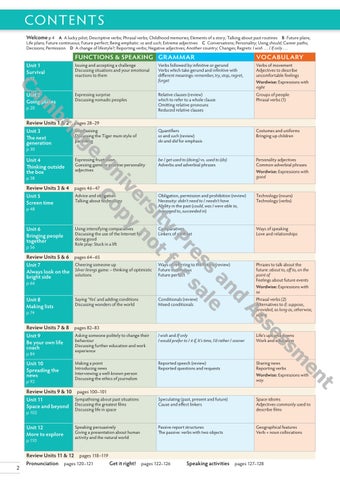
CONTENTS Welcome p 4 A A lucky pilot; Descriptive verbs; Phrasal verbs; Childhood memories; Elements of a story; Talking about past routines B Future plans; Life plans; Future continuous; Future perfect; Being emphatic: so and such; Extreme adjectives C Conversations; Personality; Using should; Career paths; Decisions; Permission D A change of lifestyle?; Reporting verbs; Negative adjectives; Another country; Changes; Regrets: I wish … / If only …
FUNCTIONS & SPEAKING GRAMMAR Unit 1 Survival p 12
m Ca Unit 2 Going places
Verbs followed by infinitive or gerund Verbs which take gerund and infinitive with different meanings: remember, try, stop, regret, forget
Verbs of movement Adjectives to describe uncomfortable feelings Wordwise: Expressions with right
Expressing surprise Discussing nomadic peoples
Relative clauses (review) which to refer to a whole clause Omitting relative pronouns Reduced relative clauses
Groups of people Phrasal verbs (1)
Quantifiers so and such (review) do and did for emphasis
Costumes and uniforms Bringing up children
be / get used to (doing) vs. used to (do) Adverbs and adverbial phrases
Personality adjectives Common adverbial phrases Wordwise: Expressions with good
p 20
br
Expressing frustration Guessing game to practise personality adjectives
p 38
As d an s le es sa Pr r y fo it t rs no ve y ni p
U
Unit 4 Thinking outside the box
ge
id
Review Units 1 & 2 pages 28–29 Emphasising Unit 3 Discussing the Tiger mum style of The next parenting generation p 30
Review Units 3 & 4 pages 46–47 Advice and obligation Unit 5 Talking about technology Screen time
Unit 6 Bringing people together p 56
Review Units 5 & 6 Unit 7 Always look on the bright side
Obligation, permission and prohibition (review) Necessity: didn’t need to / needn’t have Ability in the past (could, was / were able to, managed to, succeeded in)
Technology (nouns) Technology (verbs)
Comparatives Linkers of contrast
Ways of speaking Love and relationships
Cheering someone up Silver linings game: – thinking of optimistic solutions
Ways of referring to the future (review) Future continuous Future perfect
Phrases to talk about the future: about to, off to, on the point of Feelings about future events Wordwise: Expressions with so
Saying ‘Yes’ and adding conditions Discussing wonders of the world
Conditionals (review) Mixed conditionals
Phrasal verbs (2) Alternatives to if: suppose, provided, as long as, otherwise, unless
Co
p 48
Using intensifying comparatives Discussing the use of the Internet for doing good Role play: Stuck in a lift
pages 64–65
p 66
Unit 8 Making lists p 74
experience
Making a point Introducing news Interviewing a well-known person Discussing the ethics of journalism
p 102
Unit 12 More to explore p 110
2
Discussing life in space
Speaking persuasively Giving a presentation about human activity and the natural world
Sharing news Reporting verbs Wordwise: Expressions with way
Speculating (past, present and future) Cause and effect linkers
Space idioms Adjectives commonly used to describe films
Passive report structures The passive: verbs with two objects
Geographical features Verb + noun collocations
t
Review Units 9 & 10 pages 100–101 Sympathising about past situations Unit 11 Space and beyond Discussing the greatest films
Reported speech (review) Reported questions and requests
en
p 92
Life’s ups and downs Work and education
m ss
Unit 10 Spreading the news
I wish and If only I would prefer to / it if, It’s time, I’d rather / sooner
se
Review Units 7 & 8 pages 82–83 Asking someone politely to change their Unit 9 behaviour Be your own life Discussing further education and work coach p 84
VOCABULARY
Issuing and accepting a challenge Discussing situations and your emotional reactions to them
Review Units 11 & 12 pages 118–119 Pronunciation pages 120–121 Get it right! pages 122–126
Speaking activities pages 127–128
SKILLS
Train to Think: Thinking rationally Self-esteem: How adventurous are you?
Reading Article: Sacrifice for survival? Article: The ultimate survivor Photostory: The challenge Writing An email about an experience Listening Radio show: Desperate Measures
Train to Think: Distinguishing fact from opinion Values: Learning from other cultures
Reading Article: Refugees bring new life to a village Blog: From London to Lyon Culture: Nomadic people Writing An informal email Listening Radio interview about migration in nature
Train to Think: Changing your opinions Self-esteem: Developing independence
Reading Blog: An embarrassing dad Book blurb and reviews: For and against – Tiger Mums Literature: About a Boy by Nick Hornby Writing An essay about bringing up children Listening Radio show about bringing up children in different cultures
Train to Think: Lateral thinking Values: Appreciating creative solutions
Reading Article: Lion lights Web post: A problem on Answers4U Photostory: Writer’s block Writing A story ending: ‘Thanks, you saved my life!’ Listening Talking heads – being imaginative
m Ca
PRONUNCIATION THINK Dipthongs: alternative spellings
Phrasal verb stress
br
ge
id
Adding emphasis
Pronouncing words with gh
As d an s le es sa Pr r y fo it t rs no ve y ni p
U
Reading Texts: Smart screens? Article: Great success for teenage teachers: When silver surfers get connected Culture: When pictures learnt to walk and talk: the history of film Writing Instructions Listening A conversation about watching too much TV
Linked words with /dʒ/ and /tʃ/
Train to Think: Exaggeration Values: Doing good
Reading Blog: The day people started talking Article: An Ice Cold Summer Literature: A kind of loving by Stan Barstow Writing An essay about social media Listening Radio show: Radio romances
Encouraging someone
Train to Think: Learning to see things from a different perspective Self-esteem: What cheers me up
Reading Blog: Me, Myself and My take on the World Website page: QUOTATIONSforWORRIERS Photostory: The competition Writing A short story ending: ‘Every cloud has a silver lining’ Listening Radio show: Silver Linings
Weak forms with conditionals
Train to Think: The ‘goal setting’ checklist Values: Lists
Reading Book review: The Checklist Manifesto by Atul Gawande Blog: Adrian’s list blog Culture: The New Seven Wonders of the World Writing An essay: A Modern Wonder of the World Listening An interview about why we make lists
Linking: Intrusive /w/ and /j/
Train to Think: Jumping to a hasty conclusion Self-esteem: Being diplomatic
Reading Presentation: Life and how to live it Quiz: Are you in control? Literature: The Remains of the Day by Kazuo Ishiguro Writing An article for the school magazine Listening A radio programme about life choices
Linking: Omission of the /h/ sound
Train to Think: Identifying the source of a piece of news Values: News or not?
Reading Magazine article: Everybody’s Tweeting Article: Bad news Photostory: The news clip Writing A magazine article about an interview with a well-known person Listening An interview with a foreign correspondent
Stress on modal verbs for speculation
Train to Think: Spotting flawed arguments Self-esteem: Who we are
Reading Article: They might not come in peace … Blog: My all-time favourite films about space Culture: Real Humans Writing A report about a problem on a school trip Listening A talk about the Voyager mission
Linking: Intrusive /r/
Train to Think: Exploring hidden messages Values: Human activity and the natural world
Reading Article: Our undiscovered world Article: Explorers: a friend to the native people Cândido Rondon Literature: The Lost World by Arthur Conan Doyle Writing A short biography Listening A talk about discovering new species
t
en
m ss
se
Train to Think: The PMI strategy Self-esteem: Learning from elderly people
Co
The schwa sound
3
WELCOME m Ca
A WHAT A STORY! A lucky pilot
br
1
id
1.02 Complete the conversation with the verbs in the correct tense. Then listen and check.
ge
crash | hit | find | add | end | pull | carry set | destroy | scream | manage | dive So, did you see that story about the plane that 0 crashed into the ocean? ANDY No, I didn’t. What happened? MIKE Well this guy 1 off from Florida in his plane – a small one, only one engine – to go to New Orleans. ANDY Wow – that’s a long way. MIKE Right, and it’s usually too far for a plane like that, but he had 2 extra fuel tanks. However, after he had begun his journey he realised he didn’t have enough fuel to 3 on flying, so he radioed New Orleans and told them that he was in trouble. He told them he had to land the plane in the sea. ANDY In the sea? MIKE Yes, there was a fishing boat not far away that was able to pick the pilot up. But here’s the incredible thing – and you can see it in a video. The plane had a parachute, but it didn’t work and the plane started to 4 towards the sea! But then almost at the last minute, the parachute pulled the plane horizontal, just before it 5 the water. The impact almost 6 the plane. ANDY And the pilot? MIKE He was OK. He 7 to get out of the plane and into a life raft from the fishing boat. Then the people from the fishing boat came and 8 him out of the raft and took him to the ship. He was OK, so he didn’t 9 up in hospital or anything. Now they’re trying to 10 out what went wrong. ANDY Wow – I’d have been so scared if I’d been in that plane. I’d have 11 really loudly! MIKE
Co
As d an s le es sa Pr r y fo it t rs no ve y ni p
U
2 3 4 5 6 7 8
demolish dive flee grab rage scream smash strike
a to hit very hard and break b to run away quickly c
d e f
g
h
to go down quickly to destroy completely to shout loudly in a high pitch to take hold of something quickly to hit to burn very fiercely
2 Use the correct form of a verb from Exercise 1 to complete each sentence. 0 1
3 4 5 6 7
t
2
The car went out of control and struck a lorry coming in the other direction. By the time the spy was identified, he the country. The house was old and unsafe so the local authority it. Come on, we’re late! your coat and let’s go! By the time the fire service got there, the fire for over twenty minutes. When she got back to her car, she saw that someone the window with a brick. I but nobody heard me. She off the bridge and into the river.
en
4
1
m ss
Where was the plane flying to and from? 2 Why had the pilot added extra fuel tanks? 3 What did the pilot use to try to land the plane safely in the sea? 4 How was the pilot rescued? 1
1 Match the verbs with the definitions.
se
2 Read again. Answer the questions.
Descriptive verbs
WELCOM E
Phrasal verbs
Elements of a story
1 Complete the sentences from the story. Then read again
1 Use a word from the list in each space.
and check.
plot | set | hero | characters ending | villain | dialogue
The pilot from California in his plane to go to Hawaii. 2 The pilot was OK so he didn’t in hospital. 3 Now they’re trying to what went wrong with the fuel calculations. 1
m Ca
I read a book last week called Vienna Trap. It was a thriller – a kind of detective story. It is 1 in Vienna, Austria. The 2 of the story is a woman called Vera, who helps many of the other 3 to escape from a terrible situation – they have been kidnapped by a horrible old man called Schwartz, who’s the 4 of the story. Anyway, the book’s quite good. I thought the overall 5 was quite exciting and it had a nice unexpected twist at the end. (I won’t tell you the 6 , though, in case you read the book yourself.) And I really liked the 7 , too – the conversations between the different characters sound like real people talking to each other. A good read – I’d recommend it.
2 Choose the correct options.
4 6
Co
8
Childhood memories 1
As d an s le es sa Pr r y fo it t rs no ve y ni p
7
U
5
ge
3
My father gave up / ended up smoking five years ago – he feels so much better now! If you’re bored, why don’t you give up / take up a hobby? If there’s a problem, tell me and we can sort it out / blow it out. Don’t stop! We have to get on / carry on running to the finish. We’re off on holiday – I’m looking forward to / looking into it. There are lots of good players here but she’s the best – she really stands out / looks out. We had to stay in the town because our car broke down / blew out. All the hotels were full, so we took up / ended up sleeping in a hostel.
id
2
br
1
Work with a partner. What do you remember about your first visit to the cinema? (e.g. who you went with, what the film was, etc). SPEAKING
2 Read the extract from an autobiography. Which of the things that you remember are mentioned?
3 Read the extract again and answer the questions. 1 2 3 4
SPEAKING In small groups, find an example of each of these from a film or book.
a great hero 2 a great villain 1
Talking about past routines Complete the sentences from the extract ‘Cinema paradise’. Use would or used to. I love going to the cinema when I was a kid. 2 My brother take me. 3 The hero always won, and we cheer when he did. 4 Some kids throw popcorn. 1
t
en
or at least, one or two rows back. The cinema sold ice cream and popcorn and we would buy as much as we could, and then sit and watch the films while stuffing ourselves with food. We loved the cartoons – we laughed a lot; our favourite was always Tom and Jerry and we cheered when we saw the opening pictures. And then there were the adventure films. The plots were often terrible, and the dialogues too, but we really didn’t care – after all, we were kids! We used to boo the villains and cheer the heroes. Some kids used to throw popcorn at the screen when the villain came on – the cinema
m ss
Cinema paradise I’m in my 60s now and used to love going to the cinema when I was a kid. Back in the 1950s, there used to be a thing called Children’s Matinee at the cinema in the town where we lived. It was wonderful! Every Saturday morning, the cinema would show films for kids – only kids. They showed cartoons and cowboy films, adventure films, detective films and science fiction – everything that kids loved back then (and I guess they still do!). My brother used to take me – he was five years older than me. We’d always try to get there early so we could get seats in the front row,
a great plot 4 a great ending 3
se
5
Who couldn’t go to the Children’s Matinees? Who did the writer go with? Why did they go early? When did the children usually cheer? When did they boo?
2
staff sometimes tried to stop us but usually they gave up! The ending was always completely predictable of course – the hero always won, and we’d cheer like crazy when he did! 5
B AN UNCERTAIN FUTURE Future plans 1
1.03 Read the conversation. Put the phrases into the correct places. Then listen and check.
m Ca
when you leave school get a good degree to start a family and then travel the world then retire before I think about settling down
br
So, Greg, have you thought about which university you want to go to yet? GREG I told you, Mum – I’m not so sure that I want to go to university. MUM But if you 1 , you’ll be guaranteed a secure future. You know, perhaps in ten years’ time, you’ll be managing a huge company! GREG But that’s just it, Mum – I don’t want to manage a big company or a small company either. I don’t want to spend forty years doing that, 2 and wonder where my life went. That’s not the future I want – I think. MUM Well, so what are you going to do 3 then? GREG I’m not sure yet. Maybe work, save a bit of money 4 for a few months, you know, get some life experience. MUM Well, that won’t do you much good. In this day and age, employers want people with work experience, not travel experience. GREG Well, maybe you’re right, Mum. But even so, I want some time for myself 5 . MUM There’s nothing wrong with settling down. That’s what your father and I did. GREG I know, Mum and that’s fine – it was fine for you and Dad, back in the last century. But the world’s different now and people have such different aims, ideas, everything! MUM Yes, I suppose so. You’re right. GREG But don’t worry, Mum. I mean, I’d like 6 some time. So you’ll be playing with your grandchildren one day – I hope. MUM Well, I’m delighted to hear that, Greg! MUM
ge
id
Co
As d an s le es sa Pr r y fo it t rs no ve y ni p
U
4 5
6
1 2
3 4 5 6 7
8
2
I intended to the world, but when I got to Greece, I loved it so much that I stayed. I have no idea what to do when I school. She got an excellent from Harvard. He worked really hard and after a few months he got . My grandfather worked for the same company for forty-two years, then he . A course in marketing is a good way to start a in sales. They bought a house and down in the town where they grew up. They feel they haven’t got enough money yet to a family.
Work in pairs and answer the questions. Then compare your answers in small groups. SPEAKING
At what age can people leave school in your country? Do you think this is the right age? Why (not)? 2 At what age can people retire in your country? Is it the same for men and for women? Do you think this is the right age? Why (not)? 3 Is it important in your country to get a degree in order to have a good career? Why (not)? 1
t
3
leave | settled | retired | travel | degree start | career | promoted
en
2
Greg and his mum have talked about university before. Greg’s father works for a big company. Greg definitely wants to leave school and travel. Greg’s mother values work experience. Greg would like to have children.
sentence.
m ss
1
1 Use the words from the list to complete each
se
2 Mark T (true) or F (false) or DS (doesn’t say).
Life plans
WELCOM E
Future continuous
4
1 Use the verbs in the list in the correct form to complete the sentences.
study | listen | live | work | travel | wonder
Extreme adjectives
In five years from now, 1 I’ll the world. 2 I won’t at home anymore. 3 I’ll at university. 4 Some of my friends will for companies. 5 I’ll to the same kind of music as I do now. 6 I’ll still what to do with my life.
1 Look at the emphatic statements in Exercise 2 again. Find words which mean:
m Ca
really scary 2 really good 3 really bad 4 really big 1
2 Write the words in the correct places. hot | delighted | interesting | exciting | huge | terrible scared | miserable | freezing | brilliant | tiny | funny
ge
id
br
2
SPEAKING Work with a partner. Which of the statements in Exercise 2 do you (not) agree with? Why (not)?
SPEAKING Work with a partner. Which of the statements are true for you? Which statements are true for your partner?
As d an s le es sa Pr r y fo it t rs no ve y ni p
U
Extreme adjective Gradable adjective 1 bad / awful 2 good fantastic / wonderful / / amazing 3 fascinating 4 terrified 5 hilarious 6 happy 7 sad 8 thrilling 9 big / enormous 10 small / minute 11 cold 12 boiling
Future perfect
Co
Complete the text with the future perfect form of the verbs in brackets. Don’t worry about Greg. He’ll be fine. By the time he’s twenty he 1 (leave) school and he 2 (save) enough money to travel around the world. By the time he’s thirty Greg 3 (travel) around the world and 4 (decide) what he wants to do with his life. And by the time he’s forty, Greg 5 (settle) down and 6 (start) a family.
3 Complete the mini-dialogues. Use a suitable
Being emphatic: so and such
extreme adjective.
1 Complete the sentences from the conversation on page 6.
sure I want to go to university. different aims, ideas,
1
1 2 3
or such. 0
Going to university is a fantastic idea.
4
1
3 4 5
3 Who do you think said the things in Exercise 2
– Greg or his mum? Write G or M in the boxes. 0 1
M
2
4
3
5
5 6
4
t
2
The thought of working in the same job for 40 years is terrifying. Travelling gives you important experience. It’s an awful waste of time to go travelling. Deciding to settle down is a huge decision. It’s amazing news that you want to start a family.
en
Going to university is such a fantastic idea.
m ss
2 Make these statements more emphatic. Use so
It’s cold in here, isn’t it? B Yes, it’s freezing ! A Are you happy they’re coming? B Yes, I’m . A He tells funny jokes, doesn’t he? B Yes, they’re . A This room’s small. B Small?! It’s ! A So, it’s good news, right? B Yes, it’s . A Were you scared? B Yes, I was. I was ! A Was the film really that bad? B Yes, it was. It was . A
se
I’m not 2 People have everything!
0
WRITING With a partner, write three more minidialogues using words from Exercise 2 that don’t appear in Exercise 3.
7
C HOW PEOPLE BEHAVE Conversations 1
1.04
Listen and match the conversations to the pictures. Write 1–3 in the boxes.
m Ca ge
id
br U A
1
What’s the matter with you? MEGAN Didn’t you see? I held the door open for that elderly lady; I let her go through in front of me. STEVE Yes, I saw that. It was very thoughtful of you. Very . MEGAN But she just walked past me and didn’t say ‘thank you’. She didn’t even look at me! It’s so , I think. STEVE Oh, you get so worked up. She was probably just thinking about something else. STEVE
2 MILLY JACK
MILLY
SARAH JASON SARAH JASON
8
I’m really fed up. I just heard that Paul, one of my best friends, is going to move to Canada. Oh, that’s a shame. But never , you’ve got other friends, haven’t you? Yes I know, but I’m going to miss him a lot. He’s really fun to out with. Well, you don’t to lose touch with him, do you? You can Skype. That’s right. And perhaps my parents will me go and visit him sometime.
● ●
Steve? Milly? Sarah?
Personality
Work in pairs. Choose six of the adjectives. For each one, think of something that someone could say or do to show that quality. SPEAKING
calm | cold | generous | kind | lively polite | rude | selfish | shy | thoughtful unfriendly | warm
If someone talks to you without smiling or being friendly – well that’s cold.
Using should
SPEAKING What could you say in the following situations? Use a form of should and a personality adjective.
0
Someone has given you an expensive present.
You shouldn’t have spent so much! That was so generous of you.
A friend of yours has said something unkind to a mutual friend. 2 Your friend wants to ask someone to dance but is shy. 3 A child doesn’t want to let another child play with a toy. 4 Someone is getting angry because another person was rude. 1
t
JASON
●
en
3
Work with a partner. What would you have said in these situations if you were: SPEAKING
m ss
JACK
Hi, Jack. Here are your headphones. My headphones! I’ve been looking for them. So, you took them? Yes – sorry, I should asked you, I know but … Well, give them back. You’re not to take my things without asking! OK. I’m sorry. But you don’t have to be so , do you?
3
se
MILLY
C
As d an s le es sa Pr r y fo it t rs no ve y ni p
Listen again. Complete the spaces with one word. 1.04
Co
2
B
WELCOM E
Career paths 1 Name these jobs. 2 Read the article quickly
and find which of the jobs in Exercise 1 it mentions.
m Ca
B
C
D
E
br
TIPS FOR CHOOSING A CAREER
ge
id
Choosing a career – something you’re thinking of doing for the rest of your working life – isn’t always easy but equally, it doesn’t have to be the agony that some people make it. Here are our tips to help you make up your mind.
A
SPEAKING Put the four tips (A–D) in order to show how useful you think each one is. (1 = most useful, 4 = least useful.) Compare your ideas with a partner.
As d an s le es sa Pr r y fo it t rs no ve y ni p
U
3
Co
A Don’t let other people tell you what to do! There are always people who want you to become a lawyer, or work in banking, or be a teacher. Listen to them, but remember it’s your life and it’s your decision, so be sure that you’re the one who makes that decision!
B Consider what you think you’re good at. It’s true that things like salary are important, but don’t let financial considerations lead you down the wrong path. Follow your heart and your personality – if you’re not very outgoing, don’t go for a sales job, even if the pay’s good. In the same way, if you don’t like work that involves paying lots of attention to detail, think long and hard before you decide to do something like applying to study engineering at university.
to you. 1 2 3
4 5
2
What do you find it difficult to m decisions about? When do you think it’s wrong to change your m ? Can you remember a time when you couldn’t m u your mind about something? Who do you talk to before you c t a decision about something? What kind of things do you think l and h about before making a decision?
Answer the questions in Exercise 1 for you. Make notes. Then discuss your answers in a group. SPEAKING
Permission
1 Use the correct form of make / let / be allowed to to complete the sentences. 1 2
5 6
2
t
4
You should never other people make decisions for you. No one can you do a job that you don’t want to do. In more and more jobs now, people work from home if they want to. My mother’s boss her work late sometimes. When my father worked in a bank, he smoke in his office – can you believe that? This company its employees start work at eight, nine or ten o’clock, as they like.
en
3
m ss
D Do something of value. Some people choose their career simply because they think they’ll earn huge amounts of money (although the careers which pay the most also have millions of people who never make it to the top). OK, if that’s what you want. But generally, people get more satisfaction out of their career if they feel they are doing something valuable for others. It doesn’t have to be charity work – it could be a job that helps other people, like being a child-minder. Just don’t forget that job satisfaction isn’t only about money.
1 Complete the questions. The first letter has been given
se
C Your first decision isn’t forever. Some lucky people get it right first time – they choose a job, find they love it and stick at it. But it isn’t always like that, so remember – you’re allowed to change your mind! Certainly, it’s no good agonising for years: maybe you’ve got three or four possible things you’d like to do, so come to a decision and try one – and if you don’t like it, try another one.
Decisions
WRITING Write sentences about your perfect job or career. Use make / let / be allowed to in some of your sentences.
My ideal company lets all the employees play their own music. 9
D NEW THINGS A change of lifestyle 1
1.05
Reporting verbs 1 Rewrite each sentence. Use the verb in brackets.
Read and listen to the conversation.
0
Where are Tom and Ingrid? 2 Who doesn’t want to be there? Why? 1
1
m Ca 2
1.05 Listen again and complete the conversation.
2 3
br
4
id ge
5
INGRID TOM INGRID
TOM INGRID
TOM INGRID
INGRID
Why has Tom agreed to do some exercise? Why is Tom not happy about wearing shorts? 3 Why, according to Ingrid, are people not worried about other people’s appearance? 4 Why do you think Ingrid says: ‘I’m beginning to wish I hadn’t invited you’?
a time someone persuaded you to do something a book or film that someone recommended to you 3 something you would not encourage another person to do 4 a time when you refused to do something that another person wanted 5 something you once agreed to do, and then regretted it 1 2
Negative adjectives
1 Write the negative form of these adjectives. happy 2 patient 3 possible 1
2 Complete the sentences using the negative form of an adjective in the list.
expensive | important | logical formal | responsible | polite 0 1 2 3 4
1 2
10
concerned 5 regular 6 legal 4
5
I don’t like spending a lot of money – I like to buy inexpensive things. It’s an party. Wear what you want. The way you dress for school is , it’s better to focus on your studies than what you wear. The way he was explaining the maths problem seemed . I didn’t understand. My brother never says ‘please’ or ‘thank you’, he’s so . You’ve got an exam tomorrow. It’s to go to bed late.
t
3 Answer the questions.
Work in pairs. Tell your partner about:
en
TOM
SPEAKING
m ss
INGRID
2
se
TOM
You said it opened at eight o’clock. And I was wrong! I’m sorry. Don’t be so 1 . It’ll be open very soon. I already wish I hadn’t come. Oh come on, Tom. We 2 , didn’t we? You said that you were fed up with your 3 lifestyle. True. And then you 4 me that the best thing to do was exercise. Right. And I 5 you to come with me to the leisure centre, and you agreed, so here we are. We’re going to work out a bit and then you’ll feel great. I always feel 6 wearing sports gear. I’ve got thin legs. Oh stop complaining, Tom. There’s nothing wrong with your legs. I asked you what I 7 wear and you said shorts. But I look terrible! Look, no one here cares – everyone is completely unconcerned about what other people look like, they’re all too busy doing exercise. That’s completely untrue! Tom, I’m beginning to wish I 8 invited you. Oh look, it’s opening. Come on then, let’s go in and start.
Co
TOM
As d an s le es sa Pr r y fo it t rs no ve y ni p
U
6
‘Please come to my party, Jim.’ (invite) She invited Jim to come to her party. ‘You should watch this film.’ (recommend) He ‘No – I won’t help you, Molly.’ (refuse) He ‘I’m late because there weren’t any buses.’ (explain) She ‘OK, I’ll lend you my jacket, Tony.’ (agree) He ‘OK, Alice – I’ll go to the cinema with you.’ (persuade) Alice ‘Go on – ask him, Sue!’ (encourage) I
WELCOM E
Another country 1 Read the blog. Which of the things in the photographs does Hayley not talk about?
m Ca
Hayley’s blog – from Bangkok! Hi everyone,
ge
id
br
Co
As d an s le es sa Pr r y fo it t rs no ve y ni p
U
Well, those of you who read my blog regularly know that I’ve moved – I’m now living in Bangkok, since my parents got jobs here and they’re on two-year contracts, so here we are. We got here about a month ago and we’ve found a place to live, so we’re starting to feel a bit more settled. It’s so different here from home. Well, that’s unsurprising, of course! For one thing, there’s so much traffic all the time, and for a country girl like me, who’s used to peace and quiet, it isn’t easy to deal with. Well, I guess I’ll get used to it, but it might take a while! I just wish someone had told me in advance that it would take me an hour to get from home to school every day – and an hour to get back! But I’ve made a resolution: I’m going to use my time travelling wisely – to learn to knit, perhaps, but mainly to learn Thai. I think I’m going to struggle because Thai has a different writing system and incredibly difficult pronunciation, but I’m going to put my mind to it and I hope I can make some progress. (It’s a good thing lots of signs are in the Latin alphabet too, otherwise I’d be completely lost!) One of my friends told me to try to learn some Thai before coming here – if only I’d listened to him! It’d be quite a bit easier now I guess. One of the truly wonderful things here is the food – you may remember that I’ve already raved about how much I love Thai food. My favourite restaurant at home is Thai, so I’m used to all those spices, and I love them. But here – wow, the flavours are out of this world. Well, that’s all for now. I’ll write more soon!
2 Read again. What three things does Hayley have to get used to?
3
Think of two more possible things that Hayley has to get used to. Compare your ideas. SPEAKING
Use words from the list to complete the sentences.
0 2
4 5 6 7
2 Hayley wrote some emails to her friends back
home. Complete the things she said. Use verbs from the list to help you. say | wear | find | bring | know 0 1 2 3
4
I didn’t see Jack before I left – I wish I’ d said goodbye to him. Electronic things here are really expensive – if only a little more money! I went to a party last night and it was really hot – I wish a dress, not jeans. There are lots of beautiful temples here – if only a bit more about Buddhism before coming here. Our flat here is quite small – I wish my dad a bigger one.
t
3
I just wish someone me in advance that it would take me an hour to get from home to school every day. 2 One of my friends told me to try to learn some Thai before coming here – if only to him! 1
en
1
Hayley’s made a resolution to use her travel time well. She’s thinking of knitting. She thinks she’s going to to learn Thai. She’s started learning already, but so far she isn’t . Moving to another country is a chance to some new habits. I love spicy food, so I could never eating curry. I need to get fit so I’ll have to change my a bit. I don’t think I’m ever going to my bad habits.
Then read again and check.
m ss
resolution | break | ways | doing well taking up | struggle | give up | form
1 Complete the sentences from Hayley’s blog.
se
Changes
Regrets: I wish … / If only …
11
m Ca
1 SURVIVAL
OBJECTIVES FUNCTIONS: issuing and accepting
a challenge
GRAMMAR: verbs followed by
infinitive or gerund; verbs which take gerund and infinitive with different meanings: remember, try, stop, regret, forget VOCABULARY: verbs of movement; adjectives to describe uncomfortable feelings
ge
id
br Co
As d an s le es sa Pr r y fo it t rs no ve y ni p
U READING
1 Look at the photos. Can you see a summit, a rope, a glacier and a crevasse?
2 Imagine spending time in an environment like this. What
A Then something dramatic happened.
1
E F G H
What do you think of the decision that Simon made? 2 What decision do you think you would have made if you’d been in Simon’s position? 3 Joe Simpson is now a motivational speaker whose presentations are very popular. Why do you think this is the case and would you go to see one of his talks if you had the chance? Give reasons.
t
D
en
C
Simon couldn’t talk to him or see him. Several teams had tried before, but they had all failed. Both men knew that it would be almost impossible to survive the situation. Despite his extreme injuries, he had managed to crawl out of the crevasse. And they had run out of fuel for their stove. When he finally arrived at base camp, he was absolutely exhausted. The weather conditions were dreadful.
m ss
B
se
from the article. Choose from the sentences A–H the one which fits each gap (1–7). There is one extra sentence.
Read and listen to the article to find out what went wrong for two mountain climbers. 1.06
4 Read the article again. Seven sentences have been removed
12
SPEAKING Read what Joe Simpson said in an interview about his relationship with Simon Yates after the event. Then discuss the questions.
In a paradoxical way, in cutting the rope, which nearly killed me – and to his mind, he had killed me – he put me in a position to save my own life, and I owe him the world for getting me into that position … I’d like to say I could have done the same thing. I’m not sure, though. So it was never an issue with Simon and I, and we’ve been close friends for the last […] 20 years.
kinds of things could go wrong? What are the dangers? Make a list.
3
5
1 SU RV I VA L
Sacrifice for survival?
m Ca
This is the story of two ambitious mountain climbers, Joe Simpson and Simon Yates, whose story was later turned into a film. Touching the Void, and it started with an outstanding success. Joe and Simon managed to climb the West Face of Siula Grande in the Peruvian Andes. 1
br
After reaching the summit, Joe and Simon decided to go back down via the North Ridge, an extremely risky but faster route. Their ascent had already taken much longer than they had intended because of bad weather.
2
ge
id
So it wasn’t possible for them to melt ice and snow for drinking water any more. It was getting dark too, and they knew they needed to descend quickly to the glacier, about 1,000 metres below.
3
5
As d an s le es sa Pr r y fo it t rs no ve y ni p
U
Joe slipped and landed awkwardly, breaking his leg. Both Simon and Joe were in shock. They were at a They were freezing. They had no communication with the base camp, and there was height of 6,000 metres. 4 no chance of a rescue helicopter or any other form of outside help. The situation was really dangerous, not just for Joe, but for both of them. As an enormous snowstorm was building up around them, Simon tied two ropes together, tied them around Joe, and started lowering his injured friend. Suddenly, the knot got stuck between two rocks and Joe was left hanging from a cliff, in mid-air over a huge crevasse.
Co
He tried desperately for more than an hour to pull his friend up, but without success. The situation was absolutely hopeless. Simon imagined both himself and his friend dying in the snow and ice. He didn’t want to leave his friend alone, but the more he thought about it, the more he began to understand that there was no way he could save both his own life and that of his friend. For a moment, Simon felt like giving up. But then he decided to cut the rope and save his own life. Joe fell away, right down to the bottom of the crevasse. The next day, when Simon continued down the mountain and passed the area where Joe had landed, he saw nothing, and assumed he was dead.
For the next three and a half days, he continued to descend the mountain, crawling and hopping on one But he wasn’t. Joe had survived the fall. 6 The others leg under extremely difficult conditions. He even managed to cross a glacier with no safety equipment or rope assistance whatsoever. 7 were thrilled and amazed to see him especially because they had been preparing to leave. Joe’s incredible determination and the fact that he hadn’t given up under the most desperate conditions had helped him to save his own life.
Thinking rationally
1
3 4 5 6
You have an important test tomorrow and your friend wants you to go to a party tonight. 2 You haven’t been feeling well for several days. A tells you to go to a doctor. B tells you to take some medicine. You like B better than A. 3 You borrowed a friend’s bike and had a small accident – there’s a scratch on the bike that isn’t easy to see. 1
t
2
Siula Grande is part of the Andes region of Peru. The two climbers had already reached the summit. Joe had a broken leg. There was no way they could get help from anywhere. Their way back down was via the North Ridge. The rope got stuck and it was completely impossible to pull Joe out of the crevasse.
SPEAKING Read the situations. For each one, think about what you might want to do and what you should do. Then compare ideas with a partner.
en
Simon in making his decision to cut the rope?
3
m ss
1 Which of the following facts were relevant for
SPEAKING Work in pairs. Discuss how Simon may have felt when he made his decision.
se
Solving a problem requires decision-making. In a difficult situation we may need to make sure that we are not distracted by irrelevant ideas, so we can look at the facts that are relevant for making the right decision.
2
Pronunciation Dipthongs: alternative spellings Go to page 120.
13
GRAMMAR Verbs followed by infinitive or gerund
2 Use the verbs in the list to complete the sentences. Use the gerund or infinitive.
1 Read the sentences from the article on page 13 and choose
the correct words – there are two sentences in which both options are possible. Then complete the rule with a gerund and an infinitive.
m Ca 1 2
6
ge
5
id
4
br
3
Joe and Simon managed to climb / climbing the West Face of Siula Grande. Simon tied two ropes around Joe, and started to lower / lowering his injured friend. Simon imagined both himself and his friend to die / dying in the snow and ice. For a moment, Simon Yates felt like to give / giving up. But then he decided to cut / cutting the rope and save his own life. He continued to descend / descending the mountain.
●
imagine, feel like, suggest, practise, miss, can’t stand, enjoy, detest, and don’t mind with 1 . manage, want, decide, refuse, hope, promise, ask, learn, expect, afford, offer and choose with 2 . begin, start and continue with 3 , or 4 with no difference in meaning.
VOCABULARY Verbs of movement
2 3 4
5
6
Co
●
1
7 8
Workbook page 10
3 Complete the sentences with the correct forms of the verbs from Exercise 2.
1 Complete the sentences with the correct verbs in the list. Check in the article on page 13.
1 2
They managed to the West Face of Siula Grande. They knew they needed to quickly to the glacier. 3 For the next three and a half days, he continued to descend the mountain, and on one leg.
3
2
4
climb 2 crawl
1
b
d e f g h i j
14
6 tiptoe
leap 8 swing 7
rush 10 descend 9
to jump on one foot to walk around without any clear purpose or direction to move easily and without stopping in the air, backwards and forwards or from one side to the other to walk on your toes, especially in order not to make a noise to go or come down to go up, or to go towards the top of something to (cause to) go or do something very quickly to make a large jump from one place to another to move slowly on hands and knees to walk or move with difficulty as if you are going to fall
5 6 7
t
c
5 stagger
en
a
hop 4 wander 3
m ss
2 Match the words with their definitions.
They looked down and then slowly started into the steep valley. We spent the morning around the harbour, looking at the boats. At the zoo the monkeys were from the trees. The plane quickly after take off until it reached 10,000 metres. Their daughter was asleep, so they around the house. She was badly injured, but managed next door and ask for help. When I hurt my ankle, I had to around the house on one leg. As soon as I heard Jo was back, I to her mum’s house to see her. There was a hole at the bottom of the fence, and we managed through it. He saw the snake and in no time he onto the table.
se
crawling | climb | hopping | descend 1
The weather was great on Sunday, but I didn’t feel like a mountain. My friend suggested on a bike ride. Nobody asked us our tickets as we entered the cinema. I gave Sarah a copy of Joe Simpson’s book Touching the Void. She says she’s really enjoying it. Can I borrow your umbrella? I can’t stand around in the rain. I wanted new skis, but I couldn’t afford them. I don’t mind my brother with his homework. Can you imagine caught in a snowstorm for hours?
As d an s le es sa Pr r y fo it t rs no ve y ni p
●
U
RULE: We follow the verbs:
read | help | climb | be | go walk | get | buy | show
8
9
10
Workbook page 12
1 SU RV I VA L
LISTENING 1
Listen to an extract from the Radio Show Desperate Measures. How does the show work?
2
Listen again and complete the sentences. Use between one and three words.
1.09
1.09
Desperate Measures is a radio show for . The winner is the person who gives the most and answer. Dawn argues that it is always rude to speak with in your mouth. Philip argues that it’s your own if you get into an awkward situation. He says that if you your room you’ll never get into an embarrassing situation. Amanda’s imaginary scenario is in a with some friends. She suggests the tactic of looking as if you’re . She recommends keeping your closed.
m Ca
1 2
Co
8
GRAMMAR Verbs which take gerund and infinitive with different meanings: remember, try, stop, regret, forget 1
1.09 Complete the sentences from the listening with the verb in brackets. Use the correct form. Listen and check.
Other verbs Try + 7 means try hard to see if you can do something that is really not easy. Try + 8 means do it and see what the results are. 9 Stop + means to not continue doing a certain activity or action. Stop + 10 means make a pause in one activity in order to do a different activity.
3 Complete each sentence with the verb in brackets in the correct form. 1 2 3 4 5 6 7
m ss
8
On the way to work, Dad stopped some magazines. (buy) I really regret Jim. He’s going to tell Martha, I’m sure. (tell) When you go into town, please remember some paper for the printer. (get) Don’t forget food for my packed lunch tomorrow, Mum. (buy) Sarah stopped the guitar a few years ago. (play) I just can’t solve this puzzle. I’ve been trying the answer for hours. (find) My ankle hurts. I tried some cream on it, but it hasn’t helped. (put) I remember strawberry ice cream when I was very small. (love)
se
Workbook page 11
en
Remember a snack with you wherever you go. (take) I remember a sandwich during a Maths class once. (eat) 2 I regret it as the teacher saw me and told me off. (do) I regret you that you’ve run out of time. (tell) 3 Try that you don’t feel awkward but it won’t work. (pretend) Try a place where you can sit down and pretend to be asleep. (find)
1
Remember + 1 means thinking of a past experience you’ve had. Remember + 2 means don’t forget to do something. Forget + 3 means to no longer think of something that you did. Forget + 4 means to not think of doing something you should do or should have done. Regret + 5 means feeling sorry about something you said or did in the past. Regret + 6 means feeling sorry about something you are going to say or do next / in the future.
As d an s le es sa Pr r y fo it t rs no ve y ni p
7
U
6
ge
5
id
4
br
3
RULE: Remember, forget, regret
t
2 Match the sentences and pictures (A–D). Then complete the rule with gerund or infinitive.
She should stop to rest, but she needs to finish her work today. 2 She should stop resting, but she just doesn’t want to go back to work. 3 He forgot to meet Sandra. 4 He’ll never forget meeting Sandra for the first time. 1
A
B
C
D 15
VOCABULARY Adjectives to describe uncomfortable feelings 1 Read the sentences and choose the correct adjectives. 1 2
m Ca
3
When I’m with Mrs Meyer I always feel awkward / guilty. It’s difficult to find something to talk about with her. Karen ought to be desperate / ashamed of herself – talking to her mother like that! Carl must have done something wrong, because he’s looking so guilty / puzzled. After the earthquake, the people on the island were desperate / awkward for help. We’re a bit stuck / puzzled as to why we haven’t heard from them for weeks. Without your help we’d be ashamed / stuck and wouldn’t know what to do next.
4 5 6
br
2 Now write the adjectives from Exercise 1 next to their definitions. : feeling extremely embarrassed about something you have done : feeling confused because you do not understand something : feeling you are in a difficult situation, or unable to change or get away from a situation : feeling embarrassed or uncomfortable : feeling worried or unhappy because you have done something wrong : feeling the need for or wanting something very much Workbook page 12
ge
2
id
1 3 4 6
Co
SPEAKING
As d an s le es sa Pr r y fo it t rs no ve y ni p
U
5
1 When you are stuck with a problem, which of these three things apply to you? Add three more of your own.
I go online and look for some advice. I stop thinking about it and listen to some music. I start feeling helpless.
2
1 Look at the photos and the
headline of the article. Which of these things do you think you could learn from Bear Grylls? how to build a fire how to use GPS effectively how to build a shelter in the wild how to survive outdoors in bad weather how to set up your own survival website how to tie knots
Write down three sentences to describe problems and your emotional reactions to them. Use adjectives from Vocabulary, Exercise 1. WRITING
● ●
I have a test tomorrow and I haven’t studied enough. I’m desperate. It was my best friend’s birthday last Monday and I forgot to give her a present. I’m feeling guilty.
3 Work in small groups. Listen to each other’s problems and tell
3 Answer these questions based on your own opinions. Use evidence from the text to support your ideas.
What do you think motivates Bear Grylls? 2 Why are his TV shows so popular? 3 Do you think Bear Grylls is successful? Why (not)? 4 What does Bear Grylls think of the way many young people grow up these days? 1
t
en
Try to relax before the test. Listen to some music, or go for an early morning walk.
answers.
m ss
Stop feeling desperate. Maybe the test won’t be very difficult. Otherwise remember to start studying earlier the next time round.
2 Read the article and check your
se
each other what to do.
16
READING
The
1 SU RV I VA L
ULTIMATE SURVIVOR
m Ca ge
id
br ddemonstrate survival techniques. Millions oof viewers watched, breathless, as he kkilled the most poisonous snakes and ate tthem, climbed extremely dangerous cliffs, pparachuted from helicopters and balloons, pperformed amazing ice climbing stunts, ran tthrough a forest fire, and ate all kinds of iinsects.
YYoung Survivors Award. Techniques taught iinclude how to build and light a fire, how to nnavigate in both day and night, building a sshelter, extreme weather survival, tracking aand hunting and tying knots. A key focus oof the course is getting young survivors bback in touch with nature and away from ttechnology.
G Grylls continues to impress with both his aamazing shows, and his incredible charity w work. And he has set up his own company, B Bear Grylls’ Survival Academy, where eeveryone can learn survival skills from him aand his team of highly trained experts.
IIn Grylls’ own words: ‘The thing I love aabout the Young Survivor Course is that iit is designed to put young adults in just tthe sort of challenging, character-building aand practical situations that help define aand distinguish people as adults. So often, yyoungsters can feel almost over-protected aand are stopped from experiencing some oof the best things in life – but the Young S Survivor Award will challenge and empower tthem in an incredibly dynamic and fun eenvironment.’
Co
As d an s le es sa Pr r y fo it t rs no ve y ni p
U
When he was 20, he broke his back in three places in a parachuting accident. He climbed Mount Everest at the age of 23. Shortly afterwards, he led a trek across the frozen North Atlantic. In 2007, he set another world record by flying over Mount Everest in a powered paraglider. This helped to raise one million dollars for the Global Angels Foundation, a charity that supports children in Africa.
His first book, Facing the Frozen Ocean, got shortlisted for the UK’s ‘Sports Book of the Year’. Since then he has written more than 15 books, including the No 1 Bestseller: Mud, Sweat and Tears. His name is Bear Grylls, and he was the host of Discovery Channel’s famous TV show, Man vs Wild. In the show, he was left stranded in remote locations in order to
R Recently, Grylls founded Young Survivors – ttraining courses for teenagers, comprising a ccombination of survival skills and adventure ttasks designed to teach the fundamentals oof outdoor survival and self-rescue. Those w who complete the course are given a
2
SPEAKING Which of the points below are relevant to each of the activities in your list? Discuss.
about the activities you’ve been doing. how you felt while you were doing them. ● what you’ve learned from them. ● about the people you’ve met. ● how you feel about the whole experience so far. Write 150–200 words. ● ●
t
helps you to improve your fitness gets you out of your daily routine teaches you how to assess and deal with risky situations offers opportunities to learn something new offers you a challenge gives you a chance to feel free allows you to have fun with your friends helps you to be more confident teaches you to accept your personal limits
Imagine you are on a Bear Grylls course. Write an email home to your parents. Tell them:
en
SPEAKING Write a list of four or five adventurous activities. In pairs, discuss which of the activities from your lists you would like to try (or have tried). Give your reasons.
m ss
1
WRITING An email about an experience
se
How adventurous are you?
17
PHOTOSTORY: episode 1 1 Look at the photos. The four friends have issued
ge n e l l a h c The
each other a challenge involving their phones. What could it be?
2
Now read and listen to the photostory. Check your ideas. 1.10
m Ca
br
EMMA It’s been such a busy week. LIAM Too right. So many things to do. NICOLE Same here. And all of these projects for
school. It’s been fun, though. Hasn’t it, Justin?
id
JUSTIN Sorry? EMMA Oh, come on, Justin. You’re not listening to
us at all.
ge
NICOLE Always on your phone doing something
or other.
JUSTIN Sorry. I know it’s a bad habit, but whenever
U
someone texts me I’ve just got to reply right away..
As d an s le es sa Pr r y fo it t rs no ve y ni p
NICOLE Seems like we’re not important to you any
Co
more. You’re constantly on the phone. Oh, sorry. Oh, hi, Julia. Yeah … sure I’m going … yes, we’re all going … No idea … Hang on a sec. Let me ask … Guys? When’s the Chilly Balloons concert? Is itt next week? JUSTIN On the 7th, nine o’clock. NICOLE Julia? On the 7th at nine o’clock … I’ll be at home, I guess. Sure … OK. Well, I have to be off now, but give me a shout over the weekend when you have time. OK, bye! … Right. Where were we?? JUSTIN Seems like we’re not important to you any more. You’re constantly on the phone. NICOLE Hang on – it was Julia and it was important. t. I was only helping her. EMMA Did you hear that the cheapest tickets to the e concert are £42? LIAM What? That can’t be right. Let me check. Here e we are. Chilly Balloons … Saturday 7th … tickets ts from £25.00 to £100.00. EMMA Oh, that doesn’t sound too bad. Thanks, Liam. NICOLE You know what? We’re telling Justin off for being on his phone too much, but we’re all just as bad. JUSTIN Ha! True! Hey, I challenge us all not to use our phones for the whole weekend. Not once. I bet you can’t. NICOLE Ridiculous. Of course we can. Why wouldn’t we be able to? EMMA Oh, come on. Th ree days without a phone? No problem! JUSTIN OK. Let’s try it, shall we? You’ll never survive the weekend without your phones. You’ll see. Anyone who uses their phone has to treat the others to coffee or whatever they want at the café. OK? EMMA OK. I’m in. JUSTIN No phones, right up to Monday morning, starting now. Deal? OTHERS Deal!
t
en
m ss
se
18
1
2
1 SU RV I VA L
DEVELOPING SPEAKING 3 Work in pairs. Discuss what happens next in the story. Write down your ideas.
WordWise
We think that two of them succeed and two of them don’t.
1 Look at these sentences from the unit so far. Complete
Expressions with right
m Ca 4
them with phrases from the list.
Watch to find out how the story continues. EP1
right? | right away | Too right right up to | All right! | Right …
3
4 5 6
B
2 Complete the sentences with a phrase using right.
Co
1 2
PHRASES FOR FLUENCY
3
1 Find these expressions in the story.
4
Who says them? How do you say them in your language? 1 2 3 4 5 6
Same here. something or other Give me a shout Where (were we)? You know what? (It’s a) deal!
2 Use the expressions in Exercise 1 to complete the dialogues.
A I was really busy over the weekend.
6
.
Workbook page 12
FUNCTIONS Issuing and accepting a challenge
1 Read the phrases. Which ones are used to issue a challenge? Which ones are used to accept or turn down a challenge?
WRITING Work in pairs. Write short dialogues between two people, where one challenges the other. Use these ideas and one of your own.
t
2
I challenge you to … 6 No problem. 7 You’ll never manage to … 8 Of course I can. 5
en
I bet you can’t … 2 I think you’re (probably) right. 3 I bet (you) I can … 4 That’s too easy. 1
m ss
No time to relax! I always had to do. B ! I didn’t stop for a moment. 2 A Listen, if you find the homework difficult, and I can try to help you. Then maybe you can make us a snack later. B ! Thanks a lot, Georgia. 3 A This exercise is exhausting. B You’re right. ? We should have a break. 4 A So, I think we should do that. B Hang on, let me answer this phone call. … Sorry about that. Right, ?
5
You’re the new girl at school, ? The party was great. I stayed the end. There’s a problem at home. I need to leave , everyone. I want you all to listen … A That film was terrible. B . I hated it as well. A Can you give me a hand with my homework? B . I’ll be with you in a minute.
se
1
I just feel like I’ve got to reply . A It’s been such a busy week. B . So many things to do. No mobiles, Monday morning. Deal? You know my friends Emma, Justin and Liam, OK, bye! , where were we? A I told you. No technology all weekend.
As d an s le es sa Pr r y fo it t rs no ve y ni p
5
3
U
4
2
ge
2
1
Why does Nicole’s dad think she doesn’t answer her phone? What did Emma do that meant she lost the challenge? What did Liam do or not do about the challenge? How long did Justin manage to not use his phone for? What did Nicole do that meant she didn’t win the challenge?
id
1
br
5 Answer the questions.
● ● ● ● ●
eat a doughnut without licking your lips stay awake for twenty-four hours walk twenty kilometres in four hours finish this exercise before me speak only in English during break times and lunchtimes for a whole week 19
2 PLACES GOING
m Ca
READING
br
ge
id
2
U
3
SPEAKING Work in pairs or small groups. Look at the photos and these phrases from the article. Discuss what you think the article is about.
3 4 5
Compare your ideas with other students.
6
Co
● ●
which to refer to a whole clause; omitting relative pronouns; reduced relative clauses VOCABULARY: groups of people; phrasal verbs (1)
Many people in the 1990s left Riace because they didn’t like it any more. The refugees didn’t have to do anything to get food and accommodation. The refugees already spoke Italian. New houses were built for the refugees. About a hundred immigrants live in Riace now. More local people are leaving Riace. Many politicians have criticised Lucano’s ideas. Lucano won the 2010 ‘World Mayor’ award.
As d an s le es sa Pr r y fo it t rs no ve y ni p
SPEAKING
4
1
the language
2
●
GRAMMAR: relative clauses (review);
article again and find the lines which show they are incorrect. Then correct the sentences.
What things do you have to get used to? Add two more things to this list. Then put the six things in order of difficulty for you (1 = most difficult).
●
FUNCTIONS: expressing surprise
5 All of these statements are incorrect. Read the
1 Imagine you are going to live in another country.
the climate the food local customs
OBJECTIVES
a shortage of jobs the creation of workshops began to welcome refugees the renovation of houses
1.11 Read and listen to the article and check your ideas.
7 8
6
Work with a partner and discuss the following questions. SPEAKING
What two questions would you like to ask: a a resident born in Riace? b an immigrant living and working in Riace? 2 Do you think things will continue to go well in Riace in the future? Why (not)? 1
t
en
m ss
se
20
2 GO I N G PL ACES
Refugees Bring New Life to a Village
R
m Ca
iace is a small village in Calabria, which is a very pretty region of Italy, but also quite a poor one. Riace once had a population of 3,000, but in the 1990s a shortage of jobs meant that many of the inhabitants, especially young people, left the village to find work in other places. The only school closed. There were no restaurants and very few shops. Many houses were empty. Riace was becoming a ghost town. But these days it’s a different story, because of one man whose dreams have turned Riace into a village with a future. One day in 1998, Domenico Lucano, a teacher from Riace, was driving near the sea when he saw a large group of people on the beach. They were refugees who had arrived by boat to escape problems in their countries. Lucano had an idea of how to help these people and how they, in turn, might possibly help him save his village. He decided to welcome them into the village and to give them
ge
id
br
Co
As d an s le es sa Pr r y fo it t rs no ve y ni p
U
food and accommodation in return for work. The refugees also had to learn Italian. It was the beginning of a plan. Lucano created an organisation called Città Futura, or City of the Future. The idea was simple: Riace desperately needed more inhabitants and there were plenty of people in the world looking for a home. The village began to welcome refugees from Somalia, Afghanistan, Iraq, Lebanon and other places. Lucano used buildings which w ic wh ichh had had been been empty empty for years to house the new arrivals, and he created workshops for them to work rk in.
Riace is now home to between two and three hundred immigrants, who live happily alongside the locals. Most of the women make handicrafts to sell in local shops, while the men renovate empty houses to rent to tourists. But it is not only the refugees who have gained from Lucano’s plans: Città Futura also has 13 local employees, which makes it the biggest employer in the village. And because of the arrival of more children, the school is open again. Lucano, who became mayor of Riace in 2004, has managed to create jobs and to stop the villagers moving away, while at the same time helping some of the poorest and most desperate people in the world. Many politicians have visited Riace hoping that they can use Lucano’s ideas in their own towns and cities. The German film director Wim Wenders also went there and was inspired to make a short documentary about the village called Il Voloo ((The The Flight). t Lucano himself was voted third in the 2010 ‘World Mayor’ competition, and was praised for his courage and compassion.
2 Here are things people said to Domenico
2
parents. B Does that mean that there has never been a young person who liked travelling with their parents? 2 A I’m convinced listening to music keeps you healthy. B What evidence is there that proves you are right?
t
A Teenagers never want to travel anywhere with their
I’m sure these refugees are trouble makers.
3
Don’t invite these people to our village. They’re poor and will only create problems.
4
It’s a bad idea to put people from different countries together. They might not get on.
5
These people can’t survive in our village. There’s just no work for them.
of the question (B) that follows each of them? 1
All the young people are moving away. Our town has no future.
en
1 Read the two statements (A). What is the purpose
1
m ss
People often have disagreements because they confuse opinions with facts. A fact is something true for which there is usually proof. An opinion is a thought or belief and may not be true. When you want to know if what someone is saying is really true, it’s important to ask the right questions to help you separate opinions from facts.
Lucano when he was about to start his project. Work in pairs and find good questions that he could ask to separate opinions from facts.
se
Distinguishing fact from opinion
21
GRAMMAR Relative clauses (review)
5 What does this refer to in each of the
second sentences below? Rewrite the pairs of sentences as one sentence.
1 Read the sentences from the article about Riace. Look
0
at the underlined parts. Then complete the rule by writing A, B, C or D.
A lot of tourists visit, which is good for the town.
m Ca
A Riace is in Calabria, which is a very prett y region of Italy.
Lucano used buildings which had been empty for years to house the new arrivals. C They were refugees who had arrived by boat. D Lucano, who became mayor of Riace in 2004, has managed to create jobs. B
Some people go and live in another country. This is not always easy. 2 You have to learn new customs. This can be challenging. 3 Some people are nervous about strangers. This makes life difficult for new arrivals. 4 Sometimes there are differences in culture. This often results in misunderstandings. 1
id
br
ge
RULE: We use a defining relative clause to identify an object (which / that), a person (who / that), a place (where) or a possession (whose). Without this information, it’s hard to know who or what we’re talking and 2 ) about. (e.g. Sentences 1
U
Co
2
SPEAKING Complete each sentence with who, which or that. Are they defining or non-defining relative clauses? Then discuss the statements with a partner.
I don’t understand people decide to go and live in another country. 2 Sometimes people don’t like strangers come and live in their town. 3 A stranger is just someone isn’t your friend yet. 4 Sometimes it’s just a person’s appearance makes us like them or not. 1
3 Join the sentences to make one sentence by including
VOCABULARY Groups of people
Complete each sentence with a word from the list.
the audience | motorists | pedestrians residents | the crew | the staff | employees employers | immigrants | politicians refugees | inhabitants 0 1 2 3 4 5
The people were tired. They had come a long way.
6
4 Read the two sentences from the article. What does which refer to in each sentence?
Riace is a small village in Calabria, which is a very pretty region of Italy. 2 Città Futura has 13 local employees, which makes it the biggest employer in the village. 1
8
9 10 11
t
which to refer to a whole clause
7
en
The locals gave them food. The locals were kind. 2 Rome is an exciting place. It is my favourite city. 3 I’ve been reading a book by William Boyd. Boyd is one of my favourite writers. 4 My neighbour Rubens has been living here for ten years. Rubens is from Guatemala.
m ss
The people, who had come a long way, were tired.
1
People who watch a play / film / concert are the audience . People who walk on a street are called . A group of people who work for an organisation are . People who drive cars are called . A group of people who work on a plane or ship are . are people or animals that live in a specific place. People who are paid to work for other people are called . People who work in politics are called . are people who leave their own country because it’s too difficult or dangerous to live there. pay others to work for them. People who live in a certain place are the . are people who come to a different country to live there permanently.
se
a non-defining relative clause. Put commas in the correct places. 0
22
Workbook page 18
As d an s le es sa Pr r y fo it t rs no ve y ni p
We use a non-defining relative clause to add extra information. We don’t need this information to understand the sentence. We put commas around it. and 4 ) (e.g. Sentences 3
A lot of tourists visit. This is good for the town.
Workbook page 20
2 GO I N G PL ACES
LISTENING Migration in nature
m Ca ge
id
br A
wiilld w deb ebee eest ee s st
Arct Ar ctic ic ter erns ns
B
C
grey ey whales
Co
As d an s le es sa Pr r y fo it t rs no ve y ni p
U 1
2
1
Look at the photos and the maps. Which animals in the photographs make which journeys in the maps? Discuss your ideas.
FUNCTIONS Expressing surprise
2
Listen to a radio interview. Check your ideas. Write 1, 2 and 3 in the boxes.
1
SPEAKING
1.12
1.12
What do these numbers refer to? Listen again and check.
4
1.12
2 4 5 6
5
Correct these sentences. Listen again to check.
Grey whales swim to Alaska to have their babies there. Grey whales can be found near Alaska in the winter. The Mara River is at the beginning of the wildebeests’ journey. The Mara River is full of hippos. Arctic terns do their journey only once in their lifetime. People know how the terns always arrive at the same place.
SPEAKING
Work in small groups. Answer these questions.
Which of the animal facts you heard do you think is the most interesting? 2 Do you know about any other animals or birds who undertake amazing journeys? 1
1 2 3 4 5
(distance)! ! Good heavens. It’s , isn’t it? Wow. That’s . That’s .
2 Work in AB pairs. A thinks of
t
3
70,000 6 2,000,000 5
en
1
2,000 4 250,000 3
m ss
18,000 2 more than a million 1
1.12 Listen again to the radio interview. What phrases are used to express surprise? Can you think of any other phrases?
se
3
3
something surprising that he/ she knows. (You can invent something if you want!) A gives the information to B. B uses one of the expressions in Exercise 1 to reply, and asks a follow-up question. Then A and B change roles. 23
Becca’s Blog:
From London to Lyon
m Ca
Five not-sogood things about living abroad
br
ge
id
Regular readers of my blog already know that I’m a student living and studying in France for a year. Overall it’s turning out to be a great experience. But today I’ve decided to write about some of the challenges that living abroad can bring. Here we go.
D Homesickness
You know those Hollywood films where the foreigner is living a nice, easy, comfortable life in another country? Well, forget it – that’s not how it is. You have to do all kinds of things like open a bank account, find somewhere to live, pay bills, and so on. These things aren’t easy and they take time.
After a few weeks you’ll start to miss all kinds of things (and people) from back home. That special food, that TV programme, the friends who you used to hang out with. Well, it’s a phase you have to go through. If you’re really homesick, go home. Otherwise, keep going, the homesickness won’t last forever.
B Language problems
E Not everyone is happy that you’re there
Before I came, I thought my French was pretty good. But being here isn’t like French at school was. People talk to me like they talk to each other – fast! There’s new vocabulary which you have to pick up – the first time I went to a hairdresser, I didn’t know what to say! Speaking French all day wears me out. Often, at night, I’ll watch anything on TV in English! Anything!
Co
C You might not like it
It’s possible that after all the excitement of moving to another country, you become one of those foreigners who is unhappy abroad. I ran into some people who couldn’t wait to leave France after just a few weeks. Well, there’s no country in the world that suits everybody, right? It’s always a risk.
1 Look at the photo and the title of the
blog, and make notes on the following.
3 Read the blog again and answer the 1 3 4 5 6
24
form of the phrasal verbs from the list, then go back to the blog to check your answers. put up with | bring about | run into | turn out hang out with | pick up | go through | wear out 1 2 3 4 5 6 7 8
You have to a lot of new vocabulary. Being homesick is a phase that you have to . It’s not nice to hear people criticise you, but you have to it. Sometimes you miss the friends you used to . Speaking another language all day me . Living abroad is to be a great experience for me. I some people who wanted to leave France. Living abroad can some challenges and difficulties.
Pronunciation Phrasal verb stress Go to page 120.
t
2
What is Becca doing in France? Why does she say that it ‘isn’t a holiday’? Why is she sometimes tired at the end of the day? How were some other foreigners different from her? How does she suggest dealing with homesickness? How does she deal with comments about her that she doesn’t like?
1 Complete these sentences from the blog. Use the correct
en
questions.
VOCABULARY Phrasal verbs (1)
m ss
2 Read the blog and check your ideas.
Still, overall, I’m very happy to be here and I have no regrets at all about coming. Sure there are problems but you can run into problems wherever you are. The experience gained by living abroad is invaluable. Living abroad is fun and a huge learning opportunity too. It’s made me more aware of the world.
se
Where do you think the woman is? 2 Where do you think she’s from? 3 What is this blog entry about? 1
Mostly people are kind to me and happy to see me. But there are exceptions. Sometimes I go somewhere and someone says something like: ‘Oh, no, another English person!’ It’s not nice to hear, but you have to put up with it. I find it’s best to try and ignore that stuff and concentrate on the nice people I meet.
As d an s le es sa Pr r y fo it t rs no ve y ni p
U READING
A It isn’t a holiday
2 GO I N G PL ACES
Reduced relative clauses
2 Which of the phrasal verbs means: 0 1 2 3 4
3 Read these sentences. Where could you put the words that is and who is? Then tick the correct box in the rule. I’m a student living and studying in France. 2 The experience gained by living abroad is invaluable. 1
m Ca
make (someone) very tired meet (without having arranged to) learn (informally) tolerate experience (a difficult situation) have a particular result spend time with make happen
wear out
5 6 7
RULE: When relative clauses begin with a relative pronoun + the auxiliary verb be, we can omit: only the relative pronoun A B the relative pronoun + the verb be.
2 4
be left out.
Footballers 1who come from other countries to play in the UK often have problems. Some of the players 2who are playing in the UK now are quite young and so they easily feel homesick. And then there are things like food – people 3who were brought up on spicy food or exotic fruit don’t always like typical British food. But the biggest problems 4that they face seem to be the weather and the language. The country 5that they come from might be very hot, which the UK isn’t. It isn’t always easy for players 6who come from Brazil or Mexico, for example, to adapt to the grey skies and short winter days 7that they experience in England. And not all the foreign players learn English very well – the ones 8who do, tend to find it easier to adapt.
Co
As d an s le es sa Pr r y fo it t rs no ve y ni p
6
4 Cross out the words / phrases in italics that can
U
5
ge
3
Where do you like to hang out? And who with? What wears you out? Have you ever run into a teacher outside school? Can you think of any habits someone you know has that you have to put up with? What difficulties does someone have to go through when they leave school and start university? Do you think it’s possible to pick up new words from listening to English-language songs?
id
1
br
3 Answer the questions.
Workbook page 20
GRAMMAR Omitting relative pronouns
1 Read the two sentences from the blog. Where can you put that in each sentence? Is that the subject or object of the relative clause? Then complete the rule with the words subject and object.
Workbook page 19
It’s a phase you have to go through. 2 I concentrate on the nice people I meet. 1
Learning from other cultures 1 Imagine you live in another country. Put the
things in Becca’s blog (A, B, C, D, E) in order (1 = the most difficult, 5 = the least difficult).
omit the pronoun in italics, or a cross (✗) if you can’t omit it.
3 4 5 6
3
4
5
2 Choose the options that are true for you in these statements. Make notes about your reasons. 1 2 3 4 5
3
I’d like / I wouldn’t like to visit other countries. I’d like / I wouldn’t like to live in another country. I’m interested / I’m not interested in other cultures. Knowing about other cultures helps / doesn’t help me understand my own culture. I think / I don’t think it’s good to have people from other countries living in my country.
t
2
You’ll miss the friends who you used to hang out with. I ran into some people who couldn’t wait to leave. I’ve decided to write about some of the challenges that living abroad can bring. You become one of those people who wish they’d stayed at home. There’s new vocabulary which you have to pick up. There’s no country in the world that suits everybody.
2
en
1
1
m ss
2 Read these sentences. Put a tick (✓) if you can
se
RULE: When the relative pronouns that / which of a defining relative clause, / who are the 1 of they can be omitted. But if they are the 2 the defining relative clause, they can’t be omitted.
Compare your ideas about Exercises 1 and 2 with the class. How similar or different are you? SPEAKING
25
Culture 1 Look at the photos. What do they all have in common? 2
1.15 Read and listen to the article and check your answers.
m Ca
id
br
Nomadic People
ge
Most of us are used to living in the same place – every day, all year round, we go ‘home’. But for some people around the world, home is a place that moves. Here are three groups of people who have a nomadic way of life. stricter borders, severe droughts and urbanisation, nomadic life became more difficult in the 20th century. This led many Tuareg people to settle in towns and cities. Sometimes the Tuareg people are called ‘the blue people of the Sahara’, because of the blue turbans that the men wear, which often gives their skin a blue colour.
3 Aborigines
As d an s le es sa Pr r y fo it t rs no ve y ni p
U
1 The Tuareg
Co
2 The Shahsavan
The Aborigines are hunters and gatherers, almost always on the move. Principally it is the women who gather food and care for children, while the men are the hunters. They have very few possessions, and the ones they have are mostly light, since they need to keep moving in search of food and to maintain a balanced diet (they eat seeds, fruit and vegetables, as well as small animals, snakes and insects). However, they occasionally decide to settle somewhere and form villages.
t
en
This tribe lives in an area of northwest Iran and eastern Azerbaijan. There are approximately 100,000 of them. In the spring, the Shahsavan move from their winter home in Azerbaijan to their camps near Mount Sabalan, about 200 kilometres south, for the summer. Their journey usually takes around three or four weeks. Each day, they travel from midnight to midday, when the heat begins to prevent further travel. Traditionally, the women and children travelled on camels, and the men rode horses or walked, but increasingly the Shahsavan are using lorries and tractors. When they reach their destination, everyone (including children) is involved in setting up the main camp, consisting of various types of tent. They stay there until September, when the return journey begins. Many of the Shahsavan believe that their way of life is dying out, that their grandchildren will not do the annual migration any more.
m ss
26
The Aboriginal people of Australia have been living there for 40,000 years, since long before Europeans arrived. But they are not one single group – for example, there are over 200 different languages spoken by the Aborigines.
se
In the central part of northern Africa, which is mostly desert, you can find the Tuareg people, who call themselves ‘Imohag’, meaning ‘free people’. Most of the Tuareg people are found in Mali, Niger and Algeria, although some can also be found in Libya and Burkina Faso. However, being nomadic people, they regularly cross national borders. They have their own language (Tuareg), which is spoken by around 1.2 million people, but many Tuareg people also speak Arabic and/or French. The Tuareg people are mostly Muslim, although some traditional beliefs remain from before the arrival of Islam. In the past, the Tuareg people moved around the desert areas with their cattle, mainly between places where water could be found. Due to the formation of new countries and
2 GO I N G PL ACES 3 According to the article, which group (or groups): 1 2 3 4
m Ca
5
only travels twice a year? doesn’t own many things? speaks more than one language? sometimes lives together in villages? moves from one country to another? has seen their lifestyle change?
6
4
1
4
7
SPEAKING
Co
8
Work with a partner. Discuss the following questions.
Do you know of any other groups of people who are nomadic? What do you know about their culture? 2 What do you think might be the advantages and disadvantages of a nomadic lifestyle? 3 The article says that many of the Shahsavan believe that their grandchildren won’t live in the same way. Why do you think that might be? 1
4 5 6
a great deal I have finally arrived agreed that I could accompany them I am extremely happy my experiences here one or two days ago
Well, I’ll write and tell you more about how I’m getting on with things when I can. Hope you’re well! All the best, Karen.
3 Why does Karen not use the expressions in Exercise 2 in her email?
4 Imagine you are spending two weeks living with
one of the nomadic tribes mentioned in the article. ● ●
●
Choose which of the three groups you are living with. Decide what things in general have been good / not so good about your experiences so far. Decide on one specific thing about their life that has really impressed you.
t
2 Which word or phrase in the email means:
3
The most difficult thing to deal with, of course, is the cold. There’s also the fact that you have to keep moving every few days to find food. The way they hunt is interesting. The Inuit make a hole in the ice and hope that a seal will appear so that they can catch it. I went hunting with my host dad a couple of days ago – he showed me how to make a hole and then we stood for six hours in the freezing cold, waiting for a seal to appear. It never came. I got so fed up. But then I thought: ‘Hey, the Inuit people do this every day, sometimes waiting for ten hours. And sometimes they catch a seal, and sometimes they don’t. What’s my problem?’ What amazes me most about them is their patience, and my own is getting loads better!
en
How long has she been with the Inuit people? 2 When did she try to catch a seal? 3 What does she say strikes her most about the Inuit? 1
2
I got here ten days ago and met a family who said I could go along with them to hunt. I’ve already done some amazing things – sleeping in an igloo, for example, and watching the Inuit people go hunting for fish and for small animals.
m ss
1 Read Karen’s email and answer the questions.
1
Well, here I am at last – living in northern Canada with the nomadic Inuit people. You know that I’ve been wanting to do this for years, and my dream has finally come true. I’m over the moon to be here.
se
WRITING An informal email
How are you doing? Hope you’re OK!
As d an s le es sa Pr r y fo it t rs no ve y ni p
6
U
5
ge
3
the places where one country ends and another begins on a journey or trip, the place you want to get to all the things that you eat times when it doesn’t rain and there is little or no water mainly things that people have and keep that happens once every year stay, continue
id
2
br
VOCABULARY Match the highlighted words in the article to the definitions.
Hi James,
5 You’re going to write an email to an Englishspeaking friend. ● ●
● ●
Make sure to start and end your email appropriately. Talk generally about your experiences first. Then move on to more specific details. Write 150–200 words. Check your writing to make sure that your language is not formal. 27
C A M BRIDGE ENGLISH: First READING AND USE OF ENGLISH Part 4: Key word transformations
m Ca
Workbook page 17
1 For questions 1–6 complete the second sentence so that it has a similar meaning to the first sentence, using the word given. Do not change the word given. You must use between two and five words, including the word given. Here is an example (0).
br
0
1
ge
id
I think taking the 8 pm train is the best idea. PREFER I’d prefer to take the 8 pm train. I’ve been studying all day and I’m really tired. ME Studying all day has really
U
out.
I wish I hadn’t gone to bed so late. REGRET I to bed so late.
3
I got really annoyed by Paul and Dave laughing all the time. WHICH Paul and Dave kept laughing, me.
4
I don’t know how you tolerate him. PUT I don’t know how you
Co
As d an s le es sa Pr r y fo it t rs no ve y ni p
2
him.
5
Oh no! I didn’t post my letter on the way home. FORGOT I my letter on the way home.
6
Getting up early in the morning is the worst thing. STAND I up early in the morning.
Workbook page 25
The place I would most like to visit
Write your article in 140–190 words.
28
t
The best article will be published in next month’s magazine
en
Where is it? Why do you want to go there? What would you do there?
m ss
2 You have seen this announcement in an international teenage magazine.
se
WRITING Part 2: An article
TEST YOUR SELF
U N ITS 1 & 2
VOCABULARY 1 Complete the sentences with the words in the list. There are four extra words.
m Ca
refugees | turned out | wandering | puzzled | stuck | residents | guilty staff | rushing | go through | motorists | ran into | worn out | crawl 1 2 4 6 8
GRAMMAR
Co
As d an s le es sa Pr r y fo it t rs no ve y ni p
10
U
9
ge
7
id
5
br
3
Sally was slowly around the shop looking for a present for her mum’s birthday. I hadn’t seen Marie for ages, but yesterday I her at the cinema. I saw a documentary about fleeing across borders to escape the war. I’m so happy that I passed my driving test. It was awful and I wouldn’t want to that again! You haven’t done anything wrong – you don’t have to feel about anything, OK? Mr Sawyer runs a small business. He has a of four people. They are all local . Most of them live in the streets near us. My little sister can’t walk yet, but she can really fast! I was by my friend’s reaction – I couldn’t understand why she laughed. The beginning of the film was very sad, but it all well in the end. /10
2 Complete the sentences. Use the verbs in the list, either with to + infinitive, or with a gerund (-ing form). Use two of the verbs twice. do | go | live | fall 1 2 3 4 5 6
Yesterday my friends decided to the beach to play volleyball. My brother says he remembers out of bed when he was two years old. Jack always forgets his homework and then gets in trouble. I want in Paris one day. I don’t mind the washing up at home. I hate being in an empty house. I can’t imagine alone.
3 Find and correct the mistake in each sentence. 1 2 3 4 6
FUNCTIONAL LANGUAGE
en
4 Choose the correct options. 1
A Next week Rebecca’s going to run a 15-kilometre race. That’s quite a / really distance.
t
B Yes, it is. And she only started running a month ago, too. That’s amazing / daring. 2
/12
m ss
se
5
I really like that guy which plays Sam on TV. My brother Julian that lives in New York is coming to stay with me. It isn’t a film makes everyone laugh. The man what plays the drums in the band is on the left in the photo. My brother broke my phone, what means he has to buy me a new one. She’s the runner won the gold medal.
A I heard that you got 95%. That’s OK / phenomenal. Well done! B Thanks. I could hardly believe it. And my parents thought it was incredible / quite.
3
/8
A I’m betting / bet you can’t say ‘Good morning’ in five different languages. B Well, you’re right – of course I can / can’t.
4
A You can / will never manage to stay off the Internet for two days. B Mm, I think you’re right, but I dare / can dare you to stop using
email for a week!
MY SCORE
/30
22 – 30 10 – 21 0–9
29
3
THE NEXT
m Ca
GEN ER ATION
OBJECTIVES FUNCTIONS: emphasising GRAMMAR: quantifiers; so and such
(review); do and did for emphasis
VOCABULARY: costumes and
uniforms; bringing up children
id
br 2
5
ge As d an s le es sa Pr r y fo it t rs no ve y ni p
U
4 3
1
Co A
B
1 2
them with the captions.
3
30
5 6 7
SPEAKING
Read and listen and check your answers. 1.16
8
5
SPEAKING
Work in pairs and answer the questions.
Does Dale sound like a good dad? Explain your reasons. How would you feel if your dad was like Dale? Why? 3 Why do you think Dale wanted to dress up? 1 2
t
3
Work in pairs. These photos are all from a blog. What do you think the blog is about?
4
What did Rain’s parents do on his first day at high school? How many days did Rain’s dad, Dale wave at the bus? Which other family members got involved? What were the first and last costumes that Dale wore? How much did Dale spend on the costumes? How did he keep the cost so low? What did Rain think about his dad dressing up at the beginning? And at the end? What does Dale plan to do next term?
en
King for a day Go Chargers! Kiss the chef Batman and Boy Wonder
m ss
4 Read the blog again and answer the questions.
1 Look at the photos and match
2
C
se
READING
5
3 TH E N E X T G EN ER ATIO N
8
An Embarrassing Dad
m Ca
ge
id
br
6
Co
As d an s le es sa Pr r y fo it t rs no ve y ni p
U
7
D
Changing your opinions
It can be a mistake to believe something just because it’s based on an opinion you’ve formed. Becoming a critical thinker means continually reflecting on our opinions, and keeping them only if they are based on evidence that is true.
1 Which people from the story may have had
the following opinions at some point? Write their names.
3
t
Initially, Rain thought that his dad was the most embarrassing dad in the world. But with time, he realised that maybe that wasn’t true. He learnt to appreciate his dad’s sense of humour.
en
SPEAKING Discuss how the people’s opinions in Exercise 1 have changed and why.
m ss
2
se
‘My dad is the most embarrassing person in the world.’ 2 ‘Rain’s dad is really silly.’ 3 ‘I don’t think Dale should do this; it’s going to cost a lot of money.’ 1
SPEAKING Think of opinions that you or family members have had and that have changed. Think about music, school, fashion, friends, etc. Discuss in groups.
31
GRAMMAR Quantifiers
VOCABULARY Costumes and uniforms
1 Look back at the blog and complete the
1 Look back at the photos of Dale. Which of these things
sentences. Then read the rule and complete the table with loads of, a little, all, several and none.
can you see? Write the number next to the words. There are two things which aren’t in the photos. Check their meaning.
m Ca 1 2
wearing a uniform? Who is wearing a kit?
As d an s le es sa Pr r y fo it t rs no ve y ni p
U
6
helmet cape mask apron football top
2 Look at the photos. Who is wearing a costume? Who is
ge
5
id
4
sword and shield leather jacket wig belt sunglasses
br
3
Like proud parents … He could hear of his school friends laughing at something. He got of costumes from the family fancy-dress collection. There were friends and neighbours happy to help. of his friends didn’t find it funny but of them looked forward to it. He’s looking forward to getting a more sleep each morning.
0%
1
100%
5
Co
RULE: Quantifiers are words and expressions that we use to talk about amount. hardly any a few / 2 , not many / much, a small number of some / 3 4 / a lot of, lots of, plenty, much / many, a good deal of most, almost all, the vast majority of
A
2 Choose the correct options. 1 2
5
Discuss the sentences in Exercise 2 in pairs. Which of them are true for you? SPEAKING
Workbook page 28
3
SPEAKING
C
t
3
B
en
6
m ss
4
se
3
I’ve got a few / loads of followers on my blog – more than 200. I spend a lot of / hardly any time with my friends – we meet up every day after school and most weekends too. I spend most / hardly any of my time on my tablet. It’s the most important thing I’ve got. A small number / Most of my teachers are really nice. I really like this school. Most / All of my family live near me, but I’ve got an uncle who lives in Australia. I spend almost all / hardly any of my money on downloads. I don’t really care about music.
Discuss in pairs.
Do you or does anybody you know wear a uniform? Describe it. 2 Can you list five jobs in which people wear uniforms? 3 Describe a sports kit to your partner, but don’t say what sport it’s for. Can your partner guess? 4 Describe your perfect costume to wear to a fancy-dress party. 1
Workbook page 30
32
3 TH E N E X T G EN ER ATIO N
LISTENING 1
Listen and match the names of the places with the pictures. 1.17
France | Poland | Britain | Japan Mexico | Argentina
m Ca
Intr In n rod duc uce th uce he em m early arlyy ar
Keep Ke ep it in i the e fam milly
ge
id
br Let them solve ve ve their own problems
As d an s le es sa Pr r y fo it t rs no ve y ni p
U
No N o tim ime e fo forr be b dti dtime dt ime
Earlrlrlyy to bed Ea d
1.17
Co
2
Listen again and choose the correct answers.
1
Why do many parents feel guilty about the way they bring up their children? A They don’t give their children enough attention. B They feel they are too strict. C They don’t always do what they think they should do.
2
What did Miriam notice about Argentinian children? A They are often more tired, especially in the morning. B They often sleep too much and so are unable to get to sleep early. C They begin developing social skills when they are very young.
number from 1–5 (1 = I strongly agree, 5 = I strongly disagree.)
Why does Miriam feel French children are better eaters? A Their parents encourage them to try all sorts of food. B They are expected to like all foods from an early age. C French cooking is better than British cooking.
1 2
What does the speaker feel is the most important thing we can learn from Bringing up Babies? A British people aren’t bringing up their children as well as parents in other places. B Bringing up children isn’t easy. C We can learn a lot about parenting from people in other countries.
3 4
5
2
t
What surprised Miriam in the Japanese school? A The children weren’t always well-behaved. B The teacher was happy to let the children argue in class. C How good the teacher was at helping the children sort out their problems.
Teenagers should set their own bedtimes. 1 2 3 4 5 Teenagers should have a part-time job to earn their own pocket money. 1 2 3 4 5 Teenagers should choose what they eat. 1 2 3 4 5 Teenagers should spend weekends with parents / family. 1 2 3 4 5 Teenagers should help around the house. 1 2 3 4 5
en
5
1 Read each sentence and choose a
m ss
4
Developing independence
se
3
Y un Yo ung g chef ch hef efs
Discuss your answers in small groups. Which question(s) do almost all of you agree on? And which one(s) do almost all of you disagree on? Why? SPEAKING
33
READING 1 Look at the book cover. What kind of book do you think it is? Read the introduction to find out.
m Ca
Many people wonder how Chinese parents bring up such successful children. They wonder what Chinese parents do to produce so many mathematical and musical geniuses, what it’s like inside the family, and if they could do it too. Well, Amy Chua can tell them, because she’s done it.
ge
id
br
*** Her daughters, Sophia and Louisa were polite, intelligent and helpful. They were two years ahead of their classmates in Maths and had amazing musical abilities. But Sophia and Louisa weren’t allowed to spend a night at a friend’s house, be in a school play, choose what they wanted to do after school, or get any grade lower than an A.
Co
As d an s le es sa Pr r y fo it t rs no ve y ni p
U
*** In Battle Hymn of the Tiger Mother, Amy Chua tells of her experiences bringing up her children the ‘Chinese way’. It is a story about a mother and two daughters and two very different cultures. Funny, entertaining and provocative, this is an important book that will change your ideas about parenting forever.
2 Read these two opinions from readers of Amy Chua’s book. Which one is ‘for’ and which one is ‘against’ the Tiger mum style of parenting? What reasons do they give?
For and against – Tiger Mums This is an interesting book but Amy Chua’s parenting ideas are too strict for me. For example, Tiger mums don’t let their children watch any TV or play any computer games. How can any child in the 21st Century grow up without playing on a computer? What is she trying to do? Take away their childhoods?
I think Amy Chua’s ideas are fantastic. Yes, she was hard on her children at times but she did bring up two amazing children. Her daughters are so confident, they’ll do really well in life.
Stephanie, 15
Tim, 16
1 2 3 4 5 6
34
I talk about my problems with my parents. No, you can’t sleep at Chloe’s house. Children need to be free to make some of their own decisions. My parents don’t let me watch much TV, but that’s OK. You’ll thank me one day. You can’t make children be what you want them to be.
SPEAKING Work in pairs and answer the questions. 1 Who do you agree with most, Tim or Stephanie? Why? 2 Can you think of any other examples of rules that strict parents have?
t
Amy, Stephanie or Tim.
en
3 Read the texts again. Who might say these things? Write
m ss
se
I do understand that she feels she was only doing the best for her children and trying to help them get ahead in life. But there are loads of children who spend hours in front of the TV and still do well.
Too many parents are soft on their children these days. They use the TV as a way of keeping them quiet. They don’t have enough time for their children. My mum and dad are strict and they don’t let me do a lot of things my friends do. It is hard at times, but they are always there when I need help with my school work or have a problem with other at school. They <a/w:students 3.18> realia magazine feature (recurring) are just trying to do their best for me.
3 TH E N E X T G EN ER ATIO N
GRAMMAR so and such (review)
4 Complete the second sentence so it has a similar
1 Write the correct words to complete the
sentences. Check in the texts, then complete the rule with so and such. Her daughters are confident, they’ll do really well in life. 2 Many people wonder how Chinese parents bring up successful children.
meaning to the first sentence, using the word given and so/such, did for emphasis and too / (not) enough. Write between 2 and 5 words. 1
m Ca
1
br
3
ge
id
RULE: We use so and such to emphasise. 1 (a/an) + (adjective) + noun 2 + adjective
Co
2 Complete with so or such and then complete the sentences with your own ideas.
such a hot day that we stopped working and went to the beach. It was
The homework was difficult that … 2 He’s a good friend that … 3 The train was late that … 4 It was an exciting book that … 1
do and did for emphasis
3 Complete the sentences from the texts with the missing word, then read the rule.
5
Pronunciation Adding emphasis Go to page 120.
VOCABULARY Bringing up children
1 Complete the text with the words in the list. bring | strict | do | soft childhood | do | get | grow
The toughest job in the world Most parents want to 1 their best for their children and help them 2 ahead in life. They try to 3 their children up well and give them a happy 4 . But it’s not always so easy. Children 5 up so fast these days and it can be difficult to get it right all the time. Of course, parents know the importance of school and they want their children to 6 well but what happens when the child doesn’t want to try? If they are too 7 , their children might rebel. If they are too 8 then the children might only do the things they want to do. It’s a difficult balancing act and, of course, parents get it wrong sometimes. After all, they’re only human too.
2 Match the expressions a–h in the text with their LOOK! Too and (not) enough To say something is more than we need, we use too and to say that it’s less we use not enough. too + adjective too + many + countable noun too + much + uncountable noun not + adjective + enough
t
en
m ss
RULE: We can use the auxiliaries do, does, did to add emphasis to what we want to say, often when we’re contradicting someone. You didn’t like the film, did you? I did like the film! She doesn’t want to go to the party. She does want to go – she’s just shy.
Workbook page 28
se
I understand that she feels she was only doing the best for her children. 2 She was hard on her children at times but she bring up two amazing children. 1
4
As d an s le es sa Pr r y fo it t rs no ve y ni p
U
We often follow so and such with a that clause to talk about consequences. It was such a difficult question that I didn’t know what to say. It was so hot that I couldn’t sunbathe.
0
2
There were too many people at the meeting. Some people had to stand. There at the meeting that some people had to stand. (chairs) He spends too much money. He money. (save) This book isn’t interesting enough. I’m not going to finish it. This book is finish. (boring) You’re wrong. I thought the book was really, really good. I the book. (like) I really think we should leave now. I stay. (shouldn’t)
meanings. a
make advances in life
b raise
get older d be a success e to describe a parent who has very few (or no) rules c
be as good as you can to describe a parent who has lots of rules h the time of being a child f
g
Workbook page 30
35
e r u t a r e t i L 1 Look at the photo and then read the introduction to the extract. How do you think Marcus feels about his relationship with his mum?
2
1.20
Read and listen to the extract and check your ideas.
m Ca
About a Boy by Nick Hornby
br
ge
id
Marcus is a schoolboy who lives with his mum, who is depressed. Marcus has a bad time at school – he gets bullied quite a lot, especially because of the clothes his mum makes him wear. Marcus has met Will, a rich lazy man who makes friends with Marcus and buys him new trainers. Here, Marcus and his mum are going home after visiting Will at his flat.
U
Co
As d an s le es sa Pr r y fo it t rs no ve y ni p
‘You’re not going round there again,’ she said on the way home. mee. Marcus knew she’d say it, and he also knew that he’d take ke no notice, but he argued anyway. ‘Why not?’ ‘If you’ve got anything to say, you say it to me. If you want nt nt new clothes, I’ll get them.’ ‘But you don’t know what I need.’ ‘So tell me.’ ‘I don’t know what I need. Only Will knows what I need.’ ‘Don’t be ridiculous.’ ‘It’s true. He knows what things kids wear.’ ‘Kids wear what they put on in the mornings.’ ‘You know what I mean.’ ‘You mean that he thinks he’s trendy, and that […] he knows which trainers are fashionable, even though he doesn’t n’t know the first thing about anything else.’ That was exactly what he meant. That was what Will was good at, and Marcus thought he was lucky to have found him. ‘We don’t need that kind of person. We’re doing all right our way.’ Marcus looked out of the bus window and thought about whether this was true, and decided it wasn’t, that neither of them were doing all right, whichever way you looked at it. ‘If you are having trouble it’s nothing to do with what shoes you wear, I can tell you that for nothing.’ ‘No, I know, but –’ ‘Marcus, trust me, OK? I’ve been your mother for twelve years. I haven’t made too bad a job of it. I do think about it. I know what I’m doing.’ Marcus had never thought of his mother in that way before, as someone who knew what she was doing. He had never thought that she didn’t have a clue either; it was just that what she did with him (for him? to him?) didn’t appear to be anything like that. He had always looked on being a mother as straightforward, something like, say, driving: most people could do it, and you could mess it up by doing something really obvious, by driving your car into a bus, or not telling your kid to say please and thank you and sorry (there were loads of kids at school, he reckoned, kids who stole and swore too much and bullied other kids, whose mums and dads had a lot to answer for). If you looked at it that way, there wasn’t an awful lot to think about. But his mum seemed to be saying that there was more to it than that. She was telling him she had a plan. If she had a plan, then he had a choice. He could trust her, believe her when she said she knew what she was doing […] Or he could decide that, actually, she was off her head […] Either way it was scary. He didn’t want to put up with things as they were, but the other choice meant he’d have to be his own mother, and how could you be your own mother when you were only twelve? He could tell himself to say please and thank you and sorry, that was easy, but he didn’t know where to start with the rest of it. He didn’t even know what the rest of it was. He hadn’t even known until today that there was a rest of it.
t
en
m ss
se
36
3 TH E N E X T G EN ER ATIO N 3 Read the extract again. Find the part of the text which tells us that Marcus … 1 2 3
1 Add so, such, do or did to the sentences to
make them more emphatic and make any other necessary changes. 1
m Ca
4
is 12 years old. and his mother are not walking home. thinks that both he and his mother have problems. begins to see his mother differently. doesn’t think very highly of some of the kids at his school. is happy that he has met Will.
FUNCTIONS Emphasising
5 6
4 5
Match the highlighted words in the extract with the definitions. VOCABULARY
3
6
8
Co
7
8
2 Work in pairs. Who might be talking to whom in
each of the sentences in Exercise 1? What was said before? Discuss.
As d an s le es sa Pr r y fo it t rs no ve y ni p
5
7
U
4
up-to-date with modern fashion do it in a really bad way knows nothing at all simple; not complicated give advice for free used bad words (words that people think are rude) crazy no matter how
ge
2
6
id
1
5
3
br
4
2
SPEAKING
questions.
Work in pairs. Discuss the
What do you think Marcus means when he talks about ‘the rest of it’ in the last two sentences? 2 Do you think that being a mother or father is straightforward? Why (not)? 1
He’s a good father. She gets on well with children. She’s patient. My dad tried his best. My parents made some mistakes. She’s soft on her children. He’s a strict father. Parents get it wrong sometimes.
3
WRITING Choose one of the sentences and develop it into a six-line dialogue. The sentence you choose from Exercise 1 could appear at the beginning, middle or end of your dialogue.
4 Think about someone you know who is really good with children or teenagers. Make notes.
Think about: their personality ● ways in which they are good with children ●
5 Work in pairs. Talk about the person. Give examples and use emphasis when you can.
WRITING An essay
●
Parents always know best Children need rules
Remember to:
●
●
t
●
write a short introduction to the topic give two or three points with examples to support the statement give two or three points with examples to argue against the statement conclude, giving your opinion
en
●
m ss
●
se
Choose one of the titles below and write an essay.
Write your essay in 160–200 words. 37
4 THE BOX
OBJECTIVES FUNCTIONS: expressing frustration
TH I N K I NG OUTSI DE
GRAMMAR: be / get used to (doing)
vs. used to (do); adverbs and adverbial phrases VOCABULARY: personality adjectives; common adverbial phrases
m Ca
ge
id
br C
Co
As d an s le es sa Pr r y fo it t rs no ve y ni p
U
B
A
D
READING
1 Look at the photos. Match the photos with these words:
● ● ●
2
● ● ●
4 Read the article again. Seven sentences have been removed.
Choose from A–H the sentence which fits each gap (1–7). There is one extra sentence.
a light bulb a battery a solar panel
A But that didn’t work at all – in fact, it seemed that the fire actually lit B
C
D E
summaries A–F with the sections 1–5. There is one extra summary.
G
A The lions are finally fooled
H
D E F
5
1.21 Listen and check your answers to Exercise 4. Were your predictions in Exercise 2 right?
6
SPEAKING
In pairs or small groups, do the following.
On a scale of 1–5 agree on how impressive you think Richard’s invention is. (1 = not impressive at all, 5 = brilliant!) Say why your group has given this score. 2 Richard gave a talk about his invention. Imagine you were in the audience. Think of two questions you would ask him at the end of his talk. 1
t
C
An accidental light on the problem Some success with scarecrows The dilemma of the Masai people The outcomes for animals and the inventor An idea that didn’t quite work
en
F
m ss
3 Read the article and match
up the cowsheds and made life easier for the lions. After a night or two, they got used to seeing this motionless thing and realised it posed no danger. Richard’s creativity also led to him winning a scholarship at one of the top schools in Kenya. The lions kept well away. He connected everything up to some light bulbs, which he then put outside the cowshed. They went in to kill the cattle. Richard, a responsible young man, felt terrible about it and decided he had to do something to keep the lions out without killing them. It has also given him the pleasure of seeing people and cattle and lions living together without the conflict that used to exist in the past.
se
Work in pairs or small groups. There are people in a tribe in Africa who want to stop lions killing their cows. Think of ways they could do this using the items in the photos. SPEAKING
B
38
lions cattle a scarecrow
E
4 TH I N K I N G O UTSI D E TH E BOX
Lion Lights 1
3
m Ca
Richard Turere is a member of the Masai tribe who live in Central and East Africa. The Masai are traditionally farmers and often keep cattle, an important source of food and income for them. But a problem is that lions sometimes come to the farms and kill the cattle. The Masai are used to lions attacking their livestock, but of course they aren’t happy about it. The only solution seemed to be to kill the lions and this had some degree of success in terms of protecting their cattle, but the Masai weren’t very happy about doing that, either, because they were reducing the population of lions.
Then one night, Richard spent hours walking around in the cowshed with a torch. That night, no lions came, so he worked out that they were afraid of the moving light. And, being imaginative, he had an idea.
ge
id
br
4
Richard is a bright young man who used to play with things to see how they worked, and he learned a lot about electrical gadgets that way. So he got a battery and a solar panel to charge it, and then he got an indicator box from an old motorcycle – the box that makes a light blink, to show if the biker is turning left or right. 4 . The bulbs flashed throughout the night, and the lions thought that someone was walking around inside the
Co
As d an s le es sa Pr r y fo it t rs no ve y ni p
U
2
His next idea was to use a scarecrow. Richard hoped that he could trick the lions into thinking that there was a person there, but lions are pretty clever. 3 . And then they went in to attack the farm animals.
In the Masai tribe the young boys are responsible for protecting their fathers’ cattle. One day, when Richard was 11, he woke up and found that a lion had killed his father’s only bull. 1 . His first idea was to use fire, on the basis that lions were . probably scared of fire. 2 So Richard had to come up with something else.
If we think too much about the speed, we may not get the answer. What does the situation NOT tell us? It doesn’t tell us, for example, what time of day it is – so a possible reason for the £100 fine is that it is night time and the woman is driving with no lights on her car. Or another possible reason for the fine is that the street is one-way, and the woman is driving the wrong way.
A father and son are in a bad car crash. They are both taken to hospital. The son is taken into the operating theatre. The doctor there looks at the boy and says: ‘That’s my son!’ How is this possible? 2 A woman is lying awake in bed. She dials a number on the phone, says nothing, puts the phone down and then goes to sleep. Why? 3 A man lives on the twelfth floor of a building. Every morning, he takes the lift down to the entrance and leaves the building. In the evening, he gets into the lift, and, if there is someone else in the lift, he goes directly to the twelfth floor. If the lift is empty, he goes to the tenth floor and walks up two flights of stairs to his apartment. Why? 1
t
A woman is driving down a city street at 25 miles per hour. The speed limit is 30 miles per hour. She passes three cars that are travelling at 20 miles per hour. A police officer stops her and gives her a £100 fine. Why?
SPEAKING Work in pairs or small groups. Here are more situations. See if you can find possible answers.
en
‘Lateral thinking’ means solving problems by thinking in a creative way. It means not following the obvious line of thinking. Here is an example.
Since Richard invented his ‘lion lights’, his father has not lost any more cattle to lion attacks. And now Richard’s idea is being used in many different places, to keep lions, leopards and elephants away from farms and homes for good. 6 . He was also invited to talk at a conference in the USA. 7 .
m ss
1 Read the example.
2
5
se
Lateral thinking
cowshed when in fact everyone was in bed asleep. 5 .
39
GRAMMAR be / get used to (doing) vs. used to (do)
VOCABULARY Personality adjectives
1 Complete these sentences about the article on
1 Which of the adjectives in the list are used in
page 39 with the words in the list. Then complete the rule by choosing the correct options.
m Ca
play | exist | attacking | seeing A conflict used to between the farmers and the lions. 2 The Masai are used to lions their livestock. 3 The lions got used to the scarecrow. 4 Richard used to with things to see how they worked. 1
ge
id
br
RULE: We use: ●
1used to do / be used to doing to talk about
●
Co
●
2 Choose the correct options. 1 2 3 4 5 6
6
4
When he was a child, Richard used to look after / to looking after his father’s cattle. The Masai people are used to hear / to hearing the sounds of lions at night. The lions have never got used to see / to seeing the flashing lights. Richard used to watch / to watching planes when they flew over the farm. Richard used to imagine / to imagining going on a plane to America. Richard is used to speak / to speaking in public now. He’s given several talks at conferences.
I’m from Sweden, so I used to cold weather. Did it take you long to used to the food here? I lived in the UK for years, but I never used to driving on the left. I think I’ll never used to summer in January! you used to life here now? We didn’t eat the food in China at first because we used to it.
SPEAKING ● ● ●
Work with a partner. Find:
2 things that both you and your partner used to do 2 things you are used to doing 2 things that you have got used to this year Workbook page 36
40
✗
2 3
5 6 7 8
Workbook page 38
SPEAKING
1 Work in pairs. Think of five different people and write sentences to describe them but don’t use the adjective.
Jo is waiting for her friend, who’s two minutes late. She calls her to see where she is.
2 Change partner and read your sentences. Can
they guess the adjective you were thinking of?
impatient 3 Ask your partner extra questions about the adjective.
Do you often get impatient in this kind of situation?
t
5
1
Brian gets angry all the time and he complains a lot. He’s prett y bad-tempered . Barbara understands quickly and has lots of good ideas. She’s very . Carla doesn’t like taking risks. She’s a very person. Dana’s great because she makes her mind up really quickly – a really girl. Derek never has anything interesting to say – he’s so ! Imogen always has wonderful ideas, she’s very . Ian wants everything and he wants it now! He’s prett y . Oscar always knows where things are and what he has to do – he’s very . Rita is someone you can trust, who makes good decisions – she’s .
en
4
0
m ss
3
school. a Tick (✓) the people she likes. Write (✗) for the people she doesn’t like. Write (?) where it isn’t clear. b Complete the spaces with a word from Exercise 1.
se
2
2 Read about these people Jane met at her new
4
3 Complete with the correct form of be or get. 1
bright | responsible | decisive | bad-tempered imaginative | organised | impatient | practical confident | cautious | arrogant | dull
As d an s le es sa Pr r y fo it t rs no ve y ni p
U
situations that were true in the past but are not true any more. 2used to do / be used to doing to talk about something that is familiar. 3be used to doing / get used to doing to talk about the process of something becoming familiar.
the article to describe Richard Turere? What do they mean?
4 TH I N K I N G O UTSI D E TH E BOX
LISTENING Being imaginative 1 Look at the two tasks. Think of ideas for both. Then compare with a partner.
m Ca
How
br
Imaginative Are You?
ge
id
Try some of our tasks to find out how imaginative you are.
Co
As d an s le es sa Pr r y fo it t rs no ve y ni p
U 1 Look at this brick. How many different uses can you think of for it? Make a list. 2 Look at the picture. How many different things can you see in it?
2
1.22 Briony and Mark did the tasks. Listen to their conversation and answer questions 1 and 2.
Note the six uses Briony thought of for the brick. 2 Note the four things Mark saw in the picture. 1
3
1 Choose the best way to finish this sentence. I think the tasks in Exercise 1 tell us that …
In groups, compare Briony and Mark’s ideas with what you thought of in Exercise 1. SPEAKING
it’s important to be imaginative. being imaginative is better than being practical. 3 you can be an imaginative person even if you’re not good at these tasks. 4 not everybody is as imaginative as everybody else. 5 everybody’s imagination is different. 1 2
Listen again and complete each sentence with no more than three words. 2
5 6
2 Now put these in order of importance for you. (1 = most important, 5 = least important)
t
4
en
3
Briony only six ideas. Briony thinks you can put the brick on top of a so that they don’t fly away in the wind. Mark thinks Briony is wrong about using the brick as a hammer to put into a wall. Briony accuses Mark of when he says he can see a brain. Mark says the quiz is meant to demonstrate people are. Briony says that Mark shouldn’t be on himself.
m ss
1.22
1
se
4
Appreciating creative solutions
being practical being imaginative knowing a lot of things being responsible being organised
3
Work in pairs. Compare your answers in Exercises 1 and 2. How similar are your ideas? SPEAKING
41
READING 1 Read the post from Paul on the ‘Answers4U’ website. What problem does he have?
Hello everyone,
Answers
m Ca
I’m 17 and I’m going to start university soon. I’m going to study journalism because I want to work in TV.
4UU
Can anyone help me? Some tips on being creative would be good! Thanks a lot!
ge
id
br
In the first semester, everyone has to do a course called ‘Creative Thinking and Writing’. At first I thought it wouldn’t be a problem – but now I’m really anxious because I’m not a creative person at all! I’m scared that I’m going to look stupid and that I won’t pass the course, or else, I’ll only get through it with great difficulty.
Paul
Work in pairs or in small groups. How would you reply to Paul’s post?
As d an s le es sa Pr r y fo it t rs no ve y ni p
SPEAKING
U
2
3 Read what Sarah writes in reply to Paul. How similar are her ideas to yours?
Co Hi Paul,
I read your post and can completely relate to it. I’ve been in exactly the same situation – I even did a journalism course, just like you. So here are my thoughts. The first thing to say is that if the course is any good, it’ll start off by helping you with your problem! But I can understand why you’re anxious. You say ‘I’m not a creative person’. Look – everyone’s creative! Denying your creativity is terrible. If you tell yourself you’re not creative, you’ll easily start to believe it. So, the first thing to do is: stop thinking like that! I’m no expert but I do want you to see that you are capable of thinking creatively. People sometimes talk about ‘thinking outside the box’ – you know, thinking in a different way – but actually, the only box is the way we’ve been brought up to see problems. A central obstacle to our ability to think outside the box is the assumption that there must always be a ‘right’ answer to a question or problem, and that limits creative thinking. So, try to stop seeing things as ‘right’ or ‘wrong’. Another problem is this: we come up with an idea and then we immediately think, ‘Oh, that’s no good.’ We criticise our own thoughts and ideas before we give them a chance to grow! While you’re thinking, just try to brainstorm ideas in an enjoyable way – then choose the best ideas later.
m ss
se
And don’t worry about looking stupid. If you try an idea and other people laugh at it, that’s their problem, not yours. Try to look at the course as a way to have fun. Work hard, don’t hold yourself back, do everything with enthusiasm and you’ll be fine. Anyway, enough from me. I hope these ideas help. Sarah
2 3 4 5 6 7 8
42
Paul intends to become a newspaper reporter. Paul thinks he is going to fail his course. Paul wants advice about how to be creative. Sarah doesn’t get why Paul is worried. Sarah can see why Paul is worried. Sarah believes that it is a bad thing to say you’re not creative. Sarah thinks that problems have correct solutions. Sarah thinks people shouldn’t criticise their own ideas.
SPEAKING Work with a partner. Discuss the questions.
t
1
5
en
4 Read the letters again. Mark the statements T (true) or F (false).
If you were Paul, would you find Sarah’s answer useful? Why (not)? 2 Which of her comments do you like most? Which do you like least? 1
Pronunciation Pronouncing words with gh Go to page 120.
4 TH I N K I N G O UTSI D E TH E BOX
GRAMMAR Adverbs and adverbial phrases
VOCABULARY Common adverbial phrases
1 For each sentence, put a letter in the box to say if the
1 Use words from the list to complete the
underlined adverb is an adverb of time (T), manner (M), place (P) or certainty (C). I read your post and can completely relate to it. I read about it recently. This is definitely the best album they’ve ever made. He’ll probably win the prize. You can buy most of the things you need locally. You are capable of thinking creatively. We got home at nine o’clock. This is possibly the best work I’ve ever done. You can choose the best ideas later. I applied for the course, and, surprisingly, they accepted me!
m Ca
0 1 2 3 5
8 9
If you do something … 0 without other people knowing, you do it in secret . 1 that other people can hear or see, you do it . 2 that other people can’t hear or see, you do it . 3 that you intended to do, you do it . 4 that you didn’t want to do, you do it . 5 feeling stressed and without thinking properly, you do it . 6 quickly, you do it . 7 three times without a break, you do it three times .
ge
7
M
id
6
in secret | in a row | on purpose in a panic | by accident | in a hurry in private | in public
br
4
definitions.
As d an s le es sa Pr r y fo it t rs no ve y ni p
U
2 Look back at Sarah’s reply on page 42. What verbs do these words qualify?
creatively 4 immediately 3
Co
completely 2 easily 1
5
hard
3 Sometimes we use adverbial phrases instead of an
adverb. Add the words below to lists A and B. Then choose the correct words to complete the rule.
2 Choose the correct options to complete the sentences.
friendly | interesting | fear | surprise | strange | enthusiasm A in an enjoyable way in a horrible way in a different way in a way in an way in a way
1
B with / without difficulty with / without excitement with / without interest with / without with / without with / without
2 3 4 5
RULE: We often form adverbial phrases with: ●
6
4 Complete the sentences. Use expressions from
Exercise 3. There might be more than one possibility.
1 3 4 5
Workbook page 36
3
SPEAKING Work with a partner. Discuss the questions.
t
2
I really like football, so I went to the match with interest / enthusiasm / excitement . The first time I met him, he looked at me in . The homework was easy – I did it without . Some of the people at the party were dressed in . It was a great programme and I watched it with I don’t really like parties, so I went to Cindy’s without .
en
0
8
m ss
7
se
●
in a/an + 1noun / adjective way with/without + 2noun / adjective
The two of us went into a room, alone, so that we could talk in a hurry / in private. He broke my phone and I’m really angry. I’m sure he did it on purpose / in a panic. You shouldn’t have behaved that way in public / in private. Everyone was staring. I woke up late four days in a row / by accident! I was very late so I had to leave the house on purpose / in a hurry. He was in secret / in a panic because he couldn’t find his mobile phone. I’m so sorry that I lost your papers – I left them on the bus on purpose / by accident. She did it late at night in secret / in a panic. No one knew anything.
When were you last in a hurry? What can you do five times in a row? 3 Give an example of something you did on purpose, and wish you hadn’t. 4 Give an example of something you got right by accident. 5 When was the last time you were in a panic? 1 2
.
Workbook page 38
43
PHOTOSTORY: episode 2 1 Look at the photos and answer the questions. Look at what the teacher has written on the board. What do you think the homework is? 2 How does Emma feel about the homework? 3 Do you think Justin is being helpful? 1
ck o l b s ’ r e Writ
m Ca
2
1.25 Now read and listen to the photostory. Check your ideas.
ge
id
br As d an s le es sa Pr r y fo it t rs no ve y ni p
U Co
1
2
TEACHER OK, everyone, so this is what I want you to do
by Friday, OK? A short story, of five hundred words. EMMA Five hundred words!? She can’t be serious! TEACHER … and the story has to end with the words,
EMMA And she wants it by Friday! That’s the day after
‘Thanks, you saved my life!’ EMMA What? Th is is awful. I can’t do that. I’m hopeless at writing stories. TEACHER It has to be original, though. No using old stories and changing them a bit here and there. I want something that’s yours and yours alone. Be creative! OK, end of lesson. Bye!
EMMA OK, well this isn’t getting me anywhere. And
I’ve got to go home. I’m off – I’ll see you lot later. And thanks for all the help, Justin! You’re a real pal – not. JUSTIN Hey, what did I do? LIAM Well, you were a bit out of order, Justin. You can see that Emma’s stressed out already, and you didn’t exactly help, did you?
44
t
3
en
m ss
se
tomorrow. I’ll never come up with anything by then. An original story? Me? No chance. LIAM Sounds like you’ve given up without even trying. NICOLE Liam’s right, Emma. I mean, come on, it can’t be that hard, can it? EMMA An original story, five hundred words long? I think that’s pretty hard. JUSTIN What’s the ending again? EMMA Someone says, ‘Thanks, you saved my life!’ JUSTIN OK, that’s five words. So far, so good. All you need is another four hundred and ninety-five. EMMA You know, Justin, I may not be very good at creative writing but I can think of a few words for you right now! NICOLE OK, calm down. JUSTIN Well, I’m sorry, Emma. But you know, all you’ve got to do is think of a story you’ve read or a fi lm you’ve seen … EMMA No, no, that’s just it – it has to be original. LIAM Well, there must be some stories she’s never read. EMMA You don’t know Miss Jenkins. She’s read every book, seen every fi lm … JUSTIN Why don’t you write a story about a girl who’s got to write a story, and her friends give her a great idea and then she says ‘Thanks, you saved my life!’ The hero could be a really cool guy called Justin. NICOLE Give it a rest, Justin!
4 TH I N K I N G O UTSI D E TH E BOX
DEVELOPING SPEAKING 3 Work in pairs. Discuss what happens next in the story. Write down your ideas.
We think Emma watches a film and gets an idea.
Expressions with good
EP2 Watch to find out how the story continues.
1 Use the phrases in the list to complete these
m Ca
4
WordWise
sentences from the unit so far.
for good | So far, so good | not very good at It’s no good | It’s a good thing | it’s all good
5 Match the sentence beginnings and endings. 1
4 6
b c e f g
but she can’t get the keys out. the last thing the woman says. is looking for something. using something she got at a shop. the owner of an art gallery. she goes to a shop nearby. she hasn’t got a spare set of keys.
5
2 Which phrase means: 1
Co
d
4
The lights have stopped animals coming to the farm for good . I’m creative thinking. That’s five words. . She gave me an A minus, best I’ve ever got! So . . I just can’t get the keys out. Emma’s such a nice person.
As d an s le es sa Pr r y fo it t rs no ve y ni p
a
3
U
7
2
ge
5
1
id
3
0
br
2
Emma sees a woman who The woman works for The woman is desperate because Emma tries to help When Emma gets an idea Emma gets the keys out Emma’s really happy about
2 3 4 5
PHRASES FOR FLUENCY
6
for ever It’s not successful. Everything is all right. We have started but not finished, but everything has been OK until now. not talented at I’m/We’re/You’re lucky that …
1 Find these expressions in the photostory. Who says
Workbook page 38
them? How do you say them in your language? 1 2 3 4 5 6
(She) can’t be serious. (What’s the ending) again? Calm down. That’s just it. Give it a rest. (You were a bit) out of order.
the sentences.
2
5
2
I give up. I’ll never (come up with anything). 7 This is pointless. 5 6
2 Think about the woman who loses her keys. Write three things she might have thought using the expressions in Exercise 1.
I’ ll never get the keys out.
t
4
I can’t (do that). I’m hopeless (at …) 3 This is hopeless! 4 No chance. 1
en
3
I know you told me before, but what’s your name ? A Let’s go for a walk in the park. B A walk in the park? You ! It’s raining! A Come on, we’re late! B , we’re not late at all, we’ve got another fifteen minutes. A Your hair looks really stupid! B Oh, , Michelle. I’m tired of how you criticise me all the time. You’re really , you know? A I don’t feel like going out. Let’s stay here and watch TV. B . You never want to go out.
does Emma not say? What do all the sentences have in common?
m ss
1
1 Read the photostory again. Which of these things
se
2 Use the expressions in Exercise 1 to complete
FUNCTIONS Expressing frustration
WRITING A story Write a story. The story must end with the words: ‘Thanks, you saved my life!’ Write 120–150 words. 45 4
C A M BRIDGE ENGLISH: First
m Ca
LISTENING Part 3: Multiple matching 1
Workbook page 35
1.26 You will hear five different people talking about an after-school art group. Choose from the list (A–H) what each speaker likes most about the group. Use the letters only once. There are three extra letters that you do not need to use.
br
A It’s fun to learn different forms of art.
It’s good to meet people with the same interest.
id
B
C It’s fun to spend more time with your friends.
ge
D It will be useful for the future.
It’s interesting to find out about painters from other times. F The teacher really helps you achieve good results. G It’s good to practise sports in a club. H It brings out your creative side. E
Co
WRITING Part 2: An email
As d an s le es sa Pr r y fo it t rs no ve y ni p
U
Speaker 1 Speaker 2 Speaker 3 Speaker 4 Speaker 5
Workbook page 43
2 You have recently enquired about going on a residential art course for a week. You have received the following reply.
m ss
se
Thank you for your email. It sounds like you would be perfect for the course. We offer lessons in all types of art. However, if you could let us know which area you are most interested in and why, we can make sure we won’t disappoint you. It would also be helpful to know if there is any food you don’t eat. This will make life easier for our cook. Looking forward to your reply.
Hillary Mason
t
en
Best wishes
Write your reply to Hillary in 140–190 words in an appropriate style.
46
TEST YOUR SELF
U N ITS 3 & 4
VOCABULARY 1 Complete the sentences with the words in the list. There are four extra words.
m Ca
best | accident | strict | grow | organised | well | private | bad-tempered panic | soft | helmets | secret | row | imaginative 1 2 4 6 8
/10
Co
GRAMMAR
As d an s le es sa Pr r y fo it t rs no ve y ni p
10
so
U
9
ge
7
.
id
5
br
3
My parents were quite when I was young. I couldn’t do everything I wanted to do. My mother was very . The house was always tidy with everything in the right place. She always had our school things ready for us, even our cycling . I had five brothers and although we were often very difficult, I don’t think she was ever Both my parents did everything they could to help us do in life. They kept any arguments for when they were alone. They never argued in . My dad invented great games for us. He really was very . He was very calm. I never saw him in a . Once we helped him prepare a surprise party for my mum. Everything had to be done in she wouldn’t find out. I think we were lucky to up in such a family.
2 Complete the sentences with the words in the list. There are two extra words. few | enthusiasm | little | living | most | live | none | surprise 1 2 3 4 5 6
Josh doesn’t like boxing much, so he went to the boxing match without much . of my friends could come to the party; they were all away on holiday. When I was a child, I used to in London. Kyle has seen loads of films, but he’s only read a books. Penny has never got used to away from her family. Samya wanted to spend a more time on the photo selection for the project.
3 Find and correct the mistake in each sentence.
6
My grandmother always preferred her laptop. She never used to using a tablet.
2 3 4
1
en
4 Choose the correct options.
/12
m ss
FUNCTIONAL LANGUAGE
se
5
The test was such difficult that nobody got everything right. Harry was used to be alone in the old house so he wasn’t worried. Sara was much scared to stay there after dark. Manu listened with interesting to the interview with the local politician. There was hardly any of space on the shelf, so I couldn’t put the books there.
1
A I’ll never / give up write a poem.
2
t
B Don’t be so / such pessimistic! I’m sure you can do it. A But you’re so / such a good writer. Can’t you write one for me? B No chance / I can’t do that – but I’ll help. 3
/8
A Oh, dear! This project is so / such difficult. B What’s the problem? You’re usually so / such an imaginative person.
4
A Oh! I’m give up / hopeless at drawing. This dog looks more like a bear! B Come on! Don’t get so / such angry! Why don’t you find a dog on the
Internet and copy it?
MY SCORE
/30
22 – 30 10 – 21 0–9
47
5 TIME
OBJECTIVES
SCREEN
FUNCTIONS: advice and obligation GRAMMAR: obligation, permission
m Ca
and prohibition (review); necessity: didn’t need to / needn’t have; ability in the past (could, was / were able to, managed to, succeeded in) VOCABULARY: technology (nouns); technology (verbs)
ge
id
br Co
As d an s le es sa Pr r y fo it t rs no ve y ni p
U READING
5 Which text talks about ...
b
2 Thinking of the list you made in Exercise 1, what
c
3
e
the titles. There is one extra title.
A The consequences of 24-hour availability B
It’s a rich person’s world
C Parents need to establish limits D Fewer screens, better lives
f
6
SPEAKING
t
Read and listen to the texts and find out which of your ideas listed in Exercise 2 are mentioned. 1.27
4 Read the texts again. Match the paragraphs with
48
d
en
are the advantages and disadvantages of having so many different screens in your daily life?
m ss
the photos? Can you think of other types of screen that you see or use in a typical day? Make a list.
the harm screens can do even when we’re not watching them? why none of us are really out of contact any more? the effect of screen time on the family? how it’s almost impossible to live without modern technology? the financial implications of trying to limit the use of technology? the effects of spending too much time in front of a screen?
se
a
1 How many different types of screen can you see in
Work in pairs. Discuss the questions.
Think of a screen that your parents complain about you using too much. Why do they complain? 2 Think of one type of screen that you couldn’t live without and one you could live without. Tell your partner and give reasons. 1
5 SCR EEN TI M E
SMART SCREENS? m Ca
1
ge
id
br
How much screen time do you allow your children? This has become one of the most challenging issues of modern parenting. Most experts are in agreement that screen time should be limited and warn against allowing children to spend too long in front of a screen. However, it’s not always so easy to follow their advice. Clearly children can’t see the potential harm that an excessive amount of time spent in front of a screen might do. Furthermore, peer pressure means that they feel unfairly disadvantaged when their parents say they must switch their electronic devices off, which in turn often leads to stressful family situations. It’s easy to see why so many parents give in and let their children look at screens for far too long. Unfortunately this quick and simple solution creates greater problems in the long term, such as the negative effects on attention span, fitness levels and mood, as children become more and more irritable after being exposed to so much screen time. Of course, this is a situation that has been with us since the popularisation of TV in the 1960s; it’s just with the predominance of screens in modern life, it’s become a lot more serious.
2 Far from being dark at night, most modern cities are awash with colour from artificial lighting, and these huge TV screens and neon signs are making it difficult for many residents to get a good night’s sleep. One city has decided to take action against this night time pollution.
Co
As d an s le es sa Pr r y fo it t rs no ve y ni p
U
With a population of over 11 million, São Paulo is the biggest city in Brazil and one of the ten biggest cities in the world. Not so long ago, the local government decided to pass the ‘Clean City Law’ which said that large outdoor advertising was not allowed any more and that all existing signs had to be taken down despite the financial losses it meant for the city. The advertising companies may not have been happy but the people living in the city were, with more than 70% agreeing that the ban had improved their quality of life.
3 Mobile phones have become such an important part of our lives that it’s difficult to imagine how we could live without them. Of course, making and receiving calls is only one of their functions. We use them to take photos, record videos, check our email and Facebook accounts, surf the Internet, give us directions, play games, shop, check in for a flight, the list seems almost endless. But it wasn’t all that long ago that people didn’t need mobile phones and managed to live without them quite easily and maybe we were all just a little bit happier. In the old days, if you wanted to call someone, you phoned their house. If they weren’t home, it was just bad luck. However, because the mobile phone is mobile, we now phone the person directly and if they don’t pick up immediately then we get annoyed. We expect people to be reachable all day every day. The result of this expectation is that no one is allowed to relax any more. We’re supposed to answer our phones whether we’re at work, at home, on holiday or even asleep. We have lost the ability to be unreachable and to truly switch off.
2
●
t
the columns?
Books should be banned from schools plus
minus
interesting
Lessons would be more interactive. Students wouldn’t have to carry heavy books to and from school.
Students would spend even more time looking at screens.
How would this change teachers’ lives?
Your school has been asked to put on a play but you and your friends are not sure if you should take part as it will mean staying after school for the next six weeks. Your group has been asked to take part in a reality TV show. It involves living without any technology for a month. You are not sure whether you should take part. Your group has been invited to make a recommendation to the public transport service of your town as to whether mobile phones should be forbidden on buses, trains and trams.
en
1 Look at the example below. Can you add any more ideas to
●
m ss
A good brainstorming strategy you can use when making decisions is the PMI strategy. On a piece of paper, draw three columns and head them ‘plus’, ‘minus’ and ‘interesting’. Write down the positive consequences (plus) and negative consequences (minus) of taking the decision, and also what would be ‘interesting’ about carrying it out.
se
The PMI strategy
SPEAKING Work in groups. Choose one of the situations. Use the PMI strategy to come to a decision.
●
49
GRAMMAR Obligation, permission and prohibition (review) 1 Complete the sentences from the texts on page
FUNCTIONS Advice and obligation 1 Imagine an exchange student is coming to your school for a few weeks. Write down three rules and three pieces of advice to help them.
m Ca
49. Then complete the rule with let, must, should, need to and not be allowed to. Most experts are in agreement that screen time be limited. 2 They feel unfairly disadvantaged when their parents say they switch their electronic devices off. 3 Many parents give in and their children look at screens all the time.
You have to arrive at school by 9 am.
1
ge
id
br
SPEAKING
VOCABULARY Technology (nouns) 1 Match the words with the pictures. 1 USB port | 2 headset | 3 adaptor | 4 webcam 5 plug | 6 charger | 7 ‘at’ symbol | 8 power lead 9 protective case | 10 wireless router
Co
LOOK! had better = something is a good idea and is often used as a warning. The form is always had better + base form of verb, even when talking about the present. ● be supposed to = there’s an obligation to do something but in reality people don’t always do it. It is always used in the passive form (like be allowed to) ●
2 Complete the second sentence so that it has a
A
B
C
D
E
F
G
I
J
Their daughter can’t go out after 8 pm. (allowed) Their daughter go out after 8 pm. 2 Our teacher expects us to put up our hand if we want to ask a question. (supposed) We put up our hand if we want to ask a question. 3 Their young son isn’t allowed to watch TV all day. (let) They their young son watch TV all day. 4 You should really turn off the TV if you don’t want to get a headache. (better) You off the TV if you don’t want to get a headache.
2
1
t
en
4
There’s something wrong with that email address. There’s no in it. I forgot to bring a UK so I couldn’t plug in my laptop. I left the for my phone at home and I’m almost out of battery. Can I borrow yours? You can’t get a wifi signal? Have you checked if the is switched on? My laptop’s only got one so I can’t plug in my mouse and my phone at the same time. I couldn’t use my laptop. I left the at home and it was out of battery. I’m going to plug in my . I don’t want everyone to hear what you’re saying. It’s the wrong . You need an adaptor.
m ss
3
se
Exercise 1.
Workbook page 46
H
2 Complete the sentences using the words in
similar meaning to the first sentence. Use the word given. You must use between two and five words including the word given. 1
50
Compare your sentences in pairs.
As d an s le es sa Pr r y fo it t rs no ve y ni p
U
RULE: To express obligation or necessity, we can (as in sentence 2). use have to or 1 To say something is (or isn’t) a good idea, we can (as in sentence 1). use 2 To express no obligation or necessity, we can use . don’t have to or don’t 3 (as To express permission, we can use 4 in sentence 3) and to say that something is not . permitted we use 5
2
5 6 7 8
Workbook page 48
5 SCR EEN TI M E
LISTENING 1
2
Mark the statements with 1 (agree), 2 (depends) or 3 (disagree). Then compare your findings in class. SPEAKING
1.28 Listen to the conversation. Which of the statements in Exercise 1 does Sheena mention?
3
Watching TV … 1 can damage your brain. 2 is bad for your education. 3 is addictive. 4 is expensive. 5 is not as satisfying as spending time with friends.
1.28
1 2
m Ca
3 4 5
Sheena wants to know why Aaron missed on Saturday. Aaron’s been spending a lot of time on his tablet recently. Aaron asks Sheena if she thinks he’s becoming a . Aaron’s been staying up until recently. Sheena warns Aaron about hidden advertising or placement in films. Aaron wants to invite Sheena to an outdoor on Sunday.
id
br
6
Listen again. Complete the sentences.
ge
GRAMMAR Necessity: didn’t need to / needn’t have
U
Rewrite the sentences below, replacing the words in italics with the phrases in the list in the correct form.
As d an s le es sa Pr r y fo it t rs no ve y ni p
1 Look at the examples from the listening and
VOCABULARY Technology (verbs)
answer the questions. Then complete the rule with didn’t need to do / needn’t have done.
Co
I didn’t need to go [to the stadium] because I was able to watch it live online. You needn’t have [bought two tickets] because I did … 1 Did Aaron go to the stadium? 2 Did Aaron buy two tickets?
to upgrade (your system) | to save (a document) to browse the Internet | to plug (a laptop) in to sync devices | to post an update | to stream (a video) to connect to wifi 1 2
When we use 1
RULE: , it means that someone did something but in fact it wasn’t necessary.
, it often means that someone When we use 2 didn’t do something because it wasn’t necessary.
2 Choose a or b to follow each of the sentences 1–6. You must use all of the sentences. 1
6
Workbook page 47
7 8
Workbook page 48
SPEAKING Discuss in pairs.
How often do you post updates on social media? Which devices do you sync? 3 What was the last TV programme you streamed? 1
t
5
6
en
4
5
m ss
3
4
se
2
Mum cooked a big meal for us but we’d already eaten. Mum came and ate with us at the restaurant. 1 a She needn’t have cooked. b She didn’t need to cook. I spent ages doing my homework last night and now Mr Peters isn’t here to take it in. Mr Peters told us we had a choice to do the homework or not. a I didn’t need to do it. b I needn’t have done it. She took her umbrella but it was a really sunny day. The forecast said that it was going to be a lovely sunny day. So she left her umbrella at home. a She didn’t need to take it. b She needn’t have taken it.
3
Jack’s watching yesterday’s match on the Internet without downloading it. I can’t access the Internet without using a cable. There’s no signal here. I’m a bit bored so I’m looking at various websites on the Internet. I think you should spend some money on improving your operating system; it’s very old. You should always make sure different devices (laptop, tablet, etc.) contain the same information so you’ve always got a backup. The printer’s not working. Oh! It’s not connected to the electricity supply. Mia hasn’t added new content to her blog on Facebook for a week. I hope she’s OK. Sam is always losing files because he often forgets to store information on an electronic device.
2
Pronunciation The schwa sound Go to page 120.
51
READING 1 Look at the photo and answer the questions. What do you think the relationship between the people is? 2 What do you think they are doing? 1
2 Read through the article quickly and check your answers.
3 Read again. Find examples in the article of how elderly people used technology.
m Ca
Great success for teenage teachers: When silver surfers get connected
br
A
ge
id
new documentary called Silver Surfers shows the inspiring story of a group of teens helping elderly people to improve the quality of their lives by teaching them how to make use of the Internet. The people were aged between 76 and 93.
Co
As d an s le es sa Pr r y fo it t rs no ve y ni p
U
2 3 4 5 6 7 8
52
What is Silver Surfers? What does it show? Who started the project? What inspired them to start the project? Who did they get to join them? Where did they start giving lessons? What were some of the elderly people’s interests? What were some of their achievements?
SPEAKING
Discuss with a partner.
t
1
5
en
4 Read again and answer the questions.
old Marilyn succeeded in making a rap video; Albert, 89, initially wanted to learn how to use the web to find friends he fought with in World War II and in doing so he was struck by how easy it was to reconnect online with people he hadn’t seen in decades. He even managed to use his newly acquired skills to reunite with his daughter who he had lost touch with. The documentary has been met with great enthusiasm in several countries, and a number of followup projects have been launched. They are all aimed at helping elderly people to explore the benefits of technology, have fun, and stay in touch with others – thanks to a wonderful initiative by two teenage girls.
m ss
got several of their friends to join them. Together, they started to visit a local home for elderly people. Many of the people there couldn’t even switch on a computer without help. But the young people were amazed how much they had learned after only a few lessons. It’s fascinating to see how the silver surfers featured in the film all had very different interests. Some of them wanted to use Facebook to stay in touch with family members who had emigrated to countries as far away as Australia. Others were keen to get ideas for travelling, learning how to play an instrument or cooking. The outcomes of the project were amazing: 89-year-old Sheila, together with a friend, managed to create a YouTube cooking tutorial; 93-year-
se
Rosemary Raynes, the director of the documentary, got the idea for the film when talking to her sisters Poppy and Amy about a project they had started several years before in Kingston, Canada. The two teenagers and a group of friends had a clear goal: they wanted to help elderly people to feel more connected to other people, through the use of the Internet. They started the project after witnessing how the Internet had changed their own grandparents’ lives. Their grandparents could use the Internet at a basic level but wanted to become more proficient. After the two girls had given them a few basic IT lessons, they were able to use the computer confidently, and became enthusiastic users of Skype, Facebook and email. The two students were so motivated by that success that they
What do you think of the Silver Surfer project? 2 Would you be prepared to join such a project? Why (not)? 3 Which example of the seniors’ achievements impresses you the most? 4 Have you ever tried to help someone you know with technology? Did you manage to teach them successfully? 1
5 SCR EEN TI M E
GRAMMAR Ability in the past: could, was / were able to, managed to, succeeded in 1 Read the examples from the article and then complete the rule with managed, succeeded, could, couldn’t.
Many of the people there couldn’t even switch on a computer without help. 2 After […] a few basic IT lessons, they were able to use the computer confidently. 3 The outcomes of the project were amazing: 89-year-old Sheila […] managed to create a YouTube cooking tutorial. 4 93-year-old Marilyn succeeded in making a rap video.
2 Choose the correct answer to complete the sentences. 1
m Ca
1
ge
id
br
3
4
5
Co
As d an s le es sa Pr r y fo it t rs no ve y ni p
U
RULE: To talk about ability generally in / couldn’t. the past we use 1 To talk about ability at specific moments in the past, we use was / were able to (2 in + gerund). to + infinitive, or 3 To talk about a lack of ability at specific / moments in the past, we use 4 wasn’t (weren’t) able to.
2
She broke her mobile phone a week ago. She to access any social networks since then. A couldn’t B hasn’t been able C hasn’t succeeded He was so moved by the award he received that he continue with his speech. A wasn’t able to B succeeded in C could He played football again for the first time after his injury, but he only play for 20 minutes. A could B managed to C succeeded in She had to ask several people until she finally in finding some help. A managed B succeeded C could My little brother to walk just before his first birthday. A could B was able C succeeded I tried to climb that mountain once, but I to get to the top because of the bad weather. A couldn’t B didn’t succeed C didn’t manage
6
Workbook page 47
Learning from elderly people
1 You’re going to talk about an elderly
person who has qualities that you admire. Make notes on why you admire this person.
2 Which of the qualities you have noted
qualities?
5
WRITING Write a paragraph that summarises what it is you have learnt by thinking about the person.
t
Discuss your ideas with your partner. SPEAKING
en
4
m ss
3 What could you do to develop those
se
do you think you would like to have in your own life?
One of our neighbours is a man called Mr Carter. He is over 80 years old, but in many ways he seems to be very young. He’s got an excellent sense of humour, and I’ve had great conversations with him. He’s a very good listener, and asks very interesting questions. If there is one thing I would like to learn from him for my own life then it is the way he seems to set goals for himself and goes for them. For example, Mr Carter has a little swimming pool in his garden, and he goes for a swim every day, no matter what the weather is. And the weather can be quite cold at times where we live! 53
Culture 1
SPEAKING
Discuss the questions in pairs.
<a/w: 5.24> Photo
Have you ever seen a silent film? 2 Have you ever seen a film in black and white? 1
m Ca
2 Scan the text to find the answers to these questions. stions. What technology did Etienne Gaspar Robert use se to impress his audiences? 2 What did Edison and Dickenson invent and how did it work? 3 What years are referred to as the ‘Golden Era of Hollywood’? 1
br 1.31
Read and listen and check your answers to Exercise 2.
ge
id
3
As d an s le es sa Pr r y fo it t rs no ve y ni p
U
When Pictures Learnt to Walk and Talk: The he History of Film Early days: the magic lantern
long. The most famous one was The Arrival of a Train at La Ciotat Station. It is said that when the film was shown for the first time, the audience was so startled by the huge image of the train coming towards them that they started to scream and run away.
The invention of film
The 1920s were the most important years for the development of modern film. In that period, film studios came into existence and ‘stars’ were born. The film industry began to flourish, with Hollywood becoming the world’s number one place for film production, with over 800 films being made there each year.
Co
Since its early days, the evolution of the art of film has been influenced by the development of science.
audiences with images of witches, ghosts and other spooky creatures. He created these images by using various technical tricks such as moving the lantern, using a shutter to create fading effects and changing the focus. In many ways, his shows were the forerunner of modern horror films.
Several scientists in the 18th century (amongst them Kircher, Huygens and Fontana) developed devices that used hand-drawn pictures on a reflecting surface, a candle and a simple lens to project images onto a wall. These devices are what are now referred to as ‘magic lanterns’.
More than a hundred years later, in 1798 in Paris, Etienne Gaspar Robert’s magic lantern presentations were the talk of the town. His audience sat on one side of a transparent screen while he sat on the other with his magic lantern. He regularly succ su ccee eedeed in sscaring caari cari ring ng hhis i eenthusiastic is nntthuussiiastitic succeeded
These days, of course, modern cinema audiences are used to state-of-the-art computer generated imagery (CGI) to bring fantastical worlds and unbelievably realistic creatures onto the screen in stunning 3D. It’s sometimes difficult to see how it can be improved upon. But as science and technology continue to develop at lightning speed, we can assume that our cinematic experience will continue to get better and better.
t
en
m ss
Th The next step in the evolution of film w was when brothers Auguste and Louis Lu Lumière developed the cinematographe, w which made it possible to take moving pi pictures and project large images. This us used the same lens technology as that w which had been developed for the magic la lantern. They started producing short films l that were all roughly 50 seconds
The 1930s are often called the Golden Era of Hollywood, which is famous for the development of the first talkies (up to then all films had been silent), documentaries and also Western films.
se
The late 19th century saw the development of reel film. At first it was made of paper and then, later, of a scientific invention called celluloid. In the USA, Thomas Edison and William Dickenson invented a camera that automatically took a picture of a moving object every half second. The pictures were then transferred onto film and could be watched through a machine called th the kinetoscope. The film could only be w watched by one person at a time, looking th through a small window to see the m moving images.
Hollywood
4 Answer the questions. What did the first magic lanterns consist of? 2 How did Etienne Gaspar Robert scare his audiences? 3 What was the limitation of the kinetoscope? 1
54
How did the Lumiѐre brothers impress their spectators? 5 Why did Hollywood become so famous? 4
5 SCR EEN TI M E 5
Match the highlighted words in the article with the definitions.
VOCABULARY
very surprised a round, wheel-shaped object on which film, etc. can be rolled 3 scary 4 a curved piece of glass in a camera or projector that makes objects seem closer, larger, smaller, etc.
something that acted as an early less advanced model of another thing that will appear in the future 6 that you can see through 7 the part of a reel film projector that opens to allow light to reach the film 8 grow rapidly
1
5
2
m Ca
SPEAKING
br
Work with a partner. Discuss the questions. Why don’t some people like films with special effects? 2 Make a list of films with great special effects. 3 What’s your favourite 3D film? Why? 4 What do you think will be the next stage in the development of film? 1
ge
id
One of the most important things you need to learn to do when using a computer to write documents is to learn how to save a file.
1 If your file is a written document, then you will be using a word
2 When the program has opened, click on the icon ‘file’ in the top left
As d an s le es sa Pr r y fo it t rs no ve y ni p
U
processing program such as Microsoft Word. The first thing you need to do is to create a new file. To do this, open up the program by clicking on the icon. hand corner of the screen and choose ‘new’ from the drop down menu. This will create a new document for you.
Co
WRITING Instructions
3 I would recommend saving this document, before you have written anything. This means that if your computer shuts down unexpectedly, you won’t lose the file. To save the file, click on ‘file’ again. From the drop down menu choose ‘save’.
1 Read the instructions on how to save a Word
file. Who do you think it has been written for and why?
4 A dialogue box or window will open asking you to type in the name
2 Complete with the missing words. Then check in the instructions.
your file is a written document, you will be using a word processing
1
program. 2 The create a new file. 3
program.
5
5 Choose one of the computing processes below and write down short notes for each stage. ● ●
how to create a folder how to change the font
● ●
how to cut and paste how to rename a file
t
4
To take photos, the you need is a camera. you’re serious about photography, buy the best camera you can afford. Choose a camera with a high number of pixels – that you’ll have good quality images. find out which are the best cameras, do research on the Internet. , start snapping and have fun!
Tips for writing instructions. ● Think carefully about who you are writing for. ● Use clear language that is easy to understand. ● Give the instructions in a logical order. ● Use a friendly, informal style.
en
this means | then | To | If | Finally | first thing
SPEAKING Discuss why the following tips are important when writing instructions.
m ss
complete each sentence.
4
se
3 Use a word or phrase from the list to
3
asking if you want to save any changes. Click ‘yes’ and this will ensure you never lose any of your work.
this, open up the
save the file, click on ‘file’ again. 5 you will be able to find your file easily. 6 , when you close your document, a dialogue box will appear.
2
5 Finally, when you close your document, a dialogue box will appear
you need to do is to
4
1
of your document. You will also need to choose a location for the file. Select ‘desktop’ from the list on the left hand side of the box. This means you will be able to find your file easily when you start your computer.
6 Write a text (120–180 words) describing the process you chose in Exercise 5. Remember to: ●
● ●
decide who you are writing these instructions for (a child? a beginner? a fairly experienced user?). give your instructions in a logical order. think about the tips in Exercise 4. 55
m Ca
6
OBJECTIVES FUNCTIONS: using intensifying
BRINGING PEOPLE
TOGETHER
comparatives
GRAMMAR: comparatives; linkers of
contrast
VOCABULARY: ways of speaking; love
and relationships
Work in pairs. Look at the photos. Describe the situations and how the people might be feeling, using these adjectives. SPEAKING
ge
id
1
br
READING
packed | stuffy | impatient | dull | polite | excited
As d an s le es sa Pr r y fo it t rs no ve y ni p
U
The train is packed and some people haven’t got anywhere to sit.
SPEAKING Choose one of the people and imagine their thoughts. Make notes. Tell your partner the person’s thoughts for your partner to guess who it is.
3
1.32 Look at the title. What do you think happened? Why did people start talking and why might the writer have thought this was a good thing? Read and listen to the blog, to check your ideas.
Co
2
4 Read the blog again. Answer the questions. 1 2 3 4 5 6 7
SPEAKING
Work in pairs and discuss the questions.
56
t
ROLE PLAY Work in groups of four. Students A and C: Go to page 127. Students B and D: go to page 128. Imagine you are four strangers travelling together in a lift. Suddenly the lift breaks down. An engineer has been called but won’t be there for half an hour. Agree together on what you should do.
en
Stuck in a lift
m ss
Would this be different if it happened in your country, do you think? If so, how? 2 What other situations can you think of in which strangers might start talking to each other? 3 Can you remember a time when you started a conversation with someone you didn’t know and realised that your first impressions were wrong? 1
se
5
How long, usually, is the writer’s train journey? After the second announcement, what was the first thing people started to talk about? What did the writer find out about other people? In what way(s) did people help each other? Why was the nurse ‘welcomed as a hero’? What did people do when the train started moving? What was the train journey like the next day?
The
day
6 B R I N G I N G PEO PL E TO G E T H ER
people started
m Ca
TALKING br
id
My journey home from school is nothing
ge
special. The train’s always busy but I usually find a seat and start reading or texting my friends, making sure, like everyone else, not to look at other people. Then, twenty minutes later, I get off.
teachers. It seems my teachers were just as strict then as they are now. People offered each other food and drink. A young woman took out her guitar and soon we were singing along. It was so much fun. While we were singing, we heard there was a diabetic man in another part of the train who needed help, and the woman from my school jumped into action. It turned out she was a nurse, and when she came back she was welcomed as a hero.
As d an s le es sa Pr r y fo it t rs no ve y ni p
U
were going to be there for a long time – a train had broken down in front of us. There was a loud groan throughout the carriage but then something unexpected happened: complete strangers started talking to each other. At first, everyone just complained about the trains, but then people started talking about real things. I started chatting to a couple of young tourists sitting opposite me. They were from Spain and they were travelling around the UK so I recommended some places they should visit. They were having an amazing time and were taking the delay in their stride. Next, I really surprised myself by starting a conversation with a businesswoman. It turned out that there was so much more to her than a suit. She spends her weekends mountain-climbing and was going to take three months off work to climb Everest. It was fascinating talking to her. I’ve been wrong all my life, business people are a lot cooler than I thought. Then I decided to get up and go for a walk down the train. I met a woman who had been a student at my school seven years before and knew lots of my
Co
But last Tuesday was different. I was happily looking out of the window listening to some new music I’d downloaded that morning when the train suddenly stopped. This wasn’t unusual and I didn’t think anything of it. Then after about five minutes, I noticed people were starting to get a bit annoyed. They were looking around and tutting to themselves. Fifteen minutes later, people started getting more and more annoyed – the train still hadn’t moved. The longer the train stood still, the more annoyed people became until finally the dreaded announcement came: ‘We are sorry to announce that this train is delayed.’
That seemed to calm people down and so we all went back to what we were doing before, but soon there was another announcement: we
Then, after two and a half hours, we started moving again. Everyone clapped and cheered and some people, complete strangers three hours before, even hugged. Of course, this journey didn’t change anything. I took the train again on Wednesday but none of my new ‘friends’ were there. All the faces were new. Although people were polite, they weren’t nearly as friendly as the people the day before had been. So I sat down and started texting. But I’ll never forget the day the train stopped and people started talking.
Last night’s train journey was terrible. It was the worst journey of my life. The train was two hours late and then it stopped for ages in the middle of nowhere. I was so bored I thought I was going to go mad. I hope today’s journey won’t be so bad.
2
SPEAKING Work with a partner. Tell them about something really good or bad that happened to you recently. Use exaggeration.
t
1 Read the example and answer the questions.
How many exaggerations does the speaker make? 2 What are they? 3 What does he really mean in each case? 1
en
When we feel emotional about something, we tend to exaggerate – we call something ‘a brilliant idea’, ‘the best (film) ever’, ‘an amazing journey’, etc. But we often don’t mean that literally. As a listener you need to be aware of exaggeration and understand what the speaker is really saying.
m ss
se
Exaggeration
Pronunciation Linking words with /dʒ/ and/tʃ/ Go to page 120.
57
GRAMMAR Comparatives
FUNCTIONS Using intensifying comparatives
1 Match the sentence halves from the blog. Then
1 Look at what the writer recommended to the
read the rule and complete it with 1–5.
The longer the train stood still, Business people are a lot 3 It seems my teachers were just as 4 Although people were polite, they weren’t nearly as 5 People started getting more 1
m Ca
2
d e
ge
c
friendly as the people the day before had been. and more annoyed. the more annoyed people became. cooler than I’d thought. strict then as they are now.
id
b
br
a
tourists. Match the three parts.
1 You should
a It’s easily the
2 You should
b It’s far and
visit Bath.
travel around by bus.
3 You should
come back in August.
best time to visit.
away the most beautiful city in the UK. c It’s the easiest way to travel by far.
And it’s a whole lot cheaper than the train. ii And it’s miles less crowded than London. i
iii And it’s even
warmer than it is now.
2 Make recommendations to visitors to your country
As d an s le es sa Pr r y fo it t rs no ve y ni p
U
using the sentences in Exercise 1 to help you. Then compare with a partner.
Co
RULE: A Use a lot / far / much + comparative to make a comparative stronger. Sentence B Use just as, not nearly as and nowhere near as + adjective + as to intensify a comparison. and Sentences C Use comparative and comparative + short adjectives e.g. hotter and hotter to talk about how something or someone is changing or increasing. Use more and more + longer adjectives e.g. more and more interesting. Sentence D Use the + comparative, the + comparative with short adjectives or the more + adjective, the more + adjective + clause with long adjectives to show how two events affect each other. Sentence
You should go by Tube. It’s easily the best way to travel and it’s a lot quicker than walking.
VOCABULARY Ways of speaking
1 Which one of these sentences was probably not said on the train in the blog on page 57? 1 2 3 4 5 6
‘Do you know what’s wrong with the train?’ ‘You should definitely visit Manchester.’ ‘There’s never anywhere to sit on these trains.’ ‘Hi, my name is Raffa and this is Clara.’ ‘We’re sorry to say the train has a problem.’ ‘It was me. I had the last piece of chocolate cake.’
2 Match the sentences in Exercise 1 with the speaker’s communicative aim in each one.
2 Complete the second sentence so that it has a
3 Use suffixes from the list to complete the table. -ation | -ion | -tion | -y | -ment | -t 1 to recommend
to make a recommendation
2 to confess
to make a to make an to make an to make an to make a
4 to enquire 5 to announce 6 to complain
t
3 to introduce
en
Workbook page 54
m ss
Today’s test was much easier than yesterday’s test. (nowhere) Today’s test was as yesterday’s test. 2 I’m practising the piano a lot and I’m getting much better. (practise) The more I I get at playing the piano. 3 I’m sure the price of food is going up each month. (and) Food is getting each month. 4 I’ve been seeing a lot of John recently and I’m beginning not to like him so much. (less) The more I see John, I like him. 1
to confess to enquire to complain
se
similar meaning to the first sentence using the word given. You must use between two and five words, including the word given.
to recommend to introduce to announce
4 Write an example for three of the functions above. Read them to your partner to guess.
This is Jo.
You’re making an introduction. Workbook page 56
58
6 B R I N G I N G PEO PL E TO G E T H ER
LISTENING 1 Put the pictures in order to make a story about Sophie and Rob. Compare with a partner.
VOCABULARY Love and relationships 1 Complete the phrases from the story with the missing verbs.
m Ca
get | split | ask | get | fall | start | go | go | get 1
br
A
2
B
ge
id
3 4
As d an s le es sa Pr r y fo it t rs no ve y ni p
U
5
to in love (with someone) – to develop very strong feelings for someone to up (with someone) – to end a relationship to married (to someone) – to become husband and wife to engaged (to someone) – to agree to get married to (someone) out – to invite someone to do something (with romance in mind!) to out (together / with someone) – to become boyfriend and girlfriend to on a date (with someone) – to do something together (to see if you like each other) to a family – to have a child to over (someone) – to not be sad anymore about an ex
C
D
6
Co E
7
8
F
9
2 Use the phrases in Exercise 1 in the correct tense to complete the story of Sophie and Rob.
G
1.35 Listen to the story on a radio programme. Check your ideas in Exercise 1. 1.35
1
4 5 6 7 8
t
3
Sophie had everything she wanted in her life apart from . The first time Sophie saw ‘Train Man’ they were on the waiting for the train. Sophie told all her about ‘Train Man’. Sophie finally made contact with ‘Train Man’ by giving him a . She learned his name was Rob when he sent her an . Sophie was disappointed to find out that Rob had a . Rob sent Sophie a second email a after he sent the first one. Rob and Sophie and then got married a year later.
en
2
Listen again and complete the sentences.
m ss
3
se
2
Rob finally 1 with his girlfriend. When he had 2 her, he asked Sophie out in an email. She was really happy and they 3 a few days later. They got on really well and started 4 with each other. They quickly 5 . On holiday in Australia, Rob asked Sophie to marry him. She said ‘yes’ and they 6 . The following year they 7 . Soon after they decided to 8 and had a baby girl called Megan.
H
3
SPEAKING Work in pairs. Think of a famous couple. Tell their story to another pair using the phrases above. Workbook page 56
59
READING 1 Look at the photo and answer the questions.
What are the people doing? 2 Why do you think they are doing it? 1
m Ca
2 Read the article and check your
ideas. Explain the play on words in the last sentence.
br
3 Read the article again and mark
1
5
6
7
8
4
However, not everyone viewed the Ice Bucket Challenge in such a positive light. Many people felt that it put too much pressure on people who did not want (or maybe could not afford) to support the charity. If you were chosen by a friend and decided you did not want to take part, you were seen as being mean and not entering into the fun. It was also later found that many people who did the challenge didn’t actually make any donation at all. One study found that even though over 15% of the British population had done the challenge, only 10% of participants had actually given any money to charity. Other people pointed out that water is a valuable human resource that is in short supply for millions of people around the world. They criticised the challenge for being wasteful of water.
t
3
Soon it had gone viral with plenty of celebrities worldwide joining in including Usain Bolt, Lady Gaga, Oprah Winfrey, Taylor Swift, Cristiano Ronaldo and even former US president George W. Bush. The US President Barack Obama and UK Prime Minister David Cameron were also challenged although they both refused to do it and donated the $100 instead. All in all, more than 2,500,000 videos were posted on Facebook from around 150 different countries. Many millions of pounds were donated to the charity.
en
2
Do you remember the Ice Bucket Challenge? Did you, or anyone you know, take part in it? Do you think it was a good idea? Why (not)? What would you have said to someone who refused to take part? What other examples can you think of where people have used social media to raise money for charity?
The idea was that you chose a couple of friends and challenged them to pour a bucket of freezing water over their heads. If they did this then they paid $10 to the charity. If they refused, they paid $100. To prove they had done it, they had 24 hours to post a video of their challenge online. Then it was their turn to nominate two more people and challenge them.
m ss
Work in pairs and discuss the questions. 1
Inn tthe h ssummer he um mme merr off 22014, 0144 a w 01 weird eiirdd aand n w nd wonderful ondeerf on r ul craze ze swept across the world. Everywhere you looked people were pouring buckets of freezing water over their heads. The craze soon had a name – ‘The Ice Bucket Challenge’ and the idea behind it was to raise money for charity. Despite the popularity of the challenge, not many people knew where it had come from. In fact it was the idea of an American called Pete Frates. He had been a promising college baseball player who seemed to have a bright future with the Boston Red Sox. However, his career was cut short when he fell ill with a disease called amyotrophic lateral sclerosis (or ALS for short). ALS attacks the nervous system and can cause speech problems and paralysis. It can also kill. Frates wanted to do something to raise both money and awareness to help sufferers of ALS. He had a simple but brilliant idea.
se
SPEAKING
Co
4
An Ice Cold Summer
As d an s le es sa Pr r y fo it t rs no ve y ni p
3
Pete Frates wanted to play professional baseball. He was diagnosed with an illness called ALS in 2014. If you did the Ice Bucket Challenge you didn’t have to pay any money. You had to film yourself doing the challenge. Barack Obama refused to give any money to the charity. Some people felt the Ice Bucket Challenge was a bit dangerous. Nearly 10% of the UK population donated money through the Ice Bucket Challenge. Some people thought it gave the wrong message about water.
U
2
ge
id
the sentences T (true), F (false) or DS (doesn’t say).
So was the Ice Bucket Challenge a good thing or not? That will always depend on who you talk to. Nevertheless, for a few hot months of summer back in 2014 the Ice Bucket Challenge brought millions of people from all over the planet together for a ‘cool’ cause.
60
6 B R I N G I N G PEO PL E TO G E T H ER
GRAMMAR Linkers of contrast 1 Read the example sentences about the article and use them to complete the rule. 1
m Ca
Most people thought the Ice Bucket Challenge was brilliant. However, there were people who disagreed. Despite its popularity, many people didn’t know where the idea had come from. Pete Frates found the time to raise money for charity in spite of being quite ill. Although he was challenged, Barack Obama decided not to pour water over his head. I didn’t do the challenge even though four of my friends nominated me. Many people did the challenge without donating. Nevertheless, the charity still made a lot of money.
2 3
ge
6
id
5
br
4
in brackets. 0
I didn’t know anyone at the party but I still had a good time. (in spite of)
In spite of not knowing anyone at the party, I still had a good time. 1 2 3 4 5
I studied hard for the test. I failed it. (despite) He doesn’t earn a lot of money. He gives a lot of it to charity. (However) I’d seen the film before. I still really enjoyed it. (although) I started to eat less. I didn’t lose any weight. (in spite of) It wasn’t very warm. We had a good time at the beach. (Nevertheless) I don’t speak a word of Chinese. I understood what he said. (even though)
As d an s le es sa Pr r y fo it t rs no ve y ni p
U
Co
RULE: To contrast ideas and facts, we use these linking words: although, even though, however, despite, in spite of and nevertheless. 1 Despite and are followed by a noun phrase or a gerund. They can be used at the beginning or in the middle of a sentence. 2 Although and are followed by a full clause. They can be used at the beginning or in the middle of a sentence. 3 However and introduce the contrasting idea and come at the beginning of a new sentence. They are followed by a comma.
Doing good
2 Rewrite the sentences using the word
6
3 Rewrite this idea using each of the linkers from the rule box.
I felt really tired. I stayed up till midnight to celebrate the new year. Workbook page 55
1 Work in groups of four. You are going to run an internet
t
en
2
m ss
Decide on a charity. ● Why are you choosing this charity? ● What will the charity use this money for? 2 Decide on a challenge ● What is the challenge? ● How are people chosen for the challenge? ● What do you have to do if you refuse to do it? 3 Think of a famous person to get involved. ● Why this person? ● What do you want them to do? 4 Extras ● What other things can you do to help your campaign? (T-shirts, write a song, etc.) 1
se
fundraising challenge for a charity. Use the points below to help you organise your ideas.
Present your ideas to the class. Each student in your group should talk about one of the points above. SPEAKING
61
e r u t a r e t i L 1 Look at the photos and read the introduction to the extract. What do you think Vic is thinking about when he’s on the bus with Ingrid? 1.36
Read and listen to the extract and check your ideas.
m Ca
2
br
A kind of loving by Stan Barstow
ge
id
Vic Brown is a young draughtsman at an engineering works in northern England in the 1950s. He lives with his mother and father. He is attracted to one of the secretaries at the engineering works – Ingrid Rothwell – and one day, as they leave work, they run into each other and start walking to the bus stop together.
U
I
Co
As d an s le es sa Pr r y fo it t rs no ve y ni p
’m going your way,’ she says. I hold the door open for her and get a gorgeous whiff of her scent as she goes by. We say good night to the commissionaire and walk off down the lane. […] It seems there’s a lot I don’t know and she starts to bring me up to date. I don’t have to make the conversation tonight; she just rolls it out. She’s as full of scandal as the Sunday papers and by the time we get to the bus stop I know more about the people who work at Whittaker’s than I’ve learned all the time I’ve been there. I get both fares into town and she says, ‘That makes us quits,’ and smiles. She picks up where she left off and starts chattering again; but I’m not really listening now. My mind’s working like mad on how I can make the most of this chance. I try to think of a way to get started and all the time the bus is tearing down the road into town. When I see the Grammar School sail by I kind of panic because I know we’ll be in the station any minute now. ‘Look, there’s something I –’ And she starts talking again at the same time. We both stop. ‘Go on,’ I say. ‘I was just going to ask you if you’d seen that new musical Rise and Shine at the Palace,’ she says. ‘I was wondering what it was like.’ I haven’t a clue what it’s like, to be honest, but I say, ‘I think it’s good,’ and I’m thinking, Now, now, now: what are you waiting for? ‘I was thinking of going to see it myself one night this week, as a matter of fact,’ I say. This is another fib, but I don’t care. I have to clear my throat. ‘P’raps … er, mebbe you’d like to come with me … see it together …’ She says, ‘Oh!’ just as if it was the last thing she’d have thought of and I begin to think how I can pass it off if she turns me down. ‘Well, when?’ I can hardly sit still in the seat. I want to jump up and shout, I’m that excited. ‘I’d thought of going tomorrow, but any night ’ud suit me really.’ ‘Tomorrow’s New Year’s Eve,’ she says, ‘and I’m going to a party. Can you make it Wednesday?’ ‘All right.’ Wednesday, Thursday, Friday, Saturday or Sunday. I can make it any night or all of them. I just want it to be soon. ‘Wednesday, then,’ she says, and I nod. ‘Wednesday.’ Before the bus pulls into the station we’ve fixed up what time we’ll meet and where and everything. And to think, only this morning ing I wouldn’t have given a bent penny for my chances. But that’s how things work out sometimes. Wednesday … I just don’t know how ow I’ll live till then. But course I do, and now here I am waiting on the corner at twenty-five to eight. She’s late, but only five minutes, and I was as here ten minutes early to make sure I didn’t miss her so thatt makes it seem more.
t
en
m ss
se
62
6 B R I N G I N G PEO PL E TO G E T H ER 3 Read the extract again. Answer the questions. 1 2 3
m Ca
What does Ingrid talk about as she and Vic walk to the bus stop? What is Vic thinking about as the bus approaches the station? What two things does Vic say to Ingrid that aren’t really true? Why does Vic want ‘to jump up and shout’? Why does it seem to Vic that Ingrid is later than she is?
4 5
br
4
in the boxes below.
introduction argument supporting the idea 3 argument against the idea 4 the writer’s final opinion 1 2
3 Complete with the missing linkers, then check in the essay. 1
Match the highlighted words and phrases in the extract with the definitions. VOCABULARY
5
7 8
SPEAKING
Co
6
3
Work in pairs. Discuss the questions.
Vic doesn’t find it easy to ask Ingrid out. Can you think of other times when people find it difficult to say what they want to say? 2 Do you think Ingrid will turn up to meet Vic? Why (not)? 1
WRITING An essay
, because it has become much easier, more and more people are trying to collect money for charity. , people are getting tired of constantly being asked to donate each time they check their email accounts. , these requests often come from people we don’t really know. They lack the personal touch. , people are starting to ignore these charity emails. , I still believe that social media can be a really useful way of raising money for charity. it’s no surprise that more and more people are using social media to raise money for charity.
As d an s le es sa Pr r y fo it t rs no ve y ni p
4
2
U
3
a lie; something someone says that’s not true agreeing that no one owes anything to another person things about other people that are shocking be available (to meet, or to do something) someone who does drawings of machines, new buildings, etc. a slight smell going very, very fast talking a long time about not very important things
ge
2
id
1
5
2 Read the paragraph functions and write A–D
1 Read the essay quickly. Does the author agree or
4 5 6
4 Look at the following essay title and make notes.
Social media brings people together. Introduction: For: Against: My conclusion:
5 Write your essay in 140–190 words.
disagree with the essay title? Why?
A
m ss
se
Social media is the best way of raising money for charity.
t
en
Nevertheless, I still believe that social media can be a really useful way of raising money for charity. We just need to be careful how we use it and make sure we don’t use it too often. B When my mother was a child she used to take part in sponsored challenges to raise money. She would knock on people’s doors asking them to promise money. Then, when she had completed the task, she had to return to collect the money. These days people use sites such as JustGiving to ask for sponsorship. With one click people can donate immediately. There’s no dispute that social media is probably the most efficient way of reaching a lot of people very quickly. C However, because it has become much easier, more and more people are trying to collect money for charity. As a consequence, people are getting tired of constantly being asked to donate each time they check their email accounts. Furthermore, these requests often come from people we don’t really know. They lack the personal touch. As a result, people are starting to ignore these charity emails. D These days social media is a huge part of almost everyone’s life. It’s often the quickest and easiest way of keeping in touch with friends or sending your message to a wide audience. Therefore it’s no surprise that more and more people are using social media to raise money for charity. But is it always a good idea?
63
C A M BRIDGE ENGLISH: First READING AND USE OF ENGLISH Part 7: Matching
m Ca
Workbook page 61
1 You are going to read an article in which four teenagers talk about how they met their best friend. For questions 1–10, choose from the teenagers (A–D). The teenagers may be chosen more than once.
ge
id
br
Which teenager 1 feels that they met their best friend at the perfect time? 2 has changed their attitudes to best friends several times? 3 has known their best friend for most of their life? 4 felt an instant connection with their best friend? 5 thinks it can be a good thing to have a small number of very close friends? 6 gets on with their best friend because they can discuss different topics? 7 feels that their best friend also helped them to get on better with people at school? 8 thinks that distance helps keep a relationship healthy? 9 made best friends with the new kid in class straight away? 10 thinks it’s a good thing that their best friend doesn’t know their other friends?
Co
As d an s le es sa Pr r y fo it t rs no ve y ni p
U
A Dom
My best friend is Liam and I’ve only known him for about three months. I met Liam at a youth club and I knew immediately that he was going to be a great friend. We share exactly the same sense of humour. We like the same bands. I’m quite interested in politics and he shares exactly the same concerns as I do. It was great to finally be able to talk about something other than football and girls. Don’t get me wrong, I still like talking about those things, but it’s good to have a change. Also, because Liam doesn’t go to the same school as me, it means that we don’t waste time talking about other friends. B Janice
I’ve known my best friend Tom since I was two. Of course, I don’t remember him from then but we met because our dads took us to the same park to play when we were toddlers. They became best friends and we grew up almost as brothers. When I was about seven, Mum and Dad moved away but they kept in touch with Tom’s parents so Tom and I would still see each other most holidays. These days we keep in touch on Facebook and we text each other loads. It’s great having someone who knows you so well and I think the fact that we live more than 100 km apart has meant that we’ve become even better friends because we really value the time we have together. We don’t get tired of each other because we’re not living in each other’s pockets.
t
en
m ss
64
D Colin
se
I’ve had a lot of best friends. I remember when I was a kid I’d have a new best friend every week. Then when I was a bit older, I thought it was silly to have one best friend and just tried to have as many friends as I could. Recently though, I realise that although it’s good to have lots of friends, it’s good to have one or two extra special ones that you know will always be there for you no matter what. I guess at the moment Chloe would be that friend. I really haven’t known her very long, probably about a year at the most. She was the new kid in school and at first I wasn’t very friendly to her at all, probably because I already had my gang of friends. But she was in lots of my classes and I started to get to know her better and realised she was really cool.
C Anna I still remember the first time I met Robin. I must have been about ten or eleven. I was at school when the teacher introduced him as the new student and told him to sit next to me. We started chatting immediately and have hardly stopped talking since. Mum says I didn’t have a lot of friends at that age and I found it difficult to get on with the other kids. She says that Robin helped me find the confidence I needed to make new friends. Now we’re at secondary school and we still spend lots of time together. Of course, I tend to hang out with the girls and Robin hangs out with the boys but we often meet up after school or at the weekend.
TEST YOUR SELF
U N ITS 5 & 6
VOCABULARY 1 Complete the sentences with the words in the list. There are four extra words.
m Ca
stream | backup | zip | upgrade | craze | split | introduced | going recommendation | confessed | access | startled | complained | lens 1 2 4 6 8
GRAMMAR
/10
Co
As d an s le es sa Pr r y fo it t rs no ve y ni p
10
U
9
ge
7
id
5
br
3
Jake is feeling really down. He’s just up with his girlfriend. My friends Alex and Nancy have been out together for over a year. I asked him four times to give me my watch back, and then he that he’d lost it. I know who Paul is, but I’ve never been to him. The file was so big that I had to it to send it by email. My computer runs my new graphics program very slowly. I need to it. I almost lost everything when my computer crashed, but luckily I had a of most of it. The old lady was so when the dog jumped up at her that she dropped her shopping. The neighbours about the noise at our party. Steve said this tablet was great, so I bought it on his .
2 Complete the sentences with the phrases in the list. There are two extra phrases. succeeded in | needn’t have | been able | managed to | nowhere near as wasn’t allowed to | even though | didn’t need to 1 2 3 4 5 6
I’ve never visited the museum I live very close to it. My uncle had loads of lessons, but he never learning to drive. My mum go out with friends until she was 16. The sequel is good as the first film. Dave had already asked Mum about the trip, so I asked her. My aunt hurt her hand last month. She hasn’t to play the piano since then.
3 Find and correct the mistake in each sentence. 1 2 3 4 6
FUNCTIONAL LANGUAGE
en
4 Choose the correct options. 1
A I think Paolo Nutini’s latest album is far and away / miles the best album he’s ever released.
t
B I agree. It’s lot / even better than his second album. 2
A I must / need go home now, I still have homework to finish for tomorrow. B No, don’t be silly! You mustn’t / don’t need to do it for tomorrow – it’s a holiday.
3
/12
m ss
se
5
We ran as fast as we could but we didn’t manage get there in time. Despite he earns a good salary, Mario says he never has enough money. Nicole’s parents weren’t as strict with her brother than they were with her. Nevertheless Barry’s French isn’t great, he understood a lot of the film. It is very kind of you, but you don’t need pick me up at my house. I can walk to the restaurant. James always does well in tests, although never studying.
/8
A Do your parents let / allow you stay out as late as you want? B Yes, but only at the weekends and I have / must to tell them what time I’ll be home.
4
A I love this game – it’s easily / even the best game I’ve ever played. B No way! ‘Prince of Shadows’ is a whole / good lot better than this.
MY SCORE
/30
22 – 30 10 – 21 0–9
65
m Ca
7
OBJECTIVES FUNCTIONS: cheering someone up GRAMMAR: ways of referring to the
ALWAYS LOOK ON THE
BRIGHT SIDE
future (review); future continuous; future perfect VOCABULARY: phrases to talk about the future: about to, off to, on the point of; feelings about future events
br
READING
1 Look at the photos. What do they mean to you? Can you
ge
2
id
relate them to a real life situation?
U
SPEAKING Read statements A and B. Discuss the differences in their reactions, in class. Then say who is more like you: the person who wrote statement A, or the one who wrote B.
As d an s le es sa Pr r y fo it t rs no ve y ni p
A My best friend has moved to another country. I’ll never
Co
get over it. I won’t find anybody that I like as much as her, so I won’t even try to find a new friend. Imagine I found one, and she moved away too! B My best friend has moved to another country. That’s great for her. I’m definitely going to stay in touch and I’m looking forward to hearing stories of her new life. And who knows, one day I might even be able to visit her.
3 Read through the blog quickly and answer the questions. What does the blogger call her character? 2 What does he do for a living? 3 Is he an optimist or a pessimist? 1
4
2.02 Read the blog again and listen. Mark the statements T (true) or F (false). Then work with a partner and correct the false statements.
1 2
5
8
5
SPEAKING
Work in pairs. Discuss the questions.
Did you like the story the blogger used? Do you agree that Jim’s positive attitude helped save his life? 2 Do you think a story like this could change people’s attitudes? Say why (not). 1
66
t
7
en
6
m ss
4
se
3
The blogger is concerned with her own attitudes and those of her friends. The main reason the blogger writes this post is to share an exciting story. The main character of the story is a man whose attitude to life changed after he was attacked. The robber got into the shop intending to kill the man who worked there. On the way to hospital, the man was feeling calm because of the support he got from the paramedics. When the man arrived in the operating theatre, the staff didn’t seem hopeful. The man made a joke but no one found it funny. The blogger thinks that the positive attitude the man showed in a difficult situation helped to save his life.
7 A LWAYS LO O K O N TH E B R IG HT SI D E
Me, Myself
& My Take
Take #17: It’s all about the positivity
T
on the
m Ca
World
ge
id
br
oday’s take is all about attitude. So many of my friends are often pessimistic. You know, the kind of people who always think, ‘There’s a dark cloud up there. It’s going to rain soon!’ Guys, we all need to work on our attitudes. It matters how we see things! I read a story recently that I want to share with you, and if you’re a pessimist, maybe it’ll change your attitude a bit too. It’s about this guy, I’ve forgotten his name, let’s call him Jim. He was kind of a born optimist, always in a good mood. Jim owned a shop, and a customer once asked him how he managed to stay so friendly and positive all the time. His answer was: ‘When I wake up in the morning, I know that the day will have good and bad moments for me, but whatever happens, I’m going to choose to be in a good mood.’ Then one day, something terrible happened. An armed robber came in, held him up at gunpoint and made Jim open the safe. As he was trying to open it, Jim’s hand slipped. The robber saw this, probably thought, ‘He’s about to attack me!’ and panicked and fired. Jim was still conscious when the ambulance arrived, and he was rushed to hospital. In the ambulance, he’d felt fine because the paramedic kept telling him, ‘Don’t worry. I’m sure you’ll be OK. As soon as we get to the
Co
As d an s le es sa Pr r y fo it t rs no ve y ni p
U
hospital, the doctors will take care of you!’ But once Jim was in the operating theatre and he saw the faces of the doctors and nurses, he had the feeling that people thought he was more or less dead already. He knew he needed to do something. There was a nurse who was asking him lots of questions, very fast. One question was: ‘Are you allergic to anything?’ ‘Yes!’ Jim said loudly and everybody stopped what they were doing. There was total silence. ‘Bullets!’ Jim said, and all the doctors and nurses burst out laughing. And then Jim added, ‘Please operate on me thinking that I’ll live, and not that I’ll die!’ Jim survived, thanks to the skill of the doctors and nurses. But what helped too was that he managed to remain an optimist even in the most dramatic moment of his life. So listen up, dear readers. Let’s try and think positively more often. Actually, I’m on the point of doing this right now. I’m having a piano lesson later today. Not my choice really, it’s my parents who think it’s good for me to learn a musical instrument. But I’ll be a good girl. I’ll keep an open mind. I’ll choose to find something positive about playing the piano. Anyway, I’d better go. My bus leaves in five minutes. Oh, and I’m off to Spain on Tuesday for a family holiday so I guess I’ll post my next update two weeks from now.
Learning to see things from a different perspective
se
How we see a situation influences how we feel about it and how we behave in it. Learning to look at things from a more optimistic perspective can have a positive influence on the outcome of a situation.
1 Read what these people have experienced when trying to look at things from a different perspective.
t
2
I tended not to believe in myself. I always thought everybody else was better than me. One day I went out with a group of friends, and we met this guy who seemed quite nice. But then I noticed that he started to make fun of the things I said. I became quiet and started to feel bad about myself. When I spoke to my best friend afterwards, she just said, ‘So what? That guy’s strange but that’s him, not you.’ So I decided to ignore the guy and he soon stopped making fun of me. More importantly, I felt better about myself.
en
For a long time, I used to worry about everything all the time. I even used to worry about not finding anything to worry about. Then we had this discussion in class, and one of my teachers told us a saying I’ll never forget. It may sound ridiculous, but it really helped me change my attitude. It basically says, ‘For every problem under the sun, there is either a solution or there is none. If there is one, think till you find it. If there is none, then never mind it.’
m ss
Say what and who helped them change their attitude.
Think of any difficult situations where you could usefully apply either of the two perspectives above. Discuss with a partner. SPEAKING
67
GRAMMAR Ways of referring to the future (review) 1 Look at the sentences from the blog. Then
complete the rule with be going to, will, the present continuous or the present simple.
1 All of these sentences refer to the future. Which sentence talks about:
There’s a dark cloud up there. It’s going to rain soon! I’m having a piano lesson later today. As soon as we get to the hospital, the doctors will take care of you! I’ll post my next update two weeks from now. My bus leaves in five minutes. Don’t worry. I’m sure you’ll be OK. Whatever happens, I’m going to choose to be in a good mood. When I wake up in the morning, I know that the day will have good and bad moments for me.
a
m Ca
1
VOCABULARY Phrases to talk about the future: about to, off to, on the point of
2 3
5
8
LOOK! be about to + infinitive ● be off to + infinitive / noun ● be on the point of + verb + -ing
ge
7
2
id
6
He’s about to attack me. I’m off to Spain on Tuesday. 3 I’m on the point of doing this right now. 1
br
4
●
As d an s le es sa Pr r y fo it t rs no ve y ni p
U
2 Choose the correct options. 1
Co
RULE: We use: 1 to talk about future facts. 2 to talk about events that are part of a timetable or schedule. 3 to make evidence-based predictions. 4 to make predictions based on thoughts and opinions. 5 to talk about plans and intentions. 6 to refer to definite arrangements. 7 immediately after time expressions like when, before, after, until, and as soon as when referring to future events. 8 to refer to spontaneous decisions and offers.
2 Complete the sentences using the most
appropriate form of the verbs in brackets. Sometimes more than one form is possible. 1
5
7 8
Workbook page 64
68
5 6
Workbook page 66
LISTENING
1
2.03 Listen to the radio show Silver Linings and answer the questions.
Complete the phrase: ‘Every has a silver lining’. 2 Explain this phrase in your own words. 1
2
2.03 Listen again and note down Dan’s and Anna’s answers for each round.
Round 1 Dan: Anna: Round 2 Dan: Anna:
3
SPEAKING Work in pairs. Who would you give the points to in each situation (Anna or Dan) and why?
t
6
4
en
4
3
m ss
3
My dad on the eight o’clock flight from Mexico City tomorrow. (arrive) Careful! You’ve filled that glass too full. You it. (spill) I think it probably a lot this weekend. It’s that time of year. (rain) We friends on Saturday afternoon. (see) I’m sorry, I have to finish now. The film in two minutes. (start) We’ll stop at the market before we home. (go) When I get paid, I myself a new camera. (buy) Today’s lunch break five minutes shorter than usual. (be)
2
Although this is a serious situation, Jennifer looks as if she’s about to / off to start laughing. I’m off to / about to the supermarket in five minutes. Do you want anything? Careful! You’re off to / about to knock the glass over. My friends are off to / about to get a big surprise! They’re off to / on the point of France on holiday next month. It’s 2–0, there’s only one minute left – wow, we’re on the point of / about to winning the match!
se
2
future travel plans?
b the very immediate future (x2)
7 A LWAYS LO O K O N TH E B R IG HT SI D E
GRAMMAR Future continuous
4 Choose the correct tense to complete the sentences.
1 Look at the examples from the recording. Then choose the correct option in the rule and complete with be and -ing.
On Tuesday afternoon my friends will be playing football. I’ll be sitting in the new ice cream shop near school, enjoying a delicious ice cream.
m Ca
1 2
id
br
RULE: To talk about an action that will be in progress 1after / around a specific future time, we use the future continuous: + the 3 form of the verb. will + 2
1
2
3 4
5
ge
I’ll be sitting in the new ice cream shop. 6
U
2 Complete the conversation with the correct form of the verb in brackets – future simple or future continuous.
7
As d an s le es sa Pr r y fo it t rs no ve y ni p
Co
3 Look at the example sentences and complete the rule
1 Work in groups of four and play Silver Linings. Read the situations and think of optimistic solutions. Make notes. ●
●
● ●
Student A: Your best friend completely forgets your birthday. Student B: Someone pours orange juice over your new T-shirt. Student C: You fail your History exam. Student D: Your country doesn’t qualify for the football World Cup.
2 Take turns to talk about the ‘silver
linings’ in your situations. Give a point for each correct use of the future continuous or the future perfect. Award five points for the most imaginative answer.
t
By the time the plane leaves London, a lot of snow will have fallen on our ski resort in Italy. 2 Anna will still be shopping in Heathrow and she’ll have missed her flight. 1
SPEAKING
en
with have, past participle and will.
Workbook page 65
m ss
Future perfect
8
se
This time tomorrow, my dad and I 1 (sit) on a train. PAULA Really? Where are you going? Anywhere nice? JESSIE Yes. Dad’s invited me to go to London with him on Saturday. PAULA Wow! JESSIE Tomorrow morning we 2 (walk) around the city doing a bit of shopping. PAULA Great! I 3 (phone) you on Saturday afternoon. JESSIE Well, that’s not really a good time. On Saturday afternoon we 4 (watch) the football match. Chelsea against Arsenal. I can’t wait! You know how much I like football. PAULA And you 5 (come) home happy and relaxed. Lucky you. JESSIE Well I hope so. It’s an important game for Chelsea. PAULA It all sounds wonderful. So what time’s your train tomorrow? JESSIE 6 o’clock. PAULA Alright. At 6.30, I 6 (think) of you. JESSIE And I 7 (put) some photos from our weekend on Facebook – if I remember. JESSIE
By the time Mum comes back from work, I will be finishing / have finished my homework. By 2030, psychologists will be finding / have found ways to help pessimists feel more optimistic. Don’t call after 10 pm. I will be sleeping / have slept. This time tomorrow morning I will be flying / have flown to Singapore. We land in the afternoon. When I leave this school, I will be spending / have spent six years there. You can find Miss Green in classroom 3. She will be teaching / have taught there until midday. We’re going to watch films all day Saturday. By the end of the day, we will be watching / have watched more than five films! The band will be touring / have toured for six months later this year to promote their new album.
RULE: To talk about an action that will finish some time between now and a specified time in the future, we use the future perfect. We often use it with the preposition by: 1 +2 +3 By then, I’ll have become a big basketball star. 69
READING
4
SPEAKING
1 Read this website page. Who is it for? What are
1
What kind of person is the owner of this website? Would you like to get to know them? Why (not)? Do you think quotations can cheer you up when you’re down? How would you react if you were in the situation of one of the two worriers? Which of the three quotes do you like most? Why? Look at the extra quote. What kind of problem could this quote be an answer to?
the two worries mentioned by people who’ve posted on the website?
2
2 Read again. Match the answers with the worries.
3
m Ca
There is one extra quote.
4
3 Read again. Answer the questions.
5
What does the writer have in common with the two worriers? 2 What is the difference between the writer and the two worriers? 3 Are the two worriers equally pessimistic? Why (not)? 4 What is the writer referring to in the third answer by saying ‘And remember the rainbow!’? 1
Discuss in class.
ge
id
br
Co
As d an s le es sa Pr r y fo it t rs no ve y ni p
U QUOTATIONSforWORRIERS
‘You’ll never find a rainbow if you look down!’ Who said that? No, it wasn’t me. It was Charlie Chaplin, and I love it. You must know that I wasn’t exactly born an optimist myself. I was actually quite a worrier until I discovered the power of inspirational quotes. Try me. Send me a worry, and I’ll send you a quote. For free. If you like the quote, please let me know. Positive messages help me too. A shallIstayorshallIgo?
1
Mmh. Yes, I understand that’s not an easy situation. But I don’t think that means you should just sit around complaining that everything’s gloomy. Maybe what Anne Frank said will help you to be more optimistic: ‘How wonderful it is that nobody needs to wait a single moment before starting to improve the world.’
2
Look, this is for you, and it’s by Mahatma Ghandi. I’ll say no more. It’s all in the quote. ‘Man often becomes what he believes himself to be. If I keep on saying to myself that I cannot do a certain thing, it is possible that I may end by really becoming incapable of doing it. On the contrary, if I have the belief that I can do it, I shall surely acquire the capacity to do it even if I may not have it at the beginning.’
3
My quote for you is by Winston Churchill: ‘A pessimist sees the difficulty in every opportunity; an optimist sees the opportunity in every difficulty.’ Even if you are right, there are probably about a million things you can do there that you can’t do at home! So I’d say, go. And remember the rainbow!
en
B Drummer boy
70
t
Help needed! I got this drum kit for my 16th birthday. There’s a band at my school. They’re great, but their drummer, Keith, is leaving at the end of the school year – his family is moving to another town. The band have asked me if I want to audition and Keith has offered to teach me. But I’m not sure I’ll be good enough. I don’t think I should get my hopes up. I’d be so disappointed if I didn’t get in.
m ss
se
Hi, I don’t know what to do. I’ve got an uncle in the USA, and he and his wife have invited me to go there next summer. Sounds cool, doesn’t it? But I’m worried there won’t be anyone my age to hang out with. They live in a smallish sort of town, and they haven’t got any kids themselves. It may sound weird, but I feel that whatever I decide, I’ll probably regret it later!
7 A LWAYS LO O K O N TH E B R IG HT SI D E
VOCABULARY Feelings about future events
FUNCTIONS Cheering someone up
1 Work in pairs. Make a list of five
1
situations or events which can make you feel worried.
Complete the sentences with the words in the list. Then listen and check. 2.04
down | cheer | light | hang | bright
2 Read the following extracts from
up! Things will seem better after a good night’s sleep. in there. Your exams will be over soon. 3 Don’t let it get you . It’s not the end of the world. 4 I can see that losing the match is really bothering you, but try to look on the side – it’s early in the season. 5 I know this year of high school can be really difficult, but there is at the end of the tunnel. We’ve got holidays next month.
m Ca
1
quotationsforworriers. What event do you think each extract refers to?
2
ge
id
br
A It’s a big game and I’m feeling quite apprehensive. If we win, we’ll be top of the league. I’m excited but I’m also a bit unsure about our chances. I mean, they’re a good team.
2 Work in pairs. What would you say to each person A–D in Vocabulary Exercise 2? Use the phrases in Exercise 1.
As d an s le es sa Pr r y fo it t rs no ve y ni p
U
B I’m really looking forward to it and I feel quite positive about it. If I’m honest, I’ll probably be old enough to be the other students’ mother and that will feel a bit odd but overall I don’t care. I’ve got a really good feeling about this. Any suggestions for how I can bridge the age gap with my new classmates?
Pronunciation
Intonation: Encouraging someone
Co
C I’m absolutely dreading it and I’m sure I’m going to fail. I haven’t done any revision and I just don’t know where to start. It’s a nightmare – I’m really worried about it.
them to complete each list. If needed, use a dictionary to help you with meaning.
I’m really looking I’m dreading forward to 4 Match the expressions in Exercise 3
with the events you listed in Exercise 1 in which you might feel them. Workbook page 66
doing something outdoors
chocolate
talking with family
shopping
chatting with a friend going to a party
watching a good film sleep
2 How do each of these things help cheer you up? Make notes.
doing something outdoors – forget about problems.
3
SPEAKING
Work in pairs. Discuss your answers.
When I’ve had an argument with my mum, I always like going for a long walk by myself. It helps me see things more clearly. WRITING A short story
t
expressing pessimism / worry
down? Think of two more of your own.
en
expressing optimism
1 Which of these things help you feel better when you are
m ss
3 Look at the words in bold and use
What cheers me up
se
D I don’t know why I’m getting so worked up. I’ve seen him loads of times before and he’s really good but I’ve just got a bad feeling about it this time. I think I need to have one of my teeth taken out.
Go to page 121.
You are going to write a story (140–190 words) which finishes with the words, ‘Every cloud has a silver lining’. Think of: ● an unfortunate incident. ● an unexpected positive outcome. ● how it changed the main character’s life. 71
PHOTOSTORY: episode 3 1 Look at the photos and answer the questions.
The com
petition
1 2
2
What do you think Liam wants to do? What does Emma think of his idea?
2.07 Now read and listen to the photostory. Check your ideas.
m Ca ge
id
br
LIAM So, what about this one, Emma? Th is was
Co
As d an s le es sa Pr r y fo it t rs no ve y ni p
U
the sunset outside our house yesterday. What do you think? Pretty amazing, isn’t it? EMMA Um. Yes, it’s pretty … um. It’s pretty! It’s the best one you’ve shown me so far. LIAM I’m really getting into photography. And I’ve only been doing it for two months or so. It’s amazing what great photos you can get just using your phone. EMMA Yes. Yes, I guess so. LIAM Anyway, there’s a photo competition next month at school that I’m thinking of entering. First prize is a tablet. I think I’ve got a really good shot. EMMA That’s great. Go for it.
1
EMMA Then he tells me he’s thinking of
m ss
se 2
EMMA I’ve got an idea. NICOLE What? EMMA Well, you said he hadn’t shown you his photos yet. Why don’t
you ask to see them and then tell him the truth? NICOLE Oh thanks. So I get to be the bad guy? And I haven’t even
seen them! Maybe I won’t think they’re bad. EMMA Fair enough. But if you do agree with us, then you’ve got to
stop him! It’s too late for us to say anything. JUSTIN Yeah, we can’t tell him now. You have to try at least.
72
t
en
entering the school photo competition. I don’t want to be negative but there’s no way he’s good enough. JUSTIN Yeah, he showed me some of his photos the other day too – pictures of some trees that he thought looked cool, but I wasn’t that impressed. They were out of focus for a start! NICOLE He hasn’t shown me any of his photos yet. Are they really that bad? JUSTIN I’m afraid so. They’re the sort of thing you might post online and get a few ‘likes’ but they’re certainly not going to win any competitions. EMMA But that’s just it. He thinks he’s got a good chance. I don’t want him to get his hopes up. JUSTIN He’s got no chance at all. NICOLE So, what are we going to do? We can’t let him make a fool of himself. EMMA I don’t know. I tried to tell him they weren’t that good, gently of course, but you know Liam. JUSTIN Yes, it can be difficult to tell him things sometimes. He’s always so enthusiastic. NICOLE Well, we have to do something.
7 A LWAYS LO O K O N TH E B R IG HT SI D E
DEVELOPING SPEAKING 3 Work in pairs. Discuss what happens next in the story. Write down your ideas.
We think Emma helps Liam by giving him some of her photos for the competition.
m Ca 4
EP3
Watch to find out how the story continues.
5 Mark the statements T (true) or F (false).
3
Co
PHRASES FOR FLUENCY
1 Find these expressions in the photostory. Who says them? How do you say them in your language? Anyway, … Fair enough. 3 … for a start, …
get (his) hopes up Go for it. 6 make a fool of (himself)
1
4
2
5
2 Match the expressions in Exercise 1 to these meanings. a b c d e f
Expressions with so 1 Look at these sentences from the
photostory. Complete them with phrases from the list. so far | I told you so | I’m afraid so … or so | I guess so | So, 1
try it have high expectations the first reason is … appear ridiculous to others I understand why you said / did that So, let me change the subject
3 Use the expressions in Exercise 1, in the correct form,
!
EMMA No you didn’t! 2
EMMA
do? 3
, what are we going to
NICOLE Are the photos really that bad?
. 4 LIAM It’s amazing what great photos you can get just using your phone. EMMA Yes. Yes, . 5 LIAM I’ve only been taking photos for two months . 6 EMMA This is the best photo you’ve shown me . JUSTIN
2 Use expressions from Exercise 1 to complete the sentences. 1
2 3 4
A Well, there are lots of reasons I don’t want to go
5
Workbook page 66
t
en
6
m ss
there. It’s very expensive, . B . We’ll have to think of another place to go, then. 2 A There’s a singing competition at school next month. I thought I might . B Well don’t ; Susan Kenny’s bound to win it. 3 A So have you decided to go for the school football team trials? B No, I decided not to. I’m not good enough and I’d only . A That’s a shame and I’m sure that wouldn’t happen. B , even if I did get in, they play on Saturday mornings and I like to lie in on Saturdays.
, have you decided what you want? B Not yet. A Is it broken? B Yes, . A How long does it take to get there? B Not long. Twenty minutes . A How’s it going? B OK. I’ve answered six questions . Only four more to do. A Is Jack running late? B – he said he’d be here by now. A This place is horrible. B Well, – but you didn’t listen! A
se
to complete the mini-dialogues. 1
JUSTIN Liam’s photos are really good!
As d an s le es sa Pr r y fo it t rs no ve y ni p
6
U
5
ge
4
id
2
Nicole talks to Liam but doesn’t tell him what she really thinks. Liam thinks Emma really likes his photos. Nicole thinks Justin didn’t try very hard. Emma, Justin and Nicole decide to go to the photography exhibition separately. Justin claims that he had previously said that Liam was a great photographer. Liam took the winning photos with his phone.
br
1
WordWise
73
8 LISTS
OBJECTIVES
MAKING
FUNCTIONS: saying ‘Yes’ and
adding conditions
GRAMMAR: conditionals (review);
mixed conditionals
VOCABULARY: phrasal verbs (2);
alternatives to if: suppose, provided, as long as, otherwise, unless
m Ca
SPEAKING
Look at the photos. In pairs, think of:
id
1
br
READING
4 Answer the questions.
three ways in which the jobs are different 2 three things the jobs have in common 3 something that connects all of the pictures Then compare your ideas with others in the class. 1
1
ge
2
U
3
As d an s le es sa Pr r y fo it t rs no ve y ni p
2 Read the book review quickly. What does
Atul Gawande recommend using to ensure procedures are followed?
4
Co
3
2.08 Read the review again and listen. Match the paragraphs with the titles. There is one extra title.
A Lives can be saved B C D E F
What surprised the doctor who went into the operating theatre? What was the result of an experiment in an important American hospital? What examples does Gawande give of what could happen if engineers and pilots didn’t follow checklists? How did many of the doctors react to the idea of using checklists? Why do you think they reacted this way? Why does the writer of the review recommend the book?
It’s not just for the medical profession Mistakes don’t really matter Holes in the system Not everyone agrees A book for everyone
5
5
SPEAKING
Work in pairs. Discuss the questions.
Can you think of any other jobs where checklists should be compulsory? 2 When have you made checklists for yourself? What for? Were they useful? 3 Do you agree with the last sentence in the review? Why (not)? 1
t
en
m ss
se
74
8 M A K I N G LISTS
m Ca
1 A doctor in a large hospital walked into an operating theatre where an operation was being performed. Everything seemed to be going well, but the doctor noticed that no one was wearing a face mask. He was surprised – wearing a face mask is basic hospital procedure. But he didn’t say anything. The operation was a success but a few days later the patient came down with a fever. It turned out that she had a serious infection, probably because the doctors and nurses hadn’t followed a simple rule. If they’d worn their masks, the patient wouldn’t have been infected.
br
2 Someone who’d be interested in that story is Atul Gawande, who wrote a book called The Checklist Manifesto: How to get things right. Gawande is a doctor himself, and in his book he suggests that if surgeons run through a simple checklist before every operation, then lives will be saved. And he’s got the numbers to prove it. In 2001, at an important American hospital, there was an experiment that required doctors to use a fivepoint checklist before they carried out specific procedures. The checklist was just a list of routine things doctors should normally do without thinking – for example, wearing rubber gloves, washing hands before and after every patient, and so on. By making sure that the checklist was followed, there were almost no infections over the 27 months of the experiment, and they reckon that around eight lives were saved. When the checklist was tested again in hospitals in Michigan, USA, infections went down by 66 percent.
ge
id
The Checklist Manifesto
Co Book of the month
4 But when Gawande talked to doctors at eight hospitals about a checklist that he had developed, he found that a lot of them weren’t very enthusiastic. Twenty percent of the doctors that Gawande talked to said that the list was too difficult to use and that it wouldn’t help to save lives. But, when they were shown the statement, ‘If I had surgery, I’d want the surgeon to use this list’, 93 percent of the same doctors agreed with it! So it’s hard to work out why they don’t want to use it themselves.
As d an s le es sa Pr r y fo it t rs no ve y ni p
U
by Atul Gawande
3 In his book, Gawande looks at other professions, too, to support his argument that checklists reduce accidents and improve success rates. He points out that people like engineers and pilots use checklists all the time, and he comes up with some good examples. Just imagine that an aeroplane crashed because the pilot had failed to follow basic procedures. Suppose a skyscraper fell down because the engineers hadn’t remembered to do some important calculations. There would be an immediate inquiry to look into these events. So Gawande’s question is: If pilots and engineers use checklists, why don’t doctors use them?
5 The Checklist Manifesto is a really interesting and well-written book. It reminds us to do basic things to avoid problems. It’s relevant for all of us, not just for doctors. We should all use checklists now and again, otherwise we’ll make mistakes.
The ‘goal setting’ checklist
m ss
se
When you go on a journey, you wouldn’t say to yourself, ‘I don’t know where to go to, but I’ll start my journey anyway.’ You will never know if your destination is where you wanted to be if you don’t set yourself goals. This is important for all of our ‘journeys’ in life. The ‘goal setting’ checklist helps you think clearly about what it is you want to achieve and how you’re going to achieve it.
1 Martin has a new project. He wants to learn to play the guitar. Look at these ideas that Martin has written positive comments from family and friends f a friend who will teach me g discipline to practise daily h lessons streamed from the Internet
2
SPEAKING Think of something you want to achieve. Create a checklist to help you define your goals more clearly. Compare with a partner.
e
1 2 3 4 5
t
I’ll be able to play about 20 songs b approach it as something to be enjoyed c I’ll feel really good about my achievement d learn to play the guitar a
en
and match them to 1–5 in the checklist below. (Some include more than one idea and some could go in more than one place in the checklist.)
What I want to achieve Things I need in order to achieve this goal How I need to act or behave in orde r to achieve this goal Things that tell me I have achieve d this goal Results of achieving goal for myself and others
75
GRAMMAR Conditionals (review)
2 Match the four sentences a doctor might say to a patient with the situations a–d.
If people take this medicine, they don’t get headaches. 2 If you take this medicine, you won’t get headaches. 3 If you took this medicine, you wouldn’t get headaches. 4 If you had taken this medicine, you wouldn’t have got headaches. 1
1 Write the correct form of the verbs in brackets
and check in the book review on page 75. Then complete the table. If surgeons (run) through a simple checklist before every operation, then lives (be) saved. 2 If they (wear) their masks, the patient (not be) infected. 3 If pilots and engineers (use) checklists, why doctors (use) them? 4 If I (have) surgery, I (want) the surgeon to use this list.
m Ca
1
br
a
about the medicine. The patient isn’t taking the medicine, and gets headaches. d The doctor is telling the patient about a future result of taking the medicine.
id
c
ge 3
1
3
4
First
2
Second
5
6
Third
7
past perfect
VOCABULARY Phrasal verbs (2)
Main clause
present simple
Co
Zero
If clause
8
5 6 7 8
76
Exercise 1 to complete each sentence. 1 2 3 4 5
The police are why the accident happened. My sister didn’t go to school last week – she a very bad cold. I just can’t why he doesn’t like me. The doctors some tests to see what was wrong with me. I’d like to that the capital of Brazil isn’t São Paulo, it’s Brasilia. Let’s the names to make sure we haven’t forgotten anyone. I thought André was French, but he to be Canadian. I tried to think of some ideas for the weekend, but I didn’t any good ones.
t
4
3 Use the correct form of one of the verbs in
en
3
The patient a fever. It that she had a serious infection. If surgeons a simple checklist before every operation, then lives will be saved. There was an experiment that required doctors to use a […] checklist before they specific procedures. Gawande that people like engineers and pilot use checklists all the time. He some good examples. There would be an immediate inquiry to it. It’s hard to why they don’t want to use it [a checklist] themselves.
SPEAKING Work in pairs. Discuss the meaning of the phrasal verbs in Exercise 1.
m ss
run through | points out | look into | work out came down with | comes up with | turned out carried out
2
se
sentences. Then check in the book review on page 75.
2
Reading books is a great idea. (0 conditional) If you / read books, you / learn things about life. 2 I think you should buy the book. (1st conditional) You / discover interesting things about pilots and doctors if you / read it. 3 Gawande’s a doctor. (2nd conditional) If Gawande / not be a doctor, he / not understand so much about this. 4 I read this book a week or two ago. (3rd conditional) I / not find out about the importance of checklists if I / not read it. Workbook page 72 1
would(n’t) + infinitive
1 Use the phrases in the list to complete the
1
3 Write conditional sentences.
As d an s le es sa Pr r y fo it t rs no ve y ni p
Type of Example conditional sentence
U
RULE:
The patient didn’t take the medicine.
b The doctor is telling the patient a general fact
6 7 8
Workbook page 74
8 M A K I N G LISTS
LISTENING Why do we make lists? 1
SPEAKING
eggs
Work in pairs. Look at these lists and discuss the questions.
apples
What’s the purpose of each list? 2 Why do people make lists like these? 1
m Ca 2
br
3
Listen to an interview with a social psychologist. Which of the reasons for lists that you gave in Exercise 1 does she mention? 2.09
Listen again and complete the information below. Use one or two words to complete the spaces. 2.09
id
ge
Katy’s five reasons for making lists: 1 to information 2 to aid your 3 to your mind 4 to decrease 5 to make you about yourself
vegetables chicken
capital The world’s top five students cities for gap year
Top five action films of Die Hard
Which of these kinds of lists do you make? Do you agree with the psychologist about why you make them?
GRAMMAR Mixed conditionals 1
B
C
s briing music ask Suzanna to b send out invitations lloons?) decorate the living room (ba ask Mum about food new shoes!!
0
D
made a list
3 4
know what
different mixed conditional examples can you make in two minutes? If I hadn’t yesterday, I wouldn’t be If I was , I would have . 3 I wouldn’t have if I didn’t like . 4 I would if I had at school. 1 2
now.
t
To talk about the present result of an unreal or imagined past action we use: if + had + past participle, would (’d) + infinitive. Sentence 1 To talk about the past result of an unreal or hypothetical present situation or fact, we use: if + past simple, would (’d) have + past participle. Sentence 2
4 Work in pairs. Use the gapped sentences. How many
en
RULE: Sometimes, we mix second and third conditional forms so that we can connect present and past actions.
5
Anna and Dan had a big argument. They aren’t talking to each other. We didn’t leave early. That’s why we’re late now. I don’t have a good memory. I forgot her birthday. I didn’t eat breakfast. Now I’m hungry. He didn’t pay attention. He can’t do the homework.
m ss
and third conditional parts in each one. Then match them to the sentences in the rule.
I don’t have any money. I didn’t buy that phone.
If I had some money, I’ d have bought that phone.
1 2
2 Look at the sentences again. Find the second
●
Mission Impossible
se
If I more organised, I of them I suppose. 2 If I made a list, then I to buy.
●
nce
Die Hard 4.0
situations.
had | were | would have | would 1
Die Hard with a Vengea
3 Write mixed conditional sentences to describe these
Complete the sentences from the interview with the words or phrases in the list. Listen and check. 2.10
all time
Die Hard 2
As d an s le es sa Pr r y fo it t rs no ve y ni p
5
Co
Match the lists in Exercise 1 to some of the reasons in Exercise 3. Compare your ideas with a partner. SPEAKING
A
Tokyo New York London Cape Town Rio de Janeiro
U
4
SPEAKING
salt
Workbook page 73
Pronunciation Weak forms with conditionals Go to page 121. 77
READING 1
SPEAKING
What ‘top ten’ lists have you seen (or written) recently? Tell a partner.
2 Read the blog. Answer the questions. 1 2
Why is Adrian posting his own list this week? Where can you see the complete lists?
3
What does Adrian want his readers to do?
m Ca
br
ADRIAN’S LIST BLOG
ge
id
As you know, every week I post a top ten list here that someone has sent me. Well, this week, no one has sent me anything, so I’m offering you a top ten list of … my favourite top ten lists! And here they are. 5 Top ten bad science fiction films Imagine spending a whole weekend watching really bad sci-fi films. My favourite is Plan 9 from Outer Space but perhaps you have other ideas.
2 Top ten strange museums Here are some really weird museums you can visit (as long as you have the money to travel all over the world, of course).
6 Top ten actors who don’t like watching their own films Apparently Johnny Depp avoids viewing his own films. He prefers to walk away with the experience of having made the film rather than focussing on the end product – and he’s not alone.
9 Top ten weird world records What’s the world record for the number of T-shirts being worn by one person at the same time? And more things like that. (The answer, by the way, is 245.)
Co
As d an s le es sa Pr r y fo it t rs no ve y ni p
U
1 Top ten uses for a potato This isn’t about cooking potatoes, it’s about using them for things like making electricity or improving your skin!
3 Top ten worst countries at football If you’re into football, you might like this list, unless you’re from somewhere like San Marino or American Samoa (they’re on the list).
Surprisingly, the Nazca lines in Peru and the Easter Island statues do not appear on this list, but there are ten other really strange mysteries from around the world. The bank robber who wrote ‘Give me the money!’ on an envelope with his name and address on it? He’s just one of the hopeless criminals on this great list.
e
78
SPEAKING Which five lists would you like to read in full? Compare your ideas with a partner.
5
SPEAKING Choose one of these sentence stems, add a word or words at the end and make a list. Or, make a different list altogether. Write your list and then discuss with the class.
My top five most interesting … My top five worst … My top five strangest … My top five funniest …
t
d
4
en
c
The dog with the longest ears is Tigger – his ears are each about 30 centimetres long. This place, in Avanos in Turkey, has a huge collection of hair from over 16,000 people – and, it’s all in a small cave. If you cut one in half and rub it on your shoes, your shoes will look great. There are some beautiful animals in Africa – but the warthog isn’t one of them! Near the bottom of the list are the Turks and Caicos Islands, where cricket is much more popular.
So, that’s me done for this week. You can find these lists in my archive. Lastly – please send me a list, people, otherwise I won’t have anything for next week.
m ss
Write a number (1–10) in the boxes.
b
English Suppose you were in another country and saw a sign in a shop that said: ‘Wee spik Inglish hear’. You’d laugh out loud! If you like that kind of thing, you’ll love this list!
8 Top ten stupid criminals
3 Which list do each of these sentences come from? a
10 Top ten signs in badly written
se
4 Top ten ugly creatures There are some great photos here that I’m sure you’ll love, provided you like seriously ugly fish and animals!
7 Top ten unexplained mysteries
8 M A K I N G LISTS 2 Which of the words in bold in Exercise 1 means: 1 Tick the sentences you agree with. 1 I never waste my time reading top ten lists. 2 Top ten lists aren’t meant to be taken
m Ca
seriously – just enjoy them! 3 Some top ten lists can be very useful. 4 People who write top ten lists must have very high opinions of themselves.
br
2
id
SPEAKING Compare your choices with others in the class.
ge
3 Which of these top ten lists would interest
4 5 6 7
Co
3
someone’s favourite songs things to do at the weekend in your town books to read things to do before you’re twenty ways to make money things to do to relax and be happy
3 Choose the correct options. 1 2 3 4 5 6
I don’t mind going to the cinema alone unless / provided / otherwise it’s a film I really want to see. I think I should go home now, unless / provided / otherwise my parents will be worried. You’ll do fine in the exam unless / provided / suppose you study enough. I’ll never speak to you again otherwise / unless / provided you say sorry right now! OK, I’ll tell you what happened, as long as / suppose / unless you promise not to tell anyone else! Suppose / Provided / Unless you weren’t at school today. What would you do?
As d an s le es sa Pr r y fo it t rs no ve y ni p
2
U
you? Put a tick (✓) or a cross (✗). Add one more thing of your own that you think would make for an interesting top ten list. 1
but only if as long as / 2 imagine 3 if … not … 4 because if not 1
Lists
Workbook page 74
FUNCTIONS Saying ‘Yes’ and adding conditions 1 Work in pairs. Read the sentences and discuss who
is talking to whom and what they are talking about.
VOCABULARY Alternatives to if: suppose, provided, as long as, otherwise, unless
2 3 4 5 6 7
You can borrow it if you drive really carefully. (as long as) Yes, you can go to the party, if you promise to be home by 11 o’clock. (provided) If you don’t help me, I’ll get really bad marks. (unless) I’ll fix it if you let me play games on it. (as long as) Close the door, or it’ll get cold in here. (otherwise) Yes, you can practise if you don’t make a lot of noise. (provided) Imagine you could play the guitar – what kind of music would you play? (suppose)
se
LOOK! ● to hypothesise about the present: suppose + past simple, would + infinitive ● to talk about a future possibility and its results: as long as / unless + present simple, will + infinitive
1
2 Now rewrite the sentences in Exercise 1, using the 1
3 5 a b c d e
provided it hasn’t been done before. as long as you have the money to travel. – you’d laugh out loud. otherwise I won’t have anything for next week. unless you’re from San Marino or American Samoa.
what conditions would you say yes? Make notes. 1
Can I use your phone to make a call?
no international phone calls / no long phone calls
Will you come shopping with me? 3 Please come to the football match with me. 4 Can I borrow your jacket, please? 2
t
4
3 A friend asks you these things. For each one, on
en
2
Suppose you were in another country and saw this sign in a shop You can visit these museums, You might like this list, I’ll post your list, Please send me a list,
words in brackets.
m ss
1 Match the sentence halves from the blog.
4 Use your notes in Exercise 3. Write your answers. Then work with a partner and act out the conversations for the situations.
Yes, all right – as long as / provided you don’t make any long calls on it. 79
Culture 1 Centuries ago, there was a list of the ‘Seven Wonders of the Ancient
World’. Do you know any of the things or places that were on that list?
2
Read and listen to the article about the New Seven Wonders of the World. Which one is: 2.13
m Ca ●
the oldest?
●
the newest?
id
br ge
The New Seven Wonders of the World Recently, an online poll was held to choose the New Seven Wonders of the World. Over 100 million people voted. Here are the seven winners – in no particular order.
U
Great Wall of China, China This amazing structure was built over a period of more than two thousand years, ending in the 16th century. It was built in order to keep out the hostile tribes of Mongolia on the other side. The Great Wall is not actually just one continuous wall, but a succession of many different ones. At around 6,500 kilometres, it’s the longest man-made structure on the planet.
Co
As d an s le es sa Pr r y fo it t rs no ve y ni p
Chichén Itzá, Yucatan Peninsula, Mexico This was an important city for the Mayans between about 800 and 1200 CE. A symbol of Mayan civilisation, it was a centre for trade in things like cloth, honey and salt. Most photographs of Chichén Itzá show a 24-metre high pyramid called El Castillo. There is also a ruin known as El Caracol which the Mayans used as an observatory – the view of the night sky from the top is beautiful. Christ the Redeemer, Rio de Janeiro, Brazil Built between 1922 and 1931, the ‘Cristo Redentor’ statue on Mount Corcovado has become a worldwide icon of Brazil. Constructed of concrete and soapstone, the statue is about thirty metres high (and stands on an eight-metre pedestal) and the outstretched arms measure 28 metres end to end. Designed by a Frenchman and built by Heitor da Silva Costa, it attracts thousands of visitors everyy year. y
Petra, Jordan The city of Petra flourished from nine BCE to 40 CE. It was the capital of the Nabataea Empire. The city was built in a desert area by the people of this civilisation, who were very skilled at finding and storing water. There are many buildings carved out of stone, an amphitheatre that held 4,000 people and a monastery. Petra became a World Heritage Site in 1985.
m ss
se
Taj Mahal, Agra, India Built of white marble between 1632 and 1648, the world-famous Taj Mahal is thought of as one of the most beautiful buildings in the world. It’s a mixture of Persian, Islamic, Turkish and Indian styles. It was built by Emperor Shah Jahan as the place to bury his wife Mumtaz Mahal when she died. Inside, there are flower gardens and pools.
t
en
T Colosseum, Rome, The IItaly TThis famous amphitheatre, built bbetween 70 CE and 80 CE, was u by the Romans for about used 5 years for all kinds of public 500 s spectacles. Now it is almost a complete ruin, as a result of e earthquakes and the passage of time, but some parts can be visited. The Colosseum has become one of the most famous images of Italy.
Machu Picchu, Peru Sitting up high in the Andes, the Inca city of Machu Picchu is believed to have been a sacred place for the inhabitants of nearby Cusco. The Incas built it in the mid-1400s, 00s, though we don don’tt really know how. The Incas abandoned the city and for many years, only local people knew about it, until it was rediscovered in 1911. Many tourists go there, mostly by train from Cusco.
3 Which place or thing: is in a desert? has architecture from different places mixed together? 3 has been damaged by natural events? 4 was designed to protect the people who built it? 80
was built in ways we don’t really understand? took nine years to construct? 7 was used to look at the stars?
1
5
2
6
8 M A K I N G LISTS 4
VOCABULARY Match the highlighted words in the article to the definitions.
1 2 3 4
m Ca
5
left the place for ever and never went back put something into a hole in the ground grew, developed very successfully unfriendly and aggressive, wanting to attack a famous thing or person that represents a group or country exciting public shows or events one thing coming after another made by cutting
6 7 8
SPEAKING Discuss in pairs or small groups. 1
2
Imagine you could choose one of the seven wonders to go and see. Which one would it be and why? Think of two things from your country that you could campaign to be included in a list of seven wonders of the world. Give reasons to support your choice.
ge
id
br WRITING Essay
U
1 Read Javed’s essay. Why does he think the Simplon Tunnel is a modern wonder of the world?
● ● ●
Co
of the things are mistakes, the other five are correct. Find an example of:
●
a spelling mistake a mistake with the verb tense a mistake with the wrong choice of connecting word a preposition mistake a mistake which is a missing word
3 Correct the mistakes in Javed’s writing.
4 Look again at the list of kinds of mistakes in Exercise 2.
Wonder of the World’.
●
●
I think this was a great thing to build all those years ago and it has made a big difference to the 10 whole of that part of Europe.
t
6 Write your essay in 150–200 words.
The tunnel joins Switzerland and Italy, 7 and it has helped to make 8 … travel between the two countries a lot easier 9 then it was before. Now, people can put their car on the train and take it through the tunnel, and so they don’t have to drive over the Simplon Pass.
en
Look at question 2 in the Speaking exercise above. Choose one of the things that you discussed there. 2 Make notes about why you think this thing is a good choice for a modern wonder of the world. 1
While it 5 was being built, about 3,000 people worked on the construction every day. The working conditions weren’t very good – for example, it was often very hot inside – and more than sixty people died 6 while the building of the tunnel.
m ss
5 You’re going to write an essay entitled: ‘A Modern
The first tunnel was built by drilling in both directions – when the two drill-holes met in 1905, they were only two centimetres out of alignment. In those days, that was a fantastic achievement.
se
Are there other kinds of mistakes that people make in writing? What are they? (e.g. punctuation, …) 2 Does the list in Exercise 2 show the kinds of mistakes that you have sometimes made in your writing so far using this book? If you’ve made other kinds of mistake, what were they? 3 Make a checklist for yourself of ‘Mistakes I should try not to make when I write in English’. 1
●
My choice for a modern wonder of the world is the Simplon Tunnel 1 at Switzerland. It’s actually two tunnels – railway tracks run through both of them. They’re each almost twenty kilometres long, so they’re not 2 … longest tunnels in the world now, but they were when they were built, back in the beginning 3 of the twentieth century. The first one was started in 1898 and opened in 1906. The other one was started in 1912 and was opened in 1921, so each one 4 has taken about eight years to construct.
As d an s le es sa Pr r y fo it t rs no ve y ni p
2 Read the essay again. Ten things are underlined. Five
●
A Modern Wonder of the World: The Simplon Tunnel
Make sure you state clearly what your choice is, and say where and what it is. Give reasons for your choice being a ‘wonder of the world’. When you have written your text, read it through again and use your checklist of personal mistakes (Exercise 4.3) to make as sure as possible that there are no mistakes in your writing. 81
C A M BRIDGE ENGLISH: First
m Ca
READING AND USE OF ENGLISH Part 2: Open cloze
Workbook page 71
1 For questions 1–8, read the text below and think of the word which best fits each gap. Use only one word in each gap. There is an example at the beginning (0).
br
id
Reasons to be cheerful what you may hear on the news, the future is looking bright for teenagers. According to a government report, the economy is 1 the point of making a dramatic recovery. And 2 the report is correct, those who will benefit most are the young. In fact, it predicts that 3 the time today’s thirteen-year-olds leave school, unemployment will 4 fallen to an all-time low. The report, which was carried 5 by a leading employment agency, predicts that this growth will principally be in IT technology. It strongly recommends 6 increase in the funding of science and technology and points out that failure to do this will mean that the UK will fall behind its competitors. The message is clear: as 7 as the country continues to take education seriously, tomorrow’s school leavers 8 enjoy a prosperous future. Despite 0
ge
Co
As d an s le es sa Pr r y fo it t rs no ve y ni p
U
SPEAKING Part 2: Individual long turn
Workbook page 79
2 Here are two photographs. They show different ways of making lists. Compare the photographs, and say what the differences are and what you think are the main advantages of making lists in these ways.
t
en
m ss
se
82
TEST YOUR SELF
U N ITS 7 & 8
VOCABULARY 1 Complete the sentences with the words in the list. There are four extra words.
m Ca
about | flourishes | down | worried | up | dread | forward as long as | through | worked | point | succession | unless | on 1 2 4 6 8
/10
Co
GRAMMAR
As d an s le es sa Pr r y fo it t rs no ve y ni p
10
U
9
ge
7
id
5
br
3
John had lots of problems, but he didn’t let them get him . He stayed cheerful. Sally is excited. She’s to go paragliding for the first time. When we were planning the trip, Leo came with some good ideas. Mum said we couldn’t go to the concert we got a taxi home, because it’d be late. He seems so down all the time. I’m really about him. My aunt is a great gardener. Everything she plants . The police are investigating a of Post Office robberies. The organisers wanted to run the arrangements for the president’s visit again. I’m tired. I’m really looking to the holidays. Kate was on the of leaving the house when Mr Hill phoned to cancel the meeting.
2 Complete the sentences with the words in the list. There are two extra words. won’t | would be | would have | are going | will have | will | will be | don’t 1 2 3 4 5 6
If Jenny had accepted the job offer, she living in New York now. By the end of the festival I seen about fifteen films. Watch out! You to hit that cyclist! Don’t stay on the computer all night, or you feel exhausted the next day. If I were taller, I been chosen for the basketball team. While my parents are away on holiday I looking after the dog.
3 Find and correct the mistake in each sentence. 1 2 3 4 6
1
en
4 Choose the correct options. A Oh dear, I have no / every chance of saving enough money to fly to Mexico.
t
B Come on, look on the better / bright side. If you don’t, you can buy that new phone you want. 2
/12
m ss
FUNCTIONAL LANGUAGE
se
5
It’s Diana’s birthday next Friday and she will have a party on Saturday. I would have been happy if he would have come. If I hadn’t made so many mistakes, I would win the tennis match. This time tomorrow, I’m lying on a beach in the sun. If I had been taller, I wouldn’t need the ladder. We must finish cleaning the kitchen before our parents are arriving.
A Yes, you can use my computer unless / provided you finish before six o’clock. B That’s fine! There’s any / a good chance I’ll only need it for half an hour.
3
/8
A Mum won’t let me watch the match unless / as long as I tidy my room first. B Oh, cheer / hang up. Tidying your room won’t take long – I’ll help you!
4
A Yes, you can borrow my video camera if / as long I can use your computer
for a couple of hours.
B OK, as long / provided as you don’t spill anything on it.
MY SCORE
/30
22 – 30 10 – 21 0–9
83
m Ca
9
OBJECTIVES FUNCTIONS: asking someone
BE YOUR OWN
politely to change their behaviour GRAMMAR: I wish and If only; I would prefer to / it if, It’s time, I’d rather / sooner VOCABULARY: life’s ups and downs; work and education
LIFE COACH
br
READING 1 Look at the photos. Match each thought
id
to the people in the photos.
ge
‘She doesn’t understand me.’ ‘Why? Why? Why?’ ‘This is fun.’ ‘Won’t they just stop?’ ‘I hate doing this.’ ‘I like it this way.’
As d an s le es sa Pr r y fo it t rs no ve y ni p
U A
Co
2
SPEAKING Work in pairs. Compare your answers from Exercise 1. Think of one piece of advice for each person to help them cope with life a little better.
3 Read the presentation quickly. Which of these titles is best in your opinion? Discuss your ideas with a partner. You can change Six steps to happiness It’s all in your mind
B
4
2.14 Read the presentation again and listen. Match the paragraph headings with the six paragraphs. There are two extra headings.
A It’s not always personal B
se
Don’t expect everyone to be perfect
C You can’t turn back the clock
Don’t believe everything your friends tell you F Life isn’t black and white G The truth is hard to accept H Don’t let your emotions get the better of you E
C
m ss
D Avoid exaggeration
D
SPEAKING
questions.
84
Work in pairs. Discuss the
Which of the six pieces of advice do you think is the best? Why? Which, if any, do you disagree with? 2 Which piece of advice would be the easiest to follow and which do you think would be the least easy? 1
E
t
en
5
9 B E YO U R OWN LI FE COACH
Life and how to live it
m Ca
Life! It’s a lot of fun but it can also be challenging. Things don’t always go our way. Life can let us down and can sometimes fail to deliver what we were hoping for. That’s just the way it is. But sometimes the problems that trouble us are the ones that we create in our own minds so maybe it’s time to stop blaming other people, bad luck, the weather, our football team or whatever, and look to ourselves. Here are a few simple tips we can use to instantly change the way we live for the better.
br
id
life’s a mess. I just wish I could disappear’; ‘Why do these things 1 ‘My always happen to me?’; ‘If only someone understood me’. Thoughts
ge
like these help no one. Overdramatising a situation only makes it worse. Try and put things into perspective a little, take a step back, sleep on it, ask a friend for help. Things are rarely as bad as they seem.
As d an s le es sa Pr r y fo it t rs no ve y ni p
U
your teacher didn’t give you the part in the school play that you 2 So really wanted and that you tried your hardest for at the audition. Well,
Co
that’s a shame – things don’t always work out the way we’d like them to, but it doesn’t mean your teacher doesn’t like you. Maybe there were other students who were more suited to the role. Similarly, when your football team loses, they don’t lose just to upset you. Maybe they didn’t play very well. Things go wrong for a million and one different reasons. It’s not all about you. all teachers are the enemy. Not all adults are out of touch. Not all 3 Not younger brothers and sisters are annoying. Try not to look at people
so simplistically. Everyone is an individual. Open your mind to other possibilities. Get to know people as individuals, they might surprise you. you sometimes snap at your parents 4 Do just because they’ve asked you to tidy
your room or to do your homework? Just because you feel angry, it doesn’t mean they’re being unreasonable. Maybe you’re tired or hungry. Maybe other problems with school or friends are getting in the way of you thinking clearly. Maybe you’re overreacting. It’s good to feel but it’s important to take a step back before you act on those feelings.
Jumping to a hasty conclusion People sometimes jump to conclusions with little evidence. Take Stephanie, for example. She quarrelled with a friend on the way to school. At school, a teacher was not happy with her homework. When she got home, she had an argument with her mum. Five minutes later she was sitting in her room, thinking, ‘nobody likes me’. But of course this isn’t true. To spot hasty conclusions, watch out for clue words such as all, none, most, many, always, everyone, never, sometimes, usually, hardly ever, etc.
1 Read through these hasty
1 2
down, be kind to them. If you’re not living up to your own expectations, be kind to yourself. If you’re always looking for perfection in others, you’re sure to be disappointed.
3 4
So there you go. Keep these tips in mind and next time life doesn’t go exactly the way you want it to, try and use one or two. It’s time to take control of your life.
5 6
2
t
test’ or ‘I wish I hadn’t said those things to my parents’. You didn’t study and you failed. You said those things and you got into trouble. There’s nothing you can do to change any of that. Learn from it, and make sure you don’t make the same mistakes again.
en
dwell on the past. There’s no point 6 Don’t thinking ‘If only I’d studied harder for that
All Brazilians love football. Every teenager gets up late. It always rains at the weekend. People who live in big cities are less caring than people who live in the countryside. Everyone loves a box of chocolates for a present. Maths is hard for people who are good at languages.
m ss
one gets it right all of the time, and that includes you! So don’t expect 5 No life to always work out the way you think it should. If others let you
se
conclusions. Why are they hasty conclusions? How can you make them true?
SPEAKING Work in groups. Tell each other about some of the hasty conclusions you have heard about teenagers.
85
GRAMMAR I wish and If only
2 Complete the sentences using the verbs in brackets. 1
1 Complete the sentences with the
2
correct forms of the verbs in the list. Check in the presentation on page 85. Then complete the rule.
3
m Ca
4
understand | not say | can | study I just wish I disappear. 2 If only someone me. 3 If only I harder for that test. 4 I wish I those things to my parents. 1
5
br
6
ge
id
7
3
Co
VOCABULARY Life’s ups and downs
SPEAKING Look back at the people on pages 84 and 85. Write one wish for each person. Read the wish to a partner. Can he/she guess the photo?
As d an s le es sa Pr r y fo it t rs no ve y ni p
U
RULE: To talk about how we would like things to be different now or in the future we often use I wish or if only and the 1 tense (Sentences 1 and 2). To talk about regrets we have about things we did in the past we often use I wish or if only and the 2 tense (Sentences 3 and 4).
8
If only my parents me off all the time. They just don’t understand me. (not tell) If only the teacher my dad. He wouldn’t be so angry with me now. (not tell) I wish I up all night. I’m so tired now. (not stay) If only my football team occasionally. Why do we always lose? (win) I wish our teacher us so much homework today. I wanted to go out this evening and now I can’t. (not give) If only I to Mum and Dad. They wouldn’t be so upset with me now. (not lie) I wish my brother with his mouth open. It’s disgusting! (not eat) I wish Annie me to her party. Lots of my friends were invited. (invite)
Workbook page 82
Pronunciation
Linking: Intrusive /w/ and /j/ Go to page 121.
1 Find the expressions in the presentation on page 85 and match them with their definitions.
4 5 6 7
c d e f g h
86
to think about something for a long time (often meaning you can’t make a decision about it) when the results of something are(n’t) what we’d hoped for when the results are as good as you hoped or bad as you feared to say something is someone’s fault to obstruct or prevent something when things happen (or not) the way you want them to
t
b to do your best
en
to disappoint someone
3
OK, so I made a mistake. I shouldn’t have been playing football in the house. Now the window’s broken – that’s certainly going to 1 my plans for a house party this weekend. Mum and Dad are going to say I’ve 2 them and that I’m not responsible enough to be left alone in the house. Well I didn’t 3 it for too long and decided to try and do something to make them proud. I decided to make dinner. I 4 my , I really did, but things have 5 well and the pie’s a bit of a disappointment. It hasn’t really 6 to my . I mean I thought it was going to be a beautiful golden brown colour like in the book, but mine is black all over. I 7 the oven. I think it’s hotter than it says it is. And then the chip pan. I mean how did that catch fire? Some days nothing seems to 8 my . Oh well, the table looks nice. Although that candle does look a bit close to the curtains. Oh dear! I need some water. Quick!
m ss
a
2
correct form to complete the text.
se
8
to (not) go your way to blame someone or something to let someone down to try your hardest to get in the way of something to dwell on something to (not) work out the way we’d like them to to (not) live up to your expectations
1
2 Use the expressions in Exercise 1 in the
Workbook page 84
9 B E YO U R OWN LI FE COACH
LISTENING 1
Work in pairs. Look at the photos of two 19-year-olds and discuss the questions. SPEAKING
What do they do? 2 How are their lives similar and how are they different? 3 How do you imagine they feel about their future? 1
VOCABULARY Work and education 1 Match the words and the definitions.
m Ca
8
work experience a school leaver careers advisor higher education a degree a graduate life experience a degree course
a
practical wisdom gained from living
1 2 3 4 5 6
br
7
ge
id
b experience of having a job c e
As d an s le es sa Pr r y fo it t rs no ve y ni p
U
d f
g
Listen to a radio programme. Which of the two life choices in the photos in Exercise 1 does Jo, a careers advisor, recommend that Alex pursues next year? 2.17
3
2.17
1
2
3
from Exercise 1. You can only use each word once.
I won’t finish school for another two years, but I’m already a bit worried about what to do. It would be good to get some 1 but there aren’t a lot of good jobs for 2 so I think I’ll go straight into 3 . It’ll be much easier to find work as a 4 . I’m not sure what 5 I want to do yet, and I’m going to see a 6 to get some advice about this. Once I’ve got my 7 I’m not sure I want to go straight into a career. It would be nice to have a bit of time off and get some 8 .
SPEAKING
Read the sentences and write A (agree) or D (disagree). Discuss in small groups. 1
3 4 5
It’s a good idea to get work experience when you’re still at school. All students should see a careers advisor before they leave school. Higher education isn’t for everyone. It’s important to get a good degree to be successful in life. Doing a degree course is too expensive.
t
2
en
6
Approximately how many students who left university last year found a job? A a quarter B two-thirds C three-quarters How much does a university course cost in total? A £25,000 B £13,000 C £30,000 What does Jo think about young people’s prospects? A They are very depressing. B There are many reasons to be optimistic. C They will have to study very hard to get a good job. Which one of these sentences is not mentioned in relation to Alex? A He feels pressure to go to university. B He’s not clever enough to go to university. C He doesn’t know what he wants to study. What does Jo recommend to people in Alex’s situation? A to delay going to university B to have a holiday before going to university C to do what his friends are doing What does Jo say is attractive to many employers? A employees with a good education B employees who can speak a foreign language C employees who have already done some useful things in their lives
2 Complete the paragraph using the words
m ss
5
Listen again and choose the correct answers.
h
se
4
Co
2
what you study at university someone who has recently finished school university study someone who has recently finished university a qualification you get from a college or university someone who gives advice about work and further studies
Workbook page 84
87
READING 1 Read the quiz from a teen magazine and choose your answers.
2 Compare your answers with a partner.
m Ca
3 Now read the key. Do you agree with the advice? Do you think this is a fair description of you? Why (not)?
4
Mostly b’s – You’re not bad at dealing with life’s little problems, but you still need to assert yourself and not always give in to what other people want. Mostly c’s – You are an expert at dealing with life’s little problems. You know what you want and the best way of getting it.
ge
id
br
SPEAKING Work in pairs. The key suggests that c answers are always the best way to behave. Look at each of the questions again and decide if you agree with this. In which instances do you think a or b might be better? Why?
Mostly a’s – Oh dear. It seems that you’re not really in control of life’s little problems. Try not to be so aggressive when things don’t go your way.
Are you in control?
U
Co
As d an s le es sa Pr r y fo it t rs no ve y ni p
It’s not always easy to keep on top of things when there are so many little things in life that are out of your control. But can you keep a cool head when things aren’t going your way and all around you others are losing theirs? Take our quiz and find out …
1 Your younger sister is practising 3 It’s the weekend and you’re the guitar loudly in her bedroom. You’re trying to study. What do you say to her? a) Turn it off. Now! b) I’d rather you didn’t practise right now. I need to study. c) Would you like to borrow my headphones?
having a lie in. Your dad’s in a bad mood. He storms into your room and says, ‘It’s about time you got out of bed and did something.’ What do you say? a) Dad, I’m sleeping. b) I’ll be down in half an hour. c) OK, Dad. What do you want me to do?
5 Your sister or brother keeps borrowing your clothes without asking. What do you say? a) I’m telling Mum. b) I’d prefer it if you didn’t keep taking my things. c) If you want to borrow something, why don’t you just ask?
m ss
se 6 You and your friend need to 2 Your best friend wants to play a 4 You got 60% in a test. How
t
88
do you feel? a) Really angry. Why didn’t I get 70%? b) That’s OK, I suppose. c) Oh well, I’ll study harder for my next test.
en
football game on the computer. You’d prefer to go out and play a real game. What do you say to him? a) OK. b) I’d sooner go to the park and play football for real. c) How about we play on the computer for half an hour and then we go to the park and play?
catch a train that leaves in half an hour. Your friend wants to walk to the station but he isn’t quite ready. It takes 20 minutes to get there. What do you say to him? a) No way. I’m getting a taxi. b) I’d prefer to take a taxi. c) No problem as long as we leave in the next two minutes.
9 B E YO U R OWN LI FE COACH
GRAMMAR I would prefer to / it if, It’s time, I’d rather / sooner
2 Complete the sentences with the correct form of one of the verbs in the list.
learn | leave | go | stay in | not tell eat | not invite | play
1 Choose the correct option. Check your answers in the quiz.
1
Then read the rule and match each point to the five sentences. I’d rather you don’t / didn’t practise right now.
m Ca a
2
b I’d sooner go / went to the park and play football for real.
It’s about time you get / got out of bed and did something. d I’d prefer it if you don’t / didn’t keep taking my things. e I’d prefer to take / taking a taxi. c
3
br
4
id
●
ge
RULE: To say we think someone should do something, we can use: It’s time + subject + past simple
5
sentence 1 6
U
To talk about our own preference, we can use: I’d rather / sooner + base form
sentence 2
●
I’d prefer + infinitive
sentence 3
As d an s le es sa Pr r y fo it t rs no ve y ni p
●
7
Co
If the subject of the second verb is different from the subject of ‘d rather / sooner / prefer, we use: ●
I’d rather / sooner + subject + past tense sentence 4
●
I’d prefer it if + subject + past tense
1 Look at the picture and complete
the conversation with an appropriate verb in the correct form.
Being diplomatic
It’s not always good to be entirely truthful, especially when you could hurt someone’s feelings or cause an argument. In these cases, it’s better to try and find a way of being ‘diplomatic’ and to say something that won’t cause offence. SPEAKING Work in pairs. Decide on the best way to handle each of these situations. What would you say in each one?
1
4
t
3
Your younger brother wants to watch TV, your younger sister wants to play games on the TV. There’s only one TV in the house. It’s in the room where you’re trying to study. Your mum and dad have made plans for a family visit to your grandparents’ this Saturday. They’ve forgotten that you’ve got a school football match that day. You’re at a friend’s house having dinner. His mother serves you fish. You really don’t like fish. Your aunt gives you a really horrible jumper for your birthday. She made it herself. You politely say you love it and she offers to make you another one.
en
2
m ss
and the expressions in Exercise 1 to write a short conversation between the passenger and the driver.
Workbook page 83
se
Josh. I’d rather you 1 your phone at the table. JOSH: Sorry, Mum. I won’t be a minute. MUM And I’d sooner you 2 with your mouth open. JOSH: I’ll try not to. MUM And I’d prefer it if you 3 your feet on the floor, not on the table. JOSH: OK, Mum. Is there anything I can do? MUM Yes, you can improve your table manners!
2 Use the picture below
8
sentence 5
FUNCTIONS Asking someone politely to change their behaviour
MUM
I’m not really keen on listening to opera in the car. I’d rather you something else. It’s a secret. I’d prefer it if you anyone else. I’m tired. It’s about time I to bed. I don’t really like Tim. I’d sooner you him to the party. We had Italian food last week. I’d rather at the Chinese restaurant tonight. I don’t want to miss the train. I’d sooner the house a bit earlier. Can’t you make yourself something to eat? It really is time you to cook. I don’t really want to go out. I’d prefer tonight.
89
e r u t a r e t i L 1 Look at the book cover and then read the introduction to the
extract. Do you think you would like to read the book? Whyy (not)? not))?
m Ca
The Remains of the Day by Kazuo Ishiguro
br
ge
id
Stevens has spent his life as a butler, working for Lord Darlington. He is now an elderly man. At the end of the book, he finds himself sitting alone on a bench, on a pier at the seaside. A stranger begins to talk to him, and Stevens starts to tell the man about his life and his feelings about Lord Darlington.
U
Y
part pa p artt of of the th he da d day day. ay. y. Y You’ve ou’v ou ’ve do d done onee yyour ou our ur da d day’s ay’ y’s wo w work. ork k. No N Now ow yo yyou ou can ca an put pu p ut your your feet feeet up p aand nd d eenjoy njoy nj oyy iit. t. T That’s hat’ ha at’ t s ho how I lo how llook ook k aatt it it. t. Ask anybody, they’ll all tell you. The evening’s the best part of the day.’ […] It is now some twenty minutes since the man left, but I have remained here on this bench to await the event that has just taken place – namely, the switching on of the pier lights. As I say, the happiness with which the pleasure-seekers gathering on this pier greeted this small event would tend to vouch for the correctness of my companion’s words; for a great many people, the evening is the most enjoyable part of the day. Perhaps, then, there is something to his advice that I should cease looking back so much, that I should adopt a more positive outlook and try to make the best of whatever remains of my day. After all, what can we ever gain in forever looking back and blaming ourselves if our lives have not turned out quite as we might have wished? […] What is the point in worrying oneself too much about what one could or could not have done to control the course one’s life took? Surely it is enough that the likes of you and me at least try to make our small contribution count for something true and worthy. And if some of us are prepared to sacrifice much in life in order to pursue such aspirations, surely that is in itself, whatever the outcome, cause for pride and contentment.
Co
t
en
m ss
se
As d an s le es sa Pr r y fo it t rs no ve y ni p
ou must have been very attached to this Lord whatever. And it’s three years since he passed away, you say? I can see you were very attached to him, mate.’ ‘Lord Darlington wasn’t a bad man. He wasn’t a bad man at all. And at least he had the privilege of being able to say at the end of his life that he made his own mistakes. His lordshp was a courageous man. He chose a certain path in life, it proved to be a misguided one, but there, he chose it, he can say that at least. As for myself, I can’t even claim that. You see, I trusted. I trusted in his lordship’s wisdom. All those years I served him, I trusted I was doing something worthwhile. I can’t even say I made my own mistakes. Really – one has to ask oneself – what dignity is there in that?’ ‘Now, look, mate, I’m not sure I follow everything you’re saying. But if you ask me, your attitude’s all wrong, see? Don’t keep looking back all the time, you’re bound to get depressed. And all right, you can’t do your job as well as you used to. But it’s the same for all of us, see? We’ve all got to put our feet up at some point. Look at me. Been happy as a lark since the day I retired. All right, so neither of us are exactly in our first flush of youth, but you’ve got to keep looking forward.’ And I believe it was then that he said: ‘You’ve got to enjoy yourself. The evening’s the best
2 Read the extract quickly and choose the best ending for the statement.
Stevens thinks that perhaps he should stop … a talking to people he doesn’t know. b thinking about the past so much. c going out in the evening. 90
3
2.18 Read the extract again and listen. Correct these sentences by referring to the extract. 1 Lord Darlington died five years ago. 2 Stevens thinks that Lord Darlington made the right decisions. 3 The stranger is a young man. 4 The people on the pier aren’t happy when the lights come on. 5 Stevens thinks that it’s useful to reflect on what he could have done better in his life.
9 B E YO U R OWN LI FE COACH 4
VOCABULARY
definitions. 1 2 3 4
5
a feeling of self-respect, or behaviour that shows self-respect people who are looking for fun the time when you are young an important male servant in a large house feeling pleased with your situation, and not wanting it to change or improve not correct because it’s based on wrong information or beliefs the things you hope to achieve support the idea that something is true, or someone is honest
6 7 8
SPEAKING Work in pairs. Discuss the questions.
The man says: ‘Don’t keep looking back all the time – you’ve got to keep looking forward.’ To what extent do you think he’s right? 2 What part of the day do you like most? Why? 1
m Ca
5
Match the highlighted words in the extract with the
id
br
ge
WRITING A magazine article
1 Read Eve’s article and answer the questions.
U
1
Does she agree with the statement?
2
What are her main arguments to support her position?
As d an s le es sa Pr r y fo it t rs no ve y ni p
Students should try to get some work experience before they go to university
Co
Do you really want to spend the rest of your life either studying or working? Wouldn’t you like the chance to do a little more with your life and find out what it is you really want?
Most young people who have decided to go to university or college go straight from school. A few may take a gap year to see a bit of the world or earn some money but how many take five or six years or even longer before they go on to study more?
Anyone who is brave enough to wait some years before they go to university will, so long as they have used their time well, be far more attractive as an employee. Their extra experience of life will mean they can offer companies so much more than any freshfaced 22-year-old can. Besides, the fact they’ve taken time to decide exactly what it is they wanted to do shows that now they really want to do it.
3 Choose one of the topics below. What is your position? What are your main arguments to support your position? Write notes.
● ●
Doing a degree course is a waste of money. The government should pay for all students to study at university or college.
My position Argument 1 Argument 2 Argument 3
4 You’re going to write an article
for your school magazine about the topic you chose in Exercise 3. Think carefully about how to start and finish it.
t
does Eve use in each one? What effect does this have on the reader?
en
2 Look at the first and last paragraphs of the article. What technique
m ss
So go on. Be brave. Delay. And go out and find out a little more about life. After all, you’ve got the rest of your life to work.
se
These days, young people are led to believe that the pressures in the labour market are so high that they cannot afford to waste any time doing things that won’t directly help them get a good job. They feel that if they haven’t graduated by the age of 22, they will be too old to be successful.
This is simply not true. Graduates are feeling the pressure precisely because so many of them are looking for the same jobs at the same time and there’s very little for an employer to choose between them.
Think of two direct questions you could use to start the article. 2 Think of two imperatives to conclude your article. 1
5 Write your article (200–250 words).
91
10 NEWS SPREADING THE
OBJECTIVES FUNCTIONS: making a point;
introducing news
GRAMMAR: reported speech
(review); reported questions and requests VOCABULARY: sharing news; reporting verbs
m Ca
ge
id
br D
Co
As d an s le es sa Pr r y fo it t rs no ve y ni p
U A
READING
B
4
1 Look at the photos. How are these people getting or giving news? Can you think of any other ways of giving or getting news?
the article are they examples of? Write 1, 2 or 3 next to each Tweet.
photos in Exercise 1. They can go with more than one photo. Is each one an advantage or disadvantage?
2
It takes ages.
3
2
You can read what you want, when you want.
4
3
You can only speak to someone if they’re at home.
5
You have to be careful what you write.
6
You can’t always get reception.
SPEAKING Think of more advantages and disadvantages related to each of the different ways of sharing news in Exercise 1. Compare with another pair.
6
6
SPEAKING
Work in pairs. Discuss the questions.
What’s the most reliable way to get accurate news? Give reasons. How often do you use that source? 2 Do you always believe what people Tweet? How do you verify important information that comes to you via social media? 3 Is Twitter more about being informed or being entertained? Give reasons. 1
t
You can see how the other person reacts.
5
en
1
Don’t forget – my new single will be released tomorrow. We can stop animal cruelty here and now. Retweet this photo. I’ve just heard today there’s a new royal baby on the way! Government sources confirm the prime minister has just resigned! Yesterday’s concert was great. Thanks Kaiser Chiefs – you rock! We’re meeting to protest outside the town hall tonight. Be there!
m ss
92
1
se
3
Read and listen to the magazine article. What are the three ways in which people use Twitter? 2.19
5 Read the Tweets below. Which of the paragraphs in
2 Work in pairs. Match these opinions to the
4
E
C
10 SPR E A DI N G TH E N E WS
Everybody’s Tweeting When Twitter co-founder Jack Dorsey posted his first Tweet on his newlycreated website even he couldn’t have imagined that just a few years later over 200,000,000 people would be doing the same thing at least once a month. With the words ‘just setting up my twttr’, Jack launched a site that would change how we communicate forever.
m Ca
with a Twitter account can post news the second it happens. With retweets it can be halfway around the world in seconds. A perfect example of this was when a US flight made an emergency landing in the Hudson River in New York City. ‘There’s a plane in the Hudson. I’m on the ferry going to pick up the people. Crazy’ is how eyewitness Janis Krums broke the story to the world with this Tweet and a photo of the extraordinary event.
br
OMG I’ve just seen Ariana Grande down town. Can’t wait for the concert tonight. Rita, 14
id
Twitter was originally created as a messaging system for a podcasting website, but it took on a life of its own as people realised it offered them the power to connect with millions of people instantly. Suddenly everyone had a voice, as long as it wasn’t longer than 140 characters. But what are we using it for, and just how is Twitter changing the way we do things?
ge
2
As d an s le es sa Pr r y fo it t rs no ve y ni p
U Oh no! I’ve just heard about Robin Williams – so sad. Astor, 16
Co
1
Young people have always loved to follow their pop idols, and Twitter has made it a whole lot easier. Before the Internet, teenagers used to join the fan clubs of their favourite bands and write letters to their heroes. If they were lucky, two weeks later they’d get a reply written by the club secretary. A few times a year they’d receive a magazine updating them on all the band’s ‘news’. Today’s teenagers don’t need to wait. By following their idols on Twitter they get all the news the minute it happens. They get to hear what they had for breakfast, what they did the night before, what they’re thinking as they sit waiting for a plane, and what they’re going to do the next day. They get to hear it directly from the bands themselves.
Perhaps the greatest impact Twitter has had is on breaking news. Before Twitter, news had to get the attention of a journalist, who then had to make sure the news was accurate and true before finally broadcasting it on the radio or TV. These days anyone who happens to be in the right place at the right time
Save our cinema. Join us tonight 8 pm outside the mayor’s house. Dexter, 17
3
Twitter allows people who think the same way to get together and do something about the things they care about. They can share information, organise campaigns and put pressure on governments and big businesses to change. It allows people to stand up to things such as cyber bullying, sexism and racism. Twitter has given the man and woman on the street the power to make a difference.
m ss
1 a psychologist | 2 a politician | 3 a linguist 4 an IT expert | 5 an advertising executive a
c d e
t
b
We have noticed that people use fewer abbreviations on Twitter than in texting, and tweets seem to show more creative word use. Young people sometimes make things public that they regret later. This can cause emotional problems and frequently a feeling of helplessness. We’re trying to develop a system that will help people to upload multiple photos faster. We use social media in order to spread our key messages more efficiently. Twitter – quite simply the most effective way to reach our target consumers.
en
It’s good to get an idea of the background of a person who says or writes something. Are they an impartial expert or are they someone who wants to change your opinion to suit their own agenda? For example, this statement about a flu epidemic ‘Patients can already spread the virus a day before they’ve even fallen sick themselves’ is more likely to come from a doctor than a politician. On the other hand, ‘We have to stop people who are carrying the virus from getting into the country’ is more likely to come from a politician. By knowing who is providing a piece of information, you’re better able to decide how much importance to give it and whether you can really trust what they say.
se
Identifying the source of a piece of news
Read these statements about Twitter. Match them with the person you think said them. Which do you think is the least trustworthy? Why?
93
GRAMMAR Reported speech (review)
VOCABULARY Sharing news
1 Read these examples of reported speech and
1 Match the phrases with their meanings.
5
br
6
id
7
ge
U
b stay in contact d e f
g
h
2 Complete the questions with the missing verbs, in the correct form. 1 2 3 4 5
Write four tweets about your day and plans for the future for your partner to report. WRITING
Workbook page 90
94
8
3
SPEAKING Work in pairs. Discuss the questions in Exercise 2.
t
3
7
en
6
6
m ss
5
I’ll be in town later this evening. He . We had at great time at your house yesterday. Thanks. They . I’m missing you. I can’t wait for tomorrow! She . John’s missed his train. He’s going to be late. John’s mum . I’m seeing Jan tonight. I’ll tell her when I see her. Becca . The baby’s due today! Jimmy .
If you’re going to be home late, how do you your parents know? How do you prefer to good or bad news to other people? How do you in touch with your friends from primary school? How do you in touch with old friends who you’re not currently in contact with? What’s the best way to bad news? Have you ever someone else’s message on Twitter? When was the last time you someone a line and what did you say? Do you always your best friend a call on their birthday? I usually send them a text.
se
4
sent on / forwarded (via Twitter) send you a message Phone me tell you made contact tell her what’s happened
As d an s le es sa Pr r y fo it t rs no ve y ni p c
Co
3
tell him
4
2 Report these tweets that you’ve received.
2
a
3
She said that she had just heard about Robin Williams and that she was sad. 2 She said that she had just seen Ariana Grande in town and that she couldn’t wait for the concert that night. 3 He said they should save their cinema and told people to join them that night at 8 pm outside the mayor’s house.
1
8
2
1
RULE: When we report what someone has said we often change the verb tense. present simple ➞ past simple present continuous ➞ 1 present perfect ➞2 past simple ➞3 will ➞4 can ➞5 We also change certain other words. there here ➞ 6 now ➞ this ➞7 today ➞8 tomorrow ➞9 yesterday ➞ 10 tonight ➞ 11 Don’t forget to change any pronouns so that they agree with any subject changes, e.g my → his/her.
I’ll let you know as soon as I hear anything. If you see Jim can you pass on the message? An old friend of mine got in touch with me on Facebook the other day. It’s so easy to keep in touch with all your friends these days. When you tell her, break the news gently. His followers retweeted his message more than 10,000 times. I’ll drop you a line when we get there. Give me a call when you get home.
1
m Ca
rewrite them in direct speech, using ‘I’. Compare what you have written with the Tweets on page 93, then complete the rule.
I usually send them a text. Workbook page 92
Pronunciation Linking: Omission of the /h/ sound Go to page 121.
10 SPR E A DI N G TH E N E WS
LISTENING
3 1
1 You are going to listen to an interview with
Janice, a foreign correspondent. What do you think her job involves?
2
2
Janice is being interviewed about her work by a group of students at a careers fair. Listen to the interview and mark the sentences T (true) or F (false). 2.22
3
m Ca 1 3
4
What does a correspondent have to do to ‘get a really good story’? How does Janice rely on the help of local people in her work? What does she sometimes have to do in order to get fit? She mentions one thing she didn’t enjoy. What was it? Why did she once have to leave a country?
SPEAKING
Would you like to be a foreign correspondent? Why (not)? 2 Which place(s) do you think would be the most difficult for Janice to go to right now? Why?
As d an s le es sa Pr r y fo it t rs no ve y ni p SPEAKING
Co
1 Work in groups of four. Imagine you are journalists. You are going to interview well-known people you have never met before. Agree together on four people. For each person, write four or five questions to ask them.
1 Here are three sentences from the listening with Janice
Gordon. Which are questions and which are requests?’ Write the direct questions and complete the rule with requests, yes / no questions or wh- questions. You asked me if my job was dangerous. He asked me to run ten kilometres. 3 Just now, someone asked me why I do [this job]. 1 2
‘Is b ‘Can c ‘Why
2 Act out the interviews: one of you is
‘the well-known person’, the others ask the questions and note down the answers.
?’
, please?’ ?’
3 Each group reports to the class about the group’s interviews.
RULE: In reported 1 we use if or whether and the same word order as in a statement. we use the question word and the In reported 2 same word order as in a statement. We do not use auxiliaries. we use asked + person + infinitive. In reported 3
1 2 3 4 5
‘Which newspaper do you work for?’ ‘Where are you going next?’ ‘Have you ever been scared in your job?’ ‘Is your job well-paid?’ ‘Who is your boss?’
t
One of the students asked her when she had started that job.
Write a magazine article about your interview. Make sure you:
en
‘When did you start this job?’
WRITING A magazine article
m ss
Gordon. Put them into reported speech. Be careful with the word order.
We talked to [famous singer]. We asked him when he started singing. He said he had always sung …
se
2 Here are more questions the students asked Janice
0
Work in pairs. Discuss the questions.
1
GRAMMAR Reported questions and requests
a
Listen again and answer the questions.
U
6
5
ge
5
4
id
4
A lot of the time, Janice is not at home. Her work is always dangerous. Sometimes, she would prefer to be a reporter in an office. Sometimes she needs to be physically fit. Sometimes her reports upset local governments. She thinks she is lucky to have her job.
br
2
2.22
give a short introduction to the person say why you chose to interview this person ● include reported questions and statements. ● ●
Write your article (140–190 words).
Workbook page 91
95
READING
2 Answer the questions. 1
1 Read the magazine article
2
and match each section with a title.
3
Breaking the law Just leave them alone It’s a trap
A
4 5
m Ca
B
6
news
1
U
ge
id
br
Bad
C
Who were the two men in the hotel room who talked to Higgins? How did Higgins feel about what had happened? How did the newspaper editor use the information from the phone messages? Why did the judge give the editor a prison sentence? Why did Amy Winehouse go to court? What was the judge’s decision in the Amy Winehouse case?
The information they got was used in newspaper stories about members of the royal family. The men also admitted to having taken messages from the phones of models, politicians and sportspeople. Although the editor said he regretted having invaded the privacy of these people and apologised for causing his victims distress, the judge sentenced him to four months in prison, explaining that newspaper editors had to obey the law as well. He warned other journalists not to make the same mistake. Since then though, many celebrities such as Jude Law and Sienna Miller have been subjected to illegal phone-hacking by journalists.
The judge criticised the journalists for behaving so badly and agreed to help her. He ordered the photographers to stay away from her home, saying that they could not come within 100 metres of Winehouse’s new home. Many other celebrities have needed to obtain similar court orders to protect themselves and their families.
Co
t
en
m ss
2
Whereas sting operations might be legal, phone-hacking is certainly not. In 2007, the editor of a leading UK newspaper was sent to prison because he and a private detective had hacked into hundreds of voicemail messages of people who worked for the British royal family.
3
The paparazzi are famous for pursuing the rich and famous hoping to get a photograph to sell to the papers. In the last years of her life, singer Amy Winehouse was followed by photographers everywhere she went – and it got so bad that in 2009 she went to court and asked a judge to stop them. Her management team complained that her safety had been compromised because of so much attention from newspapers and magazines.
se
As d an s le es sa Pr r y fo it t rs no ve y ni p
Sting operations are one of the most controversial ways a journalist can legally get a story. They involve leading a well-known person into a false situation with the hope that they will do something newsworthy. For example, in 2010 a newspaper accused the professional snooker player John Higgins of taking money to lose matches. Higgins and his manager met with two men who said they would give him money if he lost matches on purpose. The meeting, which took place in a hotel room, was arranged and secretly filmed by the newspaper. Higgins agreed to do it but said later that he had only done so because he thought the two men were criminals and he had been scared. It turned out that they were reporters from the newspaper itself. Higgins admitted that meeting the men was foolish but denied having done anything wrong.
Journalists are essential to tell us what is happening in the world and with this comes a lot of responsibility. Journalists need to be able to report the facts without bias or prejudice and use only ethical means to obtain these facts. Unfortunately, not every journalist always does this …
SPEAKING Work in pairs. Discuss the questions. Which of the journalistic methods mentioned in the text are acceptable and which aren’t, in your opinion? Give reasons. 2 If a journalist sets someone up to break the law just so they can report it, who should go to jail? 3 What do you think is the difference between reporters and the paparazzi? Do reporters and celebrity photographers sometimes cross the line and go too far? Give an example. 1
96
10 SPR E A DI N G TH E N E WS
VOCABULARY Reporting verbs
FUNCTIONS Making a point
1 Complete the examples with the missing verbs,
1
using the article to help you. Then complete the rule with the missing verbs.
m Ca
admitted | apologised | regretted | warned accused | denied | criticised | agreed | ordered 1
5
9
1 2 3 4 5
Co
8
RULE: Different reporting verbs are followed by different verb patterns. Here are some of the more common ones. pattern examples + [person] + of + gerund accuse + for gerund + infinitive / that clause + gerund or that clause + [person] + infinitive
6
1
2
admit / 3 regret
/
4
warn
+ [person] for gerund
5
m ss
se
+ [person] + infinitive / about
It was me. I took your sandwich. (admit)
en
3 4 5 6 7 8
I didn’t do it. I didn’t steal the money. (deny) You did it. You told Jim my secret! (accuse) Don’t touch that dog. It bites! (warn) I wish I hadn’t said those things. I really do. (regret) I’m really sorry I broke your phone. (apologise) You drive so badly. Can’t you slow down? (criticise) Sure, I’ll take you to the party. (agree) Tidy your room. Now! (order)
t
2
SPEAKING Work in pairs. You are the editors of a newspaper. For each of the stories below decide if you would publish the story or not. Give your reasons.
A famous singer and her husband seem to be having problems with their marriage. They were videoed having an argument in a restaurant. She walked out, leaving her husband on his own. A politician accepted £100,000 from a businessman who wanted his help to get his controversial building plans approved. The businessman was really a newspaper reporter who secretly filmed the whole thing. A 15-year-old boy is planning to cycle 500 km from his home town to London to raise money for his brother who is suffering from a rare illness. A plane which had just taken off from Manchester airport, had to return when one of the passengers on board became angry and tried to open the emergency exit. A top doctor has said that unless his hospital gets more money, they will be unable to help everyone who needs hospital care.
1
He admitted taking her sandwich. 1
story / really / running / against / I’m / this news / way / There’s / story / this / is / no / a up / My / made / mind’s want / is / exactly / of / This / the / kind / story / we definitely / We’re / with / story / going / this final / that’s / And
News or not?
2 Report these sentences using the verb in brackets. 0
2.23 Put the words in order to make sentences. Then listen again and check.
As d an s le es sa Pr r y fo it t rs no ve y ni p
7
2
U
6
ge
4
id
3
A woman, who was once on a reality TV show and has kept her name in the paper ever since by saying outrageous things, has caused controversy again by tweeting something rude about the Queen.
br
2
A newspaper the professional snooker player John Higgins of taking money to lose matches. Higgins to do it. Higgins that meeting the men was foolish. He having done anything wrong. The editor said he having invaded the privacy of these people. He for causing his victims distress. The judge other journalists not to make the same mistake. The judge the journalists for behaving so badly. He the photographers to stay away from her home.
Read the potential news story below. Listen to two different newspaper editors saying what they think about it. Which editor, 1 or 2, wants to run the story? Listen again. How do the editors justify their views? Who do you agree with? 2.23
2
Work with another pair and come to an agreement on which two of the above five stories to feature on your front page. SPEAKING
Workbook page 92
97
PHOTOSTORY: episode 4 1 Look at the photos and answer the questions.
li c s w e n The
1
p
2
2
Where do you think the four friends are going? Why do you think Nicole’s late for the bus?
2.24 Now read and listen to the photostory. Check your ideas.
m Ca br
JUSTIN So where’s Nicole? We’re going to miss
the bus.
id
EMMA We’ve still got a few minutes. She’ll be
ge
here. She’s not going to miss a trip to the skate park. JUSTIN Well, text her. It’ll be here any minute. LIAM No, don’t bother. Here she is. Come on, Nicole. Hurry up! NICOLE Sorry I’m late. You’ll never believe what happened. EMMA What? NICOLE I’ll tell you on the bus when I’ve got my breath back. Oh, I’m so excited!!
Co
As d an s le es sa Pr r y fo it t rs no ve y ni p
U 1
EMMA So come on then. Tell us. What happened? NICOLE Guess! LIAM Guess? NICOLE Yes, we’ve got twenty minutes to kill. Come
on, bet you can’t guess.
JUSTIN You were abducted by aliens, but then
m ss 2
eventually anyway. NICOLE Fair enough. Are you ready? I am going to be on
television tonight! On the news. JUSTIN You’re what? LIAM Yeah, right. NICOLE No, honestly. I’m going to be on the news. I was
stopped by an interviewer on the street and asked what I thought about the plans to close down the cinema. I’m going to be on the news!
t
EMMA No, Nicole, we give up. You’re going to tell us
en
98
se
they realised they’d got the wrong person and brought you back. NICOLE Ha, ha. Very funny. But surprisingly enough, you’re wrong. EMMA OK, you were halfway here when you realised you’d forgotten your phone so you had to go back and get it. NICOLE No, but that’s a pretty good guess. Have another go. LIAM I know. You stopped at the supermarket to buy us crisps or chocolate or something. Please say I’m right. I’m starving! NICOLE No, sorry. EMMA Th is is way too difficult. I hate guessing. Give us a hint at least. JUSTIN Wait! I’ve got it! You met Ben Anderson and stopped for a chat. LIAM Who on earth is Ben Anderson? JUSTIN That new guy in Mrs Brooks’ class. Tall, dark hair, sporty. Nicole really likes him. LIAM Oh really? Tell us more! NICOLE It’s none of your business, Liam. And in any case, Justin’s wrong. Well, about why I’m late, at least. More guesses!
10 SPR E A DI N G TH E N E WS
DEVELOPING SPEAKING 3 Work in pairs. Discuss what happens next in
WordWise
We think they go to watch the news but the TV stops working.
Expressions with way
m Ca
4
the story. Write down your ideas.
Watch to find out how the story continues. EP4
1 Look at these sentences from the unit so far.
Complete them with the phrases from the list. the way | the same way | in my way on my way | one way or another | way too
5 Answer the questions.
4 5
2 3
ge
3
Why does Emma ask Justin: ‘Don’t you ever watch the news?’ What time do they meet at Nicole’s house? What does Nicole tell the reporter? Who sends Emma a text and a video? Why is Nicole embarrassed by the video?
id
2
1
br
1
4
U
5 6
As d an s le es sa Pr r y fo it t rs no ve y ni p
PHRASES FOR FLUENCY
1 Find these expressions in the photostory. …, at least don’t bother 3 … on earth … 4 … or something
Co
Who says them? How do you say them in your language? 1 2
2 Which phrase in Exercise 1 means:
It’s none of (your) business. 6 … in any case, … 5
3 Choose the correct options. 1
Why
2
Can you lend me £20? Or £5, ? There’s no wifi in the camp where we’re going, so to write me any emails. I’m bored. Let’s go swimming . I don’t really want to go to the party, and I haven’t been invited. Stop asking me questions! !
4 5 6
2 3
did you dye your hair green?
4 5 6
Workbook page 92
m ss
FUNCTIONS Introducing news
2 Complete the sentences with the words in the list.
photostory and video. Use the same word in both sentences. Nicole You’ll never happened. 2 Emma Yes, and videoed it.
what what? She
3
1
?
2
Jim’s brother? that they’re going to close the cinema?
t
Have you Have you heard 3 Did you 4 ! 5 You’ll never
en
know | heard | about | guess | believe
1 Complete these sentences from the
1
Can you move please? You’re in a way / in my way. He dances the same way / in a way he sings – badly! He phoned me and told me that he’s in his way / on his way here. He’ll be ten minutes. I really like the way / in your way you’ve done your hair! She can’t come, and in a way / in her way I’m happy, because I don’t really like her. Can you turn the TV down please? It’s the way / way too loud!
se
1 3
something else 5 the manner or method 6 from one perspective
in a similar manner 2 very / really 3 coming 4 between me and 1
2 Use the expressions in Exercise 1 to complete the sentences.
Twitter allows people who think to get together. Liam, you’re . I can’t see the screen. I was to meet you when I saw a TV cameraman. This is difficult. I hate guessing. How is Twitter changing we do things? I don’t know how but I’m going to fix the situation .
what I found out.
SPEAKING Work in pairs. Think of three surprising pieces of news (real or invented).
A tells a piece of news to B using a phrase above. B replies. Then switch roles. 99
C A M BRIDGE ENGLISH: First LISTENING Part 4: Multiple choice
m Ca
Workbook page 89
1
2.25 You will hear an interview with a teenager called Diana Hollingsworth about the ‘Good News Project’. For questions 1–7 choose the best answer (A, B or C).
What is the Good News Project? A A newspaper that only reports stories to make people happy. B A plan to find and share positive news stories. C An attempt to get happy stories onto the television news. What contributed most to Diana starting the project? A She was fed up of hearing only bad news. B She wanted to stop people complaining about the news. C She wanted to change the way her school magazine reported stories. What did the local newspaper initially agree? A to give her idea a try and see if it would be popular with their readers B to get her involved with the local radio station C to publish five stories each week What is Diana’s involvement with the radio station? A She reads the local news every morning. B She prepares one story every day for them. C She writes their news bulletins. What does Diana find most difficult about the project? A co-ordinating her team of reporters B deciding which stories to give to the newspaper and radio station C checking that the stories are reliable What should someone do if they have a story for the project? A write it up and send it in B be sure that it is accurate C give it to one of the pupils at Diana’s school Which of these stories would the Good News Project NOT report on? A Number of people attending church decreases. B Zoo welcomes new baby elephant. C Schoolchildren find home for homeless man.
2
ge
id
br
1
6
7
Tell us about a film you have seen recently. Tell us briefly what it’s about and who’s in it. Would you recommend it? Why? / Why not?
t
Write your review (140–190 words).
en
advert in a website for teenagers.
m ss
2 You have seen this
se
WRITING Part 2: A review
Competition
5
Co
4
As d an s le es sa Pr r y fo it t rs no ve y ni p
U
3
The best review will be posted online next month.
Film Review Workbook page 96
100
TEST YOUR SELF
U N ITS 9 & 10
VOCABULARY 1 Complete the sentences with the words in the list. There are four extra words.
m Ca
regretted | pass | degree | blame | front | let | give way | apologise | living | live | drop | denied | careers 1 2 4 6 8
/10
Co
GRAMMAR
As d an s le es sa Pr r y fo it t rs no ve y ni p
10
U
9
ge
7
id
5
br
3
Sam wants to be a science teacher so he is applying for a course in Chemistry. Kelly is very ambitious. She won’t let anything get in the of her career. As soon as you have any news, please me a line. Mrs Davies’ car broke down so she had to to the class for being late. The film was terrible – I really going to see it. My advisor did a good job in helping me choose my university course. I don’t know when we’ll be arriving, but I’ll you know as soon as I can. Mick told the policeman he didn’t know the bank robber. He having met him at all. The hotel looked great on the website. But unfortunately, it didn’t up to our expectations. If you leave biscuits on a low table, you can’t the dog for eating them.
2 Complete the sentences with the words in the list. There are two extra words. hadn’t | will | didn’t | was | wouldn’t | would | wasn’t | had 1 2 3 4 5 6
I feel sick. If only I eaten so much! David said he seen Michael the day before. Liz asked Mike if he be at the football match that afternoon. I’m sure I’d understand if only my French teacher speak so fast. The security guard asked Sol why he standing around outside the bank. Mr Jones phoned the office to say that unfortunately he be able to attend the meeting.
3 Find and correct the mistake in each sentence. 1 2 3 4 6
1
en
4 Choose the correct options. A You’ll never know / guess what happened to me yesterday.
t
B What? Did they ask you to play / playing football for England? 2
/12
m ss
FUNCTIONAL LANGUAGE
se
5
I’d sooner had a quick salad and then go back to work. I wish he doesn’t give me so many presents – it was so embarrassing. Sheila said the film on TV the day before was excellent. They announced that the president will make a speech before tomorrow’s ceremony. I’d rather you come round to my house, if that’s possible. He accused me to break his camera.
A I’d rather / prefer you played that music more quietly. B Well, I’d rather / prefer it if you went to your own room.
3
/8
A I’d rather you didn’t / don’t stay in bed any longer. B But I don’t want to get up! I’d prefer to go / I went back to sleep.
4
A Have you heard / seen the article in the paper about Jack’s accident? B Yes, I have, but do you hear / know how it really happened?
MY SCORE
/30
22 – 30 10 – 21 0–9
101
11BEYOND SPACE AND
OBJECTIVES FUNCTIONS: sympathising about
past situations
GRAMMAR: speculating (past,
present and future); cause and effect linkers VOCABULARY: space idioms; adjectives commonly used to describe films
m Ca
ge
id
br Co
As d an s le es sa Pr r y fo it t rs no ve y ni p
U READING 1
SPEAKING
Look at the photo and discuss
1
3 4
If there is life on other planets, what do you think it is like? 2 Would it be a good idea to make contact with life from outer space? Explain your reasons.
5
1
3 Read the article quickly. Are any of your opinions mentioned in the article?
102
6
5
SPEAKING
Work in pairs and answer the questions.
What do you think would most impress an alien visitor to our planet? 2 What would least impress them? 1
t
Discuss in small groups.
en
SPEAKING
2
Whether there is life on other planets is a question that divides people. Stephen Hawking is completely sure that we are not alone in the universe. Hawking believes that all life forms on other planets will be very basic. He says that any alien visitors to Earth would clearly have more advanced technology than we have. He believes alien visitors might try and make Earth their new home. He uses an example from history to illustrate his point.
m ss
Can you describe what’s happening in the photo? 2 How would you feel if you were the astronaut? 3 If someone offered you the chance to go into space, would you take it? Why (not)? 1
2
2.26 Read the article again and listen. Mark the statements T (true) or F (false). Then work with a partner and correct the false statements.
se
in pairs.
4
11 SPACE A N D B E YO N D
m Ca
They might not come in peace …
There are many different ways that people can try to convince you that something is true without using actual evidence. Here are three common ways: A
B
ge
id
br
Whether or not there is life on other planets is one of the great mysteries of our time. Some people are sure that other life forms exist and say they may have already paid us a visit. Others believe that aliens must have built things like the pyramids because of the technology involved. A significant number of people claim to have seen strange spaceships in the sky, and some even claim that they have been abducted by them. Of course there are also many people who believe that other life forms can’t exist and that Earth is the only inhabited planet in the whole universe.
Spotting flawed arguments
Co
As d an s le es sa Pr r y fo it t rs no ve y ni p
U
C
The ignorance argument: Not being able to disprove something doesn’t mean it’s true. Something is only true if there is evidence for it. Judging by emotions: Just because someone has strong emotions or deeply held beliefs that doesn’t always mean that what they say is true. Think carefully before you are persuaded by their argument. Quoting an authority: Sometimes an expert or their work is quoted and used as evidence that something is true. But these people can make mistakes, too. They’re not always right. Or their work could be taken out of context. Be careful – ‘experts’ are often used in advertising to try to sell things to you!
One man who thinks that other forms of life are almost certain to be ‘out there’ is one of the world’s most famous scientists, Stephen Hawking. And he thinks we should be worried, very worried. He has suggested that aliens are very likely to exist – but that instead of trying to find them, we should be doing everything we can to hide from them. He thinks they might not be quite as friendly as we imagine.
1 Read the quotations and match them with explanations A–C above.
‘I saw this scientist on TV. He says that we should eat more fatty foods.’ 2 ‘I really dislike politicians and never believe anything they say. ’ 3 A I didn’t take it. I wasn’t even there. B You must have taken it if you were there on your own. 1
The universe, Hawking says, has 100 billion galaxies. Each one of them contains hundreds of millions of stars. In such a big place, Earth can’t be the only planet with life on it. Most life forms, he thinks, will be simple – the sort of life that has lived on Earth for most of its history. But with so many different life forms out there, some could be intelligent and some could even be dangerous.
Spiders make good pets. 2 Tall people are healthier. 3 Money always brings unhappiness. 1
en
The man in the pet shop says I should buy a tarantula from him because they are really easy to look after.
t
Hawking is not the only one who believes in intelligent life from outer space. Lord Rees, another famous scientist, recently asserted that aliens could be so advanced that they might exist in forms that are too complicated for us to understand. So, maybe it’s time to forget our ideas of little green men who ‘come in peace’, turn off the radio signals we’re sending into space, forget about sending rockets outside of our solar system, and try and pretend that we really are alone in the universe.
SPEAKING Work in pairs. For each of the statements below, create three different flawed arguments (A, B and C) to support it.
m ss
Hawking warns that trying to make contact with other life forms might be ‘a little too risky’. He said: ‘If aliens ever visit us, I think the result will be like when Christopher Columbus first landed in America, and that didn’t turn out very well for the Native Americans.’
2
se
And if they are out there, Hawking believes that contact with them might be the end for us. If they have the technology to travel the extensive distances required to reach us, then in his opinion they are bound to have the technology needed to build better weapons than us. They might only see Earth as a place of valuable resources. They may simply come to Earth, take what they want, destroy the rest and then leave again. He argues: ‘We only have to look at ourselves to see how intelligent life might develop into something we wouldn’t want to meet.’
Spiders really are the most fascinating creatures on the planet. I love them. I can’t think of any reason why we shouldn’t get one. 103
GRAMMAR Speculating (past, present and future)
3
1 Look back at the article and complete the
●
sentences with the words in the list. Then complete the rule.
● ●
must have | bound to | certain to | very likely might be | can’t be | may have already | may 2 4
7
Go to page 121.
FUNCTIONS Sympathising about past situations 1 Match the sentences and the replies.
As d an s le es sa Pr r y fo it t rs no ve y ni p
U
8
ge
6
Stress on modal verbs for speculation
id
5
Pronunciation
br
3
They paid us a visit. Aliens built things like the pyramids. He has suggested that aliens are to exist. Earth the only planet with life. Other forms of life are almost be ‘out there’. Contact with them the end for us. They are have the technology needed to build better weapons than us. They simply come to Earth.
humans landing on Mars in the next ten years a world free of pollution you going abroad on holiday this year Workbook page 100
m Ca 1
SPEAKING How possible do you think these things are? Discuss with a partner and put them in order of probability.
Andy didn’t pass his driving test. 2 So when I went to check in, I realised I’d left my passport at home. 3 The shop had already closed when they got there. 4 Dad crashed Mum’s car yesterday. 1
Co
RULE: To speculate we often use the modal verbs might, may, could, must and can’t. ●
might, may and 1
●
2
refers to a perceived impossibility.
●
3
refers to a perceived certainty.
refer to possibility.
When we refer to past events the modals are + past participle. followed by 4 When we refer to present or future events the . modals are followed by 5 6 to We can also use be + bound to / / likely to to speculate about past, present and future events. ●
Oh dear. She can’t have been happy about that. b What a shame. They must have been disappointed. c Poor him. He must have been upset. d How terrible. You must have been so annoyed. a
2 Put the conversation in order.
AMY I wasn’t. I didn’t even have a book with me.
be + bound to / certain to express greater certainty than be likely to.
1 AMY You won’t believe what happened to me on
my way home. AMY I didn’t get home until midnight. My mum was waiting up for me. AMY It was. And to make things worse, my phone was out of battery. AMY She was. But of course, I couldn’t phone her and let her know. AMY I missed my train and had to wait three hours for the next one. TOM Oh no. You had to wait for three hours? How terrible. That must have been boring. TOM What? Poor you. You can’t have been happy about that. TOM Oh dear. She must have been worried. TOM What happened? TOM So you must have got home really late.
2 Match sentences 1–8 with follow-up sentences a–h.
3 4 5 7 a b c d e f g h
104
Or they might just have left home late. He eats out all the time. He always is. So take an umbrella. You haven’t eaten all day. They’re more than two hours late. You’ve just eaten. They’ve made this journey hundreds of times.
t
8
en
6
They must have got lost. They can’t have got lost. They might have got lost. Jim’s certain to know a good restaurant. Jim’s bound to be late. The forecast says it’s likely to rain. You must be hungry. You can’t be hungry.
m ss
2
se
1
3 Think of something annoying that happened to
you recently. Make notes about what happened.
4
SPEAKING Work in pairs. Tell each other your stories and sympathise.
11 SPACE A N D B E YO N D
LISTENING 1
Discuss in pairs. What would aliens learn about humans if they saw these pictures? SPEAKING
m Ca ge
id
br Co
As d an s le es sa Pr r y fo it t rs no ve y ni p
U
2
You’re going to hear someone talking about the Voyager mission. What was special about the Voyager mission? What did the spaceship take with it?
VOCABULARY Space idioms
Listen again and complete the sentences.
sentences a–f.
2.29
3
2.29
1 2 3 4 5 6
2 3 4 5 6 a
b c d e
SPEAKING Work in pairs. You are on a committee to decide what to put on a new disc to be sent up on the next Voyager. Decide on the following things: ● ● ●
2
three pieces of music three sound clips three books
● ●
five images one special item
SPEAKING Compare your ideas with another pair and decide on a final list. Justify your choices.
2 Match the expressions in italics in
t
1
They’re out of this world. It’s not rocket science. Maybe once in a blue moon. He’s very starry-eyed. She’s over the moon. He’s very down to earth and easy to get on with.
en
f
Who we are
Jen’s been accepted by Cambridge University. You’ll like Mike. The special effects in the new Star Wars film are amazing. Anyone can boil an egg. We very rarely go to the cinema. He thinks every girlfriend he has will be the perfect wife.
m ss
8
1
se
7
Voyager I and II were originally sent into space to explore and . Each of the Voyager spaceships contained . The idea was that aliens could learn about the from the information. The discs contained from 55 different languages. To give an idea of what animals are on Earth, sound recordings of wild were sent. Most of the music that was chosen was . Aliens will know how to use the discs as they contain . We probably won’t know what any aliens think of all this for at least years.
1 Match sentences 1–6 with follow-up
Exercise 1 with the definitions. 1 2 3 4 5 6
really happy normal (not at all pretentious) incredible It’s very simple. hardly ever overly romantic / overly optimistic Workbook page 102
105
READING 1 Read the blog. Which film does the writer consider the greatest space film of all time?
m Ca ge
id
br My all-time favourite films about space
U
Co
As d an s le es sa Pr r y fo it t rs no ve y ni p
Well it’s not every day you get a full lunar eclipse. So, to get you in the mood for tomorrow’s astrological event, I’m suggesting a few of my all-time favourite films about space. Believe me, they don’t get any better than this.
Apollo 13 (1995) When Tom Hanks announces ‘Houston, we have a problem’ you know you’re in for a thrilling journey. This film is based on the true story of the Apollo 13 mission to the moon which very nearly ended in disaster. One of the rocket’s oxygen tanks explodes and consequently the three-man crew have to fight against all the odds to bring their spaceship home. Of course we know they make it but that doesn’t make it any less exciting to watch. It gets a little sentimental at the end, but after what they’ve been through, they deserve a few tears of joy.
3 4 5 6 7 8
106
is a love story set on a ruined planet? involves a fight between two races? does the writer suggest might make you cry? involves a character left on his own in space? does the writer suggest contains an important lesson for us? does the writer suggest is for all ages? does the writer suggest is best seen at the cinema? is about something that actually happened?
SPEAKING
questions.
Work in pairs. Discuss the
t
2
3
en
1
m ss
2 Read the blog again. Which film …
The Martian (2015) I’ve saved the best till last. Matt Damon plays astronaut Mark Watney, who is part of a space mission to explore Mars. He gets caught up in a huge storm and the rest of his crew, deciding that he must be dead, return home without him. Watney must now somehow survive everything the planet can throw at him and try and find a way of making contact with his base back on Earth. Two things set this film apart from the rest: its stunning special effects and Damon’s memorable performance. Best seen on the big screen, but even on the small screen, this is easily the best space film of all time.
se
WALL-E (2008) Only Disney could produce a film about environmental destruction that manages to be light-hearted and fun. When the film starts, the Earth is a mess as a result of mankind’s greed and the last humans have escaped in a giant spaceship into outer space. They’ve left behind an army of robots to clean away the rubbish in the hope that one day humans can return. WALL-E is one of these robots but his daily routine is interrupted by the arrival of EVE, a robot sent to see what progress has been made. WALL-E falls in love, but will EVE return his love and between them, can they offer hope for the human race? Of course, this delightful and entertaining animated film is aimed at kids but it can be equally enjoyed by adults.
Avatar (2009) When it comes to action-packed blockbusters, James Cameron’s films are masterpieces, and the sci-fi thriller Avatar is no exception. Forget little green aliens, Cameron’s aliens are blue and super cool. Mankind has invaded the planet Pandora because of its natural resources, and Pandora’s (alien) inhabitants are fighting back. It gets a little far-fetched at times, but Cameron’s Pandora is breathtaking and the eco-message is a reminder to all of us of how important it is that we take care of our own planet.
Which of these films have you seen or would you like to see? 2 Which films do you think are missing from the list? 3 Why does the writer refer to these films as space films rather than sci-fi films? 4 What do you think is the best sci-fi film of all time? 1
11 SPACE A N D B E YO N D
GRAMMAR Cause and effect linkers 1 Complete the sentences with the missing words.
Then look back at the blog to check your answers and complete the rule. an accident that occurs while she is working outside the space station, an astronaut […] finds herself stranded in outer space. 2 The Earth is a mess mankind’s greed. 3 Mankind has invaded the planet Pandora its natural resources. 4 One of the rocket’s oxygen tanks explodes and the three-man crew have to fight against all the odds to bring their spaceship home.
m Ca
1
VOCABULARY Adjectives commonly used to describe films 1 Match the words in italics from the blog with the definitions below. 1 2 3 4
ge
id
br
5 6 7 8
2 Choose the correct word to complete each sentence.
Co
As d an s le es sa Pr r y fo it t rs no ve y ni p
U
RULE: We use linkers such as due to, as a result of, because of and consequently to link actions and their consequences. can come at the Due to, as a result of and 1 beginning of a sentence or in the middle between the two clauses. They are followed by the reason for an action or event. These linkers are usually followed by a noun phrase. Due to and as a result of are more formal than because of. 2 generally comes at the beginning of a new sentence or clause. It introduces the effect of the cause mentioned in the previous sentence. It is followed by a clause (subject and verb).
1 2
3 4
5
2 Complete the second sentence so that it has a similar meaning to the first sentence, using the word in brackets. You must use between two and five words including the word given. 0
5
Workbook page 101
3 Work in pairs. Think of a film as an example for each of the sentences in Exercise 2.
Workbook page 102
SPEAKING
Work in pairs. Choose one of the categories below and think of four films for it. As you discuss your choices, use the adjectives in Exercise 2 to help you describe your films and agree on your final list.
t
4
8
en
3
7
m ss
2
Olivia didn’t have time to study for the test. Consequently, she didn’t do very well. (because) Because of a lack of time to study, Olivia didn’t do well in the test. Paul ate too much. He felt ill. (result) As a too much, Paul felt ill. The weather was bad so the race was cancelled. (due) The race was cancelled . Jack had a bad cold. He didn’t go to school. (of) Jack didn’t go to school cold. The police got some information and arrested the man. (result) The man was arrested information given to the police. No one was interested so the concert was cancelled. (due) The concert was cancelled lack of interest.
6
The ending of the film was really thrilling / sentimental. I was on the edge of my seat. I was surprised that the ending of the film was so stunning / sentimental. It was a horror film after all. It’s a delightful / far-fetched film. I loved every minute of it. It’s full of explosions and fights and car chases. It’s a really action-packed / delightful film. I know it was a fantasy film, but for me the story was so far-fetched / memorable that it just seemed ridiculous. The characters were a bit dull but the costumes were thrilling / stunning. It’s a really sentimental / memorable film. I’m sure I’ll be thinking about it for days. The opening scenes of the film are actionpacked / breathtaking. They’re absolutely beautiful.
se
1
really lovely really beautiful really exciting overemotional difficult to believe really exciting and really beautiful something you won’t forget full of action
The four greatest comedies The four greatest love films The four greatest action films The four greatest horror films 107
Culture 1 Scan the article to find the answers to these questions. What countries are engaged in space exploration these days? 2 What are some of the everyday problems in space stations? 1
m Ca 2
2.30
Read and listen to check.
br
id
Real Humans
ge
Life … in space
Co
In the media, astronauts are portrayed as heroes. That’s why in today’s Real Humans column we go behind the scenes and beyond the glory to find out what life in a space station is really like.
The sushi disaster
Hygiene can be a challenge in sp spac space. a e. T There he h ere e are no showers, of course, because water won’t run down your body like it does in your bathroom. Without gravity, the solution lies in water guns similar to the ones children sometimes play with. With the help of this ‘toy’ and a wash cloth, astronauts can shoot water at themselves, and have a wash.
As d an s le es sa Pr r y fo it t rs no ve y ni p
U
A long time has passed since just a few space missions were launched in the second half of last century. For decades, space travel was a race between the United States and the former Soviet Union. But these days, other nations such as China, Japan, and India have joined in the quest to learn more about life beyond Earth. And then of course there are private businesses selling space trips for huge profits to the few people who can afford them and to the very few who are keen to embark on such an extreme adventure.
The shower that isn’t ’t
Even astronauts have to sleep. Although sleeping in a gravity-free environment can be quite comfortable, it also poses problems. As Canadian astronaut Julie Payette once told reporters, ‘We sleep very well in space. Can you imagine? We have a sleeping bag each, and when you get into it you float in the sleeping bag. The sleeping bag floats in the module. So all you have to do is just attach it somewhere, which is a good idea by the way because during the night while you’re sleeping you might start drifting and end up somewhere you didn’t intend to be in the first place.’
Roller coaster space rides
Free-floating in the space station can be quite enjoyable, but the trips to and from the station can be a bit rough. The Russian Soyuz spacecraft has a particular reputation for offering rather bumpy rides. NASA astronaut Tracy Caldwell Dyson said, ‘I’ve heard it described as a train wreck followed by a car crash followed by falling off your bike.’ After she flew home from the station on one herself, she reported, ‘It certainly didn’t disappoint!’
t
en
m ss
se
Food in space can be a bit boring. That’s why astronauts are allowed a bonus container with a few of their favourite dishes. In 2007, astronaut Sunita Williams took along some sushi and a tube of wasabi paste, the famous green spicy paste that is commonly eaten with sushi. Because there’s no gravity, when she squeezed the tube, the paste came out and went everywhere. She managed to clean most of it off the walls but the smell remained for quite a long time afterwards. Consequently, wasabi was put on a list of forbidden space foods because it is considered ‘too dangerous’.
Drifting off
3 Answer the questions. 1 2 3 4 5 6
108
Who do private businesses sell trips into space to? What was the problem with the wasabi that an astronaut tried to eat? Why can’t astronauts have normal showers? What advantages are there to sleeping in a space station? How do astronauts sleep in the space station? What did astronaut Tracy Caldwell Dyson mean when she said ‘It certainly didn’t disappoint!’?
11 SPACE A N D B E YO N D 4
VOCABULARY Match the highlighted words in the article to the definitions.
1 2 3
m Ca
4
to set off on a journey the money a business earns minus costs the way that people or things are generally perceived pressed something to get the liquid out of it floating or falling asleep mission / expedition to find something something extra you get for free the way someone or something is shown to be
5 6 7
Work in pairs. Discuss the questions. 1 2 3
Which of the four examples of life in a space station would be the biggest challenge for you? Why? Would you like to spend time in a space station if it was possible? Why (not)? Can you think of any other aspects of daily life that would be difficult in space?
WRITING A report
ge
id
br
8
SPEAKING
U
1 Read the report. What problem does it report
2 Match the paragraphs with their main function. There are two extra functions.
As d an s le es sa Pr r y fo it t rs no ve y ni p
and what solution does it suggest?
Co
Say who is responsible A brief description of what the report is about Suggestions for changes Talk about the cost of making changes An outline of the problem
[1] The aim of this report is to discuss a problem recently encountered during the Admiral 9 mission to the International Space Station and make suggestions about what can be done to prevent this happening in the future.
The computer had stopped working due to it being covered in a thick orange liquid. 1 (as a result of) 2 (because of) Although the crew were able to run the back-up computer, the incident has raised serious concerns about dining habits. 3 (however) 4 (despite)
4 Read through the situation below and make notes.
Last Friday there was a school trip to the space museum. The coach was supposed to leave at 9 am but didn’t leave until 10 am because five students were late. As a consequence, the group had an hour less to spend at the museum. Problem: Solution:
t
en
m ss
[3] Although the crew were able to run the back-up computer, the incident has raised serious concerns about dining habits. Consequently, while a more detailed report is being prepared, we suggest an immediate ban on all liquid food aboard the space station until safer procedures can be introduced.
the underlined words with the words in brackets.
se
[2] On the 3 September of this year, commander Captain Janice Logan reported a serious incident of computer malfunction in the dining quarters of the International Space Station. On further inspection it appeared that the computer had stopped working due to it being covered in a thick orange liquid. Logan questioned members of her team only to discover that the problem had occurred when engineer Ian Coyne’s carrot soup had leaked from its container and found its way to the computing area.
3 Rewrite the sentences from the report, replacing
5 Write a report (140–190 words) about the
problem with the school trip. Don’t forget to: ● ● ●
say what the report is about. outline the problem. suggest a solution.
109
m Ca
12
OBJECTIVES FUNCTIONS: speaking persuasively GRAMMAR: passive report
MOR E TO
EXPLORE
structures; the passive: verbs with two objects VOCABULARY: geographical features; verb + noun collocations
ge
id
br Co
As d an s le es sa Pr r y fo it t rs no ve y ni p
U READING
1 Look at the photos. What do they show? In which parts of the world can they be found? Have you ever seen any of them in real life?
2 Read the website article quickly. Check your answers to Exercise 1.
3
Read the article again and listen. Answer the questions. 2.31
1 2
5 6
4
SPEAKING
Work in pairs. Discuss the questions.
Why do you think the places in the article are more accessible now than they were before? 2 Can you think of any other relatively undiscovered places on Earth? 3 Which of the places in the article would you most / least like to visit? Why? 1
110
1
That’s an interesting jumper you’re wearing.
2
There’s an earlier train you could catch, if you want.
3
Joe always has a lot to say for himself.
4
Your homework reminded me a lot of Simon’s.
2 Read the situations. What could you say without being too direct?
You’re at your friend’s house for dinner. His mum cooks you something you really don’t like. 2 Your best friend asks you what you think about their new haircut. You think it’s awful. 3 Your dad is wearing a really ugly jumper. 4 Your aunt’s annoying dog keeps barking. 1
t
8
you think they might really be hiding?
en
7
1 Look at what these people have said. What do
m ss
4
People don’t always say what they mean. For example, imagine you show a short story you’ve written to a friend and ask for their opinion. What do you think when they tell you, ‘I thought the beginning was great’? Was the beginning really good or are they trying to hide the fact that they didn’t really like the rest of it? People do this for a number of reasons; they don’t want to be rude, they’re not brave enough to tell the truth or they don’t really have an opinion.
se
3
Why has the Voronya Cave not been completely explored? Why is more known about the caves in Europe, the USA and Australia than those in other parts of the world? For what two reasons is the deep ocean difficult for people to explore? How much of the ocean floor remains unexplored? Why is the Amazon rainforest of such great interest to biologists? What can exploration of Greenland help with? What are the ‘tragic outcomes’ of some desert expeditions? What’s special about the animals and plants that exist in deserts?
Exploring hidden messages
12 MO R E TO E X PLO R E
Our undiscovered world Over the centuries, we have discovered more and more about our world, and it’s easy to think that everything that could be discovered already has been. But that’s not true – the world holds many more secrets, secrets that are waiting to be revealed. Here we discuss five places that have yet to be opened up completely.
Caves
Greenland
m Ca
id
br
Deep, dark, cold and often uninhabitable: caves remain one of the least explored and least documented places on Earth. The deepest known cave in the world is Voronya Cave in the central Asian country of Georgia, which is so inaccessible and inhospitable that very little is known about it.
ge
The exact number of caves on Earth is yet to be determined. Caving is a very popular activity in Europe, Australia, and the United States, so most of the caves currently documented are from those parts of the world. However, thousands of caves are also thought to exist in China. Most of these remain unexplored.
As d an s le es sa Pr r y fo it t rs no ve y ni p
U
The Mariana Trench
About 81% of Greenland is covered in ice, so it is almost completely unpopulated and the relatively small number of people who do live there tend to live only on the ice-free coast. Greenland has only been explored to a limited extent, as the climate is quite unsuitable for human life. Although research expeditions are currently being carried out in the northern parts of the country, the most interesting research in Greenland might tell us more about the past than the present. Tubes of ice have been drilled out of the deepest ancient ice, giving scientists a record of the Earth’s environment that goes back thousands of years.
Co
The deepest and darkest place in the ocean is the 11,000-metre-deep Mariana Trench. Due to freezing temperatures and immense water pressure, the deep ocean is totally hostile to humans. Although technological advances have led to the discovery of many new varieties of deep-sea creature on the ocean floor, there is a lot more to be learnt. In fact only 2% of the ocean floor has been explored. More is known about our solar system than about our oceans. But of course, as further studies are conducted, we will understand more about life in harsh ocean conditions.
The Amazon rainforest
Although we know where all the Earth’s deserts are, they are among the most unwelcoming environments for human beings, so very few explorations have been conducted. It is virtually impossible to survive long periods of time in the desert, and consequently desert explorations have frequently had tragic outcomes – many people are known to have died on such expeditions. It’s unclear whether anything of particular interest would be uncovered by further investigations into deserts, although there are animal and plant species there which are distinctive because they have developed to survive in very high temperatures and with very little water.
t
en
m ss
se
The Amazon rainforest is said to comprise around 50% of all of the rainforests in the world. Its vast biodiversity supports a huge number of species of plants, and over 2,000 species of birds and mammals are known to live there. Interest in its climate and resources has resulted in many large exploratory expeditions. However, due to its inaccessibility, full exploration of the region has been almost impossible. Up to now, something in the region of 2.5 million insect species and 400,000 plant species have been officially documented, but tens of thousands more are believed to live there, waiting to be found.
Deserts
111
GRAMMAR Passive report structures
VOCABULARY Geographical features
1 Find and underline the sentences in the article which
1 Match the words with the photos. Write
mean the same as 1–5. Then complete the rule with written, past or present.
1–8 in the boxes.
1 reef | 2 bay | 3 dune | 4 canyon 5 waterfall | 6 mountain range 7 volcano | 8 glacier
People believe that tens of thousands more live there. People think that thousands of caves exist in China. 3 Experts say that the Amazon rainforest comprises around 50% of the all the rainforests in the world. 4 We know that over 2,000 species of birds and mammals live there. 5 We know that many people died on such expeditions.
m Ca
1 2
C
D
Co
E
F
G
H
ge
id
B
U
br
A
As d an s le es sa Pr r y fo it t rs no ve y ni p
RULE: An example of a passive report structure is: Thousands of caves are thought to exist in China. We can also say: It is thought that thousands of caves exist in China. These structures use reporting verbs like say, think, believe, know and consider. If we use a passive report structure to talk about beliefs or actions, we use the correct form knowledge of 1 of be + past participle of the reporting verb + to + infinitive: She is said to be one of the greatest explorers of all time. It is said that she is one of the greatest explorers of all time. If we use a passive report structure to talk about beliefs or actions , we use the correct form knowledge of 2 of be + past participle of the reporting verb + to + have + past participle: Many people are known to have died on the expedition. Passive report structures are more often used in 3 or more formal language, e.g. newspaper reports.
2 Complete each sentence with a word from Exercise 1. 1 2
2 Rewrite the following sentences using passive report structures. 0
5
Workbook page 108
112
6 7
t
4
5
en
3
4
m ss
2
Experts know that Death Valley is the hottest place on Earth. Death Valley is known to be the hottest place on Earth . We believe that the ice in Antarctica is disappearing. The ice in Antarctica . People say that this cave is 500 metres deep. This cave . Experts think that most fish in the deep ocean are blind. Most fish . We know that the Sahara Desert contained water only 5,000 years ago. The Sahara Desert . Experts believe that some deep-sea creatures have existed for millions of years. Some deep-sea creatures .
se
1
3
There’s often snow on the top of a very high . It can be difficult to run up a because it’s all sand. When water goes over the edge of a , it often looks white. A can be dangerous for ships, because it’s just below the surface of the sea. If a is active, it sometimes erupts and can be very dangerous. It can take a very long time for a to move even as little as ten centimetres. A is sometimes a good place for ships to stop, because it’s protected by land on three sides. There’s usually a river at the bottom of a .
8
3
SPEAKING Work in pairs. You have three minutes to think of as many famous examples of these features as you can. Then compare your ideas with another pair. Workbook page 110
12 MO R E TO E X PLO R E
LISTENING Discovering new species 1 Match the photos and the names. Queen Alexandra’s butterfly | honeyeater monitor lizard | rainbow fish | tree frog | river shark
m Ca
2 Which of the creatures do you think are:
A
B
C
D
beautiful?, poisonous?, endangered?, dangerous?
3
Listen to someone giving a talk about ‘discovering new species’ in Papua New Guinea. Which three creatures in the photos are mentioned? 2.32
1
4
FUNCTIONS Speaking persuasively 1
E
Co
5
As d an s le es sa Pr r y fo it t rs no ve y ni p
3
Who does the speaker work for? How many new species were found in Papua New Guinea between 1998 and 2008? Why wasn’t the honeyeater found earlier? What does the speaker say is the ‘good news’? She says: ‘It’s human beings who are doing it.’ Doing what?
U
2
Listen again and answer the questions.
ge
2.32
id
br
4
2.33
the text.
Listen again to the end of the talk. Complete
‘… and so these animals find it harder and harder to live. The 1 of this will be more and more animals becoming extinct – and that’s a 2 thought. If we 3 now, to stop habitats being destroyed, many animals will disappear and future generations will only see them in books. I think it’s 4 for humans to find ways to live well and without harming other living creatures, 5 ?
Human activity and the natural world 1 Read what the speaker says at the end of her talk. Then think about the questions. Make a note of your ideas.
‘… forests are being turned into fields to grow food, and trees are being cut down to get wood, and rivers are being used by more and more boats, and so these animals find it harder and harder to live.’
2 In the extract from the text in Exercise 1, find:
someone wants to persuade listeners that:
Linking: Intrusive /r/
2
SPEAKING
1
Use your notes from Exercise 1. Decide on which question you are most interested in. Together, prepare a two-minute presentation entitled ‘Human activity and the natural world’. Give your presentation to the class.
2 3
Work in pairs or small groups.
t
Pronunciation
en
m ss
3 Write two or three sentences from a speech where traffic has to be reduced in a town 2 having a new supermarket in a town is a bad idea 3 a leisure centre is needed in a town
se
Can you give any real life examples of what she’s describing? 2 What other problems can human activity cause (not just problems for animals)? 3 Do you think there might be problems if people explore the deep ocean? Or caves? What kind of problems? 1
adjectives and adverbs used to make a point strongly 2 a question tag 3 a conditional clause to show urgency 1
1
F
Go to page 121.
113
READING 1
Work in pairs. Discuss what you know about when the main roads, railways and telephone lines were built in your country. Think about … SPEAKING
how and when the main roads (and/or railways) were built, and by whom. 2 how communications, such as telephone lines, started, and when. 3 any difficulties people had when building the roads, telephone lines, etc. 1
m Ca
2 Look at the title and pictures. What do you think Rondon achieved? Read the article and check your ideas.
br
A friend to native people
Al Almost every country on our planet has been explored and mapped, and all of these have roads, railways and lines of communication. So it can be hard for us to imagine the people who went there without all of the infrastructure that we now take for granted.
I
ge
id
S R E R O L P X E
Cândido Rondon
Co
As d an s le es sa Pr r y fo it t rs no ve y ni p
U
n 1865, in a small village in the state of Mato Grosso, Brazil, a boy was born. His father was of Portuguese ancestry, and his mother was a native Brazilian. Who could have known that his origins would play such a big part in helping to connect so many cultures in very real and visible ways? He decided to join the army as an engineer and when he was only 25, he was involved in the building of a road from Rio de Janeiro to Cuiabá, a journey that previously could only be made by boat. He was later given the monumental task of placing telegraph lines from Brazil to Bolivia and Peru. This was a difficult job through rough and unexplored terrain, and so it required a skilled engineer. Rondon opened paths through uncharted territory, and he came into contact with the Bororo, a tribe he had family connections with on his mother’s side. Rondon established a friendly and respectful relationship with the Bororo people, and the telegraph lines were completed with their help. Next, Rondon was given the job of extending the telegraph system from Mato Grosso to the Amazon. This time he came across and made friends with the Nambikwara, previously thought of as a timid but hostile tribe. Rondon got to know many
This series celebrates the men and women who opened the world up and risked their lives to protect the people and environments they discovered along the way. This week, we profile a man not well known outside his own country and continent – Cândido Rondon.
3 4 5 6
114
Work in pairs. Discuss the questions. 1 2 3
What do you understand by Rondon’s motto, ‘Die if necessary, but never kill’? What places in your country are named after famous people? Who would you name an airport after in your country?
t
2
Cândido Rondon was half Portuguese and half Brazilian. Rondon was considered a good engineer. The Nambikwara were not friendly to Rondon. Rondon was upset by the way strangers treated the tribes. Rondon’s motto came from one of the tribes. Many people in Brazil still appreciate what Rondon did for their country.
Next week: Abel Tasman
en
1
SPEAKING
m ss
or DS (doesn’t say).
se
3 Read the article again. Mark the sentences T (true), F (false)
tribes during his expeditions, and he was a great friend to them. He was disturbed and ashamed to learn about the terrible way that they were often treated by outsiders. He fought long and hard to protect them and their right to follow their own beliefs, traditions and customs. However, some people still considered him an outsider. During his expeditions in Amazonia, Rondon was attacked several times, and once he was wounded by an arrow. Other members of the expedition wanted to take revenge on the native people who had attacked them, but Rondon said: ‘Die if necessary, but never kill.’ Years later, Rondon set up Brazil’s Indian Protection Service, an agency to safeguard the interests and support the cultures of native peoples. Rondon’s famous words became its motto. Rondon died in 1958 and is remembered as a hero in Brazil. A state in Brazil (Rondônia) was named after him, as well as the airport in Cuiabá and several roads.
12 MO R E TO E X PLO R E
GRAMMAR The passive: verbs with two objects
VOCABULARY Verb + noun collocations
1 Check which of these three sentences is in the
1 Complete the sentences about the article on
article on page 114. Then complete the rule by writing person, direct and indirect in the spaces.
page 114 with the correct verbs.
Rondon friends with the Nambikwara tribe. 2 Before that, the journey could only be by river transport. 3 They wanted to revenge on the native people. 4 Who could have known that his origins would such a big part in helping to connect so many cultures? 1
They gave Rondon the job of extending the telegraph system. 2 The job of extending the telegraph system was given to Rondon. 3 Rondon was given the job of extending the telegraph system.
m Ca
1
id
br
ge
RULE: Some verbs (like give, offer, ask, promise, read, show, write, buy, etc.) can be followed by two objects (a person and a thing). 1 Verb + indirect object + direct object: The teacher read the children a story. 2 Verb + direct object + indirect object: The teacher read a story to the children. So there are also two ways of making the passive construction: 1 The children were read a story. (1 object as subject) 2 A story was read to the children. (2 object as subject) It is more usual to have the 3 as the subject of the passive construction, not the object.
2 Put these nouns into the correct verb columns to
U
make collocations. Some nouns can go into more than one column.
Co
As d an s le es sa Pr r y fo it t rs no ve y ni p
a photo | exercise | friends | a deal | advice a favour | a journey | a speech | an exam | a part progress | a wish | an effort | a decision | research money | revenge | the fool | good | an example a joke | a complaint | advantage of | amends a role | fun of someone | a test make
take
play
do
give
3 Complete each space with the correct form of one of the verbs in Exercise 2.
2 In each pair of sentences, tick the one that is more usual. 1
A B
2
A B
3
A
4
A
m ss
B
A lot of money was paid to her. She was paid a lot of money. I was told a lie. A lie was told to me. We were promised a big party. A big party was promised to us. I was bought a new pair of shoes. A new pair of shoes was bought for me.
se
B
When I got to the small jungle town, I 0 made friends with some of the locals and told them that I wanted to 1 a journey up the river. They thought I was mad! One of them 2 me some advice – he said: ‘Don’t go! It’s dangerous.’ At first I thought he was 3 fun of me, but then he 4 me some examples of the dangers I would face. But I had 5 my decision – I wanted to explore. I had 6 some research about the diseases I might catch, and I had 7 some medical tests to make sure I was in good health. I had worked for years and 8 a lot of money, so I 9 a deal with three of the men to come with me. I needed to leave soon, to 10 advantage of the good weather and to 11 as much progress as I could before the rains began. So the next morning, we met at the port. I put my phone in my pocket (I could use it to 12 photos) and got into the small boat. I looked at the river – would I make it?
3 Rewrite the sentences using the passive. Use the person as subject.
en
0
They told me a secret.
1 2 3 4 5
They offered my mum a job. People owed my dad a lot of money. They gave him some medicine. Someone promised us a week’s holiday. Someone showed me the right way to do it. Workbook page 109
t
I was told a secret.
4
WRITING Work in pairs. Write the next paragraph of the story. Try and include some more collocations from Exercise 2. Then compare with others in the class. Workbook page 110
115
e r u t a r e t i L 1 Look at the photo, and read the introduction to the extract. Do you think you would like to read the book? Why (not)?
2 Read the extract quickly and choose the best ending for the statement.
m Ca
The narrator feels worried about … 1 what will happen when the sun comes up. 2 the noise of drums that he can hear. 3 the animals in the jungle around them.
ge
id
br
As d an s le es sa Pr r y fo it t rs no ve y ni p
U
The Lost World by Arthur Conan Doyle
Co
Professor George Challenger and his friend Lord John Roxton, together with a reporter and some local guides (one of whom is called Gomez), travel up the Amazon River to find a plateau. Challenger claims he has visited the plateau before, and that there are prehistoric creatures living there. Also with them is another professor who dislikes Challenger and doesn’t believe his claims. The reporter narrates the story. aggressive, not friendly; they watch us every mile of the way; kill us if they can.’ ‘How can they watch us?’ I asked, gazing into the dark. Gomez shrugged his broad shoulders. ‘The native people know. They have their own way. They watch us. They talk the drum talk to each other. Kill us if they can.’ By the afternoon of that day – my pocket diary shows me that it was Tuesday, August 18th – at least six or seven drums were beating from various points. Sometimes they beat quickly, sometimes slowly, sometimes in obvious question and answer, one far to the east breaking out in a high-pitched beat, and being followed after a pause by a deep roll from the north. There was something incredibly nerve-shaking and threatening in that constant noise, which seemed to shape itself into the words that Gomez used and endlessly repeat them: ‘We will kill you if we can. We will kill you if we can.’ No one ever moved in the silent woods. All the peace of quiet Nature lay in that dark curtain of vegetation, but away from behind there always came the one message from our fellow-man: ‘We will kill you if we can,’ said the men in the east. ‘We will kill you if we can,’ said the men in the north. […] That night we tied our canoes with heavy stones for anchors in the centre of the stream, and made every preparation for a possible attack. Nothing came, however, and with the dawn we pushed upon our way, the drum-beating dying out behind us.
t
en
m ss
se
The very next day we did actually make our start upon this remarkable expedition. We found that all our possessions fitted very easily into the two canoes, and we divided our personnel, six in each, taking the obvious precaution, in the interests of peace, of putting one Professor into each canoe. […] At dawn and at sunset the monkeys screamed together and the parrots started making their highpitched noise, but during the hot hours of the day only the loud noise of insects, like the beat of a distant surf, filled the ear, while nothing moved amongst the solemn views of huge tree-trunks, fading away into the darkness which held us in. Once some creature, an ant-eater or a bear, walked clumsily amid the shadows. It was the only sign of life which I had seen in this great Amazonian forest. And yet there were indications that even human life itself was not far from us in those mysterious dark corners. On the third day out we were aware of a strange, deep, rhythmic beat in the air, coming and going on-and-off throughout the morning. The two boats were moving within a few yards of each other when first we heard it, and our guides remained motionless, as if they had been turned to bronze, listening intently with expressions of terror upon their faces. ‘What is it, then?’ I asked. ‘Drums,’ said Lord John, carelessly, ‘war drums. I have heard them before.’ ‘Yes, sir, war drums,’ said Gomez. ‘Native people,
Adapted from The Lost World by Arthur Conan Doyle
116
12 MO R E TO E X PLO R E 3
2.36 Read the extract again and listen. Answer the questions.
1 2
4
ge
id
br
5
2 3 4 5
Co
1 Read Joel’s biography of Oliver
Tambo and answer the questions.
What did Tambo study during his life? 2 Where did he live, apart from in South Africa? 3 Why did he give the ANC presidency to Nelson Mandela? 1
2 Which paragraph is which? Write letters in the boxes in the text. A Conclusion
Early life C Introduction to the person D Main achievements B
3 You’re going to write a short
SPEAKING
Work in pairs. Discuss the questions.
What do you think the people who were drumming were actually ‘saying’ to each other? 2 Lord John isn’t worried by the drums, but the guides are. How do you think you would feel if you were part of the expedition? Give reasons. 1
Make sure that you include information that makes it clear why the place was named after the person. Follow the structure of the biography about Tambo. Write 150–200 words.
Johannesburg is my home city, and the international airport here is called O. R. Tambo airport. It is named after Oliver Tambo, who not many people know much about – almost everyone has heard of Nelson Mandela, but Tambo is not as well known around the world.
Oliver Reginald Tambo (everyone knew him as O. R.) was born in 1917 in an area of South Africa now known as the Eastern Cape. As a young man he studied education and for a while he was a teacher. Later, he gave up teaching to study law, and in 1952 he joined Nelson Mandela’s law firm. These were the years of apartheid in South Africa. Tambo, like Mandela, was part of the African National Congress (ANC), which was an illegal organisation at that time. Mandela was sent to prison on Robben Island and Tambo left the country – he lived at different times in Zambia and in London. He was the ‘president in exile’ of the ANC and worked very hard to get support from other countries in the struggle to end apartheid.
He went back to South Africa in 1990, when the ANC became legal. But he had a stroke and could not work any longer, so he passed the presidency of the ANC to Mandela. Tambo died in 1993, before he could see the first black government of his country. In 2006, the airport was renamed after him to honour his achievements. And to sum up, I think that this honour rightly recognised the very important role that Tambo played in the development of the country he loved.
t
●
5
en
Now write the biography.
●
8
m ss
Think of something in your country (e.g. a street, an airport, a square) that has the name of a famous person. 2 Make notes about the person’s life. Do research on the Internet if you need to. 3 Decide which information is most important to include in a biography. 1
●
7
se
biography.
6
(an unpleasant thing) suddenly starting (moving) in an awkward, difficult way knowing that something exists or is happening looking for a long time not moving at all something heavy that stops a boat from moving the moment when the sun appears at the start of a day with all one’s attention; very carefully
As d an s le es sa Pr r y fo it t rs no ve y ni p
U WRITING A short biography
VOCABULARY Match the highlighted words in the extract with the definitions.
1
m Ca
3
Why did the two professors sit in separate boats? How did the guides react when the drums started? Why did the speed of the drums change from one moment to another? What did the narrator think the drums were saying? Why do you think they tied their canoes in the middle of the stream, not at the side?
4
117
C A M BRIDGE ENGLISH: First SPEAKING Part 3: Collaborative task
m Ca
Workbook page 107
1 Imagine your school is organising a week’s trip for the students in your year. Here are some ideas for some of the places they could take you and a question to discuss. First you have some time to look at the task.
br
id
a big city in your own country
a beach resort
ge Co
As d an s le es sa Pr r y fo it t rs no ve y ni p
U a town or city in a foreign country
Why might students want to go to these places?
a ski resort
an outdoor adventure centre
Part 4: Follow-up discussion Discuss the following questions. 2 4 5 6
118
Do you think it’s important for schools to offer trips like these? Why (not)? What things can students learn on trips like these? What might students find hardest about going away for a week? What might students enjoy most about going away for a week? Some people say that school trips are expensive and discriminate against children whose parents don’t have the money to pay for them. What do you think? Are school trips more useful for learning about some school subjects, e.g. foreign languages, than others? What other subjects can you learn about on school trips? Explain how.
t
3
Workbook page 115
en
1
m ss
se
Now talk to each other about why students might want to go to these places. Then decide which would be the best place to go on a school trip.
TEST YOUR SELF
U N ITS 11 & 12
VOCABULARY 1 Complete the sentences with the words in the list. There are four extra words.
m Ca
waterfall | far-fetched | squeezing | make | volcano | reef | took | solar gave | bonus | action-packed | breathtaking | do | star 1 2 4 6 8
/10
Co
GRAMMAR
As d an s le es sa Pr r y fo it t rs no ve y ni p
10
U
9
ge
7
id
5
br
3
My baby cousin drew a picture of me by toothpaste onto the mirror in the bathroom. Jack has an image of the system projected on the ceiling of his bedroom. The effect of the fireworks and the music was really . Flights were disrupted when a erupted and filled the sky with ash. We climbed up to the top of the and watched the water pouring down. The water in the bay is always calm because it’s protected by a . Pete’s dad gave him some good advice, but I don’t think he it. We weren’t expecting good weather on our holiday, so the sunshine was a real . Christine’s presentation is next week, so she needs to some research on the Internet. His excuse for being late was so that I didn’t believe a word of it.
2 Complete the sentences with the phrases in the list. There are two extra phrases.
must have | due to | was given | consequently | to have | must be | can’t have | to be 1 2 3 4 5 6
Johnny Depp is known received 50 million US dollars for just one film. Alan was always eating fast food, and he put on a lot of weight. Silvia is a terrible singer – she won the singing competition! London is known one of the most expensive cities in the world. Janet left half an hour ago; she home by now. Luis two identical jumpers for his birthday.
3 Find and correct the mistake in each sentence. 1 2 3 4 6
FUNCTIONAL LANGUAGE
en
4 Choose the correct options. 1
A I’ve lost my phone! I can / must have left it on the bus.
t
B Oh dear / shame, that is a problem. 2
A Last weekend we couldn’t find our cat. We thought she was / had been run over by a car. B How shame / terrible! You must have been very worried.
3
/12
m ss
se
5
I’m sure a lot of people have met the new boy. Sue mustn’t be the only one. Only a few people are thought to have survive so long alone in the desert. Oh dear, I’m bound to got this all wrong – I didn’t understand the question. My father was brought up by his aunt after his parents were died. Kelly Jones is know to have owned three houses, although she has always said that she’s very poor. I suppose it’s possible – Carol might be at the party last night, but I didn’t see her.
/8
A You know, in the past, being left-handed was believed / known to be unnatural. B That mustn’t / can’t have been easy for left-handed people.
4
A In some countries black cats are thought / known to be unlucky. B Yes, but in other countries they are seen / looked at as bringers of
good luck.
MY SCORE
/30
22 – 30 10 – 21 0–9
119
PRONUNCIATION m Ca
UNIT 1 Diphthongs: alternative spellings
br
1
Read and listen to the five tongue twisters. Notice the different spellings of the same sounds. 1.07
5
1.08
1
1.13
turned out all right though. I soon made new friends. SAM How long did it take you to pick up French? GILLIAN About three months. I hung out with my French friends every day, so that helped. SAM Do you ever run into them now? GILLIAN Run into them? I don’t live in France any more!
Circle the correct words.
2
1
1.29 Read and listen to a voicemail message, paying attention to the words in blue. Which sound do they all share?
1.30
m ss
se
2
Listen, repeat and practise.
1
1
1.18
Read and listen to the dialogue.
1.33
MILLIE Hannah’s such a good tennis player! Did you
JACK
ROB
JACK
Read and listen to the dialogue.
Would you like a cup of tea?
SALLY Do you know what? I’d really prefer coffee.
Oh! Did you buy some when you went out?
SALLY No. Didn’t you?
Don’t you remember? I told you we didn’t have any coffee! SALLY Do you know what? Tea sounds great! JACK
2
1.34
Listen, repeat and practise.
t
UNIT 6 Linking words with /dʒ/ and /tʃ/
en
UNIT 3 Adding emphasis see the match yesterday? Yes! It was so exciting! MILLIE She didn’t win, but she did play really well. ROB It was such a pity she lost! She tried so hard. MILLIE Yes, it was such a difficult match. ROB I know. Anyway, I do think she’s amazing! 120
Listen, repeat and practise.
Thank you for calling the Computer Now Helpline. To find out how to zip a file, upgrade a system or stream a video, press 1. To learn how to connect to wifi, browse the Internet or post an update, press 2. For all other enquiries, press 3.
primary stress is usually on the 3verb / particle and secondary stress is on the 4verb / particle.
Listen, repeat and practise.
1.24
UNIT 5 The schwa sound
2primary / secondary stress. In two-part phrasal verbs,
1.14
1.23 Read and listen to the extracts from the ‘Answers4U’ web page. What do you notice about the pronunciation of gh in the words in bold?
At first I thought it wouldn’t be a problem – but now I’m scared I’ll only get through it with great difficulty. SARAH Actually, the only box is the way we’ve been brought up to see problems. Try to stop seeing things as ‘right’ or ‘wrong’. If you try an idea and other people laugh at it, that’s their problem, not yours. Anyway, enough from me. I hope these ideas help!
Red indicates 1primary / secondary stress. Blue indicates
3
Listen, repeat and practise.
PAUL
Read and listen to the dialogue below.
GILLIAN Moving to France when I was 9 was tough. It
2
1
Listen, repeat and practise.
UNIT 2 Phrasal verb stress
1.19
UNIT 4 Pronouncing words with gh
Co
2
Listen again. What is the effect of the words in bold? 1.18
As d an s le es sa Pr r y fo it t rs no ve y ni p
4
3
U
3
Simon might’ve died when he climbed on the ice. Joe tiptoed alone through the snow. We stayed until late; when it rained we went straight away. When they got down from the mountain they found it was just out of town. The boys enjoyed the noise as the water boiled.
ge
2
id
1
2
PRO N U N CI ATIO N
UNIT 7 Intonation: encouraging someone
2
1
3
Read and listen to the dialogue.
2.05
BECKY
m Ca
HARRY
Hi, Harry! You don’t look very happy. What’s up? Well… I just failed my driving test. Oh! That’s too bad… but don’t let it get you down. Plenty of people fail the first time! Actually, it’s not the first time. Oh well, look on the bright side – you can only get better! I suppose so… I just feel kind of stupid. It’ll be all right! You just need a bit more practice, that’s all. I know you can do it!
BECKY
HARRY
1
Draw arrows above the blue phrases to show how Becky’s voice goes up and down.
3
2.06
Co
2.11
KIM NELLIE KIM NELLIE
2
Read and listen to the dialogue.
Oh no! I forgot Mum’s birthday! I would’ve remembered if I didn’t have all these exams! Really, Kim… you could’ve written it in your diary. I could’ve done many things, Nellie. But that’s not the point. You should’ve asked your dad to remind you! What are you going to do?
2.11 Listen again and circle the word in blue in which the /v/ sound in ’ve is pronounced. Why do you think this might be? 2.12
Listen, repeat and practise.
2.15
ELLEN EVAN
Listen again and underline the words in which the letter h is silent. Is it silent in stressed or unstressed words? 2.20
Read and listen to the dialogue. My parents tell me off all the time. They’re always so angry with me! Why don’t you ask them to explain why they’re upset? You might be able to change things … Why do you always have to have a solution to everything, Evan? It’s so annoying! Don’t be angry, Ellen. I’m only trying to help! You can be annoying too, you know!
3
2.21
Listen, repeat and practise.
UNIT 11 Stress on modal verbs for speculation 1
2.27
Read and listen to the dialogue.
GINA I just watched a TV show that said aliens might
have visited Earth.
NED Well… they might have, I suppose. GINA It said that they may have built the pyramids! NED It could be true – if they had the technology to
get here in the first place. GINA In fact, they may be in our town, right now! NED Oh Gina! That’s not very likely, is it?
2
Listen again, and colour the box black above the word which carries primary stress. 2.27
3
2.28
Listen, repeat and practise.
UNIT 12 Linking: intrusive /r/ 1
2.34
a blog. 1 2 3 4 5
2 3
Read and listen to the excerpts from
We’re off on our adventure on Saturday. We’re going far away to explore amazing places. We hope to learn more about our incredible Earth. We’ll remember our adventure for ever! Join us on our adventure – follow our excellent blog!
t
EVAN
2
en
ELLEN
HELEN Of course he didn’t!
m ss
UNIT 9 Linking: intrusive /w/ and /j/ 1
new haircut.
HUGO How horrible! Did he mean to upset her?
se
3
HELEN He hurt her feelings. He said he didn’t like her
Listen, repeat and practise.
UNIT 8 Weak forms with conditionals 1
Read and listen to the dialogue.
As d an s le es sa Pr r y fo it t rs no ve y ni p
U
2
2.05
2.20
HUGO What happened?
ge
BECKY
Listen, repeat and practise.
HELEN Hilary and Harry aren’t speaking to each other.
id
HARRY
2.16
UNIT 10 Linking: omission of the /h/ sound
br
BECKY
2.15 Listen again and write a j or w above the underlined words to indicate which intrusive sound you hear.
Listen again and circle the pairs of words linked with the /r/ sound. 2.34
2.35
Listen, repeat and practise. 121
m Ca
GET IT RIGHT!
UNIT 1 Verb patterns
remember, try, stop, regret and forget
br
ge
id
Learners often use the wrong verb form after certain verbs, using the gerund instead of to + infinitive and vice versa. ✓ I’m looking forward to going to the festival. ✗ I’m looking forward to go to the festival.
U
0
Ben was looking forward to climb the cliff.
2
Co
Ben was looking forward to climbing the cliff 1
✓ I really think you should stop smoking. ✗ I really think you should stop to smoke.
Choose the correct verb form.
As d an s le es sa Pr r y fo it t rs no ve y ni p
Which of these sentences are correct and which are incorrect? Rewrite the incorrect ones.
Learners often use the wrong verb form after the verbs remember, try, stop, regret and forget, which can all be followed by both the gerund and infinitive but with different meanings.
They wanted going sailing but the weather conditions were too extreme.
I enjoy to wander around outdoor markets when I’m on holiday.
1 2 3 4 5 6 7
Jo refused to swing across the river on the rope.
4
Do you think you’ll manage completing the mountain climb?
5
Tim doesn’t mind helping out on the mountaineering course at weekends.
✓ Working leads to self-esteem, which is vital for most people. ✗ Working leads to self-esteem, that is vital for most people.
Match the two parts of the sentences and rewrite them as one sentence using either that or which. Use that where possible.
t
The children learnt building a shelter during the survival course.
Learners often use that instead of which in nondefining relative clauses.
en
7
Kate had hoped reaching the glacier by early afternoon but slipped on the ice and broke her leg.
UNIT 2 that and which in relative clauses
m ss
6
8
se
3
0 1
8
Megan was thrilled when she got her exam results as she’d expected failing.
2 3 4 5
122
Did you remember buying / to buy some milk? John stopped getting a drink / to get a drink at a café on the way to the beach. I will never forget climbing / to climb Everest. It was the ultimate experience. Kathryn tried climbing / to climb Everest three times but never succeeded. Dan stopped studying / to study after the exam. They regretted going / to go to the party as they didn’t know anyone and they felt awkward. Dad tried completing / to complete the crossword but it was impossible. I regret informing / to inform you that there are no places left on the course.
The Arctic tern flies about 70,000 miles, The grey whale is the animal Domenico Lucano had an idea Our teacher always praises us when we’ve done well in a test, I spoke to him using Italian, Elana has decided to live abroad,
b
G E T IT R IG HT! a b c d e f
The Arctic tern flies about 70,000 miles, which is an amazing distance.
m Ca
0
helps give us confidence. is an amazing distance. swims about 18,000 km every year. I think is very brave of her. saved his village. I had learnt while working there.
br
id
Learners often omit relative pronouns in defining relative clauses when you can’t.
ge
✓ I don’t know the number of people who went to the festival. ✗ I don’t know the number of people went to the festival.
Complete the sentences with much or many. 1 2 3 4
Did you run into any of the people usually play there on Mondays?
5
Did you run into any of the people who usually play there on Mondays?
6
Co
2
✓ There are many more advantages than disadvantages. ✗ There are much more advantages than disadvantages.
There wouldn’t be so naughty children if parents were stricter. I can spend as time as necessary making the costume. She should ask Mrs Davies for advice. She knows so about parenting. The book contains useful ideas about bringing up children. You should come inside now. You’ve already spent too time in the sun. There is more to be said about this but we don’t have time now.
As d an s le es sa Pr r y fo it t rs no ve y ni p
U
Which of these sentences are correct and which are incorrect? Rewrite the incorrect ones.
1
Learners often confuse much and many.
✓ There was much more information on the website. ✗ There was many more information on the website.
Relative pronouns
0
UNIT 3 much vs. many
The pedestrians crossing the road had to run to avoid being hit by the car.
There was a food shortage caused by the extreme weather last summer.
much and most
A common error for learners is mistakes with most by preceding it with the or following it by of when this isn’t necessary. ✓ Most drivers are careless. ✗ The most drivers are careless.
3
✓ Most parents find bringing up children a challenge. ✗ Most of parents find bringing up children a challenge.
Who is the man waving at us?
Tick the correct sentences and cross the incorrect ones. Then rewrite the incorrect sentences correctly. 1
Those are the residents live in that building over there.
2 3
6
The Tuareg are the people regularly cross national borders.
5
6
t
4
The most of my teachers at school were quite strict. Most of my friends use their phones a lot. James spent most of the time I was there getting ready for the fancy-dress party. Sally tried on a few outfits but the most of them were too big for her. It would be interesting to know if most of people agreed with Amy Chua’s parenting ideas. Were the most of your old school friends at the reunion?
en
5
m ss
se
4
They went through a bad time lasted a few months.
123
UNIT 4 used to
UNIT 6 Comparatives
Learners often make mistakes with used to, writing use to instead of used to and also using it to talk about present habits.
m Ca
✓ I used to help him when he was ill. ✗ I use to help him when he was ill.
br
✓ I usually go running twice a week if I have the time. ✗ I use to go running twice a week if I have the time.
2
6
Co
5
UNIT 5 should
For each pair of sentences tick the correct one.
a b a
4
a
b
124
4 5
Your computer is very slow. I think you should upgrade your system. Your computer is very slow. I think you must upgrade your system. Sally wouldn’t have emigrated if she hadn’t been unhappy here. Sally shouldn’t have emigrated if she hadn’t been unhappy here. Our teachers should motivate us to study more so we do better in exams. Our teachers would motivate us to study more so we do better in exams. We should launch the new product before the end of the month or we won’t hit the sales figures. We’ve no option. We must launch the new product before the end of the month or we won’t hit the sales figures. We’ve no option.
8
Linkers of contrast
Learners often confuse linkers or make mistakes with form. ✓ Although I studied a lot I failed the exam. ✗ Despite I studied a lot I failed the exam.
Rewrite the sentences either by using a different linker or by changing the form of the sentence. 0
In spite they got engaged, they never got married.
Although they got engaged, they never got married. In spite of getting engaged, they never got married.
Even though confessing to the crime, the police didn’t arrest her. 2 We made an enquiry about the delivery. Despite, no one got back to us. 3 Nevertheless the fact that they made a complaint about the food, the chef didn’t apologise. 4 The children took the move to the countryside in their stride, despite they had been happy living in the town. 1
t
b
3
en
3
2
The the questions, the more money can be won by the participants. What’s the way to ask someone out? When Liz got married it was the day of her life. The the salary, the more extra money to spend you have. The exam I sat yesterday was the one I’ve ever done. Luke and Sally’s engagement party would have been if they’d invited more people. Tom decided to climb the mountain in Scotland. Some people think that the richer you are the you are.
m ss
2
1
se
b
happier | happiest | harder | hardest higher | highest | better | best
7
✓ Lots of people think that animals should be free. ✗ Lots of people think that animals must be free.
a
Complete the sentences with the correct superlative or comparative in the list.
6
Learners often use would and must instead of should.
1
✓ That was the worst evening of my holiday. ✗ That was the worse evening of my holiday. ✓ Their behaviour seems to getting worse. ✗ Their behaviour seems to getting worst.
As d an s le es sa Pr r y fo it t rs no ve y ni p
4
U
3
Liam use to be very bad-tempered but he’s nicer now. There’s a lot of planning involved in my job so I use to be organised. When I was at school we use to sit in a row in some lessons. They use to go to school by bus except for Tuesdays when they walk. The man who use to live there moved to Spain. Sarah used to watch a lot of TV when she hasn’t got much homework.
ge
1
id
Rewrite these incorrect sentences correctly.
Learners often use the comparative instead of the superlative and vice versa.
G E T IT R IG HT!
UNIT 7 Future continuous
Put the words in order to make sentences. In each sentence there is an extra word that you don’t need.
Learners often use the present continuous when the future continuous is more commonly used.
m Ca
✓ On holiday we will be staying in tents. ✗ On holiday we are staying in tents.
1
br
Tick the sentences which sound perfectly natural as they are and rewrite the other ones.
I am seeing you sometime over the weekend, so I’ll show you then.
U
cook book / The / wouldn’t / meal / wouldn’t / turned out / lent / so well / if / you / hadn’t / me / have / your / .
3
would / ’ll / that / She / do / her / provided / we / help / it / .
4
get / infection / you / hands, / might / don’t / would / wash / If / your / you / an / .
5
The / wouldn’t / been / have / ripped / would / it / had / cloth / if / stronger / .
As d an s le es sa Pr r y fo it t rs no ve y ni p
When we meet I’ll be wearing a black dress and a hat.
Co
4
2
ge
3
If / would / run through / the / mistake / calculations / they / they / would / have / realised / had / their / .
I’ll see you tomorrow outside the hospital at 3 pm.
id
2
1
I’ll come to the airport to pick you up. I’m waiting for you at arrivals.
5
John won’t come to the party on Saturday as he’s busy.
6
This time next week they will lie on a beach relaxing.
UNIT 8 would
Learners often use wish when hope or want are required and vice versa. ✓ I want my children to live in a happy family. ✗ I wish my children to live in a happy family.
Choose the correct verb. Chloe hopes / wishes you hadn’t told her about Richard. 2 I wish / hope you have a good time in Mallorca. 3 Dad wishes / wants to learn how to play the piano. 4 We want / wish our next door neighbour didn’t play the violin. 5 Steve hopes / wishes to get on a degree course next year. 6 I hope / wish that the play lived up to your expectations. 7 I’m having a BBQ on Saturday and I hope / wish you can come. 1
t
en
✓ If you had come to the park, you would have enjoyed yourself. ✗ If you would have come to the park, you would have enjoyed yourself.
UNIT 9 wish
m ss
✓ Don’t hesitate to contact me if you need any more information. ✗ Don’t hesitate to contact me if you would need any more information.
as / time / won’t / It / problem / long / a / as / would / arrive / on / be / you / .
se
Learners often use would in the if clause of conditional sentences instead of using a present, past simple or past perfect form.
6
125
wish / if only Learners often use the past simple instead of the past perfect after wish / if only when talking about the past.
m Ca
✓ I wish I had gone to the party. ✗ I wish I went to the party.
Match the two parts of the sentences. 2 4 6
a b d e f g h
at school so he could get into university. all the time, you’d be friends. a match occasionally. It would be nice! I wouldn’t be so tired now. you’d still be friends. the match. Everyone was so disappointed. at school and got into university. I’d have more time in the mornings.
Co
c
✓ It’s easier to go by train because you have no parking problems. ✗ It’s easier to go by train for you have no parking problems.
Choose the correct linker. 1 2
UNIT 10 Reported speech
Learners often omit if when reporting yes/no questions, or use the auxiliary do when it isn’t needed. Learners also need to be careful with word order in reported speech.
4
5 6
UNIT 12 been and being
Learners often confuse been and being.
✓ I don’t think your talent is being recognised. ✗ I don’t think your talent is been recognised.
✓ I’ve always been able to rely on him. ✗ I’ve always being able to rely on him.
Choose the correct form, been or being. 1
3 4 5 6
126
3
t
2
Simon asked me did I remember to pass on the message to the class. He asked if he was in their way. Sandra asked how efficiently worked the machine. She asked could any politician ever be impartial. The students asked the speaker how big had been the impact of war. The chief editor asked the journalist if he did think the article was newsworthy.
2
Work on the school is being / been carried out at the moment. Advances are being / been made all the time in medical research. Police have being / been trying to determine exactly what happened during the burglary. Richard feels like he’s being / been taken advantage of. I remember being / been amazed at the size of the waterfall. Since we played the joke on him, he’s being / been avoiding us.
en
Tick the correct sentences and rewrite the incorrect ones correctly.
m ss
✓ The teacher asked me how old I was. ✗ The teacher asked me how old was I.
3
se
✓ He asked me if I wanted to go. ✗ He asked me did I want to go.
1
Consequently / Due to / Because the film’s success, the director was in high demand. Many people witnessed the solar eclipse. So / Because of / As a result, a number of people were admitted to hospital with eye damage. It’s a very popular tourist destination because of / as a result / due its breathtaking views. Emily spent most of her money in the first week of her holiday and because / consequently / as a result had very little to spend in the second week. I really hate being interrupted because / so / consequently please wait for me to finish speaking! Daniela’s dad was cross as a result / for / because of her disappointing exam results.
As d an s le es sa Pr r y fo it t rs no ve y ni p
8
Learners often make mistakes with cause and effect linkers: so, consequently, because of, due to, as a result of.
U
7
ge
5
id
3
I wish we won I wish we had won Tom’s mum wishes he had studied harder Tom’s mum wishes he studied harder If only I had slept until later If only I didn’t sleep so late If only Pete hadn’t let you down If only Pete didn’t let you down
br
1
UNIT 11 Cause and effect linkers
4 5 6
STUDENTS A & C m Ca
UNIT 6, PAGE 56
ge
id
br
Student A You are an 18-year-old student who suffers from claustrophobia (which means you really don’t like enclosed spaces). You can be in a lift for three or four minutes, but after that you panic and need to get out as soon as possible. When you are stressed, you usually sing to help you relax.
Student C You are a middle-aged lawyer. You have work to do in your office and you think it’s very important that you get to your office soon. You are not a very patient person. You do not like students or unemployed people very much, and you absolutely hate music.
Co
As d an s le es sa Pr r y fo it t rs no ve y ni p
U t
en
m ss
se 127
STUDENTS B & D m Ca
UNIT 6, PAGE 56
ge
id
br
Student B You are an elderly person, about 65 years old. You have been in situations like this before and it doesn’t worry you very much. However, you have an important appointment with your doctor in an hour’s time so you really need to get out as soon as possible. You would like the other people to do something practical to fix the situation.
Co
As d an s le es sa Pr r y fo it t rs no ve y ni p
U
Student D You are an unemployed person in your 20s. You are in the lift because you are going to a job interview which starts in 30 minutes. But it’s not a job you really want so you are not very worried and you’re relieved to have the excuse not to go. Also you are a very calm person and you enjoy helping other people. You also enjoy singing.
t
en
m ss
se
128
The authors would like to thank all those who have made contributions to the development, creation and production of Think. Many thanks to teachers in various countries for piloting the course and for their valuable feedback. Thanks too to their students, for their enthusiasm and for putting up with manuscripts rather than the attractive pages our designers have created in the meantime. The members of our digital team, Helen Kenyon, Amarjeet Sadana and Brendan Wightman for their expertise and creative thought. Thanks also to Chris Williams for his invaluable production support. We would like to thank the Cambridge English teams around the world for their continuous support.
Text on p. 12 adapted from ‘Mountaineer Joe Simpson’ interview by Andrew Denton. Copyright © 2003 Australian Broadcasting Corporation. Reproduced with kind permission of Australian Broadcasting Corporation; Discovery Access for the text on p. 17 adapted from ‘MAN VS. WILD Bio- Bear Grylls’, Discovery Shows. Reproduced with permission of Discovery Access; Text on p. 17 adapted from ‘Bear Grylls Survival Academy’. Reproduced with kind permission of Bear Grylls Survival Academy; Text on p. 23 adapted from ‘Have friends, Will Travel: 10 Amazing Animal Migrations’ by Steve. Reproduced with kind permission of TotallyHer Media, LLC; Text on p. 26 adapted from ‘Fowler Museum at UCLA’. Copyright © 2006 Fowler Museum at UCLA. Reproduced with kind permission of Fowler Museum; Text on pp. 26–27 adapted from ‘Shahsavan in the Grip of Development’ by Fereydoun Safizadeh, Cultural Survival Quarterly 8(1) spring 1984. Reproduced with permission of Fereydoun Safizadeh;
br
Text on pp. 26–27 adapted from ‘Aboriginal Australians’. Reproduced with permission of Central Art- Aboriginal art store;
g id
Text on p. 27 adapted from ‘Photographer Fred Bruemmer had a unique perspective on a changing way of life’ by Frank B. Edwards. Reproduced with permission of Frank B. Edwards; Text on p. 31 adapted from ‘Dad pictured in fancy dress outfits to wave son off to school’ by Bianca Ffolkes. Reprinted with permission from Yahoo. 2015 Yahoo. YAHOO! and the YAHOO! logo are trademarks of Yahoo;
e
Bloomsbury Publishing Plc for the text on p. 34 adapted from Battle Hymn of the Tiger Mother by Amy Chua. Copyright © Amy Chua, 2011, Battle Hymn of the Tiger Mother, Bloomsbury Publishing Plc and Amy Chua. Reproduced with permission; Penguin Publishing Group for the text on p. 36 adapted from About a Boy by Nick Hornby. Copyright © 1998 by Nick Hornby. Used by permission of Riverhead, an imprint of Penguin Publishing Group, a division of Penguin Random House LLC;
University Printing House, Cambridge CB2 8BS, United Kingdom One Liberty Plaza, 20th Floor, New York, NY 10006, USA 477 Williamstown Road, Port Melbourne, VIC 3207, Australia 314–321, 3rd Floor, Plot 3, Splendor Forum, Jasola District Centre, New Delhi – 110025, India 79 Anson Road, #06–04/06, Singapore 079906 Cambridge University Press is part of the University of Cambridge.
www.cambridge.org Information on this title: www.cambridge.org/think © Cambridge University Press 2016 This publication is in copyright. Subject to statutory exception and to the provisions of relevant collective licensing agreements, no reproduction of any part may take place without the written permission of Cambridge University Press.
20 19 18 17 16 15 14 13
A catalogue record for this publication is available from the British Library
Additional resources for this publication at www.cambridge.org/think Cambridge University Press has no responsibility for the persistence or accuracy of URLs for external or third-party internet websites referred to in this publication, and does not guarantee that any content on such websites is, or will remain, accurate or appropriate. Information regarding prices, travel timetables, and other factual information given in this work is correct at the time of first printing but Cambridge University Press does not guarantee the accuracy of such information thereafter.
Text on pp. 90 adapted from Remains of the Day by Kazuo Ishiguro. Published by Faber & Faber, 2009. Copyright © Kazuo Ishiguro. Reproduced by permission of the author c/o Rogers, Coleridge & White Ltd., 20 Powis Mews, London W11 1JN; NI Syndication Ltd for the text on p. 103 adapted from ‘Don’t talk to aliens, warns Stephen Hawking’ by Jonathan Leake, The Sunday Times, 25.04.2010. Copyright © NI Syndication Ltd;
Text on p. 108 adapted from ‘Horror Stories from Space: 10 Ways life in Orbit can be rough’ by Clara Moskowitz. Copyrighted 2015. Purch. 120184:1215AT; Text on p. 113 adapted from ‘Over 1000 New species found in New Guinea’ by Jennifer Vegas. Copyright © 2011 Discovery Access. Reproduced with permission of Discovery Access. The publishers are grateful to the following for permission to reproduce copyright photographs and material: T = Top, B = Below, L = Left, R = Right, C = Centre, B/G = Background
p. 4: ©Ensuper/Shutterstock; p. 5: ©Josef Scaylea/CORBIS; p. 6: ©Peter Dazeley/The Image Bank/ Getty Images; p. 9 (TL): ©ndoeljindoel/Shutterstock; p. 9 (TC): ©Monty Rakusen/Alamy Stock Photo; p. 9 (TR): ©kristian sekulic/E+/Getty Images; p. 9 (BC): ©Christopher Griffin/Alamy Stock Photo; p. 9 (BR): ©skynesher/Vetta/Getty Images; p. 9 (B/G): ©Valenty/Shutterstock; p. 11 (TL): ©CHAINFOTO24/Shutterstock; p. 11 (CL): ©Travelasia/Asia Images/Getty Images; p. 11 (BL): ©nevarpp/iStock/Getty Images Plus/Getty Images; p. 11 (B/G R): ©SOMKKU/Shutterstock; p. 12 (TL): ©Kevin Wells/Alamy Stock Photo; p. 12 (TR): ©Gudmundur Tomasson/Moment/Getty Images; p. 12 (BL): ©Darryl Leniuk/Photographer’s Choice RF/Getty Images; p. 12 (BR): ©Mark Green/Alamy Stock Photo; p. 13 (L): ©Serge-Henri/Bloomberg/Getty Images; p. 13 (R): ©FILM FOUR/PATHE/THE KOBAL COLLECTION; p. 13 (B/G): ©Olga Miltsova/Shutterstock; p. 16: ©Francis Wong Chee Yen/Shutterstock; p. 17: ©Bear Grylls Survival Academy, beargryllssurvivalacademy.com; p. 17 (B/G): ©Piotr Krzeslak/Shutterstock; p. 20 (T): ©monticello/ Shutterstock; p. 20 (BL): ©Aleksandr Ryzhov/Shutterstock; p. 20 (BC): ©Peter Dazeley/ Photographer’s Choice/Getty Images; p. 20 (BR): ©Lya_Cattel/E+/Getty Images; p. 21 (TL): ©MARIO LAPORTA/AFP/Getty Images; p. 21 (TR): ©Vincent Capman/Paris Matchi Archive/ Getty Images; p. 21 (B): ©imageBROKER/Alamy Stock Photo; p. 23 (TL): ©Claudia Uribe/ Photodisc/Getty Images; p. 23 (TC): ©Jacques van Dinteren/iStock/Getty Plus Images/Getty Images; p. 23 (TR): ©Jeff Foott/Discovery Channel Images/Getty Images; p. 24: ©Chris Tobin/ DigitalVision/Getty Images; p. 26 (TR): ©James p. Blair/National Geographic/Getty Images; p. 26 (BL): ©Paul Thompson Images/Alamy Stock Photo; p. 26 (BR): ©Frans Lanting Studio/Alamy Stock Photo; p. 26 (B/G T): ©MongPro/Shutterstock; p. 26 (B/G B): ©Pikoso.kz/Shutterstock; p. 28: ©denk creative/Shutterstock; p. 30-31: ©Wave At The Bus, LLC http://www.waveatthebus.com; p. 32 (T): ©Jim Cummins/The Image Bank/Getty Images; p. 32 (BL): ©Becky Nixon/Alamy Stock Photo; p. 32 (BR): ©Robert Convery/Alamy Stock Photo; p. 33 (TCR): ©Benoist Sébire/Moment/ Getty Images; p. 33 (TR): ©Steve Skjold/Alamy Stock Photo; p. 33 (L): ©Azul Images/Getty Images; p. 33 (CL): ©Absodels/Getty Images; p. 33 (BCR): ©MBI/Alamy Stock Photo; p. 33 (BR): ©LWA/Dann Tardif/Blend Images/Getty Images; p. 34: ©Amy Chua, 2012, ‘Battle Hymn of the Tiger Mother’, Bloomsbury Publishing Plc.; p. 34 (B/G): ©Arevik/Shutterstock; p. 36 (C): ©WORKING TITLE/THE KOBAL COLLECTION/SPARHAM, LAURIE; p. 36 (B/G main): ©Kokhanchikov/Shutterstock; p. 36 (B/G BR): ©Ruslan Semichev/Shutterstock; p. 37: ©Inti St Clair/
t
ISBN 978-1-107-57328-4 Student’s Book Level 4 ISBN 978-1-107-57325-3 Student’s Book with Online Workbook and Online Practice Level 4 ISBN 978-1-107-57369-7 Workbook with Online Practice Level 4 ISBN 978-1-107-57416-8 Teacher’s Book Level 4 ISBN 978-1-107-57423-6 Class Audio CDs Level 4 ISBN 978-1-107-57428-1 Video DVD Level 4 ISBN 978-1-107-57432-8 Presentation Plus DVD-ROM Level 4
Text on pp. 62 adapted from A kind of loving by Stan Barstow. Published by Parthian Books, 2010. Copyright © Stan Barstow. Reproduced by permission of the Estate c/o Rogers, Coleridge & White Ltd., 20 Powis Mews, London W11 1JN;
en m
Printed in Mexico by Editorial Impresora Apolo, S.A. de C.V.
Zoe Folbigg for the text on p. 59 adapted from ‘How I found love on the 8.21: A dreary daily commute, a handsome stranger across the aisle, and a story that will make your heart soar’, MailOnline, 03.01.2014. Reproduced with permission;
ss
First published 2016
Text on p. 52 adapted from ‘From the hilarious to the heart-warming: Documentary shows what happens when teens teach elderly to use the Internet... and even post their own RAP videos’ by Simon Cable, MailOnline, 22.09.2014. Copyright © 2014 MailOnline. All rights reserved. Distributed by Solo Syndication;
se
978-1-107-57328-4 • Puchta, Stranks & Lewis-Jones • Think - Student Book 4
K
It furthers the University’s mission by disseminating knowledge in the pursuit of education, learning and research at the highest international levels of excellence.
Blend Images/Getty Images; p. 38 (L): ©Delpixel/Shutterstock; p. 38 (TC): ©Spaceport9/ Shutterstock; p. 38 (TR): ©Christina Krutz/Radius Images/Getty Images; p. 38 (BC): ©Martin Harvey/Gallo Images/Getty Images; p. 38 (BR): ©Hal_P/Shutterstock; p. 39 (R): ©Anup Shah/ Digitalvision/Getty Images; p. 39 (B/G): ©E. O./Shutterstock; p. 41 (T): ©PureSolution/ Shutterstock; p. 41 (BL): ©Dean Turner/E+/Getty Images; p. 41 (BR): ©Christos Georghiou/ Shutterstock; p. 42 (TL, BL, BR): ©ekler/Shutterstock; p. 42 (TR): ©Daniel Grill/Getty Images; p. 46: ©Blend Images - Hill Street Studios/Brand X Pictures/Getty Images; p. 48 (TL): ©ssuaphotos/Shutterstock; p. 48 (TC): ©imageBROKER/Alamy Stock Photo; p. 48 (TR): ©Peter Cade/Iconica/Getty Images; p. 48 (BL): ©Syda Productions/Shutterstock; p. 48 (BC): ©Diogo Salles/Moment/Getty Images; p. 48 (BR): ©Panom Pensawang/Shutterstock; p. 49: ©andresr/E+/ Getty Images; p. 50 (a): ©wildlywise/Shutterstock; p. 50 (b): ©Minerva Studio/Shutterstock; p. 50 (c); ©KonstantinChristian/Shutterstock; p. 50 (d): ©anaken2012/Shutterstock; p. 50 (e): ©Pavel Kubarkov/Shutterstock; p. 50 (f ): ©Natalia Siverina/Shutterstock; p. 50 (g): ©Vladimir Mucibabic/ Shutterstock; p. 50 (h): ©Nikita Rogul/Shutterstock; p. 50 (i): ©science photo/Shutterstock; p. 50 ( j): ©Olga Popova/Shutterstock; p. 52: ©Uwe Umstätter/Masterfile/Corbis; p. 53: ©ACE STOCK LIMITED/Alamy Stock Photo; p. 54 (TL): ©John Henshall/Alamy Stock Photo; p. 54 (TR): ©WARNER BROS/THE KOBAL COLLECTION; p. 54 (BL, B/G C): ©TWENTIETH CENTURYFOX FILM CORPORATION/THE KOBAL COLLECTION; p. 54 (B/G main): ©Palo_ok/ Shutterstock; p. 56 (T): ©Mark Bassett/Alamy Stock Photo; p. 56 (C): ©WESTEND61/Corbis; p. 56 (B): ©skynesher/iStock/Getty Images Plus/Getty Images; p. 57 (TL): ©etraveler/Shutterstock; p. 57 (TR): ©Bob Daemmrich/Alamy Stock Photo; p. 60 (T):©Savostyanov Sergei/ITAR-TASS Photo/Corbis; p. 60 (B):©Dina Rudick/The Boston Globe/Getty Images; p. 60 (B/G): ©Roman Tsubin/Shutterstock; p. 61: ©Hero Images Inc./Corbis; p. 62 (T): ©REX Shutterstock; p. 62 (B): ©Kind Of Loving, A, FILM Copyright ©1962 STUDIOCANAL FILMS LTD. ALL RIGHTS RESERVED/THE KOBAL COLLECTION; p. 62 (B/G T): ©Anelina/Shutterstock; p. 62 (B/G B): ©Delpixel/Shutterstock; p. 66 (T): ©iprachenko/Shutterstock; p. 66 (C): ©Peter Booth/E+/Getty Images; p. 66 (B): ©wragg/iStock/Getty Images Plus/Getty Images; p. 67: ©Chris Clor/Blend Images/Getty Images; p. 69: ©Mateo_Pearson/Shutterstock; p. 70 (T, B): ©caracterdesign/Vetta/ Getty Images; p. 70 (L, R): ©sumkinn/Shutterstock; p. 74 (TL): ©Aslan Alphan/iStock/Getty Images Plus/Getty Images; p. 74 (TR): ©Goodluz/Shutterstock; p. 74 (BL): ©Westend61/Getty Images; p. 74 (BR): ©Javier Larrea/age fotostock/Getty Images; p. 75 (TL): Front cover of Checklist Manifesto by Atul Gawande, 2011, reproduced with permission of Profile Books Limited and cover designer Jamie Keenan; p. 75 (B/G squares): ©Hluboki Dzianis/Shutterstock; p. 75 (B/G paper behind text): ©NataLT/Shutterstock; p. 77 (apples): ©Irina Vaneeva/Shutterstock; p. 77 (balloons): ©paprika/Shutterstock; p. 77 (blue sky and clouds): ©Olexiy Bayev/Shutterstock; p. 77 (buildings): ©Allydesign/Shutterstock; p. 77 (pencil): ©Julia Ivantsova/Shutterstock; p. 78 (T): ©Olexiy Bayev/Shutterstock; p. 78 (BL): ©Eric Isselee/Shutterstock; p. 78 (BR): ©Andrew Woodley/Alamy Stock Photo; p. 80 (TL): ©jgorzynik/Shutterstock; p. 80 (TR): ©Bariskina/ Shutterstock; p. 80 (BL): ©Pavel K/Shutterstock; p. 80 (BR): ©orangecrush/Shutterstock; p. 80 (B/G): ©turtix/Shutterstock; p. 81: ©DeAgostini/Getty Images; p. 82 (L): ©Monkey Business Images/Shutterstock; p. 82 (R): ©Hande Guleryuz Tuce/E+/Getty Images; p. 84 (T): ©Tetra Images/Brand X Pictures/Getty Images; p. 84 (boy in untidy bedroom): ©Sven Hagolani/Corbis; p. 84 (boy with laundry): ©Radius Images/Radius Images/Getty Images Plus/Getty Images; p. 84 (tickling siblings): ©David Laurens/PhotoAlto Agency RF Collections/Getty Images; p. 84 (B): ©Monkey Business Images/Shutterstock; p. 85 (TL): ©digitalskillet/E+/Getty Images; p. 85 (R): ©alexis kapsaskis/Shutterstock; p. 85 (BL): ©Neustockimages/E+/Getty Images; p. 86: ©Stockbyte/ Getty Images; p. 87 (L): ©sturti/E+/Getty Images; p. 87 (R): ©Ariel Skelley/Photodisc/Getty Images; p. 88 (T): ©Milles Studio/Shutterstock; p. 88 (C, B): ©Monkey Business Images/ Shutterstock; p. 90 (T): ©COLUMBIA/MERCHANT IVORY/THE KOBAL COLLECTION; p. 90 (C, B/G): ©Ollie Taylor/Shutterstock; p. 90 (B/G to story text): ©secondcorner/Shutterstock; p. 91 (T): ©Oleksiy Mark/Shutterstock; p. 91 (B): ©Goodluz/Shutterstock; p. 92 (TR): ©Dmytro Zinkevych/Shutterstock; p. 92 (L): ©Ryan McVay/Photodisc/Getty Images; p. 92 (CL): ©Geber86/ E+/Getty Images; p. 92 (CR): ©Paul Maguire/Alamy Stock Photo; p. 92 (BR): ©ONOKY - Julien de Wilde/Brand X Pictures/Getty Images; p. 93 (TL): ©Scott Olson/Getty Images; p. 93 (TR): ©Twitter; p. 93 (B): ©Janis Krums: p. 96: ©Beretta/Sims/Karius/REX Shutterstock; p. 102: ©Stocktrek Images, Inc./Alamy Stock Photo; p. 103 (T): ©NASA - Hubble Heritage - digital version copyright Science Faction/Getty Images; p. 103 (B): ©Mike Marsland/WireImage/Getty Images; p. 105 (TL): ©mark wragg/E+/Getty Images; p. 105 (TCL): ©Eureka/Alamy Stock Photo; p. 105 (TCR): ©Wavebreak Media ltd/Alamy Stock Photo; p. 105 (TR): ©Ditty_about_summer/ Shutterstock; p. 105 (BL): ©Pete Saloutos/Image Source/Getty Images; p. 105 (BCL): ©Lorenzo Mondo/Shutterstock; p. 105 (BCR): ©NASA/Getty Images; p. 105 (BR): ©Africa Studio/ Shutterstock; p. 106 (L): ©20TH CENTURY FOX/GENRE FILMS/INTERNATIONAL TRADERS/ MID ATLANTIC FILMS/THE KOBAL COLLECTION/KEYTE, GILES; p. 106 (R): ©UNIVERSAL/ THE KOBAL COLLECTION/BATZDORFF, RON; p. 108 (L): ©Space Frontiers/Getty Images; p. 108 (R): ©NASA - digital version copyright Science Faction/Getty Images; p. 108 (B/G): ©Maria Starovoytova/Shutterstock; p. 110: ©Stephen Alvarez/National Geographic/Getty Images; p. 111 (TL, B/G): ©US GEOLOGICAL SURVEY/SCIENCE PHOTO LIBRARY; p. 111 (TR): ©Denis Burdin/Shutterstock; p. 111 (BL): ©Alex Robinson/Dorling Kindersley/Getty Images; p. 111 (BR): ©apdesign/Shutterstock; p. 112 (a): ©Steffen Schnur/Moment/Getty Images; p. 112 (b): ©Jeff Greenough/Blend Images/Getty Images; p. 112 (c); ©snowway/Shutterstock; p. 112 (d): ©Edward Haylan/Shutterstock; p. 112 (e): ©Gavin Hellier/Alamy Stock Photo; p. 112 (f ); ©Marco Simoni/Cultura/Getty Images; p. 112 (g): ©JaySi/Shutterstock; p. 112 (h); ©Sebastián Crespo Photography/Moment/Getty Images; p. 113 (TL): ©Franz Waldhäusl/imageBROKER/REX Shutterstock; p. 113 (TR): ©Australian National Fish Collection. CSIRO; p. 113 (CL): ©Roberto Nistri/Alamy Stock Photo; p. 113 (CR): ©The Natural History Museum/Alamy Stock Photo; p. 113 (BL): ©SanderMeertinsPhotography/Shutterstock; p. 113 (BR): ©Tim Laman/National Geographic/Getty Images; p. 114 (L): ©Universal Images Group Limited/Alamy Stock Photo; p. 114 (R): ©Globo/Getty Images; p. 116: ©edsongrandisoli/iStock/Getty Images Plus; p. 117: ©Evening Standard/Getty Images.
As d an s le es sa Pr r y fo it t rs no ve y ni p Co
U
Last but not least, we would like to thank our partners Mares, Adriana and Claudia. Without their support this project would not have happened.
Cambridge Dictionaries Cambridge dictionaries are the world’s most widely used dictionaries for learners of English. The dictionaries are available in print and online at dictionary.cambridge.org. Copyright © Cambridge University Press, reproduced with permission.
The authors and publishers acknowledge the following sources of copyright material and are grateful for the permissions granted. While every effort has been made, it has not always been possible to identify the sources of all the material used, or to trace all copyright holders. If any omissions are brought to our notice, we will be happy to include the appropriate acknowledgements on reprinting and in the next update to the digital edition, as applicable.
m
We are indebted to the Cambridge University Press leadership: Frances Lowndes (Global Publishing Director), for being involved so actively in the planning stages of the project despite her huge workload; John Tuttle and Neil Tomkins (Deputy Managing Directors); Michael Peluse (Managing Director); and Peter Phillips (Chief Executive) for the constructive dialogue over the years.
English Profile This product is informed by the English Vocabulary Profile, built as part of English Profile, a collaborative programme designed to enhance the learning, teaching and assessment of English worldwide. Its main funding partners are Cambridge University Press and Cambridge English Language Assessment and its aim is to create a ‘profile’ for English linked to the Common European Framework of Reference for Languages (CEF). English Profile outcomes, such as the English Vocabulary Profile, will provide detailed information about the language that learners can be expected to demonstrate at each CEF level, offering a clear benchmark for learners’ proficiency. For more information, please visit www. englishprofile.org
Acknowledgements
Ca
We would like to thank very warmly our editorial team: Rebecca Raynes, Dena Daniel, Peter McFarlane, Delia Kidd, Kathryn Davies, Ruth Bell-Pellegrini and Mark Benn for all the energy and care they have put into this project. Our special thanks go to Jo Burgess (Commissioning Editor), Katie La Storia and Claudia Fiocco (Publishers), Belinda Fenn (Publishing Manager) and James Dingle (Editorial Director) for their dedication to Think, the great spirit of collaboration and many excellent suggestions we got from them.
Corpus Development of this publication has made use of the Cambridge English Corpus (CEC). The CEC is a computer database of contemporary spoken and written English, which currently stands at over one billion words. It includes British English, American English and other varieties of English. It also includes the Cambridge Learner Corpus, developed in collaboration with Cambridge English Language Assessment. Cambridge University Press has built up the CEC to provide evidence about language use that helps to produce better language teaching materials.
Commissioned photography by: Jon Barlow p. 18, 44, 72, 98. Cover photographs by: (TL): ©Stephen Moore/Digital Vision Vectors/Getty Images; (TR): ©Stephen Moore/Digital Vision Vectors/Getty Images; (C): ©imagedb.com/Shutterstock; (BL): ©Pete Starman/Stone/Getty Images; (BR): ©Kimberley Coole/Lonely Planet Images/Getty Images. The publishers are grateful to the following illustrators: David Semple 8, 59; Julian Mosedale 10, 89; Ana Djordjevic (Astound) 23; Bryan Beach (Advocate Art) 15 The publishers are grateful to the following contributors: Blooberry: text design and layouts; Claire Parson: cover design; Hilary Fletcher: picture research; Leon Chambers: audio recordings; Silversun Media Group: video production; Karen Elliott: Pronunciation section; Rebecca Raynes: Get it Right! sections