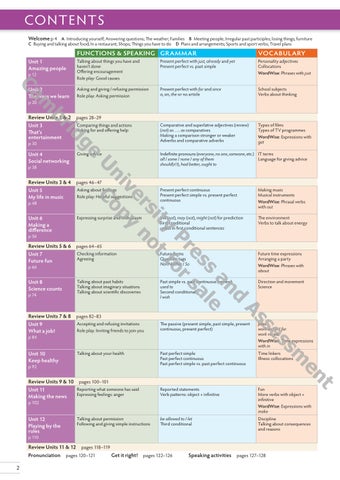
CONTENTS Welcome p 4 A Introducing yourself; Answering questions; The weather; Families B Meeting people; Irregular past participles; losing things; furniture C Buying and talking about food; In a restaurant; Shops; Things you have to do D Plans and arrangements; Sports and sport verbs; Travel plans
FUNCTIONS & SPEAKING GRAMMAR Unit 1 Amazing people p 12
m Ca
Unit 2 The ways we learn
VOCABULARY
Talking about things you have and haven’t done Offering encouragement Role play: Good causes
Present perfect with just, already and yet Present perfect vs. past simple
Personality adjectives Collocations WordWise: Phrases with just
Asking and giving / refusing permission Role play: Asking permission
Present perfect with for and since a, an, the or no article
School subjects Verbs about thinking
Comparative and superlative adjectives (review) (not) as …. as comparatives Making a comparison stronger or weaker Adverbs and comparative adverbs
Types of films Types of TV programmes WordWise: Expressions with get
p 20
p 38
Giving advice
Unit 6 Making a difference p 56
Co
Review Units 3 & 4 pages 46–47 Asking about feelings Unit 5 Role play: Helpful suggestions My life in music p 48
Expressing surprise and enthusiasm
Review Units 5 & 6 pages 64–65 Checking information Unit 7 Agreeing Future fun p 66
Unit 8 Science counts p 74
Indefinite pronouns (everyone, no one, someone, etc.) IT terms all / some / none / any of them Language for giving advice should(n’t), had better, ought to
As d an s le es sa Pr r y fo it t rs no ve y ni p
U
Unit 4 Social networking
ge
p 30
id
br
Review Units 1 & 2 pages 28–29 Comparing things and actions Unit 3 Asking for and offering help That’s entertainment
Talking about past habits Talking about imaginary situations Talking about scientific discoveries
Making music Musical instruments WordWise: Phrasal verbs with out
will (not), may (not), might (not) for prediction First conditional unless in first conditional sentences
The environment Verbs to talk about energy
Future forms Question tags Nor/Neither / So
Future time expressions Arranging a party WordWise: Phrases with about
Past simple vs. past continuous (review) used to Second conditional I wish
Direction and movement Science
The passive (present simple, past simple, present continuous, present perfect)
Jobs work as / in / for work vs. job WordWise: Time expressions with in
p 84 Talking about your health
Time linkers Illness: collocations
Reported statements Verb patterns: object + infinitive
Fun More verbs with object + infinitive WordWise: Expressions with make
be allowed to / let Third conditional
Discipline Talking about consequences and reasons
p 102
Unit 12 Playing by the rules
Talking about permission Following and giving simple instructions
p 110
Review Units 11 & 12 pages 118–119 Pronunciation pages 120–121 Get it right! pages 122–126
2
Speaking activities pages 127–128
t
Review Units 9 & 10 pages 100–101 Reporting what someone has said Unit 11 Expressing feelings: anger Making the news
Past perfect simple Past perfect continuous Past perfect simple vs. past perfect continuous
en
p 92
m ss
Unit 10 Keep healthy
se
Review Units 7 & 8 pages 82–83 Accepting and refusing invitations Unit 9 Role play: Inviting friends to join you What a job!
Present perfect continuous Present perfect simple vs. present perfect continuous
THINK
SKILLS
Values: Human qualities Self-esteem: Personal qualities
Reading Online survey responses: Who do you admire most? TV programme preview: Britain’s Smartest Kids Photostory: The new café Writing A short passage about someone you admire Listening Playing a guessing game
Values: Learning for life Train to Think: Learning about texts
Reading Article: An education like no other Article: Learning is brain change Culture: A day in the life of … Writing An email describing your school routine Listening Conversation about a book
Values: Spending wisely Self-esteem: The film of my life
Reading Article: Big movies on a small budget TV listings: different types of programmes Photostory: Extras Writing A paragraph about your TV habits Listening Interview with a teenage filmmaker
m Ca
PRONUNCIATION Intonation and sentence stress
Word stress
br
Words ending in /ə/
ge
id The short /ʌ/ vowel sound
Values: Responsible online behaviour Train to Think: Logical sequencing
As d an s le es sa Pr r y fo it t rs no ve y ni p
U Been: strong /biːn/ and weak /bɪn/
Reading Article: Think before you act online Short texts: Different types of messages Culture: Communication through history Writing A web page giving advice Listening Conversation about installing a computer game
/f/, /v/ and /b/ consonant sounds
Values: Caring for the world Train to Think: Different perspectives
Reading Article: Hot topic: The environment Leaflet: Small changes, BIG consequences Culture: Stop! Before it’s too late Writing An article for the school magazine Listening Interviews about a town project
Intonation of question tags
Values: Believe in a better future Self-esteem: Personal goals
Reading Newspaper articles: The world today Web chat: arranging a party Photostory: Weekend plans Writing An invitation Listening Interviews with two newsmakers
The /juː/ sound
Values: How science helps people Train to Think: Using criteria
Reading Blog article: Why aren’t people more interested in science? Web forum: What should science do next? Culture: Great scientists Writing A blog entry Listening The things kids believe!
/tʃ/ and /dʒ/ consonant sounds
Values: What’s important in a job? Self-esteem: I’d rather be …
Reading Article: Dream jobs Article: Obsolete jobs Photostory: For a good cause Writing A short essay about jobs that will soon be obsolete Listening People with disabilities and their jobs
/tʃ/ and /ʃ/ consonant sounds
Values: Never give up Train to Think: About health
Reading Article: 8,000 birds to see before you die Article: Miracle operations Culture: Keeping healthy – stories from around the world Writing A story about a sports event Listening A presentation on the benefits of exercise
Intonation: rude or polite?
Values: Being able to laugh at yourself Self-esteem: Giving an award
Reading Article: April Fool’s Day Article: A tale of two Guys Photostory: The journalist Writing A news report Listening Profile on an extreme weather journalist
Silent consonants
Values: The importance of rules Train to Think: Play rock, paper, scissors
Reading Article: Hard times to be a kid Website contest: The best 50-word stories Culture: Strange laws around the world Writing A set of rules Listening The game rock, paper, scissors
t
en
m ss
se
Reading Online forum: Singer songwriter: Any advice? Article: John Otway – Rock’s greatest failure Photostory: Pop in the park Writing The story of your favourite band Listening Interviews about music
Co
Values: Following your dreams Self-esteem: Music and me
3
m Ca
WELCOME A GETTING TO KNOW YOU Introducing yourself
br
1 Read the letter quickly. Write the names
ge
id
under the photos.
As d an s le es sa Pr r y fo it t rs no ve y ni p
U
Hi Paulo, be your pen pal. I got My name’s Nicola and I’d like to Edwards. She lived in Miss your name from my teacher, a good friend of your Brazil for three years, and she’s mother’s. t me? I’m 15 years old. So what would you like to know abou with my mum and I live in a small house in Manchester they can be annoying my two little brothers. They’re OK, but I quite like school, ol. sometimes. I go to Bluecoat High Scho homework. I h muc but my teachers always give us too but I’m not ol, scho usually do it when I get home from to you! ing writ I’m doing that today – that’s because games on the I like listening to music and playing I play in a ar. guit the ing play computer. I also like like sport, too. I play band with some of my friends. I ol tennis team. volleyball and tennis. I’m in the scho y mornings. That’s We usually play matches on Saturda really like getting up a bit of a problem because I don’t early at the weekend.
Co
But what about you? I hope you’ll want to write to me. There are lots of questions I want to ask you. Things like: what’s life like in Brazil? Do you like your school? What’s it like? What’s the weather like in Rio? Have you got a big family? All that sort of stuff, to help me get to know you. Miss Edwards says you like surfing, but that’s all I know about you. So please write. I’d love to have a Brazilian friend. Best
2 Read the letter and complete the form about Nicola.
Nicola
Hometown Family
4
5 Choose the next line for each of the minidialogues in Exercise 3. 2 3 4
mini-dialogues.
a
I’m watching TV.
3 4 5
6
e
I’m from Italy.
f
SPEAKING Work in pairs. Think of one more line for each dialogue. Then practise your dialogues.
What do you do?
d I’m a student.
b Yes, it’s great. c
6
t
6
What do you do? What are you doing? What do you like doing? Do you like studying English? Where are you from? Are you 14?
2
4
5
en
3 Match the questions with the answers to make
What’s your teacher’s name? Do you live in Rome? What school do you go to? When is your birthday? Would you like to go out and do something with me? Me too. Do you want to come over and play the new Angry Birds game?
m ss
1
Asking questions 1
SPEAKING Work in pairs. Ask and answer the questions in Exercise 3. Give answers that are true for you.
No, I’m 13. I love playing tennis.
se
Name Age Likes Dislikes
Nicola
I’m a student.
What school do you go to? St Mark’s High School in York.
WELCOM E
m Ca
Miamii Miam Mi
br ge
id
Oslo Os Oslo o
Rio Ri o
Lo ond don n
As d an s le es sa Pr r y fo it t rs no ve y ni p
U
The weather
1 What kind of weather do you love, like or hate?
2
next to each one.
sunny
Co
Draw a , ☺ or a
cloudy
warm
cold
windy
humid
rainy
dry
freezing
hot
foggy
SPEAKING
wet
5
Work in pairs. Look at the pictures. Ask and answer questions. SPEAKING
Work in pairs. Tell your partner.
I love rainy weather.
Ista ta an nb bul
What’s the weather like in Miami?
It’s windy and very wet.
4
Listen again. What is the weather going to be like in Manchester, Birmingham and London?
Families
1 Look at the family words. Complete the pairs. mother and brother and 3 aunt and 1 2
1.02
2
Manchester
5
6 7 8 9 10
Mike Jamie Kai Shay Joe
t
London
4
Colin Luke Sharon Becky Jodie
en
3
3
6 cousin and
Listen to Nicola talking to Paulo on Skype. How are these people related to Nicola? 2
ENGLAND
5 husband and
1.03
1
Birmingham
4 grandma and
m ss
Listen to the weather forecast for the UK. Tick (✓) the weather words in Exercise 1 that you hear. 1.02
se
3
Work in pairs. Ask each other about your families. SPEAKING
Have you got any cousins? What’s your uncle’s name? 5
Irregular past participles
B EXPERIENCES Meeting people
1 Write the past participles of these irregular verbs. 1 2 3
m Ca
4 5 6
br id
1 2
ge
3 4
7
Co
A What book was it?
A Did he give you one?
8
The most famous person I’ve ever seen is Lionel Messi.
3
It was my English course book, believe it or not. I had it with me to help me with my English. Yes, he was really nice. I didn’t have any paper with me, so he signed a book that I was carrying. It was last summer. We were on holiday in LA. We were walking out of a restaurant when he walked in. Yes, I did. I asked him for an autograph. Yes, I have. Bradley Cooper.
1.04
Listen and check.
Exercise 1. 1 2 3 4 5 6 7
6
A past simple positive statement. A past simple negative statement. A past simple question. A past simple short answer. A past continuous statement. A present perfect question with ever. A present perfect short answer.
Who’s the most famous person you’ve ever seen? Where did you see him/her? Did you say anything to him/her?
5
SPEAKING Ask the other students in your group your questions.
6
SPEAKING
Report back to the group.
The most famous person Carla has seen is Lionel Messi. She saw him outside a shop in Barcelona. She didn’t say anything to him.
t
4 Underline examples of the following tenses in
of the questions from Exercise 2 and thinks of two more questions to ask.
en
Work with a partner. Practise the conversation. Change names, places and other details. SPEAKING
4 Work in groups of eight. Each person takes one
m ss
2
Who’s the most famous person you’ve ever seen ? What’s the strangest food you’ve ever ? What’s the best book you’ve ever ? What’s the funniest joke you’ve ever ? What’s the most expensive thing you’ve ever and never found again? What’s the best prize you’ve ever ? What are the most embarrassing clothes you’ve ever ? What’s the longest phone call you’ve ever ?
se
B
11 12
own information. Give details.
A Did you say anything to him?
B
10
3 Answer the questions in Exercise 2 with your
1 A Have you ever met a famous person?
B
9
As d an s le es sa Pr r y fo it t rs no ve y ni p
U
5
A Really! Where? When?
B
8
eat make run win read ride
participles in Exercise 1.
1 Put the parts of dialogue in order. Write 1–10 in
B
7
2 Complete the questions with eight of the past
6
the boxes.
think drink wear see lose hear
WELCOM E
Losing things
3
1 Read the story and find the answer to the
WRITING Write a short story about something you lost. Use these questions to help you. ●
question. What was in the wrong container?
● ● ●
m Ca
● ●
Furniture 1 Tick (✓) the items mentioned in the story.
id
br
People often complain about airline companies losing their suitcases when they fly. It’s never happened to me, but something a lot worse happened to my family recently.
When did it happen? What was it? Where did you lose it? What did you do? How did you feel? Did you find it? If so, when and where?
ge
About ten years ago my mum got a job teaching at a university in Indonesia. At first she only went for six months, but she really liked it and agreed to stay longer, so we all went to live with her. We had a great time, but last year my parents decided that they wanted to return to the UK. Because we’d been there so long we had loads of things we wanted to take back with us – all the furniture from our house in fact.
Co
As d an s le es sa Pr r y fo it t rs no ve y ni p
U
So mum and dad went to a shipping company and arranged to take everything back in one of those big containers that you see on ships. The company packed everything into it: the armchair and sofas, the TV, wardrobes, desks, even all the carpets and curtains. Our whole house was inside that big green metal box.
2 3 4 5 6
When did Liam’s mum start her job in Indonesia? (ago) When did the family move to Indonesia? (later) How long did they stay there? (about) When did they decide to move back to the UK? (last) How long after they were back in the UK did the first container arrive? (about) When did the correct container finally arrive? (ago)
SPEAKING Name the other items. Which of these do you think Liam’s parents probably didn’t put into the container?
t
1
2
en
Use the word in brackets in your answer.
m ss
2 Read the story again and answer the questions.
se
We flew back to the UK and waited for the container to arrive. About ten weeks later we were having breakfast one morning when a big lorry arrived outside our house. On the back was a big green metal box. We were so excited. The men opened the container and started to take out our things. But they weren’t our things. The container was full of motorbikes. It was the wrong one. My parents were so annoyed. But the story has a happy ending. The men took the container and motorbikes away, and about two months ago our things finally arrived.
They probably didn’t put the toilet into the container. 3 Discuss in small groups. Your family is moving to the other side of the world. They are packing the house things into a container, but there is only room for five items. What five items of furniture from your house are you going to choose? 7
C EATING AND DRINKING Buying and talking about food 1
2 Complete each sentence with some or any. Then
match the sentences with the pictures. Write the numbers 1–8.
1.05 Listen and complete each space with one word.
ASSISTANT
m Ca
CUSTOMER ASSISTANT CUSTOMER
br
Morning, can I help you? Yes, please. Um, I want 1 onions. OK, how many? Two kilos. And can I have 2 mushrooms too, please? About half a kilo? OK. Anything 3 ? Oh, yes – tomatoes. A kilo of tomatoes, please. And 4 olives. Sorry, we haven’t got 5 olives today. Try the 6 across the street. OK, thanks. Here are your tomatoes. So, are you going to make pizza tonight with all this? No, I’m not. I’m making ‘7 à la grecque’. It’s a French dish. I had it on holiday in France. I loved it! What about lemons? You don’t 8 to put lemon juice in it, but it’s a 9 good idea! Oh, right. No, it’s OK, thanks. I’ve 10 got lemons at home. So how 11 is that? Let’s see. That’s £4.35, please. Here you are – £5. And 65p 12 . Thanks. Enjoy your dinner!
ASSISTANT
ASSISTANT
ASSISTANT
CUSTOMER
ASSISTANT CUSTOMER ASSISTANT
5 6 7 8
3
SPEAKING Which of these things would you always / never / sometimes see on a pizza?
Co
CUSTOMER
4
As d an s le es sa Pr r y fo it t rs no ve y ni p
ASSISTANT
3
U
CUSTOMER
2
There’s yoghurt in the fridge. There are mushrooms in the kitchen. There aren’t mushrooms in the pizza. I’d like of those potatoes, please. Sorry, there aren’t potatoes. I’d like coffee, please. Oh, there isn’t yoghurt. No, I don’t want coffee, thanks.
ge
id
CUSTOMER
1
A
B
C
D
E
F
en
m ss
se G
H
There’s always cheese on a pizza – but you never see … ! 4
8
ROLE PLAY
Work in pairs. Use your sentences from Exercise 3 to do a role play.
t
carrots | onions | peppers | yoghurt | pears pineapple | chicken | mushrooms | tomatoes cheese | olives
WELCOM E
In a restaurant
Shops
1
1 Look at the shops below. What things can you
Read the sentences. Mark them W (waitress) or C (customer). Listen and check. 1.06
buy in each place? Think of as many things as you can.
m Ca ge 5 6 7 8
Can we see the menu, please? Is everything OK? There’s too much salt in the soup! The bill, please. A table for two? This way, please. We’d both like the fish, please. And the soup to start. It’s very noisy here. There are too many people. Are you ready to order?
2 3 4 5
3 4 5
Things you have to do
1 Read the sentences below. For each one, think
of possibilities for a) who said it and b) who to.
sugar salt mushrooms money people things on the menu
5 6
2
You don’t have to eat it.
2
You have to give it to me tomorrow morning.
3
I don’t have to listen to you!
4
I have to finish this tonight.
5
You don’t have to put mushrooms on it.
6
It’s fantastic! I have to buy it!
SPEAKING Work in pairs. Choose three of the sentences in Exercise 1. Act out a mini-dialogue for each sentence that you choose.
Chicken? Again? That’s boring.
t
4
This soup is horrible. B I know! There’s in it. A Ugh! I can’t drink this coffee. B I know! There’s in it. A This pizza isn’t so good. B I know! I like mushrooms, but there are on it! A This is horrible. We can’t talk. B I know! There are here. A I don’t know what to choose. B I know! There are . A Look! €30.00 for a pizza!! B I know! It’s .
1
en
3
You don’t have to wait in a queue. You have to wear them two or three times. You don’t have to buy a larger size than you need. You have to fill in this form. You don’t have to pay for the third one.
m ss
2
1.07
2
from Exercise 2. A
sports shop
1
3 Complete the mini-dialogues with a phrase 1
clothes shop
se
6
too too too too too too
supermarket
Listen again. In which shop do you hear these words?
2 Complete each phrase with much or many. 1
bookshop
As d an s le es sa Pr r y fo it t rs no ve y ni p
4
post office
3
Co
3
chemist’s
1.07 Listen. Which shop is each person in? Write the number of the dialogue next to the correct shop in Exercise 1. There are three shops you won’t need.
U
2
shoe shop
2
id
br 1
newsagent’s
Well, you don’t have to eat it. Can I have something else? No, we’ve only got chicken. OK then – I’ll eat the chicken. 9
Hi Susana
m Ca
us next I was really happy to get your email saying that you’re coming to visit time! right the just at here be to weekend. It’s great news, and you’re going one every year. Next weekend our town is having its special weekend gala. There is too. There are What’s a gala? Well, it’s like a party but with sports and other events, for some fun! ready lots of different activities. We’re going to join in, so I hope you’re and in the It all starts on Saturday. There’s an opening ceremony at lunchtime, at six And things. and games and races – kids afternoon, there are things for town another against playing are team town our – match o’clock there’s a football square. town the in playing is band local a , evening the in near here. Then It starts in the On Sunday morning there’s a charity run – it’s about eight kilometres. area, then g shoppin main the through park and goes past the railway station and you (Would race! the in running I’m what? finishes at the park again. And guess Sunday on And OK?) asap, know me let – in you get like to run too? I think we can forecast afternoon, there’s a big street party with games and things. The weather clothes. r summe new my wear to going I’m so sunny, be to says it’s going Sunday So we’re looking forward to seeing you here. Oh, I almost forgot! On ! We’re going birthday 18th sister’s my for evening we’re having a party at our place Sunday on leave to have don’t you say to make it a really special party. Please evening! on Friday? Anyway, let me know more about your plans. When are you arriving
ge
id
br
Co
Belinda
As d an s le es sa Pr r y fo it t rs no ve y ni p
U
See you soon,
D LOOKING AHEAD Plans and arrangements
1 Read the email. Match the times and the events. 1 2 3 4 5 6 b d e f
4
What are you doing on Saturday morning? I’m going running. / I’m not doing anything. Why?
Sports and sport verbs
1 Complete the table with the sports in the list.
2 3 4 5 6
10
In the evening, a local band is playing in the town square. I’m running in the race. We’re going to join in. I’m going to wear my new summer clothes. We’re going to make it a really special party. We’re having a party at our place.
2
do
go
t
play
verbs express? Write A (arrangement) or I (intention).
en
running | football | tennis | gymnastics athletics | rock climbing | karate | skiing
2 Read the sentences. What do the underlined
1
Work in pairs. Ask and answer questions about plans you have for next weekend. SPEAKING
m ss
c
kids’ games and races party for Belinda’s sister opening ceremony local band charity run street party
for arrangements in Belinda’s email.
se
a
Saturday lunchtime Saturday afternoon Saturday evening Sunday morning Sunday afternoon Sunday evening
3 Underline other examples of present continuous
Work in pairs. Which sports do you do often / sometimes / never? Talk to your partner. SPEAKING
I often go running, but I never do karate.
WELCOM E
Travel plans 1
Put the parts of the dialogue in order. Then listen and check. 1.08
A A
the verbs in the list.
visit | take | not visit | get up | try | buy 1 2
m Ca
Great idea. OK, see you soon. We’re going to have a lot of fun this weekend! Oh dear, 5.30 is difficult for me. Is it OK if I don’t meet you at the station? Hey, Susana. What time are you arriving on Friday? Well, sometimes the train’s late. If it’s late, I’ll meet you. OK. As soon as the train leaves London, I’ll send you a text message. 5.30 – I’m going to catch the four o’clock train from London. I know. It’s going to be great! Of course. I can take a taxi. No problem.
4 Complete the sentences with be going to and
1 A
4
br
A
3
B
6
5 Imagine you can take a holiday wherever you want, any time you want. Make notes about your plans:
As d an s le es sa Pr r y fo it t rs no ve y ni p
U
B
ge
B
5
id
B
2 Complete the sentences with the correct form of the verbs in brackets.
2 3 4 5 6
If I (miss) the train, I (catch) the next one. If the train (arrive) late, I (take) a taxi. If there (not be) any taxis, I (walk) to your place. I’ll send you a text message when I (get) to the station. As soon as I (get) to your place, we (start) having a good time. If we (not have) a good time, I (not visit) you again!
● ●
Co
1
We don’t like flying so we a train. I want to go to New York. I my ticket online. My plane leaves at 6.00, so I very early tomorrow. We’ll only be in Paris for one day, so we any museums. When we’re in London, we my cousins. We love Spanish food, so we all the best restaurants in Madrid!
3 Lola travelled a lot last year. Complete the sentences
● ● ● ● ●
6
where you’re going to go where you’re going to stay how long your holiday is going to be what you’re going to do who you’re going to go with what you’re going to eat what time of year you’re going to go
SPEAKING Work in pairs. Ask and answer about the holiday you planned in Exercise 5.
Where are you going to go on holiday? New York. And I’m going to stay in an expensive hotel.
with the past simple of the verbs in the list. take | catch | drive | fly | miss | ride
t
en
m ss
se 11
1 PEOPLE A M A ZI NG
OBJECTIVES FUNCTIONS: talking about things
m Ca
you have and haven’t done; offering encouragement GRAMMAR: present perfect with just, already and yet; present perfect vs. past simple VOCABULARY: personality adjectives; collocations; phrases with just
ge
id
br Co
As d an s le es sa Pr r y fo it t rs no ve y ni p
U
1
2
3
READING
caring | friendly | boring | serious | cheerful funny | intelligent | cool | confident | easy-going SPEAKING
3
She looks like a cheerful person because she’s smiling.
Use the adjectives in Exercise 1 and other adjectives to describe people you know. Give reasons. SPEAKING
My brother is very easy-going. He doesn’t get angry very often. 12
5
Read and listen to the responses again. Mark the sentences T (true) or F (false). Correct the false information. 1.09
1 2 3 4 5 6 7 8
Mrs Marconi has a dangerous job. She isn’t very popular with Bia’s friends. Mr Donaldson has a problem controlling his students. Jacob thinks Mr Donaldson will be famous one day. Alex’s grandmother is older than she looks. Gwen thinks it’s important to enjoy life. Oliver’s aunt had a car accident. Oliver’s uncle changed after the accident.
t
He seems friendly.
Discuss the photos in pairs.
Write the name of each person under the photos.
en
2
4 Read the responses to an online survey quickly.
m ss
of these people? What adjectives could you use to describe them?
se
1 Look at the photos. What is your first impression
4
1 A M A ZI N G PEO PLE 6 Popular
Recent
is always doing things active is usually happy 2 is very easy-going 3 has very original ideas 4 looks for the good in all situations 0
DO YOU ADMIRE MOST?
1
m Ca
5
br
Jackie, 14 Sofia Marconi, my friend Bia’s mum, is probably the most amazing person I know. She’s also extremely brave. She’s a wildlife photographer and she travels to some of the most dangerous places on Earth to take photos of the world’s most endangered animals. She’s just come back from Papua New Guinea. I haven’t seen her photos yet, but I bet they’re amazing. She’s quite famous and she’s already been on TV. Although she spends quite a bit of time away from home, she’s also a really cool mum. She’s really charming and all of Bia’s friends think she’s fab. Bia’s really lucky to have such a great mum.
VOCABULARY There are eight words in bold in the texts. Match the words with these meanings. Write the words.
is very good at doing something
doesn’t get scared easily 7 is very easy to like
ge
id
6
7 Complete the sentences with the words from Exercise 6.
U
0
As d an s le es sa Pr r y fo it t rs no ve y ni p
Why are you so cheerful today? Have you had some good news? He stood up in the front of the whole school and read out his poem. He was really . She’s very and it’s easy to see why she’s got so many friends. He’s so that some people think he’s a bit lazy. Have you seen him doing ballet? He really is a dancer. If you want to work in advertising, you need to be and come up with really good ideas. My dad is really around the house. He’s always cooking or fixing things or working in the garden. He’s had a really difficult life but he’s really about the future.
1
Co
Jacob, 16 One of my heroes is Mr Donaldson, our music teacher. First of all, he’s a brilliant teacher. He’s really laid-back but we all respect him, and no one ever messes about in his class. He’s so creative and finds different ways to get us interested in his lessons. He’s also a really amazing guitar player – I mean he is seriously talented. He’s in a band. They haven’t made any recordings yet, but they’ve already attracted lots of interest and I’m sure they’re going to be famous one day. I’ll be really happy for him, but I hope it doesn’t happen too soon. I don’t want to lose my teacher!
2 3 4 5
6
VALUES
Human qualities
m ss
1 Think about someone who is not
famous but who you think is special. Think of three adjectives to describe them. b Think about why you chose these adjectives. Make notes. a
2
t
en
Oliver, 17 The greatest person I know is my uncle Jack. He and my aunt Alice had the perfect life: good jobs, a lovely house and three young children. Then one day their life changed forever. My aunt had a terrible car accident. It left her in a wheelchair. From that day on, my uncle has devoted his time to looking after her and the family. But I have never heard him complain. He’s still the same lovely person he always was. I know life is hard for him but he’s always so cheerful with a huge smile on his face. He’s such a warm person – someone you want to spend time with.
7
se
Alex, 15 The person I admire more than anyone is my grandmother Gwen. She’s 78 and looks just amazing. Many people think she’s my mother when they see us together. But she doesn’t just look young, she is young. She’s one of the most active people I know. She spends a lot of her time doing things for charity. For example, she’s just done a parachute jump to raise money for a children’s charity in India. A parachute jump! At her age! She’s such a positive person, always seeing the good in other people. ‘Life is for living,’ she tells me. I hope I have that much life in me when I’m her age.
SPEAKING Tell your partner about the person you admire.
I really admire my brother. He’s really confident in difficult situations.
13
GRAMMAR Present perfect with just, already and yet
3 Look at Mike’s list of things to do for his party. Write sentences with already and yet.
Party list – things to do 1 make cake ✓ 2 send out invi tat ions
1 Complete the example sentences with just,
m Ca
already and yet. Then complete the rules with the missing words.
She’s come back from Papua New Guinea. 2 They haven’t made any recordings , but they’ve attracted a lot of interest. 1
br
3 organise music ✓ 4 choose what to wea r 5 decorate room
RULE: In the present perfect, we often use in negative sentences and questions to talk about something that hasn’t happened but that we expect to happen soon. It comes at the end of the sentence.
ge
to emphasise that something happened very recently. It goes before the past participle. 3
1 He hasn’t made the cake yet. 4 Use your imagination to answer the questions. Use the present perfect and just in each one. 1
to show that something has been done or finished sooner than expected. It usually goes before the past participle.
2
Co
He’s just finished his painting. 2 He’s already sold the painting. 3 He hasn’t finished his painting yet. 1
Why is Mum so angry?
Because Dad’s just crashed her car.
3 4
2 Match the pictures and the sentences. Write 1–3 in the boxes.
buy drinks
As d an s le es sa Pr r y fo it t rs no ve y ni p
●
2
U
●
✓ 6
id
●
1
5 6
Why is Colin so sad? Why is your face so dirty? What’s Liam so scared about? Why is Dana so excited? Why are you smiling?
5 Tick (✓) the things you have already done.
Eight things to do e you’re 20 re or beffo be start a blog
meet a famous person write a song act on stage
m ss
se
travel abroad
learn a musical instrument climb a mountain
t
en
enter a competition
6
SPEAKING
questions.
Work in pairs. Ask each other
Have you started a blog yet? Yes, I’ve already done that. Have you? No, I haven’t done that yet. 14
Workbook page 10
1 A M A ZI N G PEO PLE
LISTENING 1
2
3
Listen to some people playing a game called Mystery Guest. How many people are playing? 1.10
Listen again. For each question there are three pictures. Choose the correct picture and put a tick (✓) in the box below it.
Who is Will’s mystery guest? What adjectives does Will use to describe him? 3 Who is Kiki’s mystery guest? 4 What adjectives does Kiki use to describe her? 1 2
1.10
m Ca 1
1.10 Work in pairs. Answer the questions. Then listen again and check.
4
SPEAKING
What does Will’s mystery guest do?
Work in pairs. Play Mystery Guest.
Ladies and gentlemen, my guest is …
br ge
id
He/She has won / played / recorded / helped …
SELF-ESTEEM
A 2
B
1 A cinquain is a short, five-line poem. Read the
As d an s le es sa Pr r y fo it t rs no ve y ni p
U
Personal qualities C
cinquain and complete the rules with the words in the list.
Co
Where is Will’s mystery guest from?
Kiki
Charming, creative Sings – laughs – loves
A 3
B
Talented
C
Who does Will think Kiki’s mystery guest is?
A beautiful voice
adjectives | three | verbs someone’s name | adjective
C
en
4
B
m ss
se
A
On the first line write 1 . On the second line write two 2 to describe the person. On the third line write three 3 to show what the person likes doing. On the fourth line write another 4 . On the fifth line write a description of the person in just 5 words.
What does Kiki’s mystery guest do?
t
2
WRITING
Write a cinquain about:
your partner or best friend b your hero a
A
B
C
15
READING 1
3 Read the TV programme preview quickly.
Work in pairs. At what age did you learn to do these things? SPEAKING
● ●
read draw
● ●
play a musical instrument speak a foreign language
m Ca
I learned to read when I was …
br
2
I’ve never learned to …
What other things have you learned in your life and when did you start to do them? SPEAKING
id
When I was seven I learned how to cook an omelette.
Which of the children is a genius at these things? Write the names. art 2 music 3 creative writing 4 languages 1
4 Read the programme preview again and answer the questions. 1 2 3
ge
4 5 6
What writers did Mark enjoy when he was three? What languages does he know? How much will Daniel get for writing each book? How many instruments does Samantha play? How many weeks is the show on for? Who will the show have interviews with?
As d an s le es sa Pr r y fo it t rs no ve y ni p
U Don’t miss this week:
Co
Britain’s Smartest Kids
16
t
Mark and other child geniuses will be the subject of a new documentary series which takes a look into the lives of these remarkable children and their families. In the programmes we will meet children like eight-yearold Daniel Manning, who wrote
en
hile other children were just starting their ABCs, threeyear-old Mark Swallow was already reading Shakespeare and Charles Dickens. By the age of seven he was speaking fluent French and German and studying both Latin and Greek. Now, at the age of 12, Mark has just started a university degree in English literature.
m ss
W
Over the next six weeks we will see what it is that makes these children so special. We will find out how and when their parents knew they were different and about the changes it made to their family life. We will hear from the children about their hopes and plans for the future. There are also interviews with former child geniuses, some who have gone on to great things and others who decided they wanted to return to a more normal life.
se
his first book when he was just five and who has just signed a £60,000 contract with a publishing house to write three novels. Then there is 12-year-old Samantha Price, who started piano lessons when she was three. Along with the piano, she now also plays the cello, clarinet and classical guitar. She has already played with three top European orchestras. And how about ten-year-old Jordan Welsh? She first picked up a paint brush before she could walk. She has already had an exhibition of her paintings in one of London’s top art galleries and has just won a major prize for one of her paintings.
Join us Monday for the first documentary in this amazing series, Britain’s Smartest Kids.
1 A M A ZI N G PEO PLE
GRAMMAR Present perfect vs. past simple
VOCABULARY Collocations
1 Look back at the review on page 16. Which
1 Circle all the correct answers.
questions can you answer with a specific point in time? Then complete the rules with present perfect or past simple.
1
m Ca
2
When did Daniel write his first book? 2 When did he sign a £60,000 contract? 3 When did Samantha start piano lessons? 4 When did she play with orchestras? 1
3
br
4
id
RULE: When we talk about a specific point in . time in the past, we use the When we don’t refer to a specific point in time, we often use the .
5
ge
6
2 What verbs can go before the six words you
As d an s le es sa Pr r y fo it t rs no ve y ni p
U 2 Complete the pairs of sentences. Use the past
didn’t circle in Exercise 1? Write at least one verb for each word.
simple and the present perfect of the verbs.
1
2
3
Who did you ask?
What was the poem about?
What did you win?
Find someone who has ...
Who?
Details
asked someone for an autograph. written a poem.
had an interview. won a prize. made a cake.
missed a train or a bus.
Workbook page 12
t
Workbook page 11
Have you ever … ? What happened?
en
6
Talk to other people in the class. Ask and answer questions and complete the table. SPEAKING
m ss
5
3
se
4
visit a I have visited Greece more than 20 times. visited Greece in 1998. b I first win a He already three gold medals, and he hopes to win more. b He a gold medal in the 2012 Olympics. meet a My mum a lot of interesting people in her life. b My mum Prince Harry ten years ago. do a Mum, I my homework. Can I go out? b I all the things on my to-do list before lunch! record a They their last album two years ago. b They more than 20 albums so far. live a We in Samoa for three years when I was a teenager. b We’re living in Austria now, but we in many different countries. sign a She just a contract with a new e-publishing company. b She the contract for her first book on her 16th birthday.
Co
0
Which of these can you sign? a a contract b an autograph c a lesson Which of these things can you write? a a novel b a party c a song Which of these things can you do? a a good time b a degree c something Which of these things can you win? a a prize b a competition c an exhibition Which of these can you make? a friends b a cake c homework Which of these can you miss? a a future b your family c the bus
WRITING Write a short passage about someone you have admired for some time. Include ● ●
how long you have known them. what you admire about them. 17
PHOTOSTORY: episode 1 1 LLook at the photos and answer the questions.
é f a c w e The n
There is going to be a new café in the park. Who does Luke think should open it? Who does Ryan think should open it?
2
1.11 Now read and listen to the photostory. Check your answers.
m Ca ge
id
br As d an s le es sa Pr r y fo it t rs no ve y ni p
U Co
LUKE Have you read this? They’re opening a new
café in the park. Saturday afternoon.
OLIVIA That’s fantastic. Who’s going to do the big
opening ceremony? RYAN The mayor probably. She always does shop openings and conferences, that sort of thing. MEGAN They should get somebody more important. LUKE What? More important than the mayor?
1
LUKE Hey, I know. They should get Paul Norris. RYAN Yeah! He’s a great footballer! He plays for
United now, but he grew up round here.
2
OLIVIA But he doesn’t live round here any more.
He’s a big star now. Let’s face it, he won’t want to open a little park café. RYAN Yeah, you’re probably right.
RYAN What about Paula Mayberry? OLIVIA The actress from the soap opera, what’s
it called … Linden Street? RYAN Yes. MEGAN But why her? Did she live here once? RYAN No, I don’t think so. I’d just like to meet her.
18
park café, and that’s that. RYAN I guess you’re right. No one special lives in our town. MEGAN Are you sure? LUKE What do you mean? MEGAN Know what, guys? I’ve just thought of someone very special, and he’s just the person for the job.
t
en
m ss
se
3
LUKE Come on, there has to be somebody! OLIVIA Look, the mayor is going to open the
4
1 A M A ZI N G PEO PLE
DEVELOPING SPEAKING 3 Work in pairs. Discuss what happens next in the story. Write down your ideas.
WordWise
We think the boys go and talk to Paul Norris, the footballer.
Phrases with just 1 Look at the sentences from the unit. Choose
m Ca 4
Watch to find out how the story continues. EP1
the correct meaning of just in each one. She’s just come back from Papua New Guinea. 2 He wrote his first book when he was just five. 1
5 Complete the sentences with the words in
br
the list.
2 4 6
Co
7
only b a short time ago c really a
. . .
2 What does just mean in these sentences?
.
.
Don’t be angry. It’s just a joke. I’ve just seen a fantastic film. 3 It’s cold today. The weather is just awful. 4 No food, thanks – just a drink. 5 She’s just had some bad news. 1
.
2
PHRASES FOR FLUENCY
1 Find the expressions 1–6 in the story. Who says them? How do you say them in your language? 1 2 3 4 5 6
… that sort of thing. Let’s face it, … I don’t think so. … and that’s that. Are you sure? Know what?
3 Match the questions to the answers.
Ryan
1
1
How many spoons of sugar would you like?
2
When did Jane get here?
3
What do you think of Beyoncé?
She’s just arrived. b She’s just great. c Just one a
2 Complete the conversations with the expressions in Exercise 1.
She’s 78 and looks just amazing.
As d an s le es sa Pr r y fo it t rs no ve y ni p
5
3
.
U
3
Megan doesn’t tell her idea to Megan shares her idea with Olivia offers to help The girls go to see The boys follow The mayor thanks. Olivia’s special person is.
ge
1
id
Megan | the headmaster | the girls | Mr Lane Olivia | the boys | the girls
Workbook page 13
A That new girl, Sally – she likes you!
FUNCTIONS Offering encouragement 1
EP1 Watch the video again. Listen for sentences 1–5. Who says them? Why?
2
Intonation and sentence stress
2
t
Good causes
en
That is a great idea. You should definitely do it. 3 You’ve got to make this happen. 4 I’ll help you if you want. 5 Let’s go and speak to some people. 1
Pronunciation Go to page 120.
m ss
. A ? I have a feeling she likes you a lot. B No. She never smiles at me. And she criticises me a lot, doesn’t laugh at my jokes, 3 . 2 A Oh, you got it wrong again! B I know. 4 , I’m no good at computer games. A 5 ? We just need a rest. Let’s go and watch some TV. B OK, but I don’t want to play this game again, OK? I’m useless at it, 6 ! 2
se
B No, 1
ROLE PLAY
Work in pairs. Student A: go to page 127. Student B: go to page 128. Use the sentences from Exercise 1 to do the role play. 19
m Ca
2
TH E WAYS
WE LEARN
br id
3
ge
Read and listen to the article. For each question, mark the correct letter A, B, C or D. 1.14
1
What is the writer doing in this text? A Describing a summer school he started in 2005. B Explaining how to send a child to Tinkering. C Talking about the US school system. D Talking about G. Tulley’s programmes for kids.
Co
As d an s le es sa Pr r y fo it t rs no ve y ni p
U WHAT? a youth club make friends WHY? learn to do do meaningful things e tim gs in teams free thin r in you
What reactions to Brightworks have there been in the media? A They have compared it to Tinkering School. B Most of them have been positive. C There hasn’t been any reaction. D Most of them have been negative.
4
What effect has the school had on Tina Cooper? A It has changed her opinion about school. B It has given her exciting and boring times. C It has made her more interested in San Francisco. D It has encouraged her to ask more questions.
4 Which thing might Gever Tulley say in a
presentation to parents about the Tinkering School?
A We are trying to do our best. We offer your kids
a balance of things they will like doing and things they will have to do. B I can guarantee that your son or daughter will learn to build a rollercoaster, a rope bridge, a tree house, a motorbike and a boat. C Kids can learn a lot by doing things in teams. We give them materials and tools. They plan and make things. D Most of the articles in newspapers and magazines say kids are more motivated here than at many other schools.
t
discussions drama
3
en
books
What does the text say about safety at the school? A The school is too dangerous for kids. B No child has ever had an accident. C Children have never hurt themselves badly. D The school doesn’t give information about that.
m ss
a youth y club | a holidayy camp p | a school
2
se
mind when you think of these places.
20
refusing permission to do something GRAMMAR: present perfect with for and since; a, an, the or no article VOCABULARY: school subjects; verbs about thinking
Where do you think they are?
1 Work in pairs. Write down words that come to
have fun
FUNCTIONS: asking and giving /
2 Look at the photos. What are the people doing?
READING
sports photography
OBJECTIVES
2 TH E WAYS WE LE A R N
An education like no other m Ca
Gever Tulley is a computer scientist from California. In 2005, he started a summer programme for children called Tinkering School. The idea was that children can learn important skills for life by building things together. Gever Tulley and his team help the children to think big and create plans for innovative things they want to build. Children have made fantastic things since the school started. They have built a rollercoaster. They have made a rope bridge from plastic shopping bags. They have made tree houses, wooden motorbikes and boats.
id
br
ge
At Tinkering School, children get all kinds of materials like wood, metal, plastic, nails and ropes. They get lots of real tools too, such as knives, hammers, screwdrivers and power drills. Some children have cut themselves when using a knife, or hurt their fingers when using a hammer. Tinkering School has been around for many years now, but nobody has ever suffered a serious injury in all those years. This is because there are strict health and safety regulations they must follow. The children always learn how to use the tools safely and they must wear the right clothing and protection at all times.
Co
As d an s le es sa Pr r y fo it t rs no ve y ni p
U
Gever Tulley’s ideas have worked very well. A lot of children have gone to his summer schools over the years. In 2011, Gever Tulley and a colleague decided to create a ‘real’ school, called Brightworks, in San Francisco. The school is
very small – it only has 20 students aged 6 to 13. Brightworks is based on the same principles as Tinkering School. Since it started, Brightworks has been written about a lot. Most of those articles have been very positive. They have praised the quality of the school. They have found the children are more motivated than at many other schools. But since the beginning of the school there have also been critical voices. Some people have said that children are not learning enough at Brightworks. They feel that students and teachers are just ‘playing around’ all the time. The students at Brightworks seem to love their school. We spoke to 12-year-old Tina Cooper. She has been a student at the school since last October. ‘Since I started here, I’ve never sat in a ‘normal’ class with a teacher,’ she told us. ‘But it’s been a very exciting experience. I’ve worked hard at my new school for eight months now, and there hasn’t been one single moment when I found it boring. Before, I was bored quite often.’
2
SPEAKING
Compare your ideas with a partner.
Why?
t
1 Read the statements. Tick (✓) the things that you
en
I think they learn how to be careful with tools.
Learning for life think kids are likely to learn at Tinkering School and Brightworks.
Everyone is different and that’s a good thing. Teamwork is important to achieve things in life. When you use a tool you have to be careful. It is important to be friendly and help others. It is very important in life to eat healthy food. Mistakes are important. We learn from them.
m ss
se
VALUES
The text says there are strict health and safety regulations. 3
SPEAKING
Yes, I agree with you.
Discuss these questions.
Which of the things from the list above do you think are important to learn? 2 What would you add to your personal list of ‘Important things to learn’? 1
21
GRAMMAR Present perfect with for and since
VOCABULARY School subjects
1 Look back at the article on page 21. Underline all
1
the sentences in the present perfect.
2 Complete the sentences below with for and since.
1.15 Match the school subjects in the list with the photos. Write 1–12 in the boxes. Then listen and check.
1 Science (Physics, Biology and Chemistry) 2 Music | 3 Art Education | 4 Drama 5 Design and Technology | 6 Geography 7 English | 8 PE (Physical Education) 9 ICT (Information and Communication Technology) 10 Maths | 11 History | 12 Spanish
m Ca
Then complete the rules.
Children have made fantastic things the school started. 2 Tinkering School has been around many years now. 1
id
br
RULE: In the present perfect, we use ●
1
to talk about a period of time. to refer to the point in time when an action started.
ge
●
2
B
As d an s le es sa Pr r y fo it t rs no ve y ni p
U
A
3 When do we use for and when do we use since?
Co
Complete the chart with the words and phrases in the list.
a month | last summer | your birthday | yesterday a year | 2014 | I phoned you | a long time many years | days | Friday | an hour for
a month
since
last summer
C
D
E
F
G
H
4 Complete the sentences. Use the present perfect form of the verbs and for or since. 1
I
2
Hilary
3
They
I
I
0
Rebecca hasn’t lived in Italy for three years.
1 2 3 4 5
They are in the youth club. (three hours) Joanne and I are good friends. (primary school) She plays in the volleyball team. (two months) I ought to see a doctor. I am sick. (a week) I don’t hear a lot from Sandra. (last October)
Workbook page 18
22
K
Rebecca doesn’t live in Italy now. (three years)
2
L
SPEAKING Answer the questions. Take notes. Then compare your answers with a partner.
Which are your favourite subjects? Which don’t you like? Why? 2 Which of the subjects are you studying this year? 3 How long have you studied each subject? 1
Workbook page 20
t
for or since.
en
5 Write sentences using the present perfect with
J
m ss
5
(live) in this town a long time. (have) this camera I was 10.
se
three months. 4 He
(be) at my new school last December. (not see) Michael several weeks. (not write) an email or (phone) us
2 TH E WAYS WE LE A R N
LISTENING 1 Work in pairs. Match the activities with the photos. 1 make a fire | 2 spend a night outdoors | 3 climb a tree | 4 drive a car | 5 spend an hour blindfolded
m Ca ge
id
br A
C
As d an s le es sa Pr r y fo it t rs no ve y ni p
U
B
SPEAKING Which of these things have you done? Tell your partner.
3
1.16 Listen to David talking about a book his father has just read. Which of the activities in Exercise 1 do they talk about?
4
1.16 Listen again. Mark the sentences T (true) or F (false).
Co
2
1 2 3 4 5
D
(giving permission) or RP (refusing permission). 1
4
Is it OK if I borrow this necklace? Yeah, but be really careful with it, OK?
1 Put the dialogues into the correct order. Write the numbers 1–4.
NICK NICK
ANNIE Can I watch the football match tonight? ANNIE Can I ask you something, Mum? MUM MUM
Yes, of course you can. Go ahead.
3
t
DAD
Yes? I’m afraid I need it myself right now. Will you let me use your laptop? Dad?
en
m ss
Will you let me use your camera? Yeah, sure. Of course I will. 2 Can I borrow your bike? No, sorry. I need it. 3 Can I use your laptop? Yes, you can, but I want it back tomorrow.
FUNCTIONS Asking and giving / refusing permission
DAD
E
2 Mark the sentences AP (asking permission), GP
se
6
David is babysitting his little brother. David thinks the book his father read is nonsense. The book says children should spend an hour blindfolded alone. David is not sure his dad will let Nick drive a car. Nick drove the car straight into a tree. David thinks Nick will enjoy showing that he can make a fire.
ROLE PLAY
Work in pairs. Act out short conversations. Ask each other for permission. You can use the ideas here or come up with your own. use his/her tablet | come with him/her borrow £20 | copy his/her homework get some help with homework 23
READING 1 Look at this picture. Think about the questions and compare your answers with a partner. What does the picture show? 2 Where in the picture is the brain? 3 What does the brain do? 1
m Ca
Learning is brain change
br
id
(1) Everybody has a brain, but not
ge
many people know how the brain works. Some people believe that the brain is like the hard disk of a computer. We use it to store files – images, language (words, texts, sounds) and other data. Others compare the brain to a huge container or cupboard with lots of little drawers, shelves and boxes in it. We put information into these boxes and hope to find it again later.
(3) The more neuronal networks we grow, the better we can think and the better we remember. You may wonder if there is anything you can do to make the networks in your brain grow better. Professor Zull says yes, there is. He says that brain change is strongest when a) you are interested in and like what you are learning, b) you are in control of what you learn and c) you get challenging tasks that make you think hard and concentrate. Understanding a challenging task makes you feel good and develops your brain!
Co
As d an s le es sa Pr r y fo it t rs no ve y ni p
U
or nerve cells. What makes them grow? Learning! ‘Learning is brain change,’ says Professor James Zull from Case Western University in Cleveland, Ohio, USA. ‘Without learning, nothing changes in the brain. For every new word you learn in your English lesson, every puzzle you solve in maths, every new song you learn to sing, a neuronal network grows in your brain and the brain changes.’
(2) The brain is not a computer disk,
and it isn’t a container. Look at the picture here. It looks a bit like weeds in a garden, doesn’t it? The picture actually shows a child’s neocortex – a part of the brain. You can guess what happens – more ‘weeds’ grow as the child gets older. Scientists call these neuronal networks. The networks grow around our neurons,
Neuronal networks at 9 months, 2 years and 4 years of age
TRAIN TO
2 Match the words with the meanings. Write the numbers 1–5. Then read the text to check your answers.
Learning about texts
b c e
5
1 2
The text compares the brain to weeds. The brain is a system of neuronal networks that can change.
Whenever we learn anything, a change happens in our brain. 4 We can’t really make our brain stronger. 5 Being able to do difficult tasks is good for the brain. 3
24
reader. an ad to sell the reader something. C a magazine article to give the reader information. D a letter to persuade the reader to do something. B
2 Choose the title that best sums up the
content of each paragraph. There is one extra title. A The brain – a fantastic computer
What people believe about the brain C How to make your brain stronger D Our brain is a growing system B
t
3 Read the text again. Mark the sentences T (true) or F (false).
A an adventure story to entertain the
en
d
to think very carefully about what you are doing to keep things for use in the future a wild plant that grows in a garden it carries information between the brain and the body an object used to carry or store things
1 Choose the best description of this text.
m ss
a
se
1 to store | 2 a container | 3 a weed 4 a nerve cell | 5 to concentrate
2 TH E WAYS WE LE A R N
GRAMMAR a, an, the or no article
VOCABULARY Verbs about thinking
1 Look at the sentences from a magazine article.
1 Use a dictionary to make sure you know
m Ca
Underline a, an, the and the nouns these articles are with. Then go through the sentences again and circle the nouns with no article. Finally complete the rule with a, an, the, – (no article).
to concentrate on | to remember | to think to imagine | to wonder | to believe | to guess | to recognise | to realise to suppose
2 Choose the correct words.
br
Food is important for your body. But did you know that the food you eat is important for your brain, too? Here is an example: sugar. Sugar tastes good. But the sugar from sweets can create problems. Your concentration and your memory get worse. What can we learn from the example here? It’s better to eat an orange or a banana than to eat chocolate, because that’s good for your brain and for your body.
the meaning of these words.
1
id
2
ge
3
RULE: We use
●
●
5
or + a singular countable noun when the listener/reader doesn’t know exactly which thing we are talking about.
Co
●
As d an s le es sa Pr r y fo it t rs no ve y ni p
U
4
6
You can have an apple or a banana. banana We’ve got a new car. car
7
+ noun when it is clear which thing(s) or person/ people we are talking about.
8
The apples in this pie are from our garden. The bananas that I bought yesterday are horrible.
9
+ plural countable noun or + uncountable noun, when we are talking about things in general.
10
Bananas are sweeter than apples apples. Chocolate isn’t good for you.
Pronunciation Word stress
2 Complete each sentence with a, an, the or – (no article). 1 3 4
SPEAKING
questions. 1 2
0
– People need to drink. Of course 1
orange juice and 2 apple juice are very popular, but they are not always 3 good choice. 4 orange juice has got a lot of sugar in it, so don’t drink too much of it. The best drink for your brain is 5 water. 6 glass of water is the best drink you can get, but 7 water that you drink needs to be fresh and clean.
4 5
Are there any places where you can think really well or not well at all? Does music help you to concentrate or make it difficult for you to concentrate? Does it matter what kind of music it is? In what situations can you imagine things really well? Do you find it difficult to use your imagination sometimes? Do you find it difficult to remember things sometimes? What sort of things? Do you believe in life on other planets? What do you suppose the people there look like?
t
3
3 Complete the text with a, an, the or –.
Work in pairs. Ask and answer
en
5
3
m ss
2
She is a good student. She eats a lot of fruit and vegetables. book that you gave me was really good. I have idea. Let’s watch new Beyoncé video. I never drink coffee – I hate it. I like lots of sports, but sport I like most is tennis.
Go to page 120.
se
0
The task was very difficult. I had to remember / think for a long time. Come on, don’t be silly. I don’t believe / realise in ghosts! Can you imagine / concentrate how great it must be to live at the beach? When the teacher asked the question a different way, I supposed / realised that I knew the answer! Did they really say they are moving to New York? I don’t suppose / believe it! I have not seen her for six years. I don’t think I would realise / recognise her. I have no idea what the answer is. I’ll just have to imagine / guess. I was so tired that I found it hard to think / concentrate on the test. Have you ever wondered / supposed why I haven’t phoned you for months? If we want to get there faster, I wonder / suppose we should take a taxi.
Workbook page 20
Workbook page 19
25
Culture A day in the life of … 1
m Ca
1.19 Look at the photos. What do you think a typical day for a student at each of these three schools is like? Read and listen to check.
1
br
Alexander, student at a Dance Academy in Moscow, ow, Russia
3
Ella, drama student Sydney, Australia ffrom S d A li 6.45: I’m not good at getting up early. Three alarm clocks – at 6.30, 6.40 and 6.50.
I get up around eight o’clock, have a quick breakfast, do my hair, and get into my dance clothes. I arrive at the school around 8.45, just in time for the warm-up before class.
8.00: Voice training. Important for an actor.
ge
id
I’ve been at this dance Academy for three years. This is a typical day for me:
11.00: First break – drink, drink, drink – water, of course. No drinks with sugar in them. Makes the body and the mind tired.
On Saturdays, I only have a one-and-a-half-hour ballet class, and on Sundays I’m free.
11.15: Performance workshop. Hard work. Our teachers are fantastic, but they tell you when you make mistakes!
Etha college basketball Ethan, player from Chicago, USA play
12.30: Lunch break – I eat nuts and fruit, or a salad at one of the cafés nearby. I never eat carbohydrates, you know, pasta or other heavy stuff.
As d an s le es sa Pr r y fo it t rs no ve y ni p
My first class, classical ballet, starts at 9.00 and finishes at 10.30. I then have a 20-minute break. I eat a banana on the way to another building. As soon as I arrive there, my modern dance class starts. It runs until 12.15. Then I have a 45-minute lunch break. In the afternoon it’s classical ballet again, then gymnastics to strengthen the muscles. I get home around seven, and I’m usually very tired.
9.30: Singing and dance workshop. It’s hard work, but it gives me energy. Music and rhythm. Love it!
Co
U
8.45: Gymnastics – I like it. It helps me concentrate better and makes me feel good.
2
My day starts at 8 am with the weight training program. We do a tenpro minute warm-up, and min then it’s hard work for the 50 minutes.
9.00: I go home. 10.00: Zzzz! zz!
t
26
6.00: Evening rehearsal. We practise for a performance at the end of term. We’re doing ing a musical this term. Hard work and great fun.
en
At night I have to watch videos of games, I have to read books about basketball and study for my exams, too. When I finally go to bed – often nearly midnight – I’m completely exhausted!
3.45: Voice training workshop, dance and singing.
m ss
I have a break between 1.00 and 2.30. I try to take only 30 minutes for lunch and the rest I use for studying. The afternoon is full of classes and practice.
3.30: Short break. I try not to fall asleep. The day has been very tiring!
se
At nine o’clock my A cclasses start. When we have an away match, h we can’t do so much school work. When we are back at school, we have to work harder than the others. complaining – I’ve been in the But I’m not complai team for more than a year now, and itit’s cool.
2.00: A lecture about acting, for example, how to move on the stage, what to do with your hands, etc. Not always easy to concentrate after lunch.
2 TH E WAYS WE LE A R N 2 Read the article again. Complete the sentences
3
a very traditional type of dancing (story 1)
often studies for many hours at night. knows very well what to eat and what
4
to make something stronger (story 1) exercise that makes the muscles stronger (story 2)
’s life is more relaxed at weekends. 4 is free in the evenings. 5 learns about body language. 6 accepts that other students sometimes have to work less.
6
with Alexander, Ethan or Ella. 1 2
to drink. 3
m Ca
br
3
5
a match that a team plays at the sports ground of the other team (story 2) 7 almost midnight (story 2) 8 extremely tired (story 2) 9 a formal talk given to a group of students (story 3) 10
make my hair look good (story 1) do my hair 2 gentle exercises you do before doing a sport to prepare your body (story 1)
11
ge
1
id
VOCABULARY Read the article again. Find words or phrases with the following meaning.
food such as bread, potatoes or rice (story 3)
a type of lesson where you learn something practical (story 3) 12 the action of entertaining other people by dancing, singing, etc. (story 3)
As d an s le es sa Pr r y fo it t rs no ve y ni p
U Co
WRITING An email describing your school routine 1 Read this email from your friend in Cambridge. Then answer the questions. 1 2 3 4 5
How does Kylie feel about her new class? What does Kylie think of Luca and why? Does Kylie think you’ve gozvt less school work than her? How does her work for school compare to last year? What subject does she get a lot of homework for, and how does she feel about it?
2 Underline sentences in the email where Kylie writes about these things. What tense does she use in the sentences you underlined? Why does she use it?
sentences. What tense are they in and why?
2
a week / at / four times / come home / 5.30 / I
3
love / projects / I / class / But / the / do / this / in / we
c
d e
6 Write an email to Kylie (about 200 words). Look
at your notes from Exercise 5 and make sure you include all your ideas. Make sure you use the present continuous when necessary.
Hi there!
I hope this finds you well. I haven’t heard from you since the beginning of the holidays. Are you enjoying your new school? I am, big time! I’m in a class with all my friends again – Emily, Kate, James and all the others. There’s a new kid in my class too. His name’s Luca and he’s from Bologna in Italy. His father is working in the UK for a year, and the whole family have come over. He’s cool. We have lots of fun together. But of course, it’s not all fun. We’ve got important exams this year so there’s a lot of work to do. I’m spending more time at school than last year, and I come home at 5.30 four times a week. We’re also getting a lot more homework, especially for Technology and Design. But I love the projects we do in this class!
t
new / too / class / kid / There’s / a / my / in
b
to answer the question in her introduction to describe your new class (new school? classmates?) to compare your work this year to last year’s to say how you feel about your subjects (any subjects you particularly like/don’t like? Why?) you could finish your email (What do you want to know from Kylie?)
en
1
a
m ss
3 Put the words in the right order. Write the
ideas on how:
se
asks how you feel about your new school b talks about Luca’s father c compares school this year to last year d talks about the amount of homework this year a
5 Read Kylie’s email again. Make notes with your own
4 Match the four paragraphs of Kylie’s email with the content. Paragraph 1 Paragraph 2 Paragraph 3 Paragraph 4
a b c d
Kylie’s new class a request to write soon an introduction work this year compared to last
Well, I guess it’s not so different for you. If you’ve got a bit of time, please let me know how things are going. I’d really like to know what life at school is like for you. And remember, please, you’ve got a friend in Cambridge who would really like to get mail from you more often! Write soon! Kylie
27
C A M BRIDGE ENGLISH: Preliminary EXAMS
m Ca
READING Part 3: True/false 1 Look at the sentences. Read the text below to decide if each sentence is correct or incorrect. If it is correct, tick (✓) the box under A. If it is incorrect, tick (✓) the box under B. 1 The Tan-y-Bryn Outdoor Adventure Centre gets visitors from many different European countries. 2 Children learn about the countryside from books there. 3 The Centre is only open to school children. 4 The Centre offers three meals a day. 5 No one has been badly hurt during activities at the Centre. 6 The Centre will send people to talk to your family if you are interested in going.
A
B
ge
id
br
U
As d an s le es sa Pr r y fo it t rs no ve y ni p
Tan-y-Bryn Outdoor Adventure Centre
Co
Since opening our doors in 1975, Tan-y-Bryn Outdoor Centre has welcomed thousands of young people from all over the UK to enjoy fun, education and adventure in the beautiful Welsh countryside. Whether they are climbing on the slopes of Mount Snowdon, snorkelling in the Menai Straits or birdwatching in the woodlands, our visitors enjoy hands-on experiences they will never forget.
For school groups, youth clubs and families we offer comfortable accommodation for up to 50 children and 10 adults. We also provide a full breakfast, lunch and dinner to make sure no one goes hungry. Safety is a top priority – there has never been a serious accident at the Centre. Where are we? On the island of Anglesey in North Wales. By car, take the A4080 and follow the signs for Dwyran and then the Centre. What do we offer? Outdoor activities – mountain biking, trail walking, geocaching, canoeing – as well as sports – everything from archery to tennis and football. How do I find out more? Email us. For large bookings, a representative can visit your school or youth club to answer questions.
LISTENING Part 1: Multiple choice 2
3
How did Brian get to work?
What did Sally buy at the shops?
A 4
B
C
m ss
1
se
For each question, there are three pictures and a short recording. Choose the correct picture and put a tick (✓) in the box below it. 1.20
Which lesson did Fred enjoy most?
2
B
t
en
A
C
What time is it?
A 5
A
28
B
C
B
C
When is Tom’s brother’s birthday?
A
B
C
TEST YOUR SELF
U N ITS 1 & 2
VOCABULARY 1 Complete the sentences with the words in the list. There are two extra words.
m Ca
signed | wrote | brave | guess | recognise | creative missed | won | wonder | believe | realise | active 1 2 4
7 8
/10
Co
GRAMMAR
As d an s le es sa Pr r y fo it t rs no ve y ni p
U
9 10
ge
6
id
5
br
3
It was my first competition, and I it! My granddad’s quite old, but he’s still very – he’s always doing things! When his daughter was born, he a song about her. I didn’t like the birthday cards in the shop, so I decided to be and make one. It’s strange that Maggie isn’t here. I where she is. It’s eleven o’clock! Wow! I didn’t it was so late. I didn’t know the answer, so I had to . She didn’t run away when the dog was running towards her – she was very . I’m sure he saw me, but he didn’t say hello. Maybe he didn’t me. I enjoyed my year in the USA, but I really my family.
2 Complete the sentences with the words in the list. You need to write the correct form of the verbs. not see (x2) | not open (x2) | bus | the bus 1 2 3 4 5 6
My parents gave me my present this morning, but I I’m tired, I don’t want to walk. Let’s go by . She was at the party? Really? I her there. There was a sign on the door that said ‘No entry!’, so I There’s a new film at the cinema, but I it yet. We were late because arrived 30 minutes late.
it yet.
it.
3 Find and correct the mistake in each sentence. 1 2 3 4 5
4 Write the missing words. Choose from the words in the list. I use your dictionary, please? B Sorry, I’m I’m using it right now. 2 A watch a film on DVD tonight. B That’s a great ! 3 A I’m about doing a walk for charity. What do you think? B Yes, you should do it. 4 A Is it if I use your computer? B Yes, of course, ahead. 1
en
afraid | Can | definitely | go | idea | Let’s | OK | thinking
/12
m ss
FUNCTIONAL LANGUAGE
se
6
Can I have a glass of a water, please? I’ve travelled to already more than ten countries. We’ve lived here since three years. I’ve gone to a party last night. This is my bicycle. I had it for two years. It’s important to eat a lot of the fruit if you want to be healthy.
A
t /8
MY SCORE
/30
22 – 30 10 – 21 0–9
29
m Ca
3
THAT’S ENTERTAINMENT
READING
OBJECTIVES FUNCTIONS: comparing things and
actions; asking for and offering help GRAMMAR: comparative and
superlative adjectives (review); (not) as … as; making a comparison stronger or weaker; adverbs VOCABULARY: types of films; types of TV programmes; expressions with get
br
4 Look at the pictures and the title of the article
on the next page. What do you think the article is about?
id
1 Match the words and pictures. Write 1–6 in the boxes.
1
the high price of horror films 2 the salaries of famous film actors 3 a film that was made very cheaply
ge
1 a video game | 2 a concert | 3 a film 4 a play | 5 a sports event | 6 a TV programme SPEAKING Which of these kinds of entertainment do you like? Tell your partner.
5
3
SPEAKING Work in small groups. Talk about the things in Exercise 1. Say why people like or don’t like them. Use the words in the list to help you.
6 Read the article again. Find:
Co
1
two examples of very expensive films. 2 two reasons why it is possible to say that Monsters was successful. 3 four reasons why Monsters wasn’t expensive to make. 4 the amount of time Gareth Edwards worked on the film after filming.
relaxing | interesting | fun | expensive crowds | friends | enjoyable
I think people enjoy watching a film because it is relaxing.
D
t
en
m ss
se
A
1.21 Read and listen to the article and check your ideas.
As d an s le es sa Pr r y fo it t rs no ve y ni p
U
2
B
30
C
E
F
3 TH AT’S ENTERTA I N M ENT
m Ca
id
br
Big movies ge
on a ssmall mall ll budget b d t which is cheaper than the usual 35mm film. (The film equipment cost only $15,000 altogether.) There is also the fact that they used real locations, not a studio. And the cast of the film were Edwards himself and two friends of his – all the extras in the film were people who were just there, and they weren’t paid.
Co
As d an s le es sa Pr r y fo it t rs no ve y ni p
U
Do you need millions of dollars to make a movie? No. Do you need millions of dollars to make a successful movie? Most people would answer ‘Yes’ to that question. But would they be right?
We’re used to hearing about really expensive Hollywood films. The 1997 Oscar-winner Titanic cost $200 million to make, and more recently, Spider Man 3, one of the most successful films of 2007, had a budget of more than $250 million.
VALUES
Spending wisely
1 Read the sentences. How much do you agree with each one?
m ss
Write a number: 1 (I agree) or 2 (I’m not sure) or 3 (I don’t agree). If something is expensive, you can be sure it’s really good.
2
Expensive things are usually not worth the money.
3
You can find really good things that don’t cost a lot of money.
4
It doesn’t matter how much something costs.
5
It’s crazy to like something just because it is expensive.
t
1
en
How did they make the film so cheaply? First of all, it only took three weeks to film, and the film crew was just seven people in a van. Secondly, the man who made the film, Gareth Edwards, decided to film it with digital video,
Not everybody liked Monsters, of course. One person said: ‘That’s 90 minutes of my life that I’ll never get back.’ But overall, it was very well received. And at least it wasn’t expensive to make.
se
To be successful, however, a film doesn’t need to be as expensive as the big Hollywood blockbusters. An example of this is the 2010 movie Monsters, which cost less than half a million dollars to make. Monsters is set in Mexico and is the story of two people trying to escape from aliens and get back to the USA. The film won several awards and got very good reviews from many film critics – for example, the website Moviefone put Monsters at number 3 in its list of the best sci-fi films for 2010.
Most importantly, Edwards did most of the production work himself. He spent eight months editing Monsters and then five months creating the special effects. And he did it all at home on his computer, using non-professional software. The amazing thing is
that the final film looks nearly as professional as big, fancy Hollywood productions.
2 Compare your ideas in the class.
I don’t agree with number one. Some expensive things aren’t good. Do you think so? I agree with it. If you buy cheap things, they’re usually not good. 31
GRAMMAR Comparative and superlative adjectives (review)
3 Complete each sentence with ideas of your own. 1 2 3
1 Complete these sentences about the article
4
m Ca
on page 31 with the correct form of the words in the list. Then complete the rules.
5 6
good | cheap | boring | expensive
They used digital video because it’s than 35mm film. 2 Moviefone thought Monsters was one of the films of the year. 3 Most Hollywood films are than Monsters. 4 One person thought Monsters was the film ever.
7
1
8
. . . .
. .
meaning as the first. Use the word in brackets.
id
br
4 Complete the second sentence so it has the same 0
ge
1
U
(not) as … as comparatives
2
Ben’s sister is younger than him. (old) Ben’s sister isn’t as old as him. Travelling by train is faster than travelling by bus. (slow) Travelling by train travelling by bus. Tom is 1.65. Sue is 1.65, too. (tall) Tom Sue. Dogs are noisier than cats. (quiet) Dogs cats. This mobile phone costs €225. And the bicycle costs €225, too. (expensive) The mobile phone the bicycle. Jo thinks geography is easier than history. (difficult) Jo thinks geography history. My room is tidier than yours. (untidy) My room yours.
As d an s le es sa Pr r y fo it t rs no ve y ni p
2 Look at the examples of (not) as … as to
3
Co
compare things. Answer the questions. Then complete the rule.
4
Extras aren’t as expensive as actors. Monsters looks as professional as Hollywood films.
Who are more expensive: extras or actors? 2 Do Hollywood films look more professional than Monsters? 1
Football isn’t as exciting as skiing Football is more exciting than golf Potatoes are healthier than Potatoes aren’t as healthy as English is easier than . English isn’t as easy as . Watching TV isn’t as good as Watching TV is better than
RULE: When we want to say that two things + are (not) the same, we can use (not) . adjective +
5 6
Pronunciation
Words ending in /ə/ Go to page 120.
2
Workbook page 31
m ss
1 Write the types of films in the list under the pictures.
Can you think of an example of each kind of film? Are there any films which are more than one kind? SPEAKING
se
VOCABULARY Types of films
Workbook page 28
action film | animated film | documentary comedy | horror film | romantic comedy (rom com) science fiction (sci-fi ) | thriller
Madagascar is an animated film and it’s a comedy, too.
t
en
32
1
2
3
4
5
6
7
8
3 TH AT’S ENTERTA I N M ENT
LISTENING 1
Listen to Part 1 of an interview. Why is Sandra Allen a guest on the radio show? 1.24
1
m Ca
She won a prize for acting. 2 She won a prize for making a film. 3 She made a film and hopes to win a prize.
2
Listen to Part 2 of the interview. Choose the correct answers. 1.25
She chose one of the actors for her film because A he wanted to act at school. B he had useful things for making the film. C he was in the football team.
ge
id
br
1
When she wrote the script for the film, Sandra A tried to make it shorter. B included a lot of different people and places. C asked a friend to improve it.
3
Sandra says that the most important thing for making a film is A having special equipment. B seeing the final film in your head. C editing the film to make it shorter.
Co
3
1 Read the sentences. Circle the phrase that
has a different meaning from the other two. Then complete the rules. I think independent movies are a lot / much / a little more interesting. 1 I had to make it a little / a lot / a bit shorter. 2 The final script was a little / much / far better than the first version. 0
RULE: Use / / far to make a comparative stronger. to make a comparative Use a bit / weaker.
As d an s le es sa Pr r y fo it t rs no ve y ni p
U
2
GRAMMAR Making a comparison stronger or weaker
1.26 Listen to Part 3, in which Sandra says what her film is about. Complete the text.
Snakes are more dangerous than bears. (a lot)
Snakes are a lot more dangerous than bears.
1
My brother is taller than me. (a bit) My new phone’s better than the old one. (far) 3 Her nails are longer than yours. (a little) 4 The film’s more exciting than the book. (much) 2
3 Write sentences comparing these things. Use much / far / a lot, or a bit / a little. 1
watching TV / reading a book (interesting / easy)
I think watching TV is a lot more interesting than reading a book – and it’s far easier, too.
2
a mobile phone / an MP4 player (useful / expensive) 3 gorillas / snakes (dangerous / beautiful) 4 English / Art (difficult / interesting) 5 my country / USA (big / beautiful) Workbook page 29
t
en
The film of my life
0
m ss
SELF-ESTEEM
brackets.
se
It starts in a school classroom – I used my school of sitting around. And the two course, and 1 and they start actors are sitting talking 2 saying how everything is really boring, you know? , And another guy is watching them and 3 and then he gets up and walks down a corridor into 4 . And in there, we see him pull a big, black ! And handle – and everything goes into 5 6 everyone at the school is surprised and but they don’t know what’s happened. So the film is about how everyone really, really wants to get the . In the end, everything does go colour 7 8 . And the couple in the film are in the same . place, but now they see it 9
2 Rewrite these sentences using the words in
1 Write some ideas for a film script based on your life. Think about these things as you write. 1
How old are you at the beginning of the film? Which other people will be in the film with you? 3 What will be the funniest scene in the film? 4 How will you end the film? 2
2
SPEAKING
Work in pairs. Talk about your films. 33
READING 1 Read the TV listings. Write the type of programme on each channel. CHANNEL 2
CHANNEL 3
CHANNEL 4
CHANNEL 5
8.00 pm Down Our Street
8.00 pm Double Your Money
8.00 pm 19th-century House
8.00 pm The News
8.00 pm The Jordan Baker Show
Your favourite soap continues with Jim and Amanda having an argument, while Alex still can’t find a job. Tom has asked Joanna to marry him but she’s got some doubts, and then her friend Tracey tells her a few things about Tom that she didn’t know!
Jason Oates is the host of the popular game show where the contestants can win £10,000 – and then double it! There are questions on all kinds of topics to test everyone’s general knowledge. Which of tonight’s players will get the chance to double their money?
Our reality show continues, now with only eight of the twelve contestants, all living in a house from 200 years ago. It isn’t easy living with no electricity, no heating and no 21stcentury technology at all. And it’s even more difficult with cameras on you 24 hours a day. (Don’t forget to have your phone ready to vote.)
All the news and sport from around the world. With Michael Webster.
Jordan Baker presents her completely new chat show. She talks to great celebrity guests and asks them the questions that everyone wants to know the answers to. Tonight, athletics star Sally Malone.
m Ca
CHANNEL 1
ge
id
br
Co
As d an s le es sa Pr r y fo it t rs no ve y ni p
U
soap opera
2 Read the programme descriptions again. Answer the questions. 1
4
Which two programmes have contestants? Which three programmes have presenters? 3 Which programme has actors in it? 4 Which programme asks viewers to participate? 2
3
I’m going to watch Double Your Money because I really like quiz shows. You can learn things, and it’s fun to watch the contestants – especially when they get the answers wrong!
Read these tweets. Match the tweets with the programmes. p g PET
17m Paul @earlybird2015 at Gavin says when Can’t understand wh speak more clearly. he speaks. He should ! . Hope Jackie wins lol Going to vote him off #gojackiego
Complete them with the words in the list. popular | easy | easily | carefully 1
It isn’t living without electricity. 2 I answered the questions . 3 She needs to think . 4 He’s the host of a game show.
t
she think carefully before Ha ha She needs to fore be ter sis ully than her says Yes. More caref ! lol No y sa on she should she got married. Reck #joannathinkaboutit
1 Look at the sentences from the TV listings.
en
Jenn
15m
m ss
y Kool @kooljenny
GRAMMAR Adverbs and comparative adverbs A
se
4m mgwindsor da @a r so ind W am Ad all this week. I answered They were really bad All I did better than them! the questions easily. YM dy won it! #D that money and nobo
34
SPEAKING Work in groups. Choose one of the programmes to watch tonight. Tell the others why you chose it.
3 TH AT’S ENTERTA I N M ENT complete the rules with adjective and adverb.
VOCABULARY Types of TV programmes
RULES:
1 Look at the different types of TV programmes.
2 Circle the adverbs in the previous exercise. Then
●
Use an
Can you think of an example for each one?
to talk about a noun:
He’s a slow runner runner. Use an
to talk about a verb:
m Ca
●
He runs slowly. slowly
We usually form an by adding -ly , but some adverbs are (or -ily) to the irregular: fast → fast, good → well.
news
drama series
cartoon
br
chat show
quickly
4
good bad 6 easy 7 fast 5
As d an s le es sa Pr r y fo it t rs no ve y ni p
U
quick 1 careful 2 clever 3 clear
ge
0
id
3 Write the adverbs.
4 Look at the examples of comparative adverbs
Co
from the tweets on page 34. Then complete the rules.
game show
reality show
sitcom
soap (opera)
sports programme
talent show
She should think more carefully than her sister did. 2 He should speak more clearly. 3 I answered the questions better than them. 1
RULE: To form the comparative of most regular before the adverbs, add the word adverb. If an adverb has one syllable, make the comparative by adding -er: soon → sooner, hard → harder, fast → faster. ●
●
There are some irregular comparative adverbs: badly → worse, well → better. Notice that the comparative of early is written earlier.
2
1 2
adverb forms of the words in brackets.
2
5 6 7
Workbook page 29
5
Workbook page 31
WRITING A paragraph
t
4
4
en
3
3
What kind(s) of programmes do you really like? What kind(s) of programmes do you really NOT like? What programme on TV now do you always watch? Why? What programme on TV now do you never watch? Why? How do you watch TV programmes – on TV, on your phone, on a tablet …?
m ss
1
Sue runs faster (fast) than me. Graham writes (clear) than me. You need to do your homework (careful) if you want to get good marks. Sorry, I don’t understand. Can you speak (slow), please? The party starts at ten o’clock, but you can come (early) if you want to. I only got 22% in the test, but you did even (bad) than me! Sandra always works (hard) than the other kids. Martina speaks English (good) than I do.
Work in pairs. Ask and answer the
se
5 Complete the sentences. Use the comparative 0
SPEAKING
questions.
Write a paragraph about your TV habits. ●
●
Use your answers to the questions in Vocabulary Exercise 2 to help you. Try to use grammar and vocabulary from the unit (comparative adjectives, words for TV programmes, etc.) 35
PHOTOSTORY: episode 2 1 LLook at the photos and answer the questions.
Extras
Why does Megan want to be an extra in the film? Why is Megan unhappy in the last photo?
2
1.27 Now read and listen to the photostory. Check your answers.
m Ca ge
id
br Co
As d an s le es sa Pr r y fo it t rs no ve y ni p
U LUKE Don’t get too excited, Megan. You’re not going
LUKE Guys, guys! Guess what! OLIVIA They’re going to make a fi lm here. LUKE Oh. Right. You’ve heard then? RYAN We have. They’re going to do some fi lming
to meet him. Or even see him, probably.
1
RYAN Don’t be so sure, Luke. The thing is, they want
extras for the fi lm.
LUKE Extras? MEGAN You know – the people who stand around
in the park. For a new sci-fi movie. And Megan’s really excited. MEGAN I really am. Gregory Harris is in the fi lm. He’s so cool. In fact, I think he’s my favourite actor of all time!
2
and do things but don’t say anything.
LUKE Oh, come on, Megan. Everybody knows what
extras are.
t
en
m ss
se
MEGAN Oh, sorry. Anyway, they’re going to
choose people to be extras today. One o’clock at the Sports Centre in town. I’m defi nitely going. Imagine – me, in a fi lm with Gregory Harris! OLIVIA Ryan’s going, and so am I. How about you, Luke? LUKE OK, why not? One o’clock at the Sports Centre? Let’s all meet there then.
36
3
RYAN That’s odd. There’s no one here. OLIVIA Have a look at this, guys. The time was
eleven o’clock, not one o’clock. MEGAN Oh, no! I read it wrong. I saw eleven
and thought it was one! Oh, how could I be so stupid? LUKE Looks like you’re not going to meet Gregory Harris after all, Megan. MEGAN Oh, leave me alone, Luke!
4
3 TH AT’S ENTERTA I N M ENT
DEVELOPING SPEAKING 3 Work in pairs. Discuss what happens next in the
2 Use a phrase from the list to complete each
story. Write down your ideas.
sentence.
get home | got bored | got there get a drink | get angry | got better
We think Ryan goes to see the film director to try to help Megan.
1
m Ca 4
Watch to find out how the story continues. EP2
2
5 Mark the sentences T (true) or F (false).
3 5
5 6
As d an s le es sa Pr r y fo it t rs no ve y ni p
U
6
4
ge
4
Tony Gorman is from Britain. He is the director of the film. He buys a coffee for Megan. Megan listens to Tony’s phone call. Megan recognises the second man who comes into the coffee shop. She comes back to the park with an autographed photo of Gregory Harris.
id
2
3
br
1
3 Match the questions and answers.
PHRASES FOR FLUENCY
Co
1
Have a look [at this] 5 Looks like … 6 … after all.
When they say things I don’t like.
b Usually about eight o’clock. c
OK. The shop over there sells water. d Sometimes – in winter, usually. e Only when it’s a programme I don’t like.
4 Now write your answers to questions 2–5 in Exercise 3.
Workbook page 31
FUNCTIONS Asking for and offering help
se
1 Look at two sentences from the video. Which one is asking for help? Which one is offering help? 1
2 Now look at these sentences. Are they asking or offering help?
1 Look at the sentences from the unit so far.
Choose the correct meaning of get in each one. They’re trying to get back to the USA. 2 Can I get you another drink? 3 Who will get the chance to double their money? 4 Don’t get too excited, Megan.
1
Can you lend me a hand? 2 Do you need any help? 3 Have you got a few minutes? 4 Is everything OK?
1
become b receive
c
go, arrive d bring, buy
t
Expressions with get
en
Can I help you? 2 Could you help me with something?
WordWise
a
m ss
Hi guys. 1 ? I’m in the football team! You’re joking! No, I’m not. 2 at this. It’s the team list. But you’re not a good player, Jim. 3 , you’re terrible! ALICE Oh, 4 , Mike! He’s not so bad. SUSIE That’s right. And the school has picked him to play, so 5 you’re wrong, Mike. MIKE Well, I guess so. JIM Yes. I’m good enough for the school team 6 ! JIM MIKE JIM MIKE
a
4
4
2 Complete the conversation. Use the expressions in Exercise 1.
5
3
them? How do you say them in your language? Guess what? 2 In fact, … 3 Come on, …
Let’s go and get a drink. When do you get angry with people? Do you ever get bored watching TV? What time do you get to school? Do you ever get a cold?
2
1 Find the expressions 1–6 in the story. Who says 1
The film was terrible – after 20 minutes, I and fell asleep. I was really late for school – when I , it was already ten o’clock! There’s still a long way to go. We won’t before midnight, I think. He was ill for about a week, but then he , I’m happy to say. It was just a joke. Please don’t with me! If you want, we can in that café in the town centre.
3
SPEAKING Work in pairs. Use the questions in Exercises 1 and 2 to act out conversations in a shop, at home, at school and other places.
37
m Ca
4
SOCIAL
NETWORKING
READING
br
1
3
SPEAKING
Work in pairs. Answer the
id
questions.
ge
Which of these social networks do you know about? 2 What do you think of them? 3 Do you know about any other social networks? 1
2 3 4 5
Co
SPEAKING Read these statements about using social networks. Which of them are true for you? Discuss them with a partner.
1
FUNCTIONS: giving advice GRAMMAR: indefinite pronouns
(everyone, no one, someone, etc.) all / some / none / any of them; should(n’t), had better, ought to VOCABULARY: IT terms; language for giving advice
1.28 Read and listen to the article about online behaviour to decide if each sentence is correct or incorrect. If it’s correct, mark it A. If it’s incorrect, mark it B.
1 2
James Miller did not think before he wrote a post and so he lost his job. His boss apologised for giving James work that wasn’t very interesting. Cathy’s birthday party ended in disaster because her parents went out that evening. A study from last year shows a lot of teens had problems because of their behaviour on the web. The writer of the article thinks that you can’t make everybody happy with your posts. He says that before writing a post you should think of reactions you might get. He thinks that we need to be as friendly online as we are in real life. He says that posting things when you’re unhappy is a good way to feel better.
As d an s le es sa Pr r y fo it t rs no ve y ni p
U
2
OBJECTIVES
I’ve got a Facebook account but hardly ever use it. I don’t post many comments, but I like to read other people’s posts. I constantly check for updates on social media. I sometimes post comments that I regret later. I know of a post that created a problem.
3 4 5 6 7 8
4 Work in pairs. Correct the statements marked B.
t
en
m ss
se
38
4 SO CI A L N E T WO R K I N G
Here are some important tips. None of them can guarantee 100% Internet security, but all of them will help you to be safer online.
m Ca
RULE 1: Share with care!
ge
id
br Think before you act online
U
S
Co
As d an s le es sa Pr r y fo it t rs no ve y ni p
ometimes what we post on our favourite social networks can have consequences we didn’t expect. One weekend, 20-year-old James Miller posted on his Facebook page that his job was ‘soooo boring’. When he got to work on Monday his boss told him to clear his desk and get out. He gave him a letter, too. It said: ‘After reading your comments on Facebook about our company, we understand you are not happy with your work. We think it is better for you to look for something that you will find more interesting.’
Not everyone will like what you write on Facebook or Twitter. Think before you post something. You can never completely control who sees your profile, your texts, your pictures, or your videos. Before clicking ‘post’, everyone should ask themselves two questions: ‘How will I feel if my family or teachers see this?’ and ‘How might this post be bad for me in three, five or ten years from now?’
A few years ago, a girl’s birthday party turned into a nightmare. Fifteen-year-old Cathy posted an invitation to her birthday party online. She posted her address, too. When her parents got back from the cinema that evening, they couldn’t believe their eyes. There were 500 people at the party, and some of them were smashing windows, breaking potted plants and making a total mess of the house.
Imagine someone is unfriendly in real life. You don’t like it, right? Well, the same is true of online communication. Politeness matters, and anyone can be polite. No one likes it when you ‘shout’ in your messages. DON’T USE ALL CAPITALS!!!!!!!! If you feel angry or frustrated while you’re writing a message, wait a bit. Read it again later and then send it.
RULE 3: Protect and respect! Don’t share your passwords with anyone. Don’t post your home or email address online. Beware of ‘cyberbullying’ – don’t forward rumours about other people, and don’t say negative things about them. If you get messages like that or see them online, talk to an adult you know.
1 Read the statements. Write them in two lists under Do and Don’t. ● ● ● ● ●
2
say bad things about other people online. talk to your teacher or another adult if you get bullied on social media. think carefully before you write a post about yourself or other people. write a post about someone when you are angry with them. write posts containing personal information about your family. think before you post a photo of yourself or someone else.
t
●
en
Responsible online behaviour
m ss
VALUES
se
Most teens think they know everything about social media, and that things like this could never happen to them. A study shows that last year alone, more than three million young people worldwide got into trouble because of their online activities.
RULE 2: Be polite when you write!
SPEAKING Work in pairs. Compare your lists with your partner. Think of at least two more statements for each list.
39
GRAMMAR Indefinite pronouns (everyone, no one, someone etc.)
VOCABULARY IT terms 1 Match the phrases with the definitions. Write the numbers 1–10.
1 Complete these sentences from the article on page 39.
Underline other examples of indefinite pronouns in the article.
m Ca
1 to key in your password 2 to install a programme 3 to attach a file | 4 to have network coverage 5 to upload a photo | 6 to delete a message 7 to open an attachment | 8 to buy an app 9 to activate flight mode 10 to download a file
Most teens think they know about social media. 2 Think before you post . 3 likes it when you ‘shout’ in your messages. 1
br
2 Complete the table. Use the article on page 39 to help
a
everything
something
nothing
anything
everyone
1
2
3
b
everywhere
somewhere
nowhere
anywhere
ge
id
you. Then complete the rule with some / any / no / every.
c
U RULE: The words beginning with
mean ‘all’ (people / things / places).
●
mean that we don’t know exactly which (person / thing / place).
●
mean that we don’t care or it doesn’t matter which (person / thing / place).
e
Co
●
f
g
mean ‘not any’ (person / thing / place).
●
h
3 Complete the sentences with words from the table in Exercise 2. 1 2 3 4 5 6 7
i
Where’s my pen? I’ve looked , but I can’t find it. Using social media can be a real problem. should know that. The teacher asked a question, but knew the answer. left a message for you at reception. Ouch! There’s in my eye! I’ve no idea where Sally is. She could be . Do you want a place to relax on your holiday? There’s better than here! It’s so noisy. Let’s go quieter.
SPEAKING Work in pairs. Ask and answer the questions.
How easy or difficult is it for you to go online? 2 How often do you post something on social media? 3 What kind of things do you usually post? 4 What ways do you know of keeping passwords secure but remembering them? 1
3 Draw mind maps for these verbs.
a message
key in your name
40
a sentence
install
attach upload/ download
t
Workbook page 38
Workbook page 36
a password
en
Everyone knows that I … 2 For my next holiday I’d like to go somewhere … 3 I don’t like eating anything that has got … in it. 4 I think anyone can learn to … 1
2
m ss
4 Complete the sentences so that they are true for you.
j
se
8
7
As d an s le es sa Pr r y fo it t rs no ve y ni p
d
to click on the icon of a file that comes with an email to have a signal that lets you make phone calls, etc. to add a separate element (e.g. a photo, a document, a video) to an email to make an image available on the Internet to pay for a programme for your mobile or tablet to type a secret word that gives you access to a computer to put a programme on a computer to switch on a function on your mobile or tablet so you can’t go online to remove a piece of text so it cannot be seen any more to copy information or a programme from the Internet onto your computer hard disk
4 SO CI A L N E T WO R K I N G
GRAMMAR all / some / none / any of them 1 Complete the sentence. Look back at the article on page 39 to check.
m Ca
There were 500 people at the party, and 0 some of them were smashing windows and breaking potted plants. Here are some important tips – 1 can guarantee 100% internet security, but 2 will help you to be safer online.
LISTENING
br
1 Match the phrases with the definitions. Write the
id
numbers 1–6.
ge
1 you get an error message | 2 an application closes down | 3 your screen goes blank | 4 you close a file without saving it first | 5 a programme freezes 6 your hard disk crashes
d e f
2
Co
c
your computer monitor does not show any information any more a programme shuts down you lose all the changes you’ve just made information appears on your computer screen telling you about a problem the system that saves information on your computer suddenly stops working an application stops working, and the screen will not change no matter what you do
SPEAKING
Work in pairs. Answer the questions.
Which of the problems in Exercise 1 have you experienced? 2 How do you usually solve computer problems? 1
3
Listen to Hannah and her dad. Answer these questions. 1.29
1 2
What’s Hannah’s dad trying to do? What mistake has he made?
1 2
3 4 5 6 7 8
My friends had a great time at my birthday party. All / None of them wanted to leave! I have no idea which of these pens is Carla’s. They all look exactly the same, so any / some of them could be hers. These bikes all look good, but I’m sure some / any of them are better than others. These T-shirts are really cool. None / Any of them would be fine for me. These caps weren’t expensive. I got all / none of them for £12. We tried lots of different jeans, but none / some of them were the right size for me. All the questions were really hard – I couldn’t answer none / any of them! Her songs are OK – I quite like some / any of them.
4 Complete the sentences with all / some / none / any. (There may be more than one possible answer.) 1
4
5 6
t
3
There are 32 students in Sarah’s class. It’s amazing all of them like music, but that of them listen to jazz. I like most American TV shows, but of them are terrible! OK, he scored three goals – but of them were lucky! The cakes that I made were horrible – we couldn’t eat of them, so we threw them all away. My three brothers like IT, but of them is as good with computers as my sister. Look at those cameras. of them are very cheap, but others are very expensive.
en
2
m ss
Listen again. Look at the six sentences. Decide if each sentence is correct or incorrect. If it is correct, put a tick (✓) under A. If it is not correct, put a tick under B. A B 1 Hannah’s dad likes gaming a lot. 2 He’s not happy when Hannah’s brother spends his time playing computer games. 3 Hannah says she’ll tell her brother about their dad’s interest in gaming. 4 Dad didn’t know that he had to create his own username and password. 5 When Hannah tells him to choose a team, he’s not very patient. 6 Hannah reads out an error message that appears on the screen. 1.29
3 Choose the correct words.
se
4
RULE: We use the expressions all / some / / any of them to refer back to a group or people) and say about it. (of
As d an s le es sa Pr r y fo it t rs no ve y ni p
b
U
a
2 Complete the rule with things / more / none.
Workbook page 36
41
a
Hi Mum, seen fore 6 this evening. Have I might not be at home be case In t. ou it uld like to check an advert for a bike and wo d to do the shopping. Good mise I’m late, Benjamin has pro ;-) Looking forward to the er to have such a nice broth as a wolf. pizza tonight. I’ll be hungry
READING 1 Look at the mixed-up messages. Match
them with the types of communication in the list. Write letters a–f. text message text message 3 notice
online post email 6 note 4
2
5
m Ca
1
Love, Emily. on ind you it’s dad’s birthday P.S.: You asked me to rem ar ;-) ye is th nt se t him a nice pre Tuesday. You ought to ge
2 Read the messages. Mark the correct
b
answer A, B or C.
br
1
What should Emily’s mum do? A Tell Benjamin to do the shopping for the family. B Warm up some food and buy a birthday present. C Make sure Benjamin knows Emily will be late. What’s the purpose of Benjamin’s note? A To inform Emily of what Lucas said B To find out why Lucas phoned C To borrow a bike from Lucas On her Facebook page, Emily A has posted photos of their trip. B asks Lucas what he thinks of the photos. C wants to say that she didn’t like the trip. The advert says the mountain bike A is almost new and in good condition. B is not the right bike for girls. C is in excellent condition, but expensive. What should Lucas do? A Lower the price. B Give Emily a call. C Buy Emily a ring. Lucas writes a text message A to invite Emily to join him again on Sunday. B to tell Emily that the weather is not good. C to invite his friends on a bike ride.
c
id
ge
5
6
d
FOR SALE Mountain bike, bought last month, used 3 times – perfect condition Phone Lucas: 98576493
e
se
MESSAGES
Contacts
m ss
out a logical order. Write letters a–f in the right order. 1
3
5
2
4
6
SPEAKING Work in pairs. Compare your ideas with a partner. Discuss any differences.
From: Emily To: Lucas Hi, Have thought about it carefully. It’ss a cool bike, but £400 is a lot more e than what I wanted to spend. Sorry! ryy! Anyway, really nice to have met you. ou.. What you said about your bike tours urss sounded lovely. You should give me a ring some time if you want to ;-) My phone: 97326797. E
t
1 Read the messages again. Work
Hi E, for a long Best Saturday ew rain and kn er time. I nev much fun. fog can be so again next I’d like to try d better join Sunday. You’ n’t want to me if you do romise ;-)! break your p
en
Logical sequencing
42
There was a phone cal l for you from someone cal led Lucas. He wanted to inv ite you for a bike ride on Saturday. He says you can use his bike and he’ll bo rrow a friend’s. Oh, la la! Benji
f
TRAIN TO
2
Hi Emily,
As d an s le es sa Pr r y fo it t rs no ve y ni p
4
Contacts
The trip was great, but the g. weather wasn’t too exciting. op. Pity we didn’t get to the top. d Had to turn back – fog and rain.
Co
3
U
2
MESSAGES
Great trip yesterday. Here are some photos of it. (1) Lucas and I getting ready for or our bike ride. Note the big rucksack – everything in it forr a wonderful picnic. (2) The picnic: Yummy!
L
e photos on
P.S.: Love th Facebook
4 SO CI A L N E T WO R K I N G
GRAMMAR Should(n’t), had better, ought to
3 Look at these pictures. Write short dialogues
with (serious or funny) answers giving advice. 1
1 Complete these sentences from the messages
on page 42. Then choose the correct words to complete the rule.
Boy What should I do? Girl You should throw a sausage over the fence so the dog won’t attack you.
You get him a nice present this year! 2 You give me a ring some time if you want to. 3 You join me if you don’t want to break your promise.
m Ca
1
br
Workbook page 37
●
Should and ought to mean more or less the same, but we usually don’t use ought to in questions and negative statements. The meaning of had better is often a little stronger. The speaker wants to say that there are 2positive / negative consequences if you ignore the advice.
VOCABULARY Language for giving advice 1 Look at the words and phrases below and answer
As d an s le es sa Pr r y fo it t rs no ve y ni p
U
●
ge
id
RULE: Should, had better and ought to are used to give 1advice / information.
the questions.
bad / good / practical / useful advice advice about [something] to take / follow [someone’s] advice to ignore [someone’s] advice to advise [someone] [to do something] to advise against [something] advisable
Co
These verbs 3do / don’t use an auxiliary verb in the negative: shouldn’t, oughtn’t to, had better not.
2 Read the questions 1–6. Then match them
to the correct answers a–f. Circle the correct word in each answer. 1 2 3 4 5 6
c
e f g
1. Use the correct verb forms.
I’ve told Peter he shouldn’t post photos like that, but he has always my . 2 Should I buy a tablet or a laptop? Can you give me some what’s better? 3 He wants to become a web designer. His dad has him to take a course. He should . that 4 My uncle has a heart problem. This web page fatty foods. 1
Workbook page 38
FUNCTIONS Giving advice SPEAKING
t
d
2 Complete the sentences with phrases from Exercise
en
b
You should / shouldn’t eat it. Fruit is healthier. You should / shouldn’t tell him. It’s best to be honest with him. You’d better / better not return it to the shop. That would really hurt her feelings. You shouldn’t / ought to go back and study everything again. You’d better / shouldn’t get some training. It can be dangerous. You ought to / shouldn’t see a dentist. You’d better / shouldn’t say sorry the next time you meet your friend.
– not to listen to somebody’s advice? – do what somebody has advised you to do? c How do you say ‘advisable’ in your language?
m ss
a
What’s the difference between advice and advise?
b Which of the phrases mean(s)
se
7
I’ve broken my friend’s MP3 player. What should I do? I’ve got toothache. What should I do? I didn’t do the test very well. What should I do? I’d like to go climbing, but I’ve never done it before. What should I do? I’m hungry. Should I eat some chocolate? I’m angry with my brother. He said something I didn’t like. What should I do? This sweater my sister gave me looks terrible. I don’t like it at all. What should I do?
a
Ask and answer questions with a partner.
Imagine you meet somebody who has never used a computer. What advice would you give them about social networking? 2 Are you good at giving advice? Say why (not) and give examples. 3 When do you find it difficult to follow someone’s advice? 1
43
Culture 1 Look at the photos. What do they show?
m Ca ge
id
br As d an s le es sa Pr r y fo it t rs no ve y ni p
U Communication through history Cave paintings are the oldest pictures. Some of them, for example the beautiful images in the caves of Altamira in the north of Spain, are almost 30,000 years old. Many of these paintings show animals or hunting scenes. The images do not have written words. But when we look at them, we get an idea of the emotions the people felt when drawing them. The paintings tell stories of hopes and fears. They are an early form of communication. 2
written manually until the middle of the 15th century when Johannes Gutenberg invented the printing press in Germany. Since that time, almost 140 million books have been published worldwide. For many people, one of life’s greatest pleasures is spending a few hours in a bookshop browsing through the books.
3
Books will be around for many years, of course. But some people prefer reading e-books. They are easier to take with you when you travel, and you can download them instantly from the Internet. Now you can buy your books whenever you want without having to leave the comfort of your home.
The invention of books by Gutenberg
b Early forms of written communication
Books in their most modern form d From stone tablets to the printing press e Communication without reading and writing f The history of book making c
44
SPEAKING
Work in pairs. Discuss the questions.
How important are books for you? Give reasons. 2 What book(s) have you read recently? How did you like them? 3 Do you prefer books or e-books? Give reasons. 1
Pronunciation The short /ʌ/ vowel sound Go to page 120.
t
a
3
en
Read and listen to the article again. Match the paragraph headings with the paragraphs. Write the letters a–f. Note that there are two headings you don’t need. 1.30
m ss
People made the first books from papyrus and from thin animal skins. Paper was invented in China as early as 105 ce. The quality of paper soon became very good. The world’s oldest known printed book is from China too. It was published on May 11, 868 ce. In Europe, books were
4
se
Sometime between 4000 and 3000 bce, people in Egypt and Mesopotamia developed the skill of writing. They engraved text on stone tablets first. But it was impossible
2
to carry stones from place to place. The invention of papyrus allowed documents to be moved easily. Writing on papyrus made it easier to correct mistakes too. And do you know how they did that? When a scribe – the person who wrote the documents – made a mistake, they licked the ink off the papyrus before it got dry and made their corrections!
Co
1
4 SO CI A L N E T WO R K I N G 4
VOCABULARY
0 1 2 3 4
Read the article again. Find words or phrases with the following meaning.
m Ca
a large hole underground (paragraph 1) cave happiness, love and anger (paragraph 1) cut words into stone (paragraph 2) paper made from plants (paragraph 2) moved the tongue across something (paragraph 2) produced (and sold) a book (paragraph 3) a machine to make newspapers, books or magazines (paragraph 3) looking through a book or magazine very quickly, without reading everything (paragraph 3)
5 6 7
br
ge
id
WRITING A web page giving advice 1 Read this information and decide who it would
U
be important for. Then answer the questions.
Where do people use public computers? 2 What other examples not mentioned in the text can you think of? 3 Why should you never save a password on a public computer? 4 What’s the problem with just closing the browser when you want to finish a session?
There are times when you may want to use a public computer, for example in an Internet café, a library or at an airport. That’s when it’s especially important to be smart and safe.
As d an s le es sa Pr r y fo it t rs no ve y ni p
1
How to use a public computer – safety tips
•
Co
2 Rewrite the sentences by putting the words in brackets in the right position. 1
Read our advice. (carefully)
Read our advice carefully.
Click ‘Yes’. (don’t) 3 Make you do not simply close the browser. (sure) 4 You should log out. (always) 5 Ask them to go somewhere else. (politely) 2
3 Are the sentences above used to give advice or
to give an opinion? Match each of them with one of the situations below. Write the numbers 1–5.
c
4 Match the content with the five sections of the text. Introduction:
a
Bullet point 1: Bullet point 2: Bullet point 3: Bullet point 4:
b c d e
Don’t leave important information on the screen. Log out properly. Don’t let people watch you. What is the purpose of this text? Don’t save information.
•
Watch out! Be careful about people looking at the screen over your shoulder. Ask them politely to go somewhere else so you can use the computer in private.
5 What would be important advice for good online behaviour? Make notes.
Here are some ideas: what (not) to share on social networks ● creating secure passwords and how to keep them safe ● what to do when you receive offensive comments on social websites ● what you should know about uploading photos on social networks ●
t
e
Close windows! If you need to walk away from the computer for any reason, you should close all the windows on the computer first. Don’t leave any information on the screen that other people shouldn’t see.
en
d
•
m ss
b
when the system asks you ‘Do you want to save the password?’ when you want to leave a site to be smart and safe when using public computers if someone looks over your shoulder and watches you when you finish your session
• Log out! Make sure you do not simply close the browser when you want to leave a site. You should always “log out” of the site when you finish your session.
se
a
Don’t save! When you want to log into a social networking website or your web mail, the system will ask you, ‘Do you want to save this password?’ Don’t click ‘Yes’ when you are working on a public computer.
6 Write the text for a web page giving advice on good online behaviour (about 200 words).
●
●
Use an introduction and bullet points to structure your text. Use language from Exercises 2 and 3 to give advice, and make sure your readers understand what situations your advice refers to. 45
C A M BRIDGE ENGLISH: Preliminary EXAMS READING Part 2: Matching
m Ca
Workbook page 42
1 These people are looking for a film to watch. Below are six film reviews. Decide which film, A–F, would be most suitable for these people.
1
br
2
Paula’s job is very boring so when she gets home she likes watching a good action film with lots of special effects, but she’s not a fan of sci-fi. She also likes films with some exciting bits, too.
3
Keith is a romantic who enjoys a good love story but it must have a happy ending. He doesn’t like serious films very much, and likes to have a laugh, too.
4
Lisa is not really a fan of fiction and only watches films about real life. She is interested in anything from history to nature to science as long as she learns something from it.
ge
id
Dawn loves thinking about the future. How will life be different? She’s a huge fan of films that are set in a time many years from now. But she doesn’t really enjoy films that are too frightening.
Co
A The Invisible World
1.33 You will hear a conversation between Ellen and her dad. Decide if each sentence is correct or incorrect. If it is correct, put a tick (✓) in the box under A for YES. If it is not correct, put a tick (✓) in the box under B for NO. A B YES NO 1 Ellen’s dad thinks she’s been on the computer too long. 2 Ellen’s only been on the computer for 30 minutes today. 3 Ellen was looking at a site about Queen Victoria. 4 Ellen’s dad wants to see what she’s talking to Jenny about. 5 Ellen’s dad needs some help baking a cake. 6 Ellen would like to see her dad working in the kitchen.
C It Could Happen to You
E Countdown to Disaster
Using the most advanced camera technology in the world, this documentary takes us to places that have never been filmed before. From deep under the sea to inside the human body, this film contains some of the most amazing images you will ever see.
Imagine waking up in a house that is not the house you went to sleep in. Imagine not recognising your children – even though they all seem to think you are their mum. This fascinating sci-fi takes us to a future world where people buy and sell memories.
B The King Who Never Was
D Will they? Won’t they?
A speeding train is going to crash into a nuclear power station and no one can stop it. Or can they? Special agent Ryan has got an hour to stop the disaster but there’s a problem, he has a bomb tied around his waist. Car chases, explosions and amazing special effects – this thriller has got it all.
In 1936 Edward VIII decided to give up being king after less than a year so he could be with the woman he loved. This film revisits one of the most popular ‘royal stories’ of all time and mixes fact and fiction to create an interesting drama. It will keep audiences entertained but probably upset many historians.
Ever since school, Jack and Jill have been best friends. But now they are in their twenties, and their feelings are changing. Is either of them brave enough to see that they are falling in love? Will they do something about it? Of course it is all OK in the end in this likeable but silly rom com.
The year is 2080 and for the last ten years Earth has been in contact with aliens. Today is the day that we finally welcome them to our planet. How will they change our lives and are they really as friendly as they seem? One of the scariest films you will see this year.
t
F Tomorrow Now
en
m ss
se
46
2
Workbook page 35
As d an s le es sa Pr r y fo it t rs no ve y ni p
U
HOT NEW FILMS
LISTENING Part 4: True/false
TEST YOUR SELF
U N ITS 3 & 4
VOCABULARY 1 Complete the sentences with the words in the list. There are two extra words.
m Ca
comedy | thriller | download | ignore | upload | news documentary | advice | advise | post | attachment | mode 1 2 4 6 8
GRAMMAR
/10
Co
As d an s le es sa Pr r y fo it t rs no ve y ni p
10
U
9
ge
7
id
5
br
3
If you’re on a plane, you should activate flight on your mobile phone. There was a programme on TV last night – the funniest programme I’ve ever watched! I’ve got some great photos here. I’m going to them onto my website tonight. There was an interesting programme last night – a about the history of my country. Let me give you some . Don’t go and see that film – it’s awful. My father always watches the on TV to see what’s happening in the world. I’m sure you think it’s a good idea, but I’d against it, to be honest. I’m sending you a photo – it’s in the with this email. If you want to talk to me, a message on chat and I’ll write back to you. We gave him lots of advice, but he decided to it!
2 Complete the sentences with the words in the list.
best | better | no one | someone | none | everyone 1 2 3 4 5 6
I phoned, but answered. This is the ice cream I’ve ever tasted. I’ve got a problem and I need to talk to , please. I asked all my friends, but of them knew the answer. She plays the guitar than me. We had a great time. enjoyed it.
3 Find and correct the mistake in each sentence. 1 2 3 4 5
4 Complete the sentences with the words in the list. A Is
t
OK? B Yes, thanks. But perhaps I sit down. 2 A Do you need any ? B Well, yes, that be great. Thanks! 3 A Could you help me something? I want to borrow some money for a new guitar. B Well, you know, I’d advise it. It’s really not a good idea. 4 A Joe? This is heavy. Can you lend me a ? MY SCORE B Of course, Mum. But you to let me carry the heaviest bags! 1
en
against | everything | hand | help | ought | should | with | would
/12
m ss
FUNCTIONAL LANGUAGE
se
6
He’s a bit angry – I think you ought apologise to him. The film isn’t as good than the book. There are six films on TV, and all of them is terrible! It’s the most bad party I’ve ever been to. He runs more quick than me. It’s late. We’d better to go home now.
/8 /30
22 – 30 10 – 21 0–9
47
5 MUSIC
MY LIFE IN
OBJECTIVES FUNCTIONS: asking about feelings;
making helpful suggestions
GRAMMAR: present perfect
m Ca
continuous; present perfect simple vs. present perfect continuous VOCABULARY: making music; musical instruments
ge
id
br 2
Co
As d an s le es sa Pr r y fo it t rs no ve y ni p
U
1
3
4
5
READING 1
6
rap | jazz | opera | dance music | rock | pop
3
Do you like … ?
I love/like/can’t stand …
4 Look at the photos in the online forum on the
1 2 3 4
next page and answer the questions.
5
Which picture shows a busker? 2 Which picture shows a talent show? 3 Which of these people do you recognise? 4 Do you know how they became famous?
6
1
48
Read and listen to the online forum and answer the questions. 1.35
7 8
What kind of shows are The X Factor and The Voice? Who won the first series of The X Factor? Where did One Direction finish in 2010’s The X Factor? What was the first video Justin Bieber’s mum put on the Internet? How old was Justin Bieber when Scooter Braun discovered him? How did Lily Allen get tens of thousands of fans? Why is busking good for a new musician? Where did Eric Clapton busk when he was starting out?
t
I’ve never listened to …
6
en
Work in pairs. What kind of music do you like? Ask and answer questions. SPEAKING
ideas.
m ss
2 What other types of music can you think of?
5 Read the online forum quickly and check your
se
1.34 Listen. What type of music do you hear? Write the words in the pictures.
5 MY LI FE I N M USIC
Singer songwriter: Any advice? Hello. I’m a singer songwriter. I’m good and I’m going to make it big! Any advice???? Paulie asked 2 days ago Answers (3)
m Ca
Answer #1 answered 4 hours ago
ge
id
br
You could try going onto a show like The X Factor or The Voice. If you’re as good as you say, then these TV talent shows will give you a chance. Of course, the competition will be really strong, and there can only be one winner. If you win it, you should have at least one hit album, but it’s no guarantee that you will be successful for a long time. The X Factor’s 2007 winner, Leona Lewis, has certainly become a big star, but who remembers the winner of the first series, Steve Brookstein? Maybe it’s better not to win at all. In 2009 Olly Murs came second to Joe McElderry and is now much more famous. In 2010 One Direction came third, and the radio hasn’t stopped playing them ever since.
U
As d an s le es sa Pr r y fo it t rs no ve y ni p
Answer #2 answered 10 hours ago
Co
Bands have been using the Internet for publicity for years now. It’s cheap, quick and easy. Look at Justin Bieber. In 2007, when he was just 12, he entered a local singing competition and came second. His mum filmed him and put it on YouTube. Then she put on some more videos of him singing. In 2008 a talent scout called Scooter Braun accidentally clicked on one of Justin’s videos. He really liked what he saw and went to meet the young Bieber. The rest is history. And then there’s Lily Allen. She had a contract with a music label, but they were too busy with bigger artists to give her any attention. So she posted some of her music on MySpace. Soon, she had tens of thousands of fans, and lots of attention from her label. Thanks to the Internet, she became a star overnight. Answer #3 answered 2 days ago
2 What should these people do to realise their
dreams? Give advice. Make notes for each one.
David / join club
1 Match these peoples with their dreams. 3
‘I want to get it published.’
4
a
SPEAKING
David should join a football club. He should practise for three hours every day. SPEAKING
b ‘I want to be in a play.’
groups.
‘I want to play professionally.’ d ‘I’d love to have an exhibition of my work.‘
1
c
Work in pairs. Compare your ideas.
t
Jessie is a really good artist. 2 Kylie loves acting. 3 David is great at football. 4 Lance has written a book. 1
en
Following your dreams
m ss
VALUES
se
I’ve been writing songs since I was a teenager. I never really thought about making a record, but when I started my band I also started to get more serious about my music. We haven’t been playing together very long, but people say we’re really good. Now I’m really keen on making a career in music. I think the best advice is to start small and grow big. We’ve being doing a lot of busking in the streets and that’s helped us get a good local following. We’re now getting invitations from clubs in the area to come and play shows. Loads of famous people started out busking. Eric Clapton, one of the greatest guitarists in the world, busked on the streets of London when he was young.
Discuss these questions in small
What is your dream? 2 What can you do to make it come true? 49
GRAMMAR Present perfect continuous
Pronunciation
1 Complete the sentences with the correct form of
Go to page 120.
the words in brackets. Check your answers in the online forum on page 49. I a teenager. 2 We the streets. 3 We very long.
(write) songs since I was
m Ca
1
(do) a lot of busking in
br
(not play) together
been: strong /biːn/ and weak /bɪn/
5
SPEAKING Work in pairs. Find out how long your partner has been doing these things.
living in their house? learning English? 3 going to school? 1
4
2
5
How long have you been playing the drums?
id
2 Match the example sentences below with the
ge
rules. Write the numbers 1–3.
I’ve been learning the piano for two years. 2 I’ve been practising the piano since 10 am. 3 I’ve been playing the piano all day and I’m tired now. 1
Co
emphasise how long an activity has been happening. The activity may or may not be complete. b talk generally about situations or activities that started in the past and are still continuing now. c talk about situations or activities that have stopped but have a result in the present.
3 Choose the correct words. 1 2 3 4
VOCABULARY Making music 1 Complete the story of Dymonde with the verbs
He’s been talking / talked on the phone all morning. I’ve being / been playing this game for hours now. My dad hasn’t / haven’t been feeling well for a few days. They’ve been / being studying since 10 o’clock. We haven’t / hasn’t been living here for very long. The dog’s been barked / barking for half an hour.
in the list.
won | start | entered | released | enter downloading | writes | record | going | playing
Alan Bolan is a musician. He 1 songs. One 2 day he decided to a band, so he put an advert in the paper. He soon found the band mates he was looking for. They practised hard and started 3 local gigs. A few months ago they decided to 4 a talent show. They 5 the competition, and their prize was a day in a recording studio. They used it to 6 a single called Love Me Never. They 7 the single on their website two weeks ago, and loads of people have been 8 it. It’s already 9 the charts. Radio stations have been playing it loads, too. Next month they are 10 on tour all over the country. Rock critics are predicting a big future for Dymonde.
m ss
6
4 Complete the sentences. Use the correct form of the words and for or since.
3 4 5 6
50
t
2
We’re tired because we (run) hours. I (wait) for her 40 minutes! He (watch) TV 9 am. She’s red because she (lie) in the sun this morning. They (walk) in the rain an hour and they’re really wet. Dad’s exhausted because he he got up. (work) in the garden
en
1
Workbook page 46
se
5
For two years.
As d an s le es sa Pr r y fo it t rs no ve y ni p
U
RULE: The present perfect continuous is used for actions happening over a period of time. We use it to: a
6
walking? talking? playing an instrument?
2
SPEAKING Work in pairs. Ask your partner about their favourite band. Use the expressions in Exercise 1.
Who writes the songs? Have you downloaded any of their songs? Workbook page 48
5 MY LI FE I N M USIC
SELF-ESTEEM
WRITING Write the story of your favourite band.
Music and me
Write about: how they started. ● how long they have been together. ● how they became successful. ● some of their famous hits. ● how long you have liked them. ● why you like them.
1 Do the quiz.
●
2
SPEAKING
m Ca
● ● ● ●
br
● ●
Work in pairs. Discuss the quiz.
id
Do you agree or disagree with your score? Why? What music do you listen to when you are sad? What songs have special memories for you? What are your favourite song lyrics? How do you choose what clothes to buy? What music do your friends like?
ge
LISTENING
1.38 Listen to the interview with Tom. What is he talking about?
2
1.38 Listen again and circle the correct answers. Sometimes there is more than one correct answer.
2
3
4
t
Sara mostly listens to … Sara hears new music … 3 She downloads … 4 She always listens to music when … 5 When she dances she feels … 1
en
1.39 Now listen to Sara answering the same questions and complete the sentences.
For each question, choose the sen tence that describes you best. Then work out your score and find out just how music mad you are. 1 A I only listen to music when I’m hap py. B Music makes me feel better whe n I’m feeling down. C I listen to different music depend ing on how I feel. 2 A I have loads of memories connec ted to different songs. B I never listen to music from whe n I was younger. C I get bored with songs quickly. 3 A My musical taste influences the clothes I wear. B Music has nothing to do with fash ion. C I don’t really think about what I wea r. 4 A I have the same musical tastes as my best friends. B I like different music from most of my friends. C I always know if I’m going to be friends with someone when they tell me their taste in music. 5 A I always listen to the lyrics in son gs. B Melody is more important than lyric s. C Melody and lyrics are both really important in a song.
m ss
3
Take our quiz and find out just how important music is in your life.
se
5
How does Tom feel when he hears a good new band? A really excited B worried C happy Where does Tom hear new music? A on the radio B on the Internet C from his friends Where does Tom get music? A He downloads it. B He borrows it from his friends. C He buys CDs. When does he listen to music? A before he falls asleep B when he takes a shower C when he does his homework How does Tom feel when he dances? A silly B happy C He doesn’t dance.
Co
1
Does music rock your world? Could you live without it?
As d an s le es sa Pr r y fo it t rs no ve y ni p
U
1
2
5–8: Music doesn’t rule your world. You like it and you probably listen to it, but it’s not so important. 9–11: Music plays an important part in your life, but it isn’t the only thing that mat ters. 12–15: Music is your world and you would find it difficult to live without it. You live, sleep and breathe music.
Key Q1 A – 1 B – 2 C – 3 Q2 A – 3 B – 2 C – 1 Q3 A – 3 B – 1 C – 2 Q4 A – 1 B – 3 C – 2 Q5 A – 1 B – 2 C – 3 51
READING 1
Work in pairs. How important are these things if you want to be a pop star? Put them in order 1–6. What other things can you think of? SPEAKING
musical talent good looks
a good manager luck
loyal fans good songs
2 Read the article quickly. Which of these things does John Otway have?
m Ca br
ge
id
John Otway – Rock’s greatest failure
J
has released more than ten albums. He has played hundreds of concerts. He has written two autobiographies. He has worked with some of the country’s best musicians and he has even made a film about his life. But despite all of this, most people have never heard of him. Otway released his first record in 1972, but it was the punk movement a few years later that really gave him his big chance. Otway wasn’t the greatest musician but his songs were always fun, and his performances on stage were always entertaining – there was a good chance he would fall off the stage at least once in each show. The punks liked him, and in 1977 he had a small hit when his single Really Free made it to #27 in the UK top 40 charts. Otway really enjoyed his success but unfortunately, no more came. Not one of his records over the next 30 years was a hit. Although he never had much commercial success, Otway had a lot of
very loyal fans. When someone asked him what he would like for his 50th birthday, his reply was: ‘A second hit.’ His fans went out and bought as many copies of the new single Bunsen Burner as they could. And in October 2002, Otway finally saw his wish come true. In a chart that featured international superstars like Pink, Will Young and Oasis, Bunsen Burner made it to #9. Many high street shops refused to sell the record, saying that Otway was too old and unattractive for the teenage market. Otway didn’t care. He celebrated his success with an appearance on TV’s biggest music show Top of the Pops. These days John Otway continues to play his music around the country, and there are always plenty of people who are happy to go and watch him perform. He’s a great example for anyone who loves making music. You don’t have to be young, good-looking (or even very talented) to enjoy a long career in the music business.
Co
As d an s le es sa Pr r y fo it t rs no ve y ni p
U
ohn Otway has been playing music and making records in the UK for more than 40 years. Over the years he
2
Which sentence best describes John Otway as a musician and performer? A He’s a very talented song writer and guitarist. B He enjoys performing and making music. C He’s a punk. D He’s good at writing hit singles.
3
Why did some shops not sell his single Bunsen Burner? A Because they thought it was terrible B Because it wasn’t a very big hit C Because John Otway didn’t want them to have it D Because they thought no one would buy it
4
What is the message of the text? A You don’t have to be young to be a successful pop star. B It’s important to be successful. C Do what you love doing. D Musicians get better as they get older.
t
Which sentence best describes John Otway’s popularity in the UK? A Many people do not know his name. B Everyone knows his name. C He was popular 30 years ago but he isn’t popular any more. D He’s quite popular with a lot of old people.
en
52
1
m ss
se 3 Read the article again. For each question, mark the correct answer A, B, C or D.
5 MY LI FE I N M USIC
GRAMMAR Present perfect simple vs. present perfect continuous 1 Complete the sentences with the verb play in the
VOCABULARY Musical instruments 1 Match the instruments with the words in the list. Write 1–8 in the boxes.
m Ca
correct tense. Look at the article on page 52 to check your answers. 1 2
He He
1 drums | 2 bass guitar | 3 saxophone | 4 piano 5 violin | 6 trum trumpet | 7 keyboard | 8 guitar
music for more than 40 years. hundreds of concerts.
br
2 Complete the rules and match them with the examples sentences in Exercise 1.
A
Use the present perfect to talk about an action that is not finished. Use the present perfect to stress the finished result of a completed activity and the amount completed.
ge
●
id
RULES: ●
B
As d an s le es sa Pr r y fo it t rs no ve y ni p
U
C
D
the list.
Co
3 Complete the sentences with the phrases in ’ve been having | Has … been preparing ’ve been watching | ’ve eaten | haven’t taken ’ve played | ’ve been playing | ’s been writing ’s written | ’s made 1 2 3 4 5
Sarah
E
more than 200 poems. She poems since she was eight. I piano lesson for three years. I any piano exams yet. I football since I was five. I for three different teams. We films all evening. We three bags of popcorn between us. Mum more than 100 sandwiches. she for the party all morning?
F
G
of the verbs.
We
Mr Bosworth children. He (teach) 6 They 5
since 6 am. She over 400 km. (drive) for an hour. We more than 2 km! (swim) more than 2,000 since he was 22. apples all day. They hundreds! (pick) Workbook page 47
2
1.40
Listen. Which W instru instrument is playing?
1 bass guitar
Workbook page 48
SPEAKING Work in pairs. Answer the questions.
t
4
autographs since he was ten. over 500. (collect) over 5,000 photos on her them ever since she
en
He He 2 Jade phone. She bought it. (take) 3 Mum 1
m ss
se
4 Complete the sentences using the correct forms
H
Do you play an instrument? If yes, how long have you been playing it? If no, would you like to play an instrument? 2 Which of the instruments in Exercises 1 and 2 do you really like? Which instruments don’t you like? 3 What famous musicians can you think of? How long have they been playing music? Have you seen them playing live? 1
53
PHOTOSTORY: episode 3 1 LLook at the photos and answer the questions.
Pop in the park
What’s Luke’s problem? 2 What suggestions do Megan and Ryan make? 1
2
Now read and listen to the photostory. Check your answers. 1.41
m Ca ge
id
br Co
As d an s le es sa Pr r y fo it t rs no ve y ni p
U 1
MEGAN Have a look at this. There’s going to be a
concert in our park.
OLIVIA Wow – The Unwanted! I’ve just heard
OLIVIA What’s up, Luke? Aren’t you excited? LUKE Not really. Well I am, but… RYAN What? What’s the matter? LUKE I’m just a bit upset. I mean, where am I going
2
to get £20 from? I’ve run out of money. I spent all my money for the month on that new video game I told you about.
their new song. I love it. RYAN And Daddy D – awesome! I’m so going to go. MEGAN Me, too. I can’t wait.
t
en
m ss
se
MEGAN Can’t you ask your dad? LUKE No way. He won’t lend me money.
Especially for a concert. He hates my music. OLIVIA Tell me about it. My parents can’t stand
my music, either. RYAN But listen, why don’t you sell something? LUKE I haven’t got anything I want to sell. OLIVIA Nothing at all? LUKE No, nothing.
54
3
LUKE Well, there’s no point in getting upset.
I can’t go and that’s that. RYAN Well, if you say so. OLIVIA Come on, Luke. I’m sure we’ll sort something out. RYAN Th is cat’s been following us for ages. Hey, kitty! MEGAN She’s so cute. But you’ll have to stay here now. You can’t come to school with us.
4
5 MY LI FE I N M USIC
DEVELOPING SPEAKING 3 Work in pairs. Discuss what happens next in the
WordWise
story. Write down your ideas.
Phrasal verbs with out
We think that Ryan finds some money in the street and gives it to Luke.
m Ca
1 Complete each of these sentences from the
4
unit so far with a word from the list.
Watch to find out how the story continues. EP3
come | find | run | went | started | sort 1
br
5 Complete the sentences with the names in the list. There are two extra names.
2
id
Sophie | Lucky | Tiddles | Sammy | Tiger | Lucy
ge
Ryan thinks the cat’s name should be 2 Olivia calls the cat . 3 Luke calls the cat . 4 The cat’s real name is . 1
3
.
4 5
As d an s le es sa Pr r y fo it t rs no ve y ni p
U
6
6 Why do the kids choose those names?
2 Match the phrases and the definitions.
Co
1 Find the expressions 1–6 in the story. Who says them? How do you say them in your language? I can’t wait. What’s up? 3 No way. 2
Tell me about it. There’s no point in … 6 If you say so. 4 5
2 Complete the conversations. Use the expressions in Exercise 1.
A Hey Mandy. 1
a
5
run out
e
6
sort out
f
b c
d
discover begin your working life leave your house appear in a shop so people can buy it find an answer or solution to a problem use all of something
3 Complete the sentences with the correct form of the verbs in Exercise 2. 1 2 3 4
6
m ss
5
John isn’t here. He about 20 minutes ago. It’s a really old film. I think it about 2005. We need to go to the supermarket – we of milk. The police are trying to who started the trouble last night. We had some problems with the computer, but we them yesterday. She’s a famous singer now, but she as a dancer.
se
? B I’m tired! I had problems with the homework last night. A 2 ! I took four hours to finish it! And I think I got some things wrong. B Me too. Oh well. 3 worrying about it. Let’s give it to the teacher, and see. 2 A The Cup Final’s on TV tonight. 4 ! B I know. It’s really exciting. Do you want to come and watch it with me, at my house? A 5 ! Your television’s terrible. B Well, 6 . But I think our TV’s really good. 1
start out 2 find out 3 go out 4 come out 1
PHRASES FOR FLUENCY
1
Lots of famous musicians out playing on the streets of London. His fans out and bought all the copies. Their new single has just out. Come on, Luke. I’m sure we’ll something out. I’ve out of money. Listen and out how the story ends.
Workbook page 49
t
en
FUNCTIONS Asking about feelings
Helpful suggestions
1 Match the questions and the answers.
2
What’s up Luke? 2 Is something the matter? 3 How are you feeling? 4 Are you OK? 1
Not great. b Yes, I’m fine. c Nothing. d I’m just a bit upset. a
ROLE PLAY
Work in pairs. Student A: go to page 127. Student B: go to page 128. Look at the role cards and do the role play.
55
m Ca
6
M A KI NG A DIFFERENCE
READING
br
4
id
1 Match the words and phrases in the list with the pictures. Write 1–6 in the boxes.
ge
Work in pairs. Which of the above are easy / difficult / impossible to find in your town or country? Discuss using the expressions below. SPEAKING
● ●
3
Co
●
There is / are lots of … in … I think 50 years ago there were more / fewer … It would be good to have more …
Tell your partner about places you have visited. Which of the things in Exercise 1 did you see? SPEAKING
Years ago I visited …
FUNCTIONS: expressing surprise
and enthusiasm GRAMMAR: will (not), may (not),
might (not) for prediction; first conditional; unless in first conditional sentences VOCABULARY: the environment; verbs to talk about energy
1.42 Look at the sentences below about the environment. Read and listen to the article to decide if each sentence is correct or incorrect. If it’s correct, mark it A. If it’s incorrect, mark it B.
1 2
Black rhinos are far more endangered than tigers. At the beginning of the last century there were ten times more tigers than now. The fishing industry gets more money for fish that are in danger than for the ones that are not. The fishing laws are very strict, and the fishing industry keeps to them. Financial interests play a big role in deforestation. Sea levels rise as sea temperatures fall.
As d an s le es sa Pr r y fo it t rs no ve y ni p
2
U
1 a beautiful beach | 2 a dirty beach 3 clean water | 4 an attractive landscape 5 an endangered species | 6 a polluted river
OBJECTIVES
I saw lots of …
3
4 5 6
5 Rewrite the false sentences from Exercise 4 to make them true.
I was surprised / disappointed to see …
m ss
se C
B
t
en
A
56
D
E
F
6 M A K I N G A D I FFER EN CE
Hot topic: THE ENVIRONMENT This week, four experts share with us what they think the key challenges for the world’s environment will be in the future. As always, we are curious to get our readers’ reactions. So tell us what you think.
m Ca id
br 1 Endangered species
ge
Co
2 Overfishing
About 30% of the world’s land is still covered with forests. But every year, we lose areas as big as the country of Panama. Big companies earn millions from producing wood, paper and cardboard from the trees. Forests are also cut down to make more space for growing crops such as soya or creating huge cattle farms. The consequences of deforestation are dramatic and partly responsible for climate change. About 70% of the world’s land animals and plants live in forests. If we lose the forests, we will lose millions of species. Alejandro Silvas, Quito
As d an s le es sa Pr r y fo it t rs no ve y ni p
U
The black rhino in Africa is in serious danger of becoming extinct. This is because some people think rhino horn has special powers. They pay enormous sums of money for it. So people kill rhinos and sell their horns. Tigers are in serious danger, too. At the beginning of the 20th century, there were about 100,000 tigers. Now there are only about 3,000 left. In a few years’ time, there might not be any tigers left at all! These are just two examples. Many other animals are endangered, too. Some of them may be gone forever very soon. Joc Wagner, Cape Town
3 Deforestation
It’s not looking good for the fish population. Certain species are in danger, and there aren’t many of them in the sea where fishermen usually go. Fishing ships are therefore going further and further out into the oceans. They try to get the rare species because they can get better prices for them. If things go on like this, 40 years from now there won’t be any fish left in the seas. It’s not too late yet, but it may be soon. The oceans need much stricter laws and a fishing industry that keeps to them. Rick Cavendish, San Diego
4 Rising levels of sea water
Over the last 20 years or so, sea water temperatures have been going up. As a consequence, the ice caps around the poles have started to melt, and sea levels have started to rise. If this doesn’t stop, the water will rise further and may flood many islands. Then some countries like the Maldives won’t be there any more. There is also a danger that some huge low-lying coastal cities might end up below the sea. It’s hard to imagine what the consequences of such changes might be. Gajkaran Sanu, New Delhi
se
Caring for the world the problems discussed in the article. 1
3 4 5 6
SPEAKING Work in pairs. Say what you think about the values.
I think number … is an important value.
It says … and I agree that … . Do you agree?
t
2
We have responsibilities towards future generations. People have a right to express their opinions freely. All people have a right to live in peace. Our behaviour can make a difference. Humans have a responsibility to protect endangered species. We must change our behaviour towards our planet.
2
en
1 Read and tick (✓) the values that are linked with
m ss
VALUES
Yes. If we don’t … , then future generations will/won’t … Politicians/People/Everybody should … I think it’s good that … 57
GRAMMAR will (not), may (not), might (not) for prediction
VOCABULARY The environment 1 Match the words with their definitions.
1 Complete the examples from the article on page
m Ca
57. Underline other examples of will, won’t, may (not) and might (not). Then complete the rule.
In a few years’ time, there any tigers left. 2 Some animals forever very soon. 3 If we lose the forests, we millions of species.
1
extinct
a
2
laws
b
3
waste
c
4
melt flood
d
5 6
pollution
f
1
id
br
ge
RULE: Use will or 1 to express future (not) or might (not) to certainty, and 2 express future possibility.
e
U
verbs in brackets.
1
3 4 5 6
3 Read the sentences and circle the correct words. 1 2
5
5 6
3
Match the words in the list with the pictures. Write 1–4 in the boxes. Then listen, repeat and check. 1.43
1 smog | 2 recycling | 3 litter | 4 rubbish
Don’t worry I will / might pick you up at 7. The weather’s a real problem. We may / may not be able to go for a walk. She’s not feeling well at all. She might / might not have to stay at home. It may / may not be cold later so take a jumper with you. It’s my dad’s birthday tomorrow. My wife and I are going to visit him, so we definitely won’t / might not be here. I’d like to get up and watch the sunrise with you, but I may / won’t just sleep instead.
A
B
SPEAKING Work in pairs. Think about your next weekend. Talk about: ● ● ●
a sport you will / won’t do someone you may / may not see a film you might / might not watch Workbook page 54
58
4
t
4
3
en
6
2
Which animals do you know that are extinct or in danger of extinction? What laws to protect the environment are there in your country? What problems with waste are there where you live? What might happen if the ice around the north and south poles melts? Are floods common in your country? Are the air and water very polluted in your area? What could your class do to help fight pollution?
m ss
4
Work in pairs. Ask and answer
se
3
SPEAKING
questions.
1
I’m not exactly sure, but I think she (be) home by eight o’clock at the latest. I wonder if people (live) on other planets in the future. I’m worried about him coming with us. I’m sure he (like) any of the people at the party. Who do you think (win) the next World Cup? It’s getting cloudy. Do you think it (start) raining soon? Oh, don’t worry about my parents. I’m sure they (be) angry.
Co
2
2
As d an s le es sa Pr r y fo it t rs no ve y ni p
2 Complete the sentences. Use will or won’t and the
official rules that say what people are allowed and not allowed to do to change from solid to liquid (for example, from ice to water) a large amount of water covering an area that is usually dry not existing any more things that make water, air, and the ground unclean material that people throw away because they do not want or need it any more
C
D
4 Think about the environment in your country. Make notes.
some rivers polluted air pollution from factories
6 M A K I N G A D I FFER EN CE 5
SPEAKING Work in pairs. Look at your notes from Exercise 4. Make predictions for the next 30 years. Which environmental issues concern you the most? Then report to the class.
2 3
id
br
4 5
What’s the project ‘Incredible Edible’ all about? Who takes part in the project? Who had the idea? How did they get the idea? How did people react?
or why not? Would you like to see a similar experiment in your town or neighbourhood?
ge
U
FUNCTIONS Expressing surprise and enthusiasm
As d an s le es sa Pr r y fo it t rs no ve y ni p
story and look at the images. Write down six words you might find in the article.
Listen again and answer the questions.
4 Do you think the experiment will last? Why
LISTENING
1 Read the headlines in the online newspaper
1.44
1
In some parts of the country, for example in … , the air is polluted. We think this will change. There will be stricter laws so there won’t be … Workbook page 56
1.44 You are going to listen to a story about a town named Todmorden. Use the information from the newspaper story and your imagination to say what you think is special about it. Then listen and check.
3
m Ca
Some of the rivers in our country are polluted, for example … We think this will create big problems for the fish, and …
2
1
Co
Incredible Edible
Listen to the radio programme again. The phrases below can be used to express enthusiasm. Tick the ones that the reporter uses. 1.44
What a brilliant idea! That sounds wonderful! How exciting! That’s amazing! (wonderful! etc.) Wow! Oh, really? Incredible! (Cool! Fascinating! etc.)
Carrots in the car park Radishes on the roundabout The deliciously eccentric story of the town growing ALL its own vegetables.
2 Put the dialogue in order. Read it out with a partner. A A
1 A A B B
SPEAKING Practise dialogues with a partner. A says something surprising, B reacts using one of the expressions from Exercise 1 and asks a question. A says something surprising again, etc. Use your own ideas, or the ones here. ● ● ● ● ● ●
t
en
3
m ss
B
se
B
He has offered me a role in his next film. I’m only going to meet Stephen Spielberg. I’m going to California this summer. Three hours. Cool! Oh, really? Only three hours. Why’s that? How exciting! What are you going to talk about? Wow! That sounds exciting. How long are you going to stay there?
go to the moon meet Bradley Cooper have an important meeting see an alien only eat white food stay up all night 59
TRAIN TO Different perspectives 1 Read these different texts. Match them with
m Ca
the text types in the list. Write numbers 1–4. Give your reasons. There are two text types you don’t need to use.
2
newspaper article informative leaflet adventure story
br
note diary entry text message
id
SPEAKING Work in pairs. Discuss who the texts are for and what their purpose is.
ge
I think text 1 is probably for … I think somebody wrote it in order to …
1
… to buy OUR vegetables. They come from local farms in the neighbourhood. They are organic and fresh – and you don’t have to pick them yourself. Prices are reasonable, the quality is high!
2
Meeting the guys who want to plant vegetables by the football field at 5… Hope to CUL8R. S.
4 Reporter Mac Hendon has learned that the council will soon publish a list of spare land that can be used by the Incredible Edible project. It has been …
3
As d an s le es sa Pr r y fo it t rs no ve y ni p
U
READING
This morning we took part in the Incredible Edible project. I was so proud when I saw that all of the 27 children in my class had brought vegetable plants …
1 Read the text. What type of text is it? Choose from the types in the exercise above.
Co
Who might this text be for?
Small changes, BIG consequences 6 things you can do to help the environment 1. Don’t leave your DVD player, your computer or other electrical appliances on standby. If you switch off your TV completely when you’ve stopped watching, it won’t use any electricity. People think that a gadget on standby uses only the electricity for that ‘little red light’. Not true!
2. When you charge your mobile, disconnect the charger from the phone when the battery is fully charged. Otherwise you’re wasting energy.
1 2 3 4 5 6
60
A gadget on standby uses … When your phone is fully charged you should … Plastic bags are a problem for the environment because … So we should … When you brush your teeth it’s better to … Taps should never … Before you throw something away, ask yourself who might …
3 Read the tips again. Which of the suggestions … ● ● ●
do you already do? would be easy for you to start doing? would be difficult for you to follow?
t
SPEAKING Work in pairs. Cover up the text and try to complete the sentences.
en
2
6. Think before you throw things away, and tell your family to do the same. They may not want to use an old mobile, computer or MP3 player any more. That doesn’t mean those things should end up in the litter bin. If they go to a charity instead, other people might find them very useful.
m ss
4. Don’t let the water run while you’re brushing your teeth. If you turn it off and use a cup of water to rinse your mouth, you’ll save a lot of water!
5. Make sure none of the taps in your house drip. If a tap drips, it wastes three or more litres of water a day.
se
3. If you reuse your shopping bags when you go to the supermarket, you’ll save money. If you keep them and take them with you the next time you go shopping, you won’t need new bags. Don’t forget that a lot of energy is needed to produce plastic bags, and plastic waste is a danger for the environment. Unless people stop throwing plastic away, the environment will suffer even more.
6 M A K I N G A D I FFER EN CE
GRAMMAR First conditional; unless in first conditional sentences
4 Complete the questions. Use the correct form of the verbs.
1 Complete the sentences with the correct form
of the verbs. Look at the leaflet on page 60 and check your answers. Then choose the right answers to make the rules.
m Ca
br
ge
5
5
1
What will you do if it rains all weekend? 2 What will you buy if you get some extra money this month? 3 What will you do tonight if you don’t have any homework?
Co
Condition clause: if + present simple Result clause: will / won’t + main verb
The condition clause can come before or after the result clause. Unless means 2only if / if not.
2 Match the parts of the sentences. 1
Unless someone lends me a bit of money, 2 I’ll only be able to go to the concert 3 They won’t pass the exam 4 Won’t she miss the train a
Work in pairs. Ask and answer questions using the first conditional. Use your own ideas or the ones here. SPEAKING
As d an s le es sa Pr r y fo it t rs no ve y ni p
U
●
If you , you good marks in your test? (not study / get) Unless the weather really bad on Sunday, we to the beach. (be / go) If she you to her birthday party, you her a present? (invite / buy) She him unless he her very nicely. (not help / ask) If I to visit you, you me around your town? (come / show)
4
id
●
1
3
If you switch off your TV completely when you have stopped watching, it (not use) any electricity. 2 If you reuse your shopping bags when you go to the supermarket, you (save) money. 3 Unless people stop throwing plastic away, the environment (suffer) even more.
RULE: We use the first conditional to talk about the consequences of a 1possible / impossible future action.
What
2
1
Workbook page 55
VOCABULARY Verbs to talk about energy 1
2.02 Match the verbs with their definitions. Write 1–8. Listen and check.
1 to reuse | 2 to throw away | 3 to recycle 4 to waste | 5 to charge | 6 to disconnect 7 to save | 8 to leave on standby
if my dad drives me there. b if she doesn’t leave for the station now? c I won’t be able to take the bus home. d unless they study hard.
a
b
in which of them you could use unless.
c d
The environment will suffer if we don’t recycle more. The environment will suffer unless we recycle more.
3 4 5 6
g h
2
SPEAKING
t
2
if / I give this phone / charity / they find someone who needs it if / this tap not stop dripping / how much water / we waste in a day? situation / become worse / if they not change behaviour Look – battery full! / if you not disconnect charger / you waste energy if she read this book / she understand situation better if / you not stop shouting / I not listen any more
f
en
1
e
m ss
environment / suffer / if / we not recycle more
not to switch an appliance off completely so it is ready to be used at any time to collect and treat rubbish in order to produce useful materials that can be used again to fill up an empty battery again to get rid of something to stop something from being wasted to stop the connection between an electrical appliance and the power source to use something again to use too much of something or use it incorrectly
se
3 Write first conditional sentences. Then decide 0
will you do if they don’t help you? (do / not help)
0
Work in pairs. Discuss these questions.
1
Do you waste a lot of energy? What could you do to save energy? 2 What things do you reuse? 3 What things do you recycle? Do you think there is enough recycling done where you live? Why? Workbook page 56
61
Culture 1 Look at the picture. Do you know what this is? 2
2.03 Read and listen to the article. What animals does it mention?
m Ca
OP! BEFORE BEFOR EFORE IT’S IT’S T’S TOO TO OO O LATE LATE STOP!
br
The Galapagos Islands
Why should we care? The Himalayan mountains in South Central Asia contain many of the world’s tallest peaks, including Mount Everest. They also contain the biggest number of glaciers after the North and South poles. Three of the greatest rivers in the world start from these mountains: the Ganges, the Indus and the Yangtze. These rivers provide water to a billion people in Asia.
Why should we care? The Galapagos Islands are one of the most amazing places on Earth. These tiny islands are 1,000 km from Ecuador in the Pacific, and contain many species of plants and animals that are found nowhere else in the world, among them the giant tortoise, the Galapagos penguin and the Galapagos sea lion. They are also famous because the scientist Charles Darwin spent time there studying the wildlife.
ge
id
The Himalayas
As d an s le es sa Pr r y fo it t rs no ve y ni p
U
Co
What’s happening? The biggest danger to the Himalayas is global warming, which is melting the glaciers fast. There is also a huge problem with deforestation in the mountains. Many species of animals such as the tiger, the rhino and the snow leopard are in danger.
The Amazon
Why should we care? The Amazon in Brazil is the largest tropical rainforest in the world. It is home to 10% of the world’s wildlife. The Amazon River is the largest in the world and contains the most freshwater fish on the planet. It is also home to 350 different tribes. But perhaps most importantly, it provides between 25 and 30% of the world’s oxygen.
The Great Barrier Reef Why should we care? The Great Barrier Reef, off the eastern coast of Australia, is over 2,000 km long. It is the only living organism on the planet that you can see from space. It is home to 1,500 different types of fish, 400 different types of coral, 215 different types of birds and six different types of turtle.
se
What’s happening? We have already lost 10% of all the coral, but scientists fear that we will lose 70% more in the next 40 years. The greatest dangers to the reef are pollution and overfishing.
t
en
m ss
What’s happening? The biggest threat is deforestation. This happens to make space for farm land and to have wood. As a result, many animals are endangered, among them the golden lion tamarin and the jaguar. Since 1950 we have lost more than 17% of the Amazon rainforest. We can’t afford to lose any more.
What’s happening? The Galapagos Islands are very fragile. The greatest dangers to them include overfishing, pollution and tourism. There is also a threat of animals from other parts of the world arriving on the islands and killing the local wildlife.
3
SPEAKING Work in pairs. Say what these numbers in the article refer to..
a
1,000,000,000 b 350 c 17
62
d
1,000 e 2,000 f 70
A billion – that’s the number of people in Asia that get their water from the Ganges, the Indus and the Yangtze.
4
SPEAKING Can you think of any other areas of the world that are in danger from environmental damage?
6 M A K I N G A D I FFER EN CE 5
VOCABULARY
0 1 2 3
groups of people who live together, usually outside towns and cities, and have the same language, culture, and history tribes the rise in temperature of the Earth’s climate a living thing Pronunciation are afraid weak / easy to damage /f/, /v/, /b/ consonant sounds large masses of ice that move slowly Go to page 120. the tops of mountains very small something that will probably harm or destroy something else
m Ca
4
Match the words in bold in the article with the definitions. Write the words.
5 6 7
id
br
8
ge
WRITING An article for the school magazine Answer the questions. 1 2 4 5
What is its purpose? How has the river changed? What are the main reasons for the problems? What will happen if the situation doesn’t change? What should be done?
Co
3
2 Put the words in the correct order to make
sentences from the article. Then go through it and underline the evidence the writer uses to support each of these statements. 1
so / the / beautiful / once / Quiller River / was 2 situation / alarming / is / the 3 the / river / and / look at / banks / just
3 Match the sentence halves. Which of them
talk about possible consequences? Which are suggestions? Which are predictions? 1 3 5 a c e
4 The article has four paragraphs. Which of them … a
expresses the writer’s hope that the situation will be better in the future? b introduces the topic? c describes problems and says what should be done? d describes problems, says what will happen if nothing is done and what should be done?
5 Choose one of these environmental problems
and make notes about what the situation is now, possible consequences and what should be done. a
one of the problems mentioned in this unit, for example, deforestation in the Amazon b an environmental issue in your town or country
t
d
If politicians wake up and we all do something, we might once again be able to enjoy the beauty of the river. Let’s hope it’s not too late.
en
b
to protect our river. unless factories stop polluting. we might once again be able to enjoy the river. should do something about it. all the fish may be dead.
And just look at the river banks. They are covered in litter. It seems that there are lots of people who throw their waste into the river. This must stop! We should all get together and help clean up the river banks.
m ss
4
If politicians wake up and we all do something, We need stricter laws In a few years’ time So I really think politicians The situation will be even worse in a few years
The situation is alarming. There are lots of factories along the river. Newspapers have recently reported that the water in the river is totally polluted. There are hardly any fish left, and the water itself smells terrible. The situation will be even worse in a few years unless factories stop polluting the water. So I really think politicians should do something about it. We need stricter laws to protect our river.
se
2
T
he Quiller River was once so beautiful that there is even a song about it. And now?
As d an s le es sa Pr r y fo it t rs no ve y ni p
U
1 Read this article from a school magazine.
The sad story of a once beautiful river
6 Write an article for your school magazine raising awareness about the environmental issue you have chosen. ● ● ●
Find a good title. Write an introduction that catches the reader’s interest. Describe what the problems are, what you think the consequences might be and what should be done.
63
C A M BRIDGE ENGLISH: Preliminary EXAMS
m Ca
READING Part 5: Four-option multiple-choice cloze 1 Read the text below and choose the correct word for each space. For each question, mark the correct letter A, B, C or D.
br
ge
id
I’m an eco-counsellor at my school. It’s a job I have 0 doing for 6 months, and it’s something I enjoy a lot. As an eco-counsellor I’m responsible 1 making sure that our school does as much 2 it can for our environment.
A being
1
Co
0
B be
C been
D was
A for
B of
C in
D by
2
A so
B than
C for
D as
3
A a
B –
C an
D the
4
A for
B to
C so
D about
5
A did
B made
C ran
D make
6
A everywhere
B nowhere
C anywhere
D somewhere
7
A often
B sometimes
C hardly
D occasionally
8
A too
B also
C as well
D else
9
A all
B some
C every
D no
10
A using
B have used
C are using
D use
WRITING Part 1: Sentence transformations
Workbook page 17
For each question, complete the second sentence so it means the same as the first. Use no more than three words.
64
3
If you don’t practise, you’ll never be a good drummer. You won’t be a good drummer practise. 4 They came on stage at 8 pm and they’re still playing now two hours later. They on stage for two hours now. 5 There a 50% chance that I’ll go to the show on Saturday. I to the show on Saturday.
t
We moved into this house two years ago. have been We living in this house for two years. 1 Their new CD isn’t as good as the last one. Their last CD was their new one. 2 Two hours ago he got into the pool and started swimming. He for two hours.
en
0
m ss
2 Here are some sentences about music.
se
As d an s le es sa Pr r y fo it t rs no ve y ni p
U
Altogether there are six of us. We have 3 meeting once every two weeks, and we discuss what we can do 4 encourage students to think about their behaviour and how to be more environmentally friendly. For example, last month
we 5 a plan to stop littering around the school. We put up posters 6 , and I even made a small speech in a school assembly. It’s already had an amazing impact, and you 7 ever see any rubbish on the floor in a the school. We 8 decided to get students to think about recycling. We have now got different bins for glass, paper and plastics in 9 classroom. If we all 10 the bins, our school will be a cleaner, healthier place.
TEST YOUR SELF
U N ITS 5 & 6
VOCABULARY 1 Complete the sentences with the words in the list. There are two extra words.
m Ca
release | standby | tour | extinct | flood | record enter | waste | charge | melt | download | throw away 1 2 4 6 8
GRAMMAR
/10
Co
As d an s le es sa Pr r y fo it t rs no ve y ni p
10
U
9
ge
7
id
5
br
3
Is it OK if I my mobile phone in your room? It’s getting warm now, so I think the snow will soon. Don’t water. You shouldn’t stay in the shower for more than four minutes! Our WiFi connection is really slow. It takes a long time to songs. They’ve recorded a new CD, and they’re going to it next week. You can’t win the competition if you don’t it! After the band released their new record, they went on for three months. If it carries on raining like this, there might be a tonight. There aren’t many of these animals left in the world. They could be in a few years. Don’t switch it off completely – leave it on , OK?
2 Complete the sentences with the words in the list.
unless | if | have played | have been playing | won’t | might not 1 2 3 4 5 6
I didn’t study for the test. I pass it, I’m sure! Sorry, Mum. My shoes are really dirty. I football in the park. We won’t go for a walk it rains. I don’t feel very well, so I go to school tomorrow. I’m not sure. I’ll never finish this homework you help me. Please! Everyone in the team is really tired. We three games this week already!
3 Find and correct the mistake in each sentence. 1 2 3 4 5
4 Complete the sentences with the words in the list. 1
A Hi Jack. What’s the
upset. 2 A What’s , Maria? Why are you crying? B I’m crying because I’m happy. I won a competition. A exciting! I’m really happy for you. 3 A How are you ? B Well, great. But I’ll be OK, I think. 4 A I’ve got some ! We’re going to get a cat. B That great! I’m sure you’re really happy.
t
B Nothing much. I’m just a
?
en
bit | doing | How | matter | news | not | sounds | up
/12
m ss
FUNCTIONAL LANGUAGE
se
6
He’s being working here for over ten years. If it will rain, we’ll stay at home. I’ve been making fift y sandwiches for the party tonight. We might to go out tonight. You won’t do well in the test unless you don’t study. Ouch! I’ve been cutting my finger.
/8 /30
65
7 FUN
m Ca
FUNCTIONS: checking information;
agreeing
GRAMMAR: future forms; question
tags; Nor/Neither / So
VOCABULARY: future time
expressions; arranging a party; phrases with about
WORLD
TODAY
ge
id
br
The
FUTU R E
OBJECTIVES
T R AV E L
As d an s le es sa Pr r y fo it t rs no ve y ni p
U
22nd July 2042
Co
Moon hotel to welcome first guests
History will be made today when the Titan Moon Hotel finally opens its doors to welcome the first tourists to the moon. The $36 billion project, which has been delayed for three years, hopes to receive more than 50 guests a week before too long. The first tourist shuttle leaves for the moon from the London Space Port later this evening. Guests on it include the Internet billionaire Mira Xin and her new husband Bob Latchford. They are spending a three-day honeymoon there.
1 Look at the pictures in the newspaper on
This one shows a building in the future. SPEAKING Work in pairs. Think of a current news story for each section of the newspaper.
Can you think of a science and technology story? Yes, computers attached to eyeglasses. They’re incredible!
4 Read and check your ideas. What is ‘different’ about this newspaper?
5
2.06 Read and listen to the stories again. Decide if the sentences are correct or incorrect. Correct the incorrect sentences.
1 2 3 4 5 6 7 8
66
They planned to open the Titan Moon Hotel in 2039. Mira Xin has just got married. There are some human actors in Star Client. Interflix film producers think actors are too expensive. Shirley Williams lost a foot in a car accident. Doctors thought Shirley’s career was over. Dr Miriam Jameson is a scientist. People are already using 3D holograms.
t
sport | travel | entertainment science and technology
stories are about?
en
2
3 Look at the pictures again. What do you think the
m ss
these pages. What do the pictures show?
se
READING
7 FUTU R E FU N
E N T E RTA I N M E N T Actors call for Star Client ban
m Ca
Angry actors are calling on people not to go and see the latest Interflix film Star Client because they fear it could be the end of their profession. The film features an entire cast of robots playing human roles. Interflix producers have responded saying that the enormous fees that Hollywood stars are asking for make it impossible for studios to produce films. Maybe actors need not worry too much because early reviews of the film have been terrible. The film opens in the UK on Friday.
ge
id
br
S P O RT Shirley’s Helsinki Happiness
Co
As d an s le es sa Pr r y fo it t rs no ve y ni p
U
Doctors have told Shirley Williams that she will be able to compete in the European Championships in Helsinki next month. The 28-year-old boxer had a complete hand transplant after being involved in a car accident in July 2040. Doctors told her that her career was over. But a two-year intensive recovery programme means that she now has the chance to compete again. ‘I never thought this day would arrive’, she told reporters. ‘After Helsinki I’m going to start training for Lima 2044,’ she added.
SCIENCE AND TECHNOLOGY 3D holograms a reality, scientists say
2
these stories show? ☺ – a positive future – not positive or negative – a negative future Robot films Moon hotel
3D holograms Miracle boxer
I think the story about robots acting in films shows a negative future because I don’t think that it is a good thing for technology to replace humans. 3
t
1 What kind of future do you think
SPEAKING Work in pairs. Compare your ideas with your partner. Give your reasons.
en
Believe in a better future
m ss
VALUES
se
Imagine sitting in a business meeting in New York while also sitting in your pyjamas back home in London. According to scientists at the United European University in Zurich, this will be a reality sometime in the near future. Dr Miriam Jameson, head of the science and computing department, held a press conference yesterday to announce a major breakthrough in hologram technology. She promised that two years from now it will be possible to send 3D images of yourself anywhere in the world. Full-body transportation though, she explained, is still just a dream for the future.
SPEAKING Think of a positive future. What things do you see? Think about these areas.
technology | medicine | world peace | poverty | sport | weather
No one is hungry. 67
GRAMMAR Future forms
3 Read the sentences. Mark them P (prediction),
I (intention), A (arrangement) or F (fixed event). 1
1 Complete the example sentences with the verbs
2
in the list. Check your answers with the stories on pages 66–67. Then match the sentences in Exercise 1 with the rules. Write a–d.
3 4
m Ca
5
opens | spending | start | will The film b History c I’m going to d They are a
6
id
br
in the UK on Friday. be made later today. training for Lima 2044. a three-day honeymoon there.
ge
B A
A
B
evening? Yes, I 1’m working / ’ll work at the restaurant. Oh, what time 2are you finishing / do you finish? The restaurant usually closes at 9 pm and I work until then but there’s a party this Friday so I 3won’t / don’t finish until at least 10 pm. Why? Well I 4’m having / ’ll have a party. Lots of people 5come / are coming and I wanted to invite you, too. I’d love to come. You 6won’t be / aren’t being too tired? No way. It 7is being / will be the perfect way to start the weekend.
As d an s le es sa Pr r y fo it t rs no ve y ni p
●
the present simple tense to talk about fixed future events. 1 be going to to talk about future plans and intentions. 2 will/won’t to make predictions about the future. 3
dialogue.
Co
●
4 Choose the best future form to complete the
U
●
8
A 0 Are you doing / Do you do anything on Friday
RULES: We often use ●
7
She won’t do very well in her exams. They’re going to buy a new car soon. The match starts at 3 pm. He’s meeting his mother for lunch on Friday. The new zoo opens on Friday. One day we’ll all live under the sea. I’m going to write a novel one day. They’re having a party on Tuesday.
the present continuous to talk about future arrangements. 4
B
A
2 Complete the sentences. Use the present simple
B
form of the verbs in the list.
arrive | open | finish | start | leave
Workbook page 64
VOCABULARY Future time expressions
1 Complete the time expressions with the words in the list.
from | later | after | time | near | next | next | long 5
the day
tomorrow
today 7 four years now 8 in the future 6
m ss
se
the week after 2 before too 3 in two weeks’ 4 weekend 1
2 Complete these sentences in your notebook with your own ideas. Think about your family, friends, school, town, country.
Intentions
5
2
I I 6 I
the week after next. next Friday. before too long.
7 I Arrangements 8 I 9 I
this weekend. later today. tomorrow morning.
4 0 1 2 3 4
68
The sale finishes on Friday Flight FL098 The concert The train The shop
. . . . .
in the near future. 40 years from now. in 20 years’ time.
t
I think I think 3 I think 1
en
Predictions
Workbook page 66
7 FUTU R E FU N
LISTENING 1
You are going to listen to two interviews with people from the future newspaper: boxer Shirley Williams and moon tourist Mira Xin. Compare your questions. SPEAKING
● ●
Student A: Write three questions to ask Shirley. Student B: Write three questions to ask Mira. 2.07
Listen to the interviews. Do they ask your questions? What questions do they ask?
3
2.07
Listen again. Choose the correct picture and put a tick (✓) in the box below it.
m Ca
2
1
What is Mira going to do on the moon?
2
What is she taking with her?
ge
id
br Co
3
B
As d an s le es sa Pr r y fo it t rs no ve y ni p
U A
C
A
What is one of Shirley’s plans for the year?
A
B
4
C
A
1
Two things I want to do this week 2
Two things I want to do this year 1
I really want to finish my school project tonight. 3
Discuss how you are going to do the things on your lists. SPEAKING
t
1
SPEAKING Work in pairs. Compare your lists from Exercise 1. Say what things you are going to do.
en
2
C
m ss
Two things I want to do today
B
se
Personal goals
2
C
What is she going to do?
SELF-ESTEEM
1 Complete the lists so they are true for you.
B
How are you going to finish your project tonight?
2
Two things I want to do in my lifetime 1
Well, I’m going to start it as soon as I get home. I’m not going to watch any TV.
2
69
READING 1 Imagine you are organising a party for your
birthday. Put these things in order of importance.
m Ca
food music venue (where you are going to have the party) guests publicity (letting people know about the party)
SPEAKING Work in pairs. Compare your ideas with a partner.
id
br
2
ge
A special venue’s not very important. I’ll just use my house. Music’s very important. You can’t have a party without good music.
U
3 Read the chat room posts quickly. What kind of
each area in Exercise 1?
Co
As d an s le es sa Pr r y fo it t rs no ve y ni p
party are they arranging? Do you think Lucy is a good organiser?
4 Read the posts again. Who is responsible for
Lucy One week to go, everyone. Just checking in. How’s the music going, Fran?
Fran All done. I’ve hired the DJ. I paid him a deposit. You wanted me to do that, didn’t you? Lucy That’s great, Fran. Food – Kev?
Kev All organised. They’re delivering the drinks the day after tomorrow.
70
Oliver Yes, and I can help if you want, Lewis. Kev So can I.
Lewis Great. Can you both come round to my house in the morning? Oliver Sure, but I won’t be able to be there before 11. Kev Nor will I.
Kev Lucy – is Mr O’Brien OK with it all? Lucy What?!!?
Kev You’ve asked Mr O’Brien, haven’t you? About having the party, I mean.
Lucy I’m not responsible for that, am I?
Kev Yes, you are, Lucy. I’ve got the ‘to-do’ list right here. Check with the headmaster – Lucy. I don’t think we can have a party without getting permission from him to use the school hall.
t
Oliver What do you mean ‘send out invitations’? The party is open to everyone, isn’t it? I thought we agreed to put up posters around the school?
Lewis No, that’s fine. I’ll do it tomorrow. They’ll be ready to put up in the afternoon. That should be OK, shouldn’t it?
Lewis So am I.
en
Lucy That’s great. Anyone heard from Oliver? He promised to send out invitations by email. Anyone know if he’s done it yet?
Lucy No, I’ve got you down for posters. Let me know if you can’t do it.
Lucy OK, that’s everything, I think. We just need to decorate the room the evening before and we’re ready. I’m really going to enjoy this party.
m ss
Kev All sorted. Jackie and Pete are going to help me on the day.
Lewis I thought that was Vince’s job.
Lewis No problem – see you at about 11 then.
se
Lucy But what about the food? You haven’t forgotten about that, have you?
Lucy OK, that’s a better idea – no need to draw up a guest list and no invitations needed. Just the posters. Lewis, you’re doing that, aren’t you? Don’t forget the theme we’ve chosen – superheroes.
Lucy Neither do I. I’ll do it first thing tomorrow. Sorry about that.
7 FUTU R E FU N
GRAMMAR Question tags
RULE: We can use so and nor/neither to agree with statements.
1 Complete the sentences. Look at the posts
●
on page 70 and check your answers. Use the sentences in Exercise 1 to complete the rules. You wanted me to do that, you? The party is open to everyone, it? Lewis, you’re doing that, you? That should be OK, it? I’m not responsible for that, I? You haven’t forgotten about that, you?
m Ca
1
●
2 3 4 6
br
5
ge
0
With positive statements, use a 0
1
negative
2
U
●
question tag. With negative statements, use a 1 question tag. When be is used in the statement, repeat it in the question tag. (sentences 2, 3, 5) With modal verbs (can, might) and most other verb forms, repeat the modal or the auxiliary verb in the question tag. (sentences 4, 6) With present or past simple verbs, use 2 , don’t, does, 3 (present simple) or 4 , didn’t (past simple). (sentence 1)
2 Complete the questions with tags. 0 1 2 3 4 5 7
4 5 6
She sings beautifully, doesn’t she ? You won’t say anything, ? Debbie didn’t phone, ? You can come to my party, ? He’s Jamie’s brother, ? That meal was delicious, ? They don’t live with you, ? You’ve met Liam, ? You aren’t going to university, ?
Nor/Neither / So rules.
LUCY
Go to page 121.
VOCABULARY Arranging a party
1 Match verbs with nouns to create a ‘to do’ list. Use the posts on page 70 to help you. Verbs
Nouns
send out | organise get | hire | draw up decorate
permission | room DJ | food and drinks invitations | guest list
Get permission for the party. 2
SPEAKING Work in pairs. What order should you do the things on your to do list?
You should get permission first, shouldn’t you?
I’m really going to enjoy this party. So I.
OLIVER I can help if you want, Lewis. KEV So I. KEV
Intonation of question tags
I don’t think we can have a party without getting permission from him. Neither I.
OLIVER I won’t be able to be there before 11. KEV Nor I.
Workbook page 66
t
LUCY LEWIS
Pronunciation
en
3 Complete the sentences. Then complete the
7
m ss
8
So do I . I love school. I didn’t watch any TV last night. I can’t go to the party. I should do my homework. I’m going to bed early tonight. I don’t eat meat. I won’t be late. I was very upset with Tim. Workbook page 65
se
6
3
Co
●
to agree with negative
As d an s le es sa Pr r y fo it t rs no ve y ni p
●
We use 2 statements.
4 Write replies to agree with the statements.
id
●
to agree with positive
After so and nor/neither we repeat the verb used in the statement. If the statement is in the present or past simple, we use do/did to agree with it. (See rules on question tags.)
RULE: Question tags are short questions which we use to check facts or make conversation. ●
We use 1 statements.
WRITING An invitation You are having a party. Write the invitations. Be sure to say the theme of the party, the date, time and place of the party and also what your guests should bring (or not bring). 71
PHOTOSTORY: episode 4
Weekend plans
1 LLook at the photos and answer the questions. What does Megan want to do on Saturday? What plans have the others got?
2
2.10 Now read and listen to the photostory. Check your answers.
m Ca ge
id
br Co
As d an s le es sa Pr r y fo it t rs no ve y ni p
U LUKE Friday morning. I can’t wait for the weekend. OLIVIA Nor can I. RYAN Only one more day of school to go. Thank
1
goodness! I’m about to go crazy in that classroom. LUKE I know what you mean. RYAN And the weather’s going to be nice this weekend. I checked the forecast. MEGAN: So did I. A bit cloudy, but no rain. Let’s have a picnic. What do you reckon, Ryan?
RYAN I think it’s a great idea. LUKE So do I. RYAN But I’m going to spend the day with my cousin. MEGAN Oh, no, that’s a shame! RYAN Hey! There’s nothing wrong with my cousin! MEGAN Oh, come on, Ryan. You know what I mean!
2
t
en
m ss
se
MEGAN What about you, Olivia? You haven’t got
any plans, have you? OLIVIA Well, actually, yes, I have. Mum promised to take me shopping. MEGAN Oh. Lucky you. OLIVIA Yeah, she’s going to buy me some new clothes.
72
3
MEGAN So it’s just you and me, Luke. LUKE Well, Megan, there’s a school football match
tomorrow morning. And I’m in the team. MEGAN In other words, you can’t come
tomorrow either. LUKE Well, sorry, no. I can’t miss the match, can I? MEGAN Oh, well. Looks like I’m going to be on
this bench all alone, then. I’m glad I’ve got a good book.
4
7 FUTU R E FU N
DEVELOPING SPEAKING 3 Work in pairs. Discuss what happens next in the story. Write down your ideas.
WordWise
Phrases with about
We think that Megan goes shopping with Olivia.
m Ca 4
EP4
Watch to find out how the story continues.
5 Answer the questions.
with a phrase in the list.
sorry about | about eleven | about you forgotten about | about to
br
Why doesn’t Ryan go to his cousin’s house? 2 Why doesn’t Luke play football? 3 Why doesn’t Olivia go shopping? 1
1 Complete the sentences from the unit so far
1
id
2 3
1 Find the expressions 1–6 in the story. Who says
5
ge
PHRASES FOR FLUENCY
4
U
them? How do you say them in your language?
2 Match the questions and answers.
As d an s le es sa Pr r y fo it t rs no ve y ni p
Thank goodness. 2 What do you reckon? 3 That’s a shame. 1
There’s nothing wrong with … 5 Lucky you. 6 In other words, … 4
1 2
Co
3 4
2 Complete the conversations. Use the expressions in Exercise 1. 1
A My parents just won a holiday in a competition. B Wow!
! A The holiday is for two people, so I can’t go. B Oh. . 2
B Yes. He’s OK. His arm’s not broken. 3
a
b d e
.
, it’s not as serious as we thought.
A Look at that guy’s clothes. They’re horrible!
?
5
c
A How’s Ben? Any news? A
No problem – see you then. What about the food? You haven’t that, have you? I’ll do it first thing tomorrow. that. I’m go crazy in that classroom. What , Olivia?
B Well, I don’t like them much. But I don’t think
How tall is Jack? You haven’t tidied up! I love this music. What about you? Has your sister left school now? Why weren’t you at the party? Yes. She’s about to go to university. About 1 metre 65, I think. I forgot about it. I’m really angry with myself! Yes, it’s not bad. Oh, sorry about that.
3 Complete the sentences so they are true for you. Then compare with a partner.
I usually get up about … 2 Once, I forgot about … 3 I’ve got a friend who is about to … 1
you should be so critical.
saying what you think!
2 Complete the left-hand column with true information about you.
2 3 4 5 6
I can’t wait for the weekend. I checked the forecast. I think it’s a great idea. I’m happy you’re here. I haven’t got anything to do all day. I didn’t want to spoil the surprise.
So did I. b So am I. c Neither have I. d Neither did I. a
e
Nor can I.
f
So do I.
and so is
I’m not going to …
nor is
Yesterday I …
and so did
Yesterday I didn’t …
nor did
I really like …
and so does
I don’t like …
nor does
. .
t
Weekend plans.
Tonight I’m going to …
en
1 Match the sentences and the replies from 1
m ss
FUNCTIONS Agreeing
se
A Hey!
Workbook page 66
. . . .
3 Walk about the classroom and find people who agree with you. Complete the chart with their names.
73
8 COUNTS SCI ENCE
OBJECTIVES FUNCTIONS: talking about past
m Ca
habits; talking about imaginary situations; talking about scientific discoveries GRAMMAR: past simple vs. past continuous (review); used to; second conditional; I wish VOCABULARY: direction and movement; science
ge
id
br As d an s le es sa Pr r y fo it t rs no ve y ni p
U 1
2
3
Co 4
READING
5
1 Look at the pictures. Say what each one shows.
Picture 3 is electricity. SPEAKING
2
Work in pairs. Answer the questions.
Why are the things in Exercise 1 important? What was life like for people before they had these things?
SPEAKING Work in pairs or small groups. Discuss the questions.
1
Electricity and fire are discoveries. The other things are inventions. What’s the difference? 2 Which of the six things above do you think is the most important? Why? 3 Can you think of other discoveries or inventions that changed how people live? 74
1
Who are the people, do you think? 2 What do you think this blog is about?
5
2.11 Read and listen to the blog and check your ideas.
t
3
4 Look at the pictures on page 75.
en
Before people had fire, they couldn’t cook meat. And they were cold in winter.
6
m ss
1
se
2
6 Read the blog again. Answer the questions. 1
What did Newton think about when he saw the apple fall to the ground? 2 What did Archimedes see when he got out of the bath? 3 Why did he shout ‘Eureka’? 4 Why are these discoveries not complete accidents?
8 SCI EN CE CO U NTS MIKE HORNBY’S VERY INTERESTING BLOG PAGE
Why aren’t people more interested in science?
m Ca
Welcome to my blog, where I write about the things that really interest me! This week I want to talk a bit about science, scientists and science stories.
ge
id
br
Let’s start with Newton. We all know the story, don’t we? Back in about 1666, Isaac Newton was visiting his mother one day and was walking around in her garden. He sat down under an apple tree and started thinking. (Newton was always thinking about something, that’s what scientists do.) So, he was sitting and thinking when an apple fell out of the tree and hit the ground beside him. (Some people say the apple fell on his head, but who knows?) And Newton thought about why things fall down and not up or sideways. And he got the idea of gravity.
Co
As d an s le es sa Pr r y fo it t rs no ve y ni p
U what the blog is about.
t
1 Choose the sentence that you think best says
And you might say that these discoveries were accidents, and in a way they were – but not complete accidents. They needed people like Newton and Archimedes to do the thinking. Scientists and mathematicians do a lot of thinking and because of that, our world is the way it is.
en
How science helps people
m ss
VALUES
The stories are hard to believe. But the important thing is that Archimedes and Newton really did exist, and they really did come up with those important ideas. Newton worked out that if the Earth’s gravity has an effect on the movement of an apple, then it probably has an effect on the movement of the moon, too – and all kinds of new ideas and discoveries came from that.
se
Nice story, isn’t it? Only it’s probably not true. Or, at least, we’ve got no way of knowing if it’s true. It’s a bit like Archimedes and the bath. You don’t know that one?
OK, so a Greek mathematician was sitting in his bath one day, more than two thousand years ago, and while he was getting out, he noticed that the water went down in the bath. So he got back in, and the water went back up. ‘Now I understand!’ shouted Archimedes – actually, he shouted ‘Eureka!’ because he was Greek, not English. He saw that the level of the water in the bath was directly related to exactly how much of his body was in the water, that this relationship was constant – it never changed! Some people say that he was so happy about his discovery that he ran out into the street without putting his clothes on. No, that probably didn’t happen either, but he had a good reason to be happy. This was a very important moment in our understanding of maths and physics.
1
Some important things happen by accident. You shouldn’t believe everything you read about science. 3 Scientists should be more famous than they are. 4 It’s important to know something about science. 2
2
SPEAKING
the class.
Compare your ideas with others in
3
Here are four things that science has given us. Write down three more. Then, with your partner(s), discuss the question: How do these things help us every day? SPEAKING
the Internet
the telephone
medicines the fridge
75
GRAMMAR Past simple vs. past continuous (review) 1 Complete the sentences from the text with the words in the list. Then complete the rules with past simple, past continuous, when and while.
m Ca
fell | sitting | went | hit | thinking getting | noticed 1
ge
id
br
Newton was and when an apple out of the tree and the ground. 2 While Archimedes was out of the bath, he that the water down.
RULE: We use ●
●
together and laughing. Then I a boy, about 16 years old. He 5 his bike down the street. He 6 very fast. Suddenly, he had to change direction because there was an old lady in front of him, and he 7 right into the group of people. His bike 8 a man and 9 him over. And the boy 10 . He just cycled away! Workbook page 72
VOCABULARY Direction and movement 1 Complete the sentence. Newton thought about why things fall 1 and not 2 .
2 Match the phrases with the pictures. 1
It’s coming towards her. It’s running away from her. They’re running around the tree. She’s leaning backwards. She’s leaning forwards. He’s walking up and down the room.
Co
As d an s le es sa Pr r y fo it t rs no ve y ni p
U
the 1 for an action that happened at a particular moment in the past. We often use 2 with this tense. the 3 for a background action or to describe a situation over a period of time in the past. We often use 4 with this tense.
me – they 3
4
Remember that some verbs can’t be used in the continuous form.
2 3 4 5 6
2 Complete the sentences with the correct past tense form of the verbs. 0
1 2 3 4
D
F
3 Which way(s) can these things move? 1
a car 2 a plane
3
a helicopter 4 a lion in a cage Workbook page 74
t
76
E
en
Complete her statement to the police with the past simple or past continuous form of the verbs in the list. Sometimes more than one verb is possible.
Last Saturday morning I 0 bought a magazine, and I 0 sat down on a bench in the town centre to read it. People 1 about and 2 their shopping. There was a group of four people near
C
LOOK! Forwards and backwards are the only words here that are never followed by an object. The words towards and away from always have an object after them.
3 Sally saw an incident in her town centre.
buy | sit | read | see | walk | stand | hit not stop | do | cycle | ride | go | knock
B
m ss
6
A
se
5
While Benjamin Franklin was watching a thunderstorm, he got some ideas about electricity. (watch / get) We an experiment at school when a fire . (do / start) They for lunch because they enough time. (not stop / have) The electricity off at home while I my homework. (go / do) I a great science site while I the net. (discover / surf) Who you to when I you in town yesterday? (talk / see) When the scientist the answer to the problem, she very famous. (find / become)
8 SCI EN CE CO U NTS
LISTENING
RULE: We can use used to + verb to talk about things that happened regularly in the past but not any more. ● In the positive, we say 1used / use to + verb. ● In the negative, we say didn’t 2used / use to + verb ● For questions, we say Did [you] 3used / use to + verb
1 Look at the pictures. In which picture can you see …:
apple seeds? 2 the moon?
a plug in a socket? 4 a hose?
1
Listen to a class discussion. You will hear four stories about things children didn’t understand. Number the pictures in the order you hear the stories. 2.12
m Ca
2
3
2 Complete the sentences. Use the correct form of used to and the present simple.
br
0
id
1
ge
2
A
As d an s le es sa Pr r y fo it t rs no ve y ni p
U
3
That shop used to be (be) a book shop, but now it sells (sell) clothes. He (be) my friend, but we really (not know) each other any more. When we were younger, we (not listen) to country music, but now we (not listen) to anything else. I really (not like) pizza now, but it (be) my favourite food. We (go) to Greece for our holidays, but now we (prefer) Spain. My sister (believe) there were monsters under her bed. I (not care) about science, but now I (think) it’s really interesting. When you were small, you (have) an imaginary friend?
4
B
Co
5 6 7
Pronunciation
C
3
2.12
1 2 3 5
When the teacher was a girl, why did she think she might get ill during the night? Why did Sarah use to look at the moon for hours? Why did Sarah laugh at the moon? Why didn’t Alex’s grandfather use to step on wires? Why did Martin’s family eat lots of apples? Why was Martin afraid to eat apple seeds?
Workbook page 72
FUNCTIONS Talking about past habits
1 Think about life when you were much younger. Write five things that you or others used to do or believe.
m ss
6
Turn to page 121.
Listen again. Answer the questions.
se
4
The /juː/ sound
D
1 Complete these sentences with the words in the list. Then choose the correct words to complete the rule. do | be | laugh | plug | eat 1 2 3 4 5
Every night I used to something into all the electrical sockets. Did you really use to that, Miss? I used to at the moon and call it names. He used to scared of standing on a wire. I didn’t use to the seeds.
2
t
en
GRAMMAR used to
SPEAKING Work in small groups. Talk about the things you wrote. Who has the funniest story?
When I was little I used to think that there was a person inside the post box who took the letters. My brother and I used to hide in my sister’s closet and then jump out and scare her when she opened the door. 77
READING 1
Think of something that doesn’t exist yet but that you would like to have or to see. Compare your ideas with a partner. SPEAKING
I’d like to have a motorbike that can also fly.
m Ca
I’d like to see a machine that can take you anywhere in the world in seconds.
br
2 A web forum asked readers to do the same
1
It would be great if there was some kind of petrol we could use in cars that didn’t produce any pollution. I guess there are scientists right now trying to do that, and I hope they succeed, because the world would be a much cleaner place, wouldn’t it? Charlie
2
If I could choose anything, I’d go for a time machine so that I could go back and do some things differently. Of course that’s impossible – but wouldn’t it be great if it was possible? I wish I could go back in time to when I was a kid and not say some of the things that I really did say! Hannah
3
Well, of course, the best things are cures for really bad diseases. Everyone thinks about cancer, and of course it’s terrible, but a lot of scientists are also working very hard to stop malaria – another terrible disease that affects millions of people all over the world. So if they found a cure for malaria, or a way of completely preventing it, life would be easier in so many places. Bruna
4
I wish there was a machine that did homework! Wouldn’t that be fantastic? But I guess teachers wouldn’t be very happy. Georgina
5
I think it would be great if they invented a pill or something so that you only had to sleep for one or two hours every day. Then we’d all have much more time to do things and to enjoy ourselves. Life would be better, I think, and everyone would do a lot more with their lives. Morris
ge
id
task as Exercise 1. Look at the pictures. What things do you think the forum readers suggested?
We asked you, our readers: ‘What scientific advance or discovery would you like to see in the near future?’ Here are some of your answers.
3 Read the forum. Check your answers to Exercise 2.
U
names of the people described in these statements.
This person thinks about our planet. Charlie 1 This person might be a bit lazy. 2 This person worries about sick people.
Co
0
3
This person wants more time. 4 This person wants to go back in time.
TRAIN TO Using criteria
1 Here are the five ideas from the forum.
Put them in order 1–5: 1 = the most useful, 5 = the least useful. a
2
SPEAKING
Compare your ideas with a
3 You put the five things in order following a
● ● ● ●
How possible is it? How important is it? How is it? How is it?
4 Choose one of the criteria in Exercise 3 and order the things in Exercise 1 again. Then compare your ideas with other students.
78
t
criterion – how useful is the idea? Here are two more criteria. Can you think of others?
en
partner.
m ss
a fuel that doesn’t pollute b a time machine c a cure for malaria d a machine to do homework e a pill to sleep less
se
As d an s le es sa Pr r y fo it t rs no ve y ni p
4 Read the forum again. Then write the
8 SCI EN CE CO U NTS
GRAMMAR Second conditional
I wish 5 Read the sentences. How are they alike?
1 Complete these sentences with the phrases in
m Ca
the list. Are the sentences about real or imagined situations? Find more examples of the second conditional in the web forum and underline them.
1
I wish I could go back to when I was a kid. 2 I wish there was a machine that did homework.
6 Complete the sentences with the correct verb form.
would be | would go for | wouldn’t it be was | found | could
If I machine.
1 2 3
a time
4
ge
3
a cure for malaria, life easier in so many places. choose anything, I
id
2
If they
br
1
0
great if it
possible?
2 Now complete the rule.
7
U
SPEAKING Work in pairs. Which person in the pictures is thinking which thing from Exercise 6? (More than one answer is possible.)
As d an s le es sa Pr r y fo it t rs no ve y ni p
RULE: We use the second conditional to talk about
The bus isn’t here. I wish the bus was here. We aren’t a good team. I wish we a better team. I can’t go home. I wish I go home. It’s raining. I wish it raining. They are making so much noise! I wish they so much noise!
the consequences of an unreal present action or 1 a probable / an improbable future action.
●
Condition clause: if + 2 Result clause: 3 + verb.
simple. / wouldn’t (would not)
Co
●
The condition clause can come before or after the result clause.
3 Circle the correct words. 0 1 2 3
1 Match the words with the definitions. 1
a cure 2 to discover 3 4 5
a laboratory 6 a machine
4 Complete the sentences with the correct form of
7
2 3 4
2
SPEAKING
page 78. 1 2
3
area of science c a room for scientific work d something that makes a sick person well again e to find something new f a test to see if something works or is true g to make something new h a piece of equipment that does a specific kind of work
Look back at Reading Exercise 1 on
t
1
I think it ’ d be (be) a great party if the food was (be) better. Who you (talk) to if you (have) a really serious problem? She (like) you if you (be) nicer to her. If his father (not make) him tidy his room, he (not do) it. If you (can) have any present you want, what you (choose)?
b someone who works in an
en
to do research 8 a scientist
the verbs. 0
an experiment to invent
a to study something
m ss
5
VOCABULARY Science
se
4
If I had / would have a bit more time, I went / would go and see my friends tonight. They would learn / learned more if they would listen / listened more carefully. If my school would be / was a long way from home, I would have / had to take a bus. He lent / would lend you his tablet if you asked / would ask him nicely. If he was / would be really ill, he stay / would stay in bed. I gave / would give you her address if I knew / would know it myself.
Workbook page 73
What do you think are the three best ideas? Write them again, using either I wish … or the second conditional.
SPEAKING In class, compare everyone’s ideas, and vote for the best ones. Workbook page 74
79
Culture
1 Look at the photos. What things can you see in each one? 2
m Ca
Great scientists 1 Galileo (Italy, 1564–1642)
ge
id
br A
Read and listen to the article about five scientists. Number the photos 1–5. 2.15
B
Galileo – his full name was Galileo Galilei – is sometimes called ‘the father of modern science’. He was a scientist, mathematician and astronomer (someone who looks at the stars and planets). When he was alive, telescopes were still quite basic, and he made many improvements to them.
As d an s le es sa Pr r y fo it t rs no ve y ni p
U
His best-known achievement was to show that the Earth moves around the sun, and not the sun around the Earth (although he was not the first man to have the idea).
2 Louis Pasteur (France, 1822–1895)
Co
C
Louis Pasteur was one of the people who started the area of science that we now call microbiology. He did many things during his life, but he is remembered mostly because of the work that he did with milk. When milk is about two days old, it starts to get bacteria (very small things that carry disease), and this makes it dangerous to drink – people can get diseases. Pasteur developed a way to prevent this happening. The process is called ‘pasteurisation’.
3 Karl Landsteiner (Austria, 1868–1943) Landsteiner worked in Vienna on many scientific things. Together with a man called Erwin Popper, he helped to identify the virus that causes a disease called polio. But even more importantly, in 1901 he discovered the three main blood groups – A, B and O – and showed that it is possible to transfer blood from one person to another person. This led to the first ever blood transfusion in 1907, in New York.
se
In 1953, in Cambridge, UK, Crick and Watson told the world that they had found ‘the secret of life’. The secret is the structure of DNA, the material that makes genes, the things we get from our parents that control how we grow. Their discovery meant that we now know much, much more about the human body. And with that knowledge, there have been enormous improvements in medicine and medical research, as well as in historical research and solving crimes.
5 Jane Goodall (Britain, born 1934) Jane Goodall is a scientist who has studied primates, especially chimpanzees, her whole life. She has studied their family groups, their use of tools and their emotions. Her work has made it clear that chimpanzees and other primates (gorillas, for example) are not as different from people as we used to think. Goodall has shown the world that we need to treat the animals around us with respect and protect them.
80
E
t
en
D
m ss
4 Francis Crick (Britain, 1916–2004) and James Watson (USA, born 1928)
8 SCI EN CE CO U NTS 3 Read the article again and write the names of the scientists.
m Ca
Which scientist (or scientists) … 1 … is/are still alive? 2 … looked at stars? 3 … worked with animals? 4 … did work that helped medicine? 5 … started a new science? 6 … invented something to stop diseases? 7 … improved a piece of equipment? 8 … did work that helped historians and detectives?
br
SPEAKING
a
Discuss the questions.
id
4
ge
Which of the scientists do you think is the most important? Why? Share your ideas with the class. b There is only one woman here. Why do you think this is? SPEAKING Match the words in bold in the article with their meanings. Write the words.
the way that the parts of something are organized
structure 1 2 3 4 5 6 7
Co
0
1 Ellen wrote a blog entry with the title, ‘A world without television’. Read what she wrote and answer the questions. a
What did people do before they had television? b What does Ellen think life would be like without TV?
2 Look at Ellen’s blog entry again. 1
In which paragraph does Ellen use used to? In which does she use the second conditional? 2 Match the paragraphs with these headings: A Imagine life without television B Life before television
3 You are going to write a blog entry like Ellen’s. Choose one of these pieces of technology, or another one if you prefer:
As d an s le es sa Pr r y fo it t rs no ve y ni p
U
5
WRITING A blog entry
say who or what someone or something is very, very big or important simple, not complicated something very good and difficult that you do stop, not allow to behave towards people or things in a certain way things you use with your hands to do jobs
– mobile phones – the Internet
– tablets – calculators
4 Make notes for your blog entry.
Paragraph 1: what life was like / what people did before the piece of technology was invented
Paragraph 2: what life would be like now without the piece of technology
5 Write your blog entry. Write 120–180 words altogether.
m ss
A world without television
se
Ellen’s blog
t
en
[1] It isn’t easy to imagine life without television, but people only started to have television at home about sixty years ago. So a lot of people who are alive today lived without it in the past. Before television, people used to read in the evening, or listen to the radio. I read once that families used to get together and sing songs or tell each other stories. I think it was probably a bit boring but perhaps people enjoyed it.
[2] If we didn’t have television these days, I think things would be OK. I mean, we would still have films and the Internet, wouldn’t we? We would get all the information and entertainment we need there, and in fact many people already do. I know a lot of people who don’t watch television at all, they watch sport and things by streaming them. But of course, they’re using TV programmes when they do that – so maybe a world without TV wouldn’t be such a good idea!
81
C A M BRIDGE ENGLISH: Preliminary EXAMS
m Ca
READING Part 1: Three-option multiple choice
Workbook page 71
1 Look at the text in each question. What does it say? Choose the correct letter A, B or C. 0
3
A Press the red button if
you want to get on the escalator. B Don’t press the red button unless there is a serious problem. C Only shop staff can press the red button.
The recent rain has made the school fields very wet and we might need to move the school sports day from Saturday to Sunday. Please see this notice board for further information.
ge
id
br
RED BUTTON STOPS THE ESCALATOR.
ONLY USE IN CASE OF EMERGENCY
2
PHOTOGRAPHY FOR BEGINNERS 5-week course starts Tuesday 5th Oct. There are still a few places. BOOK WITH STEVE
4
A The photography
5
Co
Hi Claudia - I want to start French lessons. You said John Gray teaches French. Have you got his phone number? best Anna
Anna A wants Claudia to pass on a message to John Gray. B wants to talk to John Gray. C wishes she could start French lessons.
take place on Sunday. B The weather will be bad this weekend. C There is a chance the sports day will still take place on Saturday. Jemma can A eat the soup but not the eggs. B eat the soup and some of the eggs. C have some cake when Jim gets back from work.
As d an s le es sa Pr r y fo it t rs no ve y ni p
Subject:
U
1
A The sports day will now
course is already full. B Talk to Steve if you are interested in learning how to take photographs. C The photography course finishes at the end of October.
Jemma – would it be OK if you didn’t use any of the eggs? I need them to make a cake when I get ba ck from work. Thanks Jim PS Help yourself to the soup - it’s delicious.
Really sorry to miss your party. Hope it’s fun. Work is no fun at all!
WRITING Part 1: Sentence transformations
Fin A wishes he could go to Ashley’s party. B is going to be late for the party. C thinks that work is as fun as the party.
Workbook page 17
se
2 Here are some sentences about science. For each question, complete the second sentence 0
.
I really don’t understand physics. I would like to understand it. I wish physics.
2
I’m quite sure he doesn’t like science. He really doesn’t like science,
t
1
en
82
My dad’s worked as a scientist for 20 years. 20 years ago My dad started working as a scientist
m ss
so that it means the same as the first. Use no more than three words.
?
3
Before Mr O’Brian was our teacher, I didn’t like science much. I like science before Mr O’Brian became our teacher.
4
I always fail biology tests because I don’t understand things. If I understood things, I biology tests.
5
I don’t enjoy science fiction, and Jim doesn’t enjoy science fiction. I don’t enjoy science fiction, and Jim.
TEST YOUR SELF
U N ITS 7 & 8
VOCABULARY 1 Complete the sentences with the words in the list. There are two extra words.
m Ca
experiment | up and down | away | towards | hire | near research | long | cure | next | later | draw up 1 2 4 6 8
GRAMMAR
/10
Co
As d an s le es sa Pr r y fo it t rs no ve y ni p
10
U
9
ge
7
id
5
br
3
Sorry, I can’t come and see you for a couple of weeks – but how about the week after ? I got scared when the dog started running me. I’m going to do an to see if my idea works. I think we should a list of all the things we’ve got to do. I can’t talk to you right now. Could you please phone me back today. It’s my brother’s 18th birthday next week, and we’re going to a band to play at the party. She’s got a serious disease, and the doctor says there’s no for it. I’m going to do some on the Internet before I write my essay. She was very late! I got a bit nervous and started walking outside the cinema. We’re hoping to buy a bigger flat in the future.
2 Complete the sentences. Put the verbs in brackets into the correct form or write the missing word(s) in the space. 1 2 3 4 5 6
I missed the bus, so I (walk) home. This computer’s really fast, ? I saw Jack while I (walk) in town yesterday. A I really don’t like him. B do I. Your computer’s got lots of memory, ? A I hate sport. B do I.
3 Find and correct the mistake in each sentence. 1 2 3 5
FUNCTIONAL LANGUAGE 1
en
4 Write the missing words. A I can’t
t
for the Rihanna concert. can I! It’s going to be fantastic. 2 A I to love that programme when I was a kid. B So I. I thought it was great. 3 A I it wasn’t raining. B do I. I want to go for a walk! 4 A Where’s Alex? I wish he here. B So I. Parties are always better with Alex!
/12
m ss
6
se
4
When I was a kid, I used to playing with toy cars. If you would work harder, you would do better at school. When you phoned me, I had dinner. The world was a happier place if people smiled more. James never listens to pop music, and so do I. I wish this homework isn’t so difficult!
B
/8
MY SCORE
/30
22 – 30 10 – 21 0–9
83
9 JOB! WH AT A
OBJECTIVES FUNCTIONS: accepting and refusing
invitations
GRAMMAR: the passive (present
m Ca
simple, past simple, present continuous, present perfect) VOCABULARY: jobs; work as / in / for; work vs. job; time expressions with in
ge
id
br Co
As d an s le es sa Pr r y fo it t rs no ve y ni p
U READING
1 What jobs do you see in the photos on this page? What other jobs can you name in English? With a partner, write down as many as you can.
VALUES
What’s important in a job?
1 What do you think about Harry, Ben and Roisin’s jobs? Tick the boxes.
2 Which of the jobs you thought of in Exercise 1 … 1 2 3 4 5 6
3
sometimes involves work in the evening or at night? needs a lot of training? involves work at weekends? is well paid? gets a lot of holidays? can be dangerous?
SPEAKING Compare your ideas from Exercises 1 and 2 with others in the class.
5
4 5
2
4 5 6 7 8 9
Compare your ideas with others in
Job: Value
Score
and write it down. Look at values a–f below. Rank each one 1–6 (1 = low, 6 = high) for your job.
a You can make a lot of money. b You might become famous. c
t
3
the class.
en
2
Children all over Britain eat Swizell’s sweets. All the sweets that Harry tests are good. Harry tests the sweets at the factory. Ben Southall had an interview for his job. Ben lived alone in the villa. Ben didn’t do his job very well. Roisin worked for a month for £1,000. Roisin worked for a hotel. Roisin sometimes spent ten hours in a test bed.
SPEAKING
3 Think of a job you might like to do in the future
2.16 Look at the sentences below about different jobs. Read and listen to the article and decide if each sentence is correct or incorrect. If it is correct, mark it A. If it is incorrect, mark it B.
1
84
3
m ss
do you think the people have?
2
This job is a waste of time. This job sounds fun. This job doesn’t help anyone. This job is paid too much money. I would like to have this job.
se
4 Look at the photographs on page 85. What jobs
1
Harry Ben Roisin
It helps people.
d It’s fun to do. e It gives you lots of free time. f
4
It’s creative.
SPEAKING Talk to others in your class. Compare your job and values with theirs.
9 WH AT A J O B!
m Ca
Dream JOBS
Have you ever imagined the perfect job? What would you choose? Here are three that would be on our list!
The sweetest job
ge
id
br Co
As d an s le es sa Pr r y fo it t rs no ve y ni p
U
Swizell’s is a company in Britain that makes sweets. The sweets are made in the company’s factory near Manchester in the north of England, and they’re eaten by kids all over the country. Harry Willsher is one of the company’s employees, but he’s only 12 years old! His job is probably the best job in the ffactory – he’s the company’s official sweet tester. When a new sweet is invented, it’s made in a special department in the ffactory – all very secret. Then, the new sweet is sent to Harry’s house for him tto test. He eats it, writes a report about it and sends his report to the factory. AAnd then a decision is made about whether to make the sweet or not. Is Harry paid for the job? Well, no, he isn’t paid because he’s too young tto work for money. But he gets free sweets! Harry says: ‘When I started the job, I felt like I was in the book Charlie and the Chocolate Factory!’ Harry has got a special uniform and business cards. He’s got a really sweet job, you might say!
Desert Island Blogger
Sleeping on the job
m ss
se Usually, sleeping on the job is a big problem for an employee – if you fall asleep, you’ll be fired! But Roisin Madigan, from Birmingham, UK, was paid to sleep on the job. She tested luxury beds. Roisin was paid £1,000 to sleep in designer beds every day for a month. A company that makes beds for luxury hotels wanted to know more about what makes ‘a good night’s sleep’. Roisin was selected to spend up to eight hours a day in a bed and then write about it. Over 600 people applied for the job, but they weren’t chosen, of course – it was only Roisin who got to sleep on the job!
t
en
Would you like to look after an island in the Pacific Ocean? Almost 35,000 people applied for the job, but Ben Southall got it. How was the winner chosen? Well, after Ben showed that he was good at blogging and swimming, there was an interview. He was asked lots of questions to see if he had the right kind of personality for the job. And he did! So what did Ben have to do in this job? It was hard work! He had to live on his own in a 3-bedroom villa (with a swimming pool) on Hamilton Island and spend every day swimming, exploring and relaxing. Then he had to write a blog to promote the area. Ben was paid $111,000 for six months’ work. The people he worked for liked his work very much. After he finished on Hamilton Island, he became Tourism Ambassador for the statee of Queensland, Australia..
85
GRAMMAR The passive: present simple and past simple 1 Complete the sentences from the article on
VOCABULARY Jobs 1 Read the essay. Which jobs does the writer talk about?
m Ca
page 85. Then choose the correct options to complete the rules about the passive. 1 2 3 5
id
6
br
4
My first job was as a waiter. I did it when I first left school, just to earn money. It was fun, really, but it was very hard work. I had to work long hours and of course I was always on my feet! It wasn’t very challenging – I had to remember the customers’ orders, but that was all, really. And I didn’t get paid holidays, so that wasn’t good.
The sweets in the company’s factory. Harry for the job? No, he because he’s too young. How the winner ? He lots of questions. Over 600 people applied for the job, but they , of course.
ge
So after about five months I gave in my notice and got a job as a shop assistant in a bookstore. I really enjoyed that because I like books and I like talking to people about them. I was very good at the job, and after a few months I was promoted to store manager. That was great! I got on-thejob training about management and things, and I was happy because I was starting a career – well, I thought I was. After two years, the bookstore closed because there wasn’t enough business.
● ●
it 2is / isn’t important who does or did the action. we 3want / don’t want to focus on the action and not the person doing it. we 4know / don’t know who does or did the action.
Co
●
As d an s le es sa Pr r y fo it t rs no ve y ni p
U
RULE: Form the passive with the verb 1to be / to have + the past participle of the main verb. We use the passive when
2 Complete the sentences with the present simple
Now I’ve got a few more years’ experience, and I work as a management consultant. The pay is fantastic and the work is quite interesting. I guess you can say I’m successful. But you know what? Sometimes I miss being a waiter and just having jokes with the customers!
passive or past simple passive form of the verbs. 0 1 2 3
4 5 6
(Your sentences can be positive or negative.) build buy eat discover make play send use write
fift y years ago every day last night every day in 1492 in China to me by mistake every four years two years ago Workbook page 82
86
5
be paid for the weeks that you don’t work
1 2 3
said you didn’t want a job any more to work many hours every day 8 a way of learning to do a job at the same time that you do it 9 difficult in a way that tests your abilities 6 7
t
Millions of pizzas The World Cup How many emails Our house America This email My computer How many songs This book
4
the money you get for doing a job the pay to get money for doing a job given a higher position beginning a job (or series of jobs) that you might do for life achieving a lot, and/or making a lot of money
0
en
3 How many passive sentences can you make?
definitions. Write the words.
m ss
8
2 Match the expressions in bold with their
se
7
Every year, hundreds of films are made (make) in Hollywood. It was interesting work, but she (not pay) very much money. Tigers (not find) in Africa. This novel (write) a hundred years ago. Lots of new websites (design) especially for small children. When the Mona Lisa (paint)? In the USA, the president (choose) every four years. you (ask) to help with the party? Why (not give) permission for the party?
Pronunciation /tʃ/ and /dʒ/ consonant sounds Go to page 121.
9 WH AT A J O B! 3
SPEAKING Look at these jobs. Which sentences can be used to describe each job? (There’s often more than one possibility.) Compare your ideas with others in your class.
1 2
m Ca
3
You have to work long hours. The pay can be excellent. If you’re good at the job, you might be promoted. It’s a very good career. It’s not challenging at all. The only reason to do this job is to earn money. If you’re successful in this job, you could be famous. You can do this job with on-the-job training.
4 5 6 8
SPEAKING Here are some jobs. Do you think that people with the disabilities in Exercise 1 can do all of these jobs? Why or why not?
teacher 2 actor 3 musician
3
2.19 Listen to a programme with a woman called Marina Stuart. Choose the correct options.
1 2
Marina is … a deaf. b blind.
C
4
Co
1 2 3 5
E
6
F
Listen again and answer the questions.
What happened to Marina when she was 18? What were the teachers like at her school? Why didn’t she leave the job that she hated? Who did Marina meet by accident? How many of the films she was in won an award? Why does Marina think she has been successful?
Workbook page 84
1 Look at the pictures of three people who are disabled. Match these words to the pictures. 1 blind
2 deaf
in a wheelchair.
Marina works as … a an actor. b a piano teacher. c an actor and a piano teacher. 2.19
4
LISTENING
c
As d an s le es sa Pr r y fo it t rs no ve y ni p
U B
D
4
I think a person in a wheelchair can be a teacher, but I’m not sure if a deaf person can be a teacher.
ge A
pilot 5 shop assistant 6 taxi driver
1
id
br
7
2
SELF-ESTEEM
I’d rather be …
1 Think about possible jobs and the characteristics
connected to them. For each group of words (1–5), tick the job you would rather have or the type of person you would rather be.
3 in a wheelchair
I would rather be … 2 4 5
a dancer a gardener a police officer clever kind
en
2
A
a musician a cleaner a firefighter famous helpful
m ss
3
an actor a waiter a teacher rich successful
se
1
Work in small groups. Compare your answers and say why you chose them. SPEAKING
t
I’d rather be an actor because I don’t like music very much. I’d rather be a waiter because then you can talk to people all day. B
C 87
READING 1 Look at the photographs. Which one shows … something to do with telephones? 2 something to do with books? 3 something to do with lights? 4 something to do with lifts? 1
m Ca 3
6
ge
5
id
4
Who usually operates a lift these days? Where can you still see lift operators? What did lamplighters use to light the lamps? How many lamps did each lamplighter light an hour? What did typesetters do? What did callers have to say to switchboard operators?
br
2
Think of two jobs that you believe will not exist when you are older. (Perhaps they are jobs you have seen in this unit.) Tell others in the class and explain why. SPEAKING
I think there won’t be any cleaners when I’m older. Machines will do that job.
2 Read the article. Answer the questions. 1
3
WRITING Write a short essay about your ideas from Exercise 3. Describe the jobs and explain why you believe they will not exist in the future.
Co
As d an s le es sa Pr r y fo it t rs no ve y ni p
U A
B
C
D
obsolete jobs
In the past, there were many jobs that now no longer exist. Most of them have been replaced by machines, but in some cases the whole idea has disappeared. For example, there used to be telegraph operators, who sent longdistance messages called telegrams. These were like an old kind of text message, but you had to ask a telegraph operator to transmit your message using a special electrical machine. So, no telegraph operators any more! Here are some other jobs that people used to do.
88
A lot of computer software has been designed to help people produce books and newspapers. But how was this done before computers? The answer – the pages were assembled by typesetters. They put metal letters into wooden frames to make the layout of each page. Here, we can see newspaper pages that are being put together.
Can you believe, that in the past, to make a telephone call you had to talk to an operator, say the number you wanted and then the operator connected you to that number? Strange but true. This was one of the few jobs at the beginning of the 20th century that was almost always done by women – men were not patient enough! Here are some operators working in the USA in 1901. Will more jobs be replaced in the next few years? It seems very possible. The world is changing so fast that new jobs are sure to appear, and others disappear.
t
In most big cities around the world at the beginning of the 20th century, street lamps used gas, not electricity. So, there were men who
Typesetters
Switchboard operators
en
Lamplighters
worked as lamplighters: they used to go around and light street lamps every evening with a kind of candle on a long pole. They used to light about a hundred lamps an hour. In this photo, a gas lamp is being lit by a London lamplighter.
m ss
These days we get in a lift, push the button and go. A lift can be operated by anyone, but until 1950, a lift operator travelled in the lift with passengers all the time. They were trained to operate the lifts. Lift operators have mostly gone now, though they are still used in some office buildings and tourist attractions, like the Eiffel Tower in Paris.
se
Lift operators
9 WH AT A J O B!
GRAMMAR The passive: present continuous and present perfect 1 Complete the sentences from the article on page
VOCABULARY work as / in / for 1 Read the sentences. Then, match the verbs with the objects. ●
has been | is being | have been | are being
●
Many jobs replaced by machines. 2 Newspaper pages put together. 3 A gas lamp lit by a lamplighter. 4 A lot of computer soft ware designed to produce books and newspapers.
●
There were men who worked as lamplighters. Marina Stuart got an offer to work in television. Harry Willsher works for Swizell’s.
a
m Ca
88 with words in the list. Then complete the rule. 1
ge
id
br
RULE: The passive is formed using the verb 1 + the past participle of the main verb. Form the present continuous passive (like sentences 2 and 3 above) using is/are being + past participle.
●
Form the present perfect passive (like sentences 4 and 5 above) using has/have been + past participle.
Co
2 Complete the sentences with the present
continuous passive or present perfect passive form of the verbs. 0 1 2 3 4 5
2
work in
3
c
For the last 30 years, the Internet has been used (use) by people all over the world. New machines (design) all the time. Since 1950, lifts (operate) by the people who get in them. A lot of new medicines (develop) in the last 50 years. At the moment, thousands of new cars (build) around the world. From January 1st until now, billions of mobile phone calls (make). This new plane (test) over 200 times.
2 Complete the sentences with as, in or for. When my mother was young, she worked 1 a waitress to earn some money. After that, she was a secretary. She worked 2 some lawyers. Now she works 3 the computer industry. My friend left school two years ago and got a job. She worked 4 a tour guide for about six months and really liked it. So she decided she wanted to work 5 the travel industry. Now she works 6 a travel agent in Australia.
My father works 7 television now. He works 8 a cameraman. He works 9 the biggest television company in the country.
LOOK! job is a countable noun – we can use it in the plural. She did four jobs before she became a travel agent. work is an uncountable noun – we don’t use it in the plural. I have a lot of work to do tonight.
work vs. job
3 Complete the sentences with work or job(s). 0 1
The roof is being repaired. New doors have been added.
2 3
5 6 7
NOW Workbook page 83
8
t
4
en
what is being done and what has been done.
job . She left school and got a Sorry, I can’t talk right now, I’ve got a lot of to do on this project. When the factory closed, my uncle lost his as a manager. I’ve got a new in a bank. My mother is the manager of a shop. She loves her because it’s very interesting . There aren’t enough in this town. Being a street cleaner is very hard . Sometimes I have to take home at the weekend. Cleaning out the garage is a big for one person.
m ss
3 Look at the pictures and make sentences about
BEFORE
a company an industry a person in a job
se
6
1
As d an s le es sa Pr r y fo it t rs no ve y ni p
U
●
work as
b work for
Workbook page 84
89
PHOTOSTORY: episode 5 1 LLook at the photos and answer the questions.
d o o g a r o F cause
What are they raising money for? 2 What ideas do they have for raising money? 3 What do they decide to do in the end? 1
2
2.20 Now read and listen to the photostory. Check your answers.
m Ca ge
id
br As d an s le es sa Pr r y fo it t rs no ve y ni p
U Co
RYAN Hi, Olivia. What happened to you yesterday? OLIVIA Oh, I just didn’t feel very good. I’m all right
LUKE We thought the four of us could do something
now though. By the way, here’s your book back, Ryan. RYAN Oh, thanks. Well, you missed the new headmistress’s announcement yesterday. OLIVIA Oh? What about? LUKE We’ve been asked to do something for charity. MEGAN Miss Dawes wants to raise money for the playground in the park. They really need some new things.
together. Want to join us, Olivia?
1
OLIVIA Well, yes, that’d be great. As long as we can
have some fun, too!
RYAN That’s not the point, Olivia. It’s not about fun.
2
It’s about raising money for a good cause.
OLIVIA OK, OK. But what are we going to do? MEGAN That’s a good question. Ideas, anyone?
What can we do to raise some money?
90
dirty.
3
RYAN Ugh! You’re right. They could all use a trip to
the car wash, but the only one in town has been closed for a while. LUKE That’s it! A car wash! OLIVIA Good idea. We’ll set everything up right here, and people will pay us to wash their cars. RYAN That sounds great. Megan? MEGAN Sure. Let’s tell Miss Dawes, then we can go and fi nd buckets and sponges!
t
something? OLIVIA Hmm, could be dangerous at night. RYAN What about a sponsored book read? LUKE A what? RYAN We all try to read as many books as possible in, say, two days. And people give us money for doing it. LUKE Oh, no thanks! Surely we can think of something better than that!
en
m ss
se MEGAN Look at that. Our teachers’ cars are so
MEGAN A long walk? You know, overnight or
4
9 WH AT A J O B!
DEVELOPING SPEAKING 3 Work in pairs. Discuss what happens next in the story. Write down your ideas.
WordWise
Time expressions with in
We think they wash lots of cars but no one gives them any money.
m Ca
1 Complete the sentences from the unit so far
4
with a phrase in the list.
Watch to find out how the story continues. EP5
in the end | in the past | in the next few years , there were many jobs that now no longer exist. 2 Will more jobs be replaced ? 3 What do they decide to do ? 1
1
How much do they charge to wash one car? A £5 B £8 C £10
id
How does Ryan think he scratched the car? A There was a stone in the sponge. B He kicked a stone into the car. C His watch hit the car.
ge
2
br
5 Choose the correct answers.
2 Match the questions and answers.
a
Yes, let’s meet up in the evening.
3
How do the four kids feel at the end? A They want to do it all again. B They’re tired and happy. C Their backs hurt.
b It’s in two weeks’ time. I’ll be fifteen.
As d an s le es sa Pr r y fo it t rs no ve y ni p
Why is Miss Dawes not very angry? A She doesn’t care about the car. B Ryan removes the scratch completely. C The scratch wasn’t very bad.
4
Co
4
5
2
U
3
When’s your birthday? Can we go out tomorrow? When will you see your grandparents? Is it hot in your country? When’s your next exam?
1
In the summer holidays, I hope. d I’m not really sure but I think it’s in June. e Yes, in the summer. c
3
PHRASES FOR FLUENCY
SPEAKING Work with a partner. Answer the questions in Exercise 2 so that they are true for you. Workbook page 84
1 Find these expressions in the story. Who says
them? How do you say them in your language? By the way, … 2 … as long as … 3 That’s not the point. 1
Surely … 5 … for a while. 6 That sounds [great]. 4
2 Complete the conversation. Use the expressions in Exercise 1.
FUNCTIONS Accepting and refusing invitations 1 Complete the conversation.
A B B
B A
Yes, I’d love to. | Sorry, no. But thanks for asking me. I’m [really] sorry, I’m afraid I can’t. Yes, I’ll [come along / join you / be there]. Accepting (Saying yes)
Refusing (Saying no)
Well, yes. That’d be great.
No, sorry, not this time.
2
4
1
3
t
A
2 Put the expressions in the list in the correct columns.
en
A
m ss
B
had a party 1 , have we? 2 great. Where? Well, I thought perhaps … my place. Really? I thought your parents were really strict. Yes, they are, usually. 3 they’ll be OK with a small party. Well, I think so, 4 it really is a small party. 5 – I’m not going to invite Alison. We had a big argument yesterday. You can tell your parents that the party won’t go on late. 6 My parents just don’t like too a lot of noise.
se
We thought we could do something together. , Olivia? OLIVIA Well, yes. . LUKE
A Hey. Let’s have a party on Saturday. We haven’t
3
ROLE PLAY
Work in pairs. Student A: Go to page 127. Student B: Go to page 128. Role play the conversations. Invent more short dialogues to practise. 91
10 m Ca
KEEP HEALTHY
OBJECTIVES FUNCTIONS: talking about your
health
GRAMMAR: past perfect simple;
past perfect continuous; past perfect simple vs. past perfect continuous VOCABULARY: time linkers; illness: collocations
ge
id
br Co
As d an s le es sa Pr r y fo it t rs no ve y ni p
U 4
Look at the statements below about someone who likes birdwatching. Read and listen to the article and decide if each statement is correct or incorrect. If it is correct, mark it A. If it’s incorrect, mark it B. 2.21
1
3
1
4 5
3
the question and take notes.
6
How might the various free-time activities be good for someone’s health?
7
SPEAKING
Talk about your choices. 8
Cooking your own food can be good for your health. You can choose fresh ingredients, so the food is better for you. 92
5
SPEAKING With a partner, correct the statements marked B.
t
2 Think about the activities in Exercise 1. Answer
en
Look at the photos. With a partner, name the free-time activities. What others can you think of? SPEAKING
m ss
READING
se
2
Phoebe Snetsinger learned about her illness after she came back from Alaska. When she got the bad news, she took some time to recover and then started travelling. After travelling for about ten years, she had won the fight against her illness forever. Only 12 other people were as successful with their bird spotting as Phoebe. Phoebe liked breaking records, but she didn’t care a lot about the environment. When Phoebe finally died of cancer, she was on holiday doing what she loved most. Just before she went on her last trip, she published her famous book Birding on Borrowed Time. The book is both about birdwatching and the heroic way Phoebe got on with her life.
10 K EEP H E A LTH Y
8,OOO Birds to See Before You Die
P
m Ca
hoebe Snetsinger had just returned from a trip to Alaska when her doctors told her that she had cancer. She had less than a year to live. Phoebe was 50. As soon as she heard the news, she decided to spend the rest of her life doing what she loved most – watching birds.
ge
id
br
As d an s le es sa Pr r y fo it t rs no ve y ni p
U
spotted so many different bird species before. In fact, at that time only 12 people around the world had seen more than 7,000 species of birds! Phoebe’s interest in birdwatching started in Minneapolis. Then she moved to Missouri with her family. There, she joined a group of people who were interested in birds, insects and plants around the Mississippi River. She became very worried about pollution and its impact on the environment. ‘We have to protect nature,’ she said. ‘If we don’t, future generations won’t be able to enjoy watching these beautiful birds.’ Sadly, when Phoebe was 68, she died in a car accident on the island of Madagascar off the East African coast. She was there enjoying the hobby that had probably saved her life. She had been there for two weeks, and had added another five to her list of over 8,400 species. Four years after she died, the American Birding Association published her memoirs, Birding on Borrowed Time. Many people have enjoyed reading this moving book. It isn’t just a story about a bird spotter’s travels, but a touching human document of how her hobby helped her to live much longer than expected.
Co
VALUES
Never give up
1 Tick (✓) the sentences that show what you think you can learn from this story.
se
She immediately went off to some of the world’s most amazing natural paradises. Her trips were extremely hard. But Phoebe surprised her doctors and her family as she carried on travelling. A year came and went, and she was still alive. She was doing something that she loved and that helped her to be healthy for another ten years. The cancer came back, but even then Phoebe Snetsinger decided not to stop. As she continued with her trips, the cancer went away again. By now she was becoming internationally famous in the birdwatching world. At the age of 61, when she had seen 7,530 species, she was named ‘the world’s leading bird spotter’ by the Guinness Book of Records. Four years later, during a trip to Mexico, she set a new record when she spotted species number 8,000: the very rare Rufous-necked Wood-Rail. Snetsinger had become a legend. Nobody had
The Rufous-necked Wood Rail
2
SPEAKING Talk to a partner. Compare which sentences you have ticked.
3
SPEAKING Which of the sentences you have ticked is the most important one for you? Give reasons.
t
en
m ss
Being passionate about things you like is extremely important. A hobby you really like can have a positive effect on your health. It’s important to have friends you can trust at all times. You should always think positively and never give up hope! It’s very important to eat healthy food and take enough exercise.
93
GRAMMAR Past perfect simple
VOCABULARY Time linkers
1 Read the example sentences and answer the
1 Read the story. Complete it with the words in the list.
when | as soon as | then | until | while
m Ca
questions. Then complete the rule. Phoebe Snetsinger had just returned from a trip to Alaska when her doctors told her that she had cancer. 1 Which of the two actions came first: her returning from a trip or what the doctors told her? Four years later she set a new record. Nobody had spotted so many different bird species. 2 Which action came first?
id
br
ge
RULE: When we tell a story, we often use the past perfect to talk about one event that happened before another event in the past.
(She was there for two weeks before she died.)
had been there
died
Co
PAST
(two weeks)
NOW
Form the past perfect with had (or ’d ) + the of the verb.
2 Complete the sentences. Use the past perfect form of the verbs. 1 2 3 4 5
3 4 5 a
b c d e
meaningful for you? 1
I was really sad because … 2 I was absolutely delighted when I found out that … 3 I was angry when I was told that … 4 I was very tired after …
3
Workbook page 90
we did our homework immediately. I saw it wasn’t for me. I realised we have a lot in common. I noticed something was wrong with it. I knew he was really worried.
3 How many sentences can you make that are
experienced a strong emotion. Then complete these sentences with your own words. Use the past perfect. 1
94
2
I never really liked Annie until As soon as I saw John’s face When we got home after school While I was riding my bike I read the whole letter. Then
2
4 5
While I was walking to school this morning … The first thing I did when I arrived at home yesterday … I had never eaten any … until… As soon as I learnt how to (swim / play the guitar / write my name…), … I heard my favourite singer for the first time in … . Then … Workbook page 92
t
3 Think about times in the past when you
1
en
8
2 Match the parts of the sentence.
m ss
7
When I tried to phone them, nobody answered. They all (go) swimming. He (change) so much that I almost didn’t know who he was when I saw him last night. She couldn’t phone me because she (lose) her mobile. Somebody (steal) John’s car, so he was very angry. Claire had no idea I was coming to see her. Her mum (forget) to tell her. You arrived too late. They already (leave). Her mother (not give) her any money, so she couldn’t buy the tickets. they already (return) from their holiday when you got to their house?
se
6
When I was a child, I was never really very interested in nature. 1 one day my aunt gave me a book for my birthday. It was called Birding on Borrowed Time by a woman called Phoebe Snetsinger. 2 she gave it me I was a little disappointed. It didn’t seem very interesting, and I wanted a new game for my phone. My aunt made me promise to read it. So I did, and I loved it. It was so interesting. 3 I was reading the book, I completely forgot about time. In fact, I didn’t do anything else 4 I’d finished it – no TV, no gaming, nothing. 5 I had finished the book, I went out and bought myself a pair of binoculars. And that’s how my interest in birdwatching started.
As d an s le es sa Pr r y fo it t rs no ve y ni p
U
She died in a car accident on Madagascar. She had been there for two weeks.
10 K EEP H E A LTH Y
LISTENING
Sam’s talk:
m Ca
What everybody knows: exercise is good for: strengthening muscles controlling 1
ge
1
id
br
4 things not everyone might know about exercise: 1. helps with mental health reason: there’s a link between lack and depression. of 2 2. strengthens your immune 3 . helps you fight colds and other 4 . 5 . 3. is good for your 4. reduces the risk of dying from attack. a 6
2.22 Listen to 14-year-old Sam giving a talk at school. Which of these is she talking about?
Four things we all know about regular exercise. 2 Four things we might not know about regular exercise. 3 The advantages and disadvantages of regular exercise.
As d an s le es sa Pr r y fo it t rs no ve y ni p
Co
2
U
1
Listen again. A student in Sam’s class is taking notes, but she hasn’t managed to write everything down. Complete her notes. 2.22
TRAIN TO About health
1 Complete the sentences from Sam’s
talk with therefore and you should. Then decide in which of the sentences the speaker makes a suggestion and in which the speaker draws a conclusion?
C Vitamins are good for the immune system. Fruit has got vitamins in it. Therefore eating fruit is good for the immune system. valid invalid D Positive thinking can be good for your health. John is a positive thinker. John will never fall ill. valid invalid
t
SPEAKING Which of these conclusions are valid? Which are invalid? Give reasons.
B Spending time outdoors in the fresh air is good for your health. Birdwatching is done outdoors in the fresh air. Therefore, birdwatching is a healthy free-time activity. valid invalid
en
2
A Most kinds of sports are good for your health. Car racing is a sport. Therefore car racing is good for your health. valid invalid
m ss
LOOK! A conclusion is only valid if it follows logically from the information given. If we need to make assumptions about facts that are not part of the information, then the conclusion is invalid.
SPEAKING Compare your notes with a partner’s. Which of the points from Sam’s talk did you already know? Which were new for you?
se
Exercise gives you a healthy heart, so exercise regularly. You reduce the risk of dying from a heart attack by almost a half. b There is a clear link between lack of movement and depression. regular exercise helps you to become a happy person. a
3
The conclusion in A is invalid. It’s true that most kinds of sports are good for your health. It’s also true that car racing is a sport. But it’s not true that all sports are good for your health. The first sentence talks about most kinds of sports, not all sports. 95
READING 1
Work in pairs. Student A reads story A; student B reads story B. Tell your partner about the story you have read. SPEAKING
m Ca
Miracle operations A
br
ge
id
Jack McNaughton’s parents were so happy yesterday when their 4-year-old son walked through the gates of his school in Almondbank near Perth, Scotland, together with his friends.
Co
As d an s le es sa Pr r y fo it t rs no ve y ni p
U
Jack had been suffering from a serious illness since he was born and was not able to walk. A few months ago, his parents heard about a new miracle operation that doctors in a clinic in the US can perform. With help from friends and the local community, Jack’s parents managed to get together the $40,000 for the operation. A team of doctors from a special clinic in Missouri operated on the young boy. After an operation of several hours the doctors said: ‘We’re optimistic that your son will be able to walk!’ For his parents, a dream had come true. They had been waiting for this moment for years. They are now hoping that Jack will never need to use a wheelchair again.
B
Doctors at the Emergency Clinic in Linz, Austria, were cautiously optimistic last night after they had operated on a boy’s foot for ten hours. The boy, Jan S., had lost his foot in a skiing accident, but doctors attached the boy’s foot back onto his ankle. Dr Huber and Dr Thewanger, the operating doctors, told the boy’s parents there was great hope that he would be able to walk and lead a normal life again.
t
en
m ss
se
The 9-year-old had been taking part in a skiing race. He had been skiing on his own during the break and had not stayed with the other children. He went down a very steep slope, suddenly lost control and hit a tree. His foot was completely cut off below the ankle. Some people who had seen the accident gave first aid, and a helicopter took the boy to hospital. A few teenagers were so shocked by what they had seen that they had to get medical treatment as well.
2 Read both stories. Mark the sentences A (story A) or B (story B). 1 2 3 4 5 6
96
He had suffered for a very long time. People who saw what happened were really shocked. His parents had been waiting for this moment all the boy’s life. His parents worked hard to get the money for the operation together. His parents heard that there is hope he will be able to do sport again. He was doing sport and had an accident.
10 K EEP H E A LTH Y
GRAMMAR Past perfect continuous
VOCABULARY Illness: collocations
1 Complete these examples from the stories on
1 Match the sentence halves. Then underline the
page 96. Circle the correct words to complete the rules.
illness collocation in each sentence.
4
My dad hasn’t taken any Our neighbour is in hospital. He had an Her doctor gave her medication and she got If you have a problem with your eyes, make an Are you sure it’s a cold? Maybe you should see
5
I ate seafood for dinner. I’ve been feeling
a
better immediately.
0
They for this moment for years. 2 The 9-year-old on his own during a break and had not stayed with the other children. 3 Jack from a serious illness since he was born.
1
RULE: The past perfect continuous is used for actions happening over a period of time. We can use it
m Ca
1
2 3
id
br
appointment with a specialist soon! d exercise for years now. He’s not very healthy. e sick all night. f operation two days ago. c
As d an s le es sa Pr r y fo it t rs no ve y ni p
●
to talk about things that started in the 1present / past and continued until another time in the past. to talk about things that have stopped and had a result in the 2present / past. to focus on 3how long / how often an activity had been happening.
U
●
b a doctor.
ge
●
2 Complete the sentences with illness collocations
Co
from Exercise 1. Use the correct forms of the verbs. 1
2 Choose the correct verb for each sentence and write it in the past perfect continuous.
2
walk | climb | wait | not pay | try 1 2 3 4 5
I arrived late. They for 2 hours. They for half an hour before they realised they’d left the picnic at the hotel. Our teacher got very impatient with Thomas because he attention at all that day. We to get tickets all afternoon, but the match was sold out by noon. They looked exhausted when I saw them at the top. How long they ?
3 4 5 6
I was really happy I could go to your party on Sunday. I for almost a week. Her knee hurts badly, and the medication she takes doesn’t help. The doctors say she needs to . ‘Hello, this is Jake Miller. Can I with Dr Thacker, please?’ I’ve got an earache, but I don’t think it’s too serious. If it’s not gone in a few days I’ll . The doctor says I’m a bit overweight and I should some every day. Sorry to hear you’re not feeling well. Hope you soon. Workbook page 92
Pronunciation
Past perfect simple vs. past perfect continuous
Go to page 121.
2
4 5
Workbook page 91
SPEAKING
1 2 3 4 5
Work in pairs. Ask and answer questions.
Have you ever felt sick after eating something? What happened? When you have a cold, what do you do to get better? Do you believe that taking exercise is good for you personally? Give reasons. Where you live, is it easy or difficult to make an appointment with a doctor? When you have a slight temperature, do you immediately see a doctor, or do you wait a few days?
t
3
FUNCTIONS Talking about your health
en
m ss
simple or continuous form of the verbs.
I got to my friend’s house at three o’clock. They already football for hours. (play) Before the match started, it for a long time. (rain) I looked at my laptop and saw that somebody it. (break) She Spanish for years when she went to university. (study) My dad got home late. He told me that there an accident on the motorway. (be)
se
/tʃ/ and /ʃ/ consonant sounds
3 Complete the sentences with the past perfect 1
d
97
Culture 1 Look at the pictures. Where do you think these sports events take place? Read and check your ideas.
m Ca
Keeping healthy –
br
stories from around the world
id
Running for fun
ge
Running regularly helps you keep fit. That’s why millions of people run several days a week and regularly take part in races. Some runners combine the sport with doing something good for others. They collect money for their run and give it to a charity. Some charity runners run a full marathon dressed in a crazy costume to collect more money for their charity.
As d an s le es sa Pr r y fo it t rs no ve y ni p
U
Co
Travis Snyder from the US had been thinking for some time about an idea for a fun run where professionals and amateurs could run together. In 2012 he organised the first ‘Color Run – The happiest 5K on the planet’. What started with 6,000 participants in Phoenix, Arizona, is now held annually in many cities around the world, with millions of runners. The idea is simple: you start wearing something white, and at every kilometre people spray and paint you in different colours: 1K is yellow, 2K is blue, 3K is green, 4K is pink, ... a ‘colour extravaganza!’ Why do people go on a Color Run? Because ‘it’s healthy, fun and colourful’ as one runner put it.
A beautiful morning in the park
The scene you can see in this photo is something you will see in many parks in China: big groups of people doing tai chi – slow, controlled movements of the arms and legs. These movements are very good for your health. They help to overcome stress, and people doing tai chi say it helps them to concentrate better and to feel happy and relaxed. On weekdays you will often see elderly people doing tai chi, but at weekends the parks are full of families, including children. They are all practising these elegant movements together.
Ice swimming
t
en
m ss
se
Imagine it’s minus15 degrees Celsius outside on a sunny Saturday afternoon and you are somewhere in Russia or Finland. Would you rather see a film with a friend, go for a walk and enjoy the beautiful snow, or go for a swim in the nearby river? Not many of our readers would choose to go for a swim in such low temperatures, but in Russia, Finland and other countries, ice swimming has been popular for centuries. Some people say it’s very healthy because it improves blood circulation and strengthens the body’s immune system. Doctors say these things may be true, but you have to be very brave to try it – and it’s only for people who are already fit and healthy!
2
2.25
1 2 3 4 5 6
98
Read and listen to the article again. Answer the questions.
What do ice swimmers say are the health benefits of their sport? Should ice swimming be recommended to everyone? Give reasons. How does a Color Run work? Who came up with the idea for a Color Run and why? How is tai chi good for your health? Who is tai chi for?
10 K EEP H E A LTH Y 3
4
VOCABULARY Read the article again. Find words or phrases with the following meaning.
0 1 2
m Ca
3
an organization that gives money, food or help to people who need it (part 1) charity happening once every year (part 1) to succeed in controlling a problem (part 2) not far away (part 3) liked by many people (part 3) showing no fear of dangerous or difficult things (part 3)
4 5
br U
4 Choose a sports event and think of a real or imagined
story. Make a plan that helps you to tell the story in four paragraphs. Make notes about ideas for each of them.
5 Write your story (in about 200 words). Use Lily’s story
– talk about the time when things happened? – talk about the order in which things happened? – make the story more interesting?
A big mistake
●
As d an s le es sa Pr r y fo it t rs no ve y ni p
Co
2 Which of the words in bold in the story are used to:
●
Which past tenses does the writer use in the first paragraph and why? 2 The story has four paragraphs. Which of them … ● sets the scene? (who? where? when?) ● explains the group’s plan for that day? ● talks about a dramatic situation? ● tells about the solution to the problem?
ge
Why weren’t Lily and her friends happy at lunchtime on the last day of their holiday? 2 Why do you think Pete said they couldn’t go on the mountain? 3 What do you think Lily and her friends learned from the experience? 1
●
Would any of the sports events in the article on page 98 attract your interest? Why (not)? What other fun sports events have you heard of? What do you do to stay fit and healthy? What do you think you should do more of?
1
1 Read Lily’s story below. Answer these questions.
●
Discuss these questions with
3 Read the story again and answer the questions.
id
WRITING A story
SPEAKING
a partner.
● ●
Make sure your story is well structured. When you have finished, check the tenses you have used. Find a title that you think makes people want to read your story.
t
en
m ss
At first, we were really disappointed. Then one of my friends had an idea. ‘Why don’t we go anyway?’ he said. ‘Pete won’t notice, and we’ll be back before it gets dark’. Five minutes later we were ready to leave.
●
se
Last summer I was staying at a holiday camp with some friends. On the last day, we wanted to go up a mountain near the camp. But it was already lunchtime, and it had been raining all morning. So Pete, our guide, said, ‘Sorry, guys, the weather is just too bad. We can’t go.’ We had all been looking forward to this mountain trip for days.
to help you.
We made good progress. ‘We’ll be at the top of the mountain in an hour,’ we thought. But then the weather changed. It became foggy, and the rain became much stronger. Suddenly, we realised that we had lost our way. Luckily, I had my mobile phone on me. We phoned Pete at the camp. He told us to stay where we were. When he found us, it was already dark. We were really sorry. We had made a big mistake. 99
C A M BRIDGE ENGLISH: Preliminary EXAMS READING Part 4: Four-option multiple choice
Workbook page 97
m Ca
1 Read the text and questions below. For each question, mark the correct letter A, B, C or D.
br
Somewhere in Africa
ge
id
Seventeen-year-old Nadia Clarke talks about her African experience. Last summer I got the chance to spend a month helping out in a hospital in Africa. I had one year left at school, and I was interested in studying medicine at university. I thought it was the perfect chance to get some experience and to see if I really wanted to be a doctor. It was a month that changed my life. I was introduced to a world that is very different to mine in so many ways. I was horrified at how poor so many of the families over there are and how
Co
2
How has the trip changed Nadia’s ideas about her own future? A She doesn’t want to be a doctor any more. B Now she definitely wants to be a doctor in the UK. C It’s made her change a lot of her opinions. D Now she really knows what she wants to do with her life.
2.26 You will hear a man talking about summer jobs at the local newspaper. For each question, fill in the missing information in the numbered space.
The Daily Post
SUMMER HOLIDAY JUNIOR POSITIONS Two journalists Two [1] One editor
Working week Mondays and [2]
– 1 pm to 6 pm
Tuesdays and Thursdays – 8 am – 1 pm [3]
free!
£5 an hour
Other info Job is for four weeks starting on Monday . [4] Application forms on website or in – this week only! [5] Phone Robin on [6] information.
for more
t
What might Nadia write home to her parents? A The doctors have been really kind here, but I’m not so sure it’s what I want to do anymore. B The people are very friendly and I’ve made some really good friends. C It’s been difficult, but I really want to work somewhere like this when I’m a doctor. D Sweeping floors and cleaning beds! I want to spend more time with the patients.
2
Workbook page 53
en
100
What did Nadia notice most about people there? A How little money all of them had. B How friendly the people were to her. C How well they looked after each other. D How much they needed medical help.
LISTENING Part 3: Gap fill
m ss
4
What is Nadia doing in the text? A Describing how to get work in a hospital. B Comparing hospitals in the UK and Africa. C Giving advice to people who want to be doctors. D Talking about an amazing experience she had.
se
3
profession. I saw some truly awful things in the hospital, but none of them changed my mind about being a doctor. In fact, they only made me more determined to do medicine! When I finish, I know exactly what I’m going to do: I want to work for an international organisation like the Red Cross or Médecins sans Frontières and spend my life helping people overseas who haven’t been as lucky in life as me. I can’t wait to get started.
As d an s le es sa Pr r y fo it t rs no ve y ni p
U
1
difficult their lives can be. But I was also amazed at how positively people go about their everyday lives. The way they come together and help each other is a real inspiration, and something I think a lot of us here in the UK have forgotten. I think many of us don’t realise how lucky we are. My work in the hospital was hard. I spent a lot of time cleaning floors and changing bed sheets, but I also got to spend some time looking after the patients. And I got the chance to talk to some doctors and ask them about the
TEST YOUR SELF
U N ITS 9 & 10
VOCABULARY 1 Complete the sentences with the words in the list. There are two extra words. as soon as | until | then | as | career | notice | challenging | take | feel | in | make | training
m Ca 10
I’ll call you
2 3 4 5
8
ge
7
id
6
br
9
If you aren’t sleeping very well, perhaps you should more exercise. My brother’s working a secretary for the summer. Have you ever thought about a in marketing? The job’s OK, but it isn’t very , so sometimes I don’t enjoy it much. At the beginning, we got lots of on-the-job so we could do it properly. My mum used to be a teacher, but now she works the travel industry. She hated the job, so after a month, she gave in her . I’m going to keep trying I find the answer! I don’t feel well. I’m going to phone the doctor and an appointment.
1
As d an s le es sa Pr r y fo it t rs no ve y ni p
U
GRAMMAR
/10
I get home.
Co
2 Complete the sentences. Use the correct form of the verbs in the list. build (x2) | invite (x2) | work (x2) 1 2 3 4 5 6
After I left school, I in a shop. Our school in 1965. We to a party next Saturday, but I don’t know if we can go. My mum in the bank for 20 years when she left her job there. Every year, my sister to talk at a conference, and she always says ‘Yes.’ They their house in only six months!
3 Find and correct the mistake in each sentence. 1 2 3 4 5 6
4 Write the missing words. Choose from the words in the list. about | afraid | better | feeling | hurts | see | together | would A My leg
en
1
really badly.
B Oh, really? Perhaps you should go and
t
a doctor. 2 A Joanna, how coming to the cinema tonight? B Well, yes, that be great. Thanks. 3 A I haven’t been well all week. B Oh, I’m sorry to hear that. Hope you get soon. 4 A I thought we could do something tomorrow. B I’m really sorry, but I’m I can’t.
/12
m ss
FUNCTIONAL LANGUAGE
se
Millions of hamburgers eat every day. When we got to London, we had being travelling for a long time. Hundreds of houses have damaged by the hurricane. The baby was very ill, so they were taken her to hospital. Last week, I hurt in a car accident. When she left school, she was a student there for eight years.
/8
MY SCORE
/30
22 – 30 10 – 21 0–9
101
11NEWS M A K I N G TH E
m Ca
READING
br
id
ge
intelligent charming active serious
5
Read and listen to the article. Which photo relates to each story? Write the dates of the stories on the pictures to match them. 2.27
As d an s le es sa Pr r y fo it t rs no ve y ni p
U
brave talented cheerful
Work in pairs. What other adjectives can you think of?
3
Would you like to be a journalist? Say why or why not.
Co
2
SPEAKING
someone has said; expressing feelings: anger GRAMMAR: reported statements; verb patterns: object + infinitive VOCABULARY: fun; more verbs with object + infinitive; expressions with make
countries, people play jokes on others. Journalists are usually serious, but sometimes they play jokes, too. Do you have a similar day in your country?
journalist.
SPEAKING
FUNCTIONS: reporting what
4 On April Fool’s Day in many English-speaking
1 Tick (✓) the qualities you need to be a news funny confident positive warm adventurous
OBJECTIVES
6 Read the article again. Which story are these people talking about? 1 2 3
I’d like to be a journalist because I like finding out things.
I wouldn’t like to be a journalist because I’m not adventurous.
4 5
‘I saw that. I think they were in the middle of making a nature programme.’ ‘What a great way to get people interested in your product.’ ‘They said the mistake happened because of a bad translation.’ ‘It definitely doesn’t come from a plant. I think it’s made with flour and water.’ ‘I think people believed the story because he was such an intelligent person.’
t
en
m ss
se
In 1957 the BBC news programme Panorama told its viewers that Swiss farmers were enjoying a really good year for their spaghetti crop. They showed a film of the farmers picking the pasta from their trees. Many people believed the story and some of them even phoned up the BBC to ask how they could grow their own spaghetti tree. The date, of course, was April 1st, or April Fool’s Day – the day when people in many countries across the world like to play jokes on each other. April 1st seems to be very popular with journalists. They have the extremely important job of reporting the news to us. For 364 days a year they need to be serious. But for one day a year they allow themselves to forget this responsibility for a few minutes and have a bit of fun trying to fool their readers or viewers.
102
11 M A K I N G TH E N E WS There are many great examples of funny April Fool’s Day jokes from the newspapers and TV.
m Ca
For example, in 2008 BBC News claimed that penguins could fly. It said that their cameraman had seen this happen while filming at the South Pole. He said that, luckily, he had filmed the event, and they showed some video of penguins taking off and flying through the air. Of course, the BBC later admitted theyy had made up the whole story and used special effects to create the film.
ge
id
br
unner in the London In 1981 the Daily Mail had a story about a Japanese rrunner marathon. The man was still running days after the racee had finished. od th he rules The story explained that the athlete had misunderstood the of the race. Instead of running for 26 miles, he believed he needed to run for 26 days. The paper said that he was lostt somewhere in the middle of the British countryside.
Co
As d an s le es sa Pr r y fo it t rs no ve y ni p
U
And there’s certainly nothing new about these types of stories. Back in 1878 The Daily Graphic newspaper in the USA had a story about the famous scientist Thomas Edison. It told its readers that Edison had invented a food machine that would feed the human race. It didn’t explain how the machine worked, just that it would make any kind of food using air, water and earth. Many people believed the story and Edison got letters from people all over the country.
It’s not just journalists who enjoy trying to fool us. Many big companies have joined in the fun over the years. In 1998 a famous fast food restaurant used a whole page advert in one of the daily newspapers to tell us that it was going to sell a hamburger for left-handed people. It said that the new burger was just the same as the normal burger, but they had turned all the ingredients 180° in the bun. They said it would be easier for left-handed people to eat. Thousands of people went to restaurants to try and buy one.
So when people tell you not to believe everything you read in the newspapers, they might be right – especially on April 1st!
Being able to laugh at yourself
‘How could I believe that? I feel really stupid and embarrassed.’ 2 ‘It’s a really great story. I think it’s funny that I believed it.’ 3 ‘It is funny, but I do feel a bit silly for believing it.’ 1
Number 1 is too serious. It was just a silly joke. It’s not important …
I remember once my friend … At the time I felt / I didn’t think … Now I … 3
SPEAKING
t
SPEAKING Three people were told about the spaghetti trees. They all believed the story. Here’s what they said when they found out the truth. In pairs, discuss each reaction. Whose reaction do you like most? Why?
en
1
SPEAKING Work in pairs. Think of a time when you were the target of a joke. How did you feel? Do you feel differently about it now?
m ss
2
se
VALUES
Discuss in pairs.
Think of a time when a joke went wrong. What was it and why did it go wrong? 2 Why do you need to be careful when thinking about playing a joke? 1
103
GRAMMAR Reported statements
3 Rewrite these quotes as reported speech. 0
He said that he worked really hard.
1 Look at the article on pages 102–03 again.
1
How are these statements reported? Write down how the underlined words change. Then use the example sentences to complete the rules.
2
m Ca
3
Swiss farmers are enjoying a really good year for their spaghetti crop. were enjoying 1 Penguins can fly. 2 Our cameraman saw this happen at the South Pole. 0
4 5
br
6
id
He is lost somewhere in the middle of the British countryside. 4 Edison has invented a food machine that will feed the human race. 5 The restaurant is going to sell a hamburger for left-handed people. 6 It will be easier for left-handed people to eat. 3
7 8
ge
Co
● ● ● ● ● ●
Workbook page 100
VOCABULARY Fun
1 Work in pairs. Cover sentences a–h. Read
sentences 1–8 and think of a sentence to follow each one to explain the meaning of the word in italics.
present simple ➞ past simple present continuous ➞ past simple ➞ present perfect ➞ am/is/are going to ➞ can/can’t ➞ will/won’t ➞
4 5 6 7
b I always forget the endings.
5 6 7 8
104
e f g h
2 Match sentences 1–8 with the sentences a–h. 3
SPEAKING
1 2 3 4 5
Discuss in pairs.
Who’s the funniest person you know? Are you good at telling jokes? Why or why not? Do you always get jokes? What do you do when you don’t understand? Have you ever played a good joke on someone? What was it? What’s the funniest thing you have ever done? Workbook page 102
t
4
d
She seems quite upset. We had a really great time. Please don’t do it again. I mean he’s really, really funny. But I’m not sure he thought it was funny. Can someone explain it to me?
en
3
c
m ss
2
Did I say something silly?
3
se
1
a
2
2 Complete the sentences with say or tell.
My dad told me that he wanted me to tidy my room. The teacher us that we could go home early. I that I was going to phone you when I got home. The weatherman that it would be sunny later. She him that she hadn’t forgotten his birthday. They that they were visiting their grandparents on Saturday. He that he had left the books at the front desk for me. Dad us we could stay at the party until eleven. He that someone was following him, but I him he was imagining it.
8
The party was fun. I love Steve. He’s hilarious. Why is everyone laughing at me? I don’t get that joke. We played a joke on him. I’m rubbish at telling jokes. I’m not sure she liked you making fun of her. That’s not funny at all.
1
We often use the verbs say and tell to report. After tell, use an object (me, her, them, etc.). After say, don’t use an object.
0
‘I flew back from Africa on Friday.’ (She told …) ‘We’ve met lots of interesting people.’ (They said …) ‘I’m going to write a book one day.’ (He told …) ‘I can work for two days without sleeping.’ (You said …) ‘We’ll call you from the airport.’ (They told …) ‘I’m working on a really interesting story.’ (She said …) ‘I need a holiday.’ (He told …) ‘I wanted to see the movie on opening night.’ (She told …)
As d an s le es sa Pr r y fo it t rs no ve y ni p
U
RULE: When we report what people say, we often change the verb tenses: ●
‘I work really hard.’ (He said …)
11 M A K I N G TH E N E WS
WRITING A news report
3
2.28 Listen again. Choose the correct picture and put a tick (✓) in the box below it.
1
Choose one of the headlines below and write a short news report for it. Try to include two examples of reported speech.
How did he escape from the river when he was 12?
m Ca
Found – the world’s funniest joke
GOOD JOKE GOES WRONG Fun for everyone at school party
br
A 2
id
LISTENING
B
C
What danger did he escape from with his father when he was a child?
ge
1 Which of these words do you associate with the extreme weather conditions in the photos?
As d an s le es sa Pr r y fo it t rs no ve y ni p
U
snow | wind | ice | rain
A
Co 1
tornado
3
C
Which of these photos gave Faidley his lucky break?
2
blizzard
A
4
3
flood
2
B
4
B
C
Which of these is the charity that Faidley has started?
hailstorm
A
C
en
SELF-ESTEEM
B
m ss
What is the difference between a weatherman and a weather journalist?
se
Warren Faidley is an extreme weather journalist. Listen and tick (✓) the types of weather in Exercise 1 that he reports on. Then answer the question. 2.28
t
Giving an award
1 You want to create an international prize called the Warren Faidley Award. Who will this prize be given to? A very brave journalist
A great photographer
A weather scientist
2 Think of people you admire and create an award in their name. They can be famous people or people you know. Who should receive the award?
The Miss Allen Award is for the best teacher.
The Michelle Obama Award is for someone who has done something special for women. 105
READING 1 Imagine you are going to be interviewed by a journalist on a TV programme for teenagers about a subject you know a lot about. Think about the questions and make notes. 1
What is your specialist subject?
m Ca
Arsenal
2
What do you know about it?
all the players, the history of the club
SPEAKING Work in pairs. Tell your partner about your specialist subject and what you can say about it.
ge
id
br
2
they happened. Write 1–8 in the boxes.
Mr Goma gives his opinion about downloading music. Mr Goma is taken to a reception area. The TV presenter suspects she’s got the wrong man. Mr Goma is asked his first name. Mr Goma is taken to a studio. Mr Goma has his job interview. Mr Goma arrives at the BBC television centre. Mr Goma says he is surprised about the court case.
As d an s le es sa Pr r y fo it t rs no ve y ni p
U
My specialist subject is Arsenal. I can tell you about all the players. I can tell you where they are from, how old they are …
4 Read the article again. Put the events in the order
3 Read the article. Match the people with the descriptions. 2
a an expert
Co
Guy Goma Guy Kewney 3 Karen Bowerman 1
b a candidate for a job c
a journalist
A tale of two Guys
en
m ss Guy Goma at BBC Television Centre
t
106
Mr Goma later described the interview as being ‘very stressful’ but he did his best to answer the questions from the BBC business journalist Karen Bowerman. At first, Mr Goma looked very nervous, but after a while he seemed to be enjoying himself. When Karen asked him to talk about the result of the court case, he said that it was ‘a big surprise’. He then went on to say that more and more people were downloading music from the Internet because it was very easy. At that point Karen Bowerman appeared to realise something was wrong and very professionally ended the interview after only three questions. Afterwards, Mr Goma said his interview had been very short but that he’d be happy to come back any time in the future to talk on national television. However, he asked to be given a few more minutes to ‘get ready’ next time.
se
When Guy Goma went for a job interview at the BBC he was very surprised by the questions the interviewer was asking him. He’d applied for a job in the computing department. Why did the woman want him to answer questions about a big legal case involving a famous music company? He was even more surprised when he found that he was answering these questions live on television. Mr Goma had been waiting in a reception room at Television Centre when an assistant came up and asked him if he was Guy. When he said ‘yes’, she told him to follow her to a TV studio. The next thing he knew, he was on national television. At the same time, Guy Kewney, the editor of Newswireless.net, sat in another reception room wondering why he was waiting so long.
The video of Mr Goma was quickly uploaded onto YouTube, where it immediately went viral. Twenty minutes after his TV appearance, Mr Goma finally got to his real interview. Unfortunately, he did not get the job.
11 M A K I N G TH E N E WS
GRAMMAR Verb patterns: object + infinitive
VOCABULARY More verbs with object + infinitive
1 Put the words in order to make sentences from
1 Read what the people say. Match each one with
the text. Then complete the rule. 1
a verb from the list.
persuade | encourage | warn | invite remind | allow | want
her / him / She / to / told / follow
m Ca 2
0 1 2
questions / wanted / woman / answer / him / to / The
3
br
3
the court case / Karen / him / to talk about / asked / the result of
4
id ge
5
RULE: Some verbs (ask, want, tell) are followed ) and by an object (noun or personal 1 2 form of the verb. the
U
6
As d an s le es sa Pr r y fo it t rs no ve y ni p
Mum asked me to tidy my room.
‘We think you’ll arrive by eight o’clock.’ expect ‘Slow down. You’re going to crash.’ ‘Don’t forget to watch the programme.’ ‘OK, you can go to the party.’ ‘You should definitely enter the talent show. You’re a really good singer.’ ‘Take me to the One Direction concert – please. I’ll be really good. I promise. You will? Oh, thank you!’ ‘I’ve chosen you to play in the school tennis team.’
7
‘Would you like to go to the cinema?’
Co
2 Rewrite the sentences in Exercise 1 with the verbs you matched to each one.
They expected me to arrive by eight o’clock. Workbook page 102
SPEAKING
1 Think about these things. Make notes about
1
2
them.
Two things your parents allow you to do. Two things your parents expect you to do. 3 Two things your parents warn you not to do. 1 2
2 Work in pairs. Talk about your thoughts from Exercise 1.
4
the students to do? Write sentences. 1 2
t
Can you put the books over there please?
Two things you expect your parents to do for you. 2 Two things you don’t expect your parents to do for you any more. 3 Two things you expect your parents to do your whole life – even if you don’t want them to. 1
en
2 Look at pictures 1–4. What does the teacher ask
3 Now discuss these things with your partner.
m ss
3
se
My parents allow me to watch TV until 9 pm.
3 4
3 Work in pairs. Take turns to report the sentences in Exercise 2. Use tell and ask.
Pronunciation Intonation: rude or polite? Go to page 121.
She asked him to carry her books. Workbook page 101
107
PHOTOSTORY: episode 6 1 LLook at the photos and answer the questions.
The alist journ
Why is Megan cross? What are the two newspaper stories about?
2
2.31 Now read and listen to the photostory. Check your answers.
m Ca ge
id
br As d an s le es sa Pr r y fo it t rs no ve y ni p
U OLIVIA It makes me so angry when I read headlines
like this.
Co
LUKE Don’t get too angry, guys. It’s not worth it. RYAN Sorry, Luke, I don’t agree. We’re talking about
LUKE What’s up, Megan? You don’t look too
happy.
1
MEGAN I’m not. Check this out. ‘Teenagers in
graffiti disgrace – Local teenagers vandalise town centre once again.’ OLIVIA What!? Let me see. MEGAN Do you see that? ‘Once again’!! Like it happens every day!
this journalist, what’s his name, Nigel Forsyth, who doesn’t like teenagers. OLIVIA That’s right. My dad heard him on the radio once, and he was like: Oh, teenagers, all they do is make trouble. LUKE I’m just saying that we can’t really do anything about it, that’s all. MEGAN Hmm!
2
108
t
teenagers out of control – Park buildings ruined by spray paint.’ Someone sprays a little paint on one old wall, and this is how he tells the story. OLIVIA Yeah, and it was probably just one person, but he’s talking about ‘wild teenagers’, plural. I don’t believe it.
en
m ss
se
A WEEK LATER MEGAN You’re not going to believe this. RYAN What now? MEGAN Nigel Forsyth’s latest story: ‘Wild
3
MEGAN One person does something stupid and
we’re all criminals. RYAN I know what you mean. It’s just, well, infuriating. MEGAN Nigel Forsyth! Hah! Well, that’s enough! I’m going to have a word with him. I’m going to make sure that he knows one thing: the young people of this town are not wild criminals!
4
11 M A K I N G TH E N E WS
DEVELOPING SPEAKING 3 Work in pairs. Discuss what happens next in the story. Write down your ideas.
WordWise
We think Megan is going to write to the paper and complain.
1 Complete the expressions from the unit so
m Ca
4
Expressions with make
Watch to find out how the story continues. EP6
far with a word from the list.
fun | friends | angry | up | sure | difference
5 Decide if the statements are correct (✓) or
1
br
incorrect (✗). 1
6
6
2 Complete the sentences with make + another word. 1
Co
7
5
As d an s le es sa Pr r y fo it t rs no ve y ni p
5
4
U
4
3
ge
3
id
2
2
Megan wants to turn the bad things into good things. Ryan asks Megan why she never tells them anything. Mr Lane gives them permission to go ahead with the project. Megan speaks in a school assembly. Not many kids help. Megan is happy with the story about their work. Nigel Forsyth is now Megan’s friend.
2
PHRASES FOR FLUENCY
3
1 Find these expressions in the story. Who says
them? How do you say them in your language? 1 2 3 4 5 6
The BBC made the story about the flying penguins. She didn’t like you making of her. It makes me so . I’m going to make that he knows that most young people are not criminals. Together we can make a . Megan made with Nigel Forsyth.
4
Check [this] out. It’s not worth it. We’re talking about … He was like …[direct speech] I’m just saying … have a word [with someone]
5 6
When you go out, that the door’s locked, OK? Doing a lot of exercise can a to your health. When you move to a new school, it can be difficult to with people. It isn’t very nice to of other people. Is that story really true? Or did you it ? Those newspaper stories are not accurate. They really me . Workbook page 102
2 Use the expressions in Exercise 1 above to complete the dialogues.
A Why don’t you ask James to help you? B James? 1
1 Complete the expressions with the words in the box.
cross | makes | hate | so
when …
t
I get angry It me really angry I it It makes me really
en
1 2 3 4
m ss
a guy who just does whatever he wants! A Yes, but you never know. B 2 . He never listens to anything I say. 2 A Did you talk to Alex about the match? B Yes. But 3 : ‘No way, you can’t play and that’s that.’ A Really? That’s bad. Should I 4 him? B No, it’s OK, thanks. 3 A Hey, 5 . It’s a new mobile phone, and it’s brilliant. B I really don’t care. A Well, you don’t need to be rude. B Oh, I’m sorry. 6 that I’m not interested in phones.
FUNCTIONS Expressing feelings: anger
se
1
2 Make a list of the top three things that make you angry. Write sentences using the phrases above.
I get so angry when my brother takes my things. 3
SPEAKING Work in pairs. Tell each other about the things on your lists.
109
12 RULES PL AY I NG BY TH E
OBJECTIVES FUNCTIONS: talking about
m Ca
permission; following and giving simple instructions GRAMMAR: be allowed to / let; third conditional VOCABULARY: discipline; consequences and reasons
ge
id
br Co
As d an s le es sa Pr r y fo it t rs no ve y ni p
U 6 Read the article again and complete the sentences. Use between one and three words. 1 2
READING
3 4
1 Look at this list. Put a tick (✓) if it’s something you can do. Put a cross (✗) if it’s something you can’t do.
6 7 8
The importance of rules
1 Read the statements a–d. Which one is:
You’re not allowed to ride bikes on the pavements.
4
a school rule? a rule of society?
everyone has finished. I make sure that I tidy my room every weekend. d You can’t ask a question unless you put your hand up. c
2
Work in pairs. Think of more rules (at least one each) for the four areas: personal, family, school, society. What is the punishment for breaking your rules? SPEAKING
t
110
a
3
en
Work with a partner. Who has stricter rules in their life? SPEAKING
2.32 Read and listen to the article. Under each picture write Greek, Aztec or both.
a personal rule? a family rule?
b Our parents don’t let us leave the dinner table before
4 Look at the pictures with the article on the
5
2
1
can or can’t do at home or at school?
next page. In what way did these children have a hard life?
m ss
VALUES
2 What other things can you think of that you 3
se
stay up late at weekends invite friends to your house watch any TV programme you want wear any clothes you want at home wear any clothes you want to school use your mobile phone at school listen to music in your bedroom hang out with your friends in town
5
Ancient Greek parents had to decide if they wanted to keep their babies. Unwanted babies often became . Unlike Greek girls, Greek boys . At military school Greek boys didn’t often have to eat. awaited Aztec children who broke the rules. Ancient Aztecs thought education . Aztec boys and girls to the same school. Calmecac schools were for children from .
12 PL AY I N G BY TH E RU LES
Hard times to be a kid ‘I’m not allowed to stay out late.’
m Ca
‘Why do I have to do my homework before I can watch TV?’ ‘My parents never let me go to parties.’
br
‘Why is it just Mum and Dad who make the rules? Life’s just not fair.’
ge
id
Do these complaints sound familiar? Well, if you think your life is hard, you might like to think about kids in ancient times. For some of them, life was really hard. If you were born in ancient Greece, you weren’t even thought to be a real person until you’d been alive for five days. That’s right – for five days after you were born, your parents were allowed to get rid of you. If they decided they didn’t want you, they’d just leave you outside somewhere to die. Of course, you might get lucky and someone else might pick you up, but then you’d spend the rest of your life as their slave. However, if your parents decided that they wanted you as part of the family, then there was a special ceremony to welcome you. Only the boys were allowed to go to school. Greek girls stayed at home, where their mothers taught them skills like cooking and weaving – things that would help them find a husband. At the age of seven, some boys were sent away to very strict military schools, where they were taught how to become soldiers. Life was pretty hard at these schools. For example, the kids were often hungry. The teachers didn’t let them have much food – for a reason. They wanted the boys to learn how to survive for themselves by stealing food. But if they got caught, they were punished. Aztec children in Central America also had a difficult life in ancient times. If they broke rules, they could expect some pretty nasty punishments. On the good side, Aztecs really believed in the importance of schooling. In the home, children learned practical skills: dads taught their sons how to fish and farm while mothers taught their daughters homemaking skills. Girls and boys also went to school (although the adults didn’t let them go to the same schools). Kids went to schools called telpochcalli. They had lessons about history, religion and music. The boys also had lessons in how to fight. If the children were from a more important family, they went to a calmecac where they learned how to read and write, too. At both schools children had to be on their best behaviour. They knew all about the punishments for behaving badly, and life was hard enough anyway.
Co
As d an s le es sa Pr r y fo it t rs no ve y ni p
U
t
en
m ss
se 111
GRAMMAR be allowed to / let
VOCABULARY Discipline
1 Look at the example sentences. Then complete
1 Match the phrases 1–6 with the definitions a–f.
the rules with be allowed to and let.
1
I’m not allowed to stay out late. My parents never let me go to parties. 3 For five days after you were born, your parents were allowed to get rid of you. 4 The teachers didn’t let them have much food.
2
2
3
m Ca
1
4 5 6
br
a
RULE: To talk about permission we can use be allowed to and let. We use 1 when there’s no need to identify who gives (or doesn’t give) the permission. The subject of the sentence is the person who receives (or doesn’t receive) the permission.
id
b c
ge
f
2 Complete the sentences with phrases from Exercise 1, above. Sometimes there is more than one possible answer.
Co
Form this with subject + 5 + verb.
+ [person]
1
2 Rewrite the sentence using the words in brackets. 0
2
My parents don’t let me go out on school nights. (I / allowed)
3
I’m not allowed to go out on school nights. 1 2 3 4 5
to be good by acting in the correct way to do something you shouldn’t do to have problems because you did something wrong to follow the rules that others make to be told that what you did was wrong to be made to do something you don’t want to do because you did something wrong
As d an s le es sa Pr r y fo it t rs no ve y ni p
Form this with subject + 2 (not) + allowed to + 3 . It is a passive construction.
We use 4 when the subject of the sentence is (or isn’t) giving the permission. ●
e
U
●
d
to do what you’re told to behave well to get punished to break the rules to get into trouble to get told off
I wasn’t allowed to go to the party. (My parents / let) My mum didn’t let me walk to school on my own until I was 12. (I / allowed) We aren’t allowed to text in class. (The teacher / let) My dad lets me play his electric guitar. (I / allowed) My sister is allowed to stay up until 11 pm on Saturday nights. (Dad / let)
4 5 6
My sister Claire breaks all the school rules, so she always gets . Kenny always in class. The teacher thinks he’s perfect. His Mum and Dad would be a lot happier if sometimes he . My little brother Stan is really naughty. He’s always getting . Julia’s a rebel. She likes . If I don’t behave well, I usually get .
3 Which of the children in Exercise 2 do you think these pictures show?
two true and one false sentence about yourself. ● ● ●
●
4
SPEAKING Work in pairs. Read out your sentences. Can your partner guess which sentence isn’t true?
My parents let me go out on a school night.
That isn’t true.
C
Which sentences are true for you? Compare with your partner. SPEAKING
● ● ● ● ●
Workbook page 108
112
4
B
●
t
●
A
en
●
listen to loud music in my bedroom watch TV before school use my mobile during dinner go to the cinema by myself buy my own clothes meet my friends on a school night
m ss
se
3 Choose three of the activities in the list and write
I always do what I’m told. I often get told off by my parents and teachers. I’m always getting into trouble. I never break the rules. I think rules are important! I think people should get punished for bad behaviour. If you behave well all the time, it’s boring! Workbook page 110
12 PL AY I N G BY TH E RU LES
LISTENING 1
Listen to Sam talking about a game called rock, paper, scissors. Which object or animal does each of these hand positions show? 2.33
FUNCTIONS Following and giving simple instructions 1 Think of a simple game you like to play that needs two or more people. Answer the questions and make notes. ● What do you need to play? Dice? Cards?
The ancient game of mushi-ken
m Ca
The modern game
ge
id
br U 4
●
How many players are needed to play the game? How do the players know when it is their turn to play? Do the players score points? If yes, how? What are the players not allowed to do?
As d an s le es sa Pr r y fo it t rs no ve y ni p
1
●
Co
● ●
2
SPEAKING Work in pairs. Describe to each other how to play the game.
Before you start, … So how do you play? First, …
2
5
Then, … Finally, … The first player to …
TRAIN TO
Play rock, paper, scissors
1 What do you think these hand positions could represent?
I think number one could be water.
6
2
2.33
2 3 4 5 6
Which object beats the rock in the modern game and why? Which object is beaten by the rock in the modern game and why? How old is the earliest version of this game? Where was Mushi-ken played? How do the animals defeat each other in Mushi-ken? How often do the world championships of the modern game take place?
3
2 Follow the instructions and make a new version of rock, paper, scissors.
t
1
Listen again and answer the questions.
2
en
1
m ss
se
3
Think of three things to do battle, e.g. water, fire and air. 2 Think about how the objects defeat each other. ● Water defeats fire because it puts it out. ● Fire defeats air because it consumes it. ● Air defeats water because it dries it. 3 Think of a hand position for each of the things. 4 Explain your game to your partner and play it. 1
113
READING 1 Read the results of a contest carried out by a fiction writing website. Match the pictures with the stories.
m Ca
Small is beautiful. So every week we invite our readers to send us their (very) short stories. Each story must be exactly 50 words, not a word more, not a word less – just like this introduction. (Words like ‘didn’t’ count as one word.) And then we publish all our favourites!
Here are the best from last week’s theme: Breaking the Rules
br
3 ‘Never, ever go into the abandoned old house at the end of the road.’ That’s what all the parents told their children. One day Jack decided to find out what the mystery was all about and went into the house. Now there’s a new mystery in town: what exactly happened to Jack?
ge
id
1 The sign clearly said ‘Don’t feed the seagulls’. Maybe if the seagull had been able to read, it wouldn’t have flown down and stolen my sandwich. Unfortunately, it couldn’t read. It flew down and it stole my lunch. And that’s why I’m still hungry. Can I have a cheese sandwich, please? Please?
U
As d an s le es sa Pr r y fo it t rs no ve y ni p
4 The big sign at the park gates said: ‘No ball games. No cycling. No skateboarding. No picnics.’ We stood and looked at it for a long time. ‘Let’s go in anyway,’ I said. My friend replied: ‘No way! No fun!’ I smiled. ‘No problem!’ I said, and then took down the sign.
Co
2 ‘If we had run, we wouldn’t have missed the train,’ she said angrily. ‘I don’t like following your orders,’ he replied, as the 10 pm train was leaving the station. ‘We’ll get the next train.’ ‘That’s no problem,’ said the guard standing nearby. ‘It leaves at eight o’clock tomorrow morning. Good night.’
A
5 If I hadn’t listened to my mother, I wouldn’t have got into trouble. ‘Always tell the truth,’ she said. So when Miss Green asked me why I was yawning, I told her the truth – I thought the lesson was really, really boring. Now I’ve got to explain all this to the headmaster.
B
agree with them? a ‘Sometimes it’s a good idea not to tell the truth.’ b ‘I would never go into a place like that.’ c ‘It’s his own fault that he had to wait.’ d ‘We need to find a way to keep birds away from people.’ e ‘It’s crazy for public places to have so many rules.’
5
WRITING Choose one of the rules below and use it as a topic for your own 50-word short story. ● ● ● ● ● ●
114
t
words. Find two words that you can take out in each one. (There are always more than two possibilities!)
4 Which of the stories are these people talking about? Do you
en
3 Each of the stories actually has 52
E
m ss
Write the numbers. There is one title you won’t need. a Where can we play? b A long wait c A question with no answer d A game with no rules e Birds don’t read f Trouble at school
D
se
2 Match the stories (1–5) to the titles.
C
No running in the school corridors. Please pay for your food before you eat it. No swimming in the lake. If you’re the last person to leave the room, please turn off the lights. No talking during the examination. Please don’t come in unless you are properly dressed.
12 PL AY I N G BY TH E RU LES
GRAMMAR Third conditional 1 Read the example sentences and answer the questions. Then complete the rules.
1 Match the conversations with the pictures. Write the numbers 1–4.
m Ca
If we had run, we wouldn’t have missed the train. 1 Did they run? Did they miss the train? If I hadn’t listened to my mother, I wouldn’t have got into trouble. 2 Did he listen to his mother? Did he get into trouble?
VOCABULARY Talking about consequences and reasons
br
● ●
ge
id
RULE: To talk about unreal situations in the past and their imagined results, we use the third conditional. Condition clause: If + 1 . 2 Result clause: would (not) have + participle.
A
B
U
As d an s le es sa Pr r y fo it t rs no ve y ni p
The condition clause can come before or after the result clause.
1 2 3 4 5 6 a b c d e f
Co
2 Match the parts of the sentences.
If I had studied harder, If I hadn’t studied so much, Would she have been late for school If she hadn’t got up when her alarm rang, If we hadn’t spent all our money, We wouldn’t have had enough money to go to the cinema
I wouldn’t have passed the test. if she had got up when her alarm rang? we would have bought him a present. the test would have been a lot easier for me. if we had spent it all on food. she wouldn’t have had time for breakfast.
conditional sentences. If she
2
A So your parents are angry with you again? B Yes. It’s because of my bad grades at school.
3
A I was really hungry when I got home from
school. B That explains why there aren’t any biscuits left in the cupboard. 4 A I forgot to invite Jim to my party. B So that’s the reason he looks so upset.
2 Complete the sentences with your own ideas. 1
A My football team lost again yesterday. B That explains why …
2
A I’ve just come back from a two-week holiday
in the US. B That’s why … 3 A It’s my best friend’s birthday today. B So that’s the reason … 4 A Is this your favourite computer game? B That’s right. It’s because of …
t
We he
B Because it started raining, Mum!
en
If Paul party, I 2 If she I’m sure she 3 They 1
4
(not be) so rude, I (help) her. (not invite) me to his (be) really upset. (enter) the competition, (win) it. (go) in the sea if they (not forget) their swimsuits. (not win) the game if (not score) that goal.
hadn’t been would have helped
A Why did you stop playing?
m ss
0
1
D
se
3 Put the verbs into the correct form to make third
C
Workbook page 110
4 Read the statement. Imagine a different past and write as many third conditional sentences as you can. Compare your ideas with a partner. My grandparents met each other.
Workbook page 109
Pronunciation Silent consonants Go to page 121. 115
Culture Strange laws around the world 1 Look at the pictures and answer the questions. 1
Each picture is about a strange law. What do you think the law is for each p picture? e? One person is not breaking a strange law. Can you guess which one? e??
m Ca 2
2 Read the blog and do the quiz. 1
4 5
As d an s le es sa Pr r y fo it t rs no ve y ni p
U
6
ge
3
If you steal an alligator, you can go to prison for 12 years. The only place that you cannot put a sofa is in the garden. A woman who falls asleep under a hair dryer is breaking the law. It is a crime to give the king a whale. You mustn’t start your car if there are children underneath it. You can’t buy a light bulb yourself.
id
2
br
3 Mark the sentences T (true) or F (false).
Georgie’s blogspot
Weird Laws
Co
The other day someone told me about a very strange law in their country, so I decided to look for more ‘weird laws’. When a country brings in a law, it makes sense at the time. Sometimes, however, the law just stays, even when the reason for it has gone. A lot of different places have laws that we might think are strange. I decided to give you a quiz. Read each law and choose which place (A, B or C) you think the law is from.
Have fun! (The answers are at the bottom, upside down.) 1 In , stealing an alligator is against the law. If you steal one, you could end up in prison for as long as ten years. A South Africa
B Louisiana, USA C Brazil
2 In , if you own a sofa, you can put it anywhere you want – except in the garden. That’s a crime!
A Britain
B Florida, USA C France
B Samoa
C Switzerland
5 In , apparently, you’re not allowed to ride a bicycle in a swimming pool. A Holland B Argentina
C California, USA
6 If you’re walking on the beach in and find a dead whale, you can’t keep it. You have to give it to the queen or king right away. A Thailand B Spain C Britain
m ss
3 In , if the owner of a women’s hair salon lets someone fall asleep under a hair dryer, they are breaking the law.
A Singapore
se
A Rio, Brazil B Colorado, USA C Kyoto, Japan
4 It is illegal to chew gum in . If you are caught, you may have to pay a lot of money – and clean the streets!
A Denmark B India C Australia
8 If you need to change a light bulb in , you have to call an electrician – it’s a crime to do it yourself.
t
en
7 In , a law says that before you start your car, you have to check that there are no children asleep underneath it. (What if there are adults?)
A New York, USA B Beijing, China C Victoria, Australia
1 B
2 B
3 B
4 A
5 C
6 C
7 A
8 C
116
12 PL AY I N G BY TH E RU LES 4
SPEAKING
5
VOCABULARY
Which of the laws do you think is the funniest? Compare with others in the class. There are eight words and phrases in bold in the texts. Match them with these meanings.
doing something that is not allowed 2 with the top part at the bottom 3 have something that is yours 4 something a person does that is not allowed by the government of a country 1
m Ca
arrive (in a place or situation) because of something you did 6 a place where criminals are put and they cannot leave 7 but not 8 against the law 5
id
br
WRITING A set of rules
ge
1 Martha wrote a set of rules for her house and her family for weekends. What does she say about: her sister? 6 school and teachers? 7 TV? 8 herself? 5
Co
2 Put the words in the correct order to make
sentences from Martha’s rules. What do the sentences tell you about how she feels about homework, her sister and football? 1
allowed / ask / no one / me / is / homework / about / to
2
all / isn’t / she / at / room / come / allowed / into / to / my
3
that show she isn’t 100% serious.
4 Choose one of the sets of rules to write about. Make notes about what you want to include in the rules. (You don’t have to be serious, but don’t be unkind!)
As d an s le es sa Pr r y fo it t rs no ve y ni p
U
food? 2 sleep? 3 her room? 4 homework? 1
3 Find the phrases and sentences in Martha’s rules
watch / no one / programme / time / at / other / can / any / that
● ●
●
●
●
A set of rules for your family for the weekend. A set of rules for your family for the school holidays. A set of rules for you and your family when you go out together (e.g. to the cinema or to a restaurant). A set of rules for you and your family when you go somewhere on holiday together. A set of rules for … anything you like!
5 Write the set of rules you chose in Exercise 4. Write about 150–180 words. Give them a title. Add some drawings if you want to.
t
en
m ss
se
Rules for the weekend at home talk to me Mum and Dad are not allowed to 1. After school finishes on Friday, about school or teachers. is o’clock on Sunday evening, no one nine and ning eve ay Frid on ock o’cl 2. Between seven if they want.) (At other times, they can help me rk. ewo hom ut abo me ask to wed allo ping. ay. Saturday is my morning for slee 3. No noise before 10 am on Saturd anything I want. Anything at all!!! eat can I , day Sun on st kfa brea 4. For (And that includes ice-cream!) isn’t to use my computer – in fact, she wed allo not is a ian Jul er sist My 5. (Well, only if she brings chocolate.) allowed to come into my room at all. ! Sunday, but before then: keep out 6. My room – I will tidy it late on ch TV with my team, no one can wat 7. If there is a football match on any other programme at that time. to be boring about rules 1–7! 8. And lastly – I am not allowed MARTHA (the boss!)
117
C A M BRIDGE ENGLISH: Preliminary EXAMS READING Part 1: Three-option multiple choice
m Ca
Workbook page 71
1 Look at the text in each question. What does it say? Choose the correct letter A, B or C.
br
1
2
ge
id
Park opening hours 9 am – sunset Dogs must be on a lead No ball games
Mary tells James A to phone Dave. B to talk to Dave urgently. C to meet Dave at the weekend.
Co
As d an s le es sa Pr r y fo it t rs no ve y ni p
U
Hi James, Dave called and asked if you wanted to meet up with him at the weekend. Please call him back when you can. Thanks, Mary
A You can play tennis here. B Dogs are not allowed here. C The park closes before it gets dark.
3
Warning: This medicine may make you feel sleepy. Do not take before driving a car or using machines. 4
Sorry you weren’t there when we called. If you’d been in, we’d have left the parcel. Please collect it from the post office or arrange redelivery on our website.
5
Free to a good home. We have six gorgeous Labrador puppies ready for collection in two weeks. Interested in one or two? – Phone Jane on 0203023
A This medicine is to help you sleep. B It can be dangerous to take this medicine before doing some activities. C Take this medicine if you feel tired at work. A You have to go to the post office to get your parcel. B The postman has left your parcel with your neighbour. C You can go online to find a new delivery date. The puppies A can be taken home now. B don’t cost anything. C can all go to the same person.
2
How did Lucy feel when she did the forecast? A very excited B excited and a little bit worried C very nervous 4 What was the weather like in the forecast Lucy gave? A There was a variety of types of weather. B It was mainly good for most of the country. C It was cold and snowy. 5 What job does Lucy want to do one day? A She’d like to be on TV. B She’d like to read the weather. C She wants to be a teacher. 3
t
en
118
You will hear a girl called Lucy talking on a TV breakfast show. For each question, choose the correct answer A, B or C. 1 To enter the competition, Lucy had to A make a video of herself and then phone someone. B write a letter and practise reading the weather forecast. C explain why she wanted to win in a letter and send it with a video of herself. 2 What time did Lucy do her weather forecast? A three o’clock B four o’clock C five o’clock 2.36
m ss
se
LISTENING Part 2: Multiple choice
TEST YOUR SELF
U N ITS 11 & 12
VOCABULARY 1 Complete the sentences with the words in the list. There are two extra words.
m Ca
encouraged | because | because of | explains | fun | told | expected | reason | warned | trouble | funny | behaved 1 2 4 6 8
GRAMMAR
/10
Co
As d an s le es sa Pr r y fo it t rs no ve y ni p
10
U
9
ge
7
id
5
br
3
I came home late and I got off by my parents. We couldn’t go out it was raining. I really didn’t like that joke – it just wasn’t . I didn’t want to do music lessons, but my parents me to give them a try, so I did. Oh, you missed the bus. That why you were late. I’m not surprised you feel ill. I you not to leave the milk out of the fridge! He has lots of problems at school, and he’s always getting into . I was surprised when England won. I them to lose. It rained the whole time, so the picnic really wasn’t a lot of . I couldn’t hear our teacher the noise outside.
2 Complete the sentences. Use the correct form of the verbs in the list. go (x2) | allow | let | not eat (x2) 1 2 3 4 5 6
I to the concert if I’d had a ticket. I wanted to go, but my dad didn’t me. You would have been OK if you a second hamburger. When I was little, I wasn’t to watch TV after eight o’clock. If I’d known it was fish, I it. If everyone to the party, we’d have had a lot more fun.
3 Find and correct the mistake in each sentence. 1 2 3 4 5
4 Write the missing words. A I don’t understand. Why won’t you
t
en
me read my book? B it’s nearly midnight, and you have to go to sleep! 2 A It me really angry when people don’t tell the truth. B I see. So that explains you were cross with Jim. 3 A We aren’t to take our mobile phones into class. B Oh. So that’s the why you didn’t phone me. 4 A I it when people shout at me. It’s horrible! B Well, I wouldn’t shouted if you had listened to me the first time! 1
/12
m ss
FUNCTIONAL LANGUAGE
se
6
They said me to stay in the house. Why didn’t they let me to go home? They wanted me answer some questions. I reminded him to giving me back my book. If I would have known, I wouldn’t have told anyone. We hadn’t won the game if Graham hadn’t played.
/8
MY SCORE
/30
22 – 30 10 – 21 0–9
119
PRONUNCIATION m Ca
UNIT 1 Intonation and sentence stress Read and listen to the dialogue.
br
1
1.12
ge
id
I know … let’s learn to surf! LUCY That’s a great idea! HENRY Do you think so? LUCY Of course! We’ll need lessons. HENRY I’ll phone the surf shop! LUCY It’ll be fun… we should definitely do it! HENRY
2 Say the words ending in the short /ə/ sound. 3
1
1.17
Read and listen to the dialogue.
SARAH Jack, I can’t believe it! Do you recognise that
man over there? JACK I suppose it could be someone we know… SARAH How could you forget? Think, Jack! JACK Oh, yeah! Now I remember! He’s on that TV quiz show. SARAH That’s right. It’s called, ‘Concentrate’. I wonder what he’s doing here?
2 How many syllables do the blue / red / green
1.18
Listen and repeat the dialogue.
1.22
Read and listen to the dialogue.
Why don’t we go to the cinema? We can see The Monster in the Computer. Tammy Baker plays the monster. TESS Well… there’s also River Adventure. Tom Webster’s a doctor in it. JOE I know he’s a better actor than Tammy Baker but River Adventure is a lot longer. If we see the shorter film we can have dinner after. TESS Okay; it looks much funnier, too. And let’s go to the Super Burger for dinner!
Listen and repeat the poem.
UNIT 5 been: strong /biːn/ and weak /bɪn/ 1
1.36
Read and listen to the dialogue.
Where have you been? The party’s already started. PETE Shh! I’ve been hiding in the kitchen. JILL We’ve been looking for you everywhere. We want to play a game. PETE Well, I’ve been trying to find a bin to put this sandwich in. It’s horrible! JILL
2 Say the strong and weak forms of been, /biːn/ and /bɪn/. What other word sounds like /bɪn/?
3
1.37
Listen and repeat the dialogue.
UNIT 6 /f/, /v/ and /b/ consonant sounds 1
2.04
Read and listen to the advertisement.
Visit the beautiful village of Victoria! The village is surrounded by forests and farms. There’s a fantastic river for fishing. You can buy souvenirs and see very old buildings. There are buses to the beach from Monday to Friday. You’ll never forget your visit to Victoria!
t
JOE
120
1.32
en
1
3
m ss
UNIT 3 Words ending in /ə/
2 Say the words with the /ʌ/ vowel sound in blue.
se
words have? Say these verbs, and stress the correct syllable.
3
Read and listen to the poem.
As d an s le es sa Pr r y fo it t rs no ve y ni p
1
Co
Listen and repeat the dialogue.
UNIT 2 Word stress
1.31
My little cousin from London’s coming on Monday. She’s young and lovely – and very funny. She loves the sun and running and jumping. She doesn’t like studying or spending money.
U
1.13
Listen and repeat the dialogue.
UNIT 4 The short /ʌ/ vowel sound
2 Which words show that Lucy likes Henry’s idea? 3
1.23
2 Say the words with the /f/, /v/ and /b/ sounds. 3
2.05
Listen and repeat the sentences.
PRO N U N CI ATIO N
UNIT 7 Intonation of question tags 1
Read and listen to the dialogue.
2.08
You do want to come, don’t you? MAX I’m not sure. Jane’s got those big dogs, hasn’t she? SAM Yes, they’re enormous! But they’re very friendly. MAX Well I don’t like dogs, do I? SAM You’re not afraid, are you? MAX Of course not! SAM
3
1
br
ge
id
Listen and repeat the dialogue.
1
2.13
Co
UNIT 8 The /juː/ sound
2 Say the words with the /ʃ/ and /tʃ/ sounds.
As d an s le es sa Pr r y fo it t rs no ve y ni p
U
2.09
Read and listen to the dialogue.
3
2.24
Listen and repeat the dialogue.
UNIT 11 Intonation: rude or polite? 1
2.29
Read and listen to the dialogue.
Could you put that bag down over there, please. MR YOUNG Excuse me. Could you repeat that? CLERK
Hello Stewart! How are you? You used to be one of my best students! STEWART Hello, Mrs Jones. I’m studying music and computing at university now. TEACHER Music and computing! Isn’t that an unusual combination? STEWART Not really. In the future I’d like to write music programs for computers. It’s really new technology and very exciting. TEACHER
Read and listen to the dialogue. Welcome to the show. We’re in the kitchen today with our chef, Mitchell. MITCH Hello. In this demonstration I’m making a special Russian dish. PAT Watch carefully as our Chef Mitchell makes the dish you see in this picture. MITCH Patricia, please put the oven at the right temperature while I chop the cherries… now we add the sugar – but you shouldn’t use too much! And now it’s ready to bake. PAT And here’s a finished one! It tastes delicious! 2.23
PAT
m Ca 3
Listen and repeat the dialogue.
UNIT 10 /tʃ/ and /ʃ/ consonant sounds
2 Look at the blue question tags. Circle the
correct words in each sentence. Sam knows / doesn’t know the answer to his questions. His voice goes up / down. Now look at the red question tags. Circle the correct words in each sentence. Max knows / doesn’t know the answer to his questions. His voice goes up / down.
2.18
CLERK
Yes, could you put that bag down over there!
MR YOUNG
I mean, could you repeat that politely?
CLERK
I’m terribly sorry. Could you put that bag down over there, please.
2 Say the words with the /juː/ sound.
2 Which sentences sound rude? Which polite?
3
3
Listen and repeat the dialogue.
2.30
Listen and repeat the dialogue.
UNIT 12 Silent consonants
1
1
2.17
Read and listen to the dialogue.
CHARLIE
t
2 Say the words with the /tʃ/ and /dʒ/ sounds.
Read and listen to the dialogue. GUARD 1 Shh! Listen! Someone’s talking in the next room. GUARD 2 Yes, and at this hour the castle should be empty. GUARD 1 We should investigate. Or, erm, should we write a report? GUARD 2 I can’t answer that. All I know is that we mustn’t stay here another minute! 2.34
en
If I could be anything, I’d choose to be a journalist. What about you, Jane? JANE Journalism’s a very dangerous job, Charlie. I’m going to be a chess player. CHARLIE You’ve changed your mind! You wanted to be a Geography teacher. JANE Yes. I’ve just joined a chess club. My coach thinks I’ve got a good chance of becoming a champion.
m ss
UNIT 9 /tʃ/ and /dʒ/ consonant sounds
se
2.14
2 Say the words with the silent consonants in blue. 3
2.35
Listen and repeat the dialogue. 121
GET IT RIGHT! m Ca
UNIT 1 Present perfect vs. past simple
br
id
Learners often use the present perfect when the past simple is required.
ge
We use the past simple to talk about events which have taken place at a specific time. We use the present perfect to talk about events where the time is not specified. ✓ I went on holiday with my family last year. ✗ I have been on holiday with my family last year.
Make new sentences in the perfect tense using the information given. 0 I started playing the guitar when I was six years old. I still play the guitar now.
I’ve played the guitar since I was six years old. 1 We were friends when we were ten. We are still friends now.
As d an s le es sa Pr r y fo it t rs no ve y ni p
U
2 I saw her when I was five. I did not see her after that.
Co
Write positive answers to the following questions using the words given in the correct tense. 0 Have you started your new job? (last weekend)
3 I started working in the newsagent’s two years ago. I work there now. 4 You moved to Madrid six months ago.
Yes, I have. I started my new job last weekend. 1 Have you seen the latest episode? (yesterday)
5 My family travelled abroad in 2010. They did not travel abroad after that.
2 Have you been to France before? (two times)
3 Have you visited your grandparents recently? (a few days ago) 4 Have you seen John? (five minutes ago)
5 Have you changed your phone? (for a better one)
122
For adjectives with two syllables ending in -y, we make the comparative by adding -ier. ✓ I find English easier than French. ✗ I find English more easy than French. Learners sometimes use that instead of than. ✓ Sports clubs are much better than the gym. ✗ Sports clubs are much better that the gym.
t
We use the present perfect tense with both for and since referring to an earlier time which is still relevant now. ✓ I have known him for three months. ✗ I know him for three months.
For adjectives with one syllable, we add -er for the comparative. ✓ In ten years’ time my town will be bigger than now. ✗ In ten years’ time my town will be more big than now.
en
Learners often use the present simple with for or since when the present perfect is required.
Learners often use the wrong forms of adjectives, trying to use more where it is not possible, especially with bigger and cheaper.
m ss
UNIT 2 Present perfect with for or since
UNIT 3 Comparatives and than
se
6 Have you earned any money recently? (over £100 last week)
6 Have you earned any money recently? (over £100 last week)
G E T IT R IG HT! Correct the following sentences. 1 I am much more happy than before. 2 If you go to Europe, the weather will be better in July that in February.
m Ca
3 Which is more old, soccer or rugby?
id
br
4 The beaches are cleaner in the countryside that in the city.
ge
5 It will make you fitter and more healthy.
Co
Learners often miss out any where it is needed in questions and negative statements. ✓ Do you have any questions? If so, please visit me in my office. ✗ Do you have ___ questions? If so, please visit me in my office. Circle the correct answer, any or – (no article). 1 2 3 4 5 6
In the countryside there aren’t any / – discos. I didn’t take any / – notice of it and deleted it again. I have been doing any / – homework. We need any / – time to work on this. I have been here for four months and I can’t live here any / – longer. Do you have any / – money I can borrow?
Learners sometimes use the present simple or the present continuous when the present perfect continuous is required. We use the present perfect continuous to talk about how long we have been doing something. We often use it with for and since and a time period. ✓ I have been living in this house for three years. ✗ I live in this house for three years. ✓ I am living in this house for three years.
2 How long is Michael learning English? 3 I have always been going to work by train, because I live far away. 4 His friends laugh every time he is telling that joke – I don’t know why. 5 I need to fill in your address – where have you been living? 6 Since last Wednesday I go to karate lessons.
t
en
We use should to give advice to someone, or to mean that something is supposed to happen. ✓ In my opinion, the subject you should talk about is the environment. ✗ In my opinion, the subject you will talk about is the environment.
1 I try to do that for ages, but I can’t manage it.
m ss
Learners sometimes use will instead of should.
Correct the following sentences.
se
will vs. should
UNIT 5 Present simple or present continuous vs. present perfect continuous
As d an s le es sa Pr r y fo it t rs no ve y ni p
U
UNIT 4 Any vs. – (no article)
On this diet, you must eat healthy food, and you won’t / shouldn’t drink fizzy drinks. 5 I’ll / I should meet you there if you like. 6 Will / Should we study everything for the test or just this unit? 4
Circle the correct answer. In my opinion, you will / should not move schools. 2 If you like the seaside, you will / should go to the south coast. 3 If we do it that way, it will / should be a disaster. 1
123
UNIT 6 Future with will
Question tags
m Ca
Learners sometimes use the present simple tense when the future tense is required. ✓ We will meet at 9 p.m. tomorrow. ✗ We meet at 9 p.m. tomorrow.
Correct the following sentences.
id
br
1 We normally will go there every Wednesday. 2 I think I will know what you mean.
ge
3 So I see you on the 15th.
U
We form question tags by using the same verb if the verb is an auxiliary (be, have) or modal verb (can, will, would, etc.), but we use do with all other verbs. We use a pronoun which agrees with the subject of the verb, and we keep the tense the same. ✓ He played the whole game, didn’t he? ✗ He played the whole game, isn’t it? Correct the following question tags. 0 This is a good idea, doesn’t it?
This is a good idea, isn’t it?
Co
As d an s le es sa Pr r y fo it t rs no ve y ni p
4 I’m sure you want to go there when you see these pictures.
Learners sometimes use the wrong verb in the tag question.
5 When I will get home, I’ll send you a text. 6 Who wins the next football match?
UNIT 7 Future forms and time phrases
Learners sometimes use the wrong word order with time phrases. We put the time phrase after the verbs and object phrases. ✓ I hope you will come with me next year. ✗ I hope you will come next year with me.
4 Will you by Friday have it finished? 5 I will talk now to him. 6 I bet he won’t next time do it like that. 124
5 It would probably be too far to walk there, isn’t it? 6 He’s driving much too fast on these wet roads, doesn’t he?
UNIT 8 used to vs. usually
Learners sometimes confuse used to with usually.
We use used to to indicate an action that was happening regularly in the past but not now, while usually means any action that has happened or is happening regularly. ✓ When I have some spare time, I usually go running in the park. ✗ When I have some spare time, I used to go running in the park.
t
3 I’ll do immediately what you’ve suggested.
4 You don’t finish work at 6 p.m., are you?
en
2 I can’t straight away help you, but I will as soon as I can.
3 That doesn’t sound very interesting, is it?
m ss
1 He will look this week at my project.
2 We have always wanted to travel, don’t we?
se
Correct the following sentences.
1 He is working on his project, doesn’t he?
G E T IT R IG HT! Complete the sentences with used to or usually. 0 When I was younger, I used to go skiing with my family. 1 If I have time, I the evening.
play computer games in
2 When I was younger I music all the time.
listen to pop
m Ca
3 They hang out every Saturday night so that’s when I see them.
id
br
4 We buy clothes twice a year, but now that we have extra money we go shopping more often.
ge
5 Now that I go to the tennis club, I home late.
get
Learners sometimes confuse the present simple passive with the past simple passive. We use the past simple passive to refer to events which took place in the past. ✓ I was really surprised when I first read the email. ✗ I am really surprised when I first read the email. We use the present simple passive for events which have started and are still going on now. ✓ We’ll go to Paris in two weeks – the tickets are booked. ✗ We’ll go to Paris in two weeks – the tickets were booked.
As d an s le es sa Pr r y fo it t rs no ve y ni p
U
6 I go on camping holidays, but that was a long time ago.
UNIT 9 Present simple passive vs. past simple passive
Second conditional tenses
Co
Learners sometimes use the wrong tenses in the clauses of the second conditional.
Correct the following sentences.
1 I always keep shopping until the mall was closed.
We form the second conditional by using the past simple tense in the if clause, and the would form in the main clause. ✓ If I knew what to do, I would do it. ✗ If I would know what to do, I would do it.
2 I am born in Britain and have lived here since then.
Correct the following sentences.
4 The hotel was located in front of the beach, so that will be very convenient.
1 If you answered my email I will be very pleased.
2 It would be fantastic if you would come to visit me. 3 If I find your mobile, I would bring it on Monday
UNIT 10 Past perfect vs. past simple
Learners often confuse the past perfect with the past simple.
t
en
6 I will love it if you could visit me in the holidays.
6 I am given a puppy for my last birthday.
m ss
5 If I broke this vase, my parents will be angry.
5 Ten minutes later my tent is flooded and I had to leave it because everything was wet.
se
4 I am very grateful if you could meet me at 11 on Sunday.
3 I’m proud that my town is chosen as City of Culture.
We use the past perfect tense to refer to events which happened at an earlier point in the past, compared with another past event. We use the past simple for an event which occurred generally in the past. ✓ By the time I got there, he had left. ✗ By the time I got there, he left.
125
Rewrite the sentences using the correct form of the verb in brackets. 0 The trip was awesome because I (dream) about it all my life.
The trip was awesome because I had dreamed about it all my life.
m Ca
1 Our PE teacher taught us the rules of tennis and we (start) to play.
4
I want to say you about this great new computer game.
5
I don’t know who I can say about this problem.
6
She asked me to talk about me and my life.
7
Did you say her on what day and at what time she has to be here?
8
The customer has made a complaint – he tells that his order hasn’t arrived yet.
id
br
2 I (come) home from school when it happened.
ge
3 I didn’t give the teacher my homework yesterday because I (leave) my bag at home.
Learners often confuse when to use let and when to use make.
5 Do you like these jeans? I (buy) them yesterday.
Co
We use let to indicate that someone is allowed to do something. ✓ She let them have as much ice cream as they wanted. ✗ She made them have as much ice cream as they wanted.
6 The letter was from Brown University – they (accept) me!
UNIT 11 say vs. tell
We use make to indicate that something or someone is the cause of something. ✓ The sweet song made us all cry. ✗ The sweet song let us all cry.
Learners often confuse say and tell when reporting speech. We tell someone (something). ✓ I told her I was coming to Italy. ✗ I said her I was coming to Italy.
Circle the correct answer.
1 2
Write a cross (✗) next to the incorrect sentences. Then write the correct sentences.
He told me to wait, so I did. My parents told that you can come along.
2
She told me to order her a pepperoni pizza.
3
As they told, it is a very big sports centre with a lot of facilities.
5 6
t
1
✗
en
0 He said me to wait, so I did.
4
m ss
3
You can go ahead – I won’t let / make you wait for me. Let / Make me ask you something – do you have any plans for Saturday? Could you let / make her know I’ll be late? That document really lets / makes you think about the problems caused by pollution. They can’t let / make us stay late if we don’t want to. If you help me tidy the house and prepare the food, I’ll let / make you invite your friends to the party, too.
se
We say something (to someone). ✓ I said I would go this Summer. ✗ I told I would go this Summer.
126
UNIT 12 let vs. make
As d an s le es sa Pr r y fo it t rs no ve y ni p
U
4 When we had finished eating and drinking we (go) for a walk in the town centre.
STUDENT A m Ca
UNIT 1, PAGE 19
ge
id
br
Student A 1 You’ve got an idea of how to raise money for a charity in India: Students can pay £1 and not wear their school uniform one day next week. But is it really a good idea? You’re not too sure. Tell Student B your idea and see what they think. 2 Student B wants to tell you about an idea for a new school club. Listen to the idea and encourage them to do it. Offer help and maybe some ideas of your own.
Co
As d an s le es sa Pr r y fo it t rs no ve y ni p
U
UNIT 5, PAGE 55
Student A 1 You’re a bit upset. There’s a party at the weekend, but your mum says you can’t go. Talk to your friend about the problem. 2 Your friend looks a bit upset. Find out what the problem is and see if you can help. Why don’t you … You could … Can’t you … ?
UNIT 9, PAGE 91
t
en
m ss
se
Student A 1 You and some friends are going to the cinema. See if Student B wants to come. 2 Student B invites you to do something with a group of friends. You want to do it.
127
STUDENT B m Ca
UNIT 1, PAGE 19
ge
id
br
Student B 1 Student A wants to tell you about an idea to raise money for a charity in India. Listen to the idea and encourage them to do it. Offer help and maybe some ideas of your own. 2 You’ve got an idea for a new school club: a cooking club that helps students learn how to cook healthy food. But is it really a good idea? You’re not too sure. Tell Student B your idea and see what they think.
Co
As d an s le es sa Pr r y fo it t rs no ve y ni p
U
UNIT 5, PAGE 55
Student B 1 Your friend looks a bit upset. Find out what the problem is and see if you can help. Why don’t you … You could … Can’t you … ? 2 You’re a bit upset. It’s your mum’s birthday tomorrow and you haven’t got any money to buy her a present. Talk to your friend about the problem.
UNIT 9, PAGE 91
t
en
m ss
se
Student B 1 Student A invites you to do something with a group of friends. You can’t do it. Say why you can’t. 2 You and some friends are going for a long walk. See if Student A wants to come.
128
The authors would like to thank all those who have made contributions to the development, creation and production of Think. Many thanks to teachers in various countries for piloting the course and for their valuable feedback. Thanks too to their students, for their enthusiasm and for putting up with manuscripts rather than the attractive pages our designers have created in the meantime. The members of our digital team, Helen Kenyon, Amarjeet Purewal and Brendan Wightman for their expertise and creative thought. Thanks also to Chris Williams for his invaluable production support.
79 Anson Road, #06–04/06, Singapore 079906 Cambridge University Press is part of the University of Cambridge. It furthers the University’s mission by disseminating knowledge in the pursuit of education, learning and research at the highest international levels of excellence. www.cambridge.org Information on this title: www.cambridge.org/think © Cambridge University Press 2015 This publication is in copyright. Subject to statutory exception and to the provisions of relevant collective licensing agreements, no reproduction of any part may take place without the written permission of Cambridge University Press. First published 2015 20 19 Printed in Turkey by Ertem A catalogue record for this publication is available from the British Library
Cambridge University Press has no responsibility for the persistence or accuracy of URLs for external or third-party internet websites referred to in this publication, and does not guarantee that any content on such websites is, or will remain, accurate or appropriate. Information regarding prices, travel timetables, and other factual information given in this work is correct at the time of first printing but Cambridge University Press does not guarantee the accuracy of such information thereafter.
t
Additional resources for this publication at www.cambridge.org/think
en
ISBN 978-1-107-50915-3 Student’s Book Level 2 ISBN 978-1-107-50910-8 Student’s Book with Online Workbook and Online Practice Level 2 ISBN 978-1-107-50917-7 Workbook with Online Practice Level 2 ISBN 978-1-107-50918-4 Combo A with online Workbook and Online Practice Level 2 ISBN 978-1-107-50921-4 Combo B with online Workbook and Online Practice Level 2 ISBN 978-1-107-50922-1 Teacher’s Book Level 2 ISBN 978-1-107-50923-8 Class Audio CDs Level 2 ISBN 978-1-107-50925-2 Video DVD Level 2 ISBN 978-1-107-50931-3 Presentation Plus DVD-ROM Level 2 ISBN 978-1-107-50932-0 Presentation Plus DVD-ROM A Level 2 ISBN 978-1-107-50933-7 Presentation Plus DVD-ROM B Level 2
p. 4 (L): ©LuckyBusiness/iStock/360/Getty Images; p. 4 (R): ©Myfanwy Jane Webb/ iStock/360/Getty Images; p. 5 (TL): ©Jonathan Larsen/iStock/360/Getty Images; p. 5 (TC): ©Charles Bowman/age fotostock/Getty Images; p. 5 (TR): ©John Peter Photography/Alamy; p. 5 (BL): ©Federico Cabrera/LatinContent/Getty Images; p. 5 (BR): ©Sharron Schiefelbein/Alamy; p. 6: ©ROBYN BECK/AFP/Getty Images; p. 7 (armchair): ©murat5234/iStock/360/Getty Images; p. 7 (book shelves): ©de santis paolo/iStock/360/Getty Images; p. 7 (carpet): ©Hemera Technologies/PhotoObjects. net/360/Getty Images; p. 7 (cooker): ©ppart/iStock/360/Getty Images; p. 7 (curtains): ©Denyshutter/iStock/360/Getty Images; p. 7 (desk); ©val lawless/Shutterstock; p. 7 (lamp): ©janniwet/iStock/360/Getty Images; p. 7 (mirror): ©GaryAlvis/E+/Getty Images; p. 7 (shower cubicle): ©Sergio Stakhnyk/Shutterstock; p. 7 (sofa): ©AnnaDavy/iStock/360/Getty Images; p. 7 (toilet): ©Vladimir Konjushenko/ iStock/360/Getty Images; p. 7 (wardrobe): ©igor terekhov/iStock/360/Getty Images; p. 10: ©David Cole/Alamy; p. 12 (R): ©Jupiterimages/Stockbyte/Getty Images; p. 12 (TC): ©Edler von Rabenstein/Shutterstock; p. 12 (L): ©Datacraft - Sozaijiten/Alamy; p. 12 (BC): ©Stockbyte/Getty Images; p. 13: ©Subbotina Anna/Shutterstock; p. 14 (Ex5): ©Vilmos Varga/Shutterstock; p. 15 (1a): ©Sproetniek/Vetta/Getty Images; p. 15 (1b): ©Scott Quinn Photography/Photolibrary/Getty Images; p. 15 (1c): ©Netfalls Remy Musser/Shutterstock; p. 15 (2a): ©chris2766/iStock/360/Getty Images; p. 15 (2b): ©Ben Jeayes/Shutterstock; p. 15 (2c): ©Janne Ahvo/iStock/360/Getty Images; p. 15 (3a): ©Timurpix/Shutterstock; p. 15 (3b): ©Ljupco/iStock/360/Getty Images; p. 15 (3c): ©Mazur/WireImage/Getty Images; p. 15 (4a): ©Gregory Costanzo/Stone/ Getty Images; p. 15 (4b): ©Zave Smith/Corbis; p. 15 (4c): ©mrkornflakes/ Shutterstock; p. 15 (R): ©Olga Korneeva/Shutterstock; p. 16 (TL): ©nPine/nPine/360/ Getty Images; p. 16 (TR): ©JGI/Jamie Grill/Blend Images/Getty Images; p. 16 (BL): ©imageBROKER/Alamy; p. 16 (BR): ©68/Ocean/Corbis; p. 18 (footballer): ©Sergey Nivens/Shutterstock; p. 18 (woman in blue hat): ©Rido/Shutterstock; p. 20 (TL): ©kali9/iStock/360/Getty Images; p. 20 (TR): ©Jupiterimages/Creatas/360/Getty Images; p. 20 (B): ©Fuse/Getty Images; p. 21: ©Gever Tulley/Brightworks http:// sfbrightworks.org; p. 23 (TL): ©Fancy Collection/Fancy Collection/Superstock; p. 23 (TC): ©Oleh_Slobodeniuk/iStock/360/Getty Images; p. 23 (TR): ©Jupiterimages/ Pixland/360/Getty Images; p. 23 (BL): ©Blue Jean Images / Blue Jean Images/ Superstock; p. 23 (BR): ©Fuse/Getty Images; p. 24 (TR): ©SOVEREIGN, ISM/ SCIENCE PHOTO LIBRARY; p. 26 (TR): ©Patrik Giardino/Stone/Getty Images; p. 26 (BL): ©asiseeit/Vetta/Getty Images; p. 26 (BR): ©Thinkstock/Stockbyte/Getty Images; p. 28 (1 apples): ©Anna Kucherova/Shutterstock; p. 28 (1 bread): ©Africa Studio/ Shutterstock; p. 28 (1 eggs): ©Nattika/Shutterstock; p. 28 (1 milk): ©studioVin/ Shutterstock; p. 28 (2 clock): ©Nikolai Sorokin/Hemera/360/Getty Images; p. 28 (3a): ©m-imagephotography/iStock/360/Getty Images; p. 28 (3b): ©Stas Perov/ iStock/360/Getty Images; p. 28 (3c): ©Concept Photo/Shutterstock; p. 28 (4a): ©marco mayer/Shutterstock; p. 28 (4b): ©aquariagirl1970/Shutterstock; p. 28 (4c): ©Vereshchagin Dmitry/Shutterstock; p. 28 (5 calendar): ©Mega_Pixel/iStock/360/ Getty Images; p. 30 (TL): ©Gene Chutka/E+/Getty Images; p. 30 (TR): ©Wendell Metzen/Photolibrary/Getty Images; p. 30 (CL TV show): ©REX/ITV; p. 30 (CL TV): ©ronstik/iStock/360/Getty Images; p. 30 (BL): ©Dave Parker/Alamy; p. 30 (BC): ©Pixel 4 Images/Shutterstock; p. 30 (BR): ©Elan Fleisher/LOOK/Getty Images; p. 31: ©Everett Collection/REX; p. 33: ©Sergio Schnitzler/Shutterstock; p. 34: ©Twitter; p. 35 (chat show): ©Brian J. Ritchie/Hotsauce/REX; p. 35 (drama series, cartoon, game show, reality show, soap opera): ©ITV/REX; p. 35 (news): ©Ken McKay/REX; p. 35 (sitcom): ©CBS/courtesy Everett Collection/REX; p. 35 (sports programme): ©Cal Sport Media/REX; p. 35 (talent show): ©20thC.Fox/Everett/REX; p. 38: ©Facebook; p. 38: ©Google+; p. 38: ©LinkedIn; p. 38: ©Pinterest; p. 38: ©Twitter; p. 38 (B/G): ©VKA/ Shutterstock; p. 39 (TL): ©Luciano Leon/Alamy; p. 39 (BR): ©Fuse/Getty Images; p. 41: ©sturti/E+/Getty Images; p. 42 (TL): ©YanLev/Shutterstock; p. 42 (BL): ©RTimages/iStock/360/Getty Images; p. 42 (R): ©Mel-nik/Shutterstock; p. 44 (TL, B/G): ©Christie’s Images/Corbis; p. 44 (R): ©The Art Archive/Alamy; p. 44 (CL): ©AleksVF/iStock/360/Getty Images; p. 44 (CR): ©Gonzalo Azumendi/The Image/ Bank/Getty Images; p. 46 (Dawn): ©laindiapiaroa/iStock/360/Getty Images; p. 46 (Paula): ©Comstock Images/Stockbyte/Getty Images; p. 46 (Keith): ©Alen-D/
m ss se
K 978-1-107-50915-3 • Puchta, Stranks & Lewis-Jones • Think - Student Book 2
314–321, 3rd Floor, Plot 3, Splendor Forum, Jasola District Centre, New Delhi – 110025, India
The publishers are grateful to the following for permission to reproduce copyright photographs and material: T = Top, B = Below, L = Left, R = Right, C = Centre, B/G = Background
iStock/360/Getty Images; p. 46 (Lisa): ©XiXinXing/Getty Images; p. 46 (B): ©Allies Interactive/Shutterstock; p. 48 (1): ©kzenon/iStock/360/Getty Images; p. 48 (2): ©Lonely Planet/Lonely Planet Images/Getty Images; p. 48 (3): ©Jon Feingersh/Blend Images/Getty Images; p. 48 (4): ©Comstock/Stockbyte/Getty Images; p. 48 (5): ©Andrey Armyagov/Shutterstock; p. 48 (6): ©Roxana Gonzalez/Shutterstock; p. 49 (TL): ©Creatas Images/Creatas/360/Getty Images; p. 49 (TR): ©David Fisher/REX; p. 49 (CR): ©Karwai Tang/WireImage/Getty Images; p. 49 (BR): ©Tips Images / Tips Images/Superstock; p. 50: ©Roxana Gonzalez/Shutterstock; p. 51: ©g-stockstudio/ iStock/360/Getty Images; p. 52: ©Hayley Madden/Redferns/Getty Images; p. 56 (a): ©Jiri Balek/Shutterstock; p. 56 (b): ©amelaxa/Shutterstock; p. 56 (c): ©Wirepec/ iStock/360/Getty Images; p. 56 (d): ©srdjan draskovic/iStock/360/Getty Images; p. 56 (e): ©Simon Dannhauer/iStock/360/Getty Images; p. 56 (f ): ©naumoid/iStock/360/ Getty Images; p. 57 (L): ©Iuoman/E+/Getty Images; p. 57 (C): ©konmesa/iStock/360/ Getty Images; p. 57 (R): ©John G. Wilbanks/Alamy; p. 58 (TL): ©Frank Herholdt/ Alamy; p. 58 (TR): ©kanvag/iStock/360/Getty Images; p. 58 (BL): ©Gruffydd Thomas/ Alamy; p. 58 (BR): ©Lou Linwei/Alamy; p. 59: ©Incredible Edible Todmorden www. incredible-edible-todmorden.co.uk; p. 62 (TR): ©Eric Gevaert/iStock/360/Getty Images; p. 62 (B/G): ©BlueOrange Studio/Shutterstock; p. 70 (TR): ©dwphotos/ iStock/360/Getty Images; p. 70 (Fran): ©Lena Pan/Shutterstock; p. 70 (Kev): ©shvili/ iStock/360/Getty Images; p. 70 (Lewis): ©Jani Bryson/iStock/360/Getty Images; p. 70 (Lucy): ©omgimages/iStock/360/Getty Images; p. 70 (Oliver): ©Vallentin/iStock/360/ Getty Images; p. 74 (TL): ©dutourdumonde/iStock/360/Getty Images; p. 74 (TC): ©RobertHud/iStock/360/Getty Images; p. 74 (TR): ©Gregory Spencer/E+/Getty Images; p. 74 (BL): ©Oleksiy Mark/iStock/360/Getty Images; p. 74 (BC): ©Vitaly Korovin/Shutterstock; p. 74 (BR): ©NeonJellyfish/iStock/360/Getty Images; p. 75: ©samarttiw/Shutterstock; p. 78 (TL): ©k4d/iStock/360/Getty Images; p. 78 (TR): ©Jupiterimages/Stockbyte/Getty Images; p. 78 (BL): ©Gow27/Shutterstock; p. 80 (a): ©Classic Image/Alamy; p. 80 (b): ©Popperfoto/Getty Images; p. 80 (c): ©CSU Archives/Everett Collection/REX; p. 80 (d): ©Roger-Viollet/REX; p. 80 (e): ©A. BARRINGTON BROWN/SCIENCE PHOTO LIBRARY; p. 81: ©art_of_sun/ Shutterstock; p. 84 (police): ©Convery flower/Alamy; p. 84 (dentist): ©patrisyu/ iStock/360/Getty Images; p. 84 (waitress): ©Jupiterimages/Photos.com / 360/Getty Images; p. 84 (doctor): ©Fuse/Getty Images; p. 84 (pilot): ©Carlos Santa Maria/ iStock/360/Getty Images; p. 84 (musician): ©Minerva Studio/iStock/360/Getty Images; p. 84 (chef ): ©gerenme/iStock/360/Getty Images; p. 85 (TL): ©Eastnews Press Agency; p. 85 (TR): ©Caters News Agency; p. 85 (BL): ©TORSTEN BLACKWOOD/AFP/Getty Images; p. 87 (architect): ©Tetra Images/Alamy; p. 87 (hairdresser): ©Jupiterimages/Stockbyte/Getty Images; p. 87 (lawyer): ©Fuse/Getty Images; p. 87 (engineer): ©AKodisinghe/iStock/360/Getty Images; p. 87 (model): ©hifashion/Shutterstock; p. 87 (vet): ©XiXinXing/Getty Images; p. 87 (a): ©Wavebreakmedia Ltd/Wavebreak Media/360/Getty Images; p. 87 (b): ©Huntstock/Getty Images; p. 87 (c): ©altrendo images/Altrendo/Getty Images; p. 88 (a): ©Bettmann/CORBIS; p. 88 (b): ©Chris Ware/Keystone Features/Getty Images; p. 88 (c): ©CORBIS; p. 88 (d): ©Bettmann/CORBIS; p. 92 (TL): ©Anatolii Babii/Alamy; p. 92 (C): ©Ron Levine/Taxi/Getty Images; p. 92 (R): ©Tetra Images/Getty Images; p. 92 (BL): ©National Geographic Image Collection/Alamy; p. 93 (TR): Front cover of Birding on Borrowed Time by Phoebe Snetsinger, reproduced with kind permission of American Birding Association; p. 93 (BL): Photograph of a Rufous necked Wood-rail by Jeff Gordan, reproduced with kind permission of American Birding Association; p. 93 (B/G): ©adehoidar/Shutterstock; p. 94: ©shadrin_andrey/ iStock/360/Getty Images; p. 95: ©Tom Wang/Alamy; p. 96 (TR): ©Caro/Alamy; p. 96 (BL): ©Scottish Daily Record & Sunday Mail; p. 96 (B/G): ©Elenadesign/Shutterstock; p. 98 (TR): ©ZUMA Press, Inc./Alamy; p. 98 (CR): ©Keren Su/China Span/Getty Images; p. 98 (BL): ©Oleg Nikishin/Newsmakers/Getty Images; p. 98 (B/G): ©iravgustin/Shutterstock; p. 99: ©Yellow Dog Productions/The Image Bank/Getty Images; p. 100: ©balabolka/Shutterstock; p. 102 ( jester hat): ©gst/Shutterstock; p. 102 (T): ©S_Lew/iStock/360/Getty Images; p. 102 (B): ©FrankRamspott/iStock Vectors/Getty Images; p. 103 (T): ©TAGSTOCK1/Shutterstock; p. 103 (C): ©Stefan Schurr/Shutterstock; p. 103 (B): ©Michel Aubry/iStock/360/Getty Images; p. 103 ( jester hat): ©gst/Shutterstock; p. 105 (Ex1 TL): ©Thinkstock/Stockbyte/Getty Images; p. 105 (Ex1 TR): ©Dainis Derics/iStock/360/Getty Images; p. 105 (Ex1 BL): ©Christopher Furlong/Getty Images; p. 105 (Ex1 BR): ©Hagg + Kropp / Mauritius/ Superstock; p. 105 (Ex 3 3a-c): ©Warren Faidley/Weatherstock; p. 106: ©REX; p. 110 (L): ©George Doyle/Stockbyte/Getty Images; p. 110 (C, R): ©monkeybusinessimages/iStock/360/Getty Images; p. 111: ©David M. Schrader/ Shutterstock; p. 113: ©Aaron Whitney/Hemera/360/Getty Images; p. 116: ©Lucy Baldwin/Shutterstock.
As d an s le es sa Pr r y fo it t rs no ve y ni p Co
477 Williamstown Road, Port Melbourne, VIC 3207, Australia
Grace Murano for the text on p. 85 adapted from ‘10 of the World’s Greatest Jobs’ Retrieved from http://www.oddee.com/item_96855.aspx. Copyright © Grace Murano. Reproduced with permission.
U
One Liberty Plaza, 20th Floor, New York, NY 10006, USA
Daily Mail for the text and listening exercise on p. 59 adapted from ‘Carrots in the car park. Radishes on the roundabout. The deliciously eccentric story of the town growing all its own veg’ by Vincent Graff. Daily Mail 10/12/2011. Copyright © Daily Mail;
ge
University Printing House, Cambridge CB2 8BS, United Kingdom
The Department of Homeland Security for the text on p. 39 adapted from Heads Up Stop Think Connect. Copyright © Department of Homeland Security’s National Cybersecurity Awareness Campaign, Stop.Think.Connect™. The Department of Homeland Security’s cooperation and assistance does not reflect an endorsement of the contents of Think! Reproduced with permission;
id
Last but not least, we would like to thank our partners Mares, Adriana and Claudia. Without their support this project would not have happened.
Cambridge Dictionaries Cambridge dictionaries are the world’s most widely used dictionaries for learners of English. The dictionaries are available in print and online at dictionary.cambridge.org. Copyright © Cambridge University Press, reproduced with permission.
James Zull for the adapted text on p. 14. Reproduced with permission;
br
We are indebted to the Cambridge University Press leadership: Frances Lowndes (Global Publishing Director Schools), for being involved so actively in the planning stages of the project despite her huge workload; John Tuttle and Neil Tomkins (Deputy Managing Directors); Michael Peluse (Managing Director); and Peter Philips (Chief Executive) for the constructive dialogue over the years.
The authors and publishers acknowledge the following sources of copyright material and are grateful for the permissions granted. While every effort has been made, it has not always been possible to identify the sources of all the material used, or to trace all copyright holders. If any omissions are brought to our notice, we will be happy to include the appropriate acknowledgements on reprinting:
m
We would like to thank very warmly our editorial team: Rebecca Raynes, Dena Daniel, Peter McFarlane, Delia Kidd and Kathryn Davies for all the energy and care they have put into this project. Our special thanks go to Jo Burgess (Commissioning Editor), Katie La Storia and Claudia Fiocco (Publishers), Belinda Fenn (Publishing Manager) and James Dingle (Editorial Director) for their dedication to Think, the great spirit of collaboration and many excellent suggestions we got from them.
English Profile This product is informed by the English Vocabulary Profile, built as part of English Profile, a collaborative programme designed to enhance the learning, teaching and assessment of English worldwide. Its main funding partners are Cambridge University Press and Cambridge English Language Assessment and its aim is to create a ‘profile’ for English linked to the Common European Framework of Reference for Languages (CEF). English Profile outcomes, such as the English Vocabulary Profile, will provide detailed information about the language that learners can be expected to demonstrate at each CEF level, offering a clear benchmark for learners’ proficiency. For more information, please visit www. englishprofile.org
Acknowledgements
Ca
We would like to thank the Cambridge English teams around the world for their continuous support.
Corpus Development of this publication has made use of the Cambridge English Corpus (CEC). The CEC is a computer database of contemporary spoken and written English, which currently stands at over one billion words. It includes British English, American English and other varieties of English. It also includes the Cambridge Learner Corpus, developed in collaboration with Cambridge English Language Assessment. Cambridge University Press has built up the CEC to provide evidence about language use that helps to produce better language teaching materials.
Commissioned photography by: Jon Barlow p 18 (1-4), 36, 54, 72, 90, 108,
Cover photographs by: (TL): ©Tim Gainey/Alamy; (C): ©hugh sturrock/Alamy; (R): ©Andrea Haase/iStock/Getty Images Plus/Getty Images; (BL): ©Oliver Burston/Alamy. The publishers are grateful to the following illustrators: Arpad Olbey (Beehive Illustration) 6, 11, 60, 66, 67, 69, 89, 107; Bryan Beach (Advocate Art) 5, 43, 79, 115; David Semple 9, 14, 75, 76, 111, 112, 116; Fred Van Deelen (The Organisation) 77; Graham Kennedy 8, 22, 24, 32, 53, 68, 105, 113, 114 The publishers are grateful to the following contributors: Blooberry: text design and layouts; Claire Parson: cover design; Hilary Fletcher: picture research; Leon Chambers: audio recordings; Silversun Media Group: video production; Karen Elliott: Pronunciation sections; Matt Norton: Get it right! sections