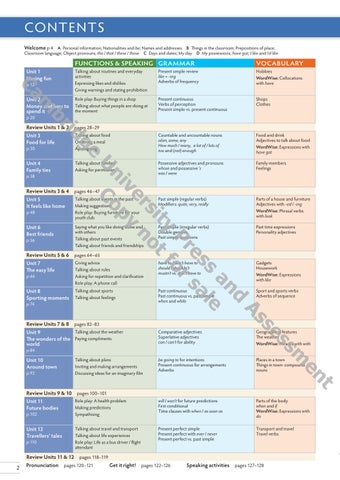
CONTENTS Welcome p 4 A Personal information; Nationalities and be; Names and addresses B Things in the classroom; Prepositions of place;
Classroom language; Object pronouns; this / that / these / those C Days and dates; My day D My possessions; have got; I like and I’d like
FUNCTIONS & SPEAKING GRAMMAR Unit 1 Having fun
m Ca
p 12
Unit 2 Money and how to spend it
Talking about routines and everyday activities Expressing likes and dislikes Giving warnings and stating prohibition
Present simple review like + -ing Adverbs of frequency
Hobbies WordWise: Collocations with have
Role play: Buying things in a shop Talking about what people are doing at the moment
Present continuous Verbs of perception Present simple vs. present continuous
Shops Clothes
Countable and uncountable nouns a/an, some, any How much / many, a lot of / lots of too and (not) enough
Food and drink Adjectives to talk about food WordWise: Expressions with have got
Possessive adjectives and pronouns whose and possessive ’s was / were
Family members Feelings
Parts of a house and furniture Adjectives with -ed / -ing WordWise: Phrasal verbs with look Past time expressions Personality adjectives
have to / don’t have to should / shouldn’t mustn’t vs. don’t have to
Gadgets Housework WordWise: Expressions with like
Past continuous Past continuous vs. past simple when and while
Sport and sports verbs Adverbs of sequence
br
p 20
VOCABULARY
p 30
Apologising
Talking about families Asking for permission
p 38
Past simple (regular verbs) Modifiers: quite, very, really
p 48
Co
Review Units 3 & 4 pages 46–47 Talking about events in the past Unit 5 Making suggestions It feels like home
Role play: Buying furniture for your youth club
Unit 6 Best friends
Saying what you like doing alone and with others Talking about past events Talking about friends and friendships
Past simple (irregular verbs) Double genitive Past simple questions
p 56
Review Units 5 & 6 pages 64–65 Giving advice Unit 7 Talking about rules The easy life p 66
Asking for repetition and clarification Role play: A phone call
Unit 8 Sporting moments
Talking about sports Talking about feelings
p 74
Comparative adjectives Superlative adjectives can / can’t for ability
Geographical features The weather WordWise: Phrases with with
m ss
Review Units 7 & 8 pages 82–83 Talking about the weather Unit 9 The wonders of the Paying compliments world
se
As d an s le es sa Pr r y fo it t rs no ve y ni p
U
Unit 4 Family ties
ge
id
Review Units 1 & 2 pages 28–29 Talking about food Unit 3 Ordering a meal Food for life
p 84
p 92
Talking about plans Inviting and making arrangements Discussing ideas for an imaginary film
p 102
Sympathising
Unit 12 Travellers’ tales
Talking about travel and transport Talking about life experiences Role play: Life as a bus driver / flight attendant
p 110
Places in a town Things in town: compound nouns
will / won’t for future predictions First conditional Time clauses with when / as soon as
Parts of the body when and if WordWise: Expressions with do
Present perfect simple Present perfect with ever / never Present perfect vs. past simple
Transport and travel Travel verbs
t
Review Units 9 & 10 pages 100–101 Role play: A health problem Unit 11 Making predictions Future bodies
be going to for intentions Present continuous for arrangements Adverbs
en
Unit 10 Around town
Review Units 11 & 12 pages 118–119
2
Pronunciation pages 120–121
Get it right! pages 122–126
Speaking activities pages 127–128
THINK
SKILLS
/s/, /z/, /ɪz/ sounds
Values: Taking care of yourself Self esteem: Why it’s good to have a hobby
Reading Quiz: Do you take good care of yourself? Blog: So what do you do in your free time? Photostory: Olivia’s new hobby Writing Writing about routines Listening Conversations about hobbies
Values: Fashion and clothes Train to Think: Exploring numbers
Reading Soap opera: Shopping Webchat: How not to spend money Culture: World markets Writing An informal email to say what you’re doing Listening Shop dialogues
Values: Food and health Self esteem: Being happy
Reading Article: Food facts or food fiction? Blog: My brother’s cooking Photostory: The picnic Writing A paragraph about your favourite or least favourite meal Listening Ordering food in a café
Values: TV families Train to Think: Making inferences
Reading Article: TV Families Article: The swimming pool heroes Culture: Around the world on Children’s Day Writing An invitation Listening Why my family drive me mad
m Ca
PRONUNCIATION
Contractions
id
br Vowel sounds: /ɪ/ and /iː/
ge
As d an s le es sa Pr r y fo it t rs no ve y ni p
Co
-ed endings /d/, /t/, /ɪd/
U
-er /ə/ at the end of words
Reading Article: The Lego House Blog: Dad gets it right! (finally) Photostory: Hey, look at that guy! Writing A blog post and a summary of a text Listening What is home?
Stressed syllables in words
Values: Friendship and loyalty Train to Think: Making decisions
Reading Article: Together Article: How we met Culture: Friendship myths Writing An apology Listening A story about Cristiano Ronaldo
Vowel sounds: /ʊ/ and /uː/
Values: Caring for people and the environment Self esteem: Classroom rules
Reading Article: Just because I didn’t want to take a bath Website: Product reviews Photostory: The treasure hunt Writing A paragraph about housework Listening Radio programme – advice for young inventors
Strong and weak forms of was and were
Values: Trying, winning and losing Train to Think: Sequencing
Reading Article: If you don’t give up, you can’t fail Web forum: Your favourite sports fails! Culture: The Olympic Games – the good and the notso-good Writing An article about a sporting event Listening Teens talking about sport
Vowel sounds: /ɪ/ and /aɪ/
Values: Valuing our world Self esteem: Being brave is …
Reading Article: An amazing place Article: Could you live there? Photostory: The competition Writing An email about a place in the article Listening Interview with a Kalahari bushman
Voiced /ð/ and unvoiced /θ/ consonants
Values: Appreciating other cultures Train to Think: Problem solving
Reading Blogs: Alice’s world, The life of Brian Letters to a newspaper: Our town: what’s wrong and what can we do about it? Culture: Ghost towns around the world Writing An informal email Listening A conversation between people arranging to go out
The /h/ consonant sound
Values: Exercise and health Self esteem: Getting help
Reading Article: Changing bodies Webchats: Crazy things that parents say to their kids Photostory: The phone call Writing A phone message Listening Dialogues about physical problems
Sentence stress
Values: Travel broadens the mind Train to Think: Exploring differences
Reading Blog: The non-stop traveller Interview: The taxi driver Culture: Hard journeys for schoolchildren Writing An essay about someone you admire Listening A traveller talking to children at his old school
t
en
m ss
se
Values: Community spirit Self esteem: Feeling safe
3
m Ca
WELCOME A ALL ABOUT ME Personal information
Nationalities and be 4 Complete the names of the countries (add the
ge
id
br
consonants).
Hi. I’m Alex. ALEX I’m fourteen. How about you? ALEX The United States. ALEX Hello, Fabiola. Where are you from? ABIOLA Me? I’m fourteen, too. FABIOLA I’m from Italy. And you? FABIOLA Hi, Alex. My name’s Fabiola. FABIOLA Cool! How old are you, Alex?
1 ALEX
2
ea i ai
3
the a
5
I
e
er-
a
4
o
o
6
e
i
ia
o
Complete the dialogue with the phrases in the list. Listen and check. 1.03
u
ia
9
u
e
10 the U
8
ai
i a
Tell your partner who you are. 2 Introduce your partner to others in the group. 1
e e
Hi, I’m Ryan Gosling. Hello, my name’s Rihanna. And this is my friend, Barack Obama. 4
11
A
e
i
a 12
e
iu
t
en
SPEAKING Imagine you are a famous person. Work in pairs, then groups.
7
m ss
Fabiola – 1 is my friend Ravi. RAVI Hi, Fabiola. Nice to 2 you. 3 FABIOLA Nice to meet you, , Ravi. And this is my friend: her name’s Patrizia. PATRIZIA Hi, guys. How 4 you? I’m Patrizia. Patrizia Lambertucci. ALEX
se
are | meet | this | too
3
2
Co
Put the dialogue in order. Number the boxes. Listen and check. 1.02
i
As d an s le es sa Pr r y fo it t rs no ve y ni p
U
1
a
1
WELCOM E
Carlos Sandra 0
He’s Brazilian.
m Ca
1
Liam and Jane
She’s
Natasha and Anna
2
3
4
ge
id
br Ricardo
Burcu
U
Lotte
5
Giovanni
As d an s le es sa Pr r y fo it t rs no ve y ni p 6
Co
Names and addresses 7
Andrea
Raul and Luis
8 9
7
Ravi phones for a taxi. Listen and complete the information. 1.05
COOPER’S TAXIS
5 What nationality are the people? Write the sentences.
6
Booking form
Complete the dialogue using the correct forms of the verb to be. Then listen and check. 1.04
FABIOLA
RAVI
PATRIZIA
Pick up at
3
From
4
Number of passengers
5
Mr Chaudry
1.06 Now listen to a phone call. Correct each of these sentences.
t
RAVI
8
2
en
FABIOLA
Going to
m ss
PATRIZIA
1
se
RAVI
So, Ravi – where 0 are you from? 1 Me? I from Britain. Alex here 2 from the United States, but I 3 British. But, 4 your name British? Oh, good question. Well, no it 5 . My parents 6 from India and so my name 7 from India too. But my sister Anita and I were both born here, so we 8 100% British. That 9 cool. I think your name 10 really nice. Thank you! And you two, 11 you both Italian? That 12 right. But we 13 not from the same city. I 14 from Milan and Fabiola 15 from Bari. We 16 students at the language school here.
Taxi for
0
Alex phones Patrizia.
No – Patrizia phones Alex.
They met last Wednesday. There’s a party at Patrizia’s place next Friday. 3 The party starts at seven thirty. 4 Patrizia lives at 134 Markam Avenue. 5 Her phone number is 0788 224 234. 1 2
5
B WHAT’S THAT? Things in the classroom 1 Look at the pictures. Write the correct number next to each word. board
book
CD
chair
desk
floor
pen
pencil
ruler
window
door
notebook
m Ca 1
2
3 9
br
As d an s le es sa Pr r y fo it t rs no ve y ni p
U
5
12
6
Co
Prepositions of place
4
2 Look at the pictures. Complete each sentence with a preposition from the list (you will use some words more than once).
Use one of the sentences in Exercise 3 to complete each mini-dialogue. Listen and check. 1.08
Good morning, everyone. STUDENTS Good morning. TEACHER OK. Let’s start.
1
TEACHER
2
TEACHER
on | between | in | under | in front of | behind 1 2 3 4 5 6 7
The notebook is The pencil is The pencil is The book is The pen is The ruler is The board is The book is
the chair. the floor. the chair. the desk. the book. the notebook. the door and the window. the pen.
on
MICHAEL
TEACHER
3
STUDENT TEACHER
5
A No, that’s completely wrong!
5 6 7 8 9 10
6
A How do you think you spell the word ‘enough’? A No, that’s really how you spell it. B OK, how do you spell it, then? B Oh. Let me think. Is it E-N-U-F-F? B You’re kidding!
6
Work in pairs. Think of a word in English. Can your partner spell it? SPEAKING
How do you spell ‘awful’? That’s right.
A-W-F-U-L.
t
4
1
en
3
1.09 Put the lines in order to make a dialogue. Listen and check.
m ss
2
,
Mrs McFarlane. I’ve got a question. Yes, what is it? : ‘fascinating’? It means: ‘very, very interesting’.
A E-N-O-U-G-H.
ask | again | mean | hand | don’t page | me | say | spell | understand Excuse . Can I a question, please? Can you say that , please? How do you cansado in English? Open your books at 21. Put your up if you know the answer. Sorry, I know. Sorry, I don’t . What does this word ? Excuse me. How do you that word? Is it T-I-R-E-D or T-Y-R-E-D?
That’s OK. What about you, Susie?
STUDENT
TEACHER
1.07 Complete each sentence with a word from the list. Listen and check.
1
So, Michael, what’s the answer?
se
Classroom language 3
11
ge
id 4
0
8
7
10
WELCOM E
Object pronouns
9 Complete the email by writing one word in each space.
7 Complete each sentence with the correct pronoun. 0 1
She’s a good teacher – we like her a lot. My pens are under your desk. Can you get , please? I’ve got a new book – I’m going to read this afternoon. Sorry, can you speak more loudly? I can’t hear . I really can’t do this homework – can you help ? He doesn’t understand so please help . We like our teacher. She gives good marks!
To: shirley_2002@email.co.uk Subject: Hello from Spain
m Ca 2
6
Our hotel is great. 3 is a swimming pool downstairs and I swim there every day before brea kfast. But of course I have breakfas t late – usually nine o’clock! And it’s always really good – the orange juice is delicious and I usually eat ham and eggs, too. Breakfast is my favourite meal – I love 4 . 5 So, are you? I hope you are enjoying your holidays, too. I want to buy a present for you here in Spain. 6 would you like? 7 you like Spanish music? Write and tell 8 , OK? Have a good time and write soon.
ge
5
id
4
I’m writing to you from Spain! My family and I 0 are on holiday here for two weeks. It’s really nice here. Spanish people are very frien dly but of course I don’t speak Spanish so I don’t 1 whe n peo ple talk to me. But a 2 of people here speak good English, so it’s all OK.
br
3
Hi Shirley
As d an s le es sa Pr r y fo it t rs no ve y ni p
U
this / that / these / those
Co
8 Match the pictures and sentences. What does this word mean? 2 What does that word mean? 3 These books are heavy. 4 Those books are heavy. 1
Love
Howard
m ss
se
A
B
t
en
C
D
7
C ABOUT TIME Days and dates 1
3 Draw lines to match the numbers and the words. 22nd 3rd 12th 4th 15th 2nd 5th 31st 1st 20th
first second third fourth fifth twelfth fifteenth twentieth twenty-second thirty-first
1.10 Listen and circle the correct information.
m Ca br
4
id
How do you say these numbers? Listen and check. 1.12
7th | 11th | 14th | 19th | 23rd | 28th | 30th
ge
5
1.13
Listen and write the people’s birthdays.
Co
As d an s le es sa Pr r y fo it t rs no ve y ni p
U OLIVER SHONA OLIVER SHONA OLIVER SHONA OLIVER SHONA OLIVER SHONA OLIVER
1
4th August
3
2
4
se
2
Hi, Shona. Why are you so happy today? Because it’s the 121st / 22nd / 23rd February. And what’s special about that date? It’s my birthday! Really! Happy birthday, Shona. Thanks. I’m 212 / 13 / 14 today. Lucky you! When is your birthday, Oliver? It’s in 3August / September / October. What date? The 411th / 12th / 13th. I think it’s on a 5Tuesday / Thursday / Friday this year.
m ss
1.11 Complete the names of the days and months. Listen and check.
DAYS 5 F 6 S
r
y
en
7 S
t
Mo n d a y 2 T sd 3 W n d 4 hu y 1
MONTHS
J u y 2 F bru 3 M h 4 p l 5 M 6 J
1
8
7 J 8 A
y u
9 S
mber er
10 O 11 12 D
5
vem
6
6
Walk around the classroom. Ask and answer questions. Whose birthday is close to your birthday? SPEAKING
When’s your birthday?
It’s on 17th March.
WELCOM E
My day
9 Match the clocks and the times. It’s half past eight. It’s quarter past three. 3 It’s eleven o’clock. 4 It’s six o’clock.
7 Put the pictures in the order you do them.
It’s eight o’clock. It’s quarter to eight. 7 It’s ten to one. 8 It’s twenty past ten.
1
5
2
6
m Ca br
A
B
A
I get home.
B
2 I
I get home.
ge
id
I go to school.
As d an s le es sa Pr r y fo it t rs no ve y ni p
U C
I go to bed.
Co
C
I
I
D
D
I have dinner.
E
I
E
I have breakfast.
F
I
F
I get up.
G
se
I
I
m ss
LOOK! H
I do my homework.
I have lunch.
midday to midnight = pm 1 am = 1 o’clock in the early morning midnight to midday = am 12 am = midnight 1 pm = 1 o’clock in the afternoon 12 pm = midday
t
en
G
H
8 Look at the sentences in Exercise 7. Write them in the correct column for you. Morning
I get up.
Afternoon
Evening
10
1.14 Listen to Leah. Write about her day under the pictures in Exercise 9.
11 SPEAKING Work in pairs. Talk about your day.
I get up at half past seven. I have lunch at twelve o’clock. 9
D MY THINGS My possessions
HOME
1 Read Chloës’s blog and tick (✓) the photos of the things
ABOUT
NEWS
CONTACT
Welcome!
she has got.
2 Work in pairs. How many things about Chloë can you write
m Ca
in each list?
PERSONAL POSSESSIONS: TV
,
, laptop ,
, ,
, ,
have got
id
br
PETS: cat
,
Positive
ge
3 Complete the table with have, has, haven’t or hasn’t. I haven’t (have not) got a cat. You 5 (have not) got a cat. He hasn’t (has not) got a cat. She 6 (has not) got a cat. 7 We (have not) got a cat. They 8 (have not) got a cat.
I haven’t got a pet but I’d love a cat or maybe something unusual like a lizard. I haven’t got a smart phone. I want one for my next birthday. I’ve got an MP3 player and I’ve got a tablet. I haven’t got a laptop. My dad’s got one and I sometimes use that. I’ve got a TV in my bedroom. And I’ve got a camera, a small one but it’s nice. I’m a very lucky girl.
Co
Questions
I’ve got a bike – it’s really my favourite thing!
As d an s le es sa Pr r y fo it t rs no ve y ni p
U
I’ve (have) got a dog. You 1 (have) got a dog. He’s (has) got a dog. She 2 (has) got a dog. 3 We (have) got a dog. They 4 (have) got a dog.
Negative
Hi, my name’s Chloë,
Have I got a pet? 9 you got a pet? Has he got a pet? 10 she got a pet? 11 we got a pet? 12 they got a pet?
Short answers
Yes, you have. / No, you haven’t. Yes, I 13 / No, I 14 Yes, he has / No, he hasn’t. Yes, she 15 / No, she 16 17 Yes, we / No, we 18 19 Yes, they / No, they 20
4 Complete the sentences with have, has,
haven’t or hasn’t so they are true for you. 1 2 3 4 6
SPEAKING Walk around the classroom. Find someone who has got ...
6
What colour is it?
Yes, I have.
t
Have you got a bike?
10
two brothers or sisters a smart phone 7 an unusual pet 8 a house with a garden 5
2
en
a red bike a cat and a dog 3 an English dictionary 4 an email address 1
m ss
5
se
5
I got a tablet. My dad got a computer. I got a dog. My best friend got a brother. I got a TV in my bedroom. My mum got a car.
WELCOM E
I like and I’d like 8 Complete with the words in the list.
6 Match the pictures and the sentences.
banana | orange juice | tuna | biscuit
m Ca
Picnic Box Sandwiches: cheese or 1
ge
id
br
Desserts: cake or 2
Drinks: water or 4
B
Co
As d an s le es sa Pr r y fo it t rs no ve y ni p
U
A
Fruit: apple or 3
C
I like apples! 2 I’d like a hot shower! 1
7
D
I’d like six apples. 4 I like hot showers. 3
Complete with I like or I’d like. Listen and check. 1.15
A B A B
2
A A B
4
A B
5
A B
What do you want to watch? Well, films, so can we watch a film, please? cycling. Do you? Not much. I think running’s better. Do you want pizza or lasagne? Well, pizza’s my favourite food – but today, lasagne, please!
DINNER LADY MAX
Hi, Max. 1 I’d like a picnic box, please.
DINNER LADY
2
MAX
A cheese sandwich, please.
DINNER LADY
3
MAX
4
DINNER LADY
Yes, we have. A banana, please.
MAX
t
3
an ice cream, please. Chocolate or strawberry?
Write the questions in the spaces to complete part of the dialogue. Listen again and check. What fruit would you like? Have you got bananas? What would you like for lunch today? Would you like a tuna sandwich or a cheese sandwich? 1.16
en
B
Can I help you? Yes, a kilo of oranges.
10
m ss
1
What’s your favourite food? I like curry best.
Listen to the dialogue. What does Max choose for his lunch? Circle the food above. 1.16
se
0
9
11 SPEAKING Work in pairs. Make a picnic box for your partner. Ask and answer questions.
What would you like for … ? Would you like a … or … ? 11
1 FUN HAVING
OBJECTIVES FUNCTIONS: talking about routines
m Ca
and everyday activities; expressing likes and dislikes; giving warnings and stating prohibition GRAMMAR: present simple review; like + -ing; adverbs of frequency VOCABULARY: hobbies; collocations with have
ge
id
br As d an s le es sa Pr r y fo it t rs no ve y ni p
U
C
A
B
Co
D
E
F
READING
photos. Write 1–8 in the boxes.
3
SPEAKING Work in groups of three and compare your ideas from Exercise 2.
I think dancing is always fun.
I think it’s sometimes fun.
2 Are these activities fun? Write always, 1 2 3 4 5 6 7 8
12
Sleeping is fun. Doing homework is fun. Playing football is fun. Studying is fun. Reading is fun. Dancing is fun. Tidying up is fun. Singing is fun.
4
SPEAKING
you think.
Think of more activities and say what
t
sometimes or never.
en
reading 6 dancing 7 tidying up 8 singing 5
m ss
sleeping 2 doing homework 3 playing football 4 studying 1
H
se
1 Match the activities in the list with the
G
G
Riding a bike is always fun. Doing housework is never fun. 5
1.17 Read and listen to the quiz. Match the pictures with the questions in the quiz. Write 1–7 in the boxes.
1 H AV I N G FU N
Do you take good care of yourself? D
m Ca
Does your teacher give you a lot of homework? Do your parents always want your bedroom tidy? School work, housework; life’s not always easy. There are a lot of things to do and there isn’t always time to do it all. But in your busy life it’s important to think about yourself. It’s important to do things you like, things that make you happy. Everyone needs fun.
id
br
4 How many hours do you sleep a night? a) nine to ten hours b) about eight c) less than eight
Do you like exercise? 5 a) Yes, exercise is fun. b) It’s OK. c) No. It’s really boring.
ge
So take our quiz and find out. Do you take good care of yourself? Do you like puzzles 6 and crosswords? a) I love them. b) They’re OK. c) I don’t really like them. They’re boring.
Co
As d an s le es sa Pr r y fo it t rs no ve y ni p
U
1 Do you smile a lot? a) Yes, I smile all the time. b) I only smile when I’m happy. c) My best friend says I don’t smile very often.
A
2 How many hobbies do you have? a) I’ve got lots of hobbies. b) One or two. c) I don’t have any hobbies.
B
3 When do you relax? a) In the morning, afternoon and in the evening. b) I relax when I have time. c) I never relax. I’m always busy.
E
F
G
7 Which of these things do you do most? a) Talk with friends and family. b) Meet friends online. c) Watch TV and play computer games.
C
Mostly As: You take good care of yourself. You know how to have fun and enjoy life. Mostly Bs: You take care of yourself OK, but can you do more? Try and find more time for yourself. Mostly Cs: You don’t take good care of yourself. Try and have more fun.
en
Taking care of yourself 1 Which questions in the quiz tell us that these
7 Being with people
b
Enjoying exercise
c
Sleep
d
Getting rest
e
Giving your brain exercise
f
Being positive
g
Having interests
t
things are important for us? a
m ss
se
YOUR SCORE:
2
SPEAKING
Compare your ideas with a partner.
Question 7 shows us that being with people is important. 13
GRAMMAR Present simple review
3 Complete the sentences. Use the present simple of the verbs. 0
1 Complete the sentences with the words in the
list. Check your answers in the quiz on page 13.
1
relax | do | does | don’t | says
2
I never relax . My best friend I don’t smile very often. I really like them. your teacher give you a lot of homework? you like exercise?
m Ca
0 1 2 3
4
id
br
4
3
2 Look at the sentences in Exercise 1 and the table.
5
Positive
ge
Complete the rule with do, does, don’t or doesn’t.
6
Negative I don’t like milk.
You like milk.
You don’t like milk.
U
I like milk.
As d an s le es sa Pr r y fo it t rs no ve y ni p
Workbook page 10
He/She/It likes milk. He/She/It doesn’t like milk. We don’t like milk.
They like milk.
They don’t like milk.
Questions
Short answers
Do I like milk?
Yes, you do.
No, you don’t.
Do you like milk?
Yes, I do.
No, I don’t.
Does he/she/it like milk?
Yes, he/she/it does.
No, he/she/it doesn’t.
Do we like milk?
Yes, we do.
No, we don’t.
Do they like milk?
Yes, they do.
No, they don’t.
/s/, /z/, /ɪz/ sounds Go to page 120.
RULE: Use the present simple for things that happen regularly or that are always true. In positive sentences:
●
. .
in a club a blog
to 4 to 5 to 3
photos a pet things
SPEAKING Work in pairs. Ask questions about the hobbies in the pictures.
Do you play an instrument?
What do you play?
Do you collect something? What …?
. .
t
14
play an instrument
en
●
with I, you, we and they, use the auxiliary 3 with he, she and it, use the auxiliary 4
to 1 to 2 to 0
Workbook page 12
In questions: ●
play | write | keep | take | be | collect
m ss
with I, you, we and they, use the base form of the verb. with he, she and it, add -s (or -es with verbs that end -s, -sh, -ch, -x, or -z). with I, you, we and they, use 1 with he, she and it, use 2
1 Complete the phrases with the words in the list.
2
In negative sentences: ●
VOCABULARY Hobbies
se
●
Pronunciation
Co
We like milk.
●
I don’t like (not like) roller coasters. I get (get) really scared on them. My dad (not sleep) a lot. He only (need) five or six hours. A you (study) English? B Yes, I . My dad (cook) really well but he says he (not enjoy) it. A your sister (play) in the school football team? B No, she . My grandparents (not like) travelling. They (prefer) to stay at home. My brother (watch) TV all day. He (not do) anything else.
1 H AV I N G FU N
LISTENING 1
1.20
Listen to the conversations. Match each one with a picture.
m Ca ge
id
br U 1.20 Listen again. Complete the sentences with the names in the list.
Co
2
As d an s le es sa Pr r y fo it t rs no ve y ni p
A
B
2 Copy the diagram into your notebooks and complete it with the hobbies in the list.
playing the piano | joining a tennis club collecting stamps | writing a blog dancing | cooking | watching TV playing online games | taking photos
Tom | Carla | Lisa | Lisa’s dad | James | James’s mum 0 1 2 3 4 5
Tom
C
has got a headache. wants to join a football club. doesn’t have time to relax. thinks music is good for relaxing. wants to be a famous piano player. thinks football is for boys.
Make friends
Why it’s good to have a hobby
1 Circle the person from Listening Exercise 1.
play the piano
3
Discover your talents
en
Relax
m ss
se
I think it’s good to have a hobby because … 1 you can make new friends. A Carla B Lisa C James 2 it helps you relax. A Carla B Lisa C James 3 you can discover you have new talents. A Carla B Lisa C James
t
SPEAKING Work in pairs. Compare diagrams with your partner.
Playing the piano is good. It helps you to relax. 4 What hobbies have you got? Think about why they are good for you. Make notes.
5 Tell your partner about your hobbies.
I dance. I’m not very good but it helps me to relax. 15
READING 1 Read the blog and answer the questions. How many people like collecting things? 2 Who has got the strangest hobby? 1
m Ca
So what do you do in your free time?
id
br
OK, we know you all like watching TV and playing computer games but we want to know some of the other things you do when you’ve got some free time. Write us a line or two and let us know.
ge
Posted on January 22
U
ADAM I can’t stand walking to school so I sometimes invent little games to help pass the time. For example I try to think of an animal, or football team or city for every letter of the alphabet.
DYLAN I like watching the news on TV. I watch it every day. My friends think I’m weird.
Co
As d an s le es sa Pr r y fo it t rs no ve y ni p
NATHAN I love collecting autographs of my friends and family. Now I want to get some from some famous people.
CHLOE I enjoy lying on my back and looking at the clouds. I try to find different shapes in them. It’s really relaxing and I occasionally fall asleep doing it. IZZY Once a week my granddad takes me out for a milkshake. I love listening to his stories. It’s the best.
LIZ I like doing my homework as soon as I get home from school. Is there something wrong with me?
REBECCA I really like going for a walk on my own in the forest near our house. There’s always something interesting to see and I never get bored. LEWIS I collect bottle tops. I always take one home every time I go to a restaurant.
KUBA I hate being on my own. So when I am by myself I usually start talking to my imaginary friends. But don’t tell anyone! JASMINE I rarely get bored but if I do I just go to the library and get a book to learn about something new. It works every time. DAISY I like writing poems. I often write a poem when I’ve got nothing to do.
se
2 Read the sentences. Which of the people above
A country that starts with R? Easy: Russia.
1
Have you got a book about birds?
2
Tell me more, please!
3
Can you write your name for me in my book?
4
Sorry, I can’t come to the park now. I want to finish my maths.
5
Hey, that one looks just like a cow.
Adam
t
0
en
16
m ss
do you think is saying each one?
1 H AV I N G FU N 6 Complete the sentences so they are true for you.
GRAMMAR like + -ing
1 2
1 Look at the sentences from the blog on page 16. Draw
or
3
next to each one.
4
I love collecting autographs. 2 I can’t stand walking to school. 3 I hate being on my own. 4 I like writing poems. 1
5
m Ca
6
16. Check your answers and complete the rule.
br
id
takes me out for a milkshake. 2 I watch it (the TV news)
ge
RULE: Use the 1 form of the verb after verbs which express likes and dislikes, e.g. like, love, hate, enjoy, can’t stand.
1before / after the verb to be but 2before / after
Co
As d an s le es sa Pr r y fo it t rs no ve y ni p
U
other verbs. Phrases like every day or twice a week can come at the beginning or at the end of a sentence.
8 Write down things you do …
3 Complete the sentences. Use the -ing form of the verbs in the list.
every day: I give my mum a kiss every day. three times a week: once a year:
run | visit | swim | eat | ride | talk 0 1 2 3 4 5
4
I hate running to catch the bus to school. My mum and dad enjoy in nice restaurants. My brother can’t stand on the telephone. They quite like in the sea when it’s warm. Donna really likes her horse. We love new places on holiday.
What about you? Write two or three sentences about yourself. WRITING
.
RULE: Words like sometimes, never, always come
To make this form add 2 to the base verb. If the verb ends in -e, drop the final -e (e.g. live – living). If a short verb ends in a consonant + vowel + consonant, we usually double the final consonant before adding the -ing (e.g. swim – swimming).
●
my granddad
1
the rule.
●
do my homework when I get home. write ‘thank you’ cards for my presents. late for school. watch TV in the mornings. angry if I don’t tidy my room. turn off the lights when I leave the room.
7 Complete these sentences from the blog on page
2 Use the sentences in Exercise 1 to complete
●
I I I am I Mum is I
I go once a month … Workbook page 11
WRITING Your routine
Complete the sentences so they are true for you. 2 3 4 6 8
t
7
at the weekend. . three times every day. in August. when I’m tired. once a week. . after school.
en
5
I rarely I can’t stand I I love I never I I occasionally I enjoy
m ss
always | occasionally | never | often
How often do you go to the cinema?
1
5 Complete the diagram with the words in the list.
SPEAKING Work in small groups. Compare your answers to Exercises 6 and 8.
se
Adverbs of frequency
9
Adverbs of frequency 0% 1
100%
rarely
2
sometimes
3
usually
4
17
PHOTOSTORY: episode p 1
Olivia’sobby new h
1 LLook at the photos and answer the questions. What do you think Olivia’s hobby is? Why does Ryan look worried?
2
1.21 Now read and listen to the photostory. Check your answers.
m Ca ge
id
br Co
As d an s le es sa Pr r y fo it t rs no ve y ni p
U 1
LUKE Look. It’s Olivia and Megan. RYAN What are they up to? LUKE I’m not sure what they’re doing but
2
reading a book in strange places.
LUKE Cool! Can I video you on my phone? OLIVIA Of course you can. Come on.
they’re defi nitely having a good time. RYAN Let’s go and fi nd out.
OLIVIA Hi, Ryan. Hi, Luke. RYAN Hi, Olivia. So what are you two doing? OLIVIA It’s my new hobby. I take photos of Megan
t
en
m ss
se 4
3 LUKE Th is is great. I think I’ve got a new hobby
too – making videos. RYAN Be careful, Luke. Don’t push too hard. OLIVIA That’s right. Be careful. MEGAN Don’t stop, Luke. I’m having fun.
OLIVIA That’s great, Megan. MEGAN Hurry up. My arms are tired.
I need to have a rest. OLIVIA Just a few more. RYAN Look out, Olivia! You’re very close
to the water.
18
1 H AV I N G FU N
DEVELOPING SPEAKING 3 Work in pairs. Discuss what happens next in the story. Write down your ideas.
WordWise
We think Olivia falls in the water. 4
EP1
Collocations with have
Watch to find out how the story continues.
m Ca
1 Match the sentence parts from the story.
5 Circle the correct word in each sentence. 0 1
5 6
ge
4
id
3
br
2
Ryan tries / doesn’t try to warn Olivia. Ryan and Luke help / don’t help her out of the water. Olivia cries / doesn’t cry when she falls into the water. Olivia laughs / doesn’t laugh when she sees her camera. Her camera is / isn’t broken. Luke tells / doesn’t tell them what the surprise is. Luke gives / doesn’t give Olivia the money.
1
I’m not sure what they’re doing
2
Don’t stop, Luke.
3
You’re really dirty. You need to go home
4
My arms are tired.
5
Olivia, I think you have a problem.
6
We’re just having dinner.
a
U
b c d
1 Find the expressions 1–5 in the photostory. Who
e
As d an s le es sa Pr r y fo it t rs no ve y ni p
PHRASES FOR FLUENCY
f
Co
says them? Match them to the definitions a–f. 0
(What are they) up to?
1
Cool!
Ryan
2 Ask and answer the questions in pairs.
e
1
2
Come on.
3
That’s right.
4
Hurry up.
5
Look out!
2 3 4 5 6
Be quick. b Correct. c Be careful. a
d e f
Let’s start. Doing. Great.
FUNCTIONS Giving warnings and stating prohibition 1 Put the words in order to make sentences.
In the park NICOLE
NICOLE
SARAH
pictures A–D.
t
NICOLE
2 Match the sentences in Exercise 1 with the
en
SARAH
do / that / Don’t 4 push / Don’t / hard / too 3
m ss
SARAH
Dan / Be / careful 2 out / Lucy / Look 1
Hi, Nancy. What are you 0 up to ? Not a lot. Just walking. Are you here for a walk too? 1 . I’m a bit bored at home. Me too. We can walk together, if you want. 2 ! Oh no – 3 ! Mike Smith is coming. I don’t like him! 4 – let’s walk over here. I don’t want him to see me. 5 , Nancy!
se
SARAH
Who do you have the most fun with? Do you have a good time at school? What do you do when you have a problem? What time do you have dinner? Do you have a rest after school? When do you have a shower? Workbook page 12
2 Complete the conversation with the expressions in Exercise 1.
I’m having fun. I think your camera’s broken. It’s pizza. Would you like some? I need to have a rest. but they’re definitely having a good time. and have a shower.
C D A
B
19
2 SPEND IT MONEY AND HOW TO
m Ca
READING
br 1.22
Say these prices. Listen and check.
ge
id
1
3
PRICE
£22. 75
a shop; talking about what people are doing at the moment GRAMMAR: present continuous; verbs of perception; present simple vs. present continuous VOCABULARY: shops; clothes
SPEAKING Work in pairs. Discuss the following questions. Then compare your ideas with other students.
As d an s le es sa Pr r y fo it t rs no ve y ni p 2
1
FUNCTIONS: buying things in
Which of the things in Exercise 2 do you … 1 think are cheap? 2 think are expensive? 3 think are fantastic? 4 dream about having?
U
€1.49
OBJECTIVES
4 Look at the picture on page 21. Answer these questions.
Co
$249.00
1 2
£5.99
3
5
4
Who do you think the boy and girl are? Do you think the girl likes the shirt?
1.24 Read and listen to the script from a soap opera and check your ideas.
6 Mark the sentences T (true) or F (false). Correct the false ones.
$8.25
£835.00
5
6
0
It’s six o’clock on Friday afternoon.
1
Tom is deciding what to wear. Maddy thinks yellow is a good idea. Tom thinks he’s good-looking. Tom wants to buy expensive clothes. Tom wants to be famous.
It’s four o’clock on Friday afternoon.
2
2
What are these objects? Match them with the prices in Exercise 1. Write 1–6 in the boxes. Listen and check. 1.23
3 4 5
D
E
C
t
B
en
m ss
se
A
20
F
2 MO N E Y A N D H OW TO SPEN D IT
m Ca TOM
MADDY TOM
MADDY
MADDY TOM TOM MADDY TOM MADDY TOM MADDY TOM MADDY TOM MADDY
TOM
MADDY
TOM
MADDY TOM
Clothes – my values:
I want to look cool. I want to feel comfortable. I always buy cheap clothes. I like buying designer clothes. I love wearing clean clothes. I like wearing bright colours. I always buy clothes in the same shops.
2
SPEAKING
questions.
Work in pairs. Ask and answer
t
MADDY
a number from 0 to 5 (0 = not important, 5 = very, very important).
en
TOM
1 How important are these for you? Give each one
m ss
TOM
Fashion and clothes
se
MADDY
Co
MADDY
As d an s le es sa Pr r y fo it t rs no ve y ni p
TOM
U
MADDY
ge
TOM
id
TOM
br
MADDY
Hi, Maddy. Where are Mum and Dad? They’re out. At the supermarket, I think. They’re doing some shopping or something. What are you doing? Me? I’m looking for something. OK. What are you looking for? A shirt. And some trousers. I’m going out. It’s Friday and I have plans for tonight. So, I’m choosing my clothes. But it’s only four o’clock. I know. I need time to choose. Do you need any help? I can help you. No. Well, maybe. OK, yes. Think about colours. I’m thinking. I’m thinking about … yellow. Not a good idea. Why not? Because yellow just isn’t interesting. But I like yellow. Like this. I’m trying to help you, Tom. And I’m telling you – don’t wear a yellow shirt. You’re laughing. Why are you laughing at me? I’m not laughing at you. I’m laughing at the shirt. It looks terrible. I need some new ideas. You’re right. Look at this. Here, in this magazine. See this guy? He’s wearing beautiful clothes. Yes, but he’s good-looking. And rich too, probably. I’m not good-looking. Yes, you are! But of course, I’m only saying that because you’re my brother. OK, have you got your money? Yes. Why? I want to take you to town – to a clothes shop and maybe a shoe shop, too. That sounds great. Nothing expensive though. Don’t worry. Nice clothes aren’t always expensive. Come on. You know, I dream about being famous one day and about having fantastic clothes. Do you dream about that too? Tom, I’m nine years old. I dream about ice cream. OK, we can get ice cream after we buy the clothes.
How important is it for you to look cool? Not very important. I have 3 points. What about you? For me, it’s very important. 5 points. 21
GRAMMAR Present continuous
VOCABULARY Shops
1 Look at the examples of the present continuous.
1 Write the names of the shops under the photos.
Then complete the rule and the table.
newsagent’s | chemist’s | bookshop clothes shop | shoe shop | department store supermarket | sports shop
They’re doing some shopping at the supermarket. 2 He’s wearing beautiful clothes. 3 Why are you laughing at me? 4 I’m not laughing at you, Tom. 1
m Ca
br
RULE: Use the present 1
ge
id
to talk about things that are happening at or around the time of speaking. Form the present continuous with the present simple of 2 + the -ing form (e.g. running / doing / wearing, etc.) of the main verb.
As d an s le es sa Pr r y fo it t rs no ve y ni p
Negative
I’m not working.
you/we/they’re (1 ) working.
you/we/they aren’t working.
Co
I’m (= I am) working.
he/she/it’s (is) working.
he/she/it 2
Questions
Short answers
3
Yes, I am. No, I’m not.
I working?
working.
4
you/we/they working?
Yes, you/we/they 6 No, you/we/they 7
5
Yes, he/she/it 8 No, he/she/it 9
he/she/it working?
continuous of the verbs.
1
4
6
Sorry, Jenny’s not here. She 's doing (do) some shopping in town. They’re in the living room. They (play) computer games. My brother’s in the garage. He (clean) his bike. Steven! You (not listen) to me! I can’t talk now. I (do) my homework. It’s 3–0! We (not play) very well, and we (lose)! A you (watch) this programme? B No, I . You can watch a different one if you want. A What you (do)? B I (try) to find some old photos on my computer.
Workbook page 18
7
2
8
Complete the sentences with the names of shops from Exercise 1. Then compare your ideas with other students. SPEAKING
In my town there’s a very good … It’s called … It’s good because … 2 I often go there because … 3 I never go into … because they don’t interest me. I don’t often go to … because … 1
In my town there’s a very good clothes shop. It’s good because the clothes aren’t expensive. Workbook page 20
22
t
7
6
en
5
5
. .
m ss
3
4
se
2
3
. .
2 Complete the sentences. Use the present 0
2
U
Positive
1
2 MO N E Y A N D H OW TO SPEN D IT
GRAMMAR Verbs of perception 1 Look at the sentences from the script on page 21. Answer the questions. It looks terrible. 2 That sounds great.
B
What is ‘it’? What is ‘that’?
1
C
m Ca
2 Match the verbs with the pictures.
Then complete the rule. 1 look 2 sound 3 smell 4 taste
br
A
id
RULE: Verbs of perception are used in the present 1
D
when they are used to give an opinion.
ge
The food tastes great. That idea sounds good. That pizza smells nice. The words after the verbs of perception are 2 .
U
2
3 Match the responses (a-d) to the first parts of
1.26 Put the sentences in the correct order 1–9. Listen and check. Practise in pairs.
As d an s le es sa Pr r y fo it t rs no ve y ni p
the conversations (1-4).
A It’s £75.00.
I’m going to the cinema. 2 My mother’s making pizzas. 3 I’m wearing my new shoes. 4 Don’t you like the juice? 1
1
Co
a
No. It tastes horrible!
b That sounds great.
c
1
A Sorry, no. Only brown.
A Yes, of course.
They smell fantastic.
B Can I try it on?
d They look nice.
B Very nice. I’ll take it.
clothes shop
2
ROLE PLAY
newsagent’s
3
Exploring numbers
4
m ss
1 You want to buy some new clothes. Here are some
FUNCTIONS Buying things in a shop
things you like. Answer the questions in pairs.
1 2 3 4 5 6
1
A 2
SPEAKING
t
Choose three things. How much do they cost? 2 You’ve got £30.00. Name three things you can buy. 3 You’ve got £75.00. Can you buy all five things?
Mark them C (customer) or A (assistant). Can I help you? Have you got … ? What size do you take? Can I try it/them on please? How much is it/are they? That’s (twenty pounds) please. Have you got it/them in (blue)?
en
T-Shirt – £8.50 shoes – £12.75 jumper – £9.25 belt – £3 jacket – £35
1 Read the sentences from the listening. 0
se
2
Buying clothes in a shop
Work in pairs. Student A: Go to page 127. Student B: Go to page 128. Take two or three minutes to prepare. Then have two conversations.
sports shop
1.25 Listen again. What does each person want to buy?
1
B Yes, please. I like this jacket. Have you
got it in black? B Oh, well, brown’s OK. How much is it?
1.25 Listen. What shop is each person in? Write numbers.
bookshop
A Hello. Can I help you?
A Great. So – that’s £75, please!
Workbook page 19
LISTENING
His new shirt looks awful!
Compare your ideas with a partner.
Pronunciation Contractions Go to page 120. 23
0
4
3 2
VOCABULARY Clothes 1
Complete the names of the clothes. Listen and check. 1.29
m Ca
1
0
b e l t
3
oe ai
e
8
e
9
6
e i o ou
7
id
4
u
6
br
2
oo a
5
e
1
7
e
5
ge
2 Answer the questions.
What are you wearing now? 2 What do you usually wear at the weekends? 3 What do you never wear? 4 What clothes do you really like / dislike buying? 1
8
9
As d an s le es sa Pr r y fo it t rs no ve y ni p
U
SPEAKING Work in pairs. Ask and answer the questions in Exercise 2. Then work with another partner.
Co
3
I’m wearing a green shirt and jeans.
I never wear shorts.
How not to spend money JollyMarie 5 June 2015
Wow! Problem. Not a lot of money right now and I don’t want to spend it. I’m tired of spending money! So here I am at home and I’m thinking – what can I do that’s free? (and fun lol) LIKE • COMMENT • SHARE
Workbook page 20
goodgirl an hour ago
READING
1 Read the web chat. Answer the questions. Who … 1 is interested in the sky? 2 is probably in the kitchen? 3 has a problem? 4 is in front of a TV? 5 is surprising her parents?
PeteJ yesterday
3
watching TV
I like baking cakes.
24
But you need money to buy ingredients!
It’s funny, PeteJ – I’m just like you (going to the cinema, I mean). Right now, I’m not watching a film – I’m watching the stars! I’ve got a book about the sky and it’s fantastic. I’m having a really good time here!
t
I like going for a walk. I also like watching TV.
RonnieRaver two days ago
en
Work in pairs. Tell your partner your ideas. Listen to what your partner says. Are his/ her ideas really things that don’t need money? Say what you think. SPEAKING
m ss
money. Write them down.
I really like going to the cinema but it can be a bit expensive – especially because my friends and I often go for a pizza after the film. So tonight I’m watching a film on TV at home. I’m really enjoying it. And it’s free! It’s incredible how many good films there are on TV these days, too.
se
2 Think of three things you enjoy that don’t need
going for a walk
I always go into town at the weekend – and I usually spend money! It’s very easy to buy things if you go into a shopping mall or a street full of shops. So this weekend I’m staying at home. Right now I’m just reading a book – my parents can’t believe it! lol
EllieParsons two days ago Oh JollyMarie, it’s not such a problem. My friends and I often have a picnic on Sundays and I make the sandwiches the night before. So right now, it’s Saturday night and I’m making sandwiches. hehehe
2 MO N E Y A N D H OW TO SPEN D IT
GRAMMAR Present simple vs. present continuous 1 Look at the examples. Complete the rule.
3 Circle the correct options. 1 2
present simple I usually watch a film at the cinema. I make the sandwiches the night before. I always go into town.
3
present continuous Right now, I’m watching a film. It’s Saturday night and I’m making sandwiches. This weekend, I’m staying at home.
7
4
m Ca
5 6
br
8
id
ge
4 Complete the sentences. Use the present simple
RULE: Use the 1
She sings well. She’s singing well.
1
Co
2
0
2
2 Match the sentences with the pictures. 1
or present continuous form of the verbs.
Mandy usually goes (go) to school on her bike, but today she is walking (walk). We (have) science lessons three times a week. This week we (learn) about trees. Tom (do) some shopping this afternoon. He (want) to buy a new camera. I (know) her face, but I (not remember) her name. Alex (not watch) the game tonight because he (not like) football very much. What this word (mean)? I (not understand) it.
As d an s le es sa Pr r y fo it t rs no ve y ni p
U
to talk about habits, routines and things which are generally or always true. Use the 2 to talk about temporary things which are happening around the moment of speaking.
3
4
4
Write 1–4 in the boxes.
We always wear / ’re always wearing a uniform to school. Paula wears / is wearing black jeans today. Come inside! It rains / ’s raining. It rains / ’s raining a lot in February. Dad cooks / ’s cooking at the moment. My mother cooks / ’s cooking lunch every Sunday. Steve’s terrible! He never listens / ’s never listening to the teacher! Can you be quiet, please? I listen / ’m listening to some music.
3
He plays football. He’s playing football.
5
Workbook page 19
SPEAKING
1 Look at these photos. Who are the people in each one?
A
B
m ss
se
D
believe | know | understand | mean remember | need | like | hate | want
I know the answer. (Not: I’m knowing the answer.) I understand the problem. (Not: I am understanding the problem.)
2 Work in pairs. Discuss the questions.
t
LOOK! These verbs are almost never used in the present continuous:
en
C
For each person, say … ● who they are. ● what they do. ● what they are doing.
It’s Beyoncé. She’s a … She’s … 25
Culture 1 Look at the photos. Name one or two things you can buy in each market.
●
Where can you see stalls? Where can you see a canal?
m Ca
●
2
1.30 Read and listen to the article. Match the photos with the places. Write the numbers 1–5 in the boxes.
br
A
id
ge
World markets As d an s le es sa Pr r y fo it t rs no ve y ni p
U
Wherever you go in the world, you find shops and stores – but you can find wonderful markets in most cities, too. Here’s a selection from five different countries.
it never closes! It’s very busy between the hours of 4.00 and 5.00 am, when people from the shops and restaurants in Tokyo buy the fresh fish that they need for the day. It is also very popular with tourists, but they can only visit the market later in the day, after the early morning buying and selling.
2 Khlong Lat Phli is a very unusual market about 80 kilometres south of Bangkok, Thailand. Early every morning, hundreds of local people sell fruit and vegetables from their boats on the canals. It’s not the only boat market in the country but it’s a very popular tourist one.
4 In Madrid there is a famous open-air market called El Rastro, which is open on Sunday mornings. There are over 1,000 stalls that sell many different things: books, CDs, paintings, antiques – beautiful old things. One of the streets sells only animals and birds. And of course visitors can stop to eat ‘tapas’ and get something to drink, and there are many street musicians with their guitars making music too.
B
Co
1 The Spice Bazaar in Istanbul is popular with both tourists and people from Istanbul. There are lots of shops and stalls and they all sell many different kinds of spices, sweets or nuts. You can buy spices from a lot of countries (like Iran, China, Russia and of course Turkey), and the smells and colours are amazing.
5 Portobello Road Market in London is popular with tourists and with Londoners, too. You can find all kinds of bargains here. The market (in Notting Hill) has five different parts and you can buy new or second-hand things (like clothes) as well as fruit and vegetables, and antiques. It’s very busy at the weekend.
t
en
m ss
se
3 Do you like fish? Then the Tsukiji Market in Tokyo is the right place for you. It is the biggest seafood market in the world, and
C
D 26
E
2 MO N E Y A N D H OW TO SPEN D IT 3
WRITING An email to say what you’re doing
VOCABULARY There are eight highlighted words in the article. Match the words with these meanings. Write the words.
0 1 2
stalls
m Ca
3
big tables or small shops with an open front not inside a building fish and other things to eat from the sea different or surprising small man-made rivers full of people liked by a lot of people things that you buy for a good, cheap price
4 5 6
br
7
id
4 Read the article again. Correct the information
1 Read the email from Paul to his friend Lucy. Answer the questions.
Where is Paul and what is he doing? Where are his father and sister? 3 What is Paul’s family watching tonight? 1 2
2 How does Paul start his email? And how does he finish it? Complete the table with the words in the list.
Dear | Love | Hello | See you soon | Best wishes
0
ge
in these sentences.
All the spices at the Istanbul Spice Bazaar are from Turkey.
1
3 4 5
At Khlong Lat Phli, people sell spices from their boats. The Tsukiji Market closes between four and five in the morning. Tourists can go to the Tsukiji Market in the early morning. You can’t get food at El Rastro. Portobello Road Market is very quiet on Saturdays.
Co
2
SPEAKING
ending an email
Hi (Lucy), 1 (Mike) 2 (Mr Jones)
Hope you are OK. Bye 3 4
As d an s le es sa Pr r y fo it t rs no ve y ni p
U
Not all the spices are from Turkey. You can buy spices from a lot of countries.
starting an email
1 Make sentences about the markets that are true for you. Use adjectives from the list, or other adjectives if you want. fantastic | interesting | fascinating exciting | unusual | attractive
I think the … market is fantastic / isn’t very interesting because … ideas.
Match the functions with the paragraphs. Write a–d.
Paragraph 1: Paragraph 2:
and and
. .
saying what you are doing b talking about your plans c saying where you are d a description of the place where you are a
4 Tick (✓) the things Paul writes about in his email. 1 2 3 4 5 6
what he likes about the city when he is coming home his plans for tonight where he is staying what his mother/father/sister are doing how Lucy is
5 Write an email to a friend (about 100–120
m ss
I think the Istanbul Spice market is fantastic because …
3 Look at paragraphs 1 and 2 of Paul’s email.
se
2 Work in groups. Compare your sentences and
5
words). Imagine you are in a café or shop in a shopping centre. Use the example email and language above to help you.
t
en
To: Subject:
Hi Lucy (1) How are things with you? I’m in Madrid right now – we’re here on holiday. Madrid is a really cool place. There are lots of great things to see and do here – shops, markets, and of course the football stadium! We’re staying in a small hotel in the middle of Madrid, and it’s really nice. (2) I’m sitting in a café at the moment, in the middle of the city. I’m here with my mum and we’re having a drink because it’s really hot today! My father and my sister are at a market near here – they’re looking for some shoes for my sister. Tonight we’re watching a flamenco dancing show. I don’t especially like dancing but all the family do, so … ! (3) OK my father and sister are coming back so I’m going now. Write soon and tell me how you are. Hope you’re OK. Paul
27
C A M BRIDGE ENGLISH: Key
m Ca
READING AND WRITING Part 3: Multiple-choice replies Workbook page 17
1 Complete the five conversations.
Choose the correct answer A, B or C.
br
0
What are you doing? A I play computer games. B I’m a doctor. C I’m trying to find my school bag. How often are you late for school? A on Mondays B about once a month C at ten o’clock
Does your brother go to your school? A Yes, he does go. B Yes, he goes. C Yes, he does.
Co
3
4
5
3
You will hear five short conversations. There is one question for each conversation. For each question, choose the right answer (A, B or C). 1.31
0
What are the girls talking about?
B ✓
A
As d an s le es sa Pr r y fo it t rs no ve y ni p
U
2
Workbook page 25
ge
id
1
LISTENING Part 1: Multiple-choice pictures
What do you think of my new haircut? A It looks really good. B It’s looking really good. C It sounds great. Do you like doing puzzles? A Yes, I like. B Three times a week. C No, I can’t stand them.
1
MONDAY
TUESDAY
TUESDAY
TUESDAY
WEDNESDAY
WEDNESDAY
WEDNESDAY
THURSDAY
THURSDAY
THURSDAY
FRIDAY
FRIDAY
FRIDAY
SATURDAY
SATURDAY
SATURDAY
SUNDAY
SUNDAY
SUNDAY
A
B
C
NEwSagENt
SPORTS SHOP
CLOTHES SHOP
A
B
C
Where is Brian?
What is Molly’s hobby?
Workbook page 43
2 Read the descriptions of clothes. What is the word
1 2 3 4 5
You can wear this over your shirt when you go out. ja c k e t Wear these shoes to play sport. t Put this on if it’s cold. j Some boys wear trousers to school, other boys wear these. s You wear this around the top of your trousers. b A lot of teenagers wear these. j
A 4
C
How much is the red jumper?
.7 99
£ A
28
B
t
0
en
for each one? The first letter is already there. There is one space for each other letter in the word.
m ss
3
MONDAY
se
Part 6: Word completion
When does Oliver play tennis?
MONDAY
2
Do you live in a big town? A No, we aren’t. B Yes, we do. C No, you don’t.
C
£14.99 B
£17.99 C
TEST YOUR SELF
U N ITS 1 & 2
VOCABULARY 1 Complete the sentences with the words in the list. There are two extra words.
m Ca
newsagent’s | take | dress | club | write | plays | collects sports shop | supermarket | jumper | shoe shop | belt 1 2 4
7 8
/10
Co
GRAMMAR
As d an s le es sa Pr r y fo it t rs no ve y ni p
10
U
9
ge
6
id
5
br
3
I want to a blog about pop music. If you’re cold, why don’t you put on a ? She the guitar and the piano. She’s really good at both. I need to go to the and buy some tennis balls. My dad old toy cars. He’s just a big child! You need some new boots. Let’s go to the . I’m thinking about joining the golf but it’s very expensive. Your trousers are falling down. You need a . Can you get some eggs and some milk when you go to the , please? I always lots of photos when I travel.
2 Complete the sentences with the words in the list.
’s working | ’re writing | works | plays | ’re playing | write 1 2 3 4 5 6
My dad’s a cook. He at a restaurant in town. I like poetry. I at least five poems every week. Mum’s in her office. She on something very important. Paul’s in a band. He the drums. Ian and Dan are on the computer. They their blog. Lucy and Rachel are in the garden. They football.
3 Find and correct the mistake in each sentence. 1 2 3 4 6
4 Write the missing words.
en
1 A Be B B 3 A B 4 A B
t
2 A
! It looks very dangerous. Don’t worry. I’m fun. How do you watch TV? day when I get home from school. Look ! There’s a dog coming. And it look happy. Let’s run! Please shout! The baby is asleep. Oh, OK. I’m .
/12
m ss
FUNCTIONAL LANGUAGE
se
5
I can’t stand to eat carrots. We don’t playing very well today. They doesn’t like playing video games. That sandwich is tasting very good. Does you speak French? He goes always swimming at the weekend.
/8
MY SCORE
/30
22 – 30 10 – 21 0–9
29
3 LIFE
FOOD FOR
OBJECTIVES FUNCTIONS: apologising; talking
about food; ordering a meal
GRAMMAR: countable and
m Ca
uncountable nouns; a/an, some, any; How much / many, a lot of / lots of ; too and (not) enough VOCABULARY: food and drink; adjectives to talk about food; expressions with have got
br
E
D
ge
id As d an s le es sa Pr r y fo it t rs no ve y ni p
U
B
C
Co
F
A bread
4
3 4 5
2 Make sentences that are true for you.
teacher for the words you don’t know. Then answer the questions.
Can you think of a food that …
● ● ●
30
comes from another country? has got a lot of vitamins? is very healthy? is unusual? is good for your hair and skin?
for our looks.
d West Africa.
5
SPEAKING Work in pairs. Three of the ‘food facts’ in Exercise 4 are not true. Which ones do you think they are?
I don’t think that people give square watermelons as special presents in Japan.
I think it’s true that …
t
What’s … in English?
c
make very special presents. f fruit. g help us feel good. e
en
3 Look at the photos on page 31. Ask your
b Brazil.
m ss
have … for
breakfast. lunch. dinner.
e
se
Compare your ideas in class.
●
‘normal’ ice creams.
2
you name? What food and drink do you know in English?
●
a
1
1 What food and drink in the picture can
I
6
In Japan people think square watermelons Bananas are a popular fruit because they In Iceland people don’t like Honey is healthy and good Avocado is a dessert in Potato clocks are very popular in Sugar is not only in sweets. It’s also in
0
READING
always often sometimes never
1.32 Read and listen to the article. Match the parts of the sentences.
Yes, you’re right. I think so too. / No, I think that’s impossible. What do you think about statement number …? I’m not sure. I think … Do you agree?
Yes, I do. / No, I don’t. I think …
3 FO O D FO R LI FE
m Ca
Food Facts or Food Fiction?
br
In Japan, square watermelons are very popular. People often buy them as presents. But these special fruits are of course very expensive. Round watermelons do not cost so much.
id
Honey is very healthy. It has got lots of vitamins. Some people say that honey makes us beautiful. They think it’s good for the hair and the skin. Honey is also very special because it is the only food we eat that never goes off. We can eat 3,000- or 4,000-year-old honey!
ge
People all over the world love bananas. Food experts say that bananas contain a chemical that helps the body to produce serotonin. It’s sometimes called the body’s own ‘happiness hormone’.
As d an s le es sa Pr r y fo it t rs no ve y ni p
U
The avocado is a fruit, not a vegetable. It comes from Central and South America originally, but now it also grows in other hot countries. Many people like avocados as a starter before their main meal. But how many people eat it as a dessert? Well, in Brazil, people eat avocado with ice cream and milk.
Co
People in Iceland love eating unusual ice creams. There is pizza ice cream, sausage ice cream and even fish and chips ice cream, and they are all very popular. People eat them with a lot of ketchup. But you don’t find any lemon or mango ice creams there. Icelanders just don’t like them.
Food and health
People in West Africa use a ‘potato-clock’ to tell the time. Every morning, they put exactly 7.5 kilos of potatoes in the clock. It looks like a big pot. They put it on the fire. They know that it takes two hours to cook the potatoes. Everybody knows that fruit has got sugar in it. But how much sugar is there in a lemon? A lot. More than there is in a strawberry!
1 Complete the five conversations. Choose the correct answer A, B or C.
1 Do you want some ice cream?
se
A No, thanks. Can I have an apple or a banana? B She’s not hungry. C They’re very good. 2 Have some water.
3 Would you like more chocolate?
4 Do you eat any vegetables? A I hate apples. B It’s fast food. C No, I don’t. I don’t like them. 5 Have some biscuits. A Thanks, but one’s enough for me. B You can have a banana. C I’m very healthy.
2
SPEAKING Work in pairs. Compare your answers. Do the people care about healthy food?
t
A It’s over there. B Yes, I do. C I’d love some, but I’m trying not to eat too much.
en
m ss
A I drink it. B No, thanks, I’m not thirsty. C Look at them.
want a … He/She asks for … The person doesn’t likes … says … in number 1 never eats / drinks … He/She He/She wants … I think cares about … he/she doesn’t care about … 31
VOCABULARY Food and drink 1
Write the names of the food under the pictures. Listen and check.
1.33
m Ca 1
2
4
5
8
9
10
ge
id
br
3
As d an s le es sa Pr r y fo it t rs no ve y ni p
Co
2
7
U
6
Work in pairs. Ask and answer questions to find out three things your partner likes and doesn’t like. SPEAKING
Workbook page 30
GRAMMAR Countable and uncountable nouns
RULE: Use a/an with 1singular / plural countable
nouns. Use some with 2singular / plural countable and uncountable nouns. Use any in questions and in 3positive / negative sentences. Use some in questions when offering or requesting something.
1 Read the sentences. Then circle the correct words in the rule. 1 3
Can I have a carrot? I don’t like peppers.
2
I don’t like rice.
RULE: Nouns that you can count (one carrot, two
1 2 3 4 5
2 Look at the photos in Exercise 1. Which are countable and which are uncountable?
Then circle the correct words in the rule.
1
A Would you like B No, thanks. I’ve got
Can I have 3 Have 4 Are there 5 There isn’t 2
32
water? tea. apple or banana? biscuits. vegetables in the kitchen? milk in the fridge.
5 Look at the examples. Complete the rule. How much sugar is there in a lemon?
How many people eat avocado as a dessert?
I don’t eat much chocolate.
We haven’t got many apples.
Bananas have got a lot of sugar.
A lot of people like avocados.
Watermelons have got lots of water.
Honey has got lots of vitamins.
t
3 Complete the sentences with a/an, some and any.
(how much) / (how) many / a lot of / lots of
en
a/an, some, any
m ss
6
Would you like vegetables? No, thanks. I don’t like vegetables. A I’d like strawberries, please. B Strawberries? Yes, I think we have . I’d like tomatoes. I don’t want coffee. Can I have orange, please? Do you want sugar in your tea? A B
se
carrots, etc.) are 1countable / uncountable nouns. Nouns you cannot count are 2countable / uncountable nouns. They have no plural forms.
4 Complete the sentences with a/an, some and any.
3 FO O D FO R LI FE RULE: We typically use (How) much and (How)
3
many in questions and negative sentences. Use many with plural 1 nouns and much with 2 nouns. Use a lot of / lots of with both countable and uncountable 3 .
m Ca
id
br
How much / many apples do you want? How much / many sugar is there in an avocado? Are there much / many boys in your class? How much / many peppers are there? How much / many time have you got? Have you got many / a lot of homework?
3
ge
4 5 6
c e f
I think there are about five. Just one, please. Only 10 minutes. No, I haven’t got any. I have no idea. I don’t think it’s a lot. Yes, there are 12, and 5 girls. Workbook page 28
Co
d
LISTENING 1
1
.
to eat. Thanks.
like something
I’ll be right back.
An orange juice for me, please. And for me 4 mineral water, please
What can I 5 you?
I’d like the spinach and mushroom omelette. Yes, please. Can I have the … , please? / No, thanks. Can we have the 6 please?
,
As d an s le es sa Pr r y fo it t rs no ve y ni p
b
Can I help you?
Would you like a starter?
U
a
Customer:
What would you ? like to 3
Then match them with the answers a–f. 2
Waiter:
Here’s the 2
6 Circle the correct words in questions 1–6. 1
1.35 Complete the sentences with get, menu, drink, we’d, some and bill. Then listen again and check.
4
1.34 Complete the menu with words from the list. Listen and check.
cheesecake | chips | tomato | onion rings | chicken spinach and mushroom | hot chocolate | fruit
Of course. That’s £ … .
Here you are.
Thank you. Bye, bye / Thanks very much.
Thank you. Bye.
SPEAKING Work in groups. One is the waiter, the others are customers. Order meals. Use the menu in Exercise 1 and the conversations in Exercise 3.
Being happy
1 Read these statements. Tick (✓) the ones that
OUR DELICIOUS STARTERS 1
soup
mushroom soup 2
omelette
LUNCH SPECIALS
DESSERTS
1
yoghurt and strawberries
2
6
3
steak grilled 3
DRINKS
pasta with tomatoes
7
mineral water
5
8
4
tea
mixed salad
coffee
Jane and Sam are in the Blues Café. Listen and find out who eats more. Listen again and complete the sentences below. 1.35
Jane wants the … 2 Sam orders … 3 He doesn’t want … 1
6
2
t
2
5
en
SIDE DISHES
4
juices
m ss
vanilla and chocolate ice cream
There’s no ‘right’ body shape or size. Healthy and happy people come in all shapes and sizes. You can only find out what kind of person someone is if you get to know them better. Never laugh about people for being too thin, too short, too tall or too fat. Never laugh at other people’s jokes about people’s looks. That’s unfair and it hurts. Being thin is not the same as being healthy and happy. Like yourself for who you are and for the things you are good at.
se
ham and cheese omelette
MENU
you think are important for being happy. Write a cross (✗) against the ones that you think are not so important.
SPEAKING Work in pairs. Say what you think is important for being happy.
Pronunciation Vowel sounds: /ɪ/ and /iː/ Go to page 120. 33
READING 1 Look at Jenny’s blog for not more than 15 seconds and answer the questions. Then read and check your answers. How old is Jenny? 2 How is she feeling? 3 What’s the problem? 1
m Ca
2 Read the blog again. Answer the questions.
4
1 Put the sentences or phrases in order to make an email from Jenny to her friend. a Actually this week it’s not a surprise. b My brother always cooks a surprise meal for us then. c Best, Jenny d Would you like to come and try this week’s surprise? e Are you free on Friday night? f It’s pear and bean omelette. g Please say you can come. h And for dessert it’s some ice cream and strawberries. i 1 Dear Jimmy, j Doesn’t that sound good?
2 Write out the email in your notebooks.
As d an s le es sa Pr r y fo it t rs no ve y ni p
U
5
ge
3
id
2
How do Jenny’s parents react to Jeremy’s cooking? What does Jeremy sometimes do with the food his family don’t eat? Why does Jeremy sing when he serves his spaghetti? What does Jenny like about the meals Jeremy serves? Why does Jenny say that her mum and dad’s dance class is ’unhealthy’?
br
1
WRITING Your favourite meal
3 Write a paragraph describing your favourite or least favourite meal.
Co
Thirteenandsosmart.com FRIDAY, 17TH MARCH
MY BLOG ABOUT MY DAY AND OTHER IMPORTANT THINGS
t
34
CONTACT
en
Spaghetti tonight. When Jeremy says ‘spaghetti’ he doesn’t say it. He sings it (he loves cooking spaghetti, well, he loves cooking anything!). But that doesn’t make a difference. It tastes terrible. There isn’t enough tomato sauce on it. There’s too much pasta. And there’s too much salt. Yuck! Another one of my brother’s favourites is vegetable soup. It’s always too spicy, and there are never enough vegetables in it. And he puts in little pieces of fish, steak, ham, chicken and sausages. You can guess where they’re from. It’s the left-overs from the week before.
NEWS
m ss
First of all he always cooks too many things, like fish, steak, boiled ham, roast chicken and sausages. All on one plate! That’s too much food for a week! How can one person eat all that in one meal? Mum and Dad don’t say a word, of course. They’re too polite. And they don’t want to give up their dance classes.
ABOUT
se
Not a good day. My older brother Jeremy is cooking tonight. ‘What’s the problem?’ I can hear you saying. Well, the problem is that you don’t know my brother. You don’t know how he cooks. And you don’t know that every Friday is a nightmare for me because my parents go to their dance class. When they come back we all sit down and Jeremy starts serving what he calls ‘another surprise meal’. Jeremy isn’t a bad cook. He’s a catastrophe!
HOME
My brother’s desserts aren’t bad. He gets them at the supermarket. It’s usually ice cream with strawberries or chocolate mousse with mango. But, of course, there are never enough strawberries and there’s never enough ice cream. I want to talk to Mum and Dad today. I want them to give up dancing. It’s not healthy. You know what I mean. It’s unhealthy for me when they go dancing every Friday …
3 FO O D FO R LI FE
GRAMMAR too many / too much / (not) enough + noun
5 Complete with not enough or too. My dad always says there’s 1 much rain in the UK in the summer, and that it’s 2 hot . He’s right. And I feel that it’s 3 boring to spend holidays here. So I’m happy that we usually go to the south of Italy for our holidays. There are kilometres of beaches, and so there are never 4 many tourists. I love the food there, that’s why I often eat 5 much.
1 Complete the sentences with much, many and enough and then complete the rule.
He always cooks too things. There’s too salt in the spaghetti. 3 There’s not tomato sauce on it. 4 There aren’t vegetables in the soup. 5 There’s not sugar in my coffee.
m Ca
1 2
id
br
ge
RULE: Use too 1 with countable nouns, and too 2 with uncountable nouns. Use (not) enough with 3 and 4 .
Workbook page 29
VOCABULARY Adjectives to talk about food 1 Write the adjectives under the photos. roast | boiled | grilled | fried
U
1
3 4 5 6
There are mushrooms on this pizza. I hate them. There’s salt in this soup. I can’t eat it. There is sugar in my coffee. Can I have some more, please? There are chairs. Can you stand? There are cars on the road. It’s dangerous to ride my bike. We’ve got homework tonight. I want to watch TV.
Co
2
As d an s le es sa Pr r y fo it t rs no ve y ni p
2 Complete with too much, too many, not enough.
A
B
C
D
too + adjective, (not +) adjective + enough
3 Use the example sentences to circle the correct options in the rule.
His vegetable soup is always too spicy. This pizza is not hot enough.
2 Put the words in the list in order from ‘very good’ to ‘very bad’.
●
We use too + adjective to say that something is 1more / less than we like or want. We use not + adjective + enough to say that something is 2more / less than we like or want.
1 2 3 4 5
The test is too easy. It’s not hard enough. The film isn’t exciting enough. It’s The T-shirt is too expensive. It’s It’s not warm enough today. It’s Your bike’s too small for me. It’s His car’s not fast enough. It’s
What do you prefer, boiled or roast beef?
Roast beef. It’s delicious.
t
0
SPEAKING Work in pairs. Ask and answer questions. Use the words from Exercise 2. boiled or roast beef? | grilled or fried chicken? boiled or roast potatoes? | boiled or fried eggs? grilled or fried fish?
en
4 Complete the sentences.
3
m ss
●
se
nice | horrible | delicious | (a bit) boring
RULE:
4 How do you say these words in your language? Write two types of food next to each word. sweet | spicy | savoury | fresh | tasty yummy | fatty | disgusting | salty
sweet: chocolate, strawberries
Workbook page 30
35
PHOTOSTORY: episode 2 1
c i n c i p e Th
Look at the photos and discuss the questions. Then listen and read and check your answers. 1.38
What food and drink have Megan and Luke got? Why is Olivia unhappy?
m Ca ge
id
br Co
As d an s le es sa Pr r y fo it t rs no ve y ni p
U 1
lemonade and apple juice. Oh, and some water as well. OLIVIA That’s great. What about you, Ryan? RYAN I’ve got fruit: apples and bananas. Oh, and a couple of chocolate bars.
MEGAN A picnic. I love picnics. What a great idea,
Ryan.
OLIVIA What drinks have you got, Megan? MEGAN Let me see. I’ve got orange juice,
OLIVIA Yes, Ryan. It was an awesome idea. RYAN Don’t be so surprised. It’s not my fi rst one. LUKE Umm. Actually, I think it probably is.
2
t
en
m ss
se
OLIVIA Luke? What about the sandwiches? LUKE Well, I’ve got ham. I’ve got chicken, and
tuna, and I’ve got a steak sandwich too. OLIVIA That’s all? But what about me? I can’t eat that. LUKE Why not? OLIVIA Because I’ve got a problem with eating meat. I’m a vegetarian, remember? LUKE So what? You can have the tuna sandwich, then.
36
3
RYAN Oh, Luke! Olivia is really upset now. LUKE Is she upset with me? Why? Tell me. I’ve got
no idea. MEGAN She’s a vegetarian, Luke. She doesn’t eat
meat. It’s important to her. LUKE Don’t vegetarians eat fish? MEGAN Maybe some do, but not Olivia. LUKE Oh no!
4
3 FO O D FO R LI FE
DEVELOPING SPEAKING 2 Work in pairs. Discuss what happens next in the story. Write down your ideas.
WordWise
We think Olivia eats a chicken sandwich. 3
EP2
Expressions with have got
Watch to find out how the story continues.
m Ca
1 Complete the things that Luke and Olivia say.
4 Mark the sentences T (True) or F (False). 1 2
6
a problem | an idea | a headache | time | something to do
ge
5
2 Complete with the expressions in the list.
id
4
2
br
3
I’ve got a with eating meat. I’ve got idea. 3 You go on. I’ve got to do first. 1
Luke feels bad for not thinking about Olivia. Ryan has got lots of biscuits. Megan and Ryan play football against the other two. Luke secretly makes a phone call. They don’t enjoy the football match. The pizza man brings Olivia a pizza with no meat on it.
0
U
B
PHRASES FOR FLUENCY
B
2
1 2 3 4 5 a b c d e f
Co
them? Match them to the definitions a–f. Actually, … … as well. … a couple of … What about (me)? So what? upset with …
Luke
2 Complete the conversations. Use the expressions
C
3
B
4
A B
Workbook page 30
FUNCTIONS Apologising
1 Who says these sentences? Mark them O (Olivia) or L (Luke). I’m really sorry. 2 I feel bad. 1
A Mum? John’s got his sandwiches.
2
Don’t worry. 4 It’s OK. 3
m ss
Complete the conversation. Listen and check. Then act it out in pairs. 1.39
MAN WOMAN MAN
t
WOMAN
Oh no. I’m really 1 . 2 worry. It’s not my favourite picture. But it’s broken. I 3 really bad. 4 OK. Really. I don’t really like it anyway.
en
But me? B Well, I’m making cheese and tomato sandwiches for you right now. A Cool! Can I have an apple ? 2 A I broke your watch. I’m sorry. Are you me? B Don’t worry about it. , it wasn’t a very good watch. 3 A I can’t go to the cinema. I’ve got homework. B ? You can do it at the weekend.
A
se
1
A
B
e
too unhappy with one or two (but not many) What is the situation (for me)? In fact, … Why is that a problem?
in Exercise 1.
A
homework. English? Sorry! I can’t help you. Are you OK? Is something wrong? I’ve got . I want to go to bed. What can we do this afternoon? I don’t know. Oh, I’ve got ! Jan, can you help me, please? I’m really sorry, Tom. The lesson starts in two minutes! I haven’t got . Let’s go to town tomorrow. Tomorrow? Sorry, no, I’ve got tomorrow. It’s a secret!
As d an s le es sa Pr r y fo it t rs no ve y ni p
1
1 Find the expressions 1–5 in the story. Who says 0
A Dad! I’ve got a problem with my English
3 Work in pairs. Write a short dialogue for the picture below. Act it out.
37
5 HOME 4 TIES IT FEELS LIK E FA M ILY
UNIT OBJECTIVES OBJECTIVES FUNCTIONS: MAKING SUGGESTIONS FUNCTIONS: asking for permission;
GRAMMAR: PAST SIMPLE (REGULAR VERBS): talking about families POSITIVE AND NEGATIVE ADJECTIVES GRAMMAR: possessive adjectives WITHpronouns; -ED/-ING, MODIFIERS: and whose andQUITE,
VERY, REALLY possessive ’s; was / were
m Ca
VOCABULARY: A HOUSE AND VOCABULARY: PARTS familyOFmembers; FURNITURE feelings
br
READING
ge
id
1 Find the pairs of words.
U
Describe each person in the picture. Use two words from Exercise 1. SPEAKING
Co
The girl is a daughter and a sister.
3 Work in pairs. Write down as many examples as you can of the following. 1 a TV brother and sister 2 a TV husband and wife
SPEAKING
5
1.40 Read and listen to the article on page 39. Do they mention any of the families you talked about?
Compare your ideas with another pair.
6 Read the article again. Correct the information in these sentences.
As d an s le es sa Pr r y fo it t rs no ve y ni p
2
4
1 2 3 4 5 6
Bart Simpson has got a cat called Santa’s Little Helper. Lisa Simpson has got one aunt. Ben Tennyson is on holiday in Europe. He can change into 12 different aliens. Greg Heffley has got a little brother called Roderick. His ideas are always successful.
t
en
m ss
se
38
4 FA M I LY TI ES
m Ca br
ge
id
TV Families As d an s le es sa Pr r y fo it t rs no ve y ni p
U
Who is your favourite TV family? We want to know. It’s not easy. There are so many great families to choose from. But to help you start thinking, here are some of ours.
Co
Everyone knows The Simpsons; Bart, his mum and dad Marge and Homer, his sisters Lisa and Maggie. And then there’s Granddad and those horrible aunts, Patty and Selma. And let’s not forget Bart’s dog, Santa’s Little Helper. I love watching this family and their adventures around the town of Springfield. They get into all kinds of trouble but they never forget they are a family. And they always make me laugh. I love this show. Thanks, Dad, for introducing it to me.
the things they do.
My favourite TV family is ● ● ●
● ●
2
They help each other. They fight a lot. They laugh a lot. They spend a lot of time together. They talk about their problems. They are good friends.
t
●
.
en
So these are three of our favourite TV families. Now write in and tell us about yours.
1 Think about your favourite TV family. Tick (✓)
m ss
The Heffley family are the stars of Diary of a Wimpy Kid, a really popular series of books and films centred around Greg, the middle son of the family. Greg lives with his mum and dad, his little brother Manny and his big brother Roderick. He’s just a ‘normal’ kid who writes about his life in a journal. OK, so the Heffley family are not really a ‘TV’ family but they show the films on TV a lot so we think we can choose them. We want the Heffleys on our list because they are so funny. And we really love Greg and all the problems he has with his great ideas that never work out.
TV families
se
When I was eight, Ben 10 was my favourite TV programme. The story is crazy. Ten-year-old Ben Tennyson is spending his summer holiday with his Grandpa and his cousin Gwen. They are driving around the USA. One day Ben finds a strange watch and puts it on. Suddenly he is an alien. With this watch he can turn into ten different space creatures. But he needs these powers because some other evil alien wants Ben’s new watch. So Ben spends the rest of the holiday fighting lots of monsters from outer space. But, of course, he still has time to fight with his cousin too.
SPEAKING Work in pairs. Tell your partner about your favourite TV family. Are they a good family?
The Simpsons are usually a good family because … But sometimes they … 39
GRAMMAR Possessive adjectives and pronouns
whose and possessive ’s
1 Complete the sentences with the words in the
A 1Whose / Who son is Bart?
3 Circle the correct words and complete the rule. Bart is 2Homer’s / Homers’ son. A 3Whose / Who’s Lisa’s mum? B Marge.
list. Look at the article on page 39 and check your answers.
B
m Ca
our | ours | your | yours Who are favourite TV family? 2 Here are some of . 3 These are three of favourite TV families. 4 Now write in and tell us about . 1
br
id
2 Complete the rule with pronouns and adjectives. Then complete the table.
RULE: To ask about possession, use the question
word 1 . To talk about possession, add 2 to the end of a name / noun. If the name / noun ends in an -s, add the apostrophe (’) after the -s.
ge
4 Circle the correct words.
RULE: Possessive 1
come before a noun to show who something belongs to: It’s my book. Possessive 2 can take the place of the possessive adjective and the noun: The book is mine.
A Whose / Who phone is this? B Ask Jenny. I think it’s her / hers.
As d an s le es sa Pr r y fo it t rs no ve y ni p
U
1
Hey! That’s my / mine sandwich not your / yours. I’m sure that’s Kate’s / Kates’ bike. It looks just like her / hers. 4 A Whose / Who do you sit next to in Maths? B Rashid / Rashid’s. 5 A Is that your parent’s / parents’ dog? B Yes, I think it’s their / theirs. 2 3
0 1 2 3 4 5
my book. It’s It’s your book. It’s book. It’s book. It’s our book. It’s book.
possessive pronouns
Co
possessive adjectives
VOCABULARY Family members
The book is mine The book is The book is hers. The book is his. The book is The book is theirs.
.
Workbook page 36
.
1 Read the text. Complete the spaces in the
my dad
0
Grandpa Roger
1
Diana
picture with the missing family words.
t
en
SPEAKING Work in pairs. How many sentences can you make about the family in two minutes?
Diana is Roger’s wife. Jimmy is Jemma’s son. Workbook page 38
40
m ss
2
se
Here’s a photo of my dad’s side of the family. My dad’s got a big brother called Bob. He’s my uncle and he’s great. He’s so funny. His wife Jemma is my aunt, of course (and she’s my dad’s sister-in-law). She’s also really nice. They’ve got two sons – Jimmy and his little brother Robin. They’re my cousins. Jimmy is also my best friend. Of course, my dad and Bob have the same mum and dad. They are my grandparents. I call them Grandma Diana and Grandpa Roger. They’re really nice to me because I’m their only granddaughter.
Dad’s 2 My 3 Jimmy’s 5 Robin (my 6
brother Bob brother )
My 4 Jemma My 7 Jimmy
4 FA M I LY TI ES
m Ca id
br B
ge
1 Read and match three of the sentences with the
Co
pictures. Write the numbers in the boxes.
WHY MY FAMILY DRIVE ME MAD 1 My sister always wants to borrow my clothes. It drives me mad. (Lucy, 17) 2 My uncle tells really bad jokes. No one ever laughs – just him. (Howard, 15) 3 My dad never gives me any money. He’s so mean. (Suzie, 16) 4 My grandpa just talks about the ‘good-old days’. I’m not really interested. (Viv, 12) 5 I often fight with my parents about going out. They always want me to stay at home. (Tom, 14) 6 My brother plays games all day. He never lets me play. (Paul, 14)
2
FUNCTIONS Asking for permission
As d an s le es sa Pr r y fo it t rs no ve y ni p
U
LISTENING
C
A
1 Complete the sentences from the listening. Asking for permission
Saying yes
Saying no
1
Of course you can.
3
I borrow your yellow and black shirt? 2 I go out tonight?
No, you
.
2 Write a short conversation for the picture.
1.41 Listen to the conversations. What is the relationship between the speakers?
1.41
1 3 5 6
What does Lucy’s sister Kathy want to borrow? Why does she want to borrow it? Does Lucy say yes or no? Where does Tom want to go? What does his mum say? What does his dad say?
Pronunciation -er /ə/ at the end of words Go to page 120.
t
4
Listen again and answer the questions.
en
2
m ss
3
se
Conversation 1: Conversation 2:
3 Think of requests that you make to different members of your family. Write them down.
Can I borrow ... ? Can I go ... ?
Can I have ... ? Can I play ... ?
4 Read them to your partner. Can he/she guess who you say this to?
41
READING 1 Look at the photos. How do you think
these girls were heroes? Read the article and find out.
m Ca
THE SWIMMING POOL HEROES
ge
id
br As d an s le es sa Pr r y fo it t rs no ve y ni p
U
2 Read the article again. Put the sentences in the
correct order. There is one thing not mentioned in the article. Where do you think it goes?
Co
a
Miya goes under the water to help her dad.
b Tiffany phones for an ambulance.
Their mother arrives home. d David has a problem with his legs. e David disappears under the water. f Miya and Tiffany are swimming with their dad, David. c
Miya Peyregne, aged nine, and her six-year-old sister Tiffany were in the swimming pool in the back garden of their house in Grandville, Michigan, USA. Their father David was with them. It was a lovely day. There wasn’t a cloud in the sky.
Making inferences
1 Work in pairs. Who says these sentences? Mark them M (Miya), T (Tiffany) or D (Dad).
Suddenly David shouted. He was in trouble. It was his legs. His legs weren’t right. He was in pain.
1 2
42
6
2 Work in pairs. Write one more thing to say to each person. Miya Tiffany 3 David
3
1
4
2
5
The ambulance driver The girls’ mother
Read your sentences to another pair for them to guess. SPEAKING
I think Miya says that. That’s probably Tiffany.
t
David still doesn’t know what was wrong with his legs on that day. But he knows that his daughters were heroes and thanks them every day for saving his life. He is a very proud father.
5
en
There was a mobile phone in the house. Tiffany called the emergency services. Ten minutes later an ambulance was there. Soon their father was conscious again. The girls were relieved.
4
m ss
There was no time to wait. In seconds Miya was under the water with her father. He was heavy but with the help of the water she was able to pull him to one side of the pool. Now his head was out of the water. He was alive but he wasn’t conscious.
3
se
Then he was under the water. The girls weren’t scared but they were worried. Was it just a joke or was he really in trouble? Twenty seconds later he was still under the water. Now Miya was scared.
‘Help. I’m in trouble.’ ‘What’s wrong, Dad?’ ‘Help him. Go under the water.’ ‘Call an ambulance.’ ‘My dad needs help.’ ‘My heroes.’
4 FA M I LY TI ES
GRAMMAR was / were
VOCABULARY Feelings
1 Look at the examples from the article on page 42.
1 Match the sentences. 1
Our daughter was first in the race.
1
2
It was 9 pm and Mum wasn’t home.
m Ca
Circle the correct words.
3
That wasn’t a nice thing to say to Miriam.
4
That maths lesson was really difficult.
5
I wasn’t expecting a big party.
6
The students were really noisy.
7
It was a really good horror film.
8
The test was really hard.
a
She’s really upset now. And the teacher was angry. I was very surprised to see so many people there. I’m really confused now. We are so proud of her. I was relieved when it was over. I was a bit worried. Where was she? I was really scared at the end of it.
It was / were a lovely day. There wasn’t / weren’t a cloud in the sky. 2 The girls were / weren’t scared but they were / weren’t worried. 3 Was / Were he really in trouble?
br
2 Complete the table. Negative
id
Positive
I/he/she/it 1
was
ge
I/he/she/it 0
were
3
Yes, I/he/she/it 4
you/we/they?
d
As d an s le es sa Pr r y fo it t rs no ve y ni p
Short answers
6
c e f
. .
Co
Questions I/he/she/it?
b
You/we/they 2 (were not)
U
You/we/they 0
(was not)
No, I/he/she/it 5
Yes, you/we/they 7
g
h
. .
No, you/we/they 8
2 Match the sentences in Exercise 1 with the pictures. Write the numbers 1–8.
Workbook page 38
3 Complete the questions and answers with was, were, wasn’t or weren’t. 1
2 3 4
SPEAKING Work in pairs. Ask and answer the questions in Exercise 3. Workbook page 37
E
F
G
D
t
C
en
m ss
4
B
A
se
5
you in bed at 9 pm last night? .I in the kitchen with my mum and dad. A your teacher happy with your homework? B Yes she . She very happy with it. A it hot yesterday? B No, it . It really cold. A we at school yesterday? B No, we . It Sunday! A your parents born in the UK? B No, they . They born in India. A B No, I
H
43
Culture 1 Look at the photos. What can you see? What’s the same in the two photos?
1.44 Read and listen to the article. Which countries do the photos show?
m Ca
2
3 Do people celebrate Children’s Day in your country? If so how do they celebrate it?
id
br ge
Around the world
on Children’s Day
U
Co 23rd April l day is a nationa TURKEY: This y, da . On this holiday in Turkey n oups of childre gr s te Turkey invi th wi ay st to tries from other coun and celebrate es ili m fa h is Turk with them.
30th April
BULGAR IA things w : Parents do sp ith their ecial chil them big presents dren and give a secon d bir thd . The day is like ay for th e childre CHINA: n. This is a ver y spe in schoo cial day ls. They take the on camp ch in cinema. g trips or trips to ildren Many ch ildren als the presents o from the ir parents get .
As d an s le es sa Pr r y fo it t rs no ve y ni p
In 1954 there was the first Universal Children’s Day on 20th November to celebrate and protect children all over the world. This was International Children’s Day but now many countries around the world have their own day each year when they celebrate their children.
1st June
24th July
VANUATU: Children sp end the morning at school where they celebrate and have fun . At midday, the children are free to go home a d spend the rest of an the day w h their parents. Some wit parents b y their children a pre bu sent but th most important thi the ng is for children and parents to have some time to spend tog ether.
m ss
se
MEXICO: Children’s day is called El Día Del Niño. Some schools close for the day, other schools have a special day for the children n when they play games. The children also bring in their favourite e food to share with their friends.
14th Novem
ber
44
t
day, JAPAN: The official children’s 5th on is hi, no called kodomo an May. But some people in Jap s. One day n’s ldre chi two ate ebr cel one on on 3rd March for girls and y they Ma 5th On s. 5th May for boy wind of e typ (a ers am stre fly carp . sock in the shape of a fish)
en
5th May
INDIA: Indian s chose this da to celebrate because it is y the birthday of th e countr y’s fi rst Prime Ministe r, Jawaharlal Nehru. Nehru was fa mous for his love of children. On this day, the children organise the celebrations at their school. Thei r teachers si ng and dance for th e students.
4 FA M I LY TI ES 4 Read the article again. Answer
the questions. Sometimes there is more than one correct answer.
5
SPEAKING Work in small groups. Talk about the perfect Children’s Day.
All children get a big present.
In which country … 1
m Ca
2
do the children spend more time with their mum and dad? do they have more than one Children’s Day? is Children’s Day also a famous person’s birthday? do children get presents? do children celebrate with children from other countries? do children celebrate Children’s Day at school?
3
5
6
ge
id
6
Mum and Dad do your homework.
br
4
School is closed for the whole day.
There are six words in bold/underlined in the article. Match the words with these meanings. Write the words. VOCABULARY
0 1 2 3 4 5
to have fun, do something special, for example on a friend’s birthday with other people to do with a whole country to have something at the same time with other people to do with two or more countries something you give to a person on a special day
celebrate
As d an s le es sa Pr r y fo it t rs no ve y ni p
U WRITING An invitation
To:
Subject:
Co
1 Read the emails. Answer the questions. Who is Dana? 2 Can Liam go to the party? 1
To: Subject:
Hi Liam, Would you like to come to my house next Friday for a party at 7 pm? It’s my cousin Dana’s birthday. My address is 32 Lime Street. Make a playlist please, I love your music. Hope you can come. Let me know soon. Tina PS Don’t tell Dana. It’s a surprise.
Hi Tina, I’d love to come to your party on Friday but I’ve got a small problem. I’ve got football training from 6 to 7.30 pm. Can I arrive a bit late? Is that OK? No problem with the playlist. I’ve got some great new songs. See you Friday. Liam
3 Which pairs of sentences in Exercise 2 can you use to do these things?
give an order accept an invitation 3 make a request 1
4
2
5
make an invitation refuse an invitation
4 Read the invitation again. Answer the questions. What is the invitation for? 2 What special requests does Tina make? 1
se
meaning. Write a–e in the boxes. 2 4 5 a b c d e
I don’t want Dana to know. Can you make a playlist? Can you come to my party? I’d love to come but I can’t. I’d be very happy to accept your invitation.
1 2 3 4 5 6
Your address. How many brothers and sisters you’ve got. The time you want them to come. The reason. Who your favourite singer is. The day or date you want them to come.
t
3
Would you like to come to my party? I’d love to come to your party. I’m sorry I can’t come to your party. Make a playlist, please. Don’t tell Dana.
should you include? Tick (✓) the correct answers.
en
1
5 You want to invite a friend to your house. What information
m ss
2 Match the sentences with the same
6 Write an invitation (50 words). Choose one of these reasons. Include a special request or instruction.
● ● ●
It’s your birthday. You’ve got a great new DVD to watch. You’ve got a new computer game. 45
C A M BRIDGE ENGLISH: Key
m Ca
READING AND WRITING Part 2: Multiple-choice sentence completion
Workbook page 61
1 Read the sentences about a trip to a café. Choose the best word (A, B or C) for each space. 0 2 4
ge
5
id
3
br
1
99% in my maths test! Mum is really . She takes me and my little to the café for an ice cream. I eat of ice cream. My mum doesn’t want her ice cream, so I eat too. And then I drink cola. I feel very well, so we go home.
U
Part 3: Dialogue matching
A proud
B scared
C upset
A uncle
B aunt
C sister
A many
B any
C a lot
A her
B mine
C hers
A not enough
B too many
C too much
A not
B don’t
C am not
Workbook page 35
As d an s le es sa Pr r y fo it t rs no ve y ni p
2 Complete the conversation. What does Anita say to the waiter? For questions 1–5, choose the correct letter A–H. ANITA
(0)
G
A How much is it?
Co
WAITER Can I help you?
B
WAITER Of course, here you are.
C
(5 minutes later)
D
WAITER OK, so what can I get you?
E
ANITA
F
(1)
WAITER Of course. Would you like a starter?
G
ANITA
H
(2)
WAITER And what would you like to drink? ANITA
(3)
An orange juice, please. I’d like a cheese omelette, please. And the orange juice. Can I have the bill? No, thanks. Just the omelette. I’d like to see the menu, please. Yes, please. Can I have some strawberry ice cream?
WAITER And would you like a dessert? ANITA
(4)
WAITER OK, so that’s a cheese omelette and
strawberry ice cream. (20 minutes later) ANITA
(5)
LISTENING Part 3: Three-option multiple-choice
1.45 Listen to Jackie talking to Oliver about her family. For each question, choose the right answer (A, B or C).
1 2 3 4 5
The party was last The party was for Oliver’s Oliver’s uncle is Oliver’s aunt is called Mike is Oliver’s Oliver has got
A Friday evening.
B Saturday evening.
C Friday afternoon.
A brother.
B dad.
C uncle.
A 20.
B 34.
C 44.
A Anna.
B Carla.
C Ruth.
A brother.
B dad.
C cousin.
A two sisters.
B one sister.
C one sister and one brother.
t
0
46
Workbook page 43
en
3
m ss
se
WAITER Of course. I’ll be back soon.
TEST YOUR SELF
U N ITS 3 & 4
VOCABULARY 1 Complete the sentences with the words in the list. There are two extra words.
m Ca
angry | big | boiled | grilled | relieved | scared grandparents | carrots | confused | spicy | chicken | proud 1 2 4
7 8
/10
Co
GRAMMAR
As d an s le es sa Pr r y fo it t rs no ve y ni p
U
9 10
ge
6
id
5
br
3
I don’t like many vegetables – just peppers and . I was really worried about the exam so I was when it was over. The curry is too . I can’t eat it. It was a really stupid thing to do. My parents were really with me. To make potatoes you need to cook them in water for about 20 minutes. There was a strange noise outside the house. We were a bit . Nigel’s a vegetarian. He doesn’t eat . I don’t really understand this homework. I’m a bit . Freddie’s my brother. I’m 14 and he’s 20. My mum’s mother and father are my .
2 Complete the sentences with the words in the list. much | many | ours | our | was | were 1 2 3 4 5 6
How sugar do you want in your coffee? It really cold yesterday. That’s not your dog, it’s . There are too socks on your bedroom floor! dog’s called Spike. Where you last night?
3 Find and correct the mistake in each sentence. 1 2 3 4 5
4 Write the missing words. A I’m late. I’m really
. . We’ve still got lots of time. I this question is really difficult. I think too. I borrow your bike, Dad? Of you can. Can I go tonight? No, you .
en
1
B Don’t A B 3
A B
4
A B
t
2
/12
m ss
FUNCTIONAL LANGUAGE
se
6
This salad has got too much beans. That’s not your sandwich. It’s my. My parents was very proud of my school report. I like Clara and I really like hers sister too. How many water do you want? I think this is Kevins’ book.
/8
MY SCORE
/30
22 – 30 10 – 21 0–9
47
5 HOME IT FEEL S LI K E
OBJECTIVES FUNCTIONS: making suggestions;
talking about events in the past
GRAMMAR: past simple (regular
m Ca
verbs); modifiers: quite, very, really VOCABULARY: parts of a house and furniture; adjectives with -ed / -ing; phrasal verbs with look
ge
id
br As d an s le es sa Pr r y fo it t rs no ve y ni p
U B
C
E
F
Co
A
D
READING
1 kitchen | 2 bedroom | 3 bathroom 4 living room | 5 dining room | 6 garden
1.47 Read and listen to the magazine article. Choose the correct option A, B or C.
1
Exercise 1. (Some verbs go with more than one room.)
2
eat | sleep | cook | wash watch TV | play football
3
Work in pairs. Have you got the same ideas? What other activities do you do in these rooms? SPEAKING
I talk to my dad in the kitchen. I sing in the bathroom. 48
5
4 5 6
The queue of people wanted to help James May to buy a house. A Right B Wrong C Doesn’t say They finished building the house in one month. A Right B Wrong C Doesn’t say The LEGO fridge worked. A Right B Wrong C Doesn’t say James May liked the bed. A Right B Wrong C Doesn’t say There were photos of the house on a Facebook page. A Right B Wrong C Doesn’t say A charity for children has got the pieces of LEGO now. A Right B Wrong C Doesn’t say
t
3
SPEAKING Look at the photos on page 49. What can you say about the house?
en
2 Match the verbs in the list with the rooms in
4
m ss
1.46 Match the words in the list with the photos. Write 1–6 in the boxes. Then listen, check and repeat.
se
1
5 IT FEEL S LI K E H OM E
The LEGO® House
A
Community spirit 1 Read what people said about the LEGO house.
Match the activities a–d with the comments 1–4. a working together b being creative
m Ca
few years ago in August, there was a very long queue of people in the countryside near London, in England. Some people started queuing at 4.30 in the morning. Why were they there? They wanted to help James May, a TV presenter, to build a house. But this was not an ordinary house. No, this was a LEGO house. Together, 1,200 people used 3.3 million (yes, 3,300,000) LEGO toy bricks to make a real house. It was part of a TV show called Toy Stories. In the programmes, James May used traditional toys to make ‘real’ things. Why LEGO? Well, because when he was young, James May loved LEGO and played with it all the time. The people finished building the house on 17 September, almost seven weeks after they started. Everything was LEGO. All the walls, doors and windows were LEGO. There was a LEGO bedroom and a LEGO bed. There was a LEGO bathroom with a LEGO toilet and a shower – and they worked! In the kitchen there was a LEGO fridge (but no cooker) and there were LEGO tables and chairs. There was even a LEGO cat. James May stayed in the house one night and was surprised because the bed was quite comfortable. At first, a theme park called LEGOLAND planned to buy the house, but later they decided not to. James May tried to find another buyer. He started a Facebook page and asked other people to buy it, but nobody wanted it. So on 22 September, they started to take the house to pieces. A few days later, there wasn’t a LEGO house any more. James May was not happy about it as more than 1,000 people worked hard to build the house and everything inside it. Other people were not so sad. The television company donated the three million LEGO pieces to a charity for children.
c having fun d caring for others
ge
id
br
We really enjoyed this – we laughed a lot.
2
The idea of building a LEGO cat was really interesting.
3
I loved being with so many people, doing the same thing!
4
I think it’s great that they donated the LEGO pieces to a charity for children.
Co
As d an s le es sa Pr r y fo it t rs no ve y ni p
U
1
2
SPEAKING Put the activities a–d in Exercise 1 in order of importance for you. Compare your ideas with a partner.
I think working together is really important. It’s my number 1.
Me too. It’s my number 2.
What’s your number 1?
Caring for others.
t
en
m ss
se 49
GRAMMAR Past simple (regular verbs)
VOCABULARY Furniture
1 Find the past simple forms of these verbs in the
1
article and write them below. Then complete the rules. start want use finish work
m Ca
0 1 2 3
5 6 7 8 9
1 armchair | 2 carpet | 3 cooker | 4 curtains 5 desk | 6 lamp | 7 mirror | 8 shelves 9 shower | 10 sofa | 11 toilet | 12 wardrobe
stay plan decide try ask
id
br
4
started
RULE: Use the past simple to talk about finished actions in the past. With regular verbs:
●
Co
●
As d an s le es sa Pr r y fo it t rs no ve y ni p
●
We usually add 1 to the verb (e.g. start – started / stay – stayed). If the verb ends in -e (e.g. use), we add 2 . If a short verb ends in consonant + vowel + consonant (e.g. plan), we double the 3 and add -ed. We add -ed to verbs ending in vowel + -y (e.g. stayed). If the verb ends in consonant + -y (e.g. try), we change the -y to 4 and add 5 .
2 Complete the sentences. Use the past simple form of the verbs. 0 1 2 3
6
E
F
G
H
I
J
K
L
t
en
7
D
m ss
5
When my granddad was young, he played (play) with LEGO all the time. We (start) to paint our house last month, and we (finish) yesterday. She (decide) to change her bedroom, so she (paint) the walls pink. We (try) to find another house last year because we (want) to move. I (visit) my aunt and uncle because they (want) to show me their new flat. My parents (study) lots of ideas for a new kitchen before they (order) it. (stay) with my On my last holiday, I grandparents and (help) them tidy up the garden. (plan) to organise his Last weekend Jack room but he (watch) television instead.
C
se
4
B
U
●
A
ge
●
1.50 Match the words with the photos. Write 1–12 in the boxes. Then listen, check and repeat.
Workbook page 46
Pronunciation -ed endings /d/, /t/, /ɪd/ Go to page 120.
2
SPEAKING Work in pairs. Where are these things in your house? Tell your partner.
There are mirrors in our bathroom, in my parents’ bedroom and in our living room. Workbook page 48
50
5 IT FEEL S LI K E H OM E
LISTENING 1
Work in pairs. Describe the pictures.
SPEAKING
m Ca br id
1
2
ge
1.51 Listen to four people talking about ‘home’. Write the names under the correct pictures.
As d an s le es sa Pr r y fo it t rs no ve y ni p
U
2
3
Sophie | James | Mia | Daniel 1.51
Listen again. Complete the table with the missing information.
Co
3
What is home? Sophie
Home is where I feel 1
James
Somewhere 3
Mia Daniel
What I like doing there.
.
2
.
4
The 5
in our flat.
6
With 7
in the garden.
8
GRAMMAR Modifiers: quite, very, really
1 Write the name of the person from Exercise 3
who says these things. Then underline the words before the adjectives and complete the rule.
4
Feeling safe
1 Think about the questions and make notes. Where do you feel ‘at home’? Describe the place. What’s most important for you there? (furniture? things? colours? people?) 3 What does that place feel like for you? (relaxing? safe? comfortable?) 1 2
2
the words. 0
kitchen – big / small
Our kitchen isn’t very big / It’s quite small.
bedroom – tidy / untidy 2 sofa – comfortable / uncomfortable 3 home – busy / quiet Workbook page 47 1
I feel at home in my bedroom. My bed is quite small but it’s very comfortable. I like lying on it and thinking about my life.
t
2 Write true sentences about your home using
SPEAKING Write 2 or 3 sentences about where you feel at home. Read them out in groups.
en
about an adjective. The words very and 1 are used to make an adjective stronger. The word 2 usually means ‘a little bit’.
2
m ss
RULE: Use words very, really and quite to say more
se
I feel really happy there. Our kitchen is quite small. 3 The armchair is very comfortable. 1
I feel at home when I’m with my family. My mum and dad are great and my brother is my best friend. I love doing things with them. I feel at home in the living room. Our sofa is really comfortable. I love sitting there on my own reading a good book. 51
READING 1 Read Jenny’s holiday blog and complete the sentences with a word or a number.
m Ca
DAY 5 Dad gets it right! (finally)
ge
id
br
Day five of the Italian adventure and we’re in Naples. We arrived here early yesterday morning, but as usual we were only at the hotel for about five minutes before Dad wanted to take us somewhere. This time it was to the ancient city of Pompeii near Naples. I didn’t really want to go. I wanted to go shopping for shoes.
U
As d an s le es sa Pr r y fo it t rs no ve y ni p
We travelled there by train. The journey didn’t take long – but long enough for Dad to tell us a bit about the history. Many years ago, Pompeii was a large Italian city near a volcano called Mount Vesuvius – then on 24 August 79 CE – the volcano erupted and completely covered the city in ash. It killed about 20,000 people. But the ash didn’t destroy the buildings and now, 2,000 years later, you can walk around the city and see how people lived all those years ago.
Mount Vesuvius – a real 1
. (I hope it doesn’t erupt!)
Co
2,000-year-old houses: thanks, Dad – really boring, I thought, but I was wrong! The houses were very interesting. Most of them were really big with lots of rooms (so lots of space to get away from annoying brothers and sisters!) There were paintings and mosaics all over the walls. I’d love a Roman mosaic of One Direction on my bedroom wall. Also, I was amazed at the bathrooms. I’d love a big bathroom in our house – ours is so small!
More than 2 people died here, all of them covered in ash.
The paintings and 3 are really beautiful.
se m ss
I got really interested in Pompeii. I wasn’t bored at all. In fact, I’ve got lots of ideas for our house when we get home!
The houses in this ancient city are more than 4 years old.
en
1 2 3 4 5 6
52
Where is Jenny’s family staying at the moment? How did they go to Pompeii? What did Jenny’s dad tell them about on the way there? When did Vesuvius erupt? What did Jenny like about the Pompeii houses? What was Jenny’s overall opinion of Pompeii?
t
2 Answer the questions.
WRITING Use your answers in Exercise 2 to write a summary of the text in no more than 100 words.
Jenny didn’t want to go to Pompeii and ...
5 IT FEEL S LI K E H OM E
GRAMMAR Past simple negative
2 What did Jenny say about Pompeii? Complete the sentences with interested or interesting. in Pompeii. I got really 2 The houses were very . 1
1 Compete the sentences from Jenny’s blog and then complete the rule.
really want to go. I 2 The journey take long. 3 The ash destroy the buildings. 1
3 Circle the correct words.
m Ca
1 2 3
RULE: To make any verb negative in the past + the base form of the verb. simple, use
br
4 5
id
2 Here are some more things Jenny wrote about 0
ge
Pompeii. Make them negative.
for you. 1 2
U
We visited all of the houses.
I wanted to go home. 2 The poor people lived in big houses. 3 Dad ordered a pizza for lunch. 4 It rained in the afternoon.
4 5
SPEAKING Work in pairs. Tell your partner two things that you did and two things that you didn’t do last weekend. Choose from the verbs in the list.
work | climb | play | travel | clean help | study | use | dance | walk
I didn’t watch any TV.
5
SPEAKING
Work in pairs. Compare your answers. Workbook page 48
WRITING A blog post
1 Think about a real holiday that you went on or
I visited my friends.
Workbook page 47
an invented holiday. Make notes about these questions. 1 2
VOCABULARY adjectives with -ed / -ing
3 4
1 How is Jenny feeling? Write the adjectives under the pictures.
. I’m never bored when I find really annoying. is the most amazing singer. I’m really interested in . I’m never relaxed when .
As d an s le es sa Pr r y fo it t rs no ve y ni p
3
Co
3
4 Complete the sentences so that they are true
We didn' t visit all of the houses.
1
I get annoyed / annoying when people ignore me. His painting was brilliant. I was amazed / amazing. Bob talks about football all the time! He’s really bored / boring. A hot shower is always very relaxed / relaxing. I think Maths is really interested / interesting.
2 Use your notes from Exercise 1 to write a blog
se
annoyed | relaxed | bored | interested | amazed
5
Where did you go? Who did you go with? What did you do that was very special / different? What did you like / not like about the holiday? What was boring / exciting / amazing / interesting / annoying about the holiday?
Paragraph 1 – your answers to 1 and 2 Paragraph 2 – your answer to 3 Paragraph 3 – your answers to 4 and 5
t
en
m ss
post about your holiday. Write about 120–150 words. Write three paragraphs.
1
2
LOOK! We use -ed adjectives to say how we feel about something. We use -ing adjectives to say what we think about something or to describe something.
3
5 4
53
PHOTOSTORY: episode p 3
t a k o o l , y He that guy!
1 LLook at the photos and answer the questions. What do you think the four friends are saying about the man? What do they know about him?
2
1.52 Now read and listen to the photostory. Check your answers.
m Ca ge
id
br Co
As d an s le es sa Pr r y fo it t rs no ve y ni p
U 1
how to get to school.
2
LUKE So? A homeless guy. It’s not a big deal. RYAN That’s right. OLIVIA He’s got problems. Don’t you care? RYAN Well, to be honest – no, not very much.
RYAN Stop looking at your satnav – we know OLIVIA Very funny. Hey, look at that guy! RYAN What about him? MEGAN I think he was here yesterday too.
t
en
m ss
se 4
3 MEGAN But it’s really sad! OLIVIA I know what you mean. I watched a programme on TV
a while ago about homeless people. Awful! MEGAN Can you imagine? No place to live. It must be horrible. LUKE Well, I’m sure that’s true. But it’s not really our problem.
OLIVIA Let’s go and talk to him. RYAN Hang on! Do you think that’s a good idea? MEGAN What do you mean? He’s poor, but that
doesn’t mean he’s dangerous. LUKE OK, maybe not dangerous. He’s probably
not very nice, though. OLIVIA Maybe he needs help.
54
5 IT FEEL S LI K E H OM E
DEVELOPING SPEAKING 3 Work in pairs. Discuss what happens next in the story. Write down your ideas.
WordWise
We think the boys go to school but Megan and Olivia talk to the man.
1 Look at these sentences from the story.
Watch to find out how the story continues.
m Ca
4
Phrasal verbs with look
EP3
Complete them with the words from the list. after | up | for | at | into
5 Put the sentences in the correct order.
that guy! Hey, look The charity looks homeless people. 3 I’m just looking it on my phone. 4 We need to look why he’s homeless. 5 Let’s look him. 1
br
Write 1–8 in the boxes. a
d f
h
2
PHRASES FOR FLUENCY
1 Find these expressions in the story. Who says them? 1 2 3 4 5 6
… not a big deal. …, to be honest, … I know what you mean. it’s not really our problem. Hang on! …, though.
2 Use the expressions in Exercise 1 to complete 1
A She’s usually a nice girl. She sometimes gets
Workbook page 48
FUNCTIONS Making suggestions
1 Complete the sentences from the story with words from the lists. Then write ✓ (agree), ✗ (disagree) or ? (uncertain). A B
How | could | Let’s | Why idea | do | great | sure
m ss
about asking our parents for money? X B I don’t think that’s a good idea . 1 A don’t we try and help him? B I’m not so . 2 A give him our school lunch. B Let’s that. 3 A We take him a bit of food after school. B I think that’s a idea. 0
A
How
ROLE PLAY
t
en
. a bit angry, B . Yesterday she really shouted at me! 2 A I need help. You’ve got to help me with my homework! B ! It’s your homework – so really, . 3 A It’s only a small test tomorrow. Ten questions. . Right? It’s B Well, , I’m a bit worried about it.
A Why are you looking for / at me
se
the dialogues.
A What’s Janet doing? B She’s looking after / like the baby.
like that? B Because I’m angry with you. 3 A I can’t find my pen. B I’ll help you look after / for it. 4 A Do the police know what happened? B No, they are still looking for / into it. 5 A What does this word mean? B I don’t know. Let’s look it after / up in the dictionary.
Co
g
1
As d an s le es sa Pr r y fo it t rs no ve y ni p
e
2 Circle the correct word in each dialogue.
U
1
ge
c
The students decide to ask somebody from a charity for help. The girls are worried about the man. When they go back to the park, the man gives Olivia her necklace. The friends are on their way to school. Other students start laughing at her. Ryan tells the other students about the homeless person. In the park, they see a homeless person. The teacher notices that Olivia is not paying attention.
id
b
2
At a market
2 Work in pairs. Student A: Go to page 127. Student B: Go to page 128. Take two or three minutes to prepare. Then have a conversation.
55
6 FRIENDS BEST
OBJECTIVES FUNCTIONS: talking about past
m Ca
events; saying what you like doing alone and with others; talking about friends and friendships GRAMMAR: past simple (irregular verbs); double genitive; past simple questions VOCABULARY: past time expressions; personality adjectives
ge
id
br Co
As d an s le es sa Pr r y fo it t rs no ve y ni p
U
1
READING 1
2
SPEAKING Look at the photos. Say what the people are doing.
They’re surfing the Internet. 2
SPEAKING Match these words with the photos and compare with a partner. (Some words go with more than one photo.)
alone | together | happy sad | bored | excited
I like going shopping with friends. I don’t like going alone! I like doing homework alone.
5
1.53 Read and listen to the web article. Check your ideas.
6 Read the article again. Correct the information in these sentences. 1 2 3 4 5 6 7 8
56
Their parents had the idea of them singing together. Jonathan thought that Charlotte didn’t look right for the show. Charlotte and Jonathan were the same age. Everyone laughed when Charlotte and Jonathan came out. Simon Cowell said that Jonathan needed to sing with another girl. Jonathan told Simon Cowell that he wanted to go home. Jonathan and Charlotte came first in the competition. They recorded a song called Together.
t
watch a film | walk do homework | study | read have breakfast | go shopping
is this? Who are the boy and the girl?
en
Work in pairs. Talk about things you like doing alone and other things you like doing together with other people. Here are some ideas to help you. SPEAKING
4 Look at the photos on page 57. What kind of television show
m ss
3
4
se
In photo 1 they’re together and they’re excited.
3
6 B ES T FR I EN DS
m Ca
In a schooll iin n England England, a few fe years ears ago, a teenage girl heard a boy singing in another room. She liked it, and found out that the boy’s name was Jonathan Antoine. The girl – Charlotte Jaconelli – also liked singing. A little later, the music teacher at school suggested that they could sing together. They did, and they started singing together as a duo. They also became very good friends. They even sang together at the music teacher’s wedding.
ge
id
br
U
All the judges thought Charlotte and Jonathan were great, but one judge, Simon Cowell, suggested that Jonathan sing on his own without Charlotte because, although she was good, he was fantastic.
Co
As d an s le es sa Pr r y fo it t rs no ve y ni p
Around that time, there was a television programme called Britain’s Got Talent – a show to find new singers and performers. Charlotte wanted to enter the show with Jonathan but he was worried about the way he looked. However, Charlotte persuaded him and they went on the show. Charlotte was 16 and Jonathan was 17.
They did the first audition in April 2012. When they came onto the stage, they were very nervous. The four judges didn’t think they looked good. Some people in the audience laughed when they saw them. Then they began to sing and everyone was amazed. They sang incredibly well – especially Jonathan. When they finished, people stood up and clapped.
Jonathan didn’t think for long. He looked at his friend, and then looked back at the judges, and said that he wanted to stay in the competition with Charlotte. They carried on together, but they didn’t win the competition – they came second. (A dancing dog won!) However, they weren’t disappointed. A few weeks later, Simon Cowell gave them the chance to record a CD. They made the CD, and then they thought about a title for it. They chose the word: ‘Together’.
en
m ss
se
Friendship and loyalty
2
SPEAKING
1 Choose the best way to finish this sentence.
3
Choose three of the values in Exercise 1. Put them in order of importance for you (1, 2, 3). Then compare with others.
t
I think this story tells us that, in life, it is important … 1 … to look good. 2 … to be good at what you do. 3 … to come first. 4 … to look after your friends. 5 … to be nice to other people. 6 … to have lots and lots of friends.
Compare your ideas with a partner.
SPEAKING
I think the most important thing is to look after your friends. That’s my number 3. I think it’s really important to be nice to other people. 57
GRAMMAR Past simple (irregular verbs)
VOCABULARY Past time expressions
1 Read these sentences about the article on page
1 Complete the lists with appropriate expressions.
57. All the verbs are in the past simple. How are the verbs in 1 different from the verbs in 2? She liked singing. They started as a duo. Some people laughed.
●
m Ca
1
2
● ●
br
They sang together. People stood up. We came here as a duo.
id
with ago.
ge
past simple forms of these verbs.
found
5 come
It’s 8 o’clock. I had breakfast at 7 o’clock. I had breakfast 2 It’s 10.20. The film began at 10.00. The film 3 It’s December. Your holiday was in July. My holiday
As d an s le es sa Pr r y fo it t rs no ve y ni p
6 give
7 make
Co
forms in the article on page 57. Write the verbs.
4 Correct these two sentences from the article.
3 Complete the sentences with your own information. Use irregular verbs. 1
Jonathan thought for a long time. 2 They won the competition. 1
Andy is twenty. He left school when he was sixteen.
1
3 Find at least four more irregular past simple
Make them negative.
0
Andy left school four years ago.
4 think
U
find 1 become 2 go 3 see
, yesterday afternoon yesterday, yesterday 1 2 last night, last week, last , last December an hour ago, two weeks ago, a month ago, 3 ago
2 Complete the sentences with a time expression
2 Look back at the article on page 57. Write the 0
When we talk about the past, we often use expressions like these:
2 3
5 Look at the pictures and the prompts and write the sentences in the past simple.
4 5
A year ago, I Ten years ago, I Last year, I Yesterday morning, I Last night, I
Workbook page 54
. . . . .
Workbook page 56
Rome
2 I / see / Mark but I / see / Alicia.
We went to Italy but we didn’t go to Rome.
58
Sorry, no.
t
3 Sue / come / to my party / but Dan / come.
en
Great! Yes!
m ss
se
1 We / go / to Italy but we / go / to Rome.
4 I make / sandwiches but I / make / cake.
6 B ES T FR I EN DS
LISTENING
4
1 Which sentences do you agree with? Footballers are never friends with players from other teams. 2 Footballers never help other players. 3 Footballers only want to win cups.
SPEAKING Work in pairs. Tell your partner about a great present someone gave you.
Last year my … gave me a … . I was really happy / excited because … .
1
m Ca 2
Listen to a story about Cristiano Ronaldo. Tick (✓) the correct box. 1.54
br
The two friends think the story is … certainly true.
id ge
certainly not true.
Listen again and choose the right answer A, B or C. 1.54
3
4 5
6
RULE: We form the ‘double genitive’ with noun + of + possessive 1pronoun / adjective (mine, yours, his, hers, ours, yours, theirs).
We also form the ‘double genitive’ with noun + of + possessive adjective (my, your, his, her, our, your, their) + noun + possessive ’s. We use it to talk about 2one of many things / many things that we have.
2 Circle the correct words.
She’s a friend of me / mine . 1 Mr Smith is a teacher of my sister / my sister’s. 2 She’s a cousin of John / John’s. 3 Mrs Jones is a neighbour of ours / us. 0
3 Rewrite the underlined parts of the sentences. See that man? He’s my father’s friend. He’s a friend of my father’s . 1 Steve is our friend. Steve is . 2 Mike borrowed my shirt. Mike borrowed 3 I lost my mum’s book. I lost . 0
.
se
Workbook page 55
en
m ss
What was the family name of Ronaldo’s friend? A Albert B The boy doesn’t remember. C The boy didn’t find the name. How many places were there at the football school? A one B two C three Why did Albert pass the ball to Cristiano? A Because Albert wanted a friend. B Because Albert was tired. C Because Cristiano was a better player. What was the final score of the game? A 1–1 B 2–0 C 3–0 What is Albert’s job now? A He’s a footballer. B We don’t know. C He drives cars. What did Ronaldo give to his friend? A A car. B A house. C A car and a house.
Co
2
complete the rule.
As d an s le es sa Pr r y fo it t rs no ve y ni p
U
1
1 Read the sentence. Then choose the correct options to Ronaldo was there, and there was a friend of his called Albert.
possibly true.
3
GRAMMAR Double genitive
t
Making decisions 1 Draw a mind map. ●
●
2
Complete the three circles with names of people who are close to you (friends, family). What do these people like? Write your ideas on the lines.
people close to me
Work in groups. Imagine it’s their birthdays. Show your mind maps, make suggestions and decide on a present for each person. SPEAKING
59
Real life
READING 1 Read the magazine article quickly. Complete the sentences.
Richard and Sharon met for the first time on . 2 The second time they met, they went . 1
m Ca
br id
Richard We first met in 2012, one morning at about 10.30 am on Bondi Beach, in Sydney. Sharon Actually, we met in the water.
ge
OK, so how did you meet? Richard I was out in the deep water on my surfboard when another board knocked me on the head. The next thing I knew, I was on the beach looking up at this face.
As d an s le es sa Pr r y fo it t rs no ve y ni p
U Co
the order they happened. Write the numbers 1–8.
a Richard and Sharon go to a show together. b Richard has an accident.
Sharon I was on the beach that day. I saw what happened so I swam out and brought Richard back in. He was unconscious, but luckily I got him to start breathing again. But for a minute I thought he was dead.
Richard And then they took me to hospital. I didn’t have a chance to even say thanks to Sharon.
c Richard gives Sharon a present.
So what did you do?
d Sharon saves Richard’s life.
Richard There was a really big show the next week with a popular Belgian-Australian singer called Gotye. I bought two tickets for Sharon and left them at work for her a few days later. I thought she could take someone with her. I also left her a note to say thanks with my telephone number on it.
e Richard goes to hospital.
Sharon calls Richard. g Richard goes surfing. h Richard sees Sharon for the first time. f
3
This week lifeguard Sharon Evans and student Richard Lambert tell our reporter about their friendship and how they almost never met.
So first of all, when and where did you meet?
2 Read the article again. i Put P the h events iin
1
How we met
Work in pairs. Tell the story. Use the ideas in Exercise 2. Put them into the past simple tense. SPEAKING
Richard went surfing. He had an accident …
Sharon He was really generous. They were expensive tickets.
Did you take a friend to the show? Sharon I didn’t know who to take and then I had a great idea.
1 Think about a time when you made a new ●
● ●
Where? What happened?
2 In pairs tell your story.
I met my friend Al five years ago. I was on holiday in France with my family. We were in a small hotel. Al’s family were in the same hotel. We made friends on the first day and spent all the holiday together. 60
t
●
Who? When?
en
friend. Make notes.
Richard Well, when I got home from work that day there was a voicemail on my phone. It was Sharon. She invited me to go with her. We had a great time. She was so cheerful and easy-going. We became really good friends right away.
m ss
FUNCTIONS Talking about past events
se
What was it?
6 B ES T FR I EN DS
GRAMMAR Past simple questions 1 Put the words in order to make questions. Check your answers in the article on page 60. 1
do / did / what / you / ? 2 did / you / meet / how / ? 3 friend / show / take / you / a / to / did / the / ?
m Ca
2 Complete the table. Question
Answer
1
Yes, I/you/he/she/we/they 3 No, I/you/he/she/we/they 4 I/you/he/she/we/they 5
I/you/he/she/we/they enjoy the show?
br
What time 2
I/you/he/she/we/they get home?
. (did not). home at midnight.
2 3
4
SPEAKING
a b c d e
Yes, I did. I completed four levels. We met at school four years ago. We had chicken and chips. No, I didn’t. It rained all the time. I texted my best friend.
As d an s le es sa Pr r y fo it t rs no ve y ni p
5
U
4
Did you have a good weekend? Did you play computer games yesterday? Where did you meet your best friend? Who did you text yesterday? What did you have for dinner last night?
ge
1
id
3 Match the questions and answers.
Work in pairs. Ask the questions 1–5 and give your own answers.
Co
VOCABULARY Personality adjectives
Workbook page 55
Thank you.
Look at the pictures. Read the sentences and write the names under the people.
It’s OK. Don’t worry.
4
3
2
1
8
t
6
en
m ss
se
7
5
MY FRIENDS
Nick is intelligent. He knows a lot about everything Amelia is cheerful. She’s always got a smile on her face. Kai is jealous. He’s not happy when you talk to other friends. Ben is helpful. He’s always ready to help you. Ruby is confident. She’s not scared to talk in public. Liz is generous. She’s always happy to share her things with you. Chloe is easy-going. She never gets angry about anything. Connor is funny. He always makes me laugh.
Pronunciation Stressed syllables in words Go to page 120. Workbook page 56
61
Culture 1 Look at the photos of friends. Who’s having a good time? Who’s having a bad time? 2
Read and listen to the web page. Five people commented on the different myths about friendship. Match the people to the myths. 1.57
m Ca
Myth 2
Myth 1
3
Myth 3
Myth 4
Myth 5
SPEAKING Which of the five people here do you agree with? Who do you disagree with? Compare with others in the class.
ge
id
br Co
As d an s le es sa Pr r y fo it t rs no ve y ni p
U Friendship myths
Everyone wants to have friends, and friendships are important to teenagers all over the world. However, when people start a friendship, they sometimes expect too much from it. Here are five things about friendship that some people believe are true. But in fact they aren’t – they are myths. Myth no. 1:
Friends are there to make you happy.
Myth no. 2: A real friend will never disappoint you. Myth no. 3: The more friends you have, the better. Myth no. 4:
We spoke to teens from different countries. Read what they think.
Friends share everything.
Myth no. 5: If you’ve got no friends, something’s wrong with you.
Luca, Florence, Italy No, they don’t! It takes time to build a good friendship. You don’t want to tell your friend everything about yourself on the first day of your friendship. You and your friends want to share some things. But it’s important to remember that there are other things that you don’t want to share and that’s fine! Don’t feel bad about it.
Fernanda, Quito, Ecuador You want to be a good friend, right? To build a good friendship, it’s important to have fun together, to listen to your friends when they’ve got a problem, to help them when they need you, or just to go and watch a film together, or play some sport. And that takes time! That’s why I think it’s better to have one or two friends, and not a lot of friends. 4
Nikolay, St Petersburg, Russia It’s not a good idea to wait for others to make you happy. There are times when you’re happy, and other times when you’re sad. And when you’re not happy, try to think, ‘What can I do to stop this? How can I help myself?’ Friendship is a place to share happiness, but there may be times when you and your friends aren’t happy. And that’s OK. 5
en
m ss 3
t
62
Flávia, São Paulo, Brazil There can be times in your life when you’ve got a lot of friends, and other times when you’ve only got one or two. Maybe you haven’t got any friends right now because, for example, you’re in a new city or school. When you haven’t got any friends, it’s important to wait and be patient. Make sure you’re a friendly person – so other people want to make friends with you! 2
se
Burcu, Istanbul, Turkey Nobody’s perfect, so why do we think friends can be perfect? We all make mistakes, so it’s only normal that there are times when good friends make mistakes, too. Perhaps you think that a really good friend always knows what you need. That’s wrong – be careful! Sometimes you need to say to your friends, ‘Please do this’ or ‘Don’t do that’. Don’t forget that there are times when your friends are stressed or unhappy, too. Then they can’t help you the way you would like them to. 1
6 B ES T FR I EN DS 4 Read the web page again. Who says … 1
you need to have a good time with your friends?
2
9
you won’t make friends if you are an unfriendly person? we need to remember that our friends have bad days too? you don’t have to tell your friends everything about you? we won’t always have the same number of friends in our life? that it’s not always a good thing to have a lot of friends? we shouldn’t expect our friends to always get everything right? we shouldn’t always expect friends to make us happy? you can’t always expect your friends to be happy?
10
you can’t make a really good friend quickly?
3
WRITING An apology 1 Read the message and answer the questions. How does John feel and why? 2 What does he want to do about it? 1
m Ca 4 5
As d an s le es sa Pr r y fo it t rs no ve y ni p
U
There are eight words in bold in the web page. Match the words with these meanings. Write the words. 0 an idea that many people believe, but that is not true myth 1 the state of feeling happy 2 the relationships you have with friends 3 show that you are not in a hurry and have got time VOCABULARY
worried, for example when you have too much work 5 get to know and like a person 6 keep in your mind 7 at this moment 4
1
for you.
2
Thanks for the message.
I’m sorry I can’t come to your birthday party on Thursday but I’m really busy. Have fun without me.
3 Put the words in the right order. Write the sentences.
birthday / your / really / sorry / for / I’m / forgetting 2 was / terrible / a / It / to / do / thing 3 really / I / bad / feel 1
4 Match the phrases with the photos. eat the cake | break someone’s tablet not water the flowers 2
1
1
3
t
en
When I’m sad, I want my friends to listen to me / tell me a joke / leave me alone. 2 When I’m happy, I want to watch a film / play a sport / listen to music / go shopping / with my friends.
Don’t worry about it. I’m not upset. And yes, I’d love to see you on Thursday. I can’t wait to see what you’ve got for me.
m ss
1 Choose the words that make the sentences true
Thanks for your message.
se
SPEAKING
2 Read the messages. Which is the answer to John?
Co
5
ge
8
id
7
br
6
Dear Alice, I’m really sorry for forgetting your birthday. It was a terrible thing to do. I wanted to phone you but I forgot because I had a lot of work to do. I feel really bad. I’d like to see you soon to say sorry. I’ve also got something I want to give you. Can we meet up on Thursday? John
2 Work with a partner. Read out your sentences and compare your answers.
5 Write an apology for each photo. Include an explanation with each apology.
I’m really sorry.
It was an accident.
6 Choose one of the situations from above and write a message to apologise. (60 words)
63
C A M BRIDGE ENGLISH: Key
m Ca
READING AND WRITING Part 5: Multiple-choice cloze Workbook page 53
1 Read the article about a strange house. Choose
Part 3: Dialogue matching Workbook page 35
3 Complete the conversation between two friends. What does Nick say to Sue? For questions 1–5, write the correct letter A–H in each space.
the best word (A, B or C) for each space.
br
It’s Adam’s birthday next week. NICK (0) F SUE I think that’s a great idea. But what? NICK (1) SUE I don’t think that’s a good idea. He doesn’t like reading. NICK (2) SUE He downloads all his music. He hasn’t even got a CD player. NICK (3) SUE I’m not so sure. It’s difficult to buy clothes for him. NICK (4) SUE Let’s invite him to the cinema. He loves films. NICK (5) SUE Great. I’ll get three tickets. SUE
ge
id
I (0) on holiday with my family in California a few years (1) , when Dad saw an advert for ‘The Craziest House in the World’ in the local paper. We decided to visit it, but on the way there we got lost. Dad (2) want to ask anyone for directions, but after half an hour Mum told him to stop. We found a really (3) man on a street in the town. He (4) us a map for free! And ten minutes later, we were at the house. From the outside, it just looked (5) a normal big house. When we went inside we saw how (6) it was. The house has 40 bedrooms, three lifts, 47 fi replaces and 467 doors! It was the project of a rich American woman called Sarah Winchester. They (7) building it in 1884 and they only stopped in 1922 when Sarah died. She never drew any plans but every time she got (8) with the house, she just called the builders to come and build some more rooms for her.
Co
As d an s le es sa Pr r y fo it t rs no ve y ni p
U
A OK. Have you got any ideas? B
C were
C
C ago
D
C didn’t
E
C confident
F
C giving
G
C for
H
A am
B was
1
A last
B before
2
A doesn’t
B did
3
A helpful
B jealous
4
A give
B gave
5
A like
B at
6
A amazed
B relaxing
C amazing
7
A start
B started
C starting
8
A bored
B boring
C interesting
Workbook page 43
2 3 4 5
64
Present 0 armchair 1
sofa
2
curtains
3
carpet
4
desk
5
lamp
E
People A Dad B Uncle Tim C Aunt Abi D brother E Grandpa F Uncle Simon G Mark H Mum
t
1
You usually keep your clothes in this. wa r d r o b e You can keep your books on this. s You use this to look at yourself. m Someone who knows a lot of things is this. i Someone who always shares their things is this. g Someone who is relaxed and doesn’t worry much is this. e
2.02 Listen to Jen telling Mark about her room. Who gave her each of the pieces of furniture? For questions 1–5, write a letter A–H next to each present.
en
2 Complete the words.
Workbook page 61
m ss
4
Part 6: Word completion
0
LISTENING Part 2: Matching
se
0
We could get him a CD. He loves music. Why don’t we ask his dad? Let’s do that. Why? Why don’t we get him a present? How about buying him a book? That’s true. How about a T-shirt?
TEST YOUR SELF
U N ITS 5 & 6
VOCABULARY 1 Use the words in the list to complete the sentences. There are two extra words. after | make | for | really | cheerful | do | annoying | shower | last | jealous | annoyed | cooker
m Ca 1 2 3 5
8 9
/10
GRAMMAR
As d an s le es sa Pr r y fo it t rs no ve y ni p
U
10
ge
7
id
6
br
4
She isn’t happy when I see you. I think she’s a bit of you. I need a wash but Ian is still in the . Mum died when I was 14 so I helped Dad look my little brothers. My sister borrowed my shoes and she didn’t ask me. I was really . I moved school when I was eight and I found it really difficult to new friends. I’m looking Anne. Do you know where she is? He’s a really boy. I really don’t like him. I had a great time night – thanks for everything. It’s a comfortable armchair. I just want to sit in it for hours. Be careful – the is still hot.
Co
2 Complete the sentences with the past form of the verbs in the list. choose | find | go | think | like | see 1 2 3 4 5 6
I he was my friend but now I’m not so sure. The present was very expensive. I hope she it. I to a party last night and I only got home at 11 pm. I liked the green T-shirt but eventually I the red one. We a dog all alone in the street so we took it home. No, not that film. I it last week.
3 Find and correct the mistake in each sentence. 1 2 3 4 5
FUNCTIONAL LANGUAGE 4 Write the missing words. A How a inviting Jake to our party? B I don’t think that’s a good i . Remember the last time he went to a party!
en
1
A We c B Let’s d
t
have pizza for lunch. that. I love pizza! 3 A If you need some money, w don’t you get a Saturday job? B I’m not so s . I don’t think my dad would like it. 4 A L go to the park after school. B That’s a g idea. We can play tennis. 2
/12
m ss
se
6
I thinked you were at school. Did you enjoyed your meal, Sir? Paul wasn’t go to school today. He stayed at home. We were tired so we did go to bed early. Where did you and Lucy met? I wasn’t hungry so I didn’t ate anything.
/8
MY SCORE
/30
22 – 30 10 – 21 0–9
65
7 LIFE
OBJECTIVES
TH E E A S Y
FUNCTIONS: asking for repetition
m Ca
and clarification; giving advice; talking about obligation / lack of obligation GRAMMAR: have to / don’t have to; should / shouldn’t; mustn’t vs. don’t have to VOCABULARY: gadgets; housework; expressions with like
U
C
What are the objects here? Match the words in the list with the photos. Write 1–6 in the boxes. Listen, check and repeat. 2.03
As d an s le es sa Pr r y fo it t rs no ve y ni p
1
ge
id
br READING
A
B
Co
1 e-reader | 2 digital camera | 3 flat screen TV 4 tablet | 5 laptop | 6 (desktop) computer
2
Work in pairs. Talk about the objects with a partner. SPEAKING
I’ve got a …
I haven’t got a …
D
E
I think the (laptop) in the photo looks (cool / really new / quite old). 3
Imagine you could only have one of these things. Which would you choose? SPEAKING
I’d choose the … It’s important for me because … What about you?
1
4
5 6 7
66
2.05 Read and listen to the article about a young inventor. Are the sentences true (T) or false (F)? Correct the false ones.
0 1 2 3 4 5 6 7 8
Ludwick Marishane is from South Africa. T Ludwick used his laptop to find out more about the world’s water situation. Millions of people get trachoma every year. Trachoma is an illness that makes people blind. Ludwick wanted to help people with trachoma. Ludwick’s dream was to help people find clean water. ‘DryBath’ is helping to save a lot of water all over the world. DryBath is a success. Ludwick wants to invent more things.
t
3
6
en
2
A person who invents something has got an idea and creates something new / has got enough money to buy something new. If you hear something that is shocking it makes you feel happy and excited / surprised and upset. I researched the topic on the camera / on the Internet. What is a huge problem for Africa? There is not enough clean water / There is not enough space for people. You can get trachoma from dirty water / bad food. Getting an eye infection can make people deaf / blind. You buy gel in a plastic bottle / paper bag.
SPEAKING Work in pairs. Look at the title of the article and the photos on the next page. What do you think the article is about? Compare your ideas with other students.
m ss
Read the sentences and guess the correct answer. Listen and check your answers. 2.04
5
se
4
F
7 TH E E A S Y LI FE
m Ca id
br ge
‘… just because I didn’t want to take a bath’
U
As d an s le es sa Pr r y fo it t rs no ve y ni p
L
stop trachoma, people don’t have to take expensive medication. They don’t have to take pills. They don’t have to have injections. They have to wash their faces with clean water. That’s it. Ludwick started thinking. He wanted to make something to help people in parts of the world where it’s difficult to find clean water. He did more research on his mobile, and he did more thinking. Ludwick had a plan. He wanted to make a gel for people to put on their skin so they don’t have to take a bath. He wrote the formula for the gel on his mobile phone. When he was at university, he never stopped thinking about his invention. He started to talk to other people about it, and three years later the dream came true. He made the gel and called it ‘DryBath’. Ludwick Marishane is the winner of lots of prizes. People call him ‘one of the brightest young men in the world’. He is very happy about his success. DryBath is helping people to be healthy. And DryBath also helps to save water. That’s important in many parts of the world where it’s difficult to find clean water. Now he wants to invent other things, and he wants to help other young people to become inventors too.
Co
UDWICK MARISHANE, a 17-year-old South African, was with his friends in Limpopo when they started talking about inventing something to put on your skin so you don’t have to take a bath. Ludwick thought that this was a great idea. He used his mobile to do some research on the Internet, and he found some shocking facts. Two point five billion people around the world haven’t got clean water. This is a huge problem because dirty water can create terrible illnesses. One of them is trachoma: eight million people all over the world get trachoma every year. They wash their faces with dirty water, get an infection and become blind. To
Caring for people and the environment
se
1 Match the values in the list with the sentences in the speech bubbles. Write a–d in the boxes. caring about the environment b caring about the quality of your work c caring about your appearance d caring about other people
2
I need to wash my hair. It’s dirty.
3
Are you feeling cold? I can give you my jumper.
4
Can you switch off the radio, please? I’m doing my homework.
2
Work in pairs. Ask and answer questions about Ludwick Marishane. Try and find as many answers as possible. SPEAKING
t
The water in a lot of rivers and lakes is not clean.
en
1
m ss
a
Does he care about the environment? his appearance? the quality of his work? other people? Yes, because DryBath helps to save water. 67
GRAMMAR have to / don’t have to
VOCABULARY Gadgets
1 Complete the sentences from the article on page
1
67 with have to and don’t have to.
2.06 Match the words with the photos. Write 1–10 in the boxes. Then listen, check and repeat.
1 satnav | 2 MP3 player | 3 torch | 4 games console | 5 remote control | 6 coffee machine | 7 calculator | 8 docking station | 9 hair dryer | 10 headphones |
They wash their faces with clean water. 2 To stop trachoma people take expensive medication. 1
m Ca
2 Complete the rule and the table.
br
RULE: Use 1
to say ‘this is necessary’. to say ‘this isn’t necessary’.
id
Use 2
ge
Positive
I/you/we/they don’t have to help
As d an s le es sa Pr r y fo it t rs no ve y ni p
U
1
he/she/it 2
help
help
Co
Questions
C
D
E
F
G
H
Short answers
3
I/you/we/they have to help?
Yes, I/you/we/they do. No, I/you/we/they don’t.
4
Yes, he/she/it 5 No, he/she/it 6
to help?
B
Negative
I/you/we/they 0 have to help he/she/it
A
he/she/it have
. .
3 Match the sentences with the pictures. 1 2
The bus leaves in 20 minutes. He has to hurry. The bus leaves in 20 minutes. He doesn’t have to hurry.
B
4 Complete the sentences with have to / has to or 1
3 4 5 6
Workbook page 64
68
J
2 How important are these gadgets for you? Make a list from 1 to 10 (1 = most important, 10 = not important at all).
3
Work in pairs. Compare your ideas and tell your partner how often you use these gadgets. SPEAKING
I often use …
I use my … almost every day.
What about you?
I rarely use … Workbook page 66
t
2
Our teacher doesn’t like mobile phones. We switch them off during lessons. I know that I work hard for this test! You tell me! My sister is ill. She stay in bed. tidy it up. Your room is terrible! You Mario’s English is perfect. He study for the tests. shout! I can hear you very well. You
I
en
don’t / doesn’t have to.
m ss
se
A
7 TH E E A S Y LI FE
LISTENING 1
Look at the pictures of different inventions. Match them with the phrases. Write 1–4 in the boxes. Then make sentences to explain what the inventions are. Compare your ideas in class. SPEAKING
m Ca
D
ge
id
br C B
Co
not tidy up room / have got robot 2 machine help / ride bike up a hill 3 invention help homework / more time for friends 4 machine can get places around the world / 10 seconds 1
The girl in picture A has got a cool machine. It helps her to ride her bike up a hill. 2
GRAMMAR should / shouldn’t
As d an s le es sa Pr r y fo it t rs no ve y ni p
U A
1 Look at the sentences in Exercise 3 of the
listening. Match the sentence parts in the rule.
RULE: 1 Use should to say 2 Use shouldn’t to say
b ‘It’s a good idea.’
2 Use should / shouldn’t and a word from each list to give advice to these people.
2.07 Martin and Anna want to become inventors. Try and match the sentence parts to find out what their situation is. Then listen and check.
take | go to | eat | drink | read
Martin has got an idea for an invention, 2 He’s got a job, 3 Anna has got a lot of ideas, 4 She’s thirteen,
0
1
1 2 3
2 3 4 5 6
You start thinking ‘What idea can I have to make a million pounds?’ You start with a little idea. You think ‘What can I invent that makes one little thing in my life easier’? You give up your job. You work on your best idea first. You forget about your other ideas.
SPEAKING
Read the sentences. Decide whether you agree or disagree. Then work in pairs. Tell your partner.
t
1
Workbook page 64
en
Complete the expert’s answers with should or shouldn’t. Listen again and check. 2.07
m ss
4
I’ve got a headache. You should take an aspirin. I’m really thirsty. My eyes are tired. I’m tired. I feel sick.
se
and wants to be an inventor. b but doesn’t want to say what it is. c but doesn’t know where to start. d and hasn’t got enough time to work on it.
aspirin | book any more | bed any more cake | water
a
3
a ‘It’s not a good idea.’
Students shouldn’t take phones into their lessons. Students should use computers in all lessons. 3 There should only be six students in a classroom. 4 Students shouldn’t wear school uniforms. 1 2
I disagree with number 2. Students should use computers in most subjects, but not in all of them. That would be boring. 69
READING 1
3 Read the reviews again and answer the questions.
Work in pairs. Look at the pictures and think about what the machines do. Then choose one of the two machines and talk about it. SPEAKING
m Ca
I think it’s called … It helps with … It’s a cool machine because … It gets angry when …
br
2 Read these product reviews on a website from the year 2066. What do the robots do?
1 2 3 4 5 6
What’s the first thing that Sunny Star does for you in the morning? When does Sunny Star create problems? What does Sunny Star do when it’s angry? What don’t you have to do when you use Travel Plus? Why don’t you have to get up in the morning? What mustn’t you forget when you use Travel Plus?
GRAMMAR mustn’t / don’t have to
id
1 Complete the sentences from the reviews. Then
ge U
do anything. Sunny Star does all You the work for you. forget to switch Travel Plus off at night. 2 You 1
Co
As d an s le es sa Pr r y fo it t rs no ve y ni p
I bought the Sunny Star robot two weeks ago. It does everything for me in the morning. I don’t have to do anything. It wakes me up with a nice song. I don’t have to get out of bed myself. It helps me to get out of bed and carries me to the shower. Then it washes my face and brushes my teeth. It makes my bed and packs my bags for school. But you should be careful! You mustn’t use it on rainy days. Sunny Star gets very angry when it rains. Then it only turns the cold water on when it puts you in the shower!
complete the rule with mustn’t or don’t have to.
RULE: Use 1
to say ‘it’s not necessary’. to say ‘don’t do it! I’m telling you not to!’
Use 2
2 Match sentences 1–2 with a–b. 2
You don’t have to go swimming. You mustn’t go swimming.
a
There are sharks.
1
b You can do something else if you prefer.
3 Complete the sentences with mustn’t or don’t have to. 1
A Dad, I don’t want to go to the park with you. B No problem, Mike. You
2
B Stop! You
3
be there.
A I’m so thirsty.
drink that!
A I’m sorry I can’t join you.
come. 4 A Sorry, I can’t stay. I’m in a hurry. B Oh, no problem. You wait for me. 5 A I don’t like swimming. B We go swimming. We can go to the park. 6 A The neighbour’s dog is in the street. You go out. B Thanks for telling me. I’m scared of that dog.
Do you like visiting other countries? Yes?
70
Workbook page 65
Pronunciation
Vowel sounds: /ʊ/ and /uː/ Go to page 121.
t
Then this invention is perfect for you. You don’t have to have a lot of money. And you don’t have to get up in the morning. It looks like a bed. It’s got a computer. You only have to type the name of a city, and it flies you there. You can stay in bed, and you can have breakfast too. But don’t tell your teachers! They would take it away from you! Oh, and there’s one more thing you should know. You mustn’t forget to switch Travel Plus off at night. Do you know why? Because it wants to travel day and night. It waits until you’re sleeping and then it starts travelling. Then you might wake up at the North Pole or in the middle of the ocean!
en
m ss
se
B That’s fine. You
7 TH E E A S Y LI FE
VOCABULARY Housework 2.10 Match the words with the photos. Write 1–10 in the boxes. Listen and check. Then listen again and repeat.
m Ca
D E
br
C
id
A
B
ge U
I
As d an s le es sa Pr r y fo it t rs no ve y ni p
J
H
Co
F
G
1 vacuum the floor | 2 tidy up | 3 do the ironing 4 do the shopping | 5 set / clear the table 6 do the washing-up (wash up) | 7 make the beds 8 do the cooking | 9 do the washing 10 load / empty the dishwasher Workbook page 66
SPEAKING
1 Read the questions. Make notes.
What do you have to do at home? 2 What don’t you have to do at home? 3 When do you have to do housework? 4 What do you feel about this housework? 1
Kate hates clearing the table, but she has to do it every evening. She also has to vacuum her bedroom floor once a week. She doesn’t have to do …
Classroom rules
1 Write sentences about things students have to, should(n’t) or mustn’t do.
phrases.
3 Work in pairs or small groups. Compare your ideas about housework.
SPEAKING Compare your sentences in class. Say what you think.
t
I think … should do the same amount of work. It’s not fair that … Mothers / Fathers should do more work because …
2
en
Students have to study for their tests. Students should speak English as much as possible. Students mustn’t leave rubbish on their desks.
I have to … I think / don’t think that’s fair. I don’t have to … I’m quite happy about that. But it would be OK for me to do that.
m ss
2 Plan what you are going to say. Use these
Ask your partner these questions and make notes. Then write a paragraph.
se
What do you have to do at home: tidying, shopping, cooking, etc.? 2 What don’t you have to do? 3 What should parents / children do at home? 1
WRITING A paragraph about housework
I think it’s a good idea / fair / not fair that … I think students / teachers / we all should(n’t) … 3 Carry out a vote to agree on the rules for your class. Make a poster, sign it and put it on the wall.
71
PHOTOSTORY: episode 4
e r u s a e r t The hunt
1
2.11 Read and listen to the photostory and answer the questions.
Why can’t Ryan come to Luke’s house after school? What’s a GPS treasure hunt?
m Ca ge
id
br Co
As d an s le es sa Pr r y fo it t rs no ve y ni p
U RYAN Hey, come here, Luke. I’ve found something.
It looks like a box. It IS a box!
1
LUKE Come to my house after school.
RYAN Sorry, no chance. I have things to do. LUKE Oh, yeah? Like what, Ryan? RYAN Oh, homework and stuff. And I promised to
help my dad with the garden. Sorry. LUKE OK. Never mind.
LUKE What’s in it? Gold coins? Diamonds? ‘Ladies
and gentlemen. We are now talking live to the two lucky boys who found the treasure in the park.’ RYAN You think you’re really funny, Luke. LUKE Absolutely! Come on, open the box!
2
3 RYAN What do we do now? LUKE Eat it? RYAN That sounds like a good idea. But
hurry up. LUKE What do you mean? RYAN Look. Olivia and Megan are coming.
I don’t want to share it with them.
72
phone to fi nd your way home? MEGAN No. We’re on a treasure hunt. RYAN Sorry? MEGAN We’re trying to fi nd some treasure. Here in the park. Using the GPS on my phone. It’s such good fun! LUKE Treasure? You mean, like a box with a little surprise in it? OLIVIA Exactly! Now, can we keep looking?
t
en
m ss
se LUKE Hi, you two. RYAN So, what are you up to? Using the GPS on your
4
7 TH E E A S Y LI FE
DEVELOPING SPEAKING 2 Work in pairs. Discuss what happens next in the story. Write down your ideas.
We think Olivia and Megan find the box. They find … there.
1 2 3
Watch to find out how the story continues.
m Ca
3
2 Match the sentences.
EP4
4 5
4 Answer the questions.
3 5
c d e
1
B I’m
2
1 Find the expressions 1–5 in the story. Who says
you! 3 A We should do some exercise. B ? Go for a walk? 4 A Let’s go to the cinema. B That a great idea.
Co
1
… and stuff.
4
2
Never mind.
5
Ryan
3
you. I hate them, too.
A Here’s a photo of my sister. B Wow. She really
them? How do you say them in your language? no chance
A I really hate tomatoes.
As d an s le es sa Pr r y fo it t rs no ve y ni p
PHRASES FOR FLUENCY
0
Like what? A poster perhaps? Yes, he’s just like his sister, she’s nice too. I’m not sure. It looks like a dog, but it isn’t. That’s right. It tastes like fish! It sounds like Jim.
3 Complete the dialogues using a phrase with like.
U
6
b
ge
4
What is Luke worried about? Where does Ryan think Luke is going? What’s the problem with the mobile? What does Olivia do to solve the problem? What’s the problem for Luke and Ryan? What do the girls find in the box?
id
2
a
br
1
This chicken isn’t very good. Someone’s talking. Who is it? Let’s buy her a present. He’s a really nice guy. What’s that animal?
Absolutely. So, … ?
… such good fun
Workbook page 66
2 Complete the dialogue with the expressions in Exercise 1.
A Do you want to come round tonight? We can play
computer games 1 . B Sure. I love computer games, they’re 2
.
A Of course. And can you bring your new laptop? B
3
. It’s my brother’s, too. I can’t take it.
. We can use mine. 5 o’clock OK? B 6 ! See you at seven! A
4
, is seven
the phrases in the list.
, Ryan? Oh, yeah? 2 It a box. It IS a box. 3 That a good idea. 4 Treasure? You mean, a little surprise in it?
LUKE RYAN LUKE
Come to my house after school. Sorry, no chance. I have things to do. 1 , Ryan?
RYAN LUKE
OK, that sounds like a good idea. But hurry up! What do 2 ?
MEGAN RYAN MEGAN
3
We’re on a treasure hunt. A GPS treasure hunt.
2 Match the expressions in Exercise 1 with their definitions.
t
like | looks like | sounds like | Like what
you mean | Sorry? | Like what
en
1 Complete the sentences from the story with
with the words from the list.
m ss
Expressions with like
1 Complete the extracts from the conversations
se
WordWise
FUNCTIONS Asking for repetition and clarification
Say that again. b What are you trying to say? c Give me an example. a
1
a box with
ROLE PLAY
A phone call
Work in pairs. Student A: Go to page 127. Student B: Go to page 128. Take two or three minutes to prepare. Then have a conversation. 73
5 HOME 8 IT FEELS LIK E
SP O RT I N G
m Ca
MOMENTS
UNIT OBJECTIVES OBJECTIVES FUNCTIONS: MAKING SUGGESTIONS FUNCTIONS: talking about feelings; GRAMMAR: PAST SIMPLE (REGULAR VERBS):
talking sports ADJECTIVES POSITIVEabout AND NEGATIVE GRAMMAR: past continuous; past , WITH -ED/-ING, MODIFIERS: QUITE continuous vs. past simple; VERY, REALLY
when and while VOCABULARY: PARTS OF A HOUSE AND VOCABULARY: FURNITURE sports and sports verbs; adverbs of sequence
ge
id
br U
C
As d an s le es sa Pr r y fo it t rs no ve y ni p
Co
A
B
D
E
READING
F
6 Look at the photos on page 75. Answer these questions.
1 Match the words in the list with the photos. Write 1–6 in the boxes.
Which sports are the stories about? 2 There is something that connects both stories. What is it, do you think? 1
a ball | a race | a track | water rope | a net | a match | a rider
ones do you like? Write P (popular) and/or L (like) next to each photo.
5
SPEAKING
Compare your ideas with a partner.
Basketball is popular here but I don’t like it very much.
8 Read the article again. Correct the information in these sentences. 1 2 3 4 5 6 7 8
I like tennis and it’s very popular here. 74
The weather in Barcelona was bad. Derek Redmond ran in the 200-metre race. The race organisers tried to help Derek. Derek was running when he crossed the finish line. In 2010, Gerlinde Kaltenbrunner had already tried to climb K2 three times before. Gerlinde was alone on the mountain. The accident happened in the evening. Gerlinde’s dream of climbing all of the mountains in the world that are 8,000 metres or higher, is still incomplete.
t
4 Which sports are popular in your country? Which
2.12 Read and listen to the article and check your answers.
en
3 Name other sports in English.
7
m ss
2 Which sport(s) in Exercise 1 has these things?
se
1 basketball | 2 horse racing | 3 mountaineering 4 athletics | 5 swimming | 6 tennis
8 SPO RTI N G MOM ENTS
IF YOU DON’T GIVE UP, YOU CAN’T FAIL There are many stories of brave people in sport who didn’t give up. Here are two of our favourites.
m Ca
Gerlinde Kaltenbrunner
I
ge
id
br
n the summer of 2010, mountaineer Gerlinde Kaltenbrunner was almost at the top of a mountain called K2 in Nepal. She was trying to climb the 8,611-metre mountain for the fifth time, and this time she was climbing with her friend Fredrik Ericsson. It was about 7 o’clock in the morning and it was snowing a little. The two climbers were getting ready to go up the last 400 metres. Fredrik was trying to tie some rope but he slipped and fell past Gerlinde. He fell 1,000 metres and was killed. Gerlinde went back to base-camp. K2 was now a very sad place for her, and she thought perhaps she would never climb the mountain. But there was something very important that she wanted to do: K2 is one of 14 mountains in the world that are 8,000 metres or higher, and her dream was to climb them all. So in August 2011 she went back to Nepal and K2, and tried again. This time, she got to the top. Her dream was complete.
Co
I
As d an s le es sa Pr r y fo it t rs no ve y ni p
U Derek Redmond
en
m ss
se
t was the Olympic Games in Barcelona in 1992; the semi-final of the 400 metres. The sun was shining and the crowd were ready for a great race. The British athlete Derek Redmond was a top runner: he had a very good chance of winning a medal. The race began. At first, Derek was running well. Then, after about 150 metres, he felt a pain in his leg. He fell down on one knee. He had a bad injury and couldn’t carry on. The other runners went past him and finished the race. After about five seconds, Derek got up and started to run again, on one leg only. Some organisers tried to stop him but he kept going. The crowd stood up and started to clap. Then another man came onto the track – Derek’s father, Jim. His father put his arm around him and said, ‘Derek, you don’t have to do this.’ Derek replied, ‘Yes I do. I have to finish.’ And so together they walked the last 50 metres and crossed the line. When he finally crossed the line, Derek was crying and 60,000 people were cheering him.
Trying, winning and losing
t
1 Think about these sentences. Which one do you think is the most important?
The two stories tell us that … 1 it’s important to try to win a race. 2 you shouldn’t start a race if you think you can’t win. 3 when you start something, you should try to finish. 4 if things go wrong, you should try to keep going. 5 if you try to climb a mountain but don’t get to the top, you fail.
2
SPEAKING Work in pairs. Compare your ideas with a partner.
I think number 1 is the most important. What about you? 75
GRAMMAR Past continuous 1 Complete the sentences from the article on page 75 with the words in the list. Then circle the correct words to complete the rule. run | try | climb | shine The sun 2 At first, Derek 3 Gerlinde 4 Fredrik
m Ca
1
in Barcelona. well. with her friend Fredrik Ericsson. to tie some rope.
RULE: Use the past continuous to talk about completed actions / actions in progress at a certain time in the past.
br
2 Find more examples of the past continuous in the article on page 75. Then complete the table. I/he/she/it 1 working
Negative
Questions
Short answers
I/he/she/it 3 (was not) working
4
Yes, I/he/she/ it 6 No, I/he/she/it 7
you/we/they weren’t (were not) working
5
ge
id
Positive
Co
Pronunciation
you/we/ they working?
Strong and weak forms of was and were Go to page 121.
were the students doing when he got there? Complete the sentences with the correct form of the verbs in brackets. 1
2 3 4 5
Yes, you/we/they/ 8 No, you/we/they 9
VOCABULARY Sports and sports verbs
1 Match the words in the list with the photos. 1 sailing | 2 diving | 3 golf | 4 gymnastics 5 rock-climbing | 6 rugby | 7 snowboarding 8 skiing | 9 volleyball | 10 windsurfing
Lucy was talking (talk) on her phone. Daniel and Sophie (play) basketball. Samuel (read) a book. (climb) up a rope. Ken Lisa (dream) about a day on the beach. (look) at his photos on his tablet. Andy
continuous form of the verbs.
A
A What
B
t
en
m ss
(you/do) yesterday when we phoned you? B I (wait) for my mother in town. And it was horrible because it (rain)! 2 A Why didn’t you answer when I phoned you? B I (cook) my lunch. 3 A Was it a good game yesterday? B Well, the beginning was fine. We (play) well and we (win). But then they scored four goals! 4 A (you/watch) TV when I called last night? B No, I wasn’t. I (read) a magazine.
se
4 Complete the dialogues with the past 1
. (were not).
Write 1–10 in the boxes.
3 Yesterday the sports teacher was late. What
0
. (was not).
As d an s le es sa Pr r y fo it t rs no ve y ni p
U
you/we/they 2 working
I/he/she/it working?
C
D
Workbook page 72
76
E
F
8 SPO RTI N G MOM ENTS
LISTENING
2 Answer the questions. Two of the sports in Exercise 1 have players and a team. Which ones are they? 2 Seven of the sports in Exercise 1 add -er or -or for the people who do them. Which ones are they? 3 What do we call someone who does gymnastics? 1
1
Gemma Andy
m Ca
running skateboarding
br
gymnastics
id
tennis
ge
2
U
1
do
2
athletics
3 4
Co
4
5
3
Work in groups. Answer the questions about the sports in Exercise 1. SPEAKING
Listen again. Who expresses these ideas? Write the name. 2.15
I practise a lot. I am not competitive. I like doing things alone. I’m learning another sport. I can’t do my sport at school.
As d an s le es sa Pr r y fo it t rs no ve y ni p
running
Ryan
skiing
RULE: play + game (e.g. football) go + -ing (e.g. running) do + activity (e.g. athletics)
football
Paul
swimming
of sports. Read the rule and then complete the table with the sports in Exercise 1.
go
Tracey
football
3 We use different verbs for different kinds
play
Five teenagers were asked the question: ‘How do you feel about sport?’ Listen and tick (✓) the sport(s) that each one mentions. 2.15
Which sports … 1 are team sports? 2 are dangerous? 3 are water sports? 4 are in the Winter Olympics? 5 are expensive? 6 are difficult to play or do?
Work in pairs. Which of the five teenagers are you like? Tell your partner. SPEAKING
I’m like Gemma because I don’t really like sport. I really like running, so I’m like Andy.
FUNCTIONS Talking about feelings
1 You are going to answer the question: ‘How do you feel about sport?’ List some sports you want to talk about.
running, football, swimming, surfing
Workbook page 74
se
2 What do you want to say about each sport? Mark them ✓ for positive comments; and ✗ for negative ones.
football ✗
swimming ✓
surfing ✓
m ss
running ✗
3 Think about why you put ✓ or ✗. Look at the words and
G
football ✗ team sport surfing ✓ difficult and fun
t
running ✗ boring swimming ✓ fun
en
ideas in Vocabulary, Exercise 4. Use these words and / or other words you know.
4 Work in pairs. Ask each other: ‘How do you feel about sport?’
H
How do you feel about sport? Well I don’t like running because it’s boring. But swimming is fun and I love surfing because it’s fun and it’s difficult to do.
I
J
77
READING 1 Look at the pictures. What do you think is happening in each one?
C
m Ca id
br A
ge
D
U Co
As d an s le es sa Pr r y fo it t rs no ve y ni p
Your favourite sports FAILS! ALAN Today 4 pm I saw a really funny thing on YouTube the other day. It was a tennis match. Four people were playing – it was in a big competition. One of the players was hitting the ball when a bird flew in – and the ball hit the bird and it fell to the ground. The players stopped and one of them picked the bird up – they thought it was dead. But suddenly the bird flew away again and they all laughed!
2
JILLY Today 1 pm I was watching an American football game, a long time ago. There were some girls who were standing at the side of the ground. One player threw the ball really hard – and very badly! One of the girls was looking the other way when the ball hit her. She just didn’t see it – and it knocked her over. Everyone was worried; the player went to see if she was OK – then she stood up and laughed and the player gave her a big hug.
3
MARK Today 10 am I love sumo wrestling – you know, the big Japanese men who wrestle in a small ring. I was watching some on TV, and one wrestler started pushing the other one. He was pushing and pushing and they started to fall over, and the little referee was there behind them – he was trying to get out of the way but then the two men fell on him and he fell out of the ring!
4
PAULA Today 9 am I went to watch a cycling race the other day. I was standing at the finishing line, and I saw the first cyclist come round the corner to finish the race. At first, he was very happy because he was winning – but he wasn’t at the finishing line yet! While he was still cycling, he put his arms up in the air to celebrate. After two seconds, he lost control of the bike. And finally he fell off! He got back on the bike but another cyclist went past him, so in the end he came second. Poor guy – but it was his fault!
B
2 Read the stories and match them with the
pictures. Write the numbers 1–4 in the boxes.
3 Read the stories again. Answer the questions.
Why does Alan think the story about the bird is funny? 2 Why didn’t the girl see the ball coming at her? 3 What happened to the referee? 4 Why did the cyclist lose control of the bike? 1
4
SPEAKING How funny do you think these stories are? Give each one a number from 0–5 (0 = not funny at all, 5 = very, very funny). Compare your ideas with a partner.
m ss
Sequencing
3 4 5 6
2
78
morning – night – afternoon – evening tomorrow – today – next week – yesterday Saturday – Wednesday – Monday – Friday have lunch – come home – go to school – wake up baby – adult – child – teenager first half – kick-off – half-time – second half
SPEAKING Compare your ideas with other students. Are they the same or different?
t
2
en
1 Look at the lists. Put them in a logical order. 1
se
1
8 SPO RTI N G MOM ENTS
GRAMMAR Past continuous vs. past simple 1 Look at these sentences from the stories on page 78. Underline the past continuous verb and circle the past simple forms.
One of the players was hitting the ball when a bird flew in. 2 One girl was looking the other way when the ball hit her. 3 He was trying to get out of the way but the two men fell on him. 4 While he was still cycling, he put his arms up in the air.
when and while 5 Look at the sentences in Exercises 3 and 4. Complete the rule.
RULE: We often use when before the past 1
and while before the past 2
m Ca
1
ge
id
br
2 Look at the diagram. Which part of the sentence
One of the players was hitting the ball
Co
a bird flew in.
RULE: Use the 1
to talk about background actions in the past, and the 2 for actions which happened at one moment (and sometimes interrupted the background action).
3 Complete the sentences. Use the past continuous or past simple form of the verbs. 0 1 2
5
0
I
was writing (write) an email. My phone rang (ring).
Alex and Sue (watch) a film on DVD. Their friends (arrive). 2 Marco (have) breakfast. He (have) a great idea. 3 Cristina (talk) on the phone. Her father (go) out. 4 They (walk) in the mountains. They (see) strange bird. 1
He was running (run) and he suddenly felt (feel) a pain in his leg. The ball (hit) me while I (watch) a bird. Jenny (sail) with her father when she (see) some dolphins. He (chase) the ball and he (fall) over. When I (look) out of the window, it (snow). The electricity (go) off while we (watch) a match on TV.
the verbs.
I was writing an email when my phone rang. While I was writing an email, my phone rang. Workbook page 73
VOCABULARY Adverbs of sequence
1 Match the parts of the sentences. At first, 2 Then 3 After 4 Finally, 1
a two seconds, he lost control of the bike. b he was very happy. c he fell off.
d he put his arms up to celebrate.
2 Complete the story with the words in Exercise 1. 1 2
gun. 3
, I was very nervous. the starter fired the
ten seconds, I crossed the finish line and won! I was the Olympic champion!
t
A few years ago, in a football match in England between Chelsea and Liverpool, a strange thing happened. Chelsea 1 (win) the match 2–1 and there were about twenty minutes left. Two players – Luis Suárez and Branislav Ivanović – 2 (run) after the ball. While they 3 (try) to get to the ball, Suárez suddenly 4 (take) Ivanović’s arm and 5 (bite) it! The referee 6 (not see) it happen so Suárez 7 (continue) playing.
ways. Use when and while.
en
4 Complete the text with the correct form of
7 Join the sentences in Exercise 6 in two different
m ss
4
for the longer activity and the past simple for the shorter one.
se
3
6 Complete the sentences. Use the past continuous
As d an s le es sa Pr r y fo it t rs no ve y ni p
U
tells us the background action? Which part of the sentence tells us what happened at one moment? Complete the rule.
.
4
the photographers took photos of me. 5 an hour, they gave me the gold medal.
6
, I woke up.
Workbook page 74
79
Culture 1 Look at the pictures and answer the questions. Then say what you think the article is about. Where can you see the following things? ●
a marathon race
an athlete
spectators
the finishing line
m Ca 2 3
2.16
Read and listen to the article. Match the pictures with the correct Olympic Games.
Which Olympic moment do you like most? Which do you not like? Compare your ideas with others in the class. SPEAKING
id
br
ge
THE OLYMPIC GAMES – the good and the not-so-good
U
The Olympic Games takes place every four years and usually there is something special that people never forget. Here are some of those moments from the past – some good, some not so good. 2000 Sydney – the Green Games The Sydney Olympic Games were called ‘The Green Games’ because all the buildings (the stadium, the houses for the athletes, etc.) were built to be as friendly as possible to the environment. Many people thought these Olympic Games were the best ever.
1960 Rome – a winner with no shoes The winner of the marathon in Rome was Abebe Bikila from Ethiopia. A lot of other runners (and some of the spectators – the people in the stadium) laughed when they first saw him – he had no shoes. They weren’t laughing at the end when Bikila won the gold medal. (He won in 1964 in Tokyo too – but wearing shoes.)
2004 Athens – another marathon story In the men’s marathon, after about 35 kilometres, Brazilian Vanderlei de Lima was running very fast. He was first, and the second runner was 40 seconds behind him. But then an Irishman ran out from the crowd and pushed him. Other people in the crowd stopped the Irishman. Then de Lima started to run again. He was smiling when he finished the marathon third – he won the bronze medal.
Co
As d an s le es sa Pr r y fo it t rs no ve y ni p
1908 London – the marathon At the end of the marathon, the man who was winning – Dorando Pietri, from Italy – was very tired and fell down four times. People picked him up and he crossed the line – so of course he didn’t win the gold medal because people helped him. But he became very famous.
1968 Mexico – a big jump Mexico City is very high and the air is thin – which was a good thing for some athletes, not so good for others. One special moment was the long jump – Bob Beamon of the USA jumped 8.9 metres. Beamon’s jump was the World Record for 23 years.
t
en
m ss
se
1996 Atlanta – a bomb During the 1996 Olympic Games, something very sad happened. A bomb exploded in a park near the Olympic stadium. One person was killed, and 111 people were taken to hospital.
2012 London – a bottle-thrower It was the final of the men’s 100 metres. All the athletes were ready to start the race . Suddenly a man in the crowd threw a plastic bottle at the athletes. But they were lucky. The bottle didn’t hit any of them. The race started. A Dutch woman was sitting next to the man. She grabbed him so he couldn’t run away. The woman, Edith Bosch, was a bronze-medal winner in judo at the Games.
A 80
B
C
8 SPO RTI N G MOM ENTS 4 Read the article again and answer the questions.
m Ca
Who ... 1 had help to finish the race? 2 raced barefoot? 3 was stopped in the middle of his race? 4 caught a criminal? 5 won gold in two different Olympics? 6 came 3rd in an event at the London Olympics? 7 finished first but didn’t get a medal? 8 broke an Olympic record? 9 won a marathon bronze medal?
id
br
5
There are eight highlighted words in the article. Match the words with these meanings. Write the words. VOCABULARY
3
5 6 7
2
5 Write an article for a school magazine (about
120–150 words) about the sports event. Use Max’s article and the language above to help you.
grabbed
WRITING An article about a sporting event 1 Read Max’s article in a school magazine
about going to an important tennis match. Answer the questions.
each word describe? Why does Max use them? great 5 fantastic 4
3 Look at the three paragraphs of Max’s article. Match the paragraphs with the contents. Paragraph 1
a after the event
Paragraph 2
b introduction to the event
Paragraph 3
c details of the event (the match itself)
(2) At ten to two, the players came out: Marion Bartoli from France and Sabine Lisicki from Germany. At first, I was sure Lisicki was going to win but when the match started, it was clear that I was wrong. Bartoli played really well and after thirty minutes, the first set ended: 6–1 to Bartoli. And twenty-five minutes later, the second set was 5–1 to Bartoli. Lisicki was very unhappy but she started to play better, and soon it was 5–4. Could Lisicki come back? No. Bartoli hit great shots and won the second set 6–4. The crowd stood and clapped and cheered. And then Bartoli got the trophy.
t
full 2 excited 3 unhappy 1
my family
(1) Last Saturday was the final of the women’s singles at the Wimbledon Tennis Championships, played (of course) at the Wimbledon Tennis Club. My family were lucky enough to get tickets. When we got there, we went to the court and found our seats. Of course the stadium was full and everyone was very excited. It was brilliant!
en
lucky
S
m ss
2 Find these words in the article. What does
SPOR NEW TS
se
Who did Max go with? 2 Who did Max think would win? 3 Who won? 4 What did Max do after the match? 1
0
When is / was the event? Where is / was it? 3 What is / was the atmosphere like (the crowd and the noise, etc.)? 4 What happens / happened at the event? (players / goals / winners, etc.) 5 How did / would you feel after the event? (happy? tired? excited? unhappy?) 1
Co
4
like to go to. Answer the questions.
As d an s le es sa Pr r y fo it t rs no ve y ni p
2
took quickly in their hands the prize given to the athletes that come third in a race at the Olympics a 42.2 km race happens the prize given to the winners at the Olympic games a competition where athletes run to see who is the fastest people who watch a race or game went from one side to the other side
U
1
ge
0
4 Think of a sports event that you went to or would
(3) When the match ended, we looked around a bit and then went home. We had a great time. Maybe the match wasn’t the most exciting ever, but it was fantastic to see a big sports event ‘live’.
81
C A M BRIDGE ENGLISH: Key
m Ca
READING AND WRITING Workbook page 71 Part 1: Matching
Part 3: Multiple-choice replies Workbook page 17
1 Which notice (A–H) says this (1–5)? Write the letters A–H. 0
Adults only.
1
br
answer A, B or C.
C
You don’t have to pay if you’re eight.
0
It’s not cold today. A You mustn’t wear shorts. B You must wear a jacket. C You don’t have to wear a jumper.
1
It’s very dark. I can’t see anything. A You need some headphones. B Here’s a torch for you. C I’ve got a docking station, if you want.
You shouldn’t leave your car here.
id
2
2 Complete five conversations. Choose the correct
The shop closes in the afternoon.
4
You should call for more information.
5
You mustn’t swim here.
ge
3
As d an s le es sa Pr r y fo it t rs no ve y ni p
U • Museum • FREE to children under nine
Co
Please phone for more details.
A
B
You have to be over 18
o watch to this film.
C
Where were you at 3 pm? A I am watching TV. B I walked in the park. C I was playing basketball.
5
Do you want to go to the cinema? A No, I have to. B Sorry. I’ve got to tidy up. C Yes, I must.
LISTENING Part 4: Note taking
DANGEROUS DEEP WATER
E
KEEP OUT
3 F
Parking G
Workbook page 79
2.17 You will hear a man asking for information about a football match. Listen and complete each question.
Football match Day of game: 0 Sunday Game starts: 1 Family ticket: 2 £ Food: 3 Hot drinks and Buy tickets at: 4 Club shop in
£2 per hour H
82
4
Street
t
a
on Saturd
Let’s go sailing tomorrow. A I can’t. I haven’t got a bike. B OK, I’ve got a ball. C Sorry, I don’t like water.
en
CLOSED ys
3
m ss
9 am – 11.30 am
D
I’ve got a headache. A You should go to bed for half an hour. B You should watch TV. C You shouldn’t get some rest.
se
OPENING HOURS
Please DON’T park in front of our shop.
2
TEST YOUR SELF
U N ITS 7 & 8
VOCABULARY 1 Complete the sentences with the words in the list. There are two extra words.
m Ca
calculator | sailing | remote control | coffee machine | does | headphones volleyball | up | windsurfing | satnav | make | skiing 1 2 4 6 8
GRAMMAR
?
/10
Co
As d an s le es sa Pr r y fo it t rs no ve y ni p
10
U
9
ge
7
id
5
br
3
We’re lost. We need a . I have to my bed every morning before I go to school. What a mess. Someone should do the washing. I love . I’ve got a small boat and I go every weekend. What is 7% of 270? I need a . I was playing when the ball hit me on the head. Pass me the , please. I want to watch the news. My mum was and she fell over in the snow three times! Dad the cooking in my house. I’m trying to work and your music is too loud. Can you wear
2 Complete the sentences with the past simple or past continuous form of the verbs. see | walk | stop | eat | find | play 1 2 3 4 5 6
her dog when I saw her. She I was tidying my room when I my favourite pen that I lost last week. The docking station working while we were listening to music. the bus. We started running when we I my dinner when the phone rang. We football when Mum called us for dinner.
3 Find and correct the mistake in each sentence. 1 2 3 4 5
4 Write the missing words. A You
en
have to eat it if you don’t want to. like it. 2 A I can’t come to your house. I’ve got lots of things to do. B Like ? A Well, I’ve got to help my dad the shopping, for a start. 3 A At I was a bit scared but a while I was OK. 4 A What you doing at nine o’clock? B I was the washing-up. 1
/12
m ss
FUNCTIONAL LANGUAGE
se
6
My mum and my dad was playing in the sand with my sister. You not have to go if you don’t want to. We mustn’t run. The train doesn’t go for an hour. You must to be careful. It’s very dangerous. I played football when I broke my leg. Yesterday the sports shop was sell them for only £15.
B Thanks, I don’t
t /8
MY SCORE
/30
22 – 30 10 – 21 0–9
83
9 WORLD THE WONDER S OF THE
m Ca
As d an s le es sa Pr r y fo it t rs no ve y ni p
U
Co
The Kalahari is a big area of bushland in southern Africa. It has got two parts. There is less rain in the southern part than there is in the northern part, so the south is drier. There are fewer plants and animals there, and it’s a lot more difficult for people to live. But when it rains at the end of the summer, the land becomes greener and more beautiful. For a few weeks, there are millions of little flowers and even butterflies! But soon, the grass and the bushes get dry and turn brown. Then life becomes more difficult again for people and animals.
Work in pairs. Look at the animals on your list. What countries do you think of?
se
2 Name other animals in English. Write them down. SPEAKING
Pandas come from China.
2.18 Read and listen to the article. Mark the statements T (True) or F (False). Correct the false information.
1
4
Work in pairs. Look at the photos again and answer the questions. 1 2 3 4 5 6
84
What do the photos show? Where do these people live? What do you think they eat? What dangers are there? What do these people know a lot about? What’s interesting for tourists about this place?
3 4 5 6
The bush people get their water from the river. When the San people are ill, they get medicine from a hospital. The bush people teach children important things about living in the Kalahari. The north of the Kalahari is wetter than the south. There are more animals and plants in northern Kalahari. A holiday in the Kalahari is never dangerous.
t
2 SPEAKING
en
You find spiders all over the world.
5
m ss
3
superlative adjectives; can / can’t for ability VOCABULARY: geographical features; the weather; Phrases with with
They are the San, the last people living in the Kalahari. The San people have another name –‘bush people’. Their lifestyle is very simple, but they know more about animals and plants than most people do. The San people live in small groups of 25–50. They live in huts – little ‘houses’ that they make from wood and grass. There are no schools for the children. Children learn from the older people in the group. There are lots of things they have to learn so that they can live in a dangerous place like the Kalahari. In the evenings, the groups of people often sit around a fire and tell stories. Many of the stories are about animals and how to hunt them.
1 Look at the photos. Which of the animals can you name in English?
talking about the weather
GRAMMAR: comparative adjectives;
hey eat wild animals, plants, berries, nuts and insects. They hunt with bows and arrows. There are lots of dangerous snakes, spiders and scorpions. There are lions, leopards, cheetahs and hyenas. It’s one of southern Africa’s hottest places, and there is often no water. Then they have to get their water from plants, for example from desert melons. When they are ill, there are no hospitals. The people have to get their medicine from plants too.
ge
READING
FUNCTIONS: paying compliments;
T
id
br
An amazing place
OBJECTIVES
9 TH E WO N D ER S O F TH E WO R LD
m Ca ge
id
br Co
As d an s le es sa Pr r y fo it t rs no ve y ni p
U Valuing our world
1 Read and tick (✓) the statements that show that the natural world is important. 1
2
3 4
6
Work in pairs or small groups. Think about and answer these questions. SPEAKING
I’m (not) interested in … I think it’s too dangerous to ... / wonderful to ... I love / hate taking photos. watching … / staying in …
Compare your ideas in pairs.
Statement 1 shows that the natural world is not important for this person.
t
I’d love to / I wouldn’t like to … because …
SPEAKING
en
Would you like to go to the Kalahari? Why (not)? 2 Are you interested in wildlife? Why (not)? 1
2
m ss
5
Why should I want to go on a safari? There’s a nice zoo in my city where I can see lots of animals. I want to build a hotel for 800 people in the Kalahari Desert. We can make a lot of money like that. It’s great to learn about wild animals. It helps me to understand more about the world. Who needs lions, leopards and hyenas? They’re dangerous animals and that’s it! I watch a lot of nature programmes on TV. I support a project to save the tiger in India.
se
Every year, thousands of tourists from all over the world visit the Kalahari. They love driving around the bushland in open jeeps. They love watching the wild animals. Their guides are often San bushmen and the tourists love listening to their stories about the wonders of the Kalahari. The tourists stay in small huts called ‘lodges’. They have comfortable beds and showers, but there is no electricity in the huts. When they go out of their hut, they have to be very careful. Sometimes there are lions or leopards around!
Why do you think that? Because the person doesn’t want to see wild animals in nature. But maybe that’s not true. Maybe he or she thinks flying to other places is not good for nature. 85
GRAMMAR Comparative adjectives
adjectives comparative form
1 Look at the article on page 84. Find examples of comparisons. Then complete the table on the right.
m Ca
2 Complete the sentences. Use the comparative form of the adjectives. 1
happier (than) (than) 3 (than) 2
Africa is
(big) than Europe, but attractive longer adjectives (small) than Asia. beautiful (two or more syllables) Be careful with the spiders in the Kalahari. They’re (dangerous) than in Europe. irregular adjectives bad Cars these days are (good) quality than good they were 30 years ago. far Sarah loves wildlife. For her, holidays in the Kalahari are (interesting) than going to the seaside. My sister has got two children. Her son is nine. His sister is two years (young). John is a musician. It’s (easy) for him to learn a new instrument than it is for me.
4
(than) more beautiful (than) worse (than) 5 (than) farther / further (than)
As d an s le es sa Pr r y fo it t rs no ve y ni p
6
1
U
5
happy dry early
smaller (than) bigger (than)
ge
4
adjectives ending in consonant + -y
0
id
3
small big hot
br
2
short adjectives (one syllable)
Workbook page 82
1
2.19
Co
VOCABULARY Geographical features
Label the picture with the words. Write 1–12 in the boxes. Then listen, check and repeat.
1 ocean | 2 hill | 3 mountain | 4 jungle | 5 river | 6 desert | 7 lake | 8 beach | 9 island | 10 forest
B
A
H
I
E
What’s A? I think it’s … / I’m not sure if I can remember. Is it … ? / Can you give me the first letter, please?
3
Work in pairs. Compare some of the places. Use the adjectives in the list to help you, or use other adjectives. SPEAKING
hot | big | dangerous | high | nice difficult | beautiful | exciting
A mountain is higher than a hill. Yes, and it’s more difficult to climb a mountain. Workbook page 84
86
t
Work in pairs. Ask your partner to close their book and then ask them about the picture. SPEAKING
en
2
G
m ss
D
C
se
J
F
9 TH E WO N D ER S O F TH E WO R LD
LISTENING 1 Match the things in the list with the photos. Write 1–4 in the boxes. 1 vultures | 2 a lion and its kill | 3 a spear | 4 an antelope
3
2.20 Listen again. For questions 1–5, tick (✓) A, B or C.
Where was PK born? A in the Kalahari B in the Sahara C in Kenya
m Ca
1
A
B
br
2
id
A do a task.
ge C
find a lion. C kill an antelope. B
D
Listen to an interview with a bushman from the Kalahari. Choose the title that best sums up what he talks about. 2.20
3
Life in the Kalahari 2 Lions, vultures and antelopes 3 A difficult task for a young man 4 Big cats can’t run fast when it’s hot 1
A kills many lions.
likes the girl’s father. C has courage. B
Co
GRAMMAR can / can’t for ability
0
Complete them with can or can’t.
the lion can. B attack the lion with your spear. C be very quiet and surprise the lion.
Workbook page 82
Being brave is …
SPEAKING Think about and answer these questions. Compare your ideas with a partner.
1 2 3
t
en
I/you/we/they/he/she/it can run fast. I/you/we/they/he/she/it 1 (cannot) run fast. 2 I/you/we/they/he/she/ it run fast? Yes, I/you/we/they/he/she/it can. No, I/you/we/they/he/she/it 3 (cannot).
Simon + run fast / – swim fast
m ss
Short answers
A run faster than
se
you find a lion and its kill? get the kill from the lion at night. you take the meat away from the
3 Complete the table.
Questions
To take the kill away from the lion you have to
Matt + drive a car / – fly a plane Matt 2 Dogs + understand humans / – speak Dogs 3 I + write emails / – do maths on my laptop I 4 They + write stories / – spell well They
2 Look at these sentences from the interview.
Positive Negative
5
1
A man can run even when it’s very hot. 2 Lions can’t do that.
How 2 You 3 How lion?
vultures C his future family B
Simon can run fast but he can’t swim fast.
sentences in your language?
1
A antelopes
4 Make sentences with can and can’t.
1 Look at the examples. How do you say these 1
It’s important for the future family that the young man
What can show the bushman where the lion is eating?
As d an s le es sa Pr r y fo it t rs no ve y ni p
U
2
Before a young man can get married, he has to
4
In what situations do people have to show courage? When is it difficult to show courage? Who could be a role model for you in situations where you need to show courage?
People have to show courage when they are in new situations. It’s difficult to show courage when you’re scared. 87
READING 1 Read the article. Where’s the world’s driest place?
m Ca
Could you live there?
Death Valley, California
ge
id
br
1 The hottest place on Earth Death Valley is one of the world’s hottest areas, but the place with the record for the highest temperature is El Aziziya in Libya. There, the temperature reached a record of 57.8°C in 1922. Death Valley’s highest temperature on record is 56.7°C. That’s not a lot cooler!
3 The world’s best and worst weather So where are the best and worst places in the world for weather? That’s the most difficult question. What’s good for one person may be bad for another. In 2012 an organisation named ‘International Living’ tried to answer this – their number 1 for the best weather was Italy, their number 2 was France, and Mexico was number 3! Where do you think your country would come?
As d an s le es sa Pr r y fo it t rs no ve y ni p
U
2 Antarctica – the place with the most weather records Antarctica is the most fascinating place for extreme weather. It’s the world’s coldest place. And it’s the wettest, but also the driest place. Are you surprised? Well, here are the facts. People cannot live in Antarctica all year round because it’s too cold. In 1983 scientists recorded the lowest temperature ever: -89.4°C! It’s also the wettest place on earth, but not
because it’s got the most rain or snow. It’s the ‘wettest’ place because 98% of Antarctica is covered in ice. But it’s also the driest place because it never rains there – it only snows! Antarctica holds another record too – there is a place there with the world’s thickest ice; it’s 2,555 m deep!
Italy
Co Antarctica
2 Read the article again. Answer the questions. Which is hotter, El Aziziya or Death Valley? 2 What place holds the most weather records? 3 Why is it difficult to say where the world’s best and worst weather is? 1
1 3
Pronunciation Vowel sounds: /ɪ/ and /aɪ/ Go to page 121.
88
t
4
GRAMMAR Superlative adjectives
en
2
Which of the facts did you know before? Which of the facts were new to you? Which of the places mentioned would you like to visit most? Why? What’s your answer to the question at the end of the article? Give your reasons.
m ss
Work in pairs. Discuss these questions.
Imagine you want to tell a friend about the place in the article that you find most interesting. Write an email (100–125 words). Choose the place. In your email, say: – where the place is – what’s special about the weather there – why you think it’s interesting
se
SPEAKING
WRITING An email about a place
1 Put the words in order to make sentences. Check your answers in the article.
world’s / hottest / is / of / Death Valley / the / places / one 2 for / the / is / most fascinating / Antarctica / extreme / place / weather 3 coldest / the / place / world’s / It’s 4 the / Where / weather? / are / and / best / for / worst / places 1
9 TH E WO N D ER S O F TH E WO R LD 2 Look at the table. Complete the ‘adjectives’ column with the words in the list. Then complete the comparative and superlative forms.
low | fascinating | happy | bad | hot
short adjectives (one syllable)
adjectives
comparative form
superlative form
0
lower
the lowest
6
15
low
5
wet
hotter
16
7
17
adjectives ending in consonant + -y
dry
8
18
2
happier
19
3
more fascinating
short adjectives ending in one vowel + one consonant
br
longer adjectives (two or more syllables)
ge
the most fascinating
difficult extreme
9
20
10
21
4
11
good far
12
the worst 22 23
13
As d an s le es sa Pr r y fo it t rs no ve y ni p
U
irregular adjectives
1
14
id
m Ca
high thick
3 Complete the sentences. Use the superlative form of the adjectives. 1 2 3 4 5
Co
0
It’s Cindy’s birthday tomorrow. She’s the happiest (happy) girl in class. Brazil is (big) country in South America. I had an awful headache this morning. I think I did (bad) test ever. I think email is (good) way of contacting people. (far). We all live a long way from school, but Sam lives the She’s great at Maths. She can solve (difficult) puzzles.
VOCABULARY The weather 1
2.23
Workbook page 83
Write the words under the pictures. Listen and check.
freezing | sunny | rainy | humid | windy | wet | cloudy | dry | warm | foggy | cold | hot
t
en
m ss
se
2 Think about the different kinds of weather.
Write reasons why you think they can be good.
a sunny day: We can ride our bikes. a hot day: We can go swimming. a rainy day: We can play computer games.
3
SPEAKING
a partner.
Work in pairs. Make dialogues with
What a nice day. Great idea.
Yes, it’s really warm. Let’s ride our bikes. Workbook page 84
89
PHOTOSTORY: episode 5 1
The n o i t i t e p com
2.24 Look at the photos and answer the questions. Then read and listen and check your answers.
What competition is Mr Lane entering? Why is Megan upset?
m Ca ge
id
br Co
As d an s le es sa Pr r y fo it t rs no ve y ni p
U OLIVIA Hi, guys. Where’s Megan? RYAN She’s not with us. OLIVIA That’s strange. I’m sure she said three
1
o’clock. RYAN Well, it’s a nice day. Maybe she went swimming? LUKE It’s only quarter past now. She’ll be here in a minute.
RYAN Hi, Mr Lane. How are you? MR LANE I’m OK – a bit busy with this Prettiest Park
2
Competition.
OLIVIA Prettiest Park Competition? What’s that? MR LANE It’s a competition to choose the best park
in the city.
t
en
m ss
se
MR LANE We did really well last year. We
came second. RYAN Oh! Well done! LUKE But this year you want to do better. MR LANE Of course. I want to show the judges
that my park is the most beautiful one in the city. LUKE Well, good luck. I hope you win. MR LANE Thanks. It’s a lot of work though, and I haven’t got much time. And no one to help me, either.
90 0
4
3 MEGAN Sorry I’m late. OLIVIA No problem. Are you all right? MEGAN Not really. I was at my granddad’s new place.
He’s pretty upset about having to move. He really misses his garden. LUKE Does he like gardening, then? MEGAN Like it?! He loves it!
9 TH E WO N D ER S O F TH E WO R LD
DEVELOPING SPEAKING 2 Work in pairs. Discuss what happens next in the story. Write down your ideas.
WordWise
We think the four friends all go to see Megan’s granddad’s garden. Watch to find out how the story continues.
m Ca
3
EP5
Phrases with with
4 Put the events in the right order. a
Megan’s grandfather meets Mr Lane.
br
1
ge
id
They admire the garden. d Megan’s grandfather shows the trophy to Megan, Luke, Ryan and Olivia. e Luke tells Megan’s grandfather about the competition. f Mr Lane and Megan’s grandfather work in the park.
Co
1 Find the expressions 1–5 in the story. Who says them? How do you say them in your language? 0 … in a minute. Luke 3 No problem. 1 Well done! 4 Not really. 2 … , either. 5 … , then?
2 Complete the conversations with the expressions 1
A B
2
A B
3
A B
Megan? She’s not . I’m a bit the competition. ? 3 What’s this got 1 2
2 Match the parts of the sentences. You kill the lion 2 It’s a paradise 3 We don’t offer you a hotel 4 Are you good 1
As d an s le es sa Pr r y fo it t rs no ve y ni p
U
PHRASES FOR FLUENCY
in Exercise 1.
with the phrases in the list.
busy with | to do with me | with us
b Megan and Luke go and see her grandfather. c
1 Complete the sentences from the story
He lives in a house with four bedrooms. Sorry, I can’t talk now, I’m my homework. 2 We went to the lake and some friends came . 3 I’m sorry you lost your book, but it hasn’t got anything . 4 Have you got a problem with your cat? Talk to John – he’s cats. 0 1
Workbook page 84
FUNCTIONS Paying compliments
en
2
Exercises 1 and 2.
m ss
1
3 Complete the sentences with the phrases in
se
I got 87% in the test, Dad. ! Did you study hard for it, ? Hi, James. I can’t talk right now. Sorry. I’ll phone you , OK? , Steve. Call me back when you can. Did you enjoy the film? No, . I didn’t like the book very much, .
with the biggest rooms. b with your spear. c with animals? d with 200 different kinds of birds. a
1 Put the words in order to make a / garden / beautiful / What 2 wonderful / a / garden / It’s 3 I / flowers / blue / those / love 1
t
compliments.
2 Work in pairs. Use the photos to make compliments.
What a lovely picture! 3 91
10 TOWN A ROUN D
OBJECTIVES FUNCTIONS: inviting and making
arrangements; talking about plans
GRAMMAR: be going to for intentions;
m Ca
present continuous for arrangements; adverbs VOCABULARY: places in a town; things in town: compound nouns
ge
id
br As d an s le es sa Pr r y fo it t rs no ve y ni p
U B
Co
A
C
READING
1 Look at the photos. In which one can you see these things? 2
SPEAKING
a town.
Work in pairs. Name more places in
station, shop, museum
A hotel is important for tourists. They need a place to stay. 4 Work in pairs. Discuss the questions. 1 2
92
What is the population of your town? Does your town have a festival each year?
t
SPEAKING How important are these buildings for a town? Think about who each building is important for and why. Compare your ideas with another pair.
there is not enough information to answer ‘Right’ (A) or ‘Wrong’ (B), choose ‘Doesn’t say’ (C). 1 Alice’s mum’s job is for a year and a half. A Right B Wrong C Doesn’t say 2 Alice is worried about getting bored in Dubai. A Right B Wrong C Doesn’t say 3 She is excited by the Arab culture. A Right B Wrong C Doesn’t say 4 It gets very cold in Yellowknife. A Right B Wrong C Doesn’t say 5 The Snowking Winter Festival takes place on ice. A Right B Wrong C Doesn’t say 6 Brian really likes sport. A Right B Wrong C Doesn’t say
en
3
6 Are the sentences ‘Right’ (A) or ‘Wrong’ (B)? If
m ss
2
2.25 Read and listen to the blogs. Answer the questions. 1 Where are the writers living now? 2 Where are they going to live? 3 When are they moving?
se
a harbour full of boats a castle made of ice 3 a really tall skyscraper 1
5
10 A RO U N D TOWN
m Ca
ge
id
br
Today – rain in London. Tomorrow – sun in Dubai! It’s time to go. We’re going to fly out tomorrow! I am soooo excited! OK, I’m a bit sad to say goodbye to my friends but we aren’t going to be in Dubai too long. Mum’s contract is only for 18 months. Actually, that’s quite a long time but I’m certainly not going to get bored. There are loads of things to do in Dubai. Here’s what I’m going to do:
The
Life of Brian
As d an s le es sa Pr r y fo it t rs no ve y ni p
U
Go to the top of the Burj al Arab (you know – that building that looks like a ship’s sail).
Big news this week. We’re moving! That’s right, two months from now it’s ‘Goodbye Toronto’ and ‘Hello Yellowknife!’
Shop – there are zillions of shopping malls there. You can go skiing in one of them.
For those of you who don’t know, Yellowknife (population about 19,000) is right at the top of Canada so obviously it’s pretty cold – minus 27°C in January! But it gets up to 17°C in the summer.
Co
Visit Port Jebel Ali – the largest man-made harbour in the world.
Eat Middle Eastern food – I just love it. Get into khaliji music – it’s amazing.
Play some golf in the desert (yes, it’s possible), and see some tennis at the Dubai tennis stadium.
And go to school, of course. I’m going to go to the Dubai British School. I think that’s enough to keep me busy!
Appreciating other cultures
Anyway the best thing about Yellowknife is every winter there’s this really cool festival. It’s called the Snowking Winter Festival. Basically, every year they build a really big ice castle on the frozen lake. Then they have loads of concerts and activities for children. They even show films on the walls of the castle. I’m definitely going to that. It’s also a really good place to see the Northern Lights. I promise to take loads of photos and put them on my blog. My sister and I are going to study at the Sir John Franklin High School. It’s got a really good theatre so I’m going to do some acting there for sure. There’s also a good sports centre too. It’s going to be different but I’m sure I’m going to have a good time. And don’t worry – I’m not going to stop writing my blog.
se
1 Read and tick (✓) the things you do.
We’re going because Dad’s got a new job. He’s going to work for a diamond company there.
m ss
You are on an exchange trip in a new country for two weeks. Which of these things would you do? Make friends with the local children.
en
Try and find children from your own country who are also on holiday there.
t
Try and learn some of the language. Speak your own language (and hope people understand you). See if the TV shows programmes from your own country. Read the books you brought from home. Visit the museums. Listen to and buy some music by musicians in that country.
2
SPEAKING Work in pairs. Decide which of the things in Exercise 1 are good to help you find out more about a different culture. What other things can you think of that are also good to do?
93
GRAMMAR be going to for intentions 1 Complete the sentences from the blogs on page 93 with the correct form of the verb be. Use contractions when you can. Then circle the correct words to complete the rule. I 'm going to do some acting there for sure. going to work for a diamond company. He going to be in Dubai too long. 2 We going to study at the High School. 3 My sister and I not going to stop writing my blog. 4 I 0
RULE: Use be going to to talk about our
m Ca
1
intentions for the 1future / present. Use the present tense of be + going to + 2base form / -ing form of the verb.
br
2 Complete the table.
id
Negative
Questions
Short answers
I’m (am) going to play
I’m not (am not) going to play
Am I going to play?
Yes, 5
you/we/they’re (are) going to play
you/we/they 1 going to play
3
you/we/ they going to play?
Yes, you/we/they 6 No, you/we/they aren’t.
4
Yes, he/she/it is. No, he/she/it 7
Positive
ge
U
(is not) going
Co
3 Complete the future intentions with the correct form of the verbs in the list.
Some family plans – to make us happier! 1 2 3 4 5
I 'm not going to watch so much TV. out more often. My parents all more exercise. We with me anymore. My brother the dog for a walk every day. I my clothes without My sisters asking any more.
5
tonight
this week
this year
do homework
play sport
write a blog
watch TV tidy your room
visit relatives
have a holiday
play a computer game
learn something new
SPEAKING Work in pairs. Ask and answer questions about the activities in Exercise 4.
Are you going to watch TV tonight? What are you going to watch?
SPEAKING Work in pairs. Describe a place from Exercise 1 for your partner to guess.
A
B
D
E
G
H
You go here to buy clothes. Workbook page 92
94
C
t
2
Workbook page 90
en
1 concert hall | 2 car park 3 shopping mall | 4 bus station 5 police station | 6 post office 7 football stadium | 8 sports centre
Yes, I am.
m ss
1 Match the places in the town with
the people. Write 1–8 in the boxes.
.
se
VOCABULARY Places in a town
.
4 Look at the table. Tick (✓) the things you are going to do.
not watch | take | not fight | not borrow | do | eat
0
he/she/it going to play?
As d an s le es sa Pr r y fo it t rs no ve y ni p
he/she/it 2 to play
he/she/it’s (is) going to play
(are not)
. No, I’m not.
F
10 A RO U N D TOW TOWN T WN W
LISTENING 1
Listen to Tom and Annie. Who is Tom going to the cinema with: Emily or Annie?
2
Listen again and complete the sentences with places in a town.
2.26
3
2.26
Listen again and complete Annie’s diary.
2.26
Tom wants to take Annie to the . There’s a new in Bridge Street. The restaurant is next to the . Annie is meeting Emily at the . Annie’s relatives want to see the .
m Ca
1 2 3 4
SATURDAY:
1 2
3
SUNDAY:
id
br
5
dinner with Dad
FRIDAY:
ge
GRAMMAR Present continuous for arrangements
U
1 Look at the examples. Circle the correct options. What are you doing / do you do tonight? 2 I’m having / have dinner with my dad. We’re going / go to a restaurant. 1
FUNCTIONS Inviting and making arrangements
As d an s le es sa Pr r y fo it t rs no ve y ni p
Then complete the rule with the words in the list.
1 Complete the sentences.
Co
Inviting
present | future | arrangements
RULE: We can use the 1 2
for the 3
.
continuous to talk about
Accepting
Refusing R f i
2 Complete the sentences. Use the present continuous form of the verb. 0 1 2 3 4
2 Work in pairs. Take turns to invite your partner to do these things.
watch DVD | go theatre | play tennis go burger bar | come your house
3 Think of three arrangements and write them m in your diary.
continuous form of the verbs in the list.
not do (x2) | go | buy | meet | do (x2) | play
OLIVIA KENNY OLIVIA KENNY OLIVIA
morning:
afternoon:
afternoon:
4 Can you complete your diary? Walk around
t
KENNY
morning:
Sunday
en
OLIVIA
What 1 you this afternoon? 2 Nothing. I anything. Paul and I 3 football. Do you want to come? OK. Can I invite Tim? He 4 anything either. Sure. And what about your brother? 5 he anything? Yes, he 6 shopping with my mum. They 7 his birthday present. OK. Well, we 8 Jack, Adam, Lucy and Julia at the park at two. OK. See you at two, then. Workbook page 90
Saturday
m ss
3 Complete the conversation. Use the present
KENNY
like to go the cinema with me? 2 want to go to the cinema with me? to. I’d 3 Th att would That ld be b great. greatt 4 I’m I’ sorry. I . I’m I’ b busy.
se
5
I 'm going (go) to Dan’s party on Saturday. Oliver (not come) to my house this afternoon. (do) our homework together after Sara and I school. We (not visit) my grandparents on Sunday. your class (go) on a trip next week? My brother (play) in the basketball final on Monday.
1
the classroom and: 1 2
invite people to do things with you. find things to do when you’re free.
Would you like to go to a football match with me on Saturday afternoon? I’d love to. 95
READING 1 Look at the photos. What problem does each one show?
2 Read the letters page and match the
m Ca
problems with the photos. Write 1–4 in the boxes.
id
br ge
B
As d an s le es sa Pr r y fo it t rs no ve y ni p
U
A
Co
Our Town:
What’s wro ng and what c an we do abou t it?
1
O
ur town looks a mess and that’ss nott good od for tourism. I hate the litter in our streets. Why can’t people put it in the bins? It’s not difficult. We need to educate people quickly. We need more litter bins and billboards saying ‘Don’t drop it – Bin it!’ and things like that. We also need to punish people who drop litter. I think they should spend a day picking it up. Charlie, 14
2
P
3
T
D
3 Read the letters page again. Answer the questions.
What does Charlie think people who drop litter should do? 2 What does Mack think young people need in the town? 3 What does Pauline want to stop? 4 What does Paris think will help stop the graffiti problem? 1
t
P
eople like to complain about the graffiti on the shops in the high street. They think it’s ugly. I agree that a lot of it is. But if you look closely some of this art is really good. Some of these people paint really well. Why don’t we use them to make the town more attractive? I think we should create graffiti walls where these artists can show off their art. Maybe this will stop the problem of them doing it illegally. Paris, 13
en
he biggest problem in our town is the cars. There are too many cars on our roads and the drivers don’t care about the pedestrians. They drive really fast. Some of them don’t even stop at zebra crossings! I ride my bike everywhere and I just don’t feel very safe, even when I’m in a cycle lane. We can stop this problem easily. Let’s get more speed cameras to catch these fast drivers and then stop them from driving in our town. Pauline, 15
m ss
96
eople always complain about the kids in our town. They don’t like us hanging out in the shopping centre. They say they don’t feel safe. But they’re wrong. We never cause trouble. We only meet up there because there’s nowhere for us to go. It’s not easy being a kid. We need more things for young people to do and more places for us to go. A youth club would be great. There are lots of empty buildings in our town centre. They could use one of them. Mack, 15
se
4
C
10 A RO U N D TOWN 2 Think about your suggestions. What are the advantages and disadvantages of each one?
Problem solving 1
Suggestions
Work in pairs. Read and discuss the problem. SPEAKING
m Ca
The young people in your town aren’t happy. They say there is nothing to do. Make a list of suggestions to help solve this problem.
music festival 3
We think a musical festival is the best idea because all young people love music. It’s also a lot of fun.
id
br
ge
GRAMMAR Adverbs
U
1 Look at the sentences from the letters page on page 96.
3 4 5 6
They drive really fast. We can stop this problem easily. It’s not easy being young. Let’s get more speed cameras to catch these fast drivers. We need to educate people quickly. Some of this art is really good. Some of these people paint really well.
Co
2
2 Complete the rule. RULE: To form adverbs:
1 Choose a word from A and a word
from B to make things you can find in a town. Look at the letters on page 96 to help you. A zebra | youth | speed | graffiti cycle | litter | bill | high
B wall | street | camera | bin | lane | crossing | board | club
2 Complete the sentences with the words in Exercise 1. 0
add 1 to regular adjectives (e.g. quick ➞ quickly). ● delete the ‘y’ and add 2 to adjectives ending in -y. Some adjectives have irregular adverb forms. e.g. fast ➞ fast good ➞ 3 Adverbs usually come immediately after the object of the verb or the verb (if there is no object). He plays tennis well. NOT He plays well tennis. ●
VOCABULARY Things in town: compound nouns
As d an s le es sa Pr r y fo it t rs no ve y ni p
Underline the adjectives and circle the adverbs. 1
1 2 3
write them in the correct form.
3 4 5
Workbook page 91
7
t
2
6
en
1
His car was really fast . He won the race easily . (easy / fast) Her French is very . She speaks really . (good / fluent) It’s not . You need to do it very . (careful / easy) We need to walk . I don’t want to be . (late / quick) . I was really I did my homework . (tired / bad) He drives really . I get quite in the car with him. (scared / dangerous)
5
m ss
3 Complete the sentences. Choose the correct words and
Slow down. There’s a speed camera just ahead. I really like that advertising the new Italian restaurant in town. Don’t drop your paper on the floor. There’s a behind you. Don’t try and cross the road here – there’s a just down there. We live in a flat above one of the shops in the . The new is really popular. Loads of people are painting on it. I ride my bike to school. There’s a from outside my house all the way there. We go to the every Friday night. I usually play table tennis and chat with my friends there.
se
4
0
noisy / make a mess/expensive
SPEAKING Decide which suggestion you think is the best. Compare your ideas with the rest of the class.
have a music festival build a skateboard park
0
young people love music / fun
Workbook page 92
Pronunciation Voiced /ð/ and unvoiced /θ/ consonants Go to page 121. 97
Culture 1 Look at the photos. What do you think a ghost town is?
2 Read the article quickly. Where are
m Ca
these towns?
3
2.29 Read the article again and listen. Mark the sentences T (true) or F (false).
2
As d an s le es sa Pr r y fo it t rs no ve y ni p
Co
6
U
5
ge
4
id
3
Kolmanskop was once a very rich town. The UFO buildings are a popular tourist attraction in Taipei. Fordlândia became a problem because there was nowhere for the factory workers to live. The Ford family sold Fordlândia for $20 million. They closed Centralia because of an accident. It still isn’t safe to visit Centralia today.
br
1
Ghost Towns around the World
We build towns for people to live in. But what happens when they don’t want to live in them any longer? All over the world there are ghost towns, towns where people don’t live any more. Here are a few. In 1908, many Germans arrived in Luderitz in the southern African country of Namibia. They wanted to look for diamonds and they found a lot. With the money from the diamonds they built the town of Kolmanskop. It had lots of beautiful buildings, a hospital, a school, and even a theatre. But when there
m ss
se make tyres. Ford tried to make the city a success but it was difficult. In 1945, his grandson Henry Ford II sold Fordlândia. The company lost $20 million. The empty buildings of the town are still there today. About 70 years ago, Centralia was a busy town in Pennsylvania, USA. It had five hotels, seven churches and 19 big stores. In 1962, a fire started under the town at an old mine . They spent millions of dollars trying to stop it but that didn’t work. It became too dangerous to live there and everyone had to leave the town. These days a sign across the road to the town tells people to ‘stay out’. The fire is still burning today.
t
en
98
weren’t any more diamonds, they left the town. These days the only things that visitors to Kolmanskop see are empty buildings and a lot of sand . In 1978, a building company started building a holiday resort in the Sanzhi District of New Taipei City. For the next two years they built a lot of round buildings. They didn’t look like normal houses, but more like spaceships. People called them the ‘UFO houses’. In 1980, they stopped building the houses because there wasn’t enough money and for 28 years the resort was a ghost town. However, no one can visit this city today because in 2008 they demolished all the buildings. All we can see now are photos of these strange looking houses. In Northern Brazil, there is the ghost town of Fordlândia. In 1928, Henry Ford – famous for his cars – decided to build a big factory there to make car tyres. He also built houses for the workers and their families. Unfortunately, the weather in the area wasn’t good for growing the trees they needed to
10 A RO U N D TOWN 4
VOCABULARY There are six highlighted words in the article. Match the words with these meanings. Write the words.
0 1 2
diamonds
m Ca
3
very expensive stones destroyed a company that makes houses a small holiday village or town you find a lot of it on beaches and in the desert holes in the ground from where substances such as coal, metal and salt are removed
4 5
id
br 5
SPEAKING
ge
1
Work in pairs. Discuss.
Co
2
Present your ideas to the group and vote on the best idea.
WRITING An informal email
1 Read the email. Answer the questions.
Where is Emily going to spend her summer holidays? 2 What is she going to do there? 1
To: Subject:
answer the questions below.
Guess what? | You won’t believe it. | I can’t wait. By the way, … | Anyway, … Which two expressions do we use to change topic? 2 Which two expressions do we use to introduce some surprising news? 3 Which expression means ‘I’m really excited’? 1
3 Look at paragraphs 1 and 2 of Emily’s email. Match the functions with the paragraphs. Write a–d.
Paragraph 1: Paragraph 2:
and and
Describe the city c Ask how your friend is a
b Give news d Talk about your plans
4 What is the function of paragraph 3?
As d an s le es sa Pr r y fo it t rs no ve y ni p
U
Imagine you are going to make a film set in one of these towns. Think about: ● What kind of film is it? (horror, love, science fiction?) ● What’s the story about briefly? (It’s about a ...) ● Who is going to star in your film? (It’s going to star my favourite actors ...)
2 Find these expressions in the email. Use them to
5 Which paragraph answers these questions? a
What famous buildings are there in Sydney?
b What’s your news?
How long are you going to stay in Sydney? d What’s the weather like in Sydney? e What are you going to do in Sydney? f Where are you going? c
6 Imagine you are going to spend your next holiday in a famous city. Write an email (about 100–120 words) to your friend telling her the news. ● ●
Use the questions in Exercise 5 to help you. Use some of the language in Exercise 2.
t
en
[2] So I did some research on the Internet. It looks like a really amazing place. Of course, there’s the famous harbour with the bridge and the Opera House but there are so many other great things to do there. I’m definitely going to hang out on Bondi Beach. And guess what? Mum’s going to buy me some surfing lessons. I’m going to be a surfer! We’re going to be there for the whole of August. It’s winter there but I think the Australian winter is hotter than our summer. So that’s it – my big news. What do you think? [3] By the way, Dad says we’re going to be in Bangor next weekend. Is there any chance we can meet up? Let me know.
m ss
[1] How are you? I hope you’re not studying too hard. Don’t worry, there are only two more weeks of school. Anyway, I’m writing becau se I’ve got some really cool news. You won’t believe it. Mum and Dad are taking me to Sydney for the summer. Sydney, Australia! I can’t wait.
se
Hi Luke,
Love Emily
99
C A M BRIDGE ENGLISH: Key
m Ca
READING AND WRITING Part 2: Multiple-choice sentence completion Workbook page 61 1 Read the sentences about holiday plans. Choose 0
On Monday we’re to Rio de Janeiro. A to fly B flying C fly It’s one of the beautiful cities in the world. A most B more C less The weather there is lovely. It’s usually hot and very . A freezing B foggy C sunny We’re to visit my uncle and his family in Brazil. A going B go C to go I’m also a bit scared because I speak Portuguese. A can B not C can’t Mum says I shouldn’t worry, because my cousins all speak English very . A well B good C badly
ge
id
1
5
Co
4
2.30 You will hear some information about a shopping centre. Listen and complete each question. q
Part 7: Open cloze
Workbook page 89
2 Complete the text about Llandudno. Write ONE word for each space.
White River SHOPPING CENTRE
As d an s le es sa Pr r y fo it t rs no ve y ni p
3
U
2
3
Workbook page 79
br
the best word (A, B or C) for each space.
LISTENING Part 5: Note completion
There are over (0)
300
shops.
There are restaurants and a (1) on the fifth floor. Parking costs (2) £
every hour.
Buses leave for the city centre every . (3) Shops close at 5.30 pm every day except . (4)
m ss
se
is Hugo and I would like to tell My name (0) you about the town where I live. It’s (1) the north of Wales and it’s called Llandudno. That’s probably (2) unusual name for you, because it’s a Welsh name. Here in Wales, we have our own language. I (3) born here and so I speak Welsh really (4) .
t
en
Llandudno is (5) most beautiful town in Wales. Well, that’s what I think. It’s by the sea and we have lots of beaches. They’re (6) sandy but have lots (7) small stones on them. You (8) swim in the sea if you want to, but it’s quite cold most of the year.
There are lots of things to do in Llandudno. There (9) parks and there’s a small mountain where you can take a chair lift to a café at the top. There’s a really good concert hall and lots of great bands play here. There’s (10) a youth club that I go to every Friday night with my friends.
100
TEST YOUR SELF
U N ITS 9 & 10
VOCABULARY 1 Complete the sentences with the words in the list. There are two extra words. windy | zebra | lake | hall | mountains | bin | island | lanes | cloudy | sunny | station | house
m Ca 1 2 3 5
8 9
GRAMMAR
As d an s le es sa Pr r y fo it t rs no ve y ni p
U
10
ge
7
id
6
br
4
It’s very today. You can’t see the sun at all. We live on a small . There is sea all around us. Mum and Dad are going to the concert tonight. They’re very excited. It’s one of the highest in the world and it took the climbers three days to get to the top. It’s so that my hat just blew off my head. Don’t try and cross the road here. There’s a crossing just up there. It’s easy to get about town on a bike because there are cycle everywhere. I lost my wallet in the city centre. I went to the police but they didn’t have it. Put your rubbish in the litter over there. We went fishing on the but we didn’t catch anything.
/10
1 2 3 4 5 6
Co
2 Put the words in order to make sentences.
going / She’s / nine / to / me / at / phone Monday / We’re / morning / on / leaving homework / carefully / her / did / very / She keys / I / I / remember / my / where / can’t / left the / It’s / day / hottest / of / year / the than / It’s / mine / car / expensive / a / more
3 Find and correct the mistake in each sentence. 1 2 3 4 5 6
I speak badly French. This is the more popular sport in the world; everybody likes it. I had a lot of presents. But the one most I liked was a blue watch from my mother. She plays tennis very good. He’s ten and he still can’t to ride a bike. We are to meeting him at nine o’clock.
1
A B A B A B
4
A B A
t
A 3
en
2
a horrible day! Yes, stay inside and watch TV. What are you later? Nothing. Why? you want to go skateboarding with me? you like to come to my house for dinner on Friday? I’d to. Thanks. what? What? Mum’s taking me to Disneyland Paris this summer. I wait!
m ss
4 Write the missing words.
se
FUNCTIONAL LANGUAGE
/12
/8
MY SCORE
/30
22 – 30 10 – 21 0–9
101
11BODIES FUTU R E
OBJECTIVES FUNCTIONS: sympathising; making
predictions
GRAMMAR: will / won’t for future
m Ca
predictions; first conditional; time clauses with when / as soon as VOCABULARY: parts of the body; when and if; expressions with do
br
READING
2 Write the words from Exercise 1 in the
1 Label the picture with the words in the list.
correct column.
id
Write 1–12 in the boxes.
ge
1 arm | 2 leg | 3 mouth | 4 muscle | 5 finger | 6 foot 7 ear | 8 eye | 9 toe | 10 hair | 11 bone | 12 thumb
Body
Face
arm
mouth
Co
As d an s le es sa Pr r y fo it t rs no ve y ni p
U A
C
B
3
D
SPEAKING
questions.
Work in pairs. Discuss the
Which parts of the body do you use when you: ● read a book? make a phone call? ● play football? eat a meal? ● watch television? walk to school?
When you read a book you use your hands and your eyes.
E
4 Look at the picture on page 103 and the
title. What do you think the article will be about? Choose one of the following. What we want to look like in the future. What the human body will be like in the future. 3 How we can change our bodies if we want.
F
1 2
se
5
H
6 Read the article again and answer the
m ss
G
2.31 Read and listen to the article and check your ideas.
I
2 3 4 5
J
6
K 102
L
What is the most important reason why our bodies will change in the future? Why will people be taller? Why will people get weaker? What will happen to eyes and fingers? Why will we have one less toe? Why won’t people have so much hair on their bodies?
t
1
en
questions.
11 FUTU R E BO DI ES
Changing bodies
m Ca
A long time ago, people were very different from the way we are now. For example, if you find a really old house somewhere, you’ll see that the doors are usually much lower than they are today. Why? Because hundreds of years ago, people were shorter. Over time, the human body changes to adapt to a new way of life.
ge
id
br
Can we expect the human body to change in the future? For sure. And the main reason is that we have more and more technology, and it is changing how we live.
U
What kind of changes can we expect? Well, no one can be 100 per cent sure, but here are some possibilities.
Co
As d an s le es sa Pr r y fo it t rs no ve y ni p
1 Let’s start with the example above. Humans are now ten centimetres taller than 150 years ago. So, in the future, people will probably be even taller. Most of us now have much better food than people in the past – and so we grow more. 2 We’ll get weaker in more than one way. The most important way is that our muscles will not be as strong as now because we won’t do a lot of physical work. 3 We are already using our feet less, and our hands more (think about computers and tablets and so on.) So we can expect that our legs will get shorter and our feet smaller, and at the same time, our fingers will get longer. And our fingers and our eyes will both get better, because they’ll have to do more work together.
Exercise and health
1 Read the sentences. Give each one a number
from 1 to 5 (1 = doesn’t give a lot of importance to health and 5 = gives a lot of importance to health). 1 2
6
t
Will all these things happen? And if so, when? These are questions that no one can answer for sure.
5
en
6 And last but not least – people won’t have as much hair on their bodies as now, as we don’t need it to keep ourselves warm any more.
4
m ss
5 Here’s a good one – it’s very possible that people will have four toes, not five. The little toe really isn’t needed any more (people who lose them don’t miss them) so it will probably disappear some time in the future.
3
se
4 Now, what about the mouth? It’ll get smaller, perhaps, because technological improvements will mean that we don’t need to talk so much – and also because our teeth will get smaller (so mouths don’t need to be so big to keep them in).
You should do regular exercise to make sure your muscles are strong. It’s OK to spend a lot of time sitting in front of the television. A wonderful thing to do is go for long walks in the fresh air. Using a computer and writing text messages gives your hands and arms exercise. You don’t have to do sport to be healthy and keep fit. It’s a good idea to do a lot of simple exercise (for example, use the stairs and don’t take the lift).
2
SPEAKING Work in small groups. Talk about health and exercise.
Together, decide the number that the group is going to give to each of the sentences in Exercise 1. 2 Together, decide on and write another sentence that shows how the group feels about health and exercise. 3 Compare your ideas with other groups. 1
103
GRAMMAR will / won’t for future predictions
3 Complete the conversation. Use ’ll, will or won’t and a verb from the list.
get | stay | go | see | give | be | help
1 Look at the sentences from the article on
Oh, Mark, it’s the French test tomorrow! I hate French. I’m sure I 0 won’t get the answers right! MARK Don’t worry, you 1 fine! You got a good result in your last test. ALICE Yes, but this is more difficult. I really don’t feel well. Maybe I 2 to school tomorrow. I3 in bed all day. MARK That 4 you. The teacher 5 you the test on Wednesday. ALICE You’re right. But what can I do? MARK Look, why don’t I come round to your place this afternoon after school? We can do some French together. You 6 that it’s not so difficult. ALICE Oh, thanks, Mark. ALICE
page 103. Complete with will / ’ll / won’t. Then complete the rule. Our fingers 2 They 3 Our muscles because we
get longer. have to do more work together. be as strong as now, do a lot of physical work.
m Ca
1
br
RULE: Use 1
ge
id
(will) or 2 (will not) + base form of the verb to make predictions about the future.
4
Negative
I/you/we/they/he/she/it 1 (will) come
Workbook page 100
Co
Questions
I/you/we/they/he/she/it (will not) come
2
Work in pairs. Act out the conversation in Exercise 3. SPEAKING
As d an s le es sa Pr r y fo it t rs no ve y ni p
Positive
U
2 Complete the table.
Short answers
3
I/you/we/ they/he/she/it come?
VOCABULARY Parts of the body
Pronunciation
Yes, I/you/we/they/he/she/it 4 . No, I/you/we/they/he/she/it 5 (will not).
The /h/ consonant sound Go to page 121.
1 Match the words with the photos. Write numbers 1–10 in the boxes.
1 ankle | 2 back | 3 elbow | 4 knees | 5 lips | 6 neck | 7 shoulder | 8 stomach | 9 throat | 10 tongue
C
D
F
G
H
I
E
en
m ss
B
se
A
J
t
2
2.34
Listen and match the speakers (1, 2 and 3) with the pictures. Write numbers 1–3 in the boxes.
A
B
C Workbook page 102
104
11 FUTU R E BO DI ES
LISTENING
m Ca
B
br
A
C
id
1 Look at the pictures A–C. Answer these questions Who are the two people? 2 Where are the two people? 1
SPEAKING Decide who will be each person in the picture. 2 Choose a different part of the body from the conversation you heard for your picture (example: for Picture A, choose ‘head’ not ‘back’). 3 Have a conversation. 4 Now choose another picture. Change roles.
Co
As d an s le es sa Pr r y fo it t rs no ve y ni p
2.35 Listen to three conversations. Match the pictures with the conversations. Complete the table. Write A, B or C in the ‘Speakers’ column and D, E or F in the ‘Problem’ column.
Speakers (A, B, or C) Conversation 1
Problem (D, E, or F)
Getting help
Conversation 2
1 Read and tick (✓) the sentences that are true
Conversation 3
3
for you.
Listen again. Mark the statements T (true) or F (false). 2.35
1 2 3 4 5
Katie hurt her shoulder while she was watching skateboarding. When Katie fell, it wasn’t a bad fall. David’s ankle hurts all the time. David’s mother wants to take him to the doctor. Sam didn’t tell his parents about his back. Molly wants to take Sam to see the doctor at school.
the speakers. 1 3 5 6
a b c d e f
the doctor David’s mother Sam Molly David Katie
If I have a problem, I don’t like telling other people about it.
3
If I don’t feel well, I tell someone.
4
I don’t want other people to worry about me.
5
It’s OK to get help from people around you.
6
It’s important to go to the doctor if you often have the same health problem.
SPEAKING
Compare your ideas in class.
3 Who can you talk to about these problems? a headache 2 a problem at school 1
difficult homework 4 a problem with a friend 3
t
4
Are you all right? Does it hurt? What’s the matter? It hurts a bit. My shoulder hurts. I’ve got backache.
2
en
2
2
I don’t like going to the doctor and so I don’t go.
m ss
4 Who said these things? Match the sentences with
1
se
6
F
1
U
2
E
Work in pairs. Choose one of the pictures above (A, B or C) in Exercise 2. Role play the conversation.
ge
for each one.
D
LOOK!
stomach ache
ear ache
headache
toothache 105
READING 1 Read the webchats. Write a name under each picture: Arlene, Pete, Susie, Julia or Mike.
2 Read the webchats again. Who talks about these things? Write the names.
3 dangerous things 4 making faces 5 making a noise
m Ca
1 eyes
2 a vegetable
B
C
D
SPEAKING Do you know any more ‘crazy’ things that adults say to children? Tell the class.
ge
id
br
3
A
As d an s le es sa Pr r y fo it t rs no ve y ni p
U
Crazy things that parents say to their kids
Co
Arlene Now I’m eighteen, I can look back at all those happy days when I was a kid at home! And I remember the things that my mum and dad said to me again and again. For example: when my sister and I were making a noise, my father always said, ‘If I have to come over there, you won’t be happy to see me!’ lol. Did your parents ever say things like that to you? LIKE • COMMENT • SHARE
Julia I always liked doing dangerous things – you know, climbing trees and things. And my dad said, ‘If you fall you’ll break your leg.’ And he always added, ‘And when you break your leg, don’t come running to me for help!’ I didn’t understand the joke for years!
Susie You reminded me, Pete. My dad always said, ‘If you sit too close to the TV, you’ll go blind.’ But he had another favourite too (I think he was always worried about our eyes, for some reason) – he said, ‘If you eat all your carrots, you’ll see in the dark.’ I really like carrots – I ate them when I was a kid and I eat them now – but I still can’t see in the dark!
Mike Nice one, Julia! OK here’s another one, and I think every child in the world hears this. If I was angry or upset, I always made a face, and my mum said, ‘If you go on making that face, the wind will change and your face will stay like that forever!’ That’s the only one I remember – but as soon as I think of others, I’ll send them to you!
If you eat all your carrots,
2
If I have to come over there,
3
If you fall,
you won’t be happy to see me. b you’ll break your leg. c you’ll see in the dark. a
RULE: Use the first conditional to talk about 1possible / certain events and their 2present / future results.
If clause If + present simple,
Result clause 3 4
(’ll) + base form (won’t)
It is possible to put the result clause first: If you fall, you’ll hurt yourself. OR You’ll hurt yourself if you fall.
t
1
en
answers in the webchats. Then complete the rule and the table. Choose the correct words.
m ss
1 Match the parts of the sentences. Check your
se
Pete Oh of course! My little brother and me, we loved TV and we sat and watched it for hours every day. And my mum always looked at us and said, ‘If you watch TV all the time, you’ll get square eyes.’ Well, we watched a lot of TV and our eyes are still normal. haha!
GRAMMAR First conditional
106
E
11 FUTU R E BO DI ES 2 Put the words in order to make sentences. 0
see Jane, / If / tell / I / I’ll / her
If I see Jane, I’ ll tell her. 1 2 3
m Ca
my parents / I’m / will / If / late, / be angry I / bring it / I’ll / to school tomorrow / If / remember, you’ll / Jake / come / If / you / meet / to the party, rain tomorrow / if / the / it / doesn’t / We’ll / to / beach / go the concert / if / tonight / I / don’t / I / won’t / feel better / go / to
4 5
VOCABULARY when and if 1 Match sentences 1 and 2 with the explanations. When I see Martin, I’ll give him your message. 2 If I see Martin, I’ll give him your message. 1 a
2 Complete the sentences with if or when.
br
0
3 Complete the first conditional sentences with the
5
4
Co
4
3
ROLE PLAY
Work in pairs. Student A: Go to page 127. Student B: Go to page 128. Ask and answer the questions.
Workbook page 101
5
Workbook page 102
LISTENING AND WRITING A phone message 1 Which of these things do you NOT need to write down if you take a phone message? Mark the things with a cross (✗).
Time clauses with when / as soon as
4 Read the two sentences and answer the questions.
Then complete the rule with will and present simple.
the name of the caller
2
the telephone number of the person who takes the message
As soon as I think of other examples, I’ll tell you.
3
the name of the person who the message is for
What is the difference between when and as soon as? 2 Do get and think refer to the present or future? 1
4
the telephone number of the caller
5
what the caller wants
finish (x2) | get (x2) | arrive 1 2 3 4 5
As soon as I my exam results, I’ll phone you. When I home, I’ll check my messages. The party will start as soon as my friend with the music! When the game we’ll go and have a pizza. I’ll lend you the book as soon as I reading it.
Listen to a telephone conversation. Complete the message. 2.36
Message from: 1
t
5 Complete the sentences. Use the verbs in the list.
2
en
2
form after if or when or as soon as, and + base form of the verb in the main clause.
m ss
RULE: In sentences about the future, we use the
se
1
When we get to school, I’ll take you to see the nurse.
1
I can’t talk to you now. I’ll phone you when I get home. A What are you doing tomorrow? B there’s a good film on, I’ll probably go to the cinema. I’m not sure if I want to go to the party tonight. But I decide to go, I’ll phone you. It’s too hot to go for a walk now. Let’s go out in the evening, it’s cooler. You can watch some TV you finish your homework, and not before! It’s the football final tonight. I’ll be very happy my team wins.
As d an s le es sa Pr r y fo it t rs no ve y ni p
3
2
U
2
1
If Kate gives (give) me some help, I ' ll finish (finish) my homework in an hour. You (not meet) anyone if you (not go out). I (come) to your party if my mum (say) I can. If Ken (not want) his ice cream, I (eat) it. Susan (be) angry if she (hear) about this. If we (buy) hamburgers, we (not have) enough money for the film.
ge
1
id
correct form of the verbs. 0
It is possible that I will meet Martin.
b I know that I will meet Martin.
For: 2 Message: she ne
Please 4
eds 3
.
Number to call: 5
Workbook page 101
107
PHOTOSTORY: episode p 6 1
The l phone cal
2.37 Read and listen to the photostory and answer the questions.
Why is Megan’s father stressed? Who phones Megan while she’s in the park?
m Ca ge
id
br Co
As d an s le es sa Pr r y fo it t rs no ve y ni p
U OLIVIA Aw, look! LUKE Looks like they’re having a good time. WOMAN Jason?! You stop that. Do you hear me?
1
Stop it! RYAN What did you say, Luke? OLIVIA Well, we all know what that’s like – your parents, shouting at you.
MEGAN Oh, don’t, please! The last couple of days … RYAN What? MEGAN Oh, my dad. He’s really stressed. He’s got
a big business meeting he has to attend, out of town tomorrow and Friday. LUKE Something important?
2
en
m ss
se
he’s your father, right? Family and stuff. MEGAN Yeah, yeah. Whatever. But I know one thing: he shouts at me all the time. Everything I do is wrong. OLIVIA Poor you. WOMAN Jason! I told you – don’t do that! If I have to go over there … MEGAN Just like that. Another few years and I can leave home! I can’t wait!
t
MEGAN I suppose so. I don’t know. RYAN Well, I think you should know. I mean,
3
4 OLIVIA Just think, Megan. You’ll be a mother too one
day. Then you’ll remember this. RYAN That’s right. And when we’re parents, we’ll be
just the same as our parents. Wait and see. MEGAN Hello? Oh, hello, Dad. What is it? I’m in the
park. LUKE Tell you what, though. If our parents weren’t … MEGAN Shh!! Dad, say that again. What? The hospital?
Mum?
108
11 FUTU R E BO DI ES
DEVELOPING SPEAKING 2 Work in pairs. Discuss what happens next in the story. Write down your ideas.
2 Complete the sentences with a word from the list.
Perhaps Megan has to go to the hospital.
ice cream | homework | cooking | well
Watch to find out how the story continues. EP6
Joe’s upstairs – he’s doing his . Did you do in your exam? 3 They do great at the new café. 4 Mum has a rest on Sundays and we all do the . 1
m Ca
3
2
4 Answer the questions. 2 4
Complete the questions. Then ask and answer with a partner. SPEAKING
you
1 2
Where
a lot of exercise? you your homework? OK with your schoolwork
you these days? 4 Who the cleaning in your house?
U
6
3
ge
5
id
3
What happened to Megan’s mother? When will her mother go home? What is the problem for Megan’s father? Why can Megan help without going to school? What does Megan say to the others is ‘the good thing’? What does Luke mean when he says: ‘It’s all ups and downs’?
br
1
3
As d an s le es sa Pr r y fo it t rs no ve y ni p
PHRASES FOR FLUENCY
Workbook page 102
Co
1 Find the expressions 1–6 in the story. Who says them? Match them to the definitions a–f. 1 2 3 4 5 6
I suppose so. I mean, … Whatever. I can’t wait. Wait and see. Tell you what …
a What I want to say is … b I really don’t care.
Here’s what I think … d I think that’s possibly true. e You’ll know in the future. f I hope it happens very soon. c
2 Complete the conversations. Use the expressions 1–6 in Exercise 1. 1
A I’m going to see the new Ryan Gosling film on
Saturday!
1 Complete the extracts from the story with the phrases in the list.
Poor you. | That’s a shame. I’m sorry to hear that. | poor thing. 1 MEGAN But I know one thing: he shouts at me all the time. Everything I do is wrong. OLIVIA . 2 MEGAN Oh, . Well, she’ll be home tomorrow. DAD That’s right. Then a few days at home. 3 RYAN , Megan. OLIVIA Me too. MEGAN Thanks. She’s doing OK, though. 4 MEGAN But it means I can’t go out with you guys on Friday. RYAN .
en
m ss
se
! – we could go together. , if that’s OK with you. 2 A What are you going to give me for my birthday? B . It’s a surprise! 3 A You look so funny in that yelllow shirt. B , Alex. 4 A Can I go out tonight, Dad? B . But don’t be late back, OK? B
FUNCTIONS Sympathising
2 Read the situations. What can you say in each one? 1
Expressions with do
Poor you!
1 Complete the sentences from the video. She was doing some I can do the 3 Thanks. She’s doing 1 2
upstairs. and everything. , though.
You meet a friend. You know that your friend lost something important yesterday.
t
WordWise
You hear that Alex broke his arm last weekend. You meet Alex’s brother. 3 Your neighbour says: ‘I feel terrible today – I think I’m ill.’ 2
109
12 TALES TR AVELLER S’
OBJECTIVES FUNCTIONS: talking about life
experiences
GRAMMAR: present perfect simple;
m Ca
present perfect with ever / never; present perfect vs. past simple VOCABULARY: transport and travel; travel verbs
ge
id
br U B
READING
C
Co
As d an s le es sa Pr r y fo it t rs no ve y ni p
A
1 Match the words with the photos. Write 1–6 in the boxes.
D
1 bicycle | 2 bus | 3 boat | 4 car | 5 plane | 6 train
2 Name other kinds of transport in English. 3
SPEAKING
questions.
Work in pairs. Ask and answer the
How do you travel … to school? ● to the shops? ●
I usually go by bike.
to the cinema? when you go on holiday?
E
F
6 Look at the photos and the title of the blog on
page 111. What do you think the blog is about? Choose one of the following.
Sometimes I take the bus. Sometimes I walk.
Someone who travels to many different places. 2 Different ways to travel. 3 Different places to travel to in the world. 1
Sometimes I walk, but sometimes my dad drives.
110
Think about the ways of travelling in Exercises 1 and 2. Which one(s) is (are): ● cheap? dangerous? ● expensive? boring? ● exciting? your favourite? ● an adventure? your least favourite?
8 Read the blog again. Correct the information in these sentences. 1 2 3 4 5 6 7 8
Nora Dunn wanted to travel the world until she got old. Nora gets her money from some rich friends. Sometimes she writes home to ask for some money. She does the same job everywhere she goes. She travelled by boat to the Caribbean. She has appeared on television in every country she’s visited. Life is always easy for her when she travels. She has a website to tell people how to spend a lot of money travelling.
t
5
SPEAKING
Read and listen to the blog and check your ideas. 2.38
en
A British family – wife, husband and two children – want to go to the USA on holiday. 2 A student living in London wants to go to Paris. 3 A businesswoman who works in a city is going to a meeting on the other side of the city. 4 Three teenagers in a city want to go to a party at a house that is five kilometres away. 1
7
m ss
SPEAKING Work in pairs or small groups. Read about these people. For each one, say how you think they could travel.
se
4
12 TR AV ELLER S’ TA LES
Ted’s Travel Blog HOME
The non-stop traveller
ABOUT
NEWS
CONTACT
Canada
m Ca
England
Hello to all my readers. This week, I’ve decided to write about travel. Perhaps, like me, you’ve always thought that travelling is something for rich people. Well, now I think I’ve been wrong all this time. Why? Well, I’ve discovered Nora Dunn.
Portugal Hawaii
Switzerland Spain
Burma
Caribbean
Thailand
Grenada
Vietnam
id
br
Australia
ge
New Zealand
accommodation in Hawaii, Australia, New Zealand, Spain, England, Grenada and Switzerland, and a number of other places too. And she’s been on television shows in three countries. She’s had a lot of fantastic adventures, and she hasn’t stopped finding new things!
Co
As d an s le es sa Pr r y fo it t rs no ve y ni p
U
Nora is one of a new kind of traveller – a professional world traveller. She travels all the time. Nora is from Toronto, Canada and until she was 30, she had a business there. But then she made a big decision. Her dream was to travel the world – and to do it before she got old! So she sold her business and got rid of her belongings. And off she went.
Nora hasn’t got rich parents or anyone who gives her money. And she doesn’t have a high-paying job. But she’s learned how to travel without spending lots of money.
Nora goes to a place and stays there for some time. She works to earn enough money to have a good time and to save a bit, then she moves on to another place. She prefers simple forms of transport like trains or buses, but of course there are times when planes are a necessity. And she writes from wherever she is, which earns her some money too. She’s done a lot of different jobs, including working in hotels and in restaurants. And she’s learned things like cooking and meditation. So where has Nora been? Well, everywhere! She’s been to all five continents and she’s travelled to over thirty countries. All in six years! She’s taken a train across Canada and she’s travelled by train from Portugal to Vietnam – an incredible journey. She’s lived on a boat in the Caribbean and she’s worked for her
Some of her experiences have not been easy ones. In 2008 she helped people in Thailand and Burma after a cyclone hit their countries. And in 2009 she helped to fight forest fires in Australia.
Travel broadens the mind
See you next week.
Match the comments 1–4 with the values a–d. Write a–d in the boxes. 1
2 3 4
She’s seen so many different countries, so I think she probably understands all kinds of people. She’s probably a better person now, because she’s learned so many things. I think it’s wonderful, what she did in Burma with the cyclone and in Australia with the fire. I think it’s great that she’s living her life without thinking about money all the time.
helping other people b self-improvement c not worrying about money d learning about other cultures
t
en
1 Read what people said about Nora Dunn.
m ss
se
So, she’s seen a lot so far. She’s learned that full-time travel doesn’t have to be expensive, and she knows now that there are plenty of ways to do it – so many ways, in fact, that she’s started a website to tell other people about them. It’s theprofessionalhobo.com. I’ve seen lots of travel sites, and this is one of the best. Have a look. Perhaps you’ll be the next ‘world traveller’?
a
2
SPEAKING How important are the values in Exercise 1 for you? Put them in order from 1–4. Compare your ideas in class. Say why you think the values are important or not.
111
GRAMMAR Present perfect simple 1 Complete the sentences from the blog on page 111. Then complete the rule. Perhaps, like me, you always Now, I think I wrong all this time. She a lot of different jobs. So where Nora ? Some of her experiences easy ones.
1 2
RULE: Use the present perfect to talk about actions that happened some time in your life up to now. Form the present perfect with the present simple form of + past participle.
m Ca
3
that travelling is something for rich people.
4 5
br
2 Underline other examples of the present perfect in the blog on page 111.
id
3 Complete the table.
ge
Positive
) worked
Short answers
I/you/we/they haven’t (have not) worked
4
I/you/we/ they worked?
Yes, I/you/we/they 6 . No, I/you/we/they haven’t.
he/she/it hasn’t (3 ) worked
5
Yes, he/she/it has. No, he/she/it 7
worked?
Co
4 Complete the past participles. Use the irregular verbs list on page 128 of the Workbook to help you. base form
past participle
0 be
been
1 do 2 go 3 see 4 write 5 meet
he/she/it
As d an s le es sa Pr r y fo it t rs no ve y ni p
he/she/it ’s (2
Questions
U
I/you/we/they ’ve ) worked (1
Negative
base form
5 Jack and Diane are 25 years old. When they
were teenagers, they wanted to do many things – and they have done some of them but not all of them. Look at the table. Complete the sentences about them.
past participle
6 speak 7 eat
9 fly
10 swim
0
11 win
1 3 4
visit Paris
✓ ✓
✗ ✓
Look at the information about Sue and Harry. Write sentences about them. take a visit fly in swim in touch a driving another a plane the sea snake test country ✓ ✗ ✗ ✗ ✓
Harry
✓
✓
✗
✓
✗
Work in pairs. Say things about yourself and people you know. Remember: don’t say when in the past. SPEAKING
My mother has lived in Africa. I’ve won two tennis competitions. Workbook page 108
112
t
en
Sue
7
Paris. a book. Paris. in the USA. a lot of money.
WRITING
1
2
have learned French.
m ss
6
Jack and Diane Diane Diane Jack Jack They
make write a work in a lot of book the USA money ✓ ✓ ✗ ✗ ✗ ✗
se
5
LOOK! She has gone to New York. = She is not here now – she is in New York. 2 She has been to New York. = She went to New York and came back (at some time in the past).
learn French
Diane Jack
8 take
2
1
.
12 TR AV ELLER S’ TA LES
LISTENING 1
Steve Anderson is at his old school giving a talk about his travels. Listen to the end of Steve’s talk. Mark the statements T (true) or F (false). 2.39
He wants to get married and start a family.
2
When he was younger, he didn’t like staying at home.
3
He’s going to stop travelling soon.
m Ca
1
2.40 Now the children ask Steve questions. Listen and match the events with the places.
2
Africa 2.40
b India
c
Mexico
U
Listen again and answer the questions.
Has he ever eaten snake? 2 Did he like the spider that he ate? 3 Has he had any accidents in a minibus or taxi? 4 What do tourists and travellers take with them? 1
No, I haven’t. SPEAKING Work in pairs. Think of a famous person. Ask about things that the famous person has done in their life, and imagine the answers. Use some of the verbs in the list.
Co
travel | stay | play | win | eat | see | drive | write
GRAMMAR Present perfect with ever / never
Mr President – have you ever eaten fried spiders?
1 Complete the sentences with ever or never and complete the rule. 1 2
I’ve Have you
●
Yes, I have. I eat them all the time.
eaten snake. eaten anything really horrible?
RULE: When we use the present perfect to talk about experiences and we want to say: ●
Exploring differences 1
‘at no time in (my) life’ we use the word 1 ‘at any time in (your) life’ we use the word 2
What is the same? b What is different?
The same: a car and a taxi have wheels / doors / a driver. Different: you drive your car but a taxi-driver drives the taxi. In a taxi, you have to pay.
A A B
4
A B
2
SPEAKING
the class.
t
A Have you
B 3
en
been | yes | eaten | have never | no | ever | played
2
m ss
in the list.
watched a silent film? Yes, I . Have you ever to the Olympic games? , I’ve never been to them. Have you ever tennis? , I have. Have you ever a really hot curry? No, I’ve tried curry.
se
A car and a taxi 2 A train and a plane 3 A holiday and a journey 4 A tourist and a traveller 1
2 Complete the mini dialogues with the words
B
Work in small groups. Look at the pairs of things. Answer the questions. SPEAKING
a
The words ever and never usually come between have and the past participle.
1
Yes I have. It was a python at the zoo.
As d an s le es sa Pr r y fo it t rs no ve y ni p
3
ge
3 a
Have you ever seen a snake?
The most interesting place he’s been to. The place where he ate a cooked spider. The place where he was ill.
id
1
Work in pairs. Ask and answer the questions 1 ever / see / a snake? 2 ever / eat / something horrible? 3 ever / be / on television? 4 ever / speak / to someone from the USA? 5 ever / win / a prize? 6 ever / be / to another country?
br
2
FUNCTIONS Talking about life experiences
Compare your ideas with others in
Pronunciation Sentence stress Go to page 121.
Workbook page 109
113
READING 1 Read the interview. Put the four questions in the correct places. Have you ever had any famous passengers? b Have passengers ever left anything in your taxi? a
c d
What’s the worst part of your job? When did you start?
m Ca
THE TAXI DRIVER
id
br
Fiona McIntyre is a taxi driver in London. She tells us about her work and some of her experiences.
ge
1 ________________________________________
As d an s le es sa Pr r y fo it t rs no ve y ni p
U
I’ve been a taxi driver for about five years. Before that I was a bus driver in London, and I enjoyed it, but I wanted to be more independent so I changed and started driving my taxi.
2 ________________________________________
Co
Oh yes. I’ve had film stars, politicians, you know, lots of famous people. About a year ago, a really famous actor got in my taxi. I took him to the airport. There was a lot of traffic and it took a long time to get there, so he missed his plane. It wasn’t my fault but when he got out of the taxi, he said some things that weren’t very polite! I said to him, ‘Next time, take a bus!’
3 ________________________________________ Oh yes! People have left all kinds of things in here – a suitcase, a hat, mobile phones of course, even a dog once! Years ago, a woman left a pair of shoes on the back seat. And one time a passenger left his teeth here! Not real teeth, of course – false teeth. And people have asked me to do some strange jobs. Once a doctor stopped me outside a hospital and asked me to take a skeleton to another hospital. And I did. But I asked the doctor to pay first – the skeleton couldn’t pay, after all!
4 ________________________________________
Good question. I’ve always enjoyed being a taxi driver and I don’t want to change. But of course, sometimes, it’s not great. I don’t like driving around without a passenger, but it’s better than just waiting at the airport or at a railway station. I think that’s the worst part – waiting.
SPEAKING Look at the photos. Say how each picture is connected to the article.
4
2
questions.
Why did she stop being a bus driver? 2 Why was the famous actor angry when he got out of the taxi? 3 Why did she ask the doctor to pay first when she took the skeleton? 4 What two things does she not like about her job? 114
5
SPEAKING Work in pairs – one student from Group A with one student from Group B. Ask and answer the questions.
6
SPEAKING Decide whose answers were best: the bus driver’s or the flight attendant’s.
t
When did you start your job? Tell us about an accident you’ve had. 3 Tell us about a funny moment you’ve had. 4 Do you like your job or do you want to change? 1
3 Read the interview again and answer the 1
SPEAKING Work in two groups. Group A: you are bus drivers. Group B: you are flight attendants. In your group, think of answers to these questions.
en
There’s a picture of a bus. She was a bus driver before she became a taxi driver.
m ss
se
2
12 TR AV ELLER S’ TA LES
GRAMMAR Present perfect vs. past simple 1 Complete the things Fiona said in the article on page 114. Complete the rule with the names of the tenses. 1
m Ca
I film stars, politicians, you know, lots of famous people. A year ago, a really famous actor in my taxi. People all kinds of things. One time, a passenger a pair of false teeth. People me to do some strange jobs. Once, a doctor me outside a hospital and me to take a skeleton to another hospital.
2 3 4 6
ge
id
br
5
RULE: Use the 1
My name’s Michael Edwards and I’m 26. 1I’ve been / I was very lucky in my life because I have a good job and I travel a lot for work. 2I’ve lived / I lived in three different countries: Thailand, India and Singapore. 3I’ve lived / I lived in Singapore from 2012 to 2014. I live in Thailand now. 4I’ve got / I got married two years ago. My wife
and I travel a lot together and 5we’ve seen / we saw some wonderful places. Last year 6we’ve seen / we saw the Taj Mahal in India. 7I’ve done / I did some crazy things in my life but
the craziest was last month – 8I’ve gone / I went by minibus all the way to the north of Thailand. 9It’s been / It was really scary! Workbook page 109
As d an s le es sa Pr r y fo it t rs no ve y ni p
U
to talk about situations or actions at a particular time in the past. Use the 2 to talk about situationsor actions in the past, when we don’t say when they happened.
3 Circle the correct forms.
Co
2 Find more examples of verbs in the past simple and present perfect in the article on page 114.
VOCABULARY Transport and travel 1
Travel verbs
Write the words under the photos. Listen and check.
2 Complete the sentences with the correct
a minibus | a helicopter | a tram | a motorbike a scooter | an underground train
miss | fly | catch | take | ride | drive
2.43
form of the verbs in the list. 0 1 2 3
0
1
2
3
Work in pairs. Ask each other questions. Use the verbs in Exercise 2 and the forms of transport you can see on this page and page 110. SPEAKING
Have you ever flown in a helicopter?
t
en
a minibus
m ss
5
se
4
I had to walk home because I missed the bus. I ran very fast but I didn’t the train. I have never in a helicopter. My brother’s got a motorbike and now he’s learning to it. We got in the car and we to France. The rain was terrible so we a taxi.
No, I haven’t. Have you ever taken a tram? Yes, I took a tram in Lisbon when I was on holiday. 3
4
5
Workbook page 110
115
Culture 1 Look at the photos and answer the questions. Then say what you think the article is going to be about. Where can you see a student riding to school on a donkey? ● children walking to school along some rail tracks? ●
m Ca 2
2.44
Read and listen to the article and say which country each photo is from.
br
id
Hard journeys for schoolchildren
ge
‘How do you get to school?’ This question often gets an answer like ‘By bus’ or ‘I walk’ or ‘My parents take me by car’. But not always – there are children in many different parts of the world who, every day, have to go on a difficult journey in order to get to their lessons. They travel for kilometres on foot, or by boat, bicycle, donkey or train. They cross deserts, mountains, rivers, snow and ice: for example, the children of the Iñupiat community in Alaska go to school and then come back when it is dark, in extremely cold temperatures. And they are not the only ones – kids in many countries do this and more.
As d an s le es sa Pr r y fo it t rs no ve y ni p
U
Co
These children in Indonesia have to cross a bridge ten metres above a dangerous river to get to their class on time . (The bridge fell down in 2001 after very heavy rain.) Then they walk many more kilometres through the forest to their school in Banten village.
A pupil at Gulu Village Primary School, China, rides a donkey as his grandfather walks beside him. Gulu is a mountain village in a national park. The school is far away from the village. It is halfway up a mountain, so it takes five hours to climb from the bottom of the mountain to the school. The children have a dangerous journey: the path is only 45 centimetres wide in some places.
116
t
So one question we can ask is: why do the children do this? Because their parents make them do it? The answer, in many cases, is no – it’s because for them going to school means a better future: They hope to get a job and money, so they can help their families and their neighbours . And this is why rivers, deserts or danger won’t stop them on their way to school.
B
en
These children live in poor houses on Chetla Road in Delhi, India. Their homes are near the busy and dangerous railway lines that go to Alipur station. Every morning they walk along the tracks to get to their school, forty minutes away.
m ss
Six-year old Fabricio Oliveira gets on his donkey every morning to ride with his friends for over an hour through a desert region in the very dry Sertão area of north-east Brazil. Their school is in Extrema. It’s a tiny village – only very few people live there.
se
In Sri Lanka, some children have to cross a piece of wood between two walls of an old castle every morning. Their teacher watches them carefully. But in Sri Lanka, many girls don’t go to school – they have to go to work or get married young. So girls are happy to take a risk in order to get to school.
A
C
12 TR AV ELLER S’ TA LES 3 Read the article again. What difficulties do
children in these places face to get to school? 1 2 3
m Ca
The children of the Iñupiat community in Alaska. The children who go to the school in Banten, Indonesia. The children who go to the Gulu Village Primary School, China. The children who go to school in Galle, Sri Lanka. Fabricio Oliveira in Brazil. The children who live along The Chetla Road in Delhi, India.
4 5 6
br
VOCABULARY There are eight highlighted words in the article. Match the words with these meanings. Write the words.
0
3 4
6 7
5
(1) My unc le Tim is a rea lly gre at guy. He was bor n in Eng land in 198 0, in a city cal led Ha lifax, but now he live s and wor ks in Ca mbo dia. He wen t to Ca mbo dia in 20 14.
(2) My unc le is a doc tor and he wor ked at a hos pita l in Ma nch este r for a few yea rs. But in 20 14 he dec ide d to go and wor k in sma ll villa ges in Ca mbo dia bec ause he hea rd tha t the y nee ded doc tors . He travels from villa ge to villa ge to hel p peo ple. He has a sma ll mo torb ike tha t he use s. Som etim es, tho ugh , he goe s in a ver y sma ll plan e bec ause the roa ds are n’t goo d eno ugh .
Co
5
wide
As d an s le es sa Pr r y fo it t rs no ve y ni p
2
from one side to the other people living in houses near you a trip do something that can be dangerous a group of houses usually in the countryside the things that trains move on very, very small not late
Someone I admire
U
1
ge
id
4
Which journey is the one you would least like to have to do? Compare with others in the class. SPEAKING
WRITING Someone I admire
(3) Unc le Tim say s tha t he wan ts to stay the re bec ause the re is a lot of wor k to do. He has also me t a girl the re – he told me in an em ail tha t the y are getting ma rrie d in Jul y nex t yea r. Unc le Tim hop es tha t he can hel p to tea ch Ca mbo dia n peo ple to bec om e doc tors in the futu re. He has lea rne d a lot of the lang uag e – tha t can’t be eas y!
1 Read Mariana’s essay about ‘Someone I admire’. Answer the questions. 1 2
5
2 Find examples in the essay of the word in with 3 4
a city a country
3 Look at the four paragraphs of Mariana’s essay
about her uncle. Match the paragraphs with the contents.
Paragraph 1 Paragraph 2 Paragraph 3 Paragraph 4
What he does, and how b Why she admires him c When and where he was born d Why he does these things a
person; or someone you know in your own life; or someone you invent. For the person, think about: ● ● ● ●
t
a year 2 a month 1
4 Think of someone that you admire: a famous
en
these things.
m ss
4
(4) I said before tha t he’s a gre at guy. Wh y do I thin k tha t ? We ll, bec ause he is hel ping oth er peo ple and is hap py doi ng tha t, and bec ause he has lea rne d a lot abo ut ano the r cul ture .
se
3
When and where was her uncle Tim born? Where does he live now, and when did he move there? How does he travel in his work? What does he want to do in the future? Why does Mariana admire her uncle?
facts about their life (when they were born, etc.) what they do, where and how, when they started what they want to do in the future why you admire them
5 Write an essay called ‘Someone I admire’ in
about 150 words. Use the example essay and language above to help you. 117
C A M BRIDGE ENGLISH: Key
m Ca
READING AND WRITING Part 5: Multiple-choice cloze
Workbook page 53
1 Read the travel blog. Choose the best word (A, B or C) for each space.
br
ge
id
I love (0) travelling . I spend all my holidays visiting other countries. I never stay at home. So far I’ve (1) to 56 different countries and this year, if I (2) the money, I’ll visit three more: Cambodia, Vietnam and Laos. It’s a part of Asia I’ve (3) been to so I’m really excited about this trip. I want to make the whole journey without (4) a plane. I plan to get to Thailand by boat and then (5) buses to visit these countries. On the way home, I’ll travel (6) train through China and India, and then through Europe. It (7) be a short trip – it (8) probably take about four months. I hope my boss doesn’t mind me taking some time off work!
A travelling
B travel
C to travelling
1
A gone
B been
C went
2
A had
B will have
C have
3
A ever
B always
C never
4
A taking
B riding
C going
5
A travel
B miss
C take
6
A on
B by
C in
As d an s le es sa Pr r y fo it t rs no ve y ni p
U
0
7
A isn’t
B won’t
C will
8
A will
B is
C can
Co
Part 8: Information transfer
Workbook page 107
Dear Gina,
2 Read the information about the school trip. Complete Gina’s notes.
Problems with the trains to Liverpool on Saturday. We will now be trav elling by bus. It leaves half an hour earlier. Ple ase now meet at bus station 15 minutes bef ore bus leaves. Everything else is the same. Best
SCHOOL TRIPl oo Tate Art Museum Liverp Saturday 4th August
• Meet in station car park
3
Cost 5£ 1
118
about 9.30 am
2.45 Listen to Jack talking to a friend about his transport project. How does each person get to school? For questions 1–5, write a letter (A–H) next to each person.
0
Jack
1
Olivia
B
2
Rashid
C taxi
3
Morris
4
Leslie
5
Adam
F
A bike
boat
D bus
car on foot G scooter H train E F
t
Date 1 2 Travelling by 3 Transport leaves at 4 Meet at the
m
Workbook page 61
en
Sch ool trip to the Tate Art Mu seu Liverpool
m ss
LISTENING Part 2: Matching
£14 per person
se
Train leaves at 10.15 am
Mr O’Brien
TEST YOUR SELF
U N ITS 11 & 12
VOCABULARY 1 Complete the sentences with the words in the list. There are two extra words. neck | trams | ride | scooter | helicopter | tongue | caught | back | stomach ache | missed | lip | flew
m Ca 1 2 3
5
8 9
/10
GRAMMAR
As d an s le es sa Pr r y fo it t rs no ve y ni p
U
10
ge
7
id
6
br
4
He’s really rich. He goes to work by and he lands on the roof of his office building. I’ve got a . I think it was something I ate. We the last train home and so we slept in the station. Open your mouth. I want to take a look at your . I can’t a motorbike and I don’t want to learn how to. I think they’re dangerous. I fell and cut my mouth and made my top bleed. My dad rides his to work. It’s quicker than going by car and a lot cheaper. We over the mountains in a small plane. The views were fantastic! I always sleep on my . Many cities are now using to get people to and from work.
1 2 3 4 5 6
Co
2 Put the words in order to make sentences.
phone / I’ll / home / you / get / soon / as / I / as taxi / I / train, / miss / If / the / take / a / I’ll ever / Have / Europe / you / been / to / ? seen / She’s / sea / never / the different / five / lived / countries / in / They’ve grandchildren / be / easy / for / won’t / our / Life
3 Find and correct the mistake in each sentence. 1 2 3 4 5 6
She’s played football yesterday. If we will be late, the teacher will be angry. I have ever broken an arm or a leg. I’ve never gone to America. She has took a lot of photos on holiday. One day in the future people will living on the moon.
A What’s the
t
en
? B My leg a lot. 2 A I’ve a headache. B I’m sorry to that. Can I get you an aspirin? 3 A Have you been to Canada? B No, I . 4 A Do you think it rain tomorrow? B I don’t know. I’m not . 1
m ss
4 Write the missing words.
se
FUNCTIONAL LANGUAGE
/12
/8
MY SCORE
/30
22 – 30 10 – 21 0–9
119
PRONUNCIATION m Ca
UNIT 1 /s/, /z/, /ɪz/ sounds
UNIT 4 -er /ə/ at the end of words
1
1
br
Listen to the sentences. Gus makes cakes and sweets. He works hard and sleeps a lot. James enjoys all kinds of games. He plays a lot of football with his friends. Liz’s job is fun. She washes and brushes horses and relaxes by riding them. 1.18
ge
id
U
3
Listen and repeat. Then practise with a partner. 1.19
1
1.27 TOM JANE TOM JANE TOM
Co
UNIT 2 Contractions
Listen to the dialogue.
(the schwa /ə/).
3
Listen and repeat. Then practise with a partner. 1.28
1
1.48
MUM JACK
MUM JACK
Listen to the dialogue.
What happened in the kitchen, Jack? It’s a mess! I started to make a cake; then I decided to make a pizza. I cooked all morning and cleaned all afternoon. You cleaned? What did you clean? My bedroom!
2 Say the past tense words with the /d/, /t/ and /ɪd/ endings.
UNIT 3 Vowel sounds /ɪ/ and /iː/
3
1
UNIT 6 Stressed syllables in words
Listen to the sentences. Sarah’s funny, cheerful and helpful. Jonathan’s generous, confident and talented. Elizabeth’s intelligent, adventurous and easy-going. 1.55
t
1.37 Listen and repeat. Then practise with a partner.
en
m ss
1
words with the long /iː/ sound.
3
1.49 Listen and repeat. Then practise with a partner.
se
Listen to the tongue twisters. Jill wishes she had fish and chips for dinner. Pete’s eating meat with cheese and peas. Pete and Jill drink tea with milk. 1.36
2 Say the words with the short /ɪ/ sound. Say the
2 Say the two, three and four syllable words. Stress the words correctly.
3
120
1.43 Listen and repeat. Then practise with a partner.
UNIT 5 Regular past tense endings: /d/, /t/ and /ɪd/
Here’s your pizza, Jane. That’s not my pizza. I don’t like cheese. But Jane! They’ve all got cheese! No they haven’t. There’s one without it. You’re right ... it’s this one. Here you are.
2 Say the words in blue. 3
2 Say the words with the weak -er sound
As d an s le es sa Pr r y fo it t rs no ve y ni p
2 Say the words with the /s/, /z/ and /ɪz/ endings.
Listen to the tongue twister. Jennifer’s father’s a firefighter, Oliver’s mother’s a travel writer, Peter’s sister’s a lorry driver; And Amber’s brother’s a deep-sea diver. 1.42
1.56 Listen and repeat. Then practise with a partner.
PRO N U N CI ATIO N
UNIT 7 Vowel sounds: /ʊ/ and /uː/ 1
Listen to the dialogue.
2.08 LUKE SUE
m Ca
LUKE
Let’s look in this room, Sue. Wow! It’s got things from the moon in it. Look at these cool boots! I saw them in our science book. We should take a photo for our school project, Luke.
SUE
br
2 Say the words with the short /ʊ/ vowel sound.
3
ge
id
Then say the words with the long /uː/ vowel sound.
Listen and repeat. Then practise with a partner. 2.09
U
2.13 GIRL BOY GIRL BOY
Was she shopping? Yes, she was. She was shopping for socks. Were they doing their homework? No, they weren’t. They were learning to surf!
words with the /ɜː/ sound. When was and were aren’t stressed, we use the /ə/ sound. It’s the same as /ɜː/ but shorter.
Listen and repeat. Then practise with a partner. 2.14
2.21
MIKE
Listen and repeat. Then practise with a partner. 2.28
UNIT 11 The /h/ consonant sound 1
2 Say the words with the short /ɪ/ vowel sound.
Listen to the dialogue.
DR HARRIS HARRY
DR HARRIS HARRY
DR HARRIS
Who’s next? Oh, hello Harry. How can I help you? Well, Dr Harris – my head’s very hot! Let me see ... does it hurt here? Yes, doctor! That feels horrible! It’s your hat, Harry. It’s too small!
2 Say the words starting with the /h/ consonant sound.
3
2.33 Listen and repeat. Then practise with a partner.
UNIT 12 Sentence stress 1
Listen to the dialogue.
I’d like to live in the wild. What about you, Mike? I prefer a city lifestyle. I don’t like lions or tigers – or insects! But living in the wild’s much more exciting! Yes, Jill – and it’s more frightening, too.
2.32
Listen to the stress in these sentences. Car – plane – bike – train. A car, a plane, a bike, a train. A car and a plane and a bike and a train. A car and then a plane and then a bike and then a train. 2.41
2 Which words are stressed in every sentence? What happens to the other words?
3
2.42 Listen and repeat. Then practise with a partner.
t
MIKE
3
en
JILL
words with the unvoiced /ɵ/.
m ss
JILL
2 Say the words with the voiced /ð/. Then say the
se
UNIT 9 Vowel sounds: /ɪ/ and /aɪ/ 1
Listen to the dialogue.
Look – there’s the theatre. HARRY That’s not the right one, Beth. BETH Well, it says, ‘The Fifth Avenue Theatre’. HARRY But we want the one on Third Street!
Listen to the dialogue.
2 Say the words with the /ɒ/ sound. Now say the
3
2.27 BETH
Co
1
1
As d an s le es sa Pr r y fo it t rs no ve y ni p
UNIT 8 Strong and weak forms of was and were
UNIT 10 Voiced /ð/ and unvoiced /θ/ consonants
Then say the words with the long /aɪ/ vowel sound.
3
2.22 Listen and repeat. Then practise with a partner.
121
GET IT RIGHT! m Ca
UNIT 1 Adverbs of frequency
br
ge
id
Words like sometimes, never, always come between the subject and the verb or adjective. ✓ I sometimes do my homework on Saturday. ✗ I do sometimes my homework on Saturday.
1
a I think this jacket looks expensive.
2
a Your weekend sounds great!
b I think this jacket is looking expensive. b Your weekend sounds like great! 3 4
We use the -ing form of the verb after verbs expressing likes and dislikes. ✓ He likes watching TV. ✗ He likes watch TV.
Find five mistakes in the conversation. Correct them.
b The music sounds beautiful.
122
Put the correct form of be in the correct place in the sentences. 1 2 3 4 5
What you looking at? They going shopping today. I looking for a new jacket. She wearing a beautiful dress. Why he laughing? It’s not funny!
UNIT 3 much and many
We use many with plural countable nouns and much with uncountable nouns. ✓ How many sandwiches have you got? ✗ How much sandwiches have you got? ✓ We haven’t got much cheesecake. ✗ We haven’t got many cheesecake.
t
We use look, taste, sound, smell + adjective, NOT look, taste, sound, smell + like + adjective. ✓ This pizza tastes awful! ✗ This pizza tastes like awful!
But in questions, we use the present simple of be before the person doing the action, i.e. be + subject + -ing form of verb. ✓ Why are you looking at the sky? ✗ Why you are looking at the sky?
en
We use the present simple with verbs of perception (look, taste, sound, smell) to talk about something that is true now. We don’t use the present continuous. ✓ His new jacket looks terrible! ✗ His new jacket is looking terrible!
We form the present continuous with the present simple of be before the -ing form (e.g. running, doing, wearing, etc.) of the main verb, i.e. subject + be + -ing form of the verb. ✓ I am looking at the sky. ✗ I looking at the sky.
m ss
UNIT 2 Verbs of perception
Present continuous
se
What do you like doing, Jim? JIM I love play with my dog, Spud. LUCY Does he enjoy swim? JIM No, he hates swim. But he likes go to the beach. LUCY I like play on the beach, too! LUCY
a The music is sounding beautiful.
As d an s le es sa Pr r y fo it t rs no ve y ni p
Co
like + -ing
a Look at that dog. He looks like happy. b Look at that dog. He looks happy.
U
Correct the six adverbs that are in the wrong place. I have always fun on Saturday! In the morning, I usually meet my friends in the park or they come sometimes to my house. In the afternoon, we go often swimming. I never do homework on Saturday. In the evening, we have always pizza. My mum usually cooks the pizza at home, but we go occasionally to a restaurant. I always am very tired on Sunday!
Underline the correct sentence.
G E T IT R IG HT! Read the conversation. Circle much or many. SARAH Hi, Julian, have we got everything we need for JULIAN SARAH
m Ca
JULIAN
the party? We’ve got some crisps, but we haven’t got 1many / much fruit. How 2many / much apples did you buy? We’ve got six apples, but we haven’t got 3many / much vegetables. I’ve got four tomatoes. How 4many / much people are coming? Everybody from our class is coming! Oh, have we got 5many / much juice? Yes, but we haven’t got 6many / much glasses. Oh dear! We’ve got a problem.
SARAH
SARAH JULIAN
ge
SARAH
id
br
JULIAN
Co
We use too + adjective to say there is more than is necessary of something. We never use too much + adjective. ✓ The soup was too cold. ✗ The soup was too much cold. We use not before the adjective and enough after the adjective to say there is less than is necessary of something. ✓ The soup wasn’t hot enough. ✗ The soup wasn’t enough hot.
Write a cross (✗) next to the incorrect sentences. Then write the correct sentences. 1
We don’t use a/an or the before possessive adjectives or possessive pronouns. ✓ This is my sister. ✗ This is the my sister. ✓ This is mine. Where is yours? ✗ This is the mine. Where is the yours? Find five mistakes in the conversation. Correct them. CLARA BEN CLARA
Hi Ben, is that your phone? No, it’s a my brother’s. His is black and the mine’s blue. The one on the table is the mine. Oh, it’s great! I need a new phone. The mine is really old! When is your birthday? Maybe your mum will give you a new phone. Hmm. But the my birthday is in December! I need a new phone now!
As d an s le es sa Pr r y fo it t rs no ve y ni p
U
too + adjective and (not) + adjective + enough
UNIT 4 Possessive adjectives and pronouns
We didn’t go because the weather wasn’t enough good.
4
The food he eats is healthy not enough.
5
The room wasn’t enough big and the price was too much expensive.
Rewrite these sentences using ’s. 1
She’s the sister of my best friend.
2
They are the grandparents of my cousin.
3
Is that the brother of your best friend?
4
She’s the sister of my mum.
5
That’s the phone of my brother.
you, your or yours?
We use you to refer to the subject or object. We use your to talk about possession. ✓ Thank you very much for your letter. ✗ Thank you very much for you letter.
t
I didn’t do my homework. I was too much tired.
We don’t usually use noun + of + noun to talk about possession. We use name or noun + ’s. ✓ That is my cousin’s house. ✗ That is the house of my cousin.
en
3
Possessive ’s
m ss
The sausages were too spicy. And the pizza wasn’t warm enough.
CLARA
se
2
BEN
We use your before a noun for possession. We use yours to replace your + noun. ✓ Is this your phone? ✓ Is this phone yours? ✗ Is this yours phone? 123
Circle the correct word to complete the letter.
UNIT 6 Past simple (regular and irregular verbs)
To: Subject:
m Ca
Hi Nadine,
ge
id
br
Thank you for my birthday present. I got lots of great presents, but 1you / your / yours was the best! I had a lovely birthday. All my friends came to the party and sang and danced and ate pizza. I’m sorry 2you / your / yours couldn’t come! I know 3you / your / yours birthday is next week. Are you having a party for 4you / your / yours, too? I hope 5you / your / yours have fun. Say hello to 6you / your / yours parents from me.
Circle the correct answer. 1
See 7you / your / yours soon.
2
Love
3
Co
UNIT 5 Modifiers: quite, very, really
Remember: we use modifier + adjective (+ noun). We don’t use noun + modifier + adjective. ✓ Pompeii has a lot of very old buildings. ✗ Pompeii has a lot of buildings very old. ✓ The buildings are very old. Be careful when you write these words. ●
●
Double genitive
We form the double genitive with noun + of + possessive pronoun (mine, yours, his, hers, ours, yours, theirs). We don’t use object pronouns (me, you, him, her, our, your, their) to form the double genitive. ✓ She’s a friend of mine. ✗ She’s a friend of me. We also form the double genitive with noun + of + possessive adjective (my, your, his, her, our, your, their) + noun + possessive ’s. ✓ She’s a friend of my sister’s. ✗ She’s a friend of my sister. Circle the correct answer. 1 2 3
5 6
t
4
Lisa is a good friend of me / my / mine. Matt Damon is a favourite actor of my sister / sister’s. My brother went to the cinema with a friend of him / he’s / his. I met a cousin of Rory’s / Rory at the party. She brought a new classmate of hers / her / she’s to the party. Isn’t that woman a teacher of your / you / yours?
en
Find seven mistakes. Correct them. We went to see our new house on Sunday. My dad wants to live near his office. It’s realy annoying for me because a lot of my friends live near my house now. I was very sad when we went into the house. But when I saw inside it, I was amazed really! It looked quiet small, but inside it was really big. It had a kitchen really big and the bedrooms were verry big too. But the best thing was the garden. It was beautiful really, with a swimming pool very big and lots of trees. I think my friends will like visiting my new house!
6
m ss
We write quite with the e after the t. Don’t confuse quite with the adjective quiet. ✓ This chair is quite comfortable. ✗ This chair is quiet comfortable. We write really with two lls. ✓ Pompeii is really interesting. ✗ Pompeii is realy interesting. We write very with one r. ✓ Their house is very big. ✗ Their house is verry big.
5
se
●
4
I’m sorry I didn’t come / came to your party. We didn’t went / go on holiday last year. I looked everywhere, but I didn’t found / find my phone. We visited the art gallery but we didn’t see / saw anything interesting. We didn’t spend / spent a lot of time in Paris. It was too hot! I didn’t knew / know you liked One Direction.
As d an s le es sa Pr r y fo it t rs no ve y ni p
U
Grace
124
To make any verb negative in the past simple we use didn’t + the base form of the verb. We don’t use didn’t + past simple. Remember to use the base form of regular and irregular verbs. ✓ We didn’t visit the LEGO house. ✗ We didn’t visited the LEGO house.
G E T IT R IG HT!
UNIT 7 have to / don’t have to
m Ca
We always use the base form of the verb after have to / don’t have to. ✓ He has to tidy his room today. ✗ He has to tidied his room today. ✗ He has to tidying his room today.
ge
id
br
We use the correct form of do + not/n’t + have to to say that something isn’t necessary. We don’t use haven’t to. ✓ You don’t have to help me. I can do it. ✗ You haven’t to help me. I can do it.
We use more + adjective with two syllables or more to form the comparative. We don’t use more with adjectives with one syllable or with adjectives that are already in the comparative form (e.g. smaller, colder, friendlier). ✓ His room is smaller than mine. ✗ His room is more small than mine. ✗ His room is more smaller than mine. Underline the correct sentence. 1
a b
2
a
Lions can run more faster during the night. Lions can run faster during the night. The weather in the Kalahari is drier than in Europe. The weather in the Kalahari is more dry than in Europe. It’s more hotter in the summer than in the winter. It’s hotter in the summer than in the winter. People in the countryside are friendlier than people in the city. People in the countryside are more friendlier than people in the city.
Co
As d an s le es sa Pr r y fo it t rs no ve y ni p
U
Find six mistakes. Correct them. I have to do a lot of housework at home, but I’m OK about that. I have to tidying my room, but I haven’t to vacuum the floor. My brother has to does that. We have to do the washing up, but we don’t have do the washing. My dad does that once a week. I haven’t to do the cooking – my mum likes cooking. She says it helps her to relax. Of course, I have to doing my homework every day after school. I’m not OK about that!
UNIT 9 Comparative adjectives
UNIT 8 Past continuous vs. past simple
We use the past continuous to talk about background actions in the past, and the past simple for actions which happened at one moment in the past. ✓ I was watching television when the lights went out. ✗ I watched television when the lights went out.
b
3
a
b
4
a
b
can / can’t for ability
We always use the base form of the verb after can / can’t. ✓ He can swim, but he can’t surf. ✗ He can swam, but he can’t to surf. Circle the correct verb form. 1
3
t
5
en
4
m ss
2
I love living by the sea. On sunny days, I can went / going / go to the beach. On cold days, you can do / doing / to do the shopping in the town centre. We can learning / learn / to learn a lot about wildlife from nature programmes. You can’t drive / driving / drove a car if you’re fifteen. They can’t to come / coming / come to the party because they’re on holiday.
se
Complete the story with the past continuous or past simple of the verb in brackets. The surprise! It 1 (happen) last Saturday while I 2 (have) a party at my house. At 9 o’clock, we 3 (dance) and having a fantastic time. Then, suddenly, the lights 4 (go) out. I 5 (close) my eyes and screamed! But when I 6 (stop), I heard that all my friends 7 (laugh). When I 8 (open) my eyes, everybody was smiling at me. When my mum 9 (arrive) with a cake and candles, I finally understood …
125
UNIT 10 be going to for intentions
m Ca
We use the present tense of be + going to + base form of the verb to talk about our intentions in the future. Remember to use the present tense of be. ✓ He is going to study all weekend. ✗ He going to study all weekend.
br
1
4
Co
Present continuous for arrangements We use the present continuous to talk about arrangements for the future. We don’t use the present simple. ✓ I’m going to visit my grandparents tomorrow. ✗ I go to visit my grandparents tomorrow.
To ask questions about arrangements, we use question word + be + subject + the -ing form of the verb. Remember to put the words in the correct order. ✓ What are you doing tomorrow? ✗ What you are doing tomorrow?
Find six mistakes in the dialogue. Correct them. LARA Hi Sam, what you are doing on Saturday?
Well, in the morning, I play football in the park.
Subject:
Hi Gareth,
I don’t think 1I’ll see / I’m seeing you before my holiday. 2We’ll leave / We’re leaving on Saturday, so 3I’m being / I’ll be very busy. 4I’ll go / I’m going shopping on Friday, so 5I’m not being / I won’t be at art class. 6I’ll need / I’m needing to buy some shorts – my dad says 7it’ll be / it’s being really hot in Tunisia! 8I’ll phone / I’m phoning you on Friday night if I have time. I have to go now. 9I’ll help / I’m helping my sister with her homework. Marcus
UNIT 12 Present perfect simple
We use the present perfect simple to talk about situations or actions that happened some time in the past. ✓ I have met a lot of famous actors. ✗ I met a lot of famous actors.
We use the past simple to talk about situations or actions at a specific time in the past. ✓ A year ago, I met a famous actor. ✗ A year ago, I have met a famous actor.
t
en
I don’t do anything. What are you doing? LARA I paint my bedroom. SAM Cool! What colour do you use? LARA I’m going to choose the colour when I go to the shop. SAM Which shop are you going to? LARA I go to the shop in the high street at 2 o’clock. SAM OK. I’ll meet you there! I can help you to choose.
126
To:
m ss
LARA What are you doing in the afternoon? SAM
Choose present continuous or ’ll / won’t to complete the email.
se
SAM
We use the present continuous to talk about things happening now and future arrangements. We use will or won’t + base form to make future predictions. ✓ I’m sure you’ll do well in your test next week. ✗ I’m sure you are doing well in your test next week. ✓ I’m going to a party on Saturday. ✗ I will go to a party on Saturday.
As d an s le es sa Pr r y fo it t rs no ve y ni p
5
U
3
He (paint) his bedroom on Saturday. I’ve bought a new chair. I (put) it near the TV. We (visit) my cousin because he is ill. They (go) to the sports centre by car. We (watch) a film tonight.
ge
2
id
Complete the sentences with be going to and the verb in brackets.
UNIT 11 will / won’t for future predictions
Find seven mistakes in the text. Correct them. My parents work for international companies, so I travelled a lot. I’ve lived in Europe, Asia and the USA. Two years ago, I have lived in Spain for six months. My brother’s only three, so he only went to Europe and he forgot that trip! My dad travelled to more places. He has been to Australia and New Zealand last year, but we never visited England.
STUDENT A m Ca
UNIT 2, PAGE 23
UNIT 7, PAGE 73
ge
id
br
Student A 1 You are a customer in a sports shop. You like a pair of trainers. You want a black pair. You want to know the price. You want to try them on. 2 You are an assistant in a clothes shop. Student B likes a sweatshirt. It’s €36.95. You have green, blue or red.
Co
As d an s le es sa Pr r y fo it t rs no ve y ni p
U
UNIT 5, PAGE 55
Student A You and your friend have got £200. You are at a flea market buying furniture for a new room for your youth club. These are the prices of the pieces of furniture: ●
UNIT 11, PAGE 107
Student A Ask your questions and answer Student B’s. 1 2 3 4
6
t
en
m ss
5
What will you do if it rains this weekend? What will you do if the weather’s nice? How will you feel if your teacher gives you a lot of homework today? What will you wear if you go out to a party this evening? What film will you see if you go to the cinema this week? What programme will you watch if you watch TV this evening?
se
2 armchairs £30 cooker £20 ● shelf £5 ● table with 8 chairs £70 ● desk and lamp £25 ● sofa £75 ● large carpet £70 ● mirror £10 ● wardrobe £30 ● small carpet £30 ● sofa £40 ● 8 posters of film stars £5 You want to buy the 2 armchairs, the large carpet, the cooker and the posters. You do not want to buy the shelf or the wardrobe. You are uncertain about the table with the 8 chairs and the sofas. Have a conversation and agree on what to buy. ●
Student A You are a son or daughter. You are at home. You want to see a friend. You are phoning your mum or dad about it. When your mum/dad tells you that you should do some housework, ask her/him what you have to do. Also, tell your mum/dad that there are some things she/he shouldn’t forget. When she/he asks you what things, say: She/He … ● should do the shopping ● shouldn’t be late tonight (you want to watch a DVD together with her/him) ● mustn’t forget to bring some chocolate biscuits! The line is not very good so you have to ask your mum or dad several times to repeat what she/he has said.
127
STUDENT B m Ca
UNIT 2, PAGE 23
UNIT 7, PAGE 73
ge
id
br
Student B 1 You are an assistant in a sports shop. Student A likes a pair of trainers. They’re €34.99. You only have brown or red (not black). 2 You are a customer in a clothes shop. You like a sweatshirt. You want a green one. You want to know the price. You want to try it on.
Co
As d an s le es sa Pr r y fo it t rs no ve y ni p
U
UNIT 5, PAGE 55
Student B You are a mum or dad. Your son/daughter is phoning you. Make sure he/she knows that he/she has to do some housework before he/she can go out. When he/she asks you, say: He/She … ● has to tidy up his/her room ● should load the dishwasher ● mustn’t forget to vacuum the floor When your son or daughter tells you that there are things you shouldn’t forget, ask them what things. The line is not very good so you have to ask your son or daughter several times to repeat what he/she has said.
UNIT 11, PAGE 107
Student B Ask your questions and answer Student A’s. 1 2 3 4 5
t
en
m ss
6
What will you do if you stay at home this weekend? What will you study if you go to university? What will you buy if you go shopping this weekend? How will you feel if your parents ask you to do a lot of housework this evening? What video game will you play if you decide to play video games this evening? Where will you go if you meet your friends tonight?
se
Student B You and your friend have got £200. You are at a flea market buying furniture for a new room for your youth club. These are the prices of the pieces of furniture: ● 2 armchairs £30 ● cooker £20 ● shelf £5 ● table with 8 chairs £70 ● desk and lamp £25 ● sofa £75 ● large carpet £70 ● mirror £10 ● wardrobe £30 ● small carpet £30 ● sofa £40 ● 8 posters of film stars £5 You want to buy the table with the 8 chairs, the cooker, the large carpet, and one of the sofas. You do not want to buy the 2 armchairs or the posters. You are uncertain about the desk and the lamp. Have a conversation and agree on what to buy.
128
The authors would like to thank all those who have made contributions to the development, creation and production of Think. Many thanks to teachers in various countries for piloting the course and for their valuable feedback. Thanks too to their students, for their enthusiasm and for putting up with manuscripts rather than the attractive pages our designers have created in the meantime. The members of our digital team, Helen Kenyon, Amarjeet Purewal and Brendan Wightman for their expertise and creative thought. Thanks also to Chris Williams for his invaluable production support.
K 978-1-107-50882-8 • Puchta, Stranks & Lewis-Jones • Think
314–321, 3rd Floor, Plot 3, Splendor Forum, Jasola District Centre, New Delhi – 110025, India 79 Anson Road, #06–04/06, Singapore 079906 Cambridge University Press is part of the University of Cambridge. It furthers the University’s mission by disseminating knowledge in the pursuit of education, learning and research at the highest international levels of excellence. www.cambridge.org Information on this title: www.cambridge.org/think © Cambridge University Press 2015 This publication is in copyright. Subject to statutory exception and to the provisions of relevant collective licensing agreements, no reproduction of any part may take place without the written permission of Cambridge University Press. 40 39 38 37 36 35 34 33 32 31 30 29 28 27 26 25 24 23 22 Printed in Mexico by Editorial Impresora Apolo, S.A. de C.V. A catalogue record for this publication is available from the British Library
Cambridge University Press has no responsibility for the persistence or accuracy of URLs for external or third-party internet websites referred to in this publication, and does not guarantee that any content on such websites is, or will remain, accurate or appropriate. Information regarding prices, travel timetables, and other factual information given in this work is correct at the time of first printing but Cambridge University Press does not guarantee the accuracy of such information thereafter.
t
Additional resources for this publication at www.cambridge.org/think
Commissioned photography by: Jon Barlow p 18, 36, 54, 72, 90, 108.
en
ISBN 978-1-107-50882-8 Student’s Book Level 1 ISBN 978-1-107-50880-4 Student’s Book with Online Workbook and Online Practice Level 1 ISBN 978-1-107-50883-5 Workbook with Online Practice Level 1 ISBN 978-1-107-50884-2 Combo A with Online Workbook and Online Practice Level 1 ISBN 978-1-107-50885-9 Combo B with Online Workbook and Online Practice Level 1 ISBN 978-1-107-50888-0 Teacher’s Book Level 1 ISBN 978-1-107-50893-4 Class Audio CDs Level 1 ISBN 978-1-107-50900-9 Video DVD Level 1 ISBN 978-1-107-50907-8 Presentation Plus DVD-ROM Level 1 ISBN 978-1-107-50908-5 Presentation Plus DVD-ROM A Level 1 ISBN 978-1-107-50909-2 Presentation Plus DVD-ROM B Level 1
m ss se
First published 2015
©Heritage Image Partnership Ltd/Alamy; p. 52 (B): ©PRISMA ARCHIVO/Alamy; p. 56 (TL): ©Rido/Shutterstock; p. 56 (TC): ©Neustockimages/Vetta/Getty Images; p. 56 (BC): ©Ableimages/Digital Vision/Getty Images; p. 56 (R): ©Leanne Temme/Photolibrary/Getty Images; p. 57 (T): ©MediaPunch/REX; p. 57 (B): ©Ken McKay/REX; p. 59: ©Paul Gilham/Getty Images; p. 60 (TL): ©Radius Images/Alamy; p. 60 (TR): ©Masson/Shutterstock; p. 60 (B): ©danbreckwoldt/iStock/360/Getty Images; p. 62 (TR): ©Fuse/Getty Images; p. 62 (L): ©Goodshoot/360/Getty Images; p. 62 (BR): ©Elena Elisseeva/iStock/360/Getty Images; p. 63 (L): ©gunnarAssmy/iStock/360/Getty Images; p. 63 (C): ©xrrr/iStock/360/Getty Images; p. 63 (R): ©D.Trozzo/Alamy; p. 66 (a): ©Evgeny Karandaev/iStock/360/Getty Images; p. 66 (b): ©f9photos/Shutterstock; p. 66 (c): ©Raywoo/iStock/360/Getty Images; p. 66 (d): ©Bart_ Kowski/iStock/360/Getty Images; p. 66 (e): ©Oleksiy Mark/iStock/360/Getty Images; p. 66 (f ): ©GeorgeMPhotography/Shutterstock; p. 67 (T): ©Frans Lemmens/Fuse/Getty Images; p. 67 (B): ©PhotoAlto/John Dowland/PhotoAlto Agency RF Collections/Getty Images; p. 68 (a): ©Lesia Sherstiuchenko/iStock/360/Getty Images; p. 68 (b, j): ©ppart/iStock/360/Getty Images; p. 68 (c): ©czekma13/iStock/360/Getty Images; p. 68 (d): ©Bet_Noire/iStock/360/Getty Images; p. 68 (e): ©Adrian Matthiassen/iStock/360/Getty Images; p. 68 (f ): ©Evgeny Karandaev/iStock/360/Getty Images; p. 68 (g): ©cheyennezj/Shutterstock; p. 68 (h): ©arnau2098/iStock/360/Getty Images; p. 68 (i): ©aodaodaod/iStock/360/Getty Images; p. 71 (a): ©DragonImages/iStock/360/Getty Images; p. 71 (b): ©moodboard/Superstock; p. 71 (c): ©Roy Morsch/Corbis; p. 71 (d): ©Peter Dazeley/The Image Bank/Getty Images; p. 71 (e): ©Marjan Veljanoski/iStock/360/Getty Images; p. 71 (f ): ©BananaStock/360/Getty Images; p. 71 (g): ©Anthony Hatley/Alamy; p. 71 (h): ©Fancy Collection/Fancy Collection/Superstock; p. 71 (i): ©woolzian/iStock/360/Getty Images; p. 71 ( j): ©Margo Silver/The Image Bank/Getty Images; p. 74 (a): ©LuckyBusiness/iStock/360/Getty Images; p. 74 (b): ©Hugh Routledge/REX; p. 74 (c): ©Harry How/Getty Images Sport/Getty Images; p. 74 (d): ©LeeAnnWhite/ iStock/360/Getty Images; p. 74 (e): ©Wallis/Photri Images/Alamy; p. 74 (f ): ©mezzotint/ Shutterstock; p. 75 (TL): ©PASCAL PAVANI/AFP/Getty Images; p. 75 (BR): ©Dujmovits, Ralf/ National Geographic/Getty Images; p. 76 (a): ©Sport Picture Library/Alamy; p. 76 (b): ©Greg Epperson/iStock/360/Getty Images; p. 76 (c): ©Kzenon/Shutterstock; p. 76 (d): ©saintho/ iStock/360/Getty Images; p. 76 (e): ©Jupiterimages/Stockbyte/Getty Images; p. 76 (f ): ©Echo/ Cultura/Getty Images; p. 77 (g): ©Ingram Publishing/Getty Images; p. 77 (h): ©Andrew Jalbert/iStock/360/Getty Images; p. 77 (i): ©Konstantin Shishkin/iStock/360/Getty Images; p. 77 ( j): ©The Washington Post/Getty Images; p. 80 (L): ©The Print Collector/HIP/TopFoto; p. 80 (C, R): ©AFP/Getty Images; p. 81: ©Dennis Grombkowski/Getty Images Sport/Getty Images; p. 84: ©Design Pics/Keith Levit/Getty Images; p. 85 (TL): ©Dave Hamman/Gallo Images/Getty Images; p. 85 (TC): ©Nico Smit/iStock/360/Getty Images; p. 85 (TR): © Robert Harding World Imagery / Alamy; p. 85 (BL): © Steve Bloom Images / Alamy; p. 85 (BR): ©Eric VANDEVILLE/Gamma-Rapho via Getty Images; p. 87 (TL): ©USO/iStock/360/Getty Images; p. 87 (TR): ©PicturesWild/Shutterstock; p. 87 (BL): ©Johan Swanepoel/Shutterstock; p. 87 (BR): ©JOY TESSMAN/National Geographic/Getty Images; p. 88 (TL): ©fotografiche/ iStock/360/Getty Images; p. 88 (TR): ©sprokop/iStock/360/Getty Images; p. 88 (BL): ©Evgeny Kovalev spb/Shutterstock; p. 91 (TL): ©Dragon Images/Shutterstock; p. 91 (TR): ©ep property/Alamy; p. 91 (B): ©Chimpinski/Shutterstock; p. 92 (TR): ©James MacKenzie, http:// jamesmackenziephoto.com; p. 92 (L): ©Anastasios71/Shutterstock; p. 92 (BR): ©Kelly Cheng Travel Photography/Moment Open/Getty Images; p. 93 (T): ©Filip Fuxa/Alamy; p. 93 (B): ©NaturePL/Superstock; p. 96 (a): ©Alex Segre/Alamy; p. 96 (b): ©Terry Mathews/Alamy; p. 96 (c): ©Photofusion/REX; p. 96 (d): ©Christian Müller/iStock/360/Getty Images; p. 98 (TR): ©kevinhung/Shutterstock; p. 98 (BL): ©Sophele/iStock/360/Getty Images; p. 98 (BR): ©DON EMMERT/AFP/Getty Images; p. 99: ©Edward Westmacott/iStock/360/Getty Images; p. 100 (BL): ©Dark_Eni/iStock/360/Getty Images; p. 103 (TR): ©argus/Shutterstock; p. 103 (BL): ©kentoh/Shutterstock; p. 104 (a): ©malyugin/iStock/360/Getty Images; p. 104 (b): ©auremar/ Shutterstock; p. 104 (c): ©Dudarev Mikhail/Shutterstock; p. 104 (d, h): ©AntonioGuillem/ iStock/360/Getty Images; p. 104 (e): ©Hlib Shabashnyi/iStock/360/Getty Images; p. 104 (f ): ©Halfpoint/Shutterstock; p. 104 (g): ©Voyagerix/Shutterstock; p. 104 (i): ©Marco Prati/ Shutterstock; p. 104 ( j): ©Viktor_Gladkov/iStock/360/Getty Images; p. 105 (L): ©Photographee.eu/Shutterstock; p. 105 (CL): ©Dora Zett/Shutterstock; p. 105 (CR): ©ATIC12/iStock/360/Getty Images; p. 105 (R): ©Thomas Lammeyer/Herma/360/Getty Images; p. 110 (a): ©hxdyl/iStock/360/Getty Images; p. 110 (b): ©Maremagnum/Photolibrary/ Getty Images; p. 110 (c): ©Kimberly Brotherman/Moment Open/Getty Images; p. 110 (d): ©Felix Behnke/Collection Mix: Subjects/Getty Images; p. 110 (e): ©Dudarev Mikhail/ Shutterstock; p. 110 (f ): ©Marin Tomas/iStock/360/Getty Images; p. 111 (TL): ©Nora Dunn, aka The Professional Hobo, author of How to Get Free Accommodation Around the World. http://www.theprofessionalhobo.com/travel-tips-resources/get-free-accommodation-aroundworld/; p. 111 (CR): ©Oleg Kozlov/iStock/360/Getty Images; p. 111 (B): ©Robert Harding Picture Library/SuperStock; p. 114 (TL): ©Jupiterimages/Photos.com/360/Getty Images; p. 114 (TC): ©fotolibor/Shutterstock; p. 114 (TR): ©claudiodivizia/iStock/360/Getty Images; p. 114 (BL): ©Tim Ayers/Alamy; p. 114 (BR): ©abidal/iStock/360/Getty Images; p. 115 (TL): ©Charles O. Cecil/Alamy; p. 115 (TC): ©Matthew Grant/iStock/360/Getty Images; p. 115 (TR): ©gunnargren/iStock/360/Getty Images; p. 115 (BL): ©JackF/iStock/360/Getty Images; p. 115 (BC): ©KatPaws/iStock/360/Getty Images; p. 115 (BR): ©Onoky/Supertsock; p. 116 (a): ©AFP PHOTO/ANTARA/ASEP FATHULRAHMAN/Getty Images; p. 116 (b): ©Sipa Press/ REX; p. 116 (c): ©ALFRED/SIPA/REX; p. 117: ©Echo/Cultura/Getty Images.
As d an s le es sa Pr r y fo it t rs no ve y ni p Co
477 Williamstown Road, Port Melbourne, VIC 3207, Australia
U
One Liberty Plaza, 20th Floor, New York, NY 10006, USA
p. 4 (L): ©Odilon Dimier/PhotoAlto/Corbis; p. 4 (1-12): ©Laschon Robert Paul/Shutterstock; p. 5 (0): ©lazyllama/Shutterstock; p. 5 (1): ©Plush Studios/Blend Images/360/Getty Images; p. 5 (2): ©Shelly Perry/iStock/360/Getty Images; p. 5 (3): ©Dmitry Shabanov/age fotostock/ Superstock; p. 5 (4): ©Jose Luis Pelaez Inc/Blend Images/Corbis; p. 5 (5): ©Chris Rout/Alamy; p. 5 (6): ©George Doyle/Stockbyte/Getty Images; p. 5 (7): ©Jupiterimages/Photos.com/360/ Getty Images; p. 5 (8): ©blackdovfx/iStock/360/Getty Images; p. 5 (9): ©moodboard/360/ Getty Images; p. 8 (TL): ©Camilla Morandi/REX; p. 8 (TR): ©Ken McKay/REX; p. 8 (CL): ©David Ramos/Getty Images News/Getty Images; p. 8 (CR): ©Quinn Rooney/Getty Images Sport/Getty Images; p. 8 (BL): ©Action Press/REX; p. 8 (BR): ©David Buchan/Getty Images Entertainment/Getty Images; p. 9 (Ex7 a): ©DAJ/Getty Images; p. 9 (Ex7 b): ©Ben Molyneux People/Alamy; p. 9 (Ex7 c): ©Juanmonino/iStock/360/Getty Images; p. 9 (Ex7 d): ©monkeybusinessimages/iStock/Thinkstock/Getty Images; p. 9 (Ex7 e): ©Juice Images/Juice Images/Superstock; p. 9 (Ex7 f ): ©Fuse/Getty Images; p. 9 (Ex7 g): ©Pixland/360/Getty Images; p. 9 (Ex7 h): ©altrendo images/Altrendo/Getty Images; p. 9 (Ex9 a): ©Nikolai Sorokin/ Hemera/360/Getty Images; p. 9 (Ex9 b): ©Natalia Siverina/Hemera/360/Getty Images; p. 9 (Ex9 c): ©murat sengul/iStock/360/Getty Images; p. 9 (Ex9 d): ©P P/Hemera/360/Getty Images; p. 9 (Ex9 e): ©Lisa Quarfoth/Hemera/360/Getty Images; p. 9 (Ex9 f ): ©lucato/ iStock/360/Getty Images; p. 9 (Ex9 g): ©P P/Hemera/360/Getty Images; p. 9 (Ex9 h): ©Tatiana Grinberg/Hemera/360/Getty Images; p. 10 (cat): ©perfectescape/iStock/360/Getty Images; p. 10 (lizard): ©vladimirts/iStock/360/Getty Images; p. 10 (phone): ©Grassetto/iStock/360/Getty Images; p. 10 (MP3): ©djem/Shutterstock; p. 10 (tablet): ©daboost/iStock/360/Getty Images; p. 10 (TV): ©ISerg/iStock/360/Getty Images; p. 10 (bike): ©arquiplay77/iStock/360/Getty Images; p. 10 (camera): ©Evgeny Karandaev/Shutterstock; p. 11 (TL): ©Robert Kent/ Compassionate Eye Foundation/Photdisc/Getty Images; p. 11 (TC): ©BestPhotoStudio/ Shutterstock; p. 11 (BL): ©mandymin/iStock/Getty Images; p. 11 (BC): ©Darren Robb/The Image Bank/Getty Images; p. 11 (R): ©Photographee.eu/Shutterstock; p. 12 (a): ©diego_ cervo/iStock/360/Getty Images; p. 12 (b): ©wavebreakmedia/Shutterstock; p. 12 (c): ©lsantilli/ Shutterstock; p. 12 (d): ©Digital Vision/Getty Images; p. 12 (e): ©R. Gino Santa Maria/ Shutterstock; p. 12 (f ): ©Marc Debnam/Photodisc/Getty Images; p. 12 (g): ©Chad Baker/Jason Reed/Ryan McVay/Photodisc/Getty Images; p. 12 (h): ©ALAN EDWARDS/Alamy; p. 13 (a): ©Holloway/Stone/Getty Images; p. 13 (b): ©Aleksandr Markin/Shutterstock; p. 13 (c): ©Domino/The Image Bank/Getty Images; p. 13 (d): ©PathDoc/Shutterstock; p. 13 (e): ©Ashley Whitworth/iStock/360/Getty Images; p. 13 (f ): ©PaulMaguire/iStock/360/Getty Images; p. 13 (g): ©Mark Bowden/Getty Images; p. 14 (L): ©Jim West/Alamy; p. 14 (C): ©ewa galus/ Shutterstock; p. 14 (R): ©Peeradach Rattanakoses/Shutterstock; p. 15 (L): ©Matt Antonino/ Shutterstock; p. 15 (R): ©Linda Patterson/Design Pics/Design Pics/Corbis; p. 16 (T): ©Emilio Ereza/Alamy; p. 16 (BL): ©Linda Armstrong/Shutterstock; p. 16 (BR): ©monkeybusinessimages/ iStock/360/Getty Images; p. 20 (a): ©Polryaz/Shutterstock; p. 20 (b): ©Ekaterina Kamenetsky/ Shutterstock; p. 20 (c): ©scanrail/iStock/360/Getty Images; p. 20 (d): ©Duygun VURALl/ iStock/360/Getty Images; p. 20 (e): ©_human/iStock/360/Getty Images; p. 20 (f ): ©stockcreations/Shutterstock; p. 22 (1): ©incamerastock/Alamy; p. 22 (2): ©Adisa/ Shutterstock; p. 22 (3, 4): ©Jupiterimages/Polka Dot/360/Getty Images; p. 22 (5): ©Ian G Dagnall/Alamy; p. 22 (6): ©Jiri Hubatka/Alamy; p. 22 (7): ©British Retail Photography/Alamy; p. 22 (8): ©Guy Somerset/Alamy; p. 23 (a): ©kaktyc/iStock/360/Getty Images; p. 23 (b): ©LuminaStock/iStock/360/Getty Images; p. 23 (c): ©RusN/iStock/360/Getty Images; p. 23 (d): ©samsonovs/iStock/360/Getty Images; p. 24 (0): ©vladislav mitic/iStock/360/Getty Images; p. 24 (1): ©Karkas/Shutterstock; p. 24 (2): ©bergamont/iStock/360/Getty Images; p. 24 (3): ©graphicdna/iStock/360/Getty Images; p. 24 (4): ©Olga Popova/iStock/360/Getty Images; p. 24 (5): ©roibu/iStock/360/Getty Images; p. 24 (6): ©Evgeniy Pavlenko/iStock/360/Getty Images; p. 24 (7): ©Jitalia17/iStock/360/Getty Images; p. 24 (8): ©shippee/iStock/360/Getty Images; p. 24 (9): ©Elnur/Shutterstock; p. 25 (L): ©Startraks Photo/REX; p. 25 (R): ©REX; p. 26 (a): ©YOSHIKAZU TSUNO/AFP/Getty Images; p. 26 (b): ©EvrenKalinbacak/iStock/360/Getty Images; p. 26 (c): ©Peter Phipp/Travelshots.com/Alamy; p. 26 (d): ©David Kilpatrick/Alamy; p. 26 (e): ©Geraint Lewis/Alamy; p. 31 (TR): ©bokan/Shutterstock; p. 31 (BL): ©AFP/Getty Images; p. 31 (BR, B/G): ©Maksim Aan/Shutterstock; p. 32 (1): ©valery121283/iStock/360/ Getty Images; p. 32 (2, 6, 9): ©Joe Gough/iStock/360/Getty Images; p. 32 (3): ©slav/ iStock/360/Getty Images; p. 32 (4): ©Leonid Nyshko/iStock/360/Getty Images; p. 32 (5): ©voltan1/iStock/360/Getty Images; p. 32 (7): ©Florin1605/iStock/360/Getty Images; p. 32 (8): ©thumb/iStock/360/Getty Images; p. 32 (10): ©GooDween123/iStock/360/Getty Images; p. 34: ©Alija/Vetta/Getty Images; p. 35 (a): ©arnoaltix/iStock/360/Getty Images; p. 35 (b): ©foodfolio/Alamy; p. 35 (c): ©Profimedia.CZ a.s./Alamy; p. 35 (d): ©schulzie/iStock/360/Getty Images; p. 38: ©Comstock Images/Stockbyte/Getty Images; p. 39 (TL): ©20TH CENTURY FOX/THE KOBAL COLLECTION/GROENING, MATT; p. 39 (TR): ©Everett Collection/REX; p. 39 (B): ©COLOR FORCE/FOX 2000 PICTURES/TCF/THE KOBAL COLLECTION; p. 42 (L): ©T.J. Hamilton/AP/Press Association Images; p. 42 (R): ©Zoonar/Zoonar/360/Getty Images; p. 44 (TR): ©Koichi Kamoshida/Getty Images News/Getty Images; p. 44 (C): ©Dawn Hudson/ iStock/360/Getty Images; p. 44 (BL): ©Dorothy Alexander/Alamy; p. 48 (TL, BC): ©Lisa Turay/ iStock/360/Getty Images; p. 48 (TC): ©View Pictures Ltd/Superstock; p. 48 (TR): ©Michael Higginson/iStock/360/Getty Images; p. 48 (BL): ©KatarzynaBialasiewicz/iStock/360/Getty Images; p. 48 (BR): ©Artazum and Iriana Shiyan/Shutterstock; p. 49 (L): ©Steve Parsons/PA Archive/Press Association Images; p. 49 (R): ©James Boardman/Alamy; p. 50 (a): ©darksite/ iStock/360/Getty Images; p. 50 (b): ©Milan Vasicek/iStock/360/Getty Images; p. 50 (c): ©AnnaDavy/iStock/360/Getty Images; p. 50 (d): ©DusanTomic/iStock/360/Getty Images; p. 50 (e): ©jur_ziv/Shutterstock; p. 50 (f ): ©Africa Studio/Shutterstock; p. 50 (g): ©photobac/ iStock/360/Getty Images; p. 50 (h): ©Antonio Gravante/iStock/360/Getty Images; p. 50 (i): ©MISCELLANEOUSTOCK/Alamy; p. 50 ( j): ©ppart/iStock/360/Getty Images; p. 50 (k): ©janniwet/iStock/360/Getty Images; p. 50 (l): ©terekhov igor/Shutterstock; p. 52 (T): ©Natalia Lukiyanova/iStock/360/Getty Images; p. 52 (CL): ©Enrico Della Pietra/Alamy; p. 52 (CR):
ge
University Printing House, Cambridge CB2 8BS, United Kingdom
T = Top, B = Below, L = Left, R = Right, C = Centre, B/G = Background
id
Last but not least, we would like to thank our partners Mares, Adriana and Claudia. Without their support this project would not have happened.
Cambridge Dictionaries Cambridge dictionaries are the world’s most widely used dictionaries for learners of English. The dictionaries are available in print and online at dictionary.cambridge.org. Copyright © Cambridge University Press, reproduced with permission.
The publishers are grateful to the following for permission to reproduce copyright photographs and material:
br
We are indebted to the Cambridge University Press leadership: Frances Lowndes (Global Publishing Director Schools), for being involved so actively in the planning stages of the project despite her huge workload; John Tuttle and Neil Tomkins (Deputy Managing Directors); Michael Peluse (Managing Director); and Peter Philips (Chief Executive) for the constructive dialogue over the years.
The authors and publishers acknowledge the following sources of copyright material and are grateful for the permissions granted. While every effort has been made, it has not always been possible to identify the sources of all the material used, or to trace all copyright holders. If any omissions are brought to our notice, we will be happy to include the appropriate acknowledgements on reprinting.
m
We would like to thank very warmly our editorial team: Rebecca Raynes, Dena Daniel, Peter McFarlane, Delia Kidd and Kathryn Davies for all the energy and care they have put into this project. Our special thanks go to Jo Burgess (Commissioning Editor), Katie La Storia and Claudia Fiocco (Publishers), Belinda Fenn (Publishing Manager) and James Dingle (Editorial Director) for their dedication to Think, the great spirit of collaboration and many excellent suggestions we got from them.
English Profile This product is informed by the English Vocabulary Profile, built as part of English Profile, a collaborative programme designed to enhance the learning, teaching and assessment of English worldwide. Its main funding partners are Cambridge University Press and Cambridge English Language Assessment and its aim is to create a ‘profile’ for English linked to the Common European Framework of Reference for Languages (CEF). English Profile outcomes, such as the English Vocabulary Profile, will provide detailed information about the language that learners can be expected to demonstrate at each CEF level, offering a clear benchmark for learners’ proficiency. For more information, please visit www.englishprofile.org
Acknowledgements
Ca
We would like to thank the Cambridge English teams around the world for their continuous support.
Corpus Development of this publication has made use of the Cambridge English Corpus (CEC). The CEC is a computer database of contemporary spoken and written English, which currently stands at over one billion words. It includes British English, American English and other varieties of English. It also includes the Cambridge Learner Corpus, developed in collaboration with Cambridge English Language Assessment. Cambridge University Press has built up the CEC to provide evidence about language use that helps to produce better language teaching materials.
Cover photographs by: : (L): ©Yuliya Koldovska/Shutterstock; (TR): ©Tim Gainey/Alamy; (BR): ©Oliver Burston/Alamy. The publishers are grateful to the following illustrators: Fred Van Deelen (The Organisation) 6, 21, 28, 30, 51; Maurizio De Angelis (Beehive Illustration) 102; Laura Martinez (Sylvie Poggio Artists Agency) 7, 8, 41, 53; David Semple 15, 19, 25, 37, 43, 68, 104, 106, 112; Bryan Beach (Advocate Art) 40, 86, 94, 111; Seb Camagajevac (Beehive Illustration) 58, 69, 105; Paul Hostetler 61; Anita Romeo (Advocate Art) 70; Arpad Olbey (Beehive Illustration) 78; Graham Kennedy 103 The publishers are grateful to the following contributors: Blooberry: text design and layouts; Claire Parson: cover design; Hilary Fletcher: picture research; Leon Chambers: audio recordings; Silversun Media Group: video production; Karen Elliott: Pronunciation sections; Diane Nicholls: Get it right! section