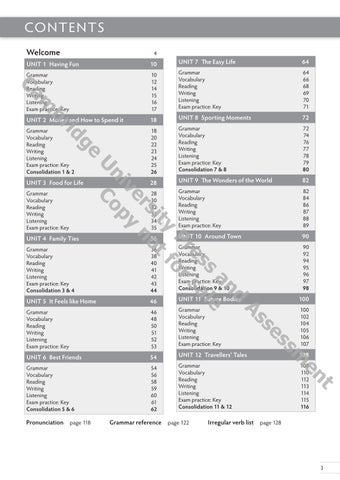
CONTENTS 4
UNIT 1 Having Fun
10
UNIT 7 The Easy Life
64
Grammar Vocabulary Reading Writing Listening Exam practice: Key
10 12 14 15 16 17
Grammar Vocabulary Reading Writing Listening Exam practice: Key
64 66 68 69 70 71
UNIT 2 Money and How to Spend it
18
UNIT 8 Sporting Moments
72
Grammar Vocabulary Reading Writing Listening Exam practice: Key Consolidation 1 & 2
18 20 22 23 24 25 26
Grammar Vocabulary Reading Writing Listening Exam practice: Key Consolidation 7 & 8
72 74 76 77 78 79 80
28
UNIT 9 The Wonders of the World
82
28 30 32 33 34 35
Grammar Vocabulary Reading Writing Listening Exam practice: Key
82 84 86 87 88 89
36
UNIT 10 Around Town
90
36 38 40 41 42 43 44
Grammar Vocabulary Reading Writing Listening Exam practice: Key Consolidation 9 & 10
90 92 94 95 96 97 98
46
UNIT 11 Future Bodies
100
46 48 50 51 52 53
Grammar Vocabulary Reading Writing Listening Exam practice: Key
100 102 104 105 106 107
UNIT 6 Best Friends
54
UNIT 12 Travellers’ Tales
Grammar Vocabulary Reading Writing Listening Exam practice: Key Consolidation 5 & 6
54 56 58 59 60 61 62
Grammar Vocabulary Reading Writing Listening Exam practice: Key Consolidation 11 & 12
m Ca
Welcome
ge
id
br
Co
Grammar Vocabulary Reading Writing Listening Exam practice: Key
UNIT 4 Family Ties Grammar Vocabulary Reading Writing Listening Exam practice: Key Consolidation 3 & 4
UNIT 5 It Feels like Home
page 122
Irregular verb list
108 110 112 113 114 115 116
t
Grammar reference
108
en
Pronunciation page 118
m ss
Grammar Vocabulary Reading Writing Listening Exam practice: Key
se
As d an s le es sa Pr r y fo it t rs no ve y ni p
U
UNIT 3 Food for Life
page 128
3
m Ca
Acknowledgements
id
br
The authors and publishers acknowledge the following sources of copyright material and are grateful for the permissions granted. While every effort has been made, it has not always been possible to identify the sources of all the material used, or to trace all copyright holders. If any omissions are brought to our notice, we will be happy to include the appropriate acknowledgements on reprinting.
ge
Emily Cummins for the text on p. 68 adapted from http://www.emilycummins. co.uk/about. Copyright © Emily Cummins. Reproduced with permission.
Co
English Profile This product is informed by the English Vocabulary Profile, built as part of English Profile, a collaborative programme designed to enhance the learning, teaching and assessment of English worldwide. Its main funding partners are Cambridge University Press and Cambridge English Language Assessment and its aim is to create a ‘profile’ for English linked to the Common European Framework of Reference for Languages (CEF). English Profile outcomes, such as the English Vocabulary Profile, will provide detailed information about the language that learners can be expected to demonstrate at each CEF level, offering a clear benchmark for learners’ proficiency. For more information, please visit www.englishprofile.org Cambridge Dictionaries Cambridge dictionaries are the world’s most widely used dictionaries for learners of English. The dictionaries are available in print and online at dictionary.cambridge.org. Copyright © Cambridge University Press, reproduced with permission.
The publishers are grateful to the following for permission to reproduce copyright photographs and material: T = Top, B = Below, L = Left, R = Right, C = Centre, B/G = Background
t
en
m ss
p. 8 (T): ©patpitchaya/iStock/360/Getty Images; p. 8 (1): ©Oleksiy Mark/ iStock/360/Getty Images; p. 8 (2): ©Ameng Wu/iStock /360/Getty Images; p. 8 (3): ©Duygun VURAL/iStock/360/Getty Images; p. 8 (4): ©hamurishi/ iStock/360/Getty Images; p. 8 (5): ©studionobra/iStock/360/Getty Images; p. 8 (6): ©AleksVF/iStock/360/Getty Images; p. 14 (TL): ©Joe McBride/Iconica/ Getty Images; p. 14 (TR): ©DAJ/Getty Images; p. 14 (BL): ©Yvette Cardozo/ Alamy; p. 15 (T): ©bevangoldswain/iStock/360/Getty Images; p. 15 (BL): ©Jose Luis Pelaez Inc/Getty Images; p. 15 (BR): ©Kovalchuk Oleksandr/Shutterstock; p. 20 (L): ©Avatar_023/Shutterstock; p. 20 (CL): ©PhotoAlto/Laurence Mouton/ Brand X Pictures/Getty Images; p. 20 (C): ©StockLite/Shutterstock; p. 20 (CR): ©Patrick Breig/Shutterstock; p. 20 (R): ©Denkou Images/Cultura/Getty Images; p. 21 (TL): ©Didecs/Shutterstock; p. 21 (TR): ©IvonneW/iStock/360/Getty Images; p. 21 (CL): ©vuvu/Shutterstock; p. 21 (CR): ©Zoonar RF/Zoonar/360/ Getty Images; p. 21 (BL): ©Tatiana Popova/Shutterstock; p. 21 (BR): ©Oleksiy Mark/iStock/360/Getty Images; p. 22 (T): ©Radius/Superstock; p. 22 (B): ©Hero Images/Getty Images; p. 24: ©Fuse/Getty Images; p. 26 (TL, BR): ©Eduardo Jose Bernardino/iStock/360/Getty Images; p. 26 (TR): ©jodiejohnson/iStock/360/ Getty Images; p. 26 (BL): ©C. Diane O’Keefe/iStock/360/Getty Images; p. 27: ©saras66/Shutterstock; p. 31 (TL): ©Sergio Martinez/Shutterstock; p. 31 (TC): ©ULKASTUDIO/Shutterstock; p. 31 (TR): ©Nattika/Shutterstock; p. 31 (CL): ©rimglow/iStock/360/Getty Images; p. 31 (C): ©Bozena Fulawka/Shutterstock; p. 31 (CR): ©Meelena/Shutterstock; p. 31 (BL): ©Viktor1/Shutterstock; p. 31 (BC): ©gmevi/iStock/360/Getty Images; p. 31 (BR): ©voltan1/iStock/360/Getty Images; p. 32 (TL): ©chengyuzheng/iStock/360/Getty Images; p. 32 (TR): ©anankkml/ iStock/360/Getty Images; p. 32 (CL): ©Steve Lenz/iStock/360/Getty Images; p. 32 (CR): ©Eric Isselée/iStock/360/Getty Images; p. 32 (BL): ©xstockerx/Shutterstock;
se
As d an s le es sa Pr r y fo it t rs no ve y ni p
U
Corpus Development of this publication has made use of the Cambridge English Corpus (CEC). The CEC is a computer database of contemporary spoken and written English, which currently stands at over one billion words. It includes British English, American English and other varieties of English. It also includes the Cambridge Learner Corpus, developed in collaboration with Cambridge English Language Assessment. Cambridge University Press has built up the CEC to provide evidence about language use that helps to produce better language teaching materials.
p. 32 (BR): ©StockSolutions/iStock/360/Getty Images; p. 33: ©killerbayer/ iStock/360/Getty Images; p. 34: ©Adam Hester/Corbis; p. 40: ©Pankaj & Insy Shah/Getty Images; p. 42 (TL, BL): ©Vtls/Shutterstock; p. 42 (TR, BR): ©White Smoke/Shutterstock; p. 50 (T): ©epa/Corbis; p. 50 (C): ©Ralf-Finn Hestoft/ CORBIS; p. 50 (B): ©AFP/Getty Images; p. 51 (L): ©DenisKotr/iStock/360/Getty Images; p. 51 (CL): ©sagir/Shutterstock; p. 51 (C): ©Ad Oculos/Shutterstock; p. 51 (CR): ©Room27/Shutterstock; p. 51 (R): ©bopav/Shutterstock; p. 55: ©AFP/ Getty Images; p. 58 (TR): ©UNITED ARTISTS/THE KOBAL COLLECTION; p. 58 (TL): ©Pictorial Press Ltd/Alamy; p. 58 (B): ©REX/Everett Collection; p. 60: ©REX/ Geoffrey Swaine; p. 63: ©diego cervo/iStock/360/Getty Images; p. 68 (TL): ©REX/Ray Tang; p. 68 (TR): ©Emily Cummins http://www.emilycummins.co.uk; p. 68 (B): ©Emily Cummins http://www.emilycummins.co.uk; p. 69 (TL): ©BrAt82/ Shutterstock; p. 69 (TR): ©BuddyFly/iStock/360/Getty Images; p. 69 (CL): ©REX/Roger Viollet; p. 69 (CR): ©George Timakov/Hemera/360/Getty Images; p. 69 (B): ©akajhoe/iStock/360/Getty Images; p. 75 (snowboard): ©YanLev/ Shutterstock; p. 75 (golf ): ©anek_s/iStock/360/Getty Images; p. 75 (windsurf ): ©jan kranendonk/iStock/360/Getty Images; p. 75 (volleyball): ©Eastimages/ Shutterstock; p. 75 (skis and poles): ©gorillaimages/Shutterstock; p. 75 (football): ©stockphoto-graf/Shutterstock; p. 75 (diving board): ©sirastock/Shutterstock; p. 75 (helmet and rope): ©grafvision/Shutterstock; p. 75 (parallel bars): ©versh/ Shutterstock; p. 75 (sailing): ©Michael Blann/Photodisc/Getty Images; p. 75 (starting block): ©Ulrich Mueller/Shutterstock; p. 75 (rugby): ©Paolo De santis/ Hemera/360/Getty Images; p. 75 (tennis): ©miflippo/iStock/360/Getty Images; p. 76 (TR): ©technotr/E+/Getty Images; p. 76 (TL): ©Keystone/Hulton Archive/ Getty Images; p. 76 (BR): ©YTopFoto; p. 76 (BL): ©Tony Duff y/Getty Images Sport/Getty Images; p. 77: ©Galina Burtseva/iStock/360/Getty Images; p. 78 (TL): ©Echo/Cultura/Getty Images; p. 78 (TC): ©The Washington Post/Getty Images; p. 78 (TR): ©Konstantin Shishkin/iStock/360/Getty Images; p. 78 (CL): ©LuckyBusiness/iStock/360/Getty Images; p. 78 (C): ©Kzenon/Shutterstock; p. 78 (CR): ©Greg Epperson/iStock/360/Getty Images; p. 78 (BL): ©Ingram Publishing/Getty Images; p. 78 (BC): ©saintho/iStock/360/Getty Images; p. 78 (BR): ©Jupiterimages/Stockbyte/Getty Images; p. 79: ©Athol Pictures/ Alamy; p. 81: ©JUNG YEON-JE /AFP/Getty Images; p. 86: ©Yvette Cardozo/ Photolibrary/Getty Images; p. 87: ©Barry Mason/Alamy; p. 92 (zebra crossing): ©Stephen Rees/Shutterstock; p. 92 (youth club): ©Jeff Morgan 16/Alamy; p. 92 (speed camera): ©Howard_M/iStock/360/Getty Images; p. 92 (graffiti): ©A_Lesik/Shutterstock; p. 92 (cycle lane): ©Aleramo/iStock/360/Getty Images; p. 92 (litter bin): ©sunsetman/Shutterstock; p. 92 (bill board): ©Jeff Morgan 09/Alamy; p. 92 (high street): ©Ingram Publishing/Getty Images; p. 92 (skate park): ©moodboard/360/getty Images; p. 94 (TL): ©RICK WILKING/Reuters/ Corbis; p. 94 (TR): ©Claver Carroll/Photolibrary/Getty Images; p. 94 (C): ©ArtPix/Alamy; p. 94 (B): ©Gideon Mendel/Corbis; p. 95: ©David Hughes/ Hemera/360/Getty Images; p. 99: ©OlgaCanals/iStock/360/Getty Images; p. 102 (BL): ©vadimmmus/iStock/360/Getty Images; p. 102 (TL): ©Holger Scheibe/ Corbis; p. 102 (stomachache); ©Shutterstock/Photographee.eu; p. 102 (earache): ©Shutterstock/Dora Zett; p. 102 (headache): ©ATIC12/iStock/360/Getty Images; p. 102 (toothache): ©Thomas Lammeyer/Herma/360/Getty Images; p. 104 (L): ©Eric Fleming Photography/Shutterstock; p. 104 (R): ©Rich Carey/Shutterstock; p. 111 (1): ©JackF/iStock/360/Getty Images; p. 111 (2): ©Onoky/Supertsock; p. 111 (3): ©Kimberly Brotherman/Moment Open/Getty Images; p. 111 (4): ©KatPaws/iStock/360/Getty Images; p. 111 (5): ©Matthew Grant/iStock/360/ Getty Images; p. 111 (6): ©Marin Tomas/iStock/360/Getty Images; p. 111 (7): ©Charles O. Cecil/Alamy; p. 111 (8): ©Shutterstock/Dudarev Mikhail; p. 111 (9): ©hxdyl/iStock/360/Getty Images. Cover photographs by: (L): ©Yuliya Koldovska/Shutterstock; (TR): ©Tim Gainey/ Alamy; (BR): ©Oliver Burston/Alamy. The publishers are grateful to the following illustrators: David Semple 5, 18, 20, 29, 37, 38, 39, 52, 67, 73, 88, 101, 108; Fred Van Deelen (The Organisation) 7, 25, 62, 64, 93; Julian Mosedale 16, 19, 21, 31, 38, 42, 59, 70, 82, 91, 103, 112 The publishers are grateful to the following contributors: Blooberry Design Ltd: text design and layouts; Claire Parson: cover design; Hilary Fletcher: picture research; Leon Chambers: audio recordings; Karen Elliott: Pronunciation sections; Diane Nicholls: Get it right! exercises
m Ca
WELCOM E 3 Match the sentences 0–7 in Exercise 2 with a–h.
A ALL ABOUT ME Personal information
br
a
1 Match the sentences and the replies.
3 4
b c d
I’m 14. Hi, Lucy, I’m Laura. Hi, Jim. Nice to meet you. Nice to meet you, too. My name’s Steve. I’m from Hereford in England.
b They’re Russian. c
e f
d But he is Italian.
3
Nationalities and be
1 Find 12 countries in the word search.
2
I
I’m from Liverpool.
a Ferrari. from Moscow. (not) from London.
3
Paula from New York?
4
you from São Paulo?
5
We
(not) from Barcelona.
6
Augusto
from a small town near Buenos Aires.
7
My dad
(not) from Rome.
Yes, she’s American.
1
The Netherlands
2
Colombia
3
Mexico
4
Belgium
5
Turkey
6
Brazil
7
Argentina
8
Russia
9
Italy
10
The USA
11
Britain
12
Spain
Names and addresses 1
02 Listen to the telephone conversation. Who is the man calling?
t
They
g
en
4
1
It’s an Italian car.
m ss
2 Complete with the verb to be. It ’s
f
se
T C O L O M B I A O N K J C M Z F I U A R E A R G E N T I N A Y T T K T X T Y U O U E H L N U I K L U Y W A E P I R C O L U M B I R N A K O A Y I E J S L C T E U P L P W N S A X I Y S P A I N F U N A R N A U T T M P R D O B R A Z I L D M O S P A L R M U I G L E B
0
Yes, I’m Brazilian.
4 Write the nationality of someone from ...
Co
2
e
h
2 Write your answers to questions 1–3 in Exercise 1. 1
He’s Argentinian.
As d an s le es sa Pr r y fo it t rs no ve y ni p
6
a
U
5
What’s your name? How old are you? Where are you from? Hi, I’m Lucy. This is my friend Jim. Nice to meet you.
ge
2
id
1
We’re from Madrid.
WELCOM E Listen again and complete the form.
The Golden Duck Table for: 1
B WHAT’S THAT? Things in the classroom and prepositions of place 1 Find and circle 12 classroom items in the word snake.
ard
rbo doo
id 02
check.
k
ok w
i ld
i n d ow p
2 Complete with the classroom objects in the list. ruler | teacher | chair | pen | board | notebook
ge
3
airp enc
k
City Walls Road
bo
ch
es
br
Contact number: 4 5
lo le r f o rcd te
Name: 3
ru
no
m Ca
Time: 2
boo
02
en
2
Put the dialogue in order. Listen again and
U
OK, Mr Hodgson. And can I have a contact number?
MANAGER
Sure, it’s 22 City Walls Road.
MANAGER
Could you spell that?
Co
As d an s le es sa Pr r y fo it t rs no ve y ni p
MANAGER
1 MANAGER The Golden Duck. How can I help you? MANAGER
A table for four at 8 pm. Can I have your name?
MANAGER
Thank you. See you later tonight, Mr Hodgson.
MR HODGSON Just one more thing. Can you give
me your address?
MR HODGSON It’s Hodgson. Bob Hodgson.
MR HODGSON Sure. It’s H - O - D - G - S - O - N. MR HODGSON Hello, I’d like to book a table for
four for tonight about 8 pm. MR HODGSON Yes, it’s 0796 38888.
1 Complete the text with the verb to be and the 1
The
is under the chair.
2
The
is behind the desk.
3
The
is on the desk.
4
The
is in front of the board.
5
The the window.
is between the door and
6
The
is on a book.
t
en
nationalities. My favourite football team has players in it from all over the world. Costa and Nunes 1 from Rio de Janeiro. 3 They 2 . Ramos 4 from Bogotá. He 5 6 . 8 Simenon 7 . He 9 from Brussels. 11 Jones and Lalas 10 . Jones 12 from New York and Lalas 13 from Miami. 15 The other players 14 . They 16 from lots of different cities in Britain.
m ss
se
SUMMING UP
5
3 Complete with the missing object pronoun.
Classroom language 1 Put the words in order to make sentences. I / a / can / question /ask / ?
1
again / can / say / that / you / ?
2
m Ca
don’t / I / know
br
4
mean / word / does / what / this / ?
7
that / do / word / spell / you / how / ?
8
English / how / say / amanhã / in / do / you / ?
ge
id
6
Co
1 Complete the table.
I you he she it we they
me
6
I love
4
We really want to go to the show. Can you buy some tickets?
5
The children are very noisy. Tell quiet, please.
. You’re my best friend.
to be
This / These homework is very difficult. 2 That / Those shoes are really nice. 3 That / These house is really old. 4 These / This books aren’t very interesting. 1
May’s my best friend. I tell she / her everything. They / Them don’t speak English. That’s why you don’t understand they / them. I / Me love this dress. Buy it for I / me, please. Turn the music up. We / Us can’t hear it. Bob’s got a problem and I / me can’t help he / him. We / Us love our gran. She gives we / us great presents on our birthdays.
2 Complete with this, that, these or those. 1
Can you pass me please?
books next to you,
2
Is
3
pencil is broken. Can you give me another one?
4
shoes are too small for me. I need to take them off.
my pen in your hand?
SUMMING UP
1 Complete the dialogue with the words in the list. ask | know | spell | this | that pen | say | notebook | put
Excuse me, Miss Baker, can I 0 ask you a question? MISS BAKER Of course you can, Roberto. ROBERTO How do you 1 ’pizza’ in English? MISS BAKER Ahmed. Can you help? AHMED Sorry. I don’t 2 . MISS BAKER Can anyone help Roberto? 3 your hands up if you know the answer. Yes, Kim. KIM It’s easy. It’s ‘pizza’. ROBERTO How do you 4 that? KIM P-I-Z-Z-A; it’s the same as in Italian! ROBERTO OK, let me write that in my 5 . Is 6 ? Can I your 7 borrow it? KIM No, 8 ’s your pen. You don’t need to ask. ROBERTO
t
5
3
?
en
4
Mum wants some help. Can you help
m ss
3
2
.
se
2 Circle the correct options in each sentence.
2
That’s Mr O’Brian. Say hello to
As d an s le es sa Pr r y fo it t rs no ve y ni p
U
if / hands / your / know / up / answer / put / you / the
Object pronouns
1
1
1 Circle the right words.
I / understand / don’t
9
.
this, that, these, those
5
0
I want my sandwich! Give it to
page / your / open / at / 10 / books
3
me
0
WELCOM E
C ABOUT TIME Days and dates
My day 1 Write the times on the clocks.
1 Sort the words into three different groups. There are four words in each group.
m Ca
Sunday | October | fourteenth | third | July Monday | second | tenth | March | Saturday September | Friday 1 2
br
3
It’s
0
4 pm.
1
It’s
id
2 Write the next word in each sequence. February, April, June,
2
Friday, Thursday, Wednesday,
3
first, third, sixth,
4
1st, 10th, 19th,
5
April, August, December,
6
4th, 8th, 12th,
7
Monday, Wednesday, Friday,
8
December, November, October,
ge
1
As d an s le es sa Pr r y fo it t rs no ve y ni p
U It’s
3
It’s
4
It’s
5
It’s
Co
2
3 Write the numbers in words. 1st
2
4th
3
8th
4
11th
5
12th
6
15th
7
20th
8
22nd
9
25th
10
29th
11
30th
12
31st
2 Read and put the events in order. I have lunch at quarter past one. I go to bed at twenty past eight. I go to school at seven o’clock. I have dinner at half past five.
se
1
I have breakfast at quarter past six.
1
When is … your birthday?
2
your country’s national day?
I do my homework at quarter to two.
3 Now write about your day. 1
3
your best friend’s birthday?
t
2
I get up at ...
en
1
I get up at six o’clock.
m ss
I get home at half past one.
4 Answer the questions.
3 4
4
the first day of your next school holiday?
5 6 7 8
7
SUMMING UP 1
03 Listen and write the times that Dan does the following things.
1
get up on Tuesday morning
D MY THINGS My possessions 1 Do the word puzzle and find the name of Jim’s pet. 1
2
arrive at school
3
get home after school
4
br
m Ca
2
5
go to bed
6
get up on Sunday morning
03
ge
2
4
id
5
3
Put the dialogue in order. Listen and
U
check.
What!? Six o’clock!
ANA
Half past six in the morning? That’s early. Why?
ANA
Oh. And what time does it finish?
ANA
So you love the weekend. You can get up late.
ANA
What do you do after lunch?
Co
1 ANA
As d an s le es sa Pr r y fo it t rs no ve y ni p
ANA
What time do you get up, Dan?
DAN
I do homework and watch TV. Sometimes I play football and basketball. Then it’s dinner and I go to bed at nine o’clock.
DAN
Well, my school starts at seven o’clock.
DAN
Not at all. On Saturdays and Sundays I get up at six o’clock.
DAN
From Monday to Friday, I get up at half past six.
DAN
Twenty past twelve, so I get home at ten to one for lunch.
1
2
3
4
5
m ss
Yes, six o’clock. I have early morning swimming lessons.
se
DAN
6
1 Complete the sentences about Jim with has or hasn’t. Use the previous exercise to help you.
8
1
Jim
got a lizard.
2
Jim
got a camera.
3
Jim
got a smartphone.
4
Jim
got a bike.
5
Jim
got a dog.
6
Jim
got a car.
t
en
have got
WELCOM E
I like and I’d like
2 Match the questions and the answers.
1 Circle the correct option.
1
Have you got a pet?
2
Has Jim got a cat?
3
Have all your friends got smartphones?
4
Has your brother got a bike?
5
Have you got a lizard?
1
B 2
m Ca a
Yes, they have. Yes, I’ve got a dog. No, he hasn’t. No, she hasn’t, but she’s got a sister. No, I haven’t. Yes, he has. It’s called Mickey.
e
5
5 6
I have / has got three brothers. We haven’t / hasn’t got a car. Susie has / have got a new phone. They haven’t / hasn’t got any money. James haven’t / hasn’t got homework tonight. I haven’t / hasn’t got a pen. Have / Has you got one?
Co
4
7
4 Complete the dialogue with have, has, haven’t or hasn’t. BOB NICK
No, I 2
BOB
What about your brother? 3
NICK
B 8
SUMMING UP
1 Complete the mini dialogues with the missing questions.
you got a laptop, Nick?
2
he got
tablet too.
got a
NICK
He’s older than me. My sister 6 one but she’s only three.
BOB
7
NICK
Yes, they 8
your parents got a computer?
5
6
A B
Two things you have got and two things you haven’t got.
7
Yes, I have. I’ve got a brother and two sisters. ?
No, Rob hasn’t got a cat but I think he’s got a lizard.
?
Yes, please. I’d love a glass of water. I’m really thirsty.
?
A B
No, we haven’t got a car but we’ve all got bikes.
A
?
B 10
?
t
Two things your best friend has got and two things he/she hasn’t got.
Yes, I do. Especially bananas and apples.
en
9 2
A B
8
?
m ss
5 Write sentences. 1
Yes, I am. Very. I’d love a sandwich please.
A B
. I use it sometimes.
?
A B
got
No, I don’t. I don’t like any sports.
se
That’s not fair.
?
A B
4
BOB
Yes, I’d love a dog or cat.
A B
3
and he 5
?
A B
but I’d love one.
Yes he 4
A B
1
1
one?
A
I like / ’d like blue best. Can I help you? Yes, I like / ’d like an ice cream, please. What do you want to do? I like / ’d like to play computer games. Do you want milk or orange juice? I like / ’d like milk, please. Who’s the best teacher at your school? I like / ’d like Miss Dawes the most. Which day of the week do you like the most? I like /’ d like Fridays. Do you want anything to eat? I like / ’d like some chicken soup, please. What do you do in your free time? I like / ’d like swimming and playing football.
As d an s le es sa Pr r y fo it t rs no ve y ni p
3
A B
U
2
A B
6
3 Circle the correct option. 1
A B
ge
f
4
id
d
A B
br
Has Suzie got a brother?
c
A B
3
6
b
A What’s your favourite colour?
Yes, I love dogs. We’ve got two. ?
A B
No, I haven’t got a camera but I’ve got a smartphone.
9
1 FUN HAVING
m Ca
4
br
GRAMMAR Present simple SB p.14 1
5 6
c
d Yes, she does. Every day.
5
Co
Rewrite the sentences. Make the positive sentences negative. Make the negative sentences positive. 0
I like dancing.
2
Tim plays the guitar in a band.
3
Kelly doesn’t miss her family a lot.
4
My parents work at the weekend.
f
I don’t really like music.
2 3
2
what / your mum / do?
3
your teacher / give you / lots of homework?
6
Read about Brian’s hobby. Complete the text with the correct form of the words in the list. not collect | stand | phone | see | write | say tell | turn | not think | not do | not play | try
My friend Brian has a really unusual hobby. He 0 doesn’t collect stamps and he 1 the piano. No, these are normal hobbies. Brian’s hobby is really strange. My friend Brian’s hobby is being on TV. Every time he 2 a TV cameraman and presenter in town he 3 behind the 4 presenter and to appear on TV.
Then he 5 me and 6 me to watch the news on TV. So I 7 on the TV and there he is. He 8 anything silly. He’s just there smiling. Then he 9 about it on his blog. He 10 he’s famous. I 11 he’s famous, just a bit crazy!
Pronunciation
4
what / bands / you / like?
Plurals and third person verb endings: /s/, /z/ or /ɪz/
5
you / play / instrument?
Go to page 118.
t
you / speak / French?
5
en
1
4
m ss
where / you / live?
Write answers to the questions in Exercise 3 so they are true for you.
se
Use the words to write questions in the present simple.
Where do you live?
10
No, I don’t.
1
Sally doesn’t watch a lot of TV.
1
0
e
0
Sally watches a lot of TV.
3
0
Just outside of London.
As d an s le es sa Pr r y fo it t rs no ve y ni p
4
She’s a businesswoman.
b Yes, I do. The piano.
U
3
My mum go / goes to work by car. He think / thinks I’m crazy. Jim look / looks quite angry. Dad wash / washes his car every Sunday. I doesn’t / don’t feel very good. Joe doesn’t / don’t want to have a shower now. We doesn’t / don’t live very close to our school.
ge
2
id
1
2
a
Circle the correct option.
0
Match the questions in Exercise 3 with the answers below.
1 H AV I N G FU N
like + -ing SB p.17 7
Complete the sentences with the verbs in the list.
4
My sister is nice to me. (rarely)
5
My friends and I go to the cinema on a Saturday morning. (sometimes)
6
You are sad. (never)
take | read | get | chat | go | do | help | tidy Best and worst things to do on a Saturday morning.
m Ca I love
1
I enjoy
2
I like
for a bike ride with my friends.
3
I love
I enjoy
to my friends on the phone.
Dad make breakfast.
5
I hate
my homework.
6
I can’t stand
7
I hate
up my bedroom.
1
What do you always do at the weekend?
2
What do you rarely do after school?
What about you? What do you like (and hate) doing on Saturday mornings? Complete the sentences so they are true for you.
3
What do you usually do when you’re bored?
I love
2
I enjoy
3
I like
4
I hate
5
I can’t stand
Co
1
As d an s le es sa Pr r y fo it t rs no ve y ni p
U
ten
100%
ne
ways
rare
times
some
ally
al
ly
usu
ally
of
ver
0%
0
I play computer games after dinner. (usually)
1
You are happy. (always)
2
My best friend stays with us in the holidays. (often)
3
My mum and dad go out for a meal. (occasionally)
What do you never do on a Monday?
6
What do you often do when you’re happy?
GET IT RIGHT! Like + -ing
We use like + the -ing form of the verb. If the verb ends in consonant + -e, we drop the final e. ✓ live – living ✗ live – liveing If a short verb ends in consonant + vowel + consonant, we double the final consonant before adding the -ing. ✓ swim – swimming ✗ swim – swiming With verbs with two or more syllables, we do not usually double the final consonant. ✓ listen – listening ✗ listen – listenning
Correct the -ing forms. 1
writting
2
comming
3
studing
4
waitting
5
chating
6
useing
7
listenning
8
planing
t
I usually play computer games after dinner.
5
en
Rewrite the sentences with the adverb of frequency in the correct place.
What do you sometimes do in the evening?
m ss
occasion
➔ ➔ ➔ ➔ ➔
Match the particles in the list to make adverbs of frequency and write them in the correct place.
4
se
10
Answer the questions so they are true for you.
out of bed before midday.
Adverbs of frequency SB p.17 9
11
ge
id
a book in bed.
4
br
8
taking my dog for a walk.
0
rainning 10 geting 9
11
VOCABULARY Word list
m Ca
play an instrument / online games / football
be in a club
write a blog
br
keep a pet
Hobbies
ge
id
take photographs
As d an s le es sa Pr r y fo it t rs no ve y ni p
U
do crosswords
make videos
collect things / stamps / autographs
Co
have fun / a good time
have a problem
have a rest
Have
have a shower
have dinner
Adverbs of frequency always
usually
often
sometimes occasionally
rarely
never
t
12
en
pass the time can’t stand
I never have time to watch TV in the morning. I have lots of hobbies but my favourite is writing my blog. My bedroom is very tidy. Sorry – I’m too busy to help you. My dad says that cooking the dinner helps him to relax. That’s definitely Bradley Cooper over there. I’m sure! Bird watching – that’s a strange hobby! You never smile when I take your photo. You always look so sad. I feel very positive today. I’ve got a good feeling about it. My dad’s got a lot of different interests, like reading and playing the piano. How do you pass the time when you’re waiting for someone? Football is really, really boring. I can’t stand it!
m ss
have time have a hobby tidy busy relax definitely strange smile positive interests
se
Key words in context
1 H AV I N G FU N
Hobbies SB p.14 1
collect
Read the speech bubbles. Choose a word from each list and write the hobbies. write | collect | be | play | take | keep a blog | an instrument | a pet | things photographs | in a club
write
m Ca 0
id
br
It’s about my life. It’s about my friends and my families. It’s about the things I enjoy doing (and some of the things I don’t enjoy). It’s about everything and anything. Read it!
1
ge
write a blogg
U
I’m in a band. I’m the guitarist. I play for about two hours every day.
play
3
Use your ideas in Exercise 2 to write four sentences that are true for you.
I’m in the school football team. I don’t collect anything.
As d an s le es sa Pr r y fo it t rs no ve y ni p
1 2
2
Co
We meet every Friday from 7 pm to 9 pm. We learn how to do things like how to make a fire or how to cook. It’s really good fun.
3 4
WordWise SB p.19
3
I’ve got about 50 teddy bears now. I’ve got big ones, medium-sized ones and small ones. Every time I visit a new city I always buy one.
Collocations with have 4
Complete the sentences. Use the words in the list. shower | fun | dinner | problem | rest | time 0
4
It’s quite hard work. Every morning I wake up early to take him for a walk and then when I get home from school I take him for another walk.
1 2
4
These are from my last holidays. We were in Corfu. It was really great. I spent hours with my camera.
5
Write four words that go with each verb in the boxes.
be in a band
0 1
a team an orchestra
Write answers to the questions in Exercise 4 so they are true for you.
t
2
en
5
m ss
5
se
3
Do you usually have a shower when you wake up or before you go to bed? Who do you always ask for help when you have a with your homework? Do you always have a when you feel tired? What time does your family usually have ? Do you always have a good when you’re on holiday? What do you do to have at the weekend?
a club
2 3 4 5
13
READING 1
REMEMBER AND CHECK Complete the sentences with the names. Then check your answers in the blog on page 16 of the Student’s Book.
0
m Ca
Izzy likes spending time with an older member of her family. thinks she is probably different to most young people. loves nature. is interested in what’s happening in the world. enjoys being with other people. is interested in finding out about new things. wants to meet some famous people. sometimes finds her hobby very relaxing.
1 2
5
As d an s le es sa Pr r y fo it t rs no ve y ni p
U
7
2
ge
6
id
4
1
br
3
2 Read the text quickly. Write the names under the pictures.
3
Co G
58
A
nna Roberts is a bit different to a lot of other girls. She likes animals. That’s nothing strange. Many girls her age like animals. She also keeps animals as pets. There’s nothing unusual about that, either. But do most girls keep spiders, lizards and snakes? Anna does. Anna has a spider from Brazil, a lizard from Australia and a snake from South Africa. She buys them from her local pet shop. She spends all her pocket money on her pets and she also spends a lot of her time looking after them. Anna knows what she wants to do when she is older. She wants to work in the insect house at a zoo.
t
en
m ss
-year-old Dan Baker loves roller coasters. Every Saturday he visits the Alton Towers theme park and spends all day on them. Luckily he lives very near to it. Some days he has more than fifty rides. His favourites are Nemesis and Th13teen. He doesn’t take his wife with him – she hates roller coasters – but he often takes his grandchildren or brother. He also collects postcards of roller coasters. Every holiday he travels to theme parks in different countries; Six Flags in Mexico, PortAventura in Spain and Everland in South Korea. But Dan wants more. He wants to ride every roller coaster in the world.
se
ina Jones and her sister Karen have the same hobby. They both love photography. In fact, they are both in a photography club. But they don’t take photographs of their friends or the interesting places they go to. They take photographs of other people taking photographs! They have a big collection of photos – more than 2,000. They write a blog about their hobby and you can see all their photos on it. The sisters don’t know the people in their photos. They are just people they see in the street. But they always ask them if they can use the photos for their blog. Most people say ‘yes’.
3 Read the text again. Are sentences 1–5 ‘Right’ (A) or ‘Wrong’ (B)? If there is not enough information to answer ‘Right’ (A) or ‘Wrong’ (B), choose ‘Doesn’t say’ (C). 0 1 2 3 4 5
14
Gina and Karen put photos of their friends on their blog. Some people don’t want their photos on the girls’ blog. Dan Baker is married. Dan Baker’s favourite roller coaster is in America. Anna spends five hours every day looking after her pets. Anna wants to look after elephants at the zoo one day.
A Right
B Wrong
C Doesn’t say
A Right
B Wrong
C Doesn’t say
A Right
B Wrong
C Doesn’t say
A Right
B Wrong
C Doesn’t say
A Right
B Wrong
C Doesn’t say
A Right
B Wrong
C Doesn’t say
1 H AV I N G FU N
DEVELOPING WRITING Routines 1 Read about Dana’s hobby. Tick (✓) the photo from her blog.
m Ca
My hobby is ballroom dancing. I love doing dances like the waltz, the samba and the cha cha cha. It’s so much fun. Do you think it’s an unusual hobby for a teenager? Well, you are wrong. There’s a popular dance show on TV so dancing is quite popular with teenagers these days. I go to a club two times a week to learn new dances. I meet lots of friends there and I always have lots of fun.
br ge
id
I also write a blog about dancing. It’s called Dancing with Dana. I often take photos at the club and put them on my blog. I write something on it every day. It’s a great way to meet people who have the same hobby.
1
What is your hobby?
2
How often do you do it?
3
Where do you do it?
4
Who do you do it with?
5
What do you like about it?
6
Is there anything you don’t like about it? What?
Co
As d an s le es sa Pr r y fo it t rs no ve y ni p
U
3 Answer the questions so they are true for you.
2 Choose phrases from columns A, B and C to make sentences. Then check them in the text. B
There’s a popular dance show on TV
so
Maybe you think it’s an unusual hobby for a teenager
and
I meet lots of friends there
to
learn new dances.
I always have lots of fun. you are wrong.
1
and
2
but
3
so
4
to
5 Write a short paragraph about your hobby
(about 100–120 words). Try to use the sentences in Exercise 4.
t
There’s a popular dance show on TV so dancing is quite popular with teenagers these days.
the sentences about your hobby.
en
but
dancing is quite popular with teenagers these days.
4 Use some of your ideas in Exercise 3 to complete
m ss
I go to a club twice a week
C
se
0
A
1
2
3
15
LISTENING 1
m Ca
06 Listen to the conversations. Circle the correct answer A, B or C. Conversation 1 What instrument does Danny play? A guitar B drums C piano Conversation 2 What pets has Dana got? A a lizard B a dog C a lizard and a dog Conversation 3 How many stamps has Wendy got? A 100 B 800 C 900
ge
id
br
2
DIALOGUE eb / fcalure
2
twahc / tou
3
ntod’ / od / tath
As d an s le es sa Pr r y fo it t rs no ve y ni p
1
PHRASES FOR FLUENCY
Co
2
U
1 Put the letters in order to make phrases.
06 Use the phrases in Exercise 1 to complete the conversations. Then listen again and check.
1
Thanks, but mine.
2
No,
. It’s Alfie’s guitar. It’s not
. It bites.
, Mike. Don’t put your glass down
3
there.
3 Write a short conversation for each picture. Use some of the expressions in Exercise 1.
SB p.19
1 Match the words 1–6 with their meanings a–f. 1
up to
2
come on
3
look out
4
that’s right
5
hurry up
6
cool
a
correct
b doing c
great
d let’s go e
be careful
f
be quick
from Exercise 1.
What are you 0 up to ? SHONA I’m just doing a bit of drawing. TOM Let’s have a look. SHONA Here. What do you think? TOM Is it a picture of Jen? SHONA 1 . What do you think? 2 TOM ! It’s really good.
LUCY BEN LUCY BEN
16
, Ben. OK, OK. I’m coming. Just give me a minute. 4 , Ben. Run. I am running! 5 . Don’t run into the door. Too late! Ow! That hurts.
t
BEN
3
en
LUCY
m ss
TOM
1
se
2 Complete the conversations with the words 1–6
C A M BRIDGE ENGLISH: Key Reading and Writing part 3a 1 Complete the conversations. Choose the correct answer (A, B or C). 0
m Ca
Is she Spanish? A Yes, she does. Can I help you? A Yes, she can. Hi. I’m Alex. A Nice to meet you. Do you like your French teacher? A Yes, I like them a lot. What would you like for lunch today? A Chicken and rice, please. Do you like dancing? A No, I can.
1 2
ge
Yes, she is.
C
Yes, she isn’t.
B
No, I don’t.
C
It’s OK. I’m fine.
B
Yes, you are.
C
I’m happy.
B
Yes, I am.
C
He’s very good.
B
I like fish, please.
C
Yes, please.
B
It’s OK.
C
Yes, I’d love to.
As d an s le es sa Pr r y fo it t rs no ve y ni p
U
5
id
4
br
3
B
Co
Exam guide: multiple-choice replies
In the KEY Reading and Writing Part 3a you must choose the best way to reply to a statement or question. You have three possible replies to choose from. Read the question or statement carefully. Do you understand it? Don’t look at the possible answers. How many different ways can you think of to reply? Now look at the answers. Maybe one of your ideas is there for you to choose. Read out the mini conversations to yourself in your head. Read the first part followed by the
●
●
●
first possible answer. Does it sound OK? Read the first part followed by the second possible answer. Does that sound better? Read the first part followed by the third possible answer. How does that sound? If any of them don’t sound right, then cross them out immediately. And finally – never leave a blank answer.
2 Complete the conversations. Choose the correct answer (A, B or C). 0 1
Yes please.
B
About 7 am.
C
After breakfast.
B
I usually do it after dinner.
C
Sometimes.
B
At the weekends.
C
About twice a month.
B
Yes, I do.
C
No, I haven’t.
B
I’m OK, thanks.
C
OK, I’m coming.
t
5
C
en
4
No, you can.
m ss
3
B
se
2
Can I ask you a question, please? A Sure, what do you want to ask? What time do you wake up? A In the morning. When do you do your homework? A Yes, I always do it. How often do you go to the cinema? A About one time a week. Have you got a tablet? A Yes, I have got. Hurry up. A Yes, please.
17
2 SPEND IT MONEY AND HOW TO
m Ca
3
br
GRAMMAR Present continuous SB p.22 1
ge
id
Complete the sentences with the names.
Match the questions and answers.
d
Are you having fun?
1
Is Jim in the garden?
2
What are you studying?
3
Are they playing football?
4
Am I talking too loudly?
5
Is he studying for the test?
a
Yes, he is. He’s cutting the grass. No, they’re watching a film. No, don’t worry. It’s OK. No, I’m not. I’ve got a lot of work to do for school. Yes, he is. He’s in his room. French. I’m trying to remember some new words.
As d an s le es sa Pr r y fo it t rs no ve y ni p
U
0
b c
Co
d e f
4
Complete the conversation. Use the correct form of the verbs in the list. do | try | not sit | sit | laugh run | get | try | cry | laugh LUCY
0
Sophie and Stella crazy hats.
1
is looking at the TV prices.
2
is buying a digital camera.
3
is trying on a T-shirt.
LUCY
GAVIN LUCY
Adrian isn’t studying English, he’s studying
LUCY
GAVIN
Maths. (– study English / + study Maths) Ben and Anna
.
LUCY
project) I ,I (+ try to finish my homework / – take a break)
4
We , we (+ play computer games / – listen to music)
5
Abigail
LUCY GAVIN
, they . (– have fun / + work on a
3
GAVIN
t
2
We , we (+ take the bus to school / – walk)
en
1
m ss
Complete the sentences. Use the present continuous of the verbs and the information in brackets. 0
18
GAVIN
se
2
are laughing about some
Look at that man over there! What 0 is doing ? he 1 Hmm. I think he to climb the tree. Oh yes, there’s a cat up there. Look. It 2 high up in the tree. Oh yes. Poor cat. What’s that strange noise? 3 it Yeah, it’s scared. Look. The man 4 closer to the cat. But it’s scared of the man too. Oh, no. It 5 to jump down. I just hope … There it goes. It’s down. Wow. Look how fast it 6 now. 7 Well, I guess it’s happy it in the tree any more. Hey, look at those people over there. They 8 so the cat must be OK. That’s right. And you 9 too now!
.
GAVIN
.
, she . (– have lunch / + help her dad)
Pronunciation Contractions Go to page 118.
2 MO N E Y A N D H OW TO SPEN D IT 8
Verbs of perception SB p.23 5
Look at the conversations. Circle the correct options. A What do you think of this song?
0
B A
It sounds / is sounding really cool. What are you thinking about? My homework. It looks / is looking difficult. How do you like this T-shirt? It doesn’t look / is not looking very nice. Would you like some cake? Yes, it smells / is smelling nice. Do you like the soup? Yes, it tastes / is tasting wonderful. Do you like this tattoo? To be honest, I think it looks / is looking awful.
m Ca
1
B
2
A B
A
1
(like) Paris. From my window I can see
a park opposite the hotel. There aren’t many people there. There is one woman. She 2
(walk)
her. I can’t believe it! The dog has got the man’s hat
B
ge
A
id
A B
5
I 0 ’m sitting (sit) in my room in the hotel. I really
her dog. The dog 3
B
4
Hi Ava,
br
3
U
Look at the examples. Write four sentences that are true for you. Use look, sound, smell, taste and adjectives such as interesting, boring, cool, awful, wonderful, exciting.
Co
2
ducks. OK, now a man 4 now, and he 5
(run) away with it. The
woman 6 7
(try) to help
(shout) for the dog, but he (not come) back.
How are you? What 8 always 9
(you/do)? You (play) computer games in the
afternoon – 10
(you/do) it right now, too?
Love
Raindrops on the window sound relaxing. Lemon ice cream with chocolate chips tastes awful. 1
(run) after some
As d an s le es sa Pr r y fo it t rs no ve y ni p
6
Complete the email. Use the present continuous or the present simple of the verbs.
Toby
GET IT RIGHT! Present simple vs. present continuous
3 4
Present simple vs. present continuous SB p.25
7
Match the pictures with the sentences. a
Present simple: for things that happen regularly or that are always true. ✓ I never do online shopping. ✗ I am never doing online shopping.
Present continuous: for things that are happening at or around the time of speaking. ✓ We’re studying English today. ✗ We study English today.
b
se
d
0
She studies English every day.
1
She teaches Maths.
2
She is studying for her English test.
3
She is teaching Maths.
d
t
Bike for sale!
en
Circle the correct options.
m ss
c
Remember: we don’t usually use verbs that describe emotions or the way we think in the present continuous (e.g. think / need / like, etc.). ✓ I think it’s a good idea. ✗ I’m thinking it’s a good idea.
I 1sell / am selling my bike. It’s 5 years old but it 2is looking / looks new. I 3like / am liking this bike very much, but I 4want / am wanting to sell it because it’s too small for me. My name is Liam and I 5am coming / come to school on my bike every day. I can show it to you. This week I 6am studying / study in room 3C. You can find me there! 19
VOCABULARY Word list
m Ca
It looks cool.
It feels comfortable.
It sounds nice.
br
It smells awful.
shoe shop
ge
id
newsagent’s
It tastes good.
chemist’s
department store
U
As d an s le es sa Pr r y fo it t rs no ve y ni p
Shops
bookshop
supermarket
Co
post office
clothes shop
2 1
3
6
8
7
try on cost spend market
20
5 6 7 8 9 10
shopping mall Is there a shopping mall near here? interested in I’m not interested in designer clothes. popular with This shop is very popular with young people. laugh at Why are you laughing at me? good-looking Do you think he’s good-looking? interesting This bookshop looks interesting. Let’s go in.
t
size
There aren’t many customers in the shop right now. A What size do you take? B Medium, please. Can I try on this jacket? How much does it cost? I don’t want to spend so much money. There are wonderful open-air markets in many cities.
4
en
Key words in context
5
3
boots shirt jacket jumper shoes dress belt shorts trainers trousers
m ss
9
2
se
10
customer
4
1
2 MO N E Y A N D H OW TO SPEN D IT
Shops SB p.22
Clothes SB p.24
1
4
Write the names of the shops under the objects.
m Ca
chemist’s
0
1
5
Write the words. 0
btle
1
belt
5
osetsrur
tobos
6
hoses
2
sreds
7
rtossh
3
keajct
8
hirst
4
erpumj
9
restnair
ge
id
br
Complete the text with words from Exercise 4.
2
3
Co
2
As d an s le es sa Pr r y fo it t rs no ve y ni p
U
4
Complete the conversation. Use the shops from Exercise 1. MIA
So, here’s the shopping list.
LIAM OK, where do we have to go first?
6
7
3
There’s a newsagent’s in my street. I like it.
1
Do you like buying clothes?
2
What’s your teacher wearing today?
3
Does your sister like wearing shorts?
4
What do you usually wear when you’re not at school?
5
What do you usually wear when it’s cold?
a
Not really. I hate shopping.
e
When I’m at home, my old jumper. I love it. d A warm coat and a hat. e I can’t choose. We all wear uniforms. f No. She wears jeans all the time. c
8
t
I never go to a clothes shop. I buy all my clothes on the Internet.
What do you usually wear to school?
en
2
0
m ss
There’s a very good shoe shop in our town. I buy all my shoes there.
Match the questions and answers.
b She’s wearing trousers and a jacket.
Look at the sentences. Correct them so they are true for you. 1
Write a short text about what you are wearing today.
se
Let me see. Well, we need Dad’s newspaper. Let’s go to the 0 newsagent’s first. LIAM Wait a minute. What else do we need? MIA Well, we need to buy stamps for this letter. The 1 isn’t far. Let’s go. LIAM No, no, no. I need to get jeans first. We could start at the 2 . MIA Don’t forget. We need to get a book for Mum first. Remember – it’s her birthday soon. The 3 closes at 5! LIAM Absolutely, and I need some medicine for Dad. The 4 isn’t too far from there. 5 MIA OK, and there’s a where we can buy all the food we need for tonight. MIA
3
Sebastian likes black. His 0 trousers and his 1 are black, his 2 and his 3 are white, and he’s wearing a grey 4 .
5
Choose three of the questions in Exercise 7 and write answers that are true for you. 1 2 3
21
READING 1
REMEMBER AND CHECK
Answer the questions. Then check your answers in the script on page 21 of the
Student’s Book. 0
m Ca
1
What is Tom looking for? A a T-shirt and some jeans B a shirt and some trousers Who thinks a yellow shirt looks awful? A Tom B Tom’s parents What does Tom think of the guy in the magazine? A He is very good-looking. B He looks boring. What does he think of himself? A He looks good in a yellow shirt. B His clothes are boring. Who dreams of wearing fantastic clothes one day? A Maddy B the guy in the magazine What does Maddy dream of? A ice cream B being rich
2
ge
5
id
4
br
3
C a T-shirt and some trousers C Tom’s sister C His clothes are not expensive. C He’s not good looking. C Tom C expensive clothes
U
As d an s le es sa Pr r y fo it t rs no ve y ni p
2 Read the web chat and match the teenagers to the photos. There is no picture for one of them.
Co
Buying or swapping – what’s best?
I
magine you’re looking around for clothes. You’re in a really nice shop. You find a fantastic T-shirt and a cool jacket. Then you look at the prices and don’t like the clothes any more. Just too expensive! Does this sometimes happen to you too? Then here’s an idea for you. Maybe you should think about ‘clothes swapping’ – where you give clothes you don’t want any more, and get others instead, at no cost!
A
1
B
Layla, 14 Hi, I love swapping clothes. My friends and I sometimes meet on Saturday. We all bring one piece that we don’t like any more – a T-shirt, a jumper, a pair of jeans … . Then we put all the clothes on the floor. We look at them and try them on. That’s a lot of fun, and we laugh a lot. Sometimes we find something we like. Then we swap. Sometimes we don’t swap.
se
Anna, 12 I want to find something really nice at the swapping party tomorrow. A T-shirt maybe, or a jumper. My favourite colour’s pink – so I’m looking for pink clothes at the moment. I’ve even got pink trainers, and I really like them, but they are too small for me. Maybe I can find some boots – but not in pink ;-) I often talk about clothes with my friends. I love it.
t
en
2
William, 13 We don’t say to other boys ‘I really like your T-shirt!’, or ‘You’ve got cool jeans’. I think girls say these things more often. We think it’s not cool to talk about clothes. But I’ve got a sister, Victoria. She’s 16, and she sometimes helps me, and says ‘This T-shirt is nice for you’ or ‘Don’t wear brown, it’s not a good colour for you.’ I like that (and my friends don’t know!).
m ss
C
3 Read the text again. Write full sentences to answer the questions.
22
0
Who has got an older sister? William has got an older sister.
1
Who has a lot of fun swapping clothes with her friends?
2
Who doesn’t talk to friends about clothes?
3
Who likes talking to friends about clothes?
4
Who’s going to a swapping party tomorrow?
5
Who wants to swap a nice pair of trainers?
2 MO N E Y A N D H OW TO SPEN D IT
DEVELOPING WRITING An email to say what you’re doing 1 Read the emails. Who is writing on a mobile?
m Ca
Hi Evelyn, How are things with you? Hope everything’s going well.
Hi Luke,
br
I’m with Leah and Zoe, and we’re studying for the Maths test together. You know Maths is really not my favourite subject, but Leah and Zoe are really good at it. And they give me a lot of help. We’re not studying right now. Leah and Zoe are playing table tennis. I’m still upstairs, but I’ll join them soon.
id
Are you alright? I hope you’re having more fun than I am right now.
ge
Well, things are not so bad. Of course it’s a bit boring here in hospital, but the doctors and nurses are really nice. And there are three other boys in my room, and we have lots of things to talk about. This is just a short message – I haven’t got my laptop with me, and typing on the phone isn’t easy.
As d an s le es sa Pr r y fo it t rs no ve y ni p
U
I guess you’re having a good time in London right now. You’re probably walking around a street market or window shopping. Or maybe you’re just buying a nice present for your sister? I’m just kidding!
Co
Anyway, please write to me. How are you? What’s going on at school? How is the team doing? The doctors say no sports for me for another six weeks! That’s not good. Please say hi to everyone. Cheers, Evan
2 Mark the sentences T (true) or F (false). 2
Leah, Zoe and Charlotte are taking a break from studying.
3
The three friends are playing a sport.
4
Luke is visiting friends in hospital.
5
The four boys in the hospital don’t know what to talk about.
6
Luke isn’t happy that he can’t play in the team for a long time.
holiday in another country (about 150 words). Use the language in the Writing tip to help you. ●
●
●
●
Ask how your friend is. Tell him or her where you are and what you are doing. Change the subject and ask your friend a few questions about something that you are interested in. Say that you would like an answer as soon as possible. Finish with an appropriate ending.
●
You write informal emails to friends or family members. Your language should be informal and friendly. You can begin your email by asking how the other person is, for example, How are you?, How are things with you?, Are you alright? I hope everything’s well. In an informal email you can use emotional expressions such as I’m just kidding., What a pain!, How cool is that?, What a shame! To change the subject, you can use phrases such as By the way, Anyway, That reminds me of … You can end your email saying what you would like the other person to do, for example, Write soon., Let me know …, Say hi to …, and an informal ending such as Cheers, Love, A big hug, Talk soon, or simply Bye bye.
●
●
●
t
●
●
en
3 Write an informal email to a friend who is on
Writing tip: informal emails
m ss
Evelyn’s sister is in London now.
That’s it from me. Write soon. Lots of love, Your sister Charlotte
se
1
By the way, we are practising for a new play at school. The first show is in two weeks’ time. I hope you can come.
23
LISTENING 1
09 Listen to the conversations and complete the sentences.
1
It’s £1
the answer to the teacher’s questions so fast? Check with the answer at the bottom of the page.
m Ca
.
The man is interested in 3
.
The shop assistant thinks he wants a 4 The book is in the section 5
The girl wants to see a pair of 6 She wants them in 7
id
.
Put the conversations in order. Listen and
U
check. BOY
OK, thanks.
BOY
Ah, OK. That’s too much.
BOY
Yes. This T-shirt, how much is it?
Co
As d an s le es sa Pr r y fo it t rs no ve y ni p
1
ge
09
.
Note: Even numbers: 2 4 6 8… Odd numbers: 1 3 5 7…
.
She wants to 8
2
. the man.
br
3
1 Read the text. Can you work out how Logan finds
.
.
He thinks it’s 2
2
T-shirt
The boy is interested in a 0
Exploring numbers
WOMAN Hi. Can I help you?
1
WOMAN Well, have a look at the T-shirts
over there. They’re not as pricey!
WOMAN Let me check. Here you go … it’s
twenty-four pounds fift y. MAN
I didn’t mean a recipe book.
MAN
Right. Where’s that?
MAN
Hello. Have you got any books on vegetarian food?
WOMAN Is there anything I can do for you? WOMAN Oh, sorry. I think you need the
healthy living section. WOMAN Right behind you.
WOMAN Yes, of course. That’s in the
GIRL
Thank you. Can I try them on please?
GIRL
Um … 8.
MAN
Just a moment. Here you are.
MAN
Let me look … What size do you take?
MAN
Of course. The changing rooms are over there, on your right.
MAN
Hello. Can I help?
2 A question for you: What’s the sum of the first 66 odd numbers?
t
Yes, have you got these jeans in grey?
en
24
GIRL
m ss
3
se
section over there. There are loads of books on cooking.
Logan is brilliant at Maths. One day, his Maths teacher asks the class how quickly they can find the sum of the first 50 odd numbers. The other kids are starting to think when Logan calls out, ‘2,500’! The teacher thinks that Logan was just lucky. ‘OK,’ she says, ‘let’s make it a bit more difficult. Who’s fastest at finding the sum of the first 75 odd numbers?’ Everybody is thinking hard. Fifteen seconds later, Logan calls out, ‘5,625’! He’s right again. The teacher is puzzled. How does Logan do it?
Answer It’s easy to calculate the sum of a series of consecutive odd numbers that start with 1. Look! What’s the sum of the first three odd numbers? Easy! Just multiply 3 x 3. The answer: 9! What’s the sum of the first nine odd numbers? Again, not difficult. Just multiply 9 x 9! So to get the sum of the first 50 odd numbers you have to multiply 50 x 50, etc.
2
C A M BRIDGE ENGLISH: Key 2
Listening part 1 1
10 You will hear three short conversations. There is one question for each conversation. For each question tick (✓) A, B or C.
m Ca 1
1
What’s the weather like?
What number is Keith’s house?
5
15
50
A
B
C
id
br 2
11 You will hear five short conversations. There is one question for each conversation. For each question tick (✓) A, B or C.
What time does Tim’s school start?
ge
A 2
B
C
Which is Anne’s dog?
C
Which picture shows what’s in Dawn’s bag?
Co
3
B
As d an s le es sa Pr r y fo it t rs no ve y ni p
U A
A
A
B
C
3
B
C
B
C
Where is Marco from?
Exam guide: multiple-choice pictures
A
4
How far is Jasmine’s house from her school?
A
C
en
5
B
m ss
se What is Frank’s favourite sport?
t
In a multiple-choice picture task, you hear short conversations and then have to choose the correct picture to answer a simple question. ● Before you listen, look at the pictures. What words do you expect to hear? These are the words you need to listen out for. ● If the pictures show numbers or times, practise saying them to yourself in your head before you listen. ● Be careful not to tick the first picture you hear. Often, you will hear all three pictures mentioned. You need to listen carefully to select the right one. ● Listen carefully to the whole conversation. The correct answer is often only revealed at the end. ● Don’t worry if you don’t get the answer the first time you listen. You will hear each conversation twice. ● If you get the answer on the first listening, use the second time to check the answer. ● Always choose an answer even if you have no idea which one is correct.
A
B
C
25
CONSOLIDATION LISTENING
VOCABULARY
1
3 Unscramble the words in italics.
m Ca
12 Listen to Annie talking about her hobby. Which of these items has she got in her collection?
ge
id
br
Can you go to the rapumkerest and get some milk?
supermarket 1
If you’re cold, then put on a premuj.
2
I’m going to the stop cofefi so I can get you some stamps.
3
Mum, I need some new reatrins. These have got holes in them.
4
The new prentatmed toser is really big. You can buy anything there.
5
Put some hostrs on. It’s really hot today.
6
If your hands are cold, put on your levsog.
7
My mum’s a doctor. She works at the local sopithal.
Co
As d an s le es sa Pr r y fo it t rs no ve y ni p
U ✓
0
GRAMMAR
4 Rewrite the sentences to include the words in brackets. 0
I get up late on Saturday mornings. (never)
I never get up late on Saturday mornings.
Dad’s in the bath again. (singing)
2
That sounds a great idea. (like)
3
My dog runs after birds in the park. (always)
4
Polly like hot food but she’s eating your curry. (doesn’t)
She shops for clothes. It’s different because she collects old clothes from the 1940s.
5
Mum cooks at the weekend. (usually)
1
Who buys the clothes that Annie wears every day?
6
Why are you drinking the coffee? It awful. (tastes)
2
Where does Annie buy the things for her hobby?
7
I like music but I’m enjoying listening to this! (not)
3
Why is her collection quite small?
8
I go swimming on Sunday mornings. (sometimes)
4
Where does she keep her collection?
9
My mum likes most fruit she doesn’t like apples. (but)
5
Why doesn’t she wear these clothes?
10
James loves this band but he isn’t the concert. (enjoying)
2
12
0
What is Annie’s hobby and how is it different from other teenagers’?
t
en
m ss
26
Listen again. Answer the questions.
se
1
U N ITS 1 & 2 5 Complete the text with the present simple or present continuous form of the verbs in brackets.
READING 7 Read the text about Dan. Mark the sentences T ((true)) or F ((false). )
m Ca
Hi Archie,
I’m in Rome and I 0 ’m having (have) a great holiday. (sit) It’s a wonderful place. At the moment I 1 in a café with Jennie and I 2 (write) you a postcard. We 3 (eat) a pizza and it 4 (taste) amazing. We 5 (watch) the Italian people in the street. The people 6 (wear) really beautiful clothes here in Italy and they 7 (look) so cool. Talking of cool – all the teenagers 8 (ride) Vespas here – you know, those really great motorbikes. s. But they 9 (make) a lot of noise. They 10 (sound) like big mosquitoes.
ge
id
br
I’ve got quite an unusual hobby for a teenager. My hobby is bird watching. Some of my friends think it’s a silly hobby but they don’t really understand what it’s all about. I love bird watching because I get to spend a lot of time out of the house. Many teens spend most of their time indoors playing on their tablets or watching TV. I like doing that too, but not all day. I like walking in the countryside and seeing what I can find. There’s always a surprise or two. I usually go bird watching at the weekend, for three or four hours in the afternoon. I sometimes go for an hour really early in the morning before school. It’s the best time to see birds. I keep a list of all the birds I see. There are more than 250 birds on it. That’s most of the birds that live in the UK, but there are still a few more to see. But the best thing about my hobby is that it doesn’t cost much money. I’ve got a pair of binoculars – a present from my granddad – and a few books. I only need these things. Everything else is free.
Co
DIALOGUE
As d an s le es sa Pr r y fo it t rs no ve y ni p
U
Anyway, bye for now. The waiter 11 (walk) over to our table with our ice cream!
6 Complete the conversation with the words in the list.
on | problem | much | making | looks cool | up | careful | do | right BEN Come 0
on
0
All of Dan’s friends think his hobby is great.
1
Dan doesn’t like playing computer games.
2
Dan always sees something different when he goes for a walk.
3
The best time to see birds is after lunch on a Saturday or Sunday.
4
Dan writes down all the birds that he sees.
5
You don’t need any money to be a birdwatcher.
F
WRITING
en
m ss
se
8 Write a short text about your hobby (120–150
t
, Sue. Stop looking at the shoes. SUE But they’re really 1 . BEN But we’re here to buy George a present. Remember? SUE Because it’s his birthday tomorrow. BEN That’s 2 . Now, he really likes 3 models so … SUE What about this ship? BEN Interesting. How 4 is it? SUE £200. BEN What! We’ve only got £10. SUE Oh. So let’s forget the ship, then. BEN Hey, that aeroplane 5 good. 6 SUE What are you to, Ben? BEN I’m just getting this aeroplane off the shelf. SUE Ben – don’t 7 that. BEN It’s OK. Don’t worry. SUE Be 8 . (CRASH!) SUE Oh, too late. I think we’ve got a 9 !
words). Include this information. ● ● ● ●
What it is. When and where you do it. How much money you spend on it. Why you like doing it.
27
3 LIFE FOOD FOR
m Ca 1
id
The books is / are on my desk. The milk is / are in the kitchen. There is / are three English lessons this week. The cheese is / are old. These apples is / are very good! It is / are six o’clock. My homework tonight is / are easy. There is / are water on the floor.
ALEX
ge
1 2
DAD ALEX
U
3 5 6
ALEX
Co
7
DAD
Write the words from Exercise 1 in the correct columns.
DAD
book | water | cheese | homework lesson | milk | time | apple
ALEX
Countable
book
0 1
Uncountable 0
water
7
2
DAD
8
3
ALEX
9
DAD
4
10
5
a / an / some / any SB p.32 I’d like
1
We’ve got
2
There are
3
This is
4
Let’s make
5
I’d like
6 7
Complete the sentences with much or many. 0
How many classroom?
lesson at 10 o’clock.
1
My school hasn’t got
apples in the kitchen.
2
How
3
I haven’t got
friends. time before dinner.
strawberries, please.
old computer. orange juice.
desks are there in your
computers.
t
some
0
5
en
Complete the sentences with a / an or some.
(how) much / (how) many / a lot of / lots of SB p.32
m ss
butter | computer | juice | potato | shirt | pencil
28
DAD
12
Now write these words in the correct columns.
3
It’s Mum’s birthday tomorrow. Let’s make a cake for her. Yeah, great idea. What do we need? Well, first we need 0 some sugar and 1 butter. What about fruit? We’re going to make a banana cake, so we need 2 bananas. OK. But we’ve got 3 oranges and strawberries here as well. Can we use them, too? Well, maybe we can put 4 strawberries on the top of the cake, but I’m sure we don’t need 5 oranges. It’s a banana cake, Alex! OK. Oh, it’s going to be a great cake, Dad. But don’t forget the candles. A birthday cake isn’t right if there aren’t 6 candles on it. That’s right. So, can we please put 7 candles on it? Sure. Now – what do we do first? I can look on the computer to get 8 information about cakes. OK? No, we haven’t got 9 time for that. Come on – let’s start.
se
2b
ALEX
11
6
Complete the conversation with some
As d an s le es sa Pr r y fo it t rs no ve y ni p
4
or any. DAD
Circle the correct words.
0
2a
4
br
GRAMMAR Countable and uncountable nouns SB p.32
butter do we need?
4
I haven’t got
cheese sandwich, please.
5
How
legs has a spider got?
Can I have
water, please?
6
How
ice cream is there in the fridge?
You’ve got
nice shirts!
7
We haven’t got
homework tonight.
3 FO O D FO R LI FE 6
Replace a lot of with much or many.
8
many
0
0
I haven’t got a lot of friends.
1
There aren’t a lot of people here.
2
There isn’t a lot of sugar in my coffee.
3
We haven’t got a lot of time.
4
Please don’t buy a lot of cheese.
5
There aren’t a lot of songs on this CD.
3
6
Hundreds of people went to the concert, but there weren’t a lot of teenagers.
4
1 2
m Ca
br
7
There isn’t a lot of information in this book.
id
ge
too many / too much / not enough + noun SB p.35
9
Complete the sentences with the words in the list.
As d an s le es sa Pr r y fo it t rs no ve y ni p
Co I can’t cross the road – there’s
too much traffic !
Complete the sentences with a phrase from the list. not tired enough | too tired | too old too warm | not warm enough | not old enough
too much traffic | a lot of traffic | a lot of clothes a lot of people | too many people | too many clothes
0
I can’t go out tonight – I haven’t got enough / I’ve got too much homework to do. Let’s do it later. There isn’t enough / There’s too much time now. We need to go shopping; there isn’t enough / there’s too much food for tonight. We can’t sit down because there aren’t enough / there are too many chairs. I need to tidy my room – there aren’t enough / there are too many things on the floor!
too + adjective, (not) + adjective + enough SB p.35
U
7
Circle the correct words.
1
I’ve got
. I think I’ll throw some old ones away.
0
I can’t go to sleep – I’m not tired enough .
1
Sorry, you’re only 12. You’re to see this film.
2
Sorry, I’m I just want to go to bed!
3
What? Go for a swim in the sea? Sorry, no, the water’s .
4
I don’t want to go for a walk. It’s a very sunny day, so it’s to walk.
to go out tonight!
GET IT RIGHT! a lot of / lots of
I can’t get on the bus – there are
3
on it!
We use a + lot + of but lots of. ✓ There are a lot of / lots of people at the party. ✗ There are a lots of people at the party.
We’ll get there easily – there isn’t today!
0
There is lots food to eat.
4
I bought
5
1
We have alot of sandwiches and a lots of sausages.
2
We don’t have much of water.
I was really happy because
3
There aren’t a lot places to park the car.
came to my party.
4
Jo buys lots cakes and a lot ice cream.
yesterday.
t
There is lots of food to eat.
en
Correct the sentences.
m ss
2
se
We use of + noun after a lot and lots. ✓ There are a lot of fast food restaurants in my town. ✗ There are a lot fast food restaurants in my town. ✓ We’ve got lots of money. ✗ We’ve got lots money.
29
VOCABULARY Word list cheesecake
m Ca
carrots
chicken
beans
chips
br
yoghurt
chocolate
tomatoes
id
curry
strawberries
ge
fish
Food
steak
ham
soup
mushrooms
As d an s le es sa Pr r y fo it t rs no ve y ni p
U
ice cream
spinach
sausages
Co
omelette
salad
onions
peppers
pears
pasta
fruit juice
coffee
Drink
mineral water
hot chocolate
Words that go together
Describing food
Expressions with have got
roast chicken boiled potatoes grilled fish fried mushrooms ham and cheese omelette vanilla and chocolate ice cream mixed salad pasta with tomato sauce
delicious disgusting fatt y fresh horrible salty spicy sweet tasty yummy
have got an idea have got a headache have got time have got something to do have got a problem
t
en
m ss
se
30
tea
3 FO O D FO R LI FE 4
Food and drink SB p.32 1
Complete the puzzle. What is the ‘mystery’ word in the middle?
Look at the words in Exercise 3. Match them to the definitions.
4
it has a very nice taste (2 words) delicious, tasty it has a very bad taste (2 words) it has a lot of fat in it it has sugar in it it has a hot and strong taste (for example, curry)
5
it is in a natural condition (not from a tin or frozen)
0 1
1
2 3
2
m Ca 3
4
br
5
5
6
id 7
ge
8 9
5
Co
4
3
Delicious – chicken curry with mushrooms and chips Disgusting – vanilla ice cream with spinach and chips
As d an s le es sa Pr r y fo it t rs no ve y ni p
2
U
1
Invent two dishes, one that you think is really delicious, and one that you think is really disgusting. Example:
6
WordWise SB p.37
Expressions with have got 6
7
8
Match the sentences and the pictures.
9
0
The mystery word is
.
d
1
Adjectives to talk about food SB p.35
Circle the word that does not follow the adjective. 1 2 3 5
Complete the adjectives. Then check in the word list ‘Describing food’. 0
de l icious
1
di
gu
2
fa
3 4
2
I’ve got an idea! b I’ve got a headache. c I haven’t got time. d I’ve got something to do. a
7
Match the sentences to a–d in Exercise 6.
5
s
t
0
‘Let’s go to the cinema.’
y
6
s
cy
1
‘I’m taking aspirin.’
fr
h
7
s
2
‘And I’m going to do it now!’
ho
ib
8
ta
3
‘Let’s play tomorrow, OK?’
in
ee y
3
t
3
b potatoes c strawberries b fish c sausages b potatoes c salad b chicken c onions b vegetables c chicken b fruit juice c chocolate
en
4
roast a chicken grilled a soup boiled a carrots fried a curry mixed a salad hot a water
m ss
0
se
2
a
31
READING
POSTED: THURSDAY
1
Different food around the world
REMEMBER AND CHECK Match the statements and the food. Then check your answers in the article on page 31 of the Student’s Book.
1
They have more sugar in them than strawberries.
2
It has a lot of vitamins that are good for the skin and hair.
3 4
A lot of people think they’re vegetables, but they’re fruit.
a
bananas
m Ca
In Japan, they are sometimes square.
br
c
0
id
Well, in Mexico, some people really like to eat grasshoppers. Do you think that’s strange? Perhaps, but of course the people who eat grasshoppers don’t think so, and in fact grasshoppers are very good for you.
ge
If you go to South Africa, you see that some places serve kudu – it’s a kind of big antelope. And in some parts of the USA, you can eat rattlesnake – some people say it tastes like chicken, but other people say it’s like fish. A lot of people just say: ‘It’s delicious!’
U
watermelons d honey
As d an s le es sa Pr r y fo it t rs no ve y ni p
c
e
Sometimes the food in another country is different because it has a different taste – for example, food in India is often very spicy. But sometimes it is because the food itself is very different. So, what things do people eat in other countries that perhaps you don’t eat in yours?
They help the body produce a chemical called ‘serotonin’.
b avocados
It is fantastic to go to different countries. You can see wonderful places and visit great cities. You can go to museums and markets, and meet people with different ideas and a different language. And, of course, you can eat different food, too.
lemons
Co
2 Read the text. Match the photographs and the countries.
Talking of chicken, grilled chicken hearts are a big favourite in Brazil. People eat them with meat and rice at barbecues. Finally, if you go to a restaurant in some parts of Peru, it’s possible that you will see fried guinea pig on the menu. It’s a very important food for many people in the mountain parts of the country. So perhaps you are thinking: ‘Oh, no, please – I just want to eat chips!’ Oh, yes, chips (or ‘fries’ in the USA). Now they’re the same in every country, right? Wrong! In many places in Britain, people eat their chips with a curry sauce! So, when you eat a meal, stop and think. Perhaps people from other countries think that your food is really strange!
grasshopper
kudu
1
2
3 Mark the sentences T (true) or F (false). Correct the false ones.
e
South Africa
Grasshoppers are good for you.
3
Everyone thinks rattlesnake tastes like chicken.
4
In Brazil, some people eat fried chicken hearts.
5
Guinea pig is an important food everywhere in Peru.
6
6
Chips (or fries) are the same in every country.
c
Brazil Mexico
7
In Britain, some people eat chips with curry sauce.
f
t
32
b Peru
2
en
the USA d Britain a
Some people eat grasshoppers in Mexico.
4
chips in curry sauce
5
1
m ss
guinea pig
chicken
3
Food in India is sometimes very spicy.
se
rattlesnake
T
0
3 FO O D FO R LI FE
DEVELOPING WRITING 2 Read the recipe again. Answer the
A recipe 1 Read the recipe for Bolognese sauce. About how long does it take to make this sauce?
m Ca br
1
How long do you cook the carrot and onion?
2
When is the meat OK?
3
How long does it take to cook the spaghetti?
4
What do you put on top of the sauce?
frying pan
ge
id
3 a Read the section ‘How to make it’ again. Match the verbs and the definitions. 1
Co
2
add
3
stir
a
put one thing together with another thing
b move round and round (often with a spoon) c
Bolognese sauce What you need (the ingredients): 1 tbsp olive oil
heat
As d an s le es sa Pr r y fo it t rs no ve y ni p
U minced beef
questions.
1 small carrot, cut into small pieces
make something hot
3 b Tick (✓) the correct option. All the verbs are in: the present tense the imperative the past tense
1 small onion, cut into small pieces 400g can of tomatoes some fresh basil leaves 250g minced beef 400g spaghetti 25g toasted breadcrumbs
Heat the oil in a frying pan. Put in the carrot and onion and cook for 5 minutes.
2
Add the minced beef to the carrot and onion. Cook for a few minutes (until the meat is brown).
4
Add the basil leaves, then cook slowly for 15 minutes.
5
Cook the spaghetti. (Usually eight to ten minutes.)
6
Put the spaghetti on a plate. Put the sauce on top of the spaghetti. Put some basil leaves on top and the breadcrumbs.
●
t
Put the tomatoes into the frying pan, and cook for another 5 minutes. Stir all the time.
●
en
3
●
Choose the dish. Something simple is a good idea! (A chocolate cake? Chips? An omelette? … ) Think of all the things you need (the ingredients). Write them down. Use a dictionary to help you with words you don’t know. Think of any things you need to do to the ingredients before you start cooking (e.g. cut / chop / dice / … ) Write the words down. Think of the steps (‘How to make it’). What are the verbs you need? Write them down. Use a dictionary to help you with words you don’t know.
m ss
1
●
se
How to make it:
Writing tip: a recipe
4 Write a recipe for something that you know how to make or cook.
33
LISTENING 1
m Ca
13 Listen to the conversation between Sally and Maggie. Tick (✓) the things that Sally puts in her dish. carrots beans chicken chilli pepper meat garlic onion mushrooms potatoes red pepper tomato
br
Listen again. Mark the sentences T (true) or F (false). 13
ge
id
2
PHRASES FOR FLUENCY 1 Put the sentences in the correct order.
T
0
Sally is cooking something for dinner.
1
Sally’s got an idea for a new kind of food.
2
The onions, tomatoes and red peppers are grilled together.
B
3
Sally’s dish isn’t spicy.
A
4
Sally uses fried steak.
5
They can eat Sally’s food with salad and potatoes.
1
A
As d an s le es sa Pr r y fo it t rs no ve y ni p B
Co
Maggie thinks chilli con carne is from Mexico.
7
Chilli con carne usually has mushrooms in it.
B
A B B
A
1 Put the words in order to make phrases.
A
It’s OK.
0
OK / It’s.
1
sorry / I’m / really
2
really / I / bad / feel
3
it / worry / Don’t / about
2 Use the phrases in Exercise 1 to complete the
2 Complete the conversations with the words in the list.
Actually | What about me | So what I didn’t mean to | as well | a couple of 1
A Do you like this curry? B
A
B A B A
34
A B
3
A B
4
A B A
Pronunciation Vowel sounds: /ɪ/ and /iː/ Go to page 118.
t
A
2
en
B
book? Yes, I remember. Why? Well – I can’t find it. I haven’t got it any more. 0 I’m really sorry . 1 Oh, , Brian. It’s not a very good book! 2 , Jacky. I want to buy another one for you. No, Brian. 3 . Really. Look – I’ve got an idea. What? There’s a film of the book now. It’s at the cinema this weekend. Take me to see it! Oh, OK then.
m ss
A Jacky? Do you remember that I borrowed your
Yes, it’s delicious. 0 Actually , curry’s my favourite food, I think. But I like other things 1 , of course. I’m going to the cinema with 2 friends. 3 ? Can I come too? John’s very angry with you. 4 ? I don’t like him anyway. Katie? Did I say something wrong? Yes. And it hurt me! Well, I’m really sorry. 5 .
se
conversation. There may be more than one possible answer.
B
Hey, Fatima. I’ve got some news. Well, they’re from Italy. They’re going to be here for a couple of weeks. Oh really? What is it? Some friends are coming next week to visit me. So what? Great. I love parties! Oh, I’m sorry, Fatima, I didn’t mean to. Of course I want you to come as well. What about me? Don’t forget me! OK. Some Italians here in our town! That’s good news. Yes, it is. I want to have a party when they’re here. Me too! I’m going to invite Joe, and Garry, and June, and Melinda, and … .
A
U
6
DIALOGUE
SB p.37
C A M BRIDGE ENGLISH: Key Reading and Writing part 3b 1 Complete the conversation between Jack and his dad. For each space 1–5, choose one of the sentences A–H.
m Ca JACK
What’s for dinner tonight, Dad?
DAD
0
JACK
Again? We had that on Monday night.
C
2 Complete the conversation between a waiter and a customer. For each space 1–5, choose one of the sentences A–H. CUSTOMER Can I have the menu, please? WAITER
0
C
CUSTOMER Thanks. I think I’d like the mushrooms
br
to start. Are they fresh?
1
JACK
Oh well, that’s OK. I really like fish and chips. Can we have some peas too?
WAITER
1
CUSTOMER Good, I’ll have the mushrooms then.
DAD
2
JACK
Actually, they’re in the cupboard, not the fridge.
WAITER
DAD
3
U
ge
id
DAD
CUSTOMER No problem. OK, I’ll have the fish, please.
JACK
Sure. Here you are. Do you need any more help?
WAITER
DAD
4
JACK
Yes, it is. Is that why you cook it all the time?
WAITER
DAD
5
CUSTOMER Just some water, please.
JACK
Yes, you’re right. Sorry, Dad!
WAITER
CUSTOMER The chicken, please.
As d an s le es sa Pr r y fo it t rs no ve y ni p
Co
B C D E F G H
3
No, thanks. Cooking fish and chips is easy! Can you get them for me? Fish and chips. We haven’t got any. That’s not true. Sometimes I make curry. I know. And we’re having it again tonight. I don’t need any help, thanks. OK. I think we’ve got some in the fridge.
beans.
B
C
D E F
G
H
5
We haven’t got fresh mushrooms. Thank you. Would you like some water too? Yes, of course. Here it is. Yes, they are, Madam. Of course. Would you like it grilled or fried? I’m very sorry, Madam – we haven’t got any chicken today. Thank you, Madam. And to drink? Very good, Madam. And for the main course?
se
Exam guide: dialogue matching
4
CUSTOMER Oh, grilled, please. And some rice and
A
A
2
t
en
m ss
In this exercise, you read a conversation and choose a sentence to go in each of the empty spaces. peas too?’ A possible answer is D: ‘We haven’t ● You choose five sentences (one is given to you) got any.’ BUT – and this is important – Jack then from eight possibilities. This means you have to be says: ‘Actually, they’re in the cupboard … ’. So careful not to choose sentences that are wrong. D cannot be correct. The correct answer is H. ● Remember that some of the ‘wrong’ answers are (Another example: why is ‘G’ NOT the right almost right. answer for space 4?) ● When you choose a sentence for a space, make ● When you finish choosing the sentences, read sure it works for what is said before it, and also through the complete conversation again to check what is said after it. For example, look at space your answers. Does the conversation make sense? number 2 above. Jack says: ‘Can we have some
35
4 TIES FA MILY
m Ca
4
br
GRAMMAR Possessive adjectives and pronouns
Circle the correct words. 0
SB p.40
B
id
1
Circle the correct words. 0 I / My family is quite big. There are 1I / my three sisters Vicky, Mila and Madison, and there are 2us / our brothers Dylan and Isaac. And 3I / my name’s Ryan, so we are three boys and three girls. 4Us / Our sisters love playing football for the school team. 5They / Their team is really good. Vicky is 6they / their goalkeeper. 7She / Her friends think she’s the best goalkeeper in the world. 8Us / Our mum and dad love football too, so on Sundays we all go and watch the three girls play. Dad’s got a brother. 9He / His name’s Jonathan. He sometimes goes with us to watch the girls play. Uncle Jonathan often says to me, 10‘You / Your sisters are good footballers, but I’m sure you are better.’ I think that’s funny.
1
A B
ge
2
A B
U
3
A
4
B
5
Is this your dog? Is this dog yours?
1
Is that his car?
2
Are these your jeans?
3
Is this my sandwich?
4
Are these our books?
5
Is that her house?
A B
5
Complete the conversations.
1
Rewrite the sentences using possessive pronouns. 0
A
B
2
A
B
3
A
A Whose is this pen? A
2
A B
3
A B
4
A B
5
A B
36
B
5
A B
Pronunciation -er /ə/ at the end of words Go to page 119.
t
B
It’s his. (Peter) I think it’s Peter’s. Whose are those shoes? They’re theirs. (my friends) Is this your car? No, it’s hers. (Mrs Miller) Are those your brothers’ bikes? No, they’re theirs. (my sisters) Is this John’s phone? No, it’s his. (Tom) Whose are these keys? They’re hers. (Sandra)
A
en
B 1
4
m ss
0
B
se
Look at the example. Write sentences in the same style. In each sentence, put the apostrophe in the right position.
your jacket, Bob. It looks really good on 1 . 2 3 isn’t . It’s Kev’s. He lent it to 4 . I’ve got to give it back to 5 later. Do you know the Richard twins? 6 live next to Sally. In fact she lives at number 9, and 7 house is number 11. Yes, I know Sally. My sister is a good friend of 8 . She’s a friend of mine too. I’m sure that’s Liam’s dog over there. So where is 9 ? He never goes anywhere without 10 dog. 11 It’s not . Liam’s dog is black and that one is brown. Hey, what are 12 doing, Henry? That’s 13 sandwich. It’s not 14 ! 15 I’m sorry. was hungry. Here 16 are. Don’t be angry with 17 , OK? 18 is this camera? Let’s ask Joseph. I think it’s 19 . Or talk to Rebecca. Maybe it’s 20 .
A I really like 0
Whose and possessive ’s SB p.40 3
It’s Peter’s / Peter friend, Henry. Who’s / Whose car is this? It’s the Miller’s / Millers’ new car. Is it Sam / Sam’s bike? No, it’s his sister Barbara / Barbara’s. Our teacher’s / teachers son is a doctor. You mean Mrs Smith’s / Smith son? Who’s / Whose your favourite band? I really like The Arctic Monkey’s / Monkeys’ songs a lot. Who’s / Whose are these books? They aren’t mine. I think they’re James / James’s.
As d an s le es sa Pr r y fo it t rs no ve y ni p B
Co
2
A Can you check who’s / whose at the door?
4 FA M I LY TI ES
was / were SB p.43 6
ERIC Yes, she 9
kitchen. She 11
Circle the correct option. 0 1
And the twins? 12 with her? ERIC No, they 13 . They 14 in the living room – in front of the TV. PO And you, Eric. Where 15 you? 16 17 ERIC I tired and I very well. I 18 in bed. PO Sleeping. ERIC Yes, I 19 asleep. 20 PO So, if you asleep, how do you know where everyone was? PO
m Ca
Breakfast this morning was / were delicious, but the bananas wasn’t / weren’t very sweet. Mrs Donald, our English teacher, was / were really cool yesterday. We was / were happy too. My parents wasn’t / weren’t at home yesterday evening. They was / were at my school with my teacher. I was / were really hungry but there wasn’t / weren’t any sandwiches left. The film was / were really boring. We wasn’t / weren’t very interested in it. They was / were very late. There wasn’t / weren’t many people left at the party.
2
3
ge
id
5
br
4
7 A B 1
A
2
A B
3
A B
4
A B
5
A B
8
it cold this morning? Cold? Not really. David and Daniel born in the same year? No. David is 9, Daniel is 11. your parents angry with you? Not at all. all your friends at your party? Only Tony wasn’t. He was ill. she hungry? Yes, very, very hungry. they at home? No, they still at school.
Co
B
Was
9
Answer the questions so they are true for you. 1
Were you at school yesterday at 3 pm?
As d an s le es sa Pr r y fo it t rs no ve y ni p
0
U
Complete the sentences with was or were.
. She 10 in the very hungry. they in the kitchen
Complete the dialogue between a police officer (PO) and Eric with was, wasn’t, were or weren’t.
2
Was it hot yesterday?
3
Was your teacher happy this morning?
4
Were you in bed early last night?
5
Were you late to school last week?
6
Was your best friend happy to see you this morning?
GET IT RIGHT! it’s and its
se
We use it’s as a short form of it is. We always use an apostrophe (’) between it and the -s. ✓ It’s my mum’s birthday today. ✗ Its my mum’s birthday today.
*We sometimes use his/her to talk about animals that are our pets.
t
So, just let me check your story again. ERIC Sure. PO Your mum and dad 0 were in the garden. ERIC Yes, they 1 . They 2 very happy. PO And your brother 3 in the garden too. 4 5 ERIC No, he . He in the garage. He 6 very happy. In fact, he 7 very angry. 8 PO And your sister, Jill, in the house? PO
en
m ss
We use its to talk about possession when the subject is an object or an animal*. Its never has an apostrophe. ✓ This book’s very old. Its pages are yellow. ✗ This book’s very old. It’s pages are yellow.
Put four apostrophes (’) in the correct place. I love my new mobile phone. I love the colour. Its red. Its my favourite colour. The screen is big and the camera takes good pictures. My sister loves her phone because of its modern design and its apps and because its small. Her friends gave it to her for her birthday. Its really nice, but I think mine is the best.
37
VOCABULARY Word list Feelings
Family members (my grandparents) p
m Ca
Bill (my ( granddad / grandpa)
Sarah (my grandma)
br
upset Ian (my father)
ge
id
Sally ll (my mother, Sarah & Bill’s daughter)
Jenny (my aunt, Ian’s sister-in-law)
Sam (my uncle, Jenny’s husband)
Joshh (my brother)
ME
As d an s le es sa Pr r y fo it t rs no ve y ni p
U
angry
Co
Megan M (my sister, Sarah & Bill’s granddaughter)
Ben (Jenny & Sam’s son, my cousin)
surprised
Possessive adjectives and pronouns Possessive adjectives
Possessive pronouns
my your his her its our their
mine yours his hers – ours theirs
relieved
12
3
9 6
t
38
B
en
invitation
Here’s a photo of my dad’s side of the family. They are three brothers and they fight quite a lot. Do you spend a lot of time with your family? Miya and Tiffany are heroes – they saved their father’s life. Let’s call the ambulance. Quick! David disappears under the water. I think they’re in trouble. Let’s help them. Can we open our presents now? Let’s watch the 6 pm performance. When is International Children’s Day? Today is a national holiday in Turkey. Let’s share the pizza. It’s big enough. It’s good for children and parents to have time to spend together. Thanks for the invitation to the party.
m ss
side of the family fight spend time hero ambulance disappear in trouble open presents watch a performance international national share together
proud
se
Key words in context
confused
worried
scared
4 FA M I LY TI ES
Family members SB p.40
Feelings SB p.43
1
3
Do the crossword. Find the famous father of Maddox, Pax, Zahara, Shiloh, Knox and Vivienne in the shaded squares. 2
Unscramble the words in the list. Write them under the pictures. purerissd | cusdefno | droup | drewori deliever | credas | estup | grany
3 5
m Ca
4
6
1
7
8
br
0
surprised
1
ge
id 3 4 5 6 7 8
2
My parent’s son. He’s older than me. He’s married to my sister. My son’s daughter. My dad’s mum. My mum’s dad. The son or daughter of my uncle. My mum’s sister. My parent’s daughter. She’s younger than me.
Look at the example. Think of famous people or other people you know and write sentences about them. 0
a little brother
Prince Harry is Prince William’s younger brother.
3
a big sister
4
How do you feel when …
0
you watch a horror film?
I feel scared!
1
you get bottom marks in a test?
2
you get top marks in a test?
3
you don’t understand a lesson?
4
your best friend forgets your birthday?
5
you’ve got an important test in the morning?
6
a test is over (and it wasn’t so difficult)?
7
your grandparents give you some money (and it’s not even your birthday)?
a father-in-law cousins a grandpa
t
5
7
en
4
6
m ss
2
5
se
1
4
Co
2
3
As d an s le es sa Pr r y fo it t rs no ve y ni p
U
1
2
an uncle
6
a sister-in-law
7
an aunt
39
READING 1
REMEMBER AND CHECK Complete the sentences. Then check your answers in the article on page 39 of the Student’s Book.
Marge Simpson is Homer’s
1
Homer is Lisa and Maggie’s
2
Ben’s on
3
Ben and Gwen, the two
4
Greg is the middle
5
br
m Ca
0
TV Guide: We’re Watching You
wife .
with his Grandpa and Gwen. , fight quite a lot. of the Heffley family.
He is Roderick’s
brother.
ge
is …
id
2 Read the TV guide quickly. What relationship Joe to Lucy?
2
John to Paul?
U
1
As d an s le es sa Pr r y fo it t rs no ve y ni p
3 Read the TV guide again. Are sentences 1–7
0 1 2 3 4
5 6
4 Answer the questions. Why do people like watching the show?
40
1
What does Joe and Lucy’s dad like watching?
2
What does Joe’s sister want?
3
Whose grandpa can’t hear very well?
4
What does John’s grandson want to do?
Of course, all the people on the show agree to the camera being on their TV but they soon forget it’s there and then the problems start. There are the Collins family from Huddersfield. Mike, the dad, can never find the remote control, and soon starts shouting at his kids, Joe and Lucy, to find it. Of course, as his wife Anna says, he always finds it – he usually sits on it. Anna only wants to watch sport, her husband wants cooking programmes, Joe wants cartoons and Lucy wants a quiet house without TV. No-one usually gets what they want. And then there’s the Lawson family from Taunton. They sit down together and watch a film every Saturday night. It always starts off well but soon there’s action. Grandpa John can’t hear very well. He always wants to turn the volume up. This upsets his daughter, Georgia, who hates the loud noise. So Grandpa turns it down, but then he asks his grandson, Paul, to tell him what people say. This makes Paul angry. And then his mum often walks in front of the TV into the kitchen to get a cup of tea. Poor Paul – he doesn’t want a cup of tea, he just wants to watch the film.
t
It’s really funny.
We’re Watching You is a simple but brilliant idea; put a tiny camera on the front of the TVs in several family homes and record them, and then make it into a TV programme. And that’s all it is, a TV programme that shows us real people watching real TV. Exciting? Not really. But it is really, really funny.
en
0
Watching TV families watching TV
m ss
We’re Watching You is on twice a week. A Right B Wrong C Doesn’t say There are famous actors in the show. A Right B Wrong C Doesn’t say The show makes the reviewer laugh. A Right B Wrong C Doesn’t say The families behave badly for the camera. A Right B Wrong C Doesn’t say No-one in the Collins family is happy with what they watch. A Right B Wrong C Doesn’t say Anna Collins is good at sport. A Right B Wrong C Doesn’t say The Lawson family like action films. A Right B Wrong C Doesn’t say Saturday nights don’t usually have a happy ending for the Lawsons. A Right B Wrong C Doesn’t say
se
7
Co
‘Right’ (A) or ‘Wrong’ (B)? If there isn’t enough information to answer ‘Right’ or ‘Wrong’, choose ‘Doesn’t say’ (C).
We’re Watching You is fun to watch but I’m glad these cameras aren’t in my home!
72
4 FA M I LY TI ES
DEVELOPING WRITING 2 Look at the lines from the replies. Match them
An invitation 1 Read the invitations. Put the events in the order that they start on Friday.
0
m Ca 1
with the invitations.
The sleepover The film
br
The school show
Mum and Dad want me back before lunch if that’s OK.
1
By the way, what do you want for a present?
2
I can be there at 6 pm. I want a seat right in the front row!
3
Sorry, I can’t be there at that time. I’d love to see it. Is there a later show – around 8 pm?
The party
D
Hayden,
ge
id A
U
If you want someone to do something with you, you might send them an invitation.
As d an s le es sa Pr r y fo it t rs no ve y ni p
Can you come to my birthday party at The Fun Factory? It’s on Friday evening from 6 pm to 10 pm. They do food there so don’t eat before! Please let me know if you can come so I can tell the organisers how many peop le to expect. Hope you can come. Best,
Writing tip: An invitation
●
Co
Don
●
B
C
Joe, cinema Do you want to go to the nd film? Bo new the see to on Friday can we so There’s a show at 7 pm at the za piz a e hav meet at 6 pm and you if w kno me Let . like café, if you’d e. can com
●
Ian
●
Dear Aunt Beth,
3 Write an invitation (50–60 words). Choose one of these reasons.
m ss
You want your teacher to come and watch your band play on Friday evening. 2 You want your best friend to play tennis after school. 3 You want your friend to go away with you and your family for the weekend. 1
t
en
Dawn
se
There’s a show on at my school next Friday and I’m in it. I’d love it if you could come. It starts at 6.30 pm but get there early if you want a good seat. The school’s at the beginning of Brook Lane. There’s a lot of space to park. Hope to see you there.
●
Invitations don’t need to be long but they do need to contain all the important information – what the event is, where it is, what time it starts, etc. If you know the person well you might not need to include information such as where you live or your telephone number. So think carefully about what the important information is. If the invitation is to a friend, use more informal language and make your invitation sound friendly. Remember, you want this person to say ‘yes’. Use expressions to make them feel very welcome; please come, I hope you can come, please say ‘yes’, etc. More formal invitations need more formal language. Address the person with Dear and use expressions like Would you like to come … ? rather than Do you want to … ? Don’t forget to ask for a reply.
D
Dear Jasmine, ver at my house Would you like to come to a sledepo pick you up at about this Friday? We can come an tur y afternoon. 5 pm and take you back on Sa . da Please say ‘yes’. We’ll have fun Susie your parents first. PS My mum says you have to ask
41
LISTENING
DIALOGUE
1
1 Write a conversation for each of these pictures
17 Listen to the conversations. Put the pictures in order.
m Ca A
✓
✓ B
1
br
ge
id
x
x
TOM ALAN TOM
D
U
C
ALAN
As d an s le es sa Pr r y fo it t rs no ve y ni p
2
Use a request in each conversation, with a positive answer in one, and a negative answer in the other.
17 Listen again. Mark the statements T (true) or F (false).
Co
0
In conversation 1 the girl wants to do her homework.
1
The girl can borrow her mum’s laptop.
2
In conversation 2 the girl can’t borrow her mum’s laptop.
3
In conversation 3 the boy wants to play a video game.
4
He says his homework is for Thursday.
5
In conversation 4 the father gives the boy the remote control.
3 Put the words in the correct order to make conversations.
T
SALLY MUM
SALLY MUM
Making inferences
1 Look at the text on page 40 of the Workbook
Can I borrow your laptop?
again. Who do you think says these things? Choose from the names in the list.
0
B
Why / to / you / borrow / do / it / want?
se
1 A I / laptop / Can / borrow / your?
John | Georgia | Paul | Mike | Joe | Anna | Lucy
1
2 B
can / course / OK, / you / of.
0
What did he say?
1
It’s my turn and we’re watching football.
2
Can’t we just turn it off!
3
Shh! They’re giving us a really good recipe for a cake.
4
Why don’t you look under your legs?
5
No, Mum, I don’t want anything to eat, thank you!
6
Where is it? I want to change channel.
7
Can you turn it up a bit?
8
Not tennis again. I want to watch Batman.
9
Please – turn it down!
4 B
homework / you / Have / any / got?
5
A Friday / it’s / Yes / only / but / for. 6 B 7
42
you / no / can’t / Well. your / Do / first / homework.
t
2 A we / TV / Can / watch / some?
en
3
John
m ss
A want / I / homework / to / do / my.
C A M BRIDGE ENGLISH: Key Reading and Writing part 6
Listening part 3
1 Read the descriptions of family
1
18 Listen to Olivia talking to Dave about her family. For each question, choose the right answer A, B or C.
members. Complete the words. My mum’s mum g r a n d m a
1
My mum’s dad g
2
My mum’s sister a
3
My mum’s brother u
4
br
0
m Ca
0
A French. 1
2
id ge
Exam guide: word completion
C three sisters.
B 8 months old.
C 8 years old.
B Tony.
C Roger.
Dave thinks Olivia looks like her …
U
A cousin.
B mother.
C father.
As d an s le es sa Pr r y fo it t rs no ve y ni p
In the word completion activity you read five definitions and you have to write the word. You are given the first letter. ● In this activity it’s important that your spelling is correct, so it’s a good idea to write the words on a piece of paper before you write on the answer sheet. ● Make sure your answers have the right number of letters – there is one letter for each gap. ● Always read the instructions carefully – they tell you what category of words you have to think of (e.g. ‘family members’). ● Always learn words in groups, as you can find them on the third page of every unit in this Workbook. This helps you to remember words better.
B two sisters.
Olivia’s grandpa is called … A William.
4
C Irish.
Luke is … A 8 weeks old.
3
B Scottish.
Olivia has got … A one sister.
The children of 2 or 3 above c
Beth’s husband is …
Exam guide: multiple-choice listening
Co
When you aren’t happy u p s e t
1
When you really don’t know what to do
●
●
●
●
2
Listen to Liam talking to Rachel about a new restaurant. For each question, choose the right answer A, B or C. 19
0
A French. 1
c When you don’t expect something
3
When you are a bit nervous about something w
4
When you are happy because a bad thing is over
The restaurant is in … A High Street.
2
s
C Bridge Street.
B Wednesday.
C weekend.
B £9.50.
C £10.
B in the afternoon.
C for her birthday.
Her meal was … A £9.
4
B River Street.
C Mexican.
Rachel was there last … A Friday.
3
B Italian.
t
2
The new restaurant is …
en
0
●
m ss
Complete the words.
Before you listen, read through all the questions. This will tell you what the listening is about. Look at each question carefully and identify the kind of information you need to listen out for. The questions come in the same order that they are in the listening. This will help you not to get lost while you listen. Don’t worry if you miss the answer to one question. Just move on to the next one. You’ll hear the conversation twice. Use the second time to listen for missing answers and check the answers you already have. Finally, don’t leave an answer blank. Always have a guess.
●
se
2 Read the descriptions of feelings.
In the multiple-choice listening question, you will hear a conversation between two people. You have to choose the correct option to complete sentences about the conversation.
Rachel was there … A with her family.
r
43
CONSOLIDATION 4 Circle the correct words.
LISTENING 1
20
1
Listen to the conversation. Circle A, B or C.
m Ca
What does the man want to drink? A orange juice B water with ice and lemon
2
What soup would the man like to have? A mushroom B chicken
0
C
tomato
Listen again. Answer the questions.
ge
20
id
2
water
What does the young woman want to drink? A mineral water B tea C lemonade
br
3
C
Why does the man order mineral water?
U
Because there isn’t any orange juice. What does the waitress bring the man?
2
Whose is the drink?
3
In the third conversation what does the man want to eat?
Joan and Lucas last night? JOSEPH Yes, I 1was / were. It 2was / were a lot of fun. NATALIE And then? 3Was / Were you all at the fast food place again? JOSEPH How do you know? We 4was / were, actually. NATALIE Oh, I also know what you had. You always have 5some / any sausages, 6 a lot of / much chips, and you don’t eat 7some / any vegetables. JOSEPH Yeah, I know. I don’t eat 8too much / enough healthy food, you’re right. NATALIE Hey, I’ve got an idea. Come and have lunch at our place. My dad’s a good cook. He’s a vegetarian so he doesn’t cook 9some / any meat but he makes 10 much / lots of excellent salads. JOSEPH Thanks, that sounds good. NATALIE Well, come tomorrow at 12.30. JOSEPH Great, thanks.
Co
As d an s le es sa Pr r y fo it t rs no ve y ni p
1
NATALIE 0Was / Were you at the cinema with
VOCABULARY
4
What does he think about the place?
5 Unscramble the adjectives in brackets. Complete the sentences.
5
0
How would you like your vegetables, boiled (deilob) or grilled (llrigde)?
1
This curry is too afraid.
2
I’m sorry, but this smells so (unstsdgiig) that I can’t eat it.
3
A Do you think the soup’s too (aslyt)?
Where does he arrange to meet Lisa?
GRAMMAR
B 2
B
44
This steak is nice, and the salad’s (cidesliou).
5
A How do you like the chicken? B It’s absolutely
(staro)
t
A
Yes, I have. It’s / Its name is Tigger. Do you like your new phone? Yes, I do and it’s / its got a really good camera too. Whose / Who’s are those trainers? They’re mine.
4
en
A B
5
Yes, it’s his / hers.
A Have you got a cat? B
4
No, it’s her / hers.
A Is that your grandpa’s watch? B
3
B No, not at all. I think it’s very (yttas).
A Is that your book?
m ss
1
se
3 Circle the correct word.
(ypisc) for me, I’m
(uymym).
6
These vegetables are all really (hefrs).
7
This cheesecake’s just not very good. It’s too (weset), and it tastes a bit (igorbn).
U N ITS 3 & 4 6 Complete the sentences. Use words for family members and feelings. Use the ideas in brackets and the first letters to help you. 0
m Ca
It’s my little sister’s (I’m her big brother) birthday next week. She doesn’t know that I’m organising a party. She’ll be very surprised when she finds out.
1
br
My (uncle’s wife) was in hospital for a few days. We’re all r she’s OK again.
ge
id
2
My (mother’s father) loves taking photos. He’s always p when he can show them to us.
My (uncle’s daughter) Joanna hates horror films. They make her really s .
4
Roy and Christina are and wife (married). They are u because their daughter Caroline never visits them.
Co
DIALOGUE
7 Complete the conversation. Use the phrases in the list.
8 Read the magazine article about unusual birthday traditions. Mark the sentences T (true) or F (false).
Happy birthday – the world over HOW do you celebrate your birthday? With a cake, a party for your friends, with games and fun for all? In some countries birthday celebrations are really unusual. In some parts of India, for example, when a child has their first birthday, their parents cut off all their hair. The birthday child wears colourful clothes and gives chocolate to all their friends. In Vietnam, they celebrate everybody’s birthday on New Year’s Eve. Parents give their children a paper envelope with coins in it – ‘lucky money’. In Korea, they celebrate day number 100 after the child is born. Children get rice cakes with honey and red and black beans. Families make sure a child gets a lot of these rice cakes. When a child gets a hundred rice cakes this means that they will live a happy and long life. When children in Denmark wake up on their birthday, there are presents all around the bed on the floor. That’s why some of the children are so excited that they find it difficult to fall asleep the night before!
As d an s le es sa Pr r y fo it t rs no ve y ni p
U
3
READING
can I borrow | feel really bad | what about didn’t mean to | can I, please | a couple of I’m so sorry | don’t worry | of course | that’s OK ZOE
Jordan, 0 can I borrow your MP3 player?
JORDAN
1
ZOE
That’s right. Thanks so much. Bye.
JORDAN
Where are you going?
ZOE
I’m going to meet Mia and Emily.
JORDAN
And 2
ZOE
3
you can. Your big brother never says ‘no’, does he?
0
In India children get chocolate from their friends on their birthdays.
F
Parents in some parts of India cut off their children’s hair on their first birthdays.
2
In Vietnam they only celebrate children’s birthdays on the last day of the year.
3
In Korea they celebrate before a child is four months old.
it back.
4
Children in Korea get lots of rice cakes with chocolate and ice cream.
JORDAN
Ah, you’re back.
5
ZOE
Well, yes, but I 6
In Denmark children get their presents the night before their birthdays.
my MP3 player? Are you taking it with you?
4
. But make sure you bring
(later)
JORDAN
I can’t believe it.
ZOE
7 8
WRITING , Jordan. I break it. It was an
accident. JORDAN
OK, 9 . These things happen. But next time … Your big brother will say ‘no’!
t
player. It’s broken.
en
. The MP3
m ss
JORDAN
5
? It’s only hours. I’ll be back soon.
se
1
9 Write a paragraph about how you celebrate your birthday (about 80–100 words). Use the questions to help you. ● ● ●
How important are birthdays in your family? How do you celebrate them? Are there any interesting traditions? 45
5 HOME IT FEELS LIK E
m Ca
GRAMMAR Past simple (regular verbs) SB p.50
br
Find nine more verbs in the word search and write them next to the past forms.
S
T
A
R
E
V
I
R
R
A
P
three months a magazine 3
E
S
U
T
N
A
the post. It was full of ideas for models you could
I
K
E
T
S
build and there were photos of models from club
V
A
R
N W
N
K
L
L
I
R
E
R
R
stayed liked arrived planned dried
arrived
5 6 7 8 9
0
The bus
1
We
studied wanted visited stopped used
2
The test was really important so I weekend for it.
members. Each time I 4 magazine, I 5
(open) the
(look) at that page for
hours. I 6
(dream) of seeing one of
my models on that page. One day my sister and I7
(decide) to build the best model
ever and send a photo to the magazine. For days we
8
(work) on it. We 9
(use)
so many different types of bricks, big ones, small ones, square ones, round ones, red ones, blues one – every shape and colour you can imagine. After about
thirty minutes late.
a week we 10
to go to the beach.
I really
(arrive) in
As d an s le es sa Pr r y fo it t rs no ve y ni p
A
Co
L
birthday. I was a member of the LEGO Club. Every
Use the past tenses in Exercise 1 to complete the sentences.
3
all
(finish). It was amazing and
we were so happy. Then we 11
(need)
to take a photo of it. Very carefully I 12
the film. It was so funny.
(pick) it up and 13
(carry) it down the
stairs. My sister 14
(open) the kitchen
We
5
We in a really expensive hotel on our last holidays. It was great.
door and there were three more steps to the kitchen
She accident.
me and the table. He 15
(jump) up
and 16
(knock) the model to the floor.
I my birthday party very carefully. I wanted it to be perfect.
It 17
(smash) into thousands of pieces.
We 18
(try) to fix it but it was useless.
My hair was wet so I
I 19
(look) at my sister and we both
20
(realise) it was the end of our dream.
Write the past forms of the verbs. 0
call
1
called
6
love
start
7
ask
2
try
8
finish
3
seem
9
look
4
watch
10
show
5
enjoy
11
decide
t
3
it with your towel.
en
8
playing football because of an
table. Unfortunately, the dog was sitting between
m ss
7
my uncle in Spain for our holidays.
se
4
6
46
L
P
4
2
T W
V
3
(ask) for LEGO for my
S
D
2
(play) with it all the time.
I always 2
T
M
1
sister and I 1
U
R
stay
When I was younger I 0 loved (love) LEGO. My
D
O
0
Complete the story with the past forms of the verbs in brackets.
Y
U
T W T
ge
id
1
4
Pronunciation Regular past tense endings Go to page 119.
5 IT FEEL S LI K E H OM E
Modifiers: quite, very, really SB p.51 5
9
Write sentences with the words in brackets. 0
Complete Jenny’s holiday blog with the correct form of the words in the list. not like | not look | arrive | not think stop | not work | not want | want
I’m not happy today. (very)
I’m not very happy today. Your grandmother is young. (really)
m Ca
1
Day 8 Ice cream in Rome
2
Hurry up. We’re late. (very)
3
br
4
I’m tired. I want to go to bed. (quite)
We 0
in Rome last night at about 7 pm. Dad really wanted to see the Trevi fountain. I 1 to see it. I wanted to watch some TV and get an early night. But Dad is the boss and so we all followed him there. Then Dad asked me to take a photo of him by the fountain. He 2 very cool in his 3 silly hat so I refused. He that very much. On our way back to the hotel we 4 to buy some ice cream. I didn’t want to stop. I just 5 to get to bed. But Dad, as I already said, is the boss so we stopped. Well, this time I was wrong. What a fantastic ice cream. It was delicious. The best ice cream ever. I 6 an ice cream could taste so good! Anyway, we arrived back in the hotel about 10 pm. I tried to watch some TV but it 7 so I just went to bed and dreamed about ice cream all night.
Can I have a sandwich? I’m hungry. (quite)
ge
id
6
Circle the best word. 1
Co
As d an s le es sa Pr r y fo it t rs no ve y ni p
U
It’s 40°C today. It’s quite / really hot! That song’s OK. It’s quite / very good. 2 This bed is so uncomfortable. It’s quite / very hard. 3 The sea’s quite / very cold today. Don’t go in it. You’ll freeze! 4 That food is quite / really delicious. I want to eat it all. 0
Past simple negative SB p.53 7
Match the sentence halves. 0
I chatted to her for an hour
1
He downloaded the game
2
She posted the card on Monday
3
He cooked them a really special meal
4
The team played really well
a
but it didn’t arrive for my birthday.
b but we didn’t win. c
c
GET IT RIGHT! Past simple (regular verbs)
We add -ed to verbs ending in vowel + -y (e.g. played). ✓ play – played ✗ play – plaid
but we didn’t talk about you.
d but they didn’t really like it.
8
se
e
but it didn’t work.
m ss
Make the sentences negative. 0
arrived
I didn’t like the ice cream. We enjoyed the film.
2
They went to France for their holidays.
3
She wanted to go to the party.
4
He won 1st prize in the photography competition.
Correct the past simple forms.
5
You met Dan at my party.
1
plaid
2
staid
3
studyed
4
tryed
5
enjoied
6
tidyed
t
1
en
If the verb ends in consonant + -y (e.g. try), we change the -y to -i and add -ed. ✓ try – tried ✗ try – tryed
I liked the ice cream.
47
VOCABULARY Word list
m Ca
wardrobe (open / close)
br
ge
id
Furniture
lamp (turn on / turn off )
U
Co
curtain (draw)
boring (lesson / day) amazed
amazing (feeling / day out)
annoying (child / problem)
relaxed
My dad gives money to a charity that helps children in poor countries. She’s a writer so she always has very creative ideas. This charity cares for dogs that have no home. Let’s work together and finish this job quickly. This sofa is uncomfortable. We need a new one. My bed is really comfortable. I don’t want to get out of it in the mornings. Your room is untidy. There are books and clothes all over the floor. You’re safe now. There’s no danger anymore. I don’t think Bob is at home. All the lights are off. There are many homeless people living on the streets in London. I want you to stop talking and pay attention to me.
t
48
interesting (idea / subject)
en
pay attention
interested
m ss
safe at home homeless
Feelings
relaxing (afternoon)
se
Key words in context
untidy
look after (children / pets) look for (your keys)
cooker (turn on / turn off )
bored
creative care for work together uncomfortable comfortable
look at (a picture)
As d an s le es sa Pr r y fo it t rs no ve y ni p
shelves (put up)
annoyed
charity
look into (a crime)
carpet (lay / vacuum)
mirror (look in)
toilet (flush)
look up (a word / a person)
fridge (open / close)
armchair (sit in)
desk (study at)
Look
sofa (sit down on)
shower (have / get into / get out of)
5 IT FEEL S LI K E H OM E
Furniture SB p.50 1
ACROSS . 3 Ian is looking at his hair in the 5 Liam is standing at the in the kitchen
Use the sentences to complete the crossword. 1 2
8 10 11 12
3
m Ca 4
5
6
7
DOWN 1 The dog is lying on the floor on the
br
8
9
2
10
ge
id
11
4 6
12
7 9
Co
What are your favourite pieces of furniture? Choose three pieces and write about each one.
I love the armchair in our living room because it’s very comfortable. 1
WordWise SB p.55
Phrasal verbs with look 5
1
3
2
-ed and -ing adjectives SB p.53 3
Find nine more adjectives in the word snake and write them below.
rannoyedcrelax in ored
g ingtborin
dadamazing h 2 3 4 5
a
3
b
4
c
5
d
6
e
7 8 9
This sunset is amazing / amazed. This lesson is boring / bored. I love holidays. They’re so relaxed / relaxing. We broke Mr Evans’s window with our ball. I think he is a bit annoying / annoyed with us. I passed the exam! I’m amazing / amazed. Don’t turn the TV off, Dad. This programme is really interesting / interested.
6
I don’t know. Let’s look it up in the dictionary. I can’t. I’ve got to look after my little brother. My pen. I can’t find it anywhere. Some old photos. No – it’s a mystery but I’m still looking into it.
Circle the correct option to complete the sentences. 0 The police are looking into / after / up / for what happened last night. 1 I looked after / up / for / at her number in the phone book. 2 Look up / for / at / into that bird. It’s amazing. 3 My mum and dad are looking for / to / into / after a new house. 4 She helps her dad look at / into / after / up her little brothers.
t
1
4
2
en
ereste lint
noy tan i
1
Circle the correct adjective. 0
3
bored
d
m ss
4
0
What are you looking at? What does ‘circulation’ mean? Did you find out what happened to your sandwich? Do you want to come to my house after school? What are you looking for?
se
xedbint e
st re
sarela ng
mazedk ea gf
b
Match the questions with the replies.
0
2
in front of the TV. Mum is sitting in the reading the newspaper. Bob is sitting with Sally and Jim on the . Ben’s little brother over the road is watching us from behind the . Dad is putting his books up on the . Can I use the before we go out? Yes, it’s in the bathroom upstairs.
As d an s le es sa Pr r y fo it t rs no ve y ni p
U
2
making dinner. Tim is putting his clothes in the . Don’t turn the off. I’m using it to read. Priscilla is washing her hair in the . Ollie is doing his homework at his .
49
READING 1
REMEMBER AND CHECK Read the article on page 49 of the Student’s Book again. What do the numbers refer to?
1
1,200
2
More than 3 million
3
Seven weeks
4
17
5
m Ca
Half past four
br
time
0
1
22
id
2 Read the article quickly, then write the name of the country under the photos.
ge
2
U
S
Co
As d an s le es sa Pr r y fo it t rs no ve y ni p
ome of us live in big houses, some of us live in small houses. Some of us live in apartments in very tall buildings,, some of us live in bungalows next to thee sea. But most of us live in houses that look like … well … houses. But not everyone. Some people like things that are a bit different and that includes their home. For example, there’s a house that looks like a strawberry in Japan, another one that looks like a mushroom in Ohio, USA, and there’s a toiletshaped house in South Korea. There’s even a house in Poland that is completely upside down! Maybe you know the children’s poem about the old lady who lived in a shoe. In Pennsylvania, USA there is a real shoe house. Of course, it’s not really a shoe, just a house in the shape of a shoe. A local shoe manufacturer called Mahlon N. Haines had the idea of building it. He used it as a guesthouse. When he died it became an ice cream shop for a while. These days, it’s a museum. The One Log House in Garberville, California, USA is a one-bedroom house inside the trunk of a 2,000-year-old giant redwood tree. It took two people seven months to remove all the inside of the tree and make a living space that is just over two metres high and nearly 10 metres long. Joanne Ussary from Benoit, Mississippi in the USA lives in a plane. It’s a Boeing 727, without the wings. The plane cost $2,000 and it cost another $4,000 to move it on to her land. She spent another $24,000 making it into a home.
3
t
en
m ss
se
It’s not the only ‘flying’ home in the USA. In Chattanooga there is a house in the shape of a spaceship; a round white disc with four legs. And believe it or not, there is a walking house in Denmark. It’s a hexagonal tube supported by six metal legs. It can move over most surfaces. It is a collaboration between Danish artists and scientists. Moving home couldn’t be any easier. When you want to live somewhere new, just push a button and walk your house to a new location.
3 Read the article again. Answer the questions.
50
It’s a museum.
0
What is the shoe house in Pennsylvania today?
1
How old is the tree trunk of the One Log House?
2
How much did Joanne Ussary spend on turning the plane into a home?
3
Who built the walking house in Denmark?
4
Which two houses have legs and how many legs have they got?
5
How many houses in the article are in the USA?
5 IT FEEL S LI K E H OM E
DEVELOPING WRITING A blog 1 Read the blog entry. Tick (✓) the things that Mia writes about.
m Ca ge
id
br As d an s le es sa Pr r y fo it t rs no ve y ni p
U Writing tip: adjectives
POSTED: TUESDAY 5 JANUARY
Co
Welcome to my world – my room
Next to the bathroom at the top of the stairs in my house is a very special room. It’s a small but cosy room. It’s a special room because it’s the place where I feel most at home in the whole world. It’s my bedroom.
I love my bedroom. It’s bright and friendly. The walls are light blue and it’s got a big window. The sun shines through it every morning. There’s a comfortable blue bed, a small wooden desk and some shelves where I keep all my favourite books. On the walls there are some really cool posters of my favourite films.
16 comments
●
3 Look at the three paragraphs of Mia’s blog. Which paragraph … a
describes the room?
b talks about how the room makes Mia feel? c
introduces the room and says where it is?
4 Think about your favourite room. 1
Where is it?
2
Describe it. What’s it got inside?
3
How do you feel when you are there? Why?
4
Think of some good adjectives to use.
missing adjectives. but
cosy
It’s a
1
I love my bedroom. It’s .
and
2
There’s a
bed
3
A
desk.
room.
t
small
0
en
2 Complete the sentences from the text with the
●
m ss
Labels: my room, special place
●
se
I always feel really relaxed in my bedroom. It’s the only room in the house where I can be on my own, away from all the noise of my family. I always go there to do my homework, read a book, listen to music or just to lie on the bed and think. I never feel bored in my bedroom.
We can use more than one adjective to make our writing more descriptive. If the adjectives come after the noun or pronoun we use and or but to separate them. Look at example sentences 0 and 1. Why do we use but in sentence 0 and and in sentence 1? If the adjectives come before the noun we don’t use and, however, we need to be careful about the order we use them. The usual order is: my opinion / size / colour / what it’s made of. Try not to use more than two adjectives.
●
5 Write a blog about your favourite room in about 100–130 words. Use Mia’s blog and the language above to help you.
51
LISTENING
DIALOGUE
1
1 Put the words and phrases in order to make parts
23 Listen to Dan and Emily talking about raising money. Tick (✓) the things they talk about.
1
of the dialogue. DANNY to raise / something / money / let’s do / a
0
2
lot of
m Ca
Let’s do something to raise a lot of money. EMILY we could / think / do you ?
2
DANNY and sell / we get / old toys / why don’t / all our / them?
3
EMILY not / so / I’m / sure.
4
EMILY their cars / going round / how about / and
ge
id
br
1
3
4
As d an s le es sa Pr r y fo it t rs no ve y ni p
U
washing / for them / to people’s houses ? DANNY think / good idea / that’s a / I don’t
5
Co
PHRASES FOR FLUENCY
SB p.55
1 Put the dialogue in order.
A Oh no! But I know what you mean – he gets
5
1
6
A A A A B B B B
2 Complete the sentences. Use words in the list.
They want to raise money for people who lost
their homes
m ss
0
in an earthquake in China.
deal | honest | problem | hang | mean | though
Danny wants to raise
of money.
2
Most of Emily’s toys missing.
or have bits
3
Danny thinks that most people use to clean their cars.
4
Tickets for the rock festival will cost .
5
They can use the festival.
6
They need to get permission the festival.
1
A Why are you so annoyed? It’s really not a big
deal . B 2
Maybe it isn’t. I’m still angry,
.
t
1
en
52
B
Listen again and complete the sentences with no more than four words. 23
We were. But I said something he didn’t like and now he doesn’t talk to me. No he didn’t. It’s no big deal, though. To be honest, I don’t want to. I just said he wasn’t a very good footballer. He got really angry with me. Anyway, it’s not my problem he’s angry. And I really don’t care about his silly party.
se
2
angry really easily. Did Chris invite you to his party? Well, I hope you come anyway. What did you say? Hang on. Why not? I thought you were friends.
A I don’t want to go to the match, to be
. I don’t really like football.
for the rock
3
for
B
I know what you boring.
. It is really
A
on. We can’t just leave this dog here on the street.
B
Of course we can. It’s not our
.
C A M BRIDGE ENGLISH: Key Reading and Writing part 5 1 Read the article about home. Choose the best word (A, B or C) for each space.
m Ca
What is a home?
ge
id
br
For 0 home is a place where I feel safe at all times. It is a place where I always feel welcome. It is always full of friends 1 family. Home is more than just a house. It’s the street where I live too. It’s the park 2 the bottom of the road. It’s the shops where I 3 my comic every week and where I get my crisps and sweets. When I walk down 4 streets, I see the friendly faces of people who know my name and say ‘hello’. I stop to talk to these people to fi nd out what is 5 in their lives. They 6 me questions about my life too. When someone stops and asks me for directions I know where he 7 to go and I can tell him the best way to get there. Home is a place where I 8 ask other people for directions.
B my
C me
B so
C but
B at
C over
B buy
C buys
B this
C these
B happened
C happening
B say
C tell
B wanted
C wants
B sometimes
C never
Co
As d an s le es sa Pr r y fo it t rs no ve y ni p
U
Example: 0 A mine 1 A and 2 A in 3 A bought 4 A that 5 A happen 6 A ask 7 A want 8 A always
Exam guide: multiple-choice cloze
In a multiple-choice cloze, you are given three choices of words that could fit the gap to complete a text. You must select the correct one. ● Read all the text to understand what it ● If you can’t guess the word, look at the answers. Put each one is about. in the gap and read the sentence to yourself in your head. Which one sounds correct? ● Look at each gap carefully. Look at the words before and after it. Can you guess ● If you are not sure which is the correct word, then cross out what word is missing without looking at the the ones that don’t sound right and choose one of the others. answers? If your guess is one of the options, ● Always choose an answer even if you have no idea which one then it is probably the correct answer. is correct.
2 Read the story. Choose the best word (A, B or C) for each space.
B first
B many B at
C lots C on
C my
B was
C be
B bathroom
C kitchen
B is
C was
B in
C to
B was
C were
t
en
B me
C once
m ss
Example: 0 A one 1 A much 2 A in 3 A I 4 A is 5 A bedroom 6 A were 7 A for 8 A is
se
Last week my mum and dad decided to get a cleaner to come and clean the house 0 a week. They both work and they don’t have 1 time to do the housework. They arranged for the cleaner to come 2 Monday morning. I was very surprised when my dad asked 3 to tidy my room on the Sunday. ‘What about the cleaner?’ I asked. ‘We have to tidy a bit,’ he said. ‘The house 4 a mess.’ So I tidied my room, Mum tidied the rest of the house and Dad vacuumed. Then Dad started cleaning the windows and Mum started cleaning the fridge and the cooker and the rest of the 5 . They cleaned from morning to evening and when they fi nished the house 6 sparkling clean. The next morning the cleaner came. I went 7 school and Mum and Dad went to work. When we got home later in the afternoon there 8 a note on the kitchen table. It was from the cleaner. ‘I’m sorry,’ it read, ‘I can’t clean your house. There is nothing to clean!’
53
6 FRIENDS BEST
m Ca
3
Write the past simple forms of these verbs. Use the irregular verb list on page 128. know
1
buy
2
bring
3
take
4
eat
5
leave
ge
0
knew
It was hard to believe, but it was true – a concert by Kings of Leon, in our town! When saw I0 (see) the poster, I 1 (phone) all my friends to tell them. At first they 2 (not believe) me, but then they all 3 (get) really excited!
6 drink 7 have 8 say
U
As d an s le es sa Pr r y fo it t rs no ve y ni p
9 tell
10 get
11 cost
Co
2
We all really 4 (want) to go to the concert – it was our favourite band and we 5 (hear) that you could buy tickets online. The tickets were too expensive, I 6 (not have) enough money, but my dad 7 (give) me some money as an early birthday present and we 8 (buy) four tickets near the stage.
Complete the crossword. 1
2
3 4
H O 5
6
7
8
We were all very excited. For two weeks we (not talk) about anything else – just the concert. And then finally, the big day 10 (arrive). My friends 11 (come) to my house and we all 12 (get) ready. Then we 13 (take) a bus to go to the concert.
T
E
D
9 10
9
D
N
se
ACROSS
Yesterday we
a really good film.
4
His name is Bill? Really? I
it was Brian.
8
We met last year. We
really good friends.
9
It was my sister’s birthday. I
10
Last night I
en
her a CD.
We 14 (have) a great time at the 15 concert. The band (play) really 16 well and they (perform) for three hours! My friends and I 17 (sing) too, because we 18 (know) the words to every song! Unfortunately they 19 (not sing) my favourite song, but you can’t have everything, I guess.
m ss
1
my homework.
t
DOWN
54
Complete the text with the verbs in brackets in the past simple form. (Careful! Some verbs are regular and some are irregular).
id
1
br
GRAMMAR Past simple (irregular verbs) SB p.58
1
My dad played the guitar and I
a song.
2 3
I to the cinema three times last week. I liked the blue shirt and the red one. In the end I the red one.
5
We had a party last night. We
6
We
7
When he came in to the room, everyone
8
The match
a lot of noise!
a strange noise, but it was only the wind. at three o’clock.
up.
After the show we all 20 (go) to a fast 21 food place. We (eat) hamburgers 22 and (talk) about the show. Allie 23 (say) it was the best concert ever – and we 24 (think) the same!
6 B ES T FR I EN DS
Double genitive SB p.59 4
6 0
For each sentence, circle the correct answer (A, B or C). 0 Last week I met a friend of … . A you B your C yours 1 He gave me a jacket of … . A him B his C he 2 Oh, yes, Jack and Sue are very good friends of … . A ours B our C us 3 I don’t know her, but she’s a cousin of … . A Johns’ B John’s C John 4 I love their music. I’ve got eight CDs of … . A them B their C theirs 5 I found out that our teacher is an old friend of … . A my father’s B me father C my father
I saw someone yesterday. Who did you see
1
?
I bought something last week. What
m Ca
2
?
They went somewhere last weekend. Where
3
?
I heard something. What
br
4
?
You said something.
id
What 5
?
She told me something.
ge
What 6
?
I met someone.
U
Who
Past simple: questions SB p.61
7
?
I found the answer somewhere.
As d an s le es sa Pr r y fo it t rs no ve y ni p
5
Complete the questions.
Where
8
Co
?
I phoned her last night. Who
?
GET IT RIGHT! Past simple: questions We form past simple questions with question word + did + subject + base form of the verb. Remember to use did in the correct place. ✓ Where did you meet your friend? ✗ Where you met your friend? ✗ Where you did meet your friend?
Write a cross (✗) next to the incorrect sentences. Then write the correct sentences. 1
Why you didn’t come to my party?
2
What you did at the weekend?
3
Where did they go on holiday?
4
Who you went to the cinema with?
5
What he saw at the cinema?
t
en
m ss
se
Use the words in brackets to form questions. Then use the information in brackets to write the answers. Did you like the film yesterday? (you / like) 0 Yes, I did. (✓) 1 any clothes at the weekend? (he / buy) (✗) 2 a lot of photos last weekend? (you / take) (✗) 3 with you to the party? (your friends / go) (✓) 4 Who in town this morning? (you / see) (Jenny) 5 Where on holiday last year? (they / go) (Corfu) 6 What for dinner last night? (you / eat) (pizza)
55
VOCABULARY Word list last week
last night
m Ca
last
last year
id
br
Past time expressions
ge
ago
yesterday
U
yesterday afternoon
two weeks ago
Co
cheerful boring
confident
Personality adjectives
funny
generous
intelligent horrible
Key words in context
yours
he
his
she
hers
it
its
we
ours
they
theirs
I love parties, so I will certainly come to yours! It was the start of a great friendship. It’s a great day to go surfing – look at the sea! Be careful when you cross the street – I don’t want you to have an accident. It’s OK to do that at home, but not in public! A lot of people think it’s true, but it isn’t – it’s just a myth. I know you’re hungry, but be patient – dinner will be ready in 15 minutes. No, I can’t wait – I want it right now! Firemen often save people’s lives. The final score was 3–1. It’s an important exam, so I’m a bit stressed right now. It was very bad news, so she was upset.
t
right now save someone’s life score stressed upset
you
en
patient
mine
m ss
in public myth
helpful
I
se
certainly friendship go surfing have an accident
bought came chose found gave got had left made said saw stood thought took went
Possessive pronouns
easy-going
jealous
56
an hour ago
buy come choose find give get have leave make say see stand think take go
As d an s le es sa Pr r y fo it t rs no ve y ni p
yesterday morning
five years ago
Irregular past participles
6 B ES T FR I EN DS
Past time expressions SB p.58
Character adjectives SB p.61
1
4
Circle the correct option. I saw her two weeks ago / yesterday. Where were you last / yesterday afternoon? He arrived last / yesterday week. We started school five years ago / last. I tried to phone you three hours ago / afternoon. I didn’t feel well last / yesterday morning. We went out last / yesterday night.
0 1 2 3 5 6
f unn y
1
pf
5
L A S T
7 8
e f
g
last
0
We went to the cinema
1
The time now is 7.25. was 7.10.
2
Today is Monday.
3
It’s 25th August. Two the 11th.
4
I was late for school this
5
I watched a great film last
6
I was born fifteen years
7
It’s December. October.
8
We went out to a restaurant yesterday .
Sunday.
i
minutes ago, it
s
i
ago it was
Look at these character adjectives. Which ones do you think are positive (P), or negative (N)? cheerful
confident
easy-going
funny
horrible
generous
.
helpful
jealous
months ago it was
intelligent
boring
.
.
6
Choose four adjectives from Exercise 5. Write sentences about yourself.
I’m usually a cheerful person. I’m not really jealous at all.
en
m ss
Last night,
2
Three weeks ago,
t
1
. . an hour ago.
3
Last Sunday,
al
se
Two years ago,
5
d
my sister got married .
0
Fifty years ago,
5
was Sunday.
Complete each sentence about you / your family / your country, or anything / anyone else you know.
4
f
relaxed and not easily worried happy and positive unhappy because you want something someone else has happy to give other people money, presents or time not interesting or exciting making you smile or laugh certain about your ability to do things well happy to help others able to learn and understand things easily
h
3
u
a c
Co
6
g
b
d
5
n
As d an s le es sa Pr r y fo it t rs no ve y ni p
4
f
8
b
U
3
t
y-
7
ge
2
h
6
id 1
f l
4
Complete the puzzle. What is the ‘mystery word’? 0
t
3
br
2
0
2
m Ca 4
Complete the adjectives and then match them with the definitions a–i.
Pronunciation
.
Stressed syllables in words
.
Go to page 119.
yesterday morning.
6 7
Last year,
8
Yesterday afternoon
. . 57
READING 1
REMEMBER AND CHECK For each sentence, circle the correct option. Then check your answers in the article on page 57 of the Student’s Book.
0
m Ca
Charlotte / The music teacher suggested that the two friends could sing together. Jonathan wasn’t sure about going on TV because of his appearance / voice. e. When they came onto the stage they were very relaxed / nervous. One judge on the TV show said that Jonathan / Charlotte should sing alone. ne. They won / came second in the TV competition. Their first CD was called Two of Us / Together.
1 2 3 5
br
4
id
2 How many of the friends in the photos can you name?
ge
Read the text quickly and check your ideas.
U
As d an s le es sa Pr r y fo it t rs no ve y ni p
Famous friends in literature
Britain, Sir Arthur Conan Doyle created one of the most famous detectives ever: Sherlock Holmes. His friend, Dr Watson became very famous too … and Watson always tried to help Holmes. In a recent film, the two friends were played by Robert Downey Junior and Jude Law. Meanwhile in 1844, over in France, Alexandre Dumas wrote The Three Musketeers. The characters Athos, Aramis and Porthos were in a special part of the King’s Army and fought against injustice. Together with D’Artagnan, they showed their friendship with a cry of: ‘All for one, and one for all!’ These famous friends have also appeared in films on many occasions over the years. OK, so what about a friendship between a boy and a bear? That’s what
Co
As we all know, having friends is really important in our lives. But of course there are also great friendships in books and films – and some of them are very famous. In JK Rowling’s books, Harry Potter’s two great friends are Hermione and Ron. Harry relies on them a lot and they often help him in difficult situations. And though they don’t always all agree on everything, they’re friends for life. Back in the nineteenth century, an American writer called Mark Twain created two characters called Tom Sawyer and Huckleberry Finn. They lived in southern USA near the Mississippi River. Together they had problems with their families and with slavery. Also in the nineteenth century, in
4 Do you know any other famous friendships
1
Who are Harry Potter’s friends?
in stories or in films, or on TV? Write two sentences.
2
When did Mark Twain write his stories about two friends?
I read a book where there are three friends called …
3
Which friends shouted: ‘All for one, and one for all’?
4
What did Baloo help Mowgli to do?
5
Why is Little Women different from other examples of friends?
t
en
m ss
58
se
3 Read the text again. Answer the questions.
we saw in the film film of Rudyard Kipling’s famous story The Jungle Book. Mowgli is a small orphan boy. He was found in the jungle and looked after by wolves. His great friend is an easy-going bear, Baloo. He helps Mowgli in his fight against the dangerous tiger, Shere Khan. There are many stories about friendships between men or boys (and there’s Baloo too), but famous stories about friends don’t seem to include many girls or women. There’s Little Women, of course – Louisa May Alcott’s story of four sisters in New England and how they love each other, but they were sisters and not just friends. Has anyone out there got some great female literary friendships, please?
I saw a film …
6 B ES T FR I EN DS
DEVELOPING WRITING An apology
Dear Joanne, about people who Sorry about what I said yesterday ly didn’t know real I . use mobile phones all the time you wanted and erst that your grandma was ill. I und t you. hur I that y to phone her, and I’m really sorr I made a e. mor any me I hope you’re not angry with . you t hur to t mistake, but I really didn’t wan Love, Karen
1 Read the messages. Match them with the answers. There is one extra answer!
m Ca
br
Hello Thomas, y. My I’m sorry I didn’t come to your birthday part, and aunt and uncle came to visit us on Saturday . We Kylie and James, my cousins, were with them honest always get on very well with each other. To beabout we were all together and when I rememberedphone your party it was too late. I didn’t want to d. I hope you, so I’m writing to explain what happene you can forgive me! I’m really sorry.
1 Hi … , Thanks for telling me. I didn’t understand
ge
id
Jeremy
why you didn’t come to the party. Now I do and I’m not angry because we all make mistakes. Next time – don’t forget! B
2 Hi … , How could I be angry? Your message is so
funny! It’s OK you forgot about the money. Let’s not talk about it any more. I can’t wait to see your present.
As d an s le es sa Pr r y fo it t rs no ve y ni p
U Hi Clare,
Co
3 Hi … , Thanks for writing. Do you know what? I
I’m writing to say I’m so sorry about what happened last week. I don’t know why we started to fight. I’m really sorry for the things I said. I hope we can still be friends because I really like you. Oh, I’ve got tickets for the concert on Sunday. Would you like to come with me? Please say yes. John
A
kind of feel the same. There wasn’t really a reason to start a fight. And, yes, we are normally great friends. Thanks for the invitation, but I can’t come. It’s my dad’s birthday this weekend.
4 Hi … , Thanks so much for writing. I’m really not
C
happy myself when people have their mobiles on all the time. Only it was different for me this time. Thanks for understanding! I hope we can meet soon.
Writing tip: informal messages
2 Write an email to apologise. Choose one of the following situations.
t
en
I’m so sorry!
m ss
se
When you send an email or another message to a friend, use an informal style of writing. ● Begin your message with Hi (name), or Hello (name). You can use Dear (name) in informal and formal messages. ● Use short forms, e.g. I’m, We didn’t, you aren’t, etc. ● Make it personal. For example, use sentences such as: I’m sorry about what happened. I hope we can still be friends. You know I really like you. Please say yes. ● End your message with one of the following: Love, (name); Cheers, (name); Take care, (name); Hope to hear from you soon, (name); or use only your name.
59
LISTENING 1
26 Samantha is telling Jack about a man and his cat. Listen and find out their names.
2
26 Listen again. Circle the correct answers.
m Ca
At first, Jack … A thinks the story of the cat is very interesting. B thinks Samantha’s telling him a joke. C isn’t interested in the story.
1
br
James became a writer. His book is about … A the time when he played music for little money. B how his friendship with a cat changed his life. C people in London and their pets.
2
ge
id
U
Co
Jack would like to … A have a cat like Bob. B watch the film about Bob. C read the book too.
4
DIALOGUE 1
A What
did
James was a street musician, sitting on and playing his guitar.
2
When James saw the cat for the first time, it had a problem with .
3
When James went home on the underground, the cat him.
4
When James had the cat near him, more people stopped and gave him money.
5
James decided to write a book about his the cat.
6
Samantha thinks that about A Street Cat named Bob.
you do in London at the
weekend?
Making decisions
1 You can invite a famous person to your birthday party. Who do you want? Write the names of three people you like in the circles. Why?
Indian food? I’m sure you Indian. I know it’s your favourite.
C And what
that? D Yes, it’s delicious, isn’t it? And I’m sure you lots of things as well.
F
Oh, we
Chinese food, too. That I
Why?
lots of things. And we some great food.
G Of course! But we H I
some nice clothes in one thing.
Why?
good singer
some nice.
this belt. It’s for you. I’m sorry your birthday last week!
2 Next to each person write one reason for inviting him/her.
3 Use your mind map to make a decision. 4 Write a sentence saying who you want and why.
I want Ed Sheeran because he can sing for me. 60
t
Well, yes, I the shops but I only
Ed Sheeran
en
E
WHO ????
m ss
se
B
1
people bought
27 Listen to the sentences. Write the past tense verb you hear in the spaces. Then put the sentences in the correct order.
1
Listen again. Complete each space with between one and three words. 26
As d an s le es sa Pr r y fo it t rs no ve y ni p
Bob the Cat … A is now well known and may become a film star. B can do some tricks and play the guitar. C is now living in a home for street animals.
3
3
C A M BRIDGE ENGLISH: Key Listening part 2
Reading and Writing part 2
1
1 Read the sentences about a TV talent show.
28 Listen to Kevin telling Abigail about his birthday. What present did each person give him? For questions 1–5, write a letter A–H next to each person.
m Ca People
Presents
C
Brother
1
Sister
2
br
C DVD
3
Dad
E
B
Mum
Granddad
ge
5
sports shoes
camera video game G laptop H money F
Co
In Listening part 2 you are given a list of five items, and a list of eight different items. You must listen to a dialogue and match each of the five items with an item from the other list. ●
●
I sang a song in front of three A audience B contestants
. C judges
Exam guide: multiple-choice sentences In Reading and Writing part 2 you have to complete a sentence from a choice of three words. The sentences are all about the same topic or tell a simple story. This exercise tests vocabulary, not grammar.
Before listening, quickly read through the two lists. Listen carefully – the first object you hear is not always the correct answer. In the example above, you hear: Abigail: What did you get from your sister? Kevin: Well, she usually gives me a book, but this time she bought me this video game. It’s a sports game. It’s great fun to play. Sometimes, you will not hear exactly the object you see in the list, but a ‘paraphrase’ – a word or group of words that mean the same as another word. In the example below from Exercise 1 when Kevin says trainers he is talking about sports shoes. Example: Abigail: Oh! And what did your mum give you? Some money? Kevin: No, she bought me these trainers? Do you like them?
●
●
2 Read the sentences about friends. Choose the best word (A, B or C) for each space. 0
Steve and Allan are B first
A best
1
friends. C better
They years old. A made
at school when they were five
2
They get A on
really well. B over C together
3
They’re really all their secrets. A near B far
friends and they share
4
They never fight or A do B make
arguments. C have
5
They have a great . A friends B friendly C friendship
B met
m ss C knew
t
C close
en
Listen to Charlotte talking to her friend Christian about a photo of her old school friends. What clothes were her friends wearing? For questions 1–5, write a letter A–H next to each person. People Their clothes G A jacket 0 Ella B trousers 1 Jacob C belt 2 Olivia D jumper E shorts 3 Cynthia F trainers 4 Sylvia G dress 5 Adam H shirt 29
Read the sentence without looking at the words. Try to guess what the missing word is. Check the words. Is the word you guessed one of them? If it is, then that is probably the correct answer. If the word you guessed isn’t one of the options, read the sentence in your head and put each of the words in turn into the gap. Which word sounds best?
●
se
2
2
to enter a talent show. B realised C thought
As d an s le es sa Pr r y fo it t rs no ve y ni p
U Exam guide: matching
●
Last year I A decided
D tickets
id
Aunt
1
A book
0
4
Choose the best word (A, B or C) for each space.
61
CONSOLIDATION LISTENING
GRAMMAR
1
3 Complete the conversation. Put the verbs in brackets into the
30 Listen and tick (✓) the correct room.
correct form of the past simple.
went (go) to a party at Jack’s house on Friday. It was I0 great. PAUL Good. I’m happy that you 1 (like) it. Jack’s parties are good fun. JASON Yes, they are. I 2 (dance) with Alison Gardner. We 3 (have) a great time there! PAUL Yes, Alison’s nice. I 4 (take) her to the cinema three weeks ago. We 5 (see) a great film. 6 JASON That’s nice. But you (not go) to Jack’s party! Why not? PAUL Jack 7 (not invite) me. He 8 (have) another party two months ago, and he 9 (invite) me to that. JASON Two months ago? I 10 (not know) that! Now I’m annoyed! PAUL Oh. I 11 (say) the wrong thing. Sorry.
m Ca
JASON
ge
id
br A
Co
As d an s le es sa Pr r y fo it t rs no ve y ni p
U
VOCABULARY
4 Complete each adjective. The first letter is already there.
B
Listen again and answer the questions. 30
2
4 5 6
62
2
The film was awful! I was really b
3
I love the new mirror in your room! I’m really j
4
After a long day, I like to have a long, r
5
I was late with my homework again. The teacher was quite a with me.
6
He looks sad today. He usually smiles and looks c
7
The game yesterday was great – really a
8
She was very h
5 Circle the correct options.
about it.
.
! shower!
. ! I loved it.
and painted my room with me.
Near our town there’s a famous old house where some rich people lived about two hundred years 0last / ago . Last weekend my mum said, ‘1Why / How about going to visit that house?’ And we did. I brought a friend of 2my / mine with us. We 3went / go by bus and my mum 4paid / took for us all to go in. I didn’t really want to go at first because I’m usually 5boring / bored by museums and things. But when we got there, I thought it was 6amazing / amazed. The house has got about sixty rooms and they were really 7interesting / intelligent. There was an enormous 8sofa / desk – I’m sure twenty people could sit on it! The windows were really big with beautiful red 9carpets / curtains on them. My dad 10took / take a photograph in one of the rooms, but a man working there got 11annoyed / annoying because there was a sign that said: ‘No photographs!’
t
3
Why does she like blue walls? Why does she like the fact that her desk is near the window? When did she get her new wardrobe? Who gave her the money for the wardrobe? How did they know that she didn’t like her old wardrobe? How does her sister feel about the new wardrobe?
I’m sure I passed the exam. I’m very c
en
1
1
m ss
2
She always understands what’s happening. She’s very i n t e l l i g e n t .
se
C
0
U N ITS 5 & 6 DIALOGUE 6 Complete the conversation. Use the words in the list. bored | about | ago | boring | could | didn’t | enjoy | let’s | sure | thought | went | why
m Ca MIKE
JANINE MIKE MIKE
JANINE MIKE
JANINE
As d an s le es sa Pr r y fo it t rs no ve y ni p
READING
U
MIKE
ge
JANINE
id
br
JANINE
I’m so 0 bored How 1 going for a walk? 2 No, I for a walk yesterday. 3 do something here in the house. 4 A computer game! don’t we play a computer game? No. Do you remember? We played on the computer last Saturday and I 5 win a single game! 6 Oh yes, I remember! I it was great fun. 7 Yes. But I didn’t it very much. Sorry, Mike. It’s just a joke, OK? But here’s an idea. We 8 watch my new DVD. I bought it two days 9 . I’m not so 10 . Is it one of those romantic films? They’re so 11 . No, don’t worry. It’s an adventure. Come on, let’s try it.
WRITING
Co
7 Read this newspaper article about making
decisions. Circle the correct ending (A or B) for each sentence.
in about 80 words. Use the questions to help you. ● How often do you make decisions? What type of decisions are easy / difficult? ● Do you ever ask for advice when making a decision? ● With your friends do you make decisions for the group or does someone else?
When teens make BAD DECISIONS
door, watching them. The results were fascinating: when the teens played the game on their own, they made much better decisions. When they thought their friends were watching, their driving was much more dangerous. They drove faster, had more accidents, and often didn’t stop at red lights. Psychologists say that teens should think carefully before making important decisions when their friends are present!
t
en
PSYCHOLOGISTS at Temple University in Philadelphia, USA did an interesting experiment. They asked teenagers to play a video game that involved car driving. They could win prizes for driving fast. But the faster they drove, the bigger their risk was of losing the prize money. Half the time, the teenagers played the game on their own, and half of the time the psychologists told them that their friends were in the room next
m ss
se
Psychologists at a university in the USA wanted to find out A if teenagers and their friends are good car drivers. B what decisions teenagers make when they are with friends. 2 They noticed that teenagers behaved in a more dangerous way when A they thought their friends were not watching. B they thought their friends were watching them. 3 The experiments show that teenagers need to be careful about making decisions when A they are with their friends. B they are on their own. 1
8 Write a paragraph about you and your decisions
63
7 LIFE THE E A SY
m Ca
3
br
GRAMMAR have to / don’t have to SB p.68 1 0
id
Match the sentences with the signs. 1
2
ge
Does your dad have to travel a lot in his job?
1
Can I come to your place tomorrow?
2
Why can’t Susan come with us to the beach?
3
Does your brother live in the city centre?
4
Can I go to the match on Sunday?
5
Why can’t I go to the cinema tonight?
a
I spoke to her dad. She has to help at home. No, he doesn’t. He has to take a train every day. I’m afraid you can’t. We have to visit Grandma. Yes. He goes to other countries quite a lot. Because you have to tidy up your room. I’m sorry. You have to study for school. But why don’t you go tomorrow?
b
4
5
c
Co
3
0
d e f
4
a b c d e f
2
d
As d an s le es sa Pr r y fo it t rs no ve y ni p
U d
Match the questions and answers.
You don’t have to go to terminal A for flights to Paris. You have to wash your hands. Drivers have to turn right here. You have to go straight ahead. You have to leave your dog outside. Children don’t have to pay.
Answer the questions so they are true for you. 1
Do you have to get up early on weekdays?
2
Do you have to use the Internet for your school work?
3
Does your best friend have to help at home a lot?
4
Do you have to do homework over the weekend?
Write the sentences.
the / a lot / have / we / Maths / study / test / to / for
We have to study a lot for the Maths test.
should / shouldn’t SB p.69
1
be / to / to / creative/ have / find / answer / We / the
2
Sundays / make / to / has / he / On / breakfast
0
3
early / you / get / have / Do / to / up / ?
1
4
Lucas / school / tomorrow / have / doesn’t / to / to / go
2
5
have / I / phone / Do / to / you / ?
4
6
me / to / You / have / help / don’t
5
5
m ss
se
0
Circle the correct words.
t
en
The film starts in 10 minutes. We’re late, so we should / shouldn’t hurry up. Dad doesn’t know when he’ll be home and says we should / shouldn’t wait for him to eat. It’s just a T-shirt. Why does it cost £65? It should / shouldn’t be so expensive. Why are you angry with me? You should / shouldn’t try to understand me. She’s on holiday until Monday. We should / shouldn’t phone her before then. Jane doesn’t like her school uniform. She thinks students should / shouldn’t wear what they want.
64
3
7 TH E E A S Y LI FE 6
Complete the conversations. Use should or shouldn’t and a phrase from the list.
9
Match the sentences and complete them with mustn’t or don’t have to.
put on a jumper | stay much longer | talk to her worry so much | leave home earlier 0
A I’m feeling cold. B
m Ca
I think you should put on a jumper . I can’t believe it. I’m late for school again! Perhaps you . I don’t think Jane is very happy at all. Maybe you . I’m a bit nervous about my English test. You . It’s not helpful. It’s getting late. Yes, I know. We .
1
A B
2
A
3
The test will be hard.
3
It’s a secret.
4
The doctor says Ella’s fine.
5
Thanks for Jim’s number.
a
You
ge
id
c
10
You
help her. forget to call him. tell anyone. take medicine any longer.
e
I don’t have to do anything in the house.
f
You
forget to study every day now.
Answer the questions so they are true for you.
As d an s le es sa Pr r y fo it t rs no ve y ni p
U
Should children get money for helping at home?
Co
Yes, they should because parents get money for their work too. 1
Should students get money for going to school?
2
Should the Internet be free for everybody?
3
Should every child have a tablet?
mustn’t / don’t have to SB p.70 8
2
d She
Answer the questions. Your answers can be funny or serious. Give reasons. 0
Sarah hasn’t got any problems with her work.
A B
7
1
b I
A B
4
My parents aren’t very strict.
br
B
e
0
1
What work do you have to do at home?
2
What are two things you mustn’t do in your class?
3
Name three things you have to do during the week, but not on a Sunday.
4
What does your friend have to do that you don’t have to do?
Look at the rules for a youth hostel. Circle the correct words in the sentences.
We always use the base form of the verb after have (got) to / don’t have to / must / mustn’t / should / shouldn’t. ✓ You should ask your sister to help you. ✗ You should to ask your sister to help you.
Switch off lights at 10 pm! Breakfast 7.30 – 9.30 am. Please wash up after eating. Don’t walk into the bedrooms with your shoes on.
Circle the correct verb form.
1 2 3 4 5
You mustn’t / don’t have to have the lights on after 10 pm. You mustn’t / don’t have to leave the dinner table without cleaning up. You mustn’t / don’t have to play music out loud. You mustn’t / don’t have to wear your shoes in the bedrooms. You mustn’t / don’t have to check out before 10 o’clock. You mustn’t / don’t have to have breakfast at 7.30.
2 3 4 5 6
t
0
You don’t have to making / made / make coffee. We’ve got a coffee machine. That music is very loud. You should use / to use / using headphones. You must be / to be / being careful. It’s dark in the garden. He shouldn’t worry / worried / worrying about the exam. He always gets good marks. Tell Sarah she mustn’t forget / to forget / forgot to tidy her room.
en
1
m ss
se
HOSTEL HOUSE RULE S Last time for check out: 11.30 am. Music? OK, but use headphones.
GET IT RIGHT! Have (got) to / don’t have to / must / mustn’t / should / shouldn’t
What do I have to doing / do / did to join this club?
65
VOCABULARY Word list games console
m Ca
docking station
satnav headphones
calculator
br
Gadgets remote control
ge
id
coffee machine
hair dryer
As d an s le es sa Pr r y fo it t rs no ve y ni p
U
torch
MP3 player
Co
make the beds
load / empty the dishwasher
tidy up
do the washing
Expressions with like like (Ryan) (it) looks like … (it) sounds like … Like what?
do the ironing
do the shopping
do the cooking
do the washing-up (wash up)
t
Going on safari in Africa would be a dream come true! After a long illness she returned to work. The wheel was a fantastic invention. It changed our lives. I really care about John. I want to do something to help him. I think we should all protect the environment better. Do you care a lot about your appearance? How important for you is the quality of your work? Thomas Edison was a famous inventor. Do you think students should have access to the Internet during exams? Let’s switch off the computer now. It’s time to relax! I’d love a robot that did all the housework. You’re giving him his own computer! Are you trying to create problems? Mum says I can’t have a phone until I’m 11. It’s not fair!
en
66
Housework
m ss
dream come true illness invention care about someone/something environment appearance quality inventor have access to something switch off robot create problems fair
set / clear the table
se
Key words in context
vacuum the floor
7 TH E E A S Y LI FE
Gadgets SB p.68 1
1
Do the crossword. Can you find the mystery word?
2
1
3
2
m Ca
5
4
P
6
5
br
6
4
3
ge
8
9
8
id
7
7
9
Many people need it to make a drink for their breakfast. An electronic gadget that allows you to store music in a special format and play it. Drivers use it to find their way. You need it when your hair is wet. A small light you hold in your hand; it usually has a battery. A small electronic device that helps you with numbers. The controls for a machine to play games. A gadget that allows you to switch an electronic machine on or off from a distance. A piece of electrical equipment to which another piece of equipment can be connected.
2
WordWise SB p.73
Co
Match the sentences and their endings.
f
Expressions with like
0
Luke’s friends are staying for lunch. Can
1
There are no clean plates left. Can you
2
I dropped some sugar on the floor. Will you
3
My room is a mess, but I’m too lazy
4
Can you do the cooking tonight? I did it
1
It looks like a heart.
5
I’ll do the washing, but I really don’t want
2
6
We have no food left in the house. Can you
I think Dad’s home. That sounds like his car!
7
Can you load the dishwasher, Sarah?
3
8
My mum showed me how to make my bed
It smells like an apple, but it doesn’t look like one.
a
do the washing up quickly? yesterday, and the day before yesterday. to tidy it. when I was still a child. do the shopping if I tell you what we need? you set the table, please? But it’s Pete’s turn. I emptied it this morning. help me vacuum it? to do the ironing too.
b c d f h i
Jane’s like her mum. They both love nature.
a
b
c
d
c
t
I don’t like ironing clothes. I think it’s boring. I don’t mind doing the cooking. It’s cool when the others like my food. I hate … . I think it’s … .
0
en
What housework do you like/dislike? Write four sentences about you.
Match the sentences and the pictures.
m ss
g
4
se
e
3
As d an s le es sa Pr r y fo it t rs no ve y ni p
U Housework SB p.71
67
READING 1
REMEMBER AND CHECK
Circle the correct option, A–C. Then check your answers in the text on page 67 of
the Student’s Book. 0
m Ca
1
How did Ludwick Marishane get the idea for his invention? A A friend gave it to him. B from talking with friends. C He got it from the Internet. What’s a big problem for 2.5 billion people? A They’ve got trachoma. B Their water is dirty. C Medication is too expensive for them. When Ludwick was at university, he spoke to a lot of people about … A money. B his ideas. C the name of his invention. From the first idea to the production of ‘DryBath’, it took more than … A three years. B ten years. C two years. Ludwick is very much interested in … A making money. B not having to take a bath. C helping people.
2
ge
id
4
br
3
2 Read the article quickly. Write the name of the inventions under the photos.
As d an s le es sa Pr r y fo it t rs no ve y ni p
U Co
A few years later, Emily learnt about the situation in some African countries where women and children often walk many kilometres a day to get water for their villages. They can only carry one bucket a time, and they usually put them on their heads. Emily’s invention is a simple water carrier. It’s made of wood, so it’s easy to repair. For example, the ‘wheel’ on the water carrier is made from branches of trees. It makes it possible for the women to transport up to five buckets each time. They don’t have to carry it on their heads.
Change for the better
W
hen Emily Cummins was four years old, her grandfather gave her a hammer. She loved using it, and started to learn how to make toys from old things that nobody used any more.
Her latest project is a simple fridge that runs without electricity using only the energy that comes from the sun. There are now thousands of families in villages in Zambia, Namibia and South Africa who use it to keep milk, food and medicines cool. Emily is now a young woman. She is the winner of several prizes for her inventions. She was named one of the world’s top ten young people. She also got the Peace Honours Prize from a jury of Nobel prize winners during an awards ceremony in Norway. Emily frequently visits schools and talks to teenagers. She wants to inspire them to come up with new ideas that make the world a better place. She wants to use her skills to make a difference. She isn’t interested in making a bigger TV or better sound system. She wants to create change for the better.
3 Read the article again. Are sentences 1–5 ‘Right’ (A) or ‘Wrong’ (B)? If there isn’t enough information to answer ‘Right’ or ‘Wrong’, choose ‘Doesn’t say’ (C). 0 1 2 3 4 5
68
As a child, Emily loved making things herself. At the age of 13, she invented a toothpaste dispenser. When she went to Africa, she got an idea for a water carrier. Her latest project is a solar ice cream machine. Emily got a prize in Norway. She’d like to invent a high quality sound system.
A Right
B Wrong
C Doesn’t say
A Right
B Wrong
C Doesn’t say
A Right
B Wrong
C Doesn’t say
A Right
B Wrong
C Doesn’t say
A Right
B Wrong
C Doesn’t say
A Right
B Wrong
C Doesn’t say
t
en
2
m ss
se
When she was a teenager, she thought a lot about making inventions to help other people. Emily’s other granddad had an illness called arthritis. He had a lot of pain in his hands and fingers. One day, Emily saw that he had problems getting toothpaste out of the tube. She made an invention that helped him with this, and won the Young Engineer for Britain Award for her toothpaste dispenser.
1
7 TH E E A S Y LI FE
DEVELOPING WRITING Taking notes and writing a short summary 1 Read the text. Tick (✓) the things that Alexander Graham Bell experimented with.
m Ca
A famous inventor
br
When Alexander Graham Bell was 29, he made one of the most important inventions in the history of the world: the telephone. A year later, he started the Bell telephone company. It became very successful. He became a businessman and earned a lot of money from his telephone company.
1
id
2
ge
But Alexander Graham Bell wasn’t so interested in money. He was interested in making inventions. He always wanted to learn, and to try and create new things. He never stopped thinking of new ideas. He used his money to open laboratories with teams of engineers who could help him make his dreams come true.
As d an s le es sa Pr r y fo it t rs no ve y ni p
U
3
4
Co
Bell was also fascinated with propellers and kites, and did lots of experiments with them. In 1907, four years after the Wright Brothers made their first flight, Bell formed the Aerial Experiment Association with four young engineers. Their plan was to build planes. The group was successful. Their plane named Silver Dart made the first successful flight in Canada on 23 February, 1909.
2 Look at a student’s notes on the first paragraph of the text in Exercise 1. Underline the ideas in the text that the student used.
3 Write a short text using full, connected sentences. Use the notes from Exercise 2.
4 Read the second and third paragraphs of the text about Alexander Bell again. Underline five important points and write them in the form of notes. Then write a short summary of the text based on your notes.
Writing tip: taking notes after reading a text
Read the whole text carefully. ● Go through the text again. Select the most important information. Underline it in the text and use it to write your notes. ● Write words, not sentences. Use abbreviations, e.g. inv for invented, tel. co for telephone company. ● Don’t write down words that are unnecessary, e.g. the, a, and, etc. ● Make sure your notes are clear and meaningful. Check them again and ask yourself: Do these notes give me a good summary of the most important information in the text? ● Write up your notes.
t
en
m ss
se
1 29 invented telephone 2 Bell telephone company 3 success (businessman) 4 lot of money
5
69
2 Write a short conversation for this picture. Use
LISTENING 1
31
Listen to the conversations. Circle A, B
some of the expressions from Listening Exercise 2 and Dialogue Exercise 1.
or C. What’s the problem? A The camera doesn’t work. B The USB cable isn’t plugged in. C The laptop doesn’t work. 2 What does Daniel have to do? A tidy his room B walk the dog C wash up 3 What did James borrow without asking? A a digital camera B an MP3 player C a laptop 1
m Ca
ge
id
br
U
2
Alright. 6G
Co
DANIEL
7h
you. Do I
to 8t
desk 9t LILY
use
11m
DIALOGUE
up my
?
Well, you 10m 13a
As d an s le es sa Pr r y fo it t rs no ve y ni p
Listen again. Complete the sentences from the conversations. 1s STELLA Let 0 m e . You 2h 3t switch 4y 5c on. 31
12th
.
without
1 Complete the conversation with the expressions in the list.
do you mean | Like what | Sorry
PHRASES FOR FLUENCY
1 Complete the conversation with the expressions in the list.
so | no chance | and stuff | never mind absolutely | such good fun MAX
OLIVER I want to do a mini-triathlon on Sunday. 1
, Isaac, what are you doing
after school? After school? Why? I just want to know if you want to play football.
m ss
ISAAC
Football! 1 housework 2
MAX
OK, 3 . What about tomorrow? Can we play then?
ISAAC
4
MAX
Great. It’s going to be 5
, I’ve got to do .
Pronunciation Vowel sounds: /ʊ/ and /uː/ Go to page 120.
!
t
.
en
70
MAX
So
3
? OLIVER Well, in the Olympic triathlon they cycle 40 km, run 10 km, and swim 1.5 km. MAYA Wow! I think we should try the mini race! OLIVER I think you’re right. MAYA
ISAAC
0
se
? OLIVER A mini-triathlon. That’s three races in one. MAYA Three races in one? What 2 ? OLIVER Well, you have to run 3 km, swim 1 km, and cycle 10 km. MAYA Really? That sounds like hard work. Why is it called mini? OLIVER Because the races in a normal triathlon are much longer. MAYA
SB p.73
C A M BRIDGE ENGLISH: Key Reading and Writing part 1 1 Match the notices A–H with the meanings 1–5.
2 Match the notices A–H with the meanings 1–5.
A
A
m Ca
B
br id
C
D
C
Please enquire inside.
As d an s le es sa Pr r y fo it t rs no ve y ni p E
SALE
Co
G closed from 19th Oct – 12th Nov
LOST
Black and white dog. Answers to the name of Spot.
50% off everything
H
SWIMMING POOL
All food is homemade
U
DANGER look out for trains
D
Last meals at 9 pm
Wanted – waiter
F
E
Baby rabbits – free to good homes
£2 each or 3 for £5
ge
Please DON’T feed the monkeys.
Chocolate
Under 12s half price
Teachers only
B
G
Keep off the grass
0
Be careful when you cross here.
1
Children pay less than adults.
2
You mustn’t give food to the animals.
3
F
PLEASE DON’T PHONE BEFORE 12 PM
H
Magic Car Race get yours here on Saturday morning.
E
Don’t make a noise – it disturbs the animals
We’re looking for our pet.
1
You should only call them in the afternoons.
If you are interested in the job, come in and ask for more details.
2
You can buy the new game this weekend.
3
It’s cheaper to buy more than one.
4
School children can’t come in here.
4
Please be quiet here.
5
Things in this shop are half price.
5
If you want to eat here, order before nine.
In this exam task you have to read some notices and then match them to sentences that describe what each notice says. ● Read through all the notices. Tick the ones that ● If you’re not 100% sure what a notice means then you think you understand best. Look at these focus on some of the words in it that you do ones first. Try to think how you would describe understand. Try to match or connect these with what they say. Then look through the answers to words in the sentences. For example, teachers see if any of them match what you think. and school children are obviously connected so there’s a good chance these two belong together. ● Be careful – there are always more notices than sentences.
t
en
m ss
Exam guide: match notices with meanings
E
se
0
71
8 MOMENTS SPORTING
m Ca
3
br
GRAMMAR Past continuous SB p.76 1
id
Complete the text with was or were.
ge
It was a cold winter’s morning. It 0
Complete the sentences. Use the past continuous of the verbs and the information in brackets. 0
Paula wasn’t watching TV , she was playing games . (– watch TV / + playing games)
1
I ,I (– write an email / + write my blog)
2
They
3
We (– fight / + play)
, we
.
4
Dad , he (– read / + listen to the radio)
.
was
raining a little. Mums and dads 1
standing
by the school football field. They 2
U
chatting and drinking coffee to keep warm. They waiting for the game to begin. On the
field, their daughters 4
getting ready for
Co
the big match. Some of them 5 and others 6
running
kicking balls about. The
goalkeeper 7
practising catching the ball.
Everyone was excited. It was the final of the under 16s
girls football tournament. Mr Fletcher, the headmaster, 8
cleaning his glasses. He put them on,
4
Match the questions and answers.
1
Was he laughing?
2
Was it raining?
jump | take | cry | clap | sit | hold not feel | talk | not enjoy
3
Were they talking?
4
Was I sleeping?
I got there very late. The game was over. The girls of Blacon High School 0 were jumping up and down. They were the champions. Their proud parents 1 . One girl 2 up the trophy and showing it to the crowd. She wasn’t being very careful and I was afraid she might drop the trophy, but luckily she didn’t. A journalist 3 lots of photos. But not everyone was happy. The girls on the losing team 4 on the ground. Some of them had their heads in their hands and they 5 . They certainly 6 the celebrations. Mr Fletcher 7 to them but they 8 great. Another year and still no trophy.
5
Were we making a lot of noise?
a
Yes, it was. We got really wet. Yes they were but I didn’t hear what they said. Yes, I think you were. Yes, I heard everything you said. No, I don’t think we were. No, he wasn’t. He didn’t think it was very funny.
Complete the text. Choose the correct words and write them in the correct form.
b c
d f
5
Answer the questions so they are true for What were you doing … at 7 am today?
2
at 6 pm yesterday?
3
this time yesterday?
4
at 10 o’clock last Sunday morning?
t
1
en
you.
Strong and weak forms of was and were Go to page 120.
m ss
e
se
Were you listening to me?
Pronunciation
72
d
0
took the whistle out of his pocket, and blew it.
2
, they . (– speak Polish / + speak Russian)
As d an s le es sa Pr r y fo it t rs no ve y ni p
3
.
8 SPO RTI N G MOM ENTS 9
Past continuous vs. past simple SB p.79 6
Write two sentences about each picture.
Match the sentence halves. While the teacher was talking,
1
Evan was drinking coffee
2
The boys were fighting
3
They were looking at the map
4
While I was reading in the bath,
5
I was brushing my teeth
a
and he burned his mouth.
e 0
m Ca
0
Paul / jog / trip over / stone
While Paul was jogging, he tripped over a stone. Paul was jogging when he tripped over a stone.
br
b when their mum walked into the room.
ge
id
I dropped my book in the water. d but my toothbrush broke. e I put my hand up to ask a question. f when they realised they were lost. c
1
U
7
Circle the correct words.
As d an s le es sa Pr r y fo it t rs no ve y ni p
Matthew played / was playing the guitar when he fell / was falling off the stage.
1
I did / was doing my homework when my sister came / was coming into the room.
2
John and his sister walked / were walking to school when the accident happened / was happening.
3
I talked / was talking about Kiki when she phoned / was phoning me.
4
While Anna tidied / was tidying up her room, she found / was finding her watch.
5
While Alison studied / was studying, she remembered / was remembering it was her mum’s birthday.
Co
0
6
2
May / windsurfing / fall / sea
3
Sue / volleyball / run into / net
When we found / were finding out about the accident, we watched / were watching TV.
when and while SB p.79 while.
Complete the sentences with when or
GET IT RIGHT! Past continuous
We form the past continuous with was/were + the -ing form of the verb. We use was with singular subjects and were with plural subjects. ✓ We were playing football when it started to rain. ✗ We was playing football when it started to rain. ✓ I was windsurfing when the accident happened. ✗ I were windsurfing when the accident happened.
She was eating an apple tongue.
she bit her
2
We were driving in the car Robin on his bike.
we saw
3
I was paying for the T-shirt, I realised I didn’t have any money.
4
Olivia was having dinner rang.
5
I was walking into town, I saw I had different socks on.
t
1
en
I was trying to get to sleep, the dog started barking.
m ss
While
0
se
8
Gordon / rock-climb / drop / bag
the phone
Complete the sentences with was or were. 1
The rain started while they
2
My friends and I enjoying the competition, when the TV stopped working.
3
My brother off his bike.
4
having a picnic.
winning the race when he fell you driving when it started to snow? 73
VOCABULARY Word list tennis
Sports
m Ca
basketball
play … golf
br
volleyball
id
rugby
ge
gymnastics
As d an s le es sa Pr r y fo it t rs no ve y ni p
U
rock-climbing
do …
Co
athletics
horse racing
mountaineering
sailing
diving
swimming
go …
snowboarding
skiing
windsurfing
Sequencing
at first ➔ then ➔ after ➔ finally
Key words in context
t
74
en
m ss
se
marathon The marathon is just over 42 km. spectator More than 100,000 spectators watched the final. athlete There are athletes from all over the world at the Olympics. medal (bronze, silver, gold) We didn’t win a medal but we had a lot of fun. stadium The stadium was completely full. There wasn’t an empty seat anywhere. trophy The captain put the trophy above his head and showed it to the spectators. goal I scored the winning goal in the last minute of the match. winner The winner of each race gets a gold medal. accident The driver had a serious accident but luckily no-one was hurt. shine The sun is shining. Let’s go to the beach. dream My dream is to play football for Manchester United one day. practise You need to practise every day if you want to be the best. competitive My dad’s so competitive. He always wants to win. lose control The driver lost control of the car and crashed into a wall. take place The 2014 World Cup took place in Brazil. cross The first person to cross the line is the winner. grab She grabbed the dog to stop it from running away.
8 SPO RTI N G MOM ENTS
Sports SB p.76 1
Use the picture clues to find the sports, then fit the sports into the word lines. The black boxes contain the last letter of one word and the first letter of the next word. There are four sports that don’t fit in the word lines. What are they? 1
2
3
4
m Ca
S G
S G
F
ge
id
br
S
Co
As d an s le es sa Pr r y fo it t rs no ve y ni p
U
2
Which sport is the odd one out in each list, and why? tennis / rugby / windsurfing / basketball Answer: windsurfing , because the other sports all use balls. 1 skiing / snowboarding / swimming / ski jumping 0
Answer:
, because
.
2
windsurfing / rock-climbing / sailing / diving Answer:
, because
.
se
3
tennis / rugby / volleyball / football , because
m ss
Answer:
.
3
en
Write sentences. Use the expressions in the list to start each sentence. At first | Finally | Then | After half an hour
t
0
nervous
At first, I was nervous. 1
instructor / show / what to do
2
could stand up
3
ski / down the hill
4
Write a mini-story. Use the expressions and your own ideas. The Tennis Game 1 At first … 3 After … 2 Then … 4 Finally … 75
READING 1
REMEMBER AND CHECK Answer the questions. Then check your answers in the article on page 75 of the Student’s Book.
0
How long was the race Derek Redmond was running in? 400 metres
1
m Ca
How far did he run before his accident? 2 How many people were there in the athletics stadium? 1
ge
id
br
How high is the mountain K2? 2 4 How far from the top did Gerlinde Kaltenbrunner get in the summer of 2010? 5 How many times did she climb K2 before she was successful? 3
3
As d an s le es sa Pr r y fo it t rs no ve y ni p
U
2 Read the article. Match the high jumping styles with the names in italics.
People who changed sport: Dick Fosbury
Co
t
en
m ss
Instead of jumping face first, he turned around and jumped back first. The results were amazing. In a few hours he improved his personal best by 21 cm. Over the next months he spent all his time practising, getting better and better. He still wasn’t winning any competitions and most people were confused by his strange style. A year before the 1968 Olympics he was the number 61 jumper in the
world, and he only just made it into the USA Olympic team. When he arrived in Mexico no one knew his name. On the day of the high jump final he walked on to the field with all the other jumpers. As the competition started, the 80,000 people in the crowd began to notice that one of the jumpers had a very strange style. At fi rst they thought it was funny and laughed each time Fosbury jumped over the bar. After nearly four hours there were only three jumpers left. The crowd weren’t laughing at Fosbury any more – they were cheering him on. The bar was at 2.24 m – a new world record. The other two jumpers knocked it off but Fosbury flew over. The gold medal was his. Dick Fosbury was now famous all over the world and his Fosbury flop changed forever the way that high jumpers jumped.
se
Like many American teenagers, Dick Fosbury wanted to be a professional sportsman but he had a problem – he wasn’t very good at any sport. He didn’t play football very well and although he was very tall he wasn’t a very good basketball player either. He decided to try athletics. He tried running, throwing and jumping, and of all these events, he found that he wasn’t too bad at the high jump. At that time there were two popular styles of jumping over the bar. There was the scissors, where the athlete jumped over using his legs like a pair of scissors, and there was the straddle, where the athlete jumped over face first. Fosbury used the straddle. The best height he could jump was 1.63 m. It wasn’t bad but it was a long way from the world record of 2.23 m. One afternoon Fosbury decided to do something completely different.
3 Read the article again. Answer the questions. 0
1
2
76
Why did Fosbury choose to do the high jump?
3
How good was he at the high jump in 1967?
Because it was the only sport that he wasn’t bad at.
4
Was he the favourite to win the gold medal in the Olympics? Explain your answer.
5
How do people remember Dick Fosbury today?
How high could he jump after a few hours practising his new style? What did people first think about his new style?
8 SPO RTI N G MOM ENTS
DEVELOPING WRITING An article Writing tip: an article
1 Read the text below. Where do you think it comes from? A newspaper
m Ca
a
b A school magazine c
A holiday magazine
br
d A story book
id
2 Read the text again. Where do these missing phrases go?
and when we arrived, we weren’t disappointed
1
I was soon climbing up and down the rocks.
2
and we had to stop
3
No-one really wanted to get onto the coach.
4
and of the spectacular ocean on the other
ge
0
A
As d an s le es sa Pr r y fo it t rs no ve y ni p
U
Co
3 Write an article for a school magazine (about 120–150 words). Choose one of these topics. ●
● ●
An article is a piece of writing that you find in a newspaper or magazine. An article can be about anything, but often an article is a report or a review. ● An article should be interesting. It should be something people will want to read. ● Think about your audience and who is going to read it. ● Your style can be quite informal but it shouldn’t be as informal as an email to a friend. You can use short forms but don’t use slang. ● Think of a good title – something that will make people want to read more. ● Use good descriptive language. Adjectives and adverbs will help you make your writing more interesting. If you are writing a review or report, you want to try to tell your reader what it was like to be there. If you just give facts, it will make your writing boring. ● Think about how to structure your writing. You need a good opening paragraph to introduce the reader to your topic and a good conclusion where you give your opinion.
A sports match between your school and another one A school trip A special event that happened at the school
Fun and adventure in North Wales
t
en
m ss
Over the four days we had the chance to try out some really exciting new sports. In the mornings I chose rock-climbing. At first I was quite scared, but my instructor, Dave, was really good at keeping me calm. C In the afternoons I did windsurfing. It was quite difficult. On the last day I was starting to get quite good when unfortunately the weather got bad D . Now I really want to take lessons here so I can get really good at it.
se
Last week, year 12 students spent four nights at the Mini-Don adventure centre in North Wales. There was a lot of excitement on the coach journey there A . The centre is in a small wood. It has views of the magnificent Welsh mountains on one side B . We put our bags in the bedrooms, had some lunch, and then we met our friendly instructors.
It was a shame to say goodbye to the centre on Friday morning. E We had a wonderful time and if you ever get the chance to go there – take it!
77
2 Put the sentences in order to complete the
LISTENING 1
Listen to the street interviews. Who does, or wants to do, these sports, the girl (G) or the boy (B)?
conversation.
36
0
1
2
m Ca br id
G
3
4
DAN
Well, we need a new swimming pool.
DAN
I don’t agree.
DAN
What do you think about the new library?
DAN
I think it’s a waste of money. There are better things to spend our money on.
ANA
For example?
ANA
I like it. I think it’s really good for our town.
ANA
So what do you feel about it then?
ANA
I’m sorry but I think a library is more important than a swimming pool.
5
1
ge U
Sequencing
As d an s le es sa Pr r y fo it t rs no ve y ni p
1 Look at the words 1–4 in table A and the groups A–E in table B.
7
Co
6
What group does each word belong to? b What position [1], [2], [3] or [4] does each word take in the group? a
8
Table A
Group
Position
C
2
0 afternoon 1 baby
2
2 today
Listen again. Mark the sentences T (true) or F (false). 36
3 Saturday 4 wake up
T
The girl thinks the sports centre looks good.
1
The girl isn’t very interested in sport.
Table B
2
You can do water sports at the sports centre.
Group A
[1] child
[2] teenager
[3] adult
[4]
3
The boy thinks the building cost too much.
Group B
[1] Monday
[2] Wednesday [3] Friday
[4]
4
The sports centre has a golf course.
Group C
[1] morning
[2] evening
[3] night
[4]
Group D
[1] go to school
[2] have lunch
[3] come home
[4]
1 Put the words in order to make questions and
Group E
answers. about / sports / do / think / What / centre / you / the / new
78
1
brilliant / think / I / it’s
2
sports / do / feel / you / centre / How / the / about / new
3
money / of / I / a / waste / it’s / think
[3] next [4] weekend
2 Put the lists of words in order. Add one more item at the end of each list. 0
October / March / June
t
What do you think about the new sports centre?
[1] yesterday [2] tomorrow
en
0
m ss
DIALOGUE
se
0
March, June, October, (November) 1
third / second / fourth
2
ask for the bill / look at the menu / order your meal
3
sometimes / often / rarely
C A M BRIDGE ENGLISH: Key Listening parts 4 and 5 1
You will hear a woman, Sally, asking about a women’s football team. Listen and complete each question. 37
m Ca
AFC Women’s Football Club AFC Women’s Football Club
Training day:
0
Time:
Contact:
1
ge
Cost:
2£
John 3
4
Co
38 You will hear a man talking about the London Olympic stadium. Listen and complete each question.
The London 2012 Olympic stadium Distance from London – 0 Work started – 122 Work finished – 2 First event – celebrity 3 Cost – 4£ Capacity – third 5
In the KEY listening parts 4 and 5 you must listen to a text and then complete some notes about it. The only difference between the two parts is that part 4 is a conversation between two people while part 5 is a monologue (just one person talking). ● Before you listen look at the form you have to fill in. Look at the title and the questions. This tells you what the listening is about and helps you prepare. ● Look closely at the spaces you have to fill in on the form. You have to fill in each one with a word or a figure (for example, a date, a price or a number). What kind of information do you think is missing? ● You will hear the missing information in the order that it appears on the form. If you miss something, don’t worry. You will have a second chance to hear it again. ● Use the first listening to write in as many of the answers as you can. Use the second listening to check these answers and focus on any that are missing.
As d an s le es sa Pr r y fo it t rs no ve y ni p
U
Phone number:
2
Thursday
id
br
Name:
Exam guide: listening – filling in notes
10
km
, 2008
million
stadium in the UK
t
en
m ss
se 79
CONSOLIDATION LISTENING
VOCABULARY
1
3 Unscramble the letters. Write the words.
39
Listen to the conversation. Circle A, B
or C. What kind of lesson is Lucy going to the sports centre for? A gym B rock climbing C swimming
m Ca
1
br
What is in the bathroom? A a hairdryer B an MP3 player C headphones
ge
id
2
0
Listen again. Answer the questions.
2
3
1
We don’t all want to listen to your music. Put your oehadpenhs on.
2
I can’t do this sum. Have you got a alaclutocr?
3
I tried to play fogl once, but I couldn’t even hit the ball.
4
I can’t see anything. Have you got a corth?
GRAMMAR
4 Complete the sentences. Use the correct form of the verbs in brackets. 0
had They (have) the accident while they were programming (program) the satnav.
1
I
2
She she
(use) the coffee machine when (burn) her hand.
3
Dad when we
(tell) us to do our homework (play) on the game console.
4
I
How long is it until Lucy’s lesson starts?
Two hours. 1
I’d love to go nagilis, but I can’t swim and I’m scared sailing I might fall in the water.
As d an s le es sa Pr r y fo it t rs no ve y ni p
39
Co
2
What is on the living room floor? A magazines B a games console C a docking station
U
3
0
Why does she want to go to the sports centre earlier?
What does her dad want her to do?
What was Lucy’s dad doing when he sat on the headphones?
(tidy) up my bedroom when I (find) my torch.
(listen) to my MP3 player when it (stop) working.
5 Circle the correct words.
DAD Hey, Ben, why are you looking so sad? BEN
We lost the match.
DAD You 0 shouldn’t / must worry so much. You 1mustn’t always /
Where is Lucy’s MP3 player? BEN
Where does he want Lucy to help him?
Why does he think cutting wood is a good idea for Lucy?
BEN
t
6
DAD BEN
DAD
80
en
DAD
m ss
5
don’t always have to win. Yes, but we never win. We 2should / don’t have to try to win sometimes. Our coach says we 3shouldn’t / must try harder. He thinks we 4 should / mustn’t have extra training sessions. What! You already have three. Is he crazy? I think I 5shouldn’t / have to have a chat with him. It’s OK, Dad. You 6mustn’t / don’t have to do that. I don’t think I want to play for the team anymore. Come on, Ben, you 7shouldn’t / must give up so easily. But you always told me that you 8should / don’t have to love what you do. I don’t even like playing football. Well, you 9must / shouldn’t always listen to what I say. Sometimes even I get it wrong.
se
4
U N ITS 7 & 8 ANNA But I’ve got aquaphobia – you know, a fear
DIALOGUE 6 Complete the conversation. Use the words in the list.
m Ca
should | windsurfing | sorry | tell | mean skiing | fear | doing | what | do ANNA I’m bored. DAN
You 0
should
get yourself a hobby,
br
ANNA Like 1
id
? Well, maybe you could start doing a sport.
ANNA You 2
, do some exercise? Exactly. What about a water sport? Sailing or 3 , or something like that.
ge
DAN
DAN
5
?
ANNA Acrophobia – it’s a 6
then.
DAN
of water. DAN OK, what about rock-climbing? They 4 lessons at the gym. ANNA No, I’ve got acrophobia.
?
ANNA No, I’ve got chionophobia.
Don’t 8 me – a fear of snow. ANNA Exactly. DAN I think you’ve got lazyitus. ANNA What’s that? DAN
DAN
The fear of 9
any exercise!
Co
As d an s le es sa Pr r y fo it t rs no ve y ni p
U READING
DAN
of heights.
Snowboarding? 7
7 Read the text. Match the titles with the paragraphs. 0
The prizes
1
The places
C
2 3
Try saying this! Young and old
All you need to know about the Olympic Games in 150 words A London is the only city to hold the Games three times (1908, 1948 and 2012). The USA held them four times but in three different cities.
8 Choose a sport or a sportsperson that you like.
t
WRITING
en
D And finally, the longest name for an Olympic champion was Prapawadee Jaroenrattanatarakoon from Thailand. She won a gold medal in weightlifting.
m ss
C In the first modern Olympic Games, in Athens in 1896, there were no gold medals. The winners all got silver medals. In the 1900 Games, the winners got trophies instead of medals. Winners first got gold medals in the 1904 Olympics in St Louis, USA.
se
B At the Paris Games in 1900, there were more athletes than spectators. The oldest athlete ever at the games was Sweden’s Oscar Swahn. He won a silver medal in shooting in 1920 at the age of 72. The youngest medal winner was Inge Sorensen from Denmark. She was 12 when she won a bronze medal in swimming.
Write a text called ‘All you need to know about … ’ (about 150 words). ● ●
●
Choose some interesting trivia. Try to organise it into three or four short paragraphs. Can you do it in 150 words exactly?
81
9 WORLD
THE WONDER S OF THE
m Ca
4
bad
2
beautiful
3
easy
4
expensive
good
6
happy
7
interesting
8
nice
9
your school / another school in your town (big / good …?)
2
you / your best friend (old / tall / intelligent …?)
3
two TV programmes (funny / long / exciting …?)
young
4
Co
Complete the B sentences. Use the comparative form of the adjectives in the A sentences.
1
Yes, it was, but the old one was Yes, but her sister’s
.
than her.
He can swim.
You’re right, but the other one is
He
2
.
3
It’s not bad. Actually, I want to buy a one than this!
She !
Complete the sentences. Use the comparative form of the adjectives in brackets.
Age:
12
13
Height:
1.58
1.56
Does homework:
sometimes
always
English score:
93%
74%
0
Sandra is younger than Justine. (young)
1
Sandra is
Justine. (tall)
2
Justine is
Sandra. (hard-working) at English
sing | speak French | walk | run fast play the guitar | fly | swim
sing
, but I can’t speak French .
0
I can
1
I can’t
2
My father can .
3
My best friend can .
4
Birds can
, but I can
.
, but he can’t , but he/she can’t , but they can’t
.
t
Justine
Write sentences so they are true for you. Use the verbs in the list to help you, or other verbs you know.
en
Sandra
6
He
m ss
Yes, but the other one was
Sandra is Justine. (good)
se
A This film’s bad! B
3
1
A Wow – that’s a good camera. B
5
Look at the pictures. Write a sentence for each picture. 0
A This book’s interesting. B
4
Yes, it is – but question number 2 is more difficult !
A She’s young. B
3
5
A Was your laptop expensive? B
2
(any two things you want to compare)
can / can’t for ability SB p.87
A Question number 1 is difficult. B
82
1
As d an s le es sa Pr r y fo it t rs no ve y ni p
1
5
U
old
0
3
older
0
ge
2
Write the comparative form of the adjectives.
Write comparative sentences using your own ideas. Use the words in brackets to help you.
id
1
br
GRAMMAR Comparative adjectives SB p.86
9 TH E WO N D ER S O F TH E WO R LD 10
Superlative adjectives SB p.88 7
Complete the conversations. Use the phrases in the list.
Write one comparative sentence and one superlative sentence about the things in each group, using your own ideas. Use the adjectives in the list to help you.
the laziest | the best | the oldest | the worst the most expensive | the most interesting the most difficult
cold | hot | healthy | enjoyable | delicious fast | cheap | interesting | good | difficult boring | big
m Ca 0
B
1
the laziest kid in your class? Steve. He never does anything!
A Who’s
0
It was. In fact it was test this year. 2 A Do you think they’re a good band?
ge
Yes, I think it’s
person in your family? Grandpa. He’s 74. 6 A You really like History, don’t you? B
8
1 2 3 4 5
9
Yes, I think it’s
pizza – chips – salad
3
music – films – books
4
Brazil – China – Britain
5
train – plane – bus
subject at school.
Circle the correct words. 0
2
day of the summer.
Co
A Who’s
B
running – football – swimming
As d an s le es sa Pr r y fo it t rs no ve y ni p
U
B
1
id
br
Yes, I do. They’re band around at the moment. 3 A That’s a great shirt. B Yes, it’s really nice. But I can’t buy it. It’s shirt in the shop! 4 A What a horrible day. Rain, rain, rain. B
5
Summer is hotter than autumn. Winter’s the coldest time of the year.
A That test was hard! B
winter – summer – autumn
Is the Amazon longer / the longest river in the world? Alex is taller / the tallest than me. Yesterday was colder / the coldest day of the year. My father is younger / the youngest than my mother. He wants to be richer / the richest person in the country. Is this exercise more difficult / the most difficult on this page?
We form the comparative of long adjectives with more + adjective. We form the comparative of short adjectives (one syllable) with adjective + -er. Don’t use more with adjective + -er. ✓ My cousin is younger than me. ✗ My cousin is more younger than me. We form the superlative of long adjectives with (the) most + adjective. We form the superlative of short adjectives (one syllable) with the + adjective + -est. Don’t use (the) most with short adjective + -est. ✓ It was the coldest winter in history. ✗ It was the most coldest winter in history.
se
Complete the sentences. Use the superlative form of the adjectives in the list.
GET IT RIGHT! Comparative and superlative adjectives
m ss
rich | boring | delicious | high fast | important | strong She’s got a really big house and a Porsche. She’s the richest person I know!
1
He can pick up a 50 kilo bag of potatoes. He’s man I know.
2
I almost fell asleep in the film. It was film out for a long time!
3
Wow! This fish is so good! It’s that my mother makes!
4
This car does 280 kph. Maybe it’s in the world.
5
Which is
6
Some people say that the day you get married is day of your life.
food car
mountain in the world?
Complete the text with the comparative or superlative form of the adjectives in brackets. I love climbing mountains. For me, it’s 1 (exciting) hobby. I think 2 (beautiful) mountains in the world are in New Zealand. But 3 (tall) mountains in the world are in Asia. The mountains in England are 4 (small) than in Asia and the weather is 5 (cold). The USA has 6 (warm) weather than England, but Asia’s weather is 7 (hot). So, I love going climbing in Asia.
t
en
0
83
VOCABULARY The weather
Word list
m Ca
beach
mountain ocean
desert
jungle
cloudy
cold
Geographical features
ge
id
br
lake
river
As d an s le es sa Pr r y fo it t rs no ve y ni p
U
island
forest
hill
foggy
freezing
hot
dry
rainy
Co
humid
Phrases with with
to be busy with something (to have nothing) to do with (me) to be with someone to be good with something (e.g. animals / children) a place with (big rooms / lots of animals / lots of tourists)
se
attractive
warm
wet
windy
t
84
sunny
en
The butterfly is a beautiful blue and red insect – it’s very attractive. brave When the lion attacked the girl, a brave man helped her. courage I wanted to talk to the President, but I didn’t have the courage. dangerous It’s a dangerous animal – don’t go near it, it might bite you. extreme There was a 150 kph wind! That’s really extreme weather. ice Be careful! It was very cold last night and there’s ice on the roads. medicine He was ill so we went to the chemist’s to buy some medicine for him. on record Last night was the coldest night on record in this country. temperature Sometimes the temperature goes up to 37o Celsius.
m ss
Key words in context
9 TH E WO N D ER S O F TH E WO R LD 4
Geographical features SB p.86 1
Match the words and the definitions. aforest
| bisland | chill | ddesert | ebeach | fjungle gocean | hriver | ilake | jmountain 0
a place with lots of trees growing together an area of sand (or rocks) near the sea a bit of land with water all round it a high bit of land (not as high as a mountain) water that moves across the land and into the sea a very high piece of land a big area of water with land around it a very large area of sea water an area in a hot country with trees and plants close together and wild animals a big, hot, dry area of land (often with sand)
a
m Ca
1 2 3 4
8
1 2 3 4 5 6 7
It’s important to take lots of water with you if you desert . go into the Madagascar is a very big in the Indian Ocean. I love sitting on a and swimming in the sea. The longest in the world is the Nile. The Himalayas has the highest in the world. I was very tired after I cycled up the . Let’s go for a walk in the and look for wild mushrooms! We took a small boat and went round the . Tigers live in the in India and Indonesia. The ship hit a rock and went to the bottom of the .
1
Yesterday was c o l d but today it’s really f zin ! It’s a bit w y too.
2
It was nice and w even better: it’s s ny, h
WordWise SB p.91 Phrases with with 5
Complete the sentences. Use the phrases in the list. with 220 bedrooms | busy with with tomato sauce | good with to do with you | with you 0
It’s a big hotel with 220 bedrooms .
1
A Isn’t Alice here? B
No. I thought she came .
2
It’s delicious – pasta and chicken.
3
She looks after my little brother. She’s really children.
4
Please don’t ask me about it. It’s got nothing .
5
I phoned him but he didn’t answer. He was his homework.
t
Complete the ‘weather’ words with the missing letters.
So, the weather here is quite nice really – not like my home country, Britain, where it’s 7f some days in winter!
en
The weather SB p.89 3
Some days in the morning, when you wake up, the sky is grey and 5c , but then the clouds go away and the morning can be bright and 6s .
m ss
9
There is one period in the year – from about May to July or August – when it just doesn’t rain! So everything is very 3d . At other times of 4 the year, the weather can be r – and when it rains, it rains really hard!
se
8
Co
Use the words in Exercise 1 to complete the sentences. Make the words plural if you need to. 0
I’m from Britain but I live in Brasilia, the capital of Brazil. The weather here is usually good – the temperature is normally between about 12 degrees and 28 degrees Celcius, so it’s never really 0 cold . Some days in summer it’s really 1h , but a lot of the time it’s just nice and 2w , especially in the evenings.
As d an s le es sa Pr r y fo it t rs no ve y ni p
2
U
9
ge
7
id
6
br
5
Use the words in Exercise 3 to complete the text.
yesterday. But today is t and d
y!
3
It’s a horrible day today. It’s c dy and cold. This morning it was r y so it’s w t here, too.
4
When it’s f like today, it’s hard to see where you’re going! 85
READING 1
REMEMBER AND CHECK Match the phrases to make sentences. Then check your answers in the article on page 85 of the Student’s Book.
The San people
in small houses
and tell stories about hunting.
1
When they are ill,
near a fire
from the older people.
2
The people in the tribe live
difficult for people and animals
from plants.
3
San children have to learn
San bushmen
with bows and arrows.
4
In the evening, the San people sit
hunt animals
to show them the places and animals.
5
In the Kalahari, life can be
they get medicine
because it’s very dry.
Tourists to the Kalahari often have
about the dangers around them
made from wood and grass.
m Ca
0
id
br
6
2 Read the information. Mark the sentences T (true) or F (false).
ge
The Inuit do not move around like they did in the past.
1
The Inuit get their food from hunting and fishing.
2
Inuit houses made of ice are called igloos.
3
A harpoon is a kind of animal.
4
The Inuit still use sledges, but not with dogs.
T
Co
As d an s le es sa Pr r y fo it t rs no ve y ni p
U
0
The Inuit – in the past and nowadays
3 Read the text again. Are the facts 1–5 true about only the past, only the present, or both? Tick (✓)
t
the boxes. Only the past
86
0
Living in camps
1
Living in igloos
2
Wearing clothes made of fur
3
Using guns
4
Using dogs
5
Using boats
en
m ss
se
The Inuit are people who live in the north of Canada, the USA and Greenland, in a place of snow and ice. In the past Nowadays Living Areas In the past, the Inuit people lived in camps and Now they live in fixed communities, groups of houses mostly near the sea and at the mouths of rivers. they moved all the time, depending on the weather. Homes The Inuit people lived in tents made from animal These days they live in wooden houses that are built in skins, or in igloos (traditional houses made of ice). the south of Canada. But they still use tents, too, next to the houses, and igloos when they are hunting. Clothes They wore clothes made from the skin or fur of Now the Inuit mostly wear modern, ready-made the animals that they killed. clothes, but they still also use traditional fur boots, gloves and clothes, especially in the winter. Food Supply The Inuit got their food by hunting and fishing, Now, the Inuit continue to hunt and fish but they usually get their food using guns and modern fishing using bows and arrows but also harpoons equipment. (special tools for killing fish or seals). They also caught animals that they could eat, using traps. Transport They had dogs that carried things and that also Now they use sledges with motors and their boats also pulled the sledges for people to move around. have motors. And in the communities, they use cars. On the rivers, they used kayaks (a special boat for one or two people).
✓
Only the present
Both past and present
9 TH E WO N D ER S O F TH E WO R LD
DEVELOPING WRITING An informal email 1 Read Jake’s email to Monika. Answer the questions. 1
Where is Monika going on holiday?
2
Which two places does Jake recommend?
m Ca br
Hey Monika,
ge
id
Great to get your email yesterday. So, your summer holiday will be in Thailand? That’s wonderful! I hope you have a fantastic time.
As d an s le es sa Pr r y fo it t rs no ve y ni p
U
Maybe you know (or maybe not?) that I went to Thailand two years ago with my family. It’s a great place and I enjoyed it a lot. Food, people, places – so different from Europe!
Co
Anyway, I’m writing to give you some ideas. People usually arrive in Bangkok and stay there a few days. Well, when you are in Bangkok, don’t miss the Royal Palace! It’s just fabulous, I’m attaching a photo I took. You have to go there!
And if you like beaches and swimming and things – and I think you do! – then make sure you go to the Phi Phi Islands. They’re in the south of Thailand and you can swim and go diving and see lots of wonderful fish. It’s very beautiful there and it’s a great place to relax. I’d really recommend it! Well, I have to go now, but if you want any more ideas, please write to me, OK? Your friend, Jake
PS You mustn’t forget to take your camera to Thailand, OK!?
2 Read Jake’s email again. Underline the adjectives that he uses to give his opinion of things in Thailand.
4 You are going to write an email to an English-
Are the adjectives positive or negative?
2
Does Jake use any adjectives that are new for you? Look them up in a dictionary if you need to.
●
3 Complete the phrases that Jake uses. What is he
●
●
doing when he writes these things? You
go there! you go to the Phi Phi Islands.
2 3
I’d really
4
You
it. forget to take your camera!
●
●
t
1
miss the Royal Palace.
en
Don’t
0
What is special about it? What adjectives do you want to use to describe it? What things or places there do you want to recommend to your friend? What do you think your friend should take there? And do there? How can you start and finish your email?
m ss
1
se
speaking friend and tell them about a place that you know and that you really like. (You can imagine that you know the place.) Plan your email. Think about the place you want to write about.
5 Write your email (about 150–200 words). Make sure that you give your opinion about the place(s) you are talking about. Use Jake’s email to help you.
Pronunciation Vowel sounds: /ɪ/ and /aɪ/ Go to page 120. 87
2 Write a conversation for the picture. Use
LISTENING 1
Listening Exercise 2 and Dialogue Exercise 1 to help you.
Listen to the conversations. Mark the sentences T (true) or F (false). 43
CONVERSATION 1
F
The girl wants to go for a walk.
1
The girl doesn’t know what a jigsaw puzzle is.
2
The girl doesn’t want to do a jigsaw puzzle.
3
It’s raining.
m Ca
0
4
It’s a cloudy day.
5
The boy doesn’t want to wear trousers.
6
The boy likes the girl’s T-shirt.
7
The girl doesn’t understand what’s written on her T-shirt.
ge
id
U
2
br
CONVERSATION 2
CONVERSATION 1 0
GIRL
Yes, it 1
a horrible day today.
Co
What
BOY
As d an s le es sa Pr r y fo it t rs no ve y ni p
Listen again. Complete the lines from the conversations. 43
BOY
. I just thought, well, something different, you know, 2 a jigsaw puzzle.
GIRL
I know. What a 3
! On a rainy day like today, it’s a nice thing to do!
CONVERSATION 2
Wow, 4 warm and 5
GIRL
So let’s go out 6
GIRL
Hey, nice 7 . They look great. Thanks. And I really like your T-shirt – 8 colour!
DIALOGUE
1 Put the conversation in order. probably know.
fantastic day. It’s so !
A Oh, yes, that’s fixed it! Well done. Thank you!
1 A Can you help me with my camera? Something’s
.
wrong with it and I don’t know much about cameras.
A Oh! So you can’t help me, then? B Not really. I’m sorry.
B Good idea. She’s really good with these things.
B I don’t know much either.
the list. can | can’t | idea | perhaps | maybe | let’s
BOY
BOY GIRL
the list.
in a minute | not really | either | then | no problem
A (on the phone) Hi, John? Sorry, I’m a bit late. But I’ll
be at your place 0 in a minute . B
1 2
t
GIRL
2 Complete the conversation. Use the phrases in
en
GIRL
What a horrible day. It’s cold and snowing. can I know. What 0 we do? Well, we 1 go outside. So, 2 do something here. Well, I thought, 3 we can watch a film. Well, OK, yes. Or 4 we could play some computer games. That’s a great 5 .
m ss
se
Oh – hang on! How about if you press this button here?
1 Complete the conversation. Use the words in
BOY
SB p.91
A No problem. I’ll call Jenny in a minute, she’ll
BOY
BOY
PHRASES FOR FLUENCY
, Steve. Is there a lot of traffic, ?
A 3
. But I’m cycling and it’s raining. B Ugh. I hate cycling in the rain! A I don’t really like it 4
. But I haven’t got any money for the bus. Anyway, I shouldn’t really be cycling and talking on the phone at the same time. So, bye!
88
C A M BRIDGE ENGLISH: Key Reading and Writing part 7 1 Complete the text. Write one word in each space.
m Ca
is My name (0) Alison Davey and I live (1) big town – only about 25,000 people (2) here.
Alice Springs, Australia. It’s not a very
br
Alice Springs (most people just call it ‘Alice’) is in the north (3) the country. It’s not a bad place to live (4) it isn’t very exciting. There’s a nice park that you can visit and outside the town there are some mountains where you can (5) walking. It’s a very hot place and it’s very dry too because it doesn’t (6)
very much.
id
ge
In January, it’s really hot and sometimes the (7) can go up to 36 degrees. Alice is a very long (8) from the sea so there aren’t any beaches here.
As d an s le es sa Pr r y fo it t rs no ve y ni p
U
Right now I’m at school but I want to go to university later. I want to go to Sydney because it’s bigger (9) Alice and a bit (10) interesting too!
Co
Exam guide: open cloze
In this kind of exercise, you have to write one word in each space. These exercises test your grammar and vocabulary, but mostly grammar. ● First, read the text from beginning to end ● Look at spaces 9 and 10 – what’s the word that comes after without worrying about the spaces. Then you a comparative adjective like bigger? And what’s the word get a good idea of the overall meaning. that goes before longer adjectives like interesting? ● Then, when you go back to the beginning, think ● Sometimes you have to think about meaning too. For about meaning and grammar – for example, in example, in space 6, the text says that the town is very dry space number 1, you know that people live in a because something doesn’t happen very much. What stops city or town, so the answer is in. a place being dry? That’s right – rain.
2 Complete the email. Write one word in each space.
Hi Amy,
m ss
se
are Well, here we (0) at last. Niagara Falls! We flew from London (1) Toronto and then (2) dad hired a car and we drove to see the waterfalls. Wow – it’s a fantastic place. I don’t this in the world. I read that Niagara Falls isn’t think there is anything more beautiful (3) (4) highest waterfall in the world – I think that’s the Angel Falls in Venezuela – but it is really big. When you go close, the noise from the water is so loud, you can’t (5) other people talking!
t
en
We stayed for about two hours. We walked around and took a lot (6) photos. Then we went to the hotel – it’s a really small hotel (7) only ten rooms. I’m happy because I’ve (8) my own room, and my parents are in another room. Well, we (9) having a great time here. Tomorrow we go back to Toronto. Can I (10) to you again from there? See you! Beth
89
10 TOWN AROUND
m Ca
GRAMMAR be going to for intentions SB p.94
br
ge
’m going to buy some stamps at the post office.
0
I
1
We
2
I’m taking my children to the sports centre. They going to have a swimming lesson.
going to see a show at the concert hall.
I’m going to the shopping mall to meet my wife. She going to take me for lunch.
Co
We’re going to the bus station. We catch the number 51 home.
going to
Complete the questions, then match them with the answers. Use the verbs in brackets. 0
Are you going to watch
2
we going
3
Dave going
4
Jo going
5
Katie going
a
No, they’re not. They’re going camping. No, he’s going to walk there. Yes, she is. She’s going to win! I hope so. I’m so tired. Yes, I am. I love football. Yes, we are. We’re going to go on Sunday.
d e
in a hotel? (stay)
Morning
Monday
Tuesday
Gran this weekend? (visit) a taxi? (take)
the competition? (enter)
Complete the answers with going to and the verbs in brackets.
Afternoon
Evening
tennis – Sue
kids – cinema
breakfast with Tim
Wednesday Thursday
meeting with Jen
Friday
golf
tonight? (cook)
party at Jo’s
dentist – 4 pm
fly to Rome
0
Claire and Sue are playing (play) tennis on Monday afternoon.
1
Claire evening.
2
Claire (go) to Jo’s party on Wednesday evening.
3
Claire (go) to the dentist on Thursday afternoon.
4
Claire and Tim Tuesday morning.
5
Claire
6
Claire and her children cinema on Monday evening.
7
Claire and Jen Thursday morning.
(fly) to Rome on Friday
en
(have) breakfast on
t
What 0 are you going to do (do) when you leave school? A ‘I 1 (study) Maths at Nottingham University. Two of my friends 2 (go) there too so we 3 (find) a house and live in it together.’ B ‘I’m not sure. My best friend 4 (travel) around the world and he wants me to go with him. I 5 (not do) that – I haven’t got enough money – but I 6 (not go) to university either. 90
Look at Claire’s diary. Complete the sentences with the present continuous form of the verbs in brackets.
m ss
f
0
5
se
they going
c
SB p.95
the game? (watch)
1
b
Present continuous for arrangements
As d an s le es sa Pr r y fo it t rs no ve y ni p
U
4
3
I’m going to …
Complete the sentences with the correct form of the verb to be. Use the contracted form.
3
2
Write five plans you have for this year. Use going to.
id
1
4
(play) golf on Friday morning. (go) to the (have) a meeting on
10 A RO U N D TOWN 6
Write the questions for the answers about Claire. Use the present continuous of the verbs. 0
10
Is Claire going to the dentist on Thursday? 0
saye
1
wols
2
kiquc
3
souranged
4
revosun
5
teiqu
br
Yes, she is. Her appointment is at 4 pm.
6
dab
7
larefuc
That’s right. They’re playing in the afternoon.
8
dogo
1
m Ca
No, they’re having breakfast.
2
No, she’s flying in the evening.
3
Yes, but they don’t know what film to see yet.
Mark the sentences P (present arrangement) or F (future arrangement).
U
Henry’s not at home. He’s fishing with his dad.
1
Sorry, I can’t help you. I’m studying.
2
Are you doing anything this evening?
3
Look at the baby! She’s trying to walk.
4
Is Aunt Mary coming to stay next week?
5
We’re looking at new houses this afternoon.
6
I’m staying at my friend’s house tonight.
9
adverb
easy
easily
Circle the correct words. 0
P
Write five arrangements you have for this weekend. Use the present continuous.
Adverbs SB p.97
adjective
Jackson played very good / well , and won the match easy / easily .
As d an s le es sa Pr r y fo it t rs no ve y ni p
0
11
Co
8
ge
7
id
4
Unscramble the words to make adjectives. Then write the adverb form.
Read the sentences. Write the names under the pictures. Bella paints really well. Molly paints quite badly. Tim rides his bike dangerously. Ben rides his bike carefully.
1
It was an easy / easily test and I finished it really quick / quickly.
2
My dad isn’t a very careful / carefully driver and sometimes he drives quite dangerous / dangerously.
3
Please be quiet / quietly in the library – you can talk, but not too loud / loudly.
4
I didn’t do good / well in the test – I had a really bad / badly day.
5
He’s quite a nervous / nervously person and he talks really quiet / quietly.
GET IT RIGHT!
se
Adverbs usually come immediately after the object of the sentence or after the verb (if there is no object). They never come between the verb and the object. ✓ He drives his car dangerously. ✗ He drives dangerously his car.
0
Molly
1
He can run fast, but he can’t swim. (good)
He can run fast, but he can’t swim well.
en
0
m ss
Change the adjective in brackets into an adverb and put it in the correct place in the sentence.
You should drive when it’s raining. (careful)
2
She speaks French and German. (fluent)
3
She was walking because she was late for school. (quick)
4
They did the homework because they worked together. (easy)
t
1
2
3
91
VOCABULARY Things in a town
Word list
zebra crossing bus station
m Ca
concert hall football stadium
car park
br
police station
id
Places in town
opera house
shopping mall
ge
speed camera
post office
harbour
As d an s le es sa Pr r y fo it t rs no ve y ni p
U
sports centre
youth club
skyscraper
castle
Co
graffiti wall
cycle lane
Key words in context
billboard
high street
t
en
m ss
92
litter bin
se
I love meeting people from different cultures – there’s so much you can learn from them. population The population of our town is about 20,000. local Our local shop is just across the road from our house. invite The Jacksons invited us to dinner at their house. tourism Tourism is very important for our country. Millions of people visit us each year. pedestrian Pedestrians must be careful when they cross the road. fluent He speaks really good French. He’s almost fluent. tourist attraction The museum is a really big tourist attraction. Lots of people visit it. sand We went to the beach and now I’ve got sand in my hair. mine This mine goes more than 200 m under the ground. diamond Is that a diamond ring? Wow, it’s beautiful. resort Cannes is a popular resort in the south of France. demolish They demolished the old stadium because they want to build a new one. culture
skateboard park
10 A RO U N D TOWN
Places in a town SB p.94 1
3
Complete the words. Use the picture clues to help you.
Where are these people? Choose from the places in Exercise 1. 0
‘What time does the swimming pool close?’
sports centre
m Ca br
0
c o nc e rt h a ll
1
b
s st
t
n
ge
id ll m
3
c
r p
p l c_e st t n
rts c
4
‘I want to buy some new shoes.’
5
‘The band start playing at 8 pm.’
6
‘It costs £2 every hour we stay.’
7
‘There’s a problem at the bank. Come quickly.’
Write compound nouns using the nouns in the lists. lane | board | camera | crossing | bin | wall 0
5
p
st
ff
c
cycle lane
3
1
4
2
5
Match the words from Exercises 1 and 4 to the definitions. 0
Cars slow down for this. speed camera
1
You find lots of shops here.
2
You can ride your bike safely here.
3
It advertises things on the side of the road.
4
Use this to cross the road safely.
5
A great place for local artists to paint.
6
A good place for young people to meet and have fun.
7
Throw your rubbish in this.
ntr
6 2
‘What time is the next bus to Liverpool?’
1
Cars always stop at zebra crossings.
2
There are lots of things for young people to do. There are graffiti walls and a really good youth club.
3
Speed cameras make the roads safer.
4
You can get everywhere on your bike using cycle lanes.
5
People always use the litter bins to throw away rubbish.
6
There are lots of billboards.
7
The high street is full of shoppers at the weekend.
t
Our town is great. It’s got everything I need. There’s a really good sports 0 centre . You can do lots of different sports. There’s a big 1 hall as well and I often go to see my favourite bands there. Most Saturdays I go to the football 2 to see our football team play. There’s a really big shopping 3 with lots of shops in it. And if you ever get bored, you can go to the bus 4 to catch a bus and visit another town.
Which of these sentences are true about your town? Correct the ones that are false.
en
Complete the text. Use the words in Exercise 1.
m ss
sp
3
se
6
‘I think Manchester United are going to win today.’
cycle | graffiti | speed | zebra | bill | litter
rk
5
4
2
As d an s le es sa Pr r y fo it t rs no ve y ni p
tb d
4
Co
f st
‘I want to send this letter to Australia.’
Things in town SB p.97
U
2
1
93
READING 1
REMEMBER AND CHECK What are these things? Check your answers in the blogs on page 93 of the Student’s Book.
0
The Burj al Arab
m Ca
A building d g in Dubai that looks like a ship’s p sail.
1
Jebel Ali
2
khaliji
2
ge
Snowking Winter Festival
U
2
Yellowknife
id
4
br
3
1
As d an s le es sa Pr r y fo it t rs no ve y ni p
Read the article. Write the names of the towns under the pictures.
3
Co
UNUSUAL TOWNS Monowi, USA
Elsie Eiler is famous in the town of Monowi in Nebraska and everybody knows her name. That’s because Elsie is the only person who lives there. Monowi was never a big town. In the 1930s the population was 150 but over the years people slowly started leaving. In 2000 there were only two people left; Elsie and her husband, Rudy. When Rudy died, Elsie became the only citizen.
Thames Town, China
Roswell, USA
In the 1980s, the citizens of Sheffield on the Australian island of Tasmania decided they wanted more tourists to visit their town. They had an idea to turn their streets into an outdoor art gallery. They asked artists to paint huge paintings on the walls around town. Children from the local school helped too. They painted little murals on the rubbish bins. There are now more than 60 of these murals, which show important scenes from history.
Some people believe that in 1947 an alien spacecraft crashed near the town of Roswell in New Mexico. They believe that the American military seized this UFO and took it to a secret place outside of the town. These days Roswell sees many tourists who are interested in life on other planets. There are many shops that sell souvenirs and there is one fast food restaurant with a UFO theme. There is also a museum about aliens.
0
Are there aliens here?
1
Roswell
4
People didn’t want to live here.
They wanted more people to visit here.
5
It’s like being in another country.
2
It has a population of one.
6
It’s a mysterious place.
3
It’s near to a really big city.
7
It’s a great place if you like art.
t
Read the article again. Write the names of the towns after the sentences.
en
94
Sheffield, Australia
m ss
3
The plan worked and these days about 200,000 people visit Sheffield every year.
4
se
Shanghai is one of China’s biggest cities. But just outside of Shanghai is a rather unusual town called Thames Town. It cost £500 million to build and it is part of their ‘One City, Nine Towns’ project. When you walk down the streets there you might forget you are in China. You might start thinking you are in England.
That is because Thames Town is a copy of an English town. The streets and the buildings all look English. It has red phone boxes, London street signs, fish and chip shops and English pubs. There are also statues of Harry Potter and James Bond. Elsewhere in China, you can find the Eiffel Tower, an Austrian village and even Stonehenge.
10 A RO U N D TOWN
DEVELOPING WRITING An informal letter / email
m Ca
Hi Jessie,
Thanks for your letter and all your news. Sorry about your broken arm – what a terrible thing to happen. I hope you feel better soon. Just be careful when you get back on your bike!
br
Anyway, I’m sorry my reply is a bit late, but there’s so much happening it’s difficult to find any free time.
id
ge
The move here was OK. The new house is nice and big. I’ve finally got my own bedroom. Worcester is quite a small town (well, compared to Manchester) but it seems quite nice. There are lots of good shops on the High Street and there are a few parks to hang out in. I’m sending you a photo of the cathedral. It’s a really beautiful building. I’m spending most of my time at the sports centre. I’m quite fit at the moment. I haven’t got any friends here yet but I’m starting school on Monday. I’m sure I’ll find some. I’m feeling a bit nervous.
As d an s le es sa Pr r y fo it t rs no ve y ni p
U
Lots of love,
Co
Anyway, I miss you loads, of course. I can’t wait to hear all your news. Please give my love to everyone, especially Tom and Jasmine. By the way, Mum says we’re going to visit next month so I hope I’ll see you all soon. Hope everything’s OK. Olivia
1
Read the email. Answer the questions. 0
Writing tip: an informal letter / email
How did Jessie break her arm?
She fell off her bike. 1
Where is Olivia living now?
We usually write informal letters to family and friends to keep in touch and pass on our news. These days most people do this with emails.
2
Where did she live?
●
●
How does Olivia feel about starting school?
●
Read the email again. Write the expressions that mean:
2
I think about you a lot.
3
Please write to me soon.
4
Say hello to …
●
3
Write an informal letter to a friend (about 120–150 words). Choose one of these situations.
t
I was sad to hear about …
en
1
m ss
2
se
3
Use informal, friendly language. If you are writing a reply to a letter, don’t forget to react to your friend’s news. We usually do this in our opening paragraph. Always ask how the person you are writing to is. You can do this at the beginning or the end of your letter. Use the main paragraph of the letter to give your news.
●
●
●
Your pen friend wants to know more about the town where you live. Write and tell them. You’re going to move house. Write to your friend to give them the news and tell them a bit about the town. You are spending the holiday with your aunt and uncle. Write to your friend and tell them about the town where you are staying. 95
LISTENING 1
44
2
Listen to the conversations. Complete the
Conversation 1 ● Boy invites girl to cinema. ● She says yes. ● They agree on a time.
table. Invitation accepted
Invitation not accepted
m Ca
Conversation 1
Conversation 2 ● Girl invites boy to party. ● He asks what day and when. ● He can’t make it and says why.
Conversation 2 Conversation 3
br
2
44
Listen again. Complete the sentences.
id
Kate and Jim Kate invites Jim to 0 the sports centre . He says 1 because 2 .
Problem solving
ge
4
Dan and Anna Dan invites Anna to 7 8
on
.
at
.
She is 9
until
10
.
They arrange to meet 11
DIALOGUE
.
Put the first two conversations in order. Then listen again and check. 44
1
concert hall
good to get bands into town
2
Think of an advantage and a disadvantage for these three suggestions. Suggestions
KATE
What about tomorrow?
JIM
No, I’m busy all week.
JIM
Let’s see.
bus station
JIM
I’m sorry. I can’t. I’m busy.
sports centre
IAN
It’s Madam Butterfly. I’ve got tickets right at the front.
IAN
No, it’s a present from me.
IAN
Well, you deserve it.
IAN
Would you like to go to the opera house with me on Saturday?
RUTH That’s really kind of you.
3
Complete the statement. Use your own ideas. I think the because and
is the best idea
Pronunciation Voiced /ð/ and unvoiced /θ/ consonants Go to page 121.
t
let me pay for mine.
football stadium
Disadvantages
en
RUTH Wow. How much were they? You must
Advantages
m ss
OK, maybe next week then.
opera?
Disadvantages
car park
KATE
RUTH That would be great. What’s the
96
Advantages
se
2
Suggestions
shopping mall
1 KATE Do you want to go to the sports centre later?
The town council has money to build one new building. Look at the first three suggestions and match the advantages and disadvantages to each one. good to get bands into town bad for shops on high street create lots of jobs stop people parking on street could bring more cars into town could be noisy at night
.
Co
. She offers to pay for 5 He says the tickets are 6
1
As d an s le es sa Pr r y fo it t rs no ve y ni p
U
Ian and Ruth Ian invites Ruth to 3
1
Write two short conversations. Use these situations.
.
C A M BRIDGE ENGLISH: Key Reading and Writing part 4 1
Read the article about Shanghai. Are sentences 1–4 ‘Right’ (A) or ‘Wrong’ (B)? If there isn’t enough information to answer ‘Right’ say’ (C). Right or ‘Wrong’, Wrong , choose ‘Doesn’t Doesn t sa
m Ca
Mini-Shanghai
ge
id
br
It’s difficult to know exactly how many people live in the Chinese city of Shanghai, but it’s at least 20 million. For sure, it’s one of the world’s biggest cities. Of course, you need a lot of space to find room for so many people, and to give you an idea of just how big Shanghai is, there is a model of the whole city on the third floor of Shanghai’s Urban Planning
Museum. The model is huge. It’s 93 m2 and it covers the whole floor of the museum. In fact, it’s too big to take a photograph of the whole thing. You can try but you’ll find you have to take quite a few photos.
1 2 3 4
The population of Shanghai is more than 20 million. A Right B Wrong C Doesn’t say The model is on the top floor of the museum. A Right B Wrong C Doesn’t say You are not allowed to take photos of the model. A Right B Wrong C Doesn’t say The model shows Shanghai in the future. A Right B Wrong C Doesn’t say The model city is a popular tourist attraction. A Right B Wrong C Doesn’t say
As d an s le es sa Pr r y fo it t rs no ve y ni p
U
Of course, Shanghai is a city that is growing fast and every year there are about 200 new skyscrapers. The model does not show what Shanghai looks like now. It shows Shanghai in the year 2020.
0
Co
Exam guide: right, wrong or doesn’t say
In the KEY Reading and Writing part 4 you must read a text and then decide if the information in some sentences about the text is right or wrong. Sometimes there isn’t enough information to decide, and for these sentences you should choose the ‘Doesn’t say’ option. ●
●
●
2
Read through the text quickly to get an idea of what it is about. Then read a second time, more slowly. Read through the questions. Can you answer any of them immediately? Check in the text to make sure you have the correct answer. For each question, find the part of the text it refers to. Use the key words in the question to help you find the correct part of the text. For example, in question 0 the words 20 million are there in the first sentence of the text. This is the part of the text you need to look at.
●
●
If you can’t find any information to decide if the question is right or wrong, this probably means the text ‘doesn’t say’. For example, question 1 says the model is on the top floor of the museum. In the text it says it’s on the third floor. We don’t know how many floors the museum has. The third floor might be the top floor but we can’t be sure. We have to choose the ‘Doesn’t say’ option here. The order of the questions is the same as the order of the information in the text.
Well, two years later and I agree with them. I love it here. I love the freedom of being outside. You can ride your bike everywhere. You don’t have to worry about cars. Of course, I found new friends. Not as many as I had, but that isn’t a problem. I’m still in contact with my very best friend from the city, Anna, and she comes to visit most holidays. She loves it here. She wants her parents to move too.
2
t
But Mum and Dad didn’t listen to me. They were tired of the city life. Mum’s a writer so she can live anywhere and Dad looks after me and my two younger brothers. They thought the country was a better place to bring up children.
1
Jenny is 13 years old. A Right B Wrong C Doesn’t say Jenny wasn’t happy with the idea of moving to the countryside. A Right B Wrong C Doesn’t say Jenny’s mum works for a newspaper. A Right B Wrong C Doesn’t say There are five people in Jenny’s family. A Right B Wrong C Doesn’t say Jenny has got more friends now. A Right B Wrong C Doesn’t say Jenny went to school with Anna when she lived in the city. A Right B Wrong C Doesn’t say
en
For the first twelve years of my life my family lived in a large city. Two years ago my parents decided to move to the countryside. I was horrified. How could I leave all my friends? How could I live somewhere with no cinema, with no skateboard park, where the nearest shop was more than 3 km away?
0
m ss
A move to the countryside
se
Read Jenny’s article about moving home. Are sentences 1–5 ‘Right’ (A) or ‘Wrong’ (B)? If there isn’t enough information to answer ‘Right’ or ‘Wrong’, choose ‘Doesn’t say’ (C).
3 4 5
97
CONSOLIDATION LISTENING 1
646
4
concert hall | post office | cycle lane | billboards litter bin | speed camera | zebra crossing
Listen to the conversations. Circle A, B
or C.
0
I can’t believe we can’t get tickets for the show. There’s room for 2,000 people in the concert hall .
1
I need some stamps. Can you go to the for me?
2
Careful – don’t drive so fast! There’s a ahead, so keep to 50 kph, OK?
3
I want to throw this paper away. Is there a around here?
Why don’t Mike and Emma want to go to the same hotel as last year?
4
Did you see that driver?! There was someone on the and he didn’t stop!
They think it would be boring.
5
There’s a new that goes along the beach! It’s great – we ride along it on Sundays.
6
He’s a professional photographer. His photos are on all the at the moment.
What kind of holiday is Emma going to suggest to her parents? A hotel B houseboat C camping 2 Who’s got the best idea about what they can do? A Mike B Dad C Mum 3 When are Emma and her family going on holiday? A 4 July B 18 July C 8 August
m Ca
1
46
0
ge
id
br
2
Complete the sentences. Use the words in the list.
Listen again. Answer the questions.
3
What does Emma think about a camping holiday?
Co
2
As d an s le es sa Pr r y fo it t rs no ve y ni p
U
1
What does Dad think about Emma’s suggestion of a holiday on a houseboat? What is Mum going to suggest to her and her husband’s parents?
GRAMMAR
5
Circle the correct words. LILY
OLIVER
4
Mum makes a joke. What does she say?
5
How soon are Emma and her family going on their holiday?
VOCABULARY Circle the correct words.
OLIVER
LILY OLIVER LILY
t
en
98
LILY
m ss
Before you go on a holiday, you need to think carefully about where you want to go. If you decide to go to a place in the 0 mountains / beach, for example, you have to know that the weather can be 1freezing / hot (even in summer), and it can also be quite 2windy / warm. Everybody knows that deserts have 3dry / wet weather, but people sometimes forget that a 4beach / forest holiday means you are close to a lot of water, so the air can be quite 5dry / humid. During the summer months, this can mean that it can get too 6hot / cold, and not everybody likes that. Here are my family’s plans for our next holiday: First we’re going to 7spend / spending two weeks at a 8hill / lake. Then, on the 1 September, we are 9leaving / leave for a weekend in the mountains.
OLIVER
se
3
LILY
When are you going on holiday? Next weekend. And we are all looking forward to it. It’s going to be the 0 more / most relaxing time of the year! That place on the coast where you are staying, is it 1hotter / hottest than it is here? Not really. It’s 2more cold / colder than it is here, and there’s usually 3more / most wind. So the temperature is normally five or six degrees lower 4more / than here. And it’s the world’s 5more / most attractive coast. Do you think so? Well, it’s 6more / most beautiful than other places, but we can’t swim in the ocean. Can’t you? No, the water temperature is just too cold. And I don’t think it’s 7safe / safely. Oh, really. Are there any 8dangerous / dangerously fish? I don’t think there are. But the waves are really high because of the wind. You’d need to swim really 9good / well to go in. But then you’d come out 10 quick / quickly again.
OLIVER
U N ITS 9 & 10 DIALOGUE 6
Complete the conversation. Use the phrases in the list.
m Ca
going to go | going to come | can’t go | I’d no problem | like to | busy with | be with me are going to | you like to Jack, I’m 0 going to go to the concert on Saturday. Would 1 come along? My friend Nick 2 , so I’ve got a ticket if you want it. JACK Saturday? I’m sorry, I can’t. I’m 3 a project. EVA I see. Well, maybe another time. JACK Yeah, thanks for asking. Oh, would you and Nick 4 come over to our place next Sunday, maybe? We can sit in the garden, and enjoy the beautiful weather. Gavin and Claire 5 come too. 6 EVA love to. That would be great. Let me talk to Nick. I know he’s going to visit some relatives on Saturday, but I think he’s 7 back on Sunday morning. So it should be fine. Can I tell you this evening? JACK 8 . Talk to Nick first, and give me a ring any time. (later, on the phone) JACK Hello? EVA Oh, hi, Jack. It’s about next Sunday. I’m really sorry. Nick won’t 9 on Sunday. He’s coming back after 7 in the evening, so I’m going to come alone. JACK OK. EVA
ge
id
br
Co
As d an s le es sa Pr r y fo it t rs no ve y ni p
U
READING
P
eru isn’t just a beautiful country. Tourists love it because of its att ractive jungles, its stunning beaches and the fantastic Peruvian food. And many people come to see Machu Picchu, a very interesting Inca site that’s more than 500 years old. But Peru is also famous for its many different climates. If you travel from one place to another, you can have very different weather on the same day! The weather on the coast is usually dry and warm, often hot. In the summer, it’s hardly ever rainy there. In winter, the coast is often foggy, and the fog even has its own name, garúa. In the areas near the ocean, the so-called ‘rainy season’ starts around late May and comes to an end in October.
Read the magazine article about Peru. Circle the correct endings (A or B) for each sentence. 0
8
t
WRITING
en
m ss
Peru is a very popular holiday place … A because it offers tourists a lot of attractions. B but the weather is often not very good. 1 A holiday on the coast in summer is good … A if you like hot and dry weather. B if you don’t mind a lot of foggy and rainy days. 2 In the Andes, in winter … A it’s usually foggy, and not very cold. B it’s usually dry, and it can be very, very cold. 3 In the east of the country there are no mountains … A and the weather doesn’t change much throughout the year. B and there are extreme differences between summer and winter.
In the mountains, the famous Andes, it’s often cool, and sometimes cold. The summers there are usually rainy, but the winters are very dry, and can be freezing. In the east, where there are no mountains, the weather is usually hot and humid all year round.
se
7
So many kinds of weather!
Write a paragraph about the weather in your country (about 80–100 words). Think about these questions. ●
● ●
Is the weather the same all over the country, or are there differences? If the weather is different, can you say why? What times of the year are good for tourists who want to visit your country? 99
11BODIES FUTURE
m Ca
3
br
GRAMMAR will / won’t for future predictions SB p.104 1
learn | get married | have | go | have | live
id
Put the words in order to make sentences.
0
0
’ll / home / by / I / 7.30. / be
ge
I’ ll be home by 7.30.
Sunday / home / and / we / stay / at / relax. / On / ’ll
2
come round / you / to / place / Will / tomorrow? / my
will
you
learn
to drive?
1
you ever
in another country?
2
you ever
a sports car?
3
How many children
4
When do you think you
you
you
5
? ?
to university after
school?
you? / I / to / know / where / find / Will
Co
4
When
As d an s le es sa Pr r y fo it t rs no ve y ni p
U
1
3
Complete the questions. Use the will future form of the verbs in the list.
4
come / the / party. / to / won’t / Sebastian
Complete the answers. Use the will future form of the verbs in the list. Then match them with the questions in Exercise 3.
have | drive | live | get | take | do
2
Complete the sentences. Use the will future form of the verbs. Then match sentences 1–5 to sentences a–f. 0
e
I
1
I think I in Japan for a year before I go to university.
2
A sports car? No. I don’t think I even a car.
3
I think I go to university.
to the
4
I really don’t know but I’m sure I married for a long time.
back from their
5
Yes, I think I that but I’m not sure what I want to study yet.
Don’t worry. I’m sure you won’t have problems with the test. (not have) This year at school
2
I’m not sure a picnic is such a great idea.
3
Kate’s not sure if she cinema tonight. (go)
4
Ben and Mason trip soon. (be)
5
Don’t try to repair your bike without me.
cool. (be)
probably us to a youth camp in the last week before the holidays. (take)
the driving test before
Answer the questions from Exercise 3 so they are true for you. Use the will future form of the verbs.
at home and work on
en
b Perhaps she
her project. (stay) It probably later today. (start)
d I’m sure they
raining
t
c
lots of stories to tell.
(have) e
You always study hard.
f
We
it together. (do) That much more fun. (be)
Pronunciation The /h/ consonant sound Go to page 121.
100
ever
m ss
Our teachers
5
3
lots. I love children.
se
1
a
’ll have
0
11 FUTU R E BO DI ES 9
First conditional SB p.106 6
Complete the sentences. Use what you think might be the consequences of these situations.
Match each picture with two sentences. A
B
C
50 years from now … 1
m Ca
2 3
If there are 10 billion people on earth, .
4
If computers can speak all languages,
id
. 5
If people can fly to Mars in 24 hours,
ge
.
I won’t have a lot of money left if I buy it.
1
If he isn’t careful, he’ll break them.
Time clauses with when / as soon as SB p.107
2
The neighbours will get angry if he doesn’t stop.
If I buy one of those, I won’t be hungry any more.
10
3 4
If he doesn’t get up now, he’ll be late for school.
5
If he doesn’t practise, he’ll never play in a band.
B
As d an s le es sa Pr r y fo it t rs no ve y ni p
U
Co
Complete the sentences. Circle the most likely options. He won’t pass the test
I’m sure all of your friends will come to your party 2 It’s raining. If you don’t put on your hat, 3 She’ll book a trip to Rome
2 3
a if you don’t invite them.
4
b if you invite them. a you’ll get wet.
b you won’t get wet.
a if it isn’t too expensive. b if it’s too expensive.
If we don’t play better,
a we’ll win the match.
b we’ll lose the match.
5
1
a if he doesn’t study hard.
1
4
Read the sentences. Circle the correct words. 0
b if he studies hard.
If I find another of those T-shirts,
a I won’t get one for you. b I’ll get one for you.
1
If we (not feed) the cat, she (be) very hungry.
2
The police (not slow down).
3
If we (take) a map with us, we (find) the way home.
4
Nobody (behave) like that.
(like) them if they
5
If Susie trouble.
(not help) me, I
Find four incorrect uses of will. Correct them. I don’t know what to do! I feel ill, but if I won’t go to school tomorrow, I’ll miss the test. If I’ll miss the test, I’ll have to do it in the holidays. But if I will go to school and do the test when I’m ill, I’m sure I won’t get a good mark. I won’t be able to go to London in the holiday if I will have to do the test then. What a difficult decision!
t
If you don’t listen (not listen), your teacher won’t tell (not tell) you what to do again.
We use the present simple in the if clause and will / won’t in the result clause. We never use will / won’t in the if clause. ✓ If I see Rory, I’ll tell him the news. ✗ If I will see Rory, I’ll tell him the news.
en
0
GET IT RIGHT! First conditional
m ss
Complete the sentences. Use the first conditional form of the verbs in brackets.
5
When we arrive. / ’ll arrive, we send / ’ll send. you a text message. He look / ’ll look for the book as soon as he ’s / ’ll be home. We watch / ’ll watch the film as soon as the electricity comes / will come back on. As soon I get / ’ll get the money, I pay / ’ll pay you back. I take / ’ll take you to the new museum when you come / ’ll come and see us. Dad returns / will return from the US as soon as his job there is / will be finished.
se
8
If time travel becomes possible,
0
0
. .
br 7
If scientists invent cars that run without petrol,
(stop) him if he
(be) in
101
VOCABULARY Word list Aches
Parts of the body
m Ca
eye
mouth
br
tongue
id
ear
ge
lip
stomach ache
throat
As d an s le es sa Pr r y fo it t rs no ve y ni p
U ear ache
neck
Co shoulder
muscle
arm elbow
headache
back
stomach finger
knee
toothache
when / if
body
102
Let’s go outside. I need a bit of fresh air. She runs three times a week to keep fit. Careful! You could hurt yourself. Thomas had a very bad fall. He fell down the stairs. I broke a leg when I was ten. I can’t see very well in the dark so I don’t drive at night. He seems a bit stressed. He’s usually not so nervous. Don’t shout at me. It wasn’t my fault.
t
fresh air keep fit hurt fall break a leg see in the dark stressed shout at someone
Expressions with do
en
Key words in context
m ss
foot
se
leg
ankle
When we arrive, John will prepare some food. (It is certain we will arrive.) If we arrive before 10, John will prepare some food. (It isn’t certain we will arrive before 10.)
do exercise do the cleaning do the cooking do homework do OK do well do (food / drink, in a café, restaurant, etc.) do (12 kilometres to the litre)
11 FUTU R E BO DI ES
Parts of the body SB p.104 1
WordWise SB p.109
Unscramble the words to make parts of the body.
Expressions with do
alenk | bolwe | ilp | elusmc asmotch | tatroh | enek
Match the sentences with the pictures. a
b
c
d
e
f
ankle
m Ca
0
5
1 2 3
6
ge
2
Complete the sentences. Use words for parts of the body.
U
When he tried to put his shoe on his f oot , he noticed that his a nkle hurt.
1
This rucksack is so heavy that all the m my n and my s hurt.
2
I’ve got a lot of pain all up my left arm. It hurts from the ends of my f , through my h , and up to my e .
0
Let’s go in there. They do great food.
1
I’m happy to do the cooking, but it seems we need to go shopping first.
I walked straight into a window. My whole face really hurts; my l , my m , my e and my e – they all hurt!
2
I think we need to do some cleaning here.
3
This has the latest technology. It does 30 kilometres to the litre.
I ate too much. I’ve got a s
4
And Dad thinks I’m doing my homework. Ha ha ha!
5
He isn’t doing very well at the moment. I don’t think he can give a speech today.
in
Co
4
As d an s le es sa Pr r y fo it t rs no ve y ni p
0
3
3
id
5
br
4
ache.
Write verbs or phrases that match the parts of the body. How many can you find?
6
exercise | ice cream | well | cooking | homework 0 A How often do you do exercise in a week? B I run on Mondays and Wednesdays, and go to the gym on Fridays. 1 A Did you do in your last English test? B Yes, I got top marks. 2 A Who does the in your family? B My dad. He loves it. He thinks he’s a chef. 3 A Who does the best in your town? B There’s an Italian place on my street. It’s wonderful. 4 A When do you usually do your ? B Straight after school, when I can still remember everything.
m ss
when and if SB p.107 4
Circle the correct words.
2 3 4 5
7
t
1
Mum doesn’t know when she’ll be back. She’ll phone us if / when she has to work late. I can’t do that now. I’ll try to do it tomorrow if / when I’ve got time. I’m not sure where my camera is right now. I’ll give it to you if / when I find it. It’s still dark outside. We’ll start in an hour, if / when it’s light. It’s Jane’s birthday on Sunday. She’ll be sad if / when you don’t give her a present. I’m writing the email now. I’ll be with you in a few minutes if / when I finish.
en
0
Complete the questions. Use the words in the list.
se
foot – run, walk, mouth – eat, ear – listen to music, arm – eye – fingers – tongue –
e
Answer the questions in Exercise 6 so they are true for you. 103
2 Read the text quickly. Which of these inventions
READING 1
produces electricity, and where does the energy come from?
Complete the sentences. Check your answers in the article on page 103 of the Student’s Book. REMEMBER AND CHECK
0
m Ca
Because of the food we eat, we’ll probably be taller in the future. If we continue doing less physical work, our will get .
2
We can expect our legs to get , our feet to get , and our fingers to get .
3
3 Read the text again. Are sentences 1–5 ‘Right’ (A)
ge
id
We’ll do a lot of computer work, for which we need our eyes and our fingers, so we can expect that both will get .
Experts think that our will get smaller because we won’t talk so much.
5
They also say that our little toe will
6
In the future, we’ll grow less
U
4
. The energy comes from .
br
1
It’s the
or ‘Wrong’ (B)? If there isn’t enough information to answer ‘Right’ or ‘Wrong’, choose ‘Doesn’t say’ (C). 0 1 2 3
.
As d an s le es sa Pr r y fo it t rs no ve y ni p
4
If you have the Things Spotter you’ll never lose things again. The Things Spotter won’t be very expensive. The Fire Recharger turns solar energy into flames. The Fire Recharger will be good to have when there is no electricity. DigiGoggles will make scuba diving easier. People will be able to use DigiGoogles for surfing the web.
.
5
Co
A
B
C
A
B
C
A
B
C
A
B
C
A
B
C
A
B
C
The future of …
Losing things … and finding them again!
If you are one of those people who often lose things, you’ll be happy with an invention that will soon become very popular – or so experts think. The Things Spotter will allow you to find everything, from your wallet to your cat. It’ll look like a small key tag that you can put on your wallet or your cat, and it won’t cost a lot. The tag will be connected to your mobile phone via BlueTooth technology. When you lose something, you’ll press a button on your mobile and a map on your screen will tell you where to look.
Charging your phone in the wilderness
t
en
104
Don’t you love them too – those colourful underwater photos of tropical fish and coral reefs? But these photos are not easy to take. Underwater photography is an expensive hobby, and good equipment is also very, very heavy. But heavy underwater cameras will soon be a thing of the past. Maybe in a few years’ time you will buy a pair of DigiGoggles before you go on holiday. That’s the name of a special diving mask that can take photos too. And you probably won’t even have to press a button to get a good shot. Open and close your eyes twice and your camera will go ‘click’!
m ss
Imagine going camping in the wilderness. You have no electricity, and you need to make an urgent phone call. The batteries on your mobile are empty. Some engineers are working on a Fire Recharger. It turns heat from fire into electricity. This means you will be able to charge your empty batteries if you use a small gas fire, or even a wood campfire. When this gadget is in the shops, it’ll be good to have at home too. It’ll help people to stay in contact, even if there are power cuts, for example because of heavy storms.
se
Underwater photography
11 FUTU R E BO DI ES
DEVELOPING WRITING
4 Grace left these words out in her message to Isaac. Where could they go? Rewrite the message in your notebooks.
Taking phone messages 1
a | the | I | she | there’s I’m | the | at | I’ll be | I’ll
Listen to the conversation. Why can’t Neil take the call? Circle the correct answer. 48
m Ca
A He’s having lunch.
Writing tip: taking a phone message
He’s out shopping. C He’s in a meeting. B
48 Listen again. Read the secretary’s message for Neil. Which two pieces of information in the message are wrong?
br
2
Listen carefully and make notes about the most important information. Write down key words: ●
id
●
ge
1 2
●
After the phone call, write out the message. You can leave out words that are not so important in informal messages – but only if the message is still clear:
As d an s le es sa Pr r y fo it t rs no ve y ni p
U
To: Neil
Who phoned? Who is the message for? What is the message? What’s the caller’s phone number / email?
●
Best, Grace
● ● ●
5 Read the note. Cross out all the words that can be left out.
Hi Sandy,
Thomas called. He wanted to ask you about the French homework. There are a few things he doesn’t understand. Also he wants to go and see a film tonight. Are you interested? Can you please call him back? His new mobile number is 87964 0360.
3 Grace wrote another phone message on the same day. Read it. Then answer the questions. Isaac,
personal pronouns: I, we, he, she, etc. prepositions: to, at, on, in, etc. auxiliary verbs: is, am, are, etc. articles: the, a, an
●
Co
Tim called. He says he booked a taxi for it’ll 7 o’clock tomorrow morning. The driver thinks says Tim take two hours to get to the airport. there’s enough time to meet the TV people after I’ve the flight. You can reach him on his mobile. ly short back got a doctor’s appointment now. I’ll be . clear not after 4. Please text me if anything’s
6
49 Listen to the conversations. Take the messages the callers want to leave.
● ●
●
Which of the two messages is formal? A the message to Neil
Write the names of the people she writes to. She finishes the message to 1 way.
in a formal
She finishes the message to 2 informal way.
in an
t
2
B the message to Isaac
en
1
Decide whether the message is formal or informal. Make sure you include the most important information. When your message is finished, read it again. Ask yourself, ‘Will the message be clear to the person who it is for?’
m ss
Love (worried), Mum
Leah
se
Just got home after busy day. Samuel ’s mum phoned. Told me Maths test didn’t go well. She says no pocket money for Samuel for two weeks. We need to talk, too. Off to gym now. Back 9.30. See you then.
MESSAGE FROM: MESSAGE FOR:
In the message to 3 sentences.
she writes full
In the message to 4 words.
she leaves out certain
MESSAGE:
CONTACT DETAILS:
105
2 Complete the short conversation. Use phrases to
LISTENING 1
50
Listen to the conversations. Circle A, B
or C.
m Ca
Conversation 1 How does Jack feel about the Biology project? A fed up B excited C bored
express sympathy. Use this situation. Matthew notices that his friend Owen has a problem. He asks him about it and finds out that Owen lost his wallet on the way to the shopping centre. He lost all his money. He wanted to buy a new MP3 player and can’t buy one now. MATTHEW
Hi, Owen. How are you?
OWEN
ge
id
br
Conversation 2 How does Ryan see the future of food? A We’ll eat pills. B We won’t eat pasta. C We’ll still eat normal food.
Co
2
50 Listen to the conversations again and write (T) true or (F) false.
Conversation 1 1 2
Jack won’t enjoy the project. They will have to work hard.
Conversation 2 3
Ryan doesn’t like pasta.
4
Ava thinks robots will cook for them.
Conversation 3
PHRASES FOR FLUENCY
5
Sue is on her way to the park.
6
Sofia likes lying in the sun.
1 Complete the conversation. Replace the phrases in italics with phrases from the list.
I suppose so. | I mean | Whatever. | I can’t wait. Wait and see. | Tell you what. ADRIAN Looks like it’ll start raining prett y soon. SHEILA
do, so I can’t go out anyway.
SHEILA
we could go out together. 3What I want to say is, if that’s OK with you, of course.
GAVIN
4I’m very excited. If the weather’s OK, we’ll
ANNE
climb a mountain on Saturday. It’s 3,560 metres high! Wow. That’s a lot of walking. Do you think you’ll be strong enough? 5We’ll know in the future.
1
What a shame | sorry to hear | Poor
3
NAOMI
NAOMI ALEX NAOMI ALEX
5
t
ALEX
4
en
ALEX
Hi, Naomi. What seems to be the problem? It’s about Chris, my brother. What about him? He’s in hospital. I’m 1 that, Naomi. What happened? He broke his leg. 2 Chris! Yes. We wanted to go to the concert on Sunday. Now we can’t go. 3 .
I suppose so.
m ss
2
NAOMI
106
0
phrases to express sympathy. ALEX
2Here’s what I think. I could help you, then
se
1 Complete the conversation. Use the correct
0 I think perhaps you are right.
ADRIAN 1I really don’t care. I’ve got so much work to
GAVIN
DIALOGUE
SB p.109
As d an s le es sa Pr r y fo it t rs no ve y ni p
U
Conversation 3 What does Sue think Sofia should do so that she will feel good again? A go to the gym B go dancing C lie in the sun
C A M BRIDGE ENGLISH: Key Reading and Writing part 8 1 Read the information about a doctor’s appointment. Complete Dan’s notes.
m Ca
Garden Lane Medical Centre 14 Garden Lane Warrington Phone 01033 325 786
Dan,
br
I’ve got a meeting next Tuesday afternoon and Nicky’s got an appointment at the same time at the doctor’s so I can’t take him. Can you take him? It’s straight after school at 4 pm.
Just to inform you there is a change to your appointment with Dr Glass. The date is now Tuesday 13 October at the same time of 4 pm.
Please say you can leave work early and do this.
ge
id
Thanks, Ruth
PS Don’t forget to ask the doctor about Nicky’s headaches too.
As d an s le es sa Pr r y fo it t rs no ve y ni p Address: 3
Time: 1
Phone: 4
Co
Date: 0 Tuesday 13 October Doctor: 2
Please let us know if you are unable to make this appointment. Otherwise there is no need to reply. Sorry if this causes you a problem.
U
Nicky’s appointment:
Patient name: Nicholas Holmes
Don’t forget to ask about: 5
Exam guide: information transfer
In a form completion question, you will read two short texts and use them to complete some notes about the information they contain. ● You need to read both texts carefully before you ● Sometimes you will need to work out dates and try to complete the notes. times using clues in the texts. For example, the first text might say Let’s meet at 10 am and the ● Often information in one text will be different second might say I’ll be an hour late. From these from the information in the other one. This clues the answer for ‘time of meeting’ will be 11 am. is because the second text often talks about changes. You need to make sure you use the most ● If you have time, always check your answers to see current information to complete the note. if you missed anything.
Liverpool Apollo Theatre Dear Seb,
MegaMan – Live
t
Can’t wait! Paul
Thursday 8 May – One Night Only
en
I got the tickets – we’re going to see MegaMan! I’m coming up the night before. Can I stay the night at your house? My train arrives at 6 pm. Can you meet me at the station?
m ss
se
2 Read the information about a school trip. Complete Seb’s notes.
Doors open at 7 pm
PS You owe me £25 for the show.
Paul arrives on: 0
Wednesday 7 May
Name of concert hall: 3
Meet him at the station at: 1
Need to get to the theatre by: 4
Date of show: 2
Ticket costs: 5 £
o’clock.
107
12 TALES TR AVELLERS’
m Ca
3
7
write a book see the Himalaya mountains fly in a hot air balloon meet the president sleep under the stars swim to France win a tennis tournament go for a walk in the snow – with no shoes!
0
She’s written a book.
0
D
S
L
E
P
T
S
F
2
T
O
W
S
L
E
E
P
L
3
A
N
U
V
U
M
S
O
E
4
K
E
M
S
E
E
N
K
W
E
B
W
R
I
T
T
E
N
N
O
W
R
O
E
N
A
A
U
F
L
O
N
G
R
S
G
W
A
N
O
R
O
N
T
H
D
G
O
N
E
E
O
O
T
H
E
R
T
A
S
D
do
2
fly
3
go
4 5
T
W
bought
1
As d an s le es sa Pr r y fo it t rs no ve y ni p
1
Co
buy
U
R
0
5 6
2 3 4
6
sleep
5
7
speak
6
8
swim
7
9
take
meet
10
win
see
11
write
been to vs. gone to SB p.112 4
Match the pictures and the sentences.
a
in a plane.
My brother has matches this year.
2
I don’t want to watch that film – I’ve five times!
to a lot of football it c
I’m having a great holiday. I’ve hundreds of photographs!
4
He’s really tired because he’s emails today.
5
They haven’t got any money left because they’ve so many things.
6
My dad’s really happy because he’s competition.
t
3
d
en
1
m ss
I have never
b
se
flown
0
✓ ✓ ✗ ✗ ✓ ✗ ✗ ✓
1
Complete the sentences. Use the past participles from Exercise 1.
7
108
When Jenny was 12, she wrote a list of things she wanted to do. Jenny is now 75. Write sentences about what she has and hasn’t done. Use the present perfect form of the verbs.
ge
2
Find twelve past participles in the word search. Use the irregular verb list on page 128 to help you.
id
1
br
GRAMMAR Present perfect simple SB p.112
fifty
The teacher’s angry with us because we haven’t our homework.
a
0
He’s been to China.
1
He’s gone to China.
2
They’ve been to the supermarket.
3
They’ve gone to the supermarket.
b
12 TR AV ELLER S’ TA LES
Present perfect with ever / never
7
SB p.113
5
Put the words in order to make questions and answers. 0
A you / ever / a / won / Have / competition Hi Mark,
m Ca
Have you ever won a competition?
B
Sorry I 0 haven’t written the thing is, I 1 June and July!
never / I’ve / No, / anything / won
No, I’ve never won anything.
1
A been / Has / New York / to / ever / she
never / the USA / she’s / to / been / No,
id
So, my first big news is that last week I 3 (go) to a party at my friend’s (meet) a really nice house and I 4 (talk) the girl called Joanna. We 5 (get) on whole evening and we 6 together really well.
ge
A you / eaten / ever / Have / food / Japanese B
restaurant / been / never / No, / Japanese / I’ve / to / a
U
So that’s good, eh? Only there’s a problem, because at (ask) the end of the evening she 7 me to go ice-skating with her. Of course I 8 (say) yes! But I 9 (never/try) ice-skating before. Should I go? I don’t want to look stupid, you know?
As d an s le es sa Pr r y fo it t rs no ve y ni p
3
A ever / they / in a helicopter / Have / flown
never / flown / they’ve / in a helicopter or a plane / No,
Co
B
(write) to you recently – (be) really busy in
Anyway, I’ve got news for you. Two things 2 (happen) that are important for me.
br B
2
Complete the email. Use the present perfect or past simple form of the verbs in brackets.
Present perfect vs. past simple SB p.115
The other big news is – my parents 10 (buy) a house! So next month we won’t live in this flat any more. I’m a bit sad because (live) here all my life so far, I 11 so it’s going to be strange to be in another place. But the new house is great – it’s got four bedrooms so my brother and I can each have a room. I 12 (never/have) my own bedroom before! I hope you can come and stay some time.
6
OK, I have to go now. Write soon OK?
4
A your parents / Have / ever / angry with you / been B
they’ve / angry / with me / lots of times / Yes, / been
Complete the conversations. Use the present perfect or past simple form of the verbs in brackets. 1
A Let’s go and eat some Indian food. B A
A
Circle the correct adverb. 1 2 3
Pronunciation Sentence stress Go to page 121.
4 5
t
B
We use never when we want to say ‘at no time in (my/your/his, etc.) life’ and we use ever when we want to say ‘at any time in (my/your/his, etc.) life’. ✓ I’ve seen ‘War Horse’. It’s the best film I’ve ever seen. ✗ I’ve seen ‘War Horse’. It’s the best film I’ve never seen. Remember, we don’t use not and never together.
en
B
GET IT RIGHT! Present perfect with ever / never
m ss
A
But I 0 ’ve never eaten (never/eat) Indian food. No, you’re wrong! You 1 (eat) Indian food at my house last week. Really? Oh yes – you 2 (make) a curry! I remember now. My parents 3 (travel) to lots of places round the world. 4 (they/visit) China? 5 Oh, yes, they (go) to Beijing two years ago. They 6 (love) it there. 7 They’re lucky. I (always/ want) to go to China, but I 8 (never/have) the chance.
se
B 2
Best, Andy
Lindsay was the best friend I’ve never / ever had. I’ve never / ever been to London, but I hope to next year. I’m nervous about flying because I’ve never / ever done it before. I’m wearing my new shoes. They’re the best shoes I’ve never / ever had. I have never / ever visited Paris.
109
VOCABULARY Word list boat bus
bicycle
m Ca
car
underground train
plane
ge
id
br
Transport
scooter
train
Co
As d an s le es sa Pr r y fo it t rs no ve y ni p
U
tram helicopter
minibus
fly
miss
Travel verbs
drive
ride
catch
take
Irregular past participles
110
The biggest continent is Asia. The journey from Japan to France is very long. We have a nice flat but our neighbours are terrible – they make a lot of noise! We found some bones on the hill – it was the skeleton of a dog. You can’t always be safe – sometimes you have to take a risk. It was a very small mistake – a tiny mistake! The centre of Paris is always full of tourists. There was an accident when the train came off the tracks. Nora Dunn is a professional traveller.
t
continent journey neighbour skeleton take a risk tiny tourist tracks traveller
en
Key words in context
m ss
eaten (eat) taken (take) flown (fly) swum (swim) won (win) made (make) driven (drive)
se
been (go) gone (go) done (do) seen (see) written (write) met (meet) spoken (speak)
12 TR AV ELLER S’ TA LES
Transport and travel SB p.115 1
2
Look at the pictures. Use them to complete the puzzle. What is the ‘mystery’ word? 1 2
m Ca
3
4
5
br
6
id
7
8
a minibus
1
(an) underground (train)
2
a tram
3
a boat
4
a plane
5
a bicycle
6
a train
7
a scooter
8
a helicopter
a
an electric ‘train’ in cities, for carrying people a small motorbike something that travels on tracks and carries people something that flies and can fly up, down or stay still a train that goes below the ground something for travelling on water a small bus with seats for about ten people something with two wheels that you sit on and move with your legs and feet something that flies, with engine(s) and wings
b
2
d
c
U
1
0
ge
9
Match the methods of travel and the definitions.
As d an s le es sa Pr r y fo it t rs no ve y ni p
e f
g
h
Co
3
g
4
i
Travel verbs SB p.115 3
Complete the sentences. Use the verbs in the list. flies | drive | catch | misses | rides | take
5
Aziz is a pilot. He Airlines.
1
I don’t go by car. I always
2
He hasn’t got a car because he can’t
3
She is always at the station ten minutes before her train leaves. She never it.
4
Every weekend he takes his motorbike and it all the way to Scotland.
5
Please don’t be late! It’s really important that we the 10.30 train.
A380 planes for Emirate the train. .
m ss
8
4
flies
se
7
6
0
Complete the sentences. Use the correct form of the travel verbs.
en
Last year we
1
Sometimes I’m late for school because I the bus.
2
My mum to work every day – in her twenty-year old car!
3
On Sunday afternoons, when I’m bored, I go out and my bike for an hour or two.
4
Hurry up! We have to
5
When we got back to the airport, we home.
9
flew
from London to Los Angeles.
t
0
the 10 o’clock train! a taxi
111
3 Answer the questions.
READING
What was the old man looking at when he was on the bench?
Circle the correct words. Check your answers in the blog on page 111 of the Student’s Book.
0
0
Nora Dunn is a professional traveller / tourist.
1
1
When she was 30, she made a big mistake / decision.
What did the first traveller say about the people in the last town he was in?
2
Nora has / hasn’t got rich parents who help her to travel.
2
What did the first traveller decide to do – go to the town or not?
3
br
1
She has been on TV in three / five countries. 3
What were the people like in the last town the second traveller was in?
Nora writes in a magazine / on a website to give advice to travellers.
4
Where did the second traveller go when he left the old man?
REMEMBER AND CHECK
m Ca
ge
5
She helped people in Burma and Thailand when a cyclone / an earthquake hit their countries.
id
4
He was looking at the town where he lived.
U
2 Read the story. Answer the questions.
Co
2
What question do the two travellers ask the old man?
As d an s le es sa Pr r y fo it t rs no ve y ni p
1
What two different answers does he give them?
4 What does the story tell us? Choose one explanation.
If we travel to different places, we will meet all kinds of different people and we can visit them. 2 Whether a place and the people there are nice or not is up to us. 3 Before we visit a place, it’s a good idea to ask questions about the people who live there. 1
O
t
112
en
ne evening, an old man was sitting on a bench on the top of a hill. He was looking down at the town where he lived, down in the valley below him. Just then, a traveller walked up to him – a man carrying a stick with a small bag on it containing his possessions. He stopped beside the old man to talk to him. ‘Excuse me, sir,’ the traveller said. ‘I am going to the town down there, the town in the valley. Do you know it?’ ‘Yes,’ said the old man. ‘I know it.’ ‘Well,’ said the traveller. ‘Can you tell me – what are the people like in that town?’ The old man thought for a bit. Then he said, ‘Tell me – what were the people like in the last town you were in?’
m ss
se
‘Oh,’ said the traveller. ‘They were awful – horrible people. They didn’t like me, and I didn’t like them.’ And the old man said, ‘I’m sorry to tell you that the people in the town in the valley are horrible too. You won’t like them.’ ‘OK,’ said the traveller. And he walked away. He didn’t go to the town in the valley. About an hour later, another traveller arrived near the old man. ‘Excuse me, sir,’ the second traveller said. ‘I am going to the town down there, the town in the valley. Do you know it?’ ‘Yes,’ said the old man. ‘I know it.’ ‘Well,’ said the second traveller. ‘Can you tell me – what are the people like in that town?’ The old man thought for a bit. Then he said, ‘Tell me – what were the people like in the last town you were in?’ ‘Oh,’ said the second traveller. ‘They were wonderful – really nice people. They liked me, and I loved them.’ And the old man said, ‘I’m happy to tell you that the people in the town in the valley are wonderful too. You are going to like them very much.’ ‘Oh, thank you!’ said the second traveller. And he walked happily down to the town in the valley.
12 TR AV ELLER S’ TA LES
DEVELOPING WRITING 3 It’s important in a ‘biography’ like this to show
A composition
the times when things happened. Read Jackie’s composition again. Complete the phrases that she uses.
1 Read the advertisement for a competition in a teenage magazine. Answer the questions. What do you have to write about?
2
How many winners are there?
3
br
m Ca
1
From
0 1
A year
3
at
4
After
id
5
ge
HAVE YOU EVER IMAGINED YOUR LIFE IN THE FUTURE? WHEN YOUR DREAMS HAVE COME TRUE?
2021
to ,
she left school
2
What is the prize for the winners?
2015
22 years, 2035,
Writing tip: a composition
U
As d an s le es sa Pr r y fo it t rs no ve y ni p
This writing task asks you to imagine yourself in the future – and in the future you are doing what you dream of doing. Think about these things.
Write a composition and tell us about you in twenty years’ time – where you are and what you’ve done. (Don’t write ‘I’ – use your name and ‘he’ or ‘she’.)
Co
1 2
The winners – there will be three of them! – get a trip to our magazine headquarters in London, to spend a day talking to us and meeting some of the people we write about!
3 4 5
Send your entry to us at: competition@teenzines.com CLOSING DATE: 21 DECEMBER
How old is the ‘future you’? What are you doing? Where do you live? What happened (e.g. at school) that started you on the road to where you are now? Who helped you? Are you famous? Are you happy?
4 Write your ‘story’ in the third person, like Jackie did (about 120–160 words). Remember to use time expressions.
2 Read Jackie’s entry composition for the
competition. Put the paragraphs in order.
From Bradford to Boston!
E So, when her school started an online magazine, it was clear that she was going to write about films! A year later, the local newspaper heard about her and when she left school, they invited her to do a weekly film column.
t
en
C So now, in 2035, she lives and works in Boston. She’s been to film festivals all over the world and she’s met almost all the great film stars of the 2020s. Her dream has come true!
D Jackie Stephenson, from Bradford, England, is the film critic for an American magazine. Here’s her story.
m ss
B From 2015 to 2021, Jackie was a student at the Bridges High School in Bradford. She did well at school and enjoyed writing. But her great love was always films – she went to the cinema, she read film magazines, she watched older films on the Internet. Her dream was to work in the USA.
1
se
A After a couple of years, her boss asked to see her. ‘How about working in the USA?’ he said. ‘Our owners have a newspaper there. They want you to work for them. In Boston!’ Jackie thought for about two seconds and said, ‘Yes!’
F Jackie enjoyed working for the local newspaper but soon she wanted to do more. So, she started her own film website at the age of 22. But she went on writing for the newspaper too.
113
LISTENING 1
Conversation B
Listen to the conversations, A and B. Match the topics with the conversations. 52
0
jobs
1
being a waiter
2
the important things in your life
3
a house
4
restaurants
B
m Ca 52
Listen again. Complete the sentences.
ge
id
A Gary and Martha Martha has 0 always lived in this house. Her parents moved from their flat when she 1 . Everything important in Martha’s life 2 in this house. . and a
Co
DIALOGUE
Conversation A
A waiter? Really?
SUE
Oh right. And you’ve been a taxi driver too?
SUE
Have you ever not had a job?
SUE
What other jobs?
SUE
But have you always worked in a bank?
PAUL Yes, that’s right. PAUL Well, let me think. I’ve been a waiter and
I’ve been a taxi driver. PAUL Yes, I was a waiter when I was at
university. Just weekends and holidays. Hard work but good fun! I loved it. PAUL No, I’ve always had a job. I’ve been very
lucky.
PAUL Yes, I drove a taxi for almost a year. I
hated it!
Exploring differences
1 Look at the phrases about jobs in the left-hand column. Are they true about only waiters, about only taxi drivers, or about both? Tick (✓) the correct column. You …
GARY
This is a nice house, Martha. Have you always lived here?
GARY
Like what, for example?
meet a lot of people.
GARY
Where have they lived, then?
GARY
Because it’s big?
spend a long time on your feet.
GARY
Oh right. And when you were born, they moved?
can work in any weather.
MARTHA Oh, Gary, I’m not going to tell you! MARTHA Yes, we have. Well, I’ve always lived
wear special clothes.
MARTHA No, I don’t think it’s very big. It’s
because everything important in my life has happened here.
2 Think about houses and flats. What things are
the same? What things are different? Write three more things in the left-hand column. Tick (✓) the correct column.
t
Anyway, I’ve always loved this house.
✓
en
MARTHA Yes, they needed more room.
both
have to carry things.
have to remember things.
here, but of course my parents have lived in other places.
taxi drivers
m ss
small flat. Before I was born.
waiters
se
MARTHA Well, a long time ago, they lived in a
114
SUE
but he loved
. a job.
Put the conversations in order. Then listen again to check. 52
1
Uncle Paul? You work in a bank, right?
As d an s le es sa Pr r y fo it t rs no ve y ni p
U
B Sue and Uncle Paul Uncle Paul works in a 3 He has also been a 4 5 . He hated being a 6 being a 7 He has 8
1
SUE
PAUL No, not always. I’ve done other jobs too.
br
2
1
It … has got bedrooms.
house
flat
both
✓
C A M BRIDGE ENGLISH: Key Reading and Writing part 9 1 Read Georgina’s email. Imagine you are Jana. Write an email to Georgina and answer her questions (about 25–35 words).
m Ca
From: Georgina Morrison To: Jana Navodna
br
Hi Jana,
id
I’m so happy that you can come and stay with us here in Manchester. Is there any food that you really like? Or any food that you really, really don’t like?
ge
Is there anywhere in Britain that you really want to go and see? And (this question’s from my brother!) do you want to see any sport while you are here?
Co
As d an s le es sa Pr r y fo it t rs no ve y ni p
U Exam guide: guided writing
This exam exercise tests your ability to write a short email / letter / post. You need to: ● Make sure that you do what the task asks you – in ● Write the number of words you are asked to write other words, write an email (starting, for example, (not fewer than 25, not more than 35). Hi Georgina) and answer all three of the questions ● Make your English grammar and vocabulary as (in this example, they are about food, places to visit good as it can be – but the most important thing is and sport). to be clear, and to do the points explained above!
2 Read Alex’s email. Imagine you are Rodrigo. Write an email to Alex and answer his questions (about 25–35 words).
Hi Rodrigo,
m ss
To: Rodrigo Almeida
se
From: Alex Smith
I was really happy to get your email. I’d like to know something more about you. What kind of films do you really like to watch? Who are your best friends?
t
Write soon! Alex
en
Do you like sport? If you do, which ones?
115
CONSOLIDATION LISTENING
GRAMMAR
1
4 Complete the conversations. Use the present
53
Listen to the conversation. Circle A, B
perfect form of the verbs in brackets.
What happened to Will? A He fell off his bike and hurt his shoulder. B He fell off his motorbike and hurt his back. C He fell off his motorbike and hurt his shoulder. 2 What does Will think is dangerous? A driving in traffic B riding a bicycle C riding a motorbike 3 How does Will usually get to work now? A by motorbike B by car C by bus
0
Listen again. Answer the questions.
5
m Ca
or C. 1
ge
id
br 53
Co
0
1
A
2
A
B B 3
A
4
A
B B
6
A
7
A
Why did he buy a motorbike?
B
2
Why doesn’t he want to use the underground?
3
When will Will get on his motorbike again?
4
What does he like about going to work by bus?
B
I don’t know. I haven’t seen (not see) him today. Are Steve and Julie here? No, they (go) to the cinema. Is there any food in the kitchen? No – my brother (eat) it all! (you/write) to your Aunt Paula? Not yet. I’ll do it tonight. Are you enjoying Los Angeles? It’s great. I (meet) lots of nice people. Have you got a lot of homework? No, only a little – and I (do) it all! Is this a good book? I don’t know. I (not read) it. Why are you so happy? My parents (give) me a new bike for my birthday!
VOCABULARY
5 Complete the words. 0
Can we watch this film? I haven’t s e e n it before, but everyone says it’s great.
1
Some really rich people fly between cities by h .
3 Complete the sentences with been or gone.
Your dad travels a lot. Where is he this time?
ALICE
He’s 1
TIM
Lucky him! Have you ever 2 to Brazil?
2
He can’t walk now because he’s broken his a .
ALICE
No, I haven’t. I’ve never 3 anywhere outside Europe. Where’s your sister by the way?
3
In some European cities you can still see t that run on metal tracks.
s
4
He looked really bored, with his e table and his head between his hands.
s on the
5
Wow! It’s my first time on a plane! I’ve never f before today!
6
We were late, so we didn’t c
the train.
7
The dog was really hot – its t hanging out of its mouth.
was
to the dentist’s for
t
I haven’t 5 a long time.
to the dentist’s with
en
TIM
She’s 4 my mum.
m ss
ALICE
to Brazil.
se
TIM
TIM
116
A B
When did Will buy his motorbike?
He bought it two weeks ago. 1
B
As d an s le es sa Pr r y fo it t rs no ve y ni p
U
2
A Where’s Jack?
U N ITS 11 & 12 6 Circle the correct words. JAKE MUM
READING
Hi, Mum. I’ve 0 been / gone into town – and
m Ca
look! I’ve 1buy / bought a new shirt. It’s nice, Jake. But isn’t it a bit small? You’re tall and you’ve got big 2shoulders / ankles. No, Mum, it’s fine. I think 3I wear / I’ll wear it to Andrea’s party on Saturday. Oh, is she having a party? Yes, it’s for her birthday. 4She’s invited / She invites everyone from school. But her birthday 5was / has been last month! I know. But her mother was ill, so she couldn’t have a party until now. Oh, I’m sorry to 6know / hear that. Is her mother OK now? Oh, yes, she’s 7being / doing OK. She had a problem with her 8stomach / knee – the doctors think she 9ate / has eaten something bad. Oh, 10sorry / poor her. Well, please tell Andrea that I hope the party is great. Thanks, Mum. I’ll tell her when I 11see / will see her.
JAKE
MUM
MUM
MUM
DIALOGUE
7 Complete the conversation. Use the words in the list. There are two that you don’t need.
been | as soon as | doing | gone | hear | if knee | poor | shame | went | will | won’t PAUL
Hi, Jacky. Where have you 0
?
been
JACKY At the doctor’s. I have a pain in my 1
PAUL
.
20% of people have running water at home. 1
Who often goes to get water for a family?
2
Why is Sani often two hours late for school?
3
Why does Badjeba sometimes fall asleep in lessons?
4
Why do families send children to get water when it makes them late for school?
that. Is
Niger, in central Africa, is a country that has very little rain. And 80% of people have no running water at home. So water is very important in people’s lives, but sometimes it means that kids don’t do well at school. Children are often the ones who have to find water for the family. They go out on donkeys and travel up to ten kilometres to get water. And then they are late for school, or they don’t go at all. Sani, 11, gets water for his family in the morning and usually gets to school at 10 o’clock – two hours late. ‘Some of the other children are lucky,’ he says. ‘They don’t have to get water. And so they learn more quickly than me.’ It’s hard for the children to study. One girl, Badjeba, says, ‘I get up at 4.30 to get water, five kilometres away. Then I take it home. Then I walk to school. I’m exhausted. I’m so tired that I fall asleep in the lessons. And after school, I have to go and find water again.’ In one classroom, the teacher asks: ‘How many of you were late today because you had to get water?’ And about 90% of the kids put their hand up. Their families send them to get water – school is important, but water is life.
you.
JACKY Oh, it’s not so bad. It hurts a bit but I’m 5
OK. Listen, I’m looking for Mike. Do you know where he is? Oh, he isn’t here. He’s 6 his grandmother. She’s ill. He 7 be back until about six o’clock.
JACKY
That’s a 8
PAUL
Sure. I’ll ask him 9
to see
. I really want to talk to him. Can you ask him to call me, please? he gets back.
WRITING
t
PAUL
en
m ss
it doesn’t get better. 4
SCHOOL OR WATER?
se
Oh, I’m sorry to 2 everything OK now?
JACKY So-so. I’ll have to see him again 3 PAUL
In Niger, what percentage of people have running water at home?
As d an s le es sa Pr r y fo it t rs no ve y ni p
JAKE
0
Co
MUM
Niger. Answer the questions.
U
JAKE
ge
JAKE
id
br
JAKE
8 Read the text about children and schools in
9 Imagine you are either Sani or Badjeba (or one of the children in the Culture text on page 116 of the Student’s Book). Write a diary entry for a school day (about 100–120 words). Write about these things. ● ● ●
Getting to school. What you did at school. Going home. 117
PRONUNCIATION m Ca
br
UNIT 1 Plurals and third person verb endings: /s/, /z/ or /ɪz/
2 0
id
5
them in the correct column.
ge
6
U
cook | dance | enjoy | finish give | need | play | relax | sleep | swim take | want | wash | watch | write
cooks
04
8
4
/ɪz/ – closes
1
Listen, check and repeat.
3 Complete the sentences with the plural nouns. blogs | bikes | buses | cats | players puzzles | stamps | quizzes
1
Julie’s favourite games are crosswords and . /z/
/iː/ Dean
Luke’s got lots of pets – a dog, some fish and four black and white . /s/
3
The girls in that team are all good /z/
5
Many students like riding their park. /s/ Lewis collects 05
/ɪ/➔ START /iː/➔
on TV. /ɪz/
in the
/iː/ Pete /ɪ/ Jim
/ɪ/
in London. /ɪz/
/iː/ Jean
and bottle tops. /s/
/iː/
/ɪ/ Bill
Listen, check and repeat. /iː/
/iː/ Lee 0
1 Match the rhyming words. 0 1 2 3 4
118
I’m she’s they’re it’s we’re
milk – cheese – peas. Who do you meet?
1 a b c d e
here time chair please sits
2
2 15
3
4
Listen, check and repeat.
5
t
UNIT 2 Contractions
en
4
/iː/
.
m ss
7
/ɪ/ Jill
se
Julie watches
/ɪ/
/ɪ/
2
4
14 Put your finger on Start. Listen to the words. Go left if you hear the /ɪ/ sound and right if you hear the /iː/ sound. Say the name. You’ll hear the words twice.
/ɪ/ Tim
Jane enjoys writing cooking and sport
Jenny catches the red
Listen, check and repeat.
blogs . /z/
0
6
08
door g years h choose i gets j leave f
UNIT 3 Vowel sounds: /ɪ/ and /iː/
Co
2
7
who’s we’ve let’s you’re here’s
As d an s le es sa Pr r y fo it t rs no ve y ni p
/z/ – lives
Listen, check and repeat.
3 Now match these rhyming words.
1 Add -s or -es to the present simple verbs. Write
/s/ – works
07
Pete
PRO N U N CI ATIO N 4 Write the words ending in the /t/ and /d/ sounds
UNIT 4 er /ə/ at the end of words
in the correct column. carried | cooked | enjoyed | finished | helped loved | stayed | tried | worked | washed
1 Complete the sentences with the words in the list.
Ten minutes there.
1
My friend Sara wants to be a
2
I don’t know the
/d/ – closed
cooked
carried
. to that question.
Our teacher always asks us to speak to each in English.
ge
4
Please write your answers on a separate piece of .
5
That little girl over there is Mr Power’s .
6
My
7
Can you come to my house
5
22
Listen, check and repeat.
UNIT 6 Stressed syllables in words 1 Write the words in the correct columns.
As d an s le es sa Pr r y fo it t rs no ve y ni p
U
adventurous | confident | friendly | interesting good | helpful | intelligent | nice
’s a farmer. He works very hard.
school?
Co
16
/t/ – asked
an ambulance was
id
3
2
later
0
br
m Ca
later | after | answer | daughter father | other | paper | writer
Listen, check and repeat.
1
One syllable
2
Two syllables
3
Three syllables
4
Four syllables
UNIT 5 Regular past tense endings
1 How many syllables are there? Write them in the columns.
asked | closed | rested | missed | needed played | shouted | started | tried | wanted one syllable /d/ or /t/
asked
two syllables /ɪd/
adventurous
rested
2
21
Listen, check and repeat.
24
Listen, check and repeat.
se
2
3 Which syllable is stressed? Write the words in the
m ss
correct columns.
3 Circle the correct words to complete the rule.
confident | adventurous | interesting | important relaxing | disappointed | intelligent | easy-going 1 Ooo
3 oOoo
confident
4
25
4 ooOo
t
In all other cases, the -ed endings are 2pronounced as a separate syllable / not pronounced as a separate syllable, but as /t/ or /d/.
2 oOo
en
The -ed endings of regular verbs in the past simple are 1pronounced as a separate syllable / not pronounced as a separate syllable, /ɪd/ when the infinitive form of the verb ends in /t/ or /d/ only.
Listen, check and repeat.
119
UNIT 7 Vowel sounds: /ʊ/ and /uː/
UNIT 8 Strong and weak forms of was and were
1
1 Write was, wasn’t, were or weren’t to complete the
What are you buying? Put your finger on Start. Listen to the words. Go left if you hear the /ʊ/ sound and right if you hear the /uː/ sound. Say the word at the end. You’ll hear the words twice. 32
sentences. 1
m Ca
2 3
B
A
Yes, she . She loves it. they playing volleyball in the park? No, they . They at the beach. Look – that girl at the pool yesterday. No, she ! Yes, she ! She’s a good swimmer. She . The girl we saw had long brown hair. They very happy with the restaurant last night. Really? Why not? Because they waiting for their food for a long time. you at the football match last night? No, I .I studying for an exam. you? So was I!
35
Listen, check and repeat.
A A B A
/uː/ fruit
id
br
/ʊ/
B
/ʊ/
ge
4
A
/ʊ/ books B
U
/uː/
/ʊ/➔ START /uː/➔
Was she happy to get her new bike?
B
/ʊ/ footballs
books = /ʊ/
A
A
As d an s le es sa Pr r y fo it t rs no ve y ni p
/uː/ boots
5
A B
Co
/ʊ/ sugar
/ʊ/
zoo = /uː/
2
3 Circle the stressed forms of these verbs.
/uː/ shoes
/uː/
4
35
Listen again and check.
/ʊ/ cookers
/uː/
UNIT 9 Vowel sounds: /ɪ/ and /aɪ/
/uː/ soup
0
give | find | fine | gym | list | nice | night sing | smile | spring | style | thin | wild | wish
book – cool – rule. What do you buy? boots
1
2
1 Write the words in the columns.
2 33
3
4
5
/ɪ/ – think
Listen, check and repeat.
give
40
3 Match to make sentences. 0 1
look
3 4
4 a Which words rhyme with should? .
b Which word rhymes with shoes?
5
34
Listen, check and repeat.
.
4
b c d e
driving at night. has a healthy lifestyle. ride our bikes. classes at the gym. are happier in the wild.
Listen and check.
5 Circle all of the words in the sentences with the /aɪ/ sound.
6 120
41
a
42
Listen, check and repeat.
t
2
I’m going to keep fit Kim doesn’t like Lions and tigers Mike exercises and It’s a nice day so let’s
en
/uː/ – room
and
Listen, check and repeat.
m ss
2
look | choose | cook | cool food | good | school | stood /ʊ/ – foot
se
3 All of these words are written with the letters ‘oo’ but they are not pronounced in the same way. Write each word in the /ʊ/ or /uː/ column.
/aɪ/ – drive
PRO N U N CI ATIO N
UNIT 10 Voiced /ð/ and unvoiced /θ/ consonants 1 Complete the sentences. things | clothes | Earth | Maths | months then | think | third | Thursday | youth
things
There are so many
1
Let’s go shopping. I want to buy some new .
2
These three students came first, second and in the race.
m Ca
0
1 Complete the sentences. scarf | eggs | English | laptop farmer | island | cooker | taxi
scarf .
I’m wearing a shirt, a skirt, a hat and a
1
An artist, a doctor, a teacher and a
2
We’ve got Maths, then Art, then History and then .
we went to the
3
We need a desk, a lamp, a sofa and a .
we should go out to a restaurant
4
We caught a plane and then a train and then a bus and then a .
5
We put in flour and sugar and then butter and .
6
For sale: a digital camera, a pen drive, a microphone and a .
7
We saw a lake, a river a jungle and an .
.
id
My father’s birthday’s on
5
I tonight.
6
We must look after the beautiful planet.
7
There are twelve
8
We’ve got a
9
A
ge
We had dinner and theatre.
; it’s a
in a year.
Co
class after the break.
is a young person.
Listen, check and repeat.
2
3 Circle all the words in the sentences with a
voiced th sound. Underline all the words with an unvoiced th sound.
51
Listen, check and repeat.
3 Underline the stressed words in the lists. 4
51
Listen again, check and repeat.
5 Look at the stressed words in the sentences
UNIT 11 The /h/ consonant sound
0-7. Then read and circle the correct word to complete the rule.
1 Complete the sentences with the words in the list.
.
As d an s le es sa Pr r y fo it t rs no ve y ni p
U
45
Listen, check and repeat.
0
4
2
47
UNIT 12 Sentence stress
to do in Sydney.
br
3
2
We generally stress words like 1nouns / articles that give us information. We don’t generally stress words like 2nouns / articles.
homework | hair | happy | healthy | hear help | here | hospital | humans | hurt
2
Harry had to go to the ambulance.
3
That suitcase looks heavy. Can I carry it?
you
4
Helen’s got beautiful long black
.
5
I couldn’t the music because the headphones weren’t working.
6
I hope you’ll be
in your new home.
7
In the future as they do now.
won’t have as much hair
8
Hilary her knee while she was running yesterday.
9
Can you come
to eat too many hamburgers. in an
t
It’s not
en
1
m ss
I’ll come to your house when I’ve finished my History homework .
se
0
and help me please? 121
GR A M M A R R EFER EN CE m Ca
UNIT 2 Present continuous
1 We use the present simple for actions that happen
1 We use the present continuous for actions that are
br
UNIT 1 Present simple
ge
id
repeatedly or habitually. Paul often goes to the cinema. We have dinner at 8.00 every evening.
2 The present continuous is formed with the present simple of be + verb + -ing. I’m listening to music. I’m not listening to music. You’re walking very fast! You aren’t walking very fast. Alison is talking to Jo. Alison isn’t talking to Jo.
As d an s le es sa Pr r y fo it t rs no ve y ni p
U
We also use the present simple for things that are always or normally true. The sun comes up in the east. We go to a big school in London.
happening now or around the time of speaking. My friends and I are playing an online game at the moment. It’s raining now.
2 With most subjects, the present simple is the same
Co
as the base form of the verb. However, with a third person singular subject (he, she, it), the verb has an -s ending. I play tennis on Saturdays. She plays tennis on Saturdays. If a verb ends with -sh, -ch, -ss or -x, we add -es. he watches, she catches, he misses, she fixes
If a verb ends with consonant + -y, we change the -y to -i and add -es. she studies, he worries If a verb ends with vowel + -y, then it is regular. play – plays, say – says, buy – buys
3 The negative of the present simple is formed with
formed with do or does. Do you like cats? Yes, I do. / No, I don’t. Does Jo live here? Yes, she does. / No, she doesn’t.
use verb + -ing. We love watching films at home. My sister enjoys reading travel books.
2 If a verb ends in -e, we drop the -e before adding -ing. live ➞ living ride ➞ riding
If a short verb ends in consonant + vowel + consonant, we double the final consonant before adding -ing. get ➞ getting, shop ➞ shopping, travel ➞ travelling 122
Present simple vs. present continuous
1 We use different time expressions with the present simple and the present continuous. Present simple: every day, on Mondays, at the weekend, usually, sometimes, often, never Present continuous: today, right now, at the moment James usually walks to school but today he’s taking the bus.
t
1 After verbs which express likes and dislikes we often
Verbs of perception (taste / smell / look / sound) are not used in the present continuous when they are used to give an opinion. They are used in the present simple only. This hamburger doesn’t taste very nice. Mmm! The food smells fantastic! These trousers don’t look very good on me. I don’t know who the singer is, but she sounds wonderful.
en
like + -ing
Verbs of perception
m ss
4 Present simple questions and short answers are
be + subject + verb + -ing. Short answers are formed using Yes/No + pronoun + the correct form of be (positive or negative). Is Susanna eating? Yes, she is. / No, she isn’t. Are the boys having fun? Yes, they are. / No, they aren’t. What are you doing? Why is she crying?
se
don’t (do not) or doesn’t (does not) + base form of the verb. I don’t like carrots. She doesn’t like carrots.
3 The question is formed with the present simple of
2 Some verbs aren’t normally used in the continuous
form. They are called state verbs or stative verbs because they talk about a state, not an action. Here are some common examples: believe, know, understand, remember, want, need, mean, like, hate I believe you. He knows a lot about music. Morgan wants to have dinner now.
GR A M M A R R EFER EN CE
UNIT 3 Countable and uncountable nouns 1 Nouns in English are countable or uncountable.
m Ca
Countable nouns have both singular and plural forms, for example: bicycle ➞ bicycles, school ➞ schools, egg ➞ eggs, question ➞ questions, man ➞ men, woman ➞ women, child ➞ children, person ➞ people But uncountable nouns do not have a plural form. They are always singular, for example: food, music, money, rice, bread, information
br
id
2 Countable nouns can take singular or plural verbs.
ge
That car is Japanese. Those cars are Japanese. That woman works with me. Those women work with my mum.
a / an; some / any
sentences and questions. I don’t go to many concerts. How many eggs do you want? In positive sentences, we normally use a lot of or lots of. A lot of / Lots of can be used with plural countable nouns and with uncountable nouns. Chris has got lots of / a lot of DVDs. You can get lots of / a lot of information on the Internet.
too much / too many / not enough + noun 1 If we want to say that the number or amount of something is more than we like or want, we can use too many or too much. We use too many with plural countable nouns, and too much with uncountable nouns. There are too many chairs in the room. There’s too much salt in my food.
As d an s le es sa Pr r y fo it t rs no ve y ni p
U
Uncountable nouns always take singular verbs. This food is horrible. The music is too loud!
2 We usually use many and much in negative
2 We use not enough with plural countable nouns
1 With singular countable nouns, we can use a / an to
Co
talk about a specific thing or person. They’ve got a car. She’s eating an orange.
2 With plural countable nouns, we use some
(positive) or any (negative). I want to buy some apples. We haven’t got any eggs.
3 With uncountable nouns, we don’t use a / an – we use some / any, like plural countable nouns. Let’s listen to some music. I don’t want any food.
4 We use some to talk about an unspecified number or amount. We normally use some in positive sentences. He bought some fruit in town.
1 We use many with plural countable nouns and
much with uncountable nouns. Uncountable Countable He doesn’t eat much fruit. She doesn’t eat many vegetables. How many children have How much time have we they got? got?
2 We use (not) + adjective + enough to say that something is less than we like or want. This bag isn’t big enough to put everything in.
UNIT 4 Possessive adjectives
1 Here is the list of possessive adjectives: Subject pronoun: I, you, he, she, it, we, they Possessive adjectives: my, your, his, her, its, our, their
2 We use possessive adjectives to say who something belongs to. My name’s Jack. Is he your brother? Look at his hair! Her bike is really expensive. The DVD isn’t in its box. They love their cat.
Possessive pronouns
t
(How) much and (how) many; a lot of / lots of
like or want. This soup is too hot. The clothes are too expensive.
en
or amount. We normally use any in negative sentences, and in questions. He didn’t buy any fruit. Is there any fruit in the kitchen?
1 We use too + adjective to say that it’s more than we
m ss
5 We use any to talk about an unspecified number
too + adjective / (not) + adjective + enough
se
We often use some in requests and offers. Can I have some orange juice, please? Do you want some cheese?
and with uncountable nouns to say that we think more is / are needed. There aren’t enough chairs in the room. There isn’t enough salt in my food.
1 Here is the list of possessive pronouns: Possessive adjective: my, your, his, her, our, their Possessive pronoun: mine, yours, his, hers, ours, theirs
2 Possessive pronouns can take the place of possessive adjective + noun. Is this your book / yours? No, it isn’t my book / mine. I like her hair, but I don’t like his. 123
Whose
3 Past time expressions are often used with the past
When we want to ask a question about who is the owner of something, we use the word whose. There are two possible constructions after whose. Whose book is this? or Whose is this book?
Modifiers: very, really, quite
m Ca
Possessive ’s
br
To talk about possession we can add ’s to the end of a name / noun. Annie’s bike is really fantastic. That’s my brother’s bedroom.
ge
id
If the name / noun ends in an -s, (for example, plural nouns), we add the apostrophe (’) after the final -s. That’s our neighbours’ dog. I don’t like James’ shirt.
U
Past simple of be (was / were) events in the past.
Co
2 The past simple of be is was / wasn’t or were /
weren’t. I was at school yesterday. You were late yesterday. My sister wasn’t there. The DVDs weren’t very good.
3 Questions with was / were are formed by putting the verb before the subject. Were you at school yesterday? Was Maria with you?
UNIT 5 Past simple: regular verbs (positive and negative) 1 In the past simple, regular verbs have an -ed
ending. The form is the same for all subjects. I walked to the park. You played well yesterday. Carla opened the window.
We often use quite to say ‘a little bit’. The room was quite small. (= not very small, but a bit small) The film was quite long. (= not very long, but a bit long)
UNIT 6 Past simple: irregular verbs A lot of common verbs are irregular. This means that the past simple form is different – they don’t have the usual -ed ending. go ➞ went, see ➞ saw, eat ➞ ate, think ➞ thought
2 The past simple negative is formed with didn’t (did not) + base form of the verb. The form is the same for all subjects: I / We / She didn’t enjoy the film last night.
Past simple: (regular and irregular verbs) questions and short answers 1 Past simple questions and short answers are
formed with did. The form is the same for regular and irregular verbs. Did you talk to Barbara this morning? Did you see that great match last night?
2 Short answers are formed with Yes / No + pronoun + did / didn’t. Did you like the film? Yes, I did. Did she phone you last night? No, she didn’t.
Double genitive
We use the double genitive to talk about one of many things that we have. We form it with noun + of + possessive pronoun (see Unit 4 above). We can also use noun + of + noun with possessive ’s. He’s a friend of mine. (I have many friends) They are neighbours of ours. (we have many neighbours).
t
If a short verb ends in consonant + vowel + -y, it is regular. play ➞ played stay ➞ stayed
The negative of irregular verbs is formed in the same way as regular verbs: didn’t (did not) + base form of the verb. We didn’t enjoy the concert. I didn’t know the answer to the question.
en
If a short verb ends in consonant + vowel + consonant, we double the final consonant before adding -ed. stop ➞ stopped plan ➞ planned travel ➞ travelled
See page 128 for a list of irregular verbs.
m ss
If a verb ends with consonant + -y, we change the -y to -i and add -ed. study ➞ studied try ➞ tried marry ➞ married
The form of the past simple for these verbs is the same for all persons (I / you / he / she / it / we / they).
se
If a verb ends in -e, we add only -d. like ➞ liked hate ➞ hated use ➞ used
124
We use the words very, really, quite to say more about an adjective. The words very and really make an adjective stronger. The food was good – The food was very good. The film was exciting – The film was really exciting.
As d an s le es sa Pr r y fo it t rs no ve y ni p
1 We use the past simple to talk about actions and
simple. Yesterday, yesterday morning, last night, last week, a month ago, two years ago, on Sunday
GR A M M A R R EFER EN CE
UNIT 7 should / shouldn’t
UNIT 8 Past continuous
1 When we want to say that something is a good idea
1 We use the past continuous to talk about actions in
m Ca
(or is a bad idea), we can use should or shouldn’t. I should study this weekend. (I think it’s a good idea.) They shouldn’t buy that car. (I think it’s a bad idea.) Should we go out tonight? (Do you think this is a good idea?)
2 Should is a modal verb. We use should / shouldn’t
ge
id
br
+ base form of the verb, and the form is the same for all subjects. We don’t use any form of do in the negative. I should try to study more. I shouldn’t watch TV tonight. You should listen to different music. You shouldn’t listen to the same things all the time.
U
3 Questions are formed with should + subject + base
Co
have to / don’t have to
2 The past continuous is formed with the past simple of be + verb + -ing. I was reading a book. I wasn’t enjoying it. You were running very fast! But you weren’t winning! Jo was playing computer games. She wasn’t studying.
3 The question is formed with the past simple of be + subject + verb + -ing. Short answers are formed with Yes / No + pronoun + was / were or wasn’t / weren’t. Was James running? Yes, he was. / No, he wasn’t. Were your parents having lunch? Yes, they were. / No, they weren’t. What were you studying? Why was she crying?
As d an s le es sa Pr r y fo it t rs no ve y ni p
form of the verb. Again, we don’t use any form of do in questions or short answers. Should we tell her? Yes, we should. / No, we shouldn’t. Should I ask the teacher? Yes, you should. / No, you shouldn’t.
progress at a certain time in the past. In 2012, we were living in the USA. At 4 o’clock yesterday afternoon, I was sitting in a Maths lesson. Last night, theTV was on, but I wasn’t watching it.
1 We use have to to say that it is necessary or very
important to do something. I’m late, I have to go now. We have to be at school at 8.30. With a third person singular subject (he, she, it), we use has to. Maggie is very ill – she has to stay in bed. My dad has to go to York tomorrow for a meeting.
2 We use the negative form don’t / doesn’t have to to say that it isn’t necessary or important to do something. It’s Sunday, so I don’t have to get up early. She isn’t late – she doesn’t have to hurry.
4 All forms of have to are followed by the base form
mustn’t vs. don’t have to important not to do something. You mustn’t be late. I mustn’t forget to phone Jenny.
2 Mustn’t has a different meaning from don’t / doesn’t
have to. You don’t have to tell your friends. (= It isn’t necessary for you to tell them, but you can if you want to.) You mustn’t tell your friends. (= Don’t tell your friends – it’s a secret!)
with the past continuous.
I was reading when the phone rang. When my parents arrived, we were having a party. I went into the classroom while the teacher was talking. While my father was running, he fell into a river.
UNIT 9 Comparative adjectives
1 When we want to compare two things, or two
groups of things, we use a comparative form + than. I’m older than my brother. France is bigger than Britain. Your computer is better than mine.
2 With short adjectives, we normally add -er.
t
1 We use mustn’t to say that it is necessary or very
2 We often use when with the past simple, and while
en
of the verb.
simple for actions that happened at one particular time. We use the past continuous for background actions. When Alex arrived, I was having dinner. He was running very fast and he didn’t see the tree. Sorry, what did you say? I wasn’t listening.
m ss
Do I have to go to the dentist? Does he have to go home now?
1 When we talk about the past, we use the past
se
3 We form questions with do or does.
Past continuous vs. past simple
old ➞ older cheap ➞ cheaper clever ➞ cleverer
If the adjective ends in -e, we only add -r. nice ➞ nicer safe ➞ safer If the adjective ends with consonant + -y, we change the -y to -i and add -er. easy ➞ easier early ➞ earlier happy ➞ happier
125
If the adjective ends in a consonant + vowel + consonant, we double the final consonant and add -er. big ➞ bigger sad ➞ sadder thin ➞ thinner
UNIT 10 be going to for plans and intentions
3 With longer adjectives (more than two syllables),
to do in the future. I’m going to visit my grandfather tomorrow. My sister’s going to study German at university.
m Ca
we don’t change the adjective – we put more in front of it. expensive ➞ more expensive difficult ➞ more difficult interesting ➞ more interesting
br
4 Some adjectives are irregular – they have a
ge
id
different comparative form. good ➞ better bad ➞ worse far ➞ further
Superlative adjectives
1 When we compare something with two or more
2 The form is the present simple of be + going to + base form of the verb. I’m going to stay at home on Sunday. I’m not going to go out. She’s going to look around the shops. She isn’t going to buy anything. Are you going to watch the film? Is he going to give us homework tonight? Short answers are formed using Yes / No + pronoun + the correct form of be (positive or negative).
Present continuous for future arrangements
As d an s le es sa Pr r y fo it t rs no ve y ni p
U
other things, we use a superlative form with the. Steve is the tallest boy in our class. Brazil is the biggest country in South America.
1 We use be going to to talk about things we intend
2 With short adjectives, we normally add -est.
Co
tall ➞ the tallest short ➞ the shortest old ➞ the oldest clean ➞ the cleanest
Spelling rules for the -est ending are the same as for the -er ending in the comparative form. nice ➞ nicest happy ➞ the happiest safe ➞ the safest big ➞ the biggest easy ➞ the easiest thin ➞ the thinnest
3 With longer adjectives (more than two syllables),
we don’t change the adjective – we put the most in front of it. delicious ➞ the most delicious important ➞ the most important intelligent ➞ the most intelligent This is the most important day of my life. It’s the most expensive shop in town.
4 Some adjectives are irregular.
2 To make questions, we use Can + subject + base form of the verb. Short answers are formed with Yes / No + pronoun + can or can’t. Can your sister swim? Yes, she can. Can you lift 50 kilos? No, I can’t.
126
2 A lot of adverbs are formed by adjective + -ly. quiet ➞ quietly bad ➞ badly polite ➞ politely
If the adjective ends in -le, we drop the -e and add -y. terrible ➞ terribly comfortable ➞ comfortably If the adjective ends in consonant + -y, we change the -y to -i and add -ly. easy ➞ easily happy ➞ happily lucky ➞ luckily
3 Some adverbs are irregular – they don’t have an -ly ending. good ➞ well fast ➞ fast hard ➞ hard early ➞ early late ➞ late I played well last week. He worked hard all day. She ran very fast.
4 Adverbs usually come immediately after the verb, or, if the verb has an object, after the object. She sings well. She plays the piano well.
t
talk about someone’s ability to do something. The form of can / can’t is the same for every person. My father can lift 100 kg. I can’t lift heavy things. I can swim 5 kilometres. My brother can’t swim. He can write in Chinese. She can’t spell.
action: We walked home slowly. The train arrived late. Drive carefully!
en
1 We use can / can’t + the base form of the verb to
1 Adverbs usually go with verbs – they describe an
m ss
can / can’t (ability)
Adverbs
se
good ➞ the best bad ➞ the worst far ➞ the furthest Saturday is the best day of the week. My team is the worst team in the world!
We can use the present continuous to talk about arrangements for the future. We’re having a party next weekend. (It’s organised.) I’m meeting my friends in the park tomorrow. (I talked to my friends and we agreed to meet.) Our parents are going on holiday in Spain next month. (They have their airline tickets and hotel reservation.)
GR A M M A R R EFER EN CE
UNIT 11 will / won’t for future predictions
UNIT 12 Present perfect simple with ever / never
1 We use will (’ll) and won’t to make predictions
1 We often use the present perfect to talk about
m Ca
about the future. When I’m older, I’ll travel round the world. I won’t stay here! I’m sure you’ll pass the test tomorrow. The questions won’t be very difficult. In the future, people will take holidays on Mars. But people won’t live there.
br
2 We use will / won’t + base form of the verb, and the
ge
id
form is the same for all subjects. We don’t use any form of do in the negative. You’ll pass the test. You won’t pass the test. He’ll pass the test. He won’t pass the test.
3 Questions are formed with will + subject + base
U
Co
First conditional
2 When we use the present perfect with this
meaning, we often use ever (= at any time in someone’s life) in questions, and never (= not ever) in sentences. Ever comes between the noun or pronoun and the past participle. Never comes immediately after have / has. Have you ever eaten Thai food? I’ve never been interested in cooking. Has he ever won a prize in a competition? She’s never tried to learn another language.
As d an s le es sa Pr r y fo it t rs no ve y ni p
form of the verb. Again, we don’t use any form of do in questions or short answers. Will Andrea go to university? Yes, she will. / No, she won’t. Will your friends come to the party? Yes, they will. / No, they won’t.
things from the beginning of our life until now. Sandro has travelled to a lot of different countries. (= from when he was born until now) I haven’t met your parents. (= at any time in my life, from when I was born until now)
1 In conditional sentences there are two clauses,
an if clause and a result clause. We use the first conditional when it is possible or likely that the situation in the if clause will happen in the future. If I pass the test, my parents will be happy. (= It’s possible that I will pass, but I’m not sure.) If it doesn’t rain, we’ll go for a walk. (= Perhaps it will rain, but I’m not sure.)
2 The if clause is formed with If + subject + present
In sentences about the future, we use the present tense after when or as soon as, and the will future in the main clause. (The structure of these sentences is very like the structure of 1st conditional sentences.) When I’m 18, I’ll go to university. I’ll call you as soon as I get there.
I’ve been to the supermarket = I went to the supermarket and now I am back again. They’ve gone to the supermarket = they went to the supermarket and they are still there.
Present perfect vs. past simple
Both the present perfect and the past simple refer to the past. But we use the past simple to talk about situations or actions at a particular time in the past, and we use the present perfect to talk about situations or actions in the past, at an unspecified time between the past and now. Past simple I ate sushi two weeks ago. I read a Shakespeare play last month. He was late for school yesterday. We didn’t buy anything in town on Saturday. Present perfect I’ve eaten sushi a lot of times. I’ve read six Shakespeare plays. He’s been late to school four times. We haven’t bought anything in town for a long time.
t
Time clauses with when / as soon as
4 There is a difference between been and gone.
en
case, there is no comma between the clauses. We’ll do some shopping if we have time. You won’t finish your homework if you don’t start it tonight.
See page 128 for the past participles of irregular verbs.
m ss
3 We can change the order of the two clauses. In this
tense of have + past participle of the main verb. For regular verbs, the past participle has the same -ed ending as the past simple. Irregular verbs have different past participles. Regular verbs Irregular verbs We’ve stayed in Athens We’ve been there three three times. times. Have they ever climbed a Have they ever flown in mountain? a plane?
se
simple. The result clause is formed with subject + will + base form of the verb. There is a comma after the if clause. If we have time, we’ll do some shopping. If you don’t start your homework soon, you won’t finish it tonight.
3 The present perfect is formed with the present
127
IRREGUL AR VERBS m Ca
Past simple was / were became began broke brought built bought could caught chose came cost cut did drew drank drove ate fell felt found flew forgot got gave went grew had heard hit kept knew left
ge
Past participle been become begun broken brought built bought caught chosen come cost cut done drawn drunk driven eaten fallen felt found flown forgotten got given gone grown had heard hit kept known left
Base form lend lie lose make mean meet pay put read /riːd/ ride run say see sell send show sing sit sleep speak spend stand swim take teach tell think throw understand wake wear win write
Past simple lent lay lost made meant met paid put read /red/ rode ran said saw sold sent showed sang sat slept spoke spent stood swam took taught told thought threw understood woke wore won wrote
Past participle lent lain lost made meant met paid put read /red/ ridden run said seen sold sent shown sung sat slept spoken spent stood swum taken taught told thought thrown understood woken worn won written
Co
t
en
m ss
se
As d an s le es sa Pr r y fo it t rs no ve y ni p
U
128
id
br
Base form be become begin break bring build buy can catch choose come cost cut do draw drink drive eat fall feel find fly forget get give go grow have hear hit keep know leave