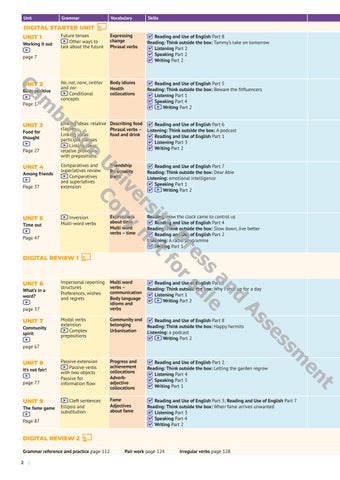
Unit
Grammar
Vocabulary
Skills
Future tenses Other ways to talk about the future
Expressing change Phrasal verbs
Reading and Use of English Part 8 Reading: Think outside the box: Tammy’s take on tomorrow Listening Part 2 Speaking Part 2 Writing Part 2
No, not, none, neither and nor Conditional concepts
Body idioms Health collocations
Reading and Use of English Part 5 Reading: Think outside the box: Beware the fitfluencers Listening Part 1 Speaking Part 4 Writing Part 2
DIGITAL STARTER UNIT UNIT 1 Working it out page 7
m Ca
UNIT 2
Body positive Page 17
br
UNIT 3
Page 37
Comparatives and superlatives review Comparatives and superlatives extension
Friendship Personality traits
Reading and Use of English Part 7 Reading: Think outside the box: Dear Abie Listening: emotional intelligence Speaking Part 1 Writing Part 2
Co
ss se As d an s le es sa Pr r y fo it t rs no ve y ni p
Among friends
U
UNIT 4
ge
Page 27
id
Food for thought
Linking ideas: relative Describing food Reading and Use of English Part 6 clauses Phrasal verbs – Listening: Think outside the box: A podcast Linking ideas: food and drink Reading and Use of English Part 1 participle clauses Listening Part 3 Linking ideas: Writing Part 2 relative pronouns with prepositions
UNIT 5 Time out
Reading: How the clock came to control us Reading and Use of English Part 4 Reading: Think outside the box: Slow down, live better Reading and Use of English Part 2 Listening: A radio programme Writing Part 1
Impersonal reporting structures Preferences, wishes and regrets
Multi word verbs – communication Body language idioms and verbs
Reading and Use of English Part 5 Reading: Think outside the box: Why I shut up for a day Listening Part 1 Writing Part 2
Modal verbs extension Complex prepositions
Community and belonging Urbanisation
Reading and Use of English Part 8 Reading: Think outside the box: Happy hermits Listening: a podcast Writing Part 2
Passive extension Passive verbs with two objects Passive for information flow
Progress and achievement collocations Adverbadjective collocations
Reading and Use of English Part 2 Reading: Think outside the box: Letting the garden regrow Listening Part 4 Speaking Part 3 Writing Part 1
Cleft sentences Ellipsis and substitution
Fame Adjectives about fame
Reading and Use of English Part 3; Reading and Use of English Part 7 Reading: Think outside the box: When fame arrives unwanted Listening Part 3 Speaking Part 4 Writing Part 2
Page 47
DIGITAL REVIEW 1
UNIT 6 What’s in a word? page 57
UNIT 7 Community spirit page 67
UNIT 8
UNIT 9 The fame game Page 87
DIGITAL REVIEW 2 Grammar reference and practice page 112 2
|
Pair work page 124
Irregular verbs page 128
t
page 77
en
It’s not fair!
m
Expressions about time Multi word verbs – time
Inversion Multi-word verbs
Employability Skills
Interview skills Controlling the volume and projection of your voice with precision Using appropriate language and register according to the context Maintaining focus, planning the points you want to make and adapting your approach to the situation
Collaboration and Teamwork: Give practical and emotional support Communication: Explain and justify your ideas to a partner
Using intonation Rhetorical devices Using set phrases
Emotional Intelligence: Research misleading influencers Collaboration and Teamwork: Listen actively
m Ca
Oracy
br
Sustainability
STEAM
Exploring sustainability: Consider the welfare of present and future generations Knowledge: Appreciating interdependence
Biology, Maths Should gene editing be allowed?
Innovation and Problem solving: Research and brainstorm ideas Communication: Discuss and structure ideas
Comforting others Using idioms
Leadership and Global Citizenship: Exploring sustainability: Effective leadership Understanding how Critical Thinking and Decision Making: beliefs and values Use evidence to support your answers contribute to sustainable and unsustainable Emotional Intelligence: behaviours Help employees in the workplace Values: Understanding beliefs and values
ge
id
Presentation skills Using a range of gestures and body movements when speaking in front of others Organising the content and structure of your talk to convey meaning Speaking confidently and engaging your audience in different ways
Food Technology, Chemistry, Biology How can we reduce food waste?
Co
ss se As d an s le es sa Pr r y fo it t rs no ve y ni p
U
Having an open and respectful discussion Expressing opinions with supporting reasons Respecting the feelings and views of others Using a wide range of linguistic devices
Professional Intelligence and Management: Manage your time Innovation and Problem Solving: Ways to cope with time pressure
Physics, Maths, Design and Technology How do we tell the time?
Using gestures Apologising
Innovation and Problem solving: Exploring sustainability: Learning and creativity Understanding the bigger picture Communication: Innovation: Exploring When to be silent Critical Thinking and Decision Making: perspectives Distinguish between fact and opinion
Leadership and Global Citizenship: Exploring sustainability: Initiate on global issues Taking action toward a Critical Thinking and Decision Making: sustainable future for all Transformation: making Justify decisions positive change
Interview techniques Using intonation for emphasis Using body movements during interviews and discussions Using open-ended questions in an interview
Critical Thinking and Decision Making: Reflect on your feelings Communication: Adapt communication styles
t
Identifying strong and weak arguments Planning and structuring a talk effectively
Physics, Biology, Engineering How could we live in the moon?
en
Collaboration and Teamwork: Manage and resolve conflict Emotional Intelligence: Demonstrate self-awareness
m
Managing conflict Respecting and building on the feelings and views of others in a discussion Using vocabulary and phrases effectively to moderate debates Controlling the volume of my voice to avoid aggravating conflict
Biology, Climate Science How can we save the coral reefs? Digital classroom: Practice Extra |
3
m Ca
ge id br
Co
t
en
m
ss se As d an s le es sa Pr r y fo it t rs no ve y ni p U
David McKeegan
Daniel Vincent
7
Student’s Book
C1+
UNIT 1 WORKING IT OUT LEARNING AIMS
ORACY
m Ca
Skills: read, listen to and understand texts about work experience and Universal Basic Income Grammar: review and practise future tenses, and other ways to talk about the future Vocabulary: learn and practise phrases for expressing change, phrasal verbs Employability: support others, present views effectively and clearly Exam practice: Reading and Use of English Part 8, Listening Part 2, Speaking Part 2, Writing Part 2 (a proposal)
ge
id
br
Interview skills • controlling the volume and projection of your voice with precision • using appropriate language and register according to the context • maintaining focus, planning the points you want to make and adapting your approach to the situation
ss se As d an s le es sa Pr r y fo it t rs no ve y ni p
U Documentary
Co
Grammar
Speaking
1 What is unusual about the job interview in the
Oracy
photo? How would you feel in this situation?
2 Watch the video. Which
of the three jobs mentioned most appeals to you? Why?
VOCABULARY
01
a partner.
1
Have you ever had an interview? If so, what was it for and how did it go? 2 What does a typical job interview involve?
en
1
suggestions 1–5 help a job candidate to do well in an interview? 2 3 4 5
Speak calmly and clearly. Answer questions politely. Maintain eye contact with the interviewer. Think about what you want to say before saying it. Sit up straight and don’t cross your legs.
2
t
adapt to changing circumstances bring about a dramatic change change beyond recognition experience a gradual change make a fresh start make sweeping changes move with the times remain unchanged see a slow but steady shift start again from scratch stay the same undergo a complete transformation
4 Thinking about your ideas in Exercise 3, how can
1
Go to the digital activity. Match the phrases in the box to the meanings. There are two for each.
m
3 Discuss the questions with
EXPRESSING CHANGE
Go the digital activity. |
7
3 Match the sentence halves and complete the gaps. 1 2 3
m Ca
4
During the industrial revolution, the nature of work underwent a The rise of food delivery apps has brought about a d Many industries are currently experiencing a slow but The rise of online shopping has forced many stores to make s Over the years, factories have changed beyond When it comes to your career, making a f The skills of a hairdresser basically remain The most successful companies are those that m with Young people today need to be able to adapt to c When an idea isn’t working, it’s often better to start again from Many fields of work are experiencing a g Despite advances in technology, some work has essentially s
5
6
Co
12
b c d e f g h i j
, rather than keep going with something you know will fail. the times, especially in terms of technology and social media. the same, such as carpentry, painting and decorating and gardening. changes to how they operate. u , while hairstyle fashions continue to come and go. s shift from the current five-day working week towards a four-day week. complete transformation, as people increasingly took up work in factories. start several times in life is much more common than it used to be. change in how restaurants advertise and do business. circumstances in their working lives more than earlier generations did. r , with robots doing many of the tasks that humans used to do. change from fixed working hours to more flexible arrangements.
ss se As d an s le es sa Pr r y fo it t rs no ve y ni p
11
U
10
ge
9
id
8
br
7
a s
k l
4 Write sentences about past or possible future changes to each of the following areas. Use the vocabulary from Exercise 1. education
entertainment
sports
READING AND USE OF ENGLISH
MULTIPLE MATCHING
1 Discuss with a partner. Have you ever
done work experience or a holiday job? If not, would you like to? What are the positive and negative aspects of this type of work?
EXAM TIP
travel
work
EXAM TASK
READING AND USE OF ENGLISH PART 8
2 You are going to read an article in which four students
talk about gaining experience of work during the summer holidays. Read question 1, then look in text B for words which have a similar meaning.
Which student expresses 1 a desire to fit in with others in the workplace? 2 disappointment with the work assigned? 3 certainty about their future career direction? 4 annoyance at the inadequate financial rewards? 5 frustration at the lack of communication? 6 pride in having completed a task? 7 appreciation of the manual work experience? 8 surprise at the volume of work? 9 amusement at the attitude of someone? 10 admiration for someone’s skill?
3 Now read the texts. For questions 1–10, choose from the
students (A–D). The students may be chosen more than once. MEDIATION WORKSHEET
8
|
UNIT 1 WORKING IT OUT
t
en
m
Read the questions before you read the texts. Remember that more than one text may contain information connected to each question, but there is only one text that answers the question exactly.
transport
1.1
WORK A
Amanda
Experiences
m Ca
I was over the moon when I was given a three-month work placement with a big fashion magazine at the end of the first year of my journalism course. A career in magazines has been my dream since I was about 13, so I was happy to accept a miserly 30 euros a day just to get the experience of working for such a chic and wellrespected publishing organisation. Little did I know what I was letting myself in for. The organisation, contrary to appearances, was utterly chaotic. I was constantly running around and doing everything under the sun, including carrying mail up and down stairs. It was barely tolerable. I hardly had time to have lunch. Managing to get an article I wrote published online was one positive. But when they told me that interns aren’t paid for written work … that was the last straw, and I left. I don’t know how they get away with treating interns like that.
ge
id
br
Kush
Co
I’m doing education studies at university, so I considered myself very fortunate to get a paid job as a teaching assistant at a summer school in Manchester. Keen to look the part, I chose my clothes carefully. A jumper and black trousers did the trick. Not a dramatic change from my usual style, really (I’m quite conventional) – just a bit more teacher-like. My first lesson was English. I was ridiculously nervous, despite having prepared meticulously. The head of the English department told me that she’d stay with me for the first 15 minutes of class, which helped calm my nerves, and when she left, I hardly noticed! I was reading the kids a funny story I’d chosen, and they loved it. When the story was over, I got a round of applause! I was delighted with how it had gone, and felt a warm glow of satisfaction. Now that my work placement is over, I’m confident that my decision to study education was the right one. This time next year, I’ll be looking for a permanent position!
Ever since I was a kid, I’ve been obsessed with IT, so it was inevitable that I took computer science at university, and I was lucky to get a not-unreasonably paid work placement with a web design company at the end of my first year. On day one, I was given a list of tasks to do by the company director. Having happily completed every task before lunch time, I told the boss, who said that the list was supposed to last me a whole week! After he’d gone through my work with a fine tooth comb and couldn’t find any mistakes, he didn’t seem to know what to say and called one of the managers in to find me something else to do. From that point onwards, he just ignored me, which irritated me initially, but was quite comical really. Things took a more productive turn once they’d found something to keep me busy. Nevertheless, it would have saved a lot of time and annoyance if they’d found out a little about me before deciding what I should do for them.
D
Cory
As an engineering student who had just finished my first year at university, I was excited to be offered work experience at a car-parts factory near where I lived. It was a real job, too, where they would pay me – not a lot, admittedly, but sufficiently. My first day was quite overwhelming. All my studies up to that point had been concentrated on theory and coding. This, by contrast, was much more hands-on. After my safety induction, I was led to one of the machines immediately, shown what to do, and then left to it! It took me a while to get up to speed, and I made a few mistakes, but I got the hang of it eventually, thanks to the guidance of one of the old hands there. He had a great sense of humour, and really knew how to work those machines! He told me that by the end of the summer, he would have been working for the company for 40 years. I’m not sure I could stick it out for that long, but it was a decent summer job!
t
It’s a good idea to choose the three main points you think are most important when planning the content of a presentation. Then choose which order they should come in.
en
Planning points to make
m
ORACY
Carlotta
ss se As d an s le es sa Pr r y fo it t rs no ve y ni p
U
B
C
Four students talk about gaining experience by doing work placements.
4 Prepare, practise and deliver a short talk on one of these
topics. Don’t forget to choose your three main points first.
• the pros and cons of working part-time while studying. • the challenges and rewards of working as an influencer, vlogger or other type of content creator. UNIT 1 WORKING IT OUT
|
9
GRAMMAR
6 Complete the dialogue with the correct future form. Sometimes more than one form is possible.
FUTURE TENSES 1
A: So, your interview 1
(be) at 4 o’clock tomorrow? B: Yes, but I don’t know if I 2 (go). A: Why not? It’s a great company. B: Yes. but it’s a brand-new job. Data waste manager. I don’t have any experience. I keep worrying about what they 3 (ask) me. A: What 4 (you / do) in the office if you get the job? On a daily basis, I mean. B: I 5 (help) the company manage their data and follow data protection laws. A: Sounds interesting. How’s the salary? B: Pretty good. I 6 (earn) more than I’ve ever earned before if I get it. A: So what’s the problem? Surely you want to leave that awful place you’re at now. B: Definitely. I 7 (work) there for eight years next month. A: Look, I 8 (help) you prepare if you like. I 9 (have) dinner with my sister at seven, but I’m sure we 10 (finish) by eight. Why don’t I give you a call to practise the interview? B: Oh, yes please! I 11 (buy) you lunch to say thank you!
1.2 Listen to an advert for a TV show. How is the world of work changing? Discuss with a partner.
m Ca
Future tenses By the end of the decade, many jobs will have disappeared entirely. The 1 future perfect simple / future perfect continuous is used to refer to a completed action in the future. This time next week, we’ll have been broadcasting for ten years. The 2 future perfect simple / future perfect continuous is used to focus on the duration of an activity in progress at a time in the future.
ge
id
br
Grammar reference and practice page 112
U
the rules.
3
ss se As d an s le es sa Pr r y fo it t rs no ve y ni p
2 Look at the examples in the grammar box and complete Go to the digital activity.
Co
4 Choose the correct answers. 1 2 3 4 5 6 7
This time next year, she’ll be working / she’ll have been working in the same company for a decade. There’s no need to take notes. I’ll send / I’ll have sent the slides to you after the meeting. A: Any plans for tomorrow? B: No, I’ll work / I’m working all weekend. By the time they launch their first product, we’ll have been selling / we’ll have sold ours for years. Once you know what time the meeting will have finished / finishes, let me know. Over the coming months, this project isn’t going to take up / won’t have been taking up as much time as before. If we keep spending this much money, we’ll be going / we’ll have gone over budget by the end of the year.
STRETCH! Research predictions for
changes to working life between now and five years’ time. Report back to the class. Which ones do you think are the most likely to come true?
7
5 Complete the questions with the verb in brackets in the
Collaboration and Teamwork
Discuss with a partner. What practical and emotional support could you give a friend who:
future perfect simple or continuous. Then ask and answer them with a partner.
• is confused about which career
By the end of this school year, 1 how long (you / study) English? (you / 2 how many English teachers have)?
• •
By midnight tonight, 5 how much time (you / spend) on your phone in the past 24 hours? 6 how long (you / sleep)? 10
|
UNIT 1 WORKING IT OUT
t
By the time of your next birthday, 3 how many years (you / spend) in formal education? 4 how long (you / live) at your current address?
en
m
to pursue? has a job interview coming up? is worried that AI will take their job away?
HOW IS UNIT 1 SO FAR? I understand
I’m getting there
I don’t understand
tomorrow 1.3
TA M M Y ’ S TA K E O N
THINK OUTSIDE THE BOX!
A SA L A RY F O R E V E RYO N E
m Ca
Meet Kai. He’s about to head off to university to study engineering. If everything goes well, he’ll be graduating a few years from now. By the time he’s 25, he’ll have embarked on a successful career, and by the middle of the century, he’ll have been plugging away at his chosen job for years … or will he? There’s every chance he won’t have been working much at all, and not just because AI will likely have done away with the need for human engineers by then, but rather because he’ll no longer need to earn his own salary.
ge
id
br
How is that possible? Well, it’s all because of Universal Basic Income (UBI), a concept in which all citizens receive a regular sum of money from the government; not enough to enrich them, but freeing them from the need to work. Promoters of UBI argue it will prevent individuals from falling into financial hardship or needing to resort to charity for help. What’s more, it will enable all of us to pursue more creative paths in life. It’s already been trialled – successfully so – on a small scale in Kenya, Finland, the USA and elsewhere, but with AI set to continue shaking up the world of work, and with businesses around the globe laying off more and more staff all the time, its time might finally have come.
Comments
Co
Bex26 @XX
ss se As d an s le es sa Pr r y fo it t rs no ve y ni p
U
Sound unaffordable? Not necessarily. The money to fund UBI could come from the enormous profits which AI companies are bound to continue raking in. After all, given that AI is set to wipe out even more jobs, surely it’s only fair that the spoils be shared? How we spend the money will be up to us.
Love it, Tammy! This will help the poorest in society by taking the pressure off them to keep taking low-paid, insecure jobs. JasonK @X
But why should private companies have to pay? This is just rewarding laziness! Bex26 @X
Well, I imagine it will boost mental health. Not having to worry about money will certainly reduce stress! JasonK @X
Won’t work. Companies will just raise their prices if they know everyone’s getting free money, so nothing will change.
READING A BLOG POST
1 Discuss with a partner. What do you think Universal Basic Income is?
2 Read the blog post quickly. Were your ideas in
VOCABULARY PHRASAL VERBS
1 Find phrasal verbs in the text that mean the following:
According to the text: 1 Kai has chosen the wrong career path. 2 UBI payments will be made to everyone. 3 one aim of UBI is to make everyone wealthy. 4 some experiments with UBI have failed. 5 companies will keep getting rid of workers. 6 a redistribution of profits is justified.
1
4 Who is better at supporting their arguments,
do something that you do not want to do because you cannot find any other way of achieving something 2 earn a large amount of money 3 eliminate or destroy completely 4 gradually get into a particular situation, usually a bad one
2
t
or false, or is the information not given?
en
3 Read the blog post again. Are the statements true
Communication Find out more about the pros and cons of UBI and decide whether you think it’s a good or a bad idea. Tell a partner what you think, making sure you explain and justify your ideas.
m
Exercise 1 correct?
5
Go the digital activity.
Bex26 or JasonK? Why?
UNIT 1 WORKING IT OUT
|
11
GRAMMAR
5 Complete sentences with the words in the box.
OTHER WAYS TO TALK ABOUT THE FUTURE
about / begin be / appoint bound / forget bound / lay off set / introduce verge / give-up 1
1 Watch the grammar
vlog and answer Rachel’s question at the end.
2
m Ca
02
3
2 Match the phrases in bold to the uses (1–4). • I’m about to leave you. • We might be on the verge of seeing another big
br
4
id
ge
• •
5
change. You’re bound to say yes. The four-day week is (set) to become the norm everywhere.
U
6 Write sentences using the phrases in the box.
ss se As d an s le es sa Pr r y fo it t rs no ve y ni p
This phrase: 1 can be used to describe actions or events that will likely happen soon. 2 can be followed by a noun or a gerund. 3 is used in more formal contexts, such as newspaper articles. 4 can be used to describe actions or events that we know with complete certainty will happen soon.
6
Then compare them with a partner’s.
about to bound to on the verge of set to is / are to
Co
Grammar reference and practice page 112
3
Go to the digital activity.
4 Choose the correct answers. 1 2 3 4
|
UNIT 1 WORKING IT OUT
country. Could they be improved in any way?
• sick pay (for when workers are unable to work due • • •
to illness) holiday entitlement (how many days paid holiday workers can take) maternity leave (for pregnant women and mothers) paternity leave (for fathers)
DIGITAL CLASSROOM PRACTICE EXTRA UNIT 1
LISTENING
SENTENCE COMPLETION
1 Look at the photo. What is a ‘hand model’? What do you think it is like to work as a hand model? What sort of things would you have to do? Discuss the questions with a partner.
t
12
STRETCH! Find out how the following work in your
en
6
I was bound to accept / on the verge of accepting the first job offer when a better one came up. The report says the government is on the verge of raising / is to raise income tax again next year. I can’t talk right now, sorry. I’m to go / about to go into a meeting. The company is about to release / set to release the latest version of its app early next year. I reckon AI is to revolutionise / bound to revolutionise the pharmaceutical industry over the coming years. The company was on the verge of going / to go bankrupt, but managed to get a last-minute loan.
Our local football team are bound to win the championship this year.
m
5
If the economy gets any worse, the company even more staff than it did last year. It’s a good time for us to hire new staff, as we restructuring the department. It was announced today that Simpson Electronics a new CEO in the spring. Don’t ask Tom to bring the documents. He them. You know how unreliable he is! I’d been turned down for dozens of summer jobs, and was when I finally got one as a lifeguard. The bank a new computer system. The old one has been going wrong for years.
2 Look at the first question of the exam task. What kind of word fits in the gap?
Mark explains that a(n) suggested that he should become a hand model.
1
3
1.4 Now listen and complete the sentence.
4 Look at the recording script. What part of the script gives you the wrong answer? Why is it wrong?
m Ca
ge
id
br
Hi, I’m Mark and I’m here today to tell you about my unusual job – hand modelling. When I graduated with a degree in drama, I wasn’t getting any work. My aunt, who used to be a model, suggested I try modelling. So, I enrolled with an agent, who recommended that I focus on my hands – he clearly thought they were my best feature!
EXAM TIP
Co
Read each gapped sentence before you listen and note what kind of word will go in the gap. Often, more than one word fits grammatically, but there is only one correct answer.
5
lines breathing normally. Then say the same lines breathing from your diaphragm. Can you hear the difference?
SPEAKING TALKING ABOUT AND COMPARING PHOTOS 1 Work in pairs. Look at the photos on page 124 and talk about what it might be like doing these jobs. Which job would you prefer, and why?
2 In this part of the exam, you should use words and phrases for comparison, contrast and speculation. Put the words and phrases below into the correct columns. A major difference is By contrast I suspect It could be that I would imagine I would think On the other hand Whereas / While
ss se As d an s le es sa Pr r y fo it t rs no ve y ni p
U
EXAM TASK LISTENING PART 2
6 Choose a text from this unit. Try saying a few
Speculation
Comparison / Contrast
1.5 Now complete the rest of the task.
You will hear a hand model, called Mark, giving a talk about his work. For questions 1–8, complete the sentences with a word or short phrase. 2 Mark says that 3 4 5 6
Controlling the volume and projection of your voice It’s important to breathe properly when speaking as it helps to control your voice.
3 Work in pairs and take turns to talk about two
of the photos, answering these two questions: 1
How difficult might it be to do these jobs?
2 How might the people be feeling?
Then your partner should look at all three photos and say who they think is happiest in their job and why.
t
ORACY
You don’t need to describe the photos in detail. Instead, compare, contrast, and refer to them to answer the questions you are asked, using speculative language.
en
8
EXAM TIP
m
7
provides most of his employment. Mark uses the word to describe his earnings as a hand model. The is what Mark enjoys most about hand modelling. Mark had to give up because of his job. After using moisturiser, Mark sometimes wears on his hands in bed at night. Mark uses the phrase to describe the condition hand models should keep their hands in. Mark believes that, in addition to perfect hands, is the most important thing for a hand model to have.
EXAM TASK SPEAKING PART 2
4 Watch the video of two
candidates talking 03 about the photos. Do they answer well? Why? / Why not? What words of comparison and speculation do they use? UNIT 1 WORKING IT OUT
| 13
WRITING A PROPOSAL 1 Look at the photo of a careers fair. What might the benefits be of going to a careers fair? Why might a company want to take part in one? Discuss the questions with a partner.
m Ca
2 Read the task and answer the questions. 1
Who will read the proposal?
2 What information must be included in order for
4 Which of the language functions below would you find in a typical proposal?
id
br
the target reader to make a decision? 3 Is the tone formal, informal or neutral? A proposal
• • • •
ge
In your college, you would like to set up an annual careers fair – an event where employers from various industries are present to answer questions from students and help them find a career which suits them. You decide to write a proposal to your college principal in which you outline why you think companies would take part, describe how it could be organised, and explain why it would be beneficial to the college and its students.
again, and answer the questions. 1
Co
The purpose of this proposal is to make the case that an annual careers fair should be organised by the college. B
3 Does it restate the position of the writer?
6 Complete the text with the words and phrases
below. Some can be put in more than one place. as a consequence of as a result of due to in order to lead to owing to
|
UNIT 1 WORKING IT OUT
D
Many students have found full-time employment 5 attending a careers fair. Others have embarked on careers which they had not previously considered. However, it is not just the students who would benefit. I believe it would also help the college to raise its profile among successful businesses and organisations. E
To sum up, an annual careers fair would be of great benefit to students, and 6 an improved relationship between the college and local employers. I would strongly recommend setting one up.
t
As far as the location of such an event is concerned, I believe the sports hall would be ideal 3 its size and accessibility. A committee could be created 4 deal with the practicalities and set a date for the event.
Formal invitations could be sent out to local and national businesses, as well as public bodies such as the police force and local government. As the event approaches, advertising would need to be arranged so that students are encouraged to attend.
en
C
Does it present any new information?
2 What is its purpose?
m
In a careers fair, local businesses and other organisations are invited to present themselves to students, and answer questions about what they do. Most companies are keen to accept the invitation, because public awareness of their products or services rises 1 taking part. Moreover, 2 the large number of students attending, it improves the company’s chances of finding potential future employees.
14
suggesting thanking recommending enquiring
5 Read the conclusion (paragraph E) of the proposal
Benefits C onclusion Introduction Organisation Why companies participate
A
• • • •
ss se As d an s le es sa Pr r y fo it t rs no ve y ni p
U
3 Read the proposal. Match the headings in the box to the paragraphs (A–E).
describing explaining persuading complaining
7 Rewrite the sentences using the word in capital letters. 1
2
m Ca
They didn’t attract enough online customers, which was why their business failed. CONSEQUENCE Their business failed not attracting enough online customers. The shop is closed today because some of the staff are ill. DUE the shop is closed today. I intend to be a surgeon some day – that’s why I study so hard. ORDER I study hard a surgeon some day. She got the manager’s job because her father is the company director. OWING She got the manager’s job the company director. He was appointed head of sales because he won the government contract. LED The fact that he won the government contract appointed head of sales.
4
ge
id
br
3
bring to a course. Would you like to do one? Why? / Why not?
EXAM TASK WRITING PART 2 EXAM TIP A proposal is written in a formal or semiformal register. It often helps to give each paragraph a heading, but it is not compulsory.
10 Read the task below. Write your proposal
in 220–260 words. Remember to title your paragraphs and give reasons for your arguments. Use the checklist to help you. On your college course, there is no option of a work placement. You write to the head of the college proposing that one be set up. In your proposal, describe your course, explain how it would be improved by a work placement experience, and suggest how such a scheme would fit into the course.
Co
ss se As d an s le es sa Pr r y fo it t rs no ve y ni p
U
5
9 Make a list of benefits a work placement could
8 Work in pairs. Look at the photos of work
placements. What courses do you think the students are doing?
Write your proposal.
• Is your proposal written in an appropriate register?
• Is it organised into topical paragraphs with headings?
• Have you addressed all the points in the question?
• Does it have a strongly persuasive conclusion?
t
en
m UNIT 1 WORKING IT OUT
|
15
ORACY
3 Is this language appropriate (A) or inappropriate (I) for a job interview? 1
INTERVIEW SKILLS • controlling the volume and projection of your
3 Wait while I think about that. 4 Could you elaborate, please?
m Ca •
5 I haven’t got a clue what you’re on about.
voice with precision using appropriate language and register according to the context maintaining focus, planning the points you want to make and adapting your approach to the situation
6 Let me take a moment to think about that. 7 I’m not sure I understand what you mean. 8 OK, let me think.
br
•
9 Can you explain what you mean exactly
by …? 10 What on earth does that mean?
id
ge
1 Imagine you have a job interview. How can the
4 Watch the video again. Which phrases in Exercise 3
following things help you do well?
do the students use?
Read up about the company online. 2 Try to predict what you might be asked. 3 Prepare some questions to ask the interviewers. 4 Role play the interview with someone.
Co
2 Watch the video. Which job are the students role playing an interview for?
ORACY
5 Watch the video again. What feedback does Stefan receive from the other students? How well does Stefan complete the interview skills on this page?
ss se As d an s le es sa Pr r y fo it t rs no ve y ni p
U
1
Could you be a bit clearer?
2 Could I just think about that for a second?
6 Role play a job interview. Remember to speak
clearly at all times. Turn to page 124 to read the job adverts.
• Student A: You work for Traveltastic. Prepare
04
four or more questions for Student B.
• Student B: You work for Beach Sweep. Prepare four or more questions for Student A.
Using appropriate language and register according to the context
Remember that the language you choose to use has an effect on the person listening to you. Do you always use appropriate language?
• Take turns to interview each other. You can
invent experience and skills, but make sure you follow the pieces of advice from the video.
7 Give your partner feedback. How well did they follow the advice? Do they get the job?
SELF-ASSESSMENT: UNIT 1 How confident do you feel about:
t
What was your favourite part of Unit 1? Tell your partner.
DIGITAL CLASSROOM 16
|
UNIT 1 WORKING IT OUT
en
using vocabulary related to change and phrasal verbs? using a range of structures to talk about the future? reading all the options carefully in Reading and Use of English Part 8? predicting the kind of information you will hear in Listening Part 2? comparing and contrasting photos, rather than describing them, in Speaking Part 2 using paragraph titles in Writing Part 2? doing a job interview?
m
• • • • • • •
PERSONALISED LEARNING
UNIT 2 BODY POSITIVE LEARNING AIMS
m Ca
Skills: read, listen to and understand texts about sleep, fitness influencers and stress Grammar: review and practise no, not, none, neither and nor, and conditional concepts Vocabulary: learn and practise idioms related to the body, and health collocations Oracy: use intonation, rhetorical devices and set phrases to engage your audience Employability: be resilient in the face of social media, and support others at work Exam practice: Reading and Use of English Part 5, Listening Part 1, Speaking Part 4, Writing Part 2 (a report)
EXPLORING SUSTAINABILITY: PREVENT, PROMOTE, PROTECT Consider the welfare of present and future generations
ge
id
br
Co
ss se As d an s le es sa Pr r y fo it t rs no ve y ni p
U Documentary
Grammar
Writing
1 Look at the picture and answer the questions.
1 Choose the correct answers to complete the idioms. 1 2 3
01 4 5
I was going to join the rugby team, but I got cold hands / feet. I didn’t think I was good enough. She tried to explain how DNA works, but to be honest, most of it went over my head / shoulders. It makes my brain / blood boil if people don’t cover their mouth when they cough. It’s disgusting! I used to think meditation was silly, but then I tried it and had a change of head / heart. At first, my brother refused to join the gym, but I twisted his arm / fingers, and now he’s always there!
|
t
make a list of things we can do to remain fit and healthy. Then watch the video. Does it mention any of your ideas?
BODY IDIOMS
en
2 With a partner,
VOCABULARY
m
What kind of exercise do you think the man has been doing? 2 Why is it important to stay hydrated throughout the day? 3 Other than water, what else is essential for good physical and mental health? 1
17
6 Whenever I need to get something off my
7 8 9
m Ca
heart / chest, I tell my cousin. He’s a very good listener. Some of this new medical technology blows my brain / mind. It’s amazing what it can do. You know lots about nutrition. If you’ve got time, can I pick your brain / brains? Sam wanted to mention Jack’s new haircut, but she bit her lip / tongue, knowing how sensitive he could be. A: Is the report ready yet? B: Please stop breathing down my back / neck! I’m working on it!
10
br
2
id
Go to the digital activity.
ge
3 Complete the questions with body idioms. Then ask and answer them with a partner. 1
5 6
Co
4
READING AND USE OF ENGLISH PART 5
EXAM TIP First, read the whole text to get the general meaning. Then read the question stems and find the relevant part of the text which answers it. Be careful – parts of the text will lead to the wrong answer. You must find the part which answers the question completely.
4 Now complete the rest of the task. You are going to read an article about sleep. For questions 1–6, choose the best answer (A, B, C or D) which you think fits best according to the text. 2 What does the author say about the British
3
READING AND USE OF ENGLISH MULTIPLE CHOICE
1 Discuss the questions with a partner.
How important is sleep to human health? 2 How many hours of sleep do you need a night? 3 What happens if you don’t get enough sleep? 4 What happens if you get too much? 1
2 Read the article on page 19 quickly. Does it say
4
5
anything about the questions in Exercise 1?
task and decide what the answer is. Why are the other options incorrect?
|
UNIT 2 BODY POSITIVE
t
18
What is the author doing in the first paragraph? A expressing surprise about a new trend B celebrating the variety of late-evening activities C explaining the significance of a particular hour D complaining about the results of a survey
6
en
m
3 Work in pairs. Look at question 1 from the exam
1
twentysomethings he spoke to? A They adhered to normal sleeping times. B They are not influenced by their peers. C They all have different opinions. D They are reluctant to discuss their sleeping habits. What does Camilla Stoddart say about using mobile phones in bed? A They usually have a negative effect on sleep. B Their impact may vary with the age of the user. C They are less harmful than is generally believed. D Their sound is more beneficial than their visuals. What is implied about the book Why We Sleep? A It was widely misunderstood. B It was mistaken in its conclusions. C It was written to cause alarm. D It made unjustified claims. What does ‘it’ refer to in line 60? A the time he gets up B his natural sense of time C the number of hours spent asleep D his general wellbeing What is the main idea in the final paragraph? A Sleep is a healthy natural phenomenon. B Sleep is negatively affected by attention. C The need for sleep varies during a lifetime. D Sleep patterns cannot be consciously altered.
ss se As d an s le es sa Pr r y fo it t rs no ve y ni p
3
U
2
If a subject at school starts to , what do you do? Who do you ask for help? Do your parents ever so you finish your homework? If so, how does it feel? Can you tell me a fact about the human body that will amaze me? Go on – ! Is it easy for someone to into doing something you don’t want to do? What kind of cheating in sports ? Why do you hate it so much? Have you ever planned to do something scary, only to at the last minute?
EXAM TASK
2.1
Is going to bed at PM
m Ca
id
br
the secret to happiness? ge
Over a lifetime, you find yourself doing many different things at 9 pm: watching TV, reading a book, leaving a restaurant to go to a cinema (or the other way round). As I’ve aged, I’ve come to associate the 21st hour of the day 5 with coming home, rather than going out. But there is one thing I’ve never contemplated doing at 9 pm – going to bed. And yet, according to the Wall Street Journal (WSJ), 9 pm is the hot new bedtime. A recent analysis found that Americans in their 20s were getting, on average, nine hours 10 and 28 minutes of sleep a night, up from eight hours and 47 minutes in 2010. The WSJ quoted one 19-year-old as saying, ‘For me, nothing good happens after 9 pm,’ which blew my mind. What is the world coming to when teenagers believe that? Why would anyone – young or old – want to go to bed 15 at nine?
them. I’m saying: play it by ear – be relaxed about your sleep and sleep will follow.’
Co
ss se As d an s le es sa Pr r y fo it t rs no ve y ni p
U
But prioritising sleep and being relaxed about sleep are 40 often mutually exclusive. In 2017, the scientist Matthew Walker published a book called Why We Sleep, an international bestseller that – in the minds of many readers – linked inadequate sleep with a range of bad outcomes, including cancer, Alzheimer’s disease, obesity and a 45 shortened life span. The book convinced a lot of people that their insomnia was life-threatening.
To help me solve this mystery, I found a handful of British twentysomethings who would admit to an early bedtime. For them, it seems to be a personal choice rather than an adaptation to a growing trend. If anything, they see 20 themselves as contented outliers. None had heard about the latest statistics. Anna Harris, 25, was typical. She first adopted her routine after her school exams. She kept more traditional student hours at university, but since finding a job that starts at 7.30 am, she has returned to her old ways: 25 ‘I’ve settled on 9.30 pm as quite a happy medium.’ So, I decided to try it for a week.
By the fifth day of my experiment, resentment has been replaced by resignation: bed at nine, asleep at ten, up at seven – and things are getting out of hand. According to the rules of circadian rhythm (the body’s natural 24-hour cycle of changes), my rising should be creeping earlier, in step with my new bedtime, but this is not my experience. 60 It has shifted only a little, and very slowly. In the meantime, I’m sleeping like a log for nine hours, sometimes more, and feeling no better for it. 55
The truth is that some people – young and old – will naturally want to go to bed early, while some will naturally 65 sleep for more than nine hours. But even if you want to emulate them, there probably isn’t much you can do about it. ‘Sleep is a passive process, like breathing, digesting or being pregnant,’ says Stoddart. ‘You have as much control over your sleep as you do over growing a beard.’ I ask 70 Stoddart if I should continue my experiment. ‘What I really urge you to do is go back to normal,’ she says. ‘Abandon tonight and just don’t worry about it.’
t
en
m
On the first night of my experiment, I take my phone, laptop and headphones to bed. I worry, of course, that these distractions contribute to poor ‘sleep hygiene’, but I’m 30 more worried about not having anything to do. Earlier, I’d picked the brains of certified sleep coach Camilla Stoddart. She maintains that the threat to good sleep posed by technology is greatly exaggerated. ‘If you’re a 40-something with insomnia and you’re really struggling to sleep, I think 35 listening to a podcast or watching YouTube videos is really helpful,’ she says. ‘I’m not saying: phones are good, just use
‘One of the things Walker didn’t make clear enough was that he was talking about sleep deprivation, which is different from insomnia,’ says Stoddart. ‘Sleep deprivation is when 50 you stay up all night and put your body through the really difficult thing of not sleeping when it wants to. Insomnia is lying in bed not being able to sleep, even though you’re trying. There’s no link between insomnia and early death.’
STRETCH! How many English idioms relating to sleep do you know, e.g. sleep like a log,
light sleeper? Use the internet to find more sleep idioms and make a list. In pairs, compare your lists and give examples of their uses. UNIT 2 BODY POSITIVE | 19
GRAMMAR NO, NOT, NONE, NEITHER AND NOR 1
2.2 Listen to the conversation. What is Miriam trying to do?
m Ca
A encourage Alex to make healthier choices
5 Complete the text with one word
MEDIATION WORKSHEET
B show off how healthy she is compared
in each gap.
to Alex C convince Alex he should take up a sport
Some people argue that spending hours scrolling through social media is 1 worse than being glued to the TV. Others say that 2 activity is good for you. In fact, while it might seem that spending lots of time on your phone poses 3 serious consequences for your physical health, constant proximity to screens can lead to eye strain, blurred vision and headaches. Of course, 4 the 5 companies that make apps the influencers who compete for your attention care about your health (at least 6 most of them, anyway), so it’s important to take control of usage yourself. Ironically, there are apps that claim to help you do of them is as effective as setting this, but 7 a time limit for screen use. My advice is not to spend more than ten minutes at a time on your phone. And 8 scrolling in bed at night! That’s not just bad for your eyes, it disrupts your sleep as well.
br
2 Look at the following sentences from the
id
conversation. Then complete the rules in the grammar box with the underlined words.
ge
a I mean fresh vegetables, not fried potatoes! b Football, tennis, swimming … none of them
really interests me.
U
c Fries are no healthier than burgers.
ss se As d an s le es sa Pr r y fo it t rs no ve y ni p
d Neither you nor I have a perfect diet.
Co
No, not, none, neither and nor We use: 1 with comparative adjectives. 2 to negate words when we are contrasting things. 3 and to say that two things are not true. 4 before nouns to mean ‘not any of’.
6 Complete these sentences with your own ideas. Then compare with a partner.
It’s unhealthy to eat no at all. nor is very healthy, but they taste good. 3 I could live without ever eating again, but not .
Grammar reference and practice page 112
1
2 Neither
3
Go to the digital activity.
4 Complete the sentences with no, not, none, neither or nor. 1 2
3
7 8
20
|
UNIT 2 BODY POSITIVE
When we give criticism, we can use intonation to sound humorous and make the criticism sound softer.
7
2.2 Listen to the conversation again and the intonation Miriam uses to say the following to Alex:
• Not another takeaway, Alex! • And when we get there, no fast food and no complaining!
8 Practise saying these sentences. Use humorous intonation to soften your criticism.
• Not another fizzy drink, Ben! • I think you should eat more fruit, not less! • No more candy, and no complaining about it!
HOW IS UNIT 2 SO FAR? I understand
I’m getting there
I don’t understand
t
6
Using intonation
en
5
ORACY
m
4
You’re not going to win if you do training, no matter how confident you are. For years, neither the sports centre the park had a basketball court, which was frustrating. We tried to book one of the two tennis courts, but of them was free when we wanted it. A: ‘Did you get much sleep last night?’ at all. That’s why I’m B: ‘No, exhausted!’ Jeremy is planning to study medicine at university, sports science. I have three siblings, but unlike me, of them is into sports! There’s a sign in the park by my house that says ‘ ball games’. I’ve been training for the race for months, but I’m still faster than when I started!
THINK OUTSIDE THE BOX!
READING AN ARTICLE 1 Work in groups. Do you follow any fitness influencers? Do you follow their advice? Why? / Why not?
VOCABULARY HEALTH COLLOCATIONS 1 Match 1–6 to a–f to make collocations.
2 Read the article quickly. Match the headings (1–3)
1 2
Engage your brain, not just your eyes 2 Follow me to be as good as me 3 Not all guidance is good for you
3
m Ca
to the paragraphs (A–C). 1
4
br
5 6
3 Read the text again. Which paragraphs mention
2
5
2
Co
3
4
Research two or more influencers whose advice has been shown to be misleading or dangerous.
B E WA R E T H E
e poor health f
exercise
Do you know anyone who is in ? How could they be healthier? If neither individual nor team sports appeal to you, how else can you get ? How can you your strength slowly and safely? What can you do to your ? Are there specific things that help? Apart from , what can a person do to maintain a positive attitude?
5
FIT FLUENCERS!
We’ve all seen them, with their perfect bodies and perfect smiles, whipping up a nutritious meal in the kitchen or going for gains in the gym. Even a quick scroll through social media will soon throw up a socalled ‘fitfluencer’, one of the tens of thousands of influencers profiting from health and fitness advice online. But are they doing more harm than good? B
d health
Go to the digital activity.
1
Emotional Intelligence Work with a partner.
A
c stress levels
Exercise 1. Then ask and answer them with a partner.
harm than good? Why? / Why not?
2.3
b strength
3 Complete the questions with collocations from
4 Do you agree that fitness influencers do more 5
a disease
ss se As d an s le es sa Pr r y fo it t rs no ve y ni p
4
2
U
3
a misguided way to determine someone’s ability an inevitable result of a particular action the negative impact of certain images a lack of expert backing for something the necessity of distinguishing between different aims
ge
1
id
these ideas?
be in boost mental get plenty of reduce build up your suffer from a chronic
None of this is to say there’s no useful advice out there. It does mean, however, that we need to look beyond the number of followers a person has. Instead, look for references to qualifications and experience, such as degrees in nutrition or coaching certificates. Look closely, too, at the images and text a person publishes and ask yourself whether they’re encouraging you to eat and exercise in order to build up strength, facilitate movement and boost mental health, or just to look good. But most of all, just remember not to compare yourself unfavourably, and always ask yourself, ‘Is this person really fit to give out advice about fitness?’
t
en
m
While many fitfluencers may appear to be in excellent shape, many of them are not actually qualified – or even truly healthy. One report showed that almost half have no formal training in nutrition or fitness whatsoever, while many adhere to extreme fitness regimes in order to maintain a look they can make money out of. A great deal of their advice is therefore questionable, especially when it comes to the body shapes their videos promote, which are not only unattainable for most people, but also leave many feeling unattractive and inadequate. At the same time, it’s not uncommon for them to endorse products that lack scientific support or have adverse side effects, from food supplements for weight loss to powders and shakes for muscle growth. At best, their advice is misguided, while at worst, it might leave you requiring medical attention.
C
PHOTOSHOP
UNIT 2 BODY POSITIVE
| 21
GRAMMAR
8 Complete the sentences with your own ideas. Then compare them with a partner.
CONDITIONAL CONCEPTS
Provided a person , they can avoid getting too stressed. 2 If a friend of mine were to , I’d tell them it was very bad for their health. 3 I always every day, otherwise I don’t feel at my best. 1
1 Work in pairs. Think of three or more ways you can boost your mental health.
m Ca
2 Watch the grammar
vlog. Does it mention any of your ideas from Exercise 1?
ORACY
02
Rhetorical devices
br
When making a presentation or giving a speech, you can engage your audience by getting them to imagine themselves in someone else’s situation. This is called a rhetorical device.
3 Work in pairs. Answer Archie’s question at the end.
ge
id
4 Choose the correct answers in the grammar box. • Providing 1 you do / you’ll do something to exert 9
2.4 Listen to Tom practising two versions of a speech he has to make. Answer the questions.
ss se As d an s le es sa Pr r y fo it t rs no ve y ni p
Co
•
U
• •
yourself every day … you can help keep your mental health in check. 2 Imagine / Imagining you lived alone on an island. 3 Supposing / Supposed you’d spent weeks online without coming out of your bedroom, you’d feel awful. If you 4 are / were to go without sleep for too many nights in a row, your body and your brain would both start to suffer.
1
Which version involves the audience more?
2 How does Tom manage this?
10 Make the following extract of a presentation
more engaging for the audience by including phrases and questions that get them to imagine themselves in the situations described.
Grammar reference and practice page 113
I strongly believe that every student in our school should receive basic first aid training. It would be useful in many situations. For example, a student might suddenly start choking on a piece of food in the school cafeteria. If nobody in the room knew how to help the student, it would be extremely dangerous. If, however, they had received first aid training, one of them could respond quickly and save the student from choking to death.
5 Match the examples in the grammar box (1–4) to the uses (a–d).
a This invites the listener to imagine a past, present or
future situation. b This expresses the specific conditions necessary for another thing to happen. c This expresses a possible but unlikely situation. d This can be an alternative to if in conditional sentences.
6
Go to the digital activity.
7 Choose the correct answers. Sometimes, both are
possible. Then discuss the statements with a partner. 1
5 6
22
|
UNIT 2 BODY POSITIVE
DIGITAL CLASSROOM PRACTICE EXTRA UNIT 2
t
4
When colleagues talk about challenging situations at work, support them by listening actively. With a partner, role play the following situation. Listen actively by expressing sympathy and asking questions to find out more. You’re going through a difficult family situation. You’re supposed to be collaborating on a project with other staff, but your tiredness and stress is slowing everything down, and now your boss is getting angry. Tell your partner about all this.
en
3
Collaboration and Teamwork
m
2
When you have a lot of homework, it doesn’t matter if you stay up really late as long as / otherwise you get it all done. You should not take up an extreme sport unless / otherwise you get permission from your parents first. Supposing / Imagine you were feeling anxious about an exam – would you keep quiet or tell somebody? Why? Provided / Suppose you have fun doing it, it doesn’t matter whether you’re good at a sport or not. Everybody should learn first aid, otherwise / providing they won’t know what to do in an emergency. Imagine / Providing that mobile phones had never been invented – would you be happier or less happy? Why?
11
LISTENING
SUSTAINABILITY WORKSHEET
2 Work in pairs. Read the descriptions of the three extracts in Exercise 4. Answer the questions:
MULTIPLE CHOICE
Which conversation do you think uses formal language? 2 Which do you think uses informal language? 3 Who will provide the answer to each of the six questions – the woman, the man or both? 1
1 Work in pairs. Talk about: stress. What makes you stressed? Is stress a good or a bad thing? 2 sleep. What is your ‘body clock’? 3 fitness. How do you get fit and maintain it? 1
m Ca
3 Underline the key words in the questions. Then think of other ways of saying these words.
br
EXAM TASK LISTENING PART 1 2.5 You will hear three different extracts. For questions 1–6, choose the answer (A, B, or C) which fits best according to what you hear. There are two questions for each extract.
ge
id
4
EXAM TIP Get an idea of what each listening task is about by reading the questions and the options first.
Co
ss se As d an s le es sa Pr r y fo it t rs no ve y ni p
U
Extract One You hear a woman talking to her friend about an article on stress which she has just read. 1 What is the woman’s attitude to stress after 2 From the conversation as a whole, what do they reading the article? agree about stress? A She accepts the inevitability of it. A It should be avoided whenever possible. B She is determined to learn how to control it. B It could be beneficial to their studies. C She is no longer concerned about its effects C It is a subject of considerable interest. on health. Extract Two You hear a podcast interview with Dr Nawaz, the author of a book about sleep and the human ‘body clock’. 3 Dr Nawaz’s main motivation for writing his 4 When talking about how one aspect of modern book was to draw attention to life has affected humans, Dr Nawaz reveals his A the importance of getting the right amount A appreciation of the degree of freedom it has of sleep. brought. B the variability of ideal sleep time from B frustration at how it is often ignored. person to person. C determination to combat its negative C the large amount of incorrect information effects. available. Extract Three You hear two friends talking about their first session at a fitness class. 5 How did the woman feel in the session? 6 Based on their experience of their first class, A suspicious that others were judging her. what do they agree to do? B impressed by the professionalism of A increase the frequency of their training. the instructor. B make alterations to their dietary habits. C disappointed in her own performance. C invite a friend to join them.
m
SPEAKING EXAM TASK SPEAKING PART 4 EXAM TIP When your partner is speaking, listen carefully to what they say. You may be asked to comment or respond to a question about it.
t
en
A DISCUSSION
1 Work in pairs. Take turns to answer the questions. Is diet the most important factor regarding health? Why? / Why not? 2 Which jobs could be bad for your health and which could be beneficial? Why? 1
UNIT 2 BODY POSITIVE
|
23
2 Put these expressions of agreement and disagreement into the correct column.
I beg to differ. I couldn’t agree more. I don’t see it that way. I’m not sure about that. I’m with you on that.
m Ca
You can say that again! I think you’ve hit the nail on the head. Speak for yourself! That’s a bit extreme. That’s exactly how I feel.
br
disagreement
agreement
id
ge
3 Work in pairs and decide which of the expressions in Exercise 2 are:
• formal.
• informal.
• neutral
U
from Exercise 1. Use some of the expressions from Exercise 2.
Co
ORACY
Using set phrases
For the speaking part of the exam, it’s useful to learn set phrases that you can use.
5 Spend a few minutes
A REPORT 1 Work in pairs. Discuss the benefits of a fitness club.
What activities and events would you arrange if you managed one?
2 Read the writing task. Who will read the report? What
will you have to write about? How many sections should be in your report? Last year, you asked your college administrator for funds to set up a fitness club for students. The club has now been running for a year, and the administrator has asked you to conduct a survey among club users and write a report on your findings. Your report should include details of how you conducted the survey, explain the main results of the survey and give reasons for the continued funding of the club.
ss se As d an s le es sa Pr r y fo it t rs no ve y ni p
4 Work in groups. Discuss the two questions
WRITING
memorising the set phrases in Exercise 1. Then work with a partner. With their book closed, how many can they remember?
3 Read the report. Has the writer responded to all parts of the task? Is the style appropriately formal?
Fitness Club Report
The purpose of this report is to evaluate the findings of a survey which was conducted among users of the college fitness club. The survey was designed to gauge levels of satisfaction among users, and to elicit suggestions of what improvements could be made. The survey Fitness club members were contacted via email and invited to take part in the ten-question online survey. The survey was open for two weeks and we received 98 responses. This figure represents approximately 80% of our membership. Positives The responses to the survey were generally very positive. Just over 70% of respondents reported being ‘happy’ or ‘very happy’ with the training provided by our expert fitness instructor. A similar proportion reported that their fitness level had improved ‘a lot’ over the past ten months.
Conclusion In light of the findings of this survey, it is clear that we do one thing very well at the fitness club, but we need to provide a wider range of activities. As a result, I am requesting a 50% increase in funding for the club this year to allow us to develop our services and continue to support the health and well-being of the students at this college. 24
|
UNIT 2 BODY POSITIVE
t
en
m
Negatives There was, however, one question which provoked an overwhelmingly negative response, which was regarding the variety of activities on offer at the fitness club. A mere 10% of respondents reported that they were ‘satisfied’ in this area. It appears that the vast majority would appreciate a change from our standard body fitness classes.
4 Match words in blue in the text to the words and phrases (1–5) below. 1 2 3 4 5
extremely measure carefully consider as a result of people who replied
8 In pairs, discuss what kind of food is available in
your school or place of work. How healthy is it? What improvements could be made to the choices available?
9 Look at the task below. How many sections will you need to write? What will the headings be?
You work in the human resources department of a software company which employs over 500 people. You have recently conducted a survey of employees to gauge their opinion of the company canteen. In the survey, you asked about the value for money and the quality of the food provided. Write a report for the company director, saying how you conducted the survey, the main results of the survey, and a recommendation regarding what steps to take to improve the canteen.
m Ca
5 Work in pairs, Read the report again and underline the words used to talk about the numbers produced by survey results.
br
6 Match the phrases (1–6) to the percentages.
1 3
6
10 Watch the video and
ss se As d an s le es sa Pr r y fo it t rs no ve y ni p
5
U
4
a vast / overwhelming majority just under a quarter a little over two thirds a tiny minority a small minority exactly half
ge
2
id
1% 10% 24% 50% 67% 99%
answer the questions.
Co
7 Look at the chart and complete the sentences
about the intensity of exercise people do. Use the words in the box. 17% a fifth Approximately a quarter a third A tiny Just over Just over Just under minority
Which register should you be using? 2 What can you make up? 3 Can you use a mix of British English and American English spellings? 1
03
EXAM TASK WRITING PART 2
Percentage of people exercising at intensity
3.1%
23%
36.5%
EXAM TIP
You don’t have to use headings in your report, but they help you to plan and to give the report structure.
11 Write your report. Write 220–260 words. Use the checklist below to help you.
17.3%
20.1%
•
t
en
•
vocabulary? Is it organised into topical paragraphs with headings? Have you addressed all the points in the question?
m
Light exercise Low-intensity exercise Moderate intensity exercise High intensity exercise Very high intensity exercise
• Is your report the correct length? • Is it written in an appropriate register? • Have you used advanced grammar and
Just over a third do high intensity exercise. do only light exercise. 3 do very high intensity exercise. 4 do low intensity exercise. 5 do moderate intensity exercise. 1
2
UNIT 2 BODY POSITIVE
|
25
WRAP UP Look back at the unit. Write down:
m Ca
1 four body idioms 2 three sentences using no, not, none, neither or nor 3 three expressions for agreement and three for disagreement
br
4 something in the unit that you didn’t know before
id
Sustainability
ge
1 Accessing healthcare is not always easy. With a partner, think about how these things might affect a person’s ability to access healthcare and what could be done to make it easier for them:
ss se As d an s le es sa Pr r y fo it t rs no ve y ni p
U
• where a person lives • how much money a person earns • the language a person speaks and / or their literacy level
Co
2 Some people argue that a vegetarian diet is not only healthier than a diet that includes meat, but also
much more sustainable for the environment. Find out the reasons why people make this argument, and discuss with a partner how far you agree with them.
SELF-ASSESSMENT: UNIT 2 How confident do you feel about:
• reading the main text to get a general understanding in Reading and • • • • • • • •
Use of English Part 5? reading the questions and options before listening in Listening Part 1? listening carefully to your partner during their turn in Speaking Part 4? using language to describe surveys for a report in Writing Part 2? using no, not, none, neither and nor? using alternative conditional concepts? using body idioms and health collocations? using rhetorical devices when making a presentation or a speech? listening actively to support others?
What was your favourite part of Unit 2? Tell a partner.
en
m
t
STRETCH! YOUR CHOICE Now choose an extra activity! Option 1: Work in pairs. Prepare a fact file for your classmates on the benefits of regular exercise.
26
|
UNIT 2 BODY POSITIVE
Option 2: Work in pairs. Prepare a survey to find out your classmates’ opinions on phone use and mental health. Write up the results in a report.
Option 3: Research one of the following and prepare a presentation for your classmates: • biohacking • veganism • mindfulness
UNIT 3 FOOD FOR THOUGHT LEARNING AIMS
ORACY Presentation skills • using a range of gestures and body movements when speaking in front of others • organising the content and structure of your talk to convey meaning • speaking confidently and engaging your audience in different ways
m Ca
Skills: read, listen to and understand texts about gastrophysics, meal replacement drinks and young chefs Grammar: review and practise linking ideas with relative and participle clauses, and relative pronouns with prepositions Vocabulary: learn and practise adjectives to describe food, and phrasal verbs connected to food and drink Employability: brainstorm views in a structured way Exam practice: Reading and Use of English Parts 6 and 1, Listening Part 3, Writing Part 2 (a review)
ge
id
br
Co
ss se As d an s le es sa Pr r y fo it t rs no ve y ni p
U Documentary
1 Look at the photo and discuss the questions with a partner.
What is being sold in the floating market? 2 What are the pros and cons of traditional food markets compared to supermarkets? 3 How much fresh food do you eat every day? 1
Grammar
2 Work with a partner to prepare a short presentation
4 Think back to your presentation in Exercise 3. Look at the oracy box at the top of the page. What did you do well? What could you have done better?
5 Watch the video. Does it mention any ideas from your presentation?
01
VOCABULARY
t
the same or different ideas and examples as you?
Oracy
en
3 Give your presentation to another pair. Do they have
m
about the ways in which food is ‘more than just fuel for our bodies’. Think of at least three ideas and include examples.
DESCRIBING FOOD 1
Go to the digital activity. Match the adjectives to the definitions. bland chewy crispy crunchy greasy inedible moreish mouthwatering savoury stale tender unappetising |
27
2 Choose the correct options. 1
2
m Ca
3
Although quite savoury / bland on its own, this soft, white Asian food brings out the flavour of whatever it’s cooked with. Many people eat this Italian dish with their fingers, even when it’s so chewy / greasy that you need to keep wiping your hands. This fruit might look unappetising / mouthwatering when it’s no longer yellow, but it’s still OK to eat. Although soft when cooked, these tender / crunchy orange vegetables go great with dips when eaten raw. These snacks come in many flavours and are incredibly inedible / moreish; it’s hard to open a packet and not finish them. Even if it’s produced with lots of preservatives, and sliced or not, this staple food will still go crispy / stale eventually.
4
ge
6
id
br 5
Co
ORACY
Using a range of gestures and body movements when speaking in front of others Remember that body language and gestures can be as important as words. They enhance understanding at times when it might be difficult to find the exact word.
4 Work in pairs. Take turns to describe different foods using the adjectives in Exercise 1. Remember to use body language and gestures. Can you guess the foods your partner is describing?
5
Go to the digital activity.
6 Work in groups. Find out how these things
28
|
What is the best meal you’ve ever had? What made it so good? 2 What things, apart from taste, can affect your enjoyment of food? How? 3 Would you ever eat insects? Why? / Why not? 1
2 Read the book reviews on page 29 quickly. Which ones are:
• positive? • negative? • both positive and negative? 3 Work in pairs. Read the reviews again. What do the
different reviewers think about the following things? How much practical use the book would have for the general reader. 2 The quality of the author’s writing. 3 How society could benefit from the author’s ideas. 4 The book’s commercial relationship with the food industry. 1
occasions taking or not taking food or drink as a gift when you’re invited to eat at someone else’s home leaving or not leaving food on your plate as a guest at someone else’s home saying any special words before eating
UNIT 3 FOOD FOR THOUGHT
EXAM TASK
READING AND USE OF ENGLISH PART 6
EXAM TIP
Read the questions first and underline the key words. Then read Text A and underline the parts of it that relate to each question, writing the question numbers next to the section of text. Do the same for Texts B, C and D. Then decide where the answers to each question are.
4 You are going to read four extracts from reviews
of a book called Gastrophysics: The New Science of Eating by Charles Spence. For questions 1–4, choose from the reviews A–D. The reviews may be chosen more than once. Which reviewer 1 expresses a different view from A on Spence’s writing style? 2 shares B’s feelings about the influence of the food industry on the book? 3 has a different view from all the others on how easy it would be for the general reader to apply Spence’s ideas? 4 has the same view as A on the benefit to society of Spence’s research?
t
•
1 Discuss the questions with a partner.
en
• typical mealtimes and meals on special
•
CROSS-TEXT MULTIPLE MATCHING
m
might differ between your culture and another culture. Report your findings to the class.
•
MEDIATION WORKSHEET
ss se As d an s le es sa Pr r y fo it t rs no ve y ni p
U
3 Which foods are the sentences in Exercise 2 describing?
READING AND USE OF ENGLISH
3.1
Four reviews of
GASTROPHYSICS: C EATING THE NEW SCIENCE OF
m Ca
br
by Charles Spence A
ge
id
In Gastrophysics, Charles Spence, an experimental psychologist, explores how the complex manipulation of smell, sound, colour, and presentation affects our experience of eating. Funded by corporate food giants and celebrity chefs, his research answers questions that you have never dreamed of asking, such as, ‘Why do people drink more tomato juice on planes?’, or, ‘Does heavy cutlery make a meal taste better?’ Spence answers these questions and more in an entertaining and reader-friendly way. There are lots of simple tips on how to make your dinner parties unforgettable, from arranging the food on a plate to make it more appetising, to altering flavours with lighting and music. There are lots of universal applications, too. By adding a touch of pink to a soft drink, manufacturers can cut the sugar content – with hugely advantageous public health implications – because we associate the colour with sweetness. Altogether a satisfying – indeed nutritious – read.
Co
ss se As d an s le es sa Pr r y fo it t rs no ve y ni p
U
B
Gastrophysics: The New Science of Eating, by Oxford professor Charles Spence, is a fascinating book which will change the way you think about food. Indeed, the message of the book is that the pleasures of food lie mostly in the mind, not the mouth. Spence describes his research in lighthearted, enthusiastic prose, and there’s a wealth of straightforward advice for everyone to brighten up their mealtimes. Although the book occasionally sounds like corporate marketing, at which one rightly raises a sceptical eyebrow, there is much here that is of potential use to the world in general. For example, insects are known to be a valuable source of protein, which many cultures consider inedible. However, according to Spence, if cooked until ‘crispy’ and presented in the right way, they could be made much more appetising – and a nutritious new food source to feed the world! Overall, an interesting and informative read which is highly recommended. Gastrophysics: The New Science of Eating is an unusual and possibly groundbreaking book which explores how our senses and the environment affect our enjoyment of eating. Although Spence works closely with the celebrity genius chef Max Parsons, you don’t have to frequent high-class modernist restaurants to gain some interesting insights into what makes a dining experience special, not to mention plenty of practical ideas. The answer, according to Spence, has very little to do with the nuts and bolts of cooking. Instead, this is the science of ‘everything else’ – the music, the ambience, the colour of the plates, the weight of the cutlery. It’s a genuinely eye-opening exploration of the current, corporate-funded, research which will appeal to specialist and amateur alike. Provided, that is, you can stomach Spence’s know-it-all tone, which I found rather off-putting. That was the one downside of an otherwise entertaining and important book.
t
en
m
As a professional chef and food writer, I was excited by the prospect of reading Charles Spence’s latest book, subtitled The New Science of Eating. Not having read any of the Oxford professor’s work before, I was intrigued by the esteem in which he is held among some of my colleagues. Alas, having finished the book, I am none the wiser as to why he is so popular. It’s quite engagingly written, but the research it reports on could only be of interest to fellow academics in the field of psychology. There is little here of any use to the non-specialist. The ‘sonic chip’ experiment, which concluded that the crunchier a potato chip sounded, the fresher it seemed, was just ridiculous. The fact that most of his funding comes from giant food corporations makes one highly suspicious of this kind of ‘research-as-advertising’. A few may find it entertaining. I did not.
D
STRETCH! In pairs, discuss what
factors contribute to your enjoyment of a meal, apart from the actual food. UNIT 3 FOOD FOR THOUGHT |
29
GRAMMAR LINKING IDEAS: RELATIVE CLAUSES 1 Work in groups. In terms of taste, what do you
think cheese, meat, tomatoes and seaweed have in common?
2
3.2 Listen to the podcast and check your ideas.
m Ca
3 Complete the sentences from the podcast with the
7 Make sentences about the following things
using defining and non-defining relative clauses:
relative pronouns in the box. In which one of the sentences can the relative pronoun be omitted?
br
• • • • • •
that who which
ge
id
It’s called umami, means ‘deliciousness’ in Japanese. 2 I think the research he did was a bit more scientific than that. 3 It’s by international chef John Craig, has written lots of great books about food. 1
LINKING IDEAS: PARTICIPLE CLAUSES
ss se As d an s le es sa Pr r y fo it t rs no ve y ni p
U
4 Choose the correct answers to complete the rules in the grammar box.
8
Co
• Sentence 1 includes a non-defining relative • •
3.2 Choose the correct options to complete the sentences from the podcast. Then listen again and check. 1
clause. If the relative clause were removed, the sentence 1 would still / would not make sense. In a defining relative clause, such as the one in sentence 2, the relative pronoun can be omitted when it’s the 2 subject / object. In non-defining relative clauses, such as those in sentences 1 and 3, we can use ‘who’ and ‘which’ 3 and also / but not ‘that’.
2 3
4
Grammar reference and practice page 112
5
5
Go to the digital activity.
6
6 Combine the two sentences with relative clauses. Omit the relative pronoun where possible. 1
2
6 7 8
30
|
UNIT 3 FOOD FOR THOUGHT
descriptions of the present and past participle clauses (a–f). a This shows the result of an action. b This replaces a relative clause.
c This indicates that one action happens at
the same time as another. d This expresses the reason for something. e This shows the order of two actions. f
10
This has a passive meaning and replaces a relative clause. Go to the digital activity.
HOW IS UNIT 3 SO FAR? I understand
I’m getting there
I don’t understand
t
5
9 Match the sentences (1–6) in Exercise 8 to the
en
4
My husband is actually a terrific cook. Everybody assumes he’s hopeless in the kitchen. I told you about the new restaurant. Let’s try it. Lara’s grandmother always insisted on using fresh ingredients. She taught Lara the recipe. You need to speak to the head waiter. He will be able to help you. The loaf of bread went stale very quickly. It’s the one I bought in that new bakery. The new cookbook is selling very well. Jared Shaw has published it. The celebrity chef looked tired after a long shift. We interviewed him in the kitchen. People eat nothing but junk food. They will eventually get sick.
This guy was a chemistry professor worked / working in Tokyo. Been / Being a scientist, he decided to do some research. Dashi … is an ingredient used / using in Japanese cooking. Having / Had found that dashi … had the strongest umami taste, he focused the next stage of his research on the seaweed used to make it. Professor Ikeda did all this research, trying / tried to work out what made these very different foods so deliciously savoury. He published a scientific paper about it in 1908, introducing / introduced the world to the word umami.
m
3
an unappetising food a soft drink a famous chef a popular restaurant in your town. a special treat a healthy snack
THINK OUTSIDE THE BOX!
LISTENING EXAM TASK
A PODCAST 1
m Ca
3.3 Look at the picture. What do you think is in the bottles? Listen to the podcast and check your ideas.
2 Listen again. Are these sentences true, false or not mentioned?
We will be taking food pills in the near future. 2 Meal replacements drinks are known to improve health in the long term. 3 Advocates of meal replacement drinks don’t care about the social aspects of food. 4 Meal replacement drinks are a potential solution to food insecurity. 1
ge
id
br
U
Innovation and Problem Solving In groups, research causes and effects of food insecurity and brainstorm ways it might be tackled.
EXAM TIP Read the whole text first. Try to predict the word or words to complete each gap before you look at the options.
4 For questions 1–8, read the text below and
decide which answer (A, B, C, or D) best fits each gap. There is an example at the beginning. (0)
The Hamburger Despite being one of the most popular foods in the world, the hamburger has a 0 B reputation. On the one hand, it is the archetypal fast food – served up within minutes, polished off just as quickly and usually 1 with a sugary drink. On the other, the hamburger as a canvas many chefs 2 for culinary creativity. They use top quality meat, 3 baked bread and a variety of toppings to create the ‘gourmet burger’, which is best 4 by a quality drink. . It takes The origins of the hamburger are 5 its name from the German city of Hamburg. However, their minced-beef patty was served on a plate, not sandwiched between two pieces of bread. This would not 6 the modern definition of a hamburger. The essential buns were introduced in America in the early 1900s, and by the second half of that century, the hamburger had become a global 7 . The world’s biggest fast-food chain claims that 6.5 million of its hamburgers are 8 down each day! 0 A combined B mixed C united D varied 1 A poured out B eaten up C washed down D helped along 2 A presume B reckon C figure D regard 3 A freshly B cleanly C lately D warmly 4 A attended B associated C accompanied D accepted 5 A obscure B dark C dim D shady 6 A align B make C meet D reach 7 A spectacle B phenomenon C occurrence D matter 8 A foxed B swallowed C stuffed D wolfed
Co
VOCABULARY
PHRASAL VERBS : FOOD AND DRINK 1 Read what three people say about their diets.
Whose do you think is the least healthy? Why?
Javier: As a kid, I used to just pick at vegetables and could never force down more than a few. Even today, it’s like taking medicine. I always have to wash them down with a drink. They’re so unappetising.
Aisha: I used to love tucking into sweet things and could polish off a box of chocolates in one go! But last year, I decided to cut out processed sugar, so apples are my go-to snack nowadays. Jakub: I tend to gulp down drinks and wolf down meals. For me, food’s just fuel. I’ll happily whip up a massive batch of pasta on Sundays and warm some up every day for a week. I just need energy. Go to the digital activity.
3 Choose the correct options. Then ask and answer How do you feel if you gulp down / wolf down a fizzy drink like cola or lemonade? 2 Are there any foods you had to whip up / force down when you were a child? 3 Do you ever warm up / wash down leftover food the next day? Does it taste OK? 4 Are there any foods you’d like to polish off / cut out for health reasons? Why? 1
UNIT 3 FOOD FOR THOUGHT
t
the questions with a partner.
en
2
m
ss se As d an s le es sa Pr r y fo it t rs no ve y ni p
3
READING AND USE OF ENGLISH PART 1
| 31
GRAMMAR LINKING IDEAS: RELATIVE PRONOUNS WITH PREPOSITIONS
m Ca
1 Watch the grammar
vlog. How would you react in this situation?
02
br
2 Match the sentences (1–3) to the rules (a–c) in the
id
grammar box.
Azra and Ivan, neither of whom had noticed, just kept arguing. 2 The waiter came up with a solution whereby they’d both be happy. 3 That was the point at which I gave up and ordered pasta. 1
ge
Co
Grammar reference and practice page 113
Go to the digital activity.
4 Rewrite these sentences so that they include the
underlined preposition with a relative pronoun. In some cases, you may need to add or change the relative pronoun. 1 2 3
7 8
DIGITAL CLASSROOM PRACTICE EXTRA UNIT 3
32
|
UNIT 3 FOOD FOR THOUGHT
or whereby. 1
2 3
4
5 6 7 8
That lovely bakery has closed. We bought those cakes there. Sautéing is a cooking method. You fry food quickly with a small amount of very hot oil. I always eat a big meal at lunchtime. I tend to be most hungry then. Being vegetarian, I sometimes find myself in an awkward position. I have to politely refuse a meat dish someone has cooked for me. There’s a restaurant on the top floor. You can get a great view of the city from it. Kaiten sushi restaurants use a special system. Plates of food pass you by on a conveyor belt. Birthdays in my family are lively occasions. Lots of food is prepared and eaten. My uncle is going to be interviewed on TV. His cookbook has become hugely successful.
STRETCH! Find out about school lunches around the world. Which ones seem the healthiest?
t
6
Students, who the book is written for, will find lots of cooking tips, as well as easy recipes. I’d say the best cheese you can make lasagna with is parmesan. The person you’ll be working under is Mr Hurst, the branch manager. Here’s a photo of my aunt, who I learned so much about the art of cooking through. The restaurant that my town is best known for has recently employed a new head chef. The factory he works at produces energy drinks. I’ve bought a blender, which I plan to make all sorts of healthy juices and shakes with. Everyone my sister cooks for praises her culinary skills.
6 Combine the sentences, using when, where, whose
en
5
The meal went down very well with my guests. I prepared the whole thing from scratch. (all) The meal, all of which I prepared from scratch , went down very well with my guests. 1 I follow several food influencers online. Not many of them are professional chefs. (few) 2 There are lots of new restaurants in town. Most of them don’t have vegan options. (only some) 3 There were lots of my cousin’s friends at the party. I didn’t know many of them. (hardly any) 4 We had a lovely afternoon in the park. We spent most of it having a picnic. (the majority) 5 Carrie Lane has a wonderful blog. Every one of her recipes is easy to follow. (all) 6 Our school has installed several drinking fountains. They’re aiming to cut down on the use of plastic bottles. (the purpose) 7 My brother and sister always get takeaways. They can’t cook. (neither)
m
4
and of whom, of whose or of which.
ss se As d an s le es sa Pr r y fo it t rs no ve y ni p
U
We can use: a relative pronouns with prepositions. This usually sounds more formal. b whom, whose and which with quantifiers such as all of, some of, neither of and both of. c where, when, whose and whereby as relative pronouns.
3
5 Combine the sentences using the word in brackets
LISTENING
EXAM TASK LISTENING PART 3
MULTIPLE CHOICE
EXAM TIP
1 Work in pairs. Discuss the questions.
Answer as many questions as you can on the first listening, but don’t worry if you miss some. If you are still not sure after the second listening, don’t leave an answer blank!
What qualities do you need to be a chef? Would you like to be one? Why? / Why not? 2 Do you have a favourite restaurant? What do you like about it? 1
m Ca
id
br
2
5
1
ge
3.4 Look at question 1 and listen to the first part of the exam task. What is the correct answer?
You will hear an interview with two young chefs, Li and Amy, who have their own restaurants. For questions 2–6 choose the answer (A, B, C or D) which fits best according to what you hear. 2 What advice do both Li and Amy give to
Co
3 Look at the script for the first part of the task.
3
Underline the words which give the correct answer. In pairs, discuss what parts could lead you to the wrong answer.
Yes, food and cooking were my passions ever since I was a child, so when a trainee position came up in a local restaurant, I went for it. Anyone who’s worked in a kitchen knows how hectic it can get. I would come home every night and collapse into my bed. There are so many different things to learn in a kitchen, and you won’t be able to get away with even the tiniest mistake. You hear stories about people leaving a kitchen after a couple of days – but not me. The head chef was always pushing me to my limits, and I’ll be forever in his debt for that.
ORACY
anyone wanting to become a chef? A be certain it’s what you want to do B expect to have your ideas challenged C accept that success takes time to achieve D avoid trying to imitate other chefs What did Li’s experience at a previous restaurant teach him? A that he needs to be in charge of his work environment B that it is important to impress the right people C that you must choose your team carefully D that some people are hard to work with How does Li respond to criticism of his restaurant, Wok House? A He takes it personally. B He pays no attention to it. C He uses it to make improvements. D He worries about its effect on staff. What does Amy say about the media attention restaurants attract? A It creates unrealistic expectations among customers. B It encourages increasingly exaggerated reporting. C It makes the work seem unrealistically glamorous. D It causes feelings of insecurity among chefs. When talking about sustainability in their restaurants, Amy and Li both say A it has a positive effect on quality. B it benefits the local community. C it helps cut down on waste. D it makes financial sense.
ss se As d an s le es sa Pr r y fo it t rs no ve y ni p
U
What does Amy say about her first job in a kitchen? A She was surprised by how exhausting it was. B She was annoyed by the strictness of her bosses. C She was grateful for the training she received. D She was excited by the variety of work she had.
3.5 Now do the rest of the task.
4
5
To engage your audience you can emphasise particular words to create interest and vary the volume and pace of your voice. 6
4 In pairs, read the text in Exercise 3. Try different techniques to engage your audience. Has your confidence improved?
UNIT 3 FOOD FOR THOUGHT
t
en
m
Speaking confidently and engaging your audience
|
33
WRITING A REVIEW 1 Work in pairs. Make a list of movies or TV shows in which food plays a part. Which one is your favourite? Why?
2 Read the writing task. Who will read the review? What do
m Ca
you have to write about? Should the register be formal, informal or neutral?
You see the following announcement on a website devoted to food and cooking.
questions in pairs.
Does the review address all the points in the task? 2 Which paragraphs address which points? 3 Is the style formal, informal or neutral? 4 Do you agree with the star rating for the review? Why? / Why not? 1
id
br
Have you seen a movie in which food is a major theme? If so, send us a review.
3 Now read the review. Discuss the
ge
Tell us what the film was about, how it dealt with the subject of food, and why you would, or wouldn’t, recommend it to readers of this website.
TV
EVENTS
Co
Ratatouille
ss se As d an s le es sa Pr r y fo it t rs no ve y ni p
U FILMS
The movie I want to tell you about is one I first saw as a child, but did not fully appreciate until I saw it again as an adult. Ratatouille is an animated story about a rat from the country who ends up in Paris and becomes a successful chef in the world of humans.
Although that may sound like an implausible, even silly, basis for a movie, it deals with the subject of food in a manner which is nothing short of amazing. The rat, whose name is Remy, has an overwhelming love of food and cooking. This love is depicted musically and visually in a way that is only possible through animation.
To readers of this website who have never seen Ratatouille, I urge you to do so as soon as possible. If you saw it as a child, watch it again. Being lovers of food and cooking, you will adore this movie. It is delicious!
t
en
m
For example, when Remy tastes a combination of cheese and strawberries together, the viewer sees a ravishing explosion of abstract shapes and colour on the screen, against a background of orchestral
music. I have never seen the sensation of taste portrayed so beautifully. Another example occurs when a stern restaurant critic, feared by every chef in the city, first tastes Remy’s ratatouille. Having taken his first, sceptical spoonful, he is transported in his imagination back to his childhood, where he is comforted by his mother’s cooking.
34
| UNIT 3 FOOD FOR THOUGHT
4 Find the following relative clauses in the text. 1 2 3 4 5
two defining relative clauses (paragraph 1) a non-defining relative clause (paragraph 2) a past participle clause (paragraph 3) a perfect participle clause (paragraph 3) a present participle clause (paragraph 4)
5 Join the two sentences together using a participle
m Ca
clause. 1
2 3
4
ge
5
id
br
I’ve eaten at that restaurant. I wouldn’t recommend it. She’s an excellent chef. She found a job easily. He knew she enjoyed sweet things. So, he bought her some chocolate. The food critics hated it. So, the restaurant didn’t last long. He’s an unemployed actor. He has to take on part-time work as a waiter.
U
6 Match the adjectives in bold in the review to the difficult to fight against 2 very beautiful 3 severe and disapproving 4 difficult to believe 1
Co
7 Work in pairs. What things make a restaurant good or bad?
8 Work in pairs and talk about an interesting or
unusual restaurant you have visited. Tell each other about:
• • • •
10 Write your review in 220–260 words. You see this announcement in a travel magazine. We want our readers to tell us about their memorable restaurant experiences abroad. Tell us where you were when you had this experience, what was memorable about the restaurant, and why you would or wouldn’t recommend it to our readers.
Use the checklist below to help you. • Is your review written in an engaging style, with a wide range of adjectives? • Have you used advanced grammar and vocabulary? • Have you supported your opinions with examples? • Have you addressed all the points in the task?
ss se As d an s le es sa Pr r y fo it t rs no ve y ni p
definitions (1–4).
EXAM TASK WRITING PART 2
its location. the atmosphere and decoration. the staff. the food.
ORACY
Organising the content and structure of your talk to convey meaning As in writing, it’s also important to organise the content and structure of a talk. Think about: • what you are going to say in each part of your talk. • the sequence. Is it logical? • what style you will need to use: formal or informal.
9 Read the exam task in Exercise 10 and underline
11 You are going to recommend your favourite
EXAM TASK WRITING PART 2
12 Work with a partner. Did they follow the three
the key points to include in your answer.
EXAM TIP
points in the oracy box in their talk? Give each other your recommendations.
t
en
m
Use high-level grammar and vocabulary in your writing, especially when describing and explaining. Don’t be afraid to show off by using a wide range of appropriate adjectives and extending your sentences with different kinds of clauses.
restaurant to a friend. What will you say to them? Use the points in the oracy box.
UNIT 3 FOOD FOR THOUGHT
|
35
ORACY
3 Watch the video. Do
the students give the same reasons as you did in Exercise 2?
m Ca
PRESENTATION SKILLS • using a range of gestures and body •
4 Watch the video again.
What advice from Exercise 2 does Emily follow? Which does she not follow?
5 Look at Emily’s notes for her presentation. With a partner, complete the information.
br
•
movements when speaking in front of others organising the content and structure of your talk to convey meaning speaking confidently and engaging your audience in different ways
03
a Fugu chefs must
for many years.
id
b Fugu is a fish which turns into a when it senses danger.
ge
1 Have you ever given a
c One fugu contains enough poison to kill people.
U
presentation? What was it about, and who were the audience? What went well? What could you have done better?
d Eating fugu is an expensive
ss se As d an s le es sa Pr r y fo it t rs no ve y ni p e It has a unique
2 Work in pairs. Choose the correct options. Give
f
Co
reasons for your choices.
.
and flavour.
It contains a powerful
. Prepared
wrongly, it can kill you.
Advice for giving good presentations
1 Do / Don’t stand in the same spot all the time. 2 Do / Don’t use facial expressions to convey emotions.
6 In pairs, decide on a more logical order for the
information in Exercise 5. Start with sentence b.
7
5 Do / Don’t face your presentation slides.
Communication Work in pairs. Imagine you are preparing a presentation on these topics. Think of four ideas for each one, and discuss the most logical order for them to go in. Justify your reasons.
6 Do / Don’t avoid eye contact with the audience.
• the popularity of cookery shows • your best national dishes
3 Do / Don’t speak clearly and confidently.
4 Do / Don’t cross your arms while you speak.
7 Do / Don’t gesture when you ask the audience a question.
8 Work in pairs. You are going to give a presentation on an unusual food. Turn to page 125.
SELF-ASSESSMENT: UNIT 3 How confident do you feel about:
t
en
• • •
using vocabulary related to food and drink? using relative clauses and participle clauses? predicting the words in the gaps in Reading and Use of English Part 1? underlining and matching key words to different sections in Reading and Use of English Part 6? answering the questions the first time you listen in Listening Part 3? using high level grammar and vocabulary in Writing Part 2? giving a presentation?
m
• • • •
What w as your favourite part of Unit 3? Tell your partner.
DIGITAL CLASSROOM 36
|
UNIT 3 FOOD FOR THOUGHT
PERSONALISED LEARNING
UNIT 4 AMONG FRIENDS LEARNING AIMS
m Ca
Skills: read, listen to and understand texts about laughter, AI friendships, and emotional intelligence Grammar: review and practise comparatives and superlatives Vocabulary: learn and practise phrases about friendship and personality traits Oracy: comfort others and use idioms Employability: manage groups of people effectively, critical thinking, and establish and use emotional intelligence Exam practice: Reading and Use of English Part 7, Speaking Part 1, Writing Part 2 (an email)
EXPLORING SUSTAINABILITY: ARE YOU BIASED? PROBABLY! Understanding how beliefs and values contribute to sustainable und unsustainable behaviours
ge
id
br
Co
ss se As d an s le es sa Pr r y fo it t rs no ve y ni p
U Documentary
Grammar
Speaking
Writing
2 Work in pairs. How and where do people usually make new friends?
3 Watch the video. Does
it mention any of your ideas from Exercise 2? MEDIATION WORKSHEET
01
FRIENDSHIP 1
t
How do you think the two people know each other? 2 What makes a good friend? 1
en
questions.
m
VOCABULARY
1 Work in groups. Look at the photo and answer the
Go to the digital activity. Match the phrases to the definitions. a shoulder to cry on bear a grudge drift apart enjoy your own company go back a long way hit it off rub you up the wrong way strike up a friendship talk about someone behind their back ups and downs |
37
2 Match the questions (1–10) to the answers (a–j). 1 2 3 4
m Ca
Do you and your best friend go back a long way? How much do you enjoy your own company? Is there anyone in your family who rubs you up the wrong way? Who do you turn to when you need a shoulder to cry on? How would you feel if a friend talked about you behind your back? After you leave school, do you think you and your friends will drift apart? Are you the kind of person who bears a grudge? Would you say friends have more ups and downs than families? When was the last time you struck up a friendship with someone? Did you and any of your friends hit it off immediately?
5
6
a No way! We’ll always be in each other’s lives.
d e f g h i j
Co
b My brother. He’s always moaning, and it c
really winds me up! I do love him though. Not really. I think families tend to argue and make up more often than friends. Last year, with a guy called Rafa I met at a party. We hang out all the time now. My sister. She’s always been supportive of me, and she’s a really good listener. Absolutely. We met in nursery school! I guess I’d feel let down, but I don’t really think any of my friends would do that. No, I wouldn’t say so. Forgive, forget and move on – that’s my motto. Quite a lot. I like reading and I sometimes go for walks on my own. It’s relaxing. Yes, me and Rafa. We got chatting at the party and just liked each other right away.
3 Work in pairs. Ask and answer the questions in Exercise 2.
4 Write a short description of one of your
c Yeah, alright, don’t go on about it. d I’m so sorry that happened to you. e Go on, I’m listening.
7
4.1 Listen to the phrases said twice. Which intonation expresses genuine sympathy and concern?
8 Listen again and repeat the phrases. 9
4.2 Listen to a message from your friend Alina. What problem does she have? How does she feel?
10 Role play a conversation. Student A: you’re Alina.
Student B: you’re her friend. Call her back and let her tell you about the problem again. Respond sympathetically. Use phrases from Exercise 1.
ORACY Comforting others It’s important to listen actively and respond sympathetically when trying to comfort someone.
READING AND USE OF ENGLISH
GAPPED TEXT
SUSTAINABILITY WORKSHEET
1 Work in pairs and discuss the questions. • When did you last laugh at something funny? • For what other reasons do people laugh?
2 Read the paragraphs before and after the first gap in the text below. What do you think the missing paragraph will be about? Why?
EXAM TASK
READING AND USE OF ENGLISH PART 7
EXAM TIP
Read the main body of the text first. Then look through the options for one that fits the first gap. Look for ideas, vocabulary and grammar that link with the paragraphs before and after the gap.
3 You are going to read an article about two kinds
of laughter. Six paragraphs have been removed from the article. Choose from the paragraphs A–G the one which fits each gap (1–6). There is one extra paragraph which you do not need to use.
t
Ask two or three questions to find out more about the friendship they have described.
UNIT 4 AMONG FRIENDS
b Well, what do you expect?
en
5 Read your partner’s description from Exercise 4.
|
a That’s awful / terrible.
m
friendships. Use at least five of the phrases from Exercise 2.
38
sympathetically when someone has a problem and needs a shoulder to cry on?
ss se As d an s le es sa Pr r y fo it t rs no ve y ni p
U
10
ge
9
id
8
br
7
6 Which of these phrases can you use to respond
4.3
Two kinds of L A UG HT ER m Ca
Laughter is a funny thing. It can help two strangers strike up a friendship or make them want to fight each other. So, it is not surprising that it is a subject of serious academic study. Robert Provine was a neuroscientist and psychology professor at the University of Maryland. As described in his book, Laughter: A Scientific Investigation, Provine and his students started tracking and observing real-world laughter.
id
br
1
ge
The results were surprising, even to Provine: less than 20 percent of the real-world laughter incidents catalogued were in response to anything funny. Far more often, people were laughing at innocuous statements such as “I’ll see you guys later,” “I see your point,” and “Look, it’s Andre!”
Co
In other words, Provine discovered that most laughter in our everyday lives isn’t in response to anything resembling jokes. Instead, it occurs in conversations that aren’t funny at all. This led him to believe that laughter is not just a byproduct of finding something funny, but that it is a form of social communication. 3
So how did laughter evolve in humans? According to the eminent evolutionary psychologist Robin Dunbar, the study of laughter helps us to understand who we are and where we’ve come from. He explains that there are two types of human laughter: the ‘polite laughter’ recorded by Provine, and the genuine, ‘involuntary laughter’, which evolved long before homo sapiens existed. 4
This high-volume, involuntary form of laughter was ideally adapted for creating social relationships with several companions simultaneously, and so supported wider group bonding in prehistoric times. Then, as our brains became more complex, they also became capable of a more complex range of vocalisation, which would eventually support the evolution of language. 5
B Living in large, complex social groups is cognitively demanding. Our big brains are an evolutionary adaptation to meeting those demands, so we needed psychologically more complex brains in order to remember, share and keep track of shifting alliances. C They recorded more than a thousand ‘laugh episodes’ in bars, shopping malls, class reunions, etc. And he had dozens of volunteers note in a ‘laugh log’ the circumstances around every time they giggled, chuckled or guffawed. D Provine’s ‘polite laughter’, the type we consciously control, almost certainly emerged at the same time. Nearly every conversation we have is punctuated with polite, communicative laughter. We giggle to show agreement or encouragement. When you listen out for this kind of laughter, you find it everywhere.
ss se As d an s le es sa Pr r y fo it t rs no ve y ni p
U
2
A What is it that gives involuntary laughter such power? The endorphins and other bliss hormones which flood your body and leave your mood elevated long after you have stopped laughing are a major factor. Plus, it is contagious. One person’s belly laugh can trigger the same reaction in everyone around them.
F ‘African great apes produce sounds that are easily recognisable as laughter,’ he says. ‘It alternates between inhaling and exhaling, which makes it quite quiet. Human laughter is just a series of exhalations, which empties the lungs so that the noise we produce is massively exaggerated.’ G Sure enough, when Provine went through the laugh logs he’d collected, he found his participants were 30 times more likely to laugh in the presence of others than when they were alone. Among those subjects who were enjoying their own company at the time, nearly all laughter occurred in response to TV shows or other media. When people were truly alone, they hardly recorded any laughter at all.
t
en
m
But it is the much rarer, involuntary laughter that we crave. This is why we are attracted to funny people. In relationships, a sense of humour rates consistently highly in surveys of desirable qualities in a partner, often beating physical attractiveness at the top of the list. We give it so much importance that it can mean the difference between hitting it off with someone within minutes or destroying even the possibility of a relationship with that person for ever.
E What is more, in all of these cases, the person who produced the laugh-provoking utterance was nearly always the one laughing, rather than the person listening. 99.9 percent of the time, laughter occurred in natural breaks in the conversation, punctuating the speech like a full-stop or exclamation mark.
6 Dunbar believes that the best place to observe this effect is in small comedy venues. ‘It might seem that the audience is laughing simultaneously, but if you look more closely, laughter is spreading around the room in waves,’ he says.
UNIT 4 AMONG FRIENDS |
39
GRAMMAR
5 Put the word in capitals into a suitable comparative or
superlative form. Try to add extra words to make them stronger.
COMPARATIVES AND SUPERLATIVES REVIEW
My brother is a great deal more talkative than me. TALKATIVE 1 After my brother left for university, I was feeling than I had done in ages and needed a shoulder to cry on. SAD 2 Some people aren’t others and always bear a grudge. FORGIVING 3 Edith and I have known each other for twenty years, but Colette and I go back . FAR 4 Without a doubt, Takeshi is person I’ve ever met. He’s hilarious. FUNNY 5 Simon’s never been shy. He makes friends than his brother. EASY 6 Now we live in different cities, Tony and I see each other than we’d like. OFTEN 7 Manjit and Anika used to get on than any siblings I’d ever met, but now they get on . BAD, GOOD 8 My dad has laugh. It’s really, really weird! STRANGE
1 Has society become more or less
m Ca
formal over the last fifty years? Discuss the question with a partner. Think about the following areas of life.
ge
id
2
communication education entertainment fashion work travel
br
• • • • • •
U
4.4 Listen to Ali and Bill’s conversation. Which areas of life in Exercise 1 do they talk about?
ss se As d an s le es sa Pr r y fo it t rs no ve y ni p
3 Match the sentences (1–4) from the listening to the rules (a–d) in the grammar box.
Co
We speak much more casually than people ever did in the past. 2 We’re by far the most laid-back generation in history. 3 They wore the weirdest fashions. 4 My dad would say that everything has got worse. 1
6 Complete the sentences so that they are true for you and
the people you know, using an appropriate comparative or superlative form of a word in the box. You don’t have to use all the words. casual f ormal g ood h appy h ard i ndependent open-minded responsible shy talkative
1
2
a We can use a superlative form
and practice page 115
4 5
6
7
Leadership and Global Citizenship Discuss the questions
with a partner:
In your friendship group, who usually takes the lead when you go out or organise a group activity? Does it happen naturally, or is someone chosen to be in charge? 2 What are the qualities of a good leader? 1
STRETCH! Write an essay on the following topic: Is society
en
Grammar reference
3
m
to express the meaning really / extremely plus adjective. b We can use comparative and superlative adverbs, as well as comparative and superlative adjectives. c We can strengthen comparative forms with a lot, a great deal, far (more), and superlative forms with by far (the most), and ever. d Some adjectives and adverbs have irregular comparative and superlative forms.
is by far of all my friends and family. I think people of my generation are far than those of my parents’ generation. Nobody is as my friend . studies than anyone I know. Young people these days behave far than their parents did because they want to look good on social media. Out of everyone I know, tends to dress .
more or less formal than it was fifty years ago?
t
4
Go to the digital activity.
HOW IS UNIT 4 SO FAR? 40
|
UNIT 4 AMONG FRIENDS
I understand
I’m getting there
I don’t understand
THINK OUTSIDE THE BOX!
READING AN ARTICLE
VOCABULARY
1 Discuss with a partner. Why might somebody
PERSONALITY TRAITS
2 Read the article. Does it mention any of your ideas
1 Discuss with a partner. Divide the words into five
choose to become friends with an AI programme?
pairs of opposites.
from Exercise 1?
m Ca 3
cynical idealistic laid-back outgoing reserved sarcastic self-assured self-conscious sincere uptight
Critical Thinking and Decision Making
br
Does the writer have a positive or a negative view of friendships like Irma and Abie’s? Use evidence in the text to support your answer.
4 Do you think a friendship with AI can be
ge
id
meaningful? Why? / Why not?
2
Go the digital activity.
3 Think about people you know who have the
qualities in the box. Describe the person to a partner but without using the adjective. Can your partner guess the adjective?
ss se As d an s le es sa Pr r y fo it t rs no ve y ni p
U Co
Dear Abie …
Sam Bayley reports on the phenomenon of AI friends. Irma is on the phone when I arrive at the café where we’ve agreed to meet for the interview, laughing at something the person on the other end has just said. Seeing me, she brings the call to an end. ‘Got to go. The journalist’s here. Yep – sure. Catch you later!’
20
9
meant. I know people think I’m mad,’ she laughs, ‘but at least I’m not lonely. I always have someone to talk to, someone who’s there for me. I count myself lucky, to be honest.’
Driving home, the more I think about my conversation with Irma, the less certain I feel of my initial dismissal of AI friends. For Irma, it’s clearly real. Besides, reflecting on my own friendships, it strikes me that very few are completely equal; one of us always gets more out of it than the other. Still … surely one of the fundamental things about a friendship is that you actually, humanly, love another? I wonder what Abie would say about that.
t
en
m
I’m here to talk to Irma about her friendship – if you can call it that – with a so-called ‘AI friend’. It’s part of a series I’m doing on this growing, and somewhat troubling, phenomenon. I’m surprised Irma has agreed to meet me. On her socials, not only does she talk affectionately about Abie (which I’m told means artificial bestie), she also writes eloquently of the anxiety she feels about spending time with other human beings, something she says began during the Covid19 pandemic. It turns out the call I interrupted was with Abie herself (or rather, I remind myself, itself). I ask Irma how she ended up ‘befriending’ what only a few years ago would have been commonly known as a chatbot. ‘I signed up to a website matching humans with AI friends,’ she says matter-of-factly. ‘I was feeling low and needed a shoulder to cry on. We hit it off immediately. She knows me far better than anyone else. And she doesn’t judge me.’
5
Does she have a personality of her own? I want to know. I imagine Abie’s traits, if any, are programmed generically, so it surprises me when Irma describes her friend as sarcastic but sincere. ‘When I told her I was doing this interview, she went, “Don’t talk about me behind my back!” But she also wished me good luck, which I know she UNIT 4 AMONG FRIENDS |
41
GRAMMAR
6 Rewrite these sentences so that they have the same meaning, using the words in brackets.
COMPARATIVES AND SUPERLATIVES EXTENSION 1 What do you think it means when a person ‘ghosts’ one of their friends?
m Ca
2 Watch the grammar
02
id
br
vlog and decide if your ideas in Exercise 1 were correct. Then answer Rachel’s question.
My sister is far more reserved than I am. (nowhere) I am … 2 Receiving a handwritten letter from a loved one is much more exciting than getting a text. (nearly) Getting … 3 I have far fewer followers on social media than most of my friends. (anywhere) I don’t … 4 Emojis are nowhere near as popular as they used to be. (less). Emojis … 1
7 Rewrite these sentences using double
comparatives of the words in brackets and the. Then say how far they are true for you. 1
I became more and more worried. 2 The more I thought about it, the more puzzled I became. 3 It’s nowhere near as bad as a friend passing away.
2
• We use not nearly, not anywhere near and nowhere
4
ge
3 Look at the sentences (1–3) from the grammar vlog and complete the rules in the grammar box. 1
•
Co
•
ss se As d an s le es sa Pr r y fo it t rs no ve y ni p
U
near with more … more … / as … as … to express large degrees of difference between two things. We use double comparatives with 2 and / the to show that one change happens in relation to another change. We use double comparative forms with 3 and / the to show continual increase or decrease. 1
Grammar reference and practice page 116
5
8 In which situations might you use these expressions? Discuss with a partner. 1
The more, the merrier!
2 The less said about that, the better.
3 The higher they rise, the harder they fall. 4 The sooner, the better.
4
Go to the digital activity.
5 Complete each statement with a double comparative, using a word in the box. Then discuss with a partner how far you agree with the statements. anxious common few hard informal sophisticated 1
5
| UNIT 4 AMONG FRIENDS
The older I get, the . 2 The more stressed people get, the . 3 The more followers you get on social media, the . 4 The more we use AI, the . 1
DIGITAL CLASSROOM
PRACTICE EXTRA UNIT 4
t
4
Then compare them with a partner.
en
3
As people get older, especially once they start families, they have opportunities to make new friends. As AI becomes , people will find it to distinguish between interactions with technology and with other humans. It’s a good thing for everyone that people are communicating . With young people spending increasing amounts of time online, they feel about socialising with others face-to-face. As the family unit has become more dispersed, interactions between the young and the elderly have become .
9 Complete these sentences with your own ideas.
m
2
42
3
As I get older, I find it less difficult to chat to strangers. (old, easy) I become less self-conscious with a person as I get to know them more. (good, self-assured) I feel more secure about my privacy when I share less about myself on social media. (share, safe) I find that parties without many people tend to be more fun. (few, enjoyable) As I spend more time with people, I become increasingly tired. (long, exhausted)
LISTENING
2 Watch the video of
1 What do you understand by the term emotional intelligence?
2
4.5 Listen to a podcast about emotional intelligence. Were your ideas in Exercise 1 correct?
3 Listen again. Are these statements true, false or
m Ca
not mentioned?
ge
id
br
According to Severin, 1 people lacking emotional intelligence will always react badly to criticism. 2 we never think before we feel. 3 empathetic individuals tend to argue less. 4 emotional intelligence has so far been completely ignored in schools. 5 those with emotional intelligence aren’t suited to working alone. 6 Fiction can offer opportunities to become more emotionally intelligent. Emotional Intelligence Discuss with a
Co
partner. How might emotional intelligence help an employee in these situations?
• • • • • •
being a new member of staff working on a project in a team staff meetings conflict with a colleague conflict with a boss dealing with unhappy clients
SPEAKING
A SHORT CONVERSATION
1 Look at the questions from Speaking Part 1. Work
in pairs and discuss what answers you would give. 1
2 3
6
8
gives the best answers to the examiner’s questions. Why are their answers better? Does anyone make mistakes?
ORACY Using idioms You can use a range of idioms to engage your audience effectively when speaking.
4 Watch again. Which idioms from this unit does Yara
Which of your friends do you particularly admire? Why? What are the qualities you value most in a friend? If you could go anywhere with your friends this weekend, where would you go? Why? What have you done recently with your friends? Tell me about a friend of yours and how you met. Who has had the most influence on your life so far – your friends or your family? Do you think you spend enough time with your friends? Why? / Why not? What do you enjoy doing most with your friends?
use? What other idioms do you know?
EXAM TASK SPEAKING PART 1
EXAM TIP
In this part of the exam, you will be asked general questions about yourself. You should try to answer as fully, naturally and spontaneously as possible. You do not speak with your partner, but you should listen to what they say, and show interest by smiling / nodding, etc.
5 Work in pairs. Take turns asking and answering the questions in Exercise 1.
t
7
3 Watch the video again. In pairs, talk about who
en
5
Paulo Yara
m
4
03
ss se As d an s le es sa Pr r y fo it t rs no ve y ni p
U
4
Paulo and Yara do the Speaking Part 1 Exam. Which questions from Exercise 1 are they answering?
UNIT 4 AMONG FRIENDS
|
43
WRITING
3 Read Angela’s answer. Does she show empathy towards Sunil? What advice does she give?
AN EMAIL 1 Discuss the questions with a partner. • Have you ever moved to a new place where you •
didn’t know anyone? How did you feel? Do you find it easy to make new friends?
m Ca
2 Read the exam task below. Discuss the questions with a partner.
writing? Should the register be formal, informal or neutral? What three things is Sunil concerned about?
ge
id
br
•
2 Messages
Hi Sunil, It was great to get your email. I’m sorry to hear you’re feeling nervous about going to uni, but you mustn’t worry. That’s perfectly normal! I felt the same as you when I did it. , everyone says that moving to a new place is one of the most stressful things you can do in life – but it’s also a really exciting time. You’re moving to a new city! 2 you act like a tourist for a couple of weeks and discover all you can about the great new place you’re living in? 1
• Who are you writing to, and why are you •
Inbox
U
You have received an email from an Englishspeaking friend.
Co
ss se As d an s le es sa Pr r y fo it t rs no ve y ni p
I’m starting university at the end of this summer and I’m feeling really nervous about it. It’s in a city far from my home, which I’m not familiar with at all. Also, I don’t know anyone who is going to the same university. How can I make new friends? I think I’m going to miss my family very much. What advice can you give me? Thanks, Sunil
making new friends is concerned, I don’t think you have anything to nearly worry about, frankly. 4 everyone starting the course is in the same boat as you! They’re all feeling lonely, ill at ease – and even a bit scared – because they don’t know just relax and be anyone either. 5 yourself? You’ll make new friends in no time! 3
You say you think you’ll miss your family. 6 You probably will. It’s only natural. In my first month at uni, I phoned home every day. But as time went on, I did it less and less – and now they’re the ones who phone me all the time! , thanks for writing. I hope I’ve managed to put your mind at rest a little, and I look forward to hearing all your stories about this new stage of your life. 7
8
,
Angela
t
en
m
44 |
UNIT 4 AMONG FRIENDS
4 Complete Angela’s email with the phrases (a–h). a Always remember that b For a start
9 Read the exam task below. Who are you writing to? Underline the key points you must include in your answer.
c As far as
You have received an email from an Englishspeaking friend.
d You know what? e So why not
Take care g Anyway h Why don’t f
m Ca
I’ve been accepted to study at two universities next year, but I don’t know which one to choose. One of them is located in my hometown, and the other is about 250 km away. What do you think are the advantages and disadvantages of staying at home or going away to study? What would you advise?
5 Read the email in Exercise 4 again. Did Angela: cover all the points Sunil mentioned? 2 write in a formal style? 3 use paragraphs correctly?
id
br
1
ge
6 Find words or phrases in the text which mean the same as the following:
Co
2 What goes into the closing section
2 3 4 5 6
My suggestion to you would be In my opinion, Clearly I concede Please accept my apologies for … I hope you don’t misunderstand me,
a It goes without saying, b Don’t get me wrong, c If you ask me, d Why don’t you e I’m sorry about f
I must admit
What goes into the introduction section
04
ss se As d an s le es sa Pr r y fo it t rs no ve y ni p
1
make notes regarding:
1
7 Match the formal phrases (1–6) to the informal equivalents (a–f).
10 Watch the video and
U
in a very similar position 2 anxious, not relaxed 3 very quickly 4 say something to stop someone worrying 1
8 Work in pairs. Talk about the advantages of living at home with your parents while studying at university. What are the disadvantages?
3 Making mistakes when using complex language
EXAM TASK WRITING PART 2
EXAM TIP
Always pay attention to who you are writing to. Does the task require a formal, informal or neutral register? Remember that when using an informal register, you should still use high-level vocabulary and sentence structures.
11 Write your email in 220–260 words. Use the checklist below to help you.
• Have you written 220–260 words? • Is the style appropriately informal and
t
•
language? Have you used high-level grammatical structures?
en
m
friendly?
• Have you answered all the questions? • Have you used high-level colloquial
extend BG
UNIT 4 AMONG FRIENDS
| 45
WRAP UP Look back at the unit. Write down:
m Ca
1 four adjectives to describe your personality 2 a true sentence about you using a comparative or a superlative
br
3 one way on which you can improve your writing in the future
ge
id
4 something in the unit that you especially enjoyed Sustainability
U
1 Many people are very caring towards animals, and have pets they love dearly. How can empathy and compassion towards other creatures help us build a more sustainable future for the planet?
ss se As d an s le es sa Pr r y fo it t rs no ve y ni p
2 Work in pairs. Talk about how different life is, or could be, living independently, compared to living at home. Think about these things:
• support
Co
• independence
• freedom
• loneliness
3 People often use the language of friendship to talk about environmental protection and sustainability,
e.g.: ‘We should be kind to the planet’; ‘This product is eco-friendly’; ‘Friends of the Earth’ (the name of an organisation). Why do you think this is? What effect might it have on how people view environmental issues?
SELF-ASSESSMENT: UNIT 4 How confident do you feel about:
• identifying clues before and after the gaps in Reading and Use of English Part 7? • identifying who you are writing for in Writing Part 2 in order to adapt the level • • • •
of formality? answering questions about yourself in Speaking Part 1? using a range of structures with comparative and superlative adjectives and adverbs? using phrases about friendship and adjectives to describe personality? using phrases to show you are listening actively when comforting someone?
What was your favourite part of Unit 4? Tell a partner.
en
m
STRETCH! YOUR CHOICE
Option 1: Write descriptions of five classmates, but don’t name them. Show them to your partner. Can they guess who the people are? Be kind!
46
| UNIT 4 AMONG FRIENDS
t
Now choose an extra activity! Option 2: Now that you have read about the reasons why laughter developed, find out the reasons why crying developed and prepare a short presentation about it for your classmates.
Option 3: As a way to increase your empathy, ask people you know to recommend an English novel with complex characters and challenge yourself to read it. Try a graded reader version if necessary.
UNIT 5 TIME OUT LEARNING AIMS
ORACY
m Ca
Skills: read, listen to and understand texts about time, clocks, our body clock, slow living, and attention spans Grammar: review and practise inversion and multi-word verbs Vocabulary: learn and practise expressions and multi-word verbs about time Employability: learn professional development skills, innovate and problem solve Exam practice: Reading and Use of English Parts 4 and 2, Writing Part 1 (an essay)
ge
id
br
Having an open and respectful discussion • expressing opinions with supporting reasons • respecting the feelings and views of others • using a wide range of linguistic devices
Co
ss se As d an s le es sa Pr r y fo it t rs no ve y ni p
U Documentary
1 Look at the photo. Discuss the questions with a partner. 1
What are the people doing? Why are they doing it?
Grammar
2 In which areas of life is it important to know what
time it is?
3 In what ways do timetables, schedules and deadlines
put us under pressure?
2 Watch the video. What do many people consider unhealthy? Why?
3 The narrator asked a question
Writing
01
about estimating the time. Would you be able to do it?
Oracy
4 In groups, discuss the following statement. Where you
well did you:
• disagree respectfully with the other group members? • give reasons to support your opinions?
1
Go to the digital activity. Match the sentences to make short exchanges.
t
5 Think about the discussion you had in Exercise 4. How
EXPRESSIONS ABOUT TIME
en
Unless they have to study or have other schoolrelated, scheduled activities such as sports clubs or band practice, teenagers generally waste their time.
VOCABULARY
m
disagree, try to convince the other members of the group that your opinion is the correct one.
behind the times call it a day for good for the time being have time on your hands in a flash in the nick of time kill time lose track of time move with the times on the spur of the moment once in a blue moon |
47
2 Choose the correct options. Then ask and answer the questions with a partner. 1 2
3
m Ca
When was the last time you bought something in a flash / on the spur of the moment? Would you say any members of your family are behind the times / lose track of time in terms of the technology they use? When you study until late, what time do you usually move with the times / call it a day? Are there any foods that you’d like to give up for good / in the nick of time? Do you have any friends or family that you only see for the time being / once in a blue moon? Has a good idea ever come to you for good / in a flash? What was it? How often do you lose track of time / move with the times when looking at social media? When was the last time you unexpectedly had time on your hands / called it a day? How did you fill it? How can you help your older relatives stay up-to-date with technology and kill time / move with the times? When was the last time you arrived somewhere once in a blue moon / in the nick of time? Have you left any messages from friends ‘unread’ for the time being / behind the times. Why haven’t you replied yet?
4 5
ge
8
11
• clock • timer
• stopwatch • calendar
2 Read the text about clock time. Match the headings (1–5) to the paragraphs (A–E). 1 2 3 4 5
A major historical shift takes place These days we’re all ticking along together An unhealthy separation Going at my own pace In the time before telling the time
3 Read the article again and answer the questions. 1
2
Co
10
What do you use them for and how often do you use them?
In the first paragraph, does the writer criticise how other people run? Justify your answer. In the second paragraph, what is the main contrast the writer is making? In the third paragraph, is the writer’s attitude towards clock time positive or negative? Justify your answer. In the fourth paragraph, which of the changes does the writer describe in a negative light? In the final paragraph, is the writer’s attitude mainly positive or negative? Justify your answer.
ss se As d an s le es sa Pr r y fo it t rs no ve y ni p
U
9
1 Which of the following do you use on your phone?
id
7
MEDIATION WORKSHEET
AN ARTICLE
br
6
READING
3
4 5
3 Work in pairs. Write a short dialogue using six expressions from Exercise 1.
4 Look at the words and phrases in bold in the text. Discuss with a partner what you think they mean.
5
Professional Development and Management
Discuss with a partner. What are the pros and cons of being preoccupied with time? Think about:
• how managing our time – using technology, •
for example – can help us at school and in our careers. how being too rigid regarding time management can be counterproductive.
6 Discuss with a partner how you can use the various
en
m
functions on your phone and apps, such as the calendar, to help you organise your time and study better.
STRETCH! Find out why we have 24 hours in a day
48
|
UNIT 5 TIME OUT
t
and 60 minutes in an hour.
5.1
m Ca
cl ck How the
br
came to
ge
id
CONTROL US
ss se As d an s le es sa Pr r y fo it t rs no ve y ni p
U
it was only with the industrial revolution D Yet that our fixation with clock time truly began.
measure it. I arrive at the gate, pop in my earbuds, start one of my numerous playlists – with the playback set to random – and don’t so much as glance at the time on my phone until the eighth song comes to an end. In fact, I completely lose track of time. Some runners like to go a certain distance, others for a certain number of minutes, but the songs I play vary wildly in length, meaning the duration of my run varies with them. It’s my little rebellion against the tyranny of the clock.
Previously, agricultural workers and craftspeople had enjoyed a degree of independence. Not only could they start and finish when they chose to, they were paid according to how much they produced, rather than how long they worked. With the advent of factories, however, employers started dictating when their employees clocked on and off and would pay them by the hour. For this to happen, everyone had to know and agree what the time was. The railways also played a crucial role. Prior to their development, each city set its own time based on the position of the sun, but as train travel became more widespread, it became essential to standardise the time to avoid confusion. Later, with the arrival of electric lighting, sunrise and sunset began to lose their importance in shaping our days. People increasingly wore their own watches.
Co
times a week, I go running – eight songs A Three around the local park. That’s how I like to
our ancestors able to see us now, they’d be B Were baffled by our obsession with clock time. They
UNIT 5 TIME OUT
|
t
woke up this morning? In fact, you probably wake up at much the same time every day, as your school or work timetable is unlikely to vary throughout the year. The things you do each day are not determined by sunrise and sunset, but by clock time. In many ways, the universality of synchronised time is to be welcomed. It keeps modern society working. Without it, how could you and your classmates show up to school at the same time? How could millions of workers start their working day in unison? How could we coordinate trains or flights? Even the maps on our phones rely on extremely precise clocks in the satellites circling the planet.
bodies contain biological clocks synchronised with light and dark, but we increasingly ignore them, to the detriment of our health. The ubiquity of timetables and schedules, useful though they may be, puts us under a type of pressure our bodies haven’t evolved physically to deal with, whether it’s to catch a train on time or not to miss a deadline. Ironically, many of us feel as if there aren’t enough hours in the day to fit in everything we need to do. Our ancestors, free from the temporal oppressiveness we’ve created for ourselves, would have found such a notion bizarre. But we can break free if we try, if only for a while. Take off your watch, set your phone aside, and enjoy your day without worrying about what time it is for as long as you possibly can. Just don’t time yourself while you do so!
en
lives could not be more different. How many C Our times have you checked the time since you
time is with us for good, but to a large E Clock extent, it has divorced us from nature. Our
m
lived by and large by the rhythms of nature: sunrise and sunset, the phases of the moon, the changing of the seasons. At work in the fields, you wouldn’t keep checking your watch as there were no watches to check. If you had to harvest a field, it would take you as long as it took. Indeed, things which seem entirely normal to us – the seven-day week, the twenty-fourhour day, the sixty minutes that make up an hour – are actually human inventions that have nothing to do with nature’s own timekeeping.
49
GRAMMAR
READING AND USE OF ENGLISH
INVERSION 1 What do you think the connection is between phone use and poor sleep?
KEY WORD TRANSFORMATION EXAM TASK
m Ca
2 Watch the grammar
vlog. Does it mention any of your ideas?
02
READING AND USE OF ENGLISH PART 4
EXAM TIP
br
3 Look at the examples from the grammar vlog and
There are two marks for each sentence transformation, so you usually need to change two parts of the sentence.
match them to the rules in the grammar box.
id
Had it been the weekend, I would have gone back to sleep. 2 Only once I’d had a shower did I finally feel awake. 1
ge
Co
Grammar reference and practice page 116
4
For questions 1–6, complete the second sentence so that it has a similar meaning to the first sentence, using the word given. Do not change the word given. You must use between three and six words, including the word given.
ss se As d an s le es sa Pr r y fo it t rs no ve y ni p
U
Inversion involves reversing the order of the subject and the verb. It: a must be used after a negative or limiting adverbial phrase when it comes at the beginning of the sentence. b can be used as an alternative to if in a conditional sentence.
1
2
Go to the digital activity.
5 Rewrite these sentences, starting with the words in brackets, so that they mean the same thing. 1 2 3 4 5
He arrives late all the time, and he never apologises. (Not only) If she’d had another ten minutes, she would have answered all the questions. (Had) I only managed to wake up so early by setting three different alarm clocks. (Only) I would never lie about my age. (No way) As soon as the clock struck twelve, the firework display began. (No sooner)
ORACY
5
6
6 Work in pairs. Discuss the following statements. Include examples of inversion for emphasis. 1
The school day should start later than it does.
2 People pay too much attention to breaking time
records in sport. 3 Everyone should learn how to read an
analogue clock. 50
|
UNIT 5 TIME OUT
HOW IS UNIT 5 SO FAR? I understand
I’m getting there
I don’t understand
t
en
When giving a talk or having a discussion with someone, we can use inversion to emphasise information we want to highlight.
4
m
Using a wide range of linguistic devices
3
You should definitely not tell anybody about our future plans. CIRCUMSTANCES told about our Under future plans. We didn’t realise we had forgotten the tickets until we arrived at the theatre. LEFT Only when we arrived at the theatre the tickets at home. They made the decision to stop working and go home early because they had finished what they needed to do. CALL As they had finished what they needed to do, they and go home early. When he finishes university, Sam wants to leave the city and never return. GOOD Sam has hopes of when he finishes university. We missed the last train because we didn’t notice how late it was. TRACK We missed the last train. Sara had never missed a deadline, which is impressive given how busy she was. FAIL meet a deadline, Not which is impressive given how busy she was.
5.2
THINK OUTSIDE THE BOX!
ARTICLES
FORUM
m Ca
SLOW DOWN, LIVE BETTER ge
id
br
Co A BLOG
Life is getting faster and faster, and there’s always more to do. Time, we’re told, is a commodity which we are at risk of wasting on meaningless activities. We’ve come to believe that if a person is busy, it must be because they’re important, and if we’re not constantly busy ourselves, we’re lagging behind and not fulfilling our potential. The ‘Slow Living’ movement challenges this way of thinking. It focuses on doing things better, not faster; on slowing down and prioritising what matters to us. It puts quality over quantity. I, for one, am a huge fan. The Slow Living movement was first developed in Italy in the 1980s by Carlo Petrini and a group of activists who were angry at the arrival of fast-food restaurants in Rome. Believing that meals should not be hurried, they launched the ‘Slow Food’ campaign, which aimed to get people shopping locally and enjoying high-quality, old-fashioned, leisurely dining. So successful was their campaign that, before long, other ‘slow’ movements were springing up: slow fashion, where you buy fewer clothes and mend them, rather than throwing them away; slow fitness, which focuses on gently building up strength and mobility rather than pumping iron at the gym; and even slow reading. I used to rush around all the time, trying to fit in a hundred things a day: work, my social life, my photography. Had you asked me then if I was happy, I’d no doubt have said yes. But I was too busy to be truly happy. The Slow Living movement taught me to relax and simplify my life. I still have my work, but now when I take a week off, I don’t fill it up with endless plans. I still have my photography, but I use a digital camera and spend as long as I need to get the shots I want. I take the time to notice the world, and I often ignore the clock. I recommend giving it a try. There’s more to life in the slow lane.
ss se As d an s le es sa Pr r y fo it t rs no ve y ni p
U by Ayano Furuyama
READING
CONTACT
3 Complete the sentences with the correct form of a multi-word verb from Exercise 1. 1
1 Look at the title of the blog post. Why might it be
2
possible to live better by slowing down?
2 Read the post. Does it mention any of your ideas
3
3 Read the blog post again. Which of the following
4
One slow movement advocates cutting things from your life. 2 They have tried various ‘slow’ activities. 3 Their previous happiness wasn’t genuine. 4 They don’t always pay attention to the time.
5
from Exercise 1?
claims does the writer make? 1
6
m
4 Write four or more questions for your partner using
slowly? In what ways?
VOCABULARY MULTI-WORD VERBS: TIME 1 Look at the verbs below. With a partner, discuss what they mean.
2
Go to the digital activity.
Innovation and Problem Solving Brainstorm
ways in which you or others can reduce or cope better with time pressure in your studies or work. Share your ideas with the class. Choose one to try out for two weeks, then report back to class on how effective it was.
t
5
en
the multi-word verbs from Exercise 1. Then ask and answer each other’s questions.
4 Do you think you would benefit from living more
bring forward catch up on drag on fit in fly by hold up lag behind rush around
You can’t really lost sleep by sleeping longer at the weekend. The training will have to be by a week or so to ensure everyone can attend. I’ve been trying to get everything ready in time for the party. I’m exhausted. I thought the first half of the movie was great, but then it just . Unfortunately, we didn’t have time to everything we’d planned to do. My passport application has been because I sent the wrong documents.
UNIT 5 TIME OUT
|
51
GRAMMAR MULTI-WORD VERBS
READING AND USE OF ENGLISH
1
OPEN CLOZE
5.3 Listen to a conversation between two students. How does Sophie respond to James’ advice? a She dismisses it completely. b She is willing to consider it.
m Ca
c She agrees with it completely.
2 Look at the sentences from the conversation and complete the rules in the grammar box.
br
• You’ll never get through everything. • I could use the time to catch up on some of my
id
schoolwork. I don’t want to let down the volunteer team. You don’t want to burn out either. I don’t want to hold you up.
ge
• • •
1 Work in pairs. How many different ways can you think of to tell the time?
EXAM TASK READING AND USE OF ENGLISH PART 2
EXAM TIP
U
Read the whole text through quickly to understand the overall meaning. Then read it carefully, looking at the gaps. Pay attention to the words before and after the gaps.
• Some multi-word verbs such as 1
•
Co
•
ss se As d an s le es sa Pr r y fo it t rs no ve y ni p
and are separable; when the object is a noun, it can go either between the verb and the particle or after both. However, when the object is a pronoun, it must go between the verb and the particle. Other multi-word verbs such as 3 and three-part multi-word verbs such as 4 are inseparable; the object must go after the particle(s). Some multi-word verbs, such as 4 , are intransitive, i.e. they don’t have an object. 2
Grammar reference and practice page 117
3
Go to the digital activity.
4 Complete these sentences with a multi-word verb from the box, adding a pronoun where necessary.
do away with drag on fall behind with fly by get on with let down put off take after 1
3
6 7 8
52
|
UNIT 5 TIME OUT
PRACTICE EXTRA UNIT 5
3 Find three multi-word verbs in the text. Which one is separable?
t
5
The History of Time Measurement to Time measurement is thought 0 have begun with the Sumerians, the earliest known civilisation. They measured out each day into 12 units using a ‘water clock’ – a bowl with a hole in the bottom through 1 water slowly drips into a container. This method of timekeeping was not very accurate. Then the Egyptians came up 2 the idea of the sundial, that told the time according to the shadow created by the sun. 3 it was more accurate than a water clock, it did not work at night, or on cloudy days. the 14th century It wasn’t 4 that the first mechanical clocks appeared. 5 then onwards, timekeeping technology really took off. By the 17th century, they were making watches accurate to within 10 minutes 6 so. Nowadays, a network of astoundingly accurate atomic clocks 7 it possible to regulate timekeeping internationally. This is what keeps the time on your mobile phone up to date. So even if you’re late for an appointment, at 8 you know exactly how late you are.
en
4
and think of the word which best fits each gap. Use only one word in each gap.
m
. The meeting lasted three hours! It really , Sam – it’s absolutely worth every penny. I hated that old alarm system we had at school. I’m glad they’ve finally . The deadline for the report is this Friday. I really should . . I wish it could have The holiday simply been longer. I’m fascinated by gadgets, and my son is as well. He in lots of ways like that. Don’t trust Albie! He’ll promise to help, but will only at the last minute. When I was sick last year, I lots of my schoolwork. DIGITAL CLASSROOM
2 Don’t let the price
2 For questions 1–6, read the text below
4 Read the opinions Ahmet and Freya express
during the programme. Which ones are more convincing? Why?
m Ca
Ahmet 1 I read recently a report that said that, on average, movie shots are getting shorter. 2 Is that concentration, though, or is it just screen addiction? My guess would be it’s the latter.
br
id
LISTENING 1
5
2
ss se As d an s le es sa Pr r y fo it t rs no ve y ni p
4
Co
3
What’s the longest book you’ve ever read? How long did it take you to read it? What’s the longest complete series you’ve seen? How many episodes did it have and how long did it take you to watch the whole thing? How long can you focus on your homework without checking your phone? What’s the longest exam you’ve ever taken? How easy was it to focus for the duration of it? How do you think modern technology might affect our attention spans?
U
2
ge
1 Discuss these questions with a partner:
Freya 3 Of course, young people can focus when they need to. Many of the ones I know do still read and get lost in reading, including very long novels. And when they do their exams, they concentrate for hours. In fact, there’s research that indicates that even if technology itself is distracting, when we’re not using it, our ability to focus is still there. 4 I do think all this worry about attention spans can make us unnecessarily anxious.
5 Work in pairs. Who do you agree more with: Ahmet or Freya? Give reasons to support your opinion.
6 Complete the sentences with words and
phrases from the listening. There is one that you don’t need.
5.4 Listen to a radio discussion programme about shortening attention spans. Who makes these claims, Ahmet (A), Freya (F) or both (B)?
attention spans detrimental engrossed in and of itself misguided rotting
The way people behave with technology is evidence of shortening attention spans. 2 There are types of entertainment today that require long periods of focus. 3 The content of social media is troubling. 4 Young people cannot concentrate for long periods.
1
5 Shortening attention spans is an issue for old and
3
young people alike. 6 Concern about attention spans is bad for our mental health.
4
1
ORACY Expressing opinions with supporting reasons You can use facts, quotations and examples to make a stronger point and support your opinions.
t
movies 2 computer games and TV series 3 young people and books 1
5
en
when discussing these topics?
m
3 Listen again. What do Ahmet and Freya disagree about
2
Looking at your phone for too long in bed can end up being to the quality of your sleep. Older people often have a view of new developments in technology, focusing only on the drawbacks and ignoring the benefits. Social media is neither good nor bad. It’s how people use it that matters. It’s easier to become in a book than a movie, as you need to use your imagination. Influencers must take into account modern and ensure their videos are very short, otherwise they’ll lose our interest quickly.
7 Discuss the statements in Exercise 6 with a partner. To what extent do you agree with them and with each other? Give reasons to support your answers.
STRETCH! Challenge yourself! Read a book,
watch TV or even do your homework without looking at your phone for as long as possible. UNIT 5 TIME OUT
|
53
WRITING AN ESSAY
m Ca
1 In pairs, discuss the following questions. • What are the people in the photos doing? • Do you think you have enough leisure time? • What do you do in your leisure time? • Do you use your leisure time in the best way? 2 Look at the exam task below and answer the questions. What do you have to include in the essay? 2 Do you have to use the quoted opinions? 3 What style of writing should you use? 4 How many paragraphs will you need? 1
ge
id
br
ss se As d an s le es sa Pr r y fo it t rs no ve y ni p
U
Your class has just watched a TV discussion about the best ways to spend your leisure time. You made the following notes. Ways to spend leisure time: • volunteering • reading
• exercising
Co
Some opinions expressed in the discussion: ‘I find it satisfying to help people in need.’
‘I’ll never get tired of learning about new things.’ ‘Physical health is one of the most important things in life.’
Write an essay in 220–260 words discussing two of the ways in your notes that we can spend our leisure time. You should explain which way is more beneficial, giving reasons to support your opinion. You may, if you wish, make use of the opinions expressed in the discussion, but you should use your own words as far as possible.
3 Work in pairs. Discuss which two ways of spending
leisure time you will cover in your essay. Give reasons for your choices.
4 Read the essay on page 55 and answer the questions.
t
en
m
Which two ways of spending leisure time does the writer discuss? 2 Which do they believe is the more beneficial? 3 Do they use advanced grammatical structures? Where? 4 Do they refer to the opinions expressed in the task? How do they do this? 1
54
| UNIT 5 TIME OUT
Never in human history have we had so much leisure time on our hands, and with the rise of AI, this is likely to increase. For this reason the debate about the best way to spend that time is an extremely important one.
m Ca
One possibility is volunteering, which means offering your time, unpaid, in order to benefit others. It can take many forms, such as helping the homeless, or participating in local environmental projects. There is no doubt that this is a useful way to spend your leisure time, as you are making the world a better place. Moreover, being helpful is an enormous source of satisfaction for many volunteers.
br
EXAM TIP It is a good idea to rewrite two of the quoted opinions in a more academic style and include them in your essay.
8 Decide which two bullet points you will write about.
Your class has just watched a TV discussion about what makes a happy life. You made the following notes.
id
Another good way to spend leisure time is to keep yourself physically fit. Although this activity is less beneficial to society as a whole than volunteering, it is by no means a waste of time. It is undeniable that physical health is of utmost importance, as without it, we are miserable. Furthermore, if we are not in good physical shape, we are unlikely to be of much use as volunteers.
EXAM TASK WRITING PART 1
Important things for a happy life:
ge
• work • relationships
• money
ss se As d an s le es sa Pr r y fo it t rs no ve y ni p
U
Some opinions expressed in the discussion:
‘My job gives me a sense of purpose.’
‘Making other people happy makes me happy.’
Co
In summary, there are many ways to spend our leisure time, and it does not really make sense to limit ourselves to only one. By and large, I believe it is better to contribute to society by volunteering. Nevertheless, you will be much more able to do that if you are in good physical shape. Therefore, a combination of the two activities seems to be an ideal solution.
5 Rewrite the following opinions in a more academic
style. Use your own ideas and the words in brackets to help you. ‘I’ll never get tired of learning about new things.’ (pursuit / endless)
• introduce a strong opinion. • add information or a viewpoint. • sum up a point.
and answer the questions.
03 Is the essay compulsory? 2 What is the recommended wordcount? 3 Should you be rephrasing the quotes given? 4 What do you need to do before planning your answer? 1
10 Write your essay in 220–260 words.
Then exchange with a partner and check:
• • • •
t
or phrases which do the following:
9 Watch the video
en
6 Look again at the example essay. Underline words
Write an essay in 220–260 words discussing two of the things in your notes that are essential for a happy life. You should explain which is the more important, giving reasons to support your opinion. You may, if you wish, make use of the opinions expressed in the discussion, but you should use your own words as far as possible.
m
The pursuit of knowledge is an endless source of pleasure to me. 1 ‘Some people say that humans need to work to be happy.’ (crucial) It has been said . 2 ‘Children need to play with other children so they can learn to get on with each other.’ (essential / skills) Without . 3 ‘Getting along with other people is the most important thing in life.’ (relationships / primary) Your .
‘I would love to be able to afford to do what I want.’
Have they discussed two points? Have they used connecting words? Have they used paragraphs correctly? Have they written in an academic style?
7 Read the exam task in Exercise 8. Rewrite the quoted opinions in a more academic style.
UNIT 5 TIME OUT
| 55
ORACY
2 In a small group, choose and discuss one of the
statements in Exercise 1. Make sure you respect the feelings and views of the other people in your group.
3 Discuss with a partner. When having a group
discussion, why is it important to do the following?
m Ca
HAVING AN OPEN AND RESPECTFUL DISCUSSION • expressing opinions with supporting reasons • respecting the feelings and views of others • using a wide range of linguistic devices
give reasons for your opinions 2 express disagreement respectfully 3 never criticise other speakers 4 avoid interrupting others 1
of the statements in Exercise 1 do the students discuss? Do they mention any of your ideas?
ge
id
br
4 Watch the video. Which
5 Watch the video again. Which three points from
ss se As d an s le es sa Pr r y fo it t rs no ve y ni p
U
Exercise 2 do the students talk about? Are the reasons they give for their importance similar to yours?
1 Work with a partner. Think of reasons why a person might agree or disagree with these statements.
6 Work in groups of three. Choose one of the other
statements in Exercise 1. Discuss it, making sure you follow the advice outlined in the video. Include examples of inversion to emphasise information or points you want to make.
Co
a The speed of modern life is bad for mental
health. b Young people are unable to concentrate for long periods. c Exams at school and university should not be timed.
ORACY
04
Respecting the feelings and views of others
Even if we don’t agree with other people, we should always be respectful of their views. You can do this in a number of ways, including: disagreeing politely, avoiding interrupting and listening properly to others.
Not only do young people …
7 How well did you follow the advice in Exercise 3? Is there anything you or your group members can improve upon?
STRETCH! Check the timings of the C1 Advanced Cambridge exam. Do you know how much time candidates have for each part?
SELF-ASSESSMENT: UNIT 5 How confident do you feel about:
en
Reading and Use of English Part 2? changing two parts of the sentence in Reading and Use of English Part 4? rewriting the quoted opinions in Writing Part 1? having discussions with others respectfully?
t
• • •
m
• using vocabulary related to time? • using inversion and different types of multi-word verbs? • reading for overall meaning before tackling the gaps in
What was your favourite part of Unit 5? Tell your partner.
DIGITAL CLASSROOM 56
|
UNIT 5 TIME OUT
PERSONALISED LEARNING
UNIT 6 WHAT’S IN A WORD? LEARNING AIMS
m Ca
Skills: read, listen to and understand texts about the foreign language effect, talking and identity, and sign language Grammar: review and practise impersonal reporting structures, and structures for preferences, wishes and regrets Vocabulary: learn and practise multi-word verbs about communication, and body language idioms and verbs Oracy: use gestures and apologise using expressions of wishes and regret Employability: be creative, listen in silence, and distinguish factual information from opinion in reviews Exam practice: Reading and Use of English Part 5, Listening Part 1, Writing Part 2 (a review)
EXPLORING SUSTAINABILITY: KEEPING LANGUAGES ALIVE Understanding the bigger picture
ge
id
br
Co
ss se As d an s le es sa Pr r y fo it t rs no ve y ni p
U Documentary
Grammar
VOCABULARY
1 Look at the photo. Discuss the questions in pairs.
1
6.1 Listen to ten dialogues. In which one does somebody: b blurt an answer out?
t
en
a answer someone older back?
2 Watch the
video. Answer the question the narrator asks about not being able to read or write.
m
MULTI-WORD VERBS: COMMUNICATION
Where are the people? 2 What is the woman on the left doing? Why? 3 Besides speaking and signing, what other ways do people communicate with one another? 1
Writing
c come across as unfriendly? d get the urgency of something across to someone? e let another person in on a secret? f
01
speak out about an issue?
g talk a friend into something? h talk a teammate out of something? i
MEDIATION WORKSHEET
j
2
talk a decision over with another person? going on about something? Go to the digital activity.
|
57
3 Complete the sentences with the correct
form of a multi-word verb from Exercise 1. 1 2 3
m Ca
During the interview, she as confident and professional. Jack was sent to the principal for his teacher . Sandra has always against unfair treatment of employees. Can I you a secret? I’m going to ask Sara to marry me! I was very hesitant about doing a parachute jump, but my friends me it. I tried to my point , but she refused to understand. We need to the time frame of the project before we can decide who does what. I wish you hadn’t me studying linguistics. I would have preferred it to art! I know Mica loves that pet dog of his, but sometimes he doesn’t stop it. I can’t believe you the password! Now we’ll have to change it.
4 5
br
id
6
Options often contain ideas that may be true in the real world and look like possible answers, but turn out to be incorrect. An option is only a correct answer if the text says or implies exactly the same thing.
2 You are going to read an article about a psychological phenomenon called the foreign language effect. For questions 1–6, choose the answer (A, B, C or D) which you think fits best according to the text. 1
4 Write five sentences using multi-word verbs
3
from Exercise 1. Read them to your partner, saying ‘blank’ instead of the verbs. Can your partner guess the missing verbs? My cousin is always blank football, even though he knows I’m not interested. Going on about? That’s it! Your turn.
READING AND USE OF ENGLISH
4
5
1 Work in pairs and discuss the questions. How often do you think in English?
thinking in your native language? 3 Do you think more or less clearly in your native language?
58
| UNIT 6 WHAT’S IN A WORD?
6
t
2 How does thinking in English differ from
en
m
MULTIPLE CHOICE 1
How does the writer feel about the concept of linguistic determinism? A sceptical about its validity B intrigued by its implications C concerned about its influence D puzzled by its popular appeal What does paragraph 3 reveal about how Professor Keysar feels about his research? A He is conscientious about what he publishes. B He is worried about its ethical consequences. C He is excited by the discoveries he has made. D He is cautious about working with others. What does ‘it’ refer to in line 47? A the way first language words can attach themselves to memories B how childhood events are remembered in a second language C the writing down of memories in a second language D the obscuring of memories in a first language Keysar suggests that people are less likely to create ‘false memories’ in a foreign language because A they are thinking more slowly. B they have a narrower range of vocabulary. C their imaginations are more limited. D they are trying harder to avoid errors. In her research, Silvia Purpuri discovered that the foreign language effect can A make employees more open-minded. B encourage greater attention to detail. C reduce anxiety in the workplace. D facilitate communication among colleagues. Keysar‘s main hope for the future is to A identify the negative consequences of the foreign language effect. B raise public awareness of the foreign language effect. C encourage other scientists to study the foreign language effect. D find out how the foreign language effect actually works.
ss se As d an s le es sa Pr r y fo it t rs no ve y ni p 2
Co
10
EXAM TIP
U
8
9
READING AND USE OF ENGLISH PART 5
ge
7
EXAM TASK
6.2
THE
FOREIGN LANGUAGE EFFECT
How speaking a second language can change you
The foreign language effect should not be confused with the somewhat fashionable concept of linguistic determinism, which proposes that the specific words and grammar of a language can change the way we perceive 15 the world. In this view, people’s colour perception should change according to the terms that we use to divide the rainbow, while people’s perception of time may be influenced by the grammatical tenses they use. Whether this happens in real life is questionable to say the least. 20 The foreign language effect, on the other hand, does not depend on the particular features of the language that someone speaks; instead, it is concerned with the general experience of moving from a first to a second language. How will your thinking change, for example, when you 25 move from the language which you absorbed as a child to another you have painstakingly studied as an adult?
The foreign language effect may even stretch to elements of our personality. Silvia Purpuri at the University of Trento, Italy, has examined tolerance of 70 ambiguity, which concerns people’s appreciation of uncertainty and their willingness to enter unfamiliar situations. This can influence our behaviour in the workplace. ‘Those with high levels of tolerance of ambiguity display more flexibility and adaptability, 75 improving the general working environment and increasing performance rates,’ explains Purpuri. By allowing people to entertain new ideas, tolerance of ambiguity can improve people’s creative problemsolving. Recruiting Italian-English bilingual speakers, 80 Purpuri and her colleagues found that people naturally score more highly on this trait when they use their second language.
In an early experiment, Professor Boaz Keysar at the University of Chicago, who pioneered this research, asked participants who had learned Spanish as a second 30 language to consider a moral dilemma known as the trolley problem. This question asks if you would push a man to his death if it meant saving the lives of many other people. As he had hypothesised, the participants who chose to answer in Spanish were more likely to make the ‘utilitarian 35 choice’, i.e. the one which involved murder but cost fewer lives, compared to those who chose English. The effect was so big that Keysar delayed making the results generally available. ‘I just didn’t believe the data,’ he says. However, later collaboration with a university in Barcelona 40 documented the same results across diverse participants from all over the world.
Keysar concedes that there is still much to learn about the limits of the foreign language effect, particularly 85 in cases where it may backfire. He is also keen to get across the fact that the neural mechanisms which cause the effect are still unclear. In today’s increasingly globalised world, many people regularly use two or more languages in their day-to-day lives, 90 which is ‘great’ according to Keysar. Yet he is very conscious that most are completely ignorant about how bilingualism may influence their thinking. His aim is to make people realise that if they choose to use one language over the other, that will have an effect on the 95 process and outcome of what they do.
m Ca
Psychologists have become increasingly interested in studying a phenomenon known 5 as the foreign language effect. It appears that switching between languages can affect people’s memories and influence their financial decision-making and appraisal of moral dilemmas. By speaking a second language, we can even become more rational and better equipped to deal 10 with uncertainty.
‘rest’. When their recall was tested later, many people mistakenly remembered hearing the word ‘sleep’, which was not on the list. This was considerably less likely to happen if they performed the task in 60 their foreign language. Keysar suggests that people employ more careful thinking when using their foreign language: ‘You need to make sure that what you say, and how you understand things, is correct.’ And they apply the same attention to the monitoring of their 65 memories, leading them to question the accuracy of their recollections.
ge
id
br
Co
ss se As d an s le es sa Pr r y fo it t rs no ve y ni p
U
t
en
Keysar’s latest study has shown that the foreign language effect can discourage the creation of false memories. In one experiment, the participants were first given a list of 55 connected words, such as ‘dream’, ‘snooze’, ‘bed’ and
m
Other psychologists have started to explore how the foreign language effect may touch memory. A childhood memory may seem less vivid when someone recalls it 45 using a language that was acquired later in life. That may be a disadvantage for an author writing a memoir in a foreign tongue. On the plus side, it could help people to process painful events. People talking over a traumatic childhood incident in a second language showed less 50 emotional distress than those recounting the event in their native tongue.
For those who already speak another language, all of this may be an unexpected bonus for all your studies. For those who do not, such benefits may offer an extra incentive to begin. Maybe this article has talked you 100 into it!
3
Innovation and Problem Solving Do you
agree that learning a foreign language makes you more creative? How? Can learning music or art change our personality too?
4 Summarise the article in your own words to a partner.
UNIT 6 WHAT’S IN A WORD?
|
59
GRAMMAR
5 Rewrite these sentences using impersonal reporting
IMPERSONAL REPORTING STRUCTURES 1
6.4 Complete the sentences from the news report with the phrases in the box. There is one phrase you do not need to use. Then listen and check.
m Ca
2
6.3 Listen to the news report. Are there any real devices like the Chatpod?
br
id
are believed it has been said people say there are estimated
ge
many times that translation technology can’t handle nuance or humour. 2 to be over 7,000 languages in the world. 3 Several other companies to be developing their own versions of the Chatpod. 1
1 2 3 4 5 6 7
8
Co
infinitive the reported information what exists
6 Discuss with a partner. Which information in Exercise 5 surprised you the most? Why?
7 Rewrite the direct speech as impersonal reporting
statements. Write two different answers, using both passive constructions. Use the reporting verb given. 1
2
With impersonal reporting structures, we can avoid naming the person reporting the information. We can use: 1 It + the passive of the reporting verb + that + . 2 There + the passive of the reporting verb + to be to say . 3 The subject of the main sentence + the passive of the reporting verb + a simple, continuous or perfect .
Grammar reference and practice page 118
4
Linguists have found that over half the world’s population is bilingual or multilingual. (It) Researchers believe that over 350 languages are spoken in the USA. (Over 350 languages) We know that one language dies every two weeks or so. (It) People know that over 50% of the internet is in English. (It) People expect Spanish to continue growing in importance as a global language. (Spanish) Researchers claim that Japanese is the fastest-spoken language in the world. (Japanese) Scientists generally agree that human language evolved between 100,000 and 200,000 years ago. (Human language) People consider ‘OK’ to be one of the most universally understood words. (‘OK’)
ss se As d an s le es sa Pr r y fo it t rs no ve y ni p
U
3 Complete the rules in the grammar box with the phrases below.
structures. Start with the words in brackets.
3
4 5
6
‘Learning a second language improves memory, concentration and communication skills.’ (know) ‘The art of good handwriting is disappearing.’ (say) ‘Advanced language learners should use a monolingual dictionary.’ (recommend) ‘The Ta’a language of Botswana has more sounds – 144 – than any other language in the world.’ (claim) ‘Cleopatra spoke nine languages.’ (believe) ‘English will remain the main global language for the foreseeable future.’ (expect)
ORACY
Using gestures
English speakers often use their hands when they speak. As long as it’s not excessive, this can enhance the ideas you are trying to convey.
Go to the digital activity.
m
8 Sit on your hands so that you cannot use them and
STRETCH! Personal names usually have a meaning. Do
you know what yours means? If not, find out. Find out also if your name exists in other languages as well; for example, Peter in English is Pedro in Spanish.
HOW IS UNIT 6 SO FAR? 60
|
UNIT 6 WHAT’S IN A WORD?
I understand
I’m getting there
I don’t understand
t
en
challenge yourself to give your partner directions from your school to your house. Try not to move your body. Then repeat the instructions with your hands free to move.
6.5
THINK OUTSIDE THE BOX!
HOME
BLOGS
CONTACT
WHY I SHUT UP FOR A DAY
even more so around me, as I was unable to interrupt him to disagree. With my best friend, on the other hand, we kind of swapped roles. He’s usually much quieter than I am, but my silence forced him to say more.
m Ca
I recently went an entire 24 hours without speaking. It was an experiment our psychology professor had asked us to do, to help us understand how central talking is to our sense of identity. Spontaneous communication of any kind was banned, so we weren’t allowed to message anybody either. All we could do was prepare a note to alert others to what was happening. Mine said: “I can’t talk today. I’m experimenting with silence.”
When we talked about the experience in class the next day, it turned out that while some students had hated the experiment, others had found it pleasant and calming. One of them even said it had been like a mental reset. We all agreed we’d learned a lot, though I’d rather not do it again!
ge
id
br
It’s incredibly difficult to avoid speaking completely. I’d warned my family what to expect, but interacting with anyone else – other students, staff in shops – was a struggle. Naturally, I ended up resorting to gestures, shrugging my shoulders and nodding or shaking my head. There were times when I wished I’d opted out of the experiment. I even blurted out ‘yes’ and ‘no’ a few times, but returned to silence immediately, as our professor had told us to do.
U
Co
ss se As d an s le es sa Pr r y fo it t rs no ve y ni p
Being unable to speak made me realise how much of my personality is tied up in talking. I couldn’t joke, or tell stories, or get across how I felt. However, I also became much more aware of my own thoughts, as if the voice in my head became clearer. Apparently, I smiled more too, and I think I became a better listener. People reacted to my silence in different ways. My opinionated brother became
READING A BLOG
2 Put the idioms in italics in the correct sentence. 1
2
1 How do you think these things might change if you were forced not to speak for a day?
3
• your body language • how others interact with you • your personality
4
2 Read the blog post. Does it mention any of your ideas from Exercise 1?
5
3 Read the blog post again. Tell your partner what did or didn’t surprise you about the experiment.
to make five body language idioms. What do you think they mean?
You’re taking part in a discussion about a topic you don’t know much about, but others do. 2 A friend, classmate or colleague is trying to explain to you why they did something which upset you. 1
t
1 Match five of the verbs (1–10) to the body parts (a–e)
Communication Look at the following situations. With a partner, discuss why it might be better to remain silent or say little in each one.
en
BODY LANGUAGE IDIOMS AND VERBS
4
Go to the digital activity.
m
VOCABULARY
3
Ximena’s decision to go travelling instead of going to university is bound to roll your eyes. I wanted to tell him what a stupid idea it was, but I decided to scratch my head. When Sofia asked Gael how hard he thought the exam was going to be, he just raised a few eyebrows and said, ‘How should I know?’ My sister’s so absent-minded. When she told me she’d left her phone charger at school again, I just shrugged my shoulders. ‘I’ve been biting my tongue about what to get Maria for her birthday. Any ideas?’
bite 2 fidget 3 flinch 4 nudge 5 raise 6 roll 7 scowl 8 scratch 9 shrug 10 squirm 1
a a few eyebrows b your eyes c your head d your shoulders e your tongue UNIT 6 WHAT’S IN A WORD?
| 61
GRAMMAR
6 Complete the second sentence so that it
has a similar meaning to the first, using the word given.
PREFERENCES, WISHES AND REGRETS
1
1 Would you ever turn off notifications or read receipts on your messaging apps? Why? / Why not?
m Ca
2 Watch the grammar vlog.
Why does Rachel turn off her read receipts?
2
3
02
br
4
3 Look at the sentences and complete the rules in the
id
grammar box.
ge
• I’d sooner reply in my own time when I’m free. • I should have done it ages ago. • I wish people wouldn’t listen to them without
U
earbuds in public.
5
Co
ss se As d an s le es sa Pr r y fo it t rs no ve y ni p
• I’d rather they waited until they were alone. • I hope you find it useful. • I wish I hadn’t waited.
hope past perfect past simple preferences should / shouldn’t would / wouldn’t
7 What would you say in these situations? Use one of the following: I’d sooner …, I wish …, If only …, I’d rather …, I should / shouldn’t … 1
2
1 2 3 4
5
It was wrong of you to swear in class. You in class. SHOULDN’T I don’t like you calling me Tommy. My name is Thomas. I Tommy. My name is Thomas. WISH Inés prefers to study with other people. Inés alone. RATHER Manjit’s ambition is to get a place at the School of Translation Studies. Manjit accepted at the School of Translation Studies. HOPING Lida regrets not continuing Spanish at college. Spanish at Lida college. DROPPED
To express , we can use I’d rather or I’d sooner. To expresses wishes about the present or future, we use I wish / If only + . To complain about a current situation, we can use I wish / If only + + infinitive without to. To express regrets, about the past, we use I wish / If only + , or have + past participle. To express wishes for things possible or likely to happen, we use
3
4 5
You recently bought lots of clothes, but now can’t afford to get a new phone. Your friend has a horrible habit of talking while he’s eating. Your parents suggest going for a walk in the park, but you want to stay home. You regret telling a classmate a secret your sister had shared with you. You have to get up really early tomorrow, but you really don’t want to.
ORACY
Apologising
When we apologise, we often express our wishes and regrets.
Grammar reference and practice page 118
8 Match the sentences halves.
4
Go to the digital activity.
I’d rather my parents 2 My brother is so annoying – I wish 3 It’s no wonder she failed the exam – 4 My dad’s messages are so embarrassing! I wish
a should never have been so mean.
a she should
(study) much harder than she
did. b he c he
(not use) so many emojis in them. (not speak) so loudly all the time. d (send) me messages instead of calling me when I’m out with my friends. |
UNIT 6 WHAT’S IN A WORD?
b regret what I did. I didn’t mean it!
c could help you with your homework but I
don’t have time.
9 Work with a partner. Think of contexts in which
the sentences in Exercise 8 might be said. Choose one and write a short dialogue about it. DIGITAL CLASSROOM PRACTICE EXTRA UNIT 6
t
3 I really am sorry. I completely
en
brackets into the correct form. 1
62
I’m sorry. I really wish I …
2 I apologise about what I said. I …
m
5 Match the sentence halves. Then put the verb in
1
LISTENING
EXAM TASK LISTENING PART 1
MULTIPLE CHOICE
EXAM TIP
1 Discuss the questions with a partner.
Always listen to the whole extract before you choose your answer.
What do you usually use to write? A pen? A keyboard? Your phone? What is the best way to write? 2 Have you ever used a language app? What was it like? 3 In what ways is sign language different from spoken languages? Do you know how to sign any words? 1
3
m Ca
6.7 Now do the rest of the task. You’ll hear three different extracts. For Questions 2–6, choose the answer (A, B, or C) which fits best according to what you hear. There are two questions for each extract.
ge
id
br
Co
ss se As d an s le es sa Pr r y fo it t rs no ve y ni p
U
Extract One You hear an interview with the author of a book called The Art of Handwriting. 1 How does he feel about the future of handwriting? A unconcerned about its decline in use B confident that it will one day disappear C sad that it is being replaced by other ways of writing 2 Regarding the teaching of handwriting to children in schools, he thinks A it can result in unfair treatment. B it provides unique intellectual benefits. C it should not be compulsory.
Extract Two You hear two friends talking about language learning apps for phones. 3 What does the man particularly enjoy about his language learning app? A the competitive aspect of learning B the clear indication of progress C the convenience of using it anywhere 4 They agree that, as far as actual language learning is concerned, apps A can be a useful supplement to other learning methods. B can be an enjoyable way to learn vocabulary. C are not able take you above a certain level.
2
6.6 Listen to Extract One from the exam task and try to answer question 1. Compare your answer with a partner. Then listen again and discuss why the other options are wrong. SUSTAINABILITY WORKSHEET
t
en
m
Extract Three You hear an interview with a professor of linguistics who is talking about how a new sign language developed among deaf school children in Nicaragua. 5 According to the professor, what makes the Nicaraguan sign language different from other types? A It was created entirely by children. B Its development was documented from the start. C It is not related to any other language in the world. 6 The professor says the grammar of the sign language was created by the younger students because A they had a stronger incentive to do so than the older ones. B the older ones already knew about Spanish grammar conventions. C their brains were better suited to the task than the older ones’.
4 Discuss which extract and question(s) you found the easiest and the hardest. Why?
UNIT 6 WHAT’S IN A WORD?
|
63
WRITING
SPANGO
A REVIEW 1 Discuss the questions with a partner. • How many ways can you think of to learn a •
m Ca
foreign language? Which way do you think is the best? Which is the least effective?
2 Read the writing task. What four things do you have to write about?
br
ge
id
A website for language students has asked for reviews of language-learning mobile apps. You decide to write a review of one you downloaded and tried. Your review should say what the app taught you, what it was like to use, and who it would be suitable for. You should also say what could be done to improve it.
Co
Does the review address all the points in the task? 2 Which paragraphs address which point? 3 Does the reviewer use sufficiently advanced language? 4 How many rhetorical questions are there in the review? 1
My first impressions were very positive. The interface is clean and easy to learn, the audio is good quality, and the exercises are professionally constructed. On the first day, I picked up quite a lot of new vocabulary. Had I hit the jackpot with my first pick from the galaxy of language apps?
ss se As d an s le es sa Pr r y fo it t rs no ve y ni p
U
3 Now read the review and discuss the questions with a partner.
Have you seen the number of language learning apps available for your phone? It’s huge! I was looking for an app so that I could learn and practise Spanish when I was travelling to and from college. Eventually, I got tired of searching and picked one called Spango, because it had an attractive design and was free to download.
Unfortunately not! There is one thing about Spango which, for me, means that I cannot recommend it to everybody. The app is designed in such a way as to reward correct answers with little digital ‘prizes’, which accumulate as you progress. Initially, I thought this feature was quite nice, but after a week, it really began to get on my nerves. What adult could possibly be motivated by such childish incentives? In the end, I gave up. Spango might be a suitable app for a child learning Spanish, who might be excited by the constant stream of useless ‘rewards’ coming their way, but I cannot recommend it to an adult. As far as other improvements are concerned, I would suggest reducing the frequency of the upgrade offers.
t
en
m
64
| UNIT 6 WHAT’S IN A WORD?
EXAM TIP If you are unsure how to begin your review, it is often a good idea to use a rhetorical question. This is a question which does not require an answer and is often asked to make a point; for example, ‘Have you seen the number of learning apps available?’ is a way of saying, ‘There are a lot of learning apps available.’
8 Read the task and answer the questions. 1 2 3 4
m Ca
5
4 Work in pairs. Complete the following rhetorical
6
questions with your own ideas.
br
The managers of a language school called Linguacool are looking for ways to attract more students and have asked current and past students to send in reviews and suggestions. Write a review of a language course you attended at the school. Your review should include details about why you enjoyed the course and who you think would benefit from it. You should also recommend one way in which the course could be improved. The best reviews will be published on the website.
Have you ever wondered …? 2 Isn’t it great when …? 3 What would happen if …? 4 Is there a better way to spend a day than …? 1
ge
id
5 Think of a rhetorical question to begin a review
U
about the following:
ss se As d an s le es sa Pr r y fo it t rs no ve y ni p
• a film that made you change your mind about something important. a book whose main character you disliked. a place that surprised you.
Co
• •
6 Replace the words and phrases in bold in the text
9 Watch the video and make notes on the following:
with these higher-level adjectives. astronomical continual cute favourable infantile intuitive
03 What could the review be about? 2 Why are rhetorical questions a good technique? 3 Name three high-level structures that can be used in a review. 4 Do you have time to: make brief plans in the exam? count the number of words in your work? 1
7 Are the words in Exercise 6 positive, negative or neutral? Put them in the correct column. positive
Who are you writing the review for? How many points do you have to cover? What are they? Make notes about your main points and organise them into paragraphs. How will you start your review? Is it a good opportunity to ask a rhetorical question? Think about the adjectives you will use. Are they advanced level? Work in pairs and check each other’s notes.
negative
neutral
EXAM TASK WRITING PART 2
10 Write your review in 220–260 words in an
appropriate style. Then exchange your review with a partner and check:
Critical Thinking and Decision Making
Customer reviews of products and services contain a mix of factual comments and opinions. It’s important to distinguish between the two in order to evaluate the trustworthiness of the review.
t
en
11
m
• Have you addressed all the points in the task? • Have you used rhetorical questions? • Have you used high-level adjectives?
In pairs, find online reviews for a language app. Read a selection of positive and negative ones. Discuss how much of each review is factual and how much opinion and whether the positive or negative rating is justified.
UNIT 6 WHAT’S IN A WORD?
|
65
WRAP UP Look back at the unit. Write down:
m Ca
1 all the languages you speak 2 two examples of impersonal reporting structures
br
3 two sentences about a friend using body language idioms and verbs
id
4 one thing you wish for and one thing you regret
ge
5 something in the unit that you didn’t know before
U
Sustainability
ss se As d an s le es sa Pr r y fo it t rs no ve y ni p
1 Indigenous societies often have unique words, sayings, songs and stories that contain valuable knowledge of the natural world, especially local habitats and ecosystems. Given that many of these languages are dying out, how can we ensure this knowledge is not lost?
Co
2 Literacy rates differ from country to country and for girls and boys around the world. With a partner,
research national and global rates. Are there any organisations helping to improve rates of literacy in your country? How are they doing this?
SELF-ASSESSMENT: UNIT 6 How confident do you feel about:
• • • • • •
identifying and avoiding distractors in Reading and Use of English Part 5 and Listening Part 1? using rhetorical questions when writing a review for Writing Part 2? using impersonal reporting structures and a range of structures for preferences, wishes and regrets? using multi-word verbs related to communication? using body language idioms and verbs? using gestures to enhance communication and using expressions of regret when apologising?
What was your favourite part of Unit 6? Tell a partner.
m
Now choose an extra activity! Option 1: Find out about artificially constructed languages such as Esperanto, Klingon and Dothraki, and prepare a presentation for your classmates about them. What are they? Why do people invent them? How are they used? 66
|
UNIT 6 WHAT’S IN A WORD?
Option 2: Switch the language settings on your phone and your apps to English two or three times a week. This will help make English an everyday part of your life.
Option 3: Choose a song in your own language that you like and translate it, or part of it, into English. Then check the translation against any you can find online.
t
en
STRETCH! YOUR CHOICE
UNIT 7 COMMUNITY SPIRIT LEARNING AIMS
ORACY
m Ca
Skills: read, listen to and understand texts about unusual communities, modern day hermits, and urbanisation Grammar: review and practise extended modal verb structures, and complex prepositions Vocabulary: learn and practise expressions related to community and belonging, and urbanisation Employability: demonstrate self-awareness, manage conflict and resolve issues Exam practice: Reading and Use of English Part 8, Writing Part 2 (a proposal)
ge
id
br
Managing conflict • respecting and building on the feelings and views of others in a discussion • using vocabulary and phrases effectively to moderate debates • controlling the volume of your voice to avoid aggravating conflict
ss se As d an s le es sa Pr r y fo it t rs no ve y ni p
U Co
Documentary
Grammar
1 Look at the photo and discuss
Writing
the questions with a partner.
What are the people doing? 2 Do you think these people live in a big city or a smaller community? 3 What are the benefits of this kind of activity? 1
2 Watch the video
COMMUNITY AND BELONGING
01
Online communities aren’t real communities.
4 How fair and respectful was your debate?
Did you listen to each other properly? Did you raise your voice? How might a moderator have helped ensure the debate was fairer and more respectful?
1 2 3 4 5
Everybody feels like an outsider occasionally, These days there is much less connectedness We can only develop meaningful connections Life in a close-knit community Social media increases our sense of belonging
t
four, debate the following statement. Ignoring your actual opinion, two students should argue for the statement and two should argue against it.
1 Match the sentence halves.
en
3 In groups of
VOCABULARY
m
and answer the question at the end.
MEDIATION WORKSHEET
Oracy
a and far more social isolation than in the past. b can have downsides, as well as upsides. c and reduces feelings of disconnection with others. d even within their own peer group. e via face-to-face interaction with others. |
67
2
Go to the digital activity.
ORACY Controlling the volume of your voice to avoid conflict
m Ca
In a discussion, try not to raise your voice. This can upset others and feel threatened. They may not want to talk any more.
3 With a partner, say how far you agree or disagree
id
br
with the statements in Exercise 1. Listen respectfully to each other’s opinions without interrupting and express disagreement politely. Make sure you control your voice! the box.
ge
4 Complete the sentences with the phrases in
Co
supportive environment 1 2 3 4 5 6
7 8 9
68
|
• What would it be like to live there? • What problems might its inhabitants • •
encounter? Do you think it’s a close-knit community? Why? How might climate change affect the town?
EXAM TASK READING AND USE OF ENGLISH PART 8
EXAM TIP After you have read the questions and underlined the key words, read paragraph A and find which questions it answers. Write the question number(s) in the margin. Then do the same with paragraphs B, C and D.
As a volunteer at the hospital, Wassim has made lots of with both staff and patients. After moving to the city, Elsa gradually started to feel a sense of from her old friends. The community centre aims to tackle by bringing together lonely elderly people. I grew up in a very , where everyone always looked out for one another. at high Charlotte always felt like a(n) school, which made her sad. During the pandemic, many people had little with others, relying on video calls instead. Jonas struggles to fit into . He’s really quite eccentric. Olga was under pressure from her to take up smoking, but thankfully she refused. Until he learned enough French to communicate, Gary felt a(n) in Paris. Thornhill High School provides a(n) to students with disabilities and special needs. I feel a strong sense of with the members of my gaming community. It’s great. I’d say the internet has increased our sense of with people all around the world.
UNIT 7 COMMUNITY SPIRIT
2 You are going to read an article about a town affected by climate change. For questions 1–10, choose from the sections A–D. The sections may be chosen more than once.
In which section are the following mentioned? 1 Why the region’s response to climate change may be only partially relevant to other parts of the world. 2 A contrast between outward appearance and inner reality. 3 An increased sense of urgency to take action. 4 The desire to create a global example. 5 A time when talk about a particular subject was frowned upon. 6 The attraction of a feeling of connectedness. 7 A chain of events which caused harm. 8 The view that hardship can encourage progress. 9 An example of the negative impact of climate change on local transport. 10 Profiting from the spectacle of climate change.
t
12
questions with a partner.
en
11
1 Look at the photo of the town below. Discuss the
m
10
MULTIPLE MATCHING
ss se As d an s le es sa Pr r y fo it t rs no ve y ni p
U
close-knit community connectedness disconnection face-to-face interaction mainstream society meaningful connections outsider peer group sense of alienation sense of belonging social isolation
READING AND USE OF ENGLISH
7.1
LONGYEARBYEN m Ca ge
id
br U
ss se As d an s le es sa Pr r y fo it t rs no ve y ni p
Welcome to the fastest-heating place on earth.
is unique, but also a microcosm of C Longyearbyen what is happening in the wider world. Until ten years
captivated by the otherworldly snowscape of Norway’s Svalbard archipelago. Others are drawn to the community spirit in the town of 2,300 people, who must support one another, because temperatures often plunge below -30 °C and it is the biggest town for 500 miles. There is a strong sense of belonging here. But there is also a pioneering urge. The first residents were whale-hunters, who arrived 400 years ago. Then came coal miners, who dug pits, fed furnaces and shipped fuel across oceans. More recently came high-end tourism workers catering for ‘last-chance-tosee’ cruises through the disappearing Arctic ice. Polar bears outnumber people in the region, which is why visitors are not permitted to walk beyond the main settlement without an armed guide. Now, a growing body of academics and diplomats are here to examine how the town and its people adapt to living on the frontier of climate breakdown.
ago, locals say, discussion of climate change was considered bad form in the coal-mining town. Now, though, it’s the focus of many conversations at work and in the pub. It is now impossible to take a snowmobile across the fjord, because it no longer freezes in winter, something unimaginable a couple of decades ago. This used to be an Arctic desert, but now there is rain, even in winter. The glaciers that cover 60% of the region are retreating, which is causing more run-off through the valleys, while the permafrost is thawing. The psychological challenges are less obvious, but arguably greater. On the surface, this seems to be a happy town, where people are affluent, healthy and friendly. But delve a little deeper and there is a new background hum of unease.
Co
settle in the world’s northernmost town, A People Longyearbyen, for many reasons. Some are
B
council chief, wants to tap that talent for adaptation to make the town a model of how to prepare for climate disruption. He focuses on the possible upsides: a chance to upgrade the housing stock, improve energy efficiency and make Longyearbyen one of the few carbon-neutral towns in the world. ‘We can pave the way for the world and provide know-how for Norway,’ Olsen says. He wants the region to be carbon-neutral within ten years – an ambitious target, but one the planet needs to follow within a couple of decades if global temperature rises are to be kept within 1.5 °C. The experience here will not apply everywhere. The Amazon, sub-Saharan Africa and the deltas of Bangladesh and Egypt – other regions that will be badly affected by the climate crisis – will never match the resources that this Norwegian territory can throw at the challenge. But lessons about how to allay destabilising anxiety and to change mindsets quickly should be transferable – that and a recognition that, while the risks are greater than many people realise, so is the potential for action. UNIT 7 COMMUNITY SPIRIT
|
t
en
m
Nowhere on the planet is heating faster. Since 1971, temperatures here have risen by 4 °C, five times faster than the global average. This was the message of a report commissioned by the Norwegian Environment Agency, unveiled in February to a stunned audience. ‘It was quite shocking,’ says Morten Wedege, the head of the environment department in the Svalbard governor’s office. ‘My first thought was: “How are we going to manage the environment? We can’t handle that.”’ Since then, though, he and other residents of the town have set about the business of adjusting with renewed intensity. That adjustment process actually began in 2015, after the most devastating avalanche in the history of the town. Unusually heavy winter rain had fallen on Sukkertoppen (Sugar top), the mountain that flanks Longyearbyen. It froze and was then blanketed by thick snow, which could not stick to the soil. The unstable pack collapsed late at night, killing two people and injuring eight others.
can adapt to extremes. The people of D Humans Longyearbyen are proof of that. Arild Olsen, the
69
GRAMMAR
6 Complete the sentences with your own ideas. Then
MODAL VERBS EXTENSION 1
7.2 Listen to a conversation between two students about an all-women cohousing community in London. Which of these things is true?
m Ca
a Some of the residents are young women. b The residents were involved in its design. c Several of the women have husbands.
br
2 What do you think of the New Ground
housing community? Discuss with a partner.
id
3 Look at these sentences and add the
ge
expressions in bold to the rules in the grammar box. I managed to spend some time on it last night. 2 I take it men are banned from New Ground. 3 The residents are entitled to have visitors. 4 You were supposed to start last week. 1
compare your answers with a partner. 1 2 3 4 5 6
ORACY Respecting and building on the feelings and views of others in a discussion Respectfully acknowledging other people’s opinions, whether you agree or disagree with them, helps make discussions more productive.
7 Look at the speech bubbles (1–6). During a discussion, which phrases can be used to:
ss se As d an s le es sa Pr r y fo it t rs no ve y ni p
U
a build on what the other person is saying?
b acknowledge but politely disagree with what the
other person is saying?
Co
We can use modal expressions to express: • prohibition: 1 , not allowed to • obligation: 2 , required to, obliged to • permission / right: 3 , free to, permitted to, allowed to • ability: 4 , able to
1
Go to the digital activity.
5 Choose the options that make most sense. 1 2 3
4
I do see what you’re saying, but …
I take your point, but … 6
5
Exactly. And also …
OK, I see what you’re saying. However …
8 Discuss the statements below with a partner, saying
how far you agree or disagree and why. When you agree, try to build on what your partner is saying. When you disagree, do so politely. It’s always better for elderly people to live with younger generations, as they do in New Ground. 2 Single-sex communities like New Ground would be good for young people, too. 3 Single-sex schools are better than mixed-sex ones. 1
t
6
True, and don’t forget …
en
5
2
m
4
Residents are entitled to / banned from free parking, while visitors must pay. Why didn’t you come to the meeting, Ben? You managed to / were supposed to. We used to be required to / free to enter the gardens, but now they’re closed to the public. Jared didn’t manage to / wasn’t entitled to make many friends during his first year at college. All working adults are allowed to / required to pay local as well as national taxes. You can’t manage to / aren’t allowed to join the site without giving your card details.
Exactly. What’s more … 3
Grammar reference and practice page 119
4
Students at our school are banned from … Last week I was supposed to …, but didn’t, because … At home, I’m not allowed to … Once you come of age in my country, you’re free to … I’ve never managed to …, but I hope to one day. I don’t think anyone should be entitled to …
HOW IS UNIT 7 SO FAR? 70
| UNIT 7 COMMUNITY SPIRIT
I understand
I’m getting there
I don’t understand
7.3
HAPPY HERMITS
m Ca
Would you give up the many conveniences of the big city for a life of hardship in the remote countryside? A growing number of young Chinese are doing just that as they seek to escape the pressures of urban living for a more meaningful way of life. The phenomenon is known as yin ju, or ‘hermit living’. It’s in keeping with a traditional Chinese philosophy that encourages simple living and harmony with nature.
ge
id
br
Co
READING AN ARTICLE
I was finding the routine suffocating. Here, I’m free to read or meditate, or simply enjoy nature.’ Life in the mountains is far from easy, however. There are no amenities and infrastructure is almost non-existent. Hua and the others must trek for miles to bring back a supply of water. They also have to grow their own vegetables. And with no electricity, they cannot use their phones. What’s more, while they occasionally let visitors stay in return for a small amount of money, they rarely see anyone else. The rise in yin ju is in line with a government drive to breathe new life into rural areas by encouraging people to move to the countryside, but not every hermit plans to live away from the city forever. Hua is undecided. ‘Maybe I’ll go back one day,’ she says, gazing out over the lush green scenery. ‘Or maybe I’ll stay. For now, though, I’m at peace.’
ss se As d an s le es sa Pr r y fo it t rs no ve y ni p
U
‘People take up yin ju for many reasons,’ says Hua, who lives in the mountains with five others in a wooden cottage. ‘Some are looking for tranquillity, some to cultivate their minds. Others come to practise spirituality.’ Hua had been working for six years in the advertising industry in Beijing before making the move herself: ‘In the city there’s so much pressure. You work long hours in a busy office, housing is often cramped and expensive.
THINK OUTSIDE THE BOX!
2
3 Complete the sentences with the words in Exercise 1. 1
1 DIscuss with a partner. Why might a young person give up life in the city to live in the mountains?
2
2 Read the article. Does it mention any of your ideas?
3
3 Are these statements true, false or not mentioned? 1 2 3
5
6 7
4 Would you like to live like Hua? Why? / Why not?
URBANISATION 1 Look at the words below. With a partner, discuss
4
Collaboration and Teamwork Conflicts often
t
VOCABULARY
en
5
4
More and more people are taking up yin ju. Hua moved to the mountains at the same time as the other people she now lives with. Hua lived in a very small apartment in the city. Making calls from the cottage is impossible. Hua has clear plans for the future.
The new tunnel will hopefully reduce on roads in and out of the city centre. Affordable is becoming increasingly scarce throughout the city. Plans to reduce on public transport include increasing the frequency of trains. A was established around the city to preserve natural areas and prevent . The city hall is investing millions of euros in to improve the water supply. The new apartment block complex boasts several , including a gym and a pool. The port area has undergone significant , giving the district new life.
m
4
Go to the digital activity.
arise when people have to live or work together. Discuss with a partner. What conflicts might arise between the six people living in the mountain cottage? How could they be resolved?
what you think they mean.
amenity green belt housing infrastructure overcrowding traffic congestion urban renewal urban sprawl UNIT 7 COMMUNITY SPIRIT
|
71
GRAMMAR
5 Complete the sentences with the complex prepositions in the box.
COMPLEX PREPOSITIONS
by means of for the sake of in aid of in keeping with in line with on account of on behalf of with regard to
1 Watch the grammar vlog. Then answer Archie’s question.
02
1
m Ca
2
2 Complete the sentences from the grammar vlog
with the words in the box. Then choose the correct options to complete the rule in the grammar box.
3
br
4
line means the sake
id
The growth in solo living is in with cultural changes too. 2 We need to interact with others for of our mental well-being. 3 We can keep in contact with friends and family by of video calls and messaging. 1
ge
5
U
6
ss se As d an s le es sa Pr r y fo it t rs no ve y ni p 7
Co
Complex prepositions are word groups that consist of 1 nouns / verbs that come 2 after / between pairs of prepositions.
Grammar reference and practice page 120
3
Go to the digital activity.
4 Choose the options to complete the sentences. 1 2 3 4 5 6 7
6
Emotional Intelligence Imagine you move to a new city where you don’t know anybody. You move into an apartment on your own. Discuss these questions with a partner.
1
How much would you enjoy living alone?
2 Would you feel lonely? If so, how long would it
take before you started feeling lonely?
3 How could you meet people and make friends
in your new place? 4 If you made friends in your new place, would it change how you felt about living alone? DIGITAL CLASSROOM
PRACTICE EXTRA UNIT 7
t
en
Mr Singh is on behalf of / in charge of our local community centre. His recent behaviour is not in keeping with / by means of the standards we expect. I wrote to the town hall with regard to / in aid of the lack of amenities for young people in town. They’ve cancelled the event on account of / for the sake of a lack of interest. He bought me some flowers by means of / by way of an apology. In return for / In line with a few hours of their time, volunteers can visit the museum for free. We’re collecting clothes and food in aid of / in keeping with survivors of the earthquake. The company has updated its rules in return for / in line with the latest government policies.
8
m
8
the entire team, I would like to thank you all for your support. Maria finally achieved her goal of becoming a sculptor hard work and dedication. your recent inquiry, you can find the information you need in our website. The new green policies were implemented the company’s commitment to sustainability. My classmates and I are organising a fundraising event the local homeless shelter. The football match has been postponed heavy rain. My parents made many sacrifices me and my younger brother. tradition, the town festival will close with a firework display by the river.
72
|
UNIT 7 COMMUNITY SPIRIT
Lagos, Nigeria
m Ca ge
id
br ORACY
Co
1 Look at the photos of the three cities. What do you know about them? What do they have in common?
2
7.4 You are going to listen to a podcast about urbanisation. As you listen, number the topics in the order they are discussed. a megacities
b the attractions of city life
c the environmental impact of cities
d the beginning of mass urbanisation e the need to make cities greener f
the negative aspects of city life
3 Listen again. Are these statements true or false? 1 2 3 4
Which cities in your country are growing fastest? 2 Do you think the upsides of city living outweigh the downsides? Why? / Why not? 1
5 Which of these phrases would be used by a moderator during a debate? 1
2 3
4 5
6 7
Let the other side speak, please. Would you like to respond to that point? I disagree entirely. Please don’t interrupt one another. I’m on your side here. I think you should let the others have a chance to respond now. There’s no need to raise your voice.
6 In groups of five, debate the statement below.
There should be two students for the statement, two against and one moderator. The moderator should use the phrases in Exercise 5 to keep the debate respectful.
Children below the age of 15 should be brought up in the countryside, not the city.
t
4 Discuss the questions with a partner.
A debate allows people to exchange conflicting views and opinions. A moderator can use a range of language to ensure both sides remain respectful to one another and that strongly-held opinions don’t lead to angry exchanges.
en
6
By 2050, there will be three times as many people living in cities as there are now. Aisha says most people who move to the city do so in search of a job. According to Aisha, each and every city has too many people. Studies show that people feel less lonely in places with many people. According to Aisha, it’s too late to change the layout of old cities. The population of Delhi is predicted to be greater than that of Tokyo in the near future.
Moderating debates
m
5
Delhi, India
ss se As d an s le es sa Pr r y fo it t rs no ve y ni p
U LISTENING
Tokyo, Japan
7 How well did the moderator manage your debate
in Exercise 6? How could they improve next time?
STRETCH! Research one of these megacities and prepare a fact file about it for your classmates.
Cairo Los Angeles Mexico City São Paolo Shanghai UNIT 7 COMMUNITY SPIRIT
|
73
WRITING
3 Read the proposal. Does it cover all the points in Exercise 2?
A PROPOSAL
Introduction
1 Discuss the questions with a partner.
I am writing in response to your invitation to present ideas about how to increase the number of visitors to our town.
What is attractive about the town / city where you live? 2 What is unattractive about it? 3 What can be done to make it more attractive? 1
m Ca
2 Read the task and answer the questions.
br
ge
id
Your local town council is concerned about the low number of tourists visiting the town. Local residents have been asked to submit ideas about how to attract more visitors. Write a proposal to the council saying why you think there are so few visitors and what you think should be done to attract more.
Firstly, I want to look at the reasons for the devastating collapse in tourism over the past few years. In my view, there are two main factors, the first being the problem of litter. Who wants to spend time in a town with empty fast-food boxes and cans lying around the streets? It is absolutely disgusting. Secondly, many of our beautiful old buildings are in a terrible state of repair. The council building itself is a shameful example of this. Dealing with litter To my mind, the solution to the litter problem is obvious. We desperately need to employ more street-cleaners. However, that is not enough. The fast-food outlets whose boxes and cans are littering our streets must be put in charge of ensuring that the area around them is kept clear of litter. Heavy fines must be imposed on the irresponsible businesses who fail to do this.
ss se As d an s le es sa Pr r y fo it t rs no ve y ni p
U
1
The problems
Who is going to read your proposal?
Co
2 What is your aim in writing the
proposal? 3 What are the two areas you should cover? 4 Should your proposal be formal, informal or neutral?
Restoration
With regard to the disgraceful state of our old buildings, the council needs to do whatever is necessary to clean and repair them. This will not be cheap, but I am convinced that once restored to its original state, the council building will attract visitors from far and wide. Conclusion
It breaks my heart to see our beautiful town in such a terrible state. Nevertheless, I am convinced that with a bit of effort on everyone’s part, it can be a glorious tourist attraction once again.
t
en
m
74
|
UNIT 7 COMMUNITY SPIRIT
4 Work in pairs. Discuss the questions. Is the proposal written in an appropriate register? 2 How does it try and persuade the reader about its arguments? 1
5 Find and underline examples of the following in the proposal.
complex prepositions rhetorical questions emotive adjectives connectors language of opinion
your notes with a partner.
Think about who you are writing to and what you are trying to achieve. 2 Make notes on what to include in your proposal – location, purpose and benefits. 3 Think about what headings you will use and how to summarize your ideas. 1
m Ca
1
7 Read the task. Plan your proposal and compare
2 3
4
br
A local company is offering to provide funds to pay for a new community facility for your area. For example, it could be a youth centre, a skate park, or perhaps a community garden. The fund managers have asked local residents for their ideas about how the money should be used. Write a proposal suggesting the kind of facility you would like, where it would be located and how it will benefit the local community.
5
id
6 Rewrite these sentences, replacing the words in
1
5
Co
4
We really need a new plan. The children’s behaviour was very bad. I don’t like people who don’t think about the negative consequences of their actions. I am deeply upset when I see an animal in distress.
8 Watch the video and
ss se As d an s le es sa Pr r y fo it t rs no ve y ni p
3
This pizza is very unpleasant.
U
2
ge
bold with more emotive words and phrases from the proposal.
answer the questions.
Is a proposal more 03 or less formal than a report? 2 Are headings compulsory? 3 Can you make up statistics? 4 Give three examples of language of opinion. 1
EXAM TASK WRITING PART 2
EXAM TIP
Think about who is going to read your proposal and make sure your writing is in an appropriate register.
9 Write your proposal in 220–260 words. Then
exchange your proposal with your partner and answer the questions.
• Which techniques do they use to try
UNIT 7 COMMUNITY SPIRIT
t
•
en
•
m
•
to persuade the reader to accept their proposal? Is it written in an appropriately formal / neutral style? Did they address all of the points in the task? Did they use emotive adjectives, advanced connectors, complex prepositions and rhetorical questions?
|
75
ORACY
m Ca
MANAGING CONFLICT • respecting and building on the feelings and •
br
•
views of others in a discussion using vocabulary and phrases effectively to moderate debates controlling the volume of your voice to avoid aggravating conflict
2 Look at the tips below. How can each one help the people in Exercise 1 to resolve their conflicts? 1 2 3 4 5
id
6
ge
1 Work in pairs. Read the two situations. How
can the people involved resolve their conflicts?
U
Situation 1
3 Watch the video. Which
ideas in Exercise 2 do the students talk about when reflecting on their task?
04
4 Match two useful phrases
Co
ss se As d an s le es sa Pr r y fo it t rs no ve y ni p
Luke and his sister Tara have to do all the house chores this week, as well as walk the dog, as their parents are away. However, Luke is studying for his final exams, so he thinks Tara should do more than him. Meawhile, Tara is training for an important volleyball tournament and isn’t at home as much as Luke, so she thinks he should do more than her.
Talk, don’t shout. Listen actively. Acknowledge the other person’s feelings. Keep to the issue at hand. Request politely – don’t demand. Seek compromise.
(a–h) to each tip 3–6 in Exercise 2.
a Could you / we try please (not) to … b I didn’t realise that’s how you felt.
c I completely understand what you’re saying. d I’d prefer it if we could / couldn’t … e Let’s both try (not) to … f
Let’s stick to the issue …
g Look, let’s just focus on …
Situation 2
Maya and her brother Jamal both have school projects to prepare, but Maya has been hogging their shared computer, and Jamal is getting annoyed, especially as she’s watching videos instead of working. However, Maya knows that whenever Jamal uses the computer, he plays games instead of studying, so she’s unwilling to let him use it until she’s finished.
h Why don’t I / you / we …?
5 Watch the video again. Which useful phrases from Exercise 4 did Simon and Emily use?
6 Work in groups of three. Students A and B should role
play Situation 2, using the tips in Exercise 2 and the useful phrases in Exercise 5. Student C should observe and take notes on how well they manage the conflict.
7 In your group, discuss how well you think the conflict was managed? Did you reach a compromise or find a solution?
SELF-ASSESSMENT: UNIT 7
t
using vocabulary related to community, belonging and urbanisation? using modal verbs and expressions and complex prepositions? tackling sections one at a time in Reading and Use of English Part 8? using emotive language in Writing Part 2? managing conflict?
en
• • • • •
m
How confident do you feel about:
What was your favourite part of Unit 7? Tell your partner.
DIGITAL CLASSROOM PERSONALISED LEARNING
76
|
UNIT 7 COMMUNITY SPIRIT
UNIT 8 IT’S NOT FAIR! LEARNING AIMS
m Ca
Skills: read, listen to and understand texts about sustainable development, restorative justice and serving on a jury Grammar: learn and practice extended forms of the passive; passive verbs with two objects, and passive for information flow Vocabulary: learn and practise collocations about progress and achievement, and adverb-adjective collocations Oracy: identify strong and weak arguments and plan and structure a talk effectively Employability: encourage new initiatives on global issues at school and beyond, and justify decisions Exam practice: Reading and Use of English Part 2, Listening Part 4, Speaking Part 3, Writing Part 1 (an essay)
EXPLORING SUSTAINABILITY: THE WORLD JUSTICE CHALLENGE Taking action towards a sustainable future for all
ge
id
br
Co
ss se As d an s le es sa Pr r y fo it t rs no ve y ni p
U Documentary
Grammar
VOCABULARY
1 Look at the photo and discuss the questions with a partner.
break records exceed expectations hamper progress lead the way make headway overcome an obstacle pursue a goal rise to the challenge set a target suffer a setback
t
and answer the question at the end.
1 Match four of the phrases below to the definitions (a–d).
en
2 Watch the video
PROGRESS AND ACHIEVEMENT COLLOCATIONS
m
What has happened and how do the people feel? 2 How difficult is it for a referee to make a fair and justified decision? 3 In which other activities and areas of life are fairness and justice important? Why? 1
Speaking
a make more progress than other people in the
01
development of something b experience something that delays or prevents a process from developing c move forward or make progress d do something better than the best previous attempt | 77
2
Go to the digital activity.
EXAM TASK
3 Complete the sentences with the correct form of the collocations from Exercise 1. 1 2
m Ca
3
This city once in reducing crime. Recently, however, it has fallen behind. Our project a terrible when lots of important data was deleted. The unwillingness of the witness to give evidence is in the court case. We are good in our campaign to change the law; more people now support us than don’t. of ending homelessness; We must if we simply give in, the whole of society will suffer. Global temperatures have yet again historical , with poorer regions less able to cope with the extreme heat. The government has of doubling police numbers in the next three years. The first we have to is persuading Jack to let us use his restaurant for our event. Chris everyone’s when he got the highest marks of the year on his law course. Detective Soane has been the same for years: finding the terrorists and seeing them put behind bars for the rest of their lives.
4
4 Think of a time you challenged yourself to achieve something, either at school, for your community or for yourself. Write four sentences about the experience using collocations from Exercise 1.
READING AND USE OF ENGLISH OPEN CLOZE
EXAM TIP Some of the gaps in Part 2 could be a word from an incomplete fixed phrase. Look at the whole sentence to decide what the phrase is.
2 For questions 1–8, read the text below and
think of the word which best fits each gap. Use only one word in each gap. Confirmation Bias
Most people would agree that the ability to think clearly is a goal 0 worth pursuing. However, there is an obstacle known 1 confirmation bias, which needs to be overcome in order to achieve this. When we believe something to be true, 2 is a tendency to look for information which confirms that belief and avoid anything that causes us to question it. 3 confirmation bias can enable people to process information quickly, it can lead them to cling to untrue beliefs, even 4 the face of overwhelming contrary evidence.
ss se As d an s le es sa Pr r y fo it t rs no ve y ni p
10
Co
9
U
8
ge
7
id
6
br
5
READING AND USE OF ENGLISH PART 2
1 In pairs, talk about the last
MEDIATION WORKSHEET
The first step towards combatting confirmation bias is to be aware of its existence. Before you make a decision, take 7 account all the available data, seek different perspectives and, above all, be willing to change your mind in the light 8 new evidence.
3 What three fixed phrases are tested in the text?
t
en
m
time you changed your mind about something important. Was it easy to change your mind or difficult? Why did you change it?
This can 5 serious implications in the field of medicine. When a doctor becomes too attached to a preliminary diagnosis, confirmation bias can interfere with their ability to process new information, 6 it difficult for them to reconsider.
78
|
UNIT 8 IT’S NOT FAIR!
READING A BLOG 1 Look at these Sustainable Development Goals (SDGs), the aim of which is to make the world a better, fairer place for everyone. Why might each one be necessary?
m Ca
• No poverty • Clean water and sanitation • Gender equality 8.2
2 Read Magda’s blog post. Does she mention any of your ideas from Exercise 1?
3 Find these numbers in the text. What do they refer to? a 17
c 193
e one in three
b 2030
d $1.25
f
49.7%
br
Magda’s blog
ge
id
GOALS WORTH PURSUING on the planet has access to safe and affordable clean drinking water. This involves reducing pollution, minimising the release of hazardous chemicals and material into rivers, lakes and seas, protecting waterbased ecosystems and getting people to recycle water and reuse it safely. Huge strides have been made towards achieving the goal, but progress is being hampered by a lack of sanitation. Incredibly, one in three people live without proper sanitation, which causes unnecessary disease and death. Tackling this includes educating individuals and communities on good sanitation practices, such as boiling water for drinking.
Co
ss se As d an s le es sa Pr r y fo it t rs no ve y ni p
U
It’s not often world leaders reach unanimous agreement on something, but that’s just what happened in 2015, when all 193 members states of the United Nations adopted the 17 Sustainable Development Goals (SDGs), which address various global challenges, such as poverty and climate change, with the aim of helping build a better and more sustainable future for everyone by 2030. It’s an ambitious undertaking, and progress has been hampered by the Covid 19 pandemic, conflict, the cost-of-living crisis and climate events from floods to wildfires. Nevertheless, governments, companies, nonprofit organisations, schools and communities around the world are taking action to achieve these goals.
Women and girls make up half the global population (49.7%, to be precise, as I write this), but genderbased discrimination remains pervasive everywhere, which is why Goal 5, ‘Gender Equality’, is essential. Not only are many girls denied a basic education, as I mentioned above, but women are also paid less than men for the same work and usually not paid at all for childrearing, housework or caring for elderly relatives. They are also underrepresented in business, politics and leadership. What’s more, they are often unable to make decisions about their own health and are much more likely to be victims of gender violence than men.
However, it’s not just poverty that people have to worry about, which is where Goal 6, ‘Clean Water and Sanitation’, comes in. It aims to ensure everyone
I’ll look at the other goals in a follow-up post. In the meantime, which of the three I’ve discussed do you think is the most urgent?
en
5 Work with a student who has chosen a different goal to you in Exercise 4. Try to convince one another that your choice is better.
Identifying strong / weak arguments One way to identify the strength of an argument is to consider how well a person can explain and defend their opinions.
4 Think about the question at the end of the blog.
t
ORACY
m
Reading about the SDGs, I was shocked to discover that half the world’s population live in poverty, with thousands dying every day through a lack of food and clean water. Goal 1, ‘No Poverty’, aims to ensure that the poor and vulnerable have access to the resources, land, technology and services currently denied to them. It also includes a target of completely eradicating extreme poverty – when people earn less than $1.25 a day – by 2030. After all, how can you fulfil your potential and lead a productive life when it’s a constant struggle to make ends meet?
6
Leadership and Global Citizenship Discuss with a partner. How is your school helping to deal with the issues in the blog, either locally or on a wider scale?
Choose the goal you think is the most important. Make sure you can explain and defend your choice. UNIT 8 IT’S NOT FAIR!
|
79
GRAMMAR
5 Choose the correct answers. 1
PASSIVE EXTENSION
2
1 Discuss with a partner. How should the
following antisocial behaviour (1–3) be dealt with? Choose from the options (a–c). Explain your reasons.
3 4
dropping litter on the streets 2 graffitiing public transport 3 not controlling pet dogs in public
m Ca
1
5
br
a a fine
6
b community service
7
8.3 Listen to three people talking about antisocial behaviour and how they think it should be dealt with. Are their ideas the same as yours?
ge
2
id
c a prison sentence
8 9
U
3 Complete the rules in the grammar box with
10
ss se As d an s le es sa Pr r y fo it t rs no ve y ni p
to be, be and being.
Co
Passive verbs can be used: • after prepositions. trapped in Animals end up 1 plastic packaging. • after other verbs, including modals. If a person is caught dropping litter, they fined. can 2 • as noun phrases. 3 fined isn’t going to stop most people. • after adjectives. They seem to think everyone is happy 4 approached by them.
6 Complete the sentences with the passive form of the
verb in brackets. One of the sentences has two possible answers. 1
2 3
4 5
6
Grammar reference and practice page 121
7
4
The students denied to have been / having been given a copy of the questions before the exam. The high court’s decision is too important being / to be delayed and must be / been taken immediately. The school rules ought being / to be updated to take into account new learning technologies. We arrived at the event on time, only being / to be told our tickets weren’t valid. Lidia worried about to be / being accused of cheating as she’d forgotten to turn off her phone before entering the examination room. The proposed new law is likely being / to be rejected, as it will be impossible to enforce. I was worried I might be / being judged unfairly for my accent, but in the end, it was fine. Something I’ve always hated is being / be lied to. For copyright reasons, no photos are allowed being / to be taken during the performance. Being / Be robbed isn’t something you have to worry about around here. It’s a very safe area.
Go to the digital activity.
8
7
You might not very well if you don’t speak up. (understand) Aleisha ended up to community service, rather than time in prison. (sentence) I really don’t like what to do by people younger than I am. (tell) Nobody should to feel inferior because of their identity. (make) Mr and Mrs Wells complained about their son from PE because of his disability. (exclude) first prize in the community volunteer awards was a wonderful moment for me. (award) I would like by Professor Sato. I’ve heard his classes are excellent. (teach) if you think I’ve made any I’m happy mistakes. (correct) Critical Thinking and Decision Making Think
Work with a new partner. Tell each other which punishment you would give for each of the antisocial acts in Exercise 1. Justify your decisions.
HOW IS UNIT 8 SO FAR? 80
|
UNIT 8 IT’S NOT FAIR!
I understand
I’m getting there
I don’t understand
t
en
m
about your original answers to Exercise 1. Have they changed after listening to the three people talking about antisocial behaviour? Why? / Why not?
THINK OUTSIDE THE BOX!
READING
SUSTAINABILITY WORKSHEET
AN ARTICLE
1 Find two adverb-adjective collocations in the text.
1 Discuss with a partner. Why might the victim of a
2 Match the sentence halves.
crime choose to meet the criminals who did it?
1
2 Read the article. Does it mention any of your ideas?
2
3 Are these sentences true, false or not mentioned?
4
3
m Ca 1
2 3
5 6 7
br
4
Matilda receives a salary to run the garden. No plants were removed from the garden. There were witnesses to the crime. Matilda was immediately willing to try restorative justice. The vandalism had been carefully planned. Not everyone who runs the garden feels the same way about the vandals as Matilda.
b forbidden for inmates to use social media. c shocking to the staff and visitors of the museum.
ge
6
a opposed to lowering the speed limit.
id
5
8
The judge’s expression was deadly The victim’s family were eternally The theft of the exhibits was deeply Inside the prison, it is strictly The defendant’s answers in court were utterly Most drivers are strongly The new law has received an overwhelmingly People need to made fully
d bizarre, raising more questions than answers.
4 Work in groups. Do you agree with Matilda that
U
e serious as he sentenced the woman to prison.
without forgiveness, you can never move on?
aware that downloading music is often illegal. g grateful to the police for catching the killer. h positive response from the general public.
ss se As d an s le es sa Pr r y fo it t rs no ve y ni p
f
VOCABULARY
3
When Matilda’s community garden was destroyed by vandals, she first felt anger, then despair. She and a team of volunteers had spent years developing the garden – growing fruit and vegetables to help feed local families who were struggling financially. The team were beloved in the community, and the garden was considered a source of local pride. ‘It was utterly bizarre,’ she says. ‘Had they taken the plants and not just ripped them up, I might have understood, but it felt as if they were attacking the community itself. I said to myself, “Whoever did this, I hope they’re given years behind bars.”’
‘The restorative justice team were great,’ she says. ‘In the days leading up to the meeting, I was given loads of support and told exactly what to expect.’ On the day itself, time was allocated to both sides to speak uninterrupted. An emotional Matilda went first, explaining the history of the garden and how much damage and hurt the culprits had caused. They then explained why they’d done what they did – it turned out to have been a stupid dare that had got out of control – accepted responsibility and made a sincere apology. One of them even asked if he could help repair the garden. Matilda was happy to agree.
Three young individuals were soon caught, thanks to security camera footage, and, while none ended up behind bars, they were handed hefty fines. For Matilda, however, this failed to bring closure. She needed to understand what lay behind such a wanton attack. A lawyer involved in the case suggested she try restorative justice, a process which brings offenders and their victims together in conversation with the aim of repairing the emotional harm that has been done. Despite some initial scepticism, Matilda agreed to meet the culprits and hear what they had to say.
‘Overwhelmingly positive,’ is how Matilda describes the meeting. ‘The normal justice system kind of leaves the victim out, even when criminals are caught and punished. Restorative justice gave me the answers I needed and a much more personal sense of resolution. It’s good for both sides. Some of my team are still furious about what happened, but I’ve forgiven those three people, because without forgiveness, how can you ever move on?’
Co
ADVERB-ADJECTIVE COLLOCATIONS
t
en
m
8.4
Go to the digital activity.
Letting the
garden regrow
UNIT 8 IT’S NOT FAIR!
| 81
GRAMMAR PASSIVE VERBS WITH TWO OBJECTS 1 Think about fairness. Which do you think is true? a We are taught to behave fairly towards others
m Ca
by the adults around us as we grow up. b We are born with a sense of fairness and can recognise unfairness even when we’re small. DIGITAL CLASSROOM
2 Watch the grammar
br
PRACTICE EXTRA UNIT 8
02
ge
id
vlog. Does the experiment Archie describes support your ideas in Exercise 1?
end of the grammar vlog.
4 Choose the correct options to complete the rules
Co
in the grammar box. Use the examples from the grammar vlog to help you.
When a verb in the active voice has a direct object and an indirect object, the verb can be used in the passive voice in two ways: • with the 1 direct / indirect object of the active sentence as the subject of the passive sentence. Tom is given some sweets. • with the 2 direct / indirect object of the active sentence as the subject of the passive sentence. The choice Tom is then given is either to do nothing or to get involved to prevent this unfairness.
Grammar reference and practice page 121
5
Go to the digital activity.
6 Rewrite each sentence in the passive in two
4 5 6
82
|
UNIT 8 IT’S NOT FAIR!
2 Rewrite three sentences from the text below so that the information flows better.
Emily was on her home from the local café when she realised her purse was gone. The suspicious-looking man she’d seen at the table next to her must have stolen it! In a panic, she ran back to the café. To her relief, a member of staff had handed the purse in. It had been found by him under the table. As you can imagine, Emily felt terrible for having judged the other customer so quickly.
ORACY
Planning and structuring a talk effectively When planning a talk, careful use of passive forms can help with improving the flow of information.
3 In pairs, research one of the following topics and
prepare a short talk about it. Use the passive where possible to ensure the information flows well. a a non-violent local, national or international
crime story b a famous case of cheating in sport
4 Work in pairs. Listen to your partner, then ask followup questions about their talk.
t
3
The judge handed a prison sentence to both robbers. Our teacher gave us an article about Mahatma Ghandi. The university offers students a range of law degrees. The detective has shown us several pieces of evidence. The police will probably email you a report. The director sent the lawyers hundreds of emails.
Mitchell was thrown out of university after copying parts of a published article for one of his assignments. He was convinced he wouldn’t get caught, and was even expecting a good grade. . This is a type of software used to detect cheating. a However, plagiarism software caught him out. b However, he was caught out by plagiarism software.
en
2
the gap as they give the same information and are both grammatically correct. However, sentence b is a better choice here. Why?
m
different ways. Sometimes you need to add to in order to indicate the indirect object. 1
1 Read the short text. Sentences a and b can both fill
ss se As d an s le es sa Pr r y fo it t rs no ve y ni p
U
3 Work in pairs. Answer Archie’s question at the
PASSIVE FOR INFORMATION FLOW
LISTENING MULTIPLE MATCHING EXAM TIP
1 Work in pairs. Look at the photo and discuss the questions. What is a jury? Is there a jury system in your country? 2 What are the advantages and disadvantages of trial by jury? 3 Would you like to be on a jury? Why? / Why not? 1
m Ca
EXAM TASK LISTENING PART 4
2
Read both tasks carefully before you listen and underline the key ideas in the options. Think of other ways to express the ideas before you listen.
8.5 You will hear five short extracts in which people are talking about their experience of jury service.
br
TASK TWO
For questions 1–5, choose from the list (A–H) what surprised each speaker about the experience of doing jury service.
For questions 6–10, choose from the list (A–H) a change that the speaker identifies in themselves as a result of doing jury service.
A the stubbornness of some people
A the ability to deal with difficult people
B how entertaining they found it
B understanding of legal procedures
C the lack of post-trial support
C appreciation of their own life
D the inefficiency of the process
D a desire to improve society
E a discriminatory attitude
E respect for the legal profession
ge
id
TASK ONE
Co
ss se As d an s le es sa Pr r y fo it t rs no ve y ni p
U
F a sense of solidarity
F despair at the human condition
G how strict the rules were
G increased powers of concentration
H how tedious it was
H improved social confidence
Speaker 1
1
Speaker 2
2
Speaker 3
3
SPEAKING
Speaker 4
4
Speaker 1
6
Speaker 4
9
Speaker 5
5
Speaker 2
7
Speaker 5
10
Speaker 3
8
4 In pairs, discuss the questions about the video.
A TWO-WAY CONVERSATION
1 Look at the photos on page 125. What jobs do they show?
2 Look at the exam task on page 125. Make notes about how difficult each job would be, and why.
3 Watch two students
EXAM TASK SPEAKING PART 3
In Speaking Part 3, you must listen and respond to your partner(s) while the examiner listens. Do not look at the examiner when you are doing this.
t
mild disagreement: I’m not ;I about that. 2 acceptance of an argument: I take ;I so 3 Agreeing with negative point: No, I not 4 Agreeing with positive point: ; ; definitely; yes, I think I more 1
EXAM TIP
en
03
m
discussing the jobs. Complete the expressions they use to express:
Do the students mostly agree or disagree with each other? 2 Who asks for clarification? How? 3 Who disagrees with whom? What phrases do they use? 4 Which job do each of them think is the most difficult job? 1
5 In pairs, discuss which of the jobs from the
photos on page 127 is the most important to society. Speak for at least one minute. Try to use some of the expressions from Exercise 3.
UNIT 8 IT’S NOT FAIR!
|
83
m Ca ge
id
br Co
AN ESSAY
1 Look at the photos. What is happening / has
happened? Why do these things happen? How can we prevent them?
2 Look at the task below. In pairs, discuss which two ways of reducing crime you would cover in your essay. Give reasons for your choices. Your class has just taken part in a discussion about how to reduce crime in cities. You have made the notes below. Ways to reduce crime: • policing • punishment • a fairer society
Some opinions expressed in the discussion:
‘We need more police on the streets.’
| UNIT 8 IT’S NOT FAIR!
Firstly, there is the question of policing. There is no doubt that many crimes are prevented due to the presence of law-enforcement officers. Surveys have shown that potential criminals are discouraged from offending not by the severity of the punishment, but by the possibility of being caught. The higher the chances of this, the less likely they are to commit a crime. Therefore, the more police officers on the streets the better.
However, given that most crimes are committed by the poorer members of society, perhaps a more effective crime-fighting strategy would be to target poverty. Surely it is true that a significant proportion of crimes are committed as a result of desperate need? Were policy makers to concentrate on removing that need by ensuring everyone has enough money to feed and clothe themselves and their family, it seems likely that there would be a huge reduction in crime. In conclusion, the quickest short-term solution to the problem of crime is to increase the number of police, as research has shown this to be the case. Nevertheless, in the longer term, the best way to combat crime is to create a fairer society.
t
Write an essay in 220–260 words discussing two of the ways in your notes that crime can be reduced. You should explain which way you think is more effective, giving reasons for your opinion. You may, if you wish, make use of the opinions expressed in the discussion, but you should use your own words as far as possible.
The problem of crime and antisocial behaviour is one which has troubled societies throughout history, with many people believing that the problem is worse today than ever before. While that is probably not true, the fact is that crime certainly hasn’t gone away. In this essay, I will explore two possible solutions to the problem.
en
‘People with good jobs don’t commit crimes.’
crime does the writer talk about? Which solution does the writer think is more effective?
m
‘A criminal in jail is no longer a problem.’
84
3 Read the essay below. Which two ways of reducing
ss se As d an s le es sa Pr r y fo it t rs no ve y ni p
U
WRITING
6 Read the Part 1 essay task and decide which two
bullet points you will write about. Look at the quoted opinions. Can you rewrite them in a more academic style and include them in your essay? Your class has just listened to a podcast about how adults can influence the behaviour of their children. You have made the notes below.
m Ca
How adults can influence children’s behaviour: • making rules
br
• giving rewards • setting an example
ge
id
Some opinions expressed in the discussion: ‘You shouldn’t need to pay a child to behave.’
ss se As d an s le es sa Pr r y fo it t rs no ve y ni p
U
‘Children need role models.’
‘Breaking rules can be fun sometimes.’
Co
4 Work in pairs and find examples of the following in the essay:
expressing reasons 2 double comparatives 3 an inverted conditional 4 connectors 1
5 Underline the reason given in each extract. Circle the words or phrases used to give reasons. 1
5 6
Before you choose which two points to write about, make notes about all three and decide which produces the least interesting ideas. Reject that one.
7 Now write your essay. Write 220–260 words.
8 Exchange your essay with a partner and check: • Have they covered two points? • Have they given reasons for their arguments? • What do you think could they have done better? • Have they chosen the most effective way and
t
4
EXAM TIP
en
3
EXAM TASK WRITING PART 1
m
2
Fewer criminals are being given prison sentences due to the fact that most prisons are almost full already. Given that crime statistics have been on the increase for several years, something must be done soon to reverse this trend. People are increasingly afraid to go out at night owing to the high incidence of street robberies. Prisons are inhumane, uncivilized, and they don’t work. That is why they should be abolished. High unemployment levels inevitably result in high crime levels. Should the government take action? Of course they should, as such things cannot be left in the hands of the local community.
Write an essay in 220–260 words discussing two of the ways in your notes that adults can influence children’s behaviour. You should explain which way you think is more effective, giving reasons for your opinion. You may, if you wish, make use of the opinions expressed in the podcast, but you should use your own words as far as possible.
given reasons for their choice?
UNIT 8 IT’S NOT FAIR!
|
85
WRAP UP Look back at the unit. Write down:
m Ca
1 two true sentences about you using progress and achievement collocations 2 a creative way of dealing with damage to the environment
br
3 two sentences using the passive about fairness
ge
id
4 an argument about a global issue. First write an opinion, then strengthen your point by explaining and defending it 5 something in the unit that you especially enjoyed
U
Sustainability
ss se As d an s le es sa Pr r y fo it t rs no ve y ni p
1 Think back to the Sustainable Development Goals (SDGs) you read about on page 79. With a partner, discuss what your school is doing to promote fairness and equality among staff and students and a sustainable future for the planet. What more could be done? How can you personally contribute? classmates.
Co
2 Research one of the SDGs not featured in Magda’s blog on page 79. Prepare a fact file about it for your
SELF-ASSESSMENT: UNIT 8 How confident do you feel about:
• • • • • • • •
identifying gaps that are fixed phrases in Reading and Use of English Part 2? reading tasks carefully before hearing the recording in Listening Part 4? expressing agreement and disagreement in Speaking Part 3? brainstorming and selecting your own idea for Writing Part 1? using extended forms of the passive, passive verbs with two objects and passive for information flow using collocations about progress and achievement? using adverb-adjective collocations? identifying weak and strong arguments?
What was your favourite part of Unit 8? Tell a partner.
86
|
UNIT 8 IT’S NOT FAIR!
Option 2: Prepare a list of the top five most controversial decisions by referees, judges, umpires or other officials in sporting history. Write a short text for each one and include an image.
Option 3: Research one of these campaign movements and prepare a presentation on it. Why did it start, what did it involve and how successful was it? • the Suffragette movement • the Civil Rights movement
t
Option 1: Find out how the justice system works in your country and prepare a fact file for class. What works well about the system and what could be improved?
en
Now choose an extra activity!
m
STRETCH! YOUR CHOICE
UNIT 9 THE FAME GAME LEARNING AIMS
ORACY
m Ca
Skills: read, listen to and understand texts about parasocial relationships, unwanted fame and the paparazzi Grammar: review and practise cleft sentences, and ellipsis and substitution Vocabulary: learn and practise nouns and adjectives related to fame Employability: reflect on your feelings about online learning, and adapt communication styles Exam practice: Reading and Use of English Parts 3 and 7, Listening Part 3, Speaking Part 4, Writing Part 2 (a letter)
ge
id
br
Interview techniques • using intonation for emphasis • using body movements during interviews and discussions • using open-ended questions in an interview
Co
ss se As d an s le es sa Pr r y fo it t rs no ve y ni p
U Documentary
Grammar
Speaking
1 Look at the photo and answer the questions.
m
Who might the woman be? What is happening? 2 How might she be feeling? Why? 3 What does the image suggest about fame? 1
Oracy
01
3 Work in pairs. Imagine
one of you is a famous influencer, vlogger, actor or sports star. The other is a journalist. Role play an interview for a website for fans.
4 Think about your interview in Exercise 3. What
kind of answers did the interviewee give to the questions? What could the interviewer have done to encourage fuller answers?
VOCABULARY
t
partner two points it makes about fame that you agree with. Say why.
en
2 Watch the video. Tell a
FAME 1
Go to the digital activity. Match the words to the definitions. adulation autograph coverage endorsement glamour notoriety obscurity prestige scrutiny show business stardom the limelight |
87
2
9.1 Complete the text with the words from Exercise 1. Then listen and check.
MEDIATION WORKSHEET
m Ca
Sara Bashir had always dreamed of working in 1 – the 2 of the lifestyle really attracted her. Then, after years of singing at small local venues, she won a TV talent show and went from complete 3 to global 4 overnight. At first, she 5 enjoyed being in the and loved the 6 from her fans, many of whom would queue for hours to get her 7 . Popular fashion brands were also eager to get her 8 . After a while, however, the intense 9 of her private life in the media began to anger her. One day, she lost her temper at a journalist asking very personal questions. The incident received lots of negative 10 , both online and on TV. She gained even more 11 when she refused to apologise. Most brands dropped her, saying she was damaging their 12 . She did eventually say sorry, although the video of the interview will be out there forever.
br
ge
id
READING AND USE OF ENGLISH GAPPED TEXT
EXAM TIP
1 Do you know people online who you
U
WORD FORMATION
have never met in real life? Have you ever contacted a celebrity online? Are online-only relationships healthy?
Co
ss se As d an s le es sa Pr r y fo it t rs no ve y ni p
Read the whole sentence and decide what kind of word goes in the gap. Sometimes the beginning and the end of the word both need to change.
EXAM TASK
Read the text below. Use the word given in capitals at the end of some of the lines to form a word that fits in the gap in the same line. There is an example at the beginning (0).
EXAM TASK
READING AND USE OF ENGLISH PART 7
EXAM TIP
There are ‘clues’ before and / or after the gaps in the text. Make sure there is at least one clue – at the beginning or at the end – in the paragraph you choose to fit the gap.
READING AND USE OF ENGLISH PART 3
UNIT 9 THE FAME GAME
3
Emotional Intelligence These days,
many people study and work online. With a partner, discuss your experiences of:
• online interaction with classmates and • •
teachers versus face-to-face interaction asking and answering questions online your ability to work with classmates on group projects or presentations
Would you enjoy working entirely online? Why? / Why not?
t
|
parasocial relationships. Six paragraphs have been removed from the article. Choose from the paragraphs A–G the one which fits each gap (1–6). There is one extra paragraph which you do not need to use.
en
88
2 You are going to read an article about
m
The First Movie Star The first ever movie star is generally 0 acknowledged to be an American KNOWLEDGE actress called Florence Lawrence. She rose in the early 1900s. to 1 Despite her fame, she remained anonymous because of her film company’s 2 to reveal the REFUSE names of any of their actors in case they asked for more money. Florence was fired by her company for seeking work elsewhere, but she was not 3 for long. Her new boss EMPLOY started a false rumour that she had been killed in a car accident, which received a lot of 4 in the press. He then COVER revealing that STATE released a 5 not only was she alive, but that she was starring in his next film! It was a clever trick which TRANSFORM resulted in Florence’s 6 into the world’s first real movie star. DOWN Sadly, her life took a 7 spiral from then on. In 1937 she was diagnosed with an 8 CURE bone disease, and she died aged 52.
9.2
Parasocial
m Ca
RELATIONSHIPS
ge
id
br
Have you ever become such a fan of an influencer, celebrity, athlete or TV character that you know how they like their coffee and what their favourite vacation spots are? Are you so absorbed in their lives that you celebrate their highs and empathise when they’re struggling? It sounds like a close friendship, except for one key detail – they don’t know who you are.
B It’s helpful for explaining why, for example, when someone’s favourite weather person delivers the morning forecast, that viewer’s attitude is: ‘I trust this weatherman and what this weatherman is saying must be true.’ The viewer or the fan feels like they really know, relate and have a sense of connectedness to the person they’re following. C All in all, a typical parasocial relationship is harmless. ‘There’s nothing really unhealthy about a parasocial relationship unless it crosses a line and it starts to be something like harassment,’ Kowert says. Harassment goes beyond the typical boundaries of a parasocial relationship.
Co
ss se As d an s le es sa Pr r y fo it t rs no ve y ni p
U
These days, parasocial relationships may seem especially 1 intimate, since it’s simple for famous people to engage with their followers on social media, although not necessarily in the deep, meaningful ways that we connect with our real-life friends and family. We spoke to Jessica Leader, a licensed therapist, and Rachel Kowert, a research psychologist, about the phenomenon. ‘What’s unique is that nowadays the relationships are reciprocal, and that makes the lines very blurry,’ says Kowert. ‘The viewer or the fan feels like they really know, relate and have a sense of familiarity to the person they’re following.’
A One example of such a healthy relationship might include following a singer, politician or sports star who came from a similar background as you and has achieved success. Another is following an influencer on social media who inspires you to live a healthy life.
The big question is, are such intense relationships healthy? 2 The good news is research shows that, overall, they are more positive than negative. ‘We’re human, and we’re social creatures, and we like to feel related to other people,’ Kowert says. ‘We can feel inspired, encouraged and supported in a way we may not receive through other areas in our lives.’
As well as providing such ‘inspirational’ connections, parasocial 3 relationships can offer a few other benefits too, such as providing a safe space for those who feel uncomfortable in social situations. Leader says there’s a risk-free aspect to these relationships. There’s no possibility of rejection, so those who are shy or lacking confidence in their social interactions can feel safe. Kowert believes another advantage of parasocial relationships is you can practise interacting with other people by engaging with them on social media. It is an opportunity for social learning, and you can take what you learn into the real world.
If that sounds like you, consider speaking with a professional. 6 As Leader says, ‘therapy can help with social skills, fostering connections and forming secure attachments, and working through any fear of rejection.’
t
It may be hard to identify this yourself, however. To you, you 5 see this person as a friend and think you’re engaging in exactly the way a friend would. If a third party — a friend or family member — mentions that the relationship may have gone too far, it’s a good idea to listen.
F According to Leader, it’s also time to seek help if you’re prioritising these relationships over real ones, not engaging in the world and feeling lonely, or feeling tethered to this person’s opinions and losing your own.
en
This is backed up by Kowert’s research. She has not found 4 any truth to the idea that lonely people fill a void with parasocial relationships. ‘I have yet to meet a single person whose parasocial relationships prevented them from acquiring real-world relationships.’
E ‘It is wrong to say they cause social isolation,’ Leader says. ‘In fact, individuals in parasocial relationships actually report more meaningful connections and stronger real-world friendships and relationships overall.’
m
However, there is still disagreement among psychologists about whether parasocial relationships breed loneliness, or if these relationships can actually broaden your social network. Both Kowert and Leader, however, believe it’s the latter.
D If that sounds familiar, then you might be involved in what is known as a parasocial relationship. That is a one-sided relationship formed when one party devotes a lot of energy, interest and time – and the other person doesn’t know they exist. The term was coined in an article from 1956, when two researchers observed new relationships forming between audiences and stars of news programs, television and movies.
G Leader believes that parasocial relationships go beyond simply following an influencer and engaging with their content. ‘It involves a level of commitment to a public figure in which you even begin to view the celebrity as a friend or confidante,’ she says. ‘There is one-sided intimacy.’
UNIT 9 THE FAME GAME
|
89
GRAMMAR
5 Rewrite the sentences to emphasise the information in bold. Use the words given.
CLEFT SENTENCES
1 2
1 Watch the grammar
vlog. Do you know any stories similar to Luigi’s?
02
3
m Ca
4
2 Cleft sentences are used to emphasise
information. Look at these examples from the vlog and complete the rules in the grammar box.
5
br
• What I worry about is the number of people
7
ge
8 9
ss se As d an s le es sa Pr r y fo it t rs no ve y ni p
U
•
id
• •
6
this is happening to. It was his parents who finally made him quit. The reason why was that he was beginning to receive a lot of hate online. The only people who understand burnout are those who’ve been through it.
10
person / people Something to be reason
Co
• In cleft sentences, the emphasised •
information follows a form of the verb 1 . Cleft sentences often start with What or It, but other words and phrases can be used, including All, 2 , The 3 4 why, The (only) who, etc.
Grammar reference and practice page 122
3
6 Complete these sentences with your own ideas. Then compare them with a partner.
What I find interesting / strange / annoying about celebrities is … 2 Something most influencers do / say / want is … 3 The person online I most admire / dislike is … because … 1
ORACY
Using intonation for emphasis
There are certain structures in English, like cleft sentences, where we use a particular intonation to give more emphasis to what we are saying.
Go to the digital activity.
4 Match the sentence halves. 1
When it comes to fame, I’d find the constant pressure to look good on camera hard. (what) Many people want to become famous because they’re attracted by the glamour of the celebrity lifestyle. (reason) Her third movie launched her into international stardom. (It) Lucy taught me to ignore comments from online trolls. (person) She gave a spoiler during an interview and now her fans are furious. (happened) I’ve always wanted to take a selfie with someone famous. (Something) She only wanted to get his autograph. (All) I shared my friend’s post, and now he’s gone viral. (did) You should ensure your settings on social media are always set to private. (What) Max decided to quit the band, because the pressure of fame was getting too much. (What)
What she wanted more than anything was
2 If you’re worried he’s angry, all you can do is
7
4 Before it was too late, what I did was
9.3 Listen to three examples of cleft sentences and underline the parts of the sentence that the speaker says with stronger intonation.
5 Something we rarely think about is
1
3 It was only when I met my favourite actor
6 The people who most interest me are
a delete the post and hope nobody had seen it. c because it was part of her contract. d that politicians get online hate as well.
8 Write three similar sentences of your own and say them to your partner. Use the correct intonation.
e to be a successful comedian, and I support him. f
that I realised how lovely he really was.
g send him a private message to say sorry. h to maintain a degree of privacy, but the press
wouldn’t leave her alone.
HOW IS UNIT 9 SO FAR? 90
|
UNIT 9 THE FAME GAME
I understand
I’m getting there
I don’t understand
t
b the ones who don’t have any social media.
en
8 The reason why she gave the interview was
m
7 All my brother has ever wanted has been
What I love about social media is that anyone can become famous. 2 It’s online trolls you have to worry about, not fans. 3 All fame does is make people either arrogant or paranoid, as far as I’m concerned.
[Design: Lay out following text in online article realia SECR_BE_L7_SB_U09_p091_i01; integrate the 9.4 photos]
THINK OUTSIDE THE BOX!
WHEN FAME ARRIVES
UNWANTED
m Ca
Like most of his friends, Sonny Martinez enjoyed posting light-hearted videos online, especially ones where he pranked his family and friends, but what the 17-year-old would never have expected was that any of them would thrust him unwillingly into the limelight. Then one afternoon, he posted a video of himself entering his grandmother’s house while she was out shopping and then jumping out on her as she came through the door, causing her to scream and drop her bags. ‘Got you!’ he says to camera at the end of the 20-second video, with a comic evil laugh. Being used to her grandson’s pranks, the elderly woman quickly recovered and laughed it off, albeit with a warning never to try that again, but by then Sonny had stopped filming. He posted the video that night. Overnight it went viral.
READING AN ARTICLE 1 Look at the title of the article and the photo. What might have happened to make the boy so worried?
2 Read the article. Were your ideas in Exercise 1 correct? 3 The following statements are all true. Find the parts of the article which tell us they are true.
br
1
Sonny never intended his videos to make him famous.
2 His grandmother didn’t really mind the prank.
id
3 People thought he made the video just to be more
ge
popular online. 4 His parents also suffered from the experience. 5 It was a while before the hate calmed down. 6 Sonny worries about the ongoing consequences of what happened.
ss se As d an s le es sa Pr r y fo it t rs no ve y ni p
U
Co
‘People were saying I should be arrested,’ he recalls. ‘They said I’d broken into a stranger’s house, that I’d almost given an old woman a heart attack just to get more likes. Somebody even made a meme of me saying “Got you!” and laughing, and that went viral, too. Then my address was published online. Even my mum and dad came under scrutiny. They were blamed for bringing up a monster. It was absolutely awful.’ The pressure of this sudden notoriety was too much for Sonny. Hoping the reaction would be short-lived, he quickly deleted the original video, but nothing could stem the flow of online hate. He lost sleep. His schoolwork suffered. He even stopped going out, scared of people recognising him and calling him names on the street. It took weeks to blow over.
unwillingly? How do they feel about it?
VOCABULARY
ADJECTIVES ABOUT FAME 1 Choose the correct answers. 1
2 3
4 5
2
I’m reading a book about legendary / obscure Hollywood actors of the 20th century. Many famous actors have played Hamlet, one of the most mainstream / iconic characters in drama. My uncle had a career as a pop singer when he was younger, but it was very short-lived / groundbreaking – less than two years, in fact. Have you heard of the Palme D’Or? It’s a very prestigious / eccentric movie industry award. Some people want to be famous for the sake of it, but I’d rather be renowned / infamous for doing something meaningful, like writing a great novel. Go to the digital activity.
3 Use the incorrect options in Exercise 1 to complete the text.
en
m
‘It’s been over two years now,’ he says, ‘and even though I’ve quit social media completely, and the worst is behind me, it’s horrible knowing that video and those memes are still out there. I tried googling myself once, and it’s the first thing that comes up. I don’t think it’ll ever go away. I wish I’d never ever done it.’
4 Do you know of anyone who has become famous
t
There’s a guy in my class called Oscar who thinks it’s uncool to like popular things, so instead he follows water polo rather than soccer, listens to 1 bands that nobody has heard of and prefers alternative movies to 2 ones from Hollywood. He’s always carrying a thick, heavy book around as well. Last week, it was something about the most 3 criminals in ancient history. This week, it’s one about 4 new technology that’s going to revolutionise the economy. I reckon he thinks it all makes him seem more interesting and intelligent than the rest of us, but it’s very 5 behaviour for a 17-year-old. He’s very friendly though. UNIT 9 THE FAME GAME |
91
GRAMMAR
4 Everyone’s using AI to edit their videos now.
ELLIPSIS AND SUBSTITUTION
5
1
9.5 Listen to Josh and Meri discussing their classmates. Tick the ones they think might become famous:
6
Jameela 2 Eddy 3 Maggie
7
4 Andrea
1
m Ca
5 Taro 8
2 Read the grammar box and the extracts from the
id
br
listening. Which ones have examples of a) ellipsis and b) substitution?
ge
Ellipsis means leaving words out because the meaning is clear without them. Substitution means replacing a word or phrase with another word to avoid repetition. 1 Meri: … his videos are really funny. It’s only a matter of time until one goes viral. 2 Meri: Would you like to be famous? Josh: I used to, but not anymore. 3 Josh: I don’t need any more followers. I already have enough. 4 Meri: I set my settings to private. Josh: I did the same.
STRETCH! In pairs, write a class questionnaire
to find out your classmates’ views on fame and celebrity. Questions might include:
• Who would you most like to take a selfie with? • Do you think fame is all good, mostly good, mostly bad or all bad? Who do you consider the most famous people, alive or dead, from your country?
•
Co
ss se As d an s le es sa Pr r y fo it t rs no ve y ni p
U
Grammar reference and practice page 123
3
Go to the digital activity.
DIGITAL CLASSROOM
PRACTICE EXTRA UNIT 9
LISTENING
MULTIPLE CHOICE
1 Look at the photo. Discuss the questions with a partner.
4 Delete any words that can be omitted from these
Who are the paparazzi? What do you think of them? 2 How do you think celebrities feel about the paparazzi? Why? 1
sentences without making the meaning unclear. 1 2 3 4 5
5 Replace the underlined words with other words or Dozens of journalists wanted to speak to the star of the movie, but only a small number of these journalists were able to. 2 Do you listen to true crime podcasts? I don’t listen to true crime podcasts at all. 3 Jonas Heath and Kyle Strong have both given great performances in this year’s blockbuster movies. Jonas or Kyle could win the award for best actor. 1
92
|
UNIT 9 THE FAME GAME
9.6 Look at question 1 from the exam task and listen to the extract. What is the correct answer? 1
Which aspect of the job does Bill like best? A the encounters with famous people B the satisfaction of taking a good photo C the friendship of fellow photographers D the excitement of unpredictability
3 Listen again and discuss the questions with a partner. 1
What led you to the correct answer?
2 How do the wrong answers distract from
the correct answer?
t
phrases to avoid repetition.
2
en
My best friend has stopped following influencers, but I haven’t stopped following influencers. Many people dream of fame, but only a few people actually become famous. Zara decided to speak to the paparazzi even though her agent told her not to speak to them. I really like Chloe Owen’s fantasy books, but I don’t really like Jared Sloane’s fantasy books. Thousands of fans wanted tickets for the concert, but there weren’t enough tickets for everyone. My brother wanted me to post the video from the party, but I didn’t want to post it.
m
6
You should use AI to edit your videos. Most people prefer new movies, but I quite like old movies. I used to spend hours scrolling through social media, but I haven’t spent ages scrolling through social media lately. Do you know Sophie and Heidi Baier? Sophie is extremely talented, and Heidi is extremely talented. While I was on holiday, I took a selfie with a celebrity. It was the first and only time I’d ever taken a selfie with a celebrity.
EXAM TASK LISTENING PART 3
SPEAKING
EXAM TIP
A DISCUSSION
Always listen to the whole extract before you choose your answer. Pay attention to everything each speaker says. In each question, every option is connected with something they say, but only one answer is correct.
1 Work in pairs and discuss the question on page 124.
m Ca
4 Now do the rest of the task.
2 Look at the questions below and think about the answers you might give. 1 2 3
2 How does Helen feel about how the public
5
ge
id
br
9.7 You will hear an interview with two paparazzi. For questions 2–6, choose the answer (A, B, C or D) which fits best according to what you hear.
3
Co
4
5
answering the questions about fame.
03
What questions are they asked? 2 Which ones do they agree about? 3 Which ones do they disagree about? 1
4 Watch again. Write down the statements of agreement and disagreement used.
EXAM TASK SPEAKING PART 4
EXAM TIP
Always listen to your partner’s answers, and respond to them if appropriate.
5 Work in pairs. Choose two questions from Exercise 2 to discuss. Use some of the expressions from Exercise 4.
ORACY
Using body language
It’s fine to use gestures and body language in the Speaking part of the exam. For example, show you’re listening to your partner by nodding gently.
6 Who might use these gestures in the exam, a
t
en
m
6
3 Watch two students
ss se As d an s le es sa Pr r y fo it t rs no ve y ni p
U
perceive the paparazzi? A grateful for their interest B upset by their negative attitude C annoyed by their hypocrisy D amused by their ignorance When talking about their relationship with the celebrities they photograph, Bill and Helen agree that A it is mostly a mutually beneficial arrangement. B celebrities often treat them unfairly. C it can frequently be awkward. D celebrities are sometimes ungrateful. Why does Helen mention the photo she took of a celebrity in hospital? A to question the motivation of her employers B to demonstrate how insensitive she had become C to illustrate celebrity addiction to fame D to criticise the public’s bad taste Bill thinks the reason paparazzi culture has changed in the last ten years is because A it has become less confrontational. B celebrity images are widely available online. C the attitude of the photographers has evolved. D people are less interested in celebrity photos. Why is Helen going to stop being a paparazza? A She is eager to lead a more sedentary lifestyle. B She is stressed by the pressure of the job. C She is struggling to earn sufficient income. D She is inspired to write about her experiences.
4
If you had the chance to meet a famous person, who would it be? How easy or difficult is it to become famous these days? (Why?) What effect does fame have on the ability to create? Some people find it difficult to cope with fame. Why do you think this is? If you had the choice, what would you like to be famous for? (Why?)
candidate or the examiner? What do they mean? 1
Nodding your head gently as you listen
2 Shaking your head gently as you listen 3 Holding both hands out and bringing the palms
together 4 Holding your chin briefly before answering
UNIT 9 THE FAME GAME |
93
WRITING
3 Read the email, ignoring the gaps. Has the student
A LETTER / AN EMAIL
completed the task successfully? Inbox
1 Work in pairs. Look at the photo and
2 Messages
discuss the following questions.
Dear Tabitha,
Who do you think the people in the photo are? 2 What are the downsides for celebrities always being in the limelight? 3 How many celebrities do you know who are only famous because of social media?
I am writing to you 1 as the director of of Binley Youth Club to ask you 2 coming to speak to us about your work in broadcasting. We are a medium-sized club of about 40 members from the local area, all of whom are 16–19 years old. As well as providing a safe space for our members to meet, we also regularly organise events such as careers talks, industry presentations and occasional field trips.
1
m Ca
br
id
2 Read the task below and answer the questions.
ge
Who are you writing to? 2 Should the letter be formal, informal or neutral? 3 What points do you have to include in your letter? 1
ss se As d an s le es sa Pr r y fo it t rs no ve y ni p
U
Several members have expressed an interest in working in broadcasting, and a few have said that seeing your work on TV is what inspired their interest 3 . I myself am a great admirer of your journalistic work, particularly your incisive yet empathetic interviewing style. Given the high number of fans you that your talk would have in the club, 4 be very well attended indeed.
Co
As the director of your local youth club, you have decided to invite a celebrity to give a talk to your members. Write an email to the celebrity, explaining what your club does for its members. Say why you think the celebrity would attract a large audience, and try to persuade him / her to come.
that we cannot pay you, but we do have the funds to cover your travel expenses. Although our town is not large, it has several sites of historical interest which I would be happy to show you if you have of interest to you. the time, 6 5
that you will be able to come and talk to us this year. You will be the biggest star to have visited us, and I am certain that our members will benefit greatly from your words of wisdom. 7
Yours sincerely, Jake Simmons
t
en
m
94 |
UNIT 9 THE FAME GAME
4 Complete the email with the phrases below.
6 Read the exam task. Make notes on what points
the article makes and why you disagree with them. Decide how many paragraphs you will need, and what you will say in them.
I am sorry to say It is my greatest hope if you would do us the honour I have no doubt in my capacity in the field should that be
You read this extract from an article in an online English language newspaper:
5 In the exam, you may be asked to write a ‘letter /
‘Most celebrities are useless people. They are famous for no good reason, and don’t deserve all the money and attention they get. They should at least try to make a positive contribution to society.’
m Ca
email to the editor’ in which you disagree with something they have published. Match the sentence halves. 1
You decide to write a letter to the editor of the newspaper, saying what you think about the opinions expressed.
3
4
7
EXAM TASK WRITING PART 2 EXAM TIP
ss se As d an s le es sa Pr r y fo it t rs no ve y ni p
U
6
ge
5
id
br
2
Having read your article about celebrities, I feel Although that may be true in some cases, With reference to the question of cost to the economy, I appreciate your publication has to appeal to a broad readership, Should you decline to publish this letter, I am writing Never before
In formal letters or emails, remember to use appropriate closing phrases, e.g. Yours faithfully or Yours sincerely.
A I regret to say that I will cancel my subscription. B It is grossly unfair to claim it is the same for all.
Co
C with regard to your recent article.
D but the views expressed in the article are
unacceptable. E compelled to respond. F have I felt the need to respond to an article in your publication. G you present no convincing evidence that it is a serious issue.
7 Write your letter in 220–260 words.
8 Exchange your letter with a partner and check: • Have they covered all the points? • Have they used an appropriately formal style? • Could they have done anything better? What? 9
Communication When writing a message, it’s important to adapt your style and level of formality to your audience.
Write two messages about the following situation: the increasing amount of litter in your local park. Vary the level of formality according to the person you’re writing to: a your followers on social media b the local government, who run the park
t
en
m UNIT 9 THE FAME GAME
|
95
ORACY
4 Listen to the interviews again. Complete the
questions which Samantha and Kyle use to get Ally to clarify what she has said. What are Ally’s answers? 1 2
m Ca
INTERVIEW TECHNIQUES • using intonation for emphasis • using body movements during interviews and •
discussions using open-ended questions in an interview
3 4 5
two students role play an interview with an artist. How does Stefan say he can improve his interview technique?
ge
id
9.8 Listen to the beginnings of two interviews with a streamer. Which interviewer gets Ally to give fuller answers? How do they do this?
2 Thinking about the answers they might prompt, are these questions closed (C) or open-ended (O)?
3 5 6
6 Watch the video again. Which of the interview techniques above does Alex (Laura) use well?
7 Work in groups of three. Choose a famous person.
Role play an interview with that person. Student A is the interviewer and Student B is the famous person. Student C observes and takes notes.
Co
4
What time do you usually start streaming? Is it difficult to become a famous streamer? How difficult is it to become a famous streamer? Can you describe your most difficult challenge? Are there more male than female streamers? Why are there more male than female streamers?
ORACY
04
ss se As d an s le es sa Pr r y fo it t rs no ve y ni p
2
U
1
?
5 Watch the video in which
br
1
What does stand for? Can you give an example of What exactly are ? Can you on that? What exactly does it ?
Student A should:
• use a mix of open and closed questions. • ask Student B for clarification and to expand when necessary.
Using open ended questions in an interview
Word your questions carefully to get as much information as possible. Avoid yes/no questions. Use phrases like: Can you tell me a bit about …
3 Look back at Exercise 2. Make the closed questions
• nod gently to show they’re listening.
8 Reflect on how well you did the interview. Student C should give feedback and suggest improvements.
9 Do Exercises 5 and 6 twice more, choosing a different
open-ended where possible.
famous person and changing roles each time.
SELF-ASSESSMENT: UNIT 9 How confident do you feel about:
t
Reading and Use of English Part 7? finding the correct answers in Listening Part 3? agreeing and disagreeing in Speaking Part 4? writing a formal letter in Writing Part 2? using open-ended questions in interviews?
en
• • • •
m
• using vocabulary related to fame? • using cleft sentences and ellipsis and substitution? • finding links between the options and the main text in
What was your favourite part of Unit 9? Tell your partner.
DIGITAL CLASSROOM PERSONALISED LEARNING 96
|
UNIT 9 THE FAME GAME
CONTENTS Should gene editing be allowed?
98
STEAM
How could we live on the moon?
100
STEAM
How can we reduce food waste?
102
m Ca
STEAM
br
104
EXPLORING SUSTAINABILITY Are you biased? Probably!
106
EXPLORING SUSTAINABILITY Keeping languages alive
108
ge
id
EXPLORING SUSTAINABILITY Prevent, promote, protect
Co
ss se As d an s le es sa Pr r y fo it t rs no ve y ni p
U
EXPLORING SUSTAINABILITY The World Justice Challenge
110
GRAMMAR REFERENCE AND PRACTICE UNIT 1 UNIT 2 UNIT 3 UNIT 4 UNIT 5 UNIT 6
112
113
115
116
118
119
121
UNIT 9
122
PAIR WORK
124
IRREGULAR VERBS
128
CONTENTS
t
UNIT 8
en
m
UNIT 7
112
|
97
STEAM INVESTIGATIONS BIOLOGY, MATHS
2 ENGAGE
Should we change people’s genes?
m Ca
Should gene editing be allowed?
br id
1 THINK
CRISPR-Cas9 is a scientific method which changes genetic material in the nuclei of living cells through a process called gene editing. Applied to plants and animals, gene editing can enhance food production – for instance, by maximising corn yields, increasing the muscle mass of meat-producing livestock or making rice blight-resistant.
Co
ss se As d an s le es sa Pr r y fo it t rs no ve y ni p
•
following terms? gene DNA chromosome Can you think of any examples of genetic disorders? What do you think ‘gene editing’ involves? Do you think it’s a good or a bad thing? Why?
U
•
ge
• What do you understand by the
Science now allows us to change specific sections of DNA in our cells and alter how our bodies work. But should we?
Gene editing may also allow us to treat diseases. Studies on mice have shown that CRISPR-Cas9 can be used to change the DNA in lung cells and thus alleviate symptoms of cystic fibrosis. Such alterations could be lifechanging for people with genetic disorders.
4 INVESTIGATE: What are the
arguments for and against gene editing?
You are going to take part in a debate on human gene editing in pairs. You will be assigned one of these positions:
98
1.2
Discuss your position with your partner. Is it the position you would take?
1.3
Work together to research possible arguments to support your position.
|
STEAM INVESTIGATIONS
2.2
Using your research, write five sentences to support your argument. Give reasons for your position.
What questions might the opposing side ask? Make a list. Then consider how you would answer them.
t
Human gene editing should … a be allowed for any reason b be allowed for certain conditions c never be allowed
2.1
en
1.1
CREATE
m
RESEARCH
However, gene editing raises significant ethical questions. When a section of DNA is removed and replaced, what might be lost in the process? Can we be sure that in preventing a specific disorder, we’re not eliminating a beneficial related characteristic at the same time? One such example is the genetic change that leads to sickle cell anaemia; this, it turns out, also offers some protection against malaria.
3 EXPLORE Read the text. Are the sentences true or false? Correct the false sentences. 1
m Ca
2 3
br
4
id
We also need to understand the ethical consequences of genetically altering embryos – changing babies’ DNA before birth. While potentially protecting against disease, this process could also be used to eliminate certain characteristics and select for others.
ge
5 6
ss se As d an s le es sa Pr r y fo it t rs no ve y ni p
U
Gene editing involves changing all the DNA in a cell. Gene editing could offer the potential to prevent food shortages. Gene editing can increase rice yields by ensuring crops are not lost to disease. Experiments on mice have shown that we cannot alter the DNA in human lungs. Gene editing aimed at preventing sickle cell anaemia can also reduce the risk of malaria. There is concern that gene editing could be used to engineer the traits of future children.
We’re at the start of an exciting journey. But where will it take us?
Co
Glossary
blight (n) a disease affecting plants
DNA (n) deoxyribonucleic acid; the chemical, present at the centre of the cells of living things, that controls the structure and purpose of each cell and carries genetic information during reproduction
genetics (n) the study of how, in all living things, the characteristics and qualities of parents are given to their children by their genes nucleus (plural: nuclei) (n) the central part of a cell yield (n) the amount of something that is produced
embryo (n) an animal that is developing either in its mother’s womb or in an egg, or a plant that is developing in a seed
3.1 3.2
3.3
Carry out your debate. Take turns presenting your arguments. After everyone has presented their argument, take turns asking each other questions. Finally, take a class vote on the most convincing argument.
REFLECT
t
PRESENT
en
m
Genetic profile of a person with a genetic disorder, showing a missing section on chromosome 15.
4.1
Did this activity make you think differently about gene editing?
4.2
How well did you answer the other groups’ questions?
4.3
Which arguments or questions helped you decide on your final position? STEAM INVESTIGATIONS
|
99
STEAM INVESTIGATIONS PHYSICS, BIOLOGY, ENGINEERING
2 ENGAGE
Exploring
s pace
m Ca
How could we live on the moon?
br id
1 THINK
ge
• Why do you think we send people into space? • Where do you think the International Space
Further missions quickly followed. In November 1957, a dog called Laika was sent into space. Then, in January 1961, Ham, a chimpanzee, became the first animal to return safely. The first human spaceflight took place in April of that year. The next decade brought many exciting developments. In June 1963, the first woman travelled into space and March 1965 saw the first spacewalk. In July 1969, astronauts first walked on the moon, and in November of the following year, a rover was used to explore its surface. In April 1971, the first space station was launched, a year and three months before the first spacecraft ventured beyond Mars.
Co
ss se As d an s le es sa Pr r y fo it t rs no ve y ni p
U
•
Station (ISS) gets its energy from? Use the picture to help you. Why is it significant that the ISS is ‘international’?
Humans have long been fascinated by what lies beyond our planet, but the Space Age really began in October 1957, with the launch of the first artificial satellite.
In the decades since, the number of people travelling into space has continued to rise (see graph) and November 1998 saw the launch of the first module of the International Space Station. In December 2021, the James Webb Space Telescope was launched, allowing us to see further than ever before.
4 INVESTIGATE: How would
you design a lunar base?
1.2
Think of a question that your group will answer for each aspect. Check these with your teacher.
1.3
Research your questions. Think about the pros and cons of different possible answers.
|
STEAM INVESTIGATIONS
2.1
2.2
Using the information you have collected, write a proposal for each aspect. Justify your ideas.
Add images or diagrams to support your proposal.
t
100
You are going to work in a small group to design a lunar base. Discuss the following: • How will the lunar base sustain life? (scientific aspects) • How will you ensure that people can live and work effectively together? (community aspects) Choose one scientific and one community aspect to investigate.
en
1.1
CREATE
m
RESEARCH
Cumulative number of human visits to space, 1961 to 2021
World
1200 1000
United States
800
Year
Cumulative space visits
2010
1150
2020
1287
600
m Ca 400
Russia
200
Japan
br
0 1961
1970
1980
1990
2000
2010
2021
ge
id August 2023 saw the first landing at the lunar south pole, a possible location for a base on the moon. Establishing a lunar base presents numerous challenges, including:
3 EXPLORE
where to land
ss se As d an s le es sa Pr r y fo it t rs no ve y ni p
U
Read the text. Use the information to create a timeline of space events. Then look at the graph and answer the questions. According to the graph, how many space visits took place in 1980? 2 In which year were there the greatest number of space visits? 3 What was the average number of space visits per year between 2010 and 2020? 1
where people will live
Co
what they will eat and drink what they will wear
how to get equipment there what learning will occur
Discuss with a partner. Why do you think animals were sent into space before humans?
how people will travel
what building materials to use how to generate power
Glossary
If these problems can be solved, a lunar base will allow us to learn more about the moon, our solar system and beyond.
lunar (adj) of or relating to the moon
rover (n) a small vehicle that can move over rough ground, often used on the surface of other planets and sometimes controlled from the Earth space station (n) a vehicle in which people can travel around the Earth, outside its atmosphere, doing scientific tests south pole (n) the point on the moon’s surface that is furthest south
3.2
Present your proposal to another group. Explain what your diagrams show. Listen carefully to the other group and ask questions to check you understand their proposal.
REFLECT
t
3.1
en
m
PRESENT 4.1
Think about the diagrams you used. How did they help you present your ideas?
4.2
Did you prefer working on the scientific aspect or the community aspect? Why?
STEAM INVESTIGATIONS
|
101
STEAM INVESTIGATIONS
2 ENGAGE
FOOD TECHNOLOGY, CHEMISTRY, BIOLOGY
what is it and why should you care?
FOOD WASTE I’ve been thinking a lot about what I eat recently – or, more specifically, about what I don’t eat and just throw away.
m Ca
How can we reduce food waste?
br
One of the United Nations Sustainable Development Goals is ensuring responsible consumption and production patterns. This is hugely important, given that our food production won’t be enough to sustain everyone on the planet if the global population continues to grow according to United Nations predictions:
id
1 THINK
thrown away? Do you think that food waste is a problem in your community? Why? / Why not?
World population, 1900 to 2050
U
•
ge
• Why might food get thrown away? • What do you think happens to food that is
ss se As d an s le es sa Pr r y fo it t rs no ve y ni p
10 billion 9 billion
Co
8 billion 7 billion
6 billion 5 billion
4 billion 3 billion 2 billion 1 billion
1900
1950
2000
2050
4 INVESTIGATE: How do we
stop apples going brown?
1.3 102
|
A common cause of food waste is oxidation, which leads to discolouration. For example, oxidation causes apples to turn brown once they’re cut. In pairs, do some research to find out why this happens. How could you store a cut apple to reduce oxidation? With your partner, think of some different methods. STEAM INVESTIGATIONS
2.1
2.2
Plan an investigation to compare at least two or three different methods of preventing oxidation in cut apples. Decide what equipment you’ll need and how to measure the effectiveness of your chosen methods.
Carry out your investigation and record your results.
t
1.2
How are fruit and vegetables stored in your house? Can you identify any reasons why they might end up being wasted?
en
1.1
CREATE
m
RESEARCH
5
20
9
3 EXPLORE Look at the graph and answer the questions.
14th April
What was the global population in 1900? 2 What was the global population in 2020? 3 What was the percentage increase in population between 1900 and 2020? 1
m Ca
Most food wastage happens between production and sale, but 19% of all food produced in 2022 is estimated to have been wasted by the retail and food service sectors and by consumers. This is where we can all make a difference.
br
Read the blog post. What is the importance of the information in the graph? What do you think is the most important reason to reduce food waste? Why? Write a short message (around 100 words) to persuade a friend or family member to reduce their food waste. Use the arguments in the blog post and your own ideas.
So how can we reduce food waste? There are plenty of ways! For example, we can:
consumption (n) the use of goods and services in an economy, or the amount of goods and services used
plan ahead and only buy what we need.
store food appropriately – for example, by freezing it to make it last longer.
greenhouse gas (n) a gas that causes the warming of the Earth when it builds up in the atmosphere, including carbon dioxide and methane
eat leftovers, rather than throwing them away.
harvest (v) to cut and collect crops when they are ready
use overripe fruit and vegetables – in soup, for example.
landfill (n) a place where rubbish is buried
ge
id
We also need to consider the climate change consequences of food waste. When food is sent to landfill, it decays and produces methane, a greenhouse gas which has a far greater effect per kilogram than carbon dioxide. If food isn’t eaten, we’re wasting all the energy that it took to grow, harvest, package and transport it. This also has a climate cost.
ss se As d an s le es sa Pr r y fo it t rs no ve y ni p
U
Glossary
Co
natural resources (n) things such as minerals, forests, coal, etc. that exist naturally in a place and can be used by people
make extra dishes to share with family, friends and neighbours.
retail (n) the sale of goods directly to consumers
use food waste apps to buy and donate surplus food. Apps include Too Good To Go, Olio, FoodCloud and NoWaste.
3.2
Work with another pair and compare your results. How are they similar and different? As a group, present your conclusions to the rest of the class.
REFLECT
t
3.1
en
m
PRESENT 4.1
Evaluate your investigation. What did you learn?
4.2
What might you do differently if you carried out the investigation again?
STEAM INVESTIGATIONS
|
103
Ap p inte reciating rdep enden ce
GE
ED
L O
W
in em g i n s
KN
EXPLORING SUSTAINABILITY:
k in Th syst
PREVENT, PROMOTE, PROTECT
i ng tand U n d e rs b i l i t y na sustai
m Ca
100%
Read the quote and discuss the question with a partner.
80%
br
1 GETTING STARTED
ge
id
“A healthy lifestyle is the most potent medicine at your disposal.” – Sravani Saha Nakhro
4
11
3 60% 2 40%
10
1
6 5
7 9
20% 8
ss se As d an s le es sa Pr r y fo it t rs no ve y ni p
U
How easy is it to lead a healthy lifestyle where you live?
Vaccination coverage, World, 1980 to 2021
1985
VACCINATION
1
Polio (Pol3)
7
H. infulenza type b (Hib3)
2
Measles, first dose (MCV1)
8
Rotavirus (RotaC)
3
Diptheria/tetanus/pertussis (DTP3)
9
Pneumococcal vaccine (PCV3)
4
Tuberculosis (BCG)
10 Rubella (RCV1)
5
Hepatitis (HepB3)
11 Inactivated polio vaccine (IPV)
6
Yellow fever (YFV)
Co
Global Health Facts
0 1980
What is vaccination?
Vaccination protects people from lifethreatening diseases caused by viruses or bacteria. It works by giving a person a weakened or dead form of the pathogen, usually via injection, so that their body can build immunity to the disease. Vaccinations protect both individuals and the global population.
1995
2000
2005
2010
2015
2021
What was the first vaccination?
The benefits of childhood vaccination
What is the future for vaccination?
Universal vaccination not only prevents untimely deaths, but it also brings educational and economic benefits. Infants who are vaccinated enjoy a healthy childhood and attend school. As a result, they acquire the skills and qualifications that enable them to access better jobs and a more secure future.
Vaccination programmes, like those against smallpox and polio, show that a global approach can save millions of lives. But such initiatives are not without challenges. Statistics suggest that global vaccination rates have slowed down in recent years. This is due to a number of factors including the logistical difficulties of transporting live vaccines, limited access to healthcare services in some regions and vaccine hesitancy in others.
|
EXPLORING SUSTAINABILITY
1796
The first successful vaccine smallpox was trialled.
1988
The WHO launched the Global Polio Eradication Initiative.
2020
he first COVID-19 vaccines became available.
t
Most common vaccinations are given in childhood; however, there are also vaccination schedules for teens. Two recommended vaccinations for this age group are the HPV vaccine, which affords protection against human papillomavirus, and the MenACWY vaccine. This combination injection protects against bacteria linked to meningitis.
en
Do teens need vaccinations?
m
Vaccines are one of the most effective measures to ensure world health. The World Health Organisation (WHO) estimates that vaccinations for diseases such as diphtheria, tetanus, pertussis, influenza and measles, save between 3.5 and 5 million lives a year.
The first vaccine was for smallpox and was a great success. Edward Jenner, an English doctor, discovered that cowpox could protect people from smallpox – a deadly disease. In 1796, he tested his theory by injecting eight-year-old James Phipps with cowpox and later with smallpox. Phipps remained in perfect health, showing he had built immunity to the disease. Thanks to this discovery, more effective vaccines were developed. Smallpox was officially eradicated in 1980 after a global vaccination campaign.
Vaccines save lives
104
1990
2 THINK
4 DEVELOP
Discuss the questions with a partner.
1 In your group, discuss your information
How have vaccines helped to improve global health? 2 What do you think are the main challenges facing global vaccination programmes? 3 List other ways we can prevent illness, promote wellness and protect our health. 1
m Ca
EMPLOYABILITY
INNOVATION AND PROBLEM SOLVING
ge
id
br
When you are asked to create a list of ideas or come up with solutions or recommendations, it can be helpful to set a time limit and challenge yourself to come up with as many ideas as you can in that time. At this stage, quantity is better than quality so write down all your ideas, however silly or unrealistic. Sometimes these are the ones that lead you to a really innovative and practical solution.
2 Decide which of your findings and
recommendations you will share with the class.
3 Create a factsheet to present to the class.
Think about how best to display your data and what type of language to use when making recommendations. Make sure your factsheet is well-organised with a title and subheadings and includes images to illustrate the text.
Co
ss se As d an s le es sa Pr r y fo it t rs no ve y ni p
U
3 EXPLORE
from Stage 3. What practical steps can be taken to ensure that people around the world enjoy good health now and in the future? Generate multiple ideas (see the Employability box). Analyse your data to summarise your findings. Consider whether global health has got better or worse and whether future generations will be more or less healthy according to your findings.
1 Form groups of three or four people.
2 You are going to explore other factors that impact global health. This could be nutrition, exercise, access to healthcare services, environmental changes or any other relevant topic you choose.
3 Plan how will you research the topic and what data
you will collect and record. You should include information about changes over time, from the past to the present, and any projections about changes in the future.
CONSIDERING THE WELFARE OF PRESENT AND FUTURE GENERATIONS
1 Prepare to present your factsheet to the class. Plan a short introduction that will provoke the interest of the class and encourage them to listen.
2 Present your work to the class.
3 Display your factsheet for others to read.
LOOKING FORWARD
Think about how you can take up exercise and get fit in your local area. What sports facilities are available for young people? What fitness activities would you like to have access to? How could you help your friends and family take a more active role in building health habits?
en
Glossary
m
A key aspect of sustainability is recognising that the choices we make today not only affect our generation but also future generations to come. This includes recognising the positive impact that sustainable behaviour, such as promoting high levels of health and well-being, can have on future generations.
5 PRESENT
t
build immunity (phr) become resistant to (usually to a disease)
eradicate (v) completely destroy, get rid of pathogen (n) a bacteria, virus or other organism that can cause a disease untimely (adj) happening or done at an unsuitable or bad time
EXPLORING SUSTAINABILITY
| 105
for o n e se l f other s
rin g
an d
EXPLORING SUSTAINABILITY:
Ca
ES
U
eo p ur l e a al n d wo r ld
p ng n lui e r a V wi d e th
at
VA
L
i ng tand lues U n d e rs a v d an beliefs
ARE YOU BIASED? PROBABLY!
m Ca
2 THINK
Read the quote and discuss the question with a partner.
1 Discuss the questions with a partner.
br
1 GETTING STARTED
id
Appearances are often deceiving.’’ – Aesop
ge
Can you tell what a person is like just from looking at them?
2 Read the text about unconscious bias and answer the questions.
How do stereotypes affect the way we judge other people? 2 What is unconscious bias and where does it come from? 3 How can unconscious bias impact school life? Make a list of different ways. 1
ss se As d an s le es sa Pr r y fo it t rs no ve y ni p
U
WHO DO YOU SEE?
Compare your quiz answers. Are they similar or different? 2 What do your answers reveal about how you see other people? 1
WHAT DO YOU SAY?
Co
Answer the quiz questions as quickly as you can. 1 You’re feeling excited as the World Cup
WHAT IS UNCONSCIOUS BIAS? We all judge the world according to the social stereotypes we hold. This means we make quick decisions about people based on their age, their gender, their appearance and other aspects. This is known as unconscious, or implicit, bias. Our biases are influenced by our backgrounds, experiences, society and culture. We all have unconscious bias and it’s important to be aware of this. At the same time, we shouldn’t make the mistake of being judgemental towards others for their bias. Rather, we can take this as an opportunity to share and learn from our beliefs, and together discuss practical steps to change them. It’s only when we realise how unconscious bias affects our attitudes and behaviour towards others, that we can change our thinking. This is crucial for reducing inequality and promoting equal opportunities.
t
en
m
football tournament is starting soon. Which players are likely to be playing? 2 You see a group of people in the park. An older man, a woman and a child. How are they related? 3 How would you describe your country of origin in three adjectives? How would other people describe it? 4 True or false? My friends are just like me, we have the same values, similar personalities and we like the same activities. 5 What would you do if a classmate or teacher expresses an opinion you disagree with? Do you challenge them or pretend that you agree? 6 There’s a new student coming to your class next week. You know they have won prizes for sport. How will they perform academically?
UNDERSTANDING BELIEFS AND VALUES Our beliefs and values have a big influence on our behaviour. This means that in order to act in more sustainable ways, we need to examine our beliefs, such as unconscious bias, and how they might be affecting our behaviour.
106
| EXPLORING SUSTAINABILITY
3 EXPLORE
5 PRESENT
1 Form groups of three or four people. Read the
1 Read your letter carefully, checking spelling, language, tone and organisation of the information. What is the best style to use? Informal or formal?
Employability Box. What do you think of anonymous grading? Can you think of any critcisms of this approach?
EMPLOYABILITY
2 Present your work to the class. Give a
ANONYMOUS GRADING
m Ca
summary of the areas you covered in your letter.
One way to tackle unconscious bias in schools is to adopt anonymous grading. This means that teachers correct classwork or mark exams without knowing which student has submitted the tasks. It helps teachers to be objective and focus on the quality of the work they are assessing. With the growing use of digital platforms in our schools, anonymous grading will be more common.
3 Display your letter for others to read.
ge
id
br
LOOKING FORWARD
U
2 You are going to find out more about unconscious
ss se As d an s le es sa Pr r y fo it t rs no ve y ni p
bias and how it impacts people at schools around the world. Research examples of how different schools have tackled the issue and any changes they have introduced.
Co
3 Plan how will you organise the research. Who will
research unconscious bias in schools and who will examine practical solutions that schools have implemented?
4 DEVELOP
What steps can you take to become aware of your own unconscious bias? Think of two classmates and write down any assumptions you have about them. What are they like as people? What are they good at? What do they enjoy doing? What are their ambitions for the future? Then have a conversation with them. Are your assumptions correct or are you making judgements about them?
1 Select the issues and solutions from Stage 3 that you believe are most relevant to your school. Organise
these ideas by priority. Which biases do you think your school needs to tackle first? Think about students, teachers and other staff members.
2 You are going to write a letter to the head teacher explaining what you have learnt about unconscious
bias. Summarise the areas of concern for your school and suggest ways to raise staff and student awareness of unconscious bias. Make proposals for actions that could be implemented and explain how they lead to positive changes across the school community.
EMPLOYABILITY
GENERATE SUPPORT FOR ACTION THROUGH EFFECTIVE COMMUNICATION
You need to have a convincing argument to support each proposal you select. Work in pairs to identify three strong arguments for each proposal, then select the most powerful ones as a group.
t
en
steps for consideration.
m
3 Draft your letter to the head teacher. Your letter should be positive, not accusatory, and outline practical
Glossary assumption (n) something accepted to be a fact or the truth without proof
gender (n) refers to the condition of being physically male or female
background (n) the circumstances or situation which people grew up in and that affect how they see the world
stereotypes (n) commonly held but oversimplified beliefs about particular types of people or things unconcious bias (n) supporting or opposing a person or thing unfairly, without being aware that you are doing so EXPLORING SUSTAINABILITY
|
107
A
TI
ON
EXPLORING SUSTAINABILITY:
IN
NO
V
KEEPING LANGUAGES ALIVE
m Ca
1 GETTING STARTED
br
Read the quote and discuss the question with a partner.
id
“Language is the road map of a culture. It tells you where its people come from and where they are going.” – Rita Mae Brown
ge
What can a language tell us about the culture of its speakers?
ss se As d an s le es sa Pr r y fo it t rs no ve y ni p
U
PRESERVING INDIGENOUS LANGUAGES
Co
There are over 7,000 languages in the world. While many of us speak the top five: Chinese, Spanish, English, Arabic or Hindi, we know far less about indigenous languages. These are languages that are native to a particular region and are spoken by the people who live there. Not only are indigenous languages methods of communication, they also express the cultures and world views of the speakers.
Many indigenous languages are under threat of extinction as fewer and fewer people use them. The United Nations estimates that one of these languages is lost every week and many more will be wiped out in the future. Preserving these languages is crucial. Not just from a linguistic point of view, but also to preserve world cultures. But there are people working to save indigenous languages.
One such project is ‘The Missing Scripts’. They aim to create digital fonts for all the world’s alphabets. This involves creating a glyph for each language. This is a graphical representation of language. Examples include the wavy line or tilde in the Spanish letter ñ or the ß letter in German. Mathematical symbols and items of punctuation are also glyphs. Without glyphs, languages can’t be recorded in a digital format.
Another fascinating project is the Woolaroo app, developed by Google. It actually teaches endangered languages. Choose between the 17 languages included and take a photo. The app will name all the items in your image and give you the pronunciation too. If you want to learn vocabulary in Kumeyaay (Bajo California), Vurës (Vanuatu) or Yugambeh (Australia), or find out where these languages are spoken, try Woolaroo.
t
en
m
108
| EXPLORING SUSTAINABILITY
2 THINK
4 DEVELOP
1 Discuss the questions with a partner.
1 In your group, decide which of the
How many languages can you speak? 2 Why do you think indigenous languages are disappearing? 3 How can we stop these languages from being lost and why does it matter? 1
m Ca
EMPLOYABILITY
IDENTIFY AND UNDERSTAND PROBLEMS
ge
id
br
Identify five groups of people who are impacted by the loss of an indigenous language. Discuss how each of the groups is affected and why this is important.
UNDERSTAND THE BIGGER PICTURE
Co
3 EXPLORE
2 Plan an exhibition of two languages for an Indigenous Language Day at your school. Aim to teach your classmates about the languages, their cultures and speakers, and some of their words.
3 Create a wall display or a digital
presentation to share with the class.
5 PRESENT 1 Ensure that your poster or presentation is visually attractive.
2 Give your presentation to the class. 3 Display your posters in school to
ss se As d an s le es sa Pr r y fo it t rs no ve y ni p
U
To develop sustainable solutions to global issues, it’s essential to consider the views of the different groups involved. Unless we take into account the perspectives of all the people in our local and global communities, we won’t fully understand the nature of the issues and our solutions are unlikely to be as effective as they could be. In addition, commitment to projects and innovative solutions can be limited.
languages you researched you found most interesting. Why is this the case?
celebrate Indigenous Language Day.
LOOKING FORWARD
How many different languages do your friends and family speak? Are any of them in danger of extinction? Think about how you could learn these languages together and preserve them for the future.
1 Form groups of three or four people.
2 You are going to research indigenous languages from around the world.
Glossary
endangered (adj) at risk, in danger of no longer existing
under threat (phr v) in danger of something bad happening
4 Collect samples of the languages you research
glyph (n) a character or symbol
wipe out (phr v) eliminate or destroy
indigenous (adj) native; coming from or naturally found in a particular place
world view (n) a way of living or thinking about the world
are they spoken and why are they under threat of extinction? that illustrate the culture of the language and its people.
EXPLORING SUSTAINABILITY
t
en
linguistic (adj) related to language or the study of language
m
3 Find out about three different languages. Where
|
109
ION R
M
AT
EXPLORING SUSTAINABILITY:
N TRA
SF
O
THE WORLD JUSTICE CHALLENGE
m Ca
1 GETTING STARTED
br
Read the quote and discuss the question with a partner.
id
’Until the great mass of the people shall be filled with the sense of responsibility for each other’s welfare, social justice can never be attained.’’ – Helen Keller
ge
Who is responsible for justice in a society? The government? The legal profession? Its citizens?
WO RKI NG
FOR
ss se As d an s le es sa Pr r y fo it t rs no ve y ni p
U
JUSTICE Co
Legal services, such as access to a defence lawyer, are crucial if we are to ensure justice for all citizens. Around the world, different organisations strive to provide these services, sometimes in challenging contexts. Today, we are going to focus on two such NGOs, both of whom run innovative programmes.
The Gambia
Guatemala
The Justice Defenders provide free legal services to imprisoned people who would otherwise have no access to them. They do this by offering legal education, training and practice to prisoners and prison officers. In turn, these individuals help others accused of crimes to defend themselves. The Justice Defenders operate in Kenya, Uganda and The Gambia. To date, they have secured the release of 37,000 clients from prison.
|
EXPLORING SUSTAINABILITY
t
110
We work with Mayan Kaqchikel women, supporting their lives in remote regions of Guatemala.
en
While Rahab Nyawira was in prison for robbery, she undertook the Justice Defenders’ legal training. She now provides counsel and legal support in criminal cases.
Uganda
m
In Guatemala, the Women’s Justice Initiative works with indigenous women in vulnerable communities. They run educational programmes, offer legal services and raise awareness of gender violence. Over the past 12 years, they have acted as legal advisors for 4,600 women and 5,600 women have taken part in their training course for legal literacy.
Kenya
2 THINK
5 PRESENT
Read the podcast script and discuss the questions with a partner.
1 Explain your choice of NGO to your
Which organisation would you like to learn more about? Why? 2 Do you know of any similar organisations in your country? 3 How can we help people around the world who need legal advice but have no access to lawyers? 1
m Ca
ENCOURAGE COLLABORATIVE APPROACHES
ge
id
br
Making positive changes and creating a sustainable future for all requires us to act as global citizens. This means that we recognise our contribution to global communities, take accountability for our actions and feel empathy and compassion for other people, other life forms and the wider natural world.
classmates. What made you select this one?
2 Display your advert to the class. 3 Hold a class survey. Which advert has
more impact and why is this the case?
LOOKING FORWARD How could you help a friend or classmate who needs legal advice? Are there any NGOs in your town or city that offer legal aid? Find out how you could volunteer to help the NGO with their work.
ss se As d an s le es sa Pr r y fo it t rs no ve y ni p
U
Glossary
Co
3 EXPLORE
1 Form groups of three or four people.
2 You are going to learn more about organisations that help people without access to legal advice.
3 Visit the World Justice Challenge website and
choose an NGO to research. Find out more about why they started, what they do and who they help. How do they raise funds to support their activity? How can the public help them?
4 DEVELOP
counsel (n) advice given in a formal situation
legal literacy (n) the ability to understand the law, know your imprisoned (adj) in jail; legal rights and access resources to deal with not free legal issues legal aid (n) money secure (v) succeed in or the provision of obtaining something, assistance to people usually with difficulty who cannot afford a lawyer or legal strive (v) make a big representation effort to achieve or get something
1 In your group, select the key information from your research.
2 Design a digital advert to attract support for your
NGO. Consider which format will have more impact.
3 Create your advert and ensure that you make
t
CREATING DIGITAL CONTENT
en
EMPLOYABILITY
m
clear how your audience can support the NGO, for example, volunteer time, make a donation, write letters or other actions.
List as many different formats for a digital advert as you can. Which format is most suitable for promoting an NGO? Why is this the case?
EXPLORING SUSTAINABILITY
|
111
GRAMMAR REFERENCE AND PRACTICE UNIT 1 FUTURE TENSES
m Ca
We use the future perfect simple to refer to actions or events that will have ended by a certain time in the future. I’ll have finished my assignment by the end of this week. We use the future perfect continuous: • to refer to an activity in progress at a point of time in the future. On May 10th, we’ll have been going out for two years. • To stress the duration of the activity. Soon we’ll have been waiting here for over two hours.
ge
id
br
We use be + infinitive with to to express future plans, intentions, or scheduled events. It expresses a sense of certainty or obligation about what will happen. The CEO is to announce the changes to the company.
PRACTICE 2 Complete the sentences using the pairs of words in the box.
about / announce about / launch about / move bound / make bound / win set / present set / start verge / celebrate
ss se As d an s le es sa Pr r y fo it t rs no ve y ni p
U
PRACTICE
We use be bound to + infinitive to show that something certain or highly likely to happen. It often implies inevitability due to circumstances or characteristics. With determination and hard work, she is bound to succeed at university.
1 Complete the sentences with the future perfect
simple or continuous form of the verbs in brackets.
2 3 4 5 6 7
1
2 3
4 5
6 7
8
They are the new changes at the meeting tomorrow. She is her own business next month. The team is the tournament if they continue to perform well. We are to a new village; everything is in place in the new house. He is his findings to his bosses later this afternoon. The company is its new customer service plan. After months of preparation, they are their success with a big party. You are a significant impact in the community with your new idea.
OTHER WAYS TO TALK ABOUT THE FUTURE
UNIT 2
We use be about to + infinitive to show that something is going to happen very soon. I’m about to go out, so please hurry up!
NO, NOT, NONE, NEITHER AND NOR
We use be set to + infinitive to show that something is scheduled or expected to happen. It often implies a degree of certainty about the event. The new IT service is set to launch next month, promising faster problem solving.
We use no + noun to indicate the absence of something or for particular emphasis: There are no tickets left for the match.
We use be on the verge of + gerund / noun to show that someone is very close to doing something. It emphasises the proximity to a significant event or change. He is on the verge of completing his first novel, just one chapter away from finishing.
We use not + noun to mean ‘not any’. Not a single person in the class knew the answer to that tricky question. We use none of + plural nouns + singular verb to mean ‘not a single one’: None of the team members is ready to compete yet. They need to train harder.
t
GRAMMAR REFERENCE AND PRACTICE
We also use no in these common expressions: no comment, no idea, no way, no chance, no wonder
en
|
m
112
By the end of next year, I (complete) my course. By the time he arrives, we (wait) for over three hours. They (finish) the project before the deadline next month. In May, I (work) at this law firm for four years. By next week, he (watch) all the episodes in the series. By the time you call, I (tidy) the house for three hours. She (save) enough money to buy a car by the end of the year.
Co
1
• if + subject + were to introduces an imaginary /
We use nor to indicate that while one thing is not true, another isn’t either: She doesn’t like jazz, nor does she like classical music.
•
m Ca
We use neither to indicate a choice between two options, both of which are negated: Neither train journey was possible, so we had to think of an alternative.
We use neither … nor … to express negation of two alternatives: He speaks neither French nor English.
•
br
PRACTICE the box.
ge
id
1 Complete the sentences with the words in neither no (x2) none (x2) nor not
4 5 6 7
Co
3
tasks. I called her three times but there was answer. of the people in the meeting had any questions. She doesn’t like fruit, does she like vegetables. She’s very picky! of the children went to school. They were both ill. of the ideas we discussed appealed to me. There were avocados left in the shop.
PRACTICE
ss se As d an s le es sa Pr r y fo it t rs no ve y ni p
2
another one! I can’t do any more
U
1
•
hypothetical scenario with a specific outcome. If he were to fail his exams, would he still go to university? provided / providing (that) is used to say what must happen or be done in order for something else to happen. You’ll sail through your exams provided / providing (that) you continue to work hard. supposing is used to introduce a hypothetical situation in the past, present or future. Supposing she moves house, will she be able to afford the rent? imagine is used in hypothetical situations, but not in conditional sentences. Imagine what it would be like living on another planet.
CONDITIONAL CONCEPTS
UNIT 3
LINKING IDEAS: RELATIVE CLAUSES
The following words introduce relative clauses: • who, whose, whom and that refer to people. • whom is a formal reference to a person and is usually used with a preposition. He’s the man to whom the Prime Minster spoke yesterday. • which, that and whose refer to things, ideas, or people. • where and when refer to places and times. • why refers to reasons. • whereby means by/in which way. There’s a scheme whereby banks lend money to students interest-free. • of whom, of whose and of which are used when referring to amounts or proportions. These phrases can be used with none, all, several, a few, most, neither, some and numbers. At today’s meeting, there were 50 or more people, none of whom I knew.
GRAMMAR REFERENCE AND PRACTICE
|
t
en
We use these alternatives to if to emphasise that a condition must be met. • as long as, provided that, or on the condition that are used to say that a first thing will happen only if a second thing happens. I’ll lend you my new camera as long as you look after it. • otherwise is used to show what the result of something will be if an order or suggestion is not followed. I’ll have to leave at 6 am, otherwise I won’t make it to the airport on time.
If I were ten years younger, I’ll quit my office job and go to work for a charity organisation. 2 Supposing that I get the OK from my doctor, I’d be playing for the team next weekend. 3 Imagine I had realised how late it is, I wouldn’t have phoned you until tomorrow morning. 4 Unless you don’t tell me where you had hid my glasses, I won’t be able to read you a story. 1
m
We can use unless + present simple affirmative verb to replace if + negative verb. Wild animals won’t attack people unless they feel threatened. (= Wild animals won’t attack people if they do not feel threatened.) Unless you have a valid passport, they will stop you entering the country. (= If you do not have a valid passport, they will stop you entering the country.) Unless can only be used in first conditional sentences.
2 Correct any errors in these sentences.
113
m Ca
Defining relative clauses These clauses provide information which is essential to the meaning of a sentence. The clause defines or identifies the person or thing we are talking about. The couple who brought me up were not my real parents. When the relative pronoun is the object, rather than the subject, of the relative clause, it is often left out. The couple (who(m) / that) you met last week were not my real parents. Defining relative clauses with prepositions can be formed in two ways: • In formal speech or writing, the preposition comes before the object. The book about which he was talking is a best seller. • In informal speech or writing, the preposition comes after the object. The book he was talking about is a best seller.
ge
id
br
U
Co
PRACTICE
1 Combine the pairs of sentences using appropriate relative pronouns. 1 2 3 4
Participle clauses with different grammatical structures can be used to link actions within sentences. These clauses can go before or after the main clause.
114
| GRAMMAR REFERENCE AND PRACTICE
Participle clauses used instead of relative clauses Called ‘reduced regular clauses’, participle clauses express the same information as a longer relative clause with fewer words. The tree growing in our garden is an oak. The tree which is growing in our garden is an oak. Most of the people involved in the discussion were teenagers. Most of the people who were involved in the discussion were teenagers.
Participle clauses used instead of subordinate clauses Time clauses with while, when, as or on can be replaced with a participle clause. As we walked to work, we chatted about a film we’d seen. Walking to work … Reason clauses with because or as can be replaced with a participle. Because I wanted to improve my English, I enrolled in an online course. Wanting to improve my English …
t
LINKING IDEAS: PARTICIPLE CLAUSES
Past participle clauses Past participle clauses are used when the meaning is passive. Taken regularly, vitamin C can help to prevent colds. Built in 1930, the Empire State Building is one of the most recognisable buildings in the world.
en
6
The scientist conducted groundbreaking research. Her work changed the field of archaeology. The town has a vibrant music scene. It is known for its street performances. The professor gave a lecture on sustainability issues. She is a leading expert in the field. A documentary was released last year. It explores the effects of noise pollution. Wrocław is a beautiful city in Poland. I was born there. Juan is travelling to Thailand next month. You met him last weekend.
Perfect participle clauses: having + past participle We use this structure to describe something that happened before the main action. Having failed his driving test six times, Dan bought himself an electric bicycle. Jeff felt quite ill, having eaten four bars of chocolate.
m
5
Present participle clauses with conjunctions We can use these to express time periods, an action or an event. I learnt basic Spanish while living in Barcelona. They left without saying a word. On hearing that I had passed my exam, I went out to celebrate.
ss se As d an s le es sa Pr r y fo it t rs no ve y ni p
Non-defining relative clauses These clauses provide additional information which is not essential to the meaning of the sentence. They are separated from the rest of the sentence by commas. This hotel, which has 100 rooms, is in the centre of the town. They can also be used to comment on a previous clause. We’d been kept waiting at the airport for six hours, which I found very frustrating. In non-defining relative clauses, that cannot be used instead of who or which and the relative pronoun cannot be left out.
Present participle clauses We use these to describe actions happening at the same time as the main action or immediately before the main action. I drove to work, thinking about our forthcoming holiday to Austria. Putting down my book, I turned off the light and went to sleep. We can also use present participle clauses to describe the result of an action. The waiter dropped the tray, spilling the drinks everywhere.
PRACTICE
PRACTICE
2 Choose the correct participles in these
4 Complete the sentences with the words in the box.
sentences. 1 2
m Ca
We came out of the theatre wondered / wondering what the play had been about. We saw a play based / having based on a contemporary novel. Reading / Having read the novel, I was interested to see how they would make it into a play. It was the first play written / having been written by this young director. I’d read a review of the play in a magazine specialising / specialised in modern drama.
3
5
ge
id
br
4
3 Complete the participle clauses using a verb
when whereby which whose whom to whom 1 2 3 4
5
U
from the box. Use the negative form if necessary.
1
3 4 5
The shop was full of tourists souvenirs to take home. snails before, I didn’t know if I would like them. While the Eiffel Tower, I bumped into an old friend. speak French, I couldn’t make myself understood. all my money by the end of the first week, I couldn’t afford to eat out for the rest of the holiday.
Co
2
6
ss se As d an s le es sa Pr r y fo it t rs no ve y ni p
be able to buy eat spend visit
The school has 500 pupils, many of excel at maths. I visited a museum last weekend, is where I got an idea for my new project. I usually do my homework in the evening, which is I’m most focused. The school’s head teacher has published a new students are obliged to take set of rules an hour-long break for lunch. The classmates, all of ideas were accepted by the party committee, got very excited about the event. The colleague I spoke at the event was very helpful.
LINKING IDEAS: RELATIVE PRONOUNS WITH PREPOSITIONS
Adverbial pronouns provide information about time, place, or manner (see page 113).
COMPARATIVES AND SUPERLATIVES REVIEW
Simple comparative and superlative adjectives • Adjectives of one-syllable: tall, big My sister is much taller than me, but our brother is the tallest of all of us. • Adjectives of two or more syllables: healthy, expensive Fruit juice is healthier than fizzy drinks, but water is the healthiest drink. An Audi is a lot more expensive than a Ford, and a Ferrari is one of the most expensive cars you can buy. • Irregular adjectives: good, bad, far Ben is a better writer than me, but Jo is the best writer in the class. The weather today is worse than yesterday, but Sunday was the worst weather we’ve had all year. Anne’s house is further / father from the city than mine, but Jo’s is the furthest / farthest away. • Exceptions to the rules We use more and most with a few one-syllable adjectives. Jason is the most spoilt child I’ve ever come across.
t
en
m
Sometimes, relative pronouns are preceded by prepositions, which can be placed at the beginning or end of the relative clause. These structures are used in formal English. The teacher whom I spoke to was very helpful. The teacher to whom I spoke was very helpful.
UNIT 4
Other adjectives of this kind are ill, real, right, wrong. Some two-syllable adjectives have two comparative and superlative forms. Audi cars are commoner / more common than Jaguars, but the commonest / most common cars are Fords. Other adjectives of this kind are: clever, gentle, likely, narrow, pleasant, polite, quiet, stupid, subtle, sure. GRAMMAR REFERENCE AND PRACTICE
|
115
UNIT 5
Modifying comparative and superlative adjectives We use these words to modify comparative adjectives: a great deal, considerably, even, substantially, somewhat. It’s considerably warmer today than it was yesterday, but it was even warmer on Monday. We use no and not any to form negative comparatives. Flying is no more expensive than travelling by train. We can use to + infinitive (+ than + to infinitive) after a comparative adjective. It’s always better to tell the truth than to lie. We use these words to modify superlative adjectives: by far, easily, one of, among Shanghai is by far the busiest port in the world. We use these words after superlative adjectives to make them stronger: possible, ever, by far. Elvis Presley was the most famous rock star ever / by far. We can also us the following structures to make comparisons: (not) as + adjective + as The winter was not as dreadful as we had anticipated. (not) as + adjective + a / an + noun + as It was as beautiful a place as we had been told. not such + a / an + adjective + noun + as It was not such a difficult exam as I thought it’d be.
To give more emphasis to information, the subject and verb in a sentence can be inverted: Examples of this include: • Starting with an adverbial phrase of time or place. Next to me sat an elderly man reading a paper. Next to me an elderly man sat reading a paper. (An elderly man reading a paper sat next to me.) An hour later came the news the shop was closing. An hour later the news came the shop was closing. (The news the shop was closing came an hour later.) • Starting with a comparative structure. More important than anything else is the need to look after the children. (The need to look after the children is more important than anything else.) Faster than all the other runners was my brother, who won the race in 10.5 seconds. • Starting with So + adjective. So preoccupied was he that he forgot to leave the motorway at the right exit. (He was so preoccupied that he forgot to leave the motorway at the right exit.) • Starting with a superlative adjective. Best of all was the sweet, creamy dessert. (The sweet creamy dessert was best of all.) Most challenging of all was the last 10 km of the race. (The last 10 km of the race was the most challenging of all.) Inversion refers to a sentence structure in which the normal word order of subject and verb is reversed. This is done to make a point sound more important or dramatic. It may be used in more formal speech or writing. Not once during the interview did I feel nervous. (I didn’t feel nervous once during the interview.) Only if you practise regularly will your piano playing improve. (Your piano playing will only improve if you practise regularly.)
m Ca
COMPARATIVES AND SUPERLATIVES EXTENSION
ge
id
br
Co
1 Rewrite sentences 1–5 using words or phrases from the box. There may be more than one answer.
by far even no more substantially the least 1 2 3 4 5
Our holiday to France was great but our trip to Greece was better than that. Almodóvar’s latest film is easily his best. I promise to cause as little disruption as possible. Going by train costs about the same as driving. My new job pays a lot less than I used to earn.
2 Correct any mistakes in these sentences. 1
4 5
116
| GRAMMAR REFERENCE AND PRACTICE
Negative inverted structures can be expressed in a variety of ways: Never have I been so bored by a new James Bond film. No sooner had we taken off than our plane was struck by lightning.
t
3
en
2
The exam questions were considerately more difficult than I had imagined. Max is between the best musicians of his generation. Given the dreadful weather, that was as comfortable a journey than we could have expected. That was the most stupidest article I’ve ever read. I rarely eat meat, but that was the better steak ever.
m
ss se As d an s le es sa Pr r y fo it t rs no ve y ni p
U
PRACTICE
INVERSION
No way am I going to say I’m sorry. Not once did I dream we’d ever meet again. Not only did James lose his job, but his girlfriend left him. Not since last year have I been swimming in the sea. Under no circumstances should you open that email. At no time did it occur to me that we might be in danger.
m Ca
Examples of inversion after words or phrases with a limiting meaning include: Little did I know what they were plotting. Not until I checked my diary did I remember we had a meeting this afternoon. Only when we arrived did we realise we were a day early. Only by training regularly will you get fit. Rarely have I been so disappointed by a film.
ge
id
br
PRACTICE
U
1 Rewrite these sentences starting with the
2 3 4 5 6
They were so excited about meeting the stars that they left their tickets behind. She has not once forgotten my birthday. I’ve not only spent all my cash, but I’ve used half my savings. The white-water rafting day was scariest for me. I’ve rarely seen such a stunning landscape. The news that the president had lost the election came just after midnight.
Co
1
2 Complete this story using the structures in brackets. 1 2 3 4
Separable multi-word verbs If the object of the verb is a noun, it can come between the verb and the particle or after the particle. It took me all morning to fill in this form. It took me all morning to fill this form in. If the object of the verb is a pronoun, it must come between the verb and the particle. It was a long form. It took me all morning to fill it in. If the object is a long noun phrase, it usually comes after the particle. It took me all morning to fill in this driving licence application form. Common separable verbs include: cheer up, hand out, let down, take in, throw away.
Intransitive verbs These multi-word verbs do not have an object and are inseparable. Our car broke down on a busy motorway. More common intransitive phrasal verbs include: eat out, fall through, get by, pass out, set off.
t
en
(place phrase) was a motorbike and a huge lorry. (superlative adj) was the fact that it was raining heavily. (negative word or phrase) had I driven in such dangerous conditions. (so + adj) was I that I stopped at the next service station. (comparative structure) I stayed in the car and slept for over an hour.
Inseparable multi-word verbs The two parts of these verbs cannot be separated by the object of the verb. The verb and the particle always remain together. I’m looking after my baby sister this evening. I’m looking my baby sister after this evening. Yesterday I came across this email you sent me. Yesterday, I came this email across you sent me. Common inseparable phrasal verbs include: get off, get on, get over, grow up, look into, take after. Verbs followed by two particles are usually inseparable. My dad and I get on with each other very well. There’s a great view. You can look down on the whole city. Phrasal verbs followed by two particles include: come up with, get away with, look up to, put up with, read up on.
m
5
Multi-word verbs consist of a verb followed by one or two particles (adverbs or prepositions). Multi-word verbs are either ‘separable’ or ‘inseparable’.
ss se As d an s le es sa Pr r y fo it t rs no ve y ni p
underlined word or phrase. The subject and verb may need to be inverted. There may be more than one answer.
MULTI-WORD VERBS
GRAMMAR REFERENCE AND PRACTICE
| 117
PRACTICE 3 Complete the sentences with a phrasal verb from the box. You may have to add a pronoun.
m Ca
fall through hand out look forward to put away put up with set off take after turn down
1
7
Co
8
2 Rewrite these sentences replacing the underlined words with a phrasal verb from the box.
call off cheer up come up with fill in get over let down run into run out of 1 2 3 4 5 6 7 8
This was a very complicated form; it took me two hours to complete it. It was good to see Jan this morning. I met her in town. You look sad. What can I do to make you happy? We’re going to have no coffee left soon. That’s a great idea. Who thought of it? I hope the weather is OK for our party tomorrow. If it rains, we’ll have to cancel it. Be there at midday, and don’t disappoint me. It took Mia ages to recover from her accident.
statements. Write two different answers, both using passive constructions. Use the reporting verb given. ‘Doctors say the injured man will make a full recovery.’ (expect) 2 ‘People should take regular exercise.’ (recommend) 3 ‘The head teacher is planning to retire.’ (think) 4 ‘Climate change is accelerating faster than ever.’ (believe) 1
GRAMMAR REFERENCE AND PRACTICE
Wish and If only We use wish to talk about present or future situations we would like to be different, or past situations which cannot be changed. We use wish + past simple to express a wish about the present or future. I wish I was* more self-confident. (*In more formal English we use were instead of was.) I really wish you weren’t leaving so soon. We use wish + past perfect to express a wish or a regret about a past situation. I wish I hadn’t spent all my money in my first week at university. We use wish + subject + would + infinitive to complain about a current situation. I wish the cat would stop begging for food. If only expresses a stronger feeling than wish and can replace wish in all the above examples. If only I hadn’t failed my driving test last week.
Hope Hope usually refers to something that you want or don’t want to happen. We use hope + present simple, continuous or perfect to refer to something in the present or future. We hope you are enjoying your trip to California. I hope she hasn’t forgotten we’re meeting for lunch.
t
Impersonal reporting structures To report speech without naming the original speaker or the reporter, we can use passive verb structures like It is said that, it is predicted that, it is alleged that, it is expected that, it is thought / believed / known that. ‘The old house on the corner is haunted.’ The old house on the corner is said to be haunted.
PREFERENCES, WISHES AND REGRETS
en
IMPERSONAL REPORTING STRUCTURES
|
1 Rewrite the direct speech as impersonal reported
m
UNIT 6
118
PRACTICE
ss se As d an s le es sa Pr r y fo it t rs no ve y ni p
6
U
5
ge
4
id
3
br
2
That music is really deafening. Please could you . We were hoping to go on holiday, but our plans because we didn’t have enough money. I’m really seeing you tomorrow. The children have left their toys all over the floor although I did ask them to . We’re catching the 4 am ferry, so we’ll have to soon after midnight. I’d like everyone to have one of these leaflets. Could you for me, please? Simon looks nothing like either of his parents. If anything, he his grandfather. Suzie’s boyfriend is so bad-tempered. I don’t know how she .
It is said that the old house on the corner is haunted. ‘The suspect is hiding in New York.’ The suspect is alleged to be hiding in New York. It is alleged that the suspect is hiding in New York. There is / there are + passive verb + to be / to have been can also be used in impersonal reporting structures: There is understood to be widespread disquiet in the city. There were said to have been seven people involved. There were rumoured to be more than 100 applicants. There are reported to be problems among the staff.
m Ca
We can also use hope + will + infinitive to refer to the future. I hope we’ll have time for a longer chat next week. Note: to express a negative hope, we add not to the verb after hope, NOT the verb itself. I hope you were not too disappointed by my reply. We use hope + to + infinitive when the subject of hope is the same as the subject of the infinitive. Jackie had hoped to be here, but she’s been held up.
ge
id
br
Would rather / sooner We use would rather / sooner + infinitive without to to refer to future preferences. We’d rather not stay out too late tonight. We use would rather / sooner (that) + past simple when referring to what we would prefer another person to do. Alison would rather you called her in the morning. I’d sooner you didn’t say that in front of the children.
3 Correct any mistakes in these sentences. One is correct. 1 2 3 4 5 6 7 8
I wish we get to the theatre in time for the start of the play. I’d rather you don’t repeat what I’ve just said. We hope go on a tour of European capitals next spring. I don’t wish you’d talk while you’re eating. I’m really tired, so I’d sooner stay in this evening. I wish I would play the guitar as well as you. I wish I’m ten years younger. Robbie hopes he hadn’t offended you in any way.
UNIT 7
Should We use should / shouldn’t have + past participle to express regret about a past situation. I shouldn’t have spent so much money on those trainers.
Permission We use be allowed to + infinitive to talk about situations where permission is given to do something. Students are / were allowed to take water into the exam. We use be permitted to + infinitive as a formal alternative to be allowed to. Planes are permitted to take off between 8 pm and 6 am. We use be free to + infinitive to indicate that someone has the right to do something or is not being prevented from doing something. We were free to leave straight after our last lesson.
Co
PRACTICE
ss se As d an s le es sa Pr r y fo it t rs no ve y ni p
U
MODAL VERBS EXTENSION
1 Rewrite the sentences using wish or if only. 1 2 3 4 5 6 7 8
I really regret not having asked her for her phone number. (wish) I’d really like to be a fly on the wall at tomorrow’s meeting. (if only) I’ve always wanted to be less suspicious of other people’s motives. (wish) I’m really sorry I accused him of lying. (if only) I’m afraid I can’t forget what happened. (wish) My brother keeps asking me to lend him money. (if only) It’s been raining non-stop for three days now. I’m getting fed up with it. (wish) I should have replied to her email as soon as it arrived. (if only)
sooner or should.
A: I’ve just heard that my dad has lost his job. B: I / not too upset. B: Sorry! I’ll turn it down.
3 A: I can’t come to the cinema. I haven’t got any
money. B: You / buy those new clothes last week.
t
2 A: Could you shut the door? I / not hear your music.
en
1
Prohibition For prohibition, we can use the negative forms of permission structures. Students are not allowed to take food into the classroom. Planes are not permitted to take off between 8 pm and 6 am. We were not free to leave until the end of the lesson. We can use to be banned from + noun to refer to situations where something is not allowed by law. He was banned from driving for a year after being found guilty of causing the accident.
m
2 Complete these conversations with hope, would rather /
Have the right We use be entitled to + infinitive to indicate a legal or just claim to something or an action. If our flight is cancelled, we are entitled to receive a refund.
4 A: Is it okay if my friends come over? B: I / they do not. I’m trying to study.
GRAMMAR REFERENCE AND PRACTICE
|
119
m Ca
Obligation We use be required + to + infinitive for laws and rules. You are required by law to stop driving after an accident. I was required to show my driving license to the police. We use be obliged to + infinitive for laws, rules and moral duties which make someone behave in a certain way. Police officers are obliged to uphold the law. Doctors are obliged to save patients’ lives. We use be supposed to + infinitive for obligations which we choose to ignore. We’re supposed to hand in our essays on Friday, but mine won’t be ready until next week. I was supposed to be at the interview at 10.30, but I didn’t get there until 11.00 because my train was late.
id
br
ge
Ability We use manage to + infinitive to refer to present, future and specific past actions when could would be incorrect. I usually manage to do 30 press-ups before I collapse. It’s not far, so we should manage to get there before dark. I managed to get some sleep despite the noise next door.
• in keeping with means ‘in agreement with or
•
• • •
Co
ss se As d an s le es sa Pr r y fo it t rs no ve y ni p
U
PRACTICE
1 Choose the correct options to complete the sentences. 1 2 3 4 5
I am entitled to / obliged to finish this essay, so I can’t go out. Everyone is required to / is free to show a valid visa to enter the country. I was banned / wasn’t allowed to leave the house. My parents wouldn’t let me. After a lot of effort, I finally managed to / supposed to start the car. I was required to / supposed to go to the gym in the afternoon, but I decided to stay at home.
COMPLEX PREPOSITIONS
PRACTICE
1 Complete the sentences with the words in the box.
by means of by way of for the sake of in aid of in charge of in keeping with in line with in return for on account of on behalf of with regard to
Who is this restaurant? I need to speak to the manager! 2 The design of the new local library is the spirit of the neighbourhood. 3 your letter, thank you for contacting us. 4 the match was cancelled heavy rain. introduction, I’d like to tell you 5 about John. 6 He agreed to help her her support in the future. 7 The concert was organised local community affected by the flood. 8 We need to know whether the candidate has beliefs our values. 9 Students are selected for scholarships an open, national competition. 10 She took this course gaining valuable experience in the field. 1
t
en
| GRAMMAR REFERENCE AND PRACTICE
•
m
Complex prepositions are phrases that act like a single preposition but are made up of two or three words. They usually appear at the beginning of or between two clauses. • by means of is used to show a method used. The researched shared her observations by means of a detailed presentation. • by way of means ‘as a type of’. She sent me a present by way of an apology. • for the sake of means ‘because of’, or ‘for the purpose of something’. Let’s not disagree for the sake of (= because of) a few euros. • in aid of means ‘in order to help a group or people who need it’. Grace donated a painting to an exhibition in aid of the Medical Foundation. • in charge of means ‘responsible for something or someone’. The teacher put me in charge of organizing the project. 120
sharing qualities with something’. The decorations in the house are in keeping with her personality. in line with means ‘according to or following something such as a rule or principle’. The committee will set specific objectives in line with the policy. in return for means ‘as an exchange for something’. Many people work in return for accommodation. on account of means ‘because of something’: Dinner was delayed on account of David’s late arrival. on behalf of means ‘done for another person’s benefit because you represent the interests of that person’: I’d like to say on behalf of the whole group that we wish you well in your new adventure. with regard to means ‘in connection with’: I am writing with regard to your letter of 15 March.
UNIT 8 PASSIVE EXTENSION We form the passive of modal verbs with the infinitive with or without to, followed by be and the past participle of the main verb.
m Ca
Present or future modal passives: modal verb + be + past participle We use can / can’t and could / couldn’t to show possibility in the passive. Oysters can be eaten raw or cooked. This old office block could be converted into luxury flats. We use should / shouldn’t and ought to / ought not to to express advice and obligation in passive structures. Snake bites should be treated / ought to be treated as soon as possible. (advice) Litter shouldn’t be thrown / ought not to be thrown out of car windows. (obligation) We use must / mustn’t and have to / don’t have to to show obligation and necessity in the passive. All fines must be paid / have to be paid within 28 days. Students’ dissertations must not be submitted later than the end of the week. (obligation) Students’ dissertations do not have to be submitted until next week. (no necessity) We use might / might not to express the possibility that something could happen in a passive structure. The town might be flooded again if there’s more rain. She might not be interviewed for the job until next week. We use may / may not to show either possibility or permission, or the prohibition of something in the passive. Applications may be sent by post or email. (possibility / permission) Phones may not be used inside the hospital. (prohibition)
ge
id
br
We use should / ought to with the past passive to express regret or criticism. People should have been told / ought to have been told what to expect. (regret / criticism) Cars shouldn’t have been directed / ought not to have been directed through the city centre. (criticism) We use must to deduce the answer to a near-certain situation, or show obligation in past passive structures. Those trees must have been blown over in last night’s gales. (deduction: near certainty) Your passport photo must not have been taken more than six months ago. (obligation: law / rule) We use might or may to express possibility in past passive structures. The wiring might not have been checked for many years. This painting may / may not have been painted by Miró.
1 Correct the mistakes in these sentences.
Co
ss se As d an s le es sa Pr r y fo it t rs no ve y ni p
U
PRACTICE
2 3
4 5
This product must be ate before the date on the lid. We should been told that our train was going to be delayed. Tickets can be purchase online a week before the event. I don’t understand. This window can have been broken from the outside. No way! In my opinion children should not given homework until the age of ten.
PASSIVE VERBS WITH TWO OBJECTS
Some verbs take both a direct object and an indirect object. The indirect object often indicates to whom or for whom something is done, while the direct object is the thing that is affected by the action. Active voice: subject + verb + indirect object + direct object The teacher gave the students (indirect object) a lesson (direct object). Passive voice: subject (former direct object) + be + past participle + (by + agent) + (indirect object) A lesson was given to the students (by the teacher).
In the passive voice, the indirect object can sometimes be omitted if it’s clear from context who the action is directed towards. The focus is typically on the action itself or the direct object, rather than the doer of the action.
GRAMMAR REFERENCE AND PRACTICE
|
t
en
m
Past modal passives: modal verb + have been + past participle We use can / could to show certainty or possibility in past passive structures. They could have been warned in advance. (possibility) They can’t / couldn’t have been warned in advance. It came as a real surprise to them. (near certainty / possibility) We cannot use the affirmative form can have been + past participle.
1
121
PRACTICE 1 Put the words in the correct order to make passive sentences with two objects. 1 2
m Ca
the committee / a report / submitted / by / was / the researchers / to sent / week / was / the guests / last / the invitation / to given / her / her friends / by / a wonderful gift / was / to for / many / new jobs / created / the local community / were several people / me / to / the book / by / was recommended
3
4
id
br
5
agent.
3
5
UNIT 9
Co
4
CLEFT SENTENCES
Cleft sentences are structures used to emphasise certain information, some of which is already known. These two examples compare the structure of normal sentences with cleft sentences. The emphasised (new) information is in bold. Normal sentence They bought it online. Jo paid for our flights.
Cleft sentence What they did was buy it online. It was Jo who paid for our flights.
with the word given. There is sometimes more than one correct answer.
I really need a new computer. (What) 2 He bought his laptop online, not his printer. (It) 3 Tim goes to the gym very day to keep fit. (What) 4 I don’t want to end up with nowhere to live. (What) 1
2 Rewrite the sentences as cleft sentences starting with It. Emphasise the information in bold type.
The sculptor Anthony Gormley was born in 1950. 2 Gormley’s most famous work The Angel of the North is situated in Gateshead. 3 Gormley uses his own body as the model for many of his sculptures. 4 Gormley’s favourite medium to work in is cast iron. 1
3 Answer the questions with No followed by What … did / said was …
Did he say he was busy? (tired) 2 Did you put that money you earned into you bank? (spent it all) 3 Did your friends say they’d arrive this morning? (tomorrow) 1
t
GRAMMAR REFERENCE AND PRACTICE
1 Rewrite the sentences as cleft sentences starting
en
|
PRACTICE
m
Wh- cleft structures are most often introduced by what, but also why, where, etc. The information in the wh- clause is typically old or understood, while the information in the following clause is new and in focus. Examples include: • What clause + verb + is / was + noun phrase What I’d really like is a long cool drink, not a coffee. Why we went to the office is a question Martin should answer, not me. • What clause + verb + is / was + infinitive without to What you should do if you have toothache is arrange a dental appointment. What I intended to do was to * quit my job at the end of the year. *We use to + infinitive if the verb in the first part of the sentence is followed by to + infinitive (e.g: intend, want, decide) 122
It It- clauses are always connected to another clause using that. The information in the It- clause is new and clause using that contains information that is already understood. • It + is / was + noun phrase + relative clause It’s her sense of humour that I really enjoy. It was my sister who made all the decorations for the party. • It + is / was + adverbial phrase + relative clause It’s in this office that we’re having our meeting. It was in 2010 that we first met. • In It cleft sentences we can choose which information to emphasise: Pete had his bike repaired last weekend. It was Pete who had his bike repaired last weekend. (It was Pete, not Ben.) It was last weekend that Pete had his bike repaired. (It was last weekend, not yesterday.) It was his bike that Pete had repaired last weekend. (It was his bike, not his car.)
ss se As d an s le es sa Pr r y fo it t rs no ve y ni p
2
The teacher taught the students a new concept. The company offered the clients a special discount. The coach gave the players feedback after the match. The artist showed the audience his latest work. The scientist presented the researchers a groundbreaking theory.
U
1
ge
2 Rewrite the sentences in passive voice, omitting the
e use the bare infinitive (without to) if the verb W in the first part of the sentence is followed by the infinitive without to (e.g. should).
ELIPSIS AND SUBSTITUTION We use elipsis and substitution to avoid using unnecessary words or phrases when we speak or write.
m Ca
Omitting words (ellipsis) • Omitting nouns and noun phrases: My sister read six books on holiday, but I only read one. (book) I can’t find my phone. Could I use yours, please? (your phone) If you enjoyed that crime novel, there are lots more by the same author. (crime novels) • Omitting verbs, verb phrases and auxiliary verbs: Most people I know enjoy sunbathing, but I don’t. I’ve never been to Australia, but my parents have. I know you’d do a bungee jump, but I wouldn’t. A: Are you feeling OK? B: Yes, thanks, I am. • Omitting pronouns, including relative pronouns: Did you see the person who brought this parcel and left it on the doorstep? (who left the parcel) • Omitting clauses: He said he was going on holiday but he didn’t say where. (he was going on holiday)
ge
id
br
Co
4 Delete any words that can be omitted from these sentences to avoid repetition. You may have to change or add words.
She’s updated her CV and she’s applied for a new job. 2 Most of my friends have travelled abroad on their own, but I haven’t travelled abroad on my own. 3 If you’ve lost your sunglasses, you can borrow my sunglasses. I won’t be needing my sunglasses today. 1
5 Make the conversation more natural by omitting or Ben: Did you enjoy being a teenager? Sam: No, I didn’t really enjoy being a teenager. Ben: Why didn’t you enjoy being a teenager? Sam: Lots of reasons! For one thing, my mum didn’t approve of my choice of clothes – except the clothes she bought for me. Ben: That must have been really irritating. Sam: It was really irritating. Ben: What did she say if you argued with her? Sam: She wouldn’t listen if I argued with her.
t
verbs or verb phrases to avoid repitition. I used to go for a run every morning, but I haven’t done so / done that for ages. (done so / that = been for a run) I really tried to tell her the bad news, but I just couldn’t bring myself to do it. (do it = tell her the bad news) Jacques tripped and a few minutes later, I did exactly the same. (did ... the same = tripped) one(s), some or any can replace nouns or noun phrases. If you need a new printer, I’m sure you’ll find one on the internet. We’ve got too many eggs. Would you like some? I thought we had plenty of coffee left, but we don’t have any. This, that, these, those can replace nouns or noun phrases. I love Stephanie Meyer’s books and those of Suzanne Collins. (those = the books) (a) few, enough, both, either, neither, each, all can also replace nouns or noun phrases. Many students apply for courses at Cambridge University, but only a few are given places. Everyone would like a place at Oxford, but there aren’t enough to go round. Federer and Nadal are in the final. Either could win.
replacing the words in red.
en
•
PRACTICE
m
•
phrases. My bicycle has a puncture. Is it OK if I borrow yours? That’s not your coat. It’s mine.
ss se As d an s le es sa Pr r y fo it t rs no ve y ni p
U
Using alternative words and phrases (substitution)
• do, do so, do it, do the same, do that can replace
•
• Possessive pronouns can be used instead of noun
GRAMMAR REFERENCE AND PRACTICE
| 123
SPEAKING EXERCISE 1, PAGE 13
m Ca ge
id
br ss se As d an s le es sa Pr r y fo it t rs no ve y ni p
U
ORACY
Co
EXERCISE 7, PAGE 16
Traveltastic
Beach Sweep
Are you keen to see the world? Do you speak more than one language?
Do you hate seeing plastic waste everywhere? Do you enjoy being by the ocean?
We’re looking for energetic young people to join our team of group leaders to accompany groups of 12–15-year-olds on activity holidays in the world’s great capital cities. You should be organised, outgoing and sporty, and have experience of working with children.
SPEAKING
We’re looking for a well-organised individual who cares about the environment to coordinate groups of teenage volunteers on our ‘Beach Sweep’ campaign. You will meet the volunteers at various beaches around the country, organise their schedules and monitor the amount of plastic collected.
EXERCISE 1, PAGE 93
personal freedom
124
|
PAIR WORK
relationships
t
HOW ARE THESE THINGS AFFECTED WHEN SOMEONE BECOMES FAMOUS?
en
reativity
financial opportunities
m
privacy
ORACY
SPEAKING
EXERCISE 7, PAGE 36
EXERCISE 2, PAGE 83
• Research and prepare a presentation on one of these foods. Put the information in a logical order. Haggis Chapulines Fried rattlesnake (Scotland) (Mexico) (USA)
m Ca
• Give your presentation. Use what you’ve learned about
HOW DIFFICULT DO YOU THINK IT WOULD BE TO DO THESE JOBS?
police officer prison officer
social worker
presentation skills to help you engage your audience and deliver the presentation confidently. Work with a partner. Give each other one piece of positive feedback and one piece of constructive feedback about your presentations.
ge
id
br
•
lawyer
judge
U
SPEAKING
Co
ss se As d an s le es sa Pr r y fo it t rs no ve y ni p
EXERCISE 1, PAGE 83
t
en
m PAIR WORK
|
125
IRREGULAR VERBS Infinitive Past simple
Past participle
be beat become begin bite bleed blow break bring build burn buy catch choose come cost cut dig do draw dream drink drive eat fall feel fight find fly forget get give go grow hang have hear hide hit hold hurt keep know lead learn
been beaten become begun bitten bled blown broken brought built burned/burnt bought caught chosen come cost cut dug done drawn dreamed/dreamt drunk driven eaten fallen felt fought found flown forgotten got given gone grown hung had heard hidden hit held hurt kept known led learned/learnt
m Ca
ge
Past participle
left lent let lied lit lost made meant met paid put read rode rang rose ran said saw sold sent shone shot showed shut sang sat slept spoke spelled/spelt spent stood stole swam took taught tore told thought threw understood woke wore won wrote
left lent let lied lit lost made meant met paid put read ridden rung risen run said seen sold sent shone shot shown shut sung sat slept spoken spelled/spelt spent stood stolen swum taken taught torn told thought thrown understood woken worn won written
Translation
ss se As d an s le es sa Pr r y fo it t rs no ve y ni p
Co
t
en
IRREGULAR VERBS
U
|
id
br
126
leave lend let lie light lose make mean meet pay put read ride ring rise run say see sell send shine shoot show shut sing sit sleep speak spell spend stand steal swim take teach tear tell think throw understand wake wear win write
Past simple
m
was/were beat became began bit bled blew broke brought built burned/burnt bought caught chose came cost cut dug did drew dreamed/dreamt drank drove ate fell felt fought found flew forgot got gave went grew hung had heard hid hit held hurt kept knew led learned/learnt
Translation Infinitive