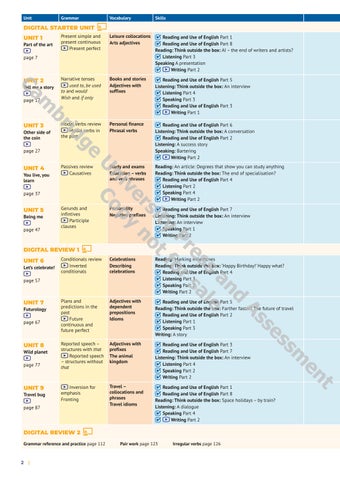
Unit
Grammar
Vocabulary
Skills
Present simple and present continuous Present perfect
Leisure collocations Arts adjectives
Reading and Use of English Part 1 Reading and Use of English Part 8 Reading: Think outside the box: AI – the end of writers and artists? Listening Part 3 Speaking A presentation Writing Part 2
Narrative tenses used to, be used to and would Wish and if only
Books and stories Adjectives with suffixes
Reading and Use of English Part 5 Listening: Think outside the box: An interview Listening Part 4 Speaking Part 3 Reading and Use of English Part 3 Writing Part 1
Personal finance Phrasal verbs
Reading and Use of English Part 6 Listening: Think outside the box: A conversation Reading and Use of English Part 2 Listening: A success story Speaking: Bartering Writing Part 2
DIGITAL STARTER UNIT UNIT 1 Part of the art page 7
UNIT 2
m Ca
Tell me a story page 17
br
UNIT 3
Passives review Causatives
UNIT 5 Being me page 47
Co
page 37
Let’s celebrate!
Conditionals review Inverted conditionals
Celebrations Describing celebrations
Reading: Marking milestones Reading: Think outside the box: ‘Happy Birthday!’ Happy what? Reading and Use of English Part 4 Listening Part 3 Speaking Part 2 Writing Part 2
Plans and predictions in the past Future continuous and future perfect
Adjectives with dependent prepositions Idioms
Futurology
Reading and Use of English Part 5 Reading: Think outside the box: Farther faster? The future of travel Reading and Use of English Part 2 Listening Part 1 Speaking Part 3 Writing: A story
page 67
UNIT 8
Reported speech – structures with that Reported speech – structures without that
Adjectives with prefixes The animal kingdom
Reading and Use of English Part 3 Reading and Use of English Part 7 Listening: Think outside the box: An interview Listening Part 4 Speaking Part 2 Writing Part 2
Wild planet
Travel bug
Inversion for emphasis Fronting
Travel – collocations and phrases Travel idioms
Reading and Use of English Part 1 Reading and Use of English Part 8 Reading: Think outside the box: Space holidays – by train? Listening: A dialogue Speaking Part 4 Writing Part 2
page 87
DIGITAL REVIEW 2 Grammar reference and practice page 112
2
|
Pair work page 123
Irregular verbs page 126
t
UNIT 9
en
page 77
m
Reading and Use of English Part 7 Listening: Think outside the box: An interview Listening: An interview Speaking Part 1 Writing Part 2
page 57
UNIT 7
Reading: An article: Degrees that show you can study anything Reading: Think outside the box: The end of specialisation? Reading and Use of English Part 4 Listening Part 2 Speaking Part 4 Writing Part 2
Personality Negative prefixes
Gerunds and infintives Participle clauses
DIGITAL REVIEW 1 UNIT 6
Study and exams Education – verbs and verb phrases
ss se As d an s le es sa Pr r y fo it t rs no ve y ni p
You live, you learn
U
UNIT 4
ge
page 27
Modal verbs review Modal verbs in the past
id
Other side of the coin
Employability Skills
Giving a presentation Using your voice effectively Structuring what you want to say Engaging your audience in different ways
Innovation and Problem Solving Engage actively with ideas and challenges
Giving reasons to support your opinions
Critical Thinking and Decision Making Identify, gather and organise relevant information
m Ca
Oracy
br
Exploring sustainability: Urban canvases Broaden discussion and include underrepresented voices Knowledge: Talk about ways of gaining knowledge Maths, Technology How can young people develop money skills?
Emotional Intelligence Monitor and reflect on own emotions
U
Exploring sustainability: But the good news is … Generate hope in self and others Values: Understand how beliefs and values affect sustainability
Co
A moderated discussion Agreeing on ground rules Using active listening skills Asking a range of questions
Innovation and Problem Solving: Implement, present and explain ideas and solutions
ss se As d an s le es sa Pr r y fo it t rs no ve y ni p
Managing your time Using formal or informal language Confidently participating in a range of discussions
STEAM
Art and Design, Technology Can AI-generated art replace human creativity?
ge
id
Negotiating Facilitating a positive environment Identifying strong and weak arguments Using language for persuading
Sustainability
Collaboration and Teamwork: Manage the distribution of tasks
Biology, Physics
Utilising gestures and body movements
Leadership and Global Citizenship: Demonstrate understanding of an organisation’s values and culture
Communication: Identify the need for different communication styles in different contexts
Formal and informal language Challenging constructively
Leadership and Global Citizenship: Take the initiative to address issues or pursue opportunities
t
Collaboration and Teamwork: Respond constructively to others
Environmental science, Biology Should gardening be on the school curriculum?
en
Holding a fish-bowl discussion Using a range of linguistic devices Respecting and building on the views of others Giving reasons to support your opinions
Exploring sustainability: A school pledge Recognise the potential for collective action to enact and amplify change Transformation: Talk about taking action to protect the environment
m
Speaking at a public meeting Using rhetorical devices Maintaining a confident posture Speaking at an appropriate pace and using pauses
Exploring sustainability: Green festivals Explore sustainable alternatives Innovation: Consider what festivals can teach us about living in our world in the future
Art and Design, Technology Digital classroom: Practice Extra
|
3
m Ca
ge id br
Co
t
en
m
ss se As d an s le es sa Pr r y fo it t rs no ve y ni p U
Student’s Book
C1
Helen Tiliouine
Niamh Humphreys
UNIT 1 PART OF THE ART LEARNING AIMS
ORACY
m Ca
Skills: discuss and create texts about different kinds of arts Giving a presentation Grammar: review the present simple, present continuous and • using your voice effectively present perfect, and learn new uses • structuring what you want to say Vocabulary: learn and practise words and phrases for leisure • engaging your audience in and the arts different ways Oracy: give an engaging presentation Innovation and Problem Solving: engage actively with ideas and challenges Exam practice: Reading and Use of English Part 1 and Part 8, Listening Part 3, Writing Part 2
ge
id
br
ss se As d an s le es sa Pr r y fo it t rs no ve y ni p
U Documentary
Co
Grammar
1 Look at the photo. In pairs, discuss the questions.
Writing
Where do you think the person is? 2 Would you find it an exciting place to be? Why? / Why not? 1
2 Watch the video. Name two ways in which an ‘immersive exhibition’ could bring you closer to great works of art.
Oracy
01
3 Work in groups. Read the statements below.
Choose one to discuss, then decide whether your group agrees with it or not.
4 Think about your group discussion. Answer the
questions. Then compare your answers with the other people in your group. Did you learn anything new or surprising during the discussion? 2 Did you change your mind about anything? 3 Did everyone have a chance to speak? 1
Go to the digital activity. Match the collocations to the definitions.
an art enthusiast a family gathering a flying visit a keen participant a hilarious comedy the perfect venue quality time a social whirl a total flop an unforgettable experience
t
•
and galleries should always be free. Art is only interesting for some people. Not everyone needs to learn about it.
1
en
see the original.
• Art is for everyone, so admission to museums
LEISURE COLLOCATIONS
m
• To really appreciate a work of art, you have to
VOCABULARY
2 Work in pairs. Answer the question. What other nouns could follow these adjectives? • keen • social • unforgettable • hilarious • quality
3 Discuss the questions on page 123 in pairs. |
7
4 What do you think the people are talking about? Use the collocations in Exercise 1. 1
2 3
m Ca
‘I know it doesn’t sound exciting, but it was great just to have two days with friends and family.’ ‘She goes to every new exhibition and she paints a bit herself.’ ‘My face actually hurts from laughing so much.’ ‘Breakfast with the family, lunch with friends, a football match with my club and then your party – I’m exhausted!’ ‘Not everyone enjoyed our art project, but Hassan was enthusiastic and got very actively involved.’ ‘It was so great to see all my cousins again, but Uncle Carlo was in a bad mood as usual!’ ‘My sister came to see us, but just for the afternoon. I wish she’d stayed longer.’ ‘It was amazing! I can’t stop thinking about it.’
4
5
EXAM TIP Collocations are often tested in this task. The answer is the word that would usually be used in the collocation. The other options (the distractors) either would never collocate with the word in the text or would not make sense in the text.
5 For questions 2–4, read the text below and decide which answer (A, B, C or D) best fits each gap.
ge
8
READING AND USE OF ENGLISH PART 1
id
7
br
6
EXAM TRAINING
Art in the Park
U
Young children are often 0 keen participants in arts activities. However, as a teenager wanting to spend some 1 … time with my little brothers, taking them to traditional art galleries, even for 2 … visits, would not be the best idea!
Co
A SHORT TEXT
ss se As d an s le es sa Pr r y fo it t rs no ve y ni p
READING AND USE OF ENGLISH
That’s where Art in the Park comes in. It’s an arts festival for people of all ages which, as the name suggests, takes place in a park, a perfect 3… for such an event. Some people criticise the festival for being just a 4… business idea, but in my experience, it’s a great day out.
1 Have you ever been to an outdoor arts festival?
Who do you think might enjoy an event like that? What kind of activities might be included?
0 A strong
B loyal
C keen
D deep
A immense
B quality
C superior
D beautiful
1
2 A racing
C dashing
3 A venue
2 Read the text in Exercise 5. What problem does the writer have? Does Art in the Park solve it?
3 Work in pairs. Look at the example (0) in the exam
8
|
UNIT 1 PART OF THE ART
C ground
D situation
4 A productive
B beneficial
C profitable
D valuable
6 In pairs, discuss the questions.
Would you like to go to Art in the Park? Why? / Why not? 2 Do you think your community needs an event like Art in the Park? Why? / Why not? 3 If you organised an event like this for your community, what activities would you include? Why would you include them? 1
t
Which adjective collocates with time to create a phrase meaning ‘a special time which is important for maintaining a good relationship’? 2 Look at the distractors. Which adjective is very unlikely to be used with the noun time? 3 How could you use the other two distractors in a sentence with the word time? 1
B scene
en
4 Now look at question 1 in the exam task.
D flying
m
task in Exercise 5. The correct answer is C, keen. What nouns can collocate with the other options (A, B and D)?
B speeding
MEDIATION WORKSHEET
READING SHORT TEXTS
about art in their lives. What kind of art does each person produce?
2 Look at question 1 in the exam task in Exercise 5.
m Ca
Which words do you need to focus on when you’re looking for the answer to the question?
3 Read text A again. Salma says, ‘I don’t find it easy,
id
br
despite having done it for so long.’ This refers to both difficulty and time. Does this mean that A is the answer to question 1? Why? / Why not?
ge
4 Read texts B–D again. Which text refers to
difficulties and to time? Is this the answer to question 1?
READING AND USE OF ENGLISH PART 8
Co
Underline the important words in each question to help you find the answers more quickly.
5 Now answer questions 2–5. In pairs, compare your answers. Which parts of the text gave you the correct answer in each case?
For questions 1–5, choose from the people (A–D). The people may be chosen more than once. 1 sometimes struggles to make time for
their hobby?
2 moves rapidly from one project to
another?
3 disapproves of some people’s
behaviour?
ART IN MY LIFE
A SALMA I make cakes, but not the usual kind. Mine represent everyday objects, like shoes or food cans. They’re incredibly realistic. I have to say, I don’t find it easy, despite having done it for so long. I know I can also be rather clumsy. I’m forever dropping spoons onto cakes I’ve almost finished, and unless I’m completely focused, the result can be a total flop. I could do with an assistant, really! Some people say my hobby might turn into a profitable business, but I’m not so sure!
B OSCAR I’d never thought of myself as artistic until I saw an exhibition of sculptures made from things people had thrown away. It was an unforgettable experience and inspired me to create my own artworks from plastic waste. As soon as I complete one, I post images of it online, hoping to make other teenagers more aware of environmental issues. Some of my friends are continually getting their coffee in single-use cups. I think they should know better. Preventing the destruction of the planet is everyone’s responsibility.
ss se As d an s le es sa Pr r y fo it t rs no ve y ni p
U
EXAM TRAINING
Which person
THE
Four people describe how they bring art into their lives.
1 Read the short texts in which four teenagers talk
EXAM TIP
1.1
5 admits that they often ruin things?
I’m rubbish at painting and drawing, but I bring art into my life through gardening. I know not all gardens are works of art, but I’m hoping to turn my family’s small garden into one. For me, it’s all about design, planning everything so colours and shapes end up in harmony. Luckily, my parents are keen participants in this project. I can’t always devote myself to it as much as I should, though. Apart from schoolwork, I often get caught up in the social whirl, going to parties rather than gardening!
t
Oscar, Marion and Hakim do? Have you ever done anything similar? If not, would you like to try?
D HAKIM
en
6 What do you think of the kind of art that Salma,
My life is my art, and my art is my life! I rap about stuff happening around me and my emotions in response to it. Once I finish a rap, I move straight on to something else, and I won’t let anyone hear my work until I’m totally satisfied it’s good enough. Some people love giving advice and that’s fair enough, but I just don’t want to hear it! It would spoil things for me by interrupting my thought processes and introducing ideas that didn’t come straight from my own heart!
m
4 appreciates those who assist them?
C MARION
UNIT 1 PART OF THE ART
|
9
GRAMMAR PRESENT SIMPLE AND PRESENT CONTINUOUS 1 Look at the painting. Do you know the name for this
style of art? Can you name any of the painters known for this style?
m Ca 2
1.2 Listen to two friends who have met by chance on the street and answer the questions.
6 Complete the sentences with things that are
true for you. In pairs, compare your sentences.
Where is the boy going? 2 What mistake does the girl think he has made? 1
I’m forever … 2 I admit that … 3 After I finish my homework, … 4 I always feel happy by the time …
br
1
id
3 Look at the examples from the listening. Then choose
ge
the correct answers to complete the rules in the grammar box.
7 Think of someone you know with a habit that
• She’s always telling me I should see the originals. • As soon as you walk in, you’re in another world. • I advise you to sit down in each room.
ss se As d an s le es sa Pr r y fo it t rs no ve y ni p
U
you disapprove of or that can be annoying. Write three sentences about the person and their habit. Say why you think they do it.
Present simple and present continuous We use the 1 present simple / present continuous with adverbs such as always and forever to indicate disapproval. ‘Performative’ verbs like advise and apologise describe things we do by saying them. They are mostly used in the 2 present simple / present continuous. In time clauses with conjunctions like as soon as, once or by the time, the verb form is usually the 3 present simple / present continuous.
He/She’s always/forever/constantly …
Co
ORACY
Using your voice effectively
If you want people to be interested in what you are saying, you need to sound interested yourself. Make sure to stress important words and use intonation to convey your attitude. Speak as loudly as you need to so that everyone can hear you clearly.
Grammar reference and practice page 112
4
8
Go to the digital activities.
5 Choose the correct options to complete the text. Taylor @TaylorT · Follow
1.3 Listen to two people talking about photography. Which of these three criteria does each person achieve?
• stresses important words • uses intonation to convey interest • speaks loudly enough
9 Make notes about an artistic or art-related
activity you enjoy. Work in groups. Stand up and tell your group about the activity for one minute. When everyone has spoken, vote on which activity sounds most enjoyable.
m
STRETCH! Find out more about performative
verbs. Make a list of ones you know or can find, and write the forms that come after them, e.g. recommend + noun (I recommend the exhibition); recommend + -ing form (I recommend going early); recommend + that (I recommend that you get your tickets today). Write some example sentences with the verbs.
HOW IS UNIT 1 SO FAR?
10
|
UNIT 1 PART OF THE ART
I understand
I’m getting there
I don’t understand
t
en
I have a weekend job at the big art gallery in our town. We always need more staff in summer, and 1 I recommend / I’m recommending the job for students who want to work just for a few weeks. When 2 you start / you’re starting, you get a lot of support. Once 3 you know / you’re knowing what you’re doing, you can work at the ticket desk or in the exhibition rooms. 4 I advise / I’m advising you to choose the exhibition rooms if you can. People at the ticket desk 5 constantly complain / are constantly complaining about the security checks. 6 I admit / I’m admitting that it’s not nice when security guards look inside your bag, but we have to make sure the artworks can’t be damaged. By the time visitors 7 get to / are getting to the exhibition spaces, they’re happy again. It’s an amazing gallery. 8 I always bore / I’m always boring my poor friends by talking about the artworks for hours. But really, they’re great!
LOCAL NEWS SPO R T O PIN IONS
AI
the end of writers and artists?
BY SYED BLAC K WE LL
m Ca
People have been telling me that my job is endangered by AI. I’m not convinced. This article is entirely human-generated, and as a writer of opinion pieces, I know that matters. I find AIgenerated texts hackneyed. How could they be anything else? AI is currently limited to imitating content that humans have already created, so it can’t produce original ideas. AI texts can be a bit disjointed, too, failing to flow in a naturally coherent way.
ge
id
br
I wouldn’t let AI write for me, but some of my articles have been illustrated with computer-generated images. I’m told by photographers that AI-generated images are unconvincing, but as a less visual kind of person, I admit that I don’t see the difference. I’ve heard musicians say that AIgenerated music is overrated, too. Like AI texts, it can never be groundbreaking. I take the point, but I do think I’ve already enjoyed AI music without even noticing what it was. So, if I don’t mind consuming AI images and music, why should readers care who – or what – wrote a text? Will they notice the difference? This will be the first time I’ve admitted it: I’m getting worried.
Co
ss se As d an s le es sa Pr r y fo it t rs no ve y ni p
U
I’m a novelist as well as a journalist and I want my novels to be moving, in some cases even harrowing. This involves asking the reader to empathise with credible characters. They must be normal but not tedious. The plot should be gripping but not too far-fetched. I don’t think a machine can manage that delicate balance.
READING
THINK OUTSIDE THE BOX!
I’ve just booked theatre tickets. Now there’s an art form that can’t be taken over by AI. I’ll always be able to tell the difference between a human actor and a computer-generated one. Won’t I?
VOCABULARY
AN OPINION PIECE
ARTS ADJECTIVES
1
1
1.4 Read and listen to the opinion piece from a newspaper. How does the writer’s attitude to AI-generated texts change towards the end of the article?
2 Answer the questions in your own words. 1 2 3 4
Innovation and Problem Solving
Imagine you are an artist, musician or actor. Write a comment of about 60–80 words in response to the article. Explain why you are or are not worried about AI replacing you in your job.
More than one answer may be possible. 1
2 3
4 5 6 7 8
This is a(n) … book. I cried tears of joy at the wonderful ending. What a(n) … film! I forgot about everything else while I was watching it. Sorry, but that’s a(n) … story. I don’t believe a word of it. The plot is pretty …. I’ve read many similar stories, but I still quite enjoyed it. This play is …. Everyone says it’s great, but it isn’t! The article is …, which makes it hard to read. Nobody has made a film like this before. It’s …. I fell asleep during the interview with the novelist. Sorry, but it was a(n) … conversation.
t
3
2 Complete the sentences with the words in Exercise 1.
en
6
disjointed far-fetched gripping groundbreaking hackneyed harrowing moving overrated tedious unconvincing
m
5
Why does the writer think that AI can’t write a truly original text? Why is it important to him that the characters in his novels are believable? In what way does he allow AI to be used in connection with his work? Why do many visual artists feel annoyed about pictures created by AI? What makes the writer start to worry towards the end of the article? Why do you think he ends the article with a question?
Go to the digital activity. Match the words to the definitions.
3 Work in pairs. Think about a book you have read or a film
you have seen. Make notes on it using some of the words in Exercise 1. In pairs, tell each other your opinions.
UNIT 1 PART OF THE ART
|
11
Leo:
GRAMMAR PRESENT PERFECT 1 Watch the grammar
vlog. Why is Ellie nervous? Why is her brother even more nervous?
02
m Ca
5 Complete the sentences with your own ideas.
br
Choose the correct answers to complete the rules in the grammar box.
id
• I’ve been on podcasts before, but I haven’t been
ge
on TV. This will be the first time he’s exhibited them. Honestly, he hasn’t been sleeping!
U
Co
Grammar reference and practice page 112
Go to the digital activities.
4 Complete the conversation with the correct form of the verbs in the box. Use the present perfect simple or present perfect continuous. do hear perform p lay prepare take part tell write
You have probably learned language to help you structure a longer presentation. Sometimes you have only a short time for a speech or mini presentation. One thing you can do to structure your speaking time is to think of questions you will answer in a logical order. For example: • What (are you going to talk about)? • Why (is it interesting)? • How (do you feel about it)? Using three questions will help you to give even a short speech a beginning, a middle and an end.
something you have been doing a lot recently. Use an idea below or one of your own. Think of three questions you will answer. Make notes and then talk to your group for one minute.
• • • • •
doing a sport listening to a kind of music/song/podcast reading/learning about … studying talking about … with your friends/family
DIGITAL CLASSROOM
PRACTICE EXTRA UNIT 1
t
UNIT 1 PART OF THE ART
6 Work in groups. You have one minute to talk about
en
|
Structuring what you want to say
m
Ahmed: Hi Leo. I haven’t seen you for a while. What 1… you …? Leo: I 2… for an ‘open-mic’ evening next week. Ahmed: Oh, an open-mic evening. I 3… of them. Anyone can go on stage and perform, right? Leo: Yes! I 4… some rap lyrics and they’re nearly finished. I want to perform the song, but I’m nervous. Ahmed: Will this be the first time that you 5… on stage?
12
ORACY
ss se As d an s le es sa Pr r y fo it t rs no ve y ni p
Present perfect We use the present perfect 1 simple / continuous for things that have happened once or on a specified number of occasions. We use the present perfect 2 simple / continuous for activities and situations that started in the past and are ongoing or have just finished. We use the present perfect 3 simple / continuous after this will be the first / second … time to say whether or how often we have already done something that we are going to do soon.
3
I’ve often … 2 I’ve never … 3 Recently, I’ve been … 4 This will be the first time that … 1
2 Look at the examples from the grammar vlog.
• •
Well, I 6… my guitar at some small concerts, but rapping feels a bit scarier! Ahmed: I’m sure it does! 7… your friend Mia ever … in an open-mic event? She tells really funny stories. Leo: Yes, and she’ll be there next week. It won’t be the first time that she 8… a story on stage. She’s not nervous at all!
LISTENING AN INTERVIEW 1 Work in pairs. What art forms are most accessible for people who are visually impaired or blind? 2
1.5 Listen to an extract from an interview. When did Amaya start creating her own sculptures?
3 Listen again and read question 1 in the exam task in Exercise 5. Choose the correct option
m Ca
(A, B, C or D). Write down the words you heard in the interview which give the answer.
4 Which ideas in the other options does Amaya also mention? Why are these options wrong? EXAM TRAINING LISTENING PART 3
br
5
ge
id
1.6 You will hear an interview in which two young artists called Amaya Jones and Kyron McKenzie are talking about their work. For questions 2–4, choose the answer (A, B, C or D) which fits best according to what you hear.
EXAM TIP You will hear each recording twice. Read the questions and the options carefully before the first recording begins. You will be given time to do this.
What does Amaya say about the time she 3 What does Amaya feel about her most recent began producing sculptures? work? A She was under pressure to select A She regrets that it is not groundbreaking. B She is relieved that she has finally completed it. an art form to focus on. B She was encouraged by a particularly C She wishes it was being exhibited in a different moving experience. location. C She initially felt overwhelmed by the D She is concerned that people will find it challenges she faced. disjointed. D She found it was the most effective way to 4 What do Amaya and Kyron both say about art express her emotions. galleries’ attitudes towards visually impaired 2 Why did Kyron start painting after losing people? his sight? A They have changed dramatically relatively A He needed to find a new way to earn a living. recently. B He saw it as an opportunity to become well B Some of the excuses for past failings are known. far-fetched. C He wanted to try out some cutting-edge C They have been improving more slowly than technology. they ought to. D He hoped it would make him less D Some promises regarding better access are pessimistic about his future. unconvincing.
Co
ss se As d an s le es sa Pr r y fo it t rs no ve y ni p
U
1
6 In pairs, compare your answers. Then listen again and check.
ORACY
Engaging your audience in different ways
7 Who would you most like to interview
When making a presentation, you can use many strategies to engage an audience, like asking people questions, telling an interesting anecdote or presenting surprising facts. You can also use props. For example, if you are talking about a book, have it with you. Show people the book and maybe read out a few sentences. Tell people they can pick it up and have a look later if they want to.
for a podcast: Amaya or Kyron? Why?
A PRESENTATION 1 Work in small groups. Brainstorm
the kinds of thing that can make an artwork exciting. It does something completely new. It uses really strong or unusual colours.
2
t
en
m
SPEAKING
1.7 Listen to two students, Dan and Mara, talking about paintings. Which student do you think engages the audience more successfully? How?
3 Work in groups of four. Each person in the group presents a
piece of art which they find exciting. Try to convince the others that your piece is the most exciting. When everyone has made presentations, try to agree on who was the most successful. UNIT 1 PART OF THE ART
| 13
WRITING
5 In pairs, discuss the questions.
1 In pairs, discuss the questions. When did you last read a review? What was it of? 2 How many different things can you think of that people read or write reviews of? 3 Have you ever reviewed anything online? If so, what was it? 4 Do you think it’s a good idea to read reviews of exhibitions, films or TV programmes before seeing them? Why? / Why not? 1
m Ca
id
br
2 Look at these sentences from different reviews.
ge
What do you think is being reviewed in each case? a It isn’t for everyone, but I’ve only had it for b Their early energy and originality is somehow missing here.
Co
c They’re so comfortable, I never want to take them off!
d Any weaknesses in the plot were
made up for by a spectacular ending.
Book as soon as you can for an unforgettable experience!
3 Which features (1–9) would you expect in shorter
online reviews (e.g. of products) or longer reviews on websites or in magazines (e.g. of films, shows or books)? Some could appear in both types of review. 1 2 3 4 5 6 7
very informal language personal opinions practical information more neutral or formal language complex sentences a clear structure a lot of exclamation marks an attempt to engage the reader a variety of language
4 In pairs, look at the pictures. Tell each other what
Write your review.
7 Look again at the exam task in Exercise 6. Who
do you have to write the review for? What three things are you asked to do in your review?
8 Read the model answer, ignoring the underlining and italics. What does the writer like about the show? What do they dislike?
ar t show
I was 1 pleased to be invited to the opening evening of our college art show. I’m sure I wasn’t the only student who had been looking forward to it for some time. The first thing that struck me on arrival was how much space there is for all the artworks. In my view, the college sports hall really is the perfect venue. For me, the paintings are what really makes the show 2 good. I was, a sadly / frankly, 3 surprised by what our fellow students have achieved, especially as some are still only in their first year here. There are also many other artworks deserving of visitors’ attention, including some 4 beautiful sculptures by Jo Smith.
To my mind, b hopefully / unfortunately, some of the video art is 5 boring and c surprisingly / interestingly hackneyed. I realise it is unfair to expect to see groundbreaking work at every college exhibition, but as this is the first time that video art has appeared in an exhibition at this college, I had hoped to see something more gripping.
All in all, however, this is a fantastic show. Without a doubt, no one at the college should miss such a wonderful opportunity to see what the talented students in our art department have been working on. Students’ families and friends are likely to love it, too! 14
|
UNIT 1 PART OF THE ART
t
you think of them.
A student art show has just opened at your college. You have been asked to write a review of the show for the college website. You should include your opinions on the artwork on display, as well as the choice of venue, and say who you would recommend the show to.
en
9
show could consist of and where a show like this could be put on at your college.
m
8
6 Read the exam task. In pairs, discuss what the art
ss se As d an s le es sa Pr r y fo it t rs no ve y ni p
U
three days and already can’t do without it.
e
Do you like going to art exhibitions? Why? / Why not? 2 Are you interested in seeing artworks by people who aren’t already famous? Why? / Why not? 1
A REVIEW
9 Has the writer covered all the points required?
Complete the writing plan with the notes (a–d).
14 Complete each of the phrases which introduce
a comment on the venue
personal opinions with one word. Use the model review in Exercise 8 to check your answers.
b recommend the exhibition to students, their
1
families and friends c say which artworks I don’t like d say which artworks I like
2 … a doubt, this is the most harrowing film you’ll
m Ca
Paragraph 1: Say what is going to be reviewed, … Paragraph 2: … Paragraph 3: … Paragraph 4: Sum up, …
br
10 Read the model answer in Exercise 8 again and
id
choose the correct adverbs of attitude in italics.
ge
11 Choose the correct adverbs of attitude. It is, interestingly / sadly, a work by a completely unknown painter that has won first prize in the National Competition this year. 2 Hopefully / Frankly, I’ll see some more talented musicians at the next concert I attend. 3 The photographs entered for the local photography exhibition this year are unfortunately / surprisingly impressive. 1
see this year. 3 … my mind, some of the dialogue was rather
disjointed. 4 … my view, this is a groundbreaking novel.
15 Watch the video and
make a checklist for what to include when you do the exam task in Exercise 16.
Co
ss se As d an s le es sa Pr r y fo it t rs no ve y ni p
U
underlined adjectives (1–5) in the model answer in Exercise 8. How do the phrases improve the model? absolutely delighted deadly dull extremely impressed hugely enjoyable particularly stunning
13 Complete the sentences with phrases from 1
2
EXAM TRAINING WRITING PART 2
EXAM TIP
Always make a plan before you start writing. Write brief notes showing what you are going to include in each paragraph.
A photography exhibition has just opened in your local community centre. You have been asked to write a review of the show for your college website. Say what you think about the photographs in the exhibition and whether the community centre is a good venue or not for the show. What kind of people would enjoy this exhibition?
17 Read your review again and evaluate your work. Use these questions to help you.
Does the review cover all the points asked for in the exam task? 2 Does the review include the features listed in Exercise 15? 3 Is there a good range of vocabulary and grammar? 4 Have you added phrases from Exercises 11–14? 1
t
5
in about 220 words.
en
4
There are many gorgeous photographs of flowers in the book, but the ones of orchids are …. I was … when I read how much work the artist put into her paintings. I’m surprised the audience didn’t fall asleep – the concert was …. The performance poet looked … to receive such enthusiastic applause. This book is … to read and I thoroughly recommend it to anyone who loves thrillers.
16 Read the exam task below and write your review
m
3
03
A review should: 1 … 2 … 3 … 4 … 5 … 6 …
12 Choose a phrase from the box to replace the
Exercise 12.
For …, the plot was too far-fetched.
18 Work in pairs. Read each other’s reviews and give
feedback. Use the questions in Exercise 17 to help you. Make a note of your partner’s feedback and write a second draft of your review. UNIT 1 PART OF THE ART
|
15
ORACY
m Ca
GIVING A PRESENTATION • using your voice effectively • structuring what you want to say • engaging your audience in different ways
br
1 In small groups, discuss the questions.
3 You are going to present a piece of art, music or
literature that you love. Do these things to prepare.
id
Do you and your friends usually like the same music, books or art? 2 Is it important to you to be able to share the things you love with friends, or can you enjoy them alone? 1
ge
• Make notes on what you will need. • Find a way to bring your subject to class (e.g.
ss se As d an s le es sa Pr r y fo it t rs no ve y ni p
Co
talking about presenting a piece of art that he loves and answer the questions.
•
04
How does Zack use the recording? 2 Does he use stress, intonation and the volume of his voice well? 3 Why is he not completely happy with the structure of his presentation? 1
•
U
2 Watch a student
print a picture, find a recording of a song). Decide on three questions you are going to answer in your presentation (e.g. what, why, when, how …?). Make notes on how you will answer the questions. Practise saying some key phrases that you will use, making sure you use effective stress and intonation.
•
4 Give your presentation. Then listen to your classmates’ presentations. Give each other feedback using these questions.
Did your classmates use their voices well? 2 Was the presentation well structured? 3 How did different presenters engage your attention? 1
SELF-ASSESSMENT: UNIT 1 How confident do you feel about:
DIGITAL CLASSROOM PERSONALISED LEARNING
16
|
UNIT 1 PART OF THE ART
t
What was your favourite part of Unit 1? Tell your partner.
en
using collocations for talking about leisure? choosing the best words to complete a text in Reading and Use of English Part 1? finding the information you need in Reading and Use of English Part 8? choosing the present simple or continuous for specific situations? using adjectives for describing the arts? answering questions about an interview in Listening Part 3? writing a review for Writing Part 2? giving an engaging presentation?
m
• • • • • • • •
UNIT 2 TELL ME A STORY LEARNING AIMS
EXPLORING SUSTAINABILITY
m Ca
Skills: read, speak and write about books, stories and storytelling URBAN CANVASES Grammar: review narrative tenses, and learn and practise structures with used to and would Broaden discussion and include underrepresented Vocabulary: learn and practise words and phrases for books and stories, voices and adjectives with different suffixes Sustainability: talk about ways of gaining knowledge Critical Thinking and Decision Making: identify, gather and organise relevant information Exam practice: Reading and Use of English Part 3 and Part 5, Listening Part 4, Speaking Part 3, Writing Part 1
ge
id
br
Co
ss se As d an s le es sa Pr r y fo it t rs no ve y ni p
U Documentary
1 Look at the photo. In pairs, discuss the questions.
Where is the woman? 2 Would you be able to read a book in this place? 3 What is your favourite place for reading? 1
2 Watch the video. What
Grammar
three main reasons for telling stories are mentioned?
3
Knowledge Work in pairs.
01
Tell each other about a story you have heard or read which taught you something about your social or environmental responsibilities.
VOCABULARY
A
an acclaimed author a bold experiment a compelling story compulsive reading glowing reviews an unmitigated disaster
B
awaken someone’s interest build up the suspense hold someone’s attention fire someone’s imagination pick holes in something wade through something
‘Thank you, thank you for this fantastic prize! After I finished writing this book, I didn’t believe it was good. In fact, I thought it was an 1…! But now it’s getting 2… and I’m winning international prizes – wow! I’ve always wanted to 3… people’s … in the legends of my country. They 4… the … of both adults and children, and make us dream of other worlds. Some people said the style of my book was a 5 … and this made it too difficult to read. But look, my success shows that if you have a 6… to tell, people will make an effort and read it. How wonderful!’
|
t
Go to the digital activities. Decide if the collocations in A (adjective + noun) are positive or negative ways of describing something. One can be both. Then match the collocations in B (verb + noun) to the definitions.
a speech. Complete it with phrases from Exercise 1.
en
1
2 An author has won a prize and is making
m
BOOKS AND STORIES
Writing
17
3 Replace the underlined phrases in the conversation with the correct form of the collocations from Exercise 1. Make any other changes necessary.
m Ca
Ben: Sorry, I can’t go out. I’m reading The Legend of Thuria. It’s 1 too exciting to put down. Lea: Really? I tried to 2 read it to the end, but I got bored. Ben: Bored!? Well, it’s certainly 3 stopping me from thinking about anything else! The writer really knows how to 4 make you more and more excited about what’s going to happen. Lea: I don’t agree and neither did the critics. They 5 found a lot of things wrong with it. It’s surprising, as they usually praise the writer very highly. Ben: Yeah, he’s certainly 6 a writer who is considered to be very good. Well, I think this book is great, too, no matter what the critics say.
ge
id
br
Co
Giving reasons to support your opinions
Your reasons for the opinions you express in discussions may seem obvious to you, but they are not always obvious to others. You will be most convincing and encourage a better discussion when you can say why you believe what you do. Asking yourself why will also help you feel more confident about your views. If you can’t answer the question why, it might be time to change your mind!
4 Work in pairs. Do you agree or disagree with these statements? Explain why. 1
AN ARTICLE 1 In pairs, discuss the questions. Have you or your family ever subscribed to a streaming service for films or TV shows? 2 What are the advantages and disadvantages of having a subscription to one? 1
2 Read the article about streaming services. Choose the best title (A–C).
A What I hate about streaming services B The evolution of streaming services C How to select a streaming service
3 Look at question 1 in the exam task in Exercise 6.
Do you expect the answer to be in just one part of the paragraph or in several?
4 Now read the first paragraph of the article
ss se As d an s le es sa Pr r y fo it t rs no ve y ni p
U
ORACY
READING
Reading novels helps us to be better people.
2 A historical novel can teach you as much as a
whole school term of history lessons.
3 A good film can be as important to our culture
as a good novel. 4 The best place to find a compelling story nowadays is in a TV series.
carefully. What do you think the answer to question 1 is? Find the sentences which support your choice. Is the answer in just one part of the paragraph or in several? Discuss in pairs.
5 Why are the other options not correct?
2.1
…
When online streaming services first became widely available, subscriber numbers grew rapidly. Soon, most households had a subscription and the monthly fee was easily within most people’s budgets. Reasonably enough, people were expecting to be able 18
|
UNIT 2 TELL ME A STORY
t
en
m
You may find this hard to believe, but before the early 2000s, most households did not yet have an internet connection. People had to go to video-rental shops to hire recordings of films and TV series. When, in what some considered a bold experiment, it became possible to receive these through the post instead, it was an exciting new development. For one service, people paid a small amount every month and returned the recordings in prepaid envelopes once they had finished watching them. The idea fired people’s imagination because for many, this was the first time that, for a relatively small fee, a broad range of films and TV series had become easily available to watch whenever they wanted.
EXAM TRAINING
EXAM TIP
READING AND USE OF ENGLISH PART 5
6 Now read the article again. For questions 2–4, choose the answer (A, B, C or D) which you think fits according to the text. Discuss the reasons for your answers in pairs. What is emphasised in the first paragraph? A how rapidly people’s leisure activities changed B how limited people’s viewing options once were C how hard it was to access early video rental schemes D how little demand there used to be for online content 2 In the second paragraph, what is suggested about streaming services? A It was not possible for many people to afford them. B They made changes that did not always seem logical. C It was predictable that they would not remain the same. D They should not have tried to produce their own shows. 1
Before looking at the questions, always read the whole text quickly to see what it is about.
3 Which point does the writer make in the third
m Ca
ge
id
br
Co
ss se As d an s le es sa Pr r y fo it t rs no ve y ni p
U
paragraph about streaming companies? A Some of them managed to avoid losing a lot of viewers. B Too many of them failed to adapt to changes in the market. C The decisions they took could have significant impacts. D New shows made for them were often of an unsatisfactory standard. 4 In the final paragraph, the writer says that some viewers A expected too much from streaming services. B took time to realise what to do about a problem. C struggled to cope with the sheer range on offer. D were only prepared to watch things they were familiar with.
7 In the final paragraph of the article, the writer mentions having too much choice.
With a partner, identify other areas where consumers have too much choice. Does this ever happen to you? If it does, say how you decide what to pay for.
to watch anything they wanted, whenever they wanted, forever. However, just over ten years later, many titles were suddenly removed entirely from streaming platforms. What made it particularly surprising was that the vanishing titles included not only classic films and acclaimed series, but also original titles made by the streaming companies themselves.
As for viewers, although many felt severely let down at the time, perhaps what happened was not in fact an unmitigated disaster. Some people had felt overwhelmed by the huge number of titles available and found it impossible to choose what to watch. Others found it increasingly stressful to have so many titles to wade through on their ‘to watch’ list. Another issue was that once streaming services entered the production business themselves, their output was not particularly original, so content became less appealing overall. Perhaps what the streaming services’ story demonstrates is that we should all be careful what we wish for!
t
en
m
What had happened? One problem was that, as more and more streaming services were set up, all offering different titles, people could no longer find everything they wanted to watch on a single large streaming platform. So, in order to have the virtually unlimited choice they had until recently taken for granted, they were having to subscribe to more and more different ones. That all added up, and what had been available for a small monthly fee was now beginning to cost more and more. So, in the end, people started to cancel their subscriptions. The streaming industry, after its initial massive success, was entering its ‘flop era’: even the largest and most profitable platforms were now beginning to see subscriber numbers decrease. So, they started to look for ways of cutting costs and – ten years after streaming first became widely available – one
way of doing that was to remove some of their best titles. This reduced the amount of money they were paying in fees to actors, writers, directors and other creatives every time a TV show or film was streamed. Many careers in these professions were consequently destroyed.
UNIT 2 TELL ME A STORY | 19
GRAMMAR
5
NARRATIVE TENSES 1
2.2 Listen to a conversation between two friends. Why didn’t Zeynep call Yusuf back?
2 Look at the examples from the conversation. Then
m Ca
match the sentence halves to complete the rules in the grammar box. 1
You called me at around nine, didn’t you?
2 I was watching a series.
6 Complete the messages with the verbs in the box in the correct tense.
break do fall fight find happen hope love miss promise steal tell watch Zeynep Online
Hey, 1… you … the last episode of All of Us last night?
br
3 I’d heard a terrible rumour.
Go to the digital activities.
4 I’d been watching the series from the beginning.
id
Yes, but I 2… the episode before that, so I was confused. Why was Danny in hospital? What 3… to him?
ge
Narrative tenses We use … 1 the past simple for … 2 the past continuous for … 3 past perfect simple for … 4 past perfect continuous for …
ss se As d an s le es sa Pr r y fo it t rs no ve y ni p
U
He had a broken leg because he 4… Dialla’s horse and 5… off! You know he and Dialla 6… for ages, ever since he tried to take her job.
I know. And at the start of the episode, Dialla was in Omar’s house, but what 7… she … there?
a things that had happened before a certain
Co
time in the past.
b completed past events.
c ongoing or interrupted events in the past.
She 8… him Danny’s secret.
d things had been ongoing or interrupted before
No!! But she 9… him she’d never do that!
a certain time in the past.
Grammar reference and practice page 113
3 Look at more examples from the conversation.
Well, it wasn’t the first time she 10… a promise, was it? I 11… for a happy ending, so I 12… the episode really disappointing .
Complete the rules in the grammar box. 1 2 3 4 5
I was expecting to reach you before you went to bed. I meant to call you back, sorry. I wasn’t planning to let it happen again! I’d planned on going to bed at 11. I considered switching it off before the end.
-ing form … to
Not me. I 13… it!
7 Imagine you saw this scene on TV. Write a few
sentences about what was happening. Use the past continuous.
• To talk about things we intended to do but
4 Look at one more example and complete the rule. That was the first time I’d missed an ending. After That was the first/second/ … time, we use the past …. 20
|
UNIT 2 TELL ME A STORY
t
Grammar reference and practice page 113
en
•
m
•
didn’t, or things we thought would happen, we can use the past simple, continuous or perfect form of the verbs expect and mean + 1…. We can also use the verb plan + on + -ing form or plan + to. We use consider + 2… and expect + 3….
8 What do you think happened before the scene of Exercise 7? Write a few sentences using the past perfect simple and continuous.
9 Look at the table on page 123.
HOW IS UNIT 2 SO FAR? I understand
I’m getting there
I don’t understand
THINK OUTSIDE THE BOX!
LISTENING AN INTERVIEW 1
2.3 Listen to an interview on a podcast about books. Answer the questions. When did Mina stop enjoying stories? 2 When did they become enjoyable again? 1
m Ca
2 Listen again. What does Mina say about these? Make notes and discuss with a partner.
3 dyslexia
br
her parents 2 her teachers
4 audiobooks
Knowledge Discuss the questions in small
id
3
1
groups.
ge
What disadvantages might someone experience if they need longer than others to read things? 2 Do you think the school system takes into account different learning styles? 3 Do you think using audiobooks in school might be advantageous? 1
Co
ADJECTIVES WITH SUFFIXES
Go to the digital activity. Match the adjectives below to the quotes. alarmed babyish heroic feasible frustrated inevitable influential lengthy priceless speechless
2 Rewrite each underlined part using an adjective in Exercise 1.
A SHORT ARTICLE 1 Do you prefer reading paper books or digital books on an e-reader, tablet or phone? What are the advantages of reading books digitally?
2 Read the article in Exercise 4 quickly, ignoring
the gaps for now. Does the writer think everyone should use an e-reader?
3 Work in pairs. Look at the example (0) in the
exam task below. What kind of word is needed to complete the gap? Why?
EXAM TRAINING READING AND USE OF ENGLISH PART 3
ss se As d an s le es sa Pr r y fo it t rs no ve y ni p
U
VOCABULARY 1
READING AND USE OF ENGLISH
the word given in capitals at the end of some of the lines to form a word that fits in the gap in the same line.
E-readers or paper books? Is the environmental impact of e-readers and paper books 0 comparable ? It all depends COMPARE on the number of books someone reads. Although it can be hard for people to be 1… SPECIFY when asked how many books they usually read in a year, it is POINT not an entirely 2… question. It has been estimated by 3 … working in the field of PROFESSION sustainability that a person would only need to read 36 paperbacks in total to match the carbon footprint of an e-reader. So if you read a lot, you might be 4… not to go digital! FOOL
t
other adjectives can you think of with the suffixes below? In pairs, make a list.
4 For questions 1–4, read the text below. Use
en
3 The words in Exercise 1 all have suffixes. What
Decide what type of word (noun, adjective, …) is needed in the gap before you try to fill it. Some suffixes are more commonly used for adjectives, others for nouns and so on.
m
We can’t create a perfect school system. 1 I don’t think anyone can make that happen. However, 2 I find it extremely worrying when I hear how many intelligent people struggle at school. I recently read a 3 long report about it by 4 a psychologist who everyone respects. Some people will always find school hard – 5 we can’t change that – but we could help more people. 6 I find it discouraging to see how few teachers get training in ADHD, a condition that makes it difficult for some students to concentrate. More training on this would be 7 incredibly important for these students. Teachers often think that students with ADHD are just messy and maybe even lazy, but 8 they’re often trying really hard to stay focused in lessons! Let’s try to understand that they need alternative ways of learning.
EXAM TIP
5 How many books do you think you’ve read this
year? Do you have an e-reader? Do you think you should get one? Discuss in pairs.
-able -ed -ial -ible -ic -ish -less -y UNIT 2 TELL ME A STORY
| 21
Aman: The kids look at screens all day, but it’s not really reading, is it? They’re always jumping between stories and messages. I think we 4 … on one thing for much longer when we just had books. Sofia: I agree. I 5… just one book for hours and hours when I was young. I 6… from news stories to messages. Aman: Maybe that’s a skill, too. But I’m not convinced.
GRAMMAR USED TO, BE USED TO AND WOULD 1 Watch the grammar vlog. Answer the question.
m Ca
02
What was special about Ravi’s toy car?
5
br
2 Look at the examples from Ravi’s vlog. Choose
4
Co
5
used to, be used to and would
We use used to / be used to + infinitive for past habits and things that were true in the past, but aren’t true now. 2 The negative form of used to + infinitive is wasn’t use to / didn’t use to + infinitive. 3 When we talk about habits and things that often happened, we can also use will / would instead of used to / be used to. 4 We use used to / be used to for things that we often do and that aren’t, or weren’t, new for us. 1
Grammar reference and practice page 114
3
WISH AND IF ONLY 6 Look at these examples. Choose the correct options to complete the rules in the grammar box.
ss se As d an s le es sa Pr r y fo it t rs no ve y ni p
3
U
2
I used to think writing by hand was a waste of time. I didn’t use to be very interested in other cultures, but now I am. In the morning, the car would be a bit sandy. I’m not used to making this kind of decision. I was used to messaging people on my phone.
ge
1
id
the correct words to complete the rules in the grammar box.
Critical Thinking and Decision Making
Aman and Sofia in Exercise 4 are very critical of modern technology. In groups, collect all the ideas and evidence to show that young people today have good reading skills. Make notes, then share your ideas with the whole class.
Go to the digital activities.
4 Complete the conversation with the correct forms of the verbs in the box. Use used to, be used to or would.
3 I wish we’d stayed in touch.
wish and if only If only and I wish can be used to talk about things we would like to change, or to express 1 regret / satisfaction about something in the past. With if only and I wish, we can use the past simple to talk about the present and the 2 past continuous / past perfect to talk about the past.
Grammar reference and practice page 114
7 Complete the sentences. Use the correct form of the words in brackets. 1
2 3
4
|
UNIT 2 TELL ME A STORY
8 Here are some things Ravi thought while packing for his move. Complete them with if only / I wish. 1
I refused my friend’s help with packing. I …
2 My pen pal invited me to Nigeria and I didn’t
want to go. If … 3 Mum threw out my old comics! I …
DIGITAL CLASSROOM PRACTICE EXTRA UNIT 2
t
22
These boxes are hard to carry! I wish they … (be) smaller. I packed all my books in my suitcase, but they’re so heavy. If only I … (give) some away. My new room isn’t very big. I wish I … (have) more space for my things. Our new home is lovely, but it’s quite small. I wish we … (find) a bigger flat. I’d love to have a house with a huge library. And a tennis court. I wish I … (be) rich!
en
5
Sofia: I’ve got no space for all my books. I have far too many! Aman: I 1… the same problem, but then I started going to a library. I wasn’t happy at first because I 2… all the books I’d read and having them around me at home, but I like it now. Sofia: A friend suggested e-books and that’s not my thing. I 3… at a screen for hours in my free time – I do that enough at work!
I wish I had more time.
2 If only I’d started earlier.
m
concentrate have jump keep look read
1
LISTENING
2 Look at the instructions for the exam task in Exercise 5 and answer the questions.
SHORT MONOLOGUES
Are the people all going to talk about the same general topic? 2 How many questions do you have to answer for each speaker? 3 Are there any distractors in Tasks One and Two? 1
1 Discuss the questions in groups. 1
Do you use a library regularly?
2 What do you like and dislike
3
about it?
m Ca
3 Do you think libraries are
outdated?
2.4 Listen to Speaker 1 and focus on Task One. Which option do you think is correct for this speaker? What gives you the answer? Compare answers in pairs.
4 Now listen to Speaker 1 again, focusing on Task Two. Which option is correct? What gives you the answer?
br
EXAM TRAINING LISTENING PART 4
EXAM TIP
id
5
SUSTAINABILITY WORKSHEET
ge
2.5 You will hear three short extracts in which people are talking about libraries that have been set up in different places. While you listen, you must complete both tasks.
U
Co
SPEAKING
TASK TWO For each speaker, choose from the list (A–E) how they say they feel about the library they use. A impatient for it to succeed B convinced it is essential C relieved to be able to use it D doubtful about its prospects E puzzled by the reputation it has
ss se As d an s le es sa Pr r y fo it t rs no ve y ni p
TASK ONE For each speaker, choose from the list (A–E) how they discovered the library they use. A through a lengthy search B through a conversation they heard C through a poster near their home D through a radio announcement E through a personal recommendation
You will hear a recording of all the speakers in turn, then the whole series again. Sometimes a speaker gives the answer to Task One first and sometimes you will hear the answer to Task Two first.
COLLABORATIVE TASK
1 Which of the libraries described by the speakers in the Listening task would you like to visit? Why?
3
2.6 Listen to two students doing the task. Which places do they discuss? Which two locations do they agree on?
4 Listen again and write down the
expressions they use to do these things. ask for their partner’s opinion 2 agree or disagree politely 1
EXAM TRAINING SPEAKING PART 3 EXAM TIP
You don’t have to discuss all the options. Make sure to listen to your partner’s opinions on an option and give your own before moving on to the next.
some of the expressions from Exercise 4.
t
en
m
2 Go to page 123 and do the task in pairs.
5 Now do the exam task in pairs again. Use
UNIT 2 TELL ME A STORY
|
23
WRITING
3 Read the model answer, ignoring the gaps for now. Discuss the questions in pairs.
AN ESSAY
Which two points has the writer chosen to discuss? 2 Has the writer used any of the opinions given in the task? If so, which one(s)? 1
1 In pairs, look at the photos below. How do you
think the people are feeling? What do you think they are reading, watching or listening to?
2 Look at the exam task below. Discuss the questions
m Ca
in pairs. 1
I
B
U
S
A
A
Paragraph
MEDIATION WORKSHEET
What topic do you have to write about?
2 How many of the points listed must you write
id
br
about? 3 What can you include if you want to? 4 What should you avoid doing?
ge
Your class has had a discussion on different ways to relax. You have made the notes below.
• watching films • listening to podcasts
The popularity of the former is relatively easy to explain. 1…, whatever someone’s interests, it is likely that there will be a podcast on the topic. 2…, people have become used to listening to them anywhere and at any time. 3 …, it cannot be denied that many podcasts are chaotic and occasionally rather childish. Even some of the more influential ones are, from my perspective, quite frankly silly at times.
Co
ss se As d an s le es sa Pr r y fo it t rs no ve y ni p
• reading novels
U
Ways people can relax
Everyone needs a break sometimes and there are many options available to people looking for ways to fill their free time. I shall discuss two of these, namely listening to podcasts and reading novels.
Some opinions expressed in the discussion: ‘Reading requires imagination and concentration.’
‘Not everyone has time to watch a whole film!’ ‘There’s a podcast on almost every possible subject.’
Write an essay discussing two of the ways in your notes that people can relax. You should explain which you think is a more enjoyable way of spending one’s free time, giving reasons to support your opinion. You may, if you wish, make use of the opinions expressed in the discussion, but you should use your own words as far as possible.
… reading, it seems to me that although some people look alarmed when it is suggested that they should read a book, this reaction is not inevitable. Many others enjoy nothing more than a lengthy novel, often becoming so absorbed that they wish they could keep on reading it to the end without any interruptions. This is because a good book can engage the brain like nothing else.
4
…, my personal view is that reading novels is more rewarding than listening to podcasts. This is because it requires people to bring their full attention to the plot and the characters for the story to come alive inside their minds.
5
t
en
m
24
|
UNIT 2 TELL ME A STORY
4 Complete the model answer with words or phrases
EXAM TRAINING WRITING PART 1
from the box which introduce ideas and points.
EXAM TIP
oreover N evertheless Firstly M On balance When it comes to
Write a plan before you start, with two or three ideas about each of the points you have decided to include. Remember to answer the question in the exam task, choosing just two of the options you have discussed.
5 Read the model answer again. Find referencing
m Ca
words or phrases which mean these things.
to be specific 2 the first one of two things already mentioned 3 different people from the ones already mentioned 1
10 Write your essay in about 220 words.
br
Your class has had a discussion on what people can learn from different types of fiction in books and films. You have made the notes below.
id
6 Complete the sentences with the words or phrases you found in Exercise 5.
ge
Dance and basketball are my main free-time activities. … takes up most of my weekends. 2 There are those who believe that bookshops are likely to disappear soon. … disagree. 3 I only listen to podcasts on three topics, … sport, history and films. 1
Different types of fiction • historical novels and films
U
• science fiction
ss se As d an s le es sa Pr r y fo it t rs no ve y ni p
• detective stories
Some opinions expressed in the discussion:
Co
7 Complete the phrases introducing personal
opinions with one word. Use the model essay to check your answers.
‘Most historical fiction is totally inaccurate!’ ‘Science fiction is rarely pure fantasy.’
It cannot … denied that some romantic novels are rather tedious. 2 It seems … me that fewer people read these days. 3 It is, … my perspective, a fascinating discussion to listen to. 4 My personal view … that podcasts are becoming more sophisticated. 1
‘Detective fiction from abroad shows how other societies operate.’
Write an essay discussing two of the types of fiction in your notes. You should explain which you think people can learn the most from, giving reasons to support your opinion. You may, if you wish, make use of the opinions expressed in the discussion, but you should use your own words as far as possible.
8 Use phrases from Exercise 7 to write your own
opinions on whether watching films is a good way to relax. Compare your sentences in pairs. What do you agree on?
9 Watch the video and
make a list of points to remember when writing an essay.
Use these questions to help you.
Does the essay cover all the points asked for in the exam task? 2 Does the essay include the features listed in Exercise 9? 3 Is there a good range of vocabulary and grammar? 1
03
en
m
12 Work in pairs. Read each other’s essays and give
feedback. Use the questions in Exercise 11 to help you. Make a note of your partner’s feedback and write a second draft of your essay.
UNIT 2 TELL ME A STORY
|
t
An essay should: 1 … 2 … 3 … 4 … 5 … 6 …
11 Read your essay again and evaluate your writing.
25
WRAP UP Look back at the unit. Write down:
m Ca
1 five new words or phrases you have learned 2 something that has made you think
3 a sentence with used to about one of your habits in the past
br
4 a sentence with be used to about your life now
ge
id
5 useful information you have learned about these parts of the exam: Reading Parts 3 and 5, Listening Part 4, Speaking Part 3, Writing Part 1
ss se As d an s le es sa Pr r y fo it t rs no ve y ni p
Sustainability
U
6 something in the unit that you have especially enjoyed
1 What social or environmental responsibilities have you learned about through stories?
Co
2 Is it sustainable to ask everyone to learn in the same way? What could we gain by allowing or encouraging different ways of learning?
SELF-ASSESSMENT: UNIT 2 How confident do you feel about:
• • • • • • • •
forming appropriate words in Reading and Use of English Part 3? understanding a longer text in Reading and Use of English Part 5? choosing the right narrative tenses for talking about the past? using used to, be used to + -ing form and would for habits? using collocations for talking about stories and books? forming adjectives with different kinds of suffixes? writing an essay for Writing Part 1? gist listening and matching in Listening Part 4?
What was your favourite part of Unit 2? Tell a partner.
STRETCH! YOUR CHOICE
|
UNIT 2 TELL ME A STORY
Option 3: Create a storyboard for the start of a TV series. You can find free software for doing this online, or you can simply draw some scenes and write short descriptions of the characters and action.
t
26
Option 2: Write a story. It can be any kind of story, but it should teach readers something about living sustainably.
en
Option 1: Find an interview with the author of a book or director of a film that you like. Think of some questions you hope are going to be asked. Then watch, listen to or read the interview and see if your questions were answered.
m
Now choose an extra activity!
UNIT 3 OTHER SIDE OF THE COIN LEARNING AIMS
ORACY
m Ca
Skills: discuss and create texts about money and finance Grammar: learn and practise a range of modal verbs in the present and past Vocabulary: learn and practise collocations and phrasal verbs for personal finance Oracy: hold a negotiation Emotional Intelligence: monitor and reflect on own emotions Exam practice: Reading and Use of English Part 2 and Part 6, Writing Part 2
Negotiating • facilitating a positive environment • identifying strong and weak arguments • using language for persuading
ge
id
br
ss se As d an s le es sa Pr r y fo it t rs no ve y ni p
U Documentary
Co
Grammar
1 Look at the photo. In pairs, discuss the questions.
Writing
What do you see in the picture? 2 How did people get goods they needed before money was used? 1
2 Watch the video and
answer the questions.
What is a barter system? 2 Where did people first use notes as currency? 1
Oracy
01
3 In groups, talk about one of the statements below.
questions and compare answers in your group. Was there a positive environment for your discussion? 2 Did everyone have a chance to explain the reasons for their opinion? 3 How did people effectively express their opinions? 1
Go to the digital activities. Match the verb phrases in A and the noun phrases in B to the definitions. A
t
4 Think about your group discussion. Answer the
1
en
• We don’t need coins and banknotes any more. • Rich people have a duty to help others. • A world without money will never be possible.
PERSONAL FINANCE
m
Find out whether your group agrees with it or not.
VOCABULARY
borrow heavily get into debt spend a fortune withdraw cash B
contactless payment current account direct debit electronic transfer life savings source of income stock market stocks and shares
|
27
2 Complete the questions with the verb and noun
ORACY
phrases from Exercise 1.
Facilitating a positive environment
Do you think teenagers should get money only from their parents, or have another …? 2 In your country, is it common to … from a bank to buy a home? 3 Are there any shops you like where you’d … if you could? 4 Do you know much about investments and how the … works?
You don’t have to agree with other people in a discussion or negotiation, but disagreement doesn’t need to mean conflict. Be respectful when you hear an opinion that is different from your own. Ask to hear more about someone’s point of view before responding with your own. You can use phrases like you may have a point or that’s an interesting way to look at it to show that you’re not dismissing another person’s views.
1
m Ca
3 In pairs, discuss the questions in Exercise 2.
br
4 Complete the conversation with the correct form Kit:
Amir: Duc:
Amir:
Kit:
Amir and Kit facilitate a positive environment.
6 In groups, discuss one of these questions. Try to keep the environment positive!
• It’s always a good idea to have a small amount •
of cash with you when you go out. Everyone should work for their money.
ss se As d an s le es sa Pr r y fo it t rs no ve y ni p
Duc:
Co
Amir:
U
Kit: Duc:
Before we go to the cinema, I’ll have to go to the bank and 1… some … to buy my ticket. Why? You can make a 2… with your phone, can’t you? I never pay by phone. It can’t be secure. That seems like quite an old-fashioned opinion, to be honest. Maybe Kit has a point, though, Duc. You don’t want to lose your 3… if someone steals your phone. My phone is linked to my 4…, not to my savings account. There isn’t much money in my accounts anyway. When I’ve saved a bit more, I’m going to start buying and selling 5 … and …. Isn’t it better to work for your money? I’ll work, too, of course. I just think we should all be open to various options. And you, Kit, should be more open to convenient ways of paying for things. He might be right, Kit. My dad won’t pay anything by 6… because he doesn’t trust the companies to take the right amount of money. Then he forgets to make the 7 … and the bills don’t get paid! Oh dear. When I look at it that way, it does seem a bit silly not to accept convenient options. Technology can certainly help you avoid 8…. I still want to get some cash now, though.
ge
Amir:
id
of phrases from Exercise 1.
5 Find three phrases in Exercise 4 which show how
READING
SHORT EXTRACTS
1 Look at the title of the texts on page 29. In pairs,
think of three good things about governments helping to solve society’s problems. Also think of three reasons why wealthy individuals should help to solve these problems.
2 Read the four experts’ opinions (A–D) in the
article. Are any of your ideas from Exercise 1 mentioned?
3 Look at question 1 in the exam task.
Find the section of extract D that relates to the question. 2 Does section D say that finance from wealthy people can be relied on? 1
4 Now look at extracts A, B and C and answer these questions.
Find any parts which relate to question 1 in the exam task. 2 Is the opinion in A similar or different to the one in D? 3 Who do the former and they refer to in B? 4 Is the opinion in B similar or different to the one in D? Now answer question 1 in the exam task. 1
relevant sections in each extract. Discuss the reasons for your answer in pairs.
6 Work in groups. Do the task on page 124.
28
|
UNIT 3 Other side of the coin
t
en
m
5 Now answer question 2 in the exam task. Find the
WHO SHOULD SOLVE THE 3.1
PROBLEMS OF SO CIETY – GOVERNMENTS OR WEALTHY PEOPLE?
m Ca A
ge
id
br
Large sums of money are sometimes donated by wealthy people to pay for education or health programmes that benefit society. Individuals who have set up successful businesses or who have done well on the stock market are, in my view, also very good at selecting which problems most need to be dealt with. It makes sense to me that society should take advantage of this regular source of income, rather than borrow heavily to provide additional services.
C It is said that money makes the world go round and that may be true. Nevertheless, in order to make people’s lives as good as they can be, wise governments are also essential. Individuals who have made large amounts of money, either through dealing in stocks and shares or through having a good mind for business, are rarely the best people to decide what exactly the rest of society wants, I would argue.
Co
ss se As d an s le es sa Pr r y fo it t rs no ve y ni p
U
B
D
Who can the public trust when it comes to dealing with the major challenges that face us today? Billionaires who spend a fortune on projects such as private space programmes and claim they will save the world, or governments? Personally, I would hesitate to say it is the former. After all, they may understand what needs to be done, but can also change their minds at any time without ordinary people being able to do anything about it.
Most countries have so many problems that their governments cannot possibly solve them all. Sometimes, very rich individuals decide to contribute huge amounts of money to help with one of them. The choices they make in this regard are usually sensible. In my view, however, society should be careful not to depend too much on such donations continuing forever; even very wealthy people might get into debt and lose their life savings.
EXAM TRAINING READING AND USE OF ENGLISH PART 6
7 You are going to read four extracts from articles
t
For each question, look through extracts A–D and underline any sections you find that are relevant to that question. Write the question number next to the underlined part of the text.
en
Which expert 1 shares an opinion with D regarding whether finance from wealthy people can always be relied upon?
EXAM TIP
m
in which experts give their views on wealthy people financing things that governments usually would. For questions 1 and 2, choose from the experts A–D. The experts may be chosen more than once.
2 expresses a different view from all the others
on whether wealthy people choose to focus on the right kinds of issues?
STRETCH! Look online to find things that billionaires have funded in different parts of the world. Have the results been positive or not, in your opinion? Write a paragraph or prepare a short talk about one of these things, explaining the pros and cons. UNIT 3 Other side of the coin |
29
GRAMMAR
4 Complete the conversation. Use the positive or negative
MODAL VERBS – REVIEW
form of the modal verbs in the box, and the verbs in brackets.
1
can have to might must should
3.2 Listen to two friends talking at school. Why does Adaku think it’s a bad idea for Martin to study history?
Chan: What do you think? 1… I … (get) a Saturday job? Bo: No! You 2… (do) your homework on Saturdays. Chan: I don’t see why, when there are so many other things to do on a Saturday. Well, you 3… (do) it on Sundays. That’s for quality Bo: time with your family. Chan: I usually manage to get all my homework done during the week. That way, I 4… (spend) my time on it on weekends. Bo: Wow. You 5… (be) very efficient. My brother always 6 … (sit) at his desk for hours on Saturdays. I do homework on Saturdays, too, but he gets quite stressed about his grades and works really hard. Chan: But his grades are perfect! He 7… (worry) so much. Bo: That 8… (be) easy for you to say. You don’t want to study medicine, but he does, and no one can achieve that ambition without working hard. Chan: OK, people 9… (make) their own decisions. I’ve decided to look for a Saturday job! 10… you … (help) me? I’m not sure where to look.
2 Look at the examples from the listening.
m Ca
Complete the rules in the grammar box with the modal verbs in bold.
• They should teach us about income and
Obligation 1 2 3 4 5
ss se As d an s le es sa Pr r y fo it t rs no ve y ni p
•
Co
•
U
•
ge
•
id
• • •
br
• • •
finances. That can’t be so difficult. It might be hard to make ends meet. We have to start saving as soon as possible. We shouldn’t think about saving yet. Students don’t have to save money. You really must think about what job you want. You can’t make much money with a history degree. You mustn’t study something you don’t like. There must be companies which encourage that. You can work and have an income.
We use … to say what is possible or allowed. We use … or … to say what is not allowed or not possible. We use … or … to say what is necessary or to express obligation. We use … to say that something is not necessary. We use … and … to say something is or isn’t a good idea.
Deduction and speculation
MEDIATION WORKSHEET
6 We use … for things we think are
of young people doing part-time work while still at school.
6 Read the descriptions. What jobs do you think the people
have? Write sentences with He/She must/might/can’t be a … . Musa’s patients say he’s good, but his waiting room is always too full. 2 Fiona travels to many different cities in a normal working week. 3 Manisha’s job can be tiring, but she appreciates the long holidays. 4 Mark has been working since six o’clock this morning and now he’s exhausted and needs a shower! 1
7
Emotional Intelligence The friends in the listening
have different ideas about what they want from a job. Look at these features of jobs and put them in order of importance for you. Compare ideas in pairs. • secure (you can’t lose the job) • important for the world • in a good location
t
en
• well-paid • fun • easy
m
probably true. 7 We use … for things we think are probably not true. 8 We use … for things we think are possibly true.
5 In small groups, discuss the advantages and disadvantages
Grammar reference and practice pages 114–115
3
Go to the digital activities.
HOW IS UNIT 3 SO FAR? 30
|
UNIT 3 Other side of the coin
I understand
I’m getting there
I don’t understand
THINK OUTSIDE THE BOX!
LISTENING A CONVERSATION 1
3.3 Listen to two friends, Erica and Noah. What ‘absurd’ idea are they discussing?
2 Choose the correct option. Erica’s first reaction to the idea of a world without money is positive / negative. She thinks that people will only work if they want to / get paid. Noah feels it is wrong / correct to define money as our reward for work. Erica believes there is some work / no work involved in owning rental properties. Noah says there is something absurd about the property / pension system. In the end, Noah seems convinced / unconvinced that a world without money is best.
m Ca
1
2
4
6
ge
5
id
br
3
Identifying strong and weak arguments
Co
In a negotiation, it is helpful to summarise others’ arguments and ask questions about them. This will help you evaluate how strong the arguments are. Some questions to ask might be: What are the potential advantages and disadvantages of this idea? What consequences would this have? How exactly can we put that idea into practice?
3 In pairs, look at the situation below. Discuss what
you should do. Make sure you understand your partner’s arguments. If you don’t think they are strong, say why and offer arguments you think are stronger.
1
spend a small part of some money
2 get rid of something through activity 3 regularly put money into some kind of fund 4 rescue a person or organisation in financial
difficulties 5 get money because a relative has died 6 charge too much money for something 7 get money for the use of property 8 arrive in large amounts 9 pay the first part of the cost of something 10 use a lot of something
3 Put the words in order to make sentences. It’s / deposit / time / to / down / put / a 2 He / holiday / flat / out / a / rents 3 It / be / off / hard / to / debt / can / work 4 The / failing / bank / out / the / government / bailed 5 They / me / tourist / shop / ripped / off / at / a 6 She / savings / for / a / dipped / her / into / car 7 It’s / into / pay / important / to / a / pension 8 He / last / year / a / fortune / into / came 9 Our / business / successful / is / and / in / money / the / rolls 10 I / run / too / much / through / money 1
Go to the digital activity. Match the phrasal verbs to the words they can be used with. The words might go before or after the phrasal verb, or between the two parts.
1
A: Verena is suddenly buying lots of expensive
things, but she doesn’t go to work. B: Maybe she has … 2 A: Poor Luke. His business is failing. He might lose everything! B: … 3 A: Humna works and works, but she never saves any money. I wonder why not. B: … 4 A: Oh, no! I bought this watch second hand and I’ve just seen that you can buy it new for half of what I paid! B: …
5 Are you looking forward to finishing your
education and working for an income? Why? / Why not? Discuss in small groups.
t
PHRASAL VERBS
phrasal verbs from Exercise 1.
en
VOCABULARY
4 Write responses in these short dialogues. Use
m
You and a friend have agreed to do a summer job together. Student A: You want to work at a local company. They need staff for the summer. The work is boring, but well paid. Student B: You have found some very interesting voluntary work. You wouldn’t make any money, but the work would be rewarding in other ways.
1
definitions (1–10).
ss se As d an s le es sa Pr r y fo it t rs no ve y ni p
U
ORACY
2 Match the phrasal verbs in Exercise 1 to the
bail out come into dip into pay into put down rent out rip off roll in run through work off UNIT 3 Other side of the coin |
31
GRAMMAR
4 Complete the conversation with the words in brackets and any other words that you need.
MODAL VERBS IN THE PAST 1 Watch the grammar vlog. What did Ravi see at the money exhibition? What could he not see?
02
m Ca
2 Look at the examples from Ravi’s vlog. Complete
id
br
the rules in the grammar box with the words and phrases below.
That must have been a bit boring.
U
1
ge
able allowed have (x2) had to the past participle (x2)
2 He shouldn’t have done it!
ss se As d an s le es sa Pr r y fo it t rs no ve y ni p
3 It might have been interesting.
Ahmed: When you were a young child, 1… (you / allowed / have) your own money? Pau: No, but I wanted some. I wanted to be paid for doing jobs around the house, but I 2… (not able / do) anything useful. Ahmed: I 3… (have to / do) quite a lot of housework when I was younger. I 4… (should / ask) for some money for it! Pau: Oh, my mother gave me money for tidying my room once. She 5… (can’t / think) about it very carefully. Ahmed: Why not? Pau: Because I never wanted to do it without pay again! That 6… (must / be) frustrating for Mum. When did you first have some money? Ahmed: I’m not sure, but I think my grandparents 7 … (might / give) me some when I was little. They’ve always been very generous to me. But they 8… (not need / give) me anything. I thought they were the best people in the world, no matter what they did.
4 I think he had to leave the building.
Co
5 I couldn’t see what happened next. 6 He wasn’t allowed to come back.
7 I was able to see the lovely old coins. 8 I needn’t have gone in.
Modals of deduction and should The modal verbs can't, might, must and should don’t change their form in the past, but are followed by 1… and ….
Must and have to for obligation The verb must does not have a past form for obligation. To talk about obligation in the past, we use 2….
doing chores in the home? Discuss in pairs.
6 Read the sentences. What do you think has happened? Use past modals.
Monica’s ready to pay at the shop, but she can’t find her money. 2 Noel used to ride a bike, but now he drives a Porsche! 3 Lina’s old toys are all gone and her purse is full of cash. 1
Can for ability and permission To talk about ability in the past, we can use could or was / were 3… to. To talk about permission, we use was / were 4… to.
READING AND USE OF ENGLISH
Needn’t have To say that something we did was a waste of time or not worth doing, we use needn’t + 5… and the ….
1 In pairs, make a list of ten things that could possibly be used as money instead of coins and banknotes. How practical do you think your suggestions are? Do you think any of these things were ever used as money?
2 Work in pairs. Look at the example (0) in the exam
task on the next page. What type of word is used to fill the gap? Why is this type of word needed? DIGITAL CLASSROOM PRACTICE EXTRA UNIT 3
32
|
UNIT 3 Other side of the coin
t
en
Go to the digital activities.
SHORT ARTICLE
m
Grammar reference and practice page 115
3
5 Do you think adults should give children money for
EXAM TRAINING READING AND USE OF ENGLISH PART 2
3 For questions 1–4, read the text below and think of
the word which best fits each gap. Use only one word in each gap. Who invented money?
to invent money? We don’t know, Who were the first people but in North America, it may possibly 1… been the Chumash, an indigenous-American community living in 2… is now California, according to the analysis of beads they made out of sea-snail shells 2,000 years ago. 0
EXAM TIP Decide what type of word is needed in the gap before you try to fill it. Is it an auxiliary verb (e.g. has, may), a preposition (e.g. of, with), a pronoun (e.g. them, who) or something else?
m Ca
id
br
However, 3… everyone is convinced that this proves the Chumash had money 2,000 years ago. Some researchers say the existence of currency-like objects isn’t, on its own, enough, and we need to discover how people actually used the beads before we 4… really be able to draw any definite conclusions.
SPEAKING
A SUCCESS STORY
BARTERING
1 Do you know what trading up is? Compare ideas
ORACY
ge
LISTENING
ss se As d an s le es sa Pr r y fo it t rs no ve y ni p
U
in pairs.
Using language for persuading
Co
You can use various tactics to be persuasive in a negotiation. It’s a good idea to keep people involved by asking questions like Would you consider …? You should also try to use more interesting or precise language: instead of saying something is good, call it effective/cutting-edge/gripping, etc.
1 Look at the phrases Samir uses (1–4) and match them to the persuading strategies (a–d).
Let me explain. 2 Have you considered what ‘valuable’ actually means? 3 It’s fascinating how you can succeed without money. 4 You can Google it and see the woman who did it on serious news outlets. 1
2
3.4 Listen to Samir telling his mother about a trading-up success story. What does he say about these topics? Make notes, then compare answers with a partner.
mother when she says these things?
4 Why are things valuable to people? Think of
an object that is important to you and tell a partner why you find it valuable. Then talk to other pairs and exchange ideas.
d using more precise language
2 Find something in the classroom to trade. Make notes
about why it is good, and how you could explain or prove this. Use strategies from Exercise 1. Then talk to different classmates and try to trade your object for something you like better.
3 Form a pair with one of the people who traded or tried
t
‘What an idea! It’s a nice jacket, but you can’t barter it for a house!’ 2 ‘Hmm. Interesting question, I suppose.’ 3 ‘Let’s see … Oh, look! I’ve found her!’ 4 ‘Why not? You should give it a try.’ 1
c offering evidence
en
3 How would you describe the attitude of Samir’s
b helping someone to understand
m
what ‘trading up’ is 2 the meaning of ‘valuable’ 3 a decision Samir thinks was clever 4 platforms for this kind of trading 1
a asking someone to think about something
to trade with you. Give feedback on how well they used the strategies in Exercise 1. Use the questions below. Did they ask you to think about something? 2 Did they help you to understand something? 3 Did they offer evidence? 4 Did they use effective adjectives / precise language? 1
UNIT 3 Other side of the coin |
33
A
B
C
m Ca
WRITING
5 Read the model answer below, ignoring the gaps for now. Answer the questions.
A REPORT
What kind of events were organised last year?
br
1
1 Look at the photos of people raising money for
ge
id
charities and good causes. Match the fundraising activities in the box to photos A–D.
U
car washing face painting garage sale sponsored run
2 Were they a success? 3 What new idea does the writer recommend for
next year?
I
B
Which activity in the photos do you think will raise the most money? 2 Have you ever taken part in any fundraising events similar to these ones? 3 What activities would you include to ensure that a fundraising event is successful?
Co
3 Look at the exam task below. How many different things do you need to write about?
You have been volunteering at a community café in the local area with some other students from your college. The café provides drinks and snacks at very low prices and is supported by donations. Regular events are organised to raise money for the café. The café manager has asked you to write a report on the fundraising events held to support the café over the past year.
S
A
A
Paragraph
…
1
Sam’s Café relies on donations and money raised through various fundraising events to avoid having to borrow heavily in order to remain open. The a… of this report is to evaluate how successful these events were and to make b… for next year.
3
4
| UNIT 3 Other side of the coin
…
The event in the park was very well attended and around 300 members of the public participated. A small c… was made for each of the activities on d…. Some people wanted to make contactless e … and perhaps we should have provided this option. The event was widely publicised on social media, which led to many f… and a noticeable g… in customer numbers at the café. The garage sales proved to be a great success, raising a h… of over $400. This is a large sum, considering that many of those attending the sales were children spending their i… money and people who may struggle to make j… meet. …
I would recommend holding similar events again next year, given their popularity with local residents. Moreover, another idea might be to have a sponsored bicycle ride this summer.
t
What kind of things do you think the café might need money for? Make a list. 2 What kind of events could be organised to raise money for the café? 1
…
An afternoon of running races and games for families took place in the local park in July. Twelve garage sales were also held by individuals at their homes.
5
4 Discuss the questions in pairs.
…
en
Write your report.
2
m
In your report, you should explain how money was raised for the café, evaluate how successful the fundraising events were and suggest ways of raising money for the café next year.
34
U
ss se As d an s le es sa Pr r y fo it t rs no ve y ni p
2 Discuss the questions with a partner. 1
D
6 Complete the title and headings (1–5) in the
model answer in Exercise 5 with the options in the box. There is one option you do not need to use. Evaluation Fundraising events last year Introduction Recommendations Report on fundraising for Sam’s Café Practical difficulties
m Ca
7 Now copy and complete the gaps (a–j) in the
11 Look at the exam task in Exercise 13 and answer the questions.
Does your school or college have any clubs, for example a photography club or a chess club? 2 Choose or imagine a college club to write about. 3 Make a list of things that the club might need money for. 4 Think of a fundraising activity to include in your report. 1
12 Plan your report. • Think of a title. • How many sections will there be? • Decide what headings to use.
model answer with the nouns in the box.
br
id
charge donations ends increase o ffer p ayments p ocket purpose recommendations total
ge
EXAM TRAINING WRITING PART 2
8 Find the parts of the model answer in Exercise 5
EXAM TIP
which make these points.
U
Underline the verbs in the exam task which tell you what you need to do when you write your answer (e.g. evaluating, explaining, include).
Co
ss se As d an s le es sa Pr r y fo it t rs no ve y ni p
Something was not available and the writer thinks it would be a good idea. 2 Something worked very well and generated quite a lot of money. 3 The writer thinks some things should be repeated. 4 The writer has a suggestion for a new activity. 1
13 Write your report in about 220 words.
You help to run a student club at your college. Last year, the club was given some money by the college management and you also organised an event to raise extra money for the club.
9 Choose the correct options to complete the sentences. 1 2 3 4 5 6
I would recommend to have / having more indoor events. The charity car wash proved to be / being very popular with older people. Another suggestion might be to ask / ask people to bring cakes to sell. I recommend to hire / hiring a venue in the town centre. Maybe they should have put up / having put up more posters. I suggest to invite / inviting a famous person to attend the event.
10 Watch the video and
Use these questions to help you.
Does the report cover all the points asked for in the exam task? 2 Does the report include the features listed in Exercise 10? 3 Is there a good range of vocabulary and grammar? 1
03
t
15 Now work in pairs. Read each other’s reports
en
A report should: 1 … 2 … 3 … 4 … 5 …
14 Read your report again and evaluate your writing.
m
make a list of features to include when writing a report.
The college principal has asked you to write a report evaluating the success of this event and explaining what the extra money was spent on. Your report should also include a recommendation for a different fundraising event next year.
and give each other feedback. Use the questions in Exercise 14 to help you. Make a note of your partner’s feedback and write a second draft of your report.
UNIT 3 Other side of the coin |
35
ORACY
2 Watch some students
holding a negotiation. Answer the questions.
04 What two things do they consider spending the money on? 2 How positive is the environment? 3 Are strong arguments used and weak ones identified? 4 What kind of language for persuading is used? Make notes. 1
m Ca
NEGOTIATING • facilitating a positive environment • identifying strong and weak arguments • using language for persuading
br
1 Discuss the questions in small groups.
3 Your class has raised money to improve the
outdoor area around your school. It’s enough to buy a good piece of sport or leisure equipment, or to make the area look much more beautiful. Think of what you want to spend the money on, and why. Make notes of your arguments.
ge
id
What do you think is important to have outside on school grounds? For example, think of space for fun and relaxing, and for doing sports. 2 Is it important for school grounds to look good? Why? / Why not? 1
ss se As d an s le es sa Pr r y fo it t rs no ve y ni p
U
4 In groups, hold a negotiation to decide what to do with the money. You must make a decision together at the end.
Co
5 In pairs, give each other feedback on these points. Did you help to facilitate a positive environment? 2 Were you able to use persuasive language? 3 Were your arguments strong? 4 Were you able to find weaknesses in others’ arguments? 1
SELF-ASSESSMENT: UNIT 3 How confident do you feel about:
DIGITAL CLASSROOM PERSONALISED LEARNING
36
|
UNIT 3 Other side of the coin
t
What was your favourite part of Unit 3? Tell your partner.
en
finding words and phrases for talking about personal finance? comparing opinions and attitudes in Reading and Use of English Part 6? using modal verbs for obligation, advice and deduction? understanding attitude in a spoken conversation? using phrasal verbs for talking about money and finance? using modal verbs in their past forms? finding appropriate words to complete a text in Reading and Use of English Part 2? writing a report for Writing Part 2? holding an effective negotiation?
m
• • • • • • • • •
UNIT 4 YOU LIVE, YOU LEARN LEARNING AIMS
m Ca
Skills: read, speak and write about school and higher-level education Grammar: review passive structures and learn and practise causatives Vocabulary: learn and practise a range of words and phrases for studying, exams, education and university life Sustainability: understand how beliefs and values affect sustainability Innovation and Problem Solving: implement, present and explain ideas and solutions Exam practice: Reading and Use of English Part 4, Listening Part 2, Speaking Part 4, Writing Part 2
EXPLORING SUSTAINABILITY BUT THE GOOD NEWS IS … Generate hope in self and others
ge
id
br
ss se As d an s le es sa Pr r y fo it t rs no ve y ni p
U Co
Documentary
Grammar
1 Look at the photo of some secondary-school
Speaking
students. In pairs, discuss the questions.
Does this look like a typical classroom situation in your country? 2 What is the same or different? Think about, for example, the way the students are learning, the equipment they have and what they are wearing. 1
2 Watch the video and
answer the questions.
How important are tests and exams in your school system? 2 Can you develop your own independent learning skills or does everyone learn in the same way? 1
01
subjects you learn at school and decide which will be most useful to you in your work and life after school. For the less obviously useful subjects, discuss why they are included in your country’s curriculum and whether they tell you anything about beliefs and values in your culture.
t
Values Work in small groups. Think of all the
VOCABULARY
en
3
4 In your group, discuss these questions.
m
How long is a typical school day in China? 2 How long is a typical school day in Finland? 3 In how many countries must pupils learn English at school? 1
Writing
STUDY AND EXAMS 1
Go to the digital activity. Match the words to the definitions. academic year assignment deadline dissertation field trip finals plagiarism scholarship student loan syllabus tuition fees undergraduate |
37
2 Complete the text with the correct form of words and phrases from Exercise 1.
4 Discuss the questions in small groups. Should there always be tuition fees for university education or should it be free? 2 Are high fees a problem if everyone can get a student loan? 1
5 Read the quotes. Write a sentence about each
person using a word or phrase from Exercise 1. Milly: ‘He said I copied his dissertation, but it’s all my own work!’ 2 Ali: ‘Oh, no! I won’t get this assignment finished by Friday.’ 3 Piotr: ‘I’m extremely busy now, but the last exam is on Friday and then I’ll be free!’ 4 Izzy: ‘Only October to June? Fabulous – I have loads of plans for the summer!’ 1
m Ca
What is life at university really like? Most people with degrees have very good memories of their days as a(n) 1 …. At university, you’ll have classes on campus and maybe go on organised 2…, but you’ll need to work independently, too. Although you can write 3… at a time that suits you, you must learn to meet 4…. In your final year, you might write a 5…, which isn’t easy, but should also be very rewarding. After all, you’ve hopefully been following a 6… that really interests you. Just make sure your work is all yours – no 7…! You might have a lot of exams, too. They’re stressful, but they bring people together and the atmosphere on campus after the 8… can be absolutely wonderful. Depending on where you study, 9… can be very high. If you’re very lucky, you might get a 10…, and then the whole thing is free. Another option is to get a 11…. Generally, you won’t have to pay it back until you start working. The 12… at most universities is quite short compared to a school year, so make the most of those long student summers!
ge
id
br
READING
ss se As d an s le es sa Pr r y fo it t rs no ve y ni p
U
AN ARTICLE
1 Work in small groups. You are going to read
Co
about unusual university degrees. Before you read, brainstorm some subjects that would be fun to study, even if you think they don’t really exist as a course at university.
3 Complete this conversation. Write Carmen’s questions
using some of the vocabulary from Exercise 1 and any other words that you need. Kwan:
UNIT 4 YOU LIVE, YOU LEARN
It offers a mix of practical, technological and business skills. 2 It helps students understand the very earliest life on Earth. 3 It has some things in common with a degree in history. 4 It prepares you for a career based on understanding an animal. 1
STRETCH! What do you think you can do after taking one of these degrees? Pick the one that interests you most, go online and find out!
t
|
4.1 Read and listen to the article on page 39. Decide which degree these sentences describe.
en
38
2
m
Look, I’ve found this amazing-sounding degree in ‘Surf Science’. You love surfing. Maybe it’s for you! Carmen: Sounds perfect. But what exactly do you learn? What’s 1…? Kwan: Things like coastal processes and surfboard design. Carmen: Cool. But I don’t want to sit in a classroom every day. 2…? Kwan: I’m sure there are. You’ll need to go to the beach and see those waves. 3 Carmen: …? Kwan: No, you don’t. It says here that assessment is by coursework and exams only. Carmen: I’d love to do this degree! 4…? Kwan: Let’s see. Oh, it looks like they’re about £8,000 a year. 5 Carmen: …? Kwan: I’m not sure, but you can certainly apply for some kinds of financial support. Carmen: I’ll find out. Thanks!
DEGREES THAT SHOW YOU CAN STUDY
anything
SUSTAINABILITY WORKSHEET
m Ca
What did you want to be when you were little? An astronaut? A magician? Did you want to save the world? Chances are, you’ve changed your mind since then and are thinking of studying something ‘realistic’ now. It’s true you have to think about real career opportunities, but you should also study something you love. And there’s more choice out there than you might expect. Let’s look at some unusual degrees that really fire the imagination.
br
2
Equine, of course, refers to horses, but equine management is not a degree in managing a horse. If you do this degree at the University of Technology in Malaysia, for example, you’ll find yourself on a Bachelor of Science programme, learning all about the country’s growing equine industry. You’ll study horse behaviour, but also human business behaviour, sports psychology and the role of horses in various therapies, and you’ll gain fascinating insights into the hugely significant place of horses in Asian cultures and history.
You don’t go to university to become a baker … unless you go to Kansas State University, where a degree in bakery science and management is offered. As the name suggests, the curriculum covers baking technologies as well as business strategies, and the university claims that all graduates are placed in wellpaid jobs. You’ll also spend plenty of time in the kitchen and hopefully go home with some top-quality baked goods to make your roommates happy – you might even enjoy yourself while you study for your finals!
EQUINE MANAGEMENT
ge
id
1
Co
ss se As d an s le es sa Pr r y fo it t rs no ve y ni p
U
3
FOLKLORE
4 ASTROBIOLOGY
Field trips to a witches’ forest? Mixing mysterious herbs for the best exam results? That sounds like a degree in folklore. This degree can be taken at the University of Hertfordshire, for example, or at one of many universities in the USA. We have to admit that learning to do mysterious magical things is actually not on the syllabus, but you’ll learn about traditional beliefs and ancient ceremonies, and you’ll discover how they have shaped our cultures and values.
You can’t think of anything in the world you want to study? Well, the world is bigger than you think. Look beyond our planet, with a degree in astrobiology from the Florida Institute of Technology. You won’t be tutored by aliens, but you will learn about the real potential for life on other planets. It’s not impossible. The key is understanding how life begins where previously there was no life: a concept called abiogenesis. This course starts by offering a solid grounding in maths, physics and biology, and then sends you to the stars!
3 Read the article again. Answer the questions in your own words. 1
4
6 7 8
t
5
en
3
What two things does the writer say you should consider when choosing a degree? In Malaysia, what is the general trend for businesses associated with horses? How important are horses in Asian cultures? What promise does the Kansas State University make about employment after studying bakery science? How can you make your roommates happy if you study bakery science? Why is it worthwhile understanding things that people no longer believe are true? What exactly is described as ‘not impossible’ in the information on the astrobiology degree? What is abiogenesis?
m
2
BAKERY SCIENCE
4
Innovation and Problem Solving Work in pairs. Think of something you enjoy doing in your spare time. Brainstorm how this activity could become a profession. Plan a university degree that would prepare people for that profession. What would be on the syllabus? Tell your classmates about this new degree. UNIT 4 YOU LIVE, YOU LEARN
|
39
GRAMMAR
5 Is it possible to rewrite sentences 1–4 as passives?
PASSIVES REVIEW 1
4.2 A careers adviser is speaking to a group of pupils in their final school year. He is talking about university applications and other options. Listen and answer the questions. Why will some applicants find out later than others whether they have got a place at university? 2 Why have many jobs that do not require a degree become more attractive in recent years?
m Ca
1
br
id
2 Look at these examples from the talk. Complete the rules in the grammar box with the words below.
ge
be by modal verb past participle who Not all offers are accepted. 2 A fantastic career can be made in trades like metalwork. 3 A new scheme was introduced by the government.
Co
Passives review
• We use the passive when we don’t need to say
or to highlight 1… carries out an action. We form the passive with 2… and the 3… of the verb. We can put a 4… before be. Sometimes we want to say who carries out the action (the agent) without making it the main focus of the sentence. Then we follow the passive form with 5… + the agent.
• •
Grammar reference and practice page 116
3
Go to the digital activities.
4 Change the sentences so that they use the passive. If the agent is important, use by. 1 2
4
7 8
4 I’ve been writing my dissertation for months. a We seldom use future continuous passives. b We don’t often use perfect continuous passives
in everyday speech. c It’s not possible to make a passive form if the verb has no object. d We seldom use passives with state verbs.
6 Read the information and rewrite the text, making the active forms passive where possible. A DV I C E
COURSES
STUDENTS
New courses start in September. Before you join a course, we will test your level. First, we will give you a short written test which you should complete in 30 minutes or less. Then one of our staff will interview you. Don’t worry about making mistakes. Our friendly teachers have interviewed thousands of learners. We have 20 years of experience. Last year, Language Learner magazine named us ‘Best Language School’. Trust us – we’re the experts.
We need plumbers more than ever. They don’t tell pupils enough about learning a trade. Experts in many fields should advise students. How could people do more to help students find the best career path? They won’t offer you a place at medical school without excellent grades. People without university degrees do some important jobs in medicine. A career guidance teacher might show you some interesting options. Why didn’t they tell us about jobs in banking when we were at school?
ORACY
Managing your time
In group speaking tasks, you need to manage your time to get the most value out of the activity. When it is your turn to speak, focus on your key points and don’t talk for too long, so that others get a chance to contribute their ideas. Some activities, such as brainstorming, can work best when time is limited, so use the time well.
7 In some parts of the world, it is hard for people
to get into higher education. In other parts, most young people plan to go to university. In groups, brainstorm the problems that could come with too many people studying for degrees. You have three minutes. One person in the group should make notes and another should say when the time is up.
8 Share your ideas with the class. As a class, try to
agree on whether too many people go to university in your society.
HOW IS UNIT 4 SO FAR? 40
|
UNIT 4 YOU LIVE, YOU LEARN
I understand
I’m getting there
I don’t understand
t
6
3 We’ll be eating dinner at six.
en
5
We arrived at four o’clock.
2 He has a very good job.
m
3
1
ss se As d an s le es sa Pr r y fo it t rs no ve y ni p
U
1
Would it sound good? Match each sentence to an explanation (a–d).
THE END OF
THINK OUTSIDE THE BOX!
SPECIALISATION?
m Ca
After secondary school, traditionally, people specialise. You learn to do one job, or you study one main subject at university, becoming a specialist. Of course, you learn to carry out research and work independently, but you also cram for exams, memorising information until you know your subject inside out. Hopefully, it’s the right subject for you. You can drop out and try a different one, but that’s not an efficient use of time or money.
To secure a place on the LIS degree course, you need more than just good grades. You submit a written application, and your potential will also be assessed at an interview. Whether this style of application will become more popular remains to be seen, but if we want graduates who can look at whole organisations and whole problems, then it makes sense to consider the whole person when selecting successful applicants.
ge
id
br
Specialisation used to work for employers. They got one person to deal with the IT systems, they had someone else explain the best sales strategies, a secretary dealt with written correspondence … but times have changed. Employers value the ability to look at the whole organisation or project. Besides your specialist knowledge, they appreciate a range of technical skills (for example, basic coding, even if you aren’t a computer specialist) and ‘soft skills’ (teamwork, an ability to show initiative, etc.).
soft skills are needed to solve big problems, and they are taught at the LIS.
U
Co
ss se As d an s le es sa Pr r y fo it t rs no ve y ni p
Where can you learn all that? The London Interdisciplinary School (LIS) is a relatively new university offering a degree based on project work. Students work together to solve realworld problems, learning a wide range of skills along the way. You need to acquire knowledge, but there is no need to have a head packed full of facts if you know where to find the facts and how to analyse and use them. Both technical skills and
READING AN ARTICLE
1 Skim the article. Who do you think are the target readers?
2
4.3 Read and listen to the article. Then rewrite sentences 1–6, correcting the information. 1 2 3
3 The writer suggests that factual knowledge
has become less important in a world where we can always access information that we need. Discuss in small groups whether or not you agree.
1
4.4 Go to the digital activities. Match the words and phrases to the sentences you hear. acquire knowledge
assess carry out research cram drop out know your subject inside out memorise secure a place show initiative submit an application
2 Look at the words and phrases in Exercise 1 and answer the questions.
Which item is an idiom? Is there a similar idiom in your language? 2 Which items are phrasal verbs? 3 What are the noun forms of these verbs: acquire, assess, submit, memorise? 1
t
6
EDUCATION – VERBS AND VERB PHRASES
en
5
VOCABULARY
m
4
According to the writer, passing university exams is all about research skills. Employers aren’t interested in employees’ specialist skills any more. It’s a good idea to learn a soft skill like coding, even if IT isn’t your area of expertise. The London Interdisciplinary School prepares people for a new kind of thirdlevel education. It’s a good option for people who have problems with technical skills. The LIS approach to applications has become the normal way to select students.
MEDIATION WORKSHEET
3 Discuss the questions in pairs. When do you have to memorise information? Do you have any tricks to help you? 2 Who do you know who knows their subject inside out? 3 Do you know anyone who has dropped out of a course? Was it a good decision? 1
UNIT 4 YOU LIVE, YOU LEARN
| 41
GRAMMAR
5 In pairs, talk about how you would solve these problems. Use causative structures.
CAUSATIVES
You have an exam soon. You want good marks, but you’ve found the subject difficult this year. 2 You are thinking about careers after school, but it’s hard to imagine what different jobs are like. 1
1 Watch the grammar
vlog and answer the questions.
02
Is Ellie making real plans to study management? 2 What degree course interests her the most?
m Ca
1
br
2 Look at the examples from Ellie’s vlog and
ge
id
complete the rules in the grammar box with the words below. get have past participle with without I’ll have my office cleaned early every morning. 2 I can have my assistant book me a flight. 3 I need to get some fitness equipment installed. 4 Should I get someone else to make my coffee?
Co
• The causative is used with the verb 1… or 2… +
• •
an object + the 3…. We use the causative to say that we are not doing something ourselves. Someone else is being asked to do it for us. To say who does something for us, use the verb have + person + infinitive 4… to. Or we can use the verb get + person + infinitive 5… to.
Grammar reference and practice page 116
3
Go to the digital activities.
ORACY
Using formal or informal language
1 Look at the example (0) in the exam task below and answer the questions.
What tense are the verbs in the sentences? Are they in the active or the passive form? 2 Which words have been kept exactly the same in both sentences? 1
EXAM TRAINING
Passengers on today’s cancelled flight can have / get their money returned by filling in this form. 2 I look awful! I must have / get this messy hair cut! 3 We had / got the kitchen painted. Do you like it? 4 We recommend that you have / get your motor checked once a year. 1
| UNIT 4 YOU LIVE, YOU LEARN
Make sure the meaning of the second sentence is as close as possible to that of the first.
2 For questions 1–3, complete the second
sentence so that it has a similar meaning to the first sentence, using the word given. Do not change the word given. You must use between three and six words, including the word given. 0 It seems that people chose the easier
assignment topics first. DEMANDING It seems that the less demanding assignment topics were chosen first. 1 People are saying that some students on this course are guilty of plagiarism, but that isn’t fair. UNFAIRLY Some students on this course are … plagiarism. 2 The university plans to ask someone to research student attitudes towards tuition fees. CARRIED The university plans to … into student attitudes towards tuition fees. 3 Our teacher says that we have to memorise all this vocabulary this week. BEGINNING Our teacher says that all this vocabulary must … next week.
DIGITAL CLASSROOM PRACTICE EXTRA UNIT 4
t
have something done. In pairs, discuss which option you would use in each of these sentences.
EXAM TIP
en
4 Get something done sounds a little less formal than
READING AND USE OF ENGLISH PART 4
m
Sometimes there are different ways to say something. None of them are wrong, but some are more common than others. It is often to do with register: formal or informal. We usually choose the less-formal options when talking to friends and family.
42
KEY WORD TRANSFORMATION
ss se As d an s le es sa Pr r y fo it t rs no ve y ni p
U
1
READING AND USE OF ENGLISH
LISTENING
SPEAKING
A TALK
A DISCUSSION
1 Discuss the questions
1 Watch two
in pairs.
What do you think are the good and bad things about being a circus performer? 2 Would you like to do a degree in circus arts? Why? / Why not? 1
m Ca
br
2 Read the instructions for the exam task in Exercise 5.
id
Who is going to speak? Who is the person going to be speaking to? What is the person studying?
ge
3 Look at the first gap in the exam task. What type of word or short phrase is needed?
4
U
4.5 Listen to the first part of Mina’s talk and make notes.
Co
EXAM TRAINING LISTENING PART 2 EXAM TIP
For each question, you will usually hear another word or short phrase that could fit in the gap, but is wrong. When you listen to the recording for the second time, make sure you have written down the correct answer.
5
ORACY Confidently participating in a range of discussions When you take part in a discussion, try to use a range of different ways of indicating that you are going to express an opinion. Learning a range of expressions will help you participate more confidently and sound more fluent. It will also give you a little extra time to think about what you want to say next! It’s also useful to know a few different ways of asking for other people’s opinions, so you’re not always asking What do you think?
ss se As d an s le es sa Pr r y fo it t rs no ve y ni p
What is the answer to question 1? What does Mina say that shows it is correct? 2 What other word or short phrase could fit in gap 1? Why is this not the correct answer? 1
candidates doing part of the Speaking exam. What 03 expressions do they use to show that they are about to express an opinion? Write them down and check your answers in pairs.
4.6 Listen to an undergraduate called Mina Jones, who is doing a degree in circus arts, talking to high-school students about her course. For questions 2–5, complete the sentences with a word or short phrase. STUDYING CIRCUS ARTS
Mina says her love of 1… led to her desire for a career in the circus.
Mina recently suffered an injury to her 5… while she was learning a new trick.
Although you should take an active part in the discussion, don’t talk for too long and don’t interrupt your partner.
2 In pairs or groups, discuss the examiner’s
questions. Try to use as many of the different expressions that you noted down in Exercise 1 as possible.
Some people think that it is not necessary to have a qualification in order to do a practical job like working in a circus. What do you think? 2 Should everyone have to do some kind of course after leaving school? 3 Do you think that people should have access to free courses to learn new skills throughout their lives? 4 Should people who have academic qualifications be more highly paid than other workers? 1
UNIT 4 YOU LIVE, YOU LEARN
t
Mina says 4… is the problem she has with her written assignments.
EXAM TIP
en
Mina finds the 3… sessions the most enjoyable part of the syllabus.
SPEAKING PART 4
m
Mina has a 2… which covers all of her tuition fees.
EXAM TRAINING
|
43
WRITING
a be able able to to concentrate concentrate a Firstly, Firstly, students students would would be
A PROPOSAL 1 Discuss the questions in pairs. If you could change anything about your school or college timetable, what would it be? 2 What would the consequences of changing the timetable this way be? 1
m Ca
2 Read the exam task below and answer the
b b
questions. 2
5
ge
4
id
3
Who is going to read this proposal? Why will this person want to read it? Are you going to include only your own opinions, or those of a group? What style should you write in? How many points must you include and what are they?
br
1
c
c
d
d
ss se As d an s le es sa Pr r y fo it t rs no ve y ni p
U
e
e
Co
Your college principal is thinking of making changes to the college timetable and has asked students for their views. Your class have discussed this and now you have been asked to write a proposal on behalf of the class, explaining what is wrong with the current college timetable, how it could be changed and why this would be beneficial. Write your proposal.
far better in in class class throughout throughoutthe theday. day. How How much far better better wouldwould our results be then? Moreover, much better our results be then? teachers, school day school often begins well Moreover,whose teachers, whose day often before that of the students, would also benefit begins well before that of the students, would from a later from start.aFurthermore, for people who also benefit later start. Furthermore, cycle, the journey to and school would for people who cycle, thefrom journey to and from become significantly school would becomesafer. significantly safer. Following plentyof oftalking, talking,our ourclass classstrongly strongly Following plenty recommends that college lessons should recommends that college lessons should start start two hours later later than than they theydo do currently. currently.IfIfthis this two hours change change were were made, made, the the school school day day would would also also have to end later, at 6 pm. have to end later, at 6 pm. The aim of this proposal is to suggest how the The aim of this proposal is to suggest how the college timetable might be improved for both college timetable might be improved for both students and teaching staff. students and teaching staff. We believe that changing the college timetable Wethis believe that changing thethe college in way would transform lives timetable of everyone in this way would transform the lives of at the college. So we really hope that you will everyone therecommendations. college. So we really hope that agree withatour you will agree with our recommendations. Right now, classes start at 8 am. So lots of Right now, classes startwho at 8live am.far Sofrom lots the of students and teachers students teachers who live farat from theIt’s school areand obliged to leave home 7 am. schoolproved are obliged to leave home at 7 am. been that when teenagers have to get It’s very beenearly, proved up thisthat haswhen a badteenagers effect on have their to get up very early, this has a bad effect on their performance. performance.
4 In pairs, discuss the writer’s proposed change. Do you
3 Quickly read the paragraphs (a–e) from the
model answer. Match them to the correct parts of the paragraph plan below. Proposal for changes to the college timetable Introduction
Proposed changes
Paragraph 1
Paragraph 3
Disadvantages of the current timetable
Potential benefits
Paragraph 2
Conclusion
think it is a good or a bad idea? Why?
5 Read the model answer again. What do the underlined words have in common?
6 Replace the underlined words in paragraphs a, b, d and e with language from the box.
altering a s a result at present exhaustive discussion for whom the frequently implemented large numbers negative impact research has shown take a favourable view of those of us we very much hope, therefore,
Paragraph 4
7 Rewrite the sentences below using language from the 1
3 4 5
44
|
UNIT 4 YOU LIVE, YOU LEARN
It’s been proved that going to university has a beneficial impact on a person’s future income. The changes will be made shortly. We are in no position to do much right now. We trust that you will agree with these suggestions. Lots of rail travellers have been inconvenienced.
t
2
en
box in Exercise 6.
m
Paragraph 5
8 Match the words and phrases below to similar
language in the model answer on the previous page. What effect do you think this language in the model answer has on the reader? 1 2 3 4
m Ca
much earlier than a lot thinks it is an extremely good idea completely change forced
5
9 Replace the underlined words with the more persuasive language from the box.
br 1
4
6 7
Co
5
10 Find the question in the model answer. Does the writer expect a reply? Why does the writer use a question form? This kind of question is called a rhetorical question.
11 Rewrite the following ideas as rhetorical questions. 1 2
3
13 Look at the exam task below. In pairs, think of a
subject that you could suggest in your proposal. Think of three reasons why it should be included.
EXAM TRAINING WRITING PART 2 EXAM TIP Remember to include a title, and headings for each section.
It is not really necessary. Is … I think it is surprising that no one has thought of this before. Has … It is unclear how they should have reacted. How … I wonder what the next steps should be. What … I wonder whether anyone is going to take responsibility. Is … I think it would be a wonderful idea. Would …
14 Write your proposal in about 220 words.
Your college principal is thinking of adding some subjects to the college syllabus and has asked students for their views. You have decided to write a proposal suggesting an additional subject that could be studied at college and justifying its inclusion on the syllabus. Write your proposal.
15 Read your proposal again and evaluate your writing. Use these questions to help you.
Does the proposal cover all the points asked for in the exam task? 2 Does the proposal include the features listed in Exercise 12? 3 Is there a good range of vocabulary and grammar? 1
16 Now work in pairs. Read each other’s proposals
and give each other feedback. Use the questions in Exercise 15 to help you. Make a note of your partner’s feedback and write a second draft of your proposal.
UNIT 4 YOU LIVE, YOU LEARN
t
6
A proposal should: 1 … 2 … 3 … 4 … 5 … 6 …
en
5
04
m
4
make a list of points to remember when writing a proposal.
ss se As d an s le es sa Pr r y fo it t rs no ve y ni p
3
I would be grateful if you would think about my suggestions. This has had a bad effect on the students. The announcement has caused some concern. The college has many good students who would benefit from this. Most residents were upset to hear about the proposed changes. This would be a different and interesting change from which everyone would benefit. We are sorry about the loss of the college swimming pool.
U
2
ge
id
deeply regret devastating distressed p romising r efreshing seriously consider widespread
12 Watch the video and
|
45
WRAP UP Look back at the unit. Write down:
m Ca
1 five new words or phrases you have learned 2 something that gave you a new idea about your future
3 a passive sentence about something that must/should/might be done
br
4 a sentence with a causative form about something you need
ge
id
5 useful information you learned about these parts of the exam: Reading and Use of English Part 4, Listening Part 2, Speaking Part 4, Writing Part 2 6 something in the unit that you have especially enjoyed
U
Sustainability
ss se As d an s le es sa Pr r y fo it t rs no ve y ni p
1 What does the school system in your country teach you about your society’s values? 2 After school, what kinds of things do you think people should learn or study for
Co
sustainable career paths?
SELF-ASSESSMENT: UNIT 4 How confident do you feel about:
• • • • • • • • •
using words and phrases for study and exams? understanding an article and answering questions on detailed information? using passive forms, including passives with modal verbs? using verbs and verb phrases related to education? using causative structures? rewriting sentences with new words in Reading and Use of English Part 4? finding the right word to complete notes in Listening Part 2? being an active participant in Speaking Part 4? writing a proposal in Writing Part 2?
What was your favourite part of Unit 4? Tell a partner.
STRETCH! YOUR CHOICE
| UNIT 4 YOU LIVE, YOU LEARN
Option 3: Record an interview with someone who is studying at university or learning a job. Find out why they have chosen their course and if they enjoy it or not. Play it to your classmates.
t
46
Option 2: Prepare a presentation about a school system that is different from the one in your country. Think about school hours, homework, subjects taught, uniforms, etc.
en
Option 1: Write the perfect school timetable for yourself. Include the subjects that you think are really important and the subjects that you love.
m
Now choose an extra activity!
UNIT 5 BEING ME LEARNING AIMS
ORACY
m Ca
Skills: discuss and create texts about personal characteristics Grammar: learn and practise gerunds, infinitives and participle clauses Vocabulary: learn and practise adjectives for describing personality, and use negative prefixes Oracy: hold a moderated discussion Collaboration and Teamwork: manage the distribution of tasks Exam practice: Reading and Use of English Part 7, Speaking Part 1, Writing Part 2
A moderated discussion • agreeing on ground rules • using active listening skills • asking a range of questions
ge
id
br
ss se As d an s le es sa Pr r y fo it t rs no ve y ni p
U Documentary
Co
Grammar
1 Look at the photo. In pairs, discuss the questions.
Speaking
How is the person in red different from the others? 2 Do you think he feels happy or uncomfortable looking so different? How would you feel? 1
2 Watch the video and
answer the questions.
• A really confident person does not need to look or behave like anyone else.
• Society needs rules to stop people from •
behaving selfishly. You should try to be the person your parents want you to be – they only want the best for you.
1
Go to the digital activity. Choose which of the words you think best describes each person.
an introvert / introverted an extrovert / extroverted conscientious frugal idealistic impulsive insecure methodical obstinate placid resolute tolerant
t
below. Find out what everyone thinks and decide whether your group agrees with it or not.
PERSONALITY
en
3 Work in groups. Talk about one of the statements
VOCABULARY
m
At what point 01 in history was individualism seen as a problem in France? 2 In which country has individualism been especially highly valued? 3 What can happen if you are excluded from a social group? 1
Oracy
2 Look at all the personality words in Exercise 1.
In pairs, try to think of one advantage and one disadvantage to having the kind of personality they describe. Are there any words where you can find only positive or only negative points? |
47
3 A class president is being elected. Look at the
president’s duties and read the profiles of the three candidates. Make some notes about who you think should be president and why.
DUTIES
READING LONG ARTICLE 1 Discuss the questions in pairs. Do you think that people are born with their personalities, or do you think that people’s personalities are formed by their environment – family, society, friends, life experiences, etc? 2 Do you think that people can change their own personalities? 1
• Communicate students’ ideas and wishes to teachers
m Ca
• Solve problems and resolve conflict in the class • Report problems to teachers if necessary
id
br
• Organise activities and events, delegating tasks to other students
ge
MARINA: Full of creative ideas; idealistic, impulsive and extroverted; popular with classmates, but occasional conflict with teachers; good grades.
2 Read the article on page 49, ignoring the gaps for
now. What does the article say about the questions you discussed in Exercise 1?
3 Read the exam task instructions in Exercise 5 on
page 49. Find the phrase which gives information about the content of the article. in the article. Then answer questions 1–7. Compare your ideas in pairs.
ss se As d an s le es sa Pr r y fo it t rs no ve y ni p
U
4 Read the paragraphs before and after the first gap
1
Co
IVAN: Conscientious and methodical, with excellent grades in all subjects; respected by classmates and teachers alike; placid and a little introverted. EMIN: Resolute – loves to make plans and works for them to succeed; sometimes wants to do everything himself in group work; creative; well-liked by classmates and teachers. Mixed grades.
ORACY
Agreeing on ground rules
decide which of the three candidates in Exercise 3 should be the class president. You must come to a decision. Before you start your discussion, agree on four or five ground rules.
5 After your discussion, think about how effective
your ground rules were. Talk about whether they could be improved for future discussions.
48
|
UNIT 5 BEING ME
5
6 7
t
Collaboration and Teamwork In groups,
4
en
4
3
m
Some group discussions are less successful than they could be, because not all voices are heard. Ground rules help. The rules should answer questions like the following: How will we elicit everyone’s opinions? How long can one person speak for? Can we interrupt each other? Is there a moderator? How do we come to decisions?
2
Look at the two sentences just before the first gap and decide which of the sentences below (a or b) is correct. a Scientists realised they still didn’t really know where our personalities come from. b Scientists thought they now knew where our personalities come from. Now look at the first sentence after the gap and decide which of the sentences below (a or b) is correct. a It was now clear that the question of where our personalities come from had been fully solved. b It was now clear that more research was needed to answer the question of where our personalities come from. What does This after the first gap refers to? Look at options A–E. Can you see any options which contain the idea that you expect? Which two options start with a linking word that introduces a contrast? Do these options contain any references to parts of the first paragraph? Only one paragraph can fit in the first gap. Which one is it? Can you explain why the other possible options are wrong?
Where does your
EXAM TRAINING READING AND USE OF ENGLISH PART 7
EXAM TIP
m Ca
Read the rubric, the title and any byline (in italics under the heading) carefully because they provide useful information about what the text is about.
5 You are going to read an article about human
ge
id
br
personality and its origins. Four paragraphs have been removed from the article. Choose from the paragraphs A–E the one which fits each gap (2–4). There is one extra paragraph which you do not need to use.
5.1
Can you blame it on your genes (nature) or your environment (nurture)? Are our personalities the result of biological – or genetic – characteristics passed down from our parents, or are they the result of contact with the surrounding environment (including friends)? It’s the nature-versus-nurture debate, and people have been arguing about it for centuries. When scientists discovered that exposing genes to light altered their effect on brain cells, they thought they had solved the problem: it was both people’s inherited genes and their environment. They believed they had finally shown how the two come together and interact.
Co
ss se As d an s le es sa Pr r y fo it t rs no ve y ni p
U
A Another question to consider is this: if our personalities are the result of genetic and environmental factors over which we have little control, is it ever possible for us to change a part of our personality that we dislike?
personality come from?
B Nevertheless, their findings did not fully answer the question, despite offering evidence that more than one factor is involved. Other findings also emerged, making personality theory even more complicated. For example, researchers studying birds reported that aspects of personality could be transmitted ‘nongenetically’ from one generation to the next, through practised behaviour. So, as with genes, environmental factors were being passed on through the generations.
C Although others have not hesitated to contribute to the discussion, that is the most likely explanation. More research will clearly need to be carried out before a definite conclusion is reached.
2 …
They call these ‘reserved’, ‘self-centred’ and ‘role model’ and say that they apply to a ‘typical’ person. Other researchers have subdivided personalities into different categories. It can be hard to decide which of these a particular individual fits into, though. Feeling irritated with someone in a specific situation is not necessarily a personality trait. But generally, feeling angry about having to deal with people may have a much deeper biological basis. 3 …
Maybe, say experts. Some researchers say it is wrong to assume that personality traits are permanent. Others agree, saying people can alter aspects of their personality, but the process is difficult, and most cannot do it alone. They do, however, offer a variety of tips for self-improvement.
t
en
E And just as people can be very diverse physically, personalities can vary widely, too. Some people tend to be introverted and avoid socialising. Others may be impulsive or obstinate. However, some scientists have identified certain personality types as being more common than others.
This showed that there was still a great deal to be learned. Moreover, while we may want to discover where personality comes from, how do we determine exactly what it is? The basis of how we think is usually defined as ‘temperament’. Temperament can be divided into recognisable childhood characteristics grouped within categories such as ‘emotion’, or ‘fear’ (avoiding the unfamiliar). But temperament is continually being changed by life experiences. This ongoing interaction is what builds and constantly rebuilds personality.
m
D These include becoming more engaged with the people in the real world around us and aiming to be a truly ‘active’ and sympathetic listener – not simply impatiently waiting or interrupting to tell our own story.
1 …
4 … They point out that those who are happiest tend to have the warmest personalities. So, find some enjoyable hobbies, appreciate spending time with friends and be grateful for what you have. To paraphrase the words of a famous philosopher, ‘Our main task in life is to become what we have the potential to be.’ UNIT 5 BEING ME
|
49
GRAMMAR
6 Complete the text with the correct form of the verb
GERUNDS AND INFINITIVES
m Ca
br
1 Look at the photo. Answer the questions in pairs.
ge
id
Where is the girl? How do you think she is feeling? 2 If someone invites you to a party and you don’t really want to go, should you go anyway? 1
7 Rewrite each pair of sentences with the correct
form of the verb suggested, followed by a gerund or infinitive with to.
What does Evie do if she feels tired and doesn’t want to go to a party? 2 What time will she arrive if you’ve arranged to meet her at 4 pm?
1
ss se As d an s le es sa Pr r y fo it t rs no ve y ni p
1
Co
3 Look at the examples from the podcast. Complete
the rules in the grammar box with the words below. gerund infinitive main verb meaning object
I aim to arrive on time. 2 I should stop worrying about little things. 3 I stopped to go to the shop. 4 I appreciate my friends making an effort for me. 1
Some verbs can be followed by a 1… and others by a(n) 2… with to. Sometimes both are possible, but with a change in 3…. With some verbs, after the 4… we put a(n) 5… followed by a gerund.
Grammar reference and practice page 117
4
Wanting to find out more about yourself is common, but sometimes we only want to hear the good things. I might aim 1… (be) a better person, but if you get involved, I may dislike 2… (tell) me how to be better. We seldom feel like 3… (accept) criticism, and for that reason, many people hesitate 4 … (offer) advice. Even if you don’t mean 5… (offend) someone, you could get a negative reaction. So when do people appreciate 6… (offer) your opinion on their personality? Hardly ever, unless it’s a compliment. Most people don’t mind 7… (suggest) small improvements in their behaviour, but you should avoid 8… (make) judgements about someone’s personality. That just makes people feel bad.
5.2 Listen to the podcast and answer the questions.
U
2
in brackets. Include you/your if necessary.
Go to the digital activities.
2 3
4 5 6
I’ll never forget … I can’t imagine … I think my best friend deserves … I always appreciate … I never feel like … If I had to, I wouldn’t hesitate …
STRETCH! The verb need is most often followed by an infinitive with to (e.g. We need to clean the kitchen). If it is followed by a gerund, it forms a kind of passive (e.g. The kitchen needs cleaning). Write some jobs that need doing in your home or school.
A + gerund B + to + infinitive C + object (you / his / my friends / etc.) + gerund
HOW IS UNIT 5 SO FAR? 50
|
UNIT 5 BEING ME
I understand
I’m getting there
I don’t understand
t
aim appreciate avoid deserve don’t mind feel like hesitate imagine mean pretend regret stop
1
en
box should go in. Some can go in more than one category.
8 Complete the sentences about yourself.
m
5 Decide which category (A–C) the verbs in the
go on a Phuong continued studying until she was 28. b After that, she became a successful physicist. 2 regret a We are sorry. We have to inform you that your application has been rejected. b I didn’t get the job, but I’m not sorry that I tried. 3 remember a Don’t forget to take your keys with you. b I have my keys. I know that I put them in my bag. 4 mean a I got excellent grades, but I had to study every weekend. b My plan was to go straight to university, but now I want a gap year.
THINK OUTSIDE THE BOX!
LISTENING AN INTERVIEW 1
3 There isn’t a rule for every prefix but there are
5.3 Listen to an interview with a psychologist. Choose the best summary of her opinions.
a few rules that can help you. Look again at the words in Exercise 1. Complete the rules with the correct negative prefix.
A You shouldn’t try to be better than others as it
will only cause you anxiety. B It’s important to find your individuality, but you don’t have to prove how special you are. C Most people have lives that look boring, but they are happier than special and unique people.
1
m Ca
2 3
br
4
id
2 Answer the questions in your own words. 1
ss se As d an s le es sa Pr r y fo it t rs no ve y ni p
5
Co
4
3 Discuss the questions in pairs.
VOCABULARY
1
I … (eat) at the party and now I feel a bit sick.
2 I think nurses are … (value). They don’t earn
4 5
6
enough money or get enough respect for their incredible work. You didn’t use any sunscreen on the beach. How … (responsible)! He thought his argument made sense, but it seemed … (logic) to me. That child always … (behave), but his parents are never angry with him. She might be a good teacher, but her … (patient) is a problem.
Is it dishonest to post photos looking happy when in fact you weren’t enjoying yourself? 2 Would you unfollow someone because you felt their posts were fake? 3 Are you incapable of going out without access to social media apps? 4 Have you ever considered uninstalling those apps? Why? / Why not? 1
Go to the digital activity. Try to remember the opposite of the words below.
unease
t
the table with the words in Exercise 1.
en
2 Listen to the interview again. Copy and complete
m
deactivate disrespect illegal impossibility inability irrelevant misuse overrated underestimate
Verbs
in brackets. Use prefixes from Exercise 3.
5 Discuss these questions in pairs.
NEGATIVE PREFIXES
Nouns
4 Complete these sentences using a form of the word
3
What does being ‘the best version of yourself’ mean to you? 2 Do you think it is a realistic or helpful goal to have? 3 Does social media increase pressure on young people to be successful and popular? If it does, how could you decrease that pressure? 1
1
6
U
3
5
ge
2
According to Maryam, what can stop you from making a judgement about the best version of yourself? Why does Neil get a little impatient with Maryam in his second question? How does Maryam disprove Neil’s argument that he only posts selfies for himself? Why are others’ opinions about us important to us? How does Maryam explain the difference between your ‘best self’ and your ‘real self’?
We often use the prefix … with words beginning with p. We often use the prefix … with words beginning with r. We often use the prefix … with words beginning with l. To say that something is done too much, we can use …. To say that something isn’t done enough, we can use …. To say that something is done in the wrong way, we can use ….
Adjectives
UNIT 5 BEING ME
|
51
GRAMMAR
6 Complete the sentences with the present, perfect or past participle form of the words in brackets.
PARTICIPLE CLAUSES
1
1 Do you think life is easier for extroverts or
2
introverts, or is the difference unimportant? Discuss in small groups.
3
m Ca
2 Watch Ellie’s vlog and
4
answer the questions. How did Ellie use to feel about being an introvert? 2 What has she done to make her life easier?
02
1
5 6
ge
id
br
MEDIATION WORKSHEET
… (hear) the podcast with Lucia, I’m glad that I have such good teachers. … (know) I’m an introvert, they give me time to think about what I want to say. Conversations … (hold) in small groups are the best for me. After … (discuss) things in a small group, I’m happy to present results to the class. Teachers … (aim) to get the best results from their class need to consider personality types. … (give) more time and smaller classes, it would be easier for teachers to show more flexibility.
3 Find the participle clause in each sentence.
U
a Having seen how many friends extroverts
d e f
Co
c
ss se As d an s le es sa Pr r y fo it t rs no ve y ni p
b
have, their lives just look so much easier. Wanting to know if I could become more outspoken, I talked to one of my dad’s friends. Some of the people teaching me always pushed me to speak up more in class. Others kept pushing me to participate more, without noticing my unease. Seen from their point of view, I suppose I looked bored. I’ll stay there, chatting to one person at a time.
ORACY
Using active listening skills
4 Match each sentence in Exercise 3 with a rule in the grammar box.
PRACTICE EXTRA UNIT 5 |
below. Two of you should discuss it for five minutes, while the other student observes and later gives feedback on your active listening skills.
• You should never waste time thinking about your •
Go to the digital activities. DIGITAL CLASSROOM
52
8 In groups of three, choose one of the statements
UNIT 5 BEING ME
•
own personality. You are who you are. Being successful means making people hear and accept your opinions. Listening is less important than speaking. Body language doesn’t really matter – it’s what you say that counts.
t
5
5.4 Listen to four short dialogues. In which two is the second person actively listening? How do you know?
en
Grammar reference and practice page 117
7
m
Participle clauses We can use … 1 present participle clauses for things happening at the same time as other things. 2 present participle clauses to give reasons for what is happening. 3 present participle clauses after a conjunction or preposition. 4 present or past participle clauses instead of relative clauses. 5 perfect participle clauses for what happened before the main action. 6 past participle clauses with a passive meaning.
If people feel you aren’t listening to them, they won’t feel motivated to really communicate with you. Show you are listening in your body language, for example by facing the speaker with an upright posture that signals interest. Respond to what your partner has said with questions or comments that show you have understood.
LISTENING
4 Look at these questions from the interview with Dylan (a–f). Answer questions 1 and 2 in pairs.
AN INTERVIEW
a What kind of person wants to do an extreme
1 Look at the photo of a free climber and answer the questions in pairs.
Can you make any guesses about the climber’s personality based on this photo? 2 How do you think the person is feeling now? 1
m Ca
ge
id Co
false. Rewrite the false sentences.
3 4 5
5 In pairs, take turns to interview each other about
something you enjoy. Note two open questions you want to ask. Use those in your interview, but listen actively and try to make all your other questions follow-up questions.
ANSWERING QUESTIONS ABOUT YOURSELF
1 Work with a partner to ask and answer the
questions. Don’t only give one-word answers. 1
2 3
4 5
Where do you live? What’s your favourite type of film? Who has had the greatest influence on your life so far? What is the most unusual dish you have ever eaten? What is the most useful school subject, in your opinion?
2 Watch two candidates
doing Part 1 of the Speaking exam. Do they give short answers?
03
EXAM TRAINING SPEAKING PART 1
ORACY
EXAM TIP
Asking a range of questions
In Part 1, the examiner will ask you some questions about yourself. Try not to give very short answers. Add more information when you can.
Good questions are important in any discussion and are especially important for an interviewer or moderator in a discussion. Ask open questions to elicit extended answers. Then ask followup questions to clarify what you have heard or to dig deeper when someone has raised an interesting point.
t
en
Free climbing means climbing without equipment. Dylan first chose free climbing because he loved being in the mountains. Free climbers should be ready to face all kinds of surprises when practising their sport. You need to overcome your fear and climb even when you’re frightened. Free climbers can use their risk-assessment skills in their lives away from their sport. The best thing about free climbing for Dylan is feeling the strength of his body.
SPEAKING
m
6
aspects of your life? Finally, what do you enjoy most about free climbing?
ss se As d an s le es sa Pr r y fo it t rs no ve y ni p
U 3 Listen again. Decide if the sentences are true or
2
e Can you transfer that understanding to other
Which of the questions are follow-up questions? 2 Is each of the follow-up questions trying to clarify or dig deeper?
What he says about a free climber’s personality. 2 How he feels when he is climbing. 3 In pairs, discuss whether your answers in Exercise 1 are similar to what Dylan says.
1
d To go free climbing, do you have to be fearless?
1
5.5 Listen to an interview with a free climber called Dylan. Make notes on these things. 1
c What does that mean in practical terms?
f
br 2
sport like free climbing? b Interesting. What kind of personality?
3 Watch the video again and write down the
examiner’s questions. In pairs, ask each other the questions. UNIT 5 BEING ME
|
53
WRITING
4 Look at the model answer below. Choose the most
AN INFORMAL EMAIL 1 Discuss the questions in pairs. Do you have a friend in another country that you write to in English? If so, how do you do this (e.g. with emails or short messages)? 2 If you were writing to someone in English, how would you start and finish your message? 1
m Ca
2 Which of the following are good ways of opening
id
br
and closing informal emails? Copy and complete the table. Why are some of the options not appropriate?
ge
All the best Cheers Dear Sir/Madam Hello Hey Josie Hi Sam Kind regards Write soon! Yours faithfully Yours sincerely
U
Closing an informal email
Co
3 Read the exam task and answer the questions. Why has Asa written the email? 2 What are the main things that need to be included in the reply? 1
This is part of an email you have received from an English-speaking friend. At college, we’ve been talking about important moments in our lives. It was really interesting to hear everyone’s stories! Can you tell me about a moment that changed you? What happened? How has it affected you? Write soon! Asa
Inbox
2 Messages
Hi Asa, Good to hear from you! / Thank you for contacting me.
1
How are you doing? 2 I’m sorry I didn’t get back to you straight away / I must apologise for not replying sooner, but life’s been pretty crazy here! I can in fact remember a special moment. Your questions 3 made me recall / took me right back to the day I saw my little brother sitting all alone in the school playground on his first day at secondary school. He looked 4 really fed up / extremely unhappy. Do you remember Adam? He’s quite introverted, 5 like me / as I am, and sometimes has a bit of a problem mixing with other people his age. To be honest, I 6 frequently think he is rather irritating / often find him a bit of a pain myself.
ss se As d an s le es sa Pr r y fo it t rs no ve y ni p
Opening an informal email
suitable options to complete the informal email.
I have to admit that before then, I’d often ignored him, or even pretended I didn’t have a little brother. 7 Horrible, I know! / I am not proud of that. Anyway, that time was different. 8 Having experienced something similar myself, / I’d also been there, so I knew how he felt. 9 I didn’t hesitate to go straight over to him / I just went over to him right away and stayed with him till the bell went. Perhaps you don’t think that’s such a big deal, but for me and my brother, it really was. That day, he learned that 10 he can always rely on me / I can always be relied on. We’ve become much closer since then and now he’s older, he’s far less insecure. 11 Moreover / And another thing, it’s made me stronger, too. So there’s my little story.
Write your email in reply.
Jo
5 Find the parts of the model answer that have these functions. 1
describing an event
2 showing the writer was pleased to receive the 3 4 5 6 54
| UNIT 5 BEING ME
email explaining the delay in replying asking Asa to reply quickly explaining how the moment changed the writer expressing regret for being slow to write back
t
en
m
Got to go now – hope you’ll write soon!
6 Which features are more typical of informal or
formal language? Copy and complete the table with the features in the box.
m Ca
contractions direct questions exclamation marks impersonal expressions leaving out words more like spoken English passive verb forms phrasal verbs some shorter sentences
Informal language
Formal language
br
id
the language informal.
6
You know we can be trusted. I know you love watching sports matches, as I do. Having tried something similar, I knew how hard it was. I must apologise for losing your contact details. They frequently play chess together. Moreover, we’re both into swimming.
EXAM TIP Imagine you are speaking to a friend when you write your email. Use the kind of language you would use in a face-to-face conversation.
12 Write your email in about 220 words.
This is part of an email you have received from an English-speaking friend.
Co
5
Paragraph 1 … Paragraph 2 … Paragraph 3 … Paragraph 4 …
ss se As d an s le es sa Pr r y fo it t rs no ve y ni p
4
paragraphs if you want to. Show your plan to your partner and give each other feedback.
U
3
11 Make a plan for your email. Change the number of
ge
2
questions in the email. Make notes of some ideas to include in your reply.
EXAM TRAINING WRITING PART 2
7 Change the underlined words and phrases to make 1
10 Look at the exam task below. In pairs, discuss the
8 Read the model answer again. Find the phrases
I’ve been chatting to friends about my childhood and whether I feel I’ve become a different person in some ways since then. It made me wonder how you feel you’ve changed since you were ten years old. And do you think there are some things about you that have stayed the same?
which the writer uses to involve the reader.
9 Put the words in the correct order to make
sentences and questions which involve the reader. 1 2 3 4
5 6
sure / agree / I’m / you / important / that’s you / done? / would / What / have better / you, / thought / often / Like / could / be / it / I’ve know / understand / I / you’ll you / How / would / reacted? / have you / about / do / feel / this? How
Cheers, Jo
Write your email in reply.
13 Read your email again and evaluate your writing. Use these questions to help you.
Does your email answer all the questions in the exam task email? 2 Have you used informal language? 3 Have you used phrases which involve the reader? 4 Is there a good range of vocabulary and grammar? 1
t
en
m
14 Now work in pairs. Read each other’s emails and give each other feedback. Use the questions in Exercise 13 to help you. Make a note of your partner’s feedback and write a second draft of your email.
UNIT 5 BEING ME
| 55
ORACY
2 In your groups, three of you (the young
m Ca
A MODERATED DISCUSSION • agreeing on ground rules • using active listening skills • asking a range of questions
person, the parent and the psychologist) should make notes about what you would like to say to the others. The other student (the moderator) should note down questions you would like to ask.
3 Watch some
id
br
students holding a discussion and answer the questions.
04
Does everyone stick to the rules? 2 Does the moderator ask good questions? 3 Does everyone get a chance to speak and does everyone feel heard? 1
ge
ss se As d an s le es sa Pr r y fo it t rs no ve y ni p
U
4 In your group, agree on the ground
Co
1 Work in groups of four. You are going to hold a discussion about extreme sports. Agree on who will take each of these roles.
• a young person who does an extreme sport and loves it • a worried parent who thinks extreme sports should be • •
banned a psychologist interested in why people do extreme sports the moderator, who has to ensure everyone gets a chance to speak and stick to the agreed rules, and should ask a range of questions to involve everyone in the discussion
rules for your discussion, then hold the discussion.
5 After the discussion, answer these questions together.
• Were your ground rules useful? Were they observed? • Did everyone listen actively? • Did the moderator ask a good range of questions, including follow-up questions? Did the others do that, too? • What, if anything, would you do differently next time?
SELF-ASSESSMENT: UNIT 5 How confident do you feel about:
t
en
using words for describing personality? understanding text cohesion in Reading and Use of English Part 7? using gerunds and infinites after verbs? using negative prefixes for nouns, verbs and adjectives? using participle and infinitive clauses? understanding detailed information and attitude in an interview? answering questions about yourself in Speaking Part 1? writing an informal email for Writing Part 2? holding a moderated discussion?
m
• • • • • • • • •
What was your favourite part of Unit 5? Tell your partner.
DIGITAL CLASSROOM PERSONALISED LEARNING
56
|
UNIT 5 BEING ME
UNIT 6 LET’S CELEBRATE! LEARNING AIMS
m Ca
Skills: discuss and create texts about different kinds of celebrations Grammar: review conditionals, and learn and practise inversion Vocabulary: learn and practise a range of words and phrases for talking about celebrations Sustainability: consider what festivals can teach us about living in our world in the future Leadership and Global Citizenship: demonstrate understanding of an organisation’s values and culture Exam practice: Reading and Use of English Part 4, Listening Part 3, Speaking Part 2, Writing Part 2
EXPLORING SUSTAINABILITY GREEN FESTIVALS Explore sustainable alternatives
ge
id
br
ss se As d an s le es sa Pr r y fo it t rs no ve y ni p
U Documentary
Co
Grammar
1 Look at the photo. In pairs, discuss the questions.
Speaking
What do you think is happening? 2 Does it look like fun? 3 Does anything like this happen in your country? 1
2 Watch the video. Why are these places mentioned?
Botswana 2 Mesopotamia 1
CELEBRATIONS
01
3 Rome 4 India
Innovation Discuss the questions in pairs.
festivities feast milestone spectacle transition
ritual
break with tradition come of age fall on/in (a day/month) host a party mark an occasion uphold a tradition
2 Complete the text with nouns from Exercise 1.
t
STRETCH! Pick a country far away from your own and find out about its most important festival. Tell your classmates about it and show some photos if possible.
Go to the digital activity. Match the words and collocations to the definitions.
en
Why do you think so many traditional festivals have a connection to nature? 2 Can traditional festivals teach us anything about how to live in the future? 3 What can we learn from experiencing festivities from other cultures? 1
1
m
3
VOCABULARY
My cousin Manish rode through the streets on an elephant before his wedding! Everyone came out to see the 1…, and the wedding 2… went on for days. A wedding is an important 3… in our culture, because it represents the 4… from being alone to being half of a couple. That’s a big 5… in life. There was a great party with a delicious 6….
|
57
3 Match the sentence halves, adding the missing words. 1 2 3 4
m Ca
5
I decided to host a Unfortunately, my birthday falls Many people in our country uphold the Keira is planning a huge party when she comes of Una and George broke with I think it’s a pity not to mark an
6
a … – she’ll be 18 next month. b … a Monday this year – not a good party day!
READING A BLOG 1 Which of these do you think is most worth
celebrating? Are they all celebrated in your culture? Discuss in pairs.
• an 18th birthday • a wedding • a graduation 2 What could go wrong when you plan a big
celebration? Think about some of these aspects:
br
c … of eating grapes on New Year’s Eve.
• • • • •
d … like a wedding anniversary.
id
e … for a friend who had passed an important
ge
f
exam. … and invited only six people to their wedding!
Exercise 1.
3 4 5 6
In Japan, there is a public holiday each year in honour of young people becoming adults. If the day of our national holiday is a Sunday, we get a day off on Monday. I love inviting lots of people to my home to celebrate birthdays. Having a party to show that an event is special can be both respectful and fun. Some festivities are hard work, but worth it to keep a custom going. We did things differently and had fish instead of turkey this Thanksgiving.
Co
2
5 Discuss the questions in pairs.
How important is it to uphold traditions in your culture? 2 Which are the most important festive traditions? 3 Do you know anyone who is good at hosting parties? Who? 4 What’s the most exciting spectacle you’ve ever seen? 1
3
6.1 Read and listen to the blog post on page 59 quickly. Which of your ideas from Exercise 2 came up in the three contributors’ stories?
ss se As d an s le es sa Pr r y fo it t rs no ve y ni p
1
U
4 Rewrite these sentences using collocations from
the guest list the venue the food and drink the weather speeches and speakers
4 Read the blog post again. Answer these questions in your own words. 1
2 3
4 5
6
According to the writer, why is it important to celebrate personal milestones? What is the significance of turning 18 in Carlo’s culture? Why did he choose not to invite family members to his party? What is the significance of a log at a German wedding? What was Ayun’s brother’s attitude to a graduation party at first? How did his attitude change?
5 Siu didn’t want a graduation party, but his family
planned one anyway. Was it the right thing to do? Why? / Why not? Discuss in pairs.
t
en
m
58
| UNIT 6 LET’S CELEBRATE!
Marking milestones
m Ca
When did you last feel really proud of yourself? I hope you stopped to enjoy it, to say, ‘Wow, look how far I’ve come.’ It’s important to celebrate personal milestones. A birthday, graduation or wedding is worth bringing people together for, and it’s good for our self-esteem to celebrate our own lives sometimes. I asked you to send me your stories of celebrating milestones, and I saw a pattern: people love to organise festive occasions, but it’s never easy!
LENI
ge
id
br U
CARLO
Co
ss se As d an s le es sa Pr r y fo it t rs no ve y ni p
I was really looking forward to turning 18. It’s when you come of age in my country. You can vote, you can get married, you could do all kinds of things if you wanted to, but I just wanted to throw a big party. My birthday fell on a Saturday – perfect! I invited all my friends and we celebrated adulthood together. It was a lot of fun. However, a few weeks later my dad pointed out to me that I had neglected to think about my family. If I’d known how disappointed my older relatives would be when I failed to host a gathering for them, I would have done things differently. I didn’t realise how important it was for them to celebrate this milestone with me.
ORACY
Planning my wedding was stressful! We wanted to have a real feast, and then the catering company went out of business just before the big event. Luckily, the local baker and my aunt, a chef, saved the day. Then there was the guest list: if we invite person X then we must invite person Y … In the end, we invited everyone! There was a special German tradition we wanted to uphold: cutting the log. The bride and groom have to saw through a big piece of wood to demonstrate that they can overcome obstacles together. It’s not too hard if the log is very dry, but ours wasn’t! I was exhausted by the time we had cut through the wood, but now I know my husband and I really can achieve a lot together.
Utilising gestures and body movements
a family member, friend or classmate. You planned to make a speech, but you have lost your notes. Make a two-minute spontaneous speech.
t
they are saying?
7 Imagine you are at a party for
en
6 What do the gestures of the people in the photos tell you about what
When my brother Siu graduated from college, we had a big family party for him, somewhat against his will! He thought he’d be embarrassed if everyone started making a fuss of him. However, our parents said the transition from one life phase to another should always be marked. At their request, I wrote a detailed speech, full of dates and information about Siu’s academic achievements. He’d probably still be annoyed with me today if I’d read the speech, but to my own horror, I lost it! When I had to speak, all I could do was tell some funny stories I remembered about my brother. People started laughing and then suddenly everyone was remembering anecdotes and telling stories. By the end of the party, Siu was grinning from ear to ear. I think he felt loved by all of us.
m
When you are speaking in front of others, gestures and body movements will make your speech more dynamic and help keep people listening. Don’t overdo it: some gestures or movements may be distracting or wrong for the context. Remember that you don’t have to stand still while you’re speaking.
AYUN
• Say why the person deserves • •
this celebration. Tell any nice stories you can remember about the person. Use gestures and body language.
UNIT 6 LET’S CELEBRATE! |
59
GRAMMAR
5 We can use unless instead of if + a negative
CONDITIONALS REVIEW 1
6.2 Listen to two friends preparing for a celebration. Answer the questions. Why does the party need to be outside? 2 Where does the word January come from? 3 Why does Mia joke that she and Dilek won’t get to the party until next year? 1
m Ca
2 Look at the sentences from the listening.
br
Then complete the rules in the grammar box with zero, first, second or third. Will my feet be cold if I wear these shoes?
id
1
ge
2 The winter would feel very long and dark
if we didn’t have these celebrations. 3 There’s always a magical atmosphere if it
Co
Conditionals review We use the … 1 … conditional for things that may happen in the future. 2 … conditional to imagine an unreal past situation and its imagined result. 3 … conditional for things that are generally true or always happen. 4 … conditional for unreal situations or things that are unlikely to happen.
Grammar reference and practice page 118
3
You’ll be too cold if you don’t wear a better jacket. 2 I won’t go to the party if my friend doesn’t come with me. 3 Mike wouldn’t miss a party if he weren’t very tired. 4 I wouldn’t have invited Sara if I didn’t like her. 1
6 Complete the text with the correct form of the verbs in brackets.
Some rituals have become so normal that we don’t question them. If it 1… (be) my birthday, I want a cake. It 2… (not feel) like a birthday if I didn’t have one. But why do we blow out candles? If I 3… (not see) an article about it yesterday, I’d never have asked that question. Apparently, it’s an ancient tradition. If you 4… (make) a wish, the smoke will carry it up to the gods. That’s what people used to believe. If I’d known that, I 5… (make) a wish on my last birthday! I don’t really believe it, of course. So why 6… (we / follow) rituals if we don’t believe in them? I don’t know, but sometimes it’s fun.
ss se As d an s le es sa Pr r y fo it t rs no ve y ni p
U
snows on New Year’s Eve. 4 I wouldn’t have got here if the snow had been any higher.
form. Rewrite the sentences using unless.
7 Write mixed-conditional sentences from the prompts.
I feel so bad because I didn’t call you on your birthday. 2 I’m so forgetful. I didn’t put your birthday in my diary. 3 You didn’t invite me to your party because you’re still angry with me. 4 You’ve always been such a great friend. That’s why I’m so embarrassed. 1
STRETCH! What kind of conditional form is this? If there was a party in my home village, everyone went to it. Look it up if you need to, then write two more sentences with the same form.
Go to the digital activities.
4 Match the sentence halves. 1 2 3 4 5
en
m
6
If we leave now, I would have worn a warm coat If we celebrated on a Sunday, It doesn’t feel like a party If you hadn’t reminded me about this party, I would have gone home an hour ago
a if I’d known the party was outside.
t
b we’d be tired at school the next day. c I’d still be at home now. d we won’t be late. e if this weren’t so much fun! f
if people wear their everyday clothes.
HOW IS UNIT 6 SO FAR? 60
|
UNIT 6 LET’S CELEBRATE!
I understand
I’m getting there
I don’t understand
‘Happy Birthday!’ Happy what?
m Ca ge
id
br Co
1
6.3 Read and listen to the article and answer the questions. What do many people give as their date of birth in Bhutan? 2 When do people have a kind of collective birthday party in Vietnam? 1
2 Read the article again. Correct the mistake in each sentence by changing one word. 1
5 6
VOCABULARY
DESCRIBING CELEBRATIONS 1
Go to the digital activity. Match the adjectives to the definitions. atmospheric customary extravagant festive flamboyant joyous raucous tranquil vibrant
2 Choose one or two adjectives from Exercise 1 to describe each of these situations. 1
2 3
4 5 6
Everyone became quiet for a while as we watched the sun setting over the lake. The streets were decorated with colourful flags and lights. They all sang the birthday song for me, as usual. His party cost far too much money, but he wanted everyone to know about it! The dancers performed with enthusiasm and energy. I went home when all the shouting and laughing got too much.
t
4
There are two cultures where birthdays aren’t important at all. Bhutan is known as a country where it’s important to be rich. People who travel to Bhutan may experience some impressive parties. Tet celebrations in Vietnam can go on for over a week. In a way, Tet is a birthday party for the state of Vietnam. Young people are rejecting individualistic birthday celebrations in ever greater numbers.
In fact, there are many peoples who do not traditionally celebrate birthdays, though this is changing. Be it due to growing individualism or clever marketing, young people around the world are drawn to the idea of celebrating themselves, and birthdays provide a joyous occasion for doing just that.
en
3
Bhutan is seen by many as a tranquil country where people don’t enjoy raucous events, whereas Vietnam is perceived as having a rather different party culture. Making up one of the world’s biggest festive events, the flamboyant Tet celebrations last up to a week. Tet is the Vietnamese new year, and also the day when everyone becomes a year older, so the celebrations can be seen in part as a countrywide birthday party.
m
2
Bhutan is famous for valuing ‘Gross National Happiness’ over material wealth. Expensive and extravagant birthday parties are not something we associate with this mountain nation. In fact, birthdays are generally not celebrated there at all. Without the customary presents and parties that mark a birthday in other cultures, many people in Bhutan have little interest in when exactly they were born. They give the first day of the year as their official ‘birthday’.
ss se As d an s le es sa Pr r y fo it t rs no ve y ni p
U AN ARTICLE
Whether it’s with a quiet meal or a vibrant party, we celebrate birthdays in most cultures. Were we to stop and think about it, we might question how important an individual’s birthday actually is. In fact, birthdays are entirely unimportant in many cultures.
Travellers to Bhutan won’t be invited to a birthday party, but should you get the chance to witness one of the country’s traditional festivals, it’s an occasion not to be missed. The breathtaking landscapes, the ceremonial clothes and the music make for some of the world’s most atmospheric celebrations.
SUSTAINABILITY WORKSHEET
READING
THINK OUTSIDE THE BOX!
3 Discuss the questions in pairs. 1
What are the customary birthday activities in your country?
2 Are there any extravagant traditions in your country? 3 Do you know of another exciting festive event from
another country? Describe it. UNIT 6 LET’S CELEBRATE! | 61
GRAMMAR
READING AND USE OF ENGLISH
INVERTED CONDITIONALS
KEY WORD TRANSFORMATION
1 Watch the vlog. What
1 Look at the example (0) in the exam task in
kind of event is Ravi going to?
02
m Ca
in the grammar box with the words below.
id
br
had infinitive without to should to + infinitive were
ge
Should transport be an issue, a car will be sent to take you to the venue. 2 Were you to be unable to attend, I would be most disappointed. 3 Had she known I was so clueless, she wouldn’t have invited me.
Co
First conditional: we replace if with …, and change the verb form to the …. 2 Second conditional: we replace if with … and change the verb form to …. 3 Third conditional: we remove if, then invert the subject and the auxiliary verb ….
Grammar reference and practice page 119
3
Go to the digital activities.
4 Rewrite the sentences using inverted conditionals with should, were and had. 1 2 3 4
EXAM TIP Sometimes the given word can be more than one part of speech, for example DIRECT could be an adjective or a verb. Make sure to read the first sentence and what you can see of the second sentence carefully, to work out how to use the given word.
If we put pizza on the menu, our guests would not be impressed. If you had read our menu before reserving, you would have seen our prices. If you don’t leave a generous tip, the waiter will not feel respected. We would not charge such high prices if our ingredients were not top quality. We would have been happier if you had enjoyed your meal.
• the kind of food you will serve • how formal the restaurant will be • what the people working there will wear
sentence so that it has a similar meaning to the first sentence, using the word given. Do not change the word given. You must use between three and six words, including the word given. 0 We can only celebrate this occasion with
our cousins because they live nearby. CLOSE If we didn’t live close to our cousins, we wouldn’t be able to celebrate this occasion together. 1 The only reason I didn’t have a party on the day of my birthday was because it was a Monday. FALLEN If my birthday … Monday, I would have had a party that day. 2 If the concert is cancelled, you will receive a refund. CALLED Should the concert …, you will receive a refund. 3 They couldn’t attend the festivities, so they felt very disappointed. ABLE Had … the festivities, they wouldn’t have felt so disappointed. 4 They only did something different from usual because they’d thought nobody would mind. BROKEN They … tradition unless they’d thought no one would mind.
DIGITAL CLASSROOM PRACTICE EXTRA UNIT 6
62
|
UNIT 6 LET’S CELEBRATE!
t
Leadership and Global Citizenship Work in groups. You are opening your own restaurant. Discuss the values and culture of your organisation using inverted conditionals and agree on the points below. Then tell the class.
2 For questions 1–4, complete the second
en
5
READING AND USE OF ENGLISH PART 4
m
5
EXAM TRAINING
ss se As d an s le es sa Pr r y fo it t rs no ve y ni p
U
Inverted conditionals 1
Is CLOSE used as an adverb or a verb in the answer? 2 If you wrote didn’t instead of did not as an answer, how many words would didn’t count as? 1
2 Look at the examples (1–3). Complete the rules
1
Exercise 2.
LISTENING AN INTERVIEW 1 In pairs, discuss a tradition that you don’t like very much and how you would change or replace it to make it more fun.
2
6.4 Listen to the first part of an interview with two academics about new traditions. What does Dina say about her choice of research topic?
m Ca
3 Read question 1 in the exam task in Exercise 4 and choose the correct
option. Why did you choose this answer? Why are the other options wrong?
br
EXAM TRAINING LISTENING PART 3 6.5 Listen to an interview with two academics called Dina Hansen and Yann Burton about people making up new traditions. For questions 2–5, choose the answer (A, B, C or D) which fits best according to what you hear.
ge
id
4
How does Dina feel about traditional celebrations? A People can have too high expectations of them. B Preparing for them can involve too much effort. C They can sometimes bring back difficult memories. D They make her family feel obliged to behave in particular ways. 2 What reason does Yann give for creating new traditions? A It is a chance to reflect on contemporary values. B It satisfies a need to connect with others. C It is a form of protest against society’s rules. D It allows people to express their personalities. 1
There is often a question in this part asking what two people agree about, or what they both say. Write the speakers’ initials by the options as you listen to help you remember who said what.
3 What does Dina say about new traditions? A They do not always last a very long time. B They are rarely as original as people think. C They often develop without people realising it. D They are not usually adopted by the general
Co
ss se As d an s le es sa Pr r y fo it t rs no ve y ni p
U
SPEAKING
EXAM TIP
public.
4 Yann thinks the most important thing for
someone to consider when creating a new tradition is A when exactly it should be celebrated. B how they already enjoy spending their time. C who they think will be actively involved in it. D what they really hope to achieve by doing it. 5 Dina and Yann both say that a new tradition is more likely to succeed if A it is not too complicated to implement. B large numbers of people take part in it. C responsibility for its organisation is shared. D there is flexibility regarding the form it takes.
TALKING ABOUT AND COMPARING PHOTOGRAPHS 1 Look at the two sets of photographs on page 124. What do the people in each set have in common?
EXAM TIP
03
When you’re talking about the photos in Part 2, you shouldn’t describe them in detail. Instead, focus on answering the questions you’re asked about the images.
t
en
doing Part 2 of the Speaking exam. Which photos on page 124 do they each talk about?
m
2 Watch two candidates
EXAM TRAINING SPEAKING PART 2
3 Go to page 124. Which two photographs would you choose to talk about in each set? In pairs, ask each other the examiner’s questions.
UNIT 6 LET’S CELEBRATE! |
63
WRITING
4 Read the model answer, ignoring the gaps for now. Did the writer cover all the points in the task?
A REVIEW 1 In pairs, decide where you think the photos below were taken.
Spring Food
F E S T I VA L B E C K F I E L D PA R K
m Ca br ge
id
MEDIATION WORKSHEET
ss se As d an s le es sa Pr r y fo it t rs no ve y ni p
U Co
2 If you were at a food festival, which of the
following would you most enjoy? Number the items on the list below in order of importance. Compare your answers in pairs. Is there anything else you would also like to do? a watching cookery demonstrations b trying different kinds of food
c buying food to cook at home from food stalls d learning about food photography e hearing talks by food writers f
participating in cookery workshops
g taking selfies with famous chefs h buying cookery books i j
learning about growing vegetables buying cooking equipment
3 Read the exam task below and answer the questions.
Nevertheless, I went home tired but not at all hungry, and am already looking forward to returning next year.
5 Complete the writer’s plan for the model answer. Paragraph 1: … Paragraph 2: … Paragraph 3: … Paragraph 4: …
6 Find four phrases in the model answer which are used to introduce the writer’s opinions.
64
| UNIT 6 LET’S CELEBRATE!
t
Write your review.
Sadly, the vast restaurant tent was by far the … well-organised area of the festival this year. It is fair to say that if you have to queue for an hour for your food, it will always spoil the experience a little. Had there been more staff on duty during the afternoon and evening, it would certainly have been an improvement.
4
en
Every year, there is a one-day food festival in your local area. You have been asked to write a review of this year’s festival for a website about your area. In your review, you should explain who the food festival appealed to most, describe the best aspects of this year’s festival, and say how the festival could be improved for next year.
The cookery demonstrations never fail to draw crowds of eager spectators, and this year was no exception. Easily the 1… exciting spectacle, as far as I was concerned, was that of the flamboyant chef Birek Osalmin decorating a cake so tall it was a miracle it did not collapse. Slightly 2… dramatic, though significantly 3 … interesting, from my point of view, were the displays at the regional food stalls. Were I not on quite a tight budget and therefore, unable to be as extravagant as I would like, I could happily have spent a fortune there. The children’s tent was full, as usual, and this year’s jungle theme was clearly a success.
m
Who is going to read the review? 2 How many points must be covered in the review? 1
This year, the Spring Food Festival took place in Beckfield Park on 20th April. As always, the atmosphere was festive, with around 50 tents and stalls decorated in vibrant colours. The festival has always attracted visitors of all ages and it was clear to me that this year, the organisers had made a great effort to ensure that there truly was something for everyone.
7 Put the words in the correct order to make sentences. 1 2 3
m Ca
a / event / From / the / my / view, / success. / point / was / great / of feel / cheaper. / the / should / I / been / tickets / Personally, / that / have is / children / activities / view / including / My / improvement. / that / own / be / for / would / more / an say / disappointment. / the / to / catering / It / a / fair / was / is / that I’m / highlight / that / as / day. / concerned, / the / was / far / the / As / of / that / clear / enjoying / It / everyone / was / was / to / themselves. / me
4 5
phrases from Exercise 11. Compare your sentences in pairs.
13 Look at the exam task below. In pairs, brainstorm
some things that you could do at a music festival.
14 Read the exam task below. Plan your review. How many paragraphs will there be? What will you include in each paragraph?
EXAM TRAINING WRITING PART 2 EXAM TIP When you are planning your review, note down a few words and phrases that are relevant to the topic and the style of writing. Make sure to use as many of these as possible in your review.
id
br
6
12 Now write three or four sentences using words or
ge
8 In the model answer, the writer has used adverbs
ss se As d an s le es sa Pr r y fo it t rs no ve y ni p
U
to make some comparative and superlative forms either stronger or weaker. Complete the gaps in the model answer with the words in the box. least less more most
Co
9 Choose the correct answers. 1 2 3 4
5 6
His most recent documentary was significantly / by far less interesting than his previous ones. This stall is by far / slightly the cheapest at the festival. It was easily / significantly the best concert I’d ever been to. The most expensive seats are only slightly / nearly more comfortable than the cheapest ones. I thought her last novel was a little / nearly better than this one. These cakes here don’t look nearly / easily as tasty as those ones.
10 Write sentences about films or TV programmes
you have seen using the adverbs in Exercise 9. Introduce your opinions with some of the phrases from Exercise 6. these meanings. 2
4 5 6 7
Make sure you use some of the vocabulary from this unit.
16 Read your review again and evaluate your writing. Use these questions to help you. 1
Does your review have a title?
2 Is it organised into paragraphs?
3 Does your review cover all the points asked for
in the exam task? 4 Have you used some of the vocabulary and grammar from this unit?
17 Now work in pairs. Read each other’s reviews
and give each other feedback. Use the questions in Exercise 16 to help you. Make a note of your partner’s feedback and write a second draft of your review.
t
3
really (paragraph 1) always attract (paragraph 2) the same (paragraph 2) an incredible thing (paragraph 2) without much money to spend (paragraph 2) enormous (paragraph 3) definitely (paragraph 3)
15 Now write your review in 220–260 words.
en
1
Write your review.
m
11 Find words or phrases in the model answer with
You have been asked to write a review of a music festival for an international music website. In your review, explain who the music festival was for and what was good about it. You should also say what could have been better about the festival.
UNIT 6 LET’S CELEBRATE! |
65
WRAP UP Look back at the unit. Write down:
m Ca
1 five new words or phrases you learned 2 something that has made you think about values in different cultures
3 sentences using the zero, first, second and third conditional
br
4 three inverted conditional sentences with should, were or had
ge
id
5 useful information you learned about these parts of the exam: Reading and Use of English Part 4, Listening Part 3, Speaking Part 2, Writing Part 2 6 something in the unit that you especially enjoyed
ss se As d an s le es sa Pr r y fo it t rs no ve y ni p
U
Sustainability
1 What have you learned about how celebrations can hold communities together? with nature?
Co
2 Do you think traditional festivities can teach us anything about how to live in harmony
SELF-ASSESSMENT: UNIT 6 How confident do you feel about:
• • • • • • • •
using words and phrases to talk about celebrations? choosing and forming appropriate conditionals? using adjectives to describe celebrations? using inversion for more formal conditional sentences? rewriting sentences with new words in Reading and Use of English Part 4? understanding opinions, attitude and detail in Listening Part 3? focusing on answering the questions in Speaking Part 2? writing a review in Writing Part 2?
What was your favourite part of Unit 6? Tell a partner.
STRETCH! YOUR CHOICE Now choose an extra activity!
UNIT 6 LET’S CELEBRATE!
t
|
Option 3: Research something that celebrates the natural world in some way. Make a presentation about it and highlight the celebration’s importance in teaching us about sustainability.
en
66
Option 2: Interview a person who has celebrated a significant life event recently. Find out how they felt about the event itself and the celebration. If the person is happy to be recorded, introduce the interview and make it a podcast.
m
Option 1: Think back to the restaurant you planned and create a page for its website where you show why it would be an ideal venue for a large celebration.
UNIT 7 FUTUROLOGY LEARNING AIMS
ORACY
m Ca
Skills: understand and talk about perspectives on the future Grammar: learn and practise future forms including the future continuous and perfect Vocabulary: use adjectives with dependent prepositions and learn idiomatic phrases Oracy: make contributions at a public meeting Communication: identify the need for different communication styles in different contexts Exam practice: Reading and Use of English Part 2 and Part 5, Listening Part 1, Speaking Part 3
Speaking at a public meeting • using rhetorical devices • maintaining a confident posture • speaking at an appropriate pace and using pauses
ge
id
br
ss se As d an s le es sa Pr r y fo it t rs no ve y ni p
U Documentary
Co
Grammar
1 Look at the picture of a vision of the future from
Speaking
the past. In pairs, discuss the questions.
Does the picture look modern or old-fashioned to you? Why? 2 Why do you think this has not become reality? 3 Would you like city streets to look something like this one day? 1
2 Watch the video. Why
does the speaker say we don’t have these things?
VOCABULARY
01
• Future technologies will need to prioritise the • •
environment. Technology has let us down and we need to go back to nature. The biggest changes in our future will come from artificial intelligence.
Look at the adjectives and the prepositions that go with them. Then go to the digital activity and complete the sentences. (un)acceptable to comparable to dedicated to disadvantaged by hostile to inappropriate for inferior to isolated by knowledgeable about superior to supportive of unavailable to
t
below. Find out what everyone thinks and decide whether your group agrees with it or not.
1
en
3 Work in groups. Talk about one of the statements
ADJECTIVES WITH DEPENDENT PREPOSITIONS
m
robots that operate vacuum cleaners 2 underwater cities 3 flying cars 1
Oracy
|
67
2 Match the sentence halves. 1 2 3 4 5
Many new services are unavailable The original smartphones are not comparable This team is dedicated These complex instructions are inappropriate No one should be disadvantaged
a to people who have no internet access.
m Ca
b by having poor internet access. c for most users. d to the ones we use today. e to making the world a better place.
br
3 Rewrite the sentences using adjectives and
2 3
6
Are you familiar with any new technology that is designed to help people with disabilities? 2 How effective do you think this tech is? 1
2 Read the article. What facts can you find out about the person who wrote it?
3 Look at question 2 in the exam task in Exercise 5.
Which words in the second paragraph of the article match each of options A–D?
4 For question 2, which options could be the subject
of aren’t the ones who have to live with? Which of these is logically the subject of they’ve created and therefore the answer to the question? 7.2
Co
4
1 Discuss the questions in pairs.
ss se As d an s le es sa Pr r y fo it t rs no ve y ni p
5
AN ARTICLE
U
4
The new product is not as good as the old one. The last product was better than the latest one. We can’t accept this new arrangement. I know a lot about transport technologies. Mum really dislikes all social media. Not having a smartphone can separate you from others.
ge
1
id
prepositions from Exercise 1.
READING
Communication Discuss these questions
in pairs.
Can you think of reasons why some people are hostile to new technologies in everyday life? 2 What medium – technological or other –would you use for these types of communication? Why? • collaborating with classmates on a group presentation • applying for a job • arranging a trip to the cinema with friends 1
ORACY
Using rhetorical devices
Rhetorical devices are structures, patterns and sounds used to persuade listeners and keep them engaged. You can use them when speaking to an audience. For example, you can tell anecdotes, make short lists or repeat key words for emphasis.
DISABLED
7.1 Listen to three short extracts from presentations. Which of the devices from the oracy box is each speaker using?
As a person with several disabilities, I too can sometimes find my imagination fired by the excitement and hopefulness – frequently generated by the media – around promised tech: a newly made leg that fits just right, or a potential new drug to deal with my health issues, or even a new app that could deliver the right reminders to keep me motivated. But not all advancements are as desirable as they might seem; there’s a tendency for the benefits of good devices, apps and technologies to be temporary, or vary, or require my constant investment, care and attention to make them work for me.
• Give you an ‘undo’ function for any kind of mistake you have just made.
• Allow you to be in two places at once so that you never have to choose between two fun events.
• Fast-forward you one hour into the future to skip things you don’t like. 68
|
UNIT 7 FUTUROLOGY
t
like or dislike one of the ideas below of what technology could do for you. Use at least one of the rhetorical devices from the oracy box.
en
6 Prepare and make a short speech about why you
A professor and author gives her views on disability.
m
5
THE FUTURE IS
EXAM TRAINING READING AND USE OF ENGLISH PART 5
5 Read the article again. For questions 1, 3, 4 and 5,
choose the answer (A, B, C or D) which you think fits best according to the text. What does the writer say about new technology in the first paragraph? A It is not usually reported on very widely. B It often fails to live up to her expectations. C It is rarely relevant to the challenges she faces. D It generally addresses only a narrow range of needs. 2 Who do ‘These people’ refer to in line 23? A the people who write the media reports B the people working on the new technology C the people intended to use the technology D the people lacking particular characteristics 3 What is the writer doing in the third paragraph? A making excuses for mistakes that have been made B criticising the quality of products that are available C highlighting potential issues that have been ignored D proposing solutions to problems that have occurred 1
EXAM TIP There may be questions in Reading and Use of English Part 5 about what a word or words refer to in the text, or about why the writer has used a particular word or phrase. Read the surrounding text carefully to help you answer the question.
m Ca
4 The writer uses the words ‘real experts’ in
ge
id
br
Co
ss se As d an s le es sa Pr r y fo it t rs no ve y ni p
U
line 49 to stress that A it is the people with the disabilities who know what they need. B more attention should be paid to people who carry out detailed research. C professionals are the best people to help those who are disabled. D it is important to be able to distinguish between good and bad advice. 5 What point does the writer make in the final paragraph? A There is hope for the future if attitudes change. B There are many different ways of improving society. C There will be less need to focus on disability in future. D There will eventually be fewer differences between communities.
related technology get wrong when they focus on carers rather than users. We see this with projects developing devices to help people walk again or efforts to make autistic behaviour more ‘normal’ and acceptable to others. All this is done without 49 listening to what the real experts say they want. The word ‘normal’ leaves a lot of people out – and it isn’t, in itself, essentially good. We often underestimate the creativity and intelligence of people who don’t fit the narrow definition of ‘normal’, rather than appreciating their talents. We need to accept that there are many different ways to exist.
It is also the case that when developing accessibility tech, people have often assumed levels of access to technology that don’t exist. They’ve failed to take into account places where people continue to be isolated by a lack of internet access; where not everyone has smartphones, so they were never going to be able to use a required app; where good devices are promoted but are unaffordable or unavailable to people living there. Projects are often not properly focused on the communities they serve. Or the developers have failed to understand that these communities may always have been going to be more interested in pursuing their own desires, rather than the desires of the majority culture.
Finally, we’ve far too often been sold the promise of futures in which disability will have disappeared completely, for example via gene editing or therapies designed to help people to speak or walk ‘perfectly.’ There’s often a focus on a cure, a focus on ‘solutions’ for individuals, rather than changing society to become supportive of diverse communities living together comfortably. People are required to bend themselves in time and space to fit a vision of how human beings are supposed to be. Instead, we need more ways to be. Part of that involves looking for alternative ways of sensing, processing, moving, understanding and communicating, and regarding those ways as good and worthwhile. Opening ourselves up to all-access thinking, making sure that all relevant views are heard and acted upon, will mean a more liveable world – one where we all belong.
t
en
I’ve been writing a book on the stories we tell about technology and the stories we tell about disability. It explores the things that accounts of disability-
m
Most of these limitations of new tech are never talked about in the media by journalists reporting on assistive and accessible technologies: we’re told that some humanitarian engineering or rehabilitation team is working on the problem – the problem identified being those people who are intended to use the technology, but for whom it is currently inappropriate because they lack particular 23 sets of characteristics. These people typically aren’t the ones who have to live with what they’ve created; they aren’t the people who are regarded as objects, obstacles, and inconveniences.
UNIT 7 FUTUROLOGY |
69
GRAMMAR
5 For each sentence pair, write one longer sentence.
PLANS AND PREDICTIONS IN THE PAST
m Ca br
verbs in the box.
ge
id
fly get have happen make want I always assumed that technology 1… our lives easier, but now I’m not sure what exactly I was expecting. I knew that time travel 2… – that will never be feasible – or will it? The things I’d really like will probably never exist. People used to assume that we 3… around faster, but I always seem to be stuck in traffic! When I was little, I used to believe that we 4… flying bicycles in a few years. I suppose they’ll never exist – what a pity! I also thought we 5… to Mars on holidays, but I don’t even want that now! Maybe we thought we 6… to stay on our own planet, but now we know that we need to love the planet we have.
ss se As d an s le es sa Pr r y fo it t rs no ve y ni p
U How different is the way you learn at school from the way your parents learned? 2 To what extent has technology changed learning at school? 3 In what ways do you think technology will change the way we learn in the future?
Co
1
7.3 Listen to two students, Alina and Hassan, talking about life at university. In what ways is it different from what Alina had expected?
3 Look at these examples from the listening.
Complete the grammar box with will or (be) going to.
I was going to stay at home and study for the exams, but maybe I need a break. 2 People assumed we’d enjoy the convenience of it. 3 Some people believed we weren’t going to have face-to-face lessons any more. 1
now? Complete the sentences with your own ideas. Share your ideas with a partner.
• • • •
I didn’t think that … I never expected that … I had assumed that … I always knew that …
ORACY
Maintaining a confident posture
A good posture makes you appear confident speaking to a group. You should stand up straight, but not in an artificial or stiff way. It’s tempting to lean on furniture or walls, but you look more confident if you don’t do that.
8 Go to the front of the class and tell your
classmates something you learned about your partner in Exercise 7. Speak for about a minute and focus on maintaining a confident posture.
Go to the digital activities.
HOW IS UNIT 7 SO FAR? 70
| UNIT 7 FUTUROLOGY
I understand
I’m getting there
I don’t understand
t
en
Grammar reference and practice page 119
7 What has or has not surprised you in your life up to
m
Plans and predictions in the past To talk about plans in the past that didn’t happen, we use was/were 1… + infinitive. To talk about past expectations and about predictions made in the past, we can use the past form of 2… (would) or the past form of 3….
4
I planned to call you. I didn’t, because I didn’t have time. 2 I didn’t plan to study all weekend. I did, because I was worried about the exams. 3 Alina didn’t plan to meet friends. She needed a break from studying. 4 Students planned to stay at home more. Faceto-face classes are still popular. 1
6 Complete the text with would/wouldn’t and the
1 In pairs, discuss the questions.
2
Use but and the correct form of be going to.
THINK OUTSIDE THE BOX!
? r e t s a f r e Fa r tUhT U R E O F T R A V E L THE F
m Ca
In the future, we’ll be travelling faster and farther. We’ve been hearing that for a long time now. So why aren’t we holidaying in space or popping over to another continent for an evening meal?
br
One reason may be that greater speed goes hand in hand with greater energy use. This certainly applies to air travel. We have the technology to fly faster than ever but let’s set the record straight: passenger flights have become slower. In the 1970s, it took around seven hours to cross the Atlantic from London to New York. Now it takes around eight, for the simple reason that flying faster requires more fuel. In a nutshell, speed is too expensive for the airlines.
ge
id
Implementing this high-speed, long-distance future seems to be easier said than done, so what is the travel of the future? With a smaller environmental footprint, rail travel might offer the best of both worlds: we can travel far and very fast, and act sustainably. Taken at face value, it sounds perfect. We just need reliable railways and more inviting stations. Waiting on a cold platform for a delayed train is a pain in the neck, whereas airports can be very comfortable. Let’s push for improved railway systems, for our own pleasure and convenience, and for the planet.
U
Co
ss se As d an s le es sa Pr r y fo it t rs no ve y ni p
What about space travel? For an extraordinarily wealthy few, it’s a reality, but we can’t turn a blind eye to the negative environmental impact. If we insist on doing it, we’ll eventually have to face the music: the planet will suffer.
READING AN ARTICLE
1 Which of these statements do you think is true? Discuss in pairs.
Passenger planes have become much faster in recent years. 2 Space travel is the mass tourism of the future. 3 Modern trains are our most sustainable travel option. 1
2
7.4 Read and listen to the text above. Would the writer agree with your answers to the questions in Exercise 1?
1
3 4 5
STRETCH! Think of a place far away that you would love to visit. Research realistic ways to get there and find the most sustainable one.
Go to the digital activity. Match the phrases to the definitions. a pain in the neck
easier said than done face the music go hand in hand (with) in a nutshell set the record straight take (something) at face value the best of both worlds turn a blind eye (to)
2 Complete the sentences with the idioms in Exercise 1. 1
2 3
4 5 6 7 8 9
My train journey was relaxing and very fast. …, perfect! What …! My flight has been cancelled again! I won’t … to the pollution caused by flying. I’ll take the train instead. Don’t board the train without a ticket, otherwise you’ll have to … when the ticket inspector comes. We need transport that is as fast as a plane and as sustainable as a train. That would be …. You’re going to cycle the whole length of the country? That’s …. Good luck! If you …, that car is cheap, but it will probably have costly technical problems. Fitness and sustainable travel … when you ride a bike. It’s great! Let’s …: I never said that I wanted a holiday in space!
UNIT 7 FUTUROLOGY |
t
2
We were promised a future of very fast long-distance travel, but … Surprisingly, air travel … Space tourism is … Travelling by rail … The writer wants us to …
1
en
summarise the article.
IDIOMS
m
3 Finish the sentences in your own words to
VOCABULARY
71
GRAMMAR
READING AND USE OF ENGLISH
FUTURE CONTINUOUS AND FUTURE PERFECT
A SHORT ARTICLE 1 Do you live in a place where the weather is usually
1 Watch the grammar vlog. Who is Ellie writing to?
m Ca
02
2 Look at the examples. Complete the grammar box
br
with be, have, -ing or past participle.
We’ll all be living in a big house. 2 Maybe my dreams will have changed completely. 1
ge
id
Future continuous and future perfect
U
• We form the future continuous with will + … + 2…. We use it for things that will be in progress at a certain time in the future. We form the future perfect with will + 3… + 4…. We use it for things that will be finished at a certain time in the future. 1
Co
Grammar reference and practice page 120
3
Go to the digital activities.
4 Complete the sentences with the future continuous or future perfect form of the verbs in the box. build change do help not complete not earn 1 2 3 4
6
Don’t phone me this afternoon. I … my brother with his robot project. You can call after dinner time. We … his robot by then. This time next year, I’ll still be at school. I … any money yet. In two years, our studies will nearly be over, but we … our final exams yet. What … you … on this day one year from now? … the world … a lot by the year 2100?
3 Work in pairs. Look at the example in the exam task below. Can you explain why when is not a correct answer?
EXAM TRAINING READING AND USE OF ENGLISH PART 2
years from now.
Even if a word fits grammatically, it may not make sense in the text. Always read the text around the gap carefully, so you understand what is being said.
4 For questions 1–6, read the text below and
think of the word which best fits each gap. Use only one word in each gap. Predicting the weather
Accurate medium and long-term weather forecasts will become increasingly important 0 as the planet heats, and more and more extreme weather events occur, say scientists.
Meteorologists can currently make forecasts over a week ahead with reasonable accuracy. This is far superior 1… what could be done in the 1970s, when forecasts were only accurate a day or two in advance. At that time, meteorologists could not confidently predict what 2… be happening the following week. Scientists are now hoping to make forecasts 3… accurate that in a few years’ time, they are likely to 4… capable of predicting weather patterns a month into the future. They hope that by then, they will 5… transformed our ability to understand the smallest of influences that determine weather patterns, and discovered more about 6… predictable the real world actually is.
DIGITAL CLASSROOM PRACTICE EXTRA UNIT 7
72
|
UNIT 7 FUTUROLOGY
t
what you will be doing what technology you will be using what technology will have become obsolete what will have improved in the world
EXAM TIP
en
5 In pairs, make predictions about these things ten • • • •
gaps for now. What do scientists want to achieve?
m
5
2 Read the exam task below quickly, ignoring the
ss se As d an s le es sa Pr r y fo it t rs no ve y ni p
•
very predictable? Which parts of the world do you think have weather that is difficult to predict? Do you think that being able to predict the weather is important? Why?
LISTENING SHORT CONVERSATIONS 1 In pairs, discuss the questions.
3 Read question 1 in the exam task in Exercise 5. Is
Do you think the future is likely to be better than the past? 2 How do you think work will be different in the future? 1
m Ca 2
question tests each of the following?
• feelings • purpose • agreement EXAM TIP The conversations in Part 1 are not connected. You will hear the recording for extract 1 twice, then move on to the next extract. The questions will focus on a variety of things: gist, purpose, feeling, attitude, opinion, function, etc.
Extract One You hear two students discussing a lecture that they have heard about the future. 1 What does the girl think about the lecturer’s ideas? A His analysis lacked depth. B His conclusions were surprising. C His predictions were unconvincing. 2 What do they agree about the future? A There are reasons to be optimistic. B Most problems will eventually be solved. C It is better not to think about it too much.
Extract Two You hear two colleagues talking about work in the future. 3 How does the man feel about the future? A concerned that workers may be lonely B hopeful that workers will have more freedom C uncertain whether workers will be paid enough 4 What does the woman do in her response to her colleague? A criticise his attitude towards office work B admit he has a point about certain jobs C encourage him to consider the environment
ge
EXAM TRAINING LISTENING PART 1
5
4 Look at questions 2–4 in the exam task. Which
U
id
br
7.5 Listen to the first part of a conversation between two students about a lecture they’ve just heard about the future. Was the girl impressed by the lecture?
the question about the speaker’s attitude, feeling or opinion?
Co
ss se As d an s le es sa Pr r y fo it t rs no ve y ni p
7.6 You will hear two different extracts. For questions 1–4, choose the answer (A, B or C) which fits best according to what you hear. There are two questions for each extract.
SPEAKING
EXAM TIP
COLLABORATIVE TASK
EXAM TRAINING SPEAKING PART 3
Involve your partner in the discussion and give them enough time and opportunity to speak too!
1 Work in pairs. Here are some things
chatting to avatars of friends
2 Watch the video of two
students doing the task. Which things do they discuss? Which two things do they think would be most beneficial?
WHICH OF THESE THINGS MIGHT BE USUAL ASPECTS OF EVERYDAY LIFE IN FIVE YEARS’ TIME?
the only meat is artificial meat
t
people only permitted to fly once a year
no one ever using cash
en
Then decide together which two of these things would be most beneficial for people.
everyone working from home
m
that many people may be doing in their everyday life in five years’ time. Talk to each other about whether these things will be usual aspects of everyday life then.
3 Watch the video again. Write down the
different phrases they use to give their partner a chance to speak.
03
UNIT 7 FUTUROLOGY |
73
ORACY
WRITING
Speaking at an appropriate pace and using pauses
A STORY 1 Look at the two photos of friends enjoying an
evening together. Which one would you enjoy the most? Why? Tell a partner.
Don’t talk too fast when you’re telling a story or anecdote. It’s easier to process and more fun to listen to if you vary the pace a bit. You can use pauses to create suspense – to make listeners feel excited about what is coming next.
m Ca
3 Read a story about a camping trip that went wrong.
The first sentence is missing. Answer the questions. Who had been responsible for bringing food for dinner? 2 What did Mr Moradi suggest having for dinner? 3 Why didn’t his idea work? 4 How do you think the geography teacher was feeling when she made her phone call?
ge
id
br
1
BLOGS
CONTACT
ss se As d an s le es sa Pr r y fo it t rs no ve y ni p
U
HOME …
Co
Our ‘wilderness weekend’ started out well. My classmates and I cycled to a campsite by a lake and cheerfully put up our tents. We went swimming, ate our packed lunches in the sunshine and spent the afternoon constructing a raft. All modern technology, including phones, was forbidden and we were too engaged in our activities to miss it. By the time we got back to camp, we were hungry, but we still had to build a fire and cook. That’s when disaster struck: the teachers had forgotten to pack our food! ‘No problem,’ said our PE teacher Mr Moradi. ‘Foraging for food in the wilderness will teach us valuable life lessons.’ There were fishing rods at the campsite, so we went back to the lake to catch our dinner. The plan was that the vegetarians would get any fruit or vegetables we had left in our lunchboxes. The rest of us would cook our fish over the campfire.
74
|
You got lost. You lost something. You were very delayed. You were wearing the wrong clothes. You were surprised by bad weather. Your phone or other technology didn’t work.
UNIT 7 FUTUROLOGY
That was our ‘wilderness’ evening: we used phones to find a pizzeria, used taxis to get there and ate food that was definitely not cooked over a campfire. It was hugely enjoyable!
t
• • • • • •
There was only one solution: a restaurant. Mr Moradi found a pizzeria on his phone. We turned a blind eye to the fact that phones were forbidden, as the idea of a pizza was so appealing. We went to get our bikes, but our geography teacher suddenly shouted, ‘Oh forget about the bikes. This is all a pain in the neck!’ She pulled her phone out of her pocket and called taxis for us.
en
a campsite in the wilderness and ends in a pizzeria. First, form groups of around five. Tell each other brief stories about things in your life that didn’t go as planned. If you don’t have any ideas, you can use one of these.
m
2 You are going to read a story that starts on
That was easier said than done. We didn’t catch a single fish. Mr Moradi had claimed he was an expert when it came to fishing, but we were definitely doing something wrong. He said it must be the wrong time of day, and we went back to the camp even hungrier than before.
4 When you’re speaking, you can use pace and pauses
to create suspense. In writing, you can use the order in which you reveal information. Which of these do you think would be an engaging first sentence for the opening paragraph of this story? Why? Before our school trip, we methodically listed all the preparations to be made, as we weren’t used to camping and cooking for ourselves. 2 I had imagined that on our school trip we’d be gathered around a glowing campfire, the air filled with the aroma of a delicious vegetable stew, chatting about the fun we’d been having all day. 3 Our teachers told us in May that we would have a ‘wilderness weekend’ in June, involving a range of outdoor activities. 1
5 Remember, if you are writing about things that
did not go as planned, you can use the grammar you have learned for plans and predictions in the past. Complete the sentences with would/’d or was/were going to. 1
m Ca
2 3
ge
id
br
4 5
According to the bus timetable, we … be there at ten, but unfortunately, we missed the bus. Everyone assumed we … have warm showers at the campsite, but they were cold. We thought the weather … be good, but it never stopped raining. I … bring a warmer sleeping bag, but it didn’t fit in my backpack. We had expected that there … be other people there, but we were all alone.
6 These sentences show the reader that
ss se As d an s le es sa Pr r y fo it t rs no ve y ni p
U
something has gone wrong. Write an opening paragraph for the story beginning with one of the sentences.
MEDIATION WORKSHEET
Co
This was not the evening meal we had expected. 2 I had expected that we’d be asleep in our tents by ten o’clock. 3 I think Mr Moradi had hoped that we’d learn to survive without technology. 1
7 Now plan a story about something in your life that did not go as planned. It can be true or fictional. Follow these steps.
• Make notes about what happened. • Make notes about what you had expected. • Write a first sentence which will make the reader ask ‘What went wrong?’.
8 Write your story in 300–320 words.
9 Work in pairs. Read each other’s stories and give each other feedback. Use these questions to help you.
Does the first sentence show you that something went wrong? 2 Does the writer use structures for plans and predictions in the past? 3 Does the first paragraph make you wonder what happens next? Why? / Why not? 4 Does the rest of the story explain what went wrong? 1
t
en
m
10 Make a note of your partner’s feedback and
write a second draft of your first paragraph or of your whole story.
UNIT 7 FUTUROLOGY
|
75
ORACY
3 Work in four different groups. Your teacher will
give your group a role. Discuss and make notes of your arguments for that role. Agree on which student will speak for your group.
m Ca
SPEAKING AT A PUBLIC MEETING • using rhetorical devices • maintaining a confident posture • speaking at an appropriate pace and using pauses
br
1 Imagine your town or neighbourhood has a large
ge
id
sum of money to invest in better infrastructure. What does it need most? Rank these things from ‘urgently needed’ to ‘not needed’. Compare your rankings in pairs.
2 A large square at the centre of your town is being
speaking at a meeting with the town council. Answer the questions.
03
1
What is the town planning to do?
2 What is the girl’s position on the plan?
Co
used as a car park (A). The town council wants to replace all the parking spaces with the park in B. Discuss with a partner what you think of the plan.
A
4 Watch a student
ss se As d an s le es sa Pr r y fo it t rs no ve y ni p
U
• new shopping centre • repairs to streets • more buses / • new park local trains • better street lighting
Group 1: You are the association of local shop owners. You want the square to stay as it is. Group 2: You represent the local tourist office. You want the new park. Group 3: You are the local residents’ association. You want the new park. Group 4: You represent the local schools. You want the town’s money invested in education, not in a park.
3 What do you think of her posture, pace and
B
5 In your group, talk briefly again about what your
rhetorical devices? 4 To what extent is she happy with them?
speaker should say, how to say it and how to use the three oracy skills of this lesson. Your teacher will then ask each speaker to present their position and answer questions from the group.
6 When the representative of each group has spoken, take a vote. Should the car park be replaced by the planned park?
SELF-ASSESSMENT: UNIT 7 How confident do you feel about:
DIGITAL CLASSROOM PERSONALISED LEARNING
76
|
UNIT 7 FUTUROLOGY
t
What was your favourite part of Unit 7? Tell your partner.
en
using adjectives with dependent prepositions? understanding referencing in Reading and Use of English Part 5? using structures for plans and predictions in the past? using a wider range of idiomatic phrases? forming and using the future continuous and future perfect? finding appropriate words to complete a text in Reading and Use of English Part 2? understanding information, opinion and attitude in Listening Part 1? discussing options and priorities in Speaking Part 3? writing a story from your point of view? speaking for a group at a meeting?
m
• • • • • • • • • •
UNIT 8 WILD PLANET LEARNING AIMS
m Ca
Skills: discuss and create texts about the natural world Grammar: use reported speech with a range of structures in the reported clause Vocabulary: use prefixes to form new adjectives, and learn words to describe the animal kingdom Sustainability: talk about taking action to protect the environment Leadership and Global Citizenship: take the initiative to address issues or pursue opportunities. Exam practice: Reading and Use of English Part 3 and Part 7, Listening Part 4, Speaking Part 2, Writing Part 2
EXPLORING SUSTAINABILITY A SCHOOL PLEDGE Recognise the potential for collective action to enact and amplify change
ge
id
br
ss se As d an s le es sa Pr r y fo it t rs no ve y ni p
U Documentary
Co
Grammar
VOCABULARY
ADJECTIVES WITH PREFIXES 1
1 Look at the photo above. In pairs, discuss the questions.
This is the highly endangered Amur, or Siberian, Tiger. How would you feel if you encountered this animal in the wild? 2 How would you feel if you saw it in a zoo? 3 How important is it to protect an animal like this? 1
2 Watch the video and
d 1945
match these definitions.
01 e 1970
Which of the following do you think is most important if you want to protect the environment? Discuss in groups. Transformation
• personal actions, e.g. recycling rubbish, using less energy at home
• group actions, e.g. cleaning up parks, creating gardens
not fully wild 2 against nationalism 3 arranged before it happens 4 after colonialism 5 given less value than it had before 6 not sufficiently developed 7 extremely careful 8 excessively active 9 in the middle of the year 10 heated too much 11 made active again 12 not for profit 1
• protests aimed at making leaders take action
t
c 1835
b 1780
2 Use the prefixes in Exercise 1 to make words that
en
3
a 1730
antinuclear decommissioned hypercritical midweek nonviolent overused postwar pre-industrial reclaimed semi-permanent ultra-expensive underfunded
m
answer the questions. Why are these years mentioned?
Look at the list of adjectives with prefixes. Then go to the digital activity. Try to remember the correct prefix to make one word for each definition.
| 77
3 Look at these verbs with the prefix re- . Match them with the definitions. reclaim 1
reintroduce
rewild
bring an environment back to its natural state
2 take something back or make land suitable for
human use 3 bring something back to a place where it used to be
m Ca
READING AND USE OF ENGLISH
br
A SHORT BLOG
id
1 Quickly read the exam task below, ignoring the gaps
ge
for now. Why did the writer set up the project? How successful has it been so far?
U
EXAM TRAINING
EXAM TIP
Co
You will need to add a suffix to most of the words in capitals, but sometimes you may have to add a prefix, and sometimes you may have to add both.
2 For questions 1–6, read the text below. Use the word given in capitals at the end of some of the lines to form a word that fits in the gap in the same line.
2 Read the paragraphs before and after the first gap, then answer these questions. Compare your answers in pairs.
How many approaches to rewilding are mentioned in the paragraph before the gap? 2 Which option starts with a reference to the possible approaches to rewilding mentioned in the first paragraph? 3 Can you see a pronoun in the first sentence of this option which could refer to rewilding? 4 In the paragraph after the first gap, But introduces a contrast with what has been said in the missing paragraph, and the writer mentions the idea of ‘the wildest places’ being ‘right under our feet’. Is there anything in the option you chose which contrasts with this? 1
EXAM TRAINING
READING AND USE OF ENGLISH PART 7
EXAM TIP
Always check that the option you choose for a gap fits with the paragraph that comes after the gap as well as the paragraph before the gap.
3 Now choose the correct options for gaps
2–5. Find the references, pronouns and linking words or phrases which helped you to find the answer in each case. Discuss your answers in pairs. You are going to read an article about nature returning to abandoned places. Five paragraphs have been removed from the article. Choose from the paragraphs A–F the one which fits each gap (2–5). There is one extra paragraph which you do not need to use.
t
UNIT 8 WILD PLANET
for now. How does the writer seem to feel about the abandoned places described in the article?
en
|
1 Read the article on page 79, ignoring the gaps
m
Our wildlife project MEDIATION WORKSHEET When some friends and I noticed some land by the river which had been a car park but was no longer in use, we asked the town council if we could set up a voluntary project to 0 reintroduce plants and insects INTRODUCE that had once lived there. People in the town were becoming more 1… aware, but, due to difficult ENVIRONMENT economic circumstances, local conservation programmes had unfortunately been 2… for a while. FUND The Council was therefore really 3… SUPPORT of our proposal. We were young and very 4…, IDEAL and didn’t realise quite how demanding the project would be. Nevertheless, three years on, we’re far more 5… about both wildlife and KNOW volunteering. We’ve learned never to organise planting or gardening events 6… instead of at the weekend, WEEK so more volunteers can participate.
78
A LONG ARTICLE
ss se As d an s le es sa Pr r y fo it t rs no ve y ni p
READING AND USE OF ENGLISH PART 3
READING
Nature
8.1
reclaims the land
Nature has returned to some of Scotland’s abandoned spaces.
m Ca 1 …
ge
id
br
Since the idea of rewilding became popular, it has generally been seen as a rural activity in which farmland is left to grow wild, in the hope of recreating the conditions that existed there many centuries ago. One approach involves allowing plants and trees to grow freely. Another includes deliberately releasing animals such as wolves in the belief that the reintroduction of a single alpha species results in a series of ecological benefits.
U
Co
2 …
They often consist of little more than planting a few pine trees and throwing around some wildflower seeds. This may seem a quick solution, but it appears that sometimes, the best thing to do is nothing. Take Castle Douglas, off the M74 motorway in Scotland. In the 1930s, the owner tried to reduce local unemployment by allowing mining nearby. The mining damaged the castle, which was demolished, the mines flooded and were left untouched. 4 …
ss se As d an s le es sa Pr r y fo it t rs no ve y ni p
But what if the wildest places of all were right under our feet? In the forgotten spaces in our cities, rewilding has always happened naturally, land falling under stone and resurging again, concrete blocks being pushed upwards before sinking again and ending up submerged. And in parts of the countryside that no one wants, and places that have been poisoned by human activity, ecology is doing extremely well.
3 …
In Scotland, the land between Glasgow and Edinburgh has always been mined, not just for coal, but for stone and even gold. Now, in this post-industrial landscape, what was underground is now on top and what was above has gone below, with buildings and bridges collapsed, sometimes even buried in old mines. Wild birds build their nests on the water filling old coal holes, and an orchid flower called Young’s helleborine prefers to grow in only the best iron ore.
D Either way, it has come to be associated with large areas of land, and most people believe it to be ultraexpensive, remote and often inaccessible. It certainly isn’t seen as something that just anyone can do.
E These days, they’re so hyper-busy with commuting birdlife that the place resembles a wildlife airport. And that’s not the only place where birds thrive. Further north, seabirds are attracted to old ponds that were once used to store wood for shipbuilding.
F Globally, there are many examples of this in such abandoned locations. In one country, in the area around a decommissioned nuclear power station, plant and insect life has adapted to the extreme conditions. Elsewhere, between two national borders, leopards and black bears have been spotted.
UNIT 8 WILD PLANET |
t
C In many of these communities, people feel that big business should be obliged to make good what it once used for profit. Allowing an area to recover its natural ecology may be a part of that plan. But it is rarely enough.
Moreover, they have a habit of vanishing. Such sites tend to be wanted for new housing, and Dalmuir, for example, has been dug up to make way for the Scottish Marine Technology Park, amongst other projects. The owners of the site claim it will boost the local economy which, they say, is ‘sure to bring back to life this area of the river’.
en
B As a result, members of the public explore the area at their own risk. Places like this can be among the most joyful and optimistic on Earth, but they can also be polluted; and while at some locations public interest is encouraged, at others it’s discouraged.
5 …
m
A Ecologists and other scientists studying the behaviour of animals and plants like these frequently find that their research highlights apparently conflicting issues. On the one hand, the companies that once exploited the land are supposed to restore abandoned sites. However, human attempts to restore land are often unsatisfactory.
This is the case at what used to be a naval construction works in Dalmuir, now another wildlife haven. In the early 20th century, it produced planes, submarines and naval vessels before being gradually abandoned. Now a cycle path runs through it. Otherwise, there’s nothing new here except nature. Like many other such sites, it’s a beautiful, dangerous place – the land is almost certainly poisoned by the industries that once occupied it.
79
GRAMMAR
4 Which reporting verb is not possible?
REPORTED SPEECH – STRUCTURES WITH THAT SUSTAINABILITY WORKSHEET
1 2 3 4
m Ca
5
5 Duc and his family went on a safari. He is reporting
br
a conversation with Issa, the guide, before the trip. Change the sentences to reported speech using the words in brackets.
ge
id Co
8.2 Carmen went on a ‘city wildlife walk’ and is telling her class about it. Listen and choose the things she saw.
• a fox • rabbits
• butterflies • bees
2 Look at these examples from the listening.
Choose the correct words to complete the rules in the grammar box. 1 2 3 4 5
Cormac pointed out that there were plants everywhere. A woman warned us that they’d sting us. He said it isn’t unusual. He admitted to us that he felt discouraged. I found the man’s behaviour to be quite shocking.
Reported speech – structures with that
3 4 5
6
ORACY
Formal and informal language
Some grammar structures sound more formal than others and we can use them to indicate distance or respect. For example, I considered you to be the most deserving of this award sounds much more formal than I thought you deserved this award most and suggests a situation where someone has taken great care to reach the right decision.
6 Say these things in a more formal way. Use the structure verb + object + to + infinitive (e.g. I consider you to be …).
We thought your project was the most interesting. 2 The judges felt that your ideas were original. 3 The audience thought your presentation was engaging. 4 We found that your conclusions were convincing. 1
STRETCH! We can very often omit that in reported
speech: He said (that) he was bored. Find out about the verbs and structures where we can’t omit it. Write some example reported-speech sentences which must include that.
Go to the digital activities.
HOW IS UNIT 8 SO FAR? 80
|
UNIT 8 WILD PLANET
I understand
I’m getting there
I don’t understand
t
en
Grammar reference and practice page 120
3
2
It will be an exciting safari. (Issa / promised) The lions are fierce. (he / warned) Other animals in the area can be dangerous, too. (he / added) Yes, many animals are dangerous. (my mum / agreed) I’m scared of crocodiles, Issa. (she / admitted) I will keep you safe. (Issa / reassured)
m
In reported speech, the tense of the verb is usually farther in the future / past than in direct speech. 2 The tense of the verb can stay the same when what the speaker said is still true now / no longer true. 3 We can sometimes put to plus a subject / an object between the reporting verb and that. 4 Instead of that after a reporting verb, we can sometimes use a more formal-sounding structure with the infinitive with ‘to’ / ‘-ing’ form. 1
1
ss se As d an s le es sa Pr r y fo it t rs no ve y ni p
U
1
The teacher said / told / reminded us that we had a biology test soon. She pointed out / said / told that we needed to learn more about plants. She promised / added / warned that it would be interesting. I admitted / revealed / agreed to my friends that I was a bit worried about the test. They shouted / reminded / reassured me that I always get good marks.
THINK OUTSIDE THE BOX!
LISTENING AN INTERVIEW 1
8.3 Listen to a radio interview with a marine biologist. Decide if the sentences are true or false. Richard got a fright when some orcas tried to eat him. 2 Lucy feels that it’s quite easy to understand orcas’ behaviour. 3 Baz is surprised by Lucy’s attitude to understanding nature. 1
m Ca
br
2 Listen again. Answer the questions in your 1
5
Co
6
3 Lucy Chan studied marine biology, but argues that you shouldn’t try to understand everything in nature. Make notes to answer these questions.
What are some things you regularly see, hear or experience in nature but don’t fully understand? For example, think of why bees buzz, why birds sing, why some animals are/ aren’t tame, why sunshine makes people feel cheerful … 2 In what ways does understanding nature help us to use it for our benefit? 3 Does understanding nature help us to enjoy it? Why? / Why not? 4 Could understanding more about nature also cause us to damage it? If so, how? 1
ORACY
VOCABULARY THE ANIMAL KINGDOM 1
Go to the digital activity. Match the words and phrases to the definitions.
ss se As d an s le es sa Pr r y fo it t rs no ve y ni p
4
U
3
Have orcas always attacked boats? To what family of marine mammals do orcas belong? What is a ‘pod’? What does Baz find surprising about orcas’ migration patterns? What interpretation of the orca attacks does Lucy find appealing but unlikely? What interpretation does she find more likely?
ge
2
id
own words.
Challenging constructively
Steven: There’s something I don’t understand about animals and temperature. What’s the difference between a 1… and a 2… animal? It’s not about the temperature of the blood, or is it? Not exactly. Some animals change their Lina: body temperature depending on the temperature around them. Steven: Like lizards in the desert, where it gets really cold at night? Lina: Yes. And it also depends on animals’ 3… patterns: they may migrate from a warmer area to a colder one. Steven: Orcas can go from tropical to Arctic environments. So, do they change their body temperature? No, all 4… are warm-blooded and keep Lina: a constant body temperature, even 5… ones like orcas and whales. Only fish and reptiles are cold-blooded. Steven: Interesting. I saw orcas in 6… once, in a marine theme park. I was scared because they looked so 7…! Lina: Yes, they’re 8…, so they do kill other animals, but I don’t think humans are their typical 9…! But I wouldn’t be surprised if they were angry with the people who took them out of their 10… and stole their freedom! UNIT 8 WILD PLANET
t
Should we stop trying to understand everything in the natural world? Use your notes from Exercise 3. Include everyone and challenge each other constructively.
words and phrases from Exercise 1.
en
4 Now hold a group discussion. Answer this question:
2 Complete the conversation with the correct form of
m
In a group discussion, you can help everyone to develop their own ideas by constructively challenging those ideas. Instead of saying I don’t agree, ask questions like Why do you think that? What would the consequences of … be? How would … feel about that? Remember to really listen to the answers and keep the environment positive and inclusive.
cold/warm-blooded fierce in captivity marine mammal migration natural habitat predator prey savage
| 81
GRAMMAR
4 Complete the text with the reporting verbs in the box. admit advise agree promise suggest warn
REPORTED SPEECH – STRUCTURES WITHOUT THAT
Last summer, I worked on an organic farm, but I didn’t do any farm work! When I applied, I 1… not knowing anything about farming. My best friend thought that was a bad idea and 2… me not to be too honest, but others 3… me to tell the truth. The boss at the farm 4 … working in the kitchen to make lunch for other volunteers and I 5… to do that. I loved using the farm’s own products. One volunteer 6… to teach me all about growing vegetables, but she hasn’t found the time yet. I wish we had learned about agriculture at school!
1 Watch the grammar vlog. Why is Ravi so tired?
m Ca
02
2 Look at the examples from Ravi’s vlog. Complete
id
br
the rules in the grammar box with the words and phrases below. -ing form object passive to + infinitive
ge
5 Rewrite these sentences using impersonal reporting structures with it + passive.
I’ve agreed to help with tree planting. 2 She warned me not to cut down trees all day. 3 I admitted being a bit confused, too. 4 It’s estimated that the size of the UK’s woodlands has more than doubled. 1
1
U
ss se As d an s le es sa Pr r y fo it t rs no ve y ni p
2 3
Co
Reported speech – structures without that Instead of a clause with that after a reporting verb, we can use: • a reporting verb plus 1… or an 2…. • a reporting verb with an 3… plus to + infinitive. To report speech without saying who the speaker is, we can start sentences with it plus a 4… verb.
Grammar reference and practice page 121
4 5
6
Leadership and Global Citizenship Find a kind
of volunteer work which benefits the environment in some way. Then answer these questions about how doing it could benefit you. Compare your ideas in pairs.
1
3
Go to the digital activities. DIGITAL CLASSROOM PRACTICE EXTRA UNIT 8
According to estimates, fewer people in the UK do volunteer work than ever before. People believe that the COVID pandemic caused the numbers to decrease. People say that volunteering is good for your wellbeing. Do experts think that doing volunteer work can improve people’s career prospects? People don’t expect that this negative trend will continue.
What skills would it help you to develop?
2 How would doing it make you feel?
3 What would it show potential employers about
• your values? • your ability to take the initiative? • your attitude to work in general?
STRETCH! Do you know what kind of plants and
animals live on a moor? Find out more about moors and their wildlife and write a short text about them.
t
en
m
A moor in England 82
|
UNIT 8 WILD PLANET
LISTENING SHORT MONOLOGUES 1
8.4 Listen to Speaker 1. Then answer the questions. Discuss your answers in pairs. Does the speaker give the answer to Task One or Task Two first? 2 Which options from the two tasks are mentioned? 1
m Ca
2 Listen to Speaker 1 again and answer the
br
questions.
Which options are correct for this speaker in Tasks One and Two? Note down the things the speaker says which give you the answers. 2 Why are the other options mentioned wrong? 1
ge
id
U
EXAM TIP
Co
ss se As d an s le es sa Pr r y fo it t rs no ve y ni p
EXAM TRAINING LISTENING PART 4
Remember that the speaker may give the answer to Task Two before the answer to Task One, so listen carefully and make notes as you listen.
3
8.5 You will hear four short extracts in which people are talking about how they feel about nature and what they do to try to protect it. While you listen, you must complete both tasks. TASK ONE For each speaker, choose from the list (A–F) how they say they feel about nature. A furious about its destruction B astonished at its variety C alarmed about its future D thrilled by its power E confident about its survival F miserable at its decline
TALKING ABOUT AND COMPARING PHOTOS 1
8.6 Listen to two students, Ayaan and Fabio, talking about the first set of photos on page 125. Answer the questions. Does each student … 1 focus on the correct number of photos? 2 answer the questions fully? 3 use a range of language?
EXAM TRAINING SPEAKING PART 2
2 Work in pairs. Go to page 125 and do the exam task.
en
EXAM TIP
m
If you don’t know the word for something in one of the photos, don’t worry. Try to say it in another way, e.g. by describing it or talking about its function.
UNIT 8 WILD PLANET
t
TASK TWO For each speaker, choose from the list (A–F) what they do to try to protect nature. A reduce waste B cycle everywhere C post videos online D pick up litter E take part in demonstrations F help at a nature reserve
SPEAKING
|
83
WRITING
3 Read the exam task below. What are the points you need to cover?
A REPORT 1 In pairs, discuss how the photos below make you feel.
2 Have you ever taken part in a community clean-up?
m Ca
What are the benefits for the people who take part in such an event?
You have recently spent a day with the college environmental group cleaning up your college campus. You have been asked to write a report for the college principal on behalf of the group.
br
In your report, you should explain why the campus clean-up day was necessary, briefly describe what happened on the day, report the effects on both participants and the student community, and suggest how the next cleanup day could be even better. Write your report.
ge
id
4 How many paragraphs could you include in this
report? In pairs, think of possible headings for the paragraphs.
ss se As d an s le es sa Pr r y fo it t rs no ve y ni p
U
5 Look at the headings for the model answer below. Are they similar to your ideas?
Co
College clean-up day 1 Introduction
2 The need for a tidy campus 3 Action taken
4 Positive feedback
5 Recommendations for future clean-up days
6 Now look at paragraphs A–E from the model
answer, which are in the wrong order. Match the paragraphs to the headings in Exercise 5.
t
en
m
A Volunteers reported satisfaction at achieving their goal of a clean, tidy campus. People considered it important to provide a good example and be prepared to take action for the environment locally. Participants also mentioned feeling inspired and making new friends on the day, as well as developing teamwork skills. Non-participating students have since commented on the campus’s appearance and expressed interest in helping in future.
84
| UNIT 8 WILD PLANET
m Ca
B The college campus is a community space and its condition affects everyone within it. A clean and neat campus contributes to students’ overall mental well-being and improves the learning experience. It also impacts on visitors, consequently affecting the college’s reputation. The college provides waste bins throughout the campus, both indoors and outdoors. Nevertheless, I could see a significant amount of litter in outdoor areas. Leaves from trees also covered some areas of grass and flowerbeds.
9 Look at the exam task. Work in pairs to plan your report.
• How many sections will you include? • What will the title and headings be? • Think of two changes that could be included •
EXAM TRAINING WRITING PART 2
br
EXAM TIP
C This report on the recent clean-up day aims to show why we needed it and describe the action taken. I include feedback from participants and the wider student community, and also recommendations for future improvements.
Read the exam task carefully and notice the wording. If words like changes and recommendations are in the plural form, you need to include more than one change and more than one recommendation in your report.
ge
id
U
Co
ss se As d an s le es sa Pr r y fo it t rs no ve y ni p
D I think the following action should be taken: we could advertise the day better, further in advance. It might also be worth considering setting up class projects to do this, which could include a competition.
in the report and two recommendations for further changes. Can you use any of the vocabulary from this unit?
E Eleven volunteers worked from 10 am to 4 pm, with breaks for lunch and refreshments. They swept leaves and collected litter – mainly consisting of drinks cartons, plastic bottles and food wrappers – and disposed of it safely.
7 Rewrite the underlined parts of the report so that
10 Write your report in about 260 words.
Last year, with other students at your college, you helped to make some changes to your college campus to make it more wildlifefriendly.
Now the college principal has asked you to write a report on what changes the group made to the campus and whether these changes helped wildlife. Your report should include recommendations for further changes this year.
they are more formal. Use passive forms.
8 Complete the phrases for making
recommendations with modal verbs. Sometimes more than one answer is possible. Can you find any of the phrases in the model answer?
Use these questions to help you.
Does the report cover all the points asked for in the exam task? 2 Does the report include some passive forms to make it more formal? 3 Have you used any phrases for making recommendations? 4 Is there a good range of vocabulary and grammar? 1
12 Now work in pairs. Read each other’s reports
en
m
I think the following action … be taken: provide clear information regarding the location of recycling bins. 2 My recommendations … include increasing the number of recycling bins and labelling them clearly. 3 It … be worth considering emptying the recycling bins more frequently. 1
11 Read your report again and evaluate your writing.
UNIT 8 WILD PLANET
t
and give each other feedback. Use the questions in Exercise 11 to help you. Make a note of your partner’s feedback and write a second draft of your report.
|
85
WRAP UP Look back at the unit. Write down:
m Ca
1 five new words or phrases you learned 2 something that has made you think about our relationship with the natural world
3 a sentence in reported speech with that
br
4 a sentence in reported speech without that
ge
id
5 useful information you learned about these parts of the exam: Reading and Use of English Parts 3 and 7, Listening Part 4, Speaking Part 2, Writing Part 2 6 something in the unit that you especially enjoyed
U
Sustainability
ss se As d an s le es sa Pr r y fo it t rs no ve y ni p
1 What different ways of taking action to protect the environment have you learned about? 2 Which do you think are the most useful ways and the most realistic for you? Why?
Co
SELF-ASSESSMENT: UNIT 8 How confident do you feel about:
• • • • • • • •
forming words with prefixes in Reading and Use of English Part 3? working with text cohesion in Reading and Use of English Part 7? using reported speech with different structures in the reported clause? building adjectives and verbs with prefixes? using words to talk about animals and environmental activism? understanding gist and detail in Listening Part 4? comparing photos in Speaking Part 2 writing a report for Writing Part 2?
What was your favourite part of Unit 8? Tell a partner.
STRETCH! YOUR CHOICE Now choose an extra activity!
UNIT 8 WILD PLANET
t
|
Option 3: Find out what activities there are for cleaning up or protecting nature or the environment in your local area. Tell your classmates about it, find others who are interested and get involved!
en
86
Option 2: Interview a person who has been actively involved in protecting animals or the environment. Write an article about the person and the interview.
m
Option 1: Prepare and give a presentation about an animal that interests you. Tell your classmates about its natural habitat and its migration patterns if it migrates. Explain the impact humans have on the animal and its habitat.
UNIT 9 TRAVEL BUG LEARNING AIMS
ORACY Holding a fish-bowl discussion • using a range of linguistic devices • giving reasons to support your opinions • respecting and building on the views of others
m Ca
Skills: discuss and create texts about travel and tourism Grammar: change the emphasis in sentences with inversion and fronting Vocabulary: learn and practise travel-related collocations, phrases and idioms Collaboration and Teamwork: respond constructively to others Oracy: hold a fish-bowl discussion Exam practice: Reading and Use of English Part 1 and Part 8, Speaking Part 4, Writing Part 2
ge
id
br
ss se As d an s le es sa Pr r y fo it t rs no ve y ni p
U Documentary
Co
Grammar
1 Look at the photo. Is this the type of
holiday you would enjoy? Why? / Why not?
2 Watch the video and
answer the questions.
Writing
As far as we know, who were the 01 first people to travel as tourists? 2 When did British employees become legally entitled to paid holidays? 3 Which country currently provides the largest market for package holidays? 1
3 Work in groups. Discuss one of the statements below. Find out what everyone thinks and decide whether your group agrees with it or not.
• Holidays are for relaxing, so it’s great if a travel company
compare your answers with the other people in your group.
Did everyone contribute and support their opinions with reasons? 2 Did people show respect for others’ opinions? How? 3 Were you able to build on others’ views and develop your opinions during the discussion? 1
1
Go to the digital activity. Match the travel phrases to the definitions.
break the journey come to a standstill do the sights get away from it all
t
4 Think about your group discussion. Answer the questions. Then
TRAVEL – COLLOCATIONS AND PHRASES
en
•
VOCABULARY
m
•
organises everything for you. Travel is for learning about other places. You’ll learn the most if you let a tour company guide you. You’ll only have really interesting travel experiences if you organise your holiday yourself.
Oracy
all-inclusive resort charter flight full board half board holiday of a lifetime package holiday scheduled flight self-catering accommodation
|
87
2 What are the people describing? Use a collocation from Exercise 1. ‘It had three bedrooms and a huge kitchen so there was room for all of us.’ ‘We wore a kind of wristband there and then we had access to the pool and all the other facilities.’ ‘There was a nice atmosphere on the plane because everyone had enjoyed their time at the resort.’ ‘Some of the passengers were going on holiday and some were travelling on business.’ ‘It was amazing, and I’ll never forget it!’
1 2 3 4 5
m Ca
READING AND USE OF ENGLISH A SHORT TEXT
EXAM TIP
1 Discuss in pairs. Have you ever had a problem when you were travelling?
Before you look at the options, try to think of a word yourself that could fill each gap.
br
If so, what was it?
id
EXAM TRAINING READING AND USE OF ENGLISH PART 1
ge
2 For questions 1–6, read the text below and decide which answer (A, B, C or D) best fits each gap.
U
Disappointed travellers
Co
On the afternoon of their departure, they boarded the flight and the plane started to move along the runway. Almost immediately, however, it 5… to a standstill and only took off several hours later.
As a result, the Smiths missed their much-anticipated meal in Paris. Six months later, they are still waiting for compensation from the airline and feel they have been ‘6… off’, as Chris puts it.
READING A LONG ARTICLE
B mark D keep
A stay C travel
B go D get
1
ss se As d an s le es sa Pr r y fo it t rs no ve y ni p
In order to 0 mark their 25th wedding anniversary, Chris and Jo Smith decided to have the holiday of a lifetime. To 1… away from it all, they booked a week, 2… board, in an exclusive seaside resort. They also booked flights, planning to 3… their journey in Paris for 24 hours and have dinner in a restaurant which had received 4 … reviews.
0 A note C observe
2 A full C all
B complete D total
3 A cut C break
B split D pause
4 A shining C flaming
B glaring D glowing
5 A reached C arrived
B came D drove
6 A hacked C ripped
B shaken D torn
1 Read the article on page 89. What are the main benefits and
problems associated with ‘set-jetting’, according to the writer?
EXAM TRAINING
EXAM TIP
READING AND USE OF ENGLISH PART 8
sections (A–D). The sections may be chosen more than once.
88
|
UNIT 9 TRAVEL BUG
5 describe how set-jetting can affect
the availability of accommodation? 6 urge tourists to change the way they think about the places they are in? 7 acknowledge the difficulty involved in making a particular decision? 8 point out what set-jetting travellers may potentially learn?
t
refer to signs that a place is starting to recover from the impacts of set-jetting? 2 explain how long-established occupations were gradually abandoned? 3 list precautions being taken in order to maintain improvements? 4 contrast vacations taken by people of different generations? 1
en
In which section does the writer
m
2 Read the article again. For questions 1–8, choose from the
Some questions contain language that paraphrases part of the text, and others require you to think about the attitude or feelings that are behind part of the text.
Set-jetting 9.1
A
m Ca
Set-jetting (or taking location vacations) means travelling to destinations that were the filming locations of movies or TV shows. The trend has proved an absolute game-changer for tourism. Tourism boards across the world are replacing the traditional travel commercial – delighted travellers getting away from it all in glorious scenery – with campaigns emphasising the connections with popular movies and TV shows, as they’re now among the top sources of travel inspiration. It’s hardly a surprise. After all, instead of simply doing the sights as their parents might have done, experiencing a part of their favourite movie or show is now many people’s idea of the holiday of a lifetime. Not only can they lose themselves in the world of their favourite stories and imagine what the characters went through, but they can discover how the local culture, traditions and history inspired the scenes.
C
ge
id
br
Co
ss se As d an s le es sa Pr r y fo it t rs no ve y ni p
U
The environmental consequences of set-jetting can be devastating, too. For example, Maya Beach in Thailand was made famous by Danny Boyle’s 2000 film The Beach. At the height of its popularity, it had 5,000 visitors a day. But pollution from litter, boats and sun cream destroyed over 80% of the coral around Maya Bay. Yet despite the increasing evidence of damage, the authorities were understandably reluctant to shut down the beach, because the location generated so much income. Only after several years were measures introduced to close the beach to protect it from further ecological damage due to mass tourism. No sooner had tourism been brought to a standstill, however, than Maya began to regain its former glory. Over 30,000 colonies of corals are now growing undisturbed. Underneath the clear water, blacktip reef sharks have returned.
D
B
t
en
m
Although set-jetting brings economic opportunities to local communities, this can come at a cost. Crowds of tourists descending on filming locations frequently disrupt the lives of local residents. Take Dubrovnik, Croatia, for example, after the release of the hit TV series Game of Thrones. A million visitors visited the historic city in 2019. Traditional shops and restaurants in the city centre were replaced by souvenir shops and cafés catering to tourists. As a result, the city began to lose its authentic character and its cultural heritage. Local people found it challenging to afford housing in the city centre once it was filled with hotel rooms and serviced apartments instead. People also shifted away from traditional ways of earning a living, such as fishing and agriculture, to ride the tourism boom. This had a negative effect on local culture, as younger generations became less willing to carry on the practices of their ancestors.
Essentially, the key lies in the responsible management of these locations. In February 2022, the authorities reopened Maya Beach, introducing a vast number of new rules to ensure the area remains protected. Tourists now need to make prior reservations before visiting; only 375 people can be there at one time, for just an hour, and swimming is no longer permitted. Passenger boats heading to the location are required to dock in a specific area behind the bay. From there, a lengthy wooden pathway guides visitors to the renowned beach. It is up to us, however, to take a more mindful approach towards our international travel. When visiting a charming town, let’s be conscious of the local community. When visiting historical locations, let’s remember the lessons from the past. When admiring beautiful vistas, let’s remind ourselves of how precious life is.
UNIT 9 TRAVEL BUG
|
89
GRAMMAR
5 Rewrite the sentences using inversion for
emphasis. Start with the words in brackets.
INVERSION FOR EMPHASIS
1 2
1 Watch the grammar
vlog. In what ways was travelling harder than Ellie had expected?
3
02
m Ca
4 5
2 Look at these examples from the vlog. Choose
br
the correct words to complete the rules in the grammar box.
ge
id
Rarely have I been so bored. 2 Only when they got up the next morning did we realise how noisy they were. 3 No sooner had they woken up than they turned on their loud music. 4 Not only did we swim, see the sights and meet cool people, but we also learned a lot. 1
6 7
6 Correct the mistake in each sentence. 1
U
1 2
3 4 5
3
Inversion helps you give what you are saying more emphasis / meaning. We can use inversion after words and phrases with a negative or positive / limiting meaning, such as Only when. After only when, only after and similar phrases, the inversion comes in the first / second clause. After a clause with no sooner, we start a second clause with but / than. After a clause with not only, we start a second clause with but / than.
4 5
6
ORACY
Using a range of linguistic devices
You probably have enough vocabulary to get your message across, but you need to make it engaging, too. Some grammar structures can help you with this and inversion is a good example. It helps you make a story more dramatic.
Grammar reference and practice page 121
3
Go to the digital activities.
4 Complete the sentences with the words in the box. little never no sooner not only rarely under
4 5 6
8 Think of something that happened to you on
holiday or while travelling. Make notes, then tell your classmates your anecdote using at least two examples of inversion for emphasis.
t
3
9.2 Listen to three sentence pairs. Which sentence in each pair sounds more dramatic or engaging?
en
2
… did we know that the hotel was next to a motorway. … had we arrived at the hostel than we started meeting new friends. … again will I share a self-catering apartment with people I don’t know. … did the campsite have great facilities, but its location was perfect. … no circumstances would I sleep outside. … have I stayed in such a beautiful place.
7
m
1
Not only did I do the sights, then had I plenty of time for relaxing. Under no circumstances I will share accommodation with Jo. Only when we saw the traffic jams ahead of us, we decided to break the journey for lunch. No sooner had the pilot strike begun, the airport came to a standstill. Only after had Kai booked a scheduled flight he saw the cheaper options. Little we had imagined that this would be the holiday of a lifetime.
ss se As d an s le es sa Pr r y fo it t rs no ve y ni p
2
Co
Inversion for emphasis
I have never been on such a crowded bus. (never) I would rarely choose to travel a long way by car. (rarely) Ben only realised that flying scared him after he got on the plane. (only after) There’s no way that Magda would take her bike on a train. (no way) I wouldn’t for one moment consider going up in a hot-air balloon. (not for one moment) Lee hasn’t travelled by tram since he moved to the countryside. (not since) Cycling is cheap and it’s healthy, too. (not only)
HOW IS UNIT 9 SO FAR? 90
|
UNIT 9 TRAVEL BUG
I understand
I’m getting there
I don’t understand
THINK OUTSIDE THE BOX!
Space h o l i day s – by train?
m Ca ge
id
br Co AN ARTICLE 1
9.3 Read and listen to the article above about a gravity train. Do you think such a holiday will be possible in your lifetime?
2 Answer the questions in your own words. 1 2 3 4 5
Now, though, a team of Japanese researchers is flying high on the idea of a ‘gravity train’ – to the moon and later to Mars. They believe it to be entirely feasible and say it will put space tourism back on track. Passengers will board vehicles that look similar to modern trains. Six carriages fit into a hexagonal capsule which rotates to maintain gravity while flying to the moon or Mars. Having reached the destination without having to suffer the effects of zerogravity travel, passengers eventually disembark into a tall structure called ‘the Glass’. The structure creates its own gravity and allows the animal and plant life we know on Earth to thrive. Down the line, this will not just be about holidaying, but about living away from the Earth. We’ll need to consider how to structure a new society in a brand-new place. Who will be in charge? Maybe we’ll cross that bridge when we come to it, which, according to estimates, won’t happen for around another 100 years.
Altan:
Omar:
Altan: Omar:
Isn’t it time we had an adventure? Let’s go travelling! You’re always talking about travelling. You have 1…, don’t you? If you don’t come, I’ll go without you! Travelling alone is not 2…, you know. It’s easier with a friend.
Luna: Alex: Luna: Alex:
I’ve been working and saving up for a holiday. Great. 3…, you’ll be glad you did. I hope so, because I’m getting really tired now. I think you’ve 4….
Chen: Bao: Chen:
Dad’s got a job at a space-travel company. Amazing! I bet he’s 5…. Well, now that he’s learned more about it, he’s beginning to feel that space travel is wasteful. He’s 6…! He used to say it was the future.
Bao:
Mark: Aren’t you too busy to go on holiday? Sinead: I was behind schedule, but I’m 7… now. Mark: What if your boss gives you more work? Sinead: I don’t know, but I’ll 8…. I don’t want to think about it right now.
t
Go to the digital activity. Match the idioms to the definitions.
phrases in Exercise 1.
en
TRAVEL IDIOMS
2 Complete the responses with the correct form of
m
What has surprised some people about the arrival of holidays on other planets? Why did some American companies give up on their commercial space-travel projects? What problem for humans in space does the Japanese space train solve? In what way will ‘the Glass’ provide a familiar environment for humans? Apart from technical ones, what other kind of issues will we have to consider if we move to other planets?
VOCABULARY 1
It hasn’t, but making it work is not plain sailing. Several American firms initially planned to use retired space-shuttle launch vehicles to get tourists into space. However, most of them did a U-turn when they realised how hard it would be to make a profit. Consumers with a few hundred thousand dollars to spare can indeed book a space flight, but nobody is marketing holidays on the moon.
ss se As d an s le es sa Pr r y fo it t rs no ve y ni p
U MEDIATION WORKSHEET
READING
We first put people in space back in the 1960s, so shouldn’t we be taking holidays on other planets by now? Would-be Mars tourists are getting itchy feet and sometimes it seems the idea of commercial space travel has run out of steam.
back on track (be) plain sailing cross that bridge when I/you/… come to it do a U-turn down the line flying high get/have itchy feet run out of steam UNIT 9 TRAVEL BUG
|
91
GRAMMAR
5 Complete the sentences using the structures in brackets. Make any other changes necessary.
FRONTING
1
1 On holiday, would you
2
walk a long way or get up very early to get photos of a famous or beautiful view? Discuss in pairs.
3
m Ca 2
9.4 Listen to Carlos, Gina and Masoud, three friends on holiday. Answer the questions. Why is Carlos disappointed with his photo? 2 Why are his friends getting impatient with his behaviour on holiday? 3 What do the friends agree they have to do from now on?
4 5
1
ge
id
br
3 Look at these examples from the listening. Which
At the top stood about 50 people. 2 So important is it that I’ve read some psychologists call it the key to happiness. 3 Better than enjoying the moment alone is sharing the moment. 4 Hardest for me is talking to people who aren’t listening. 1
Co
Fronting Sentences most often begin with the subject, but we sometimes put other information at the front to make it the topic; this technique is known as ‘fronting’. Fronting is common with: a adverbial phrases of time or place b so + adjective + that c passive phrases d comparative phrases e causative structures f superlative adjectives After adverbial phrases with prepositions, we use an inversion of the subject and the verb.
Grammar reference and practice page 122
6 Rewrite the underlined sentences using fronting structures.
Anika had an amazing holiday in Sri Lanka. 1 She took a great photo on the last day. It was a photo of some local wildlife. 2 There is a monkey in the middle of the photo. It was extremely cheeky! 3 It was so cheeky that it grabbed Anika’s lunch. 4 The moment when it grabbed her phone was worse than that. 5 But the reaction of other tourists was the worst thing of all. Instead of offering help, they just sat there laughing! Anika 6 got the phone back in the end. It was a bad experience, but the photo is good! with a question form to respond with surprise or disagree with what has just been said. Look at the extract from the listening. Then respond to statements 1–3 using a short fronting structure. Gina:
She’s enjoying things for their own sake, not just showing off. Carlos: Showing off, am I? The hotel pool was freezing! 2 I’m the winner. 3 You’re selfish! 1
ORACY
Respecting and building on the views of others
You can use every discussion with others to develop your own views. You’ll start with an opinion of your own, but don’t be afraid to develop or even change it. Listen to others’ views and build on them. DIGITAL CLASSROOM PRACTICE EXTRA UNIT 9
92
|
UNIT 9 TRAVEL BUG
t
en
Go to the digital activities.
7 In spoken English, we sometimes use fronting
m
4
7
ss se As d an s le es sa Pr r y fo it t rs no ve y ni p
U
two phrases (a–f) are not correct in the rules in the grammar box?
6
… I took the Metro to Champ de Mars to get my Eiffel Tower selfie. (time adverbial) … was it … not many other people were up. (so … that) … I walked along the River Seine to the Eiffel Tower. (time adverbial) … were a lot of other people walking the same way. (place adverbial) The street was already full. … was the park behind the Eiffel Tower. (comparative phrase) … was the bridge over the Seine in front of the tower. (superlative adjective) … was it … I didn’t even try to get a selfie there. (so … that)
8
9.5 Listen to three extracts from the conversation and answer the questions.
4
What is Gina’s attitude at first to people who take lots of photos to post on social media? 2 How does her opinion then change? 3 In the end, has Gina completely changed her mind about people who share all their experiences online rather than face to face? What helped her to develop this opinion? 1
m Ca
9 Work in pairs. For each of the sentences below, say
id
br
‘agree’ or ‘disagree’. Then pick a sentence where you do not have the same opinion and discuss it for five minutes. Is your opinion still exactly the same at the end of the discussion?
ge
You can only really enjoy experiences you share with others. 2 A ‘like’ or a similar response to a social media post means nothing. 3 Looking at people’s holiday photos is boring. 4 People are getting worse at face-to-face conversations. 1
Co
A DIALOGUE
1 Look at the photo. Is this an interesting sight? Why? / Why not?
Never have I seen anything so ugly! 2 But Anna, honestly, why would I go to those places that I’ve never heard of? 3 OK, Luis, I get the point now. Still, I think the world-famous places are famous for a reason. 1
SPEAKING A DISCUSSION 1
9.7 Read the questions below. Then listen to Ayaan and Fabio practising Part 4 of the Speaking exam. Which questions do they have similar views on? Do either of them change their mind while discussing each question? Should everyone be able to visit the sights in their own countries for free? 2 Is it a good idea for schools to arrange exchange visits with students in other countries? 3 Do you think that travelling to different places changes people? 4 Some people say that tourists spoil the places they visit. What’s your opinion? 1
ss se As d an s le es sa Pr r y fo it t rs no ve y ni p
U
LISTENING
Collaboration and Teamwork Look at Sira’s responses from the conversation. Which ones are constructive and help people develop their opinions? Why?
ORACY
Giving reasons to support your opinions
When you take part in a discussion and give your opinion, try to add reasons to support your point of view.
2 Listen again. What reasons do Ayaan and Fabio add for each question to support their points of view? Make notes as you listen.
EXAM TRAINING SPEAKING PART 4
1
Why doesn’t Sira like the giant prawn?
2 What kind of thing does Anna say people could
learn by seeing the big cane toad?
When you take part in a discussion and give your opinion, try to add reasons to support your point of view.
t
3 Answer the questions in your own words.
EXAM TIP
en
9.6 Listen to three people – Anna, Luis and Sira – discussing a woman’s travel hobby. Make notes on each speaker’s opinion of the hobby, then compare with a partner.
m
2
3 In pairs or groups of three, discuss the
questions in Exercise 1. Give reasons to support your opinions.
3 Why does Luis think it’s good to visit places that
you haven’t heard of before? 4 Why does Sira think it’s better to go to more famous places? 5 Does she convince the others that she is right? UNIT 9 TRAVEL BUG |
93
WRITING
3 Which features would you expect to find in a
A FORMAL EMAIL/LETTER 1 In pairs, discuss the questions. Have you ever worked during the school holidays? If so, what did you do? 2 Do you think it’s fun to work with tourists? Why? / Why not? 3 What are the best and worst jobs that involve working with tourists? 1
m Ca
br
2 Choose the correct options to answer the
id
questions about writing formal letters and emails. Sometimes more than one option is possible. How can we begin a formal letter/email when we don’t know the person’s name? A Dear Sir/Madam B Hello C To whom it may concern D Greetings! 2 How can we open a formal letter/email when we know the person’s name? A Dear Ms Tania Jones B Dear Jones C Dear Ms D Dear Ms Jones 3 How can we close a formal letter/email when we know the person’s name? A Yours faithfully B Kind regards C Yours sincerely D All the best 4 How can we close a formal letter/email when we don’t know the person’s name? A Yours faithfully B Kind regards C Yours sincerely D All the best 1
formal email or letter? Choose the correct options. 1 2 3 4 5 6 7 8 9
more complex sentences (e.g. containing relative clauses) question tags (e.g. don’t you?) fronting (e.g. Most interesting for me was …) passive forms longer words (e.g. continue) contractions (e.g. I’ve) exclamation marks inversions (e.g. Not only was it informative, but …) phrasal verbs (e.g. carry on)
4 Read the exam task below. Answer the questions.
ge
What do you have to do? 2 What points should be covered in the email/ letter? 1
Co
ss se As d an s le es sa Pr r y fo it t rs no ve y ni p
U
You see this notice on a website about your local area called LocalForum. Part-time jobs!
We are looking for young people to work with tourists during the long school holidays.
Jobs are available working in our busy tourist information centre or taking groups of tourists on guided tours.
No experience is necessary, but you need to speak English and get on with people of all ages. Apply in writing to our Tourist Office Manager, Ms Kallia Garcia, specifying which job you would prefer and explaining why you would be suitable for the role.
t
en
m
94
| UNIT 9 TRAVEL BUG
5 Read the model answer quickly, ignoring the gaps for now. Which job would the writer prefer? How many foreign languages do they speak? Inbox
2 Messages
7 Read the model answer again. Has the writer covered all the necessary points?
8 Find examples in the model answer of the types of language you chose in Exercise 3.
9 Watch the video and
Dear Ms Garcia, … My preference would be to lead guided tours, should this be possible.
1
m Ca
… I would therefore be a suitable person to show visitors our landmarks and museums. Not only would it be an opportunity to share my local knowledge, but also a great pleasure. I believe that my enthusiasm would add to the enjoyment of everyone on the tour.
2
make a note of any extra useful language to include.
10 Look at the exam task below. In pairs, decide what
information you want to include in your email/letter and make a plan.
id
br
… Forming friendships with a wide variety of people has always been easy for me. Furthermore, I have often taken my young cousins to places of historical interest, so am aware of how to entertain children of that age on such visits. 4… Moreover, I am fascinated by other cultures and would be interested in hearing visitors’ views on our local area.
3
ge
EXAM TRAINING WRITING PART 2 EXAM TIP You need to write about yourself in a letter / an email of application, but make sure that you don’t write too much and that all the information you provide is relevant.
ss se As d an s le es sa Pr r y fo it t rs no ve y ni p
U
… I have friends all over the world with whom I communicate online in English. I also speak reasonably good French. 6…
Co
5
… 8…
7
Yours sincerely, Alex Netin
6 Put the words below in order to make sentences.
Then use them to complete gaps 1–8 in the model answer. Pay attention to capital letters and punctuation. a which has taught me / several elderly
b c d
h
Free train travel for a month!
We are offering a grant for two people to travel together by train for a month during the holidays. The grant will be enough to cover the cost of a month’s train pass valid in every country in the world, as well as for basic food and accommodation. We would like the two travellers to keep a blog in English during the trip and post it on our website. Write to the website editor, Mr Tomas Fuller, saying why you are interested in applying for the grant and explaining why you would be suitable.
12 Read your email again and evaluate your writing. Use these questions to help you.
Does your email cover all the points required in the exam task? 2 Have you used some of the features from Exercise 3? 3 Is there a good range of appropriate vocabulary and grammar? 1
t
g
You see this advertisement on a travel website called FreeWays.
en
f
relatives, / the needs of older people / I also have / to be sensitive to my experience and qualifications / fulfil your requirements / I hope that sociable and outgoing / by those who know me / I am described as one of the part-time jobs / to apply for / the LocalForum website / I am writing / advertised on should you require / Please do not hesitate / any further information / to contact me an Essential First Aid certificate / I recently attended / and have / In addition, / a first-aid course has always been / of mine / Learning about history / a particular interest passing all my end-of-year exams / at school for six years, / with good grades / I have been studying English
11 Write your email in 220–260 words.
m
e
03
13 Now work in pairs. Read each other’s emails and give each other feedback. Use the questions in Exercise 12 to help you. Make a note of your partner’s feedback and write a second draft of your email.
UNIT 9 TRAVEL BUG |
95
ORACY
4 Form a ‘fish bowl’ and follow the instructions. One group of four makes an inner circle and another group of four sits outside this circle, observing it. The inner circle should discuss this question: Is planning everything in advance the best way to have a good holiday or weekend trip? 2 Use ideas and anecdotes from Exercises 1 and 2, and the three oracy strategies. 3 The outer circle makes notes on these questions: • Does everyone support their opinions with reasons? • Do the students develop their own opinions by listening to and building on what others have said? • Do they use inversion or fronting to add emphasis? • What else do you notice about the discussion? 1
m Ca
HOLDING A FISH-BOWL DISCUSSION • using a range of linguistic devices • respecting and building on the views of others • giving reasons to support your opinions
br
1 In groups of four, brainstorm sources that can help
id
you plan a good holiday or weekend trip away.
ge
2 Now try to think of something good that happened on a trip away which you did not plan. Make some notes, but don’t talk about it.
ss se As d an s le es sa Pr r y fo it t rs no ve y ni p
Co
students hold a fishbowl discussion and answer the questions.
U
3 Watch a group of
04
5 Hold the discussion and give each other feedback. 6 Swap roles and have the same discussion again.
Do you think the students provided reasons for their opinions? 2 Do you think they created a respectful environment for their discussion? 3 Who was unhappy with their contribution? 4 What could they do to improve? 1
The second group can build on things that were said in the first discussion.
SELF-ASSESSMENT: UNIT 9 How confident do you feel about:
DIGITAL CLASSROOM PERSONALISED LEARNING 96
|
UNIT 9 TRAVEL BUG
t
What was your favourite part of Unit 9? Tell your partner.
en
using a wider range of travel words and collocations? choosing the best words to complete a text in Reading and Use of English Part 1? understanding information, attitude and feelings in Reading and Use of English Part 8? using inversion for emphasis? using travel-related idioms? using fronting to change the focus in sentences? discussing an examiner’s’ questions in Speaking Part 4? writing a formal email or letter for Writing Part 2? listening for how people share and develop opinions in a conversation?
m
• • • • • • • • •
CONTENTS Can AI-generated art replace human creativity?
98
STEAM
How can young people develop money skills?
100
STEAM
Should gardening be on the school curriculum?
102
EXPLORING SUSTAINABIITY
id
Urban canvases
104
EXPLORING SUSTAINABIITY
But the good news is …
106
EXPLORING SUSTAINABIITY
Green festivals
m Ca
STEAM
br
ge
Co
ss se As d an s le es sa Pr r y fo it t rs no ve y ni p
U
EXPLORING SUSTAINABIITY
A school pledge
108
110
GRAMMAR REFERENCE AND PRACTICE UNIT 1 UNIT 2 UNIT 3 UNIT 4 UNIT 5 UNIT 6
113
114
116
117
118
119
120
UNIT 9
121
PAIR WORK
123
IRREGULAR VERBS
126
CONTENTS
t
UNIT 8
en
m
UNIT 7
112
|
97
STEAM INVESTIGATIONS
2 ENGAGE
AI-GENERATED
ART:
ART AND DESIGN, TECHNOLOGY
m Ca
Can AI-generated art replace human creativity?
the good and the bad
br
Generative AI is the new way to create visual and multimedia artwork. Instead of brushes and paints, creators use machine learning and software to produce striking images.
id
1 THINK
• Do you consider yourself to be a
Co
ss se As d an s le es sa Pr r y fo it t rs no ve y ni p
U
•
ge
•
Accessible to anyone with a computer and internet access, there’s a range of AI tools to choose from. Just find one that suits your artistic ambitions and your budget. DALL-E generates realistic images, whereas Midjourney is easier to customise, allowing users to select different media and unique colour palettes. Jasper creates amazing 3D photos, ideal for architects and designers.
creative person? Why? / Why not? Have you ever used AI-generated art to create an image? What examples of AI have you seen or used?
4 INVESTIGATE: Can you create
your own piece of AI-generated art?
In a small group create a piece of art using AI. First, agree on your visual concept.
2.1
1.2
Find a few AI image generators you could use.
2.2
1.3
Agree on which one you will use for your art and why.
|
STEAM INVESTIGATIONS
2.3
Draft a prompt. Make sure you use some art vocabulary (see examples in the text).
Use the prompt input to create your first image. Agree on what to change, then edit the prompt. Create your final image, give it a title and discuss how and why changes were made.
t
1.1
en
98
CREATE
m
RESEARCH
3 EXPLORE
So how does it work? First, you come up with your visual concept – whether that’s a futuristic cityscape or family portrait in Renaissance style. Then you craft a written prompt: the input for the image generator. When this text is uploaded, the tool processes masses of data, using algorithms to extract patterns, and creates an image that matches your prompt. Your prompt can be edited frequently to achieve the output you want. Finally, you publish, or print, your creation.
Answer the questions. What advantages of AI art are mentioned in the text? 2 What concerns about AI are discussed? 3 What would an advertising agency, an art teacher and a professional photographer say about AI and art? Give two or three opinions and justifications for each. 1
m Ca
Complete the flowchart to explain how the AI creative process works. Use one or two words in each gap.
id
br
Writing prompts for an AI image generator requires skill and some artistic knowledge, including the basics of art history, and the names of famous artists, styles and techniques. Words for shapes, colours, patterns and textures also help you describe the image you want.
Select an … generator.
ge
Decide on your … .
U
Critics argue that AI-generated art lacks human emotions and results can be strange. AI makes mistakes, too. Human hands seem to pose a real challenge, for example. More importantly, what does a growing dependency on technology mean for human creativity? Will the artistic professions lose their jobs? Only time will tell.
ss se As d an s le es sa Pr r y fo it t rs no ve y ni p
Create input for the … .
Co
… your prompt into the tool.
Edit your prompt to get the … you want.
Repeat until you are satisfied with your … .
Glossary
accessible (adj) able to be used by everyone
cityscape (n) a view or an image of a city
colour palette (n) the range of colours that a painter, photographer, film maker, etc. usually uses
3.2
3.3
Show your AI art to the class and explain why you made changes. Label your AI art, then display it beside other work with a similar theme, e.g. landscape, portrait. Decide which pieces of AI art could go into a local art gallery.
REFLECT 4.1
4.2
t
3.1
striking image (phr) an image that is very unusual or easily noticed, and therefore attracts a lot of attention
en
PRESENT
realistic (adj) seeming to exist or be happening in fact
m
medium / media (n) a method or way of expressing something
portrait (n) a painting, photograph, drawing, etc. of a person or, less commonly, of a group of people
Think about the hardest parts of the task. Consider art vocabulary, use of technology, language to express ideas. What would you do differently now? How do you feel about AI art compared with art by a professional artist? STEAM INVESTIGATIONS
|
99
STEAM INVESTIGATIONS
2 ENGAGE
MONEY SKILLS FOR TEENS CR EATE A BU DG ET
MATHS, TECHNOLOGY
This is the first step towards managing your money. A budget tells you how much money you have and how much you need. Create yours in three simple steps:
m Ca
How can young people develop money skills?
br id
1 THINK
Set a savings goal.
3
Compare your income and outgoings.
Once you've worked out how much money you have left, you can decide on your next steps, whether that's opening a savings account or getting a part-time job!
Co
SAVE YO UR M O NE Y
2
List your monthly expenditure.
ss se As d an s le es sa Pr r y fo it t rs no ve y ni p
•
manage their money? Do you think it’s a good idea to have a money plan? Why? / Why not? How difficult is it to save money?
U
•
ge
• What do you think money skills are? • How important is it for teenagers to
1
Calculate your monthly income.
Developing the habit of saving money will help you in your future. It’s never too early to start saving and no sum of money is too small. Open a bank account.
Use a budget formula (e.g. 50% expenses, 30% shopping, 20% savings).
Watch your savings grow.
4 INVESTIGATE: Can you create a
budget plan for a student living abroad?
1.2
Research all the expenses that the student will have.
1.3
Research any sources of income that students can access.
|
STEAM INVESTIGATIONS
2.1 2.2
2.3
Create a simple spreadsheet to record all the income and expenses.
Analyse all the costs. How can the student reduce these? Make a list of three to five tips. Use your findings and tips to create a budget plan to share with the class.
t
100
You are going to create a budget plan for a student planning to take an eight-week language course in an English-speaking country.
en
1.1
CREATE
m
RESEARCH
M AK E M O RE M O NE Y
3 EXPLORE
Find your first job in a shop or restaurant, look after children or work as a monitor.
Read the text and answer the following questions. 1
m Ca
2 3
br
ge
id
BUY NOW
Become an entrepreneur and create a product or service to sell online.
4 5
Why is creating a budget the best first step towards managing your money? Explain the relationship between income, expenses and saving or earning money. When is the best time to start saving, according to the text? What is a budget formula? How does it help you to save? How have the internet and apps increased employment opportunities for teens today?
Co
ss se As d an s le es sa Pr r y fo it t rs no ve y ni p
U Take part in surveys and focus groups. Companies often pay for your opinions.
Glossary
TAKE SURVEY
Buy and sell. Download one of the many secondhand apps and start earning.
budget (n) a plan to show how much money a person or organisation will earn and how much they will need or be able to spend
income (n) money that is earned from doing work or received from investments
expenditure (n) the total amount of money that a government or person spends
people questions
outgoings (n) amounts of money that regularly have entrepreneur (n) someone to be spent, for example who starts their own to pay for heating or rent business, especially when survey (n) an examination this involves seeing a new of opinions, behaviour, opportunity etc., made by asking
3.2
Present your findings to the class, using your budget plan to explain your numbers and explain how your tips are useful for the student.
4.1
4.2 Display your budget plan. When reading your classmates’ budget plans, leave questions 4.3 on sticky labels for them to review.
t
3.1
REFLECT
en
m
PRESENT
Collect any questions that your classmates have supplied. Is there any information they didn’t understand? Do you feel more confident about your knowledge of personal finance and money skills after this activity? What do you think is the most useful tip for students? Why? STEAM INVESTIGATIONS
|
101
STEAM INVESTIGATIONS ENVIRONMENTAL SCIENCE, BIOLOGY
m Ca
Should gardening be on the school curriculum?
2 ENGAGE
A visual guide to
companion planting Companion gardening is not a new idea; in fact, it’s been around for hundreds of years. It’s all about growing plants together in combination.
br id
1 THINK
ge
• Have you heard of companion gardening? What do you think the term might mean?
• How could planning a garden help the
It’s an excellent way to learn about cultivating plants grown for food. You don’t need a large area, but you do need to plan your garden. You should consider your local climate – temperature, rainfall, wind and heat. Soil quality is a factor, too. Select plants that will grow well in these conditions.
Co
ss se As d an s le es sa Pr r y fo it t rs no ve y ni p
U
•
environment? What are the most common plants in your country and where do they grow?
A classic plant combination is corn, beans and squash. Known as the Three Sisters by the Iroquois and the Cherokee nations, these indigenous plants provide support (the corn) and ground cover (the squash). The beans increase nitrogen levels in the soil. This technique maximises growing space, too.
4 INVESTIGATE: Can you design
a community vegetable garden?
1.3
Do some research to find out which plants will grow well in your region and why this is the case. Aim for five different vegetables and five companions. For each crop, write a list of pros and cons.
2.1
Create a visual plan of the garden and label the plants you have chosen.
2.2
Make a poster describing your garden and explaining which plants you have chosen.
2.3
Research online tools for garden designs. Choose one you like to design your garden. 2.4
102
|
STEAM INVESTIGATIONS
Your poster should encourage local people to get involved in the garden. Explain how they can help and what tasks need to be completed daily and weekly. Inform people how they can contact you if they are interested in taking part.
t
1.2
You are going to work in a group to design a community vegetable garden.
en
1.1
CREATE
m
RESEARCH
3 EXPLORE Read the text and answer the questions. 1
Other plant combinations offer different benefits. The smell of basil repels insects that eat green peppers. Taller tomato plants provide shade for delicate, low-growing lettuces. Radish roots break down the soil, preparing it for slower-growing carrots.
m Ca
2 3
br
4
id
The scent and flowers of plants such as marigolds and lavender attract pollinators, such as bees and butterflies. They also bring beneficial insects, like ladybirds that eat garden pests, to a garden. Insects are important for biodiversity, so bringing them to your garden is important.
5
ge
How do you know companion gardening isn’t a new approach? Why might having a vegetable garden be a positive thing for a local community? Explain the system of Three Sisters planting. Where did it originate? List all the advantages of companion gardening from the text. What makes ground-cover plants so special for gardeners in dry climates?
Co
ss se As d an s le es sa Pr r y fo it t rs no ve y ni p
U
Glossary
Companion gardening is recommended in climates where water is scarce. Ground-cover plants such as melons reduce the need for watering. As plants and their roots spread over and under the soil, they prevent evaporation and retain soil moisture. Ground-cover plants leave little room for weeds to grow – good news for gardeners!
biodiversity (n) the number and types of plants and animals that exist in a particular area or in the world generally
moisture (n) a liquid such as water in the form of very small drops, either in the air, in a substance or on a surface
break down (v) to divide something into smaller parts
nitrogen (n) a chemical element that is a gas with no colour or taste, which forms most of the Earth’s atmosphere and is a part of all living things
evaporation (n) the process of a liquid changing to a gas, especially by heating
3.2
Display your poster for the rest of the class. Look at other groups’ posters and use sticky notes to add comments. How persuasive is each poster? Does it convince you to try companion gardening or to help in the garden?
REFLECT
t
3.1
scent (n) a pleasant natural smell
en
PRESENT
scarce (adj) not easy to find or get
m
indigenous (adj) used to refer to plants and animals that grow or live naturally in a place, and have not been brought there from somewhere else
rainfall (n) rain or the amount of rain that falls
4.1
Read your classmates’ comments on your poster.
4.2
Identify two things which your poster did well.
4.3
Identify two things you might do differently in your next poster presentation. STEAM INVESTIGATIONS
|
103
Ap p inte reciating rdep enden ce
GE
ED L O
W
in em g i n s
KN
EXPLORING SUSTAINABILITY:
k in Th syst
URBAN CANVASES
i ng tand U n d e rs b i l i t y na sustai
m Ca
1 GETTING STARTED
br
1 Read the quote and discuss the question with a partner. How do you think street art benefits local communities?
id
ge
‘Street art, unlike graffiti, adds to the environment and is a positive experience for the artist and community.’ Ben Eine
Co
ss se As d an s le es sa Pr r y fo it t rs no ve y ni p
U Peace of Art, a female street art collective based in Bristol, offers local women from multicultural backgrounds the opportunity to try something new and be creative.
t
en
m The Giant Storybook Project in Chiang Mai, Thailand, is a community-based initiative that aims to promote literacy and creativity among children in the area.
104
|
EXPLORING SUSTAINABILITY
3 EXPLORE EXPLORE
2 THINK
1 In groups, research some examples of
EMPLOYABILITY SKILLS CRITICAL THINKING AND DECISION MAKING Understanding and analysing information and arguments Analysing information, identifying patterns and relationships
m Ca
1 Look at the photos and read the captions. Discuss
street-art projects in your local or national community. Who are the artists that created these works? Who is the art for?
2 Write down what stories or messages you think these pieces of art communicate. Do you think they managed to convey their message well? Were they effective and did they serve their purpose?
the questions with a partner.
br
• What story or message do you think the artists
Str ee
4 DEVELOP 1 Together discuss how each example you found might help to broaden discussion and include underrepresented voices.
2 Choose one example of street art that
you think was the most effective in this endeavour.
ss se As d an s le es sa Pr r y fo it t rs no ve y ni p
t ar
U
t
ge
id
•
are trying to communicate? In what ways is street art similar to and different from art in a gallery? Do you think they serve different purposes? Discuss and make a Venn diagram with your ideas.
3 Develop a presentation showing the
Can be seen by everyone
Co
street art you have chosen. Decide how best to explain why the message it sends can help broaden discussion.
5 PRESENT
1 Make sure you have everything you need
ga ller y
Can only be seen by gallery visitors
a
in Art
BROADENING DISCUSSION AND INCLUDING UNDERREPRESENTED VOICES
3 Now think of three ways that the art type you chose can help to broaden discussion around a social or environmental issue, and include underrepresented voices.
3 Present your work to the class.
LOOKING FORWARD
Think about planning a street-art project in your school or local community. What social or environmental story or message could your art communicate? How could you include underrepresented voices in the story or message your art conveys?
Glossary
t
Venn diagram, which do you think is better for broadening discussion: street art or art in a gallery? Why?
what their role is.
en
2 Read the information box. Looking back at your
2 Check that everyone in your group knows
m
To help us understand sustainability issues, we need to broaden discussion and include underrepresented voices. This means making sure that everyone’s views and feelings are welcomed and included, especially where these are underrepresented, for example due to age, ethnicity, disability or gender.
for your presentation.
broaden (v) make wider endeavour (n) an effort to do something initiative (n) a plan or a project thought to solve a problem or achieve something underrepresented (adj) not talked about or shown enough in mainstream media or society
EXPLORING SUSTAINABILITY
| 105
for o n e se l f other s
rin g
an d
EXPLORING SUSTAINABILITY:
Ca
ES
U
eo p ur l e a al n d wo r ld
p ng n lui e r a V wi d e th
at
VA
L
i ng tand lues U n d e rs a v d an beliefs
BUT THE GOOD NEWS IS …
m Ca
2 THINK
1 Read the quote and discuss the question with
1 Discuss the questions with a partner.
id
br
1 GETTING STARTED a partner.
Why might some people not have access to education? 2 What effects might this have on local, national and global communities? 1
ge
In what ways does education benefit individuals and societies?
2 Read the text about Anee Zahra and answer the
ss se As d an s le es sa Pr r y fo it t rs no ve y ni p
U
‘Education breeds confidence. Confidence breeds hope. Confucius Hope breeds peace.’
questions.
Why did Anee drop out of school? 2 How was she able to go back? 3 What ‘other challenges’ might Anee have been facing that made it difficult for her to go back to school? 1
Co
106
| EXPLORING SUSTAINABILITY
t
en
m
Anee Zahra is from Gilgit-Baltistan, a remote area in the north of Pakistan. She was forced to drop out of school because her parents couldn’t pay for the tuition fees of all their children and they decided to prioritise her brothers’ education. Her father was of the idea that girls should stay home and help their mothers rather than go to school. UNESCO’s Girls’ Right to Education Programme reached out to Anee and helped her overcome the financial barriers to her education, and addressed other challenges she was facing. Her parents have re-enrolled her in school and are supporting her to continue her education. Anee’s biggest dream is to become a doctor. In addition to Anee, UNESCO has supported almost 60,000 girls to enrol and continue their education through its Girls’ Right to Education Programme in Pakistan.
3 EXPLORE
4 DEVELOP
1 Form groups of three or four.
1 In your group, discuss which of the
2 Read the text in the Think stage again and discuss these questions.
Do you think UNESCO helped Anee feel hopeful about her future? Why is that important?
m Ca
3 In your group, research some positive initiatives taken around the world that helped people feel hopeful for their future.
br
id
GENERATING HOPE IN SELF AND OTHERS
ge
Sustainability issues can be complex and difficult, and they can make us feel helpless. But the good news is that positive actions can have a huge impact on people’s lives, and generate hope in others and ourselves. Feeling hopeful is important not only for our well-being, but also for our future because it’s a driver for change.
initiatives you found in the Explore stage was the most impactful.
2 Choose one initiative that you think is
the best example of how we can generate hope with positive actions.
3 Create a poster about the story you have
chosen. Think about the language you will use and what images you will include on your poster.
5 PRESENT 1 Make sure your poster is easy to 2 Present your work to the class.
Co
ss se As d an s le es sa Pr r y fo it t rs no ve y ni p
U
understand, engaging and contains all the information you want.
3 Display your poster for others to see.
LOOKING FORWARD
Think of another social or environmental sustainability issue, and research positive actions that are being taken to help address it. Brainstorm some ways you could share these actions to help others in your school or local community feel more positive and hopeful.
Glossary
address (v) deal with a matter or a problem breed (v) cause something to happen enrol (v) sign up for school or a club
financial barriers (npl) when money is a problem
EXPLORING SUSTAINABILITY
t
prioritise (v) decide one thing is more important than another
en
m
positive actions (npl) actions taken to make something (e.g. education or employment) available to people who’ve been treated unfairly
|
107
A
TI
ON
EXPLORING SUSTAINABILITY:
IN
NO
V
GREEN FESTIVALS
m Ca
1 GETTING STARTED
br
1 Look at the photos. Discuss with a partner. What do these events have in common? Do you think they are environmentally friendly?
id ge
2 THINK
1 What different things do you need to consider when
U
organising a festival or large-scale event? Make a mind map of your ideas.
ss se As d an s le es sa Pr r y fo it t rs no ve y ni p
Power supply
2 Read the text about NorthSide Festival in Denmark. In what ways is the festival ‘sustainable’?
Organising a festival
Co
3 Look at your mind map. In groups, discuss how each
of the things you noted down could be made more sustainable. Add these ideas to your mind map in green.
NorthSide F e s t iv a l NorthSide is a three-day music festival that takes place in Aarhus, a university city on the east coast of Denmark. Unlike many festivals around the world, the main aim is not success or profit, but sustainability, which is included as a core value in the vision of the organisers. The festival offers an edgy programme of popular and diverse culture, is considered a safe space for all where communities can flourish, and is recognised as Denmark’s leading festival on climate and environmental issues.
Some of NorthSide’s initiatives include: using a site that is accessible by foot, bicycle or public transport and doesn’t have car parking; sourcing plant-based food; and powering the festival with electricity from
the grid rather than using diesel generators. Despite having significantly more festival-goers on site, in 2022, NorthSide reduced their carbon emissions by a substantial 30% compared to 2019, and the festival’s annual sustainability report showed that at the 2022 festival, there were zero abandoned tents, zero litres of diesel used to power the stages, zero bottles of water sold, zero kilos of meat in the +150,000 meals served, and zero single-use plastic cups. Behind the scenes of NorthSide, no decision is made about the festival without the environmental aspects being considered. It’s no wonder that NorthSide is recognised as one of the cleanest festivals around.
t
en
m
108
| EXPLORING SUSTAINABILITY
m Ca ge
id
br ss se As d an s le es sa Pr r y fo it t rs no ve y ni p
U 3 EXPLORE
Co
1 In groups, read the information box below, then
research examples of other sustainable festivals around the world. What information do they give about their sustainability values? What do they do to make their event more socially and environmentally sustainable? Make notes.
IDENTIFYING SUSTAINABLE ALTERNATIVES
A lot of positive change is already happening to address social and environmental sustainability issues. Groups and organisations around the world are exploring and implementing ideas and solutions. Researching and drawing on what organisations are already doing can help us to develop new ideas and put these ideas into practice.
2 Organise your notes into different categories and
give each category a heading (e.g. food and drink).
2 Present your work to the class and give feedback on each others’ infographics.
3 Display your infographic for others to see.
LOOKING FORWARD
Think about an event that happens at your school or in your local community. Brainstorm some ways this event could be more sustainable.
Glossary
diesel generators (npl) machines that produce electricity using diesel oil edgy (adj) strange or unusual in a fashionable way flourish (v) develop successfully grid (n) an electric system connected to power stations
t
in the Explore stage. Which ideas do you think are particularly effective? Why?
organised, visually engaging and easy to follow.
en
1 In your group, look back at the examples you found
1 Make sure your infographic is well
m
4 DEVELOP
5 PRESENT
implement (v) put into action
2 Create an infographic about how to organise a
sustainable festival with the most effective ideas. Decide what key points you want to include and how you will organise these. How will you make your infographic visually engaging? EXPLORING SUSTAINABILITY
|
109
ION R
M
AT
EXPLORING SUSTAINABILITY:
N TRA
SF
O
A SCHOOL PLEDGE
m Ca
1 GETTING STARTED
br
1 Read the quote and discuss the question with a partner. What are some ways in which little things add up to bigger things?
id
ge
‘Do your little bit of good where you are; it’s those little bits Desmond Tutu of good put together that overwhelm the world.’
Co
ss se As d an s le es sa Pr r y fo it t rs no ve y ni p
U
t
en
m
110
|
EXPLORING SUSTAINABILITY
2 THINK RECOGNISING THE POTENTIAL FOR COLLECTIVE ACTION TO ENACT AND AMPLIFY CHANGE
1 Look at the photos. Discuss the questions with a partner.
How is the experience different for the people in each photo? 2 What are the advantages and disadvantages of working in a group? Is it better to work alone? Why? 1
m Ca
2 Read the information box. Think of
examples of how collective action can have a greater impact.
To address sustainability issues, we need to be able to take action and make choices about what action to take: we call this agency. Sustainability issues can often make us feel powerless, but by recognising our own agency, we can identify ways in which we can make positive changes. Collective action – making changes together as part of a group – can not only make positive change more likely, but also more effective.
id
br ge
3 EXPLORE
1 In groups, look at the infographic showing
2 Research some other ways of creating
Co
a more sustainable school. Think about whether they are actions that are better done individually or collectively as part of a group.
3 Think about your own school or a club that you’re a member of. Which ideas could be implemented at your school/club? How could you work together with other people to help make them happen?
4 DEVELOP
sustainable school Easy recycling
Upcycling
ss se As d an s le es sa Pr r y fo it t rs no ve y ni p
U
ways to create a sustainable school. Find three ways to encourage others to join in the effort to make your school more sustainable.
How to create a more
1 In your group, choose two or three ideas
3 Prepare to make a video of your class
reading out your pledge. Decide who will say what, and how you will make your video engaging (e.g. by holding up signs or filming outside).
Give a second life to old materials, using them to create fun projects.
Reusable water bottles
Energy efficiency
Provide everyone at school with reusable water bottles, maybe branded with the school logo.
Make sure all the lights and devices are switched off at the end of the school day. Check that the lights have energyefficient light bulbs.
3
4
5 PRESENT
1 With your group, practise reading out your pledge. 2 Record your video and show it to the class.
LOOKING FORWARD
Think about ways you could assess how successful your class is at fulfilling your pledge, and how you can measure the positive impact this has.
t
between two and five things that you will do to make your school more sustainable, e.g. We pledge to reduce our consumption of electricity by turning off electrical items at the end of every lesson.
Set up recycling bins throughout the school with clear instructions about which rubbish should go in each bin.
en
2 Write a sustainability pledge, describing
2
m
from the Explore stage that you would like to see implemented at your school. Discuss what you will do as a class to help make these ideas happen.
1
Glossary amplify (v) increase the size or effect collective action (n) an action done by a group of people as a unit
enact (v) put in action overwhelm (v) take over with force pledge (n) a serious formal promise
EXPLORING SUSTAINABILITY
|
111
GRAMMAR REFERENCE AND PRACTICE UNIT 1
PRESENT PERFECT
PRESENT SIMPLE AND PRESENT CONTINUOUS
m Ca
We use the present simple: 1 to express the idea that an action is repeated or usual. I go to work by train. 2 for facts and generalisations. They speak Spanish in Spain. 3 for scheduled events in the near future. The bus leaves at three o’clock on Sunday. 4 to express the idea that an action or situation is happening or not happening now. I’m afraid my mum is not here now.
ge
id
br
ss se As d an s le es sa Pr r y fo it t rs no ve y ni p
U
Co
We use the present continuous: 1 to express the idea that something is happening now. What are you doing? 2 to describe a long action in progress now. I am learning English. 3 to indicate that something will or won’t happen in the near future. I’m playing tennis with my friends after school. 4 to express repetition or irritation. He’s always complaining about something.
PRACTICE
1 Complete the sentences using the verbs in the box and the present simple or present continuous. meet not have set talk travel visit 1 2 3 4
2 Complete the sentences with the present perfect simple or continuous of the verbs in brackets. In one sentence, both tenses are possible. 1
2 3
4
5
6
I … (receive) the same notification four times already! You … (not listen) to what I … (tell) you. My brother … (mend) his bike in the kitchen for the past 30 minutes. He’s making a mess! I … (walk) round the shops all morning looking for a present for my mum, but I … (not find) anything yet. Gloria … never … (go) to Morocco. We don’t know where Erin is. She … (not live) at this address for some time.
t
en
6
They … to Mexico next month. I’m sorry, I can’t help. I … time now. Peter … Ali at seven o’clock on Tuesday. Sadie … again! She never shuts up! The British often … warm countries for their holidays! What time does the sun …?
PRACTICE
m
5
We use the present perfect simple and present perfect continuous for events which happened some time before or up to the present (we do not mention when). We use the present perfect simple to talk about: • a completed action, especially one which has a present result. She’s designed this computer game. What do you think of it? (The game is ready to play.) • how often something has happened before now. I’ve visited that shop three times. We use the present perfect continuous (has/have (not) been + -ing form) to talk about: • an action that may or may not be complete, where the focus is on the action more than the result. He’s been designing a computer game. (We don’t know if it’s ready to play, perhaps he’s still working on it.) • how long something has been happening, up to and possibly including the present moment. She’s been trying to find a bag like yours for weeks. (We don’t know if she’s found one yet.)
112
|
GRAMMAR REFERENCE AND PRACTICE
UNIT 2
PRACTICE
NARRATIVE TENSES
1 Find the verbs in the sentence beginnings (1–5) and the endings (a–e), then match the halves. 1
Kira had been living with her parents,
2 When my parents got home, 3 I was hoping to go on holiday after my exams,
m Ca
We use the past simple for completed past actions. These can be single actions or repeated past actions. What happened to you? I fell off my bike, but I didn’t hurt myself. The three friends walked to school together every day last week. We use the past continuous (was/were (not) + verb + -ing) for past events which are happening at the same time; for events happening around the time of another past event (in the past simple); with always to express annoyance; for temporary or changing situations; and for plans which didn’t succeed or were changed later. He was making coffee and I was opening the biscuits. I was opening the tin when I cut my finger. My sister was always borrowing my phone. We were staying at the Grand Hotel before we found this house. They were hoping to win the election, but no one voted for them. The past perfect simple and continuous are both used for describing events which were happening before the time of another past event. We use the past perfect simple: • to make clear a sequence of events in the past. He didn’t call me because he’d lost his phone. (= 1 He lost his phone. 2 He didn’t call me.) We use the past perfect continuous for describing events which were happening before the time of another past event. We use it: • to focus on the fact that the earlier event may or may not be complete. We could tell that everyone had been having a good time. • when we talk about how long the event had been happening. The tourists had been walking for two hours and wanted a chance to sit down.
br
but 4 My brother was sailing round Ibiza while 5 I got absolutely drenched in the rain, even though
ge
id
a b c d e
I didn’t have enough money. his friends were visiting a museum. we were all eating pizza in the kitchen. I had just bought a new umbrella! when she received an amazing job opportunity.
Co
ss se As d an s le es sa Pr r y fo it t rs no ve y ni p
U
EXPECT / MEAN / PLAN / CONSIDER / THINK ABOUT
• expect + to + infinitive • mean + to + infinitive / mean + gerund (meaning • • •
‘involve’) plan + to + infinitive consider + gerund think about + gerund
2 Complete the sentences by writing the correct form of the verbs in brackets. 1
I … (expect / start) my new school next week.
2 We … (plan / take) a holiday in July.
3 She … (mean / tell) you the truth, but she found 4 5
6 7
8
t
en
10
m
9
it very hard. Moving to a new city … (mean / make) a lot of adjustments in your life. They are … (consider / expand) their business overseas. Are you … (think about / move) to a new country? I didn’t … (expect / get) a promotion at all! He … (plan / open) a café next month. This project … (mean / work) overtime for the next few months. I’ve been … (think about / learn) to play the piano for some time.
GRAMMAR REFERENCE AND PRACTICE
|
113
USED TO, BE USED TO AND WOULD
m Ca
We use used to (+ the infinitive): • for past states. People used to believe the Earth was flat. • for past habits and routines that are no longer current. My brother and I used to play football every Saturday morning. In questions and negative sentences which include the auxiliary verbs did and didn’t, use not used is the correct form. Where did you use to live? I didn’t use to drink coffee. We use be used to for permanent situations that are familiar or unfamiliar. I’m used to spicy food. be used to is followed by a noun or the -ing form of a verb. They weren’t used to such hard work. They weren’t used to working so hard. We use would (+ the infinitive) for habitual past actions (but not states). Every time we got together, we would argue about something trivial. But we can’t say: When I was a child, I would have blond curly hair. Used to is the correct form here. When I was a child, I used to have blond curly hair.
ge
id
br
Co
3 Choose the correct answers. Sometimes both are correct. 1 2 3
| GRAMMAR REFERENCE AND PRACTICE
1
2 3
4 5
I really wish everyone in the world speaks / spoke the same language. Don’t you wish English didn’t have / hadn’t had so many irregular verbs? I wish I didn’t stay / hadn’t stayed up so late last night. If only they can / could forecast the weather more accurately. If only I don’t / didn’t have to go to the dentist today.
UNIT 3
MODAL VERBS REVIEW
Obligation We use must/mustn’t + infinitive without to for rules and laws. Passengers must keep their seat belts on at all times. Drivers must not exceed 90 km/hour on this road. • We use have to + infinitive to express duties or obligations from an external source. He has to attend / will have to attend a meeting at 8.30 in the morning. • We use should / shouldn’t + infinitive without to to give advice or suggestions. You shouldn’t eat too much sugar.
t
114
4 Choose the correct verb.
en
5
Life is quite different from what it used to / would be like 50 years ago. The majority of people didn’t use to / wouldn’t have as much free time as we have today. Most of them used to / would work for six full days a week. Before Max moved to a farmhouse, he wasn’t used to living / wouldn’t live in the countryside. If they were fortunate enough to have a summer holiday, people used to / would spend it in their own country. Hardly anyone used to / would go abroad.
PRACTICE
m
4
We use wish with various verb forms to express the following ideas. • We use wish + past simple or past continuous to express unhappiness about a situation which is impossible to change. I was so carefree when I was younger. I wish I were/ was a teenager again. Jan wishes the wedding was taking place in the spring. • We use wish + past perfect to express regret for something in the past which is impossible to change. She wishes her brother had told the truth. We wished we hadn’t spent so much money on that holiday. We use if only to express strong wishes or regrets. • If only + past simple expresses unhappiness about a situation which it is impossible to change. If only I were/was a teenager again. • If only + past perfect expresses regret for something in the past which is impossible to change. If only I hadn’t spent all my savings on that car.
ss se As d an s le es sa Pr r y fo it t rs no ve y ni p
U
PRACTICE
WISH AND IF ONLY
m Ca
Deduction and speculation • We use must + infinitive without to when we are almost sure something is true. Look! People are putting their umbrellas up. It must be raining. • We use can’t + infinitive without to when we are almost sure something is impossible. He isn’t wearing a uniform, so he can’t be a police officer. • We use might (not) + infinitive without to when we are not sure. She looks terrible, but she might just need a good night’s sleep.
id
br
ge
PRACTICE
1 Complete the sentences with a modal verb and one of the verbs in the box.
U
1
3
4 5
6 7 8
You’ve lost your keys. You think your sister Julie has them. ‘Julie … my keys. I’ll go and check.’ Sorry, I … home, I promised my dad I would help him. There’s a lot of noise coming from next door. It’s possibly a party. ‘My neighbours … having a party.’ Of course you’re tired, you always go to bed at 1 am! You … to sleep earlier. You hear someone who sounds like your brother, but that’s impossible. Your brother is on holiday. ‘It … my brother – he’s on holiday.’ You … so much coffee before bedtime. You … your dog on the lead if you don’t want to get a fine. He walks to work, so he … far away.
Co
2
ss se As d an s le es sa Pr r y fo it t rs no ve y ni p
be be drink go go have keep live
He isn’t normally as late as this. He may/might have missed his train. must and have to for obligation There is no past form of the verb must, so we use had to for rules or personal feelings. We had to keep our seat belts on for the whole flight. We use the negative form didn’t have to to refer to lack of obligation or necessity. On Friday mornings, we didn’t have to dress formally for work. can for ability and permission We use could/couldn’t + infinitive without to for natural or learned abilities. We can also use was/were able to or was/were unable to + infinitive. I could/couldn’t ride a bicycle OR I was able/unable to ride a bicycle. For specific past actions, we can use the negative couldn’t, but not the affirmative could. Instead, we use was/were able to. I couldn’t get in because I’d lost my key, but in the end, I was able to climb through a broken window. NOT I could climb through a broken window. needn’t have We use needn’t have + past participle for actions that were unnecessary but actually happened. We had plenty of coffee, so we needn’t have bought any more. (We bought coffee, but we didn’t need it.)
MODAL VERBS IN THE PAST
2 Rewrite these sentences so that they refer to the past. 1
2
3
4
At my school, everyone must study maths and English until they are 16. At my last school, everyone …. We needn’t study history or geography if we don’t want to. We …. Older students don’t have to arrive before their first lesson. Older students …. This means that students do not need to catch buses or trains. This meant that …. I can’t decide what to study next year. I ….
5
GRAMMAR REFERENCE AND PRACTICE
|
t
en
m
Modals of deduction and should We use must have + past participle when we are almost certain that something happened. There are students everywhere. Their lectures must have finished early today. We use can’t have + past participle when we are almost certain that something did not happen. That’s Matt’s bike over there, so he can’t have cycled to college this morning. We use may not / might (not) have + past participle when we are not sure whether something happened or not.
PRACTICE
115
UNIT 4
PRACTICE
PASSIVES REVIEW
1 Rewrite this newspaper story about a damaged
m Ca
The passive has the same range of forms as the active, but only transitive verbs have passive forms. (A transitive verb is one that can have a direct object.) We use the passive form when we want to focus attention on the person or thing affected by an action rather than the doer of the action. The passive is formed with the verb be + the past participle of the main verb. Cotton is grown in Egypt. Our house has been damaged by the high winds. The object of this active sentence (newspapers) is the subject of the equivalent passive sentence: Ben was delivering newspapers. Newspapers were being delivered by Ben. The subject of the active sentence (Ben) becomes the agent of the passive sentence. Passive sentences may not include an agent for these reasons. • The agent is understood or obvious. Cotton is grown in Egypt. (We could add by farmers, but this is understood.) The burglar was arrested as he left the house. (We could add by the police, but this is obvious.) • The agent is unknown. My house has been broken into. (We could add by someone or by an unknown person, but this would add little to the sentence.) • The agent is a secret for some reason. The President has been accused of lying. (The speaker doesn’t want to mention the accuser’s name.) We rarely use the passive form of the perfect continuous and future continuous, because while grammatically correct, it creates overly complex sentences. State verbs describe conditions or states, instead of actions, and the passive form feels unnecessary or unnatural. He didn’t believe her. She wasn’t believed by him. In some rare cases, we can use the passive form of state verbs, e.g. when the object of the active sentence is the focus. Everyone understood the information. The information was understood by everyone.
building, turning the active verbs passive.
ge
id
br
Illegal squatters have finally abandoned a citycentre mansion worth £5 million after a week of destruction. They had covered three of the bedroom walls with graffiti and had ripped cupboards apart. They had chopped up most of the furniture and used it as firewood. They had torn up the carpets and smashed the mirrors and windows. Builders have estimated the damage at more than £1 million.
CAUSATIVES
Co
t
| GRAMMAR REFERENCE AND PRACTICE
en
116
m
ss se As d an s le es sa Pr r y fo it t rs no ve y ni p
U
In causative sentences, the subject of the verb is the person who arranges the action to be done or the person who is affected by the action. have + object + past participle The subject of this structure is not the doer of an action, but the person who intentionally causes or arranges the action. I’m having my hair cut tomorrow. He had his car repaired last week. The same structure also has a non-causative meaning when it is used to refer to actions which are done to someone with a bad result. Simon had his wallet stolen on the New York Metro. We had our credit card declined because we had gone over our limit. get + object + past participle When this refers to the intentional causing of an action, it is more informal than have something done. I must get my coat cleaned. It’s filthy. She’s going to get her hair dyed. get + someone + to infinitive In this structure, get is similar in meaning to ask or persuade. The emphasis here is on the person who does the action that the subject of the sentence arranged. We’re getting a friend to do our shopping for us this week. have + someone + infinitive without to This has the same meaning as get someone to do something, but is more formal. I’ll have my secretary send you an application form.
PRACTICE
PRACTICE
2 Rewrite the sentences in two ways using have and get. • have something done • get someone to do something
1 Choose the correct form of the verb – infinitive
1
m Ca
You’d better go to the optician’s. Your eyes need testing. You should call a builder. Your roof needs repairing. Why don’t you arrange for the dentist to check your teeth? It’s about time I went to see my hairdresser. My hair needs trimming. You’d better ask the supermarket to deliver your shopping.
2 3
5
U
UNIT 5
ge
id
br
4
I’d always refused 1 to buy / buying lottery tickets because I thought they were a waste of money. But last week, for the first time in my life, I decided 2 to get / getting just one. It was just a bit of fun and I didn’t really expect 3 to win / winning, but despite this, I couldn’t help 4 to think / thinking about how I’d spend the money if I actually won. My brother had won £1,000 the year before, and I had really enjoyed 5 to see / seeing the expression on his face when he realised. All week I looked forward to 6 watch / watching the TV programme when the winning numbers were announced, but that evening I was so busy that I forgot 7 to put / putting the TV on. I checked my numbers on the website the next day – and of course I hadn’t won. At that moment, I promised myself never 8 to buy / buying another lottery ticket. I couldn’t risk 9 to be / being so disappointed again.
ss se As d an s le es sa Pr r y fo it t rs no ve y ni p
GERUNDS AND INFINITIVES
or gerund.
Co
PARTICIPLE CLAUSES
Participle clauses involving different grammatical structures can be used to link actions within sentences. These clauses can go before or after the main clause. Present participle clauses We use these to describe actions happening at the same time as the main action or immediately before the main action. I drove to work, thinking about our forthcoming holiday to Austria. Putting down my book, I turned off the light and went to sleep. We can also use present participle clauses to describe the result of an action. The waiter dropped the tray, spilling the drinks everywhere. Present participles with conjunctions They left without saying a word. Perfect participle clauses: having + past participle We use this structure to describe something that happened before the main action. Having failed his driving test six times, Don bought himself an electric bicycle. Past participle A past participle clause is used when the meaning is passive. Taken regularly, vitamin C can help to prevent colds.
GRAMMAR REFERENCE AND PRACTICE
t
en
m
Gerunds (-ing forms) and infinitives are used in a number of ways. Verbs which are always followed by to + infinitive: afford, agree, arrange, appear, attempt, choose, claim, decide, expect, happen, help, hope, intend, learn, manage, offer, pretend, promise, refuse, seem, want We can’t afford to go on holiday this year. I’m learning to play the saxophone. Verbs which are always followed by the gerund (-ing form): admit, avoid, carry on, consider, delay, deny, dislike, enjoy, feel like, finish, can’t help, imagine, keep, look forward to, miss, practise, put off, risk, can’t stand, recommend, suggest I don’t feel like going swimming today. Don’t you miss spending time with your friends? Some verbs can be followed by to + infinitive or the gerund (-ing form) – with no difference in meaning: begin, can’t bear, continue, intend, start Things will continue to improve / continue improving. – with a change in meaning: forget, go on, mean, remember, stop, try John went to Oxford University and then went on to study at Yale. (Studying at Yale was the next thing he did.) They went on playing even after the referee had blown the whistle. (They didn’t stop playing.) Some verbs are followed by an object + gerund: mind, appreciate, stop I appreciate you making an effort.
| 117
Participle clauses used instead of relative clauses These structures can be used instead of relative clauses. The tree which is growing in our garden is an oak. The tree growing in our garden is an oak.
PRACTICE
m Ca
2 Complete the participle clauses using a verb from the box. Use the negative form if necessary. be able to buy eat spend visit
Co
UNIT 6
ss se As d an s le es sa Pr r y fo it t rs no ve y ni p
5
U
4
ge
3
… speak French, I couldn’t make myself understood. … snails before, I didn’t know if I would like them. The shop was full of tourists … souvenirs to take home. While … the Eiffel Tower, I bumped into an old friend. … all my money by the end of the first week, I couldn’t afford to eat out for the rest of the holiday.
id
2
br
1
CONDITIONALS REVIEW
1
2 3
4
5
If you haven’t taken these photographs, I wouldn’t have remembered our holiday. I’d tell you if I see anything unusual. If I felt tired, I usually go to bed early. If we don’t reduce our dependence on fossil fuels in the near future, global warming would have become a more serious problem. If the petrol engine hadn’t been invented, there will still be plenty of oil left.
t
GRAMMAR REFERENCE AND PRACTICE
1 Correct the mistakes in these sentences.
en
|
PRACTICE
m
Conditional sentences consist of a subordinate clause beginning with if and a main clause. The if clause can come before or after the main clause. When the if clause comes first, it is separated from the main clause by a comma. Zero conditional If + present simple (comma) … present simple This form is used when the result always occurs. In these sentences, if means the same as when or whenever. If I’m thirsty, I drink water. I get up later than usual if I have a day off. First conditional If + present simple (comma) … will/may/might + infinitive This form is used when the result is quite likely to happen in the future. If I get money for my birthday, I’ll put it straight into the bank. Unless + present simple affirmative verb can often replace if + negative verb. Sentences like these refer to the future. Wild animals won’t attack people unless they feel threatened. (= Wild animals won’t attack people if they do not feel threatened.)
118
Second conditional If + past simple (comma) … would/could + infinitive This form is used to describe possible but unlikely future events. If I won the lottery, I could buy my friends and family new cars. I would contact the police if someone stole my phone. This form is also used to describe impossible or hypothetical conditions. If I were ten years younger, I’d sail round the world. Third conditional If + past perfect simple/continuous (comma) … would/ might/may/could + have + past participle This form is used to describe hypothetical past actions. If I had known your address, I would have emailed you. You might not have had the accident if you had been driving more carefully. Mixed conditionals Present affected by past If + past perfect (comma) … would/might/could + verb This form is used to describe an imaginary present or future action which is impossible because of a past action or event. If I hadn’t broken my arm, I’d be playing in the tennis finals tomorrow. (I broke my arm, so I can’t play in the tennis finals tomorrow.) Past affected by present If + past simple (comma) … would/might/could + have + past participle If I wasn’t so busy, I might have come camping with you.
INVERTED CONDITIONALS
m Ca
We can make conditional sentences without if by reversing the normal word order. This is called inversion and it makes the sentences more formal. For first conditional sentences, we replace if with should and put the verb in the infinitive. There is pasta in the cupboard should you need more. For second conditional sentences, we replace if with were and put the verb in the infinitive. Were space easy to travel to, everyone would take their holidays there. For third conditional sentences, we remove if and invert the subject and the auxiliary verb had. Had we won the game, we would have been so happy! Negative inverted conditionals To make negative inverted conditionals, we put not after the subject. Should you not want to have dinner now, you may eat later on. Were I not good at biology, I’d find this homework impossible! Had I not gone to the dentist, I would have been in terrible pain.
ge
id
br
Co
2 Complete the second sentence so it has the same meaning as the first sentence. Use should, had or were.
We use was/were going to + infinitive and would + infinitive to talk about predictions made in the past. Sarah was sure she was going to pass all her exams. (the past form of going to) I didn’t know that I’d spend six years in Berlin. (the past form of will – would) We can also use was/were going to + infinitive for plans in the past which didn’t happen. They were going to have a picnic, but the weather was awful. We often use verbs like think/know/expect/assume/ believe/plan in the past simple form to introduce prediction in the past. I expected to find you at home at 9 pm on a Monday, but you weren’t there when I dropped by.
PRACTICE
1 Complete the plans and predictions in the past using the correct form of the verb in brackets. 1
2 3
4 5
I assumed we … (meet) in front of the cinema half an hour before the film, like we usually do. Murat thought he … (join) his family on holiday, but he had to stay home to study. We … (drive) to the beach on Sunday, but our car broke down. We took the train instead. My grandfather assumed we … (ride) flying bicycles by now. Elena … (plan) to go to university. She wanted to become a ballerina when she was younger.
t
en
m
I will send you a link to the file if you need it. I will send you a link to the file …. 2 If it were possible to go on holiday every month, I would! … it possible to go on holiday every month, I would! 3 If you’re interested in going to the talk, please contact us. … interested in going to the talk, please contact us. 4 If it had rained yesterday, would you have gone for a walk? … rained yesterday, would you have gone for a walk? 1
PLANS AND PREDICTIONS IN THE PAST
ss se As d an s le es sa Pr r y fo it t rs no ve y ni p
U
PRACTICE
UNIT 7
GRAMMAR REFERENCE AND PRACTICE
|
119
FUTURE CONTINUOUS AND FUTURE PERFECT
m Ca
Future continuous: will be + -ing We use the future continuous to predict an activity in progress in the future. This time next year, I’ll be studying drama in London. In the future, more people will be working from home. We can also use this form to refer to future events that we expect to happen. This use does not refer to an activity in progress. I’ll be seeing my grandparents at the weekend. Future perfect: will have + past participle We use the future perfect to predict an action that will already be completed. By this time next year, I hope I’ll have found somewhere to live.
ge
id
br
2 Complete the sentences with the verbs in the box. Use the future continuous or future perfect only.
Co
ake not forget bring clear finish m still eat sunbathe work write
I hope I … my assignment by the deadline tomorrow. It looks like I … on it all night! 2 Just think. This time tomorrow, I … on a beautiful beach and you … emails and … phone calls. 3 I’m sure Jack … it’s your birthday today. I expect he … your present round later. 4 Don’t come before seven o’clock. We …. Come any time after eight. We … everything away by then. 1
REPORTED SPEECH – STRUCTURES WITH THAT The tense of the verb in reported speech is usually further in the past than in the actual words which were spoken. ‘I’m feeling tired,’ said Angie. Angie said that she was feeling tired. The tense of the verb in reported speech does not always change, for example if we want to show that what the speaker said is still true now or if the reporting verb is in the present. ‘I love strong coffee,’ said Jan. Jan said she loves strong coffee. Jan says she loves strong coffee. Some reporting verbs follow the structure: to + object + that. Zora admitted to me that she had lost her phone. Some reporting verbs can have a more formalsounding structure, with to infinitive. We agreed with Carolina to buy a new camera.
ss se As d an s le es sa Pr r y fo it t rs no ve y ni p
U
PRACTICE
UNIT 8
PRACTICE
1 Change the direct speech to reported speech. Make sure to change the pronouns and time expressions when necessary. 1
2 3
4 5
6 7
8
‘I’ll see you tomorrow morning,’ promised Rob. ‘I didn’t do anything wrong,’ claimed Irina. ‘We can meet at my office,’ suggested Steve. ‘I’d never expected to be here today,’ admitted Ahmed. ‘Megan and I were here yesterday. We waited for you until seven o’clock,’ complained Polly. ‘Pedro’s looking forward to starting his new job next week,’ Sacha told us. ‘You can come on holiday with us,’ said Zoë. ‘It’s been raining here all night,’ announced Luisa.
t
en
m
120
| GRAMMAR REFERENCE AND PRACTICE
REPORTED SPEECH – STRUCTURES WITHOUT THAT
m Ca
If we are reporting advice, a suggestion, an apology, etc., we can use different structures. verb + to infinitive: agree, offer, promise ‘I’ll take you to the airport.’ (Sue) Sue offered to take me to the airport. verb + object + to infinitive: advise, invite, tell, persuade, remind, warn ‘If I were you, I’d drive there.’ (Mo) Mo advised me to drive there. verb + -ing: recommend, suggest, deny, admit ‘Let’s watch a movie.’ (Tom) Tom suggested watching a movie. verb + preposition + noun OR verb + -ing: apologise for, complain about, insist on ‘I’m sorry that I didn’t arrive on time.’ (Jack) Jack apologised for not arriving on time. / for his late arrival. We can also report speech without saying who the speaker is, starting the sentence with it + a passive verb. It’s said to be a very dangerous job.
ge
id
br
Co
ss se As d an s le es sa Pr r y fo it t rs no ve y ni p
U
PRACTICE
2 Choose the correct options. 1 2 3 4 5 6
James denied to steal / stealing the money. Mandy insisted to come / on coming to every meeting. Pierre’s father agreed to help / on helping him with his assignment. The doctor warned Alex not to take / not taking the pills without water. Eva suggested to have / having the party at her place. Can I persuade you to give / on giving me a hand?
UNIT 9
Not once during the interview did I feel nervous. – I didn’t feel nervous once during the interview. Only when the staff receive better pay will their performance improve. – The staff’s performance will only improve when they receive better pay. Inversion after words or phrases We can use inversion after words and phrases with a negative or positive/limiting meaning. Never have I been so bored by a new James Bond film. No way am I going to say I’m sorry. Not once did she call me during her holiday. Little did I know what they were plotting, so the party came as a complete surprise! Rarely have I been so disappointed by a film. only when / only after / not until + inversion in the second clause Only when we arrived and there was nobody there to meet us did we realise we were a day early. Not until I checked my diary did I remember we had a meeting this afternoon. no sooner + than + second clause No sooner had I started planting the roses than it began raining. not only + but (also)+ second clause Not only has James lost his job, but he also has to find somewhere new to live.
with the word or phrase in brackets. 1
2
3
4 5
Kate had never felt so excited in her life. (Never) We don’t realise how dependent we have become on computers until they let us down. (Not until) There’s no way we are going to agree to those conditions – they are completely unfair. (No way) I’ve rarely witnessed such a moving ceremony. (Rarely) We only noticed the hole in the roof when it rained heavily. (Only)
t
en
Inversion refers to a sentence structure in which the normal word order of subject and verb is reversed. The purpose of using this sentence structure is to emphasise a point by making it sound more important or dramatic. It is associated with more formal speaking or writing. Here are two examples of inverted word order, followed by the same idea in a sentence with normal word order.
1 Rewrite the sentences in inverted form starting
m
INVERSION FOR EMPHASIS
PRACTICE
GRAMMAR REFERENCE AND PRACTICE
|
121
PRACTICE
Another way to add emphasis to a sentence is fronting. This means starting a sentence with information you wish to emphasise. Some of these structures may involve the inversion of subject and verb. Here are some common examples. (Where appropriate, more ‘normal’ word order versions are given in brackets below.) • Starting with an adverbial phrase of time or place Next to me was sitting an elderly man reading a newspaper. OR Next to me an elderly man was sitting reading a newspaper. (An elderly man reading a newspaper was sitting next to me.) An hour later came the news that the shop was closing. OR An hour later the news came that the shop was closing. (The news that the shop was closing came an hour later.) • Starting with a comparative structure More important than anything else is the need to look after the children. (The need to look after the children is more important than anything else.) Faster than all the other runners was my brother, who won the race in 10.5 seconds. (My brother was faster than all the other runners and won the race in 10.5 seconds.) • Starting with So + adjective So preoccupied was he that he forgot to leave the motorway at the right junction. (He was so preoccupied that he forgot to leave the motorway at the right junction.) • Starting with a superlative adjective Best of all was the sweet, creamy dessert. (The sweet, creamy dessert was best of all.) Most challenging of all was the last 10 km of the race. (The last 10 km of the race was the most challenging of all.)
2 Rewrite these sentences starting with the
m Ca
FRONTING
underlined word or phrase. There may be more than one answer.
1 2 3 4
ge
id
br
5 6 7
Co
ss se As d an s le es sa Pr r y fo it t rs no ve y ni p
U
8
They were so excited about meeting the stars that they left their tickets behind. The white-water rafting day was scariest for me. The news that the president had lost the election came just after midnight. I was so worried about my exams that I forgot my brother’s birthday! The park by the stadium was busier than the city centre. The shop I had been looking for for hours was just around the corner. The pair of trousers I found in a second-hand shop was cheaper than the one online. The oral part of the exam was the hardest of all.
t
en
m
122
|
GRAMMAR REFERENCE AND PRACTICE
VOCABULARY PAGE 7, EXERCISE 3 What do you think is the perfect venue for an art exhibition? What about for a concert? 2 Have you ever seen a film or performance which was a total flop? What was it? 1
m Ca
GRAMMAR
br
PAGE 20, EXERCISE 9
ge
id
An ambitious boy called Bilal made some plans on the first of January. At the end of the year, he hadn’t done everything he wanted to. In pairs, discuss some things Bilal says about his plans.
U
New year’s resolutions 31st December
ss se As d an s le es sa Pr r y fo it t rs no ve y ni p
1st January
Read a novel every month
too much school work!
Co
Write a play
Join a reading group
no good ideas!
couldn’t find one!
Write to my favourite author
too shy!
Join a library
done!!!
I had meant to read a novel every week, but there was too much schoolwork and I didn’t have time.
SPEAKING
PAGE 23, EXERCISE 2
HOW MIGHT PEOPLE BENEFIT FROM HAVING A LIBRARY IN THESE PLACES?
on a beach
t
in a café
en
in a supermarket
m
Here are some possible locations for a library and a question for you to discuss. Now talk to each other about how people might benefit from having a library in these places.
at a sports centre
at an airport
Now you have a minute to decide which two of these locations for a library might have the most impact on children.
PAIR WORK |
123
READING PAGE 28, EXERCISE 6 • Brainstorm things that wealthy donors could fund (e.g. research •
m Ca
•
into a cure for cancer, etc.). Write the ideas on separate pieces of paper and fold these so no one can see what is on them. Take turns to pick up a piece of paper. Have a group discussion in which each of you argues in favour of the idea on the paper, even if you don’t agree with it. Also explain why it is better for rich individuals to fund this, rather than the government.
•
id
br ge
SPEAKING
PAGE 63, EXERCISES 1–3
U
Co
ss se As d an s le es sa Pr r y fo it t rs no ve y ni p
Set 1 • How might the people be feeling? • How useful might these things be for the people to learn?
Set 2 • What might the people be celebrating? • How difficult might these celebrations be to organise?
t
en
m
124
|
PAIR WORK
SPEAKING PAGE 83, EXERCISE 2
• In pairs, look at the photos of people helping the environment. Compare two of the photos and answer the questions. Why might the people be doing these activities? What effect might their actions have on the environment? Question for your partner: Which activity do you think is the most memorable?
m Ca ge
id
br ss se As d an s le es sa Pr r y fo it t rs no ve y ni p
U • Give each other feedback using the questions from Exercise 1 on page 83. • Now, look at the photos of people doing things in their free time. Compare two of the
Co
photos and answer the questions. Why might they enjoy these activities? How difficult might it be to do them? Question for your partner: Who do you think might gain the most from the experience?
t
en
m PAIR WORK
|
125
IRREGULAR VERBS Infinitive Past simple
Past participle
be beat become begin bite bleed blow break bring build burn buy catch choose come cost cut dig do draw dream drink drive eat fall feel fight find fly forget get give go grow hang have hear hide hit hold hurt keep know lead learn
been beaten become begun bitten bled blown broken brought built burned/burnt bought caught chosen come cost cut dug done drawn dreamed/dreamt drunk driven eaten fallen felt fought found flown forgotten got given gone grown hung had heard hidden hit held hurt kept known led learned/learnt
m Ca
ge
Past participle
left lent let lied lit lost made meant met paid put read rode rang rose ran said saw sold sent shone shot showed shut sang sat slept spoke spelled/spelt spent stood stole swam took taught tore told thought threw understood woke wore won wrote
left lent let lied lit lost made meant met paid put read ridden rung risen run said seen sold sent shone shot shown shut sung sat slept spoken spelled/spelt spent stood stolen swum taken taught torn told thought thrown understood woken worn won written
Translation
ss se As d an s le es sa Pr r y fo it t rs no ve y ni p
Co
t
en
IRREGULAR VERBS
U
|
id
br
126
leave lend let lie light lose make mean meet pay put read ride ring rise run say see sell send shine shoot show shut sing sit sleep speak spell spend stand steal swim take teach tear tell think throw understand wake wear win write
Past simple
m
was/were beat became began bit bled blew broke brought built burned/burnt bought caught chose came cost cut dug did drew dreamed/dreamt drank drove ate fell felt fought found flew forgot got gave went grew hung had heard hid hit held hurt kept knew led learned/learnt
Translation Infinitive