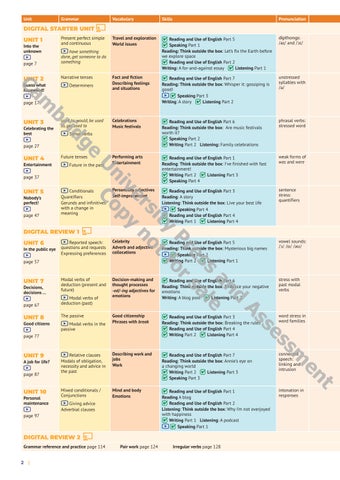
Unit
Grammar
Vocabulary
Skills
Pronunciation
Travel and exploration World issues
Reading and Use of English Part 5 Speaking Part 1 Reading: Think outside the box: Let’s fix the Earth before we explore space Reading and Use of English Part 2 Writing: A for-and-against essay Listening Part 1
dipthongs: /aɪ/ and /ɔɪ/
Fact and fiction Describing feelings and situations
Reading and Use of English Part 7 Reading: Think outside the box: Whisper it: gossiping is good! Speaking Part 3 Writing: A story Listening Part 2
unstressed syllables with /ə/
Celebrations Music festivals
Reading and Use of English Part 6 Reading: Think outside the box: Are music festivals worth it? Speaking Part 2 Writing Part 2 Listening: Family celebrations
phrasal verbs: stressed word
Performing arts Entertainment
Reading and Use of English Part 1 Reading: Think outside the box: I’ve finished with fast entertainment! Writing Part 2 Listening Part 3 Speaking Part 4
weak forms of was and were
Personality adjectives Self-improvement
Reading and Use of English Part 3 Reading: A story Listening: Think outside the box: Live your best life Speaking Part 4 Reading and Use of English Part 4 Writing Part 1 Listening Part 4
sentence stress: quantifiers
Reported speech: questions and requests Expressing preferences
Celebrity Adverb and adjective collocations
Reading and Use of English Part 5 Reading: Think outside the box: Mysterious big names Speaking Part 2 Writing Part 2 Listening Part 1
vowel sounds: /ɔ/ /ɒ/ /əʊ/
Modal verbs of deduction (present and future)
Decision-making and thought processes -ed/-ing adjectives for emotions
Reading and Use of English Part 6 Reading: Think outside the box: Embrace your negative emotions Writing: A blog post Listening Part 2
stress with past modal verbs
Good citizenship Phrases with break
Reading and Use of English Part 3 Reading: Think outside the box: Breaking the rules Reading and Use of English Part 4 Writing Part 2 Listening Part 4
word stress in word families
Relative clauses Modals of obligation, necessity and advice in the past
Describing work and jobs Work
Reading and Use of English Part 7 Reading: Think outside the box: Annie’s eye on a changing world Writing Part 2 Listening Part 3 Speaking Part 3
connected speech: linking and intrusion
Mixed conditionals / Conjunctions
Mind and body Emotions
Reading and Use of English Part 1 Reading A blog Reading and Use of English Part 2 Listening: Think outside the box: Why I’m not overjoyed with happiness Writing Part 1 Listening: A podcast Speaking Part 1
intonation in responses
DIGITAL STARTER UNIT Present perfect simple and continuous
UNIT 1 Into the unknown
have something done, get someone to do something
page 7
Narrative tenses
UNIT 2
m Ca
Guess what happened!
Determiners
page 17
br
UNIT 3
UNIT 4
Future tenses
Future in the past
page 37
UNIT 5
page 47
Conditionals Quantifiers Gerunds and infinitives with a change in meaning
Co
Nobody’s perfect!
DIGITAL REVIEW 1 UNIT 6
In the public eye page 57
UNIT 7
Decisions, decisions … page 67
UNIT 8
Good citizens
Modal verbs of deduction (past) The passive
Modal verbs in the passive
page 77
A job for life?
Personal maintenance
Giving advice Adverbial clauses
page 97
DIGITAL REVIEW 2 Grammar reference and practice page 114 2
|
Pair work page 124
Irregular verbs page 128
t
UNIT 10
en
page 87
m
UNIT 9
ss se As d an s le es sa Pr r y fo it t rs no ve y ni p
U
Entertainment
Sense verbs
ge
page 27
id
Celebrating the best
used to, would, be used to, get used to
Oracy
Challenge
Life competencies
STEAM
Speaking clearly Showing interest
Some parts of the planet are still unexplored. However, we always impact the places we explore.
Critical thinking: evaluating arguments as a whole on global issues Learning to learn: planning for learning
Technology, Engineering, Biology What can we learn by exploring the oceans?
Critical thinking: drawing appropriate conclusions Creative thinking: finding connections
m Ca
Reasoning Giving reasons and examples to support opinions Listening actively by referring to what others have said Responding confidently by emphasising when an opinion is your own
br
Showing interest Giving reasons
ge
id
Festivals are more than fun events; they help to build and unite communities.
Critical thinking: recognising patterns and relationships Creative thinking: imagining alternatives and possibilities Learning to learn: using effective systems for finding, keeping and retrieving information Communication: using language appropriate for the situation Learning to learn: keeping track of progress
ss se As d an s le es sa Pr r y fo it t rs no ve y ni p
U
Performing a comedy sketch Projecting your voice Using humour Organising the structure of a short comedy sketch
Personal growth never has to stop. How can we improve ourselves?
Co
Talking in complex sentences Respecting and responding appropriately Respecting cultural differences
Digital literacy: comparing points from different sources Emotional development: supporting others Learning to learn: setting goals and planning for learning
Arts, Technology
Participating in an interview Speaking clearly and confidently Listening actively and responding confidently and respectfully Using appropriate gestures and body language
Listening and responding respectfully to other people’s ideas Asking probing questions Expressing points of view and giving reasons
We constantly make bad decisions even though we know better. Why do we repeat this tendency?
Critical thinking: evaluating options and recommendations to come to a decision Emotional development: monitoring and reflecting on own emotions Learning to learn: evaluating learning and progress
Technology, Maths How can the internet be dangerous?
Creative thinking: generating multiple ideas Creative thinking: gathering information from reputable digital sources to understand different perspectives on an issue Learning to learn: evaluating learning and progress
t
en
The world of work is changing fast and we need to prepare ourselves for it.
m
Participating actively in a role play Responding respectfully to one another Using the correct level of formal or informal language Making positive comments on the ideas of others
Biology, Technology How does science help people hear?
Creative thinking: considering multiple perspectives Learning to learn: managing attitudes and emotions
Having a debate Confidently expressing opinions with supporting evidence and reasons Speaking confidently and projecting your voice Using vocabulary effectively to persuade Using a range of rhetorical techniques Maintaining the focus of a talk
Critical thinking: identifying and classifying information Creative thinking: imagining alternatives and possibilities
Critical thinking: drawing appropriate conclusions
Biology, Maths, Technology Digital classroom: Practice Extra |
3
m Ca
ge id br
Co
t
en
m
ss se As d an s le es sa Pr r y fo it t rs no ve y ni p U
5
Student’s Book
B2+
Clare Kennedy Daniel Vincent
UNIT 1 INTO THE UNKNOWN LEARNING AIMS
THE CHALLENGE
m Ca
Skills: discuss texts about exploration and write a for-andagainst essay Grammar: learn and practise the present perfect simple and continuous, have something done and get someone to do something Vocabulary: learn and practise words for travel, exploration and world issues Critical thinking: evaluating arguments as a whole Exam practice: Reading and Use of English Part 5, Speaking Part 1, Reading and Use of English Part 2, Listening Part 1
ge
id
br
Some parts of the planet are still unexplored. However, we always impact the places we explore. You will: • Stage 1 Think: find out which parts of the planet remain unexplored and why. • Stage 2 Prepare: consider the reasons for and against further exploration. • Stage 3 Develop: research ways the impact could be reduced. • Stage 4 Present: present your suggestions.
Co
ss se As d an s le es sa Pr r y fo it t rs no ve y ni p
U 1 Look at the photo. In pairs, discuss the questions. 1
What is the boy exploring?
CHALLENGE Think
1
2
Discuss the questions with a partner.
3 Why do people enjoy exploring?
1
Documentary
01
Grammar
t
In pairs, discuss the questions at the end of the video.
Which parts of Earth remain unexplored? Why? 2 What are the reasons for exploration? 3 What impact might exploration have on these places? 4 What are the reasons against exploration?
en
2 Watch the video.
4
m
2 Why has he chosen to explore like this?
3
|
7
VOCABULARY TRAVEL AND EXPLORATION 1
1.1 Go to the digital activity and match the words to the definitions. Listen, check and repeat.
m Ca
compass curiosity excursion expedition torch GPS itinerary safari sense of adventure sense of direction trek voyage
br
id
questions. Then answer the questions in pairs.
6
3
PRONUNCIATION
pronunciation activity.
Go to the digital
4 Choose words from Exercise 1 to complete the
questions. Then work in small groups and discuss the questions. 1 2 3 4
|
Form groups of three or four people.
2 Share your notes from Stage 1, Think. 3 Each group chooses three regions to
investigate in detail. Each member of the group researches one unexplored region. Find out about the region in detail and report back to the group. 4 Plan more research into the effects exploration would have.
READING AN ARTICLE 1 Read the text and choose the best title. a Reasons to visit the land of fire and ice b How a special journey helped me grow
Which of your friends has the worst sense of ? How do you know? Would you like to go on an to a place that has never been explored? Have you ever used a to find out which way to go? Would you pack a compass for a five-hour in the mountains? Why? Imagine you travel around the world. Which cities are on your ? Why? / Why not? What animals would you most like to see on a ? Why? / Why not?
Unit 1 Into the unknown
c The importance of learning outdoor skills
EXAM TIP
You will find ideas and information in the text which relate to the wrong options. These are distractors. Make sure you read everything carefully to eliminate these options.
2 Match the options in the first question of the
task to the underlined phrases 1–4 in the first paragraph. Find the distractors. Which option is the correct answer? Why are the other options wrong? 1
What was Emily’s main reason for joining the expedition? A to make new friends B to challenge herself C to improve her well-being D to learn more about Iceland
Westridge Explorers Society Home > My experience > Emily Farrow
1.2
When I first read about the Westridge Young Explorers Society expedition to Iceland, I couldn’t wait to take part. I’ve always enjoyed outdoor activities. (1) Especially when I’m stressed, going for a walk in the countryside immediately makes me feel better. However, I’d never done anything like this before. I’m quite shy, so (2) the thought of spending weeks with people I didn’t know was daunting, but not enough to put me off. For a start, (3) it looked like an amazing country to get to know. (4) Above all, though, I really wanted to push my limits and see if I had the strength to do something like this.
t
8
4
en
6
3
m
5
2
ss se As d an s le es sa Pr r y fo it t rs no ve y ni p
5
Co
4
Do you have a good sense of direction / adventure or do you get lost easily? Have you ever done a long sea trek / voyage? Would you like to? Why? What subjects stimulate your compass / curiosity? In what ways? Would you like to go on a scientific expedition / safari to a different planet? What has been your favourite school torch / excursion so far? Why? Do you use GPS / an itinerary to find new places in cities you visit?
U
3
ge
2
1
1
Vocabulary reference page 16
2 Choose the correct answers to complete the 1
CHALLENGE Prepare
EXAM TASK READING AND USE OF ENGLISH PART 5
3
For questions 2–6, choose the answer (A, B, C or D) which you think fits best according to the text. 2 What surprised Emily during the training
m Ca
Before setting off, we did a four-day training camp. I’d expected everyone to be a beginner, but there were two guys who’d done similar expeditions before. The group leaders taught us how to put up a tent in wind and rain, and how to read a paper map and use a compass, as we wouldn’t be able to rely on GPS. That came as a shock to some participants. I don’t think they’d realised the expedition would go through regions without any wi-fi signal. We also did several early morning treks with our backpacks full, which is how I learned the importance of packing light. I’d taken far too much with me for just four days!
br
I knew a few things about Iceland’s geography from school, such as the fact it’s almost entirely formed from volcanic rock, but I hadn’t realised it has so many different types of scenery. Parts of it look like something out of a film set on another planet. We camped near rivers that run from glaciers, crossed valleys with amazing rock formations and even climbed one of the country’s many volcanoes. Being one of the extinct ones, it didn’t pose any danger, although I’ve heard that when an active one erupts, it’s an incredible thing to witness.
ge
id
3
ss se As d an s le es sa Pr r y fo it t rs no ve y ni p
U
camp? A the timing of some of the exercises B the route they were going to take C the previous experience of some participants D how heavy her backpack felt What does Emily say about the landscape in Iceland? A It reminded her of a film she’d seen. B She was particularly struck by its variety. C The volcanoes were the most impressive sight. D She had studied it in depth before. Emily enjoyed ‘discovery days’ because they A got her interested in a new subject. B didn’t require much effort. C provided a break in their routine. D involved doing something practical. When the expedition was over, Emily felt A eager to extend her stay in Iceland. B relieved that it wasn’t longer. C impatient to see her family. D too exhausted to enjoy the moment. What does in two minds in line 67 mean? A unwilling to take a risk B unsure what something involves C unable to make a decision D uninterested in learning more
4
Co
We also had several ‘discovery days’. Instead of trekking, we stayed in one place and learned how to take scientific measurements, such as the speed of a river, the content of the soil or the amount of cloud cover. We then compared results from different locations. Even though it was more relaxing than trekking all day, it was still hard work... but it was fun to discover more about the land in a hands-on way. It almost felt as if we were real scientists from the past on a real scientific expedition, finding things out about a newly discovered land.
During the expedition, we often trekked across difficult terrain, sometimes during terrible weather, but we always went to bed feeling proud of ourselves. Even though we were completely worn out by the last day, the sense of achievement was incredible. And even though I was looking forward to telling my mum and dad all about it when I got back, I wouldn’t have said no to carrying on for another few days, not least because the more I saw of Iceland, the more I wanted to get to know it even better. Nevertheless, now I’m home, it’s a relief to be able to sleep late again!
Would you like to go on an expedition like the one in the text? Why? / Why not? 2 Where would you like to explore? Why? 1
t
20
4 Work in pairs and discuss the questions.
en
5
6
m
I’ve been researching other expeditions I’d like to join. I’ve also given several talks about my Iceland experience. I encourage anyone with a sense of adventure to become an explorer themselves. You learn loads of cool skills with interesting people and see incredible places. I’ve become a lot more confident socially as well. To anyone who’d like to 67 get involved but is in two minds about whether to go for it or not, I’d say this: even though you might not think you can do it, you absolutely can.
5
9
Unit 1 Into the unknown
|
9
GRAMMAR
5 Complete the text with the correct form of the verbs
PRESENT PERFECT SIMPLE AND CONTINUOUS 1
1.3 Listen to the conversation. Why don’t the friends go to see the Cook Caves in the end?
m Ca
2 Match examples (a–d) from the conversation to uses (1–4) in the grammar box.
a He’s been looking forward to this for
ge
id
br
weeks. b I’ve sent him three messages. c I’ve been running. d I’ve known him since we were children.
A: You look happy. What 1
(do)? (travel). Just today I3 (visit) Quito, Seoul and Rome. 4 A: Really? You (not leave) the house! B: Virtual-reality tourism! You just put on this headset and you’re there! A: I 5 (hear) about that, but I6 (never try) it. B: You should! Seoul is amazing. I 7 (decide) to go for real one day. A: Well, I’m glad you 8 (have) fun. I9 (study) all day for an exam and I still 10 (not learn) everything I need to! B: I 11 (put away) the headset, but I can get it out again if you want to take a break! A: No, thanks. I 12 (do) enough for today. I’m going to bed. I’ll just travel in my dreams! B: I 2
ss se As d an s le es sa Pr r y fo it t rs no ve y ni p
U
We use the present perfect simple 1 for a past action with a present result. 2 for an action that started in the past and continues now.
in brackets.
SPEAKING
Co
We use the present perfect continuous for actions that 3 started in the past and are continuing now. 4 have just finished and explain a present situation.
EXAM TASK SPEAKING PART 1
EXAM TIP
In Speaking Part 1 of the exam, the examiner will ask you questions about personal topics. Make sure you expand your answers by giving one or two details and examples.
Grammar reference and practice page 114
3
Go to the digital activities.
4 Choose the correct ending for each sentence. 1
The organisers have prepared …
2 The organisers have been preparing … a a new expedition, which is why they’re
3 4
1
2 3
4 5
6
Have you done anything interesting with your friends recently? Who do you spend time with after school? Tell us about a film you like. Tell us about a good teacher you’ve had. Do you enjoy being outside? What are you going to do this weekend?
ORACY Speaking clearly
In an exam or an interview, take a deep breath before you start to answer questions. This will help you speak more clearly and confidently.
7 Ask and answer the questions in Exercise 6. Give full answers and speak clearly.
HOW IS UNIT 1 SO FAR? 10
|
Unit 1 Into the unknown
I understand
I’m getting there
I don’t understand
t
en
6
1.4 Listen to two candidates answering these questions from Part 1 of the Speaking exam. Which three answers do they not expand on?
m
5
all so tired. b seven expeditions in the last three years. Both my sisters have taken … University students have been taking … a a gap year to go travelling. b gap years for ages. You’ve got a terrible sense of direction so … My eyes are really tired because … a I’ve been drawing a map on the computer. b I’ve drawn an easy map.
6
THINK OUTSIDE THE BOX!
LET’S FIX THE EARTH B E F O R E WE EXPLORE SPACE
m Ca
Planet Earth is not in great shape. We need to fix the existing problems instead of exploring new places for humans to live. The time, money and energy we have should be spent on solving the major issues that affect our world for the benefit of everyone. We have the resources – advanced technology and highly skilled people – so why are we wasting money on exploration ?
id
br
Today about 50% of the world’s population lives in poverty . The millions spent on space missions could be better spent on sending aid to developing countries which are in desperate need now.
ge
Despite thousands of years of discovery , the Earth has still not been fully explored. Incredibly, parts of our planet are still unknown. Scientists estimate that a mere 14% of species living on Earth have been identified. Only 5% of the oceans has been explored. They are essential for our planet’s existence
Co
AN ARTICLE
1 Look at the title and the photos. What do you think are the main problems on Earth that need to be solved?
2
This is not to say that space exploration is unimportant. The world’s population has already benefitted from inventions designed for space trips, from LEDs to the computer mouse. Space exploration would also help to answer many questions about the origins of the solar system, extinction of the dinosaurs and the likelihood of life on other planets. However, current issues on Earth demand urgent action: climate change, poverty, biodiversity, sustainable food production. Once we have saved our planet, then we can start exploring the rest of the universe.
ss se As d an s le es sa Pr r y fo it t rs no ve y ni p
U
READING
as they produce half of the world’s oxygen, absorb carbon from the atmosphere, control the temperature and provide food.
1.5 Now read and listen to the article and compare it with your ideas from Exercise 1.
3 Read the article again and decide if the sentences
VOCABULARY WORLD ISSUES 1
1.6 Go to the digital activity and complete the table with the words in all three forms where possible. Listen, check and repeat. absorb
current developing discovery exploration extinction identify mission origin poverty
are true, false or if the information is not given. 1 2 3
In small groups, read the title of the article again and say whether you agree with the statement as a whole, giving your reasons.
5 In pairs, list the main problems the world faces
today. Think of ways we could start to solve them using the resources and money that would be available if space missions were stopped. Present your ideas to the class.
the text. 1
2 3
4 5 6 7
The team’s next challenge is the of the caves to look for more signs of life. Plants water from the soil through their roots. We need to act immediately. The situation is dangerous. Most countries are to be found in Africa and Asia. The family had nothing, not even a home, and lived in extreme . Many plants and animals face due to climate change. The medical team have made a new about the virus.
Unit 1 Into the unknown |
t
4
2 Complete the gaps with a highlighted word from
en
5
Vocabulary reference page 16
m
4
The article is totally opposed to space exploration. The resources we have available could be used in better ways. Everything there is to know about the Earth has already been discovered. We urgently need to understand more about the deep sea. Space missions could be justified at some point in the future.
11
GRAMMAR
EXAM TASK
HAVE SOMETHING DONE / GET SOMEONE TO DO SOMETHING 1 Watch the grammar
READING AND USE OF ENGLISH PART 2
5 In pairs, look at each gap in the exam task
and think of the type of word that might be missing. For example: pronoun, preposition.
6 Read the text below and think of the word which
vlog. Why is Ivy excited?
best fits each gap. Use only one word in each gap. There is an example at the beginning (0).
m Ca
02
2 Complete the sentences from the grammar vlog with
EXAM TIP
br
one word.
I’m a new one. 2 It 3 I don’t want to 1
Focus on the words immediately before and after the gap because they can give you useful clues for the word you need to use.
my brother to buy me
ge
id
to have the brakes fixed. it stolen.
A LIFE OF
ADVENTURE
U
Complete the rules with the correct words.
Co
Go to the digital activities.
4 Rewrite the sentences using have something done or get someone to do something. 1
2
3
DIGITAL CLASSROOM PRACTICE EXTRA UNIT 1
12
| Unit 1 Into the unknown
1
2
3
In your group, share your information from Stage 2. Discuss the pros and cons of exploration in each region. 2 Consider the problems and solutions. 3 Decide which aspects to present and the best way to present them. 4 Create a first draft of your presentation. 1
4
t
6
CHALLENGE Develop
en
5
We asked Rory to carry the camping equipment. We the camping equipment. The doctor checked my ears. I by the doctor. I haven’t got my bike. It’s at the repair shop. I’m repaired today. They stole Mike’s car during the night. Mike during the night. The men are coming to cut the trees next week. We next week. He asked Rosa to lend him her tent. He him her tent.
At first, he got other people 5 help him move and reach things, but he was determined to regain his independence. He had dreamed of becoming an explorer since childhood, so his ambition of a life of changed. discovery has had to 6 He started by getting an instructor at the had facilities local pool, 7 for people with all kinds of disabilities, to , teach him to kayak. A year 8 he led a team of disabled adventurers on a 1,400 km kayak expedition! Darren’s current challenge is preparing for seven wheelchair marathons in seven different countries in seven days.
m
4
Darren Edwards is an adventurer who 0 had his life changed by a mountaineering accident. He survived the was instantly paralysed. fall 1 Darren had his multiple injuries treated in hospital over the following five months. He had his back operated 2 this, by specialist surgeons. 3 he will always have to use a wheelchair to 4 his daily life to the full.
ss se As d an s le es sa Pr r y fo it t rs no ve y ni p
When someone else does something for us, we use: subject + in the appropriate tense + + past participle of the verb. We can replace have with in informal language. 2 When we ask or persuade someone to do something for us, we use: subject + in the appropriate tense + object + to + of the verb. 1
3
MEDIATION WORKSHEET
WRITING
4 Match paragraphs 1–4 of the essay to a–d below.
A FOR-AND-AGAINST ESSAY 1 In pairs, discuss the questions. Do you know anyone who has taken a gap year, i.e. a year off between school and university to travel, volunteer or work? 2 Would you like to take a gap year? Why? / Why not? 1
m Ca
2 Look at the writing task. With a partner, think of
a Arguments against the statement b Introduction to the topic c Arguments for the statement d Conclusion with the writer’s opinion
5 Find words and phrases which mean the following in the essay. 1 2 3 4
a should take a gap year.
5
br
three reasons why a person:
id
b shouldn’t take a gap year.
ge
Writing task
7
6 Look at the writing task below. Then plan and write your essay.
U
In class, you have been discussing the advantages and disadvantages of gap years. Now your teacher has asked you to write a for-and-against essay on this statement.
6
ss se As d an s le es sa Pr r y fo it t rs no ve y ni p
You have been discussing different types of maps in class. Now your teacher has asked you to write a for-and-against essay on this statement.
Co
All students should take a gap year between school and work or university.
Knowing how to read a paper map is still an important life skill.
Write between 140 and 190 words.
Write between 140 and 190 words.
3 Read the essay. Does the writer mention any of your ideas from Exercise 2?
7 Read your essay and revise your work. Use these questions to help you. 1
Did you divide your essay into paragraphs?
2 Did you introduce the topic in your own words? 3 Did you give reasons both for and against the
statement? 4 Did you use a variety of vocabulary to avoid repetition? 5 Did you write a conclusion based on the ideas you’ve discussed? 6 Did you write between 140 and 190 words?
8 Now work in pairs. Read each other’s essays and
give feedback. Use the questions in Exercise 7 to help you. Make a note of your partner’s feedback and write a second draft of your essay.
t
en
m
Many students take a gap year after finishing school and before starting work or university in order to travel or gain new experiences. There are many benefits to this, but it is not without its drawbacks either. 2 Firstly, a gap year can be a great opportunity to explore your own or other countries. Travelling alone or with friends can also help you gain confidence and become more independent. If you decide to volunteer during a gap year, it can help you gain work experience and learn skills that will be useful for life, especially when you’re looking for a job. 3 On the other hand, a gap year can be very expensive. Many students also prefer to begin their university degree right away, especially if they’re going to study something that takes a long time. Besides, it’s also possible to travel later in life or volunteer while working. 4 To sum up, while a gap year can be a good choice for some people, nobody should feel they have to take one if they don’t want to. 1
advantages disadvantages to start with nevertheless in addition in conclusion although
Unit 1 Into the unknown |
13
LISTENING MONOLOGUES AND DIALOGUES EXAM TIP
m Ca
In Part 1 of the Listening exam, there are eight individual extracts which are not related in any way. The extracts are either monologues or short dialogues.
1
A Benefits of travel
id
1
br
1.7 Listen and match the topics to the extracts. There is one extra topic. B Future plans
2
C Unexpected information
ge
3
D Travel advice
4
E A new project
U
5
F Exploring the unknown
Co
2 You will hear people talking in five different
situations. For questions 1–5, choose the best answer (A, B or C).
2
3
| Unit 1 Into the unknown
3 Listen to question 2 again and answer the questions.
How does the boy show he’s listening to the girl? 2 How does the girl react? 1
4 Listen to question 4 again. How does the boy show he is actively listening to the girl?
5 Compare dialogues 2 and 4. What similarities and differences did you notice?
Think about: • purpose of the conversation • delivery • B’s comments.
CHALLENGE Present
1
2
3
Make sure each member of the group has a role and knows what to do. 2 Check that you have all the material and equipment you need. 3 Each person presents both sides of the question, for and against exploration. 4 The group gives a brief summary of their opinion on exploration in general. 1
4
t
14
You hear a boy talking about his future. How did his interest in his chosen career start? A on a holiday abroad B from seeing wildlife close-up C from a science lesson You hear two classmates discussing a lesson. What has the lesson made the girl think about? A how appealing exploration is B how different today’s world is C how important understanding history is You hear two friends discussing a documentary about deep-sea exploration. What do they both agree? A Deep-sea diving is an uninviting activity. B The documentary was educational. C The oceans should be explored. You hear a girl telling a friend about a new activity. What is the girl trying to do? A Prevent her friend from getting lost. B Help her friend prepare for a trip. C Persuade her friend to try something new. You hear a girl talking about her gap-year trip. What has she learned from this experience? A the importance of education B respect for other cultures C how to make new friends
en
5
You can show interest in what someone is saying by commenting and asking for more information. Your body language can also show interest: your expression, leaning towards the speaker, smiling, nodding in agreement and making eye-contact with the speaker.
m
4
Showing interest
ss se As d an s le es sa Pr r y fo it t rs no ve y ni p
EXAM TASK LISTENING PART 1
1
ORACY
WRAP UP Look back at the unit. Write down:
m Ca
1 some words to talk about travel and exploration 2 some words to talk about world issues 3 what you learned from the challenge
br
4 two functions of the present perfect simple and continuous
ge
id
5 examples of have something done and get someone to do something 6 one creative way we can solve an issue facing the world today
Sustainability
Co
ss se As d an s le es sa Pr r y fo it t rs no ve y ni p
U
7 something in the unit that you did not know before
1 Write down your ideas about the most sustainable ways of travelling long distances. Why are they sustainable?
2 How do you think we could explore space in the future in a sustainable way? Discuss with a partner.
SELF-ASSESSMENT: UNIT 1 How confident do you feel about:
• • • • • • • • •
using words about travel, exploration and world issues? using the present perfect simple and continuous? using have something done and get someone to do something? reading a long text and answering multiple-choice questions in Reading and Use of English Part 5? speaking about past experiences in Speaking Part 1? choosing the correct words to complete gaps in Reading and Use of English Part 2? listening for gist in monologues and dialogues in Listening Part 1? writing a for-and-against essay? discussing further exploration on Earth?
t
STRETCH! YOUR CHOICE
en
m
Look ahead at the next few units. What topics are you familiar with? Which ones are you looking forward to exploring?
Now choose an extra activity! Option 1: Find out about the life of a modern-day explorer. Prepare a talk with slides about him/ her for the class.
Option 2: Carry out a survey into how adventurous your classmates are. Create a questionnaire, collate and analyse the answers, then use diagrams to display the results.
Option 3: Try the experiment of exploring the area within a 5km radius of your home. Report back to the class with your new discoveries. Unit 1 Into the unknown |
15
VOCABULARY REFERENCE TRAVEL AND EXPLORATION
m Ca ge
id
br Co
ss se As d an s le es sa Pr r y fo it t rs no ve y ni p
U 1 Match the words to the definitions. 1
itinerary
a (global positioning system) a system that can show the exact position of
2 curiosity
b
3 compass
c
4 expedition
d
5 safari 6 GPS 7 sense of adventure 8 sense of direction 9 excursion 10 trek 11 voyage 12 torch
e f
g h i
j
k l
WORLD ISSUES
a person or thing by using signals from satellites the willingness to try new things and to take risks a long journey by ship a small light that is held in the hand and usually gets its light from batteries a short trip for study or pleasure, often made by a group of people a long walk over land such as hills, mountains or forests the ability to find places or know which direction to go a detailed plan for a journey or a trip an eager wish to know or learn about something an organised journey to look at wild animals, especially in Africa an organised journey for a particular purpose such as science or discovery a device for finding direction with a needle that moves easily and always finds magnetic north
current
developing
discovery
exploration
extinction
identify
mission
verb
adjective
absorption
absorb
absorbent
poverty
DIGITAL CLASSROOM PRACTICE EXTRA UNIT 1
16
|
Unit 1 Into the unknown
t
noun
origin
en
absorb
m
2 Complete the table with the words in all three forms where possible.
UNIT 2 GUESS WHAT HAPPENED! LEARNING AIMS
ORACY
m Ca
Skills: read articles about fake news and gossip Grammar: learn and practise narrative tenses and determiners Vocabulary: learn and practise words about fact and fiction, and feelings and situations Oracy: provide reasoning for arguments Exam practice: Reading and Use of English Part 7, Speaking Part 3, Listening Part 2
ge
id
br
Reasoning • giving reasons and examples to support opinions • listening actively by referring to what others have said • responding confidently by emphasising when an opinion is your own
Co
ss se As d an s le es sa Pr r y fo it t rs no ve y ni p
U 1 Look at the photo. In pairs, discuss the questions.
Where do you think these dancers might be? 2 What kind of story do you think they are telling through the dance? 3 Why do we like telling stories? 1
2 Watch the video. Does
4 In groups of three or four, discuss the statements. • It’s not important for teenagers to know what’s
opinion, why is it important to do the following?
•
a explain why you have the opinion b explain where you heard the opinion
5 Think about the discussions you had in Exercise 4. How well did you explain your opinions and give examples?
c give examples of what you mean
Documentary
Grammar
t
•
3 When you express an
going on in the world. Fake images are more dangerous for society than fake news. Everybody loves to gossip about other people.
en
01
m
it mention any of your ideas from question 3 in Exercise 1?
Speaking
Oracy
| 17
VOCABULARY
READING
FACT AND FICTION
AN ARTICLE
1
1 In pairs, discuss the questions.
2.1 Go to the digital activity and choose the correct options. Listen, check and repeat.
m Ca
boast convey deceive distinguish distrust exaggerate express fall for gossip misunderstand spot spread
br
Vocabulary reference page 26
id
2 Complete the questions with words from Exercise 1. Then discuss with a partner.
5
6
Co
4
3 Circle the options so that the sentences are true for you.
a I think it’s quite easy / easy / difficult /
1–4 to sections A–D.
1
A liar’s nasty invention
2 An unbelievably good fake 3 Too good to be true – and it wasn’t! 4 A real photo, but not what it seemed
EXAM TASK READING AND USE OF ENGLISH PART 7
EXAM TIP Remember that sections of the text may contain similar but not the same ideas, so read carefully to decide which ones say exactly the same thing as the questions.
3 You are going to read an article in which four
teenagers talk about a time they fell for fake news. Quickly read the questions in Exercise 4 and underline the key words. The first two are done for you.
4 For questions 1–10, choose from the four
teenagers (A–D). The teenagers may be chosen more than once. Which teenager
1
did something without thinking?
2
mentions an employer’s reaction?
3
Giving reasons and examples to support opinions
speculates about the reasons for an action?
4
When you’re discussing a topic, it’s important to be able to justify your opinions. You can do this by asking yourself why that’s your opinion and providing examples or reasons that support what you’re saying.
feels guilty for contributing to a problem?
is pleased at a reaction they caused?
6
insists he is being completely honest?
7
misunderstood the purpose of something?
8
was surprised by a person’s actions?
9
mentions an official response to an event?
10
ORACY
Give examples or information as evidence to support what you say.
| Unit 2 Guess what happened!
t
4 In pairs, explain your opinions from Exercise 3.
5
en
says that opinion on a matter was divided?
m
very difficult to spot when someone is exaggerating on social media. b In my opinion, fake news is not a very serious / a serious / a very serious problem in today’s world.
18
2 Read the text Falling for fake news and match headings
ss se As d an s le es sa Pr r y fo it t rs no ve y ni p
3
Imagine someone nasty a lie about you. How would you feel? On social media, do you prefer to yourself with words or pictures? When you tell a story, do you tell the truth parts of it? or do you Do your parents ever something you said and think you meant something different than you did? Do you think people who about their lives online are always being honest? What can you do to fake accounts on social media?
U
2
ge
1
What is fake news? Why do people spread it? 2 Have you seen any examples of fake news? 1
Falling for FAKE NEWS
2.2
Four teenagers tell us about a time they were taken in by online lies. 2.2
C LEON
I’ve always been a fan of Brad Chaplin, the film star, but one day I saw a post saying he’d started a fire near a school. Like thousands of people, I totally thought it was true. There was even a photo of the fire and Brad smiling as if he was somehow pleased with himself. I couldn’t believe he’d done such a terrible thing. It turned out it was from a film he was filming, but by the time I realised, I’d already left a nasty comment on his official channel saying I hoped he would never work again. The person who invented the story might have done it as a joke or maybe they were trying to damage Chaplin’s reputation, but either way it must have been horrible for him to receive so much anger online. I feel really bad for making it worse.
Last year, there was this huge story all over social media about Northside FC, the football club I support. One of their strikers, Todd Sharpe, posted a video boasting about being too good for the club and wanting the manager to pay him more, which was really shocking as it seemed so out of character. He’d always been really modest before. I remember discussing it on a site for fans. Half the people were saying he was being unreasonable, the other half actually thought he deserved more money. Sharpe swore the video wasn’t real, but nobody believed him. It turned out he was telling the truth. It was an AI fake, completely computer-generated. I didn’t think I’d ever fall for something like that. Believe me, I’m not exaggerating – it was so realistic! To this day, nobody knows who made it or what their motive was.
B THEO
D MARIKO
m Ca
A SOFIA
ge
id
br
Co
ss se As d an s le es sa Pr r y fo it t rs no ve y ni p
U
A few years ago, there was a fire at our local shopping centre. A blogger said it had been started by someone who was working in one of the shops. He said she’d done it because her boss had fired her after he found out she didn’t have the correct documents. Lots of people, including my friends and me, assumed all this was true, even though it was only on a personal blog. None of the serious news sites had reported it. The fire brigade even issued a statement saying the fire was an accident. In the end, a real journalist found out the blogger had made the whole thing up. It turns out he’d been spreading lots of cruel lies like that. It’s no surprise that some people behave horribly online. I just can’t understand why they do it.
5 Discuss with a partner. Why is it important to be able to distinguish real and fake news? 6
t
What are the possible consequences of fake news?
en
m
My best friend Jay was becoming so addicted to online games that it was interfering with his schoolwork and even our friendship. When we hung out, he rarely gave me his undivided attention. He was always distracted by some game or other on his phone. He finally admitted it was a problem and said he wanted to do something about it, so when I saw a post online saying that scientists had developed a pill you could take for gaming addiction, I didn’t give it a second thought and sent it straight to him. He messaged me back with loads of laughing emojis, which is when I realised it wasn’t supposed to be taken seriously. It was just a joke. You can’t blame me, though. The post had made-up recommendations from real celebrities and lots of scientific-looking data. Oh well, I’m glad I made Jay laugh at least!
Remember that it’s important not to assume everything we see and read is true. Discuss these tips for spotting fake news. Which one do you think is the most useful? Check the source. Who has written and published the story? Does it come from a trustworthy site or person? Who else is reporting it? 2 Remember that photos don’t tell the whole story and can be changed to make you think they show something they don’t. 3 Trust your instinct. If you read that a famous person has said or done something that doesn’t suit their personality, this might indicate fake news. 1
Unit 2 Guess what happened! |
19
ORACY
GRAMMAR
Listening actively by referring to what others have said
NARRATIVE TENSES 1
When you listen to others talk, make sure you really listen. Ask questions based on what they have said to find out more information and details.
2.3 Listen to the conversation. Do you believe Tom's story?
2 Match 1–3 in the grammar box to their uses a–c.
m Ca 1
past simple
2 past
As the seagull was flying away, it dropped the ice cream.
br
continuous
This great big seagull flew down and took the ice cream.
id
3 past perfect He screamed because
6 Listen carefully to your partner’s anecdote. Ask two or more questions to learn more details.
READING AN ARTICLE
ge
he thought the bottle of sunscreen had exploded.
– We use this for actions that happened before another point in the past. b – We use this for completed actions in the past. c – We use this to say an action was in progress when another action happened. a
Co
ss se As d an s le es sa Pr r y fo it t rs no ve y ni p
U
Grammar reference and practice page 115
3
Go to the digital activities.
4 Complete the text with the correct form of the verbs in brackets.
A wet ride
• an accident I had while doing sport • an embarrassing moment I’ll never forget • a time I lost and later found something important 20
| Unit 2 Guess what happened!
3 Do you think there are any good reasons to
gossip?
2
2.4 Read and listen to the article. Does it mention any of your answers from Exercise 1?
3 According to the article, are these statements true, false or is the information not given? 1
2 3 4 5
The three pieces of gossip in the first paragraph may not be true. In the past, people who didn’t gossip were never powerful. Gossip always changes as it gets passed on from one person to another. In certain situations, a warning based on gossip can be helpful. We should always feel guilty when we gossip about others.
HOW IS UNIT 2 SO FAR? I understand
I’m getting there
I don’t understand
t
a short anecdote to tell your partner. Include examples of the past simple, past continuous and past perfect.
Do you enjoy hearing gossip? Why?
2 Do you ever spread gossip? Why? / Why not?
en
5 Choose one of the topics below and prepare
1
m
I1 (ride) my bike into a river (be) a sunny day once. It 2 3 (hang out) with some and I (ride) our bikes friends. We 4 along the riverbank, racing one another. (just cry), ‘I’m the fastest!’ I5 (fly) in my when a wasp 6 (lose) control and face. I 7 8 (cycle) into the water. My (not know) what friends 9 10 (happen). I 11 (climb out) of the river and my friends 12 (help) me pull the bike out. 13 I (be) so embarrassed!
1 In pairs, discuss the questions.
THINK OUTSIDE THE BOX!
Whisper One of your classmates is in trouble for cheating. it: A neighbour has won G N the lottery. Your cousin I p i s s o has dyed her hair pink G O o d ! and her parents are is G furious. At least, that’s
2 Complete the text with the words from Exercise 1.
Ellie’s world
Home
Blogs
Contact
No more doomscrolling!
m Ca
what you’ve heard. If you’re tempted to pass on these juicy bits of information, you’re not alone. According to social scientists, gossip is a part of what makes us human. That’s because it’s natural for us to share information.
Added yesterday at 13:47
br
I used to read the news every day to find out what was happening in the world. Then one and day I got a headache, was 1 couldn’t relax. At first, I was 2 because I couldn’t work out why. My family love me, I have good friends, I wasn’t feeling under pressure at school. Then I realised I was by all the negative completely 3 news I was seeing. Every story seemed to be about the climate crisis, poverty, injustice or 4 people in hopeless situations. Then a friend told me about a website called ‘News to Make You Smile’ that only publishes positive stories. It said on the homepage their about making writers were 5 the world a happier place. I’m 6 I found it. Reading their stories has made me about life. feel much more 7 I think we need to be careful with the news. So much bad news can make you feel really 8 about the future. It’s true things happen all the that 9 things. time, but so do many 10 People are kind to one another, we help one another, new inventions come along that improve our lives. Don’t ignore the bad news, but focus on the good stories. That’s my advice.
ge
id
In the past, our survival depended on knowing who had powerful friends, who had the best resources and who could be trusted. The people who weren’t interested in learning such things were at a disadvantage. Talking about other people was a necessary part of life.
U
Co
ss se As d an s le es sa Pr r y fo it t rs no ve y ni p
These days, we tend to think gossip can never be good. It’s always about someone who isn’t present to defend himself or herself. It’s usually about something we can approve or disapprove of, and it’s often entertaining. OK, so it might not always be true – and the more people spread gossip, the less truthful it tends to become – but we’re usually delighted to hear and share the information, and we enjoy saying what we think about it.
Nevertheless, there are good and bad ways to gossip. It all depends on how you use the information. If your friend has started to hang out with a person who has a reputation for dreadful behaviour, it’s a good idea to let them know. On the other hand, if you’ve heard something private and embarrassing about a classmate, you shouldn’t tell others just to make them laugh.
3
Gossiping is a social skill. So don’t feel bad for doing it – after all, we all gossip – but make sure you do it responsibly.
Read the text in Exercise 2 again. Complete the sentence with your own ideas. I think I’m similar / different to Ellie because …
ORACY
DESCRIBING FEELINGS AND SITUATIONS
Be clear and confident when expressing your own opinion and make sure people understand it is what you believe.
2.5 Go to the digital activity. Match the words to the definitions. Listen, check and repeat. delighted desperate dreadful optimistic overwhelmed passionate pessimistic puzzled tense uplifting
t
en
1
m
VOCABULARY
Responding confidently by emphasising when an opinion is your own
4 Compare your ideas from Exercise 3 with your
partner. Are they similar or different? Was your partner confident in showing their opinion? STRETCH! Find a good news story online and
share it with your classmates.
Vocabulary reference page 26 Unit 2 Guess what happened! |
21
GRAMMAR
SPEAKING
DETERMINERS
EXAM TASK SPEAKING PART 3 CUT-OUT
EXAM TIP
1 Watch the grammar
vlog. Why does Harry prefer a pre-digital camera?
02
m Ca
2 Match examples 1–4 in the grammar box to uses a–d. Watch again and check.
I’ll show you the photo later.
2 indefinite article
It’s a pre-digital camera.
a agree and disagree with each other
3 zero article
I was looking through [/] social media.
c compare the ideas given on the card
They took plenty of photos. It might take a little time to get used to it.
e discuss the question that is written
ge
id
br
definite article
determiners
Co
a We use these to express quantities and they go
before the noun.
b We use this when we introduce new
information or with one of many things.
c We use this before an uncountable noun or
plural countable nouns when we refer to things in general. d We use this when we refer to something specific or previously mentioned. PRONUNCIATION
Go to the digital
pronunciation activity.
Go to the digital activities.
5 Complete the text with the, a/an and other
determiners or leave the gaps blank for the zero article.
d talk about the ideas one by one
Unit 2 Guess what happened!
create a graphicnovel section
offer free high-speed wi-fi
HOW MIGHT THESE IDEAS ATTRACT YOUNG PEOPLE TO THE LIBRARY?
invite famous authors to meet their fans
provide a free e-book borrowing service
Now, talk to each other about how these ideas might attract young people to the library. Task 2 (1 minute) Now decide which two ideas you think will be most effective in attracting young people to the library.
t
PRACTICE EXTRA UNIT 2
let students choose a ‘book of the month’
en
DIGITAL CLASSROOM
on the card make (or be in the process of making) a decision g negotiate towards an outcome h talk together for about two minutes i talk together for about one minute j use a variety of grammar and vocabulary Task 1 (2 minutes) A city library wants more young people to visit and use its services. Here are some of their ideas and a question for you to discuss. First, you have some time to look at the task. f
m
16-year-old who loved telling Jenny was 1 stories. Her stories were always filled with 2 adventure that kept her listeners wanting more. One day, 3 organisers of 4 open mic night asked her to come and read one of her stories. She accepted their invitation, but as she stood on 5 stage, she was overwhelmed by nerves. 6 audience watched her, waiting. Was she going to tell 7 story or not? Finally, she started and soon became more and more confident. When she had finished, 8 people cheered loudly. Now Jenny knew what she wanted to do in the future.
22 |
b initiate a conversation
ss se As d an s le es sa Pr r y fo it t rs no ve y ni p
U
4 other
4
1 Read the instructions below and decide in which task(s) you usually need to do the following. Write 1 for the discussion task, 2 for the decision task or B (both).
1
3
The collaborative task involves a conversation with another candidate and has two tasks: a discussion task and a decision task. Make sure you complete both tasks fully.
3 The writer uses five conjunctions to show
2 Watch two students
doing the task. Do they do the things in Exercise 5?
03
3 Which of these tips would help the two students do the decision phase better?
contrast. One has been underlined. Underline the other four.
4 Look at the writing competition for Teen
Tales. Follow these steps to write your story. 1
a Avoid making a decision immediately.
m Ca
b Read out the ideas one by one and say, ‘This one?
ge
id
br
Yes or no?’. c Begin by saying which idea(s) they think are not the most effective and why. d Choose a different idea each and discuss which is better. e Refer back to points made during the discussion phase.
4 Go to page 125 and complete the task.
Co
1 In pairs, discuss the questions.
Can you tell when someone is lying to you? 2 How would you feel if a good friend lied to you? 1
2 Read the story. Do you think Damon was right to feel ‘a bit angry’?
Party The
4 5 6
Teen Tales
Join our story competition! Are you creative? Do you like telling stories? Why not join our competition? We’re looking for short stories (180–220 words) on the topic of misunderstandings. The best one will be published right here online!
5 Read your story and revise your work. Does it follow the steps in Exercise 4?
6 Now work in pairs. Read each other’s story
and give feedback. Make a note of your partner’s feedback and write a second draft of your story.
7 Read five or six of your classmates’ stories.
Which one do you think should win the Teen Tales competition?
t
en
m
Luke knew he shouldn’t have lied. He’d always been honest with Damon. They’d been best friends since primary school and shared everything. However, Damon had recently started to become really popular at school, while Luke was finding it hard to fit in. One day, while they were hanging out, Damon mentioned he was going to a big party that Saturday. ‘Do you want to go with me?’ he asked. Luke was sad because he hadn’t been invited, but he didn’t want Damon to know that. ‘Someone else has already invited me,’ he lied. Despite looking surprised, all Damon said was, ‘Oh, OK. See you there.’ That night, Luke started to feel guilty. He couldn’t actually go to the party because he hadn’t really been invited and, worse, he’d betrayed his best friend’s trust. The next day, he decided to come clean. Damon was a bit angry at first, although he was glad Luke had told him the truth. Finally, they promised always to be honest with one another. And that Saturday, they went to the party together and had the best time ever. MEDIATION WORKSHEET
3
ss se As d an s le es sa Pr r y fo it t rs no ve y ni p
A STORY
U
WRITING
2
Plan your story. Who are the characters? What is the misunderstanding? What problem does it cause? Write your first draft. Use narrative tenses. Make sure you include conjunctions that show contrast. Write 180–220 words. Give the story a title.
Unit 2 Guess what happened!
|
23
ORACY
LISTENING A MONOLOGUE 1 You will hear a girl called Clara Armstrong talking
about a project she took part in. Look at the extract from the script which contains the answer to question 1 in Exercise 2. Which words or phrases tell you that you are about to hear the answer?
REASONING • giving reasons and examples to support
m Ca
• •
is the worst way to find out what’s happening in the world and you ask them why they think that. For each of these possible responses, how confident do you think your friend is about their opinion?
U
ss se As d an s le es sa Pr r y fo it t rs no ve y ni p
EXAM TASK LISTENING PART 2 EXAM TIP
Because anybody can say anything, so it’s difficult to know if it’s something you can trust or not.
Co
Pay attention to words or phrases in the listening that are similar to those in the question and which let you know you’re about to hear the answer.
2
2.6 Now listen to Clara. For questions 1–10, complete the sentences with a word or short phrase.
2 Watch the first part of
the video. What do the students say about:
• why we should •
3
04
explain why we have the opinions we do why we should give examples to support our opinions.
05 Watch the second part of the video. Which of these statements are the students discussing?
It’s more important to follow local news than international news. 2 People prefer hearing bad news to good news. 3 There is too much sports news on TV and online. 4 Social media is the best way to follow the news. 1
t
Unit 2 Guess what happened!
Because people lie all the time online. I can’t think of any examples right now, but they do.
en
|
I don’t know. I just think it is. That’s what everyone says, anyway.
m
A project that helped me at a difficult time were affected Clara says her 1 by the unhappiness she felt in her new school. Clara learned about the project from 2 . to Clara uses the word 3 describe her initial feelings towards the project. One of the participants was unhappy as . a result of issues with 4 Clara found the session called 5 particularly impressive. For their story, participants were not supposed words. to write more than 6 The girl in Clara’s story treats the chatbot like 7 . The girl in Clara’s story is in 8 when she has her first real conversation. The participants praised Clara for how well she in her story. conveyed 9 Clara was surprised that the project helped . improve her 10
24
opinions listening actively by referring to what others have said responding confidently by emphasising when an opinion is your own
1 Imagine a friend tells you they think social media
ge
id
br
Last year, my mum got a new job, which meant the whole family had to move from the quiet little town where I grew up to a big city, and I had to start a new school. I was pretty miserable there. I’ve always been incredibly shy, so I just couldn’t make new friends and I was convinced my classmates didn’t want me there. My grades began to suffer. At home, I would just go to my bedroom and watch stuff by friends I’d made on social media but never actually met. It was dreadful.
4 Watch the second part of the video again. Who says these phrases? Richard (R), Gloria (G) or Stefan (S)? According to …
1
I guess you’re right. Personally, … 10 In my experience, … 11 I find that … 12 For instance, …. 13 Well, true, but … 14 As I see it, … 8
2 I don’t really think that’s true. 3 Take … for example. 4 If you ask me, …
m Ca
5 I suppose you’re right … 6 apparently, … 7 say
9
br
5 Put the phrases from Exercise 4 into the table. Referring to your own experience of knowledge
Referring to what others say or think
Giving examples
Agreeing and disagreeing
ge
id
Emphasising that it’s your own opinion
Co
ss se As d an s le es sa Pr r y fo it t rs no ve y ni p
U
6
06 Watch the third part of the video. Do you agree with the students’ comments about how they did?
7 Work in groups. Discuss one of the other topics from Exercise 3. Use the phrases in Exercise 4 to give and support your opinions, and to agree and disagree.
8 Discuss with your group members.
How well did we support our opinions by giving reasons and examples? 2 How often did we use the phrases in Exercise 4? 3 What could we do to improve in the future? 1
SELF-ASSESSMENT: UNIT 2 How confident do you feel about:
What was your favourite part of Unit 2? Tell your partner.
t
en
using words for fact and fiction? using words to describe feelings and situations? using narrative tenses? using determiners? matching statements to texts in Reading and Use of English Part 7? discussing a question and making a decision in Speaking Part 3? listening for detail in Listening Part 2? writing a story? giving evidence and examples to support your arguments and opinions?
m
• • • • • • • • •
DIGITAL CLASSROOM PERSONALISED LEARNING
Unit 2 Guess what happened!
| 25
VOCABULARY REFERENCE FACT AND FICTION
1 Choose the correct options. 1
How well can you distinguish / express real and fake photos?
m Ca
2 Without emojis, how easy is it to spread / convey feelings in
a text message?
3 Why do some people try to deceive / misunderstand
ge
id
br
others online? 4 Do you ever fall for / exaggerate fake news? What makes you believe it? 5 Why do some people like to boast / gossip about the private lives of celebrities? 6 Is it a good idea to spot / distrust everything you see on social media? 7 Some people always boast / exaggerate about their success! 8 Don’t exaggerate / distinguish – it didn’t cost that much! 9 They never misunderstand / spread instructions. 10 I simply want to distrust / express my opinion. 11 News of her new book deal will fall for / spread quickly. 12 It's easy to spot / distinguish the horrible error in the plot of her story.
Co
ss se As d an s le es sa Pr r y fo it t rs no ve y ni p
U
DESCRIBING FEELINGS AND SITUATIONS
2 Match the words to the definitions.
a feeling that you’re without hope and will do anything to change a situation b very happy or pleased
c too stressed by something to know how to react d caring deeply about something e making you feel happy and full of good feelings
DIGITAL CLASSROOM PRACTICE EXTRA UNIT 2
26
| Unit 2 Guess what happened!
t
thinking bad things are more likely to happen than good things g nervous, worried and unable to relax h very bad or unpleasant i confused because you don’t understand something j hoping or believing good things will happen in the future f
en
m
delighted 2 dreadful 3 desperate 4 puzzled 5 optimistic 6 overwhelmed 7 uplifting 8 passionate 9 pessimistic 10 tense 1
UNIT 3 CELEBRATING THE BEST LEARNING AIMS
THE CHALLENGE
m Ca
Skills: discuss and create texts about celebrations Grammar: learn and practise used to / would and comparison with be/get used to and seems/looks/ sounds/tastes/smells + adjective Vocabulary: learn and practise words and phrases for celebrations and music festivals Critical thinking: finding ways to make events more sustainable Exam practice: Reading and Use of English Part 6, Speaking Part 2, Writing Part 2 (an informal email)
ge
id
br
Festivals are more than fun events; they help to build and unite communities. You will: • Stage 1 Think: find out how festivals can improve community life. • Stage 2 Prepare: focus on benefits for the population as a whole and on individuals. • Stage 3 Develop: choose a festival and analyse its impact on residents. • Stage 4 Present: present your findings to the class.
Co
ss se As d an s le es sa Pr r y fo it t rs no ve y ni p
U 1 Look at the photo. In pairs, discuss the questions.
3
4
Discuss the question with a partner.
How do festivals improve community life? Consider: • everyday life • local economy • local culture and pride in your hometown/ community • the local community.
01
t
you agree with the title? Why? / Why not?
Grammar
2
en
2 Watch the video. Do
Documentary
1
m
What is the occasion? 2 What are the people doing? 3 How are they dressed? 1
CHALLENGE Think
|
27
VOCABULARY CELEBRATIONS 1
3.1 Go to the digital activity and match the sentence halves. Listen, check and repeat.
m Ca
date back to dress up get involved in have a get-together hold an event join in let off (fireworks) participate in put up (decorations) set up throw a party turn out
br
Vocabulary reference page 36
id
2 Complete the sentences with the correct form of
ge
the words in the box.
The winter solstice celebrations date to ancient times and today crowds of people out to watch the sunrise. 2 On the last day of school, I a party. Friends came to put the decorations and set everything else . When we had all dressed in our best clothes, the party started! 3 I love to involved in local community events that are in our town every summer. 4 Once a year, my old class from primary school a get-together. We usually go on a picnic followed by volleyball or football. , so it’s fun. Everyone joins 1
Co
3 4
PRONUNCIATION
pronunciation activity.
Go to the digital
01 Watch the video again and answer the questions. Think about the relationships between cause and effect.
3
4
Form groups of three or four. 2 Each member of the group chooses a festival or celebration. 3 Research and find out: • what it celebrates and why • how it is organised • activities for visitors • attitude and involvement of residents. 4 Make notes on your findings. 1
| Unit 3 Celebrating the best
AN ARTICLE
1 Discuss the questions in small groups.
Which occasions are associated with firework displays in your country? 2 What was the best firework display you have seen? Why? 3 When do you think fireworks were invented? 1
EXAM TIP
Each correct answer in this task is worth 2 marks. Make sure you leave enough time to do it carefully. Read the sentences before and after the gap and look for words and clues that could link to one of the sentences A–G.
2 Read the article as far as line 10. Focus on
the sentences before and after the missing sentence (0). Then answer the question.
What information do you expect the missing sentence to contain? More information about: a firecrackers. b bamboo.
3 Read the missing sentence (0) below and underline the words that link it to the rest of the text.
When small pieces of this wood were thrown into a fire, they would explode.
t
What do they celebrate? When are they held? What are the main activities? Are they traditional or modern?
READING
en
STRETCH! Discuss the festivals in your area.
28
2
m
What were the main types of festivals in ancient times? 2 How do celebrations unite people? 3 What is the significance of the following festivals today? • national • traditional • seasonal 1
1
ss se As d an s le es sa Pr r y fo it t rs no ve y ni p
U
back get have hold in (x2) throw turn up (x 3)
CHALLENGE Prepare
EXAM TASK READING AND USE OF ENGLISH PART 6
4 You are going to read an article about the history of fireworks. Six sentences have been removed from the article. Choose from the sentences A–G the one which fits each gap (1–6). There is one extra sentence which you do not need to use. A This name comes from the leaves they were covered in as protection against flames from the fire. B The components used in manufacture are far from being environmentally friendly. C Curious to repeat this effect, he tried pouring the same powder into bamboo sticks and lighting them.
m Ca
D This basic technology is still used in firework shows today. E As elements burn, they produce flames of various shades depending on their mineral content. F Initially, scientists considered replacing the original components with alternatives; however, all the
ge
id
br
tests failed. G To my mind, they turned joyful occasions into noisy and frightening ones.
U OF
ss se As d an s le es sa Pr r y fo it t rs no ve y ni p
T H E H IS T O RY
Co
FIREWORKS
16
3.2
t
en
m
What would New Year, the Fourth of July, international By the 17th century, fireworks had gained sports events and other festivities be without fireworks? We 30 a permanent place in popular entertainment. Crowds watch in wonder as the night sky lights up in a spectacle of gathered to admire the orange lights in the sky – colour, waiting for the next amazing explosion. Fireworks, the only colour, as yet. Fire-masters ran the events, 5 which go back to the distant past, have been an essential assisted by ‘green men’. 4 Apparently, a firework element in celebrations for thousands of years. show featured among the celebrations for the first 35 US Independence Day on 4th July 1777, a tradition Fireworks are thought to have been invented in China which has continued ever since. in the second century bce and were originally made of 0 It was commonly believed that firecrackers bamboo. The next major developments in the evolution 10 would protect people from evil spirits. As is often the case of pyrotechnics, as the science of fireworks is with inventions, fireworks were created by accident. In known, was in the production of colour and sound. 40 Scientists in Italy started experimenting with around 800 ce, while searching for the secret of eternal life, an alchemist mixed three chemicals together, which minerals and metals to make colourful fireworks. 5 spontaneously exploded with a loud bang! 1 The result Some metals produce greens and blues, for 15 was the world’s first firecracker. Later, the bamboo was example; others reds and yellows. Sound effects are replaced with paper tubes, producing a simple firework that made in a similar way from slow-burning chemicals 45 releasing gas, which produces the whistling sound we would recognise today. common to fireworks as they are let off. Although paper firecrackers made impressive sounds, they were neither colourful nor flew up into the sky, unlike Currently, new techniques are being used to solve 20 fireworks today. Nevertheless, throwing them into a fire issues concerning firework production and disposal. 6 They contain heavy metals and chemicals became a popular way to celebrate births and weddings. 2 Scientists continued to experiment with the explosive 50 that pollute the atmosphere. In addition, burnedpowder they had invented. By the tenth century, they out fireworks are difficult to collect because some realised that it could be used for many purposes, including travel long distances and they are also unsuitable 25 sending objects up into the air. 3 The popularity of for recycling. The challenge now is to reduce the fireworks as entertainment was growing rapidly by the amount of pollution and damage they cause. Drones 55 have been used to create displays in the night sky, 1200s. According to documents and artwork of the period, they had reached as far as the Middle East and Europe. but most of us will agree, they are no substitute for the real thing!
STRETCH! Do some research into the effects of fireworks on the
environment and what is currently being done to reduce the problems. Unit 3 Celebrating the best |
29
GRAMMAR USED TO, WOULD, BE USED TO, GET USED TO 1
3.3 Listen to the conversation. Why is Lily disappointed at the end?
m Ca
2 Look at the examples from the conversation. Match examples a–d to rules 1–4 in the grammar box. a What wouldn’t Mum and Dad do? b I used to work in a shop.
br
c I’m used to getting up at 6 am. d We’ll have to get used to camping.
id
3 Complete the rules in the grammar box.
ge
We use:
ss se As d an s le es sa Pr r y fo it t rs no ve y ni p
U
To talk about habitual and repeated actions in the past, we use: 1 used + + . 2 would + .
Co
+ used + +-ing for things we are already familiar with doing. 4 get + + to + for things we are becoming familiar with doing. 3
ORACY
Showing interest
Grammar reference and practice page 116
4
Go to the digital activities.
5 Complete each sentence so that it has a similar meaning to the first one. Use the forms in the grammar box. 1
2
3
4
for you. Share them with your partner. Show interest when your partner is speaking. 1
Last year, I used to
.
2 When I was a child, I would
.
3 I’m used to
.
4 I can’t get used to
.
t
en
6
6 Complete the sentences so that they are true
m
5
The students always used to come to school by bus. The students to school by bus. They would organise a kite festival every September. They a kite festival every September. I can’t get used to waking up so early and I never will. I’m up so early. Are you used to your new school yet? Have your new school yet? When you were a child, would you always go on holiday to the same place? When you were a child, did on holiday to the same place? Harry isn’t used to cooking his own lunch. Harry can’t his own lunch.
When your partner is speaking, listen carefully and show interest by making a short comment on what has been said.
HOW IS UNIT 3 SO FAR? 30
| Unit 3 Celebrating the best
I understand
I’m getting there
I don’t understand
Are music
THINK OUTSIDE THE BOX!
festivals worth it? m Ca
At first, we couldn’t believe it. A music festival in our village! We were over the moon. My friend Iris and I managed to get jobs selling merchandise at one of the stalls on site. We couldn’t believe our luck ... until about a month later when huge trucks appeared in the narrow country lanes.
br
ge
id
Even though it was a relatively small festival, preparations started well in advance. Over the next few weeks, they put up stages and performance areas, built huge constructions for lighting and sound systems, and transformed farmers’ fields into car parks and camp sites. Residents soon started to complain about the disruption, but the village shops were delighted with the extra business!
Iris and I had the time of our lives at the festival. We worked hard, but we got to enjoy the carnival atmosphere, singing and dancing. Everyone was in high spirits. To be honest, I’d never considered the environmental impact of festivals before, but perhaps the anti-festival protest group in the village had a point after all. There was a massive increase in pollution, local wildlife was disturbed and the countryside suffered, too.
ss se As d an s le es sa Pr r y fo it t rs no ve y ni p
U
The worst shock was the state of the site afterwards. Festival-goers had left behind mountains of rubbish, from food wrappings to tents! I immediately volunteered to help with the clean-up, but it’s made me change my mind. Don’t get me wrong, I love music festivals ... but we must make them more sustainable.
MEDIATION WORKSHEET
A BLOG
Co
READING
1 Look at the photo. When was it taken? What can you see?
2
3.4 Read and listen to the blog and answer the questions. How did Stella feel about the music festival initially? 2 How does she feel now? 3 Which issues concern her? 1
3 Choose the correct answers.
3.5 Go to the digital activity and complete the sentences with the words and phrases below. Listen, check and repeat. be in high spirits
be over the moon clean-up have the time of our lives headliners line-up merchandise on site performance area stalls Vocabulary reference page 36
2 Complete the text with words and phrases from Exercise 1.
We arrived at the festival site in high 1 and went straight to the campsite, which was right next to the 2 area, so we saw some of the bands close up! Then we wandered round the market 3 and I found the T-shirt I’d been looking for – I was 4 . It was on one of the band 5 stalls. We studied the performance programme with the names of the 6 and the band 7 . We didn’t need to leave the festival area, as everything we needed was available 8 . It was brilliant and we had the time 9 !
t
Imagine there’s going to be a big outdoor event in the place where you live. Think about the possible problems it could cause to the environment and think of solutions you could put in place before the event.
1
en
4
MUSIC FESTIVALS
m
Before / During / After the event, Stella began to question the impact on her village. 2 Stella had been too distracted by the protests / her job / the fun to notice the problems the event was causing. 3 After the festival, she offered to work for free because she was appalled / relieved / amused by something she saw. 4 She is now determined to protest against / change / support music festivals. 1
VOCABULARY
STRETCH! Work in groups. Do some research to find out how music festivals can be made more sustainable. Make a list of ideas and compare with another group. Unit 3 Celebrating the best |
31
GRAMMAR
SPEAKING
SENSE VERBS
EXAM TASK SPEAKING PART 2 LONG TURN
1 Watch the grammar
1 Work in pairs. Student A go to page 124
vlog. What did Harry do at the festival?
and Student B go to page 126. Look at your photographs and discuss all the senses that the people are using.
02
m Ca
2 Complete the sentences
EXAM TIP
from the grammar vlog. Watch again and check.
Co
6
Speaking Part 2: short question When Student A has finished speaking, the examiner asks Student B a short question about Student A’s photos. Student B should give a brief but complete answer, giving reasons for their opinions.
ss se As d an s le es sa Pr r y fo it t rs no ve y ni p
5
EXAM TIP
U
4
the kind of food we eat. … but others so tasty! They looked very and smelled really . The area around the castle and a busy town square. In a way, the experience time travel! Does that your kind of festival?
ge
3
Some dishes
id
2
br
1
Speaking Part 2: long turn Listen carefully to the instructions. Remember that the question you have to answer is printed above the photos. Expect the examiner to bring your long turn to an end after about one minute by saying ‘Thank you’.
3 Complete the rules in the grammar box. It seems/looks/sounds/tastes/smells + + . It looked like a real medieval castle. It tastes a bit like strawberries. It seems/looks/sounds/tastes/smells + . It sounds good!
4
Go to the digital activities.
5 Choose the correct answers. There may be more than one possible answer. 1 2 3
7 8
32
3 Listen again and write down all the words you hear
that describe the senses. Then check with a partner.
4 Work in pairs. Do the Speaking Task from exercise 1, looking at the photos on pages 124 and 126.
5 Use the checklist in Exercise 2 to analyse and discuss how to improve your performances.
CHALLENGE Develop 1
2 3
DIGITAL CLASSROOM
4
PRACTICE EXTRA UNIT 3
5
| Unit 3 Celebrating the best
1
2
3
4
In your groups, share what you have learned from your research. Decide which aspects to present. Find common elements to all the festivals. Focus on the benefits to the town and its residents. Investigate the disadvantages. Create a first draft of your presentation.
t
6
Did both students: 1 speak for about 60 seconds? 2 compare the photographs? 3 answer the question? 4 give a complete answer to the short question?
en
5
3.6 Listen to a pair of students doing the Part 2 tasks. Discuss the students’ performance using the checklist.
m
4
It seems / looks / feels like a good place to visit. That sounds / seems like / tastes like interesting. Does that sandwich seem / taste / sound nice? That perfume smells like / smells / sounds horrible. That table looks like / looks / seems wood, but it’s really plastic. I like these shoes because they look / sound / smell stylish. Do you feel / seem / taste unwell? You’re very pale. I can’t choose what to drink. They all taste / sound / feel nice.
2
WRITING
EXAM TASK WRITING PART 2
AN INFORMAL EMAIL
EXAM TIP
1 Look at the exam task and answer the questions.
Before you start writing, practise expressions for beginning and ending emails, as well as a range of functions, including explaining, expressing enthusiasm and persuading.
Why does Leo need this information? 2 What exactly does Leo want to know? 1
m Ca
You have received an email from your English-speaking pen friend.
information you have to include.
You have received an email from your English-speaking pen friend. Can you help me with a class project? I have to find out about festivals in other countries. Is there a festival you know about? What does it celebrate? What happens during the festival? It doesn’t have to be a famous festival! Thanks, Alex
ge
id
br
We’re doing a class project about celebrations in other countries and I wondered if you could help me. I have to find out how people around the world celebrate their 18th birthday. Can you tell me how people in your country celebrate and who they celebrate with? Write soon, Leo.
4 Read the exam question and underline the
Write your email in 140–190 words in an appropriate style.
U
2 Messages
Hi Leo,
ss se As d an s le es sa Pr r y fo it t rs no ve y ni p
Inbox
Co
Great to hear from you! It sounds like you’re busy. Sure, I’ll help you with your class project. Well, it’s an unforgettable year! Not only do we turn 18, but we also leave school! The final-year school trip is always special. We can choose the destination, providing it has some connection with our studies. What’s more, it can be abroad! We’re going to CERN in Switzerland in order to find out more about physics. The official school event is a Leavers’ Lunch for students and staff to mark the end of our school days. Besides speeches, there’s also a ceremony to reward academic success as well as other achievements.
I hope that helps!
2 Read the email. How well does it answer the task? Discuss with a partner.
3 In the email underline the conjunctions for
addition and purpose in two different colours. Are they formal or informal?
language.
6 Write your email in 140–190 words. • Remember to include all the information •
requested. Try to use some conjunctions of addition and of purpose.
7 Now work in pairs. Read each other’s emails and give feedback. Answer the questions below. 1
Does it answer all the questions in the task?
2 Are the beginning and closing suitable for an
email?
3 Is the main body of text organised into 4 5
6 7
paragraphs? Is it written in a suitable style (formal/informal)? Is the vocabulary varied and appropriate for the task? Is there a wide range of grammatical structures? Is it easy to understand and follow?
t
Oscar
• Think about the beginning and closing. • Decide what to write about in each paragraph. • Decide whether to use formal or informal
en
Write soon,
Exercise 4.
m
As for turning 18, I think parties are pretty much the same the world over. What’s more, my grandparents have come up with a really cool idea so as to make the occasion memorable: the birthday boy or girl chooses an activity, such as rafting or a day out somewhere, for all the cousins to do during the summer holidays – all generously paid for by our grandparents!
5 Plan your email using the points you underlined in
8 Give some tips on how it could be improved. Think about:
• spelling • grammar • vocabulary
• content • organisation • communication
9 Listen to your partner’s feedback and write a second draft of your email.
Unit 3 Celebrating the best |
33
ORACY
LISTENING
Giving reasons
SHORT EXTRACTS 1 Work in pairs. Talk about all the family celebrations you have every year. Use the questions below to help you.
m Ca
• What occasions does your family celebrate? • What food do you have? • What clothes do you wear? • What’s your favourite celebration?
3.7 Listen to the three extracts and choose the reason for each celebration.
br
2
ge
id
birthday wedding Mother’s Day leaving school winning a competition exam results homecoming
3 Listen again and choose the best options.
U
The girl felt most excited A on the pitch. B before the match. C at the time of speaking. 2 How did the boy feel at the event? A disappointed B emotional C in high spirts 3 What is the boy doing? A congratulating someone B apologising to somebody C explaining something 1
Explain your reasons for doing or saying something. This will help your listener understand your opinion better.
4 Work in pairs and do the task below. • Choose two occasions for celebration: one • •
personal and one public. Tell your partner briefly about each event and give your reasons for celebrating it. Say how much you enjoyed each one.
CHALLENGE Present
1
2
3
4
In groups, present the results of your research into how festivals unite a community. 2 Make sure each member of the group has a role and knows what to do. 3 Present and explain the effects festivals have on the community. 4 Include examples of festivals you have researched. 1
ss se As d an s le es sa Pr r y fo it t rs no ve y ni p
Co
t
en
m
34
| Unit 3 Celebrating the best
WRAP UP Look back at the unit. Write down:
m Ca
1 some words to talk about celebrations 2 some words to talk about music festivals 3 what you learned from the challenge
br
4 two ways to talk about repeated actions and habits in the past
ge
id
5 examples of ways to say you are familiar and becoming familiar with doing something 6 an example using sense verbs
Sustainability
ss se As d an s le es sa Pr r y fo it t rs no ve y ni p
U
7 something in the unit that you did not know before
1 Look back at the text on page 29. What problems regarding sustainability does the writer mention?
Co
2 Work in small groups and list what you would do to make a big public event more sustainable.
SELF-ASSESSMENT: UNIT 3 How confident do you feel about:
• • • • • • • •
using words and phrasal verbs to describe celebrations and music festivals? using used to, would, be used to and get used to? using seems/looks/sounds/tastes/smells (+ adjective / + like + noun clause)? reading a long text and choosing sentences to fill gaps in Reading and Use of English Part 6? comparing photographs in Speaking Part 2? writing an informal email in Writing Part 2? listening for gist? discussing the sustainability of music festivals?
m
Look back at the challenge stages in the unit and the notes you made. When you presented the challenge, did you select the most relevant information from your notes and organise it in a logical order?
Now choose an extra activity! Option 1: Find out about the origins of a traditional celebration or festival in your country. Prepare a talk with slides about it for the class.
Option 2: Make two posters for a festival: one poster to publicise the festival with a programme of events, and a second poster to recruit volunteers to organise and prepare the festival.
Option 3: Make plans for a festival at your school to celebrate the anniversary of its opening. Think about one formal event for staff and parents, and some events for students.
Unit 3 Celebrating the best |
t
en
STRETCH! YOUR CHOICE
35
VOCABULARY REFERENCE CELEBRATIONS
1 Match the sentence halves. On the last day of school, I’m throwing 2 Our school is holding several 3 Every summer we have 4 I got my friends to help me put 5 They hoped lots of people would turn 6 The whole audience joined 7 Over a hundred volunteers participated 8 On the last evening, they let 9 We were very glad we had got 10 It took three days to set 11 On prize-giving day, can we dress 12 The village mid-summer festivities date 1
m Ca
ge
id
br
b back to the 1700s. c up all the attractions at the fair. d a party to celebrate my 18th birthday. e off fireworks along the river.
involved in the parade because it was such a success. g events this year to celebrate its centenary. h up or do we have to wear school uniform? i up the decorations for the party. j out for the fair. k in the preparation of the barbecue in the park. l a family get-together on my grandma’s birthday. f
ss se As d an s le es sa Pr r y fo it t rs no ve y ni p
U
MUSIC FESTIVALS
a in the singing at the end of the concert.
Co
2 Complete the sentences with the words below. high liners merchandise moon performance up (x2) site stalls 1
time
The festival-goers were all in
2 It was fantastic. We had the
3 I couldn’t have been happier. I was over the
spirits. of our lives!
.
4 I’d never heard of the head
before. area was crowded with fans. 6 I’ve just seen the linefor this evening’s gig. 7 Everything you need is on . 8 The market has selling a variety of products. 9 I bought a souvenir from the stall near the entrance. 10 We all helped with the cleanso the room was soon tidy again. 5 The
t
en
m DIGITAL CLASSROOM PRACTICE EXTRA UNIT 3
36
| Unit 3 Celebrating the best
UNIT 4 ENTERTAINMENT LEARNING AIMS
ORACY
m Ca
Skills: discuss and create texts about entertainment Grammar: revise and practise future forms and the future in the past Vocabulary: learn and practise words and phrases for the performing arts and entertainment Oracy: perform a sketch Exam practice: Reading and Use of English Part 1, Writing Part 2 (a review), Listening Part 3, Speaking Part 4
Performing a comedy sketch • projecting your voice • using humour • organising the structure of a short comedy sketch
ge
id
br
Co
ss se As d an s le es sa Pr r y fo it t rs no ve y ni p
U 1 Look at the photo. Discuss the questions in small groups.
Do you enjoy this kind of live entertainment? Why? / Why not? 2 What types of entertainment do you prefer? 3 Is live entertainment important for you? Why? / Why not? 1
3 Discuss the questions in small groups.
How do you imagine the future of entertainment? 2 How much entertainment do you get online? 3 Has entertainment changed much since you were a child? How? 1
discuss the questions. 1
Documentary
Grammar
4 Work in pairs. During your discussion, did you make
t
en
What types of 01 entertainment are mentioned in the video? 2 How is entertainment going to change in the near future?
m
2 Watch the video and
your partner laugh? Did you try projecting your voice? Discuss your ideas with your partner.
Oracy
|
37
VOCABULARY
4
PERFORMING ARTS 1
1
4.1 Go to the digital activity and tick (✓) the correct columns. Listen, check and repeat.
2
m Ca
3
Vocabulary reference page 46
id
br
audience conductor contemporary critic drama extra (n) play a part/role recital rehearsal set (n) set in sketch (n)
ge
2 Complete the programme with the correct form of the words in Exercise 1.
U
SOUTHGATE ARTS FESTIVAL
Co
Saturday: The Wademill Orchestra, led by Henry Markham
Sunday: Piano Monday: 3
by Lucy Stone
2
dance: Spring by the
Encore Dance Company
in King Lear Re-visited
Wednesday: Comedy 5
show starring the Fun Guys Gang (Winner of the Comedy Festival 6 prize)
Thursday: Film: Nowhere and Everywhere the 22nd century
7
Friday: Grand finale: music, dance,
and surprise guest appearances
8
Saturday: Open 9
: drop in on
performers as they practise.
Sunday morning: Backstage tours: find out what’s behind the stage 10
.
compare with a partner.
3 4 5 38
rehearsal: have attend play hold audience: huge attentive enthusiastic enjoyable contemporary: art dance tickets design drama: moment school lesson workshop classical: ballet video music guitar
| Unit 4 Entertainment
d e
ORACY Projecting your voice When you are speaking to a group of people, speak clearly and loudly enough for everyone in the group to hear you.
5 Work in small groups. Discuss the ideas expressed
in the video about current and future digital entertainment. Make sure you project your voice so everyone can hear you. developments in video games. How will they be played? What will be different from current video games?
READING
A LEAFLET
1 In pairs, discuss the questions.
In what kind of places can we see street performers? 2 What skills do they have? 3 Do you enjoy street entertainment? 4 Do you ever make a donation? Why? / Why not? 1
2 Read the text. What aspect of performers’ lives
does it mention? Do you think this is a good way to start their careers?
3 Read the first sentence of the text and look at the example (0). In pairs:
• discuss why options B, C and D are incorrect • check the exact meaning of each option using a dictionary
• write an example sentence for each of the three words.
t
3 Collocations. Choose the odd word out and
2
c
en
Members of the 12 are reminded to arrive promptly for each performance.
1
b
changes to digital entertainment. interact with and make digital content. our recreation habits. a major transformation. a substitute for traditional activities.
m
Wanted! for a short video documentary about the festival. No experience needed! 11
5
a to make huge
STRETCH! Find out more about future
Tuesday: Louis Morris plays the title 4
4
A recent experience has altered Online entertainment became Three new developments are going Today’s teens frequently Gaming is going to see
ss se As d an s le es sa Pr r y fo it t rs no ve y ni p
programme
1
01 Watch the video again and match the sentence halves.
EXAM TASK READING AND USE OF ENGLISH PART 1 EXAM TIP
4 For questions 1–8, read the text below and decide which answer (A, B, C or D) best fits each gap. Example: 0 A discovered C revealed
m Ca
Reading and Use of English Part 1 tests your vocabulary. For each gap, you have to choose the correct option from four words with similar meanings. Consider the context and think about the differences in meaning between the four words.
0
A
B
B uncovered D explored
C D
br
PERFORMERS STARTING OUT . We are going to
ge
id
We are Streets Alive! Five talented young performers waiting to be 0 be world-famous one day, so remember you saw us here first!
U
We 1 together last year at a street performance festival. Even though we all come from a variety of different arts backgrounds, what we have in 2 is a love of performing in front of an audience, as well as determination to make it to the 3 .
Co
ss se As d an s le es sa Pr r y fo it t rs no ve y ni p
Entering the entertainment 4 is not easy, as competition is so fierce. 5 years of training, professional roles in TV, theatre and cinema are hard to find. So far, we have managed to get occasional work as film 6 ! Not much, but it is a start. So, instead of sitting around with a way to use our talents, gain some waiting for our great opportunity, we have come 7 experience and earn some money. The result is the Streets Alive Show, entirely written and performed by us.
Proudly presenting the members of Streets Alive!: Sophia has recently graduated from drama school; Joe is our circus-skills man: he knows all the tricks; Noah, a future opera singer; Lilla, an outstanding ballerina; and, last but not 8 , Jack, on violin and piano.
1
A met
2 A advance 3 A top 4 A work 5 A Yet 6 A spectators 7 A up 8 A lowest
B took
C got
D put
B charge
C place
D common
B summit
C peak
D goal
B job
C career
D industry
B Despite
C Although
D However
B extras
C conductors
D audiences
B through
C round
D over
B merest
C least
D smallest
5 Now read the completed text and answer the questions. 1
What is the purpose of the text? Who is it intended for?
2 How would you describe the style of the content, e.g. pessimistic, cheerful, etc.?
m
3 Do you think it succeeds in its purpose? Why? / Why not?
5 They think working as street performers will
help them in various ways.
t
The members of Streets Alive! are all experienced performers. 2 They all have musical skills. 3 The five performers share the same ambitions. 4 The group are actively trying to start their careers. 1
en
6 Decide if the sentences are true or false.
6 Their latest show is an interpretation of
a well-known drama.
Unit 4 Entertainment |
39
GRAMMAR FUTURE TENSES 1
4.2 Listen to the conversation and answer the questions. What is happening on the last day of school? 2 How do Tom, Ali and Lily feel about it? 1
m Ca
2 Complete the sentences using the correct future form. Then listen again and check. 1
form of the verbs in brackets.
I a song-and-dance routine. I can’t wait!
br
2
your
ge
id
violin?
3 I
my next music exam soon, so it good
U
practice. 4 We something you can do … 5 Rehearsals
of
next
win!
3 Complete the rules in the grammar box with the words below.
predictions (x2) certainty facts timetables intentions plans arrangements To talk about the future, we use: 1 the present continuous for 2 be going to for 3 will for 4 present simple for
+
+
,
+
6 In pairs, discuss the questions.
What are your plans for the next holidays? 2 What do you think you will be doing in five years’ time? 3 Do you think you will see your friends at the weekend? 4 What are your dreams for the future? 1
HOW IS UNIT 4 SO FAR? 40 |
Unit 4 Entertainment
I understand
I’m getting there
I don’t understand
t
en
Go to the digital activities.
m
Grammar reference and practice page 117
4
Conversation 1 A: What 1 (you/do) at the weekend? B: I haven’t got any plans so far. A: We 2 (go) to the water park. Do you want to come too? B: Oh, yes. When 3 (you/go)? A: I think we 4 (get/probably) there as soon as it 5 (open) on Saturday. 6 B: (be/not) crowded on Saturday? A: Sure. It 7 (be) busy, but Tara can’t make any other day. Conversation 2 A: I 1 (have) a holiday with a group of friends this summer. B: Cool! Where? A: The coast – for a whole week on our own! B: Sounds like it 2 (be) fun. A: Fun? It 3 (be) absolutely amazing! Guaranteed! B: I 4 (spend) two weeks at a science summer school. At least, that’s my plan. A: Ah! I see. I’m sure you 5 (enjoy) it. B: Yes, I will, and I hope I6 (pick) up a lot of new stuff, too.
ss se As d an s le es sa Pr r y fo it t rs no ve y ni p
Co
week. 6 I think we know who
5 Complete the conversations with the correct future
THINK OUTSIDE THE BOX!
READING AN ARTICLE 1 Make a list of all the different activities you do in your free time. Then compare with a partner.
2
m Ca
Now think about activities you don’t do but would like to try. What could you learn from them? Share your ideas in small groups.
3
4.3 Read and listen to the article and answer the questions. What do big businesses and mass entertainment have in common? How does the alternative differ? What might you discover by doing a new free-time activity? What is the writer’s attitude to digital technology? How did people amuse themselves in the past? How can the suggested activities be beneficial?
2
4
HOME
BLOG
4 Work in pairs. Look at all the activities
mentioned in the text and discuss whether the writer approves of them or not. What do the activities in each group have in common?
ss se As d an s le es sa Pr r y fo it t rs no ve y ni p
6
U
5
ge
3
id
br
1
Contact
Co
I’VE FINISHED WITH
FAST
ENTERTAINMENT!
STRETCH! Plan a fun and creative
weekend with some friends at home.
VOCABULARY ENTERTAINMENT
1
Entertainment nowadays is like fast food: manufactured by industrial giants, ready to be consumed with zero input from the customer. Think about it: amusements are supposed to be about relaxation and fun, aren’t they? So, what’s the so-called entertainment industry got to do with that? If we carry on like this, it won’t be long before we get all our entertainment online. I’m fed up with spending my downtime watching TV series and films which I don’t even find entertaining. But there is a more rewarding alternative: the countless activities which involve active participation and creativity and, what’s more, they’ll give you a great sense of satisfaction.
MEDIATION WORKSHEET
2 Work in groups. Choose five words from
Exercise 1 and a question below. Think about how you would answer the question and plan what you are going to say. Discuss the questions using your five words.
Do you agree with the comparison between mass entertainment and fast food? Why? / Why not? 2 Do you think that live entertainment will be replaced by digital in the future? 3 What are your favourite forms of entertainment? 4 Do you agree with the writer of the article? Why? / Why not? 1
Unit 4 Entertainment |
t
So, are you with me? Let’s put the creation back in recreation!
Vocabulary reference page 46
en
Make your own entertainment and become an entertainer like people used to do. I’m not suggesting evenings singing round the piano – but hey, why not? You can have a good laugh with your friends acting out sketches or making music, and if you end up clowning around, that’s time well spent, too. It’s all about actively joining in. Take a good look at the latest generation of board games. Forget the ones we played as kids. These games are great fun and get you to use your imagination and intelligence!
act out amusement clown around craft downtime entertainer entertaining sense of satisfaction have a good laugh recreation rewarding take up a hobby
m
Take up a hobby: learn a craft such as making accessories, woodwork or model painting. You’ll be surprised at your hidden talents. How about playing an instrument, teaching yourself a new language or doing magic tricks using online courses? Come to that, you can create your own digital content.
4.4 Go to the digital activity and complete the sentences with one of the words or phrases below. Listen, check and repeat.
41
ORACY
GRAMMAR
Using humour
FUTURE IN THE PAST 1 Ivy is talking about
02
m Ca
something funny that happened recently. Watch the grammar vlog and list everything that went wrong at the rehearsal.
2 Complete the rules in the grammar box.
br
ge
id
We use the future in the past to talk about something that was in the future at the time of speaking. We use past verb forms. Future Future in the past • present continuous ➜1 • be going to ➜2 / 3 going to • will ➜4 + infinitive 5 • be about to ➜ / 6 about to
Co
Go to the digital activities.
4 Complete the sentences with the future in the past forms. 1
2 3
4
5
6
past’ form and your own ideas. Try to use crazy and funny ideas! 1
The last time I saw you, you .
2 We expected that
. 3 She promised
. 4 I had a feeling that
. 5 Our friends arrived when
.
6 We didn’t know that
.
7 In pairs, read out your sentences. Then
choose one sentence each and continue the conversation. Help your partner with ideas and expressions.
I had a feeling the concert
good, but it was absolutely brilliant. The film to start when the electricity suddenly went off. Tom promised that he invite us to his party and then he didn’t! We didn’t expect that we pay to enter the exhibition. The last time we met, you to begin university. How did it go? When tell us your secret? You kept it quiet for ages. Go to the digital
PRACTICE EXTRA UNIT 4
t
en
PRONUNCIATION
pronunciation activity.
DIGITAL CLASSROOM
m
5
6 Complete the sentences using the ‘future in the
ss se As d an s le es sa Pr r y fo it t rs no ve y ni p
U
3
Using humour in the classroom builds bonds between classmates and teachers. You don’t have to tell jokes all the time! A smile and a laugh can also help to maintain focus and make your learning memorable.
42
| Unit 4 Entertainment
WRITING
EXAM TASK WRITING PART 2
A REVIEW
4 Now read the exam task below and write
1 Tick the features you would expect to find in a review of a book, film or video game.
m Ca
positive points negative points details of the story the reviewer’s opinion names of all the characters the reviewer’s recommendations the title interesting/surprising points
a review. Use the checklist below to help you.
• Include an eye-catching opening sentence. • Include a brief summary of the
Reviews wanted!
id
br
entertainment. • Include explanations of positive and negative aspects. • Include a recommendation. You see this notice in an international English-language magazine for teenagers.
ge
We’re looking for reviews of different types of entertainment that you have recently experienced. Your review should include information about:
2 Read the book review and answer the questions.
U
the type of entertainment;
What is the reviewer’s overall opinion of the book? 2 Would you like to read it? Why? / Why not?
what it was exactly and whether you enjoyed it or not and why;
ss se As d an s le es sa Pr r y fo it t rs no ve y ni p
1
who you would recommend it to.
Co
The best reviews will be published in the next issue of the magazine.
A GOOD READ
If you want a great, light-hearted read, I would recommend The Land of Rivers. It is pure entertainment from start to finish. The plot is a bit weird, but it is a fantasy novel so that is what you would expect; but unlike much fantasy fiction, it is really humorous – laugh-out-loud funny in parts.
The main characters, Leila and Quentin, represent good and evil, and other characters include modern versions of witches, wizards and a variety of strange water creatures. The rivers in the title have personalities – the Nee is deep and dangerous, the Salant disappears underground – and they become characters in the story, which is set in the recent past.
EXAM TIP
• Plan your review before you start writing. • Remember to include all the points in the • • •
question. Organise your text into paragraphs. Make sure the first sentence catches the reader’s attention. Finish the review with a recommendation.
5 Read your review and revise your work. Use the checklist in Exercise 4 to help you.
6 Now work in pairs. Read each other’s reviews and give feedback. Use the checklist in Exercise 4. Make a note of your partner’s feedback and write a second draft of your review.
t
en
m
The book is very well written and you will learn a lot as you read. The two main characters are totally believable and seem very human. However, on the downside, I found some of the sub-plots a bit confusing and hard to follow, and they didn’t actually add much to the main story.
Write your review in 140–190 words.
Apparently, a TV series of the book has been made, which I can’t wait to see. If fantasy and comedy are your thing, you will certainly enjoy this entertaining novel.
3 Work in pairs. Look at the text and pick out all the positive and negative language about the book.
Unit 4 Entertainment | 43
LISTENING
SPEAKING
RELATED MONOLOGUES
EXAM TASK SPEAKING PART 4 EXAM TIP
m Ca
In Part 4, the final part of the Speaking test, the examiner leads a discussion about further aspects of the topic in Part 3. The questions may be directed to a single candidate or to both. You should aim to develop the interaction together. The examiner will make sure that candidates have equal opportunities to speak.
id
br 1
ge
1 Work in pairs. Is it important to enjoy the same
2 Listen again and decide if the sentences are true or false. After checking your answers, discuss your reasons for both the true and false answers by referring to what the candidates said.
ss se As d an s le es sa Pr r y fo it t rs no ve y ni p
U
leisure activities as your friends? Why? / Why not?
4.6 Listen to an extract of a Part 4 Speaking task and write down the questions the examiner asks.
EXAM TASK LISTENING PART 3
Co
EXAM TIP
Question 1 1 Elena and Luka speak for about the same amount of time. 2 Luka links a comment to something Elena has said. Question 2 3 Elena and Luka both agree with each other.
Before you listen, make sure you think about the topic and read through all the options so that you know what to expect to hear.
2
4.5 You will hear five short extracts of people talking about entertainment. For questions 1–5, choose from the list (A–H) what each speaker says about it. Use each letter once only. There are three extra letters which you do not need to use.
4 The examiner invites Luka and Elena to
speak. Question 3 5 The examiner only asks Luka to expand his answer. 6 Luka takes the initiative to come to a conclusion.
A I love the challenges and widening my
| Unit 4 Entertainment
Do you think it’s better to watch a film at the cinema or at home? Why? 2 Some people say we should try new kinds of entertainment at least once. What do you think? 3 Do you think entertainment is an important part of life? Why? / Why not? 1
4
Go to page 127 and, using the checklist, discuss how well you answered and what improvements you could make.
t
44
turns: one student asks the question, invites the candidates to speak and can ask them to expand their answers if necessary. The other two students answer the questions. You should talk for about one or two minutes for each question.
en
Speaker 1 Speaker 2 Speaker 3 Speaker 4 Speaker 5
3 In groups of three, discuss the questions. Take
m
range of abilities. B Watching a good film is the best way to relax. C I don’t keep up with all the latest developments. D These activities put me in a good mood. E It’s fun, but players can often get competitive. F I concentrate on one type of entertainment. G It’s all about going out and forgetting real life for a while. H It can be a surprisingly sociable activity.
ORACY 3
4 Work in groups of four and choose a subject for a comedy sketch.
m Ca
PERFORMING A COMEDY SKETCH • projecting your voice • using humour • organising the structure of a short comedy sketch
05 Watch the students reflecting on how the performance went. What do the students think could have been better? What do they think worked well?
• a parody based
br
ORACY
ge
id
Organising the structure of a short comedy sketch
planning the sketch and answer the questions.
03 What type of sketch is it? 2 What aspects of the performance do the students mention? 3 Do they take into consideration all of the tips in the Oracy box? 1
2
5 Plan the sketch. • Look back at the oracy tip on organising • • • •
Co
1 Watch the students
• •
ss se As d an s le es sa Pr r y fo it t rs no ve y ni p
U
Work out the plot of the sketch before you start writing. Decide on the number of characters and their roles. Choose a plot your audience will enjoy. Plan the comedy element carefully – visual or speech.
on a film/TV/ comic/book character an original sketch set in your school a comedy sketch set in the future
•
a sketch. Decide who is going to write the script. Choose a role for each person. Practise using your voice correctly. Work out ways to engage with the audience. Rehearse the sketch until you are ready to perform it.
6 In your group, discuss how well the
04 Watch some students performing a sketch. Did you think it was funny? Rate the performance based on projecting your voice, using humour and the structure.
performance went.
Me
My group
Projecting your voice Using humour
Organising the structure of a short comedy sketch
SELF-ASSESSMENT: UNIT 4 How confident do you feel about:
• using words for performing arts and entertainment? • using future tenses and the future in the past? • choosing the correct vocabulary items to complete gaps in Reading and
t
en
Use of English Part 1? writing a review in Writing Part 2? answering open questions with a partner in Speaking Part 4? listening and choosing the best option in Listening Part 3? writing and performing a comedy sketch?
m
• • • •
What was your favourite part of Unit 4? Tell your partner.
DIGITAL CLASSROOM PERSONALISED LEARNING Unit 4 Entertainment |
45
VOCABULARY REFERENCE PERFORMING ARTS
1 Tick the correct columns. film
theatre
music
dance
m Ca
ge
id
br
extra (n) audience conductor contemporary critic (n) drama set (n) play a part/role recital rehearsal set in sketch (n)
Co
ss se As d an s le es sa Pr r y fo it t rs no ve y ni p
U
ENTERTAINMENT
2 Complete the sentences with one of the words or phrases below.
act out amusement clown around craft downtime entertainer entertaining sense of satisfaction have a good laugh recreation rewarding take up a hobby
She’s just got a job as a children’s party . 2 I find my Spanish course really . I’m making good progress. 3 Matt wants to : painting. 4 We enjoy making up dances, but just for our own . 5 Look! They’re trying to a scene from the film. 6 The rehearsals are always funny and we all . 7 Jay never has any because he’s always so busy. 8 Tegan likes to all the time. She just loves making people laugh. 9 Creating something with your own hands gives you a . 10 We had a great evening at the theatre. The show was really . 11 Weaving is a type of traditional . DIGITAL CLASSROOM . 12 Doing origami seems to be her favourite form of 1
46
| Unit 4 Entertainment
t
en
m
PRACTICE EXTRA UNIT 4
UNIT 5 NOBODY’S PERFECT! LEARNING AIMS
THE CHALLENGE Personal growth never has to stop. How can we improve ourselves? You will: • Stage 1 Think: choose one area of personal growth to focus on. • Stage 2 Prepare: research ways in which we can work on that area of personal growth. • Stage 3 Develop: develop a presentation of your findings. • Stage 4 Present: present your findings to your classmates.
m Ca
Skills: read and discuss texts about brave teenagers and the idea of living your best life Grammar: learn and practise the first, second and third conditionals, quantifiers and verbs that take both gerunds and infinitives with a change in meaning Vocabulary: learn and practise words and collocations for personality and self-improvement Creative thinking: generating ideas Critical thinking: comparing points from different sources Exam practice: Reading and Use of English Part 3, Speaking Part 4, Reading and Use of English Part 4, Writing Part 1, Listening Part 4
ge
id
br
Co
ss se As d an s le es sa Pr r y fo it t rs no ve y ni p
U 1 Look at the photo. In pairs, discuss the questions.
3
4
Discuss the questions with a partner.
How can a person develop their skills and knowledge? 2 How can a person develop their personality? 3 How can a person develop in terms of gaining experience? 4 How can we help others to develop throughout life? 1
t
a partner your answer to the question at the end.
2
en
2 Watch the video. Tell
1
m
What can you see? Where do you think they are? 2 Do you think the person will post their photo online? 3 If they post it, what description do you think they will add? 1
CHALLENGE Think
01
Documentary
Grammar
Speaking
|
47
VOCABULARY PERSONALITY ADJECTIVES
EXAM TASK READING AND USE OF ENGLISH PART 3
4 For questions 1–8, read the text below. Use the
word given in capitals at the end of some of the lines to form a word that fits in the gap in the same line. There is an example at the beginning (0).
m Ca
– S E LF- I M PROVE M E NT
ge
id
br
b u t n o t w it h ou t h el p
Co
member. Use questions 1–3 to help you.
Who are they? How long have you known them? 2 How would you describe their appearance? 3 How would you describe their personality?
2
5.1 Go to the digital activity and choose the correct prefixes to complete the negative adjectives. Listen, check and repeat. Then discuss the questions about the people you talked about in Exercise 1. dishonest disorganised immature impatient impolite indecisive insecure unadventurous unconventional unreliable
Vocabulary reference page 56
SATISFY
IMPROVE
in Exercise 4. Follow the advice in the exam tip to work out what kind of word you need. Unit 5 Nobody’s perfect!
INFLUENCE SPECIAL
HELP
MOTIVATE
READING A STORY
1 In pairs, discuss the questions in bold at the beginning of stories 1 and 2. Are you and your partner’s answers similar?
2 Work in pairs. Read one story each. Then summarise
the story to your partner. Who do you think was braver, Conner or Diana?
t
3 Work in pairs. Look at gaps 1 and 2 in the text
SENSE
en
The words you need will be nouns, adjectives, verbs or adverbs. Decide from the context which part of speech you need and if you need a singular or plural noun, or a verb, an adjective or an adverb with a negative prefix.
DEPEND
m
EXAM TIP
48 |
PERFECT
ss se As d an s le es sa Pr r y fo it t rs no ve y ni p
U 1 Tell your partner about a friend or family 1
We all lead 0 imperfect lives. Most of us at some point in our lives with the way feel 1 things are going for us and decide we want to change. There are many 2 we can make, from getting fitter to becoming more organised. It might seem easier to do this if you’re 3 and can work on the changes yourself. However, it’s never a bad idea to listen to other people’s advice. In fact, if a friend or family member wants to help you, then refusing their advice might come across as 4 . Having said that, we shouldn’t pay too much attention to online 5 . It’s true that many of them 6 in physical training or emotional well-being. However, their suggestions are usually very general and therefore likely to be 7 . Of course, when it comes to self-improvement, it’s easy to feel 8 at times. When this happens, focus on the small achievements you’ve made so far. You’ll get there one day!
Daily News
5.2
LO C A L N E W S WO R L D N E W S S P O RT E V E N T S
Stories of teenage bravery
Updated today at 14:43
1: Shark attack then piggyback
m Ca ge
id
br
If your friend was being attacked by a shark, would you try to save them? Conner Shirley from Western Australia did just that. He and his best friend Luke Pascoe were spearfishing when the attack happened. Pascoe had caught a fish in deep water and was heading back to the surface when the blood from the fish caught the attention of a 5-metre-long great white shark. Within seconds, the shark had taken a bite out of the 17-year-old’s leg, causing serious bleeding. Conner, who had spotted the shark moments before and had screamed to warn Luke, saw his friend panicking in the water.
Co
ss se As d an s le es sa Pr r y fo it t rs no ve y ni p
U
Despite the risk to himself, Conner helped Luke swim 50 metres to the shore. There he tied the leg rope of his surfboard around his friend’s leg to stop the bleeding, before carrying him on his back over sharp rocks for two kilometres in order to get to his car and drive him to hospital. If Luke had been alone, or if Conner hadn’t been so quick-thinking, the 17-year-old would have bled to death. Later, while he was recovering in hospital, Luke told journalists that if it hadn’t been for his friend, ‘I would not be here right now.’
2: A risky way to be a good neighbour
If your neighbour told you her kitchen was on fire and that she needed your help, how would you react? When this happened to Diana Cameron, an 18-year-old from Warrington in England, luckily she knew just what to do. The neighbour had left a pan on the cooker, which started a fire in the kitchen. Diana, along with two friends, went to the first-floor flat to stop the fire. Diana used a wet cloth to put the fire out, then opened all the windows and called the fire brigade. The friends also warned everyone on the first floor of the danger and made sure they left the building. Fortunately, nobody was hurt. Even though Diana had taken a very big risk entering the flat, the firefighters praised her, saying that if she hadn’t acted so quickly and calmly, her neighbour might have died. The woman did have a smoke alarm in her flat, but she hadn’t replaced the battery, so it wasn’t working. If it had been working, she would have known there was a fire much sooner. Diana herself was modest about the rescue. ‘I would think anyone would do it for their neighbour,’ she said.
3 Now read the other story. Do these statements refer to Story 1, Story 2 or both?
4 Discuss the statements with a partner. Do you agree or disagree? Use the complex structures in the oracy tip.
Some people are naturally braver than others. 2 There are no brave people, only brave actions. 3 Anyone would act bravely to save a friend or family. 1
Talking in complex sentences
5
t
en
ORACY Connecting sentences with which is why and given that can help you convey more complex ideas. • Accidents can happen at any time, which is why everybody should know basic first aid. • Given that accidents can happen at any time, everybody should know basic first aid.
m
More than one person was in danger. 2 A person suffered a physical injury. 3 The death of a person was a possibility. 4 The hero didn’t panic during the danger. 1
Research another story of a young person being brave from two or more different websites. Compare the information. What is similar/different? Which site is the most accurate? Unit 5 Nobody’s perfect!
| 49
GRAMMAR
GRAMMAR
CONDITIONALS
QUANTIFIERS 5 Read the text and complete the rules with the
1 Watch the grammar
words in the box.
vlog. What lesson did Ivy learn?
I’ve recently started weight-training at the gym to get fitter, not to look better. Some of the people there are so muscular that they look really unnatural. Anyway, lots of the weights are still too heavy for me to lift, and I’m not confident enough yet to use some of the big machines, but I’m enjoying getting stronger. Besides, you shouldn’t do these things too quickly. It can be dangerous. If I had enough money to buy my own gym equipment, I would, although I live in such a small flat that there wouldn’t be anywhere to put it!
02
m Ca
2 Read the examples from the grammar vlog and complete the rules with the words in the box.
id
br
If you were here now, you’d love it. If I’d gone with you, my parents would’ve been angry. If I get another opportunity like that, I’ll jump at it.
ge
future past likely
We use the: 1 first conditional for events in the future. 2 second conditional for imaginary situations in the present or . 3 third conditional for imaginary results of situations that never happened.
ss se As d an s le es sa Pr r y fo it t rs no ve y ni p
U
before s o and such more adjectives after too and enough nouns
1
Co
2
Grammar reference and practice page 118
3
3
Go to the digital activities.
4 Complete the text with the correct form of the verbs in brackets.
HOW AN APP HELPS ME
4
relax
Grammar reference and practice page 118
6 Complete the gaps with the correct word. Then complete the sentences so that they are true for you. 1
2 3
6 7
7
PRONUNCIATION
a shame so many interesting.
to … tired that … a good TV show.
Go to the digital
pronunciation activity.
HOW IS UNIT 5 SO FAR? 50
|
Unit 5 Nobody’s perfect!
I understand
I’m getting there
I don’t understand
t
5
time to … late, the
en
4
I never have When I go to bed next day I feel … I think it’s people … I find … I can’t wait to be old Once, I was I think … is
m
I’ve always been anxious. I’m the sort of person who worries that if I 1 (make) 2 the wrong decision, I (regret) it forever, and I’m always going over the past, thinking, if I 3 (not do) that, this 4 (not happen). People always say things to me like, ‘If you 5 (not worry) so much, you 6 (be) a lot happier.’ It’s true! Well, a few months ago, a friend recommended a ‘mindfulness’ app. I was unsure about it at first, but she said, ‘You 7 (not know) if you 8 (not try) it!’ So I did. One thing it does is show you a picture of beautiful scenery and get you to count to ten, which helps you relax. There are many other features, which I 9 (use) if you 10 (not have) to pay. I still find it difficult to make decisions, but I feel less anxious. If my friend 11 (not recommend) it, I 12 (not know) it existed.
5
We use so with 1 and adverbs and use such + adjective with 2 . We use too with adjectives and adverbs to say something is 3 than necessary. We use enough 4 nouns and 5 adjectives to say something is sufficient. We can use 6 with a that clause. We can use 7 + adjective with an infinitive.
THINK OUTSIDE THE BOX!
LISTENING
MEDIATION WORKSHEET
A PODCAST 1 Discuss with a partner. What do you think the
SPEAKING EXAM TASK SPEAKING PART 4
phrase ‘live your best life’ means?
2
5.3 Listen to the podcast. Does the speaker think you should live your best life?
EXAM TIP
m Ca
If you only give basic answers to the questions in Part 4, the interlocutor might encourage you to say more. However, you can remember to expand your answers without being prompted by keeping the words How?, When?, Where? and Why? in your head as you answer.
3 Listen again. Does the speaker think these things?
Write Y (yes), N (no) or NM (not mentioned) if there isn’t enough information to know. Nobody ever has the chance to lead the best life possible. 2 All teenagers have problems with anxiety. 3 Pictures online can be deliberately unrealistic.
ge
id
br
1
1 Watch the video.
What question does the interlocutor ask to encourage the candidate to say more?
4 We should never think about our own
U
happiness.
6 We need to change how we think about
2 Practise Part 4 in groups of three. Take turns
to be the interlocutor and the two candidates, using the questions from the video in Exercise 1.
Co
ourselves.
VOCABULARY
Do you think e-books are popular with young people? Why do you think some people don’t like reading books? How important do you think it is for people to read regularly?
SELF-IMPROVEMENT 1
5.4 Go to the digital activity. Complete the sentences with the phrases below. Listen, check and repeat. Then, in pairs, discuss the questions. accomplish a goal break a bad habit change your behaviour create unrealistic expectations deal with stress learn from experience overcome a weakness work on self-improvement
Vocabulary reference page 56
2 In pairs, discuss the questions. 1
5
3
2
3
4
Form groups of three or four people.
2 Each member of the group researches
a different area of personal growth (skills, knowledge, experience, personality) or lifestyle. Use these questions to guide you: • What are the benefits of personal growth in that area? • What ideas, methods or training can a person use? • What suggestions or advice do other people give?
t
4
1
1
en
3
Have you ever tried to break a bad habit? What was it? Did you succeed? How do you deal with stress? What advice would you give others? Do you think we learn more from experience or from books? Why? Are you always able to achieve a goal when you set one? Have you ever overcome a weakness? What was it and how did you do it?
CHALLENGE Prepare
m
2
03
ss se As d an s le es sa Pr r y fo it t rs no ve y ni p
5 Self-improvement is good in certain situations.
Look at page 125. In groups, imagine you’re going to post one of the photos on social media. Brainstorm ideas and come up with a sentence to post with it that encourages young people to feel better about themselves. Unit 5 Nobody’s perfect!
|
51
GRAMMAR
EXAM TASK
GERUNDS AND INFINITIVES WITH A CHANGE IN MEANING 1
READING AND USE OF ENGLISH PART 4
EXAM TIP Remember you must use between two and five words. Contractions count as two words.
5.5 Listen to the conversation. What does Tom learn about Mia?
m Ca
2 Match examples 1–4 in the grammar box to their meanings a–d.
6 Complete the second sentence so that it has
a similar meaning to the first sentence, using the word given. Do not change the word given. You must use between two and five words, including the word given.
br
Some verbs can be followed by both -ing and the infinitive but with a change in meaning. 1 I remember seeing it on TV. 2 Remember to turn off the TV. 3 I can’t stop to chat. 4 I couldn’t stop shaking.
ge
id
1
2
a stop an activity completely
U
b do something you have to do
ss se As d an s le es sa Pr r y fo it t rs no ve y ni p
c have the memory of something you did d interrupt one activity to do another
3
Co
Grammar reference and practice page 118
3
Go to the digital activities.
4
4 Complete the questions with the correct form of the verbs in brackets. 1
2 3 4
5
Do you (remember/meet) your best friend? When and where was it? Have you ever (try/cook) a meal and failed? Do you have any friends or family who never (stop/talk)? Has a friend or family member ever (forget/wish) you ‘happy birthday’? After you leave school, what would you like to (go on/do)?
5 In pairs, discuss the questions in Exercise 4. Use the oracy tip to respond appropriately.
52
| Unit 5 Nobody’s perfect!
CHALLENGE Develop
1
2
3
4
In your group, share what you have learned about personal growth. 2 Decide which aspects you want to present. 4 Decide the best way to present them, e.g. slide presentation, poster, podcast. 4 Create a first draft. 1
DIGITAL CLASSROOM PRACTICE EXTRA UNIT 5
t
It’s important to respond appropriately when talking. Try to work out if people are feeling happy or sad. Use expressions to help them feel better when you respond to what they’re saying.
6
en
Respecting and responding appropriately
5
m
ORACY
I’ll never stop thinking it was wrong of me to say such a thing. REGRET I such a thing. You must call your uncle tomorrow. FORGET Please your uncle tomorrow. Jane failed the test because she didn’t study. STUDIED If Jane passed the test. James didn’t ask me to help him, so I didn’t. HELPED I he had asked me to. I ran my last marathon three years ago. GAVE I three years ago. After she graduated, Sally became a therapist. ON After she graduated, Sally a therapist.
WRITING
5 Add these linkers to gaps 1–4 in the essay.
AN ESSAY 1 In pairs, discuss these questions: What hobbies
do you have at the moment? Are there any new hobbies you’d like to take up? Do you prefer doing hobbies alone or with others? Why?
m Ca
2 Discuss the essay statement with your partner. Do you agree or disagree with the statement?
id
br
Some people say we develop ourselves more through individual hobbies than hobbies we do with others. Do you agree? Notes
ge
Write about: 1. sports and exercise 2. music 3. ……… (your own idea)
Co
EXAM TIP
The two ideas given help you focus on the essay question and structure the essay. However, you must think of a third idea of your own. Practise brainstorming ideas to help you do this.
3 Work in pairs. Brainstorm possibilities for the third idea.
6 These two paragraph plans can both be used for the essay. Which one has the writer used?
Paragraph plan 1 • Introduction: what the essay is about in your own words • Body of essay: one paragraph for each of the three ideas • Conclusion: your opinion based on the ideas you’ve discussed Paragraph plan 2 • Introduction: what the essay is about in your own words • Body of essay: one paragraph for each side of the argument • Conclusion: your opinion based on the ideas you’ve discussed
ss se As d an s le es sa Pr r y fo it t rs no ve y ni p
U
Write 140–190 words.
in summary what’s more while however
4 Read a student’s essay. Do they mention any ideas you discussed in Exercises 2 and 3?
plan and write your essay.
Plan 1 Decide what your third idea is going to be. 2 Make notes about what you want to say. 3 Decide which paragraph plan you want to use. Write 4 Write your essay. Write 140–190 words. Make sure you include linkers. Check 5 Check your grammar, spelling and punctuation.
EXAM TASK WRITING PART 1
Some people say that it’s more important for teenagers to spend time with friends than with family. Do you agree?
Write 140–190 words.
t
en
Notes Write about: 1 personal growth 2 emotional support 3 ……… (your own idea)
m
Hobbies are great for developing ourselves and increasing our skills and knowledge, but do we grow more by doing them alone or with others? There are various reasons why individual hobbies are better for our personal growth. For example, if we do exercise alone, we can progress at our own speed without the pressure of keeping up with playing an instrument by others, 1 ourselves, like the piano or guitar, lets us express our own creativity. Another great hobby for our creative development is photography. With mobile phones, this is something anyone can try. 2 , an important part of selfgrowth is learning to work well with others. Team sports are ideal for this as they require a lot of collaboration. Playing in a band or singing in a choir are similar. 3 , doing hobbies with others is a good way to make new friends, and friendship itself is important for our emotional development. 4 , each type of hobby helps us grow in a different way. Therefore, a mixture of individual ones and ones done in company is best for personal growth.
7 Look at the exam task below. Follow steps 1–5 to
8 Read your essay again and revise your work. Use the steps in Exercise 7 to help you.
9 Now work in pairs. Read each other’s essays and
give feedback. Use the steps in Exercise 7 to help you. Make a note of your partner’s feedback and write a second draft of your essay.
Unit 5 Nobody’s perfect!
| 53
LISTENING
EXAM TASK LISTENING PART 4
3
AN INTERVIEW
5.6 You will hear an interview with an English girl called Amy Fields, who has recently returned from a homestay in Valencia, Spain. For questions 1–7, choose the best answer (A, B or C). 1
m Ca
2
id
br 3
ge
ss se As d an s le es sa Pr r y fo it t rs no ve y ni p
U
4
1 In pairs, discuss the questions.
Co
5
Have you ever done a homestay, i.e. stayed with a family you don’t know while doing an exchange in a different country? If so, how was it? If not, would you like to? 2 Would you like to be the host for a student from overseas? Why? / Why not? 1
EXAM TIP
6
7
Before you listen, you have time to read the questions and the options. It’s important to pay attention to the questions as well as the options. You might choose the wrong options if you don’t read the questions fully.
2 Look at the extract from the script and the
question stem. How would you complete the question stem?
Cultural differences can impact your own and other people’s communication. Remember to be respectful of diverse perspectives of your speakers.
4 Work in pairs. Go to page 125 and complete the task.
CHALLENGE Present
1
2
3
Check the first draft of your presentation for language, clarity and meaning. 2 Think about how you can improve your presentation and create a second draft. 3 Make sure each member of the group has a role and knows what to do. 4 Present your research. 1
4
t
| Unit 5 Nobody’s perfect!
Respecting cultural differences
en
54
ORACY
m
Amy decided to join the homestay programme because … Interviewer: What made you sign up to the homestay programme in the first place? Amy: Good question. I guess I just saw a chance to grow as an individual. I’ve always been the kind of person who looks for new experiences. Even at home in my little fishing village, I’m always taking part in local projects to learn new skills. I hate being bored! And I’d always wanted to spend time overseas, which is one of the reasons I started learning Spanish, although I’ve always been just as curious about Latin America as I am about Spain.
1
Amy decided to join the homestay programme because A she was bored in the village where she lived. B she wanted to explore Spanish culture. C she saw an opportunity for self-improvement. What made Amy choose Valencia for her homestay? A Her mother recommended it. B She wanted to be by the sea. C It was always her first choice. During the first week of the homestay, Amy A rarely left her bedroom. B made an important decision. C couldn’t tolerate the heat. What does Amy say about her homestay sister? A Her English was not as good as Amy’s Spanish. B She didn’t want to introduce Amy to her friends. C They had more in common than she expected. Amy became more confident by A making friends with people of different ages. B speaking Spanish more correctly. C visiting places without her homestay family. What does Amy say when asked about keeping in touch with her homestay family? A She thinks of them as part of her own family. B She had little connection with them. C They’re going to visit her in England soon. For a successful homestay experience, Amy recommends A asking about house rules early on. B giving your hosts a present. C always being clean and tidy.
WRAP UP Look back at the unit. Write down:
m Ca
1 some adjectives to describe personality 2 some collocations to talk about self-improvement 3 what you learned from the challenge
br
4 examples of the first, second and third conditional
id
5 examples of gerunds and infinitives with verbs that change meaning
ge
6 sentences with so, such and (not) enough 7 an inspirational sentence to help teenagers feel better about themselves
ss se As d an s le es sa Pr r y fo it t rs no ve y ni p
U
Sustainability
1 What do you understand by ‘social sustainability’? Think about lifestyle, human rights, peace, diversity and inclusion. Work in pairs and write a definition.
Co
2 Look back through the unit. How many examples of social sustainability can you find?
SELF-ASSESSMENT: UNIT 5 How confident do you feel about:
• • • • • • • • • •
using words for talking about personality and self-improvement using the first, second and third conditionals? using gerunds and infinitives with verbs that change meaning? using so, such and (not) enough? working out the necessary part of speech in Reading and Use of English Part 3? answering questions in Speaking Part 4 writing the correct number of words in Reading and Use of English Part 4? using a paragraph plan in Writing Part 1 (an essay)? reading the questions fully in Listening Part 4? talking about self-improvement?
Now choose an extra activity! Option 2: Imagine you’re 25 years old. Write a letter to yourself now, giving yourself advice about how to accomplish your goals, including what to do and what to avoid doing.
Option 3: Find out more about one of these techniques to reduce stress and anxiety, and try it out. Report back to your classmates on how it goes: • mindfulness • zentangle drawing • listening to ‘green noise’ or ‘brown noise’. Unit 5 Nobody’s perfect! |
t
Option 1: Interview an older relative. What advice do they have about personal growth? Write up the interview for your classmates to read.
en
STRETCH! YOUR CHOICE
m
Look back at the self-assessment and identify the areas where you feel less confident. Make a study plan to revise those areas over the next two weeks.
55
VOCABULARY REFERENCE PERSONALITY ADJECTIVES
1 Choose the correct prefixes to complete the negative adjectives. Then in pairs, answer the questions. dis-
m Ca
un-
in-
im-
ge
id
br
Think of a person you know. Does this person 1 always do what they promise to do, or are they reliable? 2 make up their mind quickly and easily, or are they decisive? 3 keep their things neat and tidy, or are they organised? 4 always tell you the truth, or have they sometimes been honest? patient? 5 like to take life slowly, or do they tend to be 6 always say please and thank you, or are they sometimes polite? 7 like to try new things, or are they completely adventurous? 8 feel self-confident, or would you say they’re secure? 9 dress like everyone else, or is their style conventional? 10 always act their age, or are they sometimes mature?
Co
ss se As d an s le es sa Pr r y fo it t rs no ve y ni p
U
SELF-IMPROVEMENT
2 Complete the sentences with the words and phrases below.
Have you ever tried to
4 5 6 7 8
56
|
Unit 5 Nobody’s perfect!
PRACTICE EXTRA UNIT 5
t
a bad habit? What was it? Did you succeed? stress? What advice would you give others? Do you think we more from experience or from books? Why? Are you always able to a goal when you set one? Have you ever a weakness? What was it and how did you do it? Does social media unrealistic expectations of how our lives should be? Do you think it’s possible to your behaviour? Why? / Why not? DIGITAL CLASSROOM What area of self-improvement would you like to ?
2 How do you 3
en
1
create work on
m
accomplish break change deal with learn overcome
UNIT 6 IN THE PUBLIC EYE LEARNING AIMS
ORACY
m Ca
Skills: read and discuss texts about online fame and anonymous artists Grammar: learn and practise reported questions and requests, and expressing preferences Vocabulary: learn and practise words and phrases about celebrity, and adverb and adjective collocations Oracy: participate in an interview Exam practice: Reading and Use of English Part 5, Speaking Part 2, Writing Part 2, Listening Part 1
ge
id
br
Participating in an interview • speaking clearly and confidently • listening actively and responding confidently and respectfully • using appropriate gestures and body language
Co
ss se As d an s le es sa Pr r y fo it t rs no ve y ni p
U 1 Look at the photo. In pairs, discuss the questions. Who are the people? 2 Who do you think they are taking photos of? 3 How do you think that person feels? 1
2 Watch the video and
answer the questions at the end.
3 Work in pairs. Choose
01
Grammar
5 Discuss these questions.
Speaking
Which of the two interviews was more natural? Why? 2 Why is it a good idea to speak clearly in an interview? 3 What kind of body language might help an interview go well? 1
Oracy
t
Documentary
repeat steps 1–4 in Exercise 3.
en
Prepare a list of questions to ask. 2 Interviewer: Welcome the famous person to the TV show. Ask the questions. 3 Interviewee: Answer as fully as possible. Invent answers if necessary. 4 Interviewer: Thank the famous person for their time. 1
4 Choose a different famous person. Swap roles and
m
a famous person. Follow these steps to role play a TV interview with them.
| 57
VOCABULARY
READING
CELEBRITY
AN ARTICLE
1
6.1 Go to the digital activity and match the words to the definitions. Listen, check and repeat.
m Ca
id
br
autograph fame follower hater paparazzi popularity profile supermodel superstar talent contest target audience troll
Vocabulary reference page 66
ge
2 Complete the gaps with the correct form of the words from Exercise 1.
If you could get the of a celebrity, whose would you most like to get? 2 Why do you think the take photos of celebrities during private moments? 3 Do you think it’s possible for somebody over 30 to be a fashion ? Why? / Why not? 4 Why do you think online post horrible comments about celebrities for fun? 5 Why do some people take part in ? Would you take part in one? 6 Do you think at school is more important than good grades? 7 Do you think really dislike the people they criticise? If not, why do they do it? 8 What do you think are the disadvantages of being a music or film ? 9 Who is the of fashion adverts? How much attention do you pay to them? 10 Some people lie about their age on their online . Why do you think this is? 11 Why do some people want to gain as many as possible? Is this a good thing?
Co
PRONUNCIATION
Go to the digital
pronunciation activity. a positive, negative or neutral connotation?
Speaking clearly and confidently In a conversation or when expressing your opinion, you can sound more confident by speaking clearly.
5 Work in pairs. Ask and answer the questions in Exercise 2.
| Unit 6 In the public eye
Over time, though, my following grew. I hit 100 subscribers, then 1,000, including a couple of
t
ORACY
Nothing much came of the channel in the first couple of years, although I worked quite hard and did get a few dozen subscribers. Unsurprisingly, most of them were people I already knew. I didn’t mind dedicating evenings and weekends to making and editing the videos, but spreading the word was another matter. If you want people to know about your channel, you’re supposed to post about it constantly on social media, which I did, but I can’t say I enjoyed that aspect of it. I guess I’d been gaming for fun for so long that it didn’t really feel like a job.
en
4 Look at the words in Exercise 1. Do they have
58
Like many people, I’ve been gaming for as long as I can remember. I’d even won several competitions, including one that earned me a nice cash prize. What’s more, lots of my closest friends are gamers. In fact, one of them had been trying for ages to get me to start my own channel. At the time, I didn’t even follow any myself. The only thing I cared about was being the best gamer I could. It was only when I got to university that I decided to give it a go. It wasn’t that I cared about fame or anything, but my degree turned out to be too hard for me and I wasn’t confident I’d be able to finish it. An online gaming channel seemed like a good plan B.
m
3
Alex Keenan, the famous online gamer, on the highs and lows of fame
ss se As d an s le es sa Pr r y fo it t rs no ve y ni p
U
1
fame
6.2
THE
m Ca
gaming superstars. Numbers like that gave me the encouragement to invest in better equipment and improve my videos. Then a well-known video games company asked if they could include an advert in one of my videos. If that hadn’t happened, I’m sure things would never have taken off in the way they did. Before I knew it, I had over 100,000 people tuning in to watch my videos every week. People began to rave about me online. I was even interviewed on TV. I almost dropped out of university because things were going so well.
EXAM TIP In Reading and Use of English Part 5, one of the questions might ask you to decide what a particular word or phrase refers to. Read the sentences before and after the word.
EXAM TASK READING AND USE OF ENGLISH PART 5
3 Read the article again. For questions 1–6, choose the answer (A, B, C or D) which you think fits best according to the text
br
With fame and success, however, came the hate I’d been warned about. I’d always avoided criticising my fellow gamers as I prefer to think of us as a community, but that didn’t mean other people weren’t eager to criticise me. I started to get lots of nasty comments about the style of my videos or the way I played. Someone even said I sounded like a donkey, although that wasn’t anywhere near as hurtful as the messages I got about how I looked. It was really hard to deal with. I found myself worrying all the time about what people thought of me and started to get anxious and depressed. It didn’t help that I was feeling such intense pressure to keep putting out new content all the time.
1
ge
id
Co
ss se As d an s le es sa Pr r y fo it t rs no ve y ni p
U
2
Alex decided to start a gaming channel A in order to earn money. B to prove to a friend he could do it. C because he was doing badly at university. D because he wanted to be famous. What does Alex say about the channel in the early years? A He didn’t make much effort to promote it. B He treated it like another hobby. C He happily gave up his free time to do it. D He didn’t expect anyone to watch his videos. What does Alex say about the growth of the channel? A He stopped noticing how many viewers he was getting. B It was helped by some famous people. C A gaming company made the most difference. D It eventually made him quit his studies. Alex was most affected by negative comments about A his appearance. B his gaming skills. C his voice. D his opinions of others. Alex finally decided to quit after A his parents persuaded him to do so. B a particularly hurtful comment. C complaints from his viewers. D a friend suggested he should stop. What does ‘that’ in line 74 refer to? A a person’s emotional well-being B the disadvantages of being famous C the excitement of fame D deciding when to stop something
3
Eventually, things got so bad that there were days on end when I didn’t even want to leave my room. My parents tried to get me to go out but I was worried I’d be recognised on the street and someone would say something horrible in person. It actually took a classmate I was close to, someone who wasn’t even into gaming, to point out the obvious. I needed to close the channel. I’m glad I listened to her. I was already posting fewer videos, but that was just making things worse as even my supporters had started complaining.
4
Looking back, I can see how easy it is to get caught up in the thrill of being famous and forget about your mental health, but fame has its 74 dark side. And even when you’re aware of that beforehand, you have to know when it’s time to quit. I learned a lot about video production, social media, advertising and all kinds of other skills. I’d even say I became a better gamer. But the biggest lesson I learned from the whole experience is that the limelight’s not for me.
3 What problems might come with
online fame?
2 Read the article. Does it mention any of your
4
t
Why do people become online gamers?
2 Why do people watch them?
en
1
6
m
1 In pairs, discuss the questions.
5
Work in pairs. Which of these statements do you think best summarises Alex’s attitude to fame. Consider the entire text to understand his point of view. Give reasons. a It’s a bad idea to try and become famous. b People should be aware that fame has downsides. c Online fame is riskier than other types of fame.
ideas from Exercise 1?
Unit 6 In the public eye |
59
GRAMMAR REPORTED SPEECH: QUESTIONS AND REQUESTS 1 Have you or has anybody you know ever taken
7 Interview your partner with the questions in
a selfie with a famous person? Who was it and where was it taken?
Exercise 6. Add two questions of your own.
m Ca
I’d also like to know …
2 Watch the grammar
Would you ever ask … (not) to …
vlog. What do you think of the receptionist’s actions?
br
02
8 Work with a different partner. Report what you
id
asked and what you learned in the interview in Exercise 7.
ge
3 Look at the examples from the grammar vlog. Match them to the direct questions. Which question is a request?
I asked the receptionist to tell me which room he was in. 2 My mum and dad wanted to know what I was doing. 3 She’d asked Luke if he would speak to me.
Co
ss se As d an s le es sa Pr r y fo it t rs no ve y ni p
U
1
a What are you doing?
b Will you speak to him?
c Can you tell me which room he’s in?
4 Choose the correct answers to complete the rules in the grammar box.
When we report questions, we use the word order of direct questions / positive statements. 2 When we report a request, we use an infinitive with / without to. 1
Grammar reference and practice page 119
5
Go to the digital activities.
6 Change the parts of the sentences in brackets into reported questions and requests. 1
1 Look at the photo. Why might an artist choose to hide their identity?
2
6.3 Read and listen to the article. Match the headings to the paragraphs. a From walls to the world
b Questioning the whole idea
c Choosing to remain a mystery
d The words on the page are enough e Creativity behind the mask
3 Read the text again. Are statements 1–6 true, false or is there not enough information given? 1
Elena Ferrante gives interviews by telephone.
2 Some things about the real identity of Elena
Ferrante are known.
3 Nobody knows the names of the Daft Punk
musicians. 4 Daft Punk only wore their helmets when they were performing live. 5 People spend a lot of money to buy art by Banksy. 6 All the people mentioned in the text are well known globally.
4 In pairs, discuss the underlined questions in Paragraphs 2, 3 and 4 of the text.
HOW IS UNIT 6 SO FAR? 60
| Unit 6 In the public eye
I understand
I’m getting there
I don’t understand
t
4
AN ONLINE ARTICLE
en
3
I’d like to know (who is your favourite actor or singer?). (is anybody Please tell me in your family famous?). Could you tell me (what do you think about fashion influencers?)? Would you ever ask a famous person (please take a selfie with you?)? Have you ever asked a friend (please don’t post a picture of me online?)?
READING
m
2
5
I asked Elena who her favourite singer was. She told me she had several …
MYSTERIOUS
THINK OUTSIDE THE BOX!
BIG NAMES
1
4
Although most artists want to see their faces everywhere – online, on TV, on billboards – some prefer to keep their identity secret. But why? And does it matter?
Then there’s Banksy, the UK street artist famous for his murals. Early in his career, he needed to be anonymous as he was breaking the law. These days, his work sells for millions of dollars and is shown in galleries around the world. As long as he keeps everyone guessing who he really is, the mystery makes sure he remains one of the most famous artists of modern times. But what if we found out who he is? Would his art become less interesting or valuable?
2
m Ca
For Elena Ferrante, the Italian author whose novels have been enjoyed by millions, it’s about separating the writer and the work. Elena Ferrante is not her real name. In fact, she’s never revealed her true identity. She doesn’t even give face-to-face interviews. Some journalists have tried to solve the mystery, but little is known for certain. What if we never find out who she is? Do we really need to know who a writer is to fully enjoy their work?
5
ge
3
id
br
These artists are all world famous, but they make us question fame itself. What matters more? The art you make and the enjoyment people get from it, or people knowing who you are?
Co
ss se As d an s le es sa Pr r y fo it t rs no ve y ni p
U
For French musicians Daft Punk, it was about keeping the focus on the music and not the artists behind it. They sold millions of records and played at concerts around the world, but never showed their faces in their videos or on stage. Instead, they famously wore robot-like helmets, even in interviews. But what if they’d simply shown their faces? Would it have made them more or less popular?
5
Match 1–3 to a–c. Then add a fourth ‘What if …?’ question for your partner. Imagine the future or an alternative to present or past. What if you don’t go to university? 2 What if we didn’t have school today? 3 What if you’d been born in the 1980s? 1
4
a What would you be doing instead?
b How would your childhood have been
different?
c What will you do instead? d
ORACY
Ask follow-up questions and make comments to your partner’s answers.
1
6.4 Go to the digital activity and choose the correct adverb to complete the collocation. Listen, check and repeat.
critically acclaimed highly successful perfectly clear terribly disappointing totally unbelievable well respected widely known widely recognised
Vocabulary reference page 66
2 Complete the sentences with your own ideas. In pairs, check your ideas. 1 2
3 4
5
I don’t understand why is such a critically acclaimed artist. It is perfectly clear to me why is such a popular influencer. I found the ending of the film totally unbelievable. One of my favourite singers is , but he’s not widely known. is I don’t know why widely recognised as a genius.
Unit 6 In the public eye |
t
6 In pairs, discuss the questions in Exercise 5.
ADVERB AND ADJECTIVE COLLOCATIONS
en
Instead of simply agreeing with other people’s ideas, try to expand and develop them by adding your own thoughts. You can rephrase what another person has said and even mention their name, e.g. As Pedro mentioned earlier, a good citizen …
VOCABULARY
m
Listening actively and responding confidently and respectfully
MEDIATION WORKSHEET
61
GRAMMAR
5 Ask and answer questions about your preferences.
EXPRESSING PREFERENCES 1
6.5 Listen to the conversation. What is Lily doing?
Use the ideas in the box.
Do you prefer spring or autumn? Would you prefer to get a celebrity’s autograph or take a selfie with one?
2 Match sentences a–d to rules 1–4 in the
m Ca
grammar box. Then complete the rules with the words in the box.
id
br
than sooner infinitive without to rather than gerund/noun infinitive with to
a I’d rather have a thousand new followers
ge
than get a single like from someone famous. b I much prefer looking at other people’s posts to posting my own. c He’d sooner live without a phone than live without his favourite books. d I’d prefer to finish this first rather than go outside.
Co
2 would prefer (not) +
+ + infinitive without to 3 would rather (not) + infinitive without to + + infinitive without to 4 would + + than + infinitive without to
3
Go to the digital activities.
4 Use the words to write complete sentences. 1
2
I / rather / be happy / be famous. My sister / sooner / watch TV / read a book. I / would prefer / stay at home / go out. I / sooner / write film scripts / become an actor.
In Speaking Part 2, after the other candidate has finished talking about their photos, you might be asked to express a preference related to those photos. Learn and practise different ways to do this.
1 Complete the phrases of preference with the words in the box.
’d rather much sooner would
I a sportsperson than a pop star. 2 I to interview a politician. 3 I’d a serial on TV than go to the cinema. 4 I would prefer to be an actor than a singer. 1
| Unit 6 In the public eye
prefer
watch
2 Do you agree with the sentences in Exercise 1? Discuss with a partner and explain why.
3 Watch two candidates
complete the task. What phrases of preference do they use?
4 Work in pairs. Go to pages
124 and 127 and complete the tasks.
DIGITAL CLASSROOM PRACTICE EXTRA UNIT 6
62
meet
03
t
5
Jack / prefer / sports news / celebrity gossip.
EXAM TIP
en
4
EXAM TASK SPEAKING PART 2
m
3
SPEAKING
ss se As d an s le es sa Pr r y fo it t rs no ve y ni p
U
(much) prefer + gerund/noun to
1
do your homework during the week / leave it until the weekend play sports / watch sports follow celebrities on social media / get new followers serials on TV / films ice cream / chocolate become an influencer / write a popular TV series
WRITING A STORY 1 In pairs, discuss the questions.
m Ca
Is it easier for young people than older people to become famous? How do you think it would feel to become famous quickly? What problems might it cause?
EXAM TIP
id
br
You can make a story more interesting by including a mixture of direct speech and reported speech.
2 Read the task and the story. Does the story follow
ge
the task correctly?
3 Rewrite the underlined sentences in the story in Exercise 2. Change them from direct speech to reported speech.
4 Now look at the next task and write your story. Use
ss se As d an s le es sa Pr r y fo it t rs no ve y ni p
Stories Wanted
U
You have seen this announcement in an Englishlanguage magazine for young people.
Co
We are looking for stories for our new Englishlanguage magazine for young people. Write a story for the magazine. Your story must begin with this sentence:
the checklist below to help you.
• Plan your story: decide why Alina becomes •
John never expected to be on TV. Your story must include: • an accident • an interview
Write 140–190 words.
FAMOUS AND PROUD! John never expected to be on TV. One day he was riding his bike in the park when he saw a group of boys messing around with firecrackers. They were throwing them at one another, very dangerously, when suddenly one of them exploded, setting fire to the T-shirt of the boy who’d thrown it. ‘Help! Help!’ cried the boy.
•
EXAM TASK WRITING PART 2
You have seen this announcement in an Englishlanguage magazine for young people. Stories Wanted
We are looking for stories for our new Englishlanguage magazine for young people. Write a story for the magazine. Your story must begin with this sentence: Alina never expected to become famous online. Your story must include: • a competition • a fan
Write your story in 140–190 words.
t
en
By the next day, he was all over social media. He wasn’t comfortable with all the attention, but he was proud of himself for being able to save the boy. He knew that he’d done the right thing and he was happy that the boy was going to be OK.
•
m
Fortunately, John knew what to do. He jumped off his bike, took off his jacket and used it to put out the fire before it got any worse.‘Call an ambulance,’ he told the other boys. The next day, the local news heard about what had happened and asked to interview him. ‘How does it feel to be a hero?’ they wanted to know. ‘I just did what I had to do,’ he said.
•
famous online. Include the essential parts to carry out the task correctly: What type of competition does Alina enter? What does a fan do? Write your first draft, remembering to use the correct beginning sentence. Include direct and reported speech to make the story more interesting. Write 140–190 words.
5 Read your story and revise your work. 6 Now work in pairs. Read each other’s story and
give feedback. Use the checklist in Exercise 4. Make a note of your partner’s feedback and write a second draft of your story.
Unit 6 In the public eye |
63
ORACY
LISTENING SHORT DIALOGUES EXAM TASK LISTENING PART 1 EXAM TIP
m Ca
Read the questions and options between the introduction and the start of the recording.
1
br
6.6 You will hear people talking in eight different situations. For questions 1–8, choose the best answer (A, B or C). You hear two friends talking about a pop star they’ve just seen at a festival. What do they say about him? A He was impolite to fans. B He looked older in real life. C He was dressed strangely. You hear part of an interview with a novelist. Which question is he answering? A How do you choose your titles? B How do you plan your stories? C How do you create your characters? You hear a man talking about his famous sister. What does he say about her? A She acts differently now she’s famous. B She finds the press attention difficult. C She ignores her brother’s requests. You hear two friends talking about fame. What sort of famous people do they share an opinion about? A influencers B actors C singers You hear part of an interview with a young musician. What is he proud of? A one of his songs B winning an award C the reaction of his fans You hear part of a programme about a famous person in history. What is the presenter doing? A emphasising a lack of knowledge B explaining research methods C pointing out mistakes by historians You hear a girl talking about being interviewed on TV. What does she say made her angry? A her friends’ comments about it B the interviewer’s behaviour C the way the camera made her appear You hear two friends talking about a clothing company. What does the boy dislike about their clothes? A They have writing on them. B They’re uncomfortable. C They’re too expensive.
ge
id
1
4
5
6
| Unit 6 In the public eye
2 Why might these things make an interview go well/badly?
a (not) facing the other person
b (not) indicating that you’re listening to the
other person c (not) making eye contact with the other person d (not) speaking clearly
t
64
Do you enjoy reading or watching interviews with famous people? Why? / Why not? 2 Do you think famous people always enjoy being interviewed? Why? / Why not? 3 Do you think some interviewers are better than others? How? 1
en
8
1 In pairs, discuss the questions.
m
7
Co
3
•
and respectfully using appropriate gestures and body language
ss se As d an s le es sa Pr r y fo it t rs no ve y ni p
U
2
PARTICIPATING IN AN INTERVIEW • speaking clearly and confidently • listening actively and responding confidently
3 Watch the first part of
5 Watch Part 2 again. Tick the phrases Stefan uses to
the video. What do the students say about the points in Exercise 2?
ask his questions.
a I’d like to ask you (how/what/when, etc.) …
04
b I’m sure everyone is interested to know …
ORACY
m Ca
c Could you tell us about …?
In an interview, both the interviewer and the interviewee can participate better by speaking clearly, facing one another comfortably, and using appropriate body language.
d My next question is about …
4
ge
id
br
Using appropriate gestures and body language
05 Watch the second part of the video. Choose the correct options.
3 5
06 Watch the third part of the video. Are the students happy with the way the interview went?
7 Work in groups of three and follow Steps 1–5
Co
4
6
to role play interviewing famous people. Each interview needs one observer as well as the interviewer and the famous person.
ss se As d an s le es sa Pr r y fo it t rs no ve y ni p
2
They always / don’t always face each other. They always / don’t always make good eye contact with the other person. They nod / don’t nod to show they’re listening. They speak / don’t speak clearly. Both of them pause / One of them doesn’t always pause at the right time.
U
1
e If you don’t mind, could you …?
Step 1 Choose a famous person to be in the interview. Tell one another who you’re going to be. Step 2 Decide who is going to interview who and who is going to observe each interview. Step 3 Prepare at least five interview questions for your interviewee. Step 4 Role play the interviews. Use the oracy tip and the phrases in Exercise 5. Step 5 After you have observed an interview, give the other two students feedback. How well did they use the oracy tip?
SELF-ASSESSMENT: UNIT 6 How confident do you feel about:
t
en
using adjectives about celebrity, and adverb and adjective collocations? using reported questions and requests? using different ways to express preferences? working out the meaning of reference words in Reading and Use of English Part 5? expressing your preference in Speaking Part 2? using a mixture of direct and reported speech in stories for Writing Part 2? reading the options carefully in Listening Part 1? participating effectively in an interview?
m
• • • • • • • •
What was your favourite part of Unit 6? Tell your partner.
DIGITAL CLASSROOM PERSONALISED LEARNING
Unit 6 In the public eye |
65
VOCABULARY REFERENCE CELEBRITY autograph fame follower hater paparazzi popularity profile supermodel superstar talent contest target audience troll
m Ca
1 Match the words to the definitions. a person who chooses to regularly receive somebody’s posts on social media 2 an extremely famous singer, athlete, actor, musician, etc. 3 someone who deliberately posts controversial views to watch how it affects others negatively 4 the photographers who follow famous people everywhere they go 5 a famous person’s name, written by that person 6 the fact that someone or something is liked or enjoyed by many people 7 a person who says unpleasant things about someone in a rude but rational way, especially on the internet 8 the particular group of people to which an advertisement, a product, a website or TV programme is directed 9 the state of being known by many people because of your skills, achievements, etc. 10 information about a person’s life, work and interests on a social networking site 11 a very famous model 12 an event in which people compete to show who is the most skilled, especially at being entertaining 1
ge
id
br
Co
ss se As d an s le es sa Pr r y fo it t rs no ve y ni p
U
ADVERB AND ADJECTIVE COLLOCATIONS
2 Choose the correct adverb to complete the collocation. 1 2 3 4
t
7
en
6
m
5
I don’t understand why that person is such a terribly / critically acclaimed artist. It’s widely / perfectly clear to me why that person is such a popular influencer. I found the ending of that film totally / perfectly unbelievable. One of my favourite singers is Barry Miles, but he’s not critically / widely known. I don’t know why that person is widely / critically recognised as a genius. I would rather be well / completely respected than be widely / highly successful. His performance in the latest film was badly / terribly disappointing.
DIGITAL CLASSROOM PRACTICE EXTRA UNIT 6
66
|
Unit 6 In the public eye
UNIT 7 DECISIONS, DECISIONS … LEARNING AIMS
THE CHALLENGE
m Ca
Skills: discuss and create texts about decision-making Grammar: learn and practise modal verbs of deduction (past, present and future) Vocabulary: learn and practise words and phrases for decision-making and thought processes, and -ed/-ing adjectives for emotions Critical thinking: evaluating options and recommendations when making decisions, justifying decisions and solutions Exam practice: Reading and Use of English Part 6, Listening Part 2
ge
id
br
We constantly make bad decisions, even though we know better. Why do we repeat this tendency? You will: • Stage 1 Think: research the reasons why we repeatedly make bad decisions • Stage 2 Prepare: focus on more positive decision-making • Stage 3 Develop: choose the best ways to avoid making bad choices • Stage 4 Present: present your findings to your classmates
Co
ss se As d an s le es sa Pr r y fo it t rs no ve y ni p
U 1 Look at the photo. Discuss the questions in small groups. 1
What do you think they are thinking about?
4 Watch the video again and check your answers.
2 What are they trying to do?
3 How do you think they feel?
2 Watch the video. How
3 Think about the video.
• the brain? • the effect emotions have on decision-making? • learning to make good decisions?
Documentary
Grammar
Discuss the questions with a partner.
3
4
Why do we repeat the tendency to make bad decisions, even though we know better? 1 List the main issues involved. 2 Discuss some real-life examples. 3 Choose the topics to research.
t
What does the speaker say about:
2
en
01
1
m
many different verbs for thinking do you hear?
CHALLENGE Think
|
67
VOCABULARY
3
DECISION-MAKING AND THOUGHT PROCESSES
m Ca br
1
ge
id
7.1 Go to the digital activity and write the words and phrases in the correct category. Listen, check and repeat.
Co
Vocabulary reference page 76
2 Complete the conversations using the verbs
and expressions in Exercise 1. Use the words in brackets to help you. 1 A: Have you B: I thought I had, but I
(change) when I cost / consideration). 2 A: What have you
(reach) yet? (the
(mind) for your 18th birthday? B: Not sure. I’m still (think / it). A: You’d better (come) something soon. The big day is next week! 3 A: Let’s
You have promised your parents to help clean the house on Saturday afternoon before your relatives visit. A good friend that you have not seen for ages has invited you out on Saturday afternoon. What do you do? 2 You have the opportunity to go on a course about your favourite subject at a summer school. It is the same week as your family holiday. What do you decide to do? 3 You see a classmate in the gym changing rooms looking through other people’s bags and stealing things. The classmate does not notice you. What do you do? 1
ORACY Listening and responding respectfully to other people’s ideas
ss se As d an s le es sa Pr r y fo it t rs no ve y ni p
U
analyse come up with evaluate change your mind have in mind make a decision reach a decision take into consideration reflect think over/through work out weigh up the pros and cons
Work in pairs. Read the real-life dilemmas, then discuss and decide what you would do in each situation. Think about both sides and justify your opinions.
(think) all the options? B: Yes, but I’m still on it. A: Well, perhaps I can help. Let’s (weigh) and cons.
CHALLENGE Prepare
1
2
3
4
Survey friends and family to find out why people continue to make bad decisions, even when they know better. Create a short questionnaire. 2 Interview people of different age groups: teens, adults, older people. 3 Record all the answers. 1
READING
AN ARTICLE
1 Work in pairs. Discuss the question: When was the term teenager first used? Then read the text to check.
2 Work in pairs. Read sentences A–G and: • underline key words or phrases • circle linkers • think about which period of history they might refer to: a) distant past or b) recent past.
EXAM TIP Read the sentences before and after the gap with your chosen option to see if it fits both grammatically and logically.
68
|
Unit 7 Decisions, decisions …
t
A: Have you
partner’s ideas in Exercise 3.
en
4
4 Work in pairs. Discuss how well you respected your
m
the situation and then (out) the cost. B: Good plan. Then we can (make).
You might have completely different opinions from the others in your group, but it is important to respect and consider everyone’s ideas even if you don’t agree.
EXAM TASK READING AND USE OF ENGLISH PART 6
3 You are going to read an article about the invention of teenage culture. Six sentences have been removed from the article. Choose from the sentences A–G the one which fits each gap (1–6). There is one extra sentence which you do not need to use. A Their mental and physical health suffered and injury and death in accidents was common. B It is difficult to imagine a world without adolescent culture, but that is how it was. C On the other hand, the children of the poor would be sent out to work to support their family.
m Ca
D Adults no longer expected younger family members to serve them as a duty and respected their wishes
id
br
and values. E However, it was a sign that 13- to- 19-year-olds could neither be considered children nor adults. F American studios were making films starring attractive teenage actors, with plots aimed at youthful audiences. G Education for all was introduced, health care advanced and the population in general led more comfortable lives.
When were TE ENAGER S invented?
ge
7.2
ss se As d an s le es sa Pr r y fo it t rs no ve y ni p
U
Co
You might think that there have always been teenagers – and you would be right! Everyone goes through the years from 13 to 19, but for most of history there were two stages in life: you were a child and then you became an adult. The word teenager started to be used in the USA in about 1944, but as early as 1875 people had been attempting to define the years between childhood and adulthood. For thousands of years, young people went straight from being treated as children to being considered grown-ups.
For centuries, childhood was a much shorter period than it is today. Among wealthy and aristocratic families, sons and daughters would marry at a very young age, often to secure land and property or for financial interests. 1 In the 16th century, it was not unusual for seven-year-olds to start working on farms or as domestic servants. In many countries, education was only for the wealthy until the 1900s. Until then, poor children and young people were regularly employed in factories. Working in noisy, dirty workshops must have been very distressing at such a young age. 2 Although they were paid much less than adults, young workers did the same long hours in awful conditions.
By the mid-20th century, events combined to produce a period of relative stability and economic growth following the end of the Second World War. The word teenager came into common use, starting in the USA where teenage culture was developing astonishingly fast. The parent-child relationship was changing, too. 5 Business was observing this shift in attitudes and was soon ready with products to attract the new, younger consumers. Clothing, accessories, cosmetics and entertainment were especially popular. Manufacturers realised that teens would soon be setting the trends that other generations would want to follow. Nobody could have imagined then how these sectors would grow to what they are today! In the 1950s, the music industry was developing technology and producing portable record-players, radios and vinyl records for the growing numbers of rock’n’roll fans. 6 Cinemas around the world were packed with teenagers who would then imitate their Hollywood idols in the way they dressed, behaved and spoke. Teenage culture had arrived!
t
en
m
Fortunately, standards of living improved across the developed world during the late 19th and early 20th centuries. 3 More and more ordinary families could afford to keep their children at school beyond the minimum age and give them the comforts of a modest home. It was at around this time that the word teenager first appeared, although it was not in common use until much later. 4
In 1898, American psychologist G. Stanley Hall recognised this phase of physical and psychological transition and proposed the name adolescence. This was an important breakthrough as at the time, psychology was an exciting new science treating the mind rather than the body.
Unit 7 Decisions, decisions …
|
69
GRAMMAR
6 Read the prompts and write a sentence using a modal verb of deduction.
MODAL VERBS OF DEDUCTION (PRESENT AND FUTURE) 1
Your phone rings. Evie sometimes calls you.
1 2
7.3 Listen to the conversation. Why was Tom waiting on his own?
m Ca
3
2 Read the rules in the grammar box. Decide whether 1–3 describe situations that are possible, impossible or certain.
4
br
5
id
To express deductions about the present and future we use: 1 must + infinitive 2 may/might/could + infinitive 3 can’t + infinitive
ge
6
U
Grammar reference and practice page 120
7 Work in pairs. Look at
ss se As d an s le es sa Pr r y fo it t rs no ve y ni p
the photo and say as many sentences as you can using modal verbs of deduction.
3 Match sentences A–E to rules 1–3 in
Co
Exercise 2.
A You might be the only one today. B They might just be late. C
There could be a change of plan.
D She must be unwell. E
4
You can’t be serious!
READING A BLOG
1 Work in pairs. How do you feel today? Name your feelings and explain why.
Go to the digital activities.
5 Match sentences 1–8 to sentences A–H. 1 2 3 4 5 6 7 8
A delivery van is outside. You ordered something recently. That isn’t your mum’s handwriting. She didn’t write the note. Emilia thinks she’s solved the maths problem. She’s the best at maths in the class. I can’t decide whether I trust what Nick says or not. Joe looks fed up and he isn’t with his usual friends.
No, that can’t be my bag. Alexa must have passed the exam. There might be a mistake. There can’t be anyone at home. You could be right about George. You must be thinking of someone else. We may not get there in time. They may be right after all.
2
7.4 Read and listen to the text. Then discuss the question at the end.
3 Read the text again and choose the best option. 1
2
A The price on the label isn’t the same
as the one on the shelf.
3
C It’s the right colour but the wrong shape. 4
E Perhaps we should get the bus instead.
there. G He doesn’t seem very keen to play any more. H She’s jumping for joy.
5
HOW IS UNIT 7 SO FAR? 70
| Unit 7 Decisions, decisions …
I understand
I’m getting there
I don’t understand
t
F The lights are all off and the car isn’t
en
D We’ll have to wait and see.
m
B My name’s Brad not Brodie.
Bad feelings are: a important. b harmful. c normal. Teenagers’ emotions are: a unknown. b not developed. c difficult to understand. Negative moods: a disappear naturally. b can be improved. c last a long time. Going to see your favourite band can: a change how you feel. b be useless. c damage your health. Negative emotions make life: a more confusing. b more complete. c annoying.
THINK OUTSIDE THE BOX!
Embrace your NEGATIVE EMOTIONS
m Ca
You cannot be happy and cheerful all the time. Life simply isn’t like that. We have to accept the bad times as well as the good.
-ED/-ING ADJECTIVES FOR EMOTIONS 1
7.5 Go to the digital activity and sort the adjectives into groups. Listen, check and repeat. astonished concerned disgusted distressed infuriated irritated petrified satisfied startled terrified thrilled troubled
id
br
Feeling joyful, satisfied and excited makes us feel great about the world and ourselves, whereas being jealous, infuriated or selfcritical are more difficult to manage. They are distressing and cause bad feelings of negativity and dissatisfaction.
VOCABULARY
ge
Teenagers tend to feel powerful emotions because they are experiencing new feelings for the first time. Although these may be confusing, we can learn to control them. Research shows that identifying an emotion can be the first step towards feeling better. Learn to analyse what has made you feel distressed and work out why. When you can name a problem, it is easier to manage. You can share it with someone you trust, which usually makes the issue seem less terrifying. Physical activity stimulates the brain to produce the chemicals that make you feel better. Listening to your favourite feel-good music, spending time with a friend or doing an activity that you really enjoy can all help to get rid of a bad mood. And don’t forget, a good night’s sleep also makes a difference to how you feel!
Co
2 Complete the rules and match the examples. Adjectives ending in describe emotions. 2 Adjectives ending in describe the person or thing that creates the emotion. 1
from the text? Why? / Why not?
3 Complete the gaps with -ed/-ing adjectives from Exercise 1. The first letter is given.
Hi Alice,
We spent a 1 t day at the new theme park yesterday. It was great! Some of the new rides are 2 t ! I was 3 p on the Rocky Summit ride. You should have seen Sara’s reaction in the Horror Cave. She was so 4 s she couldn’t scream! Robin was a bit 5 i though; he wouldn’t come on the same rides as us.
Then Taylor thought she’d lost her bracelet. She was worried because it had been her grandma’s. She was really 6 d until she remembered she’d taken it off and put it in her bag for safety. However, the place we chose for lunch was disappointing: my vegan burger was 7 d . Overall, we were all 8 s with our day out and next time, you must come too!
t
When you feel upset, it helps to identify what is distressing you. Once you know the reason, you can think about a solution. In pairs, talk about a personal experience when this advice could have helped you and explain why.
B The strange noise was frightening.
en
You cannot be happy and cheerful all the time. 2 Teenagers tend to feel powerful emotions. 3 When you can name the problem, it makes it easier to manage. 4 You can share it with someone you trust, which usually makes the issue seem less terrifying. 1
A We were frightened by the strange noise.
m
4 Work in pairs. Do you agree with the sentences
5
Vocabulary reference page 76
ss se As d an s le es sa Pr r y fo it t rs no ve y ni p
U
Once you have got over your bad mood, make a habit of regularly thinking through all the good things in your life instead of focusing on the irritating ones. People say that without the bad times, we wouldn’t appreciate the good times. Do you agree? MEDIATION WORKSHEET
Best, Ben STRETCH! In pairs, describe either a bad or
a good experience using as many of the -ed/-ing adjectives as you can.
Unit 7 Decisions, decisions …
|
71
ORACY
GRAMMAR
Asking probing questions
MODAL VERBS OF DEDUCTION (PAST)
Make a discussion more interesting by asking challenging questions. Encourage others to analyse situations and come up with original ideas.
1 Watch the grammar
m Ca
vlog. Ivy is talking 02 about an important decision she recently had to make. What was the decision about? Do you think Ivy made the right decision? What would you have decided?
br
id
2 Read the sentences from the grammar vlog and
ge
complete the rules in the grammar box.
To express deductions about the past we use: 1 Certain
Co
2 Possible 3 Impossible
3
Go to the digital activities.
4
5 72
|
PRONUNCIATION
Go to the digital
pronunciation activity. Unit 7 Decisions, decisions …
3
4
Analyse the information from the survey from Stage 2. Examine and discuss the answers to the survey. Look for general trends, focusing on making bad decisions. Compare the attitudes of the different age groups. Discuss the best way to present the results of your research.
DIGITAL CLASSROOM
PRACTICE EXTRA UNIT 7
t
6
2
en
5
to leave Where’s Jack? He already, his bike’s still outside. I can’t remember where I left my phone. I it in my bag or in the car. You your homework already! It only took you ten minutes and there was an essay to write! I’ve forgotten my password. I it down in my notebook like I always do. I haven’t seen Adam all week. He away on holiday, it’s summer, after all. Grace was so lucky going to the concert. It absolutely fantastic. She can’t stop talking about it.
5
1
m
4
1
3
can’t have finished m ight have left must have been c an’t have decided may have gone must have written
3
CHALLENGE Develop
Grammar reference and practice page 120
in the box.
2
You get to school. The gates are closed and you are the only person there. 2 In the gym changing room, there is always one black T-shirt hanging on a different coat peg each day. 3 In a car park, there is a row of six identical cars whose number plates differ by one number. 4 A shop is closed and the windows have been covered with thin paper. A light is always on and you can see people inside. 1
2
4 Complete the sentences with the correct verb form
1
the past to discuss possible explanations for the situations.
ss se As d an s le es sa Pr r y fo it t rs no ve y ni p
U
I might have made the wrong decision. You must have guessed my decision by now. They can’t have chosen me!
6 Work in pairs. Use modal verbs of deduction in
WRITING
2 Work in small groups. Discuss which people
A BLOG POST
might have said the sentences at the end and explain why.
1 Read the blog post
3 Tick the features you find in the blog post. A catchy title Short paragraphs Target readers Spacious layout Interesting first sentence Plan of content Well-organised content Call to action / Invitation to respond Direct questions to the reader
and answer the questions.
Which people will be most affected by the gift of €10,000? 2 Which people will be least affected? Why? 3 How do teenagers feel about it? 1
m Ca
BLOG
CONTACT
br
HOME
id
What if …?
4 Look at the two items that you did not tick in
ge
Imagine everyone in the world is given €10,000. Is the world a happier place?
U
Plan before writing 2 Think about your readers 1
A Imagine the type of people
who will read your blog. Write in a style that will appeal to them. B Make a list of the main points. Decide how to order them.
Co
ss se As d an s le es sa Pr r y fo it t rs no ve y ni p
The poorest people are thrilled. That amount of money could be enough to change their lives for the better. It means they could be in a position to pay for health care, eat nutritious food and give their children an education. They will be healthier, happier, educated and so they must surely have more opportunities in life.
Exercise 3. Match the instructions to the headings.
The wealthiest people do not notice the difference. Another €10,000 in the bank does not change a millionaire’s life. Unless, of course, they decide to donate it to charity so they might be satisfied with the idea their money is helping someone. What about teenagers like us? You and me? It depends on our decisions.
Teenagers must be absolutely thrilled with such a gift! The first thought will be to go out and buy that new smartphone or skateboard or bike they’ve been dreaming about for so long. But if they think things through, they might take other options into consideration: save it for something special, invest in their future or travel abroad. Adults are working out the best way to use the money. It can’t change their lives drastically, but it can help to buy furniture or a special holiday for the family.
•
6 Now write your blog post in about 200 words.
7 Read your blog post again and revise your work. Use the questions to help you.
Have you explained the What if …? question clearly? 2 Have you used the present tense? 3 Have you used a wide range of vocabulary and grammar structures? 4 Is your blog post easy to read and understand? 1
I must have done the right thing. I’m happier as a result of that money.
t
en
I could have done better. I spent it all and I’ve got nothing to show for it.
8 Now work in pairs. Read each other’s blog posts
I can’t have done the right thing. I’m successful and I’ve got all I need, but I’ve lost my old way of life and I miss it.
and give feedback. Use the questions in Exercise 7 to help you. Make a note of your partner’s feedback and write a second draft of your blog post.
Let me know what you think!
20
• • •
questions. Try to think of something amusing, unlikely or thought-provoking. Make a list and choose the best four or five. Choose one of the questions. Begin your blog post with the words: Imagine … is/are… and write about the effect it has on you/people in the present tense, as in the example. Remember to include all the features in Exercises 3 and 4 and some modal verbs of deduction.
m
Ten years have passed since the €10,000 bonus. Are people happier?
5 Read and follow the steps. • In small groups, brainstorm ideas for What if…?
9
STRETCH! Write a response to the blog post and give it to your partner.
Unit 7 Decisions, decisions …
|
73
LISTENING A MONOLOGUE 1 Work in groups. What do you think are the positive
aspects of being a teenager? Compare your ideas with another group.
2 Read the task carefully and think of the kind of word
m Ca
you expect to hear to complete each gap.
EXAM TASK LISTENING PART 2
br
EXAM TIP
7.6 You will hear a student called Damon giving a presentation about the advantages of being a teenager. For questions 1–10, complete the sentences with a word or short phrase.
ss se As d an s le es sa Pr r y fo it t rs no ve y ni p
U
3
ge
id
You will hear the exact words you need to complete the gaps, but the sentences in the exercise are not the same as the ones in the audio. Read your completed sentences at the end of the task to make sure they make sense.
Co
Reasons to be happyyou’re a teen Damon says that contrary to popular opinion, 1
can turn out to be a great time.
Damon mentions that teenagers’ intellectual abilities are growing so their potential for 2 is constantly expanding. He says teenagers’ 3
Damon adds that talents to achieve success. 4
are functioning at their highest level.
are often young people who have used their imagination and
He says parents allow teens 5 to assist if necessary.
to decide for themselves because they are available
Damon thinks adolescents become more 6 circumstances. Damon imagines 7
by managing to cope in unfamiliar
has a bigger part in the lives of teens than of grown-ups.
He adds that teenagers are convinced there is a solution to 8 problems. At the centre of teenage life is 9 Endless amounts of ever be.
10
and other world
which helps prepare them for future relationships.
and good health mean teenagers are at the fittest they will
When you are expressing your personal opinions, always try to give a reason. Sometimes, using an example can help to convey exactly what you mean. STRETCH! Do you agree with Damon? Is it
great being a teenager? Why? / Why not? 74
| Unit 7 Decisions, decisions …
1
2
3
Organise the presentation of your findings. 2 Present your research to the class. 3 Summarise the main trends. 4 Suggest an answer to the initial question. 1
4
t
Expressing points of view and giving reasons
CHALLENGE Present
en
m
ORACY
WRAP UP Look back at the unit. Write down:
m Ca
1 some vocabulary about thinking and making decisions 2 some examples of -ed/-ing adjectives for emotions
3 your main role in the challenge
br
4 two sentences using modal verbs of deduction in the present
id
5 two sentences using modal verbs of deduction in the past
ge
6 something in the unit that you especially enjoyed 7 some contributions that teens can make to world issues
ss se As d an s le es sa Pr r y fo it t rs no ve y ni p
U Sustainability
Co
1 Some countries are considering lowering the voting age to 16. How would this change affect society? 2 Some young people would like to be able to drive a car starting at the age of 16. What sustainability implications would it have?
SELF-ASSESSMENT: UNIT 7 How confident do you feel about:
• • • • • • •
using words for decision-making and describing emotions? using -ed/-ing adjectives correctly using modal verbs of deduction in the present and past? completing the gaps in a reading text in Reading and Use of English Part 6? writing a blog post? listening and completing gaps in notes in Listening Part 2? finding out about better ways to make important decisions?
Think about this unit. Analyse where you need to make improvements and think of ways to achieve these goals. Then plan how you can best put your ideas into practice.
Now choose an extra activity! Option 2: Write a list of useful tips for making difficult decisions using the information you gathered in the Challenge survey and your own ideas.
Option 3: Think about some big decisions you’ve had to make in your life. For each one: • analyse how you made the decision • consider whether you made the right decision.
t
Option 1: Find out more about the human brain and how it develops. Prepare a short talk with diagrams.
en
m
STRETCH! YOUR CHOICE
In pairs, discuss the decisions. Unit 7 Decisions, decisions …
|
75
VOCABULARY REFERENCE DECISION-MAKING AND THOUGHT PROCESSES
m Ca ge
id
br Co
ss se As d an s le es sa Pr r y fo it t rs no ve y ni p
U 1 Write the words and phrases in the correct category.
analyse come up with evaluate change your mind have in mind make a decision reach a decision take into consideration reflect think over/through work out weigh up the pros and cons Verbs
Phrasal verbs
Expressions
-ED/-ING ADJECTIVES FOR EMOTIONS
astonished concerned disgusted distressed infuriated irritated petrified satisfied startled terrified thrilled troubled
surprise
worry
fear
disgust
anger
DIGITAL CLASSROOM PRACTICE EXTRA UNIT 7
76
|
Unit 7 Decisions, decisions …
t
joy
en
m
2 Sort the adjectives into groups.
UNIT 8 GOOD CITIZENS LEARNING AIMS
ORACY Having a debate • confidently expressing opinions with supporting evidence and reasons • speaking confidently and projecting your voice • using vocabulary effectively to persuade
m Ca
Skills: discuss and create texts about good citizenship Grammar: revise the passive, and learn and practise passive modals Vocabulary: learn and practise words and phrases for good citizenship and phrases with break Oracy: take part in a debate Exam practice: Reading and Use of English Part 3 and Part 4, Writing Part 2, Listening Part 4
ge
id
br
Co
ss se As d an s le es sa Pr r y fo it t rs no ve y ni p
U 1 Look at the photo. In pair, discuss the questions.
3 Work in small groups. Read the
statements and choose one to discuss.
In what ways are the people helping their community? 2 What other ways can you think of? 3 What do you think are the qualities of a good citizen? 1
• Being a good citizen is too challenging for most •
en
In pairs, answer the questions.
4 Reflect on your group discussion. Look at the points
Grammar
Oracy
|
t
in the Oracy box at the top of the page. Did anybody use them? How did they use them? Compare your answers with a partner.
01 Which qualities of a good citizen were mentioned in the video? 2 Compare them to your answers in Exercise 1. 1
Documentary
m
•
2 Watch the video.
people. Being a good citizen just means doing what you think is right. The best way to be a good citizen is to think about and help others.
77
VOCABULARY
4
GOOD CITIZENSHIP 1
ORACY
8.1 Go the digital activity and divide the words into nouns, verbs and adjectives. Some words can go into more than one group. Listen, check and repeat.
m Ca
aware citizen conserve cultivate obey property respect resources responsibility rights trustworthy understanding
br
Vocabulary reference page 86
2 3
7 8
Co
6
In order to boost your confidence whilst expressing an opinion, use evidence and reasons to support it.
5 Work in small groups. • Discuss your rankings from Exercise 4. Develop • •
your ideas by adding your own thoughts with supporting evidence and reasons. Agree on a final ranking, then compare group rankings with your class. What are the values that make a good citizen in your country? Rank them in order of importance for you. Find some examples of local or national good citizens. What did they do?
ss se As d an s le es sa Pr r y fo it t rs no ve y ni p
5
U
4
Everyone has human / civil / responsible rights. We were / knew / became aware of the danger. There is a lack of financial / intensive / natural resources. Keep out! This is private / my / social property! Peter / This bus / This website is totally trustworthy. You had better trust / obey / follow the rules or you’ll be in trouble. We should all try to be responsible / honest / selfish citizens. Emily cultivates her skills / talents / homework.
ge
1
Confidently expressing opinions with supporting evidence and reasons
id
2 Choose the words that do not collocate.
01 Watch the video again. Look at the list of qualities you made in Exercise 2 on page 77. Then rank them in order of importance for you.
STRETCH! Make a table with the following headings: Noun, Adjective, Negative adjective, Adverb and Verb. Use the words in Exercise 1 to complete your table.
3 Complete the conversation with words from Exercise 1.
A: Who are you going to vote for in the Good
t
en
m
award? B: I haven’t decided yet. Sam is very 2 of social issues and human 3 . He makes sure students 4 school rules, too. A: What about Zara? She’s really passionate about human rights. She encourages us to be tolerant and 5 everyone. She’s the most 6 , I think. B: Yes, you’re right. Serena is interested in the environment and the need to 7 natural resources. 8 for the future A: And take of the planet. B: The trouble is, they’re all such good candidates! 1
78
|
Unit 8 Good citizens
READING
EXAM TASK READING AND USE OF ENGLISH PART 3
A SHORT ARTICLE
4 For questions 1–8, read the text below. Use the
EXAM TIP
word given in capitals at the end of some lines to form a word that fits in the gap in the same line. There is an example at the beginning (0).
Correct spelling is essential in this task. As you complete each gap, read the whole sentence again to check it makes sense and that the word is in the correct form: positive or negative, singular or plural.
m Ca
Example: 0 CONSERVATION
A volunteer project
br
1 Write the words with the correct spelling.
Last summer, I chose an unusual holiday: I volunteered at a nature 0 camp, as I believe in 1 rather than words when it comes to the environment. The camp was in a wild, 2 area near a lake in the mountains. On the first day, the camp 3 ran a training course for new arrivals, with the emphasis on treating the natural world 4 . We were taking part in 5 research, so there were strict rules to obey and we were expected to behave 6 at all times. Every volunteer carried out a variety of tasks during their stay, from uploading data to the website to collecting rock samples. This came as a surprise to some of us as we of the were 7 amount of work involved. I found the wildlife survey the most fascinating: we had to count the numbers of plants and insects in a metre of land. That activity alone increased of our my 8 planet greatly!
argument
0 argue (noun)
ge
id
agree (negative noun) 2 behave (noun) 3 critic (verb) 4 easy (adverb) 5 obey (negative adjective) 6 product (verb) 7 prove (noun) 8 science (adverb) 9 strong (noun) 10 vary (adjective) 1
Co
PRONUNCIATION
pronunciation activity.
Go to the digital
STRETCH! Make a list of the words
you find difficult to spell. Check the correct spelling and try to memorise them.
3 Choose the correct word in each sentence. 1 2 3 4 5
LEAD
RESPECT SCIENCE
RESPONSE
AWARE
UNDERSTAND
t
en
Iris is very irresponsible / responsibility / responsible, so we chose her as captain. You should train your dog! She isn’t very obey / disobedient / obedient. The police confirmed that man is the right / rights / rightful owner of the car. Few local city / citizens / citizen support the new traffic restrictions. You can’t distrust / trustworthy / trust the train to arrive on time. That’s wrong. There must have been a/an misunderstanding / misunderstood / understanding.
CULTIVATE
m
6
ACT
ss se As d an s le es sa Pr r y fo it t rs no ve y ni p
U
2
CONSERVE
5 Work in pairs. Answer the questions. Would you be interested in volunteering for a nature conservation project? Why? / Why not? 2 How can conservation projects help the natural world? 3 What other volunteer projects do you know about? 1
Unit 8 Good citizens |
79
ORACY
GRAMMAR
Speaking confidently and projecting your voice
THE PASSIVE 1
When you are explaining a process or giving instructions, it is often helpful to speak confidently and project your voice. To speak confidently, it’s a good idea to think about what you want to say beforehand. When you project your voice, be aware of how many people you’re speaking to and the size of the room. For example, you won’t have to project your voice as much if you’re in a small room speaking to a few people.
8.2 Listen to the conversation and choose the best options. Olivia and Lily want to … a start volunteering. b enter Mia for a prize. 2 Mia … a helps her local community. b is a police officer. 3 The police were informed by … a the old man. b a neighbour. 1
m Ca
br
id
2 Complete the rule in the grammar box. Then match
5 Work in pairs. Think of a very simple
process – making coffee, cooking a simple dish or using a function on your phone for example – and describe it using the passive. Follow the steps below:
ge
the tense names (1–6) to the passive sentences (A–F).
in the of the verb.
Before you start, think through the process and divide it up into short, simple steps. 2 Tell your partner about the process. Make sure you use hand gestures and body language. Speak condifently and project your voice. 3 Swap roles. 1
Co
ss se As d an s le es sa Pr r y fo it t rs no ve y ni p
U
The passive is formed by: appropriate tense + 1 present simple 2 present continuous 3 past simple 4 present perfect 5 past perfect 6 will future
Grammar reference and practice page 121
A The winner won’t actually be given a prize. B A window had been left open.
READING
A BLOG
1 Work in pairs. Discuss situations in which breaking the rules might be justified and explain why.
C It isn’t being organised.
D A new competition has been announced. E I was called out.
F People who are actively involved in helping.
3
Go to the digital activities.
4 Write the verbs in brackets in the correct form of the active or passive.
3 Read again and match the sentence halves. There are two extra endings. 1
2 3
4 5 6
All the rulebreakers were Impressionist artists were Picasso’s art was Galileo Galilei became Leonardo da Vinci’s important Valentina Tereshkova
A unlike anything
experienced before. B achievements advanced health care. C criminals and were punished. D creative thinkers. E secretly learned a new skill. F shocked many people and was unpopular. G inspired by innovative technology. H respected as an important scientist.
t
| Unit 8 Good citizens
What kind of rules did the people break? 2 What were the results in each case? 1
en
80
8.3 Work in pairs. Read and listen to the text. Then answer the questions.
m
Last week I (walk) home with a friend and as we were passing the park, loud noises 2 (come) from there. In the distance, we could see that one of the benches 3 (break) and a litter 4 bin (empty) on the grass. A group of teenagers were playing in the kids’ play area. We could see the swing 5 (damage) and stones 6 (throw) into the pond by two girls. As soon as we 7 (see), they ran away. One of them shouted, ‘Don’t call the police!’, but it was too late. A police car 8 (wait) for them outside the park. The vandalism 9 (already/report) by another passer-by. I’ve heard that they 10 (punish) with 20 hours of community work. 1
2
BLOGS
NEWSLETTERS
THINK OUTSIDE THE BOX!
VIDEOS
4
the rules
Work in small groups. Discuss the questions. Think of a difficult situation you have faced recently. Together, think of five possible solutions to that problem. 2 When trying to solve a problem, do you find you have different or more original thoughts than your companions? 3 How difficult do people find it to accept new ideas? Why? 1
m Ca br id
VOCABULARY
ge
PHRASES WITH BREAK 1
ss se As d an s le es sa Pr r y fo it t rs no ve y ni p
U
8.4 Go to the digital activity and complete the sentences with the phrases below. Listen, check and repeat. break rules break the law break free break away from break the news break down barriers make a breakthrough break a record break a habit a rule-breaker rule-breaking
Co
Is it ever right to break rules? All good citizens know it is wrong to break the law. Communities big and small have their own rules which are to be obeyed for the common good. However, many breakthroughs and innovations are the result of people who have broken free from the conventions of their time and dared to offer something new and different.
Vocabulary reference page 86
The history of art is full of rule-breakers: impressionist painters were influenced by recently invented photography in the composition of their paintings. They broke away from the still, posed figures in traditional art and painted people in movement instead. Picasso was famous for rulebreaking with regard to perspective, proportion and depth. Nothing like his art had been seen before.
2 Replace the underlined phrases with the correct
Galileo Galilei is known as the father of modern science. He broke the news to the world that the Earth orbits the sun, going against the belief that it was the sun that moved. Medical knowledge was advanced by Leonardo da Vinci’s studies of the human body. He also contributed to science and innovation with designs for machines and flying vehicles centuries ahead of his time. Valentina Tereshkova, a factory worker from a poor background, secretly learned to parachute jump, which led to her being selected for a space mission in 1963. She broke down many barriers to be the first woman in space.
3 He was the fastest person ever to run that
The modern world was created by the breakthroughs made by these and other heroes. They challenged the rules and broke traditional habits with their creative thinking.
9
2 It’s wrong to do illegal things.
4 5
6 7
t
8
distance. If you don’t follow the instructions, you can’t play the game. Like many people who disobey, she’s very creative. It’s difficult to stop, when you’ve been doing it for so long. He felt so relieved when I told him the positive result. We didn’t get on with the others, so we left and formed our own group. Disobedience in class will not be tolerated.
en
I’m getting there
Scientists changed everyone's lives forever when they invented electricity.
10 We can only make progress if we
remove the differences between us. 11 Luckily, the bird managed to escape
from its cage and returned to the wild.
HOW IS UNIT 8 SO FAR? I understand
1
m
MEDIATION WORKSHEET
form of a phrase from Exercise 1.
I don’t understand
Unit 8 Good citizens |
81
ORACY
GRAMMAR MODAL VERBS IN THE PASSIVE 1 Watch the grammar
02
m Ca
vlog. Harry is talking about school. What change has been made? How have the students reacted?
2 Complete the sentences from the grammar vlog.
Co
6
3 Complete the rules in the grammar box with the words. be
could
might
past
would
Modal verbs can be used in the passive: Modal verbs: , may / , can / will / , should, must + + the participle of the verb.
4
Go to the digital activities.
5 Rewrite the sentences in the passive. 1
Everyone should obey the rules. Max might break the record! We must close that door or the dog will get out. They may take us on the trip if we ask.
DIGITAL CLASSROOM PRACTICE EXTRA UNIT 8 82
EXAM TASK READING AND USE OF ENGLISH PART 4
EXAM TIP
Do not change any more words than necessary. Read your completed answers again to make sure that the second sentence makes sense and is grammatically correct.
7 For questions 1–6, complete the second
sentence so that it has a similar meaning to the first sentence, using the word given. Do not change the word given. You must use between two and five words, including the word given. 1
2
| Unit 8 Good citizens
3
None of the equipment is to be removed from this laboratory. NOT The equipment in this laboratory any circumstances. It’s possible that this amazing team will set a new world record. BE The world record this amazing team. We don’t often play board games with Lena because she cheats! DISOBEYS Lena always we don’t often play board games with her. We didn’t know how to tell Jamie that his bike had been stolen. BREAK We were unable to think to Jamie that his bike had been stolen. Maya didn’t know that her painting had won first prize until we told her. AWARE It wasn’t until we told Maya her painting had won first prize. Rules are made to be obeyed, not broken. INSTEAD People breaking them.
4
5
6
t
6
Do you think a good level of behaviour is important in a school? Why? / Why not? 2 What do you think would happen if there were no school rules? 1
en
5
examples to persuade your speakers.
m
4
6 Discuss the questions in small groups. Use
They might change the rules at school.
2 Ella will invite them if they behave well. 3
In a debate or discussion, you need to feel convinced about your opinions. You can communicate this through the way you speak and the language you use. Try to use vocabulary effectively to persuade listeners and engage them with real-life examples.
ss se As d an s le es sa Pr r y fo it t rs no ve y ni p
5
U
4
ge
3
id
2
… it does mean that in classrooms. (snacks / eat) to stand outside under an umbrella to eat an apple! (students / force) for students with health problems. (Exceptions / make) Some classmates and I decided . (something / do) How ? (our request / refuse) The Head replied that the after three months. (situation / review)
br
1
Using vocabulary effectively to persuade
WRITING
4 Look at the article again and answer the questions. 1
AN ARTICLE 1 In pairs, discuss the question: What is a global citizen?
2
2 Read the article
3
m Ca
in Exercise 3 and compare it to your answer in Exercise 1.
4
br
3 Read the exam task and the article again. Does the writer cover all the points in the task?
ge
id
You see this announcement on a local Englishlanguage website. Articles wanted
5
What is the function of each paragraph? Paragraph 1: introduction to the topic Paragraph 2: … Paragraph 3: … Paragraph 4: … How does the title catch the reader’s attention? How does the first line encourage you to read more? Does it give the reader something to think about at the end? Is the language formal, informal or neutral?
EXAM TASK WRITING PART 2 EXAM TIP Before the exam, get used to writing texts of 140–190 words. To save time counting words, look at four or five sentences you’ve written and work out the average number of words you write in a line. Multiply this number by the number of lines to get an approximate total word count.
Co
ss se As d an s le es sa Pr r y fo it t rs no ve y ni p
U
We are looking for articles about how to be a global citizen. Write an article telling us what a global citizen is, which issues the world faces and what you can do as a global citizen to solve them. The best articles will be posted on our website.
Write your article in 140–190 words.
5 Read the exam question carefully, then plan and write your article.
I’M A
You see this announcement in an Englishlanguage magazine for young people.
GL BAL CITIZEN!
We are looking for articles about how we can become better citizens.
ARE YOU?
Together we can solve the world’s problems! That is why I consider myself a global citizen. Nations all over the world are facing the same issues and I believe the best way to solve them is by working together.
What are the most important things we can do: • to become better citizens? • for our local community? • in our own lives?
Global citizens are individuals who look beyond the borders of their own countries and try to understand their country’s place on the planet. They take an interest in finding out about distant lands so they are aware of the issues to be solved. They take an active part in their own community with the aim of making the world a better place.
Why are these things important?
We will print the best articles in our next issue.
Write your article in 140–190 words.
m
6 Read your article and revise your work. Use the
Remember that great oak trees grow from little acorns. If every single person makes a small contribution, it will make a huge difference. You can volunteer or take part in fundraising campaigns – everything counts!
7 Now work in pairs. Read each other’s articles
questions to help you. 1 3 4 5
Is the article complete? Does it have a catchy title? Does it end with a thought-provoking sentence or question? Did you use the correct tone and language? Is it between 140 and 190 words?
t
2
en
National and cultural barriers need to be broken down so that we can compare our situations, learn from what others are doing and share our knowledge and solutions for the benefit of everyone. It is not a race to be the best. Everyone in the world can benefit from cooperation. So, let’s start with climate change which is affecting everywhere on Earth. We need to work together to make this vital breakthrough!
and give feedback. Make a note of your partner’s feedback and write a second draft of your article. Unit 8 Good citizens |
83
ORACY
LISTENING AN INTERVIEW EXAM TASK LISTENING PART 4
HAVING A DEBATE • confidently express opinions with supporting
EXAM TIP
m Ca
Try to answer all the questions the first time you listen. The second time, check and complete the answers you missed the first time.
br
1 Read through the questions and options. Then
1 You are going to watch some students having
8.5 You will hear part of an interview with Jonah Henson, the winner of a community project award called The Best School Network. For questions 1–7, choose the best answer (A, B or C).
2 Watch the three
underline the key words in options A, B and C.
a debate. Have you ever taken part in a debate? Do you know how a debate is organised?
ge
id
2
• •
students planning the debate. Choose the correct answers.
U
Why did Jonah start The Best School Network? A It was something he had always had in mind. B It was the result of new experiences. C He was chosen by his class to do it. What did Jonah learn from his exchange trip? A how schools vary from country to country B ways in which schools could be improved C the importance of academic success What proposal did Jonah come up with as a result of his trip? A to copy ideas from other schools B to create the most impressive school C to share good ways of doing things At the start of the project, Jonah felt that A he was not using all his talents. B he was making good use of his skills. C he was helping to improve education. Jonah’s network works by A setting up school councils in other schools. B providing advice for school problems. C receiving contributions from schools. According to Jonah, what is the secret of the network’s success? A It is not complicated to use. B Teachers take part in the projects. C Students are challenged to learn. Jonah’s plan for the future is A taking up education studies. B finding ways of expanding the network. C promoting digital learning.
03 Stefan / Gloria is not arguing either for or against the topic. 2 Richard / Gloria is going to argue for the topic. 3 Richard / Gloria suggests ways of persuading the audience. 4 Richard / Stefan suggests speaking confidently.
ss se As d an s le es sa Pr r y fo it t rs no ve y ni p
1
1
Co
2
3
4
5
Unit 8 Good citizens
Gloria
Richard
confidently expresses opinions with supporting evidence and reasons?
speaks confidently and projects their voice?
uses vocabulary effectively to persuade?
t
|
04 Watch part of the debate. Who does the following:
en
7
3
m
6
84
evidence and reasons speaking confidently and projecting your voice using vocabulary effectively to persuade
4
05 Watch the students reflecting after the debate and decide if the sentences are true or false. Compare and discuss your answers. 1
7 Hold your debate. Follow the steps below. 1
Choose a chairperson to control the debate.
2 The two main speakers present their points
Stefan is pleased with the result of the debate.
of view. 3 The second two speakers support the first
2 Gloria cannot understand why she didn’t win.
m Ca
speakers. 4 The chairperson sets a time limit for questions
3 Gloria thought the content of Richard’s speech
and invites listeners to ask the speakers questions. 5 A vote is taken to decide which side had the most convincing arguments.
5 Work in groups of four and choose one of these
8 Discuss how well your debate went. Choose the
id
br
was weak. 4 Richard was able to persuade the audience using examples.
ge
statements to debate.
6 Plan your debate together. Follow the steps below. 1
3 4 5 6
Decide which two people are going to speak for and which two against. Each pair discusses and writes down the main arguments to support their position. Think about the arguments the other side might use and prepare some possible answers. Think carefully about the language to use to express your opinions. Remember that you are trying to persuade people to accept your position. Use examples that can be readily understood by your audience.
Co
2
Me
My group
Express opinions confidently with supporting evidence and give reasons for agreeing or disagreeing
ss se As d an s le es sa Pr r y fo it t rs no ve y ni p
U
• Modern society does not need rules. • The internet needs to be controlled by laws. • School rules should be decided by students.
options to complete the table.
Speak confidently and project your voice
Use vocabulary effectively to persuade someone
SELF-ASSESSMENT: UNIT 8 How confident do you feel about:
• • • •
t
en
m
• • • •
using words to describe citizenship and phrases with break? using passive tenses and passive modals? transforming words to complete gaps in Reading and Use of English Part 3? transforming key words in a sentence without changing the meaning in Reading and Use of English Part 4? writing an article in Writing Part 2? listening and choosing the best multiple-choice option in Listening Part 4? answering open questions with a partner? writing a debate speech and holding a debate?
What was your favourite part of Unit 8? Tell your partner.
DIGITAL CLASSROOM PERSONALISED LEARNING
Unit 8 Good citizens | 85
VOCABULARY REFERENCE GOOD CITIZENSHIP
1 Divide the words into nouns, verbs and adjectives. Some words can go into more than one group.
m Ca
aware citizen conserve cultivate obey resources respect responsibility rights trustworthy understanding
property
nouns
awareness
ge
id
br
2 Complete the table with the words from Exercise 1 in all three forms where possible. adjectives
verbs
aware
–
Co
ss se As d an s le es sa Pr r y fo it t rs no ve y ni p
U PHRASES WITH BREAK
3 Complete the sentences with these words and phrases below. rules
through
breaker
away
the news
the law
free
down
record
habit
breaking
2 They broke
86
|
Unit 8 Good citizens
t
en
m
I know I shouldn’t, but I can’t break the . the barriers between them and reached an agreement. 3 Our dog is always breaking and running away into the wood. He thinks it’s a game! 4 Ruleisn’t always a bad thing. 5 Most people agree you deserve to be punished if you break . 6 Have you ever broken the school ? 7 They made an amazing break and changed the course of history. 8 I can remember where I was when broke. I was shocked! , 9 Lee has always been a rulebut he’s achieved his goals. 10 It was a really exciting race and the was broken. DIGITAL CLASSROOM 11 The winner broke from the rest early in the race and no one could stop her. PRACTICE EXTRA UNIT 8 1
UNIT 9 A JOB FOR LIFE? LEARNING AIMS
THE CHALLENGE The world of work is changing fast and we need to prepare ourselves for it. You will: • Stage 1 Think: choose an area of work or a job that you’d like to focus on. • Stage 2 Prepare: research how that area of work or job is changing and how we can prepare ourselves for it. • Stage 3 Develop: develop a presentation of your research. • Stage 4 Present: present your findings to your classmates.
m Ca
Skills: read and discuss texts about future jobs and the four-day week Grammar: learn and practise defining and nondefining relative clauses and modals for obligation, necessity and advice in the past Vocabulary: learn and practise words and collocations for work and jobs Creative thinking: generating ideas Critical thinking: gathering information from reliable sources Exam practice: Reading and Use of English Part 7, Writing Part 2, Listening Part 3, Speaking Part 3
ge
id
br
Co
ss se As d an s le es sa Pr r y fo it t rs no ve y ni p
U 1 Look at the photo. In pairs, discuss the questions. 1
What job are the people in the photo doing?
2 How does technology help them do their job?
3 How else might their job change as technology
advances?
2 Watch the video.
2
3
4
Discuss the questions with a partner.
What jobs are most young people likely to do when they start work? 2 What do those jobs involve now? How will they change in the future? 3 What other changes might affect jobs and work more generally? 4 What can we do in general to be better prepared for these changes? 1
01
• the type of work • the hours and the salary • why it’s the best job in the world
Grammar
t
Choose one of the jobs each from the video and prepare a short radio advert for that job to present to the class. Include information about:
en
3 Work in groups of three.
Documentary
1
m
Which of the four jobs most appeals to you? Why?
CHALLENGE Think
|
87
VOCABULARY DESCRIBING WORK AND JOBS 1
2
m Ca
1 Which jobs can you see in the photos? How would
EXAM TASK READING AND USE OF ENGLISH PART 7
EXAM TIP Read all the questions first, then read the sections one at a time, matching any statements you can.
3 Read the article about jobs of the future. For
questions 1–10, choose from the four jobs (A–D). The jobs may be chosen more than once.
you describe the work?
br
2
Which job will probably not be very well-paid? help other professionals as part of their training? involve helping other people make a choice? require extensive formal education? be similar to a job that already exists? involve putting together a team? be suitable for people who don’t mind working alone? deal with unclear situations? enable people to experience aspects of the past? possibly involve working on the same thing for a long time?
ge
id
9.1 Go to the digital activity and match the words to the definitions. Listen, check and repeat.
Co
Vocabulary reference page 96
3 Complete the gaps with words from Exercise 2.
I decided to become a personal trainer because I was getting bored working in an office. The job was completely 1 – I never once felt under pressure – but it was also 2 , doing the same thing over and over, and I absolutely hate sitting at a computer all day. The course I took to become a trainer was very 3 – there was so much to learn – but it was completely worth it. I was lucky enough to get a job with Greengate Gyms, which is a very 4 company to work for. For the moment, it’s only 5 – March to July – but I’m hoping that they’ll give me a 6 contract after that. I love what I do. No two days are the same and I get to work with many different people. It’s really 7 to see them achieve their fitness goals.
Does it mention any of your ideas from Exercise 1?
88
|
Unit 9 A job for life?
A
5 6 7 8 9
10
ROBOT COUNSELLOR
No, this isn’t a job in which you help robots with emotional issues, but not long from now, we’ll have robot shop assistants, robot waiters, robot cleaners – maybe even robot surgeons or pilots. What’s more, robot counsellors will assist everyone, from families to individuals, in picking out the most suitable models for their unique situations. This will require a knowledge of AI and an understanding of human psychology. What’s more, large businesses and wealthy families are likely to have entire teams of robots working for them, and creating the perfect one will require years of experience and lots of talent in the field. As robot technology goes on improving, you won’t have to wait long before your services are needed again. And if you manage to work for a wealthy family or a major institution, you’ll no doubt end up being very well paid indeed.
t
1 Look at the images in the text. 2 Read the text quickly.
4
en
SHORT TEXTS What do you think the work will involve?
3
m
READING
2
ss se As d an s le es sa Pr r y fo it t rs no ve y ni p
U
demanding low-paid low status monotonous permanent prestigious rewarding skilled stimulating stress-free temporary unrewarding unskilled well-paid
1
B
R ew il de r
m Ca
Someone will have to undo all the damage we’ve done to the environment, so why not you? But beware, if you think rewilding will be anything like the work of a traditional gardener, think again. This job will involve replanting ancient forests, returning rivers to their natural routes, protecting fish populations and restoring ecosystems. Some projects might last for years on end and will often involve working in isolation, so it’s best avoided by those who like immediate results or prefer company at work. Still, rewilding will be highly rewarding. While it’s true that restoring the environment to how it was in the past is unlikely to be completely possible, and even though, as a rewilder, you’re unlikely to earn a great deal, you’re certain to have the satisfaction of leaving the planet in a better condition than it is today for future generations.
ge
id
br
Specialist
L AWYER
Imagine this: an advertising company uses AI (artificial intelligence) to write a melody for one of its adverts. A famous songwriter claims the melody is incredibly similar to one of her original songs and decides to sue. The advertising company say the AI is responsible. The AI company blame the advertising company, whose instructions the AI was following. Who should the songwriter sue? Or this: a driverless car injures a pedestrian. Who is legally responsible? The owner of the car or the company that built it? Specialist lawyers will be required for when such issues end up in court. During your training, you’ll gain an excellent understanding of science and technology, as well as indepth knowledge of the law. Once at work, you’ll often need to make tough choices. However, if you like dealing with complex issues and are willing to put in years of hard academic study, the rewards will be considerable: job satisfaction, a high salary and the knowledge that you’re helping humanity navigate the unclear ethical waters of the future.
Co
ss se As d an s le es sa Pr r y fo it t rs no ve y ni p
U
C
D
9.2
HOLOGRAM artist
Using a range of rhetorical techniques
You can use metaphors to make something easier to understand. A metaphor is an expression that says one thing is another thing in order to show a similarity between them. For example, we could say ‘A computer is a digital brain’ to show that a computer processes information in a way similar to a human brain.
4 Match 1–6 to a–f to make six common English metaphors. 1
The experience was
2 I’m the black sheep
a snow.
m
b a journey.
of my
c rock.
3 Life is
d family.
4 His heart was
e a nightmare.
5 My family are my
f
t
en
Much like today’s special effects creators, hologram artists will combine artistry and technological ability. However, entertainment won’t be the only purpose of the work. In museums and galleries, you’ll bring exhibitions to life with holograms of historical figures and the places where they lived and worked. In the world of commerce, 3D product visualisations will become a standard part of the shopping experience. In the medical world, future surgeons will practise using holograms before they move onto real human beings. All this might seem like a job that requires a degree at the very least, but like the coders who build our apps and websites, it will often be those who teach themselves that do well in the field. And although you’ll need to work alone at times, much of the work will be done in teams, sometimes spread around the world with everyone connecting from home.
ORACY
broken.
6 There was
a blanket of
5 Discuss with a partner. Which of these metaphors do you think best describes AI? Why?
Artificial Intelligence is a monster • a second brain • a nightmare • our friend • an enemy • a jungle. Unit 9 A job for life?
|
89
GRAMMAR
5 Complete the text with relative pronouns.
Sometimes there is more than one answer. Omit the relative pronouns where possible.
RELATIVE CLAUSES
There are many jobs 1 no longer exist but were once common. For example, switchboard operators, 2 would connect calls, were long ago replaced by digital technology. Then there were lamp job it was to go lighters, 3 around town and light all the streetlights, 4 at the time worked with gas. There were human alarm clocks, too! They were would tap a stick on people 5 your window to wake you up. There have been changes in sports, as well, although probably not you would the kind of thing 6 imagine. In a modern bowling alley, for instance, puts the ten it’s a machine 7 pins back in position, but in the past this was done by little children. We now live in a world 8 robots and AI are becoming more and more powerful, one in 9 nothing seems certain. Can you think of anyone 10 they might soon replace completely?
1 Watch the
grammar vlog. Does Harry get the job?
02
m Ca
2 Read the examples and underline the relative
clauses. Are they defining (D) or non-defining (ND)?
Co
ss se As d an s le es sa Pr r y fo it t rs no ve y ni p
5
U
4
ge
3
id
2
A friend of mine, who did something similar last year, said volunteering is great for gaining some work experience and making friends. I’m still waiting for the response, which is taking ages. The company I’ve applied to is called ‘Summer Smiles’. The volunteers that take part come from all over the world. My cousin, who always gives me good advice, also said that was a good time to go.
br
1
3 Choose the correct options to complete the rules in the grammar box.
A defining / non-defining relative clause gives essential information about a noun. We: a can leave out the relative pronoun if it is the object of the clause. b cannot leave out the relative pronoun if it is the subject of the clause. 2 A defining / non-defining relative clause adds extra information about a noun. We: a cannot leave out the relative pronoun. b do not use that for people or things. c always use commas before and after the relative clause. 1
4
MEDIATION WORKSHEET
6
Work in groups. Brainstorm as many jobs as possible that currently exist. Then think of reasons they will still be necessary or not 50 years from now.
Grammar reference and practice page 122
CHALLENGE Prepare
Go to the digital activities.
1
1
2
3
4
HOW IS UNIT 9 SO FAR? 90
| Unit 9 A job for life?
I understand
I’m getting there
I don’t understand
t
en
m
Form groups of three or four people. 2 Each member of the group researches one area of work or one particular job. 3 What skills, qualifications and experience do you need to enter this field of work? How might these requirements change in the future? What can young people do to make sure they have the skills, qualifications and experience they need by the time they start to look for work?
THINK OUTSIDE THE BOX!
READING 5
A BLOG POST 1 Imagine the working week was only four days
Would these people be in favour or against the four-day week? Think of their perspectives and refer to research online for more ideas. Make a list of their arguments.
2
• employees • employers • parents
long. Do you think this would be a good thing for employers, employees or both? Why?
m Ca
9.3 Read and listen to the blog post. Does it confirm your ideas from Exercise 1?
Home
Blogs
• schoolchildren • shopkeepers
ORACY
Contact
Annie’s eye on a
Maintaining the focus of a talk
br
changing w rld
id
When you give a talk, it’s easy to start talking about something that’s not directly related to the points you want to make. When that happens, these phrases can help you stay focused: • Anyway, as I was saying, … • Anyway, getting back to [the advantages] … • Anyway, let’s leave that there and return to [the disadvantages] …. • Anyway, the point I was making is …
ge
Hey there, fellow workers of the future! The people you know who have jobs right now probably all work a five-day week and, like you, have a two-day weekend to relax. Sounds normal, right? But what if I told you that it doesn’t have to be like that? Have you heard about the four-day working week? Now, I know what you’re probably thinking: ‘Come on, Annie, that’s impossible! How could that ever happen?’ Well, my friends – it’s already on its way.
Co
ss se As d an s le es sa Pr r y fo it t rs no ve y ni p
U
In several countries, including New Zealand, Japan, Spain and the UK, a number of companies and organisations have already successfully trialled the four-day week. Workers have not only become more productive but also reported a reduction in workrelated stress. And those are not the only benefits. With an extra day off, people can spend more time doing the things they love, not to mention the extra time available to spend with family and friends. This leads to a better work-life balance and improved mental health. And if you’re worried about the effect on the economy, just think how much more money people will spend when they have a three-day weekend to spend it. Everyone’s a winner! Still not convinced? Well, how about this? Years ago, people used to believe that taking Saturday off was an impossible dream. I think this is the next big change. Who wouldn’t want to work less and have more free time? Who knows, we might soon be telling ourselves, ‘We should’ve done this years ago!’
6 In pairs, prepare a short talk about the advantages and disadvantages of the four-day week.
7 Listen to another pair’s talk and ask them
questions. Do they stay focused on the topic?
VOCABULARY WORK 1
9.4 Go to the digital activity and match the phrases to the definitions.
be out of work change career do an internship do manual labour do overtime earn a living get promoted have a good work-life balance run a business take time off
Vocabulary reference page 96
3
PRONUNCIATION
Go to the digital
answer to complete the sentences.
Annie expects / doesn’t expect her readers to know about the four-day week. 2 In the countries mentioned, the four-day week has become a law / been an experiment. 3 Workers who tried the four-day week worked harder / less hard than before. 4 Annie says that with a four-day week, people would buy more / save more. 1
3 I wouldn’t do overtime even for extra money
because 4 I’d only change career if 5 I’d like to run a business of my own, even though
t
4 Read the blog post again. Choose the correct
I’d prefer to do an unpaid internship than
2 I’d be happy to do manual labour as long as
en
pronunciation activity.
1
m
2 Match the sentence halves.
a I knew I would never get promoted. b it would be very difficult to take time off. c be out of work and do nothing. d it’s important to have a good work-life balance. e I could earn a living doing it. Unit 9 A job for life?
|
91
GRAMMAR MODALS OF OBLIGATION, NECESSITY AND ADVICE IN THE PAST 1
m Ca
9.5 Listen to the conversation. Why didn’t Lily help Tom and Ali?
2 Read the examples from the conversation. Then circle the options to complete the rules in the grammar box.
br
1
We were supposed to finish it last week.
id
2 We had to do a lot of preparation. 3 You didn’t need to watch the football!
B: Why didn’t they say beforehand that you
ge
4 You ought to have organised your time better. 5 We shouldn’t have said we’d make a video.
one? A: No, it was my fault.
I7 (ought) read the information more carefully. It said I8 (have) be good at giving presentations for the job, not that I9 (need) give one during the interview!
U
6 You mean you didn’t have to make a video? 7 You needn’t have done that.
ss se As d an s le es sa Pr r y fo it t rs no ve y ni p
Co
We use a was/were supposed to + infinitive to talk about something which was necessary that we did / didn’t do. b had to + infinitive to talk about past advice / obligation. We do / don’t use must. c (didn’t) need to + infinitive to talk about regrets / necessary or unnecessary actions in the past. d should(n’t) have and ought to have + past participle to criticise / praise a past action. e didn’t have to + infinitive to talk about lack of obligation / prohibition in the past. f needn’t have + past participle to talk about something which happened but / didn’t happen and wasn’t necessary.
3
Go to the digital activities.
4 Complete the conversation with the correct form of the verbs in brackets.
A: Have you heard back about that job yet? B: Not yet. They 1
|
Unit 9 A job for life?
• • • •
today but haven’t something you ought to have done last month but didn’t something you shouldn’t have done and now regret doing something you were happy that you didn’t have to do something you did that you later found out you needn’t have done
STRETCH! Interview an older relative about their school years. Find differences and similarities between their school rules and yours.
CHALLENGE Develop
1
2
3
4
In your group, share what you have learned about the future of work and jobs and how we can prepare ourselves for it. 2 Decide which aspects you want to present. 3 Decide the best way to present them, e.g. slide presentation, poster, podcast. 4 Create a first draft. 1
DIGITAL CLASSROOM PRACTICE EXTRA UNIT 9
t
(should/not) gone to bed so late the night before. A: 3 (have) to give a presentation? B: Yes, but I 4 (should) practised more. A: I spent hours preparing a presentation for an interview once, and when I got there it turned out I 5 (need/not) bothered!
longer than expected
• something you were supposed to finish by
en
B: Not great. I 2
5 In pairs, discuss the following. • something you had to do recently that took
m
(suppose) reply yesterday, but I’m still waiting. A: How was the interview?
92
(have/not) to do
6
WRITING
3 Match the underlined expressions (1–10) in the
A LETTER OF APPLICATION
letter to their informal equivalents (a–i). a I’m sure I’d
f
b This needs
g Bye for now
Why? / Why not?
c Also (x2)
h I’m writing to ask
You see the following online job advertisement for a summer job for teenagers:
e I can’t wait to hear
1 Look at the job advert. Would you like to apply?
d I really want to
m Ca
EXAM TASK WRITING PART 2
br
EXAM TIP In all exam Writing tasks, you must follow the instructions. However, you can invent details where necessary. For example, in a letter of application you can invent details about your experience or skills.
id
Are you good at sports?
ge
Do you enjoy arts and crafts?
4 Write a letter of application for the job
ss se As d an s le es sa Pr r y fo it t rs no ve y ni p
U
Sunny Summer Camp is looking for energetic teenagers to coach football and do arts and crafts with groups of children. Please apply to Mr Brodie saying why you are suitable for the job.
advertisement. Include formal expressions.
Co
You have seen the following online job advertisement:
Write your letter of application to Mr Brodie (around 140–190 words).
CITY TOUR GUIDE WANTED!
2 Read Jamila’s letter of application for the summer
Would you like to meet young people from around the world?
camp. Do you think she would be a good activity leader? Why? / Why not?
Dear Mr Brodie,
Do you speak English?
Do you know a city in your country well?
I am writing to apply to be an activity leader at Sunny Summer Camp, which I saw advertised online.
1
10
Yours sincerely,
Jamila Lane
5 Read your letter of application and revise your work. Use these questions to help you. 1 2 3 4 5 6
Does your letter include a greeting and a sign-off? Does it explain why you’re writing? Does it describe your experience? Does it summarise why you’d like the job? Is it divided into paragraphs? Is it formal?
t
I look forward to hearing from you.
Write your letter of application to Ms Hill (around 140–190 words).
en
I would very much like to join the summer camp as an activity leader. 8 I believe I would enjoy the experience and would be a great addition to your team.
7
City Tours International is looking for outgoing young people to take groups of young tourists sightseeing in cities in your country. Please apply to Ms Hill saying why you are suitable for the job.
m
I have always been a very sporty person. I am on the local rugby team and regularly play basketball and tennis. 2 In addition, I coach football with younger children once a week. 3 This requires patience and the ability to motivate everyone, no matter what their skill is. 4 I believe my coaching experience would be very useful for me as an activity leader. 5 Furthermore, I am also very keen on arts and crafts, particularly painting. 6 I am sure I would enjoy doing different creative activities with the children on the camp. Finally, I love meeting new people and I am always energetic and ready for fresh challenges.
9
for I think … would be
from you
ACTIVITY LEADER WANTED Would you like to work with children aged 6–11?
i
I think I’d
6 Now work in pairs. Read each other’s letters.
Give your partner feedback. Make a note of your partner’s feedback and write a second draft of your letter. Unit 9 A job for life?
|
93
LISTENING
SPEAKING
RELATED MONOLOGUES
EXAM TASK SPEAKING PART 3
1 Look at the summer jobs below. Which one would
EXAM TIP
you most like to do? Work in pairs and explain why.
In the second section of Part 3, you will be asked to choose one or two of the ideas. Start by discarding any ideas you wouldn’t choose.
m Ca
football coach physics tutor gardener lifeguard camp activity leader
EXAM TASK LISTENING PART 3
br
1
9.7 Listen to two candidates doing the first section of the Part 3 task. Which idea do you think they will discard at the beginning of the second section?
2
9.8 Listen to the candidates doing the second section of the task. Was your prediction correct?
EXAM TIP
ge
id
In Part 3, you hear five speakers. Choose your answers the first time you listen, but check them carefully when you listen again, as you might hear something that makes you change your mind.
3 Do the task in groups of three. One student is
U
the interlocutor.
ss se As d an s le es sa Pr r y fo it t rs no ve y ni p
2
Some people think that young people need help when deciding which job to do in the future and other people disagree. Here are some things they think about and a question for you to discuss. First you have some time to look at the task.
Co
9.6 You will hear five short extracts in which people are talking about summer jobs. For questions 1–5, choose from the list (A–H) what each speaker says about their summer job. Use the letters only once. There are three extra letters which you do not need to use.
speaking to relatives about the jobs they do
A People were surprised by my choice.
B How I viewed people I knew changed.
volunteering with companies
C I needed to work in my free time.
D I had colleagues from other countries.
going to a careers fair
E I managed to earn a lot of money. F I was bored by some of the tasks.
G I didn’t enjoy having to get up early.
following social media accounts about different jobs
H I dealt with a problem successfully.
Speaker 1 Speaker 2 Speaker 3 Speaker 4 Speaker 5
3 Work in pairs. Choose one of the jobs from
What skills can you gain from the job?
3 What opportunities to do this job are available
where you live?
94
| Unit 9 A job for life?
CHALLENGE Present
1
2
3
4
Make sure each member of the group has a role and knows what to do. Think about having: • one member give an overall introduction • different members talk about different sections • one member take questions from your classmates • one member summarise and close the presentation 2 Present your research. 1
t
2 Are there any downsides to doing it?
Now, talk to each other about whether teenagers need help when deciding which job to do in the future.
en
1
researching online what different jobs involve
m
Exercise 1. Prepare a presentation about it. Use these questions to help you. Then give your presentation to the class.
DO TEENAGERS NEED HELP WHEN DECIDING WHICH JOB TO DO?
WRAP UP Look back at the unit. Write down:
m Ca
1 some adjectives you learned to describe work and jobs 2 some expressions to talk about work 3 what you learned from the challenge
br
4 examples of defining and non-defining relative clauses
ge
id
5 examples of modals for obligation, necessity and advice in the past
Co
ss se As d an s le es sa Pr r y fo it t rs no ve y ni p
U Sustainability
1 Look back at the text on pages 88–89. Which of the jobs have the biggest sustainability impact? 2 Research six jobs that are helping society work towards a sustainable future.
SELF-ASSESSMENT: UNIT 9 How confident do you feel about:
• • • • • • •
using vocabulary for work and jobs? using defining and non-defining relative clauses? using modals for obligation, necessity and advice in the past? dealing with sections one at a time to complete Reading and Use of English Part 7? adding made-up detail to a letter of application in Writing Part 2? choosing answers and then checking in Listening Part 3? discussing a question and making a decision in Speaking Part 3?
Look back at all of the Wrap-up pages you've done so far. What do you still remember? Which areas do you feel less confident about? Think of how you can work on them.
Now choose an extra activity! Option 2: Do a class survey about the aspects of work your classmates consider most important (pay, prestige, work-life balance, opportunities for promotion, etc.). Write up and present the results.
Option 3: Research a job you would really like to do. Find out what skills, qualifications and experience you need. Make a plan of action for how to gain those skills, qualifications and experience. Then act on it!
Unit 9 A job for life? |
t
Option 1: Interview people you know who are working. Ask them their advice about jobs and work. Share what you learn with your classmates.
en
m
STRETCH! YOUR CHOICE
95
VOCABULARY REFERENCE DESCRIBING WORK AND JOBS
m Ca ge
id
br 1 Match the words to the definitions.
U
1
ss se As d an s le es sa Pr r y fo it t rs no ve y ni p
demanding low-paid low status monotonous permanent prestigious rewarding skilled stimulating stress-free temporary unrewarding unskilled well-paid boring, tiring and considered unimportant
Co
2 not changing and therefore boring
3 something which is interesting and encourages new ideas 4 needing a lot of time, attention, energy or effort
5 needing someone who has had special training to do it 6 lasting for a long time or forever 7 not needing any particular skills 8 giving you personal satisfaction
9 respected and admired, usually because it’s important 10 only lasting a limited time 11 not causing any stress
12 not giving you personal satisfaction 13 earning a lot of money 14 earning little money
WORK
2 Match the phrases to the definitions.
a be given a more senior
b c e
g h i j
PRACTICE EXTRA UNIT 9
96
|
Unit 9 A job for life?
t
f
en
d
job in the same company do physical work take time when you don’t work work longer than the hours in your contract earn the money you need to live be unemployed be in control of a business divide your time well between work and your personal life change the field in which you work spend time with a company or organisation in order to get experience of work DIGITAL CLASSROOM
m
change career 2 do manual labour 3 take time off 4 be out of work 5 do overtime 6 do an internship 7 earn a living 8 have a good work-life balance 9 get promoted 10 run a business 1
UNIT 10 PERSONAL MAINTENANCE LEARNING AIMS
ORACY
m Ca
Skills: discuss and create texts about physical and mental health Grammar: learn and practise mixed conditionals and conjunctions; giving advice; adverbial clauses Vocabulary: learn and practise words and phrases for mind, body and emotions Oracy: participate in a role play Exam practice: Reading and Use of English Part 1 and Part 2, Writing Part 1, Speaking Part 1
ge
id
br
Participating actively in a role play • responding respectfully to one another • using the correct level of formal or informal language • making positive comments on the ideas of others
Co
ss se As d an s le es sa Pr r y fo it t rs no ve y ni p
U 1 Look at the photo. In pairs, discuss the questions.
3 Work in groups and look at the
statements. Choose one to discuss.
What aspects of a healthy lifestyle can you see? 2 Can you think of other healthy habits? Why are they healthy? 3 How healthy is your lifestyle? 1
Grammar
discussions and debates?
01
• use the correct level of formal or informal • •
Speaking
t
What is mindfulness? 2 Where can you do it? 3 Why is it recommended? 1
en
4 Why should we do these things during conversations,
answer the questions.
Documentary
•
health. Following routines is boring.
m
2 Watch the video and
• It is not easy to have a balanced diet. • Mental health is more important than physical
language make positive comments on the ideas of others respond respectfully to one another
Oracy
|
97
VOCABULARY
2 Match the pairs of words. A
MIND AND BODY 1
1 2
adopt anxiety conscious depression maintain medical regular unwind
1
m Ca
10.1 Go to the digital activity and match the words to the definitions. Listen, check and repeat.
3 4 5
stress-related maintain regular mental physical
a sessions
unwind
a well-being
b fitness c illness d a healthy weight e health
B
id
br
Vocabulary reference page 106
2 adopt
b good habits
3 suffer from
c anxiety
4 physical
d care
5 medical
e after a busy day
ge
EXAM TASK READING AND USE OF ENGLISH PART 1
3 For questions 1–8, read the text below
EXAM TIP
U
and decide which answer (A, B, C or D) best fits each gap. There is an example at the beginning (0).
A
B
B appeared C
Co
0
ss se As d an s le es sa Pr r y fo it t rs no ve y ni p
Example: 0 A exited
D
If you are not sure of an answer, choose the word you think sounds best in the sentence.
C emerged
D revealed
500 DAYS IN A CAVE
On 14 March 2023, extreme athlete and climber, Beatriz Flamini, 0 from a cave, 70 metres underground. She had not seen daylight for 500 days. Why? In order to test the reactions of isolation. Her experience is being used to assist the body and the brain in conditions of 1 . further research into the effects of solitude on 2 Her support team sent down regular supplies of different foods, so she had a 3 diet. They and physical condition. Her perception watched the videos she recorded to check her 4 normal sleeping habits without exposure to of time was tracked, as was her ability to 5 daylight. emergencies, the team was there to advise. She spent her days If she suffered any 6 up her fitness. reading (60 books), writing, drawing, knitting and 7
She puts her ability to 8 down to good preparation and intense psychological training. She admits to talking to herself and living only in the here and now.
When asked why she looked so happy as she climbed out of the cave, she replied, ‘Supposing you had achieved your life’s ambition, you’d be happy, too!’ D natural
2 A results
B breakthroughs
C health care
D well-being
3 A equal
B balanced
C integrated
D proportional
4 A mental
B brainy
C thoughtful
D intellectual
5 A defend
B secure
C develop
D maintain
6 A factual
B medical
C healthy
D scientific
7 A making
B saving
C keeping
D growing
8 A survive
B remain
C endure
D win
|
Unit 10 Personal maintenance
t
C physical
en
98
A genetic
m
B human
1
READING A BLOG
ORACY
1 In pairs, discuss the questions. How much exercise do you do in a week? 2 What fitness activities do you enjoy/dislike? Why? 3 Do you think you do enough exercise to keep fit? 1
m Ca 2
10.2 Read and listen to the blog and choose the best title. A Active holidays
Responding respectfully to one another In a conversation, show interest in the information you are given and ask for clarification if necessary. Remember to respond respectfully to your partners’ answers, using expressions like Oh really, that’s interesting!; Please tell me more about it; Yes, of course!
br
B Fun in the sun!
4 Work in small groups. Conduct a class fitness survey.
C The fitter, the better!
id
3 Read the blog again and answer the questions. 2
•
their answers. Compile the information and present the results.
Co
5
• Agree on between two and four questions to ask. • Interview your classmates and record
ss se As d an s le es sa Pr r y fo it t rs no ve y ni p
4
What is the purpose of the blog? What kind of activities are recommended for the heart? How do bones protect parts of the body? Why do you think the activities mentioned improve flexibility? What is your opinion of this fitness plan? Would you be interested in trying it?
U
3
ge
1
Find out about how much time students spend on physical exercise a week and which are the most popular kinds of exercise. Remember to respond respectfully to one another. Follow the steps below:
School’s out for summer! Now’s the time to get seriously fit. Get together with a bunch of friends, follow this fitness plan and feel the difference. As long as you do at least one hour of fairly intense physical activity every single day, you will reach a higher level of fitness and general well-being! Muscle strength
Bone strength
How much: Three times a week is recommended for young people. Unless you’ve already done weight training, you’ll need to find out which exercises are good for strengthening muscles. If you look online, you’ll find videos and instructions to help you.
How much: At least twice a week. Bones support our bodies and enable us to move. They also provide protection for the brain, heart and other vital organs.
Activities: Lifting weights and doing body-weight
exercises.
Benefits: Strong muscles keep your body fit and
protect your joints from injury. They also improve your ability to do everyday activities like climbing stairs. Cardio
Flexibility
How much: Two to three times a week. Flexibility training completes the fitness plan. It’s all about bending, stretching and your ability to move easily and quickly – something you already do in daily life if you make your bed or help with the cleaning and gardening at home. Activities: Yoga, tai chi, stretching, warm-up
t
walking, cycling, swimming, dancing, skateboarding and running, so you might already be doing enough aerobic exercise without realising it!
unless we break one. They are as important as muscles and need to be kept strong and healthy through exercise and diet.
en
Activities: medium intensity:
Benefits: We don’t often think about our bones
m
How much: Spend 60 minutes on cardio activity a day, in one or several shorter sessions throughout the day.
Activities: Jumping, skipping, basketball, dancing
exercises, push-ups, sit-ups
Benefits: It improves general mobility and
movement.
Benefits: Cardio workouts help
to build a strong, healthy heart and maintain general fitness, providing they are done frequently.
This summer, keep active! What’s not to like? Exercise makes you mentally and physically stronger. It improves balance and coordination. You’ll sleep better and have lower stress levels. You’ll have more energy. You’ll feel more confident. Unit 10 Personal maintenance
|
99
GRAMMAR
EXAM TASK
MIXED CONDITIONALS / CONJUNCTIONS 1
10.3 Listen to the conversation. What changes have Lily, Olivia and Ali decided to make to their lifestyles?
m Ca
2 Look at the sentences from the conversation and complete the rules in the grammar box with the words from the box.
ENGLISH PART 2
EXAM TIP This task tests your grammar, so the kind of words you need to complete the gaps are: pronouns, prepositions, articles, relative pronouns, modal verbs, auxiliary verbs and negatives, rather than items of vocabulary.
5 For questions 1–8, read the text below and think of the word which best fits each gap. Use only one word in each gap. There is an example at the beginning (0).
id
br
You can come as long as you bring something. If you had come to the meeting, you’d know all about it now.
READING AND USE OF
ge
clause if o ne same sentences t hird u nless
Example: 0
U
Co
Grammar reference and practice page 123
3
Go to the digital activities.
4 Choose the correct answers. 1 2 3
Edward Jenner (1749–1823) was a country doctor. He was curious when patients claimed anyone infected with cowpox, a similar caught disease to smallpox, 3 smallpox and stayed healthy. 4 much research and study, he eventually developed a vaccine which protected against Dr Jenner the disease. 5 had experimented by injecting a tiny amount a healthy young of virus 6 boy, the modern world would not have mass vaccination programmes. Nowadays, babies are routinely vaccinated because as 7 as most of the population has immunity, infections will not spread. vaccinations had not been invented, how many more millions of people would die from viruses today? 8
t
6
The only disease to be completely eliminated is smallpox, a dangerous virus which killed thousands millions of people 0 of years. The last case 1 reported in Somalia in 1977. If vaccines had not still been invented, smallpox 2 be with us today.
en
5
Don’t disturb me if / unless it’s absolutely necessary. Supposing / Providing you won €1,000, what would you spend it on? You can leave your skateboard here, unless / providing you pick it up later. You can borrow my new camera on the condition that / as long you take great care of it. I can lend you some money as long as / supposing you pay me back tomorrow. Joe can’t borrow my phone unless / provided he’s very quick with it.
THE FIRST VACCINATION
m
4
OVER
ss se As d an s le es sa Pr r y fo it t rs no ve y ni p
Mixed conditionals • Mixed-conditional 1 are formed by using 2 clause in the second conditional and the other 3 in the 4 conditional. • Conjunctions like on the condition that, provided/providing (that), as long as, supposing, unless can all be used to replace 5 .6 means if … not or except if. We use them when you need to set limits or conditions. They follow the 7 rules as in sentences with if.
MEDIATION WORKSHEET
HOW IS UNIT 10 SO FAR? 100 |
Unit 10 Personal maintenance
I understand
I’m getting there
I don’t understand
THINK OUTSIDE THE BOX!
LISTENING A PODCAST
2 For each pair of sentences, match the halves.
1 In pairs, discuss the questions. What makes you happy? Are you happy now? 2 What does a person need to be happy in life? 3 Do you think people can always be happy? 1
m Ca 2
10.4 Listen to the podcast. Put ideas a–d in the order they are mentioned.
1 2
3 4
a Unhappiness is fine at times
br
b Happiness can make us selfish c We’re not happy with what we have
id
d A notion you can’t escape
5 6
ge
3 Listen again. For statements 1–5, does the writer
U
agree (A), disagree (D) or is there not enough information given (NG)?
Co
5 We already have a weak sense of community. 6 It’s wrong to want to be happy.
4
Discuss with a partner. Thinking about your own experience of the following, do you agree with the podcast that ‘you can’t escape the message’ that happiness is a life goal?
• the endings of films, series and novels • the lifestyles that influencers promote
VOCABULARY EMOTIONS 1
8
ss se As d an s le es sa Pr r y fo it t rs no ve y ni p
People didn’t use to feel such a strong need to pursue happiness. 2 We should enjoy the fact that we are sometimes ill. 3 We’re no longer able to be satisfied with simple things. 4 Nobody will ever achieve perfect happiness. 1
7
When I pass my exams with good grades, I feel Sometimes, for no reason, I feel a melancholy. b overjoyed. I would be furious I often feel concerned c if my best friend lied to me. d about the state of the environment. Spending time with family is when I feel most The behaviour of adults often leaves me e baffled. f content. I would be devastated I’m often appalled g if my best friend moved overseas. h by the rudeness of people online.
Using the correct level of formal or informal language
Adjust the way you speak depending on who your listener is. For example, when you speak to your teacher, use more formal expressions. When you speak to your friends, use informal language, as it’s more personal. You can use colloquialisms, slang and contractions.
4 Role play the following situation. Will you use formal or informal language?
Student A: You’re a teenager who doesn’t do much exercise and gets stressed easily. What’s more, when you’re stressed, you eat lots of junk food and find it hard to sleep. You want to improve your physical and mental health, but you don’t know how. Student B is a PE teacher. Ask them for advice. Student B: You’re a PE teacher and you want your students to keep fit and healthy. You know lots about exercise and nutrition. One day, a student comes to you for advice. Help them as best you can.
t
Vocabulary reference page 106
ORACY
en
appalled baffled concerned content furious melancholy devastated overjoyed
sentences 1–8 in Exercise 2? Very true, quite true or not true at all? Why?
m
10.5 Go to the digital activity and match the adjectives to the definitions.
3 Work in small groups. How true for you are
5 Work in pairs. Go to page 126 and complete the task.
Unit 10 Personal maintenance |
101
GRAMMAR
6 Work in groups of three. Go to page 127 and complete the task.
GIVING ADVICE
GRAMMAR
1 Watch the vlog. What has Ivy decided to do and why?
02
2 Look at sentences a–d.
m Ca
Then complete the grammar box with the words. a It’s high time I stepped away from the camera. b If I were you, I’d step away from your screen.
br
c You ought to take a break. d You’d better not forget to watch them when I do!
ge
id
infinitive past simple would
1
If I were you + subject + 2 infinitive It’s (high) time + subject + 3
+
Co
3
Go to the digital activities.
4 Complete the sentences with the correct form of the verbs in brackets. 1 2 3 4 5 6
It’s time you (go) to bed or you’ll be tired in the morning. If I (be) you, I’d stop eating so many sweets and cakes. Everybody (should/play) a team sport for exercise. It’s high time the government (prohibit) adverts for junk food. We (ought/spend) less time online and more time outdoors. (not/should/feel) shy when We talking about mental health.
5 Discuss with a partner. Do you agree with
statements 3–6 in Exercise 4? Why? / Why not?
the adverbial clause types (1–6).
Last year, I bought a fitness watch a in order to count how many steps I was walking on my weekly hikes in the countryside near my house. I would put it on first thing in the morning and wear it b until I got home. At first, it was great, but I soon became obsessed with checking it constantly. In fact, c given that my eyes were fixated on the counter, I realised I was no longer paying attention to the beautiful scenery around me. This was actually stressing me out, d whereas previously I’d always found my hikes in nature really relaxing. In the end, I decided to stop wearing it. I think these watches can be useful devices, e provided you don’t let them control you, but these days mine’s in a drawer in my bedroom, f where it will stay. I’m happier without it.
2 Add the words and phrases from the box to the examples of adverbial phrases in Exercise 1.
although anywhere as long as because before despite whenever wherever so that since so as (not) to unless
DIGITAL CLASSROOM PRACTICE EXTRA UNIT 10 102
| Unit 10 Personal maintenance
t
When we have a conversation or a discussion, it’s important to make positive comments on other people’s ideas. This includes acknowledging those ideas even when we disagree with them. For example, you can use expressions like I’m not sure if I agree with you, but I find it interesting; Let’s agree to disagree.
Other examples of adverbial phrases 1 , 2 , 3 , 4 , 5 , 6 ,
en
Making positive comments on the ideas of others
Adverbial clauses of … 1 concession: contrast with the main idea, e.g. 2 condition: say what is necessary for something to happen, e.g. 3 place: say where something occurs, e.g. 4 purpose: explain what an action is for, e.g. 5 reason: say why something occurs, e.g. 6 time: say when something occurs, e.g.
m
ORACY
1 Match the underlined phrases (a–f) in the text to
ss se As d an s le es sa Pr r y fo it t rs no ve y ni p
U
We can give advice using: Should (not), ought to, had better (not) +
ADVERBIAL CLAUSES
WRITING AN ESSAY 1 Read the essay. Does the writer agree with the statement?
m Ca
In your English class you have been talking about how our daily diet can impact our health. Now your English teacher has asked you to write an essay for homework. Write your essay using all the notes and giving reasons for your point of view.
br
id
‘Learning to cook would teach teenagers about healthy eating.’ Do you agree?
4 Choose the correct answers. a This is a narrative / for-and-against / descriptive essay. b Paragraph 1 / 2 / 3 agrees with the question. c Paragraph 1 / 2 / 3 disagrees with the question. d The writer expresses their answer to the question
Write about:
in paragraph 1 / 3 / 5.
ge
1. learning a useful skill / creative hobby 2. lack of time available
5 Underline all the conjunctions in the essay and try to use some of them in your essay.
U
3. ……………….. (your own idea)
ss se As d an s le es sa Pr r y fo it t rs no ve y ni p
A
EXAM TASK WRITING PART 1
EXAM TIP
Co
Although learning to cook would teach you about eating well, there are several disadvantages. Most importantly, it takes up a lot of time, which teenagers do not have. Moreover, not everyone enjoys cooking. The risk is that non-cooks would end up living on fast food instead of preparing meals!
B
C
D
6 In your English class you have been talking
about well-being. Now your English teacher has asked you to write an essay for homework. Write your essay using all the notes and giving reasons for your point of view.
Fortunately, these days there is a wide variety of healthy takeaway food available from a growing number of outlets. I think customers only need to know what to avoid and what to look for to be able to make healthy choices.
‘Most teenagers need to adopt a healthier lifestyle.’ Do you agree? Write about:
1. bad habits
As teenagers become more independent, they start to think about looking after themselves. Learning to cook would certainly give them some basics and teach them about nutrition and healthy eating.
7 Read your essay and revise your work. Use these questions to help you. 1 2 3 4 5 6 7
Does the essay answer the question? Does it mention all three of the points in the notes? Is it written in paragraphs, with an introduction and a conclusion? Is the grammar correct? Is there any repetition of words and phrases? Are reasons given to support statements? Have you used some of the conjunctions in Exercise 5?
t
2 Number the paragraphs in the correct order.
3. ……………….. (your own idea)
en
Firstly, cooking is a useful skill, providing you have the time and desire to learn. You would find out about ingredients and could produce well-balanced meals. Besides, many people find cooking enjoyable as a creative hobby. It is also sociable, as you can have fun preparing a meal with friends as well as inviting people to share your latest new dish.
2. diet and exercise
m
E
In conclusion, in my opinion a basic knowledge of food is useful, but not everyone needs cookery skills.
Write down your own idea in point 3 in the notes and plan what you want to write. Dedicate a whole paragraph to it because it counts as much as points 1 and 2.
3 Read again and say what the third point is. Unit 10 Personal maintenance | 103
ORACY
LISTENING A PODCAST 1 Make a list of things that are good or bad for our mental health and say why.
2
10.6 Listen and check if the things you listed in Exercise 1 are mentioned in the podcast.
m Ca
3 Listen again and complete the gaps with one or two words.
ge
id
br
Katherine says: 1 many children didn’t have the chance to enjoy or . 2 some children had issues with and once back at school. 3 there was also support between and . 4 the pandemic has led to many conversations about . you agree with points 1–4 from Exercise 3?
Co
EXAM TASK SPEAKING PART 1 EXAM TIP
Listen carefully to your questions and answer them fully. Pay attention while your partner is speaking, show interest and give a smile of encouragement. Give brief answers because Part 1 is only two minutes long.
1 Watch the video
of two candidates speaking in Part 1, then complete the sentences.
1 In pairs, discuss the questions. Have you ever acted in a play? If not, would you like to? 2 If you have, what was it called and what was it about? What was your role and did you enjoy it? 1
03
usefulness (1 = most useful).
Role plays let us practise … a acting, including voice and gesture. b what to do and say in real-life situations. c talking about sensitive issues. d communication skills. e grammar and vocabulary. f dealing with conflict between people.
3 Read the three role play cards. For each one,
decide which person (a or b) is saying the words in the speech bubble.
the questions from the video. The questions are listed on page 126. Discuss and analyse how well each student answered and how they could improve their performance.
Hi there! Come in and take a seat. So … how are you feeling today?
t
3 Work in groups of three and take turns to ask
b) COUNSELLOR: Ask questions to find out more. Then give advice on how to start feeling better.
en
and complete the table.
a) STUDENT: You’ve been feeling really unhappy lately. It’s affecting your schoolwork and your friendships. Explain what’s wrong to the counsellor, giving examples. Ask for advice.
m
2 Watch the video again, then go to page 126
| Unit 10 Personal maintenance
2 Put these benefits of role plays in order of
ROLE PLAY 1: A session between a student and a student counsellor.
After giving their names and where they come from, 1 Thomas answers questions about . 2 Valia answers questions about .
104
• •
language responding respectfully to one another making positive comments on the ideas of others
ss se As d an s le es sa Pr r y fo it t rs no ve y ni p
U
4 Discuss with a partner. From your experience, do
SPEAKING
PARTICIPATING ACTIVELY IN A ROLE PLAY • using the correct level of formal or informal
ROLE PLAY 2: A meeting between a parent
5
and their teenage child’s teacher.
a) TEACHER: You’re worried about the behaviour of the teenager at school. Explain what’s been happening, giving examples. Then discuss possible solutions to the problem.
05 Watch Part 2 of the video. Choose from a–c the description that best matches the progress of Emma and Richard’s responses to one another. a respectful
disrespectful even more disrespectful b very disrespectful respectful disrespectful again c respectful very disrespectful respectful again
m Ca
b) PARENT: You’re surprised by what you hear, but you want to find a solution to the problem.
6
ROLE PLAY 3: A negotiation between
7
ge
id
br
Thank you for coming to see me. There’s something I’d like to discuss with you.
a teenager and their parent.
Go to the digital
pronunciation activity. 06 Watch Part 3 of the video. Does Stefan have the same idea as the answer you chose in Exercise 5?
8 Which of these responses are respectful (R) and which are disrespectful (D)? Circle the correct answer.
ss se As d an s le es sa Pr r y fo it t rs no ve y ni p
U
a) TEENAGER: There’s a really big party this Saturday. All your friends are going. They’ll think you’re boring if you’re not there too. Try to persuade your mum/dad to let you go.
PRONUNCIATION
Co
b) PARENT: You’re worried about saying yes. The last time your son/daughter went to a party, they didn’t answer your calls and came home much later than they’d promised.
R/D R/D R/D R/D R/D R/D R/D R/D
b Thank you for telling me this. c That’s nonsense.
d That must have been difficult. e Don’t be ridiculous!
Hey, can I ask you something? It’s really important.
What a stupid thing to do! g Really? I see. h I’m sorry to hear that. f
4 Watch Part 1 of the video. Which of the role plays in Exercise 3 do they decide to do?
a Go on. I’m listening.
04
SELF-ASSESSMENT: UNIT 10
9 Work in pairs. Do one of the role plays in
Exercise 3. Start with the sentence in the speech bubble.
How confident do you feel about:
t
en
using words about the mind, body and emotions? using mixed conditionals and conjunctions? using should, ought to, had better, if I were you, it’s high time to give advice? using adverbial clauses? choosing words to complete gaps in Reading and Use of English Part 1? completing the gaps in Reading and Use of English Part 2? writing an essay about health and diet in Writing Part 1? answering open questions with a partner in Speaking Part 1? reading a text about fitness? reading a text about happiness? listening to a podcast and choosing the best multiple-choice option? participating in a role play?
m
• • • • • • • • • • • •
What was your favourite part of Unit 10? Tell your partner.
DIGITAL CLASSROOM PERSONALISED LEARNING
Unit 10 Personal maintenance |
105
VOCABULARY REFERENCE MIND AND BODY
m Ca ge
id
br Co
ss se As d an s le es sa Pr r y fo it t rs no ve y ni p
U 1 Match the words to the definitions. 1 2 3 4 5 6 7 8
anxiety unwind conscious depression maintain regular adopt medical
a a mental illness that makes you feel very unhappy b repeated with the same frequency
c relax, especially after working or studying d accept or start using something new
e know something is present or happening
a feeling of being very worried g related to medicine and ways of curing illness h make an activity continue in the same way f
EMOTIONS
2 Match the adjectives to the definitions. 1 2 3 4 5 6
b pleased with your
c d e f h
t
g
situation and not wanting it to change very worried shocked and very disgusted very angry extremely happy shocked and very sad sad, often for no clear reason
en
8
a completely confused
m
7
appalled baffled furious melancholic content devastated concerned overjoyed
DIGITAL CLASSROOM PRACTICE EXTRA UNIT 10
106 |
Unit 10 Personal maintenance
CONTENTS What can we learn by exploring the oceans?
108
STEAM
How does science help people hear?
110
STEAM
How can the internet be dangerous?
112
m Ca
STEAM
ge
id
br
GRAMMAR REFERENCE AND PRACTICE
UNIT 4 UNIT 5 UNIT 6 UNIT 7 UNIT 8 UNIT 9 UNIT 10
115
Co
UNIT 3
114
ss se As d an s le es sa Pr r y fo it t rs no ve y ni p
UNIT 2
U
UNIT 1
116
117
118
119
120
121
122
123
IRREGULAR VERBS
128
CONTENTS
t
124
en
m
PAIR WORK
|
107
STEAM INVESTIGATIONS
2 ENGAGE
Into t h e blue
TECHNOLOGY, ENGINEERING, BIOLOGY
The ocean covers over 70% of the Earth’s surface. However, most of what is beneath the water’s surface is yet to be explored by oceanographers. It is thought that only 5% of the Earth’s oceans have been mapped.
m Ca
What can we learn by exploring the oceans?
br
To encourage exploration, ocean engineers design underwater vehicles which dive to extreme depths. These submersibles have highly sensitive probes attached to them to take precise measurements. Then scientists can better understand changes to the ocean floor.
id
1 THINK
ge
• What can we find in the ocean? • What do people use the ocean for? • When can oceans be dangerous?
Co
ss se As d an s le es sa Pr r y fo it t rs no ve y ni p
U
Probes that track water currents. These help oceanographers understand how currents affect and are affected by weather patterns around the world. Data from probes can also explain how we affect and are affected by changes in the Earth’s environment, including changes in sea levels. Data can explain how plastic gathers in specific parts of the ocean, too.
Probes that map the ocean floor. These use sonar technology, which uses sound waves to measure distances underwater. Sonar technology can also detect underwater earthquakes and tsunamis.
Underwater view
4 INVESTIGATE: What other technologies
are used to explore the ocean?
Make a table similar to the one below about this type of technology. What is this technology?
108
|
Why is this technology used?
STEAM INVESTIGATIONS
When has this technology been used?
2.1
2.2
Look at your table. Plan a podcast to share this information, and a script to describe and explain this type of technology.
Think carefully about how to make your podcast accessible to others. Speak loudly and clearly. Make a copy of your podcast in case something goes wrong.
t
1.2
Find out about another type of technology used in ocean exploration, using research online.
en
1.1
CREATE
m
RESEARCH
3 EXPLORE
Probes can:
With a partner, copy and complete the table. The first one has been done for you.
record objects found deep underwater
Reason for ocean exploration
m Ca
detect depth of ocean floor
record details of objects using light source
A tsunami
Why is this important?
To make precise measurements
br
Submersibles can:
id
be connected to a ship and used as underwater robots
ge
Draw a Venn diagram to compare the similarities and differences between the two probes – probes which track water currents and probes which map the ocean floor.
carry researchers who collect seafloor samples for scientific analysis
ss se As d an s le es sa Pr r y fo it t rs no ve y ni p
U
examine and repair underwater equipment
Glossary
detect (v) to identify the presence of something
Co
To help explore oceans further, an international project called Seabed 2030 has been launched to map the ocean floor and better understand water currents. Tracking ships equipped with advanced probes will produce a definitive map of the world ocean floor by 2030.
oceanography (n) the study of the oceans
probe (n) a scientific instrument used to take measurements
sonar (n) a technique that uses sound to measure distances underwater submersible (n) a small watercraft, usually manned, which is used in underwater exploration water current (n) the movement of water in a large body of water, such as an ocean
3.3
Think of questions your classmates might ask about your podcast. How will you answer them?
4.1
4.2
t
3.2
Decide on who will give a short description of the podcast to the class before playing it.
REFLECT
en
3.1
m
PRESENT
Think about your podcast. What changes would you make to improve it? How would you improve your language in another podcast? What would you like to explore and find out about the oceans?
Present your podcast to the class. Decide who will monitor the questions and give answers if needed. STEAM INVESTIGATIONS
|
109
STEAM INVESTIGATIONS BIOLOGY, TECHNOLOGY
2 ENGAGE
Technology FO R
hearing loss
How does science help people hear?
m Ca
Globally, 1.5 billion people live with some loss of hearing. Some people who are deaf cannot hear sounds at all, but they can communicate through sign language, for example. They might also need help from technology to learn how to listen to sounds or to create and play music.
br
1 THINK
id
Music is a complex combination of different sound waves that have different pitch (how high or low a sound is) and volume. These are detected by a small membrane in the ear called the eardrum. A series of bones transmits these vibrations to the cochlea, found deep inside the ear. The cochlea sends messages to the brain, which gives us the perception of music. In people who are deaf, any of these structures might not work properly.
ge
• What is your strongest sense: sight, hearing, touch, smell or taste?
• If you lost your sense of hearing, which of your
U
activities would be most affected? could it be?
Co
ss se As d an s le es sa Pr r y fo it t rs no ve y ni p
• Do you think there is a sixth sense? What
Girl signing I love you in British Sign Language
4 INVESTIGATE: How well can you
understand and use sign language?
110
In pairs, decide which signs you think will be useful for the class to be able to have a short conversation in BSL and practise them.
| STEAM INVESTIGATIONS
2.1
2.2
With the signs you practised in 1.2, create a short sign conversation that the class can learn. Give a presentation to present signs and give all the necessary information to perform the sign conversation fluently.
t
1.2
Find information about British Sign Language (BSL). What is it? Is it an official language? Where is it taught? Also look up some useful everyday expressions in British Sign Language.
en
1.1
CREATE
m
RESEARCH
3 EXPLORE Read the sentences and decide if they are true or false. Correct any false sentences. 1
m Ca
2
The cochlea in the human ear
3
To help people with hearing problems, small electronic devices called hearing aids were developed. These record, amplify and replay sounds into the ear. However, these were not very effective for people with problems in the cochlea. More recently, small electrical conductors have been developed that can be inserted directly into the cochlea itself. These are called cochlear implants and require an operation. However, they can significantly improve the quality of sound heard by many people.
id
br
4 5
ge
Look at the graph in the Explore section of this spread. What does it show about the distribution of cochlear implants between males and females at different ages?
ss se As d an s le es sa Pr r y fo it t rs no ve y ni p
U
Studies have shown that the number of cochlear implants in both males and females has grown in the past few decades. The graph shows the number of males and females in different age ranges who have been provided with a cochlear implant (CI).
Glossary
Co
Number of Cls
Boy with a cochlear implant
120 110 100 90 80 70 60 50 40 30 20 10 0
Age <2
People who are considered deaf may have some ability to hear. Deaf people cannot play or create music. Electronic devices in the ear can amplify sounds to help a person to hear them. The cochlea directly receives sound waves that enter the ear. Cochlea implants require a medical operation to be put inside the person’s ear.
amplify (v) to increase the volume of a sound
cochlea (n) the spiral structure of the inner ear, which passes messages to the brain in response to sound vibrations eardrum (n) the membrane of the middle ear, which vibrates in response to sound waves implant (n) an object inserted in the body
membrane (n) a thin piece of skin that covers or connects parts of the body
females males
vibration (n) a continuous, small shaking movement
3–5
6–10 11–17 18–30 31–40 41–50 51–60 61–70 >70
Number of men and women with cochlear implants
3.2
Get ready for the presentation and anticipate the kinds of questions your classmates may have. Answer any questions about the way to sign the expressions correctly.
REFLECT 4.1
4.2
t
3.1
en
m
PRESENT
How did you feel when signing your expressions? Were the signs easy to make? Why? / Why not? What could society do to make public places more accessible and welcoming to deaf people? STEAM INVESTIGATIONS
|
111
STEAM INVESTIGATIONS TECHNOLOGY, MATHS
2 ENGAGE
Online CRIME
How can the internet be dangerous?
m Ca
Crime can happen in every society. This is also true online, because criminals use the internet to commit crimes such as fraud. However, cybersecurity uses technology to protect users from cyberattacks.
br
A cyberattack occurs when cybercriminals convince people to provide personal information including passwords and PINs. They then use this personal data to access platforms such as their email or bank accounts. Two ways they do this are:
id
1 THINK crime?
ge
• What are some types of internet
Phishing. Phishing emails pretend to be from a business and ask users to send personal details. The emails look convincing and even include links to fake businesses. When a user clicks on those links and logs in, the cybercriminal receives their username and password.
• How could you be a victim of
U
internet crime?
ss se As d an s le es sa Pr r y fo it t rs no ve y ni p
• What can you do to prevent being a victim of internet crime?
Co
Pharming. Pharming redirects a user from a website to a fake one which looks genuine. After logging in, the username and password are sent to the cybercriminal.
These types of cyberattacks are becoming more common. Cybercrime affects businesses and governments as well as individuals.
4 INVESTIGATE: How can you
protect yourself from cybercrime?
112
|
Research data about the number of incidents of this cybercrime where you live and in the world. Also look for measures to protect yourself from this cybercrime.
STEAM INVESTIGATIONS
2.1
2.2
Use the information found and collected in your research to produce an infographic about your chosen type of cybercrime and the statistics that relate to it. In your infographic, include a section that focuses on security measures against this cybercrime.
t
1.2
You have read about phishing and pharming. Find out about another type of cybercrime online and make notes.
en
1.1
CREATE
m
RESEARCH
3 EXPLORE
Number of weekly cyberattacks by region +13%
2021 +38% +68%
+61%
4 ways to steal people’s usernames and passwords
br
Asia-Pacific
id
Africa
a suspicious email requesting that you give personal information 2 using a fake website to steal username and password 3 emails that may contain links to fake businesses 1
2020 +25%
m Ca
1800 1600 1400 1200 1000 800 600 400 200 0
Decide if the features below refer to phishing (S) or pharming (R) or both (B).
Latin America
Europe
North America
5 redirects the user from a genuine website to
a fake one
ge
Users can protect themselves from phishing and pharming by ensuring their passwords are strong and by installing effective software. Security methods include:
Look at the graph in the Engage section and complete the sentences.
U
The part of the world with the … 1 smallest number of cyberattacks in both 2020 and 2021 was . 2 highest number of cyberattacks in both 2020 and 2021 was . 3 greatest percentage increase in cyberattacks between 2020 and 2021 was . 4 smallest percentage increase in cyberattacks between 2020 and 2021 was . 5 number of weekly cyberattacks twice as high as Europe’s in 2020 was .
Co
ss se As d an s le es sa Pr r y fo it t rs no ve y ni p
Patching. This is the process of updating software to add a new feature. Many programs will automatically update to make sure they have the latest patches installed. This helps to ensure the program runs correctly and protects the computer from new threats. Penetration testing. Carried out by a computer engineer, this simulates a cyberattack, but instead identifies the weaknesses to prevent a real cybercriminal from doing the same.
Glossary
cybercriminal (n) a person who commits crimes using the internet cybersecurity (n) technology that minimises the risk of becoming a victim of internet crime fake (n) not real
fraud (n) getting money by tricking people
patch (n) an update to software, to fix bugs or improve it threat (n) the possibility that something unwanted or bad will happen
Add your infographic to the board provided by your teacher.
3.2
Take turns to present sections of your infographic to the class.
REFLECT 4.1
4.2
t
3.1
en
m
PRESENT
Look at your and your classmates’ presentations and decide which infographic was most informative and provided the most useful suggestions. Think about your presentation. What do you think went very well? What would you improve next time? STEAM INVESTIGATIONS
|
113
GRAMMAR REFERENCE AND PRACTICE UNIT 1
2 Write sentences about yourself or a friend using the words given and putting the verbs into the present perfect continuous.
PRESENT PERFECT SIMPLE AND CONTINUOUS
m Ca
We use the present perfect simple and present perfect continuous for events which happened some time before or up to the present (we do not mention when). We use the present perfect simple to talk about: • a completed action, especially one which has a present result. She’s designed this computer game. What do you think of it? (The game is ready to play.) • how often something has happened before now. I’ve visited that shop three times. • when we say how many of something. He’s eaten three pieces of chocolate.
live / my present address for … 2 study / English since … 3 support / … football team for … 1
HAVE / GET SOMETHING DONE
ge
id
br
• We use have/get + object + past participle when
ss se As d an s le es sa Pr r y fo it t rs no ve y ni p
U
•
someone else does something for us. Get is less formal than have. We want to have our bikes mended. (We want someone to mend our bikes.) I’m going to get my hair coloured. (Someone is going to colour my hair.) We do not usually mention who the person is, unless it’s important. I had/got my hair cut. (The hairdresser cut my hair.) I had/got my hair cut by my sister. (Emphasises that my sister did it for me.) We can also use have something done to describe something unpleasant which happened to us. It usually refers to theft or injury. I had my bag stolen by a boy on a motorbike. The security guard had his hand injured during the robbery.
Co
We use the present perfect continuous (has/have (not) been + past participle) to talk about: • an action that may or may not be complete, where the focus is on the action more than the result. He’s been designing a computer game. (We don’t know if it’s ready to play, perhaps he’s still working on it.) • how long something has been happening, up to and possibly including the present moment. She’s been trying to find a bag like yours for weeks. (We don’t know if she’s found one yet.) Some common verbs describe actions which normally last for a period of time, so their meanings are not usually different in the present perfect simple or continuous. They include: live, stay, study, wait, work. I’ve worked in the fashion industry for 30 years. I’ve been working in the fashion industry for 30 years.
1 Choose the correct options. In some places, both forms are correct: which are they?
GRAMMAR REFERENCE AND PRACTICE
or persuade someone to do something for us. Max got his mum to cut his hair for him. I’ll get my brother to help me with my maths homework.
3 Complete the sentences with have/get + past participle or get + to + verb. Use the words in brackets. 1
2 3
4 5
My phone didn’t work, so I (the shop/replace) it with a new one. My coat had a dirty mark on it, so I (it/clean). My brother kicked a football through the neighbours’ window and they (my parents/pay) for a new one. I had to work very late, but I (my boss/call) a taxi to take me home. My sister was away on Mum’s birthday, but she (a bunch of flowers/deliver) to the house.
t
|
• We use get someone to do something when we ask
en
114
GET SOMEONE TO DO SOMETHING
m
I’m working on my final art project at the moment and 1 I’ve nearly finished / I’ve nearly been finishing. For the past six weeks, 2 I’ve designed / I’ve been designing men’s clothes for a variety of occasions such as a wedding, a job interview and a trip to see a football match. 3 I’ve looked / I’ve been looking at websites of famous designers to see how they present their work. 4 I’ve also visited / I’ve also been visiting the Costume Museum in Bath twice, to get ideas from historical costumes. 5 I haven’t spent / I haven’t been spending too much money on the fabric samples. I love all kinds of interesting patterns and textures. 6 I’ve collected / I’ve been collecting fabrics since I was quite young, so I had plenty to choose from.
•
• both the speaker and listener know which thing(s)
UNIT 2 NARRATIVE TENSES
m Ca
We use the past simple for: • completed events in the past. I visited China twice last year. • states in the past related to a particular time. Did you enjoy your visit?
ge
id
br
We use the past continuous for: • past events which happen for a relatively long time. He was sitting opposite me on the train. • events happening around the time of another past event (in the past simple). I was doing my homework when my brother texted. • We use the past simple and past perfect together to show that one event happened before another. When I walked into the room, the lesson had already started. Everyone had left the theatre when the rain started. • We use two past simple verbs to show that two events happened at the same time. When I walked into the room, everyone stopped talking. • We can use and to link the two past simple verbs to suggest that one event caused another. I walked into the room and everyone stopped talking.
Co
ss se As d an s le es sa Pr r y fo it t rs no ve y ni p
U
1 Complete the sentences with the past perfect
simple or continuous of the verbs in brackets. 1
2 3 4
DETERMINERS
Inbox
4 Messages
Hi Sara,
We had 1 a / the great trip to Türkiye. Thanks for recommending 2 a / the little hotel by 3 the / – harbour. 4 The / A staff were helpful and 5 the / – breakfasts were excellent. We found 6 several / few good places for 7 – / the dinner. 8 Some / The tourists only eat in 9 the / – hotels, but not us. Even small cafés had 10 plenty of / several choice and 11 the / – Turkish food is delicious.
t
The is used before any noun when: • we mention the only one(s). Most young people care about the environment. • we refer to the particular one(s). My sister likes shopping in the local market. • we refer to a thing or things previously mentioned. The market has lots of bags. The bags are cheap.
2 Choose the correct options in the email.
en
Lizzie (stay) with her sister when her exam results came out, so they celebrated together. Katie phoned her friends as soon as she (book) the tickets. The fields were covered in water because it (rain) heavily for days. We (prepare) for the concert for weeks and were very disappointed when it was cancelled. I couldn’t go to Jane’s party because I (already agree) to babysit for my aunt.
m
5
we are referring to. She’s gone to the park. (= the park we know) A/an is used before a singular countable noun when: • we mention one of many things. Most towns in this region have a market once a week. • we introduce a new item of information. I want to buy a rucksack before I go away. We do not use an article before an uncountable noun or a plural countable noun when: • we refer to all or every kind of that thing in general. Markets are good places to look for bargains. • the quantity is uncertain or unimportant. Do you want bread with your soup? The quantifiers some, any, plenty of, a lot of, lots of go: • before a plural countable noun. Some people never eat in restaurants. • before a singular uncountable noun. There’s plenty of room for everyone in our car. (not) much, (a) little, etc. + noun • The quantifiers (not) much, (a) little, a bit of, a small/ large amount of go before uncountable nouns. I’ve got a bit of work to do before I go out. • Much is not often used in positive statements. Much work has gone into this project. • Little is negative; a little is positive. I have little money to spend on clothes. I have a little money, I can lend you some. The quantifiers (not) many, (a) few, several, a small/large number of go before plural countable nouns. We have several restaurants in the city centre. • Many is not often used in positive statements. Many students find physics difficult, but I enjoy it. • Few is negative; a few is positive. I have few friends in this area, so I get a bit lonely. I’ve made a few friends, so I don’t miss my family now.
See you soon, Marta
GRAMMAR REFERENCE AND PRACTICE
|
115
UNIT 3
2 Complete the sentences about Max, a medical
USED TO, WOULD, BE USED TO, GET USED TO
• We use the past simple (sometimes with an adverb of
m Ca
frequency) to talk about past habits. She hardly ever visited her sister when she was in Milan. We can also use would to describe a past habit. He would always tidy his desk before leaving the room. They wouldn’t normally put their bags on the table. We use used to to describe a habit or state in the past. He always used to tidy his desk before leaving the room. She used to live in Brighton. NOT She would live in Brighton. be used to = be familiar with, be accustomed to (a permanent situation) get/become used to = become familiar with, become accustomed to (a changing situation) Get is used more often in speaking, become is used in more formal situations. Any tense of be/get/become can be used. I’m used to … We weren’t used to … You’ll get used to … He hasn’t got used to … We had become used to … , etc. be/get/become used to are followed by a noun or the -ing form of a verb. I’m used to spicy food. ➜ I’m used to eating spicy food. You’ll get used to city life soon. ➜ You’ll get used to living in the city soon. She hasn’t got used to this laptop yet. ➜ She hasn’t got used to using this laptop yet. We had become used to interruptions. ➜ We had become used to being interrupted. NOTE Do not confuse be/get/become used to + noun / -ing with used to do, which is for past habits.
•
•
1 Complete the paragraph with the verbs in the box. am used to can’t get used to had been used to have got used to wasn’t used to were used to weren’t used to
SENSE VERBS Feel/seem/look/sound/taste/smell are the verbs we use to express the senses. We can use these sense verbs in two ways: • verb + adjective That looks interesting! She seems very helpful. Something smells good! Does the jumper feel soft? That film doesn’t sound very good, let’s watch something else. I don’t feel very well today. • verb + like + clause That sounds like Dad’s car. He must have arrived. This ice cream doesn’t taste like strawberries. What does your sister look like? She’s tall with short, dark hair. I only saw him for a few minutes, but he seemed like a nice person. • Remember: I feel like + ing means I’d like to I feel like going out. Do you feel like watching a video?
1
2 3
4
5
t
6
It looks / seems / smells like a nice hotel on the website, but the photos aren’t recent. The soup sounds / seems like / looks like a dish from my country, but it tastes much sweeter. The adverts make the yoghurt look / seem / taste healthy, but actually there are a lot of chemicals added to it. I arrived here a month ago, but it feels / seems like / feels like only a week because I’ve been so busy! It doesn’t seem / seem like / feel fair to give the prize to Zara. She’s already won so many times! They don’t look / sound / feel like they’re going home yet. Why not ask them if they could drive you home later?
en
| GRAMMAR REFERENCE AND PRACTICE
3 Delete the incorrect option in each sentence.
m
I grew up in Birmingham, in a block of flats not far from the city centre. Two years ago, my parents decided to move to a farmhouse deep in the countryside. My brothers and I 1 country life now, but it was a shock at first. We 2 being so far from shops, cafés and cinemas, and we 3 spending our free time with our friends whenever we wanted. Now we have to plan our social lives. When we first arrived, I 4 the 5 silence at night. All my life, I hearing traffic, so it made me nervous. However, now I 6 living somewhere quiet, I7 the noise when I go to town! 116
Before he came to medical school, Max had never lived away from his parents. He away from his parents. 2 He still forgets to buy food for himself because his father always did the shopping. He for himself. 3 He had never stayed up all night, but he often does night duty now. He all night. 4 He usually remembers to tidy his room. He his room. 1
ss se As d an s le es sa Pr r y fo it t rs no ve y ni p
•
Co
•
U
•
ge
id
br
•
student. Use be/get/become used to + -ing.
UNIT 4
Tom:
FUTURE TENSES
Kai:
m Ca
Present tenses with future meaning • We use the present simple for future events in a timetable and for people if they have a fixed schedule. The airport bus leaves at ten minutes past every hour. When does the concert start? • We use the present continuous for plans which have already been made. My brother and I are playing football this afternoon. (We have already arranged this.) Going to and will can often be used instead with little or no difference in meaning.
ge
id
br
FUTURE IN THE PAST When we talk about the past, we sometimes want to refer to something which was in the future at the time we were speaking. We use past verb forms to do this: The last time I met her, she was leaving for a new job in Italy the following day. (past form of She is leaving) They rang to say they would be with us by 10 am, but then their flight was cancelled. (past form of They will be with us) I saw the house that I was to live in for the next six months. (past form of I am to live) He said he was going to see the match, but it was cancelled. (past form of He is going to see the match)
Co
ss se As d an s le es sa Pr r y fo it t rs no ve y ni p
U
We use going to: • for plans which have already been made. (This use is similar to the present continuous.) My brother and I are going to play football this afternoon. (We have already arranged this.) • for predictions when we believe we have present evidence for our prediction. Alice is well ahead of the other skiers; she’s going to win the race!
Tom:
I’m having / I’ll have something cold. The weather is so hot today. Yes, but I think 6 we’re going to have / we’re having a storm later. Look at those clouds. I hope the rain doesn’t start until 7 we’re / we’ll be back at our hotel. 5
We use will: • for actions which we decide as we speak. I’ll have a tuna sandwich, please. I’ll pay by credit card. • for actions which are likely but not certain, often introduced by I (don’t) think, I (don’t) expect, I hope or with probably, etc. I think I’ll walk to school tomorrow. I don’t expect it’ll rain. I’ll probably meet Andy after school. • for predictions which we believe, but cannot prove. You’ll enjoy living in Italy. No one will notice if you go now. • for future events which we cannot change. The weather will be much hotter in three months’ time.
Kai: Tom: Kai:
We can’t look round the theatre now because a rehearsal 1 is about to start / will start. Can we come back later when the actors 2 are going to go / have gone? I think so. 3 I’ll go / I go and find out. OK. 4 I’ll get / I’m getting us a drink. What would you like?
Hector 1 play the role of Hansel in a new film based on the fairytale Hansel and Gretel. The makers of the film told him that starring in the film 2 make him internationally famous. At the time, Hector 3 at a drama school in London and this 4 be his first role in a film. He had to travel to the film studio in Los Angeles, but just as he 5 board the plane, he received a phone call from the film producers. They 6 cancel 7 the film! The actor who play Gretel had broken her leg and there was no one else to play the part. The producers apologised and said they 8 call him in future if they decided to make the film at another time.
GRAMMAR REFERENCE AND PRACTICE
t
Tom:
was about to (x2) was going to (3x) was to (x2) were going to was studying would (x2)
en
1 Choose the correct options in the conversation.
the box.
m
We use be about to: • for actions which will happen immediately. Can I phone you back? We’re about to have lunch. • with not, to suggest that someone does not intend to do something. I’ve already planned my holiday and I’m not about to change it to suit you.
2 Complete the paragraph with the verbs in
|
117
To say something is sufficient, use enough before nouns and after adjectives. The soup is hot enough, but it doesn’t have enough salt.
UNIT 5 CONDITIONALS
• We use the first conditional to describe a real
m Ca
possibility. If + present tense, future tense OR future tense if + present tense If you drive too fast, I’ll be sick. I’ll be sick if you drive too fast. We can also use the imperative + and/or + future tense to make offers, promises and threats. Drive too fast and I’ll be sick. Drive more slowly or I’ll be sick. If does not mean the same as when in first conditional sentences. Compare these examples. If my sister leaves, I’ll be lonely. When my sister leaves, I’ll be lonely. We use the second conditional to describe imaginary situations in the present or future. If + past tense, would/’d + verb OR would/’d + verb if + past tense I’d buy a new car if you gave me some money. We often use If I were you to give advice or warnings. If I were you, I wouldn’t buy that car. We sometimes use I were instead of I was in second conditional sentences. We use the third conditional for an imaginary possibility in the past, which we know to be impossible. If + past perfect, would/’d have + past participle OR would/’d have + past participle if + past perfect If the sun had shone, we’d have eaten outdoors. I’d have texted you if I’d seen your bag.
•
ge
id
br
•
•
1 Choose the correct verb form.
I couldn’t get on the train. It was busy train I had to stand. 2 The shoes weren’t big for me so I asked for another size. 3 He’s lucky person; he’s always in the right place at the right time. 4 There isn’t sunlight today to take good photos. 1
GRAMMAR REFERENCE AND PRACTICE
We use remember and the infinitive to talk about something we have to do. Remember to wake me up before you leave.
We use remember and a verb with -ing to talk about a memory of something we did previously. My dad remembers using a computer for the first time.
We use stop and the infinitive to say that we interrupt one activity to do another. She stopped to talk to a friend on the way home. We use stop and a verb with -ing to say that an activity stops completely. I stopped doing judo after I hurt my knee. We use try and the infinitive for an attempt to do something which does not succeed. She tried to lift the box, but it was too heavy.
We use try and a verb with -ing to talk about a new experience. I tried skiing for the first time last winter.
3 Choose the correct option.
You must remember calling / to call me if you’re going to be home late. 2 Does she remember arguing / to argue with me about the last piece of cake? 3 They arrived later than expected because they stopped getting / to get pizza on the way home. 4 I stopped using / to use plastic cups when I found out that they aren’t sustainable. 1
t
Use so with adjectives and adverbs and use such with nouns. Use both so and such with a that clause. The music was so loud that it gave me a headache.
GERUNDS AND INFINITIVES WITH A CHANGE IN MEANING
en
QUANTIFIERS
|
2 Complete the sentences using quantifiers.
m
Last week, I spent a whole day waiting at home for a new TV to be delivered. If I’d known, I 1 would have asked / wouldn’t have asked the shop to deliver it. I live in a small village and there are few road signs, so people never 2 find / found the house if I 3 don’t give / didn’t give them directions. However, I gave the shop good directions, so it was their fault. If they 4 ’d remembered / remembered to tell the driver, he 5 wouldn’t have got / didn’t get lost. When he eventually arrived, he said, ‘They only gave me a postcode. If the manager 6 didn’t forget / hadn’t forgotten to give directions so often, we 7 would save / saved a lot of time.’
118
Use too and enough with an infinitive. She’s good enough to sing in the concert, but she’s too shy to go on stage.
ss se As d an s le es sa Pr r y fo it t rs no ve y ni p
•
Co
•
U
•
Use too with adjectives and adverbs to say something is more than is needed. We took the bus there as it was too far to walk.
UNIT 6
1 Find and correct five mistakes in the reported
REPORTED SPEECH: QUESTIONS AND REQUESTS
m Ca
In reported questions: • the verbs change tense in the same way as in reported statements. ‘What time is it?’ ➜ She asked what time it was. ‘Are we going to be late?’ ➜ She asked if we were going to be late. • pronouns and adverbs change in the same way as in reported statements. ‘Where are you going tomorrow?’ ➜ They asked where we were going the next day. • the word order of the reported question is similar to a statement, not a question. ‘How can I get to the sports club?’ ➜ He asked how he could get to the sports club. • the reporting verb asked is sometimes followed by an object. ‘What time is it?’ ➜ She asked the driver what time it was. / She asked what time it was. ‘Where are you going?’ ➜ They asked us where we were going. / They asked where we were going.
questions and requests in the paragraph.
I went to the new sports shop in town last week. When I went in, the assistant asked how could she help me. I wanted to know whether they did sell running shoes. The assistant wanted to know did I prefer red or white. I asked if those were the only colours they’d had. She asked me could I wait while she checked. She then said they didn’t have any other colours at that time, so I got the red ones!
ge
id
br
2 Change the questions from reported to direct speech. 1 2
Co
ss se As d an s le es sa Pr r y fo it t rs no ve y ni p
U
3
The doctor asked me where the pain was. The doctor asked, ‘ ?’ The nurse asked me why I hadn’t phoned for help when the accident had happened. The nurse asked, ‘ ?’ They wanted to know how long I had had the problem. They asked, ‘ ?’ My mum asked what she could do to help me. My mum asked, ‘ ?’ My dad wanted to know how many days I was going to be off school. My dad asked, ‘ ?’
In reported Wh- questions: • the reported question begins with the same question word as the direct question. • the auxiliary verbs do, don’t (for present simple) and did, didn’t (for past simple) are not used. ‘Why did you call the police?’ ➜ I asked why he had called the police.
5
3 Last year, you travelled abroad to do a holiday
language course and you had to apply for a visa. Report the visa clerk’s questions and requests. 1
2 3
4
5
6
GRAMMAR REFERENCE AND PRACTICE
|
t
8
en
7
‘What is your full name?’ She wanted to know ‘Where is the language course held?’ She asked me ‘Have you ever visited our country before?’ She asked me ‘How are you travelling to the country and how long will you stay here?’ She needed to know ‘Do you know the address of where you are staying?’ She asked me ‘Have you already paid for your course?’ She wanted to know ‘Can you fill in three copies of the application form?’ She asked me ‘Please pay the fee in dollars or local currency.’ She asked me
m
In reported Yes/No questions: • the reported question begins with if or whether. ‘Did you feed the cat?’ ➜ She asked me if/whether I’d fed the cat. • We report a request with the to infinitive. The reporting verb asked is always followed by a noun or pronoun. ‘Will you wait a moment?’ ➜ She asked us to wait a moment. ‘Can you open the door, please?’ ➜ He asked me to open the door. • The verbs change tense when the reporting verb is in the past tense in the same way as in reported statements. • Pronouns and adverbs change in the same way as in reported statements. • Negative requests are reported with not + to infinitive. ‘Please don’t touch anything!’ ➜ She asked us not to touch anything.
4
119
UNIT 7
1 Complete the conversations using must / can /
MODAL VERBS OF DEDUCTION (PRESENT AND FUTURE) • To express deductions about the present and
m Ca
future, we use may, may not, might, might not, could, could not, can’t, must + verb. When we think something is possible, but we are not sure, we use may, might or could. Where’s Nadia? She may/might/could be in the garden. When we think something is possibly not true, we use may not or might not. I want to see her. She may/might not want to see you. When we feel certain that something is true, we use must. Alan passed his driving test. He must be very happy. The opposite of must be is can’t/couldn’t be (NOT mustn’t be). Ben failed his driving test. He can’t/couldn’t be happy about that.
•
•
ge
id
br
•
Co
MODAL VERBS OF DEDUCTION (PAST) • To express deductions about the past, we use may •
•
•
Grandpa: Why isn’t my phone working? flat. Jim: The battery 3 You know you often forget to charge it. flat. Grandpa: But it 4 I charged it last night. Jim: Well, you 5 a signal here. a signal. Grandpa: There 6 We’re in the middle of a city! It’s impossible to be out of range here. Jim: But these buildings are very tall. the signal. They 7 Let’s walk to the end of the street. OK there. It 8
| GRAMMAR REFERENCE AND PRACTICE
1
2
3
4 5
6
There’s the doorbell. Don’t wait for me this evening. Chloe left before the end of the show. Otto is very late tonight. Where are the car keys? Josh didn’t answer my text.
a She can’t have enjoyed the music.
b You could have left them in your bag. c I may be working late.
d He might not have got it. e It must be my taxi. f
He must have met some friends.
3 Choose the correct options in the conversations.
Eva: There’s no milk in the fridge. Did you finish it? Fran: I can’t remember. It 1 could have been / might be me, or it 2 must be / might have been Jen – she got up early. Eva: No, it 3 can’t have been / must not have been her. She doesn’t drink milk.
t
(not) have, might (not) have, could(n’t) have, can’t have, must have + past participle. When we think something was possible in the past, but we are not sure, we use may (not) have, might (not) have or could have. Where was Nadia when I called? She could/may/might have been in the garden. When we think something was possibly not true, we use may (not) have or might (not) have. I wanted to see her. She may/might not have wanted to see you. When we feel certain that something was true, we use must have. Cathy borrowed some money from me. She must have forgotten about it. The opposite of must have been is can’t/couldn’t have been (NOT mustn’t have been). She borrowed it last weekend. She can’t/couldn’t have borrowed money from you last weekend; she was away.
2 Match the pairs of sentences.
en
120
Marta:
There’s a parcel for you. for me. It 1 No one knows I’m here. , because Someone 2 it’s got your name and this address.
m
•
Marta: Yves:
ss se As d an s le es sa Pr r y fo it t rs no ve y ni p
U
•
could / may / might / can’t / couldn’t / may not / might not + verb.
Gilda: Look at this photo. Who is it? Kay: I’m not sure. It 4 could be / might have been my grandparents when they were young. Gilda: But the woman’s wearing a long skirt. Your granny 5 mustn’t be / can’t be as old as that! Kay: Oh, of course, it 6 might be / must be my great-grandparents. Yes, they 7 could be / must have been on their honeymoon. See the signpost? It’s in Austria. I know they went there.
UNIT 8 THE PASSIVE
m Ca
The passive is formed with the correct form of be + a past participle. Breakfast isn’t served until 7.30. We were offered a choice of rooms. The dining room hasn’t been cleaned yet. The doors were being repaired. The building had been damaged. Are you being given enough help? • The person or thing that does the action is called the agent. We use by to introduce the agent. We were offered a choice of rooms by the hotel manager. The building had been damaged by the storm.
ge
id
br
Co
1 Read the email, then complete the blog with verbs in the correct passive tenses. Inbox
MODAL VERBS IN THE PASSIVE • We form the passive of modal verbs with:
modal + (to) be + past participle My sweater should be washed at a low temperature. All these clothes need to be folded carefully. My T-shirts needn’t be ironed. The washing machine might be damaged by a heavy load.
ss se As d an s le es sa Pr r y fo it t rs no ve y ni p
U
We use the passive: • if we do not know the agent. My phone’s been stolen! • if the agent is unimportant. The new chairs will be delivered tomorrow. • if the agent is obvious. The thief was sent to prison. • if we don’t want to mention the agent, for example if we want to avoid blame. The ice cream has all been eaten. • to emphasise the subject of the passive verb instead of the agent. The film star was being interviewed by a journalist.
Smallway 1 by Megadeal Corporation yesterday. Their offers 2 for three months, but a new offer 3 last week, and this time a special payment for the Managing Director 4 . His colleagues 5 about this payment, but they 6 by him to accept Megadeal’s offer. All the staff at Smallway 7 a month’s notice and Megadeal’s in charge. The accountant 8 buildings 9 and the money 10 to pay for the new Megadeal Corporation headquarters.
4 Messages
include by and who or what does the action unless it adds important information. 1
2
3
4
5
6
A famous footballer has just opened a new sports club in our town. A new sports club . A local architect designed the buildings. The buildings . Some people held an auction to raise money for the club. An auction . Secondary-school students are still decorating the inside of the building. The inside of the building . They need to finish it by the end of the summer. It . Some people have criticised them for working too slowly. They .
t
en
m
Yesterday, we bought our competitor, Smallway. The firm had resisted our offers for three months, but we made a new offer last week, and this time we included a special payment for the Managing Director. He has not told his colleagues about this payment, but he has persuaded them to accept the offer. We will give a month’s notice to all the staff at Smallway and will put our accountant in charge. We are selling the buildings and we will use the money to pay for the new Megadeal Corporation headquarters.
2 Rewrite the sentences using the passive. Do not
A. Crookson, CEO, Megadeal
GRAMMAR REFERENCE AND PRACTICE
|
121
UNIT 9 RELATIVE CLAUSES Non-defining clause
Gives essential information about a noun.
Adds extra information about a noun.
• Includes a relative
• Must include
m Ca
Defining clause
•
a relative pronoun. My uncle, who has his own restaurant, taught me how to make pizza. Does not use that for people or things. The restaurant, which is very popular, only serves vegetarian food.
ge
•
id
br
pronoun if it is the subject of the clause. It’s my sister who wants to start her own business, not me. Doesn't require a relative pronoun if it is the object of a clause. She bought a guitar that/which was very expensive. The guitar (that/which) she bought was very expensive.
Co
Requires commas before and after the clause.
1 Complete the paragraph with the relative pronouns who, which and that. Circle the answers which can be omitted.
Use didn’t have to + infinitive to talk about lack of obligation in the past. We didn’t have to show anyone our tickets. Use was/were supposed to + infinitive for something which was necessary but that didn’t occur. She was supposed to clean the house before she left. Use should(n’t) have and ought to have + past participle to criticise a past action. You shouldn’t have shouted at them. You ought to have asked her if she was OK.
Use needn’t have + past participle to talk about something which happened but which wasn’t necessary. We needn’t have got here so early. No one else has arrived yet!
2 Choose the correct options to complete the conversation.
A: How did your interview for the art school go? B: It was OK, but very stressful. I 1 should / was
supposed to have the interview on Tuesday, but they changed it to Friday! I 2 didn’t have / had to call the train company to change my ticket. And they didn’t tell me until Monday! A: They 3 needn’t / ought to have called you earlier. It’s not fair to change the day at the last minute. B: Yes, I thought so, too. Fortunately, they loved my drawings. I 4 needn’t / should have worried about knowing art history. A: That makes sense. You can learn about that when you go to art school. But being able to draw is essential! B: That’s what they said! I 5 didn’t have to / needn’t have answer many questions about that. They just asked me which artists I like. A: You 6 didn’t need / weren’t supposed to prepare at all, then! You’re always talking about your favourite artists. When do you find out if you’ve got a place? B: They 7 needed / were supposed to call me yesterday, but I haven’t heard anything yet! A: I’m sure you will hear something soon. Good luck!
t
en
| GRAMMAR REFERENCE AND PRACTICE
Use (didn’t) need to + infinitive for necessary or unnecessary actions in the past. They needed to ask for the key to the cupboard. You didn’t need to do all of the work by yourself.
m
I don’t know what to do after my studies, so I asked my family about their jobs. My mum, 1 is a lawyer, says her job is difficult because she has a lot of responsibility. My dad is an engineer, 2 is a job that doesn’t appeal to me because I struggle with maths. My brother is an IT teacher, 3 he thinks is a great job because he likes teaching useful skills. However, the he works in doesn’t school 4 have enough equipment. My sister is a musician 5 plays in an orchestra. The orchestra, 6 has a good reputation, doesn’t pay very well, so she also teaches music. My aunt is an artist, 7 she says can be lonely, but her work is amazing. My uncle is a chef 8 has his own restaurant and I love helping him cook. The new equipment 9 he bought to make ice cream was very expensive, so maybe I should work in his restaurant for a while before becoming a chef!
122
Use had to + infinitive, not must, to talk about past obligation. He had to take the test again.
ss se As d an s le es sa Pr r y fo it t rs no ve y ni p
U
Does not require commas.
MODALS OF OBLIGATION, NECESSITY AND ADVICE IN THE PAST
UNIT 10
3 Complete the sentences, using the verbs in
MIXED CONDITIONALS / CONJUNCTIONS
m Ca
We use the following mixed conditional to describe an imaginary possibility in the present or future which is affected by the past. • If + past perfect, would/might/could + verb If you had remembered to book a table, we would be in the restaurant now. (= You didn’t remember to book a table, so we aren’t in the restaurant.) • would/might/could + verb if + past perfect I could visit my grandparents tomorrow if I hadn’t started tennis club. (= I started tennis club, so I can’t visit my grandparents tomorrow.) We use the following mixed conditional to describe an imaginary possibility in the past which is affected by the present or by permanent conditions. • If + past simple, would/might/could + have + past participle If I didn’t know my rights, I might have lost a lot of money. (I know my rights, so I didn’t lose a lot of money.) • would/might/could + have + past participle if + past simple How could I have made this cake if I was no good at cooking? (= I am good at cooking, so I could make this cake.)
ge
id
br
Co
Use would/might/could + verb and the past perfect. If my brother pizza, I 2 We 3 How
we
(not eat) all the (not be) so hungry. (go) to the beach if it (not start) to rain. (we play) those games if (not install fast internet)?
2 Complete the sentences with the verbs in brackets,
we research. 3 Where you 4 The teacher help if she
(your friends / stay) if (not have) a spare room? (give) us more (have) more time.
Use the phrases If I were you and It’s (high) time with the structures below to give advice. If I were you, If I were you,
subject I
would + infinitive would/’d take a break and try again later.
It’s (high) time It’s (high) time
subject you
past simple returned that book to the library.
4 Read the problems and give advice using the words in brackets and the language above. 1
I keep arriving late at school. (ought / catch / earlier bus)
2 I stopped talking to my brother because he borrowed my tablet. (high time / forgive) 3 I’m thirsty all the time and it gives me a headache. (If / would carry / bottle of water) 4 I get very nervous when I have to give a presentation. (not be nervous / good speaker)
GRAMMAR REFERENCE AND PRACTICE
|
t
2 If the school
(go) to the cinema if we (have) some money. (be) up to date, (use) the internet to do
Use should (not), ought to and had better (not) with the infinitive to give advice. You ought to / should drink more water in this heat. You shouldn’t spend so long in the midday sun. You had better put on some more sun cream.
en
We
GIVING ADVICE
m
using would/might/could + have + past participle and the past simple. 1
I wouldn’t be top of the class if I (not work) hard last year. 2 (Rosa / have) more friends if her family hadn’t moved house so often? 3 The boys (be) at the match now if the bus hadn’t broken down. 4 What (cities / be) like now if cars hadn’t replaced horses? Unless, as long as, supposing, on condition that, providing/ provided can be used to replace If in conditional sentences. You can’t leave the room unless you have finished the test. We can go to the party provided/providing we get home before midnight. You can use my bike on condition that / as long as you bring it back before 6 pm. Supposing we missed the bus, how could we get home? 1
ss se As d an s le es sa Pr r y fo it t rs no ve y ni p
U
1 Complete the sentences with the verbs in brackets. 1
brackets to make a mixed-conditional structure.
123
UNIT 3 SPEAKING PAGE 32, EXERCISE 1
• Student A: Look at your photographs. They show people spending time outdoors. You have about one minute to compare the photographs and say what sensations the people are experiencing. Student B: Which place would you prefer to be? Swap roles, use the photos on page 126.
• •
m Ca
Student A
ge
id
br Co
ss se As d an s le es sa Pr r y fo it t rs no ve y ni p
U UNIT 6 SPEAKING PAGE 62, EXERCISE 4
• Student A: Compare photos 1 and 2 and say why you think the people are enjoying meeting the famous people. • Student B: Would you prefer to get a famous person’s autograph or take a selfie with them? • Swap roles; use the photos on page 127. Photo 1
Photo 2
t
en
m
124
|
PAIR WORK
UNIT 2 SPEAKING PAGE 23, EXERCISE 4
m Ca
Work in groups of three. Students A and B do the task on page 22. Student C is the examiner: read the question, time the task and give students A and B feedback. Did they do the things in Exercise 1 on page 22? Now change roles and repeat.
UNIT 5 VOCABULARY
ge
id
br
PAGE 51, EXERCISE 3
Co
ss se As d an s le es sa Pr r y fo it t rs no ve y ni p
U t
en
m
UNIT 5 LISTENING PAGE 54, EXERCISE 4
In pairs, role play a conversation. Student A: You’re from overseas (choose a country) and have recently started a homestay with Student B’s family and an exchange at their school. Say what things you find different from your home country, what things you don’t understand and what you like about the differences. Student B: Respond to Student A’s comments and questions. Ask about their home country and make positive comments about what you learn. PAIR WORK
|
125
UNIT 3 SPEAKING PAGE 32, EXERCISE 1
• Student B: Look at your photographs. They show people at different events. You have about one minute to compare the photographs and say how the people might be feeling in these situations. Student A: Which of these events would you prefer to attend?
•
Student B
m Ca ge
id
br Co
ss se As d an s le es sa Pr r y fo it t rs no ve y ni p
U UNIT 10 VOCABULARY PAGE 101, EXERCISE 5
Role play the following situation. Will you use formal or informal language? Student A: You’re a teenager who doesn’t do much exercise and gets stressed easily. What’s more, when you’re stressed, you eat lots of junk food and find it hard to sleep. You want to improve your physical and mental health, but you don’t know how. Student B is a family friend. Ask them for advice. Student B: You’re a personal trainer with a YouTube channel about how to keep fit and healthy. You know lots about exercise and nutrition. One day, a family friend comes to you for advice. Help them as best you can.
UNIT 10 SPEAKING
UNIT 10 SPEAKING
PAGE 104, EXERCISE 2
PAGE 104, EXERCISE 3
Candidates 1
had one minute to speak. repeat the question.
4 gave smiles of
126
|
PAIR WORK
t
encouragement.
Student A asks Student B and C two questions each. What sports do you enjoy playing? What things do you like doing at the weekend? Who in your family do you spend more time with? What do you usually do after school?
en
3 gave complete answers.
Valia
m
2 asked the examiner to
Thomas
UNIT 4 SPEAKING PAGE 44, EXERCISE 4
m Ca
Checklist Did you both: • speak for a similar amount of time? • give a complete answer? • link your comments to your partner’s? • allow your partner enough time to speak? • give reasons for your opinions? • speculate? • try to develop the topic?
br
id
UNIT 6 SPEAKING
ge
PAGE 62, EXERCISE 4
Photo 3
ss se As d an s le es sa Pr r y fo it t rs no ve y ni p
U
• Student B: Compare photographs 3 and 4 and say why you think the people are being interviewed. • Student A: Which of these people would you prefer to interview? Photo 4
Co
UNIT 10 GRAMMAR PAGE 102, EXERCISE 7
m
In groups of three, role play conversations 1–3. Take turns to be Student A. Use different expressions for giving advice and comment positively on each other’s ideas.
Conversation 2 Student A: You’re trying to quit junk food and eat more healthily, but it’s hard, especially as you don’t know how to cook. Ask Students B and C for advice.
t
en
Conversation 1 Student A: You’re busy with football practice and don’t have enough time to study for a big exam. It’s making you very stressed. Ask Students B and C for advice.
Conversation 3 Student A: You’re worried about your social media use. Yesterday, for example, you spent five hours online without a break and posted 50 photos. Ask Students B and C for advice.
PAIR WORK
|
127
IRREGULAR VERBS Infinitive Past simple
Past participle
be beat become begin bite bleed blow break bring build burn buy catch choose come cost cut dig do draw dream drink drive eat fall feel fight find fly forget get give go grow hang have hear hide hit hold hurt keep know lead learn
been beaten become begun bitten bled blown broken brought built burned/burnt bought caught chosen come cost cut dug done drawn dreamed/dreamt drunk driven eaten fallen felt fought found flown forgotten got given gone grown hung had heard hidden hit held hurt kept known led learned/learnt
m Ca
ge
id
br
Past participle
left lent let lied lit lost made meant met paid put read rode rang rose ran said saw sold sent shone shot showed shut sang sat slept spoke spelled/spelt spent stood stole swam took taught tore told thought threw understood woke wore won wrote
left lent let lied lit lost made meant met paid put read ridden rung risen run said seen sold sent shone shot shown shut sung sat slept spoken spelled/spelt spent stood stolen swum taken taught torn told thought thrown understood woken worn won written
Translation
ss se As d an s le es sa Pr r y fo it t rs no ve y ni p
Co
t
en
| IRREGULAR VERBS
U
128
leave lend let lie light lose make mean meet pay put read ride ring rise run say see sell send shine shoot show shut sing sit sleep speak spell spend stand steal swim take teach tear tell think throw understand wake wear win write
Past simple
m
was/were beat became began bit bled blew broke brought built burned/burnt bought caught chose came cost cut dug did drew dreamed/dreamt drank drove ate fell felt fought found flew forgot got gave went grew hung had heard hid hit held hurt kept knew led learned/learnt
Translation Infinitive