Unit
Grammar
Vocabulary
Skills
Pronunciation
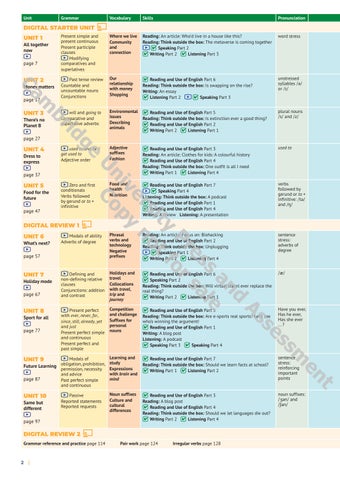
Present simple and present continuous Present participle clauses Modifying comparatives and superlatives
Where we live Community and connection
Reading: An article: Who’d live in a house like this? Reading: Think outside the box: The metaverse is coming together Speaking Part 2 Writing Part 2 Listening Part 3
word stress
Past tense review Countable and uncountable nouns Conjunctions
Our relationship with money Shopping
Reading and Use of English Part 6 Reading: Think outside the box: Is swapping on the rise? Writing: An essay Listening Part 2 Speaking Part 3
unstressed syllables /ə/ or /ɪ/
will and going to Comparative and superlative adverbs
Environmental issues Describing animals
Reading and Use of English Part 5 Reading: Think outside the box: Is extinction ever a good thing? Reading and Use of English Part 2 Writing Part 2 Listening Part 1
plural nouns /s/ and /z/
Adjective suffixes Fashion
Reading and Use of English Part 3 Reading: An article: Clothes for kids: A colourful history Reading and Use of English Part 4 Reading: Think outside the box: One outfit is all I need Writing Part 1 Listening Part 4
used to
Food and health Nutrition
Reading and Use of English Part 7 Speaking Part 4 Listening: Think outside the box: A podcast Reading and Use of English Part 1 Reading and Use of English Part 4 Writing: A review Listening: A presentation
verbs followed by gerund or to + infinitive: /tə/ and /ŋ/
Modals of ability Adverbs of degree
Phrasal verbs and technology Negative prefixes
Reading: An article: Focus on: Biohacking Reading and Use of English Part 2 Reading: Think outside the box: Unplugging Speaking Part 1 Writing Part 2 Listening Part 4
sentence stress: adverbs of degree
Defining and non-defining relative clauses Conjunctions: addition and contrast
Holidays and travel Collocations with travel, trip and journey
Reading and Use of English Part 6 Speaking Part 2 Reading: Think outside the box: Will virtual travel ever replace the real thing? Writing Part 2 Listening Part 1
/æ/
Present perfect with ever, never, for, since, still, already, yet and just Present perfect simple and continuous Present perfect and past simple
Competition and challenge Suffixes for personal nouns
Reading and Use of English Part 5 Reading: Think outside the box: Are e-sports real sports? Let’s see who’s winning the argument! Reading and Use of English Part 1 Writing: A blog post Listening: A podcast Speaking Part 3 Speaking Part 4
Have you ever, Has he ever, Has she ever …?
Modals of obligation, prohibition, permission, necessity and advice Past perfect simple and continuous
Learning and study Expressions with brain and mind
Reading and Use of English Part 7 Reading: Think outside the box: Should we learn facts at school? Writing Part 1 Listening Part 2
sentence stress: reinforcing important points
Passive Reported statements Reported requests
Noun suffixes Culture and cultural differences
Reading and Use of English Part 3 Reading: A blog post Reading and Use of English Part 4 Reading: Think outside the box: Should we let languages die out? Writing Part 2 Listening Part 4
noun suffixes: /ʒən/ and /ʃən/
DIGITAL STARTER UNIT UNIT 1 All together now page 7
UNIT 2
m Ca
Money matters page 17
There’s no Planet B page 27
used to and be / get used to Adjective order
page 37
UNIT 5
page 47
Co
Food for the future
Zero and first conditionals Verbs followed by gerund or to + infinitive
DIGITAL REVIEW 1 UNIT 6 What’s next? page 57
UNIT 7 Holiday mode page 67
UNIT 8 Sport for all page 77
page 87
Same but different page 97
t
UNIT 10
DIGITAL REVIEW 2 Grammar reference and practice page 114
2
|
en
Future Learning
m
UNIT 9
ss se As d an s le es sa Pr r y fo it t rs no ve y ni p
U
Dress to express
ge
UNIT 4
id
br
UNIT 3
Pair work page 124
Irregular verbs page 128
Oracy
Challenge
Life competencies
Using modifiers for different purposes Giving reasons to support your ideas
People say we are losing our sense of community
Learning to learn: using effective strategies for comprehension and production tasks Critical thinking: identifying and classifying information Learning to learn: evaluating learning and progress Creative thinking: generating multiple ideas Creative thinking: elaborating on and combining ideas Learning to learn: setting goals and planning for learning
m Ca
Agreeing and disagreeing Using appropriate gestures and body language Expressing your opinion respectfully Making constructive comments on other people’s ideas or views We all have a responsibility to look after the natural world
ge
id
br
Taking turns Structuring a talk to convey meaning
Chemistry, Maths What is the environmental impact of the devices we use?
Critical thinking: identifying and classifying information Learning to learn: using feedback to improve learning Collaboration: taking on different roles Learning to learn: using effective strategies for learning and retaining information Communication: adapting language use according to different cultures and social groups
Physics, Maths Does the mass of a shoe affect the force needed to move it?
ss se As d an s le es sa Pr r y fo it t rs no ve y ni p
U
Managing conflict Suggesting and applying ground rules Listening actively and responding confidently Adapting the volume of your voice
STEAM
Expressing your opinion confidently Engaging your audience
Co
The food choices we make have an effect on the planet, as well as our health
Social responsibilities: recognising personal impact on global issues
Biology, Maths
Critical thinking: identifying and classifying information Creative thinking: imagining alternatives and possibilities Creative thinking: generating multiple ideas
Being persuasive Using appropriate gestures and body language when speaking to others Using vocabulary and phrases to persuade others Using evidence to support an argument Asking follow-up questions Asking rhetorical questions
Travel and tourism can have a negative impact on places
Learning to learn: taking initiative to improve own learning; managing the learning environment Critical thinking: drawing appropriate conclusions Digital literacy: selecting and using appropriate digital tools for specific purposes
t
en
The world is changing quickly, and our education needs to be relevant for an unpredictable future
m
Checking understanding and listening actively Asking clarifying questions to check understanding Listening actively and responding confidently Using formal or informal language depending on the context
Chemistry, Technology What substances work best as sunscreen?
Leaning to learn: using effective strategies for learning and retaining information Critical thinking: evaluating arguments as a whole
Involving other people in discussions Using appropriate gestures and body language to encourage participation Participating in a discussion, asking questions and encouraging contributions from others Making positive comments about other people’s ideas
Adapting speed and emphasis Deciding what to include in a presentation and how to structure it
Critical thinking: evaluating options and recommendations to come to a decision Learning to learn: keeping track of progress
Social responsibilities: understanding aspects of other cultures Critical thinking: evaluating arguments as a whole
Arts Digital classroom: Practice Extra
|
3
m Ca
ge id br
Co
t
en
m
ss se As d an s le es sa Pr r y fo it t rs no ve y ni p U
Student’s Book
B2
Daniel Vincent
David Petrie
UNIT 1 ALL TOGETHER NOW LEARNING AIMS
THE CHALLENGE
m Ca
Skills: locate specific information in a text Grammar: learn and practise the present simple and the present continuous, present participle clauses and ways to modify comparatives and superlatives Vocabulary: learn and practise words and phrases to talk about where you live, and community and connection Critical thinking: analyse arguments, and understand opinions and attitudes Exam practice: Speaking Part 2, Writing Part 2, Listening Part 3
ge
id
br
People say we are losing our sense of community. You will: • Stage 1 Think: identify issues people have in forming and maintaining communities. • Stage 2 Prepare: research one specific community that faces issues. • Stage 3 Develop: suggest and evaluate possible solutions for that community. • Stage 4 Present: present your solutions to the class.
Co
ss se As d an s le es sa Pr r y fo it t rs no ve y ni p
U 1 Look at the photo. In pairs, discuss the questions.
What type of community does it show? 2 What other types of community can you think of? 1
2 Watch the video. Does
2
Discuss the questions with a partner. 1
3
4
What do you think ‘a sense of community’ is?
en
01
3 Watch the video again and
2 Why do people form communities? How does
What different types of community are mentioned?
2 Why do people think communities are changing?
t
modern life influence different communities?
answer the questions. 1
1
m
it mention any of the types of community you thought of in Exercise 1?
CHALLENGE Think
3 What things cause problems for
communities?
3 What different types of community are you part of?
Documentary
Grammar
Speaking
|
7
VOCABULARY WHERE WE LIVE 1
1.1 Go to the digital activity. Match the words to the photos. Listen, check and repeat.
m Ca
culturally diverse local facilities outskirts overcrowded pedestrian zone residential rural suburbs transport links urban
2
Vocabulary reference page 16
PRONUNCIATION
Go to the digital
br
pronunciation activity.
id
3 Choose two words or phrases from Exercise 1 to match each of the descriptions 1–5.
ge
1
2
4
5
Co
3
words in Exercise 1.
5 Write about an area you know, but do not name
the place. Use as many words from Exercise 1 as possible. Read your description to a partner and ask them to guess the place.
ss se As d an s le es sa Pr r y fo it t rs no ve y ni p
U
I like where I live because there are people from all over the world. However, the town centre is always too busy and it can be difficult to move around. There are only houses in the part of town where we live; there are no offices. We live about 20 minutes from the city centre, so my parents drive in every day for work. There aren’t many public buildings where I live, and it takes me 20 minutes to cycle to the library or the doctor’s. But that’s because we live on the edge of town, I guess. I don’t mind living in a city because everything is really close. One good thing is that the council has just created a car-free area on the main shopping street, where vehicles are banned. Our house is in the country, and we don’t have any neighbours, apart from the sheep! It’s nice here, but there are no buses or trains, so if you want to go anywhere, you really need a car.
4 Rewrite the sentences in Exercise 3 to include the
6 Read the statements and decide how much you
agree with them. Rank them from 1 (completely disagree) to 5 (completely agree).
• Towns and cities should increase the number of • • • •
pedestrian zones. There should be more parks and green spaces in urban areas. Urban areas should receive more government money than rural areas because more people live there. More housing should be built in rural areas to reduce overcrowding in towns and cities. Good transport links cost a lot of money and are not needed when everybody can use cars instead.
7 Work in small groups. Discuss whether you agree or disagree with the statements in Exercise 6.
CHALLENGE Prepare
1
2
3
4
8
|
Unit 1 All together now
t
en
m
Form groups of three or four people. 2 Choose a group of people who face issues around forming and/or maintaining a community. 3 Plan how you will learn more about the issues faced by the people you have chosen, and how you will look for solutions. 1
Who’d live in a HOUSE like this?
Check out these four weird and wonderful places to live from around the world!
THE EGG HOUSE
In Suwon, South Korea, there is a house that looks like a toilet! When he built it, the owner Sim Jae-deok was the Chairman of the World Toilet Association, and he wanted to increase awareness of proper hygiene and sanitation. The design for the house was modern, spacious and elegant, and had three deluxe bathrooms! When the owner died, the house became a museum dedicated to toilets, and now thousands of people visit every year.
In a crowded and hectic city of millions of people like Beijing, finding a place to live can be expensive. For Dai Haifei, the solution was simple. Being an architect, Dai decided to see what could be done with the idea of space and created an egg house – a tiny one-person solar-powered apartment that can be moved easily around the city. Although the house went unnoticed by people living nearby, the local authorities decided it was an illegal construction and Dai had to remove it.
m Ca
THE TOILET HOUSE
br
id
THE MATMATA BERBER HOUSE The town of Matmata, in southern Tunisia, is on the outskirts of the Sahara Desert. To escape the heat in the summer and the cold in the winter, the Berber people who live there created underground houses. They dug a big pit in the ground and then made rooms by digging into the rock around the edge. While the houses can look a bit shabby, they are very unique and have been used in films like Star Wars. As a result, they are a popular destination for tourists.
ge
THE FLINTSTONE HOUSE
Co
ss se As d an s le es sa Pr r y fo it t rs no ve y ni p
U
The Flintstone House in California was designed to look like the old animated series about a family living in the Stone Age. It was built using huge balloons, so every surface is rounded. The designer even added plastic dinosaurs to the garden! The neighbours are not keen, though; they are critical of the house because too many tourists are visiting the area, which is a residential suburb.
READING AN ARTICLE
1 What would your dream house be like? Discuss with a partner.
2
1.2 Read and listen to the article and answer the questions.
4
Choose five words you don’t know in the text. Follow the steps below to work out the meaning.
• Decide if the word is a noun, an adjective, a verb, etc.
• Look at the wider context. Does the sentence give you any clues?
6 Write down five categories that you can use to
evaluate a house, e.g. cost, comfort, practicality.
t
and say why.
en
3 Compare your ideas from Exercise 2 with a partner
Which house: 1 was created because of a common problem? 2 makes people think about an important issue? 3 doesn’t get any visitors? 4 protects people from extreme temperatures? 5 is unpopular with local residents?
m
Which of these places would you: • most like to go to see? • most like to stay in for a night or two? • most like to live in?
5 Read the article again and answer the questions.
7 In pairs, discuss the questions. Are there any homes in your neighbourhood that you think are unusual? Why? 2 Is it more important for a home to look attractive or be practical to live in? Why? 3 Do you think homes will still be the same 100 years from now? Why? / Why not? 1
Unit 1 All together now |
9
GRAMMAR
5 Work in pairs. Tell your partner about the following using either the present simple or the present continuous.
PRESENT SIMPLE AND PRESENT CONTINUOUS
• • • •
PRESENT PARTICIPLE CLAUSES
m Ca
6 Look at these sentences about Kate. Which sentence contains a present participle clause?
Wanting to improve her Chinese, Kate went to Beijing for a year. 2 Because she wanted to improve her Chinese, Kate went to Beijing for a year. 1
ge
id
br
7 Look at the sentences in Exercise 6. Choose the correct answers to complete the rules in the grammar box.
1.3 Listen to the conversation. Is Kate’s experience positive or negative?
U
1
Present participle clauses
grammar box.
ss se As d an s le es sa Pr r y fo it t rs no ve y ni p
2 Match the sentences to the rules in the
We use participle clauses to give information in a 1 more / less economical way.
Everybody is very friendly and helpful. 2 We’re meeting up for breakfast tomorrow morning. 3 We have classes about Chinese history and culture, too. 4 My dad is calling me.
Co
1
Present simple and present continuous
a We use the present simple for habits and
routines.
b We use the present continuous for
events happening now, and temporary or changing situations. c We use the present simple for permanent situations and facts. d We use the present continuous for future arrangements.
Grammar reference and practice page 114
3
Go to the digital activities.
3 4 5
10
|
Unit 1 All together now
8
Go to the digital activities.
9 Combine the sentences with a present participle clause. 1
2 3
4 5
6
I know that John likes reading. I gave him a book for his birthday. The man is buying a burger. He plays football for Benfica. Alfonso fell off a ladder. He broke his leg. Maria is on the bus. The bus arrives at 4 pm. Sara lives in Mexico. She can speak some Spanish. Claire went for a run in the park. She found someone’s wallet.
10 Use the words in the box to make your own sentences using present participle clauses.
eating feeling tired looking for singing sitting walking
11 Write three sentences that are true for you and three
that are false using the grammar from this page. Work in small groups and share your sentences. Try to guess which sentences are true and which are false.
HOW IS UNIT 1 SO FAR? I understand
I’m getting there
I don’t understand
t
2
We’re on holiday here for a few weeks. We … (not live) here. More and more people … (join) specialist interest groups online. Excuse me, … (you / wait) for the train to Wuhan? … (you / know) where the local theatre is? We … (meet) friends for some online gaming tomorrow evening.
Grammar reference and practice page 114
en
of the verbs in brackets.
We can use participle clauses when the participle and the verb in the main clause have 2 a different / the same subject.
m
4 Complete the sentences with the correct form 1
a future arrangement you have a habit or routine you have a temporary or changing situation in your life a permanent situation in your life
THINK OUTSIDE THE BOX!
THE
METAVERSE IS C O M IN G TO G
ET H ER
m Ca 1 …
ge
id
br
Imagine this – you’re sitting at home, looking through your social media. Suddenly, you see a photo that a friend posted a few minutes ago. She and a lot of people you know are gathering for a birthday party. You like the photo, and the friend immediately sends you a message, inviting you to join them. She lives in a different country to you, but that’s not a problem because the party’s online, taking place in a virtual house where everyone and everything is a hologram. You accept the invitation, put on your virtual reality headset, and two seconds later, you’re there.
Co
Welcome to the metaverse. And welcome to the future of community – although it’s not completely new. Online communities, popular with millions of people
READING AN ARTICLE 1
1.4 Read and listen to the article. Match the headings (a–c) to the paragraphs (1–3). a A new way to think about community
b You don’t need to be there to be there c Always online
3 … The people building the technology to make all this possible say it will bring us closer together. It will strengthen the bonds we already have with people in the real world, and, as the experience will be so realistic, we will be able to create genuine, meaningful relationships with people we meet online. It’s hard to disagree. In the age of social media and video calls, the idea that members of a community need to be physically close to one another or live together is already old-fashioned. With the metaverse, it might finally disappear altogether.
ss se As d an s le es sa Pr r y fo it t rs no ve y ni p
U
2 …
worldwide, have been with us for decades – from chatrooms in the 1990s and virtual worlds like The Sims or Second Life in the 2000s, to games like Fortnite and Roblox today. In the metaverse, however, people won’t just go online to do particular things at particular times, such as find information, join classes or play games. All that will still be a part of it, but instead, we’ll be fully integrated into the online world, using virtual reality and other technologies to study, work, shop, travel and hang out with our friends digitally – just like at that imaginary birthday party – as a normal part of everyday life.
VOCABULARY
COMMUNITY AND CONNECTION 1
1.5 Go to the digital activity and match the words to the definitions. Listen, check and repeat. belong bond gather genuine identify with interact meaningful network obligation participate in
2 Read the article again. Are these sentences true, false or not mentioned? 1 2
3
Work in pairs. Read the article again and discuss the questions. Do you think the author of the blog believes the metaverse will be good or bad for the community? Why? 2 What do you think of the metaverse? 1
1
2 3 4 5 6
What can you learn from … after-school clubs and teams? How important is it for families to … to celebrate events? How necessary is it for friends to have … conversations? Are the … between generations stronger or weaker than in the past? Do people … with one another honestly online? Do you … young people from other cultures in any way?
t
5
words in Exercise 1.
en
4
2 Complete the sentences with the correct form of the
m
3
The writer asks us to imagine a party taking place in a particular country. The metaverse will not completely change what we do online. Some of our friends in the metaverse will not be real human beings. We already have the technology necessary to build the metaverse. People’s idea of community is not the same as it was before.
Vocabulary reference page 16
3 Discuss the questions in Exercise 2 with a partner. Give reasons for your answers.
Unit 1 All together now |
11
GRAMMAR
SPEAKING
MODIFYING COMPARATIVES AND SUPERLATIVES
TALKING ABOUT A PHOTO 1 Work in pairs. Look at the photos on page 124 and discuss the questions.
1 Watch the grammar
What are the similarities and differences between the two photos? 2 Why might people choose to live in each of these places? 3 Which place would you prefer to live in? Why? 1
vlog. Which place do you think is more unusual? Why?
m Ca
02
2 Look at the examples from the grammar vlog and
br
complete the rules in the grammar box.
•
bigger than the human population. The population has been getting smaller and smaller for years. I guess the colder it gets, the more difficult it is to go outside.
ge
•
Co
We use: • the + comparative …, the + comparative … to show that as one thing changes, another thing 1 changes / does not change with it. • comparative + and + comparative to say that something changes 2 immediately / over time. • phrases like a lot, a great deal, slightly, by far to make comparatives and superlatives 3 stronger / weaker / stronger or weaker.
3 Watch again and complete the useful phrases for comparing and contrasting. 1
Both pictures … beautiful places.
2 … places look clean.
3 I’d say the … difference between the two is ( ). 4 … most of the houses in the first place look
very traditional, the second one ( ).
5 A city has more to do … the town is probably a
bit more boring.
EXAM TRAINING SPEAKING PART 2
Grammar reference and practice page 114
EXAM TIP
Go to the digital activities.
In Speaking Part 2, remember to make comparisons between each photo rather than just describing each photo separately.
4 Complete the sentences with comparative and
superlative phrases. Use the correct form of the words in brackets.
4 Go to page 126 and complete the task.
Life in the city is … than life in the countryside. (deal, exciting) 2 … place to make friends is online. (far, bad) 3 Online gaming communities are getting … every year. (friendly, friendly)
CHALLENGE Develop
1
5 In pairs, discuss the statements in Exercise 4. Do you agree? Why? / Why not? Use the modifiers from the oracy box to express your opinion.
| Unit 1 All together now
3
4
In your group, share your information from Stage 2. What have you learned about problems and possible solutions? 2 Decide what solutions you want to present. 3 Decide how you will present your solution (e.g. with a poster, podcast, etc.). 4 Create a first draft of your presentation. 1
DIGITAL CLASSROOM PRACTICE EXTRA UNIT 1
t
You can use modifiers to express your opinion both more directly and less directly. • I think … is slightly better than … • If you ask me, … is by far the worst …
2
en
Using modifiers for different purposes
1
m
ORACY
12
03
ss se As d an s le es sa Pr r y fo it t rs no ve y ni p
U
Modifying comparatives and superlatives
3
comparing the photos. Do they mention any of your ideas from Exercise 1?
id
• The Shetland pony population is a great deal
2 Watch two candidates
WRITING
3 Match the parts of an informal email (a–e) to the
AN EMAIL
a a short opening paragraph, referencing the
sections in Javi’s email (1–5). email you received
1 Work in pairs. Talk about
which buildings where you live are the oldest, the most interesting and the most beautiful.
m Ca
2 Read the exam task and Javi’s email below. Work in pairs and discuss the questions.
Who are the sender and the recipient? 2 Do they use formal or informal language? Why? 3 Does Javi answer all of Nadia’s questions? 1
b an informal final phrase, followed by your name c an informal greeting with the recipient’s name d a short final paragraph about seeing or hearing
from the recipient again e one or two main paragraphs, answering the questions
4 Work in pairs. Talk about traditional, interesting EXAM TRAINING WRITING PART 2
id
br
and unusual events in your local community.
ge
You have received this email from your English-speaking friend Nadia.
EXAM TIP Try to use phrasal verbs and contracted forms in an informal letter or email.
Subject: Important building
U
Hi Javi,
Co
ss se As d an s le es sa Pr r y fo it t rs no ve y ni p
Can you help me with a class project? We’ve been talking about important buildings in different communities. Can you tell me about an important place in your local community? Where is it? What does it look like? Why is it important? It doesn’t have to be famous! Write soon, Nadia
5 Look at the exam task below. Write your email in 140–190 words.
You have received this email from your English-speaking friend Pierre. Subject: Important event Hi there!
1 Hi Nadia,
Can you help me with a class project? We’ve been talking about important events in different communities. Can you tell me about an important event in your local community? What is it? When and where does it take place? What happens during it? Why is it important? It can be big or small.
2 Great to hear from you! Your project sounds interesting. I’ll try to help!
3 In my town, there’s an old mill next to the river. It was built hundreds of years ago. It’s made of stone and has a big wooden water wheel. Until recently, it was falling apart, but then a group of volunteers organised a campaign to raise money to save it. The campaign was really popular and the mill was completely repaired. These days, there’s a café and a museum inside.
Did you answer all of the questions in Pierre’s email? 2 Did you use informal language? 3 Did you include all the sections in Exercise 3? 4 Can you see any problems with the language (spelling, grammar, etc.)? 1
t
5 Take care, Javi
these questions to help you.
en
4 I hope that’s useful. Let me know how it goes.
6 Read your email again and revise your work. Use
m
If you ask me, it’s easily the prettiest building in the town, but I always think the older something is, the more beautiful it is. It means a lot to people here because we feel like we all helped to save it.
Write soon, Pierre
7 Now work in pairs. Read each other’s emails and
give feedback. Use the questions in Exercise 6 to help you. Make a note of your partner’s feedback and write a second draft of your email.
Unit 1 All together now |
13
MEDIATION WORKSHEET
LISTENING
ORACY Giving reasons to support your ideas
RELATED MONOLOGUES
When we discuss something with other people, it is important that we give reasons to support our ideas.
1 Work in pairs and discuss the questions. What do you think of when you think about ‘home’? 2 Which of these aspects are most important to you: comfort, location, privacy, security, your sense of style? 1
8 With a partner, discuss what you think the quotations about ‘home’ mean.
m Ca
‘Home is any four walls that enclose the right person.’ Helen Rowland
2
id
br
‘Have nothing in your houses that you do not know to be useful or believe to be beautiful.’ William Morris
1.6 Listen to someone talking about their home. Which of the ideas in Exercise 1 do they mention?
ge
‘The ache for home lives in all of us, the safe place we can go as we are and not be questioned.’ Maya Angelou
3 Match the sentences (1–2) to the paraphrased
‘Home is where one starts from.’ T.S. Eliot
U
sentences (A–D).
ss se As d an s le es sa Pr r y fo it t rs no ve y ni p
It is an expression of my personality. 2 It is full of all my books. 1
‘A house is not a home unless it contains food and fire for the mind as well as the body.’ Benjamin Franklin
A I have novels everywhere.
Co
B It shows people who I really am.
C It demonstrates my individuality.
D I have shelves packed with things to read.
4 Listen again and choose from options A–E what they say is most important about their home.
A It will help my family to have a better future. B It is a place to store souvenirs.
C It is an expression of my personality.
D It reflects the success I have achieved.
9
1.8 Listen to two students talking about the quotations and answer the questions. 1
10 The students give reasons to support their ideas. Which of the phrases from the box do they use? Listen again and check. due to the fact that if you think about it the evidence shows the main reason is
E It is full of my favourite books.
5 Work in pairs. Look at the other options in
Exercise 4. Think of different ways to express the ideas.
EXAM TRAINING LISTENING PART 3 EXAM TIP
quotations in Exercise 8? Use the phrases in Exercise 10 to support your ideas.
CHALLENGE Present
most similar to? Why?
| Unit 1 All together now
2
3
4
t
1.7 Listen to two more speakers talking about their home. Choose from options A–E in Exercise 4 what each speaker says is most important about their home.
1
Make sure you have everything you need for your presentation. 2 Check that everyone in your group knows what their role is. 3 Present your work to the class. For example, explain your poster or play your recording. 4 Make notes on any questions or feedback from the class. 1
7 Work in pairs. Which of the three speakers are you
14
11 Work in small groups. Do you agree with the
en
6
for example mainly because the facts suggest the reason why
m
Underline the key words in the options and listen for how the same idea is expressed in a different way.
Which quotation do they talk about?
2 Do they agree or disagree with the quotation?
WRAP UP Look back at the unit. Write down:
m Ca
1 some new vocabulary you learned to talk about where you live 2 one use of the present simple and one use of the present continuous
br
3 one example of a sentence with a present participle clause
id
4 one way to modify comparatives and superlatives
ge
5 your main role in the challenge 6 something in the unit you have especially enjoyed
ss se As d an s le es sa Pr r y fo it t rs no ve y ni p
U
Sustainability
1 Look back at the text on page 9. Which of the four houses do you think is more sustainable? Why? Tell your partner.
Co
2 Think of three ways to make your school more sustainable. Discuss in small groups.
SELF-ASSESSMENT: UNIT 1 How confident do you feel about:
• • • • • • • • • •
using vocabulary to talk about where you live, and community and connection? using the present simple and the present continuous? using phrases to modify comparatives and superlatives? talking about a photo in Speaking Part 2? writing an email in Writing Part 2? identifying key information in a listening text in Listening Part 3? locating specific information in a text? analysing arguments and understanding opinion and attitude? finding solutions to help people become part of a community? using modifiers and giving reasons to support your opinion?
What was your favourite part of Unit 1? Tell your partner.
m en
Look back at your self-assessment. Which areas do you feel confident about? Reflect on the areas where you feel less confident. Make sure you do extra practice in those areas to become a better learner.
t
STRETCH! YOUR CHOICE Now choose an extra activity! Option 1: Write a blog or record a vlog about your community.
Option 2: Write a quiz for your classmates about interesting communities around the world.
Option 3: Organise a class debate. Half of the class is for the statement, the other half is against. ‘Communities are getting stronger.’
Unit 1 All together now |
15
VOCABULARY REFERENCE WHERE WE LIVE
1 Match the words to the photos.
m Ca
culturally diverse local facilities outskirts overcrowded residential rural suburbs transport links urban
1
pedestrian zone
2
3
ge
id
br ss se As d an s le es sa Pr r y fo it t rs no ve y ni p
U
4
5
6
Co
7
8
9
10
COMMUNITY AND CONNECTION
2 Match the words to the definitions.
2 4 5 6 7 8 9 10 16
|
feel that you understand someone or their situation because you are similar to them feel that you are in the right place a group of people who work together or have the same interests useful, serious or important take part or become involved in an activity come together in a group real, sincere or honest something that you do because you have to DIGITAL CLASSROOM a close connection joining two or more people PRACTICE EXTRA UNIT 1 communicate with or react to each other
Unit 1 All together now
t
3
en
1
identify with interact participate in
m
belong bond gather genuine meaningful network obligation
UNIT 2 MONEY MATTERS LEARNING AIMS
ORACY
Skills: use signposting in an essay Grammar: review past tenses and learn and practise countable and uncountable nouns, and conjunctions Vocabulary: learn and practise words and phrases for talking about money and shopping Oracy: agree and disagree respectfully in a discussion Exam practice: Reading and Use of English Part 6, Listening Part 2, Speaking Part 3
m Ca
Agreeing and disagreeing • using appropriate gestures and body language • expressing your opinion respectfully • making constructive comments on other people’s ideas or views
ge
id
br
Co
ss se As d an s le es sa Pr r y fo it t rs no ve y ni p
U 1 Look at the photo. In pairs, discuss the questions.
4 Work in groups. Read the
Do you think you are good with money? Why? / Why not? 2 What are some common problems people have with money? 3 Should teenagers work to earn money? 1
2 Watch the video. What different
ways to behave in a discussion?
t
5 Think about your group discussion. Did
crossing your arms looking at the ground making eye contact nodding your head saying uh huh sitting up straight
Grammar
•
society. Money should be shared equally between everyone.
en
01
3 Which of the following are respectful
m
• Money can’t buy happiness. • Money has too much importance in
ways of making money does the video suggest?
Documentary
statements below. Choose one and talk about it to find out what everyone thinks. Then decide whether your group agrees with it or not.
the people in your group agree and disagree respectfully? How did they do this?
Oracy
Speaking
| 17
VOCABULARY OUR RELATIONSHIP WITH MONEY 1
2.1 Go to the digital activity. Complete the definitions with the correct words. Listen, check and repeat.
m Ca
allowance bank account budget debt economy live on make ends meet pay off put aside standard of living unaffordable wealthy
Vocabulary reference page 26
br
PRONUNCIATION
activity.
Go to the digital pronunciation
ge
id
2
3 Complete the text with words from Exercise 1.
Co
4 Replace the underlined phrases in the sentences
with words from Exercise 1. Make any other changes necessary. 1 2 3 4 5
Making constructive comments on other people’s ideas or views Always wait until someone has finished speaking before responding. You can: • paraphrase what they say to show you understand: It sounds like you are saying …; What I’m hearing you say is … • ask for more information to clarify what they mean: I’d be interested to know why you think that.; I think we need to look at that idea in more detail. • express an alternative idea or view: I think we also need to consider …; I see the matter differently because … • politely express disagreement: I’m not sure that would work because …; I can see some problems with that.
ss se As d an s le es sa Pr r y fo it t rs no ve y ni p
U
I used to spend all my 1… as soon as I was given it, but recently, I have been learning about how to manage my money, and I have now opened a 2…. I am thinking more about what I spend and how much I get, and I am making a 3…, so that I always have enough to 4…. I hate the idea of borrowing money or having 5…, and I am even managing to 6… some money for things I may need in the future, like university or perhaps a car.
ORACY
Now that I have a new job, I’m planning to return the money for my bank loan within the next two years. … My uncle has got a lot of money. He’s just bought a new Tesla car. … Holiday homes are too expensive for most people. … My mum lost her job, so now we’re struggling to find enough money to buy the things we need. … The amount of money and comfort people have in our town is higher than in other places in the country. …
5 Work in small groups. Read the statements
and discuss how much you agree with them. Rank them from 1 (completely disagree) to 5 (completely agree).
• Receiving an allowance is a great way to • •
learn how to manage your finances. Families who struggle to make ends meet should be given help by the government. Students should be taught how to make a budget in school.
t
en
m
18
| Unit 2 Money matters
FFuunnnnyy ! y ! e y e n o n m o m
2.2
READING GAPPED TEXT 1 Look at the photos of different forms of payment from the past and present. Discuss the questions with a partner.
When and where do you think these things were or are used as money? 2 What are the advantages and disadvantages of using each of these things as money? 1
m Ca
2 Read the article. Are any of your ideas from Exercise 1 mentioned?
3 The sentence below goes in gap 1 in the article. Look at the highlighted word and decide which word(s) around the gap it refers to.
ge
id
br
Can you imagine using rocks to pay for things? Well, if that sounds annoying, think for a moment about the Yap people of Micronesia, who used to use Rai stones. These were rocks that were carved into big circular discs. They could be bigger than a person, so you definitely didn’t want to carry them around! 1…. The value of each stone was decided by the effort made to produce it, as well as the history of ownership attached to it.
ss se As d an s le es sa Pr r y fo it t rs no ve y ni p
U
Today, they are mostly used as a ceremonial form of money.
EXAM TRAINING
Scientists studying Rai stones say that they were considered extremely valuable, but given their size, weight and relative fragility, they were not typically moved after being placed in a specific location. 2… Both rely on a central record system so that everyone knows about their value and any transfers of ownership, which means no bank accounts need to be involved.
READING AND USE OF ENGLISH PART 6
Co
EXAM TIP
Check that the language and the meaning of the sentences around the gap link to the option you choose.
4 Three sentences have been removed from
the article. Choose from the sentences A–D the one which fits each gap (2–4). Use the highlighted words to help you. There is one extra sentence which you do not need to use.
… We know the Romans paid their soldiers with salt, and researcher Heather McKillop thinks that 2,500 years ago, the Mayans may have done the same: ‘They made large amounts of salt, far more than they needed for their immediate families. This was their way of life.’ Because salt was rare and difficult to make, these ancient societies valued it highly.
3
connections between Rai stones and Bitcoin. B They are given loans in exchange, while they wait for it to mature. C This lasted until as recently as the 20th century. D We do know about other unusual forms of currency in human history.
5 Discuss the questions with a partner.
m
Which facts about other forms of money in the article surprised you? 2 What do you want to find out more about? 1
t
6
en
Today, we mostly use cash, credit cards or even cryptocurrency to pay for things, but one strange currency still exists – Parmigiano-Reggiano cheese. Because it takes nearly two years before it is ready to eat, producers take their cheese to the bank. 4 …. One bank in Italy, where this cheese is produced, has over 430,000 wheels of it in a high-security complex worth around €190 million!
A They also highlight some interesting
Work in small groups. Discuss the items in the box and put them in order from most valuable to least valuable. 100 apples a blanket a camera a painting a five-litre bottle of water an English lesson a plane ticket a novel two hours of free time Unit 2 Money matters |
19
GRAMMAR
COUNTABLE AND UNCOUNTABLE NOUNS
PAST TENSE REVIEW
5 Which of the items below are countable and which are uncountable?
1 Watch the grammar
vlog. Answer the questions. What do you think of Lucas’s spending habits? 2 Do you have a similar shopping style to Lucas? 1
books bread egg jacket jeans milk
02
m Ca
6
Go to the digital activities.
7 Choose the correct answers.
2 Look at the examples from the grammar vlog. Match the
1
br
examples to the rules in the grammar box.
When I was walking home, I felt hungry. 2 My dad had already bought me some new jeans. 3 I got this dark blue backpack for £28. 4 I used to wear only plain colours.
2
ge
id
1
U
Past tense review
3
4
ss se As d an s le es sa Pr r y fo it t rs no ve y ni p
We use past tenses to talk about: a a completed event in the past b a habit or state in the past that is not true now c an event that happened before another point in the past d an event that was happening around another event in the past
5
Co
8 Read the conversation. Find and correct eight mistakes with past tenses and countable or uncountable nouns. Claire:
Grammar reference and practice page 115
3
Go to the digital activities.
4 Choose the correct answers to complete the blog post.
NIGHTMARE SHOPPING TRIP!
you went shopping recently. Tell your group about:
• where you went • who you went with
• what you bought •
and why your own ideas
As you listen, think of two follow-up questions to ask the people in your group about what they say.
HOW IS UNIT 2 SO FAR? I understand
I’m getting there
I don’t understand
t
Unit 2 Money matters
9 Work in small groups. Think about a time when
en
|
Were you seeing the new q-phone is out? I want one, but I don’t have enough money. Wesley: No, I didn’t see that, but phones don’t interest me much. Anyway, I bought a new phone last month, after I was losing my old one. I don’t spend a lot on technologies. Most of my money goes on musics. Claire: That’s cool. Had you bought any new clothes last weekend? Wesley: I did. I used to get some new jean and a nice shirt. It looks really cool and it matches my silver sunglass as well. Claire: That’s nice. I need some new clothes, too.
m
Normally, I don’t mind shopping. As soon as I was / was being old enough to go to the shops alone, I started to help my parents. I 2 had helped / used to help them by fetching some bread or milk when we ran out, for example. However, yesterday, I went shopping with my little sister and it was terrible! I 3 lost / was losing her in the supermarket and I completely panicked! I asked an assistant to help look for her and we 4 found / had found her after about 15 minutes. She 5 used to hide / had hidden in the middle of a clothes rack! Then, when we got to the checkout, I 6 was realising / realised that I 7 had left / was leaving my wallet at home. So, we 8 hadn’t bought / didn’t buy anything in the end! 1
20
I read a news / an article about a new cryptocurrency that is being launched next year. My uncle gave me an / some advice about how to save money. I went shopping with my parents, and we bought two / two pieces of furniture for our new flat. I’m looking for a work / job in a clothes shop. For each clothes / item of clothing you buy, you get another one for free.
Is swapping ON THE RISE? Do you have any old clothes that you don’t want any more? And are there things you want to buy, but can’t afford unless there’s a sale? Well, there’s a simple solution – bartering!
2
People all over the world used to barter before the invention of currency. It simply means that you agree to exchange something you have for something you want, and it is now becoming increasingly popular again with consumers.
4
Along with goods, some people have been swapping their time. There is a growing market for time banking, which started in Japan in the 1970s. Members of a time bank spend an hour helping another member, and can receive an hour of help in return, with many people offering and receiving things like piano lessons or decorating services.
5
Reyaz Limalia from Gloucester sees time bartering as a more humanitarian form of exchange, as it focuses on helping people, rather than on products. He believes that nobody is going to change the world, but he also thinks that giving one hour of your time to help somebody else will really make a difference to them.
6
However, the barter economy has its limits. Unlike shopping in big chains, where you can browse the shelves and everything is in stock, when you barter, the items or services you require may simply be unavailable. Bartering, therefore, isn’t for everybody, but supporters think it could help us move towards a more sustainable and less commercial economic future.
m Ca
1
br
3
ge
id
Martha Devonshire from Liverpool found bartering helped her save money when she had financial difficulties during the COVID-19 pandemic. Members of Devonshire ‘s barter group swapped curries, bread and cakes for the dresses and DVDs she was willing to give away. It really helped her out with meals for her family.
Co
ss se As d an s le es sa Pr r y fo it t rs no ve y ni p
U
READING AN ARTICLE
1 Look at the definition of barter. Do people in your country barter? When and where do they do it?
barter (verb)
to exchange goods or services for other goods or services, without using money
2
2.3 In pairs, discuss the advantages and disadvantages of bartering. Then read and listen to the article.
3 What is the purpose of each paragraph? Match
paragraphs (1–6) to the purpose statements (A–F). B to give some negative aspects of the topic
D to show why someone thinks something is a good idea
SHOPPING 1
2.4 Go to the digital activity. Read the sentences and choose the correct person for each question. Listen, check and repeat. brands
browse chains consumer export in stock on offer purchases sold out unavailable
Vocabulary reference page 26
2 Choose the correct answers. 1
2 3
4
F to explain more about the topic
5
Work in small groups. To what extent do you agree with this statement?
6
Time is the most precious thing we can give another person.
Taking your time when selling out / browsing for clothes is the best way to shop. Being fashionable is all about wearing popular chains / brands. Making a chain / purchase in a shop can give people a lot of enjoyment. It’s better to support local shops than big international chains / consumers. When you see something unavailable / on offer, you should buy twice as much. Discovering the thing you want is unavailable / in stock is the worst feeling in the world.
t
E to interest the reader and introduce the topic
VOCABULARY
en
C to give an example of someone’s experience
MEDIATION WORKSHEET
m
A to provide an alternative approach related to the topic
4
THINK OUTSIDE THE BOX!
3 Work in small groups. To what extent do you agree with the statements in Exercise 2?
Unit 2 Money matters |
21
GRAMMAR CONJUNCTIONS 1
2.5 Listen to the conversation. Why does the girl want the internship?
2 Match the sentences (1–4) to the rules in the grammar box (a–d).
m Ca
We are interested in hiring you for the position. However, we need you to provide two referees. 2 Let’s do a practice interview so that you feel more confident about the real one. 3 This company has a good reputation and, as a result, I decided to apply. 4 I have applied in order to better understand what working life is like. 1
ge
id
br
Co
Grammar reference and practice page 115
3
Go to the digital activities.
4 Match the sentence halves. 1
I don’t like shopping,
2 We were very late leaving the house, 3 Mariana bought a smartwatch
4 We left really early this morning
5 Jürgen couldn’t find what he wanted in
the shop, 6 Since we’re going out later, 7 The laptop was very expensive.
a so that she could monitor her heart rate. b However, it’s perfect for gaming!
c and, as a result, we missed the start of
3 4
e maybe we should do our homework now.
6
6 Combine the sentences with the conjunction given. Make any other changes necessary. 1
2 3
4 5
6
I bought John a sandwich. John had no money. (since) Anna bought a bicycle. She wants to cycle to school. (so that) I don’t want to go to the café. I hate the smell of coffee. (because) We were in Paris. We went to the Eiffel Tower. (as) He saved money for a year. He wanted to go on holiday. (in order to) Nick lost his phone. Nick bought a new phone. (so)
7 Complete the sentences so that they are true for you. 1
2 3
4 5 6
You should / shouldn’t lend money to friends because …. It is important to give money to charity when you can. However, …. Too much money can have a negative effect on people. Therefore, …. Since there is a lot of wealth inequality, governments should …. Everyone should try to save money in order to …. Physical money will / won’t disappear soon as ….
8 Work in small groups. Share and compare your ideas from Exercise 7. Remember to justify your opinions. DIGITAL CLASSROOM PRACTICE EXTRA UNIT 2
22
| Unit 2 Money matters
t
because I think looking at clothes is boring. g so he looked for it online.
5
en
d in order to avoid the rush-hour traffic. f
2
I’m enjoying working on the project. However / Since, I don’t think I will finish on time. We bought a new car therefore / because our old one stopped working. We’ve been sent to the library in order to / so that study for our exam. The library is closed for repairs today. Therefore / Since, you will have to study at home. I bought Isa a present, as / but she didn’t like it. I want to finish this project today however / so that I’ll be free to go out this weekend.
m
the film.
1
ss se As d an s le es sa Pr r y fo it t rs no ve y ni p
U
Conjunctions We use conjunctions to show that something: a is the reason for something else. b contrasts with something else. c shows the purpose of something. d shows the result of something.
5 Choose the correct answers.
WRITING
5 Copy and complete the table with the
synonyms under the correct headings.
AN ESSAY
rawbacks benefits c ons d negatives positives pros
1 Work in small groups. Discuss the questions. In what situations do you use cash to pay for things? 2 Do you think digital currencies like Bitcoin or Ethereum are the future of money? 1
Advantages
Disadvantages
m Ca
2 In pairs, read the task and think of reasons why you agree and disagree with the statement.
6 In pairs, read the task and think of reasons why you agree and disagree with the statement.
br
Write about the following topic.
id
Governments should get rid of physical money and everyone should use electronic payments for everything. To what extent do you agree or disagree?
Write about the following topic.
ge
Give reasons for your answer and include any relevant examples from your own knowledge or experience.
If teenagers and young people want money to spend, they should get jobs and earn it. To what extent do you agree or disagree?
ss se As d an s le es sa Pr r y fo it t rs no ve y ni p
U
Write about 150 words.
Give reasons for your answer and include any relevant examples from your own knowledge or experience.
3 Read a student’s essay. Which of your ideas from Exercise 2 do they use?
Co
A cashless society
1 More and more people are using bank cards to make
purchases. Some people believe that we should stop using cash, while others disagree. In this essay, I will discuss the advantages and disadvantages of a cashless society.
2 Removing cash from society would reduce the amount of crime. Shops and banks would not have physical money in their buildings, and, as a result, it could not be stolen from them.
3 However, many poor people do not have a bank account. To remove their access to cash would be like removing
them from society, as they would not be able to buy food or pay for their electricity.
4 While I have shown how a cashless society could reduce crime, I have also demonstrated the negative impact
it could have on the poorest people. Therefore, I do not believe governments should remove physical money
each paragraph?
Plan before you write! Then write your essay.
• Make notes about your ideas for • •
the topic. Choose the best ideas. Make sure your plan includes a clear answer to the question.
8 Read your essay again and revise your work. Use these questions to help you.
Did you make a plan before writing to organise your ideas? 2 Did you use the essay structure in Exercise 4? 3 Did you use the synonyms in Exercise 5? 4 Can you see any problems with the language (spelling, grammar, etc.)? 1
9 Now work in pairs. Read each other’s essays and give feedback. Use the questions in Exercise 8 to help you. Make a note of your partner’s feedback and write a second draft of your essay.
t
en
4 Look at the student’s essay again. What is the purpose of
7
m
from society.
Write about 150 words.
10 Swap your essay with a partner. Do you
agree with their conclusion? Ask them two questions about the ideas they have included in their essay.
Unit 2 Money matters |
23
ORACY
LISTENING A MONOLOGUE 1 What do you think a mystery shopper is? What do
you think the job involves? Discuss the questions with a partner.
2
AGREEING AND DISAGREEING • using appropriate gestures and body language • expressing your opinion respectfully • making constructive comments on other
m Ca
2.6 Listen to the first part of a talk by a student, Lucy, about being a mystery shopper. Check your ideas from Exercise 1.
3 Look at the Listening Part 2 question below. Listen
1 Work in small groups. Discuss the statements. To
what extent do you agree or disagree with them?
id
br
again and decide which answer is correct. Why are the other two answers incorrect?
people’s ideas or views
Lucy found out about her first job from 1 a website / a family friend / the local council.
ge
• Words are the only way you can express what you want to say.
• If you think someone is wrong, it is important
4 Look at question 2 and the script for the next part
U
to tell them.
of Lucy’s talk. Find the key words in the script.
ss se As d an s le es sa Pr r y fo it t rs no ve y ni p
• It is rude to disagree with other people.
For many companies, Lucy says the most important information is the 2….
2 Watch the first part of
Co
the video. Which of the statements in Exercise 1 are the students discussing? Do they agree or disagree with the statements?
I can be asked to find out about anything from how clean the shop is, to how long you wait to pay, though the main thing clients want to know about is the attitude of their staff.
5 Look at questions 3–6 in Exercise 6. What type of word (noun, verb, adverb, etc.) would fit in each gap? Think of a word that might fit each gap.
EXAM TRAINING LISTENING PART 2 EXAM TIP
Read the sentences before you listen and try to predict what information is missing.
6
Use positive body language to show you are listening and agree. 2 Avoid negative body language when you disagree. 3 Use appropriate phrases to politely disagree with different opinions. 4 Use appropriate phrases to agree with different opinions. 1
t
Unit 2 Money matters
en
shopper needs.
m
7 Work in pairs. Discuss which qualities a mystery |
04 Now watch the second part of the video. Which techniques do the students use to agree and disagree politely?
2.7 Listen to Lucy’s talk. For questions 3–6, complete the sentences with a word or short phrase. Mystery Shopper Lucy says she often gets to keep the 3… she buys while working. For one low-paid job, Lucy had to complete an 4…. For more complicated jobs, Lucy often has to complete a 5…. She says that being 6… is an important quality for a mystery shopper.
24
3
03
ORACY 4
05 Now watch the third part of the video. Compare what the students say to the techniques you ticked in Exercise 3. To what extent do you agree with their reflection on the task?
SPEAKING A CONVERSATION
5 Watch the second part of the video again. Which
m Ca
student uses the phrases: Liam or Nadia? 1
2 3
4 5
6
id
br
I think you’re right. That’s a good point. I’m not sure … I know what you’re saying, but … That’s true. Maybe, but …
ge
6 Copy and complete the table with the expressions.
Co
Agreeing
doing part of the Speaking exam. Do they take turns to speak? What phrases do they use to agree and disagree?
06
EXAM TRAINING SPEAKING PART 3 EXAM TIP Take turns in the conversation and give your partner the chance to speak.
ss se As d an s le es sa Pr r y fo it t rs no ve y ni p
U
Good idea. I agree with you up to a point, but … I know what you’re saying, but … I think it might be better to … I think the same. I’m afraid I don’t agree. I think you’re right. I’m not sure (that) … Maybe, but … That’s a good point. That’s true. Yes, absolutely.
1 Watch two candidates
Disagreeing
2 Work in pairs. Talk to each other for about two minutes about how shopping can be more sustainable. buy food buy second-hand things locally
buy online
HOW CAN SHOPPING BE MORE SUSTAINABLE?
buy fresh produce in season
swap clothes instead of buying them
SELF-ASSESSMENT: UNIT 2 How confident do you feel about:
t
en
using vocabulary to talk about money and shopping? using past tenses? using countable and uncountable nouns? using conjunctions to show contrast, purpose, reason and result? completing the gaps in a reading text in Reading and Use of English Part 6? predicting missing information in Listening Part 2? taking turns in the conversation Speaking Part 3? using synonyms in an essay? agreeing and disagreeing respectfully in a discussion?
m
• • • • • • • • •
What was your favourite part of Unit 2? Tell your partner.
DIGITAL CLASSROOM PERSONALISED LEARNING
Unit 2 Money matters | 25
VOCABULARY REFERENCE OUR RELATIONSHIP WITH MONEY
1 Complete the definitions with the correct words.
m Ca
allowance bank account budget debt economy live on make ends meet pay off put aside standard of living unaffordable wealthy A … person is someone who is rich. If you have just enough money to pay for the things you need, then you can …. A country’s … is the system that creates and uses products and money. To keep your money safe, you give it to a financial institution, who keep it in your …. A … is the plan for how much money you have and how you will spend it. A … is an amount of money that you owe someone. The money that you use to buy the things that you need is the money that you …. When you … money, you save it for the future. Parents often give their children an … to spend on things they want. When you return the money you borrowed for something, you … a loan. How much money or comfort someone has is their …. If something is too expensive for people to be able to buy, it is ….
br
1
2
4
ge
id
3
6 7 9 10 11 12
Co
8
ss se As d an s le es sa Pr r y fo it t rs no ve y ni p
U
5
SHOPPING
2 Read the sentences and choose the correct person for each question. Leanne: ‘There’s one company that has supermarkets in almost every town in the UK, and I shop there because they always have everything I need.’
Reggie: ‘My main responsibilities are to advise people who buy our products and use our services.’ Francine: ‘I probably buy more things than I need.’ Jack: ‘I always look to see if I can get a discount or if there is a two-for-one deal.’
2 4 5 6 7 8 9 10 26
Karolina: ‘I wasn’t sure I would find it, but there were lots in the shop.’
Rick: ‘I tried every shop in town to find one, but apparently they don’t make them any more.’
Who shops at chains? Who likes browsing? Who wanted something the shop had in stock? Who likes to buy brands? Who wanted something that was permanently unavailable? Whose job is helping consumers? Who exports products for their company? Who never buys anything unless it’s on offer? Who wanted something that had sold out? Who makes too many purchases?
| Unit 2 Money matters
t
3
Charlie: ‘The shop told me someone had bought the last one five minutes before I arrived!’
en
1
Lucia: ‘My company sells its products in other countries, and it’s my role to organise that.’
m
Ruth: ‘I prefer to buy products made by companies that I recognise.’
Rudolph: ‘I prefer to look at lots of products before I choose what I want.’
DIGITAL CLASSROOM PRACTICE EXTRA UNIT 2
UNIT 3 THERE’S NO PLANET B LEARNING AIMS
THE CHALLENGE
m Ca
Skills: organise the structure of a talk Grammar: learn and practise tenses for talking about the future, and adverbs for comparison Vocabulary: learn and practise words and phrases to talk about environmental issues and to describe animals Critical thinking: summarise key points in a text Exam practice: Reading and Use of English Parts 2 and 5, Writing Part 2, Listening Part 1
ge
id
br
We all have a responsibility to look after the natural world. You will: • Stage 1 Think: identify environmental issues that are impacting communities. • Stage 2 Prepare: research one specific environmental issue that your community faces. • Stage 3 Develop: suggest and evaluate possible solutions for that issue. • Stage 4 Present: present your solutions to the class.
Co
ss se As d an s le es sa Pr r y fo it t rs no ve y ni p
U 1 Look at the photo and read the quotation. Choose the best sentence to summarise the quotation.
A Humans need to find another planet to live on.
B Planet Earth is a small and unimportant part of
the universe. C There is no other place than Earth that humans can live on.
1
2
Discuss the questions with a partner. 1
3
4
What environmental issues can you think of?
2 Which of these issues are having an impact on
t
Grammar
CHALLENGE Think
01
en
Documentary
are some of the consequences of climate change?
m
‘From this distant vantage point, the Earth might not seem of any particular interest. But for us, it’s different. Consider again that dot. That’s here. That’s home. That’s us. On it everyone you love, everyone you know, everyone you ever heard of, every human being who ever was, lived out their lives … The Earth is the only world known, so far, to harbour life. There is nowhere else, at least in the near future, to which our species could migrate.’ Carl Sagan
2 Watch the video. What
your local environment? 3 Where can you find out more about these issues?
|
27
VOCABULARY ENVIRONMENTAL ISSUES 1
3.1 Go to the digital activity. Match the words and phrases to the photos. Listen, check and repeat.
m Ca
air pollution deforestation fossil fuels global warming household waste landfill overfishing overpopulation rising sea levels species loss urban sprawl water pollution
br
2
Vocabulary reference page 36
1
Cora
4 Kyle 5 Beatriz
2 3 4 5
6 7 8 9
Many families are now recycling to reduce their …. Planting more trees in our city helps reduce …. There are strict laws about what type of rubbish can be put in …. Population growth and the need for more homes is one of the main causes of …. The government is trying to replace … as the main source of energy, and is investing in renewable methods. Urban planners are designing smarter cities to support growing populations and prevent …. Sustainable fishing practices are gaining popularity to prevent …. Renewable forms of energy are used instead of fossil fuels to help combat …. Scientists studying … say that one third of all plants and animals on Earth may be extinct by 2070. Many communities are now planting trees to combat ….
Do you know what these animals are?
| Unit 3 There’s no Planet B
3.3 Read and listen to the article. Which is the best title? A Save the ugly animals, too!
B Elephants and tigers need your help! C Prevent species extinction!
3 Look at question 1 below and find the part
of the article it refers to. Then, quickly decide what you think the answer is. 1
What point does the writer make in the first paragraph?
4 Look at the options for question 1. Which
option best fits your answer in Exercise 3?
A The media focuses on millions of species
in its coverage of environmental issues. B The general public is very interested in the media’s coverage of environmental issues. C Environmentalists encourage the media to report on animals like tigers and gorillas. D The general public’s interest in particular species can lead to wider benefits for nature.
5 Compare your answer with a partner. Which
answer is correct? Why are the other options incorrect?
t
Which sentences in Exercise 3 are true for your community? 2 What about in other parts of your country? 1
2
en
4 Work in small groups and discuss the questions.
28
1
m
10
the questions with a partner.
think of?
Co
1
1 Look at the photos in the article and answer
2 What other unattractive creatures can you
3 Complete the sentences with words or phrases from Exercise 1.
MULTIPLE-CHOICE TEXT
ss se As d an s le es sa Pr r y fo it t rs no ve y ni p
3 Teresa
READING
U
2 Rob
ge
id
3.2 Listen to five people talking about environmental problems. Copy and complete the table with two things each person talks about.
EXAM TRAINING READING AND USE OF ENGLISH PART 5
EXAM TIP After you have chosen the answer to a question, check that the other three options are wrong.
m Ca
6 Now read the article again. For questions 2–4 choose the answer (A, B, C or D) which you think fits best according to the text.
br
Planet Earth hosts an incredible range of species, but when we read articles online or in magazines, we only ever see the same dramatic images of polar bears and elephants. This limited attention comes from the public’s strong interest in larger, more adorable creatures, and environmental organisations take advantage of this to raise money and to draw attention to critical conservation matters. Protecting these endangered species is critically important, but it would be much harder to help them if tigers and gorillas were not such impressive and well-known creatures.
2 What does the writer say in the second
ge
id
paragraph? A Some animals do not get the support they need because they are ugly. B Popular creatures do not need the level of support they receive. C The Ugly Animal Preservation Society gives awards for conservation efforts. D The general public are generously helping blobfish conservation efforts. 3 Simon Watt mentions the naked mole rat as an example of an animal that A is at great risk of extinction. B his organisation is trying to save. C we should not consider ugly. D is benefitting human science. 4 What is the writer’s overall view of animal conservation? A Our current extinction rate is a natural phenomenon. B We need to take a wider view of the issue. C We should focus on saving popular animals. D Protecting animals like elephants is good for biodiversity.
ss se As d an s le es sa Pr r y fo it t rs no ve y ni p
U
Co
In contrast, in its annual awards, the Ugly Animal Preservation Society named the blobfish the winner of the ‘most hideous species’ category. The group focuses its efforts on protecting Mother Nature’s unattractive but at-risk inhabitants through public-awareness campaigns. Lions and tigers and bears need as much help as any other endangered species, but the level of support they receive from members of the public far exceeds that given to the unloved and ugly creatures of the world, such as the blobfish. Simon Watt, biologist and founder of the Ugly Animal Preservation Society, argues that ugly animals play an equally important role in the environment and our lives. Consider the naked mole rat, which is nearly as disgusting to humans as the blobfish. Watt states that science has revealed that mole rats are pain-resistant and unable to develop cancer. As a result of this, he says, cancer research for humans has made a bit more progress, so perhaps the mole rat no longer appears as unattractive as it once did.
creatures in their campaigns? Discuss in small groups.
8 Choose an ugly endangered animal. Find out why it
m
needs saving. Present your animal to the class.
1
1
2
3
4
t
CHALLENGE Prepare
en
The current extinction rate for plants and animals, according to many biologists, is greater than anything the world has experienced since the vanishing of the dinosaurs, nearly 65 million years ago. The problem is that when we prioritise the preservation of well-known species, we neglect so much else of everything we share our planet with. Preventing the rhinoceros from going extinct is deeply important, but, for the protection of life on this planet as a whole, someone needs to think of the blobfish and all the other ugly species like them.
7 Should environmental organisations use more ugly
Form groups of three or four people.
2 Choose one local environmental issue. 3 Plan how you will learn more about the issue
and how you will look for solutions.
Unit 3 There’s no Planet B
|
29
GRAMMAR WILL AND GOING TO 1 Watch the grammar vlog.
What is Mel going to start doing and why?
02
m Ca
2 Look at the examples from the grammar vlog. Match the examples to the rules in the grammar box.
I’ve already decided that I’m not going to buy plastic bottles any more. 2 You know what? Come to think of it, I won’t use plastic bags from shops either. 1
ge
id
br
will and going to
6 Look at the topics in the box. Make predictions
a We use will for decisions made at the moment
about the future using will and going to.
U
of speaking. b We use going to for decisions made before the moment of speaking.
ss se As d an s le es sa Pr r y fo it t rs no ve y ni p
after school today your education the environment technology your travel plans this weekend
Grammar reference and practice page 116
Co
3
Go to the digital activities.
ORACY
4 Choose the correct answers. 1 2 3 4 5 6
I’ve got the tickets! We’ll go / ’re going to go to the Algarve on holiday! Do you need some help? I’ll carry / ’m going to carry that bag for you. I saw the forecast, and it’ll rain / ’s going to rain this weekend. I have a feeling that Marc will be / is going to be late, so let’s not leave for another half hour. I won’t spend / ’m not going to spend this money; I’m saving up for a new phone. In my view, Ireland probably won’t win / isn’t going to win the World Cup.
5 Complete the sentences with will or going to and the correct form of the verbs in brackets. 1
5 6 7
predictions from Exercise 6 and discuss which are the most likely to come true.
8 In the grammar vlog, Mel asked about other changes to help the environment. Work in pairs. Try to think of five more ideas.
STRETCH! You can make predictions with going to and will stronger or weaker by using adverbs such as certainly, definitely, possibly and probably. Look again at your predictions in Exercise 6. Make them stronger or weaker using an adverb.
Jane will definitely get the promotion; she knows the job better than anyone. They’ve only just set off, so they’re probably not going to arrive before lunchtime.
HOW IS UNIT 3 SO FAR? 30
| Unit 3 There’s no Planet B
I understand
I’m getting there
I don’t understand
t
4
7 Work in groups of three or four. Share your
en
3
Remember to give everyone the opportunity to express their views or ideas, and try not to interrupt other people when they are speaking.
m
2
Be careful! You … (break) something! Thank you for the book. I … (give) it back to you when I’ve finished it. Maria … (not go) to the party on Saturday because she’s visiting her aunt. Matt’s got a big test tomorrow, so he … (study) all evening. I drank too much coffee, so I … (not sleep) well tonight. I think we … (have) enough time before the flight to get some lunch. I forgot it’s Joe’s birthday today! I … (buy) him a present this afternoon.
Taking turns
THINK OUTSIDE THE BOX!
IS
EXTINCTION EVER A GOOD T HIN G?
m Ca
In 1977, Ali Maow Maalin, a hospital cook in Somalia, was diagnosed with smallpox, a disease that killed one in three people who got it and was highly contagious, meaning it spread even more rapidly than diseases like flu or COVID-19. Maalin caught the disease while working for the World Health Organisation (WHO) near the end of a massive global vaccination campaign but was treated successfully and survived. He is the last known person to have caught the disease, and two years later, the WHO declared that smallpox had been eradicated globally. It was extinct.
ge
id
br
So, does this mean that extinction can be a good thing? Some researchers suggest that approximately 99% of all the species that have existed on Earth throughout its history are no longer in existence, with many species disappearing during one of the five different mass extinctions (when lots of animals and plants all died out at the same time). However, when one species dies out, it leaves a gap in the ecosystem that can be filled by another, so it is possible these events have actually enhanced the variety of life on our planet. If the dinosaurs still walked this Earth, humans and many other mammals probably wouldn’t be here at all!
ss se As d an s le es sa Pr r y fo it t rs no ve y ni p
U
However, even scientists that view extinctions positively are warning society that our current rate of species extinction is unsustainable. Some estimates state that we are losing species more quickly than ever before and they also point out that the causes are different: it isn’t an asteroid hitting the Earth or a volcanic eruption, it is that species are losing the places they live as a direct result of human activity.
Co
Bees and other species of insects are in danger of extinction due to the loss of their habitat, as well as the use of pesticides and other chemicals by humans. These insects are vital in the pollination of plants, and without them, crops could fail, which could lead to food shortages for us all. If we’re not careful, the next mass extinction could be us.
MEDIATION WORKSHEET
READING AN ARTICLE
1 Look at the pictures. What do they
show? What do you think they all have in common?
2
DESCRIBING ANIMALS 1
summarise the article.
A The article is mostly positive about
2
PRONUNCIATION
Go to the digital pronunciation activity.
3 Complete the sentences with the correct form of the words from Exercise 1. 1
2 3 4 5 6
My cat’s got very sharp …. That bird can’t fly properly. I think it’s got a broken …. Look at this beautiful … that I found on the beach! Rhinos are endangered because people kill them to take their …. Monkeys can use their … to hold onto trees, as well as their hands! Many people don’t agree with using animal … to make coats or clothes.
t
Smallpox was easy to catch and killed or hurt millions of people. 2 Mass extinctions may have been beneficial to humans. 3 The current rate of species extinction is decreasing. 1
Vocabulary reference page 36
en
Work in pairs. Read the article again and decide if the summaries below are accurate. Change any that are inaccurate.
claw feather fin fur hoof paw scales shell tail wing
m
extinction. B The article is mostly negative about extinction. C The article is neutral about extinction.
3.5 Go to the digital activity. Match the words to the photos. Listen, check and repeat.
beak horn
3.4 Read and listen to the article and check your answers in Exercise 1.
3 Choose the best sentence to
4
VOCABULARY
4 Work in pairs. Think of three different animals. Use the words
in Exercise 1 to describe them to your partner, without saying what the animals are. Can your partner guess your animals?
Unit 3 There’s no Planet B
|
31
GRAMMAR COMPARATIVE AND SUPERLATIVE ADVERBS
READING AND USE OF ENGLISH SHORT TEXT (OPEN CLOZE) 1 Read the text in Exercise 2 quickly and answer the questions.
m Ca
Which question tests: a a common verb? b a defining relative clause? c a dependent preposition? d a linking expression to list ideas? e a linking expression to show consequence?
br
or false.
ge
id
1 Work in pairs. Decide if the sentences are true Reusable bags are better for the environment. 2 To shop better, you can buy more local produce. 3 Travelling by car is more responsible than travelling by bike. 1
Co
3.6 Listen to the conversation and check your answers in Exercise 1.
3 Match the sentences (1–4) to the rules in the grammar box (a–d). 1
READING AND USE OF ENGLISH PART 2
EXAM TIP When you have finished, read the whole text again to make sure that it makes sense.
ss se As d an s le es sa Pr r y fo it t rs no ve y ni p
U
2
EXAM TRAINING
2 Read the text below and think of the word
which best fits each gap. Use only one word in each gap.
You can travel more responsibly.
To survive, wildlife needs clean, natural places 1 … they can access food and water. Human activity means these natural habitats are disappearing more quickly than before, and, 2… a result, many organisations are now working harder than ever to preserve them. One way 3 … through restoring natural habitats to their previous state, for example, in the coastal wetlands of the Mississippi River. 4… method involves creating ‘wildlife corridors’ to connect natural habitats that have been separated 5… human activity.
2 I took the job the most seriously. 3 You’re doing better than I am.
4 I guess I just worked the hardest.
Comparative and superlative adverbs
a With adverbs ending in -ly, we add more to
form the comparative. b With adverbs ending in -ly, we add the most to form the superlative. c With short adverbs we add -er for comparative and -est for superlative forms. d We use irregular comparative and superlative forms for adverbs such as well.
Grammar reference and practice page 116
1
2
3
4
In your group, share your information from Stage 2. What have you learned about the issues and possible solutions? 2 Decide what solutions you want to present. 3 Decide how you will present your solution (e.g. with a poster, podcast, etc.). 4 Create a first draft of your presentation. 1
Go to the digital activities. the adverb in brackets.
| Unit 3 There’s no Planet B
DIGITAL CLASSROOM PRACTICE EXTRA UNIT 3
t
The humpback whale can travel … (far) of all the animals on the planet. 2 Plastic bags decay … (slowly) than paper bags. 3 Dolphins can jump … (high) of all animals. 4 The saola, or Asian Unicorn, is going extinct … (rapidly) than any other species on Earth. 1
en
5 Complete the sentences with the correct form of
m
4
32
CHALLENGE Develop
WRITING
4 Look at Gabriella’s notes and find the complex
sentences that she uses to express her ideas in her article. What conjunctions or techniques does she use?
AN ARTICLE 1 Work in small groups. Discuss the positive and
1 Air pollution from traffic. People alw ays use cars. 2 Size of Coimbra. Bus network. Main destinations – schools, shopping, etc.
negative aspects of living in towns and cities.
2 Read the exam task with a partner. What three
things would you improve in your town or city?
m Ca
You see this announcement on a local Englishlanguage website.
5 Look at the exam task in Exercise 6. In pairs, think of two or three causes of species loss. Make notes similar to Gabriella’s notes in Exercise 4.
br
ARTICLES WANTED
id
Making a difference!
EXAM TRAINING WRITING PART 2
ge
We are looking for articles about how individuals can help the environment in our town and we would like to hear your ideas on what changes you think need to be made.
EXAM TIP
U
Remember to include a title and organise your ideas into paragraphs.
The best articles will be posted on our website.
6 Using your notes, write your article. Write
Co
ss se As d an s le es sa Pr r y fo it t rs no ve y ni p
Write an article telling us what people could do differently, why you think it is necessary and what the consequences could be.
Write your article.
140–190 words.
You see this announcement in a student magazine.
3 Read Gabriella’s article. Does she cover all the points in the task?
A R B M I O C
MAKING
ARTICLES WANTED Protecting endangered species
BETTER!
Next month, our magazine is focusing on endangered species that go extinct, and we want to hear from you! We are looking for articles about why animals go extinct, and what we can do to prevent this.
Many people know Coimbra as an ancient city in the centre of Portugal. It is a beautiful place with lots of historic buildings and friendly people, but, of course, we have problems, too!
Write an article about some of the causes of extinction and say how we can protect endangered species.
If you work or study in Coimbra, then you will have noticed all the air pollution. There is always lots of traffic on the roads which contributes to this because, even though many people only travel short distances, they prefer to go by car.
Write your article.
m
7 Read your article again and revise your work. Use these questions to help you. 1
Did you cover the main points in the task?
t
This is a simple change that we could all make to improve the environment in Coimbra. It would improve the air quality and the population would be healthier as a result!
en
To solve this problem, I think more people should use public transport. Coimbra is quite a small city, but there are still, nevertheless, lots of buses which can take people to important destinations, such as schools, hospitals and shopping centres.
The best articles will be included in the next issue of the magazine.
2 Did you use complex sentences to express
your ideas? 3 Can you see any problems with the language (spelling, grammar, etc.)?
8
Now work in pairs. Read each other’s articles and give feedback. Use the questions in Exercise 7 to help you. Make a note of your partner’s feedback and write a second draft of your article. Unit 3 There’s no Planet B
|
33
LISTENING SHORT DIALOGUES 1 Discuss the questions in pairs. Have you ever been to a zoo or a safari park? 2 What advice would you give to people visiting these places? 1
m Ca 2
3.7 You will hear someone talking about visiting a safari park. Are your ideas from Exercise 1 mentioned?
br
3 Look at question 1 and the note below. Choose the
You will hear an extract from a safari-park audio guide. What are people warned not to do? A disturb the animals B leave litter behind C feed the animals
ge
1
id
best paraphrase for option A. Then, in pairs, write paraphrases for options B and C.
ORACY Structuring a talk to convey meaning
U
ss se As d an s le es sa Pr r y fo it t rs no ve y ni p
It is important to structure your talk so it is easy for people to follow. Start with general information about the subject and then move on to more specific points.
Co
distract / observe / annoy the animals 4 Listen again and choose the correct answer for question 1.
7
5 Look at questions 2–4 in Exercise 6 and think about
A describes the current situation, describes the
how the ideas in the options may be expressed.
context, describes the goal B describes the goal, describes the current situation, describes the context C describes the context, describes the current situation, describes the goal
EXAM TRAINING LISTENING PART 1 EXAM TIP
Choose the answer you think is correct the first time you listen. Check the other options are wrong when the recording is repeated.
6
3.8 You will hear people talking in three different situations. For questions 2–4, choose the best answer (A, B or C). 2 You hear two students talking about a
a background information about the camel b efforts to save the camel
c how close to extinction the camel is d why the camel is threatened
9
In pairs, research the Bactrian camel and give a short presentation. Follow the structure in Exercise 8.
CHALLENGE Present
1
2
3
Make sure you have everything you need for your presentation. 2 Check that everyone in your group knows what their role is. 3 Present your work to the class. For example, explain your poster or play your recording. 4 Make notes on any questions or feedback from the class. 1
4
t
| Unit 3 There’s no Planet B
Put the points in the best order for the talk.
en
34
8 You are going to give a talk on the Bactrian camel.
m
geography test. How does the boy feel? A tired B anxious C bored 3 You hear two friends talking about a documentary. What do they agree on? A how long it took to make B how beautiful life is in the oceans C how many problems the oceans face 4 You hear part of a radio interview with a campaigner. What is she doing? A stating an intention B giving an opinion C describing future events
3.9 Listen again to the campaigner in Exercise 6. How does she organise her talk? Choose the correct answer. Why is this an effective structure?
WRAP UP Look back at the unit. Write down:
m Ca
1 some new vocabulary you learned to talk about the environment 2 one key difference in the use of will and going to
3 a true sentence about yourself using a comparative or superlative adverb
br
4 one way in which you can improve your writing in the future
id
5 your main role in the challenge
ge
6 something in the unit you have especially enjoyed
U
Sustainability
ss se As d an s le es sa Pr r y fo it t rs no ve y ni p
1 Think of three things you can do to be more sustainable at home.
2 Choose one of the things in Exercise 1 and write a short paragraph,
Co
giving reasons to convince a family member of why they should do it.
SELF-ASSESSMENT: UNIT 3 How confident do you feel about:
• • • • • • • • • • •
using vocabulary to talk about animals and the environment? using will and going to when making predictions and communicating decisions? using comparative and superlative adverbs? completing the gaps in Reading and Use of English Part 2? reading a long text and answering multiple-choice questions in Reading and Use of English Part 5? writing an article in Writing Part 2? choosing the answer the first time you listen in Listening Part 1? organising the structure of a talk? summarising key points in a text? finding solutions to local environmental issues? taking turns and structuring a talk to convey meaning?
What was your favourite part of Unit 3? Tell your partner.
t
STRETCH! YOUR CHOICE
en
m
Reflect on the Challenge in this unit. Was it clear what your role was? How did you contribute to the overall success of the task? Discuss with a partner.
Now choose an extra activity! Option 1: Write a blog or record a vlog about an endangered species you think doesn’t get enough attention.
Option 2: Create a volunteer group in your school to raise awareness about an environmental issue.
Option 3: Make a personal action plan with ways to reduce your impact on the environment.
Unit 3 There’s no Planet B
|
35
VOCABULARY REFERENCE ENVIRONMENTAL ISSUES
1 Match the words and phrases to the photos.
1
3
4
7
8
id
br
2
ge
m Ca
air pollution deforestation fossil fuels global warming household waste landfill overfishing overpopulation rising sea levels species loss urban sprawl water pollution
5
6
Co
ss se As d an s le es sa Pr r y fo it t rs no ve y ni p
U
9
10
DESCRIBING ANIMALS
11
12
2 Match the words to the photos. beak 1
5
claw
feather
fin
fur
hoof
horn
paw
scales
shell
tail
wing
3
4
6
7
8
10
11
12
t
en
m
2
9
DIGITAL CLASSROOM PRACTICE EXTRA UNIT 3
36
| Unit 3 There’s no Planet B
UNIT 4 DRESS TO EXPRESS LEARNING AIMS
ORACY
m Ca
Skills: use conjunctions and phrases to organise ideas in an essay Grammar: learn and practise used to and be / get used to, and adjective order Vocabulary: learn and practise words and phrases to talk about clothes and fashion Oracy: manage conflict Exam practice: Reading and Use of English Parts 3 and 4, Writing Part 1, Listening Part 4
Managing conflict • suggesting and applying ground rules • listening actively and responding confidently • adapting the volume of your voice
ge
id
br
Co
ss se As d an s le es sa Pr r y fo it t rs no ve y ni p
U 1 Look at the photo. How original do you think the girl’s style is?
2 In pairs, discuss the questions.
• dominating the •
discussion using defensive body language
• disagreeing politely • making eye contact • ignoring the
contributions of others
5 Work in groups. Read the statements below and choose one
01
t
video. Are any of your ideas from Exercise 2 mentioned?
en
to discuss. Some group members have to agree with the statement and others have to disagree with it.
• All students should wear a school uniform. • Wearing fashionable clothes gets you more respect. • It is a problem that clothes are so cheap nowadays.
3 Watch the
Documentary
likely to a) increase conflict and b) help manage conflict? Discuss your answers in pairs.
m
What kind of clothes do you wear to go out with friends? 2 What kind of clothes were fashionable: • 20 years ago? • 50 years ago? • 100 years ago? 1
4 During a discussion, which of these are
6 Think about your group discussion. Was there any conflict? How did you try to resolve the conflict?
Grammar
Oracy
|
37
VOCABULARY ADJECTIVE SUFFIXES
READING AND USE OF ENGLISH
1
WORD FORMATION
4.1 Match the words to the photos. Listen, check and repeat.
1 Look at question 1 in Exercise 2 and answer the questions.
What type of word fits in the space? 2 What type of word is brand? 3 Which suffix do you need to add to brand? 4 Do you need to make any spelling changes? 1
m Ca
baggy beautiful buttoned colourful flowery formal hooded sleeveless spotted striped traditional zipless
br
READING AND USE OF ENGLISH PART 3 2 … T-shirt
EXAM TIP
ge
id
… shoes
1
EXAM TRAINING
ss se As d an s le es sa Pr r y fo it t rs no ve y ni p
U
Remember that it may be necessary to add a prefix or suffix to the word given.
2 For questions 1–4, read the text below. Use
5 a … jacket
7 … jeans
The history of the baseball cap goes back to the 19th century. The earliest ones were made of straw or wool and were 0 FUNCTIONAL ; they were designed to keep the sun out of the players’ eyes. In 1901, the Detroit Tigers put a picture of a tiger on the front. By 1945, every baseball team had its own 1… cap. They quickly became popular with fans and became one of the United States’ most 2… fashion exports. By the 1980s, everyone from rock stars to 3… princesses were wearing them. These days, there are 4… designs, and while a baseball cap might still show which team you support, it can also just add to your style.
6 a … wedding dress
8 a … umbrella
10 … shoes
BRAND
SUCCESS GRACE
COUNT
Use strategies for learning and retaining information. When you learn a new word, use a spidergram to record other words that you can make from it using suffixes. caring
11
2
… jeans
12
a … raincoat
Go to the digital activity. Write the nouns that the adjectives in Exercise 1 are made from. Vocabulary reference page 46
38
| Unit 4 Dress to express
carer carefree
care
careful careless
t
en
3
FUNCTION
m
9 a … headscarf
4 … clothing
Co
3 … socks
the word given in capitals at the end of some of the lines to form a word that fits in the gap in the same line.
ORACY
READING
Listening actively and responding confidently
AN ARTICLE
Listen to what your partner says and respond to what they are saying. Do not just wait for them to finish speaking so that you can talk!
1 Look at the photo. What message do you think it is trying to communicate?
2
4.2 Read and listen to the article. Match the headings (a–c) to the paragraphs (1–3).
m Ca
4 Discuss the questions in pairs. Make sure you listen
a New colours, new ideas
actively and respond to what your partner says.
b Nothing in fashion stays the same
1
What other things are typically associated with boys and girls? Think about: • school subjects • sports • hobbies • behaviour 2 Do you think these associations have a positive or a negative effect on young people? 3 Should we change these associations? If so, how?
c Dressing daughters and sons alike
br
3 Read the article again and answer the questions. In what way did people treat their sons and daughters the same in the past? 2 How did the media help create the idea that certain colours were for boys and girls? 3 How did the fashion change in the middle of the 20th century? 4 What does the writer say is different today?
ge
id
1
ss se As d an s le es sa Pr r y fo it t rs no ve y ni p
U
Co
C LO T H E S FO R K I D S : 1 …
A COLOURFUL HISTORY
What clothes did you use to wear when you were a little kid? Shorts, trousers, blouses, T-shirts? What colour were they? It might surprise you to learn that in the USA and other countries, parents used to put both boys and girls in dresses until around the age of six. And in order to be as practical as possible, most dresses were white. As you could wash white clothing in strong chemicals, they were easy to clean.
2 …
However, in the 19th century, things started to change. Although parents continued to put their children in the same type of clothing, they began to dress sons and daughters in different colours. But this was not always in the way you might expect today. People at the time used to think pink was a ‘stronger’ colour than blue, while blue was ‘prettier’ than pink, and so, little by little, pink became popular for boys and blue for girls. By the early 20th century, some newspapers and magazines were even recommending those colours to readers who had children. But then, in the 1940s, fashion changed again. The colours were reversed, and soon everyone started thinking that blue for boys and pink for girls was completely natural.
Trends have changed since then – these days, we’re used to seeing more colourful clothes on everyone – some people still associate pink with girls and blue with boys. But from the history of children’s clothing, we can see that these associations are never permanent. As they have changed before, they will no doubt change again. After all, that’s fashion.
Unit 4 Dress to express |
t
en
m
3 …
39
MEDIATION WORKSHEET
GRAMMAR
USED TO AND BE / GET USED TO
READING AND USE OF ENGLISH KEY WORD TRANSFORMATIONS
1 Watch the grammar vlog. What sort of clothes does Lucas buy now?
02
m Ca
2 Choose the correct answers to complete the rules
EXAM TRAINING READING AND USE OF ENGLISH PART 4
EXAM TIP Remember to double check the spelling and grammar of the second sentence, as well as the meaning.
in the grammar box.
br
1 For questions 1–3, complete the second
sentence so that it has a similar meaning to the first sentence, using the word given. Do not change the word given. You must use between two and five words, including the word given.
ge
id
used to and be / get used to We use used to / didn’t use to + infinitive to talk about states, actions and habits in the 1 past / present which are no longer true. People used to wear things like this in the 1980s.
U
We use be used to + -ing form / noun to talk about a 2 changing / permanent situation that we are familiar with.
ss se As d an s le es sa Pr r y fo it t rs no ve y ni p
Wearing glasses still feels strange to me. GOT I still … wearing glasses. 2 How long did it take you to become familiar with online study? GET How long did it take you … online? 3 Marta never used to think fashion mattered, but now she loves it. USE Marta … care about fashion, but now she loves it. 1
Co
I’m not used to wearing baggy clothes.
We use get used to + -ing form / noun to talk about a 3 changing / permanent situation that we are becoming familiar with. My friends haven’t got used to my new style yet.
Grammar reference and practice page 117
3
Go to the digital activities.
4 Complete the blog post with be / get used to or
used to and the correct form of the word in brackets.
Go to the digital
pronunciation activity. Unit 4 Dress to express
HOW IS UNIT 4 SO FAR? I understand
I’m getting there
I don’t understand
t
40 |
PRONUNCIATION
en
5
How did young people in your country use to dress? What has changed? 2 What do you think visitors to your country find difficult to get used to? Why? 3 Imagine you go to live in another country. What would be difficult to get used to? Why? 4 Are you used to speaking in English in class? How can you get more used to it? 1
m
These days, we 1… (look) at our phones when we want to know the time, but years ago, if you didn’t have a watch, you 2… (have) to ask someone. Of course, watches are still popular, but most people wear them just as an accessory. Do you wear one? If not, do you think you could 3… (have) one around your wrist? I 4… (think) I would like one, but then I got one as a birthday present. I still look at my mobile when I need to know the time, though. I love my watch, but I love my phone more. I could never 5… (life) without that!
2 Work in pairs. Ask and answer the questions.
THINK OUTSIDE THE BOX!
READING AN ARTICLE 1 Look at the photos. Describe what the boy is
wearing. In pairs, think of three reasons why he might be wearing the same thing every day.
2
m Ca
4.3 Read and listen to the article. Were your ideas in Exercise 1 correct?
ONE OUTFIT IS
id
br
ALL I NEED
A simple pink cotton T-shirt, black denim jeans, grey and white sneakers and a blue hooded top for cold weather. These are the clothes I wear every single day. Not the same ones, of course. I have about seven pink T-shirts, all of the same design, three pairs of jeans, also all the same, and two pairs of the exact same sneakers. I know what you’re thinking. Why?
ge
Monday
Co
ss se As d an s le es sa Pr r y fo it t rs no ve y ni p
U
Like most teenagers, I care about how I look. I used to spend ages deciding what to wear before going out. However, I not only have a lot of homework to do, I also have several hobbies that I love. I realised one day that the more time I waste on fashion, the less time I have for the more important things in my life. That’s why I decided to find a single outfit I really liked and stick with it.
Tuesday
It took my friends a while to get used to seeing me in the same thing every day. My sister thinks it’s a fashion in itself, but I don’t think so at all. I don’t even care if it’s fashionable or not. It’s just easy, saves time and, in my opinion, looks good on me. I think everyone should try it!
Wednesd ay
3 Read the article again. Decide if the sentences are true, false or not mentioned. 1 2 4 6
Discuss with a partner. Do you agree with Zack’s sister that wearing the same outfit every day is ‘a fashion in itself’? Why? / Why not? Remember to be respectful of other people’s points of view. Use expressions such as I understand what you’re saying, but … or That’s a good point. However, ….
4.4 Go to the digital activity. Match the words and phrases to the definitions. Listen, check and repeat. accessories designer clothing dress up follow fashion go out of fashion in fashion look unfashionable wear out
t
4
1
en
5
FASHION
m
3
Zack has lots of similar clothes. He didn’t use to choose his clothes quickly. He doesn’t have much homework. His friends like his new outfit. He and his sister disagree about his clothes. He thinks his outfit is unfashionable.
VOCABULARY
Vocabulary reference page 46
2 Go to page 127 and complete the quiz with the words and phrases in Exercise 1.
3 Ask and answer the quiz questions with a partner.
Calculate your partner’s score. What type of person are they? Does your partner agree with the result of the quiz?
Unit 4 Dress to express |
41
GRAMMAR
7 Play a game in pairs. You have 20 seconds
to think of a description for each of the things below. The longest description wins.
ADJECTIVE ORDER 1
4.5 Listen to the conversation. Which phone case would you buy? Why?
2 Decide which of the adjectives in bold describe material, colour, pattern, age or opinion.
m Ca
Look at this beautiful, second-hand, striped, green and orange, wooden phone case.
3 Choose the correct answers to complete the rules in the
br
grammar box.
ge
id
Adjective order When we use two or more adjectives to describe something or someone, they usually go in 1 any / a particular order.
Grammar reference and practice page 117
4
Co
Go to the digital activities.
5 Complete the conversation with the adjectives in brackets in the correct order.
A nice old blue cotton T-shirt.
A brand-new baggy striped red and white cotton T-shirt.
OK, you win that one!
8 Choose four things you own. Describe
them to your partner using two or more adjectives for each item. Imagine you can exchange two things with your partner. Based on the descriptions, which of their items would you want?
ss se As d an s le es sa Pr r y fo it t rs no ve y ni p
U
Adjectives of opinion usually go 2 before / after adjectives of fact.
a blouse a book a jacket a pencil case a phone case a sweater an umbrella
Tom: Have you been shopping? You’ve got a lot of bags. Jenny: There’s a sale on in that 1… (new / fantastic / big) department store. Want to see? Tom: Sure. What did you get? Jenny: I got this 2… (grey / nice / wool) sweater, these 3 … (brown / long / lovely / leather) boots and this 4 … (amazing / silk / striped) blouse. Tom: I think I’ll go to that sale. I like getting 5… (new / trendy) clothes, especially when they’re cheap. Jenny: Go soon! They’ve got some 6… (cotton / beautiful / spotted) shirts for men.
6 Imagine you want to sell these items on an app for secondhand goods. Write a short description for each one, using two or more adjectives.
I’d like your big blue cotton backpack!
OK. You can have it if I can have your cool new plastic sunglasses!
STRETCH! When there is more than one adjective after a verb, we normally connect the last two adjectives using and.
The weather was cold, wet and grey.
When more than one adjective comes before a noun, and is less common. She wore a stunning, black, silk dress. However, we can use and when there are two or more adjectives of the same type. He bought a blue and green cotton shirt.
a … T-shirt
2 a … flask
DIGITAL CLASSROOM PRACTICE EXTRA UNIT 4
3 a … backpack
42
| Unit 4 Dress to express
4 a pair of … sunglasses
t
1
en
m
Rewrite the sentences below using the adjectives in brackets. Use and where appropriate. 1 The weather was so bad that he didn’t see the … sign. (red / triangular / warning) 2 The chefs all wore … trousers. (black / checked / white / traditional) 3 That … restaurant has won three awards already. (Italian / new / popular) 4 Her favourite sweater was …. (cosy / long / woollen) 5 David’s first car was …. (electric / second-hand / small)
WRITING
3 Look at the task and the essay in Exercise 2 again. Answer the questions.
AN ESSAY
1
1 Work in pairs. Say what you think about brands, influencers and models in the fashion industry.
ORACY
m Ca
Adapting the volume of your voice
id
br
People can become angry in debates. However, it’s never a good idea to shout. You can speak confidently without shouting. Remember to stay calm and speak clearly.
2 Read the exam task and the student’s essay below.
ge
Does the writer mention any of your ideas from Exercise 1?
Write about:
Co
1 people’s appearance 2 social media
3 How many ideas of your own do you have to
write about? 4 In their essay, does the student copy or change the words in bold in the task? Why? 5 Does the student give their opinion and a reason for it? 6 Does the student include a suitable conclusion? Do you agree with them?
4 Find conjunctions in the model answer that
are used to organise ideas. Match them to the functions (1–4). 1
Introducing ideas in order:
Firstly , …, …
2 Showing a contrast: …, … 3 Adding a point: … 4 Summing up: …
ss se As d an s le es sa Pr r y fo it t rs no ve y ni p
U
Some people believe the fashion industry has a negative effect on teenagers. Do you agree?
What question do you have to answer?
2 How many ideas do you have to write about?
3 ………… (your own idea)
Most teenagers are interested in fashion, but does the fashion industry affect their lives in a negative way? There are several reasons why I think it does.
Firstly, young people often worry about their appearance. The fashion industry makes this worse because the models in adverts always look perfect, although, in reality, technology is often used to improve how they look. Secondly, the fashion influencers who work with famous brands usually pretend to have wonderful lives on social media. However, these lives are not realistic, and this has a negative effect on the teenagers who look up to them, as it makes them feel that their own lives are not good enough.
EXAM TRAINING WRITING PART 1
EXAM TIP
Time how long it takes you to write your essay – you should spend no longer than 40 minutes on it.
6 Write your essay in 140–190 words.
Many people like to follow trends in fashion. Is this a good or a bad thing? Write about:
1 other people’s opinions 2 cost
3 ………… (your own idea)
7 Read your essay again and revise your work. Use these questions to help you. 1
Did you give reasons for your opinions?
en
2 Did you use conjunctions to organise your ideas? 3 Can you see any problems with the language
(spelling, grammar, etc.)?
t
In conclusion, I believe the fashion industry has a very negative effect on teenagers.
of at least two ideas for part 3, (your own idea).
m
Lastly, despite being very creative itself, the fashion industry makes everybody want to look the same. This leads to less individual creativity. Besides, it is unhealthy to believe you can be like someone else just by wearing the same clothes.
5 Look at the exam task in Exercise 6. In pairs, think
8 Now work in pairs. Read each other’s essays and
give feedback. Use the questions in Exercise 7 to help you. Make a note of your partner’s feedback and write a second draft of your essay.
Unit 4 Dress to express | 43
ORACY
LISTENING AN INTERVIEW 1
4.6 You will hear an interview with a sustainable fashion blogger. Which of the suggestions below, for how to be greener with fashion, does she make?
m Ca
• Buy fewer clothes. • Buy second-hand clothes. • Wash your clothes less frequently.
2 Look at question 1 and an extract from the script.
Sandra says the environmental impact of fashion is mainly because of A the number of T-shirts sold. B the production process of clothing. C the cheap cost of clothes.
ge
id
1
br
Choose the best answer (A, B or C). Find the part of the script that gives you the answer.
U
Co
EXAM TRAINING LISTENING PART 4 EXAM TIP
You will hear all three options referred to in the recording, but only one of them is the correct answer to the question.
3 Listen to the interview again. For questions 2–4, choose the best answer (A, B or C).
2 According to Sandra, ‘fast fashion’ is bad for
Why do people get angry in discussions? 2 Is anger always a bad thing in a discussion? Why? / Why not? 3 How can we make a discussion an opportunity to learn and not fight? 1
2 In pairs, look at the rules and discuss the
What do you think makes a discussion go well / badly? 2 Do you think these rules will help avoid the problems you’ve discussed? 3 Are you happy to follow these rules in discussions you have in the future? 1
1 Listen without interrupting. 2 Pay attention to what others are saying. 3 Speak clearly and calmly, and avoid shouting. 4 Respond to others politely, even when you disagree. 5 Criticise ideas, not individuals. 6 Give everybody a chance to speak. 7 Discuss in order to learn, not win. 8 Try to reach an agreement by the end of your discussion.
3 Watch the first part of
03
t
the video. Which of the rules in Exercise 2 do the students talk about? Why do they think they are important?
en
| Unit 4 Dress to express
questions.
m
the environment because it A uses cheap manufacturing methods. B is directed at people of all ages. C encourages more clothes shopping. 3 Sandra says people think second-hand clothes A tend to be in poor condition. B used to be better quality. C are unfashionable. 4 Sandra says the problem with washing machines is that A they damage clothes. B they aren’t easy to recycle. C running them is bad for the environment. 44
1 Look at the photo. Answer the questions.
ss se As d an s le es sa Pr r y fo it t rs no ve y ni p
Well, take a simple cotton T-shirt, for example. We buy billions of them every year, but this, in itself, isn’t necessarily a problem for the environment. More than anything, it’s how they’re made. The cotton is grown in one country, the dye for the colour is produced in another, then the T-shirt itself is sewn together in a factory somewhere else. By the time you put your nice new T-shirt on, it might not have cost you a lot of money, but an incredible amount of energy and resources have been used.
MANAGING CONFLICT • suggesting and applying ground rules • listening actively and responding confidently • adapting the volume of your voice
ORACY 4
04 Watch the second part of the video. Which of these statements are the students discussing? a School uniforms are a great way to make everyone at school
m Ca
feel equal. b Individuals are responsible for the environmental impact of fashion, not companies. c Fashion influencers deserve the free fashion products they receive. d It is difficult for young people to ignore advertising by the fashion industry.
br
5 Watch the second part of the video again. Make notes of when the
id
students follow and break the rules.
6 In the second part of the video, what did Nadia do when one of the
ge
others broke the rules? Why is it important that someone in the group does this?
7
U
05 Watch the third part of the video and answer the questions.
Co
8 Watch the three parts of the video again. Which student uses the phrases: Nadia, Liam, James or Emily? 1
Exactly.
2 That’s what I think as well. 3 If you ask me, …
4 Wouldn’t you say that’s true?
5 I agree with you to an extent. 6 I think … has a point.
7 What’s your take on …?
8 I kind of disagree with all of you, to be honest. 9 As I see it, … 10 I completely agree.
(1–10) to the phrases that mean the same (a–i). a In my opinion … b What would you say about …? c I largely agree with you.
However, … d Don’t you agree? e Sorry, but I don’t really agree. f
I fully agree.
g You’re absolutely right. h I think … is on to something. i
I think the same.
10 In small groups, discuss one of the
statements in Exercise 4. Follow the steps below.
ss se As d an s le es sa Pr r y fo it t rs no ve y ni p
What do James and Nadia agree about? 2 What behaviour is Liam going to change in the future? 1
9 Match the phrases in Exercise 8
Choose the topic you want to discuss. 2 Decide who will remind everyone of the rules. 3 Discuss the topic for five minutes, following the rules and using phrases from Exercises 8 and 9. 1
11 Think about your group discussion and the rules in Exercise 2. What did you do well? How could you improve?
SELF-ASSESSMENT: UNIT 4 How confident do you feel about:
t
en
• • • •
using vocabulary to talk about clothes and fashion? using used to, get used to and be used to? using adjectives in the correct order? completing the gaps in Reading and Use of English Part 3? checking the spelling, grammar and the meaning of the second sentence in Reading and Use of English Part 4? writing an essay in Writing Part 1? listening and choosing the best multiple-choice option in Listening Part 4? using conjunctions and phrases to organise ideas in an essay? managing conflict?
m
• • • • •
What was your favourite part of Unit 4? Tell your partner.
DIGITAL CLASSROOM PERSONALISED LEARNING
Unit 4 Dress to express |
45
VOCABULARY REFERENCE ADJECTIVE SUFFIXES
1 Which nouns are these adjectives made from? traditional
5 flowery
9 hooded
2 baggy
6 sleeveless
10 beautiful
3 spotted
7 striped
4 colourful
8 buttoned
zipless 12 formal
1
m Ca
11
br
FASHION
id
2 Match the words and phrases to the definitions.
ge
accessories designer clothing dress up follow fashion go out of fashion in fashion look unfashionable wear out
3 5 6 7 8 9
Co
4
wear something nice for a special occasion extra items of clothing that are attractive, but not necessary or useful expensive luxury clothes made by a famous brand become old through lots of use a style or fashion stop being popular or trendy not popular or trendy at a particular time popular at the moment wear what is popular at the time
ss se As d an s le es sa Pr r y fo it t rs no ve y ni p
2
U
1
t
en
m DIGITAL CLASSROOM PRACTICE EXTRA UNIT 4
46
| Unit 4 Dress to express
UNIT 5 FOOD FOR THE FUTURE LEARNING AIMS
THE CHALLENGE The food choices we make have an effect on the planet, as well as our health. You will: • Stage 1 Think: identify issues related to poor food choices. • Stage 2 Prepare: research one particular issue, including its causes and consequences. • Stage 3 Develop: think of ways that better food choices can help tackle that issue. • Stage 4 Present: present your research and ideas to the class.
m Ca
Skills: give engaging presentations Grammar: learn and practise zero and first conditionals, and gerunds and infinitives Vocabulary: learn and practise words and phrases to talk about food and nutrition Social responsibilities: understand how personal habits and behaviour affect the environment Exam practice: Reading and Use of English Parts 1, 4 and 7, Speaking Part 4
ge
id
br
Co
ss se As d an s le es sa Pr r y fo it t rs no ve y ni p
U 1 Look at the photo. In pairs, discuss the questions.
Documentary
01
Grammar
Speaking
3
4
How do our food choices affect ourselves, other people and the planet? Discuss with a partner. Think about:
• mental and physical health • farmers, producers and shop and •
supermarket owners the environment
t
several questions. Tell your partner two that you remember. Can you answer them? If not, how could you find out the answers?
2
en
2 Watch the video. It asks
1
m
What do you think is being grown in the photo? 2 What stages might the food go through to get from the fields to the shelves of a supermarket? 3 How often do you think about where your food comes from? 1
CHALLENGE Think
|
47
VOCABULARY
3 Complete the leaflet with the words and phrases in
FOOD AND HEALTH
Ea t well, feel better!
Exercise 2.
1 Read what three people say about their diets. Which question are they all answering? A What did your diet use to be like? B How did you change your diet?
m Ca
C How unhealthy is the food you eat?
id
br
Is a 1… causing you to feel unhappy? Scientists say that the food we eat affects how we feel, both emotionally and mentally. Here are some tips to help you start enjoying a more 2….
ge
• Avoid buying 3…. Do you really want food from a factory? Go for 4… instead, and start cooking your own meals!
ss se As d an s le es sa Pr r y fo it t rs no ve y ni p
U
• Say goodbye to all that terrible 5…. It might be quick and easy, but health is more important than convenience!
Co
• Buy food that’s 6… – the fresher it is, the more 7 … it is!
STEFANO
FAIYAZ
• A bit of chocolate now and again isn’t bad for you, but don’t 11… it!
• 12… fizzy drinks and drink water instead!
Well, I’d started to feel really unwell, so I went to the doctor and she told me it was because I didn’t have a balanced diet. She told me to avoid not only junk food but all processed food, and always go for organic food in the supermarket. I’m still getting used to it, but I feel better already. I used to eat lots of sweets between meals, but, of course, they’re bad for your teeth and they spoil your appetite, so I decided to have a portion of fruit instead. I try to eat fruit that’s in season, as it’s much healthier and better for the planet.
4 Work in pairs. Discuss the questions using the words and phrases in Exercise 2.
Is your own diet healthy or unhealthy? Give examples. 2 How could you make your diet healthier? 1
READING
balanced diet
1 How might somebody change the food they eat
Vocabulary reference page 56 Unit 5 Food for the future
MULTIPLE-MATCHING TEXT or the way they shop for food in order to help the planet?
2 Read the article on page 49. Do any of the people mention your ideas from Exercise 1?
t
5.1 Go to the digital activity. Match the words and phrases to the definitions. Listen, check and repeat. cut down on do you good in season junk food live on nutritious organic food poor diet portion processed food spoil your appetite
48 |
en
2
• If you want a snack, eat a small 8… of berries or nuts. They 9… and won’t 10…!
m
INGER
I always knew I had a poor diet. I used to live on burgers and pizzas. These days, I eat a variety of vegetables and fish, and I’ve really cut down on meat. When you cook your own food, it’s much more nutritious than anything that comes in a packet.
EXAM TIP Read the questions and underline the key words. Then read the texts to find the corresponding information.
EATING FOR
5.2
m Ca
health the PLANET
3 Look at question 1 in Exercise 5 and the
underlined phrases in the article. Which person is the correct answer – B or C? Which phrase gives you the correct answer?
4 Look again at the underlined phrase in section B. Why might someone think that B is the correct option?
br
OF THE
EXAM TRAINING
id
We asked our readers if they’ve changed how they shop for food or what they eat in order to help our beautiful Earth, and if so, why. Here are some of the replies we received.
ge
READING AND USE OF ENGLISH PART 7 choose from the people (A–C). The people may be chosen more than once.
U
ss se As d an s le es sa Pr r y fo it t rs no ve y ni p
I don’t usually like documentaries, but my friend recommended watching one called Meat Less. It really opened my eyes. I had no idea that raising farm animals uses so many natural resources. This documentary said that if we want to help the environment, we should all eat less meat. That’s when I decided to become vegetarian. Although I’d expected it to be challenging, in fact it turned out to be pretty straightforward. There are lots of recipes online, and most restaurants have vegetarian options nowadays. I still feel like a burger sometimes, but there are plenty of meat substitutes, so I can enjoy the taste without feeling guilty that I’m damaging the planet.
A RACHEL
5 Now read the article again. For questions 2–5,
Co
Which person 1 makes choices based on where their food comes from? 2 feels bad about something they did in the past? 3 mentions learning something for the first time? 4 mentions the ease of buying food? 5 mentions a disadvantage of the change in their eating habits?
Do you know any other ways in which food production is bad for the Earth? 2 In what ways does the food you buy and eat affect the planet? 3 Could you make more environmentally friendly food choices? 1
CHALLENGE Prepare 1
1
2
3
4
Form groups of three or four people.
2 Choose one way in which food choices
en
negatively affect ourselves, other people or the planet. 3 Plan how you will learn more about the issue and how you will look for solutions.
t
I was watching an old TV show with my grandmother one day when she started saying how she used to enjoy having different fruits and vegetables during different seasons. When you buy food in the supermarket, you don’t usually think about the country it was grown in or anything like that. But these days, our food is often transported thousands of kilometres around the world. Think of the amount of fuel being used and the carbon emissions produced! That’s why I made the decision to buy locally produced food as much as possible. It’s a bit more expensive sometimes, but much better for the environment.
C LANA
Work in pairs
and discuss the questions.
m
It upsets me to think how much food I used to throw away. I suppose it’s because it’s not hard to get hold of these days. You just go to the nearest supermarket and fill up your basket – at least where I come from. But did you know that around 222 million tons of food is wasted every year? A lot of what people buy at the supermarket goes off before they can use it, so they throw it away. When you consider all the resources necessary to produce that food, and all the plastic packaging it comes in, that’s shocking. That’s why, these days, I plan my meals carefully, and only buy what I need, when I need it.
B JAVI
6
Unit 5 Food for the future | 49
GRAMMAR
6 Complete the conversation with the correct form
ZERO AND FIRST CONDITIONALS 1 Watch the grammar
vlog. What is Mel’s dilemma? What would you do?
02
m Ca
2 Choose the correct answers to complete the rules in the grammar box.
br
ge
id
Zero and first conditionals We use the 1 zero / first conditional to describe a result or consequence that might happen in the future.
U
We use the 2 zero / first conditional to describe something that is generally true.
Co
3 Decide if the sentences use the zero or first conditional.
I never sleep well if I drink coffee in the afternoon. 2 When my dad cooks, he makes a lot of mess. 3 If you don’t stop living on junk food, you’ll get sick. 1
4
Go to the digital activities.
5 Match the sentences halves. 1
When Dad makes dinner,
2 If it doesn’t rain tomorrow,
3 If you keep drinking sugary drinks, 4 You won’t get fit 5 When it’s cold,
6 Food tastes much better 7 We’ll be grateful to Will
a if you don’t start to eat more healthily. b when it’s in season.
Jay: What do you mean, ‘It’s a secret’? Maya: Well, if I 1… (tell) you, promise you 2 … (not say) anything to Nelson. Jay: When you 3… (tell) me secrets, I always 4 … (keep) them! Maya: OK, I’m organising a picnic for his birthday on Saturday. He doesn’t know. Jay: But the weather isn’t looking good. If it 5 … (rain), we 6… (have) to do something else. Maya: Rain – really? Oh no! My parents are away on Saturday, so if the Jay: weather 7… (not look) good, we 8… (be) able to have a party at my place.
SPEAKING A DISCUSSION
ss se As d an s le es sa Pr r y fo it t rs no ve y ni p
Grammar reference and practice page 118
of the verbs in brackets. Use the zero or first conditional.
d if he brings some of that lovely cake.
Do the candidates answer questions individually, or do they discuss them together? 2 What reasons do the candidates give for their opinions? Do they give examples? 1
EXAM TRAINING SPEAKING PART 4
EXAM TIP
When you talk to your partner during the discussion, give reasons for your answers and examples.
2 Ask and answer these questions with a partner. When you give your opinion, explain why you have that opinion, and then give an example.
• Is it important for families to eat at least one meal together every day?
• Is it the government’s responsibility to help people understand how to eat healthily?
HOW IS UNIT 5 SO FAR? 50
|
Unit 5 Food for the future
I understand
I’m getting there
I don’t understand
t
we all get excited. He cooks so well! g my dad makes these delicious hot soups. f
03
en
e you’ll ruin your teeth.
doing part of the Speaking exam. Discuss the questions with a partner.
m
c we might have a picnic in the park.
1 Watch two candidates
THINK OUTSIDE THE BOX!
LISTENING
MEDIATION WORKSHEET
A PODCAST
READING AND USE OF ENGLISH
1 Have you ever
eaten a cooked insect? If so, how was it? If not, would you like to?
MULTIPLE-CHOICE CLOZE
m Ca
1 Look at the example (0) in Exercise 3. Which information a knowing the meaning of the words b knowing the spelling of the words c knowing the grammar of the words
br
2
(a–e) most helps you to answer the question? Why?
5.3 Listen to the podcast and complete the summary.
d knowing collocations
id
e knowing phrasal verbs
… and eating more … can help prevent damage to the ….
ge
2 Look at Exercise 3. Which information (a–e) in Exercise 1 will not help you answer the questions? Why?
3 Listen again. Complete the sentences with
EXAM TRAINING
ss se As d an s le es sa Pr r y fo it t rs no ve y ni p
U
the numbers and figures in the box.
READING AND USE OF ENGLISH PART 1
2050 1 kg 70% 60% third
2 3 4 5
EXAM TIP
The Earth’s population is expected to reach 9.1 billion by …. Agricultural production will have to increase by … to feed 9.1 billion people. Environmentally, agriculture is the … worst industry. Insects are … protein when dry. In some countries, the amount of meat the average person eats every year has increased by more than ….
Co
1
Cross out options that you know are incorrect so you have fewer possibilities to choose from.
3 For questions 1–5, read the text below and decide which answer (A, B, C or D) best fits each gap.
VOCABULARY NUTRITION 1
5.4 Go to the digital activity. Match the phrases to their meanings. Listen, check and repeat. added rich in
dairy -free high in source of whole
low in
phrases in Exercise 1.
Brown rice is a good … fibre.
2 Junk food often has a lot of … salt. 3 … foods, such as cheese, are a good source
of calcium. 4 Oranges and lemons are … useful nutrients, like vitamin C. 5 These biscuits are healthier than normal ones, as they’re salt ….
Unit 5 Food for the future |
t
1
en
2 Complete the sentences with the words and
m
Vocabulary reference page 56
Lots of people want to 0 go on a diet to become healthier. However, diets that 1… to eliminate certain nutrients are bad for you. For example, it’s dangerous to avoid all fats, as we need some so our bodies can be healthy. The same is true of diets which are too 2… in carbohydrates. While it makes 3 … to stay away from anything with added sugar, natural 4… of sugar should be part of a balanced diet. Finally, while cutting 5… the number of calories you consume might seem sensible, you should remember that too few is as bad as too many. 0 A put on B get on C go on D set on 1 A point B focus C signal D aim 2 A small B less C little D low 3 A evidence B sense C reason D case 4 A locations B origins C sources D places 5 A off B up C down D out
51
GRAMMAR VERBS FOLLOWED BY GERUND OR TO + INFINITIVE 1
5.5 Listen to the conversation. Do you think the recipe is easy to follow? Why? / Why not?
m Ca
2 Match the sentences (1–4) to the rules in the grammar box (a–d).
I love to share food almost as much as I love eating it. 2 I’ll never forget trying my first homemade doughnuts! / Don’t forget to make a hole in the middle. 3 You need to put everything together. 4 I recommend using vegetable oil. 1
ge
id
br
U
Verbs followed by gerund or to + infinitive
Expressing your opinion confidently If you agree with someone, you can build on their idea by adding ideas of your own.
7 Compare your ideas from Exercise 6 with a partner. Do you agree with their advice?
READING AND USE OF ENGLISH KEY WORD TRANSFORMATIONS 1 Look at the example from Reading and Use of
ss se As d an s le es sa Pr r y fo it t rs no ve y ni p
a Some verbs are always followed by a gerund.
ORACY
b Some verbs are always followed by to + infinitive.
English Part 4 and answer the questions.
c Some verbs can be followed by either.
1
Answer a is correct English, but why is it incorrect for Part 4? 2 Answer b is correct. How do both parts of the first sentence change? Why are both changes necessary?
Co
d Some verbs change their meaning depending
on the form of the verb that follows.
Grammar reference and practice page 118
3
Go to the digital activities.
4 Complete the sentences with the correct form of
the verb in brackets. Sometimes, both are possible. 1 2 3 4
5 6
5
I forgot … (reserve) a table. Mark hopes … (become) a chef. She loves … (try) different foods when she travels abroad. I remember … (taste) kiwi for the first time. I hated it, but now I love it. I left early for work this morning, so I stopped … (have) a coffee on the way. These crisps are delicious! When you start … (eat) them, you can’t stop! PRONUNCIATION
Go to the digital
6 Complete the sentences with the verbs in the box
• You should avoid …. • Stop …. • Remember … several times a day / week. DIGITAL CLASSROOM PRACTICE EXTRA UNIT 5
52
| Unit 5 Food for the future
a Did you manage to get a reservation for a table?
b Did you manage to reserve a table?
EXAM TRAINING
READING AND USE OF ENGLISH PART 4
EXAM TIP
Remember that contractions (isn’t, don’t, haven’t) count as two words.
2 For questions 1–3, complete the second
sentence so that it has a similar meaning to the first sentence, using the word given. Do not change the word given. You must use between two and five words, including the word given. Adding salt first is really important. FORGET You must … salt first. 2 I’m happy to go to a different restaurant. MIND I … to a different restaurant. 3 Winning the prize was really surprising. EXPECT I … the prize. 1
t
do drink eat get go play sleep
MANAGE
en
and your own ideas.
Were you able 2 to get a reservation for a table?
m
pronunciation activity.
1
WRITING
3 Read the reviews again. Which review mentions all six points a–f?
A REVIEW
a the range of food on the menu
1 What are your favourite restaurants? What do you like about them?
2 Read the three restaurant reviews quickly. Which one would you most like to go to? Why?
m Ca 1
The Shell
Emily
ge
id
br
If you like fish, you’ll love The Shell, one of the best restaurants in town. There are many types of seafood on the menu, and everything is incredibly fresh. I recommend trying their baked cod and potatoes. It’s one of the tastiest meals I’ve ever had. Everything is available in miniportions as well, so don’t hesitate to go with the family. Unfortunately, the waiter who served me was very unfriendly, so go for the excellent food, but don’t expect great service. Daryl
Co
N’Ice
With over 100 flavours of ice cream, there’s something for everyone at N’Ice (unless you don’t like dairy products!). Don’t miss their Kiwi and Lemon Surprise or the Chocolate Treasure. Even if you don’t like ice cream, I guarantee you’ll enjoy one of their delicious milkshakes or frozen yogurts. I would avoid eating your food in the restaurant itself, as there isn’t air conditioning, so the ice cream melts if you don’t eat it quickly! Nevertheless, make sure you visit N’Ice at least once. It’s not the cheapest ice cream in town, but it’s definitely the most delicious.
3
c the service d the price e how the restaurant looks inside f
who it might (not) appeal to
4 Find phrases in the reviews which have the same meaning as the phrases in bold. 1
I (really) think you should try the spaghetti.
2 I’m certain you’ll appreciate the cheap
lunchtime menu. 3 I suggest you don’t go at the weekend, as it gets very busy. 4 You shouldn’t count on getting a table without a reservation. 5 Don’t think twice about ordering the cheesecake – it’s delicious!
ss se As d an s le es sa Pr r y fo it t rs no ve y ni p
U
2
b the taste of the food
Back to the Burger Alesandro
phrases you found in the reviews. Change the verb form where necessary.
6 Write a restaurant review in about 100 words.
7 Read your review again and revise your work. Use these questions to help you.
Did you give opinions and recommendations? 2 Did you mention all six points in Exercise 3? 3 Did you use some of the phrases and their synonyms in Exercise 4? 4 Can you see any problems with the language (spelling, grammar, etc.)? 1
8 Now work in pairs. Read each other’s reviews and give feedback. Use the questions in Exercise 7 to help you. Make a note of your partner’s feedback and write a second draft of your review.
CHALLENGE Develop
1
2
3
4
In your group, share your information from Stage 2. What possible solutions have you found? 2 Decide what solutions you want to present. 3 Decide how you will present your solution (e.g. with a poster, podcast, etc.). 4 Create a first draft of your presentation. 1
t
en
m
When you enter Back to the Burger, you feel like you’re in a 1980s Hollywood movie. There are posters of movies from that period, the waiters all wear pastel-coloured uniforms, and pop songs from that time are playing. The menu is modern, however, with options for vegans, as well as traditional burgers and fries. Whatever you choose, I guarantee you won’t be disappointed. The portions are huge and everything tastes as good as it looks. This is a great place to go with friends. It’s cheap, the staff are friendly and the food is delicious.
5 Rewrite sentences 3–5 in Exercise 4 using the
Unit 5 Food for the future | 53
LISTENING A PRESENTATION 1 Look at the photos. How might eating in space be different from eating on Earth?
2
5.6 Listen to Yuliana’s presentation. Does she mention any of your ideas from Exercise 1?
m Ca
3 Listen again and decide if the sentences are true, false or not mentioned. 1
Co
ORACY
Engaging your audience
When you give a presentation, think about how to engage your audience so that you keep their attention.
4 Look at the tips for making presentations more engaging. Complete them with the verbs in the box. There is one verb you do not need to use. create describe picture see
Ask the audience questions to … curiosity about what you are going to say. 2 Encourage them to … themselves in a situation, instead of just describing it to them. 3 Use you when possible, instead of he/she/they, to help them … things from a different point of view. 1
a Have you ever wondered what it’s like to eat
in space? b It might not be the tastiest meal you’ve
ever had … c … imagine you’re an astronaut on the International Space Station. d The big question is, what’s on the menu? e … now it’s lunchtime, and you’re hungry.
6 Look at the notes that a sports nutritionist
ss se As d an s le es sa Pr r y fo it t rs no ve y ni p
6
U
5
ge
4
It is not the first time Yuliana has given the presentation. Astronauts are responsible for taking food to the International Space Station. You do not need to add water to everything before you can eat it. It is difficult to taste food because of the effects of low gravity. Astronauts often complain about their food. Yuliana runs out of time at the end of the presentation.
id
3
the tips in Exercise 4 (1–3).
br
2
5 Match the extracts from the presentation (a–e) to
has made for a presentation about their job. In pairs, take turns to imagine you are the sports nutritionist, and present these parts of the presentation, using the tips in Exercise 4. Who is more engaging – you or your partner?
1 What does a sports nutritionist do? educate players about the best diets, plan their meals 2 Is the job difficult? Yes, often! The day before a big match – very busy, lots of pressure 3 Best parts of the job? Making friends with the players, travelling with the team, helping them win
CHALLENGE Present
1
2
3
4
54
| Unit 5 Food for the future
t
en
m
Make sure you have everything you need for your presentation. 2 Check that everyone in your group knows what their role is. 3 Present your work to the class. For example, explain your poster or play your recording. 4 Make notes on any questions or feedback from the class. 1
WRAP UP Look back at the unit. Write down:
m Ca
1 some new vocabulary you learned to talk about food and health 2 one sentence with the zero conditional and one with the first conditional
id
br
3 one sentence using a verb + gerund and another using a verb + to + infinitive 4 one way in which you can improve your presentations in the future
ge
5 your main role in the challenge
Sustainability
ss se As d an s le es sa Pr r y fo it t rs no ve y ni p
U
6 something in the unit you have especially enjoyed
Co
1 Write down five things you can do to have a more sustainable diet.
2 Keep a diary for a week and make notes on your sustainable actions.
SELF-ASSESSMENT: UNIT 5 How confident do you feel about:
• • • • • • • • • • •
using vocabulary to talk about food and health? using the zero and first conditionals? using verbs with gerunds and infinitives? choosing the correct words to complete gaps in Reading and Use of English Part 1? using contractions in Reading and Use of English Part 4? underlining the key words in questions in Reading and Use of English Part 7? giving reasons for your answers and examples in Speaking Part 4? giving engaging presentations? understanding how our behaviour affects the environment? finding solutions to help people make positive food choices? expressing your opinion confidently and engaging your audience?
What was your favourite part of Unit 5? Tell your partner.
t
STRETCH! YOUR CHOICE
en
m
Look back at the unit. How could you use digital tools to help you with learning and personal organisation? Discuss with a partner.
Now choose an extra activity! Option 1: Write and share a recipe for one of your favourite foods or a traditional food from your country.
Option 2: Make a vlog or social media post about nutrition and health to give your schoolmates advice about eating, drinking, cooking and shopping for food.
Option 3: Organise a class debate. Half of the class is for the statement, the other half is against. ‘How to cook healthily should be taught at school.’ Unit 5 Food for the future |
55
VOCABULARY REFERENCE FOOD AND HEALTH
1 Match the words and phrases to the definitions.
m Ca
balanced diet cut down on do you good in season junk food live on nutritious organic food poor diet portion processed food spoil your appetite
1
the amount of a particular food that is eaten at one time
2 improve your health or your life
br
3 when a vegetable or fruit is produced in the area, and is available and ready to eat 4 reduce the number or amount of something
id
5 food which has some sort of chemical treatment to improve its taste or appearance
ge
6 containing many of the substances needed to stay healthy 7 to eat only a particular type of food 8 food that has been grown without using any artificial chemicals
U
9 make you want to eat less at the next meal 11 12
ss se As d an s le es sa Pr r y fo it t rs no ve y ni p
10 a combination of the correct types and amounts of food
a combination of food that is unhealthy or does not have the necessary substances for health food that is unhealthy, but is quick and easy to eat
Co
NUTRITION
2 Match the phrases in bold to their meanings. 1
a source of vitamins
2 added fibre 3 dairy products 4 high in carbohydrates 5 low in fat 6 sugar-free 7 rich in protein 8 whole milk
a extra
b containing a lot of something good or useful c containing a lot of something (good or bad) d made from milk e complete f
containing little of something
g without any
h where something comes from
t
en
m DIGITAL CLASSROOM PRACTICE EXTRA UNIT 5
56
|
Unit 5 Food for the future
UNIT 6 WHAT’S NEXT? LEARNING AIMS
ORACY
m Ca
Skills: identify attitude and opinion in a reading text Grammar: learn and practise adverbs of degree and modals of ability Vocabulary: learn and practise phrasal verbs related to technology and negative prefixes Oracy: be persuasive in a conversation Exam practice: Reading and Use of English Part 2, Speaking Part 1, Writing Part 2, Listening Part 4
ge
id
br
Being persuasive • using appropriate gestures and body language when speaking to others • using vocabulary and phrases to persuade others • using evidence to support an argument
Co
ss se As d an s le es sa Pr r y fo it t rs no ve y ni p
U 1 Look at the photo. In pairs, discuss the questions.
What has been humanity’s most important innovation so far? 2 How has modern technology made our lives better? 3 Do robots represent an opportunity or a threat to humans? Why? 1
2 Watch the video. Does
and choose one to discuss. Try to persuade the others in your group to agree with your position.
it mention any of your ideas from Exercise 1?
01
3 In pairs, discuss the question at the end of the video.
Grammar
Speaking
•
6 Think about your group discussion. Were
t
Don’t you think it would be better to … Instead of …, have you thought about …? That’s a terrible idea! I think we ought to … You’re obviously wrong.
•
well-being. Robots and technology are going to improve our quality of life. Computer coding should be taught in schools instead of languages.
en
persuading people. Can you think of any other phrases? What other ways of being persuasive can you think of?
• Social media is harmful to people’s
m
4 Choose the phrases that you think are helpful for
Documentary
5 Work in groups. Read the statements below
the people in your group persuasive? Why? / Why not?
Oracy
| 57
VOCABULARY PHRASAL VERBS AND TECHNOLOGY 1
6.1 Go to the digital activity. Match the phrasal verbs to the definitions. Listen, check and repeat.
m Ca
back up check in with go down log in log off print out scroll through set up shut down start up
Vocabulary reference page 66
br
2 Complete the blog post with the correct form of the phrasal verbs in Exercise 1.
l a t i g i d routine ge
id
My
3 Work in pairs. Describe your digital
ss se As d an s le es sa Pr r y fo it t rs no ve y ni p
U
routine to your partner using the phrasal verbs in Exercise 1.
Co
My phone wakes me up at about 7 am. I then usually make a cup of coffee and some toast before I 1… to Instagram. I usually use my phone for this because it takes longer to 2… my laptop. Most of the time, I just want to know what’s going on, so I 3… my feed and see what people are posting. At school though, I don’t spend much time on my phone. This is partly because the school wi-fi is really bad, and when too many students use it at the same time, it always 4…. But it’s also because some teachers make us 5… our phones – not just put them on silent, but actually turn them off! These are the teachers who also insist that we 6… our essays, instead of emailing them. In the evening, I 7… people and reply to their messages, but I always 8… my social media accounts about half an hour before bed so I can sleep better. I have 9 … a program on my phone that automatically sends a copy of my photos and messages to the cloud while I’m asleep so I don’t have to worry about 10… my data.
ORACY
Using evidence to support an argument
You are more persuasive when you say why you think something and when you use evidence to support your ideas. • According to … • Research shows that … • For example, …
4 What do you think is the most
important technological invention? Choose one of the ideas below or choose your own idea. Work in small groups. Try to persuade your group that they should choose your idea. e-readers laptops smartphones 3D printers
• streaming TV •
(e.g. Netflix) virtual reality
m
• • • •
5 In your groups, vote for the invention
6 How effective were the people in your
t
en
you think is the most important. Don’t vote for your own idea! One member of your group presents your group’s choice and reasons to the whole class.
group at supporting their ideas? Which people were the most persuasive? Why?
7 What could you do differently next time to be more persuasive?
58
| Unit 6 What’s next?
Focus On:
BIOHACKING
m Ca
You’re probably familiar with the use of smartwatches to pay for something or measure our fitness, but what about having this technology put inside our bodies? Some scientists are exploring how we can combine biology and technology in a new experimental area called biohacking.
ge
id
br
One of the most common biohacks is putting computer chips under the skin which transmit a simple code that can be read by other devices outside the body. This is the same technology that you find in your contactless bank card or the key cards you use in hotels. One company is encouraging staff to put these chips in their hands so that they can access secure rooms in the building or buy snacks in the company cafeteria.
Rob Spence is a filmmaker who lost his eye in an accident and has since created a camera eye to replace it. Although he can’t see with his implant, the Eyeborg contains a miniature camera and transmitter so he can film what is happening in front of him. We still don’t know how effective or necessary most biohacks are, and they are, therefore, not offered as proper medical procedures. As with anything that we do to our bodies, we need to be sure that it is safe, and for biohacking, the evidence is not yet there. Still, biohacking remains an interesting area of scientific experimentation, and who knows what the future may hold!
U
Co
ss se As d an s le es sa Pr r y fo it t rs no ve y ni p
Other biohacks include a device that monitors your body’s health. It has different sensors that can test the substances in your blood and transmit that data via Bluetooth so your doctor will know exactly what is going on with your body before you do.
READING AN ARTICLE
1 Work with a partner. Think of ways in which you interact
MEDIATION WORKSHEET
with technology on a normal day. Discuss the questions.
How many of these ways are really necessary? 2 How many of these ways are annoying or frustrating? 1
2
6.2 Read and listen to the article. How do you feel about biohacking? Would you ever experiment like this?
3 Choose the correct answers to complete the sentences. 1
2
6
5 Look at the sentences in Exercise 4 again.
What words or phrases are used to present the opinions?
6 Work in pairs. Choose an area of technology
t
5
Biohackers believe that technology can be used to enhance the human body. 2 James Young replaced his lost arm with a robotic one that has a USB charging port. 3 Researchers have grown body parts to repair or replace damaged ones. 4 The researchers claim they will be able to grow complex parts, like an ear, next. 1
en
4
Look at the sentences about biohacking. Which are facts and which are opinions?
m
3
Biohacking means a wearing technology like smartwatches. b putting technology inside our bodies. In one organisation, employees can use computer chips under their skin a to enter restricted areas. b to pay for transport. Some biohacking devices can a send computer programs to your body. b check your body for diseases. The Eyeborg lets Rob Spence a see through a small camera. b film things through a small camera. Biohacking is generally considered to be a experimental and unsafe. b a medical procedure. The overall tone of the article is a interested but cautious. b negative and critical.
4
to discuss, for example, solar power, artificial intelligence or robots.
• • • •
What facts do you already know about it? Can you research any other facts? What do you think about it? What are the possibilities for the future?
Unit 6 What’s next? |
59
GRAMMAR MODALS OF ABILITY 1 Work in pairs. Look at the photo. Can you think of a connection between these things?
m Ca
2 Watch the grammar
vlog. Check your ideas from Exercise 1.
02
br
3 Match the sentences from the grammar vlog to the uses in the grammar box.
They couldn’t have all their music on one device.
id
1
2 I’ll be able to listen to the music my dad recorded.
ge
3 I can play it in my presentation.
Co
Grammar reference and practice page 119
4
Go to the digital activities.
5 Complete the conversation with modals of ability from the box.
SHORT TEXT (OPEN CLOZE) 1 In pairs, read the blog in Exercise 2. Decide what kind of word you need to complete each gap.
EXAM TRAINING READING AND USE OF ENGLISH PART 2
ss se As d an s le es sa Pr r y fo it t rs no ve y ni p
U
Modals of ability Modals can be used to express: a ability in the present b ability in the past c ability in the future
READING AND USE OF ENGLISH
can can’t couldn’t managed to wasn’t able to were able to won’t be able to
Look carefully at the meaning of the text. This will help you choose the correct word.
2 Read the text below and think of the word
which best fits each gap. Use only one word in each gap. The
Internet of Things In the past, if your train was cancelled, there wasn’t much you 1… do about it. You would just be late and have to explain to your teacher why you 2… not manage to arrive on time. Fortunately, the Internet of Things (IoT) is here to help. The IoT is the idea of connecting electronic devices 3… the internet and each other. For example, in the future, a microwave 4… scan the barcode on your food packet, check online for the cooking instructions, and then cook the meal for exactly the right amount of time.
HOW IS UNIT 6 SO FAR? 60
| Unit 6 What’s next?
I understand
I’m getting there
I don’t understand
t
Your phone 5… be able to automatically check if your train is running, and wake you up early if necessary. It’ll even tell your coffee maker to start working 6… your morning caffeine will be waiting for you!
en
m
Omar: Do you worry that technology is taking over our lives? Joel: Not really. There are so many advantages to it. For example, we 1… shop online. That’s not something we 2… do in the past. Omar: True, although many small businesses 3… afford to offer delivery, and therefore aren’t able to compete with big companies. I think, in the future, we 4… go to the shops in town, because they will all have closed. Joel: I see your point. Another good thing about technology is that in the past, we 5… video chat, and now we can. Omar: Yes, but it doesn’t always work. I tried to video chat with my sister in Canada, but I 6… get a network connection. Joel: Did you try again later? Omar: Yes, we 7… speak when I got home.
EXAM TIP
THINK OUTSIDE THE BOX!
Unplu
ggi
ng
3 Read the text again. Decide if the sentences are true, false or not mentioned. 1 2
m Ca
SOPHIE HANSON GOES 48 HOURS TECH FREE!
3 4
ge
id
br
It’s Friday night and we’re standing around the kitchen table, shutting down our mobile phones and giving them to my dad, who puts them in a metal box. My sister Rosie suddenly grabs her phone back. ‘Wait,’ she says, ‘I need to change my status if I’m going to be disconnected.’ Then the phone goes in the box and Dad locks it and disappears with the key.
Co
The worst thing is that this was my idea. Last weekend, we went out for dinner and there was a moment when I realised that all five of us were on our phones. We were communicating, but not with each other, not with the people we had gone to the restaurant to be with. It was impossible! So I got everyone to agree that we should have a technology-free weekend, at least once a month.
On Saturday, we went for a walk in the countryside and, as we walked, we chatted together. I talked to my dad about school, he told me a funny story about work. We got to the top of the hill and below us was a beautiful lake. ‘I must get a photo of this’ I thought, before realising that my phone was still in the box on the kitchen table!
READING AN ARTICLE
4
Discuss with a partner. How would your life be different if you couldn’t use technology for a week, or a month?
VOCABULARY
A Going technology free is an easy thing to do. B It’s important to try and be present in the
moment when you’re with people. C Smartphones cause a lot of anxiety for their users.
6.4 Go to the digital activity. Put the words into the correct prefix categories. Listen, check and repeat. dis-
il-
im-
in-
ir-
un-
Vocabulary reference page 66
2 Read the text below and use the word given in
capitals at the end of some of the lines to form a word that fits in the gap in the same line.
LIVING OFF THE GRID
For many, living off the grid sounds 1 … – why give up the advantages of modern life? Off-grid homes are 2… from electricity, gas and communication networks. Many people choose to live this way so they can change what they see as an 3… lifestyle. They may be looking for a life that is more adventurous, and allows them to be more 4…. There are criticisms of this lifestyle choice, though. Some people say it is 5… to raise families and young children so far away from ‘normal’ society. They argue that this way of life makes it 6… for children to develop the skills they need to live in the modern world. What do you think?
LOGICAL CONNECTED
SUSTAINABLE
DEPENDENT
t
6.3 Read and listen to the article. Choose the best sentence to summarise the article.
1
en
using technology? Do you think it should change? Discuss your ideas with a partner.
NEGATIVE PREFIXES
m
1 How much time do you and your family spend 2
6
ss se As d an s le es sa Pr r y fo it t rs no ve y ni p
U
I’m already anxious. My FOMO – fear of missing out – is kicking in and I’m already wondering how many of my friends have sent me messages in the 60 seconds my phone has been in the box. It’s irrational, I know, but I can’t help the feeling. My mum comes over. ‘It’s only a couple of days,’ she says and gives me a hug.
5
The writer thinks her sister is addicted to social media. The writer found an immediate benefit from locking her phone away. Her family often use their mobile phones at mealtimes. She believes the weekend made family connections and conversations better. She wasn’t able to take a memorable photo. The writer is encouraging her readers to stay connected to their phones.
RESPONSIBLE
POSSIBLE
Unit 6 What’s next? |
61
ORACY
GRAMMAR ADVERBS OF DEGREE 1 In pairs, read the predictions. How likely do you think they are to happen by the year 2100?
a We’ll be eating insects as part of a healthy diet. b Fashion won’t exist and we will all be wearing
m Ca
the same clothes. c There will be fewer than a thousand different animal species on Earth. d People will only do sport in virtual reality.
br
2
ge
id
6.5 Listen to the conversation. Which of the predictions from Exercise 1 do they discuss? Do they have the same opinions as you?
3 Look at the sentences and find the adverbs of
degree. What type of words do they come before? You did that incredibly quickly! 2 It’s fairly accurate.
4 Choose the correct answers to complete the rules
8 Work in pairs. Tell your partner about these ideas. • a really tasty food you like • an incredibly boring TV show you watched • an activity or sport you are fairly good at • an extremely cool place you’ve been to • a movie you found quite enjoyable
SPEAKING A GENERAL CONVERSATION 1 Read these answers to the question Where are you from? Which answer do you think is best?
A
Madrid.
B
C
I live in Mysłowice – a small town about 20 minutes by car from Katowice, which is where I go to school.
Co
in the grammar box.
Use adverbs of degree to make what you say sound more interesting and persuasive.
ss se As d an s le es sa Pr r y fo it t rs no ve y ni p
U
1
Using vocabulary and phrases to persuade others
Adverbs of degree Adverbs of degree like very and incredibly make adjectives and adverbs 1 stronger / weaker. Adverbs of degree like slightly and fairly make adjectives and adverbs 2 stronger / weaker.
I come from Qingdao, which is a beautiful city on the coast of China, with many historic buildings and a lot of beautiful scenery. It is an important port and has a lot of tourists who come for the historic buildings and beautiful beaches.
Grammar reference and practice page 119
5
Go to the digital activities.
6
PRONUNCIATION
pronunciation activity.
Go to the digital
7 Complete the advert with the phrases in the box.
incredibly regular rather difficult really badly slightly depressed very late
DO YOU NEED A digital DETOX?
3 Watch again. Suggest how the shorter answers could be extended.
EXAM TRAINING SPEAKING PART 1
EXAM TIP
Do not give short answers. Answer the examiner’s question and try to give one piece of extra information.
4 Work in pairs. Ask and answer the questions. • What do you like about where you live? • What’s your favourite part of the day? • What do you most enjoy doing when you’re at home? DIGITAL CLASSROOM PRACTICE EXTRA UNIT 6
62
| Unit 6 What’s next?
t
IF YOU NEED TO TRY AND REDUCE YOUR TECHNOLOGY DEPENDENCY, WHY NOT TRY OUR SEVEN-DAY DIGITAL DETOX PLAN?
03
en
• You check your phone on an 1… basis. • You start to feel 2… after spending time on social media. • You find yourself staying up 3… to play on your phone and consequently, sleep 4…. • You find it 5… to concentrate on activities without checking your phone.
doing part of the Speaking exam. Who gives better answers?
m
IS THIS YOU?
2 Watch two candidates
WRITING
4 Work with a partner and think of a) five reasons why
you might receive a text message and b) five reasons why you might not want to wait for someone.
A STORY 1 Look at the exam task and discuss the questions in pairs.
How do you feel when your phone isn’t working? 2 Why might Carolina be feeling worried? 3 How could the group of friends and the surprise be linked? 1
m Ca
id
br
Your teacher has asked you to write a story for the English-language magazine at your school. Your story must begin with this sentence:
5
Brainstorming is an effective way to generate ideas for a story. Look at the exam task in Exercise 6 and make notes about:
• ideas you can include in your story • the best sequence of events • how can you use narrative tenses to show the sequence of events
EXAM TRAINING WRITING PART 2 EXAM TIP
Carolina’s phone was broken and she was starting to get worried.
ge
Remember to use a good range of narrative tenses (past simple, past continuous, past perfect) when you write your story.
Your story must include:
6 Look at the exam task below. Using your notes,
ss se As d an s le es sa Pr r y fo it t rs no ve y ni p
• a surprise
U
• a group of friends
write your story in 140–190 words.
2 Read a student’s story, ignoring the gaps. How does
You see this announcement on an English-language website.
Co
it compare to your ideas in Exercise 1?
Carolina’s phone was broken and she was starting to get worried. She knew that Ana had sent her an 1… urgent message about something, but when she was checking her messages, she had dropped her phone. Now the screen was broken, and she couldn’t read anything at all! She knew she was going to meet Ana and Maria for lunch, but she didn’t know where.
Stories Wanted!
Write a short story for our website. The best story will win a prize!
She started walking 2… quickly down the street. They usually went to Sete Sete because the food was 3… delicious there, and the prices were 4… cheap. Ten minutes later, Carolina arrived at the restaurant, 5… out of breath, and pushed open the door.
Your story must begin with this sentence: Toby read the text message and decided he couldn’t wait any longer. Your story must include:
‘Surprise!’ All her friends were there! Ana and Maria came over and gave her a 6… big hug. ‘Happy Birthday’, they said. ‘But that was yesterday’, Carolina replied.
7 Read your story again and revise your work. Use these questions to help you. 1
Did you mention the two points in the task?
a absolutely
b extremely
c slightly
2 a completely
b absolutely
c very
3 a absolutely
b fairly
c slightly
4 a completely
b pretty
c absolutely
5 a pretty
b fairly
c somewhat
6 a completely
b rather
c really
4 Can you see any problems with the language
(spelling, grammar, etc.)?
t
Choose the correct adverbs to complete gaps 1–6 in the story.
3 Did you use narrative tenses?
en
2 Did you use adverbs of degree?
3 We can improve stories by using adverbs of degree.
1
• a request
m
Maria grinned at her. ‘I know. And you thought we had all forgotten!’
• an ambition
8 Now work in pairs. Read each other’s stories and
give feedback. Use the questions in Exercise 7 to help you. Make a note of your partner’s feedback and write a second draft of your story.
Unit 6 What’s next? |
63
ORACY
LISTENING AN INTERVIEW 1 ‘Coding’ means to write computer programs.
Discuss the questions about coding with a partner. Would you like to learn coding? 2 Should all students in secondary school learn coding? 3 What different kinds of jobs can people who know coding do? 1
m Ca
br
2 Read the questions in Exercise 3 and find the key
BEING PERSUASIVE • using appropriate gestures and body language • •
when speaking to others using vocabulary and phrases to persuade others using evidence to support an argument
words. The first one has been done as an example.
id
EXAM TRAINING LISTENING PART 4
a
ge
EXAM TIP
3
ss se As d an s le es sa Pr r y fo it t rs no ve y ni p
U
Before listening, read the questions and the options, and underline the key words. 6.6 You will hear part of an interview with a computer-game designer, Amy Tennant. For questions 1–5, choose the best answer (A, B or C).
b
Co
1
2
3
4
| Unit 6 What’s next?
involving persuasion. Discuss in pairs what the people might be trying to persuade others to do, and why.
2 Now discuss the questions with a partner. 1
2 3 4 5
In which photo(s) do you think the people look most confident? In which photo(s) are the people using gestures? In which photo(s) are the people who are doing the persuading using eye contact? In which photo(s) are the people leaning forwards slightly? Why are these things important?
3 Watch the first part of
the video. What task do the students have to do? What techniques do they suggest using?
04
t
64
1 Look at the photos showing different situations
en
4 Listen again and check your answers.
c
m
5
Why did Amy start coding? A She was advised to by a teacher. B She wanted to prove someone wrong. C She got bored just playing games. Amy says the most useful part of her education was A experimenting with ideas with her friends. B doing a university course in computing. C completing online courses in coding. When Amy got her first job, she felt A grateful to have been given the opportunity. B nervous about not being good enough. C concerned about the working conditions. What does Amy say she enjoys most about her job? A the opportunity to be creative on a daily basis B being part of a community of people with similar ideas C solving the problems of making a game work properly Amy advises young people interested in game design to A start learning to code straight away. B develop good communication skills. C play lots of different types of game.
ORACY 4
05 Watch the second part of the video. Which of these things do the students (James, Emily or Both) do? 1 2
m Ca
3
ask leading questions using tag questions avoid eye contact give reasons to support their point make eye contact smile use defensive gestures use gestures for emphasis use adverbs of degree to emphasise their point
4 5
6
br
7
8
6 How did James use adverbs of degree and leading
questions to persuade Emily? Watch the second part of the video again and complete the sentences. 1 2 3 4 5
7 Work in pairs. Make these sentences more persuasive
id
by a) using adverbs of degree, b) giving a reason to support your point and c) using a leading question. I want to go away for the weekend. 2 I don’t want any homework this week. 3 This class should do more recycling. 1
ge
5 Think back to the students’ body language in
U
the video. Decide if these examples of body language are positive or negative.
Co
Positive body language
8
06 Watch the third part of the video. Do you agree with the students’ evaluation? Do you think they could have done anything differently?
ss se As d an s le es sa Pr r y fo it t rs no ve y ni p
biting your lip crossed arms leaning in looking annoyed looking down or away making eye contact nodding your head open hand gestures smiling tapping your fingers
You seemed … distracted at dinner. Phones are … addictive. But most of what you do is social or gaming, …? You’ll still see your friends at school, …? It’ll be … good for you.
Negative body language
9 Work in groups of three. Go to page 124 and choose
one of the three scenarios to role play. Student A and Student B try to persuade each other. Student C takes notes on the techniques they use.
10 How persuasive were your group members?
Remember to focus on the ideas in Exercise 4. What could they do differently next time?
11 Swap roles and choose another scenario from Exercise 9.
SELF-ASSESSMENT: UNIT 6 How confident do you feel about:
t
What was your favourite part of Unit 6? Tell your partner.
en
using phrasal verbs to talk about technology and negative prefixes? using modal verbs for ability? using adverbs of degree to make your language more interesting? understanding the meaning of the whole text in Reading and Use of English Part 2? giving extra information in Speaking Part 1? using narrative tenses in a story in Writing Part 2? underlining the key words in questions and options in Listening Part 4? identifying attitude and opinion in a reading text? being persuasive when talking to others?
m
• • • • • • • • •
DIGITAL CLASSROOM PERSONALISED LEARNING
Unit 6 What’s next? |
65
VOCABULARY REFERENCE PHRASAL VERBS AND TECHNOLOGY
1 Match the phrasal verbs to the definitions.
m Ca
back up check in with go down log in log off print out scroll through set up shut down start up
1
connect to a computer system by typing your name and password
2 make a paper copy of a document with a machine
br
3 turn off a computer or other devices you are using 4 prepare or arrange something so you can use it
id
5 disconnect from your computer or electronic accounts, such as social media
ge
6 move information up or down the screen to see a different part of it 7 turn on a device
8 save an extra electronic copy of your documents or photos so you do not lose them
U
9 contact someone to see how they are
NEGATIVE PREFIXES
ss se As d an s le es sa Pr r y fo it t rs no ve y ni p
10 stop working unexpectedly
agree like
Co
2 Put the words into the correct prefix categories.
comfortable correct expensive legal legible mature polite prepared rational regular
dis- …, … il- …, … im- …, …
in- …, … ir- …, … un- …, …
t
en
m DIGITAL CLASSROOM PRACTICE EXTRA UNIT 6
66
|
Unit 6 What’s next?
UNIT 7 HOLIDAY MODE LEARNING AIMS
THE CHALLENGE
m Ca
Skills: locate specific information in a text Grammar: learn and practise relative clauses and conjunctions Vocabulary: learn and practise words, phrases and collocations for talking about holidays and travel Critical thinking: evaluate the effectiveness of solutions Exam practice: Reading and Use of English Part 6, Speaking Part 2, Writing Part 2, Listening Part 1
ge
id
br
Travel and tourism can have a negative impact on places. You will: • Stage 1 Think: identify issues related to travel and tourism. • Stage 2 Prepare: research one specific issue, including its causes and consequences. • Stage 3 Develop: suggest and evaluate possible solutions for that issue. • Stage 4 Present: present your solutions to the class.
Co
ss se As d an s le es sa Pr r y fo it t rs no ve y ni p
U 1 Look at the photo. What are some of the positive and negative effects of travel? Discuss in small groups.
2 Watch the video. Which of your ideas from Exercise 1 are mentioned?
01
Choose the best sentence to summarise it.
Documentary
Grammar
3
4
Discuss the questions with a partner.
What issues have you noticed when travelling? 2 How can we make sure we are responsible when we travel? 3 Where can you find out more about these issues? 1
t
challenges and local needs. B Many places want to reduce the number of tourists to meet local needs. C Countries that depend on tourism are in a dangerous economic situation.
2
en
A Tourism needs to change to meet new
1
m
3 Watch the video again.
CHALLENGE Think
|
67
VOCABULARY
5 Work in small groups. Discuss the questions below. 1
HOLIDAYS AND TRAVEL
2
1 What types of holiday are represented in the photos? Use the words below to help you describe them.
3
m Ca
activity holiday adventure holiday backpacking beach holiday camping holiday city break ecotourism gap year mini-break package holiday staycation working holiday
5
STRETCH! Plan your ideal holiday. Present your ideas to your class. As a group, vote on which holiday sounds the most enjoyable.
b
id
br
a
4
CHALLENGE Prepare
ge
1
U
1
2
3
4
Form groups of three or four people.
2 Choose one negative effect of tourism to
ss se As d an s le es sa Pr r y fo it t rs no ve y ni p
c
What are some of the advantages and disadvantages of travelling alone? What do people often enjoy about travelling to other countries? What do people often find difficult about going abroad? How can travel have a positive impact on the places people visit? Should people consider the environmental impact of their holiday before they go?
Co
focus on. 3 Plan how you will learn more about the issue, and how you will look for solutions.
READING
d
GAPPED TEXT
e
1 Work in pairs. Look at the photos and discuss the questions.
Which aspects of travel or tourism do the photos show? 2 How do you think they might represent sustainable travel? 3 Which photo do you think shows the most interesting activity? 1
2
7.1 Go to the digital activity. Complete the definitions with the correct words. Listen, check and repeat.
a
b
Vocabulary reference page 76
3
pronunciation activity.
Go to the digital
en
7.2 Listen to six people talking about their holiday experiences. Copy and complete the table with two types of holiday mentioned by each person.
m
4
PRONUNCIATION
c
t
Gerard Anabella Brigit Pravin Sachiko Asta
68
|
Unit 7 HOLIDAY MODE
2 Read the article. In which order does the writer MEDIATION WORKSHEET
mention the ideas shown in the photos?
7.3
SUSTAINABLE TRAVEL: It’s not just about the environment
The term ‘sustainable travel’ makes us think of eco-friendly practices and environmental responsibility. But it also addresses the community impact, and more and more travel companies are changing as a result.
m Ca
Sustainable travel aims to make sure money spent on travelling stays in the place where people visit. 1… Yet, a report from the World Tourism Organisation noted that just £5 of every £100 spent in one of these countries stayed in that destination, with the rest going to large corporations based elsewhere.
br
ge
id
The executive director of the Impact Travel Alliance says people shouldn’t confuse ecotourism with sustainable tourism, and that sustainability has a positive impact not only on the environment but also the culture and economy of the destination. The Jordan Tourism Board, for example, has created the Meaningful Travel Map of Jordan, which highlights 12 businesses that try to help local communities. 2… Last autumn, the tour company Collette launched Impact Travel Tours, where tourists spend half of the trip sightseeing and the other half visiting community-based improvement projects.
Organisations promoting sustainable travel do not only aim to emphasise the importance of making the right holiday choice. 3… Eating at a locally owned restaurant, for example, can have a positive impact, as money is spent in local communities. Working holidays are another way of ensuring travel is sustainable, and websites that directly connect potential volunteers with the community organisations that need them are now becoming more popular. One website is currently providing a space for over 9,000 organisations in 149 countries to promote their volunteering opportunities. 4… About half the trips are free, and the other half charge small fees to cover food and accommodation.
Co
ss se As d an s le es sa Pr r y fo it t rs no ve y ni p
U
But do these companies that organise sustainable trips really help the local communities as much as they say? Assessing these claims requires asking where the money goes. The Travel Foundation, which tests programmes that benefit local communities, recommends that customers ask where the money really goes, and warns that if these companies can’t answer that question, we should be very cautious about using them.
EXAM TRAINING
READING AND USE OF ENGLISH PART 6
EXAM TIP
Read the options and highlight the main ideas. Then, look for connections to those ideas in the sentences around the gaps in the text.
3 Read the article again. Four sentences have been
removed from the article. Choose from the sentences A–E the one which fits each gap (1–4). There is one extra sentence which you do not need to use.
D This allows people to choose which project they want to work on, and at affordable prices. E Their objective is also to educate travellers about how small decisions can make a difference.
true for you. Then compare your answers in pairs and ask follow-up questions. I could be a more responsible traveller by …. 2 A working holiday I would like to try is …. 3 We should change the way we think about holidays because …. 4 Something I want to find out more about sustainable travel is …. 1
t
C These include a Bedouin camp stay and village tours that support local entrepreneurs.
4 Complete the sentences so that they are
en
B Doing good doesn’t require travelling through different time zones.
Asking questions shows that you are interested in what someone is saying. Ask questions that require more than a ‘yes’ or ‘no’ answer.
m
A Tourism is a vital source of income for many developing nations.
ORACY Asking follow-up questions
5 Reflect on the task. How did asking
follow-up questions help you learn more about your partner? How easy was it to answer the follow-up questions you were asked?
Unit 7 HOLIDAY MODE
|
69
GRAMMAR
SPEAKING
DEFINING AND NONDEFINING RELATIVE CLAUSES
TALKING ABOUT A PHOTO 1 Work in pairs. Look at the photos on page 125. What
do you think the people might be enjoying about being on holiday?
1 Watch the grammar
vlog. What kind of holiday is Mel going to have?
m Ca
02
2
7.4 Listen to a boy talking about the photos. Which of your ideas from Exercise 1 does he talk about?
3 Listen again and put the parts of the student’s answer in the correct order.
2 Look at the examples from the grammar vlog.
a He says what the people might be enjoying about
br
Which is a defining relative clause, and which is a non-defining relative clause? Then complete the rules in the grammar box.
id
their holiday. b He comments on a similarity in both pictures. c He talks about differences between the content of both pictures.
My mum, who loves the outdoors, wanted to go camping in the mountains. 2 I really wanted to go to a place that has interesting things to see.
ge
1
4
ss se As d an s le es sa Pr r y fo it t rs no ve y ni p
U
7.5 Listen to a girl answering a question about the photos. Which of the two types of holiday would she prefer?
Co
Defining and non-defining relative clauses A 1 defining / non-defining relative clause gives essential information to explain who or what we are talking about. A 2 defining / non-defining relative clause gives extra information. This information is not essential and can be omitted.
5 Listen again and complete the phrases the girl uses. I think … prefer to ( ). 2 I’d … spend ( ). 1
EXAM TRAINING SPEAKING PART 2
EXAM TIP
Grammar reference and practice page 120
3
Do not interrupt your partner when they are talking about their photos. The examiner will make it clear when it is your turn to speak.
Go to the digital activities.
4 Complete the postcard with where, which or who.
6 Go to page 127 and complete the task.
t
en
m
Hey you! How’s it going? I’m aw ay at the beach this weekend! It’s one of those places 1… it never gets really cold, and I’m enjoy ing There was a woman on the beach 2 the sunshine! … was making these really cool sculptures in the sand, and my mum, 3… likes being creative, tried making a sculpture of me, but I thought it just looked like a potato! I didn’t tell her that, though! My dad tried sand yachting, 4… is sai ling wheels across the beach, not the a boat on wa cool, but it’s not for me! I’m rea ter. It looked ding a book, 5… is my favourite thing to do, cal led It’s by a guy called John Green 6 Paper Towns. , The Fault in Our Stars. My mum, 7… also wrote … saw the movie, recommended it to me. OK, better sign off, we’re going to get lunch at a res taurant 8… they serve the most amazing seafoo d! Ciao for now!
HOW IS UNIT 7 SO FAR? 70
| Unit 7 HOLIDAY MODE
I understand
I’m getting there
I don’t understand
VIRTUAL TRAVEL
WILL EVER REPLACE THE REAL THING?
THINK OUTSIDE THE BOX!
Furthermore, when we travel, we like to be the ones deciding what to do, where to go and what to see. We enjoy exploring a new city and accidentally finding an amazing restaurant or a beautiful building. Virtual travel only shows us what someone else has chosen to film for us, and we can only go where they went.
Virtual travel is experiencing a sudden growth in popularity. Valeriy Kondruk, CEO of virtual reality (VR) travel company Ascape, says that downloads of apps that take you on virtual trips have increased by 60% in recent months, and there is growing interest from schools and nursing homes, as teachers and care workers try to bring the world to people who can’t necessarily go and see it for themselves.
So, while for some people, VR may never replace traditional travel, for others, it represents a safe way to explore the world, all from the comfort of their own home. As both real-world and virtual travel continue to grow in popularity, one thing is certain – no matter who or where you are, the world is waiting for you!
m Ca
Most of us would probably like to go swimming in the Great Barrier Reef, or take a day trip to Machu Picchu, but with the costs involved, as well as the difficulties of making travel arrangements, it’s no wonder that most of us never do any of them. Fortunately, help is now here in the form of virtual tourism.
ge
id
br
ss se As d an s le es sa Pr r y fo it t rs no ve y ni p
U
VR offers so many interesting possibilities for the future. A VR trip has none of the environmental impact of traditional travel, and none of the other problems, like overcrowding or a tiring journey. It can take us to places we might never normally go, like the summit of Mount Everest or the International Space Station.
Co
But can the technology deliver a ‘real-life’ experience? At the moment, to experience a 360-degree VR video, we need headsets which are expensive and uncomfortable to wear for a long time. VR videos are also often short, and while the sights and sounds of the destination are amazing, they cannot give you the smell, touch or taste.
READING
VOCABULARY
AN ARTICLE
1 Discuss in pairs. How might virtual travel be better than real-world travel?
2
7.6 Read and listen to the article. Which of your ideas from Exercise 1 are mentioned?
3 Read the article again and decide if the sentences are true, false or not mentioned. 1
You can take a virtual tour of the Great Barrier Reef.
COLLOCATIONS WITH TRAVEL, TRIP AND JOURNEY 1 Look at the article again. Find collocations with travel, trip and journey.
2
7.7 Go to the digital activity. What is the difference in meaning between travel, trip and journey? Read the sentences and complete the definitions. Listen, check and repeat.
4 Virtual travel gives us a complete sensory
see on a virtual trip.
4
Work in pairs and discuss the questions. What virtual travel experiences would you like to try? 2 How might virtual travel help solve some of the problems caused by real travel? 1
3 Choose the correct answers.
When you go to Paris, make sure you go on a boat trip / travel / journey on the River Seine. 2 The price of the holiday includes trip / travel / journey and accommodation. 3 The trip / travel / journey to school usually takes me about 20 minutes. 1
Unit 7 HOLIDAY MODE
|
t
experience. 5 Tourists can make their own decisions about what to
Vocabulary reference page 76
en
3 VR trips allow us to visit inaccessible places.
m
2 More people are using virtual travel apps.
71
GRAMMAR
6 Look at the sentences below. What
CONJUNCTIONS: ADDITION AND CONTRAST 1 Think back to what you have seen in the unit so far. What are some of the negative impacts of travel and tourism?
7.8 Listen to the conversation. Are your ideas from Exercise 1 mentioned?
m Ca
2
3 Look at the sentences. Which of the underlined words
information is omitted from sentence 2? Jane went on holiday to Florida. She visited Disney World. She visited Miami. 2 Jane went on holiday to Florida. She visited Disney World, as well as Miami. 1
7 Combine the sentences using the
conjunctions in brackets and omitting any unnecessary words. 1
br
are conjunctions of addition, and which are conjunctions of contrast?
id
• Also, the crowds make it difficult to take nice photos. • True. But tourism can have a negative impact on
2
ge
prices, too.
• As well as that, the price of food in the restaurants
Co
ss se As d an s le es sa Pr r y fo it t rs no ve y ni p
•
Conjunctions Conjunctions link words, phrases or clauses together. They can be used to add extra information or they can be used to contrast ideas.
Grammar reference and practice page 120
4
Go to the digital activities.
5 Choose the correct conjunctions. 1 2 3 4 5
5
6
8 Work in groups. Choose three statements
from Exercise 7 to discuss in more detail. Do you agree or disagree with them? Why? / Why not? Remember to use conjunctions of addition and contrast.
9 Work with a partner from your group. How well did they use the conjunctions?
CHALLENGE Develop
4
t
Unit 7 HOLIDAY MODE
3
In your group, share your information from Stage 2. What possible solutions have you found? 2 Decide what solutions you want to present. 3 Decide how you will present your solution (e.g. with a poster, podcast, etc.). 4 Create a first draft of your presentation.
PRACTICE EXTRA UNIT 7
|
2
1
DIGITAL CLASSROOM
72
1
en
Cities often need to create facilities for tourists and build more hotels, also / too. As well as / Furthermore more light pollution, there is more sound pollution. Some tourists also / in addition damage or vandalise local buildings and monuments. Building hotels by the beach can be good for the economy. However / While, it can destroy local ecosystems. Increased tourism can lead to overcrowding. Furthermore / Too, it can reduce the availability of resources for locals. Although / As well as scuba diving is a popular tourist activity, it can damage coral reefs and other marine environments.
4
m
6
3
U
• •
goes up. Of course! However, I may need to save a little bit more. Mornings are usually busy in those places, whereas afternoons can be quieter. While they’re cheap for tourists, local people can’t afford them.
Tourism can bring more money into a country. The money that tourists bring to a country often goes to international companies. (while) Local people can use tourism to preserve their culture. Local people can use tourism to demonstrate their culture. (as well as) Tourism raises awareness of environmental issues. Tourism often damages local ecosystems. (although) Tourism can encourage investment in public transport. Tourism can cause problems like overcrowding on public transport. (however) Tourists buy local products. Tourists eat in local restaurants. (in addition) Towns and cities build facilities to improve the tourist experience. Local people use these facilities. (also)
WRITING
5 We can use adjectives to express our opinion.
Are the adjectives below positive or negative?
A REVIEW
astonishing delightful dreadful entertaining e xhausting f ascinating inconvenient memorable miserable ridiculous strange stunning
1 Work in small groups. Discuss the questions. What things do you read reviews of? 2 What information do you think a review should contain? 1
m Ca
2 Work in pairs. Read the exam task. What does it ask you to include?
6 Work in pairs. Use the adjectives in Exercise 5 to describe the following:
ge
id
br
Our next issue will be a special edition about tourism in the local area. We’d like you to tell us about a special place you think tourists should visit. Write a review of the place, describing where it is, what type of place it is, what people can do there, and why you particularly recommend it.
U
Co
3 Read a student’s review. Do they include everything asked for in the task?
Most visitors to Istanbul will not know about the Museum of Innocence, but it is a fascinating place to find out about life in the past.
7 Look at the exam task in Exercise 8. What should you include in your review? Make a plan for your review and show it to your partner. Ask for feedback on the structure and content.
EXAM TRAINING WRITING PART 2
EXAM TIP
In a review, you must describe the thing or place you are reviewing and give your opinion of it.
8 Now write your review in 140–190 words.
You see this notice on an English-language travel website.
It was created by the famous Turkish author Orhan Pamuk, who wrote a novel called The Museum of Innocence, and then later decided to create the actual museum. In the book, he writes about life in Istanbul in the 1960s and 1970s, and, in the museum, he shows us things from that time, such as old-fashioned food and drink containers, to help us remember what life was like then.
discuss the questions.
How does the student structure their review? 2 Where in the review would you include the information missing from the task?
9 Read your review again and revise your work. Use these questions to help you.
Did you answer all the questions in the task? 2 Did you structure your review effectively? 3 Did you use adjectives to describe your experiences? 4 Can you see any problems with the language (spelling, grammar, etc.)? 1
t
4 Work in pairs. Read the student’s review again and
Every month, the best review wins a £100 travel voucher!
en
However, in general, the museum is definitely worth visiting. People who are interested in the history of Istanbul, as well as the lives of those who lived there, will love it.
Have you been on a memorable holiday? If so, why not write a review for us? Tell our readers where you went, what you did, and why you would recommend visiting the place.
m
Some exhibits are directly connected to his book. There is, for example, a wedding dress that represents one worn by a character in the book, and which is like the wedding dresses worn in Turkey in the past, although, if you haven’t read the book, you might not find these exhibits very interesting or impressive.
1
a city you have visited a hotel you have stayed at a new cuisine you have tasted a day trip you have been on
ss se As d an s le es sa Pr r y fo it t rs no ve y ni p
The best reviews will be published in the special edition.
• • • •
10 Now work in pairs. Read each other’s reviews and give feedback. Use the questions in Exercise 9 to help you. Make a note of your partner’s feedback and write a second draft of your review. Unit 7 HOLIDAY MODE
|
73
LISTENING SHORT DIALOGUES 1 Discuss in pairs. What are the advantages and
disadvantages of going on holiday with family, with friends or alone?
2 Read the questions in the exam task in Exercise 4
m Ca
and find the key words. Then, decide if the question is asking you to identify agreement, attitude, feeling, opinion or purpose.
7.9 Look at question 1 and listen. Does the girl express an opinion on all the options? What phrases does she use? What is the correct answer?
id
ge
EXAM TRAINING LISTENING PART 1 EXAM TIP
U
You can ask rhetorical questions when you want to make a point about something.
Co
4
7.10 You will hear people talking in different situations. For questions 2–5, choose the best answer (A, B or C). 1
2
3
4
a painting a picture
c winning a match
b coming home late
d going to see a film
6 Listen again. Tick the questions that do not need an answer. 1
2 3
4 5
6
Are you kidding? Shall I meet you at the cinema at 7.30? Do you know what time it is? Why didn’t you call me? What’s the point of trying? Is there a better player on the team?
7 Match the questions you ticked in Exercise 6 to the rules (a–d).
We use rhetorical questions to make statements. We do not expect an answer. We can use rhetorical questions to: a compliment someone b complain c express disappointment d say yes with emphasis
8 Work in pairs. Turn these statements into rhetorical questions which pay a compliment.
You’re the best singer in the choir. 2 I can’t think of anyone who runs faster than you. 3 This is the most relaxing holiday we’ve been on. 1
1
2
3
4
Make sure you have everything you need for your presentation. 2 Check that everyone in your group knows what their role is. 3 Present your work to your class. For example, explain your poster or play your recording. 4 Make notes on any questions or feedback from the class. 1
t
CHALLENGE Present
en
You hear a girl talking about a weekend trip. What did she enjoy most? A spending time with her friends B meeting new people C visiting interesting places You hear part of an interview with a travel guide. What is he doing? A explaining the technology B describing his lifestyle C promoting his business You hear two friends talking about a backpacking trip the boy is going on next week. How does the boy feel? A anxious about travelling alone B frustrated by the paperwork involved C worried about spending too much money You hear a girl telling a friend about a recent camping trip. What does she say about the experience? A She enjoyed having access to the latest equipment. B She found some things easier than she had expected. C She appreciated the importance of working in a team. You hear two friends talking about their holidays. What problem did they both have? A the quality of their accommodation B the behaviour of their families C the lack of tourist attractions nearby
| Unit 7 HOLIDAY MODE
7.11 Listen to four short conversations. What are they talking about in each?
m
5
5
ss se As d an s le es sa Pr r y fo it t rs no ve y ni p
The first time you listen, choose the option you think is correct. When you listen again, check that the other two options are definitely incorrect.
74
Asking rhetorical questions
br
3
ORACY
WRAP UP Look back at the unit. Write down:
m Ca
1 some new vocabulary you learned to talk about travel and tourism 2 one difference between defining and non-defining relative clauses
br
3 one sentence using a conjunction of addition and one using a conjunction of contrast
id
4 examples of rhetorical questions that pay a compliment
ge
5 your main role in the challenge 6 something in the unit you have especially enjoyed
ss se As d an s le es sa Pr r y fo it t rs no ve y ni p
U
Sustainability
1 Think about your last holiday. How sustainable was it? Compare with a partner.
Co
2 Imagine you are going on a holiday soon. Make a plan for how to make it more sustainable.
SELF-ASSESSMENT: UNIT 7 How confident do you feel about:
• • • • • • • • • • •
using vocabulary to talk about types of holidays? using collocations with travel, trip and journey? using defining and non-defining relative clauses? using conjunctions to talk about addition and contrast? completing the gaps in a reading text in Reading and Use of English Part 6? comparing photos in Speaking Part 2? writing a review in Writing Part 2? choosing the correct option the first time you listen in Listening Part 1? locating specific information in a text? evaluating the effectiveness of strategies? asking follow-up and rhetorical questions?
What was your favourite part of Unit 7? Tell your partner.
m en
Look back at the unit. Think about what you have done in Unit 7. What were your most important learning achievements? Discuss with a partner.
t
STRETCH! YOUR CHOICE Now choose an extra activity! Option 1: Write a quiz about an interesting city or country in the world. Try it out on your classmates!
Option 2: Design a virtual weekend trip to your town or city and present it to the class.
Option 3: Create a class travel blog with your reviews of the places you’ve been to. Keep it updated throughout the year!
Unit 7 HOLIDAY MODE
|
75
VOCABULARY REFERENCE HOLIDAYS AND TRAVEL
1 Complete the definitions with the correct words.
m Ca
activity holiday adventure holiday backpacking beach holiday camping holiday city break ecotourism gap year mini-break package holiday staycation working holiday
br
1
2
6 7 8 9 10 11 12
Co
5
ss se As d an s le es sa Pr r y fo it t rs no ve y ni p
4
U
3
ge
id
… is travelling with all your clothes and possessions in one bag; you usually do not spend much money and stay in places that are cheap. A … is when you stay and sleep in a tent outside, usually in a rural area. A … is when you go on a very short holiday, often a weekend. … benefits the local people of the place you visit and doesn’t damage the environment. A … is when you volunteer to help the environment or local community in the place you visit. You can do different sports on an …. You spend most of your time relaxing by the sea on a …. A … is when you take a break between school and university, usually to travel and/or work. A … is organised by a travel company; you pay a fixed price for everything before you go. An … is a holiday that is based around an exciting experience, for example, trekking in the mountains. A … is travelling, usually for a short time, to an exciting or interesting urban area, like London or New York. A … is a holiday that you have at home, rather than travelling to another place.
COLLOCATIONS WITH TRAVEL, TRIP AND JOURNEY
2 What is the difference in meaning between travel, trip and journey? Read the sentences and complete the definitions.
travel
trip
journey
B agent arrangements boat brochures business day foreign guided overnight rail return
t
A
en
3 Match the words in section A to the words in section B to make collocations.
m
Last weekend, we went on a trip to the seaside. His new book talks about the joy of travel and his adventures in South America. It took a long time, but we didn’t have any problems on the journey. 1 We use the noun … when we talk about going from one place to another. 2 We use the noun … to refer to the general activity of going to places. 3 We use the noun … to describe going somewhere for a short time and returning.
camping
DIGITAL CLASSROOM PRACTICE EXTRA UNIT 7
76
|
Unit 7 HOLIDAY MODE
UNIT 8 SPORT FOR ALL LEARNING AIMS
ORACY
m Ca
Skills: write a blog post Grammar: learn and practise the present perfect simple and the present perfect continuous Vocabulary: learn and practise using collocations about competition and challenge and using suffixes for personal nouns Oracy: involve other people in a discussion Exam practice: Reading and Use of English Parts 1 and 5, Speaking Parts 3 and 4
ge
id
br
Involving other people in discussions • using appropriate gestures and body language to encourage participation • participating in a discussion, asking questions and encouraging contributions from others • making positive comments about other people’s ideas
Co
ss se As d an s le es sa Pr r y fo it t rs no ve y ni p
U 1 Look at the photo. In pairs, discuss the questions.
4 Here are some phrases you can use in a discussion
What sports are a) the most exciting, b) the most dangerous and c) the easiest to organise? 2 What sports do you do in PE classes at school? Which do you dislike? Which other ones would you like to do? 1
• • • •
That’s a good point. That sounds interesting. Really? Go on.
• Can you explain a bit more?
• I don’t quite understand what you mean.
5 How can you give encouragement without saying anything? 6 Discuss the statements with a partner. Use the phrases from Exercise 4 and your ideas from Exercise 5.
01
3 In pairs, discuss
• Top athletes are paid too much. • Team sports require more skill than individual sports. • Sport is only for young people.
t
the questions at the end of the video.
en
Which sports does it show?
m
2 Watch the video.
to encourage others to speak or say more. How would you say them? What other phrases can you think of?
7 Think about your discussion. How well did you use the phrases and ideas from Exercises 4 and 5? How could you improve?
Documentary
Grammar
Oracy
|
77
VOCABULARY COMPETITION AND CHALLENGE 1
8.1 Go to the digital activity. Choose the correct options to make collocations. Listen, check and repeat.
m Ca
come face hold promote suffer support train
risk
id
br
a challenge a competition a lifestyle a team an injury first / second / third / last hard (your) life
Vocabulary reference page 86
ge
2 Complete the questions with the correct form of
2
4 5 6 7 8
Co
3
Do you … any local sports …? If so, how are they doing this year? Have you ever … doing sport? How did it happen? Have you ever … in a competition? How did you celebrate winning? Does your school … any sports …? Do you participate in them? What … might people … when taking part in sport? How can they overcome them? Do fitness magazines … healthy or unhealthy …? In what ways? Why are some people happy to … their … by doing extreme sports? Can you become good at a sport just by … or do you need natural talent?
MULTIPLE-CHOICE TEXT 1 Match wheelchair sports (1–3) to photos (a–c). 1
wheelchair tennis
ss se As d an s le es sa Pr r y fo it t rs no ve y ni p
1
U
the collocations in Exercise 1.
READING
2 wheelchair archery
3 wheelchair football
a
b
c
3 In pairs, ask and answer the questions in Exercise 2. ORACY
Making positive comments about other people’s ideas
5
Can you think of more words that collocate with suffer and hold? suffer hold
78
|
an injury, damage, … a competition, an event, …
Unit 8 Sport for all
EXAM TIP First, read the text quickly to get a general idea of what it is about.
3 Read the blog on page 79 quickly. Is Heidi a professional athlete?
4 Look at the exam task. Read question 1 and
options A–D. Match the underlined words in the options to the underlined words in the first paragraph. Then decide which option is correct.
t
5–8 in Exercise 2 again. Use the oracy tip. Which partner are your opinions more similar to?
different to their traditional versions.
en
4 Change partner and ask and answer questions
2 In pairs, discuss how these sports might be
m
You can improve a discussion by making positive comments about the other person’s ideas, even if you don’t completely agree with them. • That’s a really good point. • That’s an interesting idea. However, …
EXAM TRAINING READING AND USE OF ENGLISH PART 5
5 For questions and paragraphs 2–4, find the key words and phrases.
Then choose the answer (A, B, C or D) which you think fits best according to the text. What did Heidi use to think about basketball? A It was more exciting than other sports. B Its rules were hard to understand. C It was mainly a sport for boys and men. D It was impossible to play in a wheelchair. 2 After meeting Jason, Heidi felt A grateful that he had introduced her to wheelchair sports. B embarrassed that she had been mistaken about herself. C confident she could start a professional career immediately. D disappointed in her basketball skills. 1
m Ca
ge
id
br 8.2
3 What does ‘it’ refer to in line 34? A entering the competition B the long period of practice C losing early in the competition D the experience of taking part 4 What point does Heidi make in the final paragraph? A Special admiration for disabled athletes is
unnecessary. B Most people do not think wheelchair sports are
real sports. C Parasports require more skill than other sports. D Disabled children should play sport on a
daily basis.
U
ss se As d an s le es sa Pr r y fo it t rs no ve y ni p
How I learned to
Co
BY HEIDI MEYER
My love of basketball started when I was about When I got to university, one of the first things eight or nine. My brother was on a local team I did was to join the wheelchair basketball team. and I remember watching him play and thinking Our coach was tough, but it was amazing to how fast and thrilling it was. It wasn’t long play real games at last. The first time we entered before I was watching the big games on TV a tournament, we didn’t get beyond the first stage, with him, interrupting to ask about the more despite months of hard training. Nevertheless, 34 it made us even more determined to improve, complicated rules. But despite my growing enjoyment of the sport, we only ever watched especially now we’d had a taste of competing at a men playing, so it never occurred to me that high level. The next time we entered, we came third. girls could grow up to play professionally The year after that, we took home the cup, and as well, especially one like me. Also, as a I got an award for player of the year. This summer, wheelchair user, I never imagined I could be I’m doing the try-outs for the national team, so who anything other than a sports fan or spectator. knows? You might soon see me on TV! I occasionally hear someone say that parasports are inferior to other sports, but events like the Paralympics are making it increasingly clear to everyone that they involve just as much ability and talent, and even though I’m not at a professional level yet, I take my sport very seriously. Some people express amazement at what I do, but I don’t think disabled athletes deserve extra praise just because we’re disabled. You’re either good at your sport or you’re not. You train hard and hopefully get better. Having said that, we need to make sure all disabled people, especially children, have the chance to make sport an everyday part of their lives.
t
en
m
My attitude changed when I got to high school and met Jason, who’d been playing wheelchair basketball for years. He asked me if I wanted to join him and a couple of friends to play some two-on-two games in the park, and I thought, ‘Why not?’ By then, I’d seen some videos of wheelchair sports on YouTube, but it was thanks to Jason that I started to think I might one day play professionally myself. I felt a bit ashamed that I’d assumed my wheelchair limited me. A lot of the moves were tricky at first, so I knew a career was something I’d have to work towards slowly, but I was determined not to let that get me down, and before long, I was playing even better than the others.
6 How easy is it for people with disabilities to do sports in these places? How could they be adapted to make it easier?
• your school
• your local parks
• your local gyms and sports centres Unit 8 Sport for all |
79
GRAMMAR
PRESENT PERFECT SIMPLE AND CONTINUOUS
PRESENT PERFECT WITH EVER, NEVER, FOR, SINCE, STILL, ALREADY, YET AND JUST
6 Look at the examples from the grammar vlog and choose the correct answers to complete the rules in the grammar box.
• He’s been playing the guitar since he
m Ca
1 Watch the grammar vlog
and answer the questions. What is a bucket list? 2 What activities are on Lucas’s list? 3 What would be on your bucket list? 1
•
02
br
Present perfect simple and continuous We use the present perfect 1 simple / continuous to talk about an activity that happens over a period of time (and which may or may not keep happening in the future).
id
2 Look at the examples from the grammar vlog and
choose the correct answers to complete the rules in the grammar box.
U
I’ve wanted to do that since I was about 12. I’ve already done three things on the list. I’ve had the list for about four years. I’ve just thought of another activity.
ss se As d an s le es sa Pr r y fo it t rs no ve y ni p
Grammar reference and practice page 121
7
Co
Present perfect We can use certain adverbs and prepositions with the present perfect.
Go to the digital activities.
8 Complete the blog with the present perfect simple or continuous form of the verbs in brackets.
already, not … yet, still, never, ever: to add information about 1 when / how something did or did not happen for: to say 2 how long / when something started
since: to say 3 how long / when something started
just: to say that something happened 4 very recently / a long time ago
Grammar reference and practice page 121
3
We use the present perfect 2 simple / continuous to talk about completed activities and when we say how many or how often.
ge
• • • •
was six. I’ve been scuba diving twice.
Go to the digital activities.
4 Choose the correct answers to complete the article.
Hi, everyone! If you 1… (follow) my posts lately, you’ll know I 2… (train) really hard for my first triathlon, which is tomorrow! It 3 … (not be) easy, but I think that, at last, I’m ready. Unfortunately, I 4… (hear) the weather is going to be pretty bad. I hope it doesn’t rain. I 5… (train) two or three times in the rain, and it was horrible! You can watch the race online. The link I posted last week 6 … (not work) very well, so I 7… (post) a new one. Wish me luck!
9 Work in pairs. Ask and answer the questions.
What have you been watching / reading / listening to recently? 2 How many mobile phone messages have you sent today? 3 How long have you been studying English? 4 How many English exams have you taken? 1
Sports News >> Baseball
The Tigers are on top
pronunciation activity.
| Unit 8 Sport for all
Go to the digital
t
80
PRONUNCIATION
en
5
m
What a season this has been for the Midvale Tigers! We’ve 1 yet / never seen them play so well. They’ve 2 already / still won seven games, and have treated us to some of the finest baseball of the last few years. Of course, we 3 still / ever haven’t seen their star player, Barry Trent, on the field. He’s been at home 4 since / for the last two months, recovering from a leg injury. However, manager Greg Colvin has 5 just / still announced that Barry will be back in time to play the Houston Hitters next month; so, we might not have seen the best of the Tigers 6 already / yet.
HOW IS UNIT 8 SO FAR? I understand
I’m getting there
I don’t understand
DAVE’S DAILY
THINK OUTSIDE THE BOX!
the blog about life, sport and everything
Are e-sports
sports?
Let’s see who’s winning the argument!
m Ca
From League of Legends to FIFA, from Dota 2 to Fortnite, e-sports are big business, with millions of players and spectators, huge global tournaments and even e-sport superstars. But some people think they’re not real sports. They argue they can’t be because they don’t involve physical activity, and don’t require the kind of physical skill you need in sports like football, tennis or gymnastics. What’s more, to become a top athlete in a conventional sport, they say you need to be very fit and train incredibly hard with a specialist coach, whereas to become an e-sports champion, you don’t even need to leave your room.
br
ge
id
Well, that might be true, but it’s not that straightforward. E-sports actually have a lot in common with traditional sports. For a start, players not only need speed, stamina, strategy and, in many cases, teamwork, but they also need good reflexes. In particular, most require a high level of hand-eye coordination – your hands and fingers need to respond rapidly to visual information, sometimes even faster than in conventional sports. Perhaps most importantly of all, however, e-sports involve competition. If you ask me, all this is more than enough to say they’re real sports.
ss se As d an s le es sa Pr r y fo it t rs no ve y ni p
U
Co
Many countries, including South Korea, the USA, China, South Africa, Italy, Nepal and Ukraine, already recognise e-sports as sports. The International Olympic Committee, which oversees the Olympic Games, has even considered including some of them in future tournaments, although they haven’t done so … yet. Millions of fans like me think it won’t be long before it finally happens. E-sports have already been included in the South East Asian Games and, as their popularity grows, we’re likely to see them on the programme with traditional sports at even more international events. I can’t wait!
MEDIATION WORKSHEET
READING A BLOG POST 1
8.3 Read and listen to the blog post. Does the writer think e-sports are real sports or not?
2 Read the blog post again and decide if the
sentences are true, false or not mentioned. 1 2
3
Are e-sports real sports? Discuss with a partner, giving reasons for your opinion.
1
2
play…
2 spectate…
3 special…
8.4 Go to the digital activity. Make personal nouns with the words and the suffixes -er, -or and -ist. Complete the table. Listen, check and repeat.
climb commentate cycle defend final instruct nutrition support train
Vocabulary reference page 86
3 Make personal nouns with the words in the box and complete the sentences.
commentate defend instruct nutrition train 1 2 3 4 5
t
5
1 Write the nouns from the blog using the correct suffix.
en
4
SUFFIXES FOR PERSONAL NOUNS
m
3
Dave says that a lot of money is involved in e-sports. Dave thinks it’s easy to become an e-sports champion. Dave thinks e-sports players work better together than traditional sports players. Dave thinks that traditional athletes could learn a lot from e-sports players. Dave doesn’t expect the Olympics to include e-sports in the future.
VOCABULARY
My dad used to work as a ski … in the Alps. Some sports … on TV speak so fast. My personal … is really demanding. She makes me exercise until I’m nearly dead! My sister’s a sports …. She helps a lot of top athletes plan their diets. Jack’s a great … – it’s impossible to get the ball past him. Unit 8 Sport for all |
81
GRAMMAR PRESENT PERFECT AND PAST SIMPLE 1
8.5 Listen to the conversation. When did Isabel last jump? How many jumps has she done?
m Ca
2 Look at the sentences. Then match the sentence
halves to complete the rules in the grammar box.
br
• I did a jump last weekend. • She’s done it over 30 times! • She’s been doing it for years.
id
Present perfect and past simple 2 3
Co
c
Grammar reference and practice page 121
3
Go to the digital activities.
4 Complete the text with the past simple or
present perfect simple or continuous form of the verbs in brackets.
1 Look at the text in Exercise 2. What is the correct answer for the example (0)? Why are the other options incorrect? Discuss in pairs.
EXAM TRAINING READING AND USE OF ENGLISH PART 1
EXAM TIP Look at the words around the gap to see if the missing word is part of a phrase or collocation.
2 Read the text. For questions 1–5, decide which answer A, B, C or D best fits each gap.
DIGITAL CLASSROOM PRACTICE EXTRA UNIT 8
| Unit 8 Sport for all
3 Discuss in pairs. Is technology in sport a good or a bad thing? Why?
t
telling the truth?
en
5 Work in pairs. Go to page 124 and play Are you
These days, technology is everywhere in sport. Take, for instance, goal-line technology that can 0… whether a goal has been scored or not in football. Then, you have video software that athletes use to improve their 1… by rewatching themselves in slow motion. What’s more, with scores and statistics updated minute by minute on screen, 2… at home are given a better experience. Also, now you can 3… a fantasy team, as well as a real-life one, for which you choose the best players from different clubs in an app. However, not everybody thinks technology in sport is a good thing. Some people say it makes people less 4… in referees’ judgement. Others say it 5… the atmosphere of live events because it slows them down. But, whether you’re a fan or not, technology in sport is here to stay. 0 A distinguish B select C determine D define 1 A production B performance C presentation D process 2 A viewers B witnesses C spectators D observers 3 A encourage B promote C support D help 4 A reliable B convinced C confident D trustworthy 5 A ruins B harms C injures D wounds
m
People 1… (play) chess for centuries. It 2… (start) in India in the sixth century. The pieces and the rules 3 … (change) many times during its development, but the game we know today 4… (take) its modern form in Europe during the Middle Ages. Throughout its long history, people 5… (considered) it one of the greatest expressions of human intelligence, so it 6 … (come) as a shock to the world when Deep Blue, a computer, 7… (defeat) Gary Kasparov, the World Champion, in 1997. Since then, computers 8 … (become) better and better at playing chess, and 9… (defeat) more and more top players. Is it checkmate for humans?
82
MULTIPLE-CHOICE CLOZE
ss se As d an s le es sa Pr r y fo it t rs no ve y ni p
b
U
a
We use the present perfect to talk about We use the past simple to talk about We use the present perfect continuous to talk about actions completed in the past, with or without a time reference. repeated actions over a period of time up to the present. actions that started in the past and continue until the present.
ge
1
READING AND USE OF ENGLISH
WRITING A BLOG POST 1 In pairs, make notes about the Olympic Games. You have two minutes!
2 Compare notes with another pair. How similar are they?
m Ca
3 Repeat Exercises 1 and 2, but this
time make notes about the Paralympic Games.
br
4 What have you learned from one
id
another about these two sporting events?
ge
I didn’t know that there were Summer and Winter Paralympic Games.
A blog post should never be one long text. Divide this post into three logical paragraphs. 2 Conjunctions help to organise the text. Think of conjunctions for gaps 1–3. 3 A blog post needs a title. Think of a title that does not use ‘inspiring’ or the name of the event. 1
7 Read the task in Exercise 5 again. Follow the steps below to write your own blog post. 1
Choose a sporting event to write about.
2 Make a plan.
ss se As d an s le es sa Pr r y fo it t rs no ve y ni p
U
I was surprised to learn the Olympic Torch has been carried under water and taken into space!
6 In pairs, follow instructions 1–3 to improve the blog post.
• What will each paragraph be about? • What vocabulary, including conjunctions, do you want
5 Read the task and a student’s blog
Co
post. Does the student answer all of the questions in their blog post? You see this advertisement online.
Blog posts wanted for our new website! We want to know about a sporting event that inspires you. What is it? Where and when does it take place? Why does it inspire you? Posts should be between 140 and 190 words.
to include?
• What will the title be?
3 Write a first draft.
8 Read your blog post again and revise your work. Use these questions to help you.
Did you divide your blog post into paragraphs? 2 Did you use conjunctions to organise your blog post? 3 Does your blog post have a title? 4 Can you see any problems with the language (spelling, grammar, etc.)? 1
9 Now work in pairs. Read each other’s blog posts and give feedback. Use the questions in Exercise 8 to help you. Make a note of your partner’s feedback and write a second draft of your blog post.
t
en
m
s with In recent years, the Paralympic Games, where athlete e, have bronz and silver gold, physical disabilities compete for 1 … did you s. Game ic started to become as popular as the Olymp s with know there’s also an international competition for athlete ome? The intellectual disabilities, such as autism and Down Syndr ics, Olymp l Specia by run are s Special Olympics World Game titions compe and g an organisation which coordinates trainin s take for people with intellectual disabilities. The World Game different place every two years, and have been held in many UAE. the and d Irelan , China countries, including the USA, from hing everyt Thousands of athletes participate, and there’s 2 …, all. snowboarding and weightlifting, to football and handb find the there are competitions for children as well as adults. I uals individ help they se becau only World Games inspiring, not sport, sing acces to rs with intellectual disabilities overcome barrie for t respec but also because they promote understanding and ne. diversity. 3…, they show us that sport really is for everyo
Unit 8 Sport for all |
83
ORACY
LISTENING A PODCAST 1 Do you know any unusual sports? What are they? Have you tried them?
2
INVOLVING OTHER PEOPLE IN DISCUSSIONS • using appropriate gestures and body language
8.6 Listen to the podcast. Match sports (1–5) to places (a–e).
m Ca 1
sailing
a the moon b Switzerland
3 ostrich racing
c South Africa
4 robot football
d Japan
5 golf
e Australia
br
2 sheep counting
• •
id
3 Listen to the podcast again. Make notes about the
ge
five fun facts about sport.
4 Compare your notes from Exercise 3 with a partner.
to encourage participation participating in a discussion, asking questions and encouraging contributions from others making positive comments about other people’s ideas
1 Work in pairs. Which of these statements do you agree with, and why?
Which fun facts surprised you the most? Why?
U
• We have too many hours of PE (physical education) at school. We don’t have enough hours of PE at school. We have more or less the right amount of PE at school.
ss se As d an s le es sa Pr r y fo it t rs no ve y ni p
5 With a partner, find more fun facts about sports.
• •
Tell them to another pair and share your reactions.
Co
2 Watch the first part of the video. What suggestions do the students make to involve others in a discussion?
3
03
04 Watch the second part of the video. How well do you think the students use the ideas from the first part of the video? How could they improve?
4 Watch the second part of the video again.
Complete the phrases the students use to encourage contributions from each other. 1
What are your … on that?
2 What’s … on it? 3 … you think? 4 Come …! 5 Say …!
m
5 Which of the phrases in Exercise 4 are good to
6
84
|
Unit 8 Sport for all
05 Watch the third part of the video. To what extent do you agree with the students’ reflection on the task?
t
en
use, and which are bad to use? Why shouldn’t you use some of the phrases? How might someone feel if you use them?
ORACY SPEAKING
SPEAKING
A CONVERSATION
A DISCUSSION
EXAM TRAINING SPEAKING PART 3
EXAM TRAINING SPEAKING PART 4
Remember that in Speaking Part 3, you should exchange ideas, justify your opinions, make suggestions and, as far as possible, reach a decision.
EXAM TIP
m Ca
EXAM TIP
id
br
1 Repeat Exercise 1 from the Oracy section with a different
Remember that the discussion in Speaking Part 4 will be on the same topic as the collaborative task in Speaking Part 3.
ge
partner. Follow the oracy suggestions from the video.
2 Now look at the task on page 126 and decide which
partner. Follow the oracy suggestions from the video.
• Do you think you have enough PE
ss se As d an s le es sa Pr r y fo it t rs no ve y ni p
U
is the least important reason for students to have an hour of PE every day at school. You have about a minute to discuss this with your partner. Follow the oracy suggestions from the video.
1 Ask and answer these questions with a
Co
3 In Exercises 1 and 2, how well did you use the oracy
suggestions from the video? How could you improve?
• • • •
lessons at your school? Why? / Why not? Is it better to exercise alone or with friends? Why? Some people say participating in a sport is more important than winning. What do you think? Do you think students should be allowed to choose the sports they do at school? Why? / Why not? Some people say there is too much sport on TV. What do you think?
SELF-ASSESSMENT: UNIT 8 How confident do you feel about:
• • • • •
t
en
m
• • • • •
using vocabulary to talk about competition and challenge? using suffixes to make personal nouns? using present perfect simple and continuous? using present perfect and past simple? checking if the missing word is part of a phrase or collocation in Reading and Use of English Part 1? reading the text quickly to get a general idea in Reading and Use of English Part 5? discussing a question and making a decision in Speaking Part 3? answering open questions with a partner in Speaking Part 4? writing a blog post? involving others in a discussion?
What was your favourite part of Unit 8? Tell your partner.
DIGITAL CLASSROOM PERSONALISED LEARNING
Unit 8 Sport for all | 85
VOCABULARY REFERENCE
m Ca ge
id
br Co
ss se As d an s le es sa Pr r y fo it t rs no ve y ni p
U COMPETITION AND CHALLENGE
1 Choose the correct options to make collocations. 1 2 3 4 5 6 7 8
hold / support a team promote / train a lifestyle come / arrive first risk / face a challenge suffer / support an injury support / risk (your) life train / hold a competition train / risk hard
2 Match your answers from Exercise 1 to the definitions. 1 2 3 4 5 6 7
SUFFIXES FOR PERSONAL NOUNS climb
commentate
-er
cycle -or
defend
final
instruct
nutrition
support
train
-ist
DIGITAL CLASSROOM PRACTICE EXTRA UNIT 8
86
|
Unit 8 Sport for all
t
3 Make personal nouns with the words and the suffixes -er, -or and -ist. Copy and complete the table.
en
m
8
practise a lot to improve in your sport do something despite knowing it might kill you be physically hurt win a race or competition encourage someone to adopt certain habits deal with a difficult situation follow a group of players and want them to win organise an event where people compete
UNIT 9 FUTURE LEARNING LEARNING AIMS
THE CHALLENGE The world is changing quickly, and our education needs to be relevant for an unpredictable future. You will: • Stage 1 Think: identify a skill or set of skills that people will need in the future. • Stage 2 Prepare: research ways that the educational system can help develop those skills. • Stage 3 Develop: share your findings and decide what you will present and how. • Stage 4 Present: present your research and ideas to the class.
m Ca
Skills: learn to structure an essay Grammar: learn and practise modals of obligation, prohibition, permission, necessity and advice, and past perfect simple and continuous Vocabulary: learn and practise vocabulary related to learning and study, and expressions with brain and mind Critical thinking: formulate personal opinions based on evidence Exam practice: Reading and Use of English Part 7, Writing Part 1, Listening Part 2
ge
id
br
Co
ss se As d an s le es sa Pr r y fo it t rs no ve y ni p
U 1 Look at the photo. In pairs, discuss the questions. 1
What and how do you think the girl is learning?
2 How do you think school has changed since
your parents were students?
3 How do you think school might be different in
the future?
2 Watch the video. Does
2
3
4
Discuss the questions with a partner.
What skills do we need now that people did not need in the past? 2 What new skills might we need in the future? Think about: • maps and transport • new types of job • technology • communication • the environment • changes in society 1
Grammar
t
question at the end of the video.
en
01
3 In pairs, discuss the
Documentary
1
m
it mention any of your ideas from Exercise 1?
CHALLENGE Think
|
87
VOCABULARY LEARNING AND STUDY 1
9.1 Go to the digital activity. Match the words and phrases to the definitions. Listen, check and repeat.
m Ca
cram focus get distracted grasp learn by heart motivated revise strategy test yourself to-do list Vocabulary reference page 96
br
2 Complete the questions with the correct
2
6
7 8 9
10
Co
5
3 In pairs, ask and answer the questions in Exercise 2.
4
In pairs, think of at least two:
88
|
• •
CHALLENGE Prepare
1
2
3
4
Form groups of three or four people. 2 Choose one skill or set of skills that we will need in the future. 3 Plan how you will learn more about the skill, and how you will look for information about how our education system can develop it. 1
you’re struggling to grasp something ways to motivate yourself when you really don’t want to do your homework reasons why it’s a good idea to revise for an exam with a friend ways to avoid getting distracted by your mobile phone while studying
Unit 9 Future learning
READING
MULTIPLE-MATCHING TEXT
1 Look at the statements (1–5) and choose the correct
answers for you. Explain your answers to a partner. Are you similar or different? I prefer to study / revise: 1 A alone. B with a friend. 2 A with my phone on. B with my phone off. 3 A in silence. B listening to music. 4 A in my bedroom. B in the living room. 5 A at regular times. B whenever I’m free.
2 Read the magazine article on page 89 quickly. Which of the points in Exercise 1 do the three students mention?
EXAM TIP
More than one person may refer to the ideas mentioned in the questions. You must read the sections carefully to find which one matches the question exactly.
3 Look at the underlined parts of the article and answer the questions.
Which question in Exercise 4 might all of the underlined parts of the article relate to? Why? 2 Which two sections are the wrong answers to that question? Why? 1
t
•
•
learning strategies the best way to motivate yourself to do your homework the best argument for why it’s a good idea to revise for an exam with a friend the most effective way to avoid getting distracted by your mobile phone while studying
en
•
• the most useful
m
• learning strategies you can use when •
Exercise 4 with another pair of students. Decide and write down:
ss se As d an s le es sa Pr r y fo it t rs no ve y ni p
4
U
3
Have you ever … for an exam at the last minute? How did you feel? Do you prefer to … for exams alone or with friends? Why? Are you good at … information …? Give an example. Do you keep a … of homework? Why? / Why not? When you find it hard to … a concept, how do you feel? How often do you … by your mobile while studying? How can you prevent this? What makes you … to study – curiosity or good grades? Do you ever … or a friend before an exam? How do you do it? Can you … on your studies while listening to music, or do you need silence? Do you know any good … for learning vocabulary? What do they involve?
ge
1
id
form of the words from Exercise 1.
5 Discuss your ideas from
We asked three students to give us their
tips on how to
9.2
study and learn effectively. Here’s what they said.
A
Nadia
m Ca
Taking good notes in class is the key thing because then you can use them to revise on your own and summarise what you’ve learned. A method that works well is to imagine you have to explain what you’ve been studying to somebody who knows nothing about it. That way, you find out if you’ve really grasped it or not, as it’s impossible to explain something if you haven’t. Some of my friends are really organised and always study at a regular time, but for me, choosing a quiet place is more important than when I study. I think it’s essential to avoid distractions like music and TV, and you really ought to switch your phone off completely. That doesn’t mean it can’t be useful at times – to download a learning app or look something up – but otherwise, it’s just too tempting to keep checking your messages or go online.
br
Jasmin
For me, looking after your mental and physical health is crucial for studying well. For example, I’ve read that sleep strengthens the connections between neurons – the nerve cells in the brain – which is necessary for learning. That’s why you should avoid staying up and cramming the night before an exam. You won’t really learn anything. The other thing I’d recommend is for people like me who get easily distracted by their own thoughts. I call it a ‘thought pad’, which is just a notepad where you write down any unrelated ideas or questions as they come to you. It lets you carry on focusing without having to stop and think about different things all the time, as you can turn your attention to your thought pad once you’ve finished. It’s like a to-do list, really, but for thinking!
ge
id
B
Co
Billy
ss se As d an s le es sa Pr r y fo it t rs no ve y ni p
U
C
If you ask me, it’s a good idea to plan when you’re going to study, as that means you can arrange other activities, like going out or doing sports, and then you feel motivated to finish studying first. It’s also easier to study if you get together with a friend because then you have to study when you’ve both agreed to. Of course, we all need to study alone sometimes, but you shouldn’t spend hours in your bedroom reading books or looking at a screen. It’s good to relax a bit. I’d say stopping for five minutes every half hour works well. But you really must focus during the other 25, so having your phone with you is out of the question. Personally, I don’t see how anyone can concentrate if they keep getting interrupted by messages and notifications.
EXAM TRAINING
6 Imagine you are a study-skills coach. Prepare a script for a one-minute social media post with your top three tips for studying more effectively. Use the following phrases to introduce important points.
READING AND USE OF ENGLISH PART 7
4 Read the article again. For questions 1–7, choose
from the people (A–C). The people may be chosen more than once.
PRONUNCIATION
Go to the digital
pronunciation activity.
ORACY
Adapting speed and emphasis
When making an important point, slow down and emphasise key words. This will make your audience pay more attention to what you say.
t
mentioned in the article. Why?
7
en
5 In pairs, decide which are the two best pieces of advice
• One of the best things you can do is … • That’s why everybody should … • So I strongly recommend …
m
Which person 1 describes a method for dealing with interruptions? 2 mentions the social benefits of organising one’s time? 3 suggests a way of testing if something has been understood properly? 4 talks about the consequences of not getting enough rest? 5 recommends regular breaks in order to learn well? 6 mentions biological aspects of learning? 7 admits there might be some advantages to using phones while studying?
8 Practise reading your script with a partner. Then, present it to your classmates.
9 Work in pairs. How well did you follow the advice in the oracy tip? How could you improve next time?
Unit 9 Future learning |
89
GRAMMAR
6 Write sentences about the signs using modals from this page and the words and phrases in the box.
MODALS OF OBLIGATION, PROHIBITION, PERMISSION, NECESSITY AND ADVICE
be quiet bring strong boots enter up to three pieces make an appointment run
m Ca
1 Watch the grammar vlog. What does Mel explain?
02
1
2 Look at the examples from the grammar vlog. Copy and
br
complete the table in the grammar box with the words in bold.
2
One thing you mustn’t do is ignore your alarm. I need to get up on time. Everyone ought to try it! We can have drinks.
ge
Modals
ss se As d an s le es sa Pr r y fo it t rs no ve y ni p
U
• • • •
id
• I absolutely must have my morning smoothie.
obligation prohibition permission necessity …
Co
have to 1 …
2
… may 3
4
…
advice
3
should …
5
Grammar reference and practice page 122
3
Go to the digital activities.
4
4 Choose the correct answers to complete the sentences. 1 2 3 4 5 6
You don’t have to / can’t join an after-school club if you don’t want to. Everybody has to / can wear a uniform at my school, even if they don’t like it. A: Do we need to / May we use a pen in the exam? B: Not if you don’t want to. A pencil is fine. We mustn’t / don’t need to use our phones in class. It’s against the rules. A: May / Must I come in? I want to ask you something. B: Sure, take a seat. What is it? Simon doesn’t need to / mustn’t study a third language. It’s optional.
• • • •
school rules compulsory and optional subjects student responsibilities teacher responsibilities
HOW IS UNIT 9 SO FAR?
90
| Unit 9 Future learning
I understand
I’m getting there
I don’t understand
t
In my secondary school, some subjects are compulsory every year. Everybody 1… study those. But next year, we 2… drop some subjects and concentrate on others. My Spanish teacher thinks I 3… continue studying Spanish, as I’m good at it. I 4… take one science as well, so I’m thinking of choosing biology. But I love most subjects, so I don’t really know what to do. I 5… decide today, but at the same time, I 6… leave the decision to the last minute.
school. Write about it using modals. Think about:
en
can don’t need to has to need to ought to shouldn’t
7 In pairs, brainstorm ideas for your ideal
m
5 Complete the text with the modals in the box.
5
KATE TALKS EDUCATION
THINK OUTSIDE THE BOX!
Should we learn facts at school ?
m Ca
Doesn’t it sometimes seem that studying at school is nothing more than learning loads of stuff by heart? Dates of historical events, lists of capital cities, mathematical formulas … We spend ages learning all this information, and then later rack our brains to remember it. But now that we can look everything up online, some people are asking what the point of memorising so many facts really is. Surely, they say, it’s better to teach students how to find the information they need, how to recognise if something online is true or not, and how to use that information well.
br
ge
id
They have a point. In the 21st century, it’s not enough simply to know things. We need to be creative, to work together, to be able to find solutions to complex problems. We need to learn skills, not facts. That’s why, people say, we ought to be allowed to use the internet during exams. You might disagree – I’m still in two minds about it myself – but think about it. When calculators were first invented, lots of people were against their use in class, but these days, they’re a normal part of maths lessons, and are even necessary in exams.
ss se As d an s le es sa Pr r y fo it t rs no ve y ni p
U
Co
Facts are incredibly important … but do we need to cram so many in our heads? What do you think? Let me know in the comments.
READING
VOCABULARY
A BLOG POST
EXPRESSIONS WITH BRAIN AND MIND
1 In pairs, discuss the questions.
How often do you use search engines for studying? What do you search for? 2 Do you think it’s important to memorise facts and information? Why? / Why not? 1
2
1 Discuss in pairs. What is the difference between brain and mind?
2 Copy and complete the table with brain, brains, mind or minds.
9.3 Read and listen to Kate’s blog. How do you think she would answer the question in the title? Why? A No way!
B Maybe.
C Definitely!
3 Discuss in pairs. Do you agree that learning skills
5 Find out what other people say about whether an
education that focuses on learning facts is better than an education that focuses on learning skills. Is your opinion on the topic still the same as before?
6
3
to rack your 9… to pick somebody’s 10…
t
express your reaction to it.
to be in two 3… to put your 4… to something to bear something in 5… to have a lot on your 6… to broaden your 7… to cross your 8…
en
4 Choose one of the emojis under the blog post to
Expressions with 2…
m
is more important than learning facts? Why? / Why not?
Expressions with 1…
9.4 Go to the digital activity. Match the expressions to the definitions. Listen, check and repeat. Vocabulary reference page 96
Write a comment answering Kate’s question, ‘What do you think?’ Make reference to the ideas she mentions in her blog post and the ideas you found in Exercise 5. Unit 9 Future learning
|
91
MEDIATION WORKSHEET
GRAMMAR
PAST PERFECT SIMPLE AND CONTINUOUS 1
9.5 Listen to the conversation. Why is Sam upset? Has anything similar ever happened to you?
m Ca
2 Look at the sentences. Then choose the correct
answers to complete the rules in the grammar box.
• I’d only done half the questions when the bell rang.
br
• I’d been focusing on that one question for about 15 minutes when I checked the time.
id
• I’d just started on the other side when the
ge
teacher said ‘Stop!’.
Co
We use the past perfect 2 simple / continuous to talk about an action that was happening before, or was interrupted by, another action in the past.
We use the past perfect simple with 3 just / ago to express that something happened immediately before another action.
Grammar reference and practice page 122
3
Go to the digital activities.
4 Choose the correct answers.
assume be do grow mean mention receive I 1… some research about the history of my town when I discovered our school 2… a hospital in the past. I 3… it had always been a school. I asked my gran about it. She told me there used to be a small school in the centre, but by 1960, the population of the town 4… so much that the local council decided a new school was necessary. They were going to build it with some money they 5… from the government, but at the last minute, they decided to spend the money on a new hospital instead, and turn the old hospital into a school. She actually said she 6… to ask me for ages if I knew about the history of the building, or if any of our teachers 7 … it in class. They hadn’t! Anyway, I guess that explains why some of our rooms are so large, and why the school nurse always seems very at home!
6 Work in pairs. How many different explanations
can you come up with for these situations? Use the past perfect simple or the past perfect continuous. 1
When I came home, my younger brother was looking very guilty.
He’d been using my computer without my permission. 2 The students left the classroom cheering. 3 Everybody was shocked by the news report. 4 In the kitchen there were dirty plates and empty bottles everywhere.
CHALLENGE Develop
4
t
en
Unit 9 Future learning
3
In your group, share your information from Stage 2. What have you learned about your skill and how our education system can develop it? 2 Decide what ideas you want to present. 3 Decide how you will present your ideas (e.g. with a poster, podcast, etc.). 4 Create a first draft of your presentation.
PRACTICE EXTRA UNIT 9
|
2
1
DIGITAL CLASSROOM
92
1
m
I’d studied / been studying for hours when I realised the maths exam wasn’t that day, it was the next day! 2 Sarah had just got / just been getting to class when the fire alarm rang. Somebody had set it off / been setting it off by mistake. 3 It was obvious Brad had cried / been crying when we saw him, but he wouldn’t say why. Maybe he’d had / been having some bad news. 4 I’d just started / been starting my presentation when the computer went off. The battery had died / been dying. 1
continuous form of the verbs in the box.
ss se As d an s le es sa Pr r y fo it t rs no ve y ni p
U
Past perfect simple and continuous We use the past perfect 1 simple / continuous to talk about an action that was completed before another action in the past.
5 Complete the text with the past perfect simple or
WRITING AN ESSAY 1 Look at the exam task. Discuss the statement with a partner. Talk about technology and sport.
m Ca
Some people say teenagers are too young to teach anything to other people. Do you agree?
5 Are you likely to find the other phrases in Exercise 4
Write about:
in the opening paragraph or the middle paragraphs?
1 technology
6 Look at the statement in the task in Exercise 1 and the first sentence of the student’s answer. How has the student changed the words?
2 sport
br
3 ………… (your own idea)
id
2 In pairs, brainstorm ideas for a third idea to write
ge
about in the essay.
3 Read a student’s essay. Answer the questions.
EXAM TRAINING WRITING PART 1 EXAM TIP When you plan your essay, make notes about the conjunctions you want to use to organise your ideas. For example: • Firstly, …; Secondly, …; Finally, …; In conclusion, … • On the one hand, …; On the other hand, …; In summary, …
According to some people, teenagers aren’t old enough to teach anything to others. However, I disagree. In this essay, I will explain why I think everybody can learn from adolescents like me.
7 Look at the exam task below. Write the first
Firstly, young people are more familiar with technology such as smartphones than many older people. For example, if our grandparents don’t know how to use social media, we can show them what to do.
Many people argue that teenagers should have a choice of which subjects to study. Do you agree?
Co
ss se As d an s le es sa Pr r y fo it t rs no ve y ni p
U
Does the student agree or disagree with the statement? 2 What reasons do they give? 3 Do they cover the two points given? 4 What is their own idea? 1
Secondly, it’s not only older people we can teach but children as well. For instance, many teenagers take part in clubs where they coach children in football or other sports.
Finally, I think teenagers know a lot about the environment because we study it at school. This means we can teach adults to become more aware of how to look after the planet.
a In conclusion, …
d In contrast, …
b On the one hand, …
e In summary, …
c To begin with, …
f
Thirdly, …
2 future plans
3 ………… (your own idea)
8 Now write the rest of your essay in 140–190 words. Use the checklist below to help you.
• Say whether you agree or disagree. • Discuss the two points given, plus your own idea.
• Summarise your opinion at the end. • Use paragraphs and a variety of vocabulary, grammar and linking phrases, like the ones in Exercise 4.
t
student’s answer. Which linking phrases (a–f) mean the same thing?
1 personal interest
en
4 Look at the underlined linking phrase in the
Write about:
m
To sum up, it’s wrong to think teenagers are too young to teach other people. We have plenty of skills and knowledge that we can share with others.
sentence of your essay by rewriting the statement in your own words.
9 Read your essay again and revise your work. Use the checklist in Exercise 8 to help you.
10 Now work in pairs. Read each other’s essays and
give feedback. Use the checklist in Exercise 8 to help you. Make a note of your partner’s feedback and write a second draft of your essay. Unit 9 Future learning |
93
LISTENING A MONOLOGUE 1 Look at the photo. What things do astronomers study with telescopes like this?
2
m Ca
9.6 You will hear a girl called Alice talking about a summer camp at an observatory. Put these topics in the order she talks about them. a how she felt after the camp b what the activities at the camp consisted of
br
c why she wanted to do the camp d where the camp was situated
id
EXAM TIP
ge
For each question, you will hear a word or phrase that helps you know when to listen for the answer.
U
from Alice’s talk. Which words or phrases:
tell you you’re about to hear the answer? 2 could fit the space but are not correct? 3 are the correct answer? 1
Co
We didn’t just learn about science at the camp. There were activities for socialising as well. For me, the quiz night was the most fun, especially as I was on the winning team. We even had a volleyball tournament one day. And on the Saturday, there was a movie night – we watched three movies set in space. That was the most popular event, although I thought one movie would have been enough.
EXAM TRAINING LISTENING PART 2
4 Listen again. Complete the sentences with a word or short phrase. 1 2
6 7 8
94
| Unit 9 Future learning
talk about the different aspects of her experience in the order that she did?
A She talked about her experience in the order it
happened to make it clearer for the listener. B She talked about things in order of increasing interest so that the listener wouldn’t get bored.
6 Choose one of the following presentations to give to your classmates. Choose four or five things you would like to include and decide the best order in which to include them.
• Traditional school subjects are not enough to •
prepare young people for the modern world. Exams are not the best way of measuring how much students know or what they are capable of.
7 Plan and practise your presentation. Then, in pairs, listen to each other’s presentation.
CHALLENGE Present
1
2
3
Make sure you have everything you need for your presentation. 2 Check that everyone in your group knows what their role is. 3 Present your work to the class. For example, explain your poster or play your recording. 4 Make notes on any questions or feedback from the class. 1
4
t
5
Before deciding to go to astronomy camp, Alice considered a … camp. Alice spent a long time improving the … she had to write to join the camp. Before arriving, Alice didn’t realise how … the accomodation would be. At night, Alice particularly enjoyed learning how to …. Alice’s observations were mostly of the …. Alice describes the astronomer’s talk as …. Alice thought the … was the best part of the social programme. Alice says she’s going to buy a telescope with … in it .
5 Which statement best explains why Alice chose to
en
4
When we give a talk or a presentation, it’s important to think about what content to include and how best to order it. This can help the listener follow what we’re trying to convey.
m
3
Deciding what to include in a presentation and how to structure it
ss se As d an s le es sa Pr r y fo it t rs no ve y ni p
3 Look at question 7 in Exercise 4 and an extract
ORACY
WRAP UP Look back at the unit. Write down:
m Ca
1 some new vocabulary you learned to talk about education and learning 2 three sentences using modals you have learned in the unit
br
3 one sentence using the past perfect continuous
id
4 why it is important to think about the structure of an essay
ge
5 your main role in the challenge 6 something in the unit you have especially enjoyed
ss se As d an s le es sa Pr r y fo it t rs no ve y ni p
U
Sustainability
1 Think of three things you would like to learn about sustainability at school. Share with a partner.
Co
2 Work in pairs. Imagine your school has a subject called sustainability. What topics would you cover in this subject?
SELF-ASSESSMENT: UNIT 9 How confident do you feel about:
• • • • • • • • • •
using vocabulary related to learning and study? using expressions with brain and mind? using modals to express obligation, prohibition, permission, necessity and advice? using the past perfect simple and continuous? matching statements to texts in Reading and Use of English Part 7? writing an essay in Writing Part 1? listening and completing gaps in notes in Listening Part 2? structuring an essay? formulating personal opinions based on evidence? adapting speed and emphasis, and structuring and giving a presentation?
What was your favourite part of Unit 9? Tell your partner.
en
STRETCH! YOUR CHOICE
m
Look back at the unit. What ways of practising English outside the classroom can you think of? Discuss with a partner.
Option 1: Prepare and follow a three-point learning plan for how to improve your English outside the classroom.
t
Now choose an extra activity! Option 2: Research the education system of another country and how it differs to yours. Make a poster to present what you’ve learned.
Option 3: Work in groups to write a brochure for a school of the future. What subjects would you include? What are the school rules? What technology does the school use to improve learning?
Unit 9 Future learning |
95
VOCABULARY REFERENCE LEARNING AND STUDY
1 Match the words and phrases to the definitions. 1
learn by heart
a try to learn a lot very quickly before an exam b a list of things you have to do
m Ca
2 grasp 3 motivated
c lose your concentration and pay attention to something else
4 get distracted
d memorise
5 cram
e give your full attention to what you are doing
br
f
7 strategy
g enthusiastic or determined because you really want to do something
8 revise
h understand something, especially something difficult
9 to-do list
i
ge
id
6 focus
10 test yourself
j
study something you have already learned in preparation for an exam
ask yourself questions to check that you have learned something a way of doing or dealing with something
U
EXPRESSIONS WITH BRAIN AND MIND 1
to be in two minds something
a to ask somebody their advice about a subject they know a lot about b to have a lot of problems to worry about
Co
2 to put your mind to
ss se As d an s le es sa Pr r y fo it t rs no ve y ni p
2 Match the expressions to the definitions.
c to decide to do something and make a lot of effort
3 to bear something in mind
d when something makes you more accepting of other people’s ideas,
4 to have a lot on your mind
beliefs and opinions e not sure whether to do something or not, or whether you agree with something or not f to consider a piece of information when making a decision or thinking about a matter g when something occurs to you h to think very hard about something
5 to broaden your mind 6 to cross your mind 7 to rack your brain
8 to pick somebody’s brain
t
en
m DIGITAL CLASSROOM PRACTICE EXTRA UNIT 9
96
|
Unit 9 Future learning
UNIT 10 SAME BUT DIFFERENT LEARNING AIMS
ORACY
m Ca
Skills: evaluate the reliability of a text Grammar: learn and practise the passive and reported speech Vocabulary: learn and practise noun suffixes and vocabulary related to culture and cultural differences Oracy: check understanding and listen actively Exam practice: Reading and Use of English Parts 3 and 4, Writing Part 2, Listening Part 4
ge
id
br
Checking understanding and listening actively • asking clarifying questions to check understanding • listening actively and responding confidently • using formal or informal language depending on the context
Co
ss se As d an s le es sa Pr r y fo it t rs no ve y ni p
U 1 Look at the photo. In pairs, discuss the questions. 1
5 Imagine you are having a discussion with someone.
Which of these things can you do to help you understand what they are saying?
Where might the people be?
2 What aspects of modern culture does
it show?
a Ask Yes / No questions.
b Ask questions that begin with Why … and How …
2 What is culture? In pairs, think of as many
d Ask them to explain their opinions.
m
different answers as you can.
c Ask them to describe situations or experiences.
6 Work in pairs. Ask your partner which of these areas of
3 Watch the video.
4 In pairs, discuss
the question at the end of the video.
t
01
en
culture they know most about or most enjoy. Then ask five questions about the topic.
Does it mention any of your ideas from Exercise 2?
art film literature music TV
7 How well did your questions help you to understand your partner’s ideas and opinions?
Documentary
Grammar
Oracy
|
97
NOUN SUFFIXES
READING AND USE OF ENGLISH
1 Complete the sentences by adding the correct
WORD FORMATION
VOCABULARY
suffix to the words in brackets. For some words, you need to make spelling changes. -ance
-ence
-ion
-ment
-ness
m Ca 1
2
9 10 11 12
2 3
Co
8
10.1 Listen, check and repeat.
Go to the digital activity. Which suffixes can be added to adjectives, which can be added to verbs, and which can be added to both?
Vocabulary reference page 106
4
PRONUNCIATION
pronunciation activity.
student. Read the text in Exercise 3 quickly. Does it mention any of your ideas?
2 Look at the example (0) in Exercise 3 and answer the questions. 1 2 3 4 5
What part of speech is the given word? What part of speech fits in the gap? Which suffix do you need to use? Are any other changes necessary? Do you need to make any spelling changes?
EXAM TRAINING READING AND USE OF ENGLISH PART 3
EXAM TIP
ss se As d an s le es sa Pr r y fo it t rs no ve y ni p
7
U
6
ge
5
id
4
br
3
In most places, it’s considered rude to show your … (annoy) by shouting. Speaking the language of another country increases your … (appreciate) of its culture. In some cultures, talking about yourself is a sign of … (arrogant). Not being able to speak the same language as someone can often lead to … (confuse). Many people get a lot of … (enjoy) from discovering art from other cultures. Travellers should be aware of the … (exist) of laws that are different to those at home. In Japan, people sometimes give fruit as an … (express) of gratitude. Many websites offer … (guide) about how to behave when travelling abroad. It’s easy to make an unfair … (judge) about the behaviour of people from different countries. In Oman, people often show … (kind) to tourists by inviting them into their homes. Certain gestures cause … (offend) in some places, even though they’re fine elsewhere. In the UK, queueing is treated with a great deal of … (serious).
1 Think of three reasons for becoming an exchange
Go to the digital
Look carefully at the meaning of the sentence around the gap, as this will help you to decide if a negative prefix is needed.
3 For questions 1–5, read the text below. Use
the word given in capitals at the end of some of the lines to form a word that fits in the gap in the same line.
98
|
Unit 10 Same but different
t
en
m
Taking part in an international student exchange programme can have many benefits. First of all, you see huge 0 IMPROVE improvement in your language skills. This is especially true if 1… at classes ATTEND given in the local language is compulsory. What’s more, the experience broadens your horizons. Some people worry LONELY that 2… will be a problem if they go to a place where they don’t know anybody, but on these programmes, it’s almost impossible not to make friends. You should also bear in mind that, for employers looking PARTICIPATE at a CV, 3… in an overseas exchange is often seen as 4 EVIDENT … that the person applying for the job is willing to take on new challenges. It also DEPEND demonstrates 5…. So, if you get the chance to go on an international exchange, why not take it?
Kelly on culture: what I’ve learned from living and studying abroad
THANKS, BUT … NO, THANK YOU Imagine this: you give a friend a present, or help them when they have a problem, and the friend doesn’t say thank you. How do you feel? Depending on where you’re from, you might feel surprised, possibly even angry. In some cultures, saying ‘thank you’ is considered an important part of being polite. In others, however, gratitude is expressed in different ways. There are even some situations where saying ‘thank you’ might be considered inappropriate.
m Ca
ge
id
br
In the USA, we’re brought up to say ‘thank you’ all the time, even when somebody holds a door open for you, or just passes the salt at dinner. We even write thank-you letters to the people who give us presents. I used to think this was normal, until I went to study in China. The friends I made there were shocked by the number of times I said xie xie (thank you) to them. It made them really uncomfortable. Of course, that doesn’t mean that people there are rude; it’s just that there are different expectations.
U
Co
ss se As d an s le es sa Pr r y fo it t rs no ve y ni p
In China, thanking a person in words is seen as formal behaviour, so you’re not expected to do it with people you’re close to. On the other hand, when you show real kindness to someone, even to a friend or family member – by helping them out when they have a problem, for example – that person is expected to do you a favour in return.
READING A BLOG POST
My experience in China taught me that expressions of gratitude can take different forms. Since I’ve been back home, I’ve paid more attention to the different ways we thank each other here. Sometimes a friendly ‘thanks’ is enough. At other times, especially in formal situations, we might say ‘I really appreciate everything you’ve done for me’. I’ve also noticed that when somebody helps out one of my friends or family, they may say, ‘Let me know if there’s anything I can do in return.’ If you ask me, this shows that our way of doing things is not so different to the Chinese way after all – and that when it comes to expressing gratitude, actions often speak louder than words.
1 Read the sentences in bold in the blog post. Apart from saying ‘thank you’, how else can you express gratitude? Discuss in pairs.
2
10.2 Read and listen to the blog post. Does it mention any of your ideas from Exercise 1?
3 Read the blog post again and answer the questions. 1 2 3
Using formal or informal language depending on the context There are different ways of expressing gratitude, depending on who you are thanking and what you are thanking them for. In formal situations, you should use a formal expression.
Cheers! Thanks! Thank you very much. No, thanks / thank you. I’m really grateful for (all your help). I’d like to thank you for (coming this evening). I really appreciate (everything you’ve done).
5 Work in pairs. Continue the conversations with the most appropriate expressions from Exercise 4. 1
Tourist: Excuse me, are you from here?
You: I am. How can I help?
Tourist: …
You: …
t
ORACY
• • • • • • •
en
5
Think of situations where the expressions below might be used.
m
4
What examples does Kelly give of small actions that need a ‘thank you’ in the USA? Why were Kelly’s Chinese friends awkward when she said ‘thank you’ to them? What do people in China do when someone does something very kind for them? What has Kelly learned from being in China? What offer do Kelly’s friends and family sometimes make?
4
2
Brother: Can you give me a hand a moment? Sister: I’m busy. What do you need? Brother: … Sister: …
Unit 10 Same but different |
99
GRAMMAR
READING AND USE OF ENGLISH
PASSIVE
KEY WORD TRANSFORMATIONS
1 Watch the grammar
02
m Ca
vlog. What does Lucas describe and what does he ask at the end?
2 Look at the examples from the grammar vlog. Match the examples to the rules in the grammar box.
Passive
ge
id
br
The school auditorium gets decorated with flags and balloons. 2 His exam results weren’t sent until last week. 3 A speech is made by the headteacher. 1
U
a We use the passive when the person or thing
Co
Grammar reference and practice page 123
3
Part 4. Follow the steps to complete the task.
Identify the parts of the first sentence that are the same in the second sentence. You do not need to change these parts. 2 Look at the rest of the first sentence. This is the part you need to change. 3 Change that part so that it means the same thing. Use the word given and two to five words. 1
I think the concert might be called off if the weather is bad. CANCEL I think they
if the weather is bad.
ss se As d an s le es sa Pr r y fo it t rs no ve y ni p
that does the action is unknown, obvious or unimportant. b We use by when we want to mention the person or thing that does the action. c We sometimes use get as an informal alternative to be.
1 Look at the example from Reading and Use of English
EXAM TRAINING
READING AND USE OF ENGLISH PART 4
EXAM TIP
Always read both sentences carefully to identify which part you need to change.
Go to the digital activities.
4 Complete the conversation with the passive form of the verbs in brackets.
sentence so that it has a similar meaning to the first sentence, using the word given. Do not change the word given. You must use between two and five words, including the word given. People have performed Hamlet almost continuously since Shakespeare wrote it. HAS Hamlet … almost continuously since Shakespeare wrote it. 2 Picasso definitely didn’t paint that painting. BY That painting … Picasso. 3 They have postponed the opening of the gallery until next week. PUT The opening of the gallery … until next week. 4 Don’t send complaints to head office. SHOULD Complaints … to head office. 1
HOW IS UNIT 10 SO FAR? 100 |
Unit 10 Same but different
I understand
I’m getting there
I don’t understand
t
en
m
A: We had to read a special poem in class today. Guess why it was special! B: I don’t know. It 1… (write) thousands of years ago? A: No – it 2… (not write) by a human at all. It 3 … (create) by a robot! She, I mean, it 4… (call) Ai-Da. It 5… (build) in 2019 and it’s the world’s first robot artist. It can paint as well. B: Can a robot really create art? A: Well, her paintings 6… (exhibit) several times already. Apparently, most people don’t realise they 7… (not paint) by humans. The poem sounded like a person had written it. Maybe in the future music 8… (compose) by robots, too. B: I hope not! If that happens, human art 9 … (might forget) forever!
2 For questions 1–4, complete the second
T E L E W D L U O SH ? T U S O E E G I A D U G N LA
m Ca
There are, according to the Ethnologue website, over 7,000 languages in the world. Yet some estimates suggest that by the year 3000, just 600 languages will remain. Should we be concerned by this? For some people, the answer is no. They argue that the purpose of a language is to communicate, and that the reason these languages disappear is because few people want to speak them, or are capable of doing so. From this perspective, minority languages may die out because people see that there are more opportunities in life for those who speak majority languages, like English or Spanish. Majority languages offer a route to wider education and more career prospects, as well as exposure to a larger range of cultural activities.
ge
id
br
While this may be true, I believe we lose a lot with the death of a language. Just as ecosystems provide a range of benefits to humanity, languages that have been describing the world around them for thousands of years contain knowledge, for example, of geography, science or mathematics. We may lose that knowledge if languages disappear. As the linguist David Crystal argues, ‘We should care about dying languages for the same reason that we care when a species of animal or plant dies. It reduces the diversity of our planet.’ To me, it seems that it is not only knowledge, but also ways of thinking, that will disappear. When a language dies, we lose the values of a culture, and a unique way of understanding the world. Cherokee, for example, has no word for ‘goodbye’, only ‘I will see you again’. Likewise, no phrase exists for ‘I’m sorry’. On the other hand, it has expressions that most other languages do not. One word – oo-kah-huh-sdee – represents the total delight experienced when seeing an adorable baby or a kitten.
Co
ss se As d an s le es sa Pr r y fo it t rs no ve y ni p
U READING AN ARTICLE
1 Look at the photo. What might the people be
talking about? What difficulties might they have communicating? Discuss in pairs.
2
10.3 Read and listen to the article. Is the author in favour of preserving minority languages?
3 Read the article again. Decide if the sentences are true, false or not mentioned. 1
5
4
Work in pairs. Look at the underlined sentences in the article. Do you agree with them? Do you think your opinion is objective or biased? Why?
CULTURE AND CULTURAL DIFFERENCES 1
10.4 Go to the digital activity. Match the words to the definitions. Listen, check and repeat. civilisation cultural sensitivity culturally acceptable culture shock diversity globalisation local customs stereotype tradition values
Vocabulary reference page 106
2 Choose the correct answers.
It is important to respect the stereotypes / local customs in places you travel to. 2 Remembering our past is the basis of our civilisation / globalisation and our future. 3 You can avoid local customs / culture shock by researching your travel destination before you go. 4 It is important that cultures do not try to impose their values / globalisation on each other. 1
t
4
VOCABULARY
en
3
According to the Ethnologue website, 600 languages die out every year. Most movies and TV shows are in English. Learning a majority language can help you advance professionally. David Crystal argues we should care more about species loss than language loss. Some languages contain words that do not exist in other languages.
What else can languages tell us about history, cultures and traditions, and the world? We must try and preserve what languages we can because if we do not try and save them, we may never know.
m
2
THINK OUTSIDE THE BOX!
3 Work in pairs. Discuss the sentences in Exercise 2. Which do you agree with and why?
Unit 10 Same but different |
101
MEDIATION WORKSHEET
GRAMMAR
REPORTED STATEMENTS
REPORTED REQUESTS 6 Look at the sentences. Then choose the correct
answers to complete the rules in the grammar box.
1 Look at the photos. In pairs, discuss the questions.
Direct speech: Can you explain it to me? Reported speech: I asked Cleo to explain it to me.
Which countries do you think the photos were taken in? 2 What traditions do you think they show? 3 Which would you most like to experience? Why? 1
m Ca a
Reported requests When we put a request into reported speech, we:
• put the main verb in the 1 infinitive with to /
b
past simple.
br
• use a verb like 2 ask / say to report the request. Grammar reference and practice page 123
ge
id Co
10.5 Listen to the conversation. Which tradition in the photos does Kate choose for her project?
3 Look at the sentences. Then choose the correct
answers to complete the rules in the grammar box.
Direct speech: That sounds interesting. Reported speech: She agreed it sounded interesting. Reported statements When we put a sentence into reported speech, we:
•
1
change / do not change the tense of verbs.
•
2
change / do not change pronouns.
•
3
use / do not use reporting verbs.
Grammar reference and practice page 123
4
Go to the digital activities.
5 Choose the correct answers to complete the sentences in reported speech.
Alison: ‘Can you buy the tickets for the show?’ 2 Mauro: ‘Can you tell your friends about my new exhibition at the gallery, please?’ 3 Carmen: ‘Can you tell me what time the film starts.’ 1
1
2 3
4 5
6
Steve: ‘Art was an important part of my life for a long time.’ Rosie: ‘I’m a dreamer and I love drawing.’ Mia: ‘Can you pick me up at 6 pm?’ Billy: ‘I love music, but I can’t play an instrument.’ Juliet: ‘I bought a new novel yesterday.’ Nancy: ‘We’re going to the opera next week.’
ORACY
Asking clarifying questions to check understanding
To understand someone’s ideas in more detail, ask them clarifying questions. • Why do you think this is? • What sort of impact do you think this will have? • How did you come to this conclusion?
10 Read the quotations about art and culture. Which do you agree with and why? Discuss in pairs. Ask clarifying questions.
• ‘Opera is one of the most important art forms. • •
Everyone should listen to and appreciate it.’ ‘Art is not what you see, but what you make others see.’ ‘A room hung with pictures is a room hung with thoughts.’ DIGITAL CLASSROOM PRACTICE EXTRA UNIT 10
t
| Unit 10 Same but different
9 Write the statements and requests in reported speech.
en
102
8 Write the questions as reported requests.
m
Dee: ‘We went to see a concert by some Brazilian musicians last weekend.’ Dee said 1 we / they 2 went / had gone to see a concert by some Brazilian musicians 3 the weekend before / this weekend. 2 Richard: ‘My favourite author is releasing a new book tomorrow!’ Richard said 4 my / his favourite author 5 was releasing / is releasing a new book 6 the day before / the next day. 3 Megan: ‘I’ve bought tickets for the new Thunder Squad film.’ Megan told me 7 she / we 8 bought / had bought tickets for the new Thunder Squad film. 1
Go to the digital activities.
ss se As d an s le es sa Pr r y fo it t rs no ve y ni p
U
2
7
WRITING A STORY 1 Imagine an exchange student is coming to your
school. What culture shocks might they experience?
2 Read the exam task and a student’s story. What was the misunderstanding?
m Ca
We are looking for stories for our new Englishlanguage magazine for young people. Your story must begin with this sentence:
br
It was Tanya’s first weekend as an exchange student, and she’d already had a culture shock.
id
Your story must include:
EXAM TIP
ge
• a misunderstanding
EXAM TRAINING WRITING PART 2
Before you start writing, plan your story. Decide how you will continue from the sentence given, and how you will include the two points given.
• a request
U
ss se As d an s le es sa Pr r y fo it t rs no ve y ni p
It was Tanya’s first weekend as an exchange student, and she’d already had a culture shock. It began when Hiroko, a classmate at the Tokyo university where she’d just started studying, invited her to a party on Saturday.
4 Look at the exam task below. Follow the steps
Co
to write your story.
Plan your story. Where does it take place? Who are the characters? What is the rule and the offer of help? 2 Write your first draft. Write 140–190 words. 1
‘It’s at my place from seven,’ Hiroko said. ‘See you then!’
Tanya was excited about the party, but when she arrived, Hiroko seemed irritated. ‘It’s nearly eight o’clock,’ she said. ‘Everyone’s waiting.’
‘But you said the party was from seven,’ said Tanya, feeling very confused. She thought ‘from seven’ meant any time after seven. Hiroko explained that in Japan, everyone was expected to arrive on time, even to a party. She said that all the other guests had been waiting for Tanya to get there. They hadn’t even started eating yet. Tanya felt terrible. Hiroko told her not to worry. ‘You’re new here,’ she said, smiling. ‘I should have been clearer.’
We are looking for stories for our new Englishlanguage magazine for young people. Your story must begin with this sentence: When Jaime saw how confused the new exchange student was, he decided to help. Your story must include: • a rule
• an offer of help
5 Read your story again and revise your work. Use
‘Maybe you could give me some tips so that I don’t make any other mistakes,’ said Tanya.
these questions to help you.
‘Let’s worry about that on Monday,’ said Hiroko, taking her into the flat. ‘For now, let’s just enjoy the party!’
2
5
t
The writer: 1 uses direct speech / reported speech / a mix of both. 2 connects actions and states within sentences using ‘-ing’ forms of verbs / formal conjunctions. 3 describes the emotions of one character / both characters.
4
en
interesting? Choose the correct answers.
3
Did you include a rule and an offer of help? Did you include a mix of both direct and indirect speech? Did you connect actions and states within sentences using -ing forms of verbs? Did you describe the emotions of your characters? Can you see any problems with the language (spelling, grammar, etc.)?
m
3 How does the writer make the story more
1
6 Now work in pairs. Read each other’s stories and
give feedback. Use the questions in Exercise 5 to help you. Make a note of your partner’s feedback and write a second draft of your story.
Unit 10 Same but different |
103
ORACY
LISTENING A CONVERSATION 1
10.6 Listen to a conversation between two friends. Make notes on what Joe says about: the traditional neighbourhoods of Beijing the aim of the Museum of Sound the most difficult thing about the project what Joe recommends about the museum what Joe’s visit to the museum taught him
1 2
m Ca
3
4 5
br
EXAM TIP
ge
id
Try to answer each question the first time you listen. Then, the second time you listen, pay attention to any questions you were not sure about the first time.
U
2 Compare your notes from Exercise 1 with the
EXAM TRAINING LISTENING PART 4
Co
3 Listen to the conversation again. For questions 1–5, choose the best answer (A, B or C). 1
2
3
4
When do you find it difficult to understand things? 2 What strategies do you have for these situations? 1
| Unit 10 Same but different
What do you think the people might be finding difficult to understand? 2 How might they be feeling? 3 What could they do to help themselves in these situations? 1
t
What did Joe like most about the traditional neighbourhoods? A their connection to the past B the different types of architecture C the range of cafés and shops What is the aim of the Museum of Sound? A to record all the sounds of the city B to encourage people to try traditional activities C to help people imagine life in the past Joe says the most difficult thing about the project was A finding former workers to record. B recording animals that used to live in the city. C travelling to make the recordings. Why does Joe recommend the museum? A It explains why the city looks the way it does today. B It helps visitors learn about the lives of ordinary people. C It has a lot of objects on display. Joe says that the museum taught him to A observe things more carefully when travelling. B research an area before visiting it. C listen to the sounds of a place with more focus.
2 Look at the photos. In pairs, discuss the questions.
en
104
1 In pairs, discuss the questions.
m
5
• •
understanding listening actively and responding confidently using formal or informal language depending on the context
ss se As d an s le es sa Pr r y fo it t rs no ve y ni p
options in Exercise 3. Choose the correct answers.
CHECKING UNDERSTANDING AND LISTENING ACTIVELY • asking clarifying questions to check
3 Watch the first part of
the video. What task do the students have to do? Why do they think it might be difficult for them?
03
4
04 Look at the photos, and then watch the second part of the video. Which of the activities in the photos do the students discuss?
a
b
7
8 In the video, Nadia uses questions to show that she
doesn’t understand something. In pairs, think of four more things you can say to check understanding.
m Ca
1
Can you explain a bit more?
2 What do you mean by ‘conkers’? 3 …
br
c
05 Watch the third part of the video. To what extent do you agree with the students’ reflection on the task?
4 …
d
id
5 … 6 …
ge
9 Which parts of your culture should be preserved?
U
Discuss in small groups. Think about the ideas in the box or use your own ideas. Remember to use the oracy techniques from the lesson.
the students:
ss se As d an s le es sa Pr r y fo it t rs no ve y ni p
5 Watch the second part of the video again. How do
the arts the community food and drink knowledge and stories language techniques and skills tools and objects traditions and rituals values
show they do not understand something? 2 help people to understand something? 3 show that they now understand something? 1
Co
6 In pairs, discuss the questions.
Were all the students listening to each other? 2 Who demonstrated active listening the best? 3 Which active listening techniques did you see used? • making good eye contact • open body language • nodding their head in agreement • making encouraging sounds 1
10 Work with a partner from your group. Answer the questions.
How effectively did your group check understanding and help each other to understand? 2 How effectively did your group listen to each other? 3 What would you do differently next time? 1
SELF-ASSESSMENT: UNIT 10 How confident do you feel about:
t
en
• • • •
using vocabulary to talk about culture and cultural differences? using suffixes to make nouns from verbs or adjectives? using the passive? using reported speech? completing the gaps in Reading and Use of English Part 3? transforming a sentence without changing the meaning in Reading and Use of English Part 4? writing a story in Writing Part 2? listening and choosing the best multiple-choice option in Listening Part 4? evaluating the reliability of a text? checking understanding and listening actively?
m
• • • • • •
What was your favourite part of Unit 10? Tell your partner.
DIGITAL CLASSROOM PERSONALISED LEARNING
Unit 10 Same but different |
105
VOCABULARY REFERENCE NOUN SUFFIXES
1 Which suffixes can be added to adjectives, which can be added to verbs, and which can be added to both?
m Ca
annoyance appreciation arrogance confusion enjoyment evidence existence expression guidance judgement kindness offence seriousness -ance
1
2 -ence
3 -ion
4 -ment
5 -ness
2 Copy and complete the table of spelling rules with the words from Exercise 1.
br
Sometimes we drop the Sometimes we change final -e before adding the -ent / -end to -ence, or suffix. -ant to -ance.
ge
id
Often we add the suffix to the verb or adjective without changing the verb or adjective.
U
ss se As d an s le es sa Pr r y fo it t rs no ve y ni p
CULTURE AND CULTURAL DIFFERENCES
3 Match the words to the definitions. diversity
cultural sensitivity
culturally acceptable culture shock local customs stereotype tradition values
Co
civilisation
globalisation
a large range of many different things, people, ideas or opinions
1
2 behaviours and ideas that are thought reasonable in society
3 behaviours or beliefs that have been established for a long time in a certain place 4 human society with its well-developed social organisations
5 knowing and understanding that people from different countries live and behave in different ways, and 6 7 8 9 10
accepting this the ideas you have that help you decide what is right and wrong a way of behaving that has continued for a long time in a group of people or a society when goods and services, or social and cultural ideas, become similar in all parts of the world a fixed idea that people have about what someone or something is like, especially an idea that is wrong a feeling of confusion or uncertainty felt by someone visiting a country or place they do not know
t
en
m DIGITAL CLASSROOM PRACTICE EXTRA UNIT 10
106 |
Unit 10 Same but different
CONTENTS What is my smartphone made of?
108
STEAM
Which type of shoes are best?
110
STEAM
How can we protect ourselves from the sun?
112
m Ca
STEAM
ge
id
br
GRAMMAR REFERENCE AND PRACTICE
UNIT 4 UNIT 5 UNIT 6 UNIT 7 UNIT 8 UNIT 9 UNIT 10
115
Co
UNIT 3
114
ss se As d an s le es sa Pr r y fo it t rs no ve y ni p
UNIT 2
U
UNIT 1
116
117
118
119
120
121
122
123
IRREGULAR VERBS
128
CONTENTS
t
124
en
m
PAIR WORK
|
107
STEAM INVESTIGATIONS
2 ENGAGE
METALS in my
SMARTPHONE
CHEMISTRY, MATHS What is my smartphone made of?
m Ca
Smartphones are extremely useful, but they use valuable resources. Many metals are needed in the manufacture of smartphones, some of which are shown in Table 1.
br
Most of these metals require environmentally expensive extraction and purification. For example, the extraction of aluminium from bauxite uses electrolysis, requiring large amounts of energy. Similarly, extraction and purification of lithium requires large amounts of water and energy. Due to the high energy and environmental costs, recycling these metals is important. This is especially true for rare metals, such as lithium, where current production is only around one fifth of what we will need by 2050.
id
1 THINK
ge
• How often have you used your smartphone today?
• What materials do you think might
U
be in your phone?
might come from?
Co
ss se As d an s le es sa Pr r y fo it t rs no ve y ni p
• Where do you think these materials
Recycling metals requires a number of steps. objects are 1 Metal collected and the metal separated.
metal is cut into 2 The small pieces and
decoration is removed.
metal is melted 3 The and then made into a block.
block can then be 4 The transported and used as needed.
A smartphone being used to send messages
4 INVESTIGATE: What is the
environmental impact of the devices we use?
1.2
Research the metals and other materials that are used to manufacture the device.
1.3
108
|
Choose one of these materials and research how it is obtained / purified / recycled and the environmental impact of these processes.
STEAM INVESTIGATIONS
2.1
2.2
Create an infographic showing the materials used in your chosen device. Make it visually attractive. Include bullet points with information about how the material you have chosen is made and / or purified and the environmental effects.
t
Choose another device that is important in your life.
en
1.1
CREATE
m
RESEARCH
3 EXPLORE Generally, recycling metals is much more energy efficient than extracting and purifying the metal from the ore. For example, recycling copper takes 80–90% less energy than the original purification. Metal
m Ca
Use in smartphone
Average mass of metal in 1 kg of smartphones (mg)
Where is it mined?*
Percentage recycled (%) **
Complete the following sentences using information from the article. 1 2 3 4 5
Manufacturing smartphones uses many valuable …. Aluminium is extracted from …. As well as needing energy, purification of lithium needs lots of …. In recycling, metals must first be …. Recycling is … energy efficient than purifying new metal.
Wiring
57,890
Chile
>50
Gold
Wiring and connections
155
China
>50
Magnesium
Phone case
71,257
China
25–50
Look at the table and compare the data about metals.
Indium
Screen
23
China
<1
1
ge
id
br
Copper
Aluminium
Screen
57,588
China
>50
Lithium
Batteries
8
Australia
<1
ss se As d an s le es sa Pr r y fo it t rs no ve y ni p
U
Table 1: Some of the metals present in smartphones and information about them
Put the metals in order from most mass used to least mass used. 2 Next, put the metals in order from highest percentage recycled to lowest percentage recycled. 3 Compare the two lists. Are the metals with the greatest mass also those with the highest percentage recycled? 4 Which metal should we focus on recycling to have the greatest environmental impact? Why?
*Only the top producer is listed. ** > means ‘greater than’, < means ‘less than’
Co
Glossary
bauxite (n) a type of rock from which aluminium is obtained
electrolysis (n) the use of an electric current to cause a chemical change, for example to make a pure metal
The inside of a smartphone
melted (v) to turn from a solid to a liquid ore (n) rock from which metal can be obtained purification (n) making a substance pure by removing other substances mixed with it
extraction (n) the process of getting the metal or metal-containing substance out of the ground
3.2 3.3
Work in small groups to present your information to each other and look at the infographics you have all produced. Discuss similarities and differences between the materials in your devices. Try to agree on an order of environmental impact, from greatest to least.
4.1
4.2
t
3.1
REFLECT
en
m
PRESENT
Thinking about all the presentations, what could you learn from the others in your group? Write some suggestions that you could use in your next presentation. Consider your contribution to the group discussion. How clearly did you express your ideas? How well did you listen to others? STEAM INVESTIGATIONS
|
109
STEAM INVESTIGATIONS
2 ENGAGE
SHOES
PHYSICS, MATHS
for a purpose
Which type of shoes are best?
m Ca
We use different types of shoes for different purposes. Some shoes are designed for sports, some to be worn in the water and some for fashion. Shoes can differ in many ways. They might be made from different materials (e.g. leather, plastic, fabric, foam) and could be different shapes. For example, ballet shoes are made from soft and flexible material so that people can dance in them, while trainers have laces to allow you to adjust the fit to your foot.
br
1 THINK
• Look at the shoes. When do you think people
id
wear them?
ge
• What differences can you see in the design and materials?
• How do you think the shoe design and materials
U
help the people who wear them?
Co
ss se As d an s le es sa Pr r y fo it t rs no ve y ni p
For certain sports, one of the important things to think about is how much friction the shoe can provide. Friction is a force that stops an object slipping over a surface. Imagine trying to walk on ice; that’s what it would be like if your shoes did not provide any friction. We can test the force needed to move a shoe using a Newton meter to pull the shoe along (Figure 1). The force on the Newton meter at the point the shoe starts to move is recorded. In this way, we can compare the force needed to move shoes under different conditions. A range of factors will affect the force needed to move a shoe. This includes the material it’s made from, the groove pattern on the sole of the shoe, its mass and how deep the grooves are. The type of surface the shoe is being moved across will also have an impact, depending on whether it is hard or soft, wet or dry, and rough or smooth.
groove pattern
xxxx
4 INVESTIGATE: Does the mass of
a shoe affect the force needed to move it?
1.2
Draw around your shoe on squared paper and calculate the surface area.
1.3
1.4
110
Using the Newton meter, pull the shoe over your surface, noting in a table the maximum force reached and the type of surface (is it rough or smooth, wet or dry?). Add 100 g of mass to your shoe, measure the force again and add this to your table. Repeat five more times.
| STEAM INVESTIGATIONS
2.1
2.2
2.3
Make a poster or presentation to share your results. Use labelled photos or pictures of the shoe to show how it is designed. Include shape, size, material and purpose. Draw a graph to show how the force needed to move each shoe changed as the mass increased. Discuss as a group and write a conclusion.
t
Choose a shoe to investigate in your experiment and weigh the shoe.
en
1.1
CREATE
m
RESEARCH
The area of the sole is another important factor that we can use to compare shoes. We can calculate the area by drawing around the shoe on squared paper and counting the squares (Figure 2).
3 EXPLORE Use the information from the text to answer the questions. 1
m Ca
2 3
id
br
4 5
ge
Why is it essential to consider the purpose of a shoe when making it? What is an important factor for some sports shoes? What is a Newton meter used for? What conditions can affect how a shoe moves over a surface? Why is it useful to draw round a shoe’s sole on squared paper?
U
Glossary
Figure 1: A shoe being pulled along with a Newton meter
ss se As d an s le es sa Pr r y fo it t rs no ve y ni p
flexible (adj) able to bend easily without breaking
Co
force (n) a push or pull that acts on an object to change its movement friction (n) the force that makes it difficult for an object to slide along a surface rough (adj) not smooth
sole (n) the bottom part of a shoe that touches the ground surface (n) the top or outside part of something
Figure 2: Working out the area of a shoe using squared paper
Look at the images and graphs created by another group. How are they similar to and different from yours?
4.1
Was the data you collected accurate enough to allow you to draw a conclusion?
4.2
What were the limitations of your experiment, and how could you improve it?
4.3
t
3.2
Display your poster or presentation so other groups can look at it.
en
3.1
REFLECT
m
PRESENT
The results of this task were presented to the class in your poster or presentation without further explanation. Was this easier or harder than a spoken presentation? Why? STEAM INVESTIGATIONS
|
111
STEAM INVESTIGATIONS
2 ENGAGE
Sunscreen as protection from the sun
CHEMISTRY, TECHNOLOGY
m Ca
How can we protect ourselves from the sun?
br
There are many ways to protect ourselves from the sun. One of the common ones is to use sunscreen – a cream that is applied to the skin which contains chemicals that can reflect or absorb UV (ultraviolet) radiation. This radiation, if it reaches the skin, can cause damage, leading to sunburn, premature skin ageing and, more rarely, skin cancers. There are different types of UV radiation: UVA and UVB. These have different wavelengths and can penetrate the skin to different depths. Both UVA and UVB rays need to be screened to keep us safe. Sunscreen can work in two ways, either physically stopping the sun’s rays reaching the skin or chemically changing the wavelengths of the sun’s rays, making them less damaging.
id
1 THINK
ge
• What are the risks of sunbathing? • How can we reduce these risks? • What do you do to keep yourself safe from
Co
ss se As d an s le es sa Pr r y fo it t rs no ve y ni p
U
the sun?
4 INVESTIGATE: What substances
work best as sunscreen?
1.2
Check your procedure with your teacher.
1.3
Carry out your experiment.
|
STEAM INVESTIGATIONS
2.1
2.2
2.3
Use your results to draw conclusions about how well the different substances can block out the UV radiation. Write a conclusion / make a poster to present these results. Think about how you will present the results to ensure they are easily understood. Consider using a graph. Try to link your results to the ideas presented above about how sunscreen works.
t
112
Using the procedure above, design an experiment to test how well different substances can act as a sunscreen. You may wish to look at substances such as water, milk and oil.
en
1.1
CREATE
m
RESEARCH
3 EXPLORE Complete the questions with information from the article. Then match the questions (1–5) to the answers (A–E).
m Ca
1 2 3
br
4
ge
id
We can test how well a substance can screen out UV radiation using UV beads, which change colour when exposed to UV radiation, and the procedure below:
A They change colour. B The sunscreen provides protection from UV
radiation. C They can reflect or absorb UV radiation. D They have different wavelengths and penetrate skin to different depths. E Sunburn, premature ageing and skin cancers.
ss se As d an s le es sa Pr r y fo it t rs no ve y ni p
U
1 Take some UV beads which have not been exposed to UV light. They will be white / colourless.
5
What do the substances in … do? What are the effects of … on the skin? Which features of … and … radiation are not the same? What effect does radiation from … light have on UV beads? The beads take … to change colour when coated in sunscreen. What does this tell you about the sunscreen?
2 Cover them in sunscreen.
Co
3 Expose them to UV light by taking them outside or placing them by an open window. 4 Time how long it takes for the beads to become coloured.
The longer the beads remain unchanged in colour, the better protection the sunscreen has provided. Other substances can be tested using the same procedure to allow us to compare how well each substance screens the UV light.
Now discuss why it’s important to conduct experiments and to record your findings.
Glossary
sunburn (n) sore, red skin from being too long in the penetrate (v) to move into sun wavelength (n) the or through something distance between two reflect (radiation) (v) to waves of energy send back rather than absorb (v) to take something in
UV beads, which become colourful when exposed to UV radiation
absorb
screened (adj) blocked or protected
3.2
3.3
Display your posters around the room and be ready to talk about them. Some of your group should stay with your poster to answer questions; the others should move around the room looking at the work from other groups and asking questions. Make sure you swap over so you all get a chance to both ask and answer questions.
REFLECT 4.1
t
3.1
en
m
PRESENT
Was the data you collected accurate enough to allow you to draw a conclusion? What were the good things about your experiment, and how could you have improved it?
4.2
How well did your group get your conclusions across?
4.3
Was the method used to present the results as clear as possible? STEAM INVESTIGATIONS
|
113
GRAMMAR REFERENCE AND PRACTICE UNIT 1 PRESENT SIMPLE AND PRESENT CONTINUOUS
m Ca
We use the present simple: • for habits and routines. We have dinner at eight. Jo studies every day. • for permanent situations and general facts. They live in Tokyo.
br
ge
id
We use the present continuous: • for events happening now or around now, and temporary or changing situations. We’re having dinner. (= We’re having dinner now.) • for future plans and arrangements. We’re having dinner at nine this evening.
Co
Some of these verbs can be continuous when their meaning describes an action: feel, have (= eat, experience, take, etc.), see (= meet), smell, taste, think (= consider), weigh. She’s having a bath. Are you thinking about your homework?
1 Choose the correct answers.
2
3
injure make run see want 1
3 … for the train, his phone fell out of his pocket. 4 The cyclist fell off his bike, … his arm. 5 Not … to hurt her feelings, he avoided
the subject.
MODIFYING COMPARATIVES AND SUPERLATIVES
We can show that something changes over time with comparative + and + comparative or more and more + adjective. Skyscrapers are getting taller and taller all the time. The plot of the movie got more and more complicated.
We can use the + comparative, the + comparative to show that as one thing changes, another thing changes with it. The older I get, the more confident I become. We can also use the more/less + verb phrase, the more/ less + verb phrase. The more I get to know Simon, the less I like him.
3 Match the sentence halves. 1
2 3
4 5 6
The closer you get to the city centre, This hotel is a great deal The fewer people we invite, The bigger the hotel, John’s arrival was This year’s summer holidays are slightly
PRESENT PARTICIPLE CLAUSES
a the better the sports facilities.
We use participle clauses to give information in a more economical way. We form them using present participles (going, reading, seeing, walking, etc.).
c longer than we were expecting.
b the quieter the party will be. d cheaper than the one we stayed in last year. e by far the best part of the evening.
|
GRAMMAR REFERENCE AND PRACTICE
the worse the traffic becomes.
t
My brother runs / is running for the school bus every morning because he doesn’t wake up / isn’t waking up in time. I think / I’m thinking some video games are good for your brain, but I don’t play / I’m not playing them very often. Do you believe / Are you believing all the stories in the news? I have / I’m having my break now. Our teacher always gives / is always giving us a break between lessons. My parents visit / are visiting friends today, so I stay / I’m staying with my grandma.
We can modify comparatives with a (little) bit / a great deal / slightly / (not) a lot / much + comparative + than. Scotland is a bit colder than England. Winter is usually a great deal colder than summer. We can modify superlatives with by far. The bike is by far the most expensive thing I’ve bought.
f
114
… dinner, I was listening to the radio.
2 On … his sister, he smiled happily.
en
5
the words in the box.
m
4
2 Complete the sentences with the correct form of
ss se As d an s le es sa Pr r y fo it t rs no ve y ni p
U
Some verbs are always simple, not continuous: believe, dislike, feel (= believe), hate, have (= possess), have got, hear, know, like, look, love, mean, need, prefer, realise, recognise, remember, see, seem, smell, suppose, taste, think, understand, want, weigh, wish He has four phones. I don’t understand what you want.
1
We can use participle clauses when the participle and the verb in the main clause have the same subject. Wanting to improve her Chinese, Kate went to Beijing.
UNIT 2
2 Complete the text with the correct form of the verb be.
PAST TENSE REVIEW
m Ca
We use the past simple for states and completed events in the past. I didn’t have any money left. I bought three bottles of shampoo and some perfume.
id
br
We use the past continuous for longer events in the past and for events in progress around another event. The beauty shop was having a sale. When I was walking home, I noticed this amazing jacket.
CONJUNCTIONS To show a contrast between two ideas, we can use but and however. My aunt gave me a new book today, but I don’t like it. Jorge wants to play for PSG. However, I don’t think he’s good enough.
U
To show the purpose of an action, we can use in order to, so, so that and to. They booked in advance so / so that they would have a place to stay. He emailed his teacher to / in order to check the homework.
Co
ge
We use used to for states or habits that are not true now. I used to be so good with money. I used to drink tea with sugar, but I gave up!
My new job 1… great! The office is beautiful, and all the furniture 2… very modern. My desk 3… by a window, so I can look outside. Some of the computers 4… a bit old, but my equipment 5… very up to date. My work 6… quite difficult. My team has a lot of responsibilities, and our tasks 7… sometimes quite complex. My boss’s advice 8… to stay organised.
To show the reason why we do something, we can use because, as and since. Ava is learning to code because / as / since she wants to work for Google.
ss se As d an s le es sa Pr r y fo it t rs no ve y ni p
We use the past perfect for events that happened before another event in the past. I was hungry because I hadn’t eaten breakfast.
1 Choose the correct answers.
When I was ten, my parents 1 bought / had bought / were buying a small sailing boat. My dad 2 had enjoyed / was enjoyed / used to enjoy watersports all his life, and when we were children, we 3 were spending / had spent / used to spend all our summer holidays by the sea. In fact, my parents 4 used to meet / were meeting / had met each other when they 5 were both taking / both took / had both taken diving lessons. They 6 hadn’t told / weren’t telling / didn’t use to tell me and my brother about the boat before our holiday, so it was a wonderful surprise for us when we 7 were seeing / had seen / saw it.
COUNTABLE AND UNCOUNTABLE NOUNS
Financial advice for teens usually focuses on starting to save money 1… that can build good habits for the future. 2…, there is other useful advice that can help you. Many experts recommend setting financial goals 3 … you have a good idea of what you want to spend. A new computer game would be a short-term goal, 4 … a new computer would be a long-term goal. When you know what something costs, you know how much you need to save 5… buy what you want. Another tip is to write a budget, 6… this can help you control your spending. Teens who keep a record of what they spend can compare this to their budget and, 7…, always know how much money they have left. Lots of teens follow this advice and, 8…, have better control of their money.
GRAMMAR REFERENCE AND PRACTICE
t
Some nouns can be countable and uncountable, but with different meanings. Our teacher gave us a lot of grammar exercises today. My dad wants me to do more exercise.
as a result b ecause but however in order to s ince so that therefore
en
Most uncountable nouns are singular in form and go with singular verbs. Some uncountable nouns are plural in form and go with plural verbs. Your advice was very helpful, thank you. His clothes are very fashionable.
3 Complete the text with the words in the box.
m
Countable nouns can be singular or plural. I bought an apple, six eggs and some biscuits.
To show that something is the result of something else, we can use as a result, so and therefore. José hurt his ankle and, as a result / therefore, he can’t play football. My phone screen cracked, so I got it replaced.
| 115
UNIT 3 WILL AND GOING TO
COMPARATIVE AND SUPERLATIVE ADVERBS We use comparative and superlative adverbs to compare how actions are performed. For short adverbs that don’t end in -ly, we use -er to form the comparative and -est to form the superlative. It takes longer to walk to school than to cycle. Leonor works the hardest of all of our class.
We use will: • for general predictions about the future. People will be healthier. • when we decide to do something while we are speaking. I won’t wait any longer.
For adverbs ending -ly, we use more to form the comparative and the most to form the superlative. I finished the test more quickly than I thought I would. YouTube is the most frequently used educational video source.
going to We use going to: • to talk about something we have already decided to do. I’m not going to spend a lot of money today. • to predict the future based on something we see or know. Business is good – we’re going to be rich! Look at the crowd round the table – the food’s going to run out.
2 Choose the correct answers.
m Ca
will We form the future with will / won’t + verb. We’ll (will) write. She won’t go. Will they come?
ge
id
br
Co
ss se As d an s le es sa Pr r y fo it t rs no ve y ni p
U
1 Choose the correct answers. 1 2 3 4 5 6 7
In my opinion, people will / are going to live on Mars in the next 25 years. I can’t meet you tomorrow. I’ll / I’m going to help my brother paint his bedroom. This new bike will / is going to save me lots of money on bus fares. I’ve got a headache now, but I think I’ll / I’m going to feel OK when I get outdoors. Please hurry up. The bus will / is going to leave any minute. I must get another pen. This one will / is going to run out of ink in a minute. Some people say that air fares will / are going to be much more expensive in the future. We don’t have much food at home. I think I’ll / I’m going to go to the shops this afternoon.
1
2 3
4
5
6 7
8
Ashwin speaks quicklier / more quickly / most quickly than John. Carolyn played better / the best / more better than any other player on the team. Jennifer walked more far / the furthest / further in one hour than Brett did in one day! Of all the students in my class, Hal plays piano better / the best / most well. The teacher told Nancy she needed to study most hard / more hard / harder next time. My father drives more carefully / carefullier / most carefully than he used to. Martha is much more fun than Jeff. She takes life least seriously / not seriously / less seriously than he does. I often talk to all my family on the phone, but I call my mum the most frequently / more frequently / frequentest.
t
en
m
8
Some common adverbs like well, badly and far, have irregular comparative and superlative forms. I play football better than Cristiano. Piotr drives worse than Karolina. That cloud looks the furthest away, but maybe it isn’t.
116
| GRAMMAR REFERENCE AND PRACTICE
UNIT 4
2 Complete the sentences about Max, a
USED TO AND BE / GET USED TO
m Ca
We use used to for talking about states, habits and actions in the past which are no longer true. I used to phone my grandmother every evening. (= I don’t phone her every evening now.) We can use never used to in informal speech, instead of didn’t use to. People never used to buy so many clothes.
id
br
We don’t use used to for talking about present habits. We use usually. I usually buy clothes online.
medical student, using be / get used to + -ing form of a verb. 1
2
3
4
ge
We use be used to to talk about a permanent situation that we are familiar with or accustomed to. 5
ss se As d an s le es sa Pr r y fo it t rs no ve y ni p
U
We use get used to to talk about a changing situation that we are becoming familiar with or accustomed to.
Before he came to medical school, Max had never lived away from his parents. He … away from his parents. He still forgets to buy food for himself because, until recently, his mother always did the shopping. He … food for himself. He had never stayed up all night, but he often works night shifts now. He … all night now. He often forgets to tidy his room. His brother did it before he moved away. He … his room. He found it difficult to talk to patients at first, but he’s slowly starting to enjoy it. He’s slowly … to patients.
Co
Any tense of be / get can be used, and be / get used to is followed by a noun or the -ing form of a verb. I’m used to spicy food. ➜ I’m used to eating spicy food. They weren’t used to hard work. ➜ They weren’t used to working hard. You’ll get used to city life soon. ➜ You’ll get used to living in the city soon. He hasn’t got used to his phone yet. ➜ He hasn’t got used to using his phone yet. We had got used to interruptions. ➜ We had got used to being interrupted.
1 Complete the text with the phrases in the box.
am used to can’t get used to had been used to have got used to wasn’t used to were used to weren’t used to
Adjectives usually (but not always) go in this order: opinion – size and shape – age – pattern – colour – origin – material I’ve just bought a cool new woollen scarf. She packed her clothes in a big black metal suitcase.
3 Complete the sentences with the adjectives in brackets in the correct order. 1
2 3
4 5
6
Do we have any … (brown / cardboard / big) boxes? My aunt has a lot of … (old / beautiful / silk) scarves. That café has … (Italian / black / delicious) coffee. I need a … (big / nice / leather) chair to go with my desk. That … (Indian / young / handsome) man in the photo is my father. Helen has just bought a … (Dutch / beautiful / green) bicycle.
t
en
m
I grew up in Birmingham, not far from the city centre. Two years ago, my parents decided to move to an old farmhouse deep in the countryside. My brothers and I 1… country life now, but it was quite a shock at first. We 2… being so far from shops, cafés and cinemas; we 3 … spending our free time with our friends, whenever we wanted. Now, though, we know we must plan our social lives. When we first arrived, I 4… the silence of the countryside at night. All my life, I 5… hearing traffic, so it made me nervous. However, now I 6… living somewhere so quiet, I 7… the noise when I go to town!
ADJECTIVE ORDER
GRAMMAR REFERENCE AND PRACTICE
|
117
UNIT 5
VERBS FOLLOWED BY GERUND OR TO + INFINITIVE
ZERO AND FIRST CONDITIONALS
m Ca
We form the zero conditional with: If + present tense, present tense OR Present tense + if + present tense. If you play a musical instrument, you get more invitations to parties. We use the zero conditional to state general truths. If usually means the same as when in zero conditional sentences. I always get a headache if I’m short of sleep. (= I always get a headache when I’m short of sleep.)
ge
id
br
Co
1 Complete the conversation with the correct form of the verbs in brackets.
2 Choose the correct form of the verbs.
I always refused 1 to buy / buying lottery tickets because I thought they were a waste of money. But last week, I decided 2 to get / getting just one. It was just a bit of fun, and I didn’t really expect 3 to win / winning, but I couldn’t help 4 to think / thinking about how I’d spend the money. My brother had won £1,000 the year before, and I had really enjoyed 5 to see / seeing the expression on his face when he found out. All week, I looked forward to 6 watch / watching the winning numbers be announced, but that evening, I forgot 7 to put / putting the TV on. I checked my numbers the next day – and, of course, I hadn’t won. I promised never 8 to buy / buying another lottery ticket. I couldn’t risk 9 to be / being so disappointed again.
t
GRAMMAR REFERENCE AND PRACTICE
Verbs which can be followed by to + infinitive or the gerund with a change in meaning: forget, go on, remember, stop, try I forgot to phone. (forget = not do) I’ll never forget arriving home. (forget = not remember) John went on to study at Yale. (go on = do next) They went on playing even after the referee had blown the whistle. (go on = not stop) I remember buying the tickets. (remember = recall) I remembered to buy the tickets. (remember = did not forget) I’ve stopped drinking coffee. (stop = do it no longer) We stopped to ask the way. (stop = interrupt one action to do another) I tried to phone you all week. (try = make an effort to do something but not succeed) Have you tried taking those tablets for your headache? (try = experiment)
en
|
Verbs which can be followed by to + infinitive or the gerund with no difference in meaning: begin, can’t bear, continue, intend, start Things will continue to improve / continue improving.
m
Kurt: Do you want to go out somewhere this evening? Jack: I’ve got some work to do, but if you 1 … (not mind) waiting, I’ll be free by seven, at the latest. Kurt: That’s fine. I’ve got some shopping to do, but if I finish early, I 2… (go) to the café in the high street and wait for you there. Jack: OK. Can we eat there? Is the food good? Kurt: If you like spicy food, 3… (try) their chilli burger. It’s amazing. Jack: Well, I might not like it if it 4… (be) really hot. Kurt: Their pizzas are good, too. If you 5… (prefer) that kind of thing, they have a good choice. Jack: Right, see you later. I 6… (text) you if I’m going to be late.
118
Verbs which are always followed by the gerund: admit, avoid, carry on, consider, delay, deny, dislike, enjoy, feel like, finish, can’t help, imagine, keep, look forward to, miss, practise, put off, risk, can’t stand, recommend, suggest I don’t feel like going swimming today.
ss se As d an s le es sa Pr r y fo it t rs no ve y ni p
U
We form the first conditional with: If + present tense, future tense OR Future tense + if + present tense. I’ll sing if you play your guitar. We use the first conditional to describe a real situation and a possible result. If I work late, I’ll be too tired to go out. (= I know from experience that working late makes me too tired to go out.) We can use may, might or could to make the possibility less certain. If I work late, I may be too tired to go out. If does not mean the same as when in first conditional sentences. Compare: If my friend texts me, I’ll go to her house. (= The speaker thinks her friend may text her.) When my friend texts me, I’ll go to her house. (= The speaker knows her friend is going to text her.)
Verbs which are always followed by to + infinitive: afford, agree, arrange, appear, attempt, choose, claim, decide, expect, happen, help, hope, intend, learn, manage, offer, pretend, promise, refuse, seem, want We can’t afford to go on holiday this year.
UNIT 6
1 Choose the correct modals to complete the report.
MODALS OF ABILITY can / could
Present
am / are / is (not) able to
can / can’t (cannot)
Past
was / were (not) able to
could / couldn’t
Future
will / won’t be able to
can sometimes refers to the future, but to make tenses, we use be able to
m Ca
be able to
br
id
Managed (to) is the past tense of manage, a regular verb.
ge
Present We use can or be able to when we say what someone is capable of. I can speak three languages. Are you able to finish this work on your own? She can’t carry all the bags.
ADVERBS OF DEGREE
ss se As d an s le es sa Pr r y fo it t rs no ve y ni p
U
Aaron took part in a half-marathon last weekend. As he’s 19, this may not sound like a great achievement. However, in Aaron’s case it was, because this time last year, he 1 wasn’t able to / didn’t manage to walk at all. Aaron had fallen off his bike when cycling home from school. The street was dark, and it was a little icy, and he 2 couldn’t / wasn’t able to control his bike. He was left lying on the road with serious injuries. Luckily, Aaron 3 managed to / could find his phone and call for an ambulance. He spent several weeks in hospital, and he 4 wasn’t able to / couldn’t take an important exam because his injuries meant he 5 couldn’t / didn’t manage to write or use a computer. However, he made an unexpectedly quick recovery, and after three months, he 6 managed to / could walk quite well. When he finished the half-marathon, he told his friends that he hopes to be able to run a full marathon next year.
Co
Past We use was / were able to or managed to when we describe what someone was capable of in a particular situation. Were you able to change the time of your appointment? I had a puncture, but I managed to fix it.
We use could or was / were able to when we describe what someone was capable of in general. We could all ride a bicycle by the time we started school. I wasn’t able to tell the time until I was eight.
Future We use can / will be able to when we are certain about a possibility in one particular situation. They can / ’ll be able to meet us at six o’clock. I can’t / won’t be able to watch the match on Tuesday, because I’ve got an exam.
Adverbs of degree come before the adjective or adverb they modify.
2 Match the sentence halves. 1
2 3
4 5
6
I was extremely annoyed when I was quite annoyed when Jenny was slightly out of breath Jenny was completely out of breath Sadiya did quite well in her English test – Sadiya did incredibly well in her English test –
a from walking up the stairs to the apartment. b she got 68%.
c I failed my driving test. d I lost my pen.
e after she finished the marathon. f
she got 96%.
t
en
m
We use will be able to when we are certain about an ability in general. He’ll be able to speak good French after six months in Paris. We won’t be able to play football if they build on the park.
Adverbs of degree can change the strength of an adjective or adverb in a sentence. • Absolutely, completely, extremely, incredibly, really, very make an adjective or adverb stronger. • Fairly, pretty, quite, rather, slightly, somewhat make an adjective or adverb weaker.
GRAMMAR REFERENCE AND PRACTICE
|
119
UNIT 7 DEFINING AND NON-DEFINING RELATIVE CLAUSES
m Ca
Defining relative clauses: • give essential information. The game that my brother plays is very boring. (We need the words that my brother plays to understand which game the speaker is referring to.) • include a relative pronoun: who (for people), which (for things), that (for things and people). There’s the girl who / that sold me the game. • can have who, which or that as their subject or object. There’s the man who / that I told you about. This is the dog which / that bit me. • can begin with whose (for possession), when (for times) and where (for places). Paul is my friend whose room is full of computers. I remember the day when I got my first computer. The shop where I bought this game has closed.
CONJUNCTIONS: ADDITION AND CONTRAST
ge
id
br
Conjunctions of addition: • and is the most common conjunction for addition. It adds extra information. It usually comes in the middle of a sentence. • furthermore / in addition / moreover connect ideas in one clause to ideas in the next clause. They are followed by a comma. They come at the beginning of a clause or a sentence. • as well as is followed by a noun or noun phrase, or a verb in the -ing form. It can come at the beginning or in the middle of a sentence. • also gives more information and can come at the beginning of a sentence or between the subject and verb of a sentence.
Co
ss se As d an s le es sa Pr r y fo it t rs no ve y ni p
U
Conjunctions of contrast:
• although / though / even though / whereas / while
Non-defining relative clauses: • give extra information about things or people. My brother, who is 12, plays football. (If we take out who is 12, the information in the sentence still makes sense.) • are always separated from the rest of the sentence by commas. My dad, who never plays video games, doesn’t understand why I like them. • must begin with the relative pronoun who (for people) or which (for things) (but never that) as their subject or object. My brother, who is very clever, designs video games. The games, which I played yesterday, are about a virtual world.
•
contrast ideas in one clause to ideas in the next clause. They can come at the beginning of a sentence or in the middle. however contrasts an idea in one sentence with the sentence that comes before it. It comes at the beginning of a sentence and is followed by a comma.
2 Choose the correct answers. 1
2
3
4
1 Complete the paragraph with that, if possible, or with who, which, where or when.
7
8
t
| GRAMMAR REFERENCE AND PRACTICE
6
en
120
5
m
We finished our exams, 1… were very hard, last week. On the day 2… the exams were over, I went with my friend Katya to a beach 3… is near my house. Katya is the friend 4… I met at the club 5… I go for tennis lessons. Katya lost her phone on the beach, 6… was quite busy. It was a new smartphone, 7… her parents gave her only two weeks ago. We thought it had been stolen by some people 8… we saw near us just after we arrived. We moved to another place 9… was less crowded. Later, we were walking back past the place 10… we had first been when she realised her phone was in her pocket! We were so relieved.
The city has lots of shops, as well as / also / while many historic buildings. However / While / In addition tourists bring a lot of money to the country, they also cause some problems. Travel allows people to experience other cultures. Furthermore / As well as / However, it encourages countries to promote and preserve local traditions. Tourism can provide jobs for local people. However / Moreover / Whereas, these jobs are often only for part of the year. Although / However / Moreover construction brings more jobs to tourist areas, it can also lead to an increase in house prices, making a location too expensive for locals to live in. Tourists get to visit beautiful places. They also / as well as / while learn about local ecosystems. Ecotourism allows tourists to visit wonderful places. As well as / Moreover / Whereas, on some projects, they can contribute to important scientific research. However / In addition / Whereas staying in a city centre is convenient, it can also be very crowded.
UNIT 8 PRESENT PERFECT WITH EVER, NEVER, FOR, SINCE, STILL, ALREADY, YET AND JUST
m Ca
We form the present perfect simple with has / have + the past participle. We use the present perfect: • for actions beginning in the past and continuing into the present. She’s become a very good cook. • for events before the present where the time is unknown or unimportant. We’ve made lots of cakes. • for a completed action, especially one which has a present result. (It is clear that the speaker has already completed the action.) I’ve made a cake. Would you like a piece? • for events repeated over a period of time up to the present. He’s received six texts in the last ten minutes. • with time markers ever, never, for, since, just, already, still (not) and (not) yet. I’ve just eaten my sandwich. (= I ate it a few moments ago.) I’ve already eaten my sandwich. (= I ate it some time before now.) I still haven’t finished my sandwich. (= I’m still eating it now.) I haven’t finished my sandwich yet. (= I’m still eating it and it’s taking me longer than I thought.) Have you ever been to France? I’ve never eaten octopus. We’ve known each other since 2015 / for two years.
ge
id
br
Co
1 2 3
7 8 9 10
Has the film started? (already) We haven’t received our exam results. (still) Have you decided what to wear? (yet) I’ve ordered a drink, but I haven’t decided what to eat. (already, still) Have you been here long or have you arrived? (just) My brother hasn’t answered my text. (yet) He’s played volleyball. (never) Have you broken a promise? (ever) I haven’t seen you last summer. (since) We’ve been on holiday a week now. (for)
1
2 3
4 5
6
The students … (use) computers in this school for several years. How long … (you / study) electronics? The engineers … (not work) on this problem for long. My sister … (make) a list of the things she wants for her birthday. We … (design) our ideal house, but we can’t agree about the colour scheme. I don’t know where my tablet is. I hope my brother … (not play) games on it.
PRESENT PERFECT AND PAST SIMPLE
We use the past simple: • for actions which took place in the past, with or without a time reference. We made lots of cakes. We made lots of cakes last weekend.
3 Complete the conversation with the past simple or present perfect form of the verbs in brackets.
Emir: Hi, sorry I’m late, I 1… (go) to see the teacher after class. Pat: It’s OK. I 2… (already / order) a pizza for us both. Emir: Oh. Actually, I 3… (eat) pizza for lunch. I don’t really need another one now. Pat: Never mind. I 4… (not eat) anything since breakfast, so I can probably finish it all myself!
t
6
continuous form of the verbs in brackets.
en
5
2 Complete the sentences with the present perfect
m
4
We form the present perfect continuous in a similar way to the present perfect simple, but we use has / have been + -ing form of the verb. We use the present perfect continuous to talk about: • an action that has just stopped. I’ve been painting my room. (It is not clear whether the speaker has completed the action yet.) • an action that has not completely finished. I’ve been painting my room. It’s going to look great when I’ve finished. • how long the action continued, up to and possibly including the present moment. I’ve been painting my room since this morning.
ss se As d an s le es sa Pr r y fo it t rs no ve y ni p
U
1 Put the words in brackets in the correct position in each sentence.
PRESENT PERFECT CONTINUOUS
GRAMMAR REFERENCE AND PRACTICE
|
121
UNIT 9 MODALS OF OBLIGATION, PROHIBITION, PERMISSION, NECESSITY AND ADVICE
m Ca
Necessity = The speaker believes it is necessary to do this: need to / need + verb. You need to take a fitness test to join the team. Do I need to / Need I take a fitness test before I join the team? I don’t need to / I needn’t take a fitness test before I join the team.
id
br
ge
NOTE need is not used alone in positive statements; you can’t say I need take a fitness test.
1 Choose the correct modal verbs. When I leave school, I want to study sports science, so I’m working in a fitness club twice a week. I 1 must / had to / needed have an interview before I began work, but I 2 didn’t have to / mustn’t / haven’t got to have any experience. I 3 have / needn’t / got to be at the club by 6 pm and I finish at 9 pm, so it’s not bad. I 4 must / have to / had to stand behind the desk and check the members’ cards when they come in. They 5 don’t have / mustn’t / needn’t to bring anything with them except sports clothes and trainers, because we supply towels, although of course they 6 should / can / ought to bring their own towels if they want. Sometimes, I 7 need / must / needn’t to remind them about the club rules. They 8 haven’t got to / mustn’t / don’t have to wear outdoor shoes in the gym, for example, because they damage the floor. My boss says everybody who works in the club 9 should / may / needn’t do a firstaid course. I’m going to do one next week.
ss se As d an s le es sa Pr r y fo it t rs no ve y ni p
U
Obligation = The speaker believes it is obligatory to do this, there is no choice: must / have to / ’ve got to + verb. You must / have to / ’ve got to pass a fitness test to join the team.
Asking for advice = The speaker wants to know someone’s opinion about what to do: Should I / Ought I to + verb? Should I / Ought I to see the doctor before I play in a match? How much money should we / ought we to take with us?
Co
We usually prefer must or ’ve got to when the idea comes from the speaker, to give an order or express a feeling. You must take your books back to the library this week. I’ve got to buy some new shorts. These are too small. We usually prefer have to when the obligation is not the speaker’s idea, for example to explain a rule. She has to wear a red sweatshirt for training. NOTE For the past of must, we use had to.
Lack of obligation = The speaker believes it is not necessary to do this, although it is possible. There is a choice: don’t have to / haven’t got to / don’t need to / needn’t + verb. You don’t have to / haven’t got to / don’t need to / needn’t pass a fitness test to join the team. Prohibition = The speaker believes you are not allowed to do this: mustn’t. You mustn’t play football in the classroom.
| GRAMMAR REFERENCE AND PRACTICE
simple or continuous form of the verbs in brackets. 1
2 3 4 5
Jack was happy to find his phone charger. He … (look) for it all afternoon. I was angry with my sister yesterday because she … (borrow) my dress without asking. Sally called her parents to say she … (got) the results of her exam at last. We … (travel) for hours when the storm started. I was sad when the library closed because I … (go) there since I was a little boy.
t
122
2 Complete the sentences with the past perfect
en
Giving advice = The speaker believes it is the right thing to do: should(n’t) / ought(n’t/not) to + verb can usually be used in the same way. You should / ought to discuss your training programme with your sports teacher. You shouldn’t / ought not to miss football practice if you’re in the team.
We use the past perfect simple with action verbs to emphasise the completion of an event. We use the past perfect continuous to show that an event or action in the past was still continuing. My friends had waited for me for nearly an hour. = The focus is on the completion of the activity (the waiting is over). My friends had been waiting for me for nearly an hour. = The focus is on the duration of the activity (nearly an hour).
m
Permission = The speaker says it is OK to do this. May is politer than can. You can / may leave early if you want to.
PAST PERFECT SIMPLE AND CONTINUOUS
UNIT 10
REPORTED STATEMENTS
PASSIVE The passive is formed with the verb be + the past participle of the main verb.
m Ca
Present simple This room is used for dance classes. Present continuous My jeans are being washed.
Past perfect tenses and would, could and should cannot move further into the past, so they do not change. ‘I hadn’t eaten falafel before.’ Sue said (that) she hadn’t eaten falafel before.
br
Past simple We weren’t told what to do.
ge
id
Present perfect The room has been painted.
Co
We use by to introduce the person or thing that does the action. We’re taught Chinese on Saturdays by Mrs Lee. The passive is widely used in English, in both speaking and writing. We use the passive: • if we do not know who or what does the action. The window’s been broken! • if who or what does the action is unimportant. My new bike is being delivered today. • if it is obvious who or what does the action. I’ve been asked to play for my school team.
1 Rewrite the sentences using the passive. Do not
include by unless it adds important information.
2 3
7
REPORTED REQUESTS
When we report requests, we follow the same changes we do for reported speech. We also: • use a reporting verb like ask. • do not need to report all the words in the original request. • put the verb in the infinitive with to. Can you open the window? Jack asked me to open the window.
2 Change the direct speech to reported speech. 1 2 3 4 5
‘I’ll see you tomorrow morning.’ (Rob) ‘I didn’t do anything wrong.’ (Irina) ‘Can we meet at my office?’ (Steve) ‘Could you lend me a pen?’ (Ahmet) ‘You can come on holiday with us.’ (Zoë)
GRAMMAR REFERENCE AND PRACTICE
t
6
Time and place adverbs change if the time or place is no longer the same. ‘I’ll see you tomorrow.’ Mia said (that) she’d see me the following / next day.
en
5
A famous footballer has just opened a new sports club in our town. A new sports club …. A local architect designed the buildings. The buildings …. Some people held an auction to raise money for the club. An auction …. Secondary-school students are still decorating the inside of the building. The inside of the building …. They need to finish it by the end of the summer. It …. Some people have criticised them for working too slowly. They …. They should offer help instead of criticism. Help ….
We often have to change pronouns and possessive adjectives. ‘I’ll email you.’ Dan said (that) he’d email me.
m
4
Without tense changes The tense of the verb in reported speech does not always change, for example, if we want to show that what the speaker said is still true now, or if the reporting verb is in the present. ‘I love strong coffee.’ Jan said (that) she loves strong coffee.
ss se As d an s le es sa Pr r y fo it t rs no ve y ni p
U
Modals We form the passive of modal verbs with: modal + (to) be + past participle. My sweater should be washed at a low temperature.
1
With tense changes The tense of the verb in reported speech is usually further in the past than in direct speech. Compare these examples. ‘I’m feeling tired.’ Angie said (that) she was feeling tired. ‘We will help if we can.’ They said (that) they would help if they could.
|
123
UNIT 1 SPEAKING PAGE 12, EXERCISE 1
m Ca ge
id
br Co
ss se As d an s le es sa Pr r y fo it t rs no ve y ni p
U UNIT 6 ORACY
UNIT 8 GRAMMAR
PAGE 65, EXERCISE 9
PAGE 82, EXERCISE 5
1 Student A: You are a parent trying to persuade your child to do more exercise. Student B: You are a teenager and you do a lot of exercise at school. You want to relax and play video games.
Student B: You want to leave as soon as possible. The movie starts in ten minutes and you’re already late.
124
|
PAIR WORK
t
3 Student A: You can’t find your phone and you don’t want to leave without it.
en
Student B: You want to go to a fast-food restaurant because it is tasty, cheap and quick.
Student A: Ask Student B a question about one of the topics in the box with Have you ever ...? Student B: You must answer Yes, I have, even if it’s not true. Student A: Ask more questions to discover if Student B is telling the truth or not. Examples: • When / Where / How / What / Why did you …? • How many times have you …? • What’s the best / worst / fastest / easiest … you’ve ever …? Student B: If you lied when you said Yes, I have, you have to keep lying!
m
2 Student A: You want to go to a nice restaurant that has healthy food.
been abroad broken a bone broken something expensive lied to a friend run a 10 km race met a famous person tried an extreme sport
UNIT 7 SPEAKING
DIGITAL REVIEW 2
PAGE 70, EXERCISE 1
PAGE 8 ORACY QUIZ! Check your answers and add up your score:
m Ca ge
id
br
1 A 0 points
B 5 points
C 3 points
2 A 5 points
B 0 points
C 3 points
3 A 3 points
B 5 points
C 0 points
4 A 0 points
B 3 points
C 5 points
5 A 3 points
B 0 points
C 5 points
6 A 0 points
B 5 points
C 3 points
0–10 points: Hmm. You might want to go back and review some of the oracy sections again. You need a bit more development here!
Co
ss se As d an s le es sa Pr r y fo it t rs no ve y ni p
U
11–20 points: You understand many of the ideas from the oracy sections and your speaking is improving. Just one or two areas to review again, though!
21–30 points: Excellent work. You have clearly been paying attention and you are a joy to talk to. Well done!
t
en
m PAIR WORK
|
125
UNIT 1 SPEAKING PAGE 12, EXERCISE 4
• Student A: Talk for a minute. The photos show different places where people might live. Compare the photos. Say why people might choose to live in these places. Use the phrases from Exercise 3 on page 12. Student B: Talk for 30 seconds. Which of these two places would you prefer to live in, and why? Swap roles. Use the photos on page 124.
• •
m Ca ge
id
br Co
ss se As d an s le es sa Pr r y fo it t rs no ve y ni p
U UNIT 8 SPEAKING PAGE 85, EXERCISE 2 health and fitness
Should all students have an hour of PE every day at school?
having the right facilities 126
|
PAIR WORK
experiencing different types of exercise
t
students who dislike sport
en
m
effect on other school subjects
UNIT 4 VOCABULARY PAGE 41, EXERCISE 2
WHAT’S YOUR STYLE? TAKE OUR QUIZ AND FIND OUT.
m Ca
1 How do you feel when you have to 1… for a formal occasion? a Excited! I love wearing smart clothes. They look stylish. b Annoyed! Formal clothes make me feel uncomfortable. c I don’t mind as long as I can add my favourite 2…. 2 How many items of clothing do you own that are by famous brands? a Lots! I love 3…. It’s fashionable. b Some, but because they fit well, not because they have logos. c Not many. I don’t want to advertise a company!
ge
id
br
Co
ss se As d an s le es sa Pr r y fo it t rs no ve y ni p
U
3 What do you do with your shoes when they start to 4…? a Throw them away – I like my shoes to look good. b Try to repair them – old shoes are more comfortable than new ones. c Keep wearing them – I can make them part of my 5…. 4 What do you do with your clothes when they 6…? a Stop wearing them – old styles are embarrassing! b Keep wearing them – who cares if they’re 7…? c Nothing – when you have your own style, you’re always fashionable!
What’s your style? a = 1 point, b = 2 points, c = 3 points 5–7 points: you’re a fashion victim. 8–12 points: you’re a comfort-lover. 13–15 points: you’re a trendsetter.
5 How many fashion influencers do you follow on social media? a Lots. It’s important to me to know what’s 8…. b None. I don’t 9… at all. c None. Who wants to copy someone else’s style?
UNIT 7 SPEAKING PAGE 70, EXERCISE 6
• Student A: Talk for a minute. The photos show people on holiday. Compare the photos. Say what the people might be finding difficult about their holidays.
• Student B: Talk for 30 seconds. Which of these types of holiday do you think would be more relaxing, and why?
• Swap roles. Use the photos on page 125.
t
en
m PAIR WORK
|
127
IRREGULAR VERBS Infinitive Past simple
Past participle
be beat become begin bite bleed blow break bring build burn buy catch choose come cost cut dig do draw dream drink drive eat fall feel fight find fly forget get give go grow hang have hear hide hit hold hurt keep know lead learn
been beaten become begun bitten bled blown broken brought built burned/burnt bought caught chosen come cost cut dug done drawn dreamed/dreamt drunk driven eaten fallen felt fought found flown forgotten got given gone grown hung had heard hidden hit held hurt kept known led learned/learnt
m Ca
ge
id
br
Past participle
left lent let lied lit lost made meant met paid put read rode rang rose ran said saw sold sent shone shot showed shut sang sat slept spoke spelled/spelt spent stood stole swam took taught tore told thought threw understood woke wore won wrote
left lent let lied lit lost made meant met paid put read ridden rung risen run said seen sold sent shone shot shown shut sung sat slept spoken spelled/spelt spent stood stolen swum taken taught torn told thought thrown understood woken worn won written
Translation
ss se As d an s le es sa Pr r y fo it t rs no ve y ni p
Co
t
en
| IRREGULAR VERBS
U
128
leave lend let lie light lose make mean meet pay put read ride ring rise run say see sell send shine shoot show shut sing sit sleep speak spell spend stand steal swim take teach tear tell think throw understand wake wear win write
Past simple
m
was/were beat became began bit bled blew broke brought built burned/burnt bought caught chose came cost cut dug did drew dreamed/dreamt drank drove ate fell felt fought found flew forgot got gave went grew hung had heard hid hit held hurt kept knew led learned/learnt
Translation Infinitive