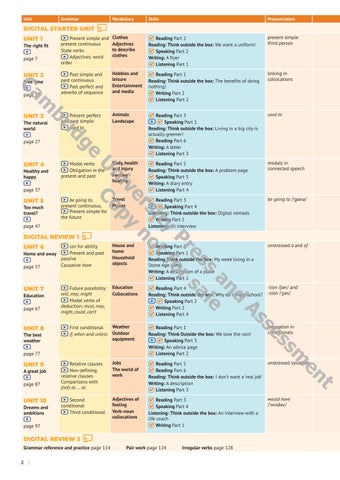
Unit
Grammar
Vocabulary
Skills
Pronunciation
Reading Part 2 Reading: Think outside the box: We want a uniform! Speaking Part 2 Writing: A flyer Listening Part 1
present simple third person
DIGITAL STARTER UNIT Present simple and Clothes Adjectives present continuous to describe State verbs clothes Adjectives: word order
UNIT 1 The right fit page 7
Past simple and past continuous Past perfect and adverbs of sequence
Hobbies and leisure Entertainment and media
Reading Part 1 Reading: Think outside the box: The benefits of doing nothing! Writing Part 2 Listening Part 2
linking in collocations
Present perfect and past simple used to
Animals Landscape
Reading Part 3 Speaking Part 1 Reading: Think outside the box: Living in a big city is actually greener! Reading Part 6 Writing: A letter Listening Part 3
used to
Body, health and injury Feeling healthy
Reading Part 5 Reading: Think outside the box: A problem page Speaking Part 3 Writing: A diary entry Listening Part 4
modals in connected speech
Travel Places
Reading Part 3 Speaking Part 4 Listening: Think outside the box: Digital nomads Writing Part 1 Listening: An interview
be going to /ˈgɑnə/
can for ability Present and past Home and away passive Causative have page 57
House and home Household objects
Reading Part 2 Speaking Part 1 Reading Think outside the box: My week living in a Stone Age camp Writing: A description of a place Listening Part 1
unstressed a and of
UNIT 7
Education Collocations
Reading Part 4 Reading: Think outside the box: Why do I enjoy school? Speaking Part 2 Writing Part 2 Listening Part 4
-tion /ʃən/ and -sion /ʒən/
Reading Part 1 Reading: Think Outside the box: We love the rain! Speaking Part 3 Writing: An advice page Listening Part 2
intonation in conditionals
UNIT 2
m Ca
Free time page 17
The natural world
Modal verbs Obligation in the present and past
page 37 Too much travel?
Co
UNIT 5
be going to, present continuous, Present simple for the future
page 47
DIGITAL REVIEW 1 UNIT 6
Education page 67
UNIT 8 The best weather
Future possibility: will, may, might Modal verbs of deduction: must, may, might, could, can’t
Weather First conditional if, when and unless Outdoor equipment
UNIT 10 Dreams and ambitions
Jobs The world of work
Reading Part 5 Reading Part 6 Reading: Think outside the box: I don’t want a ‘real job’ Writing: A description Listening Part 3
unstressed syllables
Second conditional Third conditional
Adjectives of feeling Verb-noun collocations
Reading Part 3 Speaking Part 4 Listening: Think outside the box: An interview with a life coach Writing Part 1
would have /ˈwʊdəv/
page 97
DIGITAL REVIEW 2 Grammar reference and practice page 114 2
|
Pair work page 124
Irregular verbs page 128
t
page 87
Relative clauses Non-defining relative clauses Comparisons with (not) as … as
en
A great job
m
page 77
UNIT 9
ss se As d an s le es sa Pr r y fo it t rs no ve y ni p
Healthy and happy
U
UNIT 4
ge
page 27
id
br
UNIT 3
Oracy
Challenge
Life competencies
Giving encouragement Giving yourself thinking time Organising your answer
We can’t always find the right clothes for every situation.
Digital literacy: using tools and creating digital content Creative thinking: generating multiple ideas Learning to learn: using feedback to improve learning
m Ca
Giving a presentation Speaking clearly and at an appropriate speed Using humour Making positive comments and asking sensible questions Young people have lost touch with nature.
Creative thinking: considering multiple perspectives Learning to learn: evaluating learning and progress
Science and Engineering Does skateboarding defy the laws of physics?
Creative thinking: experimenting with and refining ideas Critical thinking: drawing appropriate conclusions
Science How do animals adapt to their environment?
ge
id
br
Asking questions Using a range of vocabulary Giving positive feedback
STEAM
Co
Getting everyone’s opinions Giving positive feedback Offering examples
Learning to learn: using effective strategies for learning and retaining information Critical thinking: evaluating options and recommendations to come to a decision
ss se As d an s le es sa Pr r y fo it t rs no ve y ni p
U
Having a debate Using confident body language Managing speaking time Identifying weaker arguments
Travel is exciting but can be very bad for our planet.
Critical thinking: identifying and understanding problems Critical thinking: drawing appropriate conclusions
Science and Maths
Creative thinking: Imagining alternatives and possibilities Collaboration: actively contributing to a task
Giving a talk Sequencing ideas for structure Using appropriate gestures and body language Engaging the audience Using evidence Summarising Listening actively
Creative thinking: participating in a range of creative activities Learning to learn: using effective strategies for comprehension and production tasks
Jobs are changing and young people need new skills for their working life.
Science What is extreme weather?
Critical thinking: evaluating options and recommendations to come to a decision Critical thinking: participating in a range of creative activities
t
en
Showing interest Justifying your ideas Ending a presentation
Emotional development: showing empathy for the feelings of others Critical thinking: identifying, gathering and organising relevant information Creative thinking: elaborating on and combining ideas
m
Participating actively in discussions Getting everyone’s opinion Taking turns Interrupting politely
Some students feel that school is boring and irrelevant for their future.
Interviewing Listening actively Asking open questions Asking follow-up questions
Creative thinking: imagining alternatives and possibilities Critical thinking: drawing appropriate conclusions
Arts Digital classroom: Practice Extra |
3
m Ca
ge id br
Co
t
en
m
ss se As d an s le es sa Pr r y fo it t rs no ve y ni p U
B1+
Niamh Humphreys
Emma Heyderman
3
Student’s Book
UNIT 1 THE RIGHT FIT LEARNING AIMS
THE CHALLENGE
m Ca
Skills: discuss and create texts about clothes Grammar: review present simple and present continuous; state verbs and adjectives: word order Vocabulary: learn and practise words to describe clothes Creative thinking: design a website for creating, selling or swapping clothes Exam practice: Reading Part 2, Speaking Part 2, Listening Part 1
ge
id
br
We can’t always find the right clothes for every situation. You will: • Stage 1 Think: find out about situations where special clothes are important. • Stage 2 Prepare: find different kinds of websites that offer clothes. • Stage 3 Develop: create a website which lets people design, make, sell or swap clothes. • Stage 4 Present: present your website to the class.
Co
ss se As d an s le es sa Pr r y fo it t rs no ve y ni p
U 1 Look at the photo. Discuss the questions in small groups. 1
Where are the people?
CHALLENGE Think
2 Why do you think they are dressed the way
they are? 3 How important is it to wear the kinds of clothes you want to wear?
4
01
Documentary
Grammar
t
clothes that show support for a team 2 a style that shows how young people are different 3 clothes that show respect for a tradition
en
When do young people want to wear special clothes? Make a list of situations. 2 When is it difficult to get exactly the right clothes? 3 List all the ways you know of finding clothes. 1
Grammar
3
Discuss the questions with a partner and make notes.
find one example of the following:
1
2
m
2 Watch the video and
1
|
7
VOCABULARY
3 Think back to the video. Discuss the questions in pairs.
CLOTHES 1
1.1 Go to the digital activity and match the words to the photos. Listen, check and repeat. buttons pattern
Which different types of clothes do you see in the video? 2 Whose clothes do you like the best? 1
costume jersey laces material sleeves sweatshirt tracksuit zip
4 Read the conversation and
m Ca
match the verbs in bold to the definitions (A–C).
Vocabulary reference page 16
Owen:
ge
id
br
Oh, I like that sweatshirt. It suits you! Andy: Yes, but it doesn’t fit me. Look, the sleeves are too short. Owen: Oh, yes. That’s a pity because the colour matches your new trousers. A be the right size for somebody B look good or right on somebody C be the same colour or type
5 Complete the text with the correct form of suit, fit
ss se As d an s le es sa Pr r y fo it t rs no ve y ni p
U 2 Two friends are going to a carnival. Complete the
or match.
conversation with the words from Exercise 1.
Co
My sister has finished studying and I’m going to her graduation ceremony. It’s formal and I want to wear a dress with a jacket or a scarf that 1 it. I want a green dress because people say green really 2 me. And 3 my favourite shoes don’t me anymore, so I have to buy a new pair.
Unit 1 The right fit
STRETCH! Open your wardrobe. Can you name
everything in English? Look up the words if you cannot. Bring your list to the next class.
7
Find out about the clothes that people wear to celebrate a life event, for example, a wedding, a graduation, etc., in a country that is not your own. What words will you use to start a search? Compare ideas with a partner.
CHALLENGE Prepare
1
2
3
4
Form groups of three to four students. 2 You are going to create a website which offers clothes. Decide what kind of clothes you would like to offer. 3 Agree on what kind of website you will create. For example, it could be a site for selling, borrowing, renting or swapping clothes, or where people can offer their own designs. 4 Go online and find similar kinds of websites. Make notes about the ones you like the best. 1
t
|
other formal events do you go to? What do you wear? Tell a partner.
en
8
6 Graduation ceremonies are usually formal. What
m
Oscar: Look, I’ve put on my for the carnival! I’m dressing up as a clown. I’m not sure about it. I’m afraid I’ll be too hot because the 2 is really 3 heavy. And the are too long. Maybe I don’t need to do up the big red 4 . And I should wear a T-shirt because this 5 under the jacket is too much. Leo: You look great. I love the colourful 6 on the hat. Now look at what I’m wearing. ! Oscar: But you’re just wearing a 7 Are you going out for a run? , Leo: Oh, sorry, I’ve done up the 8 but look, under the jacket, you can see my football 9 . And I’ve got a scarf in our town’s colours, too! I’m going to the carnival dressed up as our team’s biggest fan! Oscar: But you are our team’s biggest fan! You look or good, but tie your 10 you’ll step on them and fall over! 1
READING SHORT TEXTS 1 Read the description of Jordan. What does
he want to buy for his cousin? Which two things does he need to consider before buying a present? Jordan’s cousin is leaving for university. He’d like to get her some jewellery but can’t afford to spend very much on her. He knows she prefers silver to gold.
m Ca
1
br
id
2 Read the information about market stalls A and
ge
B. Which stall would be the most suitable for Jordan? Why is the other one unsuitable?
EXAM TASK READING PART 2
U
HERE ARE EIGHT OF OUR FAVOURITE STALLS! A MARTHA’S GOODIES
1.2
Martha’s got an amazing range of necklaces and bracelets on display and she’ll let you try on everything. We particularly like her gold chains and earrings with coloured stones. They aren’t cheap, but they’d make the perfect gift to celebrate a special occasion. Open from midday every day.
B COOL THINGS At the Cool Things stall, you’ll find all kinds of accessories, including unusual rings and earrings made of all different kinds of metal. Rapper Joe D’s responsible for the original designs. With affordable prices, there’s something to suit all tastes. They’re open from Wednesday to Sunday.
ss se As d an s le es sa Pr r y fo it t rs no ve y ni p
3 The people below all want to buy a present
Going to the market?
in the market. Read the descriptions and underline the key information.
Co
2 Susie wants to buy her friend
EXAM TIP Read the descriptions and underline the key Information. Match this key information with one of the longer descriptions (A–H). All the key information needs to appear in the correct answer.
D DINAH’S DEN
They’ve got an amazing collection of leather goods of all sizes for work or for pleasure. Just arrived: high-quality rucksacks which will last for years! You’ll never need to replace them. Changed your mind? No problem, return it within 30 days for a full refund.
E TREASURE BOX
Come and explore this huge selection of second-hand goods. There’s something for everyone, from hats to socks and from T-shirts to skirts, with flowers or without! What’s more, tell Kai what you’re looking for and he’ll find it within minutes!
F WE’VE GOT YOU COVERED!
Are you going on a trip? Are you looking for a bargain? Look no further! This stall sells last year’s travel goods including suitcases, walking shoes, boots and rain jackets all at unbelievable prices! Please note that all sales are final and no returns are allowed!
G SAM’S STALL
Another recycled clothes stall is Sam’s stall. Sit down with Sam for a cup of tea and a chat about what you need. Then he’ll help you find the perfect costume for that special occasion. Need something changed? He can replace buttons with zips or remove them completely.
t
which stall would be the most suitable for the people in Exercise 3.
Voted Stall of the Month, bring your picture and Jake and his team will turn it into a creative piece of clothing. At busy times, allow about an hour for Jake to do his magic but the wait will be worth it. Located at the front gate, you can’t miss it! No returns!
en
4 Read the guide to eight market stalls. Decide
C JAKE’S DESIGNS
m
a birthday present but she is short of time. She often gets her earrings, so she’s thinking of getting her a top, perhaps something recycled with a pattern. 3 Mo’s mum is about to go on a trip for work and he’d like to get her something useful which isn’t another bag. He needs to be able to take it back if she doesn’t like it. 4 Lucas urgently needs something for his school stuff. The zip on his last bag broke, so he’s looking for something stronger with room for a tracksuit for when he does training. 5 Lizzie would like to buy something for a fancy-dress party. Last year she dressed up as a clown, so she’d like something different that’s easy to do up.
H ELLIE’S BAZAAR Looking for a special gift? Ellie’s purses and wallets are made of high-quality Italian leather and come in black or brown. She’ll even put your initials on it for a small fee. Not happy with your purchase? You can return all non-personalised items. Unit 1 The right fit |
9
GRAMMAR
5 Choose the correct words to complete the grammar rules.
PRESENT SIMPLE AND PRESENT CONTINUOUS
State verbs State verbs talk about a state or condition, and they are not usually used in the 1 present simple / present continuous. Here are some common 2 state / action verbs.
1 Watch the grammar
vlog. Whose clothes do you like the best? Why?
m Ca
02
believe depend have hope know like look love need prefer see seem suppose think understand want wish
2 Complete the grammar rules with the present
br
simple or present continuous.
id
Some verbs can be both state verbs and action verbs, but they have 3 the same / a different meaning. A: Why are you looking in my wardrobe? Do you want to borrow something? (looking = directing your eyes at something) B: Wow! You look great in that costume. (look = appear)
Present simple and present continuous
ge
We use the to talk about something that: • happens regularly (and routines). • is generally true and permanent. 2 We use the to talk about something that: • is happening at the moment or some time in the present. • is temporary. 1
Co
ss se As d an s le es sa Pr r y fo it t rs no ve y ni p
U
Grammar reference and practice page 114
3
Go to the digital activities.
4 Complete the text with the present simple or
present continuous form of the verbs in brackets.
Red N se Day
Unit 1 The right fit
7 Complete the conversation with the correct
present simple or present continuous form of the verbs in brackets. Ruby:
we (have) a Red Nose Day at school again this year? (think) so. I 3 (need) James: I 2 to find something to wear. (not understand). Why? Ruby: I 4 5 (look) for something James: Well, I smart for non-uniform day. (see)! What 7 Ruby: I 6 you (plan) on wearing? The new charity shop next to the cinema 8 (look) cool. How about going there on Saturday? Are you free? (hope) so but it 10 James: I 9 (depend) on my mum. If she has to work, I’ll need to look after my little brother. Ruby: Bring him along too! 1
t
|
Go to the digital
pronunciation activity.
en
10
PRONUNCIATION
m
Every two years, people across the UK 1 (celebrate) Red Nose Day in March. Why this name? It’s because people 2 (usually / put on) red noses and 3 (do) silly things. For example, around 90% of all secondary school children in the UK have to wear a school (not uniform. Most of us 4 like) wearing one. However, today, as it 5 (be) Red Nose Day, we 6 (not wear) our uniforms but our teachers 7 (wear) one! We 8 (have) so much fun! It’s hilarious. This year, my school 9 (raise) money for a children’s charity. 10 you ever (do) silly things for charity?
6
HOW IS UNIT 1 SO FAR? I understand
I’m getting there
I don’t understand
TERM DATES
NEWSLETTERS
ABOUT US
THINK OUTSIDE THE BOX!
WE WANT A UNIFORM! Eddie and Sora went to school in England for a year. Here, Eddie tells us how his opinion about school uniforms has changed.
m Ca
When Sora and I started at our English school, we didn’t like the uniform. Sora had to wear a heavy woollen skirt and I had a formal shirt and a striped tie. It was uncomfortable! My trousers felt too baggy and my shirt felt too tight. At first we thought that English schools were old-fashioned, but then we learned that school uniforms are common all over the world. Students wear them in most of Asia, most African countries and many other countries … so why not here in the US?
br
ge
id
We’ve all felt the pressure to have trendy clothes if we want to MEDIATION fit in at school. Parents often complain that we want overpriced MEDIATION WORKSHEET WORKSHEET things, but the better-value options are not cool. Uniforms solve that problem. Nobody in a uniform will be bullied for having unfashionable clothes. It should save money, though I’ve also read that in some places children can’t go to school because they can’t afford the uniform. School uniforms should be free! ADJECTIVES TO DESCRIBE
VOCABULARY
ss se As d an s le es sa Pr r y fo it t rs no ve y ni p
U
Co
Believe Sora and me: it’s great when you don’t have to think about what to put on in the morning. I didn’t like our woollen trousers in England, though. A light cotton outfit would be more practical for our warm climate here in California. Well, Sora says she wants a gorgeous green silk blouse, but maybe that’s not quite realistic!
CLOTHES 1
1.4 Put each of the adjectives in the right category. Listen, check and repeat. baggy trendy
We know that most people at our school will say ‘no’ when asked if they want a uniform. But think about it: It has some real advantages.
READING AN ARTICLE
Opinion
2
cotton gorgeous silk striped tight uncomfortable unfashionable woollen Shape, size, patterns
1.5 Go to the digital activity and match the phrases to the photos. Listen, check and repeat. a baggy jumper a cotton T-shirt a striped shirt a woollen jumper
1 Read the headline in the article. In pairs, make
3 In pairs, write two sentences to describe the clothes in
each picture in Exercise 2. Use the words from Exercise 1, including the opinion words, and your own ideas.
list which are mentioned.
3
1.3 Read the article again and listen. Answer the questions in your own words.
ORACY Giving encouragement
It’s nice to pay people compliments if they have new clothes or accessories, or if you see them wearing something that you like.
5
t
What are the disadvantages of school uniforms? In groups, brainstorm reasons why it could be better not to have one.
Did you write the same things?
en
4
4 Show your descriptions from Exercise 3 to another pair.
m
How did Eddie and Sora feel about their English school uniform at first? 2 According to Eddie, what do parents often think about the clothes that teenagers want? 3 How could uniforms stop some people from going to school? 4 Do Eddie and Sora expect students at their school to be enthusiastic about uniforms? 1
a silk dress tight jeans
Vocabulary reference page 16
a list of good things about school uniforms.
2 Skim the article. Tick (✓) the ideas in your
Material
1.6 Listen to two friends at a party. What three phrases do they use to pay each other compliments?
You look great today.
6 Turn to your partner and pay him or her a compliment. Unit 1 The right fit |
11
GRAMMAR
SPEAKING
ADJECTIVES: WORD ORDER
DESCRIBING A PHOTO 1
1 Watch the grammar
03
m Ca
animation. Hassan and Rebecca are planning to go to a fancy-dress party. What is Rebecca’s costume?
1.7 Listen to a candidate describe this picture in Part 2 of the Speaking exam. What adjectives did he use?
2 Look at the example and put the words in the
br
correct order.
ge
id
Adjectives: word order I love my wonderful, big, old, square, blue, Australian leather bag!
ORACY
ss se As d an s le es sa Pr r y fo it t rs no ve y ni p
U
age colour material opinion origin (place) shape size
Giving yourself thinking time
Sometimes you need to keep talking but aren’t sure exactly what you want to say. Don’t leave long gaps. Give yourself thinking time using phrases like Well, anyway … / Hmm, where can this be? / So, what else can I tell you?
Co
When more than one adjective comes before a noun, they generally come in this order: opinion , , , , , , noun We do not usually use more than three adjectives before a noun.
Grammar reference and practice page 114
3
Go to the digital activities.
4 Ben and his mother went shopping for clothes
yesterday. Complete the text with the words in the correct order.
DIGITAL CLASSROOM PRACTICE EXTRA UNIT 1
EXAM TIP
When you describe a photo, talk about everything you can see: the people, clothes, the place, etc. Use adjectives to add to the description and say where things are.
3 Work in pairs. Student A, look at photo A on page 124.
4 Student B, listen to your partner and then give feedback using this checklist.
Did your partner: • describe the • use adjectives? people? • say where things • describe the are? place? • keep going, using thinking time phrases?
5 Swap roles. Student B, look at photo B on page 125.
12
|
Unit 1 The right fit
t
out the noun after the adjective. We don’t usually do this in English. We don’t say: What a cute! or What cute! We say: What a cute baby! Find more examples of adjectives used without nouns.
EXAM TASK SPEAKING PART 2
en
STRETCH! In some languages you can leave
1.7 Listen to the candidate from Exercise 1 again. Which thinking time phrases from the oracy box does he use?
m
Yesterday, Mum and I went shopping in a(n) 1 (big / interesting / shop). You can get 2 (cool / clothes / new) direct from the factory, so it’s not expensive. I got a 3 (jumper / woollen / lovely) there. My mum got a 4 (nice / cotton / blue / dress). Then we went for a 5 (Chinese / delicious / lunch). They served the food in 6 (modern / bowls / huge / round). It looked great!
2
CHALLENGE Develop
1
2
3
4
In your groups, talk about or show each other websites you have seen and like. 2 Decide what ideas you can use to design your own website and whether you want to use one website as a model or use a mix of ideas. 3 Design some pages which you can show to your classmates. You can use paper or digital options if you have them. 4 Create a first draft of your website. 1
2 Read the flyer. Would you like to go to the market? Why? / Why not?
3 Look at the flyer again and find an example of
each of these things. In what order do they appear? a a website address b information about the date, time, location, etc. c information about what you can buy
m Ca
d a title and subtitle e a photo or illustration f
br
4 Work in pairs. Answer the questions. Why is the market called ‘Every second Sunday’? 2 What do you think ‘One person’s rubbish is another person’s gold!’ means? 3 Why does the writer use questions in the text? 4 What words does the writer use to encourage the reader to take action? 1
ge
id
WRITING A FLYER
a call to action
1 Look at the title and photo in the flyer. What do
U
you think it advertises?
ss se As d an s le es sa Pr r y fo it t rs no ve y ni p
EVERY SECOND SUNDAY!
5 Read the task. What do you need to design? What information do you need to include?
Co
Your school would like to organise a second-hand market to raise money for a local charity. It has invited students to design the flyer and will choose the best one. The winning flyer should include the following:
One person’s rubbish is another person’s gold!
Is your home full of unwanted junk? At our flea market, you can sell or swap your second-hand stuff. Clothes, accessories, books and music are always popular, but feel free to bring anything you can carry. (No animals though, please!) Or perhaps you’re looking for an unusual gift. Come along and have a look at what’s on sale! The market takes place on the first and third Sunday of every month just behind the sports centre. If you’re selling, you’ll need to book a stall in advance (€10) and there’s a small entrance fee for shoppers (€5), but this money goes to local mental health charities. Let’s give our old things a new life! Just remember, your rubbish might be someone else’s gold!
• an attractive title
• a photo or illustration
• information about the market (what’s on sale, date, time, location and cost) • a call to action
• a website address
6 Design your flyer, including all the information in
Exercise 5. Use some of the words and expressions from the model flyer.
7 Read your flyer again and revise your work. Use these questions to help you.
Check our website for more information!
Does the flyer look attractive? 2 Is all the information from the task included? 3 Does the flyer include some of the words and expressions from the model and from this unit? 4 Can you see any problems with the language? 1
Now work in pairs. Read each other’s flyers and give feedback. Use the questions in Exercise 7 to help you. Make a note of your partner’s feedback and write a second draft of your flyer.
t
8
en
m
www.everysecondsunday.org
9 Display the flyers on the classroom walls. Which one do you think the school should use? Why?
10
Read the model answer. Unit 1 The right fit | 13
LISTENING SHORT MONOLOGUE OR DIALOGUE 1 Read the question and underline the key words. 1
What does the boy decide to buy? A
B
m Ca br
id
ge
C
Co
A
B
C
6 Where will the friends go next? A
B
B
C
5 What’s the problem with the hoodie? A
B
C
7 Where did the boy get his belt?
C
A
B
C
1.9 Listen again and check your answers.
ORACY
Organising your answer
Unit 1 The right fit
CHALLENGE Present
1
2
3
Make sure you have everything for your presentation. 2 Check that everyone in your group knows their roles. 3 Present your website to your class. 4 During the presentations, write down two or three questions. Ask them at the end. 1
4
t
It’s a long story. I spent ages looking around the shops in town, but they didn’t have anything suitable. Dad then suggested I look around that trendy second-hand market on Peter Street, but none of them were very nice. Eventually I found one online, but it didn’t last long. My uncle’s neighbour mends shoes, so he managed to repair it and it’s great!
‘Where did you get your …?’ Remember to structure your answer.
en
1.10 In question 7 in the Exam Task, the girl asks the boy, ‘Where did you get that belt?’ Listen to and read his answer. What words does he use to structure his answer?
7 Work in pairs. Take turns to ask and answer
m
When you answer a friend’s question with a story, use words like ‘It’s a long story’, ‘but then …’ and ‘eventually’.
|
A
ss se As d an s le es sa Pr r y fo it t rs no ve y ni p
U
B
3 What’s on TV later?
4 Where did the girl leave her phone?
14
You will always listen to the recording twice. Use the second time you listen to check your work and also to write down any missing answers.
1.9 Underline the key words in questions 2–7 and look at the pictures. Then listen to the rest of the conversations. For each question, choose the correct answer. A
6
1.8 Listen to the conversation. Choose the correct answer (A, B or C) in Exercise 1.
EXAM TIP
2 What is the boy doing?
5
different words can you use to describe each one?
3
C
EXAM TASK LISTENING PART 1
4
2 Look at the pictures in Exercise 1 again. What
WRAP UP Look back at the unit. Write down:
m Ca
1 some new vocabulary you learned to talk about clothes.
2 your main role in the challenge. 3 one use of the present continuous.
br
4 a sentence describing a coat, with three adjectives.
ge
id
5 something in the unit that you especially enjoyed.
ss se As d an s le es sa Pr r y fo it t rs no ve y ni p
U
Sustainability
1 Think of a sustainable way you can get great clothes without going to a clothes shop. 2 How is it sustainable?
Co
SELF-ASSESSMENT: UNIT 1 How confident do you feel about:
• • • • • • • •
finding key information in short written texts? finding key information in short monologues and dialogues? describing a photograph? designing and writing a flyer? using the present simple and present continuous? using adjectives in the right order before nouns? using words for naming and describing clothes? presenting a website to your classmates?
What was your favourite part of Unit 1? Tell your partner.
Look back at Unit 1, page 8, Exercise 7. What words in your search produced better results? Why?
STRETCH! YOUR CHOICE
Option 2: Imagine your school is introducing a uniform (or a new uniform if you already have one). Design it! Draw it on paper or use a website that lets you create uniforms. Present your design to the class.
Option 3: Have a fancy-dress party in your next English lesson. Ask everyone to wear a costume and to describe the costume and explain why they chose it to the rest of the class.
Unit 1 The right fit |
t
Option 1: Find a website that you think is really useful, and that is not about clothes. Tell your classmates about it. Say what information it gives you and why you think it is good.
en
m
Now, choose an option.
15
VOCABULARY REFERENCE CLOTHES 1 Match the words to the photos. buttons
costume
jersey
material
pattern
sleeves
sweatshirt
tracksuit
3
4
7
8
zip
id
br
2
ge
m Ca 1
laces
5
6
Co
ss se As d an s le es sa Pr r y fo it t rs no ve y ni p
U 9
10
ADJECTIVES TO DESCRIBE CLOTHES
2 Look at the photos and use one or two of the adjectives to describe each one. baggy trendy
cotton gorgeous silk striped tight uncomfortable unfashionable woollen
1
3
5
6
4
t
en
m
2
DIGITAL CLASSROOM PRACTICE EXTRA UNIT 1
16
|
Unit 1 The right fit
UNIT 2 FREE TIME LEARNING AIMS
ORACY
m Ca
Skills: discuss and create texts about free-time activities Grammar: learn and practise past simple, past continuous, past perfect and adverbs of sequence Vocabulary: learn and practise words and phrases for hobbies and leisure, and entertainment and media Oracy: give a presentation Exam practice: Reading Part 1, Writing Part 2, Listening Part 2
Giving a presentation • speaking clearly and at an appropriate speed • using humour • making positive comments and asking sensible questions
ge
id
br
Co
ss se As d an s le es sa Pr r y fo it t rs no ve y ni p
U 1 Look at the photo. Discuss the questions in small groups.
3 In small groups, play Just a Minute. Each
person talks about one of these topics for a minute without pausing or stopping.
What can you see? 2 How do the people feel? 3 Some people say that young people have too much free time. Do you agree? 1
•
Documentary
Grammar
•
4 Think about your mini presentations in Exercise 3.
Grammar
Did you use any of the skills in the Oracy box? Which ones? Compare your answers.
Oracy
|
t
What are the 01 benefits of taking up a hobby? 2 What different hobbies do you see? 3 Which of the activities would you like to try? Which would you not like to try? Why? 1
en
answer the questions.
people spend their free time. Everyone should spend some time doing voluntary work in their free time. Resting in your free time is a waste of time.
m
2 Watch the video and
• Everyone should take up a hobby. • Parents and teachers should decide how young
17
VOCABULARY HOBBIES AND LEISURE 1
2.1 Go to the digital activity and match the words to the photos. Listen, check and repeat.
m Ca
draw cartoons go hiking go out on my bike hang out with friends perform on stage start a collection have a barbecue try out new recipes
br
PRONUNCIATION
id
2
Vocabulary reference page 26
Go to the digital
pronunciation activity.
ge
3 Read these descriptions of people. Which would
be the best activity in Exercise 1 for each person? Robbie’s keen on spending time in the open air with friends and keeping fit, but he isn’t into cycling at all. Yasmin’s crazy about music and goes to concerts whenever she can. She keeps all the tickets but isn’t sure about what to do with them. Ali enjoys making his friends laugh and they think he could take part in a comedy show. Lara has always been fond of art. She often enters competitions but would like to take up something a little different which is still art. Alex is tired of making the same dishes every week. He’s ready for a change.
ORACY
ss se As d an s le es sa Pr r y fo it t rs no ve y ni p
2
U
1
Co
Speaking clearly and at an appropriate speed
3 4
5
4 Read these questions and copy the expressions with take. Then ask and answer the questions in pairs. 1 2 3 4
8
STRETCH! In a speaking exam, the
examiner may ask you about your hobbies, likes and dislikes. Make a list of all the things you (and the people you know) do in your free time and make sure you know how to say them in English. 18
|
Unit 2 Free time
6 Discuss the questions with a partner and reflect on Exercise 5.
How did you feel during the relaxation? How did you feel after? 2 Why might it be useful to do a relaxation exercise before giving a presentation? 3 When else might this relaxation exercise be useful? Think of at least two more situations. 1
7 You are going to give a short presentation on a hobby or activity. Choose one from this unit or use your own idea. Make some notes by answering these questions. What is the activity? How do you do it? 2 What equipment do you need? 3 What are the benefits of doing it? 1
8 Work with a partner. Student A, present your hobby or
activity from your notes in Exercise 7. Student B, listen and give Student A some feedback using the questions below to help. Then swap roles. Did your partner take some deep breaths before starting? 2 Did your partner speak clearly and slowly? 3 Did you understand your partner? 1
t
7
2.2 You are going to listen to a relaxation exercise. Listen to the recording and follow the teacher’s instructions.
en
6
5
m
5
When was the last time you took up something new? What was it? How often do you take part in competitions? Why is it important to take a rest? Do you and your family take turns to choose a programme on TV? How often do exciting events take place in your town? Do you do things quickly or do you take your time? How do you take advantage of a long weekend? What is the latest craze to take off?
When we get nervous, we often speak too quickly and our audience may not be able to understand us. Before you start speaking, take a few deep, full breaths from your stomach and then begin.
READING REAL WORLD NOTICES 1 Look at the real-world notices.
Where would you find each one? 2.3
1
m Ca
FOR SALE
Brand new judo suit still unwrapped.
3 From: Concert Hall
br
Due to heavy storms, tonight’s open-air concert has been cancelled. Please contact the organiser directly for a full refund. We apologise for any disappointment.
Received as a gift but too big and can’t be returned.
id
ge
Please contact harry@harry.com for more information.
U
A The judo suit was bought online. C The judo suit has never been
used. Zak
Online
Greg,
Comic-Con takes place this weekend. Fancy taking part in the cartoon-drawing competition with me?
I’ll check the details and get back to you. Zak
B You can get your money back for your ticket. C The weather will be better tomorrow. 4
Co
2
A Some people have complained about the musicians.
ss se As d an s le es sa Pr r y fo it t rs no ve y ni p
B The judo suit fits the owner well.
To: Customers
A Zak asks Greg to find out some
information. B Zak would like to enter a contest with Greg. C Zak wants Greg to make him a comic.
We’re taking a week’s break from Monday. We’ll have a special show on the following Saturday plus a brand-new photography course for under-18s.
A The art gallery will be open on Monday.
B Everyone can learn how to take better photos.
C A different exhibition will be on next weekend.
5
D RAMA SOCIETY
Actors, directors and designers welcome! Sign up early to book a place as this is one of the most popular clubs.
A If you want to join, tell us as soon as possible.
B We regret to say that the drama club is now full. C All kinds of people run the club.
2 Read the notices more carefully and also read the answers.
t
EXAM TIP
should take part in several different after-school activities. In small groups, talk about whether you agree or disagree.
en
EXAM TASK READING PART 1
4 Some people say that young people
m
Underline the key words.
Answer each question one by one. First read the notice carefully and underline the key words. Next read the answers A–C and underline the key words. Make sure you understand the difference between each option before you read the text again to find the correct answer. Once you have answered all the questions, go back and check your work.
3 Now choose the correct answers. Unit 2 Free time | 19
GRAMMAR
5 Complete the rules with when or while.
PAST SIMPLE AND PAST CONTINUOUS
When or while?
1 Watch the grammar vlog. Who’s Marek? What did he do?
m Ca
02
Grammar reference and practice page 115
2 Complete the grammar rules with past simple or past continuous.
br
id
We use the to talk about actions or situations in the past (often one action happened after the other). 2 We use the to talk about an activity that was already happening at a moment in the past. 3 We use the to show an action that interrupted or happened in the middle of a activity.
ge
1
a When I arrived, everyone was playing cards. b When I arrived, everyone played cards.
2 a While I was watching TV, my brother was
drawing a cartoon. b While I was watching TV, my brother drew
a cartoon. 3 a I was riding my bike when it started to rain.
Co
ss se As d an s le es sa Pr r y fo it t rs no ve y ni p
U
Grammar reference and practice page 115
3
6 Read these pairs of sentences. What is the difference in meaning between them?
Past simple and past continuous 1
We generally use before an action in the past simple. 2 We can use and before an activity in the past continuous. 1
b I was riding my bike while it was raining.
7 Make some notes in the past simple and past continuous about a recent weekend. Include three lies.
8 Work in pairs. Take turns to ask and answer
Go to the digital activities.
4 Complete the conversation with the verbs in
brackets in the past simple or past continuous.
STRETCH! People often talk about important events and say things like ‘When my country won the World Cup, I was watching the match at home.’ Find out about an important event in your country and find out what the people you know were doing at the time.
t
en
m
Lee: How 1 the family barbecue in the park (go) on Saturday? (have) a lot of Mia: We 2 fun, but something really embarrassing 3 (happen). While we 4 (finish) our burgers, a woman 5 (start) shouting, ‘Who wants some fruit?’ she (give) Lee: 6 it away for free? (have) a huge box Mia: Well, she 7 so I 8 (run) over to her. About six other people 9 (wait) in the queue. When I 10 (reach) 11 the front, the woman (look) at me and 12 (ask), ‘Who are you?’ you Lee: Oh no! What 13 (say)?
questions in the past simple and past continuous about a recent weekend. Can you find the three lies?
HOW IS UNIT 2 SO FAR? 20
|
Unit 2 Free time
I understand
I’m getting there
I don’t understand
THINK OUTSIDE THE BOX!
THE BENEFITS OF
m Ca
DOING
ge
id
br
N OT H I N G! Co
AN ARTICLE
1 Work in pairs. Look at the title of the article and the photo. What do you think ‘doing nothing’ involves? How often do you ‘do nothing’?
2
2.4 Read and listen to the article and check your ideas in Exercise 1.
3 Are the sentences true or false? Correct the false sentences. 1 2 3 4
Work in pairs. Choose one of these situations and decide on your role. Discuss the situation calmly with your partner and try to reach an agreement. A teacher wants to set some extra homework. The student is tired. 2 A teenager wants to go to an event in another town. The parent is too tired to drive. 3 Friend A wants to go out and do something active. Friend B wants to stay in and chill out. 1
VOCABULARY
ENTERTAINMENT AND MEDIA 1
2.5 Go to the digital activity and match the collocations to the photos. Listen, check and repeat. be a blogger be a DJ catch up with a TV series check social media download a video clip run a newspaper sign up for lessons upload a photo
Vocabulary reference page 26
2 Work in pairs. What do you think? Decide which of the activities in Exercise 1 are:
• a waste of time • a good use of time
• a good way to relax • stressful
t
4
Viola was delighted to take part in the cycling competition. Experts say that it isn’t good to be active all the time. Young people get ‘tech neck’ if they spend too much time on their homework. It’s OK to do absolutely nothing all day. Doing an hour’s activity a day can improve our mental health. The writer suggests that we shouldn’t spend more than two hours a day on our phones.
So, what’s the key? Find your own out-of-school balance! Limit your screen time to two hours a day, add a stress-free activity to your week, and then sit on the sofa. Close your eyes for 15 minutes and do nothing!
en
6
So am I suggesting NO activity? Actually, no! In fact, a recent report suggests that sitting around for long periods, doing nothing at all, can cause depression. Doing as little as 60 minutes of light, stress-free activity such as going for a walk can reduce this risk. That said, a quick afternoon sleep on the sofa can also help our minds (and our bodies) recover.
m
5
Yet, if you think that looking at your phone is a good way of doing nothing, think again! Studies show that we are now spending twice as much time on our screens than just a few years ago. Perhaps we’re downloading a video clip, uploading a photo onto social media or even catching up with friends online or the latest TV series. Concentrating for too long on the screen isn’t good for us! It can cause tired eyes and ‘tech neck’, which is neckache after using technology for too long.
ss se As d an s le es sa Pr r y fo it t rs no ve y ni p
U READING
My friend Viola ran the school newspaper and had also signed up for music lessons. She was a DJ at her friends’ parties and a regular blogger. When the cycling team approached her about a race last Sunday, she felt she couldn’t say no, even though she was exhausted and just wanted to do nothing. Research shows that doing nothing at some point in our week is good for the health of our brains.
3 Work in small groups. Students from another country
are coming to your town. Plan a week’s programme of both active and more relaxing activities. STRETCH! Find at least two more nouns that go
with these verbs: catch up with, check, download, run, sign up for and upload. Unit 2 Free time | 21
STRETCH! Interview a member of your family or a friend about their reasons for taking up a hobby. Report back to the class using the past simple, past continuous and past perfect.
GRAMMAR PAST PERFECT
DIGITAL CLASSROOM
1 Watch the grammar
PRACTICE EXTRA UNIT 2
animation. What happened to Rebecca and Hassan?
03
m Ca
ORACY Using humour
2 Complete the sentences from the grammar
Presenters sometimes use funny stories and jokes to make their talks more interesting. However, before doing this, make sure that your audience will understand the story or joke and that it does not make anyone upset or angry. Then, when you’re telling your story, pause before your punchline, look at your audience and use a different voice to deliver it.
animation. Watch again and check.
ge
id
br
I the folk dancing club and this was our first performance. 2 Well, she was trying to tell me I her dance shoes. 3 I realised they a mistake. 1
U
3 Choose the correct words to complete the grammar rule.
ss se As d an s le es sa Pr r y fo it t rs no ve y ni p
6 Think about something funny that happened to you recently and make some notes. Use these questions to help you.
Past perfect We use the past perfect to describe something which happened before / after another action or event in the past. When I got to school, I realised that I had left my bag on the bus.
Co
• When and where did it take place? • What were you doing? What had happened
Grammar reference and practice page 115
4
before? What happened next?
• What happened at the end? What’s your punchline?
7 Work in small groups. Take turns to tell your story from Exercise 6. Use these tips to help you.
Go to the digital activities.
• Vary your voice by speaking higher or lower,
5 Complete the article with the correct past simple,
softer or louder, etc.
past continuous or past perfect form of the verbs in brackets.
• Pause before you deliver the punchline. • Make a funny face at the end of the story to make people laugh.
LO C A L N E W S
WO R L D N E W S
BUSINESS
POLITICS
Mason Bevan becomes young ballroom dancing star!
|
Unit 2 Free time
they find it funny?
• How do you know?
t
22
• Did you speak clearly and slowly? • Was the group interested in your story? Did
en
MEDIATION WORKSHEET
Evaluate your performance. Answer the questions.
m
When Mason Bevan 1 (be) just four years old, a local dance group 2 (perform) at his school. Soon after, Mason 3 (sign up) for ballroom dancing lessons. While other children 4 (play) computer games at home, Mason 5 (learn) to dance. His older brother 6 also (be) a dancer but he 7 it (give up) and 8 (take up) rugby instead. By the age of 12, Mason 9 (become) the UK Juvenile Ballroom and Latin Champion and he 10 (win) a championship in Germany. At 17, he 11 already (appear) on Strictly Come Dancing, a British TV show, and he 12 (begin) to take part in competitions for adults.
8
WRITING
EXAM TASK WRITING PART 2
A STORY
EXAM TIP Use a range of past tenses (past simple, past continuous and past perfect) in your story to make it more interesting.
m Ca
5 Read this exam task and write your story.
br
Your English teacher has asked you to write a story. Your story must begin with this sentence.
id
I looked at my watch and decided it was too late to go in.
ge
Write your story.
ss se As d an s le es sa Pr r y fo it t rs no ve y ni p
U
1 Look at the photo. What is the woman doing? 2 Read the story and choose the best first sentence.
I got on the bus and sat down next to someone I knew. 2 I was walking home when I heard someone call my name. 3 My phone rang just as I was leaving school. 1
Co
It was my friend Nikki. She was obviously crying so I asked her what was wrong. 1 she didn’t want to tell me but 2 she explained that she had borrowed her brother’s camera and she had lost it. 3 she was doing parkour in the park, she was keeping it on a bench. 4 , it wasn’t there. I decided to go and meet her to help look for it. 5 several hours, we still hadn’t found it. 6 we were about to give up, Nikki’s brother phoned. 7 , someone had found it and had called him.
3 Complete the story with the words in the box.
6 Read your story again and revise your work. Use these questions to help you. 1
after at first in the end just as suddenly then while
3 4
a Nikki lost her brother’s camera. b The narrator met Nikki. c Nikki went to the park to do parkour. d Someone found the camera.
5
7 Now work in pairs. Read each other’s stories and
give feedback. Use the questions in Exercise 6 to help you. Make a note of your partner’s feedback and write a second draft of your story.
e Nikki’s brother phoned her. f
t
What different past tenses does the narrator use to make the story more interesting?
en
4 Read the story again and put these events in order.
m
2
Is the first line of the story the sentence from the exam task? Is there a range of past tenses and vocabulary in the story? Are there time words and phrases (at first, after, suddenly, etc.)? Can you see any problems with the language (spelling, grammar, etc.)? Is the story interesting and easy to follow?
Nikki started crying.
8
Read the model answer. Unit 2 Free time |
23
LISTENING DIALOGUES 1 In Part 2 of the exam, you will listen to two people giving their opinions on different things. Which of these expressions do you expect to hear?
m Ca
What do you think about …? I think / believe / feel …
br
Don’t you think so?
id
I agree / disagree.
ge
That’s true!
That’s awesome / cool / great!
U
ss se As d an s le es sa Pr r y fo it t rs no ve y ni p
2 Talk to a partner. Use the phrases in Exercise 1 to give your opinion on these things.
an after-school club a concert a recent film learning to play an instrument social media
Co
EXAM TASK LISTENING PART 2 EXAM TIP
In this part, you will listen to six short dialogues. Make sure you read the first sentence of each question carefully as this will tell you what each dialogue is about.
3 Read questions 1–5 below carefully. What is each dialogue about? 4
2.6 Listen to the recording. For each question, choose the correct answer. 1
You will hear two friends talking about a film they’ve seen. They agree that A the soundtrack was fantastic. B the special effects were awesome. C the actor’s performance was excellent.
2 You will hear a boy talking to a friend about a
3 You will hear a girl talking about a group on
club. They both think it would be better if A there were fewer sports competitions. B it was in a bigger space. C they were involved in the decisions.
6 You will hear a girl telling her friend about
being a DJ at a party. She felt A pleased to speak to different people. B hopeful of doing it again. C satisfied with her performance.
5
2.6 Compare your answers with a partner and then listen again. (In the exam, you will hear each conversation twice before going on to the next question.)
|
Unit 2 Free time
t
24
5 You will hear two friends talking about a youth
en
social media. What does she like best about it? A sharing amazing photos B discovering unusual dishes C discovering new websites
up a musical instrument. What does the boy advise the girl to do? A think about the cost of the instrument B play the same instrument as someone you know C choose something for classical music
m
concert. What does he say about it? A He got his ticket when he arrived. B The second part was disappointing. C There were too many people there.
4 You will hear two friends talking about taking
ORACY
4
m Ca
GIVING A PRESENTATION • speaking clearly and at an appropriate speed • using humour • making positive comments and asking
5 You are going to present an exciting programme
sensible questions
of activities. Choose one of these events.
br
1
06 How well do you think the group in the video did? Now watch the students evaluating their presentation and compare your ideas with theirs.
id
04 You are going to watch a video of some students planning a presentation. Which expressions do you hear?
ge
You’re right. Maybe you should … OK, I get your point. I’m interested! Cool! Awesome! Can I (also) give you a piece of advice?
• the first day at school for new students • an international camp • a festival for young people 6 Plan your presentation. • Choose the event and decide on an exciting
U
•
ss se As d an s le es sa Pr r y fo it t rs no ve y ni p
2 Next you will watch the students giving their
Co
presentation. Which of these things do you think you are going to see?
• • • • •
a presenter (or team of presenters) presentation slides several interruptions time for comments and questions applause
• •
7 Take turns to give your presentations. While you
listen to the others, remember to make positive comments and ask questions at the end.
3 Watch the video and check your ideas in Exercise 2.
ORACY
programme of activities. Design the presentation slides and write the script. Involve your audience by including some humour and by asking two or three questions. Decide who is going to say what. Rehearse your presentation. Make sure that everyone speaks slowly and clearly.
05
Making positive comments and asking sensible questions.
Some people find it stressful to present their ideas to others. Encourage them by saying positive things and asking questions at the end.
8 Discuss how well your presentation went using the oracy checklist. Complete the table. Me
My group
Speaking clearly and at an appropriate speed. Using humour.
Making positive comments and asking sensible questions.
SELF-ASSESSMENT: UNIT 2
t
finding the main message in real-world notices? finding the main idea in short dialogues? speaking clearly and at an appropriate speed in a presentation? writing an interesting story? telling a personal story using the past simple, past continuous and past perfect? talking about hobbies and leisure, and entertainment and media? giving a presentation to your classmates?
en
• • • • • • •
m
How confident do you feel about:
What was your favourite part of Unit 2? Tell your partner.
DIGITAL CLASSROOM PERSONALISED LEARNING Unit 2 Free time |
25
VOCABULARY REFERENCE HOBBIES AND LEISURE 1 Match the words to the photos.
m Ca
draw cartoons go hiking go out on my bike hang out with friends perform on stage start a collection try out new recipes
1
2
have a barbecue
3
4
ge
id
br ss se As d an s le es sa Pr r y fo it t rs no ve y ni p
U
5
6
7
8
Co
ENTERTAINMENT AND MEDIA 2 Match the collocations to the photos.
be a blogger be a DJ catch up with a TV series check social media run a newspaper sign up for lessons upload a photo 1
download a video clip
3
4
6
7
8
5
t
en
m
2
DIGITAL CLASSROOM PRACTICE EXTRA UNIT 2
26
|
Unit 2 Free time
UNIT 3 THE NATURAL WORLD LEARNING AIMS
THE CHALLENGE
m Ca
Skills: discuss and create texts about nature Grammar: learn and practise the present perfect, the past simple and used to Vocabulary: learn and practise words and phrases about animals and landscapes Creative thinking: find a solution to a loss of contact with nature Exam practice: Reading Part 3, Reading Part 6, Listening Part 3, Speaking Part 1
ge
id
br
Young people have lost touch with nature. You will: • Stage 1 Think: find out about the positive aspects of spending time in nature. • Stage 2 Prepare: find a way to bring more nature into your school. • Stage 3 Develop: think about how to present your ideas. • Stage 4 Present: try to persuade your classmates and/or teacher to take up your suggestions.
Co
ss se As d an s le es sa Pr r y fo it t rs no ve y ni p
U CHALLENGE Think
01
Grammar
1 How much time do you and your classmates spend in nature? 2 Would you be prepared to replace some of your screen time with wild time? 3 What kinds of things can you do in nature that you cannot do in a city? 4 What different things could we do to encourage more young people to get back in touch with nature?
Speaking
Grammar
t
Documentary
4
en
2 Watch the video. What
is a megacity? What are the advantages and disadvantages of living in one?
3
m
What can you see in the photo? 2 Where was the photo taken? 3 What are the advantages of having access to a garden? 1
2
Discuss the questions with a partner and make notes.
1 Look at the photo. Discuss the questions in small groups.
1
|
27
VOCABULARY
5 Think back to the video on page 27. Why did the presenter mention these numbers?
ANIMALS
0% 10 million 80% 1 in 3 56% 7 44% 1 9th century 21st century
6
m Ca
7 Look at your answers in Exercise 5 again. Put
an exclamation mark (!) next to the ones that surprise or shock you.
1 Work with a partner.
id
br
Can you tell the difference between a bee and a wasp? What is it?
2
ge
3.1 Go to the digital activity and match the words to the photos. Listen, check and repeat.
U
bat bee deer giraffe goat kangaroo mosquito owl penguin shark wasp zebra
3 Complete the table with the animals in Exercise 2.
Co
Farmland
Rainforest Grassland Icy region
4 Read the descriptions in the quiz and identify the animals. Use the words in Exercise 2.
Are you an a
hizz w l a m i an or a goo se? !
Test yourself
1 This animal has some interesting skills: it can run and climb, and when it has to defend itself, it can also kick, push and bite. 2 This animal uses its long neck to reach the best leaves at the top of trees or in bushes.
A teacher would like to teach a group of megacity kids more about animals and nature. Write down at least two interesting ways the teacher could do this. Don’t be afraid to take risks with your ideas.
Unit 3 The natural world
10 Now work in a small group. Listen to each
other’s ideas in Exercise 9 and evaluate them. Then work together to improve them.
CHALLENGE Prepare
1
2
3
4
Form groups of three or four people. 2 Find out how different organisations are trying to bring young people back in touch with nature. 3 Make a list of possible ways you could bring nature into your school or classroom. 1
A
S U M M E R
O F
VOLUNTEERING Seventeen-year-old Yana Novak talks about being a volunteer.
3.2
Over the summer, I got the chance to take part in a volunteer programme. Ever since I was a small child, I’ve always loved animals, but we weren’t allowed to have pets when I was growing up. When I found out that I could work at a wildlife centre in Vancouver, Canada which rescues wild animals, I seized the opportunity. Named one of the most beautiful cities in the world, Vancouver is surrounded by nature. It has mountains on one side and the ocean on the other. It was definitely the best possible place for me! The centre itself looks after sick and injured wild animals. I didn’t realise this, but it is actually illegal for members of the public to care for them. The centre aims to help creatures like rabbits, deer and so on to get better so they can return to the wild. While I was staying there, one of the team brought in
t
Although this animal is more dangerous than a snake or a lion, only the female actually bites. Think about the diseases this insect carries.
6 This animal lives in the southern hemisphere. Scientists think there are 17–20 different species of this animal and the fastest can swim up to 35 km/hour.
|
9
en
4 This large fish can have up to 15 rows of sharp teeth.
28
say why an answer surprises or shocks you.
m
3 Both are insects, with black and yellow stripes and four wings. One appears to be softer and it makes honey.
5
8 Now compare your answers with a partner and
ss se As d an s le es sa Pr r y fo it t rs no ve y ni p
Vocabulary reference page 36
Ocean
01 Watch the video again and check your ideas in Exercise 5.
READING
EXAM TIP Remember that questions 1–4 follow the order of the text and each paragraph is tested. Question 5 focuses on the global meaning.
AN ARTICLE 1 Look at the photo. Would you like to work as a volunteer in a place like this? 2 Read the article and listen. Check your ideas in Exercise 1. EXAM TASK READING PART 3
m Ca
3 Read the questions. Work in pairs and try to answer them in your own words. Do NOT read the options for now. Why has Yana Novak written the article? A to persuade people to visit Vancouver B to give advice on rescuing animals C to describe what the project involved D to explain why we should care for nature 2 What does Yana say about the wildlife centre? A It hopes that many animals will stay there forever. B It teaches animals how to survive in the wild. C It encourages the public to take care of wild animals. D It is located in a forest. 3 How did Yana feel about her work at the centre? A She was really tired because she worked too much. B She liked working at night best. C She felt pleased with what she had achieved. D She wanted to have more free time. 1
4 What advice does Yana give about applying to
ge
id
br
Co
ss se As d an s le es sa Pr r y fo it t rs no ve y ni p
U
work at the centre? A Say why you are the most suitable person. B Take extra English classes before you go. C Make sure you send in your application form on time. D Wait until your 18th birthday before you apply. 5 What might Yana post on social media about her trip? A I had an amazing time looking after animals, but I wished the host family had offered me meals. B If I go back again next year, I’ll certainly volunteer to work at night. That was enjoyable. C It was an unforgettable experience. The only thing I disliked was working every afternoon. D I’ll never forget the trip. I’ve learned so much about penguins and other ocean animals.
4 For each question, choose the correct answer.
5 Read the text again and check your answers in Exercise 4. ORACY Asking questions
B, interview Student C. Make some notes. Then change roles.
8 Look at your notes. Who should get the place?
mice, bats and owls are only completely awake at night.
Unit 3 The natural world |
t
en
For other animal lovers out there, the application process is fairly easy, but the minimum age for this programme is seventeen and you need a B1 Intermediate level of English. I used an online agency which helped me with the visa, flights, travel insurance and all the other details. You need to write a letter where you explain why you’re the perfect candidate! I’ve wanted to work somewhere like this ever since I was young, so that part was easy for me. I’ve also taken up wildlife photography, so I added that in, too.
m
I spent every morning at the centre, preparing food, cleaning out cages, doing the washing up and generally helping out. By the end of each session, I was exhausted but satisfied. I used to get the bus back to my host family, have lunch with them and fall asleep for an hour or so. We generally had the afternoons off. When we weren’t hiking in the mountains or sailing around the port and islands, we were exploring the city. A couple of times, I asked if I could help overnight and that was so cool! Some of the animals such as the
candidates for a volunteer programme. Read the oracy tip and write some effective questions.
7 Now work in groups of three. Students A and
In an interview, ask different types of questions to get useful information. Start with easy questions like ‘What do you do in your free time?’ Then use open questions. ‘What kind of contact have you had with animals?’ is better than ‘Have you worked with animals?’ a baby bat whose mum had died. I’ve learned that they’re called pups! I learned to feed it with a bottle, being careful of its wings and making sure it didn’t bite me. As it grew, we encouraged it to catch insects and spiders. Once it was ready, we took it out of the city and back into the forest.
6 Work in pairs. You are going to interview some
29
GRAMMAR PRESENT PERFECT AND PAST SIMPLE 1 Watch the grammar animation. What do we learn about wallabies and kangaroos?
m Ca
02
br
2 Complete the grammar rules with present perfect or
id
past simple.
ge
Present perfect and past simple to talk about a We use the past action: • which has some link to the present. • which happened in an unfinished time period. • which started in the past and continues into the present.
SPEAKING GIVING PERSONAL OR FACTUAL INFORMATION watch an examiner 03 asking Antonio and Lara some questions in Part 1 of the Speaking exam. Listen and write down the examiner’s questions.
Co
ss se As d an s le es sa Pr r y fo it t rs no ve y ni p
U
1 You are going to
to talk about a We use the past action: • when we say when it happened. • which happened in a finished time period. • which started and finished in the past.
Grammar reference and practice page 116
3
Go to the digital activities.
4 Complete the questions with the correct present
1 What’s your name?
2
03 Watch Antonio and Lara’s answers carefully and answer the questions.
Do they listen to the examiner’s questions carefully and give an appropriate answer? 2 Do they answer in full sentences? 3 Do they use the past simple and present perfect? 1
perfect or past simple form of the verbs in brackets.
How long (you / live) in this town? 2 Tell me about a friend. How (you / meet) him/her? 3 When (you / first get) a mobile phone? 4 Have you got a pet? How long (you / have) it? 1
Exercise 4. Ask some follow-up questions.
Listen carefully to the examiner’s question and answer in complete sentences.
3 Work in pairs. Take turns to ask and answer the questions in Exercise 1. Listen to your partner and answer the questions.
• Does your partner listen carefully to your
en
questions and give an appropriate answer?
• Does your partner answer in full sentences? 4 Give your partner some feedback. Use the questions in Exercise 3 to help you.
HOW IS UNIT 3 SO FAR? 30
|
Unit 3 The natural world
I understand
I’m getting there
I don’t understand
t
STRETCH! Find out about a national park. Write a short conversation between two people who visited it. Use the past simple and the present perfect.
EXAM TIP
m
5 Work in pairs and ask and answer the questions in
EXAM TASK SPEAKING PART 1
THINK OUTSIDE THE BOX!
LIVING IN A BIG CITY IS ACTUALLY GREENER!
m Ca
Have you ever dreamed of living in a small cottage on top of a cliff with views over a sandy bay far away from a crowded city? It has to be more environmentally friendly, right? Think again! Experts have shown that large cities are often greener for a number of reasons. Let’s explore them.
1 Cities fill less than 3% of the Earth. The fact that such
id
br
a large population has decided to live in a small area means that we are not destroying nature. We don’t spoil that gorgeous waterfall that flows into a stream and we can still go for long walks along the shore without meeting anyone.
ge
2 People in cities usually live closer together in
public transport so you would expect more pollution. Not really! As underground transport systems have grown in our cities, carbon dioxide levels have decreased. Another benefit, of course, is that people are more likely to use a well-developed transport system than a private car.
4 And finally, walkability! This is the ability to walk or cycle from your home to the local shops which sell locally produced products or to the mall which offers a variety of sustainable goods. This is not only better for the environment, but it’s also great for your health. So which do you choose? Will it be the romantic hut in the middle of the countryside or the city flat?
READING
MEDIATION WORKSHEET
Co
AN ARTICLE
ss se As d an s le es sa Pr r y fo it t rs no ve y ni p
U
apartments. Providing essential services, such as heating and water, to one building is much more efficient than providing them to a tiny house in the valley.
3 On the whole, large cities offer a greater range of
1 Work in pairs and answer the question.
Do you think living in a big city is greener than living in the countryside? Why? / Why not?
2
2 3 4 5
How much of our planet is cities? How does it save energy if we live in a block of flats? How might a better transport system have less effect on climate change? Why are people in a city less likely to use their own car? What does the writer say about going places on foot?
Using a range of vocabulary
Remember to use a range of vocabulary and phrases to suit different situations.
3 Work in pairs. You work in the tourist office of a
small village which would like to attract more people to the area. Complete the sentences with the words in Exercise 1 and your own ideas. Make sure you use a range of vocabulary.
3.4 Go to the digital activity and match the landscape features to the photos. Listen, check and repeat. valley
Vocabulary reference page 36
t
If you like , I suggest you visit . 2 I recommend you take a walk along the and admire the views over the . 3 Consider / Try going to down to the . You can there. 4 I urge you to hire a boat . You won’t regret it!
1
LANDSCAPE
bay canal cave cliff coast harbour sand shore stream
ORACY
en
VOCABULARY 1
BOTH
m
Work in pairs and look back at your answer in Exercise 1. Now that you have read the article, has your opinion changed? If so, say how.
CITY
COUNTRYSIDE
3.3 Answer the questions. Then read the text and listen. Check your answers. 1
3
2 Complete the diagram with the words in Exercise 1.
4 Work in small groups. Use your sentences
in Exercise 3 to persuade each other to visit your village. Unit 3 The natural world | 31
GRAMMAR
READING
USED TO
A SHORT TEXT EXAM TASK READING PART 6
1 Watch the grammar
vlog. How have Leo’s neighbourhood, town and school changed in the last five years?
04
m Ca
2 Choose the correct words to complete the
br
grammar rules.
EXAM TIP Look at the words before and after the gap and decide what kind of word is missing. Is it a preposition, an auxiliary verb, an article or something else?
1 Read the text quickly, but do NOT complete the
ge
id
used to We use used to to talk about things that happened (or didn’t happen) regularly in the past / present. How did you use to get to school? I used to walk. I didn’t use to take the bus. We use words like usually or often with a verb to talk about regular actions in the past / present. We often go for a walk along the cliffs at the weekend.
MARI COPENY
3.5
What 1 you use to want to be when you were younger? Sixteenyear-old Mari Copeny comes from Flint in Michigan, USA, and she would 2 to be president. Before 2014, their water used 3 come from the main system and it was safe to drink. Then the water company changed to using the local river and people began to get sick. They complained that their water tasted and smelled bad, but nobody listened. Mari was just eight years old at this time and she wrote to 4 president of her country. He read her letter 5 visited the city. Soon after, he agreed to send $100 million to help. Since then, Mari has continued to ask for clean water across the whole country and also to fight for equal opportunities for everyone. 6 own projects have raised more than $600,000 for kids.
Co
ss se As d an s le es sa Pr r y fo it t rs no ve y ni p
U
Grammar reference and practice page 116
3
Go to the digital activities.
4
PRONUNCIATION
Go to the digital
pronunciation activity.
gaps for now. What is it about?
5 Work in pairs and look at the photos. How has the town changed? Ask and answer questions using used to.
2 What type of word is missing in each gap? Use the words in the box to describe them. article auxiliary verb l inking word preposition pronoun verb
STRETCH! Find some old photos of your neighbourhood, town or school online. How has it changed? Report back to your classmates using used to.
DIGITAL CLASSROOM PRACTICE EXTRA UNIT 3
32
|
Unit 3 The natural world
3 Read the text again. Write one word for each gap.
4 Work in pairs. Talk about the things you used to want to be or do when you were younger. A: What did you use to want to be when you were younger? B: I used to want to be a train driver. I used to run around our house with my toy trains. What about you?
t
A: No, it didn’t.
en
B: No, there didn’t. Did this road used to be here?
m
A: Did there use to be a lot of tall buildings here?
WRITING
3 Read the letter again. Which of these things does Katia include? Find them in the letter.
A LETTER
1 2
1 Read the advertisement. Are you interested in
3
Volunteer opportunities
5
m Ca
applying? Why? / Why not?
6 7 8
4 Choose one of the other projects in the
advertisement and write your own letter. Use Katia’s letter to help you.
5 Read your letter again and revise your work. Use these questions to help you.
ge
id
br
Have you ever wanted to do a little more for your local area? We’re looking for responsible young people who would like to work on one of the following projects in exchange for an unforgettable experience: • Care for sick and injured wildlife in a rescue centre. • Help at the annual coast clean-up. Free barbecue afterwards! • Join the team at the community garden and learn to grow your own food! Send Laura Diaz a letter saying which project you’re interested in and why.
4
Have you included the important things from Exercise 3? 2 Have you used a range of tenses (present perfect, past simple and used to)? 3 Have you used some of the expressions from Katia’s letter? 4 Can you see any problems with the language (spelling, grammar, etc.)? 1
ss se As d an s le es sa Pr r y fo it t rs no ve y ni p
U
2 Read Katia’s letter. Which project is she interested
Co
in? Would you accept her? Why? / Why not? Dear Laura,
I am Katia and I am fifteen years old. Ever since I was little, I have always loved animals. As a small child, I used to make sure the birds in our neighbourhood had enough food during the winter. Growing up we did not have any pets, but I used to take our elderly neighbours’ dogs for a walk.
The school holidays are approaching, and I would love to volunteer at an animal rescue centre during this time. Although I have never worked in an animal centre before, I understand that the work will be physically demanding. I am healthy and fit, and I believe I am completely reliable.
I hope that you will take my application into serious consideration for a place on this project. Yours sincerely,
6 Now work in pairs. Read each other’s letters and
give feedback. Use the questions in Exercise 5 to help you. Make a note of your partner’s feedback and write a second draft of your letter.
7 Work in small groups. Read the group’s letters and decide who should get a job as a volunteer.
8
Read the model answer.
CHALLENGE Develop
1
2
3
4
In your group, compare and evaluate your list of ideas. 2 Decide which of the ideas you want to present to the class. 3 Decide how you will present the idea, for example on a poster or in a presentation. 4 Create a first draft. 1
t
en
m
Katia Mills
an appropriate opening name and age address experience and skills personal qualities availability a conclusion an appropriate closing
Unit 3 The natural world
|
33
LISTENING A MONOLOGUE 1 Do you or anyone you know grow their own food?
2 Work in pairs and find some
of these things in the photo.
m Ca
a leaf seed sprouts windowsill window box
br
EXAM TASK LISTENING PART 3
id ge
EXAM TIP
ss se As d an s le es sa Pr r y fo it t rs no ve y ni p
U
Read the questions carefully before you listen and think about what kind of word is missing in each gap.
3 Look at the exam question. How many words
Co
might be missing? What kinds of words might these be? For each question, write the correct answer in the gap. Write one or two words or a number or a date or a time.
You will hear Tom Stubbs, an urban farmer, talking to a group of students about growing their own food.
5
34
3.6 Listen and do the exam task. Then listen again and check your answers.
| Unit 3 The natural world
6 Choose the correct words to make the comments positive. 1
2 3
4 5
6
What a cool / rubbish idea! You’re absolutely right / wrong there! That sounds dull / interesting. You’re full of terrible / good ideas! You’re an awesome / awful partner! I really disliked / enjoyed working with you.
7 Work in pairs. Which of the suggestions for
growing your own food would you like to try? Remember to listen to your partner’s ideas and use some of the positive comments in Exercise 6.
CHALLENGE Present
1
2
3
Make sure you have everything you need for your poster or presentation. 2 Check that everyone in your group knows what their role is. 3 Present your project to your class. 4 As a class, decide which of the ideas you’d like to carry out. 1
4
t
each of the gaps in the task in Exercise 3?
When you work with your partner, listen to their ideas and make positive comments like ‘I agree! I’d like to try that too!’ or ‘That’s a great idea!’ This will encourage them both to say more and to feel good about themselves.
en
4 Work in pairs. What kind of word is missing in
Giving positive feedback
m
Growing your own food Vegetables won’t grow without plenty of . (1) Tom Stubbs started planting lettuces years ago. (2) You could add home-grown to your salad, which you (3) can grow from their seeds. Tom uses garlic sprouts in his . (4) Instead of throwing away the green part of a , grow it in water. (5) You can learn about getting insects to visit your plants in our show on . (6)
ORACY
WRAP UP Look back at the unit. Write down:
m Ca
1 some new vocabulary you learned to talk about the natural world. 2 your main role in the challenge.
br
3 one use of the present perfect.
id
4 a sentence with used to in the affirmative and the negative.
ge
5 something in the unit that you especially enjoyed.
ss se As d an s le es sa Pr r y fo it t rs no ve y ni p
U
Sustainability
1 Think of three activities to stay in touch with nature that can replace some of your screen time.
Co
2 What benefits do these new activities bring to your daily life?
SELF-ASSESSMENT: UNIT 3 How confident do you feel about:
• • • • • • • • •
finding the answers to multiple-choice questions in an article? answering an examiner’s questions and giving personal information about yourself? writing a letter in response to an advertisement? listening for key words or phrases in a monologue? using the present perfect and past simple? using used to to talk about things that happened regularly? identifying and naming animals? using words to describe the landscape? presenting your project to the class and persuading them to take up your suggestions?
What was your favourite part of Unit 3? Tell your partner.
Look at the self-assessment and think about the presentation of your project to the class. What changes could you make to make your point of view more convincing?
m
Now, choose an option. Option 1: Redesign the outdoor spaces in your school. Think about ideas which would benefit the students, the teachers and also the environment. Create a poster or presentation to present your ideas to the class.
Option 2: Organise a class debate on the topic ‘wild animals should not be kept in zoos’. Work in groups to create arguments for and against and hold the debate.
Option 3: Design a small indoor garden for your classroom. Do some research on suitable plants, create the garden and look after it.
Unit 3 The natural world |
t
en
STRETCH! YOUR CHOICE
35
VOCABULARY REFERENCE ANIMALS 1 Match the animals to the photos. How much do you know about each one? bat
bee
deer
giraffe
kangaroo
mosquito
owl
penguin
shark
3
4
7
8
wasp
zebra
id
br
2
ge
m Ca 1
goat
5
6
Co
ss se As d an s le es sa Pr r y fo it t rs no ve y ni p
U
9
10
LANDSCAPE
11
12
2 Match the landscape features to the photos. Which of the features can you see in your local area? bay 1
5
canal
cave
cliff
coast
harbour
sand
shore
stream
valley
3
4
6
7
8
9
10
t
en
m
2
DIGITAL CLASSROOM PRACTICE EXTRA UNIT 3
36
|
Unit 3 The natural world
UNIT 4 HEALTHY AND HAPPY LEARNING AIMS
ORACY
m Ca
Skills: discuss and create texts about health Grammar: learn and practise modal verbs for advice, obligation and necessity Vocabulary: learn and practise words and phrases about health Oracy: speak confidently in a debate Exam practice: Reading Part 5, Speaking Part 3, Listening Part 4
Having a debate • using confident body language • managing speaking time • identifying weaker arguments
ge
id
br Co
ss se As d an s le es sa Pr r y fo it t rs no ve y ni p
U 1 Look at the photo. Discuss the questions in small groups.
3 In groups of three, look at the statements and
select which one you’d like to discuss. Talk about it together and try to reach an agreement.
What are the people doing? Why? 2 How old do you think the different people in the picture are? 3 Is taking this kind of exercise equally important for all of them? 1
• Most teenagers don’t have enough time for
en
teenagers to get enough rest.
• It’s hard to have a healthy lifestyle if you live in
2 Watch the video. What
01
Documentary
Grammar
t
a big city.
three things are mentioned that can help you stay healthy?
Grammar
m
exercise.
• School and homework make it very hard for
4 Think about your group discussion in Exercise 3. Did you use any of the skills in the Oracy box? Which ones? Compare your answers.
Oracy
|
37
VOCABULARY BODY, HEALTH AND INJURY 1
3 Complete the table. Use a dictionary or share what you know with classmates. Noun
4.1 Match the words to the numbers in the picture. Listen, check and repeat.
illness injury
m Ca
ankle bones heel hip knee shoulder emergency illness injury medicine plaster recovery Vocabulary reference page 46
br
3 1
medicine recovery
Adjective 4 5
2
6
4 Do you think these statements are true or false?
Discuss in groups and then check the answers on page 124. The sport that causes the most injuries in the UK is rugby, and it is most common to injure the ankles or knees. 2 Your skin is thinnest on your shoulders and thickest on your heels. 3 The most common broken bone is the collar bone, near your shoulder. If you break it, it takes six to ten weeks to recover. 4 Taking deep breaths helps you feel calm, and will speed up your recovery if you are ill. 1
ge
id Co
ss se As d an s le es sa Pr r y fo it t rs no ve y ni p
U
2
Verb
4.2 Complete the page from a doctor’s diary with the words from Exercise 1. Listen, check and repeat.
ORACY
Using confident body language
When you talk to a group, people are looking at you as well as listening. You need to look confident. Stand up and walk around slowly if you want to (but don’t use classroom furniture to hold yourself up). Make eye contact with your audience.
5 Work in groups of six students. Pick one of these
Unit 4 Healthy and happy
professional people.
• Schools should offer one hour of sports every day.
• Extreme sports like bungee jumping should be banned.
6 In your group, listen to the person who is speaking
and give feedback using this checklist. Make a note of any extra comments you would like to make. Yes / No Did the speaker stand up? Did the speaker walk around? Did the speaker make eye contact? Did the speaker look confident? STRETCH! Talk to a person who has a job
related to health or medicine. Write a short text about what they do on a typical workday. How many new vocabulary items on this page can you use?
t
|
• Doctors and nurses should be the highest-paid
en
38
statements, stand up and tell the others in your group whether you agree or disagree with it, and why.
m
What a day! It started with a(n) 1 :a student came in in an ambulance. He had broken two 2 . It was a sports 3 . 4 He had hurt his , too, and couldn’t move his arm. However, he will make a full 5 . Some other people had fallen. Kids often fall and hurt their 6 . It looks bad, but it isn’t usually a big problem. It’s worse when an old person falls and can’t walk anymore because they’ve broken their 7 . We had 8 lots of people with flu – a typical at 9 this time of year. can help a bit, but mostly the patients just have to rest and drink enough water. And then … I was leaving the clinic when I fell down the steps and hurt my foot. I thought only my 10 was hurt, but then I tried to stand up. No chance: I’d broken my 11 ! So now it’s in 12 and I’m at home watching films. It sounds relaxing, but I’m bored!
READING A SHORT TEXT 1 Work in pairs and discuss the questions. How much
do you sleep? When do you sleep? Is it enough? Do you both have the same sleep patterns?
2 You are going to read an article called ‘One night,
m Ca
two sleeps’. In pairs, talk about what you think it is about.
3 Read the first paragraph of the article and choose
br
the correct word for the gap.
U
4.3
ge
id
O N E N I G H T, TWO SLEEPS
A slip
B fall
Co
1
good way for you to rest? Discuss in groups.
6
Did you learn any new collocations or phrases in the article in Exercises 3 and 4? Write down three that you want to remember. Compare your three with a partner.
ss se As d an s le es sa Pr r y fo it t rs no ve y ni p
We know that a good night’s sleep is very important for our health. We want good beds and dark, quiet bedrooms. Experts say we should try to 1 asleep at regular times, and not too late.
5 Do you think ‘One night, two sleeps’ would be a
C drop
D sink
EXAM TASK READING PART 5
4 Read the rest of the article. For each question,
EXAM TIP
The verbs in Exercise 3 have similar meanings but only one forms a common collocation with asleep. Learning collocations and whole phrases will help you with this kind of exam task.
choose the correct answer.
Going to sleep early, staying asleep and 2 up early is now considered the healthiest way to get enough rest. However, historians believe that our sleep patterns used to be very different. Before electric light was 3 , people went to bed much earlier than they do today. They slept for just a4 hours and then usually got up again, before going back to bed about two hours later for ‘the second sleep’.
t
en
2 A starting
m
Problems with sleep are common nowadays, so should we 5 to this old pattern? Well, it’s not practical for people who go to school or work. We probably need to keep the sleep patterns we have now, even if they don’t 6 well for everyone.
B going
C waking
D moving
3 A dreamed
B formed
C created
D invented
4 A few
B little
C many
D some
5 A recover
B repeat
C reduce
D return
6 A act
B work
C manage
D do
Unit 4 Healthy and happy |
39
GRAMMAR
6 Look at the problems. Work in pairs and give the people advice. Use modal verbs.
MODAL VERBS
1
2
3
4
1 Watch the grammar
animation. Why is Hassan enjoying the trip to the museum more than Rebecca?
02
m Ca
2 Look at the sentences from the grammar animation 1
4 5
ge
3
We should make something like this in art class. You must go to bed earlier. You need to sleep more. You’ve got to do more exercise. We have to be quiet in the museum!
id
2
br
and complete the grammar rules.
ss se As d an s le es sa Pr r y fo it t rs no ve y ni p
U
Modal verbs
The modal verb tells us that something is a good idea. 2 The modal verbs , , and tell us that something is necessary or a rule. 3 The negative forms don’t have to and tell us that something is not necessary. 4 The negative form tells us that something is not allowed or a very bad idea. 1
Co
Grammar reference and practice page 117
3
Go to the digital activities.
4 Complete the conversation with modal verbs. Sometimes more than one verb is possible.
Go to the digital
ORACY
Managing speaking time
If you want to say something important but you don’t have much time, give a very short introduction and get to the main point quickly. Before you speak, make brief notes about your talk and estimate the time you need.
7 Work in pairs. Each student prepares a one-minute talk on one of the statements.
• Young people should do a lot of sports. • Doing too much sport can be dangerous.
8 Student A, give your talk. Student B, listen and
make sure your partner speaks for only one minute. What were your partner’s main points? Make notes.
9 Compare your partner’s notes with your notes from Exercise 7. Are the same main points there? Then swap roles.
pronunciation activity.
HOW IS UNIT 4 SO FAR? 40
|
Unit 4 Healthy and happy
I understand
I’m getting there
I don’t understand
t
PRONUNCIATION
You mustn’t go running every day. 2 You don’t have to go running every day. 1
en
5
own language. Then write two sentences which explain the difference between mustn’t and don’t have to.
m
Doctor: What’s the problem? Patient: I’ve injured my foot and it’s getting worse. I do? What 1 2 walk on it if it hurts. Doctor: Well, you Let me have a look. Hmm, it’s not too bad. Nothing is broken. Patient: So can I play football tomorrow? do Doctor: No, I’m sorry but you 3 sports! You 4 stay at home in bed, but you 5 rest your foot. 6 I rest my Patient: How long foot for? be careful for two or Doctor: You 7 three weeks. Come back and see me in two weeks.
STRETCH! Translate the sentences into your
THINK OUTSIDE THE BOX!
Dear Louise,
m Ca
My parents don’t understand how important it is to be healthy! I want to feel healthy and do well at school. Sport helps. I go jogging for an hour every day before breakfast. It’s fun and it fills me with energy, but mum and dad think I should relax and stay in bed longer. They sit on the sofa and look at their mobile phones for hours, but that’s bad for them! How can I convince them that being healthy is the most important thing in life?
ge
id
br
You go jogging every morning. I’m impressed! Just remember that it is possible to do too much sport, and your body needs downtime as well as exercise. You want to do well at school, and if jogging gives you energy and helps you to concentrate, that’s great. However, if you feel that you must go jogging, it brings more stress into your life. Also, if you feel an ache in your knees or ankles, for example, then they need a break. Relaxing on the sofa can be enjoyable, too. You can’t change your parents’ habits, so be patient with them. They need their relaxation. They clearly want you to be happy, so listen when they say you should relax more. They may be right!
Louise
Co
READING
It’s great that you enjoy sport and that you want to be healthy. However, worrying is unhealthy. Doctors in the USA say that one in three teenagers will experience health problems because they are anxious. It’s normal to worry about some things in your life, but don’t get anxious about things you can’t change.
ss se As d an s le es sa Pr r y fo it t rs no ve y ni p
U
Ben
Dear Ben,
A PROBLEM PAGE 1
4.4 Read and listen to Ben’s problem. Is he worrying too much?
2
4.5 Read and listen to Louise’s answer. Who does she agree with?
3 Answer the questions in your own words. 1 2 3 4 5
4
How could Ben be hurting his health? Name two ways. How could jogging help Ben at school? How does a body sometimes warn someone that he/she is jogging too much? Does Louise think that Ben should try to make his parents more active? Why does Louise think Ben should listen to his parents?
1
4.6 Look at the words. Which ones are nouns and which are adjectives? Listen, check and repeat. ache anxious downtime energy enjoyable health check impressed operation stress stressful
3 Complete the conversation with the words from Exercise 1.
Halida: Hi, Greg. How are you? Great! I ran a half-marathon yesterday. Greg: ! Was it 2 ? Halida: Wow, I’m 1 Or was it just hard? Greg: Both. I really enjoyed it, but now I have in my foot. And I’m a(n) 3 exhausted! I’m going to the doctor’s tomorrow for a(n) 4 . I’m a little 5 bit about it because my father had a(n) 6 on his foot, and he wasn’t allowed to run for months afterwards! Halida: Don’t worry. You’re young and healthy. I know going to the doctor can be 7 , but your body probably just needs some 8 . I know you’re always full of 9 , but it’s important to slow down and relax a bit after something hard like a halfmarathon. Greg: I know you’re right, but I really love running! It makes me forget about exams at school. Sport makes and 10 me relaxed and happy.
Unit 4 Healthy and happy |
t
FEELING HEALTHY
Vocabulary reference page 46
en
VOCABULARY
Go to the digital activity and describe each photo and say how it makes you feel. Use the words from Exercise 1.
m
Users of this website can write comments after Louise’s advice. Say what you think Ben should do and why you agree or disagree with Louise’s advice.
2
41
STRETCH! Ask older people in your family about what they had to do in the past to be healthy. Then write a short text about it in English.
GRAMMAR OBLIGATION IN THE PRESENT AND PAST
DIGITAL CLASSROOM PRACTICE EXTRA UNIT 4
1 Watch the grammar
vlog. Why does Leo have so much fitness equipment?
m Ca
03
2 Choose the correct modal verbs and then complete the
2
5
Co
Obligation in the present and past
The modal verb has no past form. 2 To talk about obligation in the past, we use and . 1
Grammar reference and practice page 117
3
Go to the digital activities.
4 Complete the text with the correct form of must, have to or had to.
4.7 Listen to two students doing a Speaking Part 3 task. What do they have to do?
EXAM TIP In Speaking Part 3, you will work with your partner. You have to give your own ideas, but also show that you can take part in a conversation. You can’t speak all the time, so ask your partner questions and listen to their ideas.
What do we want to eat? How much space do you think we have in the kitchen? How many dishes should we make? What do you say? What do you think this dish here is? How many ingredients does it have? How long does it take?
3 Questions that use ‘do you think’ are useful
when you ask for another person’s opinion or guess. Rewrite the questions with ‘do you think’. What does it cost? What do you think it costs? 2 What ingredients do we need? 3 How long does it take? 4 How many plates do we need? 5 How much time do we have? 6 What kind of food do our classmates like? 1
EXAM TASK SPEAKING PART 3
4 Work in pairs. Look at the picture on
page 125. Your school is organising a ‘Health Awareness Day’ so students learn more about healthy food and activities. These are some activities your school could organise. Talk together about the different activities and say which would be the best.
t
| Unit 4 Healthy and happy
4.7 Listen again. Which questions do you hear?
en
MEDIATION WORKSHEET
2
m
My great-grandmother is 83. When she was young, they had different ideas about healthy living. She never liked meat, but she 1 eat it, as people believed it was essential for good health. Now we know that you 2 eat meat, but you 3 make sure that you eat a wide variety of foods. You 4 eat too much fast food. In the past, people didn’t have all the fast food we have today, so they 5 worry about that. They didn’t know as much about hygiene back then. My great-grandmother 6 wash her hands as often as we do now, and people certainly 7 have a shower every day. If they wanted to have a bath, they 8 heat the water first, which was expensive and took a long time.
42
1
ss se As d an s le es sa Pr r y fo it t rs no ve y ni p
6
MAKING AND RESPONDING TO SUGGESTIONS
U
4
ge
3
Yesterday, Leo has to / had to do a fitness test. Now he says he has to / had to get fitter. In the fitness test, the students must / had to do different kinds of exercise. They mustn’t / didn’t have to swim or play football. Leo doesn’t have to / didn’t have to do more sports, but he thinks it’s a good idea. He says, ‘I must / had to remember to stretch before I run.’
id
1
br
grammar rules.
SPEAKING
WRITING A DIARY ENTRY 1 Look at the photo. What is the girl
drinking? Discuss in what ways this drink is healthier than fizzy drinks or fruit juices.
m Ca
2 Look at Jasmine’s list of goals and
her diary entry. What did she achieve and what did she not achieve?
br
3 Look again at the list of goals and
id
the diary entry and answer the questions.
How many main points are there in Jasmine’s list? 2 How many main paragraphs are there in her diary entry? 3 What is the function of the first, short paragraph? 1
ge
Co
could do to be healthy this weekend. Help each other make a checklist with three main points.
5 Imagine it is Monday morning. Do you think you have achieved your goals? Write a diary entry like Jasmine’s.
6 Read your diary entry again
and revise your work. Use these questions to help you.
Have you started with a short introduction? 2 Have you written about three main points? 4 Have you written three main paragraphs? 5 Can you see any problems with the language (spelling, grammar, etc.)?
STRETCH! Take your list of
goals home and try to achieve your goals this weekend. On Monday, write a diary entry about what you achieved.
My goals this weekend were to get enough sleep, walk enough steps and drink enough water. I got more than eight hours’ sleep on Saturday night because I stayed in bed late on Sunday morning. I didn’t go to bed early on Saturday night, but I went to bed at nine o’clock on Sunday, so I got enough sleep and wasn’t tired on Monday morning.
I used my fitness watch to count my steps. On Saturday I met my friends and we went to a lot of different places on foot. I walked over 12,000 steps. On Sunday I walked over 11,000 steps. That wasn’t as many as on Saturday, but I was out in the forest with my parents, so that’s good.
t
Read the model answer.
Saturday 15.05 and Sunday 16.05
en
diary entries and give feedback. Use the questions in Exercise 6 to help you. Make a note of your partner’s feedback and write a second draft.
Diary
m
7 Now work in pairs. Read each other’s
8
* 8 hours of sleep each night * Saturday: go to bed before 10.30 pm * Sunday: go to bed before 9.30 pm * walk 10,000 steps each day * drink 1.5 litres of water
ss se As d an s le es sa Pr r y fo it t rs no ve y ni p
U
4 Work in pairs and think of things you
1
GOALS THIS WEEKEND:
I forgot to count how much I drank! I don’t think it was enough. I can enter each drink on my fitness watch, but I always forget. My plan for next week is to hang a drinks checklist in the kitchen. When I have a drink, I only have to put a tick on the list. That’s easy. Unit 4 Healthy and happy |
43
LISTENING AN INTERVIEW 1 Have you ever had a drink like in the photo when you were sick?
2 You will hear an interview with a doctor. First, look
m Ca
at this question. Do any of the answers look as if they couldn’t be right? Dr Walsh says staying inside A is the best way to stay healthy in winter. B will not stop you from catching a cold. C can make you lazy and unfit.
1
br
id
EXAM TIP
ge
Many of the answers in Part 4 sound like they might be right, so you need to listen carefully to understand exactly what the interviewee says. You can’t usually use your world knowledge to answer the questions.
ORACY Identifying weaker arguments
3
ss se As d an s le es sa Pr r y fo it t rs no ve y ni p
U
It’s important to have good arguments in a debate, but you also need to find weaknesses in the other side’s arguments. Listen very carefully when they speak and remember anything you think is not quite right. You can focus on that when it’s your turn to speak again.
Co
4.8 Listen to the first part of the interview and choose the correct answer in Exercise 2. Check your answer with a partner.
EXAM TASK LISTENING PART 4
4
4.9 Listen to the rest of the interview. For each question 2–6, choose the correct answer. 2 What advice does Dr Walsh give about going
3
4
|
Unit 4 Healthy and happy
6 Look at these two arguments and pick one that
you think has a weakness. Write what you would say in a debate to identify that weakness.
Modern medicine is wonderful and can help with all kinds of problems. Medicine can now save people who have very serious illnesses, so it can certainly save us when we’ve got a cold. We just need to go to the pharmacy, get the right medicine and our cold will go away in a few hours.
Team sports played outside are very good for your health. You get really good exercise, breathe fresh air and practise thinking and reacting fast, too. All schools should offer these sports. They shouldn’t offer sports like swimming or gymnastics, which don’t have the same benefits.
t
44
What was the debate about? A The best ways for young people to stay fit. B The best sports for young people to do. 2 How does the speaker show us that he’s going to disagree with what Kim said? 1
en
6
4.10 Listen to a student talking about another student’s argument in a debate and answer the questions.
m
5
out in cold weather? A It’s a good idea to cover your head. B You should protect your nose and throat. C It’s best to go back to a warm room quickly. What does Dr Walsh think about swimming in very cold water? A Nobody should do it. B It’s a good way to feel strong. C It’s not safe for everyone. Dr Walsh says that garlic A is better than medicine when you have a cold. B can’t stop you from catching a cold. C is generally good for your health. Dr Walsh says warm drinks are good when you’ve got a cold because A drinking enough is important. B they’ll make your cold go away sooner. C they contain healthy ingredients. What positive information does Dr Walsh give the listeners? A We can stay home and relax when we’re sick. B A cold will always go away in the end. C In the future, we won’t catch colds.
5
ORACY
m Ca
HAVING A DEBATE • using confident body language • managing speaking time • identifying weaker arguments
4
br
ge
id
some students having a ‘hat debate’. Do you know what a hat debate is? Tell your group or guess together what it might be.
2 Watch some
04
Co
Were you right about what a hat debate is? 2 What do the students find difficult now? 3 What do they think could be difficult about the debate? 05 Now watch two students, Daria and Kamal, having the debate. Answer the questions.
Which student had the most confident body language? 2 Which student managed his/her time best? 3 What weakness did the second student find in the first student’s argument? 1
5 Prepare to have a hat debate. Follow these steps. • Write debate topics (e.g., health, sport, food and drink, •
etc.) on slips of paper and put them in a hat. Include your own ideas as well. A pair of students will pick a topic from the hat and start. The teacher decides which student argues for and which against the motion. The two students have five minutes to prepare their arguments.
ss se As d an s le es sa Pr r y fo it t rs no ve y ni p
U
students planning a hat debate and answer the questions.
3
Who won the debate? 2 Why is the result so surprising for Kamal? 3 What aspect of her performance does Daria think should have been better? 1
1 Work in groups. You are going to watch
1
06 Watch the group discussing the debate and answer the questions.
•
6 Hold the debate. Each student has a few one-minute turns to speak. The teacher stops the debate, and the other students vote for a winner.
7 Use this checklist to decide who to vote for.
Did How well Did How well Student did he/she Student did he/she A… do it? B… do it?
use confident body language?
✓✗
✓✗
manage the speaking time?
✓✗
✓✗
identify weaker arguments?
✓✗
✓✗
SELF-ASSESSMENT: UNIT 4
t
reading about and responding to people who want advice? identifying opinions and information in a longer interview? discussing options with a partner? writing a diary entry about your goals? using modal verbs to make suggestions or talk about necessity? using modal verbs for necessity and obligation in the past? using words and phrases about health? holding a debate?
en
• • • • • • • •
m
How confident do you feel about:
What was your favourite part of Unit 4? Tell your partner. DIGITAL CLASSROOM PERSONALISED LEARNING
Unit 4 Healthy and happy | 45
VOCABULARY REFERENCE BODY, HEALTH AND INJURY 1 Match the words to the numbers in the picture.
m Ca
ankle injury
bones illness
heel hip medicine
DIGITAL CLASSROOM
knee shoulder emergency plaster recovery
PRACTICE EXTRA UNIT 4
12
br
7
6
ge
id
1
ss se As d an s le es sa Pr r y fo it t rs no ve y ni p
U
8 11
4
2
3
Co
5
9
10
FEELING HEALTHY
2 Describe each photo and say how it makes you feel. Use the words in the table. Nouns
Adjectives
ache downtime energy health check operation stress 1
anxious enjoyable impressed stressful
3
4
6
7
8
t
en
m
2
5
46
| Unit 4 Healthy and happy
UNIT 5 TOO MUCH TRAVEL? LEARNING AIMS
THE CHALLENGE Travel is exciting but can be very bad for our planet. You will: • Stage 1 Think: find out more about travel and the environment. • Stage 2 Prepare: focus on one type of holiday which doesn’t affect our planet as much. • Stage 3 Develop: share information and plan a presentation. • Stage 4 Present: present an environmentally friendly holiday.
m Ca
Skills: discuss and create texts about travel Grammar: review and practise different future forms: be going to, present continuous and present simple Vocabulary: learn and practise words and phrases for travel and places Collaboration: work together to plan an environmentally friendly holiday Exam practice: Reading Part 3, Speaking Part 4, Writing Part 1 (email)
ge
id
br
Co
ss se As d an s le es sa Pr r y fo it t rs no ve y ni p
U 1 Look at the photo. Discuss the questions in small groups.
CHALLENGE Think
Is this the beginning, middle or end of a journey? How do you know? 2 Would you like to be on the plane? Why? / Why not? 3 Is this a peaceful picture? How does it make you feel? 1
4
1 How can travel and holidays damage our planet? Make a list of situations. 2 Are some types of travel or holiday worse than others? 3 What types of holiday could be less damaging? Make a list.
Speaking
Grammar
t
en
01
Grammar
3
m
Documentary
2
Discuss the questions with a partner and make notes.
2 Watch the video. Name
one exciting thing that most young people look forward to and one important thing that they worry about.
1
|
47
VOCABULARY
4 Work in pairs and discuss the questions. Do you like to travel by plane or think you would like it? Why? / Why not? 2 What vehicle do you use the most in everyday life? What are the advantages and disadvantages of that kind of transport? 1
TRAVEL 1
5.1 Go to the digital activity and match the words to the photos. Listen, check and repeat.
m Ca
airline cabin cruise ship delay fare ferry fuel landing reservation route take-off vehicles
5
Why does tourism sometimes cause problems with water? 2 Why is Barcelona extremely crowded on some days? 3 Do you think a place can have too many tourists? 1
Vocabulary reference page 56
br
2 Complete the conversation with the correct form of
id
words from Exercise 1.
ge
Mother: Let’s go on a cruise for our summer holiday this year. Son: Mum, no! It’s boring staying on a ship all the are bad for time and anyway, big 1 the environment. Mother: But you don’t have to stay on the ship. You can get off and look around the local city. Plus you from can take a really interesting 2 one exciting city to the next. OK, what do you want to do? Son: Let’s just fly to a city near the sea and relax. that offer very low There are 3 4 , aren’t there? We can make a 5 at a hotel near the beach, and then you can visit the city, and dad and I can do water sports. Mother: Wait, you’re worried about the environment, but you want to fly? Now that’s bad for the planet! OK, I have a better idea. We drive to the coast, Son: to an island take the car on the 6 and stay there. Mother: That’s a little bit better but the car burns 7 , too, and that’s not good for the environment. All 8 are damaging, except our bicycles. Oh, that gives me an idea! Son: Oh no, Mum, not a cycling tour! I want to hang out with other kids on the beach!
Think back to the video and discuss the questions.
ORACY
U
Getting everyone’s opinions
Co
ss se As d an s le es sa Pr r y fo it t rs no ve y ni p
People in a group will have different experiences. Make sure to include everyone in a discussion so that you don’t miss important information and opinions.
MEDIATION WORKSHEET
1
3
48
|
delays
landing 2
There’s never enough space in the part where the passengers sit.
Unit 5 Too much travel?
lot of tourists? Make a list of things that can make a place good for holidays.
CHALLENGE Prepare 1
1
2
3
4
Form groups of three or four people.
2 Look at your list of more environmentally
friendly holidays.
3 Decide what type of holiday you want to plan.
4 Talk about where you could find information.
take-off
I love the moment when the plane leaves the ground.
STRETCH! Why do some places have a
Not me! I’m much happier when the plane comes back to earth. 4
It’s really annoying when the plane doesn’t leave on time.
You’ll need to know more about the holiday activities, where they could take place and why the holiday is both fun and sustainable. 5 Start your research.
t
the cabin
Who speaks the most: Owen, Lily or Max? 2 Who speaks the least? 3 Why could Max’s opinion be especially important in this discussion? 4 How does Lily improve the situation in the end? 1
en
Match the words to the sentences (1–4).
5.2 Listen to three young people, Owen, Lily and Max, talking about tourism in their town and answer the questions.
m
3 What are the people talking about?
6
READING AN ONLINE ARTICLE 1 Becca and Bryn have a blog about holidays and trips away. What are they planning? Skim the blog post. EXAM TIP
m Ca
Skimming the text before you start answering the questions is a good idea in Part 3. It will be easier when you know what the whole text is about.
EXAM TASK READING PART 3
br
id
Becca and Bryn – the travelling twins
ge
T R E E H O U S E H O L I D AY
We certainly won’t waste energy with our phones because there’s no internet anywhere in the treehouse park. And do you know how much electricity one simple internet search uses? Well, nobody can say exactly but it’s more than you think. We’ll have no wi-fi and no phone reception in the forest. So that’s saving energy, too.
We don’t want to use a car or a plane, so we’ve found a place that sounds great, not far from our home. We’re going to get there by train, and bring our bikes, and we’re going to stay in a treehouse. You can get luxury treehouses nowadays, with heating, a bath, a TV … but that’s not the type of place we’re going to stay in. Our treehouse has beds, and that’s all. It’s a bit like camping, but in trees. There’s one shared bathroom for ten treehouses, with warm water from solar* energy, and there are places to cook outside.
But will it be a fun holiday for teens? We think so! We’re going to cycle to a lake every day for swimming and water sports (no noisy boats or jet skis, though!). We’re going to cook over an open fire, which is something we always enjoy. I’m going to read a lot and Becca’s going to play her guitar. People always come and talk to us when they hear her music, so I think we’ll meet other people our age and really enjoy the time together. Let’s see! We’re leaving tomorrow and we’ll write a post about it for you when we come back, two weeks from now.
Co
ss se As d an s le es sa Pr r y fo it t rs no ve y ni p
U
It’s holiday time and our parents said Becca and I can choose what kind of holiday we want this year. Like so many other teenagers, we want to take care of our planet, and that matters on holiday, too. We’ve decided our aim is to plan the most environmentally friendly holiday possible.
2 Read the first paragraph of the blog post carefully and choose the correct answer. What phrase in the first paragraph shows you which answer is right? 1
5.3
2 The treehouse they will stay in A is very warm and comfortable. B has a bathroom and kitchen in it. C looks like a tent. D is very simple accommodation. 3 Why will it be hard to use a phone on the holiday? A No phones are allowed in the treehouse park. B They will have to go outdoors to phone people. C They won’t be able to make calls or go online. D They won’t have energy to charge the phones.
treehouse park.
C they can go on a fast motorboat every day. D they will learn a new way of cooking.
5 What might a review of the treehouse
park say? A An amazing holiday park for people who want to try a wide variety of adventure sports. B A holiday in nature that shows how much fun you can have without technology that damages the environment. C A holiday that offers exciting activities during the day and entertainment options like films and music at night. D A quiet, beautiful place for old and young visitors who want some relaxing time alone. Unit 5 Too much travel?
|
t
2–5, choose the correct answer.
teenagers.
B there will be a lot of music in the
en
3 Read the rest of the blog post carefully. For questions
4 They think the holiday will be good because A they will do fun things with other
m
What is most important to Becca and Bryn when choosing their next holiday? A There is a big choice of things to do. B They can travel around the world. C It does not damage the world too much. D People at their destination are nice to them.
*created by the sun
49
GRAMMAR
SPEAKING
BE GOING TO AND THE PRESENT CONTINUOUS FOR FUTURE ARRANGEMENTS
DISCUSSING LIKES, DISLIKES, EXPERIENCES, OPINIONS AND HABITS
m Ca
1 Watch two candidates answering questions in Speaking Part 4. Who is better? Why?
id
br
2
03 Watch the video again and explain in your own words why: 1
Antonio thinks a city trip is educational.
ge
2 Lara thinks a city trip is fun. 3 Antonio thinks people should see the
1 Watch the grammar
02
capital city of their country. 4 Lara thinks it’s best to visit a city with friends.
ss se As d an s le es sa Pr r y fo it t rs no ve y ni p
U
vlog. Why is Alex excited?
2 Look at the sentences and complete the grammar
Co
rules with be going to or the present continuous.
be going to and the present continuous for future arrangements Dad is driving me to the bus at seven. The hostel is going to make us packed lunches. 1 We use to talk about things someone plans to do in the future. 2 We use to talk about arrangements someone has made for a fixed time in the future.
Grammar reference and practice page 118
EXAM TASK SPEAKING PART 4
EXAM TIP
In Part 4 of the Speaking exam, the examiner will ask about your opinions. Say what you think and then say why this is your opinion. Thinking about why helps you to give fuller answers.
3 Look at the examiner’s questions and
candidate’s answers. Which answers do you agree with? Pick two. Say the sentence and then add two more sentences explaining your opinion.
Examiner: Do you think all students should
3
Go to the digital activities.
4
PRONUNCIATION
pronunciation activity.
go on school trips?
Go to the digital
5 Read the timetable for one day of the school trip to Edinburgh and write answers to the questions. 2 4 6
students who want to go on them. Examiner: Is travelling a good way to learn about the world? A: Yes! You learn more in a week of travelling than in a month at school. B: No. Travel and holidays are for relaxing and not for learning.
t
5
B: I think school trips should only be for
en
3
When is the class having breakfast on Friday? What are they going to do after breakfast? When are they visiting Edinburgh Castle? Where are they having lunch? What is Alex going to do in the afternoon? What time are they going to the theatre?
A: Yes, everyone should go on school trips.
m
1
EDINBURGH TRIP – Friday Alex 08.00 breakfast in hostel
|
15.00 free time in the park or cèilidh
09.00 walk through town centre
18.00 dinner (restaurant near hostel)
10.30 visit Edinburgh Castle
19.30 theatre
13.30 picnic lunch, Princes Street Gardens 50
03
Unit 5 Too much travel?
THINK OUTSIDE THE BOX!
LISTENING AN INTERVIEW 1 Look at the photo. The mother and daughter are
m Ca
‘digital nomads’ – they travel around the world and do their work and schooling via the internet wherever they are. Would you like that lifestyle? Discuss in pairs.
2
5.4 Listen to an interview with Katrin, a girl from a digital nomad family, and answer the questions.
br
Is Katrin happy about being a digital nomad? 2 How much travelling does she want to do when she is an adult?
VOCABULARY PLACES 1
5.5 Go to the digital activity and match the words to the photos. Listen, check and repeat. continent customs crossroads embassy gate immigration rainforest region subway tunnel Vocabulary reference page 56
1
ge
id
3
Exercise 1.
5.4 Listen again. Correct the mistakes in the sentences.
4 5 6
Co
3
Now Katrin and her family are living on a boat in Venice. She enjoys going to different embassies around the world. She has had good experiences at airports. Living in New York was the best because it was relaxing. Katrin and her parents say Brighton is their home. Next year, they are moving to Costa Rica.
ss se As d an s le es sa Pr r y fo it t rs no ve y ni p
2
Oscar: My dream is to live in a really huge city. Maybe I’ll live in Asia. I think that’s the 1 with the most exciting cities. My dream city has a good 2 system, so that you don’t have to drive a car. And for people who need their cars, there’s a 3 under the city. So it’s a busy city, but not noisy and polluted.
U
1
4
2 Complete the conversation with words from
Has your opinion about being a digital nomad changed after listening to Katrin? In groups, make lists of the good things and the bad things about the way Katrin lives. Then try to agree on whether it is a good way to live.
Lucy: My dream is to live in a(n) 4 of the world where there are not many people. I want to live in a beautiful green 5 . Yes, really! There are no busy streets and dangerous 6 . There are only rivers, where people travel by boat. It’s a place where people feel free.
3 Would you most like to live in the city or the
countryside? Tell a partner about the place where your dream home would be.
4 Match the words to the definitions. customs
embassy
gate
immigration
You go there to get a visa for a country you want to visit. 2 This is where you leave the airport and board the plane. 3 They check your passport and maybe your visa here. 4 Before you leave the airport, you might have to open your bags here. 1
en
m
STRETCH! In New York, they have a subway. In
t
British English, this is called the underground (or in London, the tube). Think of more words that are different in American and British English. Make a list.
HOW IS UNIT 5 SO FAR? I understand
I’m getting there
I don’t understand
Unit 5 Too much travel?
|
51
GRAMMAR
5 Imagine you are going away next weekend. Make some notes about these points.
PRESENT SIMPLE FOR THE FUTURE
• • • •
1 Watch the grammar
animation. What does Sophie want to do?
m Ca
04
2 Look at the examples from the grammar animation
6 Work in pairs and ask and answer questions about your travel plans from Exercise 5. Use the present simple and present continuous, or other future forms if they fit. DIGITAL CLASSROOM
id
br
and complete the grammar rule with the correct words.
ge
Present simple for the future When do they play? His band start at eight. as the ‘timetable future’. We can use the We use it most often to talk about events that are fixed in timetables, or to say when something happening in the future begins or ends.
Co
Go to the digital activities.
4 Complete the conversation with the present
simple or present continuous form of the verbs in brackets.
Giving positive feedback Other people will enjoy talking to you if you give positive feedback. You don’t have to agree with what they say, but tell them things you like about what they’ve said. Use phrases like That sounds great! / … is a good idea. / That’s really interesting.
plans. Give some positive feedback! Use some phrases from the oracy tip, and some of your own. STRETCH! You have learned several future forms. Look online for other future tenses. What can you find? What are they used for? Compare your answers with a partner.
CHALLENGE Develop
1
2
3
4
Decide how you will present what you have learned by reading, for example, on a poster or through a presentation. 2 Make a list of headings you can use, e.g. Type of holiday / Where? / Advantages. 3 Choose the information to put under each heading. 4 Create a first draft, for example of a poster or of notes for a presentation. 1
t
Unit 5 Too much travel?
7 Tell your partner what you think of his/her travel
en
|
ORACY
m
A: I’m going to visit my cousin in Berlin next weekend. It’ll be fun, I hope. you (get) B: Great. How 1 there? (fly) of course. I’ve never flown A: I 2 before and I’m nervous. Luckily, my brother 3 (come) with me. 4 the flight (leave)? B: When 5 A: Let’s see, I have the ticket here. It (depart) at 9.45. Check-in 6 (open) three hours before that. B: Do we really have to be there three hours earlier? you (check in) a A: Well, 7 bag? just (take) hand B: No, we 8 9 luggage. We only (stay) for a weekend. A: Then maybe you don’t have to be there three hours before the flight. But two hours at least! B: OK. We want to catch a train that 10 (arrive) at the airport at 7.15. That’s fine, isn’t it? A: Probably, but don’t miss that train! Any later train will be too late.
52
PRACTICE EXTRA UNIT 5
ss se As d an s le es sa Pr r y fo it t rs no ve y ni p
U
Grammar reference and practice page 118
3
Where? • departure time How? (train, flight …) • arrival time Who with? some plans when you are there
WRITING AN EMAIL 1 Look at the photos and say what the
people are learning to do. Would you like to try any of these activities on a school trip?
m Ca
2 Read the two emails. Does Maria
answer all of Christoph’s questions? Inbox
EXAM TASK WRITING PART 1
2 Messages
br
EXAM TIP
We’re having a school trip to your fantastic town!
The email in the task makes it easy for you to organise your answer. Use the four notes in the order in which they are given.
ge
id
Dear Maria,
We can give our teachers ideas about what cool activity we want to do there. You do a lot of exciting things in your free time. What’s the best thing to do? Where can we do it?
U
4 Read this email from your cousin. Work in pairs and
ss se As d an s le es sa Pr r y fo it t rs no ve y ni p
think about what your ‘exciting activity’ could be. Think of things you really do and things you would like to do, even if you can’t!
Christoph
Inbox
Co
Is there any special food that we can eat in your town? Where’s the best place to eat it? Please tell me your ideas!
Inbox
Hi!
Have you seen my new travel blog? I write about people I know in different places and what they do there.
1 Message
Dear Christoph, Wow, that’s great news!
I want to write about you and your town. Mum says you do an exciting activity there but she can’t remember what! What is it? Where do you do it?
I think you should get fish and chips and eat it on the beach. That’s more fun than going to an expensive restaurant, and the fish is really fresh and good.
The Adventure Centre in Lakeside Park is a great place to go. I go climbing there, which is a lot of fun. If you don’t like climbing, you can learn canoeing or sailing on the lake. There’s something for everyone. Do you like Indian food? We’ve got restaurants with food from all over the world, but I like the Indian restaurants the best.
Is it something tourists could do? If it is, I want to write about it! Thanks for your help, Marcus
tell Marcus say where
explain why / why not
5 Write your email to Marcus using all the notes.
6 Read your email again and revise it. Use these questions to help you.
Maria
Have you started with a suitable expression (Dear Marcus / Hi Marcus, etc.)? 2 Have you included all four points in the notes? 3 Have you given the information in a logical order? 4 Have you finished with a friendly phrase (See you soon / All the best, etc.)?
t
answer is not well organised. Look at the four questions and write them in the order she answers them. What is the problem?
en
1
3 Maria gives a lot of information but her
What’s the best thing to do? Where can we do it? Is there any special food that we can eat in your town? Where’s the best place to eat it?
sounds exciting
m
Have a fantastic time!
4 Messages
7 Now work in pairs. Read each other’s emails and give
feedback. Use the questions in Exercise 6 to help you. Make a note of your partner’s feedback and write a second draft of your email.
8
Read the model answer. Unit 5 Too much travel?
|
53
LISTENING AN INTERVIEW 1 Look at the photos. Which activities do you think are expensive and which are cheap? Discuss in groups.
5.6 You will hear an interview with a young man called Matti who is talking about saving money when you go on a trip. Which of the things do you think will be recommended as inexpensive options? Listen and check.
m Ca
2
Co
ss se As d an s le es sa Pr r y fo it t rs no ve y ni p
picnics parks campsites fast food youth hostels tourist shops
U
3
ge
id
br
• • • • • •
5.6 Listen again and answer the questions in your own words. 1 2 3 4 5 6 7 8
Does Matti think a beach holiday can be a cheap option? What could go wrong if you spend all day on a beach? Why might you spend less money in cities with warm weather? What might be free on some days of the week? What might be cheaper on some days of the week? Where could you find useful tips about a place? Where can you go for help after you’ve arrived in a new place? Why can it be expensive if you don’t pack the right things?
4 What is the best summary of Matti’s main message? A You can best save money by reading a good
54
| Unit 5 Too much travel?
6
5.7 Listen to part of the interview with Matti. He says you should find out when things are cheapest in a city. What two examples does he give to show what he means?
7 Look at these pieces of holiday advice for teens.
Choose one that you think is important, read it out and then give one or two examples to show what you mean. Be careful with your money on holiday. 2 Make sure you have the right clothes. 3 Stay in contact with your family. 1
CHALLENGE Present
1
2
3
Check that the information is clear in your first draft. 2 Practise explaining your poster / making your presentation. 3 Create a second draft. 4 Present your holiday to your classmates. 1
4
t
spending money? Work in pairs and make a list of tips you would give a visitor.
If you want to give someone advice, it’s useful to give clear examples of how to follow it. For example, ‘stay safe on holiday’ is good advice. It’s even better to give examples, such as ‘tell people where you are going’ or ‘plan how to go places so that you don’t get lost’.
en
5 How can people have fun in your town without
Offering examples
m
travel blog. B It is most important to stay away from big, expensive cities. C Good planning is the key to saving money on a trip away.
ORACY
WRAP UP Look back at the unit. Write down:
m Ca
1 some new vocabulary you learned to talk about travel.
2 your main role in the challenge.
br
3 an example of the present continuous for talking about the future.
id
4 an example of the present simple for talking about the future.
ge
5 something in the unit that you especially enjoyed.
ss se As d an s le es sa Pr r y fo it t rs no ve y ni p
U
Sustainability
1 What is your favourite holiday? Why is it special for you?
2 Think of one activity that could make your favourite holiday sustainable.
Co
Tell a partner.
SELF-ASSESSMENT: UNIT 5 How confident do you feel about:
• • • • • • • •
skimming an article for general meaning? reading carefully to answer questions about detail? sharing and explaining your opinions with a partner? writing a well-organised email to a friend? listening for useful information in an interview? using different future forms for plans and predictions? using vocabulary for travel and places? presenting environmentally friendly ways to have a holiday?
What was your favourite part of Unit 5? Tell your partner.
Make a note of the areas in the self-assessment you need more help with. Do some extra practice and complete the self-assessment again in two weeks.
Now, choose an option. Option 2: Find out more about one type of transport, e.g. flying or driving a car, and how it affects the environment. Make a fact file about it and show it to your classmates.
Option 3: Create a class holiday blog where students can tell travel stories, post photos and recommend places to go (far away or closer to home). Keep it updated with real holiday ideas.
Unit 5 Too much travel?
t
Option 1: Make a video about a place or sight in your town which could be interesting for tourists. If you can, go there and show the place in your video.
en
m
STRETCH! YOUR CHOICE
| 55
VOCABULARY REFERENCE TRAVEL 1 Match the words to the photos. Which of these things are negative?
1
3
4
7
8
id
br
2
ge
m Ca
airline cabin cruise ship delay fare ferry fuel landing reservation route take-off vehicles
5
6
Co
ss se As d an s le es sa Pr r y fo it t rs no ve y ni p
U
9
10
PLACES
11
12
2 Match the words to the photos. continent rainforest 1
gate
immigration
3
4
6
7
8
9
10
t
en
2
m
5
customs crossroads embassy region subway tunnel
DIGITAL CLASSROOM PRACTICE EXTRA UNIT 5
56
|
Unit 5 Too much travel?
UNIT 6 HOME AND AWAY LEARNING AIMS
ORACY
m Ca
Skills: discuss and create texts about places to live Grammar: learn and practise can for ability, present and past passive, causative have/get Vocabulary: learn and practise words and phrases for house and home and household objects Oracy: structure a guided tour Exam practice: Reading Part 2, Speaking Part 1, Listening Part 1
Giving a talk • sequencing ideas for structure • using appropriate gestures and body language • engaging the audience
ge
id
br
Co
ss se As d an s le es sa Pr r y fo it t rs no ve y ni p
U 1 Look at the photo. Discuss the questions in small groups.
3 Work in small groups.
What can you see? Who do you think lives there? 2 Why do you think we like looking around other people’s houses? 3 Whose house would you most like to look around? Why? 1
2 Watch the video. What tip do you
Each person prepares a short tour of their perfect house. Listen carefully to each tour and decide which house you would most like to visit.
4 Think about the tours in Exercise 3. Did
m
you use any of the skills in the Oracy box? Which ones? Compare your answers.
think is the most useful? Why?
t
en
01
Documentary
Grammar
Grammar
Oracy
|
57
VOCABULARY
3 Work in pairs and think about your own perfect
HOUSE AND HOME
4 Read the house tour and match the paragraphs to
1
6.1 Go to the digital activity and find these things in the pictures. Then listen to all the words and repeat.
room garage garden kitchen my town
m Ca br
2
ge
id Co
2 Complete the advertisement with the correct form of some of the words in Exercise 1.
HAINES
SHOE HOUSE Come and stay in a shoe! Enjoy a special stay in the shoe house! The ‘Shoe Wizard’, Mahlon Haines, built his shoe house in 1948 to advertise his shoe shops. He built the Haines Shoe House on five 1 as a guesthouse and up to six of you can now rent it!
4
5
ORACY
Sequencing ideas for structure
When we’re talking about a place, we can use sequencing words like let’s start with, next and ninety years later to organise our ideas and give them a structure. This will create a clear beginning, middle and end.
5 Read the tour again and complete the sentences with the sequencers.
back in last but not least let’s begin next ninety years later
6 Work in pairs and find out about a famous place
in your area. Prepare a short tour using the sequencers in Exercise 5. Don’t include the name of the place.
7 Work in groups. Take turns to give your tour and
m
guess the place. Was it easy to follow the tour?
t
en
The house has got lots of beautiful windows or but there aren’t any 2 3 because you wouldn’t want to cover the coloured glass, would you? The kitchen has got plenty of cupboards and a large sink. 4 , on different levels, there are 3 bedrooms and 2 ½ bathrooms. There’s a choice of baths and showers and of course, a(n) 5 for washing your hands. In the bedrooms, there’s a(n) 6 on the bed, a(n) 7 next to it and there’s also plenty of space to put your clothes in the 8 . | Unit 6 Home and away
3
Welcome to my city! This area used to be farms for many years. Then, in 1892, a weekly market started here and more people came. , in 1982, it became the most important trade centre in the region! My house has been here for more than fifty years! our tour out here. This is where my family have barbecues on weekends. This room looks boring, but listen. 2005, my mom secretly built a bicycle here for my birthday! , we have my favourite room. Here I’m learning to cook simple but healthy meals. , we have my room. It’s small but it’s very functional.
ss se As d an s le es sa Pr r y fo it t rs no ve y ni p
U
Vocabulary reference page 66
THE
the places.
1
basin bedside table blind chest of drawers curtain duvet fan ground/first/second floor pipe upstairs/downstairs
58
house. Which of the things in Exercise 1 has it got?
READING SHORT TEXTS 1 Read what the people are looking for and underline the most important things. Lia and her family would like to get out and enjoy nature for a long weekend. Lia uses a wheelchair and the accommodation needs to be easy to get to by public transport.
2
Morgan wants to spend a week with his dad and sister. They’d all rather be on the coast as they’re keen swimmers. They’ll need somewhere to leave their bikes though.
3
Sara’s family have got tickets for a play in the city next weekend but will need somewhere to stay, preferably within walking distance of the theatre. They fancy eating out and will travel by car.
4
Ben and his mum would like to celebrate her 50th birthday next Tuesday by staying overnight in the countryside. They don’t want to cook and they want to go hiking.
5
Manish and his cousins want a reasonable apartment for six with reliable internet for gaming. They would love to be able to see the city from the flat but they plan to go sightseeing, too.
m Ca
1
ge
id
br
EXAM TASK READING PART 2
U
Co
accommodation options. Decide which option (A–H) would be most suitable for the people in Exercise 1 (1–5). Three options are not needed.
A Jill’s palace
To match the people with their most suitable option, look for words in the descriptions (1–5) which have a similar meaning to the words in the options (A–H). You will not find the same words, but you will find words/phrases that mean the same thing.
ss se As d an s le es sa Pr r y fo it t rs no ve y ni p
2 Read the descriptions of eight
EXAM TIP
MEDIATION WORKSHEET
This gorgeous sixth-floor flat with incredible views over the city is conveniently located in the centre. It’s fully wheelchair friendly. You can get to the shopping centre, restaurants and the theatre on foot. No extra charge for the accommodation at weekends or for parking, but no wi-fi. B Sweet dreams
Perfect for a long weekend or an overnight stay, this small house is in the middle of spectacular countryside. Recommended for those with their own car so you can see the main sights. The organic farm nearby will provide you with the freshest produce for you to prepare the perfect meal. Reliable internet connection. C Home away from home
F Robin’s nest
We’ve got a cosy cottage available for bookings of seven or more days. There’s a large open-plan kitchen and living room downstairs, and two small bedrooms upstairs. You can also use the garage to keep things. Located on a cycle route, the nearest safe beach is an easy 10-minute ride away.
G 15A Rogers Street
If you’re looking for reasonably priced accommodation for a short break, look no further. With room for six friends, this flat is conveniently located two minutes from the underground station. No need to bring the car! Please note that this is an internet-free zone.
H The guesthouse
Situated above our award-winning restaurant, our guesthouse is suitable for up to four guests. Included in the price is a special meal which we’ll serve upstairs. During the day, there are plenty of walking routes for the more adventurous starting from the front gate. Book for any weekday and get 10% off.
Unit 6 Home and away |
t
Come and enjoy the spectacular views from our affordable top-floor flat. With plenty of room for large groups and free wi-fi, our accommodation won’t disappoint. Located right next to the brandnew swimming pool. You’ll be able to explore most other places of interest on foot. No lift or parking.
An awesome location! You’ll be able to see the beach from the balcony. Our holiday flat is perfect for those looking for somewhere to explore the coast and perhaps have a swim. Weekends only. Nearest train station 10 kilometres away, but free parking nearby.
en
D The place
6.2
m
Fancy a stay near the forest? Our beautiful groundfloor accommodation has three large bedrooms, a sitting room, a fully equipped kitchen and a small outdoor seating area for barbecues. Fully accessible for everyone and very convenient for the train station. We have special discounts for three-day stays which include a Saturday.
E Number twenty-two
59
GRAMMAR
5 Work in pairs. Take turns to ask your partner about their talents and abilities. Use the words below or your own ideas.
CAN FOR ABILITY
ance or sing well cook a meal d play a musical instrument
1 Watch the grammar vlog. What’s new in Alex’s room?
speak several languages
02
m Ca
A: Could you play the guitar when you were younger? B: Yes, I could. I could play it when I was seven.
2 Complete the grammar rules with past, present or future.
STRETCH! We can also use manage to, succeed
in and achieve in the past instead of be able to. Write a paragraph about an important architect, interior designer or artist and talk about their achievements.
br
can for ability
ge
id
When we are talking about ability in the , we generally use can or can’t + infinitive without to. 2 When we are talking about ability in the , we use will be able to + infinitive. 3 When we are talking about general ability in the , we generally use could or couldn’t + infinitive without to. However, when we are describing ability at a specific time in the , we use was/were able to or couldn’t. 1
SPEAKING
Co
ss se As d an s le es sa Pr r y fo it t rs no ve y ni p
U
GIVING PERSONAL OR FACTUAL INFORMATION
1 Read the Speaking Part 1 questions and think about your answers.
Grammar reference and practice page 119
3
What’s your name? How old are you? 2 Where do you live? Who do you live with? 3 Which do you like best, the morning or the afternoon? 4 Tell us something about your home. 1
Go to the digital activities.
4 Complete the text using the correct form of can or be able to and the verbs in brackets.
2
A favourite
artist
Unit 6 Home and away
Listen carefully to the examiner’s question. If you don’t understand, you can ask the examiner politely to say it again. The examiner may repeat the same question or ask it in a different way. Don’t forget to answer the question in full sentences using words like and, so and because.
3 Work in pairs and take turns to ask and answer the questions in Exercise 1. Listen to your partner’s answers.
4 Give your partner some feedback. Did your
partner follow the advice in the exam tip box?
HOW IS UNIT 6 SO FAR? I understand
I’m getting there
I don’t understand
t
|
EXAM TIP
en
60
EXAM TASK SPEAKING PART 1
m
Above my bed, you 1 (see) a picture by one of my favourite artists, Georgia O’Keefe. At school, (draw and her teachers realised that she 2 paint) well. When she left school, she 3 (get) a place at the Art Institute of Chicago and then at the Art Students League in New York. She learned traditional art techniques and with one of (win) an important her paintings, she 4 (not prize. However, she realised she 5 earn) enough money from being a painter and so she became a commercial artist. During a summer school, she was introduced to Modernism, where (communicate) ideas and feelings artists 6 through paintings, and O’Keefe’s journey as an artist (not see began. In her 90s, although she 7 (still / produce) some amazing well), she 8 pictures. There’s going to be a huge exhibition of her (go). work soon, I hope I 9
6.3 Listen to Ana and Marco doing Speaking Part 1. Do they follow the advice in the exam tip box? How does the examiner repeat the question?
THINK OUTSIDE THE BOX!
My week living in a Stone Age camp by teen blogger Jen Chong
Added 2 days ago
While most teenagers dream of living in an ultra-modern house, my parents took me off to a Stone Age camp. The Stone Age is, of course, the earliest period of human culture and thousands of years old. People used tools made of stone and used to move around searching for food. I was about to find out all about them.
m Ca
On day one, we were given clothes which were made of animal skin and fur. Then we were shown how to build a neolithic hut. No power tools in sight, we used our hands and equipment made of wood and stone. Within two hours, I was covered in dirt, but I couldn’t find a water tap to wash myself. I was directed to a freezing stream! I also washed my jacket as best as I could and hung it on a clothesline which I had made out of a branch.
br
ge
id
As the week continued, we learned how to live without all sorts of things. Stone Age people ate animal meat, plants and fruit. Instead of putting on the kettle, we built a fire and boiled water for cooking. We didn’t need a rubbish bin because nothing came in packets! I missed taking photos with my phone, but I was also happy not to hear its alarm!
U
Co
READING
ss se As d an s le es sa Pr r y fo it t rs no ve y ni p
Nights were a challenge without a light bulb, torch or even a candle. After an evening of storytelling, we managed to find our way back to our hut by lighting sticks.
A BLOG POST
2 Read the descriptions and write the
objects. Use the words in Exercise 1.
1 Work in pairs. What can you see in the photo? What would
1
be the advantages and disadvantages of living in a place like this?
2
2
6.4 Read and listen to the blog post. What advantages and disadvantages does Jen Chong mention?
3
3 Answer the questions in your own words. 1 2 3 4 5
Why did Stone Age people not stay in one place for long? What happened when Jen built her first house? How did Jen make hot drinks at the camp? Why did Jen mention ‘packets’? What did Jen find difficult when it got dark?
4 Work in pairs. Student A, you would like to stay at a Stone
1
6.5 Go to the digital activity and match the words to the photos. Listen, check and repeat. alarm kettle
bin box of matches candle clothesline light bulb tap tools torch
3
4
PRONUNCIATION
Go to the digital
pronunciation activity.
Work in pairs. Choose four objects in Exercise 1 and describe their normal use. Then think of at least three alternative uses for each one.
5 You are going to spend a week at a Stone
Age camp. Work in pairs and decide which of the household objects in Exercise 1 you would like to take with you. What extra item would you like to take with you? Why?
t
HOUSEHOLD OBJECTS
6
en
VOCABULARY
5
m
Age camp. Student B, you would prefer to stay in an ultra-modern house. Try to persuade your partner that you are right.
4
It’s usually made of metal. You push or turn it to get water. You set this to wake up early or to remember to do something. You can use this to find your way when it’s dark. It’s used for rubbish. We hang our wet clothes on this to dry. We use these to make or repair something.
STRETCH! Make a list of 6–8 modern technology objects. Which could you live without? Which could you not live without? Work in pairs and compare your ideas.
Vocabulary reference page 66 Unit 6 Home and away | 61
GRAMMAR PRESENT AND PAST PASSIVE 1 Watch the grammar
animation. What did Hassan forget to do?
03
STRETCH! We can use have something done (or get something done in informal situations) when we ask other people to do things for us. Write a list of things you often have or get done and then write some sentences in the correct tense with a time expression, for example, I got my hair cut last week, I’ll get my bike repaired next week, etc.
m Ca
DIGITAL CLASSROOM
2 Choose the correct words to complete the
PRACTICE EXTRA UNIT 6
grammar rules.
ge
id
br
Present and past passive We use the verb in the passive: 1 when we are more interested in who or what does the action / the action affects. 2 when we know / don’t know who or what did the action. 3 when who or what does or causes the action is unimportant / important.
Co
passive form of the verbs in brackets. Use the past or present tense.
Unit 6 Home and away
• shape
• direction
5 Work in pairs and take turns to describe
something in the classroom. Don’t use your hands or say the name of the object. Can your partner guess the object?
6 Describe another object. This time you can
use your hands and other gestures. Can your partner guess the object now?
7 Discuss the questions with a partner and reflect on Exercises 5 and 6. 1
Do you often use gestures when you speak?
2 Which exercise did you find easier as the
speaker? Why?
3 Which exercise did you find easier as the
listener? Why?
t
(suppose) to bring good luck.
• size
en
11
Use hand gestures to talk about:
m
Helen: Have you got a favourite object in your room? Josh: It could be this gold cat. (you / get) it? Helen: Where 1 (give) to me years ago Josh: It 2 by my aunt. I think she 3 (bring) it back from one of her trips. It 4 (call) maneki-neko in Japanese. People 5 (think) it’s waving, but it’s actually inviting you to come nearer. The story goes that a Samurai 6 (save) by a cat during a storm. The Samurai was standing under a tree and the cat 7 (ask) him to come inside with its paw. Seconds later, the tree 8 (strike) by lightning. 9 (be / you) Helen: Cool story! Why so fond of it? Josh: Good question! It 10 (remind) me of my aunt and of course, it
|
Did you know that the most viral videos online are those where the presenter speaks with their words and their hands? Using some gestures not only helps explain complicated things but also helps the listener to remember what you said. Scientists have also found that gestures make people pay attention to how the words sound.
Go to the digital activities.
4 Complete the conversation with the correct active or
62
Using appropriate gestures and body language
ss se As d an s le es sa Pr r y fo it t rs no ve y ni p
U
Grammar reference and practice page 119
3
ORACY
Awesome places to stay!
Martin’s HANG-OUT SOUTHEAST ENGLAND
m Ca
Providing luxury accommodation for up to six guests, this property is located minutes from the cliffs and is close to the train station. On the ground floor, there’s a bright kitchen with plenty of cupboards and the usual equipment – a washing machine, dishwasher, microwave, etc. The living room comes with two comfortable sofas, a smart TV and a dining area.
id
br
ge
Upstairs there are three double bedrooms, all of them with their own bathroom. From this floor, fifteen narrow steps will take you up to the top of the tower where you can enjoy stunning views of the coast. Outside, you’ll have full access to the garden with its own seating area. We’ve even had a barbecue and hot tub installed!
ss se As d an s le es sa Pr r y fo it t rs no ve y ni p
U
Co
The whole building has got central heating in winter and air conditioning in summer. There is a reliable internet connection throughout. Book early to avoid disappointment! Check dates
WRITING
5 Find a photo of somewhere unusual to stay and write a description to attract guests. Use the description in Exercise 2 to help you.
A DESCRIPTION OF A PLACE
1 Look at the photos. Would you like to stay in either
6 Read your description again and revise your work. Use these questions to help you.
of these places? Why? / Why not?
Have you included all the important information in your description? Is it well organised? 2 Have you used the techniques in Exercise 4 to make your property sound more attractive? 3 Have you used a range of language (vocabulary, can for ability, passives, etc.)? 4 Can you see any problems with the language (spelling, grammar, etc.)? 1
2 Read a description of one of the places in the photos. Which one is it?
3 Read the description again. What information does it include? Does it include anything else? 2 4 6
7 Now work in pairs. Read each other’s descriptions
and give feedback. Use the questions in Exercise 6 to help you. Make a note of your partner’s feedback and write a second draft of your description.
4 These things are used to make the property sound more attractive. Find one example of each in the description.
positive adjectives 2 things that are important for all types of people 3 cool extras 4 a sentence that sounds urgent 1
t
5
en
3
price location number of rooms transport options views other facilities
m
1
8 Display the descriptions. Which place(s) would you like to stay in? Why?
9
Read the model answer.
Unit 6 Home and away |
63
LISTENING MONOLOGUES AND DIALOGUES 1 Read the questions and underline the key words. 1
2 Where will the museum guide take the visitors next?
Where does the girl live now? A
B
C
A
B
C
m Ca br
4 What is on special offer today?
3 What does the girl need to buy?
id
A
B
C
A
B
C
ge ss se As d an s le es sa Pr r y fo it t rs no ve y ni p
U 5 What is the school having repaired today? B
Co
A
C
6 What did the girl manage to do yesterday? A
B
C
7 Where did the man leave his watch? A
B
C
2 Now look at each set of pictures. What do they tell you about what you will hear? EXAM TASK LISTENING PART 1 EXAM TIP
4
6.6 Listen again and check your answers.
5 Work in pairs. How often do you lose things around the house? Where do you usually leave them?
64
| Unit 6 Home and away
t
6.6 Listen. For each question, choose the correct answer.
en
3
m
The information you need to answer each question may come at the beginning, in the middle or at the end. Remember to listen carefully to the whole recording.
ORACY
m Ca
GIVING A TALK • sequencing ideas for structure • using appropriate gestures and body language • engaging the audience
br
1 Work in pairs. How do you feel about giving a
talk? What do you think makes a talk interesting?
id
2 You are going to watch
ge
students planning a talk. Do they mention any of the things you talked about?
place to talk about.
6 Plan your talk. • Decide on a topic. • Make some notes and include some sequencers. • Think about your gestures and how you are going to engage your audience.
• You can either record your talk or rehearse your
04
talk and give a live presentation.
7 Take turns to present your talk. While you listen to
ss se As d an s le es sa Pr r y fo it t rs no ve y ni p
U
ORACY
5 Now prepare to give a talk. Choose an interesting
the others, write some notes so that you can give some supportive feedback.
Engaging the audience
Co
If you don’t attract your audience’s attention, they may stop listening. Ways to keep people listening are to raise or lower your voice, say something funny or even ask a question.
3
4
8 Reflect on how well the talk went by completing the oracy checklist.
Me
2.
sequencing ideas for structure
05 Now watch the group giving their talk. Who do you think feels more confident? Who is less confident?
06 Work in pairs and talk about the advice you could give members of the group to help them improve when giving a talk. Then watch the group reflecting on their talk. Is the feedback supportive? Give reasons for your opinions and actively listen to your partner’s ideas.
1.
using appropriate gestures and body language engaging the audience
9 Work in small groups. Take turns to share your
reflections in Exercise 9 and give each other some supportive feedback.
SELF-ASSESSMENT: UNIT 6 How confident do you feel about:
t
en
matching descriptions of people to short texts? identifying key information in short monologues or dialogues? responding to questions by giving personal or factual information? writing an attractive description of a place? talking about ability in the past, present or future? describing who or what an action affects using the passive? using words and phrases to talk about houses and household objects? giving a talk?
m
• • • • • • • •
What was your favourite part of Unit 6? Tell your partner.
DIGITAL CLASSROOM PERSONALISED LEARNING
Unit 6 Home and away |
65
VOCABULARY REFERENCE HOUSE AND HOME 1 Find these things in the pictures. Can you find the other words in your own home? duvet
m Ca
basin bedside table blind chest of drawers curtain fan ground/first/second pipe upstairs/downstairs
5
ge
id
br 7
U
2
3
8
6 9
ss se As d an s le es sa Pr r y fo it t rs no ve y ni p
1
4
10
Co 2
HOUSEHOLD OBJECTS
2 Match the words to the photos. Which of the objects could you live without? alarm
bin
box of matches
1
5
candle
clothesline
kettle
light bulb
tap
tools
3
4
6
7
8
9
10
t
en
m
2
torch
DIGITAL CLASSROOM PRACTICE EXTRA UNIT 6
66
|
Unit 6 Home and away
UNIT 7 EDUCATION LEARNING AIMS
THE CHALLENGE
m Ca
Skills: discuss and create texts about education Grammar: learn and practise ways to talk about future possibility (will, may and might) and deductions (must, may, might, could and can’t) Vocabulary: learn and practise words and phrases for education and collocations Creative thinking: find solutions to issues with school Exam practice: Reading Part 4, Speaking Part 2, Writing Part 2, Listening Part 4
ge
id
br
Some students feel that school is boring and irrelevant for their future. You will: • Stage 1 Think: find out what students in your school think. • Stage 2 Prepare: research some alternative ideas. • Stage 3 Develop: decide together on the best solutions. • Stage 4 Present: present your ideas.
Co
ss se As d an s le es sa Pr r y fo it t rs no ve y ni p
U CHALLENGE Think
1 Look at the photo. Discuss the questions in small groups.
1 What do young people often say about school? 2 What do you and your partner think about your school? 3 Can you think of any ways you could improve it?
Grammar
Speaking
t
01
Grammar
4
en
Documentary
3
m
2 Watch the video. How
does your school compare with those in the video?
2
Discuss the questions with a partner and make notes.
What can you see in the photo? 2 How are the people feeling? Why? 3 Who can’t we see in the photo? How do you think they’re feeling? 1
1
|
67
VOCABULARY
6
EDUCATION 1
1 4 5 14 18 45 60 58,000
7.1 Go to the digital activity and match the words to the photos. Listen, check and repeat.
m Ca
7 Read the questions and write down your answers. Use one or two words. 1
3 How much homework should students get
br
a week? 4 How long should high school students spend at school a day?
ge
id
Vocabulary reference page 76
8
U
2 Complete this table with the words in Exercise 1.
Place
7.2 Listen to Talia and Erik. Which question in Exercise 7 do they discuss?
ORACY
ss se As d an s le es sa Pr r y fo it t rs no ve y ni p
Then work in pairs and add at least three more words to the first three columns. Tests
Using evidence
Other
Co
compulsory education period
3 Complete the conversation with the correct form
Use evidence to support your argument and convince others that you are right.
9
7.2 Now listen again. Which of these phrases do Talia and Erik use?
of some of the words in Exercise 1.
pronunciation activity.
5 Work in pairs and ask and answer the questions in Exercise 3. Try to use some of the words in Exercise 1 in your answers.
STRETCH! Look at your school timetable. Can you name all the subjects in English? 68
|
Unit 7 Education
of the questions in Exercise 7. Look at your own answer. Do some online research to find some evidence to support your opinion.
11 Discuss your ideas and reach an agreement. Use the expressions in Exercise 9 to do this.
CHALLENGE Prepare
1
2
3
Form groups of three or four people. 2 Choose one of the most common opinions about school. 3 Design a questionnaire to find out about what students really think and give it to students in your school. 4 Look at the results and decide how you will look for solutions. 1
4
t
Go to the digital
10 Work in small groups and choose at least two
en
PRONUNCIATION
But this source puts that in … Does it mention …? It goes on to say … There’s strong evidence that … This information comes from … This source looks reliable. This website says that …
m
Oliver: What’s your school like? Judi: It’s huge! There are 1,000 students, 50 for PE and the classrooms, a great 1 new chemistry 2 is excellent. We’ve got two 3 , one for primary and the other for secondary. Oliver: Cool! What’s your timetable like? a day, four before lunch Judi: We have six 4 and two after. Oliver: Have you got a favourite teacher? because she takes an Judi: I like our 5 interest in our lives. She always asks us how we are. The swimming 6 is cool, too! He knows how to encourage us to do our best! Oliver: How do you feel about things like tests? Judi: I don’t really like them even though I often , but that’s because I do a lot get good 7 of 8 .
4
How many students should be in every class?
2 What is the best age to start school?
academic results campus compulsory education grade gym instructor laboratory period revision tutor
Person
01 Watch the video again. Why are these numbers mentioned?
BLOGS
NEWSLETTERS
VIDEOS
MY SCHOOL YEAR IN
I let my friends know on social media that I’ve arrived and I’m about to begin my first day. ‘That must be a challenge, Callie!’ one of my friends has just posted. Before I left, I worried about everything. 1 I don’t know why I was nervous. I’m having an amazing time!
FINLAND a blog post by Callie Matthews
m Ca
7.3
Two of my new classmates appear to give me a brief tour. They introduce themselves and say, ‘You must have loads of questions.’ Of course, I do. I begin and I can’t stop. ‘Will there be tests? How much homework will we There won’t be get? Will I have to study a lot?’ 3 important tests, but the teacher will give us a grade for our progress. Sometimes we might get homework, but students in Finland do less work outside class I than any other country in the world. 4 can’t believe how lucky I am!
ge
id
br
Something else becomes obvious as I listen to these two: the Finnish school system is based on cooperation and collaboration rather than competition. The school and its teachers aren’t trying to be the best in the world. The students aren’t either. 5 My two new friends have managed to make me feel at home and I’m already looking forward to getting to class.
Co
ss se As d an s le es sa Pr r y fo it t rs no ve y ni p
U READING A BLOG
It’s 9.30 am on day one and I’m greeted at the front gate by the head teacher and my form tutor. I can hear you all saying, ‘That’s late!’ 2 We have longer lessons, fewer periods, much better breaks in between and lunch at home. My form tutor explains that having more time gives us an opportunity to explore a subject in more detail.
3 Some of these sentences have been removed from the blog post. Do you think the words in bold refer to a teacher, a student, a group of students or a situation?
A Some of them study hard outside class to get good grades.
1 Work in small groups. You are going
B They both start laughing, tell me to calm down and say it’s
to spend a school year abroad. What do you think you will enjoy about the experience? What will the challenges be?
2 Read Callie’s blog post. What is
different about her new school? Do not complete the gaps for now.
EXAM TIP
EXAM TASK READING PART 4
from the blog post. For each question, choose the correct answer (A–H). There are three extra sentences which you do not need to use.
5
t
4 Five of the sentences in Exercise 4 have been removed
en
Pay attention to pronouns (I, he, them, etc.) and phrases such as some of them, none of them, etc. Make sure that the words in the main text match the words in the sentence which has been removed.
m
the first day. C That means we eat in the canteen at midday. D None of them sign up for after-school classes either. E This included the fact that I might find everything too difficult and I won’t understand anything. F Nobody worries about coming top of the class. G This doesn’t mean we finish later: the day ends at 2.30. H He tells me not to worry about anything and to enjoy myself.
Work in small groups. A student from Finland is going to spend a year in your school. What will they find different? How can you support them and help them adapt? Unit 7 Education |
69
GRAMMAR
5 Work in pairs. Write at least four predictions about schools in the future. Use these ideas or your own ideas.
FUTURE POSSIBILITY (WILL, MAY AND MIGHT)
homework and tests lessons on demand school buildings or online lessons science laboratories and virtual reality
1 Watch the grammar vlog.
m Ca
What does Leo say about schools in the future? Do you agree with his ideas?
the range of school subjects the role of the teacher
02
2 Complete the grammar rules with will, won’t, may or might.
6
br
ge
id
Future possibility (will, may and might) When we talk about possibility in the future, we use: 1 with the infinitive when something is sure to happen in the future. 2 or with the infinitive when something is possible but not certain. 3 with the infinitive if something is impossible.
7 Work in small groups. Choose the more
reliable predictions and report back to the whole class on what you found. STRETCH! Choose an area which interests you, for example sport, entertainment, food, etc. and write two or three predictions. Then use reliable sources to see if your predictions could come true. Report back to the class.
ss se As d an s le es sa Pr r y fo it t rs no ve y ni p
U
Grammar reference and practice page 120
Co
3
Work in pairs. Find some reliable sources which either agree or disagree with your predictions in Exercise 5. Make notes.
Go to the digital activities.
4 Complete the comments with may, will or won’t and one of the verbs.
be (x3) change close give have to start Roz, 14 @RJRyan · Follow
What do you think your school 1 like in the future? Pete, 12
@PtrPan
I’m sure our school 2 a lot in the future. There are fewer children in our neighbourhood, so there 3 as many pupils as 4 one of the now. They campuses, but it isn’t certain. Misha, 15
@Mish_15
en
Zuri, 11
m
Our school gym is really old, so they build a definitely 5 new one. @ZZuriii
Nicki, 13
@Nicola0108
I’m not certain but I think compulsory earlier education 8 so that there’s somewhere for small children to go. 70
t
I hope teachers 6 students less homework and tests difficult to get and it 7 good grades.
| Unit 7 Education
HOW IS UNIT 7 SO FAR? I understand
I’m getting there
I don’t understand
WHY DO I ENJOY SCHOOL?
THINK OUTSIDE THE BOX!
by Malik, aged 16 Imagine a school where you have to take a difficult test which includes a live performance to get a place. In the summer holiday, you attend a compulsory two-week training camp. Then, when the term starts, you’re there 24/7 apart from when you break up for Christmas. And on top of all that, you sleep in the school’s accommodation. You’re probably thinking that must be hard. You may even wonder why anyone goes to that school. In actual fact, 30 of us go there and we love it! Let me tell you why.
m Ca
We go to the drama school in our province. So, how does it work? Our school timetable must look very much like yours. We do all the typical subjects like English, Spanish, maths, science and technology for around 25 hours a week. For the other 18 hours, we do singing, dance and acting with the most amazing instructors who really know about performing.
br
ge
id
Our day ends at 6.30 pm and we go back to the accommodation. We can use the library, there are plenty of computers and there’s always somebody around to help us with our homework or revise for a test. The school also organises cultural activities and trips.
U
It’s funny, at my old school, I wasn’t a good student. I didn’t use to work hard and I used to fail exams. Now I’m doing really well. I know I need to study hard to get my high school diploma, but once I get that, I can become a professional performer.
A BLOG POST 1
ss se As d an s le es sa Pr r y fo it t rs no ve y ni p
Co
READING
MEDIATION WORKSHEET
3 Work in small groups. What do you think of these ideas? Try to use some of the collocations in Exercise 1.
being allowed to take your books/ notes into tests
7.4 Read and listen to Malik’s blog post. Why does he enjoy school?
no homework at all
2 Answer the questions in your own words.
Why do people think that Malik’s school must be hard? 2 In what ways is Malik’s school timetable similar and different to yours? 3 Does Malik get homework? How do you know? 4 How has Malik changed as a student? Why? 1
3
a year abroad before university longer school holidays
more marks for attendance and behaviour
ORACY
Summarising
What type of school would you like to go to? Would it be for clowns, skateboarders, rappers or perhaps something else? Use your imagination!
To report a group discussion, think about the most important points and any conclusions and then prepare a short summary.
VOCABULARY COLLOCATIONS
Vocabulary reference page 76
2 Work in pairs and put the events in Exercise 1 into a logical order to make a short story.
Tom revised for his test and …
b We didn’t all share the same
opinion about … c Our group talked about …
t
do well/badly break up fail/pass an exam get a place (to study) at (college/university) know about something revise for a test sit/take an exam
a One of us suggested that we should …
en
7.5 Go to the digital activity and look at the photos. How many of these words can you find? Then listen to all the words and repeat.
7.6 Listen to the summary of a group’s discussion in Exercise 3. In what order do you hear these phrases?
m
1
4
d Our group came to the conclusion that … e We all agree that … because …
Two people feel it’s a good thing because … g … while the others believe … f
5 Work in your groups from Exercise 3 and
produce a summary of your discussion. Use the phrases in Exercise 4 to help you. Unit 7 Education |
71
GRAMMAR MODAL VERBS OF DEDUCTION (MUST, MAY, MIGHT, COULD, CAN’T)
m Ca
SPEAKING DESCRIBING A PHOTO 1 Look at the photos on this page. Which of these
br
things could you describe?
id
ge
1 Watch the grammar
animation. Where is Chris’s lucky pencil?
03
U
grammar rules.
4 objects
5 people
6 place
7 time of day
8 weather
2 Watch a candidate
describing one of the photos. Which photo does she describe? Which of the things in Exercise 1 does she describe?
Co
Modal verbs of deduction (must, may, might, could, can’t) We can use must, may, might, could and can’t with an infinitive to talk about probability. 1 When we think something is certain or probable / possible, we use must. 2 When we think something is probable / possible, we use may, might or could. 3 When we think something is possible / impossible, we use can’t. 4 We don’t use can to talk about probability.
Grammar reference and practice page 120
EXAM TIP
Imagine you’re describing the photo to someone who can’t see it. You should describe everything, including the colours, place, time of day, people, etc.
3 Work in pairs. Student A, choose one of the
photos on the page and describe it without showing it to your partner. Student B, listen and say which photo your partner described.
4 Read the situation and answer the question. Use
must, can’t, may, might or could and a suitable verb.
5
DIGITAL CLASSROOM PRACTICE EXTRA UNIT 7 72
|
Unit 7 Education
1
Did you manage to speak for one minute?
2 Did you follow the exam tip?
3 How could you make your description
even better?
CHALLENGE Develop 1
1
2
3
4
Decide what solutions you want to present.
2 Decide how you will present them, for
example, in a short video or in an infographic. 3 Create a first draft.
t
4
5 Work in pairs and discuss the questions.
en
3
He might be in the canteen. I saw him there five minutes ago. Your friend asks about the weather. Everyone’s wearing thick coats outside. What do you say? Your sister asks if there’s pizza for dinner. It’s Friday and you always have fish on Fridays. What do you say? There’s a new restaurant but it’s empty for most of the day. What do you think? You see a close friend in town but she doesn’t stop to say hello. Why?
4 Now swap roles.
m
2
Your teacher asks where Liam is. You saw him in the canteen five minutes ago. What do you say?
04
EXAM TASK SPEAKING PART 2
Go to the digital activities.
1
2 clothes
3 colours
ss se As d an s le es sa Pr r y fo it t rs no ve y ni p
2 Choose the correct words to complete the
3
activities
1
WRITING
EXAM TASK WRITING PART 2
AN ARTICLE
EXAM TIP
1 You see this announcement in an online magazine. What
Remember to attract your reader’s attention from the beginning by asking questions so that they will want to keep reading.
would you write in your article?
m Ca
ARTICLES WANTED FOR OUR NEW SCHOOL MAGAZINE!
5 Work in pairs. Look at the exam task below and discuss the questions.
What makes a great teacher?
What do you think makes a great student? 2 What information will you include in the first paragraph? 3 What information will you include in the second paragraph? 1
br
Is it their knowledge of the subject, their ability to teach or is it something else?
ge
id
The best articles will be published in our first edition next month.
2 Read Georgia’s article. Do you agree with her?
You see this announcement in an English-language magazine.
ss se As d an s le es sa Pr r y fo it t rs no ve y ni p
U
Why? / Why not?
What makes a great teacher?
Articles wanted!
What makes a great student?
Co
Could it be an expert who knows their stuff? Or might it be somebody who prepares fantastic lessons in 1 ? It’s true that students expect their history teacher, for example, to know their facts or their IT teacher to be up to 2 with the latest technology. I also prefer someone who arrives on 3 , is enjoyable to listen to and who pauses at 4 every few minutes to allow students to ask questions.
Is it their knowledge of the subjects, their ability to study or is it something else? The best articles will be published next month.
6 Look at Georgia’s article in Exercise 2. How
However, I also feel that being friendly and kind is essential. If a teacher doesn’t greet everyone at 5 the lesson, we may think they’re angry with us. At 6 time, I believe that a teacher should know all their students by 7 .
3 Complete the phrases with prepositions in Georgia’s article in Exercise 2 with the words.
does she attract the reader’s attention? How could you do this in your own article?
7 Write your article in 100 words. Use Georgia’s article to help you.
8 Read your article again and revise it. Use these questions to help you. 1
advance date least name the beginning of the same time
2 3
4 5
t
Does the article have a title? Is it divided into paragraphs? 2 Does the article answer the questions in Exercise 1? 3 Does Georgia give her opinion? 4 Is the article interesting to read? Why? / Why not? 1
en
examples from the text to support your answer.
m
4 Read the article again and answer the questions. Use
Does the article have a title and is it divided into paragraphs? Does the article answer the questions in the announcement? Do you attract attention from the beginning by asking questions? Is there a range of language, including some phrases with prepositions? Can you see any problems with the language (spelling, grammar, etc.)?
9 Now work in pairs. Read each other’s articles
and give feedback. Use the questions in Exercise 8 to help you. Make a note of your partner’s feedback and write a second draft of your article.
10
Read the model answer. Unit 7 Education |
73
LISTENING AN INTERVIEW 1 Work in pairs and answer the questions. What does a language assistant do?
1
2 Have you ever had an assistant in your
language class? What did they do?
m Ca
2 You will hear an interview with a woman called
br
Bimpe who is talking about her job as a language assistant. Read the questions or statements (1–6) and underline the key words. Then do the same for the options A, B and C. What language(s) is Bimpe good at? A English only B English and French only C English, French and Yoruba When Bimpe was at school, she felt A her teacher was laughing at her. B she had to do well in French. C lucky to speak languages. Why did Bimpe become a language assistant? A It was part of her university degree. B She wanted to take some time off. C Her mum told her to do it. What did Bimpe do at the secondary school? A She encouraged the students to communicate in English. B She taught the students some French vocabulary. C She showed the students how to write good questions. During her time at the school, Bimpe A interviewed a few students for her research. B took some of the students to her old school. C helped the students learn more about her country. What did Bimpe like best about being an English-language teaching assistant? A spending time in Paris B being told nice things C getting to know new people
Co
4
5
6
,
7.7 Now listen to the recording. For each question, choose the correct answer.
Unit 7 Education
5 Why does the interviewer use the comment and
question in Exercise 4? Check your ideas with the information in the oracy tip below.
ORACY
Listening actively
When someone takes a longer turn at speaking, for example, when they develop their opinion, it’s good to know that the listener is paying attention. Respond with follow-up questions and comments to show that you are listening actively.
6 Work in groups and talk about whether you would like to be a language assistant. Give reasons. Remember to show that you are listening actively to each other by responding with follow-up questions and using some of these comments.
Sounds interesting! Really? That’s a good point! I’d never thought of that! Go on! What do you mean exactly?
CHALLENGE Present
1
2
3
4
Make sure you have everything you need for your presentation. 2 Check that the information in your first draft is clear and everyone in your group knows what they have to do. 3 Create a second draft. 4 Present your solutions to your class. For example, play your video or explain your infographic. 1
t
You may hear information connected to all three options, but remember only one answer is correct.
|
Interviewer: ! did you do anything else with them?
en
EXAM TIP
74
7.8 Now listen to part of the interview again and complete the interviewer’s second question.
m
EXAM TASK LISTENING PART 4
3
4
ss se As d an s le es sa Pr r y fo it t rs no ve y ni p
3
U
2
ge
id
1
WRAP UP Look back at the unit. Write down:
m Ca
1 some new vocabulary you learned to talk about school.
2 your main role in the challenge.
br
3 the difference between will/won’t and may/might to describe future possibility.
ge
id
4 the difference between modal verbs of deduction: must, may, might, could and can’t. 5 something in the unit that you especially enjoyed.
ss se As d an s le es sa Pr r y fo it t rs no ve y ni p
U Sustainability
1 Think of a sustainable idea that your class could implement to take
Co
care of the environment at your school.
2 How could you and your classmates help to implement this idea?
SELF-ASSESSMENT: UNIT 7 How confident do you feel about:
• • • • • • • •
completing an article with missing sentences? describing a photo for one minute? writing an interesting article? listening to an interview and answering multiple-choice questions? using will, may, might and won’t to describe future possibility? using must, may, might, could and can’t to talk about future probability? talking about your school and the activities you do there? finding out about what students think, researching ideas and presenting solutions?
What was your favourite part of Unit 7? Tell your partner.
Now, choose an option. Option 1: Make a video about your school for new students. Include useful information, your own top tips and also some unusual facts. Show your video to your teacher and class and ask for feedback.
Option 2: Do some research into education around the world, focusing on specific areas such as the school leaving age, number of hours students study, range of school subjects, etc. Create an infographic and show it to your classmates.
Option 3: Design a new school subject. Think about an attractive name, the content, the materials and also homework and tests. Present your ideas to the class.
Unit 7 Education |
t
en
STRETCH! YOUR CHOICE
m
Have you helped someone in need lately at school? What did your classmate need? What kind of support did you offer? How did it make you feel?
75
VOCABULARY REFERENCE EDUCATION 1 Match the words to the photos.
1
DIGITAL CLASSROOM PRACTICE EXTRA UNIT 7
3
4
7
8
id
br
2
ge
m Ca
academic results campus compulsory education grade gym instructor laboratory period revision tutor
5
6
Co
ss se As d an s le es sa Pr r y fo it t rs no ve y ni p
U 9
COLLOCATIONS
10
2 Look at the photos. How many of the words can you find?
do well/badly break up fail/pass an exam get a place (to study) at (college/university) know about something sit/take an exam revise for a test 1
2
|
Unit 7 Education
t
76
4
en
m
3
UNIT 8 THE BEST WEATHER LEARNING AIMS
ORACY
m Ca
Skills: discuss and create texts about weather and outdoor activities Grammar: learn and practise the first conditional, the zero conditional and if, when and unless Vocabulary: learn and practise words and phrases for the weather and outdoor equipment Oracy: participate actively in discussions Exam practice: Reading Part 1, Speaking Part 3, Listening Part 2
Participating actively in discussions • getting everyone’s opinion • taking turns • interrupting politely
ge
id
br
Co
ss se As d an s le es sa Pr r y fo it t rs no ve y ni p
U 1 Look at the photo. Discuss the questions in small groups.
3 In groups of three, look at the statements
and select which one you would like to discuss. Talk about it together and try to reach an agreement.
What kind of weather do you see? 2 How do you think weather can affect people’s emotions? 3 How does the weather affect what animals do? 1
• It’s best to live in a place where the weather is always
4 Think about your group discussion in Exercise 3. Did you
What animals are mentioned? 01
Grammar
t
en
the world.
2 Watch the video.
Documentary
m
the same.
• People who live in sunny places are happier. • The weather is changing, and that’s a bad thing for
use any of the tips in the Oracy box? Which ones? Compare your answers.
Grammar
Speaking
Oracy
| 77
VOCABULARY WEATHER 1
8.1 Go to the digital activity and match the words to the photos. Listen, check and repeat.
m Ca
a breeze a gale a humid day lightning a shower snowfall a (thunder)storm a rainbow
icy conditions sunshine
Vocabulary reference page 86
br
2 Complete the situations in the weather quiz with
ge
id
the correct form of words from Exercise 1. Then tick how you would feel in each situation.
Co
The sea is frozen and you’re walking on the ice in . beautiful, bright 3
You have to be really careful where you walk because of . the 4 There has been heavy 5 and now you’re out having a snowball fight. The wind is more than a . It’s a 7 , and gentle 6 you’re outside with leaves and sticks flying around your ears.
Mostly : You love an adventure. Excitement is your happiness. Just please be careful! Go inside when the weather gets too bad. Mostly : You want a comfortable life and you probably love your sofa. Why not? It’s important to stay safe. But maybe a little bit of excitement would make your nice life even better.
: Really? Don’t these situations
make you feel excited or horrified? Come on, you must have an opinion! We think you should do the quiz again!
4 Think back to the video and discuss the questions in groups.
How often do you check the weather forecast? Why? 2 Do you think animals know better than humans what weather is coming? 1
5 Make a table like this one. Then ask four of your classmates the questions and fill in the table. Report back to the class.
Name Tanya Carlos Sophie What’s your favourite kind of weather? What do you like doing in warm weather? What do you like doing in cold/rainy weather? STRETCH! What words do you know for
78
|
Unit 8 The best weather
extreme weather? Is the weather sometimes extreme where you live? Describe situations where the weather can become dangerous. Look up any words you don’t know.
t
en
It’s raining but the sun is out too, and there’s a bright, in the sky. colourful 10
Mostly
m
You’re in a rainforest on a(n) when there is a sudden 9 that makes your hair, clothes and shoes as wet as the sea. 8
Exercise 2. Then read the key for you. Does it really describe you? Compare your results with a partner.
ss se As d an s le es sa Pr r y fo it t rs no ve y ni p
U
You’re looking out the window at a dramatic 1 every few with flashes of 2 seconds.
3 Look at where most of your ticks are in the quiz in
READING
ORACY Getting everyone’s opinion
REAL WORLD NOTICES 1 What kinds of things are sometimes cancelled because of bad weather? EXAM TASK READING PART 1
m Ca
2 For each question, choose the correct answer. 1
HARBOUR CLOSED.
br
All boat trips cancelled today due to stormy weather conditions.
8.2
id
A Only boats that are safe in strong winds can enter the harbour. B Boats cannot enter or leave the harbour for the rest of the day.
Tobi Online
3 Work in groups of five or six
and discuss these ways of getting everyone’s opinion in a discussion. Which do you think are the most useful?
• Have a group leader who
It’s going to rain this afternoon, so we’re meeting in the youth club building and not at the lake. See you all there later. Tobi.
Co
A Tobi wants to meet his friends at a lake later today.
• •
B Tobi will contact people again later about where to meet. C Tobi has changed the arranged meeting place.
•
3 Subject: Students booked on camping weekend
Please remember to take a good-quality sleeping bag as temperatures can fall to below 10 degrees at night.
• •
A Students need a sleeping bag which will keep them warm in
low temperatures.
•
B Students should take a good bag with enough equipment for a
whole weekend.
C Students who don’t like cold weather should not go on the
camping trip. 4
tells people when to speak. Have a group leader who asks people if they want to speak. Let people speak in pairs before the group discussion. Let people write down their opinions before the group discussion. Show that you are listening to the speaker. Give positive feedback when somebody speaks. Ask everyone to vote on decisions.
ss se As d an s le es sa Pr r y fo it t rs no ve y ni p
U
2
ge
C The harbour will open later in the day if the weather gets better.
Some people find it difficult to speak in groups but they still have an opinion. Encourage them to speak by asking them for their opinion. You could also discuss ideas in pairs before you work together as a group.
A If you eat the biscuits cold,
Finest quality butter biscuits
Remember to give the cat a tin of cat food at about 7 pm and make sure she still has enough water. Thanks!
and fed in the evening. B The cat must have a fresh
drink in the evening.
t
A The cat needs to be washed
5
What is the best way to invite a group of friends to a party? 2 What is the best way for teachers to inform parents of events at school? 3 What is the best way for schools to inform students about upcoming events? 1
en
for long if they are kept in a warm place. C Open the packet three days before you want to eat the biscuits.
Think about different kinds of written messages and discuss the questions below. Use some ideas from Exercise 3 to make sure everyone contributes.
m
Please keep this product in a cool, dry place and eat within three days after opening.
they taste better.
B The biscuits won’t stay good
4 In your group, choose a leader.
C The cat should get a meal in
the evening.
Unit 8 The best weather |
79
STRETCH! Find out more about how scientists say the weather will change or is changing in your region. Do you think it is a problem? Why / Why not? Write a paragraph about it.
GRAMMAR FIRST CONDITIONAL 1 Watch the grammar
m Ca
animation. Why do Chris and Hassan change their plans for the weekend?
02
ORACY Taking turns It’s natural that some people talk more than others, but it’s also important that everyone gets a turn. You need to speak when it’s your turn, and you must also know when to stop speaking. People might stop listening to you or interrupt if you speak for too long.
2 Complete the sentences from the grammar animation and then complete the grammar rules. , we
in
them if it
ge
id
br
If it our tents. 2 You cold at night. 3 If bears 1
First conditional
We form the first conditional with if + simple and a verb with . 2 We use the first conditional to talk about things which will be true or possible in the if some other things happen. You’ll have a good time if you plan your trip well. If you don’t plan well, you’ll have some problems.
Co
1
Grammar reference and practice page 121
3
5
8.3 Listen to two discussions. Are the sentences true for Discussion 1 or Discussion 2? One person talks much more than the others. 2 Speakers ask each other for opinions. 3 One person tries to take a turn but can’t. 4 Turn-taking works well in this discussion. 1
ss se As d an s le es sa Pr r y fo it t rs no ve y ni p
U
4 But it
food, they sometimes to get inside tents. a problem if you the right equipment.
6 In some cultures, it is not impolite for a lot
of people to speak at once, but in others it is extremely rude to start speaking before another person has finished. In pairs, decide where you would put your culture on this line. Say why.
Go to the digital activities.
4 Answer the questions in your own words. 1
What will you do next weekend if it rains?
2 What will you do if it’s sunny and warm?
3 Will you be surprised if it snows at the weekend?
Why? / Why not?
t
en
m
1 2 3 4 5 HOW IS UNIT 8 SO FAR? 80
|
Unit 8 The best weather
I understand
I’m getting there
I don’t understand
THINK OUTSIDE THE BOX!
We l ve the rain! What does ‘good weather’ mean to you? Most people would answer ‘sunshine’, but not everyone. We talked to four people who love the rain.
Kira (14): Swimming in the sea in the rain is my favourite
m Ca
thing ever! If the water is really cold, you can use a wetsuit, but actually, the sea often feels very warm when it rains. Stay safe, though. You need to warm up quickly when you get out of the water. Take a flask with you to the beach and have a hot drink. And never go swimming in a storm.
ge
id
br
Elias (18): I love hiking in the rain. Everything smells good out in the country when it rains, and I love the sound of the rain on leaves. You have a better chance of seeing some animals, too, like frogs. You need waterproof clothes, of course, and good walking boots. In case something goes wrong, have some emergency equipment like a torch, a penknife and maybe a small first-aid kit. You’ll probably never need them but it’s important to respect the power of nature, and to be sensible.
1
Co
AN ARTICLE
Simon (5): I love puddles! When it rains, I put on my raincoat and my wellies, find the biggest puddles, and jump into them. Rain is the best weather, and MEDIATION you only see rainbows if it rains! WORKSHEET
ss se As d an s le es sa Pr r y fo it t rs no ve y ni p
U
READING
Monica (55): Rainy weather is perfect for fishing! As soon as I see the clouds coming, I get my fishing rod and a raincoat with a hood, and I go to the lake. It’s not for everyone, but if I can catch my own dinner, it makes me happy!
4
Is the weather in the painting good or bad? Talk to a partner about what you can see in the painting and how it makes you feel.
8.4 Read and listen to the article. Match the opinions (1–4) to the people. Kira Elias Monica Simon
Rainy days are best for catching lots of fish. 2 You can really enjoy nature on long walks in the rain. 3 It’s great to go swimming in the rain, but don’t get too cold. 4 Rain is just so much fun! 1
2 Are the sentences true or false? Correct the false sentences. 1 2
6
3 What other reasons can you think of to love the rain? Work in pairs and make a list.
8.5 Go to the digital activity and match the words to the photos. Listen, check and repeat. first-aid kit fishing rod flask helmet hood mosquito spray penknife torch walking boots waterproof clothes wellington boots (wellies) wetsuit
Vocabulary reference page 86
t
5
1
en
4
OUTDOOR EQUIPMENT
m
3
Kira says that sometimes when it’s raining, the water in the sea doesn’t feel cold. She recommends going home and making a warm drink soon after your swim. Elias likes the sounds and smells of nature in the rain. He says you need a lot of safety equipment as hiking in the rain is dangerous. Monica thinks that everybody should try fishing. Simon loves going out in his waterproof clothes and having fun in the rain.
VOCABULARY
2 Work in pairs and decide what you would need for these activities. Use the words from Exercise 1.
• a cycling trip • a walk in a rainforest
• fishing
STRETCH! What do you do outside? Do you need any special clothes or equipment for that? Find out the English words for the things you need when you are outside. Unit 8 The best weather | 81
GRAMMAR
SPEAKING
IF, WHEN AND UNLESS
MAKING AND RESPONDING TO SUGGESTIONS
1 Watch the grammar vlog. Why is Leo interested in the weather forecast?
03
m Ca
2 Choose the correct words to complete the
br
sentences. Then complete the grammar rules with if, when or unless. Leo knows he will enjoy his weekend if / when the weather is good. 2 Leo and his friends will buy food if / when they get to the coast. 3 He won’t read when / unless he gets bored. 1
ge
id
1 2 We use
means the same as if not. for things that may happen. for things that will happen.
Co
3 We use
Grammar reference and practice page 121
3
Go to the digital activities.
4 Complete the second sentence so that it means the same as the first.
I’ll go to the beach if it doesn’t rain. I’ll go to the beach it rains. 2 The roads will be closed unless the snow stops soon. The roads will be closed if stop soon. 3 You’ll get wet unless you take an umbrella. You’ll get wet if . 4 If he doesn’t wear gloves, he’ll get very cold hands. gloves, he’ll get very cold hands. 1
5
PRONUNCIATION
completing a Speaking Part 3 task. How many conditional sentences do you hear?
EXAM TASK SPEAKING PART 3 EXAM TIP Conditional forms are useful when you are discussing and explaining different options in the Speaking test. You will feel more confident in Part 3 if you are comfortable using conditionals.
2 Work in pairs to complete the exam task. You have two to three minutes.
A boy is leaving his school and moving to another city near the sea. His friends know he loves sport, and want to get him a goodbye present. Here are some things they could get him. Talk together about the different presents they could get him, and say which one would be the best.
1
2
Go to the digital
pronunciation activity.
3 5
When I get home today, … 2 Unless I’m really bored, … 3 If my friends invite me on a boat trip, … 1
DIGITAL CLASSROOM PRACTICE EXTRA UNIT 8
|
Unit 8 The best weather
t
STRETCH! Olivia says, ‘As soon as I get back, I’ll tell you all about it.’ Write more first conditional sentences with as soon as instead of if/when/unless.
en
work in pairs and compare your sentences.
m
6 Complete the sentences with your own ideas. Then
82
04
ss se As d an s le es sa Pr r y fo it t rs no ve y ni p
U
If, when and unless
1 Watch two students
4
6
7
WRITING
3 Imperatives and modal verbs are useful for giving instructions and advice. Work in pairs and find examples in the advice in Exercise 2.
AN ADVICE PAGE
1
1 Look at the photo. Why could it be difficult to
walk on this pavement? Is this a problem where you live?
2 Read the advice from a weather website and
m Ca
answer the questions.
What is ‘black ice’? 2 At what temperature does it typically occur? 3 How should you walk on black ice? 4 What does the writer advise people to wear in icy conditions?
3 Which imperative is part of a conditional
sentence?
4 Work in pairs and look at the photos on page 126.
Discuss what kind of weather you can see and why that weather can be dangerous. Which kind of weather do you think is the most dangerous?
1
5 Pick one kind of weather condition and write a page for a weather website about it. Include:
id
br
• an introduction explaining the weather
ge
•
condition and why it can be dangerous. two or three paragraphs with advice about staying safe in this weather.
6 Read your page again and revise your work. Use
ss se As d an s le es sa Pr r y fo it t rs no ve y ni p
U
BLACK ICE safety tips
Find three modal verbs.
2 Find five imperatives.
these questions to help you.
Have you included an introduction? 2 Have you included two or three pieces of advice? 4 Have you used imperatives and modal verbs for instructions and advice? 5 Can you see any problems with the language (spelling, grammar, etc.)? 1
Co
Ice on roads and pavements is dangerous, especially when it’s hard to see it. ‘Black ice’ is completely clear, so you don’t usually notice it is there until you slip. Every winter, people fall and hurt themselves on black ice, so here is our advice on how to stay safe in these conditions.
1 Know when to expect black ice. It occurs when rain hits the ground and immediately freezes. It’s also a problem when snow melts and then freezes again, so you should be especially careful when the temperature is around 0 degrees Celsius.
7 Now work in pairs. Read each other’s pages and
give feedback. Use the questions in Exercise 6 to help you. Make a note of your partner’s feedback and write a second draft.
8
Read the model answer.
2 Take slow and careful steps. Keep your feet near the ground when you walk, or even on the ground. Do you know the way that penguins walk? If you have to walk on black ice, try it! It helps a lot.
t
en
m
3 Wear the right shoes. You must have shoes that are suitable for winter conditions. If the bottom of your shoes are completely flat, they don’t grip the ground, and you will probably slip and fall on black ice!
Unit 8 The best weather |
83
LISTENING
3
SHORT DIALOGUES 1 Work in pairs and discuss the question. What is your favourite season? Why?
ORACY Interrupting politely
EXAM TASK LISTENING PART 2
Sometimes you might strongly disagree with something in a discussion, or maybe another person has been speaking for much too long. In that case, you can interrupt, but make sure you do it politely. Use phrases like ‘Can I interrupt for a moment?’ or ‘Can I just say something here?’
m Ca 2
8.6 For each question, choose the correct answer. 1
ge
2
id
br
You will hear two friends talking about seasons. Which season do they like the best? A autumn B summer C winter You will hear two friends talking about their holidays. The boy is surprised because A the girl went to Australia. B the girl has family in Australia. C it was too cold to swim in Australia. You will hear a boy telling his sister about a cycling trip. The girl says that the boy should A wear more comfortable sports clothes. B wear clothes that keep him safe on the road. C wear a warm jacket. You will hear two friends talking about a new boy at school. What will they do to help him make friends? A talk to him at lunchtime B play football with him C invite him to join a school club You will hear a girl talking about a film she saw. What did she like best about the film? A the star of the film B the use of technology C the film’s story You will hear a boy telling a girl about his homework. Why does he feel annoyed about it? A It’s taking too long. B He’s finding it too hard. C It isn’t going to be useful for real life.
Co
4
5
6
4
8.7 Listen to two friends having a conversation. Read the questions and answer the girl or the boy. Who interrupts because one person is speaking too much? 2 Who interrupts because he/she disagrees? 3 Who reacts positively to an interruption? 4 Who is annoyed by an interruption? 1
ss se As d an s le es sa Pr r y fo it t rs no ve y ni p
U
3
Was the Listening task easy or difficult for you? Work in pairs and share and discuss any tips you can think of to help with Listening tasks.
5 Share your tips for Listening tasks with another
pair. Together, try to agree on your three top tips for the Listening exam. You may need to interrupt each other, so don’t forget to do it politely.
t
en
m
84
| Unit 8 The best weather
ORACY 3
06 Watch the group doing the activity and answer the questions. Where do they have to survive? 2 What five items do they choose? 1
SURVIVAL GAME • getting everyone’s opinion • taking turns • interrupting politely
m Ca
4 Watch again and answer the questions. 1 2 3
id
5
br
1 Watch some students
4
ge
talking about a speaking activity they will do. Answer the questions.
05
What decision will the group have to make in the activity? 2 What decision do they have to make now? 3 What special role will Daria have? 1
5
How does Daria show from the start that she is leading the group? Does she include everyone in the discussion? Does anyone talk for too long? Lulu interrupts politely once. What does she say? In what way are the other interruptions not polite?
6 What do you think? Did the group choose the most
ss se As d an s le es sa Pr r y fo it t rs no ve y ni p
U
07 Watch the students discussing their performance. Do they have the same answers to the questions in Exercise 4 as you?
2 Look at the handout for the students. Make sure
Co
you understand all the words. Do you think they will have to survive in a rainforest, a desert or at sea?
important items? Discuss in pairs.
7 Now work in groups of four and plan your own
survival challenge. You will have to survive in a boat at sea.
four bottles of water
• Choose a group leader. • Decide what his/her role will be. • Decide how you will reach decisions.
a box of matches
8 Read your survival challenge on page 127. You
Name:
a blanket
have 15 minutes to reach a decision.
a penknife
9 Discuss how well your discussion went. Use
a small mirror a torch
a spade
a sleeping bag
this checklist.
• • • •
Did the group leader include everyone? Did you take turns? Did you interrupt politely? Did you reach an agreement?
SELF-ASSESSMENT: UNIT 8 How confident do you feel about:
t
en
understanding the information in real-world notices? understanding opinions in an article? understanding the gist of short conversations? giving written advice, for example on a website? using the first conditional for talking about future possibilities? making sentences with if, when and unless? using words to describe weather and outdoor equipment? participating actively in discussions?
m
• • • • • • • •
What was your favourite part of Unit 8? Tell your partner.
DIGITAL CLASSROOM PERSONALISED LEARNING
Unit 8 The best weather |
85
VOCABULARY REFERENCE WEATHER 1 Match the words to the photos. What is your (least) favourite type of weather? Why?
1
3
4
7
8
id
br
2
ge
m Ca
a breeze a gale a humid day icy conditions lightning a shower snowfall sunshine a (thunder)storm a rainbow
5
6
Co
ss se As d an s le es sa Pr r y fo it t rs no ve y ni p
U 9
10
OUTDOOR EQUIPMENT
DIGITAL CLASSROOM
2 Match the words to the photos.
PRACTICE EXTRA UNIT 8
first-aid kit fishing rod flask helmet hood mosquito spray penknife walking boots waterproof clothes Wellington boots (wellies) wetsuit 1
3
4
6
7
8
10
11
12
t
en
2
m
5
torch
9
86
|
Unit 8 The best weather
UNIT 9 A GREAT JOB LEARNING AIMS
THE CHALLENGE Jobs are changing and young people need new skills for their working life. You will: • Stage 1 Think: find out more about how jobs are changing. • Stage 2 Prepare: focus on skills that will be important in the future. • Stage 3 Develop: share information and plan a poster or presentation. • Stage 4 Present: present ideas for learning these skills.
m Ca
Skills: discuss and create texts about jobs Grammar: learn and practise using relative clauses and making comparisons Vocabulary: learn and practise words and phrases for different jobs and the world of work Critical thinking: work together to imagine a job in the future Exam practice: Reading Parts 5 and 6, Listening Part 3
ge
id
br
Co
ss se As d an s le es sa Pr r y fo it t rs no ve y ni p
U 1 Look at the photo. Discuss the questions in small groups.
What is the boy’s job? 2 Do you think the boy is happy at work? Why? 3 Do you think this is a job he will do for his whole life? Why? / Why not? 1
answer the questions.
2
3
4
Discuss the questions with a partner and make notes.
Grammar
t
Grammar
1 What jobs exist today which did not exist 50 years ago? 2 In what ways have people’s working hours and workplaces changed? 3 Can you imagine any jobs that do not exist yet but will be needed in the future?
en
Are most workers 01 satisfied with their jobs? 2 What three types of worker are mentioned? 3 What factors are mentioned which can make people feel happy with their jobs? 1
Documentary
1
m
2 Watch the video and
CHALLENGE Think
|
87
VOCABULARY JOBS 1
9.1 Go to the digital activity and match the words to the photos. Listen, check and repeat.
m Ca
architect babysitter baker barber designer guard journalist judge lawyer programmer scientist travel agent Vocabulary reference page 96
ge
id
br Co
ss se As d an s le es sa Pr r y fo it t rs no ve y ni p
U 2 Complete the sentences with the words in Exercise 1. 1 2 3 4 5 6 7
11 12
|
Unit 9 A great job
I could do it myself at home
4 Think back to the video and to the things that
make people happy in their jobs. Which of the jobs in Exercise 1 do you think give people the highest job satisfaction? Why? STRETCH! Think of the people in your life who have jobs. Do you know what their jobs are called in English? If not, find out!
CHALLENGE Prepare 1 2 3 4 5
88
A computer or robot could do it
1
2
3
4
Form groups of three people. Look at your ideas about jobs that will be needed in the future. Pick three different jobs which are realistic and important. Each person will find out more about one of those jobs and the skills needed to do it. Talk about where you could find information and then start your research.
t
10
Needs a qualified person
en
9
are important? Work in pairs and complete a table with the jobs. Add some more jobs that you know.
m
8
A hairdresser for men is called a(n) . A person who looks after children while their parents go out is a(n) . This person makes important decisions in court: a(n) . Someone who writes computer programs is a(n) . If you don’t want to plan your own holiday, you can go to a(n) . Someone who plans how things (e.g. clothes) will look is a(n) . Someone who plans buildings is a(n) . This person makes bread and cakes: a(n) . A person who writes articles for newspapers, magazines, etc. is a(n) . If you need help with a legal problem, you can go to a(n) . Someone who protects a place or people is . a(n) A person who works in science is a(n) .
3 Will people always think that the jobs in Exercise 1
READING A SHORT TEXT 1 In some countries, secondary school students do work experience. Work in groups and discuss what you think this is, and whether you think it is a good idea.
EXAM TASK READING PART 5
m Ca
EXAM TIP
2 Skim the text and choose the correct answer.
You don’t have much time in the exam, but you should still try to skim the text first to get the general meaning. Read it quickly and don’t worry about detailed meaning until you start doing the task.
ge
id
br
The writer lives in a small village. How were they able to take part in a useful work experience programme? A They travelled to an office every day. B They did it online. C They did jobs in their house.
Work experience … at home Work experience … at home
9.2
U
Co
ss se As d an s le es sa Pr r y fo it t rs no ve y ni p
It is difficult for people in my village to find a good job. We’re far away from It is difficult for people in my village to find a good job. We’re far away any city, so this is not a good 1 for big companies. Some people are from any city, so this is not a good2 1 for big companies. Some people farmers, and others travel a long 2 to get to work. are farmers, and others travel a long to get to work. However, working from home is a new possibility. Companies now see that However, 3working from home is a new possibility. Companies now see they can people who live quite far from the office, and some even that they can 3 people who live quite far from the office, and some offer virtual work experience programmes for students. I did one! even offer virtual work experience programmes for students. I did one! I worked for one week at an architects’ office. I met the architects and I worked for one week at an architects’ office. I met the architects and found 4 about the skills they need to do their jobs well. I took part in found 4 about the skills they need to do their jobs well. I took part in . I don’t know if I really online meetings and had fun on virtual lunch 55 online meetings and had fun on virtual lunch . I don’t know if I really helped my ‘colleagues,’ but I 66 some of my ideas about buildings in the helped my ‘colleagues’, but I some of my ideas about buildings in future, and they really listened. Now I’m sure I want to be an architect. the future, and they really listened. Now I’m sure I want to be an architect.
3 For each question, choose the correct answer. 1
A space
B location
C ground
D section
2 A length
B gap
C distance
D trip
3 A apply
B rent
C elect
D employ
4 A in
B out
C over
D by
5 A breaks
B stops
C pauses
D rests
6 A solved
B taught
C explained
D analysed
4 Have you ever done any kind of work experience, or do you know someone who has? Tell a partner.
t
ORACY
• What industry is it in? • Is there one particular company that
en
work experience programmes. Are there any in your part of the world? Are there any for people your age?
this term. Answer these questions and then tell a partner about your perfect work experience. Your partner should show interest in your idea. Then swap roles.
m
STRETCH! Go online and see if you can find
5 Imagine you have a virtual work-experience week
interests you?
Showing interest
• What do you want to learn about working in
People will enjoy talking to you if you show interest in what they are saying. You should maintain eye contact and use positive body language. You can make comments such as ‘That sounds like fun!’, ‘Really?’ and ‘Wow!’. You can also ask questions such as ‘Why do you think that?’
•
this company or industry? Who do you want to meet?
6 Did your partner show interest in your perfect work experience? If so, how?
Unit 9 A great job |
89
GRAMMAR
5 Complete the text with which, that, who, whose or where. If it is possible to leave out the relative pronoun, leave the gap empty.
RELATIVE CLAUSES 1 Watch the grammar
02
m Ca
animation. We see Sophie and Chris acting out two unusual jobs. What are they?
A caretaker is person 1 looks after a big building, like a school or a sports centre. It’s a job 2 you usually do alone, so it’s not for everyone. Some caretakers work in places that are not very exciting, but what if you worked in a place 3 everyone wants to go? You could work for someone 4 property is amazing. What about being a caretaker on a private island? It’s a job 5 really exists! You have to do some work on the parts of the island 6 people live. However, you also have lots of time to relax on the beach! So, have you got a friend 7 has a private island? Can you tell me if there’s someone 8 you know? I’ll work for them!
2 Choose the correct pronouns to complete the 1
4
Co
ss se As d an s le es sa Pr r y fo it t rs no ve y ni p
6
U
5
ge
3
I want a job which / who is really fun. I don’t want a job where / that is boring. People who / which love their job are really lucky. I feel sorry for people which / that dislike their job. We live in a village that / where it’s hard to find a job. There are some people who / whose job can be done at home.
id
2
br
sentences. Then complete the grammar rules.
Relative clauses Relative clauses are introduced by relative pronouns (that, which, where, who and whose). 1 To add information about things, we can use or . 2 To add information about people, we can use or . 3 We use to add information about places. 4 We use with a noun to mean his/her/their/its.
Grammar reference and practice page 122
3
Go to the digital activities.
4 Put the sentences together using relative clauses with who or which. 1
5 6
A SHORT TEXT
EXAM TASK READING PART 6
1
9.3 For each question, write the correct answer. Write one word for each gap.
MEDIATION WORKSHEET
My sister Nola works at the zoo. There’s a really big one in the city 1 we live. Nola feeds the animals and keeps them clean. It sounds easy but she mustn’t 2 a mistake and give an animal the wrong food or let one escape. Nola’s studying zoology so she hopes she’ll have a(n) 3 interesting job than this later, but for now she’s happy. She enjoys talking to the people 4 visit the zoo and have questions. Some animals need breakfast very early so Nola gets 5 at 5 am, but she’s a morning person, so that’s OK. he or she It’s a great job for a student, 6 doesn’t like animals, but that’s very unusual. Most young people love animals, I think.
HOW IS UNIT 9 SO FAR? 90
|
Unit 9 A great job
I understand
I’m getting there
I don’t understand
t
4
READING
en
3
pronouns whose or where? Write some sentences with whose and where, and then decide what the rule is.
m
2
I know a man. The man is a professional musician. It’s a great job. The job makes him happy. He plays music for people. The people are celebrating special events. He also plays in a band. The band won an important music prize last year. The band is looking for someone. The person can play the saxophone. The saxophone is an instrument. It’s not easy to play.
STRETCH! Can we leave out the relative
I DON’T WANT A ‘REAL JOB’
THINK OUTSIDE THE BOX!
posted by: Sunita_M · 3 hours ago Hi all! I’m looking for opinions today. As you know, I’m a successful blogger and a vlogger. I’m still at school, so I can’t spend as much time on my vlogs as I want to, but a lot of people watch them.
m Ca
Today at school, a careers adviser came to talk to us. I told her I wanted to be an influencer, and she said ‘That’s not a real job.’ I thought that was very old-fashioned and asked her what she thought a real job was. These were her ideas: in a ‘real job’, you sign a contract with an employer. It could be a part-time or a full-time job but you should have a regular salary, which is what an employment contract gives you. It’s a kind of security.
br
ge
id
Sorry, but I don’t want to be an employee. I want to be self-employed and make my own decisions. Influencers aren’t lazy people. They work hard and pay taxes like other people. So why is being an influencer not a ‘real job’?
ss se As d an s le es sa Pr r y fo it t rs no ve y ni p
U
I said all that to the careers adviser, and she said I was a good speaker and could make a career as a lawyer. A lawyer? Yes, that’s a well-paid job and I suppose it could be interesting for many people, but I’m sure it’s not for me. So who is right? The careers adviser or me? Should I plan to become an employee in the future and forget my dreams of being an influencer? Please comment below!
Co READING A BLOG POST
1 Which of these professions would you say are ‘real jobs’? Work in pairs and discuss.
VOCABULARY
THE WORLD OF WORK 1
career contract employee employer full-time part-time salary self-employed taxes well-paid
customs officer gamer influencer poet police officer sailor tour guide vlogger
2
2
3 Now write a comment on Sunita’s post. Write four to five sentences giving your opinion.
What do you think Sunita will really do in the future? Will she become a famous influencer, a lawyer or something else? Work in pairs and discuss.
3
job
2 be a(n)
,
4 earn a(n) 6 pay
Go to the digital activity and talk about the people in the photos using the collocations in Exercise 1. PRONUNCIATION
Go to the digital pronunciation
activity.
4 Think of a job that you would really like. Make notes on
t
5
2
,
en
4
Why can’t Sunita be a full-time vlogger now? Why did Sunita think the careers adviser was ‘old-fashioned’? What does the careers adviser say about the money you earn as an employee? What advantage of being self-employed does Sunita mention? What does she think could be good about being a lawyer?
a(n) , 3 be 5 make a(n) 7 sign a(n) 1
m
3
4
Vocabulary reference page 96
9.4 Read and listen to the blog post and answer the questions. 1
9.5 Complete the collocations with the words. Listen, check and repeat.
the questions and then tell your partner about the job.
• • • •
What is the job? Is it part-time or full-time? Are you an employee or self-employed? What is good about the job?
STRETCH! Find out about employment for young people in your country. What are the rules? Unit 9 A great job |
91
GRAMMAR
4 Work in pairs. Complete the sentences with your own ideas.
NON-DEFINING RELATIVE CLAUSES; COMPARISONS WITH (NOT) AS … AS
We like teachers who … 2 Painting pictures is an unusual job, which … 3 We love places where … 4 We want friends whose … 1
STRETCH! Like where, some other question words can also be relative pronouns. Research examples of when and why used as relative pronouns.
m Ca
1 Watch the grammar
03
5 Look at the sentences from the grammar vlog and complete the grammar rules and examples.
br
vlog. Alex has two work experience options. Does she choose one of them in the end?
It’s not as easy as it sounds. Some people don’t want to travel as far as they did in the past.
id
2 Look at the examples from the grammar vlog
ge
and complete the grammar rules with defining or non-defining.
Comparisons with (not) as … as
Non-defining relative clauses
We can use (not)
U
Defining relative clauses
her job.
Grammar reference and practice page 122
6 Rewrite the sentences using (not) as … as. Do you think the sentences are true?
relative clauses help us describe a person, a place or thing we are talking about. 2 relative clauses give us extra information that does not affect the meaning of the sentence.
1
Working on a farm is harder than working in an office.
Working in an office is not as hard as working on a farm. 2 Teachers are happy and sales assistants are happy, too. 3 Working outside is more enjoyable than working inside. 4 Bankers are better paid than bakers.
Grammar reference and practice page 122
3
my
ss se As d an s le es sa Pr r y fo it t rs no ve y ni p
Non-defining relative clauses 1
to compare things.
well paid My father’s job is mother’s job. interesting However, his job is They’re both very interesting.
Option one is Sunrise Farm, which is a lovely place. The farm is also a hotel, which is why I’m interested in it.
Co
They produce films which are popular all over the world. People who get a job there are really lucky.
…
Go to the digital activities.
DIGITAL CLASSROOM PRACTICE EXTRA UNIT 9
ORACY
m
Justifying your ideas
7
9.6 Listen to a girl talking about architects. How many reasons does she give for her opinion?
8 Work in pairs and compare the jobs. Which one is best in each pair?
• lawyer or judge • police officer or guard • hairdresser or barber 92
|
Unit 9 A great job
• programmer or •
journalist footballer or gamer
t
en
When someone asks your opinion, you may immediately say what you think. It’s also important to say why that’s your opinion. People will take an opinion more seriously if there are reasons for it.
WRITING
4 The careers adviser is coming to your class, too. Write a description like Marcel’s. Include:
A DESCRIPTION
• an introduction saying what job you want and why.
1 Look at the photo and say what the woman’s job
• two personal qualities people need for the job. • examples of how you have shown both those
is. Would you like to do this job in the future? Why? / Why not?
2 In one minute, write down all the words you
m Ca
can think of to describe personality, e.g. patient, confident, etc. Then share your words with your classmates. Decide together what kind of personality you think a kindergarten teacher needs.
•
5 Read your description again and revise it. Use these questions to help you.
Have you included an introduction and a conclusion? 2 Have you named two personal qualities that are important for the job? 4 Have you showed examples of those qualities from your life? 5 Can you see any problems with the language (spelling, grammar, etc.)? 1
br
3 A careers adviser has asked everyone in a class to
ge
id
write a description of their ideal job, and why they think they would be good at it. Read Marcel’s text and answer the questions. How has he shown that he can be a patient teacher? 2 How has he shown that he is confident? 1
6 Now work in pairs. Read each other’s descriptions
ss se As d an s le es sa Pr r y fo it t rs no ve y ni p
U
My ideal job
personal qualities in your life. a short conclusion.
Co
I want to be a kindergarten teacher. Working with very young children is a lot of fun, and I think I would be good at it.
People who work with young children have to be patient. The teacher should give the children plenty of time to see what they can achieve. He or she mustn’t get angry when they make mistakes. I am very patient. I recently taught my little niece how to write her name. It was very difficult for her, but she wanted to do it and now she can. You also need to be confident for this job. As the captain of my local under-15s football team, I make quick, clear decisions. That is really important if you work with a group of children. If they think that you are unsure, they won’t listen to you.
and give feedback. Use the questions in Exercise 5 to help you. Make a note of your partner’s feedback and write a second draft.
7
Read the model answer.
CHALLENGE Develop 1
1
2
3
4
Pick one job to focus on.
2 Decide how you will present what you have
learned, for example, on a poster or through a presentation. 3 Make notes on your information and ideas under these headings: the job, qualities and skills needed for the job, how we could learn the skills. 4 Create a first draft, for example of a poster or of notes for a presentation.
I’m confident and patient, and young children like me. That’s why I think I would be an ideal kindergarten teacher.
t
en
m Unit 9 A great job |
93
ORACY
LISTENING
Ending a presentation
A MONOLOGUE
When you give a presentation, you don’t just stop speaking at the end. You might ask if people have questions and before that, you should tell people that your speech is over. You can use quite formal phrases such as So that brings me to the end of my presentation or simpler, less formal ones, like That’s all. Thanks for listening. It depends on who your audience is.
1 What are your hobbies? Could any of them also be your job in the future? Tell a partner.
2 The person in the photo is an animator. Do you
know what animators do? Discuss with a partner.
m Ca
EXAM TASK LISTENING PART 3
4
EXAM TIP
br
When you check your answers, make sure that you have followed the instructions and not written too many words. You can only write one or two, and if you’ve written more than that, your answer will be incorrect.
What phrase tells you that the presentation is over? 2 What does the phrase tell you about her relationship with her audience and how formal the situation is? 1
ge
id
U
9.7 For each question, write the correct answer in the gap. Write one or two words or a number or a date or a time.
5 Freya says ‘For some people it’s better if a hobby is
You will hear a woman called Freya Bright telling a group of students about her work as an animator.
6
Co
ss se As d an s le es sa Pr r y fo it t rs no ve y ni p
3
9.8 Listen again to the end of Freya’s speech and answer the questions in pairs.
My job as an animator
As a child, Freya told stories with 1 . Freya studied 2 university.
at
Her degree course was quite 3 for her.
She got the job she has now when she was 4 .
She says people who work in companies must have good 5 skills.
just a hobby.’ Can you remember why? Work in pairs and discuss. Write some questions for Freya. Then work in pairs and ask and answer your questions. Take turns being Freya and the questioner.
CHALLENGE Present
1
2
3
4
Check that the information is clear in your first draft. 2 Practise explaining your poster / making your presentation. 3 Create a second draft. 4 Present your ‘job of the future’ to your classmates.
1
After work Freya sometimes plays 6 .
t
en
m
94
| Unit 9 A great job
WRAP UP Look back at the unit. Write down:
m Ca
1 some new vocabulary you learned to talk about jobs.
2 your main role in the challenge. 3 five relative pronouns.
br
4 a sentence that compares two things with as … as.
ge
id
5 something in the unit that you especially enjoyed.
Sustainability
ss se As d an s le es sa Pr r y fo it t rs no ve y ni p
U
1 Look back at the reading on page 91. What do you really want to be in the future? Why? 2 How sustainable will your future job be?
Co
SELF-ASSESSMENT: UNIT 9 How confident do you feel about:
• • • • • • • •
completing short texts with the best words? writing a description of a job that you would like? understanding detailed information in a monologue? talking about jobs and showing interest when a partner talks? using defining and non-defining relative clauses? making comparisons with (not) as … as? naming and describing different jobs? imagining the world of work in the future?
What was your favourite part of Unit 9? Tell your partner.
1 Think about all the different activities your teacher has to do to teach a course.
2 Imagine you’re a teacher for a week. What things make you feel happy? What things are you worried about? How do you feel about being a teacher? Talk to a partner.
Now, choose an option. Option 2: Make a quiz for your classmates called ‘What’s the perfect job for you?’ Write multiple-choice questions and then write what job would be good for people who chose ‘mostly A / mostly B / mostly C’. Do the quiz with your classmates.
Option 3: Go for a walk down one street and make a note of all the jobs you can think of that are done on that street. You might see some employees (e.g. shop assistants, bus drivers) but also ask yourself questions such as: Who cleans the street? Who repairs the streetlamps? Who …?
Unit 9 A great job |
t
Option 1: Find out about a job that no longer exists and make a poster about it. Show what the job involved, why it was important in the past and why we no longer need people to do it.
en
m
STRETCH! YOUR CHOICE
95
VOCABULARY REFERENCE JOBS 1 Match the jobs to the photos.
1
journalist
3
4
7
8
id
br
2
ge
m Ca
architect babysitter baker barber designer guard judge lawyer programmer scientist travel agent
5
6
Co
ss se As d an s le es sa Pr r y fo it t rs no ve y ni p
U
9
10
11
12
THE WORLD OF WORK
DIGITAL CLASSROOM PRACTICE EXTRA UNIT 9
2 Use the collocations to talk about the people and jobs in the photos.
a full-time job a part-time job a well-paid job be an employee be an employer be self-employed earn a salary make a career pay taxes sign a contract 1
3
5
6
96
|
Unit 9 A great job
t
4
en
m
2
UNIT 10 DREAMS AND AMBITIONS LEARNING AIMS
ORACY
m Ca
Skills: discuss and create texts about dreams and ambitions Grammar: learn and practise the second conditional and third conditional Vocabulary: learn and practise adjectives of feeling and verb–noun collocations Oracy: participate in an interview Exam practice: Reading Part 3, Speaking Part 4, Writing Part 1
Interviewing • listening actively • asking open questions • asking follow-up questions
ge
id
br
Co
ss se As d an s le es sa Pr r y fo it t rs no ve y ni p
U 1 Look at the photo. Discuss the questions in small groups. 1
3 Work in pairs. You are going
to interview a person who has a big dream or ambition. Write down some questions you could ask.
Why are the girls happy?
2 What might they be thinking right now?
3 Can you guess what they would like to achieve
in the future?
can choose someone you know, a celebrity or you can make up the information). Student B, interview this person about their dream. Then swap roles.
m
2 Watch the video and
Grammar
5 Think about your interview in Exercise 4. Did you
Grammar
use any of the skills in the Oracy box? Which ones? Compare your answers.
Oracy
t
What is the 01 ‘American dream’? 2 How can one person’s dream help other people? 3 What do you think of the dreams of the two famous people mentioned in the videos? 1
en
answer the questions.
Documentary
4 Student A, you are someone with a big dream (you
|
97
VOCABULARY ADJECTIVES OF FEELING 1
10.1 Go to the digital activity and match the words to the photos. Listen, check and repeat.
m Ca
amazed / amazing amused / amusing annoyed / annoying confused / confusing disappointed / disappointing embarrassed / embarrassing frightened / frightening relaxed / relaxing
br
Vocabulary reference page 106
id
2 Make two short sentences about each picture. Use
an amazing sight an annoying sound a disappointing day a frightening book
an amusing film a confusing situation an embarrassing situation a relaxing activity
5 Discuss how these things would make you feel. Use adjectives from Exercise 1.
• You are watching a horror film. • Your exam results are not very good. • You are on a busy, lively and loud beach. STRETCH! Adjectives often end in -ing and -ed. Other common adjective endings are: -ful, -able/-ible and -ic. Write down some adjectives you can think of with these endings.
ge
a pair of adjectives from Exercise 1.
4 Work in pairs and think of examples of these things.
The boy is amazed. He is looking at an amazing fish.
ss se As d an s le es sa Pr r y fo it t rs no ve y ni p
Exercise 1.
U
3 Complete the conversation with adjectives from
Co
What kind of career do you want? I want to do something 1 , like going on missions to Mars. Really? I find that idea 2 because it’s so dangerous! I don’t know what I want to do. I sometimes get 3 by all the different job and career options that exist. I just want a normal job with lots of time off to take 4 holidays. Yes, holidays are important. Anyway, you’re so clever, you can have any job!
Oh, stop! I don’t like it when mum tells everyone I will one day be president. It’s 5 and always makes my face go red! Although, she was 6 by my exam results because they weren’t the best in the class.
When I was younger, I wanted to be … 10.2
98
|
Unit 10 Dreams and ambitions
I’ve always wanted to be a journalist! But how can I make sure this childhood dream comes true? By being clear about my goal! If I want to work for an international newspaper, I need to focus on one area, possibly sport. Next, I should create an action plan with some ‘easy to achieve’ steps. I know I can do this. Just look at these three incredible people who are following their dreams!
t
Seventeen-year-old Salma Aboul writes about powerful dreams.
en
m
My parents are very different. I get 7 because they don’t expect me to be the best. When I tell them my astronaut ambitions, they’re 8 . Really, they laugh! But I’m going to show them that I can achieve anything I want!
READING
EXAM TIP
AN ARTICLE
Read each question carefully. Then find the information in the text which answers it. Underline the answer and write the question number next to it as this will make it easier for you to check your work at the end.
1 Look at the photo and read the title of the article. What do you think it is about? 2 Read the article. Which of the people do you respect the most? Why? EXAM TASK READING PART 3
m Ca
3 For each question, choose the correct answer. Remember to find the relevant information first and write the question number next to it. What is the purpose of Salma’s article? A to prevent other young people from being disappointed B to encourage other young people to keep on trying C to warn other young people against working for a newspaper D to advise other young people on their future career 2 What does Salma say about Claire and her brother? A Claire would be embarrassed to work with her brother. B Claire’s brother taught her not to be afraid of anything. C Claire has the greatest respect for her brother. D Claire’s brother was annoyed when Claire got the job. 3 We learn from the text that Salma is A amused that Luna wanted to help insects. B confused that Luna had to pay to study. C annoyed that Luna was the only student to help animals. D amazed that Luna could pay her own rent.
ge
id
br
1
4 Salma dreams that Omar will A win an important competition. B take up more sports. C learn to compete alone. D become a member of the local team. 5 What would Salma say to a friend? A
Co
ss se As d an s le es sa Pr r y fo it t rs no ve y ni p
U
It’s a shame about Claire. She regrets spending so much time at the fire station and not hanging out with her friends.
B
C
D
It was stupid not to follow my childhood dream. Like most other people, I decided to do something different. Luna was born to be a vet and she did everything she could to achieve her goal. Nothing could ever stop her!
Although Omar is a talented athlete, I would be surprised if he took up other sports.
4 Now go back and check your choice for each answer carefully against the text.
5 Salma would like to include another person in her article. Who would you include? Why? What would you say about them?
BLOGS
other words, if Luna was able to save an animal, she would! She lived in a small apartment with her mum and grandma and they couldn’t afford to keep a pet. Luna was creative and began to offer a dog-walking service so she could spend time with animals. After several years, she had not only saved enough money for the fees for vet school, but she also had some left for her accommodation, too.
t
en
Luna was one of many children who dreamed of being a vet. She was the typical child who used to open the window to let flies out, rescue birds and other small animals and take them to the local animal centre. In
VIDEOS
m
From an early age, Claire used to visit her local fire station. The large fire trucks, heavy equipment and loud noises scared her, but her big brother was working there. She wanted to grow up to be like him! At school, she made sure she passed everything with good grades. She had listened to her brother and knew it would be useful to learn sign language, too. As soon as she was old enough, she applied to work there. Nobody was surprised when she was offered a job. Now Claire is a firefighter who can think clearly in an emergency, and she doesn’t find the station frightening anymore.
NEWSLETTERS
Omar is an amazing athlete with huge ambitions. Omar was born with cerebral palsy. He has difficulty in moving and keeping his balance so he gets around in a wheelchair. However, with the help of his three-wheeled frame runner, Omar can take part in sports competitions on his own. If Omar continues to break records, he may be asked to join the national team. And if that happened, he could become an Olympic champion.
Unit 10 Dreams and ambitions | 99 [AW: might be good to have the three paragraphs below on different coloured backgrounds to visually separate the people described from Salma in paragraph 1]
GRAMMAR
SPEAKING
SECOND CONDITIONAL
DISCUSSING LIKES, DISLIKES, EXPERIENCES, OPINIONS AND HABITS
1 Watch the video.
Would Alex like to change anything about himself? Why? / Why not?
02
1
m Ca
10.3 Listen to an examiner talking to two candidates. Complete her questions. Would you like to ? 2 Do you prefer to or 3 Do you think it’s important to 1
2 Choose the correct words to complete the
br
grammar rules.
2 What three questions does the examiner use to encourage the other candidate to speak?
id
Second conditional
We use the second conditional to talk about likely / unlikely situations. We can use it to talk about the past or present / present or future. 2 We form the second conditional with If + past simple / present simple, had / would + infinitive. If I had a lot of money, I’d buy a faster computer for gaming. 3 When we talk about future plans / give advice, we often say, If I was (or were) you, I’d … .
EXAM TASK SPEAKING PART 4
ge
1
EXAM TIP
U
Listen carefully to the examiner’s question, even if the question is for the other candidate. The examiner may ask you for your opinion immediately afterwards.
ss se As d an s le es sa Pr r y fo it t rs no ve y ni p
Co
Grammar reference and practice page 123
3
3 Work in groups of three. Take turns to be the
examiner and one of the candidates. The examiner asks a question from Exercise 1. Then, the examiner asks the second candidate a prompt question from Exercise 2.
Go to the digital activities.
4
Work in pairs and read the situations. What would you do? Try to imagine at least two alternatives and possibilities for each situation.
You’d like to appear on TV but don’t know how. 2 Your bedroom looks rather dull but you don’t have much money to spend on it. 3 Your sports team is at the bottom of the league. 4 You’ve been offered a superpower of your choice. Which one would you choose? 1
? ?
STRETCH! Choose two of the situations in
Exercise 4 and find out what members of your family would do. Report back to the class.
ORACY
Listening actively
It’s always important to show that you are listening, not just in an exam. Show interest in questions and react to exactly what was asked.
4
10.4 Now listen to Ela asking Matt the questions in Exercise 1. What phrases do they use to show they are listening? Difficult / Not an easy question! Go on, I’m listening. Really? Tell me more.
t
en
m
That’s a brilliant/good/great question! That’s funny/interesting/amazing! Yeah! You’re joking / kidding / not serious!
5 Now work with a different partner. Ask and answer
the questions in Exercise 1 again. This time, use the phrases in Exercise 4 to show you are listening.
HOW IS UNIT 10 SO FAR? 100
|
Unit 10 Dreams and ambitions
I understand
I’m getting there
I don’t understand
THINK OUTSIDE THE BOX!
6
VOCABULARY
LISTENING
m Ca
VERB–NOUN COLLOCATIONS
AN INTERVIEW
1
1 What do you think a life coach does? Work in pairs
br
and discuss.
10.5 Now listen to an interview with a life coach. Which of these topics does she talk about?
ge
A how to do better at school B how to have a successful career
U
C how to feel happier with yourself
3
10.5 Listen again and complete the summary with words from the interview.
Co
Carola does not think it is wrong to dream 1 , but she does not want people to feel bad if they have a 2 life. She says achievement can feel 3 , but it’s not the most important thing in life. She believes friends and hobbies can make you happy, and for some people it’s a 4 . Carola thinks the most important thing is to live in the 5 . Enjoy what you do and remember that you don’t have to be 6 .
ORACY
Asking open questions
If you ask questions that people can answer with yes/no, you may not get very long answers. Good interviewers ask open questions with what, how, why, etc.
4 Imagine a parent or other adult is asking you these questions. Which questions will get the longest answers from you?
4 5
dreaming big? could come true in real life? But we love our crazy dreams. use their imagination? No? Then ? Live in the moment. ?
Vocabulary reference page 106
3 Complete the conversation with the collocations in Exercise 1. You may need to change the pronouns.
Interviewer: Riku, you’ve just won the City Speed Skating Championship. Congratulations! How did you achieve 1 ? Riku: Thanks! It wasn’t easy but I set 2 and I gave 3 when I achieved them. I trained every day. You have to train hard if you really want to see 4 .A lot of people go inline skating every day, but just for fun. They become good at it but then they don’t really make more 5 . That’s OK if 6 you don’t have to be an Olympic roller speed skater, but that’s my dream! Interviewer: Wow! So, will you have to train even more? Riku: Yes, I’ll have to train more and I’ll and also have to use 7 think of new ways to get fitter and stronger. I’ll have to make 8 if I want to be better than I am now, but that’s OK because it’s really fun! Interviewer: Well done for having the courage to ! follow 9
t
2 3
Carola,
Work in pairs. Go to the digital activity and talk about what the people are doing in the photos. Use the verb–noun collocations from Exercise 1.
en
10.5 Carola’s interviewer asks open questions. Complete the questions. Listen again and check. 1
an ambition dreams imagination targets
m
Did you have a good day at school? 2 How was your day at school? 3 What subjects did you have today? 4 What did you do in maths/geography/history? 1
5
2
follow your have set yourself use your
ss se As d an s le es sa Pr r y fo it t rs no ve y ni p
D how to find good friends
10.6 Make collocations with the verbs and nouns. Listen, check and repeat. achieve your an effort / progress give yourself goals make results see rewards
id
2
What do you think? Is Carola’s advice good, or should young people be advised to focus on big dreams and achievement?
STRETCH! Think back to the person you chose to include in Salma’s article in Exercise 5 on pages 98–99. How did the person achieve their goal? Write a short report. You can use Salma’s text as a model. Unit 10 Dreams and ambitions |
101
GRAMMAR
6 Complete the text with the correct third
conditional form of the verbs in brackets.
THIRD CONDITIONAL 1 Look at the pictures.
Do you know who the people are? Watch the grammar animation and find out.
03
m Ca
ge
id
br U
ss se As d an s le es sa Pr r y fo it t rs no ve y ni p
2 Look at the sentence from the grammar animation and complete the grammar rules with the words.
Co
If we had been poor children back then, we would have worked hard in factories. past past participle past perfect
Third conditional
To make the third conditional, we use if plus the in one clause and would have plus the in the other clause. 2 We use the third conditional to talk about unreal situations in the . 1
Grammar reference and practice page 123
3
Go to the digital activities.
4 Choose the correct words to complete the text.
Go to the digital
pronunciation activity.
• Marco met a bear in the forest. He ran away as • • •
fast as he could. Lucy’s friend invited her to a party, but she didn’t want to go. Lucy messaged her friend on the night of the party to say she was sick. Mani’s aunt gave him a sweater that he didn’t like. He said, ‘Thank you, I love it.’ But he never wore it. A shopkeeper gave Helena the wrong change when she bought some sweets. Helena left the shop and didn’t say anything.
STRETCH! Instead of would have, we can use might have and could have in a third conditional sentence. Do some research online and write some sentences of your own.
DIGITAL CLASSROOM PRACTICE EXTRA UNIT 10
102
|
Unit 10 Dreams and ambitions
t
PRONUNCIATION
situations. What would you have done in the same situation? Work in pairs and discuss.
en
5
7 Read about what these people did in strange
m
My childhood dream has come true: I’m a racing driver! If my dad 1 hadn’t given / wouldn’t have given me toy cars for my birthday, I 2 hadn’t had / wouldn’t have had the idea. I played with them all the time. When I got a bike, I always cycled too fast. My mum 3 had been / would have been happier if I 4 had cycled / would have cycled more slowly, but I love going fast. She wanted me to be a teacher. I 5 hadn’t been / wouldn’t have been happy if I 6 had done / would have done that. I know my job is dangerous, but I love it!
My dream has come true: we’ve got a cat! I’ve always wanted one, but my dad wasn’t so sure. If (make) the decision, we 2 he 1 (get) a hamster! Luckily, my mum and my brothers wanted a cat, too. They 3 (be) disappointed if we 4 (buy) a hamster. We didn’t actually buy the cat. My aunt’s cat had kittens, so she gave us one. If that 5 (not happen), we probably 6 (not think) of getting a cat at the moment. But now we have him and I’m so happy! My aunt named him Tiger. I7 (not give) him that name if she 8 (ask) me. He’s black! Have you ever seen a black tiger?
WRITING
3 Look at the underlined expressions in the email in
Exercise 2 and the phrases below. Do we use them to suggest, explain or tell something?
AN EMAIL 1 Read this email from an English friend and the
For that reason, I would … It’s amazing! How/What about …? Why don’t you …?
notes. How would you answer Sam’s questions? Inbox
One of the best things to do is … as … There’s so much you can do.
3 Messages
m Ca
Hi,
br
I love your video channel. I’ve always dreamed of creating my own but I’m not sure how to start.
EXAM TIP
Amazing!
Try to write around 100 words. If you write less, you may have left out some important information. If you write a lot more, then some of the information may not be relevant.
ge
id
I was thinking of either posting tips for gamers or perhaps weekly reviews of new games. Which do you think would be more popular?
EXAM TASK WRITING PART 1
4 Read this email from an English friend and the notes you have made. Write your email to Ezra using all the notes.
ss se As d an s le es sa Pr r y fo it t rs no ve y ni p
U
What’s the best way to film the videos? Do I need any special equipment?
Suggest and say why. Explain.
And have you got any other useful advice?
Co
Inbox
1 Message
Let me know what you think!
Hi,
Sam
Congratulations on your award! I’ve always dreamed of winning a prize but I’m not sure what for!
2 Now read this email. Does it answer all Sam’s
questions in Exercise 1? How is the information organised? Inbox
Hi Sam,
Perhaps I should take up photography like you! Or should I look for something different?
2 Messages
What’s the best way to learn how to do something well? Do I need to find a class?
Lovely to hear from you. I think it’s cool that you’re going to start your own channel for gamers. It’ll be a success, I’m sure! Instead of choosing one idea, if I were you, I’d create something more general, for example, ‘Weekly News for Gamers’ so that it attracts more viewers.
Tell Ezra.
Ezra
5 Read your email again and revise your work. Use these questions to help you.
Does the email answer all four points in the notes? Is it well organised? 2 Does the email open and close properly? 3 Does it include expressions in Exercise 4? 1
t
en
MEDIATION WORKSHEET
Explain.
Let me know what you think!
I can’t wait to see your first videos! Beth
Suggest and say why.
m
Filming yourself is embarrassing at first but then it gets easier! I wouldn’t buy new equipment for now because the camera and microphone on your phone will be good enough. A friend once told me to make short videos first, film them once and try not to spend too much time editing them. This advice has worked for me!
And have you got any other useful advice?
Amazing!
6 Now work in pairs. Read each other’s emails and give feedback. Use the questions in Exercise 5. Make notes and write a second draft.
7
Read the model answer.
Unit 10 Dreams and ambitions |
103
LISTENING SHORT MONOLOGUES 1 Work in pairs and answer the questions. 1
How often do you watch reality shows?
2 Why do people enjoy watching them? 3 Why do people enjoy taking part in them?
m Ca 2
10.7 Listen to three young people talking about reality shows. Match them to their feeling about the show (a–e). There are two extra feelings. a disappointed b amused
4 If you could appear on any reality show, what
would it be? Why? Use your imagination: you can make up a show!
c frightened
id
br
Lise 2 Jakub 3 Zeynep 1
ge
d embarrassed e annoyed
3
ORACY Asking follow-up questions
U
10.7 Now listen again. Match the young people (1–3) with what they say (a–e). There are two extra sentences. Lise
ss se As d an s le es sa Pr r y fo it t rs no ve y ni p
1
2 Jakub
For a lively discussion, listen to what people say and react with follow-up questions, like ‘Why do you say …?’, ‘What was that like?’, etc.
a I know someone who follows their dreams. b I’d love to appear on this show.
Co
3 Zeynep c I didn’t like the way the programme ended. d I have an ambition to become great at
something.
e It’s not always easy to watch my favourite
programme when it’s on.
5
10.8 Listen to this extract from an interview. Which of the three questions you hear is a follow-up question?
t
en
m
104
|
Unit 10 Dreams and ambitions
ORACY INTERVIEWING • listening actively • asking open questions • asking follow-up questions
m Ca
5
br
id
would you be? Why? Work in pairs and discuss.
ge
2 Watch some
6 Work in groups of four or five and plan an interview with a historical figure.
Co
3 4
04 Work in pairs. Watch the video again and check your answers. 05 Now watch a video of the students doing the interview. Find at least one example of each of these things. Danny showing that he is listening actively to the interviewers’ questions 2 open questions 3 follow-up questions 1
• Decide which of you will play the famous person. • Decide who the famous person from history will be. • Let the interviewee do some research about
ss se As d an s le es sa Pr r y fo it t rs no ve y ni p
U
04
What person from history will they interview? 2 How will the interviewee prepare for the interview? 3 How will the others prepare? 4 What problem do they think they might have? 1
Did the interviewee find his role hard? Why? / Why not? 2 Were the interviewers happy with their questions? Why? / Why not? 3 What would they do differently the next time? 1
1 If you could be any person in history, who
students planning an interview with a historical figure. Answer the questions.
06 Watch the group discussing the interview and answer the questions.
the person.
• Plan and write down some questions (but be ready to react spontaneously with follow-up questions).
7 Hold the interview. When you have finished, discuss how well your interview went. Use this checklist.
• Did the interviewee listen actively and answer the questions that were asked?
• Did the interviewers ask open questions which •
elicited good answers? Did the interviewers listen to the answers and respond with follow-up questions?
8 Did you find out anything about the famous person
that you didn’t know before? Do some research and find out more about one interesting point or event in the person’s life. Tell your classmates what you have learned.
SELF-ASSESSMENT: UNIT 10 How confident do you feel about:
t
en
reading a longer article for gist and for detail? understanding a radio or podcast interview? understanding short monologues about people’s feelings? giving advice in an email? using the second and third conditionals? using collocations about dreams and ambitions? using adjectives to describe feelings? asking and answering questions in an interview?
m
• • • • • • • •
What was your favourite part of Unit 10? Tell your partner.
DIGITAL CLASSROOM PERSONALISED LEARNING
Unit 10 Dreams and ambitions |
105
VOCABULARY REFERENCE ADJECTIVES OF FEELING 1 Match each pair of adjectives to a photo.
m Ca
amazed / amazing amused / amusing annoyed / annoying confused / confusing disappointed / disappointing embarrassed / embarrassing frightened / frightening
1
2
3
relaxed / relaxing
4
ge
id
br ss se As d an s le es sa Pr r y fo it t rs no ve y ni p
U
5
6
7
8
Co
VERB–NOUN COLLOCATIONS
DIGITAL CLASSROOM
2 Use the collocations to describe what is happening in the photos.
PRACTICE EXTRA UNIT 10
achieve your goals follow your dreams give yourself rewards have an ambition make an effort make progress see results set yourself targets use your imagination 1
2
| Unit 10 Dreams and ambitions
t
106
4
en
m
3
CONTENTS Does skateboarding defy the laws of physics?
108
STEAM
How do animals adapt to their environment?
110
STEAM
What is the impact of extreme weather?
112
m Ca
STEAM
ge
id
br
GRAMMAR REFERENCE AND PRACTICE
UNIT 4 UNIT 5 UNIT 6 UNIT 7 UNIT 8 UNIT 9 UNIT 10
115
Co
UNIT 3
114
ss se As d an s le es sa Pr r y fo it t rs no ve y ni p
UNIT 2
U
UNIT 1
116
117
118
119
120
121
122
123
IRREGULAR VERBS
128
CONTENTS
t
124
en
m
PAIR WORK
|
107
STEAM INVESTIGATIONS
2 ENGAGE
s d r a o skateb
HOW DO
SCIENCE AND ENGINEERING
WORK?
Does skateboarding defy the laws of physics?
m Ca
Competitive skateboarders can do a range of tricks. These require a well-designed board and an understanding of physics.
br
One trick is the Ollie, which requires the skateboarder to jump with the board. This happens in four steps:
id
1 THINK
ge
• Look at the photo. What is the skateboarder trying to do?
• What do you think will happen next
U
in the photo?
ss se As d an s le es sa Pr r y fo it t rs no ve y ni p
• Which characteristics does a skateboard need to have?
Co
The skateboarder crouches down on the board, when either stationary or moving along at constant velocity.
The skateboarder jumps upwards, pushing down with their back foot much harder than their front foot. This means that the back of the skateboard hits the ground very hard, which leads to a large upward force on the back of the board, causing it to move upwards.
4 INVESTIGATE: Which sports
equipment should I buy?
1.3
108
Choose one sport and piece of equipment to investigate. Make a spidergram of the properties that are needed for the equipment to work. Research different options for materials for your piece of equipment and what the pros and cons of each are.
| STEAM INVESTIGATIONS
2.1
Using the information you have collected, design your ideal piece of equipment.
2.2
Think about what colours or patterns you want to use to make it visually appealing.
2.3
Make an advertising poster for your piece of equipment, remembering to make sure you’ve pointed out each material and why it is used, to encourage people to buy it.
t
1.2
Consider the sports you enjoy playing. Make a list of the equipment needed for each sport.
en
1.1
CREATE
m
RESEARCH
3 EXPLORE Match the sentence fragments to make complete sentences.
m Ca
1. A skateboard needs
a. it hits the ground and
to be flexible
an upward force is generated.
2. When the
b. causes the skateboard
skateboarder pushes down on the back of the board
id
br
The skateboarder uses their front foot to bring the board level in the air.
ge
3. The surface of a
U
skateboard is often rough
c. so it does not break
when large forces are placed upon it. d. to allow them to jump
ss se As d an s le es sa Pr r y fo it t rs no ve y ni p
4. Gravity
to move back towards the ground.
up with a large force.
5. The skateboarder
Co
Gravity causes the board and skateboarder to fall back down to the ground, and the skateboarder lands the board.
For this trick, the skateboard needs a number of properties: to be stiff enough to exert a high force on the ground, yet flexible enough not to break when it experiences this force; to have low-friction wheels so the skateboard doesn’t stop too quickly; to be made from a material that can be moulded into the correct shape; and to have a rough or high-friction surface, to allow good grip between the board and the skateboarder’s feet.
e. to allow good grip.
starts crouched down
Draw a skateboard and label it with the properties mentioned in the text that are needed to perform tricks.
Glossary
flexible (adj) able to bend gravity (n) force that without breaking makes things fall to the ground force (n) influence that changes how an object is moving friction (n) force that makes it hard for one object to move over another
mould (v) to make something have a particular shape
rough (adj) opposite of smooth stationary (adj) not moving or changing
Make a list of the important characteristics of your piece of equipment.
3.2
Think of possible questions your classmates may ask and how to answer those questions.
3.3
Present your advertising poster to the class. Convince the class of the advantages of your equipment.
3.4
Answer any questions your classmates may have about your piece of equipment.
REFLECT 4.1
4.2
t
3.1
en
m
PRESENT
Consider the questions and feedback you have received. How could you improve your poster or your selling points further? Which other piece of equipment did you find convincing? STEAM INVESTIGATIONS
|
109
STEAM INVESTIGATIONS
2 ENGAGE
How do animals
SURVIVE?
SCIENCE How do animals adapt to their environment?
m Ca
Animals adapt to the habitat they live in to survive. These adaptations may help with: - camouflage. - accessing food and water. - surviving temperature changes.
br
- deterring or damaging predators.
1 THINK
id
For example, predators’ eyes face forwards, giving them three-dimensional vision, helping them catch other animals. Prey often have their eyes to the sides of their heads, giving them a wider field of vision, reducing the chances of being caught.
photos?
ge
• What animals can you see in the
U
• What’s special about them? • What animals live in your local
WOOD FROGS
ss se As d an s le es sa Pr r y fo it t rs no ve y ni p
environment? Why?
Co
Habitat: Woodland and swamps Survival: Wood frogs build up high levels
of sugar in their cells. This allows the cells to cool way down, with around 60% of their body freezing without damaging them. Their core functions also slow or stop. When the weather warms up, the frog unfreezes and carries on with life.
Camouflage and protection:
Coloured to fit in with leaf litter. They give off smelly chemicals to deter predators.
4 INVESTIGATE: How do
animals adapt to their habitat?
1.3
110
|
Investigate the animals that live in your chosen habitats. In pairs, choose one from each to investigate further. Research the animals you have chosen and how they are adapted to their habitats.
STEAM INVESTIGATIONS
2.1
2.2
2.3
Write a script for a podcast about your chosen habitats and animals, explaining how the animals have adapted to their environments.
Rehearse the script within your pair. Think about how you use your voice to engage your listener. Record your podcast.
t
1.2
Choose two of the following habitats: rainforest, tundra, desert, polar ice, ocean, savannah, grasslands, mountain or coniferous forest.
en
1.1
CREATE
m
RESEARCH
3 EXPLORE Complete the sentences using the information in the text. 1
m Ca
2 3
br
4
ge
id
6
U
PENGUINS
5
ss se As d an s le es sa Pr r y fo it t rs no ve y ni p
Habitat: Land and at sea Survival: Penguins can slow their
are important to help animals survive in their environment. Adaptations can help animals stay , obtain and water and predators. Predators have eyes on the of their heads whilst often have them to the side. This difference allows …. Wood frogs have a specific adaptation to enable them to survive in very temperatures. in To do this, they increase the amount of their cells. Penguins are adapted to swim and dive. They have backs and tummies to help them blend into their environment.
Co
heart rate when diving for a long period of time and speed it up when they resurface. They also reduce blood flow to their peripheries. Penguins can get rid of salt very efficiently. This means they can drink sea water.
Camouflage and protection:
Decide if the sentences refer to wood frogs or penguins, using the information in the fact cards.
1
2
3
4 5
6
When swimming, their black backs make them blend in with the dark sea from above and their white tummies help them blend in with the bright background when being viewed from below.
They can bring their temperature down when it’s cold outside. They can drink salty water. They can slow their hearts when diving. They can stop their basic body functions. Predators are scared away because of their smell. They become invisible when seen from above or below in water.
Glossary
camouflage (n) the way that the colour or shape of an animal mixes with its natural environment core functions (n) bodily functions needed for life, e.g. heart and brain functions
deter (v) to prevent something from happening peripheries (n) the outer parts predator (n) an animal that hunts, kills and eats other animals prey (n) an animal which is hunted and killed for food
en
m
REFLECT
t
PRESENT 3.1
Decide how you will introduce your podcast to the class.
4.1
Write two things that are really good and one thing to improve in your podcast.
3.2
Introduce your podcast, making sure you use positive body language.
4.2
Compare your feedback to your own analysis.
3.3
Provide constructive feedback to the other groups.
4.3
Which animal did you find most interesting? Why? STEAM INVESTIGATIONS
|
111
STEAM INVESTIGATIONS
2 ENGAGE
What’s the difference?
Hurricanes and tornadoes
SCIENCE
m Ca
What is the impact of extreme weather?
br
Extreme weather events have become more common in recent years. These include droughts, floods and heat waves. Hurricanes and tornadoes are both types of weather that can cause damage and injury.
1 THINK
id
Hurricanes can cause a lot of damage. They form over water, but when they move over land, they can cause tidal surges where the sea level can rise by up to 10 metres. This surge can destroy coastal towns due to the power of the water. Hurricanes also move large quantities of sand, and the winds can lead to destruction of property and trees. Low-lying areas are often flooded. There is a significant risk to life.
heard of?
ge
• What forms of weather have you • Why do we need these different
U
types of weather?
ss se As d an s le es sa Pr r y fo it t rs no ve y ni p
• These forms of weather can become extreme. What effects might these then have?
Co
Tornadoes are smaller, faster and last for a shorter time. Some similarities and differences between hurricanes and tornadoes are shown on the opposite page.
4 INVESTIGATE: Are models
useful for understanding weather?
1.3
112
|
Research a way in which you could model this phenomenon and gather everything you need to make your model. Research your chosen weather and think about how the model can help you explain it.
STEAM INVESTIGATIONS
2.1 2.2
2.3
Create your model for your type of weather. Make a table showing the strengths and limitations of the model in understanding the weather phenomenon. Write a script explaining the type of weather, using your model to support your explanation. Point out the strengths and limitations of the model.
t
1.2
Working in pairs, decide on a type of weather you are interested in, e.g. tornado, rain or snow.
en
1.1
CREATE
m
RESEARCH
3 EXPLORE
m Ca
Scientists use information from satellites to study the size and direction of a hurricane. They use computer modelling to predict where tornadoes will form and hurricanes will move next and therefore, which communities need to prepare or evacuate. As the hurricane or tornado moves, they adapt their model.
Tornado
up to several hundred kilometres wide
up to a few hundred metres wide
ge
id
br
How big are they?
Hurricane
over land
How long do they last?
up to three weeks
up to about an hour
Wind speed?
generally below 330 km/h
up to 480 km/h
Make a Venn diagram showing ways in which hurricanes and tornadoes are the same and how they are different.
Glossary destruction (n) the act of damaging something so badly that it cannot be used
U
Where do they over water form?
List the five types of extreme weather in the text.
predict (v) to say an event or action will happen in the future
Co
ss se As d an s le es sa Pr r y fo it t rs no ve y ni p
drought (n) a long period where there is little or no rain
flood (n) a large amount of water covering an area which is usually dry
Wind movement?
a circular pattern
Occurrence
around 10 per year starting in the Atlantic Ocean
800–1000 per year in the USA
Predictability
often possible to predict days in advance
generally, very difficult to predict in advance
evacuate (v) to move people from a dangerous place to somewhere safe
a circular pattern
tidal surge (n) a sudden or great increase in the sea level
3.2
3.3
In small groups, demonstrate your model in action. Present your script to the rest of your group, making sure that everyone has a chance to present. Ask for and answer questions from the rest of your group.
4.1 4.2
4.3
t
3.1
REFLECT
en
m
PRESENT
Do you think that your model helped others understand your weather phenomenon? How confident were you in thinking about the strengths and limitations of your model? Were you able to present these clearly? How could you improve your model? What would you do differently? STEAM INVESTIGATIONS
|
113
GRAMMAR REFERENCE AND PRACTICE UNIT 1
2 Complete the email with the present simple or
PRESENT SIMPLE
m Ca
We use the present simple: • to talk about something we do regularly or things that usually happen. Most evenings, we play video games after dinner. • for facts and things which are generally true and permanent. My brother doesn’t live near us. • for state verbs (what we like, think and feel). These are not normally used in continuous form. believe, dislike, hate, hope, know, like, love, prefer, remember, think, understand, want, wish
Inbox
2 Messages
Hi Daniela,
PRESENT CONTINUOUS
(I / have) a great How are you? 1 time on holiday. At home, 2 usually (I / not do) a lot of sports but here it’s different. I’m here with my brother Noah, and 3 (we / try) some new activities. Today we went canoeing. Now we’re really tired and 4 (Noah / sleep) on the sofa. But it was fun! I 5 (not like) cold water but the water in the lake here is quite warm so we went swimming, too. 6 (you / know) this area? It’s really beautiful.
We use the present continuous: • to talk about things that are happening now. We’re sitting on the train to London. (= now) • for things that are temporary. I’m practising every day for the music exam next week. (= only at the moment )
(you / do) at the moment? (you / study) for your exams? I know your father is a teacher . 9 often (he / help) you with your schoolwork? Anyway, 10 (I / hope) you get good results in the exams.
ge
id
br
Co
ss se As d an s le es sa Pr r y fo it t rs no ve y ni p
U
1
present continuous form of the verbs in brackets.
Choose the correct form of the verbs to complete the sentences.
My brother runs / is running for the school bus every morning because he doesn’t wake up / isn’t waking up on time. 2 Do you believe / Are you believing all the stories in the news? 3 I have / I’m having my break now. Our teacher always gives / is always giving us a break between lessons. 4 I usually have / I’m usually having lunch with a friend, but today I have / I’m having lunch with my brother. 1
What 7
8
See you soon, Tina
ADJECTIVES: WORD ORDER
When we want to describe something, we can put adjectives and other classifiers before a noun. These words come in a specific order: opinion
size
origin (place)
age
shape
colour
material
a big, round hat (size, shape) an old American car (age, origin) a lovely, red leather bag (opinion, colour, material) We do not usually use more than three adjectives before a noun. the correct order.
m
3 Complete the text with the words in brackets in
114
| GRAMMAR REFERENCE AND PRACTICE
t
en
We’re going camping next weekend. It’s a bit cold so I’ll need some 1 (clothes / warm / good). I saw a 2 (red / jumper / woollen) in a shop last week and I want it, but it’s expensive! I’d like a new tent, too, but we don’t (round / really need it. We’ve got a(n) 3 ugly / tent) and dad says it’s good enough. I’ve got a pair of 4 (Italian / new / shoes) that I love but I’m not wearing them for camping. They’ll get dirty!
UNIT 2
PAST PERFECT
PAST SIMPLE
m Ca
Regular verbs The past simple of regular verbs is verb + -ed, e.g. watched, looked, etc. However, for verbs ending: • consonant + -y: change -y to -ied, e.g. tried, studied, etc. • vowel + consonant (with stress on the last syllable): double the final consonant and add -ed, e.g. stopped, planned, etc. • vowel + -l: double the l and add -ed, e.g. travelled, controlled, etc. Irregular verbs • Irregular verbs have different forms in the past simple, e.g. have had, go went, etc. See page 128 for a list of irregular verbs. We use the past simple to talk about: • completed actions in the past, often with the time when they happened. I hung out with friends yesterday. We didn’t go to the cinema on Saturday afternoon. • two or more actions which happened after one another. Meri watched a film and then she went to bed.
ge
id
br
Co
We use the past continuous to talk about actions and events in progress at a particular time in the past. At lunchtime, I was drawing cartoons for my blog. We weren’t playing computer games at 7 pm. Was the teacher riding her new motorbike? We can use the past simple to describe an action that interrupted an another action that was in progress in the past continuous. While we were having a barbecue, my cousins arrived. My cousins arrived while we were having a barbecue.
1 Choose the correct words to complete the
of the verbs in brackets.
When I got to Sara’s party, I realised that I (leave) her present at home. 2 My sister (not get) back by the time I left home. 3 My friends didn’t go to the cinema because they (see) all the films. 4 I (not be) a DJ before so I felt very nervous. 1
3 Choose the correct words to complete the story.
I 1 had / was having / ’d had breakfast quietly on my own when my sister 2 came / was coming / ’d come into the kitchen, shouting ‘We’re late!’ As we 3 got / were getting / ’d got ready to leave, we 4 heard / were hearing / ’d heard a strange noise in the kitchen. Our dog 5 found / was finding / had found an empty milk carton and he 6 played / was playing / ’d played with it. We 7 tidied up / were tidying up / ’d tidied up the mess quickly. We 8 ran / were running / ’d run for the bus but we 9 were / were being / ’d been three minutes late. We 10 missed / were missing / ’d missed it! While I 11 thought / was thinking / ’d thought about what to do next, my sister suddenly 12 said / was saying / ’d said, ‘Hang on, Jake, it’s a holiday today! We don’t have to go to school!’
t
en
m
I was hanging out with friends when I saw / was seeing a film star. 2 I found a wallet on the floor but I didn’t know / wasn’t knowing what to do. 3 When the storm came, luckily we didn’t sail / weren’t sailing on the lake. 1
2 Complete the sentences with the past perfect form
ss se As d an s le es sa Pr r y fo it t rs no ve y ni p
U
PAST CONTINUOUS
sentences.
We form the past perfect with had + the past participle. Sometimes had can be shortened to ‘d. I had looked carefully. / I’d looked carefully. I hadn’t looked carefully. Had you looked carefully? • We use the past perfect to talk about events or actions which happened some time before another action or event in the past. • The main past action is usually in the past simple. When I got to the theatre, I realised I’d left my dance shoes at home.
GRAMMAR REFERENCE AND PRACTICE
|
115
UNIT 3
•
PRESENT PERFECT
m Ca
We form the present perfect of regular and irregular verbs with has / have + past participle. We haven’t seen the zebras. Has she taken a photo of the sharks? • In regular verbs the past participle looks the same as the past simple (verb + -(e)d). It started. It has started. • In irregular verbs the past participle sometimes looks the same as the past simple and sometimes it is different. We found her. We have found her. I saw no one. I’ve seen no one. We use the present perfect to talk about experiences in the past which have some link to the present. I’ve taken a photo of the sharks. (= Look at this photo.)
ge
id
br
Co
See Unit 2 page 115 for the past simple form and more information about its use.
PRESENT PERFECT AND PAST SIMPLE
1 Complete the conversations with the present perfect or past simple form of the verbs in brackets or a suitable word.
you (know) your best friend? B: I (know) her since we (start) primary school together. 2 A: you ever (sail) down a canal? B: Yes, I . A: When you (do) that? B: I (go) with my family last year. 3 A: you (see) that new sciencefiction series yet? B: I (already / see) that one but I (not see) the comedy series yet. Everyone’s talking about it! A: I (just / finish) that. It’s really funny! 1
A: How long
Positive / Negative forms I, You, He, She, It, We, They
used to
didn’t use to
live in a small village.
Question forms and short answers Did
Yes, No,
I, you, he, she, it, we, they use to
I, you, he, she, it, we, they
go for long walks? did.
didn’t.
• We use used to + verb to talk about habits or
situations in the past which are not the same now. We used to walk to school. (= We don’t walk to school now.) I didn’t use to like going hiking. (= I enjoy it now.)
en
2 Rewrite the second sentence so that it means the
same as the first sentence. Use the correct form of used to.
My family went camping very often in the past, but now we don’t. 2 My dad had long hair when he was a teenager, but now it’s short. 3 Did your friends play basketball when they were younger? 4 When we were at primary school, we didn’t do much homework. 1
t
| GRAMMAR REFERENCE AND PRACTICE
USED TO
m
We can use the present perfect to talk about experiences in our life up to the present. • We don’t use past time phrases with the present perfect. They’ve taken lots of photos. We haven’t visited the wildlife park. • We use for to introduce the length of time something lasted. for three months, for two years, for a long time • We use since to introduce when something began. since four o’clock, since my birthday party • When there is a verb after since, it is in the past simple. I have known him since I was eleven / since I started school / since I moved here. • We can also use just, already and yet with the present perfect. just • means ‘only a short time ago’ and it goes before the main verb in positive sentences. I’ve just seen a kangaroo over there. already • means ‘some time before now’. It emphasises that the action is now complete. • goes before the main verb in positive sentences. I’ve already seen that film. Can we watch something else?
116
•
ss se As d an s le es sa Pr r y fo it t rs no ve y ni p
U
PAST SIMPLE
•
yet means ‘up to now’. It often emphasises that we expected something to happen before now. goes at the end of a negative sentence. We haven’t found the penguins yet. Shall we look for them? goes at the end of a question. Have you uploaded your photos yet?
• When we talk about things that are generally not
UNIT 4
necessary, we use don’t / doesn’t have to. My dad doesn’t have to work on Sundays.
MODAL VERBS
1 A school group is going to an adventure sports
SHOULD
camp for a week. Read the notice and choose the correct verbs.
• Should has only one form.
m Ca
I, You, He, She, We, They
should tidy the living room.
BLOGS
shouldn’t make a mess.
I should buy a present for my mum. They should build a new sports centre. We use shouldn’t when we think it isn’t a good idea to do something. You shouldn’t do your homework in front of the TV. We shouldn’t eat too many chips. We use should in questions when we ask for advice. What should I say in my interview? Which shoes should I wear with this dress?
ge
id
br
•
ss se As d an s le es sa Pr r y fo it t rs no ve y ni p
U
HAVE TO, HAVE GOT TO, MUST
Co
• Have to and have got to change form. I, You, We, They
have to / have got to go to school.
He, She
has to / has got to be home by 10 pm.
don’t have to go in the car.
doesn’t have to do any homework today.
• Must/mustn’t have only one form. I, You, He, She, We, They
must catch the early bus.
obligation. You must be 18 to see that film. He has to practise the guitar every day. We use mustn’t when something isn’t allowed. I mustn’t sleep in class. You mustn’t read that letter.
HAVE TO, HAD TO AND MUST
• The past form of have to / have got to is had to. • There is no past tense of must. We use the past
as the negative form.
I must study hard for the exams next week. I last week. 2 We have to take the bus to school today. yesterday. 3 We must do extra training before our next football match. our last football match. 1
t
need to go to be earlier.
2 Rewrite the sentences using the past form.
en
• Need to changes form, and we usually use needn’t
•
form had to. You had to be 18 to see that film. He had to practise the guitar every day. Didn’t have to means that it was not necessary to do something. I didn’t have to do a test.
m
NEED TO AND NEEDN’T
I, You, We, They
OBLIGATION IN THE PRESENT AND PAST
mustn’t be late.
• We use must and have to / have got to to talk about
•
VIDEOS
There are eight different activities to choose from. You 1 should / don’t have to look at the list of activities for the week and decide which ones you want to do. You can choose to do something different every day. You 2 must / needn’t let us know if you want to be in the same group as your friends. You 3 shouldn’t / have got to try at least three different activities in the week, but you 4 don’t have to / must try everything. You 5 mustn’t / need to sign up for activities before breakfast every day. You 6 don’t have to / mustn’t miss the safety lesson before each new activity, but you 7 needn’t / have got to go to more than one safety lesson per sport. You 8 shouldn’t / have to take part in an activity if you feel sick.
• We use should to give advice or make suggestions. •
NEWSLETTERS
needn’t get up early. It’s Saturday. He, She
needs to get more sleep. needn’t walk to school today.
• Needn’t usually means the same as don’t / doesn’t have to. I have some homework but I needn’t / don’t have to finish it today.
GRAMMAR REFERENCE AND PRACTICE
| 117
UNIT 5
2 Complete the conversation with the correct form of
BE GOING TO AND THE PRESENT CONTINUOUS FOR FUTURE ARRANGEMENTS
m Ca
• We use the present continuous, usually with
ge
id
•
br
•
the time mentioned, for arrangements someone has made. I’m flying to Spain at the weekend. What time are you leaving? We use am / is / are (not) + going to + verb to make the be going to future. We use be going to for things we plan to do in the future. I’m going to visit Italy one day. Are you going to play? Sometimes both be going to and the present continuous are possible when you talk about the future. The present continuous is more likely when an appointment is mentioned. I’m seeing the doctor at 3 o’clock.
Co
1 Choose the correct form of the verbs to complete the sentences.
Carrie wants to get fitter so she’s going to try / she’s trying some different sports to see which ones she enjoys. 2 I need to be at my sports club early tomorrow so I’m taking / I’m going to take the bus at half past seven. 3 Mum really enjoyed that cake we had at my cousin’s party. I’m going to ask / I’m asking my aunt how to make it. 4 Chris is going to take / is taking his driving test on Monday morning, so he’s going to do / he’s doing lots of practice this weekend. 1
A: 1 Are (you, go) to my cousin Felix’s party? B: Yes, I think so. (wear)? A: What 2 B: I’m not sure. My blue dress, probably. (bake) a birthday cake for A: My mum 3 him. Her cakes are delicious. (I, not make) any food, but B: Great! 4 I can take something to drink. (you, take) him a present? A: Good idea. 5 B: I guess I should give him something. (I, give) him this belt. A: 6 (I, not have) much B: Oh, that’s cool. 7 time to look for a good present. A: We can give it as a shared present if you like. B: Oh, that’s great, thanks very much. But I 8 (I, tell) him you found it for him.
ss se As d an s le es sa Pr r y fo it t rs no ve y ni p
•
U
•
be going to and the words in brackets.
PRESENT SIMPLE FOR THE FUTURE
We can use the present simple to talk about events that are fixed in timetables, or to say when a future event begins or ends. We sometimes call it the ‘timetable future’. Our plane arrives at 10.30 tomorrow morning. When does the concert start?
3 Complete the conversation with the verbs in the present simple and words from the timetable. arrive begin catch end leave meet
1 pm
meet at school gate
1.15 pm
bus to city centre
2 pm
play begins
3.45 pm
play ends
4.10 pm
bus back to school, arrives 4.30
118
|
GRAMMAR REFERENCE AND PRACTICE
t
en
m
Mum: So, you have a trip to the theatre tomorrow. Great! What time do you leave the school? Dave: We 1 at the school gate at one o’clock and then we go to the bus stop and 2 to the city centre at a quarter past one. ? Mum: What time 3 Dave: At two o’clock. ? Mum: And what time 4 Dave: At a quarter to four. And then the bus back at ten past four. We to school 5 6 at the school at four thirty.
UNIT 6 CAN FOR ABILITY
m Ca
We use can/can’t to talk about ability or inability in the present. To talk about ability or inability in the past, we use could/couldn’t. They are followed by the infinitive without to. I can run a kilometre without stopping. She could read at four years old. • When we are talking about general ability in the past, we generally use could or couldn’t + infinitive without to. When I was five I could run quite fast, but I couldn’t swim. • We use will be able to + infinitive to describe ability in the future. In the future, we will be able to travel to other countries in seconds.
ge
id
br
can and the verbs in brackets.
Co
When my mum was younger, she (run) faster than everyone in her school. 2 My brother’s a drummer. He (play) the drums really well, but he (not sing). 3 we (buy) food at the supermarket tomorrow? Don’t forget, it’s a holiday.
PRESENT AND PAST PASSIVE
We form the passive with the verb be + the past particle. Depending on whether we want to talk about the present or the past, we change the form of be. Active Present We tidy our classroom every day. I don’t clean my shoes every day. Do they call you Nik or Nikky?
2 Rewrite the second sentence so that it means the
same as the first. Use the present or past passive. Only include by if it is important. Thieves stole ten bicycles last week in town. Ten bicycles last week in town. 2 Someone designs a clever new app every day. A clever new app every day. 3 A film star owned that house before. That house before. 4 They didn’t give me this bike for my birthday. I for my birthday. 1
ss se As d an s le es sa Pr r y fo it t rs no ve y ni p
U
1 Complete the sentences with the correct form of 1
We use the passive: • when we are more interested in the person or thing affected by the action. We aren’t allowed to eat in class. • when we do not know who or what does the action. My cushions were made in Portugal. • when it isn’t important to say who or what does the action. Our exam results were published online. We include by when we want to emphasise who or what does the action. The roof of our house was damaged by the storm.
Passive
Our classroom is tidied every day.
My shoes aren’t cleaned every day. Are you called Nik or Nikky?
They didn’t steal your keys.
Your keys weren’t stolen.
t
Our school was built in 1995.
My friends and I 1 (enjoy) hanging out 2 together but there (be) nowhere to go when it rains. However, last week we 3 (give) the keys to a beach hut. It 4 (belong) to my family but it 5 (not use) 6 at all now. My uncle (have) some spare paint, but he didn’t have time to help us so we 7 (paint) the hut ourselves. It 8 (finish) in two days. The table and chairs 9 (find) next to the rubbish bin, we 10 (make) the cushion covers and curtains and our families 11 (give) us stuff for the kitchen area. Now we 12 (need) to buy some food. It isn’t huge but it’s ours!
en
They built our school in 1995.
passive form of the verbs in brackets. Use the past or present tense.
m
Past
3 Complete the text with the correct active or
Did they invite you to the Were you invited to the party? party?
GRAMMAR REFERENCE AND PRACTICE
|
119
• To talk about something we think is not probable,
UNIT 7 FUTURE POSSIBILITY (WILL, MAY AND MIGHT)
m Ca
We use will, may and might to talk about future possibilities. • We use will with the infinitive when something is sure to happen in the future. You’ll pass this exam with high marks! (= I’m sure.) • We use won’t with the infinitive if it is impossible. We won’t go skiing. There isn’t any snow. (= It’s impossible.) • We use may or might with the infinitive when something is possible but not certain. I may / might watch a film later. (= It’s possible but I’m not sure.) • We don’t often use may or might to ask questions about future possibilities. We usually use will. Will you take something to eat? I may / might.
ge
id
br
3 4 5 6
Co
2
I’m sure I go swimming after school. The sea looks perfect today. We have pizza or we have a burger. We haven’t decided yet. My mum be able to drive us to the concert, but she isn’t sure. Don’t worry. I’m certain they be late. They left 45 minutes ago. Please come to the party. It be a lot of fun, I’m sure. My shoulder still hurts, so I go to training after school. Can you tell the coach?
MODAL VERBS OF DEDUCTION (MUST, MAY, MIGHT, COULD AND CAN’T)
2 Choose the correct words to complete the conversation.
Becca: Who’s this present from? There isn’t a name on it. Is it from your sister? Liz: Becca: It 1 can’t / must be from her. I’ve already opened her present. Liz: Is it from your grandparents? Becca: It 2 could / must be from them, I guess. Liz: Well, the card 3 might / can’t be inside. Becca: Yes! The wrapping paper is really beautiful. It 4 must / can’t be something special. Liz: It’s not very big. It 5 may / must be some jewellery. Did you ask for some? Becca: No. Anyway, it’s hard at one end and softer at the other, so it 6 can’t / might be that. Oh, wow! It’s some art brushes! And here’s the card. It says ‘Love from Liz’! Thank you! Liz: Not at all! the same as the first. Use must, may, might, could or can’t. 1
2
3
4
6
t
5
My computer is very slow. I’m sure it’s broken. My computer broken. I don’t believe those shoes belong to you. They’re much too big. Those shoes to you. I saw Mel in front of that old house on Green Street. I’m sure she lives there. Mel in that old house on Green Street. It’s possible that my teacher speaks three languages. I’m not sure. three languages. My teacher Jon isn’t wearing a sweater. Perhaps he doesn’t feel cold. Jon cold. It’s not possible that it’s Mark at the door. He’s away at the moment. It Mark.
en
| GRAMMAR REFERENCE AND PRACTICE
3 Complete the second sentence so that it means
m
We use modal verbs of deduction must, may, might, could and can’t to say what we can’t see, but think is happening. • To talk about something we think is certain, we use must + verb. You’ve done three tests, played a match and walked home. You must be tired. (= I’m certain you’re tired) • To talk about something we think is possible, we use may, might or could + verb. Mia isn’t in class. She may/might/could be ill. (= Perhaps she’s ill).
120
•
ss se As d an s le es sa Pr r y fo it t rs no ve y ni p
U
1 Complete the sentences with will, may or won’t. 1
•
we use may or might + not + verb. We don’t use could. Petra’s at the dentist. She may/might not come to training. (= Perhaps she won’t come.) To talk about something we think is impossible, we use can’t + verb (NOT mustn’t + verb). We’ve just had maths. We can’t have maths again this afternoon. (= I’m sure we don’t have maths.) We don’t use can to talk about deductions.
UNIT 8
2 Complete the zero conditional sentences with the correct form of the verbs in brackets.
FIRST CONDITIONAL
m Ca
Conditional sentences tell us about a possible situation and a result. They use two clauses: the conditional clause and a result clause. • The conditional clause begins with if. • The conditional clause or the result clause can come first without changing the meaning. • The first conditional uses the present simple in the conditional clause and the will future in the result clause. • If + present tense, + will/won’t If we go to the cinema on foot, we’ll save money. If we take the bus, we won’t get wet. • We use a comma when the if clause comes first. • We can also put the if clause at the end of a sentence. We’ll save money if we go there on foot. • We use the first conditional to talk about possible or probable future events. If the sun shines, we’ll go to the beach. We won’t go to the beach if the sun doesn’t shine.
ge
id
br
Co
If I don’t go / I won’t go to bed soon, I’m / I’ll be really tired tomorrow morning. 2 I’ll buy / I buy some ice cream later if the café is / will be still open. 3 You pass / You’ll pass your driving test if you won’t make / you don’t make any mistakes. 4 We’ll phone / We phone my dad after the party if we’ll need / we need a lift home. 1
ZERO CONDITIONAL
• The zero conditional uses the present simple in the conditional clause and in the result clause.
• If + present tense, + present tense
If you go to the beach, I’ll see you there.
• We use when for things that will happen. •
When I arrive at the station my mum will pick me up. Unless means the same as if not. I’ll stay at home unless it stops raining. (= If it doesn’t stop raining.)
If plants have enough light, they grow well. We use a comma when the if clause comes first. We can also put the if clause at the end of a sentence. Plants grow well if they have enough light. We use the zero conditional to talk about things that are true or always happen. If you give plants enough food and water, they grow well. If usually means the same as when in zero conditional sentences. Plants grow well when you give them enough food and water.
3 Complete the conversation with if, when or unless. Lou: Are you going to Zoe’s party tomorrow? Ben: I don’t know. I don’t feel well today but I’ll I feel better go to the party 1 tomorrow. Lou: Oh, I hope you feel better, then. I won’t go 2 you go, too. Ben: But why not? Lou: Because I’m too shy! I sometimes go to I arrive, I always parties alone but 3 feel a bit nervous. Ben: But you won’t be alone. You know Zoe. She’ll you aren’t there. be disappointed 4 OK, look, I’ll go to the party. I won’t stay at home 5 I’m really sick. But I think I’ll be OK. Lou: Great! And will you message me 6 you’re ready to leave your house? Then we can go together.
4 Rewrite the sentences using unless.
I can’t get up in the morning if I don’t have enough sleep. 2 We’ll all have dinner together if my mum doesn’t get home too late. 3 My parents will go mad if we don’t clear up this mess. 4 If we don’t find a taxi soon, we’ll miss the train. 1
GRAMMAR REFERENCE AND PRACTICE
|
t
•
• We use if for things that may happen.
en
•
IF, WHEN AND UNLESS
m
• •
Everyone
ss se As d an s le es sa Pr r y fo it t rs no ve y ni p
U
1 Choose the correct form of the verbs to complete the sentences.
sleepy if the weather too hot. (feel, be) 2 If my brother any money, he always it on clothes. (earn, spend) 3 Students stressed if their teacher them too many tests. (get, give) 4 If I a film, I it to the end. (not like, not watch) 1
121
• Non-defining relative clauses begin with the
UNIT 9 RELATIVE CLAUSES DEFINING RELATIVE CLAUSES
• Defining relative clauses give essential
m Ca
information about the things, places or people we are talking about. They are never separated from the rest of the sentence by commas. The cakes that my brother makes are really good. We need the words that my brother makes to know which cakes the speaker is talking about. To begin a relative clause, we use the pronouns who (for people), which (for things), that (for things and people), whose (belonging to) and where (for places). There’s the girl who won the cookery competition. She showed me the recipe which she invented. That’s the boy whose mum designs sunglasses. This is the place where I bought my book. Who, which or that can be the subject or the object of the relative clause. The woman who/that runs the café is very friendly. (who/that is the subject) There’s the chef who/that I told you about. (who/that is the object) We can leave out who, which or that if it is the object of the defining clause. There’s the chef I told you about.
br
•
ge
id
Co
•
1 Complete the sentences with who, which, where or whose.
The first restaurant my dad worked was in London. 2 The job he did was not very well paid. 3 I’ve never met anyone could cook as well as my mum. 4 The person job I would like most is a chef with a TV show. 1
2 Look at the sentences in Exercise 1 and answer the questions.
information about the things or people we are talking about. Non-defining relative clauses are always separated from the rest of the sentence by commas. The cakes on this plate, which my brother helped to make, are really good. If we take out which my brother helped to make, we still know which cakes the speaker is talking about. GRAMMAR REFERENCE AND PRACTICE
4 Explain the difference in meaning between the pairs of sentences. 1
a The biscuits which my brother made were
all eaten. b The biscuits, which my brother made, were all eaten. 2 a The students who had not had lunch wanted to find a café. b The students, who had not had lunch, wanted to find a café.
COMPARISONS WITH (NOT) AS … AS
When we compare two things: • we can use as + adjective + as to say the things are the same. In my school, pizza is as popular as burgers. • we can use not as + adjective + as to say two things are different. Chocolate cake isn’t as healthy as fruit salad. • The form of the adjective doesn’t change with as + adjective + as. A burger isn’t as big as a pizza. (NOT as bigger as …)
5 Complete the sentences with (not) as … as.
I’m short, but my sister is very short. as short as my sister . I’m not 2 The burger bar is popular. The pizza restaurant is popular, too. The burger bar is . 3 Ireland is wet. Scotland is wet, too. Ireland is . 4 Lemonade is sweet, but cola is really sweet. Lemonade is . 1
t
• We use non-defining relative clauses to give more
|
My grandma taught me to make cakes. She works in a bakery. 2 Small bakeries often produce the best bread. They can be hard to find. 3 I admire farmers. They do an essential and hard job. 1
en
NON-DEFINING RELATIVE CLAUSES
122
Use non-defining relative clauses.
m
Where can you use that instead of the word you chose? 2 Where can you leave out the relative pronoun? 1
3 Combine the pairs of sentences into one sentence.
ss se As d an s le es sa Pr r y fo it t rs no ve y ni p
U
•
•
relative pronoun who (for people), where (for places), which (for things) or whose, but never that. My brother, who is an excellent cook, has written a cookbook. The recipes, which he tested carefully, require lots of special ingredients. NOT The recipes, that he tested carefully, … We can never leave out the relative pronoun in a non-defining clause.
UNIT 10
THIRD CONDITIONAL
SECOND CONDITIONAL
Possible situation (if clause)
Result (main clause)
If I’d (had) lived in the 18th century,
I’d (would) have played the violin with Mozart.
We use the second conditional to talk about an unlikely or impossible situation in the present or future, and its results. Result (main clause)
If I had more time,
I’d (would) set up my own video channel.
m Ca
Possible situation (if clause)
br
• We sometimes use I were instead of I was in the
•
ge
id
conditional clause. If I were a journalist, I’d (would) meet lots of famous people. When we give advice, we often say, If I was (or were) you, I’d … If I were you, I’d consider doing a course in video making. We often use the second conditional to ask questions. If you had the chance, would you visit California? We answer the questions with the conditional tense. I wouldn’t visit California, I’d go to Hawaii.
Co
•
1 Complete the sentences with the correct second conditional form of the verbs in brackets. 1 2 3 4 5
If I
unreal situation in the past and its results. If I had known it was your birthday, I would have bought you a present. (= I didn’t know it was your birthday, so I couldn’t have bought you a present.)
3 Choose the correct words to complete the third conditional sentences.
She had caught / would have caught the bus if she had woken up / would have woken up earlier. 2 If I hadn’t lost / wouldn’t have lost my phone, I had phoned / would have phoned you. 3 My friends hadn’t known / wouldn’t have known about the concert if I hadn’t told / wouldn’t have told them. 4 If you had arrived / would have arrived five minutes earlier, you could have / could have had some cake.
1
ss se As d an s le es sa Pr r y fo it t rs no ve y ni p
U
•
• We use the third conditional to talk about an
(win) an important prize, I (be) really happy. My brother (buy) a better laptop if he (have) enough money. If my cousins (not live) so far way, I (hang out) with them more often. If I (be) you, I (go) to bed much earlier. What you (do) if you (see) a celebrity?
4 Rewrite the second sentence so that it means the same as the first. Use the third conditional.
The bus was late so they missed the film. If the bus hadn’t been late, . 2 She wanted to take photos of the view but she didn’t have a camera. If she had had her camera, . 3 We didn’t win the match because we played badly. If we hadn’t . 4 My friends didn’t go skateboarding because it was raining. My friends would . 1
2 Answer the questions with complete sentences.
t
en
m
What would you do if you lost your phone? If I lost my phone, . 2 If you could live anywhere in the world, where would you live? If I could live anywhere in the world, . 3 What would you do if you saw a classmate cheating in an exam? 4 I don’t want to go to my best friend’s party. What should I do? 1
GRAMMAR REFERENCE AND PRACTICE
| 123
UNIT 1 SPEAKING PAGE 12, EXERCISE 3 Student A You have one minute to describe your photo to your partner. Remember to use adjectives and to use phrases to give yourself thinking time if you need it.
m Ca ge
id
br Co
ss se As d an s le es sa Pr r y fo it t rs no ve y ni p
U UNIT 4 VOCABULARY PAGE 38, EXERCISE 4
PAIR WORK
t
|
en
124
m
False. It’s football, with knee and ankle injuries the most common. 2 False. Your skin is thickest on the bottom of your feet (including under your heel) and the inside of your hands. It’s thinnest at your eyes. 3 All true. 4 False. Breathing in deeply can make your heart beat faster and make you feel more stressed! Breathing out slowly helps you feel calm, and you may recover a little faster if you are not too stressed. 1
UNIT 4 SPEAKING PAGE 42, EXERCISE 4
m Ca ge
id
br Co
ss se As d an s le es sa Pr r y fo it t rs no ve y ni p
U UNIT 1 SPEAKING PAGE 12, EXERCISE 5 Student B
You have one minute to describe your photo to your partner. Student A, give your partner feedback using the checklist on page 12, Exercise 4.
t
en
m PAIR WORK
|
125
UNIT 8 WRITING
PAGE 83, EXERCISE 4
m Ca
ge id br
Co
t
en
m
ss se As d an s le es sa Pr r y fo it t rs no ve y ni p U
PAIR WORK
|
126
UNIT 8 ORACY PAGE 85, EXERCISE 8 You and three friends were out sailing on a large boat when a storm started. It took you a long way from land, and now your boat is sinking! Luckily, there is a small lifeboat with space for four people and a few items. Decide which five items you will take to survive until you are rescued.
m Ca ge
id
br Co
ss se As d an s le es sa Pr r y fo it t rs no ve y ni p
U
t
en
m PAIR WORK
| 127
IRREGULAR VERBS Infinitive Past simple
Past participle
be beat become begin bite bleed blow break bring build burn buy catch choose come cost cut dig do draw dream drink drive eat fall feel fight find fly forget get give go grow hang have hear hide hit hold hurt keep know lead leave
been beaten become begun bitten bled blown broken brought built burned/burnt bought caught chosen come cost cut dug done drawn dreamed/dreamt drunk driven eaten fallen felt fought found flown forgotten got given gone grown hung had heard hidden hit held hurt kept known led left
m Ca
ge
Past participle
learned/learnt lent let lied lit lost made meant met paid put read rode rang rose ran said saw sold sent shone shot showed shut sang sat slept spoke spelled/spelt spent stood stole swam took taught tore told thought threw understood woke wore won wrote
learned/learnt lent let lied lit lost made meant met paid put read ridden rung risen run said seen sold sent shone shot shown shut sung sat slept spoken spelled/spelt spent stood stolen swum taken taught torn told thought thrown understood woken worn won written
Translation
ss se As d an s le es sa Pr r y fo it t rs no ve y ni p
Co
t
en
IRREGULAR VERBS
U
|
id
br
128
learn lend let lie light lose make mean meet pay put read ride ring rise run say see sell send shine shoot show shut sing sit sleep speak spell spend stand steal swim take teach tear tell think throw understand wake wear win write
Past simple
m
was/were beat became began bit bled blew broke brought built burned/burnt bought caught chose came cost cut dug did drew dreamed/dreamt drank drove ate fell felt fought found flew forgot got gave went grew hung had heard hid hit held hurt kept knew led left
Translation Infinitive