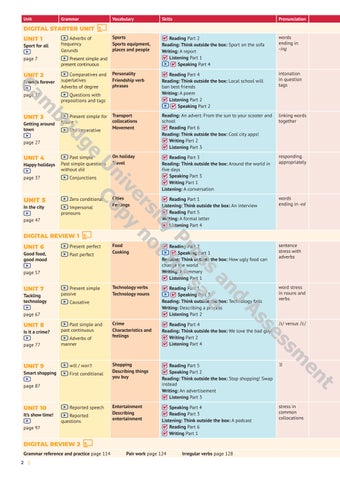
Unit
Grammar
Vocabulary
Skills
Pronunciation
Sports Sports equipment, places and people
Reading Part 2 Reading: Think outside the box: Sport on the sofa Writing: A report Listening Part 1 Speaking Part 4
words ending in -ing
Personality Friendship verb phrases
Reading Part 4 Reading: Think outside the box: Local school will ban best friends Writing: A poem Listening Part 2 Speaking Part 2
intonation in question tags
Transport collocations Movement
Reading: An advert: From the sun to your scooter and school Reading Part 6 Reading: Think outside the box: Cool city apps! Writing Part 2 Listening Part 3
linking words together
On holiday Travel
Reading Part 3 Reading: Think outside the box: Around the world in five days Speaking Part 3 Writing Part 1 Listening: A conversation
responding appropriately
Cities Feelings
Reading Part 1 Listening: Think outside the box: An interview Reading Part 5 Writing: A formal letter Listening Part 4
words ending in -ed
Food Cooking
Reading Part 2 Speaking Part 1 Reading: Think outside the box: How ugly food can change the world Writing: A summary Listening Part 1
sentence stress with adverbs
Technology verbs Technology nouns
Reading Part 1 Speaking Part 3 Reading: Think outside the box: Technology fails Writing: Describing a process Listening Part 2
word stress in nouns and verbs
Crime Characteristics and feelings
Reading Part 4 Reading: Think outside the box: We love the bad guy! Writing Part 2 Listening Part 4
/ɪ/ versus /iː/
Shopping Describing things you buy
Reading Part 5 Speaking Part 2 Reading: Think outside the box: Stop shopping! Swap instead Writing: An advertisement Listening Part 3
’ll
Entertainment Describing entertainment
Speaking Part 4 Reading Part 3 Listening: Think outside the box: A podcast Reading Part 6 Writing Part 1
stress in common collocations
DIGITAL STARTER UNIT UNIT 1
Adverbs of frequency Gerunds
Sport for all page 7
Present simple and present continuous
UNIT 2
Comparatives and superlatives Adverbs of degree
m Ca
Friends forever
Questions with prepositions and tags
UNIT 3
Present simple for future
br
page 17
UNIT 4
Past simple Past simple questions without did Conjunctions
UNIT 5
Zero conditional
In the city
Co
page 37
Impersonal pronouns
page 47
DIGITAL REVIEW 1 UNIT 6
Present perfect
Good food, good mood
Past perfect
page 57
UNIT 7 Tackling technology
Present simple passive Causative
page 67
UNIT 8 Is it a crime?
Past simple and past continuous
page 77
Adverbs of manner
will / won’t
Smart shopping
First conditional
UNIT 10 It’s show time!
Reported speech Reported questions
page 97
DIGITAL REVIEW 2 Grammar reference and practice page 114 2
|
Pair work page 124
Irregular verbs page 128
t
page 87
en
UNIT 9
m
ss se As d an s le es sa Pr r y fo it t rs no ve y ni p
U
Happy holidays
ge
page 27
The imperative
id
Getting around town
Oracy
Challenge
Life competencies
STEAM
Giving reasons Preparing to speak
Nothing should stop young people doing the sport they want to
Creative thinking: imagining alternatives and possibilities Critical thinking: evaluating ideas and arguments Learning to learn: keeping track of your progress
Biology, Maths, Science How can sports technology improve an athlete’s performance?
Critical thinking: evaluating ideas and arguments Creative thinking: exploring issues and concepts
m Ca
Giving a presentation Using gestures and body language Making eye contact Projecting your voice Young people have busy lives and need ways to travel around
ge
id
br
Responding to your partner’s opinions Taking turns Checking information Asking for information politely
Cities are not always good places for children and teenagers to live in
Co
Planning Speaking to an audience
Creative thinking: imagining alternatives and possibilities
ss se As d an s le es sa Pr r y fo it t rs no ve y ni p
U
Listening and responding Listening and responding with interest Responding with respect Responding with understanding
Digital literacy: using key words Learning to learn: evaluating learning and progress Creative thinking: generating ideas Learning to learn: setting goals and planning for learning
Digital literacy: searching online Creative thinking: considering multiple perspectives Creative thinking: generating ideas Learning to learn: using effective strategies for learning and retaining information
Environmental Science
Planning as a group Deciding as a group Listing reasons Supporting someone in a group Using connectors Reacting to what people say
Critical thinking: drawing appropriate conclusions Learning to learn: using feedback to improve learning
Shopping can be fun, but we need to try to make responsible choices
Creative thinking: elaborating on and combining ideas Critical thinking: evaluating arguments as a whole Learning to learn: using effective systems for finding, keeping and retrieving information
Physics, Maths, Arts How will surveillance change in schools?
t
Structuring an interview Sequencing ideas in an answer Involving others and encouraging them to say more Interrupting
Critical thinking: evaluating specific information or points in an argument Creative thinking: imagining alternatives and possibilities Learning to learn: engaging in directed activities
en
Making suggestions Asking follow-up questions Sounding confident
Digital literacy is now more important than ever
Biology, Chemistry, Arts What do people think about lab-grown meat?
m
Having a debate Using evidence to support your argument Planning what you want to say Responding to arguments with respect
Learning to learn: taking the initiative to improve own learning Critical thinking: identifying and classifying information
Creative thinking: exploring issues and concepts Creative thinking: participating in creative activities
Technology, Maths Digital classroom: Practice Extra |
3
m Ca
ge id br
Co
t
en
m
ss se As d an s le es sa Pr r y fo it t rs no ve y ni p U
Student’s Book
B1
Melissa Thomson
Niamh Humphreys
UNIT 1 SPORT FOR ALL LEARNING AIMS
THE CHALLENGE Nothing should stop young people doing the sport they want to. You will: • Stage 1 Think: find out what stops some teenagers doing sport. • Stage 2 Prepare: decide on one group of teenagers you would like to help. • Stage 3 Develop: plan how you can help them. • Stage 4 Present: present your solution.
m Ca
Skills: discuss and create texts about doing sport Grammar: learn and practise the present simple and the present continuous, adverbs of frequency and gerunds Vocabulary: learn and practise words and phrases for sport and sports equipment, places and people Critical thinking: identify problems and solutions related to sport Exam practice: Reading Part 2, Listening Part 1, Speaking Part 4
ge
id
br
Co
ss se As d an s le es sa Pr r y fo it t rs no ve y ni p
U 1 Look at the photo. In pairs, discuss the questions.
Documentary
01
Grammar
Grammar
Discuss the questions with a partner. 1
3
4
What stops some teenagers doing sport?
2 Which groups of teenagers sometimes find
it difficult to do the sport they want? Why? 3 What problems can you help with? Make a list (e.g. raising money for equipment, making everyone feel welcome).
Speaking
t
sports are mentioned? Why do some teenagers not do these sports?
2
en
2 Watch the video. What
1
m
What do you think is interesting about this photo? 2 Do you know what sport this is? 3 Do you think it is important for all young people to do sport? Why? / Why not? 1
CHALLENGE Think
|
7
VOCABULARY SPORTS 1
1.1 Go to the digital activity and match the sports to the photos. Listen, check and repeat.
Can everyone do all of them? If not, what stops some people doing some of them? For example, is a sport very expensive or ‘only for girls’?
5 Copy and complete the table with the sports in Exercise 1. Can you add any more sports?
m Ca
athletics diving gymnastics handball horse riding ice hockey jogging paddle boarding parkour roller skating windsurfing yoga
4 Work in groups and discuss the sports in Exercise 1.
ge
id
br
play (We use play with team sports and sports with a ball.)
handball
go (We use go with verb + -ing.)
diving
do (We use do with other sports and activities.)
athletics
6 Ask questions to find out what sports other people in your class do.
Do you do yoga?
Do you play …?
Yes, I do.
I sometimes …
Yes, I like it.
Co
ss se As d an s le es sa Pr r y fo it t rs no ve y ni p
U
Do you go jogging?
I’m good at it.
It’s too …
No, I don’t do that.
7 What are the three most common sports in your class? In groups, discuss why you think these sports are the most popular.
The most popular sport in my class is swimming.
2 3
PRONUNCIATION
pronunciation activity.
Go to the digital
Look at the reasons people give for not doing sport. Match the reasons (1–4) to the problems (a–d). 1
The sports club is in an old building with stairs and very small changing rooms. I can’t use it. 2
The rugby club and the football club are for boys, and I’m just not interested in ice skating and gymnastics.
How could I learn windsurfing? Lessons are expensive, the equipment is expensive …
a clubs only for girls, or only for boys b no role models c not enough money d no facilities for people with disabilities |
Unit 1 Sport for all
STRETCH! Do you or your friends enjoy any sports that are not on this page? Use an online dictionary to find the English words for other sports that you want to talk about. Do we use play, go or do with the sports?
CHALLENGE Prepare
1
2
3
4
Form groups of three or four people. 2 Share your notes from Stage 1. 3 Decide on one group of teenagers you would like to help. 4 Each person in your group will start looking for information on how to help this group of teenagers. Decide where you can find information and then start your research. 1
t
4
Vocabulary reference page 16
en
I don’t think I could be successful at water sports. No one who looks like me does those kinds of sports.
Because we have a really good swimming pool near our school!
m
3
8
Why do you think swimming is so popular?
GET
A C TI V E
READING SHORT TEXTS 1 What new sports or activities would you like to try? Why? Tell a partner.
2 Read the text. Complete the gaps (1–5) with the
m Ca
words in the box. There is one extra word you do not need to use. athletics h orse riding paddle boarding parkour rugby yoga
br id
EXAM TIP
ge
You should use a pencil in the exam. Underline the key information about the people. Then, underline any information in the texts which matches that. This will help you choose the answer.
Co
• • • • •
How old is he? What does he like? What does he dislike? What does he want to do? When?
Alex is 14. He doesn’t really like running, but he often goes swimming and windsurfing. He wants to train at weekends to get stronger for these beach sports.
4 Now read texts D and E. Find any information which matches Alex. Put a cross next to any information which does not match Alex.
5 Which class is best for Alex? Why?
EXAM TRAINING READING PART 2
6 Now read about two more teenagers. They both
1.2
A PLAY LIKE A GIRL
Did you know that in 1… clubs, only around 5% of members are girls? Come to our girls-only club to learn the basics! Be at the pitch at 7 am on Saturday. For ages 14+.
B JUMP THE CITY If you don’t like teams but love sport, then try this one-day introduction to 2…. It’s fast and needs a lot of balance. Join us next Saturday in Green Park at 3 pm! £8. All ages welcome.
C CITY RIDING We are looking for volunteers to help in a 3… school in the centre of London. It’s free to ride if you can help us take care of the horses on Sundays! Volunteers must be 14 or over.
Free on Sundays? 4… can help your legs and arms become powerful and help you with your breathing. Doing yoga is not as easy as people think! Meet at the beach café. £4 per class. For ages 14+.
E RUN ON THE SAND
Do you want to get fast and strong this summer? Join us every Wednesday at 8 pm for advanced 5… training. Sign up for next term now. Under-14s only.
7 Share your answers with a partner. Give reasons for your answers.
ORACY
Giving reasons
When using expressions like I think this one is … because it … or Maybe this one is … because of the … you give reasons for your answers. This helps your partner understand what you are thinking.
8 Work in groups. Discuss the questions and give reasons.
Do you like doing new activities? Why? / Why not? 2 Which class would you like to go to? Why? 3 Which class would you not enjoy? Why? 4 Jack has an issue that limits what activities he can do. Think of other activities he could do. 1
t
en
Jack is 15. His hobbies are paddle boarding and walking his dogs. He loves animals! He would like to try a new sport, but he hasn’t got any money. 2 Alison normally goes jogging every day and does gymnastics at weekends. She’s strong! She and her friend want to do a new outdoor activity as part of her 13th birthday on Saturday.
D SUNSET POSES
m
want to try a new activity in the summer. Decide which activity would be best for each teenager.
1
TIE
FOR S TEENS!
ss se As d an s le es sa Pr r y fo it t rs no ve y ni p
U
3 Read about Alex and find this information.
IN THE SUMMER
ACTIVI
STRETCH! Go online and find activities for you and your friends where you live. What activities can you do this weekend? Choose two that you want to do. Give reasons. Tell other people in your class. Unit 1 Sport for all |
9
GRAMMAR
5 Work in pairs. Complete the sentences so that
they are true for you. Find something you have in common and then tell the class.
ADVERBS OF FREQUENCY
1
1 Watch the grammar
3 My friends and I normally …
02
m Ca
vlog. What sports does Olivia do? Who does more sport: Olivia and her sister, or you?
2 Watch the grammar vlog again. Choose the
4 I’m hardly ever …
GERUNDS 6 Look at the sentences from the grammar vlog. Choose the correct answers.
correct answers to complete the rules in the grammar box.
br
1
I love keep / keeping fit.
2 Play / Playing in a wheelchair takes practice.
id
ge
Adverbs of frequency Adverbs of frequency tell us how often something happens. They go 1 before / after the main verb and 2 before / after the verb be. We sometimes practise the dances. I’m always tired at night!
3 I’m quite good at dive / diving.
7 Choose the correct answers to complete the rules in the grammar box.
U
ss se As d an s le es sa Pr r y fo it t rs no ve y ni p
Gerunds Gerunds can be subjects: 1 Do / Doing exercise is really important. Gerunds can go after certain 2 verbs / nouns (e.g. like, love, don’t mind, hate, etc.): She doesn’t enjoy going to PE. Gerunds can go 3 before / after prepositions: Friday nights are for relaxing.
Grammar reference and practice page 114
Co
3
I always …
2 At weekends, my family don’t often …
Go to the digital activities.
4 Put the sentences in order from most frequent (1) to least frequent (5).
a We don’t often do yoga at school.
Grammar reference and practice page 114
b We hardly ever go to stadiums because not
many are wheelchair friendly. c Our PE teacher normally gives my sister sports videos to watch. d I am always excited when we have a match. 1 e Olivia never likes leaving the pool because she loves it!
8
Go to the digital activities.
9 Complete the second sentence so that it means the same as the first.
It’s really fun doing sport with friends. … is really fun. 2 A sport that he hates is jogging. He hates …. 3 Swimming is something that I’m good at. I’m good …. 1
10 Complete the sentences so that they are true for you. Use gerunds.
I really enjoy …
2 I don’t really like … 3 … is not my idea of fun. 4 I think that … is really important.
t
5 Sunday mornings are for …
en
m
1
6 I’m good at … STRETCH! Plan a vlog about the sports and
exercise you do each week. Share your ideas with a partner. Make the vlog if possible.
HOW IS UNIT 1 SO FAR? 10
|
Unit 1 Sport for all
I understand
I’m getting there
I don’t understand
THINK OUTSIDE THE BOX!
SPORT ON THE
SOFA
OUR IDEAS ABOUT SPORT ARE CHANGING
m Ca
What exactly is a sport? It’s not an easy question to answer. Sports usually happen outside the home, on a court, a pitch or a track, or at the gym. You might need equipment, like a racket or a helmet. You can’t do a sport sitting on your sofa. Or can you? Well, maybe you can if you’re playing an e-sport!
id
br
ge
People playing a computer game at home, even if they are playing against other people, are usually called gamers, not e-sportspeople. However, many popular games are now played at a professional level, with huge audiences. Then, they are called e-sports.
to concentrate for a long time. Games are often very long, so you have to be fit if you want to play at a high level. You’re not running or swimming or cycling, but your body and your mind always need to be active.
ss se As d an s le es sa Pr r y fo it t rs no ve y ni p
U
The idea of e-sports is new and some people don’t agree that it’s a good thing, especially some parents of teenage gamers. They’d like their children to go out and kick a real ball into a real net. However, chess is called a sport by the International Olympic Committee, so why not e-sports? But don’t forget, if e-sports are your thing, then it’s important to sometimes get exercise outside, too! MEDIATION WORKSHEET
Co
In fact, there are many good reasons to think of these games as sports. Competitors can play in teams and there are big prizes for champions. It is now possible to get a good job as an e-sports coach. Players need to be extremely fast and must be able
READING AN ARTICLE
1 Look at the photos. What are the people doing? Which activities are sports?
2
1.3 Read and listen to the article. Make notes to answer the questions below. 1
When does a computer game become an e-sport?
2 Why do high-level e-sport players need to be fit? 3 Why do some parents dislike the idea of e-sports?
3 Work in pairs. According to the writer, are the sentences true or false? Why? 1
Everyone knows what the word ‘sport’ means.
• reasons why e-sports are real sports • reasons why e-sports are not real sports
1.4 Go to the digital activity and match the words to the photos. Listen, check and repeat.
coach champion competitors court helmet gym net pitch racket track
2 Imagine you’re doing a sport. Work in pairs and ask and answer questions to find out what it is. I’m on / in / at …
I’m using …
I’m on a court. What sport am I doing?
I’m wearing …
I think you’re playing tennis.
t
Make two lists. Then work in pairs and tell each other what your own opinion is.
1
en
4
SPORTS EQUIPMENT, PLACES AND PEOPLE
m
That’s false. The writer says … 2 Gamers are not always e-sportspeople. 3 Only a few people want to watch others playing computer games. 4 Working as an e-sports coach is now a real career option.
VOCABULARY
Vocabulary reference page 16 STRETCH! Think of a sport that you like playing or watching. Do you know the words for the equipment you need for it and the people who play or do it (e.g. captain, goalkeeper …)? Look up the words you don’t know and tell your partner. Unit 1 Sport for all |
11
GRAMMAR
5 Complete the messages with the present simple or present continuous form of the verbs in the box.
PRESENT SIMPLE AND PRESENT CONTINUOUS
not believe not have got play stay wait work Louise
1 Watch the grammar
Online
animation. Why are the boy and the girl at the gym?
m Ca
03
Hey Lou, where are you? We 1… for you on the football pitch.
2 Look at the examples from the grammar animation.
1 3 4
Come out now and join us. You 3… at home every afternoon. It’s boring. I can’t go out. Dad 4… afternoons this week, so I have to stay at home with my sister. I 5… you!
ss se As d an s le es sa Pr r y fo it t rs no ve y ni p
6
U
5
I usually run in the park. You want to win your race. Winning doesn’t matter that much. You’re working hard! Our trainer isn’t working. I’m playing better every day.
ge
2
id
br
Match the verb forms in bold to the uses (a–f). Then complete the rules in the grammar box.
Oh no, I forgot! I’m at home. I 2… my new video game. Sorry!
It’s true! We 6… a babysitter, so it’s my job to look after my sister.
a a fact, or something that is generally true c a regular habit
Co
b a state verb (like, love, expect, etc.)
d something that is happening now e a changing situation f
a temporary situation
Present simple and present continuous We use the 1… for habits and things that are generally true, and with state verbs. We use the 2… for things that are happening now, and temporary or changing situations.
Grammar reference and practice page 114
3
Go to the digital activities.
4 Choose the correct answers. 1 2 3
DIGITAL CLASSROOM PRACTICE EXTRA UNIT 1
12
| Unit 1 Sport for all
6 Make notes about these topics. Then work in pairs and take turns to talk about yourself.
• something I always / never do • something I want in my life • something I’m doing / working on /
learning about / training for at the moment
STRETCH! Find out more about state verbs (also called stative verbs). Make a list of state verbs and then write one or two sentences explaining how they are different from other verbs.
CHALLENGE Develop
1
2
3
In your group, share your information from Stage 2. What important points have you found? 2 Decide how you could help the group of teenagers you chose. 3 Decide how you will present your solution (e.g. with a poster, video, podcast, etc.). 4 Create a first draft of your presentation. 1
4
t
6
Write notes before you speak. For example, write school – bike, rain – bus. Then use full sentences when you speak: I usually go to school by bike, but I take the bus when it rains.
en
5
Preparing to speak
m
4
I can’t talk to you now. I do / I’m doing yoga with my sister. Laura plays / is playing handball every Saturday. More and more people become / are becoming interested in paddle boarding. Running is a sport that doesn’t cost / isn’t costing much money. Hasan trains / is training hard for the rugby match these days. Some people don’t think / aren’t thinking e-sports are really sports.
ORACY
WRITING
2 Read the report and check your answers. Do you
think that the results of the survey are surprising?
A REPORT 1 Look at the infographics and decide if the sentences are true or false.
Almost all the students go to school on foot or by bike. 2 Only half the students do sports outside school. 3 Most students use fitness apps. 4 More than half the students buy sports clothes. 1
m Ca 12
Transport to school
8 4 2
Students
4
Students
3 Complete the report with these headings.
football basketball running swimming Sports How often do you use a fitness app?
• What time / When …? • What equipment / clothes / apps …?
5 Ask other people in the class your questions and 6 Write a report using your notes.
5 often
sometimes
never
4 2 often
sometimes
never
these questions to help you.
How many phrases from Exercise 6 are in your report? Could you use more? 2 Is there an introduction and a conclusion? 3 Are the results clear? Do you agree with them? 4 Can you see any problems with the language (spelling, grammar, etc.)? 1
t
6
7 Read your report again and revise your work. Use
en
8
All / Some / Half / Ten of us … We sometimes / always / never go … We all like …
m
How often do you buy sports clothes or equipment?
10 Students
• What …? • How …? • Why …?
make notes on their answers.
10
0
3 … In conclusion, we can say that being fit and active is important to this class. We discovered that we almost all enjoy sports and exercise. We like using sports clothes and equipment, too.
five or six questions.
15
12
Using fitness apps is not very popular in our class. Fewer than half of us use them. Buying sports clothes and equipment is more common, and 17 students in our class sometimes or often spend money on that.
4 In pairs, create a fitness survey for your class. Write
2
0
2 … Most of us sometimes do sports outside school. Ten students play football, six play basketball, four go running and three go swimming.
Conclusion Introduction Results
6
20
car
Sports outside school
8
0
bike bus Transport
Co
10
on foot
There are 28 students in the class. Almost all of us come to school by bike or on foot, so we get some exercise every day.
ss se As d an s le es sa Pr r y fo it t rs no ve y ni p
6
0
Number of participants: 28
U
Students
10
ge
id
br
CLASS 7C – results of a survey about people’s fitness
1 … In our survey, we asked our classmates about their fitness habits. The survey provided some very interesting information.
8 Now work in pairs. Read each other’s reports and
give feedback. Use the questions in Exercise 7 to help you. Make a note of your partner’s feedback and write a second draft of your report. Unit 1 Sport for all |
13
LISTENING MONOLOGUES AND DIALOGUES 1 Look at the photos. Where would you like to go this evening? Why?
1.5 You will hear two friends discussing where to go. Listen and answer the questions.
m Ca
2
When do the two friends want to go out?
1
2 What three options do they mention?
br
3 Listen again and answer these more detailed
id
questions.
Why does the girl not want to go to the cinema this evening? 2 Why does the boy not want to play badminton or go cycling in the park? 3 What do they decide to do in the end? 1
ge
Co
In the exam, you will hear each recording twice. The first time you listen, try to understand generally what the speakers are saying and try to answer the questions. The second time you listen, concentrate on details and check your answers.
4
1.6 Now answer two Listening Part 1 questions. 1
DISCUSSING LIKES, DISLIKES, EXPERIENCES, OPINIONS AND HABITS
ss se As d an s le es sa Pr r y fo it t rs no ve y ni p
U
EXAM TRAINING LISTENING PART 1 EXAM TIP
SPEAKING
1 Watch two candidates
doing part of the 04 Speaking exam. Write down the phrases they use to talk about what they like and dislike.
2 Watch again. Write down the three questions that the examiner asks.
EXAM TRAINING SPEAKING PART 4
EXAM TIP
What new activity did the girl try last week? A
B
Try to use different ways to say I like and I don’t like, just like you do in your language. It stops you repeating yourself and is more natural.
C
3 Work in pairs. Ask each other the questions
from Exercise 2. Use phrases from Exercise 1.
2 What does the boy like best about the A
B
C
1
2
3
4
Check the first draft of your presentation for facts and language. 2 Create a second draft if necessary. 3 Practise presenting your ideas. 4 Present your solutions to the class. For example, explain your poster or play your recording. 1
14
| Unit 1 Sport for all
t
en
CHALLENGE Present
m
sports centre?
WRAP UP Look back at the unit. Write down:
m Ca
1 three new words you learned 2 something that made you think critically
3 two sentences which each use a gerund in a different way
br
id
4 useful information you learned about these parts of the exam: Reading Part 2, Listening Part 1, Speaking Part 4
ge
5 something in the unit that you especially enjoyed
ss se As d an s le es sa Pr r y fo it t rs no ve y ni p
U
Sustainability
1 How would you define sustainability? Do some research and discuss your findings with a partner.
Co
2 Can you think of an unsustainable sport? Think of ways in which you can make it more sustainable.
SELF-ASSESSMENT: UNIT 1 How confident do you feel about:
• • • • • • • • • •
sharing opinions and making conclusions from a reading text? matching texts with people to show detailed comprehension in Reading Part 2? using the present simple and the present continuous? using adverbs of frequency? using gerunds? using words for sports, and sports equipment, places and people? doing a survey and writing a report? identifying key information in a listening text in Listening Part 1? talking about what you like and dislike doing in Speaking Part 4? giving reasons and preparing to speak?
en
m
After completing your self-assessment, look again after two weeks. Did you make progress?
STRETCH! YOUR CHOICE
t
Now choose an extra activity! Option 1: Choose a sportsperson you admire and make a fact file about them. Display it in your class or on your class blog.
Option 2: Choose an unusual sport and do some research on it. Why is the sport good for you? Try to persuade someone else that it’s a good sport to learn.
Option 3: Make a poster for a sports day. The poster should try to make all teenagers feel welcome.
Unit 1 Sport for all |
15
VOCABULARY REFERENCE SPORTS
1 Match the words to the photos.
m Ca
athletics diving gymnastics handball horse riding ice hockey paddle boarding parkour roller skating windsurfing yoga
1
2
jogging
4
7
8
ge
id
br
3
6
Co
ss se As d an s le es sa Pr r y fo it t rs no ve y ni p
U
5
9
10
11
12
SPORTS EQUIPMENT, PLACES AND PEOPLE
2 Match the words to the photos. coach
champion
competitors
1
helmet
gym
net
pitch
racket
track
3
4
6
7
8
9
10
t
en
2
m
5
court
DIGITAL CLASSROOM PRACTICE EXTRA UNIT 1
16
|
Unit 1 Sport for all
UNIT 2 FRIENDS FOREVER LEARNING AIMS
ORACY
m Ca
Skills: discuss and create texts about friends and friendships Grammar: learn and practise comparatives, superlatives, adverbs of degree, questions with prepositions and questions with tags Vocabulary: learn and practise words and phrases for personality and friendship Oracy: give a presentation Exam practice: Reading Part 4, Listening Part 2, Speaking Part 2
Giving a presentation • using gestures and body language • making eye contact • projecting your voice
ge
id
br
Co
ss se As d an s le es sa Pr r y fo it t rs no ve y ni p
U 1 Look at the photo. In pairs, discuss the questions.
3 Work in groups. Read the statements below. Choose
one and talk about it to find out what everyone thinks. Then decide whether your group agrees with it or not.
What do you see? 2 How does the photo make you feel? 1
2 Watch the video and
answer the questions.
• A friend must be similar to you. • It’s important to spend a lot of time with
• Your friends are more important than your family. 4 Think about your group discussion. Answer the
questions and compare your answers with the other people in your group. 1
t
en
01
m
your friends.
Why do we have friends? 2 Is a best friend always an old friend? 3 Who can be a friend? 4 Do opposites attract? 1
Did you speak clearly enough?
2 Did everyone in the group make eye contact? 3 What gestures did you use?
Documentary
Grammar
Grammar
Speaking
Oracy
| 17
VOCABULARY
5
PERSONALITY 1
2.2 Listen to a talk about personalities. Complete the notes. 1
2.1 Go to the digital activity and complete the sentences with the words. Listen, check and repeat.
m Ca
bossy clever confident funny generous honest nervous patient rude serious shy
ge
id
br 2 Copy and complete the Venn diagram with the
MY FRIEND IS …
I AM …
… people: • can have a good time with them • don’t always think about others
2
Our personality depends on: • who we are with • how we 3… • 4… people can see us differently
ss se As d an s le es sa Pr r y fo it t rs no ve y ni p
U
words from Exercise 1. Show it to a partner. Who is most similar to their friend?
… people: • can be good listeners • may only be nervous talking in big groups
Co
WE ARE BOTH …
6 Choose two words from Exercise 1. Write a
sentence to explain how the word can sometimes be positive and sometimes negative. Share your sentence with a partner.
You can have a good time with a funny person, but maybe they don’t always think about other people.
3
01 Watch the video again and complete the sentences. Do you agree with the sentences? Why? / Why not?
In the UK, ten percent of teenagers say they are more … and … when they chat online. 2 A robot friend could be a good friend because they are never … or …! 3 A … person is not often best friends with a … person. 1
Using gestures and body language
When we use gestures and body language, it helps the listener understand us. For example, it’s common to raise our eyebrows when we ask a question or to smile when we talk about something we like.
8 Work in pairs and tell each other your sentences from Exercise 7. Use gestures and body language to show how you feel. Then discuss the questions below. Why do you think we change our personality depending on other people and how we feel? 2 ‘It’s not important what other people think of your personality.’ Do you agree? 3 How often do you use gestures and body language to explain words in class? Do you think it’s helpful? Why? / Why not? 1
Vocabulary reference page 26 STRETCH! Create some word art of the personality of a friend. Look online for programs to help you. Present your word art in small groups. 18
| Unit 2 Friends forever
t
en
Work in groups and share your opinions from Exercise 3. Have you changed your opinion after listening to the others? If so, how?
ORACY
m
4
7 Complete the sentences with words from Exercise 1. • I don’t like it when my friend is … because … • Some people think I am …, but … • My friends know I am … because …
READING
4 Read the first paragraph again. A sentence has
AN ARTICLE
been removed. Look at options A–E and choose the correct missing sentence.
1 You are going to read the first paragraph of an
A The reason is simple.
article. Look at the title. What animals do you think the text will talk about?
m Ca
EXAM TIP
id
br
First, read the title of the text. This will help you understand what it is about. Then, read the text quickly from start to finish. Ignore any gaps. Try to understand the general idea of the text before thinking about the missing sentences.
ge
2 Now read the first paragraph quickly to check your ideas. Ignore the gap for now.
C They can also be generous when a ‘friend’ needs food. D We already know that dolphins and large birds do this. E It’s like a human laugh, isn’t it?
5 Tell a partner why you chose that sentence. Say why you didn’t choose the other sentences.
EXAM TRAINING READING PART 4
6 Read the rest of the article. Two sentences
have been removed. Look at options A–E in Exercise 4 and, for each question, choose the correct answer. There are two extra sentences which you do not need to use.
ss se As d an s le es sa Pr r y fo it t rs no ve y ni p
U
Why do animals laugh and make friends?
B She is not the baby giraffe’s real grandmother.
Co
Scientists believe that some intelligent animals laugh and have fun with each other. Think about the sound that chimpanzees make when they are having fun together. 1… Also, videos show that, like humans, some rats play and ‘laugh’ more than others. They do this to make friends.
3 Which sentence best summarises the paragraph? Choose the correct answer.
A Studies show that many clever animals have a
sense of humour, make friends and can be shy. B Animals can be fun and funny, like humans, and there are different ways to study this. C Animals are funnier and more intelligent than humans, and scientists study them with videos.
2.3
Animals need friends when one of the group is hurt. This is because a group is safer when everyone can run away together. 2… This is so the group of friends can stay strong and healthy. In some groups of animals, more babies survive because the animals help one another. For example, giraffes and elephants have older friends that can be babysitters. So why do we see online videos of strange friendships, like sheep and ducks making friends? 3… When there are no other sheep around them, they make friends with the other animal they live with so that they are not alone. Animals are amazing, just like us!
t
en
m STRETCH! Choose a personality adjective from
page 18. Do any animals have this characteristic? Use the internet to find out. Write a short paragraph with your findings.
Unit 2 Friends forever |
19
GRAMMAR
ADVERBS OF DEGREE
COMPARATIVES AND SUPERLATIVES
8
He’s … shy. 2 I’m … quiet. 3 He’s … smart. 4 I’m not … confident telling jokes. 1
1 How often do you take photos of your friends? What do you do with them? Compare with a partner.
m Ca
9 Choose the correct answers to complete the rules
2 Watch the grammar vlog. Why is Tom starting a vlog?
in the grammar box.
02
br
Adverbs of degree Adverbs of degree can tell us more about the 1 adjective / verb in the sentence and make it stronger or weaker. We put these adverbs 2 before / after an adjective. We can use a bit and quite to make an adjective 3 stronger / weaker. We can use very and extremely to make an adjective 4 stronger / weaker. My best friend is very kind. Sometimes he’s quite shy.
id
3 Look at the examples from the grammar vlog and find the comparatives or superlatives. My brother’s older than me.
ge
1
02 Watch the grammar vlog again and complete these sentences.
2 Roller skates are more expensive than chocolates!
U
3 I’m the oldest of my friends.
ss se As d an s le es sa Pr r y fo it t rs no ve y ni p
4 Complete the rules in the grammar box.
Co
Comparatives and superlatives Comparatives compare things: My brother’s 1 old… than me. Her brother is 2… generous than mine! Superlatives compare someone or something to the whole group: I’m the 3 old… of my friends. He is 4 … … intelligent 17-year-old in the school!
Grammar reference and practice page 115
5
Go to the digital activities.
6 Choose the correct answers to complete the text.
Photos on your wall are better 1 than / that photos on your computer. It’s 2 more difficult / most difficult to remember happy times when you don’t have photos. Choose ten of 3 the more interesting / the most interesting photos of your friends and print them. It’s 4 cheaper / more cheap to print them in black and white, but they look 5 more beautiful / most beautiful in colour. Put them on your bedroom wall and you’ll be 6 happier / more happy, I promise!
7 Complete the questions with the adjectives in the
2 3 4 5
In your family, who is the …est? Are you …er than your best friend? In your group of friends, who is the most …? Are you more … than your English teacher? In your school, which teacher is the most …?
11 Choose the correct answers.
She’s really / not very generous. She always buys presents for her friends. 2 He’s quite / not very shy. He prefers to spend time with just one or two friends. 3 Photos of friends are extremely / a bit important to me. I love looking at them! 4 My friend is great at telling jokes. She’s very / a little funny. 1
12 Complete the paragraph with your own ideas. Compare with a partner.
I think friends should be very … and really …. It’s OK if they are a bit … and are not very …, but the most important thing is that they are extremely ….
I think friends should be very honest and really patient. It’s …
STRETCH! Work in pairs. Find a photo of your
friends or family, or use a photo in this book.
• Student A: Use comparative and superlative • •
adjectives, and adverbs of degree. Describe the people in the photo, but tell one lie. Student B: Listen and ask questions. Guess your partner’s lie. Swap roles.
HOW IS UNIT 2 SO FAR? 20
|
Unit 2 Friends forever
I understand
I’m getting there
I don’t understand
t
1
Go to the digital activities.
en
clever difficult f unny generous intelligent interesting kind serious shy
10
m
box. Then work in pairs and ask and answer.
Grammar reference and practice page 115
THINK OUTSIDE THE BOX!
LISTENING A NEWS STORY 1 Imagine you see this news story about a school which says that people must not have best friends. How do you feel?
m Ca
WORLD NEWS
SPORT
FRIENDSHIP VERB PHRASES 1
Daily News LOCAL NEWS
VOCABULARY
argue break up get on get to know hang out keep in touch lose touch make friends meet up miss
EVENTS
br
2 Complete the sentences so that they are true for you.
ge
id
Local school will ban best friends
2.5 Go to the digital activity. Match the words and phrases to the definitions. Listen, check and repeat.
1
David Rossi, 14 December
3
2
ss se As d an s le es sa Pr r y fo it t rs no ve y ni p
U
4 5
Co
6
3 Write four sentence starters with the other
phrases from Exercise 1. Give your sentence starters to a partner to complete.
4
Best friends
MEDIATION WORKSHEET
2
2.4 Listen to two students talking about the news story. How do they feel?
3 Listen again and decide if the sentences are true or false. 1
4
6
Vocabulary reference page 26
STRETCH! Find other phrasal verbs (like lose touch or hang out) related to friendship. Use an online dictionary to help you. Decide on two or three phrasal verbs that are useful to you and make sentences with them. Use the sentences to teach the phrasal verbs and their meanings to other people in the class.
t
5
Some students in school feel sad because they don’t have a best friend. 2 Some students in school don’t know everyone in their class well. 1
en
3
Ryan says that school is for learning, not for chatting with other people. Sara thinks that best friends work well together. Ryan says it’s best to be friends with everyone. Sara thinks a best friend ban will be easy for teachers. Ryan thinks it’s better to work with the same people every day in school. Both Sara and Ryan think the ban will work best at lunchtime and break time.
Work in pairs. Think of a new way to solve the problems below. Take turns to present your ideas to the class. Which ideas do you think are the best?
m
2
When I am on holiday, I miss … I sometimes argue with … In class, my teacher sometimes breaks up groups when … On Sundays, I normally meet up with … I got to know my best friend when I … I hope I don’t lose touch with …
4 Work in pairs. Who do you agree with most, Sara or Ryan? Why?
Unit 2 Friends forever |
21
GRAMMAR
7 Work in pairs. Choose one of the people in the
photos. Student A: Choose questions from Exercise 6 to ask. Student B: Imagine you are the person. Answer the questions. Then swap roles and talk about the other person.
QUESTIONS WITH PREPOSITIONS AND TAGS 1 Watch the grammar
animation and say which present you think is best for Greg.
m Ca
03
2 Put the words in order to make questions.
br
Watch the grammar animation again to check. 1
what / looking / we / are / for / ?
ge
id
What are we looking for? 2 excited / what / about / are / you / so / ? 3 can’t / find / online, / this / you / you / can / ? 4 doesn’t / riding, / he / likes / bike / Greg / ?
U
in the grammar box.
Co
We use question tags when we want to check information that we aren’t sure about, or when we hope the other person will agree with us. We put question tags at the end of a statement. We use the same 2 auxiliary verb / main verb as the statement, changing it from positive to negative, or negative to positive. It’s Greg’s birthday tomorrow, isn’t it? I think it’s perfect, don’t you?
For question tags after present simple statements, we use 3 do / did. For question tags after past simple statements, we use 4 do / did. She loves cats, doesn’t she? You didn’t have a pet, did you?
5
PRONUNCIATION
Go to the digital
pronunciation activity.
6 Choose the correct prepositions. Which questions could you ask the people in the photos?
4 5 22
What are you looking at / to? What are you listening at / to? What are you thinking about / with? What are you waiting to / for? Where are you hanging with / out?
| Unit 2 Friends forever
1
What country were you born in ?
2 Where are your parents …?
3 Which primary school did you go …? 4 Who do you normally eat dinner …? 5 You live near here / far away, …?
6 You’re from a big / small family, …? 7 You don’t like history / maths, …? 8 Your birthday is in (month), …?
ORACY
Making eye contact
As a speaker, it’s important to make eye contact with the people you’re speaking to. It helps you make a connection with them. As a listener, making eye contact with the speaker shows that you are paying attention.
9 Work in pairs. Look at the quiz on page 125. • Student A: Ask question 1. Don’t make eye contact. • Student B: Answer the question. • Now ask question 2 with eye contact. Which felt better? Why? How much eye contact felt comfortable? How much is too much?
10 Now work with a new partner and do the full quiz. Practise making eye contact. Do you agree with the results? DIGITAL CLASSROOM PRACTICE EXTRA UNIT 2
t
Go to the digital activities.
•
en
4
3
preposition or a question tag. For questions 1–4, predict your partner’s answers. For questions 5–8, choose an option. Read out your eight questions to your partner. How many of your predictions were correct?
m
Grammar reference and practice page 115
2
• Complete the questions below with a •
Questions with prepositions and tags Some verbs are followed by prepositions (e.g. by, after, to, etc.). When we make questions with these verbs, we usually put the preposition at the 1 beginning / end. What are you talking about?
1
knows you.
ss se As d an s le es sa Pr r y fo it t rs no ve y ni p
3 Choose the correct answers to complete the rules
8 Play a game to find out how well your partner
WRITING
1
A HAIKU A group of best friends sitting around the beach fire everyone’s laughing
A POEM 1 Work in groups. Ask questions to find out who: • usually remembers song lyrics • normally describes people and places really easily • likes playing with words and making jokes
2
AN ACROSTIC POEM
m Ca
She, Sally, Is always there Shouting, bossy Tidy your room! Everyday, but … Really, she’s my best friend, well … Sometimes.
2 Some people say that if you are good at the things in Exercise 1, you can write poems well. Do you agree? Why? / Why not?
br
3 Read the poems on the right (1–4) and match them
id
to the descriptions (a–d). What do the poems have in common?
3
A LIMERICK
a This is a simple five-line poem. The first and last line
I have a friend who loves the sun so outside we often have fun too long outside! go and hide! his face is redder than anyone!
ge
ss se As d an s le es sa Pr r y fo it t rs no ve y ni p
U
are shorter than the others. The number of syllables goes up by two before the end: 2–4–6–8–2. b This is a Japanese three-line poem written in a 5–7–5 syllable structure. The effect can be elegant, but the language is usually simple. c These poems are always funny. They are composed of five lines, three long and two short, with the rhyme scheme AABBA. They are sometimes rude and have a fun sing-song rhythm. d In these poems the first letter of each line makes a hidden word. They can be funny or serious.
4
Co
A CINQUAIN
Look up … Someone is there Waiting for you, happy Let’s chat about the world all day With friends!
4 Read these poems. What rules do they break? 1
ORACY
A HAIKU
Primary school Run, fall down, get up, smile, play I want this forever 2
Projecting your voice
2.6 When we’re speaking, it’s not just what we say that is important, but also how we say it. Itʼs important to speak loudly enough and not to look down at your paper so that everyone in the room can hear. Listen to someone reading a poem three times. Which sounds the best?
AN ACROSTIC POEM
Popcorn at the cinema Always the best Right at the front Thriller, horror, romance, action You can watch them all
topic below and write your own poem.
A
H O B BY
MY PET
W I T H
F R I E N D S
LAUGHING AN OLD FRIEND 6 Read your poem again and revise your work. Does the poem follow the rules?
• •
t
FRIENDSHIP
breathe in for five seconds. Can you feel the air filling under your hand? Breathe out. Breathe in again and when you are breathing out, say a line from your poem. Is your voice stronger? Does your voice travel further?
en
MY BEST FRIEND
m
5 Choose the type of poem you like the best. Choose a
8 Try an experiment to help project your voice. • Say a line from your poem. • Put your hand on your stomach and
9 Practise projecting your voice and reading
your poem out loud. Now read it to a group.
7 Now work in pairs. Read each other’s poems and give
feedback. Make a note of your partner’s feedback and write a second draft of your poem. Unit 2 Friends forever |
23
LISTENING DIALOGUES 1 You are going to hear two friends talking on the
way home from school. What do you talk about on the way home from school?
2
m Ca
2.7 Look at the exam question below. The answer is underlined. Listen and read the script. Find the key words in the script.
br
You hear two friends talking about birthday presents. What does the boy say?
id
A He got a present from his best friend. B He buys presents for all his friends.
ge
C Presents are only for important birthdays.
SPEAKING DESCRIBING A PHOTO 1 Work in pairs. Look at the photo and discuss the questions.
U
Girl: Oh! It’s Miguel’s birthday tomorrow, isn’t it?
ss se As d an s le es sa Pr r y fo it t rs no ve y ni p
Boy: Yes, it is. I’m going to get him a book.
Co
Girl: I think I’ll just make him a card because it’s Theo’s birthday, too. I need to buy him something. He’s my best friend and I don’t have much money.
Boy: Me neither, but I always try to buy presents for each of my friends, even if it’s something small. Girl: You’re such a nice friend!
EXAM TRAINING LISTENING PART 2 EXAM TIP
In the Listening paper of the exam, you won’t always hear the same words as in the question options. You sometimes need to listen for words and sentences that have a similar meaning.
3
2.8 Now look at questions 2 and 3. Listen and, for each question, choose the correct answer. 2 You will hear two friends talking about
|
Unit 2 Friends forever
EXAM TRAINING SPEAKING PART 2
EXAM TIP
In Speaking Part 2, don’t just describe the objects you can see in the photo. Describe the people, too. What are they doing? How are they feeling? Why?
3 Work in pairs and look at page 124. • Student A: Choose a photo. Don’t tell • •
Student B which one it is. Talk about the photo for 45 seconds. Student B: Listen carefully. Which photo is it? Swap roles.
t
24
about the photo in the 04 Speaking exam. Which questions in Exercise 1 does he answer? Which question could he say more about?
en
4 Listen again. Which words help you find the answers?
2 Watch a boy talking
m
their teachers. Who do they like most? A the funny teacher B the kind teacher C the patient teacher 3 You will hear two friends talking about going windsurfing. Why can’t the boy go? A He’s too tired. B He doesn’t have any money. C He is recovering from an injury.
Where are the people? 2 What are they wearing? Why? 3 What are they doing? Why? 4 How do you think they feel? 1
ORACY GIVING A PRESENTATION
m Ca
• using gestures and body language • making eye contact • projecting your voice
4
06 Watch the students doing their presentation. Do you like the way they structure their presentation? Who was better? Why?
make advice for giving presentations.
5
Make eye contact with the people who are watching 2 Project your voice 3 Using gestures and body language when you speak 4 When you give a presentation, you should practise and
07 Now watch the students discussing how they did. Who do you agree with the most, Paula or Daniel? Why? What do they decide to work on for the next presentation?
6 Plan, practise and give a presentation. Choose from
br
1 How often do you give presentations at school? What was your last presentation about?
1
ge
id
2 Match the sentence beginnings to the endings to
Co
ss se As d an s le es sa Pr r y fo it t rs no ve y ni p
U
a so that all the people in the room can hear.
b get feedback from another student on these
three things. Good luck! c to help you make a connection with them. d will give your presentation more energy and make it more interesting.
3 Watch two students
planning a presentation. Which of the advice in Exercise 2 do they talk about? What other things do they talk about?
the topics below.
The advantages and disadvantages of: • a robot friend • having just one good friend • having lots of online friends • making friends at a summer camp
05
SELF-ASSESSMENT: UNIT 2 How confident do you feel about:
t
en
completing a text with missing sentences in Reading Part 4? predicting content before reading a text? using comparatives and superlatives? using adverbs of degree? asking questions with prepositions and question tags? using words for personality and relationships with friends? writing a poem? listening for words and phrases with a similar meaning in Listening Part 2? describing a photo in detail in Speaking Part 2? giving a presentation?
m
• • • • • • • • • •
What was your favourite part of Unit 2? Tell your partner.
DIGITAL CLASSROOM PERSONALISED LEARNING
Unit 2 Friends forever | 25
VOCABULARY REFERENCE PERSONALITY
1 Match the words to the pictures. bossy
clever
confident
m Ca 1
funny
generous
honest
2
nervous
patient
rude 4
7
8
shy
ge
id
br
3
serious
6
Co
ss se As d an s le es sa Pr r y fo it t rs no ve y ni p
U
5
9
10
11
FRIENDSHIP VERB PHRASES
2 Match the verbs to the definitions.
argue break up get on get to know hang out lose touch make friends meet up miss
keep in touch
t
en
m
to communicate with someone by phoning, sending messages or writing 2 to speak angrily at someone, telling them you disagree 3 to spend time in a place for fun with a friend 4 to be friendly with someone 5 to stop being friends 6 to become friends 7 to meet someone and learn about their life 8 to get together to do something 9 to stop communicating with someone 10 to feel sad that you don’t see someone 1
DIGITAL CLASSROOM PRACTICE EXTRA UNIT 2
26
| Unit 2 Friends forever
UNIT 3 GETTING AROUND TOWN LEARNING AIMS
THE CHALLENGE Young people have busy lives and need ways to travel around. You will: • Stage 1 Think: find out what young people think about transport in their area. • Stage 2 Prepare: collect ideas to improve one form of transport for young people. • Stage 3 Develop: create a proposal. • Stage 4 Present: present your proposal.
m Ca
Skills: discuss and create texts about transport Grammar: learn and practise the present simple for future and imperatives Vocabulary: learn and practise words and phrases for transport and movement around a town or city Creative thinking: identify problems and solutions related to transport for young people Exam practice: Reading Part 6, Writing Part 2, Listening Part 3
ge
id
br
Co
ss se As d an s le es sa Pr r y fo it t rs no ve y ni p
U 1 Look at the photo. In pairs, discuss the questions. 1
How do you think these people feel? Why?
2 How often do you travel this way? Why?
3 Why do young people choose to travel this way?
Documentary
Grammar
Grammar
3
4
Discuss the questions with a partner.
What forms of transport can young people use to travel around in your area? 2 What are the most popular ways for young people to travel in your area? Why? 3 What don’t young people like about the transport in your area? 4 Thinking about transport, what would you like to change in your town or city? 1
t
Which four countries 01 are mentioned? 2 What transport do young people use to get to school in these four countries? 3 What do they like about it? 1
2
en
Answer the questions.
1
m
2 Watch the video.
CHALLENGE Think
|
27
VOCABULARY TRANSPORT COLLOCATIONS 1
3.1 Go to the digital activity and match the transport collocations to the photos. Listen, check and repeat.
m Ca
arrive on time ask for directions be delayed find the best route get a lift hire a bike look up a (bus / train) timetable pay a (bus / train) fare queue for a (bus / train) set off for school use the cycle lane
br
01 Watch the video again. Which collocations in Exercise 1 do you hear?
id
2
ge
3 Complete the sentences with words or phrases from Exercise 1.
4 5
Co
3
Alex woke up, got ready and set off for … First he tried to … Then he … After that he had to … In the end he … It was the worst morning ever!
ORACY
Responding to your partner’s opinions
4 Work in pairs. Which problems in Exercise 3 are the
Remember to respond to your partner’s opinions with phrases like I think so, too, You’re right or I’m not sure about that because …. This lets your partner know that you are listening.
5 Read the questions. Choose the correct answers.
8 Work in pairs. Do you agree with these sentences?
6
same where you live?
1 2 3 4
Exercise 5. What do you have in common? Tell the class.
| Unit 3 Getting around town
Walking is the only truly green way to travel. 2 Tourists should always walk around a city. 1
Vocabulary reference page 36
CHALLENGE Prepare
1
2
3
4
Form groups of three or four people. 2 Share your notes from Stage 1. Talk about how you can find out young people’s ideas for improving local transport (e.g. a survey, a questionnaire, interviews, looking online, etc.). 3 Decide how each person in your group will collect ideas. 4 Start collecting ideas. You will use these ideas later to make a proposal. 1
t
6 Work in pairs. Take turns to ask the questions in
Why? / Why not? Use the phrases from the oracy box.
en
6
When your bus or train has / is delayed, what do you do? How often do you ask / get a lift from your parents at weekends? Did you pay / give a bus or train fare yesterday? How much was it? How often do tourists ask / speak you for directions where you live? When you don’t have the internet, how do you look / find the best route to somewhere new? When was the last time you hired / cycled a bike? How much did it cost?
m
5
28
a terrible morning. Use at least four collocations from Exercise 1.
ss se As d an s le es sa Pr r y fo it t rs no ve y ni p
2
Most teenagers in my town … from their parents because they are too young to drive. I can’t … because it’s too close to the road and cars go near me. In my city, we can … on an app, but many trains get delayed, so the time is often wrong. Some people have to … at 7 am to avoid busy roads. From 5 pm to 7 pm you have to … bus because everyone wants to go home at the same time. The buses here don’t often …. They’re usually late!
U
1
7 Use the prompts below to write a microstory about
sun r to you r e t o and sco school From the
m Ca The
br
solar scooter
id
is a fun new product that teenagers will
ge
love!
Co
ss se As d an s le es sa Pr r y fo it t rs no ve y ni p
U
It does not use any fuel because it uses solar power. The batteries are in the part where you stand. Every day, the batteries need at least two hours of light from the sun and they last for one to two hours. The scooter can go up to 20 km per hour. You’ll save lots of money on bus fares, and you’ll never need to queue for public transport or ask for a lift again! Your parents will be happy too, because you won’t add to their electricity bill!
Buy one today for only
$999!
READING AN ADVERT
1 You see an advert for a scooter which gets its
power from the sun. Write down three questions that you hope the advert will answer.
2
3.2 Read and listen to the advert and answer your questions.
3 Read the advert again and write four advantages of
5
Taking turns
When giving your opinion, make sure to let other people speak, too. Use phrases like What do you think about that? to show you’re finished or How about you? to give others the chance to speak. You can also use Can I say something? or I know something about that when you want to take a turn.
6 Work in groups. Which new or future form of
transport do you think will be the most popular in the future? Discuss your opinion and remember to take turns.
t
What do you think is the best reason to buy a solar scooter? Why? 2 Why might someone not want one? 3 Would you like a solar scooter? Why? / Why not? 1
ORACY
en
4 Work in pairs. Discuss these questions.
Search online for ‘solar scooter’ or visit our online store.
m
the solar scooter.
The solar scooter is very quiet, so it won’t annoy your neighbours in the morning or late at night. Another good reason to buy one is that solar power is a very clean form of energy. This means that the solar scooter is very green. It’s even greener than travelling on electric buses! In fact, it’s also greener than cycling to school because when you do exercise, you breathe faster and produce more CO2 than you do if you are walking or just standing on a scooter.
Work in pairs. Go online and use key words to find information about another new or future form of transport. Then tell another pair what you found out.
Unit 3 Getting around town |
29
GRAMMAR
READING
PRESENT SIMPLE FOR FUTURE
A SHORT TEXT (OPEN CLOZE) 1 Read a short text about how teenagers want to
1 Watch the grammar
m Ca
vlog. Why is Olivia doing her homework on a Friday evening?
02
improve buses. What changes do they want? Ignore the gaps for now.
2 Look at the example question (0). Which of these grammar points does it test?
2 Watch the grammar vlog again. Then copy and complete the table.
adverbs of frequency comparatives present continuous question tags
On Saturday …
br Olivia Altan
id
EXAM TRAINING READING PART 6
Gabriela
ge
EXAM TIP Each question tests a different language point. Thinking of everything you have learned in grammar lessons could help you find the answer.
in the grammar box.
ss se As d an s le es sa Pr r y fo it t rs no ve y ni p
U
3 Choose the correct answers to complete the rules
Co
Present simple for future We use the present simple to talk about future events and timetables. We 1 come back / coming back on Sunday night. We use the 2 present simple / present continuous of some verbs (e.g. want, hope, plan) to talk about the future. We want to go whale watching.
3 Read the text again. Write one word for each gap.
TAKING THE BUS IN LONDON In London, not many young people 0 are taking buses. One bus company asked teenagers for their opinions. What did they talk 1…? Firstly, young people said they hardly 2… carry money in their pocket and prefer tickets they can use on their phones. Teenagers want free bus rides when they go to school. They also want weekend fares to be cheaper 3… on weekdays.
Grammar reference and practice page 116
4
Go to the digital activities.
5 Complete the sentences with pairs of verbs from
the box. Use the correct form of the present simple. arrive / get b e / want need / leave start / not want
• the time of your transport tomorrow • things you plan, hope or want to do in the future
Look back at the text in Exercise 3. What language point from Units 1 and 2 did each question test? Which of these language points do you need more practice of? Think of (or find) some activities that will help you do this.
My bus to school tomorrow leaves at 7 am. What time does it arrive at the school?
HOW IS UNIT 3 SO FAR? 30
| Unit 3 Getting around town
I understand
I’m getting there
I don’t understand
t
things. Ask follow-up questions.
4
en
6 Work in pairs. Write and say sentences about these
m
I need to be at the airport at 1 pm tomorrow. Our plane leaves at 3 pm. 2 What time does the film …? I … to be late! 3 Don’t forget that the rugby match … tomorrow. Do you … to meet me at the bus stop? 4 Our bus … at 9 am, but when does it … to the beach? 1
THINK OUTSIDE THE BOX!
COOL CITY
APPS!
We spoke to teenagers around the world about the apps they use to get around cities.
EVENT APPS
m Ca
When they arrive in a big city, many young people use an app to find out what concerts, sports games and festivals are happening that day. These apps say how near you are to these events and can sell you tickets. Some can tell you what bus to take and others also have voice instructions that give you directions. Never get lost finding a cool event again!
RUNNING APPS
Why get on the bus when you can walk? It’s free! There are many walking apps with maps to help you look around big cities. Some include games too, where you get points for walking past important places! Other walking apps tell interactive stories as you walk along famous historical streets wearing headphones. Learn while walking!
Some apps combine exercise with fun, interactive ways of exploring a city. For example, in one app, a lion can suddenly appear on your map and tell you to turn around and run! That helps you move fast! Another app takes you on special runs that pass lots of amazing street art. You discover places tourists don’t normally see.
ge
id
br
WALKING APPS
ss se As d an s le es sa Pr r y fo it t rs no ve y ni p
U
MEDIATION WORKSHEET
Are these types of apps popular in your area? Let us know in the comments!
Co
READING
AN ONLINE ARTICLE
2
PRONUNCIATION
pronunciation activity.
3 Choose the correct answers to complete the email.
1 Look at the photos. How are they connected to 2
travel apps? Read the article quickly to check.
Inbox
3.3 Read and listen to the article and answer the questions.
Hello Mira
1
What are the advantages of event apps?
2 Why does the writer recommend walking apps? 3 Why would someone like a running app?
3
Work in pairs. Discuss the
questions.
1
3.4 Go to the digital activity and match the verbs to the pictures. Listen, check and repeat. cross over get off get on go through go towards look around turn around walk along walk past
Love Elif
4 Complete the sentences so that they are true for
you. Show your sentences to another student. Are you similar or different?
On the way to school, I walk past … 2 I always / sometimes / never go through … 3 I prefer to get on a bus / metro / train than … 4 A very nice street to walk along in my town is … 1
t
MOVEMENT
I’m in Paris at the moment! I love walking 1 past / on buildings like the Eiffel Tower and the Louvre Museum. Every time I turn 2 off / around I see something cool! I think it’s faster to walk 3 around / over the city than to get 4 in / on and 5 off / on the metro all day. I have an app to give me directions. It tells me to cross 6 over / around the road and I do it! I tell the app what sights I want to see and it helps me to go 7 towards / along them. It’s the best tour guide ever!
en
VOCABULARY
2 Messages
m
Which kind of app would you like to try? Why? 2 Can you think of any disadvantages of these apps? 3 In the future, do you think more people would like to walk instead of using transport? 4 Invent a new walking app. What’s different in your app? 1
Go to the digital
Vocabulary reference page 36
Unit 3 Getting around town |
31
GRAMMAR
5
3.5 Listen and check.
6 Copy and complete the table with examples from
THE IMPERATIVE
Exercise 4. Example
1 Watch the grammar
giving directions 03
Pick up your friend giving a warning
m Ca
animation. Why do Rebecca and Christopher need to get a lift from their dad?
Let’s go through the park together.
2 Choose the correct answers to complete the
making an offer
br
examples in the grammar box.
ge
id
The imperative The imperative is used to give directions, orders and warnings. It is also used to make suggestions and offers. 1 Go / Going past the park. 2 Not take / Don’t take the path because it’s closed. 3 Let’s get off / We get off here!
7 Work in pairs. Imagine you are playing Hurricane
Escape in your school. Write a narration to help someone escape your classroom and find the nearest bus stop. Use the narration in Exercise 4 to help you. Use the imperative and let’s ….
ORACY
ss se As d an s le es sa Pr r y fo it t rs no ve y ni p
U
Grammar reference and practice page 116
Co
3
Use of the imperative
Go to the digital activities.
4 Look at this narration from a computer game. Complete the text with the words in the box. be don’t x2 go get let’s look take
This is level four of Hurricane Escape. Let’s start. 1… forget your bag. It has your clothes and your map in it. 2…! It’s a scooter. 3… on the scooter. Then turn left and go along the street. Pick up your friend. Your friend says, ‘4… careful! 5… cross over the bridge! It’s broken! Come with me. 6… go through the park together.’ At the other side of the park, 7… around the fountain. Now you can see the bus! A kind man comes up to you carrying a bottle of water. He says, ‘8… this water. You’re safe now.’ Now get ready for level five!
Checking information
It’s important to check you understand directions, orders or warnings. Check what the other person says with phrases like Did you say … or …? and Can you say that again, please?
8 Work in pairs. Student A: Start reading your
narration. Student B: Stop your partner sometimes to check the information. Then swap roles.
CHALLENGE Develop
1
2
3
4
In your group, share your information from Stage 2. Decide which ideas to include in your proposal. 2 Decide who you need to present your proposal to (e.g. the mayor, people who live in the town, etc.). 3 Decide how you will present your proposal (e.g. with a poster, video, podcast, etc.). 4 Create a first draft of your proposal. 1
PRACTICE EXTRA UNIT 3
t
en
m
DIGITAL CLASSROOM
32
| Unit 3 Getting around town
WRITING
6 Work in pairs. Discuss the questions in the exam task below.
AN ARTICLE 1 Look at the photos. What are the teenagers doing?
2 Read the list of things
m Ca
you can do when you are travelling to school. Which things do you often do? Add your own idea. Share your answers with the class.
br
• • • • •
ge
id
edit photos look out of the window do your homework read the news / a book check and send messages
discuss the questions.
Who is your best travel buddy? How do you travel around your town in summer and in winter? Who do you travel with? Do you think it’s best to travel alone or with someone else? Why? Write an article answering these questions and we will put it on our website!
7 Choose the correct adjectives and adverbs to complete the model answer.
Most of the year, my friends and I 1 normally / never cycle around town together. When we cycle, we go 2 really / always fast, so we don’t have time to talk! In the winter, it’s 3 sometimes / too cold to cycle, so when I go shopping or to handball practice, my older brother 4 often / especially gives me a lift. We chat about our day, laugh at each other’s 5 funny / interesting jokes and sing along with the 6 new / quiet songs on the radio. I think I prefer travelling with someone else. It’s more 7 fun / boring.
ss se As d an s le es sa Pr r y fo it t rs no ve y ni p
U
3 Read the exam task below. Work in pairs and
ARTICLES WANTED!
Co
WHAT DO YOU DO WHEN YOU ARE TRAVELLING?
Write an article telling us how you get to school. What do you usually do to pass the time? Is it better to take your phone with you or leave it at home?
EXAM TRAINING WRITING PART 2
The best articles will be published on our website next month.
4 Read the model answer. Do you agree with the
EXAM TIP
Use adjectives and adverbs in your article to make it interesting for the reader and to show that you can use a range of language.
writer? Ignore the gaps for now.
I 1… go to school by car because I live in a 2… village far from the 3… town. My dad drives me. I usually just look out of the window and we listen to the radio, but 4… we pick up my friend Adam on the way. Then, we chat about our night, about any 5… videos we saw and we sometimes compare our homework! Time passes 6… quickly.
Adjectives Adverbs
these questions to help you.
How many questions are there in the exam task in Exercise 6? Do you answer all of them? 2 Does your article have enough interesting language? Underline the best words and phrases. 1
10 Now work in pairs. Read each other’s articles and give feedback. Use the questions in Exercise 9 to help you. Make a note of your partner’s feedback and write a second draft of your article.
t
words from the boxes to make it more interesting.
9 Read your article again and revise your work. Use
en
5 Complete the model answer in Exercise 4 with
Use adjectives and adverbs.
m
In my opinion, it’s better to leave my phone at home in the morning. I can send DMs to my friends all evening. But when I’m with other people, it’s 7… better to spend time talking with them.
8 Now write your article in about 80 words.
cool main tiny always much really sometimes
Unit 3 Getting around town |
33
LISTENING
6
A MONOLOGUE
3.8 Listen to two students at the transport museum. What do they each ask for? How much does it cost?
1 Is there a transport museum in your country?
7 Listen again. Who sounds the most polite? Why?
2 Look at the exam task below. Which gaps need
ORACY
Do you like going there?
times or numbers? Which gaps need nouns?
m Ca
Trip to the transport museum
br
The teacher really likes the exhibition about future cars and 1….
The film about space travel lasts 2… minutes.
id
ge
The teacher thinks the best cheap gifts are the 3…. The bus goes at 4….
U
Co
EXAM TIP
Asking for information politely When you don’t know the person you are talking to, it can sound rude in English to use imperatives or verbs like want and need. Use Yes/ No questions or can and could to ask for things, e.g. Can I have a bag with that?
8 Read the conversation. The underlined parts are not very polite. Rewrite them to be more polite. Boy:
Oh, no! I missed the last bus! I need a lift home in your car. Girl: OK. Let’s ask my mum. I’m sure it’s fine. Boy: Hi, Mrs Mason. Take me to my house. I missed the bus. Mum: No problem, Borek. Can you pass me my car keys, please? Boy: Repeat that. Mum: I said, could you pass me the car keys? They’re on the table. Boy: Here you are. I want to go now. My mum will be angry!
ss se As d an s le es sa Pr r y fo it t rs no ve y ni p
EXAM TRAINING LISTENING PART 3
Give some examples to support your opinions.
Before you listen, look at the gaps. The words are usually nouns, times or numbers. You should predict what type of word goes in the gap before you listen. This helps you get the information you need.
3
3.6 Listen to a teacher talking to students on a school trip. Write one or two words, or a number or a date or a time for the first gap.
4
3.7 Listen again to check. For questions 2–4, write the correct answer.
5 Imagine you are one of the students in the
transport museum. Where would you go? Why?
CHALLENGE Present
1
2
3
4
Check the first draft of your proposal for facts and language. 2 Create a second draft if necessary. 3 Practise presenting your proposal. 4 Present your proposal to the class. For example, explain your poster, read your letter or give a presentation. 1
t
en
m
34
| Unit 3 Getting around town
WRAP UP Look back at the unit. Write down:
m Ca
1 five new words or phrases you learned 2 a way you used creative thinking skills 3 a timetabled event in your future
br
4 two sentences using the imperative
ge
id
5 the most interesting thing you read, listened to or watched Sustainability
U
1 Look back at the text on page 29. How many sustainable ideas can you
ss se As d an s le es sa Pr r y fo it t rs no ve y ni p
find for using a solar scooter?
2 Work with a partner. Think of three different ways of sustainable
Co
travel. Discuss why they are sustainable.
SELF-ASSESSMENT: UNIT 3 How confident do you feel about:
• • • • • • • • •
sharing your opinions about a reading text? completing a text in Reading Part 6? using the present simple to talk about the future? using the imperative and let’s? using words for transport and movement? writing an article that uses a range of adjectives and adverbs in Writing Part 2? identifying detailed information in Listening Part 3? proposing ideas for how to improve transport in your area? taking turns, responding to opinions, checking information and asking politely?
Look back at the learning aims at the beginning of the unit. How do they compare to your self-assessment? Is there anything you need to improve?
Option 2: Find out more about one of the following forms of transport (or use your own idea): • the vaporetto • the hovercraft • the bullet train • rickshaws and tuktuks Make an infographic about it. Display it in your class or on your class blog.
Option 3: Make a video to explain how tourists can use the public transport in the place where you live. Show the video to your class.
Unit 3 Getting around town |
t
Option 1: Interview some adults about how they travelled to school when they were your age. Did they travel around in the same way as you do? Tell other people in your class.
en
Now choose an extra activity!
m
STRETCH! YOUR CHOICE
35
VOCABULARY REFERENCE TRANSPORT COLLOCATIONS
1 Match the phrases to the photos.
m Ca
arrive on time ask for directions be delayed find the best route get a lift hire a bike look up a (bus / train) timetable pay a (bus / train) fare queue for a (bus / train) set off for school use the cycle lane
1
2
4
7
8
ge
id
br
3
6
Co
ss se As d an s le es sa Pr r y fo it t rs no ve y ni p
U
5
9
10
MOVEMENT
11
2 Match the verbs to the pictures.
cross over get off get on go through go towards look around turn around walk along walk past 2
6
7
3
4
8
9
5
t
en
m
1
DIGITAL CLASSROOM PRACTICE EXTRA UNIT 3
36
| Unit 3 Getting around town
UNIT 4 HAPPY HOLIDAYS LEARNING AIMS
ORACY
m Ca
Skills: discuss and create texts about travel Grammar: learn and practise the past simple and conjunctions Vocabulary: learn and practise words and phrases about holidays and travel Oracy: listen and respond in a role play Exam practice: Reading Part 3, Speaking Part 3, Writing Part 1
Listening and responding • listening and responding with interest • responding with respect • responding with understanding
ge
id
br Co
ss se As d an s le es sa Pr r y fo it t rs no ve y ni p
U 1 Look at the photo. In pairs, discuss the questions. What can you see in the photo? 2 Where do you think it is? 3 How do you think the people feel? 1
2 What do you need for a perfect holiday? Look at
4 Work in groups. Read the statements below. Choose
one and talk about it to find out what everyone thinks. Then decide whether your group agrees with it or not.
• good weather • fun activities • time to do nothing
• Holidays are good for everyone. • Everyone should travel abroad. • No holiday is ever perfect.
• time with friends • time with family
t
en
5 Think about your group discussion. Answer the
3 Watch the video. What
questions and compare your answers with the other people in your group.
kind of holiday looks like the most fun to you? 01
Documentary
m
the ideas below and add one of your own. Then put the ideas in order, with your favourite first.
Grammar
Grammar
Did people in your group listen to each other? 2 How do you know? 1
Oracy
|
37
VOCABULARY
4 Work in pairs and discuss these questions. What’s the best kind of holiday accommodation? 2 Do you enjoy going sightseeing? Why? / Why not? 3 Have you ever got sunburnt or seasick? 1
ON HOLIDAY 1
4.1 Go to the digital activity and match the collocations to the photos. Listen, check and repeat.
m Ca
go sightseeing / backpacking / abroad stay at a campsite / in a hotel / in a hostel / in a camper van check in at the airport / to a hotel / online get sunburnt / seasick
ORACY Listening and responding with interest Active listening shows people that you are paying attention to them. To listen actively, think about what people are saying and respond. You can use expressions like Really?, Oh no! or That sounds great! Your face can also show how you feel about the other person’s story.
br
id
2 Complete the conversation with collocations from Exercise 1. Online
ge
Jake
5 These people are all listening to a friend’s story. That’s so funny! Don’t worry. Everything will be OK. Yuk, that sounds really horrible! Oh, that’s fantastic news! What? Is that true? Oh, no!
1 2
U
3
ss se As d an s le es sa Pr r y fo it t rs no ve y ni p
Hi! It’s great here. We’re 1 staying at a … in our fabulous new 2 … ….
Match the photos to what the people are saying.
4 5
Co
A
Lucky you! But why don’t you 3 … in a …? You could have a comfortable room and a good bed.
B
That’s expensive and not as much fun! Anyway, we’re 4… … in the city this morning and then we’re going to the beach in the afternoon.
D
C
E
That sounds great! Be careful in the sun. Don’t 5… …! I won’t. And we’ve having a boat trip tomorrow.
Don’t 6… …!
You’re just jealous!
6
4.2 Listen to four people telling parts of a holiday story. Respond with something suitable. Look at my nose. I got sunburnt!
Oh, no. Poor you!
3 Write answers to the questions below. Use collocations from Exercise 1. 1
5 6
38
| Unit 4 Happy holidays
PRONUNCIATION
Go to the digital
pronunciation activity.
STRETCH! What makes a good holiday for people your age? What about people your parents’ age? Copy and complete the Venn diagram with your ideas.
YOUNG PEOPLE WANT …
WE BOTH WANT
…
OLDER PEOPLE WANT …
t
4
7
en
3
Vocabulary reference page 46
m
2
The Rees family want to travel around on their holiday. What sort of accommodation is best? The Smith family are on a beach holiday, but it’s too cold for the beach today. What can they do? George won’t have time to check in for his flight at the airport. What should he do? Susie had a great day at the beach, but her skin hurts now. What happened? Will went out on a fishing boat, but he’ll never do it again. What do you think happened? Kath and Helena are having their first holiday without their parents. They don’t have much money. What kind of holiday can they have and where can they stay?
READING
EXAM TRAINING READING PART 3
A MAGAZINE ARTICLE
EXAM TIP
1 Look at the photo of a boy called Martin.
The information you need in the text will not use exactly the same words as in the questions, so you need to really understand the text. You should read it first for general understanding. Then read in more detail as you answer the questions one by one.
Where is he and what is he doing?
2 Read the article quickly. Were your ideas about Martin correct?
m Ca
4.3
A
special
5 Read the article again and for each question, choose the correct answer.
home
br
2 How did Martin feel in the first year on the
ge
id
campsite? A glad to be out of his flat B excited for his happy parents C bored without his friends D confused about his parents’ choice 3 For Martin, what is the best thing about living on a campsite now? A His whole life feels like a holiday. B He is always outside. C There’s always something to do. D He meets a lot of fun people.
U
ss se As d an s le es sa Pr r y fo it t rs no ve y ni p
14-year-old Martin tells us about living full-time on a campsite
Co
Until I was ten years old, we lived in the centre of a big city, but my parents hated it. One day, they met some people who had a hotel. The people told my parents that managing a hotel was hard work, but that didn’t stop them. They saw their chance to escape to the countryside to run a hotel of their own.
Unfortunately, they couldn’t find a hotel for sale, so they bought a campsite. We left our flat and a camper van became our home. For the first year I hated it but Mum and Dad really enjoyed working hard to make their dream come true. I understood why they wanted to have this life, but what about me? My friends were far away in the city and I didn’t know what to do all day.
you agree on which options are correct? Together, find the phrases or sentences in the article that show you the right answers.
ORACY
Responding with respect
You may not agree with someone, but it’s important to listen to them and recognise and respect their opinions.
7 Work in pairs. Student A: Make a list of things that could
be difficult about Martin’s life. Student B: List the things you like about Martin’s life. Then discuss the positive and negative things about the way he lives. Listen to each other carefully. I understand what you’re saying, but why …?
3 Read the question and the first paragraph of 1
Why did Martin’s parents decide to open a campsite? A to make a lot of money B to get out of the city C to meet nice people D to stop working so hard
4 Which phrase in the first paragraph has a
STRETCH! Work in pairs.
• Student A: Find out about the benefits for teenagers • •
t
the article. Choose the correct answer.
Yes, but don’t you think …?
en
I see what you mean.
m
Now I love it! Winters can be a bit boring and summers are very busy, but I love being outside most of the time. The people who come to our campsite are relaxed and want to have a good time. And that’s the best thing about living here. Every summer, I have new adventures. It’s a good life!
6 Look at your answers in Exercise 5 with a partner. Do
of spending a lot of time outside. Student B: Find out about the benefits for teenagers of living in a big city. Discuss your findings with each other. Which benefits do you agree with most? Why?
similar meaning to get out of the city?
Unit 4 Happy holidays |
39
GRAMMAR
PAST SIMPLE QUESTIONS WITHOUT DID
PAST SIMPLE
6 Read the questions about Tom’s holiday and complete the rules in the grammar box.
1 Watch the grammar
vlog. Did Tom have a good holiday?
02
m Ca
2 Look at these examples from the grammar vlog and complete the rules in the grammar box.
We arrived at eight in the evening. I met some cool people right away. The next day, I didn’t leave the campsite. What did you do on your last break?
ge
id
br
• • • •
Co
Many verbs are irregular: leave 5 6 spend …, fall …, etc.
left,
We use the past simple for finished activities in the past. We often use it with time expressions (last week, yesterday, etc.) to say when something happened. We went on holiday last July.
Grammar reference and practice page 117
3
Go to the digital activities.
4 Complete the conversation about Tom’s holiday
with the correct past simple form of the verbs in the box. enjoy get go have not leave stay x2
We can also make questions without did when the question word is the subject of the question. Who got sunburnt? (Tom got sunburnt.) Grammar reference and practice page 117
Unit 4 Happy holidays
may or may not need did.
A: Where 1… on holiday? B: I went to stay with my grandmother. A: 2…? B: Yes, it was a lot of fun! She lives on a farm. A: How 3…? B: We got there by car. A: 4… the car? B: My dad drove. I went with my parents and my sister. A: 5… on the farm? B: No, my brother wasn’t happy at all. Some silly things happened to him. A: 6… to him? B: Well, some chickens got into his bed. And the goats ate his favourite T-shirt. A: Oh, no. Your poor brother!
8 Work in pairs. Take turns to talk about a holiday or a trip away. Say one bad or one funny thing that happened to you. Ask questions to find out more. At least one should be a subject question. We had tickets for the wrong train!
t
Work in pairs. Find out about your partner’s last holiday. Write five past simple questions. Then take turns to ask, listen and understand your partner’s answers. Then answer their questions.
7 Complete the questions in the conversation. You
en
40 |
Past simple questions without did We can make questions with the past form of the verb be. We do this when there is no main verb. 1 … it a good holiday? 2 … your friends there, too?
m
A: Did Tom have a good holiday? B: Yes, he did. He really 1… it. A: 2… he … in a hotel? B: No, he didn’t. He 3… on a campsite. He 4… to the beach every day. It sounds like a lot of fun. But he 5… some problems, too. A: Oh, what happened? B: He 6… sunburnt, so he 7… the campsite the next day!
5
Was the campsite near a beach? Were the people in the next tent friendly? Who didn’t leave the campsite? What happened on the boat?
ss se As d an s le es sa Pr r y fo it t rs no ve y ni p
U
Past simple We usually add 1 -d or 2… to regular verbs to form the past simple. We use 3… in questions and 4 … in negative forms. They started their journey very early, but they didn’t arrive on time.
• • • •
Oh, no! Who bought the tickets?
HOW IS UNIT 4 SO FAR? I understand
I’m getting there
I don’t understand
THINK OUTSIDE THE BOX!
AROUND THE WORLD IN
FIVE DAYS
BY KERRY AND MARK
m Ca
You don’t always need to cross a border to learn about other countries. You don’t need baggage, a visa or foreign currency. We couldn’t go away last summer so we travelled at home. It was great!
READING A BLOG POST 1 Read the introduction to the blog. What do you
think we travelled at home means? Read the full blog post quickly and check.
2 Match the statements to one of the countries in Kerry and Mark’s blog.
We love Indian film music, so we learned a Bollywood dance and made a film of ourselves dancing. We wanted to watch a few Bollywood films, but in the end, we only watched one. They’re really long! When people go to the cinema in India, they expect it to last for a whole afternoon or evening.
1
br
MONDAY – India
2
ge
id
3
5
3
1
On Tuesday, we made our own sushi. It was hard! We were able to get the ingredients and equipment, but now we know that you need a lot of training to be a sushi chef. Some chefs in Japan say that it takes them years just to learn how to make the rice. Our rice was not very good, but in the end our sushi tasted great, anyway!
2 3
Co
WEDNESDAY – USA
4 5
4
Wednesday was sports day. Well, we were in the USA! Playing team sports is an important part of the culture there. Americans say it’s a way to learn about fairness and respect. We played baseball, basketball and American football in the park with friends. We didn’t have the right facilities, but it was fun.
THURSDAY – Uganda
4.4 Read and listen to the blog. Work in pairs. Discuss the questions.
ss se As d an s le es sa Pr r y fo it t rs no ve y ni p
U
TUESDAY – Japan
4
People go here to see exciting animals. This country is famous for films with music. This country is known for a special dish with rice. People visit to see huge ancient buildings. Some very popular sports are played here.
Why did Kerry and Mark only watch one film? What was the hardest thing about making sushi? Why do people in the USA think team sports are important? Why is it unusual to see gorillas in nature? Why was it hard for Kerry and Mark to write their names on Friday?
Next week, Kerry and Mark are planning a ‘staycation’ day in your country or home town. What do you think is interesting for Kerry and Mark to do? In small groups, plan Kerry and Mark’s day.
VOCABULARY TRAVEL
WORKSHEET
baggage border currency destination equipment facilities high season low season sights visa
2 Complete the postcard with words from Exercise 1.
This is a great 1…. I waited for hours at the 2 … to show my 3…, but now I’m here and I love it! I want to see all the 4…. The 5… in our hotel are great. There’s even a big pool! And we can rent 6 … for water sports. It’s really busy everywhere because it’s 7… at the moment. I’d like to come back in the 8…, but we’re at school then. Anyway, see you soon!
t
Egypt is an amazing destination and the pyramids are among the world’s most famous sights. We decided to learn about hieroglyphics, the ancient Egyptian writing system. The writing looks like pictures, and sometimes the pictures describe things, but they can also be a kind of letter. We went online and found out how to read hieroglyphics. We even tried to write our own names in hieroglyphics! Try it! It was difficult, MEDIATION but we had fun.
4.5 Go to the digital activity and match the words to the photos. Listen, check and repeat.
en
FRIDAY – Egypt
1
m
Thursday was Uganda day. Uganda is one of only a few countries where you can see gorillas in nature. There aren’t many of them left in the world and we have to protect them. We’re lucky – our zoo has gorillas, so we went to see them there. Now we really want to travel to Uganda and see gorillas in their natural home in the forest.
Vocabulary reference page 46 Unit 4 Happy holidays |
41
GRAMMAR
SPEAKING
CONJUNCTIONS
MAKING AND RESPONDING TO SUGGESTIONS
1 Watch the grammar
1 Work in pairs. Look at the photos. Say which one
animation. What bad things happened on Greg’s journey?
you like best and why.
03
m Ca
A
2 Choose the correct answers to complete the rules in the grammar box.
br
id
Conjunctions We use conjunctions when we put two clauses together to make a 1 longer / shorter sentence. Conjunctions show the 2 difference / relationship between the two parts of the new sentence. We took the train so that we could have a stress-free trip. It was a horrible drive because we were in a traffic jam for three hours.
B
ge
ss se As d an s le es sa Pr r y fo it t rs no ve y ni p
U
C
Co
We can use conjunctions to add information, or to show reasons, results, a contrast or a purpose.
Grammar reference and practice page 117
3
Go to the digital activities.
4 Work in pairs. In your notebook, join two clauses with a conjunction to make a longer sentence. There is usually more than one correct answer.
We stayed near the beach Our first hotel was horrible
but so so that
although and
Travelling is fun
we looked for another one.
you can learn a lot in new places. the weather was terrible.
PRACTICE EXTRA UNIT 4
| Unit 4 Happy holidays
3 … is better than … because … 4 … is the best.
5 What … do you think is best?
6 Let’s talk about the other options /
possibilities / pictures …
EXAM TRAINING SPEAKING PART 3 EXAM TIP It’s nice if you and your partner come to an agreement in Speaking Part 3, but it isn’t necessary. The most important thing is that you discuss different ideas, give your opinions and listen to your partner’s opinions.
3 Work in pairs. Do the exam task on page 124.
t
DIGITAL CLASSROOM
I like … best.
2 I prefer …
en
Buses are not the fastest way to get to a holiday destination, but … 2 Not many people take their bike on holiday, although … 3 Some people don’t like flying because … 4 I want to really enjoy my next holiday, so …
1
m
sentences. Write one for each sentence. 1
A boy wants to send a photo of himself to a holiday magazine for a competition called Happy Holidays. Talk together about which photo he should send and why.
no one liked it.
5 Think of some possible endings for these
42
4.6 Read the task below. Then listen to two students talking about the photos. As you listen, make note of the phrases you hear for discussing alternatives.
we could go swimming every day.
I posted a holiday photo We had a great holiday
2
WRITING
A
B
AN EMAIL 1 Work in pairs. Look at the photos. Which photo
shows a hotel and which shows a hostel? Say how you know and which you would prefer to stay in.
2 Read the email. How many questions does Sam ask?
m Ca Inbox
EXAM TRAINING WRITING PART 1
3 Messages
EXAM TIP
Hi Lindy
In Writing Part 1, you need to reply to an email. There are notes on the email showing you what points to include. You must include all these points.
id
br
I’m so happy! We’re going on holiday to Arizona in the USA! I know that you went there last year. Where exactly did you go?
ge
We still need to book a place to stay. Did you stay in hotels? Do you think camping is a good idea?
5 Read this email from your English-speaking
friend Noah and the notes you have made. Write your email to Noah using all the notes. Use phrases from Exercise 4.
Please write soon! Sam
ss se As d an s le es sa Pr r y fo it t rs no ve y ni p
U
We want to rent a car, but Mum is worried about driving. Was it easy to drive around Arizona?
Inbox
Co
Hi,
3 Read Lindy’s reply. How many of Sam’s questions does Lindy answer? Inbox
I’m going to the beach with my cousins next weekend. We’re going to the town that you often visit.
4 Messages
Hi Sam
That’s great news! Travelling around Arizona is a lot of fun. It’s a very beautiful part of the USA, with deserts and mountains, and of course, the Grand Canyon.
We want to stay at the hostel there. Is it good? And do you know a good place where we can have dinner on Saturday evening? It can’t be too expensive!
Your mum shouldn’t worry. The roads are good and there aren’t many cars. Dad enjoyed driving there.
Are there some good activities on the beach? I mean boats or paddle boards to rent for example.
We stayed in two hotels. One was good, but one was very old and dirty. I wanted to swim in the pool, but the water was brown! Read the reviews of a hotel before you book!
I’m really looking forward to it!
Have a good time! Lindy
Tell him about …
6 Read your email again and revise your work. Use these questions to help you.
Does your email follow the correct structure?
2 Does your email include all the notes in
the task?
en
3 Can you see any problems with the language
(spelling, grammar, etc.)?
t
Show enthusiasm
Suggest …
m
I recommend … I’m afraid it’s not nice. It’s a great place. It’s horrible! Lucky you! Other … are much better. There’s a … Why don’t you go to …? You can find a …
No, because …
Noah
1
4 Complete the table with the phrases in the box.
Nice place!
7 Now work in pairs. Read each other’s emails and
give feedback. Use the questions in Exercise 6 to help you. Make a note of your partner’s feedback and write a second draft of your email.
Say something is not good Suggest something Give information
Unit 4 Happy holidays | 43
ORACY
LISTENING
Responding with understanding
A CONVERSATION
If someone feels bad, you might want to encourage them to see things more positively. However, it is also good to show that you understand their negative feelings.
1 There are many reasons to travel to another country. Make a list with your class.
2 Look at the photo. Where do you think it was taken? Do you think it is a popular holiday destination?
5
m Ca
4.8 Can you remember what phrases Uncle Dave used to try to make Orla feel better? Listen to the last part of the conversation and complete the phrases he uses to encourage her.
br
1
Don’t ….
2 I can ….
id
3 You’ll be …. 4 You can ….
ge
5 Come ….
6 Read these situations. Would they make you
ss se As d an s le es sa Pr r y fo it t rs no ve y ni p
U
nervous? Which situation would make you feel most nervous?
• You are giving a presentation to the
4.7 Listen to a conversation between Orla and her uncle. Orla is going to the country in the photo. Answer the questions.
Co
3
What country is Orla going to? 2 Why is she going there? 3 How is she feeling about it at the moment? 1
4 Listen again and decide if the sentences are true or false. Correct the false sentences. 1 2 3 4 5
Uncle Dave is surprised that Orla is volunteering so far away. He thinks it is a very bad idea. Orla always has a good time on holiday with her parents. Her parents decided that she should try volunteering. Uncle Dave thinks that Orla is worrying too much.
• • • •
whole school. You are travelling a long way alone on a train. You are starting a new school. You are acting in a school play. You are playing in the final of a major sports championship.
7 Choose a situation in Exercise 6 or think of a
situation which makes you nervous. Make notes about why. Then tell a partner. Take turns to try and make each other feel better.
t
en
m
44
| Unit 4 Happy holidays
ORACY LISTENING AND RESPONDING
m Ca
• listening and responding with interest • responding with respect • responding with understanding
br
1 How much time do you and your friends spend
id
just talking? Do you like to tell each other stories about your experiences?
ge
2 Watch some students
U
planning a speaking activity and answer the questions.
04
5 Work in groups of three. Student A: Read the
situation below. Student B: Read the situation on page 126. Student C: Read the situation on page 127. Take turns to role play your situation. One student reacts and the other student makes notes on the points below. Then swap roles.
Co
3
ss se As d an s le es sa Pr r y fo it t rs no ve y ni p
Why do the speakers get role cards? 2 What are the two main roles in the activity? 3 What kind of questions do the students need to ask? 1
Did the student who was listening: • react with phrases that fit the situation? • ask follow-up questions? • use appropriate body language?
05 Watch the students doing the activity. Which of these things does Dan do?
• responds with appropriate phrases to show • • 4
interest and understanding listens actively (e.g. looks interested, surprised or happy) asks follow-up questions to show interest
Student A: Your holiday was fun, but the journey went wrong. Think about problems that could happen (e.g. a cancelled flight, lost baggage, delayed trains, full buses, etc.). Tell your story.
06 Watch the students discussing the activity they did and answer the questions.
Why did Paula sometimes stop talking? 2 What does Dan say people do better in real-life conversations? 3 Was Dan’s body language good? Why? / Why not? 1
6 Give each other feedback on how well you listened and responded to each other.
SELF-ASSESSMENT: UNIT 4 How confident do you feel about:
t
en
skimming a text for general understanding? finding detailed information in a text in Reading Part 3? using the past simple? using conjunctions? using words and phrases about holidays and travel? giving your opinions in Speaking Part 3? writing an email to a friend in Writing Part 1? making notes while you listen to a recording? listening actively and responding appropriately?
m
• • • • • • • • •
How do you feel about your progress in Unit 4? Tell your partner. DIGITAL CLASSROOM PERSONALISED LEARNING
Unit 4 Happy holidays |
45
VOCABULARY REFERENCE ON HOLIDAY
1 Match the words to the photos. stay at a campsite in a hotel in a hostel in a camper van
m Ca
go sightseeing backpacking abroad
2
get sunburnt seasick
3
4
7
8
ge
id
br
1
check in for a flight to a hotel online
U
5
6
ss se As d an s le es sa Pr r y fo it t rs no ve y ni p
Co
9
10
TRAVEL
11
12
2 Match the words to the photos. baggage facilities
border currency destination equipment high season low season sights visa
1
4
6
7
8
9
10
t
en
3
m
5
2
DIGITAL CLASSROOM PRACTICE EXTRA UNIT 4
46
| Unit 4 Happy holidays
UNIT 5 IN THE CITY LEARNING AIMS
THE CHALLENGE
m Ca
Skills: discuss and create texts about cities Grammar: learn and practise zero conditional sentences and impersonal pronouns Vocabulary: learn and practise words and phrases for cities and feelings Creative thinking: identify problems and solutions related to cities and young people Exam practice: Reading Part 1, Reading Part 5, Listening Part 4
ge
id
br
Cities are not always good places for children and teenagers to live in. You will: • Stage 1 Think: find out more about some of the problems that young people have in cities. • Stage 2 Prepare: focus on a problem you want to solve. • Stage 3 Develop: write a letter with plans for creating a better city. • Stage 4 Present: present your solution.
Co
ss se As d an s le es sa Pr r y fo it t rs no ve y ni p
U 1 Look at the photo. In pairs, discuss the questions.
3
4
Grammar
t
What makes cities good or bad for teenagers? 2 Where can you find more information? 3 What should be improved in cities? Make a list (e.g. safer spaces for relaxing, etc.). 1
01
Grammar
2
en
Documentary
1
Discuss the questions with a partner.
2 Watch the video.
Which three things are important for making a city good for teenagers?
CHALLENGE Think
m
Where do you think this boy is? 2 What do you think he is doing? 3 Why do you think he is not in a park, in a playground or at a sports centre? 1
|
47
VOCABULARY CITIES 1
5.1 Go to the digital activity and match the words to the photos. Listen, check and repeat.
m Ca
air pollution apartment block art gallery fountain litter monument noise pollution pavement skate park youth club
2 Copy and complete the table with words from Exercise 1. Add any other words you know.
br
Good to have in a city
Bad to have in a city
ge
id
skate parks
3 Complete the conversation with words from Exercise 1.
U
Online
ss se As d an s le es sa Pr r y fo it t rs no ve y ni p
Louise
Look! It’s my new city! This is our 1….
Co
Wow, so high!
We’re at the top! It’s good because the street below is so loud. I’ve read that this city has the worst 2 … in the whole country. And the air is bad.
4 Tell a partner about good things and bad things in
your neighbourhood. If you both live in the same neighbourhood, does your partner agree with you? We have a big park, but the problem is, it isn’t very clean.
You mean there’s 3…, too? Yes. But it’s cool here. There’s a 4… where I can go with my board. And I found a 5 … where I can meet other kids my age.
Vocabulary reference page 56
STRETCH! Find out more about one of the
That’s important. Is your mum happy?
????? OK, I’m sitting under a statue of a man on a horse. It’s a 10… for a king, I think.
48 |
Unit 5 In the city
2
3
Form groups of three or four people. 2 Share your lists of things you would like to improve in a city from Stage 1. 3 Decide together which are the three most important things to focus on. 4 Each person in your group will start looking for information on how to improve one of these things. Decide where you can find information and then start your research. 1
4
t
Sitting under a horse!
1
en
Where are you now?
CHALLENGE Prepare
m
Of course! She loves paintings and she has a job at the 6…. Sometimes I meet her for lunch at a café on the 7… or we have a picnic by a nice cool 8… in the park. There’s a lot of 9… in the park, though. That’s not nice.
cities named in the video: Madison, Berlin or Vancouver. Is it a place where you would like to live? Why? / Why not?
READING
3 Look again at the texts. Who is each one for? Is it
REAL-WORLD NOTICES
4 Look at text F and choose the correct answer.
for one person, a group of people or for everyone?
1 Look at the sign and discuss
A The boy’s aunt will visit him tomorrow evening.
the questions.
B The boy wants to see Dev tomorrow evening.
Where is it? 2 Who is it for? 3 Who do you think made it?
C Dev can’t meet his friend tomorrow evening.
1
m Ca
5 Check your answer with a partner. Say how you know that the other answers are wrong.
EXAM TIP
EXAM TRAINING READING PART 1
6 For each question, choose the correct answer. 1
2 Look at the different texts. Choose what type of text each one is.
U
Co
A
Opening times Monday to Thursday 9 am to 5 pm Fridays 9 am to 1 pm For urgent appointments outside our opening times, please call 0536 88937.
B
C HAND WASH ONLY. NOT RECOMMENDED FOR CHILDREN UNDER 18 MONTHS.
Subject: Party
Hi Kiera. I’m at the hairdresser’s. If you’re hungry, there’s a chicken salad in the fridge. Mum.
B Kiera’s mother has left some food for her.
C Kiera will bring her mother something to eat. 3
Subject: History project
Please remember to bring boxes for the castle-building project tomorrow. Wood and brown paper are also needed.
A Students will make castles in their history
lesson tomorrow.
B Students will go out to get boxes and paper
tomorrow.
m
C Students will visit castles and other
buildings tomorrow. F
Online
Hi Dev. My aunt is here now, so I can’t meet up with you. How about tomorrow evening?
STRETCH! Look for websites that help students with the B1 Reading exam. Make a document with links to useful sites and tell other students and your teacher about them. Be careful! Some websites look good, but do not give good advice!
t
Dev
en
Extra slow! Monday to Friday 7:30–16:00
four years old. C Under-ten-year-olds need an adult with them on the boat.
hairdresser’s.
Please reply soon!
SCHOOL ZONE
B Children in a boat must be at least
A Kiera’s mother will eat a salad at the
Hi all. I wanted to book theatre tickets for us, but the show is sold out! What would you like to do on Saturday instead? Cinema?
E
A Only adults can rent and use the boats.
2
The school secretary called. Your geography teacher is sick and there is no school trip tomorrow!
D
5.2
ss se As d an s le es sa Pr r y fo it t rs no ve y ni p
an email a label a notice a personal note a street sign a text message
BOATS FOR RENT
Maximum four people in a boat. Children under ten must be accompanied by an adult.
ge
id
br
In Reading Part 1, you will read five short signs, messages, labels or notices. Identifying what type of text you are looking at will help you to understand the message.
…
Unit 5 In the city | 49
GRAMMAR
6 Work in groups. Think of a place that you all like. Agree on what is good about the place.
ZERO CONDITIONAL
I think we’re lucky to have our new school canteen. A lunch break feels more relaxed when you have a nice place to sit and eat.
1 Watch the grammar
vlog. What decisions did Olivia and her friends need to make?
02
m Ca
2 Complete these sentences from the grammar vlog.
1
ss se As d an s le es sa Pr r y fo it t rs no ve y ni p
5
U
4
ge
3
When teenagers have cool places to go, they … bored. You … … and take a nap any time if there … sofas. People … good in a room when it … nice. Plants … if you … them water. When … a computer, people … to each other.
id
2
br
Then choose the correct answers to complete the rules in the grammar box.
Co
Zero conditional We use the zero conditional to talk about things that are 1 generally true / possible in the future / not going to happen.
We form the zero conditional with if or when + present simple, 2 past simple / present simple. If a town has a youth club, it’s better for teenagers. You can relax with friends when there is a nice sofa.
Grammar reference and practice page 118
3
Go to the digital activities.
4 Complete the sentences with the correct form of the verbs in the box.
arrive not be fall feel get not get not go have miss need 1
If you don't get enough sleep, you … tired.
2 When a glass … on a hard floor, it breaks. 3 If you … a toothache, you … a dentist.
5 … your teacher … angry if students … late?
Planning
Make notes when planning what you want to say, especially if you won’t have much speaking time. This helps you keep to the main points when you speak.
7 Work in groups. Prepare a presentation about the
place you talked about in Exercise 6 and why you like it. One person in your group will have one minute to give the presentation to the class. Agree on the main points you want to present and make notes for the speaker.
8 Take turns to give your presentations. Are the
speakers able to describe the most important things in a short time?
STRETCH! When we use the zero conditional, when and if have the same meaning. Find out more about when and if. Write some example sentences with when and some with if, and then translate them into your language. Do you translate when and if with the same word?
m
4 I … to the pool when the weather … good.
ORACY
en
6 What do you do if you … your bus?
t
5 What happens in these situations? Complete the sentences in your own words. 1
If I don’t do my homework, …
2 When we have an important test at school, … 3 If I mix red and blue paint, … 4 If I play computer games for five hours, … 5 If it rains all day, … 6 It makes me happy when …
50
|
Unit 5 In the city
HOW IS UNIT 5 SO FAR? I understand
I’m getting there
I don’t understand
THINK OUTSIDE THE BOX!
LISTENING
MEDIATION WORKSHEET
AN INTERVIEW 1 Work in pairs. Look at the photos. Which bedroom do you like or dislike? Why?
2
5.3 Listen to an interview with two teenagers. Decide if the sentences are true or false.
m Ca 1
2
br
3
Harry and Lizzy’s city had a plan to become better for teenagers. Harry is happy with the way his room looks. Lizzy feels nervous outside on the city streets. Lizzy feels depressed because her room is so full of things. Harry has a large bedroom. The presenter thinks Harry and Lizzy should be more positive.
4
id
5
Read what the presenter says at the end of the interview and discuss the questions. Remember to keep an open mind when answering.
Co
I just hope cities don’t become totally boring places because young people never go out.
Do you and your friends stay at home more than adults? 2 Will places like cinemas close down in the future because people can do everything at home? 1
VOCABULARY FEELINGS 1
cheerful confused depressed disappointed frightened impressed relaxed relieved satisfied
2
PRONUNCIATION
Go to the digital
person is feeling. Use the words in Exercise 1.
3 4 5 6 7 8
summarises the general meaning?
A White walls are best in most rooms because
other colours affect our emotions. B The colours of our walls are important as they can change how we feel. C You should only have red walls in some special kinds of room.
EXAM TRAINING READING PART 5
EXAM TIP
Hi there! It’s a nice day. Let’s go out! Do you understand our homework? I don’t! I failed the exam. Everything always goes wrong. There’s an exam tomorrow but I’m not worried. Oh, no, I can’t stop! I’m going too fast! Help! I’m on the beach with my best friend. Life is good! We had a horrible journey but I’m home at last. Wow, Harry has the best bedroom I’ve ever seen!
3 For each question, choose the correct answer.
COLOURS MATTER In many homes around the world, walls are white. However, scientists tell us it can be a good idea to 1… our walls other colours, too. Colours affect the way we feel. Green can give us a 2… of peace and blue is good for a bedroom as it can help you sleep.
In other spaces, you may want colours that make you feel awake. Yellow is a lively colour. Red, on the other hand, is often used on just one wall. A 3… room in red can be too dark and it might make some people feel angry!
t
2
2 Read the article quickly. Which sentence best
en
3 Read the messages and say how you think each 1
What does it mean? When are colours important?
m
pronunciation activity.
1 Work in pairs. Look at the title of the article below.
This task is testing vocabulary. All the options will fit in the gaps grammatically, but only one word has exactly the right meaning.
5.4 Go to the digital activity and look at the words. Decide which describe positive feelings and which describe negative feelings. Listen, check and repeat. calm
A SHORT TEXT (OPEN CLOZE)
ss se As d an s le es sa Pr r y fo it t rs no ve y ni p
U
3
ge
6
READING
Colours matter, so choose them carefully. 1
A mark
B paint
C draw
2 A feeling B dream C wish 3 A total
B real
D write D request
C whole D perfect
Vocabulary reference page 56 Unit 5 In the city |
51
GRAMMAR
5 Complete the sentences with it or there and your own ideas.
IMPERSONAL PRONOUNS
1
My town is nice because …
2 It isn’t perfect because … 3 Some things here are great, for example, …
1 Watch the grammar
animation and answer the question.
03
m Ca
Does everyone think that Springtown is a great place to live?
2 Complete the sentences with words from the
1 3 4
7
Co
Impersonal pronouns We can use impersonal pronouns as the subject of a sentence. 1 … can refer to a thing, an animal, a time, a date, the weather, etc. It is often followed by is or was and an adjective. 2 … is cold today. … refers back to a plural subject. People love our town. 4… like living near a beach. 3
… is or There are introduces a noun or noun phrase. 6 …’s a cinema in the town centre. 5
Grammar reference and practice page 118
3
remember (in, on, between, etc.).
7 Work in two teams. Team A: Look at the town
centre map on page 126 for one minute. Try to remember everything you see. Team B: Test Team A with questions about the map. Then swap roles with the map on page 127. Where is the hotel? It’s opposite the art gallery.
ss se As d an s le es sa Pr r y fo it t rs no ve y ni p
6
6 Make a list of all the prepositions of place you can
U
5
… some beautiful old buildings. … a city with interesting history. If you want to relax, … a big park. Yes, because … so many parks. What? … the best city in the world. … warm and sunny in Springtown? What’s good here? … an airport?
5 I never want to live in … because …
ge
2
id
br
grammar animation. Then complete the rules in the grammar box.
4 My favourite town is … because …
Go to the digital activities.
STRETCH! Some people choose to live in small villages with none of the advantages of a big city. Write a short text about the advantages of living in a place like that. If you live in a small village, you can write about your real life!
CHALLENGE Develop
1
2
3
4
In your group, share your information from Stage 2. 2 Make a list of the ideas you now have for making cities better for teenagers. 3 Choose three ideas that you would like to recommend to your local council. 4 Write a first draft of a letter to the local council. Say what it should do to make your town or city a better place for young people to live in. 1
4 Complete the story with there, it or they and the correct form of the verb be.
52
| Unit 5 In the city
t
PRACTICE EXTRA UNIT 5
en
DIGITAL CLASSROOM
m
I like my little town. 1 There's a great youth club here. 2… new and has a lot of good facilities. 3 … also lots of entertainment options and some good cafés. 4… cheap, but you can have nice cakes and drinks there. We have an outdoor pool, but we don’t go there when 5… raining, of course. We need an indoor pool. 6… important to have places for sport. 7… many places here, but I still like living in this town. 8… too big, which I think is an advantage.
WRITING
4
A FORMAL LETTER 1 Look at the photo of a school’s outdoor play area. What is good or bad about it?
2 Work in groups. What facilities do you think a
m Ca
school needs to have outside? Make a list and put your ideas in order of importance. Give reasons.
br
… is more important than … because … … is the most important. It is essential to have … … is nice to have but we don’t really need it.
id
3 Read the letter to a school principal and answer the questions.
ge
1
Have the students explained the problem clearly?
2 Have they suggested clear solutions?
Dear Mr Lowry,
5 Write a letter to your school principal about the
most important things you chose in Exercise 4. Use the example letter in Exercise 3 and the checklist below to help you.
• • • • • •
Begin with Dear …. Say why you are writing. Explain the problems clearly. Say what you want to happen next. Be polite and respectful. Use an appropriate ending.
6 Read your letter again and revise your work. Use the checklist in Exercise 5 to help you.
7 Now work in pairs. Read each other’s letters and
give feedback. Use the checklist in Exercise 5 to help you. Make a note of your partner’s feedback and write a second draft of your letter.
ss se As d an s le es sa Pr r y fo it t rs no ve y ni p
U
3 Have they been polite and respectful in the letter?
Work in groups. Make a list of things you would like to have in your school but haven’t got. For example, you can think about classrooms, space for relaxing, food, computer facilities, etc. Decide on the most important things.
Co
We are writing to you about our school’s outdoor play area. We are sorry to say that it is not a good place for us to spend time.
After eating lunch, we have to go outside, but there is nothing for us to do there. We have just one old basketball hoop and a lot of empty space. Here are our ideas about how to improve the space.
Firstly, we need places to sit. Just a few seats for students would be nice and would make the area look much better. Secondly, we should have more sports facilities. We need a second basketball hoop and two goal posts for playing football. Thirdly, the outside area looks ugly, and we are asking you for more plants and trees to make it more attractive. Please respond as soon as possible. We very much hope to see these changes this school year. Best regards,
t
en
m
The students of year 10
Unit 5 In the city | 53
LISTENING AN INTERVIEW 1 Have you got a favourite video game? Tell the class. 2 Read the first part of an interview with a games designer. What kind of game has he designed?
m Ca
Interviewer: Hi Dan. Thanks for coming in to talk about your fabulous video game City of Mine. Why is it so successful?
ORACY Speaking to an audience
id
br
Dan: Well, it looks great, like lots of games do. It lets you build exactly what you want. I think the power to use your imagination in any way you like is the number one thing that makes people love it. You can play it at your own level, too, which is always important.
ge
When speaking to an audience of more than one person, you need to speak clearly and not too fast; otherwise, people may not be able to follow what you are saying. You can record yourself speaking or ask other people to give you feedback on how you sound.
U
3 Read the question and choose the correct answer.
Co
ss se As d an s le es sa Pr r y fo it t rs no ve y ni p
In Dan’s opinion, what is the main reason for the success of City of Mine? A It lets you build a city that looks attractive. B There are no limits to how creative you can be in the game. C You can make the game as easy or as difficult as you want.
4 Were the other options in Exercise 3 also
mentioned in the interview? Why are they wrong?
EXAM TRAINING LISTENING PART 4 EXAM TIP
6
5.6 Listen to a games developer called Mona. Is she speaking to one person or to a group of people? How do you know?
7
5.7 Now listen to Mona talking to a friend. Answer the questions. 1
Does she speak faster or more slowly this time?
2 Does she speak more or less clearly?
3 Here are some phrases from the first recording.
What alternatives does Mona use in the second recording?
• • • •
Underlining key words in the questions can help you find exactly the information you need. In question 1, it could help to underline main reason, not just reason.
male players female players it’s hard to understand exciting activities
8 Think about your favourite game, sport or hobby.
5
5.5 Listen to the whole interview. For each question, choose the correct answer.
54
| Unit 5 In the city
2
3
4
Check the first draft of your letter for language, clarity and a respectful tone. Use the checklist on page 53, Exercise 5 to help you. 2 Think about ways you can improve your letter and create a second draft. 3 Choose one person in the group to read the letter aloud to the class. Then show all the letters on a board or on the wall. 1
t
popular with boys than with girls? A Video games are more popular with boys. B Boys are more creative. C He wants to sell it to more boys. 4 Dan thinks he has been successful because A these types of games are often successful. B he followed his dreams. C his game is good and he has been lucky.
1
en
3 Why does Dan think the game is more
CHALLENGE Present
m
2 When players work together, they A can win competitions. B can be very creative. C can make money.
Make notes so that you can talk about it for one minute. Then work in groups. Take turns to give short presentations.
WRAP UP Look back at the unit. Write down:
m Ca
1 five new words or phrases related to cities 2 a way you were creative
br
3 an example of something that is always true, using the zero conditional
id
4 two impersonal pronouns, and a sentence with each one
ge
5 the most interesting thing you read, listened to or watched
U
Sustainability
ss se As d an s le es sa Pr r y fo it t rs no ve y ni p
1 Work with a partner. Make a list of sustainable ways to improve your school. 2 Share your ideas in small groups, discuss them and vote on the best idea.
Co
SELF-ASSESSMENT: UNIT 5 How confident do you feel about:
• • • • • • • • • •
reading and discussing texts about cities? understanding different types of short texts in Reading Part 1? using the zero conditional? using impersonal pronouns? using words and phrases about cities and feelings? choosing the correct vocabulary to complete a text in Reading Part 5? writing a formal letter? listening and understanding an interview in detail in Listening Part 4? proposing ideas for how to improve your city? planning a presentation and speaking to an audience?
Complete the tasks below:
1 Choose ten words about cities and feelings. Make a short poem or story to help you remember them. and feelings?
t
STRETCH! YOUR CHOICE
en
m
2 Look at your self-assessment next week. Are you more confident using words and phrases about cities
Now choose an extra activity! Option 1: Make a poster. Show a positive city scene and label it. You could show good street lights, safe spaces, seats, trees, etc.
Option 2: Make a podcast or vlog about your town or city. Focus on three positive things and explain why they are good.
Option 3: Choose a city that you like, or that you would like to visit, and make a quiz about it for other people to take part in. Think about where the city is, famous sights, things you can do there and anything that makes the city special. Unit 5 In the city |
55
VOCABULARY REFERENCE CITIES
1 Match the words to the photos.
m Ca
air pollution apartment block art gallery fountain litter monument noise pollution pavement skate park youth club
1
2
3
4
ge
id
br ss se As d an s le es sa Pr r y fo it t rs no ve y ni p
U
5
6
7
8
Co 9
FEELINGS
10
2 Copy and complete the table.
t
Negative
en
Positive
m
calm cheerful confused depressed disappointed frightened impressed relaxed relieved satisfied
DIGITAL CLASSROOM PRACTICE EXTRA UNIT 5
56
|
Unit 5 In the city
UNIT 6 GOOD FOOD, GOOD MOOD LEARNING AIMS
ORACY Planning as a group • deciding as a group • listing reasons • supporting someone in a group
m Ca
Skills: discuss and create texts about food and cooking Grammar: learn and practise the present perfect and the past perfect Vocabulary: learn and practise words and phrases for food and for cooking Oracy: plan in a group Exam practice: Reading Part 2, Speaking Part 1, Listening Part 1
ge
id
br
Co
ss se As d an s le es sa Pr r y fo it t rs no ve y ni p
U 1 Look at the photo. In pairs, discuss the questions.
What can you see in the photo? 2 What time of the day do you think people eat this food? 3 What do you have for breakfast, lunch and dinner? 1
Share your ideas with a partner.
4 Work in groups. Read the statements below. Choose one and talk about it to find out what everyone thinks. Then decide whether your group agrees with it or not.
• Breakfast is the most important meal of the day. • We should start the day with a very big breakfast. • It’s best to eat the same breakfast at the same time
answer the questions. Why is breakfast 01 important? 2 Why are American and French breakfasts not so healthy? 3 Which three countries have the healthiest breakfasts? 1
Grammar
every day.
t
Documentary
en
m
2 Watch the video and
3 Which country’s breakfast would you like to try?
5 Think about your group discussion. Were you happy with
how you expressed your point of view in a group? Why? / Why not? Compare your answers with the other people in your group.
Speaking
Grammar
Oracy
| 57
VOCABULARY
6 Create another two
FOOD 1
6.1 Go to the digital activity and match the words to the photos. Listen, check and repeat. cherries peanuts
garlic herbs pancakes peppers tuna
6.2 Go to the digital activity and complete the sentences with the words in the box. Listen, check and repeat.
br
delicious
fresh
salty
sour
spicy
ORACY Deciding as a group
m Ca 2
food mashups using words from Exercises 1 and 2.
tasty
In a big group with many ideas and opinions, it can be difficult to make decisions. It helps when someone calls for a decision.
7 Complete the phrases to call for a decision with the words in the box.
id
3 Copy and complete the table with words from
let’s our together vote
Foods
ge
Exercises 1 and 2.
Adjectives to describe foods
3 What’s … final
decision? 4 Let’s decide ….
ss se As d an s le es sa Pr r y fo it t rs no ve y ni p
U 4 Complete the social media post and comments with words from Exercises 1 and 2.
Co
Taylor @TaylorT · Follow
… vote on this! 2 Should we …? 1
What’s a food mashup? Two foods that are not normally eaten together! Which have you tried? What did you think?
8 Work in groups.
Share your food mashups from Exercise 6. 2 Decide on a mashup menu (with a starter, a main course and a dessert) for your school lunch today and tomorrow. Use phrases from Exercise 7 to help you make a decision. 1
9 Copy and complete the table with food words from Exercise 4.
David @Daveyboy
I ate the classic mashup in the photo! It’s from the USA. It’s a 1 peanut / herb butter and strawberry jelly sandwich. Sweet and 2 salty / spicy. I’d eat it again! Immy @Imogen32
Last year, I had 3 garlic / sour and honey soup. I loved it! It was absolutely 4 delicious / tasty. Ryan @Rythomas
I’ve tried 5 cherry / peanut pasta! The fruit makes it taste 6 sour / spicy. Not my favourite! Nora @Nolly04
chicken
10 Copy and complete the quiz questions with much or many.
1
How … butter is in one cake?
How … burgers can a human eat in
2 one minute?
3 How … tuna per week is good for us? How … pancakes do you need to eat
4 for the world record?
5 How … peanuts can make a person ill?
9
Kaisha @KaiRai
Chicken and apple 11 pancake / peanut is nice. The apples were 12 spicy / fresh from the garden – yum! Meat, fruit and carbohydrate – a perfect breakfast?
5 Which food mashup from Exercise 4 would you like to try? Why? Tell a partner.
58
| Unit 6 Good food, good mood
11 Go online to find answers to the questions in
Exercise 10. Then write another two questions for your classmates using How much or How many. Vocabulary reference page 66 STRETCH! Make a list of the food that you eat in a normal week. Then make another list of food you eat on special occasions. If you don’t know their names in English, use an online dictionary to find out.
t
Have you ever tried tuna / pancake fish with banana sauce? It looks strange and it’s yellow, but it’s quite 10 sour / tasty! I liked it.
banana
en
Imran @Im871
Uncountable nouns
m
I’ve just eaten a Thai curry burger. I liked the fresh green 7 herbs / tuna, but it was a little too 8 spicy / delicious for me.
Countable nouns
READING SHORT TEXTS 1 What restaurants or cafés do you and your friends like going to? 2 Match the underlined parts of the text about Nick to the underlined parts of texts A–C.
m Ca
3 Which restaurant (A–C) is best for Nick? Why is this better than the other restaurants? EXAM TRAINING READING PART 2
br
EXAM TIP
ge
id
When you find a text that matches the key information for a person, you then need to check the other information in the text. Look at all the texts to find matching information.
4 The people below all want to find a good restaurant. For questions 2–4, choose the correct answer. Nick and his two friends want to eat outside at the weekend. They don’t have that much money. They prefer something quite healthy.
Co
3
Sam and his swimming team need somewhere for lunch after their competition. There are eight in the team. They can eat a lot after swimming! 6.3
A
THE BEST
NEW YORK DINER
SUSHI PALACE
Don’t eat greasy pizza or burgers, choose sushi instead! It’s good for you. Call now to reserve a table on our open-air terrace. Special offer – 50% off at lunchtimes!
4
It’s Bella’s birthday on Friday and she wants to go out with friends for food and drinks. She wants to invite about ten people. She doesn’t like spicy food.
OCEAN CAFÉ
PIZZA 4 U
The best and biggest pizzas in town. Many delicious and healthy vegan options available. Tables of 12 and a total of 100 seats are available. Have your celebration here! D
HAWAIIAN DREAM
Looking for somewhere exotic? Try our lomi lomi salmon and chicken poke and finish with a coconut and cherry ice cream! Find us inside the North Mall. F
TAJ MAHAL CAFÉ
Travel to India for a night of chillies and lot of herbs and spices. It’s a vegetarian’s dream. On Thursday you can try our new dessert menu and watch some Bollywood dancing!
t
en
Visit us for the freshest fish and chips in town! We have fish pie, fish soup and tuna cakes too. Tables with window views across the garden!
B
m
E
Laura and her friend are celebrating the end of their exams. They want to eat somewhere with music or entertainment. They both love sweet foods. Neither of them eat meat.
RESTAURANT IN TOWN!
This diner in the sports centre has big tables for up to ten people. Burgers, fries and pancakes – the classics! Try our cheap all-you-can-eat offer for students. C
2
ss se As d an s le es sa Pr r y fo it t rs no ve y ni p
U
1
5
Work in groups. Explain your answers in Exercise 4. Who do you think explained the best? Why?
6 Which of the restaurants would you choose to go to with your friends? Why?
7 Work in groups. Imagine one of the teenagers from Exercise 4 came to your town for the weekend. They want to try local food that is cheap but tasty. Make a weekend plan for them, saying what and where they could eat.
Unit 6 Good food, good mood |
59
GRAMMAR
8
PRESENT PERFECT
• a dictionary • an internet
1 Look at the photo of a boy from a
magazine. Who do you think he is?
m Ca
3 Complete the sentences from
out helped you the most? Share your ideas.
02
br
id
already for just since yet
ge
They’ve … finished season five.
2 He’s loved cooking … he was ten.
U
3 I’ve … cut the bread.
4 Has my dad bought more strawberry jam …?
Go to the digital pronunciation
Co
PRONUNCIATION
activity.
5 Choose the correct answers to complete the rules in the grammar box.
Present perfect We use the present perfect to talk about things that are 1 finished / not finished or that 2 happened in the past / are happening in the present, but we don’t say when. We often use the adverbs just, already, yet, for and since to do this. My brother has been a chef for four years. Have you seen him on TV yet? We also use the present perfect to talk about 3 general / specific experiences in the past. We often use the adverbs never and ever to do this. I’ve never cooked my own dinner. Have you ever cooked fresh tuna?
Grammar reference and practice page 119
perfect form of the verbs in brackets.
What … you … (cook) for us today? 2 … you always … (be) interested in cooking? 3 … you ever … (have) a cooking lesson? 4 Who is the most interesting person you … ever … (eat) dinner with? 1
11 Work in pairs. Student A: You are the TV
presenter. Ask the questions in Exercise 10. Student B: You have won Young Chef of the Year. Answer the questions. Use the present perfect and adverbs. Then swap roles.
SPEAKING
GIVING PERSONAL INFORMATION 1 Watch two candidates doing part of the Speaking exam. Who is the best? Why?
EXAM TRAINING SPEAKING PART 1
EXAM TIP
Sometimes you need time to think before you answer a question. Use phrases like Let me think …, Well … or That’s an interesting question ….
Go to the digital activities.
2 Work in groups of three. Take turns to ask and answer the questions.
60
| Unit 6 Good food, good mood
• Tell me where you can eat in this town. • Tell me about what you can cook. • Tell me about what people eat in family celebrations in your country.
• What’s your favourite snack food? Why? • Tell me about a restaurant that you like.
t
Hi Sofia! We’ve 1 just / yet come back from the supermarket. I haven’t had any messages from you 2 since / for Wednesday. I’ve waited 3 since / for days, but you haven’t answered. Have you invited everyone to Saturday’s picnic 4 yet / since? We’ve 5 already / yet bought most of the food, but I need some help because I’ve 6 ever / never made cherry cakes before! Has your brother 7 ever / never made them? Can he help?!
en
7 Choose the correct answers.
03
m
6
10 Complete the questions using the present
ss se As d an s le es sa Pr r y fo it t rs no ve y ni p
5 I’ve watched Young Chef of the Year … a long time.
4
a partner
9 What did you find out? Which way of finding
the vlog with an adverb from the box. Then watch the grammar vlog again to check.
1
• a translation app • talk with
search
2 Watch the grammar vlog and check your answers.
How do you say the adverbs in the grammar box in your language? Choose two ways to find out.
THINK OUTSIDE THE BOX!
Eating ugly food is a small change to our lives that everyone should make. At the moment, many people do not want to buy ugly vegetables or fish and animals we don’t normally eat, like spiders. This means that supermarkets and restaurants can’t sell them and this food is wasted. It’s crazy to waste food in a world where we don’t have enough food for everyone, or where people can’t buy healthy food because it’s too expensive. We can buy ugly food at a cheap price.
How
m Ca
ugl y fo o d
can change the world
ge
id
br
The key is to make these foods normal again. We need to understand that ugly and beautiful foods can taste the same. Think about it. If you eat a banana cut up and baked in a cake, how do you know it was not a perfect banana? You probably don’t like what a monkfish looks like (see the photo!), but when you are stirring it in the pan with delicious tomato sauce, you can forget that it looked ugly before. Try it, you might love it!
MEDIATION WORKSHEET
U Co
AN ARTICLE
Let’s forget about what things look like and think about what things taste like! Mix ugly food into your meals today and help stop food waste!
ss se As d an s le es sa Pr r y fo it t rs no ve y ni p
READING
1 Look at the photos. If these were served for your school lunch, how would you feel? Why?
2 Look at the title of the article. What do you think the text will talk about? Read the text quickly to check your predictions.
3
6.4 Read and listen to the article. Discuss the questions.
Why should we eat ugly food? 2 How can we introduce ugly food into our lives? 1
ORACY Listing reasons
1
6.5 Go to the digital activity and match the words to the photos. Listen, check and repeat. bake
mix
boil cut up fry ingredients pan recipe serve stir
2 Complete the sentences with words from Exercise 1. The instructions for a meal is a recipe . 2 … are the foods you need to make a meal. 3 When you put things together you … them. 4 When you cook something in water, you … it. 5 To … is to move liquid with a spoon. 6 When you cook something in oil you … it. 7 You cook soup in a … and eat it in a bowl. 8 You use a knife to … herbs and garlic. 9 When you cook something in an oven, you … it. 10 … means to give someone food or drink.
I’m getting there
3 Choose a food mashup from page 58 or invent your own. Write instructions for how to make it.
t
HOW IS UNIT 6 SO FAR?
en
fish’ to the lunch menu. Student B: You want your local supermarket to sell ‘ugly vegetables’. Make a list of reasons why it’s a good idea. Discuss your ideas. Which idea do you think is more likely to happen? Give reasons.
I understand
COOKING
m
4 Work in pairs. Follow the steps below. • Student A: You want your school to add ‘ugly
• •
VOCABULARY
1
We often have many reasons for our opinions. It’s important to make it clear where one reason ends and another reason begins. Use phrases like and also …, another reason is …, on top of that, ….
•
To help the trend of buying ugly food, many famous chefs have created recipes that use ugly foods. These recipes need ingredients that people normally don’t want to buy, like fish heads or curly purple carrots.
Vocabulary reference page 66 STRETCH! Find a short recipe video online.
Play the video but turn off the sound. Imagine you are the chef. Say what you are doing, e.g. I’ve cut up the onions and now I’m mixing the eggs. Then try saying the recipe to another student.
I don’t understand
Unit 6 Good food, good mood |
61
GRAMMAR
5 Imagine that there have been lots of food disasters. Complete the sentences.
PAST PERFECT
1
The pizza was dry because he hadn’t …
2 The chicken wasn’t ready on time because she
1 Watch the grammar
animation. What did Greg get for his sister’s birthday?
04
m Ca
2 Choose the correct answers to complete the rules in the grammar box.
br
ge
id
Past perfect We use the past perfect to show the order of two 1 present / past events. It was Jenny’s birthday on Saturday but I had forgotten to buy a present! I realised that I hadn’t eaten any breakfast.
U
Co
Grammar reference and practice page 119
3
6 Think about a food disaster in your life. What happened? Why? Write a short paragraph.
ORACY Supporting someone in a group In group decision tasks, show if you agree with someone when they are talking. This makes it quicker to reach a decision. You can use phrases like You’re right or Good idea. Body language is a good way to show support too. Nod to show that you agree or smile to show that you like an idea.
ss se As d an s le es sa Pr r y fo it t rs no ve y ni p
Use the 2 past simple / past perfect for the event that happened first. Use the 3 past simple / past perfect for the event that happened later.
had … 3 I didn’t eat any lunch because … 4 My cat had eaten half my sandwich so I … 5 He had put in too much salt and …
Go to the digital activities.
7 Work in groups. Follow the steps below. • Take turns to share your food disasters from •
4 Join each pair of sentences to make one long
sentence. Use the past perfect with and, because, but or so. 1
2 3 4 5
She added too much sugar. It was very sweet.
She had added too much sugar, so it was very sweet. He was hungry. He forgot to bring any lunch. He arrived at 5 pm. The café closed at 4.30. He didn’t follow the recipe. It tasted horrible! I didn’t book a table. We waited in a queue.
• •
Exercise 6. Imagine that you are going to write a funny online article called Our top food disaster story! Together, decide which is the best story from Exercise 6. As you discuss which story to choose, show support for people that you agree with. Tell the class which story you have chosen and why.
STRETCH! Write the food disaster story that you chose in Exercise 7. Try to make it as entertaining as possible.
DIGITAL CLASSROOM PRACTICE EXTRA UNIT 6
t
en
m
62
| Unit 6 Good food, good mood
From SCHOOL to PL ATE
WRITING A SUMMARY 1 Work in pairs. Is it important to learn about
Have you ever grown your own food and served school lunch to your classmates? In the USA, only one percent of school students have. The Edible Schoolyard is a project started by a chef in a Californian school in 1995. We met with some of the students and they explained the project.
gardening and cooking at school? Why? / Why not?
2 Read the article. Then copy and complete the timetable.
m Ca
Subject
What do we learn?
‘On Monday we had lessons about traditional farming with our history teachers. The next day we had a biology class about soil and seeds. Next month we’ll start planting vegetables. It’s harder than PE!’, says Lee, aged 14.
Monday
Tuesday
br
cooking methods
Wednesday
ge
Friday
In their chemistry lessons on Wednesdays they learn about cooking methods that make healthy meals. Mila, 15, tells us that her favourite day is Thursday. ‘That’s when we create recipes for next week’s lunch menu. We can be creative.’ The teenagers also work in the kitchen on Fridays. ‘We cook for 150 people – that’s a lot of calculating and we need huge pans! I’ve learned a lot about maths!’ says Oliver, aged 13.
English
id
Thursday
3 Read the summary of the article. Complete it with
ss se As d an s le es sa Pr r y fo it t rs no ve y ni p
U
the phrases in the box.
the article starts with it also mentions the key idea is which is about
Co
The teachers here have written to the government to ask all schools to include gardening and cooking projects on their curriculum. They are convinced that if we change how we think about school subjects, we can help the planet and learn useful things at the same time.
‘From school to plate’ is an article 1… a school food project. 2… the year and place that the Edible Schoolyard project started. 3… the classes the students have, which help them learn about gardening and cooking. The young people learn a lot and the teachers want other schools to do projects like this too. 4… that if we change our ideas about school we can also help the environment.
4 Complete the tips for writing a summary with the words and phrases in the box.
basic information in one sentence main points problem tell a partner two or three underline
TIPS FOR
WRITING A SUMMARY
Start with 4… like the title. Then, write the 5… / issue in the article. Next, write 6… main points. Lastly, 7…, summarise the most important idea of the article.
Use these questions to help you.
Have you followed the tips? 2 Have you used phrases like the ones in Exercise 3? 3 Have you included the main ideas of the article? 4 Can you see any problems with the language (spelling, grammar, etc.)? 1
t
WRITING • • • •
6 Read your summary again and revise your work.
en
• 1… the key words. • Write down three or four 2…, but don’t copy full sentences. 3 • … about the article in 20 seconds.
an article about food. Read it and make notes. Use the tips from Exercise 4 and write your summary.
m
PLANNING
5 You are going to write a summary. Go online and find
7 Now work in pairs. Read each other’s summaries
and give feedback. Use the questions in Exercise 6 to help you. Make a note of your partner’s feedback and write a second draft of your summary. Unit 6 Good food, good mood |
63
LISTENING
EXAM TRAINING LISTENING PART 1
MONOLOGUES AND DIALOGUES
EXAM TIP Before you listen, look at the pictures to predict words that you will hear.
1 Look at the pictures below. Answer the questions.
4
What can you see in the pictures? 2 Why might people do these things on their birthday? 1
2 What did the girl do yesterday?
m Ca
A
B
C
ge
id
br
A
6.7 Listen and, for questions 2–5, choose the correct answer.
3 What is the boy going to cook for his friends?
Co
B
B
C
ss se As d an s le es sa Pr r y fo it t rs no ve y ni p
U
A
4 What present will the girl give Julia? A
B
C
5 What special offer does the burger restaurant have? A
C
B
m
5 Compare your answers with a partner.
C
6 Work in pairs. Ask and answer the questions. Find two things you have 6.6 Listen and answer the question. Did you hear any of your ideas from Exercise 1? What does the boy want to do for his birthday?
3 Listen again and choose
the correct picture (A–C) in Exercise 1.
64
| Unit 6 Good food, good mood
1 2 3 4 5
What do you like to eat on your birthday? Have you ever picked fruit or herbs to cook with? What was the last recipe that you cooked for friends? Have you ever given a friend a present connected to food? What restaurants near you have offers for young people?
t
2
en
in common.
ORACY PLANNING AS A GROUP
m Ca
• deciding as a group • listing reasons • supporting someone in a group
br
1 Would you like to go to a themed café like the ones in the photos? Why? / Why not?
id
2 Work in pairs. Copy and complete the table with the
4
Cool idea! It’s time for a vote. Let’s decide now. On top of that …
5 Watch the video again. Which phrases in
ge
words in the box. What body language can you use to show that you support someone?
ss se As d an s le es sa Pr r y fo it t rs no ve y ni p
U
06 Watch the students in the meeting. Who do you think expresses their point of view best? Why? Do you think they made a good decision? Exercise 2 do you hear?
Phrases for listing reasons
Phrases for supporting someone in a group
Should we vote? What’s our final decision?
And … Also … Another reason is that … A second thing is that …
You’re right! He/She’s right. I think so, too. I agree with what she says.
Co
Phrases for deciding as a group
07 Now watch three of the students discussing how they did. Answer the questions.
1
What does the boy want to work on?
2 Do you think the girl’s idea is good?
7 Work in groups of four. Imagine that your
English teacher says you can have a party in the next lesson. Decide on the food and drinks for the party.
8 Use the checklist below to evaluate your group work. How did you feel? What do you think you need to improve?
3 Watch four students planning
what they will say in a meeting. What will the meeting be about?
6
05
We can: • express our points of view well • decide things as a group • list reasons • support other people in the group
SELF-ASSESSMENT: UNIT 6 How confident do you feel about:
t
en
matching information in short texts in Reading Part 2? using the present perfect? using the past perfect? using words for food and cooking? answering questions about your own life and food in Speaking Part 1? writing a summary? predicting content before listening in Listening Part 1? planning as a group?
m
• • • • • • • •
What was your favourite part of Unit 6? Tell your partner. DIGITAL CLASSROOM PERSONALISED LEARNING
Unit 6 Good food, good mood |
65
VOCABULARY REFERENCE FOOD
1 Match the words to the photos. cherries
garlic
herbs
m Ca 1
pancakes
peanuts
peppers
2
tuna
3
4
ge
id
br 5
6
7
Co
ss se As d an s le es sa Pr r y fo it t rs no ve y ni p
U 2 Complete the sentences with the words. delicious 1 2 3 4 5 6
fresh
salty
sour
spicy
tasty
Food with strong flavours, like chillies, that make your mouth hot, is …. Food or drink that tastes extremely good is …. Food that has been collected recently is …. Food that tastes of a lot of salt is …. Food or drink that tastes good is …. Food that has a sharp taste, not sweet, like a lemon, is ….
COOKING
3 Match the words to the photos. bake 1
cut up
fry
ingredients
mix
pan
recipe
serve
stir
4
6
7
8
9
10
t
3
en
2
m
5
boil
DIGITAL CLASSROOM PRACTICE EXTRA UNIT 6
66
|
Unit 6 Good food, good mood
UNIT 7 TACKLING TECHNOLOGY LEARNING AIMS
THE CHALLENGE Digital literacy is now more important than ever. You will: • Stage 1 Think: find out more about an area of digital literacy. • Stage 2 Prepare: decide on one area of digital literacy to teach someone. • Stage 3 Develop: decide on the best way to teach it. • Stage 4 Present: teach the person you have chosen to help.
m Ca
Skills: discuss and create texts about technology Grammar: learn and practise the present simple passive and the causative Vocabulary: learn and practise verbs and nouns about technology Creative thinking: create a lesson plan to teach someone about digital literacy Exam practice: Reading Part 1, Speaking Part 3, Listening Part 2
ge
id
br
Co
ss se As d an s le es sa Pr r y fo it t rs no ve y ni p
U CHALLENGE Think
are the four areas of digital literacy?
01
Documentary
Grammar
Speaking
4
Form groups and discuss these questions.
Why do we need to know about digital literacy? 2 How can we learn to be digitally literate? 3 Think about the four areas of digital literacy in the video. Think about the most important things that people need to know when they go online or use technology. 1
Grammar
t
2 Watch the video. What
3
en
What are the people in the photo doing? 2 How many people of your age do this? Why? 1
2
m
1 Look at the photo. In pairs, discuss the questions.
1
|
67
VOCABULARY
6 Complete the sentences with the correct form of verbs
TECHNOLOGY VERBS 1
7.1 Go to the digital activity and match the technology verbs to the icons. Listen, check and repeat.
m Ca
charge delete download edit install log (on / off) scroll (down / up / through) switch (on / off) upload
drag post
from Exercise 1. Which sentences are true for you? 1 2 3
4 5
br ge
id
6
7 Work in pairs. Look at the sentences in Exercise 6
U
which are true for your partner. Ask follow-up questions to find out more information.
2 Work in pairs. Take turns to mime the actions
ss se As d an s le es sa Pr r y fo it t rs no ve y ni p
And what was …?
in Exercise 1. Guess the verb to get a point. The person with the most points in 30 seconds wins.
3 4 5
Co
2
Don’t log off / upload / post a video if you … When you install / scroll down / log off an app, remember … I think some people edit / upload / drag too many of their photos because … Only post / delete / install a comment on a website if … At night, switch off / charge / download your mobile so that you …
4 Now finish the sentences in Exercise 3 with your own ideas. Compare your ideas with a partner.
5
PRONUNCIATION
pronunciation activity.
What were you …?
So, why did you …?
3 Choose the word or phrase which is not possible. 1
I spent two hours scrolling through photos yesterday. I have to … my phone at dinner time – it’s rude to use it. I know someone who doesn’t … paragraphs that they find online – they just copy and paste them into their work. Sometimes, I can’t … to different websites because I don’t remember my passwords. Once, I … the wrong homework to the class platform. Oops! By mistake, I once … a story on my blog that was fake news.
8 Work in pairs. Student A: Choose one of the problems below. Student B: Try to help using words and phrases from Exercise 1. Then swap roles.
• Sorry that I didn’t reply to your email. My email app isn’t working!
I know what to do. You need to …
• I don’t understand how to use the platform to send my teacher the homework.
• I can’t take any more photos because my phone •
Go to the digital
is full. My mum sent me an email with a strange link in it. Should I open it?
Vocabulary reference page 76
STRETCH! Use your phone or computer to do
1
2
3
en
Form groups of three or four people. 2 Share your ideas from Stage 1. 3 Choose one area of digital literacy that you think people need the most help with. 4 Each person in your group will start looking for information about this area of digital literacy. Decide where you can find information and then start your research. 1
68
|
Unit 7 Tackling technology
4
t
CHALLENGE Prepare
m
something and tell everyone what you are doing (e.g. I am scrolling through …). What other technology verbs do you know in English? Use an online dictionary to find the names of any actions you don’t know how to say. Teach your new words to a partner.
READING REAL-WORLD NOTICES 1 Does your school often send you emails? What are the emails about? 2 Look at text 1. Cover the options (A–C) with some paper. When will the robotics competition happen? Why?
m Ca
3 Work in pairs. Choose the correct answer for question 1. Explain why the other two options are not correct.
EXAM TRAINING READING PART 1
br
EXAM TIP
ge
id
Before you read the options, think about these questions. Why did the writer write each text? What information is most important? Answering these questions will help you understand the main message.
U
1
ss se As d an s le es sa Pr r y fo it t rs no ve y ni p
4 For questions 2–4, choose the correct answer. From: School director
7.2
To: All students
Co
Mr Brown is sick, so we have moved the robotics competition. It was planned for tomorrow, Tuesday 2nd, but will happen next Tuesday instead. 2
A The robotics competition is going to happen
in a week’s time. B The robotics competition cannot take place because the school director is sick. C The robotics competition will now happen tomorrow because Mr Brown is not well.
A This is a new phone that Alex is buying as a
FOR SALE!
Mobile phone – model V5 from 2023 Bought new, switched on only once.
Selling because it was a present and I don’t need another phone.
gift for someone. B This phone is not new and is not in very good condition. C This is a phone that Alex is selling because he already has one.
Email Alex: alex0513@schoolmail.com for photos
3
Emily
Online
A When John leaves he needs to turn everything
off and go to reception. B John will give you the keys if you switch off the computers. C When you leave the room, make sure everything is off and go to reception.
t
After leaving the study room, please switch off the computers and the lights. Keys are kept at the door. Don’t forget to hand them in to John at reception.
en
4
exhibition she went to. B Emily is asking her friend to go to the exhibition with her. C Emily is asking her friend to come and play old computer games with her.
m
I read that the exhibition has old technology like phone boxes and computers from the 90s. Have you already been? If not, we could go together.
A Emily is telling her friend about the
STRETCH! Write a short email to Alex in question 2 or record a short voice message for Emily in question 3.
Unit 7 Tackling technology |
69
GRAMMAR
SPEAKING
PRESENT SIMPLE PASSIVE
MAKING AND RESPONDING TO SUGGESTIONS
1 Watch the grammar
animation. Why are Greg and Christopher disappointed?
02
m Ca
2 Complete these sentences from the grammar animation.
1 Watch two candidates doing part of the Speaking exam. Discuss the questions with a partner.
03
Would you choose the same as them? Why? / Why not? 2 Who made the most suggestions? 1
2 Watch the video again. Make a note of
3 Choose the correct answers to complete the rules
responded to their partner’s questions.
ge
id
br
… more paper books or eBooks … (buy) each year? 2 More information … … (remember) when we read it on paper. 3 How many hours of video … … (upload) to the internet every minute? 4 Wikipedia … … (write) by journalists. 1
3 Write down two ways in which they
ss se As d an s le es sa Pr r y fo it t rs no ve y ni p
U
in the grammar box.
any phrases the students use to make and respond to suggestions.
Co
Present simple passive We use the passive to change the focus of the sentence. We add the verb 1 be / have and put the main verb in the 2 past participle / past simple form. Active: People upload 3.2 billion photos every day. Passive: 3.2 billion photos are uploaded every day.
EXAM TRAINING SPEAKING PART 3
EXAM TIP
In Speaking Part 3, you need to work together. That means making your own suggestions, and listening and responding to your partner’s suggestions.
Grammar reference and practice page 120
4 Work in pairs and do the task below.
4
Go to the digital activities.
5 Choose the correct answers to complete the article. Fake news 1 is published / published online every day. These stories 2 are read / is read by millions of people. Before you share, always think, ‘Who 3 is this written / wrote it by?’ If not by a real journalist, don’t share it.
Danny wants to teach his grandfather how to use some apps on his new smartphone. Talk together about the different apps he could teach his grandfather to use and choose the best two.
Fake photos 4 are shared / share too. Do a reverse image search to check that the same photo 5 isn’t used / don’t use for many different stories.
6 Complete the sentences using the correct passive
again. Some are fake news. Decide which are true. Rewrite the fake sentences.
70
| Unit 7 Tackling technology
t
7 Work in pairs. Look at the sentences in Exercise 6
en
Your location … (recorded) when you turn off GPS on your mobile. 2 Paper textbooks … (not use) in schools in Finland. They all have tablets. 3 When your phone … (plug in) all night, it damages the battery. 4 Your laptop’s memory … (delete) if it goes too near a magnet. 1
m
form of the verbs.
THINK OUTSIDE THE BOX!
Our bloggers describe some famous technology fails from the last 40 years. In 1990, 75 million phone calls in the USA suddenly stopped. At first people thought it was a hacker, but later, the company discovered a very small error by a computer coder. Oops!
2
In 1996, the Ariane 5 rocket exploded in the air when its computer turned off. The cause of the problem was a mystery to the computer engineers!
m Ca
1
In 2005, everyone wanted a cool 3D TV. However, you couldn’t watch many films or TV programmes, and people couldn’t invite friends around to watch it because they didn’t have the special glasses. They weren’t so popular in 2006!
In 2013, a company was ready to sell their robot supermarket worker to the world. Sadly, the person using the remote control made a mistake. The robot fell and was covered by boxes of food. The inventors were upset, but the video clip made many people smile.
5
In 2017, millions of people laughed at a clip of a university professor talking on a news program that was shared by influencers. They laughed because the video also showed his three-year old daughter dancing behind him. Webcam disasters were a theme on social media that year!
ge
id
br
3
4
B
C
D
E
Co
ss se As d an s le es sa Pr r y fo it t rs no ve y ni p
U
A
Maybe technology doesn’t always make our lives better!
VOCABULARY
TECHNOLOGY NOUNS
READING AN ARTICLE
1
1 Has technology ever caused a problem for
you? Share your experiences with a partner.
2
7.3 Read and listen to the article. Match the paragraphs (1–5) to the photos (A–E).
3 Work in pairs. What is the best title for the article?
A A history of technology
B Technology isn’t always perfect
Who was responsible for: the phone calls that failed? 2 the explosion? 3 the low number of 3D TVs that were sold? 1
HOW IS UNIT 7 SO FAR? I understand
I’m getting there
2 Complete the sentences with the nouns from Exercise 1. An … makes money from their posts on social media. 2 A … breaks into computer systems. 3 Someone who writes computer programs is a …. 4 If your job is building computers, you are a …. 5 A … is a short online video. 6 A person who writes articles on the internet is a …. 7 People can chat or share photos using … apps. 8 A … is a camera on your computer or laptop. 9 A … is used to switch things on or off. 10 An … designs and makes new technology. 1
3 Work in pairs. Discuss the questions. Give reasons.
t
Work in pairs. Read the article again. Use the evidence in the article and your own opinions to answer the questions.
en
4
blogger coder computer engineer hacker influencer inventor remote control social media video clip webcam
m
C Technology always causes disasters
7.4 Go to the digital activity and match the nouns to the photos. Listen, check and repeat.
Would you rather: • be a blogger or someone who makes video clips? • meet an influencer or an inventor? • live without a remote control or a webcam? • have a job as a coder or be a hacker? • work in social media or be a computer engineer? Vocabulary reference page 76 I don’t understand
Unit 7 Tackling technology |
71
GRAMMAR
6 Work in pairs. Ask and answer the questions. Use the ideas in the box.
CAUSATIVE 1
check spelling in a document edit a homework project fix a laptop install computer programs print photos write social media posts
Imagine you lived without electricity. How would your life be different?
2 Watch the grammar
m Ca
Have you ever had / got …?
vlog. How is Tom’s grandma’s life different to yours?
04 Do you normally have / get … for you, or do you do it yourself? Why?
br
3 Complete these sentences
MEDIATION WORKSHEET
1
ge
id
from the grammar vlog. Then complete the rules in the grammar box. We … our clothes washed in town.
2 In the summer, we … water delivered.
U
3 I need to … my hair cut.
Co
Grammar reference and practice page 120
4
CHALLENGE Develop
1
2
3
4
ss se As d an s le es sa Pr r y fo it t rs no ve y ni p
Causative We use the causative to talk about something that someone else does for us. Often we pay for this, because it’s a professional service. Subject + 1… or 2… + something + 3… We have pizzas delivered. I need to get the screen fixed.
STRETCH! Look at a map of the centre of your town or city. Mark where you can have things done (e.g. a hair cut, your teeth checked, etc.). Make a leaflet or a video blog for visitors that come to your town.
Go to the digital activities.
In your group, share your information from Stage 2. 2 Decide how much of this information you will teach someone. 3 Decide how you will teach this information (e.g. with a screencast video, online quiz, practical lesson, etc.). 4 Create a first draft of your lesson plan. 1
5 Complete the second sentence so that it means the same as the first.
PRACTICE EXTRA UNIT 7
t
en
DIGITAL CLASSROOM
m
A mechanic fixed our car. We had our car fixed by a mechanic. 2 I love hotels because someone else cooks breakfast! I love hotels because you … for you! 3 Let’s get these answers checked by the teacher. Let’s ask the teacher …. 4 I had my maths tutor explain it and I understand now! I understand now because my … to me. 1
72
|
Unit 7 Tackling technology
WRITING
6 Put the sentences about how
DESCRIBING A PROCESS 1 When did you get your mobile phone? Was it easy to set up?
2 Work in pairs. Look at the two photos. There is a
a coffee machine works in the correct order. a Then, an electric current b
connection between them. What is it?
m Ca
c d e
br id
ORACY
ge
Using connectors
U
DON’T PAY TO HAVE YOUR
Co
NEW SMARTPHONE SET UP!
We can help. Firstly, make sure the smartphone is charged. Next, open the cover and put in the SIM card from your old phone. It can be used again. After that, connect to a wi-fi network. The next step is to set your PIN or a password. Then sign into all your accounts. Nearly there! Finally, send your old mobile to us. Do this and we’ll send you a free pizza voucher! Contact freepizza@recycledphones.com
4 Read the advert again. Then copy and complete 1 Charge the new smartphone. 6
2
You can use connectors when you are telling someone how to do something. It helps the listener know that new information is coming.
ss se As d an s le es sa Pr r y fo it t rs no ve y ni p
3 Read the advert to check your ideas.
the flowchart.
3
7 Work in pairs. You have 30 seconds to answer each question. Use connectors.
How do you send a voice message? 2 How do you play Kahoot? 3 How do you use a solar mobile charger? 4 How do you use a washing machine? 1
8 Choose a question from Exercise 7. Write an advert (about 90 words) to describe the process. Follow the steps below.
• Make a flowchart. • Write five to seven sentences to describe the • •
5 Sign into your 4
Use these questions to help you.
2 3
3 4 5 6
10 Now work in pairs. Read each other’s adverts and
t
2
Forgotten your social media password? …, click the ‘forgot password’ button. … …, check your email. You will see a link. … click on the link. … is to think of a new password. Don’t use Password1! … you have to type your new password twice. …, log in to check it works. Don’t forget it next time!
5
en
connectors from the advert.
Does your advert say enough about the process? Is it easy to understand the process? Did you use language to organise the steps? Did you use a good range of vocabulary and grammar? Can you see any problems with the language (spelling, grammar, etc.)?
m
4
5 Complete the sentences with the underlined
information in your flowchart. Use connectors. Check that you have used the passive if necessary.
9 Read your advert again and revise your work. 1
accounts.
1
starts to produce heat. After you put the water in, the first step is to switch on the coffee machine. 1 Next, the bubbles push the water up the pipe. After a few minutes, the water is heated to 100 degrees. The water goes through the ground coffee and finally, you have your cup of coffee!
give feedback. Use the questions in Exercise 9 to help you. Make a note of your partner’s feedback and write a second draft of your advert.
Unit 7 Tackling technology |
73
ORACY
LISTENING
Reacting to what people say
SHORT DIALOGUES 1
When you’re talking to someone, it’s important to react to what they say so that they know how you feel, too. Use your body language, voice and phrases like That’s interesting! Wow! Oh, no!
7.5 Look at the notes that a student has written on the exam paper. Listen and match the notes (1–3) to the options (A–C).
4
m Ca
1 costs a lot, but worth it
2 not keen on shape / colours 3 horrible
7.7 Listen again to parts of the exam questions. Write down words and phrases that the speakers use to show interest.
5 When you show interest, you should think about
br
id
You will hear a boy telling his friend about a new invention he saw on a video clip. What’s his opinion of it?
your body language and voice. Say the words and phrases in Exercise 4. Did you do any of the things below? Why? speak more loudly or softly raise or lower your eyebrows smile shake your head open your mouth
ge
A It smells bad.
B It’s too expensive.
ss se As d an s le es sa Pr r y fo it t rs no ve y ni p
U
C The design isn’t nice.
2 Listen again. Use the notes and answer the question. Say why the other two options are not correct.
Co
EXAM TRAINING LISTENING PART 2 EXAM TIP
3
invention.
7 Work in pairs. Student A: Tell your partner about the invention you researched. Student B: Show interest (use phrases, voice and body language). Then swap roles.
In Listening Part 2, you often need to listen for the speaker’s opinion or how they feel. You need to listen to the positive and negative things they say. They may not use the same words that you see in the question.
STRETCH! Go online and find out more about the inventions you heard about in Listening Part 2 (the bike lock and the test to make sure drinking water is safe). Tell the class which invention you think is the most useful.
7.6 Listen and, for questions 2–4, choose the correct answer.
CHALLENGE Present
2 You will hear two friends talking about a
2
3
4
Rehearse your lesson plan or produce your teaching materials. 2 Revise it if necessary. 3 Teach another group about your area of digital literacy. 4 Get feedback from the group by asking them how much they learned. 1
t
en
| Unit 7 Tackling technology
1
m
teenage inventor. What do they agree about? A Her invention is fantastic. B She must work hard. C Her video is good. 3 You will hear two friends talking about learning online. What do they agree about? A They have to do the work too quickly. B The platform is difficult to use. C It’s good for people who need extra time. 4 You will hear two friends talking about a school project. How does the boy feel about his results? A surprised that he has failed B annoyed about a low grade C happy with a pass
74
6 Go online and find out three facts about a cool
WRAP UP Look back at the unit. Write down:
m Ca
1 some new vocabulary you learned to talk about technology 2 a way you were creative
br
3 when we use the causative
ge
id
4 a strategy you learned for each of these parts of the exam: Reading Part 1, Speaking Part 3, Listening Part 2 5 something in the unit that you want to know more about
ss se As d an s le es sa Pr r y fo it t rs no ve y ni p
U Sustainability
1 Would you buy a second-hand smartphone or tablet? Why? / Why not?
Co
2 Work in small groups. Think of ways to reduce the sustainability impact of the devices you use in your daily life.
SELF-ASSESSMENT: UNIT 7 How confident do you feel about:
• • • • • • • • •
reading real-world notices for the main message in Reading Part 1? using the present simple passive? using the causative? using verbs and nouns connected to technology? discussing different options with a partner in Speaking Part 3? using connectors when you write about a process? listening to short dialogues and understanding the general idea in Listening Part 2? teaching someone else something? using connectors and reacting to what people say?
en
STRETCH! YOUR CHOICE
t
Now choose an extra activity! Option 1: Search online for ‘Young Scientist Lab Challenge’. Find some interesting information and present your favourite idea to other people in the class.
m
After completing your self-assessment, show it to your teacher and ask them how you can practise the areas where you feel less confident.
Option 2: Find out about one or two funny ‘technology fail’ stories. Write an article about it.
Option 3: Create a questionnaire to measure digital literacy in your class. Ask the questions and then share the results.
Unit 7 Tackling technology |
75
VOCABULARY REFERENCE TECHNOLOGY VERBS
1 Match the verbs to the icons.
1
install
post
3
4
7
8
id
br
2
ge
m Ca
charge delete download drag edit log (on / off) scroll (down / up / through) switch (on / off) upload
5
6
Co
ss se As d an s le es sa Pr r y fo it t rs no ve y ni p
U 9
TECHNOLOGY NOUNS
10
11
2 Match the words to the photos.
blogger coder computer engineer hacker influencer remote control social media video clip webcam 1
3
4
6
7
8
9
10
t
en
2
m
5
inventor
DIGITAL CLASSROOM PRACTICE EXTRA UNIT 7
76
|
Unit 7 Tackling technology
UNIT 8 IS IT A CRIME? LEARNING AIMS
ORACY
m Ca
Skills: discuss and create texts about crime Grammar: learn and practise the past simple and past continuous, and adverbs of manner Vocabulary: learn and practise words and phrases about crime, and characteristics and feelings Oracy: respond to arguments in a debate Exam practice: Reading Part 4, Writing Part 2, Listening Part 4
Having a debate • using evidence to support your argument • planning what you want to say • responding to arguments with respect
ge
id
br
Co
ss se As d an s le es sa Pr r y fo it t rs no ve y ni p
U 1 Look at the photo. In pairs, discuss the questions.
3 Work in groups. Read the statements below. Choose one and talk about it to find out what everyone thinks. Then decide whether your group agrees with it or not.
What can you see? 2 What do you think has happened? 3 How does it make you feel? 1
• •
answer the questions.
Grammar
4 Think about your group discussion. Answer the questions and compare your answers with the other people in your group.
t
Documentary
01
en
What types of criminals do you hear about in the video? 2 What surprising crimes are mentioned? 1
the time. It isn’t easy to know when you do something wrong. Bad behaviour makes you a criminal.
m
2 Watch the video and
• It’s difficult for teenagers to make good decisions all
Were you happy with how you responded to other people’s arguments? 2 Did you give evidence as part of your own arguments? Why? / Why not? 1
Grammar
Oracy
|
77
VOCABULARY
3 Choose the correct answers. My favourite books are The Wollstonecraft Detective Agency stories by Jordan Stratford. Ada and Mary are two teenagers who live in London in 1826 and decide to form a secret detective agency to solve crimes and catch clever criminals. In the first book, The Case of the Missing Moonstone, they try to help a girl called Rebecca. On her birthday, Rebecca receives a gift from her uncle, a beautiful necklace that is later 1 robbed / stolen that same night! It seems like a simple 2 theft / burglary, but the wrong person goes to prison. Mary and Ada work together to find the true 3 pickpocket / thief before time runs out and the necklace is lost forever.
CRIME 1
8.1 Go to the digital activity and match each photo to three words in the list (one crime, one criminal and one verb). Listen, check and repeat. Crimes
m Ca
Crime verbs
burglar thief pickpocket robber
steal x2 burgle rob
ge
id
br
burglary robbery pickpocketing theft
Criminals
ORACY
U
ss se As d an s le es sa Pr r y fo it t rs no ve y ni p
Using evidence to support your argument
Co
Try to find out about a topic before presenting your argument. Your argument will be stronger if it’s supported by evidence. Use phrases like studies say …, I read in …, I saw an article that said ….
2 Complete the text with words from the box. burglars burglary b urgling rob robber steal t hief
There are sometimes stories about very silly criminals in the news. If you look, you can find more than one true story about 1… who fell asleep in the house they had entered. Then there are social media problems. A 2… in England posted his plans to 3… a supermarket on social media and another posted a selfie from a house he was 4…. A 5… who was trying to 6… a car in South Africa had to call for help when he couldn’t get out of the car and a 7… in China ended when the criminal got stuck outside a flat’s fifth-floor window! All of these people were caught, of course!
4
01 Watch the video again. Work in pairs. Why is it sometimes possible to commit a crime without knowing it? Discuss possible reasons. If you have evidence to support your points, share it with your partner. I think it’s possible to commit a crime without knowing it because there are different laws in different countries.
Yes, there are different laws, but I’ve seen travel blogs and websites that give good advice about things like that. People can find out …
5 Work in groups. Do you know any interesting laws
m
from other countries? If you aren’t sure, find out. Try to provide evidence to support your points.
Vocabulary reference page 86
78
|
Unit 8 Is it a crime?
t
en
Soo Min had an example of a person who got into trouble for feeding pigeons in Venice, so she knows …
READING AN ARTICLE 1 What does the ‘age of criminal responsibility’ mean? Do you know what this age is in your country? 2 Look at the title and the first paragraph of an article. Do you think Jolina should be called a ‘criminal’? 3 Read the first paragraph again. A sentence has been removed. Choose the missing sentence (A or B)
m Ca
and then answer the questions.
A For that reason, she got into a lot of trouble. B However, they took her to the police station.
What does that reason refer to in sentence A?
br
1
2 Does it make sense for the missing sentence to begin with However?
id
3 Look at the pronouns she in sentence A and they in sentence B. Which pronoun refers to a person
in the sentence before the gap?
ge
EXAM TRAINING READING PART 4
EXAM TIP
U
4 Read the rest of the article. For each question, choose the correct
8.2
Co
My friend just MADE A MISTAKE
W
Pronouns and connector words (however, that’s why, so, etc.) hold a text together. Look for these words in the missing sentences in Reading Part 4. They will help you choose the correct answers for the gaps.
ss se As d an s le es sa Pr r y fo it t rs no ve y ni p
answer (C–G). There are two extra sentences which you do not need to use.
hen she was 11 years old, my friend Jolina broke the windows of some cars and the police caught her. According to English law, Jolina was old enough to be responsible for her own behaviour. 1… She never did anything so bad again, but now she feels like a criminal. In England, the ‘age of criminal responsibility’ is just ten years old. That’s why Jolina got into so much trouble. I believe that ten is too young. In other countries it’s usually much older.
Scientists know that it’s difficult for teenagers to make good decisions all the time. 2… Some scientists did an interesting experiment with a game. Teens could do safe or dangerous things while playing the game. The teen players played quite safely when they were alone. 3…
C However, they did dangerous
things while their friends were watching. D It’s especially hard when they are with friends. E That’s why teens should never go out in big groups. F They were not very good friends, though. G So he told her to do something dangerous.
Jolina’s crime also happened when she was with friends. 4… Jolina wanted to look cool and she’s sorry now. Was that really a crime or just a stupid mistake?
places you go to things you wear activities you only do in a group the way you talk
Decide which one you most agree with. Make notes.
• It is important for teenagers to like and do the •
t
• • • •
6 You are going to debate one of these statements.
en
differently when they are alone than when they are with friends? Discuss examples of typical group behaviour. Think about the things below.
m
5 Work in groups. Is it true that teenagers behave
same things as their friends. It is important for teenagers to be individuals, even if this makes them different from others.
7 Work in pairs. Take turns to speak for one minute
about the statement from Exercise 6. You can look at your notes if you need to.
Unit 8 Is it a crime? |
79
GRAMMAR
5 Complete the text with the past simple or past continuous form of the verbs in brackets.
PAST SIMPLE AND PAST CONTINUOUS
Marek saw a crime when he was on holiday. When he 1… (explore) the centre of a seaside town, he 2 … (hear) a very loud noise. He turned around and saw a broken shop window. While Marek 3… (try) to understand what had happened, two men 4… (jump) out of the window and ran down the street. They each had a computer in their arms! People 5… (not try) to stop them, although the men 6… (not run) very fast. They looked dangerous! The shop assistant 7 … (come) out of the shop and looked at the broken window while all this 8… (happen). She told Marek she was more upset about the window than about the computers.
1 Watch the grammar
animation and answer the questions.
m Ca
02
Does Rebecca normally take a lot of photos? 2 How did Rebecca feel about losing her phone? 3 Did Rebecca get her phone back? 1
id
br
ge
2 Work in pairs. Answer the questions. Each
6 Work in groups. Look at the picture and discuss
what was happening when the police officer walked into the house. Use as many different question words as you can (what, where, why, etc.). You can invent any extra details you need.
answer should contain the past simple and the past continuous.
U
ss se As d an s le es sa Pr r y fo it t rs no ve y ni p
What was Rebecca doing when she lost her phone? 2 What were Rebecca and her family doing when someone knocked on the door? 3 What was the person doing when he found Rebecca’s phone? 1
Co
What was the girl drinking when the police officer walked in?
3 Complete the rules in the grammar box.
Past simple and past continuous We use the 1… for a past action or event in progress. We use the 2… for a completed action that interrupts the action in progress.
Grammar reference and practice page 121
4
Go to the digital activities.
She was drinking …
7
PRONUNCIATION
Go to the digital
pronunciation activity.
ORACY
Planning what you want to say
In some situations, you should prepare what you want to say. You should make notes and you can look at them while you are speaking.
8 Work in pairs. Imagine a shop was robbed
yesterday at 7.30 pm. Student A: You are a police officer. Ask as many questions as you can to find out what happened. Student B: You are the shop assistant. Go to page 125.
What were you doing at …?
m
Why were you …?
en
What exactly did you …?
t Who were you with?
HOW IS UNIT 8 SO FAR? 80
| Unit 8 Is it a crime?
I understand
I’m getting there
I don’t understand
We love the BAD GUY! m Ca
In many films, TV series and books, it’s common to have a hero and a villain. Villains are often simply evil and they help show how strong the hero is. Luke Skywalker needs Darth Vader. Batman needs the Joker. Robin Hood needs the Sheriff of Nottingham. But sometimes, these evil characters are more exciting than the hero.
ge
id
br
Not every story offers a completely evil villain and a perfect hero. The main character could be an ‘antihero’ – a person who does bad things for a good reason, or does good and brave things for bad reasons. Antiheroes in comics are often cruel, but they don’t feel guilty because they are saving the world. Others, like Captain Jack Sparrow, don’t want to save the world. They somehow end up being brave and charming even when they just want to be rich.
1 Work in groups. List as many criminals
and bad characters you know from books, films and TV series as you can in one minute.
2
8.3 Read and listen to the article. According to the writer, are the sentences true or false? Correct the false sentences. 1 2 3 4 5
important for villains and antiheroes to have a ‘human side’?
4
We all have problems and disappointment in our lives, but we don’t become bad people like some of the characters in the text. Why do you think this is? Discuss in small groups.
8.4 Go to the digital activity and sort the words into adjectives and nouns. One word can be both. Listen, check and repeat. brave brilliant charming courage cruel disappointment evil excitement guilty humour
2 Complete the sentences with words from Exercise 1.
My favourite villain is very intelligent. In fact, he’s 1…. People love him because he’s so 2… and makes everyone smile. I love a villain with a good sense of 3…, but I hate it when villains are 4… to animals. That’s never funny!
It’s easy for people to be 5… if they are afraid of nothing. I think it’s more interesting when a character is afraid and needs to show some 6…. It adds 7… to a film when you don’t know if a character is good or bad. To be honest, it’s a 8… when a story has no surprises.
Not many people are 100% 9…. Most people feel 10… when they do something bad. Well, I hope that’s true anyway!
t
3 Work in groups. Why do you think it is
1
en
Heroes are strongest when there are no villains in their stories. An antihero is not a completely good or completely bad character. Antiheroes always want to be real heroes. Villains are most interesting if they are 100% evil. When we have bad experiences, we sometimes think of behaving badly ourselves. We shouldn’t watch films where villains and antiheroes do bad things because we might do them ourselves.
CHARACTERISTICS AND FEELINGS
m
6
Villains and antiheroes allow us to think about our own ‘dark side’. We want to be good people, but stories let us imagine fantasy lives. We enjoy that and it doesn’t mean we’ll do anything bad in real life!
VOCABULARY
Co
AN ARTICLE
Why do we love these bad people in stories? Maybe we enjoy the excitement of seeing someone break all the rules. Antiheroes often show courage. Even the worst villains are sometimes brilliant people and many have a sense of humour. We also like to look for the villains’ human side. Cruella De Vil is an especially evil character, but a recent film about her shows that she was a victim, too. We all experience problems and disappointment sometimes, so it can be fun to watch a film where an unhappy person stops trying to be nice.
ss se As d an s le es sa Pr r y fo it t rs no ve y ni p
U READING
THINK OUTSIDE THE BOX!
Vocabulary reference page 86 STRETCH! Choose one of your favourite villains or antiheroes and write a description of him or her. Write about these things.
• what kind of person the character is • why the character is interesting or exciting • how the character makes you feel Unit 8 Is it a crime? |
81
GRAMMAR
7 Work in pairs. Look at the pictures and say what is happening. Use adverbs.
ADVERBS OF MANNER
A
B
C
D
1 Olivia has just seen a
robbery. Watch the grammar vlog and say what is surprising about the robber.
03
m Ca
2 Look at these sentences from the grammar vlog. 1
6
ss se As d an s le es sa Pr r y fo it t rs no ve y ni p
5
U
4
ge
3
I saw a seagull looking careful / carefully at different kinds of biscuits. Turn slowly around / around slowly and look behind you. The bird looked back quite happy / happily. They ran noisily / noisily ran towards it. The seagull stopped eating and flew away fast / fastly! I work hard / hardly in this place every day.
id
2
br
Choose the correct answers.
ORACY
Responding to arguments with respect
Adverbs of manner We use adverbs of manner to say 1 when / how / why something is done. They usually come after a verb or after a verb and its object. We laughed happily. He ate the biscuits hungrily.
You may not agree with other people’s arguments, but make sure to show respect when you argue. Show that you have listened by talking about the other person’s point and then explain why you don’t completely agree with it. For example, What you said about … is interesting, but I think … or That’s an important point. However, ….
in the grammar box.
Co
3 Choose the correct answers to complete the rules
Adverbs of manner are usually formed by adding -ly / -ed / -ing to an adjective, but there are exceptions. He works hard.
2
Grammar reference and practice page 121
4
Go to the digital activities.
5 Complete the text with the adverb form of the words in the box.
careful exact hard honest patient polite
2 3
4 5
In Germany, it’s illegal to run out of petrol on the motorway. It’s illegal to eat sweets in Singapore. In the UK, it is illegal to let your cat go into other people’s gardens. It’s illegal to hang your washing outside in Canada. You are not allowed to have more than 50 kg of potatoes in your home in West Australia.
9 How did you respectfully respond to your
partner’s arguments in Exercise 8? Write down three examples.
STRETCH! Use the internet to find out whether the statements in Exercise 8 are really true. Then prepare some statements of your own. Take turns to share them with other students and say whether they are true or false.
DIGITAL CLASSROOM PRACTICE EXTRA UNIT 8
82
| Unit 8 Is it a crime?
t
film or book? How does he or she work? Write two or three sentences.
1
en
6 Do you have a favourite detective from a TV series,
sentences are true or false. Give reasons and remember to respect your partner’s opinions.
m
The detective in my favourite series works 1…. She watches people 2… to find out if they are criminals and waits 3… for them to make a mistake. The detective sometimes makes her workmates angry because she doesn’t speak 4… to them. However, she always speaks 5…. She seems to know 6… how to catch every criminal.
8 Work in pairs. Discuss whether you think these
m Ca ge
id
br ss se As d an s le es sa Pr r y fo it t rs no ve y ni p
A STORY
Our cat came into the kitchen, but we didn’t see her. Her name is Flossie and we love her. She came in while Mum was cooking a fish for me and I was doing my homework. When the dinner was ready, I took my books to my bedroom and Mum went out. Then I went back to the kitchen. On the table there was a plate, but no fish. Where was my fish? Then I saw a very happy cat and that’s when I understood what had happened. Flossie was a thief!
U
WRITING
1 Look at the photo and say what is happening. Has
Co
something like this ever happened in your home?
2 Read the story and answer the questions.
Who is the criminal in this story? 2 Why didn’t the writer and his mum see Flossie when she came into the kitchen? 3 Why was Flossie alone in the kitchen? 1
3 Work in pairs. Read the story again and find
EXAM TRAINING WRITING PART 2
the words that tell you when and in what order things happened.
EXAM TIP
In Writing Part 2, you can write an article or a story. If you write a story, you must make sure you put events in a logical order and make the events clear with words like while, then, etc.
5 Now write a story. Write about 90 words. Your story must begin with this sentence.
My friend and I watched a scary crime film and then we tried to sleep.
6 Read your story again and revise your work. Use these questions to help you. 1
4 Complete the story with the words in the box to make it clear when things happened.
2 3
5
t
7
en
One evening, Flossie didn’t come for her dinner. 1…, we were not worried because this had happened before. 2…, we started to worry a bit and we started looking for her. 3…, we looked in the house 4… we looked outside. 5… they heard us calling Flossie, the neighbours came to help. 6… we were all looking for her, Flossie went home and went to sleep in my bed! That’s where we found her when we 7… stopped looking for her! It was a bad evening, but everything was OK 8….
4
m
after a while and then a t first finally first in the end when while
Is the story clear? If not, what could be made clearer? Are the events given in a logical order? Have you used time words and phrases like when, then or in the end? Have you used past tenses and adverbs correctly? Can you see any problems with the language (spelling, grammar, etc.)?
Now work in pairs. Read each other’s stories and give feedback. Use the questions in Exercise 6 to help you. Make a note of your partner’s feedback and write a second draft of your story.
Unit 8 Is it a crime?
|
83
LISTENING
MEDIATION WORKSHEET
ORACY
AN INTERVIEW 1 Do you know what an
escape room is? Look at these words and say what you think happens in one. If you have been in one, tell the class a little about it.
HAVING A DEBATE
m Ca
• using evidence to support your argument • planning what you want to say • responding to arguments with respect
Say why you think collaboration skills could be especially important in an escape room.
ge
2
id
br
a clock closed doors hidden clues puzzles secret messages
1 You are going to watch some students having a
debate. What do you know about debates? Have you ever taken part in one?
2 Watch some students
planning a debate and answer the questions.
04 What is the topic of the debate? 2 Which things are the students worried about before the debate?
U
1
EXAM TIP
ss se As d an s le es sa Pr r y fo it t rs no ve y ni p
EXAM TRAINING LISTENING PART 4
Co
Listening Part 4 is an interview. Before you start, you will have time to read and listen to the instructions. During this time, think about the topic and what you expect to hear.
3
8.5 Look at questions 1 to 4. You will hear an interview with a girl who has visited an escape room. For each question, choose the correct answer.
84
|
Unit 8 Is it a crime?
05 Now watch the students doing the debate. Which of their arguments (1–3) are supported by evidence? Find the words and phrases that tell you.
In a survey, 70% of the participants said they believed making jokes about someone was cool because it made people laugh. 2 If bullies know that they can get into serious trouble for bullying, they probably won’t do it. 3 Statistics show that clear school rules make students happy. 1
t
to the interview again and check your answers.
4
en
4 Compare your answers with a partner. Then listen
your notes with a partner.
m
How many people does Susan recommend for an escape room team? A four or five B fewer than four C as many as possible 2 What did Susan’s group find hard about the task with the key? A They couldn’t find the key. B There wasn’t a lock. C The key didn’t fit in the lock. 3 Which task did Susan especially enjoy? A the picture task B the key task C the maths task 4 How did Susan and her friends feel after an hour in the escape room? A upset about the short time allowed B very happy to have found the gold C sorry for the other customers 1
3 Watch again and check your answers. Compare
5
06 Watch the group discussing the debate they had and answer the questions. What do Ben and Paula think they did well?
1
2 What do they want to do better next time?
m Ca
6 Work in groups. Choose one of these statements to debate. • Cyberbullying should be a crime. • All schools should have anti-bullying rules in place. • It’s up to students and parents, not schools, to stop bullying.
id
br
7 Plan your debate together. Follow the steps below. • In your group, two of you should agree with the statement and two of you should disagree. • Work in pairs to think of arguments and find evidence. • Decide how to present your arguments and how to respond to the other side’s argument.
ge
Make notes that you can look at while speaking.
8 Hold your debate. Let one side speak first. Then have a break and let the second side speak.
U
Then vote on which side presented the best arguments.
ss se As d an s le es sa Pr r y fo it t rs no ve y ni p
9 Discuss how well your debate went. Choose the options to complete the table.
Co
Me
Did I do it?
My group
How well did I do it? Did we do it? How well did we do it?
Using evidence to support your argument
✓ ✗
✓ ✗
Planning what you want to say
✓ ✗
✓ ✗
Responding to arguments with respect
✓ ✗
✓ ✗
SELF-ASSESSMENT: UNIT 8 How confident do you feel about:
• • • • • • •
understanding the linking words that hold texts together in Reading Part 4? using the past simple and past continuous? using adverbs of manner? using words and phrases about crime, and characteristics and feelings? using time phrases and linking words in your own texts in Writing Part 2? listening for detail in a longer conversation in Listening Part 4? having a debate?
t
en
m
What was your favourite part of Unit 8? Tell your partner.
DIGITAL CLASSROOM PERSONALISED LEARNING
Unit 8 Is it a crime?
| 85
VOCABULARY REFERENCE CRIME
1 Match each photo to three words in the list (one crime, one criminal, and one verb). 2
m Ca
1
ge
id
br Co
ss se As d an s le es sa Pr r y fo it t rs no ve y ni p
U
3
Crimes burglary
robbery
Criminals burglar thief
pickpocketing
pickpocket
4
Crime verbs steal x2 burgle
theft
rob
robber
2 Copy and complete the table. One word can be both. brave
brilliant
charming
cruel
disappointment
evil
excitement
guilty
humour
t
Adjectives
courage
en
m
CHARACTERISTICS AND FEELINGS
Nouns
DIGITAL CLASSROOM PRACTICE EXTRA UNIT 8
86
|
Unit 8 Is it a crime?
UNIT 9 SMART SHOPPING LEARNING AIMS
THE CHALLENGE
m Ca
Skills: discuss and create texts about shopping Grammar: learn and practise will / won’t and the first conditional Vocabulary: learn and practise words and phrases for shopping and describing things you buy Creative thinking: consider responsible choices related to shopping Exam practice: Reading Part 5, Speaking Part 2, Listening Part 3
ge
id
br
Shopping can be fun, but we need to try to make responsible choices. You will: • Stage 1 Think: find out about problems connected with shopping. • Stage 2 Prepare: research more sustainable ways of shopping. • Stage 3 Develop: focus on a more positive way of shopping and plan a solution to the problem. • Stage 4 Present: present your ideas.
Co
ss se As d an s le es sa Pr r y fo it t rs no ve y ni p
U 1 Look at the photo. In pairs, discuss the questions.
Grammar
4
t
How can shopping be bad for the environment? 2 In what ways can shopping be bad for people? 3 Are some ways of shopping better than others? Who are they better for?
01
Grammar
3
en
Documentary
2
Form groups and discuss these questions. 1
2 Watch the video. How
many different places for shopping do you hear about?
1
m
What do you think is happening in the photo? 2 Do you know people who do this? Why? 1
CHALLENGE Think
|
87
ORACY
VOCABULARY
Making suggestions
SHOPPING 1
Make your own suggestions, but be ready to listen to other people’s suggestions, too. If you listen to other people’s ideas, you may find a better solution to a problem than if you just relied on your own ideas.
9.1 Go to the digital activity and match the words and phrases to the photos. Listen, check and repeat.
m Ca
There’s a flea market in town today. I’m sure we’ll find something for Zoe there. You’re right! But we don’t have much time. Let’s go straight to the part where they sell jewellery.
id
br
bargain checkout electronic goods flea market floating market reduced prices second-hand clothes shopping mall souvenirs trolley
1
ge
2 Complete the sentences with words from Exercise 1.
2
Co
3 4
5
6
3 Think back to the video. Why did the speaker mention these places? USA 2 Vietnam 1
3 Thailand 4 Madrid
Discuss what kind of shop, market or website you need to go to. Remember to make suggestions and build on other people’s suggestions.
mall did the speaker mention?
7 After your discussion, talk about how you made
and built on suggestions. Did you make more than one suggestion? Did anyone build on any of your suggestions? Vocabulary reference page 96
STRETCH! Find out about a market, shopping mall or shop that you would like to visit. Tell another student where it is and why it interests you.
CHALLENGE Prepare 1
1
2
Form groups of three or four people.
3
4
en
01 Watch the video again to check your answers to Exercises 3 and 4.
It’s a friend’s birthday tomorrow. If you order a gift online, it won’t arrive on time. You have just a little money and two hours to find a present. What will you do? 2 Your uncle has offered to pay for a really good pair of sports shoes. You can order them online or go to a shop. What will you do? 3 Your British friends are coming to visit you in your town for the first time. You know they love shopping. Where will you take them? 1
m
4 What positive points about shopping in a shopping 5
6 Work in groups and look at the situations below.
ss se As d an s le es sa Pr r y fo it t rs no ve y ni p
U
My brother loves all …, like tablets, TVs and speakers. He bought a second-hand mobile phone yesterday. It was a …. It was half the original price! May went to the … when she was on holiday in Madrid. It had everything: furniture, clothes, and even plants! She bought some … for her family. She gave her sister a small statue of the Prado Museum. In the USA, the … are enormous. Some of them have hundreds of shops and restaurants. Anna loves buying … in charity shops. She really likes the … because she doesn’t spend much money. I sometimes go to the supermarket with my parents. We buy a lot of things, so of course we use a … to put everything in. Sometimes, I get a shock when we get to the … to pay for it all. Shopping for a big family isn’t cheap! In the … in Asia, people sell things from their boats.
Yes, good plan. We’ll be quicker if we know what we’re looking for, so …
2 Choose one type of shopping to learn more
88
|
Unit 9 Smart shopping
t
about (e.g. shopping for clothes, for food or for electronic goods). 3 Decide how you will learn about the problems with this kind of shopping and how you will find solutions. 4 Look at some websites together first and decide whether or not they give any useful information.
ORACY
READING
Asking follow-up questions
A SHORT TEXT (OPEN CLOZE)
Find out more by asking a speaker some follow-up questions.
1 What could follow these words? In small groups, think of as many collocations as you can.
• second-hand …
• shopping …
The food at our neighbourhood market is amazing.
m Ca
2 Knowing common collocations will help you
with Reading Part 5. Choose the best word to complete the collocation in this sentence.
What kind of food can you get there? / What exactly is a …?
I love road / highway / pavement / street food.
br
3 Look at the photo below. Where do you think
id
it is? Would you like to go there?
5 Work in pairs. Are there any
ge
EXAM TRAINING READING PART 5 EXAM TIP
U
ss se As d an s le es sa Pr r y fo it t rs no ve y ni p
Read each sentence to the end before you add any missing words. There could be information in one part of a sentence which helps you to complete another part of it.
good markets in the place where you live? Take turns to tell each other about a market that you like. When you have listened to your partner, ask these follow-up questions.
Co
• two questions to find out
4 For each question, choose the correct answer. 9.2
Find your
favourite market
People love shopping in London and there are many ways to shop. For example, the city is 1… of markets.
•
more information about the market one question to ask about something you didn’t understand
Camden Market has become an important tourist 2… over the years. Some people say it’s only for tourists, but many Londoners enjoy meeting friends there, too.
If you want tasty street food, explore Borough Market by London Bridge. Or, if you love the 3… of fresh flowers, let your nose guide you to the Columbia Road Flower Market. There are also markets for antiques, art or anything else you want to buy. Teenage visitors usually like Camden Market best, but they shouldn’t 4… Brick Lane in another part of London. You can buy anything in this exciting neighbourhood, from second-hand clothes to Indian herbs and spices! C
2 A visit
B attraction
C
3 A taste
B touch
C
4 A pass
B avoid
C
filled building look miss
D packed
D monument D smell D lose
t
en
B complete
m
A full
1
Unit 9 Smart shopping |
89
GRAMMAR
7
WILL / WON’T
PRONUNCIATION
Go to the digital
pronunciation activity. STRETCH! Go online and find some predictions people made in the past about now. Did people imagine the technology we have now? What else did they imagine? Were they right?
1 Watch the grammar
animation. Why does Christopher need new clothes?
02
m Ca
2 Look at the examples from the grammar animation.
Match the examples to the rules in the grammar box.
SPEAKING DESCRIBING A PHOTO 1 Work in pairs. Look at the photo and discuss the questions.
br
a We’ll be outside in the garden. b I think I’ll buy the red one.
ge
id
c I’ll be honest.
ss se As d an s le es sa Pr r y fo it t rs no ve y ni p
U
will / won’t We use will and won’t: 1 to make predictions. 2 to make promises. 3 to make spontaneous decisions.
Grammar reference and practice page 122
Co
3
Go to the digital activities.
4 Complete the conversation with will, won’t and the
1
2
verbs in the box. Use the contracted form of will (’ll) if possible.
3
be call have give need tell
Anna: I’m looking forward to our camping weekend! Berta: You 1… a sleeping bag. Have you got one? Anna: No! I 2… Mum that I need one and she can buy it tomorrow. Oh, but she 3… time tomorrow. She’s working until very late. Berta: I’m sure my brother 4… you his. Anna: Great! Thanks! Berta: He 5… happy to help. I 6… him right now. Where’s my phone?
5 Work in pairs. Answer the questions using a
EXAM TIP
The questions in Exercise 1 can help you to think of things to say in Speaking Part 2. Don’t stop if you want to say something but can’t find the words. There will be other things you can say.
2
9.3 Listen to a student describing the photo. Does he cover all the points in Exercise 1?
3 Listen again. The student does not know the word for one of the things at the market. How does he describe it?
Work in groups. Make predictions about the future of shopping. Think about the following points and report your ideas back to the class.
4 Work in pairs. Student A: Look at the photo
EXAM TRAINING SPEAKING PART 2 on page 126. Student B: Look at the photo on page 127.
• where to shop (online shopping, markets …) • ways to pay (cash, cards …) I think we’ll do all our shopping online, but … 90
| Unit 9 Smart shopping
HOW IS UNIT 9 SO FAR? I understand
I’m getting there
I don’t understand
t
en
What will the weather be like next weekend? 2 Can you tell me which T-shirt to buy? 3 I’m going shopping. Do you need anything? 1
6
5
m
sentence with will or won’t. Then say which function of will you used for each answer.
4
Where is this? Is the scene inside or outside? What people can you see? Are they in the centre of the photo, at the back, on the left/right? What is the girl doing? What vegetables can you see? Are there any courgettes? Are there many peppers? Is this a colourful photo? Describe the colours.
THINK OUTSIDE THE BOX!
STOP SHOPPING! SWAP INSTEAD It’s time to stop shopping, especially shopping for clothes. It is a negative activity in so many ways. You spend money and you buy things that you don’t really need or don’t like for long. What a waste!
m Ca
Lots of the clothes we buy might be overpriced and probably aren’t worth the money. Even good-value clothes are a problem if we throw them away after wearing them only a few times. The people who make cheap clothes are often very badly paid, too.
ge
id
br
Luckily, there’s a great alternative. Try a clothes swap! More and more teenagers are organising a fun event to give away clothes they don’t want any more and get their friends’ clothes instead. It’s easy to do. If you’ve got a room with enough space, some food and drinks, you’ll be able to hold a clothes swap! Here are our suggestions. Wash the clothes first!
Bring only clothes that are in good condition.
ss se As d an s le es sa Pr r y fo it t rs no ve y ni p
U
For every item that a person takes, he or she must also give one item away.
Co
People should take away the clothes that they can’t swap. It’s not fair if the host ends up with a mountain of old clothes on his or her living room floor.
Try a clothes swap! You’ll do something to reduce waste, you’ll save money and, hopefully, you’ll have fun and get some great new clothes!
READING AN ARTICLE
1 Look at the photo and read the title of the article. What do you think it’s about?
2
9.4 Read and listen to the article. Answer the questions in your own words. 1 2 3 4
1
9.5 Go to the digital activity and put the words and phrases into the correct group. Listen, check and repeat. casual fashionable good value old-fashioned on sale overpriced reasonable smart stylish worth (the money)
2 Work in groups and follow the steps below. • Take turns to describe an item in the photos to other •
people and say how much it is. Respond to the other people’s descriptions.
The smart white T-shirt costs 60 euros.
No, that’s totally overpriced. It’s just a plain T-shirt! I think that’s OK if the quality is good. Good quality clothes are not cheap but they last longer!
t
Look again at the first two paragraphs of the article. Does the writer have a strong opinion about shopping? Is the writer presenting an opinion, facts or both?
DESCRIBING THINGS YOU BUY
en
3
VOCABULARY
m
5
What does the writer describe as ‘a waste’? How can clothes be bad for the environment? What sort of space do you need for a clothes swap? Why can’t you give away all your old clothes at a clothes swap? Can you get more clothes than you give at a clothes swap? Why? / Why not?
MEDIATION WORKSHEET
4 Work in pairs. Make a list of things that are good about shopping for clothes.
5 Have you ever taken part in a clothes swap? Would you like to? Tell the class.
Vocabulary reference page 96 Unit 9 Smart shopping |
91
GRAMMAR
5 Complete the replies using the first conditional. 1
FIRST CONDITIONAL
B: No, if we leave at 4 o’clock, we’ll arrive too
1 Watch the grammar
2
vlog. Why is Tom worried about Maya’s birthday?
03
m Ca
2 Complete these sentences from the grammar vlog. Then complete the rules in the grammar box.
3 4 5
If I … creatively, then I … her something great.
br
1
2 If I … to a flea market, I … something.
6
id
3 She … really happy if I … some nice jewellery
ge
for her. 4 … she think it’s boring if I … her a book? 5 Maya … me if she … the gift.
U
6 Work in pairs and discuss these questions. 1 2 3
Co
4 5
Grammar reference and practice page 122
Go to the digital activities.
4 Match the sentence beginnings to the endings. 1 2 3 4 5 6
If we have a clothes swap, If I have enough money, You’ll be cold If we don’t go to the supermarket today, Lucy won’t come to the party If I have time for sport this week,
a if you don’t take
a coat.
b where will we do it? c if she has too much
homework. d I’ll buy a new phone. e we won’t have any food for dinner. f I’ll go to the park for a run.
What will you do if you feel bored after school today? How will you feel if your teacher gives you a lot of homework? If you feel really tired tonight, what time will you go to bed? What time will you go to bed if you don’t feel tired? Will you do some extra school work if you have time on Sunday? STRETCH! What do you think about second-
hand clothes? Write a paragraph with your opinion. Use the first conditional if possible.
CHALLENGE Develop
1
2
3
4
In your group, share what you have learned about problems and solutions in Stage 2. 2 Decide which solutions are the most interesting and make a note of the ones you want to present. 3 Decide how you will present your ideas, for example, on a poster or in a podcast. 4 Create a first draft (e.g. make your poster, record your podcast, etc.). 1
t
en
m
DIGITAL CLASSROOM PRACTICE EXTRA UNIT 9
early. (arrive too early) A: Let’s invite Jo and Mary to the clothes swap. B: No, …. (not bring any clothes) A: Why don’t we buy a new jumper each? B: No, …. (not have any money left) A: Is Alice going to do the test? B: No, …. (fail) A: Come with me! Don’t go to the party! B: No, …. (they be upset) A: Let’s get the bus! B: No, …. (be late for school)
ss se As d an s le es sa Pr r y fo it t rs no ve y ni p
First conditional We use if + 1… simple in one clause and a verb with 2… in the other clause. We can put if at the start of a sentence or we can put it in the middle. If you have a birthday party, your friends will give you presents. I’ll make a cake for Tina if she invites me to her party.
3
A: Let’s leave at 4 o’clock.
92
|
Unit 9 Smart shopping
WRITING
3 Make a list of at least five things that you don’t use
AN ADVERTISEMENT
4 Choose one of the things in your list from
any more and could sell online.
1 Complete the definitions with the words in the box. Use an online dictionary if you need to. brakes gears inch scratches
m Ca 1
Very small thin cuts are ….
2 Parts of a bike that make it stop are called …. 3 Parts of a bike that control how fast the wheels
id
br
go are …. 4 A unit of length, 2.54 centimetres is the same as 1 ….
ge
2 Read the advertisement and answer the questions.
U
FOR SALE:
• • • • •
what you are selling and why the size, colour, etc. the object’s condition who can use it the price (You can make up a price!)
5 Read your advertisement again and revise your work. Use these questions to help you.
Does the advertisement look attractive? Is there a title, a photo and some information? 2 Is all the information from the task included? 3 Did you include some of the words and expressions from the model and from this unit? 4 Can you see any problems with the language (spelling, grammar, etc.)? 1
ss se As d an s le es sa Pr r y fo it t rs no ve y ni p
BLUE BIKE, 24-INCH WHEELS
PRIC
€200 o E: r bes offer. t
Exercise 3 and write an advertisement for it. Include the information below.
6 Now work in pairs. Read each other’s
Co
I am selling my bike as it is now too small for me. It is in good condition, with some very small scratches. It’s light, so easy to carry and fun to ride, even up hills. The brakes are new and very good. 21 gears. Called a ‘boy’s bike’, but I’m a girl and I was very happy with it. Please collect the bike as we cannot deliver it.
advertisements and give feedback. Use the questions in Exercise 5 to help you. Make a note of your partner’s feedback and write a second draft of your advertisement.
7 Put all the advertisements around the classroom.
Look at other advertisements and find something you would like to buy. Write a message saying you want it.
Hello! I am interested in buying your desk. Will you accept €50 for it? I can collect it at the weekend. Thank you!
8 Discuss the activity with other people in the
class. Who has ‘sold’ something? Why was their advertisement successful?
1
Why is the girl selling her bike?
2 Is it in perfect condition? 3 Who can ride it?
5 Does the bike cost 200 euros?
t
en
m
4 Will the seller send it to you if you buy it?
Unit 9 Smart shopping |
93
LISTENING A MONOLOGUE 1 Work in pairs. What happens to your clothes when you don’t need or want them?
2 Imagine you don’t need this T-shirt. What will you do with it? Think of endings for these sentences.
m Ca
• • • •
br
9.6 Look at the Listening Part 3 question below. Listen and decide which answer is correct and why the others are wrong.
ge
id
3
If I throw it away, … If I give it to a second-hand shop, … If I try to sell it online, … If I put it in a charity clothing bin, …
U
You will hear a man talking about an unusual fashion show.
30th June .
/
Co
ss se As d an s le es sa Pr r y fo it t rs no ve y ni p
The show will take place on 1 / 25th June 4th June
EXAM TRAINING LISTENING PART 3 EXAM TIP
Don’t choose your own words to fill the gaps. Write exactly what you hear and make sure you haven’t written too many words.
4
9.7 Listen and, for each question, write one or two words, or a number or a date or a time.
Visitors can meet 2… in the afternoon. The main event is a 3…. There will be clothes 4… after they announce the winner. The show’s location is the 5… on George Street.
ORACY Sounding confident
6 Why was it important for the man in Exercise 5
to sound confident? Think of different situations when it is especially important to seem confident.
7 Work in pairs and follow the steps below. • Find something in your school bag that you • • • •
are going to sell. It could be a pencil, a book, a piece of fruit … anything! Write down some things that are good about the object (e.g. the colour, the quality, the taste, etc.). Decide on a price for the object. You can start by trying to get a high price. Sell the object to your partner. You must sell it. Try to get the highest price you can! Swap roles.
CHALLENGE Present
1
2
3
4
Look carefully at your first draft. Are your ideas clear? Will they be clear to other people? 2 Create a second draft if necessary. 3 Present your solutions to the class. For example, put your poster up on a wall or you could stand up and present it. Or, you could tell the class why you have made a podcast and then play your recording. 1
t
| Unit 9 Smart shopping
Who do you think is speaking? 2 Where are they? 3 Does the man sound confident? 1
en
94
9.8 Listen to the conversation and answer the questions.
m
If you want to sound confident, you need to speak clearly, loudly and without too much hesitation. Using appropriate gestures and body movements also helps when you need to seem confident. For example, look the other person in the eye, smile and be open and friendly.
5
WRAP UP Look back at the unit. Write down:
m Ca
1 some new vocabulary you learned to talk about shopping 2 something you achieved using critical-thinking skills
3 a reason we use will
br
4 the main use of the first conditional
ge
id
5 something in the unit that you especially enjoyed
U
Sustainability
ss se As d an s le es sa Pr r y fo it t rs no ve y ni p
1 Think about what you have learned about sustainable ways of shopping in this unit. Discuss with a partner.
2 Will anything you learned make you change your own habits, or make you
Co
talk to your family about ways of shopping? Why? / Why not?
SELF-ASSESSMENT: UNIT 9 How confident do you feel about:
• • • • • • • • •
understanding opinions in a text? recognising and using likely collocations in texts in Reading Part 5? using will / won’t? using the first conditional? using words and phrases for shopping and describing things you buy? describing photos in Speaking Part 2? writing descriptions of items for sale? identifying detailed information in Listening Part 3? making suggestions, asking follow-up questions and sounding confident?
Look back at all of the Wrap up pages you’ve done so far. What do you still remember? Look back over your notes to find information about the areas where you feel less confident.
m
Now choose an extra activity! Option 1: Make a poster to advertise a shop. Show why it’s a good shop (e.g. why the products are sustainable).
Option 2: Interview your classmates about where they get their clothes, and why. Make an infographic to show your results. Present it or make a vlog about it.
Option 3: Organise a real clothes swap. Plan where and when it will happen, and what your rules are. Then do it!
Unit 9 Smart shopping |
t
en
STRETCH! YOUR CHOICE
95
VOCABULARY REFERENCE SHOPPING
1 Match the words and phrases to the photos.
m Ca
bargain checkout electronic goods flea market floating market second-hand clothes shopping mall souvenirs trolley
1
2
reduced prices
3
4
ge
id
br ss se As d an s le es sa Pr r y fo it t rs no ve y ni p
U
5
6
7
8
Co 9
10
DESCRIBING THINGS YOU BUY
2 Copy and complete the table.
Talking about the price
overpriced
t
en
Describing an item
on sale
m
casual fashionable good value old-fashioned reasonable smart stylish worth (the money)
DIGITAL CLASSROOM PRACTICE EXTRA UNIT 9
96
|
Unit 9 Smart shopping
UNIT 10 IT’S SHOW TIME! LEARNING AIMS
ORACY
m Ca
Skills: discuss and create texts about entertainment and media Grammar: learn and practise reported speech and reported questions Vocabulary: learn and practise words, phrases and adjectives about entertainment Oracy: record a podcast Exam practice: Speaking Part 4, Reading Part 3, Reading Part 6, Writing Part 1
Structuring an interview • sequencing ideas in an answer • involving others and encouraging them to say more • interrupting
ge
id
br Co
ss se As d an s le es sa Pr r y fo it t rs no ve y ni p
U 1 Look at the photo. In pairs, discuss the questions.
What can you see? 2 What are the most popular forms of entertainment for young people in your area? 3 Which of these forms of entertainment makes people happiest? Why? 1
2 Work in pairs. Predict
one and talk about it to find out what everyone thinks. Then decide whether your group agrees with it or not.
• Entertainment doesn’t need to be expensive. • Social media is not entertainment. • Entertainment kills creativity.
4 Think about your group discussion. Answer the
01
Grammar
Grammar
Did people organise what they wanted to say before speaking? 2 Did people involve and encourage other people in the group? 3 Did people interrupt when it was necessary? 1
Oracy
t
Documentary
questions and compare your answers with the other people in your group.
en
How much time do teenagers in the USA spend on entertainment? 2 What two types of entertainment do they spend most time on? 3 What type of entertainment is good for you? 4 What creative types of entertainment do teenagers do? 1
m
answers to these questions. Then watch the video to check.
3 Work in groups. Read the statements below. Choose
|
97
VOCABULARY
SPEAKING
ENTERTAINMENT
DISCUSSING LIKES, DISLIKES, EXPERIENCES, HABITS AND OPINIONS
1
10.1 Go to the digital activity and match the entertainment collocations to the photos. Listen, check and repeat.
In Speaking Part 4, you should use different phrases to give your opinion so that you don’t repeat the same words a lot.
m Ca
do crafts listen to a podcast make music make video clips perform in a show read a novel take part in a quiz take selfies watch live music watch live sports watch a TV series
EXAM TIP
id
10.2 Listen and write the activity that each person (1–11) talks about. Use collocations from Exercise 1.
ge
3
br
2
PRONUNCIATION
Go to the digital
U
pronunciation activity.
collocations from Exercise 1 in each reply.
1
Co
Hello! I got some money for my birthday. Let’s go out tonight! Where could we go?
Why don’t we go and watch some live music? Or maybe some live sport? You decide! 2
Hey! School is cancelled today because of the snow! I can’t get to your house, but we can hang out online. What do you want to do?
3
Hi. I’m so stressed after last week. I really want to chill out this evening. What can we do?
4
Hi everyone! I’ve just got back from the family holiday. Let’s meet up, all six of us! Any ideas?
5 Work in pairs and do a survey with your class.
Choose from the topics below or use your own idea. Plan your survey and then do it.
Examiner: What do teenagers do on Saturday nights in your country? Student: I’d say / I say that most of them … 2 Examiner: Are there enough places for teenagers to go after school in your town? Student: To my opinion / In my opinion, yes, there are … 3 Examiner: When you have a lot of schoolwork, do you prefer to stay in at weekends or go out? Student: I’m honest that / To be honest, I prefer to … 4 Examiner: Do you think that young people spend too much time on social media? Student: Yes, I think so / I think because, …
1
Unit 10 It’s show time!
3 Listen again and check.
EXAM TRAINING SPEAKING PART 4
4 Work in groups of three. Take turns to ask and answer the questions in Exercise 2.
STRETCH! Answer the Speaking exam questions. Find someone who has a different opinion to you and discuss the questions with them.
• What do teenagers usually do for •
entertainment? Do you think teenagers spend too much time using screens?
t
|
correct phrases for giving your opinion.
en
Discuss how you can present your results in a visual way (e.g. with a diagram, an infographic, a video, etc.). Decide what method to use. Then prepare and present your survey results. Vocabulary reference page 106
98
2 Read the questions and answers. Choose the
m
The most popular forms of entertainment … • for girls / for boys. • that need / don't need screens. • that are / are not creative.
6
10.3 Listen to two students discussing some questions in Speaking Part 4. Write down the phrases they use to give their opinion.
ss se As d an s le es sa Pr r y fo it t rs no ve y ni p
4 Read the messages. Write replies. Use at least two
1
READING AN ONLINE ARTICLE 1 Look at the title of the article. Write down one thing you think the article will say is good about TV and one thing it will say is good about videos made by teenagers.
2 Read the whole article quickly. Were your ideas mentioned?
m Ca
EXAM TRAINING READING PART 3
EXAM TIP
br
The last question in Reading Part 3 tests your overall understanding of the text and the writer’s opinion.
ge
id
3 Now read the article more slowly. For each question, choose the correct answer. 10.4
Emma’s parents … A didn’t have time to watch much TV. B watched TV together every week. C invited their friends to watch TV. D miss watching television now. 2 Emma’s father … A enjoys watching the videos that Emma likes. B wants entertainment made by people his age. C thinks that TV entertainment is better than videos. D doesn’t know what homemade videos are. 3 For Emma, why is it inspiring to watch homemade videos? A They show that anyone can do amazing things. B They are funnier than professional TV. C They can be educational. D She really loves singing and dancing. 4 What might Emma say about professional TV and teenagers’ videos? A ‘The TV my parents watch is not very good and teenagers have better things to watch nowadays.’ B ‘I want to focus on high-quality professional entertainment. Teenagers can’t produce that.’ C ‘People of different generations should try to watch the same things.’ D ‘I enjoy entertainment that my parents don’t understand. I like seeing young people show what they can do.’ 1
Co
15-year-old Emma explains how she feels about different types of screen entertainment. My parents sometimes talk about the past, when they sat down and watched their favourite series at the same time each week. If you couldn’t watch it at that time, then you missed it and had to ask your friends what had happened. Things are different now and my parents watch the things that they like at a time that suits them, but they still watch the same kinds of things: series and some films. I’m different. I really enjoy watching homemade videos, especially when they’re made by people my age. My dad always says they are not ‘real’ entertainment, but I’m not so sure.
So much is good about TV entertainment, but that doesn’t mean it’s better in every way. Short homemade videos are often very funny. It’s also inspiring to see ‘normal’ teenagers showing wonderful talent, for example, singing and dancing. That makes me feel that nothing is impossible. I think that it’s possible to enjoy both kinds of entertainment. There will always be a place for the films and shows that my parents like, but young people like me can entertain each other too!
Before you answer a question, write down your main point and add two or three ideas to explain your point.
4 Plan a full answer to one of these questions. • What are your favourite kinds of homemade videos? • What do you think is the best film you have ever seen?
5 Work in pairs. Take turns to give your full
t
Sequencing ideas in an answer
en
ORACY
m
ss se As d an s le es sa Pr r y fo it t rs no ve y ni p
U
PROFESSIONAL TV OR TEENAGERS’ VIDEOS?
answer to the question in Exercise 4. Use the questions below to give each other feedback.
• Did your partner state a main idea first? • Did your partner give reasons or examples? • Did your partner explain things in a logical order?
Cat videos - often very funny …
Unit 10 It’s show time!
|
99
GRAMMAR REPORTED SPEECH 1 Discuss these questions in pairs. Then watch the grammar vlog and check your answers.
02
m Ca
In which country do you think podcasts are the most popular? A China B Sweden C USA 2 What do you think is the most popular podcast genre? A sports B comedy C news 1
id
br
ge
2 Look at the examples from the grammar vlog. Then
U
choose the correct answer to complete the rule in the grammar box.
She said the United States had the most listeners.
Co
Things are changing fast.
She told us things were changing fast. I’ve never listened to a podcast.
Steven said he had never listened to a podcast! I’ll download the first episode tonight.
He said that he would download the first episode that night! Reported speech When we report what someone said, we usually use a reporting verb (said, told me, etc.) and change the verb form. We make the verb form go further back in the past / forward in the future than the original tense.
Grammar reference and practice page 123
Go to the digital activities.
3 a b c 100 |
Unit 10 It’s show time!
reported speech.
I love entertainment and I love making my own music at home. My friends and I play our instruments in my bedroom. Yesterday, a neighbour said we were too loud, but that doesn’t normally happen. We use this room because it’s far away from the neighbours’ flat. You can come here and listen to us one day.
Last week, Aisha told me that 1… loved making 2… own music at home. She said she and her friends played 3… instruments in her bedroom. She told me that the 4…, a neighbour had said they were too loud, but that didn’t normally happen. She said they used 5… room because it was far away from the neighbours’ flat. She told me I could go 6… and listen to them one day.
7 Tanya has told some people about her friend’s podcast. Report what she said. Tanya · Follow
I know a few people who make their own podcasts. Yesterday evening, I listened to my best friend’s podcast. It’s a review of a game that his father gave him. I’ll never play the game, but I had fun listening to my friend. He’s always been good at entertaining people.
Tanya said that she knew …
HOW IS UNIT 10 SO FAR? I understand
I’m getting there
I don’t understand
t
2
‘Mark will be here soon.’ Anna said that Mark would be there soon. ‘We’ve changed our listening habits.’ They said they had changed their listening habits. ‘I listened to it this morning.’ He said he had listened to it that morning. You may need to change personal and possessive pronouns when you report information. You may need to change adverbs of place. You may need to change adverbs of time.
6 Read the statement. Then complete the
en
4 Match the examples (1–3) to the rules (a–c). 1
‘I love films and music videos.’ Mani told me he … films and music videos. 2 ‘I don’t enjoy radio or podcasts.’ He said he … radio or podcasts. 3 ‘I’ll make my own music video soon.’ He said he … his own music video soon. 4 ‘My friends and I have formed a band.’ He told me he and his friends … a band. 1
m
3
form of the original verbs.
ss se As d an s le es sa Pr r y fo it t rs no ve y ni p
The United States has the most listeners.
5 Complete the reported statements with the correct
THINK OUTSIDE THE BOX!
VOCABULARY DESCRIBING ENTERTAINMENT 1
10.5 Go to the digital activity and match the words to the definitions. Listen, check and repeat. annoying awful dull enjoyable fantastic frightening old-fashioned strange surprising talented
3
4 Listen again and answer the question.
m Ca
What does Viktor think is: • strange but enjoyable? • fantastic?
2 Read the blog post. Choose the correct answers.
br
W O R L D
something similar to Viktor. What time in the past would you choose? Why? Tell a partner.
O F
ORACY Involving others and encouraging them to say more
ge
id
ENTERTAINMENT! THE SOCIAL NETWORK (2010) I loved this movie about social media because of all the 1 surprising / dull facts I learned.
U
When you are interviewing someone, you can encourage them to say more by using phrases like Go on …, Tell me more … or nodding and saying And then …?
ss se As d an s le es sa Pr r y fo it t rs no ve y ni p
SON OF RAMBOW (2007) This film about children making an action movie is fun. The actors are really 2 frightening / talented.
Co
YESTERDAY (2019) This film is about a young musician trying to become famous and the songs are really 3 enjoyable / frightening.
THE TRUMAN SHOW (1998) Some people don’t like the actor Jim Carrey and think he is 4 annoying / fantastic, but he’s excellent in this classic film about about reality TV.
6
10.8 Listen to parts of the podcast. Write down any phrases that the presenter uses to involve Viktor and encourage him to speak more.
7 Work in pairs. Put the words in order to make questions. 1
2
Vocabulary reference page 106
LISTENING A PODCAST
3
MEDIATION WORKSHEET
1 Work in pairs. What do you think people did for
entertainment in the 1990s? How about the 1950s or the 1850s?
2
10.6 Listen and read the script of the first part of a podcast. Answer the questions.
5
8 Work in pairs. Ask and answer the questions in Exercise 7. Use phrases from Exercise 6. STRETCH!
Make a list of adjectives in your language that can be used to describe a film, book or TV show. Find out how to say these words in English. Then write a short review about some entertainment that you have enjoyed recently. Give it to another student to read.
t
en
Presenter: Hi listeners, I’m Jay and this is Entertainment Matters. Today on the podcast, we are going to think about the question, ‘Was entertainment in the past really so different?’ First, I’m joined by a teenager who has just spent a week living as a Victorian – someone from the 19th century in England. Hi Viktor and welcome to our podcast.
4
do / dull / always / finish / you / movies / ? what / type / is / do you / of music / think / annoying / ? what / most / frightening / is the / film / ever / you’ve / seen / ? who / you / talented / think / is / the most / do / actor / ? have / film / you ever / with / a / a film / seen / surprising / ending / ?
m
What question are they going to talk about? 2 Who are they going to talk to? 1
• dull? • old-fashioned?
5 Imagine your history teacher asks you to do
THE TOP FILMS ABOUT …
T H E
10.7 Listen to the rest of the podcast. What types of entertainment does Viktor talk about?
Viktor: Thanks! I’m excited to be here.
Unit 10 It’s show time!
|
101
GRAMMAR
6 Work in pairs. Ask and answer the questions below. Student A How often do you watch the news on TV? What important event is in the news this week? Did you read any online news yesterday?
REPORTED QUESTIONS 1 Watch the grammar
animation. Why does Greg end the conversation with Christopher quickly?
03
m Ca
2 Choose the correct answers to complete the rules.
ge
id
br
If the original question was ‘Do you ever listen to the radio?’, the reported question is He asked me do I ever listen to the radio. / He asked me if I ever listened to the radio. 2 If the reported question is ‘She wanted to know where I watched the news,’ the original question was Where do you watch the news? / Where are you watching the news? 3 We use reported questions to ask someone a question / tell someone about a question that another person asked. 4 The grammar of reported questions is similar / different to reporting questions in my language. 1
7 Work with a different partner. Report the questions and answers from Exercise 6.
She asked me if … and I told her …
READING A SHORT TEXT (OPEN CLOZE)
Co
ss se As d an s le es sa Pr r y fo it t rs no ve y ni p
U
3 Complete the rules in the grammar box. You do not need all the words.
Student B What are the biggest news stories so far this year? Can we trust the news on social media? Will we still have newspapers in 2050?
back do forwards noun verb
EXAM TIP
A phrasal verb is a verb plus an adverb or a preposition, such as take part or hang out with. Phrasal verbs are often tested in Reading Part 6. Try to spot them when you read or listen to English.
1 Look at the first two sentences in the text below. Which phrasal verbs can you see?
EXAM TRAINING READING PART 6
Reported questions When we report questions, we go one tense 1…, like in reported speech. In a reported question, the subject comes before the 2… and we don’t use the verb 3….
Grammar reference and practice page 123
4
Go to the digital activities.
5 Read the story. Choose the correct answers.
3 Which of the gaps in Exercise 2 ask you to complete a phrasal verb?
STRETCH! Find out more about phrasal verbs. Use an online dictionary to find a detailed explanation of what they are and some examples. Then make a list of phrasal verbs that you already know and use.
DIGITAL CLASSROOM PRACTICE EXTRA UNIT 10
t
| Unit 10 It’s show time!
Young people grew up with the internet, so it’s part of our lives. We often check out new films, songs or other posts because we’re feeling bored or a bit lonely. And sometimes we just run 1… of energy and need a rest. I don’t understand people 2… never give their brains a break. We can watch really good films online and we’ll learn a lot and be entertained. Anyway, I won’t stop and give 3… my online entertainment habits completely. No way!
en
102
question, write the correct answer. Write one word for each gap.
m
My grandad said his first job was as a paperboy. I asked him what a paperboy 1 was / has been. He told me it was someone who delivered newspapers to people’s houses at 6 am. So early! So, I asked him what time 2 had he woken up / he had woken up for that job and the answer was 5 am! Imagine! I also wanted to know how much they 3 had paid / have paid him and he told me … 50 cents a week! Wow! He asked me 4 did I know / if I knew any teenagers who did the same job, but I told him that everyone reads the news online these days!
2 Now read the rest of the text. For each
WRITING
5 Complete the reply from Billie with phrases from Exercise 4.
AN EMAIL 1 Look at the photo. Have you ever stayed in a place like this? What can you do for entertainment there?
2 Read the email between three cousins
m Ca
and the notes. What’s unusual about their grandmother’s house?
3 Complete the email with the words in the box.
br
Bye doing Hi How Noah Reply 1 Message
ge
1
id
Inbox
… Billie and Diana!
… are you 3…? I’m OK, but I’m so busy this week with the show! I’m writing about our trip to Gran’s house. Let’s make plans!
2
Co
Maybe I can download some things for the train journey. What’s new and worth watching? … for now! 5… soon!
…
6
2 Messages
Hi Noah, Hi Diana! …
1
I know how you feel. I have a lot of homework this week! I think the trip to Gran’s will be a really good chance to relax. About the house, Dad said there are lots of walks, but it’s so cold now. Maybe we can just stay in and spend time together? Thanks for offering to get some entertainment for the train. How about a series? I haven’t finished the one that we started together, have you? Maybe some podcasts, too? What else?
Me too, because …
Yes, why don’t we … No, but …
How about …
ss se As d an s le es sa Pr r y fo it t rs no ve y ni p
U
Did your dad tell you much about the house? Gran said that she doesn’t have any internet, so we need to think of other things to do together!
4
Me too, because …
Inbox
…
2
Yes, he said …
Billie
EXAM TRAINING WRITING PART 1
Give some ideas …
Suggest …
6 You are Diana. Write an email to reply to Billie. • Use all the notes in Exercise 5. • Write around 90 words. • Use a greeting and goodbye phrase. • Use adjectives to help show your opinions.
7 Read your email again and revise your work. Use these
EXAM TIP
Emails are different to text messages. Emails need a greeting phrase at the start, and a goodbye phrase and your name at the end.
questions to help you. 1
Does your email include all the notes in Exercise 5?
2 Is your email easy to understand?
3 Does your email have a greeting and goodbye phrase? 4 Is your email written in paragraphs? 5 Are the sentences linked?
4 Read the phrases. Decide if they are greeting phrases or goodbye phrases.
8 Now work in pairs. Read each other’s emails and give
feedback. Use the questions in Exercise 7 to help you. Make a note of your partner’s feedback and write a second draft of your email.
t
en
m
How are you? 2 Take care and speak soon. 3 See you next week / month! 4 How are things? 5 Thanks for writing! 6 Hope to see you soon. 7 It’s nice to read your email! 8 It was good to hear from you! 9 I hope you can write back soon. 10 Let me know, OK? 1
6 Is there a good range of vocabulary and grammar?
Unit 10 It’s show time! | 103
LISTENING
4 Listen again and check your answers. Then choose the right sentence about Sam.
A CONVERSATION
A He wants to listen to podcasts that help him
1 Look at the photo. What do you think the girl is
listening to? Do you ever use headphones when you are on a journey? What do you listen to? Discuss with a partner.
10.9 Listen to two brothers and a sister talking about podcasts. Which of these genres are mentioned?
m Ca
2
• • • •
true crime health and fitness news chat
ge
id
3
comedy music advice science games and quizzes
br
• • • • •
2 3
4
5
Co
educational chat podcasts podcasts
1
You can learn a lot by listening to them. They are fun. Many of them are made by teenagers for teenagers. The presenters don’t plan exactly what they will say. The podcast is planned before it is recorded.
for teenagers. C He wants to hear people his age talking about
their lives.
ORACY Interrupting 10.11 In many conversations, you need to interrupt people so that you can ask a question or give your own opinion. You can use phrases like Can I just ask / say …?, Let me just say something … or Sorry to interrupt …. Listen to hear this happening.
5 Work in small groups. What makes a good podcast? Discuss and then rank the ideas below. Interrupt politely if you want to ask a question or give your opinion.
ss se As d an s le es sa Pr r y fo it t rs no ve y ni p
U
10.10 Listen to the rest of the conversation. What do Sam, Tina and Liam say about the two different kinds of podcast? Copy and complete the table. Sometimes both options are correct.
with school. B He wants to listen to podcasts made by adults
• • • • • • • •
It’s funny. You learn something. The speakers are lively. It’s the right length. It’s about us. It has exciting guests. There are no boring parts. It includes good music.
t
en
m
104
| Unit 10 It’s show time!
ORACY STRUCTURING AN INTERVIEW
m Ca
• sequencing ideas in an answer • involving others and encouraging them to say more • interrupting
br
1 Watch three students
4
id
planning a podcast. Answer the questions.
C to make sure that technical equipment works
5 Do you agree with the students’ opinion of their own performance?
6 Work in groups. Make your own podcast. Interview
Co
05 Watch the students making the start of their podcast. Answer the questions. 1
B to learn a lot about a subject
ss se As d an s le es sa Pr r y fo it t rs no ve y ni p
U
2
A to prepare for a performance by practising it
ge
04 What roles will they take on? 2 What are they worried about? 3 Are they going to write down their exact words before they record the podcast? 1
06 Watch the students discussing how they did. Choose the best definition of rehearse.
Did Amy sequence her ideas in her first answer?
2 Did Dan sequence his ideas in his first answer?
one person in your group about entertainment and media. Follow the steps below.
• Choose your topic (e.g. a film, a TV series, a
3 Did Paula need to encourage Dan or Amy
to speak? 4 Did anyone interrupt another speaker?
•
3 Work in pairs. Did you like the podcast? Discuss
•
what you thought of these things.
• the content • the voices • the way that Paula managed the conversation
• • •
book you like, a famous person you follow, a game you play, etc.). Decide on your roles (e.g. interviewer, guest, etc.). Interviewers should plan the questions. Guests should think about the long, organised answers you would like to give. Find the technology you need (e.g. a phone to play music and record the podcast on). Record your podcast. Listen to it and reflect on your performance.
SELF-ASSESSMENT: UNIT 10 How confident do you feel about:
t
en
having a discussion and giving your opinions in Speaking Part 4? understanding texts about entertainment and media? understanding the writer’s attitude when reading a text in Reading Part 3? using reported speech? using reported questions? using words and phrases to describe entertainment? looking out for phrasal verbs in Reading Part 6? writing an email to a friend in Writing Part 1? structuring an interview?
m
• • • • • • • • •
How do you feel about your progress in Unit 10? Tell your partner.
DIGITAL CLASSROOM PERSONALISED LEARNING
Unit 10 It’s show time! |
105
VOCABULARY REFERENCE ENTERTAINMENT
1 Match the entertainment collocations to the photos.
m Ca
do crafts listen to a podcast make music make video clips perform in a show read a novel take part in a quiz take selfies watch a TV series watch live music watch live sports
1
3
5
6
ge
id
br
2
4
Co
ss se As d an s le es sa Pr r y fo it t rs no ve y ni p
U
7
8
10
9
11
DESCRIBING ENTERTAINMENT
2 Match the words to the definitions.
annoying awful dull enjoyable fantastic old-fashioned strange surprising talented
If you have a good time doing something, it is ….
3 If something is …, it makes you a little angry.
t
4 Something that is … is very bad, terrible.
en
2 The word … means ‘very good’.
m
1
frightening
5 If something is …, you didn’t expect it. 6 Another word for boring is …. 7 Something that is unusual and not very nice is …. 8 Another word for scary is …. 9 Someone who is naturally good at something is …. 10 If something is not modern, you can call it ….
DIGITAL CLASSROOM PRACTICE EXTRA UNIT 10
106 |
Unit 10 It’s show time!
CONTENTS How is technology used in sport?
108
STEAM
Would you like to eat lab grown meat?
110
STEAM
Are you being watched?
112
m Ca
STEAM
ge
id
br
GRAMMAR REFERENCE AND PRACTICE
UNIT 4 UNIT 5 UNIT 6 UNIT 7 UNIT 8 UNIT 9 UNIT 10
115
Co
UNIT 3
114
ss se As d an s le es sa Pr r y fo it t rs no ve y ni p
UNIT 2
U
UNIT 1
116
117
118
119
120
121
122
123
IRREGULAR VERBS
128
CONTENTS
t
124
en
m
PAIR WORK
|
107
STEAM INVESTIGATIONS BIOLOGY, MATHS, SCIENCE
m Ca
How is technology used in sport?
2 ENGAGE
The
technology of
sports sports
br
Some smart watches can measure and record data about the human body. This includes the heart rate, breathing rate, and even how much oxygen is in the blood.
1 THINK
id
Technology in sport isn’t only wearable gadgets. Sports competitions also use technology such as: • photo finish – to see the winner of a race • slow-motion video – to watch body movements closely
ge
• What technology do you carry every day?
U
• What technology can you wear? • How can this technology be useful for doing sport or exercise?
Co
ss se As d an s le es sa Pr r y fo it t rs no ve y ni p
A football stadium uses a wide range of technologies 4
2
1
3
4 INVESTIGATE: How can sports technology
improve an athlete’s performance?
Make a table similar to the one below about your chosen technology. Sports used in
How is it different?
2.1
2.2
Why would an athlete want to use it? 2.3
108
|
STEAM INVESTIGATIONS
Find a partner who chose the same technology as you. Compare your tables and think of things to improve or add. Design a poster showing the features and advantages of the technology. Find images for your poster and write text for your presentation.
t
1.2
Choose one of these three sports technologies to investigate: a sports wheelchair, a prosthetic leg for runners or an insulated swimsuit.
en
1.1
CREATE
m
RESEARCH
3 EXPLORE Copy and complete the table with information from the diagram. The first one has been done for you. Prosthetic legs
Lightweight wheelchairs
m Ca
ge
id
Advantages
Goal-line technology
Helps the referee confirm if all of the ball has crossed the line
Avoids arguments about whether a team has scored or not
Retractable roof
Insulated swimsuits
Manager’s live data tracker
U
Artificial turf n plastic This grass is mixed with small, gree and players fibres making the grass stronger es. less likely to fall and injure themselv
ss se As d an s le es sa Pr r y fo it t rs no ve y ni p
1
What does it do?
Artificial turf
br
There are many other uses for sports technology: • to make sure people playing sport follow the rules • to improve performance • to help para-athletes perform well • to improve the experience for spectators
Technology
Look at the photos of other sports technologies. How do you think they help the athletes?
Co
2 Retractable roof
Glossary
This protects spectators from different types of weather. It does this by automatically moving backwards and forwards when it senses rain or changes in light.
heart rate (n) the number of prosthetic (adj) describes a times a person’s heart beats device for an artificial body in a minute part
3 Goal-line technology Sensors in the football interact with cables under the goal. When the ball goes over the line, the referee’s watch shows if it is a goal or not. 4 Manager’s live data track
er Players wear a small device that collects performance data. Managers can then quickly decide when to change play ers.
insulated (adj) covered with a special material that keeps an object warmer for longer
sensor (n) a device that reacts to changes in a factor such as movement or temperature
oxygen (n) a gas in air that people, animals and plants need to live
spectator (n) a person who watches at an event
3.2
3.3
Decide who will present each part of the poster to the class. What questions do you think your classmates might have? How will you answer them?
4.1
4.2
t
3.1
REFLECT
en
m
PRESENT
Find another group with the same technology on their poster. Discuss similarities and differences between the posters. How could you improve your poster and the language in another design?
Present your poster to the class. STEAM INVESTIGATIONS
|
109
STEAM INVESTIGATIONS
2 ENGAGE
Fo o d
BIOLOGY, CHEMISTRY, ARTS
and
Would you like to eat lab-grown meat?
m Ca
h e a lt h
br id
1 THINK
eating meat? What other foods can you eat instead of meat?
Scientists explor e new ways of producing meat
Many other food types can substitute for meat as part of a balanced diet, such as tofu and beans. However, scientists have recently invented a way to produce artificial meat that does not hurt animals. This is called lab-grown meat.
Co
ss se As d an s le es sa Pr r y fo it t rs no ve y ni p
U
•
ge
• Do you eat meat? • What are some problems with
Many people have become worried about the environmental and health impacts of eating meat. For example, a recent study showed that the number of people in the UK eating meat daily fell by 17% from 2011 to 2021.
To make lab-grown meat, stem cells are taken from an animal and grown in the lab. The first artificial meat was a burger made from cow cells in 2013. In 2020, Singapore became the first country to approve artificial meat for sale in shops: chicken nuggets made in the lab.
g
tin Vegan friends ea ARTIFICIAL MEAT
4 INVESTIGATE: What do people think about
1.1
1.2
110
In small groups, discuss which groups of people in the photos would be against the development and sale of artificial meat. Write two or three opinions for and against the development and sale of artificial meat for each group.
| STEAM INVESTIGATIONS
CREATE 2.1
2.2
Draw a short comic with six to eight boxes using the three groups of people in the photos, and the opinions you wrote in 1.2. Add a speech or a thought bubble beside each person. Write what they say or think about artificial meat.
t
RESEARCH
en
m
lab-grown meat?
Farmers worry about low sales of meat
m Ca
The development of artificial meat from stem cells
br
3 EXPLORE
id
Complete the sentences about lab-grown meat with information from the article.
ge
1 2
U
3
ss se As d an s le es sa Pr r y fo it t rs no ve y ni p
Scientists use … to make artificial burgers. They have to wait six weeks for the cells to form … tissue. Lab-grown meat has the same … as standard meat. In 2013 scientists made the first lab-grown …. Singapore was the first country to approve … meat for sale to the public.
4 5
Co
Look at the photos in the article. What do you think about lab-grown meat?
Glossary
artificial (adj) made by humans instead of occurring naturally
balanced diet (n) a range of foods that provide everything the body needs impact (n) an effect on something
muscle tissue (n) a group of connected cells that function together in movement stem cell (n) cells in the body that can become any other type of cell substitute (v) to use something instead of another thing
Add your comic to the board provided by your teacher.
3.2
Decide who will read the speech and thoughts in your comic.
3.3
REFLECT 4.1
4.2
t
3.1
en
m
PRESENT
Look at the comics your class presents. Discuss similarities and differences between the comics. How could you improve your comic and the language in another design?
Present your comic to the class. STEAM INVESTIGATIONS
|
111
STEAM INVESTIGATIONS
2 ENGAGE
TECHNOLOGY AND SOCIE TY
PHYSICS, MATHS, ARTS
Surveillance is the use of technology to identify people or to follow their movements and behaviour. Many people think that surveillance helps to create a safe society. However, people are also worried about it. They say that some technologies give too much power to people who want to know about our lives.
Are you being watched?
m Ca br
Here are some examples of surveillance in our world today.
id
1 THINK •
cameras show? How can security cameras help the police / local community? What other surveillance technology do you know?
CCTV camer as record live film on the street or in buildin gs. Contac t tracing , for examp le, using apps, can be used to record where people have been and who they have had contact with.
Co
ss se As d an s le es sa Pr r y fo it t rs no ve y ni p
U
•
ge
• What other street situations can security
Tracke rs are fitted to cars and pets. They help the police find their locatio n if they are stolen.
Biometrics can be used to identify people by checkin g their fingerp rint or iris in the eye.
4 INVESTIGATE: How will surveillance change
in schools?
112
|
Share your information with the rest of your group.
STEAM INVESTIGATIONS
2.1
Decide which types of surveillance in 1.1 you think could be in schools in 2050 and your opinions about it.
2.2
Prepare a slide presentation about surveillance in schools in 2050.
2.3
Include some graphs or statistics in your slide presentation.
t
1.2
In small groups, each choose one of the types of surveillance in Engage to research. Find out where it is used and what it is used for.
en
1.1
CREATE
m
RESEARCH
Relationship between crime rate and public CCTV cameras in different cities in the world 80
Johannesburg
Delhi
Crime rate
60
Indore
London
40
m Ca
Kunming
20
Fukuoka Suzhou 0
br
20
40
Wuxi 60
80
100
# of CCTV cameras per 1,000 peop
le
id
ge
One of the most common forms of surveillance is CCTV cameras. There are more than a billion of these around the world today. One study shows that places with CCTV have 13% less crime than those without CCTV. CCTV cameras in car parks are the most effective at reducing crimes. Cameras in areas with poor lighting are less effective.
3 EXPLORE Suzhou and … have the lowest … …. 2 Suzhou and … have almost the same number of … … per 1,000 people. 3 Wuxi has the … CCTV cameras and it also has the lowest … …. 4 Johannesburg and … have the lowest number of surveillance cameras but only … has the highest crime rate. 1
ss se As d an s le es sa Pr r y fo it t rs no ve y ni p
U
Study the graph about CCTV cameras, then complete the sentences.
Co
Some cities use surveillance more than others. The graph shows the relationship between the number of public CCTV cameras per 1,000 people and how common crime is in these cities (the crime rate).
Study the graph. What does it tell you about the relationship between the number of CCTV cameras and the crime rate?
Glossary
biometrics (n) a technology to identify a person based on body characteristics like fingerprints or facial features
contact tracing (n) a process to record a person’s interactions with other people
iris (n) the coloured circular CCTV camera (n) closed-circuit part of the eye television cameras that film tracker (n) a device that can live footage be placed on someone or something to show its location
3.2
3.3
Decide who will present each slide and what you will say. Think of possible pros and cons your classmates might have about your ideas. How could you reply to their opinions?
t
3.1
REFLECT
en
m
PRESENT 4.1
Discuss similarities and differences between the slide presentations.
4.2
Did you hear something that changed your mind about surveillance in schools?
Present your slide presentation to the class. STEAM INVESTIGATIONS
|
113
GRAMMAR REFERENCE AND PRACTICE UNIT 1 ADVERBS OF FREQUENCY
m Ca
Adverbs of frequency say how often something happens. They go before the main verb and after the auxiliary verb be. Often, sometimes and usually can also come at the beginning of the sentence. We usually play football but we don’t often play handball. Sometimes, my family and I listen to music.
id
br
ge
never hardly ever/ not often sometimes often usually/ always rarely normally
1 Put the words in brackets in the correct place in
U
the sentences.
Co
GERUNDS
A gerund is the base form of a verb + -ing (being, knowing, seeing, having, running, etc.). Gerunds can be used in different ways: • as subjects at the beginning of a sentence. Wrestling is not a common sport in schools. • after certain verbs (love, like, don’t mind, hate, enjoy). He enjoys being in a football club but he doesn’t like training in bad weather. • after adjective + preposition phrases which say how well people do things or how they feel about them. She’s good at scoring goals.
2 Complete the second sentence so that it means the same as the first. Use is / are, the words in brackets and the gerund. 1 2
114
|
Negative
I, You, We, They don’t play
He, She, It doesn’t play
Questions
Do I, you, we, they play?
Does he, she, it play?
We use the present simple:
• to talk about something we do regularly. Our teacher usually helps us with grammar.
• for facts and things that are generally true.
James makes friends easily. (good at) James …. Lisa gets up early because she doesn’t want to miss her bus. (afraid of) Lisa gets up early because she …. Nick doesn’t want to play football any longer. (tired of) Nick …. Rupert wants to go to Africa. (keen on) Rupert …. Some people find it difficult to remember new vocabulary. (bad at) Some people ….
GRAMMAR REFERENCE AND PRACTICE
• •
My brother doesn’t live near us. for systems and processes. The Earth goes around the sun. for state verbs (verbs which describe what we like, think and feel, for example, believe, hate, know, love, prefer, remember, understand, wish).
We form the present continuous with the present tense of the verb be and the -ing form of the verb. Positive
I’m (am) watching You, We, They’re (are) watching He, She, It’s (is) watching
Negative
I’m not (am not) watching You, We, They aren’t (are not) watching He, She, It isn’t (is not) watching
Questions
Am I watching? Are you, we, they watching? Is he, she, it watching?
We use the present continuous:
• to talk about things that are happening now, •
changing situations and temporary situations. We’re sitting on the train at the moment. for future plans and arrangements we are sure about. I’m meeting some friends after school.
3 Choose the correct form of the verbs.
I sit / I’m sitting on the bus with my friends. 2 We go / We’re going to the match in London. Our team 3 plays / is playing in the final today, so we’re very excited. Our team 4 doesn’t play / isn’t playing in the final very often, but this season 5 they play / they’re playing really well. 6 I believe / I’m believing they can win. After the match 7 we have / we’re having dinner in London. 1
t
5
I, You, We, They play He, She, It plays
en
4
Positive
m
3
We form the present simple with the base form of the verb (play, go, etc.). In the third person we usually add s to the verb. For negative sentences and questions, we use do.
ss se As d an s le es sa Pr r y fo it t rs no ve y ni p
Do you play a match on Saturdays? (always) 2 My mum gets angry when I’m late. (never) 3 My brother’s football team wins the cup. (often) 4 Are those music apps free or not? (usually) 1
PRESENT SIMPLE AND PRESENT CONTINUOUS
UNIT 2
3 Choose the correct answers.
COMPARATIVES AND SUPERLATIVES
m Ca
To compare two people or things in a positive way, we use a comparative adjective + than. To make comparative adjectives, add -er to one-syllable adjectives. Use more with two-syllable adjectives. Jake is taller than Megan, but she’s more generous.
ge
id
br
To compare someone or something to a group, we use the before a superlative adjective. To make superlative adjectives, add -est to one-syllable adjectives. Use most with two-syllable adjectives. My sister is the kindest person in my family, and the most serious.
Co
1 Complete the sentences with the comparative form of the adjectives. Add than if it is necessary.
I usually do my homework in the school library because my home internet is … (slow) my school’s and my house is … (noisy). 2 Exams these days are … (hard) they were in the past, but the preparation classes are … (good). 3 I usually take the bus to school. It’s … (fast) walking and it’s also … (warm). 1
QUESTIONS WITH PREPOSITIONS When a question word is the object of a preposition, the preposition usually comes at the end of the clause, especially in an informal style. What are you looking for? Who is this pizza for? Who is he listening to? Which programme are you talking about? What are you laughing at? What’s it full of?
ss se As d an s le es sa Pr r y fo it t rs no ve y ni p
U
There are some spelling rules: • with one-syllable adjectives ending in vowel + consonant, we usually double the consonant. big: bigger, (the) biggest • with two-syllable adjectives ending in -y, change y to i and add -er and -est. funny: funnier, (the) funniest • with other adjectives of two or more syllables, we usually use more and the most. interesting: more interesting, (the) most interesting • some adjectives are irregular. good: better, (the) best bad: worse, (the) worst far: further, (the) furthest
I’m not buying these trousers. They’re not very / really big for me. 2 The film was really / a little good and a bit / quite funny. 3 Lydia’s dress was really / very amazing and her brother looked very / a little handsome. 4 These jeans are a bit / quite shorter than those ones. 1
form of the adjectives.
We use adverbs of degree with adjectives to make the meaning stronger, weaker or to show emphasis. Common adverbs include really, very, extremely, quite, a bit, a little. My best friend is very clever. Sometimes he’s quite shy.
QUESTION TAGS
We use question tags at the end of statements to invite a response from the listener. A: You are an athlete, aren’t you? B: Yes, I am.
To form question tags: • use the same auxiliary verb that is used in the statement + a subject. The subject is normally a pronoun. • positive sentences have negative question tags. This is the right street, isn’t it? • negative sentences have positive question tags. You aren’t Mandy’s sister, are you? • Although sometimes tenses like present simple or past simple don’t have auxiliary verbs in the statement, we add do (present simple) and did (past simple). You play rugby, don’t you? She sits next to Kim, doesn’t she?
t
ADVERBS OF DEGREE
Grace is listening to some classical music. 2 The class was about the main rivers in Europe. 3 Logan baked a cake for his grandmother. 4 My dad’s very angry with my brother. 1
en
This website has … (cool) music and it’s also … (cheap). 2 My brother’s … (good) student in his class but he is … (bad) at sport. 3 The beach road is … (safe) for cycling and it has … (interesting) views. 1
Use the preposition in bold.
m
2 Complete the sentences. Use the + the superlative
4 Write questions asking about the underlined words.
5 Complete the questions with the correct question tags. 1
You don’t know the answer, …?
2 Dad collected his car from the garage, …? 3 They can’t see the screen, …? 4 Elena doesn’t want to help us, …? GRAMMAR REFERENCE AND PRACTICE
| 115
UNIT 3
THE IMPERATIVE
PRESENT SIMPLE FOR FUTURE
m Ca
We use the present simple to talk about future programmed events, like concerts, sports matches and parties, and timetables for things that happen at the same time every day / week, etc., like transport, education. This class finishes at 11 o’clock. (timetables) My party is on Sunday. (programmed events) • The present simple is used after when in sentences that end in an imperative. When you arrive at the airport, call me! • The present simple is used with verbs that express the future like would like, plan, want, and hope.
We use the imperative to give directions, orders, warnings and to make suggestions and offers. Don’t take the first street, take the next one.
Giving directions
Put your mobile phone in your bag, please.
Giving orders
Watch out! There’s a car coming!
Giving a warning
Try some of this, it’s really good chocolate!
Making a suggestion
• When the imperative action does not include you,
ge
id
br
Take my ticket for the match, I can’t go. Making an offer
U
of the verbs in brackets.
2 3 4 5 6 7 8
This restaurant … (not open) until 5 pm this evening. My train … (leave) at 6.30 pm tomorrow. What time … the match … (start) on Tuesday? She … (want) to travel to Mexico next year. My dad … (start) his new job on Monday. What time … you … (finish) school on Friday? Tomorrow … (be) Friday! I can’t wait! When you … (speak) to Lizzie, tell me!
Co
1
ss se As d an s le es sa Pr r y fo it t rs no ve y ni p
1 Complete the sentences with the correct form
2 Put the words in the correct order to make sentences about the future. 1 2 3 4
8
3 Write the positive or the negative. 1
2 3
4 5
6
4 Complete the sentences with the correct form of the imperative and the verbs in the box. buy close forget have invite make put tell turn
1 2 3 4 5 6 7 8
116
| GRAMMAR REFERENCE AND PRACTICE
Write on the paper. Don’t use your calculator. Use your dictionary, please. Don’t listen to your teacher. Close the door, please. Don’t do your homework.
… the window! It’s freezing in here! It’s difficult to get a flight at the weekend, … sure you buy your ticket early. … your feet on the seats! You’re on a train, other people will sit there! To get to the station, you … left on George Street. Let’s … them to the party, they’re really boring! … your clothes there, it’s really expensive! … Matt to call me, it’s urgent. … a great holiday and … to buy me a present!
t
7
•
en
6
eight / English / at / starts / lesson / past / our / half begin / time / the / does / tomorrow / what / concert / ? arrives / at / train / my / 6.40 / grandparents’ six / this / phone / shuts / tonight / mobile / at / shop trip / we / for / the morning / leave / our / in / early back / teacher / week / we / our / next / essays / the / get / from on / party / Joe’s / at / 8 o’clock / starts / Saturday don’t / until / Thursday / they / arrive / 6 o’clock / next
•
m
5
use the you form of the present simple in the positive or negative. Tell him to phone me, please. It’s important. (giving an order) Don’t take the bus, it’s really slow. (giving a suggestion) Directions in the positive form can be with or without the word you. At the school you turn left, and go across the park. (giving directions) When the imperative includes you, use let’s + verb or let’s not + verb. This form is used for directions and suggestions. Let’s get off at the next stop. (giving directions) Let’s not buy a lemon cake, I think she prefers chocolate. (making a suggestion)
UNIT 4
1 Make sentences in the past simple. 1
PAST SIMPLE
she / be / late again?
2 I / not like / Andrea’s new dress 3 we / sleep / really well last night
REGULAR VERBS
m Ca
We add -ed to most regular verbs to make the past simple. • If the verb ends in -e, we add only -d: smile – smiled. • If the verb ends in a consonant + -y, we change the y to i: try – tried. • It is the same for I, you, he, she, it, we and they. He arrived at the airport early. She didn’t arrive too late. When did they arrive?
4 you / find / my bag? 5 he / wear / his new trainers
2 Complete the text. Use the verbs in the box in the past simple.
id
br
be not be catch come decide not eat have know start want walk
ge
IRREGULAR VERBS
U
A lot of verbs have irregular past simple forms. It is the same for I, you, he, she, it, we and they.
ss se As d an s le es sa Pr r y fo it t rs no ve y ni p
We went to India and had a great time. We didn’t go to Delhi. Where did she go?
My friend Callum and I 1… into town yesterday evening. We 2… to buy some trainers but there 3… any good ones. Callum 4… a good café so we 5… to try that. We 6… some drinks there but the food 7… very expensive so we 8… anything. We 9… a bus home because it 10… to rain when we 11… out of the café.
CONJUNCTIONS
make
Co
made
meet
met
Conjunctions link two clauses to make a sentence. They always begin a clause and they can have various functions.
put
put
adding information / ideas
and
run
ran
say
said
contrasting information / ideas
but, although
take
took
showing reasons
because
think
thought
showing results
so
wear
wore
showing purpose
so that
buy
bought
do
did
feel
felt
get
got
give
gave
go
went
have
had
know
knew
See page 128 for a list of irregular verbs.
We use didn’t (did not) + verb to make negatives with all verbs in the past simple. We use did + verb to make questions with all verbs in the past simple.
There is usually no comma before or after the conjunction if the clauses are short. There is often a comma before the conjunction if the clauses are longer. The weather was bad but the holiday was great. We really had a fantastic time on holiday with our friends, but the weather wasn’t good at all.
Negative
3 Complete the sentences using and, but / although, so,
NEGATIVES AND QUESTIONS
I, You, He, She, It, We, They didn’t buy it.
Questions Did I, you, he, she, it, we, they buy it?
so that and because. 1
2
The verb be has two forms in the past simple. Negative
I, He, She, It wasn’t. You, We, They weren’t.
Questions Was I, he, she, it?
You, We, They were.
Were you, we, they?
4 5 6
t
I, He, She, It was.
en
Positive
3
m
THE VERB BE
Evie was happy … it was her birthday! It’s a really big house, … the bathroom is small. I’m hungry … I’m going to make something to eat. Alex finished school … went to university. Why don’t we get the train early … we have more time in London? Olivia can speak French, … she doesn’t speak it very well.
We use the past simple to talk about finished past actions, feelings and states. Maria went to Italy. We often mention the time when things happened. The teacher didn’t give us any homework yesterday. GRAMMAR REFERENCE AND PRACTICE
|
117
UNIT 5
IMPERSONAL PRONOUNS
ZERO CONDITIONAL
m Ca
We use the zero conditional to talk about things that are true or always happen. The zero conditional uses the present simple in the conditional clause and in the result clause. If + present simple, present simple If plants have enough light, they grow well. If plants don’t have enough light, they don’t grow well. • We use a comma when the if clause comes first. We can also put the if clause at the end of a sentence. Plants grow well if they have enough light. • If usually means the same as when in zero conditional sentences. Plants grow well when you give them enough food and water.
ge
id
br
U
1
If it rains,
2 When you read books,
ss se As d an s le es sa Pr r y fo it t rs no ve y ni p
1 Match the sentence beginnings to the endings.
There, it and they can be used as the subject of a sentence. • There is used with a form of be + a noun phrase. It introduces information. • There is useful for describing a place and is often followed by a phrase with a preposition. There’s a cinema near my school. There weren’t many people at the market yesterday. Will there be more concerts in the park next summer? • It can refer to things, animals, times, dates, weather, etc. It is often followed by be and an adjective. It’s five o’clock / Monday / summer … • It often refers back to a subject introduced with there is / are in a previous sentence. There’s a swimming pool in our town. It’s really big. • They often refers back to a plural subject introduced with there are in a previous sentence. There are two theatres. They’re both very good.
3 Choose the correct answers. 1
4 When a snake bites you,
2 There are / It’s next to the cinema.
5 You make the colour green
3 There are / It’s pizzas too, if you don’t like pasta.
6 If I don’t understand something in class,
4 I’m so happy. There’s / It’s the weekend!
a I try to make her laugh.
5 Is there / It’s a park near here?
Co
3 If my friend is feeling sad,
b if you mix yellow and blue. c the grass gets wet. d you learn things.
e I ask my teacher for help. f
correct form of the verbs. 1
2 3
5
8 I love Madrid. There’s / It’s a great place to live.
9 I have to go now. There’s / It’s something I need
to do!
1
2 3
4 5 6 7
118
|
GRAMMAR REFERENCE AND PRACTICE
… a good series on TV at the moment. a It’s b They c There’s … an email from my brother! a It’s b They c There There are two cinemas in town. … are both really modern. a It’s b They c There Do you find … difficult to study at the weekends? a it b they c there … are lots of people in the hotel. a It’s b They c There Who are you talking to? … Joe. a It’s b They c There … someone at the door. Can you go and open it? a It’s b They c There’s
t
Everyone … sleepy if the weather … too hot. (feel, be) If my brother … any money, he always … it on clothes. (earn, spend) Students … stressed if their teacher … them too many tests. (get, give) If I … a film, I … it to the end. (not like, not watch) If I … well in my school exams, my parents usually … me extra pocket money. (do, give) It … difficult to remember facts if you … studying that subject. (be, not enjoy)
4 Choose the correct answers.
en
6
7 Look! Is there / it open now?
m
4
6 Here’s your sandwich. There’s / It’s for you!
you need to go to hospital.
2 Complete the zero conditional sentences with the
There isn’t / It isn’t my phone.
UNIT 6
1 Complete the sentences. Use the present perfect form of the verbs in the box and the words in brackets.
PRESENT PERFECT
beat eat fall fly forget give go hurt know tear text write
We form the present perfect of regular and irregular verbs with has / have + the past participle. Positive
He, She, It’s (has) lived.
1
Negative
I, You, We, They haven’t He, She, It lived. hasn’t lived.
2
Questions
Have I, you, we, they lived?
4
m Ca
I, You, We, They’ve (have) lived.
3
br
Has she, he, it lived?
6
id
In regular verbs the past participle looks the same as the past simple (verb + -(e)d). turn – turned – turned In irregular verbs the past participle sometimes looks the same as the past simple and is sometimes different. make – made – made be – was / were – been do – did – done See page 128 for a list of irregular verbs. We use the present perfect to talk about experiences in the past which have some link to the present. We’ve spent all our money. (= We haven’t got any now.) We haven’t eaten lunch. (= We’re hungry.) Have you visited Paris? (= Do you know Paris?)
5 7
ge
Co
• • •
Positive
I, You, He, She, It, We, They had looked.
Negative
I, You, He, She, It, We, They hadn’t looked.
Questions Had I, you, he, she, it, we, they looked?
We use the past perfect:
• to talk about events or actions which happened some •
•
time before another action or event in the past. to show the order of two past events. Use the past perfect for the event that happened first. Use the past simple for the event that happened later. I’d never been to a concert until I went to one last year. we often use words such as before or after in sentences with the past perfect. I’d seen the film before but I enjoyed seeing it again. After we’d sung Happy Birthday, Ana opened her presents.
2 Complete the text. Use the past perfect form of the verbs in brackets.
When I first came into the classroom, the students were sitting in rows. My previous job 1… (be) in a school in the capital city, where the students 2… (always / sit) in a circle. I asked the students to stand up and move their desks. After we 3… (arrange) the desks in a circle, I asked them to sit down and began the lesson. After we 4… (try) the new arrangement for several days, I asked the students what they thought about it. Here’s what they said: ‘We were surprised because we 5… (not sit) in a circle before. We 6… (always / sit) in rows and the lessons 7… (often / seem) boring. Now we have more discussions and everyone joins in.’ Luckily the headteacher agreed with them! ‘I 8… (not realise) that moving the furniture could make such a difference,’ he said.
GRAMMAR REFERENCE AND PRACTICE
|
t
en
•
something else happened. I don't want pizza. I’ve already had lunch. yet in questions and negative sentences to mean ‘until the present’. Have you tried it yet? No, I haven’t. for to answer ‘How long have you …?’ when the answer is an amount of time. I’ve known the chef for a year / four months. since to answer ‘How long have you …?’ when the answer is a date / time. The restaurant has been open since 2010 / 11 am. just to say that something happened a short time ago. I’ve just fried the onions. ever to mean ‘in your whole life’ is used in questions and negative sentences. Have you ever cooked tuna? No, I haven’t. never to mean ‘not in your whole life’ is used in positive sentences. She has never made pancakes.
We form the past perfect with had + the past participle.
m
•
PAST PERFECT
ss se As d an s le es sa Pr r y fo it t rs no ve y ni p
U
Some common adverbs used with present perfect are:
• already to say that an action was completed before •
8
Zoe … (not) anything all day. I’m going to make her a sandwich. Yolanda … (never) a thank you letter to anyone. Vincent and I … Tom all our lives. Urs … (never) me at chess. I … to Paris twice, but usually I go by train. Olga … (not) me her number, so I … (not) her. Nigel … off his bike. He … (not) himself but he … his best jeans. Mark … to the sports club but he … his membership card. I hope they let him in without it.
119
UNIT 7
3 Complete the sentences. Use the passive form of
PRESENT SIMPLE PASSIVE We form the present simple passive with the present tense of be + the past participle. Positive
m Ca
I’m not given a maths test every week. He, She, It isn’t helped with his, her, its homework. You, We, They aren’t recommended on lots of websites.
Questions
ge
id
br
Negative
I’m given a maths test every week. He, She, It is helped with his, her, its homework. You, We, They are recommended on lots of websites.
Co
We use the passive: • when it isn’t important to say who or what does the action. This app is used for sharing photos. Our exam results are published online. • when we don’t know who or what does the action. These new phones are made in China. The streets are cleaned at night. • we include by, when we want to emphasise who or what does the action. This app is used by millions of people. My mum is sent lots of brochures by car companies.
1 Decide if the sentences are active (A) or passive (P). 1 2 3 4
Thousands of new apps are downloaded every day. We need more computers in my school. Computer viruses are often sent by email. A lot of money is spent on developing new smartphones. A virus deleted all the information on my laptop.
3 4 5 6 7
CAUSATIVE
| GRAMMAR REFERENCE AND PRACTICE
4 Make sentences with have / get something done. 1
2 3
4 5
6
They / nails / paint / on Saturday She / car / service / next week Joe / picture / paint / last Tuesday Sophie / teeth / check / last week My dad / eyes / test / last year Carla / suit / made / next month
5 Write questions using the causative. Use the prompts in the box.
When was the last time you … Have you ever … When will you next …
something your phone your hair your photo your room your computer
cut paint decorate fix steal take
t
I’m always given money for my birthday by my granny. My granny … for my birthday. 2 All our vegetables are grown by my parents. My parents … vegetables. 3 Cambridge is visited by lots of tourists. Lots of tourists … Cambridge. 4 Computers are used by most schoolchildren nowadays. Most schoolchildren … computers nowadays. 1
We use the causative to talk about something that someone else does for us. Often we pay for this, it’s a professional service. Like the passive, we don’t need to mention who does this action. I had my smartphone repaired. We form the causative with subject + have / get + something + past participle. I have my hair cut every three months. = I pay a hairdresser to cut my hair every three months. He got his computer fixed. = He paid someone in a computer shop to fix his computer. We form questions with the auxiliary verb have. Have you had your screen fixed? = Have you paid someone in a repair shop to fix your screen?
en
2 Complete the sentences. Use the active form.
120
2
You need a password to enter this website. A password … this website. My brother cleans Dad’s car once a month. Dad’s car … once a month. People play football all year round. Football … all year round. Someone designs a clever new app every day. A clever new app … every day. A local company pays for our school trips. Our school trips …. Criminals hide viruses in software. Viruses … in software. A film star owns that house. That house ….
m
5
1
ss se As d an s le es sa Pr r y fo it t rs no ve y ni p
U
Are you given a maths test every week? Is he, she, it helped with his, her, its homework? Are you, we, they recommended on lots of websites?
the verb. Only include by if it is important.
UNIT 8
2 Complete the story. Use the past simple or past
PAST SIMPLE AND PAST CONTINUOUS PAST SIMPLE
m Ca
See page 117 for the past simple form. We use the past simple to talk about: • completed actions in the past, often with the time when they happened. I met my friends at the shopping centre yesterday. • two or more actions which happened one after the other. Amy showed me her new bag and then I went home.
ge
id
br
PAST CONTINUOUS
Marcus Jones was very lucky last weekend. He 1… (cycle) home from the city centre. It 2… (snow) and the road was icy. Suddenly his bike 3… (slip) and he 4 … (fall off) onto the pavement. He 5… (pick up) his bike off the road when he 6… (see) something in the sky. It 7… (move) towards him very fast. He 8… (jump) back onto the pavement and the object 9… (hit) the road. It was a piece of a meteorite. ‘I was glad I 10… (not stand) there!’ he 11… (tell) journalists later.
ADVERBS OF MANNER We usually form adverbs of manner by adding -ly to an adjective, but there are exceptions. Adjective
Adverb
slow polite cheerful
slowly politely cheerfully
adjectives ending in -y change y to i
happy easy
happily easily
irregular adverbs
good hard fast late early
well hard fast late early
add -ly
Co
ss se As d an s le es sa Pr r y fo it t rs no ve y ni p
U
The past continuous is similar to the present continuous but uses the past of the verb be. • We use was or were + the -ing form of the verb. • We use wasn’t (was not) and weren’t (were not) to make negatives. • We make questions with was or were.
continuous form of the verbs in brackets.
Positive
I, He, She, It was running. You, We, They were running.
Negative
I, He, She, It wasn’t running. You, We, They weren’t running.
Questions
Was I, he, she, it running? Were you, we, they running?
Adverbs of manner describe how something is done. My father drives carefully. The police arrived quickly.
We use the past continuous to talk about actions and events in progress at a particular time in the past. It was raining. The students weren’t playing computer games. Was the teacher riding her motorbike? We use the past simple and past continuous together when a shorter action in the past (past simple) interrupted an action or event that was in progress (past continuous). The singer threw his guitar at some fans because they were annoying him.
They usually come after the verb or after both parts of a phrasal verb. They come after the object of the verb. I had woken up late so I put on my clothes quickly.
3 4 5
3
4 5
6
t
2
I didn’t hear / wasn’t hearing Elinor come into my room because I wore / was wearing headphones. We all celebrated / were all celebrating when we got / were getting our exam results. My grandad found / was finding some gold coins when he worked / was working in his garden. I broke / was breaking my arm when I learned / was learning to ski. When Sonja opened / was opening the garage door she discovered / was discovering her new bike.
2
He was walking … because he was talking on the phone at the same time. They met … in the park. No one knew they were together. Be careful with that plate. Put it down …. They are … dedicated to each other. I’m sorry, but I’ve … broken your phone! She was driving … and almost had an accident.
en
1
1
m
1 Choose the correct form of the verbs.
3 Complete the sentences with an adverb of manner.
GRAMMAR REFERENCE AND PRACTICE
|
121
UNIT 9
FIRST CONDITIONAL
Uses
Examples
We form the first conditional with if + present simple in the conditional clause and will in the result clause. We can put the if clause at the beginning or the end of the sentence. You need a comma after the if clause when it comes at the start of the sentence. I’ll bake a cake for you if you have a birthday party. OR If you have a birthday party, I’ll bake a cake for you.
predictions
The weather will be great next weekend. We won’t have any rain.
We use the first conditional to talk about things that may happen in the future. If you invite Jamie, he’ll give you a big present.
WILL / WON'T
m Ca
We use will and its negative form won’t with the infinitive without to. To make questions, we change the word order but don’t use any extra auxiliary verbs. Will the shop be open on Sunday?
id
br
ge
spontaneous This jewellery is beautiful. I’ll buy decisions a ring! Oh, it’s expensive, so I won’t buy it. Will you carry my heavy shopping bag for me?
promises
I’ll help you find a present for Marie. Don’t worry. I won’t tell Marie what we’ve bought.
Co
1 Match the sentence halves. 1 2 3 4 5 6 7 8
I promise I won’t I’m really tired. I think Will you help Clara with My weather app says I know Jenny’s busy so Would you like a drink? We haven’t got any pasta. I’ll help you with dinner
2 3
4 5
a it’ll rain all day b c
d e f
g h
tomorrow. I won’t call her this weekend. tell anyone. I’ll go home now. I’ll have a cup of coffee, please. her suitcase, please? in five minutes. Is that OK? I’ll go and buy some now.
2 Write five predictions about the future. Use will and won’t.
1
If I don’t go / won’t go to bed right now, I’m not able / I won’t be able to get up in the morning. I’ll buy / I buy some ice cream later if the supermarket is / will be still open. We’ll phone / We phone my dad after the party if we’ll need / we need a lift home. If you see / will see Emma today, please tell her I’ll text / I text her later. You won’t feel / don’t feel cold if you put / you’ll put this sweater on.
ss se As d an s le es sa Pr r y fo it t rs no ve y ni p
U
requests
3 Choose the correct form of the verbs.
4 Complete the first conditional sentences with the correct form of the verbs in brackets. 1
2 3
4 5
6
If I … (see) Alex tomorrow, I … (give) him the money. I … (call) you tomorrow if it … (not be) too late. If I … (get) some money for my birthday, I … (go) to the new second-hand shop. If Evie … (do) well in her exams, she … (go) to Ireland to study. If it … (not be) cold tomorrow, I … (go) for a run. If you … (not look), you … (not find) it!
5 Complete the sentences with your own ideas. 1
If the weather is good ….
2 If I’m tired …. 3 If I’m late ….
t
en
5 If I’m hungry ….
m
4 If I pass all my exams ….
122
| GRAMMAR REFERENCE AND PRACTICE
UNIT 10
2 Complete the sentences with said or told.
REPORTED SPEECH When we report what someone said in the past, the tense of the verb changes. Reported speech
Present simple I make videos.
Past simple He said he made videos.
Present continuous I’m working.
Past continuous He told me he was working.
Present perfect Dad has never been.
Past perfect He said his dad had never been.
Past simple I watched it.
Past perfect He said he'd watched it.
m Ca
Direct speech
ge
id
br
could He said he could show me.
Co
We also make some other changes in reported speech. • Personal and possessive pronouns My mother will watch the video with me. She said her mother would watch the video with her. • Talking about time We’ll make a video tomorrow. They told me they would make a video the next day. • Talking about place I love hanging out here in this room. He said he loved hanging out there in that room. Say and tell • When we use told, we need to use an object. Mark told me that he went to Italy on holiday. • We don’t use an object with said. Mark said that he went to Italy on holiday. (NOT Mark said me that he went to Italy on holiday.) • We can use that after said, but it isn't necessary.
1 Change the sentences from reported to direct speech.
3 We … the teacher that we couldn’t do
the homework. 4 My teacher … that we had to finish the homework before Monday. 5 My dad … me that he had a new job.
3 Complete the reported sentences. ‘I’m starting a blog about films,’ said Saskia. Saskia said she … a blog about films. 2 ‘Readers can get free gifts with fashion magazines,’ said Lewis. Lewis said that readers … free gifts with fashion magazines. 3 ‘I’ll take some photos for you,’ said Derek. Derek said … some photos for me. 4 ‘The celebrities are sitting in my garden,’ said the photographer. The photographer said that the celebrities … in his garden. 1
REPORTED QUESTIONS
The tense changes in reported questions are the same as in reported statements. But: • we change the word order of a question to the word order of a positive statement. • the subject comes before the verb and we don’t use the auxiliary verb do. Why did you choose to be a singer? An interviewer asked me why I had chosen to be a singer. What will you do next? He wanted to know what I would do next. • with Yes/No questions, we use if. Do you like being a singer? An interviewer asked me if I liked being a singer.
4 Write the questions in reported speech. Use a suitable reporting verb. 1
2
5
GRAMMAR REFERENCE AND PRACTICE
|
t
4
en
3
Do you like listening to music? They … Have you ever sung with a famous singer? She … What’s your favourite type of entertainment? He … Are you going to take selfies when you’re on tour? They … Where will your next concert be? He …
m
Andy said he was texting his parents. Andy said, ‘… parents.’ 2 Andrea said she always laughed at my jokes. Andrea said, ‘I always … jokes.’ 3 My sister said I could borrow her new shoes. My sister said, ‘You … new shoes.’ 4 Alexi said he was looking for an article about his local team. Alexi said, ‘I … an article about my local team.’ 1
Harry … that he wanted to leave.
2 I … my mother that I would help her today.
ss se As d an s le es sa Pr r y fo it t rs no ve y ni p
can I can show you.
would He said they would watch it.
U
will We will watch it.
1
123
UNIT 2 SPEAKING PAGE 24, EXERCISE 3 A
B
C
D
m Ca br
id
UNIT 4 SPEAKING
ge
PAGE 42, EXERCISE 3
Co
ss se As d an s le es sa Pr r y fo it t rs no ve y ni p
U
Last week, Kim went on holiday in the mountains. She wants to post a photo as part of her online story. Talk together about which photo Kim should post and why.
t
en
m
124
|
PAIR WORK
UNIT 2 GRAMMAR PAGE 22, EXERCISE 9
What kind of friend are you? You’re talking with a friend. What are you talking about?
m Ca
3
A What are you thinking about? B You’re coming to the party, aren’t you? C What music are you listening to?
br
A a book that you read B a funny thing that happened C ideas for a trip
2
You send your friend a text message. What do you ask?
id
Your best friend is moving to a new city. How do you feel?
ge
A Bad! I don’t want to lose touch. B OK. We can talk online and still have fun, can’t we? C I will really miss planning days out together.
4
You’re with your friend. Where are you hanging out?
ss se As d an s le es sa Pr r y fo it t rs no ve y ni p
U
A a computer game convention B the sports centre, trying inline skating for the first time C the park, taking photos
If you mostly answered ‘B’, you are the cheerful friend in the group. You never stop looking for fun.
If you mostly answered ‘C’, you are the creative friend in the group. You are sometimes very serious.
Co
If you mostly answered ‘A’, you are the quiet friend in the group. You are very honest and a little shy sometimes.
1
?
Results
UNIT 8 GRAMMAR PAGE 80, EXERCISE 8 Student B
You were actually the person who stole things from the shop yesterday! Answer the police officer’s questions, but try not to let them know that you were really the robber!
t
en
m PAIR WORK
|
125
UNIT 4 ORACY PAGE 45, EXERCISE 5 Student B You rode an animal for the first time on holiday. Think about what animal it was (e.g. a horse, an elephant, a camel, etc.). Think about what it was like and tell your story.
m Ca
UNIT 9 SPEAKING Student A
id
br
PAGE 90, EXERCISE 4
ge
1 You have one minute to describe the photo opposite to your partner. Talk about these things.
the place the people in the photo the things in the photo the position of people and things the colours
Co
ss se As d an s le es sa Pr r y fo it t rs no ve y ni p
U
• • • • •
2 Listen to your partner. Do they
mention the things above? Give feedback.
UNIT 5 GRAMMAR PAGE 52, EXERCISE 7 Team B
t
en
m
126
|
PAIR WORK
UNIT 4 ORACY PAGE 45, EXERCISE 5 Student C Your friend came with you on holiday but it wasn’t good. Think about why (e.g. you had a fight, your friend was homesick, you didn’t want to do the same things, etc.). Tell your story.
m Ca
UNIT 5 GRAMMAR
br
PAGE 52, EXERCISE 7 Team A
ge
id Co
ss se As d an s le es sa Pr r y fo it t rs no ve y ni p
U UNIT 9 SPEAKING PAGE 90, EXERCISE 4 Student B
1 Listen to your partner. Do they
mention the things below? Give feedback.
t
en
the place the people in the photo the things in the photo the position of people and things the colours
m
• • • • •
2 You have one minute to describe the photo opposite to your partner. Talk about the things above.
PAIR WORK
|
127
IRREGULAR VERBS Infinitive Past simple
was/were been beat beaten became become began begun bit bitten bled bled blew blown broke broken brought brought built built burned/burnt burned/burnt bought bought caught caught chose chosen came come cost cost cut cut dug dug did done drew drawn dreamed/dreamt dreamed/dreamt drank drunk drove driven ate eaten fell fallen felt felt fought fought found found flew flown forgot forgotten got got gave given went gone grew grown hung hung had had heard heard hid hidden hit hit held held hurt hurt kept kept knew known led led learned/learnt learned/learnt
m Ca
ge
id
br
leave lend let lie light lose make mean meet pay put read ride ring rise run say see sell send shine shoot show shut sing sit sleep speak spell spend stand steal swim take teach tear tell think throw understand wake wear win write
Past simple
Past participle
left lent let lied lit lost made meant met paid put read rode rang rose ran said saw sold sent shone shot showed shut sang sat slept spoke spelled/spelt spent stood stole swam took taught tore told thought threw understood woke wore won wrote
left lent let lied lit lost made meant met paid put read ridden rung risen run said seen sold sent shone shot shown shut sung sat slept spoken spelled/spelt spent stood stolen swum taken taught torn told thought thrown understood woken worn won written
Translation
ss se As d an s le es sa Pr r y fo it t rs no ve y ni p
Co
t
en
| IRREGULAR VERBS
U
128
Translation Infinitive
m
be beat become begin bite bleed blow break bring build burn buy catch choose come cost cut dig do draw dream drink drive eat fall feel fight find fly forget get give go grow hang have hear hide hit hold hurt keep know lead learn
Past participle