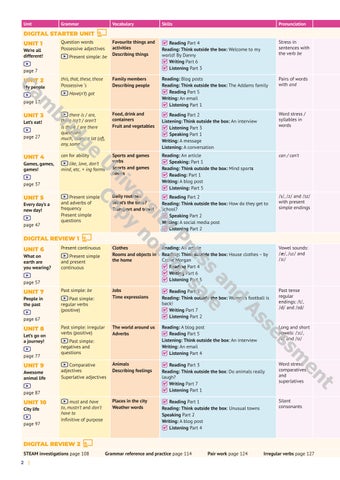
Vocabulary
Skills
Pronunciation
Favourite things and activities Describing things
Reading Part 4 Reading: Think outside the box: Welcome to my world! By Danny Writing Part 6 Listening Part 3
Stress in sentences with the verb be
Family members Describing people
Reading: Blog posts Reading: Think outside the box: The Addams family Reading Part 5 Writing: An email Listening Part 1
Pairs of words with and
Reading Part 2 Listening: Think outside the box: An interview Listening Part 3 Speaking Part 1 Writing: A message Listening: A conversation
Word stress / syllables in words
page 27
there is / are, there isn’t / aren’t is there / are there questions much, many, a lot (of), any, some
Food, drink and containers Fruit and vegetables
id
Unit
Grammar
UNIT 4
can for ability
like, love, don’t mind, etc. + ing forms
Reading: An article Speaking: Part 1 Reading: Think outside the box: Mind sports Reading: Part 1 Writing: A blog post Listening: Part 5
can / can’t
Games, games, games!
Sports and games verbs Sports and games nouns
Daily routines What’s the time? Transport and travel
Reading Part 2 Reading: Think outside the box: How do they get to school? Speaking Part 2 Writing: A social media post Listening Part 2
/s/, /z/ and /ɪz/ with present simple endings
Clothes Rooms and objects in the home
Reading: An article Reading: Think outside the box: House clothes – by Carrie Morgan Reading Part 4 Writing Part 6 Listening Part 5
Vowel sounds: /æ/, /uː/ and /ɜː/
Jobs Time expressions
Reading Part 3 Reading: Think outside the box: Women’s football is back! Writing Part 7 Listening Part 2
Past tense regular endings: /t/, /d/ and /ɪd/
The world around us Adverbs
Reading: A blog post Reading Part 5 Listening: Think outside the box: An interview Writing: An email Listening Part 4
Long and short vowels: /ɔː/, /e/ and /ʊ/
Comparative adjectives Superlative adjectives
Animals Describing feelings
Reading Part 3 Reading: Think outside the box: Do animals really laugh? Writing Part 7 Listening Part 1
must and have to, mustn’t and don’t have to Infinitive of purpose
Places in the city Weather words
Reading Part 1 Reading: Think outside the box: Unusual towns Speaking Part 2 Writing: A blog post Listening Part 4
DIGITAL STARTER UNIT Question words Possessive adjectives
UNIT 1 We’re all different!
Present simple: be
page 7
UNIT 2
m Ca
My people
this, that, these, those Possessive ‘s Have(n’t) got
page 17
br
UNIT 3 Let’s eat!
ge
UNIT 5 Every day’s a new day! page 47
Present simple and adverbs of frequency Present simple questions
DIGITAL REVIEW 1 UNIT 6
Present continuous
What on earth are you wearing?
Present simple and present continuous
page 57
UNIT 7
Past simple: be
People in the past
Past simple: regular verbs (positive)
page 67
UNIT 8 Let’s go on a journey!
Awesome animal life
UNIT 10 City life page 97
t
page 87
Word stress: comparatives and superlatives
en
UNIT 9
Past simple: negatives and questions
sm
page 77
Past simple: irregular verbs (positive)
s se
As d an s le es sa Pr r y fo it t rs no ve y ni p U Co
page 37
Silent consonants
DIGITAL REVIEW 2 STEAM investigations page 108 2
|
Grammar reference and practice page 114
Pair work page 124
Irregular verbs page 127
Oracy
Challenge
Life competencies
Working with other students Showing your partner that you are listening
I want to find out more about the people in my class.
Creative thinking: preparing for creativity Critical thinking: evaluating ideas and arguments
Learning to learn: developing skills and strategies for learning Creative thinking: generating ideas
m Ca
Asking questions Taking turns Asking for clarification Asking for more information I want to know more about the food I eat.
ge
id
br
Talking about ideas with other people Making sure that people can hear you Presenting a poster Showing interest
Science Why are we all different?
Collaboration: encouraging effective group interaction Science How can I cook Critical thinking: evaluating ideas and arguments safely? Digital literacy: using tools and creating digital content
Emotional development: empathy and relationship skills
ss se As d an s le es sa Pr r y fo it t rs no ve y ni p
U
Giving a presentation Speaking slowly and clearly Preparing to speak Using body language and making eye contact
STEAM
It’s good to do new things!
Co
Asking for people’s opinions about your ideas Taking turns
Creative thinking: generating ideas Creative thinking: preparing for creativity Critical thinking: evaluating ideas and arguments Critical thinking: solving problems and making decisions
Science, Maths
Giving opinions Saying what you think Agreeing and disagreeing Ending the conversation Asking follow-up questions Answering questions
Learning to learn: developing skills and strategies for learning Critical thinking: evaluating ideas and arguments Creative thinking: generating ideas Emotional development: empathy and relationship skills
It’s important to learn about people in the past.
t
Creative thinking: implementing ideas and solving problems Emotional development: empathy and relationship skills
en
Animals are very important for people and the planet. We need to understand why.
m
Working together Being positive about each other’s ideas Using connectors Showing you are interested
Critical thinking: understanding and analysing ideas and arguments Critical thinking: evaluating ideas and arguments
Creative thinking: generating ideas Learning to learn: developing skills and strategies for learning
Building an argument Giving reasons for ideas and opinions Structuring your arguments Planning what you want to say Inviting people to give their opinion Making suggestions
Technology, Engineering How do I keep dry?
Emotional development: empathy and relationship skills Digital literacy: using tools and creating digital content
Science, Arts Digital Classroom: Practice Extra |
3
m Ca ge
id
br Co
ss se As d an s le es sa Pr r y fo it t rs no ve y ni p
U Student’s Book A2
t
en
m
David McKeegan
Helen Tiliouine
Niamh Humphreys
UNIT 1 WE’RE ALL DIFFERENT! LEARNING AIMS
THE CHALLENGE
m Ca
Skills: talk and write about ourselves, ask people questions Grammar: learn and practise question words, possessive adjectives and the present simple of be Vocabulary: learn and practise words for people’s favourite things and activities, adjectives to describe things Critical thinking: find out about your classmates Exam practice: Reading Part 4, Writing Part 6, Listening Part 3
FAVOURITE MONTH: June
FAVOURITE MUSIC: rock
FAVOURITE DAY: Saturday
Co
ss se As d an s le es sa Pr r y fo it t rs no ve y ni p
U
FAVOURITE COLOUR: blue
ge
id
br
I want to find out more about the people in my class. You will: • Stage 1 Think: think about what information you want to find out. • Stage 2 Prepare: write a questionnaire. • Stage 3 Develop: ask your questions. • Stage 4 Present: tell the class about your classmate.
FAVOURITE FOOD: chocolate
FAVOURITE DRINK: mango juice
CHALLENGE Think
Where are the people? 2 How old are they? 1
3
4
Work in pairs. Discuss the questions.
What is important to know about your classmates? • their name yes / no • how old they are yes / no • their favourite music yes / no • things they do at the weekend yes / no 2 Think of five or six more things to ask about. 1
01
t
is Kasia from? Where is Trevor from?
Grammar
2
en
2 Watch the video. Where
Documentary
1
m
1 Look at the photo. In pairs, discuss the questions.
FAVOURITE CITY: Paris
|
7
VOCABULARY FAVOURITE THINGS AND ACTIVITIES 1
1.1 Go to the digital activity and match the words to the photos. Listen, check and repeat. band bike board game camera cinema comic book cycling film guitar hiking online gaming party
m Ca ge
id
br ss se As d an s le es sa Pr r y fo it t rs no ve y ni p
U Vocabulary reference page 16
Co
2 Complete the sentences with words from Exercise 1. Use the pictures to help you. 1
My favourite activity is
2 What’s your favourite 3 I go to the
.
?
at the weekends.
4 What’s your favourite 5 Are you in a
?
3
01 Watch the video again. What are Kasia and Trevor’s favourite activities?
4 Read the text in Exercise 5 quickly. What is the girl’s name? Where is she from?
EXAM TRAINING READING PART 4
EXAM TIP
Each question has only one correct answer.
5 Read the text again. For each question, choose the correct answer.
?
MEDIATION WORKSHEET
Inbox
6 Is that your
?
n my computer is my favourite o activity!
7
?
10
is my favourite sport!
11 This is my favourite
12
8
|
It’s my birthday
Unit 1 We’re all different!
B bike
C guitar
2 A books
B music
C films
3 A camera
B party
C band
1
! today!
A comic
6 Work in pairs. Ask and answer questions about your favourite things.
What’s your favourite music / film / band / board game / comic book / online game?
t
9 Is this your
en
!
m
8 That’s a big
Hi, my name’s Ana! I’m 13 years old, and I live in Berlin. My favourite sport is cycling, and I go to school on my (1) … every day. At the weekends, I go to watch (2) … at the cinema with my friends. I also take great photos with my new (3) …: this is a photo of me in my favourite place in my house!
READING
Hi, I’m Ben! What’s your name?
A CONVERSATION 1 Look at the photos of Ben and Rosa.
Rosa
Do you think the sentences are true or false? Why? Ben plays the guitar. 2 Rosa’s favourite colour is blue. 1
m Ca
What’s your number?
2 Read the text in the box below. Answer the questions.
Who is new at the school? 2 Are Rosa and Ben in the same class? 3 Where is the school?
ge
id
br
1
Ben
Online
Hi!
ss se As d an s le es sa Pr r y fo it t rs no ve y ni p
U
Rosa is a new student at Ben’s school. Ben and Rosa are both in Class 8C. Their school is in Bristol, in England.
3 Read Ben and Rosa’s conversation quickly and check your answers to Exercise 1.
Co
4
1.2 Read and listen to the conversation. Answer the questions. 1 2 3 4 5 6
How old is Rosa? … Where is she from? … What is her favourite band?… How old is Ben? … Where is he from? … What is his favourite colour? …
Hi!
Where are you from?
Cartagena, in Colombia.
Cool!
I’m in Bristol because of my mum’s new job at the university.
Great! Welcome to our school! And welcome to my city, Bristol! How old are you?
STRETCH! Work in pairs and follow
the instructions.
• Student A: Find photos of Rosa’s city • •
and information about it. Student B: Find photos of Ben’s city and information about it. Tell each other what you find out.
I’m 12. And you?
13.
Is that your guitar in the photo?
Yes, I’m in a small school band.
Really? Who’s in the band with you?
A boy and a girl from Class 8C. His name is Leo and her name is Claire.
m
My favourite band is called Rancho Aparte.
en
Why do you like them?
Their music is fun and beautiful.
t
I’d like to hear some of it. But first, can I ask one thing? What? Your favourite colour is red, right? Yes, it is! What’s yours? Yellow!
Unit 1 We’re all different!
|
9
GRAMMAR
8 Complete the conversations with the correct
QUESTION WORDS
possessive adjective. 1
Hi, … name’s Evin.
1 Copy and complete the questions from Ben and
Hello, Evin. I’m Gary.
Rosa’s conversation. 1 2
m Ca
3
…’s your name? … are you from? … old are you? …’s in the band with you? … do you like them?
4 5
br
2 Choose the correct answers to complete the rules in the grammar box.
2
Who’s that? … name’s Paul. He’s my friend.
3
Who’s your favourite singer? Taylor Swift. … songs are really good.
4
That’s my pet mouse.
id
What’s … name?
ge
Question words
5
We like this class, and we like … teacher! Great!
6
These are my cats!
ss se As d an s le es sa Pr r y fo it t rs no ve y ni p
U
We use question words at the 1 end / beginning of questions. We use 2 what / how / who with old to ask about people’s age.
Grammar reference and practice page 114
Co
3
Go to the digital activities.
4 Complete the questions.
… is your favourite actor? 2 … is she from? 3 … do you like that band? 4 … old is he? 1
POSSESSIVE ADJECTIVES
5 Copy and complete the sentences from Ben and Rosa’s conversation. 1
Welcome to … school!
2 … name is Leo and … name is Claire.
3 … favourite band is called Rancho Aparte. 4 … music is fun and beautiful.
6 Copy and complete the rules with the words in the box.
her his our their your
7
What’s your name?
My name’s Lucy.
Her name’s Lucy.
ORACY
Working with other students
What is important when you work with other students? We listen to each other and let people speak. We don’t talk for too long. We think carefully about everyone’s ideas.
10 Look at the question in the Oracy box. Think of two more ideas.
CHALLENGE Prepare
1
2
3
4
Work in groups of three or four. Remember to work together! 2 Look at the things you want to know about your classmates from Stage 1. 3 Decide how many questions you want in your questionnaire. 4 Write the questions for your questionnaire. 1
Go to the digital activities.
HOW IS UNIT 1 SO FAR? 10
|
Unit 1 We’re all different!
I understand
I’m getting there
I don’t understand
t
Grammar reference and practice page 114
three sentences about your partner.
en
The possessive adjectives for I, you, she, he and it are my, 1 … , 2 … , 3 … and its. The possessive adjectives for we, you and they are 4 … , your and 5 … .
9 Work in pairs. Ask and answer questions. Then write
m
Possessive adjectives
Oh, what are … names?
Search
THINK OUTSIDE THE BOX!
Welcome to my world! By Danny My name is Danny and I am 12 years old. I’m from York. York is a beautiful city in the north of England. It’s not very big, but it’s very old. My favourite films are Enola Holmes 1 and 2. My favourite actor is in them. His name is Louis Partridge. My favourite band is Imagine Dragons. Their music isn’t boring; it’s fun!
m Ca
My friend’s name is Rob. Our favourite activities are online gaming and cycling. Rob’s new bike is expensive and very fast. My old bike is cheap and slow! Rob and I are in class 7B at school. Our school is small, and all our teachers are nice.
ge
id
br
When Rob and I talk, we often use sign language. We also both have cochlear implants, so we can hear our teachers and our classmates. At home with my family, I use sign language because my parents are deaf, too. Rob and I also use sign language at parties with loud music. Sign language is very important for lots of people, and it’s very important for me!
U
Co
READING
ss se As d an s le es sa Pr r y fo it t rs no ve y ni p
Can you spell your name in sign language?
A BLOG POST
3 Read the blog post again. Complete the information.
1 Look at the photo. What activity can you see? 2
1.3 Read and listen to the blog post. Answer the questions.
2 actor …
4 activities …
4 Work in pairs. Use a dictionary to find the meaning of
Where is Danny from? 2 What is his friend’s name? 1
Danny’s favourite … 1 films … 3 band …
cochlear implant, sign language and deaf.
VOCABULARY
DESCRIBING THINGS 1
1.4 Go to the digital activity and match the words to the photos. Listen, check and repeat. beautiful big cheap new slow small
expensive
fast
fun
2 Write the opposite of these
adjectives in your notebook.
important
1
big
2 cheap
3
Work in pairs. Think about things that are important or beautiful. Do you and your partner think the same?
4
STRETCH! Find the opposite of these adjectives. Use a dictionary or look online.
• beautiful • fun
t
en
Vocabulary reference page 16
m
3 fast
• important • new
Unit 1 We’re all different! |
11
GRAMMAR
6 Put the words in the correct order. 1
PRESENT SIMPLE: BE
2 3
1 Watch the grammar
4
vlog. What is Lara’s brother’s name? What is their favourite board game?
5
02
6
m Ca
7
2 Look at the examples from the grammar vlog.
A: Are you 13? B: No, I’m …, I’m 12. 2 A: Is your guitar expensive? B: Yes, it … . 3 A: … Scrabble your favourite board game? B: No, it … . 4 A: … you my friend? B: Yes, I …!
ge
id
ss se As d an s le es sa Pr r y fo it t rs no ve y ni p
U
9 Work in pairs. Ask and answer questions with be.
am are before is not
Are you 14?
Co
Present simple: be
In positive sentences, we use I 1 …, you are, he/she/ it 2 …, we/you/they 3 … . In negative sentences, we add 4 … . In questions, the verb be is 5 … the subject.
Yes, I am. / No, I’m not, I’m … .
10
Lara and Lucas are twins. Think about being a twin. Work in pairs. How many good and bad things can you think of?
Grammar reference and practice page 114
Go to the digital activities.
4 Choose the correct answers to complete the sentences. 1
It / He is an expensive camera.
2 I / We are in Class 7C.
3 You / She are my friend. 4 They / It are beautiful. 5 He / I am your friend.
6 She / They is from Egypt.
Unit 1 We’re all different!
2
3
4
Choose someone in a different group to interview. 2 Ask your classmate the questions in your questionnaire. 3 Write down the answers. 1
t
Example: You are in my class. You’re in my class. 1 We are in Mexico. 2 I am not ten. 3 They are our friends. 4 He is our teacher. 5 It is not cheap. 6 You are not old.
1
en
contractions (’).
CHALLENGE Develop
m
5 Copy the sentences and write them with
|
DIGITAL CLASSROOM
PRACTICE EXTRA UNIT 1
3
12
Go to the digital
pronunciation activity.
1
br
I am 12 years old. Lucas is 12. We are at the same school. I’m not! Lucas is not in class 7A. Parties aren’t fun. Is it Scrabble? Are parties fun?
PRONUNCIATION
8 Copy and complete the conversations.
Copy and complete the rules in the grammar box.
• • • • • • • •
from / They / Italy / aren’t / . he / your / Is / friend / ? not / I / in England / am / . your / fast / bike / Is / ? my / Are / in / you / class / ? Spain / My sister / in / is / .
WRITING AN EMAIL 1 Imagine a new online friend. In your notebook, fill in the information about your new friend. Name: … Age: … City / Country: …, … Favourite activity, music, film: …, …, …
m Ca
• • • •
2 Read the email from your new friend. Complete the email with information from Exercise 1.
EXAM TRAINING WRITING PART 6
id
br Inbox
EXAM TIP In your answer, always write about the three things in the exam task.
ge
Hi your name,
6 You have a new online friend called Sam.
ss se As d an s le es sa Pr r y fo it t rs no ve y ni p
U
My name’s … and I’m … years old. I’m from …, in … . … is a beautiful … . My school’s small and my lessons are fun. My favourite activity is … . My favourite music is … , and my favourite film is … .
Write an email to Sam.
What are your favourite things? Write soon,
Tell Sam about:
Co
…
• your town or city • your school
3 Match the items in the email plan (1–6) to the
• your favourite music.
phrases from the email (a–f).
Email plan: 1 Start the email. 2 Give information about my town/city. 3 Give information about my school. 4 Give information about my favourite things. 5 Ask a question. 6 End the email. a What are your favourite things? b … is a beautiful … . c Write soon, …
d My school’s small and my lessons are fun. e Hi … , f
My favourite activity is … . My favourite music is … , and my favourite film is … .
Write 20 words or more.
7 Read your email again and check your work. Use these questions to help you.
Is there information about: • your town or city? • your school? • your favourite music? 2 Is there a good start and end to the email? 3 Is the spelling and grammar correct? 1
8 Now work in pairs. Read each other’s emails and
4 Read the exam task in Exercise 6. How many things 5 Look at the email in Exercise 2. Find the sentences
CHALLENGE Present
1
2
3
4
t
which can help you to write your email.
STRETCH! Write an answer to the email in
Exercise 2.
en
do you need to write about in your email to Sam?
m
give feedback. Use the questions in Exercise 7 to help you. Make a note of your partner’s feedback and write a second draft of your email.
Tell the class about your classmate. • Talk for around one minute. • Answer other students’ questions. 2 Listen carefully to other students. Ask a question if you want. 1
Unit 1 We’re all different!
|
13
LISTENING A CONVERSATION 1 Work in pairs. Look at the photo. Who is in the photo?
2
m Ca
1.5 You will hear Rosa talking to her classmate, Anatol. Listen to the first part of their conversation. How many names of countries do you hear? Which countries are they?
3
Where is Anatol from? A Poland B England
C Colombia
ge
id
1
br
1.5 Look at the exam question below. Listen again and read the script. Choose the correct answer. Why are the other answers wrong?
Co
EXAM TRAINING LISTENING PART 3 EXAM TIP
ORACY Showing your partner that you are listening When your partner says something, use words like Oh! / Really? / Great! to show that you are interested. Look at your partner when you are speaking. When you are listening, look at your partner and smile. Nod your head to show that you understand.
ss se As d an s le es sa Pr r y fo it t rs no ve y ni p
U
Anatol: Hello! Rosa: Hi! What’s your name? I’m Rosa, from Colombia. It’s my first day at your school. Anatol: Really? I’m Anatol, from Poland. Rosa: Oh, so like me, you aren’t from England.
In Listening Part 3, there are always two people having a conversation. They talk about question 1 first, then question 2, etc. You always hear everything twice in the Listening exam.
4
1.6 Now listen to the rest of the conversation. For each question, choose the correct answer. 2 What are Rosa’s favourite books about? A sport B music C animals
3 Anatol’s bike is A new. B beautiful. C expensive.
5
1.6 Listen again and check your answers. Why are your answers correct?
6 Look at the script in Exercise 3 again. Find the
words that Rosa and Anatol use to show that they are interested. Check your answers in pairs.
t
en
m
STRETCH! Work in groups of three or four. Choose a book to read or a film to watch. Next week, tell each other what you think about the book or the film. Remember to show that you are interested!
14
|
Unit 1 We’re all different!
WRAP UP Look back at the unit. Write down:
m Ca
1 some new words you learned for favourite things and activities
2 words to show you are interested 3 something new you learned about a classmate
br
4 four question words
ge
id
5 three adjectives to describe the place where you live Sustainability
1 What do you and your friends do with old games or old phones? Do you throw
U
them away or do you do something else?
ss se As d an s le es sa Pr r y fo it t rs no ve y ni p
2 Is cycling to school better than going by car? Why? / Why not?
Co
SELF-ASSESSMENT: UNIT 1 How confident do you feel about:
• • • • • • •
talking about your favourite things and activities? using question words? using the verb be? talking about yourself and other people? asking people questions about themselves? planning ideas before you write? showing you are interested when you listen?
What was your favourite part of Unit 1? Tell your partner.
Write down new words when you learn them. Write a sentence using the new word, too. You can write the words and sentences in a notebook, on a laptop or on a phone.
STRETCH! YOUR CHOICE Now choose an extra activity!
Option 3: Ask your teacher if your class can email an English class in another country. What information about your class can you put in the first email?
Unit 1 We’re all different!
t
en
Option 2: Think of an idea for a new board game. How many people can play it together? Can you draw the board?
m
Option 1: Find out about a new band. Listen to their songs. What’s your favourite song? Who is your favourite person in the band? Why?
|
15
VOCABULARY REFERENCE FAVOURITE THINGS AND ACTIVITIES 1 Match the words to the photos. band bike board game online gaming party
camera
m Ca
1
cinema
comic book
cycling
film
guitar
3
4
6
7
8
5
ge
id
br
2
hiking
ss se As d an s le es sa Pr r y fo it t rs no ve y ni p
U 9
10
11
12
Co DESCRIBING THINGS 2 Match the words to the photos. beautiful
big
cheap
1
2
expensive
fast
fun
3
important
new
slow
4
small
5
0
$200
6
7
8
9
10
$5
16
|
Unit 1 We’re all different!
t
PRACTICE EXTRA UNIT 1
en
m
DIGITAL CLASSROOM
UNIT 2 MY PEOPLE LEARNING AIMS
ORACY
m Ca
Skills: describe people Grammar: learn and practise this / that / these / those, possessive ’s and have(n’t) got Vocabulary: learn and practise words for family members and adjectives to describe people Oracy: ask questions Exam practice: Reading Part 5, Listening Part 1
Asking questions • taking turns • asking for more information • asking for clarification
ge
id
br
Co
ss se As d an s le es sa Pr r y fo it t rs no ve y ni p
U 1 Look at the photo. In pairs, discuss the questions. Who are the people? 2 Why are they happy? 1
Student A: Say which statements are true for you. Student B: Ask one question about each statement. Then change roles.
Documentary
Grammar
4 Think about your discussion. Why is it important to
Oracy
ask questions in a conversation?
t
All animals like to 01 live in groups. 2 People like to be in groups, but sometimes they also like to be alone. 3 In general, people have fun when they are together. 1
en
• My family is really interesting. • It’s sometimes fun to be alone.
sentences true or false?
m
2 Watch the video. Are the
3 Work in pairs. Read the statements below.
|
17
VOCABULARY FAMILY MEMBERS 1
2.1 Go to the digital activity and match the words to the people. Use the family tree to complete the text. Listen, check and repeat.
m Ca ge
id
br Vocabulary reference page 26
2 Look at Axel’s family tree and complete the sentences.
U
3 Choose the correct answers to complete the sentences.
ss se As d an s le es sa Pr r y fo it t rs no ve y ni p 1
Your uncle’s son is your aunt / brother / cousin.
2 Your father’s mother is your grandma / aunt / sister.
Co
Maria
3 Your mother’s sister is your cousin / grandma /
aunt. 4 Your cousin’s father is your father / uncle / grandpa. 5 Your mother’s daughter is your sister / brother / grandma. 6 Your father’s father is your uncle / grandpa / cousin.
Rene
4 Read the text. Are the sentences true or false?
Bea
Isaac
1 2
5 7 8 9 10 11
I’m Axel. Olivia is my … . Oscar is my little … . Daisy is our … . Omar is our … . My … is called Rene. My … is called Maria. Omar is Rene and Maria’s … . Bea is their … . Bea is my … . My … is called Thabo. Isaac, their child, is my … .
Is your family very big? Jenna Ortega’s is! She’s an American actor, famous for being in the TV show Wednesday. She has two brothers (Isaac and Markus) and three sisters (Mariah, Mia and Aaliyah). Their parents are called Natalie and Edward. One of Jenna’s sisters, Mariah, has her own children now.
Oscar
1
3 Natalie is a grandmother. 4 Jenna is an aunt. 5 Isaac is Mariah’s sister. 6 Markus is an uncle.
5 6
PRONUNCIATION
|
Unit 2 My people
Go to the digital
pronunciation activity. Work in pairs. Use a dictionary to find these family words in English. Write sentences about Axel’s family using these words. What is the English word for the daughter of your brother or sister? What is the word for their son? 2 What is a married man called? What is a married woman called? 1
18
Jenna is Natalie and Edward’s daughter.
2 Edward is Natalie’s father.
t
6
Olivia
Daisy
en
4
Axel
Omar
m
3
Thabo
READING BLOG POSTS 1 Look at the photos of two families. Who are the people? Where are they? a
b
m Ca ge
id
br ss se As d an s le es sa Pr r y fo it t rs no ve y ni p
U 2 Read the blog posts quickly. Match the posts to the photos.
Co
BLOGS
NEWSLETTERS
PAULA
VIDEOS
LUCAS
This is a photo of me and my family. That’s me in the middle, and the girl behind me is my sister. We are from a city called Zaragoza, in Spain. That’s my dad with the camera. It’s my parents’ camera. My dad is an English teacher in my school. My mum is a taxi driver. My grandpa is in the photo, too. He’s a doctor, but he isn’t from Spain. My grandpa is from Portugal.
3
2.2 Read and listen to the blog posts. Choose the correct answers. 1
My dad’s wife is a taxi driver. Paula / Lucas different country.
4 My dad is a teacher.
Paula / Lucas Paula / Lucas Paula / Lucas
are doctors.
Paula / Lucas
ORACY Taking turns Wait for the other person to finish before you speak. When you learn something new, you need more time to think and say things. Make sure to give each other that time.
wait for your partner to finish speaking before you speak.
• Student A: Show your partner a photo or a drawing • •
of your family. Student B: Ask your partner questions about the photo. Then change roles.
Is this your grandpa? How old is he?
Yes, it is.
t
5 My mother and father
4 Work in pairs and follow the instructions. Don’t forget to
en
3 My cousin plays music.
This is a photo of me, my cousin and some of our family. We’re from Brazil. That’s me next to the girl with the cat. She’s my cousin, Loli. Those are her parents behind her. Loli plays the piano. These are my parents next to me. Their names are Paulo and Teresa. They are both doctors. My aunt is the tall person. Oh, and that’s my grandpa behind me. It’s my grandpa’s cat!
m
2 My grandpa is from a
MEDIATION WORKSHEET
He’s 65.
STRETCH! Write a blog post about the photo or drawing of your family in Exercise 4. Who are they? How old are they? What do they do?
Unit 2 My people | 19
GRAMMAR
POSSESSIVE ’S
THIS, THAT, THESE, THOSE
6 Copy and complete the sentences from Paula’s and Lucas’s blog posts.
1 Copy and complete the sentences from the blog posts.
It’s my … cat! 2 It’s my … camera. 1
… is a photo of me and my family.
1
2 …’s me next to the girl with the cat. 3 … are my parents next to me.
7 Choose the correct answers to complete the rules in the grammar box.
m Ca
4 … are her parents behind her.
2 Choose the correct answers to complete the rules in
Possessive ’s
the grammar box.
br
We use 1 verb / noun + ’s to talk about possession. Is that your brother’s guitar? = the guitar of my 2 brother / brothers When there is more than one person, we use only an apostrophe (’ ). These are my aunts’ books. = the books of my 3 aunt / aunts.
this, that, these, those
ge
id
We use this and that for 1 plural / singular nouns. We use these and those for 2 plural / singular nouns. We use this and these for things that are 3 near to / far from us. We use that and those for things that are 4 near to / far from us.
U
ss se As d an s le es sa Pr r y fo it t rs no ve y ni p
Grammar reference and practice page 115
Co
3
Go to the digital activities.
4 Copy and complete the sentences with this, that, these or those.
Grammar reference and practice page 115
8
Go to the digital activities.
9 Copy the sentences and rewrite them with the apostrophe (’) in the correct place. 1
2
1
2
3
4 5
6
This is my camera. 3
Is … your brother’s guitar? 4
… is my bus.
… are my aunts’ books.
5
6
When you don’t understand what someone says, you can say Sorry, I don’t understand or you can ask Can you repeat that, please? You can also say what you think the person means and ask Is that right?
10 Work in pairs and follow the instructions. • Student A: Talk about your best friend. Tell your • •
partner their name, hair colour, favourite sport and the number of people in their family. Student B: Ask for clarification if you need to. Then change roles.
t
5 Work in pairs. Point to things in your classroom
Asking for clarification
en
Are … your friends?
ORACY
m
…’s my bicycle!
What is your best friends name? What colour is your mothers hair? Karas uncle is a teacher. Those boys teacher is Mr Benson. What is your dads favourite sport? Are these Tinas books?
and ask questions. Is this your pen? Who is that?
No, it isn’t. That’s our teacher.
What is this?
HOW IS UNIT 2 SO FAR? 20
|
Unit 2 My people
I understand
I’m getting there
I don’t understand
THINK OUTSIDE THE BOX!
READING AN ARTICLE
1 Work in pairs. Make a list of TV shows and films about families. How many can you think of? 2 Look at the example answer (0) at the beginning of the article. What grammar point does it test? A article
C pronoun
2…
ADDAMS FAMILY
m Ca
THE
B verb
3…
4…
1… 5…
id
br
You know Wednesday Addams, the unusual girl from (0) the TV show. But do you know the original TV show? (1) … is really old!
ge
All of the Addams family are unusual. Wednesday’s father’s name is Gomez. He is rich. His hair is curly, and he (2) … got a moustache. He loves Wednesday’s mother (3) … much.
U
Wednesday has got a little brother called Pugsley. He’s got short hair. He loves to eat.
Co
Uncle Fester is Wednesday’s uncle. He hasn’t got any hair at all! He likes to wear a very big coat all the time.
Grandma Addams is very old. She’s got grey hair. She’s Gomez’s mother.
And there is Lurch. He isn’t a member of the Addams family. He just works in their house, cooking and cleaning. He is very tall.
4
EXAM TRAINING READING PART 5 EXAM TIP
7…
ss se As d an s le es sa Pr r y fo it t rs no ve y ni p
Wednesday’s mother (4) … called Morticia. She has got long, dark hair. She is very clever.
6…
2.3 Read and listen to the whole article. Label the picture with the correct names.
5 Read the article again. Are the
Always read all the sentences before you write the answer.
sentences true or false?
3 Read the first three paragraphs of the article. For each question, write the correct answer. Write ONE word for each gap.
Gomez has got a moustache. 2 Pugsley’s hair is long. 3 Uncle Fester has got short hair. 4 Lurch is short. 1
VOCABULARY
DESCRIBING PEOPLE 1
2.4 Go to the digital activity and match the words to the photos. Listen, check and repeat.
2 Complete the sentences with words from Exercise 1.
Carolina’s hair isn’t long. It’s … .
2 My hair is …, not straight.
3 Matt hasn’t got dark hair. He’s got … hair. 4 I’m 100 years old! I’m a very … woman.
t
5 You’re only 7? That’s … !
en
m
1
blond hair curly hair dark hair long hair old man short hair short woman straight hair tall man young girl
6 Mum is a … woman and our car is too small
for her. 7 I’m a … man but my ‘little brother’ is very tall!
3 Vocabulary reference page 26
Work in pairs. Create your own TV family. Write a description of each person. What do they look like? What do they like to do?
Unit 2 My people | 21
GRAMMAR
7 Work in pairs. Ask and answer questions about
what people in your family have got. Use some of the ideas below and your own ideas.
HAVE(N’T) GOT vlog. What does Marco want?
02
m Ca
2 Complete the sentences from the grammar vlog. 1
3
ge
5
id
4
I … a big family. I … a sister. My friend Dan … two sisters. He … any brothers. … you … a scooter?
br
2
3 Choose the correct answers to complete the rules in the grammar box.
Co
We use have got to talk about possession. It means the same as have. We use has/have got + 1 noun / verb. To ask questions, we use Have/Has + 2 noun / pronoun + got … ?
Grammar reference and practice page 115
4
computer
garden cat
Go to the digital activities.
moustache Yes, she has.
Has your cousin got a cat? How old is the cat?
He’s six years old.
What colour is he?
He’s black and white.
STRETCH! In pairs, play a game.
• Student A: Think of a person in your class or your family.
• Student B: Ask questions to find out who it is. • Then change roles. Has he got blond hair?
Is he tall?
Is it Carlos?
5 Choose the correct answers to complete the sentences. 1
TV
ss se As d an s le es sa Pr r y fo it t rs no ve y ni p
U
have(n’t) got
car
long hair
1 Watch the grammar
We haven’t / hasn’t got many friends.
2 My sister has / have got blond hair.
DIGITAL CLASSROOM
3 Have / Has you got a brother?
PRACTICE EXTRA UNIT 2
4 My parents haven’t / hasn’t got a car. 5 Have / Has Sally got long hair?
6 Look at the photo. Use the notes to write questions and answers. 1
2 4 6
Asking for more information Sometimes when you ask questions, the answers are short. You can ask for more information with questions like What kind of car / cat / … is it? What colour is it? How old / How big are they? or other questions that are interesting for you.
22
|
Unit 2 My people
t
ORACY
en
5
Has Oscar got long hair? No, he hasn’t. Luna / short hair? Oscar / mobile phone? Luna / curly hair? Oscar and Luna / red hair? Oscar and Luna / bicycles?
m
3
Oscar / long hair?
WRITING
3 Copy and complete the table with the phrases in the box.
AN EMAIL
All the best Best wishes Bye for now Dear Sasha Hello Hi Hi there Take care
1 Read the email. Who is Tania? a Sally’s online friend b a member of Sally’s family
m Ca
Inbox
ge
id
br
My father is a teacher in my school, and my mother is an actor. She is very beautiful, but she’s not very famous. I’ve got two little brothers. Their names are Noah and Saul. I’ve also got a dog called Molly. She’s only one year old, and she loves to play. She’s friendly and fun.
U
Best wishes,
Co
Now please tell me about your family and friends! Sally
2 Answer the questions.
6 8
5 Read your email again and check your work. Use these questions to help you.
Is there a good start and end to the email? 2 Are there answers for all the questions? 3 Are sentences with have got / has got correct? 4 Is the spelling and grammar correct? 1
What is Sally’s father’s job? He’s a teacher. What is Sally’s mother’s job? Has Sally got any sisters? How many brothers has Sally got? What is Sally’s dog’s name? Is Sally’s dog young or old? Is Jacinda short? Has Jacinda got blond hair?
6 Now work in pairs. Read each other’s emails and
give feedback. Use the questions in Exercise 5 to help you. Make a note of your partner’s feedback and write a second draft of your email.
t
7
What job has your father/mother got? Have you got brothers and sisters? Have you got any animals? Who is your best friend? What do they look like?
en
5
• • • •
m
4
…
ss se As d an s le es sa Pr r y fo it t rs no ve y ni p
My best friend is called Jacinda. She’s very tall, and she’s got short, blond hair. We always have fun when we’re together.
3
Dear Sasha
Don’t forget to start and end your email correctly.
I want to tell you about my friends and family.
2
Ending an email
4 Write a reply to Sally’s email. Answer the questions.
Hi Tania,
1
Starting an email
Unit 2 My people |
23
LISTENING SHORT DIALOGUES 1 Look at the two pictures. Write down five things that are different in picture b. a
b
m Ca ge
id
br ss se As d an s le es sa Pr r y fo it t rs no ve y ni p
U Co
2 Work in pairs. Describe the men in the pictures. A
3
B
C
2.5 Listen to the conversation. Which man is the boy’s uncle? Choose the correct picture (A–C).
4 Read the questions and look at the pictures in Exercise 5. Say what you see in each picture.
6
2.6 Compare your answers with a partner. Then listen again and check your answers.
7
Where can you hear English in your life? Can you hear it in songs, in computer games, on the streets? Think of one more time or place where you can hear English. STRETCH! Work in pairs. Draw three pictures
of people, like the pictures in Exercise 2. Write a short description of one of the people. Read it to your partner. They say which picture is the person in your description.
EXAM TRAINING LISTENING PART 1 EXAM TIP
Before you listen, read the questions. Look at each picture. What can you see?
5
1
Which is Lucia’s family? B
C
t
en
A
m
2.6 For each question, choose the correct answer.
2 What has Dan’s mother got in her bag? A
24
|
Unit 2 My people
B
C
ORACY
6 Work in pairs. Watch the second part of the video
again, and make a list of all the questions Daniella asks. Copy the table and put the questions in the correct column.
m Ca
ASKING QUESTIONS • taking turns • asking for clarification • asking for more information
br
What’s your mum’s name?
a I’ve got two.
Sorry, can you repeat that?
e She’s 75.
Yes. Her name is Tania.
b Yes, they are.
Has she got long hair?
Co
c Yes, it is.
Tania.
ss se As d an s le es sa Pr r y fo it t rs no ve y ni p
6
Are these the photos of your family? How many brothers have you got? Can you repeat that? What colour hair has your father got? Is that right? How old is she?
U
5
each other’s family. Make your partner’s family tree.
ge
4
…
8 Work in pairs. Ask and answer questions about
id
3
…
they take turns?
2 Match the questions (1–6) to the answers (a–f). 2
Asking for more information
7 Do Daniella and Eric speak at the same time or do
1 Do you know your family tree? How big is it? 1
Asking for clarification
d Sorry, yes. f
Yes, she’s got long blond hair.
Brown.
3 Work in pairs. Which questions in Exercise 2 ask for more information? Which questions ask for clarification?
4 Watch the video. Which
questions from Exercise 2 does Daniella ask? Are they to ask for more information or for clarification?
5
03
9 Think about your conversation in Exercise 8.
04 Watch the rest of the video. What does Daniella say when she doesn’t understand something?
Did you …
• take turns to speak? • ask for clarification? • ask for more information?
SELF-ASSESSMENT: UNIT 2 How confident do you feel about:
t
en
talking about members of your family? writing about your family and friends? using this, that, these and those? describing how people look? asking and answering about what you and others have(n’t) got? writing a short email? working on a task with your partner? using questions to ask for information and clarification?
m
• • • • • • • •
What was your favourite part of Unit 2? Tell your partner.
DIGITAL CLASSROOM PERSONALISED LEARNING Unit 2 My people |
25
VOCABULARY REFERENCE FAMILY MEMBERS 1 Match the words to the people. Use the family tree to complete the text. aunt
brother
cousin
dad
daughter
m Ca
1
1
3
grandma
grandpa
mum
son
uncle
2
4
5
id
br
Maria
Gita
sister
6
John
Zack
Serena
8
Ted
ge 7
U
Saira
Tomas
ss se As d an s le es sa Pr r y fo it t rs no ve y ni p
Benji
Co
Hi, I’m Saira. My little 1 brother is called Tomas. He’s only six years old. My 2 … is called Ted and my 3 … is called Serena. I’ve got one 4 … – his name is Zack. My mother is Zack’s 5 … . Zack is married to my 6 … , Gita. Their 7 … is called Benji. He’s an only child. He’s my 8 … . He’s eleven years old, and he’s great fun! My 9 … is called Maria, and my 10 … is called John. My mother is their 11 …. We’re a happy family!
DESCRIBING PEOPLE 2 Match the words to the photos. blond hair curly hair tall man young girl 1
5
dark hair
long hair
old man
short boy
short hair
straight hair
2
3
4
6
7
8
10
DIGITAL CLASSROOM PRACTICE EXTRA UNIT 2
26
|
Unit 2 My people
t
en
m
9
UNIT 3 LET’S EAT! LEARNING AIMS
THE CHALLENGE I want to know more about the food I eat. You will: • Stage 1 Think: choose the food for your poster. • Stage 2 Prepare: find out about this food. • Stage 3 Develop: make a poster about the food. • Stage 4 Present: show the poster to the class and talk about it.
m Ca
Skills: talk about food, drink and containers, and quantities Grammar: learn about countable and uncountable nouns and practise there is (not) / there are (not), Is there / Are there questions, some / any / much / many / a lot of Vocabulary: learn and practise words for food, drink and containers, and fruit and vegetables Critical thinking: find information about food Exam practice: Reading Part 2, Listening Part 3, Speaking Part 1
ge
id
br
Co
ss se As d an s le es sa Pr r y fo it t rs no ve y ni p
U 1 Look at the photo. In pairs, discuss the questions. Where are the people?
2 Do you think the food is nice? Why? / Why not?
2
3
01
Grammar
t
What’s your favourite food? 2 What food is good and important for people? 3 Choose one kind of food to find out about. 1
many different types of bread are in the video? Is your favourite type of bread in the video?
4
en
Work in small groups. Discuss the questions.
2 Watch the video. How
Documentary
1
m
1
CHALLENGE Think
|
27
VOCABULARY FOOD, DRINK AND CONTAINERS 1
3.1 Go to the digital activity and match the words to the picture. Listen, check and repeat. bottle
bowl
fruit
glass
juice
milkshake
noodles
plate
salad
sandwich
soup
vegetables
m Ca ge
id
br Co
ss se As d an s le es sa Pr r y fo it t rs no ve y ni p
U Vocabulary reference page 36
2 Work in pairs. Find the things in Exercise 1 on the table. Say the words.
3 Work in pairs. Copy and complete the word clouds with the words from Exercise 1.
5
PRONUNCIATION
Go to the digital
pronunciation activity.
6 Work in pairs. Ask and answer the questions. What is your favourite food?
FOOD …
DRINK …
CONTAINER
bottle
What are your favourite drinks?
4 Complete the rules with countable, uncountable,
STRETCH! Work in pairs. Add more words to
singular (x 2) or plural.
We listen to each other. We think about each other’s ideas. We ask questions.
28
|
Unit 3 Let’s eat!
2
3
4
Work in the same groups as for Stage 1.
2 Where is there information about the food
you want to find out about? Is it in a book? Is it online? 3 Find information about this food. Where is the food from? Is it from a tree? Is it cheap or expensive? Do you need to cook it? Remember to listen to each other and to ask questions!
t
Talking about ideas with other people
1
1
en
ORACY
CHALLENGE Prepare
m
Some nouns, like bowl and egg, are 1 …, for example, one, two, three eggs. Countable nouns can be 2 … or 3 … . Some nouns, for example, chocolate and sugar, are 4 … . These nouns can only be 5 … .
the FOOD, DRINK and CONTAINER word clouds in Exercise 3. Use an online dictionary if you need to.
READING SHORT TEXTS 1 Work in pairs. Copy and complete the table with the words in the box. Use a dictionary to help you. cheese, milk, yoghurt, etc.
wheat flour: bread, cakes, pasta
1 I’m a … .
✗
✓
✓
✗
✗
✓
✓
✓
✗
m Ca
meat
br
gluten-free vegan vegetarian
2 I’m a … .
id ge
3 I eat … food.
2
U
3.2 Read and listen to the teenagers’ blog posts. Who is vegan? Who eats gluten-free food?
Co
Keri
ss se As d an s le es sa Pr r y fo it t rs no ve y ni p
BLOGS BY TEENAGE CHEFS There is no meat or fish in the food I cook, and no milk or cheese! I am vegan. I use a lot of different vegetables and make really nice meals for my parents, my brothers and my sister. Potatoes are our favourite food. I’ve got my grandmother’s cookbook. There are beautiful photos in it of salads and fruit! I’ve also got my grandmother’s old, cheap camera!
EXAM TIP
Yann
My favourite activity is cooking! I make big meals for my friends and family. My parents like all kinds of food, but my big sister’s favourite food is vegetable noodles, and my two little sisters love ice cream. All my food is glutenfree. I’ve got a very good camera – it isn’t cheap! I want to write a cookbook with lots of great photos of my food in it!
EXAM TRAINING READING PART 2
Read each question so you know which information to look for. Find the important words in each question. Then look at what Keri and Yann say to find the information you need.
5 Now look at questions 2–5. For each question, choose the correct answer.
2
important words in the question?
4
questions.
Read Keri’s blog. Is there any information about a book? 2 Now read Yann’s blog. Is there any information about a book? 3 Who has got a nice book? Why is it nice? 1
5
6
B
A
B
A
B
A
B
A
B
t
3
4 Read the blog posts again and answer the
A
en
3 Look at question 1 in Exercise 5. What are the
Who has got a nice book? Who has got an expensive camera? Who has got three sisters? Who has got a favourite vegetable? Who has got brothers?
m
Keri Yann
1
Work in groups of three or four. Make a list of vegan food OR gluten-free food. Use a dictionary or look online. Tell another group what you find out. Unit 3 Let’s eat! |
29
GRAMMAR
6 Work in pairs. Say sentences and write them in
THERE IS / ARE, THERE ISN’T / AREN’T
your notebooks. 1
2
1 Watch the grammar
vlog. What does Lara want to make? Has she got everything she needs?
m Ca
02
✗
✓ There’s some water. 3
4
br
2 Look at the examples from the grammar vlog.
✗
There is a bowl. There is some flour. There are some eggs: one, two, three eggs. There isn’t a candle. There isn’t any chocolate. There aren’t any strawberries.
ge
ss se As d an s le es sa Pr r y fo it t rs no ve y ni p
Co
a/an any x2 some x2
there is / are, there isn’t / aren’t
• there is + 1 … + singular countable noun (like • • • • •
ORACY
Making sure that people can hear you
Project your voice to speak clearly. Wait for the other person to look at you, then start speaking.
7 Work in pairs. Follow the instructions. • Student A: Look at the picture on page 124 for
Go to the digital activities.
4 Copy and complete the sentences with is / are / isn’t / aren’t. 1
2 3 4 5 6
There are any / some potatoes. There isn’t any / a bread. There’s some / a water. There isn’t any / a bowl. There aren’t some / any oranges. There is an / one plate.
There are four …
8 Complete the sentences with your own ideas. Share your ideas with a classmate.
In my kitchen, there’s a …, and there’s some … . There isn’t a …, there isn’t any …, and there aren’t any … .
HOW IS UNIT 3 SO FAR? 30
|
Unit 3 Let’s eat!
I understand
I’m getting there
I don’t understand
t
5 Choose the correct answers.
There’s a …
en
4 There … some vegetables.
•
30 seconds. Cover the picture and tell Student B what you remember. Student B: Look at the picture on page 125 for 30 seconds. Cover the picture and tell Student A what you remember. Remember to speak clearly.
m
3 There … any salad.
1
•
There … any sandwiches.
2 There … some soup.
✗
✓
bowl, egg) there is + 2 … + uncountable noun (like flour, sugar) there are + 3 … + plural countable noun (like bowls, eggs) there isn’t + a/an + singular countable noun there isn’t + 4 … + uncountable noun there aren’t + 5 … + plural countable noun
Grammar reference and practice page 116
3
✓ 6
5
U
• • • • • •
id
Copy and complete the rules with the words in the box.
THINK OUTSIDE THE BOX!
VOCABULARY FRUIT AND VEGETABLES 1
3.3 Go to the digital activity and match the words to the photos. Listen, check and repeat. bananas beans c arrots coconuts lemons peas pineapples strawberries tomatoes
m Ca
Vocabulary reference page 36
2 Which words in Exercise 1 are fruit? Which are vegetables?
br
3 Work in pairs. Student A: Draw a fruit or vegetable.
id
Student B: Say the correct word. Then change roles.
ge
STRETCH! Work in pairs. Can you find words
for three more fruits and three more vegetables in English? Use a dictionary or look online.
AN INTERVIEW
ss se As d an s le es sa Pr r y fo it t rs no ve y ni p
U
LISTENING
Co
1 Look at the photos. What food can you see?
3
3.4 Listen to Tomas talking to an English woman who works on the farm. Is there any fruit on the farm? Are there any vegetables?
EXAM TRAINING LISTENING PART 3
EXAM TIP
For each question in Listening Part 3, you hear all the answers (A, B, C), but only one is the correct answer.
4
3.4 Listen to the interview again. For each question, choose the correct answer. How many strawberries are there in the woman’s box? A 20 B 50 C 70 2 Tomas thinks the tomatoes are A small. B beautiful. C expensive. 1
3.4 Compare your answers with a partner. Then listen again and check. Why are your answers correct?
6
Work in small groups. Choose a country. Find out the different types of food that people eat there. Answer the questions.
2 Read the introduction to the interview. Are the
A special farm There aren’t many farms in cities. But in Paris, the capital city of France, there’s a farm on a roof! Tomas, 13, is visiting the farm with his English class. He wants to make a podcast about the farm in English.
t
The farm is in a city. 2 Tomas works at the farm. 1
en
sentences true or false?
m
5
• What is a really important food for people in • •
that country? Choose three important things about the food. Write three sentences about the food.
Unit 3 Let’s eat!
| 31
GRAMMAR
6 Work in pairs. Ask and answer questions with How much? / How many?
IS THERE / ARE THERE QUESTIONS, MUCH, MANY, A LOT (OF)
How many apples are there? There are two. / There aren’t many.
1 Complete the questions and answers from
1
2
3
m Ca
Tomas’s interview. 1
2 3
5
id
br
4
How … fruit is there? There … much. How … strawberries are there? Are there … tomatoes? There are … tomatoes.
2 Complete the rules in the grammar box.
ge
ANSWERING QUESTIONS ABOUT YOURSELF EXAM TIP
U
Is there / Are there questions, much / many / a lot (of)
SPEAKING
In Speaking Part 1, you answer some questions about yourself. Use complete sentences to answer the questions.
ss se As d an s le es sa Pr r y fo it t rs no ve y ni p
Questions about countable nouns: 1 … there any apples? Is there 2 … table in your kitchen? How 3 … bananas are there? Questions about uncountable nouns: 4 … there any water? How 5 … bread is there? We can use a 6 … of with countable and uncountable nouns.
Co
Where are you from?
Grammar reference and practice page 116
3
Go to the digital activities.
4 Complete the sentences with much or many. 1 2 3 4 5
There isn’t … soup. How … bottles are there? Are there … noodles? There aren’t … plates. How … bread is there?
5 Put the words in the correct order. 1 2
5 7
DIGITAL CLASSROOM PRACTICE EXTRA UNIT 3
32
|
Unit 3 Let’s eat!
from here
3.5 Listen to two students doing part of the Speaking exam. Do they use complete sentences to answer the questions?
2 Work in pairs. Write six or seven questions using the words below.
where
how what
name
old
how many
from
is there / are there
favourite actor / food / etc.
students in your class
milk in fridge
Where are you from?
EXAM TRAINING SPEAKING PART 1
3 Work in pairs. Take turns to ask and answer your questions from Exercise 2.
CHALLENGE Develop
1
2
Make your poster in your group. 2 Draw a picture of the food. 3 Write some sentences about the food. 1
3
4
t
6
✗
en
4
I’m from São Paulo.
m
3
pasta / How / there / much / is / ? there / vegetables / any / Are / ? aren’t / strawberries / many / There / . lot / salad / There / of / a / is . many / are / oranges / there / How / ? much / There / cheese / isn’t /. a / Is / small box / there / on the table / ?
1
✓
WRITING
6 Write a message to someone in your family. Look at your list in Exercise 3 and ask the person to buy the things you need. Write 35–70 words.
A MESSAGE 1 Read David’s message
about a party. Who is the party for? David
7 Read your message again and check your work. Use these questions to help you.
MEDIATION WORKSHEET
Is there information about what you need for the party? 2 Is there a good start and end to the message? 3 Is the spelling and grammar correct? 1
Online
m Ca
Hi Mum! We need some
eggs for a cake for
Grandma’s party. And we haven’t got any
br
8 Now work in pairs. Read each other’s messages and give feedback. Use the questions in Exercise 7 to help you. Make a note of your partner’s feedback and write a second draft of your message.
id
flour.
There’s some sugar, but there isn’t any
ge
butter. And we need a lot of
STRETCH! Work in pairs. Plan a party for your class. What do you need for the party?
U
some balloons!
candles! And
ss se As d an s le es sa Pr r y fo it t rs no ve y ni p
I also want to make a fruit salad, but there isn’t
ORACY
much fruit. There aren’t many bananas and there
Presenting a poster
Co
aren’t any strawberries.
When you present a poster to the class, stand next to the poster so the other students can see it. Don’t stand in front of the poster! Point to the different parts of the poster as you talk about them.
Can you get what we need at the shops, please? Thanks, David
2 Read the message again. Copy and complete David’s mother’s shopping list. • eggs • flour
• …
3 Work in pairs. Imagine you want to have a party for a friend’s birthday. Write a list of things that you need for the party.
4 What things on your list in Exercise 3 have you got at home? Cross them out.
questions.
3
4
Choose one person in your group to present your poster to the class. 2 To practise, the person presents the poster to your group. • Listen carefully. • Think: What is good about the presentation? What is not so good? Where is the person standing? • Give the person feedback. 3 The person presents the poster to the class. • Listen. • Help answer the other students’ questions. 1
t
1
2
en
5 Look at David’s message again. Answer the
1
m
• sugar
CHALLENGE Present
How does David start and end his message?
2 Find the parts of the message that tell David’s
mother what they need for the party.
Unit 3 Let’s eat!
|
33
LISTENING A CONVERSATION 1 Work in pairs. Look at the photos. What kind of food can you see?
m Ca ge
id
br U
2 One of the food museums in the world is the
ss se As d an s le es sa Pr r y fo it t rs no ve y ni p
Wonderfood Museum in Penang, Malaysia. What do you think you can see in these three parts of the museum? The Info Zone: … 2 The Wow Zone: … 3 The Educational Zone: … 1
Showing interest
3.6 You hear a girl called Siti talking to her friend Victor about the Wonderfood Museum. Listen to the first part of their conversation. Are your ideas in Exercise 2 correct?
4 Which countries’ food can you see in the museum? 1
Malaysia
2 …
3 …
5
3.6 Work in pairs. Compare your answers with a partner. Listen again and check.
6
3.7 Listen to the second part of the conversation. Answer the questions. 1
How long is Siti in the museum? … minutes
2 Who is in Siti’s favourite photo? her …
3 What is one problem with food? a lot of …
7
When someone shows you an interesting photo or tells you something interesting, say something to show you are interested. You can say things like Wow! and Really?
Co
3
ORACY
8
3.8 Can you remember the words that Victor uses to show he’s interested? Listen to the whole conversation and write the words he uses. STRETCH! Work in pairs. Go online and find information about the Wonderfood Museum in Penang. What are your favourite photos of the museum? Show other people in your class. Look at other people’s favourite photos and show that you are interested!
3.7 Listen again to the second part of the conversation and check your answers. Why are your answers correct?
t
en
m
34
| Unit 3 Let’s eat!
WRAP UP Look back at the unit. Write down:
m Ca
1 some new words you learned for food and containers
2 two things you remember about the Wonderfood Museum
br
3 some words that can follow ‘There’s’ and ‘There are’
id
4 three important things for a party
ge
5 three questions you can ask someone when you first meet them
ss se As d an s le es sa Pr r y fo it t rs no ve y ni p
U
Sustainability
1 Can you grow any fruit or vegetables at home or at school? If you can, which ones can you grow?
Co
2 Why is being vegetarian or vegan good for the planet?
SELF-ASSESSMENT: UNIT 3 How confident do you feel about:
• • • • • • •
talking about food, drink and containers using there is / there are? using some / any / much / many / a lot of? finding new information? deciding what information is important? answering questions about yourself? writing a message?
What is your favourite part of Unit 3? Tell your partner.
When you are speaking in your English classes, always try to use some of the words you learned in earlier units of this book. How much can you remember?
STRETCH! YOUR CHOICE
Option 2: Write a list of things you need for a class party at the end of term. Talk to your teacher and ask if you can organise it.
Option 3: Find out about a farm in your area. Ask people or look online. Are there animals on the farm? What fruit and vegetables are there? Write one or two short paragraphs for your class about the farm.
Unit 3 Let’s eat!
t
Option 1: Make a questionnaire for your class. Ask your classmates about their favourite food, and how much fruit they eat every day. Also ask how many different vegetables they eat every week. Make a poster with the results and present it to your class.
en
m
Now choose an extra activity!
|
35
VOCABULARY REFERENCE FOOD, DRINK AND CONTAINERS 1 Match the words to the picture. bowl
bottle
fruit
glass
juice
milkshake
m Ca
2
br
plate
3
1
id 12
noodles
salad
5
sandwich
6
soup
vegetables
7
4 11
ge
10
8
Co
ss se As d an s le es sa Pr r y fo it t rs no ve y ni p
U
9
FRUIT AND VEGETABLES 2 Match the words to the photos. bananas
beans
1
4
carrots
coconuts
lemons
peas
pineapples
strawberries
3
5
6
8
9
t
en
m
2
tomatoes
7
DIGITAL CLASSROOM PRACTICE EXTRA UNIT 3 36
|
Unit 3 Let’s eat!
UNIT 4 GAMES, GAMES, GAMES! LEARNING AIMS
ORACY
m Ca
Skills: talk about abilities and likes/dislikes Grammar: learn and practise can for ability and like / love / don’t mind, etc. + -ing forms Vocabulary: learn and practise sports and games verbs and nouns Oracy: give a presentation Exam practice: Speaking Part 1, Reading Part 1, Listening Part 5
Giving a presentation • speaking slowly and clearly • preparing to speak • using body language and making eye contact
ge
id
br
Co
ss se As d an s le es sa Pr r y fo it t rs no ve y ni p
U 1 Look at the photo. In pairs, discuss the questions.
3 Work in pairs. Read the statements below. Take turns to share your opinions.
What sport is this? 2 How do you think the boy feels? 1
Answer the questions.
Documentary
Grammar
4 Think about your discussion. Answer the questions with your partner.
t
When in life do we 01 start to play? 2 Why are sports important? 3 How many different sports can you think of? 1
en
m
2 Watch the video.
• Everyone likes sport. • Watching sport is more fun than playing sport. • Sport teaches you a lot about life.
Why is it important to speak clearly and at the right speed? 2 Why is it important to use appropriate body language? 1
Oracy
|
37
VOCABULARY SPORTS AND GAMES VERBS 1
4.1 Go to the digital activity and match the verbs to the photos. Listen, check and repeat. bounce
catch
hit
jump
kick
ride
run
sail
score
swim
throw
walk
m Ca ge
id
br Co
ss se As d an s le es sa Pr r y fo it t rs no ve y ni p
U Vocabulary reference page 46
2 Copy and complete the table. Put the verbs from Exercise 1 in the correct column. Things you do with a ball
Ways of moving
score
…
4 Which word doesn’t fit? 1
3 sail / run / walk up a hill
4 score a ball / goal / point
5 sail / swim / bounce in the sea
3 Complete the sentences with the verbs from Exercise 1. There is one word you do not need to use. 1 2 3 4 5
8 10
6
01 Watch the video again and check your answers in Exercise 5.
ORACY
Speaking slowly and clearly
When you speak, pronounce your words clearly. This helps people understand you. Sometimes people speak too fast because they are a bit worried. Try to speak slowly.
7 Work in pairs. What other sports can you
think of? Use a dictionary if you need to. Then discuss the questions below. Don’t forget to pronounce your words clearly, and don’t speak too fast. Which is your favourite sport? Why? 2 Which sport do you not like? Why? 1
38
|
Unit 4 Games, games, games!
t
9
are in the video? Why are they good for you?
en
7
5 Think back to the video. Which team sports
m
6
In lots of sports, you … a ball with a bat. You … a ball with your foot. Do you know how to … a horse? I … lots of goals for my football team. When we are on holiday, we … in the sea every day. My brother can … 60 metres in ten seconds! … the ball to me and I’ll … it. In basketball, you … the ball when you run. We love to … in our boat. This basketball player isn’t tall – but he can … very high!
hit / jump / kick a ball
2 ride a bike / boat / horse
d r a o b Skate o r scooter – which is best? 4.2
a
m Ca
Skateboards and scooters are both great. You can ride to school on a skateboard or a scooter. You can learn to do amazing tricks on both, too. But which one is best for you? Read and find out.
br
Learning Riding
ge
id
… It takes hours – even days – to learn how to ride a skateboard. Some people never learn to do it well.
1
b
Co
Carrying
ss se As d an s le es sa Pr r y fo it t rs no ve y ni p
U
When you know how to ride a scooter, you can turn corners and stop very easily. 2 … Riding on a skateboard is not always possible in busy cities with streets full of people.
You can carry a skateboard, no problem at all. 3 … Yes, you can – a scooter isn’t hard to carry, but it’s not as easy as a skateboard. Some scooters are quite big and heavy.
Competition
Skateboarding is an Olympic sport now. 4 …You can’t win an Olympic gold medal on a scooter!
Cool
Most people think skateboards are cool. Some people think scooters are cool. You choose!
READING AN ARTICLE
1 Look at the title of the article and the photos (a–b).
Which photo shows a scooter and which one shows a skateboard? correct gaps.
b You can become a world-famous skateboarder. d You can learn to ride a scooter in five minutes.
3 Read the article again. Are the sentences true or false? 1 2 3 4 5 6
You can do tricks on a scooter. It takes a long time to learn how to ride a scooter. You can turn corners on a scooter. Scooters are hard to carry. You can win an Olympic medal on a scooter. Everyone thinks scooters are cool.
4 Read the title of the article again. What is your
answer to the question? Write down your ideas.
t
c Can you carry a scooter?
Before you speak about something, it’s a good idea to prepare if you can. You can talk to someone about your ideas, or you can make notes for yourself.
en
a On a skateboard those things are quite difficult.
Preparing to speak
m
2 Read the article. Put the sentences (a–d) in the
ORACY
5 In pairs, talk about which you prefer – skateboard
or scooter. Use your notes from Exercise 4. Is there a different way to travel that you like more? Do you agree with each other? STRETCH! Work in pairs. How many different ways can you think of to travel to school? Use a dictionary if you need to. Which pair has the longest list? Unit 4 Games, games, games! |
39
STRETCH! Work in groups to play Guess Who. On a piece of paper write three things that you can do and three things that you can’t do. Give your paper to another student. That person reads the notes to the group, and they try to guess who it is.
GRAMMAR CAN FOR ABILITY 1 Complete the sentences from the article on page 39. You … ride to school on a skateboard or a scooter. 2 … you carry a scooter? 3 You … win an Olympic medal on a scooter. 1
m Ca
2 Choose the correct answers to complete the rules in the grammar box.
SPEAKING ANSWERING QUESTIONS ABOUT YOURSELF 1 Work in pairs. Think of three questions about
br
sports. Think of answers to the questions.
can for ability
EXAM TIP In Speaking Part 1, the examiner always asks you your name, your age and where you live. Practise answering these questions.
ge
id
We use can / can’t to talk about ability in the present. Can / Can’t go 1 before / after verbs. She can ride a bicycle. He can’t sail. In questions, can goes at the 2 beginning / end. Can you ride a bicycle?
U
3
Co
Go to the digital activities.
4 Are the sentences true or false? Correct the false sentences. 1
2
ss se As d an s le es sa Pr r y fo it t rs no ve y ni p
Grammar reference and practice page 117
4.3 Read the conversation and match the questions (a–f) to the correct gaps. Then listen and check. a How old are you?
b Tell me something about the hockey team. c What’s your name?
2
d What sports or games do you like? e What sports do you like to watch? f
Dogs can catch. 3
4
A duck can ride a scooter. 5
Monkeys can throw. 6
Go to the digital
6 Write questions and answers. 1 you / ride a skateboard ✓ Can you ride a skateboard? Yes, I can. 2 your teacher / speak English? ✓
EXAM TRAINING SPEAKING PART 1
3 Work in pairs. Take turns to ask and answer the questions in Exercise 2.
3 your dad / cook? ✗ 4 you / swim? ✓ 5 your parents / play chess? ✗ 40
|
Unit 4 Games, games, games!
HOW IS UNIT 4 SO FAR? I understand
I’m getting there
I don’t understand
t
pronunciation activity.
en
PRONUNCIATION
Spiders can’t talk.
Examiner: Hello, I’m Mark. 1 … Student: Hello, I’m Alyssa. Examiner: 2 … Student: I’m 12 years old. Examiner: 3 … Student: I live in Córdoba. Examiner: Now let’s talk about sports and games. 4 … Student: I like hockey and chess. Examiner: 5 … Student: I like to watch tennis and baseball. Examiner: What sports do you play at school? Student: I play in the school hockey team. Examiner: 6 … Student: We play every Tuesday and Friday. We play other school teams. We’re a good team.
m
Snakes can run.
5
Horses can’t jump.
Where do you live?
THINK OUTSIDE THE BOX!
MIND
S P O RT S
VOCABULARY
m Ca
Are you a ‘mind sports’ player? Maybe you don’t know what a mind sport is, but I’m sure that you sometimes play them. Even people who love playing physical sports often like playing mind sports. So, what are they?
SPORTS AND GAMES NOUNS 1
4.5 Go to the digital activity and match the words to the photos. Listen, check and repeat. chess competition player prize puzzle roller skates sports centre swimming pool
id
br
There are different kinds of mind sports. Board games like chess and backgammon are mind sports. So are puzzles like Sudoku and Rubik’s Cube. Spelling competitions and maths problems are all mind sports, too.
ge
Every year there is a Mind Sports Olympiad in London, England. People come from all over the world to try to win prizes. Some of the best players are only 12.
ss se As d an s le es sa Pr r y fo it t rs no ve y ni p
U
They also play some unusual games at the Mind Sports Olympiad. For example, in diving chess they play chess underwater in a swimming pool!
Co
Scientists say that mind sports can improve your memory and help you think better. But playing physical sports is good for your body AND your brain. So maybe it is best to play both!
MEDIATION WORKSHEET
READING AN ARTICLE
Vocabulary reference page 46
2 Match the sentences to one or more of the words
1 Look at the photos in the article. What do these
from Exercise 1.
2 Read the article quickly. What is the Mind Sports
2 My favourite one is with numbers, but it’s hard!
games have in common? Olympiad?
3
sports or physical sports? Why?
4 We need her on the team. She’s the best! 5 Look at this – I’m the winner!
6 They’re fast and they look cool. I love them!
3 Complete the sentences with the correct form of words from Exercise 1. 1 2 3 4 5 6 7
It is difficult to learn how to play … . We’ve got a … in our garden, but we don’t use it in the winter. How many … are there in the team? I love doing … , but this one is very difficult. You can play lots of sports in the … . Sienna wants a pair of … . The first … in this spelling … is 100 euros. Unit 4 Games, games, games!
t
4 Work in pairs. Which do you like more – mind
3 It’s near my house and it’s open every day.
en
Mind sports are for people who A don’t like physical sports. B enjoy playing games. 2 The Mind Sports Olympiad is A an international competition. B only for young people. 3 Scientists believe that mind sports are A good for your brain. B good for your brain and your body. 1
I play it every day.
m
4.4 Read and listen to the article. Choose the correct answers to complete the sentences.
1
| 41
GRAMMAR
7 Write five other things that you love, like, don’t
LIKE, LOVE, DON’T MIND, ETC. + -ING FORMS 1 Watch the grammar
vlog. What sport does Marco like playing?
m Ca
02
2 Complete the sentences from the grammar vlog.
br
I love … gymnastics. 2 I hate … sports. 3 Tina … losing. 1
mind, don’t like and hate. Work in groups and read your list to each other. What do most people agree / disagree about?
READING REAL-WORLD TEXTS EXAM TIP In Reading Part 1, you read short texts. Look at each text and decide what type of text it is.
id
1 Look at the texts in Exercise 2. What type of text is each one?
ge
3 Choose the correct answers to complete the rules
an email a sign a text message
in the grammar box.
U
EXAM TRAINING READING PART 1
2 Read the texts. For each question, choose the
ss se As d an s le es sa Pr r y fo it t rs no ve y ni p
like, love, don’t mind, etc. + -ing forms
Co
We use the -ing form of the verb after (not) like / love / don’t mind / hate to say how we feel about an activity. He loves 1 swimming / swim. I don’t like 2 doing / do homework.
correct answer.
1
Coach Online
4.6
Basketball practice is in the playground today (NOT gym).
Grammar reference and practice page 117
3.30 start, as always.
4
Go to the digital activities.
5 Look at the table. Write sentences about Toby and Sara.
play board games do puzzles Toby Sara You 1 2 3 5
sentences.
DIGITAL CLASSROOM
2
Sam,
I’ve got the tickets for the rugby game this weekend. They are four euros each. Please pay me after class. Thanks, Jo
A Jo wants to play rugby.
B Jo wants to give Sam money. C Jo wants money from Sam.
3
FOR SALE Scooter – four years old Perfect condition Only five euros
PRACTICE EXTRA UNIT 4
A The scooter is like new. B The scooter is for a child. C The scooter is difficult to ride.
42
| Unit 4 Games, games, games!
t
6 Copy and complete the table for you. Write
C There is no basketball practice today.
en
6
Toby likes doing puzzles. Sara / puzzles Toby / board games Sara / swim Toby / swim Sara / board games
B Basketball is in a different place today.
m
4
Toby / puzzles
swim
A Basketball begins at a different time today.
WRITING
3 Are the sentences true or false? Correct the false sentences.
A BLOG POST 1 Talk to a partner about your classmates. Do you think most of them like doing these things? going to the cinema watching films at home listening to classical music listening to rock music
m Ca
• • • •
br
I think most of our classmates like going to the cinema.
ge
id
Maybe. I’m not sure, but …
2 Read Kenan’s blog post. What is the best title?
U
A Writing a blog post
C Movies and rock music
CONTACT
Co
BLOGS
OK, there are lots of blog posts on the web about the unusual things people love and hate doing, so here’s mine. 2 Lots of people love going to the cinema, but I don’t. 3 I hate listening to other people eat and talk in the cinema. I enjoy films, but I can watch them at home. 4 Also, nearly all of my friends hate listening to classical music, but I love it. 5 Classical music is relaxing and sometimes exciting, too. I hate rock music. All my friends listen to it, but I don’t understand why. 6 So tell me, what unusual things do you love and hate doing? 1
by Kenan
4 Read the blog post again. In which sentence (1–6) does Kenan do these things? a Asks a question
6
b Talks about something most people love c Says why he is writing d Says why he loves something e Says why he hates something f
Talks about something most kids hate
5 Now write a blog post about things you love and hate. Follow the structure of Kenan’s blog post.
6 Read your blog post again, and check your work. Use these questions to help you.
Do you follow the structure of Kenan’s blog post? 2 Do you use the -ing form of the verb after like, love, hate, etc.? 3 Is the spelling and grammar correct? 1
ss se As d an s le es sa Pr r y fo it t rs no ve y ni p
B What I love and hate doing
HOME
Kenan loves going to the cinema. 2 Kenan’s friends hate listening to rock music. 3 Kenan loves listening to classical music. 1
7 Now work in pairs. Read each other’s blog posts
and give feedback. Use the questions in Exercise 6 to help you. Make a note of your partner’s feedback and write a second draft of your blog post.
t
en
m Unit 4 Games, games, games! |
43
LISTENING A CONVERSATION 1 Look at the photos. What sports can you see? Where can you play these sports?
2 Work with a partner. Ask and answer questions
m Ca
about the places in Exercise 1. Use is/are there and ask questions for more information. Is there a skate park near your home?
br
Yes, there is.
id
Is it good?
ge
It’s OK, but it’s not very big.
4.7 Look at the exam task in Exercise 4. Listen and read the first part of the phone conversation. What sports do you hear? What is Paco’s favourite sport?
Co
Mum: Hi, Paco. How’s your day at the sports centre? Paco: Great. There are so many sports to play, including my favourite! Mum: Is that badminton? Or tennis? Paco: I like badminton and tennis, but my favourite now is hockey.
EXAM TRAINING LISTENING PART 5 EXAM TIP
Don’t write any answers the first time you listen. Wait until the second listen before you answer.
4
Work in groups. A sports centre is open for everyone next Saturday. Think about sports you want and don’t want to play. Work together to create a sports timetable for the day.
FAIRVIEW SP RTS CENTRE Open day 9 am to 8 pm Everyone is welcome, and it’s free!
ss se As d an s le es sa Pr r y fo it t rs no ve y ni p
U
3
5
4.8 For each question, choose the correct answer.
When?
Play basketball
Morning
Play badminton and table tennis
Afternoon / Evening
Use our fantastic fitness machines
All day! Please speak to a trainer first (adults only)
Join a football match Matches begin at 10.30, 1 o’clock and 5 o’clock Join a hockey match Match begins at 3 o’clock Go swimming
Morning (over 16s only)
Afternoon / Evening (everyone)
Have a delicious meal or snack
ORACY
All day at the Have a Break café!
m
Using body language and making eye contact Look at people when you speak to them. In a presentation, stand up straight and look at the listeners. You can move your body and arms, too.
6 One person from the group in Exercise 5 tells the class about your plan. Stand up and look at the class, and begin like this:
This is our plan for the open day. In the morning, we want to … 44
|
Unit 4 Games, games, games!
t
en
You will hear Paco talking to his mother on the phone about his friends’ activities at the sports centre. Which sport is each person’s favourite? People Sport 0 Paco D A swimming 1 Jacob … B skateboarding 2 Marta … C badminton D hockey E tennis
What can you do?
ORACY
m Ca
GIVING A PRESENTATION • speaking slowly and clearly • preparing to speak • using body language and making eye contact
br
1 How can you prepare to give a presentation? Put these ideas in the best order.
make notes for yourself decide on your topic ask for feedback practise your presentation with a classmate
ge
id
• • • •
5
U
2 Work in pairs. Look at the advice for giving a
ss se As d an s le es sa Pr r y fo it t rs no ve y ni p
presentation. There is one piece of bad advice. Can you find it?
6
a Don’t talk too quickly.
Co
favourite sport. Then present it to the class.
d Move your body and arms. e Stand up straight.
05 Now watch Daniella doing her presentation. Is it better? Why? / Why not?
7 Plan and practise a presentation about your
b Don’t talk too quietly. c Don’t look at people.
04 Watch the students talking about Daniella’s presentation. Do they agree with your answers in Exercise 4?
Who plays?
How do you play?
3 Change the bad advice in Exercise 2 into good advice. 4 Watch Daniella practising
When do you play?
her presentation. What advice in Exercise 2 does she follow? Copy and complete the table.
My favourite sport
03
Where do you play?
Daniella does this (✓) / (✗)
Don’t talk too quickly. Don’t talk too quietly.
…
…
Move your body and arms. … Stand up straight.
…
Why do you like it?
8 Watch everyone give their presentations. Do they follow the advice in Exercise 2?
SELF-ASSESSMENT: UNIT 4
t
talking about sports? asking and answering questions about abilities? talking about things you like and dislike doing? pronouncing words clearly when you speak? writing about things you love and hate? answering questions about yourself? giving a presentation?
en
• • • • • • •
m
How confident do you feel about:
What is your favourite part of Unit 4? Tell your partner. DIGITAL CLASSROOM PERSONALISED LEARNING
Unit 4 Games, games, games! |
45
VOCABULARY REFERENCE SPORTS AND GAMES VERBS 1 Match the words to the photos. catch
bounce
hit
kick
ride
run
sail
score
swim
throw
3
4
7
8
walk
id
br
2
ge
m Ca 1
jump
5
6
Co
ss se As d an s le es sa Pr r y fo it t rs no ve y ni p
U
9
10
11
12
SPORTS AND GAMES NOUNS 2 Match the words to the photos. chess 1
competition
player
prize
puzzle
roller skates
sports centre
swimming pool
3
4
6
7
8
5
t
en
m
2
DIGITAL CLASSROOM PRACTICE EXTRA UNIT 4 46
| Unit 4 Games, games, games!
UNIT 5 EVERY DAY’S A NEW DAY! LEARNING AIMS
THE CHALLENGE It’s good to do new things! You will: • Stage 1 Think: think of some new things you want to do. • Stage 2 Prepare: choose one new thing to do for ten minutes every day, and plan how and when to do it. • Stage 3 Develop: make a video presentation about the new activity. • Stage 4 Present: show the video to the class and answer questions about it.
m Ca
Skills: describe and ask about daily routines Grammar: learn and practise the present simple and adverbs of frequency, and present simple questions Vocabulary: learn and practise expressions for daily routines, telling the time, and nouns for transport and travel Critical thinking: think about a new activity you can do every day Exam practice: Reading Part 2, Speaking Part 2, Listening Part 2
ge
id
br
Co
ss se As d an s le es sa Pr r y fo it t rs no ve y ni p
U CHALLENGE Think
1
2
3
4
Work in small groups. Draw a mind map. 1
NEW THINGS
day different from your day? How?
01
Grammar
2 Save the mind map.
Languages
t
2 Watch the video. Is Mya’s
Documentary
Sports
en
Where is the person? 2 What part of the day is it? 1
Basketball
m
1 Look at the photo. In pairs, discuss the questions.
Draw a mind map to help you think of new things you can do. Think of ideas for these things. If you don’t know the words in English, draw pictures or look up the words in a dictionary.
Japanese
|
47
VOCABULARY DAILY ROUTINES 1
5.1 Go to the digital activity and match the words to the photos. Listen, check and repeat. brush my teeth do my homework get up have lunch meet my friends play sports
o to bed have a shower have breakfast g practise dance moves watch a film
have dinner
m Ca ge
id
br Co
ss se As d an s le es sa Pr r y fo it t rs no ve y ni p
U
2
Vocabulary reference page 56
01 Think back to the video. Which daily routines in Exercise 1 are in the video? Watch again to check.
3 Complete the sentences with verbs from Exercise 1. 1 2 3 4 5 6
I … my friends at school. I … my teeth two or three times a day. I … up early. I … my homework after school. I … dance moves every day! I … to bed late in the holidays.
6 Write the times in words. 1
2
It’s twenty-five to six. 3
4
5
6
7
8
WHAT’S THE TIME? 4
5.2 Copy the clock. Write the words in the correct places. Listen, check and repeat. half
o’clock
past 1
…
t
quarter 2 …
… to
7 Tell your partner about your day with times. Use the words in Exercise 1.
3
… past
5 Write three times in numbers (for example, 10.15). In pairs, ask and answer What’s the time?
48
|
Unit 5 Every day’s a new day!
en
m
4
quarter
I get up at quarter past seven.
READING
3
SHORT TEXTS
5.3 Work in pairs. Read and listen to the texts. Copy and complete the table. Jordan Stella
1 Look at the photos. Where are the teenagers?
When they get up:
…
…
2 Read the texts quickly. Who does Jordan help after
How often they have a shower:
…
…
When they go to bed:
…
…
How often they watch films:
…
…
Who practises dance moves:
…
…
Where they always have dinner:
…
…
school? Where does Stella live?
m Ca
MY DAY!
4 Look at question 1 in Exercise 5 and the
id
br
information in Exercise 3. Is the answer A or B? Why?
EXAM TRAINING READING PART 2
ge
EXAM TIP
Co
ss se As d an s le es sa Pr r y fo it t rs no ve y ni p
U
Read each question carefully so you know which information to look for. There is usually information about each question in more than one text, but there is only one correct answer.
5 Now look at questions 2–6. For each question,
MEDIATION WORKSHEET
choose the correct answer. Use the information in Exercise 3 to help you.
My parents have a café and I often help them after school. My sister and I always have dinner in the café, and we usually watch a film together. I never go to bed before eleven, but I don’t get up before half past eight because I live very near my school. Every day, I have a shower, have my breakfast and brush my teeth in 15 minutes!
1
2 3
4
JORDAN
5
I’m travelling round the world with my family – on a boat! I get up at six every morning, but I don’t have a shower – I have a swim! I have all my school lessons online. I meet my friends online, too, and we practise our dance moves together. That’s sometimes difficult for me on the boat! I don’t watch many films and I usually go to bed at nine o’clock.
STELLA
6
6
Jordan Stella Who gets up very early? A B Who never has a shower? A B Who goes to bed late? A B Who often watches a film in the evening? A B Who likes dancing? A B Who often works with their family? A B
Work in groups of four.
Follow the instructions.
• Pair A: think about three good things and three bad things about helping in a café after school.
• Pair B: think about three good things and three
1
2
3
4
t
en
CHALLENGE Prepare
m
•
bad things about living on a boat. Then tell each other what you think.
In your group, look at the mind map from Stage 1. 2 Choose one new thing to do. Can you do it for ten minutes every day? 3 What do you need for this activity? Where can you do it? When can you do it? 4 Make notes for your video presentation. 1
Unit 5 Every day’s a new day!
|
49
GRAMMAR
7 Put the adverbs of frequency in brackets in the correct place in the sentences.
PRESENT SIMPLE AND ADVERBS OF FREQUENCY
1 2 3
1 Watch the grammar
4
vlog. How does Lara go to school? Who does she go with?
m Ca
02
6
2 Look at the examples from the grammar vlog.
br
Complete the rules in the grammar box.
I usually get up at half past seven. Lucas sometimes gets up before me. I don’t often go to bed late. Lucas doesn’t usually go to bed early.
ge
id
• • • •
U
Present simple
She always meets her friends at the weekend. I brush my teeth after lunch. (sometimes) We have dinner with our grandparents. (often) He doesn’t do his homework in the morning. (usually) They don’t watch a film after dinner. (always) I have a shower in the afternoon. (never)
ORACY Asking for people’s opinions about your ideas Remember to ask other students what they think about your ideas. You can say Is that a good idea? / What do you think? / Do you agree? This shows your classmates that their opinions are important. They can answer Great! / Good idea! / I’m not sure that’s a good idea because … .
Co
ss se As d an s le es sa Pr r y fo it t rs no ve y ni p
Positive sentences: • We add 1 … to the verb after she/he/it. If the verb ends in ss, sh, ch, x or z or a vowel (a, e, i, o, u), we add es. Negative sentences: • We use 2 … before the main verb after I/you/ we/they. • We use 3 … before the main verb after she/he/it. Adverbs of frequency come 4 … the main verb. Grammar reference and practice page 118
3
5
She meets her friends at the weekend. (always)
Go to the digital activities.
CHALLENGE Develop
1
2
3
4
In your group, choose one or two people to give the presentation and one or two people to make the video. 2 Make some more notes for the presentation. What things do you need for the video: a phone, some pictures of the activity? 3 Make the video together in your group. 1
4 Choose the correct answers. 1 2 3 4 5
She don’t / doesn’t have a shower before breakfast. They / He has lunch at two o’clock. You don’t / doesn’t go to bed late. We / It don’t live here. We meet / meets our friends after school.
5 Complete the sentences with the 1
m
correct form of the verb in brackets.
She … (go) to bed at half past nine.
en
2 He … (not have) breakfast at quarter
to eight.
t
3 She … (practise) her dance moves in
the morning. 4 He … (brush) his teeth after dinner. 5 She … (not do) her homework with her sister. 6 He … (play) sports every day.
6
50
|
PRONUNCIATION
Go to the digital
pronunciation activity. Unit 5 Every day’s a new day!
HOW IS UNIT 5 SO FAR? I understand
I’m getting there
I don’t understand
THINK OUTSIDE THE BOX!
HOW DO THEY GET TO SCHOOL?
m Ca
id
br
All over the world, people go to school in different ways. A lot of teenagers walk or go on bikes; some parents drive their children to school in a car or on a motorbike; many students take a bus or a train. How do you usually go to school?
in a helicopter or in a plane, but they fly through the air on a zipline. It’s very fast! One girl always goes on the zipline with her mother, and one boy goes with his brother. In some places, students can take cable cars to school. And in places where there’s lots of snow, kids drive snowmobiles! In other places, children ride to school on horses. People also go by boat, by lorry or sometimes even by tractor!
There’s a video online where you can see children in one part of Colombia travelling to school in a very special way: they don’t fly
The important thing is for all the children to get to school, even if it’s sometimes difficult!
ge
In some parts of the world, it’s difficult to walk or go on a bike to school. And in some places, there aren’t any buses or trains. What do people do in those places?
Co
AN ARTICLE
ss se As d an s le es sa Pr r y fo it t rs no ve y ni p
U
READING
1 Work in pairs. Look at the photos.
Which are fun ways to go to school?
2
VOCABULARY
TRANSPORT AND TRAVEL 1
5.5 Go to the digital activity and match the words to the photos. Listen, check and repeat. boat
bus car tractor train
5.4 Read and listen to the article. Find all the different ways people can travel to school.
helicopter
lorry
plane
motorbike
3 Read the article again. Choose the correct answers. 1
2
3
2 Think of a type of transport. Work in pairs and ask and answer questions to find out what it is.
en
Is it big / fast / expensive / …?
t
5
Vocabulary reference page 56
m
4
Do many teenagers walk or go to school on bikes? Yes, they do. / No, they don’t. Do the children in Colombia fly in a helicopter? Yes, they do. / No, they don’t. Does the girl go on the zipline with her mother? Yes, she does. / No, she doesn’t. Does the boy go on the zipline with his father? Yes, he does. / No, he doesn’t. Do some children go to school on horses? Yes, they do. / No, they don’t.
Yes, it is! / No, it isn’t!
STRETCH! Work in pairs. Look
online to find places where people travel to school using the types of transport in the article. Can you find the video about the children in Colombia going to school by zipline?
3
Work in small groups. Think of fun ways for you to get to your school. Draw pictures to show the class! Ask the other students in your group for their opinions about your ideas. You can use the questions in the Oracy box on page 50.
Unit 5 Every day’s a new day!
|
51
GRAMMAR
SPEAKING
PRESENT SIMPLE QUESTIONS
TALKING ABOUT YOUR LIKES AND DISLIKES
1 Complete the questions and answers from the article and Exercise 3 on page 51. 1 2
EXAM TIP In Speaking Part 2, say what you like or don’t like about the activities, things or places in the pictures and give reasons. Ask your partner questions and take turns to speak.
m Ca
3
How … you usually go to school? What … people do in those places? … many teenagers walk or go to school on bikes? Yes, they … . / No, they … . … the girl go on the zipline with her mother? Yes, she … . / No, she … .
4 5
br
6
1 Look at the pictures on page 125. Do you like these activities? Make sentences to give reasons.
id
2 Complete the rules with the words in the box.
cycling
ge
do x2 does x2 doesn’t don’t
I like travelling by car
U
Present simple questions
walking
ss se As d an s le es sa Pr r y fo it t rs no ve y ni p
• We use 1 … for questions with I/you/we/they.
Answers: Yes, I/you/we/they 2 … . / No, I/you/we/ they 3 … . We use 4 … for questions with she/he/it. Answers: Yes, she/he/it 5 … . / No, she/he/it 6 … .
it’s fun / difficult.
Co
•
I can talk to my friends. it’s fast / slow.
Grammar reference and practice page 118
3
4 Write questions and answers using the present 1
2 3 4 5 6
Do your brother and sister do their homework? Yes, they do. your sister / often / meet her friends? ✓ you / sometimes / go to bed late? ✓ What time / you / usually / get up? your parents / play sports? ✗ your brother / usually / go to school on his bike? ✗
5.6 Listen to two students doing part of the Speaking exam. Do both students talk about all three activities? Who gives long answers? Is that good?
3
5.6 Listen again and answer the questions.
EXAM TRAINING SPEAKING PART 2 the pictures on page 125. Do you like these different activities? Say why or why not.
Taking turns
It’s my turn.
5 Work in pairs. Take turns to ask and answer questions. Use Exercise 4 to help you.
Unit 5 Every day’s a new day!
t
When you work with a partner, take turns to speak.
en
4 Work in pairs and talk for two minutes about
ORACY
It’s your turn.
How does Mira go to school? Who does she go with? 2 How does Carlos go to school? Who does he go with? 3 Can you think of some long answers to help Carlos? 1
m
PRACTICE EXTRA UNIT 5
|
2
your brother and sister / do their homework? ✓
DIGITAL CLASSROOM
52
I can’t play games on my phone.
Go to the digital activities. simple.
because
I don’t like
WRITING A SOCIAL MEDIA POST 1 Look at Cameron’s holiday photos. Where do you think Cameron is on holiday? What kind of holidays do you like? Why?
2 Read Cameron’s social media post. What does Cameron like about being on holiday?
m Ca
Cameron @Cams14 · Follow
Hey everyone!
ge
id
br
I love it here! All my days are so different from my normal school days! I never get up before ten o’clock and after a big breakfast, I usually meet my friends for a swim. In the afternoon, we often play table tennis or football and fly our kites on the beach.
Co
ss se As d an s le es sa Pr r y fo it t rs no ve y ni p
U
Are any of you on holiday right now? Tell me about your days!
3 Read the social media post again. Are the sentences true or false?
Cameron gets up early on holiday. 2 Cameron often goes swimming before breakfast. 3 Cameron plays sports after lunch. 1
4 Work in pairs. Imagine you are on holiday. Make
6 Read your social media post again, and check your work. Use these questions to help you.
Does your post talk about three things you do on holiday? 2 Are there words from this unit in your post? 3 Is the spelling and grammar correct? 1
Work in groups. Discuss the
questions.
1
Do you like doing new activities?
2 Why is it good to sometimes do new activities? 3 Is it good to do new activities when you’re on
holiday? Why? / Why not?
STRETCH! Work in pairs. Role play a video call with a friend on holiday. Ask each other questions about your days.
CHALLENGE Present 1
1
2
3
t
from Exercise 4 and use some of the language from this unit. Write 35–70 words.
8
en
5 Write a reply to Cameron’s post. Use your notes
posts and give feedback. Use the questions in Exercise 6 to help you. Make a note of your partner’s feedback and write a second draft of your post.
m
notes about three things you do.
7 Now work in pairs. Read each other’s social media
4
Present your video to the class.
2 Answer your classmates’ questions.
Unit 5 Every day’s a new day!
|
53
LISTENING
8
A MONOLOGUE 1 Work in pairs. Do you listen to podcasts? What kind of podcasts do you like?
2
m Ca
5.7 Work in pairs. Look at the photos. Where do you think the island is? Listen to the beginning of Kayla’s podcast to find out.
Work in pairs. Find out about Kayla’s island. Do you think it is a good place to live? Why? / Why not? (Think about the weather, friends, school and activities you can do.) STRETCH! Work in pairs. Make a podcast about
your days. Take turns to talk about your lives. Play the podcast to your class.
3 Look at the exam task in Exercise 4. Where do you need to write these things?
• a type of transport • what the island is called • a time
br
Kayla’s podcast
id
New episode: My life on an island
ge
EXAM TRAINING LISTENING PART 2
U
EXAM TIP
5.8 For each question, write the correct answer in the gap. Write one word or a number or a date or a time.
Co
4
ss se As d an s le es sa Pr r y fo it t rs no ve y ni p
You always hear the information in the same order as it is in the notes.
You will hear a girl called Kayla talking about her life on an island.
My life on an island
5
Number of people on island:
(0) 3,000
Name of island:
(1) …
Kayla gets up at:
(2) … am
How Kayla travels to school:
by (3) …
5.8 Listen to Kayla’s podcast again and check your answers.
6 Choose the correct answer.
Kayla says the weather on her island is often ... A
5.8 Listen again and check your answer. Why is it correct?
| Unit 5 Every day’s a new day!
t
54
C
en
7
B
m
1
WRAP UP Look back at the unit. Write down:
m Ca
1 four types of transport
2 two present simple questions 3 three things you do every day
br
4 your favourite time
id
5 two things you do when you’re on holiday
ge
6 three new things that you want to do
U
Sustainability
ss se As d an s le es sa Pr r y fo it t rs no ve y ni p
1 Can you make any changes to your daily routine to help the environment?
2 What types of transport are good for the environment? What types are bad? Why?
Co
SELF-ASSESSMENT: UNIT 5 How confident do you feel about:
• • • • • • •
talking about your days and other people’s days? telling the time? using adverbs of frequency? asking and answering questions using the present simple? asking for and giving opinions about ideas? talking about transport and travel? taking turns to speak?
What is your favourite part of Unit 5? Tell your partner.
When you go home, practise asking the questions you learned in your English class. Teach someone in your family some of the new English words you learned today!
STRETCH! YOUR CHOICE Now choose an extra activity!
Option 3: Make a travel board game. Players could travel to different places and use different types of transport. Who can visit all the different places on the board first?
t
en
Option 2: Find out about children who live in places a long way from their school, for example, in some parts of Singapore, Bangladesh or Australia. Do they travel to school or learn from home? Write a short article about a day in the life of one child. Read your article to the class.
m
Option 1: Make a holiday poster for the area where you live. What activities can people do? Where can they stay? How can they travel in your area? Put your poster up in your class.
In small groups, Make a board. decide which places to put on the board. Draw small pictures of different types of transport and cut them out. Get two dice
and off you go!
Unit 5 Every day’s a new day!
| 55
VOCABULARY REFERENCE DAILY ROUTINES 1 Match the words to the photos. brush my teeth
m Ca
have lunch
do my homework
meet my friends
1
get up
play sports
go to bed
have a shower
practise dance moves
have breakfast
have dinner
watch a film
3
4
6
7
8
id
br
2
ge
5
ss se As d an s le es sa Pr r y fo it t rs no ve y ni p
U
9
10
11
12
Co
TRANSPORT AND TRAVEL 2 Match the words to the photos. boat 1
4
bus
car
helicopter
lorry
motorbike
plane
tractor
train
3
5
6
8
9
7
t
en
m
2
DIGITAL CLASSROOM PRACTICE EXTRA UNIT 5 56
|
Unit 5 Every day’s a new day!
UNIT 6 WHAT ON EARTH ARE YOU WEARING? LEARNING AIMS
ORACY
m Ca
Skills: talk about what’s happening now Grammar: learn and practise the present continuous and present simple Vocabulary: learn and practise words and phrases for clothes, rooms and objects in the home Oracy: give opinions Exam practice: Reading Part 4, Writing Part 6, Listening Part 5
Giving opinions • saying what you think • agreeing and disagreeing • ending the conversation
ge
id
br
Co
ss se As d an s le es sa Pr r y fo it t rs no ve y ni p
U 1 Look at the photo. In pairs, discuss the questions.
3 Work in pairs. Read the statements below. Give your opinion on the statements.
What are these people wearing? 2 Do you like their clothes? Why? / Why not? 3 How important are clothes to you? 1
m
2 Watch the video.
• Clothes are very important. • Your clothes show your personality. • Interesting people wear interesting clothes.
en
4 Think about your discussion. Work in small groups
Answer the questions.
and answer the questions. Take turns to share your opinions. 1
t
What clothes do 01 most Japanese school students wear? 2 Where can you buy fashion from the past? 1
Which statements do you agree with?
2 Which statements do you disagree with? 3 How do you feel about giving your opinions?
Is it easy for you or is it difficult?
Documentary
Grammar
Oracy
|
57
VOCABULARY
4
CLOTHES
In pairs, play a memory game. Close your book. Ask and answer questions about the clothes in Exercise 3.
1
What colour are the boy’s socks?
6.1 Go to the digital activity and match the words to the pictures. Listen, check and repeat.
m Ca
baseball cap glasses handbag hat jacket jeans scarf shirt shoes skirt socks T-shirt
PRONUNCIATION
Go to the digital
br
2
Vocabulary reference page 66
pronunciation activity. The boy’s … is white.
ge
1
id
3 Complete the sentences with words from Exercise 1. 2 The woman’s … is black.
U
3 The boy’s … is green.
4 The woman’s … is purple.
5
01 Watch the video again. Which clothes in Exercise 1 do you see?
6 Work in pairs. Ask and answer the questions. What do you like to wear at weekends? 2 What do you wear at school? 3 What do you usually wear to parties? 1
I like to wear jeans and a T-shirt at weekends.
ORACY
ss se As d an s le es sa Pr r y fo it t rs no ve y ni p
5 The boy’s … is red.
They’re yellow!
Saying what you think
7 The woman’s … is pink.
When you give an opinion, you can start your sentence with In my opinion …, I think … or I don’t think … . Don’t forget to give reasons for opinions, too!
Co
6 The boy’s … are yellow. 8 The boy’s … are blue.
7 Work in pairs. Student A: ask your partner what
they think about these clothes. Student B: answer the questions. Then change roles.
• baseball caps • jeans with holes in them • T-shirts with pictures on them
What do you think about baseball caps?
I think they’re cool. My favourite actor always wears them, and he looks great.
I like them too because I don’t want the sun in my eyes.
STRETCH! Draw a picture of a person at a
58
| Unit 6 What on earth are you wearing?
t
en
m
party. Describe your picture to a partner. Describe what the person looks like (tall / short / blond hair / …) and their clothes. Your partner listens and draws the person, and then looks at your picture. Are they the same?
…
Today we find out what these three teenagers think about fashion.
Carla
Suki
I never buy new clothes. It’s not because they are expensive, but because I don’t like the fashion industry and I don’t want to give them my money. I’m not wearing any new clothes in this photo. When the clothes get too old to wear, I don’t throw them away. Instead, I make new things from them. 3 …
m Ca
I love shopping and buying new clothes. In this photo I’m wearing a blue jacket and black jeans. You can’t see them, but I’m wearing really cool shoes, too. What are you wearing? I spend most of my money on new clothes, and I always ask my parents to buy me clothes when it’s my birthday. I love writing about how fashions change. 1 …
ge
id
br
Co AN ARTICLE
I’m dancing in this photo. I’m wearing a red hat, and a black and red shirt over a white T-shirt. I’m also wearing black jeans. All my clothes come from the internet. Not all of them are new. I buy lots of clothes and keep the ones I like. I sell the other ones. That’s how I make money. 2 …
ss se As d an s le es sa Pr r y fo it t rs no ve y ni p
U READING
Tomas
1 Work in pairs. Look at the photos. Describe the clothes you can see.
2 Read the article quickly. What is the best title? A How to make money in fashion
B Three teenage fashion bloggers C Why teens love fashion
3
ORACY
Agreeing and disagreeing
6.2 Read the article again and listen. Put the sentences (a–c) in the correct gaps.
When you agree with someone, you can say I agree, I think you’re right or That’s what I think. When you disagree with someone, be polite. You can say I’m sorry, I disagree or I don’t think so.
a In my blog, I show you what you can do with
m
5 Work in pairs. Discuss which blogger you would
en
your old clothes. b I try to wear something different every day. c Follow me and learn how to start your fashion business.
4 Choose the correct answers. Who likes buying new clothes? A Suki B Tomas C Carla 2 Who makes things with old clothes? A Suki B Tomas C Carla 3 Who sells clothes on the internet? A Suki B Tomas C Carla 4 Who gets clothes as a present? A Suki B Thomas C Carla 1
6
t
like to read more about and why. Do you agree with each other? Remember to be polite if you don’t agree!
Carla says that she doesn’t like the fashion industry and doesn’t want to give them her money. Why do you think this is? Work in pairs and make a note of your ideas. Tell the rest of the class.
Unit 6 What on earth are you wearing?
|
59
GRAMMAR
5 Complete the conversation with the present
PRESENT CONTINUOUS 1 Complete the sentences from the article. What … you … ?
1
2 I … in this photo. 3 I … any new clothes in this photo.
m Ca
2 Choose the correct answers to complete the rules in the grammar box.
br
Present continuous
ge
id
We use the present continuous to talk about things that 1 are happening now / happen regularly. We form the present continuous with the verb 2 be / have and the -ing form of the verb. I am You are/’re He/She is/’s (not) listening to music. We are/’re They are/’re What are you doing? Are you sleeping?
continuous form of the verbs in brackets. Boy:
Hello, Mrs Moya. It’s Tomas. Is Carla there, please? She 1 … (not answer) her phone. Woman: Hi, Tomas. She is here, but she can’t talk to you. Boy: Why? What 2 … (she / do)? Woman: She’s in her bedroom. She 3 … (write) a story. It’s her English homework. Boy: I 4 … (do) my homework, too! I just want to ask her a question about it. Woman: OK, I’ll go and get her. … Woman: Sorry, Tomas. She still can’t talk to you. Boy: But I need help with my homework! Woman: She 5 … (not do) her homework now. She 6 … (have) a shower. picture?
Co
ss se As d an s le es sa Pr r y fo it t rs no ve y ni p
U
6 Complete the text. What is happening in the
Grammar reference and practice page 119
3
Go to the digital activities.
4 Complete the sentences with the present continuous form of the verb in brackets. 1
2
Today in the park, a man is sitting on a chair. He 1 … . A dog 2 … . Two boys 3 … . Three girls 4 … . A girl 5 … .
7 Work in pairs. Ask and answer questions about the picture in Exercise 6.
He … (brush) his teeth. 3
He’s reading a book.
4
It … (not rain). 6
STRETCH! Work in small groups. Each person writes three ‘activity’ verbs on a piece of paper and gives it to another person in the group. That person acts out the verbs on the paper. The other students try to guess what they are doing.
Are you playing basketball?
en
5
What is the man doing?
m
She … (run).
They … (play) basketball.
Yes!
t
I … (not study).
We … (dance).
HOW IS UNIT 6 SO FAR? 60
|
Unit 6 What on earth are you wearing?
I understand
I’m getting there
I don’t understand
by Carrie House clothes Morgan
THINK OUTSIDE THE BOX!
6.3
Everybody likes to look good when they go out. In school, at work, in the street or at a party – it (1) … good to wear nice clothes. But what about when you are (2) … on the sofa in your living room, watching TV? Do you wear the same clothes that you wear when you are outside?
MEDIATION WORKSHEET
m Ca
Not me! When I (3) … home from school, I go up the stairs into my bedroom and I take off my school uniform. Then I put (4) … my jeans and a T-shirt, and I go down into the kitchen for an after-school snack. I think most people are like me. They have school clothes – or work clothes – and they have ‘house clothes’. My parents never wear their work clothes in the house.
id
br
My American aunt Agatha is another example. She works at home, so she often stays in the house all day. She always wears the clothes that she sleeps in – her pyjamas! In the dining room, in the garden, in the garage – sometimes she goes to the supermarket in her pyjamas! What about you? Do you have ‘house clothes’? Let me know in the comments!
ge
1 Read the blog post quickly. Ignore the gaps for
Co
now. What are ‘house clothes’? What does the writer think about them?
EXAM TRAINING READING PART 4 EXAM TIP
ROOMS AND OBJECTS IN THE HOME
ss se As d an s le es sa Pr r y fo it t rs no ve y ni p
A BLOG POST
VOCABULARY
U
READING
Read all of the sentence before you choose the correct word to put in the gap. Try to think why the other two words are wrong.
1
6.4 Go to the digital activity and match the words to the places and things. Listen, check and repeat. bathroom bedroom chair dining room garage garden kitchen living room sofa stairs
Vocabulary reference page 66
2 Complete Carrie’s description of her house.
2 Read the first half of the blog post again. For each question, choose the correct answer. A hears
B feels
C sees
2 A staying
B being
C sitting
3 A get
B have
C be
4 A up
B on
C in
1
3 Read the blog post again. Are the sentences true or false? Correct the false sentences.
3 5
4
Work in pairs. Think of two reasons why it is wrong to wear house clothes out of the house and two reasons why it is OK. Then tell each other what you think.
I do my homework in my bedroom.
4 Work in pairs. Using your notes in Exercise 3, tell
your partner what you are doing. They try to guess where you are. I’m doing my homework. No.
t
4
3 Write what you do in each part of your house.
en
2
Carrie likes wearing nice clothes when she is out. She wears jeans at school. Her parents wear the same clothes all day. Her aunt goes out every day. Her aunt sometimes goes shopping in her house clothes.
m
1
Welcome to my house! We cook in the 1 … , but we don’t eat here. We eat our meals in the 2 … . We’ve got a big table and some 3 … there. We relax and chat or watch TV in the 4 … . There’s a comfortable 5 … next to the window, and I often sit or lie on it and read a book. We go up the 6 … to go to bed. There aren’t any 7 … down here. There’s a 8 … next to my room, but there isn’t a shower in it, just a bath. Outside we’ve got a nice 9 … for relaxing and playing in, and there’s a 10 … for our car.
Are you in the kitchen?
Are you in the bedroom? Yes!
Unit 6 What on earth are you wearing? |
61
GRAMMAR
6 Complete the conversation with the correct form of the verbs in brackets.
PRESENT SIMPLE AND PRESENT CONTINUOUS
Daniella Online
Hi, David. It’s Daniella. What 1 … (you / do)?
1 Watch the grammar
vlog. Who is staying with Marco?
m Ca
02
2 Complete the rules in the grammar box.
Hi, Daniella. I 2 … (sit) in the garden. I always 3 … (read) on Sunday afternoons.
br
… (you / want) to come to a party? 4
id
Present simple and present continuous
ge
We use the 1 … for things that are always true (e.g., age, nationality), things that you like, and things you do in your daily routine. I usually make these videos in my bedroom. We use the 2 … for things that are happening now. Uncle Luigi is staying with us.
Oh, yes, please. I 5 … (love) parties. OK. Wait there. It’s at Mario’s house. He 6 … (live) in Moore Street.
I’m in the car with my dad. We 7 … (drive) to your house now.
ss se As d an s le es sa Pr r y fo it t rs no ve y ni p
U
Where are you?
Grammar reference and practice page 119
Co
Now? But I 8 … (not wear) my party clothes!
3
Go to the digital activities.
4 Choose the correct answers. 1 2 3 4 5 6
I ’m not usually sleeping / don’t usually sleep on the sofa. Listen! Your dad is singing / sings in the bathroom. Are you knowing / Do you know where my football boots are? Look! The dogs are playing / play in the garden. I can see that you aren’t enjoying / don’t enjoy this film. We are eating / eat breakfast in the dining room today, but we are usually eating / usually eat it in the kitchen.
What 9 … (you / wear)?
I 10 … (wear) jeans!
Me, too. Don’t worry!
5 Put the words in the correct order to make
questions. Then write answers that are true for you. 1 2
5 7
DIGITAL CLASSROOM PRACTICE EXTRA UNIT 6
7 Use the notes to write questions. Then work in pairs. Ask and answer the questions. 1 2 3 4 5 6
62
|
Unit 6 What on earth are you wearing?
like / coffee? what / wear? have / brothers and sisters? eat / now? what music / like? watch TV / now?
t
6
en
4
m
3
you / Do / school / enjoy / ? now / listening to / you / Are / music / ? your mother / a school / Does / work / in / ? at the moment / raining / Is / it / ? doing / you / are / What / ? you / are / How / old / ? food / you / do / What / like / ?
WRITING
5 Look at the exam task in Exercise 6. How many things do you have to say in your email?
AN EMAIL
EXAM TRAINING WRITING PART 6
1 Do you prefer doing these things with one friend, with a group of friends or alone? Talk with a partner. relax outside after school relax at home after school go shopping do your homework get an ice cream or other snack
m Ca
• • • • •
EXAM TIP Don’t forget to put a full stop (.) at the end of each sentence.
6 You want to go shopping with your English friend Toni. Write an email to Toni.
br
2 You are asking a friend to do something with you.
In your email:
id
Put the words in the correct order.
• ask Toni to go shopping with you on Saturday
Do / go shopping / you want / today / to / ? 2 Let’s / together / film / a / watch / . 3 Do / to get / you / with / want / an ice cream / me / ? 4 Let’s / after school / park / to the / go / .
ge
1
• tell Toni where to meet • tell Toni how to get to the shops.
U
Write 30 words or more.
ss se As d an s le es sa Pr r y fo it t rs no ve y ni p
3 Read the email. What sport does Hari want to do?
Hi Sue,
Co
Inbox
Do you want to go to the park today? I want to play badminton. Let’s meet at your house. Ten o’clock is a good time. We can walk there from your house. Bye for now, Hari
4 Read the email again. Find the parts that … 1
7 Read your email again and check your work. Use these questions to help you. 1
Do you say hello to your friend?
2 Does your email contain all three things from
the task?
3 Is the spelling and grammar correct?
8 Now work in pairs. Read each other’s emails and give feedback. Use the questions in Exercise 7 to help you. Make a note of your partner’s feedback and write a second draft of your email.
tell Sue how to get to the park.
2 ask Sue to go to the park. 3 tell Sue where to meet. 4 say hello to Sue.
t
en
m Unit 6 What on earth are you wearing? |
63
LISTENING
5
A CONVERSATION 1 Look at the photo. What is happening? What are the people wearing?
In the recording, the girl says ‘I really like your jacket.’ The boy says ‘Hey Sam, you look fantastic!’ These are compliments. In pairs, complete these compliments in different ways. 1 2 3
m Ca
4 5
Your shoes are … . I like your new … . Your drawing is … . What a/an … presentation! That’s a great … !
6 Now give your partner a compliment!
ge
id
br Co
ss se As d an s le es sa Pr r y fo it t rs no ve y ni p
U
2
6.5 Listen to the first part of a conversation. Where are the people? What is Karim wearing?
EXAM TRAINING LISTENING PART 5 EXAM TIP
Read all the answers. Always cross out the example from the list before you start listening.
3
6.6 For each question, choose the correct answer.
64
| Unit 6 What on earth are you wearing?
7 Write two sentences to end this conversation in a positive way.
A: I don’t like our school uniform.
B: Why not? I love it. It looks good, and we never
think about clothes in the morning, so we’ve got more time. It’s comfortable, too. A: But I enjoy thinking about clothes! And I’m sorry, I think the colour is so boring. … B: …
t
are not correct answers? Do you hear them in the recording?
Sometimes you can’t agree with someone, but it’s nice to end a conversation in a positive way. You can say OK, we can agree to disagree, or you can try to find one thing that you both think is right. Say It’s true that … / I agree with you about … or We can agree about that.
en
4 Look at Exercise 3 again. Which two clothes items
Ending a conversation
m
You will hear a girl and a boy talking about the people at a party. What is each person wearing? People Clothes 0 Karim A dress B 1 Maria … B jacket 2 Paco … C skirt 3 Elsa … D jeans 4 Sam … E hat F baseball cap G scarf
ORACY
ORACY
2 Complete the sentences with the words in the box. agree disagree don’t so think what 1
m Ca
GIVING OPINIONS • saying what you think • agreeing and disagreeing • ending the conversation
2 3 4 5 6
br
1 Match the sentences (1–4) to the
3 Watch two students talking.
What topics from Exercise 1 are they talking about? Do they agree (✓) or disagree (✗)? Copy and complete the table.
id
photos (a–d).
Do your homework in the morning. 2 Wear jeans with holes in them. 3 Stop eating meat. 4 Take off your shoes when you enter a house. 1
I … that’s a great idea! I’m sorry, I … . Yes, I … with that. I … think it’s a good idea. That’s … I think! I don’t think … .
ge
U
Topic
03
Daniella
Eric
ss se As d an s le es sa Pr r y fo it t rs no ve y ni p
a
b
…
…
…
…
…
…
Co
4 Watch the video again. What phrases from Exercise 2 do you hear? Who uses them the most – Daniella or Eric?
5
04 Watch the next video. Answer the questions.
1
What do they disagree about?
2 What do they agree about?
3 What phrases does Eric use to agree and disagree
c
d
with Daniella? 4 What reasons does Daniella give for her opinion? 5 What phrase does Daniella use to end the conversation?
6 Work in pairs. Give your opinions on the topics in
Exercise 1 in a polite way and listen politely to your partner’s opinions. Do you have the same or different opinions about the topics? End the conversation in a positive way.
SELF-ASSESSMENT: UNIT 6
t
talking about clothes? giving your opinion about something with reasons? agreeing and disagreeing with someone? knowing when and how to use the present simple and present continuous? completing a text? talking about rooms and things in your home? writing an email?
en
• • • • • • •
m
How confident do you feel about:
What is your favourite part of Unit 6? Tell your partner. DIGITAL CLASSROOM PERSONALISED LEARNING Unit 6 What on earth are you wearing?
|
65
VOCABULARY REFERENCE CLOTHES 1 Match the words to the pictures. baseball cap
glasses
handbag
hat
jacket
jeans
scarf
shirt
shoes
m Ca
1
skirt
socks
T-shirt
7 2
id
br 3
8
4
ge
9
U
ss se As d an s le es sa Pr r y fo it t rs no ve y ni p
11
10
5
Co 6
12
ROOMS AND OBJECTS IN THE HOME 2 Match the words to the places and things. bathroom
bedroom
chair
dining room
garage
garden
kitchen
living room
sofa
stairs
2
1
m
5
en
3 4
t
7
8 6 9
10
DIGITAL CLASSROOM PRACTICE EXTRA UNIT 6 66
|
Unit 6 What on earth are you wearing?
UNIT 7 PEOPLE IN THE PAST LEARNING AIMS
THE CHALLENGE
m Ca
Skills: talk and write about the past Grammar: learn and practise the past simple of be (positive, negative and questions) and the past simple (positive) of regular verbs Vocabulary: learn and practise words for jobs and time expressions Critical thinking: identify and classify information Exam practice: Reading Part 3, Writing Part 7, Listening Part 2
ge
id
br
It’s important to learn about people in the past. You will: • Stage 1 Think: think of different people you can find out about. • Stage 2 Prepare: choose one person to find out about and decide how to find out about them. • Stage 3 Develop: make a timeline about the person. • Stage 4 Present: tell the class about the person, using the timeline.
Co
ss se As d an s le es sa Pr r y fo it t rs no ve y ni p
U CHALLENGE Think
1 Look at the photos. In pairs, discuss the questions. Who are the people?
Who are possible people from the past to find out about, for example, a cook / a footballer / a pop star / an astronaut? Add examples of these people to the mind map. 2 What kind of person do you want to find out about? Someone famous? Someone in your family?
01
t
many different jobs can you count?
Grammar
4
en
2 Watch the video. How
Documentary
3
In small groups, draw a mind map. 1
2 What are they doing?
2
m
1
1
|
67
VOCABULARY JOBS 1
7.1 Go to the digital activity and match the words to the photos. Listen, check and repeat. artist astronaut clown cook doctor driver film star fire fighter footballer photographer pop star shop assistant
m Ca ge
id
br ss se As d an s le es sa Pr r y fo it t rs no ve y ni p
U Vocabulary reference page 76
Co
2
01 Watch the video again. Choose 1 or 2 for each job (a–e).
4 Work in pairs. Ask and answer questions about the jobs in Exercise 1. Ask follow-up questions.
1 = a job that is very different now from in the past 2 = a job that isn’t so different now a artist b doctor c actor
Do you want to be a footballer?
d clown
Why not?
e photographer
Is Mbappé a pop star?
3 Work in pairs. Complete the sentences with words … takes photos with a camera.
2 … can go to the moon.
3 … can work in a restaurant.
No, he isn’t.
What’s his job?
from Exercise 1. Add A / An. 1
No, I don’t.
5 Work in small groups. Play a guessing game with the jobs in Exercise 1.
4 … often paints pictures.
Do you work in a band?
5 … often works in a car all day.
No, I don’t.
6 … is usually a very good actor. 7 … is good at sport.
Do you need a car for your job?
8 … sometimes works in a hospital.
Yes, I do!
9 … often sings or plays the guitar.
Asking follow-up questions If you ask a question and get a very short answer, you can ask extra questions to get more information and show interest. You can ask questions like Why? / Why not? / What …? / Who …? / Where …? / How …?
68
|
Unit 7 People in the past
CHALLENGE Prepare
1
2
3
In your group, choose a person from the mind map. 2 What information do you want to find out? 3 Where can you find this information? Is it online? Is it in books? 4 Find information about the person. 1
4
t
ORACY
STRETCH! Work in pairs. Choose a job that isn’t in Exercise 1. Think of three good things and three bad things about this job.
en
… helps people who want to buy things. 12 … tries to stop fires. 11
m
10 … can work in a circus.
READING
a
b
AN ARTICLE 1 Look at the photos. In pairs, discuss the questions.
What are the people’s jobs? 2 Do you want to do one of these jobs? Why? 1
c
m Ca
id
br 2 Read the article quickly. Match the people to
ge
the jobs (photos a–c) in Exercise 1.
Co
7.2
Answer the questions.
Find the important words in the question.
1
2 Find the part of the article that is about this
question. 3 Which is the correct answer? Why do you think this? 4 Why are the other answers wrong?
ss se As d an s le es sa Pr r y fo it t rs no ve y ni p
U
t n a t r o imp people
3 Work in pairs. Look at question 1 in Exercise 4.
These people were very different, but they all changed the world. Do you know about them?
The artist Katsushika Hokusai was born in Edo, Japan, in 1760. His father was an artist, too, and his family lived in a part of the city where there were a lot of artists. When he was a small child, his name wasn’t Hokusai, it was Tokitaroˉ. He changed his name again many times in his life. He created more than 30,000 pictures before he died aged 88.
Read the whole text quickly before you look at the questions so you know what the text is about before you start.
4 Now look at questions 2–4. For each question, choose the correct answer.
When Hokusai was very young, A his name was different. B his father was famous. C there were a lot of artists in his house. 2 Why was Ana Galvis Hotz a student in Switzerland? A There weren’t any universities in Colombia. B There weren’t any women students in Colombia. C There weren’t any classes for doctors in Colombia. 3 When Josephine Baker was six years old, her days were A fun. B easy. C difficult. 4 Where were Josephine Baker’s children from? A cities in France B many different countries C the place where she was born 1
t
en
Josephine Baker was born in St. Louis, USA, in 1906. Her family always needed money and when she was six, she worked: she cleaned people’s houses for many hours every day. At 19, she went to France and became a famous singer, dancer and film star. She adopted 12 children from all over the world and tried hard to stop racism.
EXAM TIP
m
Ana Galvis Hotz was born in Bogotá, Colombia, in 1855. From 1872 to 1877, she studied medicine at the University of Bern in Switzerland. There were only places for men at Colombian universities at that time. After she went home to Colombia, she was the first woman doctor in Latin America.
EXAM TRAINING READING PART 3
5 Work in pairs. Use a dictionary to find the meaning of adopt (verb) and racism (noun).
STRETCH! Choose one of the people in the article. Find out three more things about this person. Unit 7 People in the past |
69
GRAMMAR PAST SIMPLE: BE 1 Complete the sentences with the past simple of be.
Use the article and Exercise 4 on page 69 to help you. 1 2
m Ca
3
There … a lot of artists. His name … Hokusai, it … Tokitarō. There … any women students in Colombia. Josephine Baker … born in St. Louis. Why … Ana Galvis Hotz a student in Switzerland? Where … Josephine Baker’s children from?
4 5
6
br
2 Complete the rules in the grammar box.
ORACY
id
Answering questions
ge
Past simple: be
When someone asks you a question, try to give extra information when you answer. Don’t say just Yes or No, or wait for a follow-up question. Say a bit more to be friendly and show that you’re interested in having a conversation.
Co
ss se As d an s le es sa Pr r y fo it t rs no ve y ni p
U
We use was/were to talk about the past. • In positive sentences and questions, we use 1 … with I/she/he/it. We use were with you/we/they. • In negative sentences, we use 2 … with I/she/he/it. We use weren’t with you/we/they. • We use There was / There wasn’t before a singular noun. We use There 3 … / There 4 … before a plural noun.
6 Complete the short conversations. 1
… you a film star in the 1990s?
Yes, I … in lots of films.
Grammar reference and practice page 120
3
Go to the digital activities.
2
… she born in Brazil?
4 Put the words in the correct order. 1 2 3 4 5 6 7 8
That person / an / not / artist / was / . grandmother / fire fighter / a / was / My / . drivers / fast / The / very / were / . any / weren’t / shop assistants / There / . was / grandfather / When / born / your / ? a / Was / photographer / there / ? photographer / wasn’t / in the helicopter / There / a / . pop stars / those boys / Were / ?
5 Choose the correct words to complete the sentences. 2 4 6 7 8
No, there … . The street was empty.
4
Where … the clown’s hat? It … on her head!
7 Work in pairs. Ask and answer questions about your grandparents.
Was your grandmother an artist?
Yes, she was an artist in … .
t
5
… there any photographers in the street?
en
3
We wasn’t / were shop assistants. It / They wasn’t important. Who was / were the actors? You / He weren’t in the restaurant. Was / Were there any footballers on the bus? I were / wasn’t the cook. There wasn’t any cakes / soup for the drivers. She / You was a photographer.
3
m
1
No, she … . She’s from Mexico.
Was your grandfather a doctor? No, he was a … .
HOW IS UNIT 7 SO FAR? 70
| Unit 7 People in the past
I understand
I’m getting there
I don’t understand
Women’s football
THINK OUTSIDE THE BOX!
is back !
m Ca
Things started to change 50 years later. In 1971, there was a women’s tournament in Mexico. There were six teams in the tournament, including an English one. One English player, Leah Caleb, was 13 years old! Eighty thousand people watched England play Mexico on Saturday 28th August. When the Danish team defeated the Mexican team 3–0 in the final on Sunday 5th September, 110,000 people watched the match.
About one hundred years ago, in 1920, 53,000 people watched a women’s football match at Goodison Park in England. But the next year, in 1921, the English Football Association (FA) stopped women from playing in matches. They also stopped women from training. Women continued to play football anyway, but there isn’t much information about these games.
The first FIFA Women’s World Cup was in China in 1991. In the European Championships in 2022, England were the winners. In 2023, when Spain defeated England in the World Cup final, 14.4 million people watched the match on UK TV. Women footballers were back!
ge
id
br
In the UK, women started to play football in the 18th century. There are stories from that time, for example, about women’s football matches in Scotland. At first, there weren’t many rules for men or for women. In the 19th century, some people in England decided to make official men’s teams with rules. Women wanted official teams, too. Some men hated that and tried to stop women playing matches. But women’s teams still played and trained regularly, and a lot of people liked watching them.
Co
AN ARTICLE
ss se As d an s le es sa Pr r y fo it t rs no ve y ni p
U
READING
1 Look at the photo and answer the questions. 1
VOCABULARY
TIME EXPRESSIONS 1
What are the players doing?
in 2022 in the 19th century last Monday last Tuesday one hundred years ago on Friday on Saturday on Thursday on Wednesday yesterday
2 Do you know the names of any women
footballers from your country?
2
7.4 Go to the digital activity and put the times in order. Listen, check and repeat.
7.3 Read and listen to the article. Answer the questions.
Were there a lot of people at women’s football matches in the past? 2 Was it always easy for women to play football? 1
Vocabulary reference page 76
2 Choose the correct words to complete the paragraph.
My great-grandmother was born 1 in / on 1936. At 2 then / that time, boys often played football after school but a lot of girls stayed at home and helped their mothers. 3 Then / When my great-grandmother was ten, she wanted to play football with her brothers. 4 At / For first, the boys weren’t happy. But she was a good player so after 5 about / over six months, she started to play with them every day. Three years 6 next / later, she was in a women’s team. They played every Saturday afternoon.
3 Read the article again. Are the sentences 1
4 5 6
3 Work in groups of three or four. Ask and answer questions with time expressions.
Where were you yesterday morning?
4
t
3
en
2
Women started to play football after 1800. There were a lot of rules when people first played football. In the 19th century, some men weren’t happy about women playing football. All women stopped playing football from 1921 to 1971. An English team played in the women’s tournament in Mexico in 1971. The Spanish team were the winners of the World Cup in 2023.
m
true or false?
I was at home!
How was life different for women / men / girls / boys one hundred years ago? In pairs, discuss the question. STRETCH! Work in pairs. Find out about the history
of women’s football in your country. Make a timeline. Unit 7 People in the past |
71
GRAMMAR
MEDIATION WORKSHEET
PAST SIMPLE: REGULAR VERBS (POSITIVE) 1 Watch the grammar
m Ca
vlog. Who helped 02 Lara’s parents? Who wanted to be an actor? What job do Lara and Lucas want to do now?
br
verbs in the box.
id
2 Look at the examples from the grammar vlog.
6 Complete the text with the past simple form of the
I loved this bike. Lucas and I played this board game every day. I always tried to win. Lucas helped Mum and Dad a lot. I liked watching TV. We visited my aunt in hospital.
Co
-d don’t -ed
Past simple: regular verbs
• For most regular verbs, add 1 … or 2 … to the •
end of the verb. The verbs 3 … change for I, you, he, she, it, we and they.
Grammar reference and practice page 120
3
of the verb in brackets. 1 2 3
1
3
5
7
9
DIGITAL CLASSROOM PRACTICE EXTRA UNIT 7
PRONUNCIATION
Go to the digital
pronunciation activity.
Unit 7 People in the past
2 love … 4 play … 6 try …
8 want …
10 like …
8 Work in pairs. Tell your partner about your last
holiday. Use the verbs in Exercise 7 to help you. I played football every day.
9 Write three sentences about your partner’s holiday.
CHALLENGE Develop
1
2
3
4
In your group, identify what information you have about the person. 2 Choose the information you want to include on your timeline. 3 Write some dates on the timeline. 4 For each of the dates, write one or two sentences about the person. 1
t
6
Last week, I … (need) some flour and eggs to make a cake. Yesterday, he … (want) to get up early, but he was too tired. On Wednesday, I … (start) reading a new book. Three years ago, she … (hate) vegetables, but now she loves them. We … (walk) to school yesterday morning. We usually go by car. They … (watch) TV for an hour this morning.
visit … watch … help … hate … start …
en
5
|
7 Write the past simple form of the verbs.
m
4
72
Last year, we 1 … our cousins in Portugal. We 2 … basketball with them every day. We also 3 … them to make a big meal for their family. Their family really 4 … it! One evening, we 5 … at some photos of us all when we were small. That was fun! I 6 … to take some photos with my cousin’s camera, but they weren’t very good!
Go to the digital activities.
4 Complete the sentences with the past simple form
5
like look help play try visit
ss se As d an s le es sa Pr r y fo it t rs no ve y ni p
U
• • • • • •
ge
Complete the rules with the words / letters in the box.
WRITING A SHORT STORY 1 Work in pairs. Look at the pictures. What can you see? a
b
c
m Ca ge
id
br 2 Match the verbs in the box to the pictures.
4 Work in pairs. Look at the pictures in
U
arrive h elp i nvite w alk w ant
ss se As d an s le es sa Pr r y fo it t rs no ve y ni p
3 Complete the story with the past simple form of the verbs
Co
in Exercise 2.
Exercise 6. Think of some words you can use to tell the story. Can you use some verbs from Exercise 2? Can you think of names for the people?
An old woman 1 … to cross the street. There were a lot of cars, so it was very difficult. Then two young 4 men 2 … and 3 … the woman. They all … across the 5 street together. The woman … the young men to her house for some cake and juice.
nouns: … verbs: … names: …
EXAM TIP
Use the past simple to tell the story.
5 Tell the story with your partner.
EXAM TRAINING WRITING PART 7
6 Write the story shown in the pictures. Write 35 words or more.
Does your story talk about all three pictures? 2 Are the verbs in the past simple? 3 Are there words from this unit in your story? 4 Is the spelling and grammar correct?
8 Now work in pairs. Read each other’s stories and give feedback. Use the questions in Exercise 7 to help you. Make a note of your partner’s feedback and write a second draft of your story.
1
9
t
work. Use these questions to help you.
en
m
7 Read your story again and check your
Work in pairs. Ask and answer the questions. Do you like reading stories? What are your favourite stories about? 2 What were your favourite stories when you were a child? 1
Unit 7 People in the past |
73
LISTENING A MONOLOGUE 1 Work in pairs. Look at the photo. The boy on the right’s name is Adam. Who do you think the other people are?
2 Work in pairs. Choose an adult in your family
m Ca
to talk about. Think about the ideas below. Ask and answer questions. Name Year he or she was born Country he or she is/was from Job Favourite activity
ge
id
br
• • • • •
Where was he born?
about Adam’s grandmother, Bella? Think of questions to ask about her. Imagine the answers. Where was she born?
ss se As d an s le es sa Pr r y fo it t rs no ve y ni p
U
What’s her job? / What was his job?
6 Work in pairs. What else do you want to know
What was the name of the film star?
3 Look at Exercise 4. Who does Adam talk
Co
What was the film star’s favourite food?
about? Can you see this person in the photo?
Where was the film star’s house?
EXAM TRAINING LISTENING PART 2 EXAM TIP
How many rooms were there?
In Listening Part 2, you always hear two or three possible answers to a question (for example, two dates, two jobs) but only one answer is correct.
4
7.5 For each question, write the correct answer in the gap. Write one word or a number or a date or a time. You will hear a boy called Adam telling his class about his grandmother.
Adam’s grandmother
(0) Bella
Year she was born:
(1) …
Job:
(2) …
Day not at work:
5
7.5 Listen to Adam’s talk again and check your answers.
|
Unit 7 People in the past
You can start like this: Bella was born in …
STRETCH! Tell your partner about someone in your family. Your partner can ask extra questions and then write a paragraph about the person.
CHALLENGE Present
1
2
3
4
Choose one person in your group to talk about the first part of the timeline, another person to talk about the next part, etc. 2 Tell the class about the person on your timeline. 1
t
74
(4) …
the information in Adam’s talk and your extra information from Exercise 6.
en
Time she started work: (3) … am
7 Now write a paragraph together about Bella. Use
m
Name:
…?
WRAP UP Look back at the unit. Write down:
m Ca
1 some new words you learned for jobs
2 two good things and two bad things about life one hundred years ago
br
3 a follow-up question you can ask in a conversation
id
4 three time expressions you learned
ge
5 something you learned about the history of women’s football
U
Sustainability
ss se As d an s le es sa Pr r y fo it t rs no ve y ni p
1 Were people in your country careful about protecting the environment in the past? Why? / Why not?
Co
2 What is different now about how people think about the environment?
SELF-ASSESSMENT: UNIT 7 How confident do you feel about:
• • • • • •
talking about people’s jobs? talking about the past using time expressions? asking extra questions to get more information? giving extra information when you answer a question? writing a short story? listening for details in a talk?
What was your favourite part of Unit 7? Tell your partner.
When you learn a new verb and write it down, always write down the past form of the verb, too. Learn how to pronounce the different forms. Online dictionaries often include recordings of how to say words. ((Set in table with three sections))
STRETCH! YOUR CHOICE
Option 2: Make a crossword using some of the new words you have learned in Units 1–7. Write clues. If you do this on a laptop or computer, you can print it out and ask your classmates to do the crossword!
Option 3: Draw some pictures to make a story or use software on your computer. Make a short comic book in English about a person in the past. This person can be real or someone you imagine. If a few groups do this, you can have a class vote to see which one is the best.
Unit 7 People in the past |
t
Option 1: Find out if someone in your class knows someone who speaks English and has an interesting job. Ask your teacher if you can interview this person. Two or three students could be the interviewers. Record the interview (audio only or video). Play the recording to your class.
en
m
Now choose an extra activity!
75
VOCABULARY REFERENCE JOBS 1 Match the words to the photos. astronaut
artist
m Ca
fire fighter
clown
footballer
1
cook
doctor
photographer
driver
pop star
2
film star shop assistant 4
7
8
ge
id
br
3
U
5
6
ss se As d an s le es sa Pr r y fo it t rs no ve y ni p
Co
9
10
11
12
TIME EXPRESSIONS
2 Today is Monday. Put the times in order, from the past (1) to the present (10). in 2022 on Friday
in the 19th century on Saturday
last Monday
on Thursday
last Tuesday
on Wednesday
one hundred years ago
yesterday
DIGITAL CLASSROOM
t
en
m
PRACTICE EXTRA UNIT 7
76
|
Unit 7 People in the past
UNIT 8 LET’S GO ON A JOURNEY! LEARNING AIMS
ORACY
m Ca
Skills: ask and answer questions about the past Grammar: learn and practise past simple irregular verbs, negatives and questions Vocabulary: learn and practise words to talk about the world around us and adverbs Oracy: build an argument Exam practice: Reading Part 5, Listening Part 4
Building an argument • giving reasons for ideas and opinions • structuring your arguments • planning what you want to say
ge
id
br
Co
ss se As d an s le es sa Pr r y fo it t rs no ve y ni p
U 1 Look at the photo. In pairs, discuss the questions. Where is the boy? 2 How do you think he is feeling? 3 Would you like to visit this place? Why? / Why not? 1
reasons to agree and two reasons to disagree. People travel too much these days.
4 Work in pairs. Discuss your reasons in Exercise 3.
Do you agree or disagree with the statement? Why?
5 Think about your discussion. Were you happy with
m
2 Watch the video.
3 Read the statement. Think of two
Choose the correct answers.
en
your reasons? Were your partner’s reasons good?
01 The first people travelled all the time to be safe / find food. 2 People stopped travelling so much when they learned how to grow food / build houses. 1
Grammar
t
Documentary
Oracy
| 77
VOCABULARY THE WORLD AROUND US 1
8.1 Go to the digital activity and match the words to the photos. Listen, check and repeat. beach
building
city
countryside
forest
grass
river
road
rock
sea
village
wave
m Ca ge
id
br U
1
3 4 5 6 7 8
3
Sammy picked up a … from the beach and threw it into the … . São Paulo is a very big … . Be careful when you cross a busy … . It is nice to sit on the … in the park and have a picnic. My school is a very big … . We wanted to swim in the … , but the water was moving too fast. There are lots of trees in a … . I went to the … because the weather was hot, and I wanted to swim in the sea.
Co
2
8.2 Listen to the conversations and choose the correct picture. 1
A
Vocabulary reference page 86
ss se As d an s le es sa Pr r y fo it t rs no ve y ni p
2 Complete the sentences with words from Exercise 1.
B
ORACY
Giving reasons for ideas and opinions Tell people why you believe something or want something. When someone asks you the question Why?, answer with Because … and explain your reasons.
5 Choose your two favourite things in Exercise 1.
Work in pairs. Tell each other what you like and why you like it. I like the beach.
Why do you like the beach?
Because it’s fun to be there. You can swim or play volleyball. Sometimes I just relax and read a book there.
6 You are in one of the places in Exercise 1. Write
2
A
B
a few sentences about it and then read them out. Your classmates say where you are.
A
B
You’re in a village!
78
4
01 Watch the video again. Which vocabulary items in Exercise 1 do you see?
|
Unit 8 LET’S GO ON a journey!
STRETCH! Make a list of other ‘world around us’ words that you know. Use an online dictionary to add words to your list. Divide them into three groups: countryside, beach and city. (Some words can go in more than one group.)
t
en
m
3
It’s beautiful here and it’s quiet and peaceful. I’m enjoying my visit, but I don’t want to live here. There isn’t a cinema or a sports centre and there aren’t many restaurants or cafés. There’s one nice, friendly shop but that’s all.
Gita’s Blog m Ca br
ge
id
I live in England with my parents, but my mother is from India. Last year, we went to Delhi to see my grandparents. It was my first visit, and I loved it!
ss se As d an s le es sa Pr r y fo it t rs no ve y ni p
U
My grandma met us at the airport and drove us in her car to her house in the middle of Delhi. The roads were very busy, but we arrived safely in about half an hour. We had lunch and then went out to explore the city.
Co
Delhi is a very exciting and very loud place. Thirty-three million people live there, and they live very close together. We saw a lot of beautiful buildings. I took a lot of photographs and ate some amazing food. We went to a big market in the city, and I bought a hat from a local artist. It was very colourful and very cheap. I wanted to buy a lot more, but I didn’t have enough space in my suitcase to take them all home! One day we took a train to Agra to see the Taj Mahal. It was a two-hour journey through the Indian countryside. We saw a lot of little villages before we arrived at the Taj Mahal. What a beautiful building! We bought tickets so we could go inside. It was amazing. I had a wonderful time in India, and I can’t wait to go back!
READING A BLOG POST
sight in India. Write down some famous sights you know about in your country or another country. Then describe one to a partner. Your partner says what it is.
1 Look at the photos. What can you see? What country is this? 2 Read the blog post quickly. Why did the writer visit India? Does she want to visit again?
It’s a big building but not a palace or castle. It’s very old. It’s in the middle of a beautiful old city. Now tourists can explore it, but in the past it was a kind of theatre for games.
m
3
4 Gita saw the Taj Mahal, a very famous
8.3 Read and listen to the blog post. Are the sentences true or false? Correct the false sentences. Gita’s mother lives in India.
5 Write a blog post about a trip that you
2 Gita’s grandparents live in Delhi. 3 Gita’s grandpa met her and her parents at the airport. 4 Delhi is not a quiet city.
went on, real or not! Say:
• where you went.
5 Gita didn’t buy anything while in Delhi. 6 Gita only saw the outside of the Taj Mahal.
• what you saw.
t
en
1
It’s the Colosseum in Rome!
• what you did. • what you bought.
6 Work in pairs. Tell each other about your trip from Exercise 5.
HOW IS UNIT 8 SO FAR? I understand
I’m getting there
I went to Bolivia. I saw … I don’t understand
Unit 8 LET’S GO ON a journey!
| 79
GRAMMAR
7 What did Martha do on holiday yesterday?
PAST SIMPLE: IRREGULAR VERBS (POSITIVE)
Complete the sentences with the past simple. Morning
1 Complete the sentences from Gita’s blog. 1
m Ca
2
Last year, we … to Delhi. My grandma … us at the airport. We … a lot of beautiful buildings and … some amazing food. We … a train to Agra. We … tickets so we … go inside.
3
4
br
5
id
2 Choose the correct answer to complete the rules in the grammar box.
ge
Past simple: irregular verbs
Co
Grammar reference and practice page 121
3
Go to the digital activities.
4 Match the irregular verbs to the past simple forms. buy 4 eat 7 have 10 take 1
2 can 5 feel
3 drive 6 go
8 meet
9 see
11 tell
12 think
ate thought told bought felt drove saw had went took met could 5
PRONUNCIATION
pronunciation activity.
Go to the digital
6 Complete the sentences with the past simple form of the verbs in the box.
4 5 6
80
|
go to the beach with her family ✔ Afternoon have lunch in a beach restaurant ✔ meet Aunt Jo at the bus station ✔
Evening
go back to the hotel
✔
have dinner with her family
✔
Martha had a busy day yesterday. In the morning she 1 had a shower . Then she 2 … . After that she 3 … . At the beach she 4 … . Then she 5 … and 6 … . In the evening she 7 … .
I … a T-shirt when I was in India. Daniel … on holiday last week. We … a lot of great food in Italy. I … you about my camping trip. We … a great time when we visited New York. I … you liked travelling! Why don’t you want to come with us?
Unit 8 LET’S GO ON a journey!
8 Read the text in Exercise 9 quickly. Who wrote it? EXAM TRAINING READING PART 5
EXAM TIP
For each gap, think of words that can fit. Then think which word fits best with the meaning and grammar of the whole sentence.
9 Read the text again. For each question, write the correct answer. Write ONE word for each gap. Inbox
Hi Emma
I want (0) to tell you some more about the Taj Mahal. I think it (1) … the best part of last month’s trip. (2) … you know it’s over 350 years old? A rich man built it for (3) … wife. He loved her (4) … lot and was very sad when she died. It’s got really beautiful gardens, too. I (5) … some photos with my phone while we were there. Love, Gita
MEDIATION WORKSHEET
t
3
✔
en
2
eat breakfast in the hotel
m
buy eat go have tell think 1
✔
ss se As d an s le es sa Pr r y fo it t rs no ve y ni p
U
Irregular verbs add / don’t add -ed to make the past tense. They change in different ways. You just have to learn them. buy – bought see – saw go – went
have a shower
THINK OUTSIDE THE BOX!
LISTENING AN INTERVIEW 1 Imagine having a holiday in a tree house. Think of one good thing and one bad thing about it.
2
8.4 Listen to the interview. Do you think that Alex wants to have a holiday in a tree house again? Why? / Why not?
m Ca 3
8.4 Listen to the interview again. Work in pairs. Make a list of the good things and the bad things about Alex’s tree-house holiday.
br
4 Look at these three floor plans. Which one is a plan of
Alex’s tree house? With a partner, talk about how you know.
id ge
A
B
3 Complete the conversation with adverbs from Exercises 1 and 2.
Zara:
C
Co
5
Remi:
Use the internet to find some more holidays in unusual places. Make a list. In pairs, compare your lists and decide which one to tell the class about.
Zara: Remi:
Zara:
VOCABULARY ADVERBS 1
Remi:
8.5 Go to the digital activity and choose the correct adverbs to complete the sentences. Listen, check and repeat. badly e arly slowly w ell
fast
Hey Zara, how was your camping holiday? Fantastic! We got up 1 … every day and swam in the sea before breakfast. Was that relaxing? I prefer to get up 2 … on holiday. And I can’t swim very 3 … so swimming in the sea isn’t fun for me. Do you 4 … go camping? Yes, every year. I love it! I don’t. I always sleep 5 … when I haven’t got a real bed. Oh, I can sleep 6 … on holiday, because I’m so tired from all the activity! So, what’s your perfect holiday, Remi? A slow, relaxing one. I do everything 7 … on holiday. There isn’t any stress and nothing happens 8… . Lunch can take two or three hours, and then there’s time to read or play my guitar, but 9 … ! People are sleeping. Hm, sleeping in the afternoon is not my thing, but I don’t like it when people play music too 10 … . So we can agree on that.
ss se As d an s le es sa Pr r y fo it t rs no ve y ni p
U
Remi:
late
loudly
quietly
Zara:
m
or Remi’s? Why? Tell a partner.
en
4 Which type of holiday is better for you, Zara’s
Vocabulary reference page 86
2
8.4 Listen to the interview again. Copy and tick (✓) all the adverbs you hear. 2 easily
3 well
4 slowly
5 early
6 fast
7 loudly
8 late
9 quietly
10
1
badly
often
t
STRETCH! Write five true and five false
sentences about you. Use adverbs from this page. Then, read your sentences to your partner. Your partner tries to guess if your sentences are true or false. I get up late on Sundays.
I think that’s true.
That’s right! Unit 8 LET’S GO ON a journey!
|
81
GRAMMAR PAST SIMPLE: NEGATIVES AND QUESTIONS 1 Watch the grammar
vlog. Did Marco have a good weekend?
m Ca
02
2 Complete the sentences from the grammar vlog.
7 Complete the sentences with the negative form of the verbs in bold.
br
… you have a good weekend? 2 I didn’t … well at all. 3 Grandma … go. 1
1
id
2
ge
3 Complete the rules in the grammar box.
3
Past simple: negatives and questions
U
4
ss se As d an s le es sa Pr r y fo it t rs no ve y ni p
We make negative sentences in the past simple with: I/you/he/she/it/we/they + 1 … + infinitive. We make questions in the past simple with: 2 … I/you/he/she/it/we/they + infinitive. We answer questions with: Yes + I/you/he/she/it/we/they + did. No + I/you/he/she/it/we/they + didn’t.
5
6
Co
7
8 What did you do last weekend? Use the notes
to write questions. Then write answers that are true for you.
Grammar reference and practice page 121
4
1
Go to the digital activities.
2 sleep / well?
Did Gita go / went to India? Yes, she went / did.
2 Did your parents drive / drove you home? No, they
don’t / didn’t.
3 Did you had / have a nice holiday? Yes, I had / did.
4 Did Ed watch / watched the film? No, he did / didn’t. 5 Did I told / tell you my story? Yes, you told / did.
6 Did we finished / finish all the exercises? No, we
not finished / didn’t.
6 Match 1–6 to a–f. 1
4 5
Did you go to the cinema last weekend? No, I didn’t. I went to the sports centre.
STRETCH! Tell the class about your
partner’s weekend. Shona didn’t go to the cinema. She went to the sports centre and played tennis with her friend.
a he didn’t feel well. b it didn’t stop raining. c Yes, they did. d but she didn’t want it. e No, he didn’t. f
82
|
No, I didn’t.
Unit 8 LET’S GO ON a journey!
DIGITAL CLASSROOM PRACTICE EXTRA UNIT 8
t
6
Work in pairs. Ask your partner four questions from Exercise 8. Make notes.
en
3
9
m
2
Did your brother win the game? I bought her an ice cream, Did Dan’s parents go to India? He didn’t play basketball because Did you phone me this morning? They didn’t enjoy their holiday because
play / football?
Did you play football? No, I didn’t. 5 buy / clothes? 3 go / to the cinema? 6 have / fun? 4 do / your homework? 7 listen / music?
5 Choose the correct answers. 1
I ate a lot of chocolate cake yesterday, but I didn’t eat a lot of fruit. They went on holiday in June. They … on holiday in May. My grandpa drove a Fiat. He … a Ferrari. She bought him a baseball cap. She … him a T-shirt. The plane flew to Madrid. It … to Barcelona. I could help them with their English, but I … them with their maths. We thought you were from the USA. We … you were from Canada.
WRITING
6 Now work in pairs. Read each other’s emails and
AN EMAIL 1 Look at the photos. What can you see? A
B
m Ca
7 How important is it to plan everything when you go on holiday? Decide whether these situations are: a) an adventure b) normal c) a disaster. Then compare your answers with a partner.
It is eight o’clock in the evening and you haven’t got a place to sleep yet. 2 You can’t find a restaurant, but one soup stand is open. You don’t speak the language, and you don’t understand what is in the soup. 3 You are driving with your family in a country where you can’t read the road signs. You don’t know where you are and your phone doesn’t work. 1
ge
id
br
C
give feedback. Use the questions in Exercise 5 to help you. Make a note of your partner’s feedback and write a second draft of your email.
ss se As d an s le es sa Pr r y fo it t rs no ve y ni p
U 2 Read Tanya’s email. Which is the correct photo for Sam
Hi Sam,
Co
the story?
How are you? I want to tell you about what happened last weekend when we went camping in the countryside. We went to our favourite campsite, but when we arrived it was full. We drove on the country roads for a long time until we found a place to camp next to a river. It was late and dark, so we put up our tent on the grass and went to sleep. We were very tired and we slept well. When we woke up, there was a woman outside our tent. ‘You are camping in my garden!’ she said …
3 Read the email again and find all the past simple verbs.
your own ideas. Use these questions to help you.
5 Read your email again and check your work. Use these questions to help you.
Did you answer the questions in Exercise 4? 2 Are the verbs in the past simple? 3 Is the spelling and grammar correct? 1
8 Read the statement. Make notes about why you
t
What did Tanya say to the woman? Was she angry? What happened next? How did Tanya feel?
You often have more than one reason for your opinions. When you explain your opinions and reasons, you can structure them with phrases like I think …, I also believe …, Finally, I want to say … .
en
• • • •
Structuring your arguments
m
4 What happened next? Complete Tanya’s email with
ORACY
agree or disagree. Then tell a partner your opinion and the reasons for it. Don’t forget to structure your arguments. A camping holiday is the best kind of holiday.
Unit 8 LET’S GO ON a journey!
|
83
LISTENING
EXAM TRAINING LISTENING PART 4
MONOLOGUES AND DIALOGUES
EXAM TIP
1 In pairs, talk about where you like to go on holiday. How do you get there? What do you do there?
8.6 Look at the exam question below. Listen and choose the correct answer.
m Ca
2
1
8.6 Look at the other answers in Exercise 2. Listen again and read the script. Find the words that might make you choose the wrong answer. Why are these answers wrong?
ge
3
id
br
You will hear a boy talking to his mother about a camping trip. How does he feel? A happy because he had fun B angry about missing another trip C sad because the weather was bad
U
4
8.7 Now listen to questions 2–4. For each question, choose the correct answer. 2 You will hear a girl talking to her friend
about a trip to Paris. How did she get there? A by plane B by train C by car 3 You will hear a boy and his mother talking about what to do at the weekend. Where do they decide to go? A the countryside B the beach C the city 4 You will hear a girl talking about her grandpa’s village. What does she think of it? A It’s quiet there. B It’s boring there. C It’s difficult to get there.
Co
ss se As d an s le es sa Pr r y fo it t rs no ve y ni p
Woman: How was your camping trip? Boy: It rained all weekend! Woman: Oh, dear. That’s not good. It was fine. We swam in the river a lot and Boy: played games in the tent at night. Woman: So you enjoyed yourselves? Yes. We want to do it again next week. Boy: Woman: You can’t. We’re visiting Grandpa. I forgot about that! That’s OK. Boy:
Read each question carefully before you listen.
5 In pairs, compare your answers in Exercise 4.
Explain why you think your answers are correct.
ORACY
Planning what you want to say
Sometimes you work in pairs or groups before speaking to the class. You can plan together what you want to say. You can ask What are we going to say? and What else?. You can say That’s a good point or Good idea!
6 Where could you go next weekend? In pairs,
choose one of these places and write down three things you can do there.
• a big city (which one?) • the countryside (where?) • a beach
7 Tell your class where you want to go and why.
t
| Unit 8 LET’S GO ON a journey!
en
84
m
We want to go to the countryside. It’s because we live in a big city with a beach, and we want to see something different. Toni’s grandma lives in the countryside, so we can visit her and play with her dog. We can also see some wild animals near her house.
ORACY
2
03 Watch two students talking about the statement. Do they talk about any of your ideas in Exercise 1?
3 Watch the video again. Which of these things do they agree to say?
m Ca
BUILDING AN ARGUMENT • giving reasons for ideas and opinions • structuring your arguments • planning what you want to say
br
1 Look at the poster. In pairs, think of three
id
ideas to agree with the statement and three ideas to disagree.
ge
CLASS
International travel is a good thing because … • it’s exciting. • you can learn things. • it’s cheap. • it helps the countries you visit.
4 Work in pairs. What reasons do you think the students can give to support their ideas?
5 Watch the students
speaking in the debate. Answer the questions.
ss se As d an s le es sa Pr r y fo it t rs no ve y ni p
U
04 What reasons do Daniella and Eric give to support their ideas? 2 What points do Greta and Sanjay make about why international travel is a bad thing? 3 Do Greta and Sanjay give reasons to support their ideas? 4 What words do the speakers use to structure their arguments? 1
Co
DEBATE
6 In pairs, decide who won the debate. Give reasons for your decision.
‘International travel is a good thing.’ Do you agree or disagree? 2 teams Daniella and Eric (agree)
v
Greta and Sanjay (disagree)
2.30 pm
7 Work in groups of four. Prepare a debate about one
of the statements below. Two people in the group agree and two disagree. Prepare your ideas and reasons to support your ideas.
• Life was better without cars. • Living in the countryside is better than living in the city.
8 Present your arguments to the class.
9 Have a class vote to decide who presented the best arguments.
SELF-ASSESSMENT: UNIT 8
t
giving reasons for the things you say? understanding a blog post? writing about a place you visited? using irregular verbs to talk about the past? talking about a holiday you had? talking about the world around us and using adverbs? saying what didn’t happen in the past?
en
• • • • • • •
m
How confident do you feel about:
What was your favourite part of Unit 8? Tell your partner.
DIGITAL CLASSROOM PERSONALISED LEARNING
Unit 8 LET’S GO ON a journey!
|
85
VOCABULARY REFERENCE THE WORLD AROUND US 1 Match the words to the photos. building
beach
city
forest
grass
river
road
rock
sea
3
4
7
8
village
wave
id
br
2
ge
m Ca 1
countryside
5
6
Co
ss se As d an s le es sa Pr r y fo it t rs no ve y ni p
U
9
10
11
12
DESCRIBING PEOPLE
2 Choose the correct adverb to complete the sentences. 1
6
4
She is playing late / well. 7
The tortoise moves loudly / slowly. 8
t
en
5
He slept badly / quietly.
3
m
The birds started singing early / fast.
2
They climbed the stairs quietly / well.
He arrived at the party late / slowly.
She runs badly / fast.
He likes to play his music early / loudly. DIGITAL CLASSROOM
86
|
Unit 8 LET’S GO ON a journey!
PRACTICE EXTRA UNIT 8
UNIT 9 AWESOME ANIMAL LIFE LEARNING AIMS
THE CHALLENGE
m Ca
Skills: make comparisons, talk about animals, talk about feelings Grammar: learn and practise comparative and superlative adjectives Vocabulary: learn and practise names of animals and adjectives to describe feelings Critical thinking: evaluate information: choose what information is important Exam practice: Reading Part 3, Writing Part 7, Listening Part 1
ge
id
br
Animals are very important for people and the planet. We need to understand why. You will: • Stage 1 Think: think about why animals are important. • Stage 2 Prepare: choose some animals and find out what makes them important. • Stage 3 Develop: make a quiz about the animals and why they are important. • Stage 4 Present: ask your classmates to do the quiz and talk about the answers.
Co
ss se As d an s le es sa Pr r y fo it t rs no ve y ni p
U 1 Look at the photo. In pairs, discuss the questions.
3
Why are animals important? Think of five different reasons why animals are important for people and five reasons why they are important for the planet. Make notes.
t
01
4
en
many different problems do you see?
Grammar
2
Work in small groups. Discuss the question.
2 Watch the video. How
Documentary
1
m
What do you know about this animal? 2 Can you see this animal where you live? 1
CHALLENGE Think
|
87
VOCABULARY ANIMALS 1
9.1 Go to the digital activity and match the words to the photos. Listen, check and repeat. bear
dolphin
jellyfish
kitten
lion
lizard
parrot
puppy
rabbit
snail
snake
whale
m Ca ge
id
br U
with the words from Exercise 1.
snake snail
3
SWIM …
Co
CRAWL
Vocabulary reference page 96
ss se As d an s le es sa Pr r y fo it t rs no ve y ni p
2 Work in pairs. Copy and complete the word clouds
ORACY
Inviting people to give their opinion
FLY …
In a discussion, remember to ask other people for their opinion. You can say What do you think? or What’s your opinion?
RUN …
01 Watch the video again. Which animal in Exercise 1 do you see?
6 Work in small groups. In your opinion, which of the animals in Exercise 1 are good pets? Why?
4 Complete the sentences with words from
I think puppies are good pets because they like playing! What do you think?
Exercise 1. Make the word plural if necessary. 1 2 3 4 5 6 7
10
5 Which animal is different from the other two? Why? Discuss in pairs.
puppy kitten lion 2 snake jellyfish lizard 3 dolphin snail rabbit 4 parrot whale bear 1
88
|
Unit 9 Awesome animal life
Work in groups. Choose an animal from Exercise 1 and make a poster about it. What kind of information do you want on your poster? Choose four or five important things. For example:
• What kind of habitat / food does it need? • How does it live: alone or in groups? • Does it stay in the same place all year or does it move to a different part of the world?
CHALLENGE Prepare
1
2
3
In your group, choose three or four animals that you think are important. 2 Find out why these animals are important for people and for the planet. Find the information in books or online. 3 Write down two or three reasons for each animal. 1
4
t
11 12
7
en
9
I agree, they’re fun, but they need to go out for walks every day.
m
8
A … eats grass and can jump. … live in Africa and India, and they are dangerous. … live in water and have no eyes. A … moves very, very slowly! Some … are brown and live in the mountains, where they eat fish from the rivers. Some … are very small and some are very big. Some of them run very fast. … are long and thin, and some of them are dangerous. A … is a baby cat. … live in the sea, but they aren’t fish. Some of them are very, very big! … can fly and some of them can speak. A … is a kind of small whale. A … is a baby dog.
9.2
READING A BLOG POST 1 Look at the photos. In pairs, discuss the questions. Do you know the names of any of these animals?
1
2 How big do you think they are? 3 What else do you want to know about them?
m Ca
2 Read Ana’s blog post quickly. Can you find answers to questions 1 and 2 in Exercise 1?
3 Work in pairs. Look at the questions in Exercise 4.
br
Find the important words in each question.
ge
id
EXAM TRAINING READING PART 3
EXAM TIP
by Ana Garcia I love finding out about wonderful sea animals! Here are some of my favourites. Lumpsuckers are small and round – they’re also called ‘the ping-pong balls of the sea’! They can’t swim very well, but they can sit on rocks because they have a special sucker on the bottom of their body. Only the male fish (the dads) look after the eggs for about eight weeks until the babies are born.
ss se As d an s le es sa Pr r y fo it t rs no ve y ni p
U
The questions are always in the same order as the information in the text.
Amazing sea creatures
4 For each question, choose the correct answer.
What does Ana say about lumpsuckers? A They have another name. B They are good swimmers. C Both parents help their babies. 2 What information does Ana give about weedy seadragons? A Their tails are very strong. B They have got short bodies. C Their babies come from eggs. 3 Ana says that halimeda ghost pipefish A are sometimes difficult to see. B like eating different kinds of plants. C have heads that are longer than their bodies. 4 What does Ana know about candycane sea cucumbers? A They can’t move fast. B They don’t need to swim. C They are really nice to eat.
Co
1
Weedy sea dragons have long thin bodies with lots of different colours. I think they’re more beautiful than lumpsuckers. They can’t swim well, and they can’t hold onto seagrass with their tails, so they just go where the water takes them! Their eggs are bright pink, and the males carry them for about six weeks. Then lots of little weedy seadragons swim out! Halimeda ghost pipefish are usually the same colour as the plants around them, and sometimes they don’t move for a long time. So, when people look for them in the sea, they can’t always find them quickly! Their bodies are about 3 cm long and their heads are about 3 cm long, too! Candycane sea cucumbers are about 40 cm long and have lots of special feet under their bodies so they can move along the bottom of the sea. They’re bigger than weedy seadragons, but they aren’t very beautiful. I think they look like cakes, but I don’t want to eat one! Do you?
5 Work in pairs. Find the parts of the text that
t
en
STRETCH! Work in pairs. Find out about
m
give you the answer to each question. For each question, discuss why the other two answers are wrong. animal childcare.
• Can you find examples of animals where • •
both parents look after the babies? And where animals take care of young animals that aren’t their own babies? How many different types of animal childcare can you find?
Unit 9 Awesome animal life |
89
GRAMMAR
5 Complete the sentences with the words in the box.
COMPARATIVE ADJECTIVES
dangerous more slower than
1 Watch the grammar
Some whales are longer … a bus! 2 In my opinion, jellyfish are … beautiful than rabbits. 3 Snails are … than lizards. 4 Some snakes can be more … than lions. 1
vlog. Who is Joel? What pets does Joel have?
02
m Ca
2 Look at the examples from the grammar vlog. Complete the rules in the grammar box.
6 Put the words in the correct order.
The puppy is smaller than the cat. The puppy’s mother is bigger than the cat. The puppy’s food is more expensive than the cat’s food. The cat is more beautiful than the puppy.
1
br
2
id
• • • •
ge
3 4
Comparative adjectives
5
U
We use a comparative adjective + 1 … to talk about the differences between two things. For short adjectives, add 2 … to the end of the adjective. For long adjectives, we use 3 … before the adjective.
ss se As d an s le es sa Pr r y fo it t rs no ve y ni p
6
7 Work in pairs. Think of an animal. Don’t tell
Grammar reference and practice page 122
your partner! Ask each other questions to guess the animal.
Co
3
Go to the digital activities.
4 Complete the sentences with the comparative form of the adjective in brackets. 1
it / bigger / a / Is / rabbit / than / ? Are / dangerous / they / than / more / lions / ? is / than / It / lizard / a / slower / . snails / than / Are / faster / they / ? a / beautiful / more / it / than / bear / Is / ? than / more / a / It’s / kitten / interesting / .
Is it faster than a cat?
Yes, it is!
This kitten is … (young) than this baby rabbit.
2 In my opinion, parrots are … (interesting) than jellyfish. 3 My book about dolphins is … (new) than my book
about whales. 4 My drawing of an elephant is … (good) than your drawing of a lizard! 5 Is your puppy … (dirty) today than it was yesterday? 6 The sky is … (blue) than the sea today!
t
en
m HOW IS UNIT 9 SO FAR? 90
|
Unit 9 Awesome animal life
I understand
I’m getting there
I don’t understand
THINK OUTSIDE THE BOX!
READING AN ARTICLE 1 Look at the photos and read the title of the article. What do you think the answer is?
2
9.3 Read and listen to the article to check your answer in Exercise 1.
VOCABULARY DESCRIBING FEELINGS 1
m Ca
3 Read the article again. Choose the correct answers. 1
2 3
5
Vocabulary reference page 96
2
ge
4
id
br
Bees don’t mind / don’t like bears taking their honey. Experts think that animals can / can’t have some of the same feelings as people. Maybe some animals laugh because they want to show they’re playing / they aren’t playing. It’s easy / It isn’t easy to hear some animals laughing. Experts know / don’t know if the world’s smallest animals are afraid of big things.
U
9.5 Complete the conversations with the adjectives from Exercise 1. Use the article to help you. There is one adjective that you don’t need. Listen, check and repeat. 1
A: I’m … !
ss se As d an s le es sa Pr r y fo it t rs no ve y ni p
MEDIATION WORKSHEET
9.4 Go to the digital activity and match the words to the photos. Listen, check and repeat. afraid angry excited happy hungry interested lazy sad thirsty tired
B: Here’s a glass of water.
Do
2 A: I’m … because I can’t find my rabbit! B: Maybe it’s in the garden. Look, here
really
Co
animals
3
laugh?
4 5
We know that animals, like people, feel hungry when they need food, or thirsty when they need a drink. And we know that animals can feel tired after running fast or walking a long way. They can also feel angry when something happens that they don’t like. Bees, for example, get angry when bears try to steal their honey! Then the bears feel afraid and run away!
But people didn’t always think that animals could also feel happy, sad, worried or even excited. Now, experts think that animals can have all these feelings. They believe that cats, dogs, elephants and the biggest animals in the world – whales – can all feel happy or sad, just like people can.
3 Work in pairs. Write two short conversations with spaces for adjectives. Use Exercise 1 to help you. Give your conversations to another pair and ask them to guess the missing adjectives.
4
When do your friends feel angry / worried / sad? How can you help them? In pairs, discuss the questions.
Unit 9 Awesome animal life |
t
en
And there are still a lot of questions for us to answer. For example, do the smallest animals feel afraid when they see something big? Or are they interested? What do chimpanzees think is really funny? And which are the happiest animals in the world? But perhaps the most important thing is this: whatever you think animals feel, always be kind to them!
7
m
Experts also think that many animals laugh, just like we do. They think that animals like chimpanzees and parrots, for example, laugh when they’re playing together. Maybe when animals do this, they want to show that they aren’t angry, they’re only having fun. Some animals laugh very quietly, so it’s difficult for us to hear them. Perhaps that’s why nobody noticed those animals laughing until a few years ago.
6
it is! Are you … now? A: I hate people being late! It makes me feel … ! B: Me, too! A: When is your birthday party? B: Next week! I’m so … ! A: I’m really … . B: Why? A: I cycled 20 km today. A: Are you … in snakes? B: Yes, I have lots of books about them! A: I’m a bit … of them! B: But they aren’t usually dangerous! A: Have you got a sandwich? I’m very … ! B: Here you are!
91
GRAMMAR
6 Put the words in the correct order to make
SUPERLATIVE ADJECTIVES 1 Complete the sentences from the article on page 91. Do … animals feel afraid when they see something big? 2 Which are … animals in the world? 3 … thing is this: whatever you think animals feel, always be kind to them! 1
m Ca
2 Read the sentences in Exercise 1 and complete the
1 2 3 4 5
the / happiest / is / animal / know / you / What / ? beautiful / the / is / What / animal / world / most / the / in / ? the / What / dog / is / smallest / type / of / ? longest / the / What / is / you / know / animal / ? best / Which / animal / pet / a / for / the / is / ?
7 Work in pairs. Ask and answer the questions from Exercise 6.
br
rules in the grammar box.
questions about animals.
What is the happiest animal you know?
id
Superlative adjectives
My pet rabbit!
ORACY Making suggestions
ss se As d an s le es sa Pr r y fo it t rs no ve y ni p
•
something is bigger / smaller / better, etc. than everything else. For short adjectives, use 2 … before the adjective and add 3 … to the end of the adjective. For long adjectives, use 4 … and 5 … before the adjective.
U
•
ge
• We use 1 … + a superlative adjective to say that
When you have an idea, you can say Let’s … , How about … ? Shall I / Shall we … ? Would you like to … ?
Co
Grammar reference and practice page 122
3
Go to the digital activities.
4 Complete the sentences with the superlative form of the adjective in brackets. 1 2 3 4 5
5
Are elephants … (big) animals in Africa? This is … (long) snake in my country! My brother thinks that snails are … (interesting) animals! What is … (thin) kind of lizard? That dog is … (angry) animal in our street! PRONUNCIATION
pronunciation activity.
Go to the digital
8 Work in pairs. Imagine you are adopting a pet.
Talk about which pet you want to adopt. Use phrases for making suggestions, and comparatives or superlatives. How about getting a dog? Dogs are happier than cats.
But cats are more beautiful than dogs. Let’s get a cat!
CHALLENGE Develop
1
2
3
In your groups, create a quiz. Decide how many questions to have. 2 Write quiz questions using the information you found about the animals. Use different types of question: • Yes/No questions • choose the best answer from A / B / C • questions like ‘Which animal …?’ 3 Create your quiz.
4
1
t
en
m
DIGITAL CLASSROOM PRACTICE EXTRA UNIT 9
92
|
Unit 9 Awesome animal life
WRITING A SHORT STORY 1 Work in pairs. Look at the pictures. What happened? Take turns to talk about the pictures.
m Ca ge
id
br 2 Put the sentences in order to tell the story.
EXAM TIP
a Nayla took the cap off the dolphin’s head.
U
Before you write your story, write down some nouns, verbs and adjectives that you can use to write about each picture.
ss se As d an s le es sa Pr r y fo it t rs no ve y ni p
b Nayla was in her boat when her cap fell off her head. c Nayla was very happy and gave the dolphin a fish. d The dolphin swam to Nayla’s boat.
Co
e A dolphin caught the cap.
3 Find the past simple form of the verbs (1–6) in the sentences in Exercise 2. be 4 fall 1
2 give
3 take
5 swim
6 catch
4 Work in pairs. Look at the pictures in
Exercise 6. Think of some words you can use to tell the story. Write some words for each picture.
5 Tell the story with your partner.
EXAM TRAINING WRITING PART 7
6 Write the story shown in the pictures. Write 35 words or more.
8 Now work in pairs. Read each other’s stories and
give feedback. Use the questions in Exercise 7 to help you. Make a note of your partner’s feedback and write a second draft of your story.
story. Give your pictures to another pair and ask them to write the story.
STRETCH! Think about how you will remember words that are useful for stories, for example, the past simple of irregular verbs, adjectives to describe feelings, etc. You can write them in a notebook or on a phone or a computer.
Unit 9 Awesome animal life |
t
Does your story talk about all three pictures? 2 Are the verbs in the past simple? 3 Is there an adjective to describe feelings? 4 Is the spelling and grammar correct? 1
9 Work in pairs. Draw three pictures that tell a short
en
Use these questions to help you.
m
7 Read your story again and check your work.
93
LISTENING SHORT DIALOGUES 1 Look at the four sets of pictures (1–4) in Exercise 4.
2
9.6 Look at question 1 in Exercise 4. Listen and choose the correct answer.
a What animals did the boy see last weekend?
3
9.6 Listen again to check your answer. Why are the other two answers wrong?
Match the questions (a–d) to the sets of pictures. b Who was afraid of the bear?
m Ca
c Where was the parrot? d Which animal on the girl’s phone looks angry?
EXAM TRAINING LISTENING PART 1
br
Before you listen, read each question and find the important words.
9.7 Now listen to questions 2–4. For each question, choose the correct answer. 1
A
ge
id
4
EXAM TIP
B
2
C
A
B
C
Co
A
ss se As d an s le es sa Pr r y fo it t rs no ve y ni p
U 3
B
5 In pairs, make a Listening
exercise like question 1 in Exercise 4. Use a different animal and draw this animal in three different places. Then write a short conversation and record it. Test your classmates!
A
CHALLENGE Present
B
C
1
2
3
4
In your groups, decide how your classmates will do your quiz. • Will they work in pairs or on their own? • How much time will they have? 2 Give your classmates the quiz. • Help your classmates if they need it. • After your classmates finish your quiz, do their quiz. 1
t
en
m
STRETCH! Work in small groups and look at the photo. Where can you see this animal? Is it difficult to find? What time of the year can you see it? Now choose a different animal and say why you want to see it.
4
C
94
| Unit 9 Awesome animal life
WRAP UP Look back at the unit. Write down:
m Ca
1 five words for feelings
2 a question asking someone for their opinion 3 your favourite sea creature in this unit
br
4 three new words you learned for animals
ge
id
5 the comparative and superlative forms of four adjectives Sustainability
U
1 What can you and your family do to make life better for animals where you live?
ss se As d an s le es sa Pr r y fo it t rs no ve y ni p
2 Is there a type of animal in your country that there were a lot of in the past, but that people don’t often see now? What can people do to help save it?
Co
SELF-ASSESSMENT: UNIT 9 How confident do you feel about:
• • • • •
talking about animals and feelings? using comparative and superlative adjectives? choosing what information is the most important? making suggestions? giving your opinion with reasons?
What was your favourite part of Unit 9? Tell your partner.
When your teacher corrects your mistakes, write two or three sentences in your notebook using the correct language.
STRETCH! YOUR CHOICE Now choose an extra activity!
Option 3: Write a poem or a song about your favourite animal. Learn the poem or the song and perform it for your classmates, or record yourself and show them the video.
Unit 9 Awesome animal life |
t
en
Option 2: Look in a book or online to find out about an amazing creature. Find some interesting information about this animal. Copy or print a photo of it and bring it to class. Tell your classmates about this animal.
m
Option 1: Make an ANIMALS memory game. One card has the picture of an animal on it, the matching card has the name of the animal on it. Draw the pictures or look online for photos you can print.
95
VOCABULARY REFERENCE ANIMALS 1 Match the words to the photos. bear
dolphin
jellyfish
m Ca 1
kitten
lion
lizard
parrot
puppy
rabbit
snail
3
4
6
7
8
whale
id
br
2
snake
ge
5
ss se As d an s le es sa Pr r y fo it t rs no ve y ni p
U
9
10
11
12
Co DESCRIBING FEELINGS 2 Match the words to the photos. afraid
angry
excited
1
2
6
7
happy
hungry
interested
lazy
sad
thirsty
tired
3
4
5
8
9
10
96
|
Unit 9 Awesome animal life
t
PRACTICE EXTRA UNIT 9
en
m DIGITAL CLASSROOM
UNIT 10 CITY LIFE ORACY
LEARNING AIMS
m Ca
Skills: talk about prohibitions and obligations, and explain why someone does something Grammar: learn and practise must / mustn’t, (don’t) have to and infinitive of purpose Vocabulary: learn and practise words to talk about places in the city and the weather Oracy: work together Exam practice: Reading Part 1, Speaking Part 2, Listening Part 4
Working together • being positive about each other’s ideas • using connectors • showing you are interested
ge
id
br
Co
ss se As d an s le es sa Pr r y fo it t rs no ve y ni p
U 1 Look at the photo. In pairs, discuss the questions.
4 Think about your discussion. Did you say positive
en
2 Watch the video.
and five bad things about living in a big city. When saying two things in one sentence, use and or but to connect your ideas.
m
What city is this? 2 Does it look like a good place to live? Why? / Why not? 1
3 In pairs, make a list of five good things
How many cities are there in the world? 2 What makes cities change? 1
Documentary
t
things about your partner’s ideas? Did you connect ideas in longer sentences?
Answer the questions. 01
Grammar
Oracy
|
97
VOCABULARY PLACES IN THE CITY 1
10.1 Go to the digital activity and match the words to the photos. Listen, check and repeat.
m Ca
bookshop café car park funfair hospital library market park square stadium street supermarket
3
10.2 Listen and write the places from Exercise 1.
4
01 Watch the video again. Which places in Exercise 1 can you see?
5 Lea lives in a village but she visited her cousins in a city last weekend. Complete what she wrote in her diary with words from Exercise 1.
ge
id
br
What a weekend! I visited my cousins in the city. First, we had lunch in a nice 1 … . Then we did some shopping. We looked around a 2 …, but I didn’t buy a book. We went to an outdoor 3 … to buy some vegetables, and then we made dinner together with my aunt and uncle. Next came the best part: a football match at the 4 … . Our team won! One player hurt himself, but he didn’t go to 5 … . He’s OK now. I was happy, but I slept badly because my cousins’ 6 … is so loud – so many cars! On Sunday morning we just relaxed in a big, quiet 7 … , but in the afternoon we went to a very loud and exciting 8 … . I was so tired on the way back home, but the weekend was great.
Co
ss se As d an s le es sa Pr r y fo it t rs no ve y ni p
U
6 What is your favourite place in a city? Why do you like it? Which place would you like to live near? Write your ideas.
ORACY
Being positive about each other’s ideas
When you are working with someone, always try to be positive about their ideas. Say That’s a good idea or Yes, I like that. When you disagree with somebody’s idea, you can say something positive about it first and then give your reason for disagreeing with but.
Vocabulary reference page 106
2 Write the correct words from Exercise 1 next to the sentences. 1
You go here to buy something to read. …
2 When you drive into town, you leave your car
6
98
|
Unit 10 City life
t
5
STRETCH! Work in small groups. Take turns to choose a place in the city. Describe what you can see and/or what you are doing there. Can the others guess where you are?
en
4
Work in pairs. Tell each other about your ideas in Exercise 6. Be positive about your partner’s ideas.
m
3
here. … You can find any book you want or do your homework here. … This is where people watch sports and big music concerts. … This is a space in a city with buildings around it. … This is where you can drink a coffee and eat a sandwich. …
7
READING
EXAM TRAINING READING PART 1
REAL-WORLD TEXTS 1 Look at the photo. What can you see? Where can you usually see these things? What do they do?
5 Read the texts. For each question, choose the correct answer.
10.3
ALL-DAY
1
FUNFAIR TICKETS
m Ca
40% discount for under-18s Ask at the ticket office A Teenagers pay the same as adults.
br
B Only small groups can enter.
ge
id
C You can stay until late. 2
Buy one drink, get one free! Café closes 6 PM
Co
ss se As d an s le es sa Pr r y fo it t rs no ve y ni p
U
Tony’s Café
All day Saturday
A All drinks are free until six o’clock on
Saturdays.
B On Saturdays, you can get two drinks but
pay for one.
C Drinks are cheap until Sunday morning. 3
Inbox
Hi Isobel,
Do you want to go to the cinema tonight? Let’s meet at the station at 7 pm and we can walk there.
EXAM TIP
In Reading Part 1, look at each text. Think about where you usually see texts like these.
Seth
Seth wants to …
A see a film with Isobel.
B meet with Isobel in the morning.
2 Look at the sign below. Where do you think it is?
4
HOSPITAL CAR PARK
m
DOCTORS AND NURSES ONLY VISITORS PLEASE USE CAR PARK C
(The café is downstairs.) A This car park is for visitors only.
3 What does the sign in Exercise 2 say? A You can always get food here. B You mustn’t eat in this place. C The library café is closed.
4 In pairs, look at the other answers in Exercise 3. Why might people choose them?
t
en
NO FOOD OR DRINK IN THE LIBRARY AT ANY TIME
C get a train to the cinema with Isobel.
B People working in the hospital mustn’t
use Car Park C. C People working in the hospital can park here. STRETCH! Write a sign for a place in your school. Tell people what to do or what not to do in that place. You can include a picture, too. Unit 10 City life |
99
GRAMMAR
6 Choose the correct answers.
MUST AND HAVE TO, MUSTN’T AND DON’T HAVE TO
1
2
m Ca
1 Watch the grammar vlog.
What is Marco talking about?
br
02
You don’t have to / mustn’t / must wait!
4
ge
id
3
We don’t have to / mustn’t / have to pay to get in.
2 Complete the sentences from the grammar vlog.
Co
ss se As d an s le es sa Pr r y fo it t rs no ve y ni p
U
You … drive your car very fast in the street. 2 You … stop when you come to a red light. 3 In some countries, you … wear a helmet. 4 You … wear one in my country. 1
3
PRONUNCIATION
Go to the digital pronunciation activity.
I don’t have to / must / have to walk You don’t have to / mustn’t / must to school – I can take the bus. ride your skateboard in here! 5
6
4 Complete the rules in the grammar box.
must and have to, mustn’t and don’t have to
7 Complete the sentences with mustn’t or don’t have to. 1
2 3
4 5 6
We … run – it’s dangerous. We … run – we’re early. You … eat that sandwich because it’s mine. You … eat your peas, but finish the carrots. You … work very hard today because you are not feeling well. You … work very hard today because you have all week to do it.
8 Work in pairs. Think of two things you have to do, two things you
mustn’t do and two things you don’t have to do in school. Tell the rest of the class your ideas.
Go to the digital activities.
HOW IS UNIT 10 SO FAR? 100
|
Unit 10 City life
I understand
I’m getting there
I don’t understand
t
5
She doesn’t have to / mustn’t / must get up because there is no school today.
en
Grammar reference and practice page 123
You don’t have to / mustn’t / must be 120 cm tall to go on this ride.
m
We use 1 … or have to + infinitive to say that it is necessary to do something. You must / have to eat your breakfast. We use 2 … + infinitive to say ‘do not do this’. They mustn’t go to bed too late. We use 3 … have to + infinitive to say that you don’t need to do something (but you can if you want to). You don’t have to take your shoes off.
THINK OUTSIDE THE BOX!
READING AN ARTICLE 1 Look at the photos. Where do you think these towns are? What do you think is unusual about them?
2
10.4 Read and listen to the text. Was your answer in Exercise 1 correct? Where is the other town?
m Ca
3 Read the text again. Answer the questions. Which town … 1 is dark for a very long time? 2 is very hot? 3 doesn’t have many people?
4 has buildings in
ge
id
br
unusual places? 5 is in North America? 6 has rules about what pets you can have?
4 Why do you think people in Longyearbyen can’t have cats?
VOCABULARY
Co
WEATHER WORDS 1
10.5 Go to the digital activity and match the words to the pictures. Listen, check and repeat. cloudy
cold
hot
rain
snow
sunny
warm
windy
Vocabulary reference page 106
2 Which two words in Exercise 1 can also be verbs? Complete the sentences with the verbs in the correct form.
Winters are wet but not cold in my country and it never … . 2 Yesterday was warm but it … all day and we couldn’t go outside. 1
3 What is the weather like? Use a word from Exercise 1. 1
Oh, I need my sunglasses!
2 Today I need a hat, a scarf and a good coat. 3 Oh, no! My hat! It’s flying away!
4 Don’t go out without your umbrella.
5 I love this weather! It’s cold, but it’s beautiful and fun. 6 Do I need a jacket today? I don’t think so.
8 I want to go to the beach, but where’s the sun?
MEDIATION WORKSHEET
t
What is the weather like today?
In the little town of Monowi, USA, there are a few old houses, a library and a tavern. The strange thing about Monowi is that only ONE person lives there! Her name is Elsie. In the 1930s, over a hundred people lived in Monowi. Then, slowly, all the young people moved out to find work, until finally Elsie was the only person left. Now she looks after the tavern and the library all by herself. But don’t worry – she gets lots of visitors every day.
en
4 Work in pairs. Take turns to ask and answer.
Coober Pedy is a small town in the middle of Australia. It gets very hot in Coober Pedy. In the summer, the temperature is often more than 40 °C. So, most of the people in the town live under the ground to stay cool. There are underground hotels, shops and restaurants. There is also a golf course in Coober Pedy, but it’s too hot to play in the day – so they play at night with special balls they can see in the dark.
m
7 I’m staying inside until evening when it’s cooler.
What was the weather like yesterday?
The Norwegian town of Longyearbyen is a place with very cold weather. It snows and rains a lot in the winter. But the strange thing about Longyearbyen is that in the summer, the sun stays in the sky for 127 days. And in the winter, the sun goes down on October 25th and does not come up again until March 8th. That’s when all the people in the town get together to have a party! Also, there are no cats in Longyearbyen – they are prohibited!
ss se As d an s le es sa Pr r y fo it t rs no ve y ni p
U
In groups, think of possible reasons. Then go online and find the answer.
UNUSUAL TOWNS
It’s sunny. It was cloudy and it snowed a lot.
STRETCH! Look online to see what the weather is like in different countries. Find examples of each type of weather. What countries are the hottest, coldest, rainiest, etc.? Unit 10 City life |
101
GRAMMAR
SPEAKING
INFINITIVE OF PURPOSE
TALKING ABOUT YOUR LIKES AND DISLIKES
1 Complete the sentences from the text about unusual towns.
The people in the town get together … a party! 2 … most of the people in the town live under the ground … cool. 3 All the young people moved out … work. 1
1 Work in pairs. Look at the pictures. What are these places? Why do people go there?
m Ca
a
b
br
2 Choose the correct answers to complete the rules in the grammar box.
id
Infinitive of purpose
ge
We use to + infinitive when we want to answer the question 1 Why? / How? Why did you go to the library? I went to the library 2 study / to study.
c
ss se As d an s le es sa Pr r y fo it t rs no ve y ni p
U
Grammar reference and practice page 123
Co
3
Go to the digital activities.
4 Complete the sentences with the infinitive of the verbs in the box.
buy carry go keep lie open 1 2 3 4 5 6
I went to the supermarket … some milk. Tabitha got up early … to the library. Do you have a key … this door? It was cold, so we all moved closer to the fire … warm. We went to the park … in the sun. I need some help … these bags from the market.
5 Why do people go to these places? Write
2
3
2
5
DIGITAL CLASSROOM PRACTICE EXTRA UNIT 10
bookshops
✓
…
parks
…
…
funfairs
…
…
10.6 Listen again. What reasons do the students give for liking / not liking these places?
Using connectors
When we speak, we often use quite long sentences, and we link our ideas with connectors like and, but, so and because. Try to use connectors in your sentences.
4
10.6 Listen again. Do the speakers use connectors?
EXAM TRAINING SPEAKING PART 2 EXAM TIP
Remember, in this part of the exam, you have two minutes to talk to each other. Use a watch to help you.
5 Work in pairs and talk for two minutes about the
pictures on page 126. Do you like these different places? Say why or why not.
102
|
Unit 10 City life
t
6
Girl
en
4
You go to a cinema to watch films. café library market swimming pool sports centre
Boy
m
3
cinema
Likes …
ORACY
sentences with the infinitive of purpose. 1
10.6 Listen to two students doing part of the Speaking exam. Copy and complete the table.
WRITING A BLOG POST 1 You are going away for a weekend. What makes a great trip? With a partner, discuss how important these things are:
m Ca
• sunny weather • interesting sights • outside activities
• a nice place to stay (hotel / campsite) • good food
2 Read Sally’s blog post quickly. Did she enjoy herself?
id
br
What a great trip!
ge
We had a fantastic weekend in Coober Pedy. It took six hours to drive there and it was dark when we arrived at our underground hotel. Coober Pedy is famous for its hot weather, but the next day it was rainy and quite cold. It’s often like that in July because that’s winter in Australia! All the interesting places in Coober Pedy are under the ground so the weather didn’t spoil our trip. We saw all the most famous sights and had a great dinner at an underground restaurant. I enjoyed staying in our underground hotel, but two nights were enough. I prefer rooms with a window and a view!
Co
ss se As d an s le es sa Pr r y fo it t rs no ve y ni p
U
3 Read the blog post again. Find all the connectors Sally used.
4 Are the sentences true or false? Correct the false sentences. 1 2
5 6
• where you went. • where you stayed and what the weather was like.
• what you did. • what you liked or didn’t like. Don’t forget to use connectors.
en
4
be real or it can be to one of the ‘Unusual towns’ in this unit. Say:
m
3
6 Read your blog post again, and check your work. Use these questions to help you. 1
Did you include the points in Exercise 5?
t
Sally and her family arrived at their hotel in the afternoon. They went to Coober Pedy by train. Their hotel was under the ground. The weather was hot and dry. Sally went to Coober Pedy in the winter. She wanted to stay longer in the underground hotel.
5 Write a blog post about a trip you went on. It can
2 Did you use connectors? 3 Is the spelling and grammar correct?
7 Now work in pairs. Read each other’s blog posts
and give feedback. Use the questions in Exercise 6 to help you. Make a note of your partner’s feedback and write a second draft of your blog post. Unit 10 City life |
103
LISTENING
EXAM TRAINING LISTENING PART 4
MONOLOGUES AND DIALOGUES 1 Do you leave phone messages for your friends? What do you leave messages about?
EXAM TIP
m Ca
You won’t always hear the same words as in the answers. Sometimes you need to listen for words that have a similar meaning.
br
2 Match the sentences that have a similar meaning. 2 4 6
10.8 Now listen to questions 2–4. For each question, choose the correct answer. 2 You will hear two friends talking about
their morning. Where did they go? A They went to the library. B They went to a café. C They went to a sports centre. 3 You will hear a girl talking to her friend about a new café. What did she think about it? A It was quite expensive. B There were too many people there. C The food was bad. 4 You will hear a girl leaving a message for her friend. Where does she want to meet? A the cinema B the square C the train station
ss se As d an s le es sa Pr r y fo it t rs no ve y ni p
U
5
ge
3
The sky is blue today. It’s such a wet day. We went out for something to eat. We were at the pool. Let’s go there on foot. We have to drive there
id
1
5
A We were at a restaurant. B We can walk there. D It’s raining a lot.
Co
C It’s a sunny day.
E We can only get there by car. F We went for a swim.
3
10.7 Look at the exam question below. Listen and choose the correct answer. 1
You will hear a boy leaving a phone message for his friend. What is the weather like where he is now? A It’s sunny. B It’s cloudy. C It’s raining.
ORACY
Showing you are interested
Show people that you are interested in what they are saying by looking at their eyes, nodding your head and saying things like That’s interesting. Asking for more information also shows that you are listening and interested.
6 Take turns to tell a partner about a place you went
to, for example, a café, sports centre or cinema. Explain why you went there and say why you did or didn’t like it. Don’t forget to show interest in what your partner says.
4 Read the script of the boy’s phone message.
Find the parts that might make you choose the wrong answer. Find the part that shows the correct answer.
t
en
m
Hi, Jane. It’s Toby, calling from sunny Italy. Actually, it’s not sunny at the moment. The weather is changing a lot. When we arrived, it was beautiful. Then the next day we didn’t see the sun – it rained all day. It’s not raining now, but the sky is very grey, so I’m taking my jacket. See you next week.
104
|
Unit 10 City life
ORACY 3 Watch the video again. How does Sanjay disagree with Daniella?
04 Watch the students talking about the rules for their film club. Copy and complete the table.
m Ca
WORKING TOGETHER • being positive about each other’s ideas • using connectors • showing you are interested
4
br
1 Look at the photos. Most people like going to the
ge
id
cinema, but what are the negative things about it? Work in pairs. How many ideas can you think of?
Who …
Greta
Daniella
Sanjay
gives an idea?
…
…
…
agrees and gives a reason?
…
…
…
disagrees and gives a reason?
…
…
…
looks at the others and nods their head?
…
…
…
things about another person’s idea?
ss se As d an s le es sa Pr r y fo it t rs no ve y ni p
U
5 Watch the video again. Who says these positive 1
2
Co
3
4 5
Good idea. That’s a great idea. Good point. I agree with you. That’s a good idea.
6 Work in small groups. Choose a club and decide
2 Watch three students
talking about starting a film club at school. Answer the questions.
03 What negative things does Greta say about going to the cinema? Are they the same things that you said in Exercise 1? 2 Which connectors (and, but, so, because) does Greta use? 3 Where do they decide to have the film club? 1
what rules there should be. Remember to be positive about other people ideas, even when you disagree.
• Computer games club • Science club • Cooking club
7 Present your club’s rules to the class.
SELF-ASSESSMENT: UNIT 10
t
talking about places in a city and the weather? using must / mustn’t and (don’t) have to? using the infinitive of purpose to answer the question Why? being positive about other people’s ideas? disagreeing positively with other people’s ideas? writing a short blog post?
en
• • • • • •
m
How confident do you feel about:
What was your favourite part of Unit 10? Tell your partner.
DIGITAL CLASSROOM PERSONALISED LEARNING Unit 10 City life | 105
VOCABULARY REFERENCE PLACES IN THE CITY 1 Match the words to the photos.
m Ca
bookshop café square stadium
car park funfair hospital street s upermarket
1
library
2
market
park
4
7
8
11
12
ge
id
br
3
U 6
Co
ss se As d an s le es sa Pr r y fo it t rs no ve y ni p
5
9
10
WEATHER WORDS
2 Match the words to the pictures. cloudy
cold
hot
1
rain
snow
sunny
warm
windy
3
4
6
7
8
t
en
m
2
5
DIGITAL CLASSROOM 106
| Unit 10 City life
PRACTICE EXTRA UNIT 10
CONTENTS Why are we all different?
108
STEAM
How can I cook safely?
110
STEAM
How do I keep dry?
112
m Ca
STEAM
ge
id
br
GRAMMAR REFERENCE AND PRACTICE
UNIT 4 UNIT 5 UNIT 6 UNIT 7 UNIT 8 UNIT 9 UNIT 10
115
Co
UNIT 3
114
ss se As d an s le es sa Pr r y fo it t rs no ve y ni p
UNIT 2
U
UNIT 1
116
117
118
119
120
121
122
123
IRREGULAR VERBS
127
CONTENTS
t
124
en
m
PAIR WORK
|
107
STEAM INVESTIGATIONS SCIENCE Why are we all different?
Nature + nur ture
2 ENGAGE
m Ca
= YOU!
br
1 THINK
id
You are who you are because of your genes (nature), and also because of your environment (nurture). These two factors work together to determine everything about you. For example, your biological parents’ height affects how tall you are, but getting enough food to eat can also have some influence. We can use a Venn diagram to show characteristics.
friends.
ge
• List three ways you are different from your • List three ways you are the same as your
U
friends.
Co
ss se As d an s le es sa Pr r y fo it t rs no ve y ni p
• In your opinion, why are people different?
A Venn diagram showing how ‘nature’ and ‘nurture’ affect us
4 INVESTIGATE:
What makes me ‘me’?
1.3
108
Make a list of eight facts about yourself, e.g., what you like doing, what you are good at, what you look like, what you like to eat. Think: in your opinion, are these facts because of nature, nurture or both?
| STEAM INVESTIGATIONS
2.1
Draw a Venn diagram like the one in the text.
2.2
Write your facts into the correct area in the Venn diagram.
2.3
Draw a picture to represent each fact.
t
1.2
Work individually.
en
1.1
CREATE
m
RESEARCH
3 EXPLORE For each of the statements below, decide if you think they are because of nature, nurture or both. 1
You have genes in the nucleus of all your cells. You inherit half from your mother and half from your father. This partly explains why biological brothers and sisters often look similar but are not exactly the same: they have some genes which are the same and some which are different. Identical twins have the same genetic information, so look very similar.
2
m Ca
3 4
br
5
Laura’s family speak Spanish at home. Laura speaks Spanish and English at school. Xiaoriu has black hair. Her brother has black hair, too. Sammy works hard in maths class. He does well in his maths test. Jean likes football. His sister likes swimming. Samina writes with her left hand. Her mother also writes with her left hand.
id
Think of one more characteristic that might be controlled by genes and one that might be controlled by environment. Share your ideas with your classmates.
ge
Genes are made from DNA. Your environment can make your cells ‘activate’ or ‘deactivate’ certain genes. This changes how your body works.
ss se As d an s le es sa Pr r y fo it t rs no ve y ni p
U
DNA is found in th
Glossary
Co
e nucleus of cells
biological parent (n) a mother or father of a person or an animal who provides their genetic information cell (n) the smallest basic unit of a plant or animal environment (n) the land where people live, and the people they interact with gene (n) a part of the DNA that controls what you inherit from your parents, e.g., eye colour, hair colour, etc. influence (n) the power to have an effect on people or things inherit (v) to be born with the same physical or mental characteristics as one of your parents or grandparents
en
m
REFLECT
t
PRESENT 3.1
Get into a group of three.
4.1
After your discussion, add one more fact to your Venn diagram.
3.2
Present your Venn diagram to the people in your group.
4.2
Is your Venn diagram clear?
3.3
Look at your classmates’ diagrams. Are they the same as yours? Discuss.
4.3
Do the pictures help your classmates understand your Venn diagram? STEAM INVESTIGATIONS
|
109
STEAM INVESTIGATIONS SCIENCE How can I cook safely?
m Ca br id
1 THINK
Look at the picture of the kitchen.
ge
SAFETY RULES in the
KITCHEN We all like different foods. Some meals are easy to cook and some are more difficult. We need to cook all of them safely. Some rules for this are:
a) Wash your hands. Wash your hands with soap and water to eliminate dirt and to kill bacteria. If you cough or sneeze, wash your hands again.
Co
ss se As d an s le es sa Pr r y fo it t rs no ve y ni p
U
• Is the kitchen clean or dirty? • Make a list of three problems you can see. • Share your list with a classmate.
2 ENGAGE
b) Keep the kitchen tidy.
You need to tidy the kitchen to make sure you don’t hurt yourself.
c) Keep raw meat separate from cooked food.
Raw meat can have bacteria in it. Keep this away from cooked food so that the bacteria cannot contaminate the cooked food.
4 INVESTIGATE:
How can I make a sandwich safely?
1.1
Work in pairs or groups of three. Choose ingredients for your sandwich.
2.1
Plan how to make your sandwich. Think about all the steps: before, during and after.
1.2
Write a list of the ingredients and equipment you will need.
2.2
Draw a flowchart on a poster showing all the steps in order.
1.3
Discuss the food safety rules you will need to follow.
2.3
Include a picture of your sandwich on your poster.
|
STEAM INVESTIGATIONS
t
en
110
CREATE
m
RESEARCH
3 EXPLORE Read the text. Match the problems (1–5) to the rules in the text (a–f). There is one rule you do not need to use.
m Ca
1 2 3
d) Chop meat and salad on different chopping boards.
br
4
A dirty chopping board can contaminate your salad with bacteria.
id
5
Meat and salad are together on the same chopping board. Dirty hands. The kitchen is a mess. Raw and cooked meat are together on the worktop. Fresh milk is in a cupboard.
ge
Look at the rule you didn’t use. Write a problem. Share your problem with a partner.
e) Store food properly.
Ask for help.
Co
f)
ss se As d an s le es sa Pr r y fo it t rs no ve y ni p
U
You need to keep some foods cold in a fridge or a freezer, but you can keep other foods in a cupboard. You can store some foods for a long time, for example, baked beans in a tin, but some food will go rotten quickly.
If you are not sure, ask an adult. It is important to ask for help if you are not sure how to stay safe.
Glossary
chop (v) to cut something into pieces with an axe, knife or other sharp instrument cough (v) to force air out of your lungs through your throat with a short, loud sound go rotten (v) to go bad
raw (adj) not cooked
safely (adv) doing things in a way that is not dangerous or puts you at risk sneeze (v) to send air out from the nose and mouth in an explosive way that you cannot control
en
m
REFLECT
t
PRESENT 3.1
Present your poster to another group.
4.1
Write down one good thing about your poster.
3.2
Tell them the necessary steps to make your sandwich safely.
4.2
Write down one thing to improve.
STEAM INVESTIGATIONS
|
111
STEAM INVESTIGATIONS TECHNOLOGY, ENGINEERING
m Ca
How do I keep dry?
2 ENGAGE
How do
f o o r p r e t a w materials work?
br id
1 THINK
• Why is it important to keep dry when it’s raining? • What do you use to keep dry when you go out in
ge
the rain?
Waterproof materials keep you dry. They stop the rain getting through to your clothes. They often contain a waterproof membrane. This is a very thin layer with holes that are too small for liquid water, like a raindrop, to get through. This means rain stays on the outside of the clothes. There are millions of holes in a very small area of the membrane. The holes are big enough for sweat to escape and this makes these materials good for sports clothes. We heat polymers, for example, PTFE (polytetrafluoroethylene), and then stretch them to make the membranes. We put the very thin, waterproof layer between other layers of material to make the clothes comfortable and warm.
Co
ss se As d an s le es sa Pr r y fo it t rs no ve y ni p
U
Materials which are not waterproof have big holes in them, so water can get through these holes. This means these materials do not keep you dry.
4 INVESTIGATE:
How can I keep dry?
1.3
112
|
Collect a tray and a jug. Make a table to write your results in. The table needs to have two columns: one to show the type of material and one to show if water goes through it.
STEAM INVESTIGATIONS
2.1
Hold your material out over the tray and pour a little water onto it.
2.2
Check if the water goes through the material.
2.3
In your table, write if the material does or does not let water through.
t
1.2
Work in groups of three. Choose some materials to test, for example, aluminium foil, kitchen paper towel, cotton, plastic wrap.
en
1.1
CREATE
m
RESEARCH
3 EXPLORE Using the information in the text, match 1–5 to a–e. 1
Waterproof materials
a very small holes.
m Ca
2 A membrane is a very
b keep us dry.
3 Waterproof materials have
c but sweat can.
4 Materials which are not
d large holes.
waterproof have
e thin layer.
5 Rain cannot fit through
br
the very small holes
ge
id
Use the diagram on the left to write a sentence about how waterproof materials work. Share your sentence with a partner.
Co
ss se As d an s le es sa Pr r y fo it t rs no ve y ni p
U Glossary
liquid (n) a substance, such as water, that is not a solid or a gas and that can be poured easily
polymer (n) a chemical substance consisting of large molecules made from many smaller and material (n) cloth that can simpler molecules be used to make things sweat (n) the clear, salty such as clothes liquid that you pass membrane (n) a very thin through your skin
en
REFLECT
t
PRESENT
m
piece of material
3.1
Present your table to another group.
4.1
Reflect on your experiment. Which materials surprised you?
3.2
Compare your tables. Do they show the same results for each material?
4.2
In your groups, choose three more materials you would like to test.
STEAM INVESTIGATIONS
|
113
GRAMMAR REFERENCE AND PRACTICE UNIT 1
PRESENT SIMPLE: BE
QUESTION WORDS
Positive (+)
Asks about …
Example
Who?
a person
Rachel, my sister
Where?
a place
New York, England, the cinema, school
m Ca
Question word
br
I’m from Australia.
You are = You’re
You’re English.
He is = He’s
He’s my brother.
She is = She’s
She’s my sister.
It is = It’s
It’s my camera.
We are = We’re
We’re from Brazil. They’re Greek.
a time / day
Sunday, five o’clock, now
What?
a thing
tennis, a bag, films
They are = They’re
every Tuesday, sometimes
I am not = I’m not
I’m not Italian.
You are not = You aren’t
You aren’t French.
He is not = He isn’t
He isn’t my teacher.
She is not = She isn’t
She isn’t Spanish.
It is not = It isn’t
It isn’t your book.
We are not = We aren’t
We aren’t American.
They are not = They aren’t
They aren’t English.
id
When?
How often? a frequency
ge
how often. 1 2 4 5
… ? A party! … ? At my house. … ? On January 10th. … ? Maria, Jack, Silvia, Ben and Tony. … ? Every year!
Co
3
POSSESSIVE ADJECTIVES
Singular
Plural
Person
Possessive adjective
I
my
you
your
he
his
she
her
it
its
we
our
you
your
they
their
2 Complete the sentences with the correct possessive adjectives. 1 3
| GRAMMAR REFERENCE AND PRACTICE
1
My name … James.
2 I … a doctor.
3 We … students.
4 They … from Italy. 5 The sky … blue.
6 The books … on the table. 7 You … my best friend.
8 It … my birthday today.
4 Complete the sentences with a pronoun and the positive or negative form of be. 1
2 3
4 5 6 7 8
I’m Stefanos and this is Daska. We’re Greek; … Spanish. Michael is my brother; … my friend. Hello, my name’s Mr Green. … your new English teacher. Look at my new guitar. … so cool! Sorry, … in this class. You’re in room 5. My mum is English. … Scottish. … in Class 7B with you. I’m in Class 7A. This is your book. … my book.
t
5
of be.
en
4
Hello! What’s … name? That’s my sister. … name is Paola. Chris and Rowan are British but … parents are South African. Maria and I are in the same class. … teacher is Mr Wilson. This is a great restaurant! … name is Maison Camille.
3 Complete the sentences with the positive form
m
2
Negative (–)
ss se As d an s le es sa Pr r y fo it t rs no ve y ni p
U
1 Write the question word who, where, when, what or
114
I am = I’m
UNIT 2
2 Look at the picture and complete the sentences
THIS, THAT, THESE, THOSE
with the correct names and ’s. Sally
We use this (singular) and these (plural) to talk about things that are here or near to us. We use that (singular) and those (plural) to talk about things that are there or not near to us.
Toby
Jason
Katie
m Ca
Nat
br
These pencils are orange.
That book is green.
Those books are blue.
ge
id
This pencil is red.
1 Complete the sentences with this, that, these or those. 1 2
… desk is brown.
3
4
Co
2
Sally is … , … and … mother. Nat is … and … son and … and … brother. Jason is … , … and … father. Katie is … and … sister and … and … daughter. Sally is … wife. Jason is … husband.
ss se As d an s le es sa Pr r y fo it t rs no ve y ni p
U
1
… desk is grey.
5
6
HAVE(N’T) GOT Positive (+)
3
I/You/We/They’ve got a big family. He/She/It’s got two sisters.
… pens are black.
Negative (–)
I/You/We/They haven’t got a new bike. He/She/It hasn’t got a brother.
4
… pens are green.
5
Questions
Short answers
Have you got a sister? Has he got a piano?
Yes, I have. / No, I haven’t. Yes, he has. / No, he hasn’t.
3 Match the questions to the answers.
… ruler is orange.
1
2 3
6
5 6
a Yes, he has. It’s in his school bag.
POSSESSIVE ’S This is my mum’s cat. It is her cat. Not This is the cat of my mum. When more than one person share possession, only the last person in the list has ’s. This is Jake and Nat’s dog. It is their dog. Not This is the dog of Jake and Nat.
t
b Yes, we have. Here it is!
en
… ruler is yellow.
m
4
Has Sally got a pet? Have you got a drink? Has Andrew got a smartphone? Have we got the chocolate? Have I got your telephone number? Have you got your keys?
c No, you haven’t. It’s 939 405 372. d Yes, she has. She’s got a dog. e Yes, I have. They’re in my coat. f
No, I haven’t. I’m thirsty.
GRAMMAR REFERENCE AND PRACTICE
|
115
UNIT 3 COUNTABLE / UNCOUNTABLE NOUNS, THERE IS / ARE, THERE ISN’T / AREN’T
m Ca
There is (There isn’t) - Singular and uncountable There is a table in the kitchen. There is some soup.
br
There isn’t an apple. There isn’t any chocolate.
id
There are (There aren’t) - Plural
ge
There are two tables in the kitchen. There are some eggs.
There aren’t any strawberries.
U
Co
2 Choose the correct answers. 1 2 3 4 5 6 7 8
There is any / an orange. There isn’t any / a juice. There are some / a plates. There isn’t any / a bottle. There aren’t some / any noodles. There is some / any salad. There are a / two milkshakes. There isn’t any / a soup.
3 Complete the text with a / an, some or any.
Answers
Is there a glass of water? Is there any juice?
Yes, there is. / No, there isn’t.
Are there any strawberries?
Yes, there are. / No, there aren’t.
How much fruit is there at home?
There is a lot. / There isn’t much.
How many bananas are there?
There are a lot. / There aren’t many.
4 Complete the questions with is there or are there. 1
… any fruit juice?
2 … an apple in the fridge?
4 How many strawberries … ?
5 … any cakes in the supermarket? 6 How much sugar … ?
5 Complete the sentences with much, many or a lot. 1
2 3
4 5
6
There are … of students at school today. There isn’t … cheese in the fridge. There aren’t … vegetables at home. There isn’t … bread in the cupboard. There aren’t … bottles in the kitchen. There is … of chocolate in this recipe.
6 Put the words in the correct order. 1
2 3
4 5
6
bread / is / there / much / How / ? there / eggs / Are / any / ? There / grapes / many / aren’t / . lot / pasta / There / of / a / is / . many / are / tomatoes / there / How / ? much / There / milk / isn’t / .
t
en
| GRAMMAR REFERENCE AND PRACTICE
3 … any bananas in the kitchen?
m
Lara brings her lunch to school every day. There’s 1 … sandwich in her lunchbox today. She always has 2 … cheese in her sandwich. There is also 3 … yoghurt. There isn’t 4 … fruit, but there are 5 … cakes. Fraser gets lunch at the canteen. Today there is 6 … bowl of soup. Or there are 7 … noodles. There aren’t 8 … cakes at the canteen. But there is a lot of fruit. Today he has 9 … strawberries.
116
Questions
ss se As d an s le es sa Pr r y fo it t rs no ve y ni p
1 Write there is / are / isn’t / aren’t. 1 … any bananas. ✗ 2 … some apples. ✓ 3 … an egg. ✓ 4 … any vegetables. ✗ 5 … a sandwich. ✗ 6 … some bread. ✓ 7 … any soup. ✗ 8 … a bowl. ✗
IS THERE / ARE THERE QUESTIONS, MUCH, MANY, A LOT (OF)
UNIT 4 CAN FOR ABILITY Negative (–)
I can dance. You can dance. He/She/It can dance. We can dance. They can dance.
I can’t sing. You can’t sing. He/She/It can’t sing. We can’t sing. They can’t sing.
Questions
Short answers
Can I cook? Can you cook? Can he cook?
Yes, you can. / No, you can’t. Yes, I can. / No, I can’t. Yes, he can. / No, he can’t.
m Ca
Positive (+)
ge
id
br
Yes, we can. / No, we can’t. Yes, they can. / No, they can’t.
U
Can we cook? Can they cook?
4 5 6
Co
2 Thomas … take very good photos with his 3
phone. ✗ We … play the guitar. ✗ Jane and Roberta … paint pictures very well. ✓ My mum … sing. ✗ I … ride a horse. ✓
2 Write the questions and short answers. 1
2
3
4
He doesn’t mind dancing. He doesn’t like dancing. He hates dancing.
3 Complete the sentences with like / likes, don’t mind / doesn’t mind, etc., and the correct form of the verb in brackets. 1 2 3 4 5 6
I … (play) basketball. Jo … (dance). We … (eat) chocolate. Ash … (play) football. Dan and Megan … (swim). They … (watch) TV every day. She … (be) vegetarian. My dad … (cook).
8
4 Write sentences with the correct form of the verbs. 1
2 3
4 5
6 7
8
I / like / read / comics My brother / not like / swim My parents / hate / watch / horror films I / love / play / basketball My friend / not mind / do / homework Harry / hate / get up early / on Saturday I / not like / swim They / not mind / walk / to school
5 Complete the sentences with like / likes, don’t mind / doesn’t mind, etc., and the correct form of the verb in brackets to make true sentences. 1
I … (do) homework.
2 My dad … (cook).
3 My mum … (drive).
4 My friends … (swim).
5 My friends and I … (go) to the cinema.
6 My brother / sister / best friend … (play) chess. 7 My grandma / grandpa … (eat) noodles. 8 I … (watch) films in English.
t
they / paint pictures? … Yes, … . you / ride a horse? … No, … . your sister / take good photos? … Yes, … . Lizzy and Rita / swim underwater? … No, … . you and Martha / play the guitar? … Yes, … . Luca / speak Chinese? … No, … .
7
en
6
He likes dancing.
m
5
He loves dancing.
ss se As d an s le es sa Pr r y fo it t rs no ve y ni p
1 Complete the sentences with can or can’t. 1 Rose … speak Russian well. ✓
LIKE, LOVE, DON’T MIND, ETC. +-ING FORMS
GRAMMAR REFERENCE AND PRACTICE
| 117
PRESENT SIMPLE QUESTIONS
PRESENT SIMPLE AND ADVERBS OF FREQUENCY
Questions (?)
Short answers
Do I need to walk to school?
Yes, you do. / No, you don’t.
Positive (+)
Negative (–)
Yes, I do. / No, I don’t.
I work a lot.
I don’t work a lot.
Do you use IT in English lessons?
You work a lot.
You don’t work a lot.
Does she go to school on Saturdays?
Yes, she does. / No, she doesn’t.
Do we have history on Wednesdays?
Yes, we do. / No, we don’t.
Do they speak French?
Yes, they do. / No, they don’t.
m Ca
UNIT 5
He/She/It works a lot. He/She/It doesn’t work a lot. We don’t work a lot.
They work a lot.
They don’t work a lot.
br
We work a lot.
ge
id
Adverbs of frequency (always, often, usually, sometimes, never) go: • before most verbs. You always take your phone to school. Jane sometimes does her homework in bed. • after the verb be. We are never late for school. I am often sad on Sunday evenings.
Co
form of the verb in brackets. 2 3 4 5
Jack … (wake up) at 6.30 am. We … (clean) our teeth in the morning and the evening. They … (get up) at seven o’clock. I … (wash) my face in the morning. Fiona … (have) a big breakfast.
2 Write the sentences in Exercise 1 in the negative form.
3 Write the sentences with the adverb in the correct place. 1 2 3 4
1 2
… he … (go) to school by bus? … they … (study) English in the evening? … Sarah … (wash) the dishes after dinner? … we … (go) to the park on Sundays? … the cat … (play) in the garden? … you … (do) your homework every day? … her parents … (drink) coffee in the morning? … the bus … (leave) at nine o’clock?
Katia is late for school. (never) We go to the cinema on Monday evenings. (usually) I play with my friends at the weekends. (sometimes) They are at school from Monday to Friday. (always) Joe makes cakes. (often)
3
4 5
6 7
8
5 Write the questions and short answers. 1
2
3
4
5
your friends / go / school / by car? … (✗) … Mr Harvey / teach / English? … (✓) … Tony / play / computer games / in the evening? … (✗) … you / have / PE / on Mondays? … (✓) … Maria’s dad / watch / a lot / TV? … (✓) …
t
en
m
5
does and the verb in brackets.
ss se As d an s le es sa Pr r y fo it t rs no ve y ni p
U
1 Complete the sentences with the present simple 1
4 Complete the present simple questions. Use do or
118
|
GRAMMAR REFERENCE AND PRACTICE
UNIT 6
PRESENT SIMPLE AND PRESENT CONTINUOUS
PRESENT CONTINUOUS Negative (–)
I’m (am) cooking. You’re (are) reading. He/She/It’s (is) dancing. We’re (are) walking. They’re (are) watching TV.
I’m not (am not) reading. You aren’t (are not) studying. He/She/It isn’t (is not) singing. We aren’t (are not) running. They aren’t (are not) sailing.
Questions
Short answers
Am I dreaming? Are you working? Is he sleeping? Are we playing? Are they drawing?
Yes, you are. / No, you aren’t. Yes, I am. / No, I’m not. Yes, he is. / No, he isn’t. Yes, we are. / No, we aren’t. Yes, they are. / No, they aren’t.
m Ca
Positive (+)
ge
id
br
read + -ing
Sam’s reading a book.
swim + -m + -ing
Sarah’s swimming in the pool.
dance + -ing
We’re dancing to the music.
Co
run write come wash kick
3 4 5
7 look
4 6
9 sit
10 clean
continuous using what / doing? or what / do? and the words in brackets. 1
3
4 5 6 7
Ben
Sally
Freddy
t
Susie
(Marco) … ? He works in a bank in London. (you) … ? I can’t speak now. I’m in the cinema! (she / every Sunday) … ? She goes swimming. (Carla) … ? She’s doing her homework. (Phillip and Julie) … ? Phillip’s a dentist and Julie is a doctor. (your friends / at the weekend) … ? They usually play volleyball. (your parents) … ? They are doing yoga in the park.
en
Carla Chris
4 Write questions in the present simple or present
2
Freddy … photos. Chris … the guitar. Susie and Jane … . Carla … on her phone. Ben and Paul … a picture. Sally … .
Paul
It’s half past nine, Tommy’s at school and he studies / is studying. Every day Jacob gets up / is getting up at seven o’clock. My mum’s in the bathroom. She has / is having a shower. Our history teacher always gives / is giving us a lot of homework. I often play / am playing volleyball in the park on Sundays. She has / is having curly hair. We always watch / are watching a film on Friday evenings. A: Where’s Jake? B: He does / is doing his homework in the kitchen.
m
5
5
8
8 get
dance paint play sing take talk
3
3
7
6 ride
with the present continuous form of a verb from the box.
2
2
6
2 Look at the picture and complete the sentences
1
1
4
1 Write the -ing form of the verbs. 2
3 Choose the correct answers.
ss se As d an s le es sa Pr r y fo it t rs no ve y ni p
U
Spelling
1
We use the present simple to talk about: • what we do every day. I go to school. My dad drives a taxi. • what we always / usually / sometimes / never do. You always get up late on Sundays. Katie sometimes has dinner at six o’clock. • We use the present continuous to talk about what we are doing now. Jess is sleeping. We’re studying English.
Jane
GRAMMAR REFERENCE AND PRACTICE
|
119
UNIT 7
PAST SIMPLE: REGULAR VERBS (POSITIVE)
PAST SIMPLE: BE Negative (–)
I/He/She/It was We/You/They were There was There were
I/He/She/It wasn’t We/You/They weren’t There wasn’t There weren’t
Questions
Short answers
Was I/he/she/it?
Yes, I/he/she/it was. No, I/he/she/it wasn’t.
Were we/you/they?
Yes, we/you/they were. No, we/you/they weren’t.
m Ca
Positive (+)
ge
id
br
Was there?
Yes, there was. No there wasn’t. Yes, there were. No, there weren’t.
Co
We use was and were to talk about the past. Sue and Bob weren’t at home last night. They were at a concert. I was late home and my dinner was cold. My mum wasn’t very happy.
1 Complete the sentences with the past simple form of be. 1 2 3 4 5
… you at the concert last night? No, I … . Is Meg OK? She … at school yesterday. What … your favourite book when you … little? Your mother and I … on holiday in Peru in this photo. … there a bus stop near your house? Yes, there … .
2 Complete the conversation with the past simple form of be. Ann:
answer invite live travel walk want work I … to Greece last year on holiday.
2 Jenny … in Japan with her mum and dad when
she was a child.
3 We … to school this morning.
4 My father … in a bank when he was younger.
5 I … that message from my friend this morning. 6 They … Luigi to the party, but he can’t come.
4 Rewrite the sentences in the past simple. 1
I help my parents at home.
2 I clean the bathroom.
3 I play volleyball with my friends. 4 I text my brother.
5 I study maths, English and history.
6 I visit my aunt and uncle in the summer. 7 I try to be nice at school. 8 I watch films at home.
t
| GRAMMAR REFERENCE AND PRACTICE
1
en
120
of a verb from the box. There is one verb you don’t need to use.
m
Hi, George! Where 1 … you yesterday? You … at school! George: I know. I 3 … in London. I 4 … at a concert. Ann: A concert! Lucky you. Who 5 … the singer? George: Taylor Swift – she’s my favourite singer. Ann: Great. Where 6 … the concert? George: It 7 … at Wembley Stadium. 8 … there many people? Ann: George: Yes, it 9 … crowded! I think there 10 … more than 90,000 people! Ann: Wow! Amazing! 2
3 Complete the sentences with the past simple form
ss se As d an s le es sa Pr r y fo it t rs no ve y ni p
U
Were there?
We use the past simple to talk about finished events in the past. We add -ed to most regular verbs to make the past simple. The past simple is the same for I, you, he, she, it, we and they. I worked at the office. You played the piano. He tried the shoes on. She agreed to travel by bus. We stopped at the traffic lights.
UNIT 8 PAST SIMPLE: IRREGULAR VERBS (POSITIVE)
m Ca
A lot of verbs have irregular past simple forms. It is the same for I, you, he, she, it, we and they. She went to the club. We saw a film. They did the homework.
br
1 Write the past simple form of the irregular verbs. begin 4 drink 7 give 10 ride 1
3 come
5 eat
6 get
8 go
9 have
11 see
12 take
ge
id
2 buy
U
2 Complete the text with the past simple form of
Co
Last summer, I 1 … on holiday to Paris with my parents and sister. My sister’s friend 2 … with us, too. We 3 … an amazing time. We 4 … very nice food and 5 … delicious grape juice. Mum 6 … lots of photos. We 7 … interesting buildings and famous museums, and we 8 … bikes around the city. My parents 9 … me some money and I 10 … some gifts for my friends and a T-shirt for myself.
3 Complete the sentences with the past simple form of the verbs in brackets. 1 2 3 4 5 6 7 8
We make past simple questions using did and negatives using didn’t. Negative She didn’t (did not) study for the test. They didn’t (did not) go to the cinema. We didn’t (did not) buy any food. Questions Short answers Did you study for the test? Yes, I did. / No, I didn’t. Did they go to the Yes, they did. / No, they cinema? didn’t.
4 Write questions in the past simple. Then match the questions to the answers (a–e). 1 2 3
Where / you / go on holiday / last year? Who / you / go with? your sister / go sightseeing / with you? What food / you / eat? you and your family / enjoy / the holiday?
ss se As d an s le es sa Pr r y fo it t rs no ve y ni p
verbs from Exercise 1. Use each verb only once. There are two verbs you do not need to use.
PAST SIMPLE: NEGATIVE AND QUESTIONS
She … (go) on holiday last summer and stayed in a tree house. He … (take) a trip to New York last summer. We … (see) a film at the cinema last weekend. I … (begin) learning Spanish two years ago. They … (feel) sad after watching that film. We … (meet) our friends at the beach yesterday. He … (buy) a blue T-shirt for the party last weekend. They … (drive) to the countryside for a picnic last Sunday.
4 5
a I went with my family.
b We ate fish and a lot of ice cream. c Yes, we did.
d I went to Majorca. e No, she didn’t.
5 Correct the mistakes in the sentences. 1
2 3
4 5
I not went to France last summer. Did you saw your friends yesterday? She didn’t bought a T-shirt. My parents give me some money for my birthday last year. Did you ate some nice food in Italy?
t
en
m GRAMMAR REFERENCE AND PRACTICE
|
121
UNIT 9
SUPERLATIVE ADJECTIVES
COMPARATIVE ADJECTIVES
To compare someone or something to a group, we use the before a superlative adjective.
To compare two people or things, we use a comparative adjective + than.
Short adjectives
Short adjectives + -er
safe
+ -r
m Ca
tall
Dave is taller than me. London is safer than New York.
double letter + -er
Italy is hotter than England.
y➞i+ -er
Liz is happier than her sister.
interesting + more
better
bad
worse
+ than
1 Put the comparative form of the adjectives in the
angry beautiful clean cold dirty easy expensive fat fine heavy hot interesting long new old sad small white + -er
…
+ -r
…
double letter + -er …
y➞i+ -er
more + adjective
…
…
London isn’t the safest city in the world.
hot
double letter + -est
Italy isn’t the hottest country in Europe.
happy
y➞i+ -est
Liz is the happiest person I know.
interesting + most
Maths is the most interesting subject.
the
3 Mike’s older than Rick. 4 Rick’s friendlier than Mike. 5 Rick’s faster than Mike. GRAMMAR REFERENCE AND PRACTICE
good
best
She’s the best dancer in the class.
bad
worst
This was the worst game in the competition.
3 Complete the sentences with the superlative form of the adjectives. 1
2 3
4 5
The … (heavy) person in the world weighed about 635 kg. Jenny won first prize for the … (good) story in the competition. Kevin is the … (clever) student in the class. He’s very intelligent. Everybody knows Buckingham Palace. It is one of the … (famous) buildings in London. The film was terrible. It is the … (bad) film this year.
4 Put the words in the correct order.
Mbappé / the / footballer / exciting / in the league / is / most / . 2 most / in our class / computer game / the / is / popular / FIFA Football / . 3 hot chocolate / has / the / best / my town / in / That café / . 4 river / longest / in the world / is / the / The Nile / . 1
t
Mike’s taller than Rick.
2 Mike’s bigger than Rick.
|
+ -st
en
Mike and Rick are both tall. Mike is 1.76 m and Rick is 1.80 m. Rick’s shirts are size XL (extra large) and Mike’s are size M (medium). Mike is 27 years old and Rick is 29. Rick’s got lots of friends, but Mike hasn’t got many friends; he’s very shy! Mike and Rick like running. Rick can run one kilometre in five minutes, but Mike can do it in only four minutes.
122
safe
m
2 Read the text. Are the sentences true or false?
1
Dave is the tallest in my class.
Irregular adjectives
The food here is better than in my city. The weather in England is worse than in Spain.
correct place in the table.
+ -est
ss se As d an s le es sa Pr r y fo it t rs no ve y ni p
good
Maths is more interesting than geography.
Co
Irregular adjectives
+ than
tall
Long adjectives the
U
Long adjectives
ge
happy
id
br
hot
+ than
the
UNIT 10
INFINITIVE OF PURPOSE
MUST AND HAVE TO, MUSTN’T AND DON’T HAVE TO
m Ca
We use must and have to to talk about obligations. Their meanings are similar, and they are followed by the infinitive. I have to go now. I must go now. However, mustn’t and don’t have to have completely different meanings. We use mustn’t when we mean ‘don’t do this’, but we use don’t have to when we mean ‘it’s not necessary to do this’. You mustn’t light fires in a campsite. It’s dangerous. You don’t have to hurry. It’s early.
ge
id
br
U
1 Write the phrases in the correct groups. 2 3 5 6
Co
4
use a mobile phone in a test be quiet in the library show your passport to travel abroad get up early on Sundays wear trainers on the beach play video games in the classroom
You have to / must You don’t have to You mustn’t
3 Match 1–6 to a–f to make sentences. 1 2 3 4 5 6
a to find a new pasta recipe. b to play football. c to write a letter. d to stay dry in the rain.
… … …
e to study for the exam. f
2 Choose the correct answers.
2 3 4 5
1
We wanted to go the cinema. We saved money.
We saved money to go to the cinema.
2 Cara had to open the front door. She used 3
4
6
her key. Lucas had to go to school. He rode his bike. Sofia needs to earn more money. She got a new job. Dan wanted to buy new trainers. He used his pocket money. Chiara wanted to visit her parents. She travelled to Italy.
t
en
m
A teacher has to / mustn’t be good at working with people. You must / mustn’t wear a helmet when you ride a bike. You have to / don’t have to speak a lot of languages to be a doctor. An engineer must / mustn’t be good at maths. Students don’t have to / mustn’t wear a uniform in my school. It’s optional.
to take photos at the beach.
4 Write sentences using the infinitive of purpose.
5
1
She needed a pen We went to the park She is looking for that book He looked online We took an umbrella She took her camera
ss se As d an s le es sa Pr r y fo it t rs no ve y ni p
1
We use to + infinitive to say why we do something (the purpose). You need scissors to cut this paper. I turned on the computer to do my homework. Liz went to Argentina to study Spanish.
GRAMMAR REFERENCE AND PRACTICE
| 123
UNIT 3 GRAMMAR PAGE 30, EXERCISE 7 A
m Ca
ge id br
Co
t
en
m
ss se As d an s le es sa Pr r y fo it t rs no ve y ni p U
PAIR WORK
|
124
UNIT 3 GRAMMAR PAGE 30, EXERCISE 7 B
m Ca ge
id
br Co
ss se As d an s le es sa Pr r y fo it t rs no ve y ni p
U UNIT 5 SPEAKING PAGE 52, EXERCISE 4
Do you like these different activities?
t
en
m PAIR WORK
|
125
UNIT 10 SPEAKING PAGE 102, EXERCISE 5 Do you like these different places?
m Ca ge
id
br Co
ss se As d an s le es sa Pr r y fo it t rs no ve y ni p
U
t
en
m
Do you think … … libraries are interesting? Why? / Why not? … sports centres are exciting? Why? / Why not? … cafés are fun? Why? / Why not? Which of these places do you go to most often? Why? 126
|
PAIR WORK
Do you think libraries are interesting? Yes, I do because I love reading. What about you? Do you like libraries? No, I don’t, but I like sports centres. Do you think sports centres are fun?
IRREGULAR VERBS Past simple
Past participle
Infinitive
Past simple
Past participle
be beat become begin bite bleed blow break bring build burn buy catch choose come cost cut dig do draw dream drink drive eat fall feel fight find fly forget get give go grow hang have hear hide hit hold hurt keep know lead learn
was/were beat became began bit bled blew broke brought built burned/burnt bought caught chose came cost cut dug did drew dreamed/dreamt drank drove ate fell felt fought found flew forgot got gave went grew hung had heard hid hit held hurt kept knew led learned/learnt
been beaten become begun bitten bled blown broken brought built burned/burnt bought caught chosen come cost cut dug done drawn dreamed/dreamt drunk driven eaten fallen felt fought found flown forgotten got given gone grown hung had heard hidden hit held hurt kept known led learned/learnt
leave lend let lie light lose make mean meet pay put read ride ring rise run say see sell send set shine shoot show shut sing sit sleep speak spell spend stand steal swim take teach tear tell think throw understand wake wear win write
left lent let lied lit lost made meant met paid put read rode rang rose ran said saw sold sent set shone shot showed shut sang sat slept spoke spelled/spelt spent stood stole swam took taught tore told thought threw understood woke wore won wrote
left lent let lied lit lost made meant met paid put read ridden rung risen run said seen sold sent set shone shot shown shut sung sat slept spoken spelled/spelt spent stood stolen swum taken taught torn told thought thrown understood woken worn won written
m Ca
Infinitive
ge
id
br
Co
t
en
m
ss se As d an s le es sa Pr r y fo it t rs no ve y ni p
U
IRREGULAR VERBS
|
127