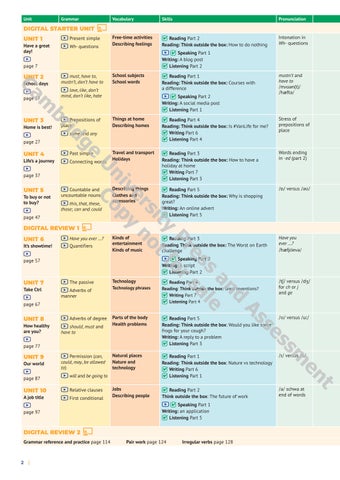
Unit
Grammar
Vocabulary
Skills
Pronunciation
Free-time activities Describing feelings
Reading Part 2 Reading: Think outside the box: How to do nothing
Intonation in Wh- questions
DIGITAL STARTER UNIT UNIT 1
Present simple
Have a great day!
Wh- questions
Speaking Part 1 Writing: A blog post Listening Part 2
page 7
UNIT 2
m Ca
School days page 17
must, have to, mustn’t, don’t have to love, like, don’t mind, don’t like, hate
br
UNIT 3
Prepositions of place
Reading Part 4 Reading: Think outside the box: Is #VanLife for me? Writing Part 6 Listening Part 4
Stress of prepositions of place
Past simple
Travel and transport Holidays
Reading Part 3 Reading: Think outside the box: How to have a holiday at home Writing Part 7 Listening Part 3
Words ending in -ed (part 2)
Connecting words
Describing things Clothes and accessories
Reading Part 5 Reading: Think outside the box: Why is shopping great? Writing: An online advert Listening Part 5
/ɒ/ versus /əʊ/
Kinds of entertainment Kinds of music
Reading Part 3 Reading Think outside the box: The Worst on Earth challenge
Have you ever …? /hæfjʊ̈evə/
page 37
UNIT 5
Countable and uncountable nouns
Co
To buy or not to buy?
ss se As d an s le es sa Pr r y fo it t rs no ve y ni p
U
Life’s a journey
ge
UNIT 4
this, that, these, those; can and could
page 47
DIGITAL REVIEW 1 UNIT 6
Have you ever …?
It’s showtime!
Quantifiers
Speaking Part 2 Writing: A script Listening Part 2
page 57
UNIT 7
The passive
Take Ctrl
Adverbs of manner
page 67
UNIT 8 How healthy are you?
Adverbs of degree should, must and have to
page 77 Our world
Reading Part 4 Reading: Think outside the box: Great inventions? Writing Part 7 Listening Part 4
/tʃ/ versus /dʒ/ for ch or j and ge
Parts of the body Health problems
Reading Part 5 Reading: Think outside the box: Would you like some frogs for your cough? Writing: A reply to a problem Listening Part 3
/ʊ/ versus /uː/
Natural places Nature and technology
Reading Part 1 Reading: Think outside the box: Nature vs technology Writing Part 6 Listening Part 1
/ɪ/ versus /iː/
Jobs Describing people
Reading Part 2 Think outside the box: The future of work
/ə/ schwa at end of words
will and be going to Relative clauses
A job title
First conditional
page 97
Speaking Part 1 Writing: an application Listening Part 5
DIGITAL REVIEW 2 Grammar reference and practice page 114
2
|
Pair work page 124
Irregular verbs page 128
t
UNIT 10
en
page 87
Permission (can, could, may, be allowed to)
Technology
Technology phrases
m
UNIT 9
mustn’t and have to /mʌsən(t)/ /hæftə/
Things at home Describing homes
some and any
page 27
Reading Part 1 Reading: Think outside the box: Courses with a difference Speaking Part 2 Writing: A social media post Listening Part 1
id
Home is best!
School subjects School words
Oracy
Challenge
Life competencies
STEAM
Using body language to express interest Talking in full sentences and linking your ideas
Change your 24 hours and you will change your life.
Critical thinking: evaluating ideas and arguments Emotional development: understanding emotions Learning to learn: taking control of own learning
Technology, Science What’s the time?
Learning to learn: developing skills and strategies for learning Creative thinking: participating in a range of creative activities
m Ca
Participating in discussions Listening carefully Agreeing and disagreeing clearly Following rules for discussions
br
Listening and adding to your partners’ ideas Presenting a poster
ge
id
Around 70% of people want to change something in their home.
Learning to learn: developing skills and strategies for learning Critical thinking: evaluating ideas and arguments Emotional development: empathy and relationship skills
ss se As d an s le es sa Pr r y fo it t rs no ve y ni p
U
Speaking in front of an audience Projecting your voice so everyone can hear it Speaking in front of an audience Talking in full sentences
Find ways to create less rubbish.
Co
Active listening Asking follow-up questions Being polite
Critical thinking: using effective strategies for learning and retaining information Creative thinking: generating ideas Learning to learn: reflecting on and evaluating own learning
Critical thinking: solving problems and making decisions Social responsibility: understanding global issues Learning to learn: developing skills and strategies for learning
Science
Digital literacy: sharing and interacting online Critical thinking: evaluating ideas and arguments
Giving and responding to opinions Using open body language Giving an opinion, agreeing and disagreeing Responding positively to other people’s opinions Speculating Speaking fluently
Every great invention solves a problem.
Social responsibility: understanding global issues Critical thinking: solving problems and making decisions Learning to learn: reflecting on and evaluating own learning
t
en
Giving a presentation Keeping an audience interested Planning your ideas Marking the beginning, middle and end of a talk
Insects are in danger because there aren’t enough places for them to live.
Engineering, Technology Why are engineers making invisible robots?
m
Asking for clarity Answering questions Asking questions if you don’t understand
Critical thinking: solving problems and making decisions Learning to learn: reflecting on and evaluating own learning
Learning to learn: reflecting on and evaluating own learning Creative thinking: preparing for creativity Creative thinking: generating ideas
Asking questions Asking open questions Listening to others Understanding when to use polite language
Arts What makes a great story?
Critical thinking: understanding and analysing ideas and arguments Creative thinking: generating ideas Creative thinking: generating ideas
Biology Digital classroom: Practice Extra
|
3
m Ca
ge id br
Co
t
en
m
ss se As d an s le es sa Pr r y fo it t rs no ve y ni p U
Student’s Book
A2+
Colin Sage
Jo Cummins
UNIT 1 HAVE A GREAT DAY! LEARNING AIMS
THE CHALLENGE
m Ca
Skills: discuss and create texts about how we spend our time Grammar: learn and practise the present simple and Wh- questions Vocabulary: learn and practise words and phrases for free-time activities and adjectives to describe how you feel Critical thinking: reimagine how you spend your time Exam practice: Reading Part 2, Speaking Part 1, Listening Part 2
ge
id
br
Change your 24 hours and you will change your life. You will: • Stage 1 Think: describe your routine and identify how to improve it. • Stage 2 Prepare: research new activities to add to your routine. • Stage 3 Develop: design a new timetable for your daily routine. • Stage 4 Present: give a presentation of your timetable.
U
5 hours 15 mins free time
Co
ss se As d an s le es sa Pr r y fo it t rs no ve y ni p
45 mins doing sport
1 hour 30 mins working
1 hour eating
5 hours 30 mins studying
9 hours sleeping
1 hour washing, brushing teeth, etc.
1 Look at the photo. In pairs, discuss the questions. 1
What is the girl in the photo doing?
2 The times on the photo show how long the girl
spends on activities in an average day. How is your day different?
2 Watch the video and
Grammar
Grammar
3
4
How much time each day do you spend on the seven activities on the photo? Make notes. 2 Work in pairs and compare your daily routines. 3 Discuss these questions. • Which parts of your daily routine can you change? • Which activities do you want to spend more or less time on? 1
Speaking
t
Documentary
2
en
01 Craig has about three / four hours of free time each day. 2 Andrea has about one hour of free time at the weekend / each day. 3 Juan has / doesn’t have a lot of free time. 4 Sara spends all her free time playing the guitar / violin. 1
1
m
choose the correct words to complete the sentences.
CHALLENGE Think
|
7
VOCABULARY FREE-TIME ACTIVITIES
m Ca 1
id
br
1.1 Go to the digital activity and choose the correct activity for each photo. Listen, check and repeat.
ge
bake draw pictures go camping go cycling go shopping listen to music play video games spend time with friends visit museums
ORACY Using body language to express interest When you are listening, look at your partner, smile and lean forward. This shows that you are interested in what they say.
U
ss se As d an s le es sa Pr r y fo it t rs no ve y ni p
Vocabulary reference page 16
2 Complete the sentences with the correct form of
Co
the phrases from Exercise 1. 1 2 3 4 5
6 7 8 9
I often … in the summer. It’s great to wake up in the countryside or the mountains. When I …, we usually go to the park or play basketball. My sister loves songs, so she … every day. Lucy doesn’t have a bike, so she never …. Jonah often sits with his pencil and paper and … of the people around him. I … on Sundays because the tickets are free. Ben … every Saturday. He often buys new clothes. Mum doesn’t often …, but she usually makes a cake for my dad’s birthday. I sometimes … at the weekend. I like sports games and car racing games the best.
3 Think about your typical weekend. Copy and
complete the table with activities from Exercise 1. Then add two more activities using your own ideas.
I always …
8
|
Unit 1 Have a great day!
CHALLENGE Prepare
1
2
3
4
Work in pairs. What new free-time activities do you want to add to your daily routine? 2 Choose one activity from question 1 to research. Look online and find out how you can do it. Think about these questions. • Can you do the activity nearby? Or online? • Do you need to buy anything special? • When can you do the activity? How much time does it take each day? 3 Work in groups. Share your answers from questions 1 and 2. Which of your group’s activities do you want to do? 1
t
I often …
I often …
en
I sometimes …
Exercise 3. Talk about them with a partner. Use body language to express interest.
m
I never …
4 Choose six of the activities from your table in
READING SHORT TEXTS 1 Look at the photos. Which of these activities do you do after school?
2 Read the texts and complete them with the sentences (1–3).
m Ca
For me, a great after-school routine means doing exercise and spending time outside. 2 I can do lots of different things where I live. 3 A great routine for me means spending time with my family. 1
3 Read the questions in Exercise 5. Which words tell
br
you which information to find?
4 Work in groups. Look at the example (0) in
ge
id
Exercise 5 and read Lisa’s paragraph. Which words give you the answer to the question?
1.2
EXAM TRAINING READING PART 2
U
ss se As d an s le es sa Pr r y fo it t rs no ve y ni p
EXAM TIP
Read each question carefully so you know which information to find. Underline the key information you need to find. Then look in the texts for the information.
Co
WHAT MAKES A GREAT
A F TE R S C HROOUTOINEL? MIA
5 For each question, choose the correct answer.
Mia Tim Lisa
… After school, my sister and I have great fun walking home together and we laugh a lot. lt’s not far – in fact, if we stand on the sports field, we can see our garden. When we get home, we make a hot drink for my grandma and something for ourselves. We sit in the living room together and do our homework. My sister’s younger, so I help her. Then it’s time for me to start making dinner. Mum gets home from work at 6 o’clock and she’s always hungry.
TIM
C
Who does their homework outside?
A
B
C
2 Who helps someone with
A
B
C
A
B
C
A
B
C
A
B
C
A
B
C
1
their homework?
3 Who has the same routine
after school every day?
4 Who sometimes eats with
friends in the evening?
5 Who likes watching other
people?
6 Who goes home from school
with a family member?
7 Who prefers doing their
B
C
Work in groups. Read the sentence below. Group A: Think of three reasons why you agree. Group B: Think of three reasons why you disagree. Share your reasons. Then explain what your real opinion is.
t
6
A
en
homework at the weekend?
m
… When school finishes, I go cycling with my friends. We usually ride into the hills before we go home. I love being outside! On Fridays we often cycle home to pick up some things, then we ride to the beach to swim, go camping or maybe cook dinner over a fire. I don’t do my homework after school because I like to have lots of free time. I do it all on Sundays instead. That’s great for me because my dad’s at home to help.
B
sea on Fridays?
… My home and my school are in the middle of a city. There are so many things to do here at the weekends and after school. I can visit museums with my friends, but we don’t often do that. We usually go to the park and do our homework there, or go shopping. Then, on the train home, I write stories or I draw pictures for my brother’s comic book. It’s great seeing people through the window. They often help me think of ideas for my stories.
LISA
A
0 Who enjoys being near the
A great after-school routine means doing exercise and spending time outside. Unit 1 Have a great day!
|
9
GRAMMAR
5 Complete the sentences with the correct form of the verbs.
PRESENT SIMPLE
1 2
1 Watch the grammar
3
animation. Write down all the free-time activities you see or hear about.
02
m Ca
5 6 7
2 Look at the examples and complete the rules in the
br
grammar box.
I bake cakes. He brings some cakes home every Saturday. I don’t like getting up early. My mum doesn’t like it, though. Do you bake cakes? Does he bake cakes?
ge
id
Present simple 1
3 4 5
3
With he, she and it, we usually add the letter … to the verb. For negative sentences with I, you, we and they, we use … before the main verb. For negative sentences with he, she and it, we use … before the main verb. For questions, we use … before I, you, we and they. For questions, we use … before he, she and it.
Co
2
9 10
6 Write six sentences about your weekly routine. For two sentences, use don’t.
7 Work in pairs. Tell your partner about your week. I usually play video games with my brother after school on Wednesdays.
8 Work with a different partner. Tell them about your partner’s routine in Exercise 7.
Natalia doesn’t play video games every day. She goes cycling.
STRETCH! Think of a famous person. Write five
Grammar reference and practice page 114
sentences about their routine. Read the sentences to your partner. Can they guess the person?
Go to the digital activities.
He goes to the gym every day. He doesn’t eat junk food.
4 Put the words in the correct order to make present simple sentences. 1
8
ss se As d an s le es sa Pr r y fo it t rs no ve y ni p
U
• • • • • •
4
We … to the park with our friends after school. (go) I … meat. (not eat) … you … after school? (exercise) My cousin … in a shop. (work) She … a book every day. (not read) … she … pets? (like) … your dad … tennis at the weekend? (play) My classmate … pictures on his phone. (draw) … you … time with your friends after school? (spend) We … to music in maths lessons. (not listen)
Is he a sports person?
on / meet / I / Sundays / friends / my / .
2 watching / like / Do / films / you / ?
3 get / Saturdays / on / early / I / up / don’t / .
4 me / mum / helps / with / My / homework / my / . 5 sister / tennis / Does / play / your / ?
m
6 cook / day / He / every / doesn’t / dinner / . 7 eat / breakfast / We / school / at / don’t / .
en
8 games / Do / friends / your / video / play / ? 9 university / brother / studies / at / His / .
t
10 you / summer / camping / Do / go / every / ?
HOW IS UNIT 1 SO FAR? 10
|
Unit 1 Have a great day!
I understand
I’m getting there
I don’t understand
How to
THINK OUTSIDE THE BOX!
do nothing m Ca
Are you always busy? I am! I’ve got lots of hobbies, a big family and too much homework. I’m never bored! But today is a ‘do nothing day’. Imagine that!
1…
2…
ge
id
br
Experts say that doing nothing helps us to be more creative and relaxed. Also, when we do nothing, we have time to think about what we really want to do with our time. Do you know what you really want to do? It means you can’t use your phone or computer! You also can’t read or listen to music. You can go for a walk, look out of the window or have a bath.
ss se As d an s le es sa Pr r y fo it t rs no ve y ni p
U
3…
4…
Co
First, I turn my phone off. Then I walk to the park. I lie on the grass, watch the clouds and listen to the birds. It starts raining, so I go home and look out of the window. Do you like looking at the rain from the window? I love the rain!
I don’t like turning my phone off! I try not to feel stressed about all my homework and hobbies. It’s difficult, but at the end of the day I feel calm and sleep very well. I feel surprised that I enjoyed the day so much!
READING AN ARTICLE
1 Look at the title of the article. How often do you do nothing?
Think about: • what you normally do in your free time. • how often you are bored.
2
1.3 Read and listen to the article. Put the headings (a–d) in the correct places (1–4).
MEDIATION WORKSHEET
VOCABULARY
DESCRIBING FEELINGS 1
1.4 Go to the digital activity. Choose the correct word for each photo. Listen, check and repeat. bored busy calm creative relaxed stressed surprised
2 Copy and complete the table with the adjectives from Exercise 1. Use the article to help you. Are your words in the same place as your partner’s?
a My day doing nothing
m
b Doing nothing is good for us
en
c How I feel d The meaning of ‘doing nothing’
or false? 1 2 3 4 5 6
The writer often does nothing. Experts think doing nothing is good for us. The writer has a bath on his ‘do nothing day’. The writer lies in the park on his ‘do nothing day’. The writer thinks doing nothing is difficult. The writer does his homework at the end of his ‘do nothing day’.
Vocabulary reference page 16
3
t
3 Read the article again. Are these sentences true
Discuss the questions in groups. How often do you feel bored? What do you do? 2 What makes you stressed? What do you do when you are stressed? 3 When do you feel calm and relaxed? 4 Do you think it is good to do nothing? 1
Unit 1 Have a great day! |
11
GRAMMAR
SPEAKING
WH- QUESTIONS
GIVING FACTUAL OR PERSONAL INFORMATION
1 Watch Emily’s vlog. Complete the questions with the correct Wh- word.
03
1 Watch the video.
m Ca
Complete the questions.
… organised are you? 2 … does my sister always say? 3 … do you study for tests? 4 … does it show the answer? 1
1 2
br
3 4
2 Look at the examples from the grammar vlog. Then
id
5
ge
complete the rule in the grammar box.
How old …? Where …? What time …? What …? Now, please tell me something about ….
2 Watch the video again then copy and complete the checklist for Carlos (C) and Kasia (K).
Answers all the questions correctly. 2 Avoids one-word answers. 3 Asks the examiner to repeat a question. 4 Gives extra information. 1
Co
Wh- questions There are seven main question words used to start Wh- questions: 1 …, Who, 2…, Where, When, Which and 3….
K … … … …
EXAM TRAINING SPEAKING PART 1
Grammar reference and practice page 114
EXAM TIP
3
Go to the digital activities.
4
PRONUNCIATION
pronunciation activity.
When What How Who Where Which food
ORACY
live? you wake up? your parents like best? your brother/sister travel to school? your best friend meet after school? like reading?
Talking in full sentences, linking ideas
When do you wake up in the morning?
Student A: You are the examiner. Ask the questions from Exercise 1. Complete the checklist in Exercise 2 for your partner.
Student B: You are the exam candidate. Answer the questions. Ask the examiner to repeat one question.
CHALLENGE Develop
3 Where do you do your homework?
DIGITAL CLASSROOM
4 When do you study for tests?
PRACTICE EXTRA UNIT 1
| Unit 1 Have a great day!
2
3
4
To change your daily routine, decide on: • two things you can spend less time doing. • one thing you can spend more time doing. • how you can try a new activity. 2 Design a timetable for your new routine. Then share your timetable with a partner. 1
2 How often do you have breakfast?
5 How do you describe your bedroom?
1
t
two extra pieces of information for each question.
swap roles and do the activity again.
en
6 Work in pairs. Ask and answer the questions. Give
3 Work in pairs. Follow the instructions. Then
m
To develop conversations, extend your answers by giving a little more information. My brother travels to school by bus. (main answer) His school is 5 km from our house. (more information)
1
Use more than just one word in your answers.
Go to the digital
5 Use the table to make present simple questions.
12
C … … … …
ss se As d an s le es sa Pr r y fo it t rs no ve y ni p
U
• What does my sister always say? • Why do you do that? • How do you describe your bedroom?
04
WRITING
3 In your notebook, put the pictures of Leo’s day in order (1–6). Then tell the story of Leo’s day with a partner.
A BLOG POST 1 Look at the photos. What activities are the
A
B
C
D
E
F
teenagers doing? Which things would you most like to do? Why? 2
m Ca
1
ge
id
br U
3
4
ss se As d an s le es sa Pr r y fo it t rs no ve y ni p
Co
4 Find all the present simple verbs in the blog post. 5 Imagine your dream day. Copy the spidergram
and make notes. Then work in pairs and compare your spidergrams.
Where?
My Dream Day
2 Read the blog post. Which photo is most like Leo’s dream day?
Weather?
BLOG REVIEWS CONTACT
My
Dream day
by Leo Andersson
Mamadu, Guinea-Bissau @MamaduMendes
I think it sounds a bit boring. I want to do something exciting on my dream day. Jon, Iceland @JTKristjansson
your dream day.
• What do you do? • Why do you do it?
• Who are you with? • How do you feel?
7 Write a short blog post called ‘My Dream Day’. Use your notes to help you.
8 Read your blog post again and check your work. Use these questions to help you.
Does the blog post look nice? Is there a title, a photo and some information? 2 Does the blog post use all the ideas from the spidergram? 3 Does it use the present simple? 4 Does it use adjectives to talk about feelings? 1
t
That sounds like a very relaxing day!
6 Make more notes about each of your activities on
en
Maria, Argentina @MRodríguez
Activities?
m
I wake up at 10 o’clock in the morning. It is a hot and sunny day and I feel calm. I am at a hotel near the beach. I climb a tree to get some bananas for breakfast and then I swim in the sea to feel healthy. I ride a horse to a small restaurant and have a pizza for lunch. After lunch I read my book to feel relaxed, and then I sleep on the beach. I eat chocolate and ice cream for dinner. At night I sit on the beach. I am surprised that there are so many stars!
Food?
9 Now work in pairs. Read each other’s blog posts
and give feedback. Use the questions in Exercise 8 to help you. Make a note of your partner’s feedback and write a second draft of your blog post.
I want to go to the beach, too! Unit 1 Have a great day! |
13
LISTENING
C
A MONOLOGUE
B
A
m Ca
Photography club D
br
Try doing pottery
id
ge
1 Work in pairs. Discuss the hobbies in the photos.
Learn stre e
Can you do any of these hobbies? 2 Point to where you think they go on the lines. boring easy 1
interesting difficult
Co
1.5 Listen to a teacher talking about classes for one of the hobbies. Which photo is he talking about?
When giving information, speak clearly. Don’t talk too quickly or too slowly. Say important information really clearly and more slowly than the rest of your speech.
4 Look at gap 1 in Exercise 5. What type of word do EXAM TRAINING LISTENING PART 2
6
1.6 Listen. Which information does the teacher say more slowly?
7 Read the paragraph. Where will you talk slowly?
EXAM TIP
The words around each gap will help you to decide what kind of information you need to write in it.
5 Listen again. For each question, write one word, a number, a date or a time.
You will hear a teacher telling students about a new after-school club.
Our new pottery class starts on Saturday at 9.30. The classes are for age 10 and older. It costs £25 for eight classes. Please meet at the art studio and wear old clothes.
8 Work in pairs. Take turns to say the paragraph. Use the checklist to give each other feedback.
Did your partner … • talk at a good speed? • talk more slowly when giving the important information? • give the important information clearly?
fencing
Cost: (2) £ … per class Number of spaces: (3) … Bring: (4) … Teacher: Ms (5) …
| Unit 1 Have a great day!
CHALLENGE Present
1
2
3
4
Work in a large group. Present your timetable for your new daily routine and say: • what is different about your new day. • why the new day is good for you. • how the new routine will change your life.
t
Day: (1) …
en
m
After-school club
14
!
Speed of speaking
times you hear. Compare with your partner. you need?
r everyone
ORACY
3 Listen again. Write down all the numbers, days and
Type of club: (0)
Fencing fo
ss se As d an s le es sa Pr r y fo it t rs no ve y ni p
U
2
t dancing
WRAP UP Look back at the unit. Think about:
m Ca
1 three new words you want to use this week. 2 your favourite photo in the unit.
3 something you don’t understand very well.
br
4 something you found interesting.
ge
id
5 something new you now know.
U
Sustainability
ss se As d an s le es sa Pr r y fo it t rs no ve y ni p
1 Tell your partner what you know about sustainability. Say three things.
2 Look back at the text on page 11. How many sustainable activities can you find?
Co
SELF-ASSESSMENT: UNIT 1 How confident do you feel about:
• • • • • • •
finding the correct information in a text? using the present simple? asking Wh- questions? talking about personal information? using words for free-time activities and feelings? planning ideas before you write? listening for specific information?
What was your favourite part of Unit 1? Tell your partner.
Look at Unit 2 and find five words you don’t know. Check them in a dictionary. Then look at the Grammar reference on page 114. Ask your teacher any questions.
STRETCH! YOUR CHOICE
Option 3: Find a local club or hobby that is new to you. Research it and make an advert. Maybe you could join the club!
Unit 1 Have a great day!
t
Option 2: Turn off your phone, TV or computer. Do nothing for an hour (look at the text on page 11 for ideas). Write about your experience and how you feel about doing nothing.
en
Option 1: Plan your afternoon using time-boxing. Then follow your plan and make a vlog.
m
Now choose an extra activity!
|
15
VOCABULARY REFERENCE FREE-TIME ACTIVITIES 1 Match the phrases to the photos.
m Ca
bake draw pictures go camping go cycling go shopping play video games spend time with friends visit museums
1
listen to music
3
5
6
ge
id
br
2
Co
ss se As d an s le es sa Pr r y fo it t rs no ve y ni p
U
4
7
8
9
DESCRIBING FEELINGS 2 Match the words to the photos. bored 1
busy
calm
creative
relaxed
stressed
surprised
3
6
7
4
t
5
en
m
2
DIGITAL CLASSROOM PRACTICE EXTRA UNIT 1
16
|
Unit 1 Have a great day!
UNIT 2 SCHOOL DAYS LEARNING AIMS
ORACY
m Ca
Skills: discuss and create texts about school life Grammar: learn and practise must and have to, mustn’t and don’t have to, love, like, don’t mind, don’t like, hate Vocabulary: learn and practise the names of school subjects and school words Oracy: participate in and make rules for discussions Exam practice: Reading Part 1, Speaking Part 2, Listening Part 1
Participating in discussions • listening carefully • agreeing and disagreeing clearly • following rules for discussions
ge
id
br
Co
ss se As d an s le es sa Pr r y fo it t rs no ve y ni p
U 1 Look at the photo. In small groups, discuss the questions. What are the people doing? 2 Think about your school and the one in the photo. What’s different? 3 What’s the same? 4 What other types of school are different from yours? 1
2 Watch the video. Choose the an online school
2 a school where students
All lessons can be online.
All schools are the same.
Classrooms are the best place to learn.
Every lesson is important.
01
sleep
4 Think about your group discussion. What do
3 an outdoor school
t
en
1
to discuss. Do you agree or disagree with the statements? Why?
m
kinds of school you see.
3 Work in groups. Choose two statements
you want to do better next time?
4 a school on a boat 5 a sports school 6 a city school
Documentary
Grammar
Grammar
Speaking
Oracy
| 17
VOCABULARY SCHOOL SUBJECTS 1
2.1 Go to the digital activity and match the words to the photos. Listen, check and repeat.
m Ca
art biology chemistry geography history maths physics music ICT PE Vocabulary reference page 26
br
2 Work with a partner. Read the fun facts.
1
ge
id
Which school subject from Exercise 1 is each one from? 2
3
WE SEND MORE THAN 3.5 MILLION EMAILS EVERY SECOND.
ss se As d an s le es sa Pr r y fo it t rs no ve y ni p
U
1 111 X 1111 = 12 34321
AUSTRALIA IS WIDER THAN THE MOON.
Co
FOR 11 X 11, 111 X 111, 1111 X 1111 AND 111111 X 111111, THE ANSWER READS THE SAME FORWARDS AND BACKWARDS. 4
PEOPLE IN EGYPT HAD TOOTHPASTE 7,000 YEARS AGO.
5
6
DIAMONDS BURN AT ABOUT 900º 900ºC.
DID YOU KNOW 25% OF YOUR BONES ARE IN YOUR FEET? THERE ARE 26 BONES IN EACH FOOT.
7
18
| Unit 2 School days
100 KG ON THE EARTH WEIGHS 16.5 KG ON THE MOON.
3
Work in pairs. Write a list of all the school subjects you study. Use an online dictionary to find the names of any subjects you don’t know in English.
4 Choose three schools subjects and write a fact from each one.
Then share your facts in small groups. Can other people guess the school subjects?
t
EVERY YEAR, MORE THAN SIX MILLION PEOPLE GO TO SEE THE MONA LISA.
THE SONG 4’33 BY JOHN CAGE IS FOUR MINUTES AND THIRTY-THREE SECONDS OF SILENCE.
en
10
9
m
IN WALKING RACES, ONE FOOT IS ALWAYS ON THE GROUND.
8
A
B
C
D
READING REAL-WORLD TEXTS 1 Look at the photos of extra-curricular activities.
Do you do any of these activities? Would you like to try any of them?
2 Look quickly at text 1 in Execise 3. Choose the
m Ca
correct description.
a an email from a family member b a text message from a classmate
br
EXAM TIP
EXAM TRAINING READING PART 1
id
3 Read the texts. For each question,
ge
choose the correct answer.
1
Co
Why did Leo write this message? A to tell William about his homework B to ask a question about chess C to invite William to meet 2
2.2 4
GUITAR OR VIOLIN LESSONS
25% off when you book five classes
A Gemma knows that Sam can’t go to the start
of the presentation. B Gemma would like to go to the presentation without Sam. C Gemma doesn’t want to watch the video.
5
Ask Mr Ellis
A You must book at least five classes.
B Students have to learn two instruments.
C Lessons cost more if you don’t book five. 3
Sam The Fun Physics presentation starts at 2 pm, but you have maths until 3, don’t you? Let’s watch the video of it at 3.15. Gemma
ss se As d an s le es sa Pr r y fo it t rs no ve y ni p
U
William, Remember that we’re making a poster for the chess club together. We have to finish it today. Can I see you after school? Leo
Decide what type of text you are reading. This helps you to understand it.
B Pupils who want to go to Italy have to tell
their tennis teacher.
C The tennis club is usually in the afternoon,
but not today.
6
Offer for under-18s
First painting class free. Classes on Tuesdays, 3–5 pm.
A Adults can pay less to learn art.
B Young people don’t have to pay to try a lesson. C The school is only open for two hours.
ORACY Listening carefully In discussions, show you are listening carefully by nodding or using encouraging words like OK, right, or sounds like mmm or uh-huh.
t
en
What must Skye do? A buy two tickets for the school trip B take money to school to pay Alan C go to the PE lesson, not the art lesson
A Students can play tennis later today.
m
Morning, Skye! I got us tickets for the art trip. I’ll see you in school later. Could you give me the £10 before PE? Alan
For students not on the Italy trip, tennis club is running as normal this afternoon.
4 Make a list of activities you want
to try. Then discuss in a group and agree on the group’s two favourite activities. Remember to show you are listening carefully.
Unit 2 School days |
19
GRAMMAR
6 Write a rule for each of these places at
school, using must, mustn’t, have to and don’t have to.
MUST AND HAVE TO, MUSTN’T AND DON’T HAVE TO
library canteen playground music room
1 Watch the grammar
animation. Why does Christopher dance?
7 Work in pairs. Say your rules from Exercise
m Ca
02
6. Can your partner guess the place?
ORACY
2 Look at the examples from the animation. Complete
Agreeing and disagreeing clearly
We must be very quiet. We have to hide! We mustn’t wear shoes in the house. You don’t have to take your socks off.
To help everyone in a discussion to understand your opinion, use phrases to agree or disagree clearly and always give reasons.
ge
id
• • • •
br
the rules in the grammar box with similar and different.
U
must and have to, mustn’t and don’t have to
8 Look at the phrases below. Do we use
ss se As d an s le es sa Pr r y fo it t rs no ve y ni p
• Have to and must are 1…. • Don’t have to and mustn’t are 2….
them to agree (A) or disagree (D)? Can you think of two more phrases?
Mustn’t means you need to not do something. Don’t have to means you don’t need to do something (but you can if you want).
Co
1
3 I’m sorry, but …
Grammar reference and practice page 115
3
Go to the digital activities.
4
PRONUNCIATION
activity.
That’s true.
2 No, I disagree. 4 Yes, I agree.
9 Work in groups. Say your rules from
Go to the digital pronunciation
5 Look at the swimming pool information and write six rules.
Exercise 6 again. Which three rules are the most important? Why? Discuss your opinions and remember to agree or disagree clearly.
Welcome to the school pool! Please read this information before you use the pool. 1
3
5
6
4
t
en
m
2
HOW IS UNIT 2 SO FAR? 20
|
Unit 2 School days
I understand
I’m getting there
I don’t understand
THINK OUTSIDE THE BOX!
READING AN ARTICLE 1 Look at the course titles. Which one would you like to study? A Learn to climb
B Creative baking
C How to be happy
D Make music!
2 Read the article quickly. Match the course titles in Exercise 1 to the gaps (1–3). One title is not needed.
m Ca
Courses with a DIFFERENCE
1…
ge
id
br
Normal subjects like art, maths and science are interesting, but what else can we teach and learn? In the USA, thousands of students teach courses every year to help their classmates learn new and unusual things. Students sometimes even write exams which their classmates pass or fail. Here are three wonderful courses taught by students.
Co
3
3…
Would you like to learn the songs of BTS, Blackpink and all your other favourite K-pop bands? In this course, we’ll listen to lots of amazing K-pop music, practise K-pop dance routines, and learn the 24 letters of the Korean alphabet. There’s no exam in this course, but you will have to perform a song at the end-of-term karaoke party in December!
This is a course for people who want to make cakes which look like everyday objects, like hamburgers or trainers. In each lesson, there’s a 20-minute presentation. Then pupils work in groups to make a cake. To pass this course, you need to complete your own cake project. Note: this is an advanced course, so if you want to get better at making normal cakes, try the intermediate baking course instead.
ss se As d an s le es sa Pr r y fo it t rs no ve y ni p
U
You might think that climbing trees is just for children, but it’s a great way to relax and exercise. This course includes lessons on how to climb safely and the equipment you need – and you get the chance to climb some amazing trees. The class starts on Wednesday at 4 pm and is every week this term. The course finishes with a test and you need a mark of 70% or more to pass.
2…
2.3 Read and listen to the article. Write a question for each of the answers. 1 2
6 7
2.4 Go to the digital activity. Choose the correct word to complete each sentence. Listen, check and repeat. advanced exam fail intermediate mark pass project pupil term
Vocabulary reference page 26
t
5
1
en
4
SCHOOL WORDS
m
3
How many students teach courses each year? Thousands. …? On Wednesdays at 4 pm. …? 70% or more. …? 24. …? In December. …? 20 minutes. …? Complete their own cake project.
VOCABULARY
2 Discuss the questions. Use words from Exercise 1. 1 2 3 4 5
Who’s your favourite teacher? Do you like doing exams? What’s your favourite school subject? What are you studying in history this term? Do you prefer music or PE? Unit 2 School days |
21
GRAMMAR
5 Work in groups. Take turns to say these things. 1
LOVE, LIKE, DON’T MIND, DON’T LIKE, HATE
2 3 4 5
1 How do you learn
m Ca
new English words? Watch the grammar vlog and choose the ways Tyler tries. 1
6
03
2 3
4 6
ge
5
id
br
Use new words in sentences. Listen to music. Teach new words to friends. Write new words in a notebook. Record new words on a phone. Use an app.
U
2 Look at the examples from the grammar
DIGITAL CLASSROOM PRACTICE EXTRA UNIT 2
SPEAKING DISCUSSING LIKES AND DISLIKES, GIVING REASONS 1 Watch the video. Which
activities do Kasia, Carlos or Both like?
Co
Marcelo loves science. I like being on the computer. I don’t mind the work. I don’t like Portuguese grammar. I hate getting bad grades.
1
love, like, don’t mind, don’t like, hate After love, like, don’t mind, don’t like and hate, do we use: 1 nouns (e.g. science)? 2 the -ing form of verbs (e.g. asking)? 3 the past form of verbs (e.g. asked)?
Go to the digital activities.
4 Complete the sentences with correct form of the verbs. 1
5 6
22
| Unit 2 School days
EXAM TRAINING SPEAKING PART 2
EXAM TIP
Say what you like or don’t like about the things in the pictures. Try to give reasons why.
2 Work in pairs and talk for two minutes about the pictures
in Exercise 1. Do you like these different activities? Say why or why not. Record your conversation.
3 Listen to the recording of your conversation from Exercise 2. Complete the checklist.
• • • •
I say the activities I like and don’t like. I give reasons why or why not. I ask questions. I answer my partner’s questions.
t
4
5
en
3
3
m
2
loves listening She to English songs. They’re great. (love / listen) I … tests. They’re hard! (not like / do) We … physics. It’s our favourite subject. (love / learn) I … in English. I do it every day. (like / read) They … TV. They think it’s boring! (hate / watch) He … homework. He says it’s OK. (not mind / do)
2
4
Grammar reference and practice page 115
3
04
ss se As d an s le es sa Pr r y fo it t rs no ve y ni p
vlog. Answer the questions in the grammar box.
• • • • •
a school subject you like learning a sport you love something you don’t like wearing a school subject you don’t mind studying a teacher you like a kind of food you hate eating
Asher Yesterday at 16:49
18 likes
2 comments
Hello, everyone! I’m doing a project about schools around the world and I’d like your help. I want to know these three things: 1 Where’s your school and what does it look like? 2 Is there anything special about it (for example, the subjects or the rules)?
m Ca
3 What do you love about your school?
MEDIATION WORKSHEET
Manuel 2 likes
br
3 hours ago
Reply
a
ge
id
My school is in a small town with lots of fields all around it, and about 600 students go there. It’s in a modern building with big classrooms.
b
U
My favourite subject at school is ICT, so I really love those lessons. I love playing computer games with my classmates after the lessons, too.
c
Co
ss se As d an s le es sa Pr r y fo it t rs no ve y ni p
My school is special because I live on a farm a long way from the school, so I only go to my school for about two weeks each year. Usually, I do all my lessons online. There’s one very strange rule. When I study at home, I still have to wear a school uniform!
Willow
1 hour ago d
3 likes
Reply
I go to a sports school. We spend a lot of time doing PE. It’s the first lesson every day, it’s two hours long and it starts at 7 am. That means I need to wake up at 5.30 in the morning! Of course, we do normal subjects like history and maths, too.
e
My school is very large and it’s in the middle of a city. Around it there are lots of places to do sport, for example a swimming pool and basketball courts.
f
I love lots of things about my school, but my favourite thing is seeing my classmates every day.
WRITING
A SOCIAL MEDIA POST
questions (1–3) to the paragraphs (a–f) in the replies.
3 Work with a partner. Make notes to answer Asher’s questions about your school.
4 Write a social media post about your school. Use a different paragraph to answer each of Asher’s questions.
t
2 Read the social media posts. Match Asher’s
Does the social media post answer all of Asher’s questions? 2 Does it use a different paragraph to answer each question? 3 Does it include some of the vocabulary and grammar from this unit? 4 Can you see any problems with the language (spelling, grammar, etc.)? 1
en
do you prefer? Why?
Use these questions to help you.
m
1 Look at the photos on the web page. Which school
5 Read your social media post and check your work.
6 Now work in pairs. Read each other’s social media
posts and give feedback. Use the questions in Exercise 5 to help you. Make a note of your partner’s feedback and write a second draft of your social media post. Unit 2 School days |
23
LISTENING
EXAM TRAINING LISTENING PART 1
SHORT DIALOGUES
EXAM TIP
1 Look at the pictures in Exercise 2.
Before you listen, look at the pictures and think of words to describe what you see. This will help you choose the correct picture.
Who and what can you see?
2
2.5 Listen and choose the correct picture. Then listen again and check your answer.
m Ca
4
1
2.6 For each question, choose the correct answer. 2 What time does the geography class start?
Who will Peter meet after the maths lesson?
A
B
C
br A
ge
id 3 What subject does Julia like the most?
U
B
C
Co
ss se As d an s le es sa Pr r y fo it t rs no ve y ni p
B
A
4 What will Zak teach this term?
C
A
B
C
5 Where will Alex meet Juan? A
3 Read the script. Find the parts that
B
C
talk about pictures A, B and C in Exercise 2. Why are options A and C not correct?
Unit 2 School days
t
|
Read the script in Exercise 3 again. Work with a partner and rewrite it so that a different option is correct. Perform your script for another group. Can they find the correct option?
en
24
5
m
Clara: Maths is nearly finished. What are you doing at break time, Peter? Peter: Well, I want to join the basketball club. The PE teacher, Mr Smith, isn’t here today, but Sara’s a club member, so I’m sure she can tell me more about it. I’ll ask her when this lesson finishes. Clara: Great. Peter: And after school, I need to speak to my physics teacher, Mrs Stoney. I have a question about my homework. Clara: I see.
ORACY 4
07 Watch the students talking about their discussion. Complete each sentence with Ruby or Jake. … agreed clearly.
1
2 … gave a reason when they disagreed.
PARTICIPATING IN DISCUSSIONS • listening carefully • agreeing and disagreeing clearly • following rules for discussions
3 … changed their opinion.
m Ca
4 … wants to show they’re listening carefully next time.
5 Work in groups and follow the instructions. • Discuss whether rules 1–10 in the list are good
br
or bad.
• Choose four rules from the list you want to follow. • Write two new rules for discussion.
1 Work in pairs and list three classroom rules.
id
Why do we have these rules?
Rules for discussion
ge
2 Watch two students
1 2
05
3 4
What are the reasons for having rules for discussions? 2 Which rules does Ruby talk about? a We should try to make shared decisions. b We must always listen carefully. c Everyone should have a turn to speak. d Listen to other people’s ideas. 1
5
6
Co
ORACY
Following rules for discussions
Following rules can help make our discussions fairer (for example, by giving everyone a turn to speak) and more useful (for example, by producing shared decisions).
3
We can agree, but mustn’t disagree. Listen to other people’s ideas. Everyone should have a turn to speak. We mustn’t ask questions. We must always listen carefully. We should try to make shared decisions. We have to speak loudly. We can change our opinions. We can ask Why?. In every discussion, try to win. … …
ss se As d an s le es sa Pr r y fo it t rs no ve y ni p
U
talking about rules for participating in discussions. Answer the questions.
7
8 9
10 11
12
6 Present your group’s two new rules to the class.
7 What do you do in discussions? Complete the checklist for
06 Watch the students discussing this rule: We can agree, but mustn’t disagree. Do they decide that the rule is a good one?
your group. Then say what you can do better next time.
We always follow our rules for discussions. 2 We agree and disagree clearly. 3 We listen to other people in the group. 4 We use new words and phrases. 1
SELF-ASSESSMENT: UNIT 2 How confident do you feel about:
t
en
saying the names of the subjects you study at school? understanding real-world texts? making rules with must and have to, mustn’t and don’t have to? giving opinions with love, like, don’t mind, don’t like and hate? saying why you like and dislike school activities? using the school words from page 21? writing a social media post about your school? participating in discussions?
m
• • • • • • • •
What is your favourite part of Unit 2? Tell your partner. DIGITAL CLASSROOM PERSONALISED LEARNING
Unit 2 School days | 25
VOCABULARY REFERENCE SCHOOL SUBJECTS 1 Look at the photos and choose the correct school subject. 2
m Ca
1
br
maths / geography
id
PE / biology
3
5
ge
4
chemistry / history
ss se As d an s le es sa Pr r y fo it t rs no ve y ni p
U chemistry / physics
ICT / biology
Co
6
music / ICT
7
8
maths / art
9
physics / history
10
geography / maths
music / PE
2 Complete the sentences with these words. advanced
fail
intermediate
mark
pass
project
I got a very good … in my history test. It was 99%!
2 I have to study this weekend because my physics … is on Monday. 4 The test is very hard. Only 5% of students ….
t
5 In the UK, the spring … starts in January and finishes in March.
term
en
3 Our ICT class’s … is to make a website.
pupils
m
1
exam
6 The … course is harder than the beginner’s course, but easier
than the advanced one. 7 My school has about 1,600 … and 100 teachers. 8 If you … your test, you can do it again next year. 9 This is the most … maths course at our school. It’s difficult! DIGITAL CLASSROOM PRACTICE EXTRA UNIT 2
26
| Unit 2 School days
UNIT 3 HOME IS BEST! LEARNING AIMS
THE CHALLENGE Around 70% of people want to change something in their home. You will: • Stage 1 Think: discuss what makes a good home. • Stage 2 Prepare: choose which changes to make to a room in your home. • Stage 3 Develop: describe the room before and after the changes. • Stage 4 Present: give a poster presentation of the changes.
m Ca
Skills: discuss and create texts about homes Grammar: learn and practise prepositions of place, and some and any Vocabulary: learn and practise words to describe homes Creative thinking: change the design of a room in your home Exam practice: Reading Part 4, Writing Part 6, Listening Part 4
ge
id
br
Co
ss se As d an s le es sa Pr r y fo it t rs no ve y ni p
U 1 Look at the photo. In small groups, discuss the questions. 1
What are the family doing?
2 What do they need to do to be comfortable
in their new home?
3 What do they need to do to be happy in their
new city? 4 Would you like to move to a different home?
2 Homes in hot places and
3
4
Work in pairs. Imagine living in one of these types of home: a tree house, a log cabin or an apartment in a skyscraper. Think of four good things about living there. 2 What is your ideal home? Describe it. 3 Work in a group and share your ideas. Do you agree on what a good home is?
01
t
4 a big fireplace
en
Documentary
2
m
thick walls 2 air conditioning 3 small windows
1
1
cold places are different. Are the things in the list good for a hot place (H) or a cold place (C)? Watch the video and check. 1
CHALLENGE Think
5 a swimming pool 6 a balcony
Grammar
Grammar
|
27
VOCABULARY THINGS AT HOME 1
3.1 Go to the digital activity and match the words to the photos. Listen, check and repeat. air conditioning bookcase
cupboard
m Ca sink
armchair
bath
lamp
bin
mirror
sofa Vocabulary reference page 36
br
2 Think of a room in your home. Write five things
3.2 Look at the floor plan of a badly designed apartment. Three students are talking about the living room. Choose the correct words to complete the conversation. Listen and check.
ge
3
id
in it. Try to use words from Exercise 1. Then read your words to a partner. Can they guess the room?
Henry:
Listening and adding to your partners’ ideas A group can build up more ideas and suggestions than just one person. Working alone, you might have six ideas and your partner might have four. But listening to each other and working together, you have ten ideas!
4 Work in groups. Choose two rooms from
the floor plan. How many problems can you find? What changes can you make? Use the phrases in bold in Exercise 3 to build on each other’s ideas.
ss se As d an s le es sa Pr r y fo it t rs no ve y ni p
Jaden:
Look! You don’t need a 1 sink / bin in the living room. That’s right. It needs to be in the kitchen. Yes, and look at the 2 mirror / sofa. If you sit on it, you can’t see the TV. We need to move it. You’re right. Also, there need to be 3 armchairs / bookcases in the living room, not a bed. There are lots of beds in the apartment but only two places on the sofa. I agree. That means not everyone can sit together. Also, we need to move the 4 lamp / air conditioning. You don’t need one behind the TV! We need to put it by the sofa.
Co
Henry: Mia:
U
Mia:
ORACY
5 Share your ideas from Exercise 4 with another group.
CHALLENGE Prepare
1
2
3
4
In a group, make a list of things you want to change in your homes. 2 On your own, choose one room in your home to change. Choose three changes for the room from your list. 3 Draw the room quickly. Make notes about the changes you want to make. Share them with your group. 1
t
en
m
28
| Unit 3 home is best!
READING
5
A FACTUAL TEXT
• live in a cave house with your friends
1 Look at the photos in the text about cave homes. Do you think these sentences are true or false? Why?
•
All the houses in the town are cave homes. 2 The town is in Türkiye. 3 Cave homes are more expensive to keep warm than normal houses. 4 Inside the homes, it’s dark and dirty. 1
•
m Ca
for a year stay in a cave-house hotel on your own for a week eat dinner at a cave-house restaurant every day for five years
STRETCH! The article says that cave homes around the world ‘look very different’. Find pictures of cave homes around the world and say if you agree or disagree.
br
2 Read the text quickly and check your answers to Exercise 1.
id
3 Read the first paragraph of the text. Choose the correct
EXAM TIP
ge
answer for question 1 in Exercise 4. Why are the other options wrong? Use a dictionary to help you.
Imagine you have to do one of the things below. Which option do you choose? Why?
EXAM TRAINING READING PART 4
When you’re choosing the correct option, try to think about why the other options are wrong.
U
ss se As d an s le es sa Pr r y fo it t rs no ve y ni p
THE CAVE HOMES OF GUADIX
Co
3.3
When you get off the bus in Guadix, you might think you are in a typical Spanish town. But if you climb to the top of the hill, you’ll see that part of Guadix is very (1) …. In Guadix, there are more than 2,000 cave homes. Many people live in caves around the world, (2) … in China, Türkiye and here in Spain. These homes look very different, but the reasons for living in cave homes are the same (3) …. Cave homes are under the ground so the rock around them is much thicker than the walls of normal houses. This (4) … they are cool in summer and warm in winter, even without air conditioning or heating.
A different
C normal
2 A per
B than
C including
3 A well
B perfectly
C everywhere
4 A means
B suggests
C helps
5 A agreed
B preferred
C decided
6 A large
B boring
C popular
MEDIATION WORKSHEET
Unit 3 home is best! |
t
B similar
1
en
4 Read the rest of the text. For each question, choose the correct answer.
m
In Guadix, many of the homes are more than 500 years old, but visitors are often surprised to see that they are beautiful inside, with modern bathrooms, sinks and kitchens. In the past, most people (5) … new apartments to cave homes. But today, these caves are becoming more and more (6) … as places to live, as hotels and even as restaurants.
29
GRAMMAR
6 Read the description of a favourite room. Label the picture 1–4 to show where these things go.
PREPOSITIONS OF PLACE
1 bookcase 2 lamp 3 desk 4 cupboard
1 Watch the grammar
animation. What is Rebecca looking for? Where does she find them?
02
m Ca
2 Look at the examples from the grammar animation.
br
Complete the rules in the grammar box.
• They aren’t in front of / under / next to the
id
picture. Look above / below the TV. It’s on the left / on the right. They aren’t in the middle of the room. Are they between the table and the sofa?
ge
• • • •
My favourite place in my house is my bedroom. I have to climb into my bed to sleep. My bed is above an armchair, and under the bed there’s also a bookcase on the left. Between the bookcase and the armchair there’s a cool lamp. In the middle of my room is my desk. I sit there to do my homework or play computer games. Next to my bed on the right, there’s a low cupboard with the window above it. I keep my sports equipment there.
ss se As d an s le es sa Pr r y fo it t rs no ve y ni p
U
Co
Prepositions of place We use prepositions of place to say where things are. Be careful not to miss out words when you use these prepositions. 1 next … 2 in front … 3 on … left/right (of) 4 … the middle (of) 5 between the ( ) … the ( )
Grammar reference and practice page 116
3
Go to the digital activities.
4
PRONUNCIATION
pronunciation activity.
Go to the digital
5 Where’s the cat? Complete the phrases with prepositions from Exercise 2. 1
2
7 Draw your favourite room. Write five sentences
about it. Use one or more prepositions of place in each sentence.
8 Describe your favourite room to a partner. Draw your partner’s room.
the chair
4
… the chair 5
… the chair
30
| Unit 3 home is best!
… the box 6
… the chair
The cupboard next to the bed is bigger in my picture.
HOW IS UNIT 3 SO FAR? I understand
I’m getting there
I don’t understand
t
In my picture, there’s a bookcase on the right. But in your picture, it’s on the left.
en
3
… the chair
m
under
STRETCH! Compare your drawing from Exercise 7 with your partner’s drawing from Exercise 8. Find three differences. Then say what you like best about your partner’s room.
IS #VANLIFE FOR ME? If you look at #VanLife online, you’ll find more than 20 million photos, videos and blogs. You’ll see beautiful people, living in beautiful vans and visiting beautiful places. But what’s life in a van really like?
m Ca
1
You can wake up in the morning with a view of mountains in front of you and go to sleep that night next to a beach! Is a campsite in the middle of the forest a bit too quiet for you? You can drive to a busy city, or even a different country!
2
You can make amazing new friends. When you live in a van, people are interested in your story, so they often stop to chat.
3
Today, more and more people can work and study on the internet. So, lots of people can travel while they do their job or a college course.
5
You spend a lot of time planning … Where to go? Where to wash? Where to buy food? Finding safe places to park is difficult, too. These are all problems which you don’t have to think about in a traditional house.
6
Although you meet new people, not seeing your family and your friends from home can be hard. People often miss their pets a lot, too. Most animals aren’t comfortable living in vans, so people often have to leave their pets with friends or family.
Co
VOCABULARY
ge
id
Vans are tiny and quickly get untidy. There aren’t usually showers – some vans don’t even have toilets! There’s sometimes a small kitchen and a very small sink, but do you want to cook next to your bed every day?
U
br
4
ss se As d an s le es sa Pr r y fo it t rs no ve y ni p
A BLOG POST
1 Imagine you live in a van. Think of one
good thing and one bad thing about it. Share your ideas with the class.
DESCRIBING HOMES 1
3.5 Go to the digital activity and match the adjectives to their opposites. Listen, check and repeat.
3.4 Read and listen to the blog. Which of your class’s ideas from Exercise 1 are there?
3 Read the blog again. Match the topics
(a–f) to paragraphs (1–6) in the blog. a Your van can be an office or b c d
f
a classroom. You can go anywhere. Life in a van can be lonely. Van life is more difficult than life in a normal home. There’s not much space. You’ll meet new people.
modern
safe
traditional
uncomfortable
tidy
noisy
quiet
untidy
Vocabulary reference page 36
2 Think about your dream home then copy and complete
the table with the adjectives in Exercise 1. Compare with a partner. Are any of your answers different? I’d like to live in a/an … home.
I wouldn’t like to live in a/an … home.
3 Choose four adjectives from Exercise 2. Write three things which each adjective can describe. Share your ideas with a partner.
CHALLENGE Develop
1
2
3
4
t
What do you think is best about van life? 2 What do you think is worst about it? 3 Is van life for you? Would you like to try it? 1
dangerous
en
Work in groups and discuss the questions.
comfortable
m
e
4
IT’S GREAT BECAUSE …
IT’S TERRIBLE BECAUSE …
READING
2
THINK OUTSIDE THE BOX!
Think about how you can improve your drawing and notes from Stage 2. 2 Then make a poster which shows your room before and after the changes. 3 Share your poster with a partner. Explain the changes you have made. 1
Unit 3 home is best! |
31
GRAMMAR
3
4 Two students are talking about differences
SOME AND ANY
between their homes. Complete the conversation with some and any.
1 Watch the grammar
Isla:
vlog. What do you think of Emily’s decorating ideas?
03
m Ca
2 Read the examples from the grammar vlog.
br
Choose the correct words to complete the rules in the grammar box. Some of this wall is light brown. She hasn’t got any pictures yet. Do you have any ideas? Could you send me some colour ideas?
ge
id
• • • •
Go to the digital activities.
5 Write six sentences about what you’ve got and
haven’t got in your home. Use some or any in four sentences.
6 Work in pairs. Talk about the things in your homes.
Co
ss se As d an s le es sa Pr r y fo it t rs no ve y ni p
U
some and any We usually use: 1 some / any in positive sentences. 2 some / any in negative sentences. 3 some / any in most questions. 4 some / any in questions when we make suggestions, requests or offers.
Have you got 1… paintings in your bedroom? Noah: No, I haven’t got 2…. Isla: Me neither. Noah: What about posters? Have you got 3… of those? Isla: No, I haven’t got 4…! I’ve got 5… photos, though. Noah: Well, I’ve got posters but no photos. So that’s two differences! Do you want to try and find 6… more?
Find three differences.
7 Work with a new partner. Tell them about your partner from Exercise 6.
Alex hasn’t got any lamps in her house.
Grammar reference and practice page 116
DIGITAL CLASSROOM
PRACTICE EXTRA UNIT 3
t
en
m
32
| Unit 3 home is best!
WRITING
4 Read the exam task in Exercise 6. How many things
AN EMAIL
5 Look at the plan for an email. For each stage, find
do you need to write about in your email?
useful phrases from the models in Exercise 2.
1
Start the email.
2
Invite Eric.
3
Tell him what to bring.
br
1 Imagine you are moving to a new home and this
4
Ask Eric to reply.
What colour do you want to paint it? 2 What do you want to put on the walls? 3 Which furniture do you want in the room?
5
End the email.
is your new bedroom. Work in pairs and discuss the questions.
m Ca id
1
ge
2 Read the two emails. What do you think a ‘painting 2 Messages
EXAM TIP
In your answer, remember to include all three of the points from the question.
Co
A Dear Arthur,
ss se As d an s le es sa Pr r y fo it t rs no ve y ni p
Inbox
EXAM TRAINING WRITING PART 6
U
party’ is?
Please could you come and help me paint on Friday? I’m going to have a painting party. Daniel and Chloe are coming, and I’m going to order pizza.
6 You want to invite your English friend, Eric, to a picnic. Write an email to Eric.
My brother can give you old clothes to wear, but please can you bring something to drink?
In your email:
Cheers,
• invite Eric to the picnic.
Jane
• tell Eric what to bring. • ask Eric to reply.
Inbox
B Hi Simon,
How are you?
I’m going to have a painting party to decorate my room in my new house. Would you like to come? There’ll be pizza, music and lots of paint! The party’s at 7 o’clock on Friday. The address is 198 High Street. Let me know if you’re coming.
A or B.
Which email: 1 invites Arthur to the party? 2 says what time to come? 3 says where the party is? 4 asks someone to bring drinks? 5 says who is coming to the party? 6 asks for a reply?
1
Is the email well organised?
2 Does it include all the information from
the task?
3 Does it include some of the words and
expressions from the models and from other parts of this unit? 4 Can you see any problems with the language (spelling, grammar, etc.)?
8 Now work in pairs. Read each other’s emails and
t
3 Read the emails again. Answer the questions with
questions to help you.
en
Jane
7 Read your email and check your work. Use these
m
Thanks,
Write 25 words or more.
4 Messages
give feedback. Use the questions in Exercise 7 to help you. Make a note of your partner’s feedback and write a second draft of your email. STRETCH! Swap emails with a partner. Then
role-play a phone call. In your phone call:
• say ‘yes’ to the invitation. • ask what time to come. • offer to bring some food. Unit 3 home is best!
|
33
LISTENING MONOLOGUES AND DIALOGUES 1
3.6 Listen to question 1 and choose the correct option. You will hear a girl, Zizi, talking about her new home. Why did her family leave their old house? A to live somewhere bigger B to have a garden C to be closer to the park
m Ca
1
br
2 Read the script for Exercise 1. Find the parts which
id
might make you choose a wrong option.
ge
Boy: What’s your new house like, Zizi? Girl: It’s great. It’s quite large, so I don’t share a bedroom with my sister now. Our family moved because we wanted more space. The garden’s bigger at the new house, too. Boy: You liked living next to the park, though, didn’t you? Girl: That’s right, but it only takes ten minutes to walk there now.
ORACY Presenting a poster When you present a poster, stand next to it so your audience can see it. Point to the part of your poster you are talking about. Look at your audience (not your poster) and make eye contact.
ss se As d an s le es sa Pr r y fo it t rs no ve y ni p
U
4 Look at the poster presentations. What’s wrong with each one? What should the student do differently?
Co
A
B
EXAM TRAINING LISTENING PART 4 EXAM TIP
Remember that you might hear something about each of the options, but only one is correct.
3
C
3.7 Listen and choose the correct answers. 2 You will hear a boy, Alfie, talking to his
2
3
4
Present your poster. • Stick your poster to the classroom wall or place it on your desk. • Talk about your poster for around one minute. • Answer other students’ questions. 2 Listen to other poster presentations. • Move around the classroom in your group to see different posters. • Listen to other students’ presentations carefully. • Ask a question after every presentation. 1
t
| Unit 3 home is best!
1
en
34
CHALLENGE Present
m
mother. Why must Alfie paint the dining room again? A He didn’t move the furniture. B He didn’t paint some walls. C He didn’t use the correct paint. 3 You will hear a girl, Lara, talking to her friend. Where did Lara put the lamp? A in front of the window B next to the armchair C under the bed 4 You will hear a woman talking on the phone. Where is she staying? A in a van B in a tree C in a cave 5 You will hear two classmates talking about a photo. Which part of the house is in the photo? A the kitchen B the dining room C the garden
WRAP UP Look back at the unit. Write down:
m Ca
1 four new words. 2 something new you know now.
3 something you understand well.
br
4 something you need to review.
ge
id
5 something you want to ask your teacher.
ss se As d an s le es sa Pr r y fo it t rs no ve y ni p
U
Sustainability
1 Think of three ways to make your home sustainable.
Co
2 Choose one of your ideas from Exercise 1. How is it sustainable?
SELF-ASSESSMENT: UNIT 3 How confident do you feel about:
• • • • • • •
using the words for things at home from page 28? describing a room with prepositions of place? choosing the correct option to answer questions about a cave home? making positive sentences, negative sentences and questions using some and any? using adjectives to describe homes or things in the home? writing an invitation to a picnic? choosing the correct option when listening to monologues and dialogues?
What was your favourite part of Unit 3? Tell your partner.
Look back at the self-assessment. Think about what you need to review again. Then plan how and when to do the review.
STRETCH! YOUR CHOICE
Option 3: Research a famous person’s home. Make a podcast about it.
Unit 3 home is best!
t
Option 2: Research life on a houseboat. Write a blog about the good and bad things about living on one.
en
Option 1: Imagine your dream cave home. Draw and label its floorplan.
m
Now choose an extra activity!
|
35
VOCABULARY REFERENCE THINGS AT HOME 1 Look at the pictures and choose the correct word. 2
m Ca
1
3
ge
id
br sink / armchair
bin / bookcase
4
cupboard / air conditioning 5
Co
ss se As d an s le es sa Pr r y fo it t rs no ve y ni p
U bath / sofa 6
lamp / air conditioning
7
armchair / cupboard
8
bath / mirror
9
sink / bin
10
t
en
DESCRIBING HOMES
mirror / sofa
m
lamp / bookcase
2 Match the adjectives to their opposites. 1 2 3 4 5
dangerous tidy uncomfortable noisy modern
a comfortable b traditional c untidy d safe e quiet
DIGITAL CLASSROOM PRACTICE EXTRA UNIT 3
36
| Unit 3 home is best!
UNIT 4 LIFE’S A JOURNEY LEARNING AIMS
ORACY
m Ca
Skills: discuss and create texts about experiences in the past Grammar: learn and practise the past simple and connecting words Vocabulary: learn and practise words about travel, transport and holidays, and prepositions of movement Oracy: give a talk to an audience Exam practice: Reading Part 3, Writing Part 7, Listening Part 3
Speaking in front of an audience • projecting your voice so everyone can hear it • speaking in front of an audience • talking in full sentences
ge
id
br
Co
ss se As d an s le es sa Pr r y fo it t rs no ve y ni p
U 1 Look at the photo. In pairs, discuss the questions.
4 Look at the statements and choose one you want to discuss. Decide what your opinions are.
How often do you go on long journeys? 2 How do you normally travel? 3 Do you enjoy going on long journeys? 4 What are the best and worst things about long journeys? 1
• Travel is good for you. • People need to fly less because it’s bad
m
•
for the environment. Travel is too expensive.
5 Work in groups and take turns to share your opinions.
types of transport do you see?
6 Do you like talking in front of a group? Say why or 01
3 Watch the video again.
why not. What do you think is the most difficult thing about talking to an audience?
t
en
2 Watch the video. What
What are the good and bad things about flying?
Documentary
Grammar
Grammar
Oracy
|
37
VOCABULARY TRAVEL AND TRANSPORT 1
4.1 Go to the digital activity and match the words to the photos. Listen, check and repeat.
m Ca
boarding pass bus stop flight motorway passenger petrol station pilot platform station traffic underground
best way to travel? Why?
Vocabulary reference page 46
Copy the spidergram and add the words from Exercise 1. Some words can go in more than one place. Can you add more words?
id
br
2
6 Work in pairs. Look at the ideas below. What is the
bus
ge
car
Co
4 Complete the sentences with the correct form of words from Exercise 1. 1 2 3 4 5
5
ORACY
To project your voice, stand up straight and look at the people in the room. Don’t always look down at your notes!
ss se As d an s le es sa Pr r y fo it t rs no ve y ni p
U
aeroplane
3 Work in groups. Compare your spidergrams and add more words.
to your capital city from your house to your school around your country to Australia to Antarctica
Projecting my voice so everyone can hear it
TRANSPORT
train
• • • • •
7 Look at the photos and answer the questions.
There are lots of … at the … waiting for a bus. The next train to leave from … 2 is the 9.25 to Calgary. There is a lot of … on the … today. I hope I’m not late for work! Don’t forget your … when you go to the airport for your …. I would like to be a … because I like travelling to different countries.
01 Complete the sentences with the words in the box. Watch the video again to check. across along from through (x2) to 1
Do you take a boat … the river to get home? rickshaw.
and tell the class. Answer the questions in Exercise 7 for the other students.
STRETCH! Work in groups. Take turns to choose one type of transport. Don’t tell your group what type of transport you choose. Describe it for the others to guess what it is. Remember to project your voice.
You drive it and you can choose where to go in it. What is it? 38
| Unit 4 Life’s a journey
t
country … another. 4 They take a train to travel … Italy. 5 They take a boat … the sea to Greece.
8 Take turns to choose one of the ideas in Exercise 6
en
3 Flying is a very popular way to travel … one
m
2 Some people even travel … the city on a
Does the speaker: • stand up straight? • look up at the room? • look down at their notes?
READING
4 Would you like to go on this train? What do you think is the best and worst thing about the journey?
A LONG TEXT 1 Look at the photo and read the blog post quickly. In pairs, discuss the questions.
What type of transport is the text about? 2 Which country are the family in? 3 Why are the family travelling? 1
m Ca
2 Work in pairs. Look at Exercise 3, question 1. Find the key words in the question and the three options. 2 Find the part of the blog post that is about this question. 3 Can you find words with a similar meaning to the words in the question? 4 Which is the correct answer? Why? 1
ORACY Speaking in front of an audience It’s normal to feel nervous when we are speaking to a group. To help feel more confident about it, prepare what you want to say and practise. Then take a deep breath before you start to talk!
5 In pairs, research a long train journey or look at the
ge
id
br
photos on page 124. Find answers to these questions. Where does the train go from and where to? 2 How long is the journey? 3 What makes it special? 1
6 Work in groups. Take turns to talk about the train journey.
U
EXAM TIP
MY NEW YEAR JOURNEY
Co
Read the whole text quickly first, to get an idea of what it’s about.
ss se As d an s le es sa Pr r y fo it t rs no ve y ni p
EXAM TRAINING READING PART 3
4.2
BY THAO, AGED 13
Every year we travel from Ho Chi Minh City to Hanoi to spend Tet (Vietnamese New Year) with my grandparents. Normally we fly, but last year we decided to save money and take the train. I was so excited about the trip!
An aeroplane takes about two hours, but the train takes 30 hours! The journey is 1,726 km long. We booked a room on the train. It had six beds for me, my brother, my sister, my mum, my dad and my aunt. We didn’t have much space with all our bags in there as well! We slept on the train for two nights. The sound of the train was very relaxing at night.
In the day, I played games with my family, read a book and listened to music. Sometimes we went to the restaurant on the train to buy some food and drink. The best thing was looking out of the window. We saw the train go through a forest, along the beach and across rivers. My favourite part was going through the Hai Van Pass near Danang. The mountains and the sea looked amazing! There were a lot of rice farms, and I waved at the workers.
3 Read the blog post. For each question, choose the correct answer. 4 Which part of the journey
MEDIATION WORKSHEET
did Thao like the best? A seeing the rice farms B visiting Danang C going through the mountains 5 What does Thao say about Hanoi? A The train’s path is unusual. B The city is cool. C The train station was interesting.
Unit 4 Life’s a journey |
t
Why did Thao’s family go to Hanoi by train? A because it was more exciting B because it was quicker C because it was cheaper 2 What was their room on the train like? A crowded B big C noisy 3 What did Thao enjoy doing on the train? A spending time with her family B looking out of the window C eating in the restaurant 1
en
m
I loved seeing more of my country. Vietnam is very beautiful! For the last part of the journey in Hanoi, the train goes through ‘Train Street’ in the centre of the city. It was strange and cool. My grandparents met us at the train station and we told them about our interesting train journey.
39
GRAMMAR
3 4
PAST SIMPLE
m Ca A
1
02
2 3 4 5
ge
id
D
from Exercise 5. Add other questions (e.g. Who …? Why …? How long …?) to find out more information from your partner.
U
ss se As d an s le es sa Pr r y fo it t rs no ve y ni p 7 Write sentences about your last holiday.
School finished two hours ago! Then it started to rain. I took a biscuit out of my bag. Did you have a bad day? I didn’t have a coat.
Put the verbs in the past simple.
Co
• • • • •
1
2 3
4 5
Past simple
For most regular past simple verbs, we add the letters … to the end of the verb. 2 Some verbs are irregular: this means they … have the regular form. 3 For past simple questions, we use …. 4 To make negative sentences in the past simple, we use …. 1
Where … on your last holiday? (you / go) How … there? (you / travel) Which places … on your trip? (you / visit) What food … there? (you / eat) … the holiday? (you / like)
6 Work in pairs. Ask and answer the questions
2 Look at the examples and complete the rules in the grammar box.
Go to the digital
form of the verbs.
B
br C
PRONUNCIATION
pronunciation activity.
5 Complete the questions with the correct
1 Watch the grammar animation. How did Greg get home? Choose the correct picture.
Go to the digital activities.
6
I … (go) to I … (travel) by I … (visit) I … (eat) I … (like) I … (not like)
Grammar reference and practice page 117
t
en
m HOW IS UNIT 4 SO FAR? 40 |
Unit 4 Life’s a journey
I understand
I’m getting there
I don’t understand
HOW
TO
H AV E
A
THINK OUTSIDE THE BOX!
HOLIDAY AT HOME Do you need to travel to have a holiday? Here are four ideas to enjoy a holiday without going anywhere!
1 See the world from your living room
m Ca
You can use VR (virtual reality) to take a trip to Antarctica, the pyramids of Egypt or even the National Gallery in London. You can spend the day seeing the famous sights of the world, without leaving your sofa!
br
2 Eat the world
3 Go camping in your garden
id
How about cooking a meal from a different country? Choose any country in the world, then research and make food that the people like to eat. While you’re cooking, why not listen to some music from the country you chose?
ge
For an adventure, why not put up a tent in your garden and sleep there? You and your friends can have a picnic in the garden, too. Bad weather or no garden? No problem! Put your sleeping bags in the living room and camp there!
ss se As d an s le es sa Pr r y fo it t rs no ve y ni p
U
4 Visit somewhere new
Co
Be a tourist in your own town! You could visit a new café, go to the art gallery or take a bus trip to a new part of town. You don’t need to go far to find something new!
Maybe it is better to have an adventure at home! What do you think?
READING AN ARTICLE
2 Complete the sentences with the words from Exercise 1.
When I … in the forest, I always sleep well in my … because my … is so warm. 2 I used … to see the … of Italy. 3 I took a … to the … last weekend, and I met a … who came from New Zealand. 4 Our walk was a real …! 1
1 Work in groups. Look at the title of the article. What can you do on a ‘holiday at home’? Make notes on your ideas.
2
4.3 Read and listen to the article. Did it have any of your ideas from Exercise 1?
2 two ways to experience a different country 3 two things you could do in your garden
1
1
three places you can visit with virtual reality
HOLIDAYS 4.4 Go to the digital activity. Match the words to the definitions. Listen, check and repeat.
STRETCH! Imagine someone from a different country is coming to your town. Write a list of the top five sights to see in your town. Share your ideas with the class.
t
en
VOCABULARY
adventure art gallery camp sleeping bag tent tourist trip virtual reality
Do you agree that it might be better to stay at home and not travel? 2 What would you do if you had a week to spend on a holiday at home?
m
4 three places to go to in your town
1
3
Work in groups and discuss the questions. Try to use at least six of the words in Exercise 1. Give examples and reasons for your opinions.
3 Read the article again. Find these things.
sights
Vocabulary reference page 46 Unit 4 Life’s a journey |
41
GRAMMAR
5 Complete the paragraph with connecting words from Exercise 2.
CONNECTING WORDS 1 Watch the grammar
m Ca
vlog. Which of these things did Emily take when she went camping? a saucepan 2 a sleeping bag 3 a mobile phone 1
03
Last year, I took a bus to Mumbai 1… I wanted to visit my brother. He took me to lots of restaurants 2 … shops. It was really cool! He also took me to the top of a tall tower, 3… I saw how big the city is. It was really high, 4… I wasn’t scared. I liked the city, 5… I didn’t like all the crowds of people 6… the traffic.
4 a torch
ORACY
5 a dress
Talking in full sentences
6 You are going on holiday to a city. You already have
id
2 Look at the examples and complete the rules in
You can express ideas better when you talk if you use full sentences and connecting words like and, but, because, so, or.
ge
br
6 some socks
the grammar box.
I definitely needed a tent and a sleeping bag. I didn’t text or use social media. I needed a jumper, but I didn’t need five! I took it because I wanted to take lots of photos. I brought a lot of food, so I was never hungry.
1 2 3 4 5
Co
Connecting words
money, passport, clothes and a phone. You can take five more things with you. Choose five things you want to take.
ss se As d an s le es sa Pr r y fo it t rs no ve y ni p
U
• • • • •
We use but / or to give a choice. We use and / because to say why. We use and / but to add information. We use but / so to talk about a result. We use because / but to add different information.
Grammar reference and practice page 117
3
Go to the digital activities.
4 Choose the correct words to complete the sentences. 1 2 3
7
42
| Unit 4 Life’s a journey
8 Think about your conversation in Exercise 7. Which
connecting words did your group use? Write them down. How many times did you use them? Compare your notes. DIGITAL CLASSROOM PRACTICE EXTRA UNIT 4
t
6
you want to take and why. Then discuss and agree together on five things.
en
5
7 Work in groups. Take turns to say which things
m
4
The hotel is very large but / and it has a swimming pool. I want to visit Australia, so / but it is very far away. I think it is good to travel because / or you can learn about other places. Do you want to visit the museum or / so the art gallery? I took my guidebook, and / so I knew about the best sights in the city. I was cold at night but / because I didn’t bring a jumper. You can get to the town by bus or / so you can take the train.
WRITING
EXAM TRAINING WRITING PART 7
A SHORT STORY
EXAM TIP Make sure you write about all three of the pictures.
6 Write the story shown in the pictures. Write
m Ca
35 words or more.
ge
id
br Co
ss se As d an s le es sa Pr r y fo it t rs no ve y ni p
U 1 Work in pairs. Look at the pictures. What can you see? What happened in the story?
2 Read the story. Is it the same as the one you thought of? Are there any differences?
One day, a tourist went on a trip to a forest to take photos of some monkeys. First, he looked for the monkeys playing in the trees. Then, he got his camera and tried to take some good photos. Later, the tourist was hungry so he ate his lunch. After that, he went back to his camera. He was very surprised because there was a photo by one of the monkeys on his camera!
Exercise 2?
• first • second • next
• after that • then
• later • finally
5 Look at the pictures in Exercise 6. Tell the story with a partner. Try to use some of the words in Exercise 4 to tell the story in order.
1
Did you write about all the pictures?
2 Did you use the past simple?
3 Does the story include connecting words and
t
4 Which of these words can you find in the story in
questions to help you.
en
the past simple verbs and draw a circle around the connecting words.
7 Read your story and check your work. Use these
m
3 Look at the story again then copy it. Underline all
some words from Exercise 4? 4 Can you see any problems with the language (spelling, grammar, etc.)?
8 Now work in pairs. Read each other’s stories and
give feedback. Use the questions in Exercise 7 to help you. Make a note of your partner’s feedback and write a second draft of your story. Unit 4 Life’s a journey | 43
LISTENING
4 Read the script for question 1. Did you choose the
correct answer? Why are the other answers wrong?
A DIALOGUE 1 Work in pairs. Look at the two holiday photos. Which holiday do you think looks: relaxing? exciting? unusual? fun?
EXAM TRAINING LISTENING PART 3
m Ca
• • • •
We stayed at home, but had loads of cool trips, like going to the theatre. That was last Friday. I cycled to my cousins’ house sometimes, too. Oh, and we got the bus to the zoo once.
EXAM TIP Remember that you will hear some words from each question. This will help you know which question the people are talking about.
A
id
br 5
ge
4.7 Listen to the whole conversation again. For each question, choose the correct answer. 1
ss se As d an s le es sa Pr r y fo it t rs no ve y ni p
U
Where did Ahmad go last Friday? A his cousins’ house B the theatre C the zoo Which animals at the zoo did Ahmad like the best? A the lions B the penguins C the elephants Which member of Hana’s family doesn’t like football? A her brother B her sister C her mum What didn’t Hana like about the football match? A It was too noisy. B The stadium was too big. C There were too many people. How did Hana get to Singapore? A by car B by train C by aeroplane
2
Co
3
B
4
5
6 Think about the last trip you took by car, train or bus. Plan a short talk about it. Make notes on:
44
7 Write a question with three options about your 4.5 You will hear two friends, Hana and Ahmad, talking about their holidays. Which photo shows Hana’s holiday? Which shows Ahmad’s holiday? 4.6 Look at question 1 in Exercise 5. Find the key words in the question. Then listen to the first part of the conversation and choose the correct answer.
| Unit 4 Life’s a journey
talk, like the ones in Exercise 5.
8 Work in pairs. Give your question to your partner.
Listen to each other’s talk. Can your partner answer your question?
t
3
en
2
m
• where you went. • what happened. • how you felt.
ORACY 5
m Ca
SPEAKING IN FRONT OF AN AUDIENCE • projecting your voice so everyone can
• • • • 1
id
when giving a talk? Make a list.
3 Try to talk for one minute.
7 Work in groups or as a class. Take turns to give your talk.
ge
Listen to other students then copy and complete the table. Give each other feedback.
2 Watch the video.
Name: …
use full sentences? use connecting words?
Co
things do the students talk about?
4
Name: …
talk loudly enough?
talk for one minute or more?
3 Watch the video again. Which of these • • • • • •
Name: …
ss se As d an s le es sa Pr r y fo it t rs no ve y ni p
U
Do they …
04
Did the students talk about any of the things you talked about in Exercise 1? 2 What are they worried about? 3 Why is it important to speak loudly? 1
Make notes on what you want to say.
2 Practise talking in full sentences with connecting words.
1 Work in pairs. What do you worry about
Discuss the questions with your partner.
talking in full sentences talking loudly feeling nervous using connecting words
6 Prepare a talk about a special trip you went on.
br
• •
hear it speaking in front of an audience talking in full sentences
06 Watch the students discussing the talk. Which things do they mention?
practising the talk making eye contact using connecting words making notes talking loudly talking in full sentences
8
Work in pairs. Talk about how you felt when you gave your talk. Answer the questions.
What went well? 2 How did you feel? 3 What did you find hard about giving a talk? 4 What would you change next time? 1
05 Watch Clara giving her talk. Which of the things in Exercise 3 do you think she does well?
SELF-ASSESSMENT: UNIT 4 How confident do you feel about:
t
en
quickly understanding what a text is about? using pictures to write a short story? using the past simple to talk about past experiences? using connecting words when writing and speaking? discussing past travel experiences? using prepositions of movement? using words about travel, transport and holidays? finding the correct answer in multiple-choice questions when listening? giving a talk in front of an audience?
m
• • • • • • • • •
What was your favourite part of Unit 4? Tell your partner.
DIGITAL CLASSROOM PERSONALISED LEARNING
Unit 4 Life’s a journey |
45
VOCABULARY REFERENCE TRAVEL AND TRANSPORT 1 Match the words to the photos. bus stop platform
1
flight pilot motorway passenger station traffic underground 3
4
7
8
id
br
2
ge
m Ca
boarding pass petrol station
5
6
Co
ss se As d an s le es sa Pr r y fo it t rs no ve y ni p
U 9
10
11
2 Match the sentences to the pictures. A
B
I drive through the forest every day. 2 I rode my bike along the road. 3 We flew from Rio de Janeiro to Lima. 1
HOLIDAYS
C
D
4 I used a boat to get across the river. 5 I like travelling around my country.
2 4 5 6 7 8 9
46
| Unit 4 Life’s a journey
a tourist b art gallery c sights
t
3
a thick bag to sleep in when camping an exciting activity or experience a journey when you go somewhere and come back pictures and sound made by a computer that seem real a building where you can see paintings, etc. someone who visits a place on a holiday to sleep outside on holiday famous places in a country or city you can sleep outside in this
en
m
3 Match the words to the definitions. 1
E
d virtual reality e tent
adventure g sleeping bag h trip i camp f
DIGITAL CLASSROOM PRACTICE EXTRA UNIT 4
UNIT 5 TO BUY OR NOT TO BUY? LEARNING AIMS
THE CHALLENGE Find ways to create less rubbish. You will: • Stage 1 Think: discuss the things you buy and throw away. • Stage 2 Prepare: discuss ideas for an event to help people throw fewer things away. • Stage 3 Develop: plan the event. • Stage 4 Present: present your event.
m Ca
Skills: discuss and create texts about the things we have and buy Grammar: learn and practise countable and uncountable nouns, this/that/these/those and can/could Vocabulary: learn and practise adjectives to describe things and words for clothes and accessories Creative thinking: think of ideas about how to create less waste Exam practice: Reading Part 5, Listening Part 5
ge
id
br
Co
ss se As d an s le es sa Pr r y fo it t rs no ve y ni p
U 1 Look at the photo. In pairs, discuss the questions.
Describe what you can see in the photo. 2 Do you think people buy too many things? 3 What do you do with things you don’t need any more? 1
2 Watch the video and
CHALLENGE Think
choose the correct words in the sentences. 1
5
Documentary
Grammar
Grammar
4
Work in pairs. Discuss these questions. • What type of things do you think you have too much of? • How often do you buy new things? • What type of things do you often throw away and why? • What problems does this cause? 2 Work in groups and share your ideas about the problems. Then share your group’s ideas with the class. 1
t
4
3
en
3
2
m
2
01 People make more than 2.12 billion tonnes of rubbish / resources every year. The 3 Rs method stands for ‘reduce, reuse and rubbish / recycle’. Upcycling gives a second recycle / life to things people normally throw way. Upcycling saves a lot of natural videos / resources. Fun life / videos online can teach you how to make new things.
1
|
47
VOCABULARY
6 Write sentences about photos 1–4 below. Use
words from Exercise 1 or your own ideas. Use two or three adjectives for each photo.
DESCRIBING THINGS 1
5.1 Go to the digital activity and choose two words for each photo. Listen, check and repeat.
m Ca
broken empty perfect
cotton clear dirty gold leather metal plastic silver soft Vocabulary reference page 56
br
2 Copy and complete the table with the adjectives
Active listening When having a conversation, you can sometimes repeat back the important information you hear. Do this to check that you understand, and to show that you are listening carefully. Notice that the shop assistant in Exercise 4 does this.
7 Work in pairs. Student A: Look at page 125. Student B: Look at page 126.
quality ➜
ge
id
from Exercise 1. Some words can go in two places. Remember that adjectives go in this order when we make sentences.
ORACY
colour ➜
CHALLENGE Prepare
material
U
5
PRONUNCIATION
pronunciation activity. 1
4
ss se As d an s le es sa Pr r y fo it t rs no ve y ni p
Co
5.2 Listen to the conversation in a second-hand shop. Which adjectives do you hear? Compare with a partner. empty gold leather metal
3
Work in groups. Think about the problems you talked about in Stage 1. 2 Research types of events you could create to help with these problems (for example, a second-hand sale). 3 Make sure each group member comes up with one possible event. 4 Discuss the advantages and disadvantages of each event.
to the table in Exercise 2?
broken cotton clear dirty
2
1
3 Work in pairs. How many more words can you add 4
1
perfect plastic silver soft
Go to the digital
2
4
t
en
3
m
It’s an empty plastic bottle.
48 |
Unit 5 To buy or not to buy?
READING
[SECR_BE_L1_SB_U05_p049_i01] [SECR_BE_L1_SB_U05_p049_i02]
AN ARTICLE 1 Work in pairs. Look at the photos and discuss the questions.
Describe the two bedrooms. Which one do you like best? Why? 2 Which one is more like your bedroom? Why? 1
m Ca
2 Read the introduction to the article. In pairs,
br
discuss the questions in the introduction. Do you think tidying your room can change your life?
id
How to tidy
5 Copy the lines and put a cross (✗) on each one to
ge
show how far you agree or disagree with these sentences.
How much time do you spend tidying your room? How many things are there on your bedroom floor? Do you have lots of things that you don’t really need? Well, maybe Japanese tidying expert Marie Kondo can help! She says that when you tidy, you can change your life forever.
2
Co
3
4
3 Look at the first sentence of the article in Exercise 4. Answer the questions.
5
What type of word is missing in gap 0? Is it a verb, noun or preposition? 2 Which of these words is correct? Why are the others wrong? A is B of C you 1
I have too many things in my bedroom. strongly disagree strongly agree I enjoy tidying. strongly disagree strongly agree I find it difficult to throw things away. strongly disagree strongly agree I buy too many things. strongly disagree strongly agree My bedroom is tidy at the moment. strongly disagree strongly agree
ss se As d an s le es sa Pr r y fo it t rs no ve y ni p
U
1
6
Work in pairs. Compare how far you agree or disagree with the sentences in Exercise 5. Which things do you think you can improve? How?
EXAM TRAINING READING PART 5 EXAM TIP
Look carefully at the sentence with the gap and think about what type of word is missing.
4 Read the rest of the article. Write one word for each gap.
5.3
t
en
m
First (0) … all, Marie Kondo asks people to think about how they want their room to look. You could draw a picture (1) … write a description. Then decide what things to keep. (2) … not start small and tidy your socks first? Put them all on your bed. (3) … of them ‘spark joy’ (make you feel happy)? If your things don’t give you that feeling, say ‘thank (4) … and goodbye’ and find new ways to use them.
(5) … example, you could use your old socks for cleaning. Then fold the socks you’re keeping (6) … they look tidy and you can see them all easily. Don’t buy anything new until your old things are organised!
Unit 5 To buy or not to buy?
|
49
GRAMMAR
5 Complete the questions with How much or How many.
COUNTABLE AND UNCOUNTABLE NOUNS
2 … time do you spend shopping 3
1 Watch the grammar
4
animation. What does Sophie bring? Make a list.
5
m Ca
02
6
2 Look at the examples. Choose the correct words to complete the
br
rules in the grammar box.
each week? … pairs of socks do you have? … clothes do you buy each year? … rubbish does your family throw away each year? … information do people need about recycling?
6 Work in pairs. Ask and answer the
questions from Exercise 5. When you are answering, give some extra information.
We’ve got six bottles of water. I brought some food for us. How many bananas have we got? How much water did you bring?
ge
id
• • • •
… shops are near your home?
1
U
Countable and uncountable nouns
ss se As d an s le es sa Pr r y fo it t rs no ve y ni p
Countable / Uncountable nouns only have one form.
1
2 Countable / Uncountable nouns have a singular and
plural form.
Co
3 We can count countable / uncountable nouns.
4 We can’t count countable / uncountable nouns.
5 Countable / Uncountable nouns are used with How much. 6 Countable / Uncountable nouns are used with How many.
Grammar reference and practice page 118
3
Go to the digital activities.
There is only one shop near my house. It’s a small supermarket.
4 Choose the correct words to complete the sentences. 1
How many / much ideas do you have for our project?
2 I need to take some bag / bags with me. 3 Can I have some waters / water, please?
4 Do you have time / a time to go shopping with me today? 5 How many / much money did you spend?
6 I’m really hungry. I need some food / foods!
t
en
m HOW IS UNIT 5 SO FAR? 50
|
Unit 5 To buy or not to buy?
I understand
I’m getting there
I don’t understand
THINK OUTSIDE THE BOX!
READING
3 Read the article again and answer the questions.
AN ARTICLE
Who: 1 comes from a different country? 2 is with their friends? 3 owns their own shop? 4 is happy they have a job? 5 knows people who work in shops? 6 helped a friend?
1 Look at the title of the article. How many reasons can you think of why shops and shopping are great? Make a list.
5.4 Read and listen to the article. What reasons can you find? Are any of them the same as yours?
m Ca
2
br
WHY IS
ge
id
SHOPPING GREAT?
We went to a shopping centre to find out why people think shopping is great!
ss se As d an s le es sa Pr r y fo it t rs no ve y ni p
U PAULINA, 17
Co
I’m out shopping today because I felt stressed, but shopping always makes me feel better! I’m out with my friends and we are chatting and window shopping. I don’t even need to spend any money. Just being at the shops helps me relax. I bought a backpack and some make-up today! I also helped my friend to choose a new wallet.
ALEC, 22
MAI, 34
I work in a sports shop. I love my job because I get to talk to people and help them choose new trainers, tracksuits or tennis rackets. Before I started working here, I didn’t have a job or any money, so this job is really important to me. There aren’t many jobs in this area, so lots of my friends work in shops, too.
I have a small shop selling fair trade necklaces, bracelets and earrings. I started the shop two years ago and at first it was difficult, but I am creating a better future for myself and my children by having my own business. I buy the jewellery from villages in Thailand, my home country, so I am also helping the people there.
MEDIATION WORKSHEET
VOCABULARY
CLOTHES AND ACCESSORIES 1
5.5 Go to the digital activity and match the words to the photos. Listen, check and repeat. backpack
bracelet
tennis racket
earrings
tracksuit
jewellery
trainers
make-up
5
1
Do you agree that shopping is great?
2 How often do you go shopping? Do you enjoy
shopping? 3 Do you often buy things you don’t need? 4 What could you do to shop better? Think about the environment and other people.
t
4
Work in pairs and
discuss the questions.
en
3
It is small and often made of leather. You keep money in it. They can be gold or silver. You wear them in your ears. It has a top and trousers. You can wear it to do sport. They can be leather. You wear them on your feet when doing sport. It can be leather, plastic or cotton. You put things in it and carry them.
4
m
2
Vocabulary reference page 56
wallet
2 What is it? Write words from Exercise 1. 1
necklace
STRETCH! Write about the last thing you bought. What was it? What does it look like? Where did you buy it? Why did you buy it?
3 Describe more things for your partner to guess. Unit 5 To buy or not to buy?
|
51
GRAMMAR
CAN AND COULD
THIS, THAT, THESE, THOSE
6 Look at the examples. Answer the questions in the grammar box.
• I could do this really quickly when I was young. • I can build a box using these bricks. can and could Which word do we use to talk about ability in the past? 2 Which word do we use to talk about ability now?
m Ca
1
br
1 Work in pairs. Look at the photo of toy animals. Think of ways to upcycle them.
Grammar reference and practice page 118
id
ge
2 Watch the grammar
7 03
Sometimes both are possible.
… you say ‘hello’ in more than two languages? 2 … you speak English two years ago? 3 … you swim? 4 … you ride a bike when you were five? 1
ss se As d an s le es sa Pr r y fo it t rs no ve y ni p
3 Look at the examples and complete the rules in the grammar box.
I need to cut this dinosaur. I need that knife in Mum’s desk. I need to glue these parts of the dinosaur. I need those pieces of wood.
Co
• • • •
this, that, these, those
We use … and … to talk about things close to us. 2 We use … and … to talk about things further away. 1
Grammar reference and practice page 118
4
Go to the digital activities.
8 Complete the questions with can and could.
U
vlog. Was Tyler’s upcycling idea the same as yours?
Go to the digital activities.
ORACY
Asking follow-up questions
Ask your partner more questions to keep the conversation going and to show that you are interested. These are called follow-up questions.
9
5.6 Listen to the conversation and answer the questions.
Which question from Exercise 8 are the students talking about? 2 What two follow-up questions does the girl ask? 1
10 Ask and answer the questions from Exercise 8 in pairs. Ask your partner follow-up questions.
CHALLENGE Develop
| Unit 5 To buy or not to buy?
DIGITAL CLASSROOM PRACTICE EXTRA UNIT 5
t
52
4
en
A: Do you like 1… blue dress? B: It’s OK. I prefer 2… green one over there. A: Yes, 3… one is nice. B: I like 4… trainers next to it, too. A: Anyway, I think I’ll buy 5… sunglasses. They’re cool!
3
m
with this, that, these or those.
2
Choose one event discussed in Stage 2 that you will create to help with the problems discussed in Stage 1. 2 Plan the event with your group. Make notes about what you want to say, including where, when, why and how you want to have the event. 3 Make sure every group member can talk about a different part of the event. 1
5 Look at the picture. Complete the conversation
1
WRITING AN ONLINE ADVERT
FOR SALE
Buy now
m Ca
Cool red backpack for sale. It is very big, so there is lots of space for your wallet, phone and papers. Perfect condition because I only used it once. I am selling it because I have too many bags. Only £10.
Make offer Ask seller
Visit shop See other items
ge
id
br
Save seller Contact seller
2
4 5
Co
3
What is for sale? What are three adjectives used to describe the item? Why is it in ‘perfect condition’? Why is the person selling the bag? How much is the bag?
3 Work in pairs. Discuss which item from the two adverts you would like to buy. Why?
ss se As d an s le es sa Pr r y fo it t rs no ve y ni p
1
U
1 Look at the advert above and answer the questions.
2 Complete the advert below with the numbers, words and phrases in the box.
£10 39 blue and green comfortable didn’t wear them much good nice perfect for sport too small for me
4 Think of something that you own but don’t need
any more. You are going to write an advert for it. Make notes on these questions. 1
2 3
4 5
What is it? What does it look like? What condition is it in? Why are you selling it? Any other information (e.g. size, material, use, etc.)?
5 Write your advert. Use your notes from Exercise 4.
Do not write the price of the thing you want to sell.
6 Read your advert again and check your work. Use these questions to help you.
Does the advert look nice? Is there a title, a photo and some information? 2 Are there enough adjectives in your advert? 3 Does your advert say why you are selling the article? 4 Can you see any problems with the language (spelling, grammar etc.)? 1
m
7 Now work in pairs. Read each other’s adverts and
… 2… trainers for sale, size 3….
They are 4… because they are very 5…. I 6…, so they are in 7… condition. I am selling them because they are 8…. Only 9….
t
1
en
FOR SALE
give feedback. Use the questions in Exercise 6 to help you. Make a note of your partner’s feedback and write a second draft of your advert. Make sure you include a picture or a photo of the thing you want to sell.
8 You are going to have an auction in the class. You all have £100 to buy things. Read all the adverts and decide what you want to buy and how much you can pay.
Unit 5 To buy or not to buy?
|
53
LISTENING A DIALOGUE 1 Look at the photo. What are the people doing? 2
5.7 Listen to a conversation in a shop. What is happening?
m Ca
3 Read part of the script. What is the problem with the trainers?
id
br
Shop assistant: Do you want to return these trainers, too? Customer: Yes, please. I need to change them for a bigger size.
4 Can you think of other possible problems with a new
ge
pair of trainers?
5 Look at the list of problems (A–H) in Exercise 6. Which
U
one matches best for the trainers?
Co
EXAM TIP
Remember that the things or people in the first list are in the same order as in the recording.
6 Listen again. For each question, choose the correct answer.
You will hear a customer talking to a shop assistant about some things she bought last week. What is the problem with each thing? Item 0 skirt 1 trainers 2 trousers 3 T-shirt 4 wallet 5 necklace
F … … … … …
Problem
A broken
B someone else
Shop assistant: What do you want? Customer: I want to buy this video game. Shop assistant: £30. Customer: Here. Shop assistant: Bye.
Being polite Being polite is not only about the language you use, but also about listening carefully and not interrupting.
| Unit 5 To buy or not to buy?
10 Work in groups and discuss the questions. 1
Do you think it is important to be polite?
2 How polite are you when you are talking to
these people? Why? • your teacher • your classmates • your parents • your grandparents • a shop assistant 3 Who do you think was the most polite person in your group when you talked about these questions? How were they polite?
CHALLENGE Present
1
2
3
Practise what you are going to say about your event with your group. How can you show the class that your event is the best? Look at page 45 to help you present your ideas. 2 Present your event to the class. 3 Vote for the best event. 1
4
t
ORACY
another pair and show them your conversation. Whose conversation is the most polite?
en
people sound polite or rude? Why?
9 Practise your conversation. Then work with
m
bought one C her mum doesn’t like it D she doesn’t like it E too big F too short G too small H wrong colour
7 Listen to the conversation again. Do you think the
54
can you make it more polite?
ss se As d an s le es sa Pr r y fo it t rs no ve y ni p
EXAM TRAINING LISTENING PART 5
8 Work in pairs. Look at this conversation. How
WRAP UP
m Ca
Look back at the unit. Copy and complete the spidergram with words or pictures. What I learned
br
How I felt
ge
id
Unit 5
What I need help with
What I liked
Co
Sustainability
ss se As d an s le es sa Pr r y fo it t rs no ve y ni p
U
What I didn’t like
1 Do you remember what upcycling is?
2 Think of something you could upcycle at home. What is it? How can you change it? Tell a partner.
SELF-ASSESSMENT: UNIT 5 How confident do you feel about:
• • • • • • • •
naming different objects and describing them using adjectives? using countable and uncountable nouns? using this, that, these and those? talking about things you can and could do? listening for details in a conversation? writing an online advert? thinking of ideas to create less waste? identifying what type of word you need to complete a sentence?
What was your favourite part of Unit 5? Tell your partner.
m en
Make a note of the areas in the self-assessment that you need more help with. Do some extra practice and complete the self-assessment again in two weeks’ time.
t
STRETCH! YOUR CHOICE Now choose an extra activity! Option 1: Think of something you own that you can upcycle. What can you make? Draw a picture and write a description.
Option 2: Make a video advert for your favourite shop.
Option 3: Research a type of shop that was typical 100 years ago. Make a poster comparing it with this type of shop today. Unit 5 To buy or not to buy?
| 55
VOCABULARY REFERENCE DESCRIBING THINGS 1 Describe each item in the photos using adjectives from the list. Remember to put the adjectives in the correct order.
m Ca
broken
cotton
clear
dirty
empty
1
gold
leather
metal
2
perfect
plastic
silver
soft
3
id
br … shoes
ge
4
… shirt
… bottle
5
6
ss se As d an s le es sa Pr r y fo it t rs no ve y ni p
U … cup
… bracelet
… teeth
Co
CLOTHES AND ACCESSORIES 2 Match the words to the photos. backpack 1
4
7
bracelet
earrings
jewellery
make-up
necklace
tennis racket
2
3
5
6
8
9
tracksuit
trainers
wallet
t
en
m
10
DIGITAL CLASSROOM PRACTICE EXTRA UNIT 5
56
|
Unit 5 To buy or not to buy?
UNIT 6 IT’S SHOWTIME! LEARNING AIMS
ORACY
m Ca
Skills: discuss and create texts about entertainment Grammar: learn and practise Have you ever …? questions and quantifiers Vocabulary: learn and practise words for kinds of entertainment and music Oracy: give and respond to opinions Exam practice: Reading Part 3, Speaking Part 2, Listening Part 2
Giving and responding to opinions • using open body language • giving an opinion, agreeing and disagreeing • responding positively to other people’s opinions
ge
id
br
Co
ss se As d an s le es sa Pr r y fo it t rs no ve y ni p
U 1 Look at the photo of people in a cinema and discuss the questions.
3 Work in groups. Read the opinions
and choose two to discuss. Say why you agree or disagree with each one. Cartoons are for children.
What do these numbers refer to?
• 1830 • the 1950s
Documentary
01
Old cartoons are better than new animations.
t
It’s easy to make a cartoon.
Cartoons are great.
en
2 Watch the video.
m
What do you think is happening on the screen? 2 Why do people choose to watch films in a cinema? 1
4 Think about your group discussion. Did you always give reasons why you agreed or disagreed?
Grammar
Grammar
Speaking
Oracy
| 57
VOCABULARY
4 Work in pairs. Share four things you like and dislike from Exercise 3.
KINDS OF ENTERTAINMENT 1
6.1 Go to the digital activity and choose the correct words. Listen, check and repeat.
m Ca
cartoon circus comedy concert exhibition food festival play science fiction film soap opera TV show Vocabulary reference page 66
Using open body language You can use open body language to show you are interested in someone else. This encourages other people to share their ideas or opinions.
5 Work in pairs. Read the sentences. Do they describe photo A or B?
entertainment from Exercise 1.
1
id
br
2 Work in pairs. Look at the advertisements and find the kinds of
ORACY
2
A
&Mike
3
ge
Mia
4 5 6
U
7
ss se As d an s le es sa Pr r y fo it t rs no ve y ni p
Every night at 7 pm on Channel 6+
8
Ha h a ! H e he !
Co
B
He looks bored. He’s looking forwards. His arms are crossed. He’s smiling. He looks interested. He’s not smiling. He’s looking down. He’s using open body language.
A
7 pm Tues–Sunday @ the Blue Theatre. Tickets from £29
C
Paintings by local artists
15–28 September City Gallery, Room 6
B
D
CATCH THE
In cinemas from October 22
ROBOT
3 Which kinds of entertainment do you like and dislike? Copy and complete the tables. I like going to …
58
| Unit 6 IT’S SHOWTIME!
going to …
Exercise 3 with a new partner. Use open body language and ask follow-up questions to encourage your partner. I like watching science fiction films.
I don’t like watching …
6 Share four of your sentences from
watching …
Really? Which is your favourite?
t
50 kinds of food, 50 amazing performers, 1 big tent
en
See, smell, taste
m
E
READING A LONG TEXT 1 The man in the picture is
m Ca
having a video interview for a TV show. What do you think happens next? Discuss with a partner.
EXAM TRAINING READING PART 3
EXAM TIP Compare all three options with the text. As you choose the correct one, think about why the others are not correct.
6.2
by Jack Abbot, aged 14
br
id
2 Read the text. For each question, choose the correct answer.
ge
e l c n u y m n e h W wen t viral! U
Co
But a few months ago, he went viral, and more than 10 million people around the world saw an online video of him in just a few days! I’ll tell you what happened. One day, some people interviewed Bob about a food festival at a local farm. As he talked, his cat walked slowly through the door and into
But what made me laugh the most was that – because my uncle was wearing headphones – he didn’t hear anything, so he didn’t know why the TV interviewers were smiling. My uncle just continued talking about the food festival!
When the video went viral, my uncle didn’t like it at first. But after a while, he understood that the video was funny, and he enjoyed it a month later when he was on a TV show called Very Viral. 4 What did Jack think was funniest? A the way the cat left the room B how Bob continued the interview C how the interviewers looked
5 At the end of the story, Bob felt A sorry that people interviewed him. B pleased about being on Very Viral. C surprised that people were interested
in the video.
4
Work in groups and discuss the questions. 1
Which websites and apps do you see viral stories on?
2 Would you like to go viral? Why?
STRETCH! Think of a story or a video that went viral. Prepare to talk about it. Then take turns to describe it in groups. Which story did you enjoy the most?
t
why the two options you didn’t choose are wrong.
en
3 Check your answers to Exercise 2 with a partner. For each question, say
m
Bob works as A a manager. B a chef. C a writer. 2 When Bob is on TV, A Jack’s aunt is at home. B interviewers ask about his work. C he stops using the internet. 3 When the cat was in the room, A it walked on some furniture. B it always moved fast. C it broke the bookcase. 1
his room. It climbed the bookcase behind him, and when it walked along the top, a glass bowl fell off. The bowl hit the floor and broke! Of course, the cat was frightened by the noise, so it jumped through the air to a lamp, which also fell. Then the cat ran quickly out of the room.
ss se As d an s le es sa Pr r y fo it t rs no ve y ni p
Have you ever seen the video of my uncle Bob? Maybe you have! He usually organises food festivals for his job, and he invents science fiction stories for his hobby. He works from home with only his cat in the house. He sends emails, talks on the phone and, occasionally, he goes online and answers questions about food or food festivals for a TV show.
3 What do you share online? 4 When you share things online, how long do they stay there? Is that
a good thing or a bad thing? Why? Unit 6 IT’S SHOWTIME!
|
59
GRAMMAR
7 Ask and answer the questions from
Exercise 6 with a partner. Reply Yes, I have. or No, I haven’t.
HAVE YOU EVER …?
8 Play Find someone who … using the
1 Work in groups. Look at the photo below and answer
questions in Exercise 6.
the questions.
m Ca id
br What can you see in the photo? 2 What are green screens for? 3 Why do you think the students are using a green screen? 1
ge
U
2 Watch the grammar vlog.
ss se As d an s le es sa Pr r y fo it t rs no ve y ni p
Check your answer to question 2 in Exercise 1.
02
Rules
Co
1 Try to find someone who says yes to each question.
3 Look at the examples from the vlog. Choose the correct words to complete the rules in the grammar box.
2 If a student says yes, write their name. Then ask follow-up questions in the past simple to find out more.
• Have you ever been to Paris? • Have you ever visited the theatre? • Have you ever seen a lion?
3 You can only ask each student two questions.
4 After you ask two questions, speak to someone new.
Have you ever …? We use Have you ever …? questions to ask about experiences 1 at one time / in someone’s whole life. The word ever means 2 at any time / not at any time.
Have you ever met a famous person?
Have you ever … ? questions use the present perfect / past simple form. We make them with Have you ever + 4 past simple / past participle. 3
Yes, I have. I met Harry Styles after one of his concerts.
Grammar reference and practice page 119
4
Go to the digital activities.
5
PRONUNCIATION
9 What did you learn about other people In the class in Exercise 8? Tell your partner.
Go to the digital pronunciation
6 Write questions with Have you ever and the correct form of 1 3 4 5 6 7 8
STRETCH! Work in pairs and think of your own Have you ever …? questions. Ask and answer the questions in small groups.
Have you ever eaten / been to / seen / …?
HOW IS UNIT 6 SO FAR? 60
| Unit 6 IT’S SHOWTIME!
I understand
I’m getting there
I don’t understand
t
2
Have you ever met (meet) a famous person? … (see) a play at the theatre? … (perform) on stage? … (appear) on TV? … (want) to make a vlog? … (go) to France? … (swim) in the sea? … (read) a science fiction book?
en
the verbs.
Andrea appeared on TV in 2022. She was behind the goal at a World Cup football match.
m
activity.
Where did you meet him?
THINK OUTSIDE THE BOX! Renata @ReRe_123 · Follow
MEDIATION WORKSHEET
Have you ever heard of The Worst on Earth challenge? For the last 72 hours, I’ve eaten the worst food on Earth (lettuce) with every meal (yes, with breakfast, too)! Now it’s my turn to choose some friends to challenge … I nominate @Stu, @Didar and @Asma to listen to the worst music on Earth for 72 hours! Let me know how it goes …
m Ca
Stu @StuLittle I hate opera. So I listened to The Marriage of Figaro by Mozart on the bus, after dinner, and whenever I had a little time. On Saturday I watched a film about it too. People say The Marriage of Figaro is a comedy, but I didn’t laugh once. So … 72 hours ago, I thought operas were long and boring. Now I think they’re very long and very boring! I’m going to listen to some pop music.
ge
id
br
Didar @DD_01 Three days ago, I thought jazz was the worst music on Earth. But after listening to it, I found that there are lots of different kinds of jazz. I don’t like Miles Davis much, but I love jazz you can dance to. In fact, now I like jazz almost as much as my favourite kind of music, hip hop!
U
Co
ss se As d an s le es sa Pr r y fo it t rs no ve y ni p
Asma @Asma85 My favourite kind of music is classical – I love everything by Bach, Bartók and everyone else. And I love playing the classical guitar. Anyway, my dad lent me his rock music CDs, and at first, I hated them. But then I started to like some of the guitarists (especially the one on the Led Zeppelin CD). I still hate the singing, though …
READING
VOCABULARY
SOCIAL MEDIA POSTS
KINDS OF MUSIC
1
1
6.3 Listen to the music. Choose words to complete the sentences or think of your own words. Share your answers with a group. I often / hardly ever / … listen to this kind of music. 2 This music makes me feel happy / excited / …. 3 I think the singer is tired / in love / …. 1
2
6.5 Go to the digital activity and choose the correct words. Listen, check and repeat. classical
2
Giving opinions: I think … , In my opinion, … Agreeing: Yes, that’s right because … , I agree because … Disagreeing: Yes, but … , Well, I disagree because …
6
Think of three more phrases for giving opinions, agreeing or disagreeing.
t
5
6.6 Listen and say what kinds of music you can hear.
en
4
rock
m
3
pop
Giving an opinion, agreeing and disagreeing
sentences with Renata, Stu, Didar or Asma. 2
opera
ORACY
3 Read the posts again. Complete the
… didn’t think something was funny. … borrowed some music from a family member. … asked some friends to do a challenge. … disliked a kind of music more after they listened to it. … plays an instrument. … likes a new kind of music now they know more about it.
jazz
Vocabulary reference page 66
6.4 Read and listen to the social media posts. What’s The Worst on Earth challenge?
1
hip hop
3 Listen again and rank the kinds of music from 1 (= you like
it the most) to 6 (= you like it the least). In groups, compare your answers and say if you agree or disagree.
4
Choose a kind of music from Exercise 3 which you don’t like. Challenge yourself to listen to it for 30 minutes. Then discuss these questions. After 30 minutes, did you like it more (or less)? 2 Is it good to sometimes try things you don’t like? 1
Unit 6 IT’S SHOWTIME!
|
61
GRAMMAR
5 Look again at the sentences in Exercise 4. Which
QUANTIFIERS
6 Work in pairs. Take turns to say your true sentences
ones are true for you?
from Exercise 4. Ask follow-up questions.
1 Watch the grammar
I can play a few different instruments.
animation. Which instruments can Christopher play?
03 Really? Which ones?
m Ca
2 Look at the examples and complete the rules in the grammar box.
There’s not much space. They have many trumpets. There are a lot of instruments in here. I don’t have a lot of money. I have little time to practise. We have a little time. They’ve got a few guitars. Few people can answer that question!
ge
id
br
DISCUSSING LIKES AND DISLIKES, GIVING REASONS 1 Watch the video.
Number the pictures 04 in Exercise 2 in the order the students talk about them. Which picture do they not talk about?
ss se As d an s le es sa Pr r y fo it t rs no ve y ni p
U
• • • • • • • •
SPEAKING
Co
Quantifiers: much / many, a lot of, little / a little, few / a few For large quantities, we can use much, many and a lot of. 1 With plural nouns (e.g. friends, people, cars) we use … or a lot of. 2 With uncountable nouns (e.g. time, money, space) we use … or a lot of. We usually use a lot of in positive sentences.
For small quantities, we can use little or a little and few or a few. 3 A little means ‘a small amount of’ and … means ‘not much’. We use these with uncountable nouns. 4 … means ‘a small number of’ and few means ‘not many’. We use these with plural nouns.
EXAM TRAINING SPEAKING PART 2
EXAM TIP
Remember to ask your partner what they think about the things in the pictures.
2 Work in pairs. Talk together for two minutes about the pictures. Do you like listening to music in these places? Say why or why not. A
B
C
D
Grammar reference and practice page 119
3
Go to the digital activities.
4 Choose the correct words in the sentences.
3 5 6 7 8
62
| Unit 6 IT’S SHOWTIME!
E
t
4
en
2
I can play a few / a little different instruments. I spend very little / few money going to concerts. I don’t listen to much / many classical music. I like a lot of / much different pop groups. I don’t spend many / much time listening to music. There aren’t many / a little CDs in my house. When I have a little / a few free time, I play a musical instrument. I think it’s sad, but many / few of my friends ever listen to opera.
m
1
DIGITAL CLASSROOM PRACTICE EXTRA UNIT 6
WRITING
2 Work with a partner. Choose a first line for a scene in a script.
A SCRIPT 1 Read the scripts with a partner. Which do you like the most? 1
Don’t move! Don’t be angry, but …
m Ca
BRIAN STANDS AT THE DOOR. SAM SITS AT A DESK, WEARING HEADPHONES. Brian: Don’t move! SAM POINTS TO HER HEADPHONES. Brian: Don’t. I mean it, Sam. Don’t move! DON’T MOVE! SAM STARTS TO DANCE IN HER CHAIR. Brian: Stop, Sam! Sam. Look, there’s a snake. SAM CONTINUES TO DANCE. Brian: You know, Sam … whatever. I don’t care. BRIAN LEAVES THE ROOM. SAM SCREAMS. Brian: Sam? BRIAN RUNS BACK IN. Brian: Sam? Are you OK, Sam? SAM TAKES HER HEADPHONES OFF AND LAUGHS.
Don’t press that button!
Is there a problem here?
ge
id
br
Haven’t we met before?
3 Walk around the room. Say your first line from Exercise 2 to different students and see how they reply.
4 Work with your partner and think of
ideas for a scene. Write three answers for each question.
Co
ss se As d an s le es sa Pr r y fo it t rs no ve y ni p
U
2
You’ll never guess what Sarah told me last night.
JIM ENTERS THE ROOM AND SEES HIS FRIEND AMY. Don’t be angry, but I need to tell you something. Amy: Jim: Why would I be angry? What have you done? I haven’t done anything. But … I know your secret. Amy: My secret? Jim: Amy: Yes, your mum told me. Jim: I don’t have any secrets. You’re being silly. Amy: Yes, you do. You don’t want anyone to know that … it’s your birthday today! JIM’S FRIENDS ALL JUMP OUT FROM THEIR HIDING PLACES. Friends: Surprise!
1
2 3
4 5
Where is the scene set? Who are the characters? What do the characters do? What do the characters say? How does the scene end?
5 Choose ideas from Exercise 4 to use for a scene. Can you improve the ideas to make the scene more interesting?
6 Work with your partner and write a script for your scene.
7 Read your script again and check your
work. Use these questions to help you. Is the script interesting, with a clear story? 2 Does the script include some of the words and expressions from the models and from this unit? 3 Can you see any problems with the language (spelling, grammar, etc.)? 1
m
8 Now work with another pair. Read each
t
en
other’s scripts and give feedback. Use the questions in Exercise 7 to help you. Make a note of the feedback you get and write a second draft of your script.
9 Act out your scene. Watch other students’ scenes and give awards for Best Scene, Best Script and Best Performer.
Unit 6 IT’S SHOWTIME!
|
63
ORACY
LISTENING A MONOLOGUE 1
6.7 Listen and write the names of the bands, singers or musicians. … 2 the … 3 … 1
m Ca
GIVING AND RESPONDING TO OPINIONS • using open body language • giving an opinion, agreeing and disagreeing • responding positively to other people’s
4 … 5 … 6 …
2 Look at the musicians and bands from Exercise 1. Discuss these questions.
id
br
Which ones have you heard of? 2 Which ones do you like? 3 What kind of music is each one famous for? 1
opinions
1 Watch the students
planning to give their opinion about going to a show. Which photo shows the one that Ruby chooses?
ge
3 Look at Exercise 4. Where do you need to write these things?
• a kind of transport • an object
• a date
05
ss se As d an s le es sa Pr r y fo it t rs no ve y ni p
U
• a name • a time
B
Co
Gracie Getzky
A
IN CONCERT
EXAM TRAINING LISTENING PART 2 EXAM TIP
circus C
musical D
Make sure that you spell the words you write correctly.
4
6.8 For each question, write the correct answer. Write one word or a number or a date or a time.
You will hear a girl tell her friends about their trip to a pop concert.
$39
Travel by: (2) …
Responding positively to other people’s opinions
When we respond positively to other people’s opinions, it can make them feel valued and respected. This can help a group work together well.
Stay at: (4) … Hostel Bring: (5) …
STRETCH! Research a concert you would like to go to. Find out these things: cost of tickets, venue, date, time. Share your information in a group.
64
| Unit 6 IT’S SHOWTIME!
2 Watch the video again. Look at the phrases we can use to respond to other people’s opinions. Choose the ones you hear the students use. Good idea! 2 Yes, you’re right! 3 That’s a great idea! 1
4 That’s interesting. 5 Yes, that’s true!
t
Time to arrive at Rick’s house: (3) … pm
ORACY
en
Date of our concert: (1) … July
pop concert
m
Cost of tickets: (0)
art exhibition
3 Work in pairs. Give your
opinions on the shows in Exercise 1.
6 Look at the problems below. Work in pairs and plan what you will say in the discussion.
2 Tickets are half-price for
Which show do you want to go to? Why? 2 How do you feel about the other shows? 1
m Ca
people who are under 14. You are all 14 years old, but some of you look younger.
4 Work in groups. Agree on
which show to go to. Use phrases from Exercise 2 to respond positively to other people’s opinions.
id
ge
06 Watch the students discussing the problem below. What do they decide to do? Do you agree with their decision?
Co
to see a show together. Three friends want to go and see a musical. One friend, Simon, can only go to the circus. Three other friends want to see the art exhibition. A go to the musical? B go to the circus?
A buy the more expensive
Do you: A leave the show early?
B buy the half-price tickets?
B arrive home late?
C …?
C …?
7 Work in groups and agree on a solution for each problem in Exercise 6. Then share your ideas with the class.
8
07 Watch the students talking about their discussion. Copy the table and complete the second column with Ruby or Jake. Then think about your discussions in Exercise 7 and complete the table with ✓ or ✗ for you.
ss se As d an s le es sa Pr r y fo it t rs no ve y ni p
U
1 You and some friends want
Do you:
Do you:
at 9.45 pm. It takes 30 minutes to get home on the bus and your parents have asked you to be home by 10 pm.
tickets?
br
5
3 You see that the event finishes
Student
1
Me
gave opinions clearly
2 agreed or disagreed politely 3 used open body language
to encourage others
4 responded positively to
other people’s opinions
C go to the art exhibition? D …?
SELF-ASSESSMENT: UNIT 6 How confident do you feel about:
t
en
naming different kinds of entertainment? reading a blog post and understanding it in detail? starting conversations with Have you ever …? using a lot of, much, many, little or a little, and few or a few? talking about different kinds of music? talking about where you like to listen to music? writing a short script? listening to a monologue and spelling words correctly when completing gaps? giving and responding positively to opinions?
m
• • • • • • • • •
What was your favourite part of Unit 6? Tell your partner.
DIGITAL CLASSROOM PERSONALISED LEARNING
Unit 6 IT’S SHOWTIME!
|
65
VOCABULARY REFERENCE KINDS OF ENTERTAINMENT 1 Look at the photos and choose the correct words. 2
m Ca
1
br
play / concert
3
soap opera / circus
id 4
comedy / food festival 5
ge ss se As d an s le es sa Pr r y fo it t rs no ve y ni p
U cartoon / TV show
Co
6
cartoon / soap opera
food festival / exhibition
7
8
TV show / circus
9
science fiction film / exhibition
10
play / concert
KINDS OF MUSIC
science fiction film / comedy
DIGITAL CLASSROOM
2 Match the words to the photos. classical
hip hop
jazz
1
opera
pop
PRACTICE EXTRA UNIT 6
rock
3
5
6
4
66
|
Unit 6 IT’S SHOWTIME!
t
en
m
2
UNIT 7 TAKE CTRL LEARNING AIMS
THE CHALLENGE
m Ca
Skills: discuss and create texts about technology Grammar: learn and practise the passive and adverbs of manner Vocabulary: learn and practise words and phrases about technology Critical thinking: draw conclusions about inventions Exam practice: Reading Part 4, Writing Part 7, Listening Part 4
ge
id
br
Every great invention solves a problem. You will: • Stage 1 Think: think about different inventions and the problems that they solve. • Stage 2 Prepare: choose an invention that has changed our lives and research it. • Stage 3 Develop: plan a presentation about the invention. • Stage 4 Present: practise, improve and give your presentation.
Co
ss se As d an s le es sa Pr r y fo it t rs no ve y ni p
U 1 Look at the photo. In pairs, discuss the questions. What can you see? 2 How are your things different from the things in the photo? 1
2 Read the sentences.
2
3
4
Work in pairs. Make a list of inventions which help us do these things: communicate with people in different countries, stay clean, buy and sell things, move around the place where we live. 2 Make a list of five inventions you have used today. What problems do they solve? 3 Work in groups and share your lists. Which invention do you think is the most important? 1
01
Grammar
t
Grammar
en
In 1993, 1 mobile phones were big and expensive. 2 almost all people had mobile phones. 3 people looked for job adverts on the internet. 4 people listened to music on MP3 players.
Documentary
1
m
Are they true or false? Watch the video and check your answers.
CHALLENGE Think
|
67
VOCABULARY TECHNOLOGY 1
7.1 Go to the digital activity and choose the correct word for each photo. Listen, check and repeat. STRETCH! Work in pairs. Take turns to think of
m Ca
battery charger drone headphones keyboard laptop mobile phone printer robot screen speakers tablet
an object from Exercise 1 and ask and answer yes/no questions about it. How many questions does your partner need before they guess the object?
Vocabulary reference page 76
br
Is it bigger than a …?
2 Choose a word from Exercise 1 that fits with each of these sentences. Compare with a partner.
Have you used one today?
id
I’ve used one today. I haven’t used one today. This usually fits in my bag. This doesn’t usually fit in my bag. There’s one in the classroom. There’s isn’t one in the classroom.
ge
5
U
2
3
4
Work in groups. Decide which invention changed our lives the most and why. 2 Discuss the questions below in your group. Do you know any of the answers now? • What else was happening in the world when it was invented? • Who invented it? • What problem did the invention solve? • What did people use before it was invented? • How has it changed over time? 3 Decide who will find out more about each question, and where to look.
Co
When we want to make guesses about something, this is called speculating. Here are some phrases for speculating. I think it’s … It’s probably … Maybe it’s …
4 Work with a partner. Guess what is in each photo. A
1
1
Exercise 1. Then work in a group and compare lists. Are they different? Why?
Speculating
Go to the digital
pronunciation activity.
CHALLENGE Prepare
3 Decide on the six most important inventions from
ORACY
PRONUNCIATION
Is it a …?
ss se As d an s le es sa Pr r y fo it t rs no ve y ni p
• • • • • •
Is it expensive?
B
68
|
D
Unit 7 Take Ctrl
t
en
m
C
READING
EXAM TRAINING READING PART 4
A FACTUAL TEXT
EXAM TIP
1 Look at the pictures of sports technology.
When you’ve completed all the gaps, read the text again with the words you chose to make sure they are correct.
What do you think each type of technology does? Which do you want to try? A
m Ca
3 Read the text. For each question, choose the
correct answer. Decide why the other options are wrong.
br
BLOGS
VIDEOS 7.2
A sports box in every park
ge
id
There are lots of parks all around the city, with amazing (1) … to play sports. But often, people haven’t got the equipment that they need to do exercise, play football or (2) … windsurfing on a lake. For these people, my invention can help.
Co
ss se As d an s le es sa Pr r y fo it t rs no ve y ni p
U B
NEWSLETTERS
My invention is a box which is used to store sports equipment where it’s needed. For example, it can contain a chess board or tennis rackets and a ball. Or a large box can (3) … have a surfboard or a small boat inside. People can open the boxes, and they can pay to (4) … the equipment with a mobile phone. If any of the equipment inside is (5) …, the box sends a message to a manager and it is repaired. These boxes can help children and adults learn, play, stay (6) … and meet new people. Why not ask for a sports box to be put in a park near you?
C
A bits
C places
B play
C take
3 A very
B even
C only
4 A lend
B work
C borrow
5 A empty
B dirty
C broken
6 A comfortable
B healthy
C interesting
Exercise 3 make sense.
t
4 Read the text again. Check that your answers in
en
m
B rooms
2 A go
1
5 Imagine you want to put a box of sports equipment in
a park near you. Answer the questions and then compare ideas with a partner.
2 Read the text quickly. What problem does
it mention? How does the invention solve the problem?
Which three types of equipment are inside? 2 How much does it cost to open the box? 3 How often do you think people will use the box? 1
Unit 7 Take Ctrl |
69
GRAMMAR
4 Use the passive to rewrite the sentences without Someone or People.
THE PASSIVE
1
1 Watch the grammar
2
02
m Ca
animation. Try to answer the quiz questions correctly. How many points did you score?
2 Look at the examples. Complete the rules in the
3 4 5
br
grammar box with one word in each gap.
• Active: Companies sell 1.5 billion mobile
ge
id
phones every year. Passive: 1.5 billion mobile phones are sold every year.
• Active: In 1971, Ray Tomlinson sent the first
Co
The passive We often use the 1… because we don’t know who does an action, or because it’s not important to say who does an action. We form the passive using a form of the verb 2 … + past participle.
When we use the passive and want to say who does the action, we use 3….
Grammar reference and practice page 120
3
7 8
Cars are built in that factory. People make the batteries using lithium. The batteries … People use drones to make films. Drones … Someone made these headphones in China. … People store our class laptop in the teacher’s locker. … People sell old mobile phones at the market. … Someone delivered our new sofa last Thursday. … People didn’t recycle plastic things until the 1980s. …
ss se As d an s le es sa Pr r y fo it t rs no ve y ni p
U
email. Passive: In 1971, the first email was sent by Ray Tomlinson.
6
Someone builds cars in that factory.
Go to the digital activities.
STRETCH! Work in quiz teams of four. Research and write four quiz questions using the passive. Use the ideas below or your own ideas. Then take turns to read out your quiz questions for the other teams to answer.
famous artists famous buildings famous inventors famous writers
Don Quixote was written by … A William Shakespeare. B Miguel de Cervantes. C Gabriel García Márquez.
t
en
m HOW IS UNIT 7 SO FAR? 70
| Unit 7 Take Ctrl
I understand
I’m getting there
I don’t understand
Great inventions?
THINK OUTSIDE THE BOX!
Every great invention solves a problem. But does solving a problem make an invention great? This week we look online at three silly inventions and see what we can learn.
1 The phone-holder tie
BUT … When the tie is holding your phone, it’s quite close to your face. This means it’s difficult to tap your phone screen when you want to choose a video or type. And the tie is heavy, too, so it’ll be uncomfortable to wear all day.
WHAT PROBLEM DOES IT SOLVE?
m Ca
This invention is perfect if you want to relax while you’re watching videos or using an app on the way to school. And you’ll look great when you arrive, too!
br
2 The wi-fi password robot
BUT …
id
WHAT PROBLEM DOES IT SOLVE?
3 The chessboard drone
BUT …
ge
You’re at a café, you want to connect to the wi-fi … but you can’t remember the password. No problem! Wave to this robot, and it’ll come and give you the password.
Think about the café owner! How much do robots cost? And how often do customers need to remember passwords? Maybe there’s a cheaper way to solve this problem!
Co
ss se As d an s le es sa Pr r y fo it t rs no ve y ni p
U
Do the maths! A normal chess game has about 40 moves. And 40 x 5 minutes means you’ll be waiting for more than three hours! Why not just download a chess game on your phone and send a text to ask your friend to play?
WHAT PROBLEM DOES IT SOLVE? Do you like playing chess? This drone takes only five minutes to fly between houses, so you can play with a friend who lives in a different part of your town!
READING AN ARTICLE
1 Look at the pictures in the article. What do you think each invention is for?
2
7.3 Read and listen to the article. Check your answers from Exercise 1.
3 Read the article again. Choose the correct
VOCABULARY
TECHNOLOGY PHRASES 1
7.4 Go to the digital activity and choose the correct words to complete the sentences. Listen, check and repeat. connect to the wi-fi download a game look online remember my password send a text tap the screen use an app watch videos
final sentence (A–C) for each invention.
What do you think this invention is for? What’s wrong with it?
pairs, ask and answer the questions. 1 2 3 4 5
Do you think you look at things online / wi-fi too often? Do you find it easy to remember screens / passwords? Do you prefer to watch videos / apps or download online / games? In the morning, what do you do first: have breakfast or connect to the wi-fi / screen? How often do you send texts / online?
t
4
2 Choose the correct words to complete the questions. In
en
people won’t buy it. B New inventions mustn’t be slower than other ways of solving a problem. C Inventions have to be comfortable and easy to use.
m
A If a new invention is too expensive,
Vocabulary reference page 76
STRETCH! Work with a partner. Invent something fun,
but not very useful. What does it do? Who is it for? Share your invention with another pair. Unit 7 Take Ctrl |
71
GRAMMAR
5 Write a short sentence for each prompt. 1
ADVERBS OF MANNER
something you do slowly
I walk slowly. 2 something you do well
1 Watch the grammar
3 something you do badly
vlog. Which phone hack would you like to try?
03
4 something you do quickly 5 something you do beautifully
m Ca
6 Try to guess your partner’s sentences from
2 Look at the examples from the grammar vlog.
Exercise 5.
Choose the correct options to complete the rules in the grammar box.
br
Slowly … you eat slowly … you do your homework slowly … you walk slowly …
• You’re ready to draw beautifully. • My phone plays music quietly. • Your phone fits perfectly.
ge
id
That’s right!
Adverbs of manner
Adverbs of manner usually end in -ed / -ly. 2 They tell us how / why something happens. 3 They give more information about verbs / nouns.
Co
Grammar reference and practice page 120
3
Go to the digital activities.
4 Complete the sentences with the correct adjective or adverb. 1
2
3
4
5
1
2
3
4
In your group, share your research from Stage 2. Do you have to do more research? If yes, decide who can do it and when. 2 Start planning a presentation about the invention you chose. Decide who: • starts the presentation. • explains what the invention is, and why it has changed our lives. • gives more information about the invention. • finishes the presentation. 3 Write short notes for your part of the presentation and decide which pictures or slides you can use. 1
ss se As d an s le es sa Pr r y fo it t rs no ve y ni p
U
1
CHALLENGE Develop
DIGITAL CLASSROOM
PRACTICE EXTRA UNIT 7
t
en
m
(perfect / perfectly) a My drone is five years old, but it still flies …. b My grandma’s English is …. (quick / quickly) a My internet connection is …. b I can download videos …. (slow / slowly) a I always type my passwords … and carefully. b The internet is very … today. Maybe there’s a problem with the wi-fi. (beautiful / beautifully) a My sister can play the piano …. b Photos look … on my new screen. (easy / easily) a The physics test was … this term. b I don’t know how to repair this printer, but I’m sure I can … find out.
72
|
Unit 7 Take Ctrl
WRITING A STORY 1 Look at the pictures for the first part of a story. What are the main events? 1
2
3
m Ca ge
id
br ss se As d an s le es sa Pr r y fo it t rs no ve y ni p
U
2 Read the first part of the story. Which sentences match each picture in Exercise 1? Find the adverbs.
Co
Judy was walking quickly along the street, watching a video on her phone. Then she accidentally walked into a tree, so her phone fell and hit the ground. Judy was OK, but she picked up her phone and looked at it sadly. The screen was broken.
3 Work in pairs. Look at these pictures for the second half of the story. What are the main events? Think about adverbs you can use to tell the story.
5 Read your story again and check your work. Use these questions to help you.
Try to connect your ideas with linking words (e.g. because, and, so and then).
2 3 4
4 Write the story shown in the pictures in Exercise 3. Write 35 words or more.
5
Does the story describe the three main events? Does it have 35 words or more? Does it use linking words? Does it include some adverbs? Can you see any problems with the language (spelling, grammar, etc.)?
t
1
en
EXAM TIP
m
EXAM TRAINING WRITING PART 7
6 Now work in pairs. Read each other’s stories and
give feedback. Use the questions in Exercise 5 to help you. Make a note of your partner’s feedback and write a second draft of your story. Unit 7 Take Ctrl |
73
LISTENING
5 Look at the problems with technology from Exercise 1 again. Which do you think is the biggest problem?
MONOLOGUES AND DIALOGUES 1 Work in pairs. Talk about times when you have had any of these problems with a piece of technology. It’s very difficult to repair. 2 It’s too expensive. 3 It’s too difficult to use. 1
MEDIATION WORKSHEET
m Ca 2
7.5 Read the question. Then listen and choose the correct answer. You will hear a boy talking to a shop assistant. Why is the laptop so cheap? A It’s old. B It’s slow. C It’s damaged.
id
br
1
ge
3 Read the script for Exercise 2. Which parts of the
6
7.7 Listen to a boy and a girl talking about the biggest problems with technology. Who sounds more fluent? Why?
ORACY Speaking fluently We sound more fluent when we pronounce words clearly and speak at a speed that our audience can understand. This helps people listen to us more comfortably and easily.
7 Work in groups. Choose a topic and play the game.
script show the wrong answers?
Co
ss se As d an s le es sa Pr r y fo it t rs no ve y ni p
U
A: Excuse me. Why is there 50% off this laptop? Is it an old model? B: It’s the latest design. It came into the shop last week. But a customer dropped a cup of coffee on it, so now the keyboard isn’t working well. I think a few of the keys were damaged. A: And is it fast? B: Oh yes. Actually, most other laptops are slower. This one can open very large files in no time.
EXAM TRAINING LISTENING PART 4 EXAM TIP
When you listen the second time, check your answers to make sure they are correct.
4
Topic 1 I love drones because …
Topic 2 I’d like a new mobile phone for my birthday because … Topic 3 The internet is great because … Rules
7.6 Listen and choose the correct answers.
1 Choose a topic to talk about for 60 seconds.
2 You will hear two friends talking about a
CHALLENGE Present
1
2
3
Practise your presentation in your group. Check that the parts work together well and that the presentation is easy to understand. Make changes to improve it. 2 Give your presentation to the class. 3 Which invention has changed our lives the most? Think about all the presentations you heard and have a class vote. 1
4
t
| Unit 7 Take Ctrl
3 Each time you say a thinking word (like umm or err) you lose a point. For example, if you speak for 60 seconds but say err ten times, you get 50 points.
en
74
2 If you talk for 60 seconds (without stopping), you get 60 points. If you talk for 45 seconds, you get 45 points, and so on.
m
computer. Which part of it was broken? A the screen B the keyboard C the battery 3 You will hear a businessperson presenting a new invention. What is the invention? A a new kind of headphones B a new kind of vehicle C a new kind of music 4 You will hear a boy called Luis talking to his friend on the phone. Why doesn’t Luis’s grandma use her tablet? A She doesn’t know how. B She doesn’t have the internet at home. C She prefers writing letters. 5 You will hear a girl talking to her friend. Why isn’t the girl playing video games this evening? A She wants to meet new people. B She’s too busy. C Her parents dislike them.
WRAP UP Look back at the unit. Write down:
m Ca
1 a new word from each page. 2 a passive sentence with an adverb of manner. 3 one new fact.
br
4 one question for your teacher.
ge
id
5 one question to research yourself after class.
ss se As d an s le es sa Pr r y fo it t rs no ve y ni p
U
Sustainability
1 Think of three ways of using your mobile phone in a more sustainable way.
2 Choose one idea from Exercise 1. With a partner, discuss what you can invent to help you use it.
Co
SELF-ASSESSMENT: UNIT 7 How confident do you feel about:
• • • • • • • • •
talking about different kinds of technology? using technology phrases? reading a factual text and completing the gaps? using the passive with the present and past simple? using adverbs of manner? speaking fluently? writing a story about some pictures? finding the main idea in a short monologue or dialogue? thinking about and explaining inventions?
What was your favourite part of Unit 7? Tell your partner.
m
Look at the self-assessment again in one week’s time. Your answers to the questions may be different. Did you use the self-assessment to choose what to practise more? Have you forgotten anything you need to review again?
en
STRETCH! YOUR CHOICE
Option 1: Make a vlog about your favourite piece of technology.
t
Now choose an extra activity! Option 2: Draw a cartoon about a piece of technology which gets broken and ask another student to write a story to go with it.
Option 3: Look around your house for something broken. Research how to repair it.
Unit 7 Take Ctrl |
75
VOCABULARY REFERENCE TECHNOLOGY 1 Match the words to the photos.
m Ca
battery printer
charger drone headphones keyboard robot screen speakers tablet
1
2
laptop
mobile phone
4
7
8
ge
id
br
3
U
5
6
ss se As d an s le es sa Pr r y fo it t rs no ve y ni p
Co
9
10
11
12
TECHNOLOGY PHRASES
2 Complete the sentences with the phrases.
connect to the wi-fi download a game look online remember my password send a text tap the screen use an app watch videos 1
4
6 7 8
t
5
en
3
m
2
Sam doesn’t know what time the film starts. Please could you … to tell him? I dropped my phone in water and now, when I …, nothing happens. If you want to …, the password is P@ss!. My parents don’t go to the supermarket. They … to choose their shopping, and then it’s delivered the next day. When I’m bored, I usually … and play it for a few hours. If I can’t …, I try to relax and think about when I created it. When I don’t know how to cook something, I go online to … of people cooking. You can … for a job if there aren’t any adverts in the newspaper.
DIGITAL CLASSROOM PRACTICE EXTRA UNIT 7
76
|
Unit 7 Take Ctrl
UNIT 8 HOW HEALTHY ARE YOU? LEARNING AIMS
ORACY
m Ca
Skills: discuss and create texts about mental and physical health Grammar: learn and practise adverbs of degree and should, have to and must for giving advice Vocabulary: learn and practise words for parts of the body and health Oracy: ask questions Exam practice: Reading Part 5, Listening Part 3
Asking questions • asking open questions • listening to others • understanding when to use polite language
ge
id
br
Co
ss se As d an s le es sa Pr r y fo it t rs no ve y ni p
U 1 Look at the photo. In small groups, discuss the questions.
people today.
answer the questions.
Grammar
Grammar
4 Think about your group discussion. Were you
t
What four healthy ideas 01 are in the video? 2 Which ones do you do? 3 Which do you think is the healthiest thing to do? Why? 1
Documentary
• It is easy to be healthy. • People need to exercise every day. • People in the past were healthier than
en
2 Watch the video and
and choose one you want to discuss. Discuss it and try to reach an agreement.
m
How are these people being healthy? 2 In your opinion, what types of things are important to do in order to be healthy? Make a list. 3 How many of the things on your list do you do? 1
3 In groups, look at the statements
happy with how you listened to other people? Say why or why not.
Oracy
|
77
m Ca ge
id
br VOCABULARY
PARTS OF THE BODY
8.1 Go to the digital activity and match the words to the photos. Listen, check and repeat.
Co
1
Copy the circles and write the body part words from Exercises 1 and 4 in them. Make a note in your notebook to look back at your circles in two days’ time. How many words did you remember?
ss se As d an s le es sa Pr r y fo it t rs no ve y ni p
U
5
back brain elbow finger knee neck shoulder skin stomach thumb toe
heart
We have one of these
We have two of these
Vocabulary reference page 86
2
01 Watch the video again. Write the words from Exercise 1 that you hear.
We have more than two of these
3 Complete the sentences with the correct form of words from Exercise 1. 1 2 3 4 5 6
We use the … to think with. We have got four … and a … on each hand. We have got ten … on our feet. If I eat too much food, my … hurts. We have got an … in the middle of our arm and a … in the middle of our leg. If you carry something too heavy, you might hurt your ….
You have two of them. They are at the top of your arms. Shoulders?
t
en
body parts? Make a list. Share your list with another pair.
each description to your partner. Can they guess the body part?
m
4 Work in pairs. Can you think of at least five more
6 Write sentences describing two body parts. Read
Yes! STRETCH! Work in pairs. Have you ever hurt
part of your body? Tell your partner what happened. How did you feel? I broke my leg when I was two years old. I fell off the sofa. It really hurt! 78
|
Unit 8 How healthy are you?
READING AN EMAIL 1 Look at the photos. How do you think they are connected?
m Ca ge
id
br U
ss se As d an s le es sa Pr r y fo it t rs no ve y ni p
2 Read the email quickly. Were your ideas right? Answer the questions in pairs.
4 Read the email again. Put the events in order.
Who is Ines writing to? 2 Why is she writing to him? 3 Do you believe her?
Co
1
Ines started cycling to school. Her homework got wet. Ines did her homework. She will do her homework again. A bus surprised her. Ines woke up late. She hurt her shoulder.
EXAM TRAINING READING PART 5 EXAM TIP
When you finish, read the whole text with the words you’ve written, to see if it all makes sense.
3 Read the email. For each question, write the correct answer. Write ONE word for each gap. Inbox
2 Messages
Dear Mr Lopez,
8.2
Work in pairs. Think about other characters in stories and how they might feel or see a situation differently. Discuss your ideas.
STRETCH! Imagine you are Ines’s teacher. Do you believe her? Has she given in her homework late before? What does she have to do now? Write a reply to her email.
t
en
m
I’m very sorry I didn’t give you my maths homework. I spent (0) a long time doing it last night. Unfortunately, I (1) … a really bad morning. First, I got (2) … late. Then, while I was cycling, a bus suddenly came around the corner. I was so surprised that I cycled into a wall, hurting (3) … shoulder. My homework (4) … in my bag, but it fell out and got wet (5) … dirty! That’s (6) … I’m not at school today and I can’t give you my homework.
5
I’ll do it again soon. Ines
Unit 8 How healthy are you? |
79
GRAMMAR
6 Look at the photos. How do you think the people feel? Why? Try to use adverbs of degree.
ADVERBS OF DEGREE
1
1 Watch the grammar
animation. What are two things Rebecca does to be healthier?
02
m Ca
2 Look at the examples and answer the questions in the grammar box.
We can go for a really long run. I’d like to be a bit healthier. My knee is quite sore today. I’m not so hungry. I’ve nearly finished my warm-up.
ge
id
br
• • • • •
U
Adverbs of degree
2
Co
ss se As d an s le es sa Pr r y fo it t rs no ve y ni p
Which of the words in bold make another word stronger? 2 Which of the words in bold make another word weaker? 1
Grammar reference and practice page 121
3
Go to the digital activities.
4 Choose the correct adverbs in these sentences. 1 2 3 4 5 6
It’s a little / so cold outside! You’ll need to wear a warm jacket. I ate my lunch almost / too quickly and now I feel a bit / almost sick. I quite / nearly missed the bus this morning. I had to run really / too fast. I was so / too excited last night! I didn’t sleep at all and now I’m really / almost tired. I don’t mind eating fish. It’s quite / so nice, but it isn’t my favourite food. My mum hurt her knee really / a little badly and now she can’t walk.
5 Use the phrases below to make sentences that
3
4
en
m
are true for you. Then work in pairs and compare your sentences.
t
a bit boring really interesting quite easy too difficult so cool!
HOW IS UNIT 8 SO FAR? 80
| Unit 8 How healthy are you?
I understand
I’m getting there
I don’t understand
THINK OUTSIDE THE BOX!
VOCABULARY HEALTH PROBLEMS 1
8.3 Go to the digital activity and match the words to the photos. Listen, check and repeat. broken bone nurse
chemist
patient
cold
sore throat
cough
headache
stomach ache
m Ca
2 Work in pairs. Describe what you can see in photos A and B.
medicine Vocabulary reference page 86
toothache
A
B
br
READING
id
AN ONLINE ARTICLE 1
ge
Work in pairs. Look at these photos. Think of a health problem that each thing might help with.
U
socks
a frog
lavender
a snail
mint
ss se As d an s le es sa Pr r y fo it t rs no ve y ni p
2 Read the article quickly. Were your answers to Exercise 1 correct?
Co
Would you like some frogs for your cough?
Next time you’re sick and go to see a nurse or visit a chemist, remember how lucky you are! Many years ago, medicine was not like it is now …
In Roman times, a doctor called Pliny wrote about medicine. He said you should eat a soup made of frogs’ legs for three days for a cough and use snail juice on a sore throat! It wasn’t all bad for the Romans, though. They used lavender for headaches and mint for stomach aches, and we still use these things today.
In medieval times, hundreds of years ago, a barber didn’t just cut people’s
hair. A barber shop was also the place to go for help with toothache or a broken bone!
In the 1800s, doctors told their patients to have a holiday by the sea to help with many illnesses. But … if you didn’t have enough money for a seaside holiday, you could try smelling an old sock! Smelly socks were used to help with colds.
3
8.4 Read and listen to the article. Are these sentences true or false? 1 3 5
Asking open questions To keep a conversation going, it is often good to use ‘open’ questions. These can have many different answers, for example Why?, How? or When? questions. ‘Closed’ questions are yes/no questions or ones with only a few possible answers.
3 What is good medicine if you have a headache? 4 What do you do when you have a cough? 5 Have you ever had toothache? 6 What is helpful for stomach ache?
7 Which is the worst medicine in the article?
t
ORACY
Do you think you are a healthy person? C
2 Do you eat lots of vegetables?
en
4
1
m
2
No ideas from Roman times are used now. Barbers in medieval times didn’t cut hair. Pliny was the name of a Roman doctor. Snails were used for headaches in the past. People wore socks when they were sick.
4 Decide if these questions are open (O) or closed (C).
5 Work in pairs. Discuss the questions in Exercise 4.
Try to continue the conversation by asking followup questions. STRETCH! Do you know any traditional medicines from your culture? What are they? Do you use them? Do you think they work? Do some research and discuss the medicines with a partner. Unit 8 How healthy are you? |
81
GRAMMAR
4
SHOULD, MUST AND HAVE TO 1 Do you think the things in the photos can make you healthier? If so, how? A
PRONUNCIATION
Go to the digital
pronunciation activity.
6 Complete the poster with should, shouldn’t, must or have to.
B
How to stay healthy in your
TEENAGE YEARS
m Ca
You 1… try to exercise every day.
br
You 2… get enough sleep.
id
You 3… eat too much junk food.
ge
C
5
Go to the digital activities.
…
D
…
ss se As d an s le es sa Pr r y fo it t rs no ve y ni p
U 7 Can you add two more sentences to the poster? Compare ideas with a partner.
Co
8 Work in pairs. Look at the photos. What advice
2 Watch the grammar
vlog. What things in Exercise 1 does Tyler use to be healthier?
would you give these people about being healthier? Ask your partner open questions.
03
3 Look at the examples. Then answer the question in the grammar box.
• • • •
You should eat lots of green vegetables. I really shouldn’t jump rope so much. All of us must take care of our bodies. You have to try this!
PRACTICE EXTRA UNIT 8
82
| Unit 8 How healthy are you?
t
DIGITAL CLASSROOM
en
Grammar reference and practice page 121
m
should, must and have to Look at the words in bold in the example sentences. Which sounds stronger, should and shouldn’t or have to and must?
WRITING A REPLY TO A PROBLEM
m Ca br
3 Read the comments again. Which one do you
ge
id
think is the best advice? Why? Which is the worst advice? Why?
1 Read the post on an online forum. Answer the
4 Read this problem. What advice can you give the writer?
questions in pairs.
I have a really bad cough, a sore throat and a headache, but tomorrow there’s my school concert and I’m singing in it. What should I do to get better quickly? Help!
Co
Ash
ss se As d an s le es sa Pr r y fo it t rs no ve y ni p
U
What is happening this weekend? 2 What happened yesterday? 3 Why is it a problem? 4 What does the writer want advice about? 1
@AshLee · Follow
Help! I’ve got the final of the hockey competition with my team this weekend. It’s our first time in the final and we’re very excited. But I’ve got a big problem! Yesterday, I was skateboarding with my friends, and I fell and hurt my knee. I went to the doctor, and he said I shouldn’t do any sport for two weeks! Do you think I should play in the hockey match?? Should I tell my team what happened or not?
5 Write a reply to the problem. Give some advice using must or have to. Write at least three sentences.
6 Read your advice again and check your work. Use
2 Read the comments. Find these things. • some advice • some strong advice • a suggestion Sim @Sim_Lee
Jess_star @SuperStarrr
I’m sorry about your knee, but you have to play. It’s the final! Your team needs you! You shouldn’t upset your friends.
give feedback. Use the questions in Exercise 6 to help you. Make a note of your partner’s feedback and write a second draft of your advice.
t
I think you should tell your team and decide together what to do. You don’t have to play for the whole match. You could just play for part of the time and see how your knee feels.
7 Now work in pairs. Read each other’s advice and
en
Raj @RS1085
How many sentences are there? 2 How many examples of should, must and have to are there? 3 Is it a good reply to the problem? 4 Can you see any problems with the language (spelling, grammar, etc.)? 1
m
I hope your knee is OK! You shouldn’t try to play. You will hurt your knee more. You must listen to the doctor!
these questions to help you.
8 Work in groups. Read your reply to the group. Do they think it is good advice? 2 Listen to the other group members’ advice. 3 Vote on the best advice. Why is it good? 1
9 Share the best advice from your group with the class. Do they agree with it?
Unit 8 How healthy are you?
|
83
LISTENING
MEDIATION WORKSHEET
A DIALOGUE 1 Work in pairs. Look at the photo. How do you think
this boy is feeling? Do you ever feel like this? What makes you feel this way?
2 Look quickly at the questions in Exercise 3.
m Ca
Which ones ask about someone’s opinion, or how someone feels?
EXAM TRAINING LISTENING PART 3
br
EXAM TIP
id
ge
The questions in Listening Part 3 are not only about facts. They might also ask about opinions or what the people feel about something.
U
8.5 For each question, choose the correct answer. You will hear Olivia talking to her friend George about how he’s feeling.
Co
1
2
3
4
5
ss se As d an s le es sa Pr r y fo it t rs no ve y ni p
3
• • • • • • • 84
|
What’s the matter? Are you OK? Do you want to talk? Oh dear. That’s a shame. I’m sorry to hear that. Is everything all right?
Unit 8 How healthy are you?
We can be good listeners by completely focusing on the person talking to us. By listening, we understand other people’s ideas, feelings and opinions. When we respond, these interactions become conversations.
5 Work in pairs. Practise saying the phrases in Exercise 4. Think about how you say them.
6 Work in pairs and follow the instructions. • Student A: Choose one of these problems. Tell
• •
Student B about your problem and why you have it. • You feel ill. • You hurt your leg. • You feel sad. • You have a headache. Student B: Ask Student A about their problem. Use phrases from Exercise 4 and think about how to say them. Give advice. Then swap roles and do the activity again.
7 Think about your conversation in Exercise 6. Answer the questions and give your partner some feedback.
Did your partner listen to your problem? 2 Did they use phrases from Exercise 4? 3 Did you get the feeling that they cared about your problem? 4 Did they give good advice? 1
t
phrases does Olivia use?
Listening to others
en
4 Listen to the conversation again. Which of these
ORACY
m
Why is George tired? A because he played video games B because he is studying too much C because he isn’t sleeping well What is George doing next week? A taking a history exam B taking a maths exam C working with his dad What exercise does George do at the moment? A none B football C swimming Olivia thinks exercise will help George A relax. B be healthier. C study harder. What does Olivia do when she feels stressed? A She reads. B She sings. C She listens to music.
ORACY 5 Work in pairs. Which phrases in Exercise 4 sound most polite? Why? Can you think of any other polite language?
6 Now you are going to take part in a role play.
ASKING QUESTIONS • asking open questions • listening to others • understanding when to use polite language
Your teacher will divide the class in half.
m Ca
• Doctors: Listen to your patients, ask •
br
1 Work in groups. Discuss the questions.
ge
id
Would you like to be a doctor? 2 What makes a good doctor? 3 How can people visiting the doctor be clear when they are talking about their problem? 1
U
2 Watch the video. Do the
3
04
Co
05 Watch the students taking part in a role play. Who is the better doctor: Simon or Clara? Why?
4 Watch the video again. Which ‘doctor’ says the following phrases, Simon or Clara? 1
What’s wrong with you?
2 You’re welcome.
3 Oh dear, I’m sorry to hear that.
4 Take this medicine and it’ll get better. 5 Would you like some medicine? 6 How can I help you today?
ORACY
7
06 Watch the students talking about doing the activity. Choose the correct words. Simon didn’t like being a doctor because he was embarrassed / didn’t know what to say. 2 He thought he should improve his politeness / open questions. 3 He thought he improved his listening / eye contact. 1
ss se As d an s le es sa Pr r y fo it t rs no ve y ni p
students talk about any of the same things as you? Do you agree with their ideas?
•
questions and give advice. Remember to be polite! Patients: Decide why you are at the doctor’s. Explain your problem and listen to the advice. Then swap roles and do the activity again.
Using polite language
It’s important to use polite language when talking to people you don’t know or to people you should respect (doctors, teachers, older people, etc.).
8 Work in pairs. Discuss the questions.
Did you prefer being the doctor or the patient? Why? 2 Which doctor did you think was the best? Why? 3 What was the best advice you got for your problem? 1
9 Copy the lines and mark on them how well you
think you did these things. Compare ideas with a partner. listened to the patients used open questions
used polite language
SELF-ASSESSMENT: UNIT 8
t
talking about parts of the body, health and illnesses? using adverbs of degree (really, too, quite, a bit, etc.)? checking reading texts after completing the gaps? giving advice with should, have to and must? writing advice online? asking open questions and listening to others?
en
• • • • • •
m
How confident do you feel about:
What was your favourite part of Unit 8? Tell your partner.
DIGITAL CLASSROOM PERSONALISED LEARNING
Unit 8 How healthy are you?
| 85
VOCABULARY REFERENCE PARTS OF THE BODY 1 Match the words to the photos. back
brain
elbow
m Ca 1
finger
heart
knee
neck
shoulder
skin
stomach
3
4
6
7
8
toe
id
br
2
thumb
ge
5
ss se As d an s le es sa Pr r y fo it t rs no ve y ni p
U 10
Co
9
11
12
HEALTH PROBLEMS
2 Match the words to the photos.
broken chemist cold cough headache medicine nurse patient stomach ache throat toothache 1
2
…
a sore … and a …
5
3
a … bone
4
a…
7
8
…
a…
a…
a…
9
10
DIGITAL CLASSROOM
a… 86
|
…
Unit 8 How healthy are you?
PRACTICE EXTRA UNIT 8
t
en
m
6
UNIT 9 OUR WORLD LEARNING AIMS
THE CHALLENGE Insects are in danger because there aren’t enough places for them to live. You will: • Stage 1 Think: discuss what you know about insects in your area. • Stage 2 Prepare: research the insects in your area and find out which ones are in danger. • Stage 3 Develop: plan ways you can help insects in your area. • Stage 4 Present: create an insect-friendly area or create a poster on how to help insects.
m Ca
Skills: discuss and create texts about nature and technology Grammar: learn and practise can, could, may, be allowed to, and will and be going to Vocabulary: learn and practise words about natural places and the environment Critical thinking: explore ways to help nature in your area Exam practice: Reading Part 1, Writing Part 6, Listening Part 1
ge
id
br
Co
ss se As d an s le es sa Pr r y fo it t rs no ve y ni p
U 1 Look at the photo. In pairs, discuss the questions.
3
4
Work in pairs and discuss these questions. • Do you like insects? • Do you think insects are important? • Which insects live in your local area? • Which insects are in danger? • Why are insects in danger? 2 Write down any topics you don’t know much about to research later. 1
01
Grammar
t
activity are the students doing? Why?
Grammar
2
en
2 Watch the video. What
Documentary
1
m
Where do you think this place is? Why? 2 What things can you see in the photo? 3 What types of animals do you think live in a place like this? 1
CHALLENGE Think
|
87
VOCABULARY NATURAL PLACES 1
9.1 Go to the digital activity. Match the words to the photos. Listen, check and repeat.
m Ca
desert field hill island lake mountain ocean rainforest waterfall woods
to describe it without naming any cities or towns. Think about the country’s climate and its natural places. Write notes.
7 Work with another pair. Take turns to describe your country for the other pair to guess. Ask questions to find out more. It’s a dry country, but it has a very famous river. There aren’t any big mountains. A lot of the buidlings are really old.
Vocabulary reference page 96
Is it very sandy?
01 Watch the video again. Which of the natural places in Exercise 1 do you see in the video?
br
2
6 Work in pairs. Choose a country and think of ways
Yes, it is!
id
3 Work in pairs. How can you describe the places in
ge
Exercise 1? Use the words in the word cloud or your own ideas.
boring wet beautiful humid
sandy
4 Which natural place in Exercise 1 are these sentences describing?
It is hot, rainy and humid. The trees are old and very tall. Lots of birds and animals live there.
5 Choose a different place in Exercise 1. Write a
short description. Can your partner guess which place you are describing?
ORACY Asking for clarity
questions. Which natural place would you most like to visit? Why? 2 Which natural place would you not like to visit? Why? 1
ss se As d an s le es sa Pr r y fo it t rs no ve y ni p Ugreen Co
cool windy mild sunny icy old rainy dry
STRETCH! Work in pairs and discuss these
CHALLENGE Prepare
1
2
3
4
Work in groups of three or four. What information do you want to learn about insects? Check your notes from Stage 1. Write a research question for each person in your group. 2 Research your question and make notes. 3 Share your research with your group. 1
It’s good to ask questions to find out more information or to make something clear. For example, if someone is describing a place, you can ask, How big is it?, Is it hot or cold? or What animals live there?
t
en
m
88
|
Unit 9 Our world
READING REAL-WORLD TEXTS 1 Work in pairs. Look at the texts (1–5) in Exercise 3. Find an example of these things. • an advert • a text message • an email • an information sign
m Ca
2 Look at the texts again and match them to the photos (A–E). A
B
C
D
E
ge
id
br EXAM TRAINING READING PART 1
U
3 Read the texts. For each question,
EXAM TIP 9.2
Compare each option with the text to see which one has the same meaning.
1
ss se As d an s le es sa Pr r y fo it t rs no ve y ni p
choose the correct answer.
Stodmarsh Nature Park
4
Co
From: Laura To: Si-Woo
Take your rubbish home Stay on the paths No fires
Hi Si-Woo,
Are you back from your trip to the mountains? Was it amazing? What did you do and see?
Which of these things can you do in the park? A have a barbecue B stay the night C walk around 2
Join our boat trip to see birds and sea animals.
Monday to Saturday 8 am and 12 pm
A There are boat trips every day. B There are two boat trips most days. C The boat trip takes four hours. 3
5
FISHING LESSONS Starting this Sunday at Midhurst Lake. You must be over 16 or be over 13 with an adult.
A Under 16s can’t do the lessons. B The lessons are only for children. C Younger teenagers need an adult with them.
t
en
Joe wants his mum to tell him A what shoes he will need. B where she will meet him. C how far they will walk.
What does Laura want? A to tell Si-Woo about her holiday B to know if Si-Woo is still on holiday C to get some advice about holidays from Si-Woo
m
Hi Mum, should I bring my walking boots this weekend? Are we going to walk across the fields? Love, Joe
Laura
STRETCH! Choose one of the short texts. Imagine you have visited the place in the text. Work in pairs. Take turns to ask your partner about the place they visited.
What did you do there?
Who did you go with?
Did you like it?
Unit 9 Our world |
89
GRAMMAR
6 Look at the pictures and
MEDIATION WORKSHEET
write rules for the beach.
PERMISSION (CAN, COULD, MAY, BE ALLOWED TO)
You can’t have fires on the beach. 1
1 Watch the grammar
animation. Does Greg want to return to the farm?
m Ca
02
2 Look at the examples. Complete the rules in the
2
You can touch the animals. You may visit them next week. Could we keep one little goat? You are not allowed to do that.
ge
id
• • • •
br
grammar box with can, could, may or be allowed to.
U
can, could, may and be allowed to
3
Co
ss se As d an s le es sa Pr r y fo it t rs no ve y ni p
We use …, … and be allowed to to give permission (to say ‘yes’). 2 We use can’t, may not and not … to refuse permission (to say ‘no’). 3 We don’t use … to give permission, but we can use it to ask for permission. 1
4
Grammar reference and practice page 122
3 4
Go to the digital activities. PRONUNCIATION
Go to the digital
pronunciation activity.
5 Look at the rules about the school trip to the farm.
5
Complete them with can/can’t, may (not) or (not) be allowed to. 1
You … buy food in the café.
2 You … use your phone for
talking or using social media.
the shop.
your partner’s natural place. Does your partner give permission? Can I swim in the lake? No, you can’t! No one is allowed to swim in the lake in the city park.
5 You … go near the lake.
HOW IS UNIT 9 SO FAR? 90
| Unit 9 Our world
I understand
I’m getting there
I don’t understand
t
4 You … bring money for
8 Work in different pairs. Ask what you can do in
en
taking photos.
Work in pairs. Think of a natural place near where you live. Write four rules for visiting that place.
m
3 You … use your phone for
7
THINK OUTSIDE THE BOX!
READING AN ARTICLE Look at the photos. What do they show? How are they connected to each other?
2
9.3 Read and listen to the article. Were your ideas correct?
m Ca
1
VOCABULARY NATURE AND TECHNOLOGY 1
9.4 Go to the digital activity and match the words to their meanings. Listen, check and repeat. area chemicals crops grow farmer pollinate scientist wildlife Vocabulary reference page 96
br
2 Complete the sentences with words from
ge
id
Exercise 1.
ss se As d an s le es sa Pr r y fo it t rs no ve y ni p
U
Bees and other insects … plants. 2 It is good to have a nature … at your school. 3 Some farmers put lots of … on their … to stop insects eating them. 4 Growing trees and flowers is good for …. 1
Co
Nature vs Technology The world’s bees are in danger! This is because of climate change and the chemicals that some farmers use on their crops, and because there are fewer areas for wildlife to live in. Bees pollinate many of our fruit, flowers and vegetables. If there are no bees, many plants will die and there will be less food.
STRETCH! Work in pairs. Invent a new robot or piece of technology to help nature or wildlife. Write a description or draw a picture of your invention. Share your ideas with another pair.
t
en
So, are bees really important? Will robot bees be normal one day? Do we need real bees anymore?
robot bees? Discuss the questions at the end of Nature vs Technology.
m
Across the world, there are scientists who are trying to make special drones to help with this problem. Some scientists have made robot bees which can fly from plant to plant, just like real bees, to help pollinate them. Next, they are going to try to make the robot bees smaller so they can get to the plants more easily.
3 Work in pairs. What do you think of the idea of
3 Read the article again and answer the questions. 1
Why are many bees dying?
2 Why is this a problem? 3 What are scientists doing to help? 4 What are they going to try to do next? Why? Unit 9 Our world |
91
GRAMMAR
4
5 Complete the conversation. Use the correct form of
WILL AND BE GOING TO
will or be going to and the verbs.
1 Work in pairs. Look at the photos. How do they
A: What are your plans for tomorrow? B: I 1… (go) hiking with my sister. A: But have you seen the weather report? It 2… (rain) all day tomorrow. B: Oh! Well, we 3… (not do) that, then. I guess I 4… (stay) at home. A: I 5… (try) out my new video game tomorrow afternoon. Harry 6… (help) me install it. Do you want to join us? B: Great! I 7… (be) there!
relate to helping nature? A
B
m Ca id
br
6 What plans have you got for the weekend? Write down three things. Tell your partner about your plans. Ask follow-up questions to find out more.
ge
C
Go to the digital activities.
U
7 Do you agree or disagree with these sentences? Choose will or won’t.
ss se As d an s le es sa Pr r y fo it t rs no ve y ni p 1
2
Co 2 Watch the grammar
vlog. Which of the photos shows what Tyler is planning to do?
3
4
03
5
DIGITAL CLASSROOM
3 Look at the examples, and choose the correct
words to complete the rules in the grammar box.
• • • • • •
I think it will be awesome. I won’t be able to have a big garden. No problem! I’ll try again later. I’m going to start my own mini garden. I’m not going to buy any flower pots. Oh no … it’s going to rain.
will and be going to
|
Unit 9 Our world
Answering questions
It’s often important to give reasons and explain your ideas. Use Because … to answer the question, Why?.
8 Work in pairs. Discuss the sentences in Exercise 7. Give reasons and explain your ideas.
CHALLENGE Develop
1
2
3
4
Your group is going to plan an insect area at your school. Decide which insect you want to help and why. 2 Discuss the best way to help that insect (e.g. by making a bug hotel, planting flowers, etc.). 3 Where is the best place for the insect area? What will you need to prepare it? 4 If you can, collect the things you need and create your insect area. If not, design a poster about the area you have planned.
1
t
92
ORACY
en
Grammar reference and practice page 122
PRACTICE EXTRA UNIT 9
m
We use will / be going to to talk about future plans we have already decided on. 2 We use will / be going to when we decide to do something at the moment we are speaking. 3 We use will / be going to for predictions. They are often based on personal opinions. 4 We also use will / be going to for predictions. They are based on clear evidence that we can see now. 1
I will / won’t become a vegetarian in the future. I think the environment will / won’t get worse in the next 50 years. I think people will / won’t try to help the environment more in the future. There will / won’t be more places for wildlife in the future. I will / won’t try to help nature more in my life.
WRITING
4 Now look at this exam task. What are the three things you need to include in your reply?
AN EMAIL
You are going to help at the community farm tomorrow with your English friend, Willow. Write a note to Willow.
1 Work in pairs and discuss the questions. How are the people in the photos helping nature and the community? 2 Have you ever done any of these things? Which ones? 3 Which one would you most like to do? Why? 1
m Ca A
B
• Suggest a place to meet. • Say what time you want to meet. • Tell Willow what she should bring with her. Write 25 words or more.
br
5 Complete the reply for the task in Exercise 4 with one word in each gap.
id
Inbox
ge
Hi 1…, Don’t 2… that we are going to the farm 3…! I’ll 4… you at your house 5… 11 am. 6… your phone and some money for the shop.
ss se As d an s le es sa Pr r y fo it t rs no ve y ni p
U C
4 Messages
D
… you tomorrow!
7
Co
6 Read the exam task in Exercise 7 and find the information you need to include.
EXAM TRAINING WRITING PART 6
EXAM TIP
Write a draft version first, correct any mistakes, and then copy it onto the question paper.
2 Look at this exam task. Which photo shows the topic?
You are going to plant some trees in a community garden tomorrow. Write an email to your English friend, Matt.
7 You are going to help clean rubbish from a
river tomorrow with your friend Amelia. Write her an email.
• Say what time you’ll meet Amelia. • Suggest a place to meet. • Tell Amelia what to wear.
• Ask if Matt wants to come with you. • Tell Matt when to meet you. • Suggest a place to meet.
Write 25 words or more.
Write 25 words or more.
3 Read this answer for the task in Exercise 2. Has the 3 Messages
Hi Matt,
Cheers, Luba
t
I’m going to the community garden tomorrow to plant some trees. Would you like to come with me? I’m going to leave at 10 am.
Is all the information from the task included? 2 Have you written 25 words or more? 3 Does the email include some of the words and expressions from the model and from this unit? 4 Can you see any problems with the language (spelling, grammar, etc.)? 1
en
Inbox
these questions to help you.
m
writer included all the information?
8 Read your email again and check your work. Use
9 Now work in pairs. Read each other’s emails and
give feedback. Use the questions in Exercise 8 to help you. Make a note of your partner’s feedback and write a second draft of your email.
Unit 9 Our world |
93
LISTENING SHORT DIALOGUES 1 Work in pairs. Look at the questions in Exercise 2
EXAM TIP You will probably hear something about all three of the pictures, but only one picture is the correct answer.
and discuss what you can see in the pictures.
EXAM TRAINING LISTENING PART 1
m Ca 2
9.5 Listen. For each question, choose the correct answer.
1
Where are the man and woman going to meet? B
br
A
4 What is the school going to do next for the
nature area?
C
A
B
C
ge
id 2 Where is the boy going in the holidays? A
B
C
5 What should Louisa bring to the lake?
U
A
B
C
ss se As d an s le es sa Pr r y fo it t rs no ve y ni p
A
Co
3 How much is the school trip? B
C
3 Copy and complete the table with the phrases. Could you explain that please? Could you say that again, please? Do you mean …? I’m sorry? Sorry, I don’t understand. Asking someone to repeat something
Asking someone to explain something
5 Work in pairs. Take turns to ask each other these
questions. Use phrases from Exercise 3 to get your partner to repeat or explain.
• • • •
Do you recycle? Do you eat meat every day? Do you like being outside? What’s your favourite animal?
CHALLENGE Present
1
2
3
4
Either show your insect area or present your poster to your class. 2 Explain what you did and why. Answer questions about it. 1
4
It’s OK if you don’t understand something the first time, but it can sound rude to say, What?. Try to use some of the phrases from Exercise 3 instead to sound more polite.
94
| Unit 9 Our world
t
Asking questions if you don’t understand
en
ORACY
m
9.6 Listen again to conversations 4 and 5 from the exam task. Add two more phrases to the table in Exercise 3.
WRAP UP Look back at the unit. Write down:
m Ca
1 five new words. 2 two things you did well. 3 two things you need to improve.
br
4 two things you want to learn more about.
ge
id
5 something you want to ask your teacher.
U
Sustainability
ss se As d an s le es sa Pr r y fo it t rs no ve y ni p
1 Think of a sustainable idea to improve the place where you live.
2 Look back at Exercise 1, question 1, on page 93. Work with a partner and think of some
Co
other ways to help nature and the community. Share your ideas with another pair.
SELF-ASSESSMENT: UNIT 9 How confident do you feel about:
• • • • • • •
talking about nature? answering multiple-choice questions about short texts? asking for, giving and refusing permission with can, could, may and be allowed to? talking about the future with will and be going to? writing an email to make arrangements? matching information you hear to a picture? describing ways to help nature in your local area?
What was your favourite part of Unit 9? Tell your partner.
Look back at the self-assessment. Which things do you find easier than others? Why?
STRETCH! YOUR CHOICE
Option 3: Make a video about your favourite insect. Why do you like it?
Unit 9 Our world |
t
Option 2: Research ways to help the environment. Write down three things you could do and why you think they are good ideas.
en
Option 1: Find out more about your local environment. What plants and animals are there? Make a poster or write a blog post.
m
Now choose an extra activity!
95
VOCABULARY REFERENCE NATURAL PLACES 1 Match the words to the photos. desert
field
hill
island
m Ca 1
lake
mountain
ocean
rainforest
waterfall
woods
3
4
6
7
8
id
br
2
ge
5
ss se As d an s le es sa Pr r y fo it t rs no ve y ni p
U 10
Co
9
NATURE AND TECHNOLOGY 2 Match the words to the definitions. area
chemicals
1
crops
farmer
DIGITAL CLASSROOM
grow
pollinate
2
6
3
…: (noun) plants that people grow for food 7
PRACTICE EXTRA UNIT 9
4
…: (noun) some farmers use these to kill insects or plants 8
t
en
5
…: (noun) someone who owns or manages a farm
wildlife
m
…: (verb) to move things from plant to plant to make them grow
scientist
…: (verb) to get bigger or taller
96
|
Unit 9 Our world
…: (noun) someone who works in science, or studies science
…: (noun) a part of a place
…: (noun) animals, birds and insects that live in nature
UNIT 10 A JOB TITLE LEARNING AIMS
ORACY
m Ca
Skills: discuss and create texts about work and jobs Grammar: learn and practise relative clauses and the first conditional Vocabulary: learn and practise words for different jobs and for describing people Oracy: give a presentation Exam practice: Reading Part 2, Speaking Part 1, Listening Part 5
Giving a presentation • keeping an audience interested • planning your ideas • marking the beginning, middle and end of a talk
ge
id
br
Co
ss se As d an s le es sa Pr r y fo it t rs no ve y ni p
U 1 Work in groups. Look at the photo and discuss the questions. How many jobs can you write down in two minutes? 2 Which job is the most important? Why? 3 Which job would you most like to do? Why? 1
3 4 5
Documentary
01
b police officer c nurse
some jobs are better for women.
4 Give your presentation. How did your
d supermarket worker
planning help you? How can you plan better?
e lorry driver
Grammar
• Some jobs are better for men, and
t
2
part-time job.
a pilot
en
m
than earning lots of money.
• Every teenager should have a
people to the jobs. Duman Carlos Maria Amy Andy and Jon
below. Choose one to give a short presentation on. Plan what you will say.
• Enjoying your job is more important
2 Watch the video. Match the 1
3 Work in groups. Read the statements
Speaking
Grammar
Oracy
|
97
VOCABULARY JOBS 1
10.1 Go to the digital activity and match the words for jobs to the photos. Listen, check and repeat. actor
builder
police officer
chef
cleaner
receptionist
dentist
singer
engineer
tour guide
mechanic
writer
Vocabulary reference page 106
m Ca
2 Do the job quiz. 1
5
br
Do you prefer working outside or inside?
Your perfect job is … A SPORTS PLAYER!
inside
id
outside
Your perfect job is … A CHEF!
No
Are you good with technology?
in a team
D
Yes
Your perfect job is … A VLOGGER!
8
No
Your perfect job is … A WRITER!
No
Do you like reading and writing?
E
Do you like cooking? Yes
Yes
No
3 Work in pairs. Tell your partner which job the quiz suggested.
7 Think of a different job. Write a
4 Many words for jobs end in -er, -or and -ist. Copy and complete
ORACY
Do you agree?
the table with words from Exercise 1. -er
-or
builder
-ist
PRONUNCIATION
Go to the digital pronunciation activity.
My job is very dirty! I work with my hands. You have to like cars to do this job. 2 I spend a lot of time on the phone and writing emails. I have to be friendly to do this job. 3 I spend hours walking and talking. I have to know a lot about the history of my town. 4 I studied science subjects for my job. I spend a lot of time looking at teeth! 1
|
Unit 10 A job title
Don’t just read your notes when presenting to a group. Try to look at people in different places in the room and smile. Don’t just look at the teacher!
8 Give your description from
Exercise 7 to the class. Can they guess the job? Watch other students as they speak. Do they:
• look up from their notes? • look at different people in the room?
• smile?
t
6 Read the descriptions. What are the four jobs?
Keeping an audience interested
en
5
description like the ones in Exercise 6.
m
STRETCH! Can you add any more jobs to the table?
98
7
Do you prefer working alone or in a team? alone
4
Yes C
Co
3
No
Your perfect job is … A BUILDER!
ss se As d an s le es sa Pr r y fo it t rs no ve y ni p
Yes
No
Do your friends think you are funny?
B
U
Are you good at making things?
Yes
6
ge
2
Are you good at sport?
A
READING SHORT TEXTS 1 Look at the photos. What jobs do you think these people do? Why? Discuss in pairs. 2 Read the texts quickly. Were your ideas right? Discuss with your partner. EXAM TRAINING READING PART 2
m Ca
Unusual Jobs
EXAM TIP Remember that you might find information about a question in more than one text, but only one text will answer the question correctly.
10.2
I have always wanted to work on the family farm. When I finished school, I didn’t want to go to university. I started working with my grandparents on the farm, but I wanted to do something different, so I bought my first alpaca! We all love them, as they are very friendly. It’s hard work being a farmer. I get up early seven days a week and work in the rain and snow – the alpacas always need food!
ge
id
br
TIAGO
ss se As d an s le es sa Pr r y fo it t rs no ve y ni p
U
JANELLE
Co
When I was a child, my parents always said I played computer games too much and I should study more to get a good job. Well, now my job is playing computer games. My parents can’t believe it! I spend a lot of time in my bedroom, but I go for a run outside every day. I have won lots of gaming competitions and I’ve got a lot of social media followers. Next year, I’m going to the USA for my first competition in another country. I can’t wait!
LEIA
My brother always wanted to go on the fastest rides at the fair when we were children, but I was too scared! I studied art and engineering at university and then I saw a job in the USA, to create rides. I was surprised when they called me to say I got the job! I live there now, but I also go around the world making rides. It’s a really cool job and I love going on the very fast rides!
3 Read the texts again. For each question, choose the correct answer. A
B
C
2 Who works with their family?
A
B
C
3 Who went to university?
A
B
C
4 Whose family is surprised by their job?
A
B
C
5 Who travels a lot with their job?
A
B
C
6 Who works outside a lot?
A
B
C
7 Whose hobby became their job?
A
B
C
1
Who moved to a new country for their job?
t
Leia
en
Janelle
m
Tiago
4 Which of the unusual jobs do you think is the most interesting? Why? Tell your partner. STRETCH! Choose one of the people from the texts.
Write three questions you would like to ask them. 2 Work in pairs. Take turns to imagine you are the person your partner wrote questions for. Ask and answer your partner’s questions. 1
Unit 10 A job title |
99
GRAMMAR
5 Look at the sentences in Exercise 4 again. Name the person, thing or place that each sentence describes.
RELATIVE CLAUSES
6 Work in pairs. Write three sentences like the ones in Exercise 4: one about a person, one about a thing and one about a place.
1 Watch the grammar
animation. Who wins the game?
02
7 Read another pair’s sentences and say which
m Ca
person, thing or place is described.
2 Look at the examples from the grammar animation.
SPEAKING
• It’s a person who makes cakes. • It’s a big shop where you buy food. • It’s something which you need for work.
GIVING FACTUAL OR PERSONAL INFORMATION
id
br
Complete the rules in the grammar box.
ge
Relative clauses Relative clauses tell us more about things, people or places. We often use them to avoid repeating information. 1 To give more information about things, we use … or (often, but not always) that. 2 To give more information about people, we use … or (often, but not always) that. 3 To give more information about places, we use ….
Co
Go to the digital activities.
4 Complete the sentences with who, which or where. 1 2 3 4 5 6
Who wants to play rugby: Carlos or Kasia?
03
ss se As d an s le es sa Pr r y fo it t rs no ve y ni p
U
Grammar reference and practice page 123
3
1 Watch the video.
This is something … a photographer uses to take pictures. This is a person … grows food for their job. This is a place … a teacher works. This is something … a footballer kicks. This is someone … looks after people’s teeth as part of their job. This is the part of a home … someone makes food.
EXAM TRAINING SPEAKING PART 1
EXAM TIP
When you answer the Tell me about … questions, try to give three different pieces of information.
2 Work in pairs. Look at page 127 and ask each
other the questions. Record your conversations.
3 Listen to your conversations from Exercise 2. For the Tell me about … questions, did you each give three pieces of information in your answer?
t
en
m HOW IS UNIT 10 SO FAR? 100 |
Unit 10 A job title
I understand
I’m getting there
I don’t understand
THE FUTURE
THINK OUTSIDE THE BOX!
OF WORK
m Ca
Imagine the year is 2050. You want to go shopping, so you get into a taxi which is driven by a computer. When you get in, a drone flies by the window, carrying a coffee. ‘Be careful!’ the taxi warns. You arrive at the shops and chat to a computer about some new jeans that you want to buy. The computer is helpful and polite. A machine measures you, and a few seconds later, a robot makes your new trousers. They look great!
br
ge
id
In this future, the jobs of today’s hard-working taxi drivers, shop assistants and factory workers have disappeared. It sounds like science fiction, but many people think that robots and computers will take 500 million jobs from people in the next ten years. In fact, robots and computers already do many jobs – from making phone calls to picking tomatoes. They are great at doing jobs which are always the same, and they are sometimes cheaper and more reliable than people.
ss se As d an s le es sa Pr r y fo it t rs no ve y ni p
U
Co
However, there are three kinds of jobs which robots and computers will probably never do. First, there are creative jobs (for example, the work of scientists, writers or musicians). Secondly, there are jobs where working with people is important. Computers will probably never understand people well enough to be managers or teachers. Finally, there are jobs that are very different every day. For example, firefighters are workers who can put out a fire in a building on one day, then help a cat down from a tree on another. What do you think work will be like in 2050?
READING
MEDIATION WORKSHEET
VOCABULARY
AN ONLINE ARTICLE
DESCRIBING PEOPLE
1 Work in small groups. Say three jobs which you’d like to do
1
in the future.
I’d like to be …
3
Read the article again. According to the article, how likely is each sentence? Put the sentences in order from 1 (= most likely) to 3 (= least likely). few seconds. b Robots and computers will take 500 million jobs from people in the next ten years. c Robots won’t take the jobs of scientists and firefighters.
4 Think about your three jobs in Exercise 1. Do you think robots and computers will do any of them?
Vocabulary reference page 106
2 Work in pairs. Think of three jobs for each word in Exercise 1.
t
a Robots in shops will make new trousers in just a
creative hard-working polite reliable
en
10.3 Read and listen to the article and find nine jobs.
careful helpful
m
2
10.4 Go to the digital activity and complete the sentences with the words. Listen, check and repeat.
Helpful: Nurses, teachers and police officers need to be helpful. STRETCH! Work in pairs. Think of five
jobs which you hope robots and computers will do in the future. Find out the names of the jobs in English. Explain why you hope robots or computers will do each job. Unit 10 A job title |
101
GRAMMAR
5 Complete the sentences with your own ideas. Then work in pairs and compare your sentences.
FIRST CONDITIONAL
1
If I’m late for school tomorrow, …
2 I won’t be happy if … 3 If I pass all my exams, …
1 Watch the grammar vlog. What things make Emily feel stressed?
04
m Ca
2 Look at the examples. Complete the rules in the
br
grammar box with words from the list. You do not need all of the words.
• If my homework isn’t perfect, I won’t go to
ge
id
• •
university! If I don’t play well, my team will lose. I’ll study with you if you let me finish my vlog.
U
First conditional
6 Think of two or three jobs that you want to do in
the future. Why do you want to do them? Make notes to prepare a short presentation for your classmates. Think about how you can use if and the first conditional.
ORACY Planning your ideas Before you give a talk or presentation, make notes about the points you want to make and the order they should follow.
7 Present your ideas in small groups. Do other
ss se As d an s le es sa Pr r y fo it t rs no ve y ni p
future if impossible past possible will
4 … if it doesn’t rain.
Co
To form the first conditional, we use 1… + present simple and will/won’t + verb. We can start the sentence with If, or put if in the middle of the sentence. We use the first conditional to talk about the 2…. We use the first conditional to talk about things that we think are 3….
Grammar reference and practice page 123
students’ presentations seem well organised? Complete the checklist and give feedback.
Do they use notes (but without always looking down and reading them)? 2 Do their presentations have a clear beginning, middle and end? 3 Do they talk about their points in a good order? 1
DIGITAL CLASSROOM
PRACTICE EXTRA UNIT 10
3
Go to the digital activities.
4 Complete the sentences. Use will or the present simple form of the verbs. 1 2 3 4 5
t
en
7
m
6
We … (finish) our project tonight if we can. If I can find one, I … (get) a part-time job. My brother will spend some time in Italy if he … (travel) abroad. If I … (need) a job when I’m older, I’ll work with my uncle. I … (go) to university if I do well in my exams. If you … (not work) harder, you’ll lose your job. Jane … (be) disappointed if she … (not get) the job she wants.
102
| Unit 10 A job title
WRITING
4 Look at the application again. Answer the questions.
AN APPLICATION
What adjectives does Laura use to describe herself? 2 What are three things Laura enjoys doing that are good for this job? 3 What three skills does Laura have that are useful for this job? 4 What useful experience does Laura have for this job? 1
1 Work in pairs. Match the jobs to the photos. chocolate tester circus performer diver firefighter make-up artist skiing teacher
m Ca 1
2
5
id
br
Choose one of the jobs from Exercise 1 to apply for. Copy the table and make notes. Job Adjectives to describe yourself
ge
3
4
U
Reasons why you want this job
ss se As d an s le es sa Pr r y fo it t rs no ve y ni p
Co
5
Useful skills you have for this job
6
Useful experience you have
6 Use your notes to write a first draft of your application. Start like this:
Dear Sir/Madam, I would like to apply for the job of …
7 Read your application again and check your work.
2 Which job do you think is best for your partner? Why? Does your partner agree with you?
3 Read the application. What job is Laura applying for? Why? Inbox
Dear Sir/Madam,
Use these questions to help you. 1
Is the application well organised?
2 Does it give reasons for wanting the job?
3 Does it say enough about skills and experience? 4 Does it use adjectives?
2 Messages
I would like to apply for the job of circus performer.
(spelling, grammar, etc.)?
8 Now work in pairs. Read each other’s applications
and give feedback. Use the questions in Exercise 7 to help you. Make a note of your partner’s feedback and write a second draft of your application.
t
en
m
I would love to have this job because I am hardworking and creative and I enjoy performing in front of people. I am a good dancer and I can do lots of difficult exercises in the gym. I have been in many dance shows and I like travelling and working in a team. Also, I can make clothes, so if I get the job, I will help to make the colourful clothes for the shows.
5 Can you see any problems with the language
I hope you will give me the job and I look forward to hearing from you soon. Kind regards, Laura Freeman
Unit 10 A job title | 103
LISTENING
2 Look at options A–H in Exercise 3. Match the
options to these words with a similar meaning.
A DIALOGUE
1
1 Work in pairs. Look at the advertisements for some
3 pop songs and jazz
shops at a pop-up market.
4 tea, coffee and juice
Which shop do you want to visit most? 2 What might you buy for yourself? 3 What might you get as a gift for someone else? 1
m Ca
br
Happy Hats
5 photos 6 tables and chairs
EXAM TRAINING LISTENING PART 5 EXAM TIP
MORE THAN
100
When the speaker gives the answer you need, they may not use exactly the same words as in the correct option (A–H), but the meaning will be the same.
COLOURS
ge
id
This Saturday and Sunday – at the pop-up market
baking
2 money
10.5 For each question, choose the correct answer.
ss se As d an s le es sa Pr r y fo it t rs no ve y ni p
U
3
Co
You will hear Ava talking to her mother about their pop-up cupcake café. What will each person help with? People 0 Ava 1 Mason 2 Emma 3 Mia 4 Liam 5 Harper
The Cupcake Café Drinks! Cupcakes! Smiles! This weekend only 10 am to 3 pm in the market square
4
B
… … … … …
Help with A cash B cooking C drinks D furniture E music F photographs G posters H shopping
Work in groups. Imagine you’re going to open a pop-up shop. Discuss the questions.
What will you sell? 2 Where will it be? 3 How many people will work there? 4 How will you advertise it? 1
m
5 Present your pop-up shop to the class.
STRETCH! Imagine you have some money to
t
en
invest in one of the shops you heard about in the presentations. Which one will you invest in? Why?
Little Plants
from only £2 each 10 am – 2.30 pm 104
| Unit 10 A job title
at the market
ORACY 3 Work in groups of four. Choose an unusual job
from the list below for a presentation. Plan your presentation with a beginning, a middle and an end.
GIVING A PRESENTATION • keeping an audience interested • planning your ideas • marking the beginning, middle and end of
m Ca
• • • • •
your talk
br
4 Work on your own. Practise giving the presentation.
1 Watch Simon planning a
Use phrases from Exercise 2.
ge
id
presentation about an unusual job. What will he add to his plan?
5 Think about your practice presentation. Answer the questions.
05
When I was presenting, were my notes easy to follow? 2 Did I mark the beginning, middle and end of my talk clearly? 1
U
ORACY
ss se As d an s le es sa Pr r y fo it t rs no ve y ni p
Marking the beginning, middle and end of your talk
Co
Good presentations have a beginning, middle and an end. The beginning introduces the topic. The middle gives details. The end summarises. Remember to mark the parts of the presentation clearly for your audience.
2
a fashion upcycler a police officer on the moon a chocolate tower engineer a singing dentist your own idea
6 Work in new groups and take turns to give your
presentations. After listening to each presentation, think of a question to ask.
7
06 Now watch Simon give his presentation. Which phrases does he use? Beginning
1
Middle
3 First, …
07 Watch the students talking about Simon’s presentation. Then discuss what you want to do better in your next presentation.
Hello, I’m … 2 Today, I’m going to talk about … 4 Next, let’s talk about … 5 Finally, …
End
6 Now, to end my presentation … 7 Thank you for listening.
8 Are there any questions?
SELF-ASSESSMENT: UNIT 10
t
talking about jobs? using adjectives to describe people? answering questions when reading short texts? using relative clauses to give more information? using the first conditional? writing a job application? giving a presentation
en
• • • • • • •
m
How confident do you feel about:
What was your favourite part of Unit 10? Tell your partner.
DIGITAL CLASSROOM PERSONALISED LEARNING
Unit 10 A job title |
105
VOCABULARY REFERENCE JOBS 1 Match the jobs to the people in the photos.
m Ca
actor builder chef cleaner dentist engineer mechanic police officer receptionist singer tour guide writer
1
2
3
4
ge
id
br ss se As d an s le es sa Pr r y fo it t rs no ve y ni p
U
5
6
8
11
12
Co
7
9
10
DESCRIBING PEOPLE
2 Complete the sentences with the words.
2 4 5 6
helpful
polite
reliable
Remember to say please and thank you. It’s important to be …. Sara studies all day at school and runs an online business in the evenings. She’s very …. My cousin’s very … – I think he’ll be a painter or an actor when he’s older. I don’t know why Gina is late. She’s usually very …. Thank you for moving these boxes. That was very … for me. Daniel is a very … worker. He’s a bit slow, but he never makes mistakes.
DIGITAL CLASSROOM PRACTICE EXTRA UNIT 10
106 |
Unit 10 A job title
t
3
hard-working
en
1
creative
m
careful
CONTENTS What’s the time?
108
STEAM
What makes a great story?
110
STEAM
Why are engineers making invisible robots?
112
m Ca
STEAM
ge
id
br
GRAMMAR REFERENCE AND PRACTICE
UNIT 4 UNIT 5 UNIT 6 UNIT 7 UNIT 8 UNIT 9 UNIT 10
115
Co
UNIT 3
114
ss se As d an s le es sa Pr r y fo it t rs no ve y ni p
UNIT 2
U
UNIT 1
116
117
118
119
120
121
122
123
IRREGULAR VERBS
128
CONTENTS
t
124
en
m
PAIR WORK
|
107
STEAM INVESTIGATIONS
2 ENGAGE
MEASURING TIME
SCIENCE, TECHNOLOGY
The word time is the most common noun in the English language. This is not surprising: we need to wake up at a particular time each day. We should give ourselves enough time to have breakfast. We need to get to school on time and study. And of course, we need time for the things we enjoy doing after school.
What’s the time?
m Ca br
1 THINK
id
4,000 years ago: Sundials were invented in Egypt. These cast a shadow, which moves according to the movement of the sun.
ge
Look at the image. With a partner, discuss the questions.
• How many clocks do you have
Co
ss se As d an s le es sa Pr r y fo it t rs no ve y ni p
•
U
•
at home? When do you need to check the time? What activities can you do without checking the time?
3,500 years ago: Water clocks were invented in the Middle East. These rely on the steady flow of water from a container.
1,500 years ago: Candle clocks were invented in China. They measure how long it takes for a flame to burn some wax.
4 INVESTIGATE: How effective were
early clocks?
CREATE
2.1
1.2
Make a note of the materials you need to build it.
2.2
2.3
108
|
STEAM INVESTIGATIONS
Use the information you found to make your sundial.
Place the sundial on a piece of cardboard in a place where it won’t be disturbed, and mark where the shadow falls on the cardboard every hour. Write down any problems or inconveniences you had during the process.
t
Use the internet to search for ideas to help you build a sundial.
en
1.1
m
RESEARCH
3 EXPLORE
m Ca
Our ancestors did not live like this. This is partly because they could not measure time well. The timeline shows a brief history of how people learned to measure time.
Complete these statements about methods used to measure time with information from the article. 1 2 3 4
id
br
100 years ago: Crystal clocks were invented in France. These rely on the steady vibrations of tiny particles of a substance called quartz.
5
ge
Look again at the timeline. Which clocks had limitations in their use? Explain.
ss se As d an s le es sa Pr r y fo it t rs no ve y ni p
U
1,000 years ago: Hourglasses were invented in France. Sand flows through a tiny gap between two glass vessels.
Co
Glossary
atomic (adj) relating to an atom, the smallest particle of a chemical element that can exist
50 years ago: Atomic clocks were invented in England. These measure the amount of radiation from atoms.
500 years ago: Pendulum clocks were invented in the Netherlands. These have a swinging object between two points.
… clocks depend on an object that can swing. The … clock measures radiation to estimate the time effectively. The method that cannot work during night-time is the …. The … clock uses fire. Two methods were invented in France. These are the … and the … clock.
radiation (n) a form of energy from a nuclear reaction
crystal (n) a piece of solid rock, often transparent pendulum (n) an object hung from a fixed point that can swing freely between two points
shadow (n) a dark area produced by an object coming between light rays and a surface sundial (n) a device that shows the time by the shadow of an object on a surface
3.2
Take turns to present a short presentation about your experience with the sundial. Explain the problems you encountered during your investigation. How did you overcome them?
REFLECT 4.1
t
3.1
en
m
PRESENT
Reflect on your investigation. What advantages and disadvantages did you find in using a sundial to measure time?
STEAM INVESTIGATIONS
|
109
STEAM INVESTIGATIONS
2 ENGAGE
y r o t s a
Tell me
ARTS What makes a great story?
m Ca br
Telling stories is important in all human civilisations and has been important for tens of thousands of years. Not all of these are stories as we might imagine them today. Before writing was invented, people told stories using other methods of communication. These include drawings, dance and music.
id
1 THINK
Look at the image. With a partner, discuss the questions.
ge
Every story, whether a novel, a film or a TV drama, has a plot – a series of connected events that happen to the characters. The story follows a clear line of development from the beginning to the middle to the end. The shape of the story as a whole can be seen in a narrative arc, which shows how the action develops.
Co
ss se As d an s le es sa Pr r y fo it t rs no ve y ni p
U
• Do you like to hear/tell stories? • What kinds of stories do you like? • What was the last story you heard?
4 INVESTIGATE: What does it take to tell
a good story?
110
Make some notes about the events in your story and try to put them on an arc.
| STEAM INVESTIGATIONS
2.1
Draw a storyboard with 6–8 boxes to summarise your story.
2.2
Add speech or thought bubbles beside each character.
t
1.2
Look again at the narrative arc in the text. Think of a story you would like to share. The events can be real or fictional.
en
1.1
CREATE
m
RESEARCH
3 EXPLORE Match the words from the narrative arc with the story events.
m Ca
introduction rising action climax falling action resolution 1
br
2
ge
id
3 4
ss se As d an s le es sa Pr r y fo it t rs no ve y ni p
U
5
There is a confrontation between the main character and an enemy. We meet the main character for the first time. The main character thinks about a recent major event in their life and how it has changed them. We hear how the main character recovers from a major event in their life. There is a problem which the main character will have to resolve.
Think of an example of a story told through each of these forms:
A traditional narrative arc has five parts:
Co
• drawings
• INTRODUCTION: This introduces the main character(s) and shows the setting and time period.
• music
• dance
Glossary
• RISING ACTION: This involves events which build up suspense in the story.
character (n) a person in a novel, show, or film
• CLIMAX: This is the most exciting and dramatic part of the story. It is the ‘turning point’, which will bring about change for the main character(s).
plot (n) the main events in a story
narrative arc (n) a diagram setting (n) the place which shows the structure where events happen of a story suspense (n) a feeling of novel (n) a long story excitement about what with many events and may happen characters
• FALLING ACTION: Here, the suspense has gone. We see the after-effects resulting from the climax.
• RESOLUTION: Here the story comes to a satisfying ending. This ending may be happy or sad or a mixture of both.
3.2
Add your storyboard to the display provided by your teacher. Take turns to briefly describe the contents of your storyboard to the class.
REFLECT 4.1
4.2
t
3.1
en
m
PRESENT
Reflect on your storyboard. What could you change in your story to make it more captivating? What stories in the presentations did you find interesting? Why?
STEAM INVESTIGATIONS
|
111
STEAM INVESTIGATIONS
2 ENGAGE
The world of
microtechnology
ENGINEERING, TECHNOLOGY Why are engineers making invisible robots?
m Ca
In many research laboratories around the world, engineers in the field of microtechnology are designing objects that are extremely small. These objects are so small that many of them could fit along the width of a piece of paper! The purpose is to produce things that can help in different fields like medicine and electronics.
br id
1 THINK
Number these eight items from small to large. Then work in pairs and compare your lists.
ge
To date, a number of breakthroughs have been achieved. Some engineers are even exploring the field of nanotechnology to produce extremely small robots called nanobots, which can move a tiny object along a surface.
U
• the full stop at the end of the
ss se As d an s le es sa Pr r y fo it t rs no ve y ni p
Co
• • • • • • •
previous sentence a grain of pollen the head of a matchstick a human cell a virus an atom the tip of a needle the width of a human hair
1.2
112
|
Search for two or three specific uses of nanobots that may be possible in the future. Make notes about where you found the information. Is this a scientific website? A scientific magazine? How can you be sure that this information is trustworthy?
STEAM INVESTIGATIONS
2.1
Work in groups and combine your research.
2.2
Draw a thought diagram showing the possible uses of nanobots.
t
1.1
CREATE
en
RESEARCH
m
4 INVESTIGATE: What else could nanobots do?
People have identified possible uses for these nanobots in the fields of: medicine, where injectable mini-surgeons could carry out repairs inside our body. energy, to produce cleaner fuels and reduce pollution. electronics, where they could increase the power of computers.
3 EXPLORE Match the two parts of the sentences. 1
Doctors in hospitals
2 Nanobots
m Ca
3 Cleaner fuels 4 Nanotechnology
In this diagram, tiny robots have been placed onto the head of a matchstick. These robots consist of small microchips with movable parts that behave as legs.
a may be produced by nanobots one day.
br
b is a field of engineering that produces very
ge
id
tiny things. c are microchips with movable legs. d may benefit from nanotechnology in the future.
microchip
Which of the technical difficulties in creating nanobots do you think is the most urgent to solve? Why?
legs
ss se As d an s le es sa Pr r y fo it t rs no ve y ni p
U Glossary
Co
breakthrough (n) a sudden, important discovery
scale (n) the relative size of something
microtechnology (n) technology on a very small (microscopic) scale
Scientists are trying to solve some of the difficulties of working with robots at this tiny scale. These include: making them. It is impossible for scientists to look down a microscope and build robots. powering them. Batteries and solar energy do not work at this scale. controlling them. These robots cannot be controlled using a phone or computer.
nanotechnology (n) technology on an extremely small scale
surgeon (n) a doctor trained to do medical operations width (n) the measurement of something from one side to the other side
Decide what is the best way to present the thought diagram to your classmates.
3.2
Decide who will present the thought diagram.
4.1
4.2
t
3.1
REFLECT
en
m
PRESENT
Compare your work with that of other groups. Consider what your group did well during the three steps. What could you do to produce a better thought diagram in the future? Compare some of the ways in which scientists might use nanobots in the future. Which one do you think is the most exciting? Why? STEAM INVESTIGATIONS
|
113
GRAMMAR REFERENCE AND PRACTICE UNIT 1
1 Complete the sentences with the correct form of
PRESENT SIMPLE
m Ca
We use the present simple for: • habits and routines. I go swimming every Wednesday. She doesn’t learn English at school. Do they usually work hard? • states. This book looks interesting. Does your uncle live in Berlin? • feelings and opinions. I like chocolate. I don’t enjoy video games.
ge
id
br
U
Positive
2 3 4 5 6 7 8
Jane always … (watch) her favourite series on Fridays. They … (not go) to the theatre every week. Suzie often … (study) in the library. … he … (want) to be a teacher? … your neighbours … (make) a lot of noise? I … (not play) the guitar very often. Jamie usually … (have) sandwiches for lunch. … your brother … (work)?
WH- QUESTIONS Wh- questions start with question words: what, who, where, why, when, which and how. We use them to ask for information. We can use other words with how to ask questions (e.g. how old, how much, how often, how far, how long).
I/You/We/They
He/She/It
have
has
Co
The verb have is irregular.
Negative
Julia doesn’t do homework on Saturday. I don’t get up early! Questions
Short answers
Do you come from Spain? Yes, I do. / No, I don’t. Does he like coffee? Yes, he does. / No, he doesn’t.
For the positive form we add the ending -s after he, she or it. We make questions with do or does. We make negatives with don’t or doesn’t. Spelling: third person -s Most verbs add -s.
learns, works, lives, walks
Verbs that end in -o, -s, -ch, -x and -zz add -es.
goes, misses, watches, fixes, buzzes
Verbs that end in consonant + -y remove the -y and add -ies.
studies, carries
Question word
Auxiliary/ modal
Subject
Main verb
Where
do
you
live?
What
does
she
want?
When
can
I
go?
But remember! When the verb be is the main verb, there is no auxiliary and the word order is different. Who are you? What are their names? Where is he from?
2 Put the words in the correct order to make questions. 1
2
4
How / she / Martin / know / does you / do / Where / live does / the coat / How / much / cost your / do / mum / What / does painting / do / like / you / this / Why
t
en
m
5
I
You/We/They
He/She/It
am
are
is
|
We usually make Wh- questions with a question word, an auxiliary/modal verb, a subject and a main verb.
3
The verb be is also irregular.
114
1
ss se As d an s le es sa Pr r y fo it t rs no ve y ni p
I always play video games at the weekend. She lives with her family on their farm.
the present simple.
GRAMMAR REFERENCE AND PRACTICE
UNIT 2 MUST AND HAVE TO, MUSTN’T AND DON’T HAVE TO
m Ca
We use have to and must to talk about things we need to do. Their meanings are similar. I have to do my homework. I must do my homework.
LOVE, LIKE, DON’T MIND, DON’T LIKE, HATE We use love, like, don’t mind, don’t like and hate when we want to say how we feel about something. love like don’t mind
However, mustn’t and don’t have to have different meanings. Mustn’t means you need to not do something (don’t do it!). You mustn’t talk in the library.
don’t like
id
br
ge
Don’t have to means that you don’t need to do something (but if you want to, you can). I don’t have to wear glasses. (I can wear them, but they’re not necessary.) Alex doesn’t have to get up early. (But he can if he wants to.) Negative
don’t have to doesn’t have to mustn’t
Co
have to has to must
1 Choose the correct words to complete the sentences. 1 2 3 4 5 6
After these verbs we can use: • a noun. Daniel doesn’t like cold weather. I hate PE. • a verb + -ing. They love playing video games. I don’t mind doing homework.
ss se As d an s le es sa Pr r y fo it t rs no ve y ni p
U
Positive
hate
You don’t have to / mustn’t help me. I think I can solve the problem. During the week, I have / must to go to bed at 9 pm. No ball games, please! You don’t have to / mustn’t play football here. Do you have to / must leave now? It’s very early. I don’t have to / mustn’t wear a swimming cap at the pool, but I usually wear one. Shh! My sister is asleep. We don’t have to / mustn’t wake her.
Remember! Other words with similar meanings can be used in the same way. I dislike running. (= I don’t like it.) I enjoy painting and drawing. (= I like it.) I can’t stand the smell of fish! (= I hate it.)
2 Write sentences with the phrases in the box and love, like, don’t mind, don’t like and hate.
listen to music play tennis get up early go to the gym do exams paint and draw read in the library eat salad
t
en
m GRAMMAR REFERENCE AND PRACTICE
| 115
UNIT 3
SOME AND ANY
PREPOSITIONS OF PLACE The picture is
m Ca
under next to in front of above below
the sofa.
on the right on the left in the middle
of
We can also say:
br
The sofa is
the room.
id
The sofa is
ge
With between we say:
U
the chair and the bookcase. between two lamps.
Co
1 Look at the picture and complete the text with the correct prepositions.
We usually use some in positive sentences. Let’s buy some paint later. I saw some nice trainers at the market. We usually use any in negative sentences and questions. There isn’t any paint in this shop. They haven’t got any pets. Is there any ice cream in the fridge? Have you got any brothers and sisters? However, we can use some in questions to make suggestions, requests or offers. Do you want some water? Could you send me some photos, please?
ss se As d an s le es sa Pr r y fo it t rs no ve y ni p
Remember! We can say: It’s on the left. It’s on the right. It’s in the middle. But NOT It’s under. / It’s between. (etc.)
We use some and any to talk about unknown quantities (when we don’t know the number or don’t need to say the number).
2 Complete the sentences with some and any. 1
2 3
4 5
6
t
| GRAMMAR REFERENCE AND PRACTICE
en
116
m
This is the living room in my house. The sofa is 1 … the right and the TV is 2… of the sofa. There’s a basket of newspapers and magazines 3… the TV. There is a chair 4… the TV and a big picture on the wall 5… the TV. 6… of the window, there are some bookcases with a lot of books. I have read them all! There is a table 7… of the room with a vase of flowers on it. There are some books on each side of the vase, so the vase is 8… the books.
There aren’t … people in the cinema. We need … cheese and … pasta for dinner. Do you know … good sports shops near here? There are … beautiful trees in the woods. Have you got … cousins? Would you like … coffee?
UNIT 4
1 Complete the paragraph with the past simple form of the verbs.
PAST SIMPLE
m Ca
We use the past simple to talk about finished events in the past. He took the train to Scotland. We often use a time expression with the past simple (e.g. yesterday, last year, in 2010). Positive
Negative
id
br
I visited a museum last summer. They went camping at the weekend.
Questions
ge
We didn’t go swimming yesterday. She didn’t like the hotel very much. Short answers Yes, I did. / No, I didn’t.
Co
In the positive form, most verbs have an -ed ending in the past simple. However, some verbs are irregular (e.g. went, took, bought). See page 128 for a list of irregular verbs. For all verbs (regular and irregular), we make questions using did and negatives using didn’t. Spelling: regular verbs Most verbs add -ed. Verbs that end in -e add -d.
CONNECTING WORDS We use connecting words to add information or to connect ideas. Here are some of the main ones. • and: to add information I visited Canada with my brother and we stayed with my aunt. • or: to give an alternative Did you take the bus or walk today? • but: to add different or surprising information I like pizza, but I don’t like pasta. • because: to give a reason I didn’t like the flight because it was very long. • so: to talk about a result I saw Jin this morning, so I told her about the party.
ss se As d an s le es sa Pr r y fo it t rs no ve y ni p
U
Did you go on holiday in the summer?
Last summer, I 1… (visit) Moscow with my family. We 2… (go) to the tourist information office and we 3… (ask) for information about the city. My sister 4… (want) to go to the zoo. My dad 5… (not want) to go there, so he 6 … (go) shopping. The next day, we 7… (walk) to Red Square and we 8… (see) the Kremlin. We 9 … (have) a great time there, but we 10… (not go) inside the museum because it 11… (be) closed.
play – played climb – climbed
decide – decided arrive – arrived
Verbs that end in consonant + -y change -y to -i and add -ed.
carry – carried
One-syllable verbs ending in vowel + consonant (except w, x or y) double the consonant and add -ed.
stop – stopped
Two-syllable verbs ending in stressed vowel + consonant double the consonant and add -ed.
prefer – preferred
or, but, so or because. 1
We stayed at home
a I didn’t read it!
2 You can buy
b watched TV.
these pens in the supermarket 3 I bought a new book last year 4 It was really hot 5 Evie didn’t go to school today
c she wasn’t well. d you can order
them online. e I opened all the windows.
t
en
m
In British English, we double the travel – travelled final -l in travel. In American English, we don’t travel – traveled double the final -l.
2 Match the sentence halves and join them with and,
GRAMMAR REFERENCE AND PRACTICE
|
117
CAN AND COULD
COUNTABLE AND UNCOUNTABLE NOUNS
Positive
Countable nouns
Uncountable nouns
Negative
Countable nouns are things that we can count (book, game, T-shirt).
Uncountable nouns are things that we can’t count (water, time, information).
I can’t count to ten in Japanese. I couldn’t count to ten in Japanese when I was eight.
m Ca
UNIT 5
ge
id
br
Countable nouns have a Uncountable nouns only singular and a plural form. have a singular form. We usually form plurals by adding -s (books, games, T-shirts). We don’t use a/an or numbers with uncountable nouns. We can use How much …? to ask questions with uncountable nouns (How much time have we got?).
Co
We can use How many …? to ask questions with countable nouns (How many books have you got?).
1 Correct the sentences. 1 2 3 4 5 6 7
How much English words do you know? I’ve got dog and cat. How many foods do we need for the party? I want to get some informations about that city. Ali drank two glass of waters. I need a money for the bus. There are some good restaurant in our town.
THIS/THAT, THESE/THOSE
We use this to talk about one thing that is close to us. We use that to talk about one thing that is not close to us. Do you like this notebook or that one over there?
or those.
4 5
118
|
We use can and could to talk about ability (things we are able to do). We use can to talk about things we are able to do now. We use could to talk about things we were able to do in the past. I could sing that song when I was six, but I can’t remember the words now.
Who’s … boy over there? Come here and look at … photo. Would you like one of … biscuits? Who are … people outside? Pass me … book on the top shelf, please.
GRAMMAR REFERENCE AND PRACTICE
3 Complete the sentences with can/can’t/could/ couldn’t and the verbs in the box.
find hear ride sleep speak use
1
2 3
4 5
6
Josie is really tired, but she …. … you … a bike when you were little? My dad … six different languages. You’re talking very quietly. I … you. I looked for Sarah everywhere yesterday, but I … her. … your grandma … a computer when she was a young girl?
t
3
Can you count to ten in Yes, I can. / No, I can’t. Japanese? Could you count to ten in Yes, I could. / Japanese when you were No, I couldn’t. eight?
en
2 Complete the sentences with this, that, these
2
Short answers
m
We use these to talk about two or more things that are close to us. We use those to talk about two or more things that are not close to us. Are you going to buy these trainers or those ones?
1
Questions
ss se As d an s le es sa Pr r y fo it t rs no ve y ni p
U
We can use a/an or a number with countable nouns (I’ve got two brothers and a sister).
I can count to ten in Japanese. I could count to ten in Japanese when I was eight.
QUANTIFIERS
HAVE YOU EVER …?
With plural nouns
The present perfect uses have/has + past participle. I’ve tried rock climbing. My sister has played hockey a few times. We haven’t seen that film.
for large quantities
for small quantities
many a lot of
a few (= a small number of) few (= not many)
We use the present perfect in Have you ever …? questions to ask about someone’s experiences in their life. The word ever means ‘at any time’.
for large quantities
for small quantities
much a lot of
a little (= a small amount of) little (= not much)
m Ca
UNIT 6
id
br
listened to jazz? played hockey? made bread? eaten sushi? seen a snake?
Have you ever
Yes, I have. No, I haven’t.
ge
U
We use Have you ever + past participle.
9 fall
6 walk
10 grow
7 break
11
3 Choose the correct options to complete the
Co
5 travel
We use few, a few, little and a little + noun to describe small numbers and amounts. Few people know about this place. (= not many people) I’ve got a few posters on my wall. (= a small number of posters) The rooms are small, so there’s little space in our apartment. (= not much space) I like a little milk in my coffee, but not a lot. (= a small amount of milk)
After answering Yes or No to a Have you ever …? question, we often use the past simple to give more information. A: Have you ever been to Rome? B: Yes, I have. I went there two years ago.
1 Write the past participles. arrive 2 enjoy 3 repair 4 stop 1
We use many, much and a lot of + noun to describe large numbers and amounts. Many / A lot of people prefer vegetarian food. There’s a lot of information on this website. Hurry up! We haven’t got much / a lot of time. Is there much milk in the fridge? In positive sentences with an uncountable noun, we usually use a lot of, not much. They’ve got a lot of money. (NOT much money)
ss se As d an s le es sa Pr r y fo it t rs no ve y ni p
For most verbs, the past participle is the same as the past simple form. But some irregular verbs have a different past participle form. See page 128 for a list of irregular verbs and their past participles.
With uncountable nouns
8 buy
lend 12 wear
2 Match the verbs in box A to the phrases in box B and write six questions with Have you ever. Then answer the questions with short answers.
travel wear eat watch meet lose
a famous person Mexican food in a plane your phone a hat a tennis match
2
3
4 5
7
GRAMMAR REFERENCE AND PRACTICE
t
6
Did you get … presents for your birthday? A many B a lot C much We didn’t have … time in Florence. We had to get the train home quite early. A a little B much C a few I’m going to stop at the shop. I need to buy … things for tonight’s dinner. A a little B a few C much The party was … fun! I really enjoyed it! A a little B a lot of C much I’ve got … money in my pocket, but it’s not enough to buy these shoes. A few B a few C a little George has … time as he’s always busy with work. A few B little C a lot of Ellie has … friends. She’s very popular. A a lot of B a little C a few
en
B
1
m
A
sentences.
|
119
UNIT 7
ADVERBS OF MANNER
THE PASSIVE
m Ca
Active: Companies sell 1,500,000,000 mobile phones every year. Passive: 1,500,000,000 mobile phones are sold every year. In the sentence above, are sold is a passive verb. We use the passive when: • we don’t know who does an action. • who does an action is not important.
br
ge
id
The passive is formed with be + past participle. We can change the verb be to use the passive in different tenses. Past simple passive
Positive
The box is opened with a key.
The box was opened with a key.
Negative
The box isn’t opened with a key.
The box wasn’t opened with a key.
Questions
How is the box opened?
We usually add -ly to adjectives to make them into adverbs of manner: quickly neatly beautifully slowly perfectly Adjectives ending in -y or -le are slightly different: • happy ➜ happily angry ➜ angrily • terrible ➜ terribly comfortable ➜ comfortably There are also some irregular adverbs: • good ➜ well Did you do well on the test? • early ➜ early I get up early so I can watch videos before school. • late ➜ late I couldn’t find my phone, so I left home late. • hard ➜ hard I studied hard for the exam.
Co
ss se As d an s le es sa Pr r y fo it t rs no ve y ni p
U
Present simple passive
Adverbs of manner usually come after a verb and tell us how something happens. I’m trying to draw carefully. She was playing music quietly. My phone fits perfectly in my pocket.
How was the box opened?
When we use the passive and want to say who does the action, we can use by: Romeo and Juliet was written by William Shakespeare.
3 Complete the sentences using adverbs made from the adjectives in the box.
1 Choose the correct words to complete the sentences. 1 2 3 4 5
Our school is built / was built in 2010. Bananas aren’t grown / weren’t grown in cold countries. My mum’s mobile is stolen / was stolen yesterday. London is visited / was visited by millions of people every year. These books are written / were written many years ago.
2 Read the questions and write answers that are true for you. Write full sentences using the passive. What’s your best friend called?
3 What were you given for your last birthday? 4 What fruit is grown in your country? 6 What languages are taught at your school? 7 How old were you when you were first taught
how to read?
120
| GRAMMAR REFERENCE AND PRACTICE
3
4 5
6
t
5 When was your house built?
2
He got up … this morning and had to run to school. She speaks so … – I can’t understand what she’s saying! I shouted … at my sister when she broke my sunglasses. My grandfather makes the most amazing meals. He cooks really …. Ellie scored 100% in the test. She answered every question …. My little brother loves books. He reads … for hours in his bedroom!
en
2 When were you born?
1
m
1
angry good happy late perfect quick
UNIT 8
SHOULD, MUST AND HAVE TO
ADVERBS OF DEGREE
m Ca
We use really, so, very and too before adjectives or other adverbs to make them stronger. He has a very bad toothache. Stop shouting so loudly! We can also use really before verbs. My throat really hurts.
id
br
Too means ‘more than is needed/wanted’. We can’t eat outdoors today – it’s too cold. He fell because he was running too quickly.
ge
We can use quite, a bit and a little before adjectives or other adverbs to make them weaker. My cough is quite bad. (= bad, but not very bad) Can you talk a little more quietly? I’ve got a headache.
U
Co
1 Complete the sentences with adverbs of degree. Try to use all the adverbs in the box. a bit a little almost nearly quite really so too very 1
Must and have to are stronger than should and shouldn’t. You should drink more water. (= I think it is a good idea.) You must drink more water. (= I think it is really important.) You shouldn’t worry so much. (= It isn’t good to do this.) You mustn’t worry so much. (= It’s important not to do this.) Remember! Must and have to are very similar, but mustn’t and don’t have to have different meanings. See page 115 for more information about mustn’t and don’t have to.
2 Write sentences to give advice to the people in these situations.
ss se As d an s le es sa Pr r y fo it t rs no ve y ni p
Almost and nearly mean ‘about 90%’. We use them before adjectives and verbs. The nurse is almost ready to see you. Please move your bag. I nearly fell over it.
We can use should, must and have to to give advice or make suggestions.
1
I find it hard to get up in the mornings.
2 There’s a snake in the garden!
3 I’m in my bedroom, as usual. I don’t get much
exercise. 4 The water is very dirty, but I really want to go for a swim. 5 My job interview is at 2 pm, so I’ll leave home at 1.30. I’m wearing shorts and a T-shirt.
The film was … good. We all loved it!
2 I like this shop, but the things they sell are 3 4 5 6 7
t
en
9
m
8
… expensive. We should close the windows soon. I’m starting to feel … cold. He hurt his leg the other day and he’s walking … slowly now. I can stop working soon. My art project is … finished. We couldn’t carry the shopping. The bags were … heavy. The weather is OK. It’s … cloudy but we’re getting some sunshine. Put these plates on the table, please. Dinner is … ready! I’m … tired! I can’t keep my eyes open!
GRAMMAR REFERENCE AND PRACTICE
|
121
UNIT 9 CAN, COULD, MAY AND BE ALLOWED TO
m Ca
We use can and can’t to ask for, give and refuse permission. Can I go home now? Yes, you can. / No, you can’t.
br
We can also use could to ask for permission, but not to give permission. Could I leave five minutes early today, please?
ge
id
To be more formal and polite we can use may. May I use your pen, please? Yes, you may. / No, you may not.
Co
1 Correct the mistakes in these sentences. 1 2 3 4 5 6
We aren’t allow to swim in this river. It’s dangerous. Do I may borrow your dictionary, please? I’m sorry, but you couldn’t go out now. I need some help in the kitchen. Am I allowed park my bike here? You can to use my phone if you need to make a call. Students don’t may bring phones into the exam room.
WILL AND BE GOING TO
We use both be going to and will/won’t to talk about future actions.
We can use will/won’t + infinitive to make predictions. These are often personal opinions and often go with expressions like I (don’t) think, I believe, perhaps, maybe, probably. I think everyone will have a robot in their house in the future. Danny will probably look for a part-time job in the holidays. Mum’s at work now. She won’t get home until 6 o’clock.
Positive I’m (am) They’re (are) She’s (is)
going to
work hard.
going to
work hard.
travel in space in the future.
Negative
Negative
I’m (am) not We aren’t (are not) He isn’t (is not)
Questions and short answers Are you going to work hard? Yes, I am. / No I’m not. Is she going to work hard? Yes, she is. / No, she isn’t.
2 Complete the sentences using will or be going to and the verbs in the box.
get go have lend like not camp watch
1
2 3
4 5 6
travel in space in the future.
Questions and short answers Will you travel in space? Will it travel in space?
Yes, I will. / No I won’t. Yes, it will. / No it won’t.
| GRAMMAR REFERENCE AND PRACTICE
7
t
won’t (will not)
Max … hiking next weekend. A: I haven’t got any money! B: Don’t worry! I … you some. The new band is great! I think you … them a lot! We … near the beach this year. Mum has booked rooms in a hotel. It’s 9 o’clock – I … the news. What … you … for Helen’s birthday? A: What would you like to drink? B: I … a black coffee, please.
en
I/You/He … ’ll (will)
122
We can also use be going to + infinitive to make predictions that seem certain, because they are based on clear evidence. The temperature is falling. It’s going to be cold tonight. It’s almost five o’clock! We aren’t going to get to the station in time.
m
Positive
I/We/It …
We use be going to + infinitive to talk about definite plans we have made. I’m going to visit my grandparents after school. Kelly is going to take piano lessons next year.
ss se As d an s le es sa Pr r y fo it t rs no ve y ni p
U
We can use be allowed to when we are talking about permission that is given by rules. Am I allowed to eat my lunch here? Yes, you are. / No, you aren’t. You are allowed to eat your lunch in the playground. Students are not allowed to talk in the exam.
We also use will/won’t + infinitive to talk about decisions we make while we are speaking. It’s so hot today! I think I’ll go to the beach. You look tired. I’ll make you a cup of tea.
UNIT 10
FIRST CONDITIONAL
RELATIVE CLAUSES
If + present simple
will/won’t + infinitive
If you study hard,
you will pass the exam.
will/won’t + infinitive
if + present simple
You will pass the exam
if you study hard.
Relative clauses tell us more about things, people or places. We often use them to avoid repeating information.
m Ca
We use who for people, and we can also often use that. A guitarist is someone who/that plays the guitar. The woman who/that called me was a nurse at the hospital.
ge
id
br
We use which for things, and we can also often use that. Waves is a music festival which/that takes place in the summer. These are the jeans which/that I wore to the party.
1 Use who, that, which or where to make one sentence.
2
3
4 5
A singer recorded this song. He is Spanish. The singer … is Spanish. A festival takes place in the summer. It is good fun. The festival … is good fun. A friend went to the rock concert. He had a great time. The friend … had a great time. This is the street. Charlie lives here. This is the street …. We went to a cinema. It had 12 screens. We went to a cinema ….
Co
1
When the sentence begins with If, we use a comma. When we use if in the middle of the sentence, we don’t use a comma. You’ll feel better if you talk about the problem. Remember! We use the same verb forms with when for situations that will definitely happen in the future. When Dad gets home, I’ll start cooking the dinner. I’ll start cooking the dinner when Dad gets home.
ss se As d an s le es sa Pr r y fo it t rs no ve y ni p
U
We use where for places. Cairo is the city where I was born. Is that the shop where your cousin works?
We use the first conditional to talk about things what will or won’t happen in a possible situation in the future. If you talk about the problem, [situation] you’ll feel better. [result] If he isn’t careful, [situation] he’ll hurt himself. [result]
2 Complete the sentences with the correct form of the verbs. 1
2 3
4 5
6
We … (go) skiing if it … (snow) this weekend. If you … (not be) careful, you … (fall). He … (get) ill if he … (not stop) eating fast food. If my friends … (not leave) now, they … (not catch) the train. We … (not stay) at home if the weather … (be) nice on Saturday. If Jess … (not come) soon, she … (miss) the start of the film.
3 Read the questions and write answers that are true for you. Use the first conditional. 1
2 3
t
en
5
m
4
What will your parents do if you’re late home this evening? What will you wear tomorrow if it’s cold? How will you feel if you pass all your exams? What will you buy if you go shopping on Saturday? Will you watch a series if you finish all your homework?
GRAMMAR REFERENCE AND PRACTICE
|
123
UNIT 4 READING PAGE 39, EXERCISE 5 Research one of these train journeys to find answers to the questions on page 39.
m Ca
The Trans-Mongolian Railway China, Mongolia, Russia
ge
id
br Co
ss se As d an s le es sa Pr r y fo it t rs no ve y ni p
U The Ghan Australia
The Copper Canyon Railway, El Chepe Express Mexico
t
en
m
The Marrakech Express Morocco
124
|
PAIR WORK
UNIT 5 ORACY PAGE 48, EXERCISE 7 Student A You are a customer. Think of something you want to buy. Use the ideas below to help you. Tell the shop assistant. Swap roles.
m Ca
I would like to buy a VR headset.
A VR headset? Well, we have some options for you!
ge
id
br Co
ss se As d an s le es sa Pr r y fo it t rs no ve y ni p
U t
en
m PAIR WORK
|
125
UNIT 5 ORACY PAGE 48, EXERCISE 7 Student B You are a shop assistant. Describe the items you have using the pictures below. Try to sell them. Repeat any important information for the customer. Swap roles.
m Ca
I would like to buy a VR headset.
A VR headset? Well, we have some options for you!
ge
id
br Co
ss se As d an s le es sa Pr r y fo it t rs no ve y ni p
U t
en
m
126
|
PAIR WORK
UNIT 10 SPEAKING PAGE 100, EXERCISE 2 Student A Ask Student B these questions and listen to their answers. Record the conversation.
m Ca
When it is your turn to answer, make sure to give extra information. Let’s talk about the outdoors. • Where are your favourite places outside?
br
• Do you like being outside?
id
• When you’re older, would you like to have a job outside?
ge
• Now, tell me about a hobby that you do outdoors.
Co
ss se As d an s le es sa Pr r y fo it t rs no ve y ni p
U UNIT 10 SPEAKING PAGE 100, EXERCISE 2 Student B
Ask Student A these questions and listen to their answers. Record the conversation. When it is your turn to answer, make sure to give extra information. Let’s talk about sport.
• Which sports do you like? • When do you do sport?
• When you’re older, would you like be a footballer?
t
en
m
• Now, tell me something about your favourite sport.
PAIR WORK
|
127
IRREGULAR VERBS Infinitive Past simple
Past participle
be beat become begin bite bleed blow break bring build burn buy catch choose come cost cut dig do draw dream drink drive eat fall feel fight find fly forget get give go grow hang have hear hide hit hold hurt keep know lead learn
been beaten become begun bitten bled blown broken brought built burned/burnt bought caught chosen come cost cut dug done drawn dreamed/dreamt drunk driven eaten fallen felt fought found flown forgotten got given gone grown hung had heard hidden hit held hurt kept known led learned/learnt
m Ca
ge
id
br
Past participle
left lent let lay lit lost made meant met paid put read rode rang rose ran said saw sold sent shone shot showed shut sang sat slept spoke spelled/spelt spent stood stole swam took taught tore told thought threw understood woke wore won wrote
left lent let lain lit lost made meant met paid put read ridden rung risen run said seen sold sent shone shot shown shut sung sat slept spoken spelled/spelt spent stood stolen swum taken taught torn told thought thrown understood woken worn won written
Translation
ss se As d an s le es sa Pr r y fo it t rs no ve y ni p
Co
t
en
| IRREGULAR VERBS
U
128
leave lend let lie light lose make mean meet pay put read ride ring rise run say see sell send shine shoot show shut sing sit sleep speak spell spend stand steal swim take teach tear tell think throw understand wake wear win write
Past simple
m
was/were beat became began bit bled blew broke brought built burned/burnt bought caught chose came cost cut dug did drew dreamed/dreamt drank drove ate fell felt fought found flew forgot got gave went grew hung had heard hid hit held hurt kept knew led learned/learnt
Translation Infinitive