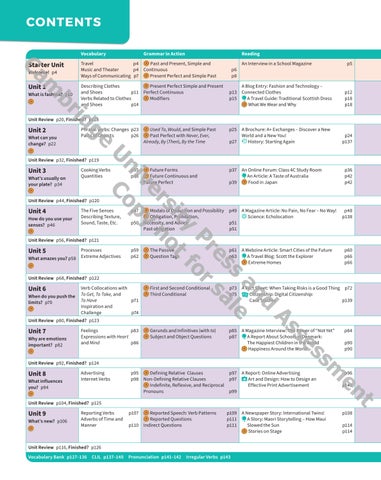
CONTENTS Vocabulary
Grammar in Action
Reading
Past and Present, Simple and Travel p4 Music and Theater p4 Continuous Present Perfect and Simple Past Ways of Communicating p7
p6 p8
Unit 1
Describing Clothes and Shoes p11 Verbs Related to Clothes and Shoes p14
Present Perfect Simple and Present Perfect Continuous Modifiers
A Blog Entry: Fashion and Technology – p13 Connected Clothes p15 A Travel Guide: Traditional Scottish Dress What We Wear and Why
p12 p18 p18
Used To, Would, and Simple Past Past Perfect with Never, Ever, Already, By (Then), By the Time
p25 A Brochure: A+ Exchanges – Discover a New World and a New You! p27 History: Starting Again
p24 p137
Ca
Starter Unit Welcome! p4
m
What is fashion? p10
An Interview in a School Magazine
p5
id
br
Unit Review p20, Finished? p118 What can you change? p22
Phrasal Verbs: Changes p23 Parts of Objects p26
ge
Unit 2
U
Unit Review p32, Finished? p119 What’s usually on your plate? p34
Cooking Verbs Quantities
Unit Review p44, Finished? p120
Unit 4
How do you use your senses? p46
As d an s le es sa Pr r y fo it t rs no ve y ni p Co
Unit 3
The Five Senses Describing Texture, Sound, Taste, Etc.
Unit Review p56, Finished? p121
Unit 5
Processes What amazes you? p58 Extreme Adjectives
Unit Review p68, Finished? p122
Unit 6
When do you push the limits? p70
p39
An Online Forum: Class 4C Study Room An Article: A Taste of Australia Food in Japan
p36 p42 p42
p47
Modals of Deduction and Possibility Obligation, Prohibition, Necessity, and Advice Past obligation
p49 A Magazine Article: No Pain, No Fear – No Way! Science: Echolocation p51 p51
p48 p138
The Passive Question Tags
p61 A Webzine Article: Smart Cities of the Future p63 A Travel Blog: Scott the Explorer Extreme Homes
p60 p66 p66
First and Second Conditional Third Conditional
p73 p75
Gerunds and Infinitives (with to) Subject and Object Questions
p85 A Magazine Interview: The Power of “Not Yet” p87 A Report About Schools in Denmark: The Happiest Children in the World Happiness Around the World
p50
p59 p62
Feelings p83 Expressions with Heart and Mind p86
p37
p95 p98
Defining Relative Clauses p97 A Report: Online Advertising Non-Defining Relative Clauses p97 Art and Design: How to Design an Indefinite, Reflexive, and Reciprocal Effective Print Advertisement Pronouns p99
p107
Reported Speech: Verb Patterns Reported Questions Indirect Questions
What’s new? p106
Reporting Verbs Adverbs of Time and Manner
p96
p140
t
Unit Review p104, Finished? p125
Unit 9
p90 p90
en
What influences you? p94
Advertising Internet Verbs
p84
sm
Unit Review p92, Finished? p124
Unit 8
A Fact Sheet: When Taking Risks is a Good Thing p72 Citizenship: Digital Citizenship: Case Studies p139
s se
Why are emotions important? p82
Future Forms Future Continuous and Future Perfect
Verb Collocations with To Get, To Take, and To Have p71 Inspiration and Challenge p74
Unit Review p80, Finished? p123
Unit 7
p35 p38
p110
p109 A Newspaper Story: International Twins! p111 A Story: Maori Storytelling – How Maui p111 Slowed the Sun Stories on Stage
Unit Review p116, Finished? p126 Vocabulary Bank p127–136 CLIL p137–140 Pronunciation p141–142 Irregular Verbs p143
p108 p114 p114
Listening
Ca
A Talk
p7
p14 Giving your Opinion Politely Everyday English The Letters ea
An Interview
p38 Giving Instructions Everyday English The Letters ch
p40 p40 p141
p50 Making Guesses and Giving Clues Everyday English Weak Form of To
p52 p52 p141
A Virtual Reality Tour p62
A Podcast
p28 p28 p141
Writing An Informal Email
p9
A Blog Comment
p17
An Opinion Essay
p29
Learn to Learn
Culture Project: A Fact File Teacher’s Resource Bank
History Project: A History Exhibition p30 How to Schedule p31
Personalizing Vocabulary Describing Words You Don’t Know with Other Words or a Gesture
p4
Categorizing Recording New Verbs British English vs. American English Learn to … Write Different Kinds of Example Sentences
p11 p14 p19
Using Words in Different Situations Identifying Key Words Learn to … Help Your Partner Improve Their Writing
p23 p26 p33
p54 p54
Brainstorming Using Visual Clues When Listening Learn to … Plan Your Homework
p47 p50 p57
Expressing Surprise and A Competition Culture Project: A Travel Blog Disbelief p64 Entry p65 Teacher’s Resource Bank Everyday English p64 The Letters mb and bt p142
Learning Verbs with Prepositions Listening for Specific Information Skimming for Gist Learn to … Use a Presentation Plan
p59 p62 p66 p69
Using Collocations in Sentences Listening and Choosing the Correct Option Learn to … Take Responsibility for Your Learning
p71 p74
Teacher’s Resource Bank
An Encyclopedia Science Project: Entry p53 An Infographic How to Research
A For and Against Essay
Culture Project: A Presentation
Teacher’s Resource Bank
An Online Product Review
Art and Design Project: A TV Ad Storyboard p102 p101 How to Give Feedback p102
A News Story
p113
Remembering Adjectives p83 Fill-in-the-Blank Flashcards p86 Synonyms and Antonyms p91 Learn to … Give Your Partner Useful Feedback p93
Wordbuilding: Nouns and Verbs Open-Ended Questions Learn to … Work Out the Meaning of New Words
p95 p98
p105
t
p112 p112 p142
p89
p81
en
A News Report p110 Telling an Anecdote Everyday English The Letters cia
Citizenship Project: A Pamphlet p78 p77 How to Motivate Yourself and Your Peers p78
m ss
p100 p100 p142
Culture Project: A Poster
p21
p35 p38 p43 p45
p98 Recommending an Online Tool Everyday English The Letters -tion
p41
p7
Wordbuilding: Adjectives from Verbs Using Diagrams Understanding Words from Context Learn to … Set Learning Goals Sentences
p74 Encouraging a Friend to Do Something p76 Everyday English p76 Stress in Multi-Syllable Words p142
A Listicle
A Conversation p86 Expressing Sympathy and An Email Concern p88 Reply Everyday English p88 Initial Consonant Clusters with s p142 An Interview
Project
se As d an s le es sa Pr r y fo it t rs no ve y ni p U Co
A Recipe
p26 Explaining How to Use Something Everyday English Used To
ge
A Game Show
p16 p16 p141
id
br
m
An Interview
Speaking and Pronunciation
Culture Project: A Story Teacher’s Resource Bank
Telling Stories to Remember New Words Collaborative Listening Irregular Adjective and Noun Pairs Learn to … Ask for Help When You Don’t Understand
p107 p110 p115 p117
STARTER
Use It!
Ca
WELCOME!
3 Write true sentences about your vacations with the words in Exercise 1.
m
VOCABULARY
br
Travel
id
1 Match the words in the box with the photos. Then listen, check, and repeat.
ge
S.01
Music and Theater
1
sightseeing tourist attractions trip
2
1
4 Match the nouns in the box with the definitions. Then listen, check, and repeat.
audience lines part rehearsal scene show
se As d an s le es sa Pr r y fo it t rs no ve y ni p U Co
accommodation backpacking resort
S.03
3
1 when people practice a play
2 live performance in a theater 3 the words actors say 4 a character in a play
5 the people who watch 6 a part of a play
4
5
6
Use It!
5 Complete the questions with words from Exercise 4. Discuss the questions.
S.02
2 Complete the comments with the words from Exercise 1. Then, listen and check.
Where did you go on vacation this summer?
To a 3 in Greece. The
London. It’s a great city for 1 because there 2 , are so many like Big Ben.
Personalizing Vocabular y Writing sentences helps you remember words.
4 S TA RTER U NIT
Explore It!
Guess the correct answer.
What movies do these lines come from? a “To infinity and beyond!” b “Just keep swimming.”
Write other famous lines from movies in English. Can your partner guess the movie?
t
LEARN TO LEARN
3 If you were in a movie, would you want to appear all the way through the movie or be in ? one big, important
en
in Mexico this summer – just me, my bag, and a paper map. It was the best 6 of my life. 5
2 How is the at the theater and movies different from at a concert?
m ss
was amazing – a beautiful hotel right next to the beach.
4
I went
1 Have you ever been in a at did you play ? How school? What ? Did you have did you learn your before the show? any
READING
Ca
An Interview in a School Magazine
1 Look at the photo. What do you think the boy is doing? Read the interview and check your answer.
br
m
S.04
ge
id
Now that we’re back in school, everybody’s talking about what they did during the summer. Some of you probably went to a resort or went sightseeing with your family, and most of you probably spent time at the pool with friends. But not Joshua Wills. His summer was very different. Let’s find out why.
se As d an s le es sa Pr r y fo it t rs no ve y ni p U Co
Joshua, you didn’t have a normal summer vacation this year, did you? What did you do? No, I didn’t. I went to a theater camp for teenagers. Our teachers were real actors from the theater and TV. They taught us all about acting – you know, how to develop a character, how to project your voice and use your body. It was a lot of fun. Did you put on a show? We put on a musical about a detective. I played the part of the detective’s assistant. We had one rehearsal every day for a week and then three performances. A lot of my friends and family came. How did it go? It was great, but on the first night, in the final scene, I forgot my lines. Everything was going really well and
then suddenly I couldn’t remember anything! Everyone in the audience was looking at me, thinking, “What’s wrong? He’s not speaking. He’s not even moving!” Were you panicking? I wasn’t panicking. I was just frozen! But in the end, I remembered the lines and it was all OK. Do you want to do more theater? Definitely! I don’t want to stop. In fact, I’m writing a play. It’s more difficult than I expected, but I’m really enjoying it. I want to put it on at school. Are you looking for any actors? Of course! Why? Do you want to join us? Maybe! It sounds like fun!
2 Read the interview again and answer the questions. 3 Find words in the interview that mean … 1 speak loudly and clearly (phrase).
2 What did the theater camp participants learn?
2 somebody who helps someone do their job (n).
3 How often did the group practice their play?
3 unable to move (adj).
6 Why is Joshua looking for actors now?
4 Discuss the questions.
1 Joshua’s teachers were real actors. What is good about this?
t
5 How did the audience react to the problem?
Voice It!
en
4 What problem did Joshua have?
4 100 percent yes! (adv).
m ss
1 Why was Joshua’s summer vacation unusual?
2 Have you ever acted or spoken in front of a big group of people? How was it? S TA RTER U NIT 5
GRAMMAR IN ACTION
Watch video S.1 What did he do ever y day? What ’s he doing now?
Ca
Past and Present, Simple and Continuous Simple Present
m
It sounds like fun.
–
I 1 don’t want to stop.
?
you want to join us?
writing a play.
We had one rehearsal every day.
He isn’t speaking.
have a normal You 5 summer vacation this year.
you looking for any actors?
What 6
4
ge
id
2
Simple Past
I3
br
+
Present Continuous
correct form of to be or to do. Use the interview on page 5 to help you.
2 Complete the sentences with the correct form of the verbs in parentheses. Then listen and check. 1 Mike
goes
Everyone in the audience looking at me.
7
panicking.
I8
Were you panicking?
se As d an s le es sa Pr r y fo it t rs no ve y ni p U Co
1 Complete the examples in the chart above with the
S.05
you do?
Past Continuous
(go) sightseeing every year.
2 Amalia (not learn) her lines until the night before the first show. 3 A Where’s Harry? B He
(read) in his room.
4 You didn’t like the play, did you, Eddie? You (sleep) during it!
Use It!
4 Write the questions.
1 what / you / do / at nine o’clock last night
What were you doing at nine o’clock last night? 2 what time / you / get up / today 3 during the summer / you / prefer to go sightseeing or go to the beach
5 I’m so happy we (not stay) in that resort last week when the terrible storm came.
4 what time / you / usually / get up / when you’re on vacation
6 Ana’s not at the rehearsal because she (not feel) well right now.
5 speak English to anyone / last week
3 Complete Esme’s blog with the correct form of the verbs in the box.
begin do get up go have not finish not forget practice start think
What were you doing at nine o’clock last night?
I was watching some videos online.
en t
6 S TA RTE R U N IT
5 Ask and answer the questions.
m ss
Hi, everyone. Yesterday we 1 had our last rehearsal for the practicing until 11 p.m., and when musical. I 2 3 to bed, some of the others 4 still I . The first show 5 at 7:30 tonight. this morning, but I didn’t feel nervous when I 6 7 to feel nervous now – I hope I 8 I my lines. But I’m also really excited. I 9 it’s going 10 you to be a great night. Anyway, anything this weekend? Why don’t you come and see me?
6 what / you / wear / at the moment
VOCABULARY AND LISTENING
LEARN TO LEARN
Ca
Ways of Communicating
1 Match the verbs in the box with
m
S.06
4 Express or explain the words in the box with other words
br
emoticons 1–9. Then listen, check, and repeat.
Describing Words You Don’t Know with Other Words or a Gesture When you don’t know a word, use words you do know to describe it or use gestures to express what you mean.
accommodation cry dance frozen movie sing stand up tourist attraction
ge
2
It’s a place where you can stay.
3
Accommodation?
se As d an s le es sa Pr r y fo it t rs no ve y ni p U Co
1
shake hands 1 translate shout wave smile whisper
id
describe greet post
or gestures.
Use It!
5 Use gestures or tell your partner I do this when … .
4
5
Can they guess the verb?
6
A Talk S.08
7
8
9
6 Listen to Mateo and mark (✓) the tips that helped him learn English.
a Describe a word with other words. b Take a language course.
c Don’t worry about making mistakes.
It looks like …
S.07
d Listen to music.
2 Listen to the conversations and circle
e Talk as much as possible.
the correct words from Exercise 1.
f Translate words and make them sound English.
1 whisper / shake hands
g Watch TV.
2 translate / smile 3 post / shout 4 greet / translate 5 wave / describe
S.08
with actions or words? Complete the chart.
describe
2 He didn’t understand the family at first because they so fast.
3 When he doesn’t know a word, he describes it or it and makes a word in English similar to the Spanish word. 4 A lot of things were different for him, but he liked the best. Voice It!
t
shake hands
Words
in college.
en
Actions
1 Mateo is studying
m ss
3 Do we express the verbs in Exercise 1
7 Listen again and complete each sentence with one word.
8 Discuss the questions.
1 Which of Mateo’s tips do you use? 2 Which tips would you like to try? S TA RTER U NIT 7
Watch video S.2 Where did she go last summer? Which language has she never studied?
GRAMMAR IN ACTION
Present Perfect and Simple Past
Ca
Present Perfect
Simple Past
I’ve been in college now for three months.
I started my course in October.
–
I haven’t stopped 1 since I was there! been to New York. I’ve 2
I met a lot of people in the first few weeks.
?
Have you 3
been to New York?
Did you go to New York last year?
ge
id
br
m
+
1 Complete the examples in the S.09 3 Circle the correct words. Then listen and check. Get It Right!
We don’t use the simple present with since. We’ve been here since Tuesday. NOT We are here since Tuesday.
2 Look at sentences a–d. Circle the correct options to complete the rules.
a Last year, I spent six months in New York. b I didn’t understand the kids because they spoke fast. c I’ve met so many interesting people!
d I’ve stayed in contact with people I met in New York.
Have you ever been / Did you ever go to a music festival? JESSIE Yeah, 2I’ve been / went to one this summer. It was great. BEN Where 3has it been / was it? JESSIE Near the town where we 4have been / went on vacation. 5 We’ve stayed / stayed in the town a lot of times, but this was our first time at the festival. BEN What 6have you liked / did you like best? JESSIE The Night Owls 7have had / had some amazing dancers and 8have sounded / sounded incredible. 9 I’ve never heard / didn’t hear of them. BEN JESSIE Oh, they’re great! 10I’ve liked / liked them for ages. 1
I 1 have never been (be) to Mexico, but last summer I 2 (get) a job in a Mexican restaurant. I 3 (meet) tons of people since I 4 (start) working there and (make) friends. At first they 6 (speak) to I5 7 (not understand). Since then I me in Spanish, but I 8 (go) to Spanish classes and I 9 (learn) a lot. 10 (teach) us how to describe things when Our teacher we don’t know the exact word.
Use It!
5 Discuss the questions.
2 How long have you known your best friend? 3 Have you ever been to a festival?
I’ve been to three cities. I went to the capital last month, but there are some cities I’ve never been to.
t
1 How many cities in your country have you visited?
en
2 Use the present perfect / simple past for things that happened in the past in an unfinished time period or when the exact time of the action is not important.
4 Complete the text with the simple past or present perfect.
m ss
1 Use the present perfect / simple past for things that happened in a finished time period, e.g., last year.
8 S TA RTER U NIT
BEN
se As d an s le es sa Pr r y fo it t rs no ve y ni p U Co
chart above with ever, since, or never.
WRITING
4 Complete the Useful Language box with phrases
An Informal Email
from the email.
Useful Language
email and put the photos in the correct order.
Starting and ending an informal email
m
Ca
1 Look at the photos. What can you see? Read Azra’s
Start + name: Hello Gaby, / 1
a
b
c
br id
The reason you are writing: I’m writing to /
ge
What did she enjoy about her visit?
From:
azra.kara@myemail.com
2
To:
gaby.bates@myemail.com
3
Subject:
Thank you
4
Hi Gaby,
5 Imagine you are writing an email to a penpal
I loved meeting your friends and visiting the city. There’s so much to see! I learned so much about the U.S.A. that I didn’t know before. I’ve listened to the playlist you made me a lot of times since I got back home, and I know all the words to the songs! I’ve told my friends all about my trip and they’re really looking forward to meeting you next month. I can’t wait to take you sightseeing in Istanbul to show you all the tourist attractions and introduce you to my friends and family. We’ve bought tickets to go and watch a Turkish dance show while you’re here – I hope you like it! Write back soon. Love, Azra
What did you do?
What did you like about your visit?
What are you going to do when they visit you?
WRITE
e last sentence
g beginning and name h topic of the email
CHECK
7 Do you …
• start and end the email correctly?
t
1
f reason you are writing
language and vocabulary from this unit, phrases from the Useful Language box, the parts of the email in Exercise 3, and the ideas in Exercise 5.
en
d first sentence
Where did you go?
m ss
a address of the recipient
c ending and your name
in an English-speaking country. You have visited their country. They are going to be visiting yours soon. Take notes.
6 Write your email. Remember to include
3 Match a–h with the parts of the email 1–8. b address of the sender
End + name: Take care, Azra / 5
PL AN
How are things? 6I just wanted to say thank you for a great visit to Seattle. I had an amazing time and your family is so kind!
8
Last sentence: See you soon. / Bye for now. / 4 .
se As d an s le es sa Pr r y fo it t rs no ve y ni p U Co
1
7
First sentence: How are you? / Thanks for your email. / 2 ? 3
2 Read the email again. Why did Azra write the email?
5
,
• give the reason why you are writing? • say what you are going to do when your penpal visits? S TA RTER U NIT 9
LEARNING OUTCOMES
1 What is fashion?
I can … • • • •
ge
id
br
m
Ca
understand texts about technology and fashion give my opinion politely comment on a blog entry understand how to use the present perfect simple and continuous and modifiers • talk about and describe clothes and shoes • categorize adjectives, record new verbs, compare British English and American English, and write different kinds of example sentences
se As d an s le es sa Pr r y fo it t rs no ve y ni p U Co
Start It!
1 Look at the photo. Do you like the clothes that the people are wearing? Why / Why not? not
m ss
2 Before you watch, what does fashion mean to you?
3 Name three ways fashion changed in the 1960s. Watch and check. 4 What is your favorite fashion style?
en t
p13
Watch video 1.1
Grammar in Action 1.2
10 WH AT I S FA S HI O N? | U N IT 1
p15
Grammar in Action 1.3
p16
Everyday English 1.4
p18
Globetrotters 1.5
VOCABULARY
LEARN TO LEARN
Describing Clothes and Shoes
Ca
Categorizing When we use a lot of adjectives to describe one thing, we use this order: shape, color, pattern, material.
3 Complete the chart with the adjectives from
br
m
3
Exercise 1.
5
Shape baggy
Pattern
Material
ge
id
2
4
1
se As d an s le es sa Pr r y fo it t rs no ve y ni p U Co
4 Write three sentences describing the clothes in Exercise 1. Use at least two adjectives in each sentence. 1 She’s wearing a blue cotton T-shirt.
9
6
2
7
3
10
4
5 Read your sentences in Exercise 4. Can your
partner guess which person you are describing?
8
Use It!
6 Discuss the questions.
11
1 Which clothes in Exercise 1 do you have?
1.01
1 Match the adjectives in bold with the numbers in the photos. Then listen, check, and repeat.
Guess the correct answer.
1
school party. Listen to the conversation. Which things in Exercise 1 do they buy?
Some celebrities wear special “anti-paparazzi” scarves. What do you think these scarves do? a make their faces more beautiful b make the photos turn black c make the celebrities look ugly Find out about a clothing designer. Write a question for your partner to answer.
t
2 Alex and Isabel are shopping for clothes for a
Explore It!
en
1.02
long-sleeved dress plain cotton T-shirt polka-dot shoes striped T-shirt tight jeans
3 Which shapes, patterns, and materials do you usually wear? Which do you never wear?
m ss
baggy jeans checkered skirt denim skirt flowery dress high-heeled boots leather shoes
2 Can you describe the clothes you are wearing?
U NIT 1 | WH AT I S FA S HI O N? 11
Fashion
& Technology
CONNECTED CLOTHES
1
m
Ca
Anyone who has been reading my blog for a while knows that I’m a huge fan of technology in fashion. Here are my latest discoveries.
3
ge
id
br
We’ve all seen watches that measure how much we move or sleep, but what about a T-shirt? Over the last few years, scientists have been developing clothes that can record information about our heart rate or breathing and that can help us stay healthy. Most people have a denim jacket. But have you ever seen a denim jacket that can play music or send instant messages? Well, scientists have designed one that can. You just have to touch the sleeve and your music starts playing!
se As d an s le es sa Pr r y fo it t rs no ve y ni p U Co
2
Scientists have also created clothes with sensors that take our body temperature and circulate warm or cool air through the material so that we never feel too hot or too cold. Special clothes for astronauts or emergency service workers have been using this technology for years, but now companies have created similar materials for everyday clothing and shoes. Great! No more hot, sweaty feet!
READING
A Blog Entry
Now there are even smart clothes that produce energy while we’re wearing them! Scientists in South Korea have created a material that turns movement into electricity. So you can charge your phone while you’re doing exercise or just walking around! That’s smart!
4
Finally, if you haven’t been following my updates on 3-D printing, check out these trendy designs. My favorite is the highheeled shoes. I love the fact that each design is individual and that one day we’ll be able to design and print our own patterned or plain clothes and shoes at home.
4 Find words in the blog that mean …
1 Look at the pictures. How do they combine technology and fashion?
1.03
2 Read the blog entry. Match headings a–d with paragraphs 1–4.
a 3-D Printed Clothes
b Clothes That Change Temperature
c Connected Clothing d Energy-Producing Clothes
1 How can we watch our health with connected clothing?
4 What does the blogger predict about 3-D printed clothes?
12 WHAT I S FA SHI O N? | U NIT 1
4 the latest information (4).
5 to produce something with a printer (4). Voice It!
5 Discuss the questions.
1 Would you like to have any of the smart clothes in the blog? 2 What other things would you like clothes to do in the future? 3 Do you think smart clothes are important? Why / Why not?
t
3 What’s good about creating electricity with clothes?
3 to put electricity into a device like a phone (3).
en
2 How does the denim jacket in the text play music?
2 to move around something (2).
m ss
3 Read the blog entry again and answer the questions.
1 the part of clothing that covers your arm (1).
Finished? p118 Ex. 1
Watch video 1.2 How long has Tara been knitting? How many people have bought Patrick ’s shoes?
GRAMMAR IN ACTION
Ca
Present Perfect Simple and Present Perfect Continuous Present Perfect Simple
Present Perfect Continuous
also created clothes with
Over the last few years, scientists 3 been developing clothes that can record information.
Scientists 1 have sensors.
–
He hasn’t bought any 3-D printed clothing yet.
been following my updates on 3-D If you 4 printing, check out these trendy designs.
you ever seen a denim jacket that can play music?
How long have you been reading my blog?
id
2
ge
?
br
m
+
5 Complete the sentences with the present
se As d an s le es sa Pr r y fo it t rs no ve y ni p U Co
1 Complete the examples in the chart above with the correct form of to have.
2 Complete the rules with simple or continuous.
1 In present perfect sentences, the focus is on the result of an activity.
2 In present perfect sentences, the focus is on how long the activity is.
3 Put the words in the correct order to make sentences. 1 a lot of / I’ve / blog entries / written / .
I’ve written a lot of blog entries. 2 since / a fashion blog / writing / She’s been / January / .
1.05
perfect simple or continuous form of the verbs in parentheses. Then listen, check, and repeat. 1 How long has he been designing clothes? (design) 2 you ever to knit? (learn) 3 She never high-heeled shoes. (wear) 4 I in these shoes all morning and my feet really hurt! (walk) Use It!
3 made / Have you / your own clothes / ever / ?
4 been / He’s / two years / designing / for / clothes / .
6 Imagine you are a fashion designer. Make
questions with the present perfect simple or continuous. Then think of your answers. 1 What / designed?
1.04
4 Complete the text with the present perfect continuous form of the verbs in the box. Then listen and check. make
not practice
try
watch
work
7 Ask and answer the questions. Which
en
designer makes the most interesting clothes? Why?
I’ve designed a coat that changes color when it gets wet!
t
Recently I 1 ’ve been trying to learn how to knit. It’s really difficult! a lot of videos I2 3 very online, but I a scarf much. I 4 for a few days now, but it’s full of holes and looks me, too, but awful. My mom 5 6 all week and doesn’t she really have much free time.
3 How long / designing clothes?
m ss
help
2 Who / worn your designs?
Finished? p118 Ex. 2
U NIT 1 | WHAT I S FA SHI O N? 13
VOCABULARY AND LISTENING Verbs Related to Clothes and Shoes
LEARN TO LEARN
1 Read the fashion forum and match the verbs in
Ca 1.06
m
bold with the definitions. Then listen, check, and repeat.
2 Complete the sentences with the correct
id
br
ARE YOU A FOLLOWER OF FASHION?
Recording New Verbs Make sentences with new verbs so that you can remember how to use them. form of the verbs in the box and the words in parentheses.
ge
I don’t buy many clothes because they go out of style so quickly. I usually buy things that go with other clothes MARIA I already have. I like wearing green clothes because they match my eyes!
hang up
se As d an s le es sa Pr r y fo it t rs no ve y ni p U Co
I’m really tall, so it’s difficult to find clothes that fit me, especially jeans! I wear jeans so much they wear out! GISELA A lot of clothes don’t look good on me because they haven’t been designed for tall people.
1 You never wear out your shoes . They always look new. (your shoes)
2 That color your eyes. (you)
I love fashion and I work in a clothing store on Saturdays. It’s great because I get to try on tons of clothes. The worst part is the dressing rooms. People leave clothes on the floor and I have to hang up the jackets and pants and fold all the T-shirts. It takes forever!
EDU
IRINA
4
3
2 not popular any longer
4 make someone look nice 5 look good together
6 be similar or the same color/type
9 put clothes on a hanger
The word clothes is always plural. Your new clothes look great!
An Interview 1.07
4 Listen to an interview with Carla. Where does
1.07
5 Listen again and complete the text.
she get her clothes from?
Carla started looking at fashion designs online when she was 1 12 . She enjoys upcycling – from something that creating 2 T-shirts exists. She also decorates 3 and tops with her own designs. She knows that people buy fast fashion because the clothes are 4 and that ethical fashion is 5 than fast fashion, but ethical fashion . thinks about the people who 6
Pronunciation p141
14 WHAT I S FA SHI O N? | U NIT 1
Student B: What kinds of clothes don’t you like to wear? Which clothes look good on you?
t
Get It Right!
Discuss the questions.
en
10 bend clothes so that one part lies on another part
EXAM
m ss
8 open zippers
. They’re
. It’s cold. (your jacket)
Student A: What kinds of clothes do you like to wear? Which clothes fit you well?
1 be the right size fit
3 wear something so much it looks old
. It matches
3 This top different styles. (my skirt)
Today I had a complete fashion disaster. I was trying on a dress in a store. I managed to zip it up! But when I tried to take the dress off, I couldn’t unzip it. How embarrassing!
7 close zippers
look good on not go with wear out zip up
Watch video 1. 3 What are the top three fashion mistakes? What ’s the problem if your bedroom is totally messy?
GRAMMAR IN ACTION Modifiers
Ca
m
I’ve been 1 totally obsessed with fashion since I was a child. good.
They look 2
br
These clothes are 3
b fairly / more expensive …
longer.
id
but they last 4
ge
1 Complete the examples in the chart
2 Which words (a–d) do we use before … 1 comparative adjectives to show a big difference?
2 comparative adjectives to show a small difference? 3 adjectives to intensify them?
4 adjectives to mean more than a little but less than very?
3 Circle the correct words. Then listen and check.
c
/ a little
d
/ far
4 Complete the sentences with the words in parentheses.
1 I feel pretty tired today. I need to sleep well, or I’ll be extremely tired tomorrow. (extremely / pretty)
se As d an s le es sa Pr r y fo it t rs no ve y ni p U Co
above with a bit, a lot, pretty, and totally. Use the same words in each row.
1.10
a extremely / absolutely / totally / really
3 He creates
good, but better. (fairly / far)
amazing designs, which are more fun than ours. (a lot / totally)
4 I’m good at art, but there are people in my more talented than me. class who are (far / fairly) 5 This coat is beautiful and it’s only more expensive than the other one. (absolutely / a bit) Use It!
5 Complete the sentences so they are true for you. 1 I am pretty good at
.
2 I feel really sad when
.
3 A subject I find a lot easier than before is 4 I’m a bit more interested in
.
than before.
5 I think it’s absolutely amazing that
m ss
.
6 Guess what your partner wrote in their sentences. Score one point for each correct guess.
Did you say, “I am pretty good at English?”
t
No, I didn’t. I said, “I’m pretty good at art.”
en
Making materials like cotton or denim can be 1 extremely / a lot damaging to the environment. That’s why it’s 2 absolutely / far essential to create new materials from natural products that are 3fairly / a lot better for the planet. Some materials, like bamboo, have been 4 fairly / a little successful. Others are still being developed, like a material from the rice plant, which is 5 really / a bit similar to cotton, and one made from chicken feathers, which is 6 pretty / a bit warm, like wool. Technology has also made it 7 really / far easier to recycle materials like plastic bottles into clothes such as leggings and T-shirts, which is 8 really / a lot good news for the environment!
2 The shopping mall in our town is the one outside town is
Finished? p118 Ex. 3
U NIT 1 | WHAT I S FA SHI O N? 15
SPEAKING
Giving Your Opinion Politely
1 Listen to the conversation.
Ca 1.11
Does Diego like the things?
m
phrases in the Everyday English box.
1 someone who follows fashion 2 fashionable 3 different 4 look at
ge
id
br
DIEGO Hey, Dana. How’s it DIEGO DANA going? DANA Hi, Diego. I’ve been shopping all morning. I’ve bought some great stuff. Do you want to see? DIEGO Yeah, sure. DANA I got this striped jacket from Zaps, that new store they’ve just opened. DIEGO Oh, right. Wow! 1 That’s … uh … different! DANA I know! It’s totally out there! yellow and blue DIEGO Hmm, 2 together, but the blue matches the color of your eyes. DANA Thanks! And check out these pants. DIEGO Flowery pants! Wow! Very retro! DANA I know! They fit really well. What do you think? , but I can see why DIEGO Well, 3 you like them. DANA Do you think they look good on me? DIEGO Yes, I guess so. DANA I think I might wear them to go out later, with the jacket. DIEGO Hmm, 4 I’d wear them together. 5 the pants would go better with a plain top. DANA No, patterns are totally in this year. DIEGO You’re such a fashion victim, Dana!
3 Match the meanings (1–4) with the words and
Watch video 1.4 Ever yday English
se As d an s le es sa Pr r y fo it t rs no ve y ni p U Co 4 In your notebook, write about the clothes on the right.
What clothes are they? Who bought them and why?
What do they look like?
Why do you like or not like them?
SPEAK
5 Practice the conversation with your partner.
Remember to use the present perfect simple and continuous, modifiers, vocabulary from this unit, and phrases from the Useful Language and Everyday English boxes.
CHECK
6 Work with another pair. Listen to their conversation and complete the notes. Who bought them and why?
en
2
PL AN
m ss
1.11
Complete the conversation with the phrases from the Useful Language box. Then listen again and check.
check out fashion victim in out there
I don’t know if …
I’m not a huge fan of …
I think maybe …
That’s … uh … different!
they’re not exactly my style 16 WHAT I S FA SHI O N? | U NIT 1
Does the other pair like them? Why / Why not?
t
What do they look like?
Useful Language
Four Steps
Comments
Ca
to Reduce Your Fashion Footprint
m
Here are some ideas you can try!
id
br
Have a clothing swap party. Swap clothes you don’t want with your friends. Save energy. Wash clothes less often, dry clothes naturally, don’t iron!
ge
Give old clothes to secondhand stores. Don’t throw them away!
A Blog Comment
1 Look at the blog entry. How can people reduce their fashion footprint?
Thanks for sharing! I had no idea that I throw so many clothes away! I had a clothing swap party last week. I got a great denim jacket that I absolutely love! I also got two long-sleeved tops and some cool high-heeled boots for free! I was absolutely amazed that we swapped everything! Since reading your post, I’ve decided to buy far fewer new clothes in the future. Amie
se As d an s le es sa Pr r y fo it t rs no ve y ni p U Co
Buy fewer, better quality new clothes.
WRITING
Great post! It got me thinking about how to reduce my fashion footprint. I talked to my parents and we decided to try reduce the amount of energy we use on our clothes. Usually we wash all our clothes every time we wear them, even when they’re still pretty clean; but this month we’ve been washing clothes less often, and we haven’t ironed anything. My parents have saved money and I’ve been much better at hanging up my clothes! Carlos
2 Read the blog comments. Answer the questions. 1 Were the ideas that Carlos and Amie tried successful? How do you know?
2 What does Amie want to do in the future?
3 Find the phrases from the Useful Language box in the blog comments. Which phrases can you use when you …
1 enjoy reading a post?
3 change your behavior because of the post?
4 Write your own blog comment. Look at
the ideas in the blog entry and take notes about which one to write about. Which idea will you try out?
Do you think it will go well? Why / Why not?
What other ideas would you like to try in the future?
WRITE
5 Write your blog comment. Remember to include the present perfect simple and continuous, modifiers, vocabulary from this unit, and phrases from the Useful Language box.
6 Do you … Great post!
I had no idea that ...
It got me thinking about ... Since reading your post, I’ve ... Thanks for sharing!
We decided to ...
• explain why an idea might or might not work well?
t
Useful Language
en
CHECK
m ss
2 learn something new from the post?
PL AN
• explain what you would like to try in the future? Finished? p118 Ex. 4
U NIT 1 | WHAT I S FA SHI O N? 17
AROUND THE WORLD Globetrotters
READING
Ca
Watch video 1.5 What We Wear and Why
m
A Travel Guide
1 Are the sentences T (true) or F (false)? Read the
br
1.12
travel guide and check your answers.
id
1 Kilts have not always been made of tartan.
ge
2 Tartans today indicate where people live. 3 Scottish dress is different for men and women. 4 Tartan patterns are popular outside Scotland.
• What is a deel and why do Mongolian people wear it? • What do the colors blue, white, green, yellow, and orange represent for the Masai people?
se As d an s le es sa Pr r y fo it t rs no ve y ni p U Co
Voice It!
• Why do we wear clothes and what do they show about us?
2 Discuss the questions.
1 Why do you think Scottish people wear traditional clothing for special occasions? 2 What traditional clothing do people wear in your country? 3 Why is it important to celebrate cultural traditions?
Traditional Scottish Dress
Y
t
18 WH AT I S FA S HI O N? | U N IT 1
WOMEN: • long or knee-length tartan kilt • tartan shawl (a piece of material worn over your shoulders) • plain or tartan socks • ghillies
en
Highland dress is extremely popular in Scotland for special occasions such as weddings, funerals, or parties, particularly for men. Women often wear kilts to do traditional Scottish dancing at sports and cultural events. Nowadays, tartan isn’t just used for traditional dress in Scotland. Fashion designers around the world use tartan to create modern designs such as tartan trousers or tartan shoes, and celebrities from Rihanna to Shawn Mendes have been photographed wearing tartan. Even though people have worn tartan for centuries, it is still popular today.
MEN: • tartan kilt and a kilt pin • leather belt • sporran (a small leather or fur bag that hangs from the belt.) • plain or tartan socks • kilt knife (a small knife kept in one sock) • ghillies (plain, flat leather shoes)
m ss
ou have probably seen photos of Scotland’s most famous piece of clothing, the kilt. But did you know that Scottish men have been wearing kilts for centuries? A kilt used to be an extremely long piece of heavy plain material that men from the Scottish Highlands wore every day. They wrapped the material around their waist and over one shoulder to protect them from the cold wind or rain. Nowadays, the design of the kilt is totally different. It is a knee-length woolen skirt, with a pattern of vertical and horizontal stripes in different colours called tartan. Tartan designs used to indicate the area where people lived and were far less colourful than they are today. Since the 18th century, people have been wearing designs that represent their family name or clan (group of families), and today there are over 4,500 designs! The kilt forms part of the traditional Highland dress, which is quite different for men and women (see box).
3 Use the travel guide to complete the chart. Kilts in the 18th Century
Highland Dress for Men
Who wears traditional tartan clothes?
Highland Dress for Women
Who wears modern tartan clothes?
br
m
Ca
One long piece of cloth worn around waist and over shoulder
ge
id
Kilts in the 21st Century
se As d an s le es sa Pr r y fo it t rs no ve y ni p U Co
LEARN TO LEARN
British English vs. American English
4 Read the definitions and write the British English word from the text.
1 The American English word for a pattern of vertical and horizontal stripes is plaid.
2 A word for a set of clothes. In American English, we say attire.
3 This clothing item covers your legs. In American English, we say pants. 4 The American English adjective for this material is wool.
5 Write the American English spellings for these words. 1 colourful
2 favourite 3 organise 4 flavour 5 centre 6 neighbour
7 traveller
8 programme
structures are different in British English?
Guess the correct answer.
Find another fact about traditional dress. Write a question for your partner to answer.
A fact file presents key information about a topic. Make a fact file about traditional clothing from your culture.
FAC T FIL E
Traditional Garment kilt
sporran shirt long socks
ire for men
Highland att
Material
n Other Informatio
has colors. Each clan Tartan comes in many wool, with its own tartan. pretty short, or a checkered onal kilts were either the shoulder. over put to tartan pattern Traditi of fabric long with a piece . Used like a pocket y black or brown. leather, fur, or Usuall both baggy sleeves, but onally they had long white cotton Traditi don’t. nowadays they usually even tartan, or plaid. colors, or somet imes white or black Other wool
t
It was illegal to wear tartan in the middle of the 18th century in Scotland. True or false?
A Fact File
en
Explore It!
CULTURE PROJECT
m ss
6 Think and discuss with a partner. What other words or
knife shoes
metal black leather
hat
wool
sock. laces s Small, kept in one flat, and have long are usually plain, Called ghillies, they ankles over the socks. crossed around the kin o’ shanter and is a tam a called is h hat me The traditional Scottis tartan, or plaid. It was only worn by even “Tam beret. It’s black or wrote a poem called poet Robert Burns past. The Scottish
Scottish attire had to prison for six m and if they were a again, they could to the colonies fo years! Finally, on 1782, King Georg permission for th wear Highland at
History
Teacher’s Resource Bank
by Kilts were first worn end of Highland men at the These men the 16th centur y. a kilt were farmers, so maybe long than was more practical quickly pants, which would Highlanders get wet and dirty. built clans in zed were organi gh they with a chief. Althou around one family clan took es, everyone in the ald, were not all relativ for example, McDon chief, the of e the surnam its own and each clan had which Stuart, or Macleod, n, so you could tell tartan, or plaid, patter by looking at their kilt. from clan someone was
en wear kilts to Nowadays many Scotsm ations or when S or other formal celebr or rugby! They plays England in soccer s and waistcoats worn with nice jacket ( and Roger Federer Murray (Scott ish) with Federer w played a tennis match a tam o’ shan g kilt and Murray wearin y. charit for money
U NIT 1 | WHAT I S FA SHI O N? 19 at beaten by the English After the Scots were g a kilt en in 1746, wearin kind of the Battle of Cullod found wearing any became illegal. People
1 REVIEW
Ca
VOCABULARY
1 Circle the word that doesn’t fit. baggy cotton flowery cotton plain
tight long-sleeved leather striped long-sleeved
ge
id
br
m
1 2 3 4 5
4 Circle the correct modifier to complete the sentences.
polka-dot denim plain checkered high-heeled
2 Match 1–5 with a–e.
2 Where did you get that jacket? I far / absolutely love it! 3 The second movie in the series was a bit / pretty better than the first one, but not much. 4 I’m a lot / fairly good at speaking Chinese, but I can’t write it.
se As d an s le es sa Pr r y fo it t rs no ve y ni p U Co
1 Hang up your clothes.
1 It takes a little / extremely longer to fold your clothes, but then you don’t have to iron them.
2 I can’t unzip my jacket.
3 These jeans are worn out
4 This T-shirt doesn’t fit me anymore
5 Your glasses really look good on you. a because I’ve had them for ages. b because it’s too small. c The zipper’s broken. d You look great! e They’re all over the floor.
GRAMMAR IN ACTION
3 Complete the text with the present perfect simple or continuous form of the verbs in parentheses.
7 That T-shirt is far / really nicer than the other one, but it’s really / a lot expensive.
Self–Assessment
I can describe clothes and shoes.
I can talk about clothes and shoes.
I can use the present perfect simple and present perfect continuous. I can use modifiers.
en t
20 RE VIE W | U NIT 1
6 Have you seen this video? It’s really / a lot funny.
m ss
Sixteen-year-old Moziah Bridges 1 (design) ties since he was nine. His grandmother taught him to make bow ties and since then he 2 (own) his own business. The designer 3 (appear) in magazines and on TV and 4 (make) a collection of ties for basketball teams in the U.S.A. Mo is still in school but 5 (work) in the evenings. 6 (not be) easy, but his mom helps It (employ) more people as him and he 7 8 (grow). Mo often gives his business (think) talks to other people who 9 about starting a business.
5 I’m far / totally confused by his explanation. I don’t understand it at all.
LEARN TO LEARN
Ca
LEARN TO … WRITE DIFFERENT KINDS OF EXAMPLE SENTENCES
br
m
You can write different kinds of example sentences to help you understand and remember new words.
1 Read Ela’s blog. Why does she recommend using the different
types a–c. 1
4
2
5
3
6
ge
id
kinds of example sentences to remember new words?
2 Match Ela’s examples 1–6 with
BLOG
Today’s Tip:
Example Sentences
se As d an s le es sa Pr r y fo it t rs no ve y ni p U Co
Ela’s English Learning
Hi, everyone! Today we’re looking at a great way to learn vocabulary: example sentences. When I learn new words, I often use them in sentences to help me learn and remember them. There are different types of example sentences you can use. They’re all good for different reasons.
3 Choose five words from the box and write an example sentence for each one. Use all of Ela’s types (a–c) at least once. baggy charge fashion victim fold hang up high-heeled leather not go with polka-dot updates
a Sentences about you, your family, or your friends – when you use words in sentences about things people you know have done, the words are easier to remember.
b Funny sentences – a funny image can help the word stay in your memory.
c Sentences that explain the word – these make the meaning clear, like the examples in dictionaries.
Here are some of my latest examples. Can you guess which types they are?
1 I prefer plain T-shirts to ones with writing or pictures on them.
long! colors. white striped T-shirt.
4 5
4 Tell your partner your sentences from
Exercise 3. Which types (a–c) are they? Which sentences are your favorites and why?
t
6 I thought I saw a zebra – but it was a horse in a black and
3
en
5 A checkered pattern is a pattern of squares of different
2
m ss
2 Your skin gets sweaty when you’re hot or exercise a lot. 3 My baby brother always wipes his nose on his sleeve. 4 The giraffe couldn’t zip up his jacket because it was too
1
So … that’s all from me today. Don’t forget to share some example sentences of your own. You can post them below!
U NIT 1 | LE A RN TO LE ARN 2 1
LEARNING OUTCOMES
2 What can
I can …
• understand texts about international exchanges and a mystery object • explain how to use something • write an opinion essay • understand how to use used to and would for past habits, the simple past, and the past perfect with never, ever, already, by (then), by the time • talk about changes and parts of objects • practice learning new words by using them in different situations, identify key words to understand audio texts, and help my classmates improve their writing • make a history exhibition
ge
id
br
m
Ca
you change?
se As d an s le es sa Pr r y fo it t rs no ve y ni p U Co
Start It!
1 Look at the photo. Do you know what this animal is and how it changes?
m ss
2 Before you watch, how do you think cities change over time?
3 Which two events changed the city of Seoul? Watch and check. 4 How has your town or city changed?
en t
Watch video 2 .1
p25
p27
p28
Grammar in Action 2.2
Grammar in Action 2.3
Everyday English 2.4
2 2 WH AT C A N YO U CH A N G E? | U NIT 2
1
2
VOCABULARY
Phrasal Verbs: Changes
Ca
1
Where’s the Wi-Fi?
Which of the phrases a–l describes picture 1? Which phrase describes picture 2?
m
h go back to the beginning
b look forward to the weekend
i end up in the wrong place
c sign up for French classes
j go through a hard time
d try out a new restaurant
k do without the Internet
ge
id
br
a settle down in a new school
f move out of a house g move to a new school
You’ll survive. I hope my new bedroom is nice.
l turn down an invitation
2 Match definitions 1–12 with phrasal verbs a–l from Exercise 1. Then listen, check, and repeat.
1 feel happy about something in the future 2 not have something 3 finally be in a place/situation 4 experience 5 stop living in a particular place 6 try something new 7 start to feel happy in a new place/situation 8 return 9 join an organized activity 10 say no to something 11 have a particular result 12 change to
3
Well, it’s bigger than your old one.
b
Excellent!
LEARN TO LEARN
Using Words in Different Situations Using new words in different situations helps you remember them.
4 Think of different situations for the phrasal verbs in Exercise 1.
What can you look forward to?
A party … the end of exams …
Use It!
5 Think of questions using the phrasal verbs in Exercise 1. Ask and answer.
Have you tried out a new restaurant recently?
Listen to six conversations and complete the sentences using the correct form of the phrasal Yes. We went to a great Italian restaurant last week. verbs from Exercise 1. for classes. 1 He decides to Explore It! 2 Molly the game. Guess the correct answer. the invitation. Andre How many students study in a foreign country a hard time now. 3 Tom every year? in his new school. He a 2 million b 5 million c 11 million 4 Jo asks Ed to to the beginning. Find out a fact about students in your country. 5 They’re going to the restaurant. Write a question for your partner. 6 In the end, the party well.
en
m ss
2.02
What?! No Wi-Fi for a whole week?
se As d an s le es sa Pr r y fo it t rs no ve y ni p U Co
e turn out well
2.01
We’re not getting it until next week.
t
U NIT 2 | WH AT C A N YO U CH A N G E? 2 3
A+ EXCHANGES – DISCOVER A NEW WORLD AND A NEW YOU! Student Testimonials BEN
I love school here – it’s so different from the U.S.A. Students have almost no homework and very few exams. At my school, we don’t even have school subjects. We study topics and do projects instead. It’s a great way to learn.
Last year, I spent six wonderful months in Mexico. I used to dream about living in a different country, so when I discovered A+ Exchanges, I signed up immediately. It was an absolutely incredible experience. I loved the mix of local, European, and African cultures, and the people were really outgoing.
br
m
Ca
LUCY
ge
id
This experience has really helped me become more confident. I didn’t use to be adventurous, but I’ve tried a lot of new things since I arrived here eight months ago. For example, I went on a reindeer safari on my birthday, and I’ve been going ice-swimming every Saturday. Plus, I’ve made a lot of friends. Finns are very cool people.
se As d an s le es sa Pr r y fo it t rs no ve y ni p U Co
It hasn’t all been easy. Winter is very hard because it’s really dark – there are only three or four hours of light every day. The good thing is that you can see the beautiful Northern Lights. If you get the opportunity to study abroad, don’t turn it down, especially not if you can come to Finland!
READING A Brochure
1 Look at the photos. Which show Finland? Which show Mexico? What do you think it is like to live there?
2 Read the brochure. Write L (Lucy) or B (Ben). 2.03 Which person …
Of course, I went through some ups and downs at first, especially dealing with a different school system. For example, many Mexican schools have two schedules. Some students start school at 7:30 a.m., and some – like me – start at 2 p.m. We would finish at 8 p.m.! Also, I didn’t speak much Spanish when I arrived, so it was really difficult to follow lessons. But my classmates would always help me, and I improved a lot.
1 has been abroad for more than half a year?
2 found the country’s education system difficult? 3 has changed in a positive way?
4 found part of the year difficult because of the light? 6 can do something better than they used to do? 1 happy to try new things (Lucy). 3 friendly and sociable (Ben). 4 a mix of good and bad experiences (Ben). 5 missing your family (Ben).
1 In Finland, students never take exams.
2 Students have long breaks in Finland.
3 Lucy has been ice-swimming more than once. 4 Ben never wanted to leave the U.S.A. 5 Mexican students don’t all finish school at the same time. 6 Ben wants to go back home soon. Voice It!
5 Discuss the questions.
1 Can you think of a country you would like to go on an exchange to?
t
2 from the nearby area (Ben).
F (false), or DS (doesn’t say).
en
3 Find words in the brochure that mean …
4 Read the sentences and write T (true),
m ss
5 likes the variety of cultures?
I felt a bit homesick from time to time, but now I feel like I have two homes. In fact, I’ve decided to go to college there. I’m really looking forward to going back.
2 Why would you like to visit that country? 3 What do you think would be difficult about living there? Finished? p119 Ex. 1
24 WHAT C A N YO U CHA N GE? | U NIT 2
Watch video 2 .2 What did her grandmother use to write on? What did she use to do outdoors?
GRAMMAR IN ACTION
Used To, Would, and Simple Past
Ca
Used To / Would
I 1 used
m
+
Simple Past
to dream about living in a different country.
br
My classmates 2
always help me.
–
I didn’t 3
?
Did Lucy use to be adventurous?
I didn’t speak much Spanish.
ge
id
to be adventurous.
I went on a reindeer safari.
Did Ben learn a lot of Spanish?
Pronunciation p141
4 Circle the correct words. Sometimes both are possible.
2 Complete the rules with used to/would or
2 In the past, TV channels would / used to stop at night.
se As d an s le es sa Pr r y fo it t rs no ve y ni p U Co
1 Complete the examples in the chart above with one word in each blank. Use the brochure on page 24 to help you. the simple past.
1 We use to talk about situations that continued and actions that happened more than once in the past.
to talk about things 2 We use that happened only once.
3
Complete the text with used to and the verbs in parentheses.
We would ride our bikes after school. NOT We would live in Texas.
5 Complete the sentences with used to, didn’t use to, or the simple past and the verbs in parentheses.
1 For his birthday, Aidan got (get) a new bike. He loved it. 2 Ada she does.
(like) apples much, but now
3 I (end up) in the wrong place yesterday because I didn’t have a map. 4 When Bill was younger, he (turn down) invitations all the time because he was so shy. Use It!
6 Write questions for a partner about their parents’ lives with used to or the simple past. 1 what toys / play with
2 study English / at school 3 how / meet
7 Ask and answer the questions.
What toys did your parents use to play with?
t
We use would with repeated past actions, not situations.
4 Many people would / used to think that the Earth was flat.
en
Get It Right!
3 Some people didn’t use to / wouldn’t smile in photos because their teeth were bad.
m ss
My grandfather’s childhood was different from mine. When he was a boy, he never 1 used to have (have) many toys, but he 2 (have) a lot of time. 3 (love) playing He outside. Sometimes, his friends 4 (play) outside all day – (go) out early and they 5 6 (come) home then they late at night. I think it 7 (be) safer for children then.
1 More people would / used to live in the country than in cities. Now it’s the opposite.
I think they used to play with wooden toys, and they would often play outside. Finished? p119 Ex. 2
U NIT 2 | WHAT C A N YO U CHAN GE? 2 5
VOCABULARY AND LISTENING Parts of Objects
Ca
1 Look at the photos. Which objects do you recognize?
movie camera
typewriter
2
Exercise 3. Are your answers similar or different?
A Game Show fax machine
ge
id
2.10
lava lamp
5 Listen to a game show about retro objects. Which three objects in Exercise 1 are mentioned?
se As d an s le es sa Pr r y fo it t rs no ve y ni p U Co
digital watch
4 Ask and answer the questions in
3
br
m
1
Use It!
LEARN TO LEARN
4
Identif ying Key Words Identifying key words before you listen can help you understand what you hear.
5
encyclopedia
radio
6
6 Read the parts of the sentences and underline the key words.
7 8
2.08
a can’t wait to play. b doesn’t understand the rules.
10
2 Nicola guesses the first object correctly because she …
2 Match the words in the box with parts of the objects 1–10. Then listen, check, and repeat.
button
cover
cord
display
2.09
1 Joey pushes the buzzer too early because he …
9
handle
lens
key
lid
1
plug
a has seen one before. b has heard of it before.
strap
3 People had fax machines … a in their houses. b in their workplaces.
3 Circle the correct words. Then listen and check.
4 People used lava lamps …
1 When you carry a backpack, do you use one strap / cord or both? Why?
2 Do you always put the handle / lid back on the peanut butter jar after using it?
5 Can you name six objects that have an on/off plug / button? 6 Do you take your phone charger cord / display with you when you go out? 26 WHAT C A N YO U CHA N GE? | U NIT 2
7 Listen again and circle the correct options to complete the sentences in Exercise 6. Voice It!
8 Discuss the questions.
1 Do you know any retro objects that have come back in style? 2 What do you think of them?
t
4 Without looking, can you remember what is on the cover / display of this book?
2.10
en
3 How often do you clean the key / lens of the camera on your phone?
m ss
a instead of lightbulbs. b because they were attractive.
GRAMMAR IN ACTION
Watch video 2 . 3 Where did she go last week? When were 3-D printers first developed?
ge
id
br
m
Ca
Past Perfect with Never, Ever, Already, By (Then), By the Time
–
They’d 2 you were born.
ever
heard
se As d an s le es sa Pr r y fo it t rs no ve y ni p U Co
+
This was before anyone had 1 of printers.
gone out of style by the time
I’d heard of fax machines before, but I’d seen one.
3
I hadn’t started yet. ?
Had you ever seen a digital watch before then?
1 Complete the examples in the chart above with already, ever, or never.
2 Circle the correct words to complete the rules.
1 Already, never, and ever come before / after the main verb. 2 By the time means before / after something happened.
3 Answer the questions. Use the past perfect and the words in parentheses.
I knew because I had already read the book. 2 Why did you get lost? (never / be / there before)
Last year I 1went (go) on an exchange to Moscow. I 2 (never / travel) alone before, so I 3 (feel) nervous at (go), I 5 (already / learn) first. Before I 4 6 (not practice) to read the Russian alphabet, although I (leave), I speaking Russian. By the time I 7 8 (improve) a lot. Everybody in Moscow 9 (be) really kind and friendly, but it 10 (not be) easy to 11 (not pack) enough deal with the cold weather. I (arrive). warm clothes, so I had to buy some after I 12 13 (not expect) to Anyway, I can’t wait to go back. I (get) there, but in enjoy it so much before I actually 14 (do)! the end I really 15 Use It!
5 Ask and answer the questions about the topics below. Use the past perfect.
1 hear of / connected clothing?
2 see / a photo of 3-D printed clothes? 3 hear of / ice-swimming?
4 see / a photo of the Northern Lights?
Before you started using this book, had you ever heard of connected clothing?
t
4 How was the party? (already / end / when we got there)
perfect form of the verbs in parentheses. Then listen and check.
en
3 Did you get a ticket for the concert? No, (by the time / I went online / they / sell out)
4 Complete the text with the simple past or the past
m ss
1 How did you know what would happen in the movie? (already / read / the book)
2.11
No, I’d never heard of it, but now I want to know more! / Yes, I had. I’d already read about it online. Finished? p119 Ex. 3
U NIT 2 | WHAT C A N YO U CHAN GE? 2 7
SPEAKING
2.12
Explaining How to Use Something
1 Listen to the conversation. Which of the things in
Ca 2.12
the box does the typewriter have?
m
cord
display
keys
plug
speaker
br
JORGE
2 Complete the conversation with the phrases from the Useful Language box. Then listen again and check.
Useful Language
Is it some kind of … ? I’ve messed it up. Like this, you mean? What you do is, you … You’ll have to …
id
3 Complete the sentences with the phrases in
ge
the Everyday English box. 1 Barry’s not here yet. – he’s always late.
se As d an s le es sa Pr r y fo it t rs no ve y ni p U Co
2 A Do I press this button here? B
3 Your new jacket’s so My dad used to have one like that.
MERI
Watch video 2 .4 Ever yday English
all over again I’m not surprised old-school That’s it.
PL AN
4 Choose an object on page 26. Take notes on how to use it in your notebook.
SPEAK
5 Practice the explanation with your
partner. Remember to use past tenses, vocabulary from this unit, and phrases from the Useful Language and Everyday English boxes.
CHECK
en
6 Work with another pair. Listen to their explanation and complete the notes. How does the object work? Do you understand how to use it?
t
28 WHAT C A N YO U CHA N GE? | U NIT 2
4 Oh, no! I’ve lost my homework! I’ll have to . do it
m ss
JORGE What’s that? 1 Is it some kind of computer? MERI No, it’s my grandpa’s old typewriter. JORGE Where’s the display? MERI There isn’t one, and there’s no plug or cord. JORGE That’s so old-school! How did it work? MERI The paper would move as you typed. 2 press the keys hard, but not too fast, or they get stuck. Try it out! JORGE 3 MERI That’s it. Just imagine – people used to type books on these things! JORGE No way! I can’t even find the letters I want. MERI You need to sign up for typing classes! They’re in the same place as an ordinary keyboard. JORGE Oh, no! 4 How do I go back? There’s no “delete” key. start MERI 5 all over again. JORGE No, thanks! Anyway, how come your grandpa had this? MERI He used to need it for work, but after a while he ended up buying a computer. JORGE I’m not surprised! I’m glad they’d invented computers by the time I started school! I’d hate to do my homework on this!
.
WRITING
An Opinion Essay
Ca
1 In what ways has life changed for teenagers in the last 30 years?
m
2 Read the essay. Does it mention any of your ideas
br
in Exercise 1?
4 Complete the essay with the linkers from the
Useful Language box. Do you agree with the writer? Sometimes there is more than one possible answer. Are online games bad for you?
id
ge
Are teenagers today more or less stressed than previous generations?
, you can make friends. , you play with people from around the world. 4 you often have to communicate in English and 5 your English improves. However, it’s important to spend time with your friends offline. 2 3
se As d an s le es sa Pr r y fo it t rs no ve y ni p U Co
The world has changed a great deal in the last few decades, especially for teenagers, and not always in a positive way. In particular, people of my generation are a lot more stressed than teenagers in the past. First, we are under enormous pressure to do well on exams. This means that we spend a lot of time studying. Young people didn’t use to study as much because it wasn’t always necessary to go to college. Therefore, they had more time to relax and hang out with friends. Second, previous generations didn’t have online profiles to worry about. In fact, young people 20 or 30 years ago hadn’t even heard of “followers” and “likes” because social media hadn’t been invented yet. For people of my age, it is almost impossible to do without social media. In addition, it can become extremely addictive. In conclusion, I would say that teenagers today have more stressful lives than our parents did.
In my opinion, online games have many good points. 1 First , they improve your memory and your problem-solving skills.
, online games can be unhealthy, but only if you spend all your time playing them. 6
PL AN
5 Write an opinion essay. Look at the statement and take notes in your notebook.
Teenagers today have more freedom than in the past.
Do you agree or disagree with the statement?
3 Complete the chart with the linkers from the Useful Language box. Look at the linkers in the essay to help you. Connection Between Ideas
first
Give a summary of your opinion.
WRITE
6 Write your opinion essay. Remember to include
m ss
Order of Ideas
Write two reasons for your opinion.
used to, the simple past and past perfect, and phrases from the Useful Language box.
en
CHECK
7 Do you … first in addition in conclusion second therefore this means that
• give your opinion? • give reasons for your opinion?
t
Useful Language
• summarize your opinion?
Finished? p119 Ex. 4
U NIT 2 | WHAT C A N YO U CHAN GE? 29
HISTORY PROJECT FASHION
1
Ca
ge
id
br
m
Fashion is always changing, and old styles often come back into fashion, although few people look forward to seeing 1970s fashion again. If you watch TV shows from that decade, you will see that people used to wear pants that were tight at the top and wide at the bottom, flowery dresses, a lot of tight cotton T-shirts or shirts with big collars, and plenty of big round glasses. During the early 1970s, bright colors were extremely trendy, but by the end of the decade they had almost completely disappeared. Black, white, gray, and brown had replaced them, although people still wore enormous glasses.
se As d an s le es sa Pr r y fo it t rs no ve y ni p U Co
2
TECHNOLOGY
It is hard to imagine dealing with the ups and downs of modern life without computers and smartphones. However, in the 1970s, there were very few computers, and the ones that existed were a lot bigger than those we have today. They were far slower, with simple displays and enormous buttons. Compared to the devices we use today, they also had very little memory. In fact, the computers on the Apollo spaceships that took men to the moon had less memory than some modern toasters. By the beginning of the 1970s, some companies had started to use computers in their offices, but it was extremely rare to see a computer in a house. In fact, most people had never used one, and some people had never seen one.
A History Exhibition What period in history do you think they are from?
3
Complete the chart about exhibits 2 and 3.
Fashion
Period
1970s
Examples
pants (tight at top, wide at bottom), flowery dresses, big glasses, bright colors
Changes black, white, gray, Over Time brown became more popular
30 WHAT C A N YO U CHA N GE? | U NIT 2
Technology
3
Music
t
labels. Which one do you find most interesting? Why?
Area
2
en
2 Read the exhibit 2.13
1
m ss
1 Look at the photos.
3
MUSIC
ge
id
br
m
Ca
Music has always been an important part of teenage identity, but in an age of streaming and downloading, it’s easy to forget that it hasn’t always been as available as it is today. In the 1970s, young music fans would spend hours in record shops looking for new music to buy. It wasn’t only the music that was popular. The record covers were also important, and many of them became famous for their artwork. By the middle of the 1990s, CDs had become more popular than records. Nevertheless, people continued to collect records, and DJs still used to play them at dance clubs. Recently, they have come back into style, as many people prefer the sound of a record to the sound of a digital file.
PL AN
4 Make a history exhibition. Work in groups. Complete the steps below.
• Read the tips in How to Schedule. • Decide which period in history you want to concentrate on (for example, the 19th century, the 1980s). • Choose three areas you want to focus on.
se As d an s le es sa Pr r y fo it t rs no ve y ni p U Co
entertainment fashion food and drink house and home school life technology/communication toys and games • Decide who is going to research and write about which exhibit.
PRESENT
5 Present your history exhibition on a wall of
your classroom. Remember to include a title for each label, vocabulary from this unit, used to, the simple past and past perfect, and the tips in How to Schedule.
CHECK
6 Read the other groups’ history exhibitions. What areas are they focusing on? Which group’s exhibition is most interesting?
How to Schedule
Ask your teacher how long you have to complete the project. Then decide together how long to spend on each of these stages: 1 looking for information and photos
m ss
2 writing draft texts for the labels
3 checking and correcting the drafts
en
4 writing the final labels and putting them on a poster with the photos
t U NIT 2 | WHAT C A N YO U CHAN GE? 3 1
2 REVIEW
Ca
VOCABULARY 1 Complete the conversation with the
m
correct form of a phrasal verb.
br
A How was your bike trip? Where did you go?
ge
id
B Well, we wanted to 1 a new route. We were planning to bike to this old town near the ocean, but we got on a farm! lost and 2 B No, but the farmer helped us, so it 3 OK in the end. We found the town! A Was it nice there?
B Beautiful. I’d love to 4 one day. How was your weekend?
A Not great. I was sick. My friends wanted me to go a concert. I’d said yes, and I 5 to it, but in the end I had to 6 them .
2 Circle the correct words. Did you know … ?
3 Complete the text with used to, would, or the simple past and the verb in parentheses. Sometimes there is more than one possible answer.
My dad’s a writer now, although he 1 (not be). He 2 (be) a diplomat, so my family 3 (move) all the time. Once, we 4 (live) in three different countries in two (move) to Rio years! I remember when we 5 6 (not know) any Portuguese de Janeiro. I (be) difficult. at first, so the first week 7 I used to take my lunch to the playground and then I 8 (eat) it alone. However, after a few days, 9 (start) to invite me to eat my classmates (make) friends. with them and I quickly 10
se As d an s le es sa Pr r y fo it t rs no ve y ni p U Co
A Didn’t you have a map with you?
GRAMMAR IN ACTION
• The 1lids / straps of plastic water bottles are made from a different plastic than the bottle is.
Tom, I’m so sorry I missed the wedding! I decided to take the car to the airport, (never / but because I 1 drive) there before, I got lost. Just the night before, I 2 (think), “I must leave early!,” but then I completely forgot! Anyway, I got to the airport around ten o’clock. The plane 3 (not taken off ), but by the time I finished checking in, the gate 4 (close). I tried to buy a ticket for the next flight, but they 5 (already / sell out)!
Self–Assessment
I can use phrasal verbs to talk about changes.
I can talk about parts of objects.
I can use the past perfect with never, ever, already, by (then), by the time.
32 RE VIE W | U NIT 2
t
I can use used to, would, and the simple past.
en
• On old trains, you couldn’t open the doors with a 3button / plug. You had to use a 4 strap / handle, like a normal door.
of the verbs in parentheses.
m ss
• If you change the 2lens / display on your phone to black and white, it can become less addictive.
4 Complete Diego’s message to Tom with the past perfect form
LEARN TO LEARN LEARN TO … HELP YOUR PARTNER IMPROVE THEIR WRITING.
Ca
When you write something, ask your partner to check it. You can improve your writing this way.
m
1 Read the instructions for the writing task.
br
Correct Edison’s mistakes to help him improve.
ge
id
WRITING TASK
Write about a favorite toy or game from your childhood.
se As d an s le es sa Pr r y fo it t rs no ve y ni p U Co
Write between 100 and 130 words.
When I was little, I 1use used to play with Lego® bricks all the time. I would 2building all kinds of things – cars, 3airplaynes , houses. I even built a computer with keys and a display. After I finished one thing, I would keep it and then try out something a ship else, but I once 4used to build 5 never built that I kept for weeks. I’ve anything like it before. However, I remember really angry my mom 6would be with me one day because I played with it in the bathroom and ended up damaging the sides of the bathtub. I still have a photo of it somewhere 7,
Use language from this unit.
Don’t forget to use punctuation and check your spelling!
Number of words: 107
2 Answer the questions in the checklist.
Has Edison completed the task in Exercise 1?
Checklist
Edison’s Writing
Your Partner’s Writing
1 written about the topic?
Yes / No
Yes / No
2 written between 100 and 130 words?
Yes / No
Yes / No
3 used phrasal verbs for changes and words for parts of objects?
Yes / No
Yes / No
4 added details to make it interesting?
Yes / No
Yes / No
Has he/she …
Exercise 1.
4 Answer the questions in the checklist for your partner’s writing.
5 Tell your partner what you like and what they can improve.
5 the simple past? 6 used to and would? 7 the past perfect?
t
8 punctuation?
en
m ss
How well has he/she used …
9 correct spelling? Other comments?
3 Do the writing task in
I enjoyed the part about your mom being angry!
U NIT 2 | LE A RN TO LE ARN 33
LEARNING OUTCOMES • understand texts from an online forum and a cooking show • give cooking instructions • write a listicle • understand how to use different future forms • talk about cooking and quantities • make adjectives from verbs, use diagrams, understand words from context by using the rest of the text, and set and achieve learning goals
on your plate?
ge
id
br
m
Ca
3 What ’s usually
I can …
se As d an s le es sa Pr r y fo it t rs no ve y ni p U Co
Start It!
1 Look at the photo. Would you like to eat this food? Why? / Why not?
m ss
2 Before you watch, how do you think food has changed in the last 100 years? 3 What two foods will we eat more of in the future? Watch and check. 4 Are there other ways that our eating habits may change in the future?
en t
p37
Watch video 3.1
Grammar in Action 3.2
3 4 WH AT ’ S US UA LLY O N YO U R PL ATE? | U NIT 3
p39
Grammar in Action 3.3
p40
Everyday English 3.4
p42
Globetrotters 3.5
VOCABULARY Cooking Verbs
Wordbuilding: Adjectives from Verbs Learn the adjective form of new verbs. Sometimes the form is similar, for example, bake (v), baked (adj).
2
m
Ca
1
4 Write the adjective forms of the verbs. Check
5
br
3
LEARN TO LEARN
your answers with a dictionary.
4
bake
7
ge
id
6
8
baked
overcook peel
chop
roast
fry
season
grate
slice
se As d an s le es sa Pr r y fo it t rs no ve y ni p U Co
boil
grill
12
9
10
5 Which verbs in Exercise 1 usually go with the foods in the box?
11
apple
3.01
1 Match the verbs in the box with photos 1–12. Then listen, check, and repeat.
bake boil chop fry
3.02
bread butter cake carrots cheese chicken egg fish jam orange pasta potatoes spinach steak
1
grate grill overcook peel
roast season slice spread
2 Circle the correct verbs to complete the
instructions for making a homemade pizza. Then listen and check.
chop bake boil peel
fry roast overcook grill
spread slice grate season
1 Do you usually eat boiled, grilled, fried, baked, or roasted foods? Which are your favorites? 2 What can you cook?
3 Is it important to know how to cook? Why?
Explore It!
Guess the correct answer.
During the Chinese mid-autumn festival, people traditionally bake mooncakes. Which ingredient is baked inside them to symbolize the moon? a chicken egg b ostrich egg
c duck egg
Find another fact about a traditional food. Write a question for your partner. Pronunciation p141
t
1 pepper: 2 bread: 3 chicken: 4 fish:
6 Discuss the questions.
en
3
Circle the verb that does not go with each food.
Use It!
m ss
Spread / Boil the tomatoes and 2peel / grate them. Then 3spread / chop them into small pieces, put them in a pan, and 4spread / season them with herbs and garlic. 5Slice / Roast some bread. Then 6fry / spread the tomatoes on the bread and 7 grate / season some cheese on top. 8Fry / Bake it in the oven, but only for a few minutes – you don’t want to 9 overcook / peel it! 1
You can spread butter or jam on bread. You can have a fried egg.
Pronunciation p141
U NIT 3 | WH AT ’ S US UA LLY O N YO U R PL ATE? 35
b
a
c
READING
An Online Forum
Ca
1 What types of food can you see in the photos? Which ones would you eat?
d
e
m
2 Read the forum and match comments 1–5 with photos a–e.
br
3.05
id
3 Read the forum again and match the
future food solutions with the reasons.
ge
Future Food Solution jellyfish
2
lab food
3
smart fridges
4
3-D printers
5
insects
CLASS 4C STUDY ROOM Read the article about future food and add your comments. Professor Jones is coming to Friday’s class and we’re going to discuss your ideas.
se As d an s le es sa Pr r y fo it t rs no ve y ni p U Co
1
1 c There isn’t going to be enough food for everyone in the future because the population is growing, so we’re going to need to be more adventurous and find new foods. I read that we could actually eat jellyfish, although many people won’t like the idea. Jellyfish probably doesn’t have much flavor, but if you season it and roast Abi it, it might be tasty!
Why It Solves the Problem a better for the planet
b can reduce food waste
2
We may eat artificial fish or meat grown in a laboratory in the future. I think the idea sounds disgusting, but scientists say it will be better for the planet. I’m definitely not going to eat lab burgers! Carlos
3
We throw away far too much food, often because we buy more than we need. I read about these cool apps that will tell us what’s in the fridge and suggest recipes with the food we already have so we don’t waste so much. I think they’ll be really popular. Jazmin
4
One thing I’m not sure about is 3-D printed food. The idea that a printer will produce our food is a little strange. But people say it will be healthier and more convenient, and it might reduce pollution from Marco transporting food products.
5
Experts say that meat will be far more expensive in the future, so we’re going to have to eat alternative types of food. Insects are cheaper than farm animals, so they may be a solution. Roasted grasshoppers are a popular snack in Mexico and fried tarantulas are a delicacy in Cambodia. In fact, a lot of cultures eat bugs, so Emma why can’t we?
c a new food and we need these d cheap and already popular in many places
e healthier and more convenient
4 Mark (✓) the reasons given for why people might not like future food. a unusual in some cultures b sounds disgusting
c could make humans sick d not much flavor
5 Match the words in bold in the forum with the meanings.
1 another possibility 3 not real
Voice It!
t
2 the taste of something
en
m ss
e creates new environmental problems
6 Discuss the questions.
4 something special and good to eat 5 cooking instructions
1 Which of the ideas in the forum are your most and least favorite? Why? 2 What other future food solutions can you think of? Finished? p120 Ex. 1
36 WHAT ’ S USUA LLY O N YO U R PL ATE? | U NIT 3
GRAMMAR IN ACTION Future Forms
id
br
m
Ca
Watch video 3.2 What ’s happening this Saturday? Which workshop might he go to?
ge
Present Tenses and Be Going To for Future Plans and Intentions Friday’s class starts at nine o’clock.
and we’re 2
coming to Friday’s class
discuss your ideas.
1 Complete the examples in the chart above. Use the online forum on page 36 to help you. Get It Right!
LUCAS MILENA LUCAS MILENA
Hey Milena, 1 are you coming (come) to Abi’s birthday tomorrow? you Where 2 (go)? To “Dining in the Dark.” We 3 (have) dinner in total darkness! That’s strange. Abi 4 (not like) it! (love) it! I’m sure she 5 6 (be) different from It anything she’s done before. (not be able But you 7 to) see the food. You 8 (eat) something you don’t like. (have to) I know! We 9 guess what we’re eating! it What time 10 (start)? At eight o’clock. (come). I’m not sure. I 11 (tell) you later. I 12
se As d an s le es sa Pr r y fo it t rs no ve y ni p U Co
Professor Jones 1
Come and have dinner in total darkness, Tuesday to Saturday, 8–10 p.m. Use your other senses to taste the food. Try new, unknown foods and guess what you’re eating.
LUCAS
MILENA
We use the simple present for scheduled events in the future.
LUCAS
The movie starts at two o’clock. NOT The movie is starting at two o’clock.
MILENA
2 Circle the correct words to complete the conversation. A 1Do you / Are you going to watch the final tonight?
B Yeah. Kate 2comes / is coming to my house to watch it. A What time 3does it start / is it starting?
B At 8 p.m., but she 4comes / is going to come at 7 p.m.
Predictions with Be Going To, Will, and May/Might
The population is growing, so we ’re going to need to find new foods. (a future prediction based on evidence) 1
forum on page 36 to help you.
4 Read the pamphlet. Complete the conversation with the simple present, present continuous, be going to, will, or may/might form of the verbs in parentheses.
Then ask and answer.
1 What / you / do / tomorrow?
What are you going to do tomorrow? 2 How old / you / be / in 2050? 3 What foods we / eat / in the future? 4 When / your next class / start?
What are you going to do tomorrow?
t
3 Complete the examples in the chart above. Use the online
5 Write the questions. Use future forms.
en
Experts say that meat 3 be far more expensive in the future. (a prediction we are certain about)
Use It!
m ss
We 2 /might eat artificial fish or meat. (a future prediction we are not certain about)
LUCAS MILENA
I’m not sure. I might go to the beach. Finished? p120 Ex. 2
U NIT 3 | WHAT ’ S USUA LLY O N YO U R PL ATE? 3 7
VOCABULARY AND LISTENING Quantities
Using Diagrams Use diagrams to help remember new phrases.
1 Read the recipe and choose the correct photo
Ca 3.06
LEARN TO LEARN
1–3. Then listen and repeat.
m 1
Solids piece
2
br
Liquids
3 Add quantities in Exercise 1 to
id
the diagram in your notebook.
ge
3
Both
Use It!
se As d an s le es sa Pr r y fo it t rs no ve y ni p U Co
4 Think of a food you like and tell your partner the ingredients.
Pancakes … You need two cups of flour …
How to Make Your Own Fruity Cereal Mix the following ingredients in a bowl:
A Recipe
• a cup of cereal, like oats
• some pieces of strawberry
3.07
• some slices of banana
5 Listen to the cooking show and write the quantities.
Pear Smoothie
• some chunks of pineapple
Ant Tacos
• a handful of blueberries
1
6
• a bag of nuts
orange juice
ant larvae
• a pinch of cinnamon
2
7
• a sprinkle of brown sugar
chopped pear
chopped tomatoes
3
8
cricket flour
chopped chilies
4
9
mango and pineapple
salt and pepper
Serve with a spoonful of yogurt or a splash of milk.
Nutritious and delicious!
2 Complete the sentences with quantities from the
5
recipe from Exercise 1 in the singular or plural form.
honey.
3 Season the pasta sauce with and pepper.
salt of chips for
5 I love cookies with big
chocolate!
6 I make the best Greek salad. I put in of olives, some of feta cheese, oregano on top. and 38 WHAT ’ S USUA LLY O N YO U R PL ATE? | U NIT 3
6 Listen again and circle the correct answers. 1 Both of Anton’s dishes … . a contain insects. c are Mexican. b are spicy. 2 By 2030 there will be … billion people in the world. a 5.5 b 6.5 c 8.5 3 Cricket flour will add … to the smoothie. a fruit flavor b vitamins c protein 4 Anton is going to … the ant larvae. a fry b boil c roast
t
4 I’m going to have a lunch.
3.07
chopped cilantro
en
2 If your throat hurts, have
lime juice
m ss
1 I have two slices of toast for breakfast and coffee milk. with
10
Watch video 3. 3 Who will be making our food in the future? What food was invented by accident?
GRAMMAR IN ACTION
Ca
Future Continuous and Future Perfect
Future Continuous
I1
–
I2
?
What 3
m
+
will be
Future Perfect We 4
adding milk or yogurt.
They 5
making today?
you
id
br
making a pear smoothie.
tasted some very unusual dishes. cooked in time.
1 Complete the examples in the chart above with
ge
Use It!
will/won’t be or will/won’t have.
5 Write sentences about your future. Use the future continuous or future perfect and the phrases in the box.
se As d an s le es sa Pr r y fo it t rs no ve y ni p U Co
2 Complete the sentences with the future continuous form of the verbs in the box. eat
not see
stay
In one year …
sleep
they
3 I have exams next week. I 4
we
In 2050 …
On my 21st birthday …
1 Don’t call me at 8:30. I ’ll be sleeping . 2 Where vacation?
finished by the end of the show?
you
6
By the end of this year …
while they’re on
By 2030 …
By the time I’m 25 …
my friends.
In 2050, I’ll be living in my own house. By the time I’m 25, I’ll have learned how to drive.
insects in 30 years?
3 Complete the sentences with the future perfect form of the verbs in parentheses.
1 I think scientists will have found (find) life on other planets by 2060. 2 I end of May. 3 They only 7:30. 3.08
(not finish) my exams by the (not start) yet. It’s
4 Complete the conversation with the future continuous
or future perfect form of the verbs in parentheses. Then listen and check.
future, but change some so that they are false. Can they guess which sentences are true and which are false?
In 2050, I won’t be living in my own house.
m ss
False?
Yes, it’s false.
en
Finished? p120 Ex. 3
t
ZOE How 1 will restaurants have changed (change) by 2030? (become) SAM I think they 2 more automatic. Instead of human chefs, machines 3 (cook) your food and (not serve) human waiters 4 the tables, robots will. (not work) in ZOE So humans 5 restaurants? SAM That’s right, but I think we 6 (design) robots that look like humans by then.
6 Tell your partner your sentences about the
U NIT 3 | WHAT ’ S USUA LLY O N YO U R PL ATE? 39
SPEAKING
Giving Instructions
1 What can you see in the photo? What ingredients do you
Ca 3.09
need to make it? Listen and check your answers.
m JOE AMY
JOE AMY JOE 3.09
2 delicious 3 Is that everything? 4 a long time
2 Complete the conversation with the phrases from
the Useful Language box. Then listen again and check.
Useful Language
Watch video 3.4 Ever yday English
se As d an s le es sa Pr r y fo it t rs no ve y ni p U Co
JOE AMY
1 something that’s easy
ge
JOE AMY
the words and phrases in the Everyday English box. How do you say these phrases in your language?
id
AMY
Can you give me the recipe for your tasty Spanish omelet? I’m going to make it for the picnic tomorrow. It won’t take forever, will it? JOE No, it’s a piece of cake! 1 You’ll need two cooked potatoes, five eggs, salt, oil, and an onion. OK. Is that it? slicing the Yep, so 2 chop potatoes. 3 the onion. OK. Then what? Heat half a cup of oil in a pan and fry the AMY potatoes and onions. That’s a good bit of oil! frying, mix Yeah, I know! 4 the eggs in a bowl. Then put everything together and add a pinch of salt. Heat a spoonful of oil in a smaller pan and pour in the mixture. Once the bottom part has flip the omelet and cook the cooked, 5 other side. OK, I’ll try. It’s delicious! Your friends will all be asking for the recipe! Will you still be there at four? Yeah, but we’ll have finished the omelet by then!
br
JOE
3 Match the words and phrases (1–4) with
Is that it?
forever
tasty
PL AN
4 Write about a recipe and the ingredients you need.
SPEAK
5 Practice explaining the recipe to
your partner. Remember to use future forms, vocabulary from this unit, and phrases from the Useful Language and Everyday English boxes.
CHECK
m ss
don’t forget to … (+ verb) Once that’s done, … start by … (+ -ing) While that’s … (+ -ing) You’ll need …
a piece of cake
6 Work with another pair. Listen to What was the recipe for?
en
their conversation and complete the notes.
Would you like to eat this food? 4 0 WHAT ’ S USUA LLY O N YO U R PL ATE? | U NIT 3
t
What ingredients do you need?
WRITING
4 Complete the Useful Language phrases with the
A Listicle
words in the box. Check in Megan’s listicle.
Ca
1 What food can you see in the photos? Read Megan’s
listicle. Which of her predictions do you agree with?
m
an interesting title a number in the title short texts about the title, one for each number some interesting predictions photos
ge
id
FIVE FOODS WE’LL ALL BE EATING IN 2070! 1 If there’s one thing we’ll still be eating in 50
years, it’s pizza!
We’ve been eating pizza since the 19th century, so we’re not going to stop now! In the future, toppings will change for sure, but pizza isn’t going anywhere! 2 Tasty meat alternatives With more humans on the planet, we’ll need alternative sources of protein, such as insects. What could be tastier than a sprinkle of roasted ants on your salad?
3 Classics that will never die out! Some classic British dishes, like fish and chips, will be around forever, although the fish will probably come from fish farms instead of the ocean. 4 Printed snacks By 2070, we’ll be printing most of our snacks with a 3-D printer. Impossible? Watch this space …
norm
space
stay
Useful Language
is here to 1 isn’t going 2 Watch this 3 will be around 4 will be the 5
Food That Will Be New
questions and take notes.
What will people still be eating in 50 years? What might we start eating in the future? Which dishes will be around forever?
What food is unusual now but will be normal in the future?
WRITE
6 Write a listicle about your future food
predictions. Remember to include future forms, vocabulary from this unit, and phrases from the Useful Language box.
CHECK
7 Do you …
• explain what we will or might be eating in the future? • explain what will be normal in the future? • make any other predictions?
t
Food That Will Be the Same
5 Write your own listicle. Look at the
en
Read Megan’s listicle again and make two lists.
PL AN
m ss
5 Vegetarians and vegans Vegetarian food is here to stay! In 2070 being vegetarian or vegan, and avoiding eggs, milk, and cheese, will be the norm!
3
forever
se As d an s le es sa Pr r y fo it t rs no ve y ni p U Co
1 2 3 4 5
br
2
The following are features of a good listicle. Which ones are in Megan’s listicle?
anywhere
pizza Finished? p120 Ex. 4
U NIT 3 | WHAT ’ S USUA LLY O N YO U R PL ATE? 41
AROUND THE WORLD READING
Ca
m
1 Look at the photos. What can you see? What do
ge
id
br
they tell you about food in Australia? Read the article and check your ideas.
A TASTE OF
Watch video 3.5 Food in Japan
• What food is usually associated with your country or culture?
An Article 3.10
Globetrotters
A country’s food is influenced by its inhabitants, geography, climate, and wildlife, and Australia is no exception.
Traditional Australia
• How is Western food influencing Japanese food traditions? Voice It!
2 Discuss the questions.
se As d an s le es sa Pr r y fo it t rs no ve y ni p U Co
Australia
• Can you explain what kaiseki and wagashi are?
1 People need to be open-minded to eat foods from other cultures or to change ways of getting food. How have people in Australia been open-minded about food? 2 What are the benefits of being open-minded about food? 3 How open-minded are you?
For thousands of years, the indigenous people of Australia have eaten plants and animals from the land or ocean. Traditional Aboriginal food, or “bush tucker,” includes crocodile, emu, and snake. Examples that are still eaten today include kangaroo, macadamia nuts, and witchetty grubs. These tasty insect larvae are roasted on the fire or grilled on the barbecue!
Multicultural Australia
Since the first Europeans arrived in Australia over 200 years ago, people have been moving to the country from all over the world. As a result, Australian cuisine is multicultural and includes British, Italian, Greek, and Asian food. Popular dishes are fish and chips, roasted lamb, and dim sum, as well as traditional favorites such as kangaroo, seafood pizza, and fried shark. The warm, sunny climate means plenty of fresh fruit and vegetables and barbecues to grill meat or fish outside.
Tomorrow’s Australia
en t
42 WHAT ’ S USUA LLY O N YO U R PL ATE? | U NIT 3
m ss
Desert Food Australia has built the first farm in the world that can grow fruit and vegetables in a desert. The enormous solar-powered greenhouse only needs sunshine and seawater to work, and Australia has plenty of both. The solar panels create enough energy to transform the saltwater into fresh water, which is used to water the tomato plants. It’s strange to think that in the future we might be eating food that is grown in the desert. Ugly Food Around a quarter of the fruit and vegetables around the world is thrown away before it gets to the supermarkets because people believe it’s too “ugly” to sell. However, some Australian supermarkets are trying to sell this food. They tell their customers that even though the food looks odd, it tastes exactly the same as perfectly formed fruit and vegetables. There are a lot of advantages to eating this ugly food. It’s less expensive for customers, farmers sell more of their produce, and we reduce food waste.
LEARN TO LEARN
m
Ca
Understanding Words from Context When you see new words, use the rest of the sentence to help you understand them. Guess what the new word means and then check it in a dictionary.
3 Find the words in the article and guess the meaning. Then check in a dictionary or with your teacher.
br
What the Other Words Tell Me
What I Think It Means
indigenous
It’s an adjective that describes people who have lived in Australia for a long time.
original, first
witchetty grubs
ge
id
New Word
shark solar-powered greenhouse
se As d an s le es sa Pr r y fo it t rs no ve y ni p U Co
multicultural
4 Find words in the article that mean … 1 something not included in a group (introduction).
2 delicious (traditional Australia).
3 a style of cooking (multicultural Australia). 4 strange (ugly food).
Explore It!
Guess the correct answer.
What will you not find on a pizza in Australia? a emu
b kangaroo
c koala d crocodile
Find another fact about Australian food. Write a question for your partner to answer.
m ss
CULTURE PROJECT
Teacher’s Resource Bank
Bush Tucker: nal Food Traditional AborigiOutba ck, or
is called the Most of Australia . However, the a lot grows there bush, and not could always le of Australia aboriginal peop in the deser t, bush and even . find food in the find it impossible would le where most peop
t
A poster presents information about a topic in a visually interesting way. Make a poster about a type of food from around the world.
en
A Poster
quandong tre
Kangaroo: There are
about 45 million wild lia! kangaroos in Austra r– The meat is popula it in you can even buy to eat arket superm the has a very at a barbecue. It Aborigines strong taste. The . One with dogs and spears hunted kangaroos people. kangaroo feeds many
Desert Quandong: The fruit as well as nu
red bush and produces a s. The nuts have tastes a bit like peache
a
under Witchetty Grubs: Dig these large
find witchetty bush to on the roots. You larvae, which feed t cooking (they can eat them withou or cook them in taste like almonds) is crisp like roast a campf ire (the skin it’s yellow, like chicken, and inside are easy to find, a fried egg). They . source of protein delicious, and a good
U NIT 3 | WHAT ’ S USUA LLY O N YO U R PL ATE? 43
Macademi Nuts: The lizards Goanna Lizards: These ine history. are important in Aborig up to 2.5 Many are very large, Aborigines hunt meters long. The
nuts grow on trees in the bush. T are large a
3 REVIEW
GRAMMAR IN ACTION
VOCABULARY
3 Circle the correct words to complete the
Ca
conversation.
1 Circle the correct verbs.
m
1 Season / Peel the orange before you eat it.
MAURO
3 Let’s roast / fry a chicken in the oven.
ANDREA
br
2 Is there any butter to spread / grate on my toast?
id
4 Can I borrow a knife to grill / slice the tomato?
ge
5 Jose bakes / chops his own bread. It’s great!
2 Match the quantities with the photos. Then think of bag chunk cup handful 1
se As d an s le es sa Pr r y fo it t rs no ve y ni p U Co
another example for each quantity.
MAURO ANDREA MAURO ANDREA
What 1do you / are you going to do this afternoon? We 2’re going / will go to the movies. Juan and Allie 3come / are coming, too. What movie 4are you going to / will you see? The Scream Factor. But you hate horror movies! I know! 5I’m not enjoying / I’m not going to enjoy the movie, but Allie wants to see it. It 6might be / is OK. Who knows, you 7 won’t / may enjoy it. We’ll see. Anyway, I have to go. It 8 will start / starts in 45 minutes.
pinch slice splash spoonful 2
MAURO
ANDREA
4 Complete the predictions with the future
continuous or future perfect form of the verbs in parentheses. Which predictions do you agree / disagree with? In 10 years …
1 Ethiopian cuisine
3
4
2 most people
3 we
4 we
(become) popular.
(stop) eating meat.
(not buy) “ugly” fruit and vegetables.
(not go out) to restaurants. We (order) food online to eat at home.
Self–Assessment
5
6
I can talk about quantities of food.
I can use the future continous and future perfect.
4 4 RE VIE W | U NIT 3
t
8
en
7
I can use future forms to talk about plans, intentions, and predictions.
m ss
I can talk about food preparation.
LEARN TO LEARN LEARN TO … SET AND ACHIEVE LEARNING GOALS
Ca
When you know what your English learning goals are, you can take steps to achieve them.
m
1 Read what Ada says about her learning goal. What is it? Has she achieved it yet?
4 Whose advice should Enzo take?
br
Why don’t you practice with your sister? Ten minutes a day would help. Ela
id
In three weeks, I’m going to New Zealand with my brother. He doesn’t speak English, so I’ll need to book the hotels, order food, and ask directions. My goal is to learn enough travel English to do this. I’ve bought a book with useful phrases for tourists, and I’ve downloaded episodes of a podcast about New Zealand. I’m going to listen to one episode every week. I’m also going to learn one useful phrase from the book every day. Piece of cake!
ge
I’d study a lot of vocabulary the night before. And don’t sleep! Hamid
se As d an s le es sa Pr r y fo it t rs no ve y ni p U Co
Look at the Everyday English phrases in our book. Use three of them every day. Olga
5 Use your answers in Exercise 4 to complete
questions 3 and 4 of Enzo’s action plan. Write one sentence about his goal for question 5.
2 Write Ada’s answers to questions 2–4 in her action plan. 3 Read what Enzo says about his learning goal. Write his answers to questions 1 and 2 in his action plan.
One month from now we have a speaking exam. I want to get a good grade, but I’m not great at speaking – not like my sister. She speaks English really well!
Action Plan What do I want to do?
2
How much time do I have?
3
How am I going to do it?
your answers to questions 1 to 5?
7 Tell your partner about your learning goal.
NAME: Ada
Use the action plan to help you.
NAME: Enzo
learn enough travel English to book hotels, order food, and ask directions learn enough travel English
b
b a b
4
How often am I going to do the things in 3?
a b
5
What’s my goal in one sentence?
By the time we go to New Zealand, I’ll have learned enough travel English.
t
a
en
a
m ss
1
6 Think of an English learning goal. What are
U NIT 3 | LE A RN TO LE ARN 45
LEARNING OUTCOMES
4 How do you use
I can …
• understand texts about people who don’t feel pain or fear, and artists who make sound effects • make guesses and give clues about unfamiliar objects • write an encyclopedia entry • make deductions and express obligation, prohibition, necessity, and advice • talk about senses and describe how things look, sound, and feel, etc. • brainstorm, use visual clues when listening, and plan my homework • create an infographic.
ge
id
br
m
Ca
your senses?
se As d an s le es sa Pr r y fo it t rs no ve y ni p U Co
Start It!
1 Look at the photo. What different senses do you use when you go to the beach?
3 Which animal has the best hearing and how does that help them? Watch and check. 4 Can you think of any other animals that have special senses?
en
m ss
2 Before you watch, what do you think bats, dolphins, and submarines have in common?
t
Watch video 4.1
p49
p51
p52
Grammar in Action 4.2
Grammar in Action 4.3
Everyday English 4.4
4 6 H OW D O YO U US E YO U R S E N S E S? | U NIT 4
VOCABULARY The Five Senses
A
C
B
Ca
1 Match the words in bold with photos A–E. Answer the questions.
E
m
Have you ever …
D
br
1 seen a durian?
2 touched a snake?
id
3 played soccer on artificial grass?
ge
4 heard a koala?
5 eaten a banana split?
5 Complete the sentences with the correct
se As d an s le es sa Pr r y fo it t rs no ve y ni p U Co
2 Match the questions in Exercise 1 with statements a–e. Which things did you already know?
a They look like friendly teddy bears, but when they cry they sound really angry.
4
b It’s made of plastic, but it can often feel like the real thing.
c It tastes sweet and it looks really colorful, and it sounds like a great idea for a dessert! d They look wet and slimy, but when you touch their skin they feel cold and dry.
e They smell terrible. In fact, they smell like dirty old socks and they don’t taste like fruit, but many people say they’re delicious.
LEARN TO LEARN
Brainstorming Brainstorming word groups can help you make vocabulary connections.
3 Complete each line with the words in bold from
a the ears: sound, sounds like, hear, listen to, music b the eyes: d the nose:
4 Choose one group of words in Exercise 3. Say your
extra words to your partner. Can they guess which group they belong to?
3 The milk bad and a bit yellow, so she didn’t taste it. 4 I love wearing my new winter coat. It so soft and warm.
5 A It B No, but it is.
6 Please painted it.
a painting by Picasso. the wall. I’ve just
Use It!
6 Talk about the things in the box with words
from Exercise 2. Compare with another pair. Do you have the same descriptions? cell phones fast food graffiti new clothes rap music
Explore It! Guess the correct answer.
Which human sense is the weakest? a sight c touch e smell b hearing d taste
t
e the tongue:
2 I tried some crocodile meat once. It chicken.
en
c the hands:
1 When my dad sleeps, he snores so much he sounds like a trumpet!
m ss
Exercise 2. Add three or more words or phrases that you associate with them.
form of words in bold from Exercise 2.
Find another interesting fact about the human senses. Write a question for your partner to answer. U NIT 4 | H OW D O YO U US E YO U R S E N S E S? 47
READING
A Magazine Article
Ca
1 Imagine you couldn’t feel pain or fear. Would your life be better or worse? Why? 2 Read the magazine article. Which problems does it mention?
m
4.01
id
br
No Pain, No Fear – NO WAY!
E
EXAM
Choose the correct option.
1 Pain is important because it tells the brain A you’re all right.
When Jordy Cernik tells people he feels no fear, they usually think he can’t be serious. Having no fear might sound like a joke, but it’s not. During his 20s and 30s, Jordy had to have operations to remove his adrenal Jordy Cernik glands. Some time later, he realized that these operations had had a strange effect – he couldn’t feel any fear. He did a parachute jump but didn’t feel scared at all. He finds rollercoasters boring. Some people imagine it must be great not to feel fear, but there are disadvantages to not having any adrenaline. Adrenaline is a natural painkiller, so Jordy now feels more pain than ordinary people. It also means he doesn’t feel excited about anything. Jordy now does “scary” challenges to raise money for charity. Doctors think he could be the only person in the world who feels no fear, but knowledge about his condition may help them understand more common problems like anxiety.
se As d an s le es sa Pr r y fo it t rs no ve y ni p U Co
3
ge
verybody knows what pain feels like. It’s horrible. So imagine never feeling physical pain. You cut your finger – nothing. You break your leg – no pain at all. It must be wonderful, right? Wrong, because pain is the body’s way of telling the brain that there’s a problem. But some people, like Amy Campbell, can’t feel pain. When she was born, Amy looked like an ordinary baby, but after a few months, her parents realized something was wrong and thought she had developmental problems. She would chew her tongue and bite her fingers, but she never cried. By the time she was a teenager, she had broken both arms and a leg – all without feeling a thing. It also doesn’t matter if the air feels hot or cold, Amy can’t feel the weather. But, like any young person, she has friends, hobbies (she plays the guitar), dreams, and ambitions. She just has to be very careful. You may think her life can’t be easy, but Amy is optimistic about her future. She says her condition affects what she can do but not who she is inside.
B there’s a problem.
C to go to the doctor. D to do scary things.
A experience life differently. B feel no pain.
3 Fear and physical pain A prevent us from enjoying life. B are only feelings. C are always bad. D are necessary. 4 8 H OW D O YO U U SE YO U R SEN SE S? | U NIT 4
3 a chemical produced by the body (Jordy).
4 a chemical or drug that stops pain (Jordy). 5 the feeling of being very worried (Jordy). Voice It!
t
D feel no pain or fear.
2 the things you want to achieve (Amy).
en
C feel no fear.
1 to bite something many times with your teeth (Amy).
m ss
2 Amy Campbell and Jordy Cernik are examples of people who
4 Find words in the article that mean …
5 Why do people enjoying doing things like riding on rollercoasters?
Finished? p121 Ex. 1
Watch video 4.2 Why is Andy an amazing athlete? How does he know when he’s near the edge of the pool?
GRAMMAR IN ACTION
Modals of Deduction and Possibility
Ca
It 1 must be wonderful.
Possible
Having no fear 2 sound like a joke, but it’s not. help them understand more common problems. Knowledge about his condition 3 4 be the only person in the world who feels no fear. Doctors think he
id
br
m
100% Certain
100% Impossible
He 5
ge
1 Complete the examples in the chart above. Use
4 Write sentences about this
situation with the verbs and phrases in the boxes. Use must, can’t, may, might, or could.
se As d an s le es sa Pr r y fo it t rs no ve y ni p U Co
the magazine article on page 48 to help you.
4.02
Why isn’t Marco here? Our presentation starts in five minutes.
be serious.
2 Circle the correct words. Then listen and check. 1 This drink must / can’t have a lot of sugar in it. It tastes really sweet. 2 Don’t touch that snake! It might / can’t be poisonous.
Marco hasn’t come to school yet. He has to give a presentation with his partner, Alice, and all their notes are in Marco’s locker. be
3 This milk must / can’t be really old. It smells disgusting.
feel
have
a cold in bed late nervous soon very relaxed worried
4 It looks like a painting by Monet, but it may / can’t be. It was painted after he died.
5 A What instrument is that? It sounds like a violin.
come
Marco might be in bed. Alice must feel worried.
B Maybe, or it can’t / could be a viola.
6 This jacket must / can’t be very warm in winter. It feels like a blanket! 4.03
3 Complete the conversation with must, can’t, or might. Then listen and check.
5 Look at the photos. What do you think they are? It could/might/can’t/must be …
It looks like (a) …
3
4
t
2
en
1
m ss
MARTÍN What are you listening to? It’s so loud! LIZ It’s Beethoven. I think it’s beautiful. MARTÍN You 1 must be joking! I thought you hated classical music. LIZ Well, that’s because I hadn’t really listened to any before. Did you know Beethoven became deaf when he was still really young? be easy for anyone, MARTÍN Wow, that 2 be absolutely terrible for a but it 3 musician. You should turn it down, though. The be home. neighbors 4 5 be. The lights are off and their LIZ They car’s not there. Anyway, I’m sure they’d prefer Beethoven to the heavy metal you always play. hate that! Every time you put it They 6 on they start banging on the wall.
Use It!
Finished? p121 Ex. 2
U NIT 4 | H OW D O YO U USE YO U R SEN SE S? 49
VOCABULARY AND LISTENING
4 Foley artists create sound effects for movies. What sound effects do you think these items make?
1 a sharp knife
a
b
c
3 a chameleon
ge
2 a umbrella
id
br
m
Ca
Describing Texture, Sound, Taste, Etc.
An Interview
4
skin
two coconut halves
shredded newspaper and a plastic bag
5 a chili pepper
e
se As d an s le es sa Pr r y fo it t rs no ve y ni p U Co
d
cellophane
6 a road
7 a grapefruit
celery
rice and a metal tray
I think the coconut halves could be the sound of …
8
9 a skunk
balloons
4.04
10 a heartbeat
1 Complete the photo labels with the words in the box. Then listen, check, and repeat.
colorful faint rough sharp shiny smelly smooth sour spicy transparent
2 In your notebooks, complete the chart with the words from Exercise 1.
Feel
Look
Sound
Taste
4.05
5 Listen to the interview with James Ford, a Foley
4.05
6 Listen again and circle the correct words.
artist. Were your answers to Exercise 4 correct? 1 It’s important to never / sometimes have total silence in a movie. 2 The interviewer thinks the second effect is made with newspaper / grass.
3 Foley artists used to make more / fewer sounds.
Use It!
the box. Can your partner guess the item?
A new coin!
50 H OW D O YO U U SE YO U R SEN SE S? | U NIT 4
5 To become a Foley artist, formal training is necessary / unnecessary. Voice It!
7 Do you think the job of a Foley artist will disappear in the future? Why / Why not?
t
a cat’s tongue a chili pepper a lemon a magazine a new coin a pencil old shoes stars whisper
4 James made some / didn’t make any of the explosion sounds in his last movie.
en
3 Use words in Exercise 1 to describe the things in
It’s shiny and silver.
Using Visual Clues When Listening Use photos, instructions, etc., to help you understand what you are hearing.
m ss
colorful
Smell
LEARN TO LEARN
Watch video 4. 3 What is she giving advice about? What three things do you need to do?
GRAMMAR IN ACTION
Ca
Obligation, Prohibition, Necessity, and Advice Obligation
Prohibition
They must sound natural.
–
These days we 1 don’t have to make them all.
?
2
br
m
+
you have to work hard?
ge
id
–
?
Necessity
Advice
We 3 to experiment a lot.
listen to We 5 one more effect. You ought to practice listening.
You don’t need
You shouldn’t do that.
4
have any formal training. Do you need to be creative? Pronunciation p141
Past Obligation In the past, Foley artists 1 create all the effects. 2 make those sounds. I didn’t 3 your parents study English at school?
se As d an s le es sa Pr r y fo it t rs no ve y ni p U Co
+
You must not speak loudly in the library.
3 Complete the chart above with the correct form of have to. Get It Right!
We don’t use must in the past, only had to.
Should we listen again?
4.08
4 Match 1-4 with a-d. Then listen and check.
1 She didn’t have to study hard for the exam
1 Complete the chart above. Write one word in
2 Billy didn’t have to get up early this morning
2 Circle the correct words.
4 I got all the answers wrong,
7 tips for TAKING CARE OF your eyes
b so I had to do the exercise again.
each blank.
3 Mia had to go to the dentist a because it’s a holiday.
c because she had a toothache.
d because she’s really good at English.
5 Complete the text with the correct form of have to.
These days most people have a camera on their phone. In the past, you 1 had to be rich to own a camera. When you took a stand still. The photographer photo, the people 2 3 be careful because photos were expensive. worry because we can take a ton. Now, we 4
en
m ss
Use It!
6 Take notes and compare with a partner.
t
1 Most of us 1must not / need to use computers every day, but too much screen time can be bad for your eyes. 2 You 2ought to / shouldn’t spend more than about 20 minutes looking at a screen without taking a break. 3 You 3should / shouldn’t avoid using your phone in the dark. If you want to read, you 4ought to / have to read a book. 4 Some people 5don’t have to / must not wear glasses, but if you do, you 6should / ought not to keep the lenses clean. 5 Buy a good pair of sunglasses: everybody 7needs to / must not protect their eyes from bright sunlight. 6 Don’t forget about diet, either. It 8ought to / must not include a lot of green vegetables and fatty fish. 7 Finally, everybody 9doesn’t have to / should have an eye exam once a year.
d
• something you had to do in the past • something you ought to do soon
Finished? p121 Ex. 3
U NIT 4 | H OW D O YO U USE YO U R SEN SE S? 5 1
SPEAKING
Making Guesses and Giving Clues
1 Look at the photo. What are tabi?
Ca 4.09
Listen and find out.
m
Hey, do you want to see something cool? ZOE Sure, why not? Wow! What are those? ED They’re called tabi. They’re from Japan. 1Guess what they are. ZOE Well, they’re 2 of clothing. They look like gloves, but they can’t be, can they? ED Nope. They’re definitely not gloves. ZOE They’re in the shape of an “L,” so I socks. guess 3 ED Bingo! ZOE But why is the big toe separate from the other toes? ED I’m not telling you. Try to figure it out yourself. ZOE Hmm. Perhaps 4 traditional. Maybe Japanese people wear rings on their big toes? ED No, that’s not it. 5 again. ZOE No, I give up! ED It’s so that they can wear them with sandals with straps. The strap goes between the big toe and the others. ZOE Oh, that’s a smart idea! They must be nice and warm to wear. ED I guess so. I haven’t tried them on yet.
ge
id
br
ED
3 Complete the conversations with the phrases in the Everyday English box. 1 A Want to watch a movie? 2 It’s
B
today. Let’s have a picnic!
3 A Is the answer 23?
B
4 A Chinese must be hard to learn. B 5 A One more guess?
B No –
se As d an s le es sa Pr r y fo it t rs no ve y ni p U Co
2 Complete the conversation with
phrases from the Useful Language box. Then listen again and check.
Guess what it is / they are. I guess they must be … Perhaps it’s something (+ adjective) They’re definitely some kind of … 5 2 H OW D O YO U U SE YO U R SEN SE S? | U NIT 4
4 Write about something from your country that might be
new or strange to a foreigner, for example, a kind of food or an item of clothing. How would you describe it? Topic:
Description: Purpose:
SPEAK
5 Practice describing something from your country to your partner. Remember to use vocabulary from this unit.
CHECK
6 Work with another pair. Listen to their conversation and complete the notes.
What did you hear about? How was it described?
t
Guess again.
PL AN
en
Useful Language
Bingo! I give up! I guess so. nice and warm/hot, etc. Sure, why not?
m ss
4.09
Watch video 4.4 Ever yday English
3
Neil was born in Belfast and grew up in Barcelona. At the age of 16, he started to make black and white art. In 2004, scientists developed his special camera and attached it to his head. With the camera, Neil can “hear” 360 colors, including some that are invisible to the human eye. In 2004, when he had to get a new passport, the UK passport office said no at first because he didn’t look like a human. However, they finally accepted his application. He must be the only official cyborg in the world.
4
Neil now makes colorful art, including “sound portraits” of famous people and geometric paintings. He has had exhibitions all around the world.
5
According to Neil, all human skin sounds orange.
WRITING
Ca
An Encyclopedia Entry
1 Look at the photos. What do
id
br
m
you think the thing attached to the man’s head does? Read the encyclopedia entry and check your ideas. 1
ge
2 Match headings a–e with paragraphs 1–5.
a Artwork
2
Neil Harbisson was born on July 27, 1984.
se As d an s le es sa Pr r y fo it t rs no ve y ni p U Co
Neil Harbisson is known as the world’s first cyborg artist. He has been color blind since birth and has a special antenna connected to his skull that lets him “hear” colors as different vibrations in his head.
b Other Information c Introduction
d Name and Date of Birth e Life
3 Are the sentences T (true) or F (false)?
1 Neil has always lived in the same place.
2 Neil doesn’t always wear his antenna.
3 Neil can experience colors that ordinary humans can’t see. 4 Neil couldn’t get a new British passport.
5 People in many countries have seen Neil’s art.
4 Complete the sentences with the phrases from the Useful Language box.
1 Stefani Joanne Angelina Germanotta Lady Gaga. 2 She
March 28, 1986 New York City.
3
four she began to learn to play the
piano.
5
Lady Gaga, you can teach
photographer Roesie Percy chef Adam Cole rapper Sean Forbes
Name and date of birth: Their life:
Their work:
WRITE
6 Write your encyclopedia entry. Remember
to include five paragraphs, vocabulary from this unit, and phrases from the Useful Language box.
CHECK
7 Do you …
According to …
and grew up in …
At the age of …
including … … was born on …
• include information about the person’s life?
t
Useful Language
… is known as …
difference. Choose one and take notes.
en
yourself art.
5 These artists all have a physical
m ss
4 She makes energetic pop music, songs like Bad Romance and Alejandro.
PL AN
• include information about the person’s work? Finished? p121 Ex. 4
U NIT 4 | H OW D O YO U USE YO U R SEN SE S? 5 3
SCIENCE PROJECT
Elephants and
An Infographic
Ca
1 Work in pairs. Can you answer the questions?
m
1 Which continents do elephants live on?
2 How do they know where they are going?
br
3 How strong is their trunk (their long nose)?
id
4 What do they use their ears for? to Exercise 1.
ge
2 Read the infographic and check your answers
se As d an s le es sa Pr r y fo it t rs no ve y ni p U Co
How to Research
Elephants’ eyes are on the side of their head and have three eyelids, one above the eye and one below, like humans, and an almost transparent one they use to keep dust, dirt, and water out. However, their eyes aren’t very strong. They normally use their trunks to know where they are going. In fact, the leader of a group of elephants is sometimes blind.
3 Which of these things should you do when you research? Mark (✓) the correct answers.
1 Decide the main information you want before doing research. 2 Use questions in search engines, e.g., How well can elephants see?
3 Read articles from start to finish.
✓
Elephants can hear extremely well because they have big ears. They can hear faint sounds, including the calls of elephants up to 1.5 km away. Their ears are about 1/6 of the size of their bodies. They also use them to keep cool.
4 Read the contents list of articles or the titles of sections and then decide what you need to read. 5 Make sure the information is fact and not opinion.
6 Only check information on one site. 7 Take notes as you read.
Elephants have to move their trunk around and smell the air all the time in order to find water, so they have an excellent sense of smell. They can detect water up to 12 km away.
en
m ss
Elephants use their rough trunks to explore the environment and care for their young. They also use them to fight. The trunk can lift objects that weigh up to 250 kg. They can also sense tiny vibrations in the ground with their feet. Scientists think this must be the reason why many survived the Asian Tsunami of 2004. They felt the vibrations of the earthquake and moved to higher ground.
t
5 4 H OW D O YO U US E YO U R S E N S E S? | U NIT 4
Their Amazing Senses
Ca m
PL AN
ge
id
br
• Two species: African and Asian • Males: 2,700 to 6,300 kg • Females: 1,800 to 3,600 kg • Lifespan: approx. 65 years • 100,000 muscles in the trunk
4 Work in groups to make an
infographic. Choose an animal you want to research. Decide who is going to research which sense. Remember to: • use the tips in How to Research
se As d an s le es sa Pr r y fo it t rs no ve y ni p U Co
• have a title for your infographic • use photos
• make the headings and the contents easy to read • use numbers (21, 2/3, etc.) instead of words (twentyone, two-thirds).
PRESENT
5 Present your infographic to your class. Remember to include interesting facts, visuals, and headings, and vocabulary from this unit.
CHECK
6 Look at the other groups’
infographics. Tell the group members which information you find most interesting.
en
m ss t U NIT 4 | H OW D O YO U USE YO U R SEN SE S? 55
4 REVIEW
4 Match 1–5 with a–e. Complete the
1 Complete the sentences with the correct sense verb.
1 Eric got up early yesterday because he
Ca
VOCABULARY
sentences with have/has to, don’t/ doesn’t have to, must/must not, or had to/didn’t have to.
m
1 A Do you
your mom or your dad?
2 This coffee
incredibly sweet.
2 This seat is reserved for older people, so you
br
B My mom – I have the same eyes as her. roses.
4 Your forehead have a fever.
hot, Dan. You might
ge
id
3 Your perfume
5 Listen! Do you hear that noise? It
a mouse.
5 Before visitors enter the exhibition, they
a cactus!
7 I’ve just started to learn the guitar. I good yet, but one day I will.
2
4 My friend had his car, so we
se As d an s le es sa Pr r y fo it t rs no ve y ni p U Co
6 Ouch! I
3 I have a lot to do tomorrow, so I really
very
a sit there.
b start work at 7 a.m.
Circle the correct words.
c take the bus.
1 I don’t like spicy / smooth food much – it burns my mouth.
d put their bags in a locker.
2 I heard a very transparent / faint sound in the distance.
e go to bed soon.
3 Are they new shoes? They’re so smelly / shiny – I love them! 4 Be careful with that knife! It’s really sharp / faint.
Self–Assessment
5 The pictures in that book are really sour / colorful.
6 These glasses are not completely smelly / transparent. You can’t see the eyes of the person wearing them.
I can talk about senses. I can describe texture, sound, taste, etc.
GRAMMAR IN ACTION
3 Complete the conversation with must, might, and can’t and phrases from the box.
I can use modals of deduction and possibility.
be doing that be right be studying be wrong have basketball practice know the answer B I put 75.3. We 1 One of us 2
.
.
.
3
en
A Why don’t we ask Tim? He He’s good at math.
both
B Sure, but where is he? in the
B No, he . Basketball practice is on Tuesday and today is Wednesday. 6
A OK, let’s try to find him in the library then. 5 6 RE VIE W | U NIT 4
t
A I’m not sure. He 4 library or he 5
I can use modals of obligation, prohibition, necessity, and advice.
m ss
A What did you answer for question 10? I put 65.5.
.
LEARN TO LEARN LEARN TO … PLAN YOUR HOMEWORK
Ca
When you have a lot of homework to do, it’s important to decide what order to do it in and when to do it.
m
1 Ask and answer questions 1–4 in the pamphlet with a partner. Are your answers similar or different?
Feeling Stressed about Homework?
br
a Decide when you need to start your
With our useful advice, you don’t need to panic!
homework and give yourself enough time.
id
b When you ought to start but don’t want to,
How often have you …
tell yourself, “I’ll just do five minutes.” Once you start, it’s easy to continue.
ge
1 forgotten what you had to do for homework? 2 handed in a piece of homework late because you
c You should think about how difficult a piece
didn’t start it on time?
se As d an s le es sa Pr r y fo it t rs no ve y ni p U Co
of homework is and how much time it needs.
3 started when you were too tired? 4 done the quick or easy homework first and
d When you get your homework, write it down
If you answered “often” or “always,” then you really need our help!
Now use our homework planner and start planning!
immediately and always in the same place.
then not had time for more difficult things?
2 Match advice a–d with the problems in questions 1–4. 1
2
3
4
3 Helen is planning her homework. What should she do first and last on Saturday? Why? Helen
45 minutes
Saturday
history, essay
Monday
5
1 1/2 hours
Saturday
science, p67 exercises 3 and 4
Monday
4
1 hour
Saturday
geography, project
Wednesday
4
2 1/2 hours
Sunday
t
3
en
Monday
m ss
math, p38 exercises 6–9
4 Think about the homework you have to do this week. Use the homework planner to plan it. U NIT 4 | LE A RN TO LE ARN 5 7
LEARNING OUTCOMES
5 What amazes you?
I can …
ge
id
br
m
Ca
• understand texts about smart cities and a virtual reality tour • express surprise and disbelief • write a competition entry • understand how to use the passive and question tags • use verbs related to processes and extreme adjectives • learn verbs with prepositions, listen for specific information, skim read to understand the general idea, and use a presentation plan
se As d an s le es sa Pr r y fo it t rs no ve y ni p U Co
Start It!
1 Look at the photo of the Northern Lights. What does it look like?
m ss
2 Before you watch, can you think of any natural wonders?
3 What does a waterfall in Yosemite National Park look like? Watch and check. 4 Which is your favorite natural wonder? Why?
en t
p61
Watch video 5.1
Grammar in Action 5.2
5 8 WH AT A M A Z E S YO U? | U NIT 5
p63
Grammar in Action 5.3
p64
Everyday English 5.4
p66
Globetrotters 5.5
VOCABULARY Processes
1 Read about three amazing animals.
Ca 5.01
Listen and repeat the words in bold.
m
2 Match the words in bold in the text
br
with definitions a–l.
id
a make something exist create
ge
b make something come nearer
c get a new quality/ability
f join g bring together
Crows solve problems to get food. In some cities they develop the ability to read traffic lights; they wait for the red light, place a walnut in the road, then fly up and wait for a car to drive over the nut and break it open.
h make something i give j find the answer
k share information l use too much
Spiders create webs to attract as well as catch insects. The silk they produce is five times as strong as steel, but they have to wait for the wind to connect the end of the first line to something nearby. Spiders don’t waste any silk: they sometimes eat their webs when they have finished with them.
se As d an s le es sa Pr r y fo it t rs no ve y ni p U Co
d take somewhere e find the size
Bees measure distances between new flowers and their hive. They communicate this information by dancing for other bees, which then collect the nectar and deliver it to the hive. Nectar and pollen supply the nutrients bees need to live.
4 Circle the correct words.
1 Which puzzle has six sides and is difficult to solve / deliver?
LEARN TO LEARN
Learning Verbs with Prepositions Learn verbs with the prepositions they take. This helps you use them correctly.
3 Complete each sentence with a preposition (to or with).
1 Insects are attracted to spider webs.
3 Bees communicate other by dancing.
each
5 How do dolphins communicate / develop with each other? 6 Which animals create / collect nuts for the winter? Use It!
5 Discuss the questions in Exercise 4. Explore It! Guess the correct answer.
Bees beat their wings very fast, but how many times per second? a 100
b 200
c 300
t
5 Nectar supplies bees nutrients.
4 What’s the name of the tunnel that wastes / connects the UK with France?
en
4 Bees collect nectar and deliver it other bees.
3 Which country produces / attracts the most movies every year?
m ss
2 Spiders connect their webs something nearby.
2 Which North American country measures / supplies length in inches and feet, not centimeters and meters?
Find another interesting fact about birds or insects. Write a question for your partner to answer.
U NIT 5 | WH AT A M A Z E S YO U? 59
READING
A Webzine Article
1 Look at the photo. What do you think a
Ca 5.02
m
smart city is? Read the webzine article and check your ideas.
br
2 Match headings a–d with paragraphs 1–4.
id
a Soon to Become a Reality
b Greener Streets
ge
c Everything Will Be Connected d More Choices for Citizens
1
Electric cars, drone deliveries, houses that communicate with you when you’re out. Are you impressed by this image of city life? If so, you’re not alone. Scientists and engineers around the world are developing a huge digital web called the Internet of Things (IOT) that will make all of this possible. Soon, billions of devices will be connected by the IOT. It will collect all sorts of data – information about the weather, the traffic, population movement, our shopping, the places we visit, even our health. This information will be used to make urban life better for everyone. Welcome to smart cities, the cities of the future.
2
In smart cities, we’ll have more free time. For example, imagine you’re feeling hungry on the way home but don’t want to cook. All you’ll need to do is send a message to your 3-D printer and tell it to print something tasty for you. Or, if you prefer, order takeout, and within minutes a delicious pizza is delivered by a drone. Smart citizens will be healthier, too. Our fridges will remind us when it’s time to buy fresh fruit and vegetables, while devices on our bodies will measure our levels of fitness. The data they collect will be supplied to our doctors and we’ll be told to visit them as soon as anything is wrong, so we won’t be surprised by unexpected health problems.
3
Smart cities will also be better for the environment because electricity won’t be wasted in them. Imagine you forget to turn the lights off when you go out. Don’t worry – your house will do it for you. What’s more, streetlights will only be switched on when you walk past them and cars will communicate with traffic lights to prevent traffic jams, saving both time and energy.
4
When the first cities were built thousands of years ago, their inhabitants couldn’t have realized how different urban life would become, but smart cities are almost here. Will everything and everyone soon be connected by the IOT? Probably not, but by 2050, more than 70 percent of us will be living in a city, and we’ll definitely be even more connected than we are today.
se As d an s le es sa Pr r y fo it t rs no ve y ni p U Co
3 Read the webzine article again and discuss the questions.
SMART CITIES OF THE FUTURE
1 How will the IOT make urban life better? 2 What will 3-D printers be able to do?
3 How will food be delivered to our homes? 4 How will we be healthier?
5 Why won’t electricity be wasted?
6 What percentage of people will be living in rural areas by 2050?
4 Find words in the webzine article that mean …
1 the people living in a place (paragraph 1). 2 belonging or relating to a city or town (paragraph 1). 3 a small flying machine without a pilot (paragraph 2). 4 to stop something from happening (paragraph 3).
Voice It!
5 Discuss the questions.
2 Would you like to live in a smart city? Tell your partner and explain your reasons. Finished? p122 Ex. 1
60 WHAT A M A ZE S YO U? | U NIT 5
t
1 What disadvantages might there be to living in a smart city? Think of three ideas.
en
m ss
5 the people who live in a particular place (paragraph 4).
Watch video 5.2 How did people listen to music in the past? How will our clothes be made in the future?
GRAMMAR IN ACTION The Passive
Ca
Present
Past
Future
m
A delicious pizza 1 is delivered by a drone.
The first cities 3 built thousands of years ago.
Billions of devices 4 connected by the IOT.
–
Time and energy aren’t wasted.
Hieroglyphics weren’t understood until 1822.
surprised by We 5 unexpected health problems.
?
you impressed by this image of city life?
When was the Internet invented?
6
ge
2
id
br
+
Use the webzine article on page 60 to help you.
2 Rewrite the sentences with a passive form of the verb in bold and by.
1 Millions of people will see the solar eclipse. The solar eclipse will be seen by millions of people. 2 Lightning strikes 240,000 people every year. 3 The Romans didn’t invent Roman letters. 4 Elizabeth Magie invented Monopoly.
3 Complete the text with passive forms of the verbs in the box.
4 Complete the conversation with the future
se As d an s le es sa Pr r y fo it t rs no ve y ni p U Co
1 Complete the examples in the chart above.
everything and everyone soon connected by the IOT?
build bury make place pull use
not lift visit
passive form of the verbs in parentheses. Then listen and check.
A I was reading a blog that said in the future many jobs 1 will be done (do) by robots.
B Really? Like what?
A Well, food 2 (serve) by them 3 in restaurants, houses (build) by them – and in some schools, classes 4 (teach) by them. B Robot teachers! That will be strange. But 5 all humans (replace) by robots? A I don’t think so. The blog said most operations 6 (not do) by robots – human doctors and surgeons will still do those.
B What about sports? 7 baseball players completely?
human (replace)
A I don’t think so, but who knows?
B I hope not because that’s what I want to be! Use It!
1 Will all classes be taught by robots?
Some classes will be taught by robots, but not all of them.
t
2 Will all shopping be done online?
en
5 Discuss the questions.
m ss
The Pyramids of Giza in Egypt 1 are visited by millions of tourists every year. When they 2 , about 5,500 years ago, great kings called pharaohs 3 inside them. What we don’t know is how the pyramids 4 . More than two million blocks of stone 5 for each one, but nobody knows how each stone 6 in the correct position. Clearly, 7 they by hand because they were too heavy. 8 they by ropes or did people push them by hand?
5.03
Finished? p122 Ex. 2
U NIT 5 | WHAT AMA ZE S YO U? 6 1
VOCABULARY AND LISTENING
1
Ca
A Virtual Reality Tour
m
1 Look at photos 1–3. Do you
know where these places are?
br
5.04
2
2 Listen to the virtual tour
3
ge
id
and check your answers to Exercise 1.
LEARN TO LEARN Extreme Adjectives
se As d an s le es sa Pr r y fo it t rs no ve y ni p U Co
Listening for Specific Information Knowing what kind of information we are listening for can help us hear it.
3 Read the sentences and decide if the missing information is a year, a measurement, or a number. 1 There are seven New Wonders of the Natural World. a number 2 A major sports event took place in South Africa in .
3 The top of Table Mountain wide. is
5.05
5 Replace the underlined words in the text with the words in the box. Then listen and check.
awful boiling deafening enormous fascinating freezing gorgeous marvelous stunning terrifying
The Sahara Desert looks 1very beautiful stunning . I’ve been learning . At 9.2 million about it in class. It’s 2very interesting . The sand dunes are 4very beautiful km2, it’s 3very big . It would be 5very good to visit it one day, to get lost there without but it would be 6very scary , but at night it can water. During the day it’s 7very hot . Sometimes there are sandstorms with be 8very cold 9 very loud winds. It must be 10very bad to be caught in one. Get It Right!
4 The biggest Komodo dragons long. are
7 The water falls up . to
4 Listen again and complete the 5.04 sentences from Exercise 3.
62 WHAT A M A ZE S YO U? | U NIT 5
6 Discuss the questions.
1 Where can you find stunning scenery in your country?
2 Which is worse, boiling hot or freezing cold weather? Why?
3 Would you prefer to live in a gorgeous, tiny house or an ugly, enormous house? Why?
There is an enormous waterfall in my country. The noise is deafening when you stand next to it.
t
smaller waterfalls make up Iguazu Falls.
Use It!
en
6
We don’t use absolutely with regular adjectives, only with extreme adjectives.
m ss
5 There are approximately Komodo dragons on Komodo Island.
We don’t use very with extreme adjectives, but we can use really or absolutely.
GRAMMAR IN ACTION
Watch video 5. 3 What is his vlog about? What was he most impressed by?
Question Tags
Ca
Positive Sentence + Negative Tag
Negative Sentence + Positive Tag
m
It’s Cape Town, isn’t it?
It isn’t Sydney, 1
Modal Verbs
The speech will be recorded, won’t it?
You won’t be eaten, 2
you?
Simple Present
You speak German, don’t you?
We don’t have a test, 3
we?
Simple Past
Linda went home early, didn’t she?
You didn’t tell anyone our secret, did you?
Class has ended, hasn’t it?
Ivan hasn’t arrived yet, has he?
Auxiliary To Have
ge
id
br
To Be
2
4 Match the sentences in Exercise 3 with responses
se As d an s le es sa Pr r y fo it t rs no ve y ni p U Co
1 Complete the examples in the chart.
a–e. Complete the responses with the adjectives in the box.
Match the sentences with the question tags. 1 You’re a student here,
c
deafening fascinating freezing marvelous terrifying
2 The flowers are beautiful,
3 You’ve seen this movie already,
a 5 Yes, it will be
4 He’s going to Iceland, 5 They bought tickets, 6 We can park here,
7 Your dog won’t bite me,
8 They exercise every morning, a didn’t they? b haven’t you? c aren’t you? d isn’t he? e can’t we? f don’t they? g will it?
b
No, it’s absolutely
c
No – the music is
d
It was
e
Yes, they’re really
.
.
.
.
.
Get It Right!
In question tags, we use the auxiliary do with have to.
I don’t have to buy a ticket, do I? NOT I don’t have to buy a ticket, have to I?
Use It!
5 Discuss the questions with question tags.
1 Do you speak any other foreign languages?
2 What’s the weather going to be like this weekend?
3 Complete the sentences with the correct
3 When is the next vacation?
question tag.
?
3 It’s not very hot in here,
?
You studied French, didn’t you?
Yes, I did.
Finished? p122 Ex. 3
t
2 Insects are interesting,
en
1 That tour was very good, wasn’t it ?
4 We can’t hear each other very well, 5 They’ll swim with sharks,
terrifying
m ss
h aren’t they?
it?
? ?
U NIT 5 | WHAT AMA ZE S YO U? 63
SPEAKING
Expressing Surprise and Disbelief
1 What do you know about the building in the
Ca 5.06
m
picture? Listen to the conversation. What do you learn about it?
ge
id
br
ANGELA So, Ryan, how was your trip to Rome? RYAN Oh, man, you should go. It’s absolutely stunning. There’s so much history and so many amazing buildings there. I loved it. ANGELA Where was your favorite place? RYAN I’d say it was the Coliseum. ANGELA That’s where the gladiators used to fight, isn’t it? RYAN Sometimes they would fight with animals, too. Bears, lions, elephants. ANGELA You 1 can’t be serious . With animals? RYAN Yep. On one occasion, over 10,000 animals were killed in a single day. me? That’s awful! ANGELA 2 RYAN And they used to have sea battles there. . How was ANGELA I find 3 that done? RYAN They would fill the stadium with water from the aqueducts. There were real ships and everything. ? That’s fascinating. ANGELA: 4 RYAN Wanna see a photo of me dressed as a gladiator outside? ANGELA OK, sure. Wow! Is that you? I can’t 5 wore that! RYAN I look terrifying, don’t I? ANGELA Um, not exactly. You look sweaty. It must’ve been really hot there. RYAN It was. It was boiling.
Watch video 5.4 Ever yday English
… and everything I’d say it was … Oh, man Um, not exactly Wanna … ?
3 Complete the conversations with the phrases in the Everyday English box.
1 A What’s the best place you’ve ever been to? B
Iceland.
2 A How was the movie? B
se As d an s le es sa Pr r y fo it t rs no ve y ni p U Co
, I loved it!
. I thought it was pretty hard.
4 A Jack’s house is enormous, isn’t it? B I know! It has a pool
5 A
tomorrow?
have a picnic
B I can’t, sorry. I’m busy.
PL AN
4 Write about an amazing place you have been to. Think of three interesting things about it.
SPEAK
5 Practice the conversation. Describe your
amazing place and ask your partner about their place. Remember to use the passive, question tags, and phrases from the Useful Language and Everyday English boxes.
CHECK
6 Work with another pair. Listen to their conversation and take notes.
What place did they talk about? What was interesting about it?
t
Useful Language
Are you kidding me? I can’t believe you actually … I find that hard to believe.
.
en
2
B
m ss
5.06
Complete the conversation with the phrases from the Useful Language box. Then listen again and check.
3 A The exam was easy, wasn’t it?
Seriously?
You can’t be serious. 6 4 WHAT A M A ZE S YO U? | U NIT 5
Would you like to visit it?
WRITING
A Competition Entry
Ca
1 Look at the photo. What do you think the building is? Read the competition entry and check your ideas.
m
The Most Incredible Place I’ve Ever Visited
br
I’ve been to a lot of amazing places, but the one that impressed me the most was Petra, an ancient city in Jordan. I visited it last summer with my family. We all loved it.
2
Petra is fascinating. The first buildings were built over 2,000 years ago. At one time it was inhabited by 30,000 people. A lot of it was carved out of the rock of the mountains. In fact, it is sometimes known as “the Rose City” because of the color of the rock.
3
ge
id
1
se As d an s le es sa Pr r y fo it t rs no ve y ni p U Co
GO GLOBAL Tell us about the most incredible place you’ve ever visited to win two plane tickets!
2 Read the entry again. Match topics a–d with paragraphs 1–4.
a the reason why the place should win b introduction
The highlight of a visit to Petra is the Treasury. Nobody is sure why it was built, but archaeologists think that a king was buried there or that it was a place for important documents. When the sun shines on the front of the building, it’s really stunning. I’m absolutely certain that it will still be visited hundreds of years in the future.
c detailed description of part of the place d general description of the place
3 Match 1–5 with the phrases from the Useful Language box a–e with a similar meaning. 1 for me, the … that was the best was … 2 It’s certain that …
3 I’m completely sure that … 4 … should win because …
5 When you go to … , the best part is …
a … deserves to win because … c The highlight of a visit to … is … e Without a doubt, …
4 Discuss the questions.
1 What is unusual about the way Petra was built?
5 Think of the most incredible place you have visited. Research it and take notes for a competition entry in your notebook. What is the place?
How would you describe the place? Why did it impress you?
Why should it win the competition?
WRITE
6 Write your competition entry. Remember to
include the four paragraphs from Exercise 2, the passive, extreme adjectives, and phrases from the Useful Language box.
CHECK
7 Do you …
• give a description of the place? • say why it impressed you?
• explain why you think the place should win?
t
d the … that impressed me the most was …
PL AN
en
b I’m absolutely certain that …
I think Petra deserves to win because it is so beautiful, especially the Treasury. Without a doubt, it’s one of the most incredible places in the world.
m ss
Useful Language
4
Pronunciation p142
Finished? p122 Ex. 4
2 What do people think the Treasury was built for? 3 List all the extreme adjectives in the entry.
U NIT 5 | WHAT AMA ZE S YO U? 65
AROUND THE WORLD Globetrotters
READING
Ca
Watch video 5.5 Extreme Homes
A Travel Blog
1 Look at the blog. How long did the writer
m
• What can make a place difficult to live in?
2 Read Scott’s blog for Day 1. Which activities
• What’s unusual about Matera?
• Why is it difficult to live in these places: Atacama Desert, Siberia, and Lake Titicaca?
5.09
id
br
travel? What did he see?
ge
can you do in Meghalaya?
Voice It!
se As d an s le es sa Pr r y fo it t rs no ve y ni p U Co
3 Discuss the questions.
1 How do you think Scott showed respect for the people and the environment during his visit? 2 If tourists visited your town or neighborhood, how would you want them to show respect?
Scott the Explorer
3 How can you show respect to people and your environment where you live?
BLOGGING MY WAY AROUND INDIA
DAY 1
66 WHAT A M A ZE S YO U? | U NIT 5
OK, I’ve just gotten back from the cave tour. It wasn’t my favorite experience! The guide was great. He explained everything really clearly – how old the cave is, how it was made, and so on, and the cave was beautiful, but at times I was really scared. It’s over six kilometers long, with some enormous rooms, but most of it was narrow, dark, and wet. I had to carry a flashlight and walk really carefully. It was terrifying! Anyway, I’m safely back in the hostel now. More from me tomorrow!
DAY 4 Today I saw the Nongkrem dance festival. This colorful festival is celebrated by the Khasi people, who are one of the main groups of people in Meghalaya. They have an incredibly fascinating society. Women have a very
t
This morning I went to the marvelous Siju Bird Sanctuary, where a lot of endangered birds are protected. I even saw one of the rare peacock pheasants. Check out the
DAY 3
en
DAY 2
photo! After that I tried jadoh, a local dish of rice and meat. Rice is traditionally eaten several times a day here, and it was delicious. In the afternoon, I wanted to explore the capital, Shillong, where I’m staying, but it started raining heavily, so I stayed inside and relaxed. Tomorrow I’m going to visit the Krem Lymput cave. I’m really excited – I’ve never been in a cave before!
m ss
Hi, everyone! This week I’m in Meghalaya in northeast India, the wettest place on Earth. I’ve only been here for a day, but I love the place already. It’s really cloudy, but when the clouds lift the scenery is stunning: beautiful mountains covered by gorgeous green forests. The people are really friendly, and there are tons of things to do – you can go to festivals, explore caves, see waterfalls, visit a bird sanctuary, cross living root bridges, go hiking, and so much more. I can’t wait! This blog will be updated while I’m here, so make sure you check out my posts!
LEARN TO LEARN
Ca
Skimming for Gist Often you want to understand the general idea of a text, not the details. To do this you can “skim” the text, which means to read it very quickly.
m
4 Skim the rest of the blog and discuss with a partner. How did Scott feel about the things he saw? 5 Now read the rest of Scott’s blog. Discuss the questions.
br
5.10
id
1 What problem did Scott have on Day 2?
2 Do you think Scott will visit any more caves in the future? Why / Why not?
ge
3 What is unusual about births in Khasi society? 4 Why didn’t Scott post anything on Day 5?
se As d an s le es sa Pr r y fo it t rs no ve y ni p U Co
5 How are living root bridges made?
6 Find adverbs in the travel blog that mean … 1 in a traditional way (day 2).
2 a lot (day 2).
3 in a way that is easy to understand (day 3). 4 extremely (day 4). 5 in the end (day 6).
important role in Meghalaya society. For example, the birth of a boy is not a special occasion but the birth of a girl is celebrated by everyone, children take their mother’s surname, and when parents die, the youngest daughter gets their house.
DAY 5
Meghalaya is the wettest place on Earth, but where is the driest? a The Atacama Desert in Chile b Dry Valleys in Antarctica c Lake Eyre in Australia Find another interesting fact about an extreme place on Earth. Write a question for your partner to answer.
CULTURE PROJECT A Travel Blog
PHOTOS
BLOG
PROFILE
CONTACT
hão! Next Stop, Maran
Maranhão
June 12
on the northeastern Maranhão, a state Today I arrived in nearly 7 million people region is home to coast of Brazil. The city here, São Luis. and I’m in the largest n 1 and 2 million betwee with city, small is São Luis is a fairly the city, though, fascinating about ing Someth inhabitants. , where several rivers island in an estuary that it is on a large l city, and the Ocean. It’s a tropica to cool off at flow into the Atlantic going I’m hot and humid, so think I’ll go out weather today is I day. the of the hottest part my hotel during beach. There, I hope on and explore the later in the afterno queijo de coalho , and maybe some ty! I’m to find a bit of seafood and a local special – a popular snack the – grilled cheese nhas, 250 km to morning to Barreiri it! From taking a bus in the , but it’ll be worth It’s a long journey east of São Luis. Parque Nacional us gorgeo the g to see there I will be travelin enses. dos Lençóis Maranh
t
A travel blog gives information and pictures about a visit to a fascinating destination. Make a travel blog about an interesting travel destination.
HOME
en
I’m back! I didn’t write anything yesterday because I was hiking in the mountains overnight. I saw some incredible views and crossed one of the famous tree root bridges. These bridges are created by hand. People tie the roots of young trees together and help them to grow slowly across rivers. The process takes many years, but eventually the roots are strong enough for people to walk on. Check out the picture I took! Anyway, the time here has gone so fast. I’d love to stay longer, but tomorrow I have to leave. Thanks for reading!
Guess the correct answer.
m ss
DAY 6
Explore It!
June 14
al at Parque Nacion famous sand dunes Today I visited the g landscape! It’s enses. What a stunnin dos Lençóis Maranh group in an offn. I went with a tour the park. I a very remote locatio an hour to get to almost took it ded road vehicle, and se lagoon surroun in a beautiful, turquoi went swimming ring … if it’s a You might be wonde in by white sand dunes. water? Actually, so many pools of s. They desert, why are there aren’t any lagoon of the year, there is rock the hottest part rainy season. There the during ground. dry up. Water collects er stays above the rainwat the so to under the sand, nhas, but I’m going my hotel in Barreiri Now I’m back at over it! ow, or rather, flying the park again tomorr June 15
sand ble to fly over the ular! It was incredi Absolutely spectac enses. Now I’m back s at Lençóis Maranh dunes and lagoon to rest and get nhas, and I’m going and in the town of Barreiri back to São Luis, my long journey some dinner before then home.
Teacher’s Resource Bank
U NIT 5 | WHAT AMA ZE S YO U? 6 7
5 REVIEW
GRAMMAR IN ACTION
VOCABULARY
3 Rewrite sentences 1–5 from Exercise 1 as
Ca
passive sentences.
1 Complete the sentences with the correct form of the
1
m
verbs in the box.
2
id
br
attract collect communicate connect create deliver develop measure produce solve supply waste
ge
1 The postal worker house this morning.
3 Scientists 4 Most people 5 My car engine 6 Electric lights
seven letters to my
4
the students’
5
se As d an s le es sa Pr r y fo it t rs no ve y ni p U Co
2 The teacher homework next Monday.
3
the Internet in the 1970s.
4 Complete the conversation with the correct
a lot of plastic every day.
question tags.
a lot of heat.
A What are you looking for?
different insects.
B My phone charger. It was here somewhere.
7 Walt Disney some of the world’s most famous cartoon characters. 8 A stopwatch
A You didn’t put it in your bag, 1 ?
time.
9 A young mathematician the most difficult equation in history a few years ago. 10 Three different companies electricity to this city next year. 11 The Channel Tunnel with France.
the United Kingdom
12 Pilots on international flights use English with each other.
B No, I looked there. You don’t have an extra one, 2 ?
A Sorry, no. You can buy a new one here, 3 ? B I guess so. Wait! I put my wallet in my pocket, 4 ? Oh, here it is!
2 Complete the sentences with the adjectives in the box. awful boiling deafening enormous fascinating freezing terrifying
in here. .
4 The Grand Canyon is 446 km long – it’s
68 RE VIE W | U NIT 5
today. . . I read it twice!
I can use the passive. I can use question tags.
t
7 The book was
.
I can use extreme adjectives.
en
3 It was a bad movie – the actors were
m ss
2 Can you open the window? It’s
6 I’m scared of spiders. They’re
I can talk about processes.
!
1 Turn that music down – it’s
5 Put your coat on. It’s
Self–Assessment
LEARN TO LEARN LEARN TO … USE A PRESENTATION PLAN
Ca
A presentation plan can help you prepare a presentation and make it clear and easy for the listener to understand.
1 Read Roberto’s notes. What is his presentation about?
a a rainbow
ge
id
br
m
Circle a, b, or c.
c the Northern Lights
Presentation Plan Introduce the presentation.
1
What is it?
2 How does it happen?
3 Where and when can you see it?
Today, I’m going to talk about …
a very special event in the sky!
the sun is hidden by the moon, parts of the Earth are covered by its shadow
presentation together. Use the presentation plan to do the complete presentation.
4 Prepare a presentation on how a
rainbow is formed. Use the information below to help you.
You need to be in the area covered by the moon’s shadow.
How is a rainbow formed? The white light is split
When?
about once every year and a half
When it rains, white light from the sun (made up of many colors) enters raindrops.
Never look directly at it! It’s dangerous. Yes, in Argentina
When?
July 2, 2019
What was it like?
absolutely stunning!
a raindrop (one of millions!)
The light is reflected and comes back out.
• We see the colored light from all the millions of raindrops as a rainbow. • You can see rainbows in the sky opposite the sun. • Rainbows are really circles, but we only see half. • If you’re lucky, you might see a double rainbow.
t
Where?
into different colors.
en
seen one?
3 Imagine you are doing Roberto’s
Where?
information can I give you?
5 Have I ever
Good afternoon. Today, I’m going to talk about a total eclipse of the sun. Perhaps you’ve seen one. 1 What is it? Well, it’s a very special event in the sky. 2 It happens when the sun is hidden by the moon and parts of the Earth are covered by its shadow. 3 Well, you can only see it …
m ss
4 What other
presentation. Complete it with questions from the Presentation Plan.
se As d an s le es sa Pr r y fo it t rs no ve y ni p U Co
b a total eclipse of the sun
2 Read the beginning of Roberto’s
5 Listen to your partner’s presentation. Do they answer all the questions in the presentation plan?
U NIT 5 | LE A RN TO LE ARN 69
LEARNING OUTCOMES
6 When do you
I can …
• understand texts about taking risks and overcoming challenges • encourage a friend to do something • write a for and against essay • understand how to use the first, second, and third conditional • use verb collocations with to get, to take, and to have, and talk about inspirations and challenges • use collocations in sentences, practice listen–and– choose questions, and take responsibility for my learning • make a pamphlet
ge
id
br
m
Ca
push the limits?
se As d an s le es sa Pr r y fo it t rs no ve y ni p U Co
Start It!
1 Look at the photo. Would you like to do a sport like this?
m ss
2 Before you watch, what extreme sports can you think of? 3 Why do people do extreme sports? Watch and check.
4 Are there any extreme sports you’d like to do? Which ones?
en t
Watch video 6.1
p73
p75
p76
Grammar in Action 6.2
Grammar in Action 6.3
Everyday English 6.4
70 WHE N D O YO U P US H THE LI M IT S? | U NIT 6
VOCABULARY
Ca
Verb Collocations with To Get, To Take, and To Have
1 Read the quiz. Match the phrases in bold with
definitions a–l. Listen and repeat the phrases.
m
6.01
br
a annoy somebody a lot get on my nerves
id
b become unhappy because something is not interesting
ge
c do something that might be dangerous d enjoy yourself
that are true for you.
3 Read the results at the bottom of the page. Do you agree with them?
LEARN TO LEARN Using Collocations in Sentences Collocations with to get, to have, and to take have a lot of meanings. Record these collocations in a sentence to remember the meaning.
se As d an s le es sa Pr r y fo it t rs no ve y ni p U Co
e be curious about something
2 Read the quiz again. Circle the answers
f feel unsure about something
g get satisfaction from something
h have the possibility to do something i not know where you are
j get a good feeling from something
k spending time with somebody so you learn more about them l using the good things from a situation
4 Think of true sentences for the
collocations in Exercise 1. Use always, usually, sometimes, hardly ever, never.
I sometimes get bored when I’m at home.
5 Compare your sentences with your
partner. What other collocations do you know with to get, to have, and to take?
Use It!
1
A I get bored when I watch a movie I’ve seen before. B I take pleasure in watching movies a second or third time.
2
A I like taking advantage of being in unknown places by myself to explore. B I never walk around new places by myself in case I get lost.
3
A I get a lot out of extreme sports like skiing or waterskiing. B I don’t like to take risks and would never do extreme sports.
4
A I try new foods whenever I have the chance. B I have doubts about trying new foods I’ve never eaten before.
Have you ever had the chance to try an extreme sport?
5
A I like getting to know people who are exciting and unpredictable. B People who are unpredictable sometimes get on my nerves.
Yes, I had the chance to try waterskiing last summer. I had a lot of fun!
6
A I take an interest in all kinds of fun activities, like going on theme park rides. B I don’t have fun on theme park rides. They scare me!
6 Write questions with the collocations. Ask and answer the questions.
Guess the correct answer.
en
m ss
Explore It!
How old was the oldest person to skydive?
t
a 89
b 102 c 110
Find another fact about an extreme sport. Write a question for your partner to answer. Pronunciation p142
U NIT 6 | WHE N D O YO U P US H THE LIMIT S? 7 1
Did you choose more As or more Bs? More As – You enjoy taking risks and like to experience new, exciting situations. More Bs – You prefer not to take a lot of risks and enjoy being in a routine.
When Taking Risks Is a
Good Th ing
Ca
Everyone has to take risks sometimes, but many people think risks are negative, especially for teenagers. They connect risk-taking with dangerous behavior, such as riding a motorcycle too fast or looking at your phone while crossing the street. If this sounds like your parents, you might want to explain this to them. Taking risks can also be positive. Sometimes feeling scared or uncomfortable can help us experience new things and learn how to make good decisions. If more people understood this, they might see why teenagers sometimes need to take risks.
ge
id
br
m
What Type of Risks Do You Like? brain called dopamine. Dopamine makes Surprises Would you be happy if your you feel happy and want to repeat an friends planned a surprise party for you? activity again to get the same feeling. If the answer is yes, then you may enjoy That’s why you want to go back on a unpredictable things. You get bored very rollercoaster ride as soon as it’s finished. easily and take pleasure in not knowing New Experiences Alternatively, if you what’s going to happen next. have fun trying new foods or discovering new places, you may be someone who Danger If you take an interest in activities such as skiing or parkour, you gets a lot out of new experiences. This might enjoy danger. If you adore extreme is important because if you didn’t go sports or theme park rides, it’s because to new places, you wouldn’t learn new risky situations produce a chemical in the things about other cultures.
A Fact Sheet 6.04
se As d an s le es sa Pr r y fo it t rs no ve y ni p U Co
READING
Healthy Risks How would you feel if you had an audition for the school show? Auditions, trying out for a school sports team, or facing a school bully are situations that might make you feel scared. However, they also help you develop important skills such as how to solve problems, make good decisions, and become independent. Just think, you could be the world’s best singer, lawyer, or volleyball player. But unless you take some risks, you’ll never know.
1 How do the people in the photos feel? How would you feel?
4 Find words in the fact sheet
Read the fact sheet and discuss your ideas.
that mean …
2 Read the fact sheet again and complete the chart.
Types of Risk-Taker 1 People who like unpredictable things 2 People who like 3 People who like Examples of Negative Risks Examples of Positive Risks
Skills You Develop When You Take Risks (doesn’t say).
2 Most parents don’t want teenagers to take risks. 4 You have more dopamine in your brain when you feel bored. 5 Taking risks can teach us about other cultures. 6 There are advantages to scary situations. 7 If you don’t take risks, you won’t solve problems. 7 2 WHEN D O YO U P U SH THE LIMIT S? | U NIT 6
4 another possibility (adv). 5 not influenced or controlled by other people (adj). Voice It!
5 Discuss the questions.
1 What type of risk-taker is most similar to you? Why?
2 What risky things have you done that aren’t dangerous, e.g., having an audition?
t
3 Some people like not knowing what will happen.
3 involving the possibility of something bad happening (adj).
en
1 All risks are dangerous. F
2 love (v).
m ss
3 Read the fact sheet again. Write T (true), F (false), or DS
. . .
1 something that can change suddenly (adj).
3 How can taking risks help solve problems? Finished? p123 Ex. 1
GRAMMAR IN ACTION
Watch video 6.2 What did he tr y last week? Did he like it?
First and Second Conditional
Ca
First Conditional
Second Conditional
If this 1 sounds (sound) like your parents, you might want to explain this to them.
If you took healthy risks, you could become more independent.
–
Unless you 2 never know.
If you 3 (not go) to new places, you wouldn’t learn new things about other cultures.
?
Will you go on all the rides if we go to the theme park?
br
m
+
(take) some risks, you’ll
id
ge
Would you be happy if your friends 4 (plan) a surprise party for you?
se As d an s le es sa Pr r y fo it t rs no ve y ni p U Co
1 Complete the examples in the chart above 3 Complete the second conditional sentences with the correct with the correct form of the verbs in parentheses. Use the fact sheet on page 72 to help you. Get It Right!
Unless has the same meaning as if ... not and not ... if. I’ll go to the beach unless it rains.
I’ll go to the beach if it doesn’t rain. I won’t go to the beach if it rains.
2 Put the words in the correct order to make first conditional sentences.
1 practice / you / won’t / unless / get better at parkour / You / more
2 If we
crazy things from time to time, life boring. (could / be / not do)
3 I frightened if I night. (wouldn’t / get lost / be)
in a forest at
4 Complete the first and second conditional sentences in the text with the correct form of the verbs in parentheses.
If you 1had (have) the chance, would you risk your life to save someone? If you thought about it carefully, you probably 2 (not put) yourself in danger, but scientists say it’s a natural impulse. For example, if we 3 (see) someone in the water who couldn’t swim, we would save them. In an emergency, unless we 4 (stop) and 5 (think) about it, the human body will react automatically.
Use It!
5 Make first or second conditional questions with you. Ask and answer.
1 If / not meet / friends / later / how / might / feel?
If you don’t meet your friends later, how might you feel? 2 How / life / be different / not have / social media?
t
3 What / do this weekend / have some free time?
en
3 will you / doesn’t rain, / go to / If it / the water park / ?
1 Would you learn to fly a plane if you had the chance? (would / have / learn)
m ss
You won’t get better at parkour unless you practice more. 2 from other cultures / if you / You might / try it / enjoy food
form of the verbs in parentheses.
4 Which extreme sport / try / could choose? Finished? p123 Ex. 2
U NIT 6 | WHEN D O YO U P USH THE LIMIT S? 7 3
VOCABULARY AND LISTENING Inspiration and Challenge
Ca
1
A Podcast
6.05
Read the nomination for an amazing athlete. Match the words in bold with definitions a–j.
6.06
m
Send us your nominations for the most amazing athlete you know and we’ll tell their story on our podcast.
Bethany Hamilton overcome?
br
LEARN TO LEARN
id
Listening and Choosing the Correct Option Read all the options, check any unknown words, and cross out any options you know are not correct.
Which athlete inspires you because they have overcome an 3obstacle? Did they show 4determination and 5bravery? How? How did friends or family 6support and 7 encourage them? What was their biggest 8challenge? What have they 9achieved? Have they had any 10opportunities to help other people? 1
ge
2
3 Listen to the podcast. What big challenge did
4 Listen and circle the correct option.
se As d an s le es sa Pr r y fo it t rs no ve y ni p U Co
6.07
1 When she was 13, Bethany …
a learned to surf. b had an accident. c quit surfing. • Check you understand quit (to stop something forever.) • Option a isn’t correct as she learned to surf when she was a young child. • Option c isn’t correct as she returned to surfing soon after the accident. • The correct answer is option b.
a deal with a difficult situation successfully b finished something or reached a goal
c give confidence to others and motivate them to do something
6.06
d give emotional or practical help to others e makes someone feel they want to do something and can do it
f no fear of dangerous or difficult things g situations or chances
h something that requires a lot of hard work to be done (successfully) i the ability to continue trying to do something difficult
Use It!
Listen to the whole podcast again and circle the correct options. EXAM
2 Bethany lost her arm a in the ocean. b in the hospital. c three weeks after the accident.
3 It was … decision to return to surfing. a Bethany’s b her family’s c a bad 4 Bethany competes a in special competitions. b only in the U.S.A. c against other professional surfers.
en
m ss
j something that stops an action or makes progress difficult or slow
1
5
3 Who encourages you to do your best?
Voice It!
1 Who or what inspires you?
t
2 What’s the biggest obstacle you or someone you know has overcome?
5 Her book and movies a are not true. b teach people how to surf. c inspire people to overcome challenges.
2 Discuss the questions.
6 What surprises you most about Bethany’s story? What would you do in a similar situation?
74 WHEN D O YO U P U SH THE LIMIT S? | U NIT 6
Watch video 6. 3 What is she thinking about? Where would she have gone on vacation?
GRAMMAR IN ACTION Third Conditional
Ca
Possible Situation in the Past
m
+
If it 1
–
If they 3
?
If it 5
had
happened to me,
br
taken her to the hospital right away,
happened to you,
I wouldn’t 2
returned to the water.
she would 4
died.
ge
id
what 6
1 Complete the examples in the chart.
you have done?
4 Write a third conditional sentence for each situation.
1 Alfie broke his leg when he went rock climbing.
se As d an s le es sa Pr r y fo it t rs no ve y ni p U Co
2 Put the words in the correct order to make third conditional sentences.
1 had seen / she wouldn’t / in the water / If Bethany / the shark / have gone
2 Many people wouldn’t / if she / a movie / have heard / hadn’t made / about her bravery
6.08
Imaginary Consequence
3 Complete the third conditional sentences about stories 1 and 2. Use the verbs in parentheses. Then listen and check.
1 A child threw a ball onto the roof of a house.
a If the child hadn’t thrown (not throw) the ball onto the roof, he wouldn’t have started (not start) to cry.
2 It started to rain and we got out of the pool.
b If we pool, we (not go) to see a movie.
(stay) in the
Use It!
5 Complete the sentences about you.
1 If I had been born in a different country
2 If I hadn’t gone to this school 3 If I hadn’t met my best friend
. . .
Finished? p123 Ex. 3
t
(not start) to rain, (stay)
4 Oscar lived in Mexico and learned how to speak Spanish.
en
a If it we in the pool.
3 We didn’t prepare enough food and the guests were hungry.
m ss
b If the wind (not blow) the ball off the roof, the child (not get) his ball back.
If Alfie hadn’t gone rock climbing, he wouldn’t have broken his leg. 2 Four students got up late and missed the flight to France.
U NIT 6 | WHEN D O YO U P USH THE LIMIT S? 75
SPEAKING
Ca
Encouraging a Friend to Do Something
1 Listen to Mia and Jack’s conversation. Which activities do they discuss?
MIA
JACK MIA JACK MIA JACK MIA JACK MIA
6
and you might even have fun! Let’s go on Sunday.
3 That’s great! 4 used to encourage someone to do something 5 You’re not serious!
Watch video 6.4 Ever yday English
2 Complete the conversation with the phrases from the Useful Language box. Then listen and check.
Good for you! not really You’ve got to be kidding!
4 How do you say the phrases in the Everyday English box in your language?
PL AN
5 Take notes in your notebook about something
you want to encourage your partner to do. Use the ideas below or your own ideas. audition for a school show try an extreme sport
SPEAK
6 Practice trying to encourage your partner.
Remember to use first, second, and third conditionals; vocabulary from this unit; and phrases from the Useful Language and Everyday English boxes.
CHECK
conversation and complete the notes.
Encouraging
What did the other students encourage each other to do?
You’ll feel really proud afterward. You’ll never know unless you try … Responding That’s easy for you to say … What if … ? 76 WHEN D O YO U P U SH THE LIMIT S? | U NIT 6
Would you try the things in their conversation?
t
You can do it!
en
7 Work with another pair. Listen to their
Useful Language
Don’t worry, you’ll be fine.
Come on! seriously
m ss
6.09
2 not very
se As d an s le es sa Pr r y fo it t rs no ve y ni p U Co
MIA
1 extremely
ge
JACK
Are you going to come whitewater rafting this weekend? I’m not sure. It looks a little scary to me. Oh, it’s not really. I had so much fun when I went. 1You’ll never know unless you try , will you? But the water is so fast! It looks seriously deep and I’m not the world’s best swimmer. . Relax and 2 The instructors will keep you safe. They don’t take any risks. Hmm, I’m still not sure. Well, what about paddle boarding? That’s less risky. You’ve got to be kidding! I wouldn’t dare stand up on the board in the middle of the ocean. 3 I fell in? Come on! It’s easy! 4 ! If you fall in, you just get back on the board. 5 , but I’m not like you. Water sports are a real challenge for me. Well, what if I practice with you? Hmm. That might help. OK, I’ll come. Good for you! I promise
the Everyday English box.
id
JACK MIA
br
m
6.09
3 Match the meanings (1–5) with the phrases in
WRITING
A For and Against Essay
Ca
1
Think about a time when something went wrong for you. How did you feel? What did you learn?
m
br
2 Read the For and Against essay. Circle the best title. a Is It Always Bad When Things Go Wrong?
ge
id
b Should We Try More New Things?
the phrases from the essay.
Useful Language
introducing a new idea: Furthermore … , 1
introducing the opposite idea: 2
giving an example: For example … , 3 ,4 giving an opinion: 5
introducing a conclusion:
se As d an s le es sa Pr r y fo it t rs no ve y ni p U Co
1 There are times when things go wrong. For example, you might lose a basketball game or fail an important exam. However, is it always negative when that happens?
4 Complete the Useful Language box with
wrong, we feel 2 On the one hand, when things go exam, we bad. For instance, if we fail a French to speak the might have doubts about our ability ore, we language and lose confidence. Furtherm ieve ach to ls skil the e might think we don’t hav our goals.
e a difficult 3 On the other hand, when we overcom about what situation, we feel good. If we think lem in the went wrong, we might solve the prob exam in a t nex our future, such as preparing for different way.
negative when 4 In conclusion, although it can feel that it is things go wrong, I personally believe ing new. eth som n not always bad if we can lear rcome the ove to When we look for an opportunity problem, we’ll soon feel good again.
1 How does the writer end the introduction? Why?
4 Which paragraph talks about the positives?
title. Take notes on your ideas and examples in your notebook. Decide what information to include in each paragraph. Should We Take Risks?
WRITE
6 Write your for and against essay.
Remember to include four paragraphs, conditional sentences, vocabulary from this unit, and phrases from the Useful Language box.
CHECK
7 Do you …
• include an introduction?
• talk about the negatives? • talk about the positives? • have a conclusion?
t
3 Which paragraph talks about the negatives?
5 Look at the for and against essay
en
2 In which paragraph does the writer give their opinion?
PL AN
m ss
3 Read the essay again and discuss the questions.
6
Finished? p123 Ex. 4
U NIT 6 | WHEN D O YO U P USH THE LIMIT S? 7 7
CITIZENSHIP PROJECT A Pamphlet
Ca
1 Look at the pamphlet. Which two things does it
m
aim to do? a inform
b warn c entertain
d persuade
br
2 Read the pamphlet and answer the questions. 6.10
id
1 Who are the courses for?
ge
2 Which activities can you do in each course? 3 On which course will you work in a team?
CONFIDENCE! Are you 14–18? Do you get bored during summer vacation? Do you like making friends, having fun, and doing a lot of exciting activities? If this sounds like you, then check out our courses and choose the one for you.
se As d an s le es sa Pr r y fo it t rs no ve y ni p U Co
4 The courses are “unplugged.” What does that mean?
ON COURSE TO
5 Why might it be good to try one of the courses?
3 Read the pamphlet again and find these features. 1 title
2 introduction to get readers interested 3 details about the activities
4 phrases to persuade people to do the course How to Motivate Yourself and Your Peers
4 Match 1–4 with a–d to make tips about how to motivate yourself and your peers on a project.
1 Be clear about what you have to do. 2 Don’t give up when there’s an obstacle.
c Have confidence in yourself and your team.
4 Believe you can do the project.
d If you don’t understand something, ask.
of their project. Put tips 1–4 from Exercise 4 in the order you hear them. ,
,
,
78 WHE N D O YO U P US H THE LI M IT S? | U NIT 6
If you enjoy adventure and being outside in the fresh air, you will love this course. It’s a great way to meet new people, as you will be working in teams on different activities such as navigation, building a fire, and cooking outdoors. Some of the activities are challenging, and you will have to work together and support each other to complete them.
t
5 Listen to students working in a team at the start
OUTDOOR SURVIVAL SKILLS
en
6.11
b Divide up the work equally.
m ss
3 Each person has a role.
a All projects have problems. Find a way to solve them.
PL AN
Ca
WATER SPORTS
ge
id
br
m
If your idea of fun is spending all day in the water, you will get a lot out of this course. You will have the chance to try everything from surfing and paddle boarding to scuba diving and whitewater rafting. If you’ve never tried water sports before, why not give them a try? You might be surprised at how much fun you have.
One of our most popular courses is this confidencebuilding one. You will have the chance to go rock climbing and then rappel down again. You’ll also go on a tree-top ropes course. If you’d like to learn a different skill, you could spend a day trying parkour.
teenagers to build their confidence. Then choose two or three ideas and design a pamphlet to inform and persuade people to do them. Complete the steps below. • Use the tips in How to Motivate Yourself and Your Peers. • Draw a plan of the pamphlet. • Decide who will prepare each section. • Prepare your section with the features from Exercise 3.
se As d an s le es sa Pr r y fo it t rs no ve y ni p U Co
CLIMBING HIGH
6 Work in groups. Make a list of courses for
• Work together to make your pamphlet.
PRESENT
7 Present your pamphlet to your classmates.
Remember to include information about the courses and the features from Exercise 3.
CHECK
8 Read your classmates’ pamphlets. Decide
which activities you would like to do from their pamphlets.
en t
We encourage you to take risks and try new things, so if you have never tried any of these sports, one of our courses is the perfect opportunity. Just think how good you’ll feel if you overcome the fear to do something you’ve never done before!
• Listen to your classmate’s ideas and improve your section.
m ss
Remember! All of our courses are unplugged, so leave your phones and other electronic devices at home. From day one you will discover that you don’t have to be online to have fun.
• Show your section to someone else to check.
U NIT 6 | WHE N D O YO U P US H THE LIMIT S? 79
6 REVIEW
GRAMMAR IN ACTION
Ca
VOCABULARY
4 Complete the first and second conditional sentences
1 Circle the words that don’t go with each verb. a lot out of something / risks / lost
m
1 get
br
2 take pleasure in something / advantage of something / doubts
4 get
ge
id
3 have on someone’s nerves / the chance to do something / fun bored / to know someone / an interest in something
of the words and phrases that don’t go with the verbs from Exercise 1.
before I went 1 I had rafting because I’m not a strong swimmer. 2 It can be positive to take
taking my things.
I
(learn) if I
2 If you already (do) exercise regularly, you may find it easy to learn. 3 If I (watch) parkour videos online, will I learn some techniques? 4 If you (train) every day for a month, you could learn to jump over walls.
5 Join the two sentences to make one third conditional sentence.
1 Mozart learned music as a young child. He wrote his first symphony when he was eight or nine.
because we learn
3 My brother has started to take photography. 4 My sister really gets
1 How quickly practiced every day?
se As d an s le es sa Pr r y fo it t rs no ve y ni p U Co
2 Complete the sentences with the correct form
to make decisions.
about parkour with the correct form of the verbs in parentheses.
. She’s always
2 Emma Watson studied drama as a child. She was Hermione in the Harry Potter movies.
3 The artist van Gogh moved to Paris. Van Gogh met his friend Paul Gauguin in Paris.
3 Complete the sentences with the words in the box.
4 J.R.R. Tolkien wrote The Lord of the Rings. Peter Jackson made a movie trilogy of the book.
achieved bravery determination opportunity overcome supported 1 She was awarded a prize for her in the fire.
his
5 He passed his final exams after a lot of hard . work and 6 Since I started swimming I have my fear of deep water.
80 RE VIE W | U NIT 6
I can use nouns and verbs for inspiration and challenge. I can use the first and second conditional. I can use the third conditional.
t
4 My parents my decision to do a bungee jump for charity.
I can use collocations with to get, to take, and to have.
en
3 Do students have the to go to music classes at your school?
Self–Assessment
m ss
2 My cousin finally dream to learn how to windsurf.
LEARN TO LEARN LEARN TO … TAKE RESPONSIBILITY FOR YOUR LEARNING
id
Are you taking responsibility for your learning? 1 When you’re in class, how often do you …
Never
br
what it says about you? Discuss the results with a partner.
Always
1 Do the quiz and find out your score. Do you agree with
Sometimes
m
Ca
It’s important to take responsibility for your own learning. This will help you learn inside and outside the classroom.
ge
a pay attention to the teacher’s corrections? b try to help your partner speak and write better? c use spidergrams and presentation plans?
Extra Challenges!
se As d an s le es sa Pr r y fo it t rs no ve y ni p U Co
• Write text messages to your friends in English.
2 When you want to learn new vocabulary, how often do you … a write example sentences? b make and use flashcards? c use a monolingual (only English) dictionary?
• Send and receive voice messages with friends in English.
3 Outside class, how often do you … a speak in English to other people? b watch TV series or movies in English? c read books or articles in English online?
• Listen to music in English and look up the lyrics online.
4 Thinking about technology, how often do you … a have English as the language on your phone and your apps? b use vocabulary learning apps? c listen to podcasts in English?
• Read a “graded reader” – a famous book made easier for learners.
5 If you were traveling in an English-speaking country, would you …
a speak English in stores and restaurants? b try to understand signs in English? c ask for directions in English if you got lost?
Points: always = 2, sometimes = 1, never = 0.
idea? Write one more.
m ss
0–10 points: You aren’t taking much responsibility for your learning yet, but if you try more ideas from the quiz, you’ll soon become a better learner!
2 Look at the extra challenges. Which is the best
3 Think about how to take responsibility for your
21–30 points: You’re taking a lot of responsibility for your learning. That’s great! Time for something new – try our extra challenges!
I’ve chosen “read a graded reader” because I love books. If I’d known about them before, I’d have started one already!
en
11–20 points: You’re taking some responsibility for your learning, but there’s a lot more you could do if you tried. Take advantage of what you’ve learned in this quiz to think about how to improve.
t
learning. Choose three ideas and tell your partner what you have chosen and why.
U NIT 6 | LE A RN TO LE ARN 81
LEARNING OUTCOMES
7 Why are emotions
I can …
• understand texts about a growth mindset and reducing exam stress • express sympathy and concern • write an email reply • understand gerunds and infinitives, and subject and object questions • use adjectives that describe feelings and expressions with heart and mind • personalize vocabulary, make fill-in-the-blank flashcards, learn synonyms and antonyms , and give my partner useful feedback
ge
id
br
m
Ca
important?
se As d an s le es sa Pr r y fo it t rs no ve y ni p U Co
Start It!
1 Look at the photo. How does the girl feel?
m ss
2 Before you watch, what emotions do you associate with these colors: red, gray, purple, yellow? 3 What color can make you feel hungry? Watch and check. 4 What colors do you wear when you’re happy and when you’re sad?
en t
p87
p85
Watch video 7.1
Grammar in Action 7.2
82 WH Y A RE E M OTI O N S I M P O RTA NT ? | U NIT 7
Grammar in Action 7.3
p90
p88
Everyday English 7.4
Globetrotters 7.5
VOCABULARY
Use It!
Feelings
6 Now do Part 2 of the pamphlet. Tell your partner your plans.
Ca
1 Read the pamphlet. Do you agree with it? 2 Match the words in bold in the pamphlet 7.01
m
For teenagers, life can be an emotional rollercoaster. Sometimes you’re 1 thrilled to be alive; then you feel 2 down for no reason. You may feel 3 insecure about who you are or 4 annoyed with everyone on the planet. You might feel 5 ridiculous when you don’t know something all 6 your friends seem to know and hurt that nobody seems to care how you feel. Of course, people do care, which is why we’ve created this exercise for developing positive emotions.
br
with definitions a–m. Listen, check, and repeat. a happy
STAY ! IVE T I S O P
13
id
b angry
ge
c unhappy d very silly
f not confident g enthusiastic h quiet and calm
se As d an s le es sa Pr r y fo it t rs no ve y ni p U Co
e feeling thanks
Part 1 For each word below (amused, etc.), think of a situation that helps you feel that emotion. Part 2 Choose two positive emotions you want to focus on. In the chart, write something that will increase those emotions every day for a week.
i in emotional pain j extremely happy
k finding something funny
l positive about the future
m pleased to achieve something 7.02
3 Listen and complete the sentences. Write one word in each blank. 1 Sally feels absolutely 2 The boy feels
.
.
3 Javier felt absolutely
.
4 The girl feels really
.
5 Mandy feels a little
.
LEARN TO LEARN
4 Do Part 1 in the pamphlet. Think of a
5 In pairs, read out your sentences. Do you have similar or different ideas?
I feel satisfied when I score a goal in soccer.
Guess the correct answer.
Complete the expression: Laughter is the best … a communication. b exercise.
t
I feel amused when I watch comedy movies.
Explore It!
en
sentence for each adjective and write it in your notebook.
m ss
Remembering Adjectives Think about your personal experiences to help you remember new adjectives.
This week I will … I feel … 7 amused when my best ask him to tell me some every day. friend tells me jokes. 8 hopeful when I make make three wishes … a wish. 9 peaceful when I walk on the beach. 10 grateful when people help me. 11 eager when I start a new art project. 12 satisfied when I’ve cleaned my room. 13 glad when my friends are happy.
c medicine.
Find out a fact about smiling. Write a question for your partner to answer.
U NIT 7 | WH Y A RE E M OTI O N S IMP O RTA NT ? 8 3
READING
The Power of “Not Yet”
A Magazine Interview
Ca
1 Read and answer the question at the beginning of the interview.
m 2
id
br
7.03
Read the interview and match the interviewer’s questions a–d with 1–4. Then listen and check. a You had a fixed mindset?
Imagine you’ve just failed an important math test. What do you think? a I failed this test, but I can pass the next one if I study harder. b I’m just not good at math. There’s no point trying. If you chose a, you have a growth mindset. People with a growth mindset are often happier and more successful. But if you chose b, don’t worry – you can change. I spoke to psychologist Malcolm Adams to find out how. 1
ge
b Malcolm, what exactly is a growth mindset? c What advice would you give our readers?
se As d an s le es sa Pr r y fo it t rs no ve y ni p U Co
d How can you develop a growth mindset?
A mindset is your attitude in life. Some people have a fixed mindset. These people often avoid trying new things because they’re afraid of making mistakes. They refuse to try harder because they don’t believe they can get better. On the other hand, people with a growth mindset believe they can improve with practice. They’re eager to learn new skills and they’re not afraid to fail sometimes. They often do well in life.
2
1 Even if you have a fixed mindset, you … a never change. b are bad at math. c can change. d like taking tests.
Let me tell you a story to explain this. When I was a kid, my parents made me learn the piano. I didn’t like the piano, and it was really difficult. I remember feeling annoyed with myself whenever I made a mistake. After about a year, I stopped trying. I thought, “This is pointless. I don’t have any musical talent.”
3
2 People with a growth mindset … a think they can get better. b are good at everything. c are scared of failing. d don’t have to learn new skills.
Exactly. But later, in college, a friend said to me, “If you want to be good at something, you have to believe you can do it.” So I thought, “OK, let’s try again.” I decided to learn the guitar, which I’d always adored. This time I told myself, “You can do it!” I practiced a lot. It was hard, but little by little I got better. I’ll never forget playing for my friends for the first time. I was thrilled! My mindset had completely changed.
4
First, believe in yourself. Being positive is essential. Second, don’t worry about making mistakes. A mistake isn’t failure – it’s an opportunity to learn. Finally, don’t forget to use the power of “not yet.” Never say, “I can’t do this.” Always remember to tell yourself, “I can – just not yet.”
3 Read the interview again and circle the correct answers.
3 Malcolm … a wanted to learn the piano. b played the piano for several years. c learned to play the guitar easily. d slowly improved his guitar playing.
5
EXAM
1 Do you like to try new things? Why / Why not? 2 Where do you think you are on the scale for the activities in the box? making art playing music and singing playing sports speaking English
4 Find words in the interview that mean …
3 without purpose (paragraph 2). 4 necessary (paragraph 4). 5 not a success (paragraph 4). 8 4 WHY ARE EM OTI O N S IMP O RTA NT ? | U NIT 7
2
fixed mindset
a mixture of both
3
growth mindset
Finished? p124 Ex. 1
t
2 not changing (paragraph 1).
1
en
1 a feeling or opinion (paragraph 1).
Discuss the questions.
m ss
4 Malcolm encourages readers to … a learn from their mistakes. b wait before trying new things. c ignore their mistakes. d try one thing at a time.
Voice It!
Watch video 7.2 Why does Claire inspire him? What did he tr y last summer?
GRAMMAR IN ACTION
Gerunds and Infinitives (with to)
Ca
Infinitives (with to)
Gerunds
br
m
As a Subject After Prepositions
id
Being (be) positive is essential.
To Explain Purpose
I spoke to him 4 (find out) how.
They’re afraid of 2 (make) mistakes.
After Adjectives
They’re eager 5 (learn) new skills.
These people often avoid 3 (try) new things.
After Certain Verbs (decide, hope, promise, refuse, want, would like)
They refuse 6 (try) harder.
ge
After Certain Verbs (avoid, enjoy, finish, mind, miss, practice, risk, suggest)
1
se As d an s le es sa Pr r y fo it t rs no ve y ni p U Co
1 Complete the examples in the chart with
the gerund or infinitive (with to) of the verbs in parentheses. Get It Right!
Some verbs, including like, love, and start, can take the gerund or infinitive with no change in meaning. He loves going/to go for walks.
2 Complete the text with the gerund or
Gerunds
Infinitives
I remember feeling annoyed. (= I have a memory of a past action or event.)
Always remember to tell yourself … (= don’t forget …)
I’ll never forget playing for my friends for the first time. (= I won’t forget that memory.)
Don’t forget to use the power of “not yet.” (= Don’t forget to do this in the future.)
I stopped trying. (= I didn’t do this anymore.)
I stopped to rest for a few minutes. (= I stopped what I was doing for a while.)
infinitive (with to) of the verbs in the box. develop feel help (x2) increase know make say
3 Complete the questions with the gerund or infinitive (with to) of the verbs in parentheses.
1 Do you remember meeting (meet) your best friend?
Think positive
3 What would happen if you forgot the night before an exam? 4 Would it be hard to stop
(set) your alarm
(use) your phone?
5 What things do you have to remember weekend?
(meet) on
en
6 Think of two people you’ll never forget your first day at school. Who are they?
(do) this
m ss
Use It!
4 Ask and answer the questions in Exercise 3.
t
You’ll be glad 1 to know there are steps you a positive mindset. can take 2 3 a list of Psychologists suggest activities that make you feel good and then your doing one every day 4 others when they positivity. 5 have a problem also makes us feel happier. Of course, it’s important 6 thank you to people for 7 you. Try it! Everyone wants 8 more satisfied with life.
2 When you’re studying, how often do you stop (take) a break?
Finished? p124 Ex. 2
U NIT 7 | WHY A RE EM OTI O N S IMP O RTANT ? 85
I set a reminder on my phone in case it 3slips my mind.
VOCABULARY AND LISTENING
I have something on my mind about school. Who should I talk to?
4
Ca
Expressions with Heart and Mind
1 Match the phrases in bold in the thought
m
7.04
br
bubbles with definitions a–j. Then listen, check, and repeat. What am I going to study in college? I have to 2make up my mind soon.
ge
id
I have to 1learn by heart so many facts for that exam, but I don’t have time!
10
b make an effort to do something c thought of something d make a decision e memorize
f change a decision
I want to become an actor, but what will Dad say? It’ll 5 break his heart if I don’t study science.
I must 10bear in mind we can’t use a pencil for the exam. I don’t want to fail for something silly like that!
Education is a subject that 6 is close to my heart, but I don’t know if I’d be a good teacher or not! I need to choose my degree carefully. I can’t 7 change my mind later.
A Conversation
g forget about something
4 Which of these things do you think can reduce
h be worried about something
exam stress?
i make someone really sad
j be important to someone
1 studying late at night
4 doing exercise
2 studying with friends
5 eating apples
LEARN TO LEARN
3 drinking energy drinks
6 making lists
Fill-in-the-Blank Flashcards Flashcards can help you learn expressions.
2 Make flashcards for some of the expressions in Exercise 1, leaving a blank for heart or mind. Write the missing word on the back. Then test your partner.
5 Listen to the conversation. Circle the things in
7.05
6 Listen again and discuss the questions.
Exercise 4 that the counselor recommends. 1 Why is Gavin so stressed?
He’s worried he’s going to fail his exams.
2 Why does the counselor suggest making a list?
mind
3 Why does the counselor recommend eating apples and nuts? 4 Why doesn’t Gavin want to go to bed early?
Use It!
When I go out in the evening, I have to bear in mind what time my parents want me to come home. 86 WHY ARE EM OTI O N S IMP O RTA NT ? | U NIT 7
6 What is Gavin going to ask his sister tonight?
7 Do you think the counselor’s suggestions are useful?
t
friends and family going out
5 Why is it important for Gavin to do well in every subject?
en
Choose six phrases from Exercise 1 and make sentences with the ideas in the box. clothes
7.05
m ss
slip my
3
It’s just 9crossed my mind that Dan might be at the party.
se As d an s le es sa Pr r y fo it t rs no ve y ni p U Co
a consider something important
I know if I 8put my heart into this project, I’ll do well, but I’m so tired!
GRAMMAR IN ACTION
Subject and Object Questions
4 Complete the simple past questions with subject or object question forms.
Watch video 7. 3 What ’s good about keeping a journal? Who helped her today?
id
br
m
Ca
1 Who taught (teach) you English last year?
1
ge
Subject Questions
Who helps you?
(I want to teach) elementary school kids.
she study? (She studied) physics.
3
1 Complete the examples in the chart above. 2 Circle the correct words to complete the rules.
1 The words in green are subjects / objects. The ones in purple are subjects / objects. 2 Subject / Object questions always use a form of do.
3 Complete the simple present questions with subject or object question forms.
1 What do you do (do / you) on the weekend? 2 Who
(teach) you math?
(give) you presents for your birthday?
4 What presents
(give / they) you?
5 Which TV shows
(watch / you) yesterday?
6 Which country World Cup?
(win) the last soccer
(put / you)
6 Complete the conversation with the correct subject or
6 What sleep enough?
(happen) if you don’t
OWEN What’s that? ROSA It’s a stress ball. (do / it)? OWEN What 1 does it do ROSA It helps you relax. Look, you squeeze it like this. It was a birthday present. OWEN Wow, that feels great! (give) it to you? Who 2 ROSA My sister. She knows I get stressed out a lot so she thought it might help. OWEN I want one. ROSA You don’t need one! You never get stressed. (tell) you OWEN That’s not true. Who 3 that? I get stressed before exams. ROSA Well, you could borrow this one if you like. OWEN No, I’d prefer my own, thanks. Where 4 (get / your sister) it? ROSA Online, I think. (use / she)? OWEN What site 5 Do you know? ROSA I’ll ask her, but I’m sure you can get them in a lot of places. They’ve been around for years. (invent) them? OWEN Really? Who 6 ROSA No idea. Let’s look it up! Use It!
7 Ask and answer the questions.
1 Who did you call/visit/help yesterday?
t
(help) you with your
object question forms. Then listen and check.
en
5 Who homework?
7.06
m ss
3 Who (send) you the most messages every day? 4 Which subjects your heart into?
3 Who
se As d an s le es sa Pr r y fo it t rs no ve y ni p U Co
Object Questions Who do you want to teach?
(eat / you) for breakfast today?
5 Ask and answer the questions in Exercises 2 and 3.
My sister (helps me).
makes you Everything (makes think that? me think that)!
2
2 What
2 Who called/visited/helped you yesterday? Pronunciation p142
Finished? p124 Ex. 3
U NIT 7 | WHY A RE EM OTI O N S IMP O RTANT ? 87
SPEAKING
Ca
Expressing Sympathy and Concern
1 What problems do brothers 2
7.10
br
m
and sisters usually have?
Listen to the conversation. What is Jerry’s problem?
id
ge
PAULA Hey, Jerry. What’s 1 the matter ? You look really down. JERRY I am. It’s my brother. He refuses to talk to me. . PAULA Really? That’s not 2 Why? JERRY His tablet has stopped working. He thinks I took it without asking and broke it, but I didn’t, I swear. Now, when I try to talk to him, he just walks away. PAULA That’s kind of harsh, isn’t it? JERRY The thing is, he ought to know I wouldn’t take his stuff without permission. I feel really hurt. . It’s horrible PAULA I 3 when someone doesn’t believe you. But bear in mind he’s taking his final exams at the moment. He’s probably really stressed out about everything. JERRY I guess you’re right, but I hope he calms down soon. ? I have an PAULA Is there 4 old tablet I could lend him. JERRY That’s kind of you, but you don’t need to do that. PAULA Don’t mention it, but let me know if you change your mind. It’ll 5 .
4 Replace the phrases in bold with the phrases in the Everyday English box.
1 Do I need help? No, that’s a nice thing to offer, but I’m fine. 2 I’m absolutely certain my keys are here. I had them a few minutes ago. 3 Your teacher gave you a talk for being two minutes late? That’s not fair. 4 Of course you’re totally nervous and worried. It’s your final exams!
se As d an s le es sa Pr r y fo it t rs no ve y ni p U Co
5 A Thanks for letting me use your desk. B No problem at all.
the Useful Language box. Then listen and check.
I can imagine.
Is there anything I can do to help?
It’ll be alright, you’ll see.
That’s not very nice.
What’s the matter?
8 8 WHY ARE EM OTI O N S IMP O RTA NT ? | U NIT 7
5 Take notes about one of the problems you thought of in Exercise 1.
SPEAK
6 Explain the problem to your partner. Your
partner should show sympathy. Remember to use gerunds and infinitives, vocabulary from this unit, and phrases from the Useful Language and Everyday English boxes.
CHECK
7 Work with another pair. Listen to their conversation and complete the notes. What problem did they talk about?
How sympathetic did the conversation sound?
t
Useful Language
PL AN
en
3 Complete the conversation with the phrases from
kind of harsh Don’t mention it. I swear stressed out That’s kind of you …
m ss
7.10
Watch video 7.4 Ever yday English
WRITING
An Email Reply
Ca
1 Look at the photo of a teenager and her mom. What do you think is the problem?
m
2 Read the email to a teenage magazine and the
br
reply. Who is asking for advice? Who is giving it?
ge
id
Dear Abby, I want to follow my daughter on social media because I’m worried about who she might become friends with, but she says I can’t because it would be “totally embarrassing” if I posted on her wall. I feel hurt by her reaction. You’re a teenager – how can I change her mind? Thanks, Janelle
Useful Language
It might be better (not) to … It would definitely help to … I would recommend … (+ -ing) Whatever you do, don’t …
se As d an s le es sa Pr r y fo it t rs no ve y ni p U Co
Why don’t you suggest … (+ -ing)?
Dear Janelle, I’m glad you wrote. First, this is a common problem, so don’t feel down. Your daughter’s reaction isn’t unusual. It doesn’t mean she doesn’t love you, but she needs space. I would recommend telling her why you are worried. It would definitely help to talk. Why don’t you suggest following her, but promise not to post on her wall? If she isn’t happy with that, it might be better not to follow her at all. Whatever you do, don’t get annoyed with her and don’t forget to tell her that you trust her. Good luck, and let me know how it goes. Abby
3 How useful is Abby’s advice?
4 Look at the Useful Language box. Find and underline the phrases in Abby’s email.
5 Complete the mini-conversations with the phrases from the Useful Language box.
2 A My best friend is stressed about her exams. joining a study group? B not to wake
5 A Felix isn’t talking to me. B Well,
• My son never does his homework on time. • His teachers are angry and I don’t know what to do. • My daughter refuses to help with the housework. She says she’s too busy studying.
WRITE
7 Write your email reply. Remember to include your ideas from Exercise 6, language from this unit, and phrases from the Useful Language box.
CHECK
8 Do you …
• say what the person should do?
• say what the person should not do? • think the advice is useful?
t
4 A What’s a good way to get fit and have fun? joining a soccer team. B
reply to an email from a worried parent. Choose one of the problems below. Think of three things that they should or shouldn’t do.
en
3 A Joe has to take his medicine. B Yes, but him. He needs to rest, as well.
6 Imagine you are Abby, and prepare a
m ss
1 A So the party starts at seven, right? , don’t tell B Yes, but Pablo. It’s a surprise.
PL AN
Finished? p124 Ex. 4
say sorry. U NIT 7 | WHY A RE EM OTI O N S IMP O RTANT ? 89
AROUND THE WORLD
Globetrotters Watch video 7.5 Happiness Around the World
Ca
READING
m
A Report About Schools in Denmark
br
1 What do you think is most important in making a school a happy place? Why?
id
2 Read the report and match paragraphs 1–5 with headings a–e. Listen and check your answers.
ge
7.11
• Are Costa Rica and Norway considered happy countries? Why? • What do Ecuador and Bhutan have in common? Voice It!
3 Discuss the questions.
1 Which of the ideas in the report do you think is best for developing empathy? Why?
se As d an s le es sa Pr r y fo it t rs no ve y ni p U Co
a Enjoying Hygge Is for Everyone b Conclusion c Introduction d Understanding Other People e Learning with Others Builds a Better Society
• What different things can make us happy?
2 Why is empathy important in life?
3 What would you do differently based on the report?
The Happiest Children in the World 1
We have written this report to describe some of the reasons why Danish children are the happiest in the world. It is part of our school project, “Happier Students, Happier Societies.”
fear, sadness, etc. The preschool children say what they think the children in the pictures are feeling and try to imagine being them. Schoolchildren never stop learning about empathy. Even 15- and 16-yearolds continue to have one hour a week of empathy as a required subject. 3
In Danish schools, students with different strengths and weaknesses study together in mixed groups. This helps to develop their
9 0 WHY ARE EM OTI O N S IMP O RTA NT ? | U NIT 7
t
4
In summary, the main reason that Danish children are so happy is very simple: they develop empathy, and empathy increases happiness by making everyone feel included and understood. They do this in a number of different but connected ways: learning to read the feelings of others, discussing problems together, and working in mixed groups. We believe that introducing any one of these methods into our own school would be straightforward and would improve our school life a great deal. Imagine what we could achieve if we tried all three!
en
One of the most important reasons Danish children are so happy is that they are taught empathy from a very young age. Empathy is the ability to imagine what it must be like to be another person. In preschool, Danish children learn to do this by studying facial expressions. They are shown pictures of the faces of other children showing anger,
5
m ss
2
Danish teenagers also have “class time.” This is a special time when students come together to talk about any individual or group problems they are having. This could be a personal issue between two students or even something unrelated to school. During this time, everyone bears in mind the feelings of others and avoids criticizing anyone. The group tries to find a solution together. They do this in a peaceful environment, with everyone glad to take part. “Class time” is connected to hygge, a Danish word that is tricky to translate into English but means “relaxed and cozy.”
empathy by showing them that everyone has strong points, talents, and positive qualities. One student might find English difficult, for example, but be good at math. Another might find English easy but find it difficult to understand math. In a Danish school, these two students would help each other in class, and often between classes, as well. The system develops teamwork, respect, and collaboration. These are essential qualities for a successful, happy life both at school and in the adult world.
4 In “class time” students talk about … a all kinds of problems. b their individual problems.
2 Preschool Danish children look at pictures of … a themselves. b children they don’t know.
5 In Danish schools, students with different abilities … a help each other in class. b help each other in and out of class.
3 Danish teenagers … a can study empathy if they want to. b have to study empathy.
6 To improve their own school, the writers suggest … a trying all the ideas in the report. b trying only one of the ideas.
Ca
1 This report was written by … a teachers. b students.
m
4 Read the report again and circle the correct answers.
ge
id
br
LEARN TO LEARN
se As d an s le es sa Pr r y fo it t rs no ve y ni p U Co
Synonyms and Antonyms Learning words with similar and opposite meanings can help you increase your vocabulary quickly.
5 Complete the chart with words in bold from the report. joy Synonym Antonym
1
related
2
happiness
obligatory
3
sadness
optional
4
difficult
simple
6
strong points
5
easy
7
weaknesses
complicated
Explore It!
Guess the correct answer.
Which of these can make you happier? a smelling flowers b the color yellow
c being outside
Find another interesting fact about happiness. Write a question for your partner to answer.
A Presentation
m ss
CULTURE PROJECT
Spend Time with Friends!
1
Be Kind to Others!
2
3
be happy, and the The first way to happy friends. W spend time with It doesn’t mat ter other feel better. that if your frie Also, studies show too! ier, happ feel
t
Teacher’s Resource Bank
giv is Victoria and I’m Hello. My name pr lia, and Roger. Our with Dani, Ame and our sym ss,” pine Hap to “Six Ways
en
A presentation gives information in a clear, organized, and engaging way. Prepare a presentation on how to be happy.
to Six Ways s Happines
Stop and Smell the Flowers!
happiness is be The second tip for n their friends ha sympathetic whe when we are use beca ’s don’t. That also reduce our of well-being and to other people give their money you help other p themselves. So if
t to explain is calle Another tip I wan a t ever do that. We fast that we don’ ent helps you slow Living in the mom to a from one place get to time e mor tiful and interes and notice the beau t and keep it in your phone on silen
to four th tip we have U NIT 7 | WHY A RE EM OTI O N S IMP O RTANT ?The 91 higher your h active you are, the r
make y
4
Get Active!
e called endo releases a substanc physical fitnes more energy, and e. And exercise positive self-imag gI xt tip is somethin
7 REVIEW
4 Complete the subject and object
questions with the correct form of the words in parentheses.
Ca
VOCABULARY
m
1 Circle the correct words.
br
Hi Lee,
ge
id
How’s it going? I’ve been in Mexico for a month. I’m 1glad / hopeful I came to a town and not a city. It’s more 2peaceful / grateful. I’ve been practicing Spanish a lot – you know me, I’m 3 eager / insecure to learn! I felt 4 satisfied / ridiculous at first, but I’m improving. I’m 5thrilled / annoyed when people understand me, although sometimes people are 6hurt / amused by my mistakes. Mario has introduced me a lot of people. I’m really 7 grateful / down to him.
se As d an s le es sa Pr r y fo it t rs no ve y ni p U Co
Anyway, how are you? Write back soon! James
2 Complete each sentence with the correct form of an expression with heart or mind.
1 The party totally can’t go now. 2 Excuse me! I’ve not pasta. 3 My sister’s great at facts and dates
. I’m afraid I
. I’ll have pizza,
.
all sorts of
4 Pollution is an issue that’s really That’s why I don’t drive.
.
5 It takes me forever about what to wear in the morning. I’d prefer a school uniform! 6 Can I talk to you? I have about my best friend.
. It’s
Complete the sentences with the gerund or infinitive form of the verbs in parentheses. (give) presentations. (see) my cousin at the party.
3 I remember first day at school.
(feel) really insecure on my
4 My baby brother is always amused at something. (laugh). He never stops 5
(keep) notes on new vocabulary is really important when you study.
92 RE VIE W | U NIT 7
I can use expressions with heart and mind. I can use gerunds and infinitives. I can use subject and object questions.
t
2 I was so glad
I can talk about feelings.
en
1 I’m not shy about
Self–Assessment
m ss
GRAMMAR IN ACTION 3
EMMA Happy birthday! CARLOS Thanks, guys! This is amazing. (make) Who 1 the cake? TIM Emma did. CARLOS It’s delicious. What 2 (put / you) in it, Emma? EMMA Sorry – that’s a secret! Anyway, what 3 (you / think) of your birthday playlist? CARLOS I love it. Who 4 (make) it? TIM Emma put it together. CARLOS Who 5 (choose) the song that’s playing now? It’s one of my favorites. TIM That was me! EMMA So tell us – what presents 6 (get / you)? CARLOS Some clothes and this fidget spinner. (give) TIM Who 7 you that? CARLOS My cousin. He knows I collect them. TIM What 8 (want / you) to drink? Some juice, some soda? We have everything.
LEARN TO LEARN LEARN TO … GIVE YOUR PARTNER USEFUL FEEDBACK
m
Ca
You can help your partner improve their speaking by giving useful feedback. When you work together, they can help you improve, too.
1 Match 1–5 with a–e to complete the advice about giving feedback.
br
Giving your partner feedback can help them speak, but there are some important things to bear in mind.
id
a talking about unrelated things.
5 Be honest. Don’t say something is
e what you liked and what they did well.
ge
1 Being positive is important, so always tell your partner 2 You don’t want your partner to feel hurt, so 3 Remember to focus on their English and avoid 4 Feedback should be useful, so don’t forget
b to give ideas for how your partner can improve. c say anything negative in a friendly way.
se As d an s le es sa Pr r y fo it t rs no ve y ni p U Co
2 Look at the feedback that seven students have
given Dario. Do they follow the advice in Exercise 1? Why / Why not?
d better or worse than it really is.
3 Prepare a talk about a topic in the box. a happy memory growth mindset
how to deal with exam stress how to stay positive
How was my presentation?
1
You didn’t speak very clearly. I couldn’t hear what you were saying. 2
3
I like your shoes.
You repeated some words a lot. I would recommend using synonyms next time.
7
That was absolutely the most awful presentation in history!
• What language do they use well?
• How can they improve next time?
5 Give your partner useful feedback using the
advice in Exercise 1. Is your partner’s feedback on your own talk useful? How?
t
6
• What do you like about their talk?
en
You made some grammar mistakes but maybe because you were nervous.
is speaking, think about these things.
m ss
4 5
I’m glad you used a lot of the new vocabulary. That was nice!
4 Take turns giving your talks. While your partner
I think you’ll sound more natural next time if you don’t learn everything by heart. U NIT 7 | LE A RN TO LE ARN 93
LEARNING OUTCOMES • understand texts about online advertising and social media influencers • recommend an online tool • write an online product review • understand how to use defining and non-defining relative clauses, and indefinite, reflexive, and reciprocal pronouns • talk about advertising and use Internet verbs • understand word building (nouns and verbs), how to answer open-ended questions, and work out the meaning of words. • create a TV ad storyboard
influences you?
ge
id
br
m
Ca
8 What
I can …
se As d an s le es sa Pr r y fo it t rs no ve y ni p U Co
Start It!
1 Look at the photo. Is there a place where you live where you can see a lot of ads like this? 3 What are the four important aspects of advertising? Watch and check. 4 What’s your favorite ad? Why?
en
m ss
2 Before you watch, think of all the different places where you can see ads.
t
Watch video 8.1
p97
p99
p100
Grammar in Action 8.2
Grammar in Action 8.3
Everyday English 8.4
9 4 WHAT INFLU EN CE S YO U? | U NIT 8
PRODUCT A DVERTISING A
VOCABULARY
First, a company makes something to sell. This is the product. Then they create a brand to represent the product – this is a name and design that creates a product’s identity. It is usually represented by a symbol, or logo. There is often a slogan (a short phrase that is easy to remember) linked to a brand. Next an ad, or advertisement, is made to advertise the product. This could be a poster on the street or a short video on television or online that shows what the product is like. It is made by a marketing company to encourage or influence people to buy the product. When the product goes on sale, the customer, or buyer, buys the product from a seller. Buyers sometimes write their opinions about the product in an online review. People who don’t want to see online ads use an ad blocker, a computer program that stops ads from appearing on the screen.
Advertising
1 Read the story of an ad and put pictures
Ca 8.01
1
3
5
2
4
6
2 Circle the correct words. Listen and check. 1 I love watching funny marketing companies / ads online or on TV.
ge
8.02
id
br
m
a–f in the correct order. Then listen and repeat the words in bold.
se As d an s le es sa Pr r y fo it t rs no ve y ni p U Co
2 My dad always buys the same brand / product of toothpaste.
a
b
c
d
e
f
3 Sometimes it’s not easy for sellers / buyers to decide which product they want. 4 I always look at ad blockers / reviews before I buy something new. 5 That ad advertised / influenced my decision to buy a new tablet.
6 At school we have to draw a simple design for a logo / slogan competition.
LEARN TO LEARN
Wordbuilding: Nouns and Verbs When you learn a noun, check the verb form and record them in a chart.
advertisement (ad) product
2 Do online reviews influence people to buy a product?
Verb
1
advertise
2
3 Which brand slogans or logos can you remember?
6
EXAM
Ask and answer the questions in Exercise 5.
Explore It!
m ss
buy
3
5 Read the questions and take notes.
1 Do you think ad blockers are a good idea? Why / Why not?
3 Complete the chart. Noun
Use It!
review
4
5
block (an ad)
6
market
influencer
7
a paint
seller
8
Find another trick that is used in ads to make products look good. Write a question for your partner to answer.
When you see a glass of milk in an ad, it probably isn’t milk. What is it? c yogurt
t
b glue
en
4 Close your books. One person says a
Guess the correct answer.
noun from the chart and the other says the matching verb. U NIT 8 | WHAT INFLU EN CE S YO U? 95
READING A Report
1 What can you see in the photos?
Ca 8.03
br
m
What do you think people do with the videos? Read the report and check your ideas.
2 Read the report again. What do the
id
numbers refer to?
ge
1 31 percent 2 74 percent
Social Media Influencers One of the most successful types of advertising on social media is influencer advertising. Brands choose social media stars who have thousands of followers on their blog, YouTube channel, or Instagram to advertise their products. The stars talk positively about the products in a natural, personal way, which is different from the slogans in traditional ads. They might talk about a beauty product, play a song, or wear certain clothes in their videos, photos, or blogs. Many fans who want to copy their favorite social media stars go and buy the same products when they see them.
se As d an s le es sa Pr r y fo it t rs no ve y ni p U Co
3 600 million
Online Advertising
3 Which type of advertising do the
sentences refer to: I (influencer), UGC (user-generated content), or N (native)? 1 Customers can win prizes.
2 Customers share photos of themselves.
3 It doesn’t look like advertising.
4 People buy the products to copy someone else.
5 Products are promoted by famous people. 6 There is a word that tells you it’s an ad.
4 Find words in the report that mean … 1 people who follow someone online (I).
2 a planned series of activities to advertise a product (UGC).
4 to stop (N). 5 paid advertising (N).
1 Do you have a favorite social media influencer or vlogger?
2 Where have you seen native ads on social media? 9 6 WHAT INFLU EN CE S YO U? | U NIT 8
Native Advertising Have you ever used an ad blocker so you don’t see so many ads online? Ad blockers block some ads, but not native advertising. It’s a type of advertising that you can’t see because it looks exactly the same as a social platform or website. For example, on Facebook a native ad looks like a normal post with like, share, and comment buttons, or it could be a photo or video on Instagram. However, if you look closely, you will see the words “sponsored” or “paid post” next to it. The good thing about native advertising is that users don’t feel like their favorite social media channels are full of ads, but some people don’t like the idea of hidden ads.
t
5 Discuss the questions.
Who gives you the best product information? (Traditional Media) TV – 34%, Radio – 37%, Newspapers – 44%, (UGC) Social Networking – 50%, Reviews – 68%, Conversations with Friends – 74%
en
Voice It!
User-Generated Content Another technique used is user-generated content, or UGC. You may know a soft drink company whose ad campaign puts names on their bottles. Buyers took photos of themselves with their personalized bottle and shared them on social media. With UGC, the buyer becomes the person who advertises the brand, so, for example, they upload photos of themselves wearing clothes with the brand logo. Sometimes companies have competitions where you can win a prize for the best photo, and of course, it’s free advertising for the brand.
m ss
3 something that has your name on it (UGC).
What influences us to buy a product? Online Stores – 56%, Brand Websites – 34%, Blogs – 31%
Fact: more than 600 million people use ad blockers
Pronunciation p142
Finished? p125 Ex. 1
Watch video 8.2 What is he giving advice about? What should you do with your phone?
GRAMMAR IN ACTION Defining Relative Clauses
It’s a type of advertising 1
m
Ca Things
People
With UGC, the buyer becomes the person 2
Places and Situations
Companies put ads in places where potential customers will see them. you can win a prize. Sometimes companies have competitions 3
you can’t see.
that
advertises the brand.
There was a time when ads were only in newspapers or on the radio. You may know a soft drink company 4
Non-Defining Relative Clauses
se As d an s le es sa Pr r y fo it t rs no ve y ni p U Co
1 Complete the examples in the chart above. Use the report on page 96 to help you. Get It Right!
When we use who, that, where, when, which, and whose in relative clauses, they’re called relative pronouns. What is not a relative pronoun.
This is the ad that I saw. NOT This is the ad what I saw.
2 Circle the correct relative pronouns.
Jo, who is older than me, has her own vlog. 2 We’re going on vacation to the beach. Katia’s family has a house at the beach. (where)
4 Many teens ignore the ads that / who they see on social networking sites. 5 Marketing companies look for sites online that / where they can advertise products.
3 My phone takes excellent photos. My phone is really old. (which)
m ss
3 Complete the sentences with the relative pronouns in the box and your own ideas.
4 My friend plays the guitar well. His house is near the airport. (whose)
en
whose
videos I have watched is
t
I go to relax is .
2 Someone
Social media users, who spend hours online every day, like and share ads for free.
1 Jo has her own vlog. Jo is older than me. (who)
3 Some influencers who / where advertise products are paid a lot of money.
1 A place
People
relative clause and the relative pronoun in parentheses.
2 Influencers that / whose channels have the most followers advertise a lot of products.
that where
Things
The bottles, which have names on them, become ads when shared on social media. Nowadays, companies often use social media, where ads don’t look like traditional ads, to promote their products.
4 Join the sentences with with a non-defining
1 The online advertising who / that most teens prefer is made by social media influencers.
Use It!
ad campaign puts names on their bottles.
ge
Possessive
id
br
Times
Finished? p125 Ex. 2
. 3 The apps
I use most are . U NIT 8 | WHAT INFLU EN CE S YO U? 9 7
VOCABULARY AND LISTENING
An Interview
Ca
Internet Verbs
8.07
1 Match words 1–10 with definitions a–j. Then
m
8.06
listen and repeat the words in bold.
id
br
• I 1subscribe to a YouTube channel about anime. They 2post some awesome videos on it.
ge
• If your Internet connection doesn’t work, 3 switch your device off and then 4switch it on again. • My sister didn’t 5build up many followers on Twitter, so she 6shut down her account.
• If people 9comment on the post and what they write isn’t very nice, we 10delete it. a choose to see the things someone uploads on social media b close or stop something c increase the number of something d makes and shares videos online e put a message or image on social media f remove something g start something working h stop something working i write your opinion online j agree to regularly receive an online service or information about it
a
He tried out and reviewed products.
b
He commented on other posts.
c
He got 10,000 followers.
d
He posted videos every day.
e
He set up his own YouTube channel.
LEARN TO LEARN
4 Discuss the questions in Exercise 5. Think of possible answers for each question.
Jerome wanted to talk about a hobby, teach people about something, or show people how to make something.
8.07
5 Listen again and answer the questions.
1 Why did Jerome start a YouTube channel?
because he wanted to talk about gaming 2 Why did he delete his videos at first? 3 What did his followers like about his vlogs?
Who do you follow? I follow all my friends and some celebrities online.
6 When did companies start to send him new games? 7 What advice does he give?
6 Would you like to be a social media influencer? Why / Why not?
t
Yes, of course!
5 How did he solve the problem?
en
Have you ever followed someone on social media?
4 Why did he almost shut down his account?
m ss
commented on something deleted something followed someone posted something subscribed to a channel vlogged about something
98 WHAT INFLU EN CE S YO U? | U NIT 8
Open-Ended Questions Read open-ended questions before you listen and think of possible answers. As you listen, take notes on important words, (names, numbers, etc.).
7
2 Ask and answer questions. Find three things you have in common.
the events in the order you think he did them. Then listen to the interview and check your answers.
se As d an s le es sa Pr r y fo it t rs no ve y ni p U Co
• You should 7follow Zoella. She 8vlogs about tons of interesting things and I love her recipes.
Use It!
3 Jerome is an influencer. Put
GRAMMAR IN ACTION
Watch video 8. 3 How many followers do micro-influencers have? Why are they better than celebrity influencers?
m
Ca
Indefinite, Reflexive, and Reciprocal Pronouns Indefinite Pronouns
4 Match 1–4 with a–d. Then make sentences with
Give them something new. No one is interested in your selfies. Do you have any advice for anyone? There weren’t any comments from 1 I think that’s why everyone likes it so much.
id
br
each other / one another.
.
ge
Reflexive Pronouns
se As d an s le es sa Pr r y fo it t rs no ve y ni p U Co
I tried out the game myself.
He saw the ad and bought himself a new T-shirt. People are interested in 2 .
1 My brother lives in the U.S.A., so we talk to each
other / one another with a webcam.
Reciprocal Pronouns
2
Some followers started arguing with one another. They couldn’t talk to each other. Get It Right!
a and argue all the time. b in ages. c messages. d with a webcam.
1 My brother lives in the U.S.A., so we talk to 2 We talk a lot. We’re always sending 3 We haven’t seen 4 They don’t understand
3 4
8.08
They looked at themselves in the mirror. (Each person looked at himself/herself.)
They looked at each other/one another. (They looked at the different people in the group.)
1 Complete the examples in the chart above. 2 Circle the correct indefinite pronouns.
1 Has anybody / nobody seen this funny video?
2 I’ve looked everywhere / somewhere for my phone, but I can’t find it anywhere / somewhere. 3 Anyone / No one commented on anything / everything she said.
2 We really enjoyed
how to set up a website. at the party.
3 He’s selfish. He only thinks about 4 I love taking selfies of
. .
t
Use It!
3 Complete the sentences with reflexive pronouns. 1 She taught
Ads are 1 everywhere / anywhere, but have you ever asked 2 ourself / yourself how advertising works? Marketing companies use techniques to make us buy things we don’t even want. 3Everything / Nothing is more effective than making us think that we are missing out on 4 something / anything that 5everyone / no one else has and that we will be happier if we buy 6 ourselves / themselves something new. They also make us compare 7myself / ourselves to others. For example, in a typical shampoo ad, two women look at 8themselves / each other. One of them asks herself, “Why is her hair so beautiful?” When they talk to 9one another / themselves, she discovers the secret: the incredible shampoo!
en
5 Are you doing anything / everything special for your birthday?
Then listen and check.
m ss
4 We’re going everywhere / somewhere in the center of town for everything / something to eat.
5 Circle the correct words to complete the text.
6 Complete the sentences so they are true for you. 1 I have taught myself to
.
2 I never go anywhere without
. Finished? p125 Ex. 3
U NIT 8 | WHAT INFLU EN CE S YO U? 99
SPEAKING
Recommending an Online Tool
3 Match the meanings (1–4) with the phrases in 1 useful 3 What’s the matter? / How are you?
Ca
1 Listen to the conversation. What problem does
m
the Everyday English box. How do you say these phrases in your language?
8.09
Niall have? What does Ginny recommend?
4 obviously the right choice
ge
id
br
GINNY What’s up, Niall? NIALL I have to make a video for my technology project to advertise something and I don’t have a clue what to do. 1 I don’t know where to start ! Can you think of anything? use a video GINNY 2 creation tool. 3 to make videos. I’ve used some great ones. There are tons of options online. NIALL That sounds like a plan. What do I need to know? GINNY Well, a video creation tool 4 because it would provide you with a ready-made template. ? NIALL 5 GINNY Yeah, you can teach yourself to do it, no problem. NIALL Excellent! So I add my own text and images? GINNY Well, you need to write your own text, but most video creation tools have a ready-made image bank, which is handy. NIALL Great, I can use their images. GINNY Yep and you can add music and a voiceover. 6 ! NIALL Sounds like a no-brainer. I’ll check out the options online. Thanks, Ginny!
2 I have no idea.
se As d an s le es sa Pr r y fo it t rs no ve y ni p U Co
Watch video 8.4 Ever yday English
2 Complete the conversation with the phrases from the Useful Language box. Then listen and check.
10 0 WHAT INFLU EN CE S YO U? | U NIT 8
PL AN
4 Take notes about an online tool you want to recommend. Use the ideas below or your own ideas.
an app a comic maker a music video creator a presentation tool
SPEAK
5 Practice recommending the tool to your
partner. Remember to use language from this unit and phrases from the Useful Language and Everyday English boxes.
CHECK
6 Work with another pair. Listen to their conversation and complete the notes. What tool did they talk about? What did they recommend about it?
t
I can’t recommend it/them enough! I don’t know where to start! Is it easy to use? It’s the best thing … (It) would be ideal … You really ought to …
What’s up?
en
Useful Language
no-brainer
I don’t have a clue.
m ss
8.09
handy
WRITING
An Online Product Review
1 Where does the reviewer suggest taking the speaker? 2 What’s the advantage of connecting to two devices at the same time?
Ca
1 Look at the photo. Which of the features
m
3 Discuss the questions.
in the box do you think the speaker has? Read the review and check.
br
compact size good price good sound lightweight long-lasting battery microphone waterproof wireless
id
3 What doesn’t the reviewer like about the speaker?
ge
4 Why is the battery better than that of other brands?
Sounds Around
2
3
in the Useful Language box.
se As d an s le es sa Pr r y fo it t rs no ve y ni p U Co
1
4 Read the review again and complete the phrases
Sounds Around is a great new product. If you’re looking for a wireless speaker with a cool design that is compact in size but big in sound quality, this is for you.
Sounds Around is designed to be used outside. You can take it everywhere, to the beach, camping, or to a pool party. It has all the features you need, it looks great, and is extremely tough. One of its best features is that it’s waterproof. It also allows you to connect two devices at the same time, so you can choose to play music from either of them. The charging cord is included, but the one thing that’s missing is a microphone, so you can’t record yourself. However, the battery lasts for 10 hours, which is more than the wireless speakers offered by other brands. Sounds Around offers the buyer an excellent range of features at an amazing price. In my opinion it’s one of the best low-cost speakers. I can’t recommend it enough!
Useful Language
is included.
1
It allows you to
.
2
It is designed to be used
.
3
One of its best features is 4
.
The one thing that’s missing is 5
.
PL AN
5 Choose a product to review. Take notes in your notebook.
• short description of the product • design and specific features • your opinion
WRITE
6 Write your product review. Remember to include CHECK
• give a star rating?
with paragraphs 1–3.
• say what you like and don’t like? • say whether you would buy it?
t
2 Read the review again. Match topics a–c
en
7 Do you …
m ss
three paragraphs, language from this unit, and phrases from the Useful Language box.
a opinion b short description
Finished? p125 Ex. 4
c specific features U NIT 8 | WHAT INFLU EN CE S YO U? 101
ART AND DESIGN PROJECT A TV Ad Storyboard
1
20 seconds
Ca
1 Look at the pictures from an ad. What product
m
does it advertise?
2 Work in pairs. Look at the pictures and guess the
8.10
3 Listen again and complete the chart.
br
8.10
conversation for each one. Then listen and check.
2 What’s the solution? 3 What are the special features of the product? 4 Who are the characters in the storyboard? 5 What information does the narrator give? 6 What’s the slogan?
Example
Katia has a backpack that isn’t waterproof. When it rains, everything gets wet.
se As d an s le es sa Pr r y fo it t rs no ve y ni p U Co
1 What’s the problem?
ge
id
Ad Features
The girl’s things get wet in the rain. A friend talks about her special backpack.
3
15 seconds
How to Give Feedback
4 Feedback should be positive and useful. best how idea maybe positive work
3 I really liked 4 … is a great 5 6 … might
was … things were …
t
2 Some
en
1 The thing I liked
m ss
Complete the feedback phrases with the words in the box.
you … . you could … , too.
102 WH AT IN F LU E N CE S YO U? | U N IT 8
The narrator describes the product.
2
20 seconds
Ca
PL AN
m
5 Work in groups to make a storyboard for a TV ad.
Choose a product from the box or your own idea.
ge
id
br
a new flavor of soft drink a new perfume personalized sneakers sunglasses with headphones
se As d an s le es sa Pr r y fo it t rs no ve y ni p U Co
Make a list of its features and the good things about its design. Then create an ad storyboard to advertise the product. Complete the steps below. • Copy the chart in Exercise 3 and complete it with information about your product. • Decide how many scenes your ad will have and what should happen in each scene.
The friend shows its special features.
• Draw a sketch of the scenes.
4
• Decide how to present the storyboard (act it out, video, poster, slide presentation).
• Work together to write a conversation for the storyboard.
10 seconds
• Practice your presentation.
PRESENT
6 Present your storyboard to your classmates. Remember to use information in Exercises 3 and 5.
CHECK
7 Look at your classmates’ storyboard
en
m ss
presentations. Give them motivating feedback with the phrases in How to Give Feedback. Which ad is your favorite?
t
The girl loves her new backpack. U NIT 8 | WHAT INFLU EN CE S YO U? 103
8 REVIEW
GRAMMAR IN ACTION
VOCABULARY
Ca
3 Join the sentences to make one sentence with a
1 Complete the advertising facts with the words in
m
the box.
defining or non-defining relative clause.
1 Pablo is Eva’s cousin. Pablo does voiceovers. 2 She lent me a book. It didn’t have the last page.
Advertising Facts
4 My dad loves cars. He bought me a car magazine.
br
ad ad blocker advertise brand buyer influence logo marketing company product review seller slogan
ge
id
3 The movie was about Corfu. We went to Corfu on vacation.
se As d an s le es sa Pr r y fo it t rs no ve y ni p U Co
An 1 is a video, song, or picture that . tries to persuade you to buy a 2
4 Complete the comments with the words in
something, you tell When you 3 people about it to try to sell it.
the box.
is the name you call a product. A4 It is often represented by a symbol or 5 . buys something from a . They sometimes give their opinions about the product in a 8
A6 7
.
someone, you change When you 9 how they think about something. is a computer program that An stops ads from appearing on screen. 10
5 Luis is my friend. His sister is an influencer.
each other everyone everything myself ourselves themselves
1 Sometimes images in ads make me feel bad . about
2 When we see an ad, we should tell that it’s not the real world. 3
believe
sees ads, but that doesn’t mean they they see.
4 Many ads show people enjoying
5 Some online ads encourage users to tell about new products.
Self–Assessment
is a short phrase used in an ad that is A 12 easy to remember.
I can talk about advertising.
3 How many people do you build up / follow online? 4 We have to switch off / comment on our phones at school. 10 4 RE VIE W | U NIT 8
I can use indefinite, reflexive, and reciprocal pronouns.
t
2 If you don’t like comments, you can subscribe to / delete them.
I can use defining and nondefining relative clauses.
en
1 Are you going to post / vlog those photos online?
I can talk about the Internet.
m ss
is a business that encourages A 11 people to buy things.
2 Circle the correct words.
.
LEARN TO LEARN LEARN TO … WORK OUT THE MEANING OF NEW WORDS
Ca
You can work out the meaning of new words and phrases by using clues from the rest of the text.
m
1 Read the text quickly, ignoring the underlined
id
br
words if you don’t understand them. Do you think space advertising is a good idea?
of the underlined words. Which ones are they talking about?
1
ge
Space Advertising
2 Three students are working out the meaning
OK, it’s a noun. They must be a kind of advertising sign, because it says you see them at the side of a road. What else? Well, I know “board” from “whiteboard”…
se As d an s le es sa Pr r y fo it t rs no ve y ni p U Co
Imagine this. It’s 2030 and you’re gazing up at the night sky. The stars are twinkling and the moon is bright, but these days they’re no longer alone. They’ve been joined by a lot of huge signs in the darkness, like the billboards you see at the sides of a road, advertising everything from soft drinks to vacations. This might sound like science fiction, but space ads will be with us sooner or later. In fact, a Russian company is already developing the technology to make it possible and wants to send up its first ads in the next few years.
I think this phrase must be about when the ads will be sent up to space. I know “soon” and “late.” They’re both about time and they’re opposites …
3
It’s a verb, something that stars do. I think it’s connected to their light because the sentence also says “and the moon is bright.”
3 Look at the word “gazing” in the text. Answer the questions to try to guess its meaning.
1 What is it? A verb, a noun, an adjective, or a phrase? 2 What does the rest of the sentence tell you about it? 3 Do you understand part(s) of the word or phrase? 4 What do you think it means?
4 Choose five of the other underlined words or phrases.
m ss
Answer the questions in Exercise 3 to try to guess their meaning.
5 Check the meanings in a dictionary or with your
en
They will be created by special satellites, like the ones that send and receive TV and Internet signals, only smaller. These satellites, arranged in groups to make the shapes of words or logos, will reflect light from the sun and will be visible at night from anywhere on Earth. For companies eager to advertise their products to buyers around the globe, this might seem like a dream come true. But ask yourself this: shouldn’t we keep somewhere free from advertising? After all, ad blockers won’t work in space.
2
t
teacher. Were you correct? Did the questions in Exercise 3 help you?
U NIT 8 | LE A RN TO LE ARN 105
LEARNING OUTCOMES
9 What ’s new?
I can … • • • •
ge
id
br
m
Ca
understand a newspaper story and a news report tell an anecdote write a news story understand how to use reported statements, reported questions, and indirect questions • use reporting verbs and adverbs of time and manner • tell stories to remember new verbs, compare notes to improve listening, learn irregular adjective and noun pairs, and ask for help when I don’t understand
se As d an s le es sa Pr r y fo it t rs no ve y ni p U Co
Start It!
1 Look at the photo. What do you think the girls are telling each other?
3 How have Hollywood movies and the Internet changed storytelling? Watch and check. 4 Do you like stories with a moral? Why / Why not?
en
m ss
2 Before you watch, why do people like stories?
t
p111
p109
Watch video 9.1
10 6 WH AT ’ S N E W ? | U NIT 9
Grammar in Action 9.2
Grammar in Action 9.3
p114
p112
Everyday English 9.4
Globetrotters 9.5
VOCABULARY
LEARN TO LEARN
Reporting Verbs
Ca
1
Telling Stories to Remember New Words Read news stories A–D. Which one is most interesting? Why? Use reporting verbs in stories to remember what they mean. Match the words in bold in the news stories with
2
m
9.01
definitions a–l. Then listen, check, and repeat.
br
ge
id
A A woman in Georgia, U.S.A. 1claimed that she had thrown away jewelry worth $100,000. The garbage collection company agreed to look through nearly ten tons of trash to try to find a black bag with the jewelry. After three hours, they 2announced that they had found it.
3 Work in pairs.
Student A: Tell your partner one of the stories in Exercise 1. Use reporting verbs, but change one fact. Student B: Listen to your partner tell the story. What did they change?
se As d an s le es sa Pr r y fo it t rs no ve y ni p U Co
a told people officially b said something was true even if it might not be
2
B A curator at a university in Australia who 3insisted that he should open an old box in a store room 4discovered that it contained an Egyptian mummy that he believes is 2,500 years old. Experts 5 have confirmed that the body is an adult and 6suggest that it might be an important woman from ancient Egyptian society. c have shown that something is true d found something, especially for the first time e said something firmly f mention an idea for others to consider
C A family 7has complained that their neighbors have stolen their cat. However, the neighbors 8deny that they stole the cat and say that it was homeless and hungry, so they gave it food and a home. The neighbors say that the family 9refuses to believe that the cat prefers to live with them! g say something is not true h says he/she/it will not do something i has told someone that something is wrong
answers.
Think of a time when you … something. 1 admitted to: yesterday - forgot my homework
2 denied:
3 promised to do: 4 apologized for: 5 refused to do:
5 Compare your answers. Which
situations were the most difficult? Which were the easiest?
Yesterday, I admitted to forgetting my homework. That was hard!
Explore It!
Guess the correct answer.
In 2014, a French family found a Caravaggio painting in their house. Experts suggested it could be worth … million euros.
a 20
b 80
c 120
en
Find another interesting fact about something famous or valuable. Write a question for your partner to answer.
t
j agreed that something was true k has said sorry for something someone has done l told someone you will certainly do something
4 Read the options. Take notes on your
m ss
D A school in the north of England 10 has apologized for leaving a teenage student in London after a school trip to the capital city. The school 11admitted that they made a mistake and 12promised that it will never happen again.
Use It!
Pronunciation p142
U NIT 9 | WH AT ’ S NE W ? 10 7
1
READING
A Newspaper Story
2
1 Read the newspaper story. Circle
Ca 9.04
the best title.
m
a The Twins Who Have Never Met
br
b The Twins Who Have Never Spent a Day Apart Read the newspaper story again and circle the correct answers. EXAM
ge
2
id
c International Twins!
I
n 2004, Jonas and Santiago were left at an orphanage in Ghana, Africa, when they were babies. A few months later, both boys were adopted but by different families; Jonas by a couple from New York and Santiago by a Spanish family. Fortunately, both families went to collect their baby son at the adoption agency in Ghana on the same day and both had bought a new blue sweatshirt for him to wear. A woman at the adoption agency suggested that the babies looked extremely similar, and when the parents saw the two baby boys together in their blue sweatshirts, they agreed that they were exactly the same. The parents then discovered that the boys shared the same birthday, but the orphanage denied that they were twins. The four adoptive parents couldn’t believe that the boys weren’t related and insisted that they were going to do a DNA test, which confirmed that the boys were in fact identical twins. The parents promised to keep in touch and said that they would meet as soon as they could, which wasn’t easy because Santiago lived in a small village in northern Spain and Jonas lived on the other side of the world in New York.
se As d an s le es sa Pr r y fo it t rs no ve y ni p U Co
1 Jonas and Santiago have … a nothing in common. b the same adoptive parents. c a lot in common.
3
Identical twins Jonas and Santiago look similar, sound similar, and even love the same things. But they live separate lives in different parts of the world and very nearly didn’t discover that each other existed.
4
d the same school friends.
However, in 2010 they finally met and although they couldn’t speak the same language, there was a deep connection between the brothers.
2 The orphanage … the boys … a said … weren’t twins. b took … to Spain. c gave … a blue sweatshirt. d suggested … were twins. 3 The twins see each other … a every day. b as often as possible. c only in the U.S.A. d only on social media. 4 The boys were filmed … a only in Spain. b only in the U.S.A. c in Spain and the U.S.A. d separately.
1 exactly the same (paragraph 1).
4 from the same family (paragraph 3). 108 WHAT ’ S NE W ? | U NIT 9
Voice It!
4 Discuss the questions.
1 What is the most amazing thing about their story?
2 What would be difficult about living in a different country from your twin? 3 What would you ask Jonas or Santiago if you met them? 4 Would you like to be a twin? Why / Why not? (If you are a twin, what do / don’t you like about it?)
t
3 taken into a different family and looked after (paragraph 2).
Since then, they have seen each other several times and speak online regularly. In an interview, Jonas explained that he had learned some Spanish phrases, such as how to ask for directions, and that Santiago’s English had improved dramatically. In 2012, a Spanish movie director offered to make a movie about the boys’ story. He suggested filming the boys together in both Spain and the U.S.A. He told the boys to act naturally while he filmed them, so we get to see the boys playing soccer in Spain and going skateboarding and to the movies in the U.S.A. Jonas admitted that being in a movie was “a bit strange” but “really fun,” especially with his twin brother by his side.
en
2 a home for children whose parents cannot care for them (paragraph 2).
5
m ss
3 Find words in the story that mean …
A twin “can understand you when most people don’t,” Jonas said. “Like in weird situations when you feel a certain way, most people are like, ‘What?’ But your twin is like, ‘Oh, yeah. Yeah, I get that.’ I am like, ‘Thank you, someone finally gets me.’ ”
Finished? p126 Ex. 1
Watch video 9.2 Why did the visitors to the zoo complain? What did the zoo explain?
GRAMMAR IN ACTION
Reported Speech: Verb Patterns They said 1
m
Ca
… (that) + independent clause
They denied losing the documents. They admitted hiding the truth. (film) the boys together in both countries. He suggested 2
id
br
… + gerund
… preposition + gerund
ge
They apologized for hiding the truth. (do) a DNA test. They insisted on 3 A Spanish movie director offered to make a movie about the boys’ story. The parents promised to keep in touch. They refused to believe it. (act) naturally. He told the boys 4 He told me not to worry.
1 Complete the examples in the chart above. Use the story on page 108 to help you. Get It Right!
they would meet as soon as they could.
se As d an s le es sa Pr r y fo it t rs no ve y ni p U Co
… + infinitive (with to)
that
Other verbs that can be used with independent clauses include: tell, insist, deny, suggest, explain, promise, and admit. The word that is optional. She suggested that the babies looked extremely similar. Jonas admitted that being in a movie was a bit strange.
2 Circle the correct words.
1 “I’ll do my homework when the movie has ended.” He explained that he would do his homework when the
movie had ended. 2 “‘I’m going to play your song.” He promised me that he 3 “I didn’t take my dad’s tablet!” She denied that she 4 “Don’t watch this video!” He told me 5 “We will come and meet you at the park.” They said that they Use It!
4 Read the conversation. Write offers, suggestions, and statements in reported speech in your notebook. Let’s go to the movies. OK. Let me see what’s on. What about Horror Fair? Sounds good. How about we go at six o’clock? Sure. I can buy the tickets online.
en
SOFIA PAULA SOFIA PAULA SOFIA PAULA
m ss t
The director has agreed 1that he makes / to make another movie about twins Jonas and Santiago. He explained that the new movie 2had been / would be about their lives as teenagers and he told us that the boys 3 were / had been more independent now and that they 4were starting / to start to travel between the U.S.A. and Spain without their parents. He said that Jonas 5 lived / had been living with Santiago in Spain and 6to go / had been to school with his brother.
3 Complete the reported statements and commands.
Sofia suggested going to the movies.
5 Tell each other the offers, suggestions, and statements that Sofia and Paula made.
Finished? p126 Ex. 2
U NIT 9 | WHAT ’ S NE W ? 109
VOCABULARY AND LISTENING
Adverbs of Time and Manner
5 Read the blog. Which of the two news stories in the blog
Ca
A News Report
m
1 Look at headlines a–c. What do you think the stories are about?
br
a Sock Horror in Girl’s Bedroom
id
b The Bird that Came Back Speaking Another Language
ge
c Emergency in the Kitchen!
2 Listen and put the stories in Exercise 1 in the order you hear them. 1
2
3
If you read my blog regularly, you’ll know I occasionally write about “unbelievable” news stories, like the one about the parrot that spoke Spanish fluently. Nowadays, there’s so much information on the Internet that it’s difficult to know if something is true or not. The other day, I was reading a story about a boy who had invented a robot to do his homework. It said he’d been secretly developing the technology in his bedroom, patiently trying out different designs. Cool idea, right? But the story got gradually more ridiculous. It said that one day the robot had offered to go to school, telling the boy he could stay in bed. After a while, I began to think, “This can’t be true.” Eventually, I realized it was a joke. It’s surprisingly easy to believe “fake news”!
se As d an s le es sa Pr r y fo it t rs no ve y ni p U Co
9.05
do you think was invented?
LEARN TO LEARN
Collaborative Listening Talking about what you understood with a partner before listening a second time can help you find out what you missed.
3 Tell your partner what you remember about each story. Do you remember the same information?
4 Listen again and answer the 9.05
questions. Did talking to your partner in Exercise 3 help you? 1 Where had the parrot been?
2 Why did Darren decide not to keep the parrot after he was found? 3 What mistake did the girls make?
9.06
6 Match the adverbs in bold in the blog with their definitions. Then listen, check, and repeat. 1 little by little gradually
2 these days
3 sometimes but not often 4 in the end
5 in an unexpected way
6 without telling anyone 7 often
8 in a patient way 9 easily and well
10 after some time Use It!
7 Think of situations when people do things in these ways. Can your partner guess the verb and adverb? get better
sit
wait
gesture
patiently
not eat
practice
regularly speak
secretly
write
en
listen
go to bed late
m ss
gradually
4 What was the emergency? 5 Why did the English family make a phone call?
move
t
6 Why didn’t the specialist touch the “lizard” immediately?
This happens before you play an important soccer match. You practice regularly? Yes!
110 WHAT ’ S NE W ? | U NIT 9
Watch video 9. 3 What did the two friends want to see? How did they get into the radio studio?
GRAMMAR IN ACTION Reported Questions
Ca
Direct Questions
Reported Questions One of our listeners asked us 1 what
“Where did you leave the other sock?”
They asked (her) 2
“Can we have the parrot back?”
The family asked him if they could have the parrot back.
id
br
m
“What are your favorite stories?”
“Have you ever cooked anything before?”
she’d left the other sock.
ge
Their Italian friends asked them 3 cooked anything before.
they’d ever
Indirect Questions
se As d an s le es sa Pr r y fo it t rs no ve y ni p U Co
1 Complete the examples in the chart above. 9.07
our favorite stories were.
2 Put the words in the correct order to make sentences. Then, listen and check.
1 the boy / had / his homework / done / the teacher / if / asked / he
The teacher asked the boy if he had done his homework. 2 doing / Laura / what / she / Jack / asked / was
Direct Questions
Indirect Questions
Where do you want to start?
Could you tell me 1 where you want to start?
How did he learn Spanish?
Would you mind telling me 2 he learned Spanish?
Was anyone hurt?
Do you know 3 anyone was hurt?
4 Complete the examples in the chart above.
3 we / where / the station / a man / was / asked
5 Rewrite the questions in Exercise 3. Use indirect questions.
1 Could you tell me who the hero of the story is?
4 arrive / Tom / me / would / I / asked / what time
2 Would you mind telling me 3 Do you know
9.08
3 Rewrite the sentences as reported questions. Then listen and check.
4 “What are you reading?” Sally asked me.
swap questions with a partner. Flip a coin. For heads, write the question as a reported question. For tails, write the question as an indirect question.
What movies have you seen recently? He asked me what movies I’d seen recently. Could you tell me what movies you’ve seen recently?
t
3 “Will it rain later?” she asked.
6 Write five direct questions in your notebook. Then
en
Mikhail asked his sister who the hero of the story was. 2 Ruben asked his friend, “Where did you hear that?”
Use It!
m ss
1 “Who’s the hero of the story?” Mikhail asked his sister.
4 Could you tell me
Finished? p126 Ex. 3
U NIT 9 | WHAT ’ S NE W ? 111
SPEAKING
Telling an Anecdote
1
Ca 9.09
Look at the photo. What happened at the bowling alley? Listen to the conversation and check.
m
You’ll never guess what happened to me last night. No, what? Tell me. 2 embarrassing! 3 was, my new classmates asked me if I wanted to go bowling with them. I said yes, and when we got there, they asked me how well I could bowl. You didn’t say you were any good, did you? Well, you know I’m a show-off! So, I said, “Just watch me!” But you’re terrible at bowling! I’ve seen you. , Hey! I’m not that bad! So 4 I picked up the ball, put my fingers in the holes, went to bowl … Let me guess. Your fingers got stuck. Completely! I swung the ball back carefully and then swung it forward and just kind of went flying with it. The next 5 , I was on the floor! What a fantastic first impression! And to make matters worse, I couldn’t get my fingers out. Oh, Jamie! 1
DULCE JAMIE
Everyday English box. 1 I disagree!
2 to make the situation even more unpleasant 3 someone who tries to make other people look at them 4 in a way 5 I think I know what you’re going to say.
ge
id
br
JAMIE
3 Match 1–5 with the words and phrases in the
DULCE JAMIE DULCE JAMIE
DULCE JAMIE DULCE 9.09
2
se As d an s le es sa Pr r y fo it t rs no ve y ni p U Co
DULCE JAMIE
Complete the conversation with the phrases from the Useful Language box. Listen and check.
Useful Language
Hey!
kind of
Let me guess.
show-off
to make matters worse
PL AN
4 Take notes in your notebook on something
embarrassing, funny, etc., that has happened to you. • Introduce the anecdote.
• Decide which details are the most important.
• End the anecdote.
SPEAK
5 Practice telling the anecdote to your partner. Remember to use reported statements and questions, vocabulary from this unit, and phrases from the Useful Language and Everyday English boxes.
CHECK
m ss
6 Work with another pair. Listen to their conversation and complete the notes. What kind of anecdote was it?
How did the anecdote end?
112 WHAT ’ S NE W ? | U NIT 9
t
What were the important details?
en
Basically, what happened was … It was so (+ adjective) So, anyway, … The next thing I knew … You’ll never guess what happened …
Watch video 9.4 Ever yday English
Free Ice Cream, Anyone?
This year, Uncle Jimmy announced that he was going to give away 1,000 free ice-cream treats. Surprisingly, some customers insisted that they would pay for the ice cream. When asked why he did it, Mr. Teng explained that, nowadays,
ge
id
br
m
Ca
Most of us expect to receive presents on our birthday. However, Jimmy Teng, or “Uncle Jimmy” is different. The ice-cream man from Singapore regularly gives away free ice cream on his birthday. He started the tradition on his 70th birthday when he offered to give away 700 ice-cream treats.
WRITING
1 Why would someone give away free ice cream? Read the news story and check.
2
Read the news story again and answer the questions. 1 Who is the story about? 2 What happens?
Uncle Jimmy, who has been an icecream man for over 15 years, has a lot of customers. When asked what his favorite flavor was, he answered “sweetcorn,” and he explained that ice cream in Singapore was sometimes served with bread rather than a cone.
se As d an s le es sa Pr r y fo it t rs no ve y ni p U Co
A News Story
everyone in Singapore was stressed and he wanted to make them feel happy. He also admitted that sharing ice cream made him feel good, too. “I’m so happy,” he said. “I wouldn’t be this happy if I won the lottery!”
PL AN
5 Take notes on something special
that someone has done to celebrate their birthday or find an interesting news story online.
3 When does it happen?
3 Discuss the questions about the structure of the story. 1 What does the headline tell us about the story? What doesn’t it tell us?
2 What is the aim of the first sentence?
3 What do we learn in the first paragraph of the story? 4 When do we learn why the story happened?
5 Is the information in the third paragraph necessary or extra? 6 What effect does the direct speech have in the story?
4 Complete the phrases in the Useful Language box with details from the news story.
,” he said.
CHECK
7 Do you …
• include an interesting headline?
• include some extra details in the third paragraph? • include some direct speech?
Finished? p126 Ex. 4
t
“ Surprisingly/Nowadays, etc., 4 3
in Exercise 5. Remember to include three paragraphs, language from this unit, and phrases from the Useful Language box.
en
A man from 1 Singapore regularly gives away free ice cream… He announced/explained/admitted that 2
6 Write a news story about your idea
m ss
Useful Language
WRITE
When asked … he answered/explained/said 5
U NIT 9 | WHAT ’ S NE W ? 113
AROUND THE WORLD
Ca
READING A Story
m
Globetrotters Watch video 9.5 Stories on Stage
1 Look at pictures A–D. What is happening in
br
each one? Put them in order to make a story.
• Where do you think opera comes from?
2 Were your ideas correct? Read the
id
9.10
• Where is it popular? • What is jingju and what does it involve? • What different skills do jingju performers need to have?
se As d an s le es sa Pr r y fo it t rs no ve y ni p U Co
Voice It!
ge
introduction about Maori storytelling and the story “How Maui Slowed the Sun.”
3 Discuss the questions.
1 How did the men discuss their problems?
2 Why is it important to discuss issues before taking action?
A
3 How do you convince other people to listen to your opinion?
B
MAORI STORYTELLING
Storytelling is an essential part of the culture of the Maori people, the first inhabitants of Aotearoa (New Zealand). They didn’t use to have a written language, so they learned stories by heart to remember their history. The Maori people still tell their stories, often in a traditional meeting place called a marae. The stories are accompanied by dance, songs, and chants. Here is one for you to enjoy.
How Maui Slowed the Sun
t
114 WHAT ’ S NE W ? | U NIT 9
While the Sun was still asleep, the brothers built a wall around the hole and hid behind it, waiting patiently. Maui told his brothers not to throw the ropes until he said so. After a while, the ground began to shake. The Sun was waking up! First came his burning hair, then his fiery eyes and his white-hot teeth.
en
The brothers were worried. They asked Maui if it was really possible to get safely near the Sun. “The heat and flames will burn us!” they said. “We might die!” Maui held his grandfather’s bone high, and said, “I have achieved many things that you thought
Everyone agreed to help him. Over the next five days, they made strong ropes to catch the Sun. When they were ready, the brothers set off to the east, where the Sun rises. They traveled during the night so that the Sun wouldn’t see them approaching. Eventually, they arrived at an enormous deep hole in the ground. This was where the Sun slept.
m ss
Long ago, the Sun used to move so quickly across the sky that the days were too short for people in the village to do all their work. The villager Maui, however, had a plan. He gathered his four brothers and said, “Why should the Sun control us? Let’s catch him and make him go more slowly.”
were impossible. I have brought fire to the people, I have caught the greatest fish in the world. With this bone, and with your help, I will catch the Sun.”
“Now!” cried Maui. The brothers threw the ropes over the Sun. They tangled in his hair and trapped his
4 Read the introduction and the story again. Write T (true) or F (false). 1 The Maori have always written down their stories. F
2 It was impossible for the villagers to finish their work each day.
Ca
3 Maui had never done anything impressive before.
m
4 Only Maui’s brothers helped make the ropes. 5 The Sun saw Maui and his brothers coming closer.
br
6 Maui hit the Sun more than once with the bone.
id
LEARN TO LEARN
ge
Irregular Adjective and Noun Pairs Learn adjectives and their related nouns to increase your vocabulary.
Adjective
wide
Noun
width
C
se As d an s le es sa Pr r y fo it t rs no ve y ni p U Co
5 Complete the chart with words from the story.
hot
1
height
2
D
strong
3
length
5
depth
4
Explore It!
Guess the correct answer. Aotearoa, the Maori name for New Zealand, means land of … a the perfect sky. b the long white cloud. c the towering mountains.
huge, hot body. The men pulled on the ropes as strongly as they could.
Find another interesting fact about the Maori. Write a question for your partner to answer.
“What are you doing?” the Sun cried angrily.
CULTURE PROJECT
“Are you trying to kill me?”
A traditional story shares events and values in a memorable way. Write a traditional story that you know about.
And that is why the days are now long enough for all our work, and why sometimes, if you look carefully, you can still see the ropes that connect the Sun to the Earth – shining through the clouds.
The Legend of Tom
Bawcock
Mauzul ) is a Mousehole (pronounced in Cornwall, in the far small fishing village d. The legend of Tom southwest of Englan 500 years. Bawcock goes back
y, the main winter In the 16th centur of Mousehole was diet of the villagers the men in the village fish, and so most of hole had (and still were fisherman. Mouse ce, a very small entran has!) a harbor with village and the fishing that protected the in bad weather. boats from the sea no s were so bad that One winter, the storm and of the harbor to go boats could get out s soon had no food catch fish. The villager very hungry. Tom left, and everyone was an. fisherm hole Mouse Bawcock was an old just he had no children, His wife had died and had become very bad a cat. The situation g, so Tom decided and people were starvin boat out of the his take to try he would y seas to catch fish harbor into the storm for the villagers. miss me,” he said to “I have no family to take my boat out and to try will “I f. himsel to save look for fish. I will try
t
The Sun tried hard to escape, but again and again Maui hit him with the bone. The Sun gradually grew weaker, until at last he could only move slowly across the sky.
A Cornish Legend
en
“No, but you must go more slowly,” said Maui.
A Story
m ss
Maui jumped on the wall and lifted up his grandfather’s bone. He smashed it with all his strength down on the head of the Sun, who screamed in pain.
lc storms (with his faithfu went out into the terrible s. When he g on December 23, Tom for the starving villager The legend says that by the pe huge amount of fish incredibly, caught a never been forgotten some versions) and ck was a hero and has ate fish. Tom Bawco back, the whole village is known as on December 23. It of Mousehole. Mousehole every year carrying lanterns act is celebrated in through the village Nowadays, this brave of th with people walking heads sticking out celebrations start es, eggs, and fish, their Bawcock’s Eve. The the celebra zey pie – a dish of potato beautiful lights during with d covere by a supper of starga also is the stars. The harbor looking (gazing) at
the village.”
Teacher’s Resource Bank
U NIT 9 | WHAT ’ S NE W ? 115
9 REVIEW
GRAMMAR IN ACTION
VOCABULARY
3 Complete the second sentences.
Ca
1 “I’ll help you with your homework.” Felipe offered
m
1
Match the reporting verbs in the box with the definitions. admit
apologize
complain deny discover
promise
br
2 “Send me a message when you get there.” Shaun told me
Which reporting verb do we use to …
id
1 say that something is not true? 3 “Why don’t we meet at the new café?” Ada suggested
ge
2 tell someone you’re sorry?
3 find out information for the first time? 4 agree that something is true?
se As d an s le es sa Pr r y fo it t rs no ve y ni p U Co
4 “I promise I’ll give you a ride.” She promised
5 tell someone formally something is wrong?
6 tell someone you will certainly do something?
4 In your notebook, rewrite the direct questions as reported questions.
2 Complete the sentences with the adverbs in the box.
1 “How often do you read the news online?” my sister asked me.
eventually fluently gradually nowadays regularly secretly surprisingly
2 “How can I improve my English?” Vero asked her teacher. 3 “Have you seen what’s happened in London?” Ian asked Jake. 4 “Will the museum be open tomorrow?” the tourist asked.
5 In your notebook, rewrite the questions in Exercise 4 as indirect questions.
Self–Assessment
1 I finished reading the book you recommended, but it took me ages.
, mostly with my Canadian
3 Mike’s family planned his birthday party He was very surprised! easy. I finished it really
6
use to.
I get along with my brother, but we didn’t
7 My English is improving more vocabulary. 116 RE VIE W | U NIT 9
.
, but I need to learn
I can use reported statements. I can use reported questions and indirect questions.
t
5 My best friend speaks English
I can use adverbs of time and manner.
en
4 The exam was quickly.
.
m ss
2 I speak French cousin – once a week.
I can use reporting verbs.
LEARN TO LEARN LEARN TO … ASK FOR HELP WHEN YOU DON’T UNDERSTAND
Ca
There are different ways to ask English speakers for help and check you understand what they’ve said.
m
1 Read the problems people have understanding
someone in English. Then discuss the questions.
1
br
ge
id
We asked five language learners what problems they’d had understanding people in English. This is what they told us.
2 ALISON MAN
“The worst thing is when people use a lot of difficult words I don’t know.”
“I usually understand, more or less, but I don’t understand all of the details.” “Sometimes I think I’ve understood someone, but then I realize I haven’t at all!”
“My problem is that when I don’t understand, I’m too shy to say. I just say ‘yes’ a lot!”
Have you had any of these problems? How did you solve them?
2
Sorry, Miss. I didn’t understand. 1 What did you say I had to do? TEACHER I told you to compare the two pictures and discuss how similar they are. 2 What does “similar” mean? JOSÉ Excuse me, can you tell me how to get to the post office, please? Sure. Go straight until you see a big building. It’s across from that … 3 I didn’t catch that. The big what? Building.
se As d an s le es sa Pr r y fo it t rs no ve y ni p U Co
“For me, it’s usually that the other person speaks too fast.”
JOSÉ
Read the conversations. Match phrases 1–5 with phrases with similar meanings a–e. a Could you repeat that from the beginning?
b I want to make sure I’ve understood correctly. c What’s the meaning of that word?
d I didn’t hear the last thing you said. e What were your instructions?
ALISON MAN
3
GISELLE Bea thought Juan had promised he would bring the food, but he hadn’t! After a while, someone said – JO Wait, wait, wait! 4Can you start again, please? I’m lost! GISELLE Sorry, sorry. What happened was that …
4 EVAN Which bus do I need for Oxford Park? WOMAN You need two, actually. Take the 147 from here to Austen Square, cross the road, and then take the 29 from in front of the bank. EVAN OK, 5let me check I’ve got this right. First, I take 147 to Austen Square? WOMAN That’s right.
m ss
3 Student A: choose one of the topics in the
en
box below and explain it to Student B. Student B: use the phrases from the conversations and Exercise 2 to help you understand. Then swap roles.
t
how to get from your school to your house the rules of a sport the story of how Maui slowed the Sun U NIT 9 | LE A RN TO LE ARN 117
1 FINISHED?
2 Match the texts with photos a–d.
1 Put the letters in order to make words to describe
Ca
clothes and shoes.
2
m
1
E O L F W R Y
L
O
D
T
K
flowery 3
ge
id
br
P
O
I
I
S
T
E
D
se As d an s le es sa Pr r y fo it t rs no ve y ni p U Co
T
R
P
G
4 I’ve had a pretty bad experience. I haven’t tasted anything so bad in a long time. And since I had it, I’ve been feeling really sick. My stomach has been hurting for ages. I’m never going back there, and I’m going to tell all my friends about it!
T
5
H
D R
E
K
E
E
I H E H
6
8
L
E H R
T E A L
C
E
7
C
V
O
S
E
HD G
2 We’ve just come back, and we’ve spent all our money. The good news is now I have a lot of really good clothes, so I don’t need to do anything like this again for a long time! 3 I’ve been outside all day, and now I’m feeling pretty tired. I’ve being doing this since I was very young, and one day I want to train other people to do the same as me.
H
4
A
1 I’ve just had a totally amazing time! I’ve been looking at all kinds of interesting animals, with a lot of fantastic colors. I haven’t done anything like this before, but I’d like to do it again. I’ve told all my friends, and they want to do it with me next time.
N
E
E
a
b
c
d
L
E
G D
L
4 Put the letters in order to make verbs related to clothes and shoes.
3 Complete the modifiers with vowels.
4 t_t_lly
7 _ l_t
2 _xtr_m_ly
5 f_ _rly
8 _ l_ttl_
3 r_ _lly
6 pr_tty
9 _ b_t
118 FINI SHED ? | U NIT 1
4 WERTAUO 5 KOOLDOGONO 6 HAPNUG 7 LOFD 8 PUPIZ 9 NUZPI
t
1 absolutely
3 TIF
W I T H
en
amazed better confused good at happier happy more interesting shocked slow slower taller
2 MTCAH
G O
m ss
Make sentences about you with the modifiers and the words in the box.
1 WIGOHT
2 FINISHED?
Ca
1 Read the clues and complete the crossword. 1
br
m 2
6 I feel bad. I hope I don’t … up getting sick.
4
5
ge 6
7 I’ve … up for piano lessons. Down 1 I … through a difficult time when I started my new school, but now everything’s OK.
se As d an s le es sa Pr r y fo it t rs no ve y ni p U Co
7
3 I had to do … my phone for a week because it was broken. 5 Last week, I went … to my old elementary school to visit my teacher.
id
3
Across
2 Sara … out of her old apartment and went to live in a new one. 4 I … down three party invitations last month because I was so busy.
2 Compare the pictures. How many sentences can
you write about Stuart’s life in the past with used to, didn’t use to, and would? Use your imagination!
3 What movies had you seen by the time you
were ten? Write as many as possible in two minutes.
When Stuart was a student, he used to live in an apartment.
Stuart When He Was a Student
Stuart Now
4 Find words in the sentences that rhyme
m ss
with parts of objects. Change them so the sentences make sense. 1 Put the kid back or the pen will dry.
3 My computer needs a hug.
en
2 I’ve broken the sandal on my bag.
lid
t
4 The Swiss play on that phone is really bright. 5 Don’t get the camera pens dirty.
6 The map of my bag hurts my shoulder. It’s too tight. U NIT 2 | FINI SHED ? 119
3 FINISHED?
Ca
1 Match the squares to make cooking verbs. ro
ch
gri
sea
pe
sli
fr
ba
spre
gra
bo
te
ke
ll
il
ad
ast
cook
ce
el
op
br
m
over
y
son
ge
id 2 Use the code to write the questions. Answer them so they are true for you.
se As d an s le es sa Pr r y fo it t rs no ve y ni p U Co
A=✑ B=☞ C=■
D=✘
E=✈
F=● G=❍ H=✧
I=❄
J=✍
1 ✘✓❄✪❍
✐✧❄❏
✈✶✈✪❄✪❍
What are you
2 ❍✓❄✪❍
✐✓
✘✓
✪✈✆✐
?
❏✳✛✛✈✇
What are you
K=✉
L=✎
M =✛ N = ✪ O = ✓
P=☎
Q=✾
R=✇
U=✳
3 ☎✈✓☎✎✈
Y=✻
✐✇✑✶✈✎
❄✪
✐✧✈
●✳✐✳✇✈
How do you think
S=❏ T=✐
V=✶ W=✂ X=✆
✂❄✎✎
?
4 ✂✈✑✐✧✈✇
❍✓❄✪❍
✐✓
☞✈
✎❄✉✈
?
✐✓✛✓✇✇✓✂
What’s the
?
3 Make sentences with the future continuous
or future perfect form of the verbs in the box. chat with friends do homework have dinner listen to music play sports sleep
4 Circle nine more quantities. A
N
D
F
U
L
T
G
F
D
V
Y
D
B
E
H
E
E
D
G
X
S
P
R
I
N
K
L
E
C
C
O
At 5 p.m. I will / won’t be …
L
K
J
K
C
O
I
C
P
E
W
At 7 p.m. …
E
A
S
A
W U
S
V
I
A
E
By midnight I will / won’t have …
E
J
P
D
F
B
P
I
E
C
E
P
Q
O
F
V
B
L
L
C
H
J
O
I
O
V
C
K
A
W
E
U
P
J
N
E
D
A
S
G
O
N
C
H
F
C W
Y
H
N
D
K
N
Q
R
U
J
H
Q
B
G
G
R
T
W
S
L
I
C
E
H
T
I
O M
en K R
t
120 FINI SHED ? | U NIT 3
m ss
H
4 FINISHED?
Ca
1 Can you figure out these riddles?
these as possible in three minutes.
• things you had to do to get your job
id
br
m
1 Sometimes they look like faces; sometimes they look like animals. They’re always changing shape. Gray ones usually disappear after the rain.
3 Imagine you do an unusual job. Write as many of
ge
2 It looks like a tear and it tastes a bit like an apple. It sounds the same as two things of the same size that are used together.
• things you have to do every day in your job
se As d an s le es sa Pr r y fo it t rs no ve y ni p U Co
3 Mine sounds like a bird. Mary’s latest one sounds like a famous pop song. We don’t know what Dave’s sounds like because he always has his phone on silent.
Show your list to a partner. Can they guess the job?
2 Look at the photos. In your notebook, describe 1
2
3
U
Z
D
H
S
W
I
D
D
T
W
C
O
L
M
S
H
A
R
P
F
R
C
F
G
U
J
T
I
C
Y
L
S
A
O
N
A
X
G
H
N
A
B
U
M
V
L
B
V
I
D
H
Y
L
Q
S
E
U
O
S
K
L
N
D
E
F
E
B
L
H
R
P
M
P
R
T
K
M
U
Z
L
E
F
N
F
O
Z
G
S
P
I
C
Y
N
U
M
A
S
O
U
R
O
W
J
U
C
L
E
D
R
M
T
P
A
S
I
L
J
E
O
S
Q
U
G
H
T
V
Z
N
I
F
T
R
A
N
S
P
A
R
E
N
T
H
en
R
m ss
the things and guess what they might be.
4 Circle nine more adjectives.
t
4
U NIT 4 | FINI SHED ? 12 1
5 FINISHED? 2 Mark is going to have an operation next week. Complete 1 Put the letters in order to write two
a
m
Ca
the sentences about who will be doing what. Put the sentences in order. Next, the anesthetic by Dr. Sanna.
b
The second part of the operation by Dr. Rees.
c
First, his heart rate by Nurse Evans.
d
Finally, he
e
Until he is completely better, he in the hospital by Dr. Jones.
(visit)
The first part of the operation Dr. Lansbury.
(do) by
br
verbs to describe processes. 1 eodseaptwlev develop, waste
2 uclertoplocced
id
3 evaemrrilusede
ge
4 lepmtapmnicocsuyu 5 toeercaslev
6 toctacrenactnt
3 How many sentences can you write
that go in front of these question tags in three minutes?
5 … , are we?
6 … , haven’t you?
7 … , will he?
4 Circle nine more extreme adjectives.
F
E
T
D
E
A
F
E
N
I
N
G
R
A
N
E
E
F
R
L
J
A
B
P
E
H
S
O
R
A
F
L
Q
M
O
U
E
D
S
C
R
R
U
I
J
Q
I
N
Z
R
W
T
I
M
I
A
U
J
L
D
I
E
J
J
U
N
O
F
F
I
I
Q
N
A
V
X
X
N
A
U
Y
R
N
B
G
W
V
F
Y
O
N
T
S
I
G
V
D
F
F
C
S
W
I
I
I
K
N
A
B
U
M
L
R
X
N
X
N
N
E
G
V
L
M
A
T
B
T
E
C
G
G
H
M
A
R
V
E
L
O
U
S
C
Z
D
A
B
L
Z
G
O
R
G
E
O
U
S
t
12 2 FINI SHED ? | U NIT 5
(take) home by his family.
en
4 … , would you?
(measure)
m ss
1 … , isn’t it? It’s freezing today
3 … , can’t they?
(do)
se As d an s le es sa Pr r y fo it t rs no ve y ni p U Co f
2 … , doesn’t she?
(give)
6 FINISHED? 1 Read the clues and complete the crossword.
Ca
1
2
2 I always have … with my friends.
4
5 I get a lot … of my English lessons.
5
7 We fell asleep because we got … with the TV show. 9 Do you take an … in soccer?
6 7
11 My dad always gets … when he’s driving.
8
12 My grandfather never had the … to go to college.
id
br
m 9
3
Across
ge
Down
11
3 My annoying cousin really gets on my … .
se As d an s le es sa Pr r y fo it t rs no ve y ni p U Co
10
1 We have 30 minutes before our train arrives, so let’s take … of it. 4 I have … about whether my team will win tomorrow.
12
6 My grandmother takes a lot of … in looking at old photos. 8 It’s important to take some … in life.
10 I got to … a lot of new people at summer camp last year.
2 Match the jokes with the answers.
e
Give each joke a score (one star = terrible, five stars = very funny).
1 If you dialed 08968 767 457 454 233 989 767 521 123, what would you get?
★★★★★
2 What would happen if you put your music in the fridge?
3 What word would become shorter if you added two more letters to it?
d
4 Where would a cow go if it wanted a vacation?
a
★★★★★
b
c
A very tired finger!
★★★★★
Short!
★★★★★
5 If you look in any dictionary, which word will always be spelled wrong?
Mooooo York!
You’d get some really cool music!
Wrong. ★ ★ ★ ★ ★
4 Put the letters in order to make verbs and nouns for inspiration and challenge.
she wouldn’t .
3 If she hadn’t
.
4 If
.
5 If
.
2 yebrarv 3 dtriainotnmee 4 opruiytntop 5 btcelaso 6 uprtops
t
2 If she hadn’t met have found out
challenge
en
1 If Sara hadn’t gone to school that day, she wouldn’t . have met
1 aceeghlln
m ss
3
Complete the story with third conditional sentences and interesting information.
7 norgeauce 8 oecmvroe 9 aecvhei 10 e i n r i s p U NIT 6 | FINI SHED ? 12 3
7 FINISHED?
Ca
1 Find the letters and then write them to make the first half of a message. Can you guess the second half?
m
1 satisfied (letter 2)
3 How many pairs of subject and object
questions can you write in three minutes using the ideas in the box? Q: What did Al Zahrawi write? A: One of the earliest books about medicine. Q: Who wrote one of the earliest books about medicine?
br
2 hopeful (letter 1) 3 peaceful (letter 5)
A: Al Zahrawi.
id
4 eager (letter 2)
ge
5 glad (letter 2)
invent
6 hurt (letter 4)
7 thrilled (letter 2)
9 amused (letter 2) 10 ridiculous (letter 4) 11 insecure (letter 2) 12 down (letter 1)
a h a
J.K. Rowling the Ancient Eg yptians build discover Steve Jobs liest t h e ea r one of ks about boo gravity the Italians e medicin the Pyramids Isaac Newton the iPhone and the iPod the Harry Potter stories
se As d an s le es sa Pr r y fo it t rs no ve y ni p U Co
8 annoyed (letter 5)
.
is as important as
2 Four brothers each have a sister who is the complete
opposite of them. Match the sentences halves to find out who the sisters are.
pizza the Pyramids Al Zahrawi
4 Put the letters in order and add heart or mind to make expressions. yellow: put my (heart) into
Jack keeps eating chocolate all day. Emily avoids eating too much sugar.
blue:
Alex never stops Thiago hopes Charlie always forgets Jacob doesn’t mind Jack keeps
brown:
getting up early. eating chocolate all day. to stay in the city forever. talking in class. to put his notebook in his bag.
red:
pink:
orange: purple: green:
T U O C Y S T R S M N B R
P O L E O M N E S A E S D
I Y N E C G B L R O ’ M O
T N Y H M A Y A B E B K Y
t
M E D H S O P Y L I E A I
en
N G S C I Y S R M E M O T
m ss
Emily avoids to get up late every day if she could. Sara always remembers to speak during most lessons. Megan refuses living in the country. Olivia would love to take all her books to class. Mira misses eating too much sugar.
124 FINI SHED ? | U NIT 7
write
8 FINISHED? 1 Use the code to complete the questions. Answer them so they are true for you. B
Ca
A
C
D
E
F
G
H
I
J
24 11 19
12 14
1
W H I C H
A D S
D 0
10
8
11
C
12
14
O 11
5
W
6
W
10
10
24
12
11
26
L O 17
O
18
25
E V E 19
E
A
4
21
21
26
19
8
1
20
17
26
17
18
A T 12
8
12
14
14
C 24
2
L
13
10
O
14
22
19
22
1
O 4
14
21
13
17
18
18
10
6
14
19
2
26
E V
19
2
19
22
19
L O C 15
Q
R
S
T
U
V
W
2 26 13 21 6
10
X
18
19
E W
E
24
C E
1
24
1
26
A
25
8
O
19
26
4
10
Z
4
? 26
? T O
18
21
C A 24
Y
O W ?
18
T E 2
P
L I K E ? 17
21
18
11
E
21
L O
12
11
W
6
O
18
26
19
18
18
4
O
18
N
18
Y O U
O
18
M
22 17
18
21
4
O 11
12
L
se As d an s le es sa Pr r y fo it t rs no ve y ni p U Co
4
10
24
14
ge
3
W
12
id
2
br
m
8
K
8
13
A
18
15
O
1
4
18
21
4
16
19
E
21
2
19
O
8
23
E
2
E
16
15
19
18
C T ?
11
21
24
13
?
2
2 Complete the sentences with a relative pronoun. Guess what each thing or person is. Use the scrambled words in the box to help you. 1 It’s a feeling you have 2 It’s a word 4 It’s a word
fganisctian
means “very interesting.”
6 It’s someone
daneyon
feels angry.
4 Circle nine more Internet verbs.
1 enjoyed
ac
eth
inge ve r y n ot h
in
was . for an hour was . was .
4 forgot
important was .
5 had
to eat and felt hungry was
.
V E K O G G J W Y E D W P
X L P T Y O Z S T U H I Y
E E O E F N L E H S X T P
W T S G S B L V X S K C W
N E T W B E U E X H O H C
H B C R I U A I T U S O G
L E B C R T I C L T H F W
M P K S M S C L H D K F N
U W A U N P D H Y O U K V
P P N S F O L L O W S P K
E C O M M E N T O N G C C
t
3 helped
A D P W O Q Y E Y Y C S I
en
2 didn’t talk to
I R S U B S C R I B E T O
m ss
The last time I …
om
ge
ts
e or o m e o n a ny s
h
complete the sentences so they are true for you.
f o n b o a nyo n e s e
relsle
products are bought by someone else.
3 Circle five pronouns in the wordsnake. Use them to sel
lpeuafce
you can feel very calm and relaxed.
5 It describes someone
my
unf
goes with have and means “a good time.”
3 It describes a place
te
lgruafte
someone has helped you.
U NIT 8 | FINI SHED ? 12 5
9 FINISHED?
Ca
1 Match the squares to make reporting verbs. apolo
ann
con
com
ad
in
sug
re
pro
ny
ounce
gest
sist
mit
fuse
firm
gize
id
br
m
de
plain
mise
ge
3 Imagine you are a famous athlete, pop
se As d an s le es sa Pr r y fo it t rs no ve y ni p U Co
2 Write examples of the following.
star, or actor. Imagine indirect questions your fans might ask. How many can you list in three minutes?
A time when you …
1 suggested doing something different.
Lionel Messi Could you tell me what your dream team would be?
2 offered to help someone.
3 denied that you had done something and then admitted that you had done it. 4 promised to do something.
5 insisted that you did something. 6 told someone to do something.
4 Complete the sentences with the adverbs in the box. What is the adverb in the boxed letters?
c
, the baby fell asleep.
n 6 The rain 7 Aroha spoke Maori 8 English gets 9 The Olympics take place
126 FINI SHED ? | U NIT 9
.
t
3 4 The twins are different.
5 The teacher waited o
en
1 Most people n o w a d a y s have a cell phone. c 2 I whispered to her.
m ss
after a while eventually fluently gradually nowadays patiently regularly secretly surprisingly
stopped. . easier. .
STARTER VOCABULARY BANK Travel
m
Ca br
accommodation
backpacking
resort
sightseeing
tourist attraction
trip
part rehearsal
scene show
ge
audience lines
id
Music and Theater
se As d an s le es sa Pr r y fo it t rs no ve y ni p U Co
1 Are the sentences true or false?
1 An audience is all the actors in a play.
2 A resort is a store where you go to book a vacation. 3 The lines in a play are the words the actors speak.
4 Your accommodation is the plane, boat, etc., that takes you to your vacation. 5 Actors have rehearsals to practice their performance. Ways of Communicating describe greet
post shake hands
shout smile
translate wave
whisper
2 Circle the correct words.
1 At the beginning of the trip, we were posted / greeted / waved by our tour guide.
2 I think he enjoyed the show because he was shouting / waving / smiling.
3 Alfonso will describe / translate / whisper all the tourist attractions we are going to see. 4 She plays the part of an angry teacher who shouts / posts / smiles at her students a lot. 5 In the first scene, two actors meet and translate / shake hands / describe.
Personalizing Vocabular y Writing personalized sentences helps you learn new words.
m ss
LEARN TO LEARN
en
3 Choose four verbs from the list above and write sentences that are true for you. Then tell your partner. 1
t
2 3 4
Our teacher greets us every morning. VO C A B U L ARY BANK 127
1 VOCABULARY BANK Describing Clothes and Shoes
m
Ca checkered
cotton
denim
flowery
high-heeled
plain
polka-dot
striped
tight
leather
ge
id
br
baggy
long-sleeved
se As d an s le es sa Pr r y fo it t rs no ve y ni p U Co
1 Is the adjective order correct or incorrect? Circle the correct answer. 1 We have to wear leather high-heeled shoes.
Correct / Incorrect
2 Paul was wearing a red baggy T-shirt.
Correct / Incorrect
3 Laura bought a flowery cotton blouse.
Correct / Incorrect
4 I’d like a denim black jacket.
Correct / Incorrect
5 The singer wore tight striped pants.
Correct / Incorrect
Verbs Related to Clothes and Shoes fit fold go out of style
go with hang up look good on
match unzip wear out
zip up
2 Circle the correct words.
1 I can’t wear this polka-dot scarf. It doesn’t hang up / go with / fold my coat.
2 This dress is a bit tight. It doesn’t match / unzip / fit me any more.
3 I’ve had this sweater for years. It never seems to wear out / look good on me / unzip me. 4 Don’t leave your jacket on the floor. Hang it up / Do it up / Wear it out in your closet.
5 You look great in that checkered shirt. It really goes out of style / looks good on you / goes with you.
Categorizing Recording new words in categories helps you remember their meaning.
en
m ss
LEARN TO LEARN
3 Put the verbs related to clothes and shoes above in the correct categories. Compare with a partner. Ways of Saying That Clothes Look Good fit Reasons Not to Wear Clothes Putting On and Taking Off Clothes 128 VO C A BU L ARY BA NK
t
Putting Clothes Away
2 VOCABULARY BANK Phrasal Verbs: Changes go back go through
look forward to move out
move to settle down
sign up try out
turn down turn out
m
Ca
do without end up
1 Complete the statements with a phrasal verb from the list. Then put them in order from most true for you New York.
2 I never
party invitations.
3 I always
my English classes.
4 I like to
ge
1 I would love to
id
br
(1) to least true for you (5). Compare with a partner.
Parts of Objects
button
key
in one place for my whole life.
se As d an s le es sa Pr r y fo it t rs no ve y ni p U Co
5 I would like to
new video games with my friends.
cord
cover
display
handle
lens
lid
plug
strap
2 Use the clues to complete the puzzle. 1
l
e
n
2
I am made of glass. You look through me.
s
I am round. You press me to make an elevator come.
3
I am made of paper. I go on a book to protect it.
4
I am thin. You use me to fasten something.
5
I show information, for example, the time.
m ss
LEARN TO LEARN
en
Visualizing Words in Different Situations Visualizing words in different situations helps you remember them.
than one part. Then choose two more parts from the list above and think of objects that have them. door
jam jar
keyboard
laptop
saucepan
shoe box
TV
1 key
2 handle
3 lid
4 plug
t
3 Where would you find these parts of objects (1–4)? Use the objects from the box. Some may have more vacuum cleaner
VO C A B U L ARY BANK 129
3 VOCABULARY BANK Cooking Verbs
m
Ca boil
chop
fry
grate
grill
roast
season
slice
spread
overcook
ge
id
br
bake
peel
se As d an s le es sa Pr r y fo it t rs no ve y ni p U Co
1 Put the verbs in the correct place so that this potato recipe makes sense.
First, 1overcook the potatoes and 2peel them into large pieces. Add two spoonfuls of oil and 3roast them with some salt and pepper. 4Chop the potatoes in the oven for 45 minutes, but be careful not to 5 season them! 1
2
Quantities a bag of a chunk of
3
a cup of a handful of
4
a piece of a pinch of
5
a slice of a splash of
2 Match 1–5 with a–e.
a spoonful of a sprinkle of
1 This sauce isn’t sweet enough. I’m going to add a spoonful of
a sugar.
2 I’m cooking tonight. We’re having a lovely piece of
b oil.
3 Grill the fish with a pinch of
c fresh herbs.
4 I’m going to fry the potatoes with a splash of
d beef.
5 The soup will be delicious because she’s putting in a handful of
e salt.
LEARN TO LEARN
m ss
Word Partners When you learn new words, try to learn words that go with them so that you can use them in natural contexts.
3 Choose three quantities and think of four food items to go with each one. Compare with a partner. fruit
t
a chunk of potato
130 VO C A BU L ARY BA NK
en
cheese
chicken
4 VOCABULARY BANK The Five Senses look look like
Ca
feel feel like
smell smell like
sound sound like
taste taste like
touch
br
m
1 Complete the sentences with the words in the box. a train
delicious
fresh bread
icy
stone
id
1 Has someone been baking? It smells like
in here.
2 It’s actually wood, but it’s so cold, it feels like
ge
.
3 I don’t know what’s in this dish, but it tastes
.
4 I heard a loud noise. It sounded a bit like
se As d an s le es sa Pr r y fo it t rs no ve y ni p U Co
.
5 Be careful when you go outside. The pavement looks
.
Describing Texture, Sound, Taste, Etc.
colorful
smelly
faint
rough
sharp
shiny
smooth
sour
spicy
transparent
2 Match 1–5 with a–e.
1 You’ve worn that shirt for three days.
a It tastes pretty sour.
2 Be careful with that knife.
b It’s too faint.
3 The noise can’t be coming from this room.
c It must be a bit smelly.
4 Antonio washed his car yesterday.
d It looks very sharp.
5 I think it must be lemon juice.
e That’s why it’s so shiny.
m ss
LEARN TO LEARN
t
3 Choose three of the words from the list above and think of words connected to the senses.
en
Using Your Senses Using your senses can help you remember new words. Find objects that look, sound, taste, feel, or smell like the new words.
shiny: shoes, hair, gold, metal, glass, car, clean
VO C A B U L ARY BANK 131
5 VOCABULARY BANK Processes communicate connect
create deliver
develop measure
produce solve
supply waste
m
Ca
attract collect
br
1 Match 1–5 with a–e.
a hundreds of jobs.
2 This course will help you to develop
b to the wrong house.
3 The new factory will create
c more tourists to the area.
ge
id
1 The package was delivered
4 I need to collect
d some books from the library.
5 We hope the museum will attract
e your communication skills.
se As d an s le es sa Pr r y fo it t rs no ve y ni p U Co
Extreme Adjectives
awful
freezing
boiling
deafening
enormous
fascinating
gorgeous
marvelous
stunning
terrifying
2 Put the letters in order to make extreme adjectives.
1 Before the electricity was connected, our house was engefzir in winter.
2 The crowd produced a engafedni noise.
3 They measured the bones and discovered that the creature was eomosurn. 4 It’s ufwal to waste so much water.
5 She’s able to communicate difficult ideas in a nafsatingci way.
LEARN TO LEARN
3 Choose four words from the list above and use them to write questions to ask your partner. What is the most fascinating book you’ve ever read?
Treasure Island
en
m ss
Personalizing New Vocabular y Using personalized sentences helps you remember new vocabulary.
t
132 VO C A BU L ARY BA NK
6 VOCABULARY BANK Verb Collocations with To Get, To Take, and To Have get a lot out of get bored get lost
m
Ca
get on my nerves get to know have doubts
have fun have the chance take advantage of
take an interest in take pleasure in take risks
br
1 Put the words in the correct order to make sentences.
1 better / know / to / I’d / her / get / like / to / . I think she’s very interesting.
id
ge
2 lot / Simon / course / got / a / of / the / out / . He said it was very useful.
se As d an s le es sa Pr r y fo it t rs no ve y ni p U Co
3 the / at / picnic / you / did / fun / have / ? You certainly had good weather for it. 4 get / some / nerves / of / on / my / my / classmates / . They’re really annoying. Inspiration and Challenge
bravery (n)
achieve (v)
challenge (n)
determination (n)
obstacle (n)
opportunity (n)
encourage (v)
inspire (v)
overcome (v)
support (v)
2 Cross out the incorrect option in each sentence.
1 Harry managed to overcome the problem / solution / obstacle.
3 Kristen has the determination to achieve her salary / goals / ambition. 4 I think we were all inspired by their speech / bravery / disappointment.
LEARN TO LEARN
t
Stress Patterns Knowing the stress pattern of a word can help you pronounce it and recognize it when people say it.
en
m ss
2 Mr. Olsen always tries to encourage his students / children / happiness.
3 Write the stress pattern for each word. The first one has been done for you. 1 bravery
Ooo
2 encourage
3 opportunity
VO C A B U L ARY BANK 133
7 VOCABULARY BANK Feelings
m
Ca annoyed
down
eager
glad
grateful
hopeful
ge
id
br
amused
hurt
insecure
peaceful
ridiculous
satisfied
thrilled
se As d an s le es sa Pr r y fo it t rs no ve y ni p U Co
1 Complete the statements with the words in the box. Do you agree or disagree? eager
grateful
insecure
peaceful
ridiculous
Agree
1 I feel 2 I feel a bit 3 I feel 4 I am always 5 I feel
Not Sure
Disagree
when friends remember my birthday. about the future.
in a hat.
to try new experiences.
when I am in the country.
Expressions with Heart and Mind be close to your heart break someone’s heart learn by heart
bear in mind change your mind cross your mind
have something on your mind make up your mind put your heart into something
slip your mind
2 Circle the correct words.
1 Leaving my girlfriend behind in Australia was close to my heart / broke my heart / changed my mind. 2 I’m annoyed because you won’t make up your mind / learn by heart / cross your mind about the party. 4 I changed my mind / crossed my mind / slipped my mind about my project topic.
t
Fill-in-the-Blank Flashcards Using fill-in-the-blank flashcards can help you learn expressions.
en
LEARN TO LEARN
m ss
3 Winning was important to Max and he really had it on his mind / bore it in mind / put his heart into it.
3 Use the flashcards you made in class. Pick up a flashcard, look at the front, and make a sentence. Score two points for a correct sentence but lose a point if you look at the back.
I was going to go swimming but I changed my mind. 134 VO C A BU L ARY BA NK
8 VOCABULARY BANK Advertising ad ad blocker advertise
m
Ca
brand buyer influence
logo marketing company product
review seller slogan
br
1 Complete the sentences with a noun from the same word family as the verb.
id
1 They’re looking for someone to buy their company. They want a
2 Dan reviews hotels online. He writes
.
ge
3 They advertise on the London Underground. They have 4 She has a factory that produces mugs. Its
there. is mugs.
5 I’m not influenced by celebrity vloggers. They don’t have any
build up comment on
delete follow
on me.
se As d an s le es sa Pr r y fo it t rs no ve y ni p U Co
Internet Verbs
.
post shut down
subscribe switch off
switch on vlog
2 Use verbs from the list above to complete the questions. Ask and answer them. 1 Do you
anyone online?
2 What would influence you to
to an online magazine?
3 What subject does your favorite YouTuber 4 Would you 5 Do you ever
about?
an online comment if it upset a friend? other people’s posts?
LEARN TO LEARN
Collocations When you learn a new verb, try to learn the nouns that go with it. This will help your English sound natural.
3 Match verbs 1–5 with nouns a–e to make collocations. Can you think of any other nouns that go with these verbs?
a followers b a post
3 build up
c a phone
4 switch off
d a vlogger
5 comment on
e an account
en
2 follow
m ss
1 shut down
t VO C A B U L ARY BANK 135
9 VOCABULARY BANK Reporting Verbs apologize claim
complain confirm
m
Ca
admit announce
deny discover
insist promise
refuse suggest
1 Complete the sentences with the correct form of a reporting verb from the list above. 1 “I stole the money.” She
br
that she had stolen the money.
2 “The hotel was really dirty.” My mother
id
about the hotel.
ge
3 “I’ll definitely be back by nine o’clock.” Samantha she would be back by nine o’clock.
that
4 “I’m certainly not going to help.” Adam
to help us.
5 “I’m so sorry that I lied to you.” Nate
se As d an s le es sa Pr r y fo it t rs no ve y ni p U Co
for lying.
Adverbs of Time and Manner after a while eventually
fluently gradually
nowadays occasionally
patiently regularly
secretly surprisingly
2 Circle the correct words.
1 They waited secretly / patiently / gradually for Max to arrive.
2 It was raining for hours but eventually / regularly / nowadays it stopped. 3 The food in the restaurant was fluently / secretly / surprisingly nice.
4 At first I found the lessons difficult, but occasionally / after a while / regularly I got better at them.
5 I went running every day and fluently / patiently / gradually I got fitter.
LEARN TO LEARN
Recording Words in Sentences Writing down new words in a sentence helps you remember them.
3 Choose four words from the list above and write sentences that are true for you. Then tell your partner.
2 3 4
I usually drink coffee but occasionally I drink tea.
en
m ss
1
t
136 VO C A BU L ARY BA NK
2
HISTORY 3 Read the text again. Write T (true), 1
Look at the title and picture and discuss the questions.
Ca
1 When do you think this picture was taken?
2 Where are the people and what are they doing?
m
2 Read the text. Check your answer to question 2 in 2.14
br
Exercise 1.
ge
id
STARTING AGAIN
1 Most immigrants to the United States eventually returned to their country of birth. 2 There wasn’t much room on board the ships. 3 Poverty was a major reason for migration. 4 Irish immigrants felt hopeful about their future. 5 Immigrants from all over Europe moved for the same reasons as the Irish.
se As d an s le es sa Pr r y fo it t rs no ve y ni p U Co
Between 1880 and 1910, 17 million Europeans made the decision to move to the United States and start a new life. Many of them never went back to their country of birth. This was part of what is known as the Great Atlantic Migration. It started in the 1840s and it is the largest migration in history.
F (false), or DS (doesn’t say).
For many people, it was the first time they had ever left their hometown. The twoweek journey was very unpleasant, and on larger ships, up to 2,000 people were crammed into the lower decks. It was dark, there was little fresh water, and the air was rancid. So, why choose to go through such a difficult experience?
One major reason was hunger. For example, in Ireland in the 1840s, people used to depend on potatoes for food. When the potato crop failed for three years in a row, there was not enough to eat and around one million people died. After this, half of the Irish population decided to move to the United States. They were nervous about the journey, but they looked forward to a better life.
6 Immigrants made a positive contribution to American society.
4 Discuss other possible causes of
migration throughout history and up to the present day.
5 Complete the definitions with the words in bold in the text. 1
2
(n) the act of moving from one place to another a ship
(n) the floors of
3
(v) to make a home
4
(v) to be filled with something so there is no more room
5
(adj) having a very bad smell (or taste)
Explore It!
m ss
,wor a ni sraey eerht rof deliaf porc eht nehW .doof rof seotatop no dneped ot Guess the correct answer. I am exceedingly well pleased at coming to this land of plenty. eht fo flaH .deid elpoep noillim eno dnuora dna tae ot hguone ton saw ereht Letter from an Irish immigrant to The Times, London, 1850
a over 50 million
t
b over 150 million
en
Immigrants from all over Europe had their own story to tell. Although they had never experienced life in the United States before, they arrived ready to settle in a new culture. Immigrants helped build the United States into the country it is today. Like all migrations, the Great Atlantic Migration is the story of people making difficult decisions for the chance to start again.
How many people live in a country different from the one they were born in?
c over 250 million Find another interesting fact about migration. Write a question for your partner to answer.
U NIT 2 | CLIL 137
4
SCIENCE
Ca
Ec holocation
br
m
Imagine you are walking with a flashlight through a forest at night. Suddenly, the light goes out and you cannot see a thing. You feel a branch brush your face and smell the leaves on the trees. You need to go home, but how can you find your way?
ge
id
If you were a bat, you would use echolocation. Echolocation is a technique used by some animals to move around in the dark. It helps them identify friends and enemies and “see” where they are going. Here are two examples of how animals use it.
se As d an s le es sa Pr r y fo it t rs no ve y ni p U Co
Bats
To hunt for insects in the dark, bats make a high-pitched call as they fly, then listen for the returning echo. They calculate how far away something is by how long it takes the echo to return. A bat can detect an insect in the dark from a distance of five meters!
1 Discuss the questions.
1 What special skills do the animals in the pictures have?
2 What do they use these skills for? 4.10
2 Read the article. Check your answers to Exercise 1.
3 Complete the chart with information from the article.
Sound
How It Helps
But you don’t have to be a bat or a dolphin to echolocate. You might be surprised to learn that some humans can echolocate, too. One such person is Daniel Kish. Daniel is completely blind, so he gets information about what is around him by clicking his tongue and listening to the echo. This technique allows him to safely ride a bike or go hiking in the wild. He also trains other blind people to echolocate. Amazing, isn’t it?
4 Complete the text with the words in bold from the article.
Whales, like dolphins, produce 1 to figure out an object’s distance, direction, speed, and size. These sounds can be low- or 2 . The sounds hit an object and 3 to the whale’s throat. of these The time it takes the 4 sounds to return to the whale helps the animal 5 , or sense, what is around it.
Explore It!
Guess the correct answer.
m ss
Bat
Dolphins To identify objects in deep, dark waters, dolphins produce high-frequency clicks. These create sound waves that bounce back as echoes. This information helps dolphins figure out the distance, direction of travel, speed, and size of things.
Some bats have a scream as loud as a … a jet engine 30 meters away. b very loud opera singer.
Daniel Kish
138 CLIL | U N IT 4
Find another interesting fact about bats, whales, or echolocation. Write a question for your partner to answer.
t
c machine that breaks rocks.
en
Dolphin
6
CITIZENSHIP Digital Citizenship: Case Studies
1 Discuss the questions.
1 Have equal access to technology.
Today’s citizens can make the most of living, learning, and working in a digital world. However, this brings responsibilities as well as opportunities, as these digital citizens need to act in a safe, legal, and ethical way. Digital citizenship is similar to traditional citizenship in that it means being kind, respectful, and ready to take part in activities that make the world a better place. If teens take risks with the way they use digital devices, it could lead to problems. These case studies illustrate some common situations.
2 Buy and sell safely online.
Case Study 1
Ca
1 What is digital citizenship?
m
2 How can the way we use technology affect our relationships with people?
2 Read the article. Check your ideas in Exercise 1.
br
6.12
3 Read the nine themes of digital citizenship and
ge
id
mark (✓) the ones that apply to each case study. Some apply to both and some to neither. Nine Themes of Digital Citizenship CS1 CS2
se As d an s le es sa Pr r y fo it t rs no ve y ni p U Co
3 Share information safely.
✓
✓
4 Learn how to use technology appropriately.
5 Follow an ethical code of conduct. 6 Use technology lawfully.
Case Study 2
A group of friends is sitting in a café. One of them gets a call on his phone. He answers the call, ignores his friends, and has a loud, personal conversation in front of them. How would you feel if you were in the group?
7 Act responsibly.
8 Promote physical and psychological well-being. 9 Protect online safety.
4 Discuss the questions in the case studies in the article.
Some friends are having fun at the beach. Later, one of them posts photos of the others online. She does not ask permission and some of the pictures are not very flattering. If you had been in possession of these photos, what would you have done?
5 Complete the sentences with the correct form of
The way these people use technology raises serious questions about trust, friendship, and social relationships. Digital citizenship involves many things, from sharing information safely to acting responsibly online. If we want to get the best out of a fast-changing world, we should monitor our digital habits. In this way, we can meet the challenge of becoming good digital citizens.
the words in bold from the article.
photo. You
Guess the correct answer.
In an average lifetime, people will spend … on social media.
me. Turn off 3 Please don’t your phone and listen to what I am saying.
a one year and two months
4 I am going to how often I use social media. I want to use it less.
c five years and four months
b three years and five months
t
5 He is always very polite and when he sends messages.
en
2 You cannot some websites to be safe. You should check your online privacy.
Explore It!
m ss
1 That is a very look great!
Find another interesting fact about the digital world. Write a question for your partner to answer.
U NIT 6 | CLIL 139
8
ART AND DESIGN
1 Discuss the questions.
Ca
1 Where do you see print ads?
2 How do print ads communicate their messages?
m
3 What are the main elements of a print ad?
2 Read the article. Check your ideas in Exercise 1.
id
br
8.11
ge
How to Design an Effective Print Advertisement
1 Marketing companies need to effectively communicate a brand’s image because …
2 A headline is the most important element of a print ad because … 3 An image should not be the main focus of a print ad because … 4 Different images are used for men and women in print ads because …
4 Choose an idea and turn it into a headline of three or four words for an ad.
se As d an s le es sa Pr r y fo it t rs no ve y ni p U Co
We are surrounded by print ads. When we walk down the street, there are slogans, logos, and images everywhere. Think about how many ads you have seen today. How many of them can you actually remember?
3 Complete the sentences with your own ideas.
Marketing companies, which are responsible for advertising campaigns, charge a lot of money for their services. Therefore, a printed message needs to effectively communicate a brand’s image. In fact, the person who creates an ad is a communicator more than a designer. So, how is an effective print ad designed?
The headline is the most important element. An ad has approximately two seconds to catch the reader’s eye, so the headline needs to be clear and focus on one idea. A subhead, which still needs to be brief, can then give more information.
140 CLIL | U NIT 8
bold in the article. 1
2 3
something big letters
(n) the design of (n) the title written in
(n) a heading that comes after the headline
4
(adj) successful
Explore It!
Guess the correct answer.
More than … a year is spent on advertising.
a $6 billion b $60 billion c $600 billion Find another interesting fact about advertising. Write a question for your partner to answer.
t
A good ad tells us we need things that previously we didn’t even know existed. Next time you walk down a street full of print ads, think about how effective they are.
5 Complete the definitions with the words in
en
Once an ad has these features, it is time to decide on a final layout. The top-to-bottom layout in the picture, which is widely used, is very effective. Most ads try to influence potential buyers by putting the most important information at the top.
2 You must buy these jeans because they are more comfortable and cheaper than others.
m ss
Next is the image. Sometimes an image can become the center of attention and distract from the message of a print ad. The headline and image need to work well together, and it is essential that the image is relevant to the product. Also, advertising research shows men and women respond to images differently. Many advertisers use brighter colors in ads for women and darker shapes in ads for men.
1 This toothpaste will leave your mouth fresh and your teeth white.
PRONUNCIATION UNIT 3
The Letters ch
UNIT 1
Ca
The Letters ea
3.03
m
1 Listen and repeat. 1.08 1 /e/ bread
1 /ʃ/ machine
id
chef chemistry chop lunch mechanic mustache parachute stomachache such which
ge
break clean great head jeans please
/ʃ/
/eɪ/
/tʃ/
/k/
chef
se As d an s le es sa Pr r y fo it t rs no ve y ni p U Co
/iː/
3 /k/ school
to the pronunciation of the letters ch.
Put the words in the correct column according to the pronunciation of the letters ea.
/e/
2 /tʃ/ cheese
2 Put the words in the correct column according
3 /eɪ/ steak
br
2
2 /iː/ meat
1 Listen and repeat.
break
3 Listen, check, and repeat. 1.09 UNIT 2 Used To 2.04
1 Listen and repeat.
2.05
2 Listen to the sentences. Are the words in bold
3.04
UNIT 4
Weak Form of To 4.06
1 Listen and repeat.
4.07
2 Listen and underline the stressed words.
1 He used to go out with his friends every weekend. 2 Did you use to like cats when you were younger? pronounced the same in each sentence?
1 She used a friend’s phone to call her parents. 2 She used to have her mom’s phone. 2.06
2 4
4 Do you need to make a phone call?
4.07
3 Listen, check, and repeat.
t
1 She used to play basketball after school. 2 My dad used to listen to classical music. 3 Did you use to live here?
2.07
3 You ought to study more for your exams.
en
4 Practice saying the sentences.
1 I’d like to know what time the movie starts.
m ss
3
1 He has to work late tonight. 2 I need to buy new shoes. 3 We ought to take an umbrella.
2 We have to leave early tomorrow.
3 Listen and write the sentences. 1
3 Listen, check, and repeat.
5 Listen and check.
PRO N U N CIATI O N 141
UNIT 5
UNIT 8
The Letters mb and bt
1 Listen and repeat.
Ca 5.07
1 She’s a climber.
The Letters -tion
2 I doubt he’s coming.
8.04
m
2 Circle the silent b in each sentence.
ge
id
2 different
4 several
7 vegetable
2 Wednesday
5 chocolate
8 memorable
3 business
6 favorite
3 Identify the sounds in the words in Exercise 2 that
The Letters cia 9.02
3 musician
2 sociable
4 special
5 commercial
1 magician
4 politician
2 beneficial
5 mathematician
1 stress
3 strength
2 strong
4 straight
3 Stuart sprayed his phone with a screen cleaner.
3 Listen, repeat, and practice the words in bold from the tongue-twisters.
4 Student A reads a definition. Student B says the correct word from Exercises 1 or 2. 1 2 3 4 5 6
When someone likes meeting new people. Someone who likes numbers. Something good and useful. Someone who plays an instrument. Not real or natural. Someone who pulls a rabbit out of a hat.
t
1 Strong winds spread the sparks through the streets.
3 Listen, check, and repeat.
en
2 Listen and repeat the tongue-twisters.
9.03
m ss
1 Listen and repeat.
142 PRO N U N CIATI O N
1 social
3 artificial
2 Stella has straight hair and stripes on her skirt.
7.09
1 Listen and repeat.
2 Practice saying the words.
Initial Consonant Clusters with S
7.08
3 Listen, check, and repeat.
UNIT 9
4 Practice saying the words in Exercise 2.
7.07
7 exhaustion
3 Where would you go for your ideal vacation?
are not pronounced.
UNIT 7
3 creation
2 What question would you like to ask your favorite celebrity?
3 comfortable
1 interesting
1 interesting
6 question
1 What’s your idea of the perfect celebration?
2 Underline the stressed syllable in each word. Listen and check.
2 digestion
4 Answer the questions.
Stress in Multi-Syllable Words
6.03
5 vacation
se As d an s le es sa Pr r y fo it t rs no ve y ni p U Co 8.05
1 temperature
1 competition 1
4 solution
3 Listen, check, and repeat. 5.08
1 Listen and repeat. 6.02
2 /tʃən/ suggestion
1 (/ʃən/) or 2 (/tʃən/).
I had a dream about a bomb. I don’t have any debts. He hurt his thumb with a hammer. I saw a sheep with two lambs.
UNIT 6
1 /ʃən/ celebration
2 Look at the -tion ending in the words. Write
br
1 2 3 4
1 Listen and repeat.
IRREGULAR VERBS Infinitive
was/were beat became began bit blew broke brought built bought caught chose came cost cut did drew drank drove ate fell felt fought found flew forgot got gave went grew hung had heard hid hit held hurt kept knew left lent
ge
id
br
m
Ca
Past Participle
let lie light lose make mean meet pay put read ride ring rise run say see sell send shine shoot show shut sing sit sleep speak spend stand steal swim take teach tear tell think throw understand wake wear win write
Simple Past let lied lit lost made meant met paid put read rode rang rose ran said saw sold sent shone shot showed shut sang sat slept spoke spent stood stole swam took taught tore told thought threw understood woke wore won wrote
Past Participle let lied lit lost made meant met paid put read ridden rung risen run said seen sold sent shone shot shown shut sung sat slept spoken spent stood stolen swum taken taught torn told thought thrown understood woken worn won written
se As d an s le es sa Pr r y fo it t rs no ve y ni p U Co
been beaten become begun bitten blown broken brought built bought caught chosen come cost cut done drawn drunk driven eaten fallen felt fought found flown forgotten gotten given gone grown hung had heard hidden hit held hurt kept known left lent
Infinitive
en
m ss t
be beat become begin bite blow break bring build buy catch choose come cost cut do draw drink drive eat fall feel fight find fly forget get give go grow hang have hear hide hit hold hurt keep know leave lend
Simple Past
IRREGU L A R VERB S 143
ACKNOWLEDGEMENTS
m
Ca
The authors and publishers acknowledge the following sources of copyright material and are grateful for the permissions granted. While every effort has been made, it has not always been possible to identify the sources of all the material used, or to trace all copyright holders. If any omissions are brought to our notice, we will be happy to include the appropriate acknowledgements on reprinting & in the next update to the digital edition, as applicable.
Text
id
br
Key: CLIL = Content and Language Integrated Learning; SU = Starter Unit; U = Unit, VB = Vocabulary Bank
ge
U1: Text about Moziah Bridge. Copyrighyt © Adriann Ranta Zurhellen. Reproduced with permission; U4: Text about Jordy Cernik. Copyright © Peter Cernik MA aka Jordy. Reproduced with kind permission; Text about Neil Harbisson. Copyright © Neil Harbisson. Reproduced with kind permission; Text about surfer Bethany Hamilton. Copyright © Becky Hamilton. Reproduced with kind permission.
The following photographs are sourced from Getty Images.
en t
SU: danchooalex/E+; Dave and Les Jacobs/Blend Images; Django/E+; jhorrocks/E+; Vostok/Moment; Lennart Schreiber/EyeEm; Hill Street Studios/Blend Images; yayayoyo/ iStock/Getty Images Plus; YasnaTen/iStock/Getty Images Plus; Tigatelu/iStock/Getty Images Plus; Elizabeth Parsons/EyeEm Premium; sbk_20d pictures/Moment; Yavuz Meyveci/iStock Editorial/Getty Images Plus; arabianEye arabianEye; vetdoctor/ iStockphoto/Getty Images Plus; U1: Westend61; Henrik Sorensen/Stone; Ryan Smith/ Corbis; jhorrocks/E+; Halfpoint/iStock/Getty Images Plus; Timur Emek/Getty Images Entertainment; by Lili Ana/Moment Open; Artur Debat/Moment Mobile; Maciej Frolow/ The Image Bank; Sidekick/E+; Pascal Deloche/Godong/Corbis Documentary; Chris Ryan/OJO Images; Andy Crawford/Dorling Kindersley; khvost/iStock/Getty Images Plus; GeorgePeters/E+; Paul Simcock; jboater/iStock/Getty Images Plus; Feifei Cui-Paoluzzo/ Moment; Leon Bennett/WireImage; mocoo/iStock/Getty Images Plus; ozgurdonmaz/ iStock/Getty Images Plus; Jenny Jones/Lonely Planet Images/Getty Images Plus; Erik Isakson; U2: Jennifer Perry/EyeEm; mantaphoto/E+; Mark Daffey/Lonely Planet Images; KIKILOMBO/iStock/Getty Images Plus; alejandrophotography/iStock/Getty Images Plus; plherrera/E+; Emanuele Ravecca/EyeEm; Science Photo Library; luoman/E+; Spod/ iStock/Getty Images Plus; Steve Shott/Dorling Kindersley; Gregory_DUBUS/iStock/ Getty Images Plus; DNY59/E+; Oleg Golovnev/EyeEm; Westend61; Betsie Van der Meer/ Stone; ajr_images/iStock/Getty Images Plus; pixdeluxe/iStock/Getty Images Plus; LisaAFischer/iStock/Getty Images Plus; H. Armstrong Roberts/ClassicStock/Archive Photos; Allan Tannenbaum/Archive Photos; Michael Ochs Archives; funky-data/E+; baona/E+; mocoo/iStock/Getty Images Plus; cjmacer/iStock Editorial/Getty Images Plus; U3: WIN-Initiative; tgasser/iStock/Getty Images Plus; Jamie Grill/The Image Bank; Andreas Schlegel; Capelle.r/Moment; xujun/Moment; mikroman6/Moment; EasterBunnyUK/iStock/Getty Images Plus; Valentyn Semenov/EyeEm; © 2011 Dorann Weber/Moment Open; Caliphoto/iStock/Getty Images Plus; mikroman6/Moment; Blend Images - JGI/Jamie Grill; Eskay Lim/EyeEm; Jamie Stamey/iStock/Getty Images Plus; Ian Cuming/Ikon Images; NosUA/iStock/Getty Images Plus; D-Keine/E+; Andrey Suslov/ iStock/Getty Images Plus; Sirikunkrittaphuk/iStock/Getty Images Plus; Creativ Studio Heinemann; Slawomir Tomas/EyeEm; Maximilian Stock Ltd./Photographer’s Choice; Hayley Harrison/The Image Bank; Dorling Kindersley; Pierre-Yves Babelon/Moment; Nickilford/E+; William Whitehurst/Corbis; Klaus Vedfelt/DigitalVision; Maskot; Maica/ iStock/Getty Images Plus; Tetra Images; Diana Miller/Cultura; Peter Cade/The Image Bank; marilyna/iStock/Getty Images Plus; Tobias Titz; Hauke Dressler/LOOK-foto/LOOK; Melanitta/iStock/Getty Images Plus; Jami Tarris/Corbis Documentary; GMVozd/E+; Image Source; Rosemary Calvert/Photographer’s Choice; Tanya Zouev/StockFood Creative; Neustockimages/iStock/Getty Images Plus; Tim Platt/The Image Bank; Westend61; Rasulovs/iStock/Getty Images Plus; WoodyUpstate/iStock/Getty Images Plus; Joff Lee/Photolibrary; mocoo/iStock/Getty Images Plus; petekarici/E+; Jbryson/ iStock/Getty Images Plus; boonsom/iStock/Getty Images Plus; U4: Dmytro Ponomarenko/EyeEm; Huntstock; cnicbc/iStock/Getty Images Plus; Tetra Images; Andy Sotiriou/Photodisc; Tai/Moment; Raimund Linke/Oxford Scientific; bugphai/iStock/ Getty Images Plus; Jamie Brand/EyeEm; Ian O’Leary/Dorling Kindersley; DragonImages/ iStock/Getty Images Plus; bergamont/iStock/Getty Images Plus; Stephen Stickler/ Photographer’s Choice; Douglas Sacha/Moment; Natthakan Jommanee/EyeEm; Sam
m ss
se As d an s le es sa Pr r y fo it t rs no ve y ni p U Co
Photography
Edwards/Sam Edwards; Danita Delimont/Gallo Images; Jutta Klee/Canopy; Jacqui Hurst/Photolibrary; hphimagelibrary/Gallo Images; IAN HOOTON/Science Photo Library; Christian Adams/Photographer’s Choice; Coleman515/iStock/Getty Images Plus; kiankhoon/iStock/Getty Images Plus; c11yg/iStock/Getty Images Plus; Buena Vista Images/DigitalVision; AVIcons/iStock/Getty Images Plus; Amin Yusifov/iStock/Getty Images Plus; appleuzr/DigitalVision Vectors; Bruce Mclean/EyeEm; mocoo/iStock/Getty Images Plus; Marko Stavric Photography/Moment/Getty Images Plus; Elena Pueyo/ Moment; Arrow/DigitalVision; manoa/Moment; Alberto Ghizzi Panizza/Biosphoto; Davies and Starr/The Image Bank/Getty Images Plus; Mkucova/iStock/Getty Images Plus; U5: Andyworks/iStock/Getty Images Plus; Peter Schaefer/EyeEm; urfinguss/ iStock/Getty Images Plus; Fabien_Gouby/iStock/Getty Images Plus; DiyanaDimitrova/ iStock/Getty Images Plus; pskeltonphoto/Moment; chombosan/iStock/Getty Images Plus; Kitti Boonnitrod/Moment; HandmadePictures/iStock/Getty Images Plus; Ringo_ Wong_hkherper/iStock/Getty Images Plus; Michele Falzone/Photographer’s Choice; Stígur Már Karlsson/Heimsmyndir/E+; Stefan Cristian Cioata/Moment; Marko Stavric Photography/Moment/Getty Images Plus; Robin-Angelo Photography/Moment; Olivia ZZ/Moment; Nitish Waila/iStock/Getty Images Plus; IndiaPictures/Universal Images Group; kajornyot/iStock/Getty Images Plus; Amos Chapple/Lonely Planet Images; mocoo/iStock/Getty Images Plus; Anton Jankovoy/Moment; kdshutterman/iStock/ Getty Images Plus; Shin Okamoto/Moment; Dorling Kindersley; Satyan Chawla/500px Prime; U6: dennisvdw/iStock/Getty Images Plus; Philip Lee Harvey/The Image Bank; egon69/E+; Noel Hendrickson/DigitalVision; Andersen Ross Photography Inc/ DigitalVision; Igor Emmerich/Cultura; Scott Sansenbach - Sansenbach Marine Photo/ Moment; Lawrence Lucier/FilmMagic; Blend Images - Erik Isakson; dtiberio/iStock/ Getty Images Plus; SolStock/E+; Juice Images Ltd; Frank Wijn/Moment Open; mocoo/ iStock/Getty Images Plus; U7: martin-dm/E+; bestdesigns/iStock/Getty Images Plus; BrianAJackson/iStock/Getty Images Plus; Thomas Del Brase/Photographer’s Choice/ Getty Images Plus; Spohn Matthieu/PhotoAlto Agency RF Collections; SasinParaksa/ iStock/Getty Images Plus; KatarzynaBialasiewicz/iStock/Getty Images Plus; doble-d/ iStock/Getty Images Plus; Maskot; mocoo/iStock/Getty Images Plus; Ismailciydem/ iStock/Getty Images Plus; U8: Juanmonino/iStock/Getty Images Plus; Maskot; Hero Images; JohnnyGreig/E+; filo/DigitalVision Vectors; Milkos/iStock/Getty Images Plus; SPL IMAGES/Photographer’s Choice; monkeybusinessimages/iStock/Getty Images Plus; photo/iStock/Getty Images Plus; mocoo/iStock/Getty Images Plus; Julian Kreler/EyeEm; Westend61; robertiez/iStock/Getty Images Plus; U9: Hero Images; XiFotos/E+; Westend61; sarah5/iStock/Getty Images Plus; photosindia; kelly bowden/Moment; Westend61; mocoo/iStock/Getty Images Plus; LazingBee/iStock/Getty Images Plus; F1: Anthony Lee/OJO Images; vgajic/E+; Rafael Ben-Ari/The Image Bank; Imgorthand/ E+; -VICTOR-/DigitalVision Vectors; F4: Nenov/Moment Open; Christopher Daley/500px; MirageC/Moment; PhotoAlto/Odilon Dimier/PhotoAlto Agency RF Collections; VBS: Asia-Pacific Images Studio/iStock/Getty Images Plus; Watchara Panyajun/EyeEm; majaiva/E+; Caiaimage/Sam Edwards; LeoPatrizi/E+; Kentaroo Tryman/Maskot; VB1: domin_domin/iStock/Getty Images Plus; mawielobob/iStock/Getty Images Plus; Tarzhanova/iStock/Getty Images Plus; kitthanes/iStock/Getty Images Plus; Floortje/E+; Lalouetto/iStock/Getty Images Plus; Mehmet Hilmi Barcin/E+; FlamingPumpkin/iStock/ Getty Images Plus; Rermrat Kaewpukdee/EyeEm; Ng Sok Lian/EyeEm; VB2: Karl Tapales/Moment; JuergenBosse/iStock/Getty Images Plus; Melanie Hobson/EyeEm; kk2s/iStock/Getty Images Plus; MartinPrescott/E+; Gado Images/Photodisc; TARIK KIZILKAYA/E+; Jorge Alberto Bohorquez Suarez/EyeEm; LeMusique/iStock/Getty Images Plus; Somsak Bumroongwong/EyeEm; VB3: tirc83/iStock/Getty Images Plus; Westend61; UpperCut Images; Paula ./FOAP; KucherAV/iStock/Getty Images Plus; dlewis33/E+; Lucy Lambriex/DigitalVision; Adam Radosavljevic/EyeEm; lolostock/ iStock/Getty Images Plus; uuurska/iStock/Getty Images Plus; Lakshmi3/iStock/Getty Images Plus; Capelle.r/Moment; VB4: Dalia Rady/EyeEm; Imagevixen/RooM; DragonFly/ iStock/Getty Images Plus; Pierre-Yves Babelon/Antananarivo, Antananarivo Province, Madagascar; Mike Whitby/EyeEm; malerapaso/E+; stockstudioX/E+; Stefka Pavlova/ Moment; Theerapan Bhumirat/EyeEm; luknaja/iStock/Getty Images Plus; VB5: Mike Korostelev www.mkorostelev.com/Moment; Johannes Hulsch/EyeEm Premium; RapidEye/E+; Vicki Jauron, Babylon and Beyond Photography/Moment; sturti/E+; Marina Malikova/500px; Alex Barlow/Moment Open; MaximShebeko/iStock/Getty Images Plus; Baac3nes/Moment; apomares/E+; © Marco Bottigelli/Moment; VB6: Muhammad Faidz Zainal Abidin/EyeEm; Indeed; deimagine/E+; BJI/Blue Jean Images; Sam Edwards/Caiaimage; PhotoAlto/Eric Audras/PhotoAlto Agency RF Collections; digitalskillet/iStock/Getty Images Plus; Chris Whitehead/Cultura; Caiaimage/Martin Barraud; Ricardo Lim/Moment Unreleased; VB7: Plume Creative/ DigitalVision; slavemotion/E+; Paul Bradbury/OJO Images; Tom Merton/Caiaimage; moodboard/Cultura; MediaProduction/E+; Elva Etienne/Moment; Mordolff/E+; Mint