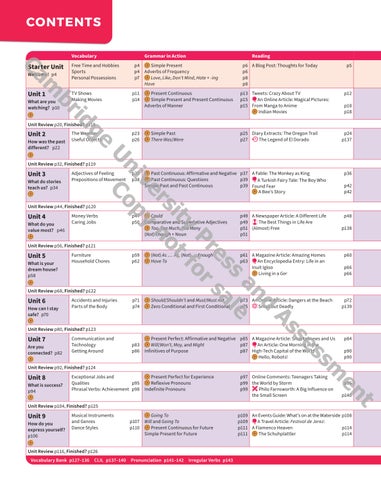
CONTENTS Vocabulary
Ca
Starter Unit Welcome! p4
m
Unit 1
Reading
Free Time and Hobbies Sports Personal Possessions
Simple Present p4 p4 Adverbs of Frequency Love, Like, Don’t Mind, Hate + -ing p7 Have
p6 A Blog Post: Thoughts for Today p6 p8 p8
p5
TV Shows Making Movies
p11 p14
p13 Tweets: Crazy About TV p15 An Online Article: Magical Pictures: p15 From Manga to Anime Indian Movies
p12
p25 Diary Extracts: The Oregon Trail p27 The Legend of El Dorado
p24 p137
id
br
What are you watching? p10
Grammar in Action
Present Continuous Simple Present and Present Continuous Adverbs of Manner
p18 p18
Unit Review p20, Finished? p118 How was the past different? p22
The Weather Useful Objects
ge
Unit 2
Unit 3
What do stories teach us? p34
Adjectives of Feeling Prepositions of Movement
Unit Review p44, Finished? p120
Unit 4
What do you value most? p46
Money Verbs Caring Jobs
Unit Review p56, Finished? p121
Unit 5
What is your dream house? p58
Furniture Household Chores
Unit Review p68, Finished? p122
Unit 6
How can I stay safe? p70
Accidents and Injuries Parts of the Body
Unit Review p80, Finished? p123
Unit 7
Communication and Technology Getting Around
p35 p38
Past Continuous: Affirmative and Negative p37 A Fable: The Monkey as King Past Continuous: Questions p39 A Turkish Fairy Tale: The Boy Who Simple Past and Past Continuous p39 Found Fear A Bee’s Story
p36
p47 p50
Could Comparative and Superlative Adjectives Too, Too Much, Too Many (Not) Enough + Noun
p48
(Not) As … As, (Not) … Enough Have To
p61 A Magazine Article: Amazing Homes p63 An Encyclopedia Entry: Life in an Inuit Igloo Living in a Ger
p60
p71 p74
Should/Shouldn’t and Must/Must not Zero Conditional and First Conditional
p73 An Online Article: Dangers at the Beach p75 Small but Deadly
p72 p139
Present Perfect: Affirmative and Negative p85 A Magazine Article: Smartphones and Us p83 Will/Won’t, May, and Might p87 An Article: One Morning in the p86 Infinitives of Purpose p87 High-Tech Capital of the World Hello, Robots!
p84
Exceptional Jobs and Qualities p95 Phrasal Verbs: Achievement p98
Present Perfect for Experience Reflexive Pronouns Indefinite Pronouns
How do you express yourself? p106
Musical Instruments and Genres Dance Styles
p66 p66
p90 p90
p97 Online Comments: Teenagers Taking p99 the World by Storm p99 Philo Farnsworth: A Big Influence on the Small Screen
p96
p140
t
Unit Review p104, Finished? p125
Unit 9
p138
en
What is success? p94
p49 A Newspaper Article: A Different Life p49 The Best Things in Life Are p51 (Almost) Free p51
p59 p62
Unit Review p92, Finished? p124
Unit 8
p42 p42
m ss
Are you connected? p82
Simple Past There Was/Were
se As d an s le es sa Pr r y fo it t rs no ve y ni p U Co
Unit Review p32, Finished? p119
p23 p26
Going To p107 Will and Going To p110 Present Continuous for Future Simple Present for Future
Unit Review p116, Finished? p126 Vocabulary Bank p127–136 CLIL p137–140 Pronunciation p141–142 Irregular Verbs p143
p109 An Events Guide: What’s on at the Waterside p108 p109 A Travel Article: Festival de Jerez: p111 A Flamenco Heaven p114 p111 The Schuhplattler p114
Listening
Speaking and Pronunciation p7
m
Ca
A Conversation
A Guided Tour
p14 Asking for and Giving Opinions Everyday English Contractions: To Be
p16 p16 p141
p26 Talking About Your Weekend Everyday English /t/, /d/, and /ɪd/
p28 p28 p141
ge
id
Verb and Noun Phrases Making Vocabulary Cards
A Description of a Celebrity p17
Culture Project: An Infographic
An Account of a Journey
History Project: A Museum Display How to Give Feedback
p29
Teacher’s Resource Bank
Telling an Anecdote Everyday English Word Stress in Adjectives
p141
Making Requests Everyday English -er Ending Sounds
p52 An Opinion Essay p53 p52 p141
Social Studies Project: A Poster How to Agree as a Group
Street Interviews p62 Discussing a Photo Everyday English Have: /f/ vs /v/
p64 p64 p141
Culture Project: A Poster
A Radio Interview p74 Making Suggestions Everyday English /ʌ/ and /ʊ/
p76 A Blog Post p76 p142
p77
A Radio Interview p86 Giving Instructions Everyday English The Letter i
p88 An Article p88 p142
p89
Job Profiles
p98
p4 p7
Using Real Examples p11 Listening for Specific Information p14 Understanding New Words p19 Learn to … Organize Your Notebook p21
Word Families (1) p30 Categorizing p30 Learn to … Guess the Meaning of New Words
p40 A Story p40
A Competition Entry
Culture Project: A Comic Strip Teacher’s Resource Bank
p65
Teacher’s Resource Bank
p35 p38 p43 p45
Similar Words Identifying Key Information Learn to … Organize Your Homework
p47 p50
Using Spidergrams Answering Multiple-Choice Questions Word Families (2) Learn to … Use a Memory Journey
p59
p57
p62 p67 p69
Science Project: An Information Pamphlet p78 How to Work in Groups p78
Using Places to Remember Words Using Pictures to Predict a Story Learn to … Give Useful Opinions About Your Partner’s English
Culture Project: A 3-D Room Plan
Collocations p83 Recognizing Opinions p86 Words that Describe Sounds p91 Learn to … Make and Use Flashcards p93
Teacher’s Resource Bank
p101
p54 p54
Personalizing Using Your Knowledge Phrasal Verbs Learn to … Guess the Meaning of New Words
p33
Technology Project: A Timeline How to Manage Your Time
p71 p74 p81
Word Formation: People Words p102 Taking Notes p102 Learn to … Make a Vocabulary Study Plan
p95 p98
en
An Interview p100 Everyday English p100 Intonation in Questions p142
A Description of a House
p41
p23 p26
m ss
A Talk
p50
Learn to Learn
se As d an s le es sa Pr r y fo it t rs no ve y ni p U Co
A Radio Phone-in p38
Project
A Personal Profile p9
br A Radio Show
Writing
p105
t
A Discussion
p110
Making Polite Refusals p112 A Review Everyday English p112 Sentence Stress p142
p113
Culture Project: A Web Page Teacher’s Resource Bank
Stress Patterns p107 Distinguishing Between Speakers p110 Referencing p115 Learn to … Practice Your English During Vacation p117
STARTER
LEARN TO LEARN Verb and Noun Phrases We often use verbs and nouns together to make different phrases. Learn them together.
m
Ca
WELCOME!
VOCABULARY
4 Complete the list with nouns from Exercises 1 and 3.
br
Free Time and Hobbies
ge
make phrases. Listen, check, and repeat.
online photos shopping
6 listen to
2 chat
7 make
go
write
8 play
4 go for 5 hang out with
read
9 take
10 write
Use It!
Listen and write the activities from Exercise 1. 1 play an instrument
5
2
6
3
5 Discuss the questions.
1 What is your favorite sport to watch on TV? 2 What is your favorite sport to do?
7
4
Sports
3 What isn’t a good sport to do on your own?
3 Match the words with the pictures (1–8). S.03
Explore It!
Is the sentence T (true) or F (false)?
Circle the two sports that aren’t in the pictures. Listen, check, and repeat.
Rugby is popular in many countries, but it is the only sport in Exercise 3 that isn’t played at the Summer Olympic Games.
swimming table tennis track and field volleyball windsurfing
m ss
Find another interesting fact about sports and write a question for your partner to answer.
en
basketball gymnastics 1 hockey rugby sailing
an instrument,
make
1 read books/magazines 3 go
2
cookies/videos friends music
play
Noun
se As d an s le es sa Pr r y fo it t rs no ve y ni p U Co
a bike ride a blog an instrument books/magazines
S.02
Verb
1 Match verbs 1–10 with the words in the box to
id
S.01
t
1
2
4 S TA RTER U NIT
3
4
5
6
7
8
READING
THOUGHTS FOR TODAY
A Blog Post
Rosie Wilson
Ca
1 Look at the photos in the blog post.
m
What do you want to know about the people?
2 Listen as you read the blog post.
br
S.04
id
Do you learn the information you wanted to know in Exercise 1?
ge
3 Find words in the blog post that mean:
2 difficult
I go swimming three mornings a week. I always get up at 5:30 a.m. . It’s tough, but swimming is my favorite thing (after my blog – obviously!).
busy
se As d an s le es sa Pr r y fo it t rs no ve y ni p U Co
1 doing a lot of things
Hi everyone! Today, my blog is all about my hobbies, family, and friends. I’m always busy! So, what do I do?
My Big Brother, Dan
He plays computer games, and he sometimes reads magazines (computer game ones!). He plays soccer every day with his friends, but he doesn’t leave the house!
3 making you a little angry 4 very bad 5 very good
4 Read the blog post again and write the names of the people. Who … 1 is a busy person?
Rosie 2 are Rosie’s brother and sister?
3 likes computer magazines and computer games?
My Annoying Little Sister, Nora
She often does her homework and listens to music at the same time. Does she sing, too? Yes, she does – but she’s a terrible singer!
Best Friends Forever: Sara and Fatima
4 is not a good singer?
I don’t see them during the week because we don’t go to the same school. That isn’t a problem because we usually hang out together on the weekend. They love taking selfies, and they post Snapchat stories every day!
5 are Sara and Fatima?
6 thinks Rosie’s blog is very good?
m ss
Voice It!
2 Do you read blogs? Why / Why not? 3 What’s your favorite blog? What’s it about?
What about you? Do you often read my blog? How do you spend your free time? Let me know!
t
1 Are you like any of the people in Rosie’s blog? If so, who and why?
en
5 Discuss the questions.
COMMENTS: Jody I read your blog in my free time. It’s awesome!
S TA RTER U NIT 5
Watch video S.1 What does Zara do on the bus? What does the vlogger do in the morning?
LANGUAGE IN ACTION Simple Present
Ca
I/You/We/They
I read your blog in my free time.
–
We 1 don’t 2
?
go to the same school.
br
m
+
you read my blog?
ge
id
Yes, I do. / No, I don’t.
1 Complete the examples in the chart above. Use the blog post on page 5 to help you.
Write simple present sentences.
1 Rosie / get up / at 5:30 a.m. three mornings a week. Rosie gets up at 5:30 a.m. three mornings a week. 2 Dan / play / computer games.
3 Rosie / not listen / to music when she / do / her homework.
leave the house.
He 4
she sing, too?
5
Yes, she
. / No, she doesn’t.
6
Adverbs of Frequency Rosie is always busy.
Dan sometimes reads magazines.
Nora often listens to music when she does her homework. Rosie usually hangs out with friends on the weekend.
4 Complete the timeline with the adverbs of frequency in the chart above. 1
0%
4 Sara and Fatima / not see / Rosie during the week.
S.05
her homework.
She 3
se As d an s le es sa Pr r y fo it t rs no ve y ni p U Co
2
He/She/It
3 Complete the blog post with the simple present form of the verbs. Then listen and check.
2
100%
4
5 Rewrite the sentences with the words in parentheses.
1 I’m late for school. (never) I’m never late for school.
2 I do my homework on the weekend. (always) 3 Do you go shopping with friends? (sometimes) 4 I’m tired after school. (often)
m ss
5 Do you take photos with your phone? (usually)
en
Use It!
6 Discuss the sentences in Exercise 5. Are they true
t
I 1 like (like) my new school. I2 (not know) all the students in my class yet, but I 3 (sit) next to a boy (play) named Jorge in my English class. He 4 5 (not like) basketball every day, but he you (get) a lot of other sports. 6 (not give) homework? Our teachers 7 8 (go) to homework club on us a lot. I Wednesdays. Some of the older students 9 (help) us. They’re nice. After homework club, I 10 (not get) home until about 6:30 p.m.
never
3
for you?
Are you always late for school? No, I’m never late for school!
6 S TA RTER U NIT
VOCABULARY AND LISTENING Personal Possessions
Ca 1
2
3
5
9
10
7
8
ge
id
6
br
m
4
1 Match the words with the photos. Listen, check, and repeat.
bus pass camera headphones keys laptop
money passport phone portable charger tablet
5 Describe a possession from Exercise 1 for your partner to guess. Think about: • when and where you use it • what you use it for
I use it every day. I always keep it in my bag. I use it to get to school.
1
2 Complete the sentences with words from Exercise 1.
Use It!
se As d an s le es sa Pr r y fo it t rs no ve y ni p U Co
S.06
1 Where are my keys ? I can’t open the door. 2 Martin is always late. Can I borrow your to text him?
Is it your bus pass?
A Conversation S.07
3 You can’t go to France without your .
4 I want to take good photos. I need a nice . 5 That music is very loud. Use your .
in Exercise 1.
4 Test a partner. Show your cards. Can your partner say the words in English?
S.07
7 Listen again and circle the correct answers. 1 Emma goes to the … club. a coding b photography 2 Alex … taking photos. a likes b doesn’t like 3 Alex has a … a tablet. b laptop.
4 Mr. Adams … a is a good teacher. b knows Bill Gates. 5 In her free time, Libby writes … a a blog. b computer programs.
t
3 Make your own vocabulary cards for the words
a the coding club b the photography club
en
Making Vocabular y Cards Make vocabulary cards to help you learn new words. Draw a picture on one side and write the word on the other.
wants to go to.
m ss
LEARN TO LEARN
6 Listen to the conversation. Circle the club Alex
Voice It!
8 Do you go to any school clubs? Which ones? What school club would you like to go to?
S TA RTER U NIT 7
GRAMMAR IN ACTION
Use It!
Love, Like, Don’t Mind, Hate + -ing
4 Think of five sentences using love, like, don’t mind,
Ca
and hate. Does your partner agree with you?
I hate doing it!
I don’t mind cleaning the kitchen.
Emma likes 2us
ge
id
br
m I love 1help ing
Watch video S.2 What two things does James hate? What four things does he love?
people.
+ We 1 have two new cameras. She has a new camera.
computer
?
1 Complete the words in the chart above. the verbs in parentheses.
3 Complete the blog post with the correct form love
like not mind not like hate
do
get up
S.08
listen speak
2
early.
.
Yes, he 5 ./ No, he doesn’t.
2 Alex
a tablet. ✓
3 They
a lot of laptops at the club. ✓
4 Libby
her own computer. ✓ much free time. ✗
7 Complete the text with the correct form of to have. Then listen and check.
We 1 have a new student in our class. Her name’s Paola. we in common? A lot! She What 2 3 brown hair and blue eyes – just like me! 4 she any brothers and sisters? Yes, 5 6 she . She two little sisters, just like 7 me. She any brothers. We 8 the same phones and headphones! We 9 school today because it’s a holiday. I’d like to call Paola – but I 10 her phone number. It’s annoying!
en
3 He English, even in our French class!
my me.
Use It!
8 Ask and answer questions using to have. Do you have any brothers or sisters?
8 S TA RTER U NIT
t
4 I math homework, but Jack
Yes, I do. / No, I 2
m ss
1 Jack likes listening to music. Mic Lowry is his favorite band.
5
he have his own laptop?
5 She
of the verbs in the boxes.
He
4
1 Alex doesn’t have his own laptop. ✗
(help) Alex.
(tell) stories.
help
Do you have your own laptop?
a
to have.
(take) photos.
4 Mr. Adams loves
Alex doesn’t 3 map of the school.
6 Complete the sentences with the correct form of
1 Emma likes meeting (meet) new people. 3 Libby doesn’t mind
I don’t have a map of the school.
5 Complete the examples in the chart above.
2 Write the sentences with the correct form of 2 Alex doesn’t like
He/She/It
se As d an s le es sa Pr r y fo it t rs no ve y ni p U Co
Alex and Libby like writ programs.
I/You/We/They
–
the new cameras.
3
To Have
WRITING
A Personal Profile
Ca
1 Look at the photo. What does
br
m
Ernesto like doing? Read his profile and check.
ge
id
1 Hi! My name’s Ernesto Mendes and I’m 14 years old. I’m from Vancouver in Canada. I live with my mom and dad, my grandma, and my cat. My cat’s name is Tiger . My best friends are Joel and Ruby.
apostrophes in the correct places.
1 Were from South Africa. We’re from South Africa. 2 Whats your history teachers name? 3 That isnt my tablet. 4 I have a cat three horses and a parrot! 5 My sisters friends very noisy!
se As d an s le es sa Pr r y fo it t rs no ve y ni p U Co
2 My favorite free-time activity is gymnastics. I train every day. Training starts at 6:00 a.m. . It’s tough because I hate getting up early, but I love practicing.
4 Rewrite the sentences with commas and
3 I also like going for bike rides on my own. I have a new bike, and I usually go for a bike ride after school. I don’t have much free time, but I always hang out with my friends on the weekend. We often go to Joel’s place because he has a swimming pool.
PL AN
5 Plan your own personal profile. Take notes for each paragraph.
1 You, your family, and friends:
2 Read the profile again. Answer the questions. 1 Where is Ernesto from? He’s from Vancouver in Canada.
2 Why does Ernesto get up early?
3 What does he like doing on his own? 4 What does he do on the weekend?
2 Your favorite free-time activity:
• what it is, where and how often you do it
3 Other free-time activities:
• what you like doing on your own or with friends • when and where you do the activities
3 Look at the Useful Language box. Find and
underline examples of apostrophes and commas in the profile. Match them with the correct use and write them in the box.
We use apostrophes:
We use commas to indicate a pause: my mom and dad, my grandma, and my cat
CHECK
7 Do you ...
• describe you, your family, and friends?
t
• to show possession: My cat’s name
paragraphs, the information in Exercise 5, the simple present, adverbs of frequency, love, etc. + -ing, and to have.
en
• for contractions / short forms: name’s
6 Write your profile. Remember to include three
m ss
Useful Language
WRITE
• describe your favorite free-time activity? • describe other things you like doing? • use apostrophes and commas correctly? S TA RTER U NIT 9
LEARNING OUTCOMES • understand Tweets, a guided tour, and a text about Japanese manga and anime • talk about TV shows and making movies • write a description of my favorite Internet or TV personality • understand how to use the present continuous and simple present, and adverbs of manner • ask for and give opinions • use real examples, listen for specific information, understand new words, and organize your notebook
watching?
ge
id
br
m
Ca
1 What are you
I can …
se As d an s le es sa Pr r y fo it t rs no ve y ni p U Co
Start It!
1 Look at the photo. What is the boy doing?
m ss
2 Before you watch, where do you watch TV shows?
3 What did John Logie Baird build? Watch and check. 4 How do you think TV changed the world?
en t
p13
Watch video 1.1
Grammar in Action 1.2
10 WH AT A RE YO U WATCHI N G? | U N IT 1
p15
Grammar in Action 1.3
p16
Everyday English 1.4
p18
Globetrotters 1.5
1
VOCABULARY
2
TV Shows
1 Match eight of the TV shows in the box with the
Ca 1.01
m
photos. Circle the four shows that aren’t in the photos. Listen, check, and repeat. reality show soap opera sports show streaming series talk show the news
1
ge
id
br
cartoon comedy cooking show documentary drama game show
4
3
5
se As d an s le es sa Pr r y fo it t rs no ve y ni p U Co
6
2 Match the sentences with TV shows from Exercise 1. 1 “Put your potatoes in a pan and add some salt.” cooking show 2 “They’re coming! We need to get out of here.” 3 “Giant pandas are in danger. There are only about 1,800 left.”
8
7
4 “We have some really interesting guests on tonight’s show.” 5 “Can they score in the last minute?” 6 “Today: A hurricane hits the city.”
3 Listen. Write the shows the people talk about. 1.02 1
comedy
4
3
1 I love watching
6
2 My family often watches 3 My favorite TV show is
LEARN TO LEARN
4 I hate
Using Real Examples
what they are?
What type of show is it?
A sports show.
Which country in the world watches the most TV? a Poland
b U.S.A. c Japan
Find an interesting fact about TV. Then write a question for your partner to answer.
t
5 Ask about your partner’s TV shows. Can you guess
Guess the correct answer.
en
Think of an example of each type of TV show in Exercise 1.
Explore It!
m ss
When you learn vocabulary, think of examples to help you remember it.
4
6 Complete the sentences so they are true for you. Tell your partner.
5
2
Use It!
U NIT 1 | WH AT A RE YO U WATCHIN G? 11
READING Tweets
Ca
1 Look at the pictures and titles. What do you think the Tweets are about?
m
2 Read the Tweets. Match the people with the TV shows. Then listen and check. 1 Jack
a
2 Holly
b the news
3 Rory
c
EXAM
a streaming series
JackLong @JLo-o-o-ng I’m learning about the history of TV in media studies this week. So for homework, I’m traveling back to 1969 to watch the news about Neil Armstrong, the first person on the moon.
Check (✓) the correct column.
se As d an s le es sa Pr r y fo it t rs no ve y ni p U Co
3
a comedy
ge
id
br
1.03
Crazy about TV @crazyabouttv Apart from sleeping, the average teenager spends more time in front of a television than doing any other free-time activity! So … are you watching TV right now? Where are you watching it and who with? We want to know! Tweet us and send us your photos. #crazyaboutTV
Jack Holly Rory
1 likes different TV shows from their friend
2 does media studies
Crazy about TV @crazyabouttv @JLo-o-o-ng Amazing! Neil Armstrong and Buzz Aldrin are walking on the moon. Around 530 million people are watching them with you. We’re over the moon, too! #crazyaboutTV
3 is with a friend now
4 talks about a friend in a different place
4 Match the words with the definitions. average
episode
season
subscribe
1 one individual show in a series 2 typical, normal
3 arrange to pay and receive something regularly 4 a period in which a show appears regularly on TV
5 Imagine you are watching a famous
2 Who or what can you see? 3 How many people are there? 4 How do you feel?
12 WHAT A RE YO U WATCHIN G? | U NIT 1
Crazy about TV @crazyabouttv @RoryG Believe it or not, if you’re an average American teenager, you probably send about 128 instant messages a day! #crazyaboutTV
Finished? p118 Ex. 1
t
1 Where are you?
Rory Green @RoryG I’m waiting for my favorite comedy to start, so I’m taking a selfie and I’m messaging my friend @laughingboi at the same time! He isn’t watching TV – he’s listening to music. He doesn’t like comedies.
en
event from history on the news. Discuss the questions.
Crazy about TV @crazyabouttv @HBards Here’s a cool fact for you. More than 100 million people around the world subscribe to Netflix, and you’re one of them. Do you want to know about the next season of Stranger Things? Just ask us! Spoiler alert! #crazyaboutTV
m ss
Voice It!
Holly Bardsley @HBards At the moment, I’m sitting in my bedroom with my best friend @superfanz. We’re watching our favorite streaming series, Stranger Things, on my new tablet. We’re super fans and this episode is so scary!
Watch video 1.2 What are Ben and Nick doing? What two things is the vlogger doing?
GRAMMAR IN ACTION Present Continuous
Ca
I
He/She/It
We/You/They Neil Armstrong and Buzz Aldrin 3 walking on the moon.
I’m sitting in my bedroom.
He 1’s listening to music.
–
I’m not sitting in class.
He 2
?
Am I listening to music? Yes, I am. / No, I’m not.
Is Rory’s friend listening to music? Yes, he is. / No, he isn’t.
Pronunciation p141
We aren’t watching the news. you watching TV right now? you watching it?
4
Where 5
4 Complete the conversation with the
se As d an s le es sa Pr r y fo it t rs no ve y ni p U Co
Get It Right!
watching TV.
ge
id
br
m
+
We don’t usually use some verbs with the present continuous. For example, know, understand, like, love, prefer, remember. Do you understand me? NOT Are you understanding me?
1 Complete the examples in the chart above. Use the Tweets on page 12 to help you.
2 Write sentences with the present continuous.
1 Jack / watch TV / with 530 million other people. Jack is watching TV with 530 million other people.
2 Holly and her friend / not sit / in the library.
3 Holly and her friend / watch / a streaming series now.
4 Rory / not watch / his favorite comedy at the moment.
1.06
present continuous form of the verbs. Then listen and check. call do give interview study talk watch
ROSA What 1 are you doing right now, Toni? to you. TONI I 2 3 you ROSA Ha, ha. Very funny. for the math test? a talk show. TONI No, I 4 you me? Why 5 ROSA Well, this math homework 6 me a headache. Can you help me? TONI Sorry, Rosa. I can’t talk now. They 7 Ed Sheeran. I’ll call you back, OK? Bye. ROSA Great. Thanks a lot, Toni. Use It!
3 Complete the blog with present continuous verbs.
1 what / you / wear? What are you wearing?
2 what / your teacher / do / right now?
en
3 where / your best friend / sit / today?
What are you wearing?
t
At the moment, Saul 4 (not talk) to me. He 5 (watch) a new online series, and he 6 (take) 7 notes. I’m tired right now, so I (take) a break. But we 8 really (enjoy) this project.
with a partner.
m ss
This week I 1’m researching (research) my favorite subject – TV! I’m very happy because I 2 (not do) it 3 on my own. I (prepare) a presentation with my friend Saul.
5 Write questions. Then ask and answer
I’m wearing ... Finished? p118 Ex. 2
U NIT 1 | WHAT A RE YO U WATCHIN G? 13
VOCABULARY AND LISTENING
Use It!
Making Movies
3 Choose a job from Exercise 1 and describe what you’re doing. Can your partner guess the job?
Ca
1 Match the words with the people and things in 1.07
I’m sitting in my chair. I’m talking to the actors, and I’m looking at the set.
the picture. Listen, check, and repeat.
m
ge
id
br
actor camera operator costume (digital) camera director
lights makeup artist script set sound engineer
A Guided Tour
4 Look at the photos. Where do you think you can
1
see these things? What are they?
se As d an s le es sa Pr r y fo it t rs no ve y ni p U Co 2
1
1.08
3
4
6 9
5 Listen and circle Matt’s favorite movie. a Thor
b Avatar c The Lord of the Rings
LEARN TO LEARN
5
Listening for Specific Information
7
8
Check what type of answer you need (a number, a name, a place, a job, etc.) before you listen.
10
6 Read the questions in Exercise 7. Write the type of answer you think you need to listen for. 1
1 It’s too dark. We need extra lights / cameras.
2 They’re building the director / set this week.
5 I’m not wearing that costume / camera. No way! 6 We can’t hear the voices very well. Where’s the makeup artist / sound engineer?
14 WHAT A RE YO U WATCHIN G? | U NIT 1
5
3
6
7 Listen again and answer the questions. 1 Where does Matt live?
Wellington 2 How many people visit movie locations in New Zealand each year? 3 What is Clara’s job? 4 Where do the students go first? 5 How tall are some of the bigatures? 6 What is Martin’s job?
t
4 Who is writing the script / lights?
2
en
3 We can’t start filming – the main operator / actor isn’t here.
4
m ss
2 Circle the correct word in each sentence.
1.08
a place
Voice It!
8 What is on your dream movie studio tour?
GRAMMAR IN ACTION
Ca
Simple Present and Present Continuous
m
ge
id
br
Watch video 1. 3 What is he doing? Describe two tips he gives.
the correct tense.
More than 3 million people locations for movies here every year.
a Today, I 2 movie workshop with my media studies class.
Time expressions: always, sometimes, never, every day/week, etc.
Time expressions: (right) now, at the moment, today, this morning, etc.
drive / now
watch / always
1 We / sports shows on the weekend. We always watch sports shows on the weekend. 2 They / their homework together. 3 My parents / me to the gym.
Adverbs of Manner
se As d an s le es sa Pr r y fo it t rs no ve y ni p U Co
Present Continuous
1
4 Write sentences with the verbs and time expressions. Use do / sometimes
Simple Present 1
Use It!
Complete the examples in the chart above with the correct form of visit.
2 Circle the correct verbs.
1 Matt lives / is living in Wellington.
2 They wait / are waiting for their tour guide.
If I’m not explaining 1 clearly (clear), let me know! (quiet), please.
Talk 2
He’s working 3
(hard) today.
5 Complete the examples in the chart above with the correct form of the words in parentheses.
6 Write the adverbs for adjectives 1–6. Circle the ones that don’t use -ly.
3 Martin works / is working hard today.
1 nice
4 Martin always uses / is using a digital camera.
2 fast
5 happy
3 beautiful
6 good
3 Complete the text with the correct form of the 1.09 verbs in parentheses. Then listen and check.
4 loud
Use It!
7 Write questions. Use the simple present or present continuous and the adverb form of the adjectives.
1 you / always / make / new friends? (easy) Do you always make friends easily?
m ss
2 you / speak / English / today? (good)
3 your math teacher / explain / everything? (clear)
en
4 you / work / this term? (hard)
t
Media studies 1 is (be) my favorite subject at (love) it! This school. I 2 3 (study) the week, we history of film. We 4 (learn) all about talkies, CGI, and lots more! (not know) much I5 6 (take) a about it. It long time and a lot of people to make a movie. Sorry! Time to go! My little brother 7 (make) a lot of noise downstairs. I think he 8 (watch) his favorite comedy with my mom and dad. (love) it, and they always They all 9 10 (laugh) a lot! What 11 you (do) at school this week?
nicely
8 Ask and answer the questions in Exercise 7. Finished? p118 Ex. 3
U NIT 1 | WHAT A RE YO U WATCHIN G? 15
SPEAKING
Asking for and Giving Opinions
Ca
1 Listen to the conversation. 1.10 Does Eva like the show?
m
ALEX
What are you doing?
br
EVA
But it’s lunchtime.
ALEX
I’m not having lunch today. Lunch can wait.
EVA
So, what 1 do you think of the show?
ALEX
I love it! Do you like comedies?
EVA
No, I don’t. I’m not 2 I3 and dramas.
ALEX
Everyone’s watching this one. It’s really cool! Why don’t you watch it with me?
EVA
I’m not sure.
ALEX
I think you’ll really like it.
EVA
OK. Let’s see.
ALEX
Well? What do you think of it?
EVA
Actually, it’s 4
ge
EVA
ALEX
them. documentaries
, I don’t really like him.
2 A
? Do you like the show?
B Yes, I do.
! 3 A Come with us to the gym on Saturday. .
5 With your partner, choose two TV shows to talk about. Take notes about them. Which shows?
What do you think of them?
Why?
SPEAK
6 Practice a conversation with
!
Useful Language box. Then listen and check.
I prefer watching …
B
PL AN
2 Complete the conversation with the phrases from the
Useful Language
1 A This actor is great, isn’t he?
se As d an s le es sa Pr r y fo it t rs no ve y ni p U Co
1.10
Everyday English phrases.
B Maybe, but I’m not sure.
id
I’m watching the second episode of this new comedy series.
EVA
4 Complete the conversations with the
I’m not really into it/them.
your partner, asking for and giving opinions about TV shows. Remember to use the simple present and present continuous, vocabulary from this unit, and phrases from the Useful Language and Everyday English boxes.
CHECK
It’s great / good / not bad / awful.
7 Work with another pair. Listen to
3 Look at the Everyday English box. Find and underline the
Actually …
It’s really cool!
Let’s see.
Well?
16 WHAT A RE YO U WATCHIN G? | U NIT 1
What do they think of them?
t
Watch video 1.4 Ever yday English
Which shows?
en
phrases in the conversation.
their conversation and complete the notes.
m ss
What do you think of … ?
Why?
My Favorite Internet Star
WRITING
By Lidia Suarez
A Description of a Celebrity
1
Rosanna Pansino is my favorite Internet star. She’s an American actor, but she also has a cooking show – Nerdy Nummies. She bakes fantastic cakes. I love the show and trying her recipes. She has more than 10 million subscribers, and every month her show gets 75 million views.
2
In each episode, she explains how to make her cakes. But they aren’t normal cakes! They look like characters or objects from TV shows, video games, movies, or books. This week, she’s making Batman cakes.
3
I like her because she’s a great cook and because she makes the videos herself, too. She uses her own computer, camera, and lights. She always explains her recipes clearly. They’re easy to follow and the cakes taste great!
Ca
1 Look at the photo. What is the woman
m
holding? Read the description and find the answer.
br
2 Match topics a–c with paragraphs 1–3.
id
a Why I like this person
ge
b An introduction to the person and her show c Typical episodes in the show
se As d an s le es sa Pr r y fo it t rs no ve y ni p U Co
3 Read Lidia’s description again. Are the sentences T (true) or F (false)?
Rosanna Pansino … 1 is from the U.S.A.
2 has a game show on the Internet. 3 likes trying other people’s recipes. 4 makes unusual cakes.
4
Find and underline examples of and, but, and or in Lidia’s description. Complete the Useful Language box.
Useful Language
6 Plan a description of your favorite Internet or TV personality. Take notes for three paragraphs. 1 Who the person is: What they do:
2 What they do in each episode:
We use
1
to add similar information.
We use
2
to show different information.
We use or more things.
when there is a choice of two
3
PL AN
5 Circle the correct word.
1 I don’t like making cakes, or / but I love eating them!
7 Write your description. Remember to include three paragraphs, the correct present tenses, adverbs, and and, but, and or.
CHECK
8 Do you ...
• use sentences with and, but, and or?
• give information about what the person usually does and is doing now?
t
4 Lots of people love talk shows, and / but I think they’re boring.
WRITE
en
3 Do you prefer watching comedies and / or soap operas?
3 Why I like this person and the show:
m ss
2 Ryan Higa is my favorite Internet star, and / but I often watch his videos.
What they are doing in this week’s episode:
• explain why you like the person? Finished? p118 Ex. 4
U NIT 1 | WHAT A RE YO U WATCHIN G? 17
AROUND THE WORLD READING
Globetrotters
Ca
An Online Article
m
1 Look at the photos. What kinds of movies can 2 Read the article and check your answers.
id
1.11
br
you see? What country are the movies from?
ge
3 Read the article again. Answer the questions in your notebook.
1 What is the difference between anime and manga?
• How many movies does India produce a year? • Where does the name Bollywood come from? • How many different movies can actors be in at the same time? Voice It!
se As d an s le es sa Pr r y fo it t rs no ve y ni p U Co
2 How are manga comics different outside of Japan?
Watch video 1.5 Bolly wood
3 Why does the article mention Howl’s Moving Castle and Ponyo? 4 Who is Hayao Miyazaki?
5 What does the number 170,000 refer to?
Magical Pictures – from
Manga to Anime
Are you familiar with anime? Anime usually refers to Japanese animated cartoons. They often use manga (comic book) characters and stories. Manga and anime have a style that is popular around the world, with series such as Naruto and Dragon Ball Z.
3 What teamwork skills do you have?
First, screenwriters develop a script for the story. Then they think about the characters. What do they look like? What are their personalities like? What do we learn about the characters in the story? What do they learn about themselves?
Hayao Miyazaki
After this, concept artists draw the characters, their expressions, and their clothes. Next, storyboard artists use the script to sketch a storyboard. A storyboard shows all the important scenes in the movie. Voice actors read the characters’ lines in a recording studio, and animators draw the characters and the backgrounds. To animate a scene, they make tiny changes to each picture. When they play the frames as a video, the characters come alive. It requires a lot of pictures. The movie Ponyo has 170,000 frames, and artists animated every scene by hand, not with a computer. The final result is a movie that people everywhere can experience and enjoy.
t
18 WH AT A RE YO U WATCHI N G? | U N IT 1
2 What skills do you need to work as a team?
en
You may already like anime! Do you like Howl’s Moving Castle (2004) or Ponyo (2008)? Studio Ghibli, an animation studio in Tokyo, Japan, produced these movies. The director, Hayao Miyazaki, is famous for beautiful anime movies. A single movie can take up to eight years and thousands of hours to produce! But what is the process like?
1 Teamwork is an important part of making a movie. Why?
m ss
People read Japanese manga comics from right to left. Outside of Japan, some printers change the direction of reading on the page so people can read the stories from left to right.
4 Discuss the questions.
LEARN TO LEARN Understanding New Words
m
Ca
Don’t worry if you don’t understand some words. First, try to get a general understanding of the article. Then guess the meaning of the new words.
5 Look at the words in bold in the article. Try to guess their meaning. Then check in a dictionary.
br
• Look at the words before and after the word.
id
• Think of similar words in your language. • Look at any pictures to help you understand.
ge
• Look for other examples of the word in the article.
6 Think of your own sentences with the new words. Say each sentence, but don’t say the new Explore It!
se As d an s le es sa Pr r y fo it t rs no ve y ni p U Co
word. Can your partner guess it?
Guess the correct answer.
Spirited Away is a famous Studio Ghibli film. The location for the movie is in …
a Taiwan. b Tokyo. c Seoul.
Find three more interesting facts about animated movies. Choose your favorite fact and write a question for your partner.
CULTURE PROJECT a What Does
Voice Actor Do?
en
Do an . audition read
1
t
An infographic has illustrations to present information in a clear and memorable way. Make an infographic about a moviemaking job.
m ss
An Infographic
In an audition, you ing some lines for a cast d a goo director. If you are ... match for the part
Read
the script Teacher’s Resource Bank and learn about the aracter.
ch
pt – the pt –
You read the scri
3
whole movie scri U NIT 1 | WHAT A RE YO U WATCHIN ut theG? 19 and learn all abo ated character. For anim see movies, you may acter. char the of ches sket
1 REVIEW
4 Complete the sentences with the simple present or present continuous.
Ca
VOCABULARY 1 The TV shows are wrong. Write the correct ones.
m
1 My little sister loves soap operas. Her favorite character is Sponge Bob.
id
br
2 That new documentary is so exciting, and it’s only the second episode! 3 This sports show is about dolphins.
1 The actor moment. (not read) 2
the script at the
you usually school? (meet)
your friends after
3 The students exam this week. (study)
for their drama
4 Simon always (watch)
TV after school.
ge
5 Rewrite the sentences with adverbs of manner.
4 Which guests are on the soap opera tonight?
se As d an s le es sa Pr r y fo it t rs no ve y ni p U Co
1 The children are talking in the library. (quiet)
5 Only one person can win the car and the money on this drama.
2 Write the TV and movie words for the definitions. 1 clothes that actors wear in movies
2 a person who changes the actors’ appearance
2 Are you writing in your notebooks? (careful) 3 The teacher is explaining the activity. (clear) 4 We’re studying for our exams. (hard)
3 the words for a movie
4 the place where they film a TV show
6 Complete Kim’s blog with the simple present, present continuous, and adverbs of manner.
5 the person who tells actors what to do
GRAMMAR IN ACTION 3 Complete the conversation with the
present continuous form of the verbs.
YUSUF
Yes, I 1 (watch) last night’s music show. Where 2 (call) from?
HASAN
I3 (stand) outside the house. I don’t have my keys.
YUSUF
Call Mom.
HASAN
I4 5
YUSUF
HASAN
I6 The sun 7 birds 8
(call) you because Mom (not answer) her phone. (sit) in the backyard. (shine), the (sing).
Yusuf, can you let me in, please? NOW!
20 RE VIE W | U NIT 1
Self–Assessment I can talk about TV shows. I can talk about making movies. I can use the simple present and present continuous. I can use adverbs of manner.
t
Where are you?
you
en
Hey, Yusuf. Are you at home?
m ss
HASAN
My friend Ava often 1 (come) to my place on Saturday afternoons, and we 2 (listen) to music together. This (drive) Saturday is different. My dad 3 us to a movie premiere. There’s a lot of traffic, so we 4 (not move) 5 6 (quick). I usually (write) my blog on Saturday evening in my bedroom, but today (type) it 8 I7 (slow) on my phone in the car!
LEARN TO LEARN LEARN TO … ORGANIZE YOUR NOTEBOOK
Ca
When you organize your notebook, it helps you to study better.
3 Look at the tips in Irina’s notebook again. Complete
m
1 Ask and answer with a partner.
the sentences.
br
1 What do you usually write in your notebook?
id
2 How often do you use your notebook when you study at home?
ge
3 How can you organize your notebook better?
2 Use different color pens for different things (for example, adjectives can be red, numbers can be green). 3 Highlight or underline important notes, words, and facts.
4 When you write a text, make a plan on the left and then write on the right.
5 Write all your homework notes (what page, what exercise) in the same place so that you don’t forget what you have to do.
notes vocabulary homework
4 Follow the plan to organize your notebook. 1 Divide your notebook into sections.
2 Choose different color pens for your notes. 3 Get a highlighter for important information (or you can underline it instead). 4 Start using your notebook today!
5 Discuss with a partner. What other notebook sections can you think of? How can they help you learn? My Favorite Internet Star by Irina Volkov El Rubius is my favorite Internet star, and the most popular Internet star in Spain. He has more than 33 million subscribers. His real name is …
t
c Plan Paragraph 1 El Rubius Real name: Rubén Doblas Gundersen The number 1 Internet star in Spain 33 million subscribers Paragraph 2 Each episode: plays games, talks about funny things This episode: He’s chatting with some of his subscribers Paragraph 3 Why I like him: He’s funny, he always makes cool videos Don’t forget to use: e and, or, but
5 You can find notes quickly when you use different .
en
grammar
b
4 You can use different color pens for things. It’s your choice!
m ss
d
on the left when
se As d an s le es sa Pr r y fo it t rs no ve y ni p U Co
1 Divide your notebook into sections so that you can find things quickly.
a
2 You can use the you’re writing.
3 The notes help you remember what to do at home.
2 Look at Irina’s notebook. Match the tips (1–5) with a–e.
1 Highlighting and underlining help you see the information.
U NIT 1 | LE A RN TO LE ARN 2 1
LEARNING OUTCOMES • • • •
understand texts about journeys and lives in the past ask and answer questions about the weekend write an account of a journey understand how to use the simple past, there was/were, and a, an, some, and any • talk about the weather and useful objects • use word families, categorize vocabulary, and guess the meaning of new words • give feedback and design a museum display
past different?
ge
id
br
m
Ca
2 How was the
I can …
se As d an s le es sa Pr r y fo it t rs no ve y ni p U Co
Start It!
1 Look at the photo. How old do you think the artwork is? Why?
m ss
2 Before you watch, what do you know about the ancient Egyptians? 3 What did the Egyptians use to make boats? Watch and check. 4 Name three things you would like to see in Egypt.
en t
Watch video 2 .1
p25
p27
p28
Grammar in Action 2.2
Grammar in Action 2.3
Everyday English 2.4
2 2 H OW WA S THE PA S T D I F F E RE NT ? | U N IT 2
VOCABULARY
1
The Weather
2
Ca
1 What is the weather like in the photos? 2.01
m
Circle the weather words that aren’t in the photos. Listen, check, and repeat.
id
br
cloudy cold dry foggy hot icy rainy snowy stormy sunny warm wet windy
ge
1 dry, hot, and sunny 2 4 5
4
se As d an s le es sa Pr r y fo it t rs no ve y ni p U Co
3
3
2 Complete the sentences with
5
adjectives from Exercise 1. 1 It’s
today.
2 Is it
all year?
cloudy
3 August is usually 4 We love 5 It isn’t
.
weather! . It’s
.
LEARN TO LEARN
Word Families (1) Build your vocabulary by learning words from the same family. Many adjectives ending in -y come from a noun.
3 Write the adjective forms. 2 fog 3 ice 5 snow 7 sun 8 wind
1 When it’s foggy, it’s difficult to
.
2 In hot, sunny weather, I always wear
.
3 On wet days, I hate
.
4 I think cold, snowy weather is
.
Explore It! Is the sentence T (true) or F (false)? Snow isn’t always white – sometimes there is pink snow in the Sierra Nevada mountains in the U.S.A.
t
6 storm
Tell your partner.
en
4 rain
cloudy
4 Complete the sentences with your own ideas.
m ss
1 cloud
Use It!
Find another interesting fact about the weather. Then write a question for your partner to answer.
U NIT 2 | H OW WA S THE PA S T D IF F E RE NT ? 2 3
The Oregon Trail
READING
Diary Extracts
Ca
1 Look at the photos. What do you think the girl is writing about?
m
2 Read the text. Check your answer to Exercise 1.
br
2.02
3 Read the text again and find these things:
id
1 two American states
ge
2 two types of furniture
Between 1843 and 1869, more than 500,000 pioneers left their homes in the east of the U.S.A. to travel more than 3,000 km west to Oregon and California. Some people wanted to find gold and others wanted to start a new life.
3 five weather adjectives
se As d an s le es sa Pr r y fo it t rs no ve y ni p U Co
4 two musical instruments 5 two animals
The pioneers used wagons to cross the country. They took things like tables, chairs, tents, and food – and also things they loved, like pianos! Oxen pulled the heavy wagons, but the adults and children usually walked or rode horses. The journey took between four and six months.
4 Match the highlighted words with the definitions.
1 a long trip to another place 2 wet and dirty after rain 3 a difficult task 4 not deep
5 vehicles with four wheels to transport heavy things 6 large animals like cows that can pull heavy things
14 Louisa, age
5 Complete the sentences with words from the text. 1 People on the Oregon Trail were called .
2 Oregon is on the
coast of the U.S.A.
3 The adults and children didn’t usually travel in the .
5 One of Louisa’s brothers played the
.
May 1, 1850 Last night it was cold and rainy, and my clothes got wet. I didn’t sleep well, and I felt tired all day. It wasn’t easy to walk on the muddy ground. We didn’t travel far today, and we faced a new challenge: a river. It was high because of the rain and it looked dangerous. Did we cross it? Yes, we did. We found a shallow part and walked across. We were lucky, but other people weren’t.
en
Voice It!
.
April 8, 1850 I got up at 5:30 a.m. with Mother, and we made johnnycakes for breakfast. Then we cleaned up the wagon and we left at 7 a.m. We didn’t stop until 5 p.m. After dinner, Samuel played his violin, and we sang songs and danced. It was a warm, dry day.
m ss
4 Louisa traveled across the country with her
Louisa Evans made the journey with her parents and two brothers, Samuel and Jesse. These are extracts from her diary.
1 Do you think diaries are important?
2 What challenges do you face each day? Finished? p119 Ex. 1
24 H OW WA S THE PA S T D IFFERENT ? | U NIT 2
t
6 Discuss the questions.
Watch video 2 .2 How did she travel? What happened on the way back?
GRAMMAR IN ACTION Simple Past
I/You/He/She/It/We/They
m
Ca
To Be
Other Verbs I/He/She/It
You/We/They
I got up at 5:30 a.m.
It was cold and rainy.
We 4
–
We didn’t stop until 5 p.m.
It 2
Other people weren’t lucky.
?
Did we cross it? Yes, we 1 did . / No, we didn’t. Pronunciation p141
ge
id
br
+
easy to walk.
Was it a hot day? Yes, it 3 . / No, it wasn’t.
lucky.
Were all the people lucky? Yes, they were. / No, they 5
.
se As d an s le es sa Pr r y fo it t rs no ve y ni p U Co
1 Complete the examples in the chart above. Use the text on page 24 to help you.
2 Rewrite the sentences in the simple past.
1 More than 500,000 people leave the east coast. More than 500,000 people left the east coast.
2 The journey takes between four and six months. 3 April 8 is a warm, dry day.
4 They don’t stop until 5 p.m.
4 Put the words in the correct order to make questions. Then ask and answer.
1 last / your friends / you / see / Did / weekend / ? Did you see your friends last weekend?
2 you / did / after school / What / yesterday / do / ? 3 night / Were / asleep / at 10:30 p.m. / last / you / ? 4 any homework / your English teacher / Did / last week / give / you / ? 5 Was / hot / yesterday / the weather / ?
2.05
3 Complete the text with the simple past form of the verbs. Then listen and check.
5 Think of questions to interview Louisa or a
person from the Mayflower about their journey. Use the ideas below or your own ideas. new friends the challenges the date the food the other people the weather
m ss
6 Take turns asking and answering your questions. When did you leave?
en
I left on April 2 with my family.
t
On September 6, 1620, 102 people 1 left (leave) England to travel 4,500 km to North America. They 2 (not agree) with some of the religious views in Europe at that time, so they 3 (decide) to start a new life. (travel) on a ship called the They 4 5 Mayflower, and the journey (take) (go) 66 days. The first half of the journey 6 7 (change), and it well. Then the weather 8 (be) very cold and stormy. People got sick (not survive). and some of them 9 (arrive) in In December, they 10 11 (not know) anything Plymouth Bay. They about this new land, but the local Wampanoag people 12 (help) them find food and build houses.
Use It!
Finished? p119 Ex. 2
U NIT 2 | H OW WA S THE PA S T D IFFERENT ? 2 5
VOCABULARY AND LISTENING
Useful Objects
1 Match the words with the pictures. Listen,
Ca 2.06
check, and repeat.
m
hairbrush knife lamp mirror pillow
plate scissors spoon toothbrush
1
ge
id
br
blanket bowl comb cup fork
LEARN TO LEARN Categorizing Recording new words in groups in your notebook can help you remember them.
3 Write the words in Exercise 1 in the chart. Can you add any more words?
Appearance comb, Bedtime
blanket,
se As d an s le es sa Pr r y fo it t rs no ve y ni p U Co
1
2
3
Meals
bowl,
Use It!
4
4 Choose an object in Exercise 1. Ask questions to guess your partner’s object.
5
Do you use it every day?
6
Yes, I do.
A Radio Show
7
8
9
2.08
6 Listen again and complete the text.
the Bronze Age. What can you see in the photo?
12
14
4
2
5
3
6
26 H OW WA S THE PA S T D IFFERENT ? | U NIT 2
t
toothbrush
This is the Egtved Girl. She’s 1 3,000 years old. , Archaeologists found her body in 2 in Egtved, a small village in southern 3 . … We know she died in 4 BCE when she was between 16 and 5 years old. And we know she died in because there were some the 6 summer flowers with her body.
en
2 Listen. Write the objects the people are using.
m ss
13
1
5 Listen to an interview about a discovery from
10
11
2.07
2.08
Watch video 2 . 3 Was the Viking Age peaceful? Were there any coins in the exhibition?
GRAMMAR IN ACTION There Was/Were
Ca
Singular
There was an exhibition in Copenhagen.
–
There 1
?
Was there a blanket? Yes, there 2
There 3
any information about clothes. . / No, there wasn’t.
some summer flowers.
There weren’t any plates. Were there any other things? Yes, there were. / No, there 4
ge
id
br
m
+
Plural
5 Write and circle to complete the
1 Complete the examples in the chart above with was,
sentences. Then answer the quiz.
wasn’t, were, or weren’t.
se As d an s le es sa Pr r y fo it t rs no ve y ni p U Co
Get It Right!
.
DID YOU KNOW … ?
We use some and any with plural countable nouns and uncountable nouns.
1 There were ✓ some / any humans in …
some/any plates NOT some/any plate some/any information NOT an information
2
2 Correct the sentences about the Egtved girl.
1 There wasn’t an exhibition about the Egtved girl.
3
There was an exhibition about the Egtved girl. 2 There weren’t any flowers with her body.
4
3 There weren’t any useful objects with her body.
5
4 There was a hairbrush.
5 There weren’t a lot of travelers in northern Europe.
Was there was an exhibition about the Egtved girl?
Yes, there was.
1 There were some / any students at the talk.
3 There weren’t some / any audio guides. 4 Was there some / any snow in the mountains? 5 There wasn’t a / any documentary on TV last night.
Use It!
7 In pairs, choose a photo from Units 1 and
2 and look at it for one minute. Close your books. What can you remember?
Were there any clouds in the sky?
t
2 There was an / some interesting exhibition last week.
listen and check.
en
4 Circle the correct words.
6 Discuss your answers to the quiz. Then
m ss
3 Ask and answer about the information in Exercise 2.
2.09
250,000 years ago. a Portugal b Africa There ✗ a / an alphabet with letters in … society. a Aztec b Roman There ✓ some / any university courses for students in … in 1095. a Paris b Oxford There ✗ some / any … for eating food in ancient Greece. a forks b knives There ✓ a / some famous Roman … named Apicius. a emperor b cook
Yes, there were. There were some white clouds. Finished? p119 Ex. 3
U NIT 2 | H OW WA S THE PA S T D IFFERENT ? 2 7
SPEAKING
Talking About Your Weekend
1 Listen to the conversation.
Ca 2.10
Why was Andy in the country?
m
br
CARLA Hi Andy. 1How was your weekend ? ANDY
2
OK, thanks.
CARLA What 3
?
id
CARLA Cool! What 4
like? ?
Well, there wasn’t any Wi-Fi, and there were a lot of noisy sheep outside.
CARLA Really? ANDY
Yes, really. That region has more sheep than people.
CARLA Wow. You learn something new every day! ANDY
What 6
? What did you do?
CARLA Nothing much. I watched TV and made some cupcakes. ANDY
Sounds good!
2 Complete the conversation with the phrases from the 2.10 Useful Language box. Then listen and check.
Useful Language
How was your weekend?
What did you do?
It was (OK/good/great/ amazing/awful), thanks.
What was the weather like?
What about you?
2 interesting facts? 4 a question?
Where did you stay?
Look at the Everyday English box. Find and underline the phrases in the conversation.
PL AN
5 Think about something you did in the past, and take notes. Where you went:
What you did: The weather:
Any problems you had:
SPEAK
6 Practice a conversation with
your partner about what you did. Remember to use the simple past and there was/were, vocabulary from this unit, and phrases from the Useful Language and Everyday English boxes.
CHECK
7 Work with another pair. Listen to
their conversation and take notes.
Nothing much. Sounds good! That’s a shame. You learn something new every day!
The weather: Any problems they had:
t
What they did:
en
Where they went:
Watch video 2 .4 Ever yday English
28 H OW WA S THE PA S T D IFFERENT ? | U NIT 2
m ss
3
1 negative news?
We stayed on my grandpa’s farm.
CARLA What was it like? ANDY
use to respond to …
3 positive news?
It was cold, wet, and windy.
CARLA That’s a shame. 5 ANDY
4 Which Everyday English phrase do we
se As d an s le es sa Pr r y fo it t rs no ve y ni p U Co
ANDY
ANDY
I went to the country for my grandpa’s 70th birthday.
ge
ANDY
CARLA
WRITING
An Account of a Journey
Ca
1 Look at the photos. Where do you think the
3 Read the phrases in the Useful Language box. In what order do they appear in the account?
Useful Language
ge
id
br
m
man wanted to go? Read the account and check your answer.
At first, …
(He) set off on …
Finally, …
There were a lot of problems.
4 Put the sentences in the correct order (1–4). a
Finally, we arrived back safely at 9 p.m.
b 1 We set off from home early one morning. c
At first, we made good progress.
se As d an s le es sa Pr r y fo it t rs no ve y ni p U Co d
There were a lot of problems.
PL AN
5 Plan an account of a journey. Take notes for four paragraphs.
1 Who made the journey: When it started:
2 The first part of the journey: The weather:
3 How the journey continued: Any problems:
4 The end of the journey:
2 Read the account again. Are the sentences T (true) or F (false)?
1 Nansen left Norway in June 1893.
3 The weather was bad in November.
6 Nansen returned to Norway one year after he left.
CHECK
7 Do you ...
• use the simple past to talk about the past? • explain what the journey was like?
t
5 Nansen was the first person to reach the North Pole.
the simple past, there was/were, and phrases from the Useful Language box.
en
4 Nansen and Johansen didn’t have any problems.
6 Write your account. Remember to include
m ss
2 He started the journey on his own.
WRITE
• put the events in the correct order? Finished? p119 Ex. 4
U NIT 2 | H OW WA S THE PA S T D IFFERENT ? 29
HISTORY PROJECT A Museum Display
Ca 1
Discuss the questions.
m
1 What museums do you know?
2 What can you see in them?
br
3 What makes a museum interesting?
id
2 Read the texts. Then read the sentences and
ge
write S (scissors), M (mirror), L (lamp), or B (bowl).
1 The way of making this object is the same today as it was in the 1600s. S
5 Listen again. Answer the questions. 1 What event are they at?
2 Whose display did they like? 3 What did they like about it? 4 What information was missing? 5 How did Oliver respond to the feedback? What is he going to do?
se As d an s le es sa Pr r y fo it t rs no ve y ni p U Co
2 It’s black, but you can see things in it.
2.11
3 Only rich people had objects like this.
4 This type of object first appeared in Egypt. 5 There was probably water in this. 6 This object had two uses.
USEFUL OBJECTS DISPLAY
7 It took a long time to find this object after a natural disaster.
SCISSORS, STEEL, AND IRON, 1628
8 This had connections with weather.
3 Read the texts again. Underline the information with the correct colors.
name of object year or time period location material use How to Give Feedback 2.11
4 Read the tips about giving feedback. Then listen to the conversation. What kind of display are Sophie and Leo talking about? 1 Read the text.
3 Point out possible problems: • Is any important information missing? • Is anything unclear?
30 RE VIE W | U NIT 2
t
4 Make suggestions for improving the text.
en
• Is the information in a logical order?
The ancient Egyptians invented scissors, and today scissors are one of the most common objects in a home. This is one of the first pairs of scissors from Zhang Sijia’s shop. Zhang Sijia opened the first scissors shop in China in 1628. He made all of the scissors by hand and followed the same 72 steps to make them. Customers bought the scissors to cut cloth, plants, and even metal. There is still a scissors factory in Hangzhou, China, and the workers use the same process today as in the 1600s.
m ss
2 Talk about the things you like or find interesting.
Yi County, Anhui Province, China
MIRROR, OBSIDIAN, AROUND 4,000 BCE Çatalhöyük, South-Central Turkey
ge
id
br
m
Ca
Archaeologists found this mirror in Çatalhöyük. It was one of the first cities in the world, and 8,000 people lived there. The mirror is made from a special black stone called obsidian, and it was one of the first mirrors in the world. People used these mirrors to look at themselves and also to look at the sun.
PL AN
6 Work in groups. Choose four historical
objects. Then complete the steps below. • Decide on the object that each student will research. • Research your object and write a short text to use in the display. • Find a photo or draw a picture of your object. • Read each other’s texts and give feedback.
se As d an s le es sa Pr r y fo it t rs no ve y ni p U Co
• Make any changes or improvements.
• Work in your group and make your display.
PRESENT
7 Put your display on your classroom wall.
LAMP, BRONZE, 79 CE Pompeii, Southern Italy
Archaeologists found this oil lamp in the ancient city of Pompeii in 1752, but it is much older than that. A volcanic eruption destroyed Pompeii in 79 CE. This oil lamp is in the shape of a dolphin, and it is made of bronze. Bronze objects were expensive, so this lamp probably belonged to a rich family. People needed oil lamps to light rooms and hallways at night.
8 Look at your classmates’ displays. Do they
explain the four historical objects well? Give feedback to other groups on their displays.
en t
This bowl was probably for holding water. The face shows one of the faces of the Aztec figure Tlaloc, from ancient Central Mexico. People believed he sent good rain when he was happy to help plants grow, and he sent bad rain and storms when he was unhappy.
CHECK
m ss
TLALOC BOWL, TERRACOTTA, 3RD–8TH CENTURY Veracruz, Mexico
Remember to follow the tips in How to Give Feedback, and include correct facts, photos or pictures, and an attractive design.
U NIT 2 | H OW WA S THE PA S T D IFFERENT ? 3 1
2 REVIEW
4 Complete the review with there was(n’t) or there were(n’t) and a, an, some, or any.
VOCABULARY
Ca
1 Complete the sentences with the adjective form of the nouns in the box.
m cloud
fog
ice
rain
storm
br
because it’s
ge
2 It’s dangerous to drive when it’s you can’t see well. 3 Take an umbrella. It’s
today.
5 It’s
today, so we can’t sunbathe.
Egyptian mummies!
? 6 last week?
good exhibitions in your town
café. I was hungry.
to stir my drink.
CHLOE What 1 weekend?
, so I can read in bed.
MAX
or a
4 Do you have any
to cut this paper?
to
5 I slept on my friend’s sofa last night without a or a !
GRAMMAR IN ACTION 3 Complete the text with the simple past.
I2 3
you
CHLOE Cool! 5 you 6 some / any movies? MAX
(watch)
9 Yes, I 7 .8 some / any 10 excellent movies, but the weather (be) rainy.
CHLOE Oh, no. When 11 home?
MAX
MAX
America in the early 1800s. He and
(do) on the
(go) to my grandma’s town. 4 a / an outdoor film festival.
you
(get)
This morning.
CHLOE You 12
(want) to explore more of North
(not text) me.
I know. 13 with my phone.
14
a / any problem
(leave)
William Clark 2
(not
of Mississippi. It 3 be) an easy journey. They 4
(meet)
a lot of people, but they 5 (not have) enough food, and
6
8
September 1806.
32 RE VIE W | U NIT 2
(complete) their journey in
I can use the simple past. I can use there was/were.
t
(be) difficult to survive. After two
years and more than 13,000 km, the men finally
I can talk about useful objects.
en
(not speak) their language. At times, they
I can talk about the weather.
m ss
Self–Assessment
on May 14, 1804, to go to the west
it 7
✗4 ✗5
there was(n’t)/were(n’t). Circle a, an, some, or any.
outside. Don’t slip.
3 You can use a make your hair look better.
Meriwether Lewis 1
board game called Senet. It was
5 Complete the conversation with simple past verbs or
2 Complete the sentences. 2 I have a
✓3
se As d an s le es sa Pr r y fo it t rs no ve y ni p U Co
outside. The trees are moving.
1 I need a
amazing exhibition about Egypt.
so much fun to play.
and
4 It’s 6 Watch out! It’s
✓1 ✓2
amazing things to see, like bronze mirrors and beautiful necklaces.
wind
id
1 I don’t like it when it’s dark and noisy.
I went to my local museum last week.
LEARN TO LEARN LEARN TO … GUESS THE MEANING OF NEW WORDS
Ca
When you don’t know a word, the beginning of the word, the end of the word, and the rest of the sentence can help you guess the meaning.
m
1 Circle the answer that is true for you. Compare
br
and discuss your answer with a partner.
Our Incredible School Trip! By David North
When I see a word I don’t know, I usually …
id
1 guess the meaning from the rest of the sentence.
ge
2 see if I can understand part of the word. 3 ask the teacher what it means. 4 look in a dictionary.
se As d an s le es sa Pr r y fo it t rs no ve y ni p U Co
5 write it in my notebook.
2 Read the text. Then tell your partner three things that surprise you.
Last February, I went on a field trip to Oregon. The weather was very unusual for that time of year. Normally, it’s wet and windy, but it didn’t rain once! It was a little cold, so we wore jackets or sweaters every day. Our bus set off very early on the first day, at about 5:15 a.m. The campground was over 320 km away, and it took almost four hours. We couldn’t take phones or tablets with us, so we chatted and played games instead. When we saw the campground for the first time, we were really happy. There was a small store, and a room with table tennis and a TV. We hung out there in the evenings.
We did a lot of enjoyable activities. We went hiking and sailing, and I tried windsurfing for the first time. My favorite activity was survival skills. We collected wood in the forest, and then we built a small shelter. Clara and Ben saw some spiders and ran away – they hate things like spiders and bugs. In the evening, we cooked over a campfire. That night, we didn’t sleep in a cabin. We slept in tents, and I shared a tent with my best friends. It was an unforgettable experience, and I was very sad to leave.
bold with a partner. Take notes in your notebook. 1 Is the word a noun, verb, or adjective?
2 What clues about the meaning can you find in the text?
4 Check the meanings of the words in a dictionary or with your teacher. Did the questions in Exercise 3 help you guess correctly?
Yes. It starts with “un-” which means “not.”
t
4 What do you think the word means?
“Unusual” describes the weather. The text says “Normally it’s wet and windy, but it didn’t rain once!”
en
3 Do any parts of the word give you clues to the meaning?
I think “unusual” is an adjective.
m ss
3 Read the text again. Discuss the questions about each of the words in
I think “unusual” means “not usual.”
U NIT 2 | LE A RN TO LE ARN 33
LEARNING OUTCOMES • • • •
understand a fable and a traditional fairy tale tell an anecdote and express interest write a story understand how to use the past continuous and simple past • talk about feelings and use prepositions of movement • personalize sentences to remember new words, use my knowledge, use phrasal verbs, and guess the meaning of new words
teach us?
ge
id
br
m
Ca
3 What do stories
I can …
se As d an s le es sa Pr r y fo it t rs no ve y ni p U Co
Start It!
1 Look at the photo. What is the boy doing?
m ss
2 Before you watch, what do you think people did in their free time in the past? 3 What did storytellers do? Watch and check. 4 What’s your favorite story? Do you know where it came from?
en t
p37
Watch video 3.1
Grammar in Action 3.2
3 4 WHAT D O S TO RIE S TE ACH U S? | U NIT 3
p39
Grammar in Action 3.3
p40
Everyday English 3.4
p42
Globetrotters 3.5
VOCABULARY
LEARN TO LEARN
Adjectives of Feeling
Personalizing You can write a sentence that is true for you to help you remember new words.
1 Circle the adjectives to describe the people in
Ca 3.01
the photos. Listen, check, and repeat.
m 1
2
I often feel tired in the evening.
3
br
3 Write a personal sentence for six of the
id
adjectives from Exercise 1. 1
ge
2 3
se As d an s le es sa Pr r y fo it t rs no ve y ni p U Co
4 5 6
angry / bored 4
embarrassed / tired 5
4 Read your sentences aloud, but don’t say
surprised / worried
the adjectives. Can your partner guess the adjectives?
6
I feel … when I forget someone’s name.
Embarrassed?
Use It!
5 Choose an adjective from Exercise 1 and tell
your partner about a time when you felt like that. Ask questions to find out more.
lonely / tired Pronunciation p141
afraid / upset
excited / nervous
When did that happen?
2 Complete the sentences with adjectives from
Explore It!
Guess the correct answer.
1 Sam’s of dogs, so he doesn’t afraid want to walk through the park.
.
b spiders.
c school.
Find another unusual thing people are afraid of. Then write a question for your partner to answer.
t
about my exams. What
4 It’s Ana’s birthday! She’s very 5 I’m interesting.
a cheese.
en
If you have didaskaleinophobia, you are afraid of …
2 I felt so when I dropped the glasses. My face went red. 3 I’m should I do?
m ss
Exercise 1.
I felt angry when my brother took my bike because he didn’t ask me.
. This documentary isn’t very
U NIT 3 | WHAT D O S TO RIE S TE ACH U S? 35
READING
3 Find words in the story that mean:
A Fable
2 not clever or sensible
2 Why do you think Aesop’s stories are still important today?
3 something that people give you on a special occasion
br
4 a hole in the ground to catch animals or people
Ca
1 Read the introduction and discuss the questions.
m
1 a warm place with a lot of trees and other plants
1 What is special about fables?
Aesop’s Fables
id
ge
Aesop was a writer from ancient Greece. He wrote a lot of short stories called fables. Fables usually have a moral message. The main characters are often animals, but they act like humans.
2 Read the fable. Circle the best title.
4
EXAM
Circle the correct answers.
1 What did the animals take turns doing?
se As d an s le es sa Pr r y fo it t rs no ve y ni p U Co
3.04
5 to keep people safe
a The Fox’s Dance
b The Monkey as King
A giving speeches B telling jokes
C looking for food
One day, all the animals from the jungle were sitting in a circle. They felt excited because this was the day to choose their new king.
As they were walking through the jungle, the fox pointed toward a tree. “Look at all those bananas!” he said. As the monkey was running to the tree, he fell into a trap. “Help! Help!” he shouted. He wasn’t dancing now.
2 Who didn’t give a speech? A the fox
B the monkey C the bear
The animals took turns giving speeches about why they wanted to be king. “How can the monkey take When the fox was giving his speech, a lot of the other care of us and be our king?” animals were getting bored, asked the fox. “He can’t even take care of himself.” The and they weren’t listening. animals realized that they Then it was the monkey’s were wrong. “You are our turn, but he didn’t give a king now,” they told the fox. speech. He danced, made silly faces, and made the other “You are clever and you can animals laugh. They decided protect us.” to make the monkey king.
3 Why did the animals choose the monkey to be their king?
The fox knew it was a bad decision, and he was angry. The monkey didn’t have the right qualities to be a good king. He decided to play a trick on the monkey. “I have a present for you!” he said. “Follow me.” The monkey followed him. All the animals were watching.
Voice It!
B He was the best animal.
C He found food for them.
4 What happened at the end?
A The fox gave bananas to the monkey. B The monkey played a trick on the animals. C The fox became the king.
5 Discuss the questions.
m ss
1 What is the moral of the story?
2 What do you think a good leader needs?
en
3 Which other fables do you know?
Finished? p120 Ex. 1
t
36 WHAT D O S TO RIE S TE ACH U S? | U NIT 3
A He danced and made them laugh.
Watch video 3.2 Why was Sophia’s first vlog bad? How many people follow her?
GRAMMAR IN ACTION
Ca
Past Continuous: Affirmative and Negative I/He/She/It
You/We/They
m
The fox 1 was giving his speech.
–
He 2
The animals 3
br
+
dancing.
They weren’t 4 listen
id
ge
1 Complete the examples in the chart above. Use the story on page 36 to help you.
1 The animals weren’t standing in a circle. They were sitting. 2 The fox wasn’t quiet. He speech.
giving a
3 The animals watching each other. They were watching the fox and the monkey. 4 The monkey was running. 3.05
.
4 Complete the sentences with the past continuous form of the verbs in the box.
make not live not work read take travel watch
se As d an s le es sa Pr r y fo it t rs no ve y ni p U Co
2 Complete the sentences with was/were or wasn’t/weren’t.
sitting in a circle.
walking to the tree. He
3 Complete the story with the past continuous form of the verbs. Then listen and check.
One day, a hare 1was telling (tell) the other animals how fast he could run. At that moment, a tortoise 2 (walk) past. He heard the hare, and he offered to race him.
4 My parents night. They
5 Sandra year. She Use It!
5 Think of true sentences about things you were
doing at these times. Use the activities in the box or your own ideas.
at … o’clock yesterday morning/afternoon/evening at … o’clock last Monday/Tuesday
this time two days/months/years ago this time last week/month/year
chat with friends do my homework get up go to bed have breakfast/lunch/dinner play basketball / computer games walk home / to school sleep
6 Compare your sentences with a partner.
At eight o’clock yesterday morning, I was walking to school. What about you?
t
The moral of the story is: don’t be too sure that something is easy. Sometimes things are more difficult than you think.
3 Esma
en
Finally, just as the tortoise (finish) the race, the hare woke up. The tortoise was the winner!
7
2 Leo
a book. was reading selfies this morning. a cake when I called. at 10 p.m. last TV. at home this time last around the world!
m ss
The race began. At first, the hare (run) very fast and the tortoise 4 (go) very slowly. The hare was soon near the end of the race. The other animals 5 (not watch), so he decided to stop for a rest. He soon fell asleep. The tortoise continued to walk slowly while the hare 6 (sleep). 3
1 At 9 p.m. last night, I
I wasn’t walking to school. I was brushing my teeth. Finished? p120 Ex. 2
U NIT 3 | WHAT D O S TO RIE S TE ACH U S? 3 7
VOCABULARY AND LISTENING
Use It!
Prepositions of Movement
3 In your notebook, write about your trip to
school today using prepositions from Exercise 1. Compare with a partner.
Ca
1 Match the prepositions with the pictures. 3.06 Listen, check, and repeat.
m
into off out of over
id
br
across along between down
ge
1
1
2
past through under up 3
First, I went out of my house. Then I walked down the street and over the bridge.
A Radio Phone-in LEARN TO LEARN
se As d an s le es sa Pr r y fo it t rs no ve y ni p U Co
Using your Knowledge Before you listen, think about what you already know about the topic and words you might hear.
4 Look at the photos and think about words you
4
5
7
8
10
11
3.07
6
9
12
2 Circle the correct prepositions. Then listen and check.
might hear.
2 Who is that coming out of / under Bruno’s house? Is it Carla?
5 Why don’t we swim across / off the lake to the other side? It isn’t far. 6 Laura walked along / past me without saying hello. 38 WHAT D O S TO RIE S TE ACH U S? | U NIT 3
6 Listen again and put the events in the correct order. a
A boy fell into the lake in the park.
b
A photographer was taking a photo of Clayton’s wife.
c
Clayton and his wife were in a park.
d 1 Clayton Cook got married. e
Clayton jumped into the water and rescued the boy.
f
Some children started shouting.
7 Close your book. Take turns telling the story. Can you remember the events in order?
t
4 Don’t cross the road through / between those cars. It’s dangerous.
3.08
words from Exercise 4 do you hear?
en
3 Let’s jump into / up the water together! Are you ready?
5 Listen to Melissa’s story. How many of your
m ss
1 Be careful! Don’t fall over / down the stairs.
3.08
GRAMMAR IN ACTION
Simple Past and Past Continuous
Past Continuous: Questions Watch video 3. 3 What were they doing in the countr y? What was her sister holding?
I/He/She/It
You/We/They
m br
Ca
When Clayton jumped into the water, he 1 (wear) his wedding clothes.
ge
id
Yes, he No, he 2
1
./ .
3 Complete the examples in the chart above with the correct form of the verbs in parentheses.
Get It Right!
the children standing close to the lake?
3
We can use when, while, and as + past continuous for a longer action in progress.
se As d an s le es sa Pr r y fo it t rs no ve y ni p U Co
Was he wearing his wedding clothes?
While the photographer 2 (prepare) his camera, Clayton noticed three children.
Yes, they they weren’t. 4
. / No,
We use the simple past for a short action that interrupts a longer action in the past continuous.
1 Complete the examples in the chart above.
simple past
2 Write the conversations using the past 3.09
past continuous
continuous form of the verbs. Then listen and check. 1 A you / TV at 8 p.m. last night? (watch)
Were you watching TV at 8 p.m. last night? B ✓ Yes, I was. 2 A What / you / yesterday? (wear) B jeans and a hoodie
3 A your brother / at 5 p.m. yesterday? (chat online)
continuous. Then listen and check.
I 1 was walking (walk) to the bus stop one afternoon (fall) down on the icy street. when I 2 3 (carry) a heavy bag with all my I (break) my school things, and I 4 5 (feel) very embarrassed. glasses. I (wait) for the bus, Other people 6 7 (not help) me. However, but they (pick up) my bag and one woman 8 9 (find) an empty seat glasses, and she (sit) there, she for me. While I 10 11 (clean) my face and gave me some (look) for her a water. But when I 12 few minutes later, there was no one there.
Use It!
en
4 A Where / Alice and her family / in 2017? (live)
4 Complete the text with the simple past or past
m ss
B ✗ play basketball
3.10
✗
B in Mexico City
t
5 Work in pairs. Continue and finish the story
below. Use the simple past and past continuous. While I was walking to school this morning, I saw … Finished? p120 Ex. 3
U NIT 3 | WHAT D O S TO RIE S TE ACH U S? 39
SPEAKING
3 Look at the Everyday English box. Find and
Telling an Anecdote
underline the phrases in the conversation.
1 Listen to the conversation. Who is the story
Ca 3.11
about, and what was the person doing?
m
Guess what happened yesterday. No idea. What? Well, it didn’t happen to me.
Watch video 3.4 Ever yday English
1
br
DAVID
LAURA
Go on. No idea. You’re kidding!
2
ge
id
DAVID
Adrian.
DAVID
LAURA
What a great story!
4 Which Everyday English phrases do you use
LAURA
Go on.
DAVID
He was at the new shopping mall.
1 don’t know?
LAURA
You’re kidding! 3 a shopping mall? He hates shopping.
2 hear something surprising?
DAVID
He was looking for new sneakers.
LAURA
4
DAVID
Yes, really. Now please stop interrupting. While he was looking at the sneakers, someone bumped into him.
LAURA
Who was it?
DAVID
It was LeBron James!
Who it happened to:
LAURA
No way!
What the person was doing when it happened:
DAVID
I know.
LAURA
Did he take a photo?
DAVID
No, he didn’t. He was too embarrassed. Can you believe it? What a great story!
2 Complete the conversation with the phrases from the Useful Language box. Then listen and check.
It happened to … Really? That’s amazing/incredible! What was (he) doing (at) … ? 4 0 WHAT D O S TO RIE S TE ACH U S? | U NIT 3
PL AN
5 Think of something funny or unusual that happened, and take notes.
What happened:
SPEAK
6 Practice telling your anecdote to your partner. Remember to use the simple past and past continuous, vocabulary from this unit, and phrases from the Useful Language and Everyday English boxes.
CHECK
7 Work with another pair. Listen to one of their anecdotes and complete the notes. Who the story happened to:
What the person was doing when it happened: What happened:
t
Guess what happened (yesterday).
4 liked someone’s story?
en
Useful Language
3 want someone to continue?
m ss
3.11
se As d an s le es sa Pr r y fo it t rs no ve y ni p U Co
LAURA
5
when you …
WRITING
3 Complete the sentences in the Useful Language box
A Story
with time and sequencing phrases from the story.
Ca
1 Look at the photo. What do you think Alison’s story is about? Read the story and check your answers.
Useful Language
br
m
1
, I was feeling bored.
2
, I thought it was outside.
3
, I saw a bike exactly
like mine.
ge
id
4
all about it.
, I was busy and forgot , the bike was still there!
6
, I remembered!
se As d an s le es sa Pr r y fo it t rs no ve y ni p U Co
5
A Silly Story By Alison Dunmire
Last Sunday, I was feeling bored and decided to ride my bike. I went to the garage to get it, but it wasn’t there! At first, I thought maybe it was in the yard. I was looking for it outside when Mom came out and said, “If you left it outside, maybe someone stole it.” I was really angry. The next day, while I was walking to school, I saw a bike exactly like mine in front of the supermarket. I didn’t have time to investigate. In the afternoon, I was busy and forgot all about it. The next morning, the bike was still there! I took a look, and it was my bike – with my bike lock on it and everything! Suddenly, I remembered! I was riding home last week when it started to rain, so I decided to leave my bike at the supermarket!
2 Read the story again and answer the questions. 1 When did the events in the story happen?
4 Plan a story about a time when something
interesting, funny, or scary happened to you. Take notes for three paragraphs. 1 What was happening before the main events started: What happened first:
2 The main events of the story:
3 What happened in the end:
WRITE
5 Write your story. Remember to include time and sequencing phrases, the simple past and past continuous, and vocabulary from this unit.
CHECK
en
6 Do you ...
m ss
2 Where did Alison look for her bike?
PL AN
• use phrases from the Useful Language box?
4 Did someone steal it? What really happened?
• explain what happened in the end?
• explain the main events?
t
3 Where was the bike?
Finished? p120 Ex. 4
U NIT 3 | WHAT D O S TO RIE S TE ACH U S? 41
AROUND THE WORLD
Globetrotters Watch video 3.5 A Bee’s Stor y
Ca
READING
A Turkish Fairy Tale
• Where are bees very busy?
m
1 Look at the pictures. What is happening in each
br
picture? What do you think the story is about? in the order of the story.
ge
a
2 Read the fairy tale. Put the pictures
id
3.12
b
• What is honey used for? • Who did artists in the 18th century paint? Voice It!
4 Discuss the questions.
1 How does the boy face fear in the story?
se As d an s le es sa Pr r y fo it t rs no ve y ni p U Co
2 What causes fear? How can it affect your life? 3 How can fear be good?
The Boy Who Found Fear
c
O
in your notebook.
1 Why did the boy start his journey? 2 How did he feel when he started the journey?
42 WH AT D O S TO RI E S TE ACH US? | U NIT 3
t
4 What did the boy do when he heard the people on the ship?
en
3 What did the ogre try to do?
m ss
3 Read the fairy tale again. Answer the questions
nce upon a time, a woman and her son lived in a small house in a forest. They didn’t have any neighbors, and the lonely boy stayed at home with his mother every day. One winter’s evening, they were having dinner when a storm started. The wind blew the door open and the mother said, “Close the door. I feel fear.” “What is fear?” asked the boy. “Fear is when you feel afraid,” she replied. “I don’t understand. I want to find fear.” So the next morning, the boy set off confidently. While he was looking for fear, he met a lot of different people and he faced a lot of challenges. First, there was a group of robbers. They made him do dangerous and difficult things, but he wasn’t afraid. He continued his journey.
LEARN TO LEARN
m
Ca
Phrasal Verbs A phrasal verb is a verb + a small word like for or on. They have a special meaning that is different from the verb on its own.
5 Find phrasal verbs in the story that mean:
4 to arrive or reach
2 to try to find
5 to continue
id
br
1 to start a journey
3 to find by accident
ge
6 Complete the sentences with the phrasal verbs in Exercise 5. 1 Are we all ready to go? Let’s
now before it gets too hot.
2 A I don’t think it’s a good idea to
se As d an s le es sa Pr r y fo it t rs no ve y ni p U Co
in the dark.
B OK. Let’s camp here for the night. 3 Can you help me
my phone? I don’t know where it is.
4 A How long did it take you to
the beach?
B Ages! It was really far away.
5 While I was doing some research, I
this photo of our street in 1885.
Explore It!
Is the sentence T (true) or F (false)?
The story of Cinderella first appeared in a Chinese book around the year 850.
Find another interesting fact about a fairy tale. Write a question for your partner to answer.
CULTURE PROJECT A Comic Strip
Close the door. I feel fear.
W
t
Teacher’s Resource Bank
THE BOY WHO FOUND FEAR
on a winter’s There was a storm blew open ... evening. The door
en
A comic strip uses words and pictures to tell a story. Make a comic strip using a traditional story from around the world.
m ss
Next, he came across an angry ogre who tried to attack him, but the boy ran away. After that, he got to the ocean. There was a terrible storm, and he saw a ship in great danger. The people on the ship were terrified, and they were shouting for help, so he jumped into the water and saved them. He wasn’t afraid at all. He went on until finally he got to a city. There were people everywhere, and it was very busy. One man told the boy that the people were sad because their king was dead, but today they were choosing a new king. Just then, three beautiful doves flew down from a tower, and they sat on the boy’s head. The people were excited. “This is the sign! You are our king!” At that moment, he saw into the future: he was the king, he was trying to make everyone happy, but the people were angry. And he suddenly realized what fear was, and he was afraid.
to The boy decided
find fear ...”
saving people He felt no fear storm. from a terrible Three doves lande
d on his head ...
He felt no fear robbers ...
when faced with
The people a choosing a n king!
ed at a city ... At last, he arriv But, he could see
the future ...
U NIT 3 | WHAT D O S TO RIE S TE ACH U S? 43
the boy to
... or when faced angr y ogre.
le were angr y.
3 REVIEW
4 Write past continuous questions. Then match them with the answers (a–d).
VOCABULARY
1 you / wear / jeans / yesterday?
Ca
1 Complete the sentences with the adjectives.
2 Lidia / work / at 10 p.m. last night?
embarrassed surprised tired upset
br
m
afraid
and she’s crying.
1 Elsa looks
id
2 I can’t believe I won! I’m really
.
4 what / I / do / an hour ago?
of heights. He hates being
ge
3 My dad is in very tall buildings.
4 I forgot David’s birthday. I was so
!
. I didn’t sleep much.
2 Complete the story with the prepositions. across between down into out of through under up
Tiger the cat went 1 the front door and walked 2 the road 3 two cars. He went 4 the park and climbed 5 a tree. Then a mouse appeared. “Lunch!” thought Tiger. He climbed 6 the tree and followed it. The mouse ran 7 the grass and then disappeared 8 a rock. “Maybe I’ll have lunch at home today,” said Tiger.
GRAMMAR IN ACTION
3 What was happening at 10:30 a.m. yesterday? Write two sentences in the past continuous.
b Yes, she was.
c You were taking photos. d Yes, I was.
5 Complete the text with the simple past or past continuous form of the verbs.
Suzanne Collins 1 (work) in television when she 2 (meet) children’s author James Proimos. After talking with him, she 3 (decide) to try 4 writing books, too. She (think) about the story of Alice in Wonderland when she 5 (have) the idea for her first novel, Gregor the Overlander. She 6 (want) to change Alice’s story to a modern adventure, set in a city. The book was very successful, and she 7 (write) four more books about Gregor. The series 8 (win) a lot of prizes. While she 9 (write) the series, she also 10 (complete) a picture book for children. Now she is most famous for her Hunger Games books and movies.
Self–Assessment
3 Alex / not read / a book – listen / to music
I can use prepositions to talk about movement.
4 4 RE VIE W | U NIT 3
I can use the past continuous in sentences and questions. I can use the simple past and past continuous together.
t
I can use adjectives to talk about feelings.
en
2 I / not study – sleep
4 Eva and Helen / not talk – have / a snack
m ss
1 it / not snow – rain
a They were going to the movies.
se As d an s le es sa Pr r y fo it t rs no ve y ni p U Co
5 I’m really
3 where / they / go / last Saturday at 7 p.m.?
LEARN TO LEARN LEARN TO … GUESS THE MEANING OF NEW WORDS
Ca
You can help your partner learn vocabulary by writing sentences with missing words for them to guess.
m
1 Erin writes sentences with missing words for a
br
friend to guess. Can you guess what the words are? Discuss with a partner.
ge
id
OK, the first one. Is it an adjective? Yes, it is.
Is it “happy”?
1 I was
se As d an s le es sa Pr r y fo it t rs no ve y ni p U Co
No. Try again!
because my soccer team was winning.
2 The plane fl ew 3 The boy felt
the city.
when he called his teacher “Mom.”
2 Choose five words from the box. Write five sentences with missing words like the sentences in Exercise 1.
between bored jungle nervous protect surprised tired trap under worried
Can they guess the missing words?
4 Why is it a good idea to learn words in
sentences? Discuss with your partner.
5 Close your book. Take turns saying
the five words you chose in Exercise 2. Can your partner remember your sentences?
1
2
The word was “bored.” What was the sentence?
m ss
“I feel bored when … .” No, sorry, can you help me?
3
t
OK. It starts, “I was bored because … .”
en
4
5
3 Show your sentences to your partner.
I remember! “I was bored because …”
U NIT 3 | LE A RN TO LE ARN 45
LEARNING OUTCOMES • • • •
understand texts about money and caring jobs make and respond to requests write an opinion essay understand how to use could, comparative and superlative adjectives, too, too much, too many, and (not) enough + noun • talk about money and caring jobs • remember similar words, identify key information, and organize my homework • reach agreement as a group and make a poster
you value most?
ge
id
br
m
Ca
4 What do
I can …
se As d an s le es sa Pr r y fo it t rs no ve y ni p U Co
Start It!
1 Look at the photo. How does the boy feel?
m ss
2 Before you watch, how do you help other people?
3 How can helping others be good for you? Watch and check. 4 Which of the ways to help in the video do you like best?
en t
Watch video 4.1
p49
p51
p52
Grammar in Action 4.2
Grammar in Action 4.3
Everyday English 4.4
4 6 WHAT D O YO U VA LU E M O S T ? | U NIT 4
VOCABULARY
2 Listen to the verbs in Exercise 1 and repeat.
1 Look at the verbs in bold. Then match the
4.02
3 Listen and write the correct verb from Exercise
Ca
Money Verbs
4.01
sentences with the photos.
m
1 Don’t worry. I can pay for you, too. g
id
br
2 He spends all his money on video games. He should save it for something he needs.
3 Friendships don’t cost money. They’re free!
ge
4 I want to earn money. Can I wash your car? 5 I owe my friend $50. I can sell my bike.
1
4
pay
2
5
3
LEARN TO LEARN Similar Words Many words have similar meanings. Think of ways to help you understand the differences.
se As d an s le es sa Pr r y fo it t rs no ve y ni p U Co
6 A Could you lend me some money?
1 for each situation. Sometimes there is more than one possible answer.
B How much do you want to borrow? 7 I want to change this money, please. a
b
You lend money to someone (it’s yours). You borrow money from someone (it isn’t yours).
4 Look at these pairs of verbs. Think of more ways to remember the different meanings. spend / buy
earn / win
5 Compare with a partner. How does your partner remember the meanings?
c
d
Use It!
6 Complete the sentences in your notebook with your own ideas. Tell your partner.
1 A good way to earn money is to …
2 The last time I borrowed money was … 3 I spend most of my money on …
f
e
$3,00
0,000 ,0
00
en
g
Is the sentence T (true) or F (false)?
m ss
Explore It!
t
In Zimbabwe, there was a $100 trillion bill. At that time, bread cost $300 billion.
Find another interesting fact about money. Then write a question for your partner.
U NIT 4 | WHAT D O YO U VALU E M O S T ? 47
READING
Voice It!
A Newspaper Article
4 Imagine you can interview Mark Boyle
after his three years without money. Write questions to ask him using the ideas below.
Ca
1 Look at the photos. What do you think the man did?
Family and friends:
m
2 Skim the article and choose the correct summary.
a A man sold his home and bought an RV to travel around the world for three years.
br
Clothes:
3
Food:
Read the article and answer the questions.
ge
4.03
id
b A man lived without money for three years. 1 Where did Mark live after he sold his own home?
Work:
se As d an s le es sa Pr r y fo it t rs no ve y ni p U Co
2 How did he use his laptop without electricity?
3 Which three things were difficult for him at first? 4 What did he buy after his time without money?
Travel:
5 Take turns being Mark Boyle and the interviewer and do the interview.
How often did you see your family?
$
A Different Life
When did you see your friends?
Finished? p121 Ex. 1
Mark had a good job and he earned a lot of money. One day, a friend challenged him to live without money. Mark decided he could change his life and do it.
4 8 WHAT D O YO U VA LU E M O S T ? | U NIT 4
more alive. He also discovered that friendship is more important than money.
$ $
The biggest and most difficult decision for Mark was to return to a life with money. After three years without money, what was the first thing he bought? A pair of sneakers from a thrift store!
£
t
So, was life without money better for Mark than life with money? Yes, it was. He was happier than before, and the best thing was that he felt
€
en
First, he sold his houseboat, and he went to live in an RV on a farm. He kept his laptop and cell phone – he knew he could use solar power to charge them. He couldn’t make any calls, but he could receive them.
The first few months were the worst – simple things were more difficult than before. Mark couldn’t buy food, take a shower, or travel easily. But he soon found his own food – usually vegetables, fruit, and other plants. He made a stove to cook outside, and he collected wood to use as fuel. He washed in a river, and he used plants to clean himself. He even made his own toothpaste! He walked or cycled everywhere, so he was fitter and healthier than he was before.
m ss
$ $ £ € £ £ € Can you imagine living for a day without money? Mark Boyle, from Ireland, did that for three years.
GRAMMAR IN ACTION
Comparative and Superlative Adjectives
Could
Adjective
Ca
id
br
m
Watch video 4.2 Could she buy a horse? Could she draw horses?
He 1 could change his life.
–
He 2
1
2
the happiest
important Long Adjective difficult
3
the most important
4
the most difficult
Irregular good Adjective bad
5
the best
worse
6
5 Complete the examples in the chart above. Use the article
make any calls.
on page 48 to help you.
Could he live without money? Yes, he 3
. / No, he 4
Get It Right!
.
We use than, not that, to compare two things.
Complete the examples in the chart. Use the article on page 48 to help you.
My sister is fitter than me. NOT My sister is fitter that me.
6 Complete the sentences with the comparative or
2 Complete the sentences with could or
superlative form of the adjectives.
couldn’t and the verbs in parentheses. Check your answers in the article.
3
food. (buy)
3 He his laptop with solar power. (charge) 4 He
a shower. (take)
Use It!
3 Complete the sentences. Use could or couldn’t and the ideas in the box. buy my own clothes make my own lunch ride a bike use a laptop 1 When I was five, I
2 When my grandparents were young, they
4 Ask and answer with a partner. Could you buy your own clothes when you were five?
to a life with money.
(difficult) decision was to return
7 Complete the text with the comparative or superlative form of the adjectives. Then listen and check.
It’s the fourth Friday in November and it’s Black Friday. It’s 1the busiest (busy) shopping day of the year. Things are 2 (cheap) than usual today. 3 Shoppers can get (good) prices for 4 (late) gadgets or 5 (stylish) 6 sneakers. In my opinion, Black Friday is (bad) day of the year. People seem to be 7 (interested) in shopping than anything else! I think we could all be 8 (happy) without spending money all the time. Use It!
8 Choose a topic from the box or use your own. Discuss with a partner. Use comparatives and superlatives.
math / history / science market / shopping mall / online shopping
t
3 A year ago, I
4.04
(good) thing was that he felt more alive.
en
£
2
m ss
$ $
1 Life for Mark without money was better (good) than before.
1 Mark could receive calls on his phone. (receive) 2 He
the fittest
fitter
se As d an s le es sa Pr r y fo it t rs no ve y ni p U Co
?
Superlative
fit Short Adjective happy
ge
+
Comparative 1
History is more difficult than … but … is the most difficult. Finished? p121 Ex. 2
U NIT 4 | WHAT D O YO U VALU E M O S T ? 49
VOCABULARY AND LISTENING
Use It!
Caring Jobs
3 Work with a partner. Discuss the questions.
1 What do the jobs in Exercise 1 have in common?
Ca
1 Match eight jobs with the photos. Circle the jobs 4.05
2 Which people in these jobs do you see every week?
that aren’t in the photos. Listen, check, and repeat.
m
paramedic police officer preschool teacher surgeon 1 vet volunteer
ge
id
br
caregiver firefighter garbage collector lawyer lifeguard nurse
Job Profiles
4 What do you think are the best and worst things
about doing a caring job? Discuss with a partner.
4.08
5
Listen to the job profiles and match the speakers with their jobs. There are two extra jobs. EXAM
se As d an s le es sa Pr r y fo it t rs no ve y ni p U Co
1
3 Which job would you like to do?
Speaker 1
2
Speaker 2
Speaker 3 Speaker 4
3
4
5
6
a lifeguard
d nurse
b paramedic
e vet
c volunteer
f lawyer
LEARN TO LEARN
Identif ying Key Information When you are matching people with information, check key words before you listen. This helps you to focus on the information you need.
6 Read the questions in Exercise 7. Circle the key words you need to listen for.
7
8
4.08
7 Listen again. Write 1, 2, 3, or 4. Who …
a usually takes care of dogs and cats? b wants people to follow rules?
Pronunciation p141
c collects clothing and blankets? d drives an ambulance?
1 You’re at the swimming pool. Your friend has a problem. lifeguard
3 Your grandma needs help at home.
5 Your friend is in the hospital. This person is doing an operation on them. 50 WHAT D O YO U VA LU E M O S T ? | U NIT 4
8 Imagine you have one of the jobs in Exercise 1.
In your notebook, write five sentences about your day. Read your sentences aloud, but don’t say the job. Can your partner guess?
t
4 Your cat has a problem with its eye.
f serves meals to people?
en
2 There’s a fire at your school.
e only works during the summer?
m ss
2 Write which person you need in these situations.
I sometimes work all night. Are you a nurse?
Watch video 4. 3 Say three reasons why some people don’t volunteer. How does volunteering help the vlogger at school?
GRAMMAR IN ACTION
Too, Too Much, Too Many
Ca
Too + Adjective
Too Much + Uncountable Noun
to have lunch. Some kids make too much 2
m
I’m too 1
br
1 Complete the examples in the chart above with the clothes
noise
ge
busy
id
words in the box.
2 Read the sentences about the people you listened
I can’t volunteer. I don’t He can invite 20 people. He have 1 has 2 (time). (chairs).
5 Complete the examples in the chart above with
se As d an s le es sa Pr r y fo it t rs no ve y ni p U Co 4.09
2 The volunteer thinks people own too / too much / too many books.
4 The vet spends too / too much / too many time at work.
Complete the questionnaire with too, too much, or too many.
All About You! 1 too much homework this week? clothes? 2 3 spend 4 buy
?
busy to listen to your friends? young to drive a car?
4 Work with a partner. Ask and answer the questions in Exercise 3.
The best thing: I love animals and I can spend all day with them!
The worst thing: Sometimes there’s 8 me, and I don’t understand it all. Use It!
for
7 Imagine a day doing your dream job. Take notes. Then compare with a partner. • What the job is: • The best thing: • The worst thing:
t
Use It!
I’m 1 too young to have a full-time job, but every Saturday I’m a volunteer with a local vet. I help the receptionist when she doesn’t have 2 to do everything. Last week, there were 3 in the waiting room – we 4 didn’t have for them to sit on! Sometimes it gets 5 for me, especially when there are 6 and there isn’t 7 in the waiting room.
en
5 6
Then listen and check.
m ss
Are you …
?
?
money on clothes? snacks?
6 Complete the text with the words in the box. enough chairs enough space enough time too many animals too many people too much information too noisy too young
3 Sometimes the pool is too / too much / too many noisy for the lifeguard.
Do you …
.
the words in parentheses and enough.
1 The hours were too / too much / too many long in the paramedic’s last job.
Do you have …
. I have too many 3
(Not) Enough + Noun
to on page 50. Circle the correct words.
3
Too Many + Plural Countable Noun
My dream job is to be a firefighter. It’s an exciting job, but it can be dangerous. Finished? p121 Ex. 3
U NIT 4 | WHAT D O YO U VALU E M O S T ? 5 1
SPEAKING
3 Look at the Everyday English box. Find and underline the phrases in the conversation.
Making Requests
Watch video 4.4 Ever yday English
1 Listen to the conversation. Who lends Rita
Ca 4.10
some money?
m
cute
There you go.
br ge RITA
English phrases.
GREG
RITA
I am. 1 Could you do me a favor ?
BILLY
2
RITA
3
. What do you need? lending me $20?
BILLY Oh. . I spent too much money on the weekend. RITA
OK, no problem. What about you, Greg?
GREG Maybe. What’s it for? RITA
1 A B I need a favor.
, Kate?
2 A Thanks for paying. B Any time.
.
se As d an s le es sa Pr r y fo it t rs no ve y ni p U Co
BILLY Hey, Rita. What’s up? You look worried.
4
What’s up?
4 Complete the conversations with the Everyday
id BILLY
I owe you one.
I want to buy a bag for Maisie’s birthday. There’s a really cute one that I want to get her, but I don’t have enough money.
3 A Can I borrow your phone for a second? . B Sure. 4 Look at that little dog! It’s so
.
PL AN
5 Work in groups of three. One person wants to borrow something. One friend can’t lend it, but the other can. Take notes. What the person wants to borrow and why:
GREG When’s her birthday? RITA
Yesterday! Please, Greg.
GREG
, since you asked so nicely. There you go.
RITA
Thanks, Greg. You’re the best! I owe you one.
5
GREG Actually, you owe me 20!
2 Complete the conversation with the phrases from the Useful Language box. Then listen and check.
I’m sorry, I can’t. It depends.
your group. Remember to use (not) enough and too, too much, too many, vocabulary from this unit, and phrases from the Useful Language and Everyday English boxes.
CHECK
7 Work with another group. Listen to their conversation and complete the notes.
What the person wanted to borrow and why:
Sure. Would you mind …ing … ? 5 2 WHAT D O YO U VA LU E M O S T ? | U NIT 4
Why one friend couldn’t lend it:
t
Could you do me a favor?
6 Practice a conversation making requests in
en
Useful Language
SPEAK
m ss
4.10
Why one friend can’t lend it:
WRITING
An Opinion Essay
Ca
1 Read Min-Seo’s essay. Does she agree with the statement?
m
br
Professional sports stars earn ? too much money. Do you agree
ge
id
By Lim Min-Seo 1 Nowadays, sports stars can earn a lot of money. Some basketball players earn more than $40 million every year. In my opinion, this is too much. 2 First of all, sports stars work less than other people. They only entertain people for a short time each week. Also, they have long vacations. 3 Personally, I think that other jobs are more important. For example, nurses, like my dad, save lives. I also think it’s easier to live without sports or sports stars than to live without nurses and firefighters. 4 In conclusion, I believe that some sports stars earn too much money, and people with important life-saving jobs don’t earn enough. We need to find a better and fairer way to pay those people more.
3 Complete the phrases in the Useful Language box. Useful Language 1
opinion,
4
In
,
2
of all,
5
I
(that)
, I think (that)
3
4 Put the words in the correct order.
1 need / less / think / Personally, /we / homework / I / that
se As d an s le es sa Pr r y fo it t rs no ve y ni p U Co
2 students / homework / In / too much / have / opinion, / my
2 Circle the correct words.
1 According to Min-Seo, sports stars earn enough / too much money.
3 In Min-Seo’s opinion, sports stars have more / less important jobs than firefighters.
of these topics and take notes for four paragraphs in your notebook.
• Pop stars earn too much money. • Money can’t buy happiness. 1 2 3 4
Introduce the topic and give your opinion. Give a reason for your opinion. Give a second reason. Summarize your opinion.
WRITE
6 Write your opinion essay. Remember to include (not) enough and too, too much, too many, and phrases from the Useful Language box.
CHECK
7 Do you ...
• have four paragraphs?
t
5 People with life-saving jobs don’t earn enough / earn too much money.
5 Plan your own opinion essay. Choose one
en
4 It is easier / more difficult to live without nurses than without sports stars.
PL AN
m ss
2 Min-Seo thinks sports stars help / entertain people.
3 work / all, / enough / in class / do / we / of / First
• give reasons for your opinions? • summarize your opinion at the end?
Finished? p121 Ex. 4
U NIT 4 | WHAT D O YO U VALU E M O S T ? 5 3
SOCIAL STUDIES PROJECT
Ca
A Poster
m
1 What is the purpose of the poster? Read and check (✓). a to encourage more people to use a local park
br
b to ask for more volunteers to clean the park
Do you have enough time to help us? All ages are welcome. Don’t give us your money – give us your time!
id
c to tell people about a charity event
Could you be a volunteer with us?
ge
2 Read the poster again. Under which heading can you find this information?
se As d an s le es sa Pr r y fo it t rs no ve y ni p U Co
1 the place for the activity Where? 2 the type of activity
3 the people organizing the activity
4 the reasons it is a useful thing to do 5 the time and place to meet
6 why volunteers enjoy the activity How to Agree as a Group
3 Read the tips on how to agree as a group. Put them in the best order.
4.11
a
Ask other people for their opinions.
b
Make a decision as a group. Check that everyone agrees.
c
Introduce the decision you need to make.
d
Give your own opinion politely.
e
Interrupt politely if you want to comment.
f
Summarize all the opinions.
4 Listen to the students. Write Y (Yusuf), L (Lara), or T (Thiago). Who …
2 interrupts politely? 3 asks other people for their opinion and summarizes the opinions?
m ss
1 suggests ideas (two people)?
en
Together we can make our park better!
t
5 4 WH AT D O YO U VA LU E M O S T ? | U N IT 4
ge
id
br
m
Ca
Your Community Needs You! se As d an s le es sa Pr r y fo it t rs no ve y ni p U Co PL AN
5 Work in groups. Plan a poster for a
volunteer project. Follow the steps below. • Choose one of these ideas for a volunteer project, or use your own idea.
Teaching older people how to use the latest gadgets.
WHAT?
Help us to make the park a cleaner space for the whole community.
WHERE? Greenhill Park
WHO?
WHY?
It helps your community!
There aren’t enough people using the park. We want more people to use it.
WHAT ARE THE BENEFITS?
It’s one of the best ways to make new friends and make a difference!
10 a.m. every Saturday. Meet at the park café.
• Organize your material under headings. • Add photos to create an attractive design.
PRESENT
6 Display your poster on your classroom
wall. Remember to include photos and useful information for volunteers, and to follow the tips in How to Agree as a Group.
CHECK
7 Look at your classmates’ posters. Would you like to work on their projects? Discuss in your group and then vote on the best poster.
t
WHEN?
You can get fitter and have fun.
• Think of what you can say to inform and attract volunteers.
en
We need only an hour of your time once a week.
Working in an animal shelter.
m ss
We have a team of five volunteers, but there’s too much work for us. We need more volunteers.
Helping at an after-school or local sports club for younger students.
U NIT 4 | WH AT D O YO U VA LU E M O S T ? 55
4 REVIEW
4 Put the words in the correct order.
1 lifeguard / you’re / too / be / young / to / a
VOCABULARY
Ca
1 Complete the conversations with the pairs of verbs
m
in the box.
borrow / owe
pay / lend spend / save
br id
1 A Can you
me $5 for coffee?
B Don’t worry. I can
for yours.
2 A Those people
ge
4 much / week / I / last / spent / too / money
5 Complete the blog with too + adjective, too much / too many or enough, or a comparative or superlative adjective.
se As d an s le es sa Pr r y fo it t rs no ve y ni p U Co it now? Let’s go
some money for the bus?
B Sure, but you now
2
much money.
my money for the future?
B No! Why don’t you shopping. 4 A Could I
3 room / there / too / people / were / the / many / in
hats at the market.
B Yes, but they don’t 3 A Should I
sell / earn
2 a / money / I / soda / to / don’t / have / enough / buy
me $5!
Read the descriptions and write the correct job.
1 I give my free time to help people. I don’t earn any money, but I love my job. 2 I have a difficult job in a hospital. I’m not a normal doctor or a nurse. 3 I keep our community safe. I can arrest people who are breaking the law.
4 I treat very sick people at home and then take them to the hospital.
GRAMMAR IN ACTION
3 Complete the quiz with the comparative or
superlative form of the adjectives. Then decide if the sentences are T (true) or F (false).
All About Denise
Appearance She’s 1 than me, and she has 2 (long) hair. So, I’m 3
(tall)
(short) than her in two ways!
Personality She always makes me laugh. She’s the 4 (funny) and 5 (happy) person I know! Sports Denise’s favorite sport is basketball. Unfortunately, she can’t get into the school team because there are 6 good players, so she only plays for fun.
Jobs She wants to be a firefighter. She’s 7 (brave) 8 than me – I think that job is (dangerous). There are a lot more things to say about Denise, but I don’t have 9 time now. I have 10 homework.
Self–Assessment
I can use could and couldn’t. I can use comparative and superlative adjectives. I can use too, too much, too many, and (not) enough.
t
5 6 RE VIE W | U NIT 4
I can talk about caring jobs.
en
1 Basketball players are usually than soccer players. (tall) 2 place on Earth is in Antarctica. (dry) 3 Chris Hemsworth is than Chris Evans. (old) 4 The Istanbul Cevahir shopping mall is in the world. (big) 5 A hippo is than a lion. (dangerous) 6 New York is city to live in. (expensive)
m ss
I can talk about money.
LEARN TO LEARN LEARN TO … ORGANIZE YOUR HOMEWORK
Ca
When you organize your homework, you study and use your time better.
1 Do the quiz. Find out your score. Do you agree with what
Deciding What Comes First
m
it says about you? Discuss the results with a partner.
br
You have too much homework and not enough time. Do you …
Homework Superstar?
ge
id
a do the most important things first? b do the easiest things first? c look at your books but never start?
Knowing What to Do
… When your teacher gives you homework, do you write it in your notebook or homework planner?
Concentrating
se As d an s le es sa Pr r y fo it t rs no ve y ni p U Co
a b write it on your hand? c listen but then forget?
While you’re doing your homework, do you … put your phone on silent? try not to look at your phone? spend a lot of time checking your phone?
a b c
Organizing Your Time
When do you do your homework?
a After school or on the weekend. b Sometimes after school, sometimes before. c Always while I’m having breakfast!
Results
a = 2 points b = 1 point c = 0 points 6—8: You’re a superstar! You organize your homework well. 3—5: Not bad! You try to organize your homework, but our advice can help.
0—2: Oh, no! You really need our advice!
2 Complete Esma’s homework planner with the words in the box. difficult Date
first
For when?
1
Homework
hours
2
Other things
Subject
3
Mon Feb. 18
4
Mon Feb. 11
English
Tues Feb. 12
Science
Label the parts of plants. Thurs Feb. 14 It’s 5
Wed Feb. 13
History Math
Page 36 Study for the test.
Thurs Feb. 14 Do math 6 Fri Feb. 15 to study!
Thurs Feb. 14 English
Write story.
Tues Feb. 19
Fri Feb. 15
No homework!
– ask Jo for help.
I need about two 7
– there’s a LOT .
en
: Remember Zoe’s party on Saturday afternoon!
Nice and easy!
m ss
8
Page 27, Exercise 4
Notes
t 3 Copy Esma’s design for a homework planner in your notebook , using the same headings. Then complete the planner with your homework for next week.
U NIT 4 | LE A RN TO LE ARN 5 7
LEARNING OUTCOMES • understand texts about different homes and doing household chores • describe a photograph • write a description of a house • understand how to use (not) as + adjective + as, (not) + adjective + enough, and have to / don’t have to • talk about furniture and household chores • make spidergrams to record vocabulary, use techniques to answer multiple-choice questions, use word families, and a memory journey
dream house?
ge
id
br
m
Ca
5 What is your
I can …
se As d an s le es sa Pr r y fo it t rs no ve y ni p U Co
Start It!
1 Look at the photo. Would you like to live in this house?
m ss
2 Before you watch, where do you live?
3 Why did people build homes in mountains? Watch and check. 4 What other unusual homes are there?
en t
p61
Watch video 5.1
Grammar in Action 5.2
5 8 WH AT I S YO U R D RE A M H O US E? | U N IT 5
p63
Grammar in Action 5.3
p64
Everyday English 5.4
p66
Globetrotters 5.5
VOCABULARY
5.02
Furniture
1 Match the words in the box with 1–13 in the
Ca 5.01
pictures. Listen, check, and repeat.
m
1
ge
id
br
armchair bookcase carpet ceiling chest of drawers cupboard desk
floor fridge picture shelves sink wardrobe
Exercise 1 that you hear.
LEARN TO LEARN Using Spidergrams Recording words in different ways will help you remember them. One way is to create spidergrams.
4 Complete the spidergram using words from Exercises 1 and 2 and your own ideas.
se As d an s le es sa Pr r y fo it t rs no ve y ni p U Co
Rooms
2
1
Home
to store things
3
5
6
8
3 Listen again and circle the words in
to sit or lie on
4
Furniture other furniture
7
Use It!
5 Describe the furniture in a room in your home. Your partner listens and draws the room.
9
10
My bedroom has a wardrobe, a chest of drawers, and two pictures on the wall …
11
12
Guess the correct answer.
13
The oldest bookcases in the world are … years old.
rooms in the box. There is one extra room.
bathroom bedroom
kitchen living room
Find another interesting fact about furniture. Then write a question for your partner.
t
2 Listen and match the speakers (1–4) with the
b 400 c 600
en
a 200 5.02
m ss
Explore It!
study
U NIT 5 | WH AT I S YO U R D RE A M H O US E? 59
READING
3 Read the article again and correct the sentences.
1 The entrance to Keret House is through the kitchen.
A Magazine Article
Ca
1 Look at the pictures. Discuss the questions. 1 What’s unusual about these homes?
m
2 Who do you think lives in them?
br
5.03
2 Read the article. Match the pictures with
3 The rooms in Nautilus House have straight walls.
id
the houses.
ge
Amazinesg
Everyone’s home is special, but some homes are really amazing…
4 The PAS House is in France. 5 An architect had the idea for the PAS House.
se As d an s le es sa Pr r y fo it t rs no ve y ni p U Co
Hom
1
The entrance to Keret House is through the living room. 2 Five people live in Nautilus House.
2
4 Look at the words highlighted in the text. What do they refer to? Circle the correct answers.
1 a Polish architect / Keret House
3
2 the fridge / the sink
3 ordinary houses / the owners
4 the PAS house / skateboarding 5 the PAS House / France
Keret House, Poland 1 A Polish architect designed this house for an Israeli author. It ’s in a space between two apartment buildings in Warsaw. To enter the house, you climb through a trap door in the floor of the living room. The living room is wide enough for a small sofa, but the back of the house is only as wide as a large armchair! There’s a tiny bathroom upstairs and a tiny kitchen with a sink and a fridge 2 … but you need to stand in another room to open it !
60 WHAT I S YO U R D RE A M H O U SE? | U NIT 5
2 author
b a door in the floor
3 apartment
c a writer
building
d not straight
4 trap door
e a building with homes in it
5 shell
f a person who designs
6 curved
buildings
Voice It!
6 Discuss the questions.
1 Which house do you like most? 2 Why do you like it?
3 Do you know any other unusual houses? Describe them.
t
The PAS House, U.S.A. Lots of kids love skateboarding, but not many kids are as crazy about 4it as Pierre André Senizergues. Senizergues learned to skateboard at school in France and later became the world champion. He designed the PAS House as a dream home for skateboarders. You can skate in every room. You can even skate 5 on the furniture there , and your mom won’t yell at you!
a a home for a sea animal
en
and, of course, all the furniture.
1 architect
m ss
Nautilus House, Mexico Nautilus House isn’t as tiny as Keret House, but it’s also very strange. Its owners – a Mexican couple and their two children – thought ordinary houses weren’t close enough to nature. 3 They wanted their home to feel like a beautiful, colorful shell. Everything in Nautilus House is curved: the floors, the ceilings,
5 Match the words with the definitions.
Finished? p122 Ex. 1
Watch video 5.2 What ’s wrong with bedroom 1? Why does the vlogger prefer bedroom 3?
GRAMMAR IN ACTION
(Not) As … As, (Not) … Enough
Ca
(Not) As + Adjective + As
(Not) Adjective + Enough
The back of the house is only 1 (wide) a large armchair.
The living room is 3 a small sofa.
–
Nautilus House isn’t / is not 2 (tiny) Keret house.
br
4
m
+
id
They thought ordinary houses weren’t / were not (close) to nature.
ge
1 Complete the examples in the chart above with
as … as or enough and the words in parentheses. Use the article on page 60 to help you.
1 Keret House is / isn’t as wide as other houses in Warsaw. 2 It’s / It’s not large enough for a kitchen.
3 The owners of Nautilus House think that straight walls are / are not as interesting as curved walls. Get It Right!
We never put adjectives after enough.
I’m not tall enough. NOT I’m not enough tall.
3
Complete the sentences with as … as or enough and the adjective in parentheses. 1 My bedroom isn’t as big as my sister’s. (big) 2 I’m not 3 Is this sofa 4 That phone is
to reach the top shelf. (tall)
for three people? (wide)
a laptop! (expensive)
5 Complete the text using as ... as or enough and the adjectives in parentheses. Then listen and check.
meaning as the first. Use (not) as ... as or enough and the adjective in parentheses.
1 We can’t put a sofa in this small room.
The castle was the idea of an American artist, Elaine Diehl, and it took 13 years to build. It isn’t really a toy. It’s a work of art, and it’s 4 (good) to be in a museum.
(small) to fit in The furniture is 5 6 your hand, and it’s (beautiful) the furniture in a real palace. The tiny sofas and beds are 7 (soft) the real things. The books on the shelves aren’t 8 (large) to read, but they have real pages. One thing that isn’t small is the price – over $8 million! Are you 9 (rich) to buy it? Use It!
6 In your notebook, write one true sentence
and one false sentence about places in the world with (not) as ... as or (not) … enough.
en
The Amazon River is as long as the Nile River.
t
for a sofa. (large) isn’t large enough 2 My room is neater than my sister’s room. My sister’s room mine. (neat) 3 A microwave is quicker than a stove. A stove a microwave. (quick) 4 Enes is 18 now, so he can drive a car. Enes to drive a car. (old)
Kids’ toys aren’t cheap these days, but not many toys are 1 as expensive as (expensive) the Astolat Dollhouse Castle. It’s 2 (tall) a small Christmas tree and 3 (heavy) a horse.
m ss
4 Complete the second sentence so that it has the same
This room
5.04
se As d an s le es sa Pr r y fo it t rs no ve y ni p U Co
2 Circle the correct words. Check your answers in the article on page 60.
(wide) for
7 Say your sentences. Can your partner guess which sentence is true?
Finished? p122 Ex. 2
U NIT 5 | WHAT I S YO U R D RE AM H O U SE? 6 1
VOCABULARY AND LISTENING
Use It!
Household Chores
3 How often do you do the chores in Exercise 1? Compare with your partner.
Ca
1 Match the phrases in the box with the pictures. 5.05 Listen, check, and repeat.
m
make the bed mop the floor sweep the floor vacuum (the carpet)
1
Street Interviews
4 Look at the results of a survey in the UK. Does the information surprise you?
Do teenagers help with household chores?
ge
id
br
do the dishes do the ironing do the laundry dust (the furniture) load/empty the dishwasher
I do the dishes every day!
11% a lot
1
2
se As d an s le es sa Pr r y fo it t rs no ve y ni p U Co
51% not at all
3
38% a little
LEARN TO LEARN
4
6
5
Answering Multiple-Choice Questions Before you listen, read the questions and options carefully, and try to guess the answers.
5 Read the questions in Exercise 6. Discuss with a partner which answers are probably wrong.
7
8
9
5.07
6
EXAM You will hear some people talk about doing chores. Listen and circle the correct answers.
1 What does Cindy do in the kitchen? A She cooks dinner.
B She loads the dishwasher.
5.06
2 Complete the note with verbs from Exercise 1. Then listen and check.
A every morning
B on the weekend
C during school vacations 3 What doesn’t Kim like? A cleaning the bathroom
B vacuuming the living room
t
C practicing the piano
en
62 WHAT I S YO U R D RE A M H O U SE? | U NIT 5
2 When do Kim and her sister do household chores?
m ss
Hi kids. Can you please help with some things around the house while I’m out? Ollie: Please 1 mop the floor and 2 the dishwasher with the plates and cups from breakfast. the furniture in the living Can you also 3 the carpet? room, please, and 4 Mia: 5 your bed and 6 the floor in 7 the your bedroom. Then can you please ironing for me? Thanks, kids. I’ll see you this evening. Love, Dad
C She does the dishes.
4 When Adam does the ironing, what else does he like doing? A listening to music C doing his homework
B moving around
Watch video 5. 3 How does Syd from Brazil help in the restaurant? What does Harumi have to clean?
GRAMMAR IN ACTION Have To
Ca
I/You/We/They
He/She/It He has to make his bed.
–
I don’t have to load the dishwasher.
He 3 Does Jake have to help?
m
I1
br
clean the kitchen.
+
?
2
do the dishes?
you
Yes, he does. / No, he 4
id
Yes, I do. / No, I don’t.
do much. .
ge
Pronunciation p141–142
1 Complete the examples in the chart
4 Complete the sentences with the correct form of have to and a verb from the box.
se As d an s le es sa Pr r y fo it t rs no ve y ni p U Co
above with the correct form of have to / don’t have to.
do
2 Complete the sentences with the
2 Sam
1 Cindy has to (+) clean the kitchen.
(–) help a lot.
5 Adam ironing.
4
1
1 I … do the gardening this weekend because my parents are on vacation. a has to c have to
b doesn’t have to
2 … to do a lot of homework on weekends?
b Do you has
3 We … go to school on Monday because it’s a national holiday. b have to
b doesn’t have to
on weekends?
5 Complete the text with the correct form of have to and the verbs in parentheses. Then listen and check.
Do you have to help (help) with the housework?
you (make) your bed or clean the kitchen? Martha Pinter and her brother, Ben, 3 (do) more than most young people their age. They live on a farm in Queensland, Australia, and the whole family 4 (share) the work. Martha 5 (get up) early to milk the cows. In spring, she also 6 (take) care of the new lambs – that’s her favorite job. Ben 7 (collect) the hens’ eggs before 8 breakfast. But Martha and Ben (not catch) the bus to school every day. There isn’t a school near their farm, so they 9 (have) all their lessons at home. 2
Use It!
6 Think of questions to ask your partner using have to. Ask and answer your questions.
t
4 Dad … do the cooking in the evenings because Mom works then.
your mom
en
a don’t have to c doesn’t have to
the ironing on Saturdays, and it’s
m ss
a Does you have c Do you have
a has to c have to
5.10
(+) do the
3 Circle the correct answer.
with chores because he’s only four.
3 I so boring.
(+)
3 They (–) do housework on school days. 4 Jake
go work
1 The children don’t have to go to school in summer.
correct form of have to.
2 Kim and Maisie do a lot of homework.
help
Does your dad have to do the ironing on the weekend? No, he doesn’t. I have to do it! Finished? p122 Ex. 3
U NIT 5 | WHAT I S YO U R D RE AM H O U SE? 63
SPEAKING
Discussing a Photo
Ca
1 Listen to the conversation. Who likes the room 5.11 more, Oscar or Nina?
m
OSCAR
NINA
NINA OSCAR NINA OSCAR NINA: OSCAR NINA
2 Complete the conversation with phrases from 5.11 the Useful Language box. Then listen and check.
Useful Language
at the bottom/top on the left/right
with the phrases that mean the same.
1 I feel the same way (after a positive statement). 2 I feel the same way (after a negative statement). 3 I don’t think I like it. 4 It looks great.
PL AN
5 Write about a room. Take notes about the photo below or your own photo.
se As d an s le es sa Pr r y fo it t rs no ve y ni p U Co
OSCAR
ge
id
br
Hey, Nina. Look at this photo – it’s Liam’s bedroom OSCAR NINA in his new house. Oh! It looks big enough for two people. Does he have to share it? No, it’s all his. Actually, it isn’t as big as it looks. There’s a large mirror in the 1 background , so it looks bigger. Oh, yes, I see. 2 thing on the wall? It’s a clock. What do you think of the color of the walls? Hmm. I’m not convinced. Really? I think it looks awesome! I don’t think much of those curtains, though. Me neither. And what’s that 3 the bottom? Is it a carpet? Yes, I think so. I like it. And I love those the left. pictures 4 Me too. They look great.
4 Match the phrases in the Everyday English box
in the background What’s that … ?
underline the phrases in the conversation.
It looks awesome! Me neither. Me too. 6 4 WHAT I S YO U R D RE A M H O U SE? | U NIT 5
6 Practice discussing your room with your
partner. Remember to use adjectives with (not) as … as and enough, have to / don’t have to, vocabulary from this unit, and phrases from the Useful Language and Everyday English boxes.
CHECK
7 Work with another pair. Listen to their conversation and complete the notes. Who the room belongs to: What is in it:
t
I’m not convinced.
SPEAK
en
Watch video 5.4 Ever yday English
What is in it:
m ss
3 Look at the Everyday English box. Find and
Who the room belongs to:
WRITING
A Description of a House
3 Read the description again. Draw Olivia’s house and yard in your notebook.
Ca
1 Look at the information about the competition and 4 Find and underline the Useful Language phrases in
m
the photo. What can you guess about Olivia’s dream house? Discuss with a partner.
br
2 Read Olivia’s description of her dream house. Match the topics a–c with paragraphs 1–3.
id
a What does the house have?
ge
b Where is the house?
c What is the best thing about the house?
the description. Answer the questions.
1 Which go at the end of a sentence?
,
2 Which goes before a noun? 3 Which often goes before a verb? Useful Language
also
as well as well as
too
se As d an s le es sa Pr r y fo it t rs no ve y ni p U Co
Describe Your Dream House and Win a Digital Camera!
PL AN
5 Plan a description of your own dream house. Take notes for three paragraphs. 1 Where your house is:
2 What rooms, furniture, and other things it has:
3 What the best thing in the house is:
1
2
The house has big windows and a fantastic view of the ocean. There’s a lovely yard, too. It’s large enough for people to play outdoor games, and it also has a swimming pool. As well as a pool, there’s a skatepark. Inside the house, there’s a huge fish tank. It’s full of beautiful tropical fish.
6 Write your description. Remember to include
adjectives with (not) as ... as, enough, have to / don’t have to, and phrases from the Useful Language box.
CHECK
7 Do you ...
• have three paragraphs?
• describe what the house has?
• describe one special thing in the house?
en t
But the really special thing about my house is the technology. There are robots in every room. I think they’re as intelligent as humans. They cook the meals and do the dishes. They make my bed, and they vacuum the living room as well. I don’t have to do any chores.
WRITE
m ss
3
I’d like to tell you about my dream house. It’s near the beach on a sunny island. It has to be near the ocean because I love swimming.
Finished? p122 Ex. 4
Olivia Reed (13), Newcastle U NIT 5 | WHAT I S YO U R D RE AM H O U SE? 65
AROUND THE WORLD Globetrotters Watch video 5.5 Living in a Ger
Ca
READING
An Encyclopedia Entry
m
• What does “ger” mean in Mongolian?
2
Read the entry. Check your answers.
3
Read the entry again. Match headings a–e with paragraphs 1–5.
ge
id
br
5.12
1
Look at the photos of homes on page 67. Where are these homes? What do you know about them?
b Keeping Warm
Voice It!
4 Discuss the questions.
d Life Inside an Igloo
1 Nomadic people have temporary houses, so “home” isn’t a permanent building in a place. How else can people define “home”?
e How to Build an Igloo
2 Besides your house, how do you define “home”?
se As d an s le es sa Pr r y fo it t rs no ve y ni p U Co
a Why Use Igloos?
• Would you like to live in a ger?
c Who Are the Inuit?
LIFE IN AN INUIT IGLOO
3 How can you appreciate and celebrate your home?
The Inuit are the native people of the Arctic Circle. Today, they usually live in modern houses in small villages. Until recently, however, they still used their famous houses made of snow – igloos.
2
The Arctic isn’t warm enough to farm, so the Inuit had a nomadic life. This means they traveled during the year to find food. Every winter and summer, the Inuit traveled thousands of kilometers across the frozen Arctic ocean. All nomads have to make temporary homes while they travel, and in summer, the Inuit lived in tents made from animal skins, called tupiqs. Igloos were their traditional winter homes.
3
Snow is a perfect material for building. It’s as light as wood and easy to cut. The snow has to be dry and hard enough to make good blocks because wet snow doesn’t have the strength an igloo needs. The Inuit make a dome shape by putting the snow blocks in a spiral. This is quick to build and creates a very strong structure.
4
The heat inside an igloo comes from people’s bodies only, but this is warm enough to keep the igloo comfortable. This is because snow is a good insulator. In other words, it keeps the cold out and the warmth in. The entrance is a tunnel that goes under the walls. The heavy, cold air always stays in the tunnel and the light, warm air stays in the igloo.
5
Igloos don’t have windows, but there are small holes in the walls. These let in clean air and let out dangerous smoke from the small oil lamps. Traditionally, the Inuit didn’t have any furniture, but a platform of snow just below the ceiling provided a simple sofa and bed in the warmest part of the igloo. Inuit families spent all winter in small igloos with no furniture, no bathroom … and no Internet. Just imagine that!
en
m ss
1
t
6 6 WH AT I S YO U R D RE A M H O US E? | U N IT 5
LEARN TO LEARN
Noun
Adjective
beauty
beautiful
Extra Letters -ful
truth
true
-th
id
br
m
Ca
Word Families (2) Many nouns have a related adjective. We usually form the related adjective or noun by adding extra letters. We sometimes need to change other letters, too.
Noun
tradition
1
comfort
2
strong
traditional
danger
4
warm
3
5
se As d an s le es sa Pr r y fo it t rs no ve y ni p U Co
Adjective
ge
5 Complete the chart. Use the encyclopedia entry to help you.
6 Complete the sentences with the correct form of the words in parentheses. Use the extra letters in the box. -ful
-ic
-ly -ous
-th
1 My neighbor isn’t very friendly . (friend) 2 Andy’s room is full of photos of 3 Nadir found a 4 Ava’s yard is the
people. (fame)
website for his homework. (help) of a soccer field! (long)
5 My sister runs a lot. She’s really
. (athlete)
Explore It!
Guess the correct answer.
The Inuit live in Canada, Alaska, and … a Iceland.
b Greenland.
c Norway.
Find three more interesting facts about the Inuit. Choose your favorite fact and write a question for your partner.
CULTURE PROJECT mes of Igloos: Warm Ho
Ice
Where?
History
The Inuit people live in the Arctic.
en How to Build Them
The Inuit house made of snow. An igloo is a small hundreds started making igloos people in the Arctic nt types: family were three differe used of years ago. There and temporary homes , igloos unal igloos, comm snow because made igloos from Inuit The g. for huntin available in building materials warm there were no other is cold, igloos are snow gh Althou . the Arctic ct snow air trapped in compa homes because the tor. works as an insula
People
The Inuit make igloos Spiral pattern of from large blocks snow. They put the Entrance blocks in a large circle tunnel g and then keep addin uous blocks in a contin spiral to make a dome shape. To enter an h igloo, you go throug of the home. lower than the rest a tunnel which is because the tunnel in this way the re The Inuit build the tunnel, and this makes cold air stays in the be dry and to has er. The snow of the home warm igloo. hard to make a good
t
A poster uses words and pictures to display information.
m ss
A Poster
Today
Teacher’s Resource Bank
ern igloos are from north The Inuit who made be nomadic land. They used to Canada and Green disappeared. of life has mostly people, but this way
s Interesting Fact
iglu, the Inuit word igloo comes from • The word “house.” of a which means ort the weight supp can igloo • A well-built on the roof. and person standing ide, it is warm freezing outs • Even if it is . inside an igloo comfortable
U NIT 5 | WHAT I S YO U R D RE AM H O U SE? 6 7
The Inuit people still sometimes us igloos, but not of Today, most Inuit live in permanen homes made of different constru materials. Howe other traditiona of the Inuit cultu including mytho storytelling, an the use of nativ languages, con to be strong.
5 REVIEW
Ca
VOCABULARY
4 Complete the conversation. Use the words in
1 Complete the sentences. 1 The
m
on my walls are full of books.
2 This room needs some nice
br
on the walls.
3 Can you put this milk back in the
please?
ge
id
4 I do all my homework at the kitchen table because I don’t have a in my room. 5 We painted the
blue. Look up!
6 There’s a lovely, soft
on the floor.
• After breakfast, load the
MIKE
Really? The yard’s amazing. It’s 2 (large) a soccer field!
RENA
Wow!
Well maybe it’s not that big. But it’s (big) to play soccer, anyway.
3
RENA
So why isn’t she 4 (happy) she was in her old house?
MIKE
Because now she 5 (share) her room with her little sister.
RENA
I have a little sister, so I know how she feels! 6 she still (take) the bus to school?
MIKE
No, her new house is 7 (close) for her to walk. She and her sister are pleased because they 8 (wake up) as early as before.
.
2
, but don’t do the
• Please do the 3
! I’ll do that when I get home.
4
Have you seen Bianca’s new house? She (nice) told me it isn’t 1 her old one.
MIKE
• Please clean your bedroom and make your .
RENA
se As d an s le es sa Pr r y fo it t rs no ve y ni p U Co
2 Complete the “to do” list from John’s mom.
1
parentheses with as … as, enough or the correct form of have to / don’t have to.
GRAMMAR IN ACTION
3 Complete Katy’s email with as … as or enough and the adjective in parentheses.
Self–Assessment
Hi Lily,
68 RE VIE W | U NIT 5
I can use (not) as + adjective + as. I can use (not) adjective + enough. I can use have to / don’t have to.
t
Katy
I can talk about household chores.
en
Write soon with your news.
I can talk about rooms and furniture in a home.
m ss
I’m living in a new house. It isn’t 1 (large) 2 (big) for all of us, and our old one, but it’s we love it. We’re in the middle of the country, but the nearest (close) to go shopping or to the town is 3 movies. We have a big yard. It isn’t 4 (beautiful) yours, but I like it! Anyway, it’s 5 (good) for our pet rabbit. He’s 6 (happy) a baby, running around in the sunshine.
LEARN TO … USE A MEMORY JOURNEY
Ca
A memory journey connects images with words. It can help you remember lists of vocabulary.
m
1 Imagine you’re going to use a memory journey
br
to learn the words in the box for a test. Put steps a–d in order.
ge
id
awesome beautiful dangerous famous traditional warm Imagine walking around your house, looking at those pieces of furniture.
b
Think of an image for each word you need to learn, and put it with one of the pieces of furniture. Be creative!
c
Think of six pieces of furniture in your house, for example, the shelves in your bedroom, the living room carpet, the kitchen sink.
d
Think of your house.
se As d an s le es sa Pr r y fo it t rs no ve y ni p U Co
a
2 Read the example memory journey below. Which steps are included from Exercise 1? Discuss with a partner.
5 Use rooms and objects in your school to make a memory journey for the words in the box. comfortable curved friendly helpful nervous strong
6 Close your book. Can you remember the words
from Exercise 5? Describe your memory journey to your partner.
m ss
First, I walk through the front door and into the living room. My dad and brother are having an awesome game of soccer on the carpet. Then I go into the kitchen. I see a famous singer cleaning the sink. After that, I go up to my bedroom. There’s a dangerous snake on one of the shelves. Next …
7 What other places could you use for memory
t
4 Describe your memory journey to your partner.
journeys? Discuss with a partner.
en
3
Follow the steps in Exercise 1 to make your own memory journey for the words in the box. Who has the strangest or funniest images?
U NIT 5 | LE A RN TO LE ARN 69
LEARNING OUTCOMES
stay safe?
ge
id
br
m
Ca
6 How can I
I can …
• understand texts about dangers at the beach and in the desert • make suggestions • write a blog post • understand how to use should/shouldn’t, must/must not, the zero conditional, and the first conditional • talk about accidents and injuries and parts of the body • use places to remember words, use pictures to predict a story, and give opinions about your partner’s English • work in a group and make an information pamphlet
se As d an s le es sa Pr r y fo it t rs no ve y ni p U Co
Start It!
1 Look at the photo. What dangerous thing can you see?
m ss
2 Before you watch, when do you not have your phone with you? 3 Where are there special smartphone lanes? Watch and check. 4 Do you use your phone while walking down the street?
en t
Watch video 6.1
p73
p75
p76
Grammar in Action 6.2
Grammar in Action 6.3
Everyday English 6.4
70 H OW C A N I S TAY SA F E? | U N IT 6
VOCABULARY
Get It Right!
Accidents and Injuries
We usually use words like my, your, his, her when we talk about parts of the body.
1 Complete the phrases with the words in the
Ca 6.01
m
2
your finger
3
2 Listen. Write the accidents and injuries from Exercise 1 that you can hear. 1
4
2
5
LEARN TO LEARN
se As d an s le es sa Pr r y fo it t rs no ve y ni p U Co
cut
6.02
3
ge
id
br
break bruise burn cut fall off get bitten get stung hit scratch slip sprain trip over
1
I hit my head. Did Lisa burn her hand?
box. Listen, check, and repeat.
Using Places to Remember Words It can help you to remember new words if you think of where they might happen.
4
3 Think of a place where each accident in
by a bee 5
by a mosquito
6
Exercise 1 might happen.
trip over a chair – in the classroom
4 Test your partner. Say a place that you thought of
in Exercise 3. Your partner guesses the accident or injury you thought of.
your head 7
your hand
8
The kitchen.
Cut your finger?
Use It!
5 Think about a time when one of the accidents or injuries happened to you or someone you know. Tell your partner about it.
your arm 9
your leg
My sister sprained her ankle last month.
10
12
Explore It!
Is the sentence T (true) or F (false)?
Find another interesting fact about an animal that bites or stings. Then write a question for your partner to answer. your ankle
t
All bees can sting.
en
11
your horse
m ss
a chair
How did that happen?
your leg
U NIT 6 | H OW C A N I S TAY SA F E? 7 1
READING
4 Are the sentences T (true) or F (false)?
An Online Article
1 Some beaches are more dangerous than others.
Ca
1 Check the meaning of the words in the box. Can
2 Rip currents move away from the beach.
you see some of these things in the photos?
m
3 Crocodiles don’t live near the ocean. 4 The blue-ringed octopus is a large and ugly animal.
br
animals that sting broken glass large waves quicksand rip currents shark attack
2 Read the article. Which danger in Exercise 1 is not
id
6.03
5 One blue-ringed octopus can kill a lot of people.
in the article?
ge
6 All British beaches are safe.
3 Find words in the article that mean …
Voice It!
2 quickly (para. 2)
se As d an s le es sa Pr r y fo it t rs no ve y ni p U Co
1 difficult to find (para. 1)
5 Discuss the questions.
1 What other dangers at the beach can you think of?
3 something dangerous from an animal (para. 4) 4 move your body to get free (para. 5)
5 when the ocean goes in and out at different times of the day (para. 5)
2 What other dangerous places do some people like to visit? Why do they go there? Finished? p123 Ex. 1
DANGER S AT THE BEACH Beaches promise sun, sand, and fun and are usually safe places to go, but accidents can happen. You can slip and break your leg, or step on some glass and cut your foot. Ouch! Some beaches around the world have hidden dangers, however, and you should take extra care.
AUSTRALIA
Everyone knows that huge sharks sometimes swim near Australian beaches, and crocodiles can also come very near. You must always be careful. Never swim when there isn’t a lifeguard on the beach.
HAWAII
The sand can be as unsafe as the ocean, and on some British beaches it can kill! Dangerous quicksand is full of water, and it’s very easy for people to sink in it. You shouldn’t kick or struggle. You must move very slowly and carefully to get out … before the tide comes in!
t
7 2 H OW C AN I S TAY SA FE? | U NIT 6
UK
en
It’s great for surfing, but beaches in Hawaii also have dangerous rip currents. Rip currents happen when water moves swiftly away from the beach. They are difficult to see and can move very fast. They can take people far out to sea, so swimmers must not try to swim against them. Instead, they should swim sideways along the beach until they get to safer waters.
m ss
Sharks and crocodiles aren’t the only danger on Australia’s beaches. The beautiful Australian blue-ringed octopus, for example, is as small as your hand. But you must not go near them. They have enough venom to kill ten people!
Watch video 6.2 What should you do if you get burnt? What should you do with a sprained ankle?
GRAMMAR IN ACTION
Should/Shouldn’t and Must/Must not +
You 1 should take extra care.
–
You 2
kick or struggle.
br
m
Ca
Should for Advice
Must for Strong Advice or a Rule You 3 Swimmers 4
always be careful. try to swim against them.
Pronunciation p142
id
ge
1 Complete the examples in the chart above with should/shouldn’t or must/must not. Use the article on page 72 to help you.
4 Complete the teacher’s message with should/shouldn’t or must/must not. Then listen and check.
Mrs. Harrison <jharrison@WGhighschool.org> To: All students Subject: Cycling
se As d an s le es sa Pr r y fo it t rs no ve y ni p U Co
2 Correct the sentences about the article on page 72.
6.07
1 You shouldn’t wear sandals on the beach.
Hi everyone,
You should wear sandals on the beach. 2 In a rip current, you must swim toward the beach.
Now that spring is here, I think you 1 should all think about walking or cycling to school if you can.
3 You should swim near the blue-ringed octopus.
Cycling is fun and healthy, but you 2 be careful. For example, you 3 ride when the weather is 4 bad, and you wear a helmet. That’s extremely important. However, you also 5 forget that there are rules on the road for cyclists, and you 6 learn these rules. The school website has some good advice, such as which clothes you wear when riding your bike, and I think all cyclists 8 read it carefully. 7
4 In quicksand, you should kick and jump to get out.
3 Circle the correct words.
1 You should / shouldn’t swim here. The water isn’t clean.
5 I think you should / must learn to speak another language. 6 You shouldn’t / must not go outside in shorts. It’s cold today.
while doing these activities.
ice skating mountain biking
rock climbing surfing
6 Read your rules and advice to your partner, but don’t say the activities. Can your partner guess them?
You should wear a wetsuit to do this. But you must not do it in bad weather. What is it?
t
4 You must / should wear a seatbelt in the car. It’s the law.
5 In your notebook, write rules and advice for staying safe
en
3 I think everyone should / must play a sport. Exercise is good for you.
Use It!
m ss
2 You must / must not speak while you’re doing an exam.
One more thing: we need to know which students are cycling to school, so you 9 tell Mrs. Jones if you plan to ride your bike. That’s a school rule, so you 10 forget!
Surfing? Finished? p123 Ex. 2
U NIT 6 | H OW C A N I S TAY SAFE? 7 3
VOCABULARY AND LISTENING A Radio Interview Parts of the Body
LEARN TO LEARN
Ca
1 Match the words in the box with 1–12 in the 6.08
Using Pictures to Predict a Stor y Before you listen, look carefully at any pictures and use them to imagine a story.
photo. Listen, check, and repeat.
m
forehead 1 heel knee neck
ge
id
br
cheek chest chin elbow
1
4 Look at the pictures in Exercise 6. With your
partner, choose one picture from each set of three and use them to make a story.
2
6.09
4
6.09
5 7
5 Listen to the interview. What parts of your story were the same?
se As d an s le es sa Pr r y fo it t rs no ve y ni p U Co
3
shoulder teeth toe wrist
6 Listen again. Circle the correct answers. 1 What job does Pam do?
6
a
c
b
8 9
2 What was Jamie doing before his accident?
10
a
11
c
b
3 What did Jamie do?
12
a
2 Complete the sentences with words from Exercise 1. 1 Your wrist is between your hand and your arm.
3 Children have 20
4 What injuries did Jamie get?
.
a
and adults have 32.
5 Your
is in the middle of your leg.
6 Your
is at the top of your arm.
Use It!
3 Point to a part of the body from Exercise 1. Name the part your partner points to.
74 H OW C AN I S TAY SA FE? | U NIT 6
7 Work with your partner to tell Jamie’s story. Use
t
is just above your eyes.
c
en
4 Your
b
m ss
2 People have ten fingers and ten
c
b
the pictures to help you.
8
Look again at the pictures in Exercise 6. Write Jamie’s story in your notebook. Use 35 words or more. EXAM
Watch video 6. 3 How can you fall off a skateboard safely? Is this a good way to fall?
GRAMMAR IN ACTION
Ca
Zero Conditional and First Conditional
Zero Conditional
First Conditional
m
Result
When a crocodile gets you,
that’s the end!
br
Action/Situation 2
Result
id
1
3
5
If you swim in safe places,
you won’t be in any danger.
4
6
ge
A croc sometimes opens its mouth if you hit it in the eye. You won’t see any crocodiles if you’re on vacation in Spain.
1 Complete the headings in the chart above with
jungle. Use the words in the box.
se As d an s le es sa Pr r y fo it t rs no ve y ni p U Co
Action/Situation or Result.
4 Complete the information about the Amazon
2 Match 1–5 with a–e. Then complete the results
go
have
hide
run away
with the correct form of the verb in parentheses. 1 When people aren’t careful, a
Snakes
Bigger Animals
2 If you don’t go near a crocodile,
Snakes 1 if they hear people coming. Most snake venom isn’t fatal if you 2 straight to the hospital.
You probably won’t see any jaguars because they 3 when they feel threatened. However, if a jaguar 4 young cubs, it is more dangerous.
3 If a crocodile grabs you,
4 When a crocodile wants to cool down, 5 If a crocodile loses a tooth,
a accidents happen (happen). b it
(try) to pull you under the water.
c another one
(grow).
d it
probably
e it
(open) its mouth.
(ignore) you.
Imagine you’re planning a jungle vacation. Write Complete the email with the correct form of the 5 3 what you will do if the following things happen. 6.10 verbs in parentheses. Then listen and check.
go away. 2 If I’m very hot and I find a river, 3 If I get bitten by a spider, 4 If I get lost, Use It!
t
6 Say the second half of your sentences from
en
m ss
So you’re going to visit Queensland. Great idea! If you 1 (love) like (like) beaches and forests, you 2 3 Port Douglas. It’s amazing. It usually (take) about an hour to get there if you 4 (take) a bus from the airport. Buses are frequent, so if you 5 (miss) one, you 6 (not have) a 7 long wait. Of course, if you (not mind) spending more money, there 8 (be) always taxis at the airport, too! If you 9 (visit) Four Mile Beach, you 10 (have) a great time surfing. But be careful! If you 11 (not see) anyone else in the water, it probably 12 (mean) there are sharks or jellyfish in the ocean! Have fun and take care!
1 If I see a snake on the path, I’ll wait for it to
Exercise 5. Can your partner guess the first half?
I’ll look for a river to follow.
If I get lost? Finished? p123 Ex. 3
U NIT 6 | H OW C A N I S TAY SAFE? 75
SPEAKING
Making Suggestions
3 Look at the Everyday English box. Find and underline the phrases in the conversation.
1 Listen to the conversation. Who knows more
Ca 6.11
Watch video 6.4 Ever yday English
about mountain bikes, Dan or Hayley?
ge
id
br
m HAYLEY DAN HAYLEY
DAN HAYLEY
DAN HAYLEY
Awesome mountain bike, Hayley. HAYLEY DAN Thanks, Dan. I’d like to get one, too. Do you think I should buy one online? Not really. Some online stores aren’t reliable. Their bikes aren’t very safe. Anyway, 1 make sure you don’t buy one without trying it first. 2 try The Bike Shack in town? They’re really good. OK. I’ll have a go at it. buy a good And 3 helmet, too. You can really hurt yourself if you fall off, so you must not ride without one. Good idea. I think I should find some buddies to ride with, too. What do you think? joining my bike Sure. 4 club? We go out every weekend. Yeah! Good job, Hayley. I’ll do that.
Good job
4 Complete the sentences with the Everyday English phrases. 1
snowboard, Maya!
2 Skateboarding? That sounds hard, but
Useful Language
Why don’t you … ?
Make sure you don’t … You should definitely …
76 H OW C AN I S TAY SA FE? | U NIT 6
3 You remembered your camera!
, Beth!
4 That’s Alfie. He’s one of my surfing
.
PL AN
5 Work in pairs. Choose a sport and think of
advice for someone trying it for the first time. Take notes. What you should or must do:
What you shouldn’t or must not do:
SPEAK
6 Practice a conversation asking for and giving
advice about the sport. Remember to use should/shouldn’t and must/must not, vocabulary from this unit, and phrases from the Useful Language and Everyday English boxes.
CHECK
7 Work with another pair. Listen to their conversation and complete the notes. What you should or must do:
What you shouldn’t or must not do: The best suggestion:
t
from the Useful Language box. Then listen and check.
.
en
2 Complete the conversation with the phrases 6.11
How about …ing … ?
I’ll have a go at it.
m ss
DAN
buddies
se As d an s le es sa Pr r y fo it t rs no ve y ni p U Co
DAN
Awesome
WRITING
3 Read the blog post again. Which of these opinions does Matt have?
A Blog Post
1 Cheap skateboards aren’t very good. ✓ 2 You won’t get a good skateboard for less than $100.
blog post is about? Read it and check.
3 For some people, narrow skateboards are best.
m
Ca
1 Look at the photo. What do you think the
5 The only safe place for skateboarding is a skatepark.
id
br
MATT’S BLOG 1
ge
Thanks for all your comments on my posts. Here are my answers to your questions.
2
Yes! When you’re a beginner, accidents happen. That’s why you need a helmet. It must be a proper skateboarder’s helmet, and it must be the right size. If it moves when you shake your head, it’s too big.
3
4 Complete the phrases in the Useful Language box with words that Matt uses for giving advice.
Useful Language
1
say
3
why
2
sure
If you 4
me
se As d an s le es sa Pr r y fo it t rs no ve y ni p U Co
There are cheap boards, but it’s best to avoid them. If you want a good board, you need to spend more. I’d say at least $100. Also, make sure you get the right size deck. If you have small feet, you’ll need a narrow deck. If it’s too wide, you won’t be able to control the board.
4 Your helmet shouldn’t move when you wear it.
If you ask me, the street is too dangerous. A skatepark is the best place, but if there isn’t one near you, any park will be good. That’s all for now. Have fun, but stay safe!
5 Complete the sentences with the Useful Language phrases. 1 If you fall off a board, you can really hurt your head. skateboarders wear helmets. 2 If , all skateboarders should wear knee and elbow pads as well.
3
you keep your board in good condition.
4 Many people skate on their own, but it’s more fun and safer to skate with friends.
PL AN
6 Plan a blog post to give safety advice. Choose an activity and think of three questions about doing it safely. Take notes for the answers. 1
2 3
WRITE
a Can I skate in the street?
b What board should I buy?
CHECK
8 Do you ...
• answer each question?
t
c Should I wear a helmet?
introduction, three questions and answers, an ending, and phrases from the Useful Language box.
en
2 Match questions a–c with paragraphs 1–3.
m ss
7 Write your blog post. Remember to include an
• use should/shouldn’t and must/must not? • use vocabulary from this unit? Finished? p123 Ex. 4
U NIT 6 | H OW C A N I S TAY SAFE? 7 7
SCIENCE PROJECT An Information Pamphlet
Ca
1 Look at the information pamphlet. What is
m
it about?
a The dangers of the desert
br
b How animals live in the desert
id
2 Read the pamphlet again. Are the sentences
ge
T (true) or F (false)?
1 All deserts are hot and dry. F 2 Birds can help you in the desert.
Fact File ❖ A desert is a place with less than 250 mm of rain per year. ❖ Around 30% of the land on the Earth is desert. ❖ Only 20% of deserts are sandy. Some have snow. ❖ Highest temperature in a desert: 56.7°C (Death Valley, U.S.A.) ❖ Lowest temperature in a desert: – 89.2°C (Antarctica)
se As d an s le es sa Pr r y fo it t rs no ve y ni p U Co
3 If you drink water, you won’t get heat cramps.
Desert Survival
4 A haboob is a desert animal.
5 You shouldn’t wear sandals in the desert. 6 Scorpions live in dark places.
3 Complete the chart. Put the five dangers in the
Deserts are extremely big, extremely dry, and extremely dangerous! If you are lost in one, here are some of the dangers you should know about.
desert in the correct groups.
Desert Animals
Desert Weather
Thirst
Our Bodies in the Desert thirst
What’s the danger? You can’t live without water for more than three days. What should you do?
How to Work in Groups 6.12
4 Listen and decide which student worked in
these ways. Write J (John), I (Isla), or P (Poppy).
2 The group shared the writing on the project. Each person wrote a different section.
best? Why? Share your ideas with a partner.
78 H OW C A N I S TAY SA F E? | U N IT 6
Heat Cramps What’s the danger?
As well as water, your body needs salt. When you sweat, you lose a lot of salt. If you lose too much, your legs and arms will begin to hurt. This is called heat cramp, and in the desert it can be dangerous.
t
5 Which of the ways of working do you think is
If you see birds, follow them. They’ll take you to the nearest water.
en
3 Each person worked alone first. Then they chose different sections of each person’s work to make their poster.
Drink a little and often.
m ss
1 The group decided what the different jobs were for the project. Each person did a different job.
Walk slowly and rest often. If you don’t, you’ll lose a lot of water as sweat.
What should you do? Make sure you carry salt tablets with you. They can save your life!
Ca m
Sandstorms
br
What’s the danger?
ge
id
When it gets windy in the desert, sandstorms happen. In Arabic, these huge walls of sand are called haboob. They are sometimes more than a kilometer high and can move at 40 kilometers per hour.
se As d an s le es sa Pr r y fo it t rs no ve y ni p U Co
What should you do?
If a haboob is coming, you must hide. Sandstorms usually last for a few minutes, but sometimes they last three hours!
Snakes
What’s the danger?
If you’re in the Arizona Desert and you hear a rattle, it’s probably a rattlesnake, and its bite can kill. What should you do?
Wear strong boots, not sandals. If you see a snake, move carefully away. If it bites you, you must find a doctor as soon as you can.
What’s the danger?
Scorpions live under rocks, so you should be careful where you put your hands!
• Decide how your group will work together. • Decide on the sections your information pamphlet will include. • Decide what images and diagrams you could include. • Make a first draft of your pamphlet.
• Share your first draft with another group to get their feedback.
PRESENT
7 Display your information pamphlet on your
classroom wall. Remember to include different sections, interesting facts and pictures, and the tips in How to Work in Groups.
CHECK
t
What should you do?
pamphlet. Choose a remote place. Then follow the steps below.
en
There are 2,000 different types of scorpions and 30 of them can kill.
6 Work in groups to plan an information
m ss
Scorpions
PL AN
8 Ask different groups how they worked. Did they work in the same way as you? Who worked in a group best?
U NIT 6 | H OW C A N I S TAY SA F E? 79
6 REVIEW VOCABULARY
4 Complete the sentences with the zero or first conditional.
Ca
1 If you
1 Circle the correct words.
2 When Gina always
2 Juan slipped / scratched on some ice.
3 If someone
br
m
1 Sue touched a hot pan and burned / sprained her fingers.
3 Jane bruised / fell off her bike.
id
4 Andy got bitten / stung by a bee.
ge
5 Masha fell off / tripped over a plant in the garden.
(go) skateboarding, she (wear) a helmet. (hurt) a lot.
4 If the weather climbers 5 Snakes
(break) a leg, it
(get) worse, the (be) stuck on the mountain. usually (not bite) you if you (not disturb) them.
se As d an s le es sa Pr r y fo it t rs no ve y ni p U Co
6 I cut / broke my finger with a knife.
(not be) more careful, you (have) an accident.
2 Match the words in the box with the descriptions. 5 Circle the best words to complete the notes. You can use the words more than once.
cheek chin elbow forehead heel knee shoulder toe wrist
Stay Safe in the Forest
1 We have two or more of these.
Before you go, you 1should / shouldn’t tell someone where you’re going. If you get lost, it 2is / will be easier to find you.
2 These are parts of your arm.
You 3must / must not take a map. If you 4don’t / won’t follow a map, you’ll probably get lost.
3 These are parts of your leg and foot. 4 These are parts of your face.
GRAMMAR IN ACTION
3 Complete the sentences with should/shouldn’t or must/must not and the verbs in the box. stay
talk
wear
You 7should / shouldn’t run away from a bear. If you stay calm and walk away slowly, you 8will be / are OK.
Self–Assessment
I can talk about accidents and injuries.
2 You
in the sun too long.
3 You at night.
for eight hours
I can use should/shouldn’t and must/must not.
4 You you’re riding a bike.
on your phone while
I can use the zero conditional and first conditional.
80 RE VIE W | U NIT 6
I can talk about parts of the body.
t
a seatbelt in the car.
en
1 You
m ss
sleep
You 5shouldn’t / must not eat mushrooms. Some are very dangerous – if you 6eat / will eat them, you can get extremely sick.
LEARN TO LEARN LEARN TO … GIVE USEFUL OPINIONS ABOUT YOUR PARTNER’S ENGLISH
Ca
Be polite when you give opinions about your partner’s English. You can help each other improve.
1 Read the advice about how to give useful opinions.
br
m
Complete the advice with should or shouldn’t.
ge
id
What you 1 do to help your partner improve their English
se As d an s le es sa Pr r y fo it t rs no ve y ni p U Co
You 2 … a say what you think in a mean way. b talk about your partner’s personality. c say that something is better or worse than it is.
You 3 … d say what you think, but also be nice. e say positive things. f give ideas for how your partner can improve.
2 Match 1–6 with the advice (a–f) in Exercise 1. 1
Well done! You’re a really interesting person. 2
That was the worst presentation ever!
You used a lot of adjectives to describe things. That was really nice! 6
Your English was awful!
break
cut
get bitten
hit
slip
• What were you doing when the accident happened? • What happened?
• How did you feel?
• Did anybody help you? • What happened then?
• What should people do to avoid a similar accident?
4 Take turns telling your stories. While your
partner is speaking, think about what they do well and how they can improve.
5 Give three helpful opinions about your partner’s English. Use the phrases in the box.
I liked the way you … Why don’t you … ? You made some mistakes with … You used … That was nice!
t
5
You made some mistakes with the first conditional. Why don’t you study the grammar from the unit again?
crocodile knife mirror scissors snake
en
4
or phrase from each box, and think about the answers to the questions below.
m ss
3
That wasn’t your best English, but I know you can do better.
3 Invent a story about an accident. Use one word
U NIT 6 | LE A RN TO LE ARN 81
LEARNING OUTCOMES • • • •
understand texts about technology give instructions to explain how to use something write an article understand how to use the present perfect: affirmative and negative, will/won’t, may, might, and infinitives of purpose • talk about and describe technology and transportation • use collocations, recognize opinions, use words that describe sounds, and make and use flashcards.
connected?
ge
id
br
m
Ca
7 Are you
I can …
se As d an s le es sa Pr r y fo it t rs no ve y ni p U Co
Start It!
1 Look at the photo. What type of car is it?
m ss
2 Before you watch, what technology have you used today?
3 Who planned the first programmable computer? Watch and check. 4 Which technology would be most difficult to live without?
en t
p85
Watch video 7.1
Grammar in Action 7.2
82 A RE YO U CO N NEC TE D ? | U NIT 7
p87
Grammar in Action 7.3
p88
Everyday English 7.4
p90
Globetrotters 7.5
VOCABULARY
Communication and Technology
1
2
1 Match the words in the box with 1–11 in the
Ca 7.01
picture. Listen, check, and repeat.
m
emoji message screen social media
7.02
software 1 upload video chat
3
SOCIAL MEDIA
5
2 Complete the sentences with words from 1 My phone fell out of my pocket this morning and the screen broke.
7
8
2 I can’t do a with you right now. I don’t have a camera on my laptop. 3 Most of my friends
Collocations Some words are often used together – we call these collocations. Learn them as phrases.
3 Complete these collocations with words from
Exercise 1. There is sometimes more than one possible answer. software
11
Use It!
sentences about you or people you know. 1 My brother has a lot of apps on his phone.
2 3 4
6 Compare your sentences.
I spend about three hours a day in front of a screen.
4 send a photos
collocations you made in Exercise 3.
Send a message?
People with nomophobia feel scared when they don’t have their phone with them.
t
4 Take turns starting and finishing the
Is the sentence T (true) or F (false)?
en
Explore It!
5 computer
m ss
I only spend about two hours.
3 electronic
Send a …
Hi! Do you want to go out for this afternoon?
Sounds Soundsgreat! great! Whereand and when? Where when?
2 use a messaging
6
9
5 Use words from Exercise 1 to write three
LEARN TO LEARN
1
10
photos to sites like Instagram.
4 Look at this – it’s great for practicing new English words. Why don’t you it, too? Pronunciation p142
6
se As d an s le es sa Pr r y fo it t rs no ve y ni p U Co
Exercise 1. Then listen and check.
SOCIA
4
ge
id
br
app chip device download
Find another interesting fact about technology. Then write a question for your partner to answer.
U NIT 7 | A RE YO U CO NNEC TE D ? 8 3
READING
Communication Smartphone technology has given us many ways to communicate, but the most popular is messaging. Users of one very well-known app, for example, send 60 billion messages every day!
A Magazine Article
Ca
1 Look at the photos. What do you think the article is about?
m
2 Read the article and check your answer.
id
br
7.06
ge
Smartphones and Us Noah Smith investigates how smartphones have changed our lives.
And then there’s video. Once, video calls were science fiction – they still are for my grandparents – but for my generation, video chats have become completely normal.
se As d an s le es sa Pr r y fo it t rs no ve y ni p U Co
Entertainment Gaming apps let us play our favorite games anywhere, anytime on our phones – and that’s usually the real reason why my sister hasn’t done her homework! She isn’t alone. About 200 million people in the U.S.A. play online games, and globally the industry is worth billions of dollars. Personally, I’d rather listen to my favorite bands. Smartphones are great for that, too!
In 1994, the IBM Simon arrived. It was a small computer that made calls! OK, it weighed half a kilogram and it didn’t have a camera, but it was technically a smartphone. Today’s devices are smaller, faster, and more fun. Nearly 3 billion people own one, and they have transformed our lives.
3 Read the article again. Write what the numbers refer to. 1 half a kilogram
4 about 200 million 5 2.5 billion
Then listen and check.
trillion
3 1,000,000 = one 4 1,000 = one 5 100 = one
Circle the correct answers.
1 What couldn’t computers do before 1994? A make calls
5 Complete the words for the numbers. 2 1,000,000,000 = one
3 60 billion
EXAM
7.07
1 1,000,000,000,000 = one
2 nearly 3 billion
4
Sharing Smartphones haven’t made us nicer people, but together with social media, they’ve made it easier for us to have hundreds of “friends.” Around 2.5 billion of us have created social media profiles. We post status updates, upload our photos, and share videos. Many of us have shared our whole lives online. Which reminds me – I haven’t updated my status today!
B send emails
C save documents
2 What was unusual about the IBM Simon compared to modern devices?
C It weighed half a kilogram.
4 What does Noah’s sister enjoy doing? A playing games
B sharing photos
C listening to music
8 4 A RE YO U CO NNEC TED ? | U NIT 7
2 Children under ten shouldn’t have a smartphone. 3 There should be no smartphones in schools.
t
C video chats
1 People use their smartphones too much.
en
3 What is the most popular form of smartphone communication? B messages
Discuss with your partner, using the phrases in the box.
I strongly agree. I agree. I’m not sure. I disagree. I strongly disagree.
B It had an excellent camera.
A phone calls
6 Do you agree with the statements below?
m ss
A It was smaller and faster.
Voice It!
4 I couldn’t live without a smartphone. Finished? p124 Ex. 1
Watch video 7.2 Name two things Sophia has learned. What ’s the best thing that the vlog has given her?
GRAMMAR IN ACTION
Ca
Present Perfect: Affirmative and Negative I/You/We/They
m
+ Smartphones 1
He/She/It
transformed our lives.
given us many ways to communicate.
made us nicer people. My sister 4
br
– Smartphones 2
Technology 3
id
1 Complete the examples in the chart above with
ge
the correct form of have (not). Use the article on page 84 to help you.
done her homework.
4 Answer the questions with present perfect sentences. Use the words in the boxes. break
1
forget
se As d an s le es sa Pr r y fo it t rs no ve y ni p U Co
2 Complete the sentences with the present perfect
buy
password
form of the verbs in parentheses.
screen
tablets
1 Smartphones have changed our lives. (change) 2 They
easier to carry. (become)
2
3 Smartphone technology more interesting. (become)
4 Smartphones it possible to communicate with more people. (make) 5 Noah (not update) 7.08
3
I 1 ’ve lost my phone. Do you know where it is?
JACK No, I don’t. I 2 Maybe it’s in your coat pocket. KIM
it in Mom’s car.
it somewhere. her and she says she it. Jack, can you call me?
JACK I think so. I 8 my phone, but I think it has enough power left. Hang on … OK, I’m calling you … KIM
Here, look! I 9 my bag all the time.
haven’t done today. Use the ideas in the box. chat / on social media check / my emails upload / a photo watch / TV
it. It was in
1 I’ve watched TV. 2 3 4
6 Tell your partner about the things you’ve done.
t
7
5 Write three sentences about what you have or
en
No, I 6
Use It!
in all my pockets. It’s not
No, I don’t think so. I used it this afternoon, but I can’t remember where I left it.
JACK Maybe Mom 5 KIM
it ring, either.
3 Why is Andrey upset?
m ss
I3 there.
JACK Maybe you 4 KIM
2 Why are Elena and Ruby so happy?
Complete the conversation with the present perfect form of the verbs. Then listen and check.
JACK What’s wrong, Kim? KIM
1 Why can’t Orla use her laptop?
his online status.
ask find leave look lose not charge not hear not see put
3
I haven’t uploaded a photo, but I’ve played my favorite computer game. Finished? p124 Ex. 2
U NIT 7 | A RE YO U CO NNEC TED ? 85
VOCABULARY AND LISTENING
Use It!
Getting Around
3 Tell your partner about two different ways to
1 Complete the phrases with the verbs in the box. 7.09
your school a town in your country
Ca
get to these places from your home.
Listen, check, and repeat.
m
2
ge
A Radio Interview
se As d an s le es sa Pr r y fo it t rs no ve y ni p U Co
4 Look at the forms of transportation in Exercise 5. Will we use them in the future? Discuss with a partner.
go on foot 4
To get to school, I can go on foot to the bus stop and then catch a bus. Or I can go by bike.
3
id
1
br
catch/take get into get off get on get out of go by go on
New York
a train 5
a plane
tram
6
a car
Get It Right!
7.10
7
a taxi
We use take and catch with planes and with public transportation. But we can’t say catch a taxi.
We use go by with all transportation. But we say go on foot, not go by foot.
Exercise 1.
1 I’m getting off this bus at the next stop. to the island
4 I bought my ticket from the driver when I the bus. 5 Don’t forget to turn off the lights before you the car. 86 A RE YO U CO NNEC TED ? | U NIT 7
LEARN TO LEARN
Recognizing Opinions It’s important to understand the difference between facts and opinions. When people give an opinion, they often begin with phrases like these: In my view … 7.10
In my opinion …
I (don’t) think …
6 Listen again. Which of these opinions does the professor have?
1 Flying cars aren’t the answer to traffic jams. ✓ 2 There will be a lot of flying cars soon.
3 People won’t use jetpacks to get to work. 4 The hyperloop is just science fiction. 5 The hyperloop will change our lives.
t
3 Yesterday we ferry.
a taxi to the airport.
jetpacks
en
2 My dad has
hyperloop
m ss
2 Complete the sentences with verbs from
transportation in the order you hear them (1–3).
flying cars
a bus
We get on and off public transportation or a bike. But we get into and out of a car.
5 Listen to the radio interview. Put the forms of
Watch video 7. 3 What won’t James be in ten years’ time? How will he make the vlog look better?
GRAMMAR IN ACTION
Will/Won’t, May, and Might
Ca
Certain Predictions
It 1
m
really change our lives.
–
We 2
see a lot of flying cars.
We may have jetpacks one day just for fun. We might see hyperloops between big cities.
id
br
+
Uncertain Predictions
ge
1 Complete the examples in the chart above. U (uncertain)?
Infinitives of Purpose To + Infinitive
se As d an s le es sa Pr r y fo it t rs no ve y ni p U Co
2 Are these predictions C (certain) or
not be useful for getting to work. They 3 We might not need to wait much longer.
1 Cars might be less noisy. U
2 Every family will have a flying car.
3 Fift y years from now, children may go to school by jetpack. 4 Jetpacks won’t be very useful for most people.
A lot of us catch a bus 1 2
flying cars.
(go) to work.
(solve) the problem, we should invent
It takes a lot of energy 3 off the ground.
(lift) a person
5 Everyone will travel by hyperloop.
5 Complete the examples in the chart above with the
6 Some people might not want to travel on a hyperloop.
6 Match 1–5 with a–e.
3 Listen to Danielle talking about transportation 7.11 in the future. Which of the predictions in Exercise 2 does she make?
correct form of the words in parentheses.
1 Can I borrow your phone
a to have lunch?
2 Is there a printer
b to check your emails.
3 You can use my laptop
c to make a call?
4 Why don’t we stop
d we decided to fly.
5 To get there sooner,
e to print these photos?
Use It!
7 Complete the sentences with your own ideas and tell your partner.
will/won’t or may/might (not). Then compare your opinions in pairs.
have their own airplanes.
2 People
go to work by bike.
3 We
need smartphones.
4 We
use paper.
5 There
to
3 I took a
to
I went to Chicago to visit my cousin last summer.
t
1 People
2 I bought a
en
4 Complete the sentences about the future with
to
m ss
Use It!
1 I went to
Finished? p124 Ex. 3
be books and magazines. U NIT 7 | A RE YO U CO NNEC TED ? 87
SPEAKING
Giving Instructions
3 Look at the Everyday English box. Find and
underline the phrases in the conversation.
1 Listen to the conversation. What is Tom
Ca 7.12
explaining to his dad?
m
a How to take a photo
b How to record a video
TOM DAD TOM DAD TOM DAD TOM DAD TOM
DAD
2
4 Match the phrases in the Everyday English
So, Dad, before 1 you start , switch the camera to video mode. Have you done that? Like this? Yes, that’s right. It needs to be in video mode to record a video. Now, look at this little screen. I can’t see anything. put your hand Ah. Remember 2 in front of the camera! Is this better? Not quite. Look, you need to keep your fingers here. That’s it. Now, do you see this button? This one? No, not that one. This one here. It’s 3 that it’s turned on if you want to record sound. Oh, and 4 sure that the light is red. That means you’re recording. Got it? Yes, I think so. Thanks, Tom! Complete the conversation with the phrases from the Useful Language box. Then listen and check.
It’s really important that … Make sure that … Remember (not) to …
2 Do you understand? 3 This way?
4 Not exactly.
PL AN
5 Work in pairs. Plan some instructions for using an electronic device. Write your ideas below. What you are teaching people to do:
The steps that are needed to use the device: 1 2 3 4
SPEAK
6 Work in pairs. Practice a conversation giving instructions for your device. Remember to use infinitives of purpose, vocabulary from this unit, and phrases from the Useful Language and Everyday English boxes.
CHECK
7 Work with another pair. Listen to their conversation and complete the notes. What are the instructions for? Are the instructions clear?
8 8 A RE YO U CO NNEC TED ? | U NIT 7
t
Before you start, …
1 That’s right.
en
Useful Language
box with their meanings.
m ss
7.12
DAD
Got it? Like this? Not quite. That’s it.
se As d an s le es sa Pr r y fo it t rs no ve y ni p U Co
TOM
ge
id
br
Watch video 7.4 Ever yday English
WRITING
Useful Language
An Article
Ca
1 What are the students in the photo doing? What technology do you use at school?
Giving examples: For instance, For example, such as
m
Adding more information: In addition, What’s more,
ge
id
br
Then circle the correct words.
1 Tablets are often cheaper than laptops. What’s more, / For example, they’re easier to carry. 2 The first cell phones could only make calls. In addition, / For instance, they were huge.
se As d an s le es sa Pr r y fo it t rs no ve y ni p U Co
2 Read the article. Underline the modern technology words it mentions.
4 Read the phrases in the Useful Language box.
3 In the future, schools might use technology such as / what’s more 3-D printing.
PL AN
School Technology
1 Teaching has changed a lot. For instance, in the past, teachers used blackboards, and children wrote everything with pen and paper. What’s more, the only technology in classrooms was a TV or perhaps a cassette player.
2 Today, in contrast, teachers use a lot of technology. For example, most classrooms have Wi-Fi. In addition, teachers use interactive whiteboards, and children use tablets to do exercises or play games. With technology such as video chat, classes can work with students in another country. This makes learning easier and more fun. 3 Some people think that robots might teach students one day. However, I don’t think that will happen. Teachers help us learn things, but they take care of us, too. Robots can’t do that. The technology may change over time, but the best teachers will always be real people.
2 It’s normal now for classrooms to be connected to the Internet. 3 Today, students chat with their classmates using video chat.
2 Technology at home today: 3 Predictions for the future:
WRITE
6 Write your article. Remember to include
three paragraphs, past and present tenses, predictions with will/won’t and may/might (not), and phrases from the Useful Language box.
CHECK
7 Do you ...
• describe technology in the past?
• describe technology in the present?
• make certain and uncertain predictions for the future?
t
1 In the past, there was a lot of technology in the classroom.
1 Technology at home in the past:
en
or F (false)?
home. Think about cooking, cleaning, and entertainment. Take notes for three paragraphs.
m ss
3 Read the article again. Are the sentences T (true)
5 Plan an article about technology in the
Finished? p124 Ex. 4
4 Robots will replace teachers. U NIT 7 | A RE YO U CO NNEC TED ? 89
AROUND THE WORLD Globetrotters
READING
Watch video 7.5 Hello, Robots!
Ca
An Article
• What things do you use robots for? • What is an android? • What do you think the future of robots will be?
m
1 Look at the photos on page 91. Where do you 2 Read the article. Match photos a–e with paragraphs 1–5.
Voice It!
ge
3
id
7.13
br
think this is? What is happening in each photo?
Answer the questions.
4 Discuss the questions.
1 Where does Seo-yun keep her smartphone at night? Next to her bed.
se As d an s le es sa Pr r y fo it t rs no ve y ni p U Co
1 How does Seo-yun’s family use technology to connect with the world?
2 What are her two ways of getting to school?
2 How does technology improve human connection?
3 How does Seo-yun pay for her bus journey?
3 What are its negative effects?
4 What are the other passengers doing on the bus?
One Morning in the High-Tech Capital of the World 1 c 6:30 a.m.
An alarm buzzes and Seo-yun’s phone wakes her up for another day in Seoul, the world’s “tech capital.” In the bathroom, she tells the voice-activated shower to start. Water gushes from the shower, but it’s too cold. “Warmer, please!” Seo-yun calls out.
7:20 a.m.
4
8:10 a.m.
Seo-yun’s mom has taken the KTX bullet train to meet colleagues in Busan. The train roars between the two cities at nearly 300 kph. During the journey, she has a video chat with her boss. The journey may soon be much quicker. The government wants to build a new kind of train line called a hyperloop, with trains that zoom along at 1,000 kph.
5
8:20 a.m.
Ji-woo has arrived at school, and the teacher’s robot helper, iRobi, comes to Ji-woo with a whir of electric wheels. iRobi marks her attendance and uses face recognition to check her mood. “Excited?” asks iRobi. Of course. Today Ji-woo might have a gymnastics class with Genibo, the school’s robot dog. That’s education – Korean style!
t
9 0 A RE YO U CO N NEC TE D ? | U NIT 7
Seo-yun has decided to take the bus. There’s a beep as she swipes her phone over a sensor when she gets on, and then she takes a seat. On the way, she reads an online comic, and she puts in earphones to enjoy all the bangs, crashes, and other sound effects without disturbing other passengers. She doesn’t need to worry, though. They’re all glued to their screens, too!
en
In the kitchen, Dad makes breakfast. While they wait, Seo-yun and her sister, Ji-woo, watch cartoons on the “family hub” – a huge tablet screen built into the fridge door. They hear a “ping” from Seo-yun’s phone – one of her friends has sent a message. Will she go to school on foot or take the bus? Seo-yun asks the family’s voice-activated device to check for rain while she checks her travel app to see what the traffic is like.
8:00 a.m.
m ss
2
3
LEARN TO LEARN
Ca
Words that Describe Sounds There are many English words that sound similar to the sounds they describe.
m
5 Find words in the article for these sounds.
1 three sounds that a smartphone makes (paras 1, 2, and 3) buzzes
br
2 the sound of water coming out fast (para. 1)
id
3 two loud sounds when one thing hits another (para. 3) 4 the sound of a machine working quietly (para. 5)
ge
6 Work in pairs. Say the words in the box and discuss what sounds you think they describe. Then use a dictionary to check.
a
hiccup
se As d an s le es sa Pr r y fo it t rs no ve y ni p U Co
crack
hiss
meow
pop
splash
woof
Explore It!
Guess the correct answer.
South Korea has the world’s fastest … a internet speeds.
b trains. c ferries.
Find another interesting fact about South Korea. Then write a question for your partner to answer.
c
b
d
m ss
A 3-D Room Plan
sroo m
en
e
CULTURE PROJECT
Our Idea l Clas
t
A room plan shows the design of a room and the furniture inside it. Make a plan of a room with modern technology. Teacher’s Resource Bank
The sink will be voice be activated. We will able to wash our hands simple by giving the sink : instructions, for example Start! Warmer! Colder!
have a Our classroom will we can large TV screen so with our have a video chat in other friends in schools be able to countries. We will s! speak so many language
m The fridge in our classroo tablet will have a built-in where we can go online. to We will also be able drinks leave our food and when we in it and get them feel hungry or thirsty.
to take iRobi will be able the roll and organize so our on-screen lessons, more time teacher will have with us individually!
U NIT 7 | A RE YO U CO NNEC TED ? 91
There will be a device will to check exams. We the scan our exams and us o computer will give grades in two seconds be and they will always good grades!
7 REVIEW VOCABULARY
GRAMMAR IN ACTION
Ca
1 Complete the crossword.
form of the verbs in parentheses.
1
2
3 4
5
ge
id
br
m 6
3 Complete the sentences with the present perfect
2 You don’t need to call a taxi. I one with this app. (book) 3 I don’t know what Dina’s brother looks like. She any photos of him. (not share) 4 I their new album. I heard it isn’t very good. (not download)
se As d an s le es sa Pr r y fo it t rs no ve y ni p U Co
7
1 How annoying! My phone is on silent and I just five calls. (miss) realized that I
4 Circle the correct answers.
1 The bus … leave at 10:02 exactly. It’s never late. a may
b will
c won’t
2 They … be able to do it, but they’re trying.
8
a can’t
Across
6 Facebook and Instagram are examples of this. 7 A general word for an electronic gadget.
8 All the programs that tell a computer what to do. Down
1 Take a file, photo, video, etc. from the Internet and put it onto your device. 2 Put a file from your device onto the Internet. 3 The “brain” inside your computer or phone.
4 This is when you see and talk to someone using your computer or phone. 5 A short text that you send to someone.
1 Eva caught / went by the bus outside the bank. 3 Nina went to the library by / on foot.
5 Luke took / caught a taxi from home and got out / off at the airport.
92 RE VIE W | U NIT 7
a fix
b to fix
c for fix
4 We don’t have enough ink … the photos. a to print
b for to print
c for print
Self–Assessment
I can talk about communication and technology. I can talk about getting around.
I can use the present perfect to make affirmative and negative sentences and questions. I can use will/won’t, may, and might to make predictions. I can use to + infinitive to talk about purpose.
t
4 Zehra got off / out the tram at the last stop.
3 Hamza bought some tools … his bike.
en
2 Jo traveled from Boston to New York on / by train.
c may not
m ss
2 Circle the correct words.
b might
LEARN TO LEARN
a
upload
LEARN TO … MAKE AND USE FLASHCARDS
Ca
You can use flashcards to learn collocations and phrases with prepositions.
m
1 Match the front and back of the flashcards. 2
c
app
id
br
1
b
use a messaging
ge
get into / a car
for
se As d an s le es sa Pr r y fo it t rs no ve y ni p U Co d
3
4
/ download photos
addition
5
instance
get out of
e
in
4 Show the front of your
flashcards from Exercise 3 to your partner. Can they guess what is on the back of each flashcard?
device
Mobile … Voice-activated …
2 Match the flashcards in Exercise 1 with the different a a phrase with the preposition missing
3 Choose five collocations or phrases with
prepositions from Unit 7. Use them to make the different types of flashcards in Exercise 2.
5 Discuss the questions with your partner. Which are …
1 easier to make: flashcards with phrases with prepositions or flashcards with collocations?
t
c opposite collocations with one of them missing
Yes! That’s right!
en
b a collocation with one word missing
Electronic device?
m ss
No, it begins with the letter “e.”
types of flashcard a–c below.
2 easier to remember with flashcards: phrases with prepositions or collocations? U NIT 7 | LE A RN TO LE ARN 93
LEARNING OUTCOMES
8 What is success?
I can …
ge
id
br
m
Ca
• understand comments on a web page and a talk about a young inventor • answer questions in a job interview • write a competition entry • understand how to use present perfect for experience, and reflexive and indefinite pronouns • talk about exceptional jobs and qualities, and achievements • form people words take notes, and make a vocabulary plan • manage my time and create a timeline
se As d an s le es sa Pr r y fo it t rs no ve y ni p U Co
Start It!
1 Look at the photo. What did the girl and her mother do?
m ss
2 Before you watch, think of three great human achievements.
3 Why do people say fire is a great human achievement? Watch and check. 4 Think of three personal achievements for you.
en t
Watch video 8.1
Grammar in Action 8.2
9 4 WH AT I S S U CCE S S? | U NIT 8
p97
Grammar in Action 8.3
p99
Everyday English 8.4
p100
VOCABULARY
Exceptional Jobs and Qualities
Ca
1 Match the jobs with the photos. Listen, check,
8.01
and repeat.
m
inventor mathematician scientist writer
ge
id
br
athlete businessman/ businesswoman composer 1 engineer
3
2
6
4 5
Word Formation: People Words To form nouns to describe people, we often add extra letters to a verb or a noun. We sometimes need to change other letters.
3 Complete the chart with words from Exercise 1. Verb / Noun
Suff ix
People Word
invent
-or
1
compose write
-er
2 3
mathematics -ian
4
science
-ist
5
business
-man -woman
6 7
inventor
se As d an s le es sa Pr r y fo it t rs no ve y ni p U Co
1
LEARN TO LEARN
4 Test your partner. Ask who … ? Who writes music?
A composer.
Use It!
7
8
5 Choose three jobs from Exercise 1. Take notes about the special qualities the jobs need. 1
2 3
8.02
2 Circle the correct words. Then listen and check. 1 Athletes like runners and swimmers have incredible creativity / strength.
6 Discuss your ideas.
I think a writer needs a lot of talent and creativity.
2 The scientist Albert Einstein was famous for his great intelligence / strength.
6 The inventor Thomas Edison worked with a lot of determination / talent over many years to make his light bulb work.
How old was Louis Braille when he invented his famous alphabet for the blind? a 10
b 15
c 25
t
5 Ada Lovelace was an English mathematician. Her talent / creativity for math helped to make the modern computer possible.
Guess the correct answer.
en
4 J. K. Rowling’s creativity / intelligence as a writer made her famous around the world.
Explore It!
m ss
3 At just four years old, Mozart showed a lot of skill / determination as a composer.
Find another interesting fact about an amazing achievement. Then write a question for your partner to answer.
U NIT 8 | WH AT I S S U CCE S S? 95
READING
Online Comments
Ca
1 Look at the photos and discuss the questions. 1 Are the people successful?
m
2 What do you need to be successful in these areas?
br
8.03
2 Read the online comments. In which area is each person
ge
id
successful?
Teenagers Taking the World by Storm
se As d an s le es sa Pr r y fo it t rs no ve y ni p U Co
Yesterday’s article about teenagers’ achievements has made a big impression. We’ve never had so many comments!
3
EXAM Read the comments again. Then mark (✓) the correct column.
Who …
1 Krtin Nithiyanandam is only 17, but the intelligence and creativity of this British teen are amazing. He hasn’t been to college, but he’s done laboratory research into Alzheimer’s disease and is the inventor of a new test for it. He’s worked with Cambridge University scientists and has won awards. Genius! smartypants 11 m ago
2 Have you ever heard of Mikaila Ulmer? This Texas kid has won one of the U.S.A.’s most famous game shows, has made a fortune, and has even met the president. She started a lemonade business and entered a TV competition for entrepreneurs. She won and made a deal worth millions of dollars. I haven’t tried her lemonade, but it’s called BeeSweet. Mikaila gives money to charities that protect bees, and she’s even written a book. For a 13-year-old businesswoman, she’s doing pretty well! Marion_T 56 m ago
✓
1 is only 12 years old? 2 is 17 years old?
3 invented a medical test? 4 sold lemonade?
5 plays the piano?
6 helps protect bees?
4 Find and underline phrases in the
comments with do or make. Complete the chart with two more examples for each. Do
laboratory research
Make
a big impression
Voice It!
en
5 Discuss the questions.
m ss
1 Who do you think has had the most effect on people’s lives: Krtin, Mikaila, or Alma? Why?
t
3 We’ve heard about some incredible prodigies, but how about Alma Deutscher? She’s an incredible 12-year-old musician from England. Home-schooled, Alma started playing the piano at two and showed talent even then. She’s given concerts all over the world, and she’s also a composer. She’s composed pieces for whole orchestras and has even written an opera. I’m doing my best to learn the violin, so when I saw Alma on television, I was amazed. With all that skill, I wonder … has she ever played a wrong note? I doubt it! Bowfrog 1h 10 m ago
Krtin Mikaila Alma
2 Do you know of another young person who has achieved a lot? Finished? p125 Ex. 1
9 6 WHAT I S SU CCE S S? | U NIT 8
Watch video 8.2 Has Joann ever lost an art competition? Which countries has Joann been to?
GRAMMAR IN ACTION
Present Perfect for Experience
Ca
I/We/You/They
He/She/It
We’ve heard about some incredible prodigies.
He’s worked with Cambridge University scientists.
–
I haven’t tried her lemonade. We’ve 1 never had so many comments.
He hasn’t been to college.
?
heard of Mikaila Ulmer? Have you 2 Yes, I have. / No, I haven’t.
Has she 3 played a wrong note? Yes, she has. / No, she hasn’t.
ge
id
br
m
+
Pronunciation p142
ever or never. Use the online comments on page 96 to help you.
Get It Right!
We use an affirmative verb with never.
I’ve never played golf. NOT I haven’t never played golf.
8.06
3 Write questions and short answers about the
se As d an s le es sa Pr r y fo it t rs no ve y ni p U Co
1 Complete the examples in the chart above with
2 Maya Flynn is cycling around the world for charity. Complete the interview with the present perfect form of the verbs. Then listen and check.
1 Krtin / work / in a laboratory? Has Krtin worked in a laboratory?
Yes, he has.
2 Mikaila and Alma / be / to college?
3 Marion_T / try / BeeSweet lemonade?
4 Bowfrog / hear / Alma play?
Use It!
4 Use the words in the box and write questions with the present perfect and ever in your notebooks. be on TV climb a mountain perform in a concert raise money for charity win a competition win a race
5 Ask and answer your questions.
Have you ever won a competition?
en
m ss
Yes, I have. I won an art competition in elementary school.
t
PAUL How far 1 have you cycled (you / cycle), Maya? (I / ride) 15,000 km so far. MAYA 2 I have another 12,000 to go! PAUL How many countries 3 (you / cross)? (I / be) to three continents so MAYA 4 (I / visit) 12 countries. far, and 5 (you / have) any funny PAUL 6 experiences along the way? MAYA Well, an emu chased me in the Australian outback. (I / never experience) 7 that before! PAUL No, not many people have! And how 8 (your bicycle / be)? (it / not have) any MAYA 9 problems at all. It’s a great bike. PAUL So how much money 10 (you / make)? (I / not reach) my target, MAYA 11 (I / make) $30,000 so far. but 12 PAUL That’s amazing! Good luck with the rest of your journey.
people in the online comments on page 96.
Finished? p125 Ex. 2
U NIT 8 | WHAT I S SU CCE S S? 9 7
VOCABULARY AND LISTENING
Use It!
Phrasal Verbs: Achievement
2 Use phrasal verbs from Exercise 1 to write
three examples from your own life. Compare with a partner.
Ca
1 Listen and repeat the verbs in the box. Complete 8.07 the sentences with the correct form of the verbs. Then match them with the pictures.
m
1 2
come up with give up keep up with look up to set up show off take part in work out
br
3
ge
id
I wasn’t very good at the piano, but I didn't give up.
1 The professor was so happy when he finally came up with the answer! g
3 Discuss the questions.
charity
se As d an s le es sa Pr r y fo it t rs no ve y ni p U Co
2 Marcus loves to races.
A Talk 1 What is the girl doing? 2 What is difficult for her?
3 Martha is nearly at the top. She isn’t going to now! 4 The others can’t
Grandma.
5 My brother business when he was ten.
his own
6 Thalia really her mom. She wants to be just like her one day. 7 The math problem is hard to . 8 Aiden likes a
8.08
on the court!
e
LEARN TO LEARN
Taking Notes Write key words when you listen. Then use your notes to remember the ideas that you heard. 8.08
b
5 Listen again and take notes for each heading.
f
Personal details 1Ann Makosinski – 20 – Canadian (parents Polish/Filipino) Her flashlight – how it works
g
2
Why she thought of the idea Her achievements
h
Her E-Drink mug – how it works 5
6 Explain how Ann’s inventions work. Use your notes from Exercise 5.
98 WHAT I S SU CCE S S? | U NIT 8
t
4
d
en
3
m ss
c
4 Listen to a talk. Were your ideas right?
Watch video 8. 3 What skill should ever yone learn? Who does the vlogger say that ever yone should know?
GRAMMAR IN ACTION Reflexive Pronouns I → 1 myself
you → yourself
he → himself
m
Ca
Singular
we → 2
you → 3
they → themselves
Plural
br
1 Complete the examples in the chart above.
id
2 Complete the sentences about the talk on
ge
page 98 with reflexive pronouns. 1 Ann taught herself the science she needed. off.
3 Ann made the flashlight
.
4 Her inventions don’t need batteries. They power in other ways. 5 If we believe in anything. 8.09
, we can achieve
3 Match 1–6 with a–f. Then listen and check. 1 I surprised c
2 John and I introduced
3 Jane, make sure that you take care of 4 Mike has taught
5 You and Vicky should make 6 Stan and Ollie prepared
a ourselves to the new neighbors. b themselves well for the match.
c myself when I did so well on my exams. d yourselves some sandwiches for lunch. e himself Spanish and French. f yourself while I’m away.
Indefinite Pronouns People
Things
Places
someone (somebody) 1 everyone (everybody) everything 2 no one (nobody) anything anyone (anybody)
somewhere
3
nowhere
Discuss the questions.
3 Where do you imagine yourself ten years from now?
I taught myself to swim when I was eight.
5 Complete the columns in the chart above.
8.10
6 Circle the correct words in the article. Then listen and check.
Teenager sails into record books
Dutch teenager Laura Dekker has become the youngest person ever to sail solo around the world. Laura is only 16 years old. 1 No one / Anyone so young has achieved this before. Sailing is 2something / nothing her whole family is crazy about, and Laura learned 3 anything / everything she knows about it from her parents. By the time she was 13, there wasn’t 4 anywhere / nowhere she couldn’t sail by herself. 5Everyone / Someone has a dream, and Laura’s achievement shows that 6 something / nothing is impossible if you want it enough.
Use It!
7 Complete the sentences. Then compare with your partner.
Everyone in my family likes I don’t know anyone who has
t
2 How do you reward yourself when you’ve done something good?
Ann Makosinski is someone I really look up to. Anything is possible. No one has thought of these ideas before.
en
1 Have you taught yourself a skill? What?
4
m ss
Use It!
4
it → itself
se As d an s le es sa Pr r y fo it t rs no ve y ni p U Co
2 Ann’s flashlight switches
she → 4
Something I really want to do is is somewhere I want to visit one day. Finished? p125 Ex. 3
U NIT 8 | WHAT I S SU CCE S S? 99
SPEAKING
3 Look at the Everyday English box. Find and underline
An Interview
the phrases in the conversation.
1 Listen to the conversation. What does
Ca 8.11
Angie want to do?
m
a learn to cook very well Watch video 8.4 Ever yday English
JO
ANGIE
JO ANGIE
JO ANGIE JO ANGIE
that kind of thing you know
4 Match the Everyday English phrases with their uses.
So, Angie, why do you want to join our training program? Well, 1 I’m passionate about food. I’ve taught myself a lot about it, but the training will give me the chance to learn new skills. So have you ever worked in a kitchen? Yes, 2 working in a restaurant. My grandparents run a restaurant, and I help them on weekends. Oh, really? And what skills have you developed? cooking. 3 But the main thing is 4 be a good team player. That’s interesting. Tell me more. Well, I also help the wait staff, you know. We take orders from customers and that kind of thing.
You want to …
2 Complete the conversation with the phrases from the Useful Language box. Then listen and check.
I’ve learned the basics of …
2 refer to similar examples.
3 say your most important point. 4 check the person understands.
PL AN
5 Work with a partner. In your notebook, take notes on questions to ask in a job interview for one of these jobs. computer programmer fashion designer gardener photographer zookeeper
SPEAK
6 Practice the interview with your partner.
Remember to use the present perfect to talk about experiences, vocabulary from this unit, and phrases from the Useful Language and Everyday English boxes.
CHECK
7 Work with another pair. Listen to their interview and complete the notes.
What questions did the interviewer ask?
I’ve had plenty of experience … I’ve learned how to …
t
I’m passionate about … What experience does the interviewee have? Should the person get the job? 10 0 WHAT I S SU CCE S S? | U NIT 8
en
Useful Language
1 get more information.
m ss
8.11
ANGIE
Tell me more. the main thing is
se As d an s le es sa Pr r y fo it t rs no ve y ni p U Co
JO
ge
id
br
b organize a team
WRITING
Useful Language
A Competition Entry
Ca
1 Read the advertisement. What sort of competition is this? What is the prize?
after a lot of effort
My advice to you is …
How did I do it?
my greatest achievement
m
4 Rewrite the sentences using the phrases in the
br
ge
id
CA LL IN G AL L HIG H-F LY ER S! 10 hang-gli d
ing, rock clim bing, or s c u ba diving lessons.
1 I think you should get a teacher. 2 The team worked hard and won the prize.
se As d an s le es sa Pr r y fo it t rs no ve y ni p U Co
Write to us about your greatest achievement and you might win this month’s incredible prize:
Useful Language box. You might need to write two sentences.
Tell us: • what you have achieved • how you achieved it • what advice you have for oth ers.
2 Read Ajani’s competition entry. What has he achieved? My name is Ajani. My family came to the UK from Afghanistan when I was seven.
My greatest achievement is learning English. When I first arrived, I couldn’t understand anyone. At school, I couldn’t read or write, and everything was very difficult. However, after a lot of effort, I’ve managed to learn English. I’ve even won a national story-writing competition. How did I do it? First of all, I had a wonderful teacher named Mrs. Connor. She helped me to develop my writing skills. But I also taught myself. I’ve read plenty of books in English, I’ve watched a lot of lessons on the Internet, and I’ve practiced speaking with friends.
T (true) or F (false)?
2 He came to the UK by himself. 3 He still doesn’t speak much English. 4 He speaks English when he’s with friends. 5 He thinks you need determination to succeed.
5 Plan your own competition entry. In your
notebook, take notes for four paragraphs about one of your achievements. 1 Introduce yourself. 2 Explain the achievement. 3 Explain how you achieved it. 4 Give advice for other people.
WRITE
6 Write your competition entry. Remember
to include the present perfect, reflexive pronouns, vocabulary from this unit, and phrases from the Useful Language box.
CHECK
7 Do you ...
• have four paragraphs?
t
1 Ajani is not from England.
PL AN
en
3 Read Ajani’s entry again. Are the sentences
4 Learning French was the best thing I have done.
m ss
If you want to learn a language, my advice to you is to believe in yourself and never give up.
3 Do you want to know how I learned to fly a plane?
• explain your achievement clearly? • give useful advice? Finished? p125 Ex. 4
U NIT 8 | WHAT I S SU CCE S S? 101
TECHNOLOGY PROJECT 1 Eilmer of Malmesbury, England, has had a great idea. He ties himself to a pair of wings and jumps off the top of a tower. Eilmer flies for 200 meters. No one has ever flown so far. However, Eilmer hasn’t thought about the landing! He hurts himself badly, but also gets himself a place in the history books.
Ca
A Timeline
m
1 Read texts 1–6 on the timeline quickly. Then match them
br
with the pictures (A–F). 1 C 2 3 4
5
6
id
2 For each question, choose the correct inventor. Some
ge
questions have more than one answer.
a Eilmer of Malmesbury
2 studied how birds fly?
b Leonardo da Vinci
3 had an accident?
c Denis Bolor
4 wasn’t European?
d Joseph-Michel Montgolfier
5 didn’t fly the machine
e Jules Giffard
himself?
se As d an s le es sa Pr r y fo it t rs no ve y ni p U Co
Which inventor or inventors … 1 worked with a brother? d, f
f Orville Wright
4
6 designed an aircraft with an engine?
French businessman Joseph-Michel Montgolfier and his brother, JacquesÉtienne, have invented the world’s first hot-air balloon. Now they make a second flight with passengers. But they don’t put themselves on board. The three lucky passengers are a hen, a duck, and a sheep!
How to Manage Your Time
3 Look at some ideas to think about before you start a project. Mark (✓) the ideas connected to planning your time. a Decide on a topic for the project.
1783
b Think about all the tasks you need to do in the time available. c Prioritize tasks – decide what’s most and least important. d Include some extra time.
e Decide who will do what.
g Set short-term deadlines.
4 Listen to two students planning a project. Which ideas in Exercise 3 do they talk about?
102 WHAT I S SU CCE S S? | U NIT 8
t
8.12
French engineer Jules Giffard connects a steam engine to a huge balloon. It’s the first “airship.” People have never seen anything like it before. It’s the first aircraft that someone can steer. However, the first time Giffard sets off in his airship, it flies around in circles. He can’t steer it against the strong Paris winds!
en
h Review your project regularly to see if you are keeping to your deadlines.
5
m ss
f Set long-term deadlines.
1010
1852
HIGH (AND NOT SO HIGH) ACHIEVERS
THE EARLY HISTORY OF FLIGHT
Ca
A
PL AN
m
2
5 Work in groups. Plan a timeline.
Choose one of the inventions in the box or choose your own. Then complete the steps below.
ge
id
br
The brilliant Italian scientist and inventor Leonardo da Vinci has looked into how birds fly. Using his discoveries, he designs the world’s first flying machine – the Ornithopter. But he has the intelligence not to try it himself! Later, other people try out similar designs, but no one gets very far.
3
the Internet the bicycle the computer the skyscraper • Decide what tasks you need to do to complete your timeline and how long each will take.
se As d an s le es sa Pr r y fo it t rs no ve y ni p U Co
1485
B
Frenchman Denis Bolor has come up with his own flying machine that uses wings with springs. Poor Bolor tries to show off his idea and kills himself when the springs break.
• Set long-term and short-term deadlines and include some extra time. • Decide who will do each task.
C
• Research the information you need. • Find or make pictures for your timeline.
PRESENT
1536
6 Display your timeline on the
classroom wall. Remember to include important dates, people and events, interesting pictures, and the tips in How to Manage Your Time.
D
CHECK
6
7 Look at your classmates’
timelines. Which ones have interesting facts? Discuss in your group.
E
F
en
m ss t
It’s 10:35 a.m. on December 17. American engineer Orville Wright has lifted himself into the air. He’s flying the Wright Flyer, a motorpowered airplane he designed with his brother Wilbur. Orville keeps the Flyer in the air for 12 seconds and travels 37 meters. It isn’t a longdistance flight, but it has changed the world forever.
1903 U NIT 8 | WHAT I S SU CCE S S? 103
8 REVIEW GRAMMAR IN ACTION
1 Complete the sentences with the
3 Complete the questions with ever and the verbs in the box.
Ca
VOCABULARY
m
words for jobs and qualities.
br
1 She’s going to succeed. She’s got . plenty of d
id
2 You need a lot of s to be a concert pianist.
ge
3 C is important if you want to be a good designer.
5 Nick has written some brilliant songs. I think he’ll be a professional . c 6 I am terrible at math. I could never be am ! 7 I could be an i . I have a lot of ideas for new machines.
2 Complete the sentences with words
from both boxes. Use the correct form of the verbs. Use some words more than once. come
give off
out
keep up
set
ride
see
1 A B 2 A in his car? B 3 A B 4 A B 5 A B
you
try
visit
a snake? . I saw one in our yard. your brother an accident . He’s a very careful driver. your parents the U.S.A.? . They went there six years ago. you to invent something? , but it wasn’t successful! Fiona a horse? . Unfortunately, she fell off!
4 Circle the correct words.
1 Dan set up a business themselves / himself. 2 We built our house myself / ourselves.
3 You won’t achieve anything / anywhere if you don’t try. 4 This computer has taught itself / myself to play chess. 5 Is there no one / anyone who knows Patrick’s address?
work
with
1 I did ballet for three years, but I because I wasn’t good at it.
5 Amol has a brilliant idea for our team project.
I can use the present perfect to talk about experiences. I can use reflexive pronouns. I can use indefinite pronouns.
t
4 Do you know the answer? I can’t it .
I can talk about exceptional jobs and qualities. I can use phrasal verbs to talk about achievement.
en
3 We’ll need to arrive early to our cookie table at the market.
Self–Assessment
m ss
2 Mira is running too fast for me. her. I can’t
10 4 RE VIE W | U NIT 8
have
se As d an s le es sa Pr r y fo it t rs no ve y ni p U Co
4 I don’t have enough in my arms to s do rock climbing.
Then write the short answers.
LEARN TO LEARN LEARN TO … MAKE A VOCABULARY STUDY PLAN
Ca
You can learn vocabulary better by studying it more than once. A study plan can help you do this.
m
1 Do the quiz. Circle your answers and find out your score.
br
2 Ask your partner the quiz questions. Underline
Do you need a vocabulary study plan?
their answers.
3 Compare scores with your partner. Do you both agree with what it says about you?
ge
Do you …
id
FIND OUT!
1 write new vocabulary in your notebook? always / sometimes / never 2 use flashcards to learn vocabulary? always / sometimes / never 3 look at your vocabulary notes when you do your homework? always / sometimes / never 4 study your vocabulary notes before a test? always / sometimes / never 5 study your vocabulary notes more than three times a week? always / sometimes / never
4 Match 1–3 with a–c. Which sentence surprises
se As d an s le es sa Pr r y fo it t rs no ve y ni p U Co
you most? Discuss with your partner.
1 We remember vocabulary better when we study it once and
2 When you use flashcards to learn vocabulary,
3 It’s necessary to see, hear, or say a word a 17 times before we remember it well. b then a few days later (but not the next day). c you remember it better.
Results
5 Make a list of eight words from this unit that you
always = 2 points sometimes = 1 point never = 0 point 8–10: Well done! You study vocabulary well, but why not try a new study plan? 4–7: Not bad, but a study plan can help you. 0–3: Oh, no! You really need a study plan!
want to learn. Make flashcards.
6 Follow steps 1–4 to make a 10-day vocabulary study plan.
2 On the shaded days, test yourself with your flashcards from Exercise 5. 3 When you finish studying each day, write “Yes!” in the “Done?” box. 4 On day 11, answer the question and circle “a lot” or “a little.”
Date Done?
1
2
3
4
5
6
7
8
9
10
11
t
Day
en
m ss
1 Write the dates on the plan, starting with tomorrow’s date.
How much has the plan helped me learn vocabulary? a lot / a little
U NIT 8 | LE A RN TO LE ARN 105
LEARNING OUTCOMES • • • •
understand texts about music make polite refusals write a review understand how to use going to, will, the present continuous for the future, and the simple present for the future • talk about and describe musical instruments and genres, and dance styles • recognize stress patterns, distinguish between speakers, use referencing, and practice your English during vacation
express yourself?
ge
id
br
m
Ca
9 How do you
I can …
se As d an s le es sa Pr r y fo it t rs no ve y ni p U Co
Start It!
1 Look at the photo. What do you think the man is doing? 2 Before you watch, how does music make you feel?
m ss
3 How do people who can’t hear enjoy music? Watch and check.
4 What instruments do you play or do you want to play?
en t
p109
Watch video 9.1
Grammar in Action 9.2
10 6 H OW D O YO U E XPRE S S YO U RS E LF ? | U NIT 9
p111
Grammar in Action 9.3
p112
Everyday English 9.4
p114
Globetrotters 9.5
VOCABULARY
Musical Instruments and Genres
1 Match the words in the boxes with the genres
Ca 9.01
m
(1–6) and musical instruments (7–14) in the pictures. Listen, check, and repeat.
id
br
classical 1 folk
9.02
reggae rock microphone saxophone trumpet violin
folk,
oO
Ooo
classical,
ooO
4 Take turns clapping the rhythm of a word from Exercise 1. Your partner guesses the word.
7
Use It!
8
9
3
5 Discuss the questions.
1 What kind of music do you like listening to?
4
2 Can you or your friends or family play a musical instrument? Which one?
11
12
11
5
Then listen and check. Can you add one more word to some groups?
Oo
2
10
3 Complete the chart with the words in Exercise 1.
se As d an s le es sa Pr r y fo it t rs no ve y ni p U Co
1
Stress Patterns It’s important to learn which syllable is stressed when you learn a new word.
O
ge
bass drums guitar keyboard
hip-hop jazz
LEARN TO LEARN
3 Which instruments do you like the sound of?
Explore It!
Guess the correct answer.
6
14
Chicago rapper Twista is one of the fastest rappers in the world. What’s the fastest he can rap?
13
Find another interesting fact about music. Then write a question for your partner to answer.
t
genres can you think of?
c 30 syllables per second
en
2 How many other musical instruments and
b 20 syllables per second
m ss
a 10 syllables per second
Get It Right!
We say play football, tennis, golf, etc. And we also say play the piano, the guitar, the trumpet, etc.
U NIT 9 | H OW D O YO U E XPRE S S YO U RS E LF ? 10 7
1
2 Bunny Scr aggs
READING
An Events Guide
Angus “The Beard” Beardsley
m
Ca
1
Look at the photos of four musicians. What kind of music do you think they play?
2 Read the events guide. Match
br
9.03
3
musicians 1–4 with the genres that they are going to perform.
Dr . Jay
Janet Glyndebour ne
id
pop raga
ge
blues country
se As d an s le es sa Pr r y fo it t rs no ve y ni p U Co
3 Match concerts A–D with these
features. Sometimes there is more than one concert. 1
A
4
has only one performer
WATERSIDE ARTS CENTER What’s on at the Waterside
2
includes an electronic instrument
A
3
is free for some people
$8.00, $3.00 (student discount)
4
has more than two performers
5
includes a violin
6
starts before eight o’clock
7
is cheaper for college students
8
starts the latest
4 Find adjectives in the guide that mean … 1 alone 2 very excited 3 famous
Bunny Scraggs
C
Angus Beardsley Plays Raga
D Sunday 9:30 p.m.
Saturday 7:30 p.m.
in order from most interesting to least interesting. Explain your choices to your partner.
Finished? p126 Ex. 1
108 H OW D O YO U E XPRE S S YO U RSELF ? | U NIT 9
Rock legends Axel Heads have announced that they aren’t going to tour again. Their fans will miss them, but we have some unexpected news! The band’s bass player, Angus “The Beard” Beardsley, is also a gifted violinist. On Saturday he’s going to team up with sitar player Jagjit Rakha to perform Indian raga. But is “The Beard” going to sing in Hindi, too? Come and find out!
t
5 Put the concerts in the events guide
For one night only, hip-hop artist Dr. Jay is going to lead country favorites the Rodeo Band (Helen Smith on banjo and vocals, Liam Jones on double bass, Lucy-Anne Flynn on violin). Are you really going to miss this unique event? We’re sure you won’t want to!
$15.00, $7.00
en
Voice It!
$5, no charge for under 16s
We’re thrilled to welcome Janet Glyndebourne to Waterside. However, the well-known opera star isn’t going to sing Mozart. Instead, she’s going to join Kim Green on synthesizer and Bod on percussion, and they’re going to play a concert of pure pop. We’re sure it will be a great evening!
$10.00, $4.00 (student discount)
6 talented
Janet Glyndebourne and the Donuts
We think this show will surprise reggae fans. The Dubster Brothers’ bassist also plays blues piano, and he’s going to share that talent tonight. In this solo performance, Bunny’s going to play and sing his favorite blues classics. However, if you want to hear some of the Dubster Brothers’ hits, we’re sure Bunny won’t disappoint!
Dr Jay and the Rodeo Band
5 surprising
B Thursday 7 p.m.
m ss
4 very unusual
solo
Tuesday 8 p.m.
Watch video 9.2 Which music festival is Fiona going to? What music is Evita going to listen to?
GRAMMAR IN ACTION Going To
Ca
I/He/She/It
You/We/They
He 1 ’s going to share that talent tonight.
They 3
–
Janet isn’t going to sing Mozart.
Axel Heads 4
?
2
br
m
+
“The Beard”
sing in Hindi?
id
ge
1 Complete the examples in the chart above with the correct form of going to. Use the events guide on page 108 to help you. with the correct form of going to.
1 The concerts aren’t going to start (not start) before 7 p.m. 2 Two concerts place on the weekend.
(take)
3 Bunny Scraggs blues piano.
(play)
4 Janet Glyndebourne (not perform) classical music.
3 Complete the conversation with the correct
AMY JOSH AMY JOSH AMY
JOSH
Get It Right!
We often use will for predictions and going to for intentions.
form of going to. Then listen and check.
Hi, Josh. 1 Are you going to go (you / go) out tomorrow evening? (I / stay) at No, 2 home and watch a movie. What about you? Yeah. Dr. Jay is at the Waterside. 3 (I / not miss) that. Wow! Really? (I / buy) Yeah, really. 4 my ticket this morning. Hmm. Sounds interesting. 5 (Aneta / join) you? (she / not come). No! 6 She can’t stand Dr. Jay. Why don’t you come? OK, you’ve convinced me. But how 7 (we / get) there? (we / not walk), 8 are we? (my dad / give) 9 us a ride.
We’re sure it will be a great evening. Bunny is going to play his favorite blues classics.
4 Decide if these sentences are P (predictions) or
I (intentions). Then complete the sentences and check your answers on page 108.
1 We think this show fans. P
surprise reggae
will
2 We’re sure Bunny 3 She
disappoint!
join Kim Green.
4 Dr. Jay
lead the Rodeo Band.
5 Complete Lia’s message to Max. Use the verbs in the box with going to or will. be
buy
fail
go like
not be able
play
Hey Max. 1 Are you and Mo going to go to Jo’s party? I think it 2 fun. Jo’s brother has a band, and they 3 at the party. I’m sure you 4 them. 5 you tickets for the Z Men concert? I probably 6 to go. We have a test that week, and I 7 it if I don’t study.
t
AMY
Will and Going To
en
AMY
Are you really going to miss this unique event?
m ss
JOSH
tour again.
se As d an s le es sa Pr r y fo it t rs no ve y ni p U Co
2 Complete the sentences about the events guide
9.04
play a concert of pure pop.
Use It!
6 Tell your partner about your intentions and predictions for the weekend.
Finished? p126 Ex. 2
U NIT 9 | H OW D O YO U E XPRE S S YO U RSELF ? 109
VOCABULARY AND LISTENING
2
1
Dance Styles
1 Match the words in the box with the photos.
Ca 9.05
Listen, check, and repeat.
m
ge
id
br
ballet dancing ballroom dancing 1 breakdancing disco dancing folk dance
6
5
se As d an s le es sa Pr r y fo it t rs no ve y ni p U Co
Use It!
4
3
modern dance salsa dancing swing tap dancing Zumba
2 Discuss the dance styles in Exercise 1.
1 What type of music accompanies the styles?
2 What do people usually wear for these styles?
3 Which dance style do you think looks best? Why?
A Discussion 9.06
8
3 Listen to a conversation between four students.
7
What are they talking about? a a show they have seen
b a show they are planning
LEARN TO LEARN
Distinguishing Between Speakers When you listen to a group of people speaking, but you cannot see them, it can be difficult to understand who says what. For each person, consider these things:
9
10
• Are they male or female? • Are they old or young?
9.06
4
a recording the show b meeting the dancers
2 Marta
c writing the program
3 Adam
d organizing the music
4 Jack
e selling tickets f putting out the seats
110 H OW D O YO U E XPRE S S YO U RSELF ? | U NIT 9
5 Discuss the questions.
1 Have you ever helped organize a school show or a similar event?
t
1 Imogen
Voice It!
en
Listen again and match the people with the tasks. There are two extra tasks. EXAM
m ss
• Do they say any names?
2 What do you think is the most difficult part of organizing a show?
GRAMMAR IN ACTION
Simple Present for Future
Present Continuous for Future
Simple Present for Scheduled Events
Ca
(begin) at seven-thirty. It 1 2 (open) until The doors seven o’clock. What time 3 the show (start)?
4 Complete the examples in the chart above
id
br
m
Watch video 9. 3 What is Paulo doing on Saturday night? What time does the movie begin?
with the correct form of the verbs in parentheses.
writing the program. not doing anything on Friday afternoon. you recording the show, Adam?
5 Complete sentences 1–4 using the simple
ge
Present Continuous for Future Plans
3
Pronunciation p142
present for the future.
se As d an s le es sa Pr r y fo it t rs no ve y ni p U Co
I1 I2
DANCE-FEST
1 Complete the examples in the chart above. 9.06
Barnsley Dance Festival, Saturday, June 21
2 Listen again to the conversation between Imogen and her friends on page 110. Correct the sentences.
1 The teachers are having a party on Friday afternoon.
3:00–4:00: The Langley Dance School Watch the world’s favorite ballet, Swan Lake.
They aren’t having a party. They’re having a meeting. 2 Ten dance groups are performing.
6:15–7:00: Tarantella Talk Gianna Romano gives a talk about one of Italy’s most famous dances. 7:30–9:00: The Bronx River Combo See this New York street dance group doing hip-hop, krumping, and more.
3 Jack is recording the show on his phone.
9.08
12:30–2:00: African Beat Workshop Learn traditional African dances.
3 Complete Lilia’s post with the present continuous form of
bring
the verbs in the box. Then listen and check. come
leave
meet
not do
perform
end
last
start
take
1 The festival starts at lunchtime.
play
return
3 The ballet than an hour.
place first.
for more
m ss
4 The Bronx River Combo’s performance until 9 p.m. Use It!
en
6 Ask and answer the questions about each
t
Thank you, New Haven! You were a fabulous audience last night! We 1 ’re returning in April, so I hope we’ll see some of you again. Later today, we 2 for Hartford. We 3 a new play there called The Bell, and I 4 a girl who has the power to see the future. Hey, Hartford! If you 5 anything on Friday night, come along. Guess who 6 to see us on our first 7 night – Jennifer Lawrence! She some friends, and we 8 them backstage after the performance. Wow!
2 African Beat
event at Dance-Fest.
1 What time does it start and end? 2 What is happening in the event? Finished? p126 Ex. 3
U NIT 9 | H OW D O YO U E XPRE S S YO U RSELF ? 111
SPEAKING
3 Look at the Everyday English box. Find and
underline the phrases in the conversation.
Making Polite Refusals
1 Listen to the
Ca 9.09
m
conversation. What event is Harry going to? Why can’t Jess go?
id
br
Watch video 9.4 Ever yday English
ge
all day long Never mind. That’s no good. That’s too bad. What are you up to?
se As d an s le es sa Pr r y fo it t rs no ve y ni p U Co
4 Match the phrases in the Everyday English box with their meanings.
HARRY
1 That isn’t convenient.
JESS
2 It doesn’t matter.
HARRY Hi, Jess. I’m going to book tickets for the jazz festival on Saturday. 1 Do you feel like coming along?
3 for the whole day
JESS
5 What plans do you have?
2 my cousin Helen’s visiting me, and I’ll be with her all day long.
HARRY 3 JESS
4 That’s sad.
join us if she wants.
PL AN
That’s really nice of you, Harry, but Helen can’t stand jazz!
HARRY Oh, that’s too bad. Look, they’re playing for two nights. What are you up to on Friday? 4 come then instead? JESS
Hmm. What time does it start?
HARRY 7:30. JESS
Oh, that’s no good either, Harry. I have a guitar lesson and it starts at 7:15.
2 Complete the conversation with phrases from
SPEAK
6 In pairs, practice a converstion making polite
.
the Useful Language box. Then listen and check.
CHECK
7 Work with another pair. Listen to their
m ss
9.09
Sure. 5 I’m sure it’ll be a great concert.
to and reasons why one of you can’t go.
refusals. Remember to use going to, will, the simple present and present continuous, vocabulary from this unit, and phrases from the Useful Language and Everyday English boxes.
HARRY OK. Never mind, Jess. Maybe another time. JESS
5 Work with a partner. Think of an event to go
conversation and complete the notes. What event do they talk about?
I’d love to, but …
(She’s) welcome to …
Thanks for asking, though
Would you like to … ?
112 H OW D O YO U E XPRE S S YO U RSELF ? | U NIT 9
t
Do you feel like … ?
en
Why can’t one of them go?
Useful Language
WRITING
3 In a review, it’s a good idea to use lots of
A Review
Ca
1 Read the review quickly. Which dance styles can you see in this show?
adjectives. Find and underline all the adjectives in the dance show review. Discuss with a partner what they describe.
m
4 Find and underline the Useful Language phrases
in the review. Then match them with phrases a–e.
ge
id
br
Useful Language 1
All in all
2
If you love (dance), this (show) is a must-see.
3
I was impressed by …
4
On the downside The highlight of the show is …
se As d an s le es sa Pr r y fo it t rs no ve y ni p U Co 5
a The best part is b I loved
c It’s disappointing that
“Hiplet”– A New Dance Experience! Crash Dance Crew is a dance group from London. Their show, City Dreams, tells the story of three teenagers who have come to the city to make a new life for themselves. The show is a unique mix of hip-hop and ballet called hiplet. Three musicians on keyboards, vocals, and turntable play a mix of rap and electro funk. It’s an action-packed story, but there are some very funny moments, too. The costumes
are colorful, and I was impressed by the music. However, the highlight of the show is the dancing. The mix of styles works well. On the downside, tickets are expensive and there’s no student discount.
Crash Dance Crew play at the Miami Olympia Theater next week. After that, they’re touring other cities in the U.S.A. All in all, if you love dance, this superb show is a must-see.
d In summary
e Fans of (dance) will love this
PL AN
5 Plan a review of a concert or show you have
seen. Take notes for three paragraphs in your notebook.
1 A general description of the show
2 Details about the dancing, music, costumes, etc. and your opinions of them 3 A summary of your opinion of the show
WRITE
1 The performers are from Miami.
The performers are from London. 2 An orchestra plays the music for the show.
5 The show is only happening in Miami.
CHECK
7 Do you … •
use three paragraphs?
•
say what you liked and didn’t like?
•
summarize your opinions at the end?
t
4 Tickets are cheaper for students.
opinions and to include adjectives, the simple present to describe the show, and phrases from the Useful Language box.
en
3 The writer liked the music most.
6 Write your review. Remember to give your
m ss
2 Read the review again and correct these sentences.
Finished? p126 Ex. 4
U NIT 9 | H OW D O YO U E XPRE S S YO U RSELF ? 113
AROUND THE WORLD
Globetrotters Watch video 9.5 The Schuhplattler
Ca
READING
• Which dances from other countries do you know?
A Travel Article
m
1
br
Look at the photo of the dance on page 115. Discuss the questions.
ge
id
1 What do you know about this dance?
2 What more would you like to know about it?
Festival de Jerez: A Flamenco Heaven
by Dan Philips
Every year, the Spanish city of Jerez puts on a festival of flamenco dance that lasts for two wonderful weeks. For me and flamenco fans around the world, 1it’s the highlight of the year. People from over 30 different countries will show up here, all crazy about flamenco.
se As d an s le es sa Pr r y fo it t rs no ve y ni p U Co
9.10
• Where is the Schuhplattler dance from?
2 Read the article. Does it
mention any of your ideas from Exercise 1?
answer the questions in your notebook.
Every day, there are performances of flamenco. 2Some take place in the beautiful Villamarta Theater, but most happen in the small flamenco clubs all around Jerez, known as peñas. And if you’re interested in taking it up yourself, the greatest flamenco teachers from around the world are going to give classes.
1 How long does the Festival de Jerez last? Two weeks
The festival begins on February 23 and ends on March 10. Don’t miss out!
3 Read the article again and
2 Who goes to the festival? 3 What can you do at the festival? 4 What traditions does flamenco come from?
5 When did performers start using guitars? 6 What mistake do people often make about flamenco?
Voice It!
Instruments: The two most important of 6these are the guitar and the castanets, but you might see performances with trumpets, violins, or even a whole orchestra.
The 19th century was the “golden age” of flamenco. The first flamenco schools opened 5 then, in Seville, Cádiz, and Jerez. Performers began to use guitars, and dance became more important. Flamenco became the art we know today.
Dance: Zapateado is the dance that flamenco dancers do. They stamp their feet and click their castanets in fast, complicated rhythms. Nobody nods off during a flamenco concert!
2 How is cultural expression important for a community? 114 H OW D O YO U E XPRE S S YO U RSELF ? | U NIT 9
Songs: People often think that flamenco is only dancing. In fact, the songs, called cante, are the real heart of it. The words are often by Spain’s most famous poets.
Jaleo: This is the hand-clapping and shouting that make flamenco so exciting. The clapping, called palmas, is much more difficult than it looks. But anyone can join in the shouting, so don’t be shy!
t
1 Folk dance is a form of cultural expression. Is folk dance an important part of your culture?
Flamenco is typically Spanish, but it has a long international history. Over five centuries ago, the Roma came to Europe from India and brought their traditional music. 3 Their traditions mixed with local traditions from the south of Spain and 4those of Jewish and North African immigrants, and the result was flamenco.
en
4 Discuss the questions.
A GUIDE FOR BEGINNERS
m ss
7 What part of a flamenco performance can the audience take part in?
SOME HISTORY
LEARN TO LEARN
m
Ca
Referencing Writers often use words such as this and that to refer back to something they have already mentioned in the text.
5 What do underlined words 1–6 in the article refer to?
id
2
4
the festival
br
1
3
5 6
ge
6 Find and underline six phrasal verbs in the article with the
verbs below. Complete the sentences using the correct form. miss nod
put
show
take
Jerez is also home to a world-famous … school.
1 Buy tickets early so you don’t miss out . 2 My mom
a rock climbing
flamenco guitar last year.
4 This music is so boring – it’s making me 6 Would you like to
b horseback riding
c film
3 They the biggest concerts in the Villamarta Theater. 5 We
Guess the correct answer.
se As d an s le es sa Pr r y fo it t rs no ve y ni p U Co
join
Explore It!
Find three more interesting facts about Spanish traditions. Choose your favorite fact and write a question for your partner to answer.
.
late and couldn’t get into the concert. the dance with us?
o: Fabulous Flamenc val the Jerez Festi alucia, Spain And Jerez de la Frontera, h 10 February 23 – Marc Introduction
t
A webpage gives important information in an attractive, organized way. Design a webpage about a festival.
en
A Webpage
m ss
CULTURE PROJECT
ational festival al is an annual intern e The Jerez Festiv and dance. Peopl flamenco music which celebrates festival, which is the world to this come from all over in the world. al festiv nco flame the most impor tant
Teacher’s Resource Bank Where to Stay History
been an de la Frontera has The city of Jerez e for centuries. for flamenco cultur important center e of southern is part of the cultur n, Flamenco music re of North Africa mixtu a es Spain but includ nces. influe Jewish Roma, and
ion range of accommodat Jerez has a large ational hotels. hostels to large intern
Getting There
U NIT 9 | H OW D O YO U E XPRE S S YO U RSELF ? 115
Jerez has an intern
ational airport and
Festival Events
place every day mances will take Flamenco perfor rs, tablaos or the city: in theate The best in many places in and even local bars. small flamenco clubs, around the and musicians from dancers, singers, the festival. world perform during co culture to classes on flamen will be able to go
S PA
IN
Jerez de la Frontera
✗
at
9 REVIEW GRAMMAR IN ACTION
1 Write the names of the musical instruments.
3 Complete the sentences with the verbs in the box.
1
m
Ca
VOCABULARY 2
Use the correct form of going to or will.
3
id
br
be
1 My favorite band but they probably
ge 5
6
the U.S.A., my town.
2 Erin thinks we these dance steps, but we that we can.
able to learn her
se As d an s le es sa Pr r y fo it t rs no ve y ni p U Co
4
enjoy learn meet not be not visit show tour
3 James has decided he piano, and I think he
4 I I’m sure she
2 Complete the dance styles. 1 F
dances are old, traditional dances.
2 Couples usually wear formal clothes for b dancing.
3 You can hear a dancer’s steps when they’re t dancing.
4 B dancing is a street dance that often goes with hip-hop music. 5 People need to train for years to become dancers. professional b
it.
the
Rosie at the salsa class, but late, as usual!
4 Complete the sentences with the simple present or present continuous form of the verbs.
1 Adriana party on Saturday.
(bring) her guitar to the
2 We need to hurry. The show (start) in five minutes.
3 Sara and Jeb (not come) to the theater tomorrow. They have too much homework.
4 There’s a bus that concert hall at 7:15.
(get) to the
5 The concert (not end) until 11 o’clock. That’s pretty late.
6 What you (do) tomorrow night? Do you want to come to my concert?
I can talk about dance styles.
I can use the present continuous and the simple present to talk about future plans and scheduled events.
116 RE VIE W | U NIT 9
t
I can use will and going to to talk about predictions and intentions.
en
I can talk about musical instruments and genres.
m ss
Self–Assessment
LEARN TO LEARN LEARN TO … PRACTICE YOUR ENGLISH DURING VACATION
Ca
It’s important to practice English during vacation, especially when the vacation is long.
m
1 Read the conversation between Egor and Polina. Then circle the correct answers.
br
Two months without English classes!
ge
POLINA
EGOR
I don’t want that! We’ve learned a lot this year.
POLINA Well, why don’t we make a list of things we can do in English during the vacation? EGOR
4 Make a plan for practicing English during vacation.
se As d an s le es sa Pr r y fo it t rs no ve y ni p U Co
POLINA But if we don’t practice, we’ll forget everything. EGOR
practice English during vacation – one for speaking, listening, reading, and writing. Write them in Egor and Polina’s list (7–10).
id
EGOR
3 Work in pairs. Think of four more ways to
1 Choose four of the ten ideas from the list and write them under “Ideas” in the chart. 2 Decide when or how often you are going to do these things. Complete the chart.
That’s a great idea!
Ideas
1 They’re speaking … the school year. a during b at the end of 2 They don’t want to … their English. a forget b use 3 They’re going to … a ask for help.
b think of ways to practice.
2 Egor and Polina begin their list. What do ideas 1–6
Record a voice Speaking message for my aunt in English. Listen to airport Listening announcements.
When? / How Often?
Once a week. When I fly to see my cousin.
Speaking
practice? Write S (speaking), L (listening), R (reading), or W (writing).
Listening
Things to Do in English over the Summer
Reading
1 Podcasts (easy ones on English online) L 2 Keep a scrapbook of places we visit.
Writing
,
m ss
3 Change the language of our phone apps to
5 Tell your partner what you’re going to do. Are
English.
there any things you can do together?
4 Pay attention to station and airport 5 Send messages to each other in English! 7 8 9
,
Why don’t you record one for me, too? Then I can send you one back!
t
6 Help a tourist who speaks English.
,
For speaking, I’m going to record a voice message for my aunt once a week.
en
announcements in English when we travel.
Great idea! That will help our listening as well!
10 U NIT 9 | LE A RN TO LE ARN 117
1 FINISHED? 1 What do they like watching?
Ca
Use the code and write the TV shows. Miriam
✈✖❖❁❄✈
2
Ahmed
✈❖✦✖
3
Lidia and Ryan
☛❖❖♣★➼❍
4
Mya’s parents
❄❋✒
5
Sara’s brother
☛✦❁❄❖❖➼✈
B
C
D
E
F
G
H
I
J
K
L
M
✦
♥ ☛
◗
✒ ✇ ❍ ❋
★
☎
♣ ✎ ✪
N
O
P
Q
R
S
T
U
V
W
X
➼ ❖
✖
✜
❁
✈
❄
✠
✉
● ✂ ✆ ➤
Y
Z
sports shows
✈❋❖●✈
❖✖✒❁✦✈ ✈❋❖●✈
➼✒●✈
ge
id
br
m
1
A
se As d an s le es sa Pr r y fo it t rs no ve y ni p U Co
2 Write sentences about four more differences.
In A, Emma is talking on her phone. In B, she’s listening to music. A
Emma
Julie
David
B
Sandro
Azra
Kerem
1 2 3 4
George
3 Read the clues and write the adverbs.
1 The director is shouting at the actors. Usually he’s very quiet! How is he speaking? loudly
1
s
t
u
m
e
3
4
5
6 2
3
4
5
camera …
6
t
makeup …
sound … 118 FINI SHED | U NIT 1
o
2
4 I’m very busy. I want to do all my homework before lunchtime. How am I working? 5 I always understand my science teacher. How does she explain things?
c
en
3 My teacher says I’m a good student! How am I doing?
the puzzle and find the mystery word.
1
m ss
2 I’m reading this book and it’s taking me a long time. How am I reading?
4 Complete
2 FINISHED? 2 Put the letters in order to find eight simple past
Ca
1 Circle eight weather words. P
E
verbs. Then write the infinitive form of the verbs.
T
V
W
A
R
M
C
m H
O
C
E
G
H
K
L
N
D
H
O
T
O
I
R
O
F
E
L
O
L
C
U
U
I
N
D
Y
P
Y
I
D
Y
P
P
O
S
U
N
N
Y
ge
W
id
O
br
S
1
hottguh
2
tea
3
masw
5
aderh
6
koto
thought–think 4
rakdn
se As d an s le es sa Pr r y fo it t rs no ve y ni p U Co
3 Find four sentences in the grid by connecting the words. You can move in any direction: . weren’t
There
were
a
kitchen
were
any
in
a
some
There
There
students
sofa
the
was
children
wasn’t
in
wallet.
classroom.
a
in
the
any
room.
the
nice
the
a
living
money
in
park.
some
There
4 Look at the box for one minute. Then cover it and write all the useful objects you can remember.
fork,
en
m ss t U NIT 2 | FINI SHED 119
3 FINISHED? 1 Circle the letters and write the
Ca
adjectives of feeling. w
x
c
s
o
d
y
r
e
e
r
i
ge
id
br
m
1
worried
3
e
o
r
n
l
e
y
s
u
s
n
e
t
r
i
d
write sentences about what the people were doing at 7 a.m.
Tilly and Milly were sitting up in their beds. Theo
Tilly and Milly
Mr. and Mrs. Lopez
Grandma
l
se As d an s le es sa Pr r y fo it t rs no ve y ni p U Co
2
2 Look at the picture for one minute. Then close your book and
s r
v
u o v e
3 Find all the words in the same color to make five questions. Then write and answer the questions in your notebook.
What were you doing at 10 p.m. last night? I was …
What
Did you go
selfies
at 10 p.m.
Were you
two days ago
were you sitting
yesterday
shopping
were you doing with friends
for an exam
How many
last Saturday
did you take
in your last class
Who
studying
next to
last night
4 Complete 1–8 with prepositions of movement. Then put the
letters in circles in order to find out what ice cream Milo had (9).
4
i
r
g
o
n
e
l
u
u
s
p
m
e
r
t
b
a
f
a s
t
y
120 FINI SHED | U NIT 3
r
en
d
m ss
5
e
Milo went 1 o u t o f his house. He walked 2 the 3 the bus stop. Then he went street, and he walked 4 the road. He walked 5 the steps, and 6 7 the bridge. Then he went he went the steps on the other side and 8 the park. Finally, he 9 butter ice cream! stopped to buy some
4 FINISHED? 2 Read the information and complete the chart about famous shopping malls.
W
C
O
F
B
R
R
S
S
G
W
C
T
E
H
E
P
L
P
N
H
D
S
A
V
E
N
V
Y
D
P
L
L
C
N
J
D
R
E
A
S
V
O
O
W
Y
P
Y
C
Y
ge
E
id
O
br
A
se As d an s le es sa Pr r y fo it t rs no ve y ni p U Co
• The West Edmonton Mall is 27 years older than the Dubai Mall.
m
Ca
1 Circle ten money verbs. S
R
E
U
H
O
P
A
R
N
I
A
N
T
D
S
N
W
M
R
N
G
L
E
N
D
E
3 What’s the problem? Write sentences with too, too much, too many, and (not) enough.
1
• The Dubai Mall is the biggest. It has 870 more stores/departments than Harrods. • The Dubai Mall is the most popular. It has 39 million more shoppers per year than Harrods. West Edmonton Mall, Canada
Dubai Mall, UAE
Harrods, UK
1
2008
1849
2
20,000 m2
Shoppers per 32 million year
54 million
4
Stores or more than 800 departments
3
330
Opened
Size
1981 490,000 m2
4 What are these people’s jobs? What are they doing in the photos? Write sentences.
2
4
en
m ss
They’re firefighters. They’re putting out a fire.
There are too many people. 3
• The West Edmonton Mall is 12,000 m2 smaller than the Dubai Mall.
t U NIT 4 | FINI SHED 12 1
5
FINISHED?
1 2
p
i
c
t
u
r
e 3
1 Read the clues and complete the crossword.
4
Ca
Across
5
2 There’s a nice picture of a mountain on the wall.
m
5 It’s best to put milk and cheese in the
6 My room is full of
.
6
br
with books on them.
7 Grandpa is relaxing in his favorite
.
Down
id
7
ge
1 I put the keys in the chest of 3 I need to vacuum the
. because there is dirt on it!
4 I don’t have a dishwasher. I wash the dishes in the
se As d an s le es sa Pr r y fo it t rs no ve y ni p U Co
5 Please don’t leave your dirty clothes all over the
2 Complete the clues with as … as or enough
and the adjectives in parentheses. Then think of answers for the clues. 1 I’m as tall as (tall) a wardrobe and wide enough (wide) for lots of books. What am I? a bookcase
am I?
.
3 Find four more phrases in the chart. Are they things you have to do or don’t have to do? Write four sentences.
drink
a lot of
water
eat
TV shows
at school
(comfortable) a (large) for
watch
hard
every night
work
enough
chocolate
(soft) a blanket, but I’m (big) to cover the room. What
sleep
for eight hours
for five hours
2 I’m sofa, but I’m not two people. What am I? 3 I’m
.
4 I’m the floor, but you aren’t to touch me. What am I?
(long and wide) (tall)
I have to drink enough water.
1
2 3 4
4 Look at the pictures. Then find and circle six household chores.
en
m ss ta irsi n
t
redoingtheir
o
nin s cleaningthebath goa t he g edlad r o b n o loadingthedishwasheringdo i r m u n m o onavacuu ingthedishespermaking y
12 2 FINI SHED | U NIT 5
6 FINISHED? 1 Six accidents happened at the campsite
2 Read the rules and write the places.
Ca
yesterday. Complete the words. Then use the letters in circles to find the boy’s name.
m
1 A boy got s
1 You must pay before you get on. You shouldn’t talk to the driver. If someone old gets on, you should give them your seat. a bus
u n g by some bees. his head on a tree.
t
br
2 His father 3 His friend
over a ball.
id
4 His little sister
2 You must not use your phone and you shouldn’t talk to your friends during the show. If you want something to eat or drink, you should buy it before you go in.
off her bike.
ge
5 His cousin
6 His big sister
his ankle. her hair.
The boy’s name is
.
se As d an s le es sa Pr r y fo it t rs no ve y ni p U Co
3 You must not take big bottles of liquid. You must take your computer and tablet out of your bag. You shouldn’t arrive late, in case it takes a long time. 4 You must not make a fire. You should look out for dangerous animals, and you shouldn’t eat any plants that you don’t know. You shouldn’t leave any trash.
3 Write the answer to these riddles.
1 If you’re very rich, you need this. If you’re very poor, you have this. If you eat or drink this, you won’t live long. What is it? nothing
4 Write the parts of the body you can see in these photos.
1
5
6
t
4 If I get wet, you’ll get dry. What am I?
4
en
3 If Mary’s mother’s children are named April and May, what is her other child named?
chin
3
m ss
2 If there are three apples and you take away two, how many will you have?
2
5 If you don’t break this, you won’t be able to use it. What is it? U NIT 6 | FINI SHED 12 3
7 FINISHED? 2 Put the letters in order to complete sentences 1–4. Then put the blue
Ca
1 Circle the letters and write
letters in order to complete sentence 5.
the technology words. v
b
e
r
a
s
o
w
h
f
t
1
ge
id
y
br
m
1
3
software d
o
f
w
l
n
d
a
4
1 Someone has taken her laptop. (ntkae) 2 He hasn’t phone. (cgehard)
his
3 They’ve tablet. (tols)
their
4 She’s the screen on her phone. (sdehmas)
se As d an s le es sa Pr r y fo it t rs no ve y ni p U Co
2
2
b
5 No one a good day!
f l
o
3 In your opinion, will we have these things in the future? Write sentences using will/won’t, might, or may and the infinitive.
3
t
d
a
e
s
c
j
e
1
flying cars – take us on vacation
2
3-D printers – make furniture at home
e
v
We might have flying cars to take us on vacation.
i
p
3 hoverboards – get around town
4 hologram teachers – teach us at home
4
h
d
n
u
l
p
w
v
a
o
5
translator headsets – understand and speak any language
l
q
the train.
m
e
e
g
s
n
a
s
e
g
p
124 FINI SHED | U NIT 7
t
h
en
5
m ss
4 Circle seven types of transportation and four transportation verbs in
8 FINISHED?
4
3
1 Who needs the things in the pictures? Write the
Ca
jobs in the puzzle. What’s the mystery word?
i
r
v
br
3 4
id
5
7
ge
6 7
se As d an s le es sa Pr r y fo it t rs no ve y ni p U Co
3 Circle six reflexive pronouns and eight
F
B
C
D
E
H
I
J
K
✦
♥ ☛
◗
✒ ✇ ❍ ❋
★
☎
♣ ✎ ✪
N
O
P
Q
R
S
X
➼ ❖
✖
✜
❁
✈
1 ✉★✈★❄✒◗
G
indefinite pronouns.
A
L
Y
M
2 ●❁★❄❄✒➼ Have you ever
r
s
e
l
f
s
w
i
e
x
c
t
k
o
s
o
m
e
o
n
e
b
v
i
v
q
o
e
s
e
v
e
r
y
o
n
e
v
s
a
v q
Z
m
y
s
e
l
f
a
e
c
r
d
e
j
b
❄
✠
✉
● ✂ ✆ ➤
t
s
h
u
o
e
y
n
a
v
r
e
v
m n
h m
e
n
u
o
t
g
y
e
t
t
q
e
o
e
p
r
a
r
t
w
o
h
t
e
h
r
y
t
m w
s
n
s
z
k
w w
a
h
e
g
r
h
s
f
e
y
e
s
o
m
e
t
h
i
n
g
i
e
m
l
w
l
n
a
w
i
w
g
w
n
u
n
l
c
f
h
v
d
e
l
y
t
w
i
e
g
g
v
o
h
e
e
z
e
r
r
p
s
s
v
s
h
e
o
j
r
s
v
e
k
y
g
y
e
u m
f
s
s
g
e
v
v
d
p
b
b
x
n
l
b
g
e
h
t
h
e
h
i
m
s
e
l
f
h
f
t
✦
♥❖❖♣
?
?
✇✦✪❖✠✈
6
up
7
up with
8
off
in
t
2 take
krow veig tse peke
en
up
ookl ratp hwit hows
m ss
?
to complete the phrasal verbs. 1 look up to 5
out
u
W
4 Put the letters in the inventor’s machine in order
3 come up
o
V
✦➼✆❖➼✒
Have you ever
y
U
✦➼ ✒✎✒✖❋✦➼❄
Have you ever
l
T
❄❋✒ ✠♣ Have you ever visited the UK ?
4 ✪✒❄
e
6
Then write the answers.
3 ✈✒✒➼
t
2
2 Use the code to complete the questions.
4
r
2
m 1
w
1
5
U NIT 8 | FINI SHED 12 5
9 FINISHED? 1 Look at the photos. Write the missing instruments and the genre of music you think they are playing. 2
3
4
5
br
m
Ca
1
ge
id
saxophone jazz
2 Follow the lines and write sentences about what the people
3 Use the code. Write Sophie and Matt’s
are and aren’t going to do.
se As d an s le es sa Pr r y fo it t rs no ve y ni p U Co
Danny / buy
secret plans for the weekend.
1
K’o oggvkpi oa htkgpfu qp Ucvwtfca gxgpkpi, cpf yg’tg iqkpi vq ugg c oqxkg cv vjg vjgcvgt.
Danny isn’t going to buy a keyboard. He’s going to buy a guitar.
I’m meeting my friends on Saturday
Chloe / play
Sophie
2
Pablo / take up
Dgp cpf K ctg iqkpi vq c tqem eqpegtv kp Ejkeciq. Qwt vtckp ngcxgu cv vjtgg q’enqem.
Matt
Olivia and Leo / learn
C
D
E
F
G
H
I
J
K
L
M
N
O
A
B
C
D
E
F
G
H
I
J
K
L
M
P
Q
R
S
T
U
V
W
X
Y
Z
A
B
N
O
P
Q
R
S
T
U
V
W
X
Y
Z
m ss
4 Circle five music genres and five dance styles. L
L
E
T
D
A
N
C
I
N
G
E
O
D
O
G
J
W
A
E
M
J
T
A
P
D
A
N
C
I
N
G
L
A
C
I
S
S
A
L
C
B
J
N
Y
Z
A
G
U
R
U
G
N
I
C
N
A
D
K
A
E
R
B
V
Y
M
I
L
F
S
G
Z
E
O
W
O
G
Q
F
P
B
X
H
W
S
W
I
N
G
U
U
L
O
Q
G
V
Z
C
L
E
S
E
L
F
M
R
A
R
Z
T
J
Y
K
Z
F
F
L
K
P
B
M
K
G
Q
F
O
R
Y
B
S
X
I
V
B
K
S
O
N
C
O
K
126 FINI SHED | U NIT 9
U
t
A
en
B
STARTER VOCABULARY BANK Free Time and Hobbies
br
m
Ca
chat online download songs go shopping go for a bike ride hang out with friends
Sport
listen to music make cookies/videos play an instrument read books/ magazines
take photos write a blog
basketball gymnastics hockey rugby sailing
swimming table tennis track and field volleyball windsurfing
id
1 Correct the verbs in these sentences.
swimming with us?
2 My mom often makes
shopping on Saturday.
4 I usually do
basketball at school.
se As d an s le es sa Pr r y fo it t rs no ve y ni p U Co
3 We go
ge
1 Do you want to play
photos with my phone.
5 Does your brother play
track and field?
Personal Possessions
bus pass
money
camera
headphones
keys
laptop
passport
phone
portable charger
tablet
2 Are the sentences T (true) or F (false)?
4 You use a portable charger to write a blog.
2 You use a camera to download songs.
5 You can use your laptop to chat online.
3 You can use headphones to listen to music.
6 You can use your phone to read books.
m ss
1 You need a passport to make cookies.
LEARN TO LEARN
en
Making Vocabular y Flashcards Make vocabulary flashcards to help you learn new words. Draw a picture on one side and write the word on the other.
t
3 Use the flashcards you made in class. Take turns picking up a flashcard, looking at the picture, and naming the thing. Ask your partner questions about the things they have.
Bus pass. Do you have a bus pass?
Yes, I do.
Where is it?
It’s … VO C A B U L ARY BANK 127
1 VOCABULARY BANK TV Shows
br
m
Ca cartoon
comedy
cooking show
documentary
drama
game show
ge
id se As d an s le es sa Pr r y fo it t rs no ve y ni p U Co
reality show
soap opera
sports show
streaming series
talk show
the news
1 Complete the chart so it is true for you. Discuss with your partner. Name of Show
I love I like I don’t mind I hate
I love MasterChef Junior. It’s a cooking show. Making Movies actor camera operator
(digital) camera costume
Type of Show
Me too! I watch it every week.
I like Futurama. It’s a cartoon.
director lights
makeup artist script
I hate it. It’s boring, but my brother watches it.
set sound engineer
2 Who or what are these people talking about? Write the correct making movies words. 1 She can make a 30-year-old actor look like an old man.
2 The actors look amazing when they wear these!
4 He’s so good at his job. You can hear every noise the animals make. 5 She sometimes tells the actors to speak louder.
en
Look, Cover, Remember Use the look, cover, remember technique to help you learn new vocabulary.
3 Look at the words for making movies for one minute. Then close your book. Write the words you can remember in your notebook. Compare with a partner.
128 VO C A BU L ARY BA NK
t
LEARN TO LEARN
m ss
3 The conversations between the girl and her mother are very realistic.
2 VOCABULARY BANK The Weather
m
Ca cold
dry
foggy
hot
icy
ge
id
br
cloudy
snowy
stormy
sunny
warm
wet
se As d an s le es sa Pr r y fo it t rs no ve y ni p U Co
rainy
1 Complete the puzzle and find the mystery word.
1 We can go skiing when it’s
1 2 3 4 5 Useful Objects blanket bowl comb
.
2 Water that falls from the sky is
.
3 We can go to the beach when the weather is 4 A gray or white thing in the sky is a 5 A place is
knife lamp mirror
.
.
when it doesn’t rain.
The mystery word is
cup fork hairbrush
windy
pillow plate scissors
.
spoon toothbrush
2 Circle the correct word.
1 I used a spoon / knife / fork to cut the meat.
2 He put his head on the pillow / lamp / blanket.
3 Can you put these cookies on a bowl / cup / plate, please?
4 I need to brush my teeth. Where’s my comb / hairbrush / toothbrush?
LEARN TO LEARN
Connecting Words with Places When you learn new words, think of places where you can use them. This will help you remember them.
t
3 Write the useful objects you can usually find in these places.
en
m ss
5 Anna looked at her hair in the mirror / lamp / scissors.
1 bedroom:
2 kitchen: 3 bathroom: VO C A B U L ARY BANK 129
3 VOCABULARY BANK Adjectives of Feeling
m
Ca angry
bored
embarrassed
excited
lonely
nervous
ge
id
br
afraid
surprised
tired
upset
worried
se As d an s le es sa Pr r y fo it t rs no ve y ni p U Co
1 Write the correct adjective to describe how these people are feeling. 1 Dad wants to go to bed. He really needs to sleep.
2 I don’t like this club because we do the same things every week. 3 Sasha is crying because she lost her phone. 4 All his friends go to a different school.
5 Did you really see Katie this morning? I thought she was in New York! Prepositions of Movement across along
between down
into off
out of over
2 Match 1–5 with a–e.
past through
under up
1 Mom was angry when she found dirty clothes under
a her bike.
2 Polly was afraid to walk through
b its box.
3 I was very excited when I took the present out of
c my brother’s bed.
4 Chloe was embarrassed when she fell off
d a busy street.
5 Dad was worried because the children had to go across
e the woods.
Practice New Words in Context Try to practice new words in sentences you often use. This will help you remember them.
3 Choose four prepositions and write four sentences that are true for you. Then tell your partner.
t
1
en
m ss
LEARN TO LEARN
2 3 4
My bus goes past the swimming pool on the way to school. 130 VO C A BU L ARY BA NK
4 VOCABULARY BANK Money Verbs cost earn
lend owe
pay save
sell spend
m
Ca
borrow change
1 Complete the sentences with the money verbs. Sometimes there is more than one possible answer.
br
Ask and answer with a partner. 1 Who
id
for your phone?
2 Do you usually
all your pocket money?
3 Do you do any jobs to
ge
money?
4 Do you ever
money from your friends?
5 How much does a good laptop
se As d an s le es sa Pr r y fo it t rs no ve y ni p U Co
Caring Jobs
?
caregiver
firefighter
garbage collector
lawyer
lifeguard
nurse
paramedic
police officer
preschool teacher
surgeon
vet
volunteer
2 Are the sentences T (true) or F (false)? 1 Caregivers help old and sick people.
2 Paramedics usually take care of animals.
3 Lifeguards often work at big soccer matches. 4 Nurses often work in hospitals.
5 Lawyers are people who work, but don’t earn money.
m ss
LEARN TO LEARN
Stress Patterns Knowing the stress pattern of a word can help you pronounce it and understand it when people say it. ooO
Ooo
oOo
2 paramedic
ooOo
Oooo
oOoo
3 police officer
oO ooo
oo Ooo
oo ooO
4 volunteer
ooO
oOo
Ooo
5 garbage collector
oo Ooo
oO ooo
Oo ooo
t
1 firefighter
en
3 Circle the correct stress pattern for each word.
VO C A B U L ARY BANK 131
5 VOCABULARY BANK Furniture
m
Ca bookcase
carpet
ceiling
chest of drawers
cupboard
sink
wardrobe
ge
id
br
armchair
floor
fridge
picture
r
oa
kc as epu
carpetb
dust (the furniture) load/empty the dishwasher make the bed
dr
r
ui
rcdcupb
oo
wa
pi
i
m
ltceil
q
do the dishes do the ironing do the laundry
da
ng
Household Chores
oo
fl
sink we
ok
r
urem
if b
1 Circle eight items of furniture. ct
shelves
se As d an s le es sa Pr r y fo it t rs no ve y ni p U Co
desk
obeas
mop the floor sweep the floor vacuum (the carpet)
2 Cover the list of household chores. Circle the correct words. 1 Could you do the bed / carpet / dishes, please?
2 Ben helped me load the dishwasher / cupboards / bookcase. 3 I make my ironing / bed / washing every morning.
4 We really need to dust the furniture / bed / kitchen.
5 She usually vacuums the fridge / carpet / cupboard once a week.
Using Spidergrams Creating spidergrams can help you to remember new words that are related.
en
m ss
LEARN TO LEARN
3 Complete the spidergram with verbs for household chores. Some chores can go with more than one room. kitchen
clean vacuum 132 VO C A BU L ARY BA NK
living room
Home
bedroom bathroom
t
do the dishes
6 VOCABULARY BANK Accidents and Injuries break (your leg) bruise (your leg) burn (your hand)
m
Ca
cut (your finger) fall off (your horse) get bitten (by a mosquito)
get stung (by a bee) hit (your head) scratch (your arm)
slip sprain (your ankle) trip over (a chair)
br
1 Put the words in the correct order to make sentences.
id
1 his / my / dad / stove / burned / hand / the / on
ge
2 broke / horse / fell / her / and / her / leg / off / Lena
se As d an s le es sa Pr r y fo it t rs no ve y ni p U Co
3 Sara / tripped / sprained / and / ankle / her
4 hit / his / cupboard / on / a / Dan / door / head 5 neck / my / I / stung / on / by / a / got / bee Parts of the Body
cheek
chest
chin
elbow
forehead
heel
knee
neck
shoulder
teeth
toe
wrist
2 Underline the incorrect word.
4 Your neck / chin / forehead is part of your face.
2 You can sprain your wrist / ankle / forehead.
5 Your heel / toe / knee is part of your foot.
3 You can get bitten on your elbow / teeth / shoulder.
6 Your shoulder / wrist / chest is part of your arm.
t
Making a Picture Dictionar y Drawing and labeling pictures helps you remember new vocabulary.
en
LEARN TO LEARN
m ss
1 You can break your cheek / toe / wrist.
3 Close your book. Draw a person in your notebook. Label the parts of the body. Then check to see if you have remembered all the words.
VO C A B U L ARY BANK 133
7 VOCABULARY BANK Communication and Technology device download
emoji message
screen social media
m
Ca
app chip
video chat
1 I sent Julia a message
a with her cousin.
2 Ibrahim downloaded an app
b the photos from our trip.
3 I’m going to upload
c because she left her keys at my house.
4 Bella had a long video chat
d to show she was joking.
5 She added an emoji
e to help him learn English words.
ge
id
br
1 Match 1–5 with a–e.
software upload
catch/take (a plane)
se As d an s le es sa Pr r y fo it t rs no ve y ni p U Co
Getting Around
get into / take (a taxi)
get off (a bus)
get on (a train)
get out of (a car)
go by (tram)
go on foot
2 Look at the photos of people getting around. How often do you do these things? Complete the chart. Then compare with a partner. Every day Often Sometimes Never
LEARN TO LEARN
Collocations Some words are often used together – we call these collocations. Learn them as phrases.
m ss
3 Underline and correct a mistake in each sentence. There is sometimes more than one possible answer. 4 They went by a plane to Japan.
2 Dad goes to work on train.
5 Get in the train at Portland station.
en
1 You should get out of the bus near the museum.
t
3 We got on a taxi and went to the airport.
134 VO C A BU L ARY BA NK
8 VOCABULARY BANK Exceptional Jobs and Qualities
m
Ca
creativity determination intelligence skill strength talent
businessman/ businesswoman
composer
engineer
scientist
writer
ge
id
br
athlete
mathematician
se As d an s le es sa Pr r y fo it t rs no ve y ni p U Co
inventor
1 Choose two exceptional jobs you think you would be good at and two you think you would be bad at. Write the qualities each job needs. Compare with a partner. 1 2 3 4
Phrasal Verbs: Achievement come up with give up
keep up with look up to
set up show off
take part in work out
2 Complete the sentences with the phrasal verbs. 1 Jack
his older brother, who is an amazing mathematician.
2 My math homework was very difficult, and in the end I had to 3 Yesterday my sister
4 Sophia walks very quickly. I can’t 5 My grandfather
.
a great idea for earning money. her.
this business in 1960.
m ss
LEARN TO LEARN
Personalizing Vocabular y When you learn new words, use them in sentences to talk about your life. This will help you remember them.
en
3 Choose three of the phrasal verbs for achievement and write sentences about people you know. Compare 1
t
with a partner.
2 3
My cousin is a businesswoman, and she set up a business with her friend.
I took part in my school play last year. VO C A B U L ARY BANK 135
9 VOCABULARY BANK Musical Instruments and Genres
m
Ca
classical folk hip-hop
jazz reggae rock
bass drums guitar
keyboard microphone saxophone
trumpet violin
br
1 What am I? Write the musical instrument.
id
1 I’m round and you hit me with sticks.
2 I make the singer sound louder.
ge
3 I have black and white parts that you press with your fingers. 4 I’m not big, but I’m very loud. You blow air into me. Dance Styles
se As d an s le es sa Pr r y fo it t rs no ve y ni p U Co
5 I have four strings. You hold me against your neck.
ballet dancing
ballroom dancing
breakdancing
disco dancing
folk dance
modern dance
salsa dancing
swing
tap dancing
Zumba
2 Are the sentences T (true) or F (false)?
1 You do ballroom dancing with a partner.
4 You need special shoes for ballet dancing.
2 Breakdancing is a slow type of dance.
5 Tap dancing makes a noise on the floor.
3 Folk music is often used for disco dancing.
LEARN TO LEARN
m ss
Visualizing Thinking of an image to go with new words can help you remember their meaning. The more unusual the image, the better! are the most unusual?
en
3 Think of a strange or funny image for each of the dance styles. Tell your partner your ideas. Whose ideas
t
136 VO C A BU L ARY BA NK
2
HISTORY 1 Look at the title and picture and discuss the
Ca
questions.
1 Have you heard of El Dorado?
m
2 What and where do you think it is?
2 Read the text. Check your answers to Exercise 1.
br
2.12
id
3 Complete the sentences with years.
1520s – Spanish conquistadors first heard about the Muisca people.
2
– Sir Walter Raleigh failed to find El Dorado.
ge
1
– They searched Lake Guatavita for gold.
4
– They first went to look for “El Dorado.”
5
– Alexander von Humboldt proved the site at Lake Parime did not exist.
4 Why did the Europeans want to explore and
control the Americas? Discuss with a partner.
5 Match the words in bold with the definitions.
1 a long search for something that may not exist or is difficult to find
2 a small flat boat, often made of wood 3 a traditional story
4 a fight during a war, usually to take control of a place
Guess the correct answer.
In the 1500s, Europeans were discovering and trying to take control of the Americas. In the 1520s, Spanish conquistadors heard about the Muisca people, who lived in what is now Colombia.
b $50 million
c $300 million
In 1537, the Spanish decided to look for the chief, who they named “El Dorado,” but without success. Then in 1545, they looked for gold in Lake Guatavita. They discovered a few objects, and they became sure that there was a whole city of gold somewhere in the Amazon jungle. People started to refer to the golden city as El Dorado. Many people looked for El Dorado over the centuries. These included the British explorer Sir Walter Raleigh. In 1617, on his second expedition to South America, he fought a battle with the Spanish on the Orinoco River, as both the British and the Spanish searched for El Dorado. The British king was unhappy about this conflict and executed Raleigh on his return. The myth of El Dorado continued to grow. Maps in the seventeenth and eighteenth centuries even showed the city next to a legendary lake, Lake Parime. But nobody ever found it, and in 1803 the German explorer Alexander von Humboldt disproved the existence of this site.
en
Find another interesting fact about a legend. Then write a question for your partner to answer.
The stories suggested that the Muisca had a huge amount of gold. When they chose a new chief, they covered him in gold and sailed him on a raft into the middle of Lake Guatavita. The chief put all the gold into the lake as a gift for the gods.
m ss
People once believed there was gold worth … in Lake Guatavita. a $1 million
El Dorado
se As d an s le es sa Pr r y fo it t rs no ve y ni p U Co
3
Explore It!
The Legend of
t
After hundreds of failed expeditions, people finally realized that El Dorado never existed. The phrase “looking for El Dorado” means to go on a hopeless quest.
U NIT 2 | CLIL 137
4
SOCIAL STUDIES
Ca
The Best Things in Life Are (Almost) Free
ge
id
br
m
There is no doubt that money is essential to daily life. People earn money to buy food, pay the bills, or save for something special like a vacation or a present. Life becomes extremely difficult for people when there isn’t enough money for their basic needs. However, many people spend too much money on items they do not need. Marketing and advertising encourage people to buy an enormous range of products and services, and these days, with 24-hour internet access, it is easier than ever to spend money at the touch of a button.
1 Why do we need money?
2 What kinds of things can we do in our free time without money?
2
Food Clothes Car Personal care Shoes Electronics Video games Going out Music / Movies for home use Objects for the home Books / Magazines Other
21% 20% 9% 9% 9% 8% 7% 5% 5% 2% 1% 4%
se As d an s le es sa Pr r y fo it t rs no ve y ni p U Co
1 Discuss the questions.
4.12
How American teenagers spend their money, according to a recent survey
Read the article. Are your ideas from Exercise 1 mentioned?
3 Are the sentences T (true) or F (false)? 1 People need money for their basic needs. T
Some people believe that consuming so much is unhealthy, and we should make an effort to find interests that do not cost anything at all. If you want to do this, there are a number of options, and a good way to start is by looking at local websites. There are many free events for local communities, and you just need to select an activity that interests you. You could choose from music, dance, sports, art, tourism, walking, and many, many more. Of course, you need access to a computer or phone to check a website. That costs money, but if it helps you to save money in the long run, then it is a good investment. Why not take a look today? It may be the first step in reducing your spending and starting a new low-cost life.
4 Complete the sentences with the words in bold.
1 I bought a cheap phone to save money, but it was a bad because it broke and I had to buy a new one. 2 That video game isn’t an you should save your money.
3 Please don’t Ben to buy any more sneakers. He already has plenty of pairs. 4 Lisa has almost no money left each month after she . pays the
138 CLIL | U NIT 4
The average U.S. household spends more money on … than on food. a transportation
b entertainment
c healthcare
Find another interesting fact about spending in your country. Then write a question for your partner to answer.
t
5 If you want to save money, you sometimes have to spend a little first.
Guess the correct answer.
en
4 We can use technology to find free events.
Explore It!
m ss
2 Teenagers don’t need vacations or presents. 3 U.S. teenagers spend less than a quarter of their money on clothes.
item. I think
6
SCIENCE
m
Ca
Small but deadly
ge
id
br
Imagine you are trekking through a rainforest. You’re amazed at the rich variety of wildlife, although you’re nervous about meeting a jaguar or a boa constrictor. Suddenly, you see something bright and yellow on a plant. You move closer and realize that it is a tiny frog. “Frogs aren’t dangerous,” you think, and you hold out your hand …
se As d an s le es sa Pr r y fo it t rs no ve y ni p U Co
Stop! The animal in front of you is Phyllobates terribilis, or the golden poison frog. It is the most poisonous land animal in the world.
The golden poison frog is an amphibian that lives in the rainforests of Colombia. It is only about 5 cm long and weighs less than 25 grams. It is a carnivore, and it eats ants, beetles, and centipedes that only live in the rainforest. Scientists believe this specific diet produces the poison that the frogs secrete from their backs. If a human touches a golden poison frog, it can cause swelling, nausea, paralysis, or even death.
1 Look at the title and photo. What information can you guess about this frog?
2 Read the article. Were your ideas correct? 6.13 3 Complete the fact file about the golden poison frog.
Phyllobates terribilis
2 It can help people because
1 This snake has a
bite. It can kill you.
2 There was on his toe where he was stung. His toe was bigger than usual. 3 Because of lost their homes.
, a lot of animals have
4 An animal that eats meat (for example, a cat) is a .
Explore It!
Guess the correct answer. The golden poison frog has enough poison to kill … a a cat.
b 20,000 mice.
c an elephant.
Find another interesting fact about a dangerous animal. Then write a question for your partner to answer.
t
1 The golden poison frog can hurt people if
5 Complete the sentences with the words in bold.
en
4 Complete the sentences.
So, if you see one of these creatures in the jungle, keep your distance and leave it alone. Then you will both stay safe.
m ss
SCIENTIFIC NAME: 1 TYPE OF ANIMAL: 2 SIZE: 3 WEIGHT: 4 DIET: 5 HOME: 6
Incredibly, these frogs may also be good for humans. Scientists are investigating how they can use frog poisons in medicines to treat heart conditions. However, deforestation and pollution mean the golden poison frog is in danger. If we do not protect the tropical rainforests, this beautiful but deadly animal will soon disappear.
U NIT 6 | CLIL 139
8
TECHNOLOGY
1 Look at the photos. Do you know what the
Ca
invention is and who invented it?
m
2 Read the article. Check your answers to Exercise 1. 8.13
br
3 Put the events in order.
a 1 Farnsworth entered invention competitions. He went to college.
c
id
b
d
Businesses took up his ideas.
e
He produced the first version of a fully electronic television.
f
He had to get a job.
ge
He had an idea while he was working on his family’s farm.
looking at any type of screen. How can you spend your time? Discuss your ideas with a partner.
5 Match the words in bold with the definitions. 1 plants that farmers grow
2 change slowly over a long time
3 stop doing something before you have completely finished 4 first example of an invention
Guess the correct statement.
The television is probably the world’s most popular form of entertainment. On average, people around the world watch three hours of television per day, and in Europe and North America, it is closer to four hours. But who is responsible for this amazing invention?
b Philo Farnsworth became one of the first television news presenters.
Farnsworth was a brilliant student and started college, but he was forced to drop out and work after his father died. However, he continued to work on his invention. Finally, in 1928, he finalized his prototype TV. His invention continued to evolve and improve, and throughout his career, different companies produced different versions of it. The television continues to evolve quickly – today’s flatscreen smart TVs will surely look old-fashioned to future generations.
t
Find another interesting fact about television. Then write a question for your partner to answer.
Farnsworth was always interested in inventions. As a young teenager, he took part in invention competitions and made mechanical gadgets that helped with household chores. In 1921, at the age of 15, he came up with the basic idea for a totally electronic television. He was looking at the parallel lines of crops on his family’s farm when he realized that he could separate images into parallel lines of light, which he could transform into television images.
en
c Philo Farnsworth didn’t like television and didn’t allow his family to watch it.
It isn’t an easy question to answer because, over the years, different people developed different types of televisions. One of these was Philo Farnsworth, a farmer’s son from Utah in the U.S.A. He built the first all-electronic TV set. This young man’s creativity and determination made a big difference in the development of the small screen.
m ss
a After his invention, Philo Farnsworth had a television in every room of his house.
1 4 0 CLIL | U N IT 8
A Big Influence on the Small Screen
se As d an s le es sa Pr r y fo it t rs no ve y ni p U Co
4 Imagine you're going to spend 24 hours without
Explore It!
Philo Farnsworth:
PRONUNCIATION UNIT 1
3.02
Contractions: To Be
3 Match the words in Exercise 1 with their stress
Ca
patterns. Complete the chart.
1 Listen and repeat.
m
1.04
2 Listen and check.
1 oO afraid
br
1 I am sitting in my bedroom. > I’m sitting in my bedroom.
2 Oo
3 oOo
4 O
2 He is taking a selfie. > He’s taking a selfie.
ge
id
3 You are walking on the moon. > You’re walking on the moon. 4 We are listening to music. > We’re listening to music. 3.03
saying the sentences.
3 I’m worried about exams.
2 She is / She’s reading a blog.
4 I studied all night and I’m very tired.
3 He is / He’s skiing in France.
5 I feel embarrassed when I forget someone’s name.
4 You are / You’re watching TV. 5 It is / It’s eating.
1
Listen and repeat. 1 /t/ walked
UNIT 4
-er Ending Sounds
/tt /, /d d /, and /ɪd ɪd/ 2.03
2 /d/ lived
4.06
1 Listen and repeat.
4.07
2 Listen and repeat the sentences.
3 /ɪd/ wanted
2 Write the verbs in the correct column.
agreed arrived changed cooked decided helped looked survived traveled wanted 1 /t/ or /d/
2 /ɪd/
agreed,
preshool teacher better
1 My sister’s a firefighter.
3 Life is better when you’re healthier.
UNIT 5
Have: /f/ vs /v/
1 Listen and circle the option you hear: /f/ or /v/. 1 Jenny and Peter have to make their beds every day. /f/ / /v/
en
Listen and check.
2 I have a new bed. /f/ / /v/
UNIT 3
t
3 George and Helen have to make dinner every Saturday. /f/ / /v/
Word Stress in Adjectives
1 How many syllables do these adjectives have? afraid
garbage collector fitter
m ss
3
/ər/
2 The teacher is happier than the actor.
5.08 2.04
1 Sam’s afraid of dogs.
2 My best friend is very upset.
1 They are / They’re listening to music.
UNIT 2
4 Listen and repeat the sentences.
se As d an s le es sa Pr r y fo it t rs no ve y ni p U Co
2 Listen and circle the option you hear. Practice 1.05
angry
bored
nervous
excited
lonely
upset
surprised
tired
2
4 Tom doesn’t have to help in the house. /f/ / /v/ 5 Do you have an extra pencil? /f/ / /v/
6 Sam and Dan don’t have to do much. /f/ / /v/ PRO N U N CIATI O N 141
5.09
2 Listen and repeat the sentences.
Ca
1 I have to do the gardening this weekend.
7.05
2 My brothers have a really big wardrobe.
m
3 We don’t have to go to school on Monday. 4 We have a bookcase in the living room.
br
5 Does Jake have to do the dishes?
id
UNIT 6
1 Listen and repeat. 1 /ʌ/
UNIT 8
Intonation in Questions 8.04
must
3 Have you cycled 100 kilometers? 4 What did you do last night?
cook
full
2 Circle the question endings where Nickʼs voice goes up. Underline the endings where it goes down.
2 Write the words in the correct column. brother
could
cousin
1 /ʌ/
cut
foot
put
NICK How long have you been a teacher?
stung
MR. K Well, Nick. It’s been 20 years now.
2 /ʊ/
brother,
1 Was Mozart a scientist? 2 Where do you live?
must not
2 /ʊ/ should
1 Listen and repeat.
se As d an s le es sa Pr r y fo it t rs no ve y ni p U Co
6.04
1 James can’t get Wi-Fi, so he doesn’t have Internet. 2 I can watch videos online on my new device.
ge
/ʌʌ / and /ʊ ʊ/
4 Listen and repeat the sentences.
NICK Really? That’s a long time! Do you like it?
MR. K Yes, but some days are harder than others. NICK What do you like best about it?
6.05
3 Listen, check, and repeat.
6.06
4
MR. K The best thing is seeing students improve.
1 She cut her foot, but she couldn’t call her cousin. 2 I must put some books in the cupboard.
MR. K Well, I hope so!
8.05
Sentence Stress
The Letter i
1 Listen and repeat.
film
2 /aɪ/ like
online
1 How many syllables do these sentences have? Then underline the words you think are stressed. 6 1 We’re going to play jazz.
kick
hi
2 We’ll buy a new guitar.
2 Write the words in the correct column.
142 PRO N U N CIATI O N
2 Listen, check, and repeat. 3 Clap the rhythm of these sentences. 1 She often sings in a band.
2 Is the piano your favorite instrument? 3 The concert starts at eight o’clock. 4 Adam is organizing the music.
t
Listen, check, and repeat.
2 /aɪ/
9.07
en
Internet,
3
4 We’re going to a free concert.
device Internet online printer video Wi-Fi will write
1 /ɪ/
7.04
3 Is Jake playing the drums?
m ss
1 /ɪ/ chip
bike
3 Listen, check, and repeat.
UNIT 9
UNIT 7 7.03
NICK That’s great. Do you think you’ll be a teacher for the next 20 years?
Listen and repeat the sentences.
IRREGULAR VERBS Infinitive
Past Simple
Past Participle
Infinitive
Past Simple
Past Participle
was/were
been
know
knew
known
beat
beat
beaten
leave
left
left
become
became
become
lend
lent
lent
begin
began
begun
lose
lost
lost
broke
broken
make
made
made
brought
brought
meet
met
met
break
built
built
pay
paid
paid
burn
burned
burned
put
put
put
bought
bought
read
read
read
buy
ge
build
id
bring
br
m
Ca
be
caught
caught
ride
rode
ridden
choose
chose
chosen
ring
rang
rung
come
came
come
run
ran
run
cost
cost
cost
say
said
said
cut
cut
cut
see
saw
seen
do
did
done
sell
sold
sold
draw
drew
drawn
send
sent
sent
drink
drank
drunk
set
set
set
drive
drove
driven
show
showed
shown
eat
ate
eaten
shut
shut
shut
fall
fell
fallen
sing
sang
sung
feed
fed
fed
sit
sat
sat
feel
felt
felt
sleep
slept
slept
fight
fought
fought
speak
spoke
spoken
find
found
found
spend
spent
spent
fly
flew
flown
stand
stood
stood
forget
forgot
forgotten
swim
swam
swum
get
got
gotten
take
took
taken
give
gave
given
teach
taught
taught
go
went
gone
tell
told
told
grow
grew
grown
think
thought
hang
hung
hung
throw
threw
m ss
se As d an s le es sa Pr r y fo it t rs no ve y ni p U Co
catch
have
had
had
understand
understood
understood
hear
heard
heard
wake
woke
woken
hide
hid
hidden
wear
wore
worn
hit
hit
hit
win
won
won
hold
held
held
write
wrote
written
keep
kept
kept
thought thrown
en t
IRREGU L A R VERB S 143
ACKNOWLEDGEMENTS
m
Ca
The authors and publishers acknowledge the following sources of copyright material and are grateful for the permissions granted. While every effort has been made, it has not always been possible to identify the sources of all the material used, or to trace all copyright holders. If any omissions are brought to our notice, we will be happy to include the appropriate acknowledgements on reprinting and in the next update to the digital edition, as applicable.
Text
br
Key: CLIL = Content and Language Integrated Learning, F = Finished, SU = Starter Unit, U = Unit, VB = Vocabulary Bank
ge
Photography
id
U4: Text about Mark Boyle. Copyright © Mark Boyle. Reproduced with kind permission of Jessica Woollard.
The following photographs are sourced from Getty Images:
en
m ss
se As d an s le es sa Pr r y fo it t rs no ve y ni p U Co
SU: Photo and Co/DigitalVision; bubaone/DigitalVision Vectors; TongSur/DigitalVision Vectors; appleuzr/DigitalVision Vectors; cnythzl/DigitalVision Vectors; VOISIN/PHANIE/ Passage; Image Source/DigitalVision; Image Source/Image Source; Fgorgun/iStock/ Getty Images Plus; MachineHeadz/iStock/Getty Images Plus; luismmolina/E+; Ian Dikhtiar/EyeEm; SensorSpot/E+; pbombaert/Moment; ABBPhoto/iStock/Getty Images Plus; momokey/iStock/Getty Images Plus; Frederick Bass; Creative Crop/DigitalVision; Richard Newstead/Moment; Terri Lee-Shield Photography/iStock/Getty Images Plus; Nathan Stirk/Getty Images Sport; U1: JGI/Tom Grill; moodboard - Mike Watson/Brand X Pictures; Devon Strong/Stone/Getty Images Plus; Roberto Westbrook; vm/E+; WLDavies/E+; ARTPUPPY/DigitalVision Vectors; Daviles/iStock/Getty Images Plus; Cliff Lipson/CBS Photo Archive/CBS; Newton Daly/DigitalVision; Jasmin Merdan/Moment; ullstein bild Dtl./ullstein bild; dmbaker/iStock/Getty Images Plus; Westend61; LajosRepasi/iStock/Getty Images Plus; ildarss/iStock/Getty Images Plus; Kcris Ramos/ Moment Unreleased; George Konig/Hulton Archive; Mims/RooM; Juanmonino/iStock/ Getty Images Plus; J Carter Rinaldi/FilmMagic; portishead1/E+; The Asahi Shimbun; liangpv/DigitalVision Vectors; Nigel Killeen/Moment; NurPhoto; Wibowo Rusli/iStock/ Getty Images Plus; Nicola Katie/E+; 4x6/DigitalVision Vectors; A-Digit/DigitalVision Vectors; davidf/E+; mocoo/iStock/Getty Images Plus; U2: Hisham Ibrahim/Photodisc; Frantois Marclay/Moment; Mitchell Funk/iStock/Getty Images Plus; Westend61; Tim Graham/Getty Images News; Pacific Press/LightRocket; AnnaFrajtova/iStock/Getty Images Plus; Archive Holdings Inc./Archive Photos; bradwieland/iStock/Getty Images Plus; DEA PICTURE LIBRARY/De Agostini; Shalom Ormsby Images Inc/DigitalVision; Juanmonino/E+; jiduha/iStock/Getty Images Plus; Bettmann; Print Collector/Hulton Archive; Charly_Morlock/iStock/Getty Images Plus; Fotosearch/Archive Photos; stellalevi/E+; mocoo/iStock/Getty Images Plus; Steve Mason/Photodisc; James Mahan/ iStock/Getty Images Plus; U3: Image_Source_/iStock/Getty Images Plus; Jose Luis Pelaez Inc/DigitalVision; Neustockimages/E+; Betsie Van Der Meer/DigitalVision; Steve Debenport/E+; Shinyfamily/iStock/Getty Images Plus; gawrav/E+; Rob Lewine; GK Hart/ Vikki Hart/Stone; ozgurdonmaz/iStock/Getty Images Plus; songdech17/iStock/Getty Images Plus; Zelma Brezinska/EyeEm/EyeEm; HEX; KidStock/Blend Images; ersinkisacik/E+; Truitt Rogers/Photolibrary/Getty Images Plus; T2 Images/Cultura; tomertu/iStock/Getty Images Plus; DNY59/E+; Sergiy1975/iStock/Getty Images Plus; Alberto E. Rodriguez/Getty Images Entertainment; mocoo/iStock/Getty Images Plus; Maica/iStock/Getty Images Plus; U4: Fuse/Corbis; jessicaphoto/iStock Unreleased; mtreasure/iStock/Getty Images Plus; Laetizia Haessig/EyeEm; GCShutter/E+; heshphoto/Image Source; Chuvashov Maxim/Image Source; RUSS ROHDE/iStock/Getty Images Plus; Oliver Helbig/EyeEm/EyeEm; Matt Cardy/Getty Images News; Sally Anscombe/Moment; John Gress/Corbis Historical; John Wood Photography/iStock/ Getty Images Plus; RichLegg/E+; Bill Stormont/iStock/Getty Images Plus; Asanka Brendon Ratnayake/iStock/Getty Images Plus; kali9/E+; Wavebreakmedia/iStock/Getty Images Plus; Thamrongpat Theerathammakorn/EyeEm; fotostorm/iStock/Getty Images Plus; Razvan/iStock/Getty Images Plus; Gregory Shamus/Getty Images Sport; Alexander Puell/Moment/Getty Images Plus; Agata Kryn/EyeEm; RoschetzkyIstockPhoto/iStock/ Getty Images Plus; dolgachov/iStock/Getty Images Plus; ColorBlind Images/The Image Bank/Getty Images Plus; mocoo/iStock/Getty Images Plus; Sladic/iStock/Getty Images Plus; U5: David Santiago Garcia/Aurora; Martine Roch/Moment; Cristiano Gala/iStock/ Getty Images Plus; Ryan McVay/DigitalVision; Martin Poole/DigitalVision; Sporrer/Rupp/ Cultura; Mark Hunt; Martin Konopka/EyeEm; urbazon/E+; Jonathan Gelber; CasarsaGuru/E+; Comstock/Stockbyte; PhotoAlto/Jerome Gorin/PhotoAlto Agency RF
Collections; Jose Luis Pelaez Inc/DigitalVision; Grosshans Grosshans/EyeEm; KatarzynaBialasiewicz/iStock/Getty Images Plus; Alvis Upitis/Photographer’s Choice RF; ra-photos/E+; Paul Almasy/Corbis Historical; Johner Images/Brand X Pictures; Klaus Mellenthin/Westend61; ihorga/iStock/Getty Images Plus; Yvette Cardozo/Photolibrary; Himsyah Inchakep/EyeEm; mocoo/iStock/Getty Images Plus; Richard Newstead/ Moment; Cavan Images; andresr/E+; mocoo/iStock/Getty Images Plus; U6: Barcroft Media/Barcroft Media; Viktoria Rodriguez/EyeEm; maerzkind/iStock/Getty Images Plus; Gordon Scammell/LOOP IMAGES/Corbis Documentary; James Gritz/Photodisc; T. Eidenweil/imageBROKER; vandervelden/iStock/Getty Images Plus; micheldenijs/Getty Images/iStockphoto; Fotofeeling/Westend61; Robert Niedring/MITO images; Hill Street Studios/DigitalVision; Westend61; moodboard/Getty Images Plus; Jef Wodniack/iStock/ Getty Images Plus; Anton Petrus/Moment; Pavliha/E+; SteveMcsweeny/iStock/Getty Images Plus; Frans Lemmens/Corbis Unreleased; JuhaHuiskonen/E+; David Fettes/ iStock/Getty Images Plus; mocoo/iStock/Getty Images Plus; ONOKY - Brooke Auchincloss; U7: metamorworks/iStock/Getty Images Plus; PhotoAlto/Frederic Cirou/ PhotoAlto Agency RF Collections; Dan Hallman/iStock/Getty Images Plus; Maskot/ Maskot; AntonioFrancois/iStock/Getty Images Plus; Liam Norris/iStock/Getty Images Plus; VLIET/iStock Unreleased; Johner Images; Mike Harrington/DigitalVision; uniquely india; Javier Pierini/Stockbyte; THEPALMER/E+; Donald Iain Smith; SolStock/E+; dmbaker/iStock/Getty Images Plus; Bedrin-Alexander/iStock/Getty Images Plus; Maskot; fstop123/iStock/Getty Images Plus; Mongkol Chuewong/Moment; Steve Vidler/ SuperStock; LeoPatrizi/E+; Wavebreakmedia Ltd/Lightwavemedia; SeanPavonePhoto/ iStock/Getty Images Plus; Junior Gonzalez; monsitj/iStock/Getty Images Plus; mocoo/ iStock/Getty Images Plus; U8: Caiaimage/Sam Edwards; Halfpoint Images/Moment; Hero Images/Hero Images; LightFieldStudios/iStock/Getty Images Plus; Jovo Marjanovic/EyeEm/EyeEm; Ariel Skelley/DigitalVision; FangXiaNuo/E+; Diverse Images/ Universal Images Group; Hill Street Studios/DigitalVision; Westend61/Brand X Pictures; Morjachka/iStock/Getty Images Plus; Kristine Joy Tropicales/Moment Open; South China Morning Post; digitalskillet/iStock/Getty Images Plus; Bloom Productions/iStock/ Getty Images Plus; Gary Bennett/EyeEm/EyeEm; Denis Goujon/EyeEm/EyeEm; mocoo/ iStock/Getty Images Plus; U9: Guylain Doyle/Lonely Planet Images/Getty Images Plus; Bennett Raglin/BET/Getty Images Entertainment; D-Keine/E+; HEX; Lane Oatey/Blue Jean Images; Claudiad/E+; Nigel Roddis/Getty Images News; suteishi/E+; George Shelley/Corbis; Tim Graham/The Image Bank/Getty Images Plus; Stephanie Nantel/ Moment; jonya/E+; Peathegee Inc; Kike Calvo/Universal Images Group; FatCamera/ iStock/Getty Images Plus; StephanHoerold/E+; Hill Street Studios/Blend Images; Tony Anderson/The Image Bank; drbimages/iStock/Getty Images Plus; Jon Feingersh Photography Inc/DigitalVision; Urilux/E+; harrastaja/E+; 8213erika/iStock/Getty Images Plus; Elizabeth Fernandez/Moment; Education Images/Universal Images Group; Neil Farrin/AWL Images; Christian Jakubaszek/Getty Images Entertainment; Prisma Bildagentur/Universal Images Group; Lebedinski/iStock/Getty Images Plus; carlosbezz/ iStock/Getty Images Plus; J-Elgaard/iStock/Getty Images Plus; sihuo0860371/iStock/ Getty Images Plus; Jonathan Kitchen/Photographer’s Choice RF; RapidEye/E+; mocoo/ iStock/Getty Images Plus; Valeriy_G/iStock/Getty Images Plus. CLIL2: Alfredo Maiquez/ Lonely Planet Images/Getty Images PlusAdam Woolfitt/roberthardingclaffra/iStock/ Getty Images Plus; CLIL4: JGI/Jamie Grill; CLIL6: Bjorn Holland/Photodisc; Malven/E+; Doug88888/Moment Open; Anakrubah/iStock/Getty Images Plus; CLIL8: Bettmann; Underwood Archives/Archive Photos; robbin0919/iStock/Getty Images Plus; F4: Francisco Goncalves/Moment Open; Nor Hashikin Rohani/EyeEm; The Good Brigade/DigitalVision; Mike Kemp; Glowimages; Ariel Skelley/DigitalVision; Hero Images; UpperCut Images; F6: PhotoAlto/Milena Boniek/PhotoAlto Agency RF Collections; Ken Reid/iStock/Getty Images Plus; mediaphotos/iStock/Getty Images Plus; fotostorm/ iStock/Getty Images Plus; BananaStock/BananaStock; uniquely india; F8: Manita Charoenpru/EyeEm/EyeEm; Dorling Kindersley/Dorling Kindersley; alle12/E+; Selektor/ iStock/Getty Images Plus; mbbirdy/E+; richcano/E+; krisanapong detraphiphat/ Moment; F9: Ryan McVay/Photodisc; Arthur Baensch/Corbis/Getty Images Plus; moodboard/iStock/Getty Images Plus; skynesher/E+; shironosov/iStock/Getty Images Plus; ddukang/iStock/Getty Images Plus; grandriver/E+; VB1: yogysic/DigitalVision Vectors; simonkr/E+; Kondo Photography/Cultura; Thomas Barwick/DigitalVision; amygdala_imagery/iStock Unreleased; GoodLifeStudio/E+; Michael Cogliantry/The Image Bank/Getty Images Plus; scyther5/iStock/Getty Images Plus; GoodLifeStudio/E+; Caspar Benson; Caiaimage/Chris Ryan; Tashi-Delek/E+; VB2: Tobias Ackeborn/Moment; Westend61; cinoby/E+; Bobby Sanderson/EyeEm; Ian Spanier/Image Source; JianGang Wang/iStock Unreleased; Matt Mawson/Moment; Alex Potemkin/E+; Australian Land, City, People Scape Photographer/Moment; Maskot; Johner Images - Fridh, Conny/Brand X Pictures; Douglas Sacha/Moment Open; Maya Karkalicheva/Moment; VB3: eelnosiva/ iStock/Getty Images Plus; Westend61; J-Elgaard/E+; laflor/E+; andresr/E+; Image
t