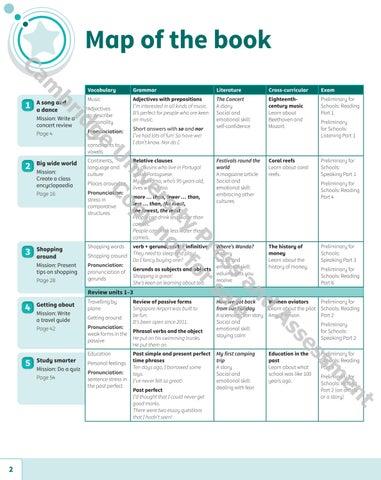
Map of the book Grammar
Literature
Cross-curricular
Exam
Music
Adjectives with prepositions I’m interested in all kinds of music. It’s perfect for people who are keen on music.
The Concert A diary Social and emotional skill: self-confidence
Eighteenthcentury music Learn about Beethoven and Mozart.
Preliminary for Schools: Reading Part 1
br
m
Ca Vocabulary
and 1 Aa song dance
id
Adjectives to describe personality Pronunciation: linking: consonants to vowels
Short answers with so and nor I’ve had lots of fun! So have we! I don’t know. Nor do I.
Continents, language and culture
Relative clauses My cousins who live in Portugal speak Portuguese. My grandma, who’s 95 years old, lives with us too.
ge
Mission: Write a concert review Page 4
Create a class encyclopaedia Page 16
3 Shopping around Mission: Present tips on shopping Page 28
As d an s le es sa Pr r y fo it t rs no ve y ni p U Co
wide world 2 Big Mission:
Places around us Pronunciation: stress in comparative structures
Shopping words
Shopping around Pronunciation: pronunciation of gerunds
more … than, fewer … than, less … than, the most, the fewest, the least People can drink less water than camels. People can drink less water than camels.
Festivals round the world A magazine article Social and emotional skill: embracing other cultures
verb + gerund, verb + infinitive They need to sleep and play! Do I fancy buying one?
Where’s Wanda? A story Social and Gerunds as subjects and objects emotional skill: valuing gifts you Shopping is great! receive She’s keen on learning about tea.
Coral reefs Learn about coral reefs.
The history of money Learn about the history of money.
Preliminary for Schools: Listening Part 1
Preliminary for Schools: Speaking Part 1 Preliminary for Schools: Reading Part 4
Preliminary for Schools: Speaking Part 3 Preliminary for Schools: Reading Part 6
Review units 1–3 about 4 Getting Mission: Write a travel guide Page 42
Travelling by plane
Getting around
Education
Study smarter Page 54
Education in the past Learn about what school was like 100 years ago.
Preliminary for Schools: Reading Part 5 Preliminary for Schools: Writing Part 2 (an article or a story)
t
Past perfect I’d thought that I could never get good marks. There were two essay questions that I hadn’t seen!
My first camping trip A story Social and emotional skill: dealing with fear
Preliminary for Schools: Speaking Part 2
en
2
Pronunciation: sentence stress in the past perfect
Past simple and present perfect time phrases Ten days ago, I borrowed some toys. I’ve never felt so great!
Preliminary for Schools: Reading Part 2
m
5 Mission: Do a quiz
Personal feelings
Phrasal verbs and the object He put on his swimming trunks. He put them on.
Women aviators How we got back Learn about the pilot from our holiday A science-fiction story Amy Johnson. Social and emotional skill: staying calm
ss se
Pronunciation: weak forms in the passive
Review of passive forms Singapore Airport was built to be fun. It’s been open since 2011.
Good job! 6 Mission: Write
Vocabulary
Grammar
Literature
Cross-curricular
Exam
Occupations
Modals of probability/ deduction It must be an old printer. A postman may use this. I think it might be an old hairdryer. It could be something that scientists use. It can’t be an ice-cream maker.
The daydreamer Social and emotional skill: taking the initiative
Economic sectors Learn about the chain of production for goods and services.
Preliminary for Schools: Listening Part 4
The hours A newspaper article Social and emotional skill: being honest
Forensic science Learn about how fingerprinting was invented.
Preliminary for Schools: Reading Part 3
The girl who turned blue A play Social and emotional skill: hard work brings success
Food labels Learn about how to read food labels.
Preliminary for Schools: Listening Part 3
Lost in the hills A story Social and emotional skill: being aware your decisions can affect other people
Wild weather Learn about hurricanes and how they form.
Work Pronunciation: linking groups of words
id
br
m
Ca
about your dream job Page 66
Preliminary for Schools: Reading Part 6
Present perfect continuous I’ve been working full-time for the last four years. I’ve been studying hard.
a news report Page 80
8 Fantastic flavours Mission: Write a café review Page 92
cats 9 Raining and dogs Mission: Present a weather forecast Page 104
Reporting the news
Reported speech He said she could walk in a circle or go to jail! He said that the man had to do a bike ride for charity.
As d an s le es sa Pr r y fo it t rs no ve y ni p U Co
the law! 7 It’s Mission: Write
ge
Review units 4–6
Reporting verbs
Pronunciation: contrastive stress
A three-course meal
Describing food
Pronunciation: intonation
The weather Weather adjectives
Reflexive pronouns We really enjoyed ourselves! I like things that I can cook myself. My mum makes them herself.
Too and enough They’re too messy to hold in your hands. It’s too spicy for you to eat. Be careful that they’re cool enough to not burn your tongue! It’s not sweet enough for me to want to drink.
Review first and second conditionals If it’s sunny this weekend, I’ll play football and fly my kite. I’d be delighted if there was no more lightning! I wish … I wish it was snowing today. I wish I could talk to animals. I wish I lived somewhere warmer.
Grammar look
Preliminary for Schools: Speaking Part 3
en
Pronunciation
Preliminary for Schools: Writing Part 1 (an email)
m
Review units 7–9
Preliminary for Schools: Speaking Part 4
ss se
Pronunciation: intonation in conditional sentences
Questions in reported speech Luis asked Clara why her hair was wet. Luis asked Dan if he could tell him the answer.
Preliminary for Schools: Listening Part 2
t 3
1 A song and a dance
1
3
ge
id
br
m
Ca
2
As d an s le es sa Pr r y fo it t rs no ve y ni p U Co
4
7
5
6
8
9
m
ss se en
Mission Write a concert review
Watch the video. What was the singer’s teacher called? 4
t
What can you see in the pictures? When do you listen to music?
1
Make a list of your favourite types of music.
2
Research concerts that are playing near you. Write a concert review.
Vocabulary 1
1 1.02
1 Listen and number the pictures. B
A
C
ge
id
br
m
Ca D
F
E
As d an s le es sa Pr r y fo it t rs no ve y ni p U Co
2 1.03 Complete the sentences with the words in the box. Listen and check. disco folk
hip-hop classical music jazz opera DJ studio recording stage
I love . I play the piano and my favourite piece is called Fur Elise by Beethoven.
5
We don’t use a of drums on a CD or computer – we make the drum sounds ourselves.
2
I’m a people listen to!
6
When
3
When the starts, the lights are flashing and everyone’s dancing, it’s the best feeling in the world.
singers stand on , they act like the happiest people in the world.
7
We’re a band, so we play traditional songs from our country.
8
I play saxophone and I’m in at the moment, recording the my new album.
4
so I choose the music
My favourite kind of music is I especially like rap music.
.
2
Name a band or someone you know who plays: hip-hop
3
classical music
folk music
t
What’s your favourite kind of music?
en
1
m
3 In pairs, use the words in Activity 2 to talk about music.
ss se
1
jazz
Have you ever played an instrument on stage or in a music studio? When?
Vocabulary: music
5
Language practice Language 1 presentation 1
ALL BLOGS
MY BLOG
NEW POST
From hip-hop to opera, I’m interested in all kinds of music. It’s so cool!!! But sometimes, I get tired of always listening to the same instruments, so this week I’ve been reading about (and listening to) some of the strangest musical inventions in the world. I hope you enjoy it!
Jim’s
m
Ca
Big Blog
The world’s strangest musical instruments!
br
The Great Stalacpipe Organ
ge
id
Inside most caves there are stalactites – they’re the rocks that slowly grow down from the ceiling of caves. In one enormous cave in the U.S.A. there’s an instrument that plays these spectacular stalactites. It’s huge! It works by hitting the stalactites with soft hammers. It was invented by Leland W Sprinkle in 1956. Some people say that Leland had the idea when his son hit his head in the cave and it made a beautiful noise. I guess that his son wasn’t happy about that!
Pikasso Guitar
Some people say the Singing Ringing Tree is a musical instrument, others say that it’s a piece of art, and some people think that it’s a tree! It was designed by Mike Tonkin and Anna Liu, and when the wind blows through the tree, the pipes make a noise that can sound like someone singing. The tree is on a hill in Lancashire in the North of England. Jenny and I are excited about visiting it soon! Good for people who are keen on listening to music when they go hiking. Not good for birds that want a place to make their homes there!
As d an s le es sa Pr r y fo it t rs no ve y ni p U Co
This strange instrument was made when a jazz musician called Pat Metheny asked for a guitar with as many strings as possible. The Pikasso guitar is very different from a normal guitar: it has 42 strings (instead of six) and it’s got four necks (instead of one)! The first Pikasso guitar was built in 1984 and was very difficult to make – in fact, it took around 1,000 hours. That’s about two years!!!
Singing Ringing Tree
Not good if you’re afraid of caves!
Good for people who are bored of playing normal guitars!
1 Read Jim’s blog. Complete the sentences. 1
2
Pat Metheny is famous for playing
3
Mike Tonkin and Anna Liu designed
ss se
Leland W Sprinkle invented
2 Read Jim’s blog again. Correct the underlined part of each sentence.
The Great Stalacpipe Organ makes music by dropping rocks into a lake.
3
Pat Metheny asked for a guitar with four necks and 42 strings.
4
The Singing Ringing Tree makes noise when people talk about it.
t
2
en
Jim has been reading about strange musical instruments for a long time.
m
1
6
Integrate new vocabulary and grammar
Language practice 1
1
Grammar look: adjectives with prepositions ‘The Pikasso guitar is very different from a normal guitar.’ ‘It’s perfect for people who are keen on listening to music when they go hiking!’ ‘It’s not good for birds that want a place to make their homes there!’
id
br
m
Ca
‘Good for people who are bored of playing normal guitars.’ ‘Jenny and I are excited about visiting it soon!’ ‘I’m interested in all kinds of music.’
ge
1 Some adjectives are often followed by prepositions. The preposition is followed by a noun or an infinitive / a gerund. 2 Adjectives with similar meanings are often followed by the same / a different preposition (e.g. frightened of, scared of, afraid of, terrified of). 3 Some adjectives can be followed by one / more than one preposition, or no preposition (e.g. I’m annoyed with you. / I’m annoyed about the football result. / Yes, I am annoyed.).
As d an s le es sa Pr r y fo it t rs no ve y ni p U Co
1 1.04 PRONUNCIATION Listen and repeat.
page 120
page 118
2 In pairs, complete the sentences with a preposition. Check your answers using a dictionary. 1
I’m pleased
2
She’s famous
3
I think folk music is similar
4
He’s proud
5
I was upset
6
She’s good
finishing recording my new album. being an opera singer.
how the recording sounded.
d
you know
?
being able to play jazz so well.
Di
pop music – it’s just a bit older.
playing the guitar.
3 1.06 Play the game. What are the missing prepositions?
ss se
Mission Stage 1
t
hip-hop rock
I’m not keen on jazz. What about dance?
en
jazz
m
Make a list of your favourite types of music. Choose a type of music to listen to at a concert.
People have loved making music together for a long time. The oldest recorded song in the world was written on stone about 3,400 years ago!
Hip-hop is more fun.
Grammar: adjectives with prepositions
7
Vocabulary 2 2
3
ge
id
br
m
Ca
1
1 1.07 Listen to the radio programme.
1 1.08 Complete the sentences with
the words in the box. Then listen and check.
1
Listeners of Cool at School can choose …
A B C
2
C
He always brings snacks to band practice. things. He does lots of
4
I think I’m quite Mike and Dan what to do.
5
And I think I’m quite sometimes. I often interrupt people or speak loudly.
6
He’s always . Practising a new song can be difficult or boring. But Callum’s always happy and positive.
7
He’s really – he always thinks of solutions to problems.
8
He’s too. I don’t think he’s ever missed band practice.
9
He’s very as well. He’s quiet and he doesn’t laugh as much as me and Mike.
4
Vocabulary: adjectives to describe personality
Dan is very reliable and only missed band practice …
A B C
. I always tell
5
their personalities aren’t the same. he eats all their food. learning songs is slow.
two times. to play sport. when he was writing a song.
What’s the band’s new song about?
A B C
being on your own sharing your feelings two unhappy people
t
3
A B C
en
Mike gets on well with everyone, he’s smile. friendly and he’s got a
Callum thinks the band argues because …
m
2
3
they always ‘try’ their best. when they started, their only instrument was a triangle. there are three people in the group.
ss se
8
It takes a long time to learn new songs and . We like Mike and I aren’t very to do things fast!
who’ll play at their school disco. which bands are interviewed. the interviewer’s questions.
The band are called The Triangle because …
A B
bossy rude generous cheerful patient serious intelligent reliable charming
1
Listen again. For each question, choose the correct answer.
As d an s le es sa Pr r y fo it t rs no ve y ni p U Co
What are the band members’ names?
3 1.09
EXAM TIP! Make sure you read the questions and answers before the listening starts.
Language practice 2
1
Grammar look: short answers with so and nor ‘I’ve had lots of fun!’ ‘So have we!’
‘I think he’s great.’ ‘So do I.’
‘I don’t know.’ ‘Nor do I.’
Ca
ge
id
br
m
1 We can use ‘so’ in short answers to mean also / not. 2 The verb we use in the short answer is the same as the auxiliary verb. If there is no auxiliary verb we use do or did / be or was. 3 To show negative agreement we use so / nor (or neither). page 120
1 Match the sentences (1–8) to the replies (A–H). ‘I’ve never seen an opera.’
A
‘Nor do I. It’d be great if everyone was polite.’
2
‘You’re very generous!’
B
‘Thank you! So are you.’
3
‘I like cheerful music.’
C
‘So would I. It’d be great to see someone famous there.’
4
‘I don’t like rude people.’
D
‘Nor am I. Well, I hope I’m not!’
5
‘I’d like to visit a recording studio.’
E
‘Nor have I. I’m going to see one next week though!’
6
‘I listened to hip-hop yesterday.’
F
‘Nor did I. Actually, I never listen to it.’
7
‘I’m not bossy.’
G
‘So do I. It always makes me smile.’
8
‘I didn’t listen to jazz yesterday.’
As d an s le es sa Pr r y fo it t rs no ve y ni p U Co
1
H ‘So did I. I think it’s the best kind of music.’
2 In pairs, read the sentences (1–8) from Activity 1. Reply with answers that are true for you. I’ve never seen an opera.
Nor have I. I’m not keen on opera.
3 Can you think of a sentence
Mission Stage 2
en
m
Research concerts that are playing near you. What type of music is it?
ss se
that five people in your class will agree with?
t
A band called FastLANE are playing at the town hall in October. They play rock music.
Grammar: short answers with so and nor
9
Literature
1 Do you like singing? Have you ever sung in front of an audience?
Ca 1.10
br
m
The concert
Monday
id
ge
What a great weekend! Ash stayed at my house on Saturday night. We spent ages lip synching to pop music videos on YouTube. Mum and Dad kept shouting at the bottom of the stairs, J ‘ ulie! Turn the music down!’ Ash said we should enter the lip-synching competition at the leisure centre on Saturday, but I don’t want to do it. I’ve never performed on stage before, I’d be far too nervous.
As d an s le es sa Pr r y fo it t rs no ve y ni p U Co
Tuesday
At school Ash said that we needed a name for our band. I told her that we didn’t really have a band, but she wouldn’t stop talking about it. She thinks we should be Jasha because it uses both our names. I couldn’t think of a better name so I think we’re going to be Jasha.
Wednesday
AGHHHHHH! I am SO angry with Ash right now. She’s entered J ‘ asha’ into the lip-synching competition! I didn’t think she was serious about doing it! She was so keen on thinking of a name for the band because we need one to enter the competition! Well, I’m NOT going to do it.
Thursday
en
m
ss se
Ash apologised – she said she was very sorry that she entered the competition without telling me. She was trying to be charming, but I told her I was still feeling angry. I didn’t want to talk to her today, but she was so excited about the competition and talked about it all the way through lunch. There are ten bands and each band does three songs. But it gets worse. Much worse. The bands don’t lip synch their last song, they sing it.
Text type: a diary
t
10
1 Friday
br
m
Ca
I’ve told Ash I’ll do the concert. Was that the right thing to do? She hugged me and shouted, ‘We’re going to win!’ When I got home, I told Mum that I was going to do the concert after all.
ge
id
I thought she would be pleased, but she wishes we were doing something different – Mozart or something. She said, ‘I just prefer classical music, darling, and so does your father. But good luck with the competition.’ Tomorrow’s the big day.
As d an s le es sa Pr r y fo it t rs no ve y ni p U Co Sunday
Yesterday was the best day of my life! Ash came round in the morning for our final practice. We got to the leisure centre at three o’clock, but I was too nervous to go in. I said, ‘I can’t do it.’ Ash held my hands in hers, looked straight at me, and said, ‘You can do it, Julie. You can do it, I can do it, we can do it.’
en
m
ss se
And we went in and we did it! I don’t remember much about being on stage. It happened so quickly. The lights were bright. The music started. And we did our songs. Everyone from school was shouting, J ‘ asha! Jasha!’ When it was time for the last song – the one we had to sing – my mouth went dry, but I sang ... and we came third in the competition! Ash has texted me the same message twenty times today: Next time we’ll win. You know, I think she might be right.
t
2 Role play a conversation. Imagine you are Julie and Ash. Student A You are Ash. Tell Julie that you have entered the competition. You are very excited.
Student B You are Julie. You are angry. Tell Ash why you are upset and how you feel. Social and emotional skill: self-confidence
11
Cross-curricular
1 What do you know about Beethoven and Mozart? Choose the correct words. 1
3
Mozart came from Germany / Austria.
4
Beethoven lost his sight / hearing.
Beethoven played the guitar / piano.
5
Mozart had money / family problems.
Ca
They were important composers from the twentieth / eighteenth century.
2
Wolfgang Amadeus Mozart
Check your answers to Activity 1.
Date of birth
27th January 1759
id
m
Name
Place of birth
Salzburg, Austria
Ludwig Van Beethoven
First teacher
His father, who was a musician and composer.
L
Instruments
Harpsichord and violin
Childhood
Mozart and his sister toured Europe playing concerts. He wrote his first symphony at eight years old and his first opera at 11.
Adult life
Moved to Vienna 1784. Married with six children. Financial problems and bad health. Died poor.
Date of death
1791 (aged 35)
br
2 1.11 Listen and read the text and the factfile..
ge
As d an s le es sa Pr r y fo it t rs no ve y ni p U Co
udwig Van Beethoven was a classical pianist and composer in the late eighteenth and early nineteenth century. Beethoven was born in Bonn, Germany in December 1770. His father and grandfather were musicians and wanted him to be a famous child musician like Mozart. When Beethoven was only five years old, his father taught him to play the piano, violin and viola. He played his first public performance when he was only seven. Beethoven left school to study music when he was ten years old and composed his first piece of music two years later.
He moved to Vienna in Austria to continue studying and composing. People loved his music in Vienna but then Beethoven began to go deaf. He continued to compose music but he could no longer perform it. Although Beethoven could not hear his music, people say that he wrote his best compositions such as The Ninth Symphony when he was completely deaf.
3 Read the text again. Write B (Beethoven) or M (Mozart) or both. 1
He was born in Bonn, Germany.
5
2
He wrote his first symphony when he was eight years old.
He started to play music when he was very young.
6
He lived in Vienna.
3
He had no money when he died.
7
He had no children.
4
He left his own country to study music.
Eighteenth century music
t
12
en
m
ss se
Beethoven never married and at the end of his life, he was often ill. He died on 27th March 1827. More than 20,000 people attended his funeral.
B1 Preliminary for Schools
1
1 Read and draw lines to match the texts
EXAM TIP! Underline the words in the text which match the option you choose.
(1–5) to where you might find them (A–E). 1
m
Ca
Hi! The weather here has been awful so far. My sister’s taking us to a match tomorrow. I’m not keen on going but it’s her favourite team. See you!
A
br
ge
2
10
id
Geoff
STUDIO
We thank you for leaving quietly without disturbing the neighbours. Helpline: 0800 154 154
4
As d an s le es sa Pr r y fo it t rs no ve y ni p U Co
3
B
You may get a headache or earache if used for longer than fifty minutes. We suggest keeping the volume between three and five.
C
G ING RNIN WARN WA
Silence please. Opera recording in progress. From 10 am to 12 pm every day this week.
Via Moran 26,
Rome, Italy.
Mehmet’s so generous. He’s just bought me a fantastic new keyboard. Can you come and listen to my new jazz piece tomorrow morning? I’d like your advice. 5
Paolo Stellari,
D
E
Th i s car parrk clo oses at 7 p m
2 What kind of texts are they? Match a notice on a door a text message a label on packaging a postcard a sign
3 Read number 5 in Activity 1 again and the sentences A–C. Put a cross next to the answers which are not correct. People can listen to the opera in the morning.
B
This week, Studio 10 is in use every afternoon.
C
People mustn’t make any noise outside the studio during the recording.
t
A
en
m
ss se
texts 1–5 to the words in the box.
Preparation for Reading Part 1
13
B1 Preliminary for Schools
1 Draw lines to match the sentence halves. Where did …
A
2
What does the …
B is often rude?
3
Which singer ...
C
4
What will …
D Peter go last Saturday?
5
Who is …
E
br
m
Ca
1
DJ do before the show?
EXAM TIP! You should use the second listening to doublecheck the three options and decide on your final answer.
going to the doctor’s this afternoon? Jennie do if it rains?
id
2 1.12 Read and listen to the conversation. Answer the questions. What three things do Peter and Maite talk about?
2
Why aren’t ‘see a band’ or ‘go skating’ the correct answer to the question?
ge
1
As d an s le es sa Pr r y fo it t rs no ve y ni p U Co
1
Where did Peter go last Saturday?
Maite
Hi Peter, did you go and see that band we were talking about on Saturday?
Peter
The one with the famous violin player? No, I couldn’t get there in time. In the end I went to my friend Gill’s house. What did you do?
Maite
Not much. I really wanted to go skating on Sunday but I missed the bus! I was five minutes late!
Peter
Ah, what a pity, Maite. Why don’t we go together next Saturday?
Maite
Yeah, why not! That’d be really nice!
3 1.13 Read the question and listen to the conversation. Which picture is correct? 2 A
B
C
en
m
ss se
What does the DJ do before the show?
t
14
Preparation for Listening Part 1
Review
1
1 For each question, write the correct answer. Write one word for each gap.
Ca
ge
id
br
m
If you’re bored (1) pop music or if you’re jazz, then you should listen to keen (2) playing the Han Bennink. He’s famous (3) drums and he’s good at it too. Han Bennink is always trying new things. For interested (4) example, he once played a drum kit that was made of cheese! The cheese drums sound similar (5) normal drums, but they’re a bit quieter, and they look much funnier! Han Bennink’s music is always creative hearing more. and new so I’m excited (6)
As d an s le es sa Pr r y fo it t rs no ve y ni p U Co
EXAM TIP! Read the whole sentence before you choose the correct word for each gap.
2 Complete the replies. Use short answers with so or nor. 1
‘You’re very intelligent!’ ‘Thank you.
2
‘I want to be a DJ when I grow up!’ ‘
3
. I’d love to go to one though.’ . I don’t like dancing!’
‘I don’t like serious music like jazz and opera.’ ‘
6
Find the meaning
! It looks like a great job.’
‘I’m not going to the disco on Friday.’ ‘
5
Choose ten words from this unit. Record the words using the steps below.
‘I’ve never been to a classical concert.’ ‘
4
.’
3
In this unit
. I prefer disco and hip-hop.’
In a dictionary
‘I’d be scared to stand on a stage and sing.’ . It must be terrifying.’
Record its meaning
Mission in action!
BUZZ
MUSIC REVIEW
Write the definition
t
THE
Write the word in your language
en
Write a concert review for your school newspaper or website.
m
ss se
‘
Use it
FastLANE in concert
NE On Saturday 4th October, FastLA l. hal n were playing at the tow
Say the meaning of the word to a partner. Can they guess it?
Unit consolidation
15
2 Big wide world
1
3
ge
id
br
m
Ca
2
As d an s le es sa Pr r y fo it t rs no ve y ni p U Co
4
7
5
6
8
9
a class encyclopaedia
Watch the video. Why does Jim want to visit Ireland?
1
Choose a country you’d like to visit and plan your research.
2
Write 5–10 amazing facts about the country you choose. Create and share a class encyclopaedia.
16
t
What can you see in the pictures? Which place would you like to visit the most?
en
m
ss se Mission Create
Vocabulary 1
2
1 1.14 Answer the quiz questions. Then listen and check your answers.
1 Are there penguins living
Ca
is the world’s 3 Which biggest continent?
in Africa? A No, it’s too hot. B Only in zoos. C Yes, in the south.
br
m
A Africa B Asia C Europe
many languages are 2 How spoken on the continent
A Canada. B Russia. C China.
biggest art gallery 4 The in the world is in …
ge
id
many countries 6 How are there in the world?
A France. B China. C the U.S.A.
A fewer than 90 B more than 190 C about 1,190
As d an s le es sa Pr r y fo it t rs no ve y ni p U Co
of Australia? A around 13 B around 130 C around 1,300
biggest country in 5 The the world is …
2 1.15 Write the continents and complete the sentences.
3 Complete the challenges.
Use the words in the box. Then listen again and check. Africa Antarctica Asia Australia Europe North America South America nationality languages climates culture landscapes
A world of facts
1
5
3
4 Africa
2
Name three places people go to learn about the culture of where you live.
3
Think of three nationalities that are also the word for a language (e.g. French).
2
6
4
are spoken in Papua New Guinea. of
en t
The Louvre is a great place to learn about the 9 France and Europe.
Name three things you can see in the landscape of Antarctica.
m
More than 700 8
Put the continents in order of how close they are to your house.
ss se
There are lots of different 7 all around Africa – from hot and rainy areas with rainforest, to cold snowy mountain areas, and hot dry deserts.
1
is in the east, One of Russia’s most amazing 10 where there are huge forests where tigers live. The 11
of people from Brazil is Brazilian.
Vocabulary: continents, language and culture
17
Language presentation 1
Ca
2
1
3
ge
id
br
m As d an s le es sa Pr r y fo it t rs no ve y ni p U Co
1 1.16 Listen to the podcast. Draw lines to match the children’s names to the food they took to the festival.
Erol
Kyle
Maria
2 1.17 Listen again. Complete the sentences with the correct name, Kyle, Maria or Erol. 1
is 12 years old.
4
made some food today.
2
says how a food got its name.
5
has a pet snake called Cucumber.
3
brought food that’s usually eaten on a special day.
6
says how a food got its colour.
3
Read this email from your English-speaking friend Erol, and the notes you have made. Write your answer in about 100 words.
Hello!
18
Integrate new vocabulary and grammar
t
Erol
en
See you soon,
EXAM TIP! Write your answer as an email and use all of the notes in your reply. You could start with ‘Dear Erol’ and end with ‘from’ or ‘See you soon’ and then your name.
m
going to the school food Do you remember we talked about and my mum and dad festival? It’s on Saturday at lunchtime said that I can go. Brilliant! and make some food to Would you like to meet me before it take together? Yes – say what time What do you think we should make? festival? Suggest … What would you like to do after the
ss se
Hi,
Language practice 1
2
Grammar look: relative clauses Non-defining ‘My grandma, who is 95 years old, lives with us too.’ ‘I brought these salmon and cucumber sandwiches, which I made this morning.’
br
m
Ca
Defining ‘My cousins who live in Portugal speak Portuguese.’ ‘It’s a cake that people eat while they’re looking at the moon!’
ge
id
1 Defining / Non-defining relative clauses are used to explain who or what a sentence is about. 2 Defining / Non-defining relative clauses are used to give extra information. We already know who or what is being talked about. 3 You can use ‘that’ with defining / non-defining relative clauses. 4 We use commas with defining / non-defining relative clauses.
As d an s le es sa Pr r y fo it t rs no ve y ni p U Co
1 Read the clues below. What’s the answer?
Words starting with ‘p’
1
A country in Europe where most people speak Portuguese.
2
page 121
Choose a letter and write four clues using defining relative clauses. Ask a small group to guess which words you described.
3 Read the story. Add non-defining relative clauses to extend the story.
2
Someone who helps keep towns safe.
3
A food which is from Italy and often has cheese and tomato on.
4
Something which you use to write with.
, did not have The rabbit, (4) any food but wanted to help the three people. So he said, ‘You can eat me,’ and jumped into their fire. The three poor old people, (5) , were amazed. They agreed to save the rabbit and send it to the moon to live forever.
en t
Australia Landscape – very varied Population – 24 million Places of interest – Sydney Harbour Bridge, …
One day, there were three poor old people, (1) . They asked for food from a fox, a monkey and a rabbit, (2) . The fox gave them meat, which he wanted to eat himself. The monkey gave them fruit, (3) .
m
Choose a country you would like to visit and plan your research.
A traditional Chinese story
ss se
Mission Stage 1
MOONCAKES
At the mid-Autumn festival, in China, people eat mooncakes and look at the moon to try and see the rabbit. The rabbit, (6) , helps make medicine for people who live in the sky. Grammar: relative clauses
19
Language practice Vocabulary 1 2
1 Read the posts. Who went on a
m
Ca JIM
Hi all, Jenny and I are thinking of going on a holiday which lets us visit more than one place. Has anyone tried this? How did it go? Can you tell me a fun fact about the place you went to? Please help! Jim
boat on their holiday?
2 Match the words in bold to the pictures below.
br
1
2
3
4
5
6
id
A This summer I went on a camel-riding trip with my family.
ge
We went to Kenya, in Africa – and we rode the camels to a different campsite every day. We slept in tents and could hear all the animals around us calling through the night. I slept OK but my mum slept the least :(. People drink less water than camels. Camels can drink about 135 litres in 15 minutes (that’s about 600 glasses!). Then they can live for seven months without water. That’s amazing, isn’t it!? CoolCat11
As d an s le es sa Pr r y fo it t rs no ve y ni p U Co 7
B
I went on a cruise around Europe. We stopped in lots of different harbours and ports like Genoa and Barcelona along the way and visited different cities. The biggest cruise ships have more than 2,500 bedrooms! That’s a lot of rooms but it’s fewer than in the world’s biggest hotels. See you soon! Sloopy12345
3
1
C
4
Valeria’s going on holiday with her parents. Her mum loves the sea and her dad likes walking. They love to eat outside in beautiful scenery. Tim likes to be outside for most of his holiday. He hopes to visit an exciting place in Australia or Africa and see some interesting animals.
en
Zoe wants a relaxing trip. She likes to travel through the countryside slowly so that she can take lots of photos.
EXAM TIP! When you’re matching, think about the meaning of the whole text.
t
Vocabulary: places around us
3
Peter’s very friendly and he’d like to meet lots of people. He’s looking for a holiday where he can visit different places.
m
20
I went on a holiday to Matapouri Bay in New Zealand, which is on the continent of Australia. We started at the seaside where we played in the sand, then we hiked along a beautiful bay and had a picnic on some huge cliffs. Then we went up a valley, between two huge mountains. Did you know that in New Zealand there are fewer people than sheep? Star_Loo
2
Which of the holidays in the replies A–D would be best for the people below?
ss se
D
Last year I went to Cheshire Ring in England in a beautiful green and red canal boat. It was great! The scenery that you can see from the boat is amazing – you’ll see hills, valleys and rivers! You can’t travel very far each day because canal boats are really, really slow. There are fewer canals in the UK than there were a hundred years ago, but the canals are much more fun now. There are cinemas, cafés and theatres on canal boats in England! ArtBurger
8
Language practice 2
Grammar look: more … than, fewer … than, less … than, the most, the fewest, the least ‘There are fewer canals in the UK than there were 100 years ago.’ ‘People drink less water than camels.’
m
Ca
‘We’re thinking of going on a holiday which lets us visit more than one place.’ ‘Did you know that in New Zealand there are fewer people than sheep?’
ge
id
br
1 We use less … than and the least / fewer and the fewest to compare plural countable nouns. 2 We use less … than and the least / fewer and the fewest to compare uncountable nouns. 3 Less … than, fewer… than, and more … than are comparatives / superlatives. 4 The most, the least and the fewest are comparatives / superlatives.
As d an s le es sa Pr r y fo it t rs no ve y ni p U Co
1 1.18 PRONUNCIATION
page 121
Listen and repeat.
page 118
2 Choose the correct words to complete the facts.
A WORLD
OF TRAVEL
3 In pairs, ask and answer questions. 1
Dan ’s got fewer shoes than
2
spends the most time travelling to school.
3
’s been on the fewest kinds of transport.
4
rides a bike less than
5
A lot of people think that flying isn’t safe. But actually it’s the (1) least / most dangerous way to travel.
.
spent the least time in a car last weekend. takes the bus more often than
.
I’ve got about four pairs of shoes. How many have you got, Dan?
I’ve got two.
ss se
The fastest sailing trip around the world took (2) fewer / more than 50 days! In fact, it only took 40 days, 23 hours, 30 minutes and 30 seconds.
6
.
me
Mission Stage 2
t
Twenty years livingisland Australia is theago largest on boats wasn’t very and the smallest continent in popular, but today the world./ less than (3) more
en
The station used by the (4) most / fewest passengers might be Shippea Hill in the UK. Only about 12 people get on or off the train there each year!
Write 5–10 amazing facts about the country you chose.
m
Twenty years ago living on boats wasn’t very popular, but today (3) more / less than 10,000 people in London live on canal boats.
10,000 people in London live on canal boats.
Grammar: more … than, fewer … than, less … than, the most, the fewest, the least
21
Literature
1 Look at the pictures. Have you heard of any of these festivals? What festivals are celebrated in your country?
m
Ca
Festivals id
br
1.20
ge
around the world
As d an s le es sa Pr r y fo it t rs no ve y ni p U Co
Countries around the world celebrate different festivals every year. This month we are looking at three of those festivals.
Holi Festival, London by Emlyn Richardson
Text type: A magazine article
t
22
In London, The Colour Run celebrates the festival too. It’s an unforgettable day! You need a ticket to take part. Go online to find out how to get your ticket. You won’t regret it!
en
In India they celebrate it by throwing coloured powder and splashing water over each other. The streets explode with colour.
Runners have powder paint thrown over them as they pass by! Hindus believe that the coloured paint makes everyone look the same, so that people forget their differences.
m
his traditional Hindu festival celebrates the beginning of spring. It’s a festival of colour and it’s mainly celebrated in India and Nepal, but is also celebrated in many other places, like Europe and North America, where a lot of Hindu people live. That includes London, where five percent of the population is Hindu.
ss se
T
2 The Monkey Buffet by Daw Cunningham
T
ge
id
br
m
Ca
hailand, which has a population of sixty-seven million, is one of the 49 countries which make up the continent of Asia. Thailand has more wild monkeys per square mile than nearly any country in the world. Monkeys are one of the greatest tourist attractions in Thailand – so much so that they have their own festival, and it’s called The Monkey Buffet. The local people believe that monkeys bring good luck, and they may be right, because The Monkey Buffet attracts thousands of tourists every year!
As d an s le es sa Pr r y fo it t rs no ve y ni p U Co
On 25th November people come to the festival from all over the world. They dress up as monkeys, and they bring more than 4,000 kilos of food and drinks with them … for the monkeys! They lay the food out on large tables.
Then they wait for the monkeys to come! And they do … hundreds of them … to enjoy the fruit and desserts, while the visitors take photographs and do monkey dances to celebrate them! It's an extraodinary sight.
The Annual Kite Festival by Francisco Pérez García
E
very year in the small town of Sumpango in Guatemala, people celebrate the Kite Festival on 1st November. Thousands of people from all over Guatemala, as well as visitors from other countries, travel to Sumpango for the festival.
ss se
The kites are all made by people living in the area. They work all year to have their kites ready for the festival. The kites are very big (sometimes twenty metres in diameter) and very colourful. They are made from tissue paper, and often carry messages asking the people who find them to look after the environment.
t
these festivals you would like to go to and why.
I’d love to go to The Monkey Buffet because …
en
m
2 In groups, talk about which of
Social and emotional skill: embracing other cultures
23
Cross-curricular
1 Look at the pictures. What are three things you
3 Read the text again and
know about coral reefs?
say yes or no.
m
Ca Listen and read the text. Did you find your ideas? What new facts did you find?
ge
id
br
2 1.21
What is happening in our oceans? or many years scientists have been worried about our oceans. Oceans do an excellent job of controlling the temperature on Earth, but climate change means that the oceans are taking in the extra heat from the planet. So as the planet gets warmer, so do the oceans. If the oceans get too warm, many plants and animals that live in them might die.
2
The oceans are getting warmer because the Earth is getting warmer.
3
Coral reefs produce carbon dioxide.
4
Algae feed the reef and animals that live there.
5
Algae die when it’s colder than 29°C.
6
Coral is usually white.
4 There are seven continents and five oceans. Find out the names of the five oceans. Order them from the largest to the smallest.
1 2 3 4
5
The Great Barrier Reef, a coral reef which is off the coast of Australia, is the size of about 70 million football fields!
24
Coral reefs
d
you know
t en?
Di
m
ss se
An example of this is the coral reefs. Coral reef ecosystems are important for lots of reasons. They remove and recycle carbon dioxide and they also protect the land from bad weather. Lots of animals like sea turtles, sharks and many kinds of fish live on the reef and without it, many of these plants and animals would die. orals get their amazing colours from tiny algae that live in them. The most important thing that algae do is make food for the coral and also for many animals living in the coral reef. But, when the water gets too warm (more than 29°C) the algae stop making food and die. This means that the coral loses its colour and turns white. This is called ‘bleaching’. So, we need to look after our coral reefs.
C
The ocean helps control the Earth’s temperature.
As d an s le es sa Pr r y fo it t rs no ve y ni p U Co
F
1
B1 Preliminary for Schools
2
1 Read the sentences and say yes or no. 1
Ca
There are two examiners in the room when you take the speaking test.
2
m
You always take the test with another candidate. First you are asked to give your name, your age and say where you live.
4
Next, you are asked about everyday situations or routines.
5
You can ask the examiner to repeat a question or instructions.
ge
id
br
3
As d an s le es sa Pr r y fo it t rs no ve y ni p U Co
5 In pairs, take turns at being the
2 1.22 Listen to the conversation.
examiner and a candidate. Answer with more than one word.
What could Dominic do to improve his answers?
Tell us about a place you like.
Location?
3 1.23 Listen again. Make Dominic’s
Things to see/ do there?
answers longer. Use the phrases in the box.
PLACE
I’m called … I’m … I live in … I live with …
4 1.24 Put the words in order. Then
listen and check. Are Dominic’s answers better? 1
Wh en to go?
With wh o?
Tell us about a place you like. I / Australia / like / incredible / got / landscapes / because / it’s
ss se
EXAM TIP! Try not to give oneword answers. Always give extra information when you can.
How often do you go to the seaside? go / I / usually / my / with / family / summer / every
3
What other languages can you speak? speak / German / I / little / a / can / and / Spanish
4
Which subject do you like best, geography or history? think / I / prefer / I / geography / we / study / because / climates / cultures / and
en
m
2
t
Preparation for Speaking Part 1
25
B1 Preliminary for Schools
1 Look at the text. Is it a letter to a friend,
4 Read the last part. Two
an advertisement or part of a magazine article?
br
m
Ca
sentences have been removed. For each question, choose the correct answer. There are two extra sentences which you do not need to use.
id
A S u rp ri s in g C o n ti n
ent
Can humans live in Antarctica? In fact some people live on the continent for many months during the year. (2) These people all use specia l equipment and wear thick clothes to protect them from the cold. They have to be careful because in 1983, the temperature was a shocking -89.2 degrees centigrade. (3) The Amundsen-Scott South Pole Station is the most wellknown research centre in Antarctica. It is named after a Norwegian and a British explorer who reached the South Pole in 1911 and 1912.
A
ge
ldest and most ntarctica is definitely the co lots of unusual are southern continent. There no y t teach you at facts about it that they ma ve it, but what you are school! You might not belie e. For example, it’s going to read next is all tru as big as Australia. ice bigger than Europe and tw got used to the cold A number of animals have nage to live in the temperatures and they ma Killer whales and extreme cond itions there. sight. King penguins penguins are a common the chick on their feet keep first the egg and then the chick is able to covered with a pouch until regular. Certain types of keep its body temperature is freezing landscape. plants can even grow in th
As d an s le es sa Pr r y fo it t rs no ve y ni p U Co
2 Read the text. What do the words in bold refer to?
The research is for biology, computer science and other subjects.
B
They are usually experienced scientists who are doing research.
C
That makes it the coldest temperature ever recorded on Earth.
D
Amundsen and his team arrived five weeks before Scott.
3 Read the next part of the text. Choose
the correct sentence to complete the text.
EXAM TIP! When you choose an option, check that any words like ‘that’ or ‘this’ in the text link to the right information.
t
Preparation for Reading Part 4
en
26
m
… freezing landscape. That’s amazing because most of Antarctica is covered in ice which is more than 1.6 km deep. About 90% of all of the ice on our planet is found in Antarctica. It’s actually considered a desert because it hardly rains. (1) We already know that the scenery is changing because of environmental issues. / ‘Hair grass’ grows in between rocks in the summer. However, if all of the ice disappeared, sea levels would rise by about 60 metres. Cities on the coast like New York and Shanghai would then be in great danger.
ss se
A
Review
2
1 Make one sentence. Use defining relative clauses for 1–3 and non-defining clauses for 4–6. 1
4
My friend often visits his family in Portugal. (He speaks English and Portuguese.)
5
I often go to Australia. (It’s a 12-hour flight from where I live.)
6
The world’s biggest art gallery is in France. (It’s called the Louvre.)
Ca
Europe is a continent. It has countries like Spain, Poland and Greece in it.
br
m
Europe is a continent which has countries like Spain, Poland and Greece in it.
I live in a town. There’s lots to do in it.
3
Africa is the continent. The world’s longest river goes through it.
ge
id
2
As d an s le es sa Pr r y fo it t rs no ve y ni p U Co
2 Choose the correct words to
complete the facts about Asia.
3 Look at the new words from this unit. Make puzzles with the words using the steps below. Make a ‘Find the different word’ puzzle Four places you can find water + one other word
Make one more puzzle
Your own idea
Four things you use with your hands + one other word
Use it
Challenge a friend to find the different word in each of your puzzles
en
m
Mission in action!
Four continents + one other word
ss se
There are (1) fewer / the most people living in Africa, Europe, North America, Australia and South America than there are in Asia. (2) More than / The least 4,000 children in China have the name Aoyun, which means ‘Olympic Games’. Asia has (3) the most / more high buildings of any continent. In fact, nine of the highest ten buildings in the world are there. The continent with the (4) fewest / least high buildings is, of course, Antarctica. The (5) least / fewest mountainous country in the world is in Asia. It’s called the Maldives and the highest point there is (6) the most / less than 2.5 metres above the sea.
t
Put the class research together. Make an amazing facts encyclopaedia. [U2_aw2.30] Illo
Unit consolidation
27
3 Shopping around
1
3
ge
id
br
m
Ca
2
As d an s le es sa Pr r y fo it t rs no ve y ni p U Co
4
7
5
6
8
9
Watch the video. How does Jim spend his £3? 28
1
Find out about a city, its currency and the shopping.
2
Make a list of shopping tips and recommendations. Present your travel tips in a blog.
t
What can you see in the pictures? What was the last thing you bought?
en
shopping
m
ss se Mission Present tips on
Vocabulary 1
3
1 Match the words in bold to the definitions (A–L).
SALE
**************************
Ca
Get your bargain clothes this weekend!
************************** RECEIPT NUMBER: 559656544 Your shop assistant today was Carl
ge
id
br
m
Find T-shirts for the lowest prices in the country! Pay by credit card and get an extra 10% discount.
C R A I G’S C LO T H ES
dollars
cents
£12.95
SHORTS:
£5.95
TOTAL:
£18.90
CASH PAID:
£50.00
CHANGE:
£31.10
As d an s le es sa Pr r y fo it t rs no ve y ni p U Co
euros
T-SHIRT:
pounds
pence
A
money, for example coins or notes
G
B
the money used in the USA
H the money used in the UK
C
there are 100 of these in a euro or dollar
I
someone who helps you in a shop
D
something sold for less than its usual price
J
the money used in many European countries
E
a small plastic card that adults sometimes use to pay for things
K
the money you get back when you pay more for something than it costs
F
a piece of paper that lists the shopping you’ve bought
L
the amount of money for which things are sold
2 Look at the pictures below. Which words from Activity 1 can you see? 2
There’s a shop assistant in picture 1.
3
en
m
ss se
1
there are 100 of these in one pound
t
3
Choose one of the pictures from Activity 2. Talk about it for one minute.
EXAM TIP! Talk about the people and places you see in the photo. Make guesses or say how you feel about it too.
Vocabulary: shopping words
29
Language practice Language 1 presentation 1
ALL BLOGS
Jim vs. Jenny
MY BLOG
NEW POST
m
Ca
Jenny and I have been shopping online! We saw some awesome stuff and some awful stuff. The problem is that we couldn’t agree what was stupid and what was great! Here are a few of the things we argued about the most.
1 The ice-cream cone that turns your ice cream
br
for you!
ge
id
Jim: This looks great! I can imagine showing it to all my friends – I know they’d all think it was really cool. It’s also awesome because it keeps your hands clean when you’re eating an ice cream. And it’s less than £10, which I think is a bargain. AWESOME!
Jim: Babies are already cute, right? And they look even cuter when they’re wearing these floor-cleaning clothes! It’s also great because the baby will learn to help at home from a young age. AWESOME! Jenny: Babies don’t need to learn to work hard; they need to sleep and play! I don’t think you could use those baby clothes to clean your car either! AWFUL!
As d an s le es sa Pr r y fo it t rs no ve y ni p U Co
Jenny: I’ve always thought ice-cream cones are the most delicious part. And how lazy do you have to be to not want to turn your own ice cream? Jim says that £10 isn’t too expensive, but normal ice-cream cones only cost a few pence! Worst of all, when you’ve finished eating the ice cream, you need to wash your cone! AWFUL!
3 A baby floor-cleaner
2 The bike that you walk to ride
Jenny: The shop assistant said that people who are scared of riding normal bikes should buy this bike. It’s electric too, so even if you walk quite slowly you can get to the school or to the shops easily. It’s brilliant! AWESOME!
Jim: If you want to walk to the shops, you don’t need a £2,000 bicycle, you just need shoes! I think this bike’s silly because it’s a very complicated solution to a problem that doesn’t exist. Do I fancy buying one? Not at all! AWFUL!
1 Look at Jim and
A
B
Jenny: It often rains where I live and I hate it when I get wet feet! My socks take hours to dry and my feet start smelling too. I’d love a pair of shoe umbrellas that help to keep my feet dry! AWESOME! Jim: These honestly make no sense! Firstly, you could use a normal umbrella to cover your shoes. Secondly, they fail to cover all of your shoes – they only cover half of each one. Finally, they look really, really awful! AWFUL!
C
D
m
ss se
Jenny’s blog. Match headings (1–4) to the pictures (A–D).
4 Shoe umbrellas
en
2 Awesome or awful? Complete the table with your opinion and information from the blog.
30
I think it’s …
Because …
awesome
it keeps your hands clean
Integrate new vocabulary and grammar
t
Object 1 Ice-cream cone 2 Walk-on bike 3 The baby floor-cleaner 4 Shoe umbrellas
Language practice 1
3
Grammar look: verb + gerund, verb + infinitive
br
m
Ca
verb + infinitive ‘If you want to walk to the shops, you don’t need a £2,000 bicycle.’ ‘They need to sleep and play!’ ‘I’d love a pair of shoe umbrellas that help to keep my feet dry!’
verb + gerund ‘Do I fancy buying one?’ ‘When you’ve finished eating the ice cream, you need to wash your cone.’ ‘My socks take hours to dry, and my feet start smelling.’
ge
id
When one verb is followed by another, the second verb can be either a gerund (e.g. (1) walking / to walk) or an infinitive (e.g. (2) buying / to buy).
Listen and repeat.
2
page 118
Complete the sentences for you. ou u. n How many can you complete in four minutes?
1 I’d like to visit …
4 In pairs, say your sentences from Activity 2.
As d an s le es sa Pr r y fo it t rs no ve y ni p U Co
1 1.25 PRONUNCIATION
page 122
I want to go shopping after school today.
I don’t. I’d like to visit my grandma.
OK. Let’s try another sentence.
2 I finished doing …
3 I want to go …
5 I chose to see …
4 I prefer watching … 6 I plan to read …
8 I agreed to play …
7 I enjoy seeing …
9 I hate finding …
10 I asked to watch …
verb + gerund
would like
finish
Find out about a city, its currency and the shopping.
t
verb + infinitive
en
Complete the table. Use the words in bold from Activity 2.
Mission Stage 1
m
3
12 I stopp ed running …
ss se
11 I’ve never tried playing…
In Italy, credit cards aren’t used very much. Also, always ask permission before you touch something at a market.
Grammar: verb + gerund, verb + infinitive
31
Vocabulary 2
1 1.27 Listen and point to the things the children bought. A
B
C
D
ge
id
br
m
Ca 3 1.29
the words in the box. Listen and check. cost return selling spend exchange a sale for sale reduced second-hand damaged reasonable luxury
The last thing I bought was a pencil case.
2
It only was new.
3
Shopping is great when someone is what you want so cheaply.
4
We saw a watch at the market near our house.
6
A it was cheap. C it’s useful.
£1, but it’d be £5 if it
2
The boy wanted to return his watch because …
A he had to repair it himself. B it stopped working.
C it was uncomfortable.
3
It looked expensive but the price was . actually very
We wanted to it, but when we went back to the market the seller wasn’t there!
8
There was on in the shop too so from the price of the snails was $5 to $3.
my money
I decided to take them back to the shop and them for another toy.
10
One of the snails fell on the floor and . was
B look after her receipts.
C buy something else in a sale.
4
The boy thinks his sister will …
A say the present is useless. B enjoy eating the present.
C use it to make a hot drink. EXAM TIP! The first time you listen, try to understand the overall meaning and choose the best answer. The second time you hear it, focus on specific information to check your answers.
t
9
A plan what to buy.
en
Next time, I think I’ll at a shop I can trust.
Next time the girl goes shopping she thinks she should …
m
7
Vocabulary: shopping around
The girl thinks the best thing about her pencil case is that …
ss se
32
1
B it looks good.
1
5
Listen again. For each question, choose the correct answer.
As d an s le es sa Pr r y fo it t rs no ve y ni p U Co
2 1.28 Complete the sentences. Use
Language practice 2
3
Grammar look: gerunds as subjects and objects 3 ‘She’s keen on learning about tea.’ 4 ‘Not planning your shopping can cause problems.’
m
Ca
1 ‘Shopping is great when someone is selling what you want so cheaply.’ 2 ‘I didn’t love playing with them.’
ge
id
br
We can use (1) -ing forms / infinitive forms of verbs to make them into nouns. These forms can be the subject (e.g. (2) sentence 1 / sentence 2) or object of a sentence (e.g. (3) sentence 1 / sentence 2). We (4) always / never use -ing nouns (and not infinitives) after prepositions. page 122
As d an s le es sa Pr r y fo it t rs no ve y ni p U Co
1 Complete the sentences. Use the correctt form of the verbs in brackets. 1
When I’m in the town centre I love for bargains. (search)
2
to second-hand markets is great fun on Saturday mornings. (go)
3
When I go shopping, I like a hamburger for my lunch. (eat)
4
I’m excited about round the shops when the sales are on. (walk)
5
is my favourite hobby. (shop)
6
I think that shoes is the most boring activity in the world. (buy)
2 Re-write the sentences from Activity 1 so that they are true for you. Change all the underlined words. Activity 2. Ask questions. Do you often buy any?
Write shopping tips and recommendations.
en
All of the best shops are in the ‘rectangle of gold’ in Milan. This means that you don don’tt need to walk too far.
t
Not usually. They’re really expensive, unless there’s a sale on.
Mission Stage 2
m
When I’m in the town centre I love looking at the luxury socks.
ss se
3 In pairs, share your sentences from
Grammar: gerunds as subjects and objects
33
Literature
1 What do you think happens to your money after you spend it? Where does it go? Who gets it next?
Ca
Where’s Wanda?
m
1.30
br
ge
id
One day Dad walked into my bedroom very excited. ‘Look at this, Tom,’ he said. ‘The new five-pound note!’ He put the new, clean note into my hand. ‘It might be valuable one day. Look at the serial number: 30111874.’ I looked at it carefully. There was a picture of the Queen and of Churchill.
As d an s le es sa Pr r y fo it t rs no ve y ni p U Co
‘I don’t understand why it’s so special?’ I said. He pointed to the serial number. ‘Look! Churchill’s birthdate is the same as the serial number. Collecting banknotes was my hobby when I was your age! Anyway, I thought you’d like to keep it,’ he said, smiling. I put the banknote into my backpack and forgot about it. Many months later Dad said, ‘Tom, they’re buying and selling five-pound notes with special serial numbers online. Do you want to sell yours?’
en
m
ss se
Oh no! I thought. How was I going to tell him I didn’t have it any more? And that I spent it on a second-hand video game. I knew I had to tell him, so I took a deep breath and told him very quickly. ‘Don’t worry, we can find it!’ he said calmly. ‘What?’ I asked. He explained that nowadays with special software we could probably find its location. ‘How?’ I asked. He explained that he wrote the question: Where’s Wanda? on the banknote and anyone who knew the website might log in and write the serial number on it. This meant we could locate it. ‘Great! Let’s try to find it!’ I said.
t
34
Text type: a story
3
m
Ca
After opening the site, I typed in our address and the serial number. Immediately little flags of banknotes appeared all over a map of the UK. There was also a flag in Paris, France. ‘What next, Dad?’ I asked excitedly. ‘We’ll read the comments people posted and then we can follow its journey,’ he said.
ge
id
br
We discovered that after spending a few days in the second-hand game shop it appeared a few miles from here. Then the note disappeared for a couple of weeks and showed up in Paris. Now it was back in London and just a few miles from here. ‘That’s awesome, Dad!’ I said. ‘Yes, just imagine how far a banknote travels in its lifetime!’ he replied.
As d an s le es sa Pr r y fo it t rs no ve y ni p U Co
I felt bad. I had to get the banknote back. I looked again at the name of the new owner. Could this be the same Mr Evans at our local shop? I decided to find out the next day.
‘Hello, Mr Evans. Do you have a five-pound banknote on the Where’s Wanda site?’ ‘Yes, why?’ he asked. ‘It’s kind of special to me,’ I replied. ‘If it’s so special, why did you spend it?’ he asked. I explained what happened.
‘OK, but what can you give me for it?’ he asked. I offered my new video game. ‘But I can get more money for it if I sell it online,’ he said. ‘How about doing a paper round for me all this month and I’ll give it to you?’ ‘Done!’ I said.
2 In pairs, talk about the questions. Why was Tom’s dad excited about the five-pound note?
2
How do you think Tom felt when his dad asked about the banknote? Why?
3
Was the response from Tom’s dad good or bad? Why?
4
Why did Tom want the banknote again?
5
Why do you think Tom started to collect banknotes?
t
1
en
m
ss se
A month later, when I got the banknote I ran home and told my dad. He was very happy. And I was too. Five years later I still have the same banknote. I don’t think I’ll ever spend or sell it because it was the first in my very big collection of special banknotes.
Emotional skill: valuing gifts you receive
35
Cross-curricular
A
B
1 The photos show ways that people
D
C
E
ge
id
br
m
Ca
have bought things through history. Order the photos (1–5) from the earliest to the most modern way of shopping.
2 1.31 Listen and read the text. Check your answer to Activity 1.
As d an s le es sa Pr r y fo it t rs no ve y ni p U Co
We use money every day but long ago people didn’t have any money and so they ‘bartered’. This is when you exchange something you have for something you need from another person. The items had to have a similar value. You would not exchange your telephone for a pencil, would you?!
To solve this problem, people in China started using shells to buy things instead of bartering. Meanwhile, in the west people started to use something that was strong and wouldn’t break easily. They decided to use gold, but gold was heavy and difficult to carry. In 200 AD, coins were made. Coins were small and they were weighed and stamped so everybody knew how much they were worth. Carrying all that gold around was worrying, so people left it with a goldsmith who kept it safe. The goldsmith gave the owner a receipt for the gold and these receipts were the first banknotes.
Money continued to change. In the 1950s credit cards were invented. This meant we didn’t need to carry coins or notes to pay. Now, lots of people don’t carry cash at all and they pay with their cards or even their phone! Most of the money in the world today is invisible. Who knows what will happen in the future?
3 Read the text again and answer the questions.
ss se
How did the bartering system work?
4
What are the advantages of using a credit card?
2
What problems did people have with this system?
5
What does the sentence: ‘Most of the money in the world today is invisible’ mean?
en
m
1
t
3
36
How did people know that the goldsmith couldn’t steal their gold?
The history of money
B1 Preliminary for Schools
3
1 Look at the pictures and
A present for a school friend
read the instructions.
ge
id
br
m
Ca
You want to buy a present for a school friend. Here are some items in a department store which you could buy. Look at the pictures. What items are in each picture? Which do you think would be the best present?
As d an s le es sa Pr r y fo it t rs no ve y ni p U Co
2 Read Jo and Kathy’s
conversation about the pictures. Which ideas for presents do they talk about? Jo
So … in this picture there’s a cute teddy bear. It looks really soft. That could be something nice to have in their bedroom. (1)
Kat I think it might be too big and maybe the friend has already got a few teddy bears. It looks quite expensive so maybe we should look at something else. (2) Jo
Let’s talk about the pencil case and pens.
B
What about some new headphones?
C
I’m not sure.
D
Mmm, that’s true.
E
What do you think?
F
Yes, you’re right!
4 In pairs, do the task in Activity 1. Include phrases that give your opinion.
t
EXAM TIP! Try to make your own suggestions and respond to what the other candidate says. You don’t have to agree on the final choice.
en
Kat (6) I think pens are a boring present too.
A
m
Kat (4) You’d get lots of bargains in the sales. (5) Jo Oh, I don’t think a pencil case is an interesting present because it’ll remind you of school and homework!
Are they positive or negative? Match phrases A–F to gaps 1–6.
ss se
(3) Maybe that’s a good present if you listen to a lot of music. It would definitely be cheaper if we bought them during the sales.
3 Look at the phrases from the conversation.
Preparation for Speaking Part 3
37
B1 Preliminary for Schools
1 Put these steps in order (1–5). Read the whole text once, ignoring the spaces.
B
Read the title.
C
Read the whole text with your answers again and check that the meaning is clear.
m
Ca
A
D
br
Think about a possible word for each space.
ge
id
E
Read the text again carefully and put an answer for each question.
2 Read the text. Circle the best title?
As d an s le es sa Pr r y fo it t rs no ve y ni p U Co
Bargains
Pocket Money
Department Stores
from Some children get a certain amount of money (0) is are ten their parents each week. The average (1) if they’re good at saving money, euros and (2) children can buy what they need.
EXAM TIP! Remember to read the whole text once to understand what it’s about. Then you can start choosing your answers.
In Spain and Mexico it’s quite common to get paid for helping with jobs at home. In Turkey a few parents put (3) money on their child’s cash card. It makes it easier to know you can spend. how (4)
2
Do some children get pocket money for helping with housework?
3
Do many 12-year-olds like to go shopping?
Preparation for Reading Part 6
look at answers 1–3. Are they correct?
t
Do children give pocket money to their parents?
4 Read the text again and
en
38
1
m
3 Read again and answer yes or no.
ss se
Young people generally like buying snacks or music. A shown that a lot of recent class questionnaire (5) twelve–year–olds enjoy making presents nowadays instead of going shopping. There are videos online which explain how to make a gift like a photo frame. That’s a good way save your pocket money. (6)
5 Now look at numbers 4–6. For each question, write the correct answer. Write one word for each gap.
Review
3
1 Complete the sentences. Use the
3 Choose ten words from the unit.
gerund or infinitive form of the words in brackets.
Record the words using the steps below.
Ca 1
I’m hoping some bargain computer games at the school sale. (find)
m
Find the meaning
When you buy something expensive, you need the receipt. (look after)
3
The shop assistant offered carry our new TV to the car. (help)
4
I used to collect coins from around the world, but I’ve stopped them now. (collect)
5
My mum said I could have my pocket money when I finished the dishes. (do)
6
I’d like some new clothes but I don’t have enough cash. (buy)
my dad
ge
id
br
2
In this unit
In a dictionary
As d an s le es sa Pr r y fo it t rs no ve y ni p U Co Record its meaning
2 Complete the sentences. Use the correct form of the verbs in the box. go
1
eat cycle find shop
is my favourite sport so I buy a magazine about it every Friday.
2
I’m planning on
3
a bargain isn’t easy, unless there’s a sale on.
4
I hate . I think it’s the most boring thing in the world.
5
No or drinking is allowed in the shopping centre.
Write the word in your language
Write the definition
Use it
to the school sale.
en
m
Present your travel tips in a blog.
ss se
Mission in action!
Say the meaning of the word to a partner. Can they guess it?
t
My blog To get a bargain in Italy, you need to shop in January or July when they have their sales.
Unit consolidation
39
Review
Units 1–3
Watch the video and do the quiz.
2
Complete the sentences. Use the correct preposition.
1
br
m
Ca
1
2
New York is famous its amazing shops, restaurants and theatres.
ge
I’m very excited
4
My two best friends are very different each other. Clara is loud and cheerful but Chloe is quiet and serious.
5
My brother’s brilliant cooking. Everything he makes is delicious.
my holiday next week!
As d an s le es sa Pr r y fo it t rs no ve y ni p U Co
3
id
3
I’m keen on opera, jazz and classical music, hip-hop. but I’m not interested
Write replies. Use So … I or Nor … I and the correct auxiliary verb.
1
I’ve never been to North America.
4
I didn’t see the documentary last night.
2
I saw a documentary about tigers yesterday.
5
I think Antarctica must be the coldest continent.
3
I can speak two languages.
6
I don’t think money is everything.
4
Find the mistakes. Write the correct sentences. which
1
I bought a small freezer, who only cost £10, so I could have ice cream in my tree house.
2
My uncle, which sells second-hand cars, likes cycling.
3
I was given the same present, where was a video game, twice so I exchanged one.
4
At my local sports shop, that there’s a sale on, you can get bargain football boots.
5
I’ve got some luxury chocolates to give to my grandma which lives in Spain.
6
I don’t usually spend the money where my parents give me because I prefer to save it.
5 Choose the correct words to complete each fact.
t
Consolidation of units 1–3
en
40
4 Lots of people know that Beethoven was born in Germany and that he wrote lots of famous music. But one of the most / least known facts might be that Beethoven left school when he was 11. 5 Violins are very complicated and difficult to make. In fact, they’re usually made from more / fewer than 70 different pieces of wood. 6 John Cage’s song Four Minutes and Thirty-Three Seconds has the most / fewest notes of any song. In fact, it’s four minutes and thirty-three seconds of complete silence!
m
1 The most / least expensive opera costume ever was worn by Adelina Patti in 1895. It was worth £15 million. 2 People usually say there are about 1,000 strings in a piano. But there are more / fewer than that. In fact, there are 230. 3 You need more / less than 1,500 musicians to perform Havergal Brian’s Symphony Number 1 – but not many less. To play it you’ll need around 1,000 musicians (and even one scarecrow!).
ss se
Classical music facts
6 Complete the story. Use the correct gerund or infinitive form of the words in brackets. ‘It’s a shark!’ my dad screamed. ‘We need (get out) of the water!’ We were (4) terrified but when we met my mum on the beach she was smiling. ‘Aren’t you worried about the shark?’ I asked. My mum laughed and said, ‘That’s not a shark! It’s a dolphin.’ So we sat down on the beach and enjoyed (watch) the dolphins playing (5) in the sea.
Now write your own story about a holiday. Start with ‘Last summer, I was staying at …’. Write about 100 words.
As d an s le es sa Pr r y fo it t rs no ve y ni p U Co
7
ge
id
br
m
Ca
Last summer, I was staying at a campsite near the seaside and learning (1) (surf). One morning, my dad and I finished (2) (eat) breakfast early and walked down onto the beach. A few minutes after we started (3) (surf), we saw my mum shouting and pointing at the sea. We couldn’t hear what she was saying but I looked out into the bay and saw something big and grey.
8 In pairs, talk about the mind map.
swimming in a bay visiting the walking up seaside a valley
I think swimming in a bay sounds amazing.
climbing up a cliff
No, I think I’d hate it. I’m not good at swimming.
looking at amazing scenery sailing near a harbour
9 Choose and complete two of the challenges.
Find a noun in Unit 2 that starts with each of the following letters: A–V–A–L–A–N–C–H–E–S
Look at Unit 3. Find: Types of money, things dads often have in their pockets.
t
Look at Unit 1 pages 5 and 8. What are six types of music? What are six positive words to describe personalities?
CHALLENGE 3
en
CHALLENGE 2
m
ss se
CHALLENGE 1
Words that can describe things you buy.
Consolidation of units 1–3
41
4 Getting about
1
3
ge
id
br
m
Ca
2
As d an s le es sa Pr r y fo it t rs no ve y ni p U Co
4
7
5
6
8
9
a travel guide
Watch the video. Which things does Jenny forget? 42
t
What can you see in the pictures? Which kind of transport would you like to go on the most?
en
m
ss se Mission Write 1
Choose a place and plan how to get there.
2
Research your chosen place. Write a travel guide.
Vocabulary 1
4
How to take a plane B Get to the airport
C Check in
After security, there are usually duty-free shops. You can also change money, but check the exchange rates because it can be expensive.
You can travel to the airport by train, bus or car. Most airports have an arrivals area (for people flying into the airport) and a departures area (for people flying out of the airport).
Next, you’ll need to check in. At the check-in desk, someone will take your big bags to put on the plane and give you your boarding pass.
ge
id
br
m
Ca
A Wait
As d an s le es sa Pr r y fo it t rs no ve y ni p U Co
D Fly
Before the plane takes off, the pilot often says ‘Hello’ and gives you information about the flight. There are lots of rules on planes for when you take off and land, so you must listen to the announcements carefully.
E Security
F Go to your gate
After you’ve checked in, it’s time to go through security. Staff will check in your bags.
You need to go to the gate before you get on the plane. Have your boarding pass ready.
1 Read the guide. Put the steps in the correct order.
2 Complete the definitions with the words in bold in the guide. someone who flies a plane is a
7
2
the card you are given so you are allowed to get on the plane is a
the part of an airport where travellers can get on or off their plane is the
8
when a plane arrives on the ground after travelling through the air it
9
when a plane leaves the ground and begins to fly it
en
when you show your ticket to get your boarding pass and so your bags can be put on the plane you
m
3
ss se
1
the place where planes leave an airport is called
10
you can work out how much it is to buy money from another country using the
5
a special shop at an airport, where you do shop not pay tax, is a
11
the place where planes come into an airport is called
6
a journey on a plane is called a
12
giving information officially, for example at a station or an airport, is an
t
4
Vocabulary: travelling by plane
43
Language presentation 1
Fantastic flights and amazing airports!
look at the pictures. What is a spaceport, an airship and a hot-air balloon?
2
Read the article and questions below. For each question, choose the correct answer.
1
What does Ethan say about the tickets for flights at Spaceport?
ge
id
br
m
Ca
Ethan, aged 10 – the USA I think the most exciting airport in the world is Spaceport America in New Mexico. It’s unusual because it wasn’t built for passengers to travel from one country to another. In fact, it’s the fi rst airport in the world that was built for passengers who want to visit space! It’s been open since 2011 and I visited it last month with my mum and sister. We looked round Spaceport but we didn’t go to space because the tickets are really, really expensive!
1 Read the article quickly and
As d an s le es sa Pr r y fo it t rs no ve y ni p U Co
Amaya, aged 9 – Singapore Often people don’t like airports because there’s not much to do after you’ve checked in. But people don’t usually say that about Singapore airport. Singapore airport was built to be fun – as well as the duty-free shops there’s also a cinema and a swimming pool – and it’s not only airplanes that take off and land at Singapore airport – there are also more than 1,000 butterfl ies in the airport’s butterfly garden! They’re lovely!
2
Amaya says people enjoy visiting Singapore airport because …
A B C D
3
they’ve been for sale since 2011 they cost a lot of money they’re hard to find you can see them at the exhibition
the clothes there are cheap. there’s a cinema. they usually like butterflies. there are lots of things to do there.
Because there are so many hot-air balloons, Jim thinks …
A the event could be dangerous. B the balloon lions could be dangerous. C pilots can fly their balloons home. D the event would be the best of the year. What does Margarita say about the Empire State Building? A It’s the highest building in the world. B It’s often seen in movies. C You can fly there by airship. D It was built 40 years ago.
ss se
Jim, aged 11 – England My favourite event of the year is called the Bristol International Hot Air balloon festival. Hundreds of hot air balloons come from all over the country and fly across the sky. Since the festival started, balloons in the shape of lions, toy bears and shopping trolleys have been flown over the city. It’s marvellous! Sometimes, as many as 100 balloons are in the air at the same time, so the pilots need to be really careful to stay safe.
A B C D
Integrate new vocabulary and grammar
t
44
en
m
Margarita, aged 13 – the USA Lots of people know about the Empire State Building 4 in New York. It’s been in lots of fi lms and, when it was completed in 1931, it was the world’s tallest building for nearly 40 years. But did you know it was meant to be an airport? It was planned that airships would be flown from Europe to New York and passengers would get off onto the top of the building. Then, they would go down in a lift to New York in just a few minutes. Sadly, the plans weren’t EXAM TIP! Compare all of the options completed because it was too windy (A–D) with the text before you decide for aircraft to stop safely. which answer is correct.
Language practice 1
4
Grammar look: review of passive forms 1 ‘My favourite event of the year is called the Bristol International Hot-Air Balloon Festival.’ 2 ‘Singapore Airport was built to be fun.’
3 ‘Sadly, the plans weren’t completed.’
m
Ca
4 ‘Balloons in the shape of lions and shopping trolleys have been flown over the city.’
id
br
We use the passive form when the person doing an action isn’t known or isn’t important. The passive form can be used with any tense. For example, the present simple (e.g. (1) sentence 1 / sentences 2 and 3), the past simple (e.g. (2) sentences 2 and 3 / sentence 4) or the present perfect (e.g. (3) sentence 1 / sentence 4).
ge
page 122
As d an s le es sa Pr r y fo it t rs no ve y ni p U Co
1 2.02 PRONUNCIATION Listen and repeat.
page 118
2 Complete the sentences. Use the words in brackets and the passive in the correct tense.
My dream airport
en
m
Mission Stage 1
ss se
Welcome to my dream airport! It (1) (find) at the top of a huge mountain on a beautiful island, in the middle of the ocean. The airport is (build) so that very small and (2) helicopters could take me to the island for my holidays. After they land, passengers ride slides down to the beach to relax or swim in the sea. The airport is special because it (3) (use) by Jim, my parents and my friends, but no (allow) there. It’s also other people (4) special because it’s very new (it (5) (open) for about a month) and because it (open) by my favourite singer. (6) By Jenny Friendlie
Choose a country and plan how to get there.
t
Where should we go? How about India? I’m not sure. How about Australia? Which city should we fly to? How would we get there?
Grammar: review of passive forms
45
Vocabulary 2
The world’s funniest holiday disasters! 1
2
Once, a backpacker took a ferry to a small island. The ferry was very late so the backpacker had to sit in a hot waiting room for hours. He felt dirty – even the passport in his pocket was wet with sweat! Finally, when he arrived at the island, he wanted to have a shower and change his clothes. But when he looked in his backpack he saw that everything needed to be washed …
ge
id
br
m
Ca
I went on holiday to Paris from London with my mum and dad. We took the train through the tunnel to France, then, when we arrived, we got a tram to a street near our holiday flat. We were carrying lots of luggage with us so we were really tired, but when we got to the flat it was filthy! We were angry that the flat wasn’t ready for us, and we started to clean the mess up …
A tour guide was showing my family round a town in Thailand, when a monkey ran up to me, took my guide book and went to sit down on the roof of an ambulance that was parked nearby. I was absolutely furious and shouted, ‘Give it back to me, you awful monkey!’ but it ignored me …
As d an s le es sa Pr r y fo it t rs no ve y ni p U Co
A
3
C
B
1 Read the start of three stories. Match the stories (1–3) to the pictures (A–C). 2 Match the pictures to the words in bold in the text. 1
2
3
4
5
8
9
10
en
7
m
ss se
6
t
3 2.04 Can you guess the end of the stories? Listen and check. 46
Vocabulary: getting around
Language practice 2
4
Grammar look: phrasal verbs and the object He put them on. ✓ He put on them. ✗
Ca
He put on his swimming trunks. ✓ He put his swimming trunks on. ✓
m
1 When a phrasal verb has an object there are usually one / two possible positions for the object.
br
2 When the object is a pronoun (e.g. it/them/me/him), the object is always in the middle of / after the phrasal verb. page 123
id
ge
1 Complete the sentences from the story. took
off
1
‘He
2
‘He
them
3
‘He
his swimming trunks
4
‘He’d forgotten to trouser pockets!’
all his clothes
2
.’
As d an s le es sa Pr r y fo it t rs no ve y ni p U Co
Re-write the sentences from Activity 1 so that the parts of the phrasal verb are together. Why can’t you change three of the sentences?
a washing machine.’
it
.’
of his
1
5
‘We started to
6
‘We finished all the old food and doing the other cleaning.’
7
‘I brushed my teeth and .’
the lights
8
‘I shouted’, awful monkey!’
to me, you
the mess
it
.’
He took all his clothes off. = He took off all his clothes.
3 Mime and guess one of the sentences from Activity 1.
d
?
Di
You brushed your teeth.
kn you ow
en
m
Mission Stage 2
Yes, that’s right!
ss se
The smallest monkey is called the Pygmy Marmoset and only weighs about 120 grams. That’s much too small to steal your guidebook!
t
Research your chosen country and city. Find out about transport in the city. Australia Flight: lands at Singapore and then flies to Sydney, it takes about 23 hours Sydney: there are trains, buses and ferries in the city
Grammar: phrasal verbs and the object
47
Literature
1 What can you see in the pictures? What do you think the novel is about?
Ca 2.05
How we got back from our holiday
m
Chapter One
br
It was our turn.
ge
id
This was our first trip with CHRONOS AIRWAYS and we were having a great time already. Everyone at the airport was so charming and cheerful. ‘Good morning,’ said the man behind the check-in desk to the people in front of us. ‘When are you travelling to?’ ‘250 BCE – Ancient Rome! We can’t wait to see the Gladiators, can we, Derek!’ Once they had their boarding passes and a copy of CHRONOS’s own Guidebook To Time-Travelling, the pair walked off to DEPARTURES duty-free, laughing.
As d an s le es sa Pr r y fo it t rs no ve y ni p U Co FLIGHT
DESTINATION
TIME
STATUS
GATE
XIA
Ancient China
08:45
BOARDING
03
‘Good morning. When are you travelling to?’ ‘Everywhen!’ said my sister, Carla. ‘We’ve got round-time tickets, haven’t we, Billy?’
CLEO
Ancient Egypt
9:00
BOARDING
05
SPQR
Ancient Rome
9:10
GO TO GATE
09
NINJ
Feudal Japan
9:45
ON TIME
12
While the man behind the check-in desk looked at our passports, I read the information on the screen behind him.
MACHU
Inca Peru
10:00
ON TIME
07
LUV
1920s Paris
10:20
ON TIME
01
DOME
Florence in 1512 10:30
ON TIME
02
REX
The Triassic
ON TIME
10
10:30
en
m
ss se t
Our fl ight was due to take off at 9:45. We were going to travel back in time six hundred years to the age of the Samurai and the Ninja. This would be much better than another boring holiday at the beach!
48
Text type: a science-fiction story
4
id
br
m
Ca
‘Good morning. This is your captain speaking. Welcome to this NinJet time-fl ight to Feudal Japan. At the moment we’re flying through the 20th century at a speed of 10,000 days per hour – the year is 1998. With the wind behind us we may even reach our destination of 1415 earlier than expected. The weather’s looking great in Heian-kyo today – perfect for those holiday photos. Before we land, please turn to page 10 of your guidebooks, where you’ll find the rules of time-travelling with CHRONOS AIRWAYS. I wish you a pleasant fl ight.’
ge
‘Who wanted cheese?’ As usual when we got somewhere, the first thing Dad thought about was food; but the picnic wasn’t what I was thinking about. ‘Are you sure they can’t see us?’ ‘Remember what the man at the check-in desk told us, Billy,’ said Carla. ‘Travellers can’t be seen by the people of the past or future.’ ‘But these samurai and ninja are so close.’ ‘It’s OK,’ said Mum. ‘The only thing we’ve got to worry about is catching our fl ight to the Triassic to see the dinosaurs.’ But Mum was wrong. That wasn’t the only thing we had to worry about.
As d an s le es sa Pr r y fo it t rs no ve y ni p U Co *
*
*
*
*
*
*
The pilot was looking at his shoes. I didn’t know what he was trying to tell us. ‘What did you say?’ said Dad. ‘Start from the beginning,’ said Mum. ‘We’ve uh …’ said the pilot. ‘Yes?’ said Dad. ‘Run … out of … time-travel petrol.’ ‘Meaning?’ said Mum. ‘We’re stuck in Feudal Japan.’ ‘Stuck!’ said Dad. ‘Stuck,’ said the pilot.
Student A You are Billy. You are worried about the Samurai and the Ninja. You think they can see you.
t
2 In pairs, role play a conversation. Imagine you are Carla and Billy.
en
m
ss se
Dad dropped his sandwich. Mum went white in the face. I felt a bit sick in my stomach. But Carla remained calm and smiled. ‘We’ve got a problem,’ she said. ‘So all we need is a solution.’ She took the Guidebook To TimeTravelling out of her backpack. ‘And I think there’s one on page 12!’
Student B You are Carla. You aren’t worried about the Samurai and the Ninja. You explain to Billy that nobody in the past can see you.
Social and emotional skill: staying calm
49
Cross-curricular
1 What do you know about Amy Johnson? Choose the correct words to complete the sentences. Amy was a pilot / flying instructor.
3
She lived in the UK / Australia.
2
She flew during the 1950s / 1930s.
4
She broke / didn’t break a record.
m
Ca
1
2 2.06 Listen and read the text. Check your answers to Activity 1.
id
br A
ge
my Johnson was born in Hull (UK) in 1903. She fell in love with planes when she was young and when she grew up she took flying lessons while studying to be an engineer. At this time, some pilots were breaking records for long flights around the world. So, Amy decided to fly from England to Australia alone and to break the record of fifteen days.
and suddenly, there it was! Australia! Nineteen and a half days after leaving London, Amy Johnson arrived at Port Darwin. Amy didn’t break the record but she showed the world that women could be pilots too.
As d an s le es sa Pr r y fo it t rs no ve y ni p U Co
It was difficult for Amy to get the money for her trip because people thought that a woman couldn’t do it, but she was determined. Amy’s plane was called Jason and she took off on 5th May 1930. Amy had to fly across high mountains, deserts and seas and through bad weather. Flying in the 1930s was noisy, cold and dirty. She flew for ten hours every day and at night she had to find places where she could land her plane for the night. When Amy landed one evening, her propeller was broken. She changed it but it took her a long time. She knew she couldn’t break the record, but she didn’t give up. She flew and flew across the Timor Sea
2
Why was it difficult for Amy to organise her flight?
3
Why do you think flying was difficult in the 1930s?
4
What type of problems did she have during her flight?
5
Amy did the journey alone. What other problems do you think she had because she was alone?
The first passengers in a hot-air balloon were a duck, a cockerel and a sheep.
d
you know
t
Women aviators
Di
Amy studied to be an engineer. How do you think this helped her on her journey?
en?
50
1
m
ss se
3 Read the text again. In pairs, talk about the questions.
B1 Preliminary for Schools
1 Have you ever travelled by plane? What’s important for you when you travel? In pairs, talk about the ideas in the box.
4 4 Now read about Isaac. Which is the best airport for him?
Ca
br
m
comfort lack of noise speed entertainment food and drinks shopping travelling in a group time of trip type of plane size of airport friendly cabin crew
id
2 Read about Beatrice. Underline what is important for her when she travels.
ge As d an s le es sa Pr r y fo it t rs no ve y ni p U Co
Beatrice likes airports which aren’t crowded when she flies with her parents. She is interested in horses and would like to buy a book about riding before she leaves.
3 Read about three local airports. Which is the best one for Beatrice? Why?
A
en
m
After Hillton Airport’s recent update, fly to more destinations thanks to our low-cost partners. Members of staff are trained to deal with nervous passengers so no need to worry during your flight. Book online to take advantage of our special offers. Reduced prices for groups of sports students. Weekend flights from 6 am to destinations within Europe.
EXAM TIP! Remember to read the descriptions of the people first. Then read the texts carefully. You’ll need to check the texts so that every detail in the description matches.
ss se
B
Do you need to travel late at night? NorthWest’s busy airport offers flights after 9 pm at weekends. All of the airlines we work with have experienced pilots and efficient staff. Our most popular routes are New York and Cairo. We also fly to many capital cities in Europe. Book now! Further discounts for under-18s in our bookshop.
Isaac is going to a European hockey tournament on Saturday. He hates flying so needs experienced cabin crew who can look after anxious travellers. His coach wants an earlymorning flight.
t
C
Bamton’s airport has everything you need for a safe and comfortable flight. Shop or relax in the duty-free area after check-in. Enjoy our new bookshop with its special sections for cooking, animals and sports. With only 15 flights a day, Bamton is proud to be a small and quiet airport which can take you to your favourite European destinations. Preparation for Reading Part 2
51
B1 Preliminary for Schools
1 In pairs, read the instructions and the words in the boxes below. Do the activity. Student B Look at picture B. Say four things about it. Student A Listen and tick the things your partner talks about.
A
B
ge
id
br
m
Ca
Student A Look at picture A. Say four things about it. Student B Listen and tick the things your partner talks about.
As d an s le es sa Pr r y fo it t rs no ve y ni p U Co
clothes weather time of day activity place
2 Use the words in Activity 1 to
carrying/holding other objects in photo colours expression on face physical appearance
C
talk about photo C. Use some of the words in the box to connect your ideas.
and but in the background while because
Preparation for Speaking Part 2
t
52
en
EXAM TIP! Remember all the different things you can say about a photo.
m
Pupil’s Book. Ask your partner to describe it. Time them for 1 minute. Tell them how they did!
ss se
3 Choose a photo from your
Review
4
1 Complete the sentences. Use the words in brackets and the passive.
ge
id
br
m
Ca
Barra airport (1) (built) more than 80 years ago. It’s on a small Scottish island, where only around 1,000 people live. At Barra airport, planes land on a beach which (cover) by the sea for part of (2) (open) every day. The airport (3) in 1936, and, when planes aren’t using it to land, Barra airport beach (4) (use) by tourists and islanders for picnics and fishing. Last year, more than 1,000 journeys (make) from the airport. (5)
3
You see this notice in an international English-language magazine. Write your answer in about 100 words. AR TIC LES WA NTE D!
You r dre am air por t
As d an s le es sa Pr r y fo it t rs no ve y ni p U Co
What is your airport like? Where is it? How do you travel to it? Why is it special? Is it the aircraft, the place, the things to see – or all of these things? Tell us what you think! Write an article answering these que stions and we will publish the most interesting articles in our magazine.
2 Add the phrasal verbs to the
correct place in each sentence. 1
The plane at 7 pm. (takes off)
2
The monkey’s got my guidebook and he won’t it. (give back)
EXAM TIP! Underline the questions you need to answer. Then, when you’re writing, check that you are answering them.
4 Choose ten words from this unit. Record
3
4
Would you help me my passport, please? (look for)
the words using the steps below. Find the meaning
I don’t know the exchange rate. Could you it, please? (look up)
In this unit
5
You need to at least two hours before your flight leaves. (check in)
Copy the definition
Write a translation of the word
en
m
Mission in action!
Record its meaning
ss se
6
There’s so much mess in here. We need to it. (clean up)
In a dictionary
Use it
t
Write a travel guide. Show the meaning to a friend and ask them to guess the word.
A travel guide: ustralia How to get to A Unit consolidation
53
5 Study smarter
1
3
ge
id
br
m
Ca
2
As d an s le es sa Pr r y fo it t rs no ve y ni p U Co
4
7
5
6
8
9
54
1
Choose a topic (music, history, geography, films).
2
Write your quiz. Take the quiz!
t
Watch the video. What does Jenny find out about studying?
en
Which of the pictures show someone learning? How and where do you like to study?
m
ss se Mission Do a quiz
Vocabulary 1
5
1 2.07 Listen and match the words
3 2.09 Complete the sentences. Use the words in the box. Listen and check.
to the pictures.
Ca
certificate
instructions B
2 2.08
1
2
1
We had to do a , to show that we could swim in pyjamas.
2
I was happy that I got the I’m going to put it up on my wall.
3
I can go to a higherswimming class too. That class will be even more difficult.
Listen again. For each question, choose the correct answer.
4
I start it next holiday.
, after the summer
5
I’m doing a
on space travel.
6
I’m writing an for my history class. It has to be 250 words long.
7
For the next three lessons we’re doing a . We have to design a rocket.
8
Our teacher said that if we get a good , we can go on a trip to the space museum!
9
My dad wrote a list of tell us what to do.
10
We were really wet and the list was wet on it. too. We couldn’t read the
The girl chose ‘certificate’ because …
A
she’s got one on her wall.
B
she picked one up on her walk home.
C
she got one recently.
The girl’s essay will be …
A
about space.
B
300 words long.
C
the design for a rocket.
The instructions …
B
were written by the girl’s dad.
C
made the girl laugh.
to talk about your life.
I chose ‘course’ because I’m doing a dance course this term.
t
EXAM TIP! If you don’t hear the answer to a question, move on to the next question straight away or you could miss the answer to that too.
4 Choose three words from Activity 3
en
said how to look after the girl’s brother.
for us, to
m
A
.
ss se
3
certificate course essay information instructions level mark project term test
As d an s le es sa Pr r y fo it t rs no ve y ni p U Co
C
ge
id
br
m
A
essay
Vocabulary: education
55
Language presentation 1
Jim’s
MY BLOG
NEW POST
It’s spring already and I wanted to let you know some of the cool new ways to study I’ve tried since the start of term. Let me know what you think!
m
Ca
Big Blog
ALL BLOGS
Four strange ways I’ve studied this term.
br
1 I taught a class of toys
id
ge
Ten days ago, I borrowed some of Jenny’s toys and I taught them history. While I was teaching, there were some things I couldn’t describe well, so I decided I needed to study them more. Teaching the toys was fun and quite useful – but I felt silly when Jenny walked in and saw me!
3 I recorded my notes and listened to them while I was sleeping
As d an s le es sa Pr r y fo it t rs no ve y ni p U Co
Last week, I recorded myself reading some geography notes and listened to them while I was sleeping. I tried playing the recording, but I couldn’t sleep. Even worse, in the middle of the night, I realised Jenny had recorded hip-hop over some of the notes! Listening to the recording was awful, but I think that making it was useful. After I made it, I could remember the information easily. I’d like to try this again in the future, but I haven’t yet.
2 I drank water and ate fruit
4 I tried new ways of remembering things My friend Hamit emailed me to say that I should try reading my notes in a funny voice and writing upside-down with a funny pen. The next day, I got out my strangest pen, turned my book upside-down and wrote an essay. But it was a disaster. My teacher said that my writing was too untidy, so I got a terrible mark. I’ve just put that pen in the bin!
1 Read Jim’s blog. Which way of studying does he say was ‘great’? How many stars would you give each way of studying? Why?
3 In pairs, talk about how many stars you gave each way of studying. 56
Integrate new vocabulary and grammar
How many stars did you give number 1?
t
2
en
What way was a ‘disaster’?
m
ss se
If you have a healthy body, then your brain will be healthy too, right? So, for three weeks, I’ve eaten three pieces of fruit and I’ve drunk two litres of water every day. It’s been brilliant! I feel very healthy when I study, and I sleep well at night too. In fact, I’ve never felt so great! There’s only been one small problem. Before a maths lesson, I had a huge glass of water. Then, after about 15 minutes, I really needed the toilet!
I gave it four stars because Jim said it was fun and useful.
Language practice 1
5
Grammar look: past simple and present perfect time phrases ‘Ten days ago, I borrowed some of Jenny’s toys.’ ‘I’ve never felt so great!’
Ca
1 We use the past simple / present perfect to talk about periods in time that have finished.
m
br
2 We use the past simple / present perfect to talk about periods in time that started in the past, but continue to now. page 123
id
1
ge
Find the words in Jim’s blog and complete the table. Use the words in the box.
sentences. What’s the most interesting thing you find out?
last week since the start of term ten days ago after about 15 minutes for three weeks yet in the middle of the night never before a maths lesson
Past simple
As d an s le es sa Pr r y fo it t rs no ve y ni p U Co
just
3 In pairs, talk about your
Present perfect just,
last week,
Ten days ago, Carolos borrowed his father’s tablet.
2 Rewrite Jim’s sentences so that they are true for you.
60%
EDIT
NEW
NOTES FOR MY BLOG
I’ve tried lots of new ways to study since the start of term.
2
Ten days ago, I borrowed some of my sister’s toys.
3
For three weeks, I’ve eaten three pieces of fruit and I’ve drunk two litres of water every day.
Last week, I got a terrible mark on an essay.
6
I’ve just put my pen in the bin.
t
5
In groups, choose a new topic to find out about. What do you and your friends already know about it?
en
I’d like to try recording myself again, but I haven’t done it yet.
Mission Stage 1
m
4
ss se
1
Last week, I read that octopuses can pass memory tests.
Grammar: past simple and present perfect time phrases
57
Vocabulary 2
e f i L r You
are ers sh life d a e r r t u portan eek, o This w the most im d during of ne some they’ve lear s lesson school year. t s la the
id
br
m
Ca GEORGE
BEN
ALISON
Last week I wrote an essay for my English course and I got a great mark. I showed my parents the certificate and they were delighted because my level had gone up a lot. I’d got a good mark because I’d tried a new way of studying that didn’t make me bored. I’d thought that I could never get good marks on my essays, but I learned that when I study carefully I can do really well!
Last time I did an exam, I finished it quickly. Then I looked round and I was really confused because the other students were still working. When there was only a minute left, I looked on the back of the paper. There were two essay questions that I hadn’t seen! My mark was terrible, and I was really disappointed . I learned that I need to read the instructions very carefully.
I play the piano and I love doing concerts. I’m always confident that I’ll play well, and the songs I play are usually easy so I don’t need to prepare much. Last week, I had a performance and I felt excited – not worried at all. But my teacher had told me the songs I was playing were really difficult, so I practised carefully. I’d thought that I didn’t need to practise for concerts, but I learned that I need to prepare well.
ge
Before our team’s last basketball match, I was interested in how the best players shoot. I watched lots of videos about it, and I practised shooting a lot too. Preparing for the match was going well until the night before the game, when I felt so nervous that I couldn’t sleep. In the match, I was too tired to play well. I’d thought that training a lot was the best way to succeed at basketball, but I learned that I need to keep calm and get a good night’s rest too.
HARRY
As d an s le es sa Pr r y fo it t rs no ve y ni p U Co
1 Read the magazine article and answer the questions. Who didn’t see some important information?
3
Who was ready for a difficult performance?
2
Who felt sleepy?
4
Whose English level increased?
2 Match the definitions to the words in bold in the article.
m
unhappy because you are thinking about problems worried
6
feeling sure you can do something
7
unable to understand something
2
very pleased
8
3
worried and anxious
unhappy because something was not as good as you hoped
4
quiet and not worried
9
5
feeling happy and interested
liking something and wanting to know more about it.
t
3 Talk about a time when you felt some of the emotions in Activity 2. 58
Vocabulary: personal feelings
en
1
ss se
1
Language practice 2
5
Grammar look: past perfect My teacher had told me the songs I was playing were really difficult, …
Ca
past
now
future
m
… so I practised carefully.
br
When we’re using the past simple to talk about the past, sometimes we want to talk about a later / an earlier point in time. We use the past perfect tense for this.
id
Read the advice for the readers in Your Life on page 58. Match A–D with the names.
ge
4
page 124
As d an s le es sa Pr r y fo it t rs no ve y ni p U Co
YOUR COMMENTS
A Great job! I hope you’re really pleased. I think that
C It’s important to try and rest well before big events
your new study methods are working really well, so I’d suggest you keep using them.
and not to worry about them too much. I suggest that you do some things to relax the day before. Maybe you could listen to music or go and meet your friends.
B Don’t worry too much about your mistake. It’s
important to always read the information on tests carefully, and it’s good that you’ve learned this. I’m sure you won’t have the same problem again.
5 2.10 PRONUNCIATION
Listen and repeat.
D It’s great that you’re doing well when performing in front of lots of people. Remember to try hard on projects, essays and other class work too!
7 Share your sentences from
page 119
6 Think about a time when you’ve learned from an experience. Complete two of the sentences so they are true for you.
.
3
Before I made , I’d thought But when I was making it, I found out that
.
4
Before I read about , I’d understood . But when I was reading, I found out that
5
Before I listened to , I’d believed . But when I was listening to it, I found out that
Cool! How often do you listen to classical music now?
Mission Stage 2
Work in groups and write your quiz questions.
t
Before I saw , I’d imagined But when I saw it, I found out that
en
2
.
m
Before I visited , I’d heard But when I went, I found out that
Before I listened to Mozart, I’d believed that I didn’t like classical music. But when I listened to it, I found out that it was really great.
ss se
1
Activity 6. Ask questions about each sentence.
Grammar: past perfect
59
Literature
1 What type of story is this? How do these types of stories make you feel?
Ca
My first camping trip id
br
m
2.12
ge
I’ll never forget the first time I went camping. One Friday night at our adventure camp, our instructors Joe and Natalie told us to pack our bags. ‘We’ve arranged everything,’ they said excitedly, jumping up and down and giving us high-fives.
As d an s le es sa Pr r y fo it t rs no ve y ni p U Co
I was so excited, I couldn’t wait to explore the countryside and learn how to fish. But my friend Sophie was disappointed. She’d been fishing before and she wanted to do something different. ‘Why can’t we just stay here and go swimming?’ she complained. Early the next morning we were all on the bus, ready to go. ‘Everyone ready then?’ asked Joe, smiling at us in the mirror.
t
Text type: a story
en
60
m
‘Don’t worry,’ said Joe. ‘This will be a great test! We’ll just have to sleep under the stars tonight!’ Then we made a campfire and toasted marshmallows. By the light of the fire, Joe started telling us a story in a slow, deep voice.
ss se
There was lots of traffic and it was very late when we arrived. It was pitch black and the only light came from the moon. The campsite was completely empty – I felt quite anxious – I’d never been out so late at night. Joe tried to keep us calm, so first we got everything off the bus and then we had a hot chocolate. After that he got the tent instructions and said, ‘This looks like a good place to put the tent.’ He asked me to pass him the tent poles but we couldn’t find them. How confusing! I knew I had put them on the bus before we’d left!
5
ge
id
br
m
Ca
As d an s le es sa Pr r y fo it t rs no ve y ni p U Co
‘When I was young, we always camped in this exact spot and every year things mysteriously disappeared from our tents, things like smelly socks and muddy trousers. Some campers said they had seen hands without bodies sliding through unzipped tent flaps. Others had seen objects being taken away through the bushes. One day a camper found a scarecrow in the woods. It was made with all the things that had been lost. They say that the scarecrow was taking things for himself.’ When he stopped, something behind us made the leaves move. A scary silence followed, then we all burst into laughter. It was scary and fun!
The next morning, I persuaded Sophie to do the fishing course with me. As we walked through the forest with our nets, we saw more and more straw along the path. We began to see even more straw, as well as socks and trousers. ‘Let’s get out of here! What if the scarecrow comes?’ I whispered.
‘Don’t be silly, nobody has ever seen him. Wait a minute!’ she replied, and ran towards a bag. Just as she got near to it, we heard a noise in the trees. ‘RUN!’ she shouted, picking up the bag and racing past me.
ss se
When we got back to the camp, Sophie said, ‘Look, Joe!’ and threw the bag with the tent poles in it into his hands as we jumped onto the bus. ‘Great, you found them! Where were they?’ he asked, looking delighted.
m en
‘It doesn’t matter!’ Sophie laughed nervously. ‘… but let’s just say scarecrows don’t need tent poles!’
t
2 In pairs, talk about the questions. 1
Why is the story scary? Underline the scary parts.
2
Who or what do you think was taking the things from the campers?
Social and emotional skill: dealing with fear
61
Cross-curricular
1 In pairs, look at the pictures and talk about how you think school was different 100 years ago.
ge
id
br
m
Ca As d an s le es sa Pr r y fo it t rs no ve y ni p U Co
2 2.13 Listen and read the text. Check your ideas from Activity 1.
What was school like a hundred years ago? WHAT WERE THE CLASSROOMS LIKE? Children had to sit on wooden benches and at the front of the class there was a big wooden blackboard. The teacher used to write on it with chalk. The teacher’s desk was often higher than the children’s so he or she could see them better.
WHAT DID THE CHILDREN WRITE WITH? Children didn’t have pencils, rubbers or pens. They learned to write using chalk and a chalk board. Older children learned to write with a pen and ink. There was a little pot of ink in their desks. Anyone who made a mistake or dripped ink onto their page was punished.
2
The teacher’s desk was better than the students’.
3
Older children used an ink pen and ink.
4
If children made a mess in their notebooks, the teacher told them off.
5
The most important subjects were geography and history.
Education in the past
differences between your classroom and a class 100 years ago. Our class isn’t as big. There are only 28 children in our class.
t
In class children weren’t all the same age.
4 In pairs, talk about the
en
62
1
m
3 Read the text again. Answer yes or no.
WHAT DID THE CHILDREN STUDY? They learned reading, spelling, handwriting, arithmetic and a little geography and history of their own country. First, the teacher wrote the information on the board, then the children had to copy it into their books and memorise it. Finally, they had to repeat the lesson back to the teacher.
ss se
HOW MANY CHILDREN WERE IN EACH CLASS? A hundred years ago classes were very big. There were often sixty children in one class with only one teacher. Classes usually had boys and girls of different ages but if it was a large school, boys and girls were taught separately. Teachers were very strict and the children weren’t allowed to speak, except to answer a question.
B1 Preliminary for Schools
5
1 Look at the picture. Have you ever been diving? Would you like to? Do you think it’s easy or difficult?
m
Ca 2 Read the text. Circle the best title.
br
Sea Studies
Diving Instructor
ge
id
Beach holidays
do when you are under the water. The (4) is quite heavy too. Students may start in a swimming pool with simple water games before they go into the sea. They will also study the sea’s environment, rubbish and learn about rescue and (5) emergencies. An instructor is the (6) job for someone who likes travelling and is interested in sea life.
As d an s le es sa Pr r y fo it t rs no ve y ni p U Co
This job can take you anywhere from the UK to as far away as Australia. All divers have a to prove that they have recognised (1) followed a course. They must have a high of fitness as well as good marks. (2) Holidaymakers who go abroad sometimes choose a diving resort and children as young as an introduction to diving. eight can (3) It is important to listen to all the instructor’s instructions carefully because there is a lot to
3 Read the text again and look at answers 1–3. Which one is wrong?
D certificate D score D put D backpack D collect D excited
5 Now look at numbers 4–6. For each question, choose the correct answer.
en
B test C project B qualification C type B give C get B equipment C material B drop C lift B nice C calm
m
A essay A level A find A machine A pick A perfect
number 1 again. Why are the other 3 choices wrong?
ss se
1 2 3 4 5 6
4 Look at Activity 3,
t EXAM TIP! It’s quite easy to cross out two of the four options immediately. Check that the meaning of your word makes sense by looking at what comes before and after the gap. Preparation for Reading Part 5
63
B1 Preliminary for Schools
1 What’s the best story you’ve read recently? Do you like reading articles online or in a magazine?
Ca
2 Read the exam questions. Write the
m
word ‘story’ or ‘article’ in the gaps.
You see this notice in an international magazine.
br
Writers wanted!
ge
id
Your English teacher has asked . you to write a must begin Your with this sentence: The exam results were on the noticeboard. Write your in about 100 words.
Term Time! What makes a good start of term? Is it the lessons, the teachers, friends – or a mixture? How long should a term be?
As d an s le es sa Pr r y fo it t rs no ve y ni p U Co
Tell us your thoughts and emotions!
Write an interesting answering these questions and we’ll publish it next month.
3 Read these texts quickly. Which one is a story? What is the other text?
The start of term is a time when I feel excited and nervous, especially after the long summer holidays. That is when I feel more than a little disappointed. It’s never too bad though and as soon as I see my friends in the playground or in the classroom, I immediately feel more confident. My best friend Hermione is always delighted to see me. I’m not so sure that the teachers are …
The exam results were on the noticeboard. The one in the corridor outside Ray’s classroom. He didn’t want to look. He felt so anxious. Marvin was there, he was chatting to Shelley. He was already smiling. Lucky thing, he had definitely passed! Ray walked slowly towards the noticeboard. He lifted his head to look. What was wrong? He suddenly felt confused. His name …
4 Read the texts again. Find an and underline example of each item from the checklist.
EXAM TIP! Don’t forget to check you have followed all of the instructions in the question.
t
Preparation for Writing Part 2
en
64
Now choose the story or the article and finish it. Write your answer in about 100 words.
A good story ✓ Is written in the 1st or 3rd person ✓ Is descriptive ✓ Uses suspense ✓ Can include a character’s thoughts/speech ✓ Has an interesting/curious/funny ending ✓ Can have contracted forms ✓ Uses paragraphs
m
5
ss se
A good article ✓ Can be based on the writer’s experience ✓ Uses facts ✓ Uses examples ✓ Considers its readers ✓ Sometimes uses contracted forms ✓ Is interesting ✓ Uses paragraphs
Review
5
1 Circle the correct words to complete the sentences. Last week, my teacher was / ’s been delighted with my essay.
Ca
1
3 Choose ten words from this unit. Record the words using the steps below.
I’ve never seen / never saw such a big certificate.
3
I’ve felt / felt excited about the project since the start of term.
Look them up
4
After about 45 minutes, I finished / ’ve finished the test.
5
I emailed / ’ve emailed her the information ten days ago.
ge
id
I didn’t finish / haven’t finished reading the instructions yet.
In a dictionary
2
3
I arrived late to the school on test day. (The exam / already start) The exam had already started.
Write the definition
He couldn’t sleep the night before his exam. (He / drink too much coffee)
Write similar words
Show
I got a good mark on my last exam so I was delighted. (I / prepare for the exam carefully)
I wanted to ask my teacher a question but she wasn’t in the classroom. (She / go for lunch)
5
I asked the examiner to repeat the question. (I / not hear it the first time)
Say it to a friend
How many moons does Jupiter have?
en
m
I was confused about how to do the essay. (I / not read the instructions properly)
Write it in a sentence
ss se
4
6
In this book
Practice
2 Make sentences. Use the words in brackets. 1
Online
As d an s le es sa Pr r y fo it t rs no ve y ni p U Co
6
br
m
2
Choose 10 words from this unit
t
67!
Mission in action! Ask your questions. Listen and write your answers. Write your mark. Unit consolidation
65
6 Good job!
1
3
ge
id
br
m
Ca
2
As d an s le es sa Pr r y fo it t rs no ve y ni p U Co
4
7
5
6
8
9
Watch the video. Which jobs does the quiz recommend for Jim and Jenny? 66
1
Research your dream job.
2
Interview your partner about their job. Write a blog about your day.
t
Which jobs can you see in the pictures? Which job would you like to do the most?
en
your dream job
m
ss se Mission Write about
Vocabulary 1
6
START
Would you like to work in an office?
Are you happy on a stage in front of lots of people?
No
Ca
Yes
Yes
Yes No
musician
m
Are you good at singing or playing an instrument?
br
Do you want to wear special clothes for your job?
id
Yes
No politician
No
ge
Would you like a job which is outdoors?
cleaner
Yes
As d an s le es sa Pr r y fo it t rs no ve y ni p U Co
No
Yes
No
Would you like a job inventing or designing new things?
Do you love the sound of vacuum cleaners?
Would you like to travel around the world?
Yes
scientist
No
Yes
Are the things you want to make really big?
sailor
architect
Yes
No
No
postman
Do you prefer computers to books?
programmer
Yes
No
No
Yes
hairdresser
publisher
librarian
1 Take the test. Do you agree with the job that it chooses for you?
Someone whose job is to …
3 Act out the jobs to a small group. Can your group guess what you are?
I think she’s a programmer.
t
Someone who … 4 works in a library 5 cleans houses or offices
en
design buildings cut hair write computer programs
works in science plays music delivers letters works in politics sails boats or ships prepares books, newspapers or magazines
m
1 2 3
6 7 8 9 10 11
ss se
2 Match the definitions to the jobs from Activity 1.
Yes, but she could be a publisher, too.
Vocabulary: occupations
67
Language presentation 1
1 Can you guess what the objects are? Which jobs used to use them? 1
2
ge
id
br
m
Ca As d an s le es sa Pr r y fo it t rs no ve y ni p U Co
3
4
2 2.14 Listen to the radio show.
3 2.15 Listen again. Complete the notes
d
you know
Object:
1 hairdressers 2
1970s
t
Integrate new vocabulary and grammar
Used in:
en
3
4
68
Used by:
m
There are lots of unusual jobs. Have you ever wondered what happens to the golf balls that fall into lakes? Golf ball divers are paid to swim down and find them!
about each object.
ss se
?
Di
Check your answers to Activity 1.
Language practice 1
6
Grammar look: modals of probability/deduction ‘I think it might be an old hairdryer.’ ‘It could be something that scientists use.’ ‘It can’t be a sweet maker, it’s too small.’
m
Ca
‘It must be an old mobile phone. It looks like one I saw at a museum.’ ‘Perhaps cleaners may use this.’
id
br
1 We use must / can’t when we think something is true. We usually have a good reason to think this. 2 We use may, might or could / must when we think something is possible, but we aren’t sure. 3 We use can’t / must when we are sure something isn’t true.
ge
page 124
As d an s le es sa Pr r y fo it t rs no ve y ni p U Co
1 Choose one of the pictures below. Complete the sentences for your picture. 1
The man must be a
4
They could be looking at
2
The weather’s sunny so it must
5
They may live in
3
I think the girl might
6
The letter could be a can’t be a
. But it
B
A
Choose one of the photographs above. Talk about it for one minute, using your ideas from Activity 1 to help you.
en
m Mission Stage 1
t
EXAM TIP! You can … talk about the people in the photo. make guesses about the photo. talk about the place or even the weather! say how you feel about the photo.
ss se
2
Research your dream job.
Grammar: modals of probability/deduction
69
Vocabulary 2
ALL BLOGS
Jim’s
NEW POST
This week, Jenny and I have been finding out about jobs in our town. It’s been great! We started by asking our friends what jobs they’d like, then we found someone with each job and asked them what it’s really like. Read on to find out what they said!
m
Ca
Big Blog
MY BLOG
Jobs?! What are they really like?
br
‘My job is to dress up in a dinosaur costume! I go to children’s parties and sing, dance and play games. I only work parttime (usually on a Saturday morning once a month) so I don’t earn much money. That’s OK though, because I’ve been studying hard recently as it’s my last year of university. In the future, I want to quit my job as a dinosaur and have a career as a scientist!’
‘I love sweets, so I’d love to work in a sweet shop.’ David, age 9
‘When I grow up, I want to be a dinosaur.’ Chloe, age 4
‘I work as a computer programmer for a company that makes games for smartphones. I work in a team of four people and we program a part of the game. The salary’s great so I can buy the latest gadgets. The name of the game that I’ve been working on for the last few months is a secret, but I can tell you that there’ll be a pirate boat racing in it!’
‘I’ve been working as an architect for 35 years – and I’ve been the boss of the company for five years too! I’ve designed a waterpark and a playground during my career. I’m going to retire next year and move to the seaside! I’m excited about it but I’m going to miss my colleagues. There are only five staff at my company so we’re like a family.’
‘I’d love to be a programmer, and make computer games.’ Steve, age 10
‘I’d like to design an underwater hotel.’ Diego, age 11
ge
id
‘I’ve been working full-time as the manager of this sweet shop for the last four years. Before I worked here I spent a month unemployed and looking for a job, so I was delighted to start here. At first, I was excited about eating a lot of sweets. But about six months ago, I started a game with a colleague to see who can avoid eating sweets for the longest. So, I haven’t eaten any sweets since then!’
As d an s le es sa Pr r y fo it t rs no ve y ni p U Co
1 Look at the photos in the blog. What do you think each person’s job is? 2 Read Jim’s blog. Check your answers to Activity 1. 1
Someone who doesn’t have a job is
2
6
70
8
Someone who works for all of the week is . working
A job that you do for a long period of your . life is your
9
Someone who works for only part of the week . is working
When you leave your job and stop working . because you’re old, you
10
Someone who tells you what to do at work . is your
When you stop doing your job, you say you it. have
11
The people who work for a company are . the
Someone who you work with is your
Vocabulary: work
.
t
5
To get money for doing work is to money.
The money that you get from your job is . your
en
4
7
.
m
3
ss se
3 Complete the sentences. Use the words in bold from the blog.
Language practice 2
6
Grammar look: present perfect conƟnuous
Ca
‘I’ve been working full-time at the sweet shop for the last four years.’ ‘I’ve been studying hard recently as it’s my last year of university.’
br
m
We use the present perfect continuous tense to talk about something that started in the (1) past / future and is still continuing (2) now / in the past. We use it to emphasise (3) why / how long something has been happening.
Read the blog again and the questions below. For each question, circle the correct answer.
ge
5 2.16 PRONUNCIATION Listen and repeat.
page 119
As d an s le es sa Pr r y fo it t rs no ve y ni p U Co
1
id
4
page 125
The sweet-shop manager feels positive about his job because …
6 In pairs, ask and answer questions about the picture. Use the present perfect continuous.
A the people he works with are fun. B it’s an exciting place to work.
What’s this man been doing?
C he didn’t have a job when he started there. D he is able to try lots of interesting sweets. 2
He’s been cleaning the pet shop.
The computer programmer says the game she is working on …
A will be finished this week.
B is programmed by one person. C hasn’t been started yet.
D isn’t known about by many people. 3
How does the man feel about his job as a dinosaur?
Mission Stage 2
C He thinks it’s easier than studying. What does the architect say about her job?
A She’d like her job to be more important.
I’m a scientist. I do research on a boat.
t
B She’s sad that she never built a waterpark.
What do you do?
en
4
Interview your partner about their job.
m
D He wants to stay in the job for a long time.
ss se
A He’s delighted that he can make people happy. B He doesn’t mind not doing it more often.
C She’s close friends with the people she works with. D Her office is near to a beach.
Grammar: present perfect continuous
71
Literature
1 Look at the pictures. What would Mike like to do when he grows up?
Ca
The daydreamer id
br
m
2.18
ge
Mike was twelve years old. Both his parents worked. His father was an architect and his mother was a librarian. This meant that they were out most of the day. When Mike came home from school, there was never anybody at home. He used to leave his things by the front door and get the sandwich his mother always left for him in the kitchen. Then he used to go to his bedroom, turn on his computer and start his homework. This week he was working on a project about famous people in technology. Mike liked working on the computer. But today he was tired. He started to daydream!
As d an s le es sa Pr r y fo it t rs no ve y ni p U Co
I might be a programmer when I grow up! I could make a lot of money! I’d have my own helicopter to pick me up! Wouldn’t that be funny?
t
Text type: a story
en
72
m
Mike went back to his homework. But instead of working he started daydreaming again.
ss se
The front door banged. It was Mike’s mother. ‘Hi Mum,’ he said. ‘What have you been doing since you got back from school?’ she asked him. ‘I’ve been finding out about famous people in technology. Did you know Mark Zuckerberg was only twelve when he became a computer programmer? I’m twelve! I wish I could work and earn some money!’ Mum laughed, ‘If you work hard at school, you might be an architect like your dad one day.’
6
m
Ca
I might be an architect in the future! I could design a lot of things! I might build flats and be a star in architecture! Or build strange palaces for kings!
ge
id
br
The front door banged again. It must be his dad back from work. Good! Time for supper! Mike switched off the computer, and went to join his parents downstairs. ‘Hello,’ his father said, when Mike ran into the kitchen. ‘What have you been doing today?’ Mike told him about the famous people in technology, such as Bill Gates who earns $250 dollars every second, and how he was now one of the most successful people in the world. ‘I’d like to start working,’ he told his father.
As d an s le es sa Pr r y fo it t rs no ve y ni p U Co
‘Try dog walking!’ his dad suggested. ‘A lot of people don’t have time to walk their dogs.’ His dad was only joking, but Mike started to daydream again.
I might be a dog walker, I may do it after school! I could do that now! I might start a company, that’d be so cool! But I wonder how? ‘How do I start a dog walking company?’ Mike asked. ‘Easy!’ Dad said. ‘You’ve been learning computer programming for the last two years. Design an app so that people in the neighbourhood can contact you to walk their dogs. But remember you can only do it part-time because of school.’
en
m
ss se
So Mike designed an app. He called his company ‘Smart Dog Walking’. A lot of people downloaded his app and in no time at all he had a lot of dogs to walk. ‘Smart Dog Walking’ was a success. Mike was very busy though. There was no more time for daydreaming!
1
What jobs would Mike like to do? Why?
2
How does Mike earn money?
t
2 In pairs, talk about the questions. 3
What do you think is more important – earning a lot of money or being happy in your job?
Social and emotional skill: taking the initiative
73
Cross-curricular
1 Look at the pictures. What do you think they are showing?
ge
id
br
m
Ca As d an s le es sa Pr r y fo it t rs no ve y ni p U Co
2 2.19 Listen and read the text. Check your ideas in Activity 1.
Economic sectors
There are three main economic sectors. They are called the primary, the secondary and the tertiary sectors. These sectors make a chain of production which provide customers with goods and services.
The primary sector
Workers in the primary sector get the materials we need to make things. These are called raw materials. People work in agriculture, fishing, mining and forestry. Agriculture is important because farmers produce crops like wheat, fruit and vegetables. They also keep animals for meat and sheep for wool. The forestry industry cuts down trees for wood, and mining means digging coal or other minerals out of the ground or oil from the sea.
74
Economic sectors
people do? Which sector do they work in?
I’ve been working in the library for two years.
I’ve been milking my cows since 5 o’clock this morning. My dad plays the guitar. He could be famous one day!
I love the cake shop in the village. Mrs Harris makes great bread and cakes!
t
The tertiary sector is a very large sector. It is also called the service sector because the people who work in this sector provide a service. For example, hairdressers and teachers work in the tertiary sector as they are providing a service. At a hospital, the doctors, nurses and scientists who are employed there provide a health service.
4 What jobs do these
en
The tertiary sector
People who work in the get the (1) materials to make things from. People in the secondary sector turn (2) into things we need. People in the (3) sell us the things we need.
m
People in the secondary sector take the raw materials and change or make them into things that people can use. Most of these products are made in factories. For example, clothes are made from cotton or wool, furniture from wood and cars from metal. Coal is used to supply us with the energy we need for our homes.
complete the summary.
ss se
The secondary sector
3 Read the text again and
B1 Preliminary for Schools
6
1 Draw a line to match the free-time activities to the possible future jobs. footballer journalist actor scientist fashion designer programmer
Ca
drawing pictures doing drama writing stories running doing puzzles playing computer games
m
2 2.20 Listen to the first part of a
br
conversation. Who is Molly? Underline your answer
ge
id
A a teacher B a young employee C a part-time journalist
3
As d an s le es sa Pr r y fo it t rs no ve y ni p U Co
What other words might Molly use to talk about her job? Add three words to each column.
People
Feelings
Verbs
boss
exciting
to train
4 Read the question and the conversation
below. Which words in the conversation are similar to the underlined words? Then choose the correct answer. 1
When she was a student, Molly preferred to …
A B
get the best results for her work.
5 2.21 Listen to the next part. For each question, circle the correct answer.
think about celebrities’ styles.
2
C
study her father’s subject.
3
It was boring.
B
She needed more money.
C
Her friend was jealous of her.
What are her colleagues like? not nice
B
well known
C
happy
en
A
m t
Welcome to the show, Molly. Thanks for coming to talk to us about your work. Molly: No problem! Man: Now, I know you didn’t always want to be a hairdresser. Tell us how it all started for you here in Wales. Molly: Well, my parents wanted me to get top marks at school, especially in science because my dad was the biology teacher. I was always more interested in fashion and I used to draw lots of pictures of my favourite stars and their new looks. My mum said I should stop wasting my time!
A
ss se
Man:
What does Molly say about her first job at the hairdresser’s?
EXAM TIP! Remember to listen for words which have a similar meaning to words in the questions, e.g. staff – colleagues. Preparation for Listening Part 4
75
B1 Preliminary for Schools
1 What would be the best job at a wildlife centre for a day? Which animal would be the most interesting to work with?
Ca m
2
br
Draw a line to match sentences 1–7 to A–G.Can you write one more example to match A–G? A
adjective + preposition
The kids who were only eleven loved the frogs.
B
verb + infinitive
Federica took her camera to the park.
C
defining relative clause
4
I was good at cleaning the bird cages.
D
a superlative adjective
5
The elephant had a bandage on its leg.
E
a preposition
6
The bats were the ugliest animals.
F
an indefinite article
7
We played with the monkeys for three hours.
G
possessive pronoun
3
ge
2
Mike wanted to look after the baby giraffe.
id
1
As d an s le es sa Pr r y fo it t rs no ve y ni p U Co
3 Read the text. Look at answers 0–3.
Which structures from Activity 2 are they?
Wildlife Centre in Peru Example: 0 PREFER
We’ve just come back from a holiday in Peru. It is an incredible place if you (0) to see wildlife than go sightseeing. I
wanted to look after sick or injured animals in the rainforest for a day. My parents found a centre that lets you do just that.
76
Preparation for Reading Part 6
4–6. For each question, write the correct answer. Write one word for each gap.
t
five hours and I felt really satisfied seeing the animals get healthy again. That was worth more than anything. I’d recommend doing this if you are keen (6) animals or interested in nature. I’ve put a lovely photo of the parrot on my bedroom wall to remind me of my new friend.
4 Now look at numbers
en
We worked (5)
m
some of the buildings (2) which were quite old. The (3) oldest animal was a parrot – he was 50 years old and he had (4) broken wing – whereas the funniest animals were certainly the monkeys.
ss se
During the day I had to prepare the animals’ food, give them medicine and clean (1) cages. We also repaired their
Review
6
1 Circle the correct words to complete the sentences. Hairdressers need to be careful all the time or they could / must cut someone’s ear.
2
He doesn’t know how to play any instruments, so he might / can’t be a musician.
3
I’m not sure what I want to do when I grow up but I might / must become an architect.
4
I saw him with some books so he might be a librarian, or he must / may be a publisher.
ge
id
br
m
Ca
1
3 Choose ten words from this unit.
She’s carrying a vacuum cleaner and wearing yellow gloves so she must / can’t be a cleaner.
Record the words using the steps below.
6
She said she spends a lot of time on stage, so she can’t / could be a DJ or an actor.
Find the meaning
As d an s le es sa Pr r y fo it t rs no ve y ni p U Co
5
2 Complete the sentences. Use the words in brackets and the present perfect continuous. 1
I part-time as a cleaner since I started university. (work)
2
He of becoming a politician since he was young. (dream)
3
I some extra pocket money by washing up for my neighbour. (earn)
4
She the guitar for hours. Maybe she’ll be a musician one day. (play)
5
I
6
She for her keys for ages. I hope she didn’t leave them at the hairdresser’s. (look)
here since last year. (live)
Record its meaning
Draw the word
Write similar words
Use it
Show the meaning of the word to a partner. Can they guess it?
en
m
Write a blog about your day.
In a dictionary
ss se
Mission in action!
In this unit
t
My blog Every day I get up really early and check all of my equipment.
Unit consolidation
77
Review
Units 4–6
Watch the video and do the quiz.
2
Find the mistakes. Write the correct sentences.
m
Ca
1
5
words in brackets and the past simple or present perfect. 1
I an architect since I finished university. (be)
2
When she was younger, she to be a politician. But now she is. (not want)
3
My dad ago. (work)
as a librarian 10 years
As d an s le es sa Pr r y fo it t rs no ve y ni p U Co
4
We are visited a small village on our holiday.
ge
3
id
2
surrounded The house is surround by beautiful gardens.
br
1
4 Complete the sentences. Use the
My favourite cartoon it is called Kung Fu Panda: Legends of Awesomeness.
4
I to be a musician for as long as I can remember. I love playing the piano. (want)
5
I my brother last week. He’s a sailor so he’d been at sea. (see)
6
He dogs since he was young, so he doesn’t want to be a postman. (not like)
This cinema was open for 100 years.
He were met his friends and played games last night.
5 Complete the story. Use the past perfect form of the verbs in the box.
6
My neighbour’s car stolen yesterday.
3 Match the correct sentences. Find the phrasal verbs.
3
I love fancy-dress parties!
4
There’s a school trip next week.
5
I love sleeping.
6
I was delighted Mum bought me a new hat.
A
I’m disappointed that I won’t be able to go on it.
B
But I feel guilty when I get up late.
C
It woke me up in the middle of the night.
D
He cooks and we clean up together.
E
I tried it on and it looked great!
F
I dressed up as a scientist at my friend’s party.
Consolidation of units 4–6
t
My brother’s brilliant at cooking!
Last weekend, I took a ferry to an island and went camping. Before I went, I (1) about the trip in a guidebook and it looked amazing. But when I arrived at the island, things started to go wrong. First, I realised that (2) my luggage in the waiting room for the ferry, so I didn’t have any warm clothes. The weather on the island was much worse than (3) , too. It was so bad that I had to eat dinner in my tent – I ate fish and chips and they were awful – it was probably the worst meal that I (4) in my life. Then, in the middle of the night, I woke up and felt something in my bed. ‘There’s a huge insect on me!’ I screamed. The tour guide came to the tent to check if I was OK. She looked in the tent and saw that it wasn’t an insect that I (5) . It was a chip that I (6) when I was eating dinner!
en
2
Photos
m
There was a loud noise.
Profile
ss se
78
1
read feel hope leave eat drop
6
m
Ca
Now write your own story about a trip that goes wrong. Start with ‘Last weekend, I took a ferry to an island …’ and write about 100 words.
br
7 Circle the correct words to
sentences are true for you.
1
I’ve been / this week / an essay / writing
2
playing / I’ve been / this year / football in a team
3
been / since she was / collecting dolls / My sister’s / five years old
4
been / project for / doing a / my / I’ve / history class / this term
id
complete the sentences.
8 Put the words in order. Say which of the
I think it must / can’t be difficult to land a plane.
2
If you’re late checking in for your flight, it could / must take off without you.
3
I can’t / might sing well so I won’t become a musician when I’m older.
4
When I’m older, I must / might get a job as a pilot who takes people into space.
5
If I go to an airport this year, I can’t / may buy some toys in the duty-free shop.
ge
1
As d an s le es sa Pr r y fo it t rs no ve y ni p U Co 5
some important / preparing for / My brother’s / tests recently / been
9 Choose and complete two of the challenges.
ss se
CHALLENGE 2
CHALLENGE 3
Look at Unit 4. Find three:
Look at Unit 5 pages 55 and 58. What are six things you can see at school? What are four positive words to describe feelings?
Find a noun in Unit 6 that starts with each of the following letters:
words for people.
t
vehicles.
C–H–E–A–P S–P–E–C–S
en
things you might take on holiday.
m
CHALLENGE 1
parts of an airport.
Consolidation of units 4–6
79
7 It’s the law!
1
3
ge
id
br
m
Ca
2
As d an s le es sa Pr r y fo it t rs no ve y ni p U Co
4
7
5
6
8
9
a news report
Watch the video. What does Jenny have to do after she shouts? 80
1
Describe an incident in your town.
2
Report on the court case. Write an article.
t
What’s happening in each picture? Which jobs can you see?
en
m
ss se Mission Write
Vocabulary 1
7
1 3.02 Look at the picture and listen to the detective talking to his assistant. What does Humphrey think ate the diamond?
ge
id
br
m
Ca As d an s le es sa Pr r y fo it t rs no ve y ni p U Co
2 3.03 Who do you think committed the crime? Why? Listen and check.
3 Complete the sentences. Use the words in the box and the picture to help you. judge
detective
reporter
cameraman
crime
1
Well, Humphrey, an awful
2
But do you know who did it? Who’s the
3
The
4
Maybe it was the
5
Haven’t you seen the newspaper? There was an
6
The newspaper has the
7
The
8
You’re great at solving crime! You’re the best
9
The reporter’s going to want to
criminal
headline
article
interview
has happened in our town again! A diamond has been stolen. ?
ss se
has such a big coat that she could keep the diamond inside it.
then, Detective. She loves diamonds – just look at her earrings. about this museum today.
m
‘THE WORLD’S BIGGEST DIAMOND VISITS TOWN MUSEUM’. I’ve ever worked with!
t
you – but who’s going to film it?
en
! He’s got a cut on his hand and he’s got a pet monkey.
4 Look at the picture again. Find the words from the box in Activity 3. Can you see a judge?
Yes, she’s here.
Vocabulary: reporting the news
81
Language presentation 1
Jim judges
*(That’s not a mistake! I’m writing about my favourite judge!)
judges*
Have you heard of Judge Michael Cicconetti? He’s famous for punishing criminals in unusual ways.
Ca
1 A cameraman has his pet monkey steal the biggest diamond in the world from a museum.
br
m
A lady took a taxi for about 50 kilometres and didn’t pay the driver. Judge Michael Cicconetti said that she could either walk around in a circle for 50 kilometres or go On another to jail! (1) occasion, someone had stolen a bike. The judge said that the man had to do a bike ride for charity! (2)
ge
id
A He should dress as a monkey and stand outside the museum with a sign that says, ‘I’m sorry’.
3 One day at school, a child steals their class’s pet hamster. A They should dress as a hamster and run around the playground 30 times. B They should clean the hamster’s cage for 30 months. C They should go to jail for 30 days.
C He should go to jail for a year.
4 A lady doesn’t
As d an s le es sa Pr r y fo it t rs no ve y ni p U Co
B He should spend a year cleaning rocks in the museum store room.
Judge Michael (3) Cicconetti said his unusual punishments were useful. He said that the people who do his unusual punishments are less likely to commit more crime than people who go to jail. The unusual punishments have also made the judge famous outside the USA. (4)
2 Someone leaves their litter in
Do you want to know what kind of a judge you How should are? (5) each person be punished? Choose an answer.
the forest after their picnic.
A They should spend a night in the forest with no tent or blankets. B They should spend three days picking up litter in the forest.
ride her bike carefully and hurts someone’s foot. A She should go on a cycling course. B She should have her bike taken away and never be allowed to cycle again. C She should go to jail for a week.
C They should go to jail for three days.
1 Read Jim’s blog and do the quiz. What kind of judge do you think you are? Read Jim’s blog again. Five sentences have been removed from the text. For each question, choose the correct answer.
m
A
Here are their best answers.
F
Take my quiz to find out!
B
If he didn’t, he’d have to go to jail for 60 days.
G
A reporter once asked the judge why he punishes criminals in unusual ways.
C
The punishments aren’t much fun, but they’re pretty funny!
H Judge Michael Cicconetti is also anxious about the future.
D
She chose to do the walk of course.
E
In fact, articles about the judge have appeared Listen and repeat. in newspapers around the world.
3 3.04 PRONUNCIATION page 119
t
Integrate new vocabulary and grammar
en
82
ss se
2
Language practice 1
7
Grammar look: reported speech You have to do a bike ride for charity!
Ca
Judge Michael Cicconetti said that she could either walk around in a circle for 50 kilometres or go to jail!
br
m
You can either walk around in a circle for 50 kilometres or go to jail!
The judge said that the man had to do a bike ride for charity!
ge
id
When we use reported speech, the present simple tense usually changes to the past simple. For example, has to becomes (1) had to / have to or can becomes (2) can’t / could. Other tenses also move one step back. For example, we change the past simple to the past ‘He said he had looked for it.’) and present continuous to past perfect (e.g. ‘I looked for it.’ ‘He said he was walking there.’). continuous (e.g. ‘I’m walking there.’
As d an s le es sa Pr r y fo it t rs no ve y ni p U Co
1 Claire said these sentences to her
2 In pairs, say your sentences from
classmates last week. Write them as reported speech. 1
I’m called Claire.
page 125
Activity 1. Are they correct? She said I was called Claire.
No, try again!
She said she was called Claire.
Yes, that’s right!
She said she was called Claire.
3
I have a pet cat at home but I don’t have a pet hamster.
4
I want to go on holiday to Mexico.
5
I don’t know the answer to question 5.
6
I can play the piano quite well.
3
m
Can you remember five things people have said during your lesson today? List them and then write them as reported speech.
en
I’m learning to cook.
ss se
2
Mission Stage 1
8
I’m going to play football this weekend.
My cousin’s visiting me this week.
Describe an incident in your town.
t
7
I asked the woman at the newsstand what she had seen. She claimed she hadn’t seen anything.
Grammar: reported speech
83
Vocabulary 2
Luis Investigates – Mystery in 6B
ge
id
br
m
Ca
It was Friday, all the week’s classes were finished and it was time to go home. Luis was walking towards the playground and thinking about football, when a loud sound interrupted him. Someone was screaming indoors in classroom 6B. He walked to the door and looked inside. There was Mary, Dan, Clara and, at the front of the room, their teacher, Mrs Brown. Mrs Brown asked Luis to come in and then said, ‘I went outside for five minutes, but when I came back our class hamster had disappeared. I was so shocked that I screamed! Maybe you can help us work out where it is?’ ‘Oh no!’ said Luis. ‘Well, let’s ask everyone here what they were doing
said Maria. ‘And I came from the library. I borrowed this joke book and there was a really funny joke I wanted to tell Clara,’ said Dan. ‘What was the joke, Clara?’ demanded Luis. ‘Dan asked me why six was afraid of seven,’ said Clara. Luis asked Dan if he could tell him the answer. ‘Because seven ate nine!’ Dan joked. ‘But is that important? We need to find the hamster!’ he complained. ‘Yes, it’s important,’ Luis replied, ‘And I love jokes. But you don’t need to worry about finding the hamster. I know who’s got it,’ he claimed.
As d an s le es sa Pr r y fo it t rs no ve y ni p U Co
while Mrs Brown was out of the classroom,’ Luis suggested. ‘I came here to give Mrs Brown my homework,’ said Clara. ‘I’ve only been here for a minute.’ Luis asked Clara where the homework was. ‘It’s over there, on the desk,’ said Clara. ‘Oh, thank you, Clara!’ said Mrs Brown. Luis asked Clara why her hair was wet. ‘I’ve just been to swimming club,’ Clara replied. ‘I came here after singing practice to find my pencil,’ whispered Maria. ‘I left my pencil here earlier today.’ Luis asked Maria why she was whispering. ‘Because I’ve got a sore throat,’ Maria replied. Then Luis asked Maria where her pencil was. ‘It’s here in my pocket,’
1 Read the story. Why was six afraid of seven?
2 Match the definitions to the words in bold in the story. to say something as a question
6
to stop someone while they are talking or doing something
2
to say something is true, although you have not proved it
7
to answer
3
to say something very quietly
8
to say something to make people laugh
4
to make a loud noise, often because you are scared or hurt
9
to say something is wrong
10 5
a strong request
to say an idea or plan for other people to think about
m
ss se
1
en
3 3.06 Complete the notes. Who do you think took the hamster? Why? Listen to the end of the story. Did you guess who took the hamster?
84
Has come from:
Maria
(1) Singing practice
Dan
(6)
Vocabulary: reporting verbs
Clues: hair is wet
Is in the classroom to:
Clues:
(2)
(4)
(5)
(3) the pencil is in her pocket
has a joke book
(7)
(8)
t
Name: Clara
Language practice 2
7
Grammar look: quesƟons in reported speech
m
Ca
Luis asked Clara, ‘Why is your hair wet?’ Luis asked Clara why her hair was wet. Luis asked Dan if he could tell him the answer. Luis asked Dan, ‘Can you tell me the answer?’ Luis asked Maria where her pencil was. Luis asked Maria, ‘Where is your pencil?’ 1 In reported questions, the present tense verbs usually change to the future / past.
br
2 The word order changes from / stays the same as normal questions.
id
3 We use / don’t use question marks with reported questions.
ge
4 When there is no question word (e.g. where, how or who) use if / because. page 126
As d an s le es sa Pr r y fo it t rs no ve y ni p U Co
1 Why does Luis say that Bill isn’t coming to football? Write reported questions. Luis
Claire It just says, ‘771 51 7718’.
Why is no one playing football?
Luis
Claire Bill isn’t here and he’s got the balls. Luis
Peter No, it’s not. We tried to phone it, but it didn’t work.
Where is he?
Luis
Peter We don’t know. But we found this note on the ground. Luis
Is it a phone number?
Can I see the note?
Let’s go home. Bill isn’t coming today!
What does the note say?
Use reported speech when the man and woman speak.
The lawyer asked the man why he had stolen the phone, but the man claimed that he hadn’t been in the shop.
t
EXAM TIP! Remember to think about how long you have to write. Make sure you have time to plan, write and check your work.
Report on the court case about the incident in your town.
en
Write a story using your ideas from Activity 2. Your story must begin with, ‘There was once a man who lived alone in a big house’.
Mission Stage 2
m
3
ss se
2 3.07 Play ‘consequences’ in small groups.
Grammar: reported questions
85
Literature
1 3.08 Do you read the news online? What type of news story do you usually read?
Ca
https://www.thehours.co.uk/onlinecrime/robertmcginty
m
id
br
THE HOURS PROFILE OF THE CAPITAL’S ‘TOP COP’
ge
Name: Elizabeth Sanchez Age: 42
As d an s le es sa Pr r y fo it t rs no ve y ni p U Co
Job: Director of the Online Crime Unit
She says: ‘We are doing everything we can to stop criminals on the Internet.’ They say: ‘Detective Sanchez is one of the country’s most brilliant police officers.’
Capital News | World News | Culture | Sport | Technology | Travel
Marika Varga in the Capital
Tuesday 3 October 2017
Online criminal arrested Yesterday afternoon the police arrested a man at his home in the middle of town. The police claim that Robert McGinty, who is twenty years old and a computer science student at the local university, has been stealing people’s identities on the Internet. ‘This man has committed many crimes online,’ said Detective Elizabeth Sanchez, who spoke to reporters outside McGinty’s home. ‘But he won’t be able to commit any more.’ When a reporter for Azure TV asked Detective Sanchez how her team had found McGinty, the police officer suggested that it was because of a seventy-two year-old woman called Sandra Preston.
ss se
en
m
One July morning, two summers ago, people around the country found a picture on their computer. It was of a foot above a banana skin. Under the picture was a message: Watch you don’t slip. ‘I couldn’t believe it,’ said Sajid Bashir, who was one of the first people it happened to. ‘My computer didn’t work any more. Then I went to the bank and they told me that £500 had gone from my account. Someone had stolen my personal information and used it to spend my money.’
t
86
Text type: a newspaper article
7
ge
id
br
m
Ca
‘We didn’t know who was doing it,’ said Detective Sanchez. ‘The person was too careful, too clever. Then we got a phone call.’ The call was from a woman called Sandra Preston, who complained to the police about the noise from the flat next to hers and asked them to do something about it. ‘All I can hear is a horrible whirr, whirr, whirr,’ she said. ‘It sounds just like my granddaughter’s computer, but hers is much, much quieter. He must have fifty in there!’ Sandra claimed that her neighbour was a friendly man, and suggested that she didn’t want to get him into any trouble. ‘But I just can’t read at night!’ she said. ‘It’s too noisy.’ that he was only trying to learn more about how computers work for his university Detective Sanchez argued that anyone course. ‘Mr McGinty says that he’s just committing so many crimes online would a very hard-working student,’ Detective need lots of computers – could Sandra Sanchez joked. ‘But that’s not true.’ Preston’s neighbour be the criminal? The Meanwhile, Sandra Preston is still surprised detective asked a judge for permission to by what happened. ‘I just can’t believe it,’ she search McGinty’s flat and, a few days later, she and her team found thirty-six computers. said. ‘I know what Robert did was wrong, but I thought he was quite a nice young It was a shock! ‘They were in every room,’ man. He made me a lovely banana cake for she said. my birthday.’ Robert McGinty has admitted stealing people’s identities online, but has claimed
As d an s le es sa Pr r y fo it t rs no ve y ni p U Co
Robert McGinty’s life of online crime
2012 Stole 250,000 email addresses and account details from the website of a bank
en
m
2015 Stole people’s identities and used them to get credit cards and spend money
ss se
2014 Used a virus to stop police computers from working
McGinty. Student A You are Detective Sanchez. Ask McGinty why he committed the crimes.
t
2 In pairs, roleplay a conversation. Imagine you are Detective Sanchez and Robert Student B You are Robert McGinty. Tell Detective Sanchez why you committed the crimes.
Social and emotional skill: being honest
87
Cross-curricular
ge
id
br
m
Ca
FINGERPRINTS What are fingerprints? Did you know that nobody has the same pattern of lines on their fingers and thumbs? They are already formed by the time we are born and they never change. They leave marks on the things we hold or touch. This happens because our skin produces oil and salt on our fingers. This mixture leaves a print on the things we touch. How was fingerprinting invented? In 1892, a police officer in Argentina discovered a fingerprint at a crime scene. It was the first time fingerprints were used to find a criminal. In the same year, a British man called Francis Galton wrote a book that showed all the ways
As d an s le es sa Pr r y fo it t rs no ve y ni p U Co
fingerprints can be identified. The way in which detectives identify fingerprints is still used today. How do the police use fingerprints today? The method for taking fingerprints has not changed very much either, but today the police can use lasers to help them find hidden fingerprints. Modern technology has also made police work much easier. Nowadays millions of criminal fingerprints are kept on an international electronic system and computer programs can match fingerprints very quickly and accurately.
1 Look at the pictures. How do
fingerprints help the police solve crimes?
4 Look at these fingerprints. How are they different? Compare your fingerprints to the ones in the pictures.
your ideas in Activity 1.
arch
ss se
2 3.09 Listen and read the text. Check
double loops
3 Circle the correct words to complete
3
How the police take fingerprints is very / isn’t much different today.
4
Computers / Lasers can match fingerprints to their owners very quickly.
Forensic science
Di
The first criminal was identified from fingerprints in Britain / Argentina.
d
t
2
you know
en
Our fingerprints change / leave marks when we touch things.
?
88
1
m
the sentences.
whorl
Even identical twins have different finger-prints!
B1 Preliminary for Schools
7 Rob Grant talks about a day in court
1 Look at the title of the article.
A young and keen expert tells us about his job.
Why do you think Rob is in court?
EXAM TIP! Read the text quickly first to understand what it’s about. Then, read it again more carefully to find the general meaning or exact information.
ge
id
br
m
Ca
1 I’m usually at court five days a week but I’m not the judge! In fact I spend a lot of my time outside court, sitting or waiting on the steps. I’m rarely alone because there are other cameramen like me. 2 I arrive early in the morning to set up with my colleague Sally Rushton. She’s been a famous reporter for over ten years now. I enjoy working with her because she manages to get the serious interviews which make the headlines. Every day I check my equipment, including the microphone. The worst thing is when I’ve recorded a lawyer’s comment as they’re leaving and the sound is terrible. 3 However, on a typical day, we are pretty busy and when there’s a guilty criminal who’s stolen extremely valuable property then I can be sure that my work will appear on the evening news. Everybody is curious to find out what happened! 4 At the end of the day we pack up and drive back to the office in the van. On Fridays, if there’s a lot of traffic we stop at Sally’s step-mum’s café for a light snack. She makes really tasty omelettes! 5 Next week there’s an award ceremony for ‘Best news story of the year’ and Sally and I have been invited. My journalist friends believe we’ve got a good chance of winning. I’m in my late twenties now and I hope I can do this job for at least another twenty years. I love it because it’s never dull.
As d an s le es sa Pr r y fo it t rs no ve y ni p U Co
2 Look at the underlined sentences in the text. Is Rob talking about himself or other people?
3 Read paragraphs 1–3 and circle 1 2
the correct answer. A Sally’s work is better than Rob’s. B Rob respects Sally’s experience. A Rob’s daily routine is filming lawyers. B Rob’s daily routine is testing his cameras.
3
A
People want to know about big cases.
B
Stories about stolen property are quite common.
4
In the future Rob would like … to go to another ceremony.
B
to have more chance of winning an award.
C
to have the same job.
D
to have a more exciting job.
en
A
m
What might Rob write in a text message to his friend about the ceremony?
A
You were right! We won. Sally and I are delighted.
B
I was ill after the omelette I ate so I couldn’t go to the ceremony on Friday.
C
The person who invited us to the ceremony also works as a journalist.
D
The ceremony was really boring.
t
5
ss se
4 Now read paragraphs 4 and 5 and circle the correct answer.
We won’t go next time. Preparation for Reading Part 3
89
B1 Preliminary for Schools
1 3.10 Listen to the introductions.
5 3.13 Read and listen to the next
What is the topic for each one? You will hear two friends talking about a science lesson .
2
You will hear two boys talking about .
3
br
m
Ca
1
You will hear a girl telling her brother .
ge
id 2 Read and underline the key words in the questions. 1
2
You will hear two friends talking about a sailing course they went on. What do they agree about?
A
Mr Jones
B
the room
C
the lake
You will hear a boy talking about a trip to a museum. What does he say about his friend Kelly? She took care of his foot.
B
She’s got a sore foot.
C
She’s got a good sense of humour.
What
?
A
not to talk to Sandra for now
B
not to sit next to Sandra
C
to find out more from Sandra
Linda
Sandra copied my test, Mr Forster and she got the same mark as me. It’s not fair! She did it in a Spanish test too.
Teacher
That’s quite a complaint, Linda.
Linda
It’s true! Everyone knows that she copies.
Teacher
Well, I did see her whispering to another pupil who was sitting near you. I’ll talk to Sandra, OK? I suggest you don’t ask her anything else until I have spoken to her. All right?
Linda
OK … I promise I won’t do any more detective work! Thanks, Mr Forster.
Teacher
Don’t be late for class. Off you go!
Preparation for Listening Part 2
t
Listen again and make notes. Check you have answered the questions correctly.
Listen again and make notes. Choose the correct answer.
en
and, for each question, choose the correct answer.
6 3.14
m
3 3.11 Now, read Activity 2 again. Listen
90
3
ss se
A
4 3.12
You will hear a girl telling her teacher about a classmate.
As d an s le es sa Pr r y fo it t rs no ve y ni p U Co
EXAM TIP! Remember, each piece is about a different topic.
example. What’s the question?
Review
7
1 Put the words in order. 1
unit. Record the words using the steps below.
Ca
in the house / that she / there was / She whispered / thought / a criminal
3 Choose ten words from this
m
Find the meaning
2
ge
id
br
a cameraman / He / I should / become / suggested that / when I grow up
a judge / claimed / He / was / that he
4
He / was / the article / complained that / boring
5
joked / He / faster / that I / a lion / run / could / than
6
him / gave / He / that / I / demanded / the diamond
In a dictionary
Record its meaning
As d an s le es sa Pr r y fo it t rs no ve y ni p U Co
3
In this unit
Copy the definition
Write the opposite
Use it
2 There was a crime at your school. Write the questions that a detective asked in reported speech. 1
What’s your name?
The detective asked me what my name was. Where do you live?
3
Where’s your bag?
Mission in action!
Write an article about the incident for a news website.
ss se
2
Tell the meaning to a friend and ask them to guess the word.
Last Tuesday, there was a robbery on the High Street.
Why is your bag open?
6
What are you going to do after school?
t
5
en
Can you tell me about your friend John?
m
4
Unit consolidation
91
8 Fantastic flavours
1
3
ge
id
br
m
Ca
2
As d an s le es sa Pr r y fo it t rs no ve y ni p U Co
4
7
5
6
8
9
What food can you see in the pictures? Which would you like to eat? Watch the video. What do Jim and Jenny say is fantastic, amazing and delicious? 92
1
Plan a menu for a new café.
2
Write the menu. Write a review of your café.
t
a café review
en
Mission Write
m
ss se
OH NO!!
Vocabulary 1
8
1 3.15 Listen to the people ordering food. Which food (A–H) does each person order? 1
2
3
ge
id
br
m
Ca A
B
D
As d an s le es sa Pr r y fo it t rs no ve y ni p U Co
E
C
F
G
H
[AW 8.14h Photo]
2 Match the words in the box to the pictures in A–H. main course starter dessert tuna rice cucumber coconut cream pear curry spinach
Which pictures show main courses?
Pictures C, D and E.
3 Order a three-course meal. Change the underlined words using food from Activity 2 or your own ideas.
Waiter Good evening, sir. Are you ready to order? Yes. For a starter, I’d like the cucumber and tomato salad.
Lovely. And for dessert, I’d like the strawberries and cream, please.
ss se
Guest
Guest
Guest
Guest
en
That’s right. Thanks!
t
I’d like roast lamb, please. Does that come with vegetables?
m
Waiter Yes, of course. And for your main course?
Waiter Great. So that’s the cucumber and tomato salad for the starter, then the roast lamb, and strawberries and cream to finish with.
Waiter Yes, it does. It comes with broccoli and potatoes.
Vocabulary: a three-course meal
93
they love salads?
Ca m
2 3.17
When you plant an apple tree, it takes about five years for the first apple to grow.
Listen again. For each question, choose the correct answer.
What did Daniella have for her main course last time she went to a restaurant?
br
1
d
you know
?
1 3.16 Listen to the podcast. Who says that
Di
Language presentation 1
B
C
ge
id
A
What’s Rob’s favourite food? A
3
B
C
Which sandwich does Mike say he likes? A
B
C
What kind of food does Laura say is her favourite? A
B
C
en
m
ss se
4
As d an s le es sa Pr r y fo it t rs no ve y ni p U Co
2
t EXAM TIP! You’ll hear the listening twice. Make sure that you listen carefully both times to check that you’ve got the answer correct.
94
Integrate new vocabulary and grammar
Language practice 1
8
Grammar look: reflexive pronouns ‘We really enjoyed ourselves!’
‘I like things that I can cook myself.’
‘My mum makes them herself.’
Ca
br
m
1 When the subject and verb / object of a sentence are the same person or thing we use reflexive pronouns (for example ourselves, myself or herself). 2 Reflexive pronouns to talk about 3 Reflexive pronouns to talk about one person / lots of people are: one person / lots of people are: ourselves yourselves themselves
ge
id
myself yourself himself / herself / itself
page 126
As d an s le es sa Pr r y fo it t rs no ve y ni p U Co
1 3.18 PRONUNCIATION
Listen and repeat.
3 Match the questions to the answers in Activity 2. Then answer for you.
page 119
2 Complete the sentences with
A
What did you have for your last meal?
B
How often do you cook?
C
Tell me about a food you like.
D
Who usually makes lunch at your house?
E
Where’s your favourite place to eat?
reflexive pronouns. 1
There’s a great Italian restaurant near my house that I often go to with my family. We there. always enjoy
I had a chicken curry and an ice cream. My dad bought the ice cream, but he made the . curry
3
I hardly ever cook. In fact, last time I with a hot frying cooked I hurt pan.
4
My parents make lunch for me. But my sisters are older than me so they make . their lunches
5
I like Thai green curry. I often have it at restaurants and my brother’s learning . how to cook it
4
In pairs, ask and answer the questions in Activity 3.
EXAM TIP! Avoid giving oneword answers – think about how you can extend your answers with reasons or examples. One or two sentences is about right.
en
m
ss se
2
Plan a menu for a new café. What about cucumber soup for a starter?
t
Mission Stage 1 Good idea! What about main courses?
Grammar: reflexive pronouns
95
Vocabulary 2
Ca
1 Read the webpage. What are four foods that start with the same letter as the country where it is eaten?
br
m
JIM
Hi all, Jenny’s challenged me to think of four tasty foods, where the name of the food starts with the same letter as the country where it’s eaten. I’ve been thinking about it for hours, and I can think of one (pierogi from Poland). But that’s not enough to complete the challenge … Can anyone out there help me? Thanks, Jim
id
2 Draw lines to match the
A How about candy apples? They’re popular in Canada, so that works, doesn’t it? They’re like normal apples but they’re covered in candy, so they’re very sweet! They’re too messy to hold in your hands, so people always put them on sticks to eat. I can’t wait until autumn so I can have one. Yum, yum, yum! See you soon.
ge
definitions to the words in bold in the webpage. the taste of a food or drink
2
an unpleasant, sharp taste
3
a flavour that’s strong, like chillies
4
a taste that’s similar to sugar
5
very surprising
6
very bad or unpleasant
7
recently made or grown
8
very good
9
good for your health
10
food with a pleasant flavour
As d an s le es sa Pr r y fo it t rs no ve y ni p U Co
1
CanCanCanadaBoy
B I’ve thought of one for you – Kimchi is from Korea! In fact, it’s probably Korea’s most famous dish. It’s a kind of cabbage that’s stored with garlic, ginger and chillies for a long time. It tastes so fantastic that I eat it with breakfast, lunch and dinner – but it’s quite spicy because of all the chillies in it! If it’s too spicy for you to eat, then try mixing it with some rice. That’ll stop your tongue hurting! Good luck!
Kyonghi
3 Read the webpage again. Say yes or no.
SuLin
Kimchi isn’t a very well-known dish in Korea.
3
Costa Rica is known for two things.
4
Brigadeiros are healthy.
5
They are good to eat when they are hot.
4 Think of a food and
describe it to your group. Use at least three of the words from Activity 2. Can they guess what the food is?
t
Vocabulary: describing food
2
en
96
Candy apples are spicy.
m
D How about brigadeiros? They’re from Brazil (and they’re amazing!). They’re made by mixing canned milk, chocolate and sugar. They’re popular at birthday parties (people eat them after birthday cake). It might not be very healthy, but brigadeiros are also lovely to eat fresh from the saucepan while you’re watching TV – just be careful that they’re cool enough to not burn your tongue!
1
ss se
C I’ve got one, but I’m not sure if it’s tasty – Costa Rica grows coffee! It’s not sweet enough for me to want to drink though. I think it’s bitter and awful! Wait though! I’ve had another idea … chocolate grows in Costa Rica too! So, if you don’t like the flavour of coffee and you want to try a Costa Rican food that starts with ‘C’, don’t worry!
HubbleCroc
Language practice 2
8
Grammar look: too and enough ‘Be careful that they’re cool enough to not burn your tongue!’ ‘It’s not sweet enough for me to want to drink though.’
m
Ca
‘They’re too messy to hold in your hands, so people always put them on sticks to eat.’ ‘If it’s too spicy for you to eat, then try mixing it with some rice.’
br
1 We use too / enough to mean more than is allowed, needed, possible etc. 2 We use too / enough to mean as much as is needed.
id
3 We can say ‘too … for’ or ‘enough … for’ somebody / do something.
ge
4 We can say ‘too … to’ or ‘enough … to’ somebody / do something.
As d an s le es sa Pr r y fo it t rs no ve y ni p U Co
1
page 127
Complete the sentences with too, enough, for and to. Which of the sentences are true for you?
2 Look at the pictures. In pairs, make offers and respond.
Would you like a holiday to the USA?
No, thanks. The USA is too far away for me to want to go.
A
B
a holiday to the USA
D
2
I think Kimchi would be spicy me eat.
3
Brigadeiros aren’t healthy me want to try. I don’t know about say if I’d like pierogi them. Chocolate is me
6
I don’t want to try candy apples – fresh apples are me. delicious
sweet enjoy.
a tablet
Mission Stage 2 Write the menu.
a hat
Starter Cucumber soup Main course Chicken curry with coconut cream Dessert
t
5
a treehouse
F
en
4
E
some chocolate
m
I don’t like coffee because bitter me. it’s
a new bike
ss se
1
C
Grammar: too and enough
97
Literature
1 Look at the text. What kind of text is it? Where would you watch something like this?
The girl who turned blue
Ca
3.20
m
Cast
A young girl from Earth. Lisa’s best friend. She is from the planet Q01. Lisa’s grandpa. He is old and wise.
ge
Pop
id
br
Lisa Tilly
Scene 1
Nurse
Nurse at Lisa’s school. She is kind and friendly. She is a Martian. Temoc He is Lisa’s classmate and the school’s genius. He’s from the planet B162. Pop
As d an s le es sa Pr r y fo it t rs no ve y ni p U Co
Well, when I was a boy, about 100 years ago, they said that eating bright blue fruit and vegetables helped. Really! Yes, you know, things like blueberries, purple sweet potatoes, blue carrots, and blackberries are blue too. Hmm. I don’t know enough about foods to say if that would work. Do you think it’s true? I don’t know, but what is there to lose? OK. Thanks, Pops.
The year is 2099. Lisa and Tilly are at space school. They are looking at the bulletin board. Lisa Oh no! I got an eight in physics. Tilly That’s OK, isn’t it? Lisa No, no, it isn’t. They’ll send me back to Earth. It was difficult to get a place here. Tilly I’ll help you study. Don’t worry! Lisa I don’t want to go back to Earth. I love it here. Oh no, here comes Temoc. [Everyone is patting Temoc, who has got a ten, on the back.] Temoc Better luck next time Lisa. Scene 2
Lisa
Pop
Lisa
Scene 3
One week later. Lisa is walking into the classroom. Everyone is looking at her. Lisa What is everyone looking at? Tilly Your face, your hands! Lisa What do you mean? Tilly You’re blue … bright blue! Lisa Oh no! Boy What’s up Lisa? You look a bit ill! Tilly Let’s go to the nurse now!
en
m
ss se
Lisa is chatting with her grandpa (Pop) via satellite.
Lisa Pop
98
Hi, Pop, you’ve got to help me. I need to improve my brain power.
Text type: a play
t
Lisa
8 Scene 4
ge
id
br
m
Ca
Lisa and Tilly are with the nurse. She is asking Lisa questions. Nurse Have you been eating anything different lately? Lisa Err… Well, yes. Nurse What have you been eating? Lisa Blue carrots in my salad (they’re awful), lots of blueberries (tasty), purple potatoes and lots of Blue Moon ice cream. Tilly Delicious. Lisa Yes! It’s my favourite. Nurse [Loudly to get their attention] Girls! Didn’t you know that if you eat lots of blue food your skin turns blue too? Lisa No, I didn’t! Nurse Why are you eating so many blue vegetables and fruit anyway? Lisa I thought it would improve my brain power. Nurse Oh! I see. Well, they are good for you but they won’t turn you into a genius. You need to do that yourself with hard work. But don’t worry, when you stop eating so much blue food, your normal colour will come back. Scene 5 It’s the end of the term. Lisa and Tilly are in their classroom. Tilly Hi Lisa. Congratulations. Lisa Thanks. I have studied really hard this term, every weekend and every night. [Temoc is walking past Lisa and giving Lisa a high five.] Temoc Wow! Very impressive. How did you get a ten? Lisa No secret. Just simple hard work. Tilly [whispering to Lisa] And maybe a little help from blue food!
m
ss se
As d an s le es sa Pr r y fo it t rs no ve y ni p U Co
[Tilly and Lisa laugh.]
en t
2 In pairs, ask and answer the questions. 1
How did Lisa feel about her test mark?
2
Do you think her Pop’s advice was good?
3
Why do you think she got a better mark?
Social and emotional skill: hard work brings success
99
Cross-curricular
1 Look at the pictures. Why do you think these foods are not good for you?
ge
id
br
m
Ca As d an s le es sa Pr r y fo it t rs no ve y ni p U Co
2 3.21 Listen and read the text. Check your answer to Activity 1.
3 Read the text again and say yes or no.
3
The red colour on a food label means that there is a lot of something.
4
The slice of cake is low in salt.
5
The doughnut has got fewer calories than the cake.
4
Write a food diary for one day. Can you find the labels on the food? How much fat, sugar and salt is there?
The green colour shows that the doughnut is low in fat, but the red colour is a warning to show it’s high in sugar. It has a medium amount of salt, so this is orange. Look at the cake – how is it different? Each doughnut contains: CALORIES 225
Food labels
SUGARS
36g
0.4g
SALT
LOW
HIGH
MED
FAT
SUGARS
SALT
15g
53g
31g
MED
HIGH
HIGH
Each slice of cake contains: CALORIES 371
100
FAT
10g
t
Milligrams are bigger than grams.
en
2
m
Food which is tasty but high in fat isn’t good for you.
Eating a healthy diet is important and that means choosing foods with different nutrients. It’s not good for you to eat a lot of food that is high in fat, sugar or salt because it can cause weight problems, bad teeth and even heart disease. But how can you check what is too high in sugar to eat or what has a lot of salt? Food labels are usually on the outside of food and they have got lots of useful nutritional information. Most nutrients are measured in grams (g) or milligrams (mg). Milligrams are very tiny – there are 1,000 milligrams in a gram. You can use this information to compare foods. Things you can look for are how much fat, salt and carbohydrate there is and how many calories the food’s got. Sometimes, these are in different colours to help you, too:
ss se
1
Food labels
B1 Preliminary for Schools
8
1 In pairs, talk about who you would expect to meet on a school trip to a local farm.
id
br
m
Ca ge
2 Look at the exam paper and read the
and check your ideas in Activity 2.
4 Read the sentences with the
As d an s le es sa Pr r y fo it t rs no ve y ni p U Co
introduction. What sort of information are you going to hear? Choose two ideas and add one idea of your own.
3 Now read all of the exam paper
gaps. What type of information is missing?
5 3.22 Look at the notes for gaps
animals
meals
fruit
1–4. Do you agree? Listen and check. Correct any incorrect answers.
colleagues
For each question, write the correct answer in the gap.
1
sixty?
Write one or two words or a number or a date or a time.
2
fresh
You will hear a woman called Yolanda talking to a group of school students about her work on a farm.
3
(small ) radios
4
flavour
Farm Manager Yolanda was (1) work at the farm.
when she started to
Listen again and write the correct answers for numbers 5 and 6.
t
If a customer isn’t satisfied, the farm normally gives a (5) .
EXAM TIP! Remember that the exact words you need will be in the recording.
en
The farm café recently served a spicy (4) made with coconuts and mangoes.
The farm will soon have some (6) that they can sell a new product.
6 3.23
m
Yolanda says that all farm staff use (3) to communicate.
ss se
Before she tastes some vegetables, she checks the herb (2) for the markets.
so
Preparation for Listening Part 3
101
B1 Preliminary for Schools
1 In pairs, talk about where to eat to
Ca
celebrate the end of your school year. Think of questions to ask about ‘eating out’. Use the ideas below. Comfort How important is it to choose a
m
comfortable place when you eat out?
br
Number of courses
id
Price of food
Friends or family?
ge
Best kind of food
Disappointing: wrong order/not cooked well?
As d an s le es sa Pr r y fo it t rs no ve y ni p U Co
2 3.24 Read and listen to Olga and Hassan answering the examiner’s questions. Which candidate gives a better answer?
Examiner Thank you. Can I have the booklet, please? Do you prefer to eat at home or in a restaurant, Olga? Olga Well, because my dad isn’t a very good cook, I prefer to go to restaurants. Hassan
I don’t agree.
Examiner And Hassan, do you like to order lots of food when you go out? Hassan
I only have one dish.
Olga
One?! I always ask to see the dessert menu! I love anything sweet with chocolate.
3 Read the sentences and put them into the conversation.
In fact, I like eating at home because I’m vegetarian so my parents know what to cook.
B
It’s my favourite ingredient!
C
And, for example, if we eat out, I don’t have to do the washing-up.
D
That’s because it’s not very cheap to eat out in my neighbourhood.
102
Preparation for Speaking Part 4
t
Activity 1. Remember to explain your answers.
en
5 In pairs, ask and answer your questions from
EXAM TIP! Try to use phrases like In fact …, For example … and That’s because … to support your answers.
m
4 In pairs, read the complete conversation.
ss se
A
Review
8
1 Circle the correct reflexive pronoun to complete the sentences. I was preparing a cucumber and tomato salad when I cut myself / herself.
2
We made this coconut cake themselves / ourselves.
3
You can have some more rice if you’d like, David. Help yourselves / yourself.
4
He’d love to be able to cook the curry himself / itself.
5
They had a great time at the restaurant. They really enjoyed themselves / ourselves.
ge
id
br
m
Ca
1
As d an s le es sa Pr r y fo it t rs no ve y ni p U Co
2 Write one sentence. Use too and enough. 1
I can’t eat most curry. It’s too spicy for me. Most curry is too spicy for me to eat.
2
Don’t have pizza every day. It’s not healthy enough.
3
I can’t drink coffee. It’s too bitter.
4
I don’t eat oranges. They aren’t sweet enough.
5
I can’t make Kimchi. It’s too difficult.
6
We can’t share this apple. It’s not big enough.
3 Choose ten words from this unit. Record the words using the steps below. Find an example
In this unit
Record the example
Write a review of your café. Leave a space for your word
Add an extra word to the sentence
t
Use it
en
The Rainbow Café lunch at the Rainbow At the weekend I had w lunch menu. The Café. They’ve got a ne but the main course starter was amazing … was a bit spicy for me
m
ss se
Mission in action!
In a dictionary
Challenge a friend to find the right word to finish the sentence.
Unit consolidation
103
9 Raining cats and dogs
1
3
br
m
Ca
2
ge
id
Wow!
7
As d an s le es sa Pr r y fo it t rs no ve y ni p U Co
4
5
6
8
9
Watch the video. How does Jenny get her weather forecasts right? 104
1
Choose a place and research its weather.
2
Write a weather forecast. Present your weather forecast.
t
What’s the weather like in each picture? Which weather do you like and dislike?
en
weather forecast
m
ss se Mission Present a
Vocabulary 1
9
1 3.25 Listen and match the weather forecasts to the pictures. A
B
TODAY’S WEATHER LIVE
id
br
m
Ca C
ge As d an s le es sa Pr r y fo it t rs no ve y ni p U Co
BCTV Weather forecast
BILL JACKSON’S WEATHER TUESDAY 16:00
Hugh G. Storm
2 3.26 Draw a line to match the words (1–11) to the definitions (A–K). Then listen again and check. weather forecast
2
temperature
3
degrees
4
snowfall
5
breezes
6
showers
7
sunshine
8
heat
9
storm
10
gales
11
thunder and lightning
the light that comes from the sun
B
a very strong wind
C
something that says how the weather will be on TV or on the radio
D
being hot or warm
E
the amount of snow that falls in an area
F
the kind of weather when there is very strong wind, heavy rain and often thunder and lightning
G
short periods of rain (or sometimes snow)
H light winds I
the sudden loud noise and bright light that comes from the sky during storms
J
the amount of heat in a place
K
the word we use to measure temperature
Complete the sentences so they are true for you. Where I live, we often have
t
temperatures of about two degrees sunshine pleasant heat severe gales huge storms light breezes rain showers thunder and lightning heavy snowfall
en
m
3
A
ss se
1
Where I live, we hardly ever have Where I live, we never have
Vocabulary: the weather
105
Language presentation 1
1 3.27 Listen to Never, ever. What kind of weather do the audience decide they hate the most?
ge
id
br
m
Ca As d an s le es sa Pr r y fo it t rs no ve y ni p U Co
2 3.28
Listen again. For each question, write the correct answer in the gap. Write one or two words or a number or a date or a time.
Never, ever
Where Heather lives, it first snowed on
(1)
.
When it’s snowy, Heather only goes to
(2)
.
so she’s hard to see in the snow.
Pete likes to be with (4)
.
.
3 In pairs, talk about a time when the weather was a problem for you. Once when we went camping on holiday it was …
106
Integrate new vocabulary and grammar
Really?! What did you do?
t
EXAM TIP! Write the words or numbers you hear. You don’t need to change them or write them as notes.
en
Pete’s dog hides in a (6)
(5)
m
Pete watches the weather forecast at
when there’s lightning.
ss se
Penguin is (3)
Language practice 1
9
Grammar look: review first and second conditionals ‘If it’s sunny this weekend, I’ll play football and fly my kite.’
br
m
Ca
1 What kind of conditional is this sentence? First conditional / Second conditional 2 Is it possible that it’ll be sunny this weekend? Yes, and it’s quite likely. / No 3 Will the girl play football? Maybe / No, because it won’t be sunny. 4 What kind of conditional is this sentence? First conditional / Second conditional 5 Is it possible that there’ll be no more lightning? Yes, and it’s quite likely. / No 6 Will the boy be delighted? Maybe / No, because lightning won’t stop.
ge
id
‘I’d be delighted if there was no more lightning!’
As d an s le es sa Pr r y fo it t rs no ve y ni p U Co
7 We use the first conditional to talk about things that might / won’t happen.
8 We use the second conditional to talk about something that is likely / not likely to happen.
page 127
1 3.29 PRONUNCIATION
Listen and repeat.
page 119
2 Complete the sentences from Never, ever so they are true for you. 1
If it snows this weekend,
2
If
3
If it’s sunny this weekend,
4
If
5
I’d be delighted if
6
If I could, I’d stop
7
If
8
If there was lightning right now
I’d feel terrified. , he always
2
What will you do if we have that weather this weekend? EXAM TIP! Listen carefully and ask questions as well as talking yourself. Show that you’re interested by nodding, smiling and commenting on what the other person says. Really? That’s funny! Oh dear!
t
t of USA has a lo Texas in the ns. It it ther cond io different wea so … t there are al can be hot bu
If you could never, ever again be in one kind of weather, what would it be?
en
Choose a place and research its weather.
1
m
Mission Stage 1
In pairs, ask and answer the questions. Use your ideas from Activity 2 to help you.
ss se
, I won’t be able to go anywhere.
3
Grammar: review first and second conditionals
107
Vocabulary 2
ALL BLOGS
MY BLOG
NEW POST
On Saturday, we had the typical weather for our town – it rained all day. So while Jenny and I were helping Dad in the garage, we found an amazing lamp. Dad said he’d never seen it before. Jenny was excited – she thought it might be special. She started rubbing it and then … nothing happened. But we started talking about what we’d ask for if we had three wishes. And that’s what today’s blog’s about!
Jim’s
Ca
Big Blog
Jenny’s three wishes
1 I wish I lived somewhere warmer. Where I live the weather’s usually cool and sometimes rainy. But I’d like to live somewhere warm and humid where the temperature is around 25 degrees every day. My dream would be to live by the sea, swim every day and eat fresh coconuts and mangos from the trees!
1 I wish i h it was snowing i ttoday. d I don’t like mild weather. I prefer it when it’s very hot or very cold. But my favourite weather is when it’s freezing. I love walking through snowy fields or looking out across icy lakes. And snowball fights are great fun, too!
ge
id
br
m
Jim’s three wishes
1
a little cold
6
covered in water
As d an s le es sa Pr r y fo it t rs no ve y ni p U Co
2
slightly hot
7
when there is no water
3
extremely cold
8
ordinary and not unusual
4
when there’s a lot of water in the air
9
not extreme
10
snowing or covered in snow
2 I wish it would rain chocolate. How much fun would this be?! We wouldn’t need umbrellas – we’d be running around outside with our mouths open, looking up at the sky. I’d love wet weather if rain was made of chocolate!
3 I wish I had every new computer game. I love playing computer games, but they’re really expensive, so there are often games that I’d like to play but I can’t. I’d love it if computer games companies sent me all of their new games. The only problem would be that I’d need a bigger bookcase for them!
2 I wish everyone in the world had clean drinking water. There are millions of people in the world who don’t have access to clean drinking water. Jim and I are lucky that we can go to the kitchen and turn on the tap when we want something to drink. 3 I wish I had more wishes. There are so many other things I’d like to wish for so I wish I had 100 wishes. I wish I could breathe underwater, and I wish I had a towel that was always dry, and I wish I could talk to animals and … well, you get the idea!
1 Read the blog. What kind of weather does Jim wish for?
2 Match the definitions to the words in bold in Jim’s blog.
en
4 In pairs, imagine you are Jim and Jenny. Ask and
weather from Activity 2 do you like?
answer questions. Use the blog for your answers.
Vocabulary: weather adjectives
Not really. I prefer warm weather because I like to …
t
3 Which of the kinds of
Do you like cold weather?
108
m
covered in ice
ss se
5
Language practice 2
9
Grammar look: I wish … ‘I wish it was snowing today.’
‘I wish I could talk to animals.’
‘I wish I lived somewhere warmer.’
Ca
m
1 We say I wish when we’d like something to be the same as / different from how it is. 2 We use I wish with past / present simple verb forms to talk about wishes.
br
page 127
1 Write three wishes. Think of one wish
id
I wish I could talk to fish.
ge
for yourself, one for a friend and one for the world.
As d an s le es sa Pr r y fo it t rs no ve y ni p U Co
I wish I could talk to people.
Can breathe underwater
Have sunny weather every day
Everyone in the world is rich That this book is longer
Have all of the computer games in the world
Be friends with your favourite actor
There is no more thunder and lightning
Have more wishes Be able to talk to animals
It will rain chocolate
*eight hundred and forty-four million
Di
will be This weekend with lots of interesting, er. pes of weath different ty it , y morning On Saturda u indy, so if yo w will be very can, don’t ...
t
About 844,000,000* people do not have clean water. That’s about one in every ten people in the world.
Write a weather forecast for your chosen place.
en
?
d
you know
Mission Stage 2
m
which wish is most important?
ss se
2 Share your wishes. Can your group agree
Grammar: I wish …
109
Literature
1 Look at the pictures. What do you think the weather in the story is going to be like?
Lost in the Hills
m
Ca 3.31
br
ge
id
Kevin, Mitzi and James were in the Photographic Society at school. At the end of February there was a photography competition. They all wanted to enter the competition as a team, but they needed some really good photographs. Mitzi suggested photographs of people working. ‘If we go into town, we can take some photographs of street cleaners, police directing traffic, people selling things!’ Neither of the boys liked the idea. ‘If we take photographs of people we don’t know, they won’t like it,’ said James. He thought they could go to the zoo and take photographs of the animals there, but Mitzi didn’t like that idea! ‘Everyone takes animal photos,’ she said. ‘We need something more original!’
As d an s le es sa Pr r y fo it t rs no ve y ni p U Co
ss se
Then Kevin had an idea. ‘If we climbed up into the hills, I bet we could get some really interesting photographs of the wildlife.’ James thought about it. At last he said, ‘That would be a really good idea if it weren’t so cold.’ ‘The cold doesn’t matter,’ said Kevin. ‘That’s what warm jackets and scarves are for.’ So they agreed to go up into the hills and take photographs the next Saturday.
en
m
On Friday it was really cold. James decided to check the weather forecast for the next day on his new smartphone. The news wasn’t good! Low temperatures were forecast, and there was a possibility of snow! James called Kevin and told him. But Kevin wouldn’t listen to him. ‘If it snows, we’ll get great photographs,’ he said. ‘Don’t tell Mitzi though! She hates the snow!’ ‘You’re right!’ said James. ‘It won’t be dangerous. They’re only hills, not the Himalayas!’
t
110
Text type: A story
9
m
Ca
But the next day, as the three children stood looking up at the hills they could see grey clouds in the distance. It wasn’t raining, though, and it didn’t feel very cold, so they started climbing. In the first hour they took lots of photographs!
ge
id
br
But then the weather changed! It grew dark, and it started to snow. ‘I’m freezing,’ said Mitzi. ‘Let’s go home now.’ But by then it was snowing very hard, so they decided to wait under some trees until the snow stopped. But the snow didn’t stop. It got worse! ‘Come on. We’d better go down,’ said Kevin.
As d an s le es sa Pr r y fo it t rs no ve y ni p U Co
They started to climb down, but it was very hard to see. They walked and walked but they couldn’t find their way down! They were lost! ‘We’re just going round in circles,’ said Kevin. ‘Have you got your phone, James? We’d better call for help.’ Urgently, James got his phone out but it didn’t work. ‘If we climb up the hill to the top, it might work there,’ he said. So they climbed back up to the top of the hill. ‘I wish my phone would work,’ said James.
ss se
‘Why didn’t I listen to you!’ Kevin said to James. ‘Why didn’t we pay attention to the weather forecast!’ Mitzi heard him! ‘You mean you knew there was a storm forecast!’ she shouted. ‘Yes,’ said Kevin. He felt very guilty! ‘Shush!’ said James. ‘The telephone’s working.’ He called his parents, who called the police. An hour later the children heard a whap, whap, whap! It was a helicopter. The boys jumped up and down and started waving to attract attention.
en
m
At that moment, Mitzi raised her camera and took a photograph of the helicopter coming down through the snow to rescue them! And that was the photograph that won first prize in the competition!
t
2 In pairs, talk about the questions. 1
What should the friends have done and who should they have talked to before their trip?
2
What could they have done differently?
3
How do you think their parents felt?
Social and emotional skill: being aware your decisions can affect other people
111
Cross-curricular
2
1
Hurricanes What are hurricanes?
4
3
ge
id
br
m
Ca
Hurricanes are large rotating storms. The scientific name for a hurricane is a ‘tropical cyclone’ but in North America and the Caribbean they are called ‘hurricanes’. In the Indian Ocean they are called ‘cyclones’, but in Southeast Asia they are called ‘typhoons’. In the Caribbean and Atlantic Ocean hurricanes usually happen between 1st June and 30th November. This period is called the hurricane season.
Hurricanes are given names. These are chosen by the World Meteorological Organisation. The names are in alphabetical order and alternate between male and female. For example, in 2017, Hurricane Irma followed Hurricane Harvey. The first storm of the year will always have a name that starts with the letter A and, if the hurricane is especially violent, that name is never used again.
As d an s le es sa Pr r y fo it t rs no ve y ni p U Co
How do hurricanes form?
When the warm air rises over warm ocean water, it’s replaced by cooler air. The cooler air then gets warm and starts to rise too. If this happens, huge storm clouds form and these begin to spin. If there is enough warm water, this will continue until the wind speeds get stronger to form a hurricane. Hurricanes can be as big as 600 kilometres wide.
Parts of a hurricane
Names of hurricanes
The centre of a hurricane is calm and still. This part is called the eye. The most dangerous part of the hurricane is the eye wall where the highest winds are.
1 3.32 Listen and read the text. Match
3 Choose a male and female name for
the words to the numbers 1–4 in the diagram.
a hurricane.
When warm air rises,
3
Hurricanes are sometimes
4
The World Meteorological . Organisation
5
When a storm is really strong,
Wild weather
Di .
t
2
.
The letters Q, U, X, Y and Z are not used for the names of hurricanes. So, we will never see a Hurricane Ursula.
en
In Southeast Asia, hurricanes
m
112
1
?
2 Complete the sentences.
d
you know
ss se
cold air eye warm air eye wall
.
.
B1 Preliminary for Schools
9
1 Read this email from Pete to his friend. What’s it about?
Ca
TO: FROM: Pete
1
m Hi,
br
Do you remember I won that cycling race? The prize was £50 to spend on some new equipment. That means warm clothes or cool gadgets!
id
ge
Would you like to help me choose something on Saturday? 2 There’s a nice shop near my house or the large sports store in the shopping centre. Which is better? 3 How about doing something together afterwards? Pete
4
As d an s le es sa Pr r y fo it t rs no ve y ni p U Co
Let me know,
2 Match the notes A–D to 1–4 in the email. A
Wonderful!
B Suggest …
C
Tell Pete …
D Yes – say what time
3 Read the answers. Which email would get a better mark? Why? TO: FROM: Olivia Hi Pete,
Wonderful news about the money! I wish I was fitter so I could race like you. I’d like to help you on Saturday but only after 2 pm. The forecast says there’s going to be a storm in the morning and I don’t want to get wet.
After shopping, let’s go for a walk in the park if it’s not too cold.
Hi,
Yes, I remember that race. It was freezing! The temperature was only about three degrees on that day. Wonderful about the prize though. I’ve got a lot of homework to do this weekend.
ss se
I heard the sports store is good, with all the typical clothes you need and there’s a lot of choice. However, Baxter’s shop is more personal even if it’s more expensive.
TO: FROM: Sasha
I don’t really like shopping because things are usually expensive and shop assistants can be unfriendly.
Olivia
Cheers!
en
m
Bye,
I can lend you a pair of gloves for icy weather. But if it’s really cold, it’s better to travel by bus. Sascha
What can you add to Sasha’s email? Remember it needs to be about 100 words.
t
4
EXAM TIP! Remember to use all the notes. Check your work for spelling, grammar, punctuation and vocabulary too! Preparation for Writing Part 1
113
B1 Preliminary for Schools
1 3.33 Complete the examiner’s
pictures in Activity 2. I think that kind of holiday is only fun if you like sunbathing and the sea.
2
Now, in this part of the test you’re going to for about talk about something (1) two minutes. I’m going to describe a to you. (2)
I wouldn’t enjoy this holiday … I’m not very interested in history and it looks quite cold.
3
Those animals look cute. I’d pick that holiday for sure!
4
You can also see animals on this holiday but it could be quite scary, especially if the car breaks down.
Ca
1
m
instructions with the words in the box. Then listen and check.
3 Match the comments to four of the
different situation talk which together classmates
ge
id
br
As d an s le es sa Pr r y fo it t rs no ve y ni p U Co
Some visiting students from a cold country are . giving a presentation to their (3) Here are some facts they could talk about. Talk together about their country’s facts, and say (5) (4) would be most important. All right? Now, (6)
together.
4 In pairs, ask and answer questions about the other two pictures.
Do you think a holiday in the desert … ?
2 Look at the pictures. Think of one more picture that you could add. A
B
C
5 3.34 Listen. Which pictures do they talk about?
6 In pairs, roleplay a conversation.
Holiday destinations
Student A Choose a holiday destination which you don’t like. Student B Tell your partner why it’s a good place to go.
ss se
I don’t like holidays where it snows all the time. Do you agree?
m
E
F
t
D
en
No, I don’t! I think it would be fun to learn how to ski with your friends. What do you think?
EXAM TIP! Remember to ask for the other candidate’s opinion. Do you agree? Don’t you? Don’t you think?
114
Preparation for Speaking Part 3
Review
9
1 Circle the correct conditional
I hate dry weather. (wish / I / was / it / raining)
2
It’s freezing today. (wasn’t / I / wish / it / cold / so)
3
The heat is amazing. (wish / I / I / the / knew / temperature)
4
It’s too stormy to cycle today so I can’t go to the party. (wish / I / go / could / I)
If it’s sunny this weekend, I’ll play football and fly my kite.
5
You don’t expect to have three wishes. What do you say?
Ca
1
1
id
sentence for each situation.
If I have three wishes, I don’t know what I’ll ask for.
br
m
A
B 2
If I had three wishes, I don’t know what I’d ask for.
ge
You saw the weather forecast and it said it might be sunny on Saturday. What do you say?
B
3
4
5
As d an s le es sa Pr r y fo it t rs no ve y ni p U Co
A
2 Put the words in order.
If it was sunny this weekend, I’d play football and fly my kite.
You think it might be too icy to cycle home safely. What do you say?
A
If it’s too icy, I’ll walk home.
B
If it was too icy, I’d walk home.
I hate this storm. (better / was / I / the / wish / weather)
3 Choose ten words from this unit. Record the words using the steps below.
It’s cold and wet today but you wish it wasn’t. What do you say?
A
If it’s not cold and wet, we’ll go for a bike ride.
B
If it wasn’t so cold and wet, we could go for a bike ride.
A
Draw the word
Write similar words
Use it
Show the meaning of the word to a partner. Can they guess it?
t
Mission in action!
Record its meaning
en
I wonder what would happen if my house was hit by lightning.
In a dictionary
m
B
I wonder what will happen if my house is hit by lightning.
In this unit
ss se
Your house has never been hit by lightning. What do you say?
Find the meaning
Present your weather forecast to the class.
Unit consolidation
115
Review Ca
1
Units 7–9
Watch the video and do the quiz.
4 Complete the sentences with a reflexive pronoun.
m
2 In pairs, ask and answer the quiz
br
questions. Tell a new partner the answers using reported speech.
ge
id
Antonio said that the last healthy thing he ate was a banana.
As d an s le es sa Pr r y fo it t rs no ve y ni p U Co
1 What’s the last healthy thing that you ate? 2 How much fruit have you eaten today? 3 What’s your favourite sweet food? 4 Are there any foods you think taste awful? 5 What’s your favourite flavour of juice? 6 Do you like spicy food?
‘Shall I call the police for you?’ asked Simon. ,’ Daniel replied. ‘No, I’ll call them (1) ‘It’s my £20 that’s been taken!’ ‘Why don’t you try to solve this crime ?’ Camilla suggested. (2)
3 Last week you visited a restaurant.
Tell a friend what the waitress asked you. 1
Have you visited the restaurant before?
2
Would you like to have a starter?
3
Do you want to have spinach or salad with your main course?
Do you prefer apples or pears?
‘Well, I was at home today reading by ,’ said Camilla, ‘and I found this (4) £20 between pages 21 and 22 of the book. Then I …’
‘Well,’ interrupted Daniel, ‘you’re right that I ! Camilla, could find the criminal (5) would you like me to drive you to the police, or ?’ would you like to drive (6)
m
Are you looking for the toilets?
‘What?’ screamed Camilla. ‘Why do you think I took the money?’
6
Did you enjoy your dessert?
‘Look in any book! You won’t be able to put money between pages 21 and 22,’ said Daniel.
5
t
Consolidation of units 7–9
en
5
She asked me if I had visited the restaurant before.
116
‘Well,’ said Simon. ‘Camilla and I both have £20. I got my money from the bank to pay to have my car cleaned. But then my son and I decided .’ to clean it (3)
ss se
4
‘OK,’ Daniel and Simon replied.
Now write your own story about some stolen money. Start with ‘Shall I call the police for you?’ asked Simon. Write about 100 words.
6 Complete the sentences with enough, too,
8
for or to. It’s just come out of the oven so it’s not cool eat yet.
Ca
1 2
It’s much plants
3
I think you should walk home. It’s cycle safely.
4
I’d like to do some sport but it’s exercise. humid
5
It’s not warm me want ice cream. It’s snowing outside!
1
hope I wish that you will write back to me soon.
2
I wish my school is like yours.
3
I wish you are here with us.
4
I wish that you enjoy your trip. Maybe next time we can go somewhere together?
5
I’m going on a helicopter ride next week. I wish you can come with me.
6
You sit at a computer all day with nice air conditioning. I wish my job is like yours.
most
br
m
dry here grow.
icy
id
hot and
Find the mistakes. Write the correct sentences.
ge
As d an s le es sa Pr r y fo it t rs no ve y ni p U Co
7 Complete the sentences.
I love watching crime dramas on TV. So (1) there’s a new crime film at the cinema this week, probably watch it. Or if one of my favourite (2) a new book, I’ll try and buy it. If I authors (3) like to be a detective. could have any job, (4) I’d love to spend every day trying to catch criminals. But I a reporter started asking me wouldn’t like it (5) questions. I’m terrified of being on TV and I (6) like people writing articles about me either.
9 Choose and complete two of the challenges.
ss se
CHALLENGE 2
CHALLENGE 3
Look at Unit 7, pages 81 and 84. What are five words for people or jobs? What are seven words that you can use instead of ‘say’?
Look at Unit 8. Find three:
Look at Unit 9. Find weather words starting with each of the following letters:
t
things people have as part of desserts.
S–W–I–T–C–H F–L–I–G–H–T–S
en
things people have as part of a main course.
m
CHALLENGE 1
positive adjectives to talk about food. negative adjectives to talk about food. Consolidation of units 7–9
117
Pronunciation Ca
Unit 1 Linking: consonants to vowels
m
1 1.05 Circle the words that end with a consonant next to a word that begins with a vowel. Then listen to what happens to these words.
I’m in a band. Classical music is my favourite.
id
2
br
1
I’m interested in all types of music.
4
I’m bored of listening to the same songs all the time.
ge
3
As d an s le es sa Pr r y fo it t rs no ve y ni p U Co
Unit 2 Stress in comparative structures
1 1.19 Complete the sentences. Then listen and repeat. 1
My granddad is older
2
That man is
3
My sister is better
4
This cake is
5
My friend likes chocolate
my grandma.
tall
the other man.
me at swimming.
nice
my mum’s cake!
much
I do.
Unit 3 Pronunciation of gerunds
1 1.26 Listen and complete the sentences. Then listen and repeat. 1
I love
2
I’m
my grandma tomorrow.
3
I like
in the park.
4
I don’t like
5
I hate
pizza.
much.
Unit 4 Weak forms in the passive
active broke
en
passive was built
Listen and write the verbs in the correct column.
m
1 2.03
ss se
scared.
t
118
Unit 5 Sentence stress in the past perfect
Unit 8 Intonation
5 2.11 Listen and repeat. Then listen again
1 3.19 Match the questions to the
Ca 1
and underline the stressed words.
My mum was very cross with me yesterday because I had ruined my shoes.
1
I was disappointed with my result because I had studied a lot.
I love Chinese food. It’s my favourite food of all time!
2
I don’t like cooking much.
3
I love chocolate ice cream!
4
I went on an amazing holiday last month. We saw lots of monkeys and pretty birds.
ge
4
I needed to sleep for 12 hours last night because I’d been awake for 36 hours!
id
3
br
m 2
sentences. Then listen and repeat.
My dog had to go to the vet yesterday because he had fallen over and hurt his leg.
As d an s le es sa Pr r y fo it t rs no ve y ni p U Co
Unit 6 Linking groups of words
5 2.17 Put the words in order. Then listen
A
Do you cook often?
B
What’s your favourite flavour?
C
Have you ever been on a similar holiday?
D
What’s yours?
and repeat. 1
been / She’s / an / for / running / hour
2
I’ve / so / working / been / week / this / hard
3
playing / morning / He’s / with / been / toy / that / all
4
Unit 9 Intonation in conditional sentences
1 3.30 Match the sentence halves. Then listen and repeat.
If I could help you, …
A
… I’d be so happy.
2
If it rains, …
B
… I’d be tired.
3
If you came to visit, …
C
… we won’t be able to go.
4
If I ran to school, …
D
… I would.
day / looking / We’ve / for / that / been / all
Unit 7 Contrastive stress
3 3.05 Match the sentence halves. Then listen and underline the stressed words. 1
3
He said that they weren’t at the cinema,
4
B
but they were!
C
but he had!
D
but she was!
t
She said that she wasn’t there when the train crashed,
but she had!
en
2
A
m
He said that he hadn’t stolen the computer,
ss se
1
My mum said she hadn’t seen me,
119
Grammar look! UNIT 1 Adjectives with
Ca
prepositions
br
m
We can use adjectives and prepositions together in sentences. But there is no rule that says which combination to use.
ge
id
Some common adjective and preposition combinations are listed below, but there are many other combinations. My aunt’s very good at cooking. I’m terrible at playing the piano but I enjoy it. This town is famous for its car factory. Playing sport is good for your health. I’m bored of this game. Let’s watch TV. I don’t sleep with the lights off because I’m afraid of the dark. My teacher was pleased with my project. He’s angry with me because I lost his book. Your sandwich is very different from mine. My uncle’s married to a Canadian woman. She wasn’t very interested in the story. I’m not keen on playing tennis. I’m excited about seeing the band play. My brother’s upset about his bike being stolen.
We use so in positive sentences when we have the same feelings or experiences. A: I love chocolate. B: So do I. We use the same auxiliary verbs or modal verbs in the reply. A: I am hungry. A: I will have lunch now. B: So am I. B: So will I.
the words in brackets and a preposition.
We use nor or neither in negative sentences. We use the same auxiliary verbs or modal verbs in the reply. A: I don’t like chocolate. B: Nor/Neither do I. A: I haven’t eaten chocolate for a long time. B: Nor/Neither have I. Note: Here is how we can show disagreement. A: I love chocolate. A: I don’t like chocolate. B: I don’t! B: I do!
Practice
1 Write replies. Use so or nor/neither. 1
I spent a long time doing my homework yesterday.
2
I didn’t understand the question.
3
I like ice cream.
4
I don’t like hot weather.
2
My mum wasn’t me – my bedroom was a mess. (pleased)
3
My sister’s very our holiday next week – and so am I! (excited)
5
I can’t swim very well.
4
I’m dancing. I need to practise a lot to get better. (terrible)
6
I will go out at the weekend.
t
I like most vegetables but I’m not cucumber. (keen)
en
1
m
ss se
1 Complete the sentences. Use
120
We can use so (do) I and nor/neither (do) I to show that we think the same as another person.
As d an s le es sa Pr r y fo it t rs no ve y ni p U Co
Practice
UNIT 1 Short answers with so or nor
Practice
Relative clauses are used to link different pieces of information in one sentence. We use relative clauses to avoid short, simple sentences.
1 Complete the sentences with a
Ca
UNIT 2 Relative clauses
Defining relative clauses
m
br
These clauses give us essential information which tells us exactly which person/thing we are referring to. The actor who plays Luke Skywalker is Mark Hamill.
id
ge
Without the information in the relative clause, we would not know which character we are talking about. Non-defining relative clauses
relative pronoun. Sometimes more than one answer is possible. 1
Ben didn’t know
money it was.
2
She likes people
are friendly.
3
That’s the house
they live.
4
Where are the keys, here?
were
5
The company, for, makes computers.
David works
6
The first Star Wars film, which was directed by George Lucas, was in 1977.
2 Tick the sentences in Activity 1
As d an s le es sa Pr r y fo it t rs no ve y ni p U Co
These clauses give us extra non-essential information. The sentence still makes sense without this relative clause.
The first Star Wars film was in 1977. Relative pronouns
Use these relative pronouns to introduce relative clauses. ●
who refers to people
●
which refers to things
●
that can refer to people or things
●
whose refers to possession or relationships
●
where refers to places
●
when refers to times
●
why refers to reasons or explanations
where you can leave out the relative pronoun.
UNIT 2 More … than, fewer … than, less … than, the most, the fewest, the least
We use ‘more … than’ to mean ‘a larger number or amount’. The game was more fun than I expected. We use ‘fewer … than’ to mean ‘a smaller number’. There are fewer than 3,500 tigers living in the wild. We use ‘less … than’ to mean ‘a smaller amount or to a smaller degree’. I think maths is less difficult than English. We use ‘the most’ to mean ‘the biggest number or amount’. I spend the most money on clothes.
en
m
We use ‘the fewest’ to mean ‘the smallest number’. My street has the fewest cars on it in the village.
t
non-defining clauses Have commas – they are like pauses in spoken English. Use these relative Use these relative pronouns: pronouns: who, which, whose, who, which, whose, where, where, when, why, that when, why that can be used instead Don’t use that. of who or which. who, which or that can Relative pronouns cannot be left out if they are the be left out. object of the clause.
I was
ss se
defining clauses Do not have commas.
I read a lot of books ill at home.
We use ‘the least’ to mean ‘the smallest amount’. Alan took the least food to the picnic.
121
Practice
Practice
1 Circle the correct words to complete
1 Complete the sentences. Use the correct form of the verbs in the box.
Ca
the sentences.
Have you got less / fewer toys than me?
2
Which house causes the least / fewest damage to the environment?
3
br
m
1
id
I think she cares the most / more about her dogs than about people. Of my friends, I’ve watched the most films but I’ve read the fewest / least books.
5
Were the tickets fewer / less expensive than last year?
ge
4
stop laugh collect say go cycle
My sister was bored so I suggested shopping together.
2
is quicker than walking and I think it’s healthier too.
3
I need two more stickers and then I’ll have a hundred.
As d an s le es sa Pr r y fo it t rs no ve y ni p U Co
1
4
The film was so funny that I couldn’t stop .
5
I want drinking cola because it’s bad for my teeth.
Some verbs need to be followed by the infinitive form and others by the gerund.
6
Sometimes
She agreed to think about it. (not thinking)
UNIT 4 Review of passive forms
UNIT 3 verbs + gerund, verb + infinitive
We always use the gerund (and not the infinitive) after prepositions and phrasal verbs. I’m very keen on shopping.
I’ve given up eating ice cream.
We use passive verbs rather than active verbs when … ●
UNIT 3 Gerunds as subjects and objects
Gerunds are words made by adding -ing to a verb and act like nouns. Gerunds can be used as the subject.
Gerunds can also be used as the object.
●
we don’t know who did the action. My bike was stolen yesterday. (I don’t know who stole it.)
●
who or what did something is obvious.
The driver of the car was arrested. (We know that the police arrest people so we don’t need to mention them.)
en
I practise speaking in English whenever I can.
My car was made in France. (The focus is on my car and not the workers or the company that made it.)
m
Everyone enjoyed Tina’s singing.
we are more interested in who or what is affected by the action of the verb than who or what does the action.
ss se
Singing is a lot of fun. When the roads are busy, walking can be faster.
‘sorry’ isn’t enough.
This opera was composed by Mozart.
122
t
We form the passive by using a form of be followed by the past participle. To say who or what did the action, we can add a by phrase.
Practice
3
I forgot to return the book to my friend. My mum makes me sandwiches for school. I take them in a lunch box. Don’t put paper in the bin. You should recycle it!
1 Rewrite the active sentences as
Ca
passive ones.
4
2
Last night, the police closed the roadsbecause of the storm.
5
3
A famous author wrote the book.
1
A vet sees our cat twice a year.
ge
id
br
m
perfect time phrases
They play cricket in Australia.
As d an s le es sa Pr r y fo it t rs no ve y ni p U Co
4
UNIT 5 Past simple and present We use the present perfect …
5
●
My father taught me how to sing.
to talk about a past experience without saying when it happened. I’ve walked up the Eiffel Tower.
UNIT 4 Phrasal verbs and the object
A phrasal verb is a verb with two or three parts. The meaning of the verb is sometimes different from the meaning of its separate parts. Phrasal verbs can combine verbs with prepositions or adverbs. For example, take off, put on, catch up with, look forward to.
●
There has been an accident on the motorway. There’s a lot of traffic.
●
There are two main types of phrasal verbs. These are … ●
We use the past simple …
verbs which do not need an object.
●
They set off early. We got up late.
✓ He took
hat off.
it off.
✗
He took off it.
to say when something happened. I went to Italy last summer.
●
ss se
Sometimes, it is possible to put the object in between the verb and the preposition/adverb. Sometimes, it is not.
✓ He took his
to talk about the time period up to the present. I’ve made ten phone calls this morning. (It is still the morning.)
verbs which need an object.
She took off her hat. He put on his shoes. ●
when we are thinking about the continuing effect of a past event or action on the present.
if the time period is now over.
I made ten phone calls this morning. (It is now afternoon or evening.)
m
Time phrases
1 Rewrite the sentences. Use phrasal verbs.
We use different time phrases with each tense.
1
He got dressed in his blue T-shirt and jeans.
2
I made my bedroom clean and tidy.
Past simple: ten days ago, after about 15 minutes, in the middle of the night, before a maths lesson Present perfect: since the start of term, for three weeks, yet, never
t
tidy up give back put on throw away put in
en
Practice
123
Practice
Practice
1 Complete the conversations. Use
1 Complete the sentences. Use the words in
Ca
the words in brackets and the past simple or present perfect. (go) to bed
id
br
B: I’m alright. I late last night and I (wake up/just).
2
5
We
3
It (be) sunny every day for two (start) to snow. weeks, and then it
4
We the rain
5
Yesterday, we see a new film we
(plan) to go on a picnic, so we (have to) think of something else to do.
(can not) go for a walk because (make) the paths too muddy.
B: Yes, she (arrive) last week her but I (not see/yet). A: Where (go) on holiday last year? B: We (go) to Florida.
UNIT 6 Modals of probability/deduction
A: I
Talking about deduction
(go) to the cinema to (not see).
(never/visit) the USA.
A: What’s the most expensive thing you (ever/buy)?
We use must when we think something is true and can’t when we are sure something isn’t true.
B: My bike. It (cost) 500 euros. A: I (never/spend) as much money as that on anything. A: (you/ever play) basketball? B: Yes, but I tennis (never play).
He must be a musician – he’s got a guitar. She can’t work in the hairdresser’s, I’ve never seen her there. Talking about possibility
We use might, may and could to talk about possibilities in the present or the future. We use can to talk about possibilities in the present but not the future. These modal verbs are followed by the infinitive without to.
It might be very hot tomorrow.
We use the past perfect to …
We may go swimming this afternoon.
It can snow here in April, but it doesn’t often happen. To talk about negative possibilities we can use may not or might not, but not can not or could not.
My parents had left when I arrived home.
Laura isn’t well, so she may not go to school today.
say what was completed before a specific past time.
You have to accept that you might not win the lottery this week.
By 9 am, I’d phoned three people.
The form of these verbs never changes. For example, we cannot say He cans. / They mighted. We rarely use the short forms mayn’t or mightn’t.
He’d drunk nothing all day, so he was really thirsty.
t
explain past events or situations or give background information.
en
●
There could be a storm later this evening.
m
●
make clear the order of past events. The past perfect describes something that happened before an action/event in the past.
ss se
UNIT 5 Past perfect ●
124
2
As d an s le es sa Pr r y fo it t rs no ve y ni p U Co
4
It (rain) all night and, although it (be) still very wet. (stop), the ground
A: Is Kate back yet?
ge
3
1
A: You look terrible – are you OK?
m
1
brackets and the past simple or past perfect.
We can use the question forms May I … ? or Could I … ? to ask for permission. May I sit here?
4
Practice
1 Complete the sentences with can/can’t,
I’ve
5
m
Ca
could/couldn’t, may, might or must. Sometimes more than one answer is possible.
I’ve looked everywhere for my phone, but I find it.
2
My brother
3
This
4
She isn’t looking very well. I think she have flu.
5
I often.
6
I’ve lost my mobile phone. It somewhere.
id
br
1
swim when he was four.
be our homework – it’s too difficult.
ge
be here
We use the present perfect continuous when an action …
started in the past and is continuing in the present. I have been waiting for you since 10 o’clock. (The person is still waiting now.)
●
recently stopped and there is a connection with the present time. Look at all the water on the ground! Has it been raining? (There is rain on the ground now.)
Practice
1 Read the first sentence. Complete the
Your hands are dirty! What doing?
UNIT 7 Reported speech
He said, ‘I haven’t seen you for a long time.’ Indirect or reported speech is how we report what another person says.
He said he hadn’t seen me for a long time. Verb tenses often change when we report what people said. direct speech present simple ‘I am happy.’
reported speech past simple She said she was happy. present continuous past continuous ‘I’m waiting for a He said he was bus.’ waiting for a bus. present perfect past perfect ‘I have already had He said he had lunch.’ already had lunch. past simple past perfect ‘I enjoyed my She said she had dinner.’ enjoyed her dinner. will future would ‘I’ll call you later.’ She said she’d call me later. can could ‘I can speak four She said she could languages.’ speak four languages.
t
We started waiting for our friend at 12 o’clock. We’re still waiting now. We since 12 o’clock. Your friend is looking out of the window and watching the rain. You want to know ‘How long …?’ raining? I started taking guitar lessons six months ago. I’m still learning now. I for six months.
Direct speech is what we call the words people use when they speak.
en
3
Your brother’s hands are dirty. You want to know why.
m
2
for a long time.
ss se
second sentence with the present perfect continuous. 1
A long time ago your cousin started collecting comicbooks. He still collects them now. My cousin
6
since 24 July.
As d an s le es sa Pr r y fo it t rs no ve y ni p U Co
play the piano but I don’t play very
UNIT 6 Present perfect continuous
●
John moved to New York on 24 July. He still lives there now.
We also need to make other changes when we report what people said.
125
Subject and object pronouns
Practice
‘I have already told you.’
1 Write reported questions.
She said she had already told me.
Ca
1
‘We live in Paris.’
My mum asked
m
They said they lived in Paris.
2
‘I’ve mended my bike.’
3
id
br
ge
4
They said they loved their new flat.
5
‘I want to stay here.’
6
The word order in reported questions is the same as for statements. We use ask when we report questions. We need to make changes in tenses, pronouns, times and places. He asked me why I
.
‘How will you get home?’ My brother asked
.
‘Why did you come here?’ why I had gone there.
She asked me
He hurt himself when he was running. She made herself a sandwich. Teachers often decorate their classrooms themselves. We don’t use reflexive pronouns with verbs that describe things you usually do yourself.
Clara dressed herself and then went to school. I washed myself in the stream next to my tent.
Practice
1 Complete the sentences with reflexive pronouns. 1
They really enjoyed
2
My dog can’t wash
3
Be careful! You might hurt
4
At the moment my mum drives me to school but . when I’m older I’ll cycle there
5
We were hungry so we got lunch.
6
She bought the cake but she decorated . it
He asked if/ ‘Do you need a break?’ whether I needed a break.
so I have to do it. .
t
She asked if/whether
at the park.
en
He asked me
We use reflexive pronouns when the subject and object of a sentence are the same.
m
‘When do you finish work?’ when I finished work.
With yes/no questions, we need to use if or whether.
126
‘Do I know this person?’
ss se
She ‘What are you doing tomorrow?’ asked us what we were doing the next day.
‘Are you feeling OK?’ I was feeling OK.
.
UNIT 8 Reflexive pronouns
UNIT 7 Questions in reported
‘Why are you smiling?’ was smiling.
‘Are you going with anyone?’
My dad asked
He said he wanted to stay there.
speech
.
My sister asked
She said she’d see me the following week. Place references
‘What are you going to do there?’
As d an s le es sa Pr r y fo it t rs no ve y ni p U Co
‘I’ll see you next week.’
.
My brother asked
He said he’s mended his bike. ‘We love our new flat.’
.
‘Where are you going?’ My dad asked
Possessive pronouns
Time references
‘Why are you wearing your best clothes?’
some
UNIT 8 too and enough
If I were/was you, I’d look for a new hobby.
We use too to say something is more than is needed, wanted or allowed.
Practice
Ca
too + adjective/adverb + for someone + infinitive
m
This exercise is too difficult for me to do.
ge
id
br
too + adjective + infinitive with to It was too cold to swim. We use enough to say that there is as much as is needed.
Practice
1
If I have time,
a
2
If I had more time,
if she knew the truth.
b
I’ll phone you.
3
You wouldn’t fall asleep in class
c
I’ll call the company.
4
She would be really angry
d
I’d buy a new computer.
5
If my computer goes wrong again,
e
I’d cycle to college every morning.
6
If I had enough money,
f
if you went to bed earlier.
As d an s le es sa Pr r y fo it t rs no ve y ni p U Co
adjective/adverb + enough + for someone + infinitive with to That car isn’t big enough for us all to get in.
1 Match the sentence halves.
1 Complete the sentences with enough or too, for and to. 1
Jane’s staying at home today. She’s to school. (ill/go)
2
I couldn’t believe I’d won the lottery. It was true. (good/be)
3
Ben’s shoes aren’t now. (big/wear)
4
The test was
5
It’s not small
6
Sorry, this is
him
UNIT 9 I wish
We use I wish + past simple to say that we feel sorry or sad about something that is always true, or a situation that is happening at the moment.
I wish (that) I was/were taller.
me to finish. (difficult)
I wish (that) you were coming with me.
in the box. (fit)
1 Write sentences with I wish.
me to eat. (eat)
1
I / can / sing I wish I could sing.
2
it / be / warmer today
3
he / will not / make so much noise
4
we / have / more biscuits
5
he / write / more neatly
6
we / have / more time
UNIT 9 Review first and second conditionals
When the if clause comes before the result clause, it is followed by a comma.
t
We’d get there very late if we went by bike.
en
We use the second conditional to talk about unlikely situations/actions. We can also use it to imagine things.
m
If we go by bus, we’ll get there late.
ss se
We use the first conditional to talk about likely situations/actions.
We can use were instead of was in second conditional if clauses.
127
ge id br m
Ca
Co
en m
ss se As d an s le es sa Pr r y fo it t rs no ve y ni p U
t
Ca
id br m
Thanks and Acknowledgements Authors’ thanks
Thank you to the team at Cambridge University Press for their effort, organization, and enthusiasm. In particular, thank you to Laura Ironside, Emma Szlachta and Helen Kenyon. Thank you to Caroline Nixon and Michael Tomlinson for their suggestions and ideas, and for developing the course characters. - CS Thanks to all the team at Cambridge, and in particular we’d like to congratulate Colin Sage for doing such a magnificent job. – CN and MT.
ge
The authors and publishers would like to thank the following contributors:
Co
The authors and publishers acknowledge the following sources of copyright material and are grateful for the permissions granted. While every effort has been made, it has not always been possible to identify the sources of all the material used, or to trace all copyright holders. If any omissions are brought to our notice, we will be happy to include the appropriate acknowledgements on reprinting and in the next update to the digital edition, as applicable. Key: T = Top, C = Center, B = Below, TL = Top Left, TC = Top Center, TR = Top Right, TCL = Top Center Left, TCR = Top Center Right, CL = Center Left, CR = Center Right, BL = Below Left, BC = Below Center, BR = Below Right, BCL = Below Center Left, BCR = Below Center Right.
Cambridge University Press www.cambridge.org/elt Cambridge Assessment English www.cambridgeenglish.org Information on this title: www.cambridge.org/9781108413855 © Cambridge University Press and UCLES 2018 This publication is in copyright. Subject to statutory exception and to the provisions of relevant collective licensing agreements, no reproduction of any part may take place without the written permission of the publishers. First published 2018 20 19 18 17 16 15 14 13 12 11 10 9 8 7 A catalogue record for this publication is available from the British Library Additional resources for this publication at cambridge.org/powerup The publishers have no responsibility for the persistence or accuracy of URLs for external or third-party internet websites referred to in this publication, and do not guarantee that any content on such websites is, or will remain, accurate or appropriate. Information regarding prices, travel timetables, and other factual information given in this work is correct at the time of first printing but the publishers do not guarantee the accuracy of such information thereafter.
The following photographs have been source from other libraries/sources.
t
ISBN 978-1-108-41385-5 Pupil’s Book 6
en
Printed in the United Kingdom by Latimer Trend
p. 4 (TL): George Doyle/Stockbyte; p. 4 (TC), p. 20 (photo 1), p. 76 (monkey), p. 93 (photo 1), p. 101 (planting): Westend61; p. 4 (TR): Kathy Quirk-Syvertsen/Photographer’s Choice RF; p. 4 (C): BrandonTBrown/iStock/Getty Images Plus; p. 4 (CL): Ollie Millington/Redferns; p. 4 (CR): urbancow/ E+; p. 4 (BL): Justin Pumfrey/The Image Bank; p. 4 (BC): ideabug/E+; p. 5 (TL): newsfocus1/iStock Editorial/Getty Images Plus; p. 5 (TC): SurkovDimitri/iStock/Getty Images Plus; p. 5 (TR): Comstock/ Stockbyte; p. 5 (CL): ArthurHidden/iStock/Getty Images Plus; p. 5 (C): AJ_Watt/E+; p. 5 (CR): microgen/ iStock/Getty Images Plus; p. 6 (BL): Joel Sartore/National Geographic; p. 6 (C): Steve Thorne/Redferns; p. 6 (BR): SueBurtonPhotography/iStock/Getty Images Plus; p. 8: Fuse/Corbis; p. 9: Jan Hetfleisch/ Getty Images Entertainment; p. 12 (R): Universal History Archive/Universal Images Group; p. 15: Howard Denner/Photoshot/Hulton Archive; p. 16 (TL): triloks/E+; p. 16 (TC): Anton Petrus/Moment; p. 16 (TR): Planet Observer/Universal Images Group; p. 16 (CL): Yuri_Arcurs/iStock/Getty Images Plus; p. 16 (CL): Photodynamic/iStock/Getty Images Plus; p. 16 (CR): korhankaracan/DigitalVision Vectors; p. 16 (BL): moodboard/Cultura; p. 16 (BC): shikheigoh/RooM; p. 17 (map): Andy Crawford/Dorling Kindersley; p. 17 (tiger): scigelova/iStock/Getty Images Plus; p. 17 (tribals): Timothy Allen/ Photolibrary; p. 17 (boys): Camilla Watson/AWL Images; p. 18 (BG), p. 75 (hairdresser), p. 101 (farm manager): Hero Images; p. 18 (TL): nataliaspb/iStock/Getty Images Plus; p. 18 (TC): Irina Marwan/ Moment; p. 18 (TR): olgakr/iStock/Getty Images Plus; p. 20 (photo 2): John Puts/EyeEm; p. 20 (photo 3): Chris Mellor/Lonely Planet Images; p. 20 (photo 4): Paul Thompson/Moment; p. 20 (photo 5): Richard Cummins/Lonely Planet Images; p. 20 (photo 6): Elena Bennett/EyeEm; p. 20 (photo 7): prasit chansarekorn/E+; p. 20 (photo 8): Kyle Wood/EyeEm; p. 21 (plane): FORGEM/iStock/Getty Images Plus; p. 21 (ship): sorbetto/DigitalVision Vectors; p. 23 (TR): topten22photo/iStock Editorial/Getty Images Plus; p. 24 (ocean): Gudella/iStock/Getty Images Plus; p. 24 (coral): Georgette Douwma/ Photographer’s Choice; p. 24 (map): Martin Barraud/Stone; p. 28 (CL): Paul Burns/DigitalVision; p. 28 (TC): cyano66/iStock/Getty Images Plus; p. 28 (TR): greenaperture/iStock/Getty Images Plus; p. 28 (TL): Richard Newstead/Moment; p. 28 (C): Somsak Bumroongwong/EyeEm; p. 28 (CR): ti-ja/iStock/ Getty Images Plus; p. 28 (BL): Tim Hall/Photodisc; p. 28 (BC): Luis Davilla/Cover; p. 29 (dollar): NoDerog/ iStock/Getty Images Plus; p. 29 (BL): bowdenimages/iStock/Getty Images Plus; p. 29 (BC): georgeclerk/E+; p. 29 (BR): RubberBall Productions/Brand X Pictures; p. 31: Stephen J Boitano/Lonely Planet Images; p. 32 (watch): onurdonge/iStock/Getty Images Plus; p. 32 (pencil case): JoKMedia/E+; p. 32 (snail): Dorling Kindersley; p. 33 (TR): Prasit photo/Moment; p. 33 (BL): Catherine MacBride/ Moment; p. 36 (TC): Lauren Nicole/DigitalVision; p. 36 (TR): Image Source/Still Factory; p. 36 (CL): Peter Dazeley/Photographer’s Choice; p. 36 (C): mangpor_2004/iStock/Getty Images Plus; p. 36 (CR): Anton Abramov/iStock/Getty Images Plus; p. 41: Obencem/iStock/Getty Images Plus; p. 41 (sandcastle): Nine OK/The Image Bank; p. 41 (hiking): Ascent Xmedia/The Image Bank; p. 41 (climbing): Greg Epperson/Photolibrary; p. 41 (sunset): Blackbeck/iStock/Getty Images Plus; p. 41 (yatch): vaz1/ iStock/Getty Images Plus; p. 42 (TC): Pascal Boegli/Moment Open; p. 42 (TL): Matt Mawson/Moment; p. 42 (TR): oneclearvision/E+; p. 42 (CL): Cheryl Chenet/Corbis Historical; p. 42 (C): Caiaimage/Chris Ryan; p. 42 (CR): Sciepro/Science Photo Library; p. 42 (BL): Lingxiao Xie/Moment Open; p. 42 (BR): ClaraNila/iStock/Getty Images Plus; p. 44 (spaceport): Mark Greenberg/Virgin Galactic/Getty Images News; p. 44 (butterfly): John S Lander/LightRocket; p. 44 (festival): Amer Ghazzal/Barcroft Media; p. 44 (tower): Transcendental Graphics/Archive Photos; p. 46 (hall): Yang Liu/Corbis Documentary; p. 46 (ferry): Cultura Exclusive/Kevin C Moore; p. 46 (book): ugurhan/iStock/Getty Images Plus; p. 46 (tram): Maremagnum/Photolibrary; p. 46 (ambulance): DarthArt/iStock Editorial/Getty Images Plus; p. 46 (tourist): vgajic/E+; p. 46 (trolley): Heide Benser/Corbis; p. 46 (passport): Kiyoshi Hijiki/Moment; p. 46 (tunnel): PHILIPPE HUGUEN/AFP; p. 46 (tour guide): Dennis K. Johnson/Lonely Planet Images; p. 47: Jurgen & Christine Sohns; p. 50: Bettmann; p. 51 (girl): drbimages/iStock/Getty Images Plus; p. 51 (boy), p. 57, p. 82 (foot): Juanmonino/E+; p. 52 (TL): stock_colors/E+; p. 52 (TR): Alter_photo/iStock/ Getty Images Plus; p. 52 (BR): stockstudioX/E+; p. 53: Loop Images/ Universal Images Group; p. 54
m
978-1-108-41385-5 • Sage, Nixon & Tomlinson • Power Up Pupil’s Book 6 K
The following photographs are sourced from Getty Images.
ss se
As d an s le es sa Pr r y fo it t rs no ve y ni p
U
Book design, Cover design and page make-up: Blooberry Design Additional writers: Garan Holcombe, Kim Milne, Angela Llanas, Maggi Riach, Caroline Swettenham, Julieta Hernández Rodríguez Freelance editing: Emma Szlachta, Melissa Bryant, Rebecca Durose Croft Audio recording: Leon Chambers Video production: Creative Listening Quiz video production: Phaebus Media Group
(TL): Georgijevic/E+; p. 54 (TC): djedzura/iStock/Getty Images Plus; p. 54 (TR): monkeybusinessimages/iStock/Getty Images Plus; p. 54 (CL), p. 101 (driver): kali9/E+; p. 54 (CL): Tanased Heamathulin/EyeEm; p. 54 (CR): Inti St Clair/DigitalVision; p. 54 (BL): AID/a.collectionRF; p. 54 (BR): Klaus Vedfelt/DigitalVision; p. 55: David Patrick Valera/Moment; p. 56 (TL): Bubbers13/ iStock Editorial/Getty Images Plus; p. 56 (CL): Michelle McMahon/Moment; p. 56 (TR): popovaphoto/ iStock/Getty Images Plus; p. 56 (CR): Bet_Noire/iStock/Getty Images Plus; p. 58 (George): JR Carvey/ Streetfly Studio/Blend Images; p. 58 (Harry): g&l images/Taxi; p. 58 (Ben): Donald Iain Smith/Blend Images; p. 58 (Alison): KidStock/Blend Images; p. 62 (chalkboard): Jon Boyes/Photographer’s Choice RF; p. 62 (bench): chrisbrignell/iStock/Getty Images Plus; p. 62 (ink pot): Amorphis/iStock/Getty Images Plus; p. 63: Bernard Radvaner/Corbis; p. 65, p. 66 (C): Steve Debenport/E+; p. 66 (TL): Cultura RM Exclusive/Janie Airey; p. 66 (TC): 1001nights/Vetta; p. 66 (TR): Mint Images RF; p. 66 (CL): Benn Mitchell/Photographer’s Choice; p. 66 (CR): Dave and Les Jacobs/Blend Images; p. 66 (BL), p. 74 (C), p. 80 (TC) : Monty Rakusen/Cultura; p. 66 (BR): PeopleImages/DigitalVision; p. 67 (architect): jhorrocks/E+; p. 67 (cleaner): Mikko Lemola/iStock/Getty Images Plus; p. 67 (hairdresser): Marc Romanelli/ lend Images; p. 67 (librarian): Hill Street Studios/Blend Images; p. 67 (musician): Petri Artturi Asikainen/Taxi Japan; p. 67 (politician): Blend Images/Hill Street Studios/Brand X Picture; p. 67 (postman), p. 68 (TR), p. 80 (TL): Tetra Images; p. 67 (publisher): moodboard/Brand X Pictures; p. 67 (programmer): sturti/E+; p. 67 (scientist): Chris Ryan/OJO Images; p. 67 (sailor): Hugh Whitaker/ Cultura; p. 68 (TL): Erdosain/iStock/Getty Images Plus; p. 68 (CL): KarenMower/E+; p. 68 (CR): ElenaSeychelles/iStock/Getty Images Plus; p. 68 (hairdresser): Blankstock/iStock/Getty Images Plus; p. 68 (recorder): appleuzr/DigitalVision Vectors; p. 68 (mobile): Enis Aksoy/DigitalVision Vectors; p. 68 (microscope): TongSur/DigitalVision Vectors; p. 69 (L): Cohen/Ostrow/Photodisc; p. 69 (R): Maica/ iStock/Getty Images Plus; p. 70 (TL): Creatas Images/Creatas/Getty Images Plus; p. 70 (CL): valentinrussanov/E+; p. 70 (TR): Leon Neal/AFP; p. 70 (CR): VikramRaghuvanshi/iStock/Getty Images Plus; p. 73–74 (BG): tatianazaets/iStock/Getty Images Plus; p. 74 (TC): Zero Creatives/Cultura; p. 74 (TR): Maskot; p. 74 (CL): Juice Images/Juice Images; p. 74 (CR): Robert Niedring/MITO images; p. 74 (tree icon): Alex Belomlinsky/DigitalVision Vectors; p. 74 (hammer icon): Hein Nouwens/iStock/Getty Images Plus; p. 74 (salesperson icon): bubaone/DigitalVision Vectors; p. 75 (programmer): Ariel Skelley/DigitalVision; p. 76 (doctor): Glow Wellness/Glow; p. 80 (TR): John Lund/Sam Diephuis/Blend Images/Getty Images Plus; p. 80 (CL), p. 93 (BR): Image Source; p. 80 (C): Hill Street Studios/Matthew Palmer/Blend Images; p. 80 (CR): MiserableSpice/Moment; p. 80 (BL): dlewis33/E+; p. 80 (BR): RichVintage/E+; p. 82 (hamster): Dragan Todorovic/Moment; p. 83: SolStock/E+; p. 85 (BR): stocknroll/ iStock/Getty Images Plus; p. 88 (TR): JGI/Blend Images; p. 88 (CR): D-Keine/E+; p. 88 (BR): Vertigo3d/ iStock/Getty Images Plus; p. 88 (TL): Yuttapong/iStock/Getty Images Plus; p. 88 (B): Barloc/iStock/ Getty Images Plus; p. 91 (BL): Gordon Scammell/LOOP IMAGES/Corbis Documentary; p. 92 (TL), p. 104 (BR): mikroman6/Moment; p. 92 (TC): Matthias Drobeck/Westend61; p. 92 (TR): Jodie Griggs/ DigitalVision; p. 92 (CL): Kateryna Kukota/iStock/Getty Images Plus; p. 92 (C): Milkos/iStock/Getty Images Plus; p. 92 (CR): JGI/Jamie Grill/Blend Images; p. 92 (BL): Ron Crabtree/DigitalVision; p. 92 (BR): Banar Fil Ardhi/EyeEm; p. 93 (photo 2): Cultura RM Exclusive/Alan Graf; p. 93 (photo 3): andresr/ E+; p. 93 (photo a): Tatiana Volgutova/iStock/Getty Images Plus; p. 93 (photo b): cobraphoto/iStock/ Getty Images Plus; p. 93 (photo c): Joanne Schmaltz/StockFood Creative; p. 93 (photo d): manuwekaie/iStock/Getty Images Plus; p. 93 (photo e): robynmac/iStock/Getty Images Plus; p. 93 (photo f): Alison Miksch/Photolibrary; p. 93 (photo g): Klaus Arras/StockFood Creative; p. 93 (photo h): Philippe Desnerck/Photolibrary; p. 94 (TL): WinThom/iStock/Getty Images Plus; p. 94 (TC): Jeffrey Coolidge/Iconica; p. 94 (TR): Galina Zhigalova/iStock/Getty Images Plus; p. 94 (CL): mtreasure/iStock/ Getty Images Plus; p. 94 (C): DronG/iStock/Getty Images Plus; p. 94 (CR): Radionphoto/iStock/Getty Images Plus; p. 94 (BL): SambaPhoto/Antonio Rodrigues; p. 94 (BC): luissybuster/iStock/Getty Images Plus; p. 94 (BR): YelenaYemchuk/iStock/Getty Images Plus; p. 95: Vlad Fishman/Moment; p. 96 (candy): Kimberly Whitaker/Moment; p. 96 (kimchi): Ben Fink/Dorling Kindersley; p. 96 (coffee): SanneBerg/iStock/Getty Images Plus; p. 96 (cake): julpho/iStock/Getty Images Plus; p. 97 (bitter): VladimirFLoyd/iStock/Getty Images Plus; p. 97 (tickets): Yevhenii Dubinko/iStock/Getty Images Plus; p. 97 (bike): soleg/iStock/Getty Images Plus; p. 97 (chocolate): Sally Williams Photography/ Photolibrary; p. 97 (treehouse): JimVallee/iStock/Getty Images Plus; p. 97 (tablet): ET-ARTWORKS/ iStock/Getty Images Plus; p. 97 (hat): evemilla/E+; p. 100 (TR): Steve Brown Photography/ Photolibrary; p. 100 (TL): Vesna Jovanovic/EyeEm; p. 100 (CL): Rusty Hill/Photolibrary; p. 100 (TC): Pinghung Chen/EyeEm; p. 100 (CR): lovelypeace/iStock/Getty Images Plus; p. 101 (chef): Klaus Vedfelt/Iconica; p. 101 (digging): Mint Images/Mint Images RF; p. 104 (TL): Jackal Pan/Moment; p. 104 (TC): toxawww/iStock/Getty Images Plus; p. 104 (TR): Elisa Voros/Moment; p. 104 (CL): AdStock/ Universal Images Group; p. 104 (C): Danita Delimont/Gallo Images; p. 104 (CR): Ed Bock/Corbis; p. 104 (BL): MarianVejcik/iStock/Getty Images Plus; p. 105 (TL): nicolamargaret/iStock/Getty Images Plus; p. 105 (TC), (TR), (C), p. 106: mokee81/iStock/Getty Images Plus; p. 105 (CL): Jurkos/iStock/Getty Images Plus; p. 107: MAINAS Lionel/Moment; p. 108 (TL): Jason Jones Travel Photography/Moment; p. 108 (TR): Andrew Bret Wallis/Photolibrary; p. 112 (TL): Science Photo Library - NOAA/Brand X Pictures; p. 112 (CR): JEAN-FRANCOIS Manuel/iStock Editorial/Getty Images Plus.
p. 29 (euro): The Courtsey of Eurobank; p. 29 (dollar), (cents): The courtsey of Art and engraving on United States banknotes; p. 29 (pounds): The courtsey of Bank of England; p. 29 (pence): Courtsey of The Royal Mint; p. 32: kitti kanarsa/Shutterstock. The authors and publishers would like to thank the following illustrators. Mariano Epelbaum: pp. 7, 9, 40, 68, 98, 99, 103; Giovani Pota: pp. 10, 11, 14, 19; Justin Wyatt: pp. 27, 36, 77; Darnell Johnson: pp. 34, 35, 69; Chloe Douglas: pp. 37, 55, 81; Oscar Herrero: pp. 43, 44; Chelen Ecija: pp. 45, 46, 48, 49; Carl Pearce: pp. 46, 109, 110, 111, 112, 114, 116; Timo Grubing: pp. 71, 72, 73; Jani Orban: pp. 84, 85, 86, 87.