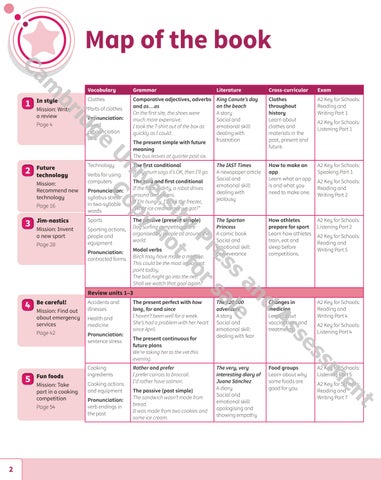
Map of the book m
Ca Grammar
Literature
Cross-curricular
Exam
Clothes
Comparative adjectives, adverbs and as…as On the first site, the shoes were much more expensive. I took the T-shirt out of the box as quickly as I could.
King Canute’s day on the beach A story Social and emotional skill: dealing with frustration
Clothes throughout history Learn about clothes and materials in the past, present and future.
A2 Key for Schools: Reading and Writing Part 1
br
style 1 In Mission: Write
Vocabulary Parts of clothes Pronunciation: plural pronunciation of ‘s’
ge
id
a review Page 4
Mission: Recommend new technology Page 16
3 Jim-nastics Mission: Invent a new sport Page 28
As d an s le es sa Pr r y fo it t rs no ve y ni p U Co
2 Future technology
The present simple with future meaning The bus leaves at quarter past six.
Technology
Verbs for using computers
Pronunciation: syllabus stress in two-syllable words Sports
Sporting actions, people and equipment Pronunciation: contracted forms
The first conditional If my mum says it’s OK, then I’ll go. The zero and first conditional If the floor is dirty, a robot drives around and cleans. If I’m hungry, I’ll ask the freezer, “What ice cream have we got?”
The passive (present simple) Dog surfing competitions are organised by people all around the world. Modal verbs Birch may have made a mistake. This could be the most important point today. The ball might go into the net! Shall we watch that goal again?
A2 Key for Schools: Listening Part 1
The IAST Times A newspaper article Social and emotional skill: dealing with jealousy
How to make an app Learn what an app is and what you need to make one.
A2 Key for Schools: Speaking Part 1
The Spartan Princess A comic book Social and emotional skill: perseverance
How athletes prepare for sport Learn how athletes train, eat and sleep before competitions.
A2 Key for Schools: Listening Part 2
The £20,000 adventure A story Social and emotional skill: dealing with fear
Changes in medicine Learn about vaccinations and treatments.
A2 Key for Schools: Reading and Writing Part 4
The very, very interesting diary of Juana Sánchez A diary Social and emotional skill: apologising and showing empathy
Food groups Learn about why some foods are good for you.
A2 Key for Schools: Reading and Writing Part 2
A2 Key for Schools: Reading and Writing Part 5
Review units 1–3 careful! 4 Be Mission: Find out
Cooking actions and equipment Pronunciation: verb endings in the past
Rather and prefer I prefer carrots to broccoli. I’d rather have salmon. The passive (past simple) The sandwich wasn’t made from bread. It was made from two cookies and some ice cream.
A2 Key for Schools: Listening Part 5 A2 Key for Schools: Reading and Writing Part 7
t
2
Cooking ingredients
The present continuous for future plans We’re taking her to the vet this evening.
en
part in a cooking competition Page 54
Pronunciation: sentence stress
A2 Key for Schools: Listening Part 4
m
foods 5 Fun Mission: Take
Health and medicine
The present perfect with how long, for and since I haven’t been well for a week. She’s had a problem with her heart since April.
ss se
about emergency services Page 42
Accidents and illnesses
Vocabulary
Grammar
Literature
Cross-curricular
Exam
Home
A lot of, lots of, a few, a little, many, much There’s a lot of water from our town’s river. There are lots of fish living in the water. Many people don’t believe me. My house doesn’t use much electricity. When we have a little rubbish, we try to use it. We only throw away a few bags each year.
The fall of a Mayan city A story Social and emotional skill: looking after the environment
Ecosystems in the city Learn about the animals that make their home in the city.
A2 Key for Schools: Speaking Part 2
6 Environmentally The environment friendly
ge
id
br
m
Ca
Mission: Share Pronunciation: ideas to protect schwa your environment! Page 66
A2 Key for Schools: Reading and Writing Part 6
Tag questions Everyone recycles a lot, don’t they? You couldn’t recycle, could you?
As d an s le es sa Pr r y fo it t rs no ve y ni p U Co
Review units 4–6 it 7 Feeling Mission: Make a ‘feelings wheel’ Page 80
Feeling and emotions Wellbeing
Pronunciation: /b/ /v/ /w/
Needn’t, have to, should, ought to, must, mustn’t I have to wait until I’m older. If your parents say you can’t have a snake, you must listen to them! You mustn’t get a snake without telling your parents! You needn’t worry if some of your ideas aren’t very good. You should try to be satisfied with what you have. You ought to write about something you love.
The cowboy who cried wolf A story Social and emotional skill: telling the truth
Emotional awareness Learn about empathy and how we show emotions.
A2 Key for Schools: Reading and Writing Part 3
The case of the Butterfly Diamond A novel Social and emotional skill: managing stress
Responsible tourism Learn how to look after places when you go on holiday.
A2 Key for Schools: Reading and Writing Part 4
The Monster in our Homes! A poem Social and emotional skill: identifying and expressing an opinion
Special effects Learn how special effects are used in films.
A2 Key for Schools: Listening Part 3
Such … that / so … that It’s so fun that my mum and I always laugh a lot! It’s such a relaxing place that I once fell asleep there!
cities 8 Pretty Mission: Plan a city visit Page 92
Pronunciation: intonation in questions
Used to / didn’t used to They used to make the air very dirty. Today the trains are electric, but they didn’t use to be.
TV and film genres
Causative have/get Mum’s having a special superhero cake made for me.
Television
The second conditional If I had $250 million, I’d buy cameras and costumes for the actors.
B1 Preliminary for Schools: Writing Part 1
t
Review units 7–9
A2 Key for Schools: Reading and Writing Part 7
en
Pronunciation: word stress
B1 Preliminary for Schools: Reading Part 6
m
Mission: Make a scene for a film or TV show Page 104
Visiting new places
Indirect questions Do you know how many paintings there are?
ss se
9
Lights, camera, action!
A tour of a city
Pronunciation Grammar reference
3
1 In style
1
3
ge
id
br
m
Ca
2
7
5
6
8
9
Watch the video. What does Jenny use as a scarf? 4
1
Choose an activity and make a shopping list.
2
Design an online clothes shop. Then swap shops and go shopping. Write a review of the shop.
t
Which clothes can you see in the pictures? When are the clothes used?
en
a review
m
Mission Write
ss se
As d an s le es sa Pr r y fo it t rs no ve y ni p U Co
4
Vocabulary 1
1
1 1.02 Listen and point to the clothes. Then match the clothes (1–11) to the words in the box.
Ca
handbag jumper raincoat suit swimming costume tie tights tracksuit trainers jewellery blouse
SEARCH
B 2
1A
ge
id
br
m 3C
4
D
As d an s le es sa Pr r y fo it t rs no ve y ni p U Co
Great for riding my bike in the park.
You can put your phone in this.
5 E
this. It’s warm I and cosy!
if you You’ll love wear this coat.
8H
Something for my brother (if he ever gets married?!?)
9
This is beautiful – but more $ than some cars!
My geography teacher wears this! It’s awesome!!!! 11 K
10 J
I
This is perfect to wear in spring.
These are cute! And they look really comfortable.
m
2 In pairs, read the sentences. Are they true for you?
This is more beautiful than a sunny day at the beach .
ss se
My favourite tennis player wears these!
7 G
6F
My teacher’s wearing jewellery.
en
No, she isn’t.
There’s a raincoat in my bag.
I’ve got a handbag at home.
I’m wearing a jumper.
I’ve got a yellow blouse.
I’ve got a swimming costume.
My mum’s got a tracksuit.
There are trainers in my bag.
My teacher often wears a tie.
I’m wearing black tights.
My dad’s got a blue suit.
3 1.03 PRONUNCIATION Listen and repeat.
t
My teacher’s wearing jewellery.
page 118 Vocabulary: clothes
5
Language presentation 1
1 Read Jim’s blog and answer the questions. What did Jim and Jenny want?
2
What were the problems with the things they bought?
3
What is a shopping fail?
Jim’s
id
br
m
Ca
1
ge
Big Blog
As d an s le es sa Pr r y fo it t rs no ve y ni p U Co
Online Shopping Fails 22nd March @12:25 pm
Last week, I bought a T-shirt online to wear at my friend’s birthday party. I found a few websites where you can write on T-shirts. On one site, the T-shirts weren’t as expensive as on other sites, and they looked nicer too. My friend is learning Spanish with me so I asked for ‘Happy Birthday’ in Spanish on the T-shirt. The T-shirt arrived more slowly than I hoped. In fact, it arrived a few minutes before my friend’s party. I put it on as quickly as I could then I left to go to the party. The T-shirt felt great – it wasn’t bigger or smaller than I wanted.
When I arrived, I showed the T-shirt to my friend and he started laughing. I was confused – but then he told me about the problem with my T-shirt. It didn’t say ‘Feliz cumpleaños’ on the back. It said, ‘Happy Birthday in Spanish’!
FA I L
22nd March @12:45 pm
Last month, I made an online shopping mistake that was as bad as Jim’s. My feet are growing quickly so I needed a bigger pair of trainers for tennis club. I looked at two different websites. On the first site, the shoes were much more expensive. But on the second site I saw a pair of shoes I loved – they were bright red and they were very cheap. My mum ordered the trainers for me but when they arrived I was surprised. The box was very small. Then, when I opened the box, I was shocked. The trainers were a lot smaller than my feet. And they were smaller than my toes too! In fact, they were trainers for a doll! What a mistake!
ss se
At first, I was angry – but my friend said that the T-shirt made him happy on his birthday. Then I felt a lot better.
SHOP P I NG
Now, I always check the size of the things I buy online.
‘My old ones are too small.’ I think Jenny says this.
2
6
‘Great! I love the colour and they’re not expensive.’
Integrate new vocabulary and grammar
3
‘Wow! This is really comfortable.’
4
‘This is awful! I look so silly.’
5
‘That’s strange. Why’s this so small?’
6
‘I’m happy it made you laugh.’
t
1
en
m 2 Read the blog again. Who says each sentence – Jim or Jenny?
Language practice 1
1
Grammar look: comparative adjectives, adverbs and as … as 1
What is bigger? the trainers / Jenny’s feet
2
Where did the shoes cost more? on the first site / on the second site
3
Whose mistake was worse? Jim’s / they were similar
br
m
Ca
‘The trainers were a lot smaller than my feet.’ ‘On the first site, the shoes were much more expensive.’ ‘Last month, I made an online-shopping mistake that was as bad as Jim’s.’
ge
id
4 With short adjectives (one or two syllables long), we make comparisons with -er than / more … than. 5 With long adjectives (three or more syllables long), we make comparisons with -er than / more … than. 6 We use as … as to say something is the same or similar / different to something else. For example: ‘I took the T-shirt out of the box as quickly as I could.’ 7 We use not as … as to say something is similar / different to (and usually less than) something else. For example: ‘The T-shirts weren’t as expensive as on other sites.’
As d an s le es sa Pr r y fo it t rs no ve y ni p U Co
page 120
1 Make sentences to compare the pictures.
d
you know
?
Di
The tracksuit isn’t as old as the trousers.
Register/Log in
Vintage Online
Look cool fast with clothes from the past!
Price: £295 Size: medium; made in the 1860s
Search by item >
t
Price: £295 Size: small; made in the 1970s
en
m
Hiking a warm jumper, a cosy hat, trainers, a raincoat, trousers
Search by year >
Price: £25 Size: extra large; made in the 1990s
Mission Stage 1 Choose an activity and make a shopping list.
Search
ss se
In the 1860s, some dresses were as wide as doors. Women often got stuck when they walked between rooms!
My bag: 0 items
Grammar: comparative adjectives, adverbs and as … as
7
Vocabulary 2
1 1.05 Match the sentences (1–7) to the clothes (A–G). Then listen and check. 1
It’s got gold buttons.
2
The dress.
3
It’s made of leather. It looks good for cold weather.
br
m
Ca
It’s made of cotton. It’s got a picture of the sun on it.
It’s got a blue collar and it’s made of silk. It’s got gold buttons, too. 4
ge
id
D
As d an s le es sa Pr r y fo it t rs no ve y ni p U Co B
E
5
ll There’s a sma e rg la size and a size. You use u them when yo go walking.
F
A
G
6
C
2
In pairs, talk about what you like wearing at the weekend.
Vocabulary: parts of clothes
School trip timetable
Tuesday:
Airport bus leaves at: (1) 6:15
Flight:
10 am–9 pm
Wednesday:
go to the (2)
Thursday morning:
shopping
afternoon:
(3)
Friday:
go (4)
Saturday:
whale watching at (5)
t
8
Listen again. Complete the timetable.
en
EXAM TIP! Write times as numbers (for example, 12:15) not words (for example, quarter past twelve).
It’s got a chain. There’s a crocodile on it, too.
m
Rav packing. Do they need winter or summer clothes?
4 1.07
It’s got long sleeves and it’s got a price label. It costs £25.
7
ss se
3 1.06 Listen to Safi and
It’s got a parrot pattern. You wear it round your neck.
at the hotel
Language practice 2
1
Grammar look: the present simple with future meaning When does the bus leave?
At 6:15!
Ca
br
m
1 What tense is the question? present simple / going to future 2 What time is the question talking about? the present / the future
id
3 The present simple is used to talk about timetables (for example, for buses, for lessons at school or for a holiday) in the future / past. page 120
ge
1 Put the words in order. flight / When / does / leave? / the
4
is / time / dinner? / What
2
Where / start? / does / the / trip
5
the / day / What / party? / is
3
does / tour / Where / the / finish?
As d an s le es sa Pr r y fo it t rs no ve y ni p U Co
1
2 Choose one of the school trips. Ask and answer the questions from Activity 1. 2
1
Windsurfing in Spanish seas
Flight leaves at 5:30. Start and end in Barcelona. Dinner is at 6 pm ever y day. There is a part y ever y Saturday at the hotel.
Dinner: 6:30 Party: Friday evening
t
l Star t and end in Istanbu
Mission Stage 2
en
We leave the airpor t at 10 pm
m
Trek Turkey
@ 8 pm Cape Town (trip starts and ends in Johannesburg) 7:30 Saturday
ss se
3
South African Safari
Design an online clothes shop. Then swap shops and go shopping.
Grammar: the present simple with future meaning
9
Literature
1 Look at the pictures. Which sentences do you think are true? Read and check. ● ●
Ca ●
King Canute’s day on the beach
ge
id
1.08
br
m
●
The story is about a king. The king’s servants help him with everything. The king goes swimming one day. The king finds a fish in the sea.
As d an s le es sa Pr r y fo it t rs no ve y ni p U Co
I am a servant to the great King Canute. He is a good and powerful king who can do anything. My friend says that she saw him climb the castle as fast as a spider! And my dad told me that he can swim to the bottom of the sea to talk to jellyfish. This morning, the king was sitting at the breakfast table, looking at the fish on his gold plate. ‘Oh dear,’ he said, ‘I just want fruit for breakfast today!’
m
ss se
‘Oh no!’ I thought. ‘I’m so sorry, your majesty,’ I said. I immediately picked up the fish and someone brought a bowl of fruit that was as big as the table! ‘I will do whatever you want. You are our good and powerful king,’ I said. ‘Thank you,’ the king said, but he looked annoyed. ‘People always say things like that to me, but I don’t like it!’ After breakfast, the king went to his bedroom to get dressed. I took his silk shirt, suit and best leather shoes from the wardrobe. His cloak and crown were on his bed. ‘Oh dear,’ said King Canute in a loud, angry voice. ‘I just wanted to wear comfortable trousers, a shirt and boots.’ I rushed in with the clothes the king wanted. ‘I’m so sorry, your majesty. You are our good and powerful king.’
en
Again, the king looked annoyed. ‘People always say things like that to me!’ he complained. ‘Why does everyone always, always say “yes” to me?’ ‘Because you’re the king, your majesty,’ I replied. I helped him with the buttons on his cotton shirt and I didn’t say anything else.
t
10
Text type: a story
1
id
br
m
Ca ge
Suddenly the king said, ‘I want to go to the beach and I want everyone to come with me. Bring my throne.’
As d an s le es sa Pr r y fo it t rs no ve y ni p U Co
Soon everyone was at the beach. ‘So … I am a powerful king. Everyone has to obey me,’ said the king. ‘Does the sea have to obey me?’ he asked. ‘Of course,’ we all replied. Then King Canute sat down on his throne at the edge of the water. He shouted to the sea, ‘I am your powerful king! You have to obey me. Don’t get me wet!’
I couldn’t believe what I was seeing! I was excited to watch the sea stop completely. But then, something strange happened. The sea didn’t listen and the tide came in. First, the water covered his boots. Then his trousers and his shirt! The other servants and I stood there with our mouths open. When the sea was as high as his shoulders, King Canute stood up and we all ran to help him.
2 In pairs, talk about the questions.
en
m
ss se
When we were all back at the beach, the king turned to us and said, ‘You see, I am very wet. I am your king but I don’t have superpowers. I can’t control the sea. The sea doesn’t obey me. So, stop always saying “yes” to me. It’s very boring!’
Do you think King Canute is a good person or a bad person?
2
What doesn’t the king like about his servants?
3
Why does the king feel frustrated? What does he do to solve the problem?
4
Imagine you are a servant. What would you say to the king after what happened at the beach?
t
1
Social and emotional skill: dealing with frustration
11
Cross-curricular
Clothes in the past
1 Look at the pictures and
In the past people used natural materials to make their clothes like animal fur and skin. They also used leaves and plants. In the Middle Ages, most people wore warm woollen clothes which came from sheep. Shoes were very simple and they were made of leather. Only very rich people could wear silk and colourful clothes, as dyed fabrics were expensive.
answer the questions.
br
m
Ca
What we wear today
id ge
Today, we still use many natural materials for our clothes like cotton, wool, silk and leather. We also use manmade textiles, like acrylic, polyester and nylon. People like them because they are cheaper than natural textiles. They have different qualities too – swimwear is made of manmade materials because they dry faster. Our clothes often have both natural and manmade materials. Check the label on your T-shirt!
As d an s le es sa Pr r y fo it t rs no ve y ni p U Co
1
When did people wear these clothes?
2
What do you think the clothes are made of?
3
Which styles do you like the best?
Fleece is a very special, manmade fabric. It’s made from recycled plastic bottles. You need 25 plastic bottles to make a fleece sweater or a blanket! Fleece fabric keeps us warm, it’s waterproof and it helps us to look after the planet.
2 1.09 Listen and read the text.
What clothes can you find?
3 Read the text again and say yes or no. 1
Everyone could wear silk in the Middle Ages.
2
Cotton is a manmade textile.
3
You need 25 plastic bottles to make a fleece.
4
Fleece is better for the planet than wool.
5
Smart textiles can change shape.
Clothes throughout history
Di
t
12
How do you think we will use smart textiles in the future?
en
2
Which materials is your shirt made of?
d
you know
m
1
ss se
questions.
In the future, we could all be wearing smart textiles. These clothes have little sensors hidden inside and they catch energy from our body. They can change colour, light up and even grow. Smart textiles are important for sport. For example, a T-shirt could help keep a football player cool during a match. Smart textiles can also be fun. Imagine your friends’ faces when your T-shirt changes colour at a party!
?
4 In pairs, talk about the
What will we wear in the future?
In Europe in the Middle Ages, they didn’t make shoes for the left and right feet.
A2 Key for Schools
1 Match the text types in the box to the examples A–D. a short email a note an advert a notice
B
m
Ca A
1
EXAM TIP! Think about where you would see each message. What sort of words do you use in those places?
ge
id
br
Clean clothes as fast as a car!
Sara, Don’t wa sh your clothes in the wa shing ma chine. It broke thi s morning. You can use the sink in the kitchen. See you later, Mum
Two shirts for the price of one!
As d an s le es sa Pr r y fo it t rs no ve y ni p U Co D
C
IMPORTANT NOTICE
Dear Bill,
We change your towels daily and clean your room ever y morning after breakfast. We hope you have a great time!
PLEASE TAKE OFF YOUR SHOES BEFORE YOU ENTER SECURIT Y
Janet Mills (Manager)
2 Look at the texts again. Match the titles (1–4) to the texts (A–D). 1
Hotel information
3
Airport information
2
A machine that doesn’t work
4
A special offer
C
3 Read the text and answer the questions.
Uncle Bob will be here for dinner tonight. Please buy him a nice birthday present after your lessons. He loves funny ties!
m
Dad What kind of text is it?
4
en
1
When should George look for a present?
Who wrote the message?
t
A at dinner time
2
ss se
George,
B before school C after school
3
What does George need to do?
Preparation for Reading and Writing Part 1
13
A2 Key for Schools
1 1.10
Listen and match. Put the pictures in the correct order.
That’s E.
B
E
id
br
m
Ca
A
I’ve marked your test and I’ve got some good news!
C
D
ge As d an s le es sa Pr r y fo it t rs no ve y ni p U Co
2 1.11 Read the questions and look at the pictures. Which words will you hear? Listen and check. 1
Why can’t Karen help her mum? A
2
B
C
Which trainers does the boy take? A
B
C
14
Preparation for Listening Part 1
t
correct answer. Why is this correct?
en
m
ss se
3 1.12 Listen again and choose the
EXAM TIP! Use the first listening to choose an answer. You can check your answer the second time you listen.
Review
1
1 Complete the sentences. 1
3 Choose ten words from this unit.
My jumper is old, but my tracksuit is older.
Record the words using the steps below.
My jumper is newer than my tracksuit.
Ca
Find the meaning
2
m
The red raincoat is expensive, but the blue one is more expensive. .
3
br
The blue raincoat is more
My raincoat is smart and so is my suit. .
My cotton socks are comfortable and so are my silk ones.
ge
4
id
My raincoat is as
.
In a dictionary
Record its meaning
As d an s le es sa Pr r y fo it t rs no ve y ni p U Co
My cotton socks are as
5
On the Internet
My old jumper is big, but my new jumper is bigger. .
My old jumper is smaller
2 Complete the sentences. Use the
correct form of the words in the box.
Copy the definition
Write its opposite
finish open leave start close arrive
1
When does the toy shop At 9 am tomorrow.
2
When does the bus In fifteen minutes.
3
What time does the film At 12:30.
4
The school Saturday.
5
The concert doesn’t
6
The train
again?
Use it
?
?
Tell the meaning to a friend and ask them to guess the word.
after lunch on
until 8 pm..
en
The silk blouse was the correct size and colour. The order arrived in perfect condition. I can recommend this online shop for smart clothes.
t
Say what activity you had to buy clothes for. Say why you chose the shop. Write a review of the shop.
We wanted to buy clothes for a party. So we chose Jaun’s disco shop.
m
Mission in action!
ss se
in two hours.
Unit consolidation
15
2 Future technology
1
3
br
m
Ca
2
ge
id
! w o W
As d an s le es sa Pr r y fo it t rs no ve y ni p U Co
4
7
5
6
8
9
16
1
Find the class’s technological needs.
2
Show how a piece of technology works. Present your group’s best option.
t
Watch the video. Why does Jenny need to clean Jim’s earphones?
new technology
en
Is the technology in each picture useful? Why? Which would you like to use the most?
m
ss se Mission Recommend
Vocabulary 1
2
1 1.13 Listen, point and say the numbers. X.X
This is my laptop. I use it …
Number 4.
m
Ca 7 10
ge
id
br
2
As d an s le es sa Pr r y fo it t rs no ve y ni p U Co
9
4
8
5
6
1
3
the numbers 1–10 in the picture.
Number 8 is software.
1
Find the six kinds of hardware.
2
Write a sentence that uses the words ‘disc’ and ‘program’.
3
Find three things that turn on and off.
4
Name three pieces of computer software.
t
software disc hardware laptop screen mouse printer computer program keyboard mobile phone
Look at the words in Activity 2 and complete the challenges.
en
3
m
ss se
2 Match the words in the box to
Vocabulary: technology
17
Language presentation 1
1 Look at the poster. What can you see? What would you like to look at?
Ca
Look! There’s a robot dog.
br
m 2 1.14 Listen to Tom talking
ge
id
to a friend about a technology show. What’s the address of the show’s website?
As d an s le es sa Pr r y fo it t rs no ve y ni p U Co
3 1.15
Listen again. Match the people (1–5) to the objects (A–H).
1
2
Sarah A
3
5
Dale
Brian
Courtney
B
C
D
mobile phones
laptop
F
keyboards
G
Scott
screen
H
digital printer
mouse
software
robot dog
t
4 1.16 PRONUNCIATION Listen and repeat. page 118
18
Integrate new vocabulary and grammar
en
m
ss se
E
4
EXAM TIP! Remember that there are three options that aren’t used.
Language practice 1
2
Grammar look: the first conditional ‘If my mum says it’s OK, then I’ll go.’
1 Will Sarah’s mum say it’s OK? Yes / Maybe
Ca
2 We use the first conditional to talk about things that might / won’t happen. page 120
m
2 Complete the sentences.
A or B. A If my mum says it’s OK, I’m going to
Use your own ideas.
id
1
br
1 Which sentence is correct? Choose
ge
the park this weekend.
6
B I go to the school disco, I’ll see all my friends. A If I go to the fair, I’ll look at the robots.
2
3
4
If my mum says it’s OK,
2 3
.
if it’s not too expensive. I’ll have fun if
.
4
if she finishes her homework in time.
5
I’ll see all my friends.
As d an s le es sa Pr r y fo it t rs no ve y ni p U Co
5
B If my mum says it’s OK, I’ll plant some tomatoes tonight. A I get a new hat if it’s not too expensive. B I’ll buy a new keyboard if it’s not too expensive. A I’ll have fun if I join the school basketball club. B I’ll have fun if I’ll play video games tonight. A Kim will email her aunt if she finishes her homework in time. B Courtney goes too if she finishes her homework in time. A If I go to the fair, I’ll see all my friends.
1
6
If I
,
3 In groups, share your sentences. Who wrote the most interesting sentence?
I’ll have fun if this toy helicopter flies on Sunday!
B If it rains, have to stay inside.
Mission Stage 1
Find out the class’s technological g need and choose your y g group’s favourite! Tablets ✓✓✓
t
Laptop ✓
en
What do you think we need in our classroom?
m
ss se
I’ll have fun if I play games on my brother’s tablet after school.
I think these tablets help us to learn a lot!
Grammar: the first conditional
19
Vocabulary 2
1 Read the school webpage. Who has a robot
2 1.18 Match the icons (1–9)
that gives food to cats?
Ca
to the words in bold on the webpage. Then listen and check.
m
1 is ‘chat’.
Hi friends,
br
1
2
3
4
5
6
id
How will computers be different in 10 years’ time? How will they help us? I’m making a poster about the future of computers and need ideas! Jim
ge
Thanks JIM
As d an s le es sa Pr r y fo it t rs no ve y ni p U Co
In 10 years’ time, I think there will be lots of computers in our homes. In fact, I think that we’ll chat to computers all day. The computers will help us a lot. If I’m hungry, I’ll ask the freezer, ‘What ice cream have we got?’ Or if I take photos, I’ll ask my phone to upload them to my blog. – Ibcat2
7
8
9
3 Read the webpage again.
In 10 years’ time, I think we’ll stop using mice. Instead, we’ll control our computers using our bodies. When we want to click on something, we’ll close one eye. And, when we want to download a game or a film, we’ll look down at the floor. If we want to turn on a computer or turn it off, maybe we’ll jump in the air! – CoolJen
2
‘Before I go outside, my cupboard will tell me if I need an umbrella.’
3
‘Computers in the future will be easier to fix.’
4
‘In the future, we’ll be able to install programs by smiling.’
5
‘In 10 years’ time, a computer will be able to make Jim’s poster for him.’
4 Say sentences with the words from Activity 2. I chat with my friends online on Saturdays.
t
Vocabulary: verbs for using computers
I think Jim said this.
en
20
‘My friends and my sister are helping me with a project.’
m
My uncle’s got lots of robots. If the floor is dirty, a robot drives around and cleans it. Another robot feeds his cats if they’re hungry and texts his mobile phone when he needs to buy more cat food! In 10 years’ time, the computers in robots will be able to do almost anything. They’ll help us by writing emails and doing our homework! – Jungles17
1
ss se
If a computer has a small problem, like a broken ‘enter’ key, people often throw it away. But in the future computers will be easier to repair. Maybe we’ll be able to install programs or borrow robots that repair our computers? And if our computers break, they’ll be easy to recycle. – SofySky
Who says each sentence?
Language practice 2
2
Grammar look: the zero and first conditional 1 When the floor is dirty, how likely is it that the robot will clean? Yes, the robot will clean. / Yes, the robot might clean. 2 What kind of sentence is this? Zero conditional / First conditional
‘If I’m hungry, I’ll ask the freezer, “What ice cream have we got?”
3 Will the boy be able to talk to the freezer in the future? Yes, he will. / Yes, he might. 4 What kind of sentence is this? Zero conditional / First conditional
id
br
m
Ca
‘If the floor is dirty, a robot drives around and cleans.’
ge
5 We use the first conditional to talk about things that might happen. We use the zero conditional to talk about things that are never / always true. page 120
As d an s le es sa Pr r y fo it t rs no ve y ni p U Co
1 What do you do now and what will
you do in the future? Ask and answer. 1
Your computer doesn’t turn on.
2
Your keyboard’s ‘enter’ key is broken.
3
You want to chat to your friends.
4
You want to download a game.
5
Your floor is dirty.
At the moment, if my computer doesn’t turn on, I ask my dad to help me.
In the future, if my computer doesn’t turn on, I’ll be able to repair it on my own.
en t
If you install this program you can practise your English.
How will computers be diff erent in 10 years’ time?
m
Show how your piece of technology works.
Write notes about how computers will be different in 10 years’ time. How will they help us?
ss se
Mission Stage 2
2
smaller
Grammar: the zero and first conditional
21
Literature
1 What are the most popular newspapers in your country? Does your school have its own newspaper or news section on its website?
Ca
I we f it ha wr pp ite en ab s, ou t it
THE lAST TIMES
m
1.19
id
br
Friday 28th May | iasttimes.co.tr | No 134
ge
AZRA WINS!
PROFILES
As d an s le es sa Pr r y fo it t rs no ve y ni p U Co
The winner of The Istanbul Academy of Science and Technology’s Design-an-app Competition surprised everyone. Emre Erdem tells us what happened.
This Monday there was a surprise winner of Dr afak’s Design-an-app Competition. Azra Guner, who only joined the Academy last month, won first prize for her brilliant Timetabler app, which helps students organise their time.
Dr afak announced the competition at the beginning of May. She said, ‘The app must be easy to install and use on a mobile phone, and it must help students with their schoolwork. It shouldn’t use lots of battery.’ Throughout the month this newspaper followed the competition. We spoke to students about possible winners and everyone said the same thing: ‘If Burak Gül enters it, he’ll win it.’ ‘Burak knows everything about computers,’ said Ahmet Terim. ‘His parents teach him.’ ‘He’ll be the Steve Jobs of Turkey one day,’ said Mira Balta.
en
Name: Azra Guner Age: 11 Interests: video games, music
t
Text type: a newspaper article
m
22
ss se
Everyone was surprised when Dr afak announced the winner of the competition. Azra Guner is new to the school and very quiet. Nobody knew that she designed her first app when she was only seven years old. Now, she is the star of the software class and everyone wants to talk about her app. ‘It makes it easy to plan your time!’ said Hasan Can. ‘I love it!’ said Ecrin Bartu. ‘With Azra’s app, I can make a timetable really quickly!’
Name: Burak Gül Age: 11 Interests: chess, reading
2
ge
id
br
m
Ca
Although Burak was very unhappy when he lost the competition, some students say that he and Azra are going to design a new app together. If that happens, you’ll be able to read all about it in the IAST Times.
AN INTERVIEW WITH THE WINNER What does your app do? AZRA It makes a timetable for students.
As d an s le es sa Pr r y fo it t rs no ve y ni p U Co Can you explain that?
AZRA Of course! You tell the app what exams you need to study for. You also tell it when the exams are. Then you click on the special ‘plan’ button and the app makes a timetable for you. Do you mean it tells you what to study and when? AZRA Yes, that’s right! That means you have more time for studying because the app does the planning for you.
Technology Fact of the Week
2 In pairs, role play a conversation. Imagine you are Azra and Burak. You are Azra. You feel happy because you won the competition. You have lots of ideas for new apps. Ask Burak if he would like to help you design a new app.
STUDENT B You are Burak. You feel jealous of Azra because you wanted to win the competition. Ask Azra about her app.
t
STUDENT A
en
m
ss se
Ada Lovelace was an English mathematician and one of the first computer programmers. In 1843 she wrote a program for a type of computer that was invented by an Englishman called Charles Babbage.
I can’t believe I won! Social and emotional skill: dealing with jealousy
23
Cross-curricular
1 Which apps do you use? What do they do?
Ca
2 1.20 Listen and read the text. What do these numbers mean? $1 million
400 million
ge
id
br
m
2 million
< What’s an app? >
As d an s le es sa Pr r y fo it t rs no ve y ni p U Co
< There are lots of apps that you can download to a smartphone or laptop. The most popular are games, news, weather and social media apps. If you have an app on your phone, you just have to click on it. This means you don’t need to search for a program or write the address of a website. One of the first apps was a game called ‘Snake’. Players had to make a line of dots around the small screen. This might not sound very interesting, but 400 million people played this simple game. Now there are over 2 million apps to choose from. >
< How do you make an app? >
3 In pairs, talk about about the
24
1
I’d like to play ‘Snake’.
2
I’d like a maths app.
3
I think making an app is easy.
4
I’d like to make my own app.
How to make an app
t
sentences. Say yes or no and why.
en
m
ss se
< Companies can spend between $50,000– $1 million on making apps. That’s a lot of money! But if you have a good idea, you can make an app and create it for free. There are a few things to do if you want to make an app: 1 Think about what your app is going to do, how it will be good for the people using it and how you will let people know about your app. Write your ideas on a piece of paper and draw pictures. 2 Go online and check if there are other apps like yours. If there are, how is yours better? 3 Wireframe your idea. A wireframe is like a storyboard. You draw your design idea so that you can see what your app does. There are lots of different wireframing websites to help you do this. 4 Learn the language of app building. Lots of schools have coding clubs which teach you the languages you need to build apps. You need to choose a coding language and learn the rules. For example, when you are using HTML5, you need to use these symbols < > at the beginning and end of your codes. >
A mobile phone is more powerful than the computer that sent astronauts to the moon in 1969.
A2 Key for Schools
1
2
Watch the video to see an example of Speaking Part 1.
Ca
2 Match the question words with the phrases. What information should the answer have? A thing
br
m
What…?
A time
Who…?
A place
Where…?
ge
id
When…?
A person
As d an s le es sa Pr r y fo it t rs no ve y ni p U Co
Tell me about…
A short description
3 Match the questions (1–6) to answers (A–F). 1
What’s your family name?
A
I’m from Seville but I live in Madrid.
2
Where are you from?
B
It’s Bowring.
3
What do you like about your school?
C
My family and I went to Corfu in Greece.
4
Where did you go on holiday last year?
D
It’s got a big gym and a modern computer room.
E
5
Who usually cooks in your house?
When I finish my exams, I’ll start a short course on writing programs for computer games.
6
Tell me something about a new hobby you would like to try.
F
My parents usually do the cooking but my brother is quite good at making curries and desserts!
4 In pairs, ask and answer the questions.
Hello, I’m Sally. Can I have your mark sheets please? Thank you. I’m …
Do you like clothes shopping?
Yes, I go with … I like to buy …
Where do you go at the weekend?
I go to the …
What’s your favourite subject at school?
I like … and … . Oh, and … of course!
When do you watch films?
On … I usually … with my friends.
Where do you usually have lunch?
Sometimes … but I often …
Tell me something about your family.
Well, I’ve got …
en
m
ss se
What’s your name?
t
EXAM TIP! Try to speak clearly and remember to give as much information as you can! Preparation for Speaking Part 1
25
A2 Key for Schools
1 Do the quick quiz. 1
What is a blog?
Ca
a c
Who can write a blog?
m
2
a sauce b an animal something to read
Where can I read a blog? in a comic in a book
b online
ge
a c
id
3
b children
anyone adults
br
a c
As d an s le es sa Pr r y fo it t rs no ve y ni p U Co
2 In the exam you read about three people talking about the same thing. You have to decide which person says something. What do you think is the best way to do this? Choose and put the sentences in order. A
read each text once
C
B
read the questions
D read the three texts again
choose a letter
3 Choose the correct answer. 1
2
3
a
Now I’m nineteen and I don’t write my blog very often.
b
I post a message once a week.
Which person sometimes gets a message they don’t want?
a
… sometimes I get emails from my school.
b
Sometimes I get a strange message on the screen but I don’t mind … I just delete it immediately!
Which person was the youngest when they started their blog?
a
I started my blog when I was thirteen.
b
I started blogging when I was twelve.
Which person needs some help to write their blog?
b
When the wifi is broken I can’t post a new blog.
EXAM TIP! Don’t worry if you see some words which you don’t know. You will still be able to answer the question.
en
My computer is so slow! Sometimes I need to ask if I can use my brother’s.
m
a
ss se
4
Which person doesn’t write as much as before?
t
26
Preparation for Reading and Writing Part 2
Review
2
1 Match the sentence halves. If the laptops are cheap, …
A
the program will download.
2
If I can’t go to the park, …
B
I’ll chat to my friends online.
3
If I want to do my homework on a computer, …
C
I’ll buy a new one today.
4
If you press ‘enter’, …
D
Grandma won’t be able to email me.
5
If her keyboard is broken, …
E
I’ll need a printer.
Read the email. Choose the correct answer.
ge
id
2
br
m
Ca
1
unit. Make puzzles with the words using the steps below. Make a ‘Find the different word’ puzzle
As d an s le es sa Pr r y fo it t rs no ve y ni p U Co
Hi Jim,
3 Look at the new words from this
Sorry for replying so slowly!
At the moment, when you order pizzas, they often (1) slowly. When there (2) a lot of traffic, the pizza can get cold too! In the future, I think that flying robots will carry you want one, it will be at pizzas. So (3) your house in less than five minutes. (4) you want the pizza cut up, the robot (5) do that for you too! – Mike
A arrive
B arrive
C arriving
2
A was
B will
C is
3
A while
B because
C if
4
A When
B Can
C Are
5
A able
B will
C is
Make one more puzzle.
Your own idea
Four things you use with your hands + one other word
Use it
Challenge a friend to find the different words in each of your puzzles.
en
m
EXAM TIP! Read the text once to understand it. Then read the text again and choose the best word for each space.
Four verbs + one other word
ss se
1
Four kinds of hardware + one other word
This is a great new …
t
Mission in action! Present your group’s ideas. Choose the best new technology for the class. Unit consolidation
27
3 Jim-nastics
1
3
ge
id
br
m
Ca
2
As d an s le es sa Pr r y fo it t rs no ve y ni p U Co
4
7
5
6
8
9
What sports can you see in the pictures? Which of the sports is your favourite? Watch the video. What goes wrong when Jim and Jenny play cricket? 28
1
Make a mind map to compare sports.
2
Invent and describe a new sport. Play the sport and vote for the best one!
t
a new sport
en
m
ss se Mission Invent
Vocabulary 1
3
1 1.21 Read the TV guide. Match the words in blue to the pictures below. Then listen and check.
Rugby is number 7.
Ca
Wednesday, 9 October 7:30
Sport 1
Rugby tonight: Wales vs. Australia
8:00
br
m
7:00
Deep diving: Daniel swims with sharks
id
Sport 2
Small white ball: Exciting golf from around the world
AllStars
1
Cycling: A woman, her bike and Ice-hockey special: See the skaters on Surfing: Hawaii’s best surfers surf America’s biggest mountains the ice for Russia vs. Canada the ocean’s biggest waves Be fit boxing: Get your Gymnastics at home: Jump, Be fit boxing: Get your Gymnastics at home: Jump, gloves on and get fit dance and stretch with Paul gloves on and get fit dance and stretch with Paul Snow idea: Snow skiers try water-skiing for the first Sports stars of tomorrow: Watch athletics stars run, time on Lake Tahoe throw and jump to prepare for the Olympics
2
7
As d an s le es sa Pr r y fo it t rs no ve y ni p U Co
FIT1
Cricket chat: A review of today’s cricket matches
ge
US Adventure
8:30
3
8
4
9
5
10
6
11
2 Write the sports.
t
I love cycling. I go every week with my dad and my brother. It’s a great way to see the countryside. Do you like cycling?
EXAM TIP! Be ready to help your partner by repeating what you say or asking them questions. For example: Why don’t you like …? What do you think about …? How about …?
en
Do you like the sports in Activity 1? In pairs, say why or why not.
m
3
ss se
Sports I’ve tried: Sports I’ve not tried but would like to try: Sports I just want to watch on TV:
Vocabulary: sports
29
Language presentation 1
1 Read Jim’s blog. How many dogs can stand on a surfboard?
Ca
If you think that sports like golf or gymnastics aren’t interesting enough, you might want to try something a little stranger. I’ve found three really unusual sports to tell you about.
Jim’s
br
m
Big Blog
ge
id
The world’s three strangest sports Dog surfing
The Mud Olympics is held every year in a small German town called Brunsbuettel. Around 50 teams from different countries meet and play football and other sports in deep mud. As you can see, the players get very dirty! Yuck! There are lots of prizes – and people love playing in the mud – but the main reason that the event is arranged is to get money to give to charities.
In this sport, the dog usually surfs with a person, but sometimes the dog surfs alone or two dogs surf on one board. Dog surfing competitions are organised by people all around the world. At one competition in the USA, someone took a photo of 18 dogs on a surfboard. That’s the largest number ever! I wish I took that photo!
2
As d an s le es sa Pr r y fo it t rs no ve y ni p U Co
The Mud Olympics
Man versus Horse
This athletics event is held in Llanwrtyd Wells in Wales. At the event, men and women race a horse for 35 kilometres. People often think that the horse will win easily – but the race is planned so that the horse and runners finish at nearly the same time. How’s that done? Well, there are lots of mountains near Llanwrtyd Wells and horses are very slow at going down hills!
Read the sentences and choose the correct event. Leave a comment >
C C C C C C
EXAM TIP! Focus on the general meaning of the text and don’t worry if there are some words that you don’t know.
30
Integrate new vocabulary and grammar
t
B B B B B B
en
A A A A A A
m
1 Pets do this event on their own, in pairs, or with a man or woman. 2 Groups do the event together. 3 The event happens in an area where there are lots of hills. 4 People collect money at the event. 5 Competitions happen in many different places. 6 The person or animal who finishes this event first is the winner.
ss se
The Mud Man vs. Dog Olympics Horse Surfing
Language practice 1
3
Grammar look: the passive (present simple) 1
Who plans the races in Man vs. Horse? We don’t know / The runners
2
Who organises dog surfing competitions? We don’t know / people all around the world
3
Which word says who organised the dog surfing competitions? the / by
br
m
Ca
‘The race is planned so that the horse and runners finish at nearly the same time.’ ‘Dog surfing competitions are organised by people all around the world.’
ge
id
We use the passive when we (4) know / don’t know who does something or when it (5) is / isn’t important who does something. page 121
As d an s le es sa Pr r y fo it t rs no ve y ni p U Co
1 Complete the sentences. Use the words in brackets and the passive in
How to plan a dog surfing competition
Ideas for the dog surfing event (1) are discussed (discuss). Plans (2) (made) to be sure that the event is safe. The dog surfers meet and the event starts. The winner of each competition (3) (give) a prize – it could be a golden dog toy!
Photographs of the event (4) (take) and (5) (share) on the Internet. Dog food, balls and other litter (6) (clean) from the beach and everyone goes home.
ss se
Mission Stage 1
the present simple.
2 In pairs, say sentences
and say which sport it is.
Sports surfing
hate getting wet
t
It’s held every year.
en
hockey
football
m
Make a mind map to compare your feelings about different sports.
The Mud Olympics. Yes!
Grammar: the passive (present simple)
31
Vocabulary 2
1 1.22 Listen. Match the sports commentaries (1–4) to the photos (A–D). A
B
C
D
ge
id
br
m
Ca As d an s le es sa Pr r y fo it t rs no ve y ni p U Co
2 1.23 Match the definitions (A–K) to the words (1–11). Listen and check. A
1
goal
2
coach
3
train
4
surfboard
5
net
6
hit
7
racket
8
court
9
cyclist
B
to practise a sport, often to prepare for a competition
to touch som ething quickly and h ard
C
D
the place where you play sports like tennis
you wear this to keep your head safe
F
E
10
track
11
helmet
the thing people stand on when they surf
a person who cycles
H
G
I
the thing in the middle of a tennis cour t that people hit the ball over
J
a path used for races
m
K
someone who prepares a team to play sport
en
a point scored in a game like football
ss se
something used to hit the ball in sports like tennis
1 is J.
t
3 1.24 Listen again. Why are the numbers below important? three minutes
32
2–1
35 minutes
$1 million
Vocabulary: sporting actions, people and equipment
one point
two metres
ten
eight
Language practice 2
3
Grammar look: modal verbs ‘Hugh hits it back well but the ball might go into the net!’ ‘Can Waldek shoot?’ ‘Shall we watch that goal again?’
m
Ca
‘Birch may have made a mistake.’ ‘This could be the most important point today.’ ‘The Silver Beach surfing competition will start in about 35 minutes.’
ge
id
br
1 Modal verbs are / aren’t followed by the infinitive form of a verb without ‘to’ (e.g. speak, go, walk etc.) 2 When you use he or she, you do / don’t need to add an ‘s’ to the modal verb. 3 To make a question, you do / don’t change the order of the modal (e.g. might, will, can etc.) and the subject (e.g. I, you, he, she etc.). 4 There are / aren’t -ing forms of modal verbs.
As d an s le es sa Pr r y fo it t rs no ve y ni p U Co
1 1.25 PRONUNCIATION Listen and repeat.
page 121
page 118
2 Read the dialogue and choose the correct words.
3 Act out the dialogue. Then act it out again, changing the underlined words.
60%
Harley online
4 Choose a sport and write a short sports commentary. How many modal verbs can you use?
(1) Shall we / We shall p play y tennis tonight? Yes, (2) would I / I’d like to. But it’s cloudy y outside. It may y rain.
We’re here at the lake to watch the water-skiing today, and we might be lucky with the weather …
If it rains, we (3) can / might p play y table-tennis inside.
Could you (4) to bring / bring balls, please?
See you later!
Invent and describe a new sport.
t
OK. I’ll see you later then.
Mission Stage 2
en
I don’t have any. But I can ask my brother. He (5) might / shall be able to lend us some.
m
ss se
Great!
Grammar: modal verbs
33
Literature
1 Look at the pictures. What kind of text is it? Do you like these kinds of stories?
The Spartan Princess
Ca 1.27
m
ge
id
br
In Ancient Greece, around 428 BCE … Cynisca is a young Greek princess. She is a Spartan. It’s hard being a Spartan. They are only interested in being very fit. Boys practise fighting and do athletics and girls also do a lot of exercise. It isn’t different for Cynisca even
As d an s le es sa Pr r y fo it t rs no ve y ni p U Co
Wait for me!
though she’s a princess. Her dad, Archidamus, King of Sparta, has encouraged her to do all kinds of sports since she was very young, such as riding and running just like her brother Agesilaus. Cynisca’s favourite sport is chariot racing. One day I’m going to the Olympics and I’m going to win.
Catch me if you can!
But girls can’t enter competitions, so how are you going to do that?
It’s so unfair. I’m ready for the games but they won’t let women into the stadium to compete.
These are the best horses in all of Sparta.
34
Text type: a comic book
Well, you can’t be the rider of the chariot but if you find a charioteer, you can enter as an owner and trainer. There’s no law against that.
t
When the king dies, Cynisca receives half of his money. Agesilaus gets the other half and becomes King. Cynisca really wants to compete in the Olympics so she decides to buy the horses and the chariot she needs.
en
m
ss se
I want four of your best horses.
Cynisca trains the horses for the chariot races every day for a year.
3
m
Ca
Cynisca finally finds a charioteer. He’s perfect for the job. He’s thin, tall and young. She is a strong instructor.
id
br
No! Go faster when you turn! Look behind you as you do it. We only have a few months before the competition!
ge
The summer of 396 BCE … Finally, the day of the Olympic Games arrives. Cynisca travels with her brother and horses to the great stadium of Zeus at Olympia. The games are held here every four years. The streets are crowded. People come to watch and take part in the games from all over the world, from as far away as Spain and Turkey.
Can I come into the stadium? I’ll put on a helmet and dress like a man.
As d an s le es sa Pr r y fo it t rs no ve y ni p U Co No, it’s too dangerous. If they catch you, they’ll punish you.
My family and I were Kings and Queens. I, Cynisca who won with a four-horse chariot, put up this statue. I am the only woman in Greece to win this prize.
You’ve won! You’ve won!
ss se
Cynisca sits outside the stadium and listens to the crowds shouting and screaming. The four-horse chariot race is always the most spectacular race in the Olympics.
en
m
Cynisca wasn’t able to take part herself in the Olympic Games, but she won the chariot race twice in 396 BCE and again in 392 BCE.
2 In pairs, talk about the questions. How do you think Cynisca felt about not riding the chariot herself in the games?
3
What was Cynisca’s relationship with her brother?
2
What kind of person was Cynisca? How did this help her enter and win the Olympic Games twice?
4
Why do you think there is a statue to remember Cynisca?
t
1
Social and emotional skill: perseverance
35
Cross-curricular
1 Look at the pictures. How do these activities help you to prepare for a sports competition?
br
m
Ca 2 1.28 Listen and read the text. How many hours a day does each athlete train?
id
ge
Every four years the Olympics is shown on TV. It takes years of training and hard work to compete at an Olympic Games and there are many things that an athlete has to think about before they run around the track, hit a ball or put on a helmet for that important race.
As d an s le es sa Pr r y fo it t rs no ve y ni p U Co Divers
Gymnasts
3 Read the text again and answer the questions. 1
How often can you watch the Olympic Games?
2
What do athletes need to do before competing?
3
Why should athletes stretch before and after training?
4
Why shouldn’t athletes go to bed late?
5
How do athletes look after their muscles?
6
Write examples of each of the food groups: Protein: … Iron: … Carbohydrates: …
t
How athletes prepare for sport
forearms
en
36
e youngest Tom Daley is th ld Champion ever British Wor in any spor t.
m
Simone Biles has got the most medals of any American gymnast.
triceps
ss se
Training: Gymnasts train for six hours a day. As well as this, they swim, cycle and run to make their legs stronger. It’s important that they stretch every part of their body before and after they practise or they might get injured. Food: Gymnasts need to eat a lot of protein (chicken and fish) and healthy snacks like bananas and strawberries. Rest: They have one rest day a week and try to get a good night’s sleep too. It’s difficult to train if you are tired.
Training: Divers also train for about six hours a day, but before they get into the pool, they have to practise in the gym. They lift weights and do handstands to make their forearms strong. After training in the pool they often put ice on their triceps to help them recover. Food: Food is very important for divers. Cereal with lots of iron in is good and it’s important in the evening to eat snacks with carbohydrates like toast with chocolate spread – this helps with energy levels. Rest: After training all day, divers often have a massage and they are in bed by 10:30 pm.
A2 Key for Schools
3
1 1.29 Look at the example answer and listen. What will the children learn?
Ca
Surf Camp Summer
ge
id
br
m
When:
2 1.30 Match the correct type of information (1–7) to the words in bold. There are
As d an s le es sa Pr r y fo it t rs no ve y ni p U Co
two extra answers. Listen and check. 1
A food
5
A time
A
Surfing might look hard and your stomach might hurt …
2
A place
6
A name
B
Your gym coach is Bob Vanya, that’s V-A-N-Y-A.
3
An age
7
C
Half of your food needs to be water, fruit and vegetables …
4
A price
A body part
D
We think 45 minutes a day is enough!
E
If you want help choosing your meals, I’ll be in the Main Hall …
3 1.31 Listen again and write the correct answer in the gap. Use the words in bold from Activity 2.
When:
Summer
(6) 50% water, 50% meat and sugars
Food:
Help with meals: (7) Main
and vegetables
after 6 pm
Name of coach:
(9) Bob
First day:
(10)
might hurt.
minutes
en
m
(8) After every lesson for
ss se
Use Gym:
t
EXAM TIP! The answer could be a word or a number. You may also need to spell a name.
Preparation for Listening Part 2
37
A2 Key for Schools
1 Read the text and answer the questions. Who is Billy?
2
Where is he?
Billy is Henry’s friend.
m
Ca
1
What sport is he doing?
4
Who is he writing to?
To: Henry
id
br
From: Billy
3
ge
Hi Henry, How (1) are you? I’m trying a new sport called cricket. It’s not like baseball but it’s very popular here (2) in India! I’ve got (3) a great coach. He’s called Kishan and before he became a coach he played in a famous (4) team .
As d an s le es sa Pr r y fo it t rs no ve y ni p U Co
Yesterday our group practised in the park. Kishan showed (5) us how to hold the bat and hit the ball. Later, Mum and I watched a match. Kishan (6) was playing with his new team and they won! Afterwards Kishan said I could keep the ball! I’ll send you (7) some photos after my lesson. Write to me soon! Billy
2 Look at the underlined words in Activity 1. What type of words are they? ●
verb
●
pronoun
●
indefinite article
●
auxiliary verb
●
preposition
●
noun
3 Complete the email. Use the words in the box. went
I
my
the
for
From: Henry
ss se
Dear Billy,
To: Billy
en
m
your message. Cricket Thanks (1) sounds like a lot of fun. I’m on holiday with (2) family in Sri Lanka, which is near India. We (3) cycling this morning and then I took my surfboard to (4) beach in the afternoon. Talk soon! Henry
Preparation for Reading and Writing Part 5
t
38
Review
3
1 Rewrite the sentences in the passive. Don’t use the underlined word. People hold The Mud Olympics every year. The Mud Olympics is held every year.
2
People play lots of different sports.
3
People play football.
4
People sell tickets to raise money for charity.
Choose ten words from this unit. Record the words using the steps below.
Ca
1
3
ge
Someone gives prizes to the winners of the competition.
In this unit
In a dictionary
As d an s le es sa Pr r y fo it t rs no ve y ni p U Co
6
id
5
br
m
Find the meaning
Record its meaning
People need lots of showers at the event.
2 Write the sentences in the negative and question form. 1
You can play cricket well.
Write the word in your language
Write the definition
You can’t play cricket well. Can you play cricket well?
2
Use it
I could hit the ball.
3
You should train every day.
4
We can go water-skiing here.
Say the meaning of the word to a partner. Can they guess it?
Mission in action!
How to win at my sport: • Don’t forget a helmet!
t
I will play ice hockey.
en
6
m
I may get a surfboard from that shop.
ss se
5
Present the new sport. Play the sport and give tips. Vote for the best!
Then you won’t be scared.
• You don’t need to worry about the other players.
Unit consolidation
39
Review Ca
1
Units 1–3
Watch the video and do the quiz.
m
2 Complete the text. Use the words in the box.
id
br
dull as as boring as interesting as exciting as as strong and thin big and strong as
ge
Some people say that athletics isn’t (1) other sports. as watching They say that watching people run is (2) paint dry. But I don’t agree! The ends of athletics races are as when someone scores a goal in a sport like football (3) or ice hockey. And, when you watch athletics you see lots of different events. Some athletes have to be as (4) rugby players or boxers. Other athletes have to be (5) as gymnasts. I think the most boring sport is cricket. I don’t like cricket. golf either – I think that’s nearly as (6)
As d an s le es sa Pr r y fo it t rs no ve y ni p U Co
3 Complete the sentences. Use the words in brackets and the present simple with future meaning.
(The water skiing (1) instructor / finish) work on 15 July. Ask at reception if you’d like to write a message in her card.
4 Complete the text. (1) If it’s sunny at the weekend, I (2) go shopping with my friend, Sue. We’ll go to the town centre and look in the shops. There are holes in my jumper’s sleeves, so there’s a (3) sale, I’ll buy a new one. get one (4) with a cool pattern, I can (5) find a pattern I like. Sue wants to buy a leather handbag – I think buy one if (6) it’s not too expensive.
Hi everyone – please arrive by 8 am for tomorrow’s Runners vs. Cyclists race. (2) (Cyclists / start) at 8:45. (3) (Runners / start) at 8 am.
ss se
Do you need surfboards or a swimming costume? (4) (Our new surfboard shop / open) next Monday at 9:00 am. Come and see us at 15 Beach Road.
m
40
Consolidation of units 1–3
5
fitness for everyone
What are you going to do this weekend? Who will you spend time with? Write 25–35 words.
t
(5) (we have) our first training session aft er school on Friday and we play weekly. Call Frances ca on 0770 0 90 0245 for more information.
en
Would you like to join our new rugby team?
6 Say six sentences.
Ca 1
Find the mistakes. Write the correct sentences.
ge
7
My best friend it is called Luisa.
5
The food is choose by my cousin.
6
They eat special cakes which make for the wedding.
As d an s le es sa Pr r y fo it t rs no ve y ni p U Co
2 In my bedroom there’s a bed which made of wood. 3
my mum will wear her raincoat. they’ll look good with your brown trousers. I’ll get a new gold chain. + I borrow clean ones from my sister. you should try it on. I put it in the garden to dry.
id
br
m
If +
you like the tracksuit you get brown leather shoes it snows later my blouses are dirty my swimming costume is wet the jewellery isn’t expensive
My favourite song is call One Last Time Time.
The school discos are organised the teachers.
8 Choose the correct words to complete the sentences. 1
I wouldn’t / might not like to chat to my favourite singer. I’m too shy.
4
He shall / might email me after dinner.
5
I may / May I turn on the TV, please?
2
Can you download / downloading these pictures for me, please?
6
Shall I install / Install I shall this software for you?
3
Could you texting / text Grandma and ask her what time she’s coming?
9 Choose and complete two of the challenges.
ss se
CHALLENGE 2
CHALLENGE 3
Look at Unit 1. Find three:
Look at Unit 2 pages 17 and 20. What are five things your computer has got? What are five things your computer can do?
Find a sports word in Unit 3 that starts with each of the following letters:
things people wear over shirts.
B-I-R-D-W-A-T-C-H-E-R-S
t
parts of a shirt.
en
things people wear when they exercise.
m
CHALLENGE 1
things clothes are made of.
Consolidation of units 1–3
41
4 Be careful!
1
3
ge
id
br
m
Ca
2
As d an s le es sa Pr r y fo it t rs no ve y ni p U Co
4
7
5
6
8
9
m
ss se Mission Find out about
Watch the video. Which was the best way of making Jim feel better? 42
1
Make a list of questions about the emergency services.
2
Find answers to your questions about the emergency services. Present what you have found out.
t
What ways of staying safe can you see in the pictures?
en
emergency services
Vocabulary 1
1 2.02
4 Listen and choose the correct answer.
The shark bit the man when he was …
A
looking for a golf ball.
Ca
B
2
The fire started because of …
A
the monster.
B
3
The man with the big hands hurt himself when he was …
A
using scissors.
swimming.
someone cooking.
EXAM TIP! Read the questions before the listening starts.
C
feeding his pet.
C
a candle falling.
id
br
m
1
B
preparing food.
C
playing in the park.
ge
2 2.03 Complete the sentences. Use the words in the box. Then listen and check. break
As d an s le es sa Pr r y fo it t rs no ve y ni p U Co
injured
appointment
cut
painful
heart
accident
ankle
3
What’s wrong with this
4
That woman’s running to the
5
I think there was an
6
Did the monster
7
While he was making a sandwich, his knife slipped and he
8
It looks very
for the man to meet the doctor. ? The man who’s having his
checked.
. Do you know why there’s a fire? and her pet monster made the fire.
the woman’s
, too? his hand.
t
I’ve made an
en
2
his hand when he was feeding his shark.
m
Yes, he
patient
ss se
1
emergency door
. It must hurt a lot.
3 In pairs, ask and answer about the picture in Activity 2. What’s wrong with this man?
He’s injured his hand.
Vocabulary: accidents and illnesses
43
Language presentation 1 1
3
VIKTOR, JIM FRIENDLIE
JULIA, IAN
Hi Jim – how are you?
I’ve broken my ankle
8:27 8:27
Jenny told me. Did you get our card?
8:28
m
Ca
I haven’t been well for a week.
Yes – thank you!
br
8:29
Oh no! How long has your ankle been injured? 4:22
id
ge
8:29
You too.
Is it painful?
4:22
No, it’s fine – but I feel very bored. I haven’t left my house for days!
8:31
8:31
4:23
8:32
ELIZABETH, ALEX
Hi Alex– would you like to come to the park later?
No, sorry. I need to take my rabbit to the vet. Oh no! What’s wrong with her?
7:04
7:07
7:08
She’s had a problem with her heart since April.
Poor thing! I hope she’s better soon.
4:27
Shall I visit this evening? We could look at the chemistry together.
4:27
Thank you!
That’d be great.
2
Why did Elizabeth write to Alex?
A
Her rabbit is unwell.
3
What do Julia and Ian agree to do together?
A
eat sweets
B
B
B
He’s going to get Jim a glass of water. She’s going to go to the vet with him. study chemistry
Integrate new vocabulary and grammar
C
He wants Jim to write a card.
C
She wanted to go to the park with him.
C
walk the dog
t
He’s worried about his friend.
en
A
EXAM TIP! After you’ve chosen A, B or C, read the text and the question again to check that your answer is correct.
m
Why is Viktor writing to Jim?
ss se
7:11
Look at the messages again. Choose the correct answer.
1
4:28
I’ll bring you some chocolates to help you feel better . 4:29
7:10
Me too! The vet says that she’ll be fine.
Pages 46 and 47.
7:09
7:10
44
4:22
What have you studied in chemistry since Tuesday? I’d like to look at it this week. 4:24
2
1
Since Tuesday. I’ve been at home since then.
As d an s le es sa Pr r y fo it t rs no ve y ni p U Co
Yeah, but you need to stay in bed if you want to get better. Drink lots 8:30 of water!
Can’t wait to see you again.
4:21
I was playing tennis in the courts in the park when a dog ran towards me. I tried to get away by jumping over the net but I fell over it and broke my ankle . 4:21
I want to come back soon though to see you all. But I feel awful!
I will.
.
Language practice 1
4
Grammar look: the present perfect with how long, for and since
m
Ca
‘I haven’t been well for a week.’ ‘She’s had a problem with her heart since April.’
1 When did Jim start feeling unwell? a week ago / Monday 2 Does the rabbit still have a problem? Yes / No
ge
id
br
We use the present perfect to describe actions that started in the (3) past / present and are still happening in the (4) present / future. With (5) I, you, they and we / he, she and it we use have + past participle (e.g. made, done, eaten etc.) With (6) I, you, they and we / he, she and it we use has + past participle.
page 122
page 118
As d an s le es sa Pr r y fo it t rs no ve y ni p U Co
1 2.04 PRONUNCIATION Listen and repeat.
I haven’t had a cold
since
Monday. this morning. 23rd January. yesterday. last winter. I was born.
I’ve lived in my house I haven’t felt sick
I’ve been at this school
I’ve studied geography
I haven’t eaten chocolate
d
you know
?
for
a few hours. three weeks. a month. five years. a long time. as long as I can remember.
Di
2 Write six true sentences. Use the phrases in the box or your own ideas.
3 In pairs, share your sentences from Activity 2. Who hasn’t felt sick for the longest time?
What sound does an ambulance make?
t
Who will come?
en
How can I call the emergency services?
A long time ago, when people had sore throats, they tried to get better by putting dirty socks around their necks. Some people put fish on their feet too!
m
Make a list of questions about the emergency services.
ss se
Mission Stage 1
Grammar: the present perfect with how long, for and since
45
Vocabulary 2
1 Read the diary. What happened to Dizzy at the lake?
Ca
ge
id
br
m
4th August I’m excited because tomorrow I’m going to the hills with my aunt. I’m going to take my dog, Dizzy for a walk and then we’re going to go swimming in a lake. We’re not going home until after dinner! My aunt’s meeting us tomorrow at 9 am to drive us there – so I should go to sleep now.
As d an s le es sa Pr r y fo it t rs no ve y ni p U Co
6th August The vet gave Dizzy a prescription for he said that Dizzy needs some pills, and she to have a small operation. Also, I think I’ve got the flu. When I got out of the lake, I was so worried about Dizzy that I forgot to get warm and dry. My mum’s given me some medicine for my headache. She told me to go to bed and rest. But when I lie down, I can’t sleep because I’m so worried about Dizzy.
5th August Today something awful happened. We were having a lovely day in the hills – Dizzy was happy and we had a lovely picnic. But when we went to the lake, things started to go wrong. We were swimming when Dizzy cut her leg badly on a rock. She fell over and started crying. We put a bandage round her leg and carried her back to the car. It looks really painful so we’re taking her to the vet this evening.
7th August I’ve got some great news. Dizzy’s operation was a success! Dizzy’s resting at the vet’s at the moment and the vet says she can come home tomorrow. Hooray! I’m feeling better too. So I’ll be able to look after Dizzy when she gets home.
2 Match the words in bold in the diary to the pictures below. 1
the end of each day’s diary entry.
Number 1 is ‘resting’.
2
7
I wonder what she’ll say.
B
I can’t wait to see her again!
C
I hope her operation is OK.
D
I’m so excited about the trip.
8
en
6
A
m
5
3
ss se
4
3 Add one sentence (A–D) to
t
46
Vocabulary: health and medicine
Language practice 2
4
Grammar look: the present continuous for future plans 1 When will Dizzy go to the vet? In the future / now 2 Will Dizzy definitely go to the vet? Yes (they’ve made the plan) / No (they’ll make the plan this evening)
m
Ca
‘We’re taking her to the vet this evening.’ ‘We’re not going home until after dinner!’
1 The present continuous can be used to talk about the present and the past / future.
br
id
2 The present continuous is used to talk about the future when something is uncertain / planned and we say when it will happen. page 122
ge
1 Look at Jenny’s calendar. Complete the sentences below using the My plans! Monday
today
1
17 6 pm – make cookies for my family
As d an s le es sa Pr r y fo it t rs no ve y ni p U Co
present continuous.
Tuesday
Wednesday
18
19
lunchtime – go to athletics club
Friday
Saturday
Sunday
23
20
21
22
after school – get Jim a present (not flowers!)
evening – do my maths homework
film the video diary
At 6 pm today, Jenny’s making
At 6 pm today, Jenny’s making cookies for her family.
2
at lunchtime tomorrow.
3
on Thursday after school.
4
Thursday
On Friday evening,
5
At the weekend,
6
On Wednesday,
2 In pairs, talk about your plans. How many are the same? … at 6 pm today?
What are you doing after school today?
… tomorrow luncht ime?
l? … on Thursday after schoo
ss se
What are you doing …
I’m going to watch an ice-hockey match!
… on Friday evening?
m
… at the weekend?
en
Mission Stage 2 About 9,397 results
t
Find answers to your questions about the emergency services.
Search EEmergency services conta ct (0.21 seconds)
In England, the num ber you need to call for an ambulance is 999 9.
Grammar: the present continuous for future plans
47
Literature
1 Read the title of the story. What do you think it’s going to be about?
Ca
The £20,000 adventure
br
m
2.06
ge
id
Joshua’s ill and bored. He has flu, and he has had a fever for several days. But today he’s feeling a bit better. His mum says he can go downstairs, lie down on the sofa and watch television with his sister, Chloe.
As d an s le es sa Pr r y fo it t rs no ve y ni p U Co
Joshua and Chloe are watching a programme about crocodiles. There’s a knock on the door. It’s their cousin, Eddie. He has come to see if Joshua’s feeling better. ‘How long have you been ill?’ he asks. ‘For four days,’ says Joshua. ‘I haven’t been to school since last Monday!’ ‘Lucky you!’ says Eddie.
The crocodile programme has finished. The local news programme is starting. ‘There was a robbery at Whitton’s bank last night. Unfotunately, thieves stole about £20,000 in cash and escaped in a fast car,’ the newsreader says. ‘The thieves are dangerous criminals.’
‘I know that bank,’ Chloe says excitedly. ‘It’s on the High Street.’ Joshua’s feeling sleepy. His eyes are closing! ‘Come on, Joshua,’ says Eddie. ‘Let’s climb some trees.’
m
ss se
Outside in the garden Chloe’s climbing a tree and the two boys quickly climb up to join her. ‘Look at those men!’ says Chloe, pointing at two men kneeling on the ground by the river. ‘What are they doing?’ ‘Shhhhhh!’ whispers Joshua. ‘They’ll hear you and they look dangerous!’ ‘But look!’ says Eddie, feeling worried. ‘What are they doing?’
en
One of the men is taking a huge pile of papers from a brown bag. ‘It’s the £20,000!’ whispers Chloe. ‘You know – the money from the bank on the High Street. Look! They’re hiding it in the hole.’ ‘Yes, and the newsreader said they’re dangerous criminals,’ whispers Joshua.
t
The two men look up as if they’ve heard something. The children freeze – they are terrified.
48
Text type: a story
4
br
m
Ca
The three children watch in complete silence while the men finish hiding the cash and walk away through the wood. ‘Let’s get it!’ says Chloe, climbing down the tree fast. ‘Come on, Joshua,’ shouts Eddie. ‘What are you waiting for? They might come back.’ But Joshua isn’t feeling well. He thinks he might have a fever again. As he’s climbing down the tree he cuts his knee and cries out in pain.
ge
id
Chloe and Eddie get the bag. They make so much noise that Joshua starts to feel nervous. They don’t see the men coming back! Suddenly, the men are standing right behind them and they look furious. ‘Hey! Drop that!’ they shout. ‘Run!’ shouts Eddie.
As d an s le es sa Pr r y fo it t rs no ve y ni p U Co
Eddie and Chloe grab the money and run to the bridge as fast as they can. They cross over the river. But Joshua can’t run to the bridge. His knee’s bleeding. It’s too painful to run. ‘Hurry up, Joshua, they’re going to catch you,’ shouts Eddie from the other side of the river. Joshua decides to swim to the other side. He’s just going to jump into the water to cross the river, when he sees crocodiles. He’s very frightened now.
‘Oh no, crocodiles - how strange!’ thinks Joshua for a moment. ‘Crocodiles live in Africa, not here!’
Joshua’s trapped with the thieves behind him and crocodiles in front of him! Oh no! He can’t run to the bridge. He can’t swim across the river. What can he do? Then he sees a rope hanging from a tree. Can he swing across?
ss se
‘Joshua, wake up! You’re shouting in your sleep … something about crocodiles. Are you feeling OK?’ asks his mother, coming into the room.
‘Oh, Mum. Yes, I’m feeling much better now!’ says Joshua.
en
m
‘Come on. Switch off the television. It’s time to eat,’ says his mum.
t
2 In pairs, talk about the questions. 1
Which real-life facts were in Joshua’s dream?
2
What do you think of Chloe and Eddie’s actions in the story? What would you have done?
3
How do you think Joshua feels when he sees the crocodiles? What does he do to help himself?
Social and emotional skill: dealing with fear
49
Cross-curricular
1 Look at the pictures. What do you think they show? 2 2.07 Listen and read the text. Check your answers to Activity 1.
Ca
ge
id
br
m
What was life like in the 1700s? Many poor people didn’t eat very well and so when they were ill, they could die. Lots of families had one toilet in the garden and it wasn’t very clean. They also didn’t have soap (and sometimes no water) to wash their hands. Doctors didn’t know very much about what different illnesses were and they didn’t have medicines to give people. Children also didn’t have vaccinations to prevent them from getting ill and so they got illnesses like measles, chicken pox and flu.
As d an s le es sa Pr r y fo it t rs no ve y ni p U Co
How is life different now? Doctors have learned a lot about preventing illnesses since the 1940s. We are told to eat a balanced diet and we also know that it’s important to wash our hands before we eat or if you cut yourself. Before the 1940s if you cut your finger, bacteria could get into the cut and so lots of people died from a disease called tetanus. Now, we have vaccinations at the doctor. This is an injection to stop us getting the disease. Vaccinations contain a small amount of a virus or bacteria that help the body to fight the disease.
Sir Alexander Fleming (1881–1955): In 1928, Sir Alexander Fleming discovered penicillin and this helped to develop a group of medicines called antibiotics. I’m going to the lab.
He started growing germs in dishes to study them.
In 1928 he noticed mould was growing in his dishes and killing the germs.
m
3 Read the text again and say yes or no.
This was penicillin and it has saved the lives of millions of people.
ss se
During World War I he saw lots of soldiers die from infected cuts.
Some people didn’t have water in the past.
4
A vaccination gives you a disease.
2
Children had injections to stop them getting ill in the past.
5
Alexander Fleming died in World War I.
6
He wasn’t trying to grow mould.
In 1928 you could die if you cut your finger.
4 In pairs, talk about the best treatment for the problems in the box. a nosebleed a cold a headache a cut knee
50
Changes in medicine
t
3
en
1
A2 Key for Schools
4
1 Read the words. What are the differences in meaning? study / studio / studied
century / years / months
Ca
and / but / because
doctor / medicine / bandage
who / when / where
open / opened / opening
2 Which words in Activity 1 do you use to talk about …
m ●
a period of 100 years?
br
a question word about a person?
●
a person who tells you what medicine to take when you are ill?
id
●
1
ge
3 Complete the sentences with the words from Activity 1. Why did Jim cut his arm?
As d an s le es sa Pr r y fo it t rs no ve y ni p U Co
2
he fell off his bike yesterday.
was Fred having a rest? In his bedroom.
3
Last week we
4
Her coach put a
5
Julie started rugby lessons in February and she broke her finger two
6
I’d like to
the heart and brain in biology.
around her leg and then she felt better.
later in April.
a hospital for sick animals.
4 Read the text. What is it about?
Elizabeth Blackwell
m
ss se
Elizabeth was born in the south-west of England but in 1831 she moved to New York with her family. She started to work as a teacher there. She really wanted medicine so she found some books in a to (1) library and read those. she finally went to study medicine, some men in her college didn’t (2) believe that she wanted to study. In 1849 she became the first woman in America to pass all the exams she needed to be a (3) . a college just for women. A year later she went back In 1868 she (4) to England to teach medicine to women in London. Today, you can read a book about her life (5) how she helped many women become doctors in the nineteenth (6) .
EXAM TIP! Read the text once to understand what it’s about. Read it again to choose the best answer. Then, read it again to check your answers.
A
study
B studied
C
studio
2
A
Who
B When
C
Where
3
A
doctor
B medicine
C
bandage
4
A
open
B opened
C
opening
5
A
but
B because
C
and
6
A
century
B months
C
years
t
1
en
5 Look at some answers to Activity 4. Are any of the answers wrong? Why/Why not?
Preparation for Reading and Writing Part 4
51
A2 Key for Schools
1 2.08 Listen. Who’s talking? 1
two friends
Ca
2 3 5 6
id
br
m
4
ge
2 2.09 Read the instructions and the options A, B and C. What do you think the question is? Listen and check.
As d an s le es sa Pr r y fo it t rs no ve y ni p U Co
You hear a student talking about a film she watched on TV. What … ?
A an operation B a king C a queen
3 2.10 Listen again. Is the answer correct?
4 Read the questions. What are the key words? 1
Who did the girl watch the film with?
A her mum 2
B her mum and her cousin
The film about a magic queen was …
A a history film. 3
EXAM TIP! Read the question and options carefully before you listen. Think about the situation the person is in and circle any key words. Then think about similar words you might hear.
B a cartoon.
Which film did the girl want to see?
A the film about an operation B a film about a king Which film did they watch?
A the cartoon
Look again at the questions in Activity 4. Listen and choose the correct answer.
What did the woman buy for her grandson?
A
a wallet
B
Preparation for Listening Part 4
a football
C
t
52
1
en
6 2.12 Listen and choose the correct answer.
m
5 2.11
B the history film
ss se
4
a scooter
Review
4
1 Choose the correct answer. 1
Ca
B For the accident.
What’s wrong?
m
A I’m injuring my ankle.
Find the meaning
B I’ve injured my ankle.
Is your arm broken?
br
3
this unit. Record the words using the steps below.
How long have you felt ill for?
A Since the accident.
2
3 Choose ten words from
A I don’t know. It’s been painful since I fell off my bike.
id
B I don’t know. It is painful since I fell off my bike.
ge
4
How long have you had that cut?
A Three days ago.
In a dictionary
How long have you been a patient here?
A Last Tuesday.
2
In this unit
As d an s le es sa Pr r y fo it t rs no ve y ni p U Co
5
B For three days. B Since last Tuesday.
Record its meaning
Read the diary entry. Choose the correct answer.
15th August Dear Diary, Dizzy and I are feeling better now. We’re having a special day together tomorrow to celebrate. In the Dizzy for a haircut and a bath morning I’m (1) at the pet shop. I might buy her a new toy too. At meeting Carl and his dog, Floppy. Carl 1 pm, (2) is my best friend and Floppy is Dizzy’s best friend! driving us to the Then, in the afternoon, my (3) walking and swimming – but hills again. We’re (4) going to the vet again! I hope we (5)
Copy the definition
Write a translation of the word
Use it
ss se
Show the meaning to a friend and ask them to guess the word.
C
took
2
A we’re
B we
C
we’ll
3
A aunt
B aunt are
C
aunt’s
4
A go
B going
C
to go
5
A don’t
B not
C
aren’t
Mission in action!
Present what you have found out about emergency services.
t
B taking
en
A take
m
1
In England, if you call 999, someone will probably answer the phone in five seconds.
Unit consolidation
53
5 Fun foods
1
3
ge
id
br
m
Ca
2
As d an s le es sa Pr r y fo it t rs no ve y ni p U Co
4
7
5
6
8
9
Watch the video. How many chillies does Jim eat? 54
1
Find out about food in different countries.
2
Choose a country and food. Plan how to make it. Present your country and food. Choose a winner.
t
What food can you see? Choose three things that you’d like to eat.
en
a cooking competition
m
ss se
Mission Take part in
Vocabulary 1
5
1 Match the shopping lists (A–C) to the correct shopping baskets below. Then say the food that is in each basket. B
Ca
A
C
Garlic Lamb Herbs Mushrooms
Steak Onions Oil
id
br
m
Broccoli Salmon Chillies
Cabbage
2
9
ge
5
3
4
6
As d an s le es sa Pr r y fo it t rs no ve y ni p U Co
1
7
2 2.13 Listen, point and say the numbers. 3
8
Broccoli
11
10
Number 5
Draw three foods from Activity 1 and hide your pictures. Then guess which food your partner has. Have you got something green?
Yes, I have.
Is it a vegetable?
Yes, it is.
You’ve got broccoli!
4 Play ‘I went to the supermarket and bought …’.
m
ss se
I went to the supermarket and bought an onion.
en
I went to the supermarket and bought an onion and some salmon.
t
I went to the supermarket and bought an onion, some salmon and ten mushrooms.
Vocabulary: cooking ingredients
55
Language presentation 1
1 Look at the pictures in Activity 3. Answer the questions. Which food can you see in the pictures?
●
What’s your favourite vegetable?
●
Ca
2 2.14 Listen to five conversations. How many times do you hear the word ‘broccoli’?
1
Listen again. Choose the correct picture.
br
m
3 2.15
What’s Claire’s favourite dinner?
2
ge
id
What would Mum like to have for dinner?
3
As d an s le es sa Pr r y fo it t rs no ve y ni p U Co
A
B
Which vegetable doesn’t Emma like?
A
5
B
A
C
C
4
B
C
Which carrots would Karen prefer?
A
B
C
Which food can’t Tom eat?
ss se
4
56
B
C
Can you solve Claire’s problem? Think of a meal everyone at Claire’s party can eat and write a menu.
Integrate new vocabulary and grammar
t
A
en
m
EXAM TIP! Try to answer as many questions as you can the first time you listen. Check your answers and do any missing answers when you listen to it the second time.
Language practice 1
5
Grammar look: rather and prefer Karen: ‘I prefer carrots to broccoli.’
1 What does Karen like more? carrots / broccoli
Ca
2 Which of the words could you add to the first sentence? at the party / always 3 What would Mum prefer to eat? salmon / broccoli
m
Mum: ‘I’d rather have salmon.’
br
4 Which of the words can you add to Mum’s answer? at the party / always 5 Which word is followed by the to-infinitive verb form (e.g. to go, to have, to eat)? rather / prefer 6 Which word is followed by the infinitive verb form without to (e.g. go, have, eat)? rather / prefer
ge
id
Tom: ‘I’d prefer to have mushrooms.’
As d an s le es sa Pr r y fo it t rs no ve y ni p U Co
We use would rather and prefer to say that we want or like one thing more than another thing.
1
page 123
In pairs, ask and answer the questions. Use your own ideas.
1
Do you prefer steak or salmon?
4 Do … or …?
2
Do you prefer … or …?
5 … , would you …?
3
For lunch tomorrow, would you prefer to … or …?
6 For dinner tonight, would you rather have broccoli or mushrooms?
2
Choose one question from Activity 1 and ask your class. Draw and write about the results. Would my class rather have cake or jelly for dinner tonight? 15 10
Mission Stage 1
jelly
I asked my class: ‘Would you prefer cake or jelly for dinner tonight?’ 12 people said they’d prefer cake. 15 people said they’d prefer jelly.
t
cake
Find out about food in different countries.
en
5
m
ss se
EXAM TIP! If you don’t understand something remember to use these useful phrases: Could you repeat that, please? Pardon? I’m sorry, I don’t understand.
Grammar: rather and prefer
57
Vocabulary 2
1 Read Jim’s blog quickly. Which ingredients do you need for each dish?
Ca Jim’s
From roast chicken to boiled potatoes, Jenny and I love food (maybe because our dad’s a chef.) Last week we asked three of our dad’s friends how to make some awesome dishes. Enjoy!
br
m
Big Blog
ge
id
How was it made?!? How was this egg made?
As d an s le es sa Pr r y fo it t rs no ve y ni p U Co
Well, I think everyone knows how to fry an egg. You just break it and put it into a hot frying pan with some oil. This egg was fried like all others. But I used one little trick.
How was this ice cream sandwich made?
This sandwich wasn’t made from bread! It was made from two cookies and some ice cream. It’s an awesome dessert.
First, I got a round pot of ice cream and cut it into four pieces. Then I put each slice of ice cream onto a big cookie. Finally, I put another cookie on top. It was sooooooooooooo delicious!
(If you REALLY love sugar, you can melt some chocolate in a bowl over a saucepan and pour it onto your finished sandwich!) – LittleLolz
Before I put the egg in the pan, I sliced a large onion with a knife. Then, I took the largest ring of the onion and added it to the frying pan. Next, I put the egg into the onion ring to cook. That’s how the egg was cooked in a circle. The last thing I did was make sure the egg looked happy! – CookEggcellent
I took the caterpillars to a picnic and my friends said they were delicious. In fact, they were so popular that they were finished before I tried one!
What are the answers to the riddles? Listen. Then write your own.
Number 1 is ‘slice’.
3
Choose one of the dishes from the text above. Draw pictures to show how it was made.
en
4
– Pocco911
m
2
To make a caterpillar, first, put six grapes on a stick and add eyes. Then, put the caterpillars in a dish in the freezer. I waited for about an hour (I put on the kettle and made myself a cup of tea) and the caterpillars were ready!
3 2.16
words in bold in the blog. 1
Don’t worry, these aren’t real caterpillars! And they’re very easy to make too, so they’re perfect if you like healthy snacks.
ss se
2 Match the pictures to the
How were these caterpillars made?
t
4
58
5
6
Vocabulary: cooking actions and equipment
7
8
9
Language practice 2
5
Grammar look: the passive (past simple) ‘This sandwich wasn’t made from bread. It was made from two cookies and some ice cream.’
1 Are the sentences active or passive? active / passive
Ca
2 When is the sentence talking about? the past / the present
br
m
3 How is the passive made (in the past simple)? was or wasn’t + past participle (e.g. made, written, had) / was or wasn’t + infinitive (e.g. to make, to write, to have)
ge
id
We use the passive when we don’t know who does something or when it isn’t important who does it.
1 2.17 PRONUNCIATION Listen and repeat.
1
2
3
page 119
As d an s le es sa Pr r y fo it t rs no ve y ni p U Co
2
page 123
How were the chocolate dishes made? Write a sentence for each picture (1–8). Some chocolate
5
The balloons
melt
put
in a bowl over a saucepan
on the chocolate circles
6
Chocolate circles
The balloons
make
leave
on a tray
until they were hard
7
Some balloons
Holes
fill
made
with air
in the balloons
ss se
4
8
The chocolate dishes
dip
fill
into chocolate
with fruit
Some chocolate was melted in a bowl!
t
Try to remember each one.
en
3 Cover the sentences in Activity 2.
m
The balloons
Mission Stage 2 Choose a country and food. Plan how to make it.
Pizza * Cheese * Tomato * Olive
Grammar: the passive (past simple)
59
Literature
1 Have you read any diaries? What did you think of them? Do you write, or would you like to write, a diary of your own?
Ca 2.19
id
br
m
The very, very interesting diary of Juana Sánchez
Monday
ge
As d an s le es sa Pr r y fo it t rs no ve y ni p U Co
My parents think the show is brilliant. It’s the only thing they talk about. ‘Oh, Juana,’ Mum said at breakfast. ‘Your brother’s got 63,000 subscribers to his channel!’ ‘Oh, Juana,’ Dad said at dinner. ‘Your brother’s going to be world famous.’ ‘My last video was watched 1,000,000 times, Juana,’ Carlos said. ‘Have you seen the show yet?’ ’ss No, I haven’t. I’d rather clean my granddad’s shoes with an old toothbrush. The show’s on YouTube. It’s the only thing he talks about. ‘Oh, Juana,’ he said after te. te. dinner when I was washing up his dirty plate. ‘I made chilli today. My fans loved it!’
ss se
Wednesday
en
m
Before dinner, I asked Carlos to help me lay the table. ‘Well, Juana,’ he said, ‘I’m an Internet star now, you know, and I haven’t got time to lay the table. I’ve got my next show to think about.’
60
Text type: a diary
t
I’m going to ask Mum if we can change him for a cat.
5 Friday
Ca
I was tired after school and wanted to relax on the sofa, but Carlos kept talking about his next show. ‘On Sunday morning I’m going to do my new recipe for spaghetti bolognese. All I need is … .’ The only way I could get him to stop talking was to say, ‘Carlos, on Sunday, I’m going to watch your show.’
m
Saturday
As d an s le es sa Pr r y fo it t rs no ve y ni p U Co
Sunday
ge
id
br
I had to help Dad in the garden this morning. I hate gardening. There are worms everywhere – long, thin worms. I don’t like worms, but they gave me an idea …
Carlos was like a four-year-old at a birthday party today. ‘I’m so happy you’re going to watch my show,’ he said. ‘I’ve got everything ready – the onions, the garlic, the herbs, the spaghetti. Now, time for my shower.’ Carlos always has a shower before his shows. ‘I must look my best for my fans!’ he says. When he was in the bathroom, I went into the kitchen, took the spaghetti out of the pot, and put something else in.
‘Right, let’s go!’ said Carlos when he came back into the kitchen. ‘Mum and Dad usually turn the camera on for me, Juana, but you can do it today. Are you ready? Let me get in position. OK. Press the button … now. Good morning, friends!. Today I’m going to show you how to make spaghetti bolognese. Now, in this pot I’ve already put the … worms! Arghhhhhhhhhhhhh!’
OK, it wasn’t the nicest thing to do. But more people have watched this video than any of his other ones! And I’m sure he’ll talk to me again – one day.
ss se
2 In pairs, role play a conversation. Imagine you are Juana and Carlos.
STUDENT B You are Juana. You want to say sorry to Carlos. You know you did the wrong thing, but you’d like him to understand that he shouldn’t talk about himself all the time and I’m very angry with you, Juana. My show is very important that he should ask other people to me. Why did you put worms in my pot? about their interests.
en
You are Carlos. You are very angry with Juana. You don’t understand why she played a trick on you.
m
STUDENT A
t
I’m very sorry, Carlos. But why do you talk about your show all the time?
Social and emotional skill: apologising and showing empathy
61
Cross-curricular
1 Read the text and look at the photos. What food groups do the foods belong to? Which nutrients do they give us? Use the words in the boxes.
Ca
Food groups
grains, cereals and potatoes meat, fish, nuts and beans dairy fruits and vegetables fats and oils
br
m Superfoods?
id
ge
It’s important to eat a balanced diet and different foods give us different nutrients. Proteins make our muscles strong. Calcium is good for our teeth and bones and carbohydrates give us energy to exercise and play in the day.
Nutrients
calcium vitamins and minerals fats proteins carbohydrates
Blueberries have got vitamins K and C in them as well as other nutrients. Some people think that blueberries can protect us from heart problems and improve our memory. Try adding them to your breakfast cereal or have them for a snack.
Blueberries
As d an s le es sa Pr r y fo it t rs no ve y ni p U Co
Some foods have more nutrients than others but does this make them superfoods? Most doctors think that we shouldn’t call them ‘superfoods’ but ‘super diets’ – this means we should eat a healthy, balanced diet with lots of fruit, vegetables and wholegrain foods. Here are some foods that aren’t super, but have lots of vitamins that are very good for you:
Oily fish like salmon or sardines have got vitamin D, protein and some B vitamins. Oily fish has also got good fat in it. If you eat oily fish two or more times a week it keeps your eyes and your bones healthy.
Broccoli has got lots of vitamins, calcium and fibre in it! It’s a vegetable that you can eat in salads, soups and with meat and fish.
2 2.20 Listen and read the text again. Match the A
has got vitamin D in it.
2
Calcium is good for
B
has lots of fibre in it.
3
We should eat
C
too much chocolate.
4
Blueberries have got
D
vitamin K in them.
5
Oily fish
E
a healthy balanced diet.
6
Broccoli
F
your teeth and bones.
7
You shouldn’t eat
G
your muscles.
Food groups
you prefer. Do you eat any ‘superfoods’? I’d rather eat cereal for breakfast than toast.
t
Proteins are good for
3 In pairs, talk about food
en
62
1
Chocolate
m
sentence halves.
Broccoli
ss se
Some people think that dark chocolate is good for us, but like any food, you shouldn’t eat lots of it. A little bit of dark chocolate is better than milk chocolate, but if you eat it too much, it’s an unhealthy choice.
Oily fish
I prefer blueberries to strawberries.
A2 Key for Schools
5
1 Read and answer the questions.
br
m
Ca What can you do on a cooking tour?
id
1
2
Would you like to go on one? Why/Why not?
ge
2 Read the question. Think of some places Tim may have visited. The museum.
As d an s le es sa Pr r y fo it t rs no ve y ni p U Co
You will hear Tim talking to a friend about a cooking tour with his dad. What day did he visit the places?
Where did Tim go?
A shopping centre.
3 2.21 Listen to the conversation. Write two places you hear for each day. 1
Tuesday
2
Wednesday
3
Thursday
4
Friday
5
Saturday
4 2.22 Listen again and choose the correct answer. Days
A apartment
C café
4 Friday
D museum
5 Saturday
E TV studio
t
3 Thursday
en
B train station
m
2 Wednesday
EXAM TIP! Remember, sometimes you hear two options. Listen carefully for words that might mean that one option isn’t correct. For example: ● no ● didn’t ● weren’t
ss se
1 Tuesday
Places
F town hall G park H farm
Preparation for Listening Part 5
63
A2 Key for Schools
1 Which phrases in the box are useful for starting a story?
Ca
One day … Finally, Dear Sally, Then, Lots of love, After that, Last week Thanks for your email, Next, Because of this, In the end, Yesterday,
A
m
2 Look at picture A and write a sentence.
br
Use a phrase from the box in Activity 1.
id
3 Which of the sentences is the best first line for this story? Why?
ge
One day a man drinks an orange juice.
2
Tony likes cooking.
3
Last week John went to have dinner at a restaurant.
As d an s le es sa Pr r y fo it t rs no ve y ni p U Co
1
4 Look at the rest of the story. Choose a phrase and finish the sentences. B
C
Then/Next
Finally/In the end
5 Read two students’ answers. In pairs, talk about which story is better and why. In the second story, the people have names.
2
One day, John went to have dinner at Tony’s restaurant. He was waiting for someone and he felt worried. Then his daughter Betty arrived with her mum. Betty opened her beautiful present and Tony gave her a necklace. It was a really fun evening.
Preparation for Reading and Writing Part 7
t
64
en
EXAM TIP! Remember to write about all three pictures. Your story should have a beginning, a middle and an end.
m
a man one day goes to eat in ristorant. He’s look his phone. A girl enters. She is with woman. The girls present is beutifull People is happy.
ss se
1
Review
5
1 Choose the correct words to complete the sentences. I always prefer / rather broccoli to mushrooms.
unit. Record the words using the steps below.
Ca
1
3 Choose ten words from this
At the picnic, I’d prefer / rather have sandwiches than lamb and cabbage.
3
I’d rather have / to have onion sauce, please.
ge
id
br
m
2
Find the meaning
I’d prefer to eat / eat garlic than onion.
5
For lunch today, I’d / I prefer to have steak than salmon.
6
We’d / We always prefer food with lots of chilli in it.
In an online recipe
Record the example
As d an s le es sa Pr r y fo it t rs no ve y ni p U Co
4
In this unit
2 Complete the text. Use the words in
Replace the word with a picture
Leave a space for your word
brackets and the past passive.
Use it
Last week, I went to a restaurant for my grandma’s birthday. The restaurant was very (decorate) strange. The walls (1) with vegetables and the waiters (dress) as carrots! (2)
Mission in action!
Present your country and food. Choose a winner!
I’ve made a main course that’s popular in Portugal.
en
m
ss se
First, I had broccoli soup. It (3) (cook) with chilli and onion so it was delicious – but very spicy. Next, I had lamb with (roast) vegetables. The lamb (4) perfectly and the vegetables were brilliant (fry) with some too. They (5) lovely herbs. Finally, for dessert, I had an (slice) so it looked apple that (6) like a bird!
Challenge a friend to find the right word to complete your sentence.
I can’t wait to try it!
t Unit consolidation
65
6 Environmentally friendly
1
3
ge
id
br
m
Ca
2
As d an s le es sa Pr r y fo it t rs no ve y ni p U Co
4
7
5
6
8
9
Watch the video. What does Jenny make from her old jeans? 66
1
Find environmentally friendly items at home.
2
Find out about how your items are environmentally friendly. Interview each other. Present your ideas to protect your environment.
t
What can you see in the pictures? Which objects have been recycled?
en
protect the environment
m
ss se Mission Share ideas to
Vocabulary 1
6
1 2.23 Listen and point to the things in Ela’s house. Say the numbers. Above the stairs is a cool bulb.
Number 2
Ca
12 1
br
m
11
2
10
ge
id 8
As d an s le es sa Pr r y fo it t rs no ve y ni p U Co
9
3
4
7
6
5
2 In pairs, use the words in the box to check the things (1–12) in the picture. curtain dustbin tap electricity rubbish sink air conditioning dishwasher candle plug bulb heating
Complete the diagram with the words from Activity 2.
Things I’ve touched today …
en
Things in my kitchen …
m
4 In pairs, share your diagrams. What are three differences?
Curtain.
ss se
3
What’s number 1?
t
I’ve touched a dustbin today but Clara hasn’t.
Vocabulary: home
67
Language presentation 1
Riku, aged 9, Japan
ge
id
br
m
Ca
Most people aren’t surprised that I don’t have a dishwasher. But when I say that fish clean my dishes for me, many people don’t believe me! In my garden there’s a small room, called the kabata. In the room, there’s a lot of water from our town’s river. My family use the water to clean vegetables and wash dishes. A little food falls off the bowls that we wash – but that’s OK because there are lots of fish living in the water, and the fish eat the food. The fish keep the water clean! After the water comes to my kabata, it goes into the river or onto farms. A kabata is a great way to save water!
Ariadna, aged 10, Spain
As d an s le es sa Pr r y fo it t rs no ve y ni p U Co
atin at ng There isn’t heating or air conditioning in my house. I live in a traditional cave house – a house that’s built inside a hill. The ground around the house keeps the house cool when the weather is hot, and warm when the weather is cold. My house is great because it doesn’t use much electricity. People think that I don’t have Wi-Fi, electricity or even water in my cave house – but I do!
Madison, aged 11, Canada
In my house there isn’t a dustbin. My family don’t need one because we don’t throw away much rubbish. In fact, we only throw away a few bags each year. How do we do it? Well, we’re careful when we go shopping – we take our own bags to put our food in. Some things are always wrapped in plastic, but we try not to buy them. Instead, we buy lots of fresh fruit and vegetables. Finally, when we have a little rubbish, we try to use it. I’ve made a lot of cool things from plastic bottles!
1 Read the article for 60 seconds. Which item doesn’t each child have in their house?
The kabata is used to do the washing up.
3
The water that’s in the kabata is dirty.
4
Ariadna’s home was built a long time ago.
5
Her house is on top of a hill.
6
She can’t use the Internet in her house.
Madison’s family throw away less rubbish than most people.
8
Her family don’t buy things in plastic bottles, boxes or bags.
9
She often recycles things by using them in a new way.
3 Why is each house better for the environment than normal houses? Which would you like to live in?
68
Integrate new vocabulary and grammar
In Riku’s house they save water. It’s bad for the environment to use too much water because …
t
2
7
en
Riku’s kabata is in the kitchen of their home.
m
1
ss se
2 Read the article again and say yes or no.
Language practice 1
6
Grammar look: a lot of, lots of, a few, a little, many, much
m
Ca
‘There’s a lot of water from our town’s river.’ ‘There are lots of fish living in the water.’ ‘Many people don’t believe me.’
ge
id
br
1 Lots of and a lot of / A little means ‘a large amount of’ something (e.g. money, time, food) or number of something (e.g. clothes, people, cars). 2 Many / Much means ‘a large amount of’ something (e.g. money, time, food). It’s usually used in negative sentences and questions.
‘My house doesn’t use much electricity.’ ‘When we have a little rubbish, we try to use it.’ ‘We only throw away a few bags each year.’
As d an s le es sa Pr r y fo it t rs no ve y ni p U Co
3 Many / Much means ‘a large number of’ something (e.g. clothes, people, cars). It’s usually used in negative sentences and questions. 4 Lots of and a lot of / A little means ‘a small amount of something’ (e.g. money, time, food). 5 A few / Many means ‘a small number of’ something (e.g. clothes, people, cars).
1 2.24 PRONUNCIATION Listen and repeat. 2
Look at the three pictures and write the story. Write 35 words or more, using some of the words in the box. many
much
3 Read your story to a small group. Whose story do you like best?
t
Mission Stage 1
en
We use more than 100,000,000* bottles every day. That’s the same weight as six Statues of Liberty. Many of these bottles aren’t recycled and cause problemsfortheenvironment. *one-hundred million
EXAM TIP! When you’ve finished writing, read your text again and check the grammar and spelling.
m
you know
page 119
ss se
d
lots a few a little
?
Di
a lot of
page 124
Find environmentally friendly items at home.
Grammar: a lot of, lots of, a few, a little, many, much
69
Vocabulary 2 B
1 2.27 Listen to the podcast. Who always uses recycled paper?
A
Ca
D
m id
br
C
ge
F
As d an s le es sa Pr r y fo it t rs no ve y ni p U Co
Glenda
E
Alex
H
2 2.28 Match the words (1–10) to the pictures
G
(A–J). Listen and check. 1
recycle
2
area
3
litter
4
traffic jams
5
public transport
6
petrol
7
path
8
pollution
9
gas
10
rainforest
J
I
3 2.29 Listen again. Which time was better for the sentences (1–6)?
Now
3
People are better at throwing away their litter.
4
The air is cleaner.
5
People use less gas and electricity.
6
People save gas and electricity. TOTAL:
4 When do you think life was better for the environment? Discuss and vote. 70
Vocabulary: the environment
t
People make less rubbish.
en
2
✓
m
People are better at recycling.
ss se
1
When Grandma was young
Language practice 2
6
Grammar look: tag questions
–
+
–
‘You couldn’t recycle, could you?’
Ca
‘Everyone recycles a lot, don’t they?’
+
br
m
‘Since you started school you’ve travelled by car, haven’t you?’ ‘The air was cleaner then, wasn’t it?’
id
ge
Tag questions change statements into questions. They’re often used to check that someone agrees with us.
1 When the first part of the sentence is positive, the tag question is positive / negative.
As d an s le es sa Pr r y fo it t rs no ve y ni p U Co
2 When the first part of the sentence is negative, the tag question is positive / negative. 3 If the first part of the sentence has an auxiliary verb (e.g. be, have, can etc.), you use the the same / a different auxiliary verb in the tag question. 4 If the first part of the sentence doesn’t have an auxiliary verb, we use is, are or was / do, does or did in the tag question. page 124
1 Match the sentences (1–6) to the correct tag questions (A–F). 1
Your name’s Glenda,
A
wasn’t it?
2
You live in London,
B
isn’t it?
3
Your house was built a long time ago,
C
can you?
4
You don’t have a dishwasher,
D
have you?
5
You haven’t been to the rainforest,
E
don’t you?
6
You can’t use public transport,
F
do you?
2 Invent a character. Ask and answer the questions from Activity 1. No, my name’s Holly Wood. And I love American films!
What things in your house help the environment?
en
Find out about how your items are environmentally friendly. Interview each other.
m
Mission Stage 2
ss se
Your name’s Glenda, isn’t it?
t
Less heating
We use lots of blankets so we don’t need to put the heating on very often.
Grammar: tag questions
71
Literature
1 Look at the pictures. Where do you think the story takes place? What animals can you see?
Ca 2.30
The fall of a Mayan city
ge
id
br
m
As d an s le es sa Pr r y fo it t rs no ve y ni p U Co
The Mayan king looked down at the city from his palace. He felt very sad. He could remember the brightly coloured pyramids and temples; the exotic gardens full of jaguars, pumas and parrots and the buzzing street markets with delicious food from all over his empire. It was one of the great wonders of the world. But now the city was silent and empty. And why was this …?
Many years before, when the king was looking for somewhere to live, he saw a big beautiful ceiba tree in the heart of the tropical rainforest. He decided that it was the perfect place to make his home. Just as he was about to leave an old man appeared from behind the tree.
‘We have always looked after the rainforest and you must too,’ he said. ‘Don’t chop down the trees! Build your city somewhere else!’ And he disappeared into the forest again. But the king ignored the old man’s advice. ‘He’s just a crazy old man,’ he thought to himself. And he built his city nearby.
‘What can I do?’ he asked his advisors.
en
m
ss se
As the king and his people became richer and more powerful the city grew and grew. People needed more space to build their houses and grow their corn. So they chopped down more and more trees from the rainforest. Everything seemed perfect, until one day things started to change. At first it didn’t rain as much as it usually did and the rivers became smaller and smaller. Then it stopped raining and the rivers dried up. The corn in the fields and the vegetables in the gardens dried up, too. With little food and water, the people started to leave the city. The king was very worried.
t
None of them could give him an answer. Then he remembered the old man he met in the forest. He went back and looked for the tall ceiba tree. Eventually he found it but now it was standing alone in the middle of a desert. He sat under its branches in the shade. Suddenly, the same old man came out from behind the tree. 72
Text type: a story
6 ‘Look ‘Loo L okk what you’ve Lo ou’vee done,’ don ne,’ said the old man. ne,’ ma man
Ca
The ki The king fell f ll to t his hi knees kne k ees andd asked, k d ‘Please ‘Plea ‘Ple ‘Pl ‘ l ase tell t ll me – what h t should shou hould uldd I do? do?’ do o?
br
m
‘Wel Well Wel lll there is a solution so n but it will take many, man ma , many m years,’the years years,’the oldd ‘Well man an said. ai This h time, tii the th he king k listened carefully care a efull l to every ev y word. word od
ge
id
‘If If y you ou u plant nt two trees rees for f every one you chopped c down do then n maybe ma may ybe be thee rain will w retur ret return eturn turn and nd maybe may thee rivers, rive s, the plants plants, p the he bird birds b andd the hee animals anim imal als will come o back, back ba back,’ k,’’ the th old ld ma m said, said s man and suddenly enly y disappear disappeared, red, just like bbefore. before befo .
As d an s le es sa Pr r y fo it t rs no ve y ni p U Co
en
m
ss se
Quickly, the king ordered his people to plant trees where there was now desert. Slowly but surely, as the years passed, the trees grew, the rain came back and the rainforest fi lled with life again. First the animals and birds returned and then the people. The king was delighted. Before he died he made sure that the ceiba tree was always protected, so that his people would look after the rainforest.
1
What happened in the story when the people cut down too many trees in the rainforest? Why did this happen?
t
2 In pairs, talk about the questions. 2
How did they fix the problem?
3
Do you think the king was responsible for what happened?
Social and emotional skill: looking after the environment
73
Cross-curricular
1 Look at the pictures.
Ca
What living and non-living things can you see in them?
m
2 2.31 Listen and read the text about urban ecosystems. Find the animals –
id
br
do you know them all?
ge
Where we live
As d an s le es sa Pr r y fo it t rs no ve y ni p U Co
An ecosystem is all of the living and non-living things that are in an area. Living things include all of the plants and animals and non-living things are the rocks, water, soil and sand. Examples of ecosystems are an ocean, a rainforest, a pond, a desert, a river, grassland or an urban ecosystem. As cities and towns get bigger, other ecosystems get smaller. This means that a lot of animals don’t have anywhere to live and so they start to come into cities and towns to look for food and somewhere to sleep. Usually these are small animals like mice, rats and foxes, but in some cities there are some very unusual animals:
Leopards in Mumbai
Peregrine falcons usually live near the beach but when they started to die, people in New York decided to help them live in the city. Now New York has more peregrine falcons than any other city in the world. That’s amazing, isn’t it? They like living in the city because there are lots of high places to make their nests where they are safe and there is a lot of food to eat too. The people of you know New York and the birds d live happily together.
Di
2
Should the leopards move to a different home?
3
What problems do you think wild animals have when they live in a city?
4
What problems do you think people have when wild animals come into a city?
t
How have humans changed natural ecosystems?
Ecosystems in the city
?
74
1
en
the questions.
Birds sing louder in cities. This is so that they can be heard by other birds – they are talking!
m
3 Read the text again and in pairs, answer
ss se
Mumbai is a very big city and about 24 million people live there. It also has a big park called the Gandhi National Park and this is where leopards and other animals live. But as the city gets bigger, the leopards are losing their homes. So, the leopards often come into town to look for food. Some people are trying to find a different place for the leopards but the animals don’t like moving to different places. So for now, people and leopards have to try and live together.
Peregrine falcons in New York
A2 Key for Schools
1
6
Watch the video to see an example of Speaking Part 2.
Ca
2 Read the question and two
br
m
answers. Which answer is better? Why? Do you like these different homes?
Yes, I do.
ge
id
No, I don’t because this one is very small and this one hasn’t got any curtains.
3 Look at these pictures. Think of one thing to say about each home.
As d an s le es sa Pr r y fo it t rs no ve y ni p U Co
4 Choose an adjective and make a question. Ask and answer the questions. Do you think a beach house is … ?
Do you think a tree house is … ?
Do you think a castle is … ?
Do you think a flat is … ?
Do you think a beach house is fun?
fun boring interesting expensive noisy
Yes, I do. It’s fun because …
5 Look at the pictures in Activity 3 again. Ask and answer.
I like the beach houses best because …
6 Look at the questions. Choose an answer and finish
I think … because …
en
Now, would you prefer to live in the town or the countryside? Why?
EXAM TIP! Practise giving your opinion to a friend. Remember to use full sentences.
m
the sentences with your own ideas.
ss se
Which of these homes do you like best? Why?
t
I prefer … because … Which is more important? Living with heating or living with electricity?
It’s more important to … because …
Preparation for Speaking Part 2
75
A2 Key for Schools
1
Read the two example exam questions below. What does each person want to know?
Ca
Read the email from your British friend Emily. Write an email to Emily and answer the questions.
br
m From: Emily
To:
id
ge
It’s my party on Friday but I need some help. Can you come to my garden after school finishes at 4:30 pm? Which food can you bring? What shall we tidy up?
Tell her what you do at the club Say how much it costs ● Ask if your friend wants to go with you ● ●
Write 25–35 words. Write the email on your answer sheet.
As d an s le es sa Pr r y fo it t rs no ve y ni p U Co
Emily
You recently joined a new afternoon club. Write a note to your Englishspeaking friend Linda. In your note:
Write 25–35 words. Write the email on your answer sheet.
2 Look at the answers below. What can Costas and Federica do to improve their writing? Use the checklist.
Dear Emily, Thanks for your message. I’m fine thanks. I know about your party and I can come at 4:30 on Friday. I can make and bring a very good Greek salad. I think we could tidy up the kitchen and the play area. Bye, Costas
Write on the answer sheet.
76
Preparation for Reading and Writing Part 6
t
Write 25–35 words.
en
Write about the 3 things in the question.
m
Write to the person in the question.
EXAM TIP! To get a good mark, your writing must have all three things being asked for in the exam.
ss se
CHECKLIST
Hi Sam, I go to a nature club every Tursday after school. We make instruments from wood. It’s fun! It’s only costs 2 euros every week. See you tomorow, Federica
Review
1
6 Read the text and choose the correct words.
3 Choose ten words from this unit.
Last week, our art class’s project was to make something using recycled materials. At first, we didn’t have (1) ideas so we did some research on the Internet. Then I made a bag with (2) old T-shirts. It’s big so I can put (3) my things in it. My friend, Anna, wanted to use (4) old cardboard boxes. So she made a cool bookcase.
Find the meaning
Record the words using the steps below.
id
br
m
Ca
ge
You can make amazing things with (5) rubbish and it doesn’t take (6) time if you plan carefully and use your imagination.
In this unit
In a dictionary
Record the example
As d an s le es sa Pr r y fo it t rs no ve y ni p U Co
1
A a lot of
B many
C a little
2
A much
B a little
C a few
3
A lots of
B much
C many
4
A many
B a lot of
C a little
5
A a little
B much
C a few
6
A many
B a few
C much
Draw the word
Write similar words
Use it
Show the meaning of the word to a partner. Can they guess it?
2 Say a tag question for each sentence. Then match the questions (1–6) to the answers (A–F).
2
We can recycle this plastic,
3
There isn’t a dustbin here,
4
I shouldn’t leave the tap on,
5
We’re going to be late,
6
That petrol was expensive,
A
No, there’s one outside though.
?
B
Yes, the air conditioning’s broken.
?
C
Yes, we are. This traffic jam’s awful!
D
Yes, it was cheaper at the other petrol station last week.
E
Yes, put it in the blue bin.
F
No, it wastes a lot of water.
?
?
? ?
en Mission in action!
t
If my family and I put new bins in our house, we can recycle more plastic.
m
It’s hot in here,
ss se
1
Present your ideas to protect your environment.
Unit consolidation
77
Review Ca
1
Units 4–6
Watch the video and do the quiz.
The new path has been open three weeks.
4
I’ve picked up the litter in the picnic area a month. every day
2
My family have recycled everything we moved to our new house.
5
I’ve been worried about the rainforest I watched a TV program about it.
6
I’ve taken public transport to school I started going there.
1
ge
id
3
br
m
2 Complete the sentences using for or since.
This traffic jam has stopped us hour!
an
As d an s le es sa Pr r y fo it t rs no ve y ni p U Co
3 Complete the sentences. Use the words in brackets and the present continuous. Next Monday, I’m not going to work. At 9 am, (1) (I/get up) and boiling myself (I/drive) to the mountains and going fishing. an egg for breakfast. At 10 am, (2) (I/take) a frying pan. If I catch a fish, I’ll make a fire and fry it for my lunch. (3) (I/not/answer) the phone because I want to lie down and rest. After lunch, (4) (We/watch) Spiderman. Then, at 8 pm, I’m going to the cinema with my son. (5)
4
Write about your day tomorrow. Write 25–35 words.
5 Complete the sentences. Use the words in the box. turn on
prefers (x2)
1
John
2
Jane
3
My dad
4
My sister
5
Judy prefers
6
Joshua would rather favourite jumper.
to drink
would rather (x2)
to have candles on his hamster’s birthday cake.
get blue penguin curtains than get ones with aliens. use a dishwasher than wash up in the sink. hotel rooms with air-conditioning. tap water to bottled water.
2
3
4
en
1
m
6 2.32 Listen. Write the sentences.
ss se
the air conditioning than take off his
t
78
Consolidation of units 4–6
7 1
Find the mistakes. Write the correct sentences. I spend much money on clothes.
Ca 2
3
br
m
In my town you can go to the museum, the beach and a lot other beautiful places.
4
I haven’t got much DVDs.
5
I don’t have much things to do today.
6
People spend lot of time in front of the TV.
I like it alot.
ge
id 8 Read the situations and complete the tag questions.
As d an s le es sa Pr r y fo it t rs no ve y ni p U Co
1 You are at a restaurant with your family. The salmon is very expensive. What do you say?
The salmon is very expensive, isn’t it?
2 You don’t have enough onions for your recipe. You want to know if your friend has a spare one. What do you say? You haven’t 3 Your friend is coming to your house for dinner. You think she doesn’t like broccoli but you want to check. What do you say? You don’t like 4 You think your uncle can eat mushrooms but you want to check with your mum. What do you say? My uncle can 5 You think your friend goes to school by bus. What do you say? You travel
9 Choose and complete two of the challenges.
ss se
CHALLENGE 2
CHALLENGE 3
Say an ingredient, cooking verb or piece of cooking equipment that starts with each of the following letters:
Look at Unit 4. Find:
F–R–U-I–T S–A–L–A–D
• a part of your body.
Look at the pictures of objects on pages 67 and 70. Write a list of 10 objects that you have in your home and 5 objects that you don’t have.
Consolidation of units 4–6
t
• three things that can make you feel better.
en
• seven things that can make you feel bad.
m
CHALLENGE 1
79
7 Feeling it
1
3
ge
id
br
m
Ca
2
As d an s le es sa Pr r y fo it t rs no ve y ni p U Co
4
7
5
6
8
9
a ‘feelings wheel’
Watch the video. What makes Jim feel annoyed? 80
1
Brainstorm different emotions you feel.
2
Make a list of tips for feeling better. Make a feelings wheel with real suggestions.
t
How would you feel in each picture? When have you felt like this?
en
m
ss se Mission Make
Vocabulary 1
7
1 Read the poster. Match the definitions (1–11) to the words in bold. when I’m ill. and rain s for days ● when it th y wea er! days. I like sunn
B
D I feel amazed …
with Sam for telling Marie my secret. ● about the rain today. I want to ride my bike.
id
●
ge
C I feel annoyed …
●
I feel miserable …
ts. me with my ca ho at I’m n he ● w ith my friends. ol when I’m w ● at scho
br
m
Ca
A I feel relaxed …
. atch fireworks when I go to w see rainbows. ● when I
●
because I don’t have a T-shirt for P.E. Can anyone lend me one? ● about going to the dentist next week. ●
As d an s le es sa Pr r y fo it t rs no ve y ni p U Co
E I feel positive …
F I feel worried …
son. about my team thi s sea gue!) lea the n (I think we’ll wi nds. I love you all! ● about my frie
●
G I feel negative …
t–I about my projec rder. need to try ha can’t answer a ● when I hs. question in mat
I I feel embarrassed …
H I feel satisfied …
t school me work a so h is n fi I n y best. ● whe I’ve tried m and I know izza! n a huge p te a e e v I’ r ● afte
●
when I speak in front of other people. ● when my phone rings in the library!!!! ●
J I feel interested …
in dolphins. Did you know that some dolphins only have eight teeth but others have 250? ● in recycling old clothes. Who wants to learn sewing with me? ●
K I feel bored …
only thinking of the bad side of something free of worries
4
pleased because you have what you wanted
2
very unhappy
9
a bit angry
6
unhappy and tired because something isn’t interesting
10
shy
11
wanting to read about, talk about or learn more about something
7
very surprised
8
unhappy and thinking about your problems
Complete five of the I feel … sentences from Activity 1 so that they are true for you. I feel relaxed when I’m at home watching TV.
t
3
5
en
full of hope
when my friends play computer games. when I’m sitting in the car. But it’s great to arrive at the beach or my cousin’s house!
m
2
●
ss se
1
●
3 3.02 PRONUNCIATION Listen and repeat. page 119 Vocabulary: feelings and emotions
81
Language presentation 1
1 Read Jim’s blog quickly. What problems do you think the people have?
Ca Jim’s
This week we asked our friends if we could help with any of their problems. Here’s what we wrote!
br
m
Big Blog
ge
id
Helping our friends Hi, I’d like a pet snake to love and look after, but my parents say that I can’t. I ask them but they always say I have to wait until I’m older. I’m so annoyed with them. Do you think I should get one without telling them? Florenville2025
We find it hard to think of ideas for our blog, too. We have to work really hard! The best way to have a few good ideas is to have lots of ideas. You should write a long list of things you’re interested in. You needn’t worry if some of your ideas aren’t very good and you don’t have to spend more than five or ten minutes writing either. When you’ve finished the list you can use the best ideas in your blog. Jim
I think you ought to understand your parents. Why don’t they want you to have a snake? Maybe they’re worried about how much it costs? Or maybe they’re annoyed with you because you often ask them about it? You shouldn’t get a snake without telling your parents. You’ll be too worried about them finding it. Jim
As d an s le es sa Pr r y fo it t rs no ve y ni p U Co
Hello, I love your blog! You always have interesting ideas to write about. How can I think of ideas for my blog? I often sit in my room thinking until I feel miserable. Please help! Thanks, Kyo_hearts
Hi Kyo_hearts, You ought to write about something you love. It doesn’t matter if your blog’s popular or not. If you’re blogging about what you love, then you’ll love blogging. Jenny
1
Read the blog again. Say which person ... enjoyed reading Jim and Jenny’s blog. thinks it is hard to have ideas to write about.
A Jim
feels a bit angry with his parents.
A Jenny 4
thinks that Florenville2025 won’t feel relaxed if he gets a snake.
A Jim
82
B Florenville2025
B Jenny
Integrate new vocabulary and grammar
3 Who do you think gave the most useful advice? What advice would you give?
t
3
B Jenny
EXAM TIP! Make sure you know exactly which part of the text gives you the answer to the question. If it helps you, underline the sentences in the text which are useful.
en
2
B Florenville2025
m
A Kyo_hearts
ss se
2
Hi Florenville2025, No! NO! NO! You **MUSTN’T** get a snake without telling your parents. You should try to be satisfied with what you have. You ought to get a plant if you want something to love and look after. If your parents say you can’t have a snake, you must listen to them! Jenny
Language practice 1
7
Grammar look: needn’t, have to, should, ought to, must, mustn’t ‘You don’t have to spend more than five or ten minutes writing either.’ ‘You should try to be satisfied with what you have.’ ‘You ought to write about something you love.’
id
br
m
Ca
‘I have to wait until I’m older.’ ‘If your parents say you can’t have a snake, you must listen to them!’ ‘You mustn’t get a snake without telling your parents.’ ‘You needn’t worry if some of your ideas aren’t very good.’
ge
1 Have to and must / should have similar meanings. They’re used when we don’t choose to do something and someone else (like a parent, teacher or the police) chooses for us. 2 Ought to / Needn’t and don’t have to have similar meanings. They are used when we do not need to do something. Their meaning is different to mustn’t. Mustn’t is used when there is a rule about something you cannot do. 3 Should and ought to / mustn’t have similar meanings. They are used when something is correct or a good thing to do. We can choose if we want to do these things.
As d an s le es sa Pr r y fo it t rs no ve y ni p U Co
page 125
1 Read two more messages to Jim and Jenny. Write three sentences to reply to each message. Use needn’t, have to, should, ought to, must or mustn’t. 1
I forgot my best friend’s birthday last week and I didn’t get him a card or say ‘Happy Birthday’. I feel really miserable because of it. What should I do? SnakeGoat
2
Excited – seeing my friends
t
I’d like to reply to Letter 1. I forgot my cousin’s birthday once, so I know what SnakeGoat should do.
Nervous – if I have a test
en
Which letter would you like to reply to?
Brainstorm different emotions you feel.
m
2 In pairs, share your ideas.
Mission Stage 1
ss se
My friends want to go swimming in the river after school, but I’m worried about it. There’s a big sign that says it’s dangerous to swim. What should I do? Lunchtime_Tam
Interested – when we learn about science
Grammar: need, have to, should, ought to, must, mustn’t
83
Vocabulary 2
1 3.04 Listen. Where did the boy fall asleep? 2 3.05 Listen again and point to pictures 1–6.
Ca
2
3
br
m 5
ge
id As d an s le es sa Pr r y fo it t rs no ve y ni p U Co 6
4
1
3 3.06 Complete the sentences. Use the words in the box.
4
In pairs, ask and answer the questions.
1
What kinds of exercise do you like doing?
2
What do you do to look after your health?
3
What do you think are the best ways to reduce stress?
Listen and check.
breathe deeply do exercise go jogging goes to the gym look after her health keep fit reduce stress recover aching diet
2
We go to the sports centre together to relax and
3
You can
4
When we we wear special glasses. It feels like we’re running away from a monster!
5
While my mum to lift weights, there’s a big swimming pool where I go to swim with sharks.
6
After we exercise, there are lovely places to sit and
7
There’s a little pool that we sit in when we’ve got tired, legs.
8
There’s a garden on the roof. You can just sit, listen to the river.
9
They’ve only got healthy food. A good – so they haven’t got cake or ice cream.
10
My mum always says she wants to
there, like running or swimming.
.
is important
t
and
better.
EXAM TIP! When you answer questions, use full sentences and try to say four things.
en
Vocabulary: wellbeing
.
m
My mum said she was feeling worried because we’re moving . house so she wanted a way to
ss se
84
1
Language practice 2
7
Grammar look: such … that / so … that
Ca
‘It’s so fun that my mum and I always laugh a lot!’ ‘It’s such a relaxing place that I once fell asleep there!’
br
m
1 So … that and such … that are used for surprising, strange or unusual / boring, uninteresting or normal situations. 2 We use so / such with adjectives (e.g. good, bad, boring) or adverbs (e.g. quickly, tiny).
id
3 We use so / such with noun phrases (e.g. an interesting person, a great cook). page 125
ge
1 Complete the sentences. Use so … that
As d an s le es sa Pr r y fo it t rs no ve y ni p U Co
or such … that. 1
I exercised for such a long time that my legs ached!
2
I felt
stressed
3
I was
embarrassed
4
I thought it was finish it!
5
I felt
annoyed
6
It was
a big sandwich
I couldn’t sleep!
my face was red!
a boring book
I didn’t
I walked away!
I couldn’t eat it all!
2 Complete the sentences with your own ideas. 1
It was such a delicious cake that
2
The weather was so
3
The test was so difficult that
4
It was such a hot day that
3 Work in small groups. Talk about when three
of the sentences in Activity 1 described your life.
Make a list of tips for feeling better. Share your list with your friend. Do they have any good ideas you missed?
m
ss se
When I went to the mountains with my grandpa, I exercised for so long that my legs ached.
Mission Stage 2
Play some spo rt Call your frien d Look at photog raph s of your family
t
When I went swimming last Monday, I swam for such a long time that my arms ached.
tter!!
en
How to feel be
Grammar: such … that / so … that
85
Literature
1 In pairs, talk about the questions. 1
What does a cowboy do?
2
Where do wolves live? What do they eat?
Ca 3.07
br
m
The cowboy who cried wolf ge
id
Life on the ranch was quiet. Everyone worked hard ardd to t y grow plants and look after the animals, and they fell asleep straight away when night came. But one night, a noise woke them all up. AHRWOOOOO! They knew that noise! It was a wolf, and there were a lot of calves on the ranch. Somebody would need to make sure that no wolves got into the fields.
As d an s le es sa Pr r y fo it t rs no ve y ni p U Co
Buck was the youngest cowboy on the ranch andd he was always looking for excitement. Early the aid id next morning Cody, one of the older cowboys, said aft a fterr to Buck, ‘You have to stay here today and look after the calves. There are wolves about! If you see onee you should shout, “Wolf!” The people on the ranch will come and help you.’ Buck was annoyed. He wanted to ride with the others! But he had to do what Cody said. So, the cowboys rode off to the west and Buck stayed in the field to look after the calves. Buck was so bored! He had no one to talk to, and no wolves came. Buck stared so hard that his y hurt. Hours ppassed and Buck was miserable. Finally, he eyes hadd an idea idea. ‘The ranch workers will come and ta alk to t me if a wolf comes,’ he thought. He talk jjumped jum um up and shouted, ‘Wolf!’ At once m came running from the ranch. His men little sister, Blossom, came too.
en
m
ss se
‘Where’s the wolf?’ shouted the men. ‘It was over there,’ said Buck. ‘But it went away when I shouted.’ The men waited for a few minutes, but when they didn’t see a wolf, they went back to their work.
86
Text type: a story
t
‘Did you really see a wolf?’ Blossom asked Buck. ‘Of course, I did,’ he said. Blossom gave him a strange look. Buck f embarrassed, but Blossom didn’t say felt an anything.
7
ge
id
br
m
Ca
The next day Buck wanted to go with the other her her es. cowboys, but Cody was worried about wolves. n,’’ n n, ‘You must stay and look after the calves again,’ he said. So, Buck stayed! Day after day, it was the same thing, looking at a dull field off cows. By the fourth day, he was so bored andd lonely that he shouted, ‘Wolf!’ again. Once m. m. more the men from the ranch ran to help him. olf lf They were amazed when they didn’t see a wolf y attacking the calves. ‘Where’s the wolf?’ they called to Buck. ‘It was over there,’ said Buck. ‘But it ran away when I shouted.’ ‘Are you b. sure you saw a wolf?’ asked a man called Jeb. ‘I definitely saw one!’ said Buck. ‘That’s why I y shouted.’ The men from the ranch went away again, complaining.
As d an s le es sa Pr r y fo it t rs no ve y ni p U Co
Blossom was furious with her brother. ‘There was NO wolf,’ she said to Buck. ‘You mustn’t shout “wolf ” again. Everybody is very annoyed with you!’
en
m
ss se
The next day Buck suddenly heard AHR-WOOOOOO! He jumped up. It wasn’t one wolf! It was 3 … 4 … 5 … a pack of wolves! ‘Wolves! Wolves! Wolves!’ screamed Buck. But nobody came. They didn’t believe him anymore! Buck ran at the wolves, shouting. But it was too late. All the calves were dead and Buck knew he would be in BIG trouble …
2 In pairs, talk about the questions.
t
1
Who or what is responsible for the death of the calves? Why?
2
Do you ever tell lies? Why?/Why not? When might you tell a lie?
3
How do you think Buck feels when he realises he’s made a mistake? Do you think he feels bad for telling lies?
Social and emotional skill: telling the truth
87
Cross-curricular
1 Look at the pictures below. What different emotions can you see? 2 3.08 Listen and read the text. Why is it good to understand how other people feel?
m
Ca br
Emotional awareness
ge
id
We can feel different things on different days. Sometimes we feel miserable because we had an argument with a friend and sometimes we feel worried about something. It’s important to understand our feelings and learn how to show them so that we don’t make our friends, our family and ourselves sad.
When you see your friends, you might be able to work out what they are feeling by their faces. How do you think these people feel?
As d an s le es sa Pr r y fo it t rs no ve y ni p U Co
Babies and children show their emotions by laughing or crying because they can’t say what they feel and why. As we grow up, we learn how to understand how we are feeling. This is called emotional awareness. It also helps us have good relationships with other people.
When we feel strong emotions or we are stressed there are chemicals in our brains that can make us feel happy, annoyed or sad. This chemical is called cortisol. It can be good for us because it gives us energy. However, if we feel too stressed then we have too much cortisol in our brains and it’s difficult to sleep.
It’s good to think about how other people are feeling too. For example, if your friend is sad that he didn’t get onto the football team and you are sad with him, you are sharing his sadness – this is called empathy. Have you ever seen that your dad is annoyed when he has to tidy your things? If you think about how your dad feels and understand that he’s doing extra work and why he might feel annoyed … that’s also empathy. Empathy and emotional awareness are important for all relationships – at home, at school and at work when we are older. It helps you to understand more about the people and the world around you.
ss se
3 Read the text again and say yes or no. We need to understand our own feelings before we can understand other peoples’.
4
Adults often feel empathy when they have to tidy things.
2
Cortisol helps us sleep.
5
3
We can sometimes understand how friends feel by looking at them.
You should think about how other people feel in all situations.
en
m
1
t
4 In pairs, talk about things you can do when you are feeling stressed or sad. When I feel stressed, I like to go outside for a walk.
88
Emotional awareness
I like playing my guitar.
A2 Key for Schools
7
1 Look at the title and the picture and answer the questions. Why do you think the club in this text is so amazing?
2
What could the boy’s dream be?
Ca
1
2 Read the text and check your ideas.
br
m 1
An amazing club!!
id
2 Ben Bampton’s just started a school club
4 Ben’s simple idea
ge
has grown and his town thinks his club is fantastic! Ben would like to start his own business soon. He’s finding ways to make his helpful ideas cost less. He plans to have ‘Helping Dreams’ clubs in every school, so any child who wants to build something can join the team for free.
As d an s le es sa Pr r y fo it t rs no ve y ni p U Co
called ‘Helping Dreams’. He became interested after reading about a company that helps schoolchildren who feel bored or worried. I told my dad, ‘I’d like to do something like that too.’ ‘Let’s call that company now!’ he answered. ‘That’s how I learned about finding pieces of machines or clothes and inventing something new with them. I sell the new objects during the lunch break. The money I get helps kids in our area who feel alone. I now understand that if you want to help people, you should do it as a team.’
3 ‘You don’t need to know lots of facts or be good
at science in my club. You can make a new game from an old CD player or some jewellery from used handbags.’
5 Ben feels amazed because his club is so popular and says, ‘It’s important to talk to someone when you feel unhappy at school. You should try to have fun with friends, and my club helps with that, too! Anything is possible! Look at me and my dream!’
3 Read the text again. Match the ideas (A–E) to the title and paragraphs (1–5). A
This tells me what the text is about.
B
A boy’s interest in starting a club.
C
The boy’s future plans.
1
D
The boy’s advice.
E
What you can do in the club.
ss se
4 Where does the writer or Ben say this? Find the sentences in the text. The money helps other children who live near the school.
●
The boy’s next project is to have his own business.
●
You don’t need to get good marks if you want to be in the club.
●
Share your problems at school with someone.
A
be more popular.
B
have clubs like his in more schools.
C
be healthier at school.
EXAM TIP! Practise reading texts quickly for main ideas and then more carefully to find details.
t
Ben plans to …
en
5 Read the question and choose the correct answer.
m
●
Preparation for Reading and Writing Part 3
89
A2 Key for Schools
1 In groups, talk about what you do to relax before a school exam or test.
Ca
I go to my friend’s house. I eat a snack with my sister. She’s so funny!
m
I read my favourite book.
br
id
2 Read the start of the conversation and complete the instructions.
ge
talking to her friend .
As d an s le es sa Pr r y fo it t rs no ve y ni p U Co
You will hear (1) (2) about (3)
Sophie Hi Yuri, what’s the matter? Have you got a cold? Yuri
I’m very tired actually. I’m not sleeping enough at the moment.
Sophie Are you worried about your science test? Yuri
Yes, I had a maths test yesterday and history today. If I don’t sleep well, I won’t get a good mark …
3 3.09 Listen and check. What advice could you give to Yuri? 4 Look at the example answer. Why is A the best answer? Example: 0 What’s wrong with Yuri at the moment?
A
He’s tired.
5
B He’s got a temperature.
C He’s got a cold.
What are the questions about? Put them in the right group.
Facts
Opinions
Feelings
m
ss se
Who feels tired at the moment? Which test did Yuri do yesterday? What does Yuri do to stop feeling worried? Which two things shouldn’t he use late at night? Who believes that good sleep helps memory? Who feels better now?
Who feels tired at the moment?
Preparation for Listening Part 3
EXAM TIP! Before you listen, look at the questions. Do they ask you for a fact, opinion or feeling? Think of phrases we use for these things. For example: In fact … I’m sure … I’m worried …
t
90
Listen to the conversation. Answer the questions from Activity 5.
en
6 3.10
Review
7
1 Look at the signs and choose the correct words to complete the sentences. 3
You needn’t / must worry. It’s OK to drink this water.
You don’t have to / shouldn’t swim here. It’s dangerous!
You should / mustn’t walk here. You oughtn’t to run.
4
5
6
Ca
2
m
1
id
br
CAUTION
ge
This sign has sharp edges. You must / needn’t turn off your You shouldn’t / have to put food phone here. People are studying. in this bin. It’s only for paper.
As d an s le es sa Pr r y fo it t rs no ve y ni p U Co
You have to / mustn’t touch this sign. You might cut yourself.
2 Write one sentence using so … that or such … that. 1
I felt bored during the film. I fell asleep. I felt so bored during the film that I fell asleep.
2
I think it’s a fun gym. I go after school every day.
3
She does exercise carefully. She never gets injured.
4
I think painting is fun. I tell all my friends to try it.
5
I had a bad headache. I couldn’t stand up.
6
I played football for a long time. I had to lie down to recover.
Find the meaning
In this unit
In a dictionary
Record its meaning
Copy the definition
e ath e r b eply de
find o mor ut e!
Tell the meaning to a friend and ask them to guess the word.
wor rie
d talk t frie o my nds
res ted
t
inte
Use it
en
ed
Write the opposite
m
Make a feelings wheel with real suggestions. ess str
this unit. Record the words using the steps below.
ss se
Mission in action!
3 Choose ten words from
Unit consolidation
91
8 Pretty cities
1
3
ge
id
br
m
Ca
2
As d an s le es sa Pr r y fo it t rs no ve y ni p U Co
4
7
5
6
8
9
Watch the video. What do Jim and Jenny say is the best thing to do in London? 92
t
What can you see in each picture? Which place would you like to visit most? Why?
en
a city visit
m
ss se Mission Plan 1
Decide which city you are going to visit.
2
Find out about attractions. Present your ideas.
Vocabulary 1
8
1 3.11 Look at the adverts for city tours. Match the pictures (1–10) to the words in bold in the advert. Then listen and check.
Ca
Boat tour of Toronto
Only $19!!
ge
id
br
m
the water ● See the city from . on our one-hour cruise ents. nto’s history and monum ● Learn about Toro mous me of Canada’s most fa ● Take photos of so buildings and towers. 3 2 1
4
Take a sightseeing bus Call 020 7946 tour of London’s most 0949 for more famous sports stadiums. information ● Look round the Wimbledon Lawn Tennis museum and it’s amazing collection of tennis prizes. ● The tour goes past Buckingham Palace and finishes at London’s famous sports department store. ●
As d an s le es sa Pr r y fo it t rs no ve y ni p U Co
●
London sports tour
7
8
9
10
Artt to t ur of New Yo rk Vi
sit a gallery and se e one of the U.S.A.’s best ar t co lle ct ions. ● See amazing sculptur es as we walk through New York ’s streets. ● The tour ends at a mus ic festival in a park – so bring yo ur dance shoes! 5 6
which places your class would like to visit.
I think her class would love to visit a gallery and look at the sculptures.
t
Me too! And I think they wouldn’t mind going on a river cruise because they could take lots of amazing photos.
en
We wouldn’t mind
A teacher is going to take some students on one of the tours. In pairs, talk about the tours and say which the students would find most interesting.
m
We’d love
3
ss se
2 Write sentences about
We wouldn’t like EXAM TIP! To give opinions, say what would or wouldn’t be a good option and why. Vocabulary: a tour of a city
93
Language presentation 1
ge
id
br
m
Ca As d an s le es sa Pr r y fo it t rs no ve y ni p U Co
1 Look at the pictures and choose the correct words to complete the sentences. 1
I think the building is probably in London / New York / Toronto.
2
I think the building is probably a department store / monument / gallery.
3
I think the painting might be by Da Vinci / Van Gogh / Monet.
2 3.12 Listen to a radio show called Charlies’ Challenge and check your answers to Activity 1.
3 3.13
Listen again, and write the correct answers.
ss se
Charlies’ Challenge About
The gallery has around (1)
m
paintings. for children
en
Tickets are: (2)
Has amazing pictures like Van Gogh’s
t
(3) The
4 In pairs, answer the questions.
Night
Information Website: (4) www. Phone number: (5)
94
Integrate new vocabulary and grammar
EXAM TIP! Make sure you read the notes and question before the recording starts. Can you think of any possible answers before you listen?
1
Is there a gallery like this where you live?
2
Would you like to go on a school trip to this gallery?
.org
Language practice 1
8
Grammar look: indirect questions ‘How many paintings are there?’
Ca
‘Do you know how many paintings there are?’
1 Indirect questions are usually more / less polite then normal questions.
m
2 When we use indirect questions, the word order changes / stays the same.
br
page 126
1 3.14 PRONUNCIATION Listen and repeat.
id
page 119
ge
2 Put the words in order to make questions. 1
what I can see / please? / Could you tell me / at the museum,
4
2
what / Do you know / time / closes? / the museum
5
the / please? / Could you tell me / museum’s / phone number,
3
the museum / where / please? / Could you tell me / is,
6
if / Do you know / take photos / I can / at the museum?
As d an s le es sa Pr r y fo it t rs no ve y ni p U Co
how / tickets / please? / much / Could you tell me / are
3 Answer the questions from Activity 2 about one of the museums below. LONDON TRANSPORT MUSEUM
Address: Covent Garden Piazza, near the River Thames Phone number: 0625 9587 31 Bring a camera because you can take photos in the museum!
en
m
Tickets: Adult £17.50; Free for children (under 18) You can see: Old buses, trains, taxis and many other things Opening hours: 10:00 am–6:00 pm on Monday – Thursday, Saturday and Sunday Fridays 10:00 am–8:00 pm
ss se
BATA SHOE MUSEUM
Tickets: Adults, $14, Children (aged 5–17), $5 What you can see: Old shoes, famous people’s shoes and much more! Opening times: 10 am–5 pm (10 am–8 pm on Thursdays) Finding us: We’re on 327 Bloor Street West, in Toronto Call us on: 0523 6498 213 Photos: You can take photos anywhere in the museum.
Decide which city you are going to visit.
I really want to go to Istanbul. It looks so cool!
t
Mission Stage 1
That sounds great! Let’s look for river cruises there.
Grammar: indirect questions
95
Vocabulary 2
1 Read Jim’s blog. Do you think these places are boring or beautiful?
Ca Jim’s
br
m
Big Blog
Last week, Jenny and I visited London. While Jenny took photos of the famous places in London, I took photos of things that might look boring – but that I think are amazing.
ge
id
Boring or beautiful? My photos of London It opened in 1863 – that’s more than 150 years ago! In fact, London had the first underground stations in the world. Today the trains are electric, but they didn’t use to be. They used to make the air very dirty!
As d an s le es sa Pr r y fo it t rs no ve y ni p U Co
Jenny said, ‘Oh Jim! You’re not taking a photo of that, are you?’ Some people say that this is London’s most beautiful roundabout! That’s because of the amazing glass building in the middle of the roundabout. In the building is a booking office where you can buy tickets and a cinema with the largest screen in Britain! Jenny said, ‘That’s just a car park, Jim!’ This car park was built in 1928 – and, with 1,000 spaces, it used to be the biggest car park in the country! It used to have two different restaurants inside, too. When it was built, there was even a plan to put a golf course on the top of it. Today, the building’s still a car park but sometimes events like fashion or film shows happen there. Jenny said, ‘This is the ugliest place we’ve been all day!’ I think this station’s amazing.
Jenny said, ‘Really Jim? ANOTHER photo?!’ This signpost made me laugh a lot. It was on a normal pavement in London! There are lots of interesting street names in London, like Brick Lane and Pie Corner. Can you guess what used to be made on those streets? Jenny said, ‘Can’t we get a map and go?’ This is the tourist information centre in London. Jenny went there to get a map and find out the opening hours for a gallery. While Jenny was chatting and Mum was getting some money from a cash machine, I took this photo. I love this building because it’s very new, but looks amazing next to the old buildings nearby. The building is also good for the environment – its roof collects water to use in its toilets and for its gardens.
ss se
2 Match the definitions (A–I) to the words in bold in Jim’s blog. Something that you walk on, next to a road
F
A train that travels under the streets
B
Somewhere that you get money
G
Somewhere where you can buy tickets
C
The times that a place is open
D
Somewhere people leave cars
E
Something next to a road that gives you information
H Somewhere you can ask questions about a new city I Somewhere roads meet and that cars drive around
Which words can’t you see? 96
Vocabulary: visiting new places
t
3 Look at the pictures in Jim’s blog. Which words in bold in the blog can you see?
en
m
A
Language practice 2
8
Grammar look: used to / didn’t use to ‘They used to make the air very dirty.’ ‘Today the trains are electric, but they didn’t use to be.’ ‘Can you guess what used to be made on those streets?’
br
m
Ca
1 Did trains make the air dirty in the past? Yes / No 2 How many times did this happen? Often / Only once 3 Does it happen now? Yes / No
id
Used to means that things happened (4) often / once in the past. They (5) still / don’t happen now. It’s also used for facts that were true, but aren’t now.
ge
page 126
1 Guess which of the facts (1–4) is false.
As d an s le es sa Pr r y fo it t rs no ve y ni p U Co 1 Shakespeare used to live in London.
Hey Sally, I’ve just visited William Shakespeare’s Theatre in London! Three of these facts about Shakespeare are true. Can you guess which one is false?
2 Women didn’t use to act in Shakespeare’s plays.
3 Shakespeare used to like watching football.
4 Shakespeare’s brother Edmund Shakespeare also used to write plays.
2 Write three true sentences and one false sentence about yourself. Use used to or didn’t use to. In groups, guess the false sentences.
ss se
Mission Stage 2
Maps
Settings
Images
Tools
36 seconds)
t
All
en
Search
m
Find out more about the attractions in the city.
About 1,200 results (0.
e of You can see the whol the of p the city from the to fairground!
Grammar: used to / didn’t use to
97
Literature
1 What can you see in the pictures? What do you think the novel is about?
Ca
Chapter One
3.16
br
m
The case of the Butterfly Diamond
H
ge
id
e got the message at midnight. ‘Bad news. Arabella Von Thursday’s stolen The Butterfly Diamond. Can you help?’ Of course he could help! He was Johnny Ming after all, and helping was what he did. From Monday to Friday he was a successful businessman, the manager of Ming’s Marvels, a three-storey furniture shop in Old Shanghai. But at the weekend, he did something a little different – and what could be more different than being ‘China’s Number 1 Secret Detective’?
As d an s le es sa Pr r y fo it t rs no ve y ni p U Co
‘We think she’s going to sell it somewhere in England,’ said Huxley on the phone. ‘Do you know when the exhibition starts?’ asked Johnny Ming. ‘Next Tuesday,’ said Huxley, sounding worried. ‘You must get here right away!’ Yes, thought Johnny Ming as he packed his suitcase. I must get there right away, and you must reduce your stress. Huxley used to be a relaxed and happy man, but there was so much to worry about these days, especially Countess Arabella Von Thursday. She was a dangerous criminal who stole paintings, sculptures and now diamonds. If she wasn’t stopped, the great museums of the world would soon be empty.
en
m
ss se
In the full-length mirror next to the front door, Johnny Ming looked at himself one more time. His white suit was perfectly clean and his black tie was just right. The brown and white leather shoes he was wearing were so shiny that you could see your face in them. He checked the time on his pocket watch, then tied it to his belt by a chain. Before locking his suitcase, he checked that he had everything – red and white toothbrush, clothes for various climates, a wooden tennis racket, a big box of milk chocolates and enough apple juice for seventy-two hours. He pushed up his Panama hat and tapped his walking stick on the floorboard. He was ready to go. Blowing out the long line of candles in the hall, he said to the dark, ‘You won’t win this time, Arabella Von Thursday!’
t
98
Text type: a novel
8
br
m
Ca
Minutes later Johnny Ming was flying above the rubbish and traffic jams of the city. He smiled to himself. Alone in Blue Wonder, his beloved hot-air balloon, he had time to ... what was that? Something was moving near his feet.
ge
id
Looking down, he saw two pairs of eyes. ‘Stand up immediately!’ he said. The girls were no more than eleven years old. Johnny Ming breathed in deeply. China’s Number One Secret Detective mustn’t be too annoyed. ‘What is the meaning of this?’ he asked as calmly as he could. ‘I’m Mia,’ said the one with the black hair. ‘And I’m Sami,’ said the one with the red hair. ‘And we know where the Butterfly Diamond is,’ they said together. Johnny Ming’s mouth was open, but he couldn’t speak. ‘If you let us help you,’ said Sami. ‘We won’t tell anyone who you really are.’ ‘Well,’ said Mia as she crossed her arms. ‘What do you say, Mr Ming?’
ss se
As d an s le es sa Pr r y fo it t rs no ve y ni p U Co
2 In pairs, role play a conversation. Imagine you are Sami and Mia waiting in the hot-air balloon for Johnny Ming.
STUDENT B You are Mia. You aren’t worried. You think you and Sami have done the right thing. You think Johnny Ming will be excited to have two helpers.
en
You are Sami. You are worried. You think you and Mia have done the wrong thing. You think Johnny Ming will be angry with you.
m
STUDENT A
t
But we don’t know where the Butterfly Diamond is, Mia! What will Johnny Ming say when we tell him?
It’s OK, Sami. If we help Johnny Ming, we’ll become secret detectives like him!
Social and emotional skill: managing stress
99
Cross-curricular
1 Look at the pictures and match them to the headings (1–4). Don’t feed the animals
3
Protect the environment
2
Respect local customs and traditions
4
Support local communities
Ca
1 A
B
C
D
ge
id
br
m 2 3.17 Listen and read the text. What ideas from Activity 1 are good for Uluru?
As ? d an s le es sa Pr r y fo it t rs no ve y ni p U Co
A good example of ecotourism is in Australia. This is Uluru (Ayers Rock) in Australia. Lots of tourists used to visit the rock and climb it. But they were damaging it and they weren’t respecting local customs. Uluru used to belong to the Aboriginal people of Australia and they didn’t use to climb it because it was an important place for them. So, in 1985 the Australian government gave it back to the Aboriginal people and now most tourists don’t climb it.
d
you know
There are national parks all around the world. They cover about 6% of the Earth’s surface.
ss se
3 3.18 Listen and write the correct answers.
Di
When you visit another country, do you think about where you put your rubbish? Do you look at the signposts and do what they say? Do you learn about the people that live there and do the same things that they do? If the answer is yes to these questions, then you are an ecotourist!
4 Choose a holiday Timanfaya National Park
t
Responsible tourism
en
100
m
Location: Lanzarote, the Canary Islands, Spain Size: (1) Popular name of the park: (2) Transport: (3) Interesting activity: (4) Type of food: (5)
location in your country. Make a list of ways that people can be responsible tourists there.
A2 Key for Schools
8
1 Read and write the words in a sentence. What are the different meanings? travel
trip tour
br
m
Ca ge
id
2 Read the text below. Can you guess the words you don’t know?
As d an s le es sa Pr r y fo it t rs no ve y ni p U Co
A modern travel company
Cities (1) important places and our company, City to help visitors explore and have fun. Tourism, (2) Choose a (3) with us and you’ll be really surprised at how many different activities there are. The people you stay (4) teach you something new and then you go sightseeing. For example, learn about garden bees or make bright costumes for a festival. Afterwards, you can go on a tour of the colourful street art. It’s our most popular activity, so book early! Many (5) come back every year. This year we are going to build little houses to look (6) the animals that live in the city. We will keep you (7) so it doesn’t matter how old you are, you’ll never be bored!
3 Read the text again. For each question, choose the
correct answer. Why are the other choices incorrect? C
need
3
A
holiday
B journey
C
trips
4
A
by
B with
C
at
5
A
passengers
B families
C
visitor
6
A
after
B for
C
to
7
A
noisy
B tired
C
busy
Example:
1
A is
B isn’t
Answer: A
B
C are
C
EXAM TIP! Practise reading all kinds of short texts and guess words you don’t know.
t
B can
en
wants
m
A
ss se
2
Preparation for Reading and Writing Part 4
101
B1 Preliminary for Schools
1 In pairs, talk about the types of holidays you enjoy.
Ca
I like going to visit my family at the beach, because it’s sunny. What about you?
I prefer to go to the city. My brother and I love shopping!
br
m
2 Look at the title. Read the text quickly. What is the text about?
ge
id
Our unusual holidays
As d an s le es sa Pr r y fo it t rs no ve y ni p U Co
We (1) used to have boring, sightseeing holidays. My dad always wanted to go to museums! But (2) days my family and I travel around the world visiting strange places. Before, we used to stay in hotels, but now we normally go camping.
We decided to go to the mountains because I love (3) photos of wild animals with my digital camera. The (4) exciting thing is where we sleep – our tent is high on the side of the mountain! I love it, but my sister feels (5) worried that she can’t sleep. There are lots of animals there, and it can be dangerous. If you decide to go, you (6) hide your food so a bear doesn’t look for some in your tent!
3 Read the text above. Look at the first answer. Why is it correct? 4 Look at the text below. What kinds of words are missing?
On the river in Copenhagen
102
Preparation for Reading Part 6
EXAM TIP! Remember to think about the type of word you need in the space.
t
5 Read and write the correct answer.
en
The city looks beautiful but it can get very cold, so make sure you bring a big coat! (6) favourite part is having a delicious hot chocolate with my family afterwards.
m
In December, lots of people go to the river and take a kayak to celebrate the end of (3) year. There are lots of lights (4) it gets very dark in the winter! Everyone starts singing and then they travel along the river. You can pass by the parks and gardens, as well (5) the most famous monuments.
ss se
I think the best way (1) visitors to see Copenhagen is by going on a different kind of river cruise. It’s not very expensive and it’s even a good way to (2) some exercise!
Review
8
1 Choose the correct indirect questions. 1
3 Choose ten words from this unit. Record the words using the steps below.
A Do you know where Buckingham Palace is?
Ca
B Do you know where is Buckingham Palace?
2
Find an example
id
3
br
m
A Could you tell me what time does the cinema open, please? B Could you tell me what time the cinema opens, please? A Do you remember how much were the cruise tickets? B Do you remember how much the cruise tickets were? A Would you mind explaining how I can get to the National Gallery? B Would you mind explaining how can I get to the National Gallery? A Do you know who is that?
In this unit
ge
5
Record the example
As d an s le es sa Pr r y fo it t rs no ve y ni p U Co
4
Leave a space for your word
B Do you know who that is? 6
Add an extra word to the sentence
Use it
A Could you explain why the building is good for the environment, please? B Could you explain why is the building good for the environment, please?
2 Complete the sentences with used to and a verb.
In a dictionary
Challenge a friend to find the right word to finish the sentence.
The city I chose was …
3
I in London. But I moved last year and d now I live in a small village.
4
I usually go shopping at a department store. shopping at the market. But I
5
The building in the town centre a palace, but now it’s a gallery.
6
The tourist information centre at 9:30. But these days it opens at 11:00.
A trip to Paris!
t
I a stamp collection. But I gave it to my friend last year.
en
2
m
Five years ago, I on the underground a lot, but now I usually travel by bus.
ss se
1
Mission in action! Present ideas about the city you chose and what you can do there.
Unit consolidation
103
9 Lights, camera, action!
1
3
ge
id
br
m
Ca
2
As d an s le es sa Pr r y fo it t rs no ve y ni p U Co
4
7
5
6
8
9
ss se m
Wow!
for a film or TV show
Watch the video. Why does the lemon hate Jenny? 104
1
Make a mind map.
2
Plan a storyboard. Present your scene. Choose the best ones!
t
What do the the pictures have to do with entertainment? Which things are familiar to you?
en
Mission Make a scene
Vocabulary 1
9
1 Look at the TV guide. Match the words in the box to the pictures (1–9).
Ca
the news a cartoon a chat show a comedy a drama a horror film a documentary an action film a quiz show It’s an action film.
br
m
What’s picture number 1?
Watch it again
2
This week on TV …
ge
1
Recommended for you
id
Popular now
3
As d an s le es sa Pr r y fo it t rs no ve y ni p U Co
Evil men have taken Doug’s dog – but he’ll do anything to get it back.
Nemo is lost and his dad goes on a long journey to find him.
4
5
Interviews with top stars.
6
Learn about the life of turtles near the beaches of Mexico.
Clara tells Tony the truth about the broken table.
7
8
9
Lost. Scared. Alone. And there’s something terrible in the forest …
We ask families what they know. Let’s find out!
2 3.19 Listen and check.
3 3.20 PRONUNCIATION Listen and repeat.
t
The latest stories from around the world.
en
m
ss se
Join us for more lunchtime laughs!
page 119
Vocabulary: TV and film genres
105
Language presentation 1
1 Read the posts quickly. Who will each child dress as? Match the posts (A–D) to pictures (1–4).
A
Ca
1
2
ge
id
br
m As d an s le es sa Pr r y fo it t rs no ve y ni p U Co
B
3
4
C
2 Read Eiffel_64’s post again. Say yes or no.
Eiffel_64’s birthday party is next Monday.
2
Eiffel_64 will watch a film at the party.
3
Eiffel_64 thinks his friends should all wear suits to the party.
4
Batman is Eiffel_64’s favourite film character.
3
Write two yes/no sentences about one of the posts. In pairs, say your sentences.
No!
en
m
ss se
D
1
No, she wants to dress up as Spiderman.
106
Integrate new vocabulary and grammar
t
Catgirl_22 wants to dress up as Batman.
Language practice 1
9
Grammar look: causative have/get ‘Mum’s having a special superhero cake made for me.’
1 Will Eiffel_64’s mum make the cake herself? Yes / No
Ca
2 Who will make the cake? someone at a cake shop / the boy
br
m
3 We use have when we have asked someone to do something for us. We do / don’t do it ourselves. In informal situations, we can use get instead of have. page 126
id
1 3.22 Read and match the script ideas (1–4) to A–D. Listen and check.
ge
1
A
his hair dyed pink. Lots of people start visiting the mountain to see him and take his photo. He’s the most famous animal on the hill …
As d an s le es sa Pr r y fo it t rs no ve y ni p U Co
Sarah moves to a dark, old house a long way from the town. One day she …
2 A grey goat lives on a mountain and feels very lonely. But one day, he gets …
B a cool cake made, their faces painted and lots of pizzas delivered. But when the party started, there was one problem they hadn’t thought of …
3 A farmer lives in a quiet village in a little old spaceship. One day he has his …
4 Two brothers were organising a birthday party. They had …
Make a mind map for a three minute scene.
Comedy?
en
Thriller?
t
At first, the goat loves seeing so many people. But the cars coming to see him are noisy, and some people leave litter on the hill.
Mission Stage 1
m
from Activity 1 and finish it.
D lights fixed by a strange old woman. ‘Your lights tu rn on and off now, but don’t pres s that big red button,’ she wa rns.
ss se
2 Choose one script idea
C has the walls repainted in a beautiful green. But when she goes to eat breakfast the next morning, the colour of the is different. paint p
Characters?
Our scene Beginning?
Title?
Grammar: causative have/get
107
Vocabulary 2
1 3.23 Look at the pictures. Listen to
2 3.24
Mark’s podcast. Which idea is not in the pictures?
Ca A
Listen again. Put the pictures in the order that you hear them.
B
C
ge
id
br
m paying famous actors
building old rooms in a studio
As d an s le es sa Pr r y fo it t rs no ve y ni p U Co
travelling to China to film
E
D
making advertisements for the film
F
spending money on special effects
buying dance shoes
3 3.25 Complete the sentences from Mark’s podcast. Use the words in the box. Listen and check.
adverts celebrity channel heroine/hero interviewing performance programmes review series scene studio
I’m
2
I’d love to work with a famous actor. Someone who’s a big
3
The
4
I’d spend the money by building lots of old rooms in a
5
I’d spend the money on
6
I’d love to make a TV
7
That’d be great for the nature
8
So I’d have one
9
We’re doing a dance
10
Maybe Jenny can
my classmates to ask what they would do if they had $250 million to make a film. .
is the most important person in most films. .
en
m
. It’s really important that everyone knows about new films. about tigers. I’d make six .
with the heroine flying above a city. at the theatre next week. it for her blog?
that are each 30 minutes long.
t
Vocabulary: television
ss se
108
1
Language practice 2
9
Grammar look: the second conditional 1 Is having $250 million to make a film possible? Yes / No 2 Is it likely? Yes / No 3 Will there be someone well known in the film? Probably / Probably not 4 Will the film be popular? Probably / Probably not
br
m
Ca
‘If I had $250 million, I’d buy cameras and costumes for the actors.’ ‘If there was someone wellknown in my film, I think it’d be really popular.’
5 We use the second conditional to talk about something that is likely / not likely to happen.
id ge
1
Complete the email with the words in the box. Write one word in each gap.
Dear Claire,
was
EXAM TIP! Look at the words that come before and after the gap.
As d an s le es sa Pr r y fo it t rs no ve y ni p U Co
had
I (1)
page 127
what
would
if
was
watching TV yesterday, when I decided I’d like to make a film. It’d be a documentary about our town.
I was allowed, I’d film at the zoo. I love the animals there! If I (3) a lot of money, I’d (2) get a celebrity to be in the film. What about you? (4) would you do if you had money to make a film? If you could ask any celebrity, who (5) be in your film? See you soon! Simon
2
If I had $250 million, I’d make my film in space.
What would you do if you had $250 million to make a film? Write four ideas. Share your ideas. Which idea do you like best?
3 Tell a chain story.
If Tim had a big house, he’d keep lots of camels there.
If Tim kept lots of camels, they’d eat all the flowers in his garden.
m
ss se
Mission Stage 2
If Tim had a million dollars, he’d buy a big house.
en
In groups, make a storyboard for your scene.
t If I had more money, I’d run away.
Grammar: the second conditional
109
Literature
1 Read the title and look at the pictures. What do you think the monster is?
The Monster in our Homes
Ca 3.26
br
m
I think you’re probably not aware
id
Of the terrible monster sitting there.
ge
Inside your house, right under your nose, ‘Cos everyone’s got one, but nobody knows.
As d an s le es sa Pr r y fo it t rs no ve y ni p U Co
It’s big and ugly and usually black,
It waits and waits, ready to attack.
When you sit down and switch it on,
You can’t escape it and then you’re gone.
The screen catches you and you sit and stare,
You really don’t know how long you’re there. Your eyes get tired and sleepy and red,
And Mum keeps shouting, ‘It’s time for bed!’ Children are one of its favourite things,
It shows them heroes and monsters with wings. Cartoons and quiz shows, movies and more,
Means that kids can’t move from their place on the floor.
en
m
ss se t
110
Text type: a poem
9 And even though it seems free and fun,
Ca
If I were you I’d get out and run.
m
Because there’s no doubt, it can change your mind, With the silly ideas that you might find.
br
id
Parents often say, ‘Your eyes will go square.’
ge
And some kids respond, ‘I think that’s unfair!’ But take the remote and they’ll shout and scream,
As d an s le es sa Pr r y fo it t rs no ve y ni p U Co
And others I’ve heard can get really mean!
But there is a solution against this terrible enemy, Just think about kids in the past generally. They had no technology, not even a phone, But had lots of friends and were never alone. They played in the streets with their friends, they were happy, They skipped, rode bikes and were very chatty. Some rode to the library and even took out a book, They got lost in adventures with Captain Cook. So if you’ve got a house with a monster within, I’d get rid of it now, I’d throw it straight in the bin.
ss se
I’d think twice about watching so much television,
en
m
I’d find other things to do and I’d make that my mission!
t
2 In pairs, talk about the questions. 1
Does the poet think the monster is good or bad? Why?
2
Why isn’t it a good idea to watch too much TV?
3
How much TV do you watch?
4
What do you like to watch on TV?
Social and emotional skill: identifying and expressing an opinion
111
Cross-curricular
1 Look at the pictures. How do you think they are relevant to films?
id
br
m
Ca ge
2 3.27 Listen and read the text. How were special effects different in the past?
As d an s le es sa Pr r y fo it t rs no ve y ni p U Co
Have you ever watched a film and thought, ‘How did the hero fly?’ or ‘How did they film that action on a burning ship?’ Film makers make these scenes by using special effects. These are artificial images that look like they are real but are created by artists and technical experts.
Then they blew it round and round with a powerful electric fan! There are lots of other basic special effects in the film which at the time were very exciting. Make your own special effects You can make your own special effects using your mobile phone or objects at home. Try putting a pencil into a clear glass full of water and then look at the pencil through the glass – how does it look? There are lots of apps that you can use which put special effects on photos – you can be an animal or take photos and change the way they look. We can even have videos changed on our phones – why not try it?
3 Read the text again and answer the questions. What does CGI mean?
3
How did they make the tornado?
2
When was The Wizard of Oz made?
4
What effects can we use on our phones?
4 You are a film maker and you haven’t got a computer. In pairs, talk about how to make the scenes below. ●
112
a landing on the moon
Special effects
●
a trip under the sea
●
a snow storm
t
1
en
m
ss se
Quite often the action is filmed on a green screen and then special effects are added on a computer. Sometimes the effects are so good that the experts win awards for their work. Special effects in the past Before the use of CGI (computer generated images) in cinema, it was difficult to make exciting special effects that looked real. Special effects artists used optical illusions and visual effects like painted sets, complicated makeup or models. The Great and Powerful Oz has lots of amazing special effects, but there is an older version of the film called The Wizard of Oz which was made in 1939. There is a famous scene when a tornado (a dangerous wind storm) hits a farm in Kansas, USA. The film makers created the tornado by using a very long sock made of thin material which they filled with sand.
Special effects in film
A2 Key for Schools
9
1 Look and read. Do you need all of these things to tell a story? Which do you think is the most important?
characters
action
a place
a time
names
Ca
A
2 Look at picture A and answer
m
the questions.
br
Who are the characters? What are their names?
2
Where are they?
3
What are they doing?
ge
id
1
As d an s le es sa Pr r y fo it t rs no ve y ni p U Co
3 Read the beginning of the story. What things in picture A does this student write about?
Last night, Oliver and his brother went to the cinema.
Oliver bought some snacks while Peter bought the tickets. B
4 Look at picture B and read the middle of the story. Which type of film does the student write about?
… the tickets. They sat down and the monster film started.
C
5 Look at picture C. What happened? Tell your
partner. Use the words in the box or your own words.
6 Write about the end of the story.
en
m
Peter was scared!
ss se
a brave hero special effects was scared funny laughed pointed
t
7 Swap stories. Give your friend’s story a mark. 1 is poor and 5 is excellent. Write three things they can do to improve.
EXAM TIP! Try to write between 35 and 45 words. You will lose marks if you write less than 35 words.
Preparation for Reading and Writing Part 7
113
B1 Preliminary for Schools
1 Read the question and Katerina’s reply. What has Tanya forgotten to include in her email?
Ca
You must answer this question. Write your answer in about 100 words. Read this message from your English-speaking friend Tanya and the notes you have made.
id
br
m
TO: FROM: Tanya Hello!
ge
What programmes or films have you watched on TV this week?
Yes – ask what time.
I saw the first episode of the new celebrity chat show on Friday. It was on the kids’ channel and it got some great reviews. Would you like to come with me to the TV studio on Saturday?
As d an s le es sa Pr r y fo it t rs no ve y ni p U Co
Describe the best one.
Dad says he can give you a lift or you and your mum can meet us there. Which do you prefer? Suggest …
Tell Tanya
What shall we do after the show? It finishes at 8 pm.
Write your email to Tanya, using all the notes. Hi Tanya,
I watched a cool documentary about modern heroes and heroines. It was incredible! But it finished at midnight so I was really tired the next day at school. I’d love to come with you to the studio. I’m free all day on Saturday. What time do they start filming the show? I’m happy to get a lift with you and your dad. My mum also says we can get the underground so we can meet you at the studio. Why don’t we go out for something to eat after the show? We both like that new Mexican restaurant. Write soon, Katerina
ss se
2 Which sentences in the reply from Katerina answer the notes on the email?
en
m t
3 Add at least one other way to start and finish an email.
114
Start
Finish
Sign your name
Hi Tanya,
Write soon,
Katerina
Preparation for Writing Part 1
EXAM TIP! You should always put your name at the end of an email.
Review
9
1 Complete the text. Use the words in the box.
Ca
had/got x3
built
cut
painted
ge
id
br
m
My favourite celebrity moved into a castle a few weeks ago – the castle was very old so a lot of things changed. She she (1) had all of the walls in her house (2) thick red carpets gold and she (3) put on all the floors. In the garden, she had a golf course and swimming pool (4) some of the plants – and she (5) to look like elephants! (6)
3 Choose ten words from this unit. Record the words using the steps below.
As d an s le es sa Pr r y fo it t rs no ve y ni p U Co
Build your words
2 Complete the sentences. 1
Choose 10 words from this unit
I read the review so I didn’t watch the film. If I hadn’t read the review, I would have watched the film.
2
I didn’t see my favourite singer at the shops so I didn’t have a photo taken with him. If I my favourite singer at the a photo shops, I would have taken with him.
3
I saw the interview, so I know that the celebrity has 20 dogs. If I hadn’t
In this book
Online
Practice
Write the definition
Write similar words
Show
Write in a sentence
en t
Mission in action!
This comedy is going to be so funny!
Say it to a friend
m
I saw the advert, so I bought a new computer.
ss se
The hero lost his phone, so he didn’t call the president. If
5
In a dictionary
, I wouldn’t have
.
4
Look it up
Present your scene. Watch and make notes. Vote for the best scenes!
Unit consolidation
115
Review Ca
1
Units 7–9
Watch the video and do the quiz.
br
m
2 Choose the correct words to complete the sentences.
You should / mustn’t ask about the opening hours at the tourist information centre. You mustn’t / have to have a picnic on the roundabout. You shouldn’t / ought to drop litter on the pavement. You mustn’t / have to bring a horse when you take the underground. You ought to / mustn’t buy your cinema tickets at the booking office.
ge
As d an s le es sa Pr r y fo it t rs no ve y ni p U Co
1 2 3 4 5
id
Tips for visiting our town
3 Complete the sentences. Use such … that / so … that. 1
It was
2
The cartoon was
3
The action film was
4
The questions on the quiz show were
easy
5
On Thursday, I watched a film. It was
a terrifying horror film
6
It was
4
a funny comedy
I woke my cat up because I laughed so loudly.
long
I fell asleep before it finished.
exciting
I told my friends to see it too.
an interesting documentary
Find the mistakes. Write the correct sentences.
3
In the past people were poor and they used to living in small houses.
4
The cinema is in town where we use to go every weekend.
Say the questions as indirect questions. Please could you tell me … ? Do you know … ? Would you mind explaining … ?
1
2
3
5
116
I used to cycling in the countryside every day.
Consolidation of units 7–9
Why is diet important for a healthy life?
How often do I need to go jogging to be healthy?
4
How much exercise do I need to do each week?
5
What should I do to recover after I’ve exercised?
t
I used to buying postcards from every place I went to on holiday.
5 A health expert is coming to your school.
en
2
I watched it twice.
m
When we were children we use to go on holiday together.
I couldn’t sleep.
ss se
1
I only got one wrong.
How can I reduce stress?
6
How do you like to keep fit?
6 In pairs, talk about what the town has had done.
7 Complete the texts. A
Ca
(1) I found $250 million, I’d be amazed. First I’d go shopping, then I’d get some presents for my family. I like a helicopter! think my dad (2)
They’ve had the sculpture cleaned.
m
B
ge
id
br
If my rabbit could talk, I’d like to know what its favourite foods are. I think he likes carrots, but perhaps he prefers also like to know (2) he likes cake! (1) living with me, or if he’d prefer to live in the wild. C
As d an s le es sa Pr r y fo it t rs no ve y ni p U Co
If I was a fruit, (1) be a coconut because I’m very relaxed. I’d love to live somewhere warm – a beach would be great, too. I (2) like it if people tried to eat me though!
8 Complete the sentences (A–D). A
If I was three metres tall
C
If my rabbit could talk
B
If I found $250 million behind my sofa
D
If I could live anywhere in the world
9 Choose and complete
two of the challenges.
ss se
CHALLENGE 2
CHALLENGE 3
Think of a feeling or emotion that starts with each of the following letters:
Look at Unit 8 pages 93 and 96. What are five things that the place you live has got? What are five things that the place you live hasn’t got?
Look at Unit 9. Find:
three exciting kinds of TV programme.
three kinds of TV programme where you learn new things.
t
two funny kinds of TV programme.
en
B-R-A-I-N M-A-P-S
m
CHALLENGE 1
Consolidation of units 7–9
117
Pronunciation Ca
Unit 1 Plural pronunciation of ‘s’
br
m
3 1.04 Listen and repeat. Then listen again and write the words. /s/
ge
id
/z/ days
Unit 2 Syllabus stress in two-syllable words
As d an s le es sa Pr r y fo it t rs no ve y ni p U Co
4 1.17 Listen and repeat. Then listen again and underline the stress in each word. 1
laptop
2
keyboard
3
software
4
handbag
5
raincoat
6
hardware
7
printer
8
program
9
tracksuit
10
costume
Unit 3 Contracted forms
1 1.26 Listen and repeat. Then listen again, which verb form do you hear? 1
shouldn’t
should
2
can
can’t
3
wouldn’t
would
Unit 4 Sentence stress
2
I’ve been ill for a while.
3
How long have you had a fever?
4
I’ve had it since last week.
en
How long have you been ill?
m
1
ss se
1 2.05 Listen and repeat. Then listen again and underline the stressed words.
t
118
Unit 5 Verb endings in the past
Unit 8 Intonation in questions
1 2.18
1 3.15 Listen and repeat.
Ca
Listen and repeat. Then listen again and write the words in the correct column. /t/ cooked
/d/ rained
Unit 9 Word stress 3 3.21 Listen and repeat. Then
id
br
m
/id/ planted
Which questions are pronounced politely?
underline the stressed syllables.
ge
Unit 6 Schwa
1 2.25 Listen and repeat. Then tick the words 1
dishwasher
2
the dishwasher
3
The dishwasher is in the kitchen.
4
curtains
5
the curtains
6
We’ve had the curtains for a long time.
2 2.26 Listen again. Underline the unstressed syllables.
cartoon
2
action
3
broccoli
4
amazed
5
sightseeing
6
gallery
7
soap opera
8
embarrassed
9
onion
10
accident
As d an s le es sa Pr r y fo it t rs no ve y ni p U Co
or phrases with unstressed syllables.
1
Unit 7 /b/ /v/ /w/
3 3.03 Listen and repeat. Then write the words in the correct column. /v/ positive
/b/
/w/
en
m
ss se t 119
Grammar look! UNIT 1 Comparative adjectives,
6
Ca
adverbs and as … as
m
For short adjectives ending in a vowel + a consonant, double the last letter and add -er.
My pet snake is to my bed the kitchen. (close)
UNIT 1 The present simple with future meaning
br
big > bigger
We use the present simple to talk about events that are part of a future plan or timetable.
id
My raincoat is bigger than my jeans. For short adjectives ending in -e, add r.
The train leaves at 8 am.
ge
large > larger
The test is on Tuesday next week.
Canada is larger than India.
heavy > heavier
What time do you land?
As d an s le es sa Pr r y fo it t rs no ve y ni p U Co
For two syllable adjectives ending in -y, change the y to i and add -er.
Practice
1 Complete the sentences. Use the
Elephants are heavier than crocodiles.
correct form of the words in the box.
For longer adjectives put more/less, in front of the adjective. important > more/less exciting
start
go
1
Hurry up! The film
2
Our train
3
She
We can use (not) as … as … to say something is (not) the same.
4
The maths test
My brother is not as tall as me.
UNIT 2 The zero and first conditional
My hair is not as long as my sister’s.
We use conditional sentences to talk about possible situations or actions and their results. They have two clauses: an if-clause and a main clause.
Swimming is more exciting than tennis.
(not) as … as …
Practice
1 Complete the sentences.
2
Maths is science. (difficult)
3
The Statue of Liberty isn't the Empire State Building. (tall)
my
The heart of a blue whale is a polar bear. (heavy)
5
This programme about dinosaurs is the one about penguins. (bad)
next Thursday.
We use the first conditional to talk about things which we think will happen. We use the zero conditional to talk about things which are always true. If clause
Main clause
First conditional:
If we go by bus,
we’ll get there late.
Zero conditional:
If my laptop I ask my doesn’t work, dad.
t
4
to Spain in June on holiday.
en
My shoes are brothers! (big)
at 10:45 am tomorrow.
m
1
in ten minutes.
ss se
120
be leave
Practice
Unit 3 Modal verbs
1
We use can/can’t or could/couldn’t + infinitive without to to talk about ability or inability.
Match the sentence halves. If I get home soon, …
2
If my team wins the match, …
Ca
1
To talk about the past we use could.
If you put money in the machine, …
Can Anna speak French? No, she can’t but she can speak Chinese.
4
If my sister forgets her homework again, …
br
Max could walk when he was one, but he couldn’t talk until he was two.
5
If my dad’s computer goes wrong, …
a
id
Could he talk when he was one? No, he couldn’t.
you hear music.
b
her teacher will be really angry.
ge
We use may, might + infinitive without to to talk about something when we are not sure.
c
I’ll have a party at my house!
It may be sunny tomorrow.
d
I’ll call you.
We might not go to Jack’s party at the weekend.
e
he sits with his head in his hands.
m 3
As d an s le es sa Pr r y fo it t rs no ve y ni p U Co
UNIT 3 The passive (present simple) We form passive verbs with the correct tense of the verb be + past participle. We use passive verbs when we don’t know who does something or when we don’t need to know who did something. To say who did something, we use the passive + by + the person or thing. Maths is taught in all schools. (They teach maths in all schools.) Cricket is usually played in the summer.
It might be very hot tomorrow.
We may go swimming this afternoon.
There could be a storm later this evening.
It can snow here in April, but it doesn’t often happen. The form of these verbs never changes. For example, we cannot say: He cans. / They mighted. We use the question forms May I … or Could I … to ask for permission, not to talk about possibilities. We rarely use the short forms mayn’t or mightn’t.
Maths is taught by Mr Little.
Practice
We can use might, may and could to talk about possibilities in the present or the future. But we can only use can to talk about possibilities in the present.
We often use would to make requests. It’s a more polite and indirect form of will. Would you like to play golf?
ss se
1 Complete the sentences. Use the
We often use would (or the contracted form ’d) in the main clause of a conditional sentence when we talk about imagined situations.
1
A lot of tea
He wouldn’t like it if you wore his helmet.
2
Millions of bottles of water every day. (sell
We use shall I and shall we to make offers and suggestions, and to ask for advice.
3
Loud music (play)
here every night.
Shall I get you some medicine?
4
Our furniture (make)
out of wood.
The negative form of shall is shan’t. We don’t use don’t, doesn’t, didn’t with shall.
5
Thousands of phones day. (lose)
6
I
in China. (grow)
en t
on Fridays. (pay)
m
words in brackets and the present simple passive.
I shan’t be home tomorrow night. every
121
Practice
1 Complete sentences with can(’t),
1 Choose the correct words to
could(n’t), may, might, would or shall. Sometimes more than one answer is possible.
complete the sentences. 1
I haven’t seen my sister for last weekend / two weeks.
1
I’ve looked everywhere for my mobile, but I find it.
2
My parents have been married for 1999 / 14 years.
My brother less than a year old.
3
I haven’t done any homework since last weekend / two weeks. I’ve had my bike since January / six months.
swim when he was
ge
id
2
br
m
Ca
Practice
4
4
I put this here?
5
5
Polly isn’t looking very well. I think she have flu.
My father has worked as a doctor for 23 years ago / years.
6
Juan has played the guitar since the age of nine / seven years.
3
I
play the piano really well.
7
you like to come to the cinema with me?
8
As d an s le es sa Pr r y fo it t rs no ve y ni p U Co
6
I’m not sure what to do tonight. I go to Jo’s party.
Kieran 12.
ride a bike until he was
Unit 4 The present perfect with how long, for and since.
We use the present perfect to talk about something that started in the past and continues into the present. Use the present perfect with for to talk about a period of time
Use the present perfect with since to talk about points in time or when something began.
B Since yesterday.
122
He’s not going to the match.
We’re leaving in the morning.
Spelling -ing forms
Most verbs: add -ing to the infinitive (watching/ finding) Verbs ending in -e: take off -e and add -ing (liking/ writing) Verbs ending in one vowel and one consonant: repeat the last consonant and add -ing (putting/ running)
t
A How long have you been ill?
I’m seeing Alice on Saturday.
en
We use How long …? to ask about the duration of a state or activity.
We can use the present continuous to talk about the future. It shows that we have already decided something and usually that we have already made a plan or arrangements.
m
I’ve studied English since 2015. We’ve lived in Berlin since June.
future plans
ss se
I’ve studied English for six years. We’ve lived in Berlin for three months.
Unit 4 The present continuous for
Unit 5 The passive (past simple)
1 Read the sentences and say ‘future’ or ‘now’.
We form the passive by using a form of the verb be followed by the past participle of the main verb.
We’re seeing that new film tomorrow. I bought the tickets online.
Our school was built in 2012.
Ca
Practice
1
m
He’s going on holiday on Tuesday.
3
I’m doing this project at the moment so I can’t chat.
4
She’s not listening to me.
5
They’re moving house next Thursday.
6
Are you watching this?
We use the passive … when we are more interested in who or what is affected by the action.
●
ge
id
br
2
My car was made in France. (I am more interested in my car than workers or the company that made it.) if we don’t know who did the action.
As d an s le es sa Pr r y fo it t rs no ve y ni p U Co
●
My bike was stolen yesterday. (I don’t know who stole it.)
Unit 5 Rather and prefer
We use prefer to say we like one thing or activity more than another. We can use a prepositional phrase with to when we compare two things or actions. I prefer tea to coffee.
when who or what did something is obvious, so doesn’t need saying.
●
The driver of the car was arrested. (We know that the police arrest people so we don’t need to say this.)
We prefer going by ferry to flying.
We use would prefer or ’d prefer, followed by the infinitive with to or a noun, to talk about present and future preferences.
To say who or what did the action in a passive sentence we can add a by phrase (this thing or person is called the agent).
I’d prefer to go swimming.
This opera was composed by Mozart. (Mozart is the agent.)
Would you prefer chicken or lamb? She’d prefer not to drive at night.
Practice
We use would rather or ’d rather followed by the infinitive without to, to talk about preferring one thing to another.
1 Complete the sentences. Use the
I’d rather stay at home tonight.
1
Last year’s final, (play) in the new stadium and (watch) by over two million people.
2
I birthday.
3
Our house years ago.
4
Our rubbish (collect) once (recycle) a week. Some of it (take) to a but the rest special site outside the town.
Practice
t
stay at home tonight. salmon to steak. to drive or catch the train? swimming to running. watch a film or go for pizza? walking to school to cycling.
(build) twenty
en
I’d rather She’d prefer Would you prefer I prefer Would you rather He prefers
(give) a new watch for my
m
1
Use one phrase from each box to make sentences.
ss se
Would you rather play rugby or football?
words in the brackets and the present or past passive.
123
Unit 6 a lot of, lots of, a few, a little, many, much
m
Ca
These words and phrases are quantifiers. They tell us how much or how little of something there is. For small quantities use … a few with plural countable nouns.
br
●
A few people in my class speak Russian.
id
a little with uncountable nouns.
●
ge
I’d like a little advice about going to university, please.
Unit 6 Tag questions Tags are either questions, statements or imperatives added to a clause to invite a response from the listener. Tags consist of one of the auxiliary verbs be, do or have or a modal verb, plus a subject, which is most commonly a pronoun. When we use the auxiliaries be, do or have or a modal verb in the main clause, this verb is used in the tag. If there is no auxiliary or modal verb in the main clause, we use do, does, did in the tag.
As d an s le es sa Pr r y fo it t rs no ve y ni p U Co
For large quantities use …
many with plural countable nouns.
●
There aren’t many trains at night.
We don’t have much time.
He’s cooking dinner, She plays hockey, You can’t sing, They dance well, We can stay here, She’s been to Italy,
a lot of or lots of with plural countable nouns or uncountable nouns.
Practice
How many times have you been to London?
much with uncountable nouns in questions and negative sentences.
●
How much money do you need? ●
A lot/lots of students ride bikes to college.
You can save a lot/lots of money if you cycle or walk.
Practice
be, do, have, modal isn’t doesn’t can don’t can’t hasn’t
1 Write the tag questions. 1
The shops don’t open until 9:30,
2
You can ride a bike,
3
Tony plays the guitar well,
4
You haven’t seen Mum,
1
5
She’s very clever,
6
You can’t see my mobile phone,
7
They aren’t very quiet,
There are a lot things we need to discuss.
4
There isn’t many traffic in town.
5
I’ve only got little money.
6
How much pairs of shoes have you got?
?
?
?
t
3
?
en
I drink a few water as soon as I wake up.
?
m
2
?
?
1 Correct the sentences.
We haven’t got many time. Let’s hurry.
Subject pronoun he? she? you? they? we? she?
ss se
124
Main clause
Unit 7 needn’t, have to, should, ought to, must, mustn’t
Practice
1 Complete the sentences with
needn’t
1
I
2
Students
You needn’t take off your shoes.
3
We
hurry – there’s lots of time.
4
You cold.
to wear your coat – it’s
5
You class.
switch your mobile off in
have to
ge
id
br
m
Ca
need(n’t), (don’t) have to, should(n’t), ought to or must(n’t).
We use need mostly in the negative form to say that there is no necessity to do something. We form the negative by adding not after need. Need not can be contracted to needn’t.
We use have/has to + infinitive to talk about things that we need to do. We use don’t have/doesn’t have to + infinitive to talk about things that we do not need to do. We don’t have to go to school at the weekend. should and ought to
be late to school.
As d an s le es sa Pr r y fo it t rs no ve y ni p U Co
We have to go to school five days a week.
do any homework tonight.
6
I day.
practise my guitar every
7
I
to have my hair cut.
Unit 7 such … that/so … that
Should and ought to have similar meanings and uses. Ought to is more formal and less common than should.
We use so and such as intensifiers to mean ‘very, very’.
We use should to talk about what is the best thing to do in a situation. We often use should to give advice.
We don’t use so before an adjective + a noun. We use such.
We use the infinitive without to with should but ought is followed by to. There should be four candles on the cake.
It was so dark (that) we could hardly see.
She took such a lovely photo of my dog that I cried. Not She took so a lovely photo of my dog that I cried.
There ought to be four candles on the cake. He shouldn’t shout so loudly.
Practice
must/mustn’t
1
●
to talk about rules. We must be at school by 8:30 every morning. to give strong advice.
We do not use must in questions. We use have to. Do you have to wear uniform for school? There is no simple past form of must. We use had to. We had to be at school at 7:30 yesterday.
A
that I couldn’t go to the doctor.
2
It was such …
B
that I’m sure he’ll do well.
3
I was so ill …
4
She was so embarrassed …
C
hot chilli that I couldn’t eat it.
5
He is such a good student …
D
a bad storm that the tree fell down.
E
that she hid her face.
t
Must does not change its form.
It was such a…
en
You must be careful when you cross the road. You mustn’t cross without looking.
1
m
●
Match the sentence halves.
ss se
Use must/mustn’t + infinitive without to …
125
Unit 8 Indirect questions Indirect questions are a polite way of asking for information.
Ca
things that happened regularly in the past but don’t happen now.
●
I used to drink tea for breakfast, but now I always drink coffee.
Indirect questions Could you tell me if you’re busy later? I was wondering if you know the time. I’d like to know where you work. I can’t remember when we last met.
actions that didn’t happen in the past, but happen now.
●
ge
id
br
m
Direct questions Are you busy later? Do you know the time? Where do you work? When did we last meet?
We use used to + the infinitive to talk about …
past states or conditions that are no longer true.
●
I used to have long dark hair. I didn’t use to like jazz.
As d an s le es sa Pr r y fo it t rs no ve y ni p U Co
The word order in indirect questions is the same as for sentences. We do not use auxiliary verbs do, does or did.
If there is no question word (what, when etc.), use if or whether.
In the negative and question forms, the spelling is use not used. Used to only refers to the past. There is no present form.
In indirect questions the tense does not change.
Practice
Practice
1 Rewrite the sentences. Use the
1 Rewrite the questions as indirect
questions. Start with the phrase in brackets.
correct form of used to.
1
I like hot weather now, but I didn’t in the past.
2
My brother played football regularly until he broke his leg.
3
My hair was black once.
Where do you live? (Could you tell me …)
2
Are you doing anything at the weekend? (I was wondering …)
4
3
What did we do last weekend? (I can’t remember …)
Did you go on holiday with your parents when you were a child?
5
When I was younger, I didn’t get up late.
4
What did you think of the film? (I’d like to know …)
Unit 9 Causative have/get
I’m getting my hair cut tomorrow.
Question forms Did I/you/he/she/ use to it/we/they
Get something done has the same meaning but is more informal.
t
enjoy watching football.
en
I/you/he/she/ used to it/we/they didn’t use to
We use have something done to talk about things we ask other people to do for us, things that we do not want to, or cannot, do ourselves.
m
Affirmative / Negative forms
ss se
1
Unit 8 Used to / didn’t use to
126
I didn’t use to drink coffee, but now I have three cups a day.
play football?
The order of words is have + object + past participle. The incorrect word order changes the meaning.
She has her hair cut. (Someone does it for her.) She has cut her hair. (She did it herself.) We can use have something done in any tense.
Ca
I (don’t) have my hair cut every week. We’re (not) having our flat decorated.
Practice 1 Write second conditional sentences. 1
m
We had (didn’t have) our computer repaired yesterday.
br
If I were/was taller, I’d play
We’ll (We won’t) have our car washed tomorrow.
id
We should have our broken window mended.
2
ge
Have you had your jacket cleaned recently?
Practice
I’d like to play basketball but I’m not very tall. basketball. She can’t get a job in Canada because she doesn’t speak English.
As d an s le es sa Pr r y fo it t rs no ve y ni p U Co
1 Put the words in order. 1
you / your / had / cut / hair? Have you had your hair cut?
2
bedroom / have / painted / might / my / blue I
3
fixed / had / Michael / yet? / bike / his Has
4
get / teeth / every / my / months / polished / six I
5
checked / your / computer / have / viruses / should / for You
3
I haven’t got enough free time to learn to play a musical instrument.
4
I want to send Tom a message but I don’t know his email address.
5
My uncle’s too old to be an airline pilot.
6
I don’t read very quickly because my eyesight isn’t very good.
7
I’d like to buy a Mercedes car, but I haven’t got enough money.
Unit 9 The second conditional
We use the second conditional to talk about unlikely situations/actions. We can also use it to imagine things.
If we went by bike,
we’d get there very late.
If I were/was you,
I’d look for a new hobby.
t
Result clause: would + infinitive
en
If clause: If + past verb
m
We can use were instead of was in second conditional if clauses.
ss se
If clauses can come before or after the result clause but if the if clause comes before the result clause, it is followed by a comma.
OR We’d get there very late if we went by bike. I’d look for a new hobby if I were you.
127
ge id br m
Ca
Co
en m
ss se As d an s le es sa Pr r y fo it t rs no ve y ni p U
t
Thanks and Acknowledgements Authors’ thanks Thank you to the team at Cambridge University Press for their effort, organization, and enthusiasm. In particular, thank you to Laura Ironside, Emma Szlachta and Helen Kenyon. Thank you to Caroline Nixon and Michael Tomlinson for their suggestions and ideas, and for developing the course characters. - CS Thanks to all the team at Cambridge, and in particular we’d like to congratulate Colin Sage for doing such a magnificent job. – CN and MT
Ca
The authors and publishers would like to thank the following contributors:
br
m
Cover design, Book design, Page makeup and Commissioned photography: Blooberry Design Additional writers: Garan Holcombe, Kim Milne, Angela Llanas, Maggi Riach, Caroline Swettenham, Julieta Hernández Rodrigez Freelance editing: Emma Szlachta, Rebecca Durose-Croft Audio recording: Leon Chambers Video production: Creative Listening Quiz video production: Phaebus Media Group
id
The authors and publishers acknowledge the following sources of copyright material and are grateful for the permissions granted. While every effort has been made, it has not always been possible to identify the sources of all the material used, or to trace all copyright holders. If any omissions are brought to our notice, we will be happy to include the appropriate acknowledgements on reprinting and in the next update to the digital edition, as applicable.
Photo acknowledgements
ge
Key: L = Left, R = Right, B = Below, T = Top, C = Centre, TR = Top Right, TL = Top Left, TC = Top Centre, CL = Centre Left, CR= Centre Right, BL = Below Left, BC = Below Centre, BR = Below Right, TCL = Top Centre Left, TCR = Top Centre Right, BCL = Below Centre Left, BCR = Below Centre Right, BG = Background.
Information on this title: www.cambridge.org/9781108413831 © Cambridge University Press and UCLES 2018
20 19 18 17 16 15 14 13 12 11 10 9 8 A catalogue record for this publication is available from the British Library Additional resources for this publication at cambridge.org/powerup The publishers have no responsibility for the persistence or accuracy of URLs for external or third-party internet websites referred to in this publication, and do not guarantee that any content on such websites is, or will remain, accurate or appropriate. Information regarding prices, travel timetables, and other factual information given in this work is correct at the time of first printing but the publishers do not guarantee the accuracy of such information thereafter.
p. 5 (tracksuit): Helene Rogers/Art Directors & TRIP/Alamy; p. 30 (TC): Graham M. Lawrence/Alamy Live News/Alamy; p. 81, p. 82 (emoji): Carboxylase/Shutterstock; p. 93 (photo 2): emkaplin/Shutterstock; p. 93 (photo 10): Ed Brown/Alamy; p. 96 (CL): UrbanImages/Alamy; p. 96 (BR): Maurice Savage/Alamy; p. 108 (photo a): Aditya “Dicky” Singh/Alamy. Video Stills by Stephen Noble
t
ISBN 978-1-108-41383-1 Pupil’s Book 5 with online resources
The following images are sourced from other libraries:
en
Printed in Malaysia by Vivar Printing
m
First published 2018
ss
This publication is in copyright. Subject to statutory exception and to the provisions of relevant collective licensing agreements, no reproduction of any part may take place without the written permission of the publishers.
se
978-1-108-41383-1 • Sage, Nixon & Tomlinson • Power Up Pupil’s Book 5 K
Cambridge Assessment English www.cambridgeenglish.org
p. 4 (TL): Irina Nekrasova; p. 4 (TC): Jeff Spicer/Getty Images Europe; p. 4 (TR): David McNew/Getty Images North America; p. 4 (BL): Carol Yepes/Moment; p. 4 (C): ceciangiocchi/RooM; p. 4 (TR): Topic Images Inc.; p. 4 (BR): Lane Oatey/Blue Jean Images; p. 4 (BC), p. 56 (CR): Jose Luis Pelaez Inc/Blend Images; p. 4 (sun): MedejaJa/iStock/Getty Images Plus; p. 4 (wow!), p. 92 (panda): kukurikov/iStock/Getty Images Plus; p. 5 (handbag): Francisco Rama/EyeEm; p. 5 (jumper): avtk/ iStock/Getty Images Plus; p. 5 (rain Coat): NAKphotos/iStock/Getty Images Plus; p. 5 (gray suit): AleksandrL/iStock/Getty Images Plus; p. 5 (swimsuit): Stockbyte; p. 5 (beach), p. 40 (C), p. 88 (crying): Image Source; p. 5 (tie): LeszekCzerwonka/ iStock/Getty Images Plus; p. 5 (tights), (socks): popovaphoto/iStock/Getty Images Plus; p. 5 (shoes), p. 70 (photo f), p. 88 (happy girl), p. 106 (girl): monkeybusinessimages/iStock/Getty Images Plus; p. 5 (jewellery): SutidaS/iStock/Getty Images Plus; p. 5 (shirt): mawielobob/iStock/Getty Images Plus; p. 5 (hat): belchonock/iStock/Getty Images Plus; pp. 5 (scarf): Vlad—Romensky/iStock/Getty Images Plus; p. 5 (BG): stevanovicigor/iStock/Getty Images Plus; p. 5 (BG), p. 47 (BG): olgalngs/iStock/Getty Images Plus; p. 5 (BG): SasinParaksa/iStock/Getty Images Plus; p. 6 (bags): Elenathewise/iStock/ Getty Images Plus; p. 6 (BG), p. 30 (BG), p. 58 (BG), p. 82 (BG), p. 96 (BG), p. 109 (BG): sorendls/E+; p. 7 (TL): Andreas von Einsiedel/Corbis Documentary; p. 7 (CR): RyanJLane/E+; p. 7 (BL): Lalouetto/iStock/Getty Images Plus; p. 7 (BG): Victor_Tongdee/iStock/Getty Images Plus; p. 9 (TL): technotr/E+; p. 9 (TR): Delbars/iStock Editorial/Getty Images Plus; p. 9 (B): Asurobson/iStock/Getty Images Plus; p. 9 (airplane): GLYPHstock/iStock/Getty Images Plus; pp. 10—11 (BG), p. 57 (sweet): MariaTkach/iStock/Getty Images Plus; pp. 10—11 (BG): planinasum/iStock/Getty Images Plus; p. 12 (TL): Christophel Fine Art/Universal Images Group; p. 12 (BL): Bettmann; p. 12 (C): De Agostini/Biblioteca Ambrosiana/De Agostini Picture Library; p. 12 (TR): Pavel_balanenko/iStock/Getty Images Plus; p. 12 (BR): Instants/iStock/Getty Images Plus; p. 12 (BG): artishokcs/iStock/Getty Images Plus p. 12 (BG): artishokcs/iStock/Getty Images Plus; p. 13: snegok13/ iStock/Getty Images Plus; p. 14 (photo a): Peter Cade/Iconica; p. 14 (photo b): Dougal Waters/DigitalVision; p. 14 (photo c), p. 52 (T), p. 54 (BR), p. 115 (BR): kali9/E+; p. 14 (photo d): Joao Goncalves/EyeEm; p. 14 (photo e): Comstock Images/ Stockbyte; pp. 13—14, pp. 25—26, pp. 37—38, pp. 51—52, pp. 63—64, pp. 75—76, pp. 89—90, pp. 101—102, pp. 113—114 (BG): kostenkodesign/iStock/Getty Images Plus; p. 15 (children): Bowdenimages/iStock/Getty Images Plus; p. 15 (BG): ankmsn/iStock/Getty Images Plus; p. 16 (TR): Tiero/iStock/Getty Images Plus; p. 16 (BR): Besjunior/iStock/Getty Images Plus; p. 16 (TL), (CR): Donald Iain Smith/Blend Images; p. 16 (CL): Robyn Beck/AFP; p. 16 (C): Jerry Markland/Getty Images Sport; p. 16 (BL): Compassionate Eye Foundation/Rob Daly/OJO Images Ltd; p. 16 (hi): Varijanta/iStock/Getty Images Plus; p. 16 (BC): Caiaimage/Tom Merton/Caiaimage; p. 16 (fire): Liliia Kyrylenko/iStock/Getty Images Plus; p. 16 (wow!), p. 66 (patches): ma_rish/iStock/Getty Images Plus; p. 18 (photo 1), p. 104 (TC): Hill Street Studios/Blend Images; p. 18 (photo 2): Flashpop/Taxi; p. 18 (photo 3): J and J Productions/DigitalVision; p. 18 (photo 4): Juanmonino/iStockGetty Images Plus; p. 18 (photo 5): REB Images/Blend Images; p. 18 (photo a): Rost—9D/iStock/Getty Images Plus; p. 18 (photo b): UmbertoPantalone/iStock/Getty Images Plus; p. 18 (photo c): Daniel Day/Photodisc; p. 18 (photo d): Joho/Cultura; p. 18 (photo e): KaPe Schmidt/Cultura; p. 18 (photo f): Fotosearch; p. 18 (photo g): Scanrail/iStock/Getty Images Plus; p. 18 (photo h): Liaison Agency/Handout/Hulton Archive; p. 19 (T): Sladic/iStock/Getty Images Plus; p. 19 (B): Compassionate Eye Foundation/Chris Ryan/Taxi; p. 20 (cat): Rasulovs/iStock/Getty Images Plus; p. 20 (sky): Turnervisual/E+; p. 20 (giraffe): James Hager; p. 21 (angriness): Yuoak/DigitalVision Vectors; p. 21 (boy), (girl): Compassionate Eye Foundation/ DigitalVision; pp. 22—23 (BG): MimaCZ/iStock/Getty Images Plus; p. 24 (T): Im—kseniabond/iStock/Getty Images Plus; p. 24 (BG): kozyavka/iStock/Getty Images Plus; p. 24 (BG): fad1986/iStock/Getty Images Plus; p. 25 (B), p. 56 (TR), p. 83 (CL), p. 88 (sad boy): Juanmonino/E+; p. 26: Solovyova/iStock/Getty Images Plus; p. 27 (B): Maskot; p. 27 (BG): ankmsn/ iStock/Getty Images Plus; p. 28 (TL): Thomas Northcut/DigitalVision; p. 28 (BC), (TC), p. 56 (CL), p. 85 (girl), (boy), p. 93 (boy), (girl): SolStock/iStock/Getty Images Plus; p. 28 (TR), p. 38: PeopleImages/DigitalVision; p. 28 (C): nycshooter/Vetta; p. 28 (BL): Corbis/VCG; p. 28 (CR), p. 54 (TL): Dave King/Dorling Kindersley; p. 28 (CL): Gabriel Rossi/LatinContent; p. 29 (photo 1), (photo 2), (photo 3), (photo 4), (photo 5), (photo 6), (photo 7): appleuzr/DigitalVision Vectors; p. 29 (photo 8), (photo 10), (photo 11): Alex Belomlinsky/DigitalVision Vectors; p. 29 (photo 9): bubaone/DigitalVision Vectors; p. 29 (BL): ONOKY—Brooke Auchincloss/Brand X Pictures; p. 30 (CL): PATRICK LUX/AFP; p. 30 (CR): Chuckee/iStock/Getty Images Plus; p. 31 (TL): paylessimages/iStock/Getty Images Plus; p. 31 (BL): MARK RALSTON/AFP; p. 31 (TR): Nurul Aini/EyeEm; p. 31 (BR), p. 36 (TR), p. 107 (Girl): KidStock/Blend Images; p. 31 (BG): Digital Vision; p. 32 (photo a): Ryan McVay/DigitalVision; p. 32 (photo b): Syldavia/iStock/Getty Images Plus; p. 32 (photo c): isitsharp/iStock/Getty Images Plus; p. 32 (photo d): David Pu’u/Corbis; p. 33: fstop123/iStock/Getty Images Plus; pp. 34—35, pp. 72—73 (BG): duha65/iStock/Getty Images Plus; pp. 34—35 (BG), pp. 72—73 (BG): RedKoalaDesign/iStock/Getty Images Plus; p. 36 (TL), p. 39 (R): RichVintage/E+: RichVintage/E+; p. 36 (TCL): Thomas_EyeDesign/iStock/Getty Images Plus; p. 36 (TCR), p. 42 (TC): Wavebreakmedia/ iStock/Getty Images Plus; p. 36 (Simone): Jean Catuffe/Getty Images Sport; p. 36 (gymnastics): ssj414/E+; p. 36 (Tom): Warren Little/Getty Images Sport; p. 36 (diving): microgen/iStock/Getty Images Plus; p. 36 (eggs): Amy Brothers/The Denver Post; p. 37 (TL): rizossphotography/Moment; p. 37 (TR): kouryangelo/RooM; p. 37 (B): LockieCurrie/E+; p. 39 (L): SlayStorm/iStock/Getty Images Plus; p. 39 (BG), p. 53 (BG): ankmsn/iStock/Getty Images Plus; p. 39 (BG): Serz72/iStock/ Getty Images Plus; p. 40 (T): Thomas Barwick/Stone; p. 40 (B): Elena Efremova/iStock/Getty Images Plus; p. 42 (TL): Brent Winebrenner/Lonely Planet Images; p. 42 (TR): maroznc/iStock/Getty Images Plus; p. 42 (BL): Imgorthand/iStock/Getty Images Plus; p. 42 (C): Ascent/PKS Media Inc./The Image Bank; p. 42 (CR): Francisco Rama/EyeEm; p. 42 (BR): tfoxfoto/ iStock/Getty Images Plus; p. 42 (BC): donald_gruener/iStock/Getty Images Plus; p. 42 (car), p. 66 (cat sticker): invincible_ bulldog/iStock/Getty Images Plus; p. 44 (CR): Halfpoint/iStock/Getty Images Plus; p. 44 (BG): ElenaLux/iStock/Getty Images Plus; p. 45: Hero Images; p. 46 (TR): Peter Muller/Cultura; p. 46 (BG): miakievy/DigitalVision Vectors; p. 47 (L): aldomurillo/E+; p. 47 (R): cglade/+; pp. 48—49 (BG): briddy_/iStock/Getty Images Plus; pp. 48—49 (BG): aunaauna/iStock/ Getty Images Plus; p. 50 (TL): Tim Boyle/Getty Images News; p. 50 (TC): baona/iStock/Getty Images Plus; p. 50 (TR): larissapereira/iStock/Getty Images Plus; p. 51 (gold): Casanowe/iStock/Getty Images Plus; p. 51 (paper): javarman3/ iStock/Getty Images Plus; p. 51 (pattern): titoOnz/iStock/Getty Images Plus; p. 51 (BG): Museum of the City of New York/ Archive Photos; p. 52 (B): Cultura RF/Seb Oliver; p. 54 (TR): Nomadsoul1/iStock/Getty Images Plus; p. 54 (CL): Anais
As d an s le es sa Pr r y fo it t rs no ve y ni p Co
Cambridge University Press www.cambridge.org/elt
U
All images are sourced from Getty Images.
Dervaes/EyeEm; p. 54 (TC): Philip Redford/EyeEm; p. 54 (CR): BrianAJackson/iStock/Getty Images Plus; p. 54 (BL): YuriyS/ iStock/Getty Images Plus; p. 54 (BC): Garry Strutt/Moment; p. 55: Jade/Blend Images; p. 56 (TL): Marc Romanelli/Blend Images; p. 56 (BL): m—imagephotography/iStock/Getty Images Plus; p. 57 (T): VStock LLC/Corbis; p. 57 (B): gerenme/ iStock/Getty Images Plus; p. 58 (cake): bhofack2/iStock/Getty Images Plus; p. 58 (egg): 4FR/iStock/Getty Images Plus; p. 58 (photo 1): HAYKIRDI/iStock/Getty Images Plus; p. 58 (photo 2): Marc Hoberman/Corbis Documentary; p. 58 (photo 3): schulzie/iStock/Getty Images Plus; p. 58 (photo 4): Glasshouse Images/Corbis; p. 58 (photo 5): 9parusnikov/iStock/Getty Images Plus; p. 58 (photo 6): Dorling Kindersley; p. 58 (photo 7): Museum of East Asian Art/Heritage Images/Hulton Archive; p. 58 (photo 8): Simon Murrell/OJO Images; p. 58 (photo 9): Andy Crawford/Dorling Kindersley; p. 58 (Cartoon): istrejman/iStock/Getty Images Plus; pp. 60—61 (BG): sldesign78/iStock/Getty Images Plus; pp. 60—61 (BG): PeterPal/ iStock/Getty Images Plus; p. 62 (blueberries): Ulianna/iStock/Getty Images Plus; p. 62 (salmon): TS Photography/ Photographer’s Choice; p. 62 (broccoli): kolesnikovserg/iStock/Getty Images Plus; p. 62 (chocolate): fcafotodigital/iStock/ Getty Images Plus; p. 62 (Cartoon): CandO_Designs/DigitalVision Vectors; p. 63 (TL): Stephen Simpson/Iconica; p. 63 (TC): Smuay/iStock/Getty Images Plus; p. 63 (TR): aphotostory/iStock/Getty Images Plus; p. 65 (L): joloei/iStock/Getty Images Plus; p. 65 (R), p. 83 (BC): PeopleImages/E+; p. 65 (BG): ankmsn/iStock/Getty Images Plus; p. 65 (BG): arborelza/iStock/ Getty Images Plus; p. 66 (TL): BraunS/E+; p. 66 (TR): Hillary Lam/EyeEm; p. 66 (TC): K—Kwanchai/iStock/Getty Images Plus; p. 66 (CL): mtreasure/iStock/Getty Images Plus; p. 66 (BR): Federico Rostagno/iStock/Getty Images Plus; p. 66 (CR): vuk8691/iStock Unreleased/Getty Images Plus; p. 66 (BL): Katrin Sauerwein/EyeEm; p. 66 (BC): Arterra/Universal Images Group; p. 67, p. 68 (TL): Akiko Aoki/Moment Open; p. 68 (CL): Nattawat—Nat/iStock/Getty Images Plus; p. 68 (TR): Erin Lester/Cultura; p. 68 (BL): Marco Govel/Westend61; p. 68 (CR), p. 103 (baguettes): Westend61; p. 68 (BG), p. 70 (BG): wissanu99/iStock/Getty Images Plus; p. 68 (BG): ivan101/iStock/Getty Images Plus; p. 69: mrPliskin/iStock/Getty Images Plus; p. 70 (photo a): Borut Haclar/EyeEm; p. 70 (photo b): Jason Todd/Photographer’s Choice RF; p. 70 (photo c): TPopova/iStock/Getty Images Plus; p. 70 (photo d): nightman1965/iStock/Getty Images Plus; p. 70 (photo e): John Millar/ The Image Bank; p. 70 (photo g): Arun Roisri/Moment; p. 70 (photo h): artpartner—images/Photographer’s Choice; p. 70 (photo i): chictype/E+; p. 70 (photo j): Mongkol Chuewong/Moment; p. 70 (grandma): LaraBelova/E+; p. 70 (boy): Anthony Asael/Art in All of Us/Corbis News; p. 70 (BG): Vectorios2016/iStock/Getty Images Plus; p. 71 (BR): Monalyn Gracia/Corbis; p. 71 (arrow): Hollygraphic/iStock/Getty Images Plus; p. 74 (TL): WhitcombeRD/iStock/Getty Images Plus; p. 74 (TC): Marcin Bulinski/EyeEm; p. 74 (TR): Sylvain Cordier/Biosphoto; p. 74 (BL): Freder/E+; p. 74 (C): Cal Vornberger/Photolibrary; p. 74 (BG): MarkusBeck/iStock/Getty Images Plus; p. 74 (BG): SRBHKARTHIK/iStock/Getty Images Plus; p. 75 (beach hut): Betsie Van Der Meer/Photonica; p. 75 (houseboat): Bob Krist/Corbis Documentary; p. 75 (tree house): simongurney/iStock/ Getty Images Plus; p. 75 (castle): Christian Heeb/AWL Images; p. 75 (flat): Terroa/iStock/Getty Images Plus; p. 76: Sashatigar/iStock/Getty Images Plus; p. 77 (BG): ankmsn/iStock/Getty Images Plus; p. 77 (BL): Ariel Skelley/DigitalVision; p. 78 (T): Marc Jackson/Axiom Photographic Agency; p. 78 (B): Pyza/Puchikumo/Moment; p. 80 (TL): Nature Picture Library; p. 80 (C): Paul Viant/Caiaimage; p. 80 (CR): Joe McBride/Stone; p. 80 (CL): Mordolff/E+; p. 80 (TC): stockstudioX/ iStock/Getty Images Plus; p. 80 (BR): Linda Raymond/Moment; p. 80 (BL): Manoj Kumar/EyeEm; p. 80 (BC): Artur Debat/ Moment Open; p. 80 (heart), (bird): girafchik123/iStock/Getty Images Plus; p. 80 (music sign): Annykos/iStock/Getty Images Plus; p. 81 (pin): Picsfive/iStock/Getty Images Plus; p. 81 (paper), p. 81 (BG): human/iStock/Getty Images Plus; p. 82 (boy): STEEX/E+; p. 82 (girl): imtmphoto/iStock/Getty Images Plus; p. 82 (notebook): adekvat/iStock/Getty Images Plus; p. 83 (CR): Onfokus/iStock/Getty Images Plus; p. 85 (burger): Benelux/Corbis/VCG; pp. 86—87 (BG): mart_m/iStock/ Getty Images Plus; pp. 86—87 (BG): melissahelddesigns/iStock/Getty Images Plus; p. 88 (brain): janulla/iStock/Getty Images Plus; p. 88 (angry girl): master1305/iStock/Getty Images Plus; p. 88 (worried): Sam Edwards/Caiaimage/Riser; p. 88 (tired girl): Emma Kim/Cultura; p. 88 (BG): Pixtum/iStock/Getty Images Plus; p. 89 (bulb): Giuseppe Ramos/iStock/ Getty Images Plus; p. 89 (boy): mixetto/E+; p. 90 (C): Sonya Hurtado/Taxi; p. 90 (B): wundervisuals/E+; p. 90 (T): JGI/Jamie Grill/Blend Images; p. 91 (BG): ankmsn/iStock/Getty Images Plus; p. 91 (bin): Lesia_G/iStock/Getty Images Plus; p. 92 (TL): Bernard Jaubert/Canopy; p. 92 (TC): Michele Falzone/AWL Images; p. 92 (TR): Maica/E+; p. 92 (CL): Dan Porges/Photodisc; p. 92 (C): VCG/Visual China Group; p. 92 (CR): Charles Bowman/robertharding; p. 92 (BL): irakite/iStock/Getty Images Plus; p. 92 (BC): Adam Mork/ArcaidImages; p. 92 (wow!), p. 54 (emoji): Yulia_Malinovskaya/iStock/Getty Images Plus; p. 93 (photo 1), p. 101 (T): Roberto Machado Noa/LightRocket; p. 93 (photo 3): Luke Abrahams/iStock/Getty Images Plus; p. 93 (photo 4): Mike Kirk/Loop Images/Passage; p. 93 (photo 5): Atlantide Phototravel/Corbis Documentary; p. 93 (photo 6): Andrew Errington/Moment Mobile; p. 93 (photo 7): Sylvain Sonnet/Photolibrary; p. 93 (photo 8): Gary M. Prior/Getty Images Sport; p. 93 (photo 9): Dennis K. Johnson/Lonely Planet Images; p. 93 (boy), p. 93 (BG): Ilyabolotov/iStock/Getty Images Plus; p. 93 (BG): Color_Brush/iStock/Getty Images Plus; p. 93 (BG): d1sk/iStock/Getty Images Plus; p. 93 (BG): Vik_Y/iStock/Getty Images Plus; p. 94 (L): MANDEL NGAN/AFP; p. 94 (R): SuperStock; p. 94 (frame): beresnev/iStock/Getty Images Plus; p. 95 (L): Chris So/Toronto Star; p. 95 (R): Diane Auckland/ArcaidImages; p. 95 (B): Klaus Vedfelt/DigitalVision; p. 95 (Museum): LongQuattro/iStock/Getty Images Plus; p. 96 (T): Richard Radford/Moment; p. 96 (BL): AlanMBarr/iStock Editorial/Getty Images Plus; p. 96 (CR): kenjonbro/Moment; p. 97 (BG): Photo by Davide Cioffi/Moment; p. 97 (T): RUSSELLTATEdotCOM/DigitalVision Vectors; p. 97 (B): STR/AFP; pp. 98—99 (BG): Trifonenko/iStock/Getty Images Plus; p. 100 (photo a): Jason Swain/s0ulsurfing/Moment; p. 100 (photo b): kitchakron/iStock/Getty Images Plus; p. 100 (photo c): Simon McGill/Moment; p. 100 (photo d): Martin Harvey/Corbis Documentary; p. 100 (CR): Guy Vanderelst/ Photographer’s Choice; p. 100 (B): Gonzalo Azumendi/Photolibrary; p. 100 (BG): irinelle/iStock/Getty Images Plus; p. 100 (BG): anttoniu/iStock/Getty Images Plus; p. 101 (L): Waring Abbott/Michael Ochs Archives; p. 101 (R): Raquel Maria Carbonell Pagola/LightRocket; p. 101 (BG): OttoKrause/iStock/Getty Images Plus; p. 102 (T): Helen H. Richardson/Denver Post; p. 102 (B): PYMCA/Avalon/Universal Images Group; p. 103 (BG): ankmsn/iStock/Getty Images Plus; p. 103 (tourists): Imgorthand/E+; p. 103 (Eiffel tower): kiszon pascal/Moment; p. 103 (Musee Du Louvre): Sandy Howarth/EyeEm; p. 104 (TL): Allan Shoemake/Photodisc; p. 104 (TR): Christoph Hetzmannseder/Moment; p. 104 (BR): broadcastertr/Moment Open; p. 104 (C): hohl/iStock Unreleased/Getty Images Plus; p. 104 (CR): Per—Anders Pettersson/Corbis News; p. 104 (BL): cineuno/iStock/Getty Images Plus; p. 104 (BC): JGI/Jamie Grill/Blend Images; p. 105 (TL): Martin Barraud/The Image Bank; p. 105 (TC): BaloOm Studios/Moment; p. 105 (TR): simonkr/E+; p. 105 (CL): Alija/Vetta; p. 105 (C): Tammy616/iStock/Getty Images Plus; p. 105 (CR): pixdeluxe/iStock/Getty Images Plus; p. 105 (BL): DreamPictures/The Image Bank; p. 105 (BC): bonciutoma/iStock/Getty Images Plus; p. 105 (BR): RichLegg/E+; p. 105 (BG): malija/iStock/Getty Images Plus; p. 106 (Eiffel Tower): Emma Doyle/EyeEm; p. 106 (shark): wildestanimal/Moment; p. 106 (photo 1): sdominick/iStock/Getty Images Plus; p. 106 (photo 2): KeithSzafranski/E+; p. 106 (photo 3): Jon Bower/LOOP IMAGES/Corbis Documentary; p. 106 (photo 4): annick vanderschelden photography/Moment; p. 107 (BG): triocean/iStock/Getty Images Plus; p. 108 (photo b): Jim Spellman/WireImage; p. 108 (photo c): burcintuncer/iStock/Getty Images Plus; p. 108 (photo d): fotog; p. 108 (photo e): Coneyl Jay/The Image Bank; p. 108 (photo f): Karen Anderson/Moment Open; pp. 110—111 (BG): crumstock/iStock/ Getty Images Plus; pp. 110—111 (BG): klerik78/iStock/Getty Images Plus; p. 112 (TL): lapandr/iStock/Getty Images Plus; p. 112 (TC): Science Photo Library; p. 112 (TR): KingMatz1980/iStock/Getty Images Plus; p. 112 (BL): lisegagne/E+; p. 112 (BR): milindri/iStock/Getty Images Plus; p. 115 (TL): De Agostini/M. Santini/De Agostini Picture Library; p. 115 (TR): Siraphol/iStock/Getty Images Plus; p. 115 (BG): ankmsn/iStock/Getty Images Plus; p. 116 (BG): izusek/iStock/Getty Images Plus; p. 116 (girl): Poganka06/iStock/Getty Images Plus.
The authors and publishers would like to thank the following illustrators: Illustrations by Alan Brown: pp. 34, 35; Amerigo Pinelli: pp. 110, 111; Ana Djordjevic: p. 24; Chuck Whelon: pp. 14, 20, 55, 56; Dan Widdowson: p. 29; Darren Gate: pp. 60, 61; David Stones: p. 78; Diego Vaisberg: pp. 41, 43; Eric Smith: pp. 10, 11; Isabel Munoz: pp. 8, 29, 36, 46; Jo Blake: pp. 22, 23; Juan Oliver: pp. 72, 73, 117; Marcelo Badari: p. 18; Michael Buxon: pp. 7, 12, 24, 45, 69; Michel Verdu: p. 84; Norbert Sipos: p. 17; Pedro Rodriguez: pp. 86, 87; Rayanne Vieira: pp. 64, 69, 113; Sarah Hoyle: pp. 48, 49; Seb Carmagajevac: p. 50; Tom Dooley: p. 67; William Alvarez: pp. 98, 99.