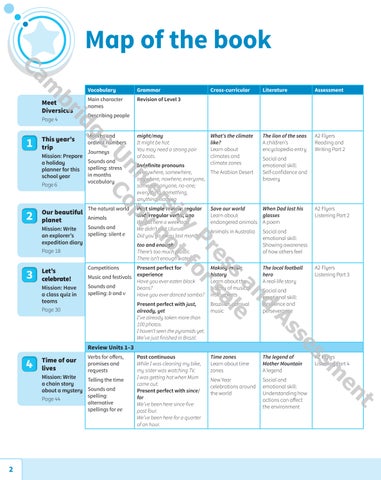
Map of the book Grammar
Main character names
Revision of Level 3
br
m
Ca Vocabulary
Meet Diversicus
Literature
Assessment
What’s the climate like? Learn about climates and climate zones
The lion of the seas A children’s encyclopedia entry
A2 Flyers Reading and Writing Part 2
Describing people
This year’s trip
ge
id
Page 4
Cross-curricular
Journeys
Sounds and spelling: stress in months vocabulary
The natural world
Our beautiful Animals planet
Sounds and Mission: Write spelling: silent e an explorer’s expedition diary Page 18
Let’s celebrate! Mission: Have a class quiz in teams Page 30
might/may It might be hot. You may need a strong pair of boots.
As d an s le es sa Pr r y fo it t rs no ve y ni p U Co
Mission: Prepare a holiday planner for this school year Page 6
Months and ordinal numbers
Indefinite pronouns The Arabian Desert everywhere, somewhere, anywhere, nowhere; everyone, someone, anyone, no-one; everything, something, anything, nothing Past simple review: regular and irregular verbs; ago We got here a week ago. We didn’t visit Uluru. Did you go away last month?
Save our world When Dad lost his Learn about glasses endangered animals A poem
Social and emotional skill: Showing awareness of how others feel
Present perfect for Music and festivals experience Have you ever eaten black Sounds and beans? spelling: b and v Have you ever danced samba?
Making music history Learn about the history of musical instruments
The local football hero A real-life story
Present perfect with just, already, yet I’ve already taken more than 100 photos. I haven’t seen the pyramids yet. We’ve just finished in Brazil.
Brazilian carnival music
Social and emotional skill: Resilience and perseverance
Past continuous While I was cleaning my bike, my sister was watching TV. I was getting hot when Mum came out. Present perfect with since/ for We’ve been here since five past four. We’ve been here for a quarter of an hour.
Time zones Learn about time zones
The legend of Mother Mountain A legend
New Year celebrations around the world
Social and emotional skill: Understanding how actions can affect the environment
too and enough There’s too much plastic. There isn’t enough water.
Competitions
2
t
alternative spellings for ee
A2 Flyers Listening Part 4
en
Mission: Write Telling the time a chain story about a mystery Sounds and spelling: Page 44
A2 Flyers Listening Part 3
m
Verbs for offers, promises and requests
A2 Flyers Listening Part 2
ss se
Animals in Australia
Review Units 1–3
Time of our lives
Social and emotional skill: Self-confidence and bravery
Ca
Let it snow!
Grammar
Cross-curricular
Literature
Assessment
Seasons and weather
will/won’t I’ll water their garden. We won’t talk about football.
Spring, summer, autumn, winter Learn about why we have seasons
Tomás and the snowman A real-life story
A2 Flyers Speaking Part 2
In winter Sounds and spelling: revision of -er, -ar and -or endings
Mission: Invent something to help with a job Page 68
Jobs
World of work
Conjunctions: so and because The weather’s really cold, so we have to wear warm clothes. Today we couldn’t go skiing because it was foggy. Tag questions You eat everything, don’t you? You can cycle, can’t you?
Climate in Argentina
Inventions and robotics Learn about inventions and robotics
Social and emotional skill: Showing remorse
A2 Flyers Buddie and Seo-joon’s adventure Reading and Writing Part 4 A science-fiction script
As d an s le es sa Pr r y fo it t rs no ve y ni p U Co
Working together
ge
id
br
m
Mission: Prepare a TV weather report Page 56
Vocabulary
Sounds and spelling: stress in compound nouns
Short questions ‘I didn’t go to the bank on Friday morning.’ ‘Didn’t you?’ ‘It was my twin brother.’ ‘Was it?’
South Korean inventions
Social and emotional skill: Friendship
Time machines Learn about the evolution of objects
The boy king A historical fiction story
The pyramids of Ancient Egypt
Social and emotional skill: Taking a different perspective
Preparing for Mars Learn about space exploration
The space blog A science-fiction story
An Italian astronaut at the ISS
Social and emotional skill: Managing own emotions
How chocolate is made Learn about chocolate production
The gingerbread girl’s adventure A fairy tale adaptation
Review Units 4–6
Then and now
Things in the home Adjectives to
Mission: Create describe objects an encyclopedia Sounds and entry spelling: j spelling Page 82
In space
Mission: Plan a space mission Page 94
Adventure words
Great bakers
Mealtimes and snacks Cooking Sounds and spelling: sh
will and going to Spaceships will improve. Are you going to watch space films?
Review of past tenses Ivan landed his rocket on the new planet. He was turning off his engine when he heard a strange noise.
Social and emotional skill: Being passionate about what you do
t
make somebody + adjective The smell’s making me hungry.
Traditional food in the UK
A2 Flyers Reading and Writing Part 6
en
It smells/tastes/looks/feels/ sounds like … I wanted to know what it tasted like. It felt like dry grass. It smelt like carrot cake. It looked like a nest. It sounded like someone playing an electric guitar.
A2 Flyers Reading and Writing Part 3
m
Mission: Take part in a cooking competition Page 106
Sounds and spelling: s + consonant(s)
be used for/to It was used for cooking food. It was used to cook food.
A2 Flyers Reading and Writing Part 5
ss se
Space travel
Past participles seen, found, driven, ridden, taken, broken, gone, left, tried, forgotten, put, stood, fallen, cut
Review Units 7–9 Grammar reference page 120
3
Meet Diversicus Ca
1 1.02 Listen. Who speaks in this part of
br
m
the director’s film?
Marc
ge
id
Diversicus is preparing to go on their new world tour. Today a film director is asking about life in the circus.
Rose
Lily
As d an s le es sa Pr r y fo it t rs no ve y ni p U Co May
Fred
Mrs Friendly
Ivan
Zoe
Miguel
Mr Friendly
Pablo
Su-Lin
Lily.
4
Describing people
She’s an acrobat. She’s Pablo’s mum. She’s Marc’s sister.
t
3 Play the describing game.
en
2 1.03 Who says it? Listen and say the name.
m
Jenny
ss se
Jim
DIVERSICUS
1.04
What are you going to do today?
1
Hello, I’m the circus strongman and I need to eat five big meals a day.
2
m
Ca 3
Yes, OK.
ge
id
br
I’m going to show the people making the film around Diversicus. Can I bring them to your kitchen first, Ben?
In Diversicus, food is very important. All the acrobats work very hard and they need to eat correctly.
4
Here’s Ivan. He’s the strongest man in the circus. He can lift a tractor.
As d an s le es sa Pr r y fo it t rs no ve y ni p U Co
I’ve got an idea. Why don’t we make a video, too?
No, I can’t, actually … I can pull a tractor with my teeth!
Yeah, it looks fun. Let’s go and get your camera and tell the girls.
5
Here are May and Fred, the designers. May makes all the amazing costumes.
6
Excellent, Grandpa! Now let’s go and see the acrobats.
No, I don’t. My husband and I make all the costumes together. And here are our amazing acrobats. Last year, Lily flew in the shows!
8
ss se
7
And my wife makes … me a very happy man.
Here we have four of the most brilliant children in the world. You should use some of their film.
en
m
Er, no, actually. You really shouldn’t.
t
No, I didn’t, actually. I jumped and Marc caught me.
4 1.05 Listen and say yes or no. Revision of Level 3
5
This year’s trip
1 Ca
1
Watch the video. Ask and answer.
m
ge
id
br
What do you do in the school holidays? Where would you like to go on a trip?
en
m
ss se
As d an s le es sa Pr r y fo it t rs no ve y ni p U Co Prepare a holiday planner for this school year In this unit I will:
t
6
1
Prepare a year planner.
2
Suggest and discuss options for different holidays.
3
Plan my holidays with a partner. Present our holiday planner to the class.
Vocabulary 1
1
1 1.06 Listen. Which countries do they talk about?
Ca
id
br
m
Diversicus is in Dubai. The children are in the classroom. They’re talking to Miguel about this year’s tour.
ge
Home
Dubai
As d an s le es sa Pr r y fo it t rs no ve y ni p U Co England
H ol i d a
ys
H ol i d a
ys
t
Say the chant.
en
m
ss se
2 1.07
3 Tell your friend about something that happens in each month. In January, it’s cold. I wear a coat.
In February, it’s my sister’s birthday.
Months and ordinal numbers
7
DIVERSICUS
1.08
That might be difficult because there isn’t any snow in Dubai. There’s only sand.
1
Actually, Ivan, Dubai’s got an excellent ski centre.
ge
id
No, don’t worry, Ivan. It’s inside!
I don’t know what to pack in my rucksack.
3
What? On the sand?
I think we may go skiing.
br
m
Ca
What are you going to do today?
2
4
I don’t know. I might not enjoy it.
As d an s le es sa Pr r y fo it t rs no ve y ni p U Co
You may need your sunglasses because the snow might be bright.
I’m worried too. I don’t know how to ski. But it might be fun – we can all go together.
Ivan, would you like to come with us?
5
These trousers look OK. What do you think?
Ivan, I think you might need some bigger ones!
I’ve got a larger jacket here. It’s our biggest one. This might be better.
8
Later, on the slopes.
Who’s that? Oh dear, I think it might be Ivan.
Yes, I think so. That looks better!
Let’s all go together.
No, I’m OK. I think I might go by myself this time.
1 1.09 Listen and say the number. 8
Story: might/may in context
I’m coming through. It’s only me!
t
OK. Let’s try again. Are you ready?
en
m
ss se
7
I may have a larger pair on the shelf.
6
Yes, Dad. It’s Ivan.
Language practice 1
1
1 Describe the holiday photo. Then read the message.
ge
id
br
m
Ca
Hi Emma! I can’t wait for you to come next August! You might need to bring lots of different things because we aren’t sure what we’re going to do when you’re here. It might be hot and Mum loves going to the beach, so you may need a beach towel and your swimsuit. Dad prefers to go camping in the mountains, so you may need a pair of strong boots. It might be cold in the mountains, so you might need a warm coat, too. I don’t mind what we do, because I enjoy going to the beach and I love camping. So, we might go to the mountains or we might go to the beach, but I’m sure we’re going to have a lot of fun together.
1.10 1
Grammar spotlight
As d an s le es sa Pr r y fo it t rs no ve y ni p U Co
It might be hot.
2 1 2 3
You may need a pair of strong boots.
Read the message to Emma again and complete the sentences. Use 1, 2, 3 or 4 words. Emma towel for the beach.
4
and
She might need a
because it’s cold in the mountains.
In the mountains, the weather .
5
They mountains or the beach.
a pair Emma of strong boots for camping in the mountains.
to the
3 Imagine you’re going to go camping or to the beach or to the sports centre. Say what you may or might do or see.
STAGE 1 Prepare your year planner.
Put family and school dates on your planner. Discuss with a partner.
It’s my grandma’s birthday. It’s on 15th January. We might have a party.
We may have a school sports day in June. Why don’t you include that?
That’s a good idea. Thanks.
My
t
What’s happening in January?
en
overmatter
m
ss se
I’m going to go to the beach. I might make a sandcastle.
diary Activity Book page 6
might/may
9
Vocabulary 2 and song
1 1.11
Listen and match. Then sing the song. b
Ca
a
id
br
m ge
We’re all going on a journey. We’re all going on a journey. (x2) We’re in the car on the 1motorway, Giving Frank a lift to the station. (x2) Chorus I see a 2taxi on the road and there’s lots of 3traffic. I see an 4ambulance and a 5bicycle. (x2) Chorus There’s my train at the 6railway station. There are 7passengers on the 8platform. (x2) Chorus (x2)
d
As d an s le es sa Pr r y fo it t rs no ve y ni p U Co
c
d
e
g
g
ss se h
h
How do you usually get to school?
It’s when there are a lot of cars and lorries on the road.
10
Journeys
Traffic.
t
3 Play a game with a partner. Guess the word.
en
Listen and write the words.
f
m
2 1.13
f
Language practice 2
1
1 1.14 Listen. Why is the shopping centre in Dubai special?
Ca
2 Copy and complete the grammar
Grammar spotlight
br
m
box. Listen and check. 1.15
id
every everywhere
ge
+ some somewhere
-/?
-
any anywhere
no nowhere
As d an s le es sa Pr r y fo it t rs no ve y ni p U Co
Where Thing One
all
3 Ask and answer.
Do you know anyone who lives in Dubai?
QUICK QUIZ
1 Do you know anyone who … ? 2 Is there anywhere near here you can … ? 3 Can you tell me anything about … ? 4 Is there anyone in your family who … ?
No, I don’t.
STAGE 2
Work with your Mission partner. Compare your year planners. Find dates when you’re both free. Discuss and choose holidays together.
Let’s go on a bicycle trip before Easter!
I think everyone might have the same idea, so it might be very busy. That’s a great idea! I love cycling!
My
t
We’re both free the first weekend in December. Shall we go skiing?
en
m
ss se
Suggest and discuss options for different holidays.
diary Activity Book page 6
Indefinite pronouns
11
Cross-curricular
What’s the climate like? 1
Watch the video.
Ca
2 Is the weather in your country the same all year?
m
br
3 1.16 Listen and read. Match the photos to the climate zones.
ge
id
Why are there deserts in some countries and rainforests in other countries? It’s always very cold at the North Pole and South Pole, even in summer. Why isn’t it very cold all year where you live? Different places have different climates. Climate describes the usual weather of a place over many years and it influences the plants and animals that we find there. There are three main climate zones: polar, temperate and tropical.
As d an s le es sa Pr r y fo it t rs no ve y ni p U Co
a
equator
c
Polar climates are cold
Temperate climates
Tropical climates are
all year and there is always snow and ice. In winter the temperatures can be as low as -50ºC and it’s dark all the time. In summer there is sun nearly all day, but it’s very weak, so it’s still cold.
usually have winters that aren’t very cold and summers that aren’t very hot. Countries in the temperate climate zone have four seasons: winter, spring, summer and autumn.
hot and humid all year. Countries near the equator are in the tropical climate zone. They don’t have four seasons: they only have rainy and dry seasons.
2
When is it dark all day in the polar climate zone?
3
To see autumn, which climate zone should you visit?
Learn about climates and climate zones
t
Which climate zone has rainy and dry seasons?
en
12
1
m
4 Read the text again and answer the questions.
ss se
b
Culture
1
5 1.17 Listen and read. Answer the questions.
A
br
m
Ca
desert is a place with little or no rain. They can be cold, like Antarctica, but many of them are hot, like the Arabian Desert. During the day here, temperatures are over 40ºC, but at night, it’s very cold and temperatures can fall below 0ºC.
ge
id
have large tents which keep them cool during the day and warm at night. Traditional clothes use light colours because they’re cooler than dark colours. They’re also long to protect people’s arms and legs from the sun and the sand.
1
As d an s le es sa Pr r y fo it t rs no ve y ni p U Co
In the past, most people who lived in the desert were nomads. Nomads don’t have a permanent home. They travel across the desert and they
Now, there are cities in the deserts because there are more ways of keeping cool. Dubai, in the United Arab Emirates, is a modern, exciting city in the Arabian Desert. The temperature in August is over 45ºC. How do people keep cool there? There are artificial islands, and also beaches, but when it gets too hot to be outside, people stay at home or go to the air-conditioned shopping centres.
How are your summer clothes different from the clothes in the photo?
2
Why do people in Dubai spend a lot of time inside?
3
Do you wish you lived in Dubai? Explain your reasons to a partner.
Fun fact!
The tallest building in the world, Burj Khalifa, is in Dubai. It’s 828 metres tall and it contains flats, a hotel, a gym, offices and shops.
STAGE 3
ss se
Plan your holidays.
In pairs, choose dates and decide how you’re going to travel for each holiday. It’s quicker than going by car.
en
m
Let’s travel by train.
Decide what you need to pack for each holiday. Yes. We need to pack warm coats, too. It’s cold in the mountains in March.
Write your final holiday plans in your year planner.
My
t
We need to pack our bike helmets.
diary Activity Book page 6
Learn about the Arabian Desert
13
Literature
1 Answer the questions. 1
Look at the text. What type of book would you find it in? How do you know?
Ca
Read the title and the sub-headings. What do you think the text is about?
br
m
2
TH E LION OF TH E SEAS
ge
id
1.18
As d an s le es sa Pr r y fo it t rs no ve y ni p U Co
Name: Ahmad Ibn Majid Occupation: Sailor, writer and poet Year of birth: Around 1430 Place of birth: Julfar Year of death: Around 1500
Julfar Today Today Julfar is called Ras Al Khaimah. Ras Al Khaimah is nearly two hours’ journey by motorway from Dubai. When Ahmad Ibn Majid was a boy, it was an important port. Early Life
t
Text type: A children’s encyclopedia entry
en
14
m
Ahmad Ibn Majid: The Sailor He studied the stars carefully and their position helped him to navigate ships. Other sailors called him ‘The Shooting Star’. Soon he could sail from Julfar to East Africa, India and to many other distant locations. He understood about winds and tides, and the effect of the moon on the tides, and he could navigate through the roughest seas.
ss se
Ahmad Ibn Majid was the son of a famous sailor and he loved the sea. He liked watching the boats coming and going and he enjoyed talking to anyone who arrived by sea. He wanted to be a sailor, too. His father taught him the art of navigation. Ahmad Ibn Majid was very brave and confident. When he was 17, he could navigate a ship by himself.
1
ge
id
br
m
Ca
Ahmad Ibn Majid: The Writer The sea, however, was not his only interest. He liked writing, too. He wrote 40 books about the sea, the stars and sea routes. He also wrote poetry. Soon he was famous and everyone talked about him. Ahmad Ibn Majid and Vasco da Gama Vasco da Gama, the famous Portuguese explorer, wanted to sail from Portugal to India, but no-one knew the sea route from Europe to India at that time.
As d an s le es sa Pr r y fo it t rs no ve y ni p U Co
Vasco da Gama
Vasco da Gama asked Ahmad Ibn Majid to help him. With his help, Vasco da Gama found the Cape of Good Hope in South Africa, sailed across the Indian Ocean and reached India.
The route that Ahmad Ibn Majid helped Vasco da Gama to find
en
m
ss se
Why we remember him Hundreds of years after he died, we still remember Ahmad Ibn Majid and his navigational skills. He’s called ‘The Lion of the Seas’. His books are in the National Library in Paris.
2 Why do you think Ahmad Ibn Majid was called ‘The Shooting Star’
t
in his lifetime? Why do you think he’s now called ‘The Lion of the Seas’? Discuss in groups.
3 Think of a time when you were brave. What happened? Tell a partner. Social and emotional skill: Self-confidence and bravery
15
A2 Flyers
1 Look at the picture and choose the correct answer. Who are the people?
Ca
1
2
br
m
A boy and his uncle. / A boy and his school friend. / Two brothers. Where are they going?
ge
id
To the beach. / To an office. / To the railway station.
As d an s le es sa Pr r y fo it t rs no ve y ni p U Co
2 Now read the instructions. Are you right?
David is going with his Uncle Frank to the railway station today. David is asking Uncle Frank some questions about the journey. What does Uncle Frank say?
3 Read and complete David’s questions about the journey. 1
far is it to the station?
4
there usually a lot of passengers?
2
are we going to get there?
5
people take bicycles on a train?
3
platform is our train on?
6 If I’m hungry,
can we buy food?
4 What kind of information does each answer need? Circle your answer.
It’s only about two miles from here.
C
It’s number one, near the drinks machine.
D
Yes, they can – with a special ticket.
E
There’s a nice café opposite the ticket office.
F
No, there aren’t. October’s a quiet month.
Preparation for Reading and Writing Part 2
Read all the choices before you choose an answer. In the exam there are two answers that you will not use.
t
B
en
In about five minutes.
m
16
A
ss se
5 Now match David’s questions with a reply.
Review
1 in action! My
Talk about your holidays.
id
br
m
Ca
Present your holiday planner to the class.
diary
This year we’re going to go on three holidays.
ge
Explain where you and your partner are going to go on holiday and what you’re going to do.
Activity Book page 6
We’re going to go to the mountains in March. We’re going to ride our bicycles every day.
As d an s le es sa Pr r y fo it t rs no ve y ni p U Co
’re Share the journey details and say what you
going to pack.
We’re going to leave on 24th March. We’re going to go by train. We’re going to take our bicycles, helmets and warm coats. As a class, vote to choose your favourite holiday.
en t
In which month is Diversicus going to be in England? What was the problem with Ivan’s jacket? What does Emma need to take with her on holiday? What are the three main types of climate zones? What’s different about people who are nomads? What name did sailors give to Ahmad Ibn Majid?
m
ss se
1 2 3 4 5 6
Unit consolidation
17
Our beautiful planet
2 Ca
1
Watch the video. Ask and answer.
m
ge
id
br
What animals and plants can you see where you live? What activities do you like doing outside?
en
m
ss se
As d an s le es sa Pr r y fo it t rs no ve y ni p U Co Write an explorer’s expedition diary In this unit I will: Describe my preparation and first day.
2
Describe what happened with some animals.
3
Write ideas about how to protect an endangered species. Role play an interview with an explorer.
t
18
1
Vocabulary 1
2
1 1.19 Listen. Where are the class going to camp? Name two places.
m
Ca Diversicus is in Sydney in Australia. The children are having a geography lesson.
ge
id
br hill(s)
As d an s le es sa Pr r y fo it t rs no ve y ni p U Co stone
desert
land
wood(s)
cave
ocean
fire
3
Say the chant.
t
2 1.20
en
m
ss se
stream
Play the spelling game. Number one: E-N-V-I-R-O-N-M-E-N-T.
1 env iron men t
The natural world
19
DIVERSICUS
We left here after school last Friday and we got to the beach at eight o’clock in the evening.
1.21
Yeah. When are you going to tell us about it?
1
2
br
m
Ca 3
Yes, it took five and a half hours.
Er, now.
ge
id
You came back two days ago and we don’t know anything about your trip.
Jim forgot his pyjamas, so we had to look for somewhere which sold them.
4
As d an s le es sa Pr r y fo it t rs no ve y ni p U Co We let her, but she spent an hour writing them before she sent them!
Yeah, that wasn’t the problem. Su-Lin found out there was a post office in town.
5
She bought stamps and postcards and then she began to write them!
It was dark when we began to put up the tents.
6
Pablo was outside, too. Jenny ran into him. They fell over and the tent came down.
A kangaroo appeared behind a tree and I ran away from it.
Were you OK?
I was inside my tent. Suddenly, I heard a noise outside, but I didn’t go and tell Miguel. I explored by myself. Well, we didn’t break anything. We only cut our knees and elbows.
1 1.22 Listen and complete. Use two words. Then say the sentence. 20
Story: Past simple review: regular and irregular verbs; ago in context
t
No, I’m not surprised.
Yes, but the other days were great. We saw lots of amazing animals … and some lovely kangaroos.
en
The next day Pablo and I lost a day. We stayed on the beach and Jim looked after us.
m
Miguel repaired the tent, but he wasn’t pleased with them.
8
ss se
7
Language practice 1
2
1 Look at the photo. What do you think Frank did on holiday? Complete the text with the words from the box.
2
br
m
Ca ge
id
Well, here we are in Australia. We 1got here 2 a week ago. On the first day, we my dad’s cousin and we explored some interesting 3 near a beach. We went on a boat see lots of with a glass floor, so we 4 amazing creatures.
As d an s le es sa Pr r y fo it t rs no ve y ni p U Co
Three days ago, we visited the Great Sandy Desert. We 5 in a big tent, but there 6 were lots of on the ground. We didn’t 7 Uluru, the huge rock in the middle of Australia. Did you go away last month? Frank
1.23 1
Grammar spotlight
We got here a week ago. W
We didn’t visit Uluru. Did you go away last month?
3 Play Find someone who. Ask and answer. Then tell the class.
Choose where to explore and start your explorer’s diary. Write about your y trip pp preparation. p Describe your y first day. y
en
ed I packed my hat and a blanket. It gets cold at night. I arriv . in the desert two days ago. We made a fire to keep warm
m
ss se
STAGE 1
t
My
Talk to another explorer.
When did you pack?
I packed my suitcase two days ago.
diary Activity Book page 18
Past simple review: regular and irregular verbs; ago
21
Vocabulary 2 and song
1 1.24
Listen and match. Then sing the song.
Ca
That was a 1dinosaur, But it’s now extinct. All there is on this dry land Are its huge footprints.
b
a
c
br
m
d
2
ge
id
Butterflies and 3beetles, 4 Eagles in the air, 5 Camels in the desert – Creatures everywhere!
As d an s le es sa Pr r y fo it t rs no ve y ni p U Co I’m a special 6tortoise With black 7swans in the stream. Look after our environment. Don’t let us be extinct!
e
f
Chorus … everywhere! … Creatures everywhere! I’m just an 8octopus Living in the sea. Keep the ocean clean. Don’t let us be extinct!
g
h
Chorus … everywhere! … Creatures everywhere! (x2)
This creature is an insect. It’s usually small and beautiful. It’s got four wings and six legs. It likes flying around flowers.
Let’s talk about animals. Where do you see animals in your town?
22
Animals
t
Use your description from Activity 2.
en
3 Play the definition guessing game.
m
Read and guess. Then write a description of a creature.
ss se
2
Language practice 2
2
1 1.26 Look at the pictures. What are the problems? Listen and check.
ge
id
br
m
Ca 1.27
Grammar spotlight
As d an s le es sa Pr r y fo it t rs no ve y ni p U Co
There’s too much plastic. There are too many cars. The land is too dry. There isn’t enough water. There aren’t enough trees. The air isn’t clean enough.
2 Look and write sentences with too and enough.
ir the a k n i I th s is too ie in cit dirty.
3 Ask and answer.
What do you do too much? What don’t you do enough? What have you got too much/many of? What haven’t you got enough of? I’ve got too many old toys.
My
t
Write about your day and tell a story about some animals.
en
Describe what happened with some animals.
m
STAGE 2
ss se
I don’t tidy my bedroom enough.
Discuss in groups.
How was your day?
I walked too near a snake. It was scary.
diary Activity Book page 18
too and enough
23
Cross-curricular
Save our world 1
Watch the video.
Ca
2 1.28 Listen and read. Answer the questions.
m
A
The list of endangered animals is very long and it includes polar bears, gorillas, rhinos and elephants.
ge
id
br
bout 65 million years ago, Earth lost half of all its animals. Many people believe that a meteorite hit the planet and this caused the extinction of so many animals. Extinction happens when the last member of a species dies. Dinosaurs probably became extinct because of this natural disaster, but other animals are now extinct because of humans. One example is the dodo. Dodos lived on an island. When humans arrived, they hunted the birds and their dogs ate the dodos’ eggs. Soon there were no more dodos.
As d an s le es sa Pr r y fo it t rs no ve y ni p U Co
dinosaurs
dodo
Today, we try harder to protect animals, but many are still endangered. This means that there aren’t many of them alive, so they might become extinct in the future.
polar bear
rhino
Animals become endangered for many reasons. Pollution and climate change are serious problems for all living things, but there are other reasons why so many animals are endangered. Hunters kill animals for their beautiful fur and some even kill them for sport. Humans cut down forests and change rivers to build cities and roads. This changes the animals’ habitats and the animals lose their homes and food. These actions put animals in danger of extinction. We must remember that we share our planet. It doesn’t belong to us.
What’s the difference between extinct and endangered?
2
Why are animals endangered?
m
ss se
1
think of?
en
3 Look at the photos. How can we help? What other ways can you
t
24
Learn about endangered animals
Culture
2
4 1.29 Listen and read. Write true or false. Correct the false statements.
ge
id
br
m
Ca
Australia is also home to some very dangerous animals. It has more venomous species than any other country in the world. These include spiders, scorpions and snakes on land and jellyfish in the oceans. It walked on four legs, but it could also hop on two legs. It was the largest carnivorous marsupial on Earth. A carnivorous animal is an animal that eats meat. The Tasmanian tiger hunted at night. Unfortunately, Tasmanian tigers attacked t them ted sheep, so farmers hunted v ve and now experts believe that they’re extinct.
As d an s le es sa Pr r y fo it t rs no ve y ni p U Co
The people in Australia work hard today to protect their unusual and special animals. They don’t want more animals to become extinct, like the Tasmanian tiger. The last time anyone saw this amazing animal was nearly 100 years ago. It was a very strange animal. It had a dog’s body, a wolf’s head, a kangaroo’s pouch and stripes like a tiger.
Australia has lots of unusual animals and many of them only live there, and nowhere else, for example kangaroos and koalas. These are both marsupials – animals that carry their babies in a pouch.
1
Marsupials carry their babies in a pouch.
2
The Tasmanian tiger had a head like a dog.
3
It walked on four legs, but it could also hop like a kangaroo on two legs.
4
It hunted during the day.
5
People killed the animals because they had beautiful fur.
6
The Tasmanian tiger is endangered.
My
t
put The Western Swamp Tortoise is endangered. We need to more plants in the water where they live. Insects come when there are plants and the tortoises eat the insects.
en
Write ideas about how to protect an endangered animal. Do research about an endangered animal where you’re exploring. Find d out ways ays to p protect otect tthiss a animal al a and d write te ideas. deas.
m
ss se
STAGE 3
diary Activity Book ok page 18
Learn about animals in Australia ia
25
Literature
1 What do you do when you lose something? Who helps you find it?
m
Ca
Where do you think Dad finds his glasses in Amy’s poem? Read and find out.
1.30
br
WHEN DAD LOST HIS GLASSES
ge
id
On the first day of March we arrived on a plane In Sydney, Australia, where there’s not so much rain. It was too hot for me and too hot for my dad And Mum said, ‘This weather’s the hottest we’ve had!’
As d an s le es sa Pr r y fo it t rs no ve y ni p U Co
m
ss se
Yes, the sun was so high and the sky was so blue And the air was so hot. Oh, what could we do? ‘Let’s go somewhere else,’ I said, ‘go somewhere cold, To the lovely Blue Mountains where they say there is gold.’
en
So we drove in the car on the very next day To the mountains that Mum said were not far away And the caves that were dark and so quiet and cold – Full of beautiful things, some new and some old.
Text type: A poem
t
26
2
br
m
Ca
We walked and we talked in these Jenolan Caves, Mum, Dad and I, and our guide, Mr Graves. ‘This is limestone,’ he said, with his hand to the wall, ‘And it makes all these shapes, so big and so tall.’
ge
id
‘Look at this,’ said our guide, ‘look up there, look at that! Here’s one like a hill! There’s one like a hat! Over time these things formed from the water that fell. Do you like them? They’ve all got some stories to tell.’
As d an s le es sa Pr r y fo it t rs no ve y ni p U Co
We had a good time in these interesting caves Until Dad said, ‘My glasses! My gla- … Mr Graves!’ We looked for them here and we looked for them there And Dad said, ‘But when did I lose them? And where?’
But the torch on my helmet helped me to see, So I looked in the dark that was all around me And I said to my dad, ‘They’re on top of your head!’ He put them back on and his face was bright red.
ss se
2 Answer the questions with a partner. Choose words from the box.
2
How did they feel when they saw the shapes in the caves?
3
How did Amy’s dad feel when he couldn’t find his glasses?
4
How did he feel when he realised they were on his head?
t
How did Amy and her parents feel when they arrived and it was very hot?
en
m
1
Social and emotional skill: Showing awareness of how others feel
27
A2 Flyers
1 Look at the picture. What
br
m
Ca
kind of activities do you think the children did on their trip?
2 Look at the notes. What kind
3 1.31 Complete the notes with the words in the box. Listen and check.
ge
id
of information is missing for each space?
As d an s le es sa Pr r y fo it t rs no ve y ni p U Co
School trip
School trip
Place: Ocean and Desert World
Place: Ocean and
1 Class:
1 Class:
World
2 Name of teacher: Mr
2 Name of teacher: Mr
3 First day: fed the
3 First day: fed the
4 Everyone had to: write a
4 Everyone had to: write a
5 Last day: children visited a
5 Last day: children visited a
4 1.32 Listen and write the surnames of these children on the trip.
1
Dan
2
Alice
3
Lily
Make sure you know the letters of the alphabet and always check your spelling.
en
m
ss se
5 Practise spelling with a friend.
Swan.
28
S-W-O …
Preparation for Listening Part 2
No, try again!
S-W-A-N.
t
5 animal words 5 surnames 5 environment words
Yes! Well done!
Review
2 in action! My
Ask other explorers about their arrival at the camp and use your diary to answer.
id
br
m
Ca
Role play an interview with an explorer.
diary What did you do on your first night?
ge
Ask and answer about incidents with animals.
Activity Book page 18
Did you see any interesting animals?
As d an s le es sa Pr r y fo it t rs no ve y ni p U Co
Ask about each explorer’s animal research and give the ideas you wrote about how to protect an endangered animal.
Did you find out about any endangered animals? How can we help them?
en t
Which subject was Miguel teaching the children? Which animal was outside Jenny’s tent? Where did Frank and his family go on their first day in Australia? Name three animals that are endangered. Why do people think Tasmanian tigers are extinct? Who lost his glasses in the Jenolan Caves?
m
ss se
1 2 3 4 5 6
Unit consolidation
29
Let’s celebrate!
3 Ca
1
Watch the video. Ask and answer.
m
ge
id
br
Do you celebrate any festivals where you live? What do you do to celebrate?
en
m
ss se
As d an s le es sa Pr r y fo it t rs no ve y ni p U Co Have a class quiz in teams In this unit I will:
t
30
1
Write questions about Diversicus.
2
Write quiz questions about experiences in my group.
3
Research a country’s music and write quiz questions. Take part in a quiz.
Vocabulary 1
3
1 1.33 Listen. Which country won the men’s beach volleyball? Which country won the women’s cycling road race?
m
Ca id
br
Diversicus is in Brazil. This morning, Ivan and the children are on the beach. team
ge As d an s le es sa Pr r y fo it t rs no ve y ni p U Co match
volleyball
prize
score
race
stadium
ss se
quiz
m
puzzle
winner
en
chess
t
2 1.34
Say the chant.
3 1.35 Listen and say yes or no. Competitions
31
DIVERSICUS 1
1.36
We’ve won our match!
Excellent! Well done!
2
I’ve taken Jim’s queen, but we haven’t finished.
id
br
m
Ca ge
How’s your game of chess going?
3
4
He’s lifted the ice cream cart!
Yes, but he’s got the ball.
5
How many ice creams have you bought?
As d an s le es sa Pr r y fo it t rs no ve y ni p U Co
Look what Ivan’s done!
Oh dear. She can take my king now. I’ve lost the game. Where’s Ivan?
I’ve bought four for you and they’ve made this ‘little’ one for me.
How many balls of ice cream have they put in that? It’s huge!
6
Tell us, Ivan. What other strange things have you lifted?
I’ve lifted a sofa with four people on it!
What else has he done?
But you’ve done stranger things than that …
Yes, I’ve seen a photo of that.
8
Well, King Ivan, have you ever lifted a castle?
en
m
I’ve heard it’s Rio Carnival next weekend. Is that right?
Yes – the biggest street party in the world! Has anyone decided which costume to wear?
He’s carried huge rocks, he’s pushed little cars and he’s pulled a plane!
ss se
7
He’s gone to get the volleyball.
t
Yes, I have. I’m going to be a king – the king of the castle!
1 1.37 Listen and say the number. 32
Story: Present perfect for experience in context
Don’t be silly. Of course I haven’t. No-one can lift a castle.
Well, I can – look!
Language practice 1
1
3
Look at the pictures. Talk about them.
2 Circle the words to complete the questions
Ca
in the advert.
m
Have you ever eaten/eat black beans? Have you ever spent/spend the day at the beach? Have you ever have/had mango ice cream? Have you ever swum/swim in the sea? Have you ever drink/drunk juice out of a coconut? Have you ever go/gone to the market to buy food? Have you ever danced/dance samba? Have you ever be/been to a carnival?
ge
id
br
As d an s le es sa Pr r y fo it t rs no ve y ni p U Co
1 2 3 4 5 6 7 8
If you have said No to any of these, then come to Brazil! You can do all of these and more. Book your ticket today!
1.38 1
Grammar spotlight
Have you ever eaten black beans? Have you ever danced samba?
3
Ask and answer the questions in the e advert. Write about your friend.
João ha s eaten black bean s, but he ha sn’t …
Write questions about Diversicus.
a Yes, he has. b No, he hasn’t.
My
t
Has Ivan pulled a plane?
en
Have the Friendly family been to Australia? a Yes, they have. b No, they haven’t.
m
In groups, write three Yes/No questions and answers about the characters. Use the present perfect.
ss se
STAGE 1
diary Activity Book page 30
Present perfect for experience
33
d
Vocabulary 2 and song
1 1.39
e
Listen and match. Then sing the song and do the actions. c
Ca br
m
At the 1 festival, 2 Musicians who 3 rock Join in the music – Hip-hop or 4 pop! At the festival!
b
ge
id a
As d an s le es sa Pr r y fo it t rs no ve y ni p U Co
At the 5 concert Wave your 6 flags! Play your 7 instruments! Don’t be sad! At the concert!
f
8
g
i
j
h
k
Whistle a 9 tune! Hit the 10 drums! Let’s meet on 11 stage With our mums! At the concert! Lily can swing To Mum’s 12 violin. Zoe can sing With Su-Lin.
ss se l
No, she isn’t. She’s playing the violin.
Music and festivals
t
Mrs Friendly’s playing the guitar.
Let’s talk about music. What type of music do you like?
en
Listen and write the words.
3 Play the memory game.
34
m
2 1.41
Language practice 2
3
1 2.02 Listen and look. What does Jim want to see?
Ca
Oct
Nov
Dec
Jan
Feb
Mar
Apr
May
Jun
Last year Russia
China
Indonesia
India
Greece
Turkey
Spain
USA
Mexico
This year
Australia Brazil
?
?
?
?
?
?
br
m
Where?
2.03
ge
id
Dubai
Grammar spotlight
As d an s le es sa Pr r y fo it t rs no ve y ni p U Co
I’ve already taken more than 100 photos.
I haven’t seen the pyramids yet.
We’ve just finished in Brazil.
2 Where have they been? Ask and answer about Diversicus.
Have they been to Russia yet?
Have they been to Italy yet?
Yes, they’ve already been there.
No, they haven’t been there yet.
STAGE 2
Write quiz questions about experiences in your group.
Has anyone ever been skiing?
Yes, I have. Let’s choose that.
Skiing Pablo has been skiing. Julia and Sam have been skiing. overmatter Everyone in our group has been skiing.
t
1 a b c
en
For each experience, write three present perfect sentences about your group. Only y one sentence is correct.
m
ss se
Talk about your experiences and choose three.
My
diary Activity Book page 30
Present perfect with just, already, yet
35
Cross-curricular
Making music history 1
Watch the video.
Ca
2 2.04 Listen and name the instruments.
br
m id
3 2.05 Listen and read. Then order the photos from the oldest
ge
instrument (1) to the most modern (4).
b
c
T
Guitars sometimes had pairs of strings like the lute, but the guitar changed over time to use single strings. People used guitars with six single strings for the first time in the 1600s in Italy, but the most important change happened in the 1850s. The Spanish guitar maker Antonio Torres Jurado made the guitar’s body bigger. His idea made the sound of the guitar louder and better. Most of today’s classical guitars follow his design.
The lute is also an ancient instrument similar to a guitar, but it has a short neck and a body like half a pear. It usually had more strings than a guitar and they were in pairs. From 1100–1500, travelling singers and story tellers played the lute to accompany their songs.
The first electric guitars appeared in the 1930s. The electric guitar has a solid body and can make many different sounds. We also find them in many different shapes and sizes. Some electric guitars don’t look like guitars at all!
en t
Learn about the history of musical instruments
m
36
he guitar is one of the most popular musical instruments in the world. Many different cultures have played instruments like the guitar for over 3,000 years. The oldest instrument that we can see today comes from Ancient Egypt. You can see this guitar in a museum in Cairo. It belonged to a singer who sang for the Egyptian queen Hatshepsut. This type of guitar had a long neck and only three strings.
ss se
d
As d an s le es sa Pr r y fo it t rs no ve y ni p U Co
a
Culture
3
4 Read the text. When and how do you listen to music?
Ca
What music do people in your family like? What festivals with music are there in your country?
ge
id
br
m
Music is all around us. We can hear it everywhere. We can also take it with us wherever we go, but that wasn’t possible until the 1980s. Now we have our favourite music on our phones and on our computers. Headphones let us listen to our music on the bus or in the car. We can hear it, but other people can’t. This is good because not everyone likes the same kind of music! There are many styles of music. Some people like classical music and others like folk, jazz or hip-hop.
As d an s le es sa Pr r y fo it t rs no ve y ni p U Co
Music is important in many cultures and different musical instruments are typical in different places. In many countries the drum is the most important instrument and you can see them in different shapes and sizes. Music is also very important at festival time in many countries.
5 2.06 Listen to Liliana talking about music at the Rio Carnival. Read and choose the correct words. 1
Brazil celebrates carnival in February or March / December or January.
2
Carnival happens only in Rio de Janeiro / all over Brazil.
3
People celebrate carnival at home / in the streets.
4
Samba music came from Africa / America.
5
Samba musicians use guitars and trumpets / drums.
6 Make your own Brazilian instruments.
en My
t
Research a country’s music and write quiz questions. Choose a country and research Write three quiz questions. Give its music. three possible answers (only one of which is correct). Let’s find out about music in … Good idea!
m
STAGE 3
ss se
Use materials that you have at home or in class.
diary Activity Book page 30
Learn about Brazilian carnival music
37
Literature
1 Which sports people do you like? How do you think their life changed when they became famous?
Ca 2.07
br
m
THE LOCAL FOOTBALL HERO
ge
id
My name is Rebeca and I’m 11. I’m from beautiful Brazil! But my family live in a poor area, and life isn’t easy. My parents work hard so my brother and I can go to school, and we always come straight home after school to help with the housework. But I have a passion … football! And I want to tell you how football has changed my life.
As d an s le es sa Pr r y fo it t rs no ve y ni p U Co
My dad wanted my big brother to be a professional football player, but he didn’t like training. I loved football and when I played I felt happy and I forgot about everything around me. My mum said, ‘Football isn’t for girls.’ The boys at school didn’t want to play with a girl either, but when they saw I was good, they picked me for their team.
ss se
en
m
One day a teacher told me about a football team just for girls. They were amazing. They told me that they were preparing for a competition in March. I really wanted to be part of the team and I decided to try my hardest.
Text type: A real-life story
t
38
3 When I told my dad and brother, they were very happy. My mum still didn’t like the idea.
ge
id
br
m
Ca
‘It isn’t going to be easy for you because football is a boy’s sport,’ she said. But she said nothing after that, and my dad and brother trained with me every day for six months. Finally, in February the coach told us which players were in the team for the competition. When I heard my name, I jumped in the air and I screamed with excitement.
As d an s le es sa Pr r y fo it t rs no ve y ni p U Co
Our team travelled to Rio de Janeiro in March and we won the competition – it was amazing! Since then we’ve won a lot more matches, but more importantly, I’ve made lots of new friends and I’ve become more confident about myself.
When I get older, I want to be a professional football player. Lots of my football idols have learnt English. For me, it’s important to speak English just like them and study hard so I can travel round the world and talk to people from different countries. That’s now my biggest dream in life.
How did football make Rebeca feel?
2
What sport or activity makes you feel the same as Rebeca? Why?
en
m
1
ss se
2 Answer the questions.
t
3 Rebeca practised a lot to achieve her dreams, even though it was difficult. Do you have a dream? Is it easy to achieve it?
Social and emotional skill: Resilience and perseverance
39
A2 Flyers
1 Look at the pictures. Where might you see these things?
You might see a drum in a music shop.
id
br
m
Ca violin
drum
puzzle book
ge
As d an s le es sa Pr r y fo it t rs no ve y ni p U Co
2 2.08 Listen. Which object in Activity 1 is Aunt Helen talking about? How do you know?
3 What might you find in these places? A
C
B
D
40
Listen and match a picture A–D with each word in Activity 1. Which letter didn’t you use? Why?
Preparation for Listening Part 3
In the exam, there are two extra pictures, but you will hear something about all of the pictures. Use the second listening to check your final choices.
t
4 2.09
en
m
ss se
Picture A – ball, grass …
Review
3 in action! My
In your group, think of a team name.
We’re The Samba Stars!
diary Activity Book page 30
br
m
Ca
Have a class quiz in teams.
ge
id
Ask the other teams your quiz questions.
The teams circle the correct letter for each question.
As d an s le es sa Pr r y fo it t rs no ve y ni p U Co
scores. Change answer sheets. Count up the
en t
What game were Ivan, Pablo and Jenny playing on the beach? What hasn’t Ivan lifted before? Name three things you can do in Brazil. Where’s the oldest type of guitar from? In which months does Brazil celebrate carnival? Who didn’t think Rebeca should play football?
m
ss se
1 2 3 4 5 6
Unit consolidation
41
Review Ca
1
Units 1–3
Watch the video vi eo and n do the quiz. Copy the t e table. t ble Listen to Katy and George and complete the e birthdays. birt ay Then listen again and complete the notes. Birthday
What did they do on their last birthday?
14th April
went to
id
Name
ge
br
m
2 2.1 2.10 10
Katy
with her
played
in
Emma
went
in the
Michael
broke
in
As d an s le es sa Pr r y fo it t rs no ve y ni p U Co
George
3 Work with a partner. Play the game. Take it in turns.
Student A: Choose two pictures for your partner. Say one thing that is the same about the two things. Student B: Say one thing that is different about the two things.
en
m
ss se t
Swan and eagle! They can both fly.
42
Consolidation of units 1–3
A swan lives on water, but an eagle lives on land.
4 Read the interview. Then read and correct the sentences.
Ca
E Hi, David. I’m writing a quiz. Can I please ask you some questions? You may win a prize!
m
D Sure! Go ahead!
br
E Have you ever swum in a lake?
id
D No, I haven’t. Everyone I know has swum in the sea, but no-one has swum in a lake.
ge
E Have you ever been to a festival? D No, I haven’t – not yet! My mum says I’m not old enough to go. E Have you ever sent a postcard?
As d an s le es sa Pr r y fo it t rs no ve y ni p U Co
D Yes, I’ve just sent one to my cousin to say thank you for looking after my tortoise. Postcards aren’t too expensive, so I send them from everywhere I go on holiday. E Have you ever been somewhere really hot, like a desert? D No, I haven’t. It’s too hot for me there and I like having enough water to drink!
E Thanks, David! Hmm … I’m sorry, you only answered ‘yes’ to one question, so you aren’t the winner. D Oh no! I’ve never won a prize!
David has swum in a lake.
2
David doesn’t know anyone who has swum in the sea.
3
David’s mum thinks David is old enough to go to a festival.
4
David has sent only one postcard. He thinks they’re too expensive.
5
David has been to a desert.
t
Now write your own interview for a friend. Think of six questions and then ask and answer.
en
m
5
ss se
1
Write questions about transport, animals, music/festivals and competitions. Start your questions with: Have you ever … ? Write your questions. Ask your friend and write their answers. Consolidation of units 1–3
43
Time of our lives
4 Ca
1
Watch the video. Ask and answer.
m
ge
id
br
Where can you see clocks? Do you always get up and go to bed at the same time?
Decide on the setting and characters for a story.
2
Describe a problem.
t
44
1
en
In this unit I will:
m
ss se
As d an s le es sa Pr r y fo it t rs no ve y ni p U Co Write a chain story about a mystery
3
Describe how the problem is solved. Finish and read the stories.
Vocabulary 1
4
1 2.11 Listen. Why is Rose worried?
Ca
tidy repair
ge
id
br
m
Diversicus has just arrived in Colombia. It’s time to prepare lunch, but there’s a problem …
As d an s le es sa Pr r y fo it t rs no ve y ni p U Co
look after
meet
send
fetch
en
m
ss se
make sure
t
2 2.12
Say the chant.
3 2.13 Who says it? Listen and say the name. Verbs for offers, promises and requests
45
DIVERSICUS 1
2.14
2
Hello! Where have you been?
br
m
Ca
It’s a long story.
I’m sorry lunch is a little late today, but we were driving along the road when we had a problem.
ge
id
You know why we’re late, Ben. And now you can explain everything!
3
5
4 Ben thought we had enough time to drive through the jungle.
As d an s le es sa Pr r y fo it t rs no ve y ni p U Co
Why did you get here late? What were you doing?
The road? We were driving along a path in the jungle, Dad!
We had lots of time. We were travelling happily down the motorway when Dad saw a path to the jungle.
We did! We were early! But while we were driving along the path, we hit a hole … and then … the tyre burst.
6
Were you driving fast, Ben?
No, he wasn’t. He was driving slowly and carefully.
Dad was repairing the tyre when a bus arrived. In the middle of the jungle!
We were lucky we weren’t going too fast.
8
While we were travelling, everyone was singing …
Marc, fetch a new tyre and go with Ben to get their home from the jungle, please.
Thanks, Rose.
en
m
… and Mum was playing her violin.
And we were studying for an exam!
ss se
7
The bus was amazing. I’ve never seen anything like it before.
t
Jim, Jenny – now it’s your turn to study for the exam.
1 2.15 Listen and complete. Use two words. Then say the sentence. 46
Story: Past continuous in context
Language practice 1
4
1 What do you have to do before you can ride the bike in the photo?
Ca
Complete the text using the correct words from the list below.
br
m
2
id
Last weekend Mum 1 asked my older sister and an me to clean and repair our bikes. Both bikes had small holes in the tyres
ge
While I 2
so we couldn’t cycle to the park.
cleaning my bike, my sister was 3
I drank 4
As d an s le es sa Pr r y fo it t rs no ve y ni p U Co
cartoons on TV! I was getting hot and angry when Mum came out to help me. She brought me some juice which I was repairing ng the ty tyre. Mum and I were ready to go. We 5
getting on our bikes when my sisterr
6
out to join us. She couldn’t come
because her bike wasn’t ready!
1
ask
asking
asked
4
while
who
why
2
is
was
were
5
are
was
were
3
watched
watching
watches
6
came
come
comes
4.06 4
Grammar spotlight
While I was cleaning my bike, W my sister was watching TV.
when Mum came out.
I was getting hot
3 Choose words from your teacher’s lists. Make sentences
ss se
and act them out.
You were hopping when you fell over.
STAGE 1
The story takes place in the colourful city Cartagena de Indias. Sally, Lily, Pedro and Marco are four friends who met while … Our title: What was Pedro doing at the Clock Tower?
My
t
Choose a title. Give your y plan p to your y teacher for another g group. p
en
In groups, choose your setting. Think about your characters.
m
Plan your mystery story.
diary Activity Book page 44
Past continuous
47
Vocabulary 2 and song
1 2.17
Listen and match. Then sing the song.
a
m
Ca
b
c
br
d
id ge
e
f
We were waiting for the bus At 1five past two. We were waiting for the bus At 2ten past two. The bus didn’t come, The bus didn’t come. … At 3quarter past two. … At 4twenty past two.
As d an s le es sa Pr r y fo it t rs no ve y ni p U Co … At 5twenty-five past two. … At 6twenty-five to three.
g h i j
… At 7twenty to three. … At 8quarter to three. … At 9ten to three. … At 10 five to three.
We arrived at the bus stop late. We arrived at five past two. We arrived at the bus stop late. The bus left at two.
Write five questions about yesterday.
48
Telling the time
I was getting dressed.
How long does u to it take you ool? get to school? What time do you rive? usually arrive?
t
What were you doing at twenty-five to eight in the morning?
doing … ? 2 What was your mum d
en
a partner.
m
3 Ask and answer your questions with
1 What were you doing at twenty-five to eight in the morning?
ss se
2
Language practice 2
4
1 2.19 Listen. What time does the bus usually arrive?
Ca
2.20
Grammar spotlight
m
(We arrived at five past four.)
(Now it’s twenty past four.)
br
We’ve been here for a quarter of an hour.
ge
id
We’ve been here since five past four.
As d an s le es sa Pr r y fo it t rs no ve y ni p U Co
2 Write the questions. 1
How long / you / be / at this school?
4
How long / you / have / your shoes?
2
How long / you / live / here?
5
How long / you / know / your teacher?
3
How long / you / study / English?
6
How long / you / … ?
3 Ask and answer the questions from Activity 2 with a partner. How long have you been at this school?
I’ve been here for four years. I’ve been here since I was five.
STAGE 2
ss se
Describe a problem for the mystery story.
In groups, read the setting, characters and title of the story you have. Think of a problem and write the ‘build-up’ part of the story.
My
t
The four friends were going to meet at eleven o’ clock. io de Sally, Lily and Marco arrived at eleven o’clock at the Barr Getsemaní, but Pedro … e …’ A little later, Sally said, ‘How long have we waited for? We’v Lily. ‘What can we do now? Pedro doesn’t have a phone,’ said
en
m
Give the story to your teacher for another group.
diary Activity Book page 44
Present perfect with since/for
49
Cross-curricular
Time zones 1
Watch the video.
Ca
2 2.21 Listen and read. Answer the questions.
br
m ge
id
As Earth turns in space, the sun shines on only part of the planet. When it’s day where you live, it’s night time on the other side of the world. This means that when you’re eating your breakfast, other children are going to bed. It’s a different time in their country because the world has different time zones. LINES OF LONGITUDE
GREENWICH MERIDIAN
EQUATOR
A map of the world has lots of lines on it. Lines of latitude go around Earth. They show us the distance from the equator, the line that goes round the middle. Lines of longitude go up and down, dividing Earth like pieces of an orange.
2
Is New York to the west or to the east of the Greenwich Meridian?
3
Is the time in New York earlier or later than GMT?
Learn about time zones
t
Explain the difference between lines of latitude and lines of longitude.
en
1
m
50
ss se
As d an s le es sa Pr r y fo it t rs no ve y ni p U Co
LINES OF LATITUDE
The Greenwich Meridian is a very important line of longitude which passes through London in the UK. It traditionally sets the time for all the clocks around the world. The time on this line of longitude is Greenwich Mean Time (GMT). If you live to the east of the Greenwich Meridian, it’s later than in London. If you live to the west, it’s earlier. Large countries like the USA have three or more time zones, but most countries have one, so the time is the same everywhere in that country. Before you phone a friend, check what time it is in their country. You might call them at 3.00 in the morning and no-one wants to talk then!
Culture
4
3 Look at the photos and read. What are they celebrating? What do the GMT labels mean?
Ca
GMT – 5 hours
GMT + 2 hours
GMT + 10 hours
ge
id
br
m New York, the USA
Athens, Greece
Sydney, Australia
As d an s le es sa Pr r y fo it t rs no ve y ni p U Co
It’s 31st December, a special celebration in many parts of the world. It’s a time when we hope for the future. Each country has its own traditions at this time.
4 2.22 Listen to the children talking about celebrations
in their countries. Write K (Ken), M (Maria) or D (Dom).
1
eats 12 pieces of fruit.
4
watches fireworks on the bridge.
2
has a party at the beach.
5
puts a vegetable on their door.
3
might get money for singing. 6
puts an extra plate on the table.
5 How do you celebrate New Year? Talk with a partner.
6 Find out when and how people celebrate Chinese New Year. Use the internet to help you.
Continue the story.
My
t
Write the ‘resolution’ and give the story to your teacher for another group.
en
In groups, read the ‘build-up’ part of the story and decide how to solve the problem.
m
ss se
STAGE 3
Sally said, ‘I know what happened! Pedro hasn’t changed the time to Colombian time!’
diary
‘You’re right. Let’s go to the Clock Tower. I think he’s there!’ said Marco.
Activity Book page 44
Learn about New Year celebrations around the world
51
Literature
1 Look at the pictures. What is the setting for the story? Why do we need to protect this place? How can we do this?
Ca 2.23
S
id
br
m
THE LEGEND OF MOTHER MOUNTAIN
ge
omewhere deep in the rainforests and mountains of Colombia there’s a very special woman. You may never see her, but she’s there all the same. She wears a dress made of leaves. She’s got no shoes on her feet and she has a ring of wild flowers on her head. Her name is Mother Mountain. Her job is to look after nature and the environment, and to make sure that no-one harms it. The animals of the rainforests and mountains love her. She’s their friend, and they know that they’re safe with her.
As d an s le es sa Pr r y fo it t rs no ve y ni p U Co
m
ss se
One day a man came to the forest to cut down some trees. As he was swinging his axe at a tree, Mother Mountain suddenly appeared from nowhere and caught his axe in her strong hands. The man turned and looked at her in amazement. ‘Why have you come into the rainforest?’ Mother Mountain asked. ‘To cut wood to burn for our fires,’ the man said. ‘You can’t cut down my trees,’ Mother Mountain said. Slowly her green eyes turned red as she said:
en
‘The environment is important for you and me!
t Go to sleep now. Then wake up and see!’ Immediately the man fell to the ground in a deep sleep. The tree moved in the wind. It seemed to be saying ‘Thank you, Mother Mountain.’ 52
Text type: A legend
4
br
m
Ca
A few minutes later, another man came into the forest. He didn’t see the man asleep on the ground, but he saw a bear. As he was getting ready to catch it with a net, Mother Mountain suddenly appeared from nowhere and caught the net in her strong hands. ‘Why have you come into the forest?’ she asked. ‘To get meat for my children to eat,’ the man said. ‘You can’t kill my animals,’ Mother Mountain said. Slowly her green eyes turned red and she said: ‘The environment is important for you and me!
id
ge
Go to sleep now. Then wake up and see!’
As d an s le es sa Pr r y fo it t rs no ve y ni p U Co
The man fell to the ground in a deep sleep. The bear touched Mother Mountain and made a soft noise. It seemed to be saying ‘Thank you, Mother Mountain.’
The two men slept for several hours. Then they woke up from their deep sleep and they looked round. They didn’t see Mother Mountain. She wasn’t there. They only saw how beautiful the forest and its animals were. They walked home together, promising never to cut down a tree or hurt an animal ever again.
ss se
2 Why are the men never going to cut down a tree or hurt an animal again?
en
m 3 Do you do anything to look after nature and natural places?
t 4 In groups of five, act out the story. Decide who’s going to be Mother Mountain, the two men, the tree and the bear.
Social and emotional skill: Understanding how actions can affect the environment
53
A2 Flyers
1 Michael was doing one of these activities yesterday at 5 p.m. What are the different activities?
ge
id
br
m
Ca A
B
C
As d an s le es sa Pr r y fo it t rs no ve y ni p U Co
2 2.24 Listen and say the order you hear the activities.
3 2.25 Look at the pictures carefully. Then listen and read
the question and the conversation. Answer the question.
A
B
en Remember to choose your answer when each part of the conversation finishes. You always listen again so you can check your answer.
t
Preparation for Listening Part 4
m
54
ss se
Where was Mum waiting for Michael? Michael: I left school late because Mr March told us to tidy the playground. Can we still go to the cinema? Mum: Well, only if there’s a later time for the film … Michael: I can find out on my tablet. Yes! At eight o’clock. Mum: OK, as it’s Friday, but we need a bus back here to the bus station after the film. Let’s look at the times.
C
Review
4 in action! My
m
Ca
Finish and read the stories. In groups, write the end of the story which you now have.
diary Activity Book page 44
ge
id
br
Sally, Lily and Marco arrived at the Clock Tower and they saw Pedro. ‘Hi Pedro!’ the friends said. ‘Hi! I’ve waited for half an hour!’ Pedro said. ‘You haven’t changed your watch to Colombian time!’ Sally said. ‘It’s 12 o’clock here.’ ‘Oh no!’ Pedro said. They all laughed. THE END.
As d an s le es sa Pr r y fo it t rs no ve y ni p U Co
Next, read the finished story to the whole class.
This story takes place …
The title of the story is …
r favourite story. ou y se oo ch to te vo Finally, as a class The best story is …
en t
Why was the Friendly family late for lunch at Diversicus? What did Jim and Jenny need to study for? Why did the girl have to repair her bike? What’s the name of the line that goes round the middle of our planet? In which country do people eat 12 grapes at New Year? What does Mother Mountain wear?
m
ss se
1 2 3 4 5 6
Unit consolidation
55
Let it snow!
5 Ca
1
Watch the video. Ask and answer.
m
ge
id
br
Does it snow where you live? What do you like doing when the weather is cold?
56
1
Research winter weather in a different country.
2
Draw a map with weather symbols.
t
In this unit I will:
en
m
ss se
As d an s le es sa Pr r y fo it t rs no ve y ni p U Co Prepare a TV weather report
3
Write some travel advice. Act out a TV weather report.
Vocabulary 1
5
1 2.26 Listen. In which months is the temperature usually coldest?
Ca
id
br
m
Diversicus is in Patagonia in the south of Argentina. It’s a cold, foggy day.
fog
As d an s le es sa Pr r y fo it t rs no ve y ni p U Co
autumn
summer
ge
spring
storm
winter
warm
2 2.27
en
m
ss se
ice
Say the chant.
What’s the weather like here in spring?
t
3 Ask and answer questions about the weather where you live. It’s warm and sunny, but there are sometimes storms.
Seasons and weather
57
DIVERSICUS
2.28
Miguel’s given us a group project to do about animals and their environment in Patagonia.
1
2
I’ll write about the penguins. I’ll use the photos which I took yesterday.
br
m
Ca Different animals appear in different seasons. You can’t see all the animals at the same time.
3
ge
id
And I’ll make a video of the whales and dolphins from the film which I got yesterday.
4
Books – do you remember what they are, Jim? You’ll have to use our school books.
As d an s le es sa Pr r y fo it t rs no ve y ni p U Co
You’ve both chosen the easiest ones! I’ll have to search for information online.
Actually, Jim, we can’t. We haven’t got wifi here.
So, how will you do it then?
5
There won’t be much information here, so let’s go to the End of the World Museum. There’s an excellent library there.
No, we won’t. I’ve got a better idea.
6
We’ll have a lovely day out.
Wow, what a brilliant name! I’m sure Ivan will want to come.
I’ll collect information about the environment. What will you do, Jim?
8
What a huge plate of seafood!
1 2.29 Listen and say the number. 58
Story: will/won’t in context
t
We won’t finish all of that!
en
m
I’ll find out about sea birds, but I won’t write about penguins, Jenny.
And we’ll help you, so you finish faster.
Let’s ask Pablo and Jenny too.
ss se
7
So, we’ll go to the museum and after that … lunch!
I will! I can eat more than a penguin!
Language practice 1
5
1 Look at the
m
Ca
pictures. What are the children doing?
2 Read. Answer
br
the questions.
id
Who’ll feed their cat?
2
What’ll Sarah and her brother do?
3
Will Katy make them some soup?
I’ll make them a sandwich.
4
What’ll Harry do?
I’ll water their garden.
5
Who’ll chat with Mr and Mrs Hill?
6
What won’t they talk about?
ge
1
HelpatHome - online
HelpatHome
Robert
As d an s le es sa Pr r y fo it t rs no ve y ni p U Co
Mr and Mrs Hill are old and they’re part of our ‘Help at Home’ programme. Who can help? I’ll feed their cat.
Sarah
My brother and I will do their shopping for them.
Katy Harry
Excellent. Who wants to sit and chat with them? And what time will you go?
George
Betty and I will sit and talk to them after school. We won’t talk about football because Mrs Hill hates it.
2.30 2
Grammar spotlight
II’ll water their garden. We won’t talk about football. What time will you go?
How will you help? Write three sentences.
ss se
3
I’ll tidy their bedroom.
Research winter weather in a different country.
In groups, choose a country that isn’t your own. Research the weather in winter. What’s the weather like in Canada in winter?
My
t
I think it’s foggy and cold.
en
m
STAGE 1
diary Activity Book page 56
will/won’t
59
Vocabulary 2 and song
1 2.31
Listen and match. Then sing the song.
Ca
id
br
m
My friend’s made a 1snowman. I haven’t got my 2gloves. My hands are in my 3pockets. I have to stand and watch.
He’s 4skiing down the mountain. She’s riding on her 5sledge. He’s making lots of 6snowballs. To throw them at his friend.
ge
b
As d an s le es sa Pr r y fo it t rs no ve y ni p U Co a
c
He’s carrying his 7snowboard. He’s going to the top. 8 Snowboarding isn’t easy – I hope that she can stop.
d
e
The temperature has dropped a lot. They’ve put their ice skates on. They’re skating very fast now. They’re on the icy 9pond.
g
f
h
i
Listen and write the words.
3 Play a miming game.
ss se
2 2.33
Are you throwing a snowball?
en
m
What am I doing?
t
Yes, I am. What do you like to do in winter? 60
In winter
Language practice 2
1 2.34
Listen and choose the correct picture.
What clothes do George and Grandpa talk about? B
C
What have George and his parents decided to do tomorrow? B C
ge
id
2 A
br
m
Ca
1 A
5
As d an s le es sa Pr r y fo it t rs no ve y ni p U Co
2.35
Grammar spotlight
The weather’s really cold, so we have to wear warm clothes. Today we couldn’t go skiing because it was foggy.
2 Match to make correct sentences. Write the sentences. 1
There was a bad storm, …
a
2
They were wearing warm clothes … b
so we could go sledging.
3
It snowed heavily, …
so we couldn’t play in the park.
c
because there was a lot of snow.
ss se
STAGE 2
m
Draw a map with weather symbols.
en
In groups, draw a map of the country you chose.
The weather in the north is foggy and cold because it’s near the sea.
My
It’s snowy in the east because there are mountains.
t
Draw the weather symbols on your map for a day in winter.
diary Activity Book page 56
Conjunctions: so and because
61
Cross-curricular
Spring, summer, autumn, winter 1
Watch the video.
Ca
2 2.36 Listen and read. Why do some parts of the world have seasons?
br
m ge
id
March
As d an s le es sa Pr r y fo it t rs no ve y ni p U Co June
December
October
You know that the equator is an imaginary line that goes around Earth. It divides Earth into two hemispheres: the northern and southern hemispheres.
Look at the picture of Earth in December.
The North Pole tilts away from the sun. This means that the northern hemisphere will be colder in December. The South Pole tilts towards the sun in December, so that’s when the southern hemisphere is warmer. This is why it’s winter in the northern hemisphere when it’s summer in the southern hemisphere.
Earth’s axis is another imaginary line. It passes through the centre of Earth between the North Pole and the South Pole.
You can see in the diagrams that Earth’s axis isn’t vertical. It tilts to one side. Earth travels around the sun in one year (365 days). As it travels, different places on Earth are closer to the sun. This is why there are different seasons.
m
ss se
Find the equator in the diagrams. Why don’t countries on the equator have the four seasons? They’re at the centre of Earth, so they have the same amount of sunlight all year.
1
2
3
4
en
3 2.37 Listen and think. Is it the northern or southern hemisphere?
t
62
Learn about why we have seasons
Culture
5
4 2.38 Listen and read about the different seasons in Argentina. Answer the questions.
ge
id
br
m
Ca
Argentina is a very large country in South America. It’s in the southern hemisphere, so winter begins in June and summer begins in December. However, it isn’t cold in winter in all of Argentina because it has different climate zones.
1
2
3
In many countries we can say, ‘I go skiing in winter and I love swimming in the sea in summer.’ You can do those activities in Argentina, but in any season. Why? The Andes is the longest mountain range in the world and 4,000 kilometres of it is on the border between Chile and Argentina. Argentina also has almost 5,000 kilometres of coast from north to south. It’s no problem to go skiing in summer and swim in the sea in winter. You only have to choose the correct place!
As d an s le es sa Pr r y fo it t rs no ve y ni p U Co
Let’s look at two examples. The north of Argentina is near the equator and it has a tropical climate. There are lots of rainforests and there are high temperatures all year, even in winter. The south of Argentina has a polar climate. It’s close to
Antarctica, so it’s very cold all year – cold enough for penguins – because it’s never near the sun.
Why are the seasons different in various parts of Argentina?
4
Can you only find penguins in winter?
5
What’s special about the Andes?
6
Are the Andes in Argentina longer than the coast?
Where are the rainforests?
Where is the polar climate zone in Argentina?
en
m
Use your poster to describe the things you like best about each season.
ss se
5 Make a poster about the seasons in your country.
STAGE 3
t
Write some travel advice. In your group, think about the weather and prepare travel advice. It’s snowy in the mountains. You can go skiing! Be careful, there will be ice on the road.
My
diary Activity Book page 56
Learn about climate in Argentina
63
Literature
1 Look at the picture. Name three activities that you can do when it snows. Have you got a favourite snow activity?
Ca 2.39
m
TOMÁS AND THE SNOWMAN
ge
id
br
Tomás and Valentín were brothers. They lived in a small town in Patagonia in Argentina. Tomás was five and Valentín was nine, so they often wanted to do different things.
As d an s le es sa Pr r y fo it t rs no ve y ni p U Co
One day in winter it snowed so much that the hill behind the boys’ house became white. Tomás wanted to make a snowman, but Valentín wanted to go snowboarding. ‘Will you help your brother make a snowman?’ the boys’ mum asked. ‘Yes,’ Valentín said, ‘I’ll help Tomás make a snowman.’ Tomás and Valentín made a snowman. They called it El Viejo, the old man. It had a scarf around its neck, stones for its eyes and mouth, a carrot for its nose and sticks for its arms. ‘I like him,’ Tomás said. ‘I like him! Let’s make a friend for him! I’ll get some more sticks and stones from under the trees over there!’ Tomás ran to the trees singing, ‘Snowman, snowman, lovely, lovely snowman!’
en t
Text type: A real-life story
m
64
ss se
Valentín kicked the snow and said to himself, ‘I don’t want to make another snowman. I want to go snowboarding.’ But what could he do? Then he had an idea. ‘I’ll knock El Viejo down,’ he thought, ‘but I’ll tell Tomás that the snowman has gone away. Then Tomás will want to go back home and play a different game. And I can go snowboarding!’
5 When Tomás came back he was surprised to find
ge
id
br
m
Ca
that El Viejo wasn’t there. ‘Where is he?’ he said. ‘Oh, he walked away down the hill,’ Valentín answered. ‘I don’t know where he was going.’ Tomás started crying. ‘No!’ he said. ‘He can’t! El Viejo! Come back!’ Before Valentín could stop him, Tomás ran back to the house shouting, ‘Mummy! Daddy! El Viejo has gone!’
As d an s le es sa Pr r y fo it t rs no ve y ni p U Co
When Valentín got home, he found his brother sitting at the kitchen table. His mother and father looked at him in that special way, the one they used when they weren’t pleased with him. Valentín said, ‘I’m sorry, Tomás,’ and then he asked his brother to go back to the hill. ‘We’ll make another El Viejo,’ he said, ‘lots of them.’ ‘Can we?’ Tomás asked. ‘Can we, Valentín?’ And that was what the brothers did for the rest of the day. They fi lled the hillside with snowmen. Valentín was happy that his brother was excited and he thought to himself, ‘Well, there’s always tomorrow – I’ll go snowboarding then.’
2 Role play a conversation with a partner. Imagine you are Tomás and Valentín.
You are Tomás. You’re very sad about El Viejo. You were very excited when you made him and you were very sad when you saw that El Viejo wasn’t there. Tell Valentín how you feel. I’m very sad, Valentín. I liked the snowman so much!
en
B
m
ss se
A
t
You are Valentín. You’re sorry that you made Tomás sad. You only wanted to go snowboarding. Say sorry to Tomás, tell him what happened and talk about the new snowmen you can make together. I’m very sorry, Tomás. I didn’t want you to be sad. Let’s make lots more snowmen. They’ll be bigger and better than El Viejo.
Social and emotional skill: Showing remorse
65
A2 Flyers
1 Talk about the pictures.
Emma’s winter sport Robert’s winter sport
m
Ca
What are Emma and Robert wearing? What winter sports might they do?
1
br
2 Make questions for the answers about Robert’s winter sport.
2
Where
3
Who / with
4
Morning / afternoon
He goes in the afternoon.
5
How long / ski / for
He skis for two hours.
His favourite winter sport is skiing.
ge
id
Favourite winter sport
He does it in the mountains.
As d an s le es sa Pr r y fo it t rs no ve y ni p U Co He goes with his family.
3 Answer the questions about Emma.
Choose a word from the box and make a full sentence.
What is Emma’s favourite winter sport?
2
Where does she go sledging?
3
Who does she go sledging with?
4
Does she go in the morning or the afternoon?
5
How long does she go sledging for?
66
Preparation for Speaking Part 2
She’s nine.
If you don’t understand, say, ‘Can you repeat that please?’
t
How old is Emma?
en
Robert. Use the ideas in the box or your own ideas. Invent the answers.
m
4 In pairs, ask and answer about Emma and
ss se
1
Review
5 in action! My
diary
Say which country you’re covering in your weather report.
br
m
Ca
Act out your TV weather report.
This is today’s weather report for Canada.
Activity Book page 56
id
ge
Give the weather report in different regions or areas of the coun try.
As d an s le es sa Pr r y fo it t rs no ve y ni p U Co
It’ll be snowy in the mountains.
Give some travel advice to the audience.
It’s a good time to go skiing in the mountains. Be careful, there’ll be ice on the road.
en t
Where’s Patagonia? What’s the name of the museum that Ivan and the children visited? How will Harry help Mr and Mrs Hill? In which month does summer start in Argentina? What type of climate does the north of Argentina have? What did Valentín want to do in the snow?
m
ss se
1 2 3 4 5 6
Unit consolidation
67
Working together
6 Ca
1
Watch the video. Ask and answer.
m
ge
id
br
What jobs do you know? What jobs do robots do?
en
m
ss se
As d an s le es sa Pr r y fo it t rs no ve y ni p U Co Invent something to help with a job
68
1
Choose a job and think what people need for that job.
2
Invent and describe something new for the job.
t
In this unit I will: 3
Make a model of the invention. Show the invention at an inventions fair.
Vocabulary 1
6
1 2.40 Listen. Which part is Marc going to play in the new show?
Ca
br
m
Diversicus is in South Korea. This morning everyone’s practising for the new show, ‘World of Work’. pilot
ge
id As d an s le es sa Pr r y fo it t rs no ve y ni p U Co firefighter
police officer
businesswoman
engineer
manager
uniform
mechanic
en
m
ss se
Say the chant.
t
2 2.41
3 Describe a job. Play a guessing game. The person who repairs cars.
I think it’s a mechanic.
Jobs
69
DIVERSICUS
2.42
So, we’re in South Korea. What’s it famous for?
1
You’re both right, but let’s look at robots first.
2
br
m
Ca Yeah! And in South Korea they use a lot of robots, don’t they?
ge
id
They invented K-pop music, didn’t they?
3
Yes, but it doesn’t look like a person.
4
They’re designing robot teachers, aren’t they, Dad?
As d an s le es sa Pr r y fo it t rs no ve y ni p U Co
Robots don’t always look like people, do they?
No, they don’t. Robots can be any shape or size.
Jenny, Dad’s got a robot in the kitchen, hasn’t he?
Yes, they are, but they aren’t ready yet. Now, this afternoon we’re all going to see some robots!
At home, we’ve got one which cleans the floor. It hasn’t got arms or legs.
5
6
Later …
Look! That robot’s playing the violin.
That’s the biggest robot in the world, isn’t it?
No, but it can lift cars. It’s as strong as Ivan.
Yes, but it can’t play a tune as well as a real musician, can it? Look! This puppy can walk, can’t it?
8 You didn’t buy a puppy, did you?
70
Story: Tag questions in context
t
1 3.02 Who says it? Listen and say the name.
en
Yes, it can. And it can play with a ball!
Yes, I did. I couldn’t leave him there, could I? Come on, Mr Barker! Walkies!
m
You aren’t going to get one, are you?
ss se
7
Hmm. Oh, look over there.
Language practice 1
6
1 Look at the pictures.
br
m
Ca
What will Barry do in August?
ge
id
2 Read. Circle the correct tag question. From: Junu
To: Barry
As d an s le es sa Pr r y fo it t rs no ve y ni p U Co
Hi Barry, I can’t wait for your visit next month. Mum wants to know a few things before you arrive here in Seoul. First of all, you’re going to arrive at about half past four in the morning, (1) aren’t you / don’t you? We’ll give you a lift from the airport. You’ll be here for a month, (2) aren’t you / won’t you? Now, about food: you eat everything, (3) don’t you / didn’t you? You don’t have any problems with food, (4) do you / does it? We’re going to take our bicycles and cycle along the Han River. You can cycle, (5) couldn’t you / can’t you? What about this idea? Do you like it? One last thing: you said you loved Korean dance music, (6) didn’t you / don’t you? I love it too, so the good news is … we’ve got tickets for a K-pop concert! I’m really excited. Speak soon, Junu
3.03 3
Grammar spotlight
You eat everything, don’t you?
3
You can cycle, can’t you? Yes, I do.
Firefighters need to be able to dress quickly. They need a uniform that’s easy and quick to put on.
My
t
In groups, choose a job and discuss what people need when they do this job.
en
Choose a job and think what people need for that job.
m
STAGE 1
You walk to school by yourself, don’t you?
ss se
What do you know about your friend? Write questions. Ask and answer.
diary Activity Book page 68
Tag questions
71
Vocabulary 2 and song
1 3.04
Listen and match. Then sing the song.
a
Ca
m
1 Firefighters in the fire station Wearing uniforms on their fire engine.
br
2 Businessmen and businesswomen Going to meetings in their offices. World of work! (x4)
b
ge
id
As d an s le es sa Pr r y fo it t rs no ve y ni p U Co
3 Police officers by the police station Wearing uniforms in police cars. 4 Journalists in the street Getting news for the newspapers. World of work! (x3) 5 Engineers in factories With robots making cars. World of work! (x4)
c
d
e
Where do journalists work? They work in newspaper offices and in the street. 72
World of work
Do you know anyone who ho? works in an office? Who?
t
3 Ask and answer about where people work.
en
Listen and write the words.
m
ss se
2 3.06
Language practice 2
1 3.07
6
Listen and write. 1
m
Ca
Time on Friday morning: 2 Camera shows the man standing near
br
Brother’s job: 3 Brother had a meeting with:
4
ge
id Grammar spotlight
As d an s le es sa Pr r y fo it t rs no ve y ni p U Co
3.08 3
I didn’t go to the bank on Friday morning.
Didn’t you?
It was my twin brother.
Was it?
I was having coffee with the bank manager.
Were you?
2 Choose a situation and write a conversation with a partner. Then act it out.
There were some sweets on the table half an hour ago. They aren’t there now. The tablet was working an hour ago. It isn’t working now.
Your school sweater was on the kitchen chair. Now it’s on the floor and it’s dirty. There were some sweets on the table half an hour ago.
Were there? I didn’t see them …
Think of the job which you’ve chosen. Invent and describe something that people need to do it.
A one-piece suit that is easy and quick to put on for a firefighter.
My
It has a helmet, a jacket and boots all in one!
t
Describe your invention.
en
Choose an idea and draw a sketch of your invention.
m
In groups, think of ideas for something that can help.
ss se
STAGE 2
diary Activity Book page 68
Short questions
73
Cross-curricular
Inventions and robotics 1
Watch the video.
Ca
2 In the past we only used phones to talk to people. Phones
m
b
c
e
d
ge
id
a
br
have changed a lot. Look at the photos and order them from the earliest phone (1) to the most modern phone (5).
As d an s le es sa Pr r y fo it t rs no ve y ni p U Co
3 3.09 Listen and read. Answer the questions. An invention begins as an idea. Then other people find ways to make that invention better. Our machines are always changing. Not very long ago, we thought of robots as science fiction, but robots are already part of our lives.
Robots are machines that can do the actions of a human. At first, most robots did boring or dangerous work in factories, like putting parts of cars together or putting chocolate bars in boxes ready to go to the shops. They could repeat the same action all day and never get
bored. Those robots didn’t need a human to control every action. Other robots need human control. For example, doctors use robots to help them operate on very small body parts. We use robots to test planes and cars. We also have robots which can clean our homes. Some robots drive special cars which don’t need a driver and there are even robots on Mars! Scientists have developed robots that look and behave like humans. They can talk to people, and scientists think they can help in hospitals and schools one day. Do you think it’s possible that your future teachers will be robots?
ss se
What are robots?
3
What do doctors use robots for?
2
How can robots make life easier?
4
What dangerous jobs do robots do
74
How will it help us?
What kind of energy does it need?
How will it work?
Who will want to use this robot?
Learn about inventions and robotics
t
4 Talk to a partner about a robot that you would like to invent.
en
m
1
Culture
6
5 3.10 Listen and read. How many of these inventions do you use? Which is the most useful to you? Why?
Ca
digital music. You can now take your music with you and listen to it anywhere: on a bus, on a train or in bed. In the past you could take your music with you, but the machines were big and uncomfortable to carry. Does anyone in your family have a smart card to travel around the city? It’s a card that you use to pay for your journeys on buses and trains and it’s also a South Korean invention. Have you ever seen an internet café? Again, it’s a South Korean invention. You can see why South Korea is so important in the world of technology, can’t you?
ge
id
br
m
South Korea is a country in Asia. It isn’t a large country, but more than 50 million people live there. South Korea is one of the most modern and developed countries in the world, with a very important electronics industry. South Korea also has some of the most interesting ideas in the world of technology. You probably use many of these inventions every day, but did you know that they come from South Korea? For example, have you got a mobile phone or a tablet? South Korean scientists invented the
As d an s le es sa Pr r y fo it t rs no ve y ni p U Co
touch screen. Before this invention, people had to press buttons or use a special kind of pen to give instructions to the machine. It’s much easier to give the instructions with your fingers. South Korea also invented the first MP3 player. In the past, people collected big round records or cassettes of their favourite music. The invention of the MP3 player was the beginning of mobile
6 Find out about other inventors and inventions from your country.
ss se
STAGE 3
In groups, think of and find materials you can recycle to make your model. I’ve got some old clothes at home which we can use.
Make a model of your invention.
My
t
We can use old clothes for the model.
en
m
Make a model of your invention.
diary Activity Book page 68
Learn about South Korean inventions
75
Literature
1 Would you like to have a robot as a teacher? Why? / Why not?
BUDDIE AND SEO-JOON’S ADVENTURE
Ca 3.11
br
m Scene 1
ge
id
Somewhere in Seoul in the near future … Buddie is a humanoid robot. He’s a teaching assistant in a primary school. It’s his first week at school. Buddie: Very good! Please repeat. Kang-dae: He’s weird, isn’t he! You know like … strange! Yong-sun: And he isn’t human, so he doesn’t understand how we feel, does he? He doesn’t know how bored we are. He’s like a cold fish. Narrator:
As d an s le es sa Pr r y fo it t rs no ve y ni p U Co
Scene 2
One day after class Buddie speaks to Seo-joon. Buddie: Please help me. No-one in the class likes me. The school is going to send me back to the factory. Seo-joon: Don’t worry, no-one likes me either! They think I’m unfriendly too. Hey! I can teach you about humans! Buddie: That’s a great idea. Thank you! In return, I will help you with your homework. Seo-joon: Will you? Really? Thanks! I’d love some help with my maths. Narrator:
Scene 3
The following Friday afternoon, Seo-joon gives Buddie some of his clothes and they secretly leave the school together. Buddie: Mm! I look cool in these! Seo-joon: Shh! Follow me. We don’t want to attract the principal’s attention, do we? Narrator:
Text type: A science-fiction script
t
76
en
In the evening, Seo-joon’s parents meet Buddie. This is Buddie. He’s going to help me with maths. He’s cool, isn’t he? Yes, very! How are you? Fine, thank you. I am here to learn about humans … er, help your son. Seo-joon: Oh no! This is going to be difficult! Narrator: Seo-joon: Parents: Buddie:
m
ss se
Scene 4
6
Scene 5 As the weeks pass, Seo-joon and Buddie become great friends. Seo-joon improves his maths while Buddie learns about humans. Seo-joon: So, if x=10, the value of 6x–x 2 is … –40. Yes! Buddie: This game is wonderful! Come on! I will play you! Seo-joon: OK, but you’ll never win! Narrator:
ge
id
br
m
Ca Scene 6
Scene 7
As d an s le es sa Pr r y fo it t rs no ve y ni p U Co
One Friday night they’re leaving school as usual, when suddenly the principal appears. Principal: Hey! Where are you going? Seo-joon: Oh no! We’re in big trouble now! Principal: In my office now! Both of you. Narrator:
In the principal’s office. Principal: I’m sending you back to Teacherbot.com immediately. Seo-joon: I’m sorry. It was my idea. It was wrong, but Buddie has helped me with my maths. I’m getting ‘A’s now. He’s my friend! Buddie: And Seo-joon has helped me to understand what humans like and do. Now we are friends! Narrator:
Scene 8
A few weeks later in the classroom. Myung-ok: Wow! I never knew you were so good at maths. Could you help me with my homework this evening? We could play video games after that if you like? Seo-joon: Sure! Thanks. Buddie: OK class, today we’re going outside to study maths! Class: Hurray! Seo-joon: Buddie, you’re the best! Narrator:
en
m
ss se
t
2 What problems did Seo-joon and Buddie have? How did they fix them? Do you think they were good friends? Why? Social and emotional skill: Friendship
77
A2 Flyers
1 What would you like to know about firefighters?? Read the text. Does it answer your questions?
Ca
Firefighters
m
id
br
A of cities and villages have firefighters. These are men lot or women who have (1) … how to save people and buildings when there is a fire.
ge
They usually wear a (2) … with a helmet, special gloves and strong boots. They always have a torch and (3) … they carry a phone (4) … they can call their manager for help.
As d an s le es sa Pr r y fo it t rs no ve y ni p U Co
To prepare for (5) … job takes 1–4 years. During that time, the men and women practise working in (6) … kinds of dangerous places or with different kinds of fires. There are firefighters at the fire station all day and night. They wait for the sound that tells them to get ready and go to a fire. It takes a good firefighter under a minute to put on a uniform and run to the fire engine. That’s fast, (7) … it? One of the firefighters (8) … the fire engine. This is not always red and you will find trucks around the world (9) … are different colours. It’s important to choose a colour which people see (10) … at night.
2 Look at the choices for spaces 1–4. Answer the questions. 1 learn
learning
learnt
Which word helps you choose?
2 clothes uniform jackets
Which word helps you choose?
3 sometimes
Why are the other adverbs wrong?
once
never
4 while before so
3 Which choice is correct? Why? 8
drives
driving
driven
6
all
each
every
9
who
where
which
7
isn’t
is
wasn’t
10
easy
easier
easily
Remember, you don’t need to think of the words. You choose one of three for each space. 78
Preparation for Reading and Writing Part 4
t
these those this
en
5
m
ss se
Is the text about why they carry a phone or when?
Review
6 in action! My
diary
In groups, describe what the invention is for.
Activity Book page 68
br
m
Ca
Show the invention at an inventions fair.
ge
id
This is an easy-to-wear uniform. You can put it on quickly. Describe how you made your invention.
As d an s le es sa Pr r y fo it t rs no ve y ni p U Co
We used recycled clothes.
Which job is the invention for? Ask the class.
Which job do you think the invention is for?
A firefighter!
en t
What’s the name of Diversicus’s new show? What did Ivan buy at the robot exhibition? Say two things that Barry’s going to do on his trip to Seoul with Junu. How can doctors use robots? Name three South Korean inventions. How did Seo-joon help Buddie?
m
ss se
1 2 3 4 5 6
Unit consolidation
79
Review Ca
1
Units 4–6
Watch the video vi eo and n do the quiz.
What’s the boy doing?
Where are the children in the first picture?
5
What time is it in the second picture?
6
How are the girl’s clothes and the boy’s clothes different?
7
What are the girl and the boy doing together?
As d an s le es sa Pr r y fo it t rs no ve y ni p U Co
3
4
ge
2
What’s the weather like?
id
1
br
m
Look at the pictures p ctu es and answer the questions. 2 Lo
What’s the girl doing?
10:45 a.m.
3:20 p.m.
3 3.12 Listen and find the mistakes.
4 Match the sentence halves. Then add a tag question and ask and answer with a friend. 1
Your dad
2
a journalist
You were playing
b
a snowman last winter
3
Your house
c
a meeting all day
4
She wishes she was
d
pilot
5
Your mum’s a
e
prepares your lunch
6
Your parents are in
f
season is autumn
7
School
g
starts at 7 a.m.
8
You can snowboard
h
is near the station
9
Your favourite
i
very well
10
You didn’t make
j
volleyball all day yesterday
t
Consolidation of units 4–6
No, he doesn’t. I prepare it!
en
80
m
Your dad prepares your lunch, doesn’t he?
ss se
a
5 Read the replies to the teacher’s question. Then cover the text and try to remember as many as you can.
m
Ca Sign out
id
br What will you do which is DIFFERENT this month?
ge
Betty
As d an s le es sa Pr r y fo it t rs no ve y ni p U Co
I’ll read the news more. David
I’ll learn to snowboard. Holly
I’ll learn how to repair my own bike. Frank
I’ll prepare lunch for my family! (At least once!) George
I’ll go to the dentist. Oliver
I’ll send more messages to my cousin who’s at college in the USA. Richard
I’ll prepare my school uniform before I go to bed each night! Sarah
I won’t be late for school! Sophia William
I’ll make sure I help my parents more with their business.
m
Ask your classmates for their ideas. Find six things they will change this month. Then write six sentences in your notebook.
en
6
ss se
I won’t get angry when my parents ask me to tidy my room!
t
I’ll start playing tennis. I’ll make sure I do my homework on time.
My friend Jane will start playing tennis.
Consolidation of units 4–6
81
Then and now
7 Ca
1
Watch the video. Ask and answer.
m
ge
id
br
Which objects do you use at home every day? Do you think people in the past had the same objects? Why? / Why not?
t
82
Choose a household object.
2
Write a description of it.
en
In this unit I will: 1
m
ss se
As d an s le es sa Pr r y fo it t rs no ve y ni p U Co Create an encyclopedia entry
3
Talk about how the object has changed over time. Create an encyclopedia entry for it.
Vocabulary 1
7
1 3.13 Listen. What are they going to do in the afternoon?
Ca
gate
br
m
Diversicus is in Egypt. Today the Friendly family are on a ship on the River Nile. They’re looking at one of their rooms.
id
oven
ge
brush comb
telephone
As d an s le es sa Pr r y fo it t rs no ve y ni p U Co fridge
key
soap
shampoo
shelf
toilet
en
m
ss se t
2 3.14
Say the chant.
3 3.15 Listen and answer the questions. Things in the home
83
DIVERSICUS
3.16
Mum, Dad, have you seen Ivan? Look over there!
1
2
Hello, Ivan. How did you get here?
ge
id
br
m
Ca 3
I’ve come by car. I’ve borrowed Marc’s car for three days. I’ve driven from Cairo.
Hello. Only me!
We’re going to see the old city. Come on.
4
Take them for a camel ride, please?
As d an s le es sa Pr r y fo it t rs no ve y ni p U Co
OK. We’ll meet you in the old city in two hours.
I’d like to ride on a camel first. Have you ever ridden on one, Ben?
Can’t I stay with Dad? I’ve never ridden on one either!
No, I’ve never ridden on a camel ... and I’m not going to ride on one today!
5
Ivan! Jenny’s just fallen off her camel!
6
Are you OK, Jenny?
Yes! I’ve hurt my leg a bit, but I didn’t fall far. The camel hasn’t stood up yet.
Oh, you’ve cut your knee. I don’t feel well ...
Later … Jenny! Take a photo.
8
ss se
7
Oh no! I hope she hasn’t broken anything.
t
Sorry, we’ve forgotten the camera. We’ve left it on the ship.
en
m
Hello? … It’s your dad. They’ve found a great place for lunch.
Don’t worry, I’ll take one.
1 3.17 Listen and say the number. 84
Story: Past participles in context
Great! I’m really hungry.
And this time we’ll travel by car, OK?
Language practice 1
7
1 Look at the pictures. What
Ca
do you think George has done during the holidays? Read and circle the correct answer.
br
m
2
id
Dear Emma,
ge
Can you 1see / saw / seen the beautiful stamp on the envelope? I’m in Egypt! We’ve been here for five days and we’ve 2 found / find / finding it really interesting.
As d an s le es sa Pr r y fo it t rs no ve y ni p U Co
We’ve already 3driven / drove / drive to some of the most important pyramids, but we haven’t 4try / trying / tried riding camels yet. I 5taken / take / took some great photos on our first four days, but my sister 6have / hasn’t / has just broken my phone. I’m really unhappy about that! I’m 7wrote / writing / written this letter while we’re sitting in a café. Dad’s 8 gone / go / went to the car because he and Mum forgot to bring some money, so we can’t pay for our drinks until he gets back! I don’t mind – it’s nice and cool in here. Love, George
3.18 3
Grammar spotlight
II’ve taken some great photos.
3
My sister has just broken my phone!
Write six questions to ask your classmates. Use these words.
STAGE 1
My
We can choose a telephone.
Maybe a fridge is better? People have always needed to keep things cold.
t
In groups, discuss the most useful household objects. Choose one object for your encyclopedia entry.
en
Choose a household object.
m
ss se
Have you ever stood on a bee?
diary Activity Book page 82
Past participles
85
b
Vocabulary 2 and song
1 3.19
Listen and match. Then sing the song.
a
m
Ca
Come on, Jim! Come on, Jenny! Your room’s 1untidy, your room’s untidy. Your room must be tidy when we leave.
ge
id
br
We’ve tidied our room, now our room is 2tidy. We’ve tidied our room, now our room is tidy. But my suitcase is 3full. It’s too 4heavy.
As d an s le es sa Pr r y fo it t rs no ve y ni p U Co
Now your suitcase is 5broken, your suitcase is broken. My suitcase is 6empty and it’s 7light. Let’s pack this one, put something in mine. Let’s pack this one, put something in mine. Pack it quickly, it’ll be all right.
I’ve been to town and I’ve bought this rug. Isn’t it 8unusual? Isn’t it great? I’ve been to town and I’ve bought this rug. And it wasn’t 9expensive. It was 10cheap.
c
h
d
It isn’t a problem. I’ve got Marc’s car. So put everything in Marc’s car. It’s only me! I’m by myself. It’s only me! It’ll be all right.
i
g
f
e
en
m
3 In pairs, play the adjective game.
ss se
2 3.21 Listen and answer the questions.
j
t
Think of something which is heavy. I think my grandpa’s brave. 86
Adjectives to describe objects
I think an elephant is heavy. My turn. Think of someone who is brave.
What do you do when something is broken?
Language practice 2
7
1 3.22 Guess which picture they don’t talk about in the museum. Listen and check. 2
3
4
5
ge
id
br
m
Ca
1
c
Grammar spotlight
As d an s le es sa Pr r y fo it t rs no ve y ni p U Co
3.23 3
It was used for cooking food. It was used to cook food.
Ovens like this are used for making bread and pizza today. Ovens like this are used to make bread and pizza today.
2
Write definitions for five different things. 1
It’s made of plastic, metal or wood. It’s used to sit on and it’s got four legs.
3 Play the definitions guessing game.
Compare different versions of the object.
My
t
In groups, write a description of how we use the object.
Fridges are used … to keep food fresh and cold. Some fridges have got an ice machine …
en
Describe the household object.
m
STAGE 2
Is it a mirror?
ss se
This is used for looking at your face. It’s usually made of glass.
diary Activity Book page 82
be used for/to
87
Cross-curricular
Time machines
Ca
1
1
2
3
a
b
c
Watch the video.
m
2 How have objects evolved?
id
br
Draw a line to match the old and modern objects in the photos.
ge
3 3.24 Listen and read. Match the words in blue with the photos (1–6).
As d an s le es sa Pr r y fo it t rs no ve y ni p U Co 1
2
We use machines to help us in different ways: to work, travel, communicate … or to have fun. There are simple machines, with only one or no moving parts, like a screw , and complex machines, with many parts that work together, like a clock.
‘Time to get up!’ Clocks control modern life. Today, we nearly always know the time, but early humans didn’t worry about it. They hunted and worked when it was light and they slept at night. However, as civilisations developed, humans wanted to know the time.
t
Learn about the evolution of objects
5
en
88
6
m
The 14th century mechanical clock was a European invention. It rang a bell every hour. Clockmakers added the hour and minute hands. A clock with hands is called an analogue clock and a digital clock only has numbers. Our clocks today are much more accurate than earlier versions and they’re everywhere: on our computers, tablets, phones and even in the street. No-one should be late these days!
4
ss se
The Egyptians built enormous towers and used shadows and the sun to tell the time. Later, people used a smaller version of this, called a sundial , but this can’t help on cloudy days or at night. For hundreds of years people marked and burnt candles or they used a water clock or an hourglass , which used sand.
3
Culture
7
4 3.25 Listen and read. Answer the questions.
ge
id
br
m
Ca
The Ancient Egyptians were one of the earliest human civilisations to develop and their inventions were amazing. 3,000 years ago, their technology helped them build the pyramids and royal palaces. They had their own writing called hieroglyphics and they made paper from the papyrus plant.
As d an s le es sa Pr r y fo it t rs no ve y ni p U Co
of Giza, which was about 150 metres tall. We can see that they used enormous blocks of rock, but there are some important questions. How did the Ancient Egyptians bring the rocks to the place where they were building the pyramid? How did they lift the rocks to the top?
have today, but they had simple machines like ramps and levers. The workers cut the rocks and moved them slowly up the pyramid on ramps which they built around the sides. They lifted the heavy rocks with levers and built the pyramids one rock at a time. Archaeologists think it took 23 years, and thousands of people, to complete the Great Pyramid of Giza.
The pyramids in Egypt are some of the most impressive things that humans have built. When a pharaoh (their king) died, the people buried him inside a pyramid. There are about 140 pyramids. The largest is the Pyramid of Khufu or the Great Pyramid
Experts think that they brought the rocks down the River Nile on rafts. They didn’t have the machines that we
ramp
lever
Why did the Ancient Egyptians build the pyramids?
Fun fact!
2
How did the River Nile help the pyramid builders?
3
Which simple machines did the Ancient Egyptians use to build the pyramids?
4
How long did it take to build the Great Pyramid of Giza?
Did you know that the Ancient Egyptians also invented toothpaste? They had problems with their teeth because their bread had a lot of sand in it.
STAGE 3 Research the history and evolution of your household object.
en
m
ss se
1
Use the internet and encyclopedias to help you make notes.
Egyptians used jars full of water to keep food cold.
t
My
Find out about earlier versions of your item.
diary Activity Book page 82
Learn about the pyramids of Ancient Egypt
89
Literature
1 What do you know about
THE BOY KING
ge
id
3.26
br
m
Ca
Ancient Egypt? Look at the picture and find three mistakes.
As d an s le es sa Pr r y fo it t rs no ve y ni p U Co
In 1922, an archaeologist found the tomb of an Ancient Egyptian king, a pharaoh, called Tutankhamun, who we sometimes call King Tut. Tutankhamun died when he was 19. An x-ray showed he had a broken leg, but we don’t know much about his life. People have different ideas about what happened to him, but no-one knows for sure. Here’s a story about what may have happened to him.
Once upon a time in a city called Akhetaten in Ancient Egypt, there was a boy called Tut. Tut was a happy child, but when he was only nine years old his father died. The great men of the royal court told him that he was now the country’s new king, which they called ‘pharaoh’. That was the end of Tut’s happy days as a child.
ss se en
m
Tut didn’t know how to be a king, but no-one let him decide what to do anyway. The real rulers of the land were a general named Horemheb and a man called Ay. They wanted to control Tut and they wanted him to do everything they said. Tut hated them both.
Text type: A historical fiction story
t
90
7
A year later Horemheb and Ay told Tut to marry a beautiful young girl. Her name was Ank. Tut had everything that a pharaoh needed, but he was bored!
ge
id
br
m
Ca
When Tut was 18, Horemheb and Ay gave him a new pair of sandals. They were expensive, but there was nothing special about them. Or was there? There were faces on the bottom of the sandals.
As d an s le es sa Pr r y fo it t rs no ve y ni p U Co
‘That’s unusual,’ Tut thought. He asked ‘Why are these faces here?’ ‘They are the faces of your enemies,’ Horemheb explained. ‘These sandals are used for standing on them.’ Tut was very interested and he put on the sandals. As soon as Tut was alone, he took them off again. Who were his real enemies? Horemheb and Ay, of course. They were horrible and they never let him do what he wanted. Tut carefully painted Horemheb’s and Ay’s faces onto the bottom of his new sandals. Then he put them on, he went outside and he jumped up and down in the hot sand!
en
m
ss se
Later that day, Horemheb and Ay gave Tut a board game. Tut and Ank started to play. Horemheb and Ay stood behind them, watching the game. Suddenly a piece fell off the board. Tut jumped up to get it, but something made him fall over. Did he fall or was he pushed? No-one will ever know, but his leg was broken. It was a very bad break. Tut became sick and died. Ay married Ank and became the next pharaoh.
t
2 Everyone in Egypt thought Horemheb and Ay worked very hard to help Tut to be king, but Tut didn’t like them. Do you think Tut was right or wrong? Give reasons. Social and emotional skill: Taking a different perspective
91
A2 Flyers
1 Look at this story title and
Ca
the picture. What can you see? What is the woman doing? Mrs Stamp’s new phone
id
br
m 2 Read the sentences on the left.
ge
Mrs Stamp is an police / American police officer. She gets a lot of messages so she needed / used a new phone.
As d an s le es sa Pr r y fo it t rs no ve y ni p U Co
Examples Mrs Stamp lives in America and works for the police. She decided to buy a new phone for all the messages when she’s at work.
1 Her car wasn’t working, so her husband David drove her to a shop near his office.
She and her husband went by car / for a walk to a shop near where he works.
2 Mrs Stamp suddenly saw a black and silver one, which she liked.
Mrs Stamp preferred the phone which had two colours / suddenly rang.
3 She paid for it and David took her home.
David drove his wife home after / before she bought the phone.
4 At half past six, Mrs Stamp walked into the kitchen to make their dinner and feed their cat, Holly.
At half past six, she went to prepare / to eat everyone’s dinner.
5 The cat was sitting on the floor and Holly was next to / sitting on the phone was next to her, in pieces. the broken phone.
David could hear his wife / couldn’t see Holly because she was making a loud noise.
7 ‘I love our cat, but she’s very naughty! Look at my phone!’
Mrs Stamp / David says that Holly is very naughty.
92
Preparation for Reading and Writing Part 5
Be careful! The picture doesn’t give you any answers. All the words you need for your answers are in the story.
t
right. They must have the same meaning as the sentences on the left. Choose the right word(s).
en
3 Look at the sentences on the
m
Who is Holly? Why is she naughty?
ss se
6 Mrs Stamp started to shout, so David went to see why.
Review
7 in action! My
Write a short description of the object. Include information about the history of the object.
diary Activity Book page 82
br
m
Ca
Create an encyclopedia entry.
ge
id
Fridges are used to keep food in good condition and to keep food cold. Egyptians used jars full of water to keep food cold. Later, people … Draw pictures or add photographs of the object.
As d an s le es sa Pr r y fo it t rs no ve y ni p U Co
Share your encyclopedia entry with the class.
We chose a fridge. People have always needed to keep things cold. The history in our entry starts thousands of years ago with the Ancient Egyptians.
en t
Which river did the Friendly family sail on? Who fell off a camel in Egypt? What hasn’t George done on his holiday yet? What type of clock uses the sun? What was the problem with Ancient Egyptian bread? Why did King Tut dislike Horemheb and Ay?
m
ss se
1 2 3 4 5 6
Unit consolidation
93
Space travel
8 Ca
1
Watch the video. Ask and answer.
m
ge
id
br
What can you see in the sky during the day / at night? What do you know about space?
m
ss se
As d an s le es sa Pr r y fo it t rs no ve y ni p U Co Plan a space mission
en
94
1
Decide with my group where we’re going and what we will do and see there.
2
Give instructions on how to fly the spaceship.
t
In this unit I will: 3
Decide what to take on our mission. Give a report to journalists on Earth.
Vocabulary 1
8
1 3.27 Listen. What’s Pablo going to write?
Ca
Diversicus is in Italy. This morning the children and Ivan are learning about deep space at the Galileo Museum. spaceship
moon
star
ge
id
br
m
rocket
As d an s le es sa Pr r y fo it t rs no ve y ni p U Co
space
engine
astronaut
telescope
planet
en
m
ss se t
2 3.28
Say the chant.
3 3.29 Listen and say yes or no.
In space
95
DIVERSICUS
3.30
2
1
Wow! Your astronaut looks big and strong!
Nearly. I’m going to finish it this afternoon. Do you want to see my new hero?
ge
id
br
m
Ca
Have you finished your new comic book, Pablo?
He is. It’s 2050 and he’s going to travel into deep space.
I think people will eat more food!
3
2050. What do you think life will be like then?
4
As d an s le es sa Pr r y fo it t rs no ve y ni p U Co
I don’t think they’ll eat the same food as today.
Yes, they will. My astronaut’s going to use his computer to get food. That doesn’t look very nice! I don’t think I’ll eat that in the future!
I think they’ll eat unusual food in 2050.
5
6
How will people travel?
More people will use planes and trains because they’ll be faster and cleaner.
We won’t drive on roads. Cars will fly!
Are those the clothes which he’s going to wear?
I think your comic book will be really exciting.
8
Is that someone we know?
t
Yes, he’s going to have a special spacesuit which will help him do amazing things and save Earth.
en
m
ss se
7
Well, my astronaut’s going to travel in an enormous spaceship. He’s going to have some amazing adventures.
Yes, he’s big, strong and he’s our favourite superhero.
It’s only me!
1 3.31 Listen and complete. Use two words. Then say the sentence. 96
Story: will and going to in context
Language practice 1
8
1 Look at the pictures. What
Ca
do you think the astronaut is going to do on holiday? Read and complete the dialogue with A–E.
br
m
2
ge
id
Journalist: Hello, Betty. You’ve just come back from space, haven’t you? Betty Queen: 1 C Journalist: Do you think people will have holidays on the moon in the future? Betty Queen: 2 Journalist: And will space travellers have to wear enormous spacesuits?
As d an s le es sa Pr r y fo it t rs no ve y ni p U Co
Betty Queen: 3 Journalist: So, what are your plans for the next few weeks? You’re going to be on holiday, aren’t you? Betty Queen: 4 Journalist: Ooh, are you going to watch space films? Betty Queen: 5
A
No, we aren’t. We’re going to watch films about adventures at home!
B
Yes, I do. Spaceships will improve and they’ll carry more people.
C
Yes, that’s right. I arrived at the Space Centre two days ago.
D
Yes, I am, and I’m going to watch films with my children.
E
I don’t think so. They’ll be smaller and helmets won’t be as heavy as now. 3.32 3
Grammar spotlight
Spaceships will improve. S
3
Are you going to watch space films? I think children won’t go to school.
ss se
What do you think will change in the future?
4 What are you going to do this weekend? Ask and answer.
en
m
STAGE 1 In groups, decide what you’re going to do. Discuss what you think you’ll see.
My
We’re going to go to Mars and we’re going to look for life there. I think we’ll see some aliens.
t
Decide on a space mission.
diary Activity Book page 94
will and going to
97
Vocabulary 2 and song
1 3.33
Can you 1 touch the stars? 2 Follow the Milky Way! Can you explore space today?
Ca
c
a
Listen and match. Then sing the song.
m
b
ge
id
br
Go into your rocket, through the 3 entrance. 4 Turn on your engine. See Earth disappear. See the moon appear. 5 Land on the red planet. 6 Turn off your engine, put on your spacesuit.
e d
As d an s le es sa Pr r y fo it t rs no ve y ni p U Co
Put on your helmet. Pick up your flag. Leave your spaceship, through the 7 exit. Put your flag into the ground. Take pictures for the news and the internet. 8
Enter your spaceship. Prepare your dinner. Save some moon cheese for me. Save some moon cheese for me. Come back to Earth. Sit in the armchair, watch films on TV. 10 Stay at home. Stay at home. 9
f
g
h
i
j
ss se
2
Imagine you work for a Space Mission. Write instructions for an astronaut to go into deep space. Use the words in the box.
a friend to act out. Adventure words
t
Enter the spaceship.
3 Read your instructions for
98
en
m
1
Would you like to go to space? Why? / Why not?
Language practice 2
8
1 3.35 Listen and order the pictures. a
b
c
ge
id
br
m
Ca As d an s le es sa Pr r y fo it t rs no ve y ni p U Co
3.36
Grammar spotlight
Ivan landed his rocket on the new planet.
Something was moving behind the door!
He was turning off his engine when he heard a strange noise.
2
3
Finish the sentences to write a different story. Tell it to a friend.
Write about things which happened last week.
Ivan was turning on the engine when … He was putting oon his helmet when … He was leaviing ng the spaces eship when … Ivan was flying through space whe when …
I was … when … My (sister) was … when … We were … when …
ss se
STAGE 2 In groups, give instructions to fly the spaceship. Include a diagram.
Please don’t touch the yellow button!
Enter your secret number.
My
t
Press the green button to turn on the engine.
en
m
Give spaceship instructions.
diary Activity Book page 94
Review of past tenses
99
Cross-curricular
Preparing for Mars 1
a
b
c
Watch the video.
Ca
2 Match the words to the photos.
br
m
d
ge
id
3 3.37 Listen and read. Answer the questions. The robots send information back to Earth about the rocks and atmosphere on Mars and scientists design materials to help astronauts to survive there.
As d an s le es sa Pr r y fo it t rs no ve y ni p U Co
Mars is the fourth planet from the sun. It’s called ‘the red planet’ because iron oxide (rusty iron) gives the surface this colour. Mars is a cold, desert world and, like Earth, it has seasons and weather. Scientists want to know if Mars had living things in the past. They think that in the past there was liquid water on the planet. NASA believes that it will be possible to send astronauts to Mars by 2030. We have to know what dangers there are and find a way to protect the astronauts. This is why there have been robots on Mars for many years.
Why have we sent robots to Mars?
2
What do these robots do?
3
Would you like to go to Mars? Why? / Why not?
4 Look at the table. Compare Earth and Mars.
100
Earth 12,742 km
365
24
1
‘the blue planet’ (water)
Mars
687
25
2
‘the red planet’ (iron oxide)
6,779 km
Learn about space exploration
t
Size Days in Hours in Moons Name and surface information (diameter) a year a day
en
m
ss se
1
How can we prepare people on Earth for a Mars mission? Different groups of six scientists have spent eight months in a special dome. Could people live in a small group out of contact with their friends and families, with no phones or messages? Yes! The experiments have worked and the mission plans continue.
Culture
8
5 3.38 Listen and read. Answer the questions.
Ca
HOME
|
STORIES
|
PHOTOS
br
m
is no gravity. Everything floats, so there are special ways to have a shower, wash your hair and go to the toilet on a space station.
ge
id
On Earth, we’re always moving against gravity (except when we’re asleep) and this helps us to keep fit. If astronauts don’t exercise, they become weak and they have serious health problems when they return to Earth. This is why the astronauts have a very strict exercise programme, but they can’t play sports like basketball. Can you think why?
As d an s le es sa Pr r y fo it t rs no ve y ni p U Co
The International Space Station (the ISS) is a huge science laboratory in space where astronauts can live and work. The astronauts come from different countries, but they must be able to speak English and Russian. It’s quite difficult living on a space station because there
1
Life is difficult in space, but Italian astronaut Samantha Cristoforetti brought her coffee machine! How could you make your stay on the ISS more like home?
Why do you think the astronauts must speak English and Russian?
2
6 3.39 Read again and complete the fact file. Listen and add the missing information.
diary Activity Book page 94
• Profession now:
t
My
en
• First job:
m
ss se
• Nationality:
Decide what to take on your mission and say why.
We’re going to take extra spacesuits because …
FACT FILE
• Name: Cristoforetti : • Date of birth
STAGE 3
We’re going to take cameras to take photos.
What activities are difficult for astronauts because there is no gravity?
• Days at the ISS:
Learn about an Italian astronaut at the ISS
101
Literature
1 Do the space quiz with a partner. 1
How many planets are there in our solar system? Circle the correct answer.
Ca
A
B
A
Mars.
B
Earth.
br
3
Seven.
C Eight.
Which planet is called ‘the red planet’?
m
2
Six.
C Venus.
What do you call a science laboratory in space?
id
A
A space mission.
B
A space station.
C A space office.
ge
THE SPACE BLOG
As d an s le es sa Pr r y fo it t rs no ve y ni p U Co
3.40
BLOG POST 1: DAY ONE
Hello! This is Elena Romano. I’m on board Explorer One with Luca Rossi. Luca and I were the very lucky winners of a competition to become the first children to go into space. We’re travelling with two astronauts called Leo and Melita and I’m going to write about what happens. This will be an exciting adventure!
BLOG POST 2: DAY THREE
BLOG POST 3: DAY FIVE
t
Text type: A science-fiction story
en
102
m
Nikos in Athens wants to know the worst thing about space. The food, Nikos! There is no word to describe it. It’s just – eurrrghhhh! Luca says he wants to eat a bowl of his grandmother’s pasta. Me too, Luca, me too!
ss se
I’ve had some questions from people on Earth. Everyone asked, ‘Are you afraid?’ No, we aren’t. We feel very safe up here! Sally from Canada asked, ‘What’s the best thing about space?’ That’s easy - looking out of the window at planet Earth. It’s so beautiful! Luca’s favourite thing is zero gravity. Every few minutes he says, ‘Come on, let’s fly!’
8
BLOG POST 4: DAY SEVEN
Ca
Something in the rocket is making a strange noise. Melita says everything is OK, but I saw her talking to Leo earlier. They both looked worried.
m
BLOG POST 5: DAY EIGHT (morning)
ge
id
br
This morning Luca and I were looking out of the window when Leo appeared. ‘Bad news,’ he said. ‘The engine isn’t working very well.’ Luca asked, ‘What’s going to happen?’ Leo didn’t answer for a long, long time. Finally, he said, ‘I don’t know.’
As d an s le es sa Pr r y fo it t rs no ve y ni p U Co
BLOG POST 6: DAY EIGHT (afternoon)
This is getting frightening. The lights on the spaceship are turning on and off. Leo and Melita are going from place to place, fetching things to try to fi x the engine. They’ve told us not to worry, but we don’t know what’s going to happen. Luca thinks we’ll be lost in space forever. Will we ever get home? BLOG POST 7: DAY EIGHT (evening)
We’re nearly home! Leo and Melita asked us to fly the spaceship for them while they fi xed the engine. Well, the spaceship’s computer fl ies the spaceship, but we had to watch the screen and make sure that the blue light was on and that we were moving from left to right on the screen! ‘You’ve been brilliant!’ Melita said. ‘We’ve fi xed the engine. You two can have a rest now while Leo and I take us home. Why don’t you have some space food while we slowly go back to Earth?’
ss se
2 Work with a partner. Role play a conversation.
You are Luca. You’re very worried about the spaceship’s engine. You think you might not get back to Earth. Tell Elena how you feel.
B
You are Elena. You’re also worried about the spaceship’s engine, but you think the astronauts can fix it. Tell Luca how you feel. Well, it’s a strange noise, but Leo and Melita are very clever. I’m sure …
t
I’m worried about the engine. Do you think we’ll get back to Earth?
en
m
A
3 What do you do when you feel worried or frightened?
Social and emotional skill: Managing own emotions
103
A2 Flyers
1 Read these sentences from a story about a
Ca
trip to a cinema. Where didn’t people want to live in the film?
1
br
m
Yesterday, William and his cousin Katy watched a film about a red planet at the cinema.
(1 adjective and 1 verb in the past)
ge
id 2
‘I really want to be an astronaut.’
As d an s le es sa Pr r y fo it t rs no ve y ni p U Co
(1 present simple and 1 singular noun)
3
adventures!’ ‘I think it’ll be frightening because space is enormous. I don’t really like (1 plural noun and 1 future verb)
4
At the end of the film people were living in strange, new cities on the red planet because no-one wanted to live on Earth. (3 adjectives)
2 Find examples of the words in brackets ( ) for each sentence. Remember to read all of missing: an adjective, a noun or a verb? the story once ‘That was (1) ,’ said Katy’s dad, ‘but I like living before you start , I hope we can stay here!’ on our (2) completing the ‘Me too!’ (3) William. ‘Will children go to school on that planet?’ spaces. This will help you ‘Perhaps there’ll be schools for aliens and people in the future!’ understand said Katy’s dad. ‘But now let’s go and have some (4) .’ what the story ‘That’s a great (5) ,’ said William and everyone agreed. is about.
3 Read the end of the story. What’s
en
m
ss se
104
Preparation for Reading and Writing Part 3
t
4 Choose the best word for each space.
Review
8 in action! My
You’re talking to journalists. Present your team.
diary Activity Book page 94
This is the Rocket team …
id
br
m
Ca
Give a report to journalists on Earth.
ge
Explain what and where your mission was.
We went to look for life on Mars …
As d an s le es sa Pr r y fo it t rs no ve y ni p U Co
Say what you found.
We took lots of photos of Mars, but we didn’t find life there!
Why were Elena and Luca frightened on day eight of their journey?
t
6
en
Which museum did Ivan and the children visit? What’s Pablo’s astronaut going to travel in? Where has Betty Queen just travelled back from? What do some people call Mars? What unusual thing did Samantha Cristoforetti take into space?
m
ss se
1 2 3 4 5
Unit consolidation
105
Great bakers
9 Ca
1
Watch the video. Ask and answer.
m
ge
id
br
What did you have for lunch yesterday? Do you like cooking? Who do you cook with?
en
m
ss se
As d an s le es sa Pr r y fo it t rs no ve y ni p U Co Take part in a cooking competition
t
In this unit I will:
106
1
Create a cooking challenge.
2
Complete a cooking challenge.
3
Discuss the ingredients in your creation. Present your creation and vote for the best.
Vocabulary 1
9
1 4.02 Listen. What does Grandpa have to cut for Jenny?
Ca
ge
id
br
m
Today Diversicus is in Cambridge, England. The children are helping Grandma and Grandpa Friendly to prepare lunch.
As d an s le es sa Pr r y fo it t rs no ve y ni p U Co snacks
pizza
piece (of pizza)
fork
knife
salt
pepper
spoon
olives
en
m
ss se t
2 4.03
Say the chant.
3 4.04 Who says it? Listen and say the name. Mealtimes and snacks
107
DIVERSICUS
4.05
So, this is the end of your tour. Oh, that music sounds nice!
1
2
Put on your caps. It’s hot and sunny and we’re going to eat outside today … and here’s the sun cream. Put some on, too.
Ca
OK, Ivan. Thanks.
ge
3
Yes, but it’s from Dubai. I think it sounds wonderful.
id
br
m
Yes, it does. It sounds like Egyptian music, doesn’t it?
Yes, it does. It’s made from coconuts.
4
This rug feels nice and soft.
Yes, it feels like wool.
As d an s le es sa Pr r y fo it t rs no ve y ni p U Co
This sun cream smells like coconut.
It smells good enough to eat! I feel hungry.
Yes, that’s right. It is made of wool. It’s very unusual and it wasn’t expensive. I got it in Egypt.
5
6
What a lovely day! This is very nice. I’m getting hungry.
Oh yes. Come on, let’s have something to eat.
They’re chopsticks, Grandma. They’re from South Korea. They’re used to eat rice and noodles.
They don’t look like forks and spoons.
I hope you like the noodles. I made them with my family’s special sauce.
8
ss se
7
What are these?
Try these, Grandpa. You can eat them with your fingers.
1 4.06 Listen and say yes or no. 108
Story: It smells/tastes/looks/feels/sounds like … in context
t
No, it’s easy! Watch me!
en
m
Delicious! They look like spaghetti … but they don’t taste like spaghetti. But it’s difficult with chopsticks!
That’s horrible! They look like grapes, but they don’t taste like them! What are they?
Olives. Su-Lin told me. I think it’s a great party and everything’s delicious!
Language practice 1
9
1 Circle the words to complete the text. by Harry Green
m
Ca
School Bake Off
ge
id
br
Last week there was a school cake competition. At the end, the teacher tried to use a microphone to say the winners’ names, but it made a loud noise. It 1 tasted / sounded like someone playing an electric guitar very badly!
In the end, the winner gave me a piece ... and yes, it was carrot cake and it tasted 6 delicious / noisy.
As d an s le es sa Pr r y fo it t rs no ve y ni p U Co
4.07 4
The cake which won first prize 2smelt / looked like a big bird’s nest with gold eggs in it. I touched the nest and it 3tasted / felt like dry grass, but it was cereal! It 4sounded / smelt like carrot cake, but I wanted to know what it 5looked / tasted like.
Grammar spotlight
I wanted to know what it tasted like.
It felt like dry grass.
It smelt like carrot cake.
It looked like a nest.
It sounded like someone playing an electric guitar.
2 4.08 Listen. What does it sound like? 3 What does
1
2
3
ss se
it look like?
Create a cooking challenge.
You have to create a delicious snack that doesn’t use salt … Give your cooking challenge card to another group.
My
t
In groups, think of a cooking challenge and create a challenge card.
en
m
STAGE 1
diary Activity Book page 106
It smells/tastes/looks/feels/sounds like …
109
Vocabulary 2 and song
1 4.09
Listen and match. Then sing the song.
Ca
We’re having a surprise party For the end of the tour. We’re making afternoon tea. Let’s bake some more!
a
br
m 1
d
As d an s le es sa Pr r y fo it t rs no ve y ni p U Co
Chorus
e
b
ge
id
Biscuits are made of this: 2 Butter, 3honey, 4flour and 5eggs. I’ve turned on the 6cooker, So the 7oven’s hot. c I’ve 8baked the biscuits. We’ve got a lot.
Mix the cake in the bowl: 9 Sugar and butter, eggs and flour. Put it in the oven. Let it bake for an hour. Put some 10jam in the middle, Then go and 11wash up ... Wash up! Chorus (x2)
k
f
i
g
j
2 4.11 Listen and write the words.
What ingredients did you mix together?
What does it look,
How long was it in the oven?
taste and smell like??
Who’s it for?
110
Cooking
Do you like to cook? What’s your favourite recipe?
t
Imagine you’ve just baked a special cake. Draw and write about it.
en
3
m
ss se
h
Language practice 2
9
1 4.12 Listen. What will Betty help Frank to do before they go to the park?
m
Ca
4.13
Grammar spotlight
br
The smell’s making me hungry. T
id
It made me really happy.
ge
It made us hot and thirsty.
2 Write two answers for each question.
As d an s le es sa Pr r y fo it t rs no ve y ni p U Co
1
What makes you happy?
2
What makes you angry?
3
What makes you sad?
4
What makes you worried?
5
What at makes a es you frightened? g te ed?
My kitten makes me happy.
3 Ask and answer with a friend. Are any of your answers the same?
But will people need a fork? The challenge said ‘eat it without a fork’.
I know! We can cut it into small pieces.
My
t
I think we can bake a cake with eggs, flour and butter.
en
Complete the cooking challenge. In your group, read the challenge and decide what you’re going to cook. List the ingredients. Think about how you’ll present your creation.
m
ss se
STAGE 2
diary Activity Book page 106
make somebody + adjective
111
Cross-curricular
How chocolate is made 1
Watch the video.
Ca
2 What do you eat that comes from both plants and animals?
br
m id
3 4.14 Listen and read. Then find the missing words and write the sentences in the correct order.
ge
They open the pods and take out the beans. Inside the pods, there are 20 to 50 beans. The beans dry in the sun. The workers then put the beans into sacks and send them to the factory.
As d an s le es sa Pr r y fo it t rs no ve y ni p U Co
The cacao tree grows in hot climate zones. grows in hot ItThe hascacao smalltree white flowers andclimate some of zones. It has small white flowers these flowers grow fruit called pods. The and some these flowers growWhen fruit the pods can beofas big as footballs. called pods. Thethey pods can becolour as bigand as pods are ready, change footballs. pods arethe ready, workers cutWhen down from tree. themthe they change colour and workers cut them down from the tree.
Next, they crush the beans and take out the cocoa liquid. This isn’t sweet – it’s very bitter.
Finally, they heat the ake mixture so they can make different shapes with it. What does your favourite chocolate bar look like?
and milk.
b
People cut down the pods when they are ready and take out the
c
They send the beans to the
d
They heat the mixture and make it into different
e
The beans dry in the
t
Then they mix the cocoa liquid with
en
a
m
ss se
They have to add sugar and sometimes milk to the cocoa liquid to make it sweet.
At the factory, they clean and cook the beans.
112
Learn about chocolate production
, where people clean and cook them.
.
.
Culture
9
4 4.15 Listen and read about a popular meal in the UK. Where’s it from?
m
Ca The curries that people eat in the UK are originally from India, Pakistan and Bangladesh. Curry has become an important part of British life and 23 million people in the UK say that they eat curry regularly. Some people like very hot, spicy curries, but others prefer a milder curry. Have you ever tried curry? And would you like yours spicy?
Traditional foods use ingredients that
ge
id
br
people can find locally – that’s why they are traditional. For example, China grows rice, so rice usually accompanies a Chinese meal. Fish and chips developed as a traditional meal on the UK coast because it was easy to buy fish (and potatoes, of course).
As d an s le es sa Pr r y fo it t rs no ve y ni p U Co
These days, one of the most popular meals in the UK is not British. Do you recognise the food in the photo? This is curry, with rice, Indian bread and the other things that usually accompany it.
5 4.16 Listen and match the traditional UK food to the photos.
a
c
b
traditional meal.
ss se
6 Talk about your favourite
e
d
My favourite meal is … . It’s got … . It’s made with … and it’s delicious!
m
STAGE 3
en
Discuss the ingredients in your creation.
We used honey from the bees in our village.
My
t
Think about where you found the ingredients for your creation and whether they came from animals or plants.
diary Activity Book page 106
Learn about traditional food in the UK
113
Literature
1 Look at the pictures. What kind of adventures do you think the gingerbread girl has?
Ca
THE GINGERBREAD GIRL’S ADVENTURE
id
br
m
4.17
ge
Every Saturday morning Bruno gets up at 5 a.m. to make gingerbread people. He carefully measures the ingredients and puts them into a large mixing bowl, with a big smile. As he bakes, he listens to his favourite music and sings along happily. Later, he and his dad take the warm, freshly baked gingerbread people to Spring Wood, a local home for older people. The gingerbread people taste so delicious that everyone in London knows about them.
As d an s le es sa Pr r y fo it t rs no ve y ni p U Co
One Saturday morning, the doorbell rang. Bruno opened the door and a man walked in. The man took a deep breath. ‘Ah gingerbread!’ he said. ‘It smells just like my old granny’s kitchen, and I’m sure it tastes delicious, too. Sorry, I’m Mr Brett,’ he added. ‘I have cake shops all over London and I’d like you to bake your special gingerbread for me. You could become very rich!’ ‘Really?’ Bruno said, surprised. ‘But I just use a traditional recipe.’ ‘No secret, extra, special ingredient …?’ Mr Brett asked.
‘No. Let me get Dad – you can ask him too,’ Bruno replied.
ss se
When Bruno went upstairs, Mr Brett saw a basket of gingerbread people on the hall table. He took one, a gingerbread girl, put it into his pocket and left very quickly.
en
m
The gingerbread girl was afraid. When Mr Brett stopped moving, she looked around. She was in a huge bakery.
t
‘I have a new biscuit! Crush it up and find out what the secret ingredient is!’ she heard Mr Brett say.
114
Text type: A fairy tale adaptation
9
Oh no! The gingerbread girl didn’t like that idea – and Bruno and the people at Spring Wood needed her. She had to do something fast!
Ca
m
At that moment, Mrs Brett came in. ‘I’m going to the market to get some ingredients now.’
id
br
When the gingerbread girl heard that, she quickly jumped into Mrs Brett’s handbag.
ge
Mrs Brett left the bakery and caught a bus. The gingerbread girl looked out of the window at all the famous sights of London: Big Ben, the London Eye, … and she saw crowds of people.
As d an s le es sa Pr r y fo it t rs no ve y ni p U Co
Then something amazing happened. She saw Bruno and his dad in the street. The next time the bus stopped, she jumped off and a big black taxi almost crushed her. Finally, she caught up with Bruno and jumped into his coat pocket. As soon as Bruno and his dad arrived at Spring Wood, they gave out the gingerbread people. When Bruno came to the last lady, there weren’t any left. He couldn’t understand it. He always made 50! Checking the basket again, he saw a gingerbread girl lying in the bottom. ‘Oh, here she is,’ he said. He didn’t know anything about the gingerbread girl’s great adventure. As he gave the old lady her gingerbread, she smiled and said, ‘These biscuits make me so happy. They taste like a bit of home every Saturday! You must put a lot of love into them.’
ss se
Bruno smiled and said, ‘Yes, that’s my secret, extra, special ingredient – love.’
en
m 2 The old lady knows that Bruno makes his biscuits with love.
t
Tell a partner about something that someone does, or has done, for you which felt like this. My grandma always makes birthday biscuits with my name on them.
Social and emotional skill: Being passionate about what you do
115
A2 Flyers
1 Match the verbs in box A with the words in box B. How many different phrases can you make? B
ge
id
br
m
Ca
A
As d an s le es sa Pr r y fo it t rs no ve y ni p U Co
2 Make sentences using the phrases. Last year, I visited a really cool market in Vienna.
My brother left a pizza in the oven yesterday and it smelt horrible!
3 Harry is writing a holiday diary. Find two mistakes. I is on a cooking tour with my uncle. This morning we went into town and we visit a market. In the afternoon, we learnt to prepare pasta with a meat sauce. It wasn’t very difficult. (I often make something like that at home.)
4 Read the rest of his diary. Write a word for each
space. Look at the phrases in Activity 1 to help you, but you need to change some of the words.
When you finish, it’s a good idea to re-read all the text and check spelling and meaning.
t
Preparation for Reading and Writing Part 6
en
116
m
Tomorrow’s lesson is a snack with olives and tomatoes. No problem!
ss se
Then we (1) a coconut cake . It only needed to cook for 25 minutes, but I left mine (2) the oven too long, so it burnt! It didn’t matter. The of her cake. cook gave us each a (3) , of course, and it looked It tasted (4) a photo! great too, so I (5)
Review
9 in action! My
In your groups, read your challenge card aloud.
diary Activity Book page 106
br
m
Ca
Vote for the best creation.
ge
id
Our cooking challenge was to create a delicious snack that you can eat without a fork. Describe and show your creation.
As d an s le es sa Pr r y fo it t rs no ve y ni p U Co
We made a cake that you can eat without a fork. We made it with …
As a class, vote for the best creation.
en t
Who do the children prepare lunch with in Cambridge? What does Grandpa Friendly think looks like spaghetti? What did the cake that won the School Bake Off look like? What type of climate do cacao trees grow in? Name three traditional UK dishes. Why did Mr Brett take the gingerbread girl?
m
ss se
1 2 3 4 5 6
Unit consolidation
117
Review Ca
1
Units 7–9
Watch the video vi eo and n do the quiz.
br
m
en an and sa say th the word. Write the word under each picture. 2 4.18 Listen A knife – that’s picture e!
id
a
b
c
d
ge As d an s le es sa Pr r y fo it t rs no ve y ni p U Co
e
f
3 Practise with a friend.
g
What’s this used for?
h
It’s used for …
4 Complete the chart. Think of questions to ask your friends. Use What makes you … ? Write their answers in the chart.
Name
Answer
What makes you happy?
Listening to rock music.
en
m
ss se
Helen
Question
t
Helen, what makes you happy?
118
Consolidation of units 7–9
Listening to rock music makes me happy.
5 Read the email. What two snacks does Helen write about?
To: Oliver
br
m
Ca
From: Helen
Hi Oliver,
ge
id
How are you? I want to tell you about my trip to the city space museum two days ago. I’ve never been before so I was very excited! I was looking after my little sister and she was bored so I said ‘We’re going on an adventure!’ Adventures make her happy!
As d an s le es sa Pr r y fo it t rs no ve y ni p U Co
When we arrived, we started to explore. It’s enormous, not expensive and full of interesting and exciting objects to touch.
The first room you enter looks like deep space. There is information about different planets with a quiz at the end. The winner can invent a name for a planet – that’s exciting, isn’t it? The next room looks like the inside of a spaceship. You can touch an astronaut’s spacesuit (I don’t know how an astronaut can wear it – it looks really heavy!) and you can see where the astronauts prepare their food – did you know they use a knife, fork and spoon to eat? I didn’t – I thought it was all in bags. We were looking at the oven from the spaceship when my sister said she was hungry, so we went to have a snack. They were preparing a pizza in the restaurant and the smell of food always makes me hungry so we had a piece of pizza with olives! It was delicious. While we were eating the pizza, they were baking biscuits, so we bought some. Don’t worry! We have left some for you – you will love them! They look like rockets and taste like honey! After lunch, we explored more of the museum and stayed for the rest of the day. They were turning off the lights when we left! Have you ever been to a museum? See you soon, Helen
ss se
6 Read the email again and complete the sentences. 1
Helen and her sister went to a
.
4
Helen didn’t know astronauts
2
The museum is
and not
.
5
Helen and her sister ate
3
Helen thought the
looked heavy.
6
They have left They look like
.
for Oliver. and .
en
m
Imagine you’re Oliver. Write a postcard to Helen and tell her about your trip to a museum. Use these questions to help you.
t
7
.
Consolidation of units 7–9
119
might/may
Ca
Unit 1
Grammar reference We use might and may to talk about things we aren’t sure about in the present or the future.
m br
I You
He/She
go to the ski centre.
ge
They
(not)
id
We
might may
I might not enjoy skiing.
As d an s le es sa Pr r y fo it t rs no ve y ni p U Co
Indefinite pronouns
We use indefinite pronouns to talk about a place, person or thing without saying which one. We use pronouns with every- to talk about all of something. Luca ate everything on his plate, and then asked for more. We use pronouns with some- to talk about one of something. We should eat something before we go out. We use pronouns with any- for asking questions. Are you hungry? Would you like anything to eat? We use pronouns with no- to talk about none of something. There’s nothing to eat at home. Shall we go to a restaurant for lunch? We use -where to talk about places, -one to talk about people and -thing to talk about things. all
-/?
-
every
some
any
no
where
everywhere
somewhere
anywhere
nowhere ere
thing
everything
something
anything
nothing ng
one
everyone
someone
anyone
no-onee
en
m
Everyone should come to the circus!
ss se
+
t
120
Grammar reference
Unit 2
Past tense review: regular and irregular verbs; past simple with ago
br
m
Ca
To make the past simple tense, we usually add -ed to the end of the base form of the verb. There are lots of irregular verbs in the past tense. You can check the past tense of some important verbs on p127. When we got home, we sat down and we told my mum all about our trip. To make a negative, we use did + not + verb in base form. To make a question, we use (question word +) did + pronoun (e.g. she, you) + base form of the verb.
He/She/It
stayed on the beach. broke the tent.
We
He/She/It
stay on the beach. break the tent.
didn’t
As d an s le es sa Pr r y fo it t rs no ve y ni p U Co
We
They What
You
ge
You
I
id
I
They
did Did
I you he/she/it we they
say?
say
something?
We saw lots of amazing animals.
We use ago to say when something in the past happened. Pablo arrived three days ago. Remember: did not = didn’t
too and enough
We use too (much/many) when we want less of something. We use (not) enough when we want more of something. We use too many before something we can count. We use too much before something we can’t count.
There are
not enough too much
information in this book.
I don’t I
talk to my friends
too not
big
.
enough.
It was too hot for me.
t
With verbs (e.g. talk)
This house is
en
not enough
buses in this city.
m
There is
too many
With adjectives (e.g. big)
ss se
With nouns (e.g. buses, information)
enough. too much.
Grammar reference
121
We use the present perfect to talk about our experiences. We form it with the present simple of the verb have + the past participle. We can form the negative with have + not, or use never. We often use ever in the question form to ask about someone’s experiences in all their life.
m
Ca
Unit 3
Present perfect for experience
have
br
I You We They
id haven’t
been to Brazil.
ge
has
hasn’t
Has
he she it
Yes,
(ever)
been to Brazil?
No, Yes, No,
I you we they
have.
he she it
has.
haven’t.
hasn’t.
As d an s le es sa Pr r y fo it t rs no ve y ni p U Co
He She It
Have
I you we they
Remember: I have = I’ve She has = She’s have not = haven’t has no t = hasn’t
We’ve won our match!
Present perfect with just, already, yet
Jenny’s just fallen off her camel!
en
m
ss se
We often use the present perfect with the words just, already and yet. We use just to say that something happened a very short time ago. When we use it with the present perfect, it goes between the verb have and the past participle. Justin has just started at a new school, and he’s feeling nervous. We use already to say that something happened before now. It usually also lso goes between the verb have and the past participle. I’ve already been to Japan twice, but I want to go back again next year. We use not … yet to say that something hasn’t happened before now, and d we use yet to ask questions. Yet usually comes at the end of a sentence. I haven’t learnt the song yet. I’m going to do it this weekend. ‘Have you learnt the song yet?’ ‘No, I haven’t.’
t
122
Grammar reference
Unit 4
Past continuous
Ca
We use the past continuous tense to talk about actions that continued for a period of time in the past. We form the past continuous tense with was/were and the -ing form of the verb (e.g. doing).
I He/She/It
m
was watching a film.
br
You We They
Was
were
Were
Yes,
I he/she/it
swimming in the pool?
id
you we they
No, Yes, No,
was. I he/she/it wasn’t. you we they
were. weren’t.
ge
We often use the past continuous and the past simple together when one action interrupts another action. We were eating dinner when he phoned me.
for and since
As d an s le es sa Pr r y fo it t rs no ve y ni p U Co
He was driving slowly. ly.
We use the present perfect with for and since to talk about something that started in the past and continues into the present. We use for before a period of time (e.g. five minutes, two weeks, three years). Amy’s lived in this town for five years. We use since before the point in time when something started (e.g. three o’clock, Friday, 2014). Harry’s been at school since seven o’clock this morning.
Unit 5
will/won’t
We use will and won’t to talk about actions and events in the future, and to make offers. We form it with will/won’t and the base form of the verb (e.g. do). ’ll
won’t
Will
do the shopping.
do the shopping?
No,
I you he/she/it we y they
will. won’t.
We’ll have a lovely day out.
en
Conjunctions: so and because
Yes,
m
Remember: I will = I’ll will not = won’t
Won’t
I you he/she/it we they
ss se
I You He/She/It We They
t
We use so and because to talk about the reasons why something happens. We use because to talk about causes. We use so to talk about effects. We often use a comma (,) before so, but we don’t use one before because. I’m not wearing my gloves, so I’ve got cold hands. because I’m not wearing my gloves. I’ve got cold hands
Grammar reference
123
Unit 6
Tag questions
Ca
We use tag questions at the end of a sentence to check that a statement is true. If the statement is positive, we usually use a negative tag question. If the statement is negative, we usually use a positive tag question. With most verbs in the present, we use do/does and don’t in the question tag.
br
m
You like cycling, She doesn’t drink coffee,
don’t you? does she?
ge
id
When we’re using the verb to be, an auxiliary verb (e.g. are going to do, have done) or a modal verb (e.g. can, could, will), we use those verbs in the question tag. are we? isn’t he? has he? can’t she? could they? won’t I?
That’s the biggest robot in the world, isn’t it?
As d an s le es sa Pr r y fo it t rs no ve y ni p U Co
We aren’t late, He is going to the cinema tonight, Jake hasn’t done his homework, Mia can ride a bike, They couldn’t hear the music, I will see you at the concert,
When the verb is in the past simple, we usually use did and didn’t in the question tag. When we’re using the verb to be, we use was/were. We went to the same school, didn’t we? You didn’t see the doctor, did you? Charlie wasn’t at home last night, was he? The students weren’t happy about the exam, were they?
Short questions
We use short questions to show interest or surprise. We use a positive verb if the verb in the main sentence is positive. We use a negative verb if the verb in the main sentence is negative. Like tag questions, we use do/does and don’t with most verbs in the present simple tense.
‘Does she?’ ‘Don’t you?’
ss se
‘Ella lives on this street.’ ‘I don’t watch TV in the morning.’
If the main sentence uses the verb to be, an auxiliary verb (e.g. are going to do, have done) or a modal verb (e.g. can, could, will), we repeat it.
t
Grammar reference
‘Will they?’
This puppy can play with a ball!
en
124
‘Is he?’ ‘Was there?’ ‘Aren’t you?’ ‘Have you?’ ‘Can she?’ ‘Could you?’
m
‘Tom is a police officer.’ ‘There was a fire at the factory last night.’ ‘We aren’t going to the concert tomorrow.’ ‘I have lived here for three years’. ‘Emily can repair your bike.’ ‘I could go to the shop for you.’ ‘My brothers will be at the airport when we arrive tomorrow.’
Can it?
Unit 7
Past participles
m
Ca
We use past participles when we form the present perfect tense. For regular verbs, we form the past participle by adding -ed to the base form of the verb (e.g. borrow – borrowed, start – started). I’ve borrowed your tablet to play a game – I’ll give it back! Harry has started playing the guitar, but it’s quite difficult.
ge
id
br
There are a lot of irregular past participles (e.g. forgot – forgotten, take – taken). ken). 27. You can check the past participles of some important irregular verbs on p127. Josh has forgotten where he put his sports kit. My dad has taken thousands of photos on his camera; he’s a photographer.
As d an s le es sa Pr r y fo it t rs no ve y ni p U Co
be used for/to
I’ve hurt my leg a bit.
We can use the phrases be used for and be used to to describe the purpose of an object. We use the -ing form of the verb after be used for. We use the base form of the verb (e.g. do) after be used to.
? + + + +
What is this machine used for? Toothbrushes are used This machine is used for making ice cream. for cleaning your teeth. This machine is used to make ice cream. 100 years ago, candles were used for lighting people’s homes. In the past, animal skins were used to write on.
Unit 8
will and going to
We use will to say what we think will happen in the future (to make predictions). We form it with will or won’t + the base form of the verb. (See p123 for a table with will.) In the future, we won’t drive cars. They will drive themselves!
ss se
We use going to to talk about our plans for the future. We form it with the verb to be + going to + the base form of the verb.
You We They
are aren’t
Are
you we they
He She
is isn’t
Is
he she
going to
eat lunch.
going to
eat lunch?
t
I
en
Am
m
am ’m not
I
My astronaut is going to travel in an enormous spaceship. Grammar reference
125
Review of past tenses
Ca
We often use the past continuous and the past simple together when one action interrupts another action.
br
m
We were eating dinner when he phoned me. The past simple describes the important, shorter action (he phoned me). The past continuous describes a longer action that happens before and after (we were eating dinner). We often use when before the verb in the past simple.
when I heard a loud noise outside. when someone knocked on the door.
As d an s le es sa Pr r y fo it t rs no ve y ni p U Co
Unit 9
ge
id
I was talking to my friend on the phone Olivia and Nico were watching TV
It smells/tastes/looks/feels/sounds like …
Verbs like smell and taste describe what we experience with our senses. We usually use adjectives after these verbs. Lily’s trainers smell bad because she wore them in the rain. We use verbs like smell and taste with like to say what something is similar to or what something might be. We use a noun after like.
Dad’s socks This bread That cloud This jumper That noise
smell like tastes like looks like feels like sounds like
old cheese. the bread we ate in Italy. a plane. wool. my phone.
They look like spaghetti, but they don’t taste like spaghetti.
Make somebody + adjective
ss se
We use make somebody + adjective to talk about how a person feels as a result of ective. something. We form it with the verb to make + object (e.g. me, you) + adjective.
make
me/you/him/ her/us/them
angry.
en
Long queues
makes
m
Loud music
t
126
Grammar reference
Irregular verb list Past simple
Past participle
Base form
Past simple
Past participle
be begin break bring build buy can catch choose come cut do draw drink drive eat fall feed feel find fly forget get give go grow have hear hide hit hold hurt keep know learn leave
was/were began broke brought built bought could caught chose came cut did drew drank drove ate fell fed felt found flew forgot got gave went grew had heard hid hit held hurt kept knew learnt left
been begun broken brought built bought been able caught chosen come cut done drawn drunk driven eaten fallen fed felt found flown forgotten got given gone grown had heard hidden hit held hurt kept known learnt left
let lie lose make mean meet put read ride run say see sell send sing sit sleep smell speak spell spend stand steal swim swing take teach tell think throw understand wake wear win write
let lay lost made meant met put read rode ran said saw sold sent sang sat slept smelt spoke spelt spent stood stole swam swung took taught told thought threw understood woke wore won wrote
let lain lost made meant met put read ridden run said seen sold sent sung sat slept smelt spoken spelt spent stood stolen swum swung taken taught told thought thrown understood woken worn won written
ge
id
br
m
Ca
Base form
en
m
ss se
As d an s le es sa Pr r y fo it t rs no ve y ni p U Co
t
Irregular verb list
127
ge id br m
Ca
Co
en m
ss se As d an s le es sa Pr r y fo it t rs no ve y ni p U
t