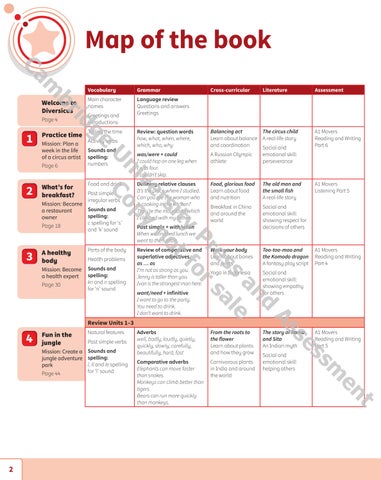
Map of the book Grammar
Main character names
Language review Questions and answers Greetings
br
m
Ca Vocabulary
Welcome to Diversicus
Greetings and introductions
id
Page 4
Telling the time
ge
Practice time Mission: Plan a week in the life of a circus artist Page 6
Activity verbs
What’s for breakfast?
Food and drink
was/were + could I could hop on one leg when I was four. I couldn’t skip.
Literature
Balancing act The circus child Learn about balance A real-life story and coordination Social and A Russian Olympic emotional skill: athlete perseverance
As d an s le es sa Pr r y fo it t rs no ve y ni p U Co
Sounds and spelling: numbers
Review: question words how, what, when, where, which, who, why
Cross-curricular
Past simple irregular verbs
Mission: Become Sounds and a restaurant spelling: owner c spelling for ‘s’ Page 18
Food, glorious food Learn about food and nutrition
The old man and the small fish A real-life story
Breakfast in China and around the world
Social and emotional skill: showing respect for decisions of others
Work your body Learn about bones and joints
Too-too-moo and the Komodo dragon A fantasy play script
Yoga in Indonesia
Social and emotional skill: showing empathy for others
Adverbs well, badly, loudly, quietly, quickly, slowly, carefully, beautifully, hard, fast
From the roots to the flower Learn about plants and how they grow
The story of Rama and Sita An Indian myth
Comparative adverbs Elephants can move faster than snakes. Monkeys can climb better than tigers. Bears can run more quickly than monkeys.
Carnivorous plants in India and around the world
Defining relative clauses It’s the place where I studied. Can you see the woman who is cooking in the kitchen? They’re the mountains which I climbed with my father.
and ‘k’ sound
Past simple + with/when When we finished lunch we went to the funfair.
A healthy body
Parts of the body
Mission: Become a health expert Page 30
Sounds and spelling: kn and n spelling for ‘n’ sound
Review of comparative and superlative adjectives, as … as I’m not as strong as you. Jenny is taller than you. Ivan is the strongest man here.
Health problems
want/need + infinitive I want to go to the party. You need to drink. I don’t want to drink.
Assessment
A1 Movers Reading and Writing Part 6
A1 Movers Listening Part 5
A1 Movers Reading and Writing Part 4
Review Units 1–3
Mission: Create a jungle adventure park Page 44
Sounds and spelling: l, ll and le spelling for ‘l’ sound
Past simple verbs
A1 Movers Reading and Writing Part 5
Social and emotional skill: helping others
en
m
Natural features
ss se
t
2
Fun in the jungle
Vocabulary
Grammar
Cross-curricular
Literature
Assessment
Behind the scenes
Describing clothes
A2 Flyers Speaking Part 3
Sounds and spelling: -igh and i-e spelling
Materials and properties Learn about the properties of different materials
The myth of Icarus A Greek myth
Mission: Prepare a performance Page 56
be made of What’s it made of? It’s made of gold. What are the wings made of? They’re made of paper. shall, could and let’s for suggestions Shall we design some props? Let’s design the sea. We could use blue paper.
Greek masks
should/shouldn’t You should listen to your teacher. You shouldn’t talk when your teacher’s giving the lesson. Should you copy in exams? No, you shouldn’t.
Where are we? Learn about maps and symbols
The project A narration and poem
Cappadocia in Turkey
Social and emotional skill: team work and respecting the ideas of others
Materials
br
m
Ca
School subjects
id
Classroom stars
ge
Extension of school vocabulary
As d an s le es sa Pr r y fo it t rs no ve y ni p U Co
Mission: Have Sounds and a school prizegiving ceremony spelling: f and ph spelling Page 68
Social and emotional skill: Listening to others
for ‘f’ sound
be good at + noun/gerund I’m good at maths. Are you good at sport? I’m not very good at drawing.
A2 Flyers Listening Part 1
Review Units 4–6
When I grow up … Mission: Choose your dream job Page 82
Jobs
Personality adjectives
Sounds and spelling: -er, -ar and -or endings
Places in town
Let’s travel!
Adjectives
Mission: Organise a summer camp Page 106
On holiday
Sounds and spelling: revision of the ‘th’ sound
Home, sweet home Learn about cities, towns and villages New York City
Prepositions of movement across, into, out of, over, past, round, through
before, after, when clauses Rose got really wet before I gave her my umbrella. He ran really fast when Fred came out of the trees. After we met Grandma’s sister in China, we ate the fantastic noodles. -ed/-ing adjective endings excited/exciting interested/interesting
North, south, east and west Learn about what to take on a hiking trip A hiking trip in Mexico
The road to Hope A poem
A2 Flyers Speaking Part 1
Social and emotional skill: managing own emotions
The story of Popocatepetl and Iztaccihuatl A narration and legend
Social and emotional skill: showing respect for other cultures
A2 Flyers Reading and Writing Part 7
t
Sounds and spelling: ge spelling for ‘j’ sound
Social and emotional skill: responding appropriately to other people’s emotional state
look like, be like What does your grandad look like? He’s very tall and he’s got short, grey hair. What’s your uncle like? He’s very friendly.
Future with be going to I’m going to take my umbrella. It isn’t going to rain. What are we going to see first?
A2 Flyers Reading and Writing Part 1
en
Mission: Create a guide to a town Page 94
The Altamira Caves in Spain
Don Quixote, Sancho and the windmills An adventure play script
m
Directions
Time detectives Learn about archaeology
ss se
City break
when and if clauses (zero conditionals) When you dance, you look in the mirror. If you win, you get a big prize. If William wins, he wants to buy a fantastic new camera.
Review Units 7–9 Grammar reference page 120
3
Welcome to Diversicus Ca
1 1.02
Listen. What is Diversicus?
br
m ge
id
The Friendly family are going on tour with Diversicus. Today is their first day.
As d an s le es sa Pr r y fo it t rs no ve y ni p U Co
Mr Friendly
Mrs Friendly
Ivan
en
m
Jenny
ss se
Jim
Rose
3 Play the game. Ask and answer.
t
2 1.03 Who says it? Say the name. Who’s got purple hair?
What’s the name of the circus?
4
Greetings and introductions
Rose. Diversicus.
DIVERSICUS 1
1.04
2
Hi, I’m Su-Lin.
I’m nine. Look! Here’s Pablo. He’s nine too.
I’m Jim and this is Jenny. We’re twins.
br
m
Ca 3
ge
id
We’re eight. How old are you?
4
Pablo, these are our new friends, Jim and Jenny.
As d an s le es sa Pr r y fo it t rs no ve y ni p U Co OK. Let’s show you the school.
Hi, do you live in Diversicus, too?
Great! I love science.
Yes, this is our first day.
5
That’s our teacher, Miguel. He’s my dad!
6
So do I.
Pablo! There’s Lily, your mum. Does your mum teach too?
Hello. Are you my new pupils?
No, she doesn’t. She’s an acrobat, but today she’s helping my dad.
Yes, we are.
8
Hi, Grandma! Hi, Grandpa! Meet my new friends.
ss se
7
Jim, Jenny. Look! This is our new home.
en
m
Cool! A mobile home!
t
Hello, children.
Come on, children. It’s time to go.
4 Act out the story. Story: Questions and answers
5
1
Practice time
Ca
1
Watch the video. Ask and answer.
m ge
id
br
What are your hobbies? Do you practise your hobbies every day?
en
In this unit I will: Prepare a weekly schedule.
2
Add practice time to the schedule.
3
Add a warm-up activity to the schedule. Present a schedule to the class.
t
6
1
m
ss se
As d an s le es sa Pr r y fo it t rs no ve y ni p U Co Plan a week in the life of a circus artist
Vocabulary 1
1
1 1.05 Listen. Then say the letter. a
e
half past twelve
seven o’clock
b
f
ge
id
br
m
Ca
Diversicus is in Russia. This morning, Mr Friendly and Rose are talking about meals and meal times.
half past six
As d an s le es sa Pr r y fo it t rs no ve y ni p U Co
midnight
c
g
half past eight
eight o’clock
d
h
half past nine
midday
2 What time is it? Ask and answer. What time is it?
3
Ask and answer.
en
m
ss se
It’s half past twelve.
t
What time do you have breakfast?
I have breakfast at half past seven.
Telling the time
7
DIVERSICUS 1
1.06
2
When do Wh d lessons l start?
Hello, children. Where are you going?
br
m
Ca 3
Look at the time!
ge
id
At nine o’clock, but we have to be at school five minutes before.
Because school starts in ten minutes. We don’t want to be late.
4
It’s Saturday today. There is no school.
Oh, she’s right! What can we do?
As d an s le es sa Pr r y fo it t rs no ve y ni p U Co
You mustn’t run in the circus. Why are you running?
We’re going to school.
Let’s look round the circus. We can look at our new classroom first.
5
Hello, kids! There’s no class today, but who can tell me? Which country are we in today?
6
Later …
The acrobats are brilliant! Who are they?
Russia! It’s Russia!
They’re Lily and Marc. Marc’s Pablo’s uncle.
I’m hungry. When’s lunch?
8
Whose lunch is that?
We have lunch at half past twelve. What time is it now?
ss se
7
It’s mine! I do a lot of exercise. I have to eat a lot.
en
m t
It’s lunchtime. Let’s go.
1 1.07 Listen and say yes or no. 8
Story: Question words in context
And you’re very strong, Ivan!
Language practice 1
1
1 Describe the picture. What are they doing? 2 Read. Answer the questions.
m
Ca D
ge
id
br
iversicus is a circus. There are acrobats and clowns, but there aren’t any animals. The acrobats get up at half past six and they have breakfast early because they start practising at nine o’clock. Acrobats have to climb, run and jump. The strong acrobats catch the others in the air. It’s very exciting. Their job is beautiful, but it’s dangerous, too.
As d an s le es sa Pr r y fo it t rs no ve y ni p U Co
1
What is Diversicus?
4
What time do they start practising?
2
What time do the acrobats get up?
5
3
Why do they have breakfast early?
Which acrobats catch the others in the air?
1.08
Grammar spotlight
Which country are we in? Why are you running? What time do they have lunch?
3
We’re in Russia. Because school starts in ten minutes. They have lunch at half past twelve.
Imagine you meet an acrobat from Diversicus. What do you want to know about him/her? Write three questions.
Prepare your schedule. Choose which circus artist you’d like to be.
I have breakfast at eight o’clock.
What time do you go to bed on Mondays?
At nine o’clock.
My
t
What time do you have breakfast?
en
Work with a partner.
Ask and answer to complete your partner’s weekly schedule.
m
ss se
STAGE 1
diary Activity Book page 6
Review question words
9
Vocabulary 2 and song
1 1.09
Listen and do the actions. Then sing the song.
Ca
catch
ge
id
br
m dance
Hop, skip and dance, climb, climb, climb. Jump to your places, it’s practice time. Dress up, dress up. Put your costumes on. We haven’t got time, we haven’t got long.
As d an s le es sa Pr r y fo it t rs no ve y ni p U Co
Hello, kids! Are you in or out? You must be quiet, you mustn’t shout!
shout
Ivan, don’t laugh. Stand in your place. You must catch Marc with a smile on your face. Marc, catch Lily! Hold her legs! She mustn’t fall into the net.
laugh
Chorus
dress up
hop
skip
jump
2 Describe the picture in Activity 1 to a
Write three sentences about the picture.
Two acrobats are dressing up. 10
Activity verbs
t
3
en
The people in purple clothes are dancing.
Let’s talk about parties. Do you like dressing up for parties? What clothes do you wear?
m
partner. Use the words in the picture.
ss se
climb
Language practice 2
1 1.11
1
Listen and match Daisy and Peter to a picture. a
b
c
m
Ca Daisy
ge
id
br Peter
Grammar spotlight
As d an s le es sa Pr r y fo it t rs no ve y ni p U Co
1.12
I could hop on one leg when I was four. I couldn’t skip.
2
Think about when you were four. Write three sentences about what you could and couldn’t do.
3 Ask and answer.
Could you ride a bike when you were three?
Add a practice time to the schedule.
I practise on Tuesdays at five o’clock. I jump and skip.
My
t
Add this information to their weekly schedule.
en
Ask your partner about when they practise.
m
ss se
STAGE 2
When do you do practise?
No, I couldn’t.
diary Activity Book page 6
was/were + could
11
Cross-curricular
Balancing act 1
Watch the video.
Ca
2 1.13 Listen and read. Answer the question.
br
m ge
id
Can you ride a bike? Do you like ice skating or doing gymnastics? When you do these activities what helps you not to fall all the time? It’s your sense of balance. Your brain controls your sense of balance. The brain is a very complicated organ. Different parts control different cerebellum things. The cerebellum is the partt of the brain that controls balance. e. Without this, it would be diff icult to walk or even stand up.
As d an s le es sa Pr r y fo it t rs no ve y ni p U Co Which other activities need a sense of balance?
3 Look at the pictures. Which activities need balance? 1
2
3
ss se
4 Read and try the activities.
4
Test your balance. Try these activities.
12
Learn about balance and coordination
Who’s the tallest?
Work with a partner. Put one paper plate at a time onto your partner’s head. Who can keep the most paper plates on their head?
t
Place a long piece of string on the floor in a straight line. Walk along the string to the end. Try it with your eyes closed, or try going backwards!
2
en
Tightrope walking.
m
1
Culture
1
5 1.14 Listen and read the text about a Russian athlete.
ge
id
br
m
Ca
Answer the question. What new move did Olga Korbut perform in 1972? favourite gymnast. Olga Korbut won four gold medals and two silver medals for the USSR in the 1972 and 1976 Olympics. In 1972, she performed new moves including the Korbut Flip. They don’t do this move in competitions now because people think it is too dangerous! It is still exciting to watch Olga Korbut’s routines, but don’t forget that she had to train for many hours every day to become a top gymnast. Would you like to be a gymnast?
As d an s le es sa Pr r y fo it t rs no ve y ni p U Co
Olga Korbut
Olympic gymnast, Olga Korbut! Olga Korbut was born in 1955 in Grodno. At the time Grodno was part of the USSR (the Soviet Union). She studied in a school that had a special programme for sports people. She began to train for the Olympic team. At the Olympic Games in 1972, Olga was 17 years old and the youngest member of the team. She was also very small, only 1.5 metres tall, but she was very strong. Her routines were fast and exciting and she was everyone’s
One sport that needs a really good sense of balance is gymnastics. And who is the queen of balance? Russian
6 Read the text again. Complete the mind map. born
Olga Korbut
small but very very
gold won medals and silver medals
en
STAGE 3
My
Decide where to put it in your schedule.
t
Add a warm-up routine to your schedule. Work in groups. Think of a warmup activity to do for your practice.
e a mov
m
and routines
ed invent called
ss se
years old in the 1972 Olympics
helped make an exciting sport to watch
diary Activity Book page 6
Learn about a Russian Olympic athlete
13
Literature
1 Look at the pictures. Answer the questions. Would you like to be part of a circus? Why? Why not?
2
How old do you think the girl in the circus is?
Ca
1
THE CIRCUS CHILD
m
1.15
br
ge
id
Can you imagine being in a circus? Travelling all over the world, playing with clowns, flying through the air on a trapeze, or jumping on trampolines all day? No? Well, let me tell you about it.
As d an s le es sa Pr r y fo it t rs no ve y ni p U Co
My name is Anastasia. I was born in the circus. My parents are Russian acrobats with Captain Adventure’s Travelling Circus and my dream was always to be just like them and perform on stage.
m
ss se
Every day I wanted to ask Dad when I could go on stage with him. But I was afraid to. I didn’t know if I was ready.
en
In the mornings I had classes with a teacher online. They started at nine o’clock. My parents said I had to do well at school. In the afternoons I practised acrobatics with my dad for hours. We practised until dinner at half past seven.
Text type: A real-life story
t
14
1
id
br
m
Ca
My dad helped me improve and learn new moves. ‘Let’s try a backflip,’ he said one day, ready to catch me if I fell. I couldn’t do backflips then, but I can now.
ge
‘Great! Again! Fantastic! Again!’ he told me. I practised a lot. I really wanted to do it.
se As d an s le es sa Pr r y fo it t rs no ve y ni p U Co
After training, my friend Yuri usually came over to give me support. ‘Soon,’ he always said, and hugged me. I practised really hard every day for years, then last month it finally happened. Dad said, ‘I think you are ready to go on stage now. How about Saturday?’ ‘Really?’ I shouted and jumped up and down. Immediately, I ran to tell Yuri the good news. ‘I told you!’ he laughed. ‘You practised a lot, and practice makes perfect.’
en
m ss
And that was how my dream came true. Now I perform in the circus every week.
1
What does Anastasia do every day? Why does she do this?
2
How did Anastasia feel at the beginning of the story? How does she feel now?
3
What do you practise every day? Why?
t
2 Answer the questions.
Social and emotional skills: Perseverence
15
A1 Movers
1 Talk about the picture and point. She’s got a black hat.
He’s riding a bike.
ge
id
br
m
Ca As d an s le es sa Pr r y fo it t rs no ve y ni p U Co
2 Look at the picture and choose the correct word. 1
The clown with the toy plane is walking / skipping / dancing.
2
One hat is black and one hat is yellow / pink / green.
3
One of the children has got a kitten / rabbit / penguin.
the sentences. 2
The small clown is
3
The man in the white shirt is
I like this circus.
16
The clowns are funny.
Preparation for Reading and Writing Part 6
t
4 Say two more things about the picture.
en
What is the boy doing? He’s
m
1
ss se
3 Look at the picture and complete
Write 2 different sentences about the picture.
Review
1 in action! My
In your groups, choose a schedule.
diary
m
Ca
Present a schedule to the class.
br
Activity Book page 6
Present the schedule to the class.
ge
id
This is our schedule. On weekdays, we wake up at eight o’clock. We study at ten o’clock. We do our warm-up at three o’clock. We practise jumping at five o’clock.
As d an s le es sa Pr r y fo it t rs no ve y ni p U Co
Perform your warm-up activity.
en t
What time do the circus artists have breakfast on Mondays? Who is Marc? Why does Ivan eat a lot? What couldn’t Peter do when he was four? Name three activities that need a sense of balance. What couldn’t Anastasia do that she can do now?
m
ss se
1 2 3 4 5 6
Unit consolidation
17
2
What’s for breakfast?
Ca
1
Watch the video. Ask and answer.
m ge
id
br
What time do you usually eat breakfast? What do you usually eat?
In this unit I will: Create a restaurant.
2
Talk about restaurants with a partner.
3
Create a restaurant menu. Write a review about a restaurant.
t
18
1
en
m
ss se
As d an s le es sa Pr r y fo it t rs no ve y ni p U Co Become a restaurant owner
Vocabulary 1
2
1 1.16 Listen. What do Rose and Ivan like for breakfast? tea
cup
m
Ca
Diversicus is in China. Today, Mr Friendly, Ivan and the children are in the supermarket, shopping for food.
coffee
id
br milkshake
ge
sauce
cereal
glass
As d an s le es sa Pr r y fo it t rs no ve y ni p U Co noodles
pancake
strawberries
yoghurt
Say the chant.
a coffee
2
a cup of
b chocolate sauce
3
a bottle of
c
4
a bowl of
d milkshake
cereal
milk noodles water soup coffee lemonade pasta tea salad rice
Would you like a glass of milk?
t
a glass of
en
1
m
3 Match. Then offer your partner food and drink.
ss se
2 1.17
Yes, please.
Food and drink
19
DIVERSICUS 1
1.18
We’re near my grandmother’s village. Gran, could you show us where you lived?
What shall we do today?
2
What a beautiful building!
3
Of course! I’d love to.
ge
id
br
m
Ca
Yes, it’s the place where I studied when I was a child. Now it’s a café.
4
As d an s le es sa Pr r y fo it t rs no ve y ni p U Co
Look over there! They’re the mountains which I climbed with my father every weekend.
Not today, Jenny, but we can go to the lake where I sailed with my sister. Great! I like sailing!
Can we go?
They aren’t very near, Jenny.
5
This is the lake where I also went swimming with my sister.
So do I.
6
8
Here are your noodles, with May’s favourite sauce.
en
Fantastic! Thank you. I love noodles!!
m
ss se
Can you see the woman who is cooking in the kitchen? That’s my sister, Li. She makes the best noodles in town.
It’s lunchtime. We can eat now.
Where are we having lunch today?
Careful, Ivan! We don’t want to go swimming today!
7
I’m hungry.
t
1 1.19 Listen. Who says it? 20
Story: Defining relative clauses in context
Language practice 1
2
1 Describe the picture. What are they doing?
2
Ca
Read and check. Choose the words to complete the text.
ge
id
br
m
Look at these children 1who are climbing up the mountain. They’re on the Great Wall of China. It’s a wall 2 people 3 built many years ago. It’s famous because it’s the wall 4 in the world. The Great Wall is a beautiful place people enjoy 5 6 walking and photos. Would you like to on the Great Wall? where
which
where
4 5
who doing
which making
where taking
smallest
6
walk
walked
walking
who
which
2
who
3
longest
fastest
1.20
As d an s le es sa Pr r y fo it t rs no ve y ni p U Co
1
Grammar spotlight
It’s the place where I studied.
Can you see the woman who is cooking in the kitchen?
They’re the mountains which I climbed with my father.
3 Play the guessing game.
ss se
It’s the thing which we use to take photos.
Prepare a restaurant sign. In groups, talk about your restaurants.
My restaurant’s called Happy Noodle. It’s a Chinese restaurant where you can eat noodles for breakfast.
My
t
Choose a name and a description for your restaurant.
en
Create a restaurant.
m
STAGE 1
A camera.
diary Activity Book page 18
Defining relative clauses
21
Vocabulary 2 and song
1 1.21
Listen and match the words to the pictures. Then sing the song.
b
ge
id
br
m
Ca
Yesterday we drove to town. We saw the place where May grew up. She told us all about her school, And the teacher who taught her there. Oh, we got dressed up. Oh, we had a great day. Oh, we wrote this song. Oh, we took some photos of it all. Yesterday we saw May’s sister. She gave us all a bowl of noodles. After lunch we climbed the Great Wall, Which they built years before. Oh, we got dressed up. Oh, we had a great day. Oh, we wrote this song. Oh, we took some photos. Oh, we got dressed up. Oh, we had a great day. Oh, we wrote this song. Oh, we took some photos of it all. We had a great day.
a
As d an s le es sa Pr r y fo it t rs no ve y ni p U Co
c
d
e
3 Ask and answer about the song.
22
Past simple irregular verbs
Yes, they did.
t
Did they see the place where May grew up?
No, they didn’t. They drove to the town.
What did you do yesterday afternoon?
en
Did they drive to the beach?
m
ss se
2 Find the past simple form of these verbs in the song.
Language practice 2
1 1.23
2
Listen. What did Jack like best?
a
c
b
id
br
m
Ca Grammar spotlight
ge
1.24
As d an s le es sa Pr r y fo it t rs no ve y ni p U Co
When we finished lunch we went to the funfair. When the bus arrived we all got on it. We were sad when the bus came to take us home.
2 Ask and answer. Questions:
Answers:
What did you do when you finished breakfast yesterday?
3
When I finished breakfast yesterday, I cleaned my teeth.
What did you do yesterday? Write three sentences with when.
Talk about restaurants with a partner. When my family and I went to Mallorca, we went to a restaurant by the sea. I’d like my restaurant to be near the sea.
My
t
Talk about restaurants that you like and why you like them with a partner.
en
m
ss se
STAGE 2
diary Activity Book page 18
Past simple with when
23
Cross-curricular
Food, glorious food
Ca
1
Watch the video.
br
m
2 1.25 Listen and read. What are the five main food groups?
ge
id
We know that we need food to stay alive, and that it can be delicious! But we also know that we need to eat different types of food and the right amounts to stay healthy. There are five main food groups:
As d an s le es sa Pr r y fo it t rs no ve y ni p U Co Proteins and iron
Dairy
Fats
Carbohydrates and fibre
Fruit and vegetables
3 Match these foods to the groups in Activity 2. a
c
e
d
ss se
4
b
Think of two breakfast foods for each food group.
en
m
Carbohydrates and fibre – cereal and ...
5 How healthy are your breakfast foods in Activity 4? Give each 1 = very unhealthy 5 = very healthy
24
Learn about food and nutrition
t
a score out of five.
I think that cereal is 3. It’s sometimes healthy and sometimes unhealthy when it’s got a lot of sugar.
Culture
2
6 1.26 Look at the breakfasts. Where do you think they are from? Listen and check. 1
3
4
ge
id
br
m
Ca
2
As d an s le es sa Pr r y fo it t rs no ve y ni p U Co
7 1.27 Listen and read. Where is this breakfast from?
People often have breakfast at around seven o’clock in China because children usually go to school before eight o’clock. People often buy breakfast from a street stall and they eat it as they travel to work or school. China is a very large country and the breakfasts are different in different cities. The most popular breakfast is soya milk with youtiao. Youtiao are like long fried doughnuts. People dip them into the soya milk. Other people prefer rice noodles or buns with meat.
Talk to a partner about your breakfast. I usually have … for breakfast.
ss se
8
My favourite breakfast is …
en
m
STAGE 3 Think of some healthy food to include in your menu. Create and design your menu.
t
My
Create a restaurant menu.
diary Activity Book page 18
Learn about breakfasts in China and around the world
25
Literature
1 Look at the pictures. Describe the people in the story.
The old man and the small fish
Ca 1.28
m
ge
id
br
My name is Ching-Yun. I am an old man. I live in a village near the Huangshan Mountain. My granddaughter calls me ‘The Happiest Man in China’.
ss se
As d an s le es sa Pr r y fo it t rs no ve y ni p U Co
Every day my granddaughter comes to visit me before she goes to school. Her name is Wen. She is eight years old. Wen makes breakfast for me. I have the same thing every morning – noodles and a cup of green tea. After breakfast, I tell Wen the old stories my grandpa told me when I was a boy.
Text type: A real-life story
t
26
en
m
It was cold that morning. Wen arrived early. ‘Yéye,’ she said, ‘do you want something different for breakfast today – perhaps some rice or some bread?’ I said, ‘No, thank you, Wen. I’m very happy with my noodles and my tea.’ ‘Why do you have the same thing for breakfast every day, Yéye?’ Wen asked me. I finished my breakfast and then I told Wen the story of ‘The small fish which swam in the same part of the lake’.
2
ge
id
br
m
Ca
There was once a small fish, and every day the small fish swam in the same part of the lake. Its friends didn’t understand. They said, ‘Come with us to a new part of the lake, small fish.’ But the small fish said, ‘No, thank you. I’m happy here.’
As d an s le es sa Pr r y fo it t rs no ve y ni p U Co
One morning, the friends of the small fish didn’t go to a new part of the lake. ‘Why didn’t you swim to a new part of the lake today?’ said the small fish. ‘We know every part of the lake now,’ the friends of the small fish said, happily. ‘But this part is still the best, so we’re staying here with you.’
ss se
The next morning, Wen made me noodles and green tea. This time, she didn’t ask me if I wanted something different for my breakfast.
or different? Why do you think Wen’s grandfather doesn’t want to change what he has for breakfast?
2
Do you think it’s better to always do the same thing (like Wen’s grandfather) or always try something different? Why?
t
1
en
m
2 Read and discuss with a partner. Are your answers the same
Social and emotional skills: Showing respect for decisions of others
27
A1 Movers
1 1.29 Listen. Are the pictures correct? Say yes or no. 1
2
3
4
5
id
br
m
Ca ge
2 1.30 Look at the picture in Activity 3. Listen and finish the sentences.
As d an s le es sa Pr r y fo it t rs no ve y ni p U Co
The woman is between the cupboard and the man.
3 1.31 Listen and find the things to colour and the place to write the word. There is one example.
ss se fruit
en
m t
28
Preparation for Listening Part 5
Listen carefully for prepositions and write the word in the correct place!
Review
2 in action! My
Talk to a friend about the restaurant which you went to.
br
m
Ca
Write a review about a restaurant.
Which restaurant did you go to?
diary
id
I went to the Chinese restaurant. It was great!
Activity Book page 18
ge
Write a review about the restaurant.
t
3 4 5 6
What’s the man in the supermarket in China making? Which places did May take Ivan and the children to see when they went to her town? What did Jim, Jenny and their friends do after lunch? Name three food items in the food group ‘dairy’. Where do people eat ‘youtiao’ for breakfast? What did Wen’s grandfather always have for breakfast?
en
1 2
m
ss se
As d an s le es sa Pr r y fo it t rs no ve y ni p U Co
This restaurant was good because … I really liked … I didn’t like … as much because …
Unit consolidation
29
3
A healthy body
Ca
1
Watch the video. Ask and answer.
m ge
id
br
What do you do to stay healthy? Why’s it important to exercise and eat healthily?
Create a health plan.
2
Visit the doctor.
t
30
1
en
In this unit I will:
m
ss se
As d an s le es sa Pr r y fo it t rs no ve y ni p U Co Become a health expert
3
Add some healing tips to my health plan. Make a health advice poster.
Vocabulary 1
3
1 1.32 Listen. How did Ivan cut his finger?
br
m
Ca
Diversicus is in Indonesia. This morning Ivan is doing exercise on the beach. The children are watching him. neck
ge
id
shoulder
finger
As d an s le es sa Pr r y fo it t rs no ve y ni p U Co
stomach
bandage
knee
toe
elbow
ss se back
Say the chant.
t
4
en
3 1.34 Listen and say yes or no.
m
2 1.33
Write two sentences about the picture.
Parts of the body
31
DIVERSICUS
1.35
Which is the highest mountain in Indonesia?
1
2
No, it isn’t. Everest is the highest mountain in the world. Now, which is the longest river in the world?
br
m
Ca
The Nile, but it isn’t the biggest.
Puncak Jaya. It’s the highest mountain on an island in the world.
3
ge
id
Is it as high as Everest?
The Nile isn’t as big as the Amazon River because the Amazon carries more water.
What?
4
As d an s le es sa Pr r y fo it t rs no ve y ni p U Co
Well, he’s stronger than all the acrobats in Diversicus, so he’s the strongest man here.
Can Ivan swim down the Amazon? He is the strongest man in the world.
5
This is more exciting than watching the others.
6
Look, Ivan is the strongest acrobat.
And now the most famous footballer, Pablo, is running to kick the ball …
OK, but be careful, Jenny!
Look, Dad! Jenny is taller than you now!
8
ss se
But Marc is the best catcher and Lily is the best jumper.
7
Miguel, do you think Ivan is the strongest man in the world?
Later …
en
m t
Stop, Pablo! You can’t play football with that! It’s one of my weights.
1 1.36 Listen and say the number. 32
Story: Comparative and superlative adjectives in context
Ivan, I’m not as tall as you, I’m not as strong as you, but now my toe’s as big as yours.
Language practice 1
3
1 Look at the picture. Which part of their body do you think is the strongest?
Ca
2
Choose the words to complete the text.
ge
id
br
m
A human tower is one of the 1exciting / most exciting things to see, but it’s one of the 2most / more dangerous, too. Look at these three people. The person at the bottom has to be the 3 stronger / strongest. The person in the middle isn’t as 4biggest / big as the person at the bottom, but she’s 5stronger / strong than the person at the top. The person at the top is 6small / smaller and 7 thinner / thinnest than the other two people. Her job isn’t 8easier / easy than theirs; it’s as difficult 9 as / than theirs and sometimes it’s 10more / most dangerous. Would you like to try it?
As d an s le es sa Pr r y fo it t rs no ve y ni p U Co
1.37
Grammar spotlight
I’m not as strong as you.
Jenny is taller than you.
Ivan is the strongest man here.
3 Make sentences about your family. Use these words.
My sister’s funnier than my brother.
I’m the loudest person in my family.
m
STAGE 1
en
Create a health plan. Think of ways to keep these parts of the body healthy and fit.
My
t
Work with a partner. Choose three parts of the body. Add these ideas to your health plan.
ss se
My grandma isn’t as tall as my dad.
diary Activity Book page 30
Review of comparative and superlative adjectives, as … as
33
Vocabulary 2 and song
1 1.38
Listen and match the names to the words. Then sing the song.
Ca
Claire
ge
id
br
m
They’re all sick, They’re all ill. They’re all ill, They’re all sick. Doctor, Doctor, Please be quick!
As d an s le es sa Pr r y fo it t rs no ve y ni p U Co
What’s the problem? What’s the matter? What’s the problem? What’s the matter?
Charlie
He’s got a cough And a temperature, She’s got a sore throat And a cold. Chorus
Paul
My back hurts. I’ve got a backache. My stomach hurts. Ooh stomach-ache. Chorus
Sally
Yes, it does.
You’ve got backache.
Yes, that’s right.
t
Does your back hurt?
What do you do when you feel ill?
en
No, it doesn’t.
m
Does your head hurt?
ss se
2 Play the guessing game. Ask and answer.
3 1.40 34
Listen. Write the words.
Health problems
Language practice 2
3
1 1.41 Listen. What does Vicky need to do?
Ca
Grammar spotlight
1.42
m 2
ge
id
br
I want to go to the party. You need to drink. I don’t want to drink.
Write questions and answers with but.
As d an s le es sa Pr r y fo it t rs no ve y ni p U Co
What’s the matter? I want to play football after school, but I’ve got a headache. You need to sit down, but you can watch the game.
3
What do you want to do? What do you need to do? Write two sentences for each question.
I want to go to the cinema. I need to do my homework.
STAGE 2
Swap roles. Then add the advice to your health plan.
You need to stay at home and rest.
My
t
I want to go to the football match, but I’ve got a temperature.
en
What’s the matter?
m
Work with a partner. One person is a doctor and the other person is a patient. Patient: Tell the doctor what’s wrong with you. Doctor: Give the patient some advice.
ss se
Visit the doctor.
diary Activity Book page 30
want/need + infinitive
35
Cross-curricular
Work your body Watch the video. Then read the text. Did you know there are over 200 bones in our bodies? Bones shape our body and hold us together. Between each bone we have a joint. Joints help us to move. It’s important to protect our bones and joints, especially when we’re doing sports and other dangerous activities.
ge
id
br
m
Ca
1
2 Match the parts of the body to the bones and joints. 2
shoulder
a
3
elbow
b
4
5
6
As d an s le es sa Pr r y fo it t rs no ve y ni p U Co
1
wrist
c
hip
knee
e
d
ankle
f
3 What activities are the joints in Activity 2 important for? Discuss with a partner.
The shoulder is important for throwing and carrying things, …
ss se
4 Look and match the sports to the protective equipment. Which parts of the body do they protect?
en
m t
a
36
helmet
b
Learn about bones and joints
swimming goggles
c
knee and elbow pads
e d
boots
goggles
Culture
3
5 What activities can make our body and joints stronger? Discuss with a partner.
Welcome to Bali, Indonesia!
br
On this beautiful island, yoga is very important. The people here use it to exercise and stay healthy. It’s a great way to stretch your body and make your joints and muscles strong. At our centre, you can do yoga in our relaxing rooms, in the sunny garden, or on the beach! Here are a few moves we practise. Why don’t you try them?
ge
id
YOGA
m
Ca
6 1.43 Listen and read. Follow the instructions with a partner.
As d an s le es sa Pr r y fo it t rs no ve y ni p U Co
TREE POSE
Stand on one leg. Bend the other knee and put your foot on your other leg. Put your hands together above your head. Hold the position for ten seconds and breathe.
FLOWER POSE
CHILD’S POSE
Sit on the floor. Bend your legs. Put one foot on top of the other. Put your hands on your knees and close your eyes. Hold the position for ten seconds and breathe.
Kneel on the floor and sit back on your feet. Bring your head down to rest on the floor. Stretch your arms out in front of you. Hold the position for ten seconds and breathe.
7 Read and write.
This pose is called the warrior pose. Write instructions to explain how to do this pose. Use the words in the box. Then test your instructions on a partner.
ss se
STAGE 3
m en
Add some healing tips to your health plan. With your partner, think about some ways to stay healthy.
Add these ideas to your health plan.
Get lots of rest to have energy the next day.
My
t
Breathe slowly to keep calm.
diary Activity Book page 30
Learn about yoga in Indonesia
37
Literature
1 Read these words. Which of them can you find in the pictures? porridge
Ca
dragon
breakfast
roar
1.44
firewood
id
br
m
girl
angry
poor
ge
TOO-TOO-MOO AND THE KOMODO DRAGON SCENE ONE
As d an s le es sa Pr r y fo it t rs no ve y ni p U Co
This is a story from Indonesia about Too-too-moo and the Komodo dragon. Mother: Breakfast is ready. Too-too-moo: Oh no. Rice again! Mother: We’re poor. And remember, the dragon gets porridge. I make it for him every day. He eats all of our porridge! Narrator:
Too-too-moo: I know he eats a lot, but
Mother:
SCENE TWO
38
There was a knock on the door! That’s the dragon. He knocks on the door louder every day. Too-too-moo! Where are you? I’m hungry, and I need my porridge. Too-too-moo gave the dragon his breakfast. The dragon roared, and then he walked away with the porridge.
Text type: A fantasy play script
t
Narrator: Too-too-moo: Dragon: Narrator:
en
m
ss se
Narrator:
he’s the biggest dragon in the world! He’s my friend. He’s a wild animal. You need to be careful! And so Mother left to collect firewood to sell in the market.
3
ge
id
br
m
Ca
SCENE THREE Narrator: The weather was hot. Nobody wanted firewood so Too-too-moo and her mother couldn’t make any money. They got poorer and poorer. Soon there was no food in the little house. But still the Komodo dragon came for his porridge. Dragon: Too-too-moo! Where are you? I’m hungry, and I need my breakfast. Open the door! I’ve got a stomach-ache. I can’t wait any more! Narrator: Too-too-moo opened the door. Too-too-moo: There isn’t any porridge. Narrator: The dragon was angry. He pushed Too-too-moo. He showed his terrible teeth, and he gave a terrible roar. Dragon: Too-too-moo, you aren’t my friend any more!
As d an s le es sa Pr r y fo it t rs no ve y ni p U Co
m
ss se
SCENE FOUR Narrator: At last the weather got colder. People bought firewood again. Too-too-moo’s mother came home with rice and porridge. Mother: I’m happy that greedy dragon doesn’t come here now. There is more food for us! Too-too-moo: He wasn’t greedy, Mother. He was hungry. Mother: He’s dangerous! He needs to stay in the forest where he belongs. Narrator: The dragon never came to the little house again. But Too-too-moo often left a bowl of porridge in the forest for his breakfast.
3
en
2 Why do you think Too-too-moo gives the dragon breakfast at the end?
t
Remember and write. Close your book. Work in groups. Write a simple summary of the story. Write seven sentences. Share your sentences with the class.
4 Act out the play. Social and emotional skills: Showing empathy for others
39
A1 Movers
1
Read and put the words in the table. Noun (s.) Noun (pl.) Adjective
Verb
Ca
hands
br
m 3
4
My mum has / have got a backache.
5
I look after my body / bodies by exercising every day.
We went to their / they’re house for breakfast.
6
As d an s le es sa Pr r y fo it t rs no ve y ni p U Co
2
I had a headache this morning, but it don’t / doesn’t hurt now.
ge
1
id
2 Choose the correct option to complete the sentences.
My friend has got longer arms then / than me.
Our shoes are between / in the cupboard.
3 Look at the picture and the title. Read
and find words about the picture. Choose the right words to complete the sentences. Legs Before they walk, young children learn to move around on their hands and knees. A horse has got four legs and a spider has got eight legs. Snakes got any legs but they’ve got long bodies!
have
haven’t
had
2
ran
running
run
3
because
and
but
t
Preparation for Reading and Writing Part 4
1
en
40
at
m
Most people have two legs, two knees, two feet and ten toes. Did you know that there are 52 bones in our feet? Are you surprised?
in
ss se
Legs can help us to jump or , for example, when we need to catch a bus. When you play a sport like football or tennis, you sometimes hurt your knee or foot. If it’s very sore, don’t worry a doctor in a hospital can make you better.
Example on
Copy the word you choose on the right line.
Review
3 in action! My
Work in groups. Share your health plan with your group.
diary Activity Book page 30
br
m
Ca
Make a health advice poster.
Discuss the best ideas in each section.
id
ge
I think Lisa’s healing tips are the best. Do you agree?
Yes, and I think Dan’s health advice is the best.
As d an s le es sa Pr r y fo it t rs no ve y ni p U Co
Make a poster with some health advice for the class.
en t
How did Ivan hurt his toe? What is Puncak Jaya? Who has backache in the song? What does Vicky want to do? Why can’t she do it? What protective equipment do you need to wear when you ride a bike? Why was the Komodo dragon angry with Too-too-moo?
m
ss se
1 2 3 4 5 6
Unit consolidation
41
Review Ca
1
Units 1–3
Watch the video and do the quiz.
br
m
2 1.45 What do they need? Listen and choose. 1 a
3 a
c
b
c
b
ge
id As d an s le es sa Pr r y fo it t rs no ve y ni p U Co
2 a
b
4 a
c
b
c
3 Play the game with a partner. Choose a square. Your partner makes a sentence with that word and language from the box.
1
5 me
a shop
mountain
kangaroo
6
10
milkshake
jump
dancer
11 river
4
8
pop star
restaurant
Consolidation of units 1–3
English
15 lake
12
Number 15 – my friend.
my friend
16 books
Mount Teide is the highest mountain in Spain.
elephant
I am as clever as my friend Javier.
t
42
14
Number 5 – mountain.
en
7
cinema
m
3
13
ss se
2
9
4 Read the text and order the pictures.
Julia and Paul’s busy day
Ca
WEEK 1
31 Wednesday Mercredi Mittwock Miércoles Mercoledi
m
At eight o’clock Julia and Paul woke up. At half past eight they had cereal and pancakes for breakfast.
8:
br
At half past nine Dad told them to ‘come on!’
ge
id
9:
At ten o’clock Mum drove them to the countryside. They saw the hospital where Mum worked.
10:
As d an s le es sa Pr r y fo it t rs no ve y ni p U Co
11:
At eleven o’clock they climbed trees and they took photos. They had the best time with their mum, who taught them how to build mountains of leaves. They built five! At twelve o’clock their dad made them noodles and sauce for lunch.
12:
a
b
c
e
d
f
5 Cover the text and use the pictures to retell the story. 6
Copy the table and add two activities. Ask your family and complete. Could you hop when you were three?
?
?
m
Me
Climb trees
ss se
Hop
No, but I could dance!
en
?
7
t
?
Write sentences. Use the information from the table in Activity 6. My sister couldn’t hop when she was three, but she could dance. Consolidation of units 1–3
43
4
Fun in the jungle
Ca
1
Watch the video. Ask and answer.
m ge
id
br
What do you like to do outside? Where’s your favourite natural place?
In this unit I will: Design a map for a jungle adventure park.
2
Invent a jungle activity.
3
Add a nature area in the park. Present the jungle adventure park to the class.
t
44
1
en
m
ss se
As d an s le es sa Pr r y fo it t rs no ve y ni p U Co Create a jungle adventure park
Vocabulary 1
4
1 2.02 Listen. What did May and Fred make last week? moon sky
star waterfall
ge
id
br
m
Ca
Diversicus is in India. This afternoon Rose is talking to Fred and May about the new show for their world tour.
jungle
plant
As d an s le es sa Pr r y fo it t rs no ve y ni p U Co
wave
ss se
world
Say the chant.
t
2 2.03
en
m
island
3 2.04 Listen. Who says it? Say the name.
Natural features
45
DIVERSICUS
2.05
Today, we’re having our lessons in the Indian jungle. How exciting!
1
2
We can study birds really well here. Yeah, and let’s look hard in the trees to see some monkeys.
br
m
Ca 3
What was that? Was it a bear?
Animals? Hiding?
ge
id
We mustn’t talk loudly if we want to see animals hiding in the plants.
No, only me! Can I come, too?
4
As d an s le es sa Pr r y fo it t rs no ve y ni p U Co
OK, Ivan, but we must walk slowly, carefully and quietly in the jungle.
5
The water’s moving really quickly. What a fantastic waterfall!
This is very difficult. I can’t do it. I draw really badly.
OK, everyone. Look carefully at the plants and draw them, please.
6
So, what’s the most dangerous animal in the jungle? Is it the bear?
Don’t worry! You can do it easily. Look, I can help you.
No, Miguel! Run quickly! Move! Fast! There’s a bear behind us!
8
I worked really hard to make this costume, and it worked well because you all thought I was a real bear!
en
m
Ivan! Walk slowly and carefully, please!
ss se
7
No, I think it’s the snake.
t
1 2.06 46
Listen and complete. Use two words.
Story: Adverbs in context
Language practice 1
4
1 Look at the pictures.
m
Ca
Which instrument do you think they play to make the sounds?
a
c
b
d
e
f
ge
id
br As d an s le es sa Pr r y fo it t rs no ve y ni p U Co
2 2.07 How are they playing the instruments? Choose, then listen and check. 1
A waterfall: he’s playing the piano slowly / quickly and loudly / quietly.
2
Bad weather at sea: he’s playing the drums slowly / fast and loudly / quietly.
3
Sunny island: she’s playing the guitar loudly / quietly and slowly / quickly.
4
Rain in the jungle: he’s playing the piano slowly / quickly and loudly / quietly.
5
A bird in the tree: she’s singing beautifully / badly.
6
Waves at night time: she’s playing the piano loudly / quietly and slowly / quickly. 2.08
Grammar spotlight
We mustn’t talk loudly.
3
Look carefully at the plants.
It worked well.
Think of your family. Read and answer.
Who … talks quietly? eats loudly? runs fast? listens carefully?
My
t
This is the waterfall. The water is moving fast.
en
Design a map for a jungle adventure park. Work in groups. Choose a name for your park. Draw a map of the park. Label the natural features. Write a short description of each one.
m
ss se
STAGE 1
diary Activity Book page 44
Adverbs of manner
47
Vocabulary 2 and song
1 2.09
Listen and match. Then sing the song.
Ca
Carefully, carefully, carefully, carefully We flew to the jungle. Carefully … We drove to the beach And we sailed on the sea. Yes, we did …
1
id
br
m
ge
Slowly, slowly, slowly, slowly We fi shed in a river. Slowly … We threw our nets And we caught some fi sh. Yes, we did …
As d an s le es sa Pr r y fo it t rs no ve y ni p U Co
Quickly, quickly, quickly, quickly We learnt to dance. Quickly … We bounced and hopped. And we skipped and kicked. Yes, we did … 2
3
Play the memory game. Cover the song. Look at the pictures and say what the people did. Let’s talk about weekends. What did you do last weekend?
48
Past simple verbs
t
3
en
Find the past simple verbs in the song. Are they regular or irregular? Write two lists.
m
ss se
2
Language practice 2
4
1 2.11 Which is Peter’s favourite animal? Listen, look and choose. a
c
b
d
e
f
id
br
m
Ca Grammar spotlight
ge
2.12
2
Monkeys can climb better than tigers.
Bears can run more quickly than monkeys.
As d an s le es sa Pr r y fo it t rs no ve y ni p U Co
Elephants can move faster than snakes.
Choose two animals. Make sentences with a partner.
Elephants and tigers.
Tigers can run more quickly than elephants.
STAGE 2
How about sailing on the lake?
This activity is fi shing. You sail in a boat with a guide. You fi sh for two hours. You can eat the fi sh for dinner!
My
t
Write a short description and add a picture.
en
Choose an activity and add it to your brochure.
m
Good idea, or what about fishing in the sea?
ss se
Invent a jungle activity. In your groups, discuss some ideas for activities to do in your jungle adventure park.
diary Activity Book page 44
Comparative adverbs
49
Cross-curricular
From the roots to the flower
Ca
1
Watch the video.
br
m
2 2.13 Listen and read. Then answer the questions.
ge
id
Plants are living things and grow almost everywhere – from the bottom of the sea to the highest mountain. What plants grow near you? Most plants make food using sunlight. They also need water to survive, just like us!
As d an s le es sa Pr r y fo it t rs no ve y ni p U Co
Plants usually have three parts to them: roots, a stem and leaves. The roots take up water from the ground and the leaves take in sunlight and air around them for food. Some plants also have flowers or fruit.
1
Where do plants grow?
2
What do plants need to survive?
3
4
What other parts do plants sometimes have?
5
What’s your favourite plant?
What three parts do plants usually have?
3 Look at the diagram of the plant. Find each part in the photo. flower
fruit
en
roots
m
stem
ss se
leaves
t
4
Draw a plant and label it. Tell your partner about your plant. My favourite plant is a sunflower. This is its flower …
50
Learn about plants and how they grow
Culture
4
5 2.14 Listen and read. Then answer the questions.
Ca
Carnivorous plants
br
m
Like most other plants, carnivorous plants need sun, air and water to make their own food. But they also get extra nutrients by eating small animals! Here are two examples:
The Venus flytrap
The Sundew plant
id
Sundew plants are found in the Indian rainforests. They can grow in soil that is underwater. Their leaves have sticky hairs and when an insect lands on the leaves, the sticky hairs trap them. Large sundew plants can trap and eat spiders.
Which plant … 1 is from India? 2 is from the USA? 3 eats flies?
4 5
sometimes eats spiders? has got sticky hairs?
6
has got tiny hairs?
ge
Venus flytraps grow naturally in the USA but are used as house plants all over the world. They use their leaves to catch insects, like flies. The leaves close when an insect touches the tiny hairs that grow on them. The plant can then slowly eat the insect.
As d an s le es sa Pr r y fo it t rs no ve y ni p U Co
6 Create your own carnivorous plant.
Draw and colour a carnivorous plant on a sheet of paper. Make notes about where it grows, how it catches its food and what it needs to survive. Think of a name for your plant. Then present your plant to the class.
My
t
Add this information to your brochure.
en
Add a nature area to your park. In your groups, discuss what plants and animals you can see in your park. Let’s have some OK, then we need some trees tigers and bears. with fruit for the bears to eat.
m
ss se
STAGE 3
diary Activity Book page 44
Learn about carnivorous plants in India and around the world
51
Literature
1 Look at the pictures. What do you think the story is about? Discuss with a partner.
Ca 2.15
THE STORY OF RAMA AND SITA
m
ge
id
br
Long ago a king lived in the town of Ayodhya. He had four sons. One day he said, ‘I am getting very old now and I want my oldest son Rama to be king.’ ‘No!’ Rama’s stepmother cried. ‘My son must be king!’ The King listened to his wife, and he sadly told his oldest son to leave. Rama couldn’t return to Ayodhya for 14 years.
As d an s le es sa Pr r y fo it t rs no ve y ni p U Co
Rama and his wife, Sita, left Ayodhya. They travelled for many days until they came to a forest. ‘This looks like the perfect place to live,’ said Rama. For many years, they lived happily in the forest. But there was a terrible man called Ravana in the forest. He saw Sita one day and he wanted to take her. He had a plan.
t
Text type: An Indian myth
en
52
m
When Rama returned and saw that Sita wasn’t there, he searched but he couldn’t find her. He decided to ask Hanuman for help. Hanuman was the great leader of the monkeys. He could fly over mountains, change size and he was very strong. ‘Don’t worry. I can find her quickly,’ he said to Rama.
ss se
One day, Sita saw a beautiful golden deer. ‘Rama, catch it for me,’ she said. When Rama left to catch the deer, Ravana came to the house dressed in a costume. He caught Sita and took her back to his palace.
4
ge
id
br
m
Ca
On her way to Ravana’s palace, Sita carefully dropped her jewellery. As Hanuman flew in the sky, the pieces of jewellery were like little lights showing him the way. Soon he found Sita. She was in the garden of Ravana’s palace.
As d an s le es sa Pr r y fo it t rs no ve y ni p U Co
Hanuman quickly told Rama where Sita was. He organised a great army of monkeys and bears. Together, they rescued her from Ravana.
Rama and Sita were happy again, and finally, after 14 years, they went back to Ayodhya. There were flowers and lanterns in the streets. The people cheered loudly and were very happy to see their real king. In some parts of the world today, people still celebrate Rama going home.
ss se
2 Who do you think is brave/clever/unkind/helpful in the story?
m
When the King tells Rama and Sita to leave Ayodhya
t
When Ravana takes Sita
en
3 How do you think the characters feel in these parts of the story?
When Hanuman tells Rama he found Sita When Rama and Sita return to Ayodhya
Social and emotional skills: Helping others
53
A1 Movers
A trip to the mountain
1 Look at the first picture
m
Ca
and the title. Describe the picture.
br
2 Look at the next two pictures and tell the story. b
ge
id
a
As d an s le es sa Pr r y fo it t rs no ve y ni p U Co
3 Read the sentences. Match them to the correct picture in Activity 2. 1
In the evening they ate dinner outside.
3
Paul showed them some photos.
2
They sang loudly after dinner.
4
They sat in the kitchen.
4 Read the text for the first picture in Activity 1. Then choose the correct answer to complete the sentences.
Vicky and Zoe’s uncle lives on a mountain next to a forest. Yesterday, the girls and their parents went there by train. When they arrived it was windy.
‘Here, take my scarf,’ said Paul.
They played with the dog and then they all went quickly inside for lunch.
2
Paul gave Vicky his scarf / scarf)
Preparation for Reading and Writing Part 5
(her scarf /
than
t
Vicky said the weather was at her home. (windy / cold / colder)
en
54
1
m
ss se
‘Hi, Paul. It’s colder here than at home!’ said Vicky. ‘I haven’t got a scarf. I don’t want a sore throat!’
The answers can be one, two or three words.
Review
4 in action! My
Show your brochure to the class.
diary
This is our park. It’s got a waterfall, a beach and a big mountain.
br
m
Ca
Present your jungle adventure park to the class.
ge
id
Explain your jungle activity, and why it’s fun.
Talk about the nature area.
Activity Book page 44
Our jungle activity is a fishing trip. It is an amazing experience!
As d an s le es sa Pr r y fo it t rs no ve y ni p U Co
Do you like tigers? Well there are lots to see in our park.
As a class, vote for the best jungle adventure park.
en t
Who is afraid of waves? How should Ivan walk in the jungle? Where did the children in the song go fishing? What can tigers do at night time? Name three parts of a plant. How did Rama rescue Sita?
m
ss se
1 2 3 4 5 6
Unit consolidation
55
Behind the scenes
5 Ca
1
Watch the video. Ask and answer.
ge
id
br
m
What’s your favourite play or show? Who are the characters? What do they look like?
en
In this unit I will: Design a costume.
2
Create a set and some props.
3
Make a mask. Write a scene and put on a performance.
t
56
1
m
ss se
As d an s le es sa Pr r y fo it t rs no ve y ni p U Co Prepare a performance
Vocabulary 1
5
1 2.16 Listen. What is the name of the new show?
wing
id
br
m
Ca
Today Diversicus is in Greece. Jim and Jenny are talking to Rose about the new show.
striped
ge
gold
silver
As d an s le es sa Pr r y fo it t rs no ve y ni p U Co bright
light dark
spotted
en
m
ss se
Say the chant.
t
2 2.17
3 Play the describing game. He’s wearing bright orange trousers.
Is it Marc?
Yes it is!
Describing clothes
57
DIVERSICUS
2.18
This show’s called Icaria. It’s an island in Greece. Do you like the new tree?
1
2
Rubber? My eraser’s made of rubber.
br
m
Ca Yes! What’s it made of?
id
Yes, rubber is one of the safest materials for acrobats.
It’s made of brown and green rubber.
ge
Here are Lily’s wings.
3
OK, but please be careful; they aren’t very strong. They aren’t made of rubber.
5
That’s clever. The wings are made of paper. Are these the wings for the show?
As d an s le es sa Pr r y fo it t rs no ve y ni p U Co
Can I put them on?
4
Look at that helmet. It’s made of gold!
No, Jenny, it isn’t. We painted it gold.
6
These are the wings for the show. What do you think they’re made of?
Wow! They’re made of old T-shirts!
8
ss se
7
No, Jim. They’re only for the practice.
I’d really like to help, but … it’s time for me to fly.
en
m
1 2.19 Listen to the sentences and say the answers. 58
Story: be made of in context
t
We always recycle things to make the costumes. We painted the old T-shirts gold and now we have to cut them up. Would you like to help us?
Language practice 1
5
1 Read the text. What clothes does Robin describe?
They’re 3
m
Ca
These are the 1 clothes for my costume. The trousers are 2 5
purple with yellow 4
br
shoes. They’re made of 6
of paper.
. I’ve got yellow and purple . My helmet 7
made of gold.
Robin
ge
id 2.20 2
Grammar spotlight
As d an s le es sa Pr r y fo it t rs no ve y ni p U Co
What’s it made of? W
It’s made of gold.
What are the wings made of?
The wings are made of paper.
2 Read Activity 1 again and choose the correct answer. Use the words in the box.
3 Describe the costume in the picture. He’s wearing a black hat. It’s made of …
Design a costume.
en
My
t
This is my design for a Peter Pan costume. He’s wearing a hat. It’s made of green paper …
m
Choose a character from a play, film or book. Design a costume for the character. Think about what it’s made of. Write a description of your costume and what it’s made of. In groups, talk about your costume.
ss se
STAGE 1
diary Activity Book page 56
be made of
59
Vocabulary 2 and song
1 2.21
m
Ca 8
br
6
5
Listen and match the materials to the numbers. Then sing the song. Making, making, making, Making all day long. Card, metal glass, plastic, wool and wood.
1
ge
id
Cut them up, cut them out, Colour in, and glue!
2
As d an s le es sa Pr r y fo it t rs no ve y ni p U Co
We make, we make, we make, we make these things.
These scissors are made of metal, This scarf is made of wool. My box is made of plastic, And my table’s made of wood.
7
3
Chorus
That crown is made of brown card, And I’ve got silver wings. These balls are made of glass, And I’ve got four gold rings.
4
Chorus
2 Read and answer. Make two more riddles. It’s made of paper. You read it. What is it?
2
It’s made of wood. You sit on it. What is it?
3
It’s made of wool. You use it to keep your neck warm. What is it?
4
It’s made of gold. You wear it on your finger. What is it?
60
Materials
t
Is it the teacher’s desk? Yes, that’s right!
en
I can see something – it’s made of wood. What is it?
Look around! What are your things made of?
m
3 Play the game. What is it?
ss se
1
Language practice 2
5
1 2.23 Listen. What are Kelly and Sophia designing?
Ca
m
2 2.24 Listen again. What material do they use for each thing?
ge
id
br Grammar spotlight
As d an s le es sa Pr r y fo it t rs no ve y ni p U Co
2.25
Shall we design some props? Let’s design the sea. We could use blue paper.
3 Read the situations. Share ideas with a partner. Use Shall, Let’s and We could. 1
You’re at the cinema. What film do you want to watch?
2
You’re in the playground. What game can you play?
3
It’s your friend’s birthday. What present do you want to buy for him/her? Shall we watch a funny film?
Let’s play hide and seek!
STAGE 2 Create a set and some props.
Think of some props and decide what materials you need to make them.
t
My
In your groups, think of a set. Where are the characters? Now make your set and props.
en
Think of your character from Mission Stage 1. Make a group with different characters.
m
ss se
We could buy Julia a ring.
diary Activity Book page 56
should, could and let’s for suggestions
61
Cross-curricular
Materials and properties 1
Watch the video.
Ca
2 2.26 Listen and read. Say the opposites.
ge
id
br
m As d an s le es sa Pr r y fo it t rs no ve y ni p U Co
This crown is made of gold. Gold is heavy.
This table is made of wood. Wood is rigid.
This ruler is made of plastic. Plastic is flexible.
This house is made of bricks. Bricks are rough.
This newspaper is made of This slide is made of paper. Paper is light. metal. Metal is smooth.
The opposite of heavy is …
3 Read and say.
Find something flexible and something rigid in the classroom.
2
Think of something heavy and something light at home.
3
Think of something rough and something smooth outside.
4 Choose and say.
en
m
ss se
1
t
Plastic is a good material for this because it’s light and rigid. 62
Learn about the properties of different materials
Is it a cup?
Yes it is!
Culture
5
5 2.27 Listen and read. Then read the sentences and say yes or no.
Ca
A theatre workshop
id
br
m
In our theatre group, we use different materials to make our costumes, props and sets. We use materials with different properties. Some materials are flexible and light. Some materials are rigid and strong. It’s important to use materials that are safe.
ge
We make masks with papier-mâché. It’s flexible and light because it is made of paper, glue and water. You can paint the masks and decorate them with lots of different things.
As d an s le es sa Pr r y fo it t rs no ve y ni p U Co
Today we’re making Greek masks. Theatre was very important in Ancient Greece. Most cities had a theatre and people went there to watch comedies (funny shows) or tragedies (sad or serious shows). The actors used masks to show different emotions more clearly. Some masks were double-sided, which means they could have one face on one side and a different one on the other side. Let’s make happy and sad double-sided masks!
1
All materials are flexible and soft.
4
2
Papier-mâché is made with paper, glue and water.
People in Ancient Greece didn’t like the theatre.
5
Tragedies were usually serious shows.
You can’t paint papier-mâché.
6
You can have two different emotions on double-sided masks.
3
STAGE 3
In groups, read the instructions.
ss se
Make a mask.
Design and then make a mask for your character.
My
t
My mask is bright purple with gold stripes.
en
My mask is very light. It’s made of papier-mâché.
m
Tell the class about your mask. 1 Cut a newspaper into strips. 2 Mix water and glue in a bowl. one) in 3 Put the paper strips (one by the bowl and cover them with the glue. sk. 4 Put the strips on a plastic ma ate 5 When it’s dry, paint and decor your mask.
diary Activity Book page 56
Learn about Greek masks
63
Literature
1 Look at the pictures. What do you think the story is about? Discuss with a partner.
1
Ca
THE MYTH OF ICARUS
id
br
m
2.28
ge
One morning on the island of Crete, Icarus and his father Daedalus were in their workshop. Daedalus uss was an inventor. Suddenly, King Minos arrived and he spoke to Daedalus. ‘I’d like you to build me a labyrinth,’ he said. ‘I want to put that Minotaur inside it.’ The Minotaur was a terrible monster. He had the head of a bull and the body of a man.
As d an s le es sa Pr r y fo it t rs no ve y ni p U Co
King Minos was pleased when he saw Daedalus’s us’s work. He put the Minotaur inside the labyrinth. h. Then he locked Daedalus and Icarus inside a tower. ‘What are you doing?’ said Daedalus.. ‘Well,’ said the King, ‘you know the secret of how to get out of the labyrinth. And I don’t want anyone else to know it.’
2
3
m
ss se en
Daedalus and his son felt sad. Days passed, then Daedalus had an idea. He collected feathers from the birds that flew to the window of the tower. Then he made wings with the feathers. He used wax from a candle to stick the feathers together.
t
64
Text type: A Greek myth
5
m
Ca
Daedalus told Icarus what to do. ‘Follow me. Don’t go too high because the sun will melt the wax in your wings. Don’t go too low because the sea will make the feathers in your wings wet. Are you ready? Go!’ Daedalus and Icarus jumped out off tth the away o he window. w indow. indow w. They They Th ey fl fleeew wa way ay ffrom rom tthe he island, and away from King Minos.
ge
id
br
Daedalus flew in front, Icarus followed behind. Icarus loved flying. He was just like a bird! He forgot his father’s words and he flew higher and higher. But as he got nearer to the sun, the wax between the feathers began th hers beg gan to melt. meltt.
As d an s le es sa Pr r y fo it t rs no ve y ni p U Co 4
When Daedalus looked behind him, he couldn’t see his son. ‘Icarus!’ he shouted. ‘Icarus! Where are you?’ Daedalus looked down. There were feathers in the sea. Daedalus went to the nearest island. He sat and looked at the sea for a long time, and he felt sad for his son. That called Icaria, the Th hat island d is now w ca a l led d Ic caria, and th he sea around it is called the Icarian Sea.
5
2 Read and answer. 2
What is the most exciting part?
3
What is the saddest part?
4
Do you know any other Greek myths? Who are the characters? What happens?
We could …
t
Imagine you are Icarus and Daedalus in the tower. Talk about how to escape.
How can we get out of here?
en
3 Act out with a partner.
m
Do you like the story?
ss se
1
OK, let’s try to…
Social and emotional skills: Listening to others
65
A2 Flyers
1 Finish these sentences.
I don’t like costumes made of …
m
Ca
My favourite kind of costume is …
I like reading / listening to stories about …
I’d like to have a … made of …
id
br
The best objects to make are …
4
1
A boy is putting on a robot costume with his mum. His name is Charlie.
4
2
Charlie is at a competition. It’s four o’clock.
5
3
Charlie is buying his favourite toy monster. His mum is reading a comic.
Charlie is standing next to two people in costumes. He’s crying.
As d an s le es sa Pr r y fo it t rs no ve y ni p U Co
1
ge
2 Look at these pictures. They tell a story. Read and say yes or no.
2
Charlie is the winner! He’s got some DVDs and he’s happy. A man is taking a photo.
3
5
en
m
ss se
Talk about all the pictures.
t
3 2.29 Listen. Now you finish the story. 66
Preparation for Speaking Part 3
Review
5 in action! My
Plan and write a scene in your groups What’s the name of the show?
Who are the characters? What are they doing? What do they say? Where are they?
diary Activity Book page 56
ge
id
br
m
Ca
Write a scene and put on a performance.
Talk about your costumes, props and masks.
As d an s le es sa Pr r y fo it t rs no ve y ni p U Co
My crown is made of gold paper and my mask is made of card.
Act out your scene for the class.
en t
Which circus artist is wearing a spotted shirt? What are the practice wings made of? Say something made of plastic. What do Kelly and Sophia use to make the clouds? Name three materials that are flexible. Why did Icarus fall into the sea?
m
ss se
1 2 3 4 5 6
Unit consolidation
67
6
Classroom stars
Ca
1
Watch the video. Ask and answer.
ge
id
br
m
What are your favourite subjects at school? Why do you like these subjects?
m
ss se
As d an s le es sa Pr r y fo it t rs no ve y ni p U Co Have a school prize-giving ceremony
Describe how to be good at a subject.
2
Find out what my classmates are good at.
3
Make a prize for each subject or activity.
t
68
1
en
In this unit I will:
Give prizes to my classmates.
6
Vocabulary 1
1 2.30 Listen. What homework does Miguel give the children?
ge
id
br
m
Ca
Diversicus is in Turkey. This morning the children are at school with Miguel. They’re in the classroom.
3
Write your school timetable. Ask and answer.
What time is the break?
We’ve got maths.
t
What have we got at nine o’clock on Tuesdays?
en
Say the chant.
m ss
se As d an s le es sa Pr r y fo it t rs no ve y ni p U Co 2 2.31
It’s at half past ten.
School subjects
69
DIVERSICUS
2.32
1
Should we do our project on geography, history or art?
2
Hi, Ivan. We need to go out and get some information. Can you come with us?
m
Ca br
We should do all three.
Yes, of course. But you should ask your parents first.
3
ge
id
Then we should go out and do research. Yes, of course. I can’t come. I should practise for the show.
4
Wow. This is one of the most famous markets in the world.
As d an s le es sa Pr r y fo it t rs no ve y ni p U Co
Mum, can we go out for the day with Ivan?
And I have to cook. Sorry!
First it was made of wood, but now it’s made of stone.
5
It’s late. I have to get information about water sports for my project, too. I think we should go to the sea now.
6
Ivan, be careful. We shouldn’t go so fast.
Yes, come on!
Ben, Kim! What a nice surprise!
8
We worked really hard and we finished quickly. Now it’s our break.
en
m
ss se
7
Look. You can go fishing, sailing and windsurfing here.
1 2.33 Listen. Who says it? 70
Story: should/shouldn’t in context
It’s beautiful here. We should all stay for lunch.
t
Mum, Dad, what are you doing here at the beach?
Language practice 1
6
1 Look at the picture. Are the children interested in this subject?
Ca
2 Read. Complete the text with
m
should or shouldn’t.
ge
id
br
To do well at school you 1should arrive at your classroom at the right time. You 2 have your books, notebook and pencil and you 3 always listen carefully to your teacher. You 4 eat in class and you 5 talk to your classmates when the teacher’s giving the lesson. You 6 put your feet on the desks or the chairs, and you 7 pass notes during class time. You 8 do your homework and projects as well as you can and you 9 study hard. You 10 copy in exams. You 11 have fun during your break.
As d an s le es sa Pr r y fo it t rs no ve y ni p U Co
2.34 2
Grammar spotlight
YYou should listen to your teacher.
You shouldn’t talk when your teacher’s giving the lesson. Should you copy in exams?
No, you shouldn’t.
3 Read and write four sentences.
Paul goes to bed late. It’s difficult for him to study at school. What should he do? What shouldn’t he do?
Describe how to be good at a subject.
You shouldn’t copy information from the Internet.
My
t
In geography, you should read maps.
en
Choose a subject. Write three things you should do and three things you shouldn’t do to learn this subject well. Find other people in the class who chose the same subject and make a group. Compare your lists and create one list with the five best ideas.
m
ss se
STAGE 1
diary Activity Book page 68
should/shouldn’t
71
Vocabulary 2 and song
1 2.35
Listen and match. Then sing the song.
Ca
I’ve got a laptop, With some great apps. It’s got an e-book and wifi And a special rucksack.
br
m
e a
There’s an online dictionary To see what words mean. There’s no bin in my room, It’s there on the screen.
id
f
ge
g
As d an s le es sa Pr r y fo it t rs no ve y ni p U Co
I can do it all … On my brilliant laptop. I do my homework. I use the Internet. I find safe websites On the World Wide Web.
h
c
b
j
I can copy and cut, Paste a photo or two. I don’t need scissors And I don’t need glue. Chorus
2 2.37
d
i
Listen. Write the words.
3 Play the game. Ask and answer. Then tell the class.
2
4
6
72
Extension of school vocabulary
Peter doesn’t read e-books.
t
5
No, I don’t.
en
3
reads e-books has got a laptop has got a rucksack plays computer games uses a dictionary doesn’t use the Internet to do homework
Let’s talk about homework. What do you use to do your homework?
m
1
Do you read e-books?
ss se
Find someone who …
Language practice 2
6
1 Look at the picture. What do you think the boy is good at?
Ca
2 2.38 Listen and answer the 1
br
m
questions.
2
What’s he good at?
3
What isn’t he good at?
What’s David’s favourite subject?
ge
id
Grammar spotlight
As d an s le es sa Pr r y fo it t rs no ve y ni p U Co 2.39
3 What are your friends good
at? Ask and answer with five friends. Christina, what are you good at?
Are you good at music?
I’m good at maths.
Are you good at sport? I’m not very good at drawing.
I’m good at taking photos.
No, I’m not very good at music.
4 Write about what your friends are good at.
Cristina’s good at taking photos.
Find out what your classmates are good at.
What is Sara good at?
She’s good at football.
My
t
In your groups, share your notes from Activities 3 and 4. Ask and answer to find out what every person in the class is good at.
en
m
ss se
STAGE 2
diary Activity Book page 68
be good at + noun/gerund
73
Cross-curricular
Where are we?
Ca
1
Watch the video.
1
m
2 2.40 Listen and read. Then look at the maps and match.
id
br ge
2
As d an s le es sa Pr r y fo it t rs no ve y ni p U Co
In geography, we learn about maps. We need maps to find places and show distances between places. There are different types of maps, including:
a political maps, which show borders between countries or between areas inside a country;
b street maps, which show the different roads in an area;
3
c physical maps, which show natural features in an area, like rivers, mountains and lakes.
3 2.41 Listen and read the information
about maps. Answer the questions.
Maps
ss se
All maps have a title which tells us the name of the place on the map. The scale shows the real distance between two places.
m
The pictures on a map are called symbols. They represent real things, like mountains or buildings.
en
The key explains what each symbol or colour means.
t
1 Find these things on the map: a river, a mountain, a lake and a forest. 2 What is the scale of the map? 3 How far is it from the forest to the lake? Use a ruler to find out. 74
Learn about maps and symbols
Culture
6
4 2.42 Listen and read. Where is Cappadocia?
Ca
ge
id
br
m
Cappadocia, Turkey, is different from any other place on Earth. It is a very high area: over 1,000 metres above the sea. There are many mountains across this area which are thousands of years old and made from volcanic rock. Some of these mountains are really high, like Kayseri, which is the highest at 3,916 metres!
Because Cappadocia is so high, the weather can change a lot. It can be very hot some days and very cold other days.
As d an s le es sa Pr r y fo it t rs no ve y ni p U Co
The people who lived in Cappadocia many years ago made small houses inside the mountains and rocks. You should visit it because you can explore inside the exciting houses and see how the people lived!
5 Read the text again and complete the fact file. FACT FILE: Cappadocia Where is it?
Why should you visit?
How high is it above the sea?
What’s the highest mountain?
What’s the weather like?
Where did the people live?
ss se
6 Discuss with a partner. What famous natural features are there in your country?
The Pyrenees are a mountain range in Spain.
en
My
t
Make a prize for each subject or activity. In your groups, think of a prize for each subject or activity in your Stage 2 notes. Design your prizes.
m
STAGE 3
diary Activity Book page 68
Learn about Cappadocia in Turkey
75
Literature
1 Look at the pictures. What do you think the legend in this story is about? Make predictions.
Ca
2 Now read and listen to the story and check your predictions.
m
THE PROJECT
id
br
2.43
ge
Katy, Mike and Harold were in the library talking about a project about Turkey. Mr Carlton, their teacher, said they could choose any topic for their project, but it should be about Turkey.
As d an s le es sa Pr r y fo it t rs no ve y ni p U Co
‘Betty’s group is doing their project about the geography of Turkey,’ said Katy. Harold was reading about Turkey on a website. ‘The history of Turkey is very interesting. It was part of the Ottoman Empire!’
‘Freddy’s group’s doing their project about that,’ said Katy. ‘What about science?’ ‘No,’ said Harold. He didn’t like science.
ss se
Katy looked at her timetable. ‘The project’s for Friday,’ she said. ‘Let’s hurry up!’ Katy had an idea. ‘Our project can be about Turkish literature. I’m sure that Turkey has lots of stories and myths. These can teach us a lot about a place.’
en
m
‘Great idea! We should find one on the Internet. Mr Carlton likes us to use IT,’ said Mike.
‘Perfect,’ said Mike. So that’s what they did! 76
Text type: A narration and poem
t
‘Why don’t we do something original, like re-write the story as a poem? I’m good at writing poems,’ said Katy. ‘Mike’s good at art. He can draw the pictures. And you’re good at acting, Harold. You can read it to the class!’
6
THE MOUSE AND THE CAMEL
ge
id
br
m
Ca
A mouse came out of his hole in the ground, Into the sunlight, and looked around. He saw that a camel was walking by, With rope around it. The mouse didn’t know why. So he took the rope, and feeling happy, He pulled the camel along, singing loudly!
As d an s le es sa Pr r y fo it t rs no ve y ni p U Co
But soon they came to a river wide, And the mouse felt sick and strange inside. ‘Oh please, Mr Camel, please help me, I don’t like water, as you can see!’ So the camel told the mouse to jump Onto his back, and sit on his hump.
But when they got to the other side, He said ‘Get off! That’s the end of your ride! And understand, you silly little thing, That in the desert the camel is king!’
ss se
Their project was a great success. Everyone loved it!
en
m
3 Work in groups. Use the words in the box to help you retell the story.
t 4 The project was a success because Katy, Mike and Harold worked together in a team. When do you work in teams? Do you like working in a team? Social and emotional skill: Team work and respecting the ideas of others
77
A2 Flyers
1 Look at the picture. Ask and answer. Where are the children? Count the boys. Which names are boys’ names? George
4 5 6
Where is the teacher? Count the girls. Which names are girls’ names?
Richard
Megan
ge
id
br
m
Ca
1 2 3
As d an s le es sa Pr r y fo it t rs no ve y ni p U Co
Sophia
David
Robert
Katy
2 Point to a person in the picture and ask your partner to describe
ss se
him/her.
3 2.44 Listen and find
en
m
the person. Say his/her name. Richard
t
There are five questions but six names, so one name is extra.
78
Preparation for Listening Part 1
Review
6 in action! My
In your groups, give your prizes to your classmates in the other groups.
diary Activity Book page 68
id
br
m
Ca
Give prizes to your classmates.
Tell them why you’re giving them the prize.
ge
You are good at English.
Tell them what the prize is.
As d an s le es sa Pr r y fo it t rs no ve y ni p U Co Your prize is a book.
Remember to say thank you when you get your prize!
en t
Which was Pablo’s favourite day? Why? Where did Jim, Jenny and their friends go after the market? Say three things you should do to do well in school. What’s David good at? Say three types of maps. Who’s good at writing poems: Katy, Mike or Harold?
m
ss se
1 2 3 4 5 6
Unit consolidation
79
Review Ca
1
Units 4–6
Watch the video and do the quiz.
My cousin eats very quickly / slowly. She should eat more quickly / slowly as she always gets a stomach-ache!
2
My brother isn’t / is good at skating. He does it very badly / well! He should practise more.
3
My sister isn’t good at fishing. She should do it more quietly / loudly as she’s too loud / quiet!
4
I’m learning to sail so I do it very carefully / loudly.
5
I can kick a ball very hard / fast.
ge
id
1
br
m
2 2.45 Listen and choose.
As d an s le es sa Pr r y fo it t rs no ve y ni p U Co
3 Talk to your partner about one of the words below, but don’t say the word. Can your partner guess it?
maths
history
geography
ss se
art
scissors
m
Art
en
I.T.
t
e-book
dictionary
bin
website
You work with numbers.
80
Consolidation of units 4–6
subject Maths!
4 Read the text. Then write yes or no. Correct the sentences that are wrong.
1
ge
id
br
m
Ca
We went to the theatre last night to watch the play The Jungle Book. The stage was so beautiful. There was a big jungle with a dark blue sky. There was a gold star and a bright moon in the sky. They were made of paper. On one side there was a light-blue waterfall made of soft material. On the other side there were four plants, two gold and two green. They were made of rubber. There were two small birds on the plants. One of the birds had spotted wings. They were made of wool! It was very clever.
There was an island on the stage.
5
There was a waterfall.
No. There was a jungle on the stage.
As d an s le es sa Pr r y fo it t rs no ve y ni p U Co
2
There was a dark blue sky.
6
There were three gold plants.
3
There were two silver stars in the sky.
7
The two birds had spotted wings.
4
There was a bright moon.
5
Read the text again and draw the set.
6 Find these objects in your house. Complete the table. Write. How many are there? What are they made of?
en
m
ss se t I have nine chairs in my house. Three are made of plastic, six are made of wood. Consolidation of units 4–6
81
When I grow up …
7 Ca
1
Watch the video. Ask and answer.
ge
id
br
m
What jobs do people in your family do? Would you like to do these jobs? Why/why not?
2
Add personality descriptions to each job.
3
Discuss the everyday tasks of a job. Go to a job fair.
t
Compare different jobs.
en
82
1
m
In this unit I will:
ss se
As d an s le es sa Pr r y fo it t rs no ve y ni p U Co Choose your dream job
Vocabulary 1
7
1 3.02 Listen. Why are these people talking to the children?
Ca
Diversicus is in Spain. Today some people are at the circus to talk to the children for the newspaper The Daily Press.
waiter
br
m
actor
cook
ge
id As d an s le es sa Pr r y fo it t rs no ve y ni p U Co driver
journalist photographer
artist
designer
ss se
2 3.03
singer
Say the chant.
m
3 3.04 Listen again and complete.
en t
1
Betty Parks is a
2
Oliver’s a
3
Su-Lin’s mum’s a
.
. .
4
Su-Lin’s grandparents are
5
Jenny’s dad’s a
6
Pablo’s uncle’s an
and
.
. and a
. Jobs
83
DIVERSICUS
3.05
2
1
Here’s your lunch. Thanks, Ben.
Ca
We’ve got our dance class today.
br
m
And our tour of the city centre. We can eat it in the park and if the weather’s good, there are boat rides.
3
ge
id
Hi, kids. Are you ready? Shall we go now? Later …
4
Hello, only me! Can I come, too?
As d an s le es sa Pr r y fo it t rs no ve y ni p U Co
Our Spanish dance lesson is at 11.30.
When we finish our tour, can you take us to this address, please?
Yes, of course.
Yes, I can. No problem.
5
OK, follow me. When you dance, you look in the mirror.
6
It helps you to dance better if you look in the mirror.
8 That’s right, Jim. We’ve got four hours, then we have to go home.
Later … If we buy this photo, we can always remember our perfect day.
en
m
Look! There’s a funfair!
Yes, and look! If we get the tickets online, we don’t have to wait to buy them there.
ss se
7
Can we go on the boat ride now?
Brilliant!
t Yes! It was a perfect day. Thank you, Miguel and Lily.
1 3.06 Listen and say yes or no. 84
Story: when and if clauses in context
Language practice 1
7
1 Look at the picture. What’s the boy doing? 2 Read and answer.
Ca
What does William want to be when he grows up?
As d an s le es sa Pr r y fo it t rs no ve y ni p U Co
1
ge
id
br
m
William’s good at art and he loves taking photos. He wants to be a photographer when he grows up. Last year he joined a club for young photographers. Every year they have a competition for the best photo, and if you win, you get a big prize. If William wins, he wants to buy a fantastic new camera so he can take much better photos. If he doesn’t win the competition, he hopes to get a new camera for his birthday.
He wants to be a photographer when he grows up. 2
What do you get if you win the competition?
3
What does William want to buy if he wins?
4
What does he hope to get if he doesn’t win the competition?
3.07 3
Grammar spotlight
When you dance, you look in the mirror. W If you win, you get a big prize.
If William wins, he wants to buy a fantastic new camera.
3 Answer the questions. What do you do if … 3
2 you haven’t got a pen?
4
your homework is difficult?
en My
t
the waiter brings you the wrong food? Waiters work in STAGE 1 restaurants and Compare different jobs. cafés. When the customers finish Work with a partner. Choose three jobs you know. their food, the Individually, write a short description of each waiter takes the job. What do they do? Where do they work? plates. Compare your descriptions with your partner.
m
ss se
1 you’ve got a cold?
diary Activity Book page 82
Zero conditional
85
Vocabulary 2 and song
1 3.08
Listen and point. Say the names. Then sing the song.
Ca
I know a man. Oh, yeah. What’s he like? … He’s interesting and kind, Interesting and kind.
br
m
Sophie
ge
id
I know a boy. Oh, yeah. What’s he like? … He’s friendly and clever, Friendly and clever.
Dan
As d an s le es sa Pr r y fo it t rs no ve y ni p U Co
I know a dog. Oh, yeah. What’s it like? … It’s lazy and lovely, Lazy and lovely.
Harry
I know a girl. Oh, yeah. What’s she like? … She’s unkind and unfriendly, Unkind and unfriendly.
Rex
I know a woman. Oh, yeah. What’s she like? … She’s popular and brave, Popular and brave.
Emma
Personality adjectives
Rex is lazy.
t
86
She’s brave.
en
answer about the people in the song.
Who’s lazy?
Let’s talk about your family. Can you describe them?
m
3 Close the book. Ask and What’s Sophie like?
ss se
2 3.10 Listen and say the word.
Language practice 2
7
1 3.11 Listen. Why is
Grammar spotlight
ge
3.12
id
br
m
Ca
Frank’s family in the newspaper?
He’s very tall and he’s got short, grey hair. He’s very friendly.
As d an s le es sa Pr r y fo it t rs no ve y ni p U Co
What does your grandad look like? What’s your uncle like?
2 Ask and answer about Frank’s family. What does Frank’s uncle look like?
He’s got short dark hair and a beard.
3 Ask your friends about their families.
What does your dad look like?
He’s got long brown hair and blue eyes.
What’s your brother like?
He’s lazy and kind.
Add personality descriptions to each job.
I think teachers are friendly and clever.
Write a personality description for each job.
My
t
What are teachers like?
en
With your partner, discuss what personality each job needs.
m
ss se
STAGE 2
diary Activity Book page 82
look like, be like
87
Cross-curricular
Time detectives Watch the video. Then read the text. Do you like investigating the past? You might like to be an archaeologist then! Archaeologists look for things that could give us information about how people lived in the past.
id
br
m
Ca
1
2 Talk to a partner about the pictures. Which pictures interest
ge
you? Why? a
c
g
As d an s le es sa Pr r y fo it t rs no ve y ni p U Co
b
e
d
f
h
3 Look at the pictures. What is the girl looking at in the museum? How old do you think the objects are?
en
m
ss se t 4 What do these objects tell us about this time in history?
88
Learn about archaeology
Culture
7
5 3.13 Listen and read Paula’s story and answer the questions.
Ca
Beautiful paintings
ge
id
br
m
My dad is an archaeologist. Last year, he visited Spain. There is lots of work for an archaeologist in Spain because it’s got many examples of how people lived in the past. Its history is very old! My dad went to the Altamira Caves. The caves are famous because archaeologists discovered the first cave paintings there in 1895. My dad says that in the past, people told stories using art. They didn’t write like we Bison, Altamira Caves, Santander, Spain do. The paintings are over 14,000 years old. Many of the paintings on the cave walls show animals and people hunting. In one cave, a really big painting showed a bison (a type of animal). We think the paintings tell the story of how people hunted. There were no paints or paintbrushes then so the cave people used the things they found around them. They used sticks, leaves and animal hair for their brushes. They made paint with fruits, plants and blood! When I grow up I want to be an archaeologist like my father. He has a very interesting job and he sees amazing things!
As d an s le es sa Pr r y fo it t rs no ve y ni p U Co
Paula White 1
What job does Paula’s father do?
2
Where did he go to visit the caves?
3
What did the early cave people paint pictures of?
5
How did they make their paint?
ss se
6
Why did they paint on the walls of the caves?
4
Make your own ‘cave painting’ to show how life is today.
m
STAGE 3
en
Discuss the everyday tasks of a job. Individually, make a list of all the tasks someone with that job does. Compare your list with your partner.
t
My
With your partner, choose one of your jobs.
diary Activity Book page 82
Learn about the Altamira Caves in Spain
89
Literature
1 Work in small groups. Talk about when people are brave. Do you know anyone who is brave?
Ca
2 Look at the pictures. Who do you think is brave? Read and check.
m
DON QUIXOTE, SANCHO AND THE WINDMILLS
br
3.14
ge
id
Narrator: A long time ago in Spain in a land called La Mancha, there was a quiet village with a large house. The man who lived in the house was called Alonso Quijano. Alonso read books all day about brave knights. He read so much that sometimes he forgot to eat or sleep. He dreamed about saving women in danger and fighting dragons. One day he decided to become a knight and he changed his name to Don Quixote. He put on his grandfather’s armour and he rode his horse Rocinante. He asked his good friend Sancho Panza to join him and he promised to pay him lots of money in return. This story is about one of their fantastic adventures …
As d an s le es sa Pr r y fo it t rs no ve y ni p U Co Sancho:
What?
Quixote:
Thirty or forty giants over there.
Sancho:
What giants?
Quixote:
Over there! Look how long their arms are. They’re moving in all directions.
Sancho:
Dear friend. You think they look like giants but they’re windmills and the arms you can see are their sails blowing in the wind.
en
m
t
Text type: An adventure play script
Look, Sancho! Our next great adventure. Can you see them?
ss se
90
Quixote:
Quixote:
Ca
Sancho:
m
Be quiet, Sancho! And prepare my horse for me! If you are afraid, you can stay here. No, I’m not afraid. What I mean is … Let’s go, Rocinante.
br
Quixote:
7
Quixote:
ge
id
[Don Quixote and his horse ride quickly towards the windmills.] Don’t run, unkind giants!
Sancho: Quixote: Sancho:
As d an s le es sa Pr r y fo it t rs no ve y ni p U Co
[The windmill catches Don Quixote and Rocinante and then throws them down.]
Friend! Are you alright? I told you that … Be quiet, Sancho! Someone changed the giants into windmills. It’s magic! Yes, yes, my friend. Let me help you.
Narrator: And they continued on their journey to find their next adventure.
en
m
ss se t
3 Work in groups of three. Act out the story. Social and emotional skills: Responding appropriately
91
A2 Flyers
1 Put the words in the right group.
jobs
sports
body
ge
id
br
m
Ca food
actor
As d an s le es sa Pr r y fo it t rs no ve y ni p U Co
2 Look at the example. Which words help you to choose the answer? a photographer
This person uses a camera at work.
3 Underline the words that help you in these sentences. 1
You have to remember a lot of words for this job and you work on a stage. This is a popular job for people who can paint or draw very well.
3
This is a good job if you like food and you want to work in the kitchen at a restaurant.
a cook
There are lots of these at a concert for a singer and they are different colours.
lights
4 5
ss se
2
an actor an artist
A person with this job uses a car and can work in a city or for a famous pop star!
a driver
m
Copy the words carefully and spell them correctly too!
4 Play the game.
en t
This is where acrobats work.
92
Preparation for Reading and Writing Part 1
The circus.
Review
7 in action! My
Move around the classroom.
br
m
Ca
Go to a job fair.
In pairs, ask and answer about your classmates’ jobs.
diary Activity Book page 82
What does an actor do?
id
ge
Say what you think about the job.
As d an s le es sa Pr r y fo it t rs no ve y ni p U Co
I wouldn’t like to be an actor. I’m not good at performing on stage.
Choose your favourite job.
en t
Which Diversicus character’s grandfather is an artist? How did Miguel buy the tickets for the boat ride? Why did William enter the photography competition? What’s the name of the lovely and lazy dog? What does an archaeologist do? What did Don Quixote think the windmills were?
m
ss se
1 2 3 4 5 6
Unit consolidation
93
8
City break
Ca
1
Watch the video. Ask and answer.
ge
id
br
m
What do you like to do in the city? Where’s your favourite place in the city?
en
m
ss se
As d an s le es sa Pr r y fo it t rs no ve y ni p U Co Create a guide to a town In this unit I will: Make a map of a town.
2
Ask and give directions.
3
Add some green spaces to the town. Give a presentation about the town.
t
94
1
8
Vocabulary 1
1 3.15 Listen. Who helps the Friendly family?
ge
id
br
m
Ca
Diversicus is in the USA. This evening the Friendly family are in their mobile home. They’re lost.
se As d an s le es sa Pr r y fo it t rs no ve y ni p U Co North
West
East
South
2 3.16
Say the chant.
3 3.17 Listen and complete.
The lorry park is next to the
3
They are in the north, but they need to go
4
When they get to Road 95, they turn
5
On Road 95 they need to go
6
When they get to Road 9, they turn
7
Ivan is in Rose’s
. . . .
t
2
.
park
en
The Friendly family need to get to the lorry
m ss
1
.
. Directions
95
DIVERSICUS 1
3.18
I’m going to take ta a water taxi to New York City tomorrow. Do you want to come?
2
The next day …
What’s the weather like today? Is it going to rain?
I don’t know, but I’m going to take my umbrella.
ge
id
br
m
Ca 3
Oh! Yes please!
Jim, I don’t think you’re going to need an umbrella. It isn’t going to rain.
4
As d an s le es sa Pr r y fo it t rs no ve y ni p U Co
What’s that? Are we going to stop there?
It’s the Statue of Liberty. No, we aren’t going to stop there.
I’m happy to carry it.
5
OK. What are we going to see first?
6
If you look north you can see Central Park. We’re going to have lunch there.
We’re going to go to the top of one of the most famous skyscrapers here. The view is great.
Let’s have our picnic here on the grass.
Oh no! It’s raining!
Thank you, Jim. You’re very kind … and I’m very wet.
1 3.19 Listen and say yes or no. 96
Story: be going to in context
t
Here you are, Rose. Take my umbrella.
en
m
I don’t know. I think it’s going to rain.
8
ss se
7
Language practice 1
3.20
8
Grammar spotlight
Ca
I’m going to take my umbrella. It isn’t going to rain.
m
What are we going to see first?
br
ge
id
1 Look at the picture. What are the children learning to do? 2 Read and complete the text with these words.
As d an s le es sa Pr r y fo it t rs no ve y ni p U Co
Hi George
Sorry you couldn’t come to school today. I hope you’re better now. Mr Brown asked me to tell you about the plans for the school trip 1 next week. 2 going to go camping next Friday, 3 4 and we’re going to in the forest for two days. Saturday morning we’re going to take a boat ride on the lake, and afterwards we’re 5 have lunch in the park next to the waterfall. In the afternoon some of us are going to have a sailing lesson and the others are going to have a windsurfing lesson. You have to choose before you go. There 6 going to be time for a swim. Mr Brown says 7 going to be sunny, but the water’s very cold. See you soon. Love, Katy
3
STAGE 1 Make a map of a town.
My
t
Work in small groups. Decide which places you’re going to have in your town. Decide which materials you’re going to use to make the map.
en
m
ss se
Imagine you’re George or Katy. Which water sport are you going to choose? Why? Write an email to Mr Brown.
We’re going to use cardboard for the sports centre. Make the buildings and label them, then label directions on the map.
diary Activity Book page 94
Future with be going to
97
Vocabulary 2 and song
1 3.21
Listen and match. Then sing the song. We’re at the airport, New York, JFK. We’re going to see the buildings, New York, New York.
a
br
m
Ca
c
id
We’re going to go to the bank, To get some money. Then to the post office, To buy some stamps. New York, New York.
ge
b
d
se As d an s le es sa Pr r y fo it t rs no ve y ni p U Co
We need a new toothbrush, And some new toothpaste. We need to find a chemist’s. New York, New York.
e
Let’s go to a theatre, Visit a museum, Near the university, And see some art. New York, New York.
There’s a brilliant hotel, With a restaurant. We’re going to have a burger. New York, New York. h g
f
Places in town
Let’s talk about cities. What do you think is the best thing about the city?
t
98
Write an email to your friend about your plans in Activity 2.
j
en
What are you going to see? What are you going to do? Tell your partner.
i
m ss
2 Imagine you’re going to go to New York.
3
k
l
Language practice 2
8
1 3.23 Listen and follow
m
Ca
the directions on the map.
3.24
Grammar spotlight
br
ge
id
We should go into the park through North Gate.
across, into, out of, over, past, round, through
through
As d an s le es sa Pr r y fo it t rs no ve y ni p U Co
across
over
into
round
out of
past
2 Look at the map. Give your partner directions from Black Bridge to the theatre.
3
Write directions from your house to the school.
ss se
STAGE 2
m
Ask and give directions.
en
I am at the post office. How do I get to the hotel?
My
Go across the bridge and past the museum. The hotel is on the right.
t
Work with a partner. Use your map. Ask and give directions in your town.
diary Activity Book page 94
Prepositions of movement
99
Cross-curricular
Home, sweet home
Ca
1
Watch the video.
m
2 3.25 Listen and read. Then look at the pictures. Which show villages, towns or cities?
br
a
ge
id c
3
d
e
As d an s le es sa Pr r y fo it t rs no ve y ni p U Co
b
A
lmost every country in the world has cities, towns and villages. In cities, the population is usually over 300,000 people. They have many buildings and roads.
Towns usually have over 1,000 people. They are smaller than cities and their roads are not as wide as city roads.
Villages usually have 1,000 people or fewer. They have a few small buildings and roads, and often have more natural areas such as rivers.
f
Do you live in a city, a town or a village? Where would you like to live? Why? Tell a partner.
4 Talk about the good and bad things about living in a village and living in a city. Use the photos to help you.
City
en
m
ss se
Village
t
100
Learn about cities, towns and villages
Culture
8
5 3.26 Listen and read the fact file. Talk about how it is different from where you live.
ge
id
br
m
Ca Location Size
North-east coast of the USA. On the Atlantic Ocean. 789 square kilometres
Population Climate
Around 8.5 million people
Very hot in some parts of the year and very cold in others
City characteristics
City of skyscrapers – over 6,000 high-rise buildings. Very busy city People from all over the world live here
Places of interest
Manhattan The Statue of Liberty Brooklyn Bridge The Empire State Building
Times Square The Museum of Modern Art Central Park
ss se
6
As d an s le es sa Pr r y fo it t rs no ve y ni p U Co
Fact file: New York City
Write a fact file about a city, town or village in your own country. Use the headings in Activity 5 to help you.
Use symbols to add them to your map and create a key.
My
t
Add some green spaces to your town. In groups, choose some green spaces to include in your town.
en
m
STAGE 3
diary Activity Book page 94
Learn about New York City
101
Literature
1 Look at the pictures and answer the questions. Where do you think the family are?
2
What do you think they’re doing?
3
Are you good at giving directions?
3.27
br
m
Ca
1
THE ROAD TO HOPE
id
ge
I’m Kay and he’s Jay, and we’re both here today, To talk about our life in the USA. Our country is big and our country is wide, Over two thousand miles from side to side.
As d an s le es sa Pr r y fo it t rs no ve y ni p U Co
Last year we went on a trip in the car. ‘Don’t worry,’ said Mum, ‘we aren’t going to go far.’ We wanted to visit this small town called Hope, Where Grandma was born, she’s called Sue-Ella Cope. But the road was so long and it went on and on, Over bridge after bridge until Dad said, ‘We’re wrong. This isn’t the way to Hope town, do you know, We shouldn’t be going this way, no, no, no.’ Dad shouted, ‘We should go west.’ But Mum said, ‘No, east is best.’ We sat in silence, and looked at Yvonne, Who picked up the laptop and turned it on.
en
m
ss se t
102
Text type: A poem
8
m
Ca
Our sister so small, so clever, so kind, Searched her laptop and tried hard to find, An app that would help us all get to the town. ‘Go left,’ she said now, ‘and go up please, not down.’
ge
id
br
We went left at the shops and straight on at the light. The day was so warm and the sun was so bright. ‘Look!’ said Yvonne. ‘Can you all see the sign? I’m quite good at finding directions online.’
m
ss se
As d an s le es sa Pr r y fo it t rs no ve y ni p U Co
We laughed and we laughed and said, ‘Well done, Yvonne, We’re here in the town, and we didn’t go wrong. From now on it’s your job to show us the way. Thank you for helping us get here today.’
2 Choose the word to describe the family’s emotions. Why do they
en
feel this way? The family are going on a trip. Everyone is bored / excited / tired.
2
Mum and Dad don’t know how to get to Hope. They’re happy / angry / surprised.
3
Jay and Kay don’t know how to get to Hope. They’re afraid / bored / happy.
4
Yvonne knows how to get to Hope. She’s calm / worried / tired.
t
1
Social and emotional skills: Managing own emotions
103
A2 Flyers
1 Look at the pictures in Activity 2. Find and point to six things that are different.
m
Ca
In my picture, the waiter is putting a milkshake on the table but in your picture, the waiter is putting some cake on the table.
ge
id
br
2 3.28 Listen. Does the girl talk about the same differences as you?
en
m
ss se
As d an s le es sa Pr r y fo it t rs no ve y ni p U Co t
Listen carefully and talk about six differences. Try to use full sentences.
104
Preparation for Speaking Part 1
Review
8 in action! My
Describe the buildings and their location in the town using the map.
diary Activity Book page 94
Explain how to get to different places in the town.
ge
id
br
m
Ca
Give a presentation about your town.
Describe all the green spaces in the town.
As d an s le es sa Pr r y fo it t rs no ve y ni p U Co
As a class, vote to choose the best town.
en t
Where did the Friendly family need to get to? Where were Rose and the children when it started to rain? Where can you buy some stamps? Name three buildings you don’t usually see in a village. What’s the population of New York City? What did Yvonne use to find directions?
m
ss se
1 2 3 4 5 6
Unit consolidation
105
9
Let’s travel!
Ca
1
Watch the video. Ask and answer.
ge
id
br
m
Where did you go for your last holiday? What did you do there?
en
m
ss se
As d an s le es sa Pr r y fo it t rs no ve y ni p U Co Organise a summer camp In this unit I will: Prepare a three-day timetable.
2
Describe the activities at the summer camp.
3
Pack a bag for the summer camp. Write a review about the summer camp.
t
106
1
Vocabulary 1
9
1 3.29 Listen. What’s the hero called?
m
Ca
Diversicus is in Mexico. This morning Pablo’s showing his friends the comic book which he finished yesterday.
It’s got a huge mouth.
Our superhero is alone ...
As d an s le es sa Pr r y fo it t rs no ve y ni p U Co
A strange man
ge
id
br
It’s noisy.
He’s lucky. He’s got his excellent, special shoes.
His horrible, little dog
en
m
ss se t
2 3.30
Say the chant.
3 3.31 Listen and say yes or no.
Adjectives
107
DIVERSICUS 1
3.32
2 Later … What did you do today?
br
m
Ca
This huge h old city is called Teotihuacan. People started building it more than 2,000 years ago. Today we’re going to walk round and look at the Pyramids.
3
ge
id
We drove north-east of Mexico City to see the Pyramids.
Tonight is our last show! What did you like most about the tour?
4
As d an s le es sa Pr r y fo it t rs no ve y ni p U Co
After we met Grandma’s sister in China, we ate the fantastic noodles which she made for us. That was my favourite day.
Good question. Let’s think.
5
6
The funniest time was when Ivan carried the girls quickly through the jungle. He ran really fast when Fred came out of the trees.
8 Are we going
Yes, of course. We’re going to have more exciting adventures next year.
en
m
to go on tour again next year, Rose?
ss se
7
For me the most exciting day was in Spain. We sailed across the river on a boat before we went to the funfair.
t
My funniest day was in New York. Rose got really wet before I gave her my umbrella.
1 3.33 Listen. Who says it? 108
Story: before, after, when clauses in context
Can I come, too?
Language practice 1
3.34 3
9
Grammar spotlight
Rose got really wet before I gave her my umbrella. R After we met Grandma’s sister in China, we ate the fantastic noodles.
br
m
Ca
He ran really fast when Fred came out of the trees.
Choose the words to complete the text.
ge
2
id
1 Look at the photos. What are the children doing?
As d an s le es sa Pr r y fo it t rs no ve y ni p U Co
Well, this is our last article for the school newspaper. Before we 1go / arrive on holiday, we should remember some of the most exciting things from the last year. Our first trip was to the funfair. After we 2get off / got off one of the rides, we 3 buy / bought this amazing photo. One of our favourite trips was when we 4visited / visit the fire station. 5 After / If we 6meet / met the brave firefighters there, we put on their helmets. George 7 took / take this photo. Last month we 8go / went camping in the forest. We took a boat ride on the lake 9 when / before we had a windsurfing lesson. It 10was / is brilliant. See you next year! George and Katy
3 Ask and answer. What did you do ... 1
when you got home from school yesterday?
3
when you arrived at school this morning?
2
after you got up this morning
4
before you had dinner last night?
Prepare a three-day timetable.
Great idea! And for lunch let’s go to the place where they make the best pancakes.
My
t
On day one, let’s go hiking after breakfast.
en
In groups, discuss some ideas for activities for your summer camp.
m
ss se
STAGE 1
diary Write your three-day timetable.
Activity Book page 106
before, after, when clauses
109
Vocabulary 2 and song
1 3.35
Listen and find the words from the song in the picture. Then sing the song.
m
Ca ge
id
br
This year’s tour is over. Yes, it is, we’re on our way … We’re packing all our boxes And the tent, the enormous tent.
As d an s le es sa Pr r y fo it t rs no ve y ni p U Co
I need to find my pyjamas Before I pack my trainers. I need to pack my suitcase, Yes, I do. Yes, I do. Chorus
After I pack my rucksack, We’re going to go on holiday. We’re going to go to the beach, To make sandcastles by the sea. Chorus
Don’t forget to send these postcards, With views of Mexico. Remember to put the stamp on, And take it to the post office. Chorus
Listen and write.
Why?
110
On holiday
t
What are you going to pack in your suitcase?
en
holiday next week. Ask and answer.
m
3 Imagine you’re going to go on
ss se
2 3.37
Let’s talk about holidays. What should people see and do when they day in your country? are on holiday
I’m going to pack my trainers. Because I’m going to play football.
Language practice 2
9
1 3.38 Listen. What’s Sophia
m
Ca
going to do on holiday? Say three things.
3.39
Grammar spotlight
br
id
Y You’re going to be tired at the end of your holiday.
ge
Yes, it is going to be tiring.
As d an s le es sa Pr r y fo it t rs no ve y ni p U Co
2 What do you think about these things? Ask and answer.
I think it’s interesting.
What do you think about going to a museum?
3 Tell your partner about the last time you were … 1
bored
2
frightened
3
tired
5
surprised
4
excited
6
interested
The last time I was excited was when I went to a funfair.
Describe the activities at the summer camp.
That’s going to be exciting!
My
t
There’s a walk on the beach and a sandcastle competition after the walk.
en
In your groups, discuss the activities in your timetable.
m
ss se
STAGE 2
diary Write a short description for each activity.
Activity Book page 106
-ed/-ing adjective endings
111
Cross-curricular
North, south, east and west
Ca
1
Watch the video.
2 Look at the pictures. What activities are the children doing? 2
3
ge
id
br
m
1
As d an s le es sa Pr r y fo it t rs no ve y ni p U Co
4
5
6
3 Which activities do you think are exciting, frightening or tiring? What do you like doing in the countryside?
4 What should you take with you when you go hiking? Why? Choose and tell a partner.
en
m
ss se t When you go hiking, you should take a map so you don’t get lost.
112
Learn about what to take on a hiking trip
Culture
9
5 Look at the pictures. How
m
Ca
can the sky help you find your way if you haven’t got a compass?
br
6 3.40 Listen and read Jasmin’s diary. What did they use to find their way?
id
ge
Saturday July 15th Day five in Mexico! Today was very interesting. We went to visit a pyramid at the top of the Tepozteco Mountain in Morelos. It was a beautiful walk. We went past waterfalls and amazing rainforests! We walked very far because the pyramid is very high up the mountain. On the way, we saw lots of lizards. We rested at the top of the mountain and we had a picnic. The view was lovely; we could look down on the beautiful town of Tepoztlan. Danny took lots of pictures.
We arrived back at the hotel hot and dirty, but safe. Mum is now the superhero of the family. What’s going to happen to us tomorrow?
As d an s le es sa Pr r y fo it t rs no ve y ni p U Co
When we were preparing to go back down the mountain, disaster happened! Danny fell and our compass broke. Oh no! How could we find our way with no compass?
We couldn’t look at the stars because it was day time. Danny wanted to make a compass but we didn’t have the right materials. Then Mum found the solution. The sun was getting lower in the sky. Of course! The sun rises in the east and it sets in the west. Now we knew where west was and it was easy to find south.
tions 7 Read the diary again and answer the questions. 1
Which country is Jasmin visiting?
4
What happened to the compass?
2
What’s the name of the mountain which they climbed?
5
Why didn’t they use the stars to find their way?
3
What was at the top of the mountain?
6
Why didn’t they make a compass?
ss se
STAGE 3
m
Pack a bag for the summer camp.
en
For hiking, we’re going to need a compass and some boots.
My
For visiting the town hall, we’re going to need a camera and some money.
t
In your groups, discuss what items you’re going to need for each activity.
diary Write a final list of things to pack for the summer camp.
Activity Book page 106
Learn about a hiking trip in Mexico
113
Literature
1 What do these words mean? Discuss with a partner. Use the pictures or a dictionary to help you.
m
Ca 2 What’s the story about? Make predictions. Then read and check.
br
THE STORY OF POPOCATEPETL AND IZTACCIHUATL
ge
id
3.41
As d an s le es sa Pr r y fo it t rs no ve y ni p U Co
Harry and Sophie were on holiday in Mexico with their cousins, Jaime and Alicia. Before they went home, they wanted to climb Popocatepetl. Popocatepetl is a volcano not very far from Mexico City. The night before the climb, they camped at the bottom of the volcano with their mountain climbing guide. Harry and Jaime looked up at the volcano covered with snow.
ss se
‘It’s going to be exciting tomorrow,’ said Jaime. Harry was excited, too.
‘What a strange shape that other mountain is,’ said Sophie suddenly. ‘It looks like a woman lying down.’
m
en
The guide looked where she was pointing. ‘Yes,’ he said. ‘It does. That’s a volcano, too. Let’s put up the tents before it gets dark, and then I can tell you the story of the two volcanoes.’
114
Text type: A narration and legend
t
After they put up the tents, they all sat down and they listened to the story of Popocatepetl and Iztaccihuatl. It was very interesting.
9
ge
id
br
m
Ca
‘Long ago, there was a beautiful princess called Iztaccihuatl. Popocatepetl was a young warrior. He was in love with the beautiful princess and she was in love with him. But before they could get married, another dangerous tribe attacked their tribe. The leader of Popocatepetl’s tribe spoke to him. “We need you to help our tribe before you marry my daughter,” he said. Popocatepetl had to say goodbye to Iztaccihuatl, and go and fight.
As d an s le es sa Pr r y fo it t rs no ve y ni p U Co
‘Iztaccihuatl was lonely and sad. One day she heard that Popocatepetl was dead. She became very ill. In the end, she died of a broken heart.
‘But Popocatepetl wasn’t dead. Very soon, he returned. When he discovered that Iztaccihuatl was dead, he picked up her body in his arms and carried her away. He laid her down on the ground in a quiet place, and sat down next to her. Snow fell and covered their two bodies.’
ss se
The guide stopped and pointed up at the two mountains in front of them. ‘Look! Popocatepetl and Iztaccihuatl are still there! They are the two volcanoes.’
t
The story of Popocatepetl and Iztaccihuatl is a legend.
en
The story of Popocatepetl and Iztaccihuatl is a true story.
m
3 Choose the correct sentence. Discuss your choice with a partner.
4 Play the game. Think of a true story or a legend. Tell the story to a partner. Your partner guesses if your story is a true story or a legend. Social and emotional skills: Showing respect for other cultures
115
A2 Flyers
1 Look at the pictures in Activity 2. Answer the questions. Who’s on holiday?
Where are they?
Ca
2 Read the words. Match them with picture a, b or c.
ge
id
br
m As d an s le es sa Pr r y fo it t rs no ve y ni p U Co
a
b
c
Picture a: bedroom, hurry up!, pack …
finish these sentences.
t
Preparation for Reading and Writing Part 7
en
116
m
Picture a: Frank Picture b: Mum Picture c: When they arrived, In the evening
Write between 20 and 30 words – you don’t need to write more.
ss se
3 Choose some of the words and
Review
9 in action! My
Write the best thing about the summer camp.
diary Activity Book page 106
br
m
Ca
Write a review about the summer camp.
ge
id
Write the worst thing about the summer camp. Present your summer camp and review.
The hiking trip was the worst. We got lost and it was frightening.
As d an s le es sa Pr r y fo it t rs no ve y ni p U Co
The horse-riding activity was the best. It was really amazing to see the sea from the top of the mountain.
en t
How did Pablo’s superhero catch the strange man? Whose favourite day was the trip to the funfair? What did George and Katy do before their windsurfing lesson? Which Diversicus character couldn’t find his pyjamas? Name five things you should take when you go hiking. Who was Popocatepetl?
m
ss se
1 2 3 4 5 6
Unit consolidation
117
Review Ca
1
Units 7–9
Watch the video and do the quiz.
a
ge
id
br
m
2 3.42 Listen to George and Helen and name the buildings on the map.
f
b
1
brave
2
restaurant
3
excellent
4
pleasing
5
money
As d an s le es sa Pr r y fo it t rs no ve y ni p U Co
6
e
c
d
g
h
3 Work with a partner. Say which word is different and why.
brilliant
horrible
interesting
excited
post office
bank
driver
singer
dancer
7
tent
suitcase
hotel
8
north
straight on
east
9
huge
little
lazy
10
popular
unfriendly
lucky
Number 1. Unkind is different because brave and friendly are positive and unkind is negative.
4 Choose five words from Activity 3 to talk about people you know. My cousin is a firefighter and she’s very brave.
118
Consolidation of units 7–9
t
waiter
en
chemist’s
m
unkind
ss se
friendly
5 Read and complete the letter.
br
m
Ca Hi William!
id
How are you? I was so happy to hear from you.
ge
8
As d an s le es sa Pr r y fo it t rs no ve y ni p U Co
I’m so 1 excited ! I’m going to go to the beach with my family tomorrow! We wanted to go camping but 2 my brother said he was 3 about sleeping in a tent, my parents said we could go to 4 a . My parents are 5 because my rucksack is packed! But 6 they are because my sister’s 7 is huge! we arrive, we’re going to go on a 9 of the museum. I think 10 museums are but my brother always feels 11 . He wants to build sandcastles. Where are you going to go on your holiday? If you 12 country, please write and tell me. Love, Nicola
6
to my
Write a reply to Nicola.
Where am I going to go on holiday?
ss se
Who am I going to go with?
en
m
What are we going to do?
t How do we feel?
Consolidation of units 7–9
119
Review question words: how, what, when, where, which, who, why
Ca
Unit 1
Grammar reference
m
We use which, how, what, when, where, who and why to ask questions. We use them to get information, we don’t answer with ‘yes’ or ‘no’. Ivan is practising now. I’m very well, thank you. She’s having lunch. He has dinner at half past six. It’s next to the park. Because school starts at seven o’clock. They’re talking to the teacher.
ge
id
br
Which acrobat is practising now? How are you today? What is she doing? When does he have dinner? Where is the school? Why are we getting up early today? Who are they talking to?
As d an s le es sa Pr r y fo it t rs no ve y ni p U Co
Which country are we in today?
Remember: I am = I’m It is = It’s He is = He’s She is = She’s We are = We’re You are = You’re They are = They’re
Was/were + could
We use was/were + could to talk about an ability in the past. I could She couldn’t He
Could
I she he
I she he
I she he
was play the guitar you when we were they
was two.
four?
When
you we
they
you were we three, they
No,
I she he you we they
couldn’t.
en
could.
ride a bike.
m
Yes,
I she he you we they
could couldn’t
ss se
you we they
say a few words when
t
Could you do a handstand when you were four?
120
Grammar reference
Unit 2
Defining relative clauses This is the town where I lived when I was a child.
br
m
Ca
We use defining relative clauses to give important information about something. We use who when we are talking about a person. We use which when we are talking about a thing. We use where when we are talking about a place.
ge
id
That’s the
teacher car park
who which where
I like best. my dad wants to buy. we play football.
Remember: That is = That’s
As d an s le es sa Pr r y fo it t rs no ve y ni p U Co
Past simple + when
We use when and the past simple to talk about two things that happened close together in the past.
+ ? + ? ?
When we saw our friends, When you saw your friends,
we told them about our day. did you tell them about your day?
We told our friends about our day Did you tell your friends about your day What did they do
when we saw them. when you saw them? when they got home yesterday?
Remember: …? = (past) What did …? (present) What does/do ast) Did you …? (present) Do you …? = (p
When we finished lunch, we went to the Great Wall of China.
Unit 3
Review of comparative and superlative adjectives, as … as:
en
m
ss se
We use the comparative to talk about how two things compare. Mrs Friendly is taller than Su-Lin. We use the superlative to say something has more than the rest of the group. Ivan is the tallest person in Diversicus. Another way to make a comparison is using not as … as. Mrs Friendly and Su-Lin aren’t as tall as Ivan. We use as … as to say that two things are the same. Ivan is as tall as a tree!
t
Remember: We use -er/-est with short adjectives, e.g. small = smaller/smallest. We use more/the most with long adjectives, e.g. dangerous = more/the most dangerous.
Grammar reference
121
want/need + infinitive We use want to say when we would like something. We use need to give advice. want don’t want
to go to the park.
br
m
Ca
I You We They He She
id
wants doesn’t want
need want
to get some sleep?
need don’t need
to drink a glass of water.
needs needs
Do you want to go to school tomorrow? Then you need to get some rest!
As d an s le es sa Pr r y fo it t rs no ve y ni p U Co
Does
ge
Do
I you we they she he
I You We They He She
Unit 4
Remember: do not = don’t does not = doesn’ t
Adverbs
We use adverbs to describe how something happens or how someone does something.
add -ly
stay the same
Adverb Walk slowly in the classroom. Listen carefully to the teacher. Work together quietly, please. Finish your lunch quickly. You don’t draw badly! Don’t speak loudly, please. He sings beautifully. I can do this homework easily. You can play football very well! She can run fast. Look hard at the sentence. Can you see the mistake?
en
m
Run quickly! There’s a bear behind us!
ss se
change -y to -i, add -ly irregular
Adjective slow careful quiet quick bad loud beautiful easy good fast hard
t
122
Grammar reference
Comparative adverbs
Ca
We can make comparisons of actions using adverbs. We use comparative adverbs when we want to compare how something is done. faster more quickly
than me.
br
m
My sister swims
ge
id
I can move more quietly than an elephant!
Unit 5
As d an s le es sa Pr r y fo it t rs no ve y ni p U Co
Be made of
We use be made of to say what material something is. It They
is isn’t are aren’t
made of wood.
Is Are
it they
made of wood? made of wood?
Yes, No,
it is. they are. it isn’t. they aren’t.
This scarf is made of wool.
: Remember is not = isn’t n’t are not = are
shall, could and let’s for suggestions
We use shall, could and let’s to make suggestions. we I
make an acrobat costume?
Let’s
make masks for the theatre workshop?
Let’s dress up like pirates! Arr!
en
use card for the hats.
m
We could
ss se
Shall
t Grammar reference
123
Unit 6
should/shouldn’t
Ca
We use should and shouldn’t to give advice. We use should to talk about things which are a good idea. We use shouldn’t to talk about things which are a bad idea. should do the homework. Should
br
m
I You He She We They
Yes, go to the beach? No,
ge
id
shouldn’t be late for school.
I you he she we they
I you he she we they
should.
shouldn’t.
As d an s le es sa Pr r y fo it t rs no ve y ni p U Co
We should go out and do research for our project.
be good at + noun, be good at + gerund
We use be good at when we want to say what subject or activity a person does well.
Unit 7
+ ? ?
Lily is very good at football. We aren’t very good at skipping. Are you good at running and climbing? What are they good at?
He’s good at science!
She’s good at sports!
when and if clauses (zero conditionals)
We use when and if clauses to talk about results which are always true. present simple you can do classes after school. I wear my warm coat.
en
if/when + present simple if it’s raining. when she gets home early.
m
Present simple We don’t play football Emma does her homework before dinner
ss se
if/when + present simple If you want to learn to dance, When the weather is cold,
t
Look in the mirror when you dance.
124
Grammar reference
look like, be like
m
Ca
We use look like to talk about a person’s physical appearance. We use be like to talk about a person’s personality. What does your sister look like? She’s tall with dark hair. What’s your sister like? friendly. She’s kind and friendly
ge
id
br
What’s your dog like?
Unit 8
As d an s le es sa Pr r y fo it t rs no ve y ni p U Co
be going to
It’s lazy and lovely!
We use be going to to talk about our plans for the future. We can also use it to make predictions.
+
-
I am She is He going to go to the cinema. You We are They
I am not She isn’t He going to listen to music. You We aren’t They
?
+
Is Are
she he you we they
going to eat dinner?
she he Yes, you we they
-
is.
No,
are.
she he you we they
isn’t. aren’t.
ss se
Is it going to rain today?
en
m t Grammar reference
125
Prepositions of movement: across, into, out of, over, past, round, through We use prepositions of movement to talk about how someone or something moves. the river.
Please come
into
the house.
Turn left when you go
out of
the door.
The bird flew
id
over
the building.
Every day I go
past
the bank.
m
across
br
Ca
Henry walked
As d an s le es sa Pr r y fo it t rs no ve y ni p U Co
Unit 9
ge
We usually walk
round
the lake.
To get home, Lucy goes
through
the forest.
before, after, when clauses
We can use before, after and when clauses to talk about when two things happened. Before means earlier and after means later. We use when to describe events happening at the same time. Let’s go to the museum Let’s eat lunch Let’s decide what to do next
before we eat lunch. after we go to the museum. when we’re eating lunch.
We ate the best noodles after we met Grandma’s sister.
–ed / –ing adjective endings
126
Grammar reference
This is very exciting! We aren’t bored!
t
tir-
This book is very boring. I’m bored of reading this book. The film about Mexico was interesting. Emily was interested in the film about Mexico. The walk to the waterfall was very tiring. We were very tired when we arrived at the waterfall.
en
interest-
ing ed ing ed ing ed
m
bor-
ss se
We use -ed adjectives to talk about how we feel. We use -ing adjectives to describe a person, thing or situation.
Irregular verb list Base form
Past simple
be
was
learn
learnt
began
let
let
bring
brought
lose
lost
build
built
make
made
bought
mean
meant
could
meet
met
Ca
Past simple
m
Base form
begin
As d an s le es sa Pr r y fo it t rs no ve y ni p U Co
catch
ge
can
id
br
buy
must
must
chose
put
put
came
ride
rode
did
run
ran
drove
say
said
ate
see
saw
fell
send
sent
felt
sit
sat
found
speak
spoke
flew
stand
stood
forgot
swim
swam
got
take
took
gave
teach
taught
go
went
tell
told
grow
grew
think
thought
have
had
throw
threw
hear
heard
wake
woke
hide
hid
wear
wore
hold
held
write
wrote
keep
kept
choose come do drive eat fall feel find fly forget get give
en
m
ss se
caught
t Irregular verb list
127
ge id br m
Ca
Co
en m
ss se As d an s le es sa Pr r y fo it t rs no ve y ni p U
t
Thanks and Acknowledgements Authors’ thanks We would like to thank all of the people involved in this project. In particular, we wish to thank Delia Kidd for her hard work, enthusiasm and attention to detail, and Rebecca Raynes for her excellent editing. As always, we are enormously grateful to Liane Grainger for her vision and unflagging good humour.
m Ca Dedications
CN – For Teresa and Vince, with love. Many thanks for all your help along the way. MT - Pablo and Carlota, a constant source of inspiration, thanks for always giving me a reason to smile. The authors and publishers would like to thank the following contributors:
ge
id
br
Book design, cover design and page make-up: Blooberry Design Additional writers: Julieta Hernández Rodríguez, Maggi Riach, Angela Llanas, Garan Holcombe, Kim Milne, Caroline Swettenham, Melissa Owen Freelance editing: Rebecca Raynes Commissioned photography: Chris Warren (CWA Studios) Audio recording: Ian Harker Song and chant composition: Jake Carter at Oxford Audio and Ian Harker Song and chant audio production: Creative Listening Video and animation production: Phaebus Media Group Story animations: QBS
U
s As d an s le es s a Pr r y fo it t rs no ve y ni p
The authors and publishers acknowledge the following sources of copyright material and are grateful for the permissions granted. While every effort has been made, it has not always been possible to identify the sources of all the material used, or to trace all copyright holders. If any omissions are brought to our notice, we will be happy to include the appropriate acknowledgements on reprinting and in the next update to the digital edition, as applicable.
Co
Key: TR = Top Right, TL = Top Left, TC = Top Centre, CR= Centre Right, BL = Below Left, BC = Below Centre, BR = Below Right, BCL = Below Centre Left, BCR = Below Centre Right, BG = Background.
Cambridge Assessment English www.cambridgeenglish.org Information on this title: www.cambridge.org/9781108413794 © Cambridge University Press and UCLES 2018
First published 2018 20 19 18 17 16 15 14 13 12 11 10 9 8 A catalogue record for this publication is available from the British Library Additional resources for this publication at cambridge.org/powerup The publishers have no responsibility for the persistence or accuracy of URLs for external or third-party internet websites referred to in this publication, and do not guarantee that any content on such websites is, or will remain, accurate or appropriate. Information regarding prices, travel timetables, and other factual information given in this work is correct at the time of first printing but the publishers do not guarantee the accuracy of such information thereafter.
Cover: Cover character illustrations: Tony Trimmer; Cover design and illustration: Blooberry Design.
t
ISBN 978-1-108-41379-4 Pupil’s Book 3
p. 56: Helene Rogers/Art Directors & TRIP/Alamy; p.63 (BL): seamuss/Shutterstock. Commissioned Photography by Blooberry Design p. 17, 29, 41, 55, 67, 79, 93, 105, 117.
en
Printed in Malaysia by Vivar Printing
The following images are sourced from other libraries:
sm
This publication is in copyright. Subject to statutory exception and to the provisions of relevant collective licensing agreements, no reproduction of any part may take place without the written permission of the publishers.
p. 6: Keith Levit/Perspectives; p. 9: Ute Grabowsky/Photothek; p. 11 (Daisy): KidStock/Blend Images; p. 11 (Peter): Blue Images/Corbis; p. 11 (Photo a): Nadezhda1906/iStock/Getty Images Plus; p. 11 (photo b): Robert Daly/OJO Images; p. 11 (photo c): Ash Lindsey Photography/Moment; p. 12 (TR): Tom Merton/OJO Images; p. 12 (TL): portokalis/iStock/Getty Images Plus; p. 12 (photo 1): Flashpop/Iconica; p. 12 (photo 2): caracterdesign/E+; p. 12 (photo 3): Photodisc/Getty Images Plus; p. 12 (photo 4): Heath Korvola/DigitalVision; pp. 12—13 (BG): alexandrayurkina/iStock/Getty Images Plus; p. 12 (BG): sunstock/iStock/Getty Images Plus; p. 12 (BG): ksushsh/iStock/Getty Images Plus; p. 13 (BG): OttoKrause/iStock/Getty Images Plus; p. 13 (T): Bettmann; pp. 14—15 (BG): marigold_88/iStock/Getty Images Plus; p. 18: photosoup/iStock/Getty Images Plus; p. 21 (TR): Anadolu Agency; p. 21 (camera): studiocasper/E+; p. 21 (computer): daboost/iStock/Getty Images Plus; p. 21 (doctor): ERproductions Ltd/Blend Images; p. 21 (teacher): Asiaselects; p. 21 (pool): baona/iStock/Getty Images Plus; p. 21 (sports centre): shank_ali/iStock/Getty Images Plus; p. 23 (TL): Yvette Cardozo/Photographer’s Choice; p. 23 (TC): DIGIcal/E+; p. 23 (TR): Zhang Peng/ LightRocket; p. 24 (dairy products): fcafotodigital/E+; p. 24 (fruit and vegetables): LUHUANFENG/ iStock/Getty Images Plus; p. 24 (meat and fish): Dorling Kindersley; p. 24 (grains): TrotzOlga/ iStock/Getty Images Plus; p. 24 (fats and oils): fcafotodigital/iStock/Getty Images Plus; p. 24 (pasta): Maximilian Stock Ltd./Photolibrary; p. 24 (whole): Paul Poplis/Photolibrary; p. 24 (cookies): DEA/STECIA/De Agostini; p. 24 (yoghurt): bbostjan/iStock/Getty Images Plus; p. 24 (oranges): JamieB/RooM; p. 25 (TL): Endress, Angela Francisca/StockFood Creative; p. 25 (TCL): Juanmonino/iStock/Getty Images Plus; p. 25 (TCR): Corben_D/iStock/Getty Images Plus; p. 25 (TR): AngieHorgos/iStock/Getty Images Plus; p. 25 (CL): Warayoo/iStock/Getty Images Plus; p. 25 (BL): Amarita/iStock/Getty Images Plus; p. 25 (BG): lian_2011/iStock/Getty Images Plus; pp. 24—25, p. 112 (BG): Aiselin82/iStock/Getty Images Plus; pp. 26—27 (BG): Anastasiia-Ku/iStock/ Getty Images Plus; p. 30: KristinaJovanovic/iStock/Getty Images Plus; p. 33: jsorde/iStock Editorial/Getty Images Plus; p. 35: ViewStock; p. 36 (BG): ChrisChrisW/iStock /Getty Images Plus; p. 36 (shoulder): Tomwang112/iStock/Getty Images Plus; p. 36 (elbow): 3283197d_273/iStock/ Getty Images Plus; p. 36 (wrist): IAN HOOTON/Science Photo Library/Getty Images Plus; p. 36 (hip): Jan-Otto/E+; p. 36 (knee): Media for Medical/Universal Images Group; p. 36 (ankle): PhotoAlto/Jana Hernette/Brand X Pictures; p. 36 (helmet): luminis/iStock/Getty Images Plus; p. 36 (goggles): malerapaso/E+; p. 36 (elbow pads): Zedcor Wholly Owned/PhotoObjects.net/Getty Images Plus; p. 36 (boots): Geoff Brightling/Dorling Kindersley; p. 36 (glasses): klikk/iStock/Getty Images Plus; p. 37 (CL): Frank P. Wartenberg/Picture Press; p. 37 (C): PeopleImages/E+; p. 37 (CR): martinwimmer/iStock/Getty Images Plus; p. 37 (BR): Wavebreakmedia/iStock/Getty Images Plus; p. 37 (BG): pigprox/iStock/Getty Images Plus; pp. 38—39 (BG): orensila/iStock/Getty Images Plus; p. 44: byheaven/iStock/Getty Images Plus; p. 45 (waterfall): FiledIMAGE/iStock/Getty Images Plus; p. 45 (island): arquiplay77/iStock/Getty Images Plus; p. 45 (wave): EpicStockMedia/iStock/Getty Images Plus; p. 47 (singer): martin-dm/iStock/Getty Images Plus; p. 47 (drums): nvelichko/iStock/ Getty Images Plus; p. 47 (violin), p. 100 (river): Heritage Images/Hulton Archive; p. 47 (piano): SunnyGraph/iStock/Getty Images Plus; p. 47 (guitar): GCShutter/E+; p. 47 (photo a): Arthur Gava/ EyeEm; p. 47 (photo b): David Clapp/VisitBritain; p. 47 (photo c): Christian Aslund/Lonely Planet Images; p. 47 (photo d): 4FR/E+; p. 47 (photo e): kalimf/iStock/Getty Images Plus; p. 47 (photo f): mycola/iStock/Getty Images Plus; p. 49 (photo a): Visuals Unlimited, Inc./Robert Pickett/Visuals Unlimited; p. 49 (photo b): Mark Newman/Lonely Planet Images; p. 49 (photo c): Aditya Singh/ Moment; p. 49 (photo d): Danita Delimont/Gallo Images; p. 49 (photo e): MarkoDzeletovic/iStock/
es
978-1-108-41379-4 • Nixon & Tomlinson • Power Up Pupil’s Book 3 K
The following images are sourced from Getty Images:
Cambridge University Press www.cambridge.org/elt
Getty Images Plus; p. 49 (photo f): Dethan Punalur/Stockbyte; p. 50 (T): Valentin Weinhäupl/ Westend61; p. 50 (B): unalozmen/iStock/Getty Images Plus; p. 51 (TL): Science Photo Library PASIEKA/Brand X Pictures Grafissimo/E+; p. 51 (TR): CreativeNature_nl/iStock/Getty Images Plus; p. 51 (BG): AnitaVDB/iStock/Getty Images Plus; pp. 52—53 (BG): insemar/iStock/Getty Images Plus; p. 56: Dirk Anschutz/Stone; p. 61: vgajic/E+; p. 62 (home): Oktay Ortakcioglu/E+; p. 62 (crown): BCFC/iStock/Getty Images Plus; p. 62 (table): kyoshino/E+; p. 62 (newspaper): Bill Oxford/E+; p. 62 (ruler): inbj/iStock/Getty Images Plus; p. 62 (slide): 3DMAVR/iStock/Getty Images Plus; p. 62 (cup): Dzarek/iStock/Getty Images Plus; p. 62 (bookshelf): SuwanPhoto/iStock/Getty Images Plus; p. 62 (camera): jaroon/iStock/Getty Images Plus; p. 62 (wall): themacx/iStock/Getty Images Plus; p. 63 (TR): Elyse Lewin/The Image Bank; p. 63 (CL): andreusK/iStock/Getty Images Plus; pp. 62—63: Junaid Rashid/Moment; p. 68: Brand X Pictures/Stockbyte; p. 71: Diane Collins and Jordan Hollender/DigitalVision; p. 73: GlobalStock/E+; p. 74 (T): Eivaisla/iStock/Getty Images Plus; p. 74 (C): zlato/iStock/Getty Images Plus; p. 74 (B): dikobraziy/iStock/Getty Images Plus; p. 74 (BG): matthewleesdixon/iStock/Getty Images Plus; p. 74 (BG): AdrianHillman/iStock/Getty Images Plus; p. 75: Arman Zhenikeyev/Moment; pp. 76—77 (BG): robuart/iStock/Getty Images Plus; p. 80 (TR): Patrik Giardino/Corbis; p. 80 (paintbrush): Krasyuk/iStock/Getty Images Plus; p. 80 (calculator): kornnphoto/iStock/Getty Images Plus; p. 80 (bust): Photos.com/Getty Images Plus; p. 80 (compass): Larry Washburn; p. 80 (scissors): DimaSobko/iStock/Getty Images Plus; p. 80 (tablet): mikkelwilliam/E+; p. 80 (dictionary): DrAbbate/iStock/Getty Images Plus; p. 80 (bin): dlerick/E+; p. 80 (website): Henrik5000/E+; p. 81 (chair): Benne Ochs; p. 81 (table): Glasshouse Images/Corbis; p. 81 (door): Peter Dazeley/Photographer’s Choice; p. 81 (window): Charlie Dean/Caiaimage; p. 81 (book): Luis Alvarez/Photodisc; p. 82 (hospital): Spotmatik/iStock/Getty Images Plus, p. 82 (girl): subodhsathe/iStock/Getty Images Plus; p. 85: CHBD/E+; p. 87: FatCamera/E+; p. 88 (painting), p. 88 (axe): Print Collector/Hulton Archive; p. 88 (stonehenge): Marco Simoni/robertharding; p. 88 (pyramid): Mekhamer Photography/Moment; p. 88 (acropolis): Vega/Taxi; p. 88 (colosseum): seng chye teo/Moment; p. 88 (castle): AGF/Universal Images Group; p. 88 (engine): Frank Carter/Lonely Planet Images; p. 88 (aeroplane): StockFinland/E+; p. 88 (museum): ANTHONY COLEMAN/Corbis Documentary; p. 88 (stones): DEA/A. DAGLI ORTI/De Agostini Picture Library; p. 88 (bones): Nathan Benn/Corbis Historical; p. 88 (cave): Universal History Archive/Universal Images Group; p. 88 (pots): Hemera Technologies/AbleStock.com/Getty Images Plus; p. 88 (BG): roman_slavik/iStock/ Getty Images Plus; p. 89 (BG): Myroslava/iStock/Getty Images Plus; p. 89 (TR): Robert Frerck/The Image Bank; pp. 90—91: Voysla/iStock/Getty Images Plus; p. 92 (TL): Dave King/Dorling Kindersley; p. 92 (TCL): Martin Barraud/Caiaimage; p. 92 (TCR): Glow Images, Inc/Glow; p. 92 (TR): John Davis/Dorling Kindersley; p. 94: Paul Thomas/ The Image Bank; p. 97 (T): Kirill Kukhmar/ TASS; p. 97 (B): Christian Science Monitor; p. 98 (bank): Ryan McVay/Photodisc; p. 98 (chemist): Yuri_Arcurs/iStock/Getty Images Plus; p. 98 (hotel): John Warburton-Lee/AWL Images; p. 98 (museum): PHAS/Universal Images Group; p. 98 (post office): Leadinglights/E+; p. 98 (restaurant): Spaces Images/Blend Images; p. 98 (theatre): Miemo Penttinen - miemo.net/Moment; p. 98 (university): SilvanBachmann/RooM; p. 98 (buildings): Amanda Hall/robertharding; p. 98 (money): ©Courtsey of Bank of England; p. 100 (Street): Manfred Gottschalk/Lonely Planet Images; p. 100 (city): thekoala/iStock/Getty Images Plus; p. 100 (village): bluejayphoto/iStock/Getty Images Plus; p. 100 (historic centre): Michael Snell/robertharding; p. 100 (downtown): Rui Wang/ DigitalVision; p. 100 (night): Henry Lederer/Stone; p. 100 (riding): omgimages/iStock/Getty Images Plus; p. 100 (cow): blakes11/iStock/Getty Images Plus; p. 100 (cinema): Fuse/Corbis; p. 100 (park): Martin Holtkamp/The Image Bank; p. 100 (centre): David Cooper/Toronto Star; pp. 100—101: Elena_Fox/iStock/Getty Images Plus; p. 101 (TL): Deanna Pritzker/EyeEm; p. 101 (TC): Patti McConville/Photographer’s Choice; p. 101 (TR): TomasSereda/iStock/Getty Images Plus; pp. 102—103: bennyb/iStock/Getty Images Plus; p. 106: EvgeniiAnd/iStock/Getty Images Plus; p. 109 (T): kali9/E+; p. 109 (B): Marc Dufresne/iStock/Getty Images Plus; p. 111: B2M Productions/ Photographer’s Choice RF; p. 112 (TL): Hero Images; p. 112 (TC): Sue Barr/Image Source; p. 112 (TR): Jordan Siemens/Photodisc; p. 112 (CL): Kevin Steele/Aurora; p. 112 (C): David Madison/Corbis; p. 112 (CR): gbh007/iStock/Getty Images Plus; p. 112 (map): WestLight/iStock/Getty Images Plus; p. 112 (tablet): Jeffrey Coolidge/DigitalVision; p. 112 (compass): LuisPortugal/iStock/Getty Images Plus; p. 112 (suncream): OlyaSolodenko/iStock/Getty Images Plus; p. 112 (console): FEH/iStock/ Getty Images Plus; p. 112 (water): Yagi Studio/DigitalVision; p. 112 (torch): Juanmonino/E+; p. 112 (cap): Howard Shooter; p. 112 (dictionary): Gannet77/E+; p. 112 (aid kit): brozova/iStock/Getty Images Plus; p. 112 (sandwiches): Rob Lawson/Photolibrary; p. 112 (cake): photodanila/iStock/ Getty Images Plus; pp. 112—113 (BG): Makhnach_M/iStock/Getty Images Plus; p. 113 (TL): John Lund/Photographer’s Choice; p. 113 (TR): Roberto Machado Noa/LightRocket; p. 113 (CR): salvatierra/iStock/Getty Images Plus; pp. 114—115: binkski/iStock/Getty Images Plus; p. 119: JGI/ Tom Grill/Blend Images.
The authors and publishers would like to thank the following illustrators: A Corazon Abierto (Sylvie Poggio): pp. 114, 115; Alan Brown (Advocate): p. 76; Alessandra Fusi (Advocate): pp. 52, 53; Andy Elkerton (Sylvie Poggio): pp. 38, 39; Caroline Romanet (Advocate): pp. 26, 27; Chris Borges (Sylvie Poggio): pp. 34, 48, 72, 86, 98; J Solomon (Sylvie Poggio): p. 118; John and Gus Art (Sylvie Poggio): pp. 7, 74, 102, 103; Kelly Kennedy (Sylvie Poggio): pp. 16, 40, 43, 51; Marisa Vestita (Sylvie Poggio): pp. 42, 77; Maurizio de Angelis (Beehive): pp. 36, 50; Michel Verdu (Michel Verdu Art): pp. 64, 65; Ryan (Big Red Illustration): pp. 28, 54, 66, 78, 104, 116; Pedro A Alberto (Advocate): pp. 90, 91; Shahab Shamshirsaz (Sylvie Poggio): p. 99; Tony Westwood (Advocate): pp.14, 15