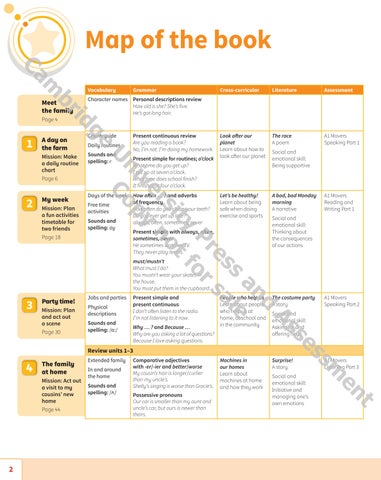
Map of the book m
Ca Vocabulary
Grammar
Cross-curricular
Literature
Assessment
Look after our planet Learn about how to look after our planet
The race A poem
A1 Movers Speaking Part 1
Let’s be healthy! Learn about being safe when doing exercise and sports
A bad, bad Monday morning A narrative
People who help us Learn about people who help us at home, at school and in the community
The costume party A story
Machines in our homes Learn about machines at home and how they work
Surprise! A story
br
Character names Personal descriptions review How old is she? She’s five. He’s got long hair.
Meet the family
A day on the farm
ge
id
Page 4
My week Mission: Plan a fun activities timetable for two friends Page 18
Daily routines Sounds and spelling: r
Present continuous review Are you reading a book? No, I’m not. I’m doing my homework.
Social and emotional skill: Being supportive
As d an s le es sa Pr r y fo it t rs no ve y ni p U Co
Mission: Make a daily routine chart Page 6
Countryside
Days of the week Free time activities
Sounds and spelling: ay
Present simple for routines; o’clock What time do you get up? I get up at seven o’clock. What time does school finish? It finishes at four o’clock.
How often … ? and adverbs of frequency How often do you clean your teeth? Do you ever get up late? always, often, sometimes, never
Present simple with always, often, sometimes, never He sometimes watches TV. They never play tennis.
A1 Movers Reading and Writing Part 1
Social and emotional skill: Thinking about the consequences of our actions
must/mustn’t What must I do? You mustn’t wear your skates in the house. You must put them in the cupboard.
Party time!
Physical descriptions
Sounds and spelling: /a:/
Present simple and present continuous I don’t often listen to the radio. I’m not listening to it now.
Why … ? and Because … Why are you asking a lot of questions? Because I love asking questions.
Review units 1–3
Sounds and spelling: /^/
Possessive pronouns Our car is smaller than my aunt and uncle’s car, but ours is newer than theirs.
Social and emotional skill: Initiative and managing one’s own emotions
A1 Movers Listening Part 3
t
2
In and around the home
Comparative adjectives with -er/-ier and better/worse My cousin’s hair is longer/curlier than my uncle’s. Shelly’s singing is worse than Gracie’s.
en
Mission: Act out a visit to my cousins’ new home Page 44
Extended family
Social and emotional skill: Asking for and offering help
m
The family at home
A1 Movers Speaking Part 2
ss se
Mission: Plan and act out a scene Page 30
Jobs and parties
Ca
Vocabulary
Grammar
Cross-curricular
Literature
Assessment
Wild and
Superlative adjectives This kitten’s the prettiest/the fattest. These ice skates are the best.
The animal kingdom Learn about animals and their food
Why the kangaroo has a pouch An Australian dreamtime story
A1 Movers Reading and Writing Part 2
Animal world domestic Mission: Plan an animal documentary Page 56
m
animals Action verbs
br
Sounds and spelling: g
ge
id Our weather
Clothes
was/were Were your grandparents here last weekend? Yes, they were. Were you at school on Tuesday? No, I wasn’t.
Social and emotional skill: Helping others
What’s the weather like today? Learn about instruments to measure the weather
Fun in all types of weather! A poem
As d an s le es sa Pr r y fo it t rs no ve y ni p U Co
Mission: Make a weather map for a country Page 68
The weather
Prepositions: above, below, near, opposite The bat’s above the tree. The snail’s below the flower. The parrot’s near the cage. The bus stop’s opposite the zoo.
Sounds and spelling: ee and y
There was / There were Was there a scarf in the bedroom? Yes, there was. Were there any boots in the bedroom? No, there weren’t.
A1 Movers Listening Part 1 and Part 2
Social and emotional skill: Thinking positively
Review units 4–6
Let’s cook! Mission: Make a class recipe book Page 82
Around town Mission: Write a trip review Page 94
Sounds and spelling: ch
A day trip
Places in town Sounds and spelling: ow and oa
Past simple: regular verbs I liked cooking them! I fried the onions. I stopped because you started asking me questions.
Past simple: more irregular verbs I found my old hat. He bought it last year.
Plants are delicious! Sonny’s dream job Learn about how we A fantasy story use plants in food Social and emotional skill: Perseverance
A1 Movers Speaking Part 3
Tom’s first day on the school bus A fantasy story
A1 Movers Listening Part 4
Road safety Learn how to be safe in town
Social and emotional skill: Being optimistic
have to / don’t have to I have to see the eye doctor at the hospital. My brother has to wear glasses. Do you have to wear glasses? Yes, I do.
Adjectives for opinions and feelings
The wonders of the world Learn about natural and manmade wonders of the world
The mystery picnic A counting poem Social and emotional skill: Pride in your work
A1 Movers Reading and Writing Part 3
en t
Comparative adjectives with more Circus clothes are more beautiful A new adventure than these. The circus is more exciting than Sounds and the farm! spelling: ing or in Superlative adjectives with most This city is one of the most beautiful in the world. In my family, my brother is the most frightened of spiders.
m
Mission: Plan a holiday world tour Page 106
Actions in the kitchen
Past simple: irregular verbs I went swimming last Saturday. I didn’t go shopping yesterday. Did you go to the park? Yes, I did.
ss se
A big change
Food
Review units 7–9
3
Ca
Meet the family id
br
m
1 1.02 Listen. What’s Jim and Jenny’s mum doing?
ge
Jim and Jenny are on the Friendly Farm.
As d an s le es sa Pr r y fo it t rs no ve y ni p U Co
Grandpa
Jim
Jenny
Mum
en
m
ss se
Dad
t
2 1.03
Say the chant.
3 1.04 Listen and answer. Then ask and answer. 4
Character names
The
Friendly Farm 1
1.05
2
She’s five. She is beautiful. She’s a model. Gracie! You can’t eat my sister!
Yes, Rocky. She’s beautiful, Shelly. How old is she?
ge
id
br
m
Ca
Look, Harry. That’s a photo of Shelly’s sister. She’s in a show.
As d an s le es sa Pr r y fo it t rs no ve y ni p U Co
Oh, sorry! I like eating paper and books.
Look! This is an old photo of my father. He’s very big.
3
4
We’re a beautiful family. I can be a model, too, Gracie.
Yes, he is, Harry. And he’s happy.
Yes, … and he’s got long hair. Gracie! Don’t eat Harry’s dad.
5
Yes, Shelly, you can. You’re good at singing. You can be a singer, too.
6
t
It’s OK, Mum. It’s OK, Cameron. It’s only … Shelly. Er, she’s singing.
en
m
Are you sleeping? Are you sleeping? Rocky’s mum, Rocky’s mum …
What … is … that?
ss se
Shh, Shelly! My mother, Henrietta, is asleep.
My ears, my ears … !
4 1.06 Who says it? Listen and say the name. Story: Personal descriptions review
5
1
Ca
A day on the farm Watch the video. Draw something you can see in the countryside.
ge
id
br
m
1
2
Draw and write my personal daily routine.
3
Write ‘Think’ bubbles to help our planet. Show my daily routine chart to the class.
t
Make my chart.
en
6
1
m
In this unit I will:
ss se
As d an s le es sa Pr r y fo it t rs no ve y ni p U Co Make a daily routine chart
1
Vocabulary 1
1 1.07 Listen and point. Then listen again and colour.
Ca
mountain
br
m
Grandpa, Jenny and Jim are outside, in the countryside, with their friends Eva and Tom.
ge
id
lake river
forest
As d an s le es sa Pr r y fo it t rs no ve y ni p U Co ground
grass
leaf
leaves
field
rock
tractor
en
m
ss se t
2 1.08
Say the chant.
3 1.09 Listen and say yes or no. Countryside
7
T he The The
Friendlyy Farm F 1
1.10
Good morning, everyone.
2
Are they sleeping, Mum?
br
m
Ca That’s right. They can’t open their eyes because they’re very young.
ge
id
Shh! Hi, Cameron. The farm cat’s got some babies. Come and look at her kittens.
No, they aren’t sleeping. I think they’re awake.
They’re here. I think they’re sleeping. They’re beautiful.
As d an s le es sa Pr r y fo it t rs no ve y ni p U Co
3
She’s washing that kitten’s face! The kitten’s very pretty.
4
I’m pretty too … and my face isn’t dirty.
The one with the short tail’s playing with a ball.
Yes, Shelly, but come with me.
Is that big puppy with the white ear drinking water?
5
Look! There are three puppies. They’re all happy.
It’s playing with my ball!
6 Look at that fat puppy. What’s it eating?
m
ss se It’s naughty! It’s eating Grandpa’s old red sock.
en t
No, it isn’t. It’s looking at its face … because it’s a pretty puppy!
Grandpa’s old red sock?! That’s my lunch!
1 1.11 Listen and say the number. 8
Story: Present continuous review in context
1
Language practice 1
1.12
Gracie’s Grammar
Ca
Are you reading a book? A Is she playing tennis? Are they putting on their boots?
ge
id
br
m
No, I’m not. I’m doing my homework. Yes, she is. She’s playing tennis. No, they aren’t. They’re taking off their boots.
1 2
As d an s le es sa Pr r y fo it t rs no ve y ni p U Co
1 1.13 Listen and stick. Then look, read and write.
Grandma’s eating some ice cream. Mum
lemonade.
3
Dad
4
Grandpa the kitchen.
his hands.
STAGE 1
AGE ST
en My
t
Draw yourself and colour the picture. Are you using the red crayon? Cut up the little cards. No, I’m using the scissors.
m
Write and decorate the title.
ss se 1
Make your chart.
diary Activity Book page 6
Present continuous review
9
Vocabulary 2 and song Vo
1 1.14
Listen and number. Then sing the song.
1
Wake up, 2get up. Go and 3have a shower. Wake up, get up. Time for us to run!
b
br
m
Ca
a
ge
id
Get your 4towel, get dry. Now go and 5get dressed. Get your towel, get dry. Time for us to run!
c
d
e
As d an s le es sa Pr r y fo it t rs no ve y ni p U Co
Sit down for breakfast. Milk or juice for you? Sit down for breakfast. Time for us to run!
1
Clean your teeth. Toothpaste on your 7toothbrush. Clean your teeth. Time for us to run!
6
Wake up, get up, Go and have a shower. Wake up, get up, Get dressed, 8have breakfast, Clean your teeth and run!
f
g
Time for us to run! (x3)
You’re cleaning your teeth.
10
Daily routines
t
What am I doing?
What do you do in the morning?
en
m
ss se
2 Play the game.
1
Language practice 2
What time does he have lunch? Listen and tick ✓.
1 1.16
2
1
3
ge
id
br
m
Ca 1.17
Gracie’s Grammar
As d an s le es sa Pr r y fo it t rs no ve y ni p U Co
What time do you get up? What time does school finish?
I get up at seven o’clock. It finishes at four o’clock.
2 Ask and answer.
get up go to school have lunch go home do your homework have a shower go to bed What time do you have lunch?
I have lunch at one o’clock.
What time do you go home?
I go home at four o’clock.
m ss se 2
STAGE 2
AGE ST
Draw and write your personal daily routine.
en
Draw a picture and write the name of each activity on a little card.
What time do you get up?
I get up at seven o’clock.
My
t
Ask and answer with a friend about your routines.
diary Activity Book page 6
Present simple for routines; o’clock
11
Cross-curricular
Look after our planet 1
Ca
Watch the video.
1
br
m
2 Tick ✓ the activities that are good for our planet. 2
3
ge
id As d an s le es sa Pr r y fo it t rs no ve y ni p U Co
4
5
6
3 1.18 Listen and read. Answer the questions.
en
m
ss se
Our planet is called Earth. We can live on Earth because there is air around us. Air has oxygen and other gases. All plants and animals need oxygen. They need water too and there is water on Earth. Clean air and clean water keep us healthy, so it’s important to look after our planet.
Which planet do we live on?
2
What do plants and animals need?
3
Why is it important to look after our planet?
Learn about how to look after our planet
t
12
1
1 4 1.19 Match the ideas with the photos. Listen and check.
Ca
Look after our planet … at home! d
Turn off the tap when you clean your teeth.
br
m
1
Have a shower and not a bath. Save water!
3
Turn off the lights when you go out.
4
a
Recycle paper, glass and plastic.
As d an s le es sa Pr r y fo it t rs no ve y ni p U Co
5
ge
id
2
Don’t use new plastic bags when you go shopping.
b
c
d
e
5 What do you do to look after the planet? Tell a partner. We recycle paper, glass and plastic.
I have showers.
STAGE 3
My
t
AGE ST
en
I turn off the tap when I clean my teeth.
Save water!
3
Write ‘Think’ bubbles for your daily routines chart.
m
Say how you can look after our planet.
ss se
Write ‘Think’ bubbles to help our planet.
diary Activity Book page 6
Show what you know about looking after our planet
13
Literature
1 Look at the pictures. Where are the girls? What are they doing?
Ca
The race
m
1.20
id
br ge
‘Get up! Have a shower! Clean your teeth, get dressed! Come on, Gwen!’ says Beth. ‘Let’s go and see Jess!’
As d an s le es sa Pr r y fo it t rs no ve y ni p U Co
Jess is their puppy, with a little black nose. She lives in the field where everyone goes To be happy, not sad, to play and to run. Today there are leaves on the ground – it’s fun!
en t
Text type: A poem
m
14
ss se
Every day Beth and Gwen run to see Jess. ‘I’m winning today,’ says Beth. ‘Oh yes!’ But then there’s a rock in the leaves and she falls! And down on the ground to her sister she calls.
1
ge
id
br
m
Ca
‘Where are you going, Gwen? Come back to me! I can’t move my leg. Please come and see!’ But Gwen’s winning the race. She’s running so fast. She looks, but she thinks, ‘I don’t want to be last’.
As d an s le es sa Pr r y fo it t rs no ve y ni p U Co
‘Owwww, my leg!’ says Beth. ‘Gwen, can you come?’ Gwen starts to feel sad And she stops her run. She goes back and she says, ‘I’m sorry, Beth.’ She helps her to stand And they go and see Jess.
Are you OK, Beth?
Owwwww, my leg.
en t
Can you stand up?
m
ss se
2 Act out the poem.
3 Gwen goes to help Beth. When do you support people like this? Social and emotional skill: Being supportive
15
A1 Movers
1 Practise with a friend.
Ca
What’s your name?
How old are you?
br
m
2 Look at this picture. What can you see? A
ge
id As d an s le es sa Pr r y fo it t rs no ve y ni p U Co
3 Look at this picture. How is it different from picture A? Read and correct. B
1 In picture B, there are four sheep in the field.
2 In picture B, there are some leaves on the grass. In picture B, there are …
ss se
4 Look and say. I can see orange juice in picture A. Here, it’s …
2
In picture A, she’s washing her hands. In this picture, she’s washing …
3
There’s a lizard on the rock. In picture B, there’s …
en
m
1
t
You can say Here, there’s / there are … and There isn’t/aren’t. 16
Preparation for Speaking Part 1
1
Review
in action! My
Ca
Show your daily routine chart to the class.
m
diary
br
Say ‘Hello’ and show your chart.
Activity Book page 6
Hello. I’m Alicia and this is my daily routine chart.
ge
id Talk about your daily activities.
As d an s le es sa Pr r y fo it t rs no ve y ni p U Co
I get up at seven o’clock.
Point to your ‘Think’ bubbles and say what you do.
I turn off the tap when I clean my teeth.
Answer questions.
I have lunch at one o’clock.
OM
t en TE
m
ss se C
What time do you have lunch?
PLE
Unit consolidation
17
2
Ca
My week Watch the video. Draw an activity which you like doing.
ge
id
br
m
1
ss se
As d an s le es sa Pr r y fo it t rs no ve y ni p U Co Plan a fun activities timetable for two friends
18
Make a fun activities timetable for a week.
3
Write important information about the activities. Give our timetable to our two friends.
t
2
Work with a partner to talk to two friends about free time activities.
en
1
m
In this unit I will:
2
Vocabulary 1
1 1.21 Listen and point. Draw a happy face on Jim’s favourite school days.
m
Ca ge
id
br
Jim, Jenny, Tom and Eva are at school. They’re talking about their school week.
en
m
ss se
As d an s le es sa Pr r y fo it t rs no ve y ni p U Co t
2 1.22
Say the chant.
3 1.23 Listen and say the days. Days of the week
19
T he The The
F riendly Farm
1.24
1 Friday afternoon
2
ge
id
br
m
Ca
and we’re home from school! Let’s put Fred here on the table.
Jim and Jenny have got a new pet … but only for the weekend. It’s the school fish, but it needs food on Saturdays and Sundays too.
3
As d an s le es sa Pr r y fo it t rs no ve y ni p U Co
Cameron can get on the table! Let’s put him up there on the shelf. How often do they feed it?
Once a day, … in the evening.
5
Hmm, they feed us twice a day: in the morning and the evening. Hmm. Fish are always in water. Can they talk?
How often does this fish wash its face?
4
It never washes its face, Shelly. It … Fish live in water, Shelly. They’re always in water.
6
So, fish. Do you ever talk?
en
m
ss se
I don’t know. No, I don’t think so.
Yes, I do … I sometimes talk, but I never talk to cats.
1 1.25 Who says it? Listen and say the name. 20
Story: How often … ? and adverbs of frequency in context
t
Birds often talk. Cameron, does the fish ever talk?
2
Language practice 1
1.26
Gracie’s Grammar I always clean them after breakfast, lunch and dinner.
Do you ever get up late?
No, I never get up late.
br
m
Ca
How often do you clean your teeth?
ge
id
always ✓✓✓ ofte n ✓✓ sometimes ✓✗ never ✗
always ✓✓✓
sometimes ✓✗
m ss se 1 As d an s le es sa Pr r y fo it t rs no ve y ni p U Co
1 1.27 Listen and stick. Then look, read and write. ofte n ✓✓
never ✗
1
Pe te r often for a swim.
goes
3
Pe te r at night.
has a shower
2
Clare
feeds her fish.
4
Clare for breakfast.
has burgers
STAGE 1
AGE ST
Work with a partner to talk to two friends about free time activities.
How often do you play basketball?
I play basketball on Tuesdays and Thursdays.
My
t
Ask two friends how often they do each activity.
en
In pairs, write free time activities.
diary Activity Book page 18
How often … ? and adverbs of frequency
21
Vocabulary 2 and song V
1 1.28
Listen and number. Then sing the song. a
b
c
br
m
Ca
How often … how often … do you 1listen to music? How often … how often … do you 2write an email? Do you ever … do you ever … 3 go skating in the park? Do you ever … do you ever … 4 read a comic in the car? How often … how often … Do you ever … do you ever … 5 go shopping with your dad? Do you ever … do you ever … 6 watch films that are bad? A CD, a CD – do you ever 7listen to a CD? DVD, DVD – do you ever 8watch a DVD? How often … how often …
1
id
ge
d
As d an s le es sa Pr r y fo it t rs no ve y ni p U Co e
f
g
h
ss se
2 Ask and answer. Use often, sometimes or never.
How often do you go shopping? How often do you watch films? How often do you listen to CDs? 22
Free time activities
t
How often do you write emails?
en
How often do you go skating?
m
How often do you read comics?
2
Language practice 2
1 1.30
Where can Jack go with his birthday present? Listen and tick ✓.
Ca 1
2
3
ge
id
br
m 1.31
Gracie’s Grammar
As d an s le es sa Pr r y fo it t rs no ve y ni p U Co
What must I do? You mustn’t wear your skates in the house. W You must put them in the cupboard.
2 Read and circle to make class rules. 1 2 3 4
We must / mustnn’tt listen to the teacher. We must / mustnn’tt talk when the teacher is talkingg. We must / mustnn’tt do our homework. a s. We must / mustn’tt put our feet on the cchair
3 Talk to your friends. Make more class rules.
AGE ST
They never go roller skating.
Let’s write ‘skate’ on Sunday.
My
t
Talk about your friends’ answers. Write a fun activity for each day.
en
In pairs, make a timetable for a week.
m
Make a fun activities timetable for a week.
ss se 2
STAGE 2
diary Activity Book page 18
must/mustn’t
23
Cross-curricular
Let’s be healthy! 1
Ca
Watch the video.
1
2
3
4
5
6
ge
id
br
m
2 Tick ✓ the activities that you do.
As d an s le es sa Pr r y fo it t rs no ve y ni p U Co
3 1.32 Read, look and complete. Then listen and check.
helmet
en
m
ss se
Exercise is good for us, but sometimes there are accidents. It’s very important to wear the correct clothes to protect our bodies. We wear 1 elbow and knee pads to protect our elbows and knees. We wear 2 to protect our hands. We wear a 3 to protect our head. We wear 4 to protect our eyes.
elbow and knee pads
t
goggles 24
Learn about being safe when doing exercise and sports
gloves
2 4 1.33 Listen and read. Then read and say yes or no.
Ca
Drink water! When we exercise, we get hot and we sweat. Our body loses water when we sweat. Remember to drink water when you exercise.
ge
id
br
m
Let’s warm up! Our bones and muscles help us move. Before we play a sport or do exercise, it’s important that we warm up our muscles so we don’t hurt them.
As d an s le es sa Pr r y fo it t rs no ve y ni p U Co
Use sun cream! You put on sun cream when you go to the beach. But do you use it when you play sport? Protect your skin from the sun when you’re outside. It’s important to put on sun cream when it isn’t a very hot day too.
1
We warm up before exercise to look after our skin.
2
We drink water when we get hot.
3
We use sun cream when we play inside.
4
Sun cream is always important when you’re outside.
5 Talk to a partner about your favourite sport or activity. I like horse riding. I go on Saturdays. I must wear a helmet and boots.
STAGE 3
Write three ideas for their timetable. For skating, they must wear knee pads, …
My
t
3
AGE ST
en
m
In pairs, think about the activities. What must your friends do to be safe?
ss se
Write important information about the activities.
You must wear knee pads, elbow pads, gloves and helmets!
diary Activity Book page 18
Show what you know about being safe when doing exercise and sports
25
Literature
1 Read the question at the start. Tell a classmate your answer and say why.
Ca
A bad, bad Monday morning
m
1.34
id
br ge
How often do you want to sleep and not get up for school? I sometimes do that. I turn off my alarm and go to sleep. I want to tell you about a very bad Monday morning …
As d an s le es sa Pr r y fo it t rs no ve y ni p U Co
Suddenly, Mum’s standing over me. She’s shouting and she’s pulling off my blanket. ‘Alex! It’s eight o’clock. We mustn’t be late! You have a presentation at school today!’
en t
Text type: A narrative
m
26
ss se
I jump out of bed and get dressed. Then I run to the bathroom, but my big sister’s using it. I run downstairs to the other bathroom. My dad’s using it.
2
ge
id
br
m
Ca
Then Mum calls, ‘Breakfast!’ I run to the kitchen. ‘Here’s some chocolate milk and some fruit,’ Mum says. ‘But for breakfast, I always have … ’ ‘No time for that today!’ Mum says. We must leave now!’ I start to say ‘I must … ’, but Mum says, ‘Now, Alex!’
As d an s le es sa Pr r y fo it t rs no ve y ni p U Co We run to the car and drive to school. All the lights are red.
ss se
When we get to school, I run to the assembly hall. All my classmates are there. They’re smiling. My presentation is good. I’m very happy … but then I go to the bathroom and look in the mirror. I’m wearing my sister’s shirt, my hair is going in all directions and I have chocolate milk around my mouth!
Ask and answer. Tell me about your favourite day of the week.
t
3
en
m
2 What bad things happen to Alex in the story? Why?
I love Fridays. We play games in our English class.
Social and emotional skill: Thinking about the consequences of our actions
27
A1 Movers
1 Look at the pictures. What can you see? Copy a word or words from the box.
Ca
ge
id
br
m
a comic breakfast skates a lake an email toothpaste leaves a tractor
5
leaves
se As d an s le es sa Pr r y fo it t rs no ve y ni p U Co
1
2
3
4
6
7
8
2 Read and think. Circle the correct answer. 1
You find these on trees and they’re green.
a leaf / leaves
2
Most people eat this in the morning.
breakfast / breakfasts
3
You can use these in the park. It’s fun!
skate / skates
4
You write this on a computer or phone.
emails / an email
3 Look at the answers. Read and complete. You use this to clean your t
2
There are lots of different st
.
toothpaste
in this.
a comic
Circle the words which help you choose the answer. 28
Preparation for Reading and Writing Part 1
t
4 Look at Units 1 and 2. Write five sentences like Activity 3. Can your friend say the words?
en
m ss
1
2
Review
in action! My
Ca
Give your timetable to your two friends.
m
diary
Talk about the activities which they do every week now.
You play basketball twice a week. You never skate.
ge
id
br
Activity Book page 18
As d an s le es sa Pr r y fo it t rs no ve y ni p U Co
Tell them the activity for each day.
You skate on Sunday.
Tell them how to be safe. You must wear knee pads, elbow pads, gloves and helmets.
Do your friends like the timetable?
Do you like the activities?
Yes, thank you. It’s a fun week!
t
TE
C
PLE
en
m
ss se OM
Unit consolidation
29
3
Ca
Party time! Watch the video. Draw yourself at the costume party.
ge
id
br
m
1
2
Describe my character.
3
Write a scene with my group where someone is helping.
Act out our scene for the class.
t
30
Choose a job and draw my character.
en
m
In this unit I will: 1
ss se
As d an s le es sa Pr r y fo it t rs no ve y ni p U Co Plan and act out a scene
3
Vocabulary 1
1 1.35 Listen and point. Then listen again and colour.
Ca
br
m
It’s Grandpa’s birthday today. The Friendly family are having a surprise costume party.
id
clown
film star
ge
pop star
pirate
As d an s le es sa Pr r y fo it t rs no ve y ni p U Co
treasure
cook
nurse
dentist
present
ss se
en
doctor
m
farmer
t
2 1.36
Say the chant.
3 1.37 Listen and answer. Jobs and parties
31
T he The The
F riendly Farm 1
1.38
Oh, Cameron! What are you wearing?
2
Ca
OK, but ... where is Farmer Friendly?
ge
id
br
m
I’m wearing a clown’s costume, from the party.
He’s outside feeding the cows. He always feeds them in the evenings.
As d an s le es sa Pr r y fo it t rs no ve y ni p U Co
Oh, we never dress up. Can we have a costume party too?
3
There’s a box of costumes here … with Farmer Friendly and Grandma’s old clothes.
I’m a nurse. I help people … hmm, we need a doctor.
4
I’m a pop star.
Rocky! What are you doing?
Oh, I don’t want to be a pop star … I want to be a famous film star. Film stars often go to parties.
5
Are you calling me? What do you want?
I’m calling Gracie. She likes studying. She can be a doctor.
6
Harry! I’m a doctor! I must look at your eye. I’m … helping … you.
ss se
Put these on, Gracie. You’re our doctor.
en
m No, you aren’t. It’s my costume. I’m a pirate. Please stop! … Ow!
1 1.39 Listen and complete. Use one word. 32
Story: Present simple and present continuous in context
t
Remember – doctors help other people.
3
Language practice 1
1.40
Gracie’s Grammar It’s Friday. He’s working today.
I don’t often listen to the radio.
I’m not listening to it now.
br
m
Ca
He never works at tthe weekend.
id
What are you eating at the moment?
ge
Do you eat meatballs?
As d an s le es sa Pr r y fo it t rs no ve y ni p U Co
1 1.41 Listen and stick. Then look, read and write. 1
2
watching
1
Jenny’s
2
Grandpa He’s a farmer.
TV now.
3
4
3
Jim’s at the moment.
4
Does she always the piano?
every day.
a cake
m ss se 1
STAGE 1
Choose a job and draw your character. STAGE
en
In groups, choose a different job each.
My
Talk about your character. She helps other people. She’s a doctor.
t
Draw your character for the scene.
diary Activity Book page 30
Present simple and present continuous
33
Vocabulary 2 and song Vo
1 1.42
Listen and colour. Then sing the song.
Ca
ge
id
br
m
Her scarecrow’s thin And she’s very tall too. She’s got straight, blonde hair And her hat is blue. Scarecrow! Scarecrow!
As d an s le es sa Pr r y fo it t rs no ve y ni p U Co
His scarecrow’s short. He’s also fat. He’s got a long, black beard And a big moustache. Scarecrow! Scarecrow!
Their scarecrow’s ugly. He’s got a purple nose. He’s got fair, curly hair And he’s wearing dirty clothes! Scarecrow! Scarecrow! Scarecrow! Scarecrow! Scarecrow!
2 1.44 Listen and say the number. Then play the game. 2
3
4
en
m
ss se
1
t
Describe your hair. 34
Physical descriptions
3
Language practice 2
What’s Dad doing? Listen and tick ✓.
1 1.45 1
2
3
ge
id
br
m
Ca 1.46
Gracie’s Grammar
As d an s le es sa Pr r y fo it t rs no ve y ni p U Co
W are you asking a lot of questions? Why Because I love asking questions.
2 Ask and answer with your own ideas. 1
wear / clown costumes?
2
3
4
wash / his hands?
read / a big book?
wear / a helmet?
Why are they wearing clown costumes?
Because they’re going to a party.
Because they like dressing up.
In groups, say who you are and describe your character.
Daisy’s a doctor. She’s tall with long …
My
t
Write about your character.
AGE ST
2
Hi! I’m Daisy. I’m a doctor. I’m tall with long …
en
m
Describe your character.
ss se
STAGE 2
Because they’re in a show.
diary Activity Book page 30
Why … ? and Because …
35
Cross-curricular 3.
People who help us Ca 1
Watch the video.
m
ge
id
br
2 1.47 These people help us. Where do they work? Look and write the number. Then listen and check.
As d an s le es sa Pr r y fo it t rs no ve y ni p U Co 1
a teacher
1
a firefighter
2
a dentist
3
a doctor / a nurse
5
4
2
3
en
m
ss se
3 Look at the pictures. Who can help? 1
a police officer
t
36
Learn about people who help us at home, at school and in the community
3 4 Read the sentences. Who is it?
Ca
a cook a teacher a doctor a farmer a firefighter a police officer This person works in a school kitchen or in a restaurant.
2
This person works in a hospital.
5
This person teaches children.
3
This person stops fires.
6
This person works with animals and plants.
ge
id
4
br
This person tells people what to do in the street. We must listen.
m
1
As d an s le es sa Pr r y fo it t rs no ve y ni p U Co
5 1.48 Listen and read. Answer the questions.
Hello. My name’s Sally Green and I’m a teacher. I work in a school near my house. I work from Monday to Friday. I start work at nine o’clock and finish at four o’clock in the afternoon. My job is fun and I love it because I like helping children. 1 What’s her job?
2 Where does she work?
3 Does she work at the weekends? 4 Is her job scary?
5 Does she like her job?
In groups, think of a scene. What’s happening?
My
t
Fred: Oh no! Look at the clown’s leg! Daisy: I can help because I’m a doctor!
AGE ST
3
How can someone help? Write the scene.
en
m
Write a scene where someone is helping.
ss se
STAGE 3
diary Activity Book page 30
Show what you know about people who help us
37
Literature
1 Do you like costume parties? Talk about your favourite costumes.
Ca
The costume party
m
1.49
id
br ge
It’s Emily’s birthday and there’s a costume party on Saturday. Matt’s thinking about his costume. ‘Mum, I want to be a superhero. But Harry wants to be a superhero and he’s got a superhero costume.’ ‘Then what about a pirate costume?’ his mum asks. ‘You can make a short beard and a moustache with black paper and you’ve got a pirate hat!’ ‘No,’ Matt says. ‘I can’t be a pirate. Dan and Zoe have got pirate costumes!’
en t
Text type: A story
m
38
ss se
As d an s le es sa Pr r y fo it t rs no ve y ni p U Co
At school the next day, everyone’s talking about their costumes for the party. Emily’s got a pop star costume. Julia’s got a farmer costume. ‘And I’m taking Ludo as a sheep!’, she says. Ludo’s her little white dog. Only Matt hasn’t got a costume. After school, Matt asks his mum for help. ‘Go as a clown,’ she says, but Matt says, ‘No. A clown’s silly. I want a great costume like Harry’s or Dan’s!’ Then his mum has an idea!
3
id
br
m
Ca ge
ER
As d an s le es sa Pr r y fo it t rs no ve y ni p U Co
It’s the day of the party. Emily’s wearing her pop star costume and she’s singing. Everyone’s listening to her, but who’s this? The door opens and Matt comes in. ‘Hello, everyone,’ he says. ‘Meet the superhero pirate clown!’ Emily stops singing. Everyone starts laughing because Matt’s costume’s so funny! Matt smiles. ‘Thank you, Mum,’ he thinks. ‘You’re good at helping!’
ss se
2 Answer the questions. Does Matt choose his costume?
3
Does Matt like the idea?
2
Who has the idea for his costume?
4
How do you know?
en
Ask and answer. Tell me about when you help someone.
t
3
m
1
I sometimes help my grandma with her dog. I feed him when she isn’t well.
Social and emotional skill: Asking for and offering help
39
A1 Movers
1 Look and read. Tick ✓ the sentences which describe the picture.
Ca
ge
1
id
br
m
Jim
1
Jim is going to a costume party.
2
Jim’s having a party at his house.
3
He’s got a present for his friend, Zoe.
4
He’s opening a present.
As d an s le es sa Pr r y fo it t rs no ve y ni p U Co
2 Look at pictures 2–4. What’s the story called? Circle the answer. Jim’s kitten / Zoe’s present / Jim’s party
E
ZO
2
3
Preparation for Speaking Part 2
t
40
en
Zoe’s/Jim’s … Zoe’s/Jim’s got … The kitten’s walking … … ’s happy/sad. … are looking/pointing. There’s / There are …
m
3 Make sentences about the pictures. Use some of these words.
ss se
4
The examiner can ask questions to help you, for example What’s the kitten doing?
3
Review
in action! My
Ca
Act out your scene for the class.
m
diary Activity Book page 30
Hello, everyone! This is ‘What a silly clown!’
ge
id
br
Tell the class the name of your scene.
As d an s le es sa Pr r y fo it t rs no ve y ni p U Co
Say your character names and describe yourselves.
Hi! I’m Daisy. I’m a doctor. I’m tall with long, blonde hair.
Act out your scene.
Oh no! Look at the clown’s leg! I can help because I’m a doctor!
Thank the class. Thank you for watching and listening!
t
TE
C
PLE
en
m
ss se OM
Unit consolidation
41
Review Ca m
1
Units 1–3
Watch the video de and do the quiz.
ge
id
br
2 1.50 Listen and d ccircle the activities you hear. ar. Then Th listen and complete.
SAT
Zoe
watch a 1
go 2
go to the go for a 4
As d an s le es sa Pr r y fo it t rs no ve y ni p U Co
FRI
Jack
forest
play 3
Kim’s party at 5
SUN
Costume 6
o’clock
Costume 7
3 Choose a person. In pairs, ask, answer and guess who. How often do you watch TV?
I sometimes watch TV.
What time do you wake up?
I wake up at seven o’clock.
read comics
Sally
✓✗ ✗ ✓✗ ✗
✓✓✓ ✓✓ ✓✓✓ ✓✓
✗ ✓✗ ✗ ✓✗
Peter Clare Jane
42
Consolidation of units 1–3
have lunch
wake up
go shopping
12 o’clock 8 o’clock 1 o’clock
7 o’clock
12 o’clock 7 o’clock 1 o’clock
8 o’clock
✗ ✓✗ ✗ ✓✗
t
play football
en
watch TV
m
Name
ss se
✓✓✓ always ✓✓ often ✓✗ sometimes ✗ never
Are you … ?
4 Look and read. Correct the sentences. 1
2
3
5
4
id
br
m
Ca The cook’s got straight hair. He’s making a cake. The cook’s got curly hair. He’s reading a comic.
2
The doctor’s got long, straight hair. She’s helping a girl.
3
The pirate’s got a long moustache. He’s looking at his treasure.
4
The farmer’s got curly, blonde hair. She’s feeding a puppy.
5
The nurse’s got a beard. He’s reading a book.
ge
1
As d an s le es sa Pr r y fo it t rs no ve y ni p U Co
5 Write about you.
What are you doing now?
en t
How often do you visit the doctor?
m
What do you do at the weekend?
ss se
When do you clean your teeth?
What must you do after school?
Consolidation of units 1–3
43
4
Ca
The family at home Watch the video. Draw something which you do at home.
ge
id
br
m
1
ss se
As d an s le es sa Pr r y fo it t rs no ve y ni p U Co Act out a visit to my cousins’ new home
Make a family and talk to my cousin.
2
Draw our family’s home and talk to my cousin.
3
Invent a machine for our home. Act out a visit to my other cousins’ new home.
t
44
1
en
m
In this unit I will:
Vocabulary 1
4
1 1.51 1.52 Listen and point. Then listen and number.
Ca
ge
id
br
m
Today, there’s a family photo. The children are at the front and the grown-ups are behind.
As d an s le es sa Pr r y fo it t rs no ve y ni p U Co Aunt Julia
en
m
ss se t
2 1.53
Say the chant.
3 1.54 Listen and say the name. Extended family
45
T he The The
F riendly Farm 1
2.02
Oh, Rocky, you are naughty!
2
Look, Shelly! Their new family photo.
Yes, Mum, I know. But look, it’s a funny photo.
ge
id
br
m
Ca
It’s better than the old one.
Yes, it’s funnier than the family photo in the living room. Oh, Jim and Jenny’s baby cousin! She’s smaller and younger than them.
Yes. She’s a pretty baby.
5
As d an s le es sa Pr r y fo it t rs no ve y ni p U Co
3
Oooh, Jim and Jenny’s uncle’s taller than their dad, but Mr Friendly’s older than him. I’ve got a prettier face than my cousin, and … I’m fatter than her.
4
I’m bigger than my cousin, but she’s got curlier hair than me.
My feet are smaller and cleaner than your feet!
Well! My ears are longer than your ears!
6
en
m
ss se
Stop! Prettier, uglier, fatter, thinner, better, worse. This is silly! We must all be nicer to everyone.
1 2.03 Listen and say the number. 46
Story: Comparative adjectives in context
You’re right. Sorry, Gracie.
t
Well, I’m thinner than you, Shelly! And … I’m cleverer than all of you!
Yes. Sorry, everyone.
4
Language practice 1
2.04
Gracie’s Grammar
Ca
Gracie’s ears are long. They’re longer than Shelly’s ears.
br
m
Those puppies are both fat, but the brown puppy’s fatter than the white one.
id
My cousin’s hair is curly. It’s curlier than my uncle’s.
ge
Shelly’s singing is bad. It’s worse than Gracie’s singing.
As d an s le es sa Pr r y fo it t rs no ve y ni p U Co
1 2.05 Listen and stick. Then look, read and write. 1
His son’s hair is shorter and straighter than his daughter’s.
2
His daughter’s hair is
3
His granddaughter’s hair is
4
His grandson’s hair is
than his granddaughter’s. than her cousin’s.
than his cousin’s.
Make a family. Then talk to your cousin. In groups, decide what each person looks like. Draw your family. My mum’s hair is curlier than your mum’s hair.
My
t
Your brother is shorter than my sister.
1
Talk to your cousin in another group.
AGE ST
en
m
ss se
STAGE 1
diary Activity Book page 44
Comparative adjectives
47
Vocabulary 2 and song Vo
1 2.06
Listen and complete. Then sing the song. third floor
m
Ca
Town centre, in the town centre, town centre. Our Uncle Paul lives on the third floor. His flat’s got a balcony and a 1 green door. There are plants on his balcony and a garden on the roof. His car’s in the basement and his guitar’s in his 2 . There’s a lift that goes up and down To his flat in the centre of town.
ge
id
br
second floor first floor balcony
As d an s le es sa Pr r y fo it t rs no ve y ni p U Co
Small village, in the small village, small village. We live in a village outside town. We’ve got stairs that go up and down. Outside in the garden there are lots of 3 . Inside our house we’ve got two showers. One’s upstairs, on the first floor. One’s downstairs, with a 4 door.
lift
basement
roof
inside
upstairs
outside
downstairs
stairs
ss se
Town centre, in the town centre. Small village, in the small village.
en
m
2 Describe the picture to your friend.
t
There are stairs inside.
It’s the house.
There are cars in the basement. 48
In and around the home
It’s the flat.
I live in a barn on a farm. Where do you live?
Which is Aunt Jane’s kitchen? Listen and tick ✓.
1 2.08 1
2
3
ge
id
br
m
Ca
r
4
Language practice 2
Gracie’s Grammar
As d an s le es sa Pr r y fo it t rs no ve y ni p U Co
2.09
My brother’s hair is shorter than my sister’s hair, but hers is curlier than his. Our car is smaller than my aunt and uncle’s car, but ours is newer than theirs. My ruler is older than your ruler, but mine is longer than yours.
2 Talk to your friends. Describe things in your classroom. My rubber’s older than Mary’s, but hers is smaller than mine.
The teacher’s table’s bigger than ours.
STAGE 2
ss se
Draw your family’s home and talk to your cousin.
My
t
Our house is smaller than yours, but my bedroom is bigger than your brother’s.
AGE ST
2
Talk to the same cousin as before.
en
Draw the rooms.
m
In your group, decide where you live: a house or flat.
diary Activity Book page 44
Possessive pronouns
49
Cross-curricular
Machines in our homes 1
Ca
Watch the video.
2
3
4
5
6
ge
id
1
br
m
2 Which machines do we use at home? Which do you use at school? Write H (Home), S (School) or B (Both).
As d an s le es sa Pr r y fo it t rs no ve y ni p U Co
3 2.10 Listen and read. Answer the questions. Machines make our lives easier. They can be simple machines with only a few parts or they can be complex machines with lots of parts. Simple machines always need our energy to make them work. We have to pull or push them. A swing in a park is a simple machine.
Some complex machines need our energy too, like a bike. A bike is a complex machine with many different parts. Many complex machines need electricity to work, like a computer. Machines help us at home and at school or at work. We use machines every day.
en
m
ss se
50
Learn about machines at home and how they work
t
1 What machines do you have at 2 Which machines do you use at home? Make a list with a partner. school? What do they do?
4 4 2.11 Listen and number the photos. c
b
d
br
m
Ca
a
ge
id
1
As d an s le es sa Pr r y fo it t rs no ve y ni p U Co
5 Machines help us with work at home. Do you help? What do you do? Do you use a machine?
I lay the table.
I help with the dishwasher.
Invent a machine for your home.
AGE ST
en
In your group, invent a machine.
m ss se 3
STAGE 3
I vacuum the floor.
Draw the machine. This is our machine. It makes burgers in fun shapes.
t
My
Talk to the same cousin as before.
diary Activity Book page 44
Show what you know about machines at home
51
Literature
1 Talk about the robots in the pictures. They’re having a party.
m
Ca
I think they’re cousins.
Surprise! id
br
2.12
ge
Today is my mum’s birthday and we’re having a surprise party for her. There are lots of sandwiches and a chocolate cake. All the family are here. Well, not everyone. Where’s Mum? She works in the town centre, but she’s usually home at five o’clock.
As d an s le es sa Pr r y fo it t rs no ve y ni p U Co
Dad’s calling her and he’s texting her, but she isn’t answering. My cousins are talking about their party hats. ‘My party hat’s bigger than yours,’ Mary says. ‘Well, mine’s nicer than yours,’ Joe says. ‘Oh dear, no-one’s having fun,’ I think. The music’s playing, but people aren’t dancing. It isn’t a good party.
t
Text type: A story
en
52
m
ss se
Now Uncle Paul and Grandma are standing on the balcony upstairs. They can see the street from there.
4
ge
id
br
m
Ca
Then Dad’s phone rings. ‘Hello?’ Dad says. ‘Is that Mum?’ I ask. ‘Yes!’ Dad answers. ‘Put her on speaker phone! Let’s all listen!’ Now we can hear Mum. ‘Sorry I’m late, but my friends at work are giving me a surprise party.’ ‘But Mum,’ I say, ‘we’re having a party for you here!’ ‘Really?’ ‘Yes, but it isn’t a surprise now!’ ‘What can we do?’ Joe and Mary ask. ‘I know!’ I say. ‘Mum! Invite your friends home! We can all have one big party.’
As d an s le es sa Pr r y fo it t rs no ve y ni p U Co
Uncle Paul sees them first. ‘There they are!’ he calls. We all go upstairs to the balcony. ‘Look! Here they come! They’re dancing in the street. And I think your mum’s singing, Max!’ ‘Wow, now everyone’s happy and we’re all having fun! It isn’t a surprise, but it’s a great party.’
about the surprise party. There’s chocolate cake
2
/
t
for everyone! But where’s Mum? She isn’t at home. We all feel
en
/
m
We’re all 1
ss se
2 Read and circle the correct picture.
. Oh, here she is! When Mum comes home,
everyone feels 3
/
.
Social and emotional skill: Initiative and managing one’s own emotions
53
A1 Movers
1 2.13 Paul is talking to Mr Field. Listen. Who are they talking about?
His …
ge
id
br
m
Ca As d an s le es sa Pr r y fo it t rs no ve y ni p U Co
his grandpa
his aunt
his daughter
2 2.13 Listen again. Circle the answer.
Mr Field is talking about his family and his holiday / new home / dog.
3 What can you see in these pictures of Mr Field’s home?
B
C
ss se
A
D
m en
4 2.14 Look at Activity 1. Which is their favourite place in Mr Field’s home? Listen and write a letter in each box.
54
Preparation for Listening Part 3
t
In the exam, there are eight pictures to match with six people. There are two extra pictures.
4
Review
in action! My
Ca
Act out a visit to your other cousins’ new home.
m
diary Activity Book page 44
This is the balcony.
ge
id
br
Your cousins show you their home.
As d an s le es sa Pr r y fo it t rs no ve y ni p U Co
Talk about your homes.
Our house is smaller than yours, but my bedroom is bigger than your brother’s.
ine. Your cousins show you their special mach Look at this machine. It makes burgers in fun shapes.
Wow! That’s cool.
t
TE
C
PLE
en
m
ss se OM
Unit consolidation
55
5
Ca
Animal world Watch the video. Write a name for the documentary.
ge
id
br
m
1
56
Write about what animals can do.
3
Write about what animals eat.
Act out an animal documentary.
t
2
Choose animals for a documentary.
en
m
In this unit I will: 1
ss se
As d an s le es sa Pr r y fo it t rs no ve y ni p U Co Plan an animal documentary
5
Vocabulary 1
1 2.15 2.16 Listen and point. Then listen and number.
br
m
Ca ge
id
This morning the children are in a wildlife park with their teacher.
As d an s le es sa Pr r y fo it t rs no ve y ni p U Co
In the afternoon
en
m
ss se t
2 2.17
Say the chant.
3 2.18 Listen and say the animal. Wild and domestic animals
57
T he The The
F riendly Farm 1
2.19
Gracie! What are you eating?
2
What’s that?
Ca
ge
id
br
m
Is that Jim’s picture of the wildlife park?
Look! It’s Jim’s picture of a bear and a kangaroo … oh, and a parrot!
I’m not eating it! I’m bringing it to show you.
As d an s le es sa Pr r y fo it t rs no ve y ni p U Co
The bear’s the biggest, but the kangaroo’s got the longest tail.
What? Is its tail longer than mine?
3
4
Well, I don’t know which one’s the best, but the parrot’s the prettiest.
Yes, I think so, Harry.
5
Hmm, so, which is the best animal?
And Gracie’s the angriest!
And you’re the biggest and the oldest, Harry.
6
58
Story: Superlative adjectives in context
t
1 2.20 Who says it? Listen and say the name.
en
And you think you’re the cleverest, but … you … aren’t!
m
What? Not again! Stop it! Be quiet, everyone!
Mum’s the angriest animal in the barn!
ss se
And you’re the worst singer! … And Rocky’s the naughtiest animal in this barn!
In this barn, Shelly, you’re the prettiest.
Sorry, Henrietta!
5
Language practice 1
2.21
Gracie’s Grammar
ge
id
br
m
Ca
young: My baby sister’s the youngest in our family. pretty: This kitten’s the prettiest. fat: That puppy’s the fattest. good: These ice skates are the best.
As d an s le es sa Pr r y fo it t rs no ve y ni p U Co
1 2.22 Listen and stick. Then look, read and write.
1
The lion’s asleep. It’s the oldest animal.
3
The kangaroo’s got the tail.
2
The bear is the biggest and it’s got the face.
4
The parrot’s the animal in her park.
Choose animals for your documentary. In groups, choose five animals.
OK. And how about pandas?
Can I be the penguin? They’re the funniest animals!
My
t
Let’s talk about bats.
AGE ST
en
Decide who is the narrator and who is each animal.
m ss se 1
STAGE 1
diary Activity Book page 56
Superlative adjectives
59
Vocabulary 2 and song Vo
1 2.23
a
Listen and number. Then sing the song. b
m
Ca
This is our wildlife park. We’ve got our masks. And we’re all moving like wild animals!
He’s 1running, running, running like a lion. She’s 2climbing, climbing, climbing like a bear. He’s 3jumping, jumping, jumping like a kangaroo. She’s 4hiding, hiding, hiding. Can you see the kitten there?
ge
id
br
c
As d an s le es sa Pr r y fo it t rs no ve y ni p U Co
The parrot’s getting food. It likes to fly. It’s 5losing its banana! It’s 6falling in the sky!
d
He’s jumping, jumping, jumping like a rabbit. She’s 7 flying, flying, flying like a bat. She’s very slow. She’s 8moving like a snail. He’s 9walking like a penguin. Can you do that?
e
f
i
ss se
h
g
1
No, it isn’t. It’s climbing a tree!
The parrot’s eating its banana.
60
Action verbs
No, it isn’t. It’s losing its banana! ana!
t
The bear’s sleeping.
en
2 Play the game. Correct your friend.
m
Move like an animal. Can your friend guess?
5
Language practice 2
1 2.25 Which kind of animal is in Vicky’s picture? Listen and tick ✓.
Ca
1
2
3
ge
id
br
m 2.26
Gracie’s Grammar
As d an s le es sa Pr r y fo it t rs no ve y ni p U Co The bat’s above the tree.
The snail’s below the flower.
The parrot’s near the cage.
The bus stop’s opposite the zoo.
2 In pairs, draw your favourite animal family. Describe it to two friends. Our sister rabbit’s opposite the brother rabbit. They’re playing. Our mummy rabbit’s above the ground. She’s watching her children.
Here, our baby rabbit’s asleep below the ground … and this is our daddy rabbit. He’s jumping near the flowers.
m ss se 2
STAGE 2
AGE ST
Write about what animals can do. Choose places in the classroom for your actions.
Bats can fly above trees! The tree’s behind the door!
My
t
Dolphins can swim. The sea is near the board!
en
Write what each animal can do.
diary Activity Book page 56
Prepositions: above, below, near, opposite
61
Cross-curricular
The animal kingdom 1
Ca
Watch the video.
ge
id
br
m
2 2.27 What do you think these animals eat? Listen and check.
dolphin
As d an s le es sa Pr r y fo it t rs no ve y ni p U Co
meat
bear
leaves
lion
fruit
penguin
panda
parrot
fish
seeds
3 2.28 Listen and read. Then complete the table with the animals from Activity 2.
ss se
We can classify, or put animals into groups, when we know what they eat. There are three groups: carnivores, herbivores and omnivores.
Carnivores only eat meat and fish. Tigers and sharks are carnivores. Herbivores only eat plants. Kangaroos and rabbits are herbivores.
m
Omnivores eat meat and plants. People and chickens are omnivores.
62
dolphin
Learn about animals and their food
kangaroo rabbit
Omnivore people chicken
t
tiger shark
Herbivore
en
Carnivore
5 4 Read about zebras and penguins.
ge
id
br
m
Ca NAME: Adélie Pengui n GROUP: Bird COLOUR: Black and white LIVES: In Antarctica FOOD: Carnivore (fish )
Zebras have got four legs and r than a long tail. Their ears are bigge ickly. a horse’s ears. They can run qu They live in big groups.
Penguins have got tw o short legs, wings and a beak. Th ey have feathers. They can swim very qu ickly, but they can’t fly. They live in bi g groups.
As d an s le es sa Pr r y fo it t rs no ve y ni p U Co
NAME: Zebra GROUP: Mammal s COLOUR: Black and white stripe LIVES: In African grasslands FOOD: Herbivore (grass)
5 Read and write Z (zebras) or P (penguins). 1
They are carnivores.
4
They like moving in water.
2
They live in Africa.
5
They have stripes.
3
They can run very quickly.
6
They don’t eat grass.
P
Write about what animals eat. Practise actions to show how each animal eats.
AGE ST
en
Write what each animal eats.
m ss se 3
STAGE 3
Penguins eat fish. Look! This penguin is eating fish.
t
My
diary Activity Book page 56
Show what you know about animals and their food
63
Literature
1 What do you know about kangaroos? They’re …
They can …
They live …
m
Ca
They’ve got …
Why the kangaroo has a pouch
id
br
2.29
ge
One morning a mummy kangaroo’s near the river. She’s playing with her joey. A joey’s a baby kangaroo. But what’s that noise? The kangaroo looks and sees a very old wombat. The wombat’s crying. ‘What’s the matter?’ the kind kangaroo asks. ‘I can’t see and I need to eat and drink. I haven’t got any friends to help me!’ the wombat answers. ‘I’m your friend,’ the kangaroo says. ‘Hold my tail.’
As d an s le es sa Pr r y fo it t rs no ve y ni p U Co
en
m
ss se
The wombat holds the kangaroo’s tail and she takes him to the river. ‘Here! Now you can drink,’ she says. Then she takes the wombat to the greenest grass and says, ‘Here! Now you can eat.’
Text type: An Australian dreamtime story
t
64
5
ge
id
br
m
Ca
The kangaroo’s kind to the old wombat all day. When it’s late, she says goodbye to him and she looks for her baby. Where is he? She can’t find him! ‘Joey! Joey! Where are you?’ the kangaroo shouts. It’s OK. He’s asleep below the biggest tree. The kind kangaroo finds him and goes to sleep, too.
As d an s le es sa Pr r y fo it t rs no ve y ni p U Co
The next day she wakes up and sees a pouch. She puts her joey in the pouch. Then she sees the old wombat. ‘Look! This pouch is brilliant, but where does it come from?’ ‘It’s my present to you. You’re the kindest kangaroo that I know,’ the wombat says. And from that day, all mummy kangaroos have pouches to carry their babies.
ss se
2 Talk about the questions. How does the wombat feel at the start of the story?
2
How does the wombat feel when the kangaroo helps him?
3
Why does the wombat give her the pouch?
4
How does the kangaroo feel when the wombat gives her the pouch?
en
m
1
t
3 Who’s kind to you? Are you kind to people? What do you do? Social and emotional skill: Helping others
65
A1 Movers
1 Where are Mary and Jack? What are they doing?
Ca 1
br
m
2 Match the questions with the answers. What do you want to see after this?
id
Are the bears near the lions?
3
Can you see the penguins?
ge
2
a
No, I can’t see them.
b
Let’s go and see the bats.
c
Yes, they are.
As d an s le es sa Pr r y fo it t rs no ve y ni p U Co
3 Read what Mary says and Jack’s three answers. Which two are wrong? Mary: Bats are funny! I like them.
Jack: a I think there are ten. b Do you like bats? c So do I.
Why are the two answers wrong? Write a letter in each box. 1
We know Mary likes them.
2
Mary doesn’t say ‘How many’.
4 Read and think. Choose the best answer. Mary: Why don’t we get a drink?
Jack: a Because we haven’t got a drink.
Mary: There’s Mum! She’s waving at us! Jack: a Yes, she wants to go. b Yes, let’s tell Mum. c Yes, that’s Mum’s.
66
Preparation for Reading and Writing Part 2
t
2
en
c We mustn’t give drinks to the animals.
Read all the answers before you choose. Then check your answers.
m
b That’s a good idea.
ss se
1
5
Review
in action! My
Ca
Act out an animal documentary.
m
diary
This is the bat. It’s the smallest animal in our documentary.
Activity Book page 56
ge
id
br
Present your animals.
Say and show what each animal can do.
As d an s le es sa Pr r y fo it t rs no ve y ni p U Co
Dolphins can swim.
ts Say what each animal ea and show how it eats.
Penguins eat fish. Look! This penguin is eating a fish.
Vote for the best documentary. This group’s actions are the funniest!
t
TE
C
PLE
en
m
ss se OM
Unit consolidation
67
6
Ca
Our weather Watch the video. Draw a picture of yourself in this weather.
ge
id
br
m
1
In this unit I will: Make a map of an island with my group.
2
Add things to see on our island.
3
Create weather symbols for our map. Present our island to the class.
t
68
1
en
m
ss se
As d an s le es sa Pr r y fo it t rs no ve y ni p U Co Create a holiday island
6
Vocabulary 1
1 2.30 2.31 Listen and point. Then listen and number.
Ca
cloud
m
This afternoon the children are making a video call to their grandparents.
wind
id
br
rainbow
ge
hot
As d an s le es sa Pr r y fo it t rs no ve y ni p U Co rain
cold
sunny
en
m
ss se
snow
t
2 2.32
Say the chant.
3 2.33 Listen and write the words. The weather
69
T he The The
F riendly Farm 1
2.34
Look at those grey clouds. It’s raining and windy. We can’t go outside today.
Where’s Farmer Friendly today?
2
br
m
Ca
Today, I don’t know, but yesterday … he was in the mountains with Grandma Friendly.
ge
id
Oh, my hair! It was sunny yesterday and it wasn’t cold.
3
As d an s le es sa Pr r y fo it t rs no ve y ni p U Co
In the mountains! Why were they there?
They were on holiday … in the snow.
Oh yes, the snow. Shall I tell you a story? When I was young …
How old were you, Gracie?
5 Shh, Rocky! Yes, we were! We were in Let’s listen!
Well, she was … younger. Go on, Gracie!
Thank you! I was with my older cousin … and we were out in the fields … near the forest.
6
Yes, we were! Where was I? …
Were you in the snow?
Look! It’s sunny and there’s a rainbow!
en
m
ss se
the snow, … but we weren’t cold. We were happy. It was six o’clock in the evening.
4
t
You were near the forest! In the evening!
1 2.35 Listen and say the number. 70
Story: was/were in context
Let’s go outside. … Oops, I need to do my hair!
6
Language practice 1
2.36
Gracie’s Grammar Yes, they were. / No, they weren’t.
Were you at school on Tuesday? Yes, I was. / No, I wasn’t.
id
br
m
Ca
W Were your grandparents here last weekend?
ge
1 2.37 Listen and stick. Then look, read and write.
Friday
Thursday
As d an s le es sa Pr r y fo it t rs no ve y ni p U Co
Wednesday
Saturday
1
The weather
wasn’t
2
We
in the forest on Saturday.
3
Mum and Dad
4
What
bad on Wednesday.
at home on Thursday.
the weather like on Friday?
AGE ST
Make a map of an island.
My
t
It was cold and sunny.
en
Draw five places on your map. Talk about the weather.
m
In groups, imagine you were on holiday last week.
What was the weather like in … ?
ss se 1
STAGE 1
diary Activity Book page 68
was/were
71
Vocabulary 2 and song Vo
1 2.38 Listen and complete. Then sing the song. T-shirt
m
Ca
It’s hot and sunny, sunny today. Put on your T-shirt and shorts and go out to play. I’m wearing my T-shirt and shorts. I’m wearing my 1 T-shirt and 2 .
id
br
shorts
ge
It’s cold and windy, windy today. Put on your sweater and scarf and go out to play. I’m wearing my sweater and scarf. and 4 . I’m wearing my 3
As d an s le es sa Pr r y fo it t rs no ve y ni p U Co
sweater
There’s snow, it’s snowing, snowing today. Put on your coat and boots and go out to play. I’m wearing my coat and boots. and 6 I’m wearing my 5
.
Come inside, near the fire. It’s nice and hot there. Take off your coat and boots and sit on that chair. Now I’m not wearing my coat. Now I’m not wearing my boots. (x2)
boots
en t
Clothes
m
I’m wearing my big coat and my black boots. Have you got a favourite scarf or sweater? What colour is it?
72
coat
ss se
2 Imagine the weather. Talk to your partner.. It’s cold and raining. What are you wearing?
scarf
6
Language practice 2
1 2.40 Which room are they talking about? Listen and tick ✓. 1
2
3
id
br
m
Ca Gracie’s Grammar
ge
2.41
As d an s le es sa Pr r y fo it t rs no ve y ni p U Co
W there a scarf in the bedroom? Was YYes, there was. / No, there wasn’t.
Were there any boots in the bedroom? Yes, there were. / No, there weren’t.
2
Choose a page. Look at a picture. Ask your partner. Look at page 57, please. OK. Stop. Close your book, please. Was there a bear? Were there any crocodiles?
Yes, there was.
No, there weren’t.
Excellent! Well done!
STAGE 2
Think about your holiday from Stage 1. What was there to see in each place? Talk in your group and draw on your map.
There was a forest at White Rock.
AGE ST
My
t
There were lots of boats in River Town.
en m ss se 2
Add things to see on your island.
diary Activity Book page 68
There was / There were
73
Cross-curricular
What’s the weather like today? 1
Ca
Watch the video.
2 Look at the photos. What’s the weather like?
br
m
It’s …
2
3
ge
id
1
cloudy sunny windy snowing raining 4
5
As d an s le es sa Pr r y fo it t rs no ve y ni p U Co
3 2.42 Listen and read. Match the weather instruments with the photos. When we want to know about the weather, we can listen to a weather report on the radio or watch the report on television. Scientists study the weather in weather stations and send the information around the world. They have special instruments that help them. They use a 1 thermometer to measure how hot or how cold it is. They use a 2 rain gauge to measure how much rain falls.
ss se
They use a 3 weather vane to show the direction of the wind.
Scientists can use this information to make weather maps and reports.
b
c
en
m
a
t
74
Learn about instruments to measure the weather
6 4 Look at the weather map. Ask and answer.
br
m
Ca
What’s the weather like in Whitewater? It’s windy.
ge
id Is it raining in the Black Mountains?
As d an s le es sa Pr r y fo it t rs no ve y ni p U Co
No, it isn’t.
5 2.43 Where are the children? Listen and point. Then listen again and match. 1
Vicky is in
2
Paul is in
3
Clare is in
4
Fred is in
Whitewater.
Farmfield.
the Black Mountains.
the Green Forest.
STAGE 3
Look at your notes from Stage 1 and create weather symbols.
en
m
Put them on your map.
ss se
3
Create weather symbols for your map. STAGE
In River Town there was a rainbow. OK, let’s make a rainbow symbol.
t
My
diary Activity Book page 68
Show what you know about weather symbols
75
Literature
1 Look at the pictures. What different kinds of weather can you see?
Ca
Fun in all types of weather!
m
2.44
ge
id
br
The wind is blowing all around. It’s blowing on you and me. The trees are dancing from side to side, But the wind can’t catch me! I’m jumping in the leaves. I’m kicking them too. I’m having lots of fun. How about you?
ss se
As d an s le es sa Pr r y fo it t rs no ve y ni p U Co
It’s raining, raining all around. It’s raining on you and me. I put on my boots and my coat And I imagine that I’m at sea. I’m jumping in the puddles. I’m splashing a lot too. I’m having lots of fun. How about you?
en
m
It’s cloudy, cloudy all around. Clouds are flying over me. On my back here on the grass, I imagine the things I see. There are elephants and rabbits And running horses too. I’m having lots of fun. How about you? Text type: A poem
t
76
6
ge
id
br
m
Ca
It’s snowing, snowing all around. Everything is white! I’m wearing my boots, my coat and scarf And I’m sliding on the ice. Look at my friendly snowman! He’s wearing a long scarf too! I’m having lots of fun. How about you?
As d an s le es sa Pr r y fo it t rs no ve y ni p U Co
Then the sun starts shining On the ground and on me. There was a snowman on the grass, But tell me, where is he? When it’s nice and sunny And it’s very hot too, I love splashing at the pool! How about you?
ss se
2 What’s your favourite weather? Does the girl in the poem do the same things as you?
t
3 Is there a type of weather you don’t like? What fun things can you do?
en
m
My favourite is sunny weather, but she goes to the pool and I like the beach.
I don’t like windy weather, but I can fly my kite.
Social and emotional skill: Thinking positively
77
A1 Movers
1 2.45 Listen to the names. Are they for a boy, a girl or both?
Ca
2 2.46 Listen and tick ✓ the things you hear about the boy. red sweater
2
pointing
3
dirty clothes
4
green boots
1
br
m
ge
id
3 Work with a friend. Describe people in the picture. Find and point.
As d an s le es sa Pr r y fo it t rs no ve y ni p U Co
4 2.47 Look. Do you need a word or a number? Listen and write.
Party time:
3
Name of cousin:
4
Must take:
o’clock
a
In the exam, there are names around the picture in Part 1 and you draw lines. Practise numbers and the alphabet for Part 2. 78
Preparation for Listening Part 1 and Part 2
t
2
en
Going by:
m
1
Dream Street
ss se
34
Going to Zoe’s house:
6
Review
in action! My
Ca
Present your island to the class.
m
diary
Show your map and say the name of the island.
ge
id
br
Activity Book page 68
This is our weather map of Friendly Island.
As d an s le es sa Pr r y fo it t rs no ve y ni p U Co
Say what there was to see in each place. There were lots of boats in River Town.
Say what the weather was like in each place. In River Town, there was sun and rain, so there was a rainbow!
t
TE
C
PLE
en
m
ss se OM
Unit consolidation
79
Review 1
Units 4–6
Ca
Watch the video and do the quiz.
1
br
m
2 2.48 Listen and tick ✓. 2
3
4
ge
id B ✓
5
A
As d an s le es sa Pr r y fo it t rs no ve y ni p U Co
A
A
B
6
B
A
B
A
7
A
B
B
8
A
B
A
B
3 Play the game. In pairs, choose, give clues and guess. climb
fly
jump
swim
big
small
above
below
near
opposite
ss se
en
m
It can jump. It’s smaller than the kangaroo. It’s near the bear.
t
Is it the rabbit?
80
Consolidation of units 4–6
4 Where are Aunt Laura’s things? Find and circle .
ge
id
br
m
Ca
Aunt Laura’s coat is the longest one. She’s got two scarves. The second one on the wall downstairs is hers, and the shortest one is hers too. Her boots are on the floor upstairs. They’re bigger than the boots downstairs. Her sweater is on the chair below the clock. And where’s her son? Oh look, he’s hiding on the stairs!
As d an s le es sa Pr r y fo it t rs no ve y ni p U Co
5 Write about you.
What’s the weather like today?
What was the weather like yesterday? What clothes do you wear to school?
en
m
What’s your oldest cousin’s name?
ss se
What’s the biggest animal you know?
t
Where were you yesterday? Who’s the youngest person in your family?
Consolidation of units 4–6
81
7
Ca
Let’s cook! Watch the video. Draw some food which you’d like to cook.
ge
id
br
m
1
2
Write a recipe.
3
Talk about the plants which we eat.
Tell the class about our recipe.
t
82
Choose what kind of recipe to write with my group.
en
m
In this unit I will: 1
ss se
As d an s le es sa Pr r y fo it t rs no ve y ni p U Co Make a class recipe book
7
Vocabulary 1
1 3.02 Listen and point. Then listen again and colour.
Ca
ge
id
br
m
Today Mr Friendly’s giving the children a cooking class at their school.
As d an s le es sa Pr r y fo it t rs no ve y ni p U Co cup
soup
plate
pasta
bottle
vegetables
glass
salad
sandwich
bowl
en
m
ss se
cheese
t
2 3.03
Say the chant.
3 3.04 Listen and answer. Food
83
T he The The
F riendly Farm
3.05
2
1
br
m
Ca id
Mr Friendly went to Jim and Jenny’s classroom. They had a cooking class!
ge
No, they didn’t. They ate it all at school: soup, sandwiches, pasta, salad … and they drank hot chocolate!
As d an s le es sa Pr r y fo it t rs no ve y ni p U Co
Did they bring the food home?
3
The children love cooking now.
Yes, I saw them in the kitchen yesterday, but I didn’t see the food.
5
4
In the afternoon I saw them in the car with their dad.
Did they go shopping?
I did. They made a pasta salad.
Oh, they got vegetables for us!
Yes, they did, but they only got vegetables.
6
Lunch time the next day
en
But we ate the nice, cold vegetables this morning. What did you put in the soup, Gracie?
1 3.06 Who says it? Listen and say the name. 84
Story: Past simple: irregular verbs in context
Socks! My favourite kind of soup is sock soup!
t
Soup … ?
m
Yes. I can make some nice soup.
ss se
Look at Gracie’s soup.
7
Language practice 1
3.07
Gracie’s Grammar
Yes, I did. / No, I didn’t.
id
br
m
Ca
I went swimming last Saturday. I didn’t go shopping yesterday. Did you go to the park?
ge
1 3.08 Listen and stick. Then look, read and write.
As d an s le es sa Pr r y fo it t rs no ve y ni p U Co My cousin
My aunt ate
1
I
2
My cousin
3
My uncle
4
My aunt
My uncle
Me
a bowl of hot tomato soup.
a big plate of pasta and meatballs.
have the same drink.
strawberries on top of the chocolate cake.
Choose what kind of recipe to write. In groups, discuss the food which you ate last week. Choose a kind of recipe.
OK. Let’s make a recipe for chicken pasta!
AGE ST
My
t
We had chicken on Sunday.
1
We ate pasta for dinner last Friday.
en
m
ss se
STAGE 1
diary Activity Book page 82
Past simple: irregular verbs
85
Vocabulary 2 and song Vo
1 3.09
Listen and number. Then sing the song.
2
br
m
Ca
We’re in the kitchen. We’re helping our dad. We’re 1cooking the dinner. We’re all wearing hats.
id
Wash the glasses. Carry the plates. Don’t 4drop the bowl! We mustn’t be late.
b a
ge
3
As d an s le es sa Pr r y fo it t rs no ve y ni p U Co
I’m 5boiling the pasta. I’m 6frying the fi sh. I’m starting the dinner. Can you try this? 7
d
c
e 1
Mum, stop crying. Mum, don’t cry. I’m 8cutting the onions. It’s all right.
f
We’re in the kitchen. …
g
h
86
Actions in the kitchen
He’s Mr Friendly. He’s cooking. He’s …
Do you help elp chen? in the kitchen?
t
He’s wearing a yellow hat.
en
m
ss se 2 3.11 Listen and colour. Then close your books. Play the game.
7
Language practice 2
What did Paul boil? Listen and tick ✓.
1 3.12
3
2
id
br
m
Ca
1
Gracie’s Grammar
ge
3.13
As d an s le es sa Pr r y fo it t rs no ve y ni p U Co
l like: I liked cooking them! ffry: I fried the onions. stop/start: I stopped because you started asking me questions.
2 Ask and answer with the words. Did you cook the meat?
1 2 3
No, I didn’t cook the meat, but I cooked the vegetables.
cook/meat? cook/meat ✗ cook/vegetables ✓
4
fry/eggs? fry/eggs ✗ fry/tomatoes ✓
5 6
need/onions? need/onions ✗ need/eggs ✓ wash/beans? wash/beans ✗ wash/carrots ✓
STAGE 2
2
Write how you made it.
In this recipe, we put …
My
t
In groups, imagine you cooked your recipe yesterday. What did you put in it?
en
AGE ST
Write a recipe.
m
ss se
boil/potatoes? boil/potatoes ✗ boil/vegetables ✓
help/Mum? help/Mum ✗ help/Dad ✓
diary
We washed the tomatoes. We ...
Activity Book page 82
Past simple: regular verbs
87
Cross-curricular
Plants are delicious! Ca 1
Watch the video.
m
ge
id
br
2 3.14 Listen and read about the bean plant. Then look at photos 1–4. Which part of the plant are they?
leaves
flower seeds fruit
1
2
As d an s le es sa Pr r y fo it t rs no ve y ni p U Co
Look at the bean plant. The beans which we eat are the seeds of the bean plant. They grow in the pod, which is the fruit of the plant. We don’t eat the leaves or the flower of the bean plant.
kiwi
3
cauliflower
4
peas
lettuce
3 Read and check.
m
ss se
We eat different parts of different plants. We eat the leaves of the lettuce plant and kiwis are the fruit of the kiwi plant. Do we eat any flowers and seeds? Yes, the white part of a cauliflower is the flower and peas are the seeds of the pea plant.
en
4 3.15 Which part of the plant are these? Listen and check.
t
rice 88
spinach
Learn about how we use plants in food
pepper
broccoli
7 5 3.16 Listen and read. Answer the questions.
We eat plants, but we also make a lot of food with them. We make flour from the wheat plant and we use flour to make bread, pasta and cakes. Chocolate, tea and coffee also come from plants.
ge
id
br
m
Ca Plants are beautiful and important for us too. We need oxygen and plants give us oxygen when they make their food. We can also use plants for many different things.
As d an s le es sa Pr r y fo it t rs no ve y ni p U Co
We use trees to make paper, chairs and tables.
We use cotton to make clothes. We use many plants for medicines.
We can use aloe vera to make sun creams.
1
Where does paper come from?
3
2
Which plant do we use to make T-shirts?
Which plant can help protect us from the sun?
4
What can we make with flour?
AGE ST
Talk about the plants which we eat. Talk about how to use more food from plants.
en
Write a new idea for your recipe.
m ss se 3
STAGE 3
Put peppers in the sauce too!
t
My NEW IDEA!
diary Activity Book page 82
Show what you know about using plants
89
Literature
1 Look at the pictures. What do you think the story is about?
Ca
Sonny’s dream job
m
3.17
br
ge
id
Sonny was a big, brown bear. He loved food and he loved cooking. Every Saturday, he helped in the kitchen of his uncle’s café, but he wasn’t a cook. He washed plates, bowls, cups and glasses. The cooks were always angry and the waiters shouted, ‘More vegetables for table 3!’ Sonny didn’t like the job, but he worked there because he wanted to be a cook one day. He also helped in the kitchen at home because he wanted to practise.
As d an s le es sa Pr r y fo it t rs no ve y ni p U Co
en
m
ss se
One Saturday, everything changed. Sonny got to the café and said, ‘Good morning, Uncle Raymond.’ ‘It isn’t a good morning,’ his uncle said. ‘I haven’t got any cooks today because they aren’t well. They’re ill. And Selina Redman is coming for lunch today. Selina Redman!’ Selina Redman was a famous cook. Everyone watched her TV show In my kitchen. ‘Can I cook, Uncle Raymond?’ ‘You can’t cook, Sonny! Your job is to wash the dishes.’ ‘But I cook every day at home,’ Sonny said. Uncle Raymond said yes … and Sonny started making his favourite pasta.
Text type: A fantasy story
t
90
7
ge
id
br
m
Ca As d an s le es sa Pr r y fo it t rs no ve y ni p U Co
That day, after lunch, Selina Redman asked Sonny to come to her table. ‘Did you really boil that beautiful pasta?’ she asked. ‘Yes, I did,’ Sonny answered. ‘And do you like cooking?’ ‘Yes, I do,’ Sonny said. ‘I want to be a famous cook like you one day.’ ‘Well,’ Selina said, ‘I have an idea. I’m looking for a new pasta cook. My pasta cook is going to Paris. How about helping me on Saturday afternoons in Restaurant Redman?’ ‘Me?’ Sonny asked. ‘But what about the other cooks here?’ ‘They didn’t cook that lovely pasta! That was you! Now, tell me, how did you cook it?’
Why’s that, Sonny?
I’ve got a new job!
en t
3 Read about Sonny. What does give up mean? Are you like Sonny?
m
I’m very happy, Uncle Raymond.
ss se
2 What happens next? What do the characters say? Talk with a friend and then tell the class.
Sonny wanted to be a cook. He worked at his uncle’s café and practised at home. His job was sometimes difficult, but he didn’t give up. Social and emotional skill: Perseverance
91
A1 Movers
ge
id
br
m
Ca
1 Find three word families: Circle the food blue. Circle the actions red. Circle the things for drinking green.
As d an s le es sa Pr r y fo it t rs no ve y ni p U Co
2 3.18 Which picture is different? Why? Listen and check.
en
m
ss se
3 3.19 Look at the pictures. Listen to the boy’s ideas. Correct any mistakes.
t
You don’t need to say a lot: only which picture is different and why.
92
Preparation for Speaking Part 3
7
Review
in action! My
Ca
Make a class recipe book.
m
diary Activity Book page 82
We chose a recipe for chicken pasta.
ge
id
br
Say what kind of recipe you chose.
As d an s le es sa Pr r y fo it t rs no ve y ni p U Co
Say how you made it.
In our recipe, we put …
We washed the tomatoes. We …
ore plants. m g in us r fo ea id ur yo e iv G Put peppers in the sauce too.
Put your recipe in the class book.
t
TE
C
PLE
en
m
ss se OM
Unit consolidation
93
8
Ca
Around town Watch the video. Draw and write the name of a place in town.
ge
id
br
m
1
en
2
Help people who want to do the same trip.
3
t
94
Write about a trip. Draw a picture.
m
In this unit I will: 1
ss se
As d an s le es sa Pr r y fo it t rs no ve y ni p U Co Write a trip review
Write how to be safe on the trip. Show my review to the class.
8
Vocabulary 1
1 3.20 3.21 Listen and point. Then listen and number.
Ca
ge
id
br
m
Mrs Friendly and Grandma are planning a trip.
en
m
ss se
As d an s le es sa Pr r y fo it t rs no ve y ni p U Co t
2 3.22
Say the chant.
3 3.23 Listen and say yes or no. A day trip
95
T he The The
F riendly Farm 1 Look! I found
Farmer Friendly’s old hat! He bought it last year and he wore it on holiday.
2
The family drove to the beach. We were there for a week. What an adventure!
ge
id
br
m
Ca
my old hat this morning.
3.24
Adventure, hmm … we came to the farm last year. That was the longest trip of our lives.
3
As d an s le es sa Pr r y fo it t rs no ve y ni p U Co
He chose it because green’s his favourite colour.
Yes, we rode in Farmer Friendly’s lorry. I sat in the back and slept.
4
Shall I tell you about my adventure? I lost my cousin in the forest.
You didn’t lose her! She hid behind a tree …
I didn’t sleep. It was fantastic. I stood and watched the beautiful countryside.
5
Gracie! You told us a different story!
Farmer Friendly brought you home. I saw you!
6
Farmer Friendly’s a good man. He gave me his favourite green hat.
en
m
ss se t
Ours was a very long trip. Farmer Friendly stopped and fed us nice vegetables when we were hungry.
He didn’t give you the hat. You took it from the garden!
1 3.25 Listen and complete. Use two words. 96
Story: Past simple: more irregular verbs in context
8
Language practice 1
3.26
Gracie’s Grammar
ge
id
br
m
Ca
find: I found my old hat. lose: I lost my cousin in the forest. buy: He bought it last year. come: We came to the farm last year.
1 3.27 Listen and stick. Then look, read and write.
I
2
My dad
3
My mum
4
My uncle
As d an s le es sa Pr r y fo it t rs no ve y ni p U Co
drew
1
these pictures for you, Grandma. a lot of photos.
on the scariest rides when she was a child. a big chocolate cake.
m ss se 1
STAGE 1
AGE ST
Write about a trip. Draw a picture.
en
Write answers to these questions: Where did you go? How did you get there?
t
My
Draw your favourite part and tell a friend. This ride was my favourite part. I came down very fast!
diary Activity Book page 94
Past simple: more irregular verbs
97
Vocabulary 2 and song Vo
1 3.28
Listen and write. Then sing the song. 1
m
Ca
Last week, in town, in town, Dad and I did a lot of things. Last week, in town, in town, We did a lot of things.
id
br
bus station
2
ge
We sat in the café in the pretty square. We saw a film at the cinema.
As d an s le es sa Pr r y fo it t rs no ve y ni p U Co
We got a book from the library. We gave it to Jane in the hospital. Last week …
swimming pool
3
We chose some clothes at the shopping centre. We bought some food at the supermarket. We played tennis at the sports centre. We went for a swim at the swimming pool. Last week …
4
CAFÉ
We bought some vegetables at the market. We caught a bus home from the bus station. Last week …
square
5
sports centre
shopping centre
en
Where did you go on your last trip into town?
m
2 Ask and answer. Use the places in the song and your own ideas.
ss se
supermarket
t
98
What did they do in the square?
They sat in the café.
What did they do in the café?
They drank lemonade.
Places in town
8
Language practice 2
Which are Zoe’s mum’s glasses? Listen and tick ✓.
1 3.30
3
2
id
br
m
Ca
1
Gracie’s Grammar
ge 3.31
As d an s le es sa Pr r y fo it t rs no ve y ni p U Co
I have to see the eye doctor at the hospital. M My brother has to wear glasses. Do you have to wear glasses? Yes, I do. / No, I don’t.
2 Ask and answer. What do you have to do? Write three sentences for you.
clean your bedroom help at home do your homework wash the plates after dinner make your breakfast make your bed Do you have to clean your bedroom?
Yes, I do.
No, I don’t. I have to …
Help people who want to do the same trip.
en
My
t
You have to wear a swimsuit on the rides. You don’t have to go on the scariest rides!
AGE ST
2
Tell a friend.
m
Write what you have to do, and don’t have to do, on this trip.
ss se
STAGE 2
diary Activity Book page 94
have to / don’t have to
99
Cross-curricular
Road safety Ca 1
Watch the video.
m
2
3
4
ge
id
1
br
2 Tick ✓ the things in the street that help to keep us safe.
5
As d an s le es sa Pr r y fo it t rs no ve y ni p U Co
street lamp
pedestrian crossing
litter bin
6
pavement
7
road
traffic lights
8
road sign
bench
3 Complete the poster.
Always walk on the 1 pavement .
4
100
Learn how to be safe in town
t
Carry a ball in the street. 6 play with it.
when you
en
Hold a grown-up’s 5 cross the road.
light at a .
m
Wait for the 3
ss se
Use a safe place to cross. Don’t run across . Stop, look and listen. the 2
8 4 Are they being safe? Tick ✓ or cross ✗ the photos. Say why or why not.
m
Ca
You mustn’t run across the road.
2
3
ge
id
br
1
As d an s le es sa Pr r y fo it t rs no ve y ni p U Co
4
✗
5
6
5 Make sentences about the photos in Activity 2 for a friend to guess. These help us at night.
Street lamps.
STAGE 3
3
My
t
You can wait on the pavement for the bus or use the pedestrian crossing to the car park. You mustn’t run near the swimming pool.
AGE ST
en
Tell a friend.
m
Think about your trip and what you did there. How can people be safe on the same trip? Write ideas.
ss se
Write how to be safe on this trip.
diary Activity Book page 94
Show what you know about being safe in town
101
Literature
1 Look at the pictures. How do you think the boy feels about going on the school bus? Why?
Ca
Tom’s first day on the school bus
m
3.32
id
br ge
Tom and his mum stood at the school bus stop. A small red bus stopped in front of them. The doors opened. ‘Go on,’ Tom’s mum said. ‘I don’t want to,’ Tom said. ‘But you have to!’ she said kindly and gave him a little push. The big doors closed. Tom didn’t believe what he saw.
As d an s le es sa Pr r y fo it t rs no ve y ni p U Co
en
m
ss se
The bus was very big inside and it had blue walls with flowers on them. There were lots of happy children sitting on the purple seats. The friendly driver smiled. ‘Good morning, Tom. Welcome. I’m Brenda and this is your bus buddy, Bruno!’ ‘Hi, Tom. This is your seat, next to mine,’ Bruno said. When Tom sat down, Brenda called, ‘Put on your seatbelts everyone, please!’
t
102
Text type: A fantasy story
8
ge
id
br
m
Ca
As d an s le es sa Pr r y fo it t rs no ve y ni p U Co
The bus went higher and higher. Tom saw his town below. It got smaller and smaller. ‘Oh look! There’s the sports centre! And there’s the market!’ he said. The bus went up and down like a ride at the funfair. After a few minutes, Brenda said, ‘OK, get ready. We’re coming down to the bus stop.’ At that moment, Tom heard his mum say, ‘Tom! Tom! You have to get up. We don’t want to be late. You have to catch the bus.’
‘Oh no!’, Tom thought. ‘It was all a dream.’ ‘Do I have to catch the bus, Mum?’ Tom asked. ‘Yes, you do. But don’t worry!’ his mum answered. Finally, the school bus came. It was small and red. The doors opened. Tom looked up and saw Brenda from his dream.
ss se
‘Good morning, Tom. Welcome. I’m Brenda and this is your bus buddy, Bruno!’ ‘Brenda! Bruno!’ Tom said and he got on the bus.
en
m
2 How does Tom feel when he gets on the bus at the end of the story? Why?
Tell me about the first day you went to school.
t
3 Talk with a friend. It was fun. Everyone was very nice.
Social and emotional skill: Being optimistic
103
A1 Movers
2
3
m
Ca
1 1 3.33 Listen. Who’s talking? Circle the correct picture.
ge
id
br
2 3.34 Listen and point as you hear each place. Listen again. Where’s Pat’s dad now? Tick ✓ the box. MAP
A
As d an s le es sa Pr r y fo it t rs no ve y ni p U Co
B
C
3 3.35 Listen and look at Maya’s tick. Why is her answer wrong? What was her mistake? 1
Who is Grace?
B
C
B
ss se
A ✓
4 3.36 Listen and tick ✓ the box. 2
What clothes does Mary need today?
A What does Nick do at the weekend?
en
m
3
C
B Wait and think before you tick a box. Listen again and check.
104
Preparation for Listening Part 4
C
t
A
8
Review
in action! My
Ca
Show your review to the class.
m
diary
ge
id
br
Tell the class about your trip.
Activity Book page 94
I went to a water park with my mum, dad, uncle and cousins. We went by bus.
As d an s le es sa Pr r y fo it t rs no ve y ni p U Co
Show your picture and talk about it.
This ride was my favourite part. I came down very fast!
this trip. on fe sa be to w ho le op pe Tell Wait on the pavement for the bus or use the pedestrian crossing to the car park.
You mustn’t run near the swimming pool.
Look at the reviews. Find a new place to go.
t
TE
C
PLE
en
m
ss se OM
Unit consolidation
105
9
Ca
A big change Watch the video. Draw how you feel about these activities. Add one more.
ge
id
br
m
1
2
Choose a kind of holiday for a class tour.
3
Write our group’s idea for the class tour. Put our group’s idea on the holiday world tour map.
t
106
Talk about different kinds of holidays.
en
m
In this unit I will: 1
ss se
As d an s le es sa Pr r y fo it t rs no ve y ni p U Co Plan a holiday world tour
9
Vocabulary 1
1 3.37 3.38 Listen and point. Then listen and number.
Ca
ge
id
br
m
The Friendly family are on a day trip to Cambridge. It’s hot and sunny and they’re having a picnic.
en
m
ss se
As d an s le es sa Pr r y fo it t rs no ve y ni p U Co t
2 3.39
Say the chant.
3 3.40 Listen and write the words. Adjectives for opinions and feelings
107
T he The The
F riendly Farm 1
3.41
We need to talk to you. We want to work for Diversicus.
Listen to this: the family want
2 to be in Diversicus, the circus!
id
br
m
Ca
The circus is more exciting than the farm!
ge
Oh, the circus! Oh, I don’t know …
3 No, only Mr and Mrs Friendly, and there’s a circus school for the children.
Farmer Friendly! Our Farmer Friendly … in the circus?!
As d an s le es sa Pr r y fo it t rs no ve y ni p U Co
I’m not surprised. I think your mother’s more surprised than me.
Jumping and catching are dangerous!
Yes, they are! I want to be in a circus, too! Shelly, get the best clothes. Harry, put on your hat. Let’s make better costumes!
But Mr Friendly’s a cook and Mrs Friendly writes and plays music.
5
The beautiful costumes … circus clothes are more beautiful than these.
4
Welcome to the Friendly Circus. Today we’ve got …
6
And now, more difficult, more exciting and more dangerous than Diversicus, we’ve got Rocky and Harry!
1 3.42 Who says it? Listen and say the name. 108
Story: Comparative adjectives with more in context
t
We’ve got the brilliant, the brave Cameron Cat! He isn’t afraid! Watch this!
Look at us, Mum! We’re in the Friendly Circus! I’m riding Harry. I’m not frightened!
en
m
ss se
Shall I sing for everyone?
I am! I can’t look!
9
Language practice 1
3.43
Gracie’s Grammar Circus clothes are more beautiful than these.
exciting:
The circus is more exciting than the farm!
dangerous: And now, more dangerous than Diversicus …
id
br
m
Ca
beautiful:
ge
1 3.44 Listen and stick. Then look, read and write.
Saturday
Friday
As d an s le es sa Pr r y fo it t rs no ve y ni p U Co
Thursday
Sunday
more
1
The film on Sunday was
2
On Thursday evening I was
3
Mum was
4
At school on Friday, I was
boring
than doing my homework. than my little sister.
than me by Saturday’s DVD! than my teacher.
Talk about different kinds of holidays.
My
t
I think holidays in the mountains are more exciting.
1
I like going to the beach. I look for interesting shells and I love going for a swim.
AGE ST
en
Tell a friend.
m
Write what kind of holidays you like.
ss se
STAGE 1
diary Activity Book page 106
Comparative adjectives with more
109
Vocabulary 2 and song Vo
1 3.45
Listen and circle. Then sing the song.
br
m
Ca
The 1email / DVD came this morning. We’ve got the jobs. We’ve got the jobs. Let’s all go on an 2apartment / adventure! A world tour! A world tour!
id
Let’s get 3busy / hungry. There’s a lot to do. 4 Call / Text our family. Email our friends. Let’s get busy. There’s a lot to do. Let’s get our 5books / blankets for the circus school. On a world tour! On a world tour! On a world tour round the world!
travel
ge
As d an s le es sa Pr r y fo it t rs no ve y ni p U Co text
We can travel 6round / above the world. We’ve got the jobs. We’ve got the jobs. Let’s all look at this map. An exciting trip!
world tour
adventure
On a world tour! …
busy
round
Who What Where Why
Because Mr and Mrs Friendly have got the jobs.
Would you like to travel round the world? Which countries would you like to visit? 110
A new adventure
t
Why are the Friendly family happy?
en
Grandma.
m
Who’s sending a text?
ss se
2 Ask and answer questions about the song.
9
Language practice 2
What did Charlie’s dad buy? Listen and tick ✓.
1 3.47
2
3
ge
id
br
m
Ca
1
Gracie’s Grammar
As d an s le es sa Pr r y fo it t rs no ve y ni p U Co
3.48
beautiful: This city is one of the most beautiful in the world. b frightened: In my family, my brother is the most frightened of spiders.
2 What do you think? Ask and answer. 1
Which are the most dangerous? a tigers
2
b puppies
Which is the most exciting? a a sports centre
3
c sheep
b a funfair
c a circus
Which is the most beautiful?
a the countryside b the mountains
c the beach
2
My
t
In groups, talk about your holiday ideas.
AGE ST
en
Choose a kind of holiday for a class tour.
m
ss se
STAGE 2
A holiday in the mountains is the most … diary
Write your ideas. Find the group’s favourite idea.
Activity Book page 106
Superlative adjectives with most
111
Cross-curricular
The wonders of the world Ca 1
Watch the video.
m
br
2 Find the continents on the map.
ge
id
Our planet, Earth, has seven continents. Here they are in order, from the biggest to the smallest: Asia Africa North America South America Antarctica Europe Australia
As d an s le es sa Pr r y fo it t rs no ve y ni p U Co
1 2 3 4 5 6 7
6
3
1
2
4
7
5
3 3.49 Match the places with the continents. Listen and check. 1
2
5
the Great Barrier Reef
6
Africa
b
Europe
c
South America
d
North America
e
Asia
f
Australia
1
en
m
4
the Taj Mahal
a
ss se
the Grand Canyon
3
t
Machu Picchu
112
the Victoria Falls
Stonehenge
Learn about natural and manmade wonders of the world
9 4 Read and think. Are the places in Activity 3 natural or manmade?
Ca
id
br
m
When we look at the things that are around us, we can see natural things and manmade things. A river and a forest are natural things. People didn’t make them. A house and a station are manmade things. People made them.
ge
5 Read the text. Then circle the correct words.
1 2
As d an s le es sa Pr r y fo it t rs no ve y ni p U Co
The Great Barrier Reef What’s the biggest living thing on Earth? Do you think h is is it’s a whale? No, it isn’t. The biggest living thing on Earth eef the Great Barrier Reef. The Great Barrier Reef is a coral rreef ock. near Australia. Coral looks like plants, but it’s hard like rrock. Did you know that it’s lots of very, very small animals? A coral reef is home to many different kinds of fish and other animals like turtles.
A whale is / isn’t the biggest living thing on Earth.
3
Coral is a kind of plant / animal.
4
There are lots of / aren’t any fish on the Great Barrier Reef.
The Great Barrier Reef is near Europe / Australia. STAGE 3
AGE ST
Find places for your group’s holiday.
On this part of our holiday tour we’re in the mountains in India, in Asia.
My
t
Write your holiday, the country and the continent.
en
I don’t know. Shall I look online?
m
Are there high mountains on every continent?
ss se 3
Write your group’s idea for the class tour.
diary Activity Book page 106
Show what you know about wonders of the world
113
Literature
1 Look at the pictures. What do you think the poem is about?
Ca
The mystery picnic
br
m
4.02
ge
id
Richard gave a picnic For the children in Year 2. He planned it very carefully To make it fun to do.
As d an s le es sa Pr r y fo it t rs no ve y ni p U Co
Come to my picnic, everyone – A picnic in the wood! I’m hiding clues for you to find. I think the clues are good!
Some of the clues were difficult, But they were also fun! More difficult than a TV quiz – Exciting for everyone!
m
ss se
Richard walked into the sunny wood And he hid the clues around: Some were above, in the trees, And some were on the ground.
en
When they looked for the clues, The first was easy to find:
t Walk past ten trees, please. Then look on the grass behind!
114
Text type: A counting poem
9
ge
id
br
m
Ca
‘One … two … three, four, five, Six, seven, eight, nine, ten! Now let’s look and find the clue.’ ‘Hey! There it is!’ said Ben. The children found the second clue And everyone started to laugh Because it said they needed to fi nd The most amazing giraffe!
As d an s le es sa Pr r y fo it t rs no ve y ni p U Co
Finally they saw it! ‘Hey! Look there! Can you see? It’s in the shape of a giraffe, but really it’s a tree!’ The children ran from tree to tree finding all the clues. When they reached the last one, it really was good news. I hope you’re feeling hungry. One hundred steps to go
To the most fantastic picnic! You’re very near, you know!
ss se
Twenty, thirty, forty, fifty! They had to cross a river, So they all took off their shoes. The cold water made them shiver.
en
m
Sixty, seventy, eighty, ninety, A hundred! What a treat! Richard with his picnic! There was lots and lots to eat.
t
2 Why is the poem called The mystery picnic? Why was Richard proud of his work? Social and emotional skill: Pride in your work
115
A1 Movers
1 Read the start of a story. Why are words a–c the correct answers?
Ca
ge
id
br
m
Last weekend, Tom invited Sally to his house. He wanted to show her an old go / abook / tired about circuses. ‘Look!’ he said. ‘There’s a man who’s briding / ticket / blue on a horse’s back.’ ‘Wow!’ Sally said. ‘That’s went / emails / cdifficult! ’
As d an s le es sa Pr r y fo it t rs no ve y ni p U Co
2 Read the next part. Write V (Verb), A (Adjective) or N (Noun) next to 1–3. ‘Yes, it is!’ Tom said. ‘And did they have (1) animals in those days too?’ Sally asked. ‘Yes, they did,’ Tom answered. He was sad and he (2) to a picture of some (3) in the book.
3 Read again. Circle the correct answer. 1
parrots / dangerous
2
pointed / frightened
3
lions / jumped
4 Read the last part. Write the correct word from the box next to 4 and 5.
surprised
earache
clowns
en
m
ss se
‘But today the best circuses in the world don’t have animals. That’s because people (4) it’s very sad for them,’ Tom said. ‘Yes, it is,’ Sally answered, ‘but a circus with (5) is funny. I’d like to go to that kind of circus one day.’
think
t
Remember to check your spelling when you copy. In the exam, you choose the name for the story too. 116
Preparation for Reading and Writing Part 3
9
Review
in action! My
Ca
Put your holiday ideas on the holiday world tour map.
m
diary
br
Activity Book page 106
ge
id
Tell the class how you chose your idea.
We think a holiday in the mountains is the most exciting and the most dangerous.
As d an s le es sa Pr r y fo it t rs no ve y ni p U Co
Tell the class your idea for the tour.
For this part of our holiday tour, we go to the mountains in India, in Asia.
s map. as cl e th on ea id ’s up ro g Put your
t
TE
C
PLE
en
m
ss se OM
Unit consolidation
117
Review 1
Units 7–9
Ca
Watch the video and do the quiz.
1 Zoe
ge
a
2 Sam
id
br
m
2 4.03 Listen and match the children with the food.
b
3 Daisy
4 Lily
5 Jack
c
d
e
As d an s le es sa Pr r y fo it t rs no ve y ni p U Co
3 Do the sums. Then find the places and complete the sentences. bus station café sports centre library 1
2
B twenty + fifteen B : I went to the to buy a ticket.
31
33
34
35
A
B
D thirty-one + three D : I chose some great . books at the
5
A twelve + nineteen A : I drank a hot drink . at the
D E
t
4
en
E ten + twenty-two E : I bought some pasta C . and cheese at the
m
3
Consolidation of units 7–9
32
ss se
118
C twenty + thirteen C 33 : I scored a goal at the sports centre !
supermarket
4 Choose two or three activities. Your partner compares them. Use the words in the box and your own ideas.
Ca
id
br
m
going on a funfair ride going to the cinema going to the library going to the supermarket reading a book reading a comic skating watching a DVD boring dangerous difficult easy
ge
Going on a funfair ride is more exciting than going to the supermarket.
As d an s le es sa Pr r y fo it t rs no ve y ni p U Co
Going on a funfair ride and going to the supermarket.
exciting
Reading a book, watching a DVD and skating.
Skating is the most dangerous.
5 Write about you.
What do you have to do to help at home? Did you email a friend last month?
What did you eat and drink yesterday?
en
m
ss se
What do you think? Which unit had the best Friendly Farm adventure? What happened?
Which places do you go to in your town?
t
What’s the most exciting thing to do at the weekend?
Consolidation of units 7–9
119
Numbers 21–100 Ca
1 4.04 Say the chant.
m
22
br
21
23
24
26
27
ge
25
id
Twenty-one, twenty-two, twenty-three, twenty-four, 28
Twenty-five, twenty-six, twenty-seven, twenty-eight,
As d an s le es sa Pr r y fo it t rs no ve y ni p U Co
29
30
40
50
60
Twenty-nine, thirty, forty, fifty, sixty, 70
80
90
100
Seventy, eighty, ninety, a hundred!
2 4.05 Look, listen and say the bus number.
That’s number 47!
en
m
ss se t
120
Numbers 21–100
Ca
Thanks and Acknowledgements Authors’ thanks
br
m
We would like to thank everyone involved in this project. In particular, we wish to thank Carolyn Wright for her hard work, enthusiasm and attention to detail, and Pippa Mayfield for her excellent editing, her inexhaustible good cheer and her constant ability to keep us smiling. Dedications
ge id
CN – Para Elia Navarro, Mari Carmen Balsalobre y Maribel Salcedo, mis ‘hermanas españolas’, por su amistad y apoyo durante tantos años. MT – A mi familia española, gracias por el amor y apoyo a lo largo de todos estos años. The authors and publishers would like to thank the following contributors:
U
Book design, cover design and page make-up: Blooberry Design Cover character illustrations: Tony Trimmer Additional writers: Julieta Hernández Rodríguez, Maggi Riach, Angela Llanas, Garan Holcombe, Kim Milne, Caroline Swettenham, Melissa Owen Freelance editing: Pippa Mayfield and Lauren Cubbage Commissioned photography: Chris Warren (CWA Studios) Audio recording: Ian Harker Song and chant composition: Robert Lee (Dib Dab Dub Studios) Song and chant audio production: Jake Carter and Ian Harker Video and animation production: Phaebus Media Group Story animations: QBS
As d an s le es sa Pr r y fo it t rs no ve y ni p
Co
The authors and publishers acknowledge the following sources of copyright material and are grateful for the permissions granted. While every effort has been made, it has not always been possible to identify the sources of all the material used, or to trace all copyright holders. If any omissions are brought to our notice, we will be happy to include the appropriate acknowledgements on reprinting and in the next update to the digital edition, as applicable. Key: TR = Top Right, TL = Top Left, TC = Top Centre, CR= Centre Right, BL = Below Left, BC = Below Centre, BR = Below Right, BCL = Below Centre Left, BCR = Below Centre Right, BG = Background.
Cambridge Assessment English www.cambridgeenglish.org Information on this title: www.cambridge.org/9781108413763 © Cambridge University Press and UCLES 2018
20 19 18 17 16 15 14 13 12 11 Printed in Mexico by Editorial Impresora Apolo, S.A. de C.V. A catalogue record for this publication is available from the British Library Additional resources for this publication at cambridge.org/powerup The publishers have no responsibility for the persistence or accuracy of URLs for external or third-party internet websites referred to in this publication, and do not guarantee that any content on such websites is, or will remain, accurate or appropriate. Information regarding prices, travel timetables, and other factual information given in this work is correct at the time of first printing but the publishers do not guarantee the accuracy of such information thereafter.
Commissioned Photography by Blooberry Design p. 41, 67, 117
The authors and publishers would like to thank the following illustrators:
t
ISBN 978-1-108-41376-3 Pupil’s Book 2
The following images are sourced from other libraries:
en m
First published 2018
ss
This publication is in copyright. Subject to statutory exception and to the provisions of relevant collective licensing agreements, no reproduction of any part may take place without the written permission of the publishers.
p. 6: suteracher/iStock/Getty Images Plus; p. 11 (L): ThomasVogel/iStock/Getty Images Plus; p. 11 (C): mattjeacock/iStock/Getty Images Plus; p. 11 (R): Michael Burrell/iStock/ Getty Images Plus; pp. 12–13 (BG): valio84sl/iStock/Getty Images Plus; p. 12 (TL): Gary Buss/Taxi; p. 12 (TC), (R): KidStock/Blend Images; p. 12 (TR): acilo/E+; p. 12 (CL): mixetto/E+; p. 12 (C): 548901005677/Moment Open; p. 12 (BR): Earth Imaging/The Image Bank; p. 13 (T): Alhontess/iStock/Getty Images Plus; p. 13 (photo a): Clive Streeter/Dorling Kindersley; p. 13 (photo b): Maica/E+; p. 13 (photo c): Maciej Toporowicz, NYC/Moment; p. 13 (photo d): gzorgz/iStock/Getty Images Plus; p. 13 (photo e): duaneellison/E+; p. 17: Tara Moore/Stone; p. 18 (BG): kroach/iStock/Getty Images Plus; p. 18 (TL), p. 44: monkeybusinessimages/iStock/Getty Images Plus; p. 18 (TR): LightFieldStudios/iStock/Getty Images Plus; p. 18 (CL): Wavebreakmedia/iStock/ Getty Images Plus; p. 23 (L): Peter Zoeller/Perspectives; p. 23 (C): Pgiam/iStock/Getty Images Plus; p. 23 (R): Craig Auckland/ArcaidImages/Arcaid Images; p. 24 (BG): Axel_wolf/iStock/Getty Images Plus; p. 24 (photo 1): dm909/Moment; p. 24 (photo 2): Fran Polito/Moment; p. 24 (photo 3): XiXinXing/iStock/Getty Images Plus; p. 24 (photo 4), p. 51 (CL): Imgorthand/E+; p. 24 (Photo 5): xavierarnau/E+; p. 24 (photo 6): Alistair Berg/DigitalVision; p. 24 (CL): DonNichols/E+; p. 24 (BL): Floortje/iStock/Getty Images Plus; p. 24 (CR): alarich/iStock/Getty Images Plus; p. 24 (BR): Radionphoto/iStock/ Getty Images Plus; p. 24 (BG): marigold_88/iStock/Getty Images Plus; p. 25 (T): Gareth Brown/Corbis; p. 25 (C): njgphoto/E+; p. 25 (B): Hero Images/Hero Images; pp. 26–27 (BG): Baretsky/iStock/Getty Images Plus; p. 29: jure/iStock/Getty Images Plus; p. 30 (BG), p. 106 (TL): SerrNovik/iStock/Getty Images Plus; p. 35 (TL): Flying Colours/ DigitalVision; p. 35 (TC): Nikada/E+; p. 35 (TR): Comstock Images/Stockbyte; p. 35 (clown): IvonneW/iStock/Getty Images Plus; p. 35 (wash): Inti St. Clair/Stockbyte; p. 35 (read): TanyaRu/iStock/Getty Images Plus; p. 35 (wear): Leland Bobbe/Image Source; pp. 36–37 (BG): salajean/iStock/Getty Images Plus; p. 36 (teacher): omgimages/iStock/ Getty Images Plus; p. 36 (firefighter): Frances Andrijich/Photolibrary; p. 36 (dentist): bowdenimages/iStock/Getty Images Plus; p. 36 (doctor): Terry Vine/Blend Images; p. 36 (officer): Darrin Klimek/DigitalVision; p. 36 (photo 1): ART on FILE/Corbis Documentary; p. 36 (photo 2): Neil Holmes/Photolibrary; p. 36 (photo 3): Peter Cade/ The Image Bank; p. 36 (photo 4): cscredon/iStock/Getty Images Plus; p. 36 (photo 5): Howard Shooter/Dorling Kindersley; p. 36 (BL): MIXA; p. 36 (BC): Oleksiy Maksymenko/ All Canada Photos; p. 36 (BR): Jean Bernard Vernier/Sygma; p. 37: Tetra Images; pp. 38–39 (BG): Ankudi/iStock/Getty Images Plus; p. 49 (L): Tom Merton/Hoxton; p. 49 (C): Andreas von Einsiedel/Corbis Documentary; p. 49 (R): Frans Lemmens/Corbis
se
978-1-108-41376-3 • Nixon & Tomlinson • Power Up Pupil’s Book 2 K
The following images are sourced from Getty Images:
Cambridge University Press www.cambridge.org/elt
Documentary; pp. 50–51 (BG): Bet_Noire/iStock/Getty Images Plus; p. 50 (photo 1): fcafotodigital/E+; p. 50 (photo 2): Letfluis/iStock/Getty Images Plus; p. 50 (photo 3): Ruttikarn Nittayasorn/EyeEm; p. 50 (photo 4): ugurhan/iStock/Getty Images Plus; p. 50 (photo 5): DonNichols/iStock/Getty Images Plus; p. 50 (photo 6): UmbertoPantalone/ iStock/Getty Images Plus; p. 50 (BL): Annie Otzen/Moment; p. 50 (BR): Sawitree Pamee/ EyeEm; p. 50 (BC): adventtr/iStock/Getty Images Plus; p. 51 (camera): Creative Crop/ DigitalVision; p. 51 (cleaner): sonorian/E+; p. 51 (elevator): gl0ck/iStock/Getty Images Plus; p. 51 (washing machine): bonetta/iStock/Getty Images Plus; p. 51 (CL): Westend61; p. 51 (CR), p. 101 (CR): Maskot; pp. 52–53 (BG): DavidZydd/iStock/Getty Images Plus; p. 55: Astrakan Images/Cultura; p. 56: Hajakely/iStock Editorial/Getty Images Plus; p. 61 (L): Danita Delimont/Gallo Images; p. 61 (C): Angelika/E+; p. 61 (R): carlosalvarez/iStock/Getty Images Plus; p. 62 (dolphin): skynesher/E+; p. 62 (bear): Matej Dugovic/Eyeem; p. 62 (lion): James Hager; p. 62 (penguin): Wolfgang Kaehler/ Contributor/LightRocket; p. 62 (panda): MelindaChan/Moment; p. 62 (parrot): Tier Und Naturfotografie J und C Sohns/Photographer’s Choice RF; p. 62 (meat): Roger Dixon/ Dorling Kindersley; p. 62 (leaves): enter89/iStock/Getty Images Plus; p. 62 (fruits): dcdr/ E+; p. 62 (fish): studio-pure/iStock/Getty Images Plus; p. 62 (seeds): Difydave/iStock/ Getty Images Plus; p. 62: mariusz_prusaczyk/iStock/Getty Images Plus; p. 63 (L): Mint Images - Frans Lanting/Mint Images; p. 63 (R): Michael Nolan/robertharding; p. 68: omgimages/iStock/Getty Images Plus; p. 74 (photo 1): Fabian Plock/EyeEm; p. 74 (photo 2): bethsp/iStock/Getty Images Plus; p. 74 (photo 3): Photo by Claude-Olivier Marti/Moment; p. 74 (photo 4): Jon Paul Perry arranginglight.com/Moment; p. 74 (photo 5): Juanmonino/E+; p. 74 (BL): Jim Sugar/Corbis Documentary; p. 74 (BG): Photitos2016/iStock/Getty Images Plus; p. 74 (BC): MarianVejcik/iStock/Getty Images Plus; p. 74 (BR): manfredxy/iStock/Getty Images Plus; pp. 76–77: vectortatu/iStock/ Getty Images Plus; p. 79: Anton Petrus/Moment; p. 87 (beans): JohnGollop/E+; p. 87 (carrots): Natikka/iStock/GettyImagesPlus; p. 87 (potatoes): mariusFM77/E+; pp. 88–89 (BG): AlexRaths/iStock/Getty Images Plus; p. 88 (leaves): Mohamed Usman/EyeEm; p. 88 (beans): Ian O’Leary/Dorling Kindersley; p. 89: David Marsden/Photolibrary; p. 88 (kiwi): visual7/E+; p. 88 (lettuce): cretolamna/iStock/GettyImagesPlus; p. 88 (cauliflower): Richard Clark/Photolibrary; p. 88 (peas): gaffera/E+; p. 88 (rice): Mohd Haniff Abas/EyeEm; p. 88 (spinach): Tania Ciolko/EyeEm; p. 88 (pepper): anne makaske/Moment; p. 88 (broccoli): bedo/iStock/GettyImagesPlus; p. 89 (aloe vera): Merche Portu/Moment Open; p. 89 (table): phongphan5922/iStock/Getty Images Plus; p. 93: FatCamera/E+; p. 94: melaniekjones/iStock Editorial/Getty Images Plus; p. 99 (L): wasanti/iStock/GettyImagesPlus; p. 99 (C): 3980290905/iStock/Getty Images Plus; p. 99 (R): showcake/iStock/Getty Images Plus; pp. 100–101 (BG): Lagui/iStock/Getty Images Plus; p. 100 (lamp): Education Images/Universal Images Group; p. 100 (bin): altmodern/iStock/Getty Images Plus; p. 100 (crossing): Copyright Xinzheng. All Rights Reserved/Moment; p. 100 (lights): Joelle Icard/Photodisc; p. 100 (pavement): kosmos111/iStock/GettyImagesPlus; p. 100 (road): stevegeer/iStock/Getty Images Plus; p. 100 (sign): Beeldbewerking/iStock/GettyImagesPlus; p. 100 (bench): Lisa-Blue/ E+; p. 101 (TL): Eco Images/Universal Images Group; p. 101 (TC): altrendo images/Juice Images; p. 101 (TR): Milan_Jovic/E+; p. 101 (CL): yellowsarah/iStock/Getty Images Plus; p. 101 (C): Asia Images; pp. 102–103 (BG): imagy/iStock/Getty Images Plus; p. 105: ewg3D/E+; p. 106 (BG): undefined/iStock/Getty Images Plus; p. 106 (TC): ArtMassa/ iStock/Getty Images Plus; p. 106 (TR): Yobro10/iStock/Getty Images plus; p. 106 (CL): chameleonseye/iStock/Getty Images Plus; p. 111 (L): goir/iStock/Getty Images Plus; p. 111 (C): nidwlw/iStock/GettyImagesPlus; p. 111 (R): Stephen Oliver/Dorling Kindersley; pp. 112–113 (BG): goinyk/iStock/Getty Images Plus; p. 112 (TR): PeterHermesFurian/iStock/GettyImagesPlus; p. 112 (canyon): Michele Falzone/ Photographer’s Choice; p. 112 (Taj Mahal): saiko3p/iStock/GettyImagesPlus; p. 112 (barrier reef): Felix Martinez/Moment; p. 112 (machu picchu): mijastrzebski/ iStockEditorial/GettyImagesPlus; p. 112 (waterfalls): GeeeJay/iStock/ GettyImagesPlus; p. 112 (stonehenge): Hitesh Sawlani/Moment; p. 113: M Sweet/ Moment; pp. 114–115 (BG): Yuzach/iStock/Getty Images Plus.
Illustrations by Tony Trimmer: pp. 4, 5, 7, 8, 9, 10, 19, 20, 31, 32, 33, 45, 46, 57, 58, 69, 70, 83, 84, 86, 95, 96, 98,107, 108, 110; Martyn Cain: pp. 12, 25, 43, 97, 100; Roberta Santi: pp. 13, 24, 74, 75, 88, 89, 112; Beth Hughes: p. 14; Andrew Painter: pp. 16, 66, 28, 40, 54, 78, 92, 116, 104, 116; John Lund: pp. 26, 27; Marek Jagucki: pp. 38, 39; Dan Widdowson: p. 42; Humberto Blanco: pp. 59, 47, 75, 80, 81, 85, 97, 120; Nicola Anderson: pp. 60, 22, 48, 72, 98; Katie Kear: pp. 61, 80; Ilias Arahovitis: pp. 64, 65; A Corazon Abierto: pp. 73, 118; Nanette Regan: pp. 76, 77; David Lorenzo: pp. 76, 90, 91; Pablo Gallego: pp. 102, 103; Andy Elkerton: pp. 114, 115; Gareth Llewellyn.