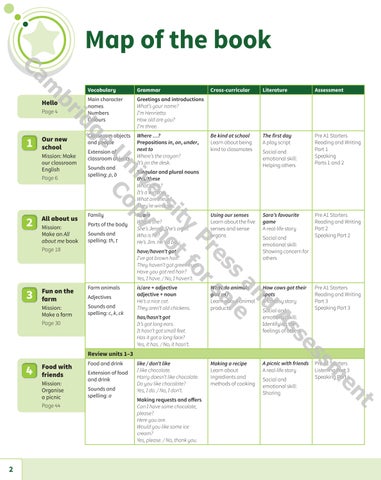
Map of the book Grammar
Main character names Numbers Colours
Greetings and introductions What’s your name? I’m Henrietta. How old are you? I’m three.
br
m
Ca Vocabulary
Hello
Page 4
ge
id Our new school
All about us Mission: Make an All about me book Page 18
Fun on the farm Mission: Make a farm Page 30
Extension of classroom objects
Where …? Prepositions in, on, under, next to Where’s the crayon? It’s on the desk.
Literature
Assessment
Be kind at school Learn about being kind to classmates
The first day A play script
Pre A1 Starters Reading and Writing Part 1 Speaking Parts 1 and 2
Sounds and spelling: p, b
Family
Parts of the body Sounds and spelling: th, t
Singular and plural nouns this/these What’s this? It’s a window. What are these? They’re windows. is/are Who is she? She’s Jenny. She’s a girl. Who is he? He’s Jim. He’s a boy.
Using our senses Learn about the five senses and sense organs
Sara’s favourite game A real-life story
What do animals give us? Learn about animal products
How cows got their spots A fantasy story
Making a recipe Learn about ingredients and methods of cooking
A picnic with friends A real-life story
have/haven’t got I’ve got brown hair. They haven’t got green eyes. Have you got red hair? Yes, I have. / No, I haven’t.
Farm animals Adjectives
Sounds and spelling: c, k, ck
is/are + adjective adjective + noun He’s a nice cat. They aren’t old chickens.
Sounds and spelling: a
like / don’t like I like chocolate. Harry doesn’t like chocolate. Do you like chocolate? Yes, I do. / No, I don’t.
t
Making requests and offers Can I have some chocolate, please? Here you are. Would you like some ice cream? Yes, please. / No, thank you.
Social and emotional skill: Sharing
Pre A1 Starters Listening Part 3 Speaking Part 4
en
2
Extension of food and drink
Social and emotional skill: Identifying the feelings of others
Pre A1 Starters Reading and Writing Part 3 Speaking Part 3
m
Mission: Organise a picnic Page 44
Food and drink
Social and emotional skill: Showing concern for others
Pre A1 Starters Reading and Writing Part 2 Speaking Part 2
ss se
has/hasn’t got It’s got long ears. It hasn’t got small feet. Has it got a long face? Yes, it has. / No, it hasn’t.
Review units 1–3
Food with friends
Social and emotional skill: Helping others
As d an s le es sa Pr r y fo it t rs no ve y ni p U Co
Mission: Make our classroom English Page 6
Classroom objects and people
Cross-curricular
Ca
m
Happy birthday!
Grammar
Toys
Shapes around us Whose …? Learn about shapes Possessive ’s Possessive adjectives my, your, his, her, our, their Whose bike is this? It’s Jim’s bike. His bike’s orange.
Extension of toys Sounds and spelling: h
ge
id
br
Mission: Have a presentgiving party Page 56
Vocabulary
Mission: Plan a wildlife tour Page 68
Vehicles and places
Literature
Assessment
The twins and their robots A real-life story
Pre A1 Starters Listening Part 2 Speaking Part 4
Social and emotional skill: Saying sorry
want/wants Does he want a teddy? Yes, he does. / No, he doesn’t. What does he want? He wants a helicopter. there is/are There’s a car. There aren’t any shops. Are there any animals? Yes, there are. / No, there aren’t.
Animals in the wild Learn about animal habitats
When we go to the zoo A poem
As d an s le es sa Pr r y fo it t rs no ve y ni p U Co
A day out
Cross-curricular
Zoo animals
Sounds and spelling: ai, a–e
Social and emotional skill: Understanding and expressing feelings
let’s … Let’s play a game. That’s a good idea.
Pre A1 Starters Reading and Writing Part 4 Speaking Parts 1 and 2
Review units 4–6
Let’s play! Mission: Plan a sports day Page 82
Sports and hobbies
Present continuous What are you doing? I’m riding a horse. Sports verbs and extension of sports What’s she doing? She’s swimming. Sounds and Are they cleaning the car? spelling: s Yes, they are. / No, they’re not.
Pre A1 Starters Listening Part 1 Speaking Part 3
Look after your body! Learn about how we can keep our bodies strong
A good friend A real-life story
Houses around the world Learn about different kinds of houses around the world
The clock on the wall A poem
What can we see on holiday? Learn about features of natural landscapes
The monkey and the Pre A1 Starters Reading and Writing shark Part 5 A traditional story Speaking Social and Parts 3 and 4 emotional skill:
Social and emotional skill: Identifying ways of being a good friend
can for permission Can we play tennis? Yes, you can, but you can’t play here.
At home
Extension of objects in the house Sounds and spelling: i
At the beach
like/enjoy + gerund me too / so do I I like flying my kite. So do I. I enjoy taking photos. Me too.
Identifying friends
t
Sounds and spelling: j, h
Imperatives Look at this T-shirt. Clean those shoes.
Social and emotional skill: Comforting others
en
Mission: Go on holiday Page 106
Clothes
Prepositions in front of, between, behind There’s a small rug in front of the armchair.
Pre A1 Starters Listening Part 4 Speaking Part 4
m
Happy holidays
can for ability I can swim. He can’t sing. Can you ride a horse? Yes, I can. / No, I can’t.
ss se
Mission: Invite a friend to my house Page 94
Rooms and objects in the house
Review units 7–9
3
Ca
Hello ge
id
br
m
1 1.02 Listen. How old are the children?
As d an s le es sa Pr r y fo it t rs no ve y ni p U Co The
Friendly Farm
ss se
2 1.03
Say the chant. yellow
orange
pink
black
brown
en
m
red
t
blue
green
purple
3 1.04 Listen and say the colour. 4
Numbers and colours
grey
white
The
Friendly Farm
1.05
2
Look, Henrietta. Look, Rocky. This is your barn.
Hello, I’m Henrietta and this is Rocky.
Hello, I’m Cameron. What’s your name?
ge
id
br
m
Ca
1
As d an s le es sa Pr r y fo it t rs no ve y ni p U Co
Hi, Cameron.
3
4
I’m two. How old are you, Cameron?
This is Harry.
Hello, Harry. How old are you?
I’m eight.
I’m three.
Hello. What’s your name?
5
I’m Rocky. I’m two. How old are you?
en
m
ss se
I’m Gracie.
6
4 1.06
t
Hello, I’m Shelly. What’s your name?
I’m … I don’t know.
Listen and correct. Story: Greetings and introductions
5
1
Ca
Our new school Watch the video. Write or draw a school word.
ge
id
br
m
1
en
In this unit I will: Make labels for the classroom.
2
Choose a new word to learn.
3
Make a class poster. Be the teacher.
t
6
1
m
ss se
As d an s le es sa Pr r y fo it t rs no ve y ni p U Co Make our classroom English
1
Vocabulary 1
1 1.07 1.08 Listen and point. Then listen and number.
Ca
ge
id
br
m
This morning Jim and Jenny are at their new school.
en
m
ss se
As d an s le es sa Pr r y fo it t rs no ve y ni p U Co t
2 1.09
Say the chant.
3 1.10
Listen, point and say the colour. Classroom objects and people
7
T he The The
Friendlyy Farm F 1
1.11
Look at the bag! Yes, I’m the teacher!
2
Now, this is my classroom. Rocky, where’s the pencil?
ge
id
br
m
Ca As d an s le es sa Pr r y fo it t rs no ve y ni p U Co
3
It’s under the desk, teacher.
Now you, Shelly. Where’s the crayon?
4
It’s on the desk.
5
Now you, Harry. Where’s the bag?
It isn’t on the desk.
No, it isn’t, Harry. It’s next to the desk!
Where’s the book? It isn’t in the bag.
6
ss se
Where’s my bag, Jim?
Oops!
Be quiet! It’s Jim and Jenny! 8
Story: Where …? and prepositions in context
t
Yes, Gracie! Where’s the book?
en
m
It’s in the barn.
1
Language practice 1
1.12
Gracie’s Grammar It’s in the pencil case. It’s next to the rubber.
ge
id
br
m
Ca
Where’s the crayon? It’s on the desk. It’s under the book.
1 1.13 Listen and stick. Then look, read and write.
As d an s le es sa Pr r y fo it t rs no ve y ni p U Co
1
The rubber’s
2
The crayons are
3
The pen’s
4
The pencils are
on
the desk.
the pencil case.
the book.
the book.
ss se
STAGE 1
Find, say and stick.
Here they are.
My
t
Where are the pencils?
1
Write the words.
AGE ST
en
m
Make labels for your classroom.
diary Activity Book page 6
Where …? and prepositions on, in, under, next to
9
Vocabulary 2 and song Vo
1 1.14
Listen and colour. Then sing the song. Jenny, Jenny’s in the playground. The teacher’s next to the window. The red bag is on the grey wall and the board’s next to the door. Yes, it is. Yes, it is. Yes, it is.
ge
id
br
m
Ca
Jim, Jim is in the classroom. The yellow book is on the bookcase. The white paper’s in the cupboard and the ruler’s under the desk.
door
wall
As d an s le es sa Pr r y fo it t rs no ve y ni p U Co window
board
playground
bookcase
paper
ruler
cupboard
Look! Miss Kelly is next to the window. Where’s your teacher?
en
m
ss se
2 Ask and answer.
t
Where’s the ruler?
10
Extension of classroom objects
It’s under the desk.
1
Language practice 2
What are they talking about? Listen and tick ✓.
1 1.16
2
3
ge
id
br
m
Ca
1
As d an s le es sa Pr r y fo it t rs no ve y ni p U Co
1.17
Gracie’s Grammar
What’s this? What are these?
It’s a window. They’re windows.
2 Look at the pictures in Activity 1. Ask and answer. What’s this?
It’s a chair.
What are these?
Choose a new word to learn.
My
t
It’s a television.
en
What’s this?
AGE ST
2
Ask your teacher. Then draw and say.
m
Look around your classroom. What words don’t you know?
ss se
STAGE 2
They’re pencils.
diary Activity Book page 6
Singular and plural nouns; this/these
11
Cross-curricular
Be kind at school 1
Ca
Watch the video.
1
br
m
2 Who is kind? Look and tick ✓. 2
ge
id As d an s le es sa Pr r y fo it t rs no ve y ni p U Co
3
4
3 1.18 Listen and number. Then act it out. Are you OK?
b
ss se
a
m
Here you are.
en
Yes, thank you.
t
Thank you.
12
Learn about being kind at school
1 4 Look at the poster. Write the words.
m
Ca
help
listen share work together
ge
id
br
Be kind in our classroom
As d an s le es sa Pr r y fo it t rs no ve y ni p U Co
work together
1
4
en My
t
AGE ST
3
Make a class poster.
m
STAGE 3
ss se
3
2
How can we be kind at school? Say. Write and draw a class poster.
diary Activity Book page 6
Show what you know about working together
13
Literature
1 Look at the pictures. What can you see? Find and tick ✓. book
Ca
crayon
paper
pencil
rubber
pen
pencil case
ruler
m
The f irst day ge
id
br
1.19
As d an s le es sa Pr r y fo it t rs no ve y ni p U Co
Knock! ock! Knock! It’s Lucy at the door. o, L ucy. Hello, Lucy. o, Ma a x. Hello, Max.
ss se
m
Lucy and Max are friends. Today is the first day of school.
en
It’s time to pack your bag.
t My bag … It’s in the cupboard.
14
Text type: A play script
1 Where’s my pencil? It’s under the chair.
Ca
br
m
Oh, yes. Take a pencil to school – that’s the rule. Where’s my pen?
id
It’s on the table.
ge
As d an s le es sa Pr r y fo it t rs no ve y ni p U Co
Oh, yes. Take a pen to school – that’s the rule. And where’s my ruler? It’s next to your pen.
Oh, yes. Take a ruler to school – that’s the rule. Where are my books?
They’re on the bookcase. Oh, yes. Take your books to school – that’s the rule. And my crayons?
Where’s my pencil?
en
2 Act out the story.
m
Hurry up. It’s time to go! Don’t be late for school – that’s the number 1 rule!
ss se
What are these? The crayons are on the floor, under the window.
It’s under the chair.
t
3
Ask and answer. What’s in your school bag?
Two books and a pencil.
Social and emotional skill: Helping others
15
Pre A1 Starters
1 Look at the pictures. Say the words. a
c
b
e
d
ge
id
br
m
Ca It’s a door.
2 Read and do.
As d an s le es sa Pr r y fo it t rs no ve y ni p U Co
Put a tick (✓) in the box.
Put a cross (✗) in the box.
3 Play the game. Point and say. This is a rubber.
No. Cross!
This is a door.
Yes. Tick!
4 Look and read. Put a tick (✓) or a cross (✗) in the box. There are two examples. Examples
ruler ✓
bags
en
m
2 chair
✗
ss se
Questions 1
pens
t
Practise writing clear ticks and crosses. 16
Preparation for Reading and Writing Part 1
1
Review
in action! My
Ca
Be the teacher.
m
diary
br
Say hello to your class.
Activity Book page 6
Hello. I’m Marcus. Today I’m the teacher.
ge
id Teach the class your word.
As d an s le es sa Pr r y fo it t rs no ve y ni p U Co
Look! It’s a television.
Put your picture in the classroom.
Where’s the television? It’s on the desk.
OM
t en TE
m
ss se C
Ask the class a question.
PLE
Unit consolidation
17
2
Ca
All about us Watch the video. Draw something about you.
ge
id
br
m
1
en
m
ss se
As d an s le es sa Pr r y fo it t rs no ve y ni p U Co Make an All about me book In this unit I will: Share pictures of my family.
2
Talk and write about me.
3
Show my favourite things. Learn about my classmates.
t
18
1
2
Vocabulary 1
1 1.20 1.21 Listen and point. Then listen and number.
Ca
ge
id
br
m
Today the Friendly family are playing a game at home.
en
m
ss se
As d an s le es sa Pr r y fo it t rs no ve y ni p U Co t
2 1.22
Say the chant.
3 1.23
Listen, point and say the colour. Family
19
T he The The
F riendly Farm 1
1.24
2
ge
id
br
m
Ca
Mum, are these animals my family?
Is Shelly my sister?
No, Rocky. She isn’t your sister. She’s your friend.
3
As d an s le es sa Pr r y fo it t rs no ve y ni p U Co
No, Rocky. They aren’t your family.
4
Look at Harry, Mum. Is he my brother?
No, Rocky. He isn’t your brother. He’s your friend.
5
6
Look! A girl! She’s my sister! And look! A boy! He’s my brother.
en
m
ss se
Rocky … This is your brother, and this is your sister.
I don’t understand! Who’s my brother? Who’s my sister? Who are my brothers and sisters?
t
20
Story: is/are in context
2
Language practice 1
1.25
Gracie’s Grammar She’s Jenny. She’s a girl. He’s Jim. He’s a boy.
br
m
Ca
W is she? Who Who is he? W
ge
id
1 1.26 Listen and stick. Then look, read and write.
As d an s le es sa Pr r y fo it t rs no ve y ni p U Co
1
This is Dad. my father.
He’s
3
This is Jim. He’s my .
2
This is Mum. She’s my .
4
This is Grandpa. my grandfather.
en
m My
t
AGE ST
1
Make a Family page for your All about me book.
ss se
STAGE 1
Stick photos or draw pictures of your family. Write their names.
diary Activity Book page 18
Who ... ? and he’s/she’s
21
Vocabulary 2 and song V
1 1.27
Listen and do the actions. Then sing the song. nose
head
ear
arm
ge
id
br
m
Ca
Move your body, Jenny. Move your tail, Cameron. Move your body, Jenny. Move your tail, Cameron. Move, move your body. Move your legs and your feet. Move, move your body and now put your arms up. Chorus Stop! Now move your head. Touch your hair and your face. Move, move your body. Touch your ears and your nose. Chorus Stop! Now close your eyes. Open your mouth and clap your hands. Move, move your body. Touch your ears and your nose. Chorus
body
hand
As d an s le es sa Pr r y fo it t rs no ve y ni p U Co
hair
foot
leg
eye
face
mouth
tail
feet
2 1.29 Listen and follow.
en
m
ss se
Jim and Jenny have got brown hair. What colour hair have you got?
1
22
Parts of the body
t
2
2
Language practice 2
Who is talking? Listen and tick ✓.
1 1.30
2
3
ge
id
br
m
Ca
1
1.31
Gracie’s Grammar
As d an s le es sa Pr r y fo it t rs no ve y ni p U Co
I I’ve got brown hair. T They’ve got blue eyes. Have you got red hair?
I haven’t got black hair. They haven’t got green eyes. Yes, I have. / No, I haven’t.
2 Ask and answer. Tick ✓ or cross ✗.
1 Have you got a brother? 2 Have you got a sister?
3 Have you got twins in your family?
What do you look like? Draw, say and write. I’ve got brown hair and green eyes.
My
t
2
AGE ST
en
m
Make a This is me page for your All about me book.
ss se
STAGE 2
diary Activity Book page 18
have/haven’t got
23
Cross-curricular
Using our senses 1
Ca
Watch the video.
1
2
3
4
5
ge
id
br
m
2 1.32 Listen and say. Look and match.
a
As d an s le es sa Pr r y fo it t rs no ve y ni p U Co
see
hear
smell
taste
touch
c
b
5
d
e
en
m
ss se t
3 Play the senses game. 24
Learn about the five senses and sense organs
2 4 Look, read and match.
Ca
m
Some people can’t see. They are blind. They use their other senses to help them. Today there are many things to help blind people. They can read books with their hands.
2
br
1
3
A guide dog can see for them.
ge
id
a
They can hear traffic lights.
b
c
en
AGE ST
3
My
t
Think about your favourite things to see, hear, smell, taste and touch.
m
Make a Favourite things page for your All about me book.
ss se
As d an s le es sa Pr r y fo it t rs no ve y ni p U Co STAGE 3
Draw them. Learn the words in English.
diary Activity Book page 18
Show what you know about senses
25
Literature
1 Look at the pictures. What is the game? What’s your favourite game?
Ca
Sara’s favourite game
m
1.33
br
ge
id
I’m Pablo. I live with my mum, dad, grandma and grandpa. Today my cousin Sara is here too. Sara’s got black hair and brown eyes.
As d an s le es sa Pr r y fo it t rs no ve y ni p U Co o, One, tw three …
Sara’s favourite game is Hide and Seek. I close my eyes and I count to ten, and Sara hides.
Today she’s hiding in the cupboard in the kitchen. She’s in the cupboard in the kitchen … again! She always hides … Oh, she isn’t there. ‘Sara?’ I say. ‘Where are you?’
en
m
ss se t
26
Text type: A real-life story
2
ge
id
br
m
Ca
Is she next to the bookcase? No, she isn’t. ‘Sara?’ I say. ‘Where are you?’ Is she in the garden? No, she isn’t. ‘Sara!’ I say. ‘Where are you?’
2 Act out the story. Sara! Where are you?
Is she in the cupboard?
Ask and answer. Who do you play with?
t
Is she next to the bookcase?
en
No, she isn’t.
3
m
ss se
As d an s le es sa Pr r y fo it t rs no ve y ni p U Co
Mum, Dad, Grandma and Grandpa come to help, but we can’t find Sara anywhere! Then Grandma sees Sara’s crayons on the table. ‘Is she under the table?’ she says. ‘Yes!’ says Mum. ‘She is! Hello, Sara!’ ‘Sara!’ I say.
I play with my cousins.
Social and emotional skill: Showing concern for others
27
Pre A1 Starters
1 Read and number. a
c
b
ge
id
br
m
Ca 1
2
The red crayon is on the book.
3
The blue crayon is on the book.
As d an s le es sa Pr r y fo it t rs no ve y ni p U Co
The blue crayon is next to the book.
2 Look and read. Write yes or no.
The mother has got a book.
3
Six people have got black hair.
Preparation for Reading and Writing Part 2
t
2
Always write yes or no.
en
28
1
Questions The bag is on the table.
m
The baby is on the chair.
yes no
ss se
Examples The children have got crayons.
2
Review
in action! My
Ca
Learn about your classmates.
m
diary
Look at your classmates’ All about me books. Ask questions. Who’s this?
She’s my mum.
ge
id
br
Activity Book page 18
As d an s le es sa Pr r y fo it t rs no ve y ni p U Co
Show your All about me book. Answer your classmates’ questions. These are my favourite things.
What’s this?
It’s a flower.
t
TE
C
PLE
en
m
ss se OM
Unit consolidation
29
3
Ca
Fun on the farm Watch the video. Choose and write a name for the farm.
ge
id
br
m
1
ss se
As d an s le es sa Pr r y fo it t rs no ve y ni p U Co Make a farm
Draw and describe a farm animal.
2
Play a game with the animals.
3
Make a farm and write about it. Show our farm.
t
30
1
en
m
In this unit I will:
3
Vocabulary 1
1 1.34 1.35 Listen and point. Then listen and number.
br
m
Ca ge
id
This afternoon Tom and Eva are on the farm with Jim and Jenny.
en
m
ss se
As d an s le es sa Pr r y fo it t rs no ve y ni p U Co t
2 1.36
Say the chant.
3 1.37
Listen and say the animal. Farm animals
31
T he The The
F riendly Farm 1
1.38
2 Harry, you’re big.
ge
id
br
m
Ca
Look at my new friend, Harry. He’s a spider. He’s small.
3
Look at me! I’m long, too.
Yes, you are, Cameron. Now you’re a long cat, and you’re a nice cat.
5
Yes, but I’m a horse. Horses are big. And I’ve got a long tail.
As d an s le es sa Pr r y fo it t rs no ve y ni p U Co
Yes, he is, Rocky. He’s a small spider.
Oh, yes, they’re young. Gracie isn’t young. She’s old.
6
Sorry, Cameron! Are you OK?
en
m
Gracie!
Look at my brother and sister. They’re young.
ss se
What? Old? I’m not old!
4
t
You aren’t young, Gracie. 32
Story: is/are + adjective and adjective + noun in context
Yes, I am. I’m OK, Gracie … Now I’m not long … I’m short!
3
Language practice 1
1.39
Gracie’s Grammar It isn’t a big spider. They aren’t old chickens.
br
m
Ca
He’s a nice cat. W We’re young boys and girls.
ge
id
1 1.40 Listen and stick. Then look, read and write.
1
It isn’t an
2
They’re
old
small
young
cat.
3
It’s a
cat.
cats.
4
They aren’t
ss se
As d an s le es sa Pr r y fo it t rs no ve y ni p U Co old
short
1
Draw your farm animal.
It’s a big horse.
What does it look like? Write and say.
My
t
AGE ST
Choose an animal for your farm.
en
m
STAGE 1
cats.
diary Activity Book page 30
Adjectives big, new, nice, old, small, young
33
Vocabulary 2 and song Vo
1 1.41
Listen and act out the animals. Then sing the song.
br
m
Ca
She’s a funny dog with a brown nose and a long tail. She’s a funny dog.
ge
id
He’s a sad dog with a black nose and a brown tail. He’s a sad dog.
As d an s le es sa Pr r y fo it t rs no ve y ni p U Co
I’ve got a happy dog. My happy dog’s in the park. She’s a beautiful dog. I’ve got a happy dog. My happy dog’s in the park. We’re in the park! Different dogs in the park, yeah! Different dogs in the park.
funny
ugly
sad
angry
He’s an ugly dog with a pink nose and a short tail. He’s an ugly dog.
beautiful
happy
She’s an angry cat with a black nose and a black tail. She’s an angry cat.
m
ss se
Chorus
en
2 Look at the picture. Play the game.
t
It’s a dog with a pink nose and a short tail. Is it the ugly dog? Yes, it is!
34
Extension of adjectives
I love dogs! Have you got a pet?
3
Language practice 2
Which duck is he talking about? Listen and tick ✓.
1 1.43
2
3
ge
id
br
m
Ca
1
As d an s le es sa Pr r y fo it t rs no ve y ni p U Co
1.44
Gracie’s Grammar
I got long ears. It’s Has it got a long face?
It hasn’t got small feet. Yes, it has. / No, it hasn’t.
2 Think of an animal. Describe it for your partner to draw. My animal has got a big body.
My animal has got long ears.
My animal has got a short tail.
Play a guessing game with your animals. Yes, it has.
en My
t
Yes, it is.
No, it isn’t.
AGE ST
2
Is it beautiful? It’s the donkey.
m
Has it got long ears?
ss se
STAGE 2
diary Activity Book page 30
has/hasn’t got
35
Cross-curricular
What do animals give us? 1
Ca
Watch the video.
1
br
m
2 1.45 Look and match. Then listen and check. 2
3
4
ge
id As d an s le es sa Pr r y fo it t rs no ve y ni p U Co
b cow
a
chicken
c
b
wool
sheep
milk
bee
d
honey
en
m
ss se
3 Tick ✓ the things that come from animals.
eggs
t
36
Learn about animal products
3 4 Read the article. Then read the sentences and write yes or no.
Ca
br
m
Alpaca wool
ge
id
Do you know this animal? This is an alpaca. It’s got four legs and long hair. Alpacas live in the Andes Mountains in Peru.
As d an s le es sa Pr r y fo it t rs no ve y ni p U Co
The hair of an alpaca is like the hair of a sheep. It’s called wool. People cut the wool. Then people clean the wool. They use the wool to make clothes. They use lots of colours. How many colours can you see?
1
Alpacas have got two legs.
2
Alpacas have got short hair.
3
Alpacas live in Peru.
4
People make things from alpaca wool.
Make your farm and write about it.
Our farm has got two chickens, two cows and a donkey. The chickens give us eggs.
My
t
3
AGE ST
en
m
In groups, put your farm animals together. Write about your farm and its animals.
ss se
STAGE 3
no
diary Activity Book page 30
Show what you know about farm animals
37
Literature
1 Look at the cows. What colour are they in the pictures?
How cows got their spots
Ca 1.46
ge
id
br
m
en t
Text type: A fantasy story
m
38
ss se
As d an s le es sa Pr r y fo it t rs no ve y ni p U Co
Cathy is a young white cow. She lives with h her mum on a big farm. There are horses, sheep and chickens. There are also lots of fl ies. ‘Ouch! Ouch! Ouch! Go away!’ ‘Use your tail,’ says her mum. But Cathy’ss tail is very short and the fl ies are not scared ed of her. One day she tells a friend about her problem. ‘Follow me!’ says Little Horse and he jumps into some black mud. ‘Come on! Jump in!’ he shouts.
3
ge
id
br
m
Ca
When Cathy stands up, her beautiful white coat is very dirty. ‘Look!’ the young cows laugh. ‘Cathy’s got big black spots!’ Suddenly lots of fl ies come from behind the house. ‘Run!’ says Cathy’s mum. ‘Hide!’ shout the young cows.
As d an s le es sa Pr r y fo it t rs no ve y ni p U Co
When the fl ies go, lots of the young cows have bites. ‘Ouch!’ they cry. ‘Ouch!’ ‘I haven’t got any bites!’ laughs Cathy. ‘Thank you, Little Horse.’ Now lots of white cows have black spots so fl ies don’t bite them.
2 How do they feel? Read and circle . When Little Horse helps Cathy, she feels:
3
When the young cows laugh at Cathy, she feels:
4
When Cathy sees that she hasn’t got any bites, she feels:
3
Ask and answer.
What’s your favourite animal?
t
2
en
When the flies bite Cathy, she feels:
m
ss se
1
It’s a donkey.
Social and emotional skill: Identifying the feelings of others
39
Pre A1 Starters
1 Look and say the animals. Which letter do they start with?
Ca
It’s a cow.
m ge
id
br
Letter C.
As d an s le es sa Pr r y fo it t rs no ve y ni p U Co
2 How many letters? Count and circle . 1
cow
2 / 3 / 4 letters
3
duck
3 / 4 / 5 letters
2
d o n k e y 4 / 5 / 6 letters
4
sheep
5 / 6 / 7 letters
3 Look at the picture. Look at the letters. Write the words. Example
h o r s e
Questions 1
2
Look at your answer. Has it got all the letters?
en t
3
g
40
m
d
ss se
c h
Preparation for Reading and Writing Part 3
3
Review
in action! My
Ca
Show your farm.
m
diary
br
Talk about your farm.
ge
id
Our farm has got three cows.
And it’s got a donkey. The donkey has got long ears.
As d an s le es sa Pr r y fo it t rs no ve y ni p U Co
Talk about the animals.
Activity Book page 30
The sheep are happy.
Talk about what the animals give us. The cows give us milk.
t
TE
C
PLE
en
m
ss se OM
Unit consolidation
41
Review Ca 1
Units 1–3
Watch the video de and do the quiz.
m
This is my si sister. a b
ge
id
1
br
2 1.47 Listen and d ttick ✓. c
This is my brother. a
This is my cat. a b
c
As d an s le es sa Pr r y fo it t rs no ve y ni p U Co
2
3
b
4
c
This is my horse.
a
b
c
3 Look at the picture and remember. Ask and answer. Where’s the red book?
It’s on the purple chair.
en
m
ss se t
42
Consolidation of units 1–3
4 1.48 Listen and follow. Draw lines. old
beautiful
ugly
m
Ca
legs
my
is
I’m
arm
ge
young
short
brother,
eyes.
feet got
small He’s
ears
He’s hasn’t
As d an s le es sa Pr r y fo it t rs no ve y ni p U Co
got
and brown
id
br
He’s
green
hair
This
She’s
big
red
Sam.
four.
5 Draw you and your family or pets. Then write.
.
got
t
.
en
m
ss se
This is me. I’ve got This is my
.
This is my
. . Consolidation of units 1–3
43
4
Ca
Food with friends Watch the video. Draw your picnic food.
ge
id
br
m
1
m
ss se
As d an s le es sa Pr r y fo it t rs no ve y ni p U Co Organise a picnic
en
44
1
Find out what food my friends like.
2
Buy food for our picnic.
t
In this unit I will: 3
Write and share a recipe. Have a picnic.
Vocabulary 1
4
1 2.02 2.03 Listen and point. Then listen and number.
Ca
ge
id
br
m
This afternoon the Friendly family are having lunch in the garden.
en
m
ss se
As d an s le es sa Pr r y fo it t rs no ve y ni p U Co t
2 2.04
Say the chant.
3 2.05
Listen and say yes or no. Food and drink
45
T he The The
F riendly Farm 1
2.06
Gracie!
2
Do you like chocolate, Cameron?
ge
id
br
m
Ca As d an s le es sa Pr r y fo it t rs no ve y ni p U Co
Yes, I do.
I’m sorry, but I like chocolate.
3
4
I don’t like books.
I like books.
But, Rocky, you read books. You don’t eat books!
I like chocolate and I like cake, bananas, bread, books and socks!
5
6
en
m
ss se
What do you like, Shelly?
I don’t like books or chocolate. I like mangoes. 46
Story: like / don’t like in context
t
What do you like, Harry?
I like water. I can see my face in water.
4
Language practice 1
2.07
Gracie’s Grammar Harry likes mangoes. Harry doesn’t like chocolate. Yes, I do. / No, I don’t.
ge
id
br
m
Ca
I like chocolate. I don’t like books. Do you like chocolate?
1 2.08 Listen and stick. Then look, read and write.
As d an s le es sa Pr r y fo it t rs no ve y ni p U Co burgers .
Mum likes
2
Dad doesn’t like
.
3
Grandma
lemonade.
4
Grandpa
chicken.
My
t
Yes, I do.
en
Do you like burgers?
AGE ST
1
Find out what food your friends like. Choose food for your picnic.
m
STAGE 1
ss se
1
diary Activity Book page 44
like / don’t like and Do you like …?
47
Vocabulary 2 and song Vo
1 2.09
Listen and draw. Then sing the song.
Ca
Do you like fruit? Yes, I do. Do you like juice? No, I don’t …
fruit
m
br
grapes
ge
id
I like apples. apple I like oranges. I like grapes but I don’t like juice …
As d an s le es sa Pr r y fo it t rs no ve y ni p U Co
Do you like salad? Yes, I do. Do you like meat? No, I don’t …
I don’t like burgers. I don’t like sausages. I don’t like meatballs but I like beans …
orange
juice
meat
meatballs
beans
ss se
sausage
Think of … two things you eat or drink for lunch. three things you eat or drink for dinner. I like grapes. What fruit do you like? 48
Extension of food and drink
t
one thing you eat or drink for breakfast.
en
m
2 Read, think and say. Compare with your classmates.
4
Language practice 2
Which food does she buy? Listen and tick ✓.
1 2.11
2
3
ge
id
br
m
Ca
1
As d an s le es sa Pr r y fo it t rs no ve y ni p U Co
2.12
Gracie’s Grammar
Can I have some chocolate, please? Here you are. Would W you like some ice cream? Yes, please. / No, thank you.
2 Read and say the dialogue. Act it out. Can I have some apples, please?
B A
I’m sorry, I haven’t got any apples. Would you like some oranges?
B
Here you are.
A
Thank you.
Yes, please.
ss se
A
Buy the food for your picnic. Can I have some chicken, please?
My
t
2
AGE ST
en
m
STAGE 2
Here you are. diary Activity Book page 44
Making requests and offers
49
Cross-curricular
Making a recipe 1
Ca
Watch the video.
id
br
m
2 2.13 Tick ✓ the ingredients. Then listen and check.
ge
meat
As d an s le es sa Pr r y fo it t rs no ve y ni p U Co
pasta
onions
potatoes
rice
cheese
tomatoes
b
c
d
en
a
m
3 2.14 Listen and number.
ss se
carrots
t 1 50
Learn about ingredients and methods of cooking
4 4 Read and circle the food words. Then number the pictures.
ge
id
br
m
Ca You need two eggs, some cheese, an onion and some tomatoes.
2
Mix the eggs. Cut the onion and the tomatoes.
3
Cook the eggs for four minutes.
4
Put the cheese, onion and tomato on the eggs.
5
Fold the omelette and cook it for one more minute.
b
As d an s le es sa Pr r y fo it t rs no ve y ni p U Co
a
1
c
d
e
1
en My
t
AGE ST
3
My favourite sandwich This is a monster sandwich. It’s got chicken, cheese, meat and salad. Yum!
m
Make and share your recipe.
ss se
STAGE 3
diary Activity Book page 44
Show what you know about recipes
51
Literature
1 Talk to a friend. What food do you like to eat on picnics?
Ca
A picnic with friends ge
id
br
m
2.15
As d an s le es sa Pr r y fo it t rs no ve y ni p U Co
Mia and Matt want to go on a picnic. ‘Can we cook burgers in the woods, Mum?’ ‘No, but you can take sandwiches and fruit.’
t
Text type: A real-life story
en
52
m
Now they’re in the woods. They’ve got sandwiches, fruit, lemonade and ... chocolate! ‘Would you like some chocolate, Matt?’ ‘Yes, please!’ Matt likes chocolate. ‘Here you are.’
ss se
Mia likes egg sandwiches. Matt wants chicken sandwiches. He wants lemonade too. ‘Would you like a banana or a watermelon?’ ‘A banana, please,’ says Mia. ‘A banana and a watermelon, please,’ says Matt.
4
ge
id
br
m
Ca
But what’s this? Birds! ‘Hey! Go away!’ ‘We need a scarecrow,’ says Mia. They put the watermelon and some clothes on a stick. The birds don’t like the scarecrow. They fly away! Mia and Matt finish eating.
As d an s le es sa Pr r y fo it t rs no ve y ni p U Co
But what about the crumbs? ‘We don’t need the scarecrow now,’ says Matt. So Mia takes the scarecrow down. ‘Come on, birds,’ calls Matt. ‘Come and eat the crumbs!’ It’s good to share your picnic with friends!
2 How do they feel? Read and circle .
When the children can’t cook burgers in the woods, Matt feels:
2
When Matt sees the chocolate, he feels:
3
When the birds arrive, Matt feels:
4
At the end of the story, the children feel:
en
m
3
ss se
1
Ask and answer.
t
Where do you have lunch?
At home.
Who do you have lunch with?
With my family.
Social and emotional skill: Sharing
53
Pre A1 Starters
1 Look at the pictures in Activity 3. What can you see? I can see …
Ca
br
m
2 2.16 Look at Activity 3 and listen. Which picture is not correct? It isn’t picture … because …
id
ge
3 2.17 Listen and tick (✓) the box. There is one example.
A 1
As d an s le es sa Pr r y fo it t rs no ve y ni p U Co
What food would Dan like?
B
✓
C
Where’s Lucy’s book?
Think about what’s different in pictures A, B and C. 54
Preparation for Listening Part 3
C
t
B
en
m
ss se
A
4
Review
in action! My
Ca
Have a picnic.
m
diary
Make some food for the picnic.
ge
id
br
Activity Book page 44
Present your food to the class.
As d an s le es sa Pr r y fo it t rs no ve y ni p U Co
Look! This is my sandwich.
Have a picnic.
Would you like a banana?
Can I have some water, please?
Talk about the food at the picnic.
Yum! I like grapes.
Me too.
t
TE
C
PLE
en
m
ss se OM
Unit consolidation
55
5
Ca
Happy birthday! Watch the video. Draw a toy.
ge
id
br
m
1
en
In this unit I will: Ask my friends about their toys.
2
Choose a present for my friend.
3
Make and write a card. Give the present.
t
56
1
m
ss se
As d an s le es sa Pr r y fo it t rs no ve y ni p U Co Have a present-giving party
5
Vocabulary 1
1 2.18 Listen and point. Then listen again and colour the toys.
ge
id
br
m
Ca plane
As d an s le es sa Pr r y fo it t rs no ve y ni p U Co
Today is Jim and Jenny’s birthday.
kite
doll
robot
ball
house
car
ss se
bike
en
m t
2 2.19
Say the chant.
3 2.20
Listen and say yes or no. Toys
57
T he The The
F riendly Farm 1
2.21
2
m
Ca
Mum! It’s Jim and Jenny’s birthday. Jim’s got a new kite.
A red car! Cool! Whose car is that?
ge
id
br
What colour’s his kite?
3
As d an s le es sa Pr r y fo it t rs no ve y ni p U Co
It’s blue. It’s his favourite toy.
It’s Jenny’s new car. It’s her birthday present.
4
Can we make a birthday present for Jim and Jenny?
Jenny’s favourite toy is her car. Jim’s favourite toy is his kite.
Jenny likes dolls!
No, she doesn’t and Jim doesn’t like dolls.
6
Their present’s a plane? Oh no! Not a plane!
en
m
ss se
Look at our birthday present for Jenny and Jim.
5
Yes! What can we make for their present?
What is it?
t
It’s a plane. Their present’s a plane. 58
Story: Possessive ’s and possessive adjectives in context
5
Language practice 1
2.22
Gracie’s Grammar It’s Jim’s bike. His bike’s orange. It’s Jenny’s car. Her car’s red. It’s Jim and Jenny’s house. Their house is yellow.
ge
id
br
m
Ca
Whose bike is this? Whose car is this? Whose house is this?
As d an s le es sa Pr r y fo it t rs no ve y ni p U Co
1 2.23 Listen and stick. Then look, read and write.
1
Jim’s favourite toy is his kite .
3
Eva is
favourite toy doll.
2
Grandma’s favourite toy is her .
4
Tom is
favourite toy robot.
Ask your friends about their toys.
No, I haven’t.
AGE ST
My
t
Have you got a kite?
Yes, I do.
1
Do you like kites?
en
m
ss se
STAGE 1
diary Activity Book page 56
Whose …?, possessive ’s and possessive adjectives
59
Vocabulary 2 and song Vo
1 2.24
ship
Listen and circle . Then sing the song.
keyboard
br
m
Ca
We’ve got a cool computer. balloon It’s got a grey keyboard. It’s got a grey keyboard. Woohoo! The mouse is blue / orange.
mouse
computer
ge
id
She’s got a purple toy box and her balloon is big. And her balloon is big. Woohoo! Her radio’s old / new.
As d an s le es sa Pr r y fo it t rs no ve y ni p U Co
He’s got a helicopter. His helicopter’s small. His helicopter’s small. Woohoo! His teddy’s blue / green. helicopter
teddy
board game
radio
We’ve got a big white toy ship. We’ve got a new board game. We’ve got a new board game. Woohoo! Our board game’s big / new. Woohoo! The mouse is blue. Woohoo! Her radio’s new. Woohoo! His teddy’s blue. Woohoo! Our board game’s new.
box
ss se
2 Write the toys.
en
computer
m
I love the boy’s helicopter! Which is your favourite m the song? toy from
t
60
Extension of toys
5
Language practice 2
Which toy do they buy? Listen and tick ✓.
1 2.26
2
3
ge
id
br
m
Ca
1
Gracie’s Grammar
As d an s le es sa Pr r y fo it t rs no ve y ni p U Co
2.27
D Does he want a teddy? What does he want?
Yes, he does. / No, he doesn’t. He wants a helicopter.
2 Read and say the dialogue. Act it out. A
What does your friend want?
B
I think he wants a kite.
A
Does he want the big orange one?
B
No, he doesn’t want that one.
A
Does he want the small yellow one?
B
Yes, he does.
en My
t
Does he want a big teddy or a small teddy?
m
I think my friend wants a teddy.
AGE ST
2
Choose a present for your friend. Draw, wrap and say.
ss se
STAGE 2
diary Activity Book page 56
want/wants
61
Cross-curricular
Shapes around us 1
Ca
Watch the video.
1
br
m
2 2.28 Listen and say. 2
3
4
ge
id As d an s le es sa Pr r y fo it t rs no ve y ni p U Co
circle
square
triangle
rectangle
3 Look at the toys. What shapes can you see?
AW - Please advise what AW to replace wth
en
m
ss se t
I can see four triangles.
62
Learn about shapes
It’s the kite!
5 4 Look, read and write. circles
green rectangle
red
rectangles
br
m
Ca
square
id
This is my toy robot. It’s got two green
green
ge
arms, two
legs and two
As d an s le es sa Pr r y fo it t rs no ve y ni p U Co
feet. Its head is a green
. Its eyes are
.
red and yellow
Its mouth is a white
. Its body
is a green square with two big grey . It’s cool!
5 Look around your classroom. What shapes can you see?
STAGE 3
My
t
AGE ST
3
Make and write a card for your friend.
en
m
ss se
Look! The board is a rectangle.
Draw a shapes picture on the card. Write a message in the card.
diary Activity Book page 56
Show what you know about shapes
63
Literature
1 Look at the pictures. What toys can you see? What’s your favourite toy?
Ca
The twins and their robots
m
2.29
br
ge
id
Dora and Cora are twins. They like toys. They’ve got a teddy, a car, a plane, a monster and an alien. alien n. But D Dora’s ora’s favourite toy is a rrobot. obot. Its name nam me is is Bill. Bil l. Cora’s Cora’’s ffavourite avouriite to toy oy is is a robot robbot too. Its Its name is Jill.
As d an s le es sa Pr r y fo it t rs no ve y ni p U Co
One Dora with O ne dday, ay, D ora ssays, ays, ‘‘Can Can I pplay lay w ith JJill, il l, pplease?’ lease ? ’ ‘Yes,’ says Cora. ‘Here you are. with Bill, Andd ccan an I pplay lay w ith B il l, pplease?’ lease ? ’ ‘Yes,’ ‘Y Yes,’ says says Dora. Dora. ‘Here ‘Here you you are.’ are.’’
t
Text type: A real-life story
en
64
m
ss se
Dora and Cora like their new robots. The twins are very happy.
5
ge
id
br
m
Ca
‘‘Jill Jil l iiss my robot,’ ro obott,’’ sa says ayss D Dora. ora. ‘‘No, No, she isn’t!’ says Cora. ‘Jill’s my robot!’ ‘Bill ‘B Bill is myy robot,’ says Cora. ‘No, hee iisn’t!’ Dora. ‘Bill’s ‘N No, h sn’tt ! ’ ssays ay ys D ora. ‘B Bil l’’s myy robot!’ robo ot!! ’ Oh, Oh, no! no ! The The twins t w ins are are very ver y angry angr y now. now.
As d an s le es sa Pr r y fo it t rs no ve y ni p U Co
have Bill, Cora?’ Dora. ‘‘Can Ca n I h ave B il l, pplease, lease, C ora ? ’ ssays ays D ora. ‘OK,’ says are. sorry, Dora.’ ‘O OK,,’ sa ay yss Cora. Corra. ‘Here ‘H Here you you a re. II’m ’m so or r y, Do ora.’’ ‘Can I have Jill, please, Dora?’ says Cora. ‘OK,’’ sa says are. II’m sorry, Cora.’ ‘OK ayss Dora. Dorra ‘Here ‘Herre you yo ou are ’m sor r r y Cora a’ The twins are happy again.
Can I play with Bill, please?
Yes. Here you are.
3
en
m
ss se
2 Act out the story.
Ask and answer. I’ve got a brother.
What toys do you play with?
t
Have you got a brother or sister?
My ball and my doll.
Social and emotional skill: Saying sorry
65
Pre A1 Starters
1 Practise with a friend. Say and write.
Ca
7 11
Alex 20
id
br
m
9 balloon 11 kite
18
Kite. That’s K-I-T-E.
apple wall
ge
Sam
As d an s le es sa Pr r y fo it t rs no ve y ni p U Co
2 Ask and answer. Where do you live?
I live in Lime Street.
How do you spell that?
It’s L-I-M-E.
3 Read the questions. Is the answer a name or a number? 4 2.30 Listen and write a name or a number. There are two examples. Examples
What’s Mark’s family name?
Small
How old is Mark? Questions
Where does Mark live? in Street
3
What number is Mark’s house?
Preparation for Listening Part 2
t
2
en
How many kites has Mark got?
m
66
1
ss se
7
Go to page 120. Practise the alphabet and numbers 1–20.
5
Review
in action! My
Ca
Have a present-giving party.
m
diary
id
br
Give the card to your friend. Here you are, Carla.
Activity Book page 56
ge
Thank you, Hugo. I can see a circle and two triangles.
As d an s le es sa Pr r y fo it t rs no ve y ni p U Co
Give the present to your friend.
Here you are.
Thank you!
ing game. Your friend plays a guess I think it’s a doll.
No, it isn’t.
Is it a robot?
Your friend opens the present.
Cool! It’s a robot. I like robots!
t
TE
C
PLE
en
m
ss se OM
Unit consolidation
67
6
Ca
A day out Watch the video. Draw an animal.
ge
id
br
m
1
en
In this unit I will: Play the bus game.
2
Choose animals for our tour.
3
Make a map of the wildlife park. Act out our wildlife tour.
t
68
1
m
ss se
As d an s le es sa Pr r y fo it t rs no ve y ni p U Co Plan a wildlife tour
6
Vocabulary 1
1 2.31 Listen and point. Then listen again and draw. What does Mrs Friendly like?
m
Ca tree
train
ge
id
br
Today Jim and Jenny are at Bellevue Park.
bus stop
As d an s le es sa Pr r y fo it t rs no ve y ni p U Co
garden
bus
shop
motorbike
lorry
car
park
en
m
ss se flower
t
2 2.32
Say the chant.
3 2.33
Listen and say yes or no. Vehicles and places
69
T he The The
F riendly Farm 1
2.34
m
Ca
Jenny and Jim are at Bellevue Park with their mum and dad.
There’s a big lorry.
2
Is there? What’s in it?
And animals.
ge
id
br
There are old cars and motorbikes there.
As d an s le es sa Pr r y fo it t rs no ve y ni p U Co
I don’t know, but we can look.
3
4
Are there new animals?
Cameron doesn’t like it! There’s a lorry and animals!
I don’t know, but I don’t like it.
5
We don’t know.
6
en
m
ss se
It’s OK everyone. There are young trees and flowers in the lorry. There aren’t any new animals.
Animals! Are there new animals in the lorry?
t
They’re for Grandpa’s new garden. 70
Story: there is/are in context
It’s OK, Henrietta. There aren’t any animals. There are flowers for Grandpa’s new garden. I like flowers.
6
Language practice 1
2.35
Gracie’s Grammar
ge
id
br
m
Ca
T There’s a car. There isn’t a train. T There are two lorries. There aren’t any shops. Are there any animals? Yes, there are. / No, there aren’t.
1 2.36 Listen and stick. Then look, read and write.
2
As d an s le es sa Pr r y fo it t rs no ve y ni p U Co
1
There are
some cars.
3
a bus.
a lorry.
4
two
STAGE 1
Play the bus game.
My
t
There’s a motorbike, a lorry and a park!
AGE ST
1
Look! There’s a motorbike.
There’s a motorbike and a lorry.
en
m
ss se
motorbikes.
diary Activity Book page 68
there is/are
71
Vocabulary 2 and song Vo
1 2.37
Listen and act out the animals. Then sing the song.
Ca
hippo
polar bear
giraffe
ge
id
br
m
We’re all at the zoo. Look at the animals … Bear, there’s a bear. Snake, there’s a long snake. There’s a green crocodile.
Chorus
As d an s le es sa Pr r y fo it t rs no ve y ni p U Co
Monkey, there’s a monkey. Tiger, there’s a tiger. There’s a grey elephant. Lizard, there’s a lizard. Giraffe, there’s a giraffe. There are two polar bears. Hippo, there’s a hippo. Zebra, there’s a zebra. There’s a green crocodile. Chorus
crocodile
elephant
zebra
monkey
No, there isn’t. There’s a big bear.
en
m
2 Play the game. Correct your friend.
tiger
snake
ss se
lizard
There’s a small bear.
bear
t
There’s a red and yellow zebra.
No, there isn’t. There’s a black and white zebra. There isn’t a zoo in my town. Is there a zoo in your town?
72
Zoo animals
6
Language practice 2
Which game do they play? Listen and tick ✓.
1 2.39
2
3
ge
id
br
m
Ca
1
As d an s le es sa Pr r y fo it t rs no ve y ni p U Co
2.40
Gracie’s Grammar
L Let’s play a game. L Let’s make our game.
That’s a good idea. OK.
2
Read and say the dialogue. Act it out.
A
Let’s make our game.
B
Oh, yes. That’s a good idea.
A
Let’s colour the elephants grey.
B
OK. That’s nice.
en My
t
OK. Let’s look at the zebras too.
AGE ST
2
Let’s look at the elephants.
m
Choose animals for your wildlife tour.
ss se
STAGE 2
diary Activity Book page 68
let’s …
73
Cross-curricular
Animals in the wild 1
Ca
Watch the video.
1
br
m
2 Tick ✓ the animals that live in the jungle. 2
3
ge
id As d an s le es sa Pr r y fo it t rs no ve y ni p U Co
4
5
6
X.X
3 Help the other animals get home.
a
1
b
74
Learn about animal habitats
c
t
3
en
m
ss se
2
6 4 Read and write the animals.
Ca 1
2
ge
id
br
m
This animal lives in Antarctica. It lives near the sea. It can swim and it can eat fish and drink sea water. It’s very cold in Antarctica. The animals stand together so they don’t get cold. What is it? . It’s a
This animal lives in the hot jungle. It hasn’t got any legs but it can climb trees. It eats birds, frogs and other small animals in the jungle. What is it? . It’s a
As d an s le es sa Pr r y fo it t rs no ve y ni p U Co rhino
frog
penguin
boa
en
m My
t
The monkeys are in the jungle.
AGE ST
3
Make a map of your wildlife park. Put the animals in their habitats.
ss se
STAGE 3
diary Activity Book page 68
Show what you know about animal habitats
75
Literature
1 Look at the pictures. Which animals can you see? Which is your favourite animal?
Ca
When we go to the zoo
m
2.41
id
br ge
When we go to the zoo, There are lots of things to see. Tall giraffes with long thin necks, Eating leaves from a tree.
As d an s le es sa Pr r y fo it t rs no ve y ni p U Co
Big grey elephants, swinging their trunks, Looking for something to do. But I really like the monkeys, When we go to the zoo.
en
m
ss se
When we go to the zoo, We watch the animals play. Penguins jumping in a pool, Eating fish all day.
t
76
Text type: A poem
6
id
br
m
Ca
Tigers sleeping, crocodiles swimming, And scary lions roaring too. But I really like the monkeys, When we go to the zoo.
ge
When we go to the zoo, There are lots of things that are fun. Pink flamingos with long thin legs, Standing on only one.
As d an s le es sa Pr r y fo it t rs no ve y ni p U Co
Black and white pandas rolling about, Eating sticks of bamboo. But I really love the monkeys, When we go to the zoo.
2 Answer the questions.
How many animals are in the poem?
2
Which is the author’s favourite animal?
3
How do you know?
Ask and answer. I go with my grandpa.
What zoo animals do you love?
t
Who do you go to the zoo with?
en
m
3
ss se
1
I love the zebras.
Social and emotional skill: Understanding and expressing feelings
77
Pre A1 Starters
1 Read and write the names of the animals.
id
br
m
Ca mouse
snake
bird
monkey
frog
ge
frog
It’s green and it likes water.
2
It’s got a long body and it hasn’t got legs.
3
It lives in the trees and it’s got a long tail.
4
It’s small and it’s got a long tail.
5
It’s small and it can fly.
As d an s le es sa Pr r y fo it t rs no ve y ni p U Co
1
2 Look at the picture in Activity 3. Say three things about the animals. 3 Read this. Choose a word from the box. Write the correct word next to numbers 1–3. There is one example. Tigers
Example
legs
handbag
eyes
meat
78
Preparation for Reading and Writing Part 4
tablet
t
Tigers are very big cats! A tiger’s body and tail are orange and black. A tiger has got two (1) . It walks or runs on four (2) and it eats (3) .
en
m
ss se
body
There are two extra words.
6
Review
in action! My
Ca
Act out your wildlife tour.
m
diary
Design a tour around your wildlife park.
id
br
Activity Book page 68
Let’s see the monkeys first.
Then, let’s go to the rhinos.
ge As d an s le es sa Pr r y fo it t rs no ve y ni p U Co
Plan what to say about the animals. What can we say about the monkeys? Good idea.
Let’s talk about their habitat.
Let’s talk about their food.
life park. ild w ur yo of ur to a t ou t Ac
This is a rhino. Rhinos are big and grey.
They live in grasslands.
t
TE
C
PLE
en
m
ss se OM
Unit consolidation
79
Review 1
Units 4–6
Ca
Watch the video and do the quiz.
br
m
2 2.42 Listen and follow. Draw lines. Kim’s Kim
ge
got
birthday
She’s
and
board game.
a
She
seven. a
crocodile small
white
they
wants seven
likes
robot
wants
cake.
She’s
He’s
lizard She’s
brown
As d an s le es sa Pr r y fo it t rs no ve y ni p U Co
today.
flower
a
id
It’ss It
big
today.
polar bear
street
3 Talk to a partner. Find eight differences. a
b
en
m
ss se t
In picture A, there is an orange kite in the cupboard. 80
Consolidation of units 4–6
In picture B, the kite is green.
4 2.43 Listen and draw. What do the children like?
br
m
Ca
Alice
ge
id
Tom
May
As d an s le es sa Pr r y fo it t rs no ve y ni p U Co
Matt
5 Write about you.
What’s your name? How old are you?
What’s your teacher’s name? Have you got a bike?
en
m
Do you like orange juice?
ss se
Have you got a board game?
t
What’s your favourite food? What toy do you want for your birthday? Consolidation of units 4–6
81
7
Ca
Let’s play! Watch the video. Draw your hobby.
ge
id
br
m
1
en
m
ss se
As d an s le es sa Pr r y fo it t rs no ve y ni p U Co Plan a sports day In this unit I will: Practise some activities.
2
Choose an activity.
3
Prepare a warm-up routine. Act out the sports day.
t
82
1
7
Vocabulary 1
1 2.44 2.45 Listen and point. Then listen and number.
Ca
ge
id
br
m
This morning the children are at the Community Centre.
en
m
ss se
As d an s le es sa Pr r y fo it t rs no ve y ni p U Co t
2 2.46
Say the chant.
3 2.47
Listen and say the activity. Sports and hobbies
83
T he The The
F riendly Farm 1
3.02
2
Look at me!
br
m
Ca
Look at my brother and sister, Gracie. They’re swimming.
ge
id
What are you doing, Cameron?
3
Yes, they are, and they’re singing.
As d an s le es sa Pr r y fo it t rs no ve y ni p U Co
I’m watching Tom. He’s riding Harry.
Hello, Gracie. What are you doing?
4
Look at Shelly! Is she cleaning her feet?
I’m eating.
No, she isn’t. She’s painting her feet.
What’s she eating? She’s eating a sock!
5
6
Mum! Look at me! I’m riding a horse.
en
m
ss se
Are you playing tennis, Rocky?
No, I’m not. I’m playing the guitar. 84
Story: Present continuous in context
I’m cleaning the barn.
t
What are you doing, Henrietta?
7
Language practice 1
3.03
Gracie’s Grammar I’m riding a horse. She’s swimming. Yes, they are. / No, they aren’t.
id
br
m
Ca
W What are you doing? What’s she doing? W Are they cleaning the car?
ge
1 3.04 Listen and stick. Then look, read and write.
Grandpa ’s listening to music .
3
Mum
2
Dad
4
Grandma
.
STAGE 1
en My
t
You’re swimming.
.
m
What am I doing?
1
Practise some activities for your sports day. Play the game. Act out an activity. AGE ST Your friends say what you’re doing.
.
ss se
As d an s le es sa Pr r y fo it t rs no ve y ni p U Co
1
diary Activity Book page 82
Present continuous
85
Vocabulary 2 and song Vo
1 3.05
Listen and number. Then sing the song.
Ca
They’re playing basketball, basketball.
m
He is 1throwing.
She is 2catching.
br
1
id
They’re playing baseball with a small white ball.
ge
They’re playing baseball. They’re playing baseball.
As d an s le es sa Pr r y fo it t rs no ve y ni p U Co
They’re playing 3badminton. He’s 4riding his skateboard. He’s playing 5hockey.
He’s 6hitting a small ball.
She’s running. She’s 7running. She’s running in the park. …
They’re playing football with a big football. Are they kicking? Yes, they’re 8kicking. We’re playing basketball, basketball. We are throwing. We are catching.
en
m
ss se
We’re playing basketball. …
t
2 3.07 Listen and say what they’re doing. 86
Sports verbs and extension of sports
I do horse riding. What sport do you do?
7
Language practice 2
Which sport do they play? Listen and tick ✓.
1 3.08
3
2
ge
id
br
m
Ca
1
As d an s le es sa Pr r y fo it t rs no ve y ni p U Co
3.09
Gracie’s Grammar
Can we play tennis? C
Yes, you can, but you can’t play here.
2 Read and say the dialogue. Act it out. Mum! Can we play football?
B
Yes, you can, but you can’t play in the garden.
A
Can we go to the park, please?
B
That’s a good idea. Let’s go to the park.
A
Great. We can all play football in the park.
My
t
Yes, you can.
en
Can I play hockey?
AGE ST
2
Choose activities for your sports day.
m
STAGE 2
ss se
A
diary Activity Book page 82
can for permission
87
Cross-curricular
Look after your body! Ca 1
Watch the video.
m
br
2 Look and write.
a
ge
id
stretch your arms
stretch your legs
stretch your body run
jump
c
b
As d an s le es sa Pr r y fo it t rs no ve y ni p U Co
stretch your body d
e
en
m
ss se 1
t 3 3.10 Listen and number the pictures. Listen again and do the warm-up. 88
Learn about how we can keep our bodies strong
7 4 What makes our bodies strong? Read and tick ✓.
Ca
br
m
Body Power
ge
id
Exercise Children need to exercise every day. Running, playing football, riding a bike and dancing help make your bones and muscles strong.
As d an s le es sa Pr r y fo it t rs no ve y ni p U Co
Play outside Vitamin D is important for your bones. Vitamin D comes from the sun. It’s good to play outside, but remember to use sun cream when you are in the sun!
1
Are you looking after your bones and muscles?
2
3
Drink water It’s important to ter. drink a lot of water. Drink more water when you do exercise and when it’s hot.
4
5
3
Let’s stretch our legs.
Now let’s stretch our arms.
My
t
AGE ST
Prepare a warm-up routine.
en
m
ss se
STAGE 3
diary Activity Book page 82
Show what you know about doing a warm-up
89
Literature
1 What can you see in the pictures? Talk about what you think is happening.
Ca
A good friend
m
3.11
br
ge
id
‘Can we go and play in the park, Mum?’ Oliver asks. ‘OK,’ says Mum. ‘Come on, Amelia. Let’s go!’ Oliver says to his sister. He’s holding his skateboard, and Amelia’s taking her bike to the park. ‘Goodbye, Dad!’ they shout. ‘See you!’ Dad says. ‘Have fun!’
As d an s le es sa Pr r y fo it t rs no ve y ni p U Co
Now they’re in the park. Amelia’s riding her bike around the duck pond and Oliver’s skateboarding with two boys. They’re ten. Oliver’s only seven, but he’s tall. There’s a boy called Alfie in the park too. His mum is a friend of the children’s mother.
ss se
en
m
‘Can I play with you, Oliver?’ Alfie asks, but Oliver isn’t listening. He’s skateboarding with the other boys. ‘Can I play with you, Oliver?’ Alfie asks again. ‘I’m skateboarding, Alfie,’ Oliver says. ‘And you haven’t got a skateboard!’
Text type: A real-life story
t
90
7
ge
id
br
m
Ca
Amelia’s riding her bike nearby. ‘Hey! Alfie wants to play with you, Oliver,’ she says. ‘Alfie’s only six and he hasn’t got a skateboard!’ says Oliver. ‘I’m playing with those boys. They’re my new friends. Wow! They’re doing jumps.’
As d an s le es sa Pr r y fo it t rs no ve y ni p U Co
Oliver’s jumping too, but it’s very difficult! WHAM! He falls on the ground. ‘Oh, no! Stop!’ Oliver’s skateboard’s moving fast down the hill to the duck pond. Little Alfie’s running down the hill after the skateboard. He’s got it! He’s giving it back to Oliver. ‘Thank you, Alfie,’ says Oliver. Alfie’s smiling. He’s only six, but he runs fast! He’s a nice boy. It’s good to help your friends.
Who is the good friend in the story?
2
Have you got a good friend? Talk about your friend.
en
3
m
1
ss se
2 Answer the questions.
Ask and answer.
t
Do you like skateboarding?
No, I don’t.
What’s your favourite hobby?
It’s swimming.
Social and emotional skill: Identifying ways of being a good friend
91
Pre A1 Starters
1 Write the names in the diagram. Alex
m
Ca
Ben
Sue
Sam
Bill
Jill
Boys
Pat
Hugo
May
Girls
br
ge
id
Ben
As d an s le es sa Pr r y fo it t rs no ve y ni p U Co
2 Look at the picture in Activity 3. Point and say what the people are doing.
These girls are playing football.
3 3.12 Listen and draw lines. There is one example. Bill
Anna
Hugo
Sue
en
m
ss se
Tom
Draw one line for each name you hear. 92
Preparation for Listening Part 1
t
May
7
Review
in action! My
Ca
Act out your sports day.
m
diary
br
Do your warm-up routine with the class.
Activity Book page 82
ge
id
Now we stretch our arms.
As d an s le es sa Pr r y fo it t rs no ve y ni p U Co
Choose presenters for your sports day.
Can I be a presenter?
OK!
esenters pr e Th . ts or sp ur yo t ou t Ac g. say what everyone is doin David is the winner!
Say ‘well done’ to everyone.
Well done! Thank you.
PLE
t
TE
OM
en
m
ss se C
They’re running.
Unit consolidation
93
8
Ca
At home Watch the video. Write about your house.
id
br
m
1
ge
My house number/name is
As d an s le es sa Pr r y fo it t rs no ve y ni p U Co
My house is
In my house there is
en
m
ss se
Invite a friend to my house In this unit I will: Ask when my friend can come.
2
Tidy my bedroom.
3
Make a list of things to do. Have my friend to visit.
t
94
1
8
Vocabulary 1
1 3.13 3.14 Listen and point. Then listen and number.
Ca
ge
id
br
m
This evening Cameron is watching the Friendly family at home.
en
m
ss se
As d an s le es sa Pr r y fo it t rs no ve y ni p U Co t
2 3.15
Say the chant.
3 3.16
Listen and say the room. Rooms and objects in the house
95
T he The The
F riendly Farm 1
3.17
Harry! My hair!
2
No, I can’t, but I can look at my face in the mirror and I can sing.
id
br
m
Ca
Sorry, Shelly.
ge
Listen to her!
Look at me, Shelly! I can ride a horse. Can you ride a horse?
As d an s le es sa Pr r y fo it t rs no ve y ni p U Co
3
No, she can’t.
My brother and sister can swim. Look at them. Can you swim, Cameron?
Swim? No, I can’t swim.
5
Can you swim, Harry?
I don’t know.
6
No, I can’t swim, but I can dance. Can you swim, Rocky?
I can’t dance, but I can eat socks. Can you eat socks, Rocky?
ss se
What can you do, Rocky?
4
en
m
Well, I can ride a horse and I can dance.
t
Look at him! No, I can’t, and I can’t eat books. 96
Story: can for ability in context
8
Language practice 1
3.18
Gracie’s Grammar I can’t play the guitar. He can’t sing. Yes, I can. / No, I can’t.
id
br
m
Ca
I can swim. She can play the piano. Can you ride a horse?
ge
1 3.19 Listen and stick. Then look, read and write.
2
As d an s le es sa Pr r y fo it t rs no ve y ni p U Co
1
Grandpa Friendly can
play badminton
3
Grandma Friendly can
.
Mr Friendly can
4
.
Mrs Friendly can
.
My
t
No. I’ve got swimming on Saturday morning.
en
1
Ask when your friend can come to your house. AGE Can you come on Saturday morning? ST
m
ss se
STAGE 1
.
diary Activity Book page 94
can for ability
97
Vocabulary 2 and song Vo
1 3.20
Listen and circle . Then sing the song.
There’s a pink armchair in the living / dining room and a red sofa / lamp painting under the window …
br
m
Ca
clock
hall
ge
id
There’s a yellow lamp in the living / dining room and an old armchair / painting next to the phone … phone In the hall, there’s a lamp / clock on the wall. There’s a rug on the floor / sofa next to the door. floor
rug
lamp
As d an s le es sa Pr r y fo it t rs no ve y ni p U Co
sofa
armchair
2 Choose a picture and tick ✓. Then play a guessing game. 1
2
3
ss se
What’s in your living room?
No, it isn’t.
98
Extension of objects in the house
t
Is the phone under the lamp?
en
m
4
8
Language practice 2
1 3.22
Who is Sam? Listen and circle .
ge
id
br
m
Ca As d an s le es sa Pr r y fo it t rs no ve y ni p U Co
3.23
Gracie’s Grammar
T There’s a small rug in front of the armchair. There’s a lamp between the armchair and the sofa. T There’s a clock on the wall behind the sofa.
2 Sit in groups. Talk about where you’re sitting. I’m sitting between Juan and Maria.
Alex and Kim.
2
Let’s put the lamp between the cupboard and the bed.
My
Good idea!
t
AGE ST
Tidy your bedroom.
en
m
STAGE 2
Who’s behind you?
ss se
Paula and Anna.
Who’s sitting in front of you?
diary Activity Book page 94
Prepositions in front of, between, behind
99
Cross-curricular
Houses around the world Ca 1
Watch the video.
m a
id
br
2 3.24 Listen and say. Which houses can you see in your town? Which house is your favourite? c
b
ge As d an s le es sa Pr r y fo it t rs no ve y ni p U Co
hut
stilt-house
e
d
detached house
f
houseboat
flats
3 3.25 Where do the children want to live? Listen and number the pictures. 100
Learn about different kinds of houses around the world
t
ranch
en
m
ss se
1
8 4 Read about David’s house and think about your house. What’s the same? What’s different?
Ca
ge
id
br
m
Hi, I’m David. I live in a houseboat with my mum, dad and sister. It’s got five rooms – a living room, a kitchen, a bathroom and two bedrooms. It hasn’t got a garden. We can play board games at my house, but we can’t skateboard or play football! I like my house because at night I can hear the water and the ducks.
As d an s le es sa Pr r y fo it t rs no ve y ni p U Co
My house has got two bedrooms too.
I can’t hear ducks at my house. I can hear birds.
5 Write about your house. Hi, I’m my rooms –
. I live in a
with
. It’s got
. It hasn’t got
. We can
at my
house, but we can’t
. I like my house because
.
en My
t
AGE ST
3
Make a list of things you can do with your friend.
m
ss se
STAGE 3
diary Activity Book page 94
Show what you know about things you can do at home
101
Literature
1 Look at the pictures. Which rooms can you see? What’s your favourite room in your house?
Ca
The clock on the wall
m
3.26
br
ge
id
At Sue’s home today, Rob says, ‘Sue, can we play, In the bedroom, the garden, the kitchen, the hall, On the sofa and mat with this ugly old ball?’
As d an s le es sa Pr r y fo it t rs no ve y ni p U Co
‘Yes, we can,’ replies Sue. ‘That’s a nice thing to do. You can throw it to me, I can throw it to you. We can catch it and bounce it and kick it and run, Then catch it, and kick it, and throw it for fun.’
en
m
ss se t In the bath, on the sofa, on the table and the chair, Rob throws the ball here, Sue runs for it there. 102
Text type: A poem
8
ge
id
br
m
Ca
But the ball hits the clock on the wall by the door, And down comes the clock, hits the mat on the floor. And Rob says, ‘I’m sorry, so sorry for that.’ But Sue says, ‘Don’t worry,’ and looks at the mat.
As d an s le es sa Pr r y fo it t rs no ve y ni p U Co
She picks up the clock, and says, ‘Today’s a good day.’ And she points to the clock and says, ‘Rob, it’s OK!’
2 How do they feel? Read and circle .
When Rob and Sue play a game with the ball, they feel:
3
When the clock falls on the floor, Rob feels:
4
When Sue says the clock is OK, Rob feels:
en
2
m
When Rob finds a ball, he feels:
ss se
1
t
3
Ask and answer.
Has your house got a garden?
Where do you play in your house?
Yes, it has.
In my bedroom.
Social and emotional skill: Comforting others
103
Pre A1 Starters
1 Look at the picture in Activity 3. Read and find.
m
Ca
pineapple table clock bookcase milk bread phone cake
id
br
2 3.27 Listen and point to the correct pineapple. Then practise with a friend. It’s in front of the boy.
ge As d an s le es sa Pr r y fo it t rs no ve y ni p U Co
3 3.28 Listen and colour. There is one example. 12 11 1 2 10 3 9 4 8 5 7 6
en
m
ss se t
You can use coloured pencils, pens or crayons. 104
Preparation for Listening Part 4
8
Review
in action! My
Ca
Have your friend to visit.
m
diary
Show your friend your house.
id
br
Activity Book page 94
This is the living room.
Where’s the bathroom?
ge
As d an s le es sa Pr r y fo it t rs no ve y ni p U Co
Offer your friend some food and drink.
Would you like a drink?
Yes, please. Can I have some water?
ur friend Choose things you and yo can do together.
Let’s play ‘Hide and seek’.
PLE
t
TE
OM
en
m
ss se C
We can play a game.
Unit consolidation
105
9
Ca
Happy holidays Watch the video. Draw something at the beach.
ge
id
br
m
1
ss se
As d an s le es sa Pr r y fo it t rs no ve y ni p U Co en
m
Go on holiday In this unit I will: Prepare for my holiday.
2
Make a friend.
3
Write a postcard. Make a holiday photo album.
t
106
1
9
Vocabulary 1
1 3.29 Listen and point. Then listen again and draw. What does Jenny like?
Ca
ge
id
br
m
The children and their grandparents are shopping for their holiday.
baseball cap
As d an s le es sa Pr r y fo it t rs no ve y ni p U Co
trousers
dress
shorts
T-shirt
ss se boots
jacket
en
m
jeans
t
2 3.30
Say the chant.
3 3.31
Listen, point and answer. Clothes
107
T he The The
F riendly Farm 1
3.32
Let’s go and play in the barn.
2
Do you like the green hat or the red one?
It’s Jim and Jenny.
ge
id
br
m
Ca
I’ve got four oranges here. Nice!
As d an s le es sa Pr r y fo it t rs no ve y ni p U Co
Shelly! That’s Grandpa’s new hat!
3
Gracie! Eat your oranges … now!
4
Now clean the table, Gracie. It’s dirty. And clean your face, please!
6
Look at the barn. It’s nice and clean.
OK.
Shelly! Come here and pick up these clothes, please!
5
en
m
ss se
Harry! Put that hat on the table, now! Rocky! Take those pencils and put them in the bag.
t
OK, Mum. 108
Story: Imperatives in context
Look! Grandpa’s hat’s there on the table, in the barn!
9
Language practice 1
3.33
Gracie’s Grammar Point to that dress there. Clean those shoes.
br
m
Ca
Look at this T-shirt. Pick up these socks.
ge
id
1 3.34 Listen and stick. Then look, read and write.
As d an s le es sa Pr r y fo it t rs no ve y ni p U Co
1
Clean
those
3
those glasses to me, please.
4
shoes, please. 2
those
shoes, please.
My
t
OK. Put it in the bag.
en
1
Make a holiday list. Then help your friend to pack a bag. AGE Have you got a hat? Yes. Here it is. ST
m
ss se
STAGE 1
that T-shirt in the cupboard, please.
diary Activity Book page 106
Imperatives
109
Vocabulary 2 and song Vo
1 3.35
sun
Listen and write. Then sing the song. jellyfish
Ca
fishing
sea
br
m
We’re at the beach, next to the sea. I’ve got my camera, here me with . I’m on the sand. I’m having fun. I’m taking photos in the .
fish
ge
id
boat
As d an s le es sa Pr r y fo it t rs no ve y ni p U Co
Oh, we can play. We can play at the beach in the sun. We can play. We can play at the beach in the sun, the beach in the sun. In a on the sea, Dad’s fi shing, next to me. We’ve got two , and seven fi sh, and a purple . Chorus
beach
camera
sand
shell
ss se
2 Read, think and say. Compare with your classmates.
m
Think of …
en
three things you can do at the beach.
five things you can see at the beach. 110
At the beach
Grandpa Friendly’s taking photos of the shells. What do you take photos of?
t
four things you can wear at the beach.
9
Language practice 2
What is the girl doing now? Listen and tick ✓.
1 3.37
2
3
ge
id
br
m
Ca
1
As d an s le es sa Pr r y fo it t rs no ve y ni p U Co
3.38
Gracie’s Grammar
I like flying my kite. I enjoy taking photos.
So do I. Me too.
2 Read and say the dialogue. Act it out. A
What do you like doing at the beach?
B
I like swimming in the sea.
A
So do I, but we can’t swim today. Let’s play on the sand.
B
Good idea. I enjoy playing on the sand.
A
Me too.
en My
t
Hi, Sam. I’m Nina. Do you like collecting shells?
AGE ST
2
Hello. I’m Sam.
m
Talk to a new friend at the beach.
ss se
STAGE 2
diary Activity Book page 106
like/enjoy + gerund; me too / so do I
111
Cross-curricular
What can we see on holiday? Ca 1
Watch the video.
m
1
e
2
ge
id
a
br
2 Where can we see these things? Look and say.
As d an s le es sa Pr r y fo it t rs no ve y ni p U Co
shells
waterfall
f
b
d
snow
c
forest
3
flowers
d
mountain
frog
g
4
rocks
h
ss se
river
jellyfish
en
We can see shells at the beach.
beach
m
tree
t 3 3.39 Listen to the children talking about their holidays. Match the places with the things they see. 112
Learn about features of natural landscapes
9 4 Read the postcard and say the missing words.
Ca
Dear Paula,
m
I’m on holiday with my family in the Canary
br
id
Islands. We are staying in a hotel next to a
ge
. The sand is
! It’s black
As d an s le es sa Pr r y fo it t rs no ve y ni p U Co
because there’s a volcano on the island. There are lots of interesting Tenerife. I lots of See you soon, Laura
on
the lizards. There are
on the beach.
5 Answer the questions. 1
Where is Laura on holiday?
3
Why is the sand black?
2
Where is the hotel?
4
What animal does Laura like?
5
What can Laura see on the beach?
Dear Carmen, I’m on holiday in the .
My
t
3
AGE ST
en
m
Write a postcard about your holiday. Use words and pictures.
ss se
STAGE 3
diary Activity Book page 106
Show what you know about writing a postcard on holiday
113
Literature
1 Find these things in the pictures. Talk about what you think is happening.
Ca
shark tree
king
monkey
br
m
heart
The monkey and the shark ge
id
3.40
As d an s le es sa Pr r y fo it t rs no ve y ni p U Co
In Africa there is a big coconut tree. It is next to the sea and a town. Every day a monkey goes and eats its delicious coconuts. Every day he gives some to a shark. One day, the shark says, ‘You are very nice to me. I would like to invite you to my house.’ ‘But I don’t go in the sea,’ says the monkey. ‘No problem,’ says the shark. ‘Jump on my back!’ The shark swims away with the monkey.
ss se
en
m
‘At home our king is very ill,’ the shark says. ‘He needs a monkey’s heart to make him well.’ The monkey thinks for a moment. ‘Oh, no!’ he says. ‘I haven’t got my heart with me. When I go out I put my heart in the tree.’ ‘No problem,’ says the shark. ‘Let’s go back and get it!’
t
114
Text type: A traditional story
9
ge
id
br
m
Ca
They go back to the tree and the monkey jumps off the shark’s back. ‘Wait here,’ says the monkey.
As d an s le es sa Pr r y fo it t rs no ve y ni p U Co
The shark waits and waits … and waits … and waits. ‘What are you doing?’ the shark shouts. ‘Let’s go!’ ‘No way!’ the monkey shouts back. ‘You’re not tricking me again! I need my heart!’ and he runs away laughing.
ss se
2 Answer the questions.
Are the monkey and the shark friends at the beginning of the story?
2
Is the monkey’s heart in the tree?
3
Are the monkey and the shark friends at the end of the story? Do you go to the beach?
What do you like doing on holiday?
Yes, I do.
t
Ask and answer.
en
3
m
1
I like taking photos. Social and emotional skill: Identifying friends
115
Pre A1 Starters
1 Complete the questions. Then look at the first picture in Activity 2 and match.
Ca
how many
what
where
m 4
four
colour is the ball?
b
on the sand
is wearing a dress?
c
the boy
people are there?
d
black and white
As d an s le es sa Pr r y fo it t rs no ve y ni p U Co
5
who
a
ge
3
id
2
Where are the sunglasses?
br
1
which
e
child is taking photos?
the girl with the brown hair
2 Look at the pictures and read the questions. Write one-word answers.
Questions
Where are the children?
1
What has the man got? a
en
beach
2
m
at the
What is the man doing?
ss se
Example
t
Check your spelling.
116
Preparation for Reading and Writing Part 5
9
Review
in action! My
Ca
Make a holiday photo album.
m
diary
In groups, show your photos. This is me and my family. We’re at the beach.
ge
id
br
Activity Book page 106
As d an s le es sa Pr r y fo it t rs no ve y ni p U Co
Look at your friends’ photos. Say which ones you like.
I love this photo!
That photo is beautiful.
bum. Choose photos for your al I like this photo because I like swimming.
Let’s put this photo in the album.
t
TE
C
PLE
en
m
ss se OM
Unit consolidation
117
Review 1
Units 7–9
Ca
Watch the video and do the quiz.
at
home.
Hugo’s
ge
id
br
m
2 4.02 Listen and follow. Draw lines.
the
on
rug
living room
in
the
and
He’s
standing
talking
table
on
face
mirror kitchen
the
his
As d an s le es sa Pr r y fo it t rs no ve y ni p U Co looking
He’s
hall.
phone.
in
sofa
orange
wall. the
His
on
green
jacket’s
3 Look at the picture and remember. Ask and answer.
en
m
ss se
[AW 080.2a,b] illo
t
Can you see a jellyfish? 118
Consolidation of units 7–9
No, I can’t.
4 4.03 Listen and number.
Ca
May
Anna
Dan
ge
id
br
m
Sam
Bill
As d an s le es sa Pr r y fo it t rs no ve y ni p U Co
Lucy
Sue
Pat
Ben
5 Write about you.
Can you ride a bike?
Can you play the guitar?
What instrument can you play?
en
m
What are you wearing?
ss se
Have you got a skateboard?
t
Do you like going to the beach? Do you like fishing?
Consolidation of units 7–9
119
Numbers and letters Ca
1 4.04 Say the chant.
ge
id
br
m 15 16 17 18 19 20
As d an s le es sa Pr r y fo it t rs no ve y ni p U Co
11 12 13 1 2 Ask and answer.
What colour is balloon 5?
It’s orange.
3 4.05 Say the chant.
a
b h
p
s
r
x
m t
y
z
en
w
q
l
m
v
k
g
f
ss se
u
j
i
o
n
e
d
c
t
4 Say a colour. Your partner says the letters. Grey. 120
Numbers 1–20 and the alphabet
a, h, j, k.
Thanks and Acknowledgements
m
Ca
Authors’ thanks We wish to thank a number of people who have helped us along the way with this new project. Firstly, thanks to Jason Mann and Paul Drury for shepherding it through its early stages. We are also enormously grateful to Liane Grainger for her help, support and wisdom. In particular for level 1 we would like to thank Carolyn Wright for her hard work, great ideas, cajoling and putting up with us.
br
Dedications
For Lydia and Silvia with all my love. – CN Paloma, you are the reason why. Thank you. – MT
id
The authors and publishers would like to thank the following contributors:
ge
Book design, cover design and page makeup: Blooberry Design Additional writers: Julieta Hernández Rodriguez, Maggi Riach, Angela Llanas, Garan Holcombe, Kim Milne, Caroline Swettenham Freelance editing: Charlotte Aldis, Katie Foufouti Commissioned photography: Chris Warren (CWA Studios) Audio recording: Ian Harker Song and chant composition: Robert Lee (Dib Dib Dub Studios) Song and chant audio production: Creative Listening Video and animation production: Phaebus Media Group Story animations: QBS
se As d an s le es sa Pr r y fo it t rs no ve py
ni
U
Co
The authors and publishers acknowledge the following sources of copyright material and are grateful for the permissions granted. While every effort has been made, it has not always been possible to identify the sources of all the material used, or to trace all copyright holders. If any omissions are brought to our notice, we will be happy to include the appropriate acknowledgements on reprinting and in the next update to the digital edition, as applicable. Key: TR = Top Right, TL = Top Left, TC = Top Centre, CR= Centre Right, BL = Below Left, BC = Below Centre, BR = Below Right, BCL = Below Centre Left, BCR = Below Centre Right, BG = Background.
Cambridge University Press www.cambridge.org/elt Cambridge Assessment English www.cambridgeenglish.org Information on this title: www.cambridge.org/9781108413749 © Cambridge University Press and UCLES 2018 This publication is in copyright. Subject to statutory exception and to the provisions of relevant collective licensing agreements, no reproduction of any part may take place without the written permission of the publishers. First published 2018 20 19 18 17 16 15 14 13 12 11 10 9 A catalogue record for this publication is available from the British Library ISBN 978-1-108-41374-9 Pupil’s Book 1 Additional resources for this publication at cambridge.org/powerup The publishers have no responsibility for the persistence or accuracy of URLs for external or third-party internet websites referred to in this publication, and do not guarantee that any content on such websites is, or will remain, accurate or appropriate. Information regarding prices, travel timetables, and other factual information given in this work is correct at the time of first printing but the publishers do not guarantee the accuracy of such information thereafter.
The following images are sourced from other libraries:
p. 51 (T): Timolina/Shutterstock; p. 105: Jack Frog/Shutterstock. Commissioned Photography by Blooberry Design p.12, 17, 24, 29, 41, 50, 55, 56, 88. Cover: Illustrator: Tony Trimmer and Andrés Martínez; Designer: Chefer
t en
Printed in Malaysia by Vivar Printing
p. 4 (pink): Ruslan Nassyrov/Hemera/Getty Images Plus; p. 4 (grey): Snake3d/iStock/ Getty Images Plus; p. 4 (green): YvanDube/E+; p. 4 (red): YvanDube/E+; p. 4 (white): YvanDube/E+; p. 4 (yellow): YvanDube/E+; p. 4 (black): YvanDube/E+; p. 4 (blue): YvanDube/E+; p. 4 (orange): YvanDube/E+; p. 6: archideaphoto/iStock/Getty Images Plus; p. 7 (bag): John_Kasawa/iStock/Getty Images Plus; p. 7 (rubber): harneshkp/ iStock; p. 7 (pencil): goir/iStock; p. 7 (pen): karandaev/iStock; p. 7 (crayon): daizuoxin/ iStock; p. 9, p. 11, p. 13, p. 17, p. 21, p. 23, p. 25, p. 29, p. 33, p. 35, p. 37, p. 41, p. 47, p. 49, p. 51, p. 55, p. 59, p. 61, p. 63, p. 67, p. 71, p. 73, p. 75, p. 79, p. 85, p. 87, p. 89, p. 93, p. 97, p. 99, p. 101, p. 105, p. 109, p. 111, p. 113, p. 117 (sunflower): Boszorka/ iStock/Getty Images Plus; p. 12 (TL): shironosov/iStock; p. 12 (TR): KidStock/Blend Images; p. 12 (CL): MachineHeadz/iStock; pp. 12–13 (BG): mallmo/iStock/Getty Images Plus; p. 13 (photo 1): Katy McDonnell/DigitalVision; p. 13 (photo 2): PeterDazeley/ Photographer’s Choice; p. 13 (photo 3): monkeybusineessimages/istock/ GettyImagesPlus; p. 13 (photo 4): mediaphotos/iStock; p. 14–15: Archiwiz/iStock/Getty Images Plus; p. 16 (BG), p. 28 (BG), p. 40 (BG), p. 54 (BG), p. 66 (BG), p. 78 (BG), p. 92 (BG), p. 104 (BG), p. 116 (BG): topform84/iStock/Getty Images Plus; p. 18 (BG): fotosipsak/ iStock/Getty Images Plus; p. 18 (TR): Leren Lu/DigitalVision; p. 18 (TL): JW LTD/ Taxi; p. 18 (BR): Jose Luis Pelaez Inc./Blend Images; p. 18 (BL): Oliver Rossi/Stone; p. 29, p. 41, p. 46, p. 55, p. 67, p. 79, p. 93, p. 105, p. 117: GeorgeManga/DigitalVision Vectors; p. 23 (L): noelbesuzzi/RooM; p. 23 (C): by mira/Moment; p. 23 (R): Ash Lindsey Photography/ Moment; p. 24 (see): Ralph A. Clevenger/Corbia; p. 24 (hear): salez/iStock; p. 24 (smell): Design Pics; p. 24 (taste): bradleyhebdon/iStock; p. 24 (touch): yaruta/iStock; pp. 24–25 (BG): Custeau/iStock/Getty Images Plus; p. 25 (L): Reimphoto/iStock Editorial; p. 25 (C): Photography by Stuart Mackenzie (disco~stu)/Moment; p. 25 (R): Will & Deni McIntyre/ The Image Bank; p. 25 (BG): tomgigabite/istock; p. 26–27: Nataliashein/iStock/Getty Images Plus; p. 30 (L): Francesco Scatena/iStock; p. 30 (BG): Khrizmo/iStock; p. 32 (spider): AlasdairJames/E+; p. 35 (L): Sassy1902/iStock; p. 35 (C): Rainbohm/iStock/ Getty Images Plus; p. 35 (R): Mark Hamblin/Oxford Scientific; p. 36 (cow): VLIET/E+; p. 36 (chicken): Michelle McMahon/Moment; p. 36 (sheep): Echo/Juice Images; p. 36 (bee): Jason Hosking/The Image Bank; p. 36 (wool): Meg Fahrenbach, Tea & Brie Photography/ Moment; p. 36 (milk): Victoria Firmston/StockFood Creative; p. 36 (honey): exopixel/iStock; p. 36 (eggs): JamieB/RooM; p. 36 (BL): malerapaso/E+; p. 36 (BCL): Dorling Kindersley; p. 36 (BCR): Paul Poplis/Photolibrary; p. 36 (BR): Dorling Kindersley; pp. 36–37: sukrita/iStock/Getty Images Plus; p. 37 (BG): Mumemories/ iStock/Getty Images Plus; p. 37 (TR): Westend61; p. 37 (TC): Susanne Hegbart/foap; p. 37 (CL): KarenMassier/E+; p. 38–39: clairevis/iStock/Getty Images Plus; p. 43, p. 81, p. 119: popovaphoto/istock; p. 44: mediaphotos/istock; p. 45 (mango): Yagi Studi/ Stone; p. 45 (water jug): Andy Crawford/Dorling Kindersley; p. 45 (hamburger):
m ss
978-1-108-41374-9 • Nixon & Tomlinson • Power Up Pupil’s Book 1
K
All images are sourced from Getty Images:
Westend61; p. 45 (chicken): Floortje/E+; p. 45 (banana): Banar Fil Ardhi/EyeEm; p. 45 (salad): ATU Images/Photographer’s Choice; p. 49 (L): Westend61; p. 49 (C): Brian Leatart/Photolibrary; p. 49 (R): Dorling Kindersley; p. 50 (pasta): Westend61; p. 50 (meat): kiboka/iStock; p. 50 (onions): fcafotodigital/iStock; p. 50 (potatoes): kaanates/ E+; p. 50 (cheese): pioneer111/iStock; p. 50 (tomatoes): bergamont/iStock; p. 50 (carrot): Maksym Narodenko/iStock; p. 50 (rice): Optical_Lens/iStock; p. 50 (spaghetti bolognese): Christian Teubner/ StockFood Creative; pp. 50–51: luanateutzi/iStock/ Getty images Plus; p. 51 (B): StockFood/Foodcollection; p. 52–53: pixelliebe/iStock/ Getty Images Plus; p. 57 (doll): Dave King (c) Dorling Kindersley; p. 57 (ball): Dan Thornberg/EyeEm; p. 57 (bike): mariusFM77/iStock pioneer111/iStock; p. 57 (robot): Vladyslav Otsiatsia/iStock; p. 57 (aeroplane): mladn61/E+; pp. 62–63: marigold_88/ IsStock/Getty Images Plus; p. 63 (robot): jantarus/iStock; p. 63 (BG): arcoss/iStock/ Getty Images Plus; p. 67: Jamie Grill/Tetra Images; p. 64–65: johnpaulramirez/iStock/ Getty Images Plus; p. 68 (BG): imaginasty/iStock; p. 68 (TL): UncleVadya/iStock; p. 68 (TR): Will Gray/AWL Images; p. 68 (BL): Thomas Northcut/Photodisc; p. 69 (two trees): majana/iStock; p. 69 (tree): Antagain/iStock; p. 69 (daffodil flower): Rosemary Calvert/ Photographer’s Choice; p. 69 (chrysanthemums flower): Pamela Webb/EyeEm; p. 69 (poppy flower): AGF/Universal Images Group; p. 69 (bus stop): ermingut/E+; p. 69 (vintage car): SilentWolf/E+; p. 69 (vintage motorbike): Lagui/iStock; p. 69 (lorry): DarthArt/iStock; p. 69 (train): NicolasMcComber/E+; p. 69 (bus): mladn61/E+; p. 74 (frog): Danita Delimont/Gallo Images; p. 74 (snake): Mark Carwardine/Photolibrary; p. 74 (monkey): by Kim Schandorff/Moment; p. 74 (giraffe): Heidi Hbner/EyeEm; p. 74 (polar bear): Glowimages; p. 74 (whale): James Gritz/Photographer’s Choice RF; p. 74 (a): JurgaR/E+; p. 74 (b): cosmin4000/iStock; p. 74 (c): Stephen Studd/robertharding; pp. 74–75 (BG): shakzu/iStock/Getty Images Plus; p. 75 (BR): Fuse/Corbis; p. 75 (TL): Moelyn Photos/Moment; p. 75 (BL): Joe McDonald/Corbis Documentary; p. 75 (TR): Danita Delimont/Gallo Images; p. 75 (BG): panda3800/iStock; p. 76–77: Martyshova/ iStock/Getty Images Plus; p. 79: VisitBritain/Daniel Bosworth; p. 82 (BG): Richard Newstead/Moment; p. 82 (TR): JGI/Jamie Grill/Blend Images; p. 82 (TL): Tom Bear/ Aurora; p. 82 (CL): Philip Thompson/EyeEm; p. 82 (CR): MakiEni’s photo/Moment; p. 83 (piano): klikk/iStock/Getty Images Plus; p. 83 (guitar): Emanuele Ravecca/EyeEm; p. 83 (football): rubberball/Rubberball Productions; p. 83 (racket): Creative Crop/ DigitalVision; p. 83 (basketball): mipan/iStock 4x6/iStock; p. 83 (bicycle): rubberball/ Rubberball Productions VladislavStarozhilov/iStock; p. 83 (swimming): Mary Ellen McQuay/First Light; p. 83 (television): BlueJames/iStock; p. 87 (TL): fstop123/iStock; p. 87 (TC): Thomas Northcut/Photodisc; p. 87 (TR): cenkeratila/iStock; pp. 88–89: BIGGORIDER/iStock/Getty Images Plus; p. 89 (photo 1): JasonDoiy/E+; p. 89 (photo 2): Meredith Winn Photography/Moment; p. 89 (photo 3): Imgorthand/E+; p. 89 (photo 4): Hero Images; p. 89 (photo 5): juffy/iStock; p. 90–91: AliceLiddelle/iStock/Getty Images Plus; p. 93: bowdenimages/iStock; p. 94: Adam Crowley/Blend Images; p. 95 (bed): Creative Crop/DigitalVision; p. 95 (mirror): clark_fang/iStock; p. 95 (bath): jgroup/ iStock/Getty Images Plus; p. 100 (TL): bonniecaton/iStock; p. 100 (TC): Barry Kusuma/ Photodisc; p. 100 (TR): majana/iStock; p. 100 (BL): ImagineGolf/iStock; p. 100 (BC): f9photos/iStock; p. 100 (BR): Johner Images/Brand X Pictures; pp. 100–101: jimmyan/ iStock/Getty Images Plus; p. 101 (L): pixelheadphoto/iStock; p. 101 (R): Akabei/iStock/ Getty Images Plus; p. 102–103: Surovtseva/iStock/Getty Images Plus; p. 106: shalamov/ iStock/GettyImages; p. 111 (L): David Ellis; p. 111 (C): Westend61; p. 111 (R):Priscilla Gragg/Blend Images; p. 112 (forest): Jordan Siemens/DigitalVision; p. 112 (mountain): Jessica Page Photo/Moment; p. 112 (river): FerryZievinger/RooM; p. 112 (beach): NadyaPhoto/iStock; p. 112 (shells): Mandy Disher Photography; p. 112 (snow): mariuskasteckas/RooM; p. 112 (flowers): swkunst/iStock; p. 112 (tree): Liesel Bockl/ fStop; p. 112 (waterfall): CHAPUT Franck/hemispicture.com/hemis.fr; p. 112 (frog): Danita Delimont/Gallo Images; p. 112 (rocks): Eerik/E+; p. 112 (jellyfish): Borut Furlan/ WaterFrame; pp. 112–113: Oleandra9/iStock/Getty Images Plus; p. 113: MikeMareen/ iStock; p. 114–115: aqua_marinka/iStock/Getty Images Plus; p. 117 (beach huts): Seb Oliver/Cultura; p. 117 (boy): narvikk/E+; p. 117 (family): omgimages/iStock.
The authors and publishers would like to thank the following illustrators:
Alejandro Herrerías: pp. 52, 53; Andrew Painter: pp. 16, 28, 40, 54, 66, 78, 92,104, 116; Beth Hughes (Bright Agency): pp. 38, 39; Cesar Samaniego (Advocate): pp. 114, 115; David Rodriguez (Astound): pp. 76, 77; Ed Myer (Advocate) pp. 11, 26, 27, 42, 80, 81, 89, 98, 118, 119; Fatemeh Haghnejad: pp. 102, 103; Gaby Zermeno (Lemonade): pp. 64, 65; Ilias Arahovitis (Beehive): pp. 90, 91; Janet Cheeseman (Plum Pudding): pp. 14, 15; Laura Watson (Advocate): pp. 9, 33, 99; Nicola Anderson (Advocate): pp. 22, 34, 48, 60, 61, 72, 73, 86, 98; Roberta Santi (Astound): pp. 12, 62, 113; Tony Trimmer: pp. 5, 5, 7, 8, 10, 19, 20, 21, 22, 31, 32, 45, 46, 47, 57, 58, 59, 69, 70, 71, 83, 84, 85, 95, 96, 97, 107, 108, 109, 110 and cover character illustrations.