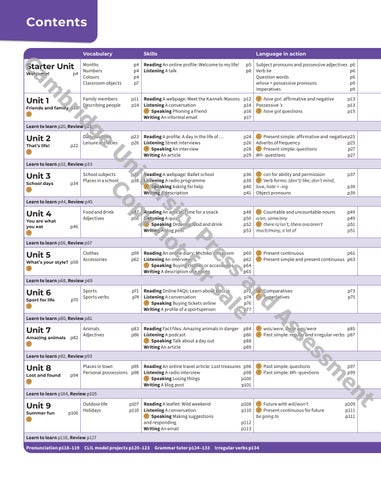
Contents Vocabulary
Ca
Starter Unit
p4
Welcome!
m
Friends and family p10
Language in action
Months Numbers Colours Classroom objects
p4 Reading An online profile: Welcome to my life! p4 Listening A talk p4 p7
p5 Subject pronouns and possessive adjectives p6 p8 Verb be p6 Question words p6 whose + possessive pronouns p9 Imperatives p9
Family members Describing people
p11 Reading A webpage: Meet the Kanneh-Masons p14 Listening A conversation Speaking Phoning a friend Writing An informal email
p12 have got: affirmative and negative p14 Possessive ’s p16 have got questions p17
p23 Reading A profile: A day in the life of … p26 Listening Street interviews Speaking An interview Writing An article
p24 Present simple: affirmative and negative p25 p26 Adverbs of frequency p25 p28 Present simple: questions p27 p29 Wh- questions p27
p35 Reading A webpage: Ballet school p38 Listening A radio programme Speaking Asking for help Writing A description
p36 can for ability and permission p38 Verb forms: (don’t) like, don’t mind, p40 love, hate + -ing p41 Object pronouns
p39 p39
p47 Reading An article: Time for a snack p50 Listening A quiz Speaking Ordering food and drink Writing A blog post
p48 Countable and uncountable nouns p50 a/an, some/any p52 there is/isn’t, there are/aren’t p53 much/many, a lot of
p49 p49 p51 p51
p59 Reading An online diary: Michiko’s mix.com p62 Listening An interview Speaking Buying clothes or accessories Writing A description of a photo
p60 p62 p64 p65
Present continuous p61 Present simple and present continuous p63
p71 Reading Online FAQs: Learn about Boccia p74 Listening A conversation Speaking Buying tickets online Writing A profile of a sportsperson
p72 p74 p76 p77
Comparatives Superlatives
p83 Reading Fact files: Amazing animals in danger p86 Listening A podcast Speaking Talk about a day out Writing An article
p84 p86 p88 p89
was/were, there was/were p85 Past simple: regular and irregular verbs p87
br
Unit 1
Skills
p13 p13 p15
id
Learn to learn p20, Review p21
That’s life!
ge
Unit 2
p22
Daily routines Leisure activities
Unit 3
School days
p34
School subjects Places in a school
Learn to learn p44, Review p45
Unit 4
You are what you eat
Food and drink Adjectives p46
Learn to learn p56, Review p57
Unit 5
What’s your style? p58
Clothes Accessories
Learn to learn p68, Review p69
Unit 6
Sport for life
p70
Sports Sports verbs
Learn to learn p80, Review p81
Unit 7
Amazing animals
p82
Animals Adjectives
Learn to learn p92, Review p93
Unit 8
Lost and found
p94
Past simple: questions Past simple: Wh- questions
p106
p107 Reading A leaflet: Wild weekend p110 Listening A conversation Speaking Making suggestions and responding Writing An email
p108 p110 p112 p113
Future with will/won’t Present continuous for future be going to
Learn to learn p116, Review p117 Pronunciation p118–119 CLIL model projects p120–123 Grammar tutor p124–133 Irregular verbs p134
p97 p99
p109 p111 p111
t
Summer fun
Outdoor life Holidays
p73 p75
en
Places in town p95 Reading An online travel article: Lost treasures p96 Personal possessions p98 Listening A radio interview p98 Speaking Losing things p100 Writing A blog post p101
Learn to learn p104, Review p105
Unit 9
p37
m ss
se As d an s le es sa Pr r y fo it t rs no ve y ni p U Co
Learn to learn p32, Review p33
Learn to learn
Around the world
m
ge
id
br
Making connections (1) Drawing pictures Increasing your vocabulary Organising your notebook
Word partners (1) Word partners (2) Working in pairs
Project
p4 p7 p8
Ca
Learning numbers together Recording vocabulary Using your own language
Life competencies
p11 p14 p19 p20
An article: Twins Day Children’s Day
p18 p18
Project: A poster
p23 p26 p32
Digital literacy: Staying safe online Teens on screens CLIL: Maths
p30 p30 p31
Project: A class survey
Teacher’s Resource Bank
se As d an s le es sa Pr r y fo it t rs no ve y ni p U Co
Recognising cognates Making a spidergram Understanding new words from context Using flashcards
p35 p38 p43 p44
A blog post: Welcome to my school day! The school of the air
p42 p42
Project: A haiku
Personalising vocabulary True or false sentences Playing vocabulary games
p47 p50 p56
Social responsibilities: Sustainable food choices Think before you eat CLIL: Science
p54 P54 p55
Project: A menu
p59 p62 p67 p68
A magazine article interview: Special days Culture and Fashion
p66 p66
Project: A lookbook
p71 p74 p80
Emotional development: A healthy and happy life Healthy and happy CLIL: Biology
p78 p78 p79
Project: An exercise plan
p83 p86 p91 p92
An article: The girl and the golden eagle Four-legged friends
p90 p90
Project: A scrapbook
Compound nouns Using photos to predict content Improving your writing
p95 p98 p104
Creative thinking: Art that tells a story Painting nature CLIL: Art
p102 p102 p103
Project: A factsheet
Collocation Personalising spidergrams Understanding different types of English Making an action plan
p107 p110 p115 p116
A webpage: Your guide to American summer camps A summer camp in …
p114 p114
Project: A webpage
Making a picture dictionary Listening for the general idea Making connections (2) Guessing the meaning of words
Saying collocations out loud Remembering vocabulary sets Writing example sentences
Word categories Preparing to listen Noun and verb forms Using mind maps
p31
Teacher’s Resource Bank
p55
Teacher’s Resource Bank
p79
Teacher’s Resource Bank
en
m ss
p103
t
Teacher’s Resource Bank
Starter
Use it!
says the ordinal number.
S.03
m
Ca
Welcome!
5 Take turns to say a cardinal number. Your partner
br
Vocabulary Months
id
1 Put the months in the correct order. Listen, check and repeat.
1 January
May November October September
June July March
Get it right!
2 Complete the sentences. Compare with a 1 This month is
3 Write the numbers.
1 The number of letters in my name.
3 The number of people in my house.
.
4 Nico’s birthday is on
.
2 Today is
.
.
Colours
8 Add the colours and write the new colour. Listen, check and repeat.
1
2
3
4
red + blue
blue + yellow
red + white
red + yellow
1 a 17 b 70
3 a 12th
b 20th
2 a 13 b 30
4 a 51st
b 61st
answers. Listen and check.
The great big number quiz!! 1 The number of countries in the world is … a 195
b 100
c 95
2 … million people speak English as their first language. a 3
b 36
3 There are … seconds in a year. a 36,536,000
b 31,536,000
c 360
c 35,636,000
4 … million people have the same birthday as you. a 20
b 6
c
10
t
4 Listen. Circle the numbers you hear.
9 Do the quiz with a partner. Circle the correct
en
Learning numbers together Learn and practise cardinal and ordinal numbers together. 23 twenty-three 23rd twenty-third
S.05
m ss
Learn to learn
4 St ar te r Unit
3 Bella’s birthday is on
1 My birthday is on
.
Cardinal and ordinal numbers
S.02
.
purple
.
2 My birthday is in
2 The date today.
2 Onur’s birthday is on
7 Complete the sentences. Tell your partner.
S.04
In English, months and days of the week start with a capital letter. Is it the same in your language?
partner.
1 Laura’s birthday is on 24th July .
se As d an s le es sa Pr r y fo it t rs no ve y ni p U Co
April August December February
ge
S.01
6 Listen and complete the sentences with the date.
Reading
4 Complete the table with the countries and
An online profile
Ca
1 Look at the photos. Where do you think Thiago
nationalities. Flag
m
and Diana are from? Read the profiles quickly and check your answers.
2 Read the profiles again. Are the sentences
br
S.06
Country
Nationality
Australia
1
Canadian
2
T (true) or F (false)?
id
1 Thiago is from São Paulo. F
China
ge
2 Thiago’s favourite colour is blue. 3 Thiago is good at football.
Australian
3
German
4
se As d an s le es sa Pr r y fo it t rs no ve y ni p U Co
4 Diana is from Granada. 5 Miranda is Turkish.
6 Diana’s favourite place is her bedroom.
3 Find nationalities in the profiles to match the countries.
1 Spain Spanish 2 Mexico 3 Türkiye 4 Brazil 5 the USA
Poland
5
the UK
6
Voice it!
5 Complete the sentences with your ideas. Compare with a partner.
1 Thiago’s favourite colours are yellow and green because .
Welcome to my life!
2 Diana’s bedroom is
because
Hello! My name’s Thiago.
I’m from Brasília. It’s the capital of Brazil. I’m Brazilian. I’m 14. I’m with Bruno and Victor in this photo. They’re my best friends. We’re at the same school, but I’m not in their class. Our school is an American school. My favourite colours are yellow and green. Can you guess why? My favourite number is 7.
What’s your name? Where are you from? Write soon!
Hi! My name’s Diana. I’m from Granada in Spain. I’m 13 years old.
In this photo, Diana I’m with Miranda and Suki. They’re my best friends. They aren’t Spanish. Miranda’s Mexican and Suki’s Turkish.
m ss
My dream is to be a footballer like Vinicius Júnior. He’s amazing! I’m good, too! Are you a football fan?
.
My birthday is on 9th March. When is your birthday?
t
My favourite place is my bedroom. Guess what colour it is!
en
My favourite colour is blue.
My dream is to be a singer like Camila Cabello. She’s brilliant! Are you a good singer?
Thiago
What’s your name? How old are you? Let me know!
St ar ter Unit 5
Language in action
Ca
Subject pronouns and possessive adjectives
3 Complete the profile with the correct form of be. Guess the person. Listen and check.
Her birthday 1is 13th December.
m
id
br
Watch video S .1 Where is Isabella from? What is Martín’s dream?
She 3 (✓) American. (✓) My favourite songs 4 Shake it Off and Back to December. she your favourite singer?
5
ge
Possessive adjectives
(✓) on
(✗) British.
She 2
Subject pronouns I
S.07
My name is Simon.
4 Write questions with the verb be.
What’s your dream?
se As d an s le es sa Pr r y fo it t rs no ve y ni p U Co
You He
His dream is to play guitar.
She
Her dream is to be a singer.
It
Its hair is long.
We
Our teacher is kind.
They
Their car is blue.
1 you / 12? Are you 12?
2 you / from / Ankara?
3 your best friends / in your class? 4 your teacher / English? 5 today / 19th June?
1 Look at the table. Circle the correct words. 1 Alana is my / I best friend.
2 Our / We aren’t from Brazil. Our / We ’re from Spain. 3 Her / She name is Luna. Her / She ’s 13. 4 Their / They names are Kit and Bella.
Verb be
I’m from the UK. She’s amazing. We’re students at an international school.
-
But we’re not in the same class.
?
Is Simon from the UK? Yes, he is. Are Isabelle and Martine friends? Yes, they are. Is Isabella from Brazil? No, she isn’t.
a age
2 Where
b people
3 When
c places
4 How old
d things
5 Who
e time and dates
1 Where are
you from?
2 How old
you?
3 When
your birthday?
4 Who
your best friend?
5 What
your favourite colour?
Grammar tutor p124
from Granada.
3 Miranda and Suki
brilliant.
Use it!
Spanish.
4
you a good singer?
5
Diana’s bedroom red? No, it
t
2 Camila Cabello
en
correct form of the verb be. Check your answers in the profiles on page 5.
6 St ar te r Unit
1 What
6 Complete the questions with is or are.
2 Use the table to complete the sentences with the 1 I ’m
5 Match the question words with their functions.
m ss
+
Question words
7 Ask and answer the questions in Exercise 4 and .
Exercise 6.
Vocabulary
Classroom objects
Ca m
3 2
ge
id
br
1
4
6
se As d an s le es sa Pr r y fo it t rs no ve y ni p U Co
5
9
7
12
8
S.08
10
11
1 Match the words in the box with the objects in the picture 1–12. Listen, check and repeat.
1 board door poster
calculator notebook ruler
chair pen table
dictionary pencil window
Learn to learn
Classroom objects
Translation
t
2 Organise your notebook and write new vocabulary from
en
ruler
Picture
m ss
Recording vocabulary Divide the pages in your notebook to record new vocabulary. Write a translation and draw a picture to help you remember the words.
this unit.
3 Test a partner. Say a word in your language. Your partner says it in English. Can you remember all the new words?
St ar ter Unit 7
Vocabulary and listening
ge
id
br
m
Ca se As d an s le es sa Pr r y fo it t rs no ve y ni p U Co
1 Find six classroom objects. Can you see these objects in your classroom? What colour are they? Write sentences.
1 The dictionary is red and blue. 2 3 4 5 6
Learn to learn
Using your own language When you learn a new word in English, write a translation in your own language to help you to remember it.
2
t n l a b e r o n p
i i b s e r t r e p
o t e p v t x e r e
S.09
3 Listen and circle the correct answer. Stefan is …
a a teacher.
S.09
b a student.
4 Listen again. Circle the correct answers. 1 Stefan is in Year 7 / 10.
2 Stefan is / isn’t a friendly person.
3 It’s the students’ first / second day at the school.
4 At the end, Luiza is / isn’t in the classroom.
4
5 Answer the questions with a partner.
8 St ar te r Unit
1 What classroom objects are on your table? 2 What is in your bag?
t
Use it!
6
y e r c u r e p i l
A talk
3 5
n a r o m p t n o e n t b i r o v e o r l k l o a u h n c i
en
1
c a l c u l a t o r
m ss
2
Write a list of the classroom objects in Exercise 2. Write translations in your own language. Cover the English words. Can you remember them?
d i f e w i h j a r r u c h i c g i t r
Language in action
S.10
whose + possessive pronouns
id
br
m
Ca
b
Whose book is this? 2 posters / those / are / whose 3 are / pens / whose / these
Whose … ?
Possessive pronouns
4 that / ruler / whose / is
They’re mine.
ge
Whose sunglasses are these?
They’re yours.
a It’s his.
c They’re hers.
b It’s mine.
d They’re ours.
se As d an s le es sa Pr r y fo it t rs no ve y ni p U Co
Whose pencils are those?
It’s his.
They’re his.
Imperatives
It’s hers.
Whose pen is this?
questions with the answers. 1 book / whose / this / is
Watch video S . 2 What colour is Mia’s pen? What classroom objects are there?
Whose calculator is that?
2 Write the questions. Listen and match the
Positive
It’s ours.
Negative
Close the door!
It’s theirs.
this, that, these, those
Don’t be late!
3 Look at the table and circle the correct words. 1 We use a verb with to / without to for imperatives.
2 We use don’t to form positive / negative imperatives.
This is my pencil.
That is my calculator.
S.11
4 Complete the instructions with the verbs in the box. Listen and check.
don’t forget don’t write listen to use write 1 Don’t write on the desks! 2 new words in your notebook!
Those are my pens.
1 Look at the table. Complete the second sentence 1 It’s your pencil. It’s yours
S.12
4
your teacher!
5
a dictionary!
5 Listen and follow the instructions.
.
Grammar tutor p124
.
3 This table is my table. This table is
.
4 Those are our chairs. Those are
.
5 Is this your calculator? Is this
?
6 Are these her pens? Are these
?
t
2 That’s his notebook. That’s
en
with a possessive pronoun.
to bring your pen!
m ss
These are my notebooks.
3
Use it!
6 Take turns to give your partner instructions. Use classroom objects or your own ideas. Pick up your pen!
Write your birthday! St ar ter Unit 9
1
Learning outcomes I can …
Friends and family
ge
id
br
m
Ca
• understand texts about families and a festival • phone a friend • write an email • understand how to use have got; possessive ’s; questions with How many …? • talk about families and describe people • draw pictures to remember words and increase my vocabulary.
se As d an s le es sa Pr r y fo it t rs no ve y ni p U Co
Start it!
1 Look at the photo. How are friends and families different? 2 Before you watch, are friends family?
m ss
3 Where are Laura and Andrés from? Watch and check. 4 Which is your favourite family? Why?
en t
p13
Watch video 1 .1
Language in action 1.2
10 Frie n d s an d f amil y | Uni t 1
p15
Language in action 1.3
p16
Everyday English 1.4
p18
Globetrotters 1.5
a
b
Victor and Amanda
m
Ca
c
d
e
Sara
Andy
br id
g
f
Lizzie
h
Ryan
i
ge
Vocabulary
Family members
Amy
Olga and Marina
1 Look at Beth’s family tree.
Match nine words in the box with the people a–i. Listen and check.
aunt dad granddaughter husband niece uncle
1.02
Beth
se As d an s le es sa Pr r y fo it t rs no ve y ni p U Co
1.01
Theo
brother daughter grandma mum sister wife
cousin a grandad grandson nephew son
2 Look again at Beth’s family tree. Complete the answers with words from Exercise 1. Listen, check and repeat. 1
Andy + Sara = husband and wife
2
Lizzie + Olga = mum and
3 Amanda + Theo = grandma and Ryan + Beth =
and
5
Lizzie + Theo =
and
6
Theo + Beth =
and
Exercise 1.
Male: brother
4 Draw your family tree. Use Beth’s family tree to help you.
5 Don’t show your family tree. Take turns to say the
name of a person in your family. Can your partner guess who they are?
Carlos.
Is he your brother?
No, he isn’t. Try again.
Use it!
6 Imagine you are a famous person. Write sentences
to describe your family. Tell your partner. Can they guess who you are?
I’m British. My brother is William. My wife is Meghan. She’s American. My children are Archie and Lilibet. Yes, I am.
Are you Prince Harry?
Explore it! Guess the correct answer.
en
3 Complete the lists with the family words in
Making connections (1) Think of examples from your own life to help you remember new words.
m ss
4
Learn to learn
t
A Canadian woman, Vera Sommerfeld, is a great-great-great grandma. There are … generations of women in her family.
Female: Both male and female:
a two
b four
c six
Find an interesting family fact. Write a question for your partner to answer.
Uni t 1 | Frie n d s an d f amil y 11
Reading
3 Find words in the webpage to match the photos.
A webpage
a
b
Ca
1 Look at the photo. What is special about this family? a It’s a small family.
m
b The children are very good musicians.
cello
2 Read the webpage and check your answer.
c
1.03
d
ge
id
br
c The children are all students in London.
se As d an s le es sa Pr r y fo it t rs no ve y ni p U Co
4 Complete the sentences with family words.
1 Isata, Konya, Jeneba and Aminata are Mariatu’s sisters .
Meet the Kanneh-Masons
The Kanneh-Masons are a very big family. The parents’ names are Stuart and Kadiatu. They’ve They ’ve got five daughters – Isata, Konya, Jeneba, Aminata and Mariatu – and two sons – Sheku and Braimah. The children are very good classical musicians. They’ve ’ve got violins, pianos and cellos. They haven’t got any guitars. • Isata’s ’s favourite instrument is the piano. She’s She’s got four albums – two solo albums, one with Sheku and one with all her brothers and sisters.
• Braimah’s ’s in a band called Clean Bandit and he’s also in an orchestra. His favourite instrument is the violin. • Sheku’s ’s favourite instrument is the cello. He’s very famous. Meghan Markle and Prince Harry are big fans of Sheku and his family. Who is Sheku’s favourite musician? It’s Bob Marley.
4 Kadiatu is Mariatu’s
1 Stuart and Kadiatu are brother and sister.
Stuart and Kadiatu aren’t brother and sister. They’re husband and wife.
2 Sheku and Braimah are cousins.
3 Konya and Jeneba are students in Nottingham.
4 Mariatu’s at school in London.
6 Discuss the questions.
t
• The children are very happy – they’ve they ’ve got concerts all over the world this year. They’ve They got a great future!
Voice it!
en
• Mariatu’s ’s at school in Nottingham too. She hasn’t got any albums … yet. What are her favourite instruments? The cello and the piano.
.
5 Correct the sentences.
• Jeneba’s got very good marks in all her piano exams. Her favourite instrument is the piano. She’s a student at the Royal Academy too. • Aminata’s ’s favourite instruments are the same as Konya’s. She’s at school in Nottingham. She likes to sing and act.
.
m ss
• Konya’s ’s favourite instruments are the piano and the violin. She’s a student at the Royal Academy of Music in London.
2 Braimah and Sheku are Mariatu’s . 3 Stuart is Mariatu’s
1 Is your family big?
2 What do you think life in the Kanneh-Mason family is like? 3 Is music important in your life? Why / Why not?
12 Frie n d s an d f amil y | Uni t 1
Watch video 1. 2 True or false? Tess has got two brothers. Marco has got a big family.
Language in action
have got: affirmative and negative
Ca
I/You/We/They
He/She/It
I’ve got a lot of friends.
She’s got two sisters.
-
I haven’t got any brothers or sisters.
My friend Tess hasn’t got any brothers.
br
m
+
id
1 Look at the table. Circle the correct form of
ge
have got. Check your answers in the webpage on page 12.
2 The Kanneh-Masons have got / haven’t got any guitars. 3 Jeneba ’s got / hasn’t got good marks in her piano exams. 4 Mariatu ’s got / hasn’t got an album.
2 Complete the sentences with has / have (not) got. 1 My best friend ’s got
✓ three sisters.
2 Their grandparents
✗ a car.
3 Your parents 4 I 1.04
Singular nouns
Regular plural nouns
Sheku’s favourite instrument is the cello.
The parents’ names are Stuart and Kadiatu.
se As d an s le es sa Pr r y fo it t rs no ve y ni p U Co
1 Mariatu Kanneh-Mason has got / hasn’t got four sisters.
Possessive ’s
✓ two nephews.
✗ any cousins.
3 Complete the text with the correct form of have got. Listen and check.
4 Look at the table and circle the correct answers.
1 We use ’s / s’ to show something belongs to one person. 2 We use ’s / s’ to show something belongs to more than one person.
5 Complete the sentences with the words in brackets and ’s or s’.
1 Isata’s favourite instrument is the piano. (Isata) 2 Kadiatu is wife. (Stuart) 3 The Kanneh-Mason names are Mariatu, Isata, Konya, Jeneba and Aminata. (girl)
4 The
names are Sheku and Braimah. (boy)
Grammar tutor p125
A Band of
Sisters
6 Write true and false sentences with ’s or s’ and have got. Use the ideas below or your own ideas. My
’s name
.
m ss
got I haven’t got
. .
My cousins’ house is pink. They’ve got a garden.
en
7 Take turns to say and guess the false sentences.
t
Alana, Danielle and Este Haim are sisters and they’re from California. They 1haven’t got (-) any brothers. They’re great musicians and they 2 (+) a rock band 3 – Haim. The band (-) any men in it. Danielle’s the singer and she 4 (+) a guitar too. Alana’s favourite instruments are the piano and the guitar. Alana, Danielle and Este 5 (+) three albums. They 6 (+) more than 2 million fans on social media and all over the world. They 7 (+) a lot of famous friends – for example, Taylor Swift.
Use it!
My mum’s name is Sandra. False! Your mum’s name is Emma.
Uni t 1 | Frie n d s an d f amil y 13
Vocabulary and listening
Get it right!
Describing people
Adjectives go before nouns in English. brown eyes ✓ eyes brown ✗
m
Use it!
Ca
1 Complete the table with the words for describing
1.05
people in the box. Listen, check and repeat. beard blonde brown (x2) freckles glasses grey (x2) long moustache red short (x2) tall wavy
ge
id
br
4 Describe the people. Use words from Exercise 1.
Eyes
brown
Hair colour Height
se As d an s le es sa Pr r y fo it t rs no ve y ni p U Co
Hair style
5 Work in pairs. Take turns to describe a member of your family. Can your partner guess who they are? He’s tall. He’s got short brown hair.
Is it your dad?
Other features
Yes, it is. / No, it isn’t.
A conversation
Learn to learn
1.06
6 Look at the photo and listen. Who is the actor?
1.06
7 Listen again. Circle the correct answers.
Drawing pictures Drawing pictures can help you to remember new words.
2 Draw pictures of the words in Exercise 1. Describing people
1 is American / Australian .
t
2 has got blue / brown eyes.
en
The actor …
m ss
brown eyes
3 has got two brothers / sisters. 4 has got an Australian / a Spanish wife.
3 Cover the words and show your pictures to a partner. Can they guess the correct words?
14 Frie n d s an d f amil y | Uni t 1
5 has got two daughters and a son / two sons and a daughter.
Watch video 1. 3 Has she got blue eyes? How many brothers has she got?
Language in action have got: questions
Ca
Have you got a best friend?
Has he got green eyes, too?
How many brothers and sisters have you got?
+
Yes, I have.
Yes, he has.
I’ve got one brother.
-
No, I haven’t.
No, he hasn’t.
I haven’t got any sisters.
br
m
?
Pronunciation p118
id
1 Look at the table and circle the correct words.
ge
1 The word order in questions with have got is the same as / different from affirmative and negative sentences.
3 Work in pairs. Write three questions like the
ones in Exercise 2 about famous people. Ask another pair. Can they guess the answer?
se As d an s le es sa Pr r y fo it t rs no ve y ni p U Co
1
2 We use / don’t use got in short answers.
2 3
2 Write the questions and answers about the 1.10 famous people in the quiz below. Write the correct answers. Listen and check.
Grammar tutor p125
Use it!
4 Write a class quiz. Write questions with the
This week’s quiz
correct form of have got.
We’ve got the questions. Have you got the answers? 1
a one brother and one sister
He’s got one brother and one sister. b (✗) brothers or sisters
He hasn’t got any brothers or sisters. 2
Olivia Rodrigo / green eyes? a (✗) green eyes
b (✗) a twin sister
¿?
4 a phone
5 a niece or nephew
5 Ask the people in your class your quiz questions. Write down their answers.
Have you got brown eyes?
Yes, I have.
No, I haven’t. I’ve got grey eyes.
6 Compare your answers with your classmates.
t
a a twin brother / Hunter
¿? ¿? ¿? ¿? ¿?
3 a pet
en
Scarlett Johansson / a brother?
¿?
2 a twin brother or sister
m ss
b brown eyes
3
¿? ¿? ¿?
How many / brothers and sisters / Jaden Smith?
How many brothers and sisters has Jaden Smith got?
1 brown eyes
What is interesting or surprising?
Uni t 1 | Frie n d s an d f amil y 15
Speaking
Phoning a friend
1 Listen to the
Ca 1.11
m
conversation. Who is Jack?
se As d an s le es sa Pr r y fo it t rs no ve y ni p U Co
Lily Evan Lily
ge
Lily Evan
Hey
1
id
Evan
Lily Evan , Evan. ? Hi, Lily. Are you alright? 2 ? OK, thanks. 3 4 , thanks. So, how’s school? It’s good. Have you got any new friends? Yes, I have. I’ve got one new friend. His name’s Jack. Cool! I’ve got a new boy in my class. His name’s Jack, too. Has he got wavy black hair and blue eyes? Yes, he has. That’s funny! Maybe it’s the same boy. Imagine if it is! That’s so not funny, Evan! ! Got to go! 5 6 . OK.
br
Lily Evan Lily Evan Lily Evan Lily
Plan
5 Write questions to ask your friend on the phone. Use the ideas below.
1.11
2 Complete the conversation with the phrases
from the Useful language box. Listen and check.
Useful language
Bye!
Hey, (Evan).
Hi, (Lily).
OK/Fine, thanks. You?
How are things?
See you later.
3 Look at the Everyday English box. Find and
underline the phrases in the conversation.
School?
New friends? Family?
Speak
6 Practise the phone conversation with your friend. Remember to use:
m ss
• have got
• the vocabulary from this unit
Are you alright? That’s funny!
Cool!
Got to go!
That’s so not funny!
Check
7 Work with another pair. Listen to their phone conversation and complete the notes. School: New friends:
4 Work with a partner. Practise the conversation. 16 Frie n d s an d f amil y | Uni t 1
Family:
t
Watch video 1.4 Ever yday English
en
• expressions from the Useful language and Everyday English boxes
Writing
Useful language
at the start: Hi, Hey, 1
1 Look at the photo. Which boy is Javi?
at the end: Email me soon, That’s all for now, 2 !
Ca
An informal email Read his email and find the answer.
m Hello Martin,
2
3
,
symbols: use emojis to help express your feelings
4 Read and circle the best options. Hi / Write soon Lidia,
1
I’m Javi and I’m from Montijo, a small town in the west of Spain. I’ve got a big house and a very big family!
2
I am / I’m Nora and I am / I’m your new penfriend.
3
I’ve got / I have got two sisters.
I’ve got six brothers and one sister. My brother, Dani, is my twin. He’s tall. He’s got short straight brown hair and brown eyes, like me. He’s my brother and my friend! My sister, Claudia, is ten. She’s got long brown hair, blue eyes and lots of freckles! I’ve got My a pet rabbit. His name’s Thumper! best friend’s name is Toni. He’s funny!
5
Here’s a photo of me with Dani (he’s got a red shirt) and Claudia. We’re in my uncle’s garden.
Have you got a big family? Have you got any pets? Who’s your best friend?
4
, She’s, 4
se As d an s le es sa Pr r y fo it t rs no ve y ni p U Co
1
ge
id
br
Your new school penfriend is Martin, from England. Write to him below.
contractions: I’m, I’ve, 3 5 , Who’s
Write soon! Javi
My best friend’s name is Eman. She’s funny. 4
/
Hello / Email me soon!
Nora 6
/
Write an informal email to a new friend.
Plan
5 Make notes about these things. Age
Family Pets
Friend(s)
Decide what information to include in each paragraph.
Write
6 Write your email. Remember to include: • the verbs be and have got
a Javi’s questions for Martin
c Introduction and reason for writing d Extra information
3 Complete the Useful language box with examples from Javi’s email.
Check
7 Do you …
t
b Family and friends
• expressions and symbols from the Useful language box
en
2 Match topics a–d with paragraphs 1–4.
m ss
• four paragraphs
• use expressions to start and end your email? • give information about you and your family in the second paragraph? • ask questions in the last paragraph? Uni t 1 | Frie n d s an d f amil y 17
Around the world Globetrotters
Reading
Ca
Watch video 1. 5 Children’s Day
An article
m
1 Look at the photos. Where are the people? What is
• What is Children’s Day?
2 Find words in the article that mean:
• Which city are the superheroes in?
1.12
• When is Children’s Day in Japan?
id
br
special about them? Read the article to check your answers.
1 two children born at the same time (n)
ge
2 three children born at the same time (n)
Voice it!
3 four children born at the same time (n)
4 Discuss the questions.
se As d an s le es sa Pr r y fo it t rs no ve y ni p U Co
4 very young children (n)
1 What is interesting about the Festival of Twins?
3 Read the article again. Circle the correct words. 1 The Festival of Twins is one week / day long.
2 Have you got any twins in your family?
2 Pleucadeuc isn’t a big / small town.
3 The festival is for twins, triplets and quadruplets from France / all over the world.
3 What do you think life is like as a twin?
4 Geoffrey and Guillaume have got some / haven’t got any photos as babies at the Festival of Twins.
Twins Day
France is the third biggest country in Europe and it’s got a lot of different festivals. They’ve got a film festival in Cannes, music festivals in Paris and in Lyon, and there’s a festival of lights!
en
m ss
But, perhaps one of the most unusual festivals of all is ‘Deux et Plus’ or ‘Festival of Twins’ on 15th August in the small town of Pleucadeuc in the northwest of France. More than 1,000 twins, triplets and quadruplets from all over the world meet in one place! Some look the same and some look different, some even speak their own language! Imagine that!
t
18 Frie n d s an d f amil y | Uni t 1
Explore it!
Learn to learn
m
Ca
Increasing your vocabulary When you learn an adjective, it’s a good idea to learn the opposite adjective. Learning word pairs increases your vocabulary.
5 Write the opposite adjectives for words 1–4. Find 1 big small
3 normal
2 last
4 old
ge
id
br
and underline them in the article.
6 Close your books. Say an adjective from
Guess the correct answer. Identical twins have the same DNA, but they don’t have the same … a eye colour.
b fingerprints.
c hair colour.
Find two more interesting facts about twins. Choose your favourite fact and write a question for your partner to answer. The Culture Project Teacher’s Resource Bank
The festival has got its own traditions. Each twin, triplet or quadruplet is usually in the same clothes with the same hairstyle! There are also a lot of interesting activities to do, like face painting, watching live music, dancing and playing fun games.
en t
Geoffrey and Guillaume have got photos from their first visit to the Festival of Twins as babies. Now they are 13! ‘It’s a great day! We’ve got a lot of new friends this year.’ Their new friends have all got the same DNA and one thing in common – they’ve all got brothers or sisters that look the same – or almost!!
m ss
se As d an s le es sa Pr r y fo it t rs no ve y ni p U Co
Exercise 5. Can your partner remember the opposite adjective?
Uni t 1 | Frie n d s an d f amil y 19
Learn to learn Learn to … organise your notebook
Ca
It’s important to organise your notebook to help you to find your notes and study for exams.
3 Look at Azra’s notebook. Is her notebook different
m
1 Ask and answer with a partner.
from Omar’s? How?
1 Have you got a notebook?
br
id
3 Are your notes easy or difficult to read?
2
ge
Look at Omar’s notebook. Match 1–4 with a–d.
grammar
2 Is it for all your subjects or for English only?
vocabulary
a 23 September
notes
4 Today’s grammar
c
has / hasn’t got …
homework
have got I / you / we / they have / haven’t got … he / she / it
Negative
Questions
I’m not from Türkiye.
Am I Brazilian?
se As d an s le es sa Pr r y fo it t rs no ve y ni p U Co
3 Today’s homework
b
Affirmative I’m from Türkiye.
1 Today’s vocabulary c 2 Today’s date
Verb be
She’s my sister.
She’s isn’t my Is she sister. Mexican?
He’s my brother.
He isn’t my brother.
Is he from Ecuador?
We’re at school.
We aren’t at school.
Are we 12?
They’re my cousins.
They aren’t my cousins.
Are they at school?
Family members
4 Ask and answer with a partner.
Search online for a digital sticky note board. Try and use it to organise your notebook. Share your findings with your classmates. 20 Frie n d s an d f amil y | Uni t 1
3 Which is your favourite way? Why?
5 Discuss with a partner. Decide how to organise your notebook.
t
Learn the family words from Unit 1.
2 What are some other ways to organise a notebook?
en
d
mum wife sister daughter aunt niece grandma granddaughter cousin
m ss
dad husband brother son uncle nephew grandad grandson cousin
1 What is good about Omar’s notebook? What is good about Azra’s?
1
Review
Vocabulary
Language in action
Ca
1 Look at Ruben’s family tree. Complete the sentences.
m
Agnes = Felipe
id
br Chris = Eylül
2 Is that her phone? (Anna)
ge
3 They’re their bags. (my friends)
Isa
Aidan
Dana
4 That’s his bike. (Safi)
se As d an s le es sa Pr r y fo it t rs no ve y ni p U Co
1 Isa: Agnes and Felipe are my
.
2 Bruna and Davide: Ruben is our
4 Write the questions with have got. Answer them with the information in brackets.
.
3 Ruben: Aidan and Dana are my 4 Eylül: Ruben is my
words with the words in brackets and ’s or s’.
1 Their names are Jack and Sara. (My parents)
Bruna = Davide
Ruben
3 Rewrite the sentences. Replace the underlined
1 how many / sisters / you (four)
.
.
5 Aidan and Dana: Davide is our
.
2 Complete the descriptions with words from the box. brown (x2) wavy glasses grey long red short (x2) tall
2 Emre / any cousins (✗)
3 you / a big family (✓)
4 your best friend / a pet (✓) (two cats)
5 you / a phone / in your bag (✗)
.
She’s got 2
Ari is 4
.
She’s got
I can use have got in affirmative and negative sentences.
He’s got 5 hair.
3
I can use adjectives to describe people.
eyes.
hair. He’s got
6
He’s got 7
eyes. .
t
Samira is 1
Ari
en
Samira
I can use family words to talk about my family.
m ss
Self–assessment
I can use have got in questions.
Uni t 1 | Frie n d s an d f amil y 21
2
Learning outcomes I can …
That’s life!
ge
id
br
m
Ca
• understand texts about daily routines • ask and respond to interview questions • write an article • understand how to use the present simple and adverbs of frequency • talk about daily routines and leisure activities • identify word partners • do a survey and present the results.
se As d an s le es sa Pr r y fo it t rs no ve y ni p U Co
Start it!
1 Is the girl in the photo happy? Why / Why not?
2 Before you watch, what time is it in India now?
m ss
3 Which countries are in the video? Watch and check. 4 Which is your favourite activity in the video? Why?
en t
p25
Watch video 2 .1
22 T hat ’s lif e ! | Uni t 2
Language in action 2.2
p27
Language in action 2.3
p28
Everyday English 2.4
p30
Teens on screens 2.5
Vocabulary Daily routines
Ca a
c
d
f
g
h
id
br
m
b
e
ge se As d an s le es sa Pr r y fo it t rs no ve y ni p U Co
2.01
1 Match eight of the activities in the box with the pictures a–h. Listen, check and repeat.
a
brush your teeth check your phone do your homework get dressed get up go home go to bed go to school have a shower have breakfast pack your bag wake up
are not in the pictures? Write them in the correct order. Listen, check and repeat.
3 Listen to Eduardo talking about his day.
Put all the activities in the correct order. Write 1–13 in the boxes in Exercise 1. Write two numbers in one box.
of one more activity for each verb. go
get
have
to school
Use it!
5 Work in pairs. Take turns to say an activity from Exercise 1. Your partner guesses what time you do this activity. have breakfast
7 o’clock?
Explore it! Guess the correct answer.
No, try again.
When you brush your teeth and leave the tap on, you use … litres of water every minute. a two
b five
t
2.03
4 Complete the table with activities from Exercise 1. Think
en
wake up
Word partners (1) When you learn new words, think about the words that go with them. This will help you to remember them.
m ss
2 Which activities in the box in Exercise 1 2.02
Learn to learn
c ten
Find an interesting fact about another daily routine. Write a question for your partner to answer.
Uni t 2 | T hat ’s lif e ! 23
Reading
A day in the life of …
A profile
Ca
This is Cherry. She’s 16 and she lives on the
id
br
m
island of Boigu in the Torres Strait. Every morning, she wakes up, gets dressed and has breakfast. Then she packs her bag, and goes to school. In the afternoons, she doesn’t go to school. Why? Because Cherry is a junior ranger. Rangers have a very important job – they protect animals, plants and their culture.
It isn’t easy being a junior ranger but Cherry loves it. It’s always exciting!
ge
After lunch, Cherry meets the other rangers. They want to clean the oceans. The ocean is Cherry’s favourite place, and its animals like sharks and turtles are important for the people of the Torres Strait. Plastic is a big problem in the ocean, especially old fishing nets.. The animals in the ocean often swim into the nets and sometimes they die. The rangers go out in boats to look for nets. When they find one, they put it in the boat. It’s hard work because the nets are very big and heavy.
Rangers do different jobs. They sometimes count the types of animals and plants, then they check their health. They usually work with scientists but they also use their own traditional ways to help protect their environment.
se As d an s le es sa Pr r y fo it t rs no ve y ni p U Co
1 Look at the title and the photo. Discuss the questions.
1 Where do you think this is?
2 What does the girl do every day? 2.04
2 Read the profile and check your ideas.
3 Find words in the profile to match the photos. a
b
The Torres Strait islands are between Australia and Papua New Guinea. 8,000 people live on these islands.
4 Read the profile again and complete the sentences. 1 Cherry goes to school in the morning . 2 Cherry doesn’t go to school in the 3 Rangers protect the in the Torres Strait.
.
, plants and culture
4 Cherry meets the other rangers after she has . 5 Cherry’s favourite place is the
.
5 Are the sentences T (true) or F (false)?
1 Rangers do the same things every day. F
m ss
2 Rangers go out on the ocean in boats. 3 Rangers never work with scientists. 4 Rangers don’t do the same jobs.
d
5 It’s easy being a junior ranger.
6 Discuss the questions.
1 How is Cherry’s life different from yours? 2 What do you like / not like about Cherry’s life?
24 T hat ’s lif e ! | Uni t 2
t
Voice it!
en
c
Watch video 2 . 2 Name three things he does in the morning. Is he always on time for school?
Language in action
Ca
Present simple: affirmative and negative
m
I/You/We/They
He/She/It He gets dressed. He brushes his teeth. He studies Chinese. He never has a banana.
-
I don’t check my phone.
He doesn’t check his phone.
Pronunciation p118
ge
id
br
+
I get dressed. I brush my teeth. I study Chinese. I never have a banana.
se As d an s le es sa Pr r y fo it t rs no ve y ni p U Co
Adverbs of frequency
1 Look at the table and complete the spelling rules for the third person. Most verbs: add s
Verbs ending in -sh, -ch and -o: add Verbs ending in -y: replace
with
Some verbs are irregular: e.g. have
2 He sometimes 3 The bus 4 She never 5 They
He is always on time.
other verbs
He never stays in bed late.
4 Look at the table and complete the rule with before and after.
We put adverbs of frequency other verbs. and
the verb to be
5 Complete the timeline with the adverbs of frequency.
2 Complete the sentences. 1 I always share
to be
my chocolate. (share)
often sometimes usually
his bedroom. (tidy)
near my house. (not stop)
football practice. (miss)
their new teacher. (not know)
3 Correct the sentences. Check your answers in
0%
never 1
2
100% always
3
Grammar tutor p126
the profile on page 24.
1 Cherry doesn’t live on an island.
Cherry lives on the island of Boigu.
2 Cherry meets her best friend after lunch.
do exercise do interviews have breakfast sing travel watch TV all afternoon
I always have breakfast in bed.
t
5 Cherry doesn’t like being a junior ranger.
and three negative sentences with adverbs of frequency about your daily routine. Use the ideas in the box.
en
4 It’s easy for the rangers to put the old fishing nets into the boats.
6 Imagine you are a famous person. Write three positive
m ss
3 The rangers don’t go out in boats to look for old fishing nets.
Use it!
7 Swap your sentences with your partner. Guess who they are.
Are you Taylor Swift?
Yes, I am.
Uni t 2 | T hat ’s lif e ! 25
Vocabulary and listening
3 Change the words in bold and write the correct sentences.
Leisure activities
1 I usually chat music on my phone.
Ca
2
1
I usually listen to music on my phone.
3
2 We never read videos.
m br
3 Victor listens to photos all the time! 7
5
4 Alex downloads online with his friends every evening.
6
se As d an s le es sa Pr r y fo it t rs no ve y ni p U Co
9
8
ge
id
4
5 Evie and Laura take the piano together.
10
11
12
1 Match the activities in the box with the pictures. Listen, 2.08 check and repeat.
Street interviews 2.09
chat online go for a bike ride hang out with friends make videos play video games take photos
download songs go shopping listen to music play an instrument read a book/magazine 1 watch TV
Learn to learn
Word partners (2) When you learn new words, learn them with the words that go with them. This will help you remember them.
Leisure activities download songs
5 Listen again. Circle the correct answers.
1 Nina and her friends like / don’t like the same music. 2 Nina does / doesn’t do her homework before she chats online. 3 Anton plays / doesn’t play video games on his own. 4 George lives / doesn’t live near Anton. 5 Anton has got / hasn’t got a bike.
Use it!
6 Write five sentences about your leisure activities. Use adverbs of frequency.
en
Indoors
do you hear?
m ss
2 Complete the table with the activities in Exercise 1.
2.09
4 Listen. Which activities from Exercise 1
7 Work with a partner. Take turns to say
Outdoors Indoors and outdoors
26 T hat ’s lif e ! | Uni t 2
I always chat online after school. I never chat online after school. I read a magazine.
t
your sentences. Are any the same?
Language in action
Watch video 2 . 3 Where does Sophie live? What does Max make?
Present simple: questions
He/she/it
Do…? Yes/No
Do you ride on your own?
Does your friend live near you?
Wh-
What do you do?
Where does he make videos?
How often
How often do you ride?
id
br
m
Ca
I/you/we/they
ge
1 Look at the table. Complete the sentences with do or does.
1 When does 2
he play tennis?
How often does he make videos? Wh- questions
3 Complete the questions with the words in the box. How often What What time When Where Who Why
3 How often 4 Where
se As d an s le es sa Pr r y fo it t rs no ve y ni p U Co
you listen to music?
they hang out?
you go shopping?
1 When
do you have breakfast?
5
he read magazines?
2
does your best friend live?
6
your brother take photos?
3
do you get up on week days?
2 Write the words in the correct order to
4
do you do in your free time?
5
does your English teacher give
make questions. Write the answers.
1 Nina / hang out with friends / does ✓
Does Nina hang out with friends? Yes, she does.
2 Nina and her friends / do / like / reading ✗
you homework?
6
does he like video games?
7
do you see at the weekend?
Grammar tutor p126
3 Nina / her homework / in the evenings / does / do ✓
4 Anton / walk / to George’s house / does ✗
Use it!
4 Write questions. Ask and answer with a partner.
Get it right!
2 Where / your best friend / live? 3 Who / you / meet / before school?
t
Where does your best friend live? ✓ Where your best friend live? ✗
What video games do you and your friends like?
en
Remember to use the infinitive with do and does.
m ss
1 What video games / you and your friends / like?
What video games do you and your friends like? I like adventure games, but my friends usually play football games. Uni t 2 | T hat ’s lif e ! 27
Speaking
An interview
Amelia Mr Green
m
Ca
1 Listen to the conversation. Who is Mr Green? 2.10 Amelia
ge
Mr Green Amelia Mr Green Amelia
id
br
Hello, Mr Green. 1I’ve got some questions to ask you for the school magazine. 2 ? Go ahead. What time do you get up in the morning? That’s easy. I always get up at 5.30 am. 3 . So early! What time do you go to school? It depends. I usually arrive at about half past seven. You’re a history teacher here. Do you like your job? Good question! Of course I do, especially the interviews. . That’s lucky!! 4 Sure! What’s your favourite day of the week? That’s a difficult one! Saturday. 5 . No problem. You’re welcome.
Amelia Mr Green Amelia Mr Green Amelia Mr Green
5 Work with a partner and decide
who you want to interview. Write four questions that you want to ask. Use the ideas below. Decide on the person’s answers.
se As d an s le es sa Pr r y fo it t rs no ve y ni p U Co
Mr Green Amelia Mr Green
Plan
1 What time / get up?
What time do you get up in the morning? I get up at 7.30 am.
2 What time / go to work?
3 Like job?
2.10
2 Complete the conversation with the phrases from the Useful language box. Listen and check.
4 Favourite day?
Useful language
I’ve got some questions to ask you. Is that OK?
I’ve just got one more question.
Thank you very much for your time. That’s interesting.
3 Look at the Everyday English box. Find and underline the phrases in the conversation.
Speak
6 Practise the interview with your partner. Remember to use: • verbs in the present
• the vocabulary from this unit
Sure!
It depends. No problem.
That’s easy.
4 Work with a partner. Practise the conversation. 28 T hat ’s lif e ! | Uni t 2
7 Work with another pair. Listen to their interview and complete the notes. Who do they interview? Favourite day: Something interesting:
t
Go ahead.
Check
en
Watch video 2 .4 Ever yday English
m ss
• expressions from the Useful language and Everyday English boxes
Writing
An article
Ca
1 Read the article. Discuss the best title. Write it in the space in the article.
m
1 What do you do all day?
br
2 What’s your daily routine? 3 What does a vlogger do all day?
id
ge
2 Match topics a–c with paragraphs 1–3.
a Description of Amy’s evening routine b Description of her morning routine
3 Look at the Useful language box. Write the punctuation used in 1–6. 1 I read a book. full stop 2 Close the door! 3 Do you chat online?
1 2 3
She always wakes up at 7.00, has breakfast and checks her phone. She plans her vlog but she doesn’t . make it. She usually goes for a bike ride at 11.00 She has lunch at 1.00 and listens to music. Between 2.00 and 3.00, she practises her vlog. She takes some photos and posts them.
se As d an s le es sa Pr r y fo it t rs no ve y ni p U Co
c Description of her afternoon routine
Amy Ritchie is a Canadian vlogger. She vlogs about her life.
4 Canadian Amy Ritchie
Amy doesn’t have much free time. She sometimes watches She always uploads her vlog at 9.00 TV before dinner. pm and she goes to bed at 11.00.
Write an article about daily activities.
5 chair, table, notebook
Plan
6 I’m they’re don’t
6 Choose a famous person, or someone you know. Think
Useful language
apostrophe ’ capital letter A, B, C comma , exclamation mark ! full stop . question mark ?
4 Find and circle examples of the
punctuation in the Useful language box in the article and title.
5 Write the correct punctuation in these
1 does jane always play football at the weekend
Evening:
Write
7 Write your article. Remember to include: • the information in the correct order
• the present simple and adverbs of frequency
• the correct punctuation from the Useful language box
Check
8 Do you …
• include an interesting title with a question?
• introduce the person, their nationality and what they do? • list three activities for the morning, afternoon and evening?
t
3 after dinner sara does her homework watches TV and reads her book
Afternoon:
en
2 juan doesnt like chocolate
Morning:
m ss
sentences.
about their daily activities. Choose three activities to include in each paragraph.
Uni t 2 | T hat ’s lif e ! 29
Digital literacy Staying safe online
Ca 1
2.11
What do you do with your screen time? What’s ‘binge-watching’? Why is reading good for you?
br
m
Look at the photo and the title. How can we stay safe online? Work in pairs and write down two ideas.
Watch video 2 . 5 Teens on screens
2 Read the text and check your ideas.
id
3 Look at the dictionary entry below.
ge
Do you think cyberbullying makes someone feel happy or sad?
se As d an s le es sa Pr r y fo it t rs no ve y ni p U Co
cyberbullying noun [U] hurting other people by sending unkind messages to them online
How can we stay safe online? There are a lot of things you can see and do on the internet. From videos and music to studying and gaming, it’s a place where you can play, learn and meet other people. But as well as all the useful information you can find online and the fun activities that you can do, there are also dangers, and it’s important to stay safe.
30 T hat ’s lif e ! | Uni t 2
10 to 15 years go onlin e every day. On average, a th ird of children share videos they make on websites like Yo uTube. 75% of teenagers get messages from Limit your screen time: people they don’ Set an alarm to tell you t know. Around one-fif when it’s time to do some th of children real-world activities, like sports, experience cyberb ullying. reading or spending time with friends.
Stay safe:
Protect your privacy: Use strong passwords so other people can’t see your personal information. Never share your password or details with anyone online.
Think before you click: Be careful of links to sites you don’t know, or messages from people you don’t know. Stranger danger: Only accept friend requests from people you know in real life. This can help you to avoid dangerous situations.
t
The internet can sometimes be unfriendly. Cyberbullying is a real problem. Always be kind to other people online.
9 in 10 children aged
…
en
Not everyone on the internet is who they say they are. Be careful about what you share online.
Did you know
m ss
On average, teenagers spend almost seven hours online every day! That’s around 57% of their time. To stay healthy, it’s important to find time to do other activities.
Fact file
Get help: If you have a problem and you don’t know what to do, talk to an adult you know. The internet is amazing, but it’s important to remember these rules and stay safe!
Project 7 Match the numbers below to the amounts in bold
Vocabulary extra
4 Match the words in the box with their friend request limit screen time links privacy share online strong password
br
m
Ca
meanings.
id
1 to put information, messages or videos on the internet share online
ge
2 when someone asks to be your friend on social media 3 a secret word you can use to go online
in the fact file on page 30. 1 20% 2 three-quarters 3 90% 4 1/3
8 Rewrite these sentences in a different way using words from Exercises 4 and 5.
1 18% of teenagers use the internet for shopping or booking tickets for a concert.
se As d an s le es sa Pr r y fo it t rs no ve y ni p U Co
Almost one-fifth of teenagers use the internet for shopping or booking tickets for a concert.
4 keeping your personal information secret from other people
2 4 in 5 children use a smartphone to go online.
5 connections to a website, video, message, etc. on the internet
3 Only a quarter of teenagers do enough exercise.
6 to control the amount of time that you spend on your computer or phone
5 Discuss with a partner.
1 What can you do to stay healthy?
2 Why is it important to be careful about what you share online? 3 Why is it a good idea to use a strong password?
4 What can you do if you have a problem?
CLIL: Maths Statistics
6 Look at this sentence from the text. Match
Work in groups. Choose one of these questions. Complete the steps below.
What do you usually do in your free time? How often do you go online?
How many hours do you spend online every day? • Decide on your question.
• Ask your classmates your question and write down their answers. • Add up the results.
• Draw a bar chart to show your results.
Project: a class survey p120
Project: a class survey p120
t
approximately: 1
Step 1: Plan
en
On average, teenagers spend almost seven hours online every day! That’s around 57% of their time.
Design a survey about free time
m ss
the words in bold to their meanings.
Project: a class survey
generally: 2 nearly: 3
Uni t 2 | T hat ’s lif e ! 31
Learn to learn Learn to … work in pairs
Ca
When you work in pairs, you learn from your partner.
m
1 Complete the advice 1–6 with Always or Never.
br
id
Let’s work well
ge
together
2 3 4 5 6
Complete sentences 1–4. Practise the advice in Exercise 1. 1 We both like
.
2 My partner likes but I don’t.
se As d an s le es sa Pr r y fo it t rs no ve y ni p U Co
1
!
2 Ask and answer questions with a partner.
Always listen to your partner.
answer your partner’s questions. speak at the same time as your partner.
help your partner with words they don’t know. laugh at your partner’s mistakes. ask questions to get more information.
3 I like partner doesn’t.
but my
4 We don’t like
.
Do you like hanging out with friends?
Yes, I do.
Me, too. Let’s write ‘hanging out with friends’ in sentence 1.
3 Complete the sentences about how you work in pairs with always, sometimes or never. When I work in pairs … 1 I always
listen to my partner.
2 I
answer my partner’s questions.
3 I
speak at the same time as my partner.
4 I help my partner with words they don’t know. 5 I
laugh at my partner’s mistakes.
m ss
6 I ask questions to get more information.
Do they agree? Why / Why not?
Search online for a digital mind mapping tool. Try and use it to write down and organise your ideas. Share them with your classmates and learn from their feedback. 32 T hat ’s lif e ! | Uni t 2
Hmm. You sometimes listen to your partner.
t
I always listen to my partner.
en
4 Tell your partner your sentences from Exercise 3.
2 Review Vocabulary
4 Write questions. Answer the questions for you.
1 brush
a your bag
m
Ca
1 Match the verbs with the activities. 2 get
b home
3 check
c a shower
4 have
d dressed
1 your best friend / play an instrument?
2 how often / you / watch / TV?
e your teeth
3 what / your friends / do / at the weekend?
f your phone
ge
6 go
id
br
5 pack
2 Circle the correct verbs.
4 what time / school / start / in the morning?
se As d an s le es sa Pr r y fo it t rs no ve y ni p U Co
1 play / go / chat video games 2 read / watch / make a book
3 hang out with music / friends / photos 4 listen to / go / chat music
5 where / you / hang out / with friends?
5 chat / go / make videos
6 watch / take / listen to photos
Language in action
3 Complete the blog post with the correct form of the verbs. Use the present simple.
6 how often / you / go / for a bike ride?
5 Put the words in the correct order to make sentences. 1 watch / never / we / before school / TV
Welcome to my
morning routine! My day 1
3 shopping / they / at the weekend / go / often
(start) at
7.00 am during the week. I (wake up) but I 3
4 music / bedroom / I / my / listen to / usually / in
2
(not get up).
(check) my phone. My best
friend, Yusuf, always 5
(send) me
a photo in the morning. He’s funny! Breakfast (pack) our bags for school. I
I can talk about my leisure activities.
7
(not go) to my school.
What’s your morning routine like?
I can use the present simple in affirmative and negative sentences.
t
(not meet) Yusuf in the morning because he 8
I can talk about my daily routine.
en
is at 7.30. Then my sister and I 6
Self–assessment
m ss
I4
2 chats / sometimes / she / online
I can use the present simple to ask questions.
Uni t 2 | T hat ’s lif e ! 33
3
Learning outcomes I can …
School days
ge
id
br
m
Ca
• understand texts about schools and school activities • learn how to ask for help • write a description of my ideal school • understand how to use can/can’t and like, love, etc. + -ing • talk about school subjects and places in a school • recognise cognates, make a spidergram and understand new words from context.
se As d an s le es sa Pr r y fo it t rs no ve y ni p U Co
Start it!
1 Look at the photo. How is this classroom different to your classroom? 2 Before you watch, how do you go to school?
m ss
3 Where do the students have their lessons? Watch and check. 4 Which school do you want to go to? Why?
en t
p37
Watch video 3 .1
34 S ch o o l day s | Uni t 3
Language in action 3.2
p39
Language in action 3.3
p40
Everyday English 3.4
p42
Globetrotters 3.5
c
b
a
e
d
f
HELLO!
i
h
j
k
m
Hola!
id
br
m
l
!
Ca g
ge
Vocabulary
Learn to learn
School subjects
se As d an s le es sa Pr r y fo it t rs no ve y ni p U Co
3.01
1 Match the school subjects with the pictures. Listen, check and repeat.
art design and technology (DT) drama English food technology geography history
Recognising cognates Some English words are similar to words in your language, but we don’t always use them in the same way.
information and communication technology (ICT) a maths music physical education (PE) science Spanish
4 Write the subjects from Exercise 1 under the headings. Can you add any more subjects?
Similar to the names of subjects in my language
Very different from the names of subjects in my language
2 Circle the correct subjects.
1 Maths / Art is my favourite subject. I love difficult sums.
2 I don’t like PE / food technology when we go outside. I prefer it inside. 3 This year I want to study Shakespeare in science / English.
4 I never remember all the dates in history / ICT.
6 Music / Spanish is great this year. My word of the week is gracias. timetables. Talk about:
your favourite subjects
subjects you’re not good at good/bad days I’m good at PE. I’m not good at art. What about you?
You draw and paint in this subject.
Explore it!
Art!
Guess the correct answer. In Australia, students have six weeks’ summer / winter holiday from mid-December to the end of January.
t
subjects you’re good at
partner guess the subjects?
en
3 Work with a partner. Ask and answer about your
5 Write five definitions for school subjects. Can your
m ss
5 Geography / English isn’t just about countries. It’s also about population and people.
Use it!
Find an interesting fact about schools. Write a question for your partner to answer.
Unit 3 | S c h o o l d ay s 35
Reading
1 Look at the photo and read the title.
What do you want to know about the webpage?
A webpage
Ca
Ballet School
3.02
2 Read the webpage. Close your books.
m
Write two things you remember about it.
br
3 Find the words in bold in the webpage. Circle the correct option.
ge
id
Rumba, mambo and salsa are just some of the dance styles that come from Cuba, and dancers are big stars in Cuba. The Cuban National Ballet School in Havana trains boys and girls to do ballet, and many of the students become the world’s top ballet dancers. Children usually start at the school when they are ten years old, for five years of training. Then they sometimes train for three and a half more years at a professional level. The school day starts at 7.00 am and finishes at 7.00 pm. That’s a 12-hour day! And some students go to school before classes start to do exercises! In the morning students study subjects like history, maths, languages, science and music. At lunchtime they can have a break, but they can’t go home. In the afternoons, they dance. Oscar is a student there. ‘It’s tough and sometimes I just want to do nothing. I can dance and read music quite well, but I can’t play the piano at all. My best friend Carlos can dance very well. He can sing well, too, but I can’t – I sing badly! One day, I want to be a dancer like my hero, Javier Rojas.’ Learning to be a top ballet dancer is really hard work! Are you tough enough?
1 Train is to prepare yourself for / think about an activity. 2 Ballet isn’t / is a type of dance. 3 Top is to be number one / two.
se As d an s le es sa Pr r y fo it t rs no ve y ni p U Co
4 Tough is something easy / difficult. 5 Hero is a person you think is great / not very good.
4 Read the webpage again and complete the sentences.
1 The Cuban National Ballet School is in . Havana 2 Lots of the students become worldfamous .
3 Most students start training at the school when they are .
4 Some students in the morning before classes start. 5 Students can have a break at .
6 In the afternoons, students .
Voice it!
m ss
5 Discuss the questions.
1 Has your country got schools like Oscar’s school? What type?
en
2 What are the similarities and the differences between your school and Oscar’s?
36 S ch o o l day s | Uni t 3
t
3 Do you want to go to a ballet school like Oscar? Why / Why not?
Watch video 3. 2 Can he speak another language? Can anyone become a vlogger?
Language in action
can for ability and permission
Ca
I / You / He / She / It / We / They +
Ability: I can speak Mandarin Chinese. Permission: You can ask me for advice.
br
1 Look at the table and read the sentences. Circle -
Ability: I can’t play football very well. Permission: I can’t be late for dinner.
4 We can learn about vlogging in class. A / P
?
Ability: Can you speak another language? Yes, I can. / No, I can’t. Permission: Can I become a vlogger like you? Yes, you can. / No, you can’t.
A (ability) or P (permission).
m
1 Students can have a break at lunchtime. A / P 2 We can’t speak Mandarin Chinese. A / P
ge
id
3 At my school, students can’t go home at lunchtime. A / P 5 Can you use your phone in class? A / P
2 Complete the sentences with the correct form of
se As d an s le es sa Pr r y fo it t rs no ve y ni p U Co
Pronunciation p118
can and an expression in the box. 1 Sasha can
(✓) sing
2 Natalia
Use it!
quite well.
4 Write sentences about things you can or can’t do
(✓) play the guitar .
3 Altan
and how well or badly you do them. Use the ideas below or your own ideas.
(✗) speak Japanese .
4 The students
count to ten in a different language do ballet sing a song in English write music
(✓) read music
.
5 We
(✗) dance very well at all
3.06
well
badly
I can’t do ballet at all but I can dance well.
.
quite well
5 Ask and answer questions. Find one thing you and your partner can both do well and one thing you can’t do at all.
not very well
Can you count to ten in a different language?
3 Complete the text with the correct form of can. Listen and check.
Yes, I can. I can count to ten in English very well.
Green Schools
(start) this school until they are three years old. When students are 11 years old, they 4 (choose) their own projects about the environment or the traditions of Bali. Students 5 (buy) a school lunch or bring their own. All the school food is from the local area or the school garden. 3
Grammar tutor p127
t
The classrooms haven’t got any walls! Students study maths, science and geography, but they 2 (learn) about these subjects outdoors in the jungle! Students
en
m ss
The Green School in Bali, Indonesia is different. 1 Can you guess (you / guess) why?
Students 6 (take) phones to school but they give them to a teacher at the start of the day. They 7 (check) them or use them. Students 8 (use) their own laptop at school without a teacher’s permission. Every day, students at a Green School learn new life skills. (you / imagine) a school day like that?
9
Uni t 3 | S ch o o l day s 37
Vocabulary and listening Places in a school
id
br
m
Ca
2
1
4
ge
3
7
10
se As d an s le es sa Pr r y fo it t rs no ve y ni p U Co 11
1 Match the words with places 1–12 in the plan. library playing field sports hall
4 Ask and answer about the places in your school.
classroom locker area reception staffroom
ICT room main hall science lab toilets
2 Listen and write the seven places you hear. 1
5
2
Use as many words as you can from Exercises 1 and 3. Where do you do homework?
I do my homework in the library. What about you?
A radio programme
6
3
7
4
down other words related to them.
6 Listen again. Circle the correct answers.
1 The club is usually in the main hall / library. 3 The club starts / finishes at 3.15.
4 Mrs McKenzie is Lidia’s drama / English teacher. 5 Max lives near / far from the school.
Voice it!
7 Discuss the questions.
1 What kinds of books do you like?
homework revision
t
38 S ch o o l day s | Uni t 3
library
3.09
en
3 Choose places in your school from Exercise 1. Write
shelves
5 Listen. What is the radio programme about?
m ss
Making a spidergram Try to think of other words related to new words and make spidergrams to increase your vocabulary.
books
3.09
2 The club meets once a week / month.
Learn to learn
School
12
Use it!
Listen, check and repeat.
1 canteen
3.08
6
9
8
3.07
5
5
2 Have you got a book club at your school? 3 Which clubs do you go to? When and where are they?
Watch video 3. 3 What’s her favourite subject? What does she love doing?
Language in action
Ca
Verb forms: (don’t) like, don’t mind, love, hate + -ing
m
1
Look at the table and complete the rule.
id
br
After the verbs like, don’t like, don’t mind, love, hate we use a verb ending . in
2 Complete the sentences. Which ones are
ge
correct (✓)?
1 Lidia loves reading (read) books.
3 Max usually after-school clubs. 4 Max
All of us like doing them. I don’t mind starting my day outside. Some of my friends don’t like having PE outdoors. I hate being late for it.
Object pronouns
se As d an s le es sa Pr r y fo it t rs no ve y ni p U Co
✓ 2 The students at the book club (talk) about books.
I love reading books.
We use object pronouns after a verb or preposition to replace nouns and to avoid repeating the same word. They come to the book club now. They love it!
(go) to
5 Match the object pronouns with the people or things.
(stay) for this club.
5 All of Max’s friends
(read).
1 Lidia’s here with me.
a books
2 We like talking about them, too!
b the radio presenter
3 We have English with her.
d Mrs McKenzie
4 What’s it about?
3 Write true sentences. Use the ideas in the box or your own ideas.
do homework with friends get up early hang out with friends learn new vocabulary listen to rap music read a book revise for exams take photos
I like doing homework with friends.
4 Ask and answer. Find three things you Do you like getting up early?
2 Our teacher always gives
.
a lot of homework.
3 Where are Jess and Mehmet? Let’s call
now.
4 The seat next to Ava is free. You can sit next to
5 Is this your dictionary? Can I borrow
. , please?
Grammar tutor p127
Use it!
7 Think about things you like and don’t like at your school.
Compare your ideas with a partner. Agree on changes you want to make. I don’t like eating in the canteen. The food isn’t good.
I agree. Let’s cook lunch at home and bring it to school.
t
I don’t mind getting up early on week days.
1 Is Logan in this class? I want to talk to him
en
No! I hate getting up early. What about you?
6 Complete the sentences.
m ss
have in common.
c Lidia’s book
8 Present your favourite idea to the class with your partner. The class chooses the best idea.
Uni t 3 | S ch o o l day s 39
Speaking
Asking for help
1 Listen to the conversation.
Ca 3.10
What is Leo’s problem?
Leo Nora Leo
ge
id
br
m
Nora Leo Nora Leo Nora
se As d an s le es sa Pr r y fo it t rs no ve y ni p U Co
Leo Nora Leo
Nora
Leo Nora
3.10
Hi, Nora. How’s it going? Not bad, thanks. You? Not great. I can’t do my maths project. I’m stuck! Leo Nora Not again! Oh dear. 1 Can you help me , please? What’s the problem? I hate working out survey results. I can’t do it. Don’t be silly! Of course you can. 2 the results? Yes, please. Go on then. ? I don’t mind Thanks. 3 doing the bar chart. I can do that! Of course I’m sure. Can you do 4 now? Sure. Stop talking about maths and let’s go for lunch!
2 Complete the conversation with the
phrases from the Useful language box. Listen and check.
Plan
5 Work with a partner. Decide what the problem is and what help you need. Use the ideas below or your own ideas.
Useful language
Are you sure?
Can you do me a favour?
a school project
Can you help me, please?
Do you need a hand with …?
3
Look at the Everyday English box. Find and underline the phrases in the conversation.
your (maths/drama, etc.) homework a science experiment
Speak
6 Practise the conversation asking for help with your partner. Remember to use:
• can / can’t and (don’t) like, don’t mind, love, hate + -ing • the vocabulary from this unit
Check Watch video 3.4 Ever yday English
7 Work with another pair. Listen to their conversation and complete the notes. What is the problem?
4 Work with a partner. Practise the conversation.
40 S ch o o l day s | Uni t 3
What is the solution to the problem?
t
What help do they need?
en
Don’t be silly! I’m stuck. Not again! Not great. Oh dear!
m ss
• expressions from the Useful language and Everyday English boxes
Writing
4 Complete the sentences with the words from the Useful language box.
A description
Ca
1
Read Azra’s description. Do you think Dream Academy is a real school? Why / Why not?
m
id
br
Dream Academy
1 At my dream school, I can study subjects fashion, photography and cybersecurity. 2 Every day, we can do an outdoor activity a jungle walk or an ocean swim. 3 Teachers can’t give homework for some lessons, science.
I’m a student at Dream Academy.
ge
1
2
3 4
Write a description of your ideal school.
Plan
5 Make a spidergram about your ideal
se As d an s le es sa Pr r y fo it t rs no ve y ni p U Co
Students can study traditional subjects like maths and English. They can also study ‘how to’ subjects such as how to make videos, record and produce music, be a photographer, be a DJ. My favourite subject is how to be a DJ! Students choose their own teachers. They interview them and decide together. For example, the music teacher is a famous pop star. Students never have more than four lessons a day. Students can choose when lessons start and finish. Students don’t have lessons in classrooms – they are in learning pods. My favourite space is the music pod. I love listening to music in it.
I love studying at Dream Academy. Azra
school.
Name
Subjects
Lessons
My ideal school
Teachers
Places
Opinion of studying at school
Decide what information to include in each paragraph of your description.
Write
6 Write your description. Remember to include:
• four paragraphs • can / can’t
• expressions from the Useful language box
2 Match headings a–d with paragraphs 1–4.
C Amazing subjects
b Creative spaces
d Star teachers
sentences with these words in Azra’s description. Useful language
for example
like
• include all of the information from your spidergram?
t
3 Read the Useful language box. Find and underline
• give the name of the school in the opening sentence?
en
a Only four lessons
7 Do you …
m ss
Check
• give your opinion about studying at the school in your closing sentence?
such as Uni t 3 | S ch o o l day s 41
Around the world Reading
Watch video 3. 5 The School of the Air
Ca
• Where is Jamie and Paul’s school?
A blog post
• What subjects do they study?
m
1 Write three things you want to know about school 3.11
id
br
life in Japan. Compare with a partner. Read the blog. Does it answer your questions?
Read the blog again and answer the questions.
ge
2
Globetrotters
1 What does Hideki do when he gets to school?
He takes off his shoes and puts them in his locker.
• What do Jamie and Paul love doing?
3 Find and underline words in the blog to match the definitions.
1 Paragraph 1 (adj) for wearing or doing outside; not inside a building
3 Where does Hideki have lunch?
3 Paragraph 6 (n) something you play with small pieces, for example, chess
se As d an s le es sa Pr r y fo it t rs no ve y ni p U Co
2 How often do the students have an assembly?
2 Paragraph 5 (n) letters or numbers you use when you write
4 What do the students do at 3.30?
5 How many hours does Hideki spend at school?
Welcome
to my school day! Hi, I’m Hideki!
My school day starts at 8.30 am. When I arrive, I take off my shoes and I put them in my locker. We can’t wear outdoor shoes at school so we put on special indoor shoes.
2 How does Hideki show his teachers respect? 3 Can you give an example of when you show respect?
When classes end at 3.30, we all stay to clean and tidy up the classrooms and throw away the rubbish. I don’t mind doing these jobs. It’s an important part of school life and I like having the responsibility.
Nearly everyone belongs to an after-school club. One of my clubs meets on Mondays and Thursdays to learn about traditional Japanese arts like Shodo and Haiku. Haiku is a type of Japanese poetry. Shodo is writing Japanese characters (kanji). I can write some characters quite well now. My other club is the Go club. It’s on Tuesdays and Fridays. Go is a Japanese board game and it’s more than 2,500 years old. I love playing it, but when I leave school after a long, busy day at 5.30 I’m exhausted usually exhausted.
t
42 S ch o o l day s | Uni t 3
1 What is respect? Why is it important?
en
Lunchtime starts at 12.30 pm. We don’t eat lunch in a canteen – we stay in our classroom. Different students serve the meal every day and a teacher eats with us.
4 Discuss the questions.
m ss
We have an assembly with the principal in the main hall on Monday mornings and we have six 50-minute classes every day. My best subjects are Japanese, science and art.
Voice it!
Learn to learn
m
Ca
Understanding new words from context When you read a text, don’t look up every word. Find other words you know in the same sentence and try to guess the meaning of the new word.
br
5 Look at the words in bold in the blog. What do they
id
mean? Which other words in the sentences do you know?
ge
6 Find and circle these phrasal verbs in the text. What do they mean?
take off throw away
tidy up
from Exercise 6.
1 It’s hot in here.
your coat!
2 Now it’s cold. Can I 3 I can help you to your room. We can rubbish.
my coat again?
all the
Explore it! Is the sentence T (true) or F (false)?
se As d an s le es sa Pr r y fo it t rs no ve y ni p U Co
put on
7 Complete the sentences with the phrasal verbs
Japanese teachers and students work even during the holidays!
Find three more interesting facts about school life in Japan. Choose your favourite fact and write a question for your partner to answer. The Culture Project
Teacher’s Resource Bank
en
m ss t Uni t 3 | S ch o o l day s 43
Learn to learn
a
b
Learn to … use flashcards
science lab
Ca
Flashcards can help you remember new vocabulary.
glasses
m
1 Match the front and back of the flashcards. 2
br
1
information and technology (IC T)
ge
id
c
moustache
communication
se As d an s le es sa Pr r y fo it t rs no ve y ni p U Co
3
d
4
hang with friends
5
a place where you do experiments
e
out
4 Show the front of your
physical
flashcards from Exercise 3 to your partner. Can they guess what is on the back of each flashcard?
1 ✓ picture + word 2 phrase with one word missing 4
word + meaning
5
word + example sentence
3 Choose five words or phrases from Unit 3. Use the words or phrases to make the five different types of flashcards in Exercise 2.
44 S ch o o l day s | Uni t 3
Physical education!
Yes! That’s right!
5 Discuss with your partner. Which is your favourite type of flashcard from Exercise 2? Why?
Create a digital dictionary. Add chosen words and phrases to it as you finish each unit. Share your findings with your classmates.
t
word in English + word in your language
It’s a school subject.
en
3
Physical … Oh, I don’t know!
m ss
2 Tick the types of flashcard you can see in Exercise 1.
3 Review Vocabulary
4 Write questions and short answers. Use can.
Ca
1 Write the school subjects. 2
3 Hola!
!
4
ge
id
br
m
1
5
1 Jack / ride a bike?
(✓)
2 Layla / sing well?
(✗)
3 your grandma and grandad / use a computer? (✓) 6
7
8
(✗)
se As d an s le es sa Pr r y fo it t rs no ve y ni p U Co
4 we / drive a car?
9
5 Complete the sentences with the correct object pronouns.
2 Read the sentences and write the places. 1 Teachers go here at break.
2 Students do experiments here. 3 Students choose books here.
1 We can’t do this. Can you help
?
2 Is that James? I’m not sure it’s
.
3 Where’s my phone? Have you got
4 Liz is stuck. Can you give
?
a hand?
6 Write the sentences.
1 She / love / do / maths every day
4 We have lunch here.
5 We always go here for an assembly.
Language in action
3 Answer the questions. Write sentences that are true for you.
How well can you …
3 They / hate / play / football
4 He / not like / revise / for exams
Self–assessment
I can talk about my school subjects.
3 do difficult maths problems?
I can talk about the places in my school.
4 cook?
I can use can and can’t to talk about ability and permission.
5 dance?
I can use verbs to talk about what I do and don’t like doing.
t
2 use a computer?
en
m ss
1 speak English?
2 We / not mind / get up / early / for school
Uni t 3 | S ch o o l day s 45
4
Learning outcomes I can …
You are what you eat
ge
id
br
m
Ca
• understand texts about food • order in a snack bar • write a description of my favourite food • understand how to use countable and uncountable nouns and there is/are • talk about and describe food • personalise vocabulary and answer true/false questions • design a menu and evaluate a design project.
se As d an s le es sa Pr r y fo it t rs no ve y ni p U Co
Start it!
1 Look at the picture. What can you see?
2 Before you watch, name three types of food.
m ss
3 How can you learn to cook? Watch and check. 4 Do you like cooking?
en t
p49
Watch video 4 .1
Language in action 4.2
46 Yo u are w hat yo u e at | Uni t 4
p51
Language in action 4.3
p52
Everyday English 4.4
p54
Think before you eat 4.5
c
d
b
e
Ca
g
m
a
h
i
br
f
id
Vocabulary
Food and drink
ge
j
1 Write all the food and drink words you know in English.
k
4.01
se As d an s le es sa Pr r y fo it t rs no ve y ni p U Co
Compare with a partner.
2 Match the words in the box with the photos. Listen, check and repeat. apples carrots a chocolate fizzy drink rice
bananas cheese eggs juice water
beans chicken fish meat
l
n
m
Learn to learn
Personalising vocabulary Think about your own routines and habits when you learn new vocabulary.
3 When do you have the food and drinks in Exercise 2? Write the words in the table. Breakfast
Lunch
Dinner
Use it!
5 Discuss the questions.
1 Which food do you love/hate? 2 Which food do you eat when you’re happy? What about when you’re sad?
m ss
Explore it!
Guess the correct answer.
a less protein than an egg.
partner’s meals. Use adverbs of frequency.
b more protein than an egg.
Eva always has an egg and juice for breakfast.
c the same protein as an egg.
Get it right!
We say I don’t like apples. ✓ I don’t like the apples. ✗
t
4 Compare with a partner. Write sentences about your
en
One hundred grams of ants have got …
Find an interesting fact about food. Write a question for your partner to answer.
Unit 4 | Yo u are w hat yo u e at 47
Time for a snack
ge
id
br
m
Ca
a
b
se As d an s le es sa Pr r y fo it t rs no ve y ni p U Co
Kgosi is from Botswana in southern Africa. He hasn’t got any apples today, but he’s got some Mopane worms. ‘I like sharing them with friends at school. They’re great with some peanut butter or some rice and they’ve got more protein than meat. I haven’t got any rice today, just 50 worms!’
Jorge is from Oaxaca, Mexico. He’s got some chocolate today but he’s also got a grasshopper taco. ‘My mum cooks grasshoppers in some oil and she always adds some garlic. They’re my favourite snack and I sometimes buy them at the market.’ Bugs like grasshoppers, spiders and worms are good for you and the planet. They give us protein and they aren’t expensive to feed. Which bug do you want to try?
c
Reading An article
1 Look at the photos of food in the
article. Where do you think people eat this food? Do they enjoy it?
2 Read the article and check your answers to Exercise 1. in the article.
Leakena
Kgosi
Jorge
1 enjoys sharing snacks with friends? Kgosi 2 usually buys a snack after school? 3 enjoys the snack with garlic and oil? 4 likes eating the snack with rice? 5 has got two types of snack today? 6 likes eating a bug’s legs?
5 Discuss the questions.
1 Do people in your country eat bugs? 2 Which of these bugs do you want to try? 3 Why do you think eating bugs is good for the planet?
48 Yo u are w hat yo u e at | Uni t 4
t
Voice it!
en
3 Check the meaning of the words in bold
4 Choose the correct answer. Which person ...
m ss
4.02
Leakena is from Cambodia. She hasn’t got a banana for a snack today, she’s got a spider. She usually buys one tarantula from a food stall on the way home from school. ‘You cook them in oil and then add some salt and some sugar. They’re like chicken or fish. The legs are my favourite!’
Watch video 4 . 2 What food can you see at the market? What’s Simon’s favourite food?
Language in action
Countable and uncountable nouns
Ca
1 Look at the table and complete the rule. For
m
nouns we add –s to form the plural.
br
2 Find and underline the words below in the text on page 48. Complete the table.
Countable nouns
Uncountable nouns
You can count them.
You can’t count them.
one banana an apple two apples
bread cheese milk
id
ge
apple garlic oil salt sugar taco tarantula worm
apple
Check your answers in the text on page 48. 1 Leakena’s got a
Uncountable
2 Kgosi’s got worms and Jorge’s got chocolate.
the table in Exercise 2. How many have you got?
3 Kgosi hasn’t got hasn’t got
apple. Leakena banana.
4 Has Jorge got
grasshoppers?
5 Jorge’s mum always adds when she cooks grasshoppers.
3 Work with a partner. Add more food words to a/an, some/any
4.03
any. Listen and check.
Uncountable
Celia Oscar
+
I’ve got a smoothie now.
The market’s got some apples.
It’s got some bread.
Celia Oscar
-
He hasn’t got an apple.
They haven’t got any bananas.
They haven’t got any cheese.
Celia Oscar
?
Have you got a favourite food?
Have you got any apples?
Have you got any cheese?
Celia Oscar Celia
Have we got 1any food for the party? Let’s have a look. Right, we’ve cheese. got 2 bread? OK. Have we got 3 bread but Sorry. We haven’t got 4 5 pasta. we’ve got fruit or vegetables? Have we got 6 7 apple and 8 We’ve got carrot. What about drinks? water. We’ve got 9 Great. What a party! I can’t wait.
4 Look at the table and complete the rules.
•
3
with plural countable and uncountable nouns in affirmatives. with plural countable and uncountable nouns in negatives and questions.
Use it!
7 Work with a partner. Change the food and
t
2
Grammar tutor p128
en
•
with singular countable nouns.
m ss
Plural countable
We use:
garlic
6 Complete the conversation with a, an, some or
Singular countable
• a or 1an
spider.
se As d an s le es sa Pr r y fo it t rs no ve y ni p U Co
Countable
5 Complete the sentences with a / an, some / any.
drink words in Exercise 6 and write your own conversation. Practise your conversation.
Uni t 4 | Yo u are w hat yo u e at 49
Vocabulary and listening
4.05
Adjectives
2 Listen to the words in Exercise 1 and repeat
them. Which two words have got a negative meaning?
1 Complete the sentences with the adjectives in
Ca 4.04
Pronunciation p118
the box. Listen and check.
m
cold delicious disgusting fresh healthy hot nice salty sweet unhealthy
br
Use it!
Use adjectives.
id
1
3 Write five sentences to describe a type of food.
Fizzy drinks aren’t good for you, but I sometimes drink them. I know they’re unhealthy .
ge
4 Work with a partner. Take turns to say your
se As d an s le es sa Pr r y fo it t rs no ve y ni p U Co
Careful! The soup . is
3
2
They’re disgusting and salty.
Are they spiders?
A quiz
Peanuts have got salt on them. They’re , but they aren’t bad for you. I really hate cheese. I don’t know how people can eat it, I think it’s .
5
sentences. Can your partner guess the type of food?
Learn to learn
True or false sentences With true or false sentences, you’ve got a 50% chance of being correct! Before you listen, read the sentences and try to predict if they are true or false.
4
5 Read the sentences in Exercise 6 and predict if
These beetles look and taste great! They’re .
they are T (true) or F (false).
4.08
Yuk! This milk doesn’t smell . I don’t want any in my coffee.
7
3 White chocolate isn’t really chocolate. 4 Carmine is an orange powder from beetles.
8
cocoa carmine
t
durian
en
50 Yo u are w hat yo u e at | Uni t 4
1 There are 1,000 peanuts in a jar of peanut butter.
m ss
The vegetables and fruit in our garden are always and they’re a snack.
predictions are correct?
2 You can’t eat durians on public transport.
Dark chocolate hasn’t got much sugar in it. It isn’t , but I love it! I never eat ice cream in winter. The weather is and so is ice cream!
9
6
6 Listen to the quiz and check. How many of your
Watch video 4 . 3 What is in her juice? How many hours does she sleep?
Language in action
there is/isn’t, there are/aren’t
Ca
Singular countable
Uncountable
Plural countable
There’s a quiz on this website.
There’s some dark chocolate.
There are two carrots in this juice.
-
There isn’t a quiz in the magazine.
There isn’t any dark chocolate.
There aren’t any bananas in this drink.
?
Is there a quiz? Yes, there is. / No, there isn’t.
Is there any water? Yes, there is. / No, there isn’t.
Are there two carrots in this juice? Yes, there are. / No, there aren’t.
ge
id
br
m
+
1 Look at the table. Circle the correct options.
se As d an s le es sa Pr r y fo it t rs no ve y ni p U Co
1 There is / There are three eggs in my omelette. 2 Is there / Are there any cheese in that sandwich?
3 There’s / There are some ice cream in the freezer. 4 There isn’t / There aren’t any tomatoes in my salad.
5 There isn’t / There aren’t any fish on the menu.
2 Complete the sentences with the correct form of there is / there are.
1 There’s a quiz in this magazine. 2 about 540 peanuts in that jar. 3
any chocolate in my fridge.
4
any oranges in your juice?
5
any milk in the fridge?
3 Write questions about the picture. Then ask and answer.
much/many, a lot of Countable plural
Uncountable
+
There are a lot of vegetables.
I get a lot of sleep.
-
There aren’t many unhealthy snacks.
I haven’t got much time for exercise.
?
How many bananas are there?
How much exercise do you get each day?
4 Complete the sentences and questions with much, many or a lot of.
1 Tomás hasn’t got
2 He’s got
3 There aren’t going to bed.
time after school.
after-school activities. hours after school before
Grammar tutor p128
Use it!
5 Write questions with how much/how many. 1 fruit / do you eat / every day?
m ss
How much fruit do you eat every day?
2 people / are there / in your family?
2 any eggs?
3 time / spend / with friends at the weekend?
en
1 any fruit? Is there any fruit?
6 Ask and answer the questions in Exercise 5.
4 a sandwich? Is there any fruit?
Yes, there is.
t
3 any juice?
How much fruit do you eat every day? I eat an apple and an orange. Uni t 4 | Yo u are w hat yo u e at 51
Speaking
Server
Ordering food and drink
1 Listen to the conversation. What does
Ca 4.09
Gulay choose from The Juice Stop?
m br
Just Juices: £4.00
id
The Juice Stop
ge
Green Giant Gives you energy with fresh green vegetables and there’s an apple, too!
Water Stop: £1.50 Fizzy water
Fresh Lemorange 3 oranges, 2 lemons, some fizzy water and our secret ingredient.
Gulay Server Gulay
Gulay
Hi. 1 Can I help you ? 2 juice, please. 3 ? No problem. Sunshine Start? I’m not sure. 4 There are two oranges, a carrot and three tomatoes in that one. It’s really healthy. Hmm. What about the Green Giant? That sounds delicious. There are some green beans and a green apple in that. some fizzy Thanks. 5 water and an apple? ? Of course. No worries! 6 ? Yes, it is. Thank you. 7 8 £2.25, . Here you go. Thanks. Enjoy! Thank you. Bye!
se As d an s le es sa Pr r y fo it t rs no ve y ni p U Co
Sunshine Start Start your day with a delicious mix of fruit and vegetables.
Fresh and Natural
Server Gulay Server Gulay Server
Snack Station: £0.75 Apple, Banana, Carrot
Server Gulay Server Gulay Server Gulay
Plan
5 Work with a partner. Plan a conversation
4.09
2
Complete the conversation with the phrases from the Useful language box. Listen and check.
Useful language
Can I have … ? Can I help you? How much is that? I’d like a/an/some …
Is that everything? That’s … , please. What kind? What’s in the … ?
3 Look at the Everyday English box. Find and
underline the phrases in the conversation.
who is the server and who is the customer what’s on the menu
what to choose from the menu
Speak
6 Practise the conversation. Remember to use: • there is(n’t) / there are(n’t) and how much / how many • vocabulary from this unit
• expressions from the Useful language and Everyday English boxes
Check
en
7 Work with another pair. Listen to their conversation and complete the notes. Where are they?
4 Work with a partner. Practise the conversation.
52 Yo u are w hat yo u e at | Uni t 4
What does the customer choose from the menu?
t
Enjoy! Here you go. No problem. No worries!
where you are
m ss
Watch video 4 .4 Ever yday English
about ordering food and drink. Decide …
Writing
A blog post
Ca
Family life
|
School life
|
Food
1
br
m
My favourite food
2
My dad makes cheese bread for breakfast. There’s a lot of cheese in it. It’s nice and I eat it when it’s hot!
Friends and fun
by João Pereira
3
I usually buy lunch from a food stall or a shop. There are a lot of food stalls in my part of town and it isn’t difficult to find delicious food! We often have chicken xim xim. It’s very healthy. It’s chicken with rice and there are a lot of peanuts. They’re salty but they’re nice.
4
I love chocolate – especially Brigadeiros! I always buy them after lunch from Thiago’s stall. They’re very sweet. I love eating them with my hands but I can’t eat more than two or three. They’re definitely my favourite snack!
ge
id
My name’s João and I’m from Recife in Brazil. Here are some photos of my favourite types of food. I often have these at the weekend.
|
se As d an s le es sa Pr r y fo it t rs no ve y ni p U Co
1 Look at the photos. What do you think the food is? Read the description and check.
2 Match topics a–d with paragraphs 1–4. a Snacks
b Introduction: who you are, what the blog post is about
c Breakfast
Plan
d Lunch
5 Make notes to describe your favourite types of
3 Find and underline examples of and, but and or
in João’s description. Complete the information in the Useful language box.
Useful language
Write a blog post about your favourite types of food.
We use 1
to add similar information.
We use 2
to contrast different information.
1 This soup is cold and / but / or it’s delicious.
3 Do you want pasta and / but / or pizza? 4 Look at those plants! There are tomatoes and / but / or strawberries.
• what it’s like
Write
6 Write your blog post. Remember to include: • an introduction and three paragraphs • there is / are
• countable and uncountable nouns
• the words from the Useful language box
Check
7 Do you …
• introduce yourself and say when/how often you eat your favourite foods?
t
2 There’s a food market near my house and / but / or it’s easy to buy local food there.
• what’s in it
en
4 Circle and, but or or.
• where you get it from
m ss
We use 3 when there is a choice (usually between two things).
food. Decide what information to include in each paragraph. Think about:
• use adjectives to describe food? • say why you like each type of food?
Uni t 4 | Yo u are w hat yo u e at 53
Social responsibilities Watch video 4 . 5 Think before you eat
Sustainable food choices
Ca
1 Look at the photos. How can the food you eat be good
m
or bad for the environment? Work in pairs and share your ideas.
2 Read the text and check your ideas. 3 Look at the definition of sustainable. Do you think Hugo,
id
br
4.10
Alanna and Marcelo eat in a sustainable way?
1 What’s your favourite food? 2 Watch the video. What is it about? a how to grow strawberries b expensive food c where our food comes from 3 Where do you and your family buy food?
ge
a
se As d an s le es sa Pr r y fo it t rs no ve y ni p U Co
sustainable adjective made, grown or produced in a way that is not bad for the environment so it can continue for a long time
c
b
Be more
sustainable!
d
Food production is responsible for 30% of global greenhouse gas emissions. How do our food choices help or hurt the planet? Let’s find out.
Alanna, 14
Hugo, 15
My family grows our own fruit and vegetables all year round. For example, there are tomatoes, peppers and strawberries in summer and potatoes and carrots in winter. It isn’t difficult. The plants are on our balcony and I give them some water. Then, the natural energy from the sun helps them grow. There aren’t any chemicals so they’re organic. They’re always fresh and delicious. A healthy plate is a healthy planet!
en t
54 Yo u are w hat yo u e at | Uni t 4
Marcelo, 14
m ss
I’m a vegetarian, so I don’t eat any meat or fish. It takes a lot of land and water to produce meat because the food for the animals needs to grow too. When cows or sheep digest their food, they produce a lot of gas and that’s bad for the planet. My favourite plant-based foods are beans and nuts. They are very healthy. Plantbased food uses less energy, land and water than meat. It’s good for me and good for the environment!
A lot of food travels a long way by road or air to arrive in our supermarkets, like fruit that only grows in some countries. This is not only expensive, it’s also bad for the planet because there are a lot of greenhouse gas emissions. There’s also a lot of food packaging in supermarkets. It’s plastic so it’s expensive to produce and it uses a lot of energy. I always think about where my food comes from. I go to the local market once a week with my parents. We buy local meat, eggs, fruit and vegetables. There isn’t any packaging so they’re all plastic-free and we use our own bags.
Project Vocabulary extra
1
2
4 Match the words in the box with the photos.
Ca
d natural energy e plant-based f plastic
br
m
a food packaging b greenhouse gas emissions c market
5 Read the sentences. Write the names of the
f 3
4
id
people described in the text on page 54.
ge
1 This person shops at the local market and doesn’t buy any food with plastic packaging.
se As d an s le es sa Pr r y fo it t rs no ve y ni p U Co
2 This person and their family grows their own organic fruit and vegetables. 3 This person is a vegetarian. Their favourite plant-based foods are beans and nuts.
5
6
CLIL: Science The environment
6 Work in pairs. Read what the people say. Have they got sustainable habits? How can they be more sustainable? 1 Isabella: ‘I always buy food from the local market.’
2 Sergio: ‘I never think about where my food comes from. I just eat it.’
3 Can: ‘I usually eat organic fruit and vegetables from my grandpa’s garden. He doesn’t use any chemicals.’ 4 Ekin: ‘I eat meat every day. It’s my favourite food. I love it!’
1 What sustainable foods do you eat a lot?
3 Where do you and your family buy your food? Is there any plastic packaging on the food you buy?
Work in groups. Create a healthy and sustainable food menu with one starter, one main course, and one dessert. Find out about: • the type of food there is at this time of year • plant-based food that grows near you
• food you can buy from local markets or farms • food that hasn’t got any plastic packaging
• food that is fresh, healthy and sustainable Choose the food for your menu.
Find photos or draw pictures of the food and the places it comes from.
t
2 Do you know any vegetarians? What food do they eat?
Step 1: Plan
en
7 Work in pairs. Discuss the questions.
Design a healthy and sustainable food menu
m ss
Sergio hasn’t got sustainable habits because … He could try ...
Project: a menu
Project: a healthy and sustainable food menu p138
Uni t 4 | Yo u are w hat yo u e at 55
Learn to learn Learn to … play vocabulary games
Ca
Games can help you practise and remember new language.
ge
id
br
m
3 Work in pairs. Play Three Clues. Player A: Think of a food or drink. Don’t say it! Give Player B three clues.
se As d an s le es sa Pr r y fo it t rs no ve y ni p U Co
Player B: After each clue, guess Player A’s word. Start with 3 points. Lose 1 point for each wrong guess.
1 Ask and answer with a partner.
1 What games do you like to play? 2 What is your favourite game?
3 Do you play any games to practise English?
2 Work in pairs. Play Word Wizard.
Take turns to be Player A and Player B. The player with the most points at the end of the game is the winner.
Clue 1. They’re healthy.
No! Clue 2. They’re sweet.
Vegetables. Bananas!
1 Your partner chooses a letter of the
No. Last clue. Sometimes they’re green and sometimes they’re red.
2 Write all the food or drink words you
Yes, apples! You get 1 point!
alphabet. a
know beginning with the letter in 1 minute. Don’t show your partner.
apples
a word on both lists. You get 10 points for a word on only your list. choose the letter of the alphabet.
Word Wizard.
56 Yo u are w hat yo u e at | Uni t 4
1 Which game practises food nouns?
2 Which game practises food adjectives and food nouns?
5 Discuss with a partner. Think of word games
you play in your language. Can you play them in English?
t
5 The person with the most points is the
WW (Word Wizard).
en
4 Play the game again. This time you
4 Answer the questions. Write TC (Three Clues) or
m ss
3 Compare your lists. You get 5 points for
Apples!
Search online for vocabulary games. Try and play different vocabulary games from the ones you know. Share your findings with your classmates.
4 Review Vocabulary
4 Complete the sentences. Use a, an, some or any and the
Ca
correct food word.
1 Complete the food words with the missing
m
vowels. 1 w
ppl c
2 Sam always eats
4 b
ns
c
6 ch
s
se As d an s le es sa Pr r y fo it t rs no ve y ni p U Co
2 I hate beans. They taste d
5 Circle the correct words.
1 How much / many money have you got?
.
3 This burrito isn’t very n . It’s got onions in it and I don’t like onions.
4 The tomatoes in this sandwich are . We get them from the garden f every morning. 5 I love eating spiders. They’re d
6 Fizzy drinks have got a lot of sugar in them. They’re u .
Language in action 3 Are the words countable (C) or 1 beans 2 chocolate 3 worms 5 rice 6 vegetable
4 There isn’t / aren’t any carrots in the soup.
5 I don’t eat many / much vegetables, but I eat many / a lot of fruit. 6 How much / many students is / are there in your class?
7 There is / are a lot of cheese in the fridge.
8 How much / many free time have you got at the weekend? 9 Is there / Are there any eggs? I want to make an omelette!
10 Why aren’t there much / many books in the library?
Self–assessment
I can name fourteen food and drink words in English.
I can use adjectives to describe food.
I can use countable and uncountable nouns with a/an and some/any. I can use there is/isn’t and there are/aren’t.
t
8 milk
3 There’s much / a lot of sugar in this drink. It’s very unhealthy.
en
7 tomato
.
2 There is / are some rice and some chicken for dinner.
m ss
4 meat
and for a snack.
1 I’ve got a h lunch today: an egg, an apple and some water.
uncountable (U)?
.
4 I always have
2 Complete the sentences with the correct adjectives.
at break time.
3 Sorry. We haven’t got
ge
5 j
id
3 r
?
r
br
2
t
1 Have you got
Uni t 4 | Yo u are w hat yo u e at 57
I can …
• understand texts about fashion and a Hindu wedding • buy clothes and accessories • write a description of a photo • understand how to use present tenses • talk about clothes and accessories • make a picture dictionary and practise vocabulary by making connections.
your style?
ge
id
br
m
Ca
5 What’s
Learning outcomes
se As d an s le es sa Pr r y fo it t rs no ve y ni p U Co
Start it!
1 What is your style? Look at the photo. What do you like wearing? 2 Before you watch, which people wear uniforms?
m ss
3 Have all schools got uniforms? Watch and check. 4 Do you think uniforms are a good idea?
en t
p61
Watch video 5 .1
Language in action 5.2
58 What ’s yo ur s t y l e? | Uni t 5
p63
Language in action 5.3
p64
Everyday English 5.4
p66
Globetrotters 5.5
Vocabulary
2 Which look do you prefer? Why? Compare with a partner.
Clothes
1 Match the words in the box with the
1 skirt / jeans / joggers / shorts
m
Ca
3 Circle the odd one out.
3 shorts / jacket / hoodie
5.01
pictures. Listen, check and repeat. cap jacket joggers trainers skirt a shorts
4 shirt / hoodie / jeans / T-shirt 5 jacket / cap / shirt / hoodie
Learn to learn
ge
id
br
boots hoodie jeans flip-flops T-shirt shirt
a b
Making a picture dictionary Drawing and labelling pictures helps you remember new words.
se As d an s le es sa Pr r y fo it t rs no ve y ni p U Co
Look 1
2 flip-flops / trainers / shirt / boots
4 Make a picture dictionary for the clothes in Exercise 1. Compare with a partner. B
c
Look 2 e
f
d
5 Add more pictures to your dictionary. Cover the labels and show the pictures to a partner. Can they guess the words?
Look 3
h
Use it!
6 Discuss the questions.
i
2 What is your favourite outfit? Why?
Explore it! Guess the correct answer.
k
Flip-flops have a lot of different names around the world. What do people in New Zealand call them? l
a slops
b jandals
t
j
en
Look 4
m ss
g
1 What do you wear to school / at the weekend?
c chinelos
What do you call them? Find an interesting clothes fact. Write a question for your partner to answer.
Uni t 5 | What ’s yo ur s t y l e? 59
Reading
4 Find adjectives in the online diary for the headings. Add two more adjectives for each heading.
An online diary
Colour: black
m
Size:
Ca
1 Look at the photos and describe the clothes you see. Where do you think the people are from?
br
2 Read the online diary and check your answer to Exercise 1. 5.02
Style:
id
3 Choose the correct answer. Which person … Sofia
Akiko
ge
Michiko
4 is Michiko’s friend?
2 has got a maths test?
5 is wearing boots?
3 wants to go outside?
6 is wearing sandals?
Michiko’sMix.com 8:00 am Saturday
5 Discuss the questions.
1 Do you dress like your friends? Why / Why not?
se As d an s le es sa Pr r y fo it t rs no ve y ni p U Co
1 has got a pet? Michiko
Voice it!
Happy weekend!
I’m writing this post in my bedroom. My cat, Candy, is sleeping right here beside me.
Look!
3 How does the place you live in influence the clothes you wear?
10:00 am Back online! We Harajuku – the fashion district I’m sitting in a café with my best friend, Akiko. We’re mixing traditional Japanese clothes with our own clothes to create a wamono style today. Look! We’re wearing summer dresses and shirts. I’m wearing big black boots but Akiko isn’t wearing the same boots. She’s wearing zori (they’re Japanese sandals). We’re also people watching from the café! There are a lot of different looks. There’s a boy outside the café. He’s wearing a black and white striped
T-shirt, a red shirt, tight jeans, a green jacket and trainers. What a cool retro sporty look! What do you think? Comments: Kyle from London: I love it!
m ss
What are you doing this morning? It’s so hot! Comments:
2 How do the people you like influence the clothes you wear?
Michiko: Poor you! Good luck! My friend is calling me. See you later!
Lily: No, I’m not. I’m making pizza for ten friends!
10 replies
12 likes
t
60 What ’s yo ur s t y l e? | Uni t 5
en
Sofia: Hi, Michiko. I’m revising for a maths test! It’s really hot and I want to be outside!
1:00 pm Lunchtime I’m not having ramen today. I’ve got sushi and sashimi. It’s definitely a susimi kind of day. Delicious! Are you having ramen for lunch? Comments:
Language in action
Watch video 5. 2 What is he wearing? Is Hiro wearing a uniform?
Present continuous
Ca
I
He / She / It
We / You / They
Today, I’m asking about clothes.
He’s wearing grey trousers.
The girls are wearing skirts.
-
I’m not wearing a T-shirt.
Hiro isn’t wearing jeans.
They aren’t wearing trousers.
?
Am I wearing a T-shirt?
Is he wearing jeans today?
What are they wearing at the moment?
Pronunciation p119
ge
id
br
m
+
1 Look at the table and choose the correct words in 1 The present simple of be goes before / after the main verb.
partner. Ask ten questions to guess your partner’s classmate. Your partner can only answer Yes or No.
2 We add -ing / -s to the main verb.
Is this person sitting near me?
se As d an s le es sa Pr r y fo it t rs no ve y ni p U Co
the rules.
4 Choose a classmate but don’t tell your
2 Write the words in the correct order to make sentences.
No.
Grammar tutor p129
1 wearing a / today. / I’m not / jacket
I’m not wearing a jacket today.
2 the party. / trainers for / buying new / You’re
Use it!
5 Write present continuous questions. Ask and answer with a partner.
3 her favourite / She’s trying to / find / cap.
1 what / you / wear / today?
4 washing the / boots outside. / They’re
2 which TV series / you / watch / this month?
5 playing? / are you / instrument / What
3
Remember the information from the online diary. Write sentences in the present continuous. Check with a partner. How many sentences have you got?
5 who / wear / hoodie outside?
en
We say: Are you wearing a cap? ✓ You are wearing a cap? ✗
4 what / you / think about / right now?
m ss
Get it right!
3 where / your best friend / sit?
What are you wearing today?
t
I’m wearing my favourite jeans, but I’m not wearing flip-flops.
Uni t 5 | What ’s yo ur s t y l e? 61
Vocabulary and listening Accessories
Ca m
3 2
br
1
4 Look at the photos. What are the people
ge
wearing? Do you like the clothes?
9
se As d an s le es sa Pr r y fo it t rs no ve y ni p U Co
8
11 10 5.05
1
12
Match the words with the photos. Listen, check and repeat. belt gloves ring umbrella
6
An interview
id 7
5
4
bracelet necklace scarf wallet
earrings
1 purse
sunglasses watch
Learn to learn
Listening for the general idea When you listen for the first time, don’t worry if you don’t understand every word. Listen for the general idea. 5.06
5 Listen to the interview. What is Tom talking about?
a his family
2 Write the words from Exercise 1 in the correct place in the table.
purse
Wear
belt
c his clothes
6 Listen again. Are the sentences T (true)
or F (false)? Correct the false sentences. Tom …
1 designs clothes for musicians.
m ss
Carry
5.06
b his job
2 usually starts work at 7 am.
3 Work with a partner. Ask and answer.
4 is good at drawing.
Which of the accessories in Exercise 1 … 1 are you wearing/carrying today? 2 have you got at home? 3 do you wear/carry every day?
62 What ’s yo ur s t y l e? | Uni t 5
5 makes the clothes.
t
3 never works late.
en
Use it!
Watch video 5. 3 Which clothes and accessories do you hear? Which three tips does she give?
Language in action
Ca
Present simple and present continuous
Present simple
m
+
Present continuous
I usually wear bright colours.
Today, I’m talking about style.
br
-
She isn’t wearing bright colours.
What do you usually wear?
What’s she wearing now?
adverbs of frequency (usually, always), days of the week, every day
Just / Right now … / Now … / Today … / This week / month … / At the moment …
Expressions
ge
id
?
I don’t like wearing uncomfortable dresses.
1 Look at the table and complete the rules.
se As d an s le es sa Pr r y fo it t rs no ve y ni p U Co
Use it!
1 We use the present to talk about routines (with days of the week or with sometimes, usually, always).
4 Write questions with the present simple or present
to talk about 2 We use the present things happening now (with at the moment, today, right now, this week, etc.).
2
Circle the correct verbs.
1 I talk / ’m talking to Emily today.
2 Emily starts / is starting school at 8 am every day.
3 She finishes / ’s finishing her outfit right now.
4 Emily usually makes / ’s making all the clothes.
continuous. Ask and answer. What …
1 you / always / wear / at the weekend?
What do you always wear at the weekend?
2 music / you / listen to / at the moment? Who …
3 you / sit next to / right now?
4 you / usually sit next to / at lunchtime?
5 Emily makes / ’s making a skirt and belt now.
3 Complete the blog post with the present simple 5.07 or present continuous form of the verbs in brackets. Listen and check. Grammar tutor p129
Do
you want
(want) to know more about my life?
en t
What 2 we (do) this week? We 3 (study) the history of fashion in art. It’s really interesting and I 4 (learn) lots of cool new stuff. We 5 (prepare) our class fashion show this week, too. Joe and I 6 (wear) clothes from the 1980s. We 7 usually (not wear) 8 clothes like this. We (not smile) in the photo but we like the look! I 9 (love) the 1980s. What 10 you (do) right now?
I always wear joggers on Saturday and jeans on Sunday.
m ss
1
What do you always wear at the weekend?
Uni t 5 | What ’s yo ur s t y l e? 63
Speaking
Buying clothes or accessories
Ca
1 Look at the photo. What do you think Salif wants to buy?
m 2
English box. Find and underline the phrases in the conversation.
5 Work with a partner. Practise the conversation.
id
br
5.08
Listen to the conversation. Does Salif find what he’s looking for?
4 Look at the Everyday
Salif
Watch video 5.4 Ever yday English
Good afternoon.
It’s a bargain. It’s perfect. No, honestly. You’re in luck!
ge
Sales Assistant
Can I help you
1
Salif SA
My grandma doesn’t wear pink. a different colour? Yes, I have. You’re in luck! 5 blue or purple. 6 the purple one, please? Here you go. What do you think? It’s perfect. How much is it? It’s £8 but there’s a special offer today. Buy two for £12. No, thanks. I’m fine with just one! Are you sure? It’s a bargain. No, honestly. One is fine. 4
SA Salif SA Salif SA Salif SA Salif
?
Yes, please. a scarf for my grandma. Sure. Let’s have a look. 2
3
Salif
se As d an s le es sa Pr r y fo it t rs no ve y ni p U Co
Sales Assistant
3 Complete the conversation with 5.08 Useful language
Customer Decide what you are buying and who it is for. Use the ideas below or your own ideas. something new to wear to a party new earrings for your friend’s birthday some new trainers for yourself
Sales assistant Think about different colours and sizes, prices and special offers.
Speak
7 Practise the conversation about buying
something with your partner. Remember to use: • the present simple and present continuous • the vocabulary from this unit
• expressions from the Useful language and Everyday English boxes
Check
8 Work with another pair. Listen to their conversation and complete the notes. What does the customer buy?
t
64 What ’s yo ur s t y l e? | Uni t 5
who is the sales assistant.
en
Can I help you? Can I see the … one, please? Have you got it in a different (size/ colour/style)? I’m looking for … It comes in … What about this one / these?
6 Work in pairs. Decide who is the customer and
m ss
phrases from the Useful language box. Listen and check.
Plan
How much is it? Was it a special offer?
My favourite photo
By Emin
Writing
1
This is a photo of my friends and me. We’re all sitting on the beach. We’re celebrating my friend Irem’s 13th birthday.
1 Look at the photo. Which person is Emin? Read the
2
Irem and I are in the middle. She’s wearing a white T-shirt and a woollen jacket. She’s laughing. My friend Greg is on the left. Greg’s wearing a red checked shirt. He usually wears a cap but he isn’t wearing it in this photo. He’s holding some food but he isn’t eating. Sophie is next to Greg. She’s wearing her new jeans. My friend Hakan is on the right. He’s wearing his favourite checked shirt and his new trainers. He’s smiling. There isn’t anyone at the back in this photo. I’m next to Hakan. I’m wearing beige trousers and a grey hoodie, with a white T-shirt under it because it’s cold.
A description of a photo
Ca
description and find the answer.
ge
id
br
m
se As d an s le es sa Pr r y fo it t rs no ve y ni p U Co 3
2 Read Emin’s description again and match
This is my favourite photo because I’m with my friends and we’re all having a great time.
topics a–c with paragraphs 1–3.
Write your own description of a photo.
a Description of the people in the photo
Plan
b Brief description of who is in the photo
c Opinion on why it is your favourite photo
3 Complete the Useful language box. Read and find the expressions in the description.
Useful language 1
at
the back
2
the middle
on 3
left
5 Look at the photo below. Decide what
information to include and make notes. Paragraph 1
Paragraph 2 Paragraph 3
4
next 5
the right
(someone)
1 Who’s the person in / on / at the middle?
2 That’s me to / on / at the back! I’m wearing my favourite blue cap.
5 Behrat is in / on / at the left. He’s wearing a green hoodie.
• the present simple and present continuous • expressions from the Useful language box
Check
7 Do you …
• describe people in the photo, including the clothes and accessories they are wearing?
t
4 Lara is standing next at / in / to Joel. She’s laughing.
• the information in the correct order
en
3 Jamal is in / on / at the right. He’s holding his camera.
6 Write your description. Remember to include:
m ss
4 Read the sentences and circle the correct words.
Write
• describe the people’s positions in the photo? • say why you like the photo?
Uni t 5 | What ’s yo ur s t y l e? 65
Around the world
Globetrotters
Watch video 5. 5 Culture and Fashion
Ca
Reading
A magazine article interview
m
1 Look at the photo of the people. Discuss
br
the questions.
id
1 Where do you think they are from?
• Where do the ‘blue people’ live? • What do the Sami make? • Which colour is important for the Maasai?
2 What do you think they are celebrating?
ge
3 What is the woman at the front holding?
2 Read the interview and check your answers to Exercise 1.
se As d an s le es sa Pr r y fo it t rs no ve y ni p U Co
5.09
3 Read the interview again and answer the questions.
1 How long does a Hindu wedding last for? 2 What is a lehenga?
3 What colour is popular for Hindu weddings? Why?
4 What accessories is Mishal wearing in the photo? 5 What is a sherwani?
4 Complete the table with adjectives ending in -ful from the interview. Check the meanings in a dictionary.
1 wonder
Adjective
wonderful
2 colour
66 What ’s yo ur s t y l e? | Uni t 5
Q: What does the bride wear? A: The bride usually wears a lehenga (a long skirt with a top) and a long scarf. Red is very popular at Hindu weddings. It’s a powerful colour because in India it symbolises love and new life. In this photo, my cousin Mishal is wearing a red and gold lehenga. She’s also wearing special wedding accessories: a gold necklace, earrings, rings on her fingers and toes, and lots of red and gold bracelets.
t
4 power
Q: What are Hindu weddings like? A: They’re incredible! There’s a lot of amazing food, music and dancing. They’re always very colourful events because everyone wears beautiful clothes. They last for three days.
en
3 beauty
Weddings are a wonderful time for families and friends to celebrate together and to wear special clothes. This week, Amrit is talking about his cousin’s Hindu wedding in India and some of their traditions.
m ss
Noun
Special days
Voice it!
5 Answer the questions.
Ca
1 What do people wear to special celebrations in your country?
ge
id
br
m
2 What is a typical wedding like in your country? 3 Are colours important in your country? Have they got special meanings?
Learn to learn
se As d an s le es sa Pr r y fo it t rs no ve y ni p U Co
Making connections (2) When you read an article, try to make connections with your own life and experiences. This can help you to understand the article more easily.
6 Think about a special celebration in your life and answer the questions.
1 Is there a part of this article that reminds you of that special celebration? 2 Who and what does it remind you of: people, food, clothes, traditions?
7 Explain your connections to your partner. Are your partner’s connections the same or different?
Explore it!
Guess the correct answer.
Hindu brides have special paint on their hands. What does the design include?
c their favourite food
Find out about other interesting Hindu wedding traditions. Choose your favourite tradition and write a question for your partner to answer. The Culture Project
t
People around the world celebrate special days like weddings and birthdays in different ways. How do you celebrate special days in your country?
b their husband’s name
en
Q: Are there are any other special wedding traditions? A: There are lots, but my favourite is joota chupai – a member of the bride’s family steals the groom’s wedding shoes and hides them. It’s great fun! In this photo, my aunt Jaz is holding Ranjit’s shoes and everyone is laughing.
a their age
m ss
Q: What does the groom wear? A: The groom usually wears a sherwani (a long jacket with gold designs on it), a pair of trousers and special wedding shoes. My cousin’s new husband, Ranjit, is also wearing a red turban.
Teacher’s Resource Bank
Uni t 5 | What ’s yo ur s t y l e? 67
Learn to learn Learn to … guess the meaning of words
Ca
When you don’t know a word, you can guess the meaning. This helps you to read and listen in English.
m
1 Circle the answer that is true for you. Compare and discuss your answer with a partner.
br
When I see a word I don’t know, I usually …
id
1 guess the meaning. 2 ask the teacher what it means.
ge
3 look in a dictionary.
4 write it in my notebook.
3 Read the text. Answer the questions in Exercise 2 about each of the words in bold.
se As d an s le es sa Pr r y fo it t rs no ve y ni p U Co
I never wear rings, bracelets or earrings, because I don’t like jewellery, but I have lots of hats, gloves and scarves. Why? Well, my grandma Nikita loves to make me clothes – she especially loves to knit me clothes. I’m happy about this, because I like to be warm on cold winter days, and woollen clothes are great for that!
2 Read the text. Discuss the questions about each of the words in bold with a partner.
I don’t like tight jeans. I prefer baggy jeans because they’re comfortable. I have lots of T-shirts, T-shirts with long sleeves, T-shirts Yusuf with short sleeves, but I don’t like T-shirts with logos – I don’t like pictures or writing on my clothes. I love trainers. I have big feet so it can be difficult to find my size, but my new trainers fit really well. They’re the perfect size!
jewellery 1 noun 2 3
knit 1
1 Are they nouns, verbs or adjectives? I think ‘baggy’ is an adjective.
I think ‘baggy’ means not tight.
68 What ’s yo ur s t y l e? | Uni t 5
1 2 3
t
3 What do you think each of the words in bold means?
warm
en
Baggy jeans are not tight. Baggy jeans are comfortable.
3
m ss
2 What clues about the meaning can you find in the text?
2
Search online for different strategies for learning vocabulary. Use at least three of them and share your findings with your classmates.
5 Review Vocabulary
Language in action
Ca
1 Complete the names of clothes with the
4 Complete the conversations. Use the correct form
m
missing vowels. ns
2 tr
n
rs
br
1 j
of the present continuous.
5 h
d
1 you / watch / TV just now?
6 sh
rts
✗ do / my homework
rt
7 c
p
4 b
ts
8 j
gg
rs
2 Lidia / wear / a red T-shirt today?
ge
id
3 sh
2 Write the accessories.
✗ wear / a blue shirt
1 two things you can wear on your wrist
se As d an s le es sa Pr r y fo it t rs no ve y ni p U Co
3 Mike / chat / with his friends at the moment?
2 two things you can put your money in
✗ take / a photo
3 something you can use when it’s raining 4 things you can wear in your ears
5 Complete the posts with the present simple or present continuous form of the verbs.
5 things you can wear on your hands when it’s cold
What 1 at school?
3 Look at the pictures. What are they wearing? Write the clothes and accessories.
you usually
I usually 2
(wear) jeans and a T-shirt. It (rain) today so I 4 (carry)
3
5
1
2
an umbrella!
6
5
7
8
your dad
No, he 6 often 7 8
3
(wear)
(work) today?
(not work) on Saturdays. He (play) football, but today he (not do) that. He and Mum 9
(shop) in Hull.
4
2
6
3
7
4
8
I can name twelve accessories in English.
t
5
en
1
I can name twelve clothes words in English.
m ss
Self–assessment
I can use the present continuous to talk about what is happening now. I can use the present simple and the present continuous together. Uni t 5 | What ’s yo ur s t y l e? 69
6
Learning outcomes I can …
Sport for life
ge
id
br
m
Ca
• understand texts about sport • book tickets • write a profile • understand how to use comparatives and superlatives • talk about sports • say collocations out loud and remember vocabulary sets together • design an exercise plan.
se As d an s le es sa Pr r y fo it t rs no ve y ni p U Co
Start it!
1 Look at the photo. What is the girl doing?
2 Before you watch, guess three sports from the video.
m ss
3 Which other sports can you see? Watch and check. 4 Which sport do you want to try? Why?
en t
p73
Watch video 6 .1
70 S p o r t f o r lif e | Uni t 6
Language in action 6.2
p75
Language in action 6.3
p76
Everyday English 6.4
p78
Healthy and happy 6.5
c
b
a
d
Vocabulary Sports
Ca 6.01
1 Match the words in the box
e
g
f
br
m
with the photos. Listen, check and repeat.
ge
id
athletics basketball gymnastics hockey rugby running sailing swimming a table tennis volleyball windsurfing yoga (mountain/rock) climbing
j
se As d an s le es sa Pr r y fo it t rs no ve y ni p U Co
6.02
i
h
2 Listen. Which six sports do you hear? 4
1 table tennis 2
l
k
m
5
3
6
Learn to learn
Saying collocations out loud When you learn new collocations, say the words out loud. There are three main verbs we use with sports. play ball sports go
sports that end in -ing
do
other sports
4 Work in pairs. Say a sport out loud and your partner says the verb.
Use it!
5 Discuss the questions.
1 Which sports do you do? How often do you do them?
3 Write the sports from Exercise 1 in the
spidergram. Say them out loud as you write them. How many more sports can you add?
2 Do you prefer team sports or individual sports? Why?
Sports Play
Guess the correct answer.
Sport climbing is an Olympic sport. It’s similar to rock climbing. How many different types of sport climbing are there? a
one
b two
c
t
Do
Explore it!
en
Go
basketball
m ss
3 Which sports do you want to try?
three
Find an interesting fact about a sport. Write a question for your partner to answer.
Uni t 6 | S p o r t f o r lif e 7 1
Reading
4 Find the meaning of the words in bold in the
Online FAQs
Ca
1 What do you think the people in the photo are doing? Tell your partner.
m
2 Read the article. Match the questions with the answers
Positive
Negative
popular
in the FAQs.
br
6.03
article. Are they positive or negative? Write them in the table. Can you add any more adjectives?
id
3 Read the article again. Are the sentences T (true)
ge
or F (false)?
Voice it!
5 Discuss the questions.
se As d an s le es sa Pr r y fo it t rs no ve y ni p U Co
1 Boccia is only for teams. F 2 Boccia is a Paralympic sport, not an Olympic sport.
3 Boccia balls are the same size as footballs. 4 You can play boccia when it’s raining. 5 Boccia is a very new sport.
t u o b a n r Lea B occ ia
1 Are there any boccia teams where you live? 2 Do you think boccia looks interesting or boring to watch or play? Why? 3 Do you want to try boccia or watch a match? Why / Why not?
There are lots of Olympic and Paralympic sports – some of them are the same and some are different. This week we’re looking at boccia. It isn’t an Olympic sport but it’s becoming more popular than some Olympic sports. Its history goes back to Ancient Greece and Egypt. Here are our answers to your questions.
FAQs Q1: What is boccia?
A1: Players move each ball with their hands or feet to get close to the ‘jack’. A2: They’re bigger than tennis balls but smaller than footballs.
m ss
Q2: Is it a team game?
Answers
A3: You can play boccia in a team, in a pair or by yourself.
Q4: How big are the balls in boccia?
A4: There are six red balls, six blue balls and one small white ball (a ‘jack’).
Q5: How many balls are there?
A5: It’s a ball game for wheelchair users and it’s a Paralympic sport.
Q6: How do I play?
A6: You can play it outdoors or indoors if the weather’s bad.
en
Q3: Where can I play it?
t
The rules are easier than other ball games but it’s more difficult than it looks! Boccia players think it’s better than other ball games. It’s more exciting than you think! It isn’t boring to watch and it’s even more amazing to play. Play or watch boccia NOW!
72 S p o r t f o r lif e | Uni t 6
Watch video 6 . 2 Which sports does he talk about? Which sport is healthy?
Language in action Comparatives
Ca
1 Look at the table and circle the correct words in
Comparative adjectives
the rules.
m
br
1 We add -er to short / long adjectives to form the comparative.
id
2 We use more before irregular / long adjectives in the comparative.
ge
3 We use / don’t use more before irregular adjectives in the comparative.
3 boring 4 fast 5 good 6 healthy
Long adjectives popular
Irregular adjectives Basketball is better than football.
Pronunciation p119
b better
4 Write sentences with the comparative form of the adjectives.
c healthier
1 windsurfing (exciting) swimming
d bigger
Windsurfing is more exciting than swimming.
e worse
2 table tennis (interesting) yoga
f faster
form of the adjectives.
1 Basketball players are
(tall) football players.
3 climbing (difficult) volleyball
4 A boccia ball (big) tennis ball.
2 Gymnastics is (interesting) yoga to watch. 3 Yoga is gymnastics. 4 Windsurfing is sailing.
Football is more popular than basketball.
a more boring
3 Complete the sentences with the comparative taller than
Yoga is slower than gymnastics.
se As d an s le es sa Pr r y fo it t rs no ve y ni p U Co
the correct comparative form a-f. 2 big
slow
good
2 Match the adjectives 1–6 to 1 bad
Short adjectives
Grammar tutor p130
(healthy)
(difficult)
5 Rock climbing is (exciting) windsurfing and yoga.
5 Write sentences to compare some of the things below, using adjectives in the box or your own ideas. Discuss with a partner. Do you agree?
boring comfortable difficult easy exciting good healthy interesting smart
table tennis / tennis
hanging out with friends / going shopping
t
joggers / jeans
en
m ss
6 Do you think gymnastics is (easy) windsurfing?
Use it!
I think table tennis is more interesting than tennis. What do you think? I don’t agree. I think tennis is more interesting.
Uni t 6 | S p o r t f o r lif e 73
1
2
throw / dive / pass
kick / hit / jump
3
Ca
Vocabulary and listening 6.06
br
m
Sports verbs
1 Circle the correct verbs to describe the photos.
climb / run / score
Learn to learn Remembering vocabulary sets Think about which verbs you can use for each sport.
Listen, repeat and check. Can you guess the meaning of the other verbs?
3 Work with a partner and add other verbs to the
id
diagram.
ge
Get it right!
4
catch / lift / bounce
bounce
se As d an s le es sa Pr r y fo it t rs no ve y ni p U Co
You win or lose a game, match, race or competition. When you win, you beat the person or people you are competing with.
basketball
I want to win the race.✓ I want to beat the race. ✗
I think we can beat this team.✓ I think we can win this team. ✗
6.07
2 Circle the correct verbs. Can you guess the
Use it!
sports? Listen and check.
This is a popular team sport in Asia. It’s a combination of volleyball and football. Players can’t use their hands. One player 1dives / passes the ball to another player to start. Players 2run / kick the ball with their feet. The first team to 3throw / score 21 points in two games wins. a capoeira b underwater hockey c sepak takraw
c volleyball
6.08
5 Look at the photos. Which fitness activities or
sports can these people do? Listen and check.
Joan MacDonald
6.08
6 Listen again. Circle the correct answers.
1 Joan MacDonald can run and … weights. a throw
b catch
c lift
2 Joan cooks fresh food … .
a every day b at the c in the weekend evenings
3 Victor Wembanyama’s trainers are size … . a 41
b 55
c 37
4 Victor and his parents are all very … . a popular
74 S p o r t f o r lif e | Uni t 6
Victor Wembanyama
b old
c tall
t
b dodgeball
A conversation
en
a basketball
from Exercise 1. Can your partner guess the sport?
m ss
This is a team game with six soft balls. It’s popular in PE classes in the UK. Players 4lift / run fast to pick up balls from the middle of the court. Then they 5dive / throw their balls at the other team. If a ball 6hits / jumps someone, that person is ‘out’. Players can 7catch / score a ball in their hands, but if it 8climbs / bounces off another player, they can’t use it.
4 Describe a sport in three sentences. Use verbs
Language in action
Watch video 6 . 3 Who is the most amazing painter? Who can play the piano?
Superlatives
Ca
1 Look at the table and complete the rules.
adjectives.
2 We put the most before
adjectives.
m
1 We add the + -est to short
id
br
3 There are some adjectives, e.g. good – the best, bad – the worst.
2 Complete the sentences with the superlative
ge
form of the adjectives.
Superlative adjectives Short
She’s the fastest player.
Long
She’s the most amazing painter.
Irregular
Have you got something you’re the best at?
4 Listen and check your answers to
se As d an s le es sa Pr r y fo it t rs no ve y ni p U Co
Joan MacDonald is one of 1the most popular (popular) women in their 70s on social media. (fit) and She’s probably 2 3 (healthy) person that age I know.
Victor Wembanyama is one of 4 (tall) basketball players in the world. Does the article (good) player in his say he is 5 6 (big) team? Maybe Victor’s got feet in his team!
3 Complete the sports quiz with the superlative form of the adjectives. Predict and circle the answers to the questions. Discuss with a partner.
6.09
Exercise 3.
Grammar tutor p130
Use it!
5 Write four sentences with your
opinions about sports. Use the words in boxes A and B. Compare with a partner. Do you agree? A
easiest most boring most difficult most interesting on TV
B
do
The biggest (big)
sports quiz in the world
Lots of people think that basketball / football (easy) sport to learn. is
3
Sitting volleyball / Wheelchair basketball (popular) is one of Paralympic sports.
4
Surfing / Table tennis is one of (new) Olympic sports.
5
(healthy) food to eat before you do sport or exercise is a carrot / banana.
6 Write sentences with superlative
adjectives about you. Use the topics in the box or choose your own topics. Ask and answer with a partner. day of the week (good) food (delicious) sportsperson (amazing) person (happy)
Which is the best day of the week?
t
2
watch
en
Juju Noda is one of the best (good) female Japanese footballers / racing drivers.
play
m ss
1
learn
I think Friday is the best day of the week because I always finish school early. What about you?
Uni t 6 | S p o r t f o r lif e 75
Speaking
Buying tickets online
1 Listen to the conversation.
Ca 6.10
ge
id
br
m
How much do they pay for the tickets?
Omar
se As d an s le es sa Pr r y fo it t rs no ve y ni p U Co
Ruben Look! Our favourite team is playing football this ? afternoon. 1 Shall we go Omar Why not? 2 Ruben The best seats are the most expensive. 3 . Omar That’s crazy! Are there any cheaper tickets? Ruben Yes, there are. The cheapest tickets are £12 but they’re the worst seats. Omar That’s OK. I don’t mind if you don’t. 4 . Ruben Got them! We collect and pay for them when we get there. The match starts in an hour. . Omar What are we waiting for? 5 6 . Ruben Omar Run – fast! Ruben Wait for me!
Ruben
6.10
2 Complete the conversation with the
phrases from the Useful language box. Listen and check. Useful language
How much are tickets? They’re (£45). Shall we go? Let’s go. Let’s book them. What’s the (quickest/best/cheapest) way to get there?
3 Look at the Everyday English box.
Find and underline the phrases in the conversation.
Plan
5 Work with a partner. Plan a conversation about buying tickets online for a sports event. Decide … what event you want to see
a basketball game a tennis match
an athletics event
how much the tickets cost
how you are going to get there
Speak
6 Practise the conversation with your partner. Remember to use:
• comparatives and superlatives • the vocabulary from this unit
Check
m ss
• expressions from the Useful language and Everyday English boxes
7 Work with another pair. Listen to their conversation
4 Work with a partner. Practise the conversation.
76 S p o r t f o r lif e | Uni t 6
What event do they want to see?
t
Got them! Look! That’s crazy! What are we waiting for? Why not?
and complete the notes.
en
Watch video 6 .4 Ever yday English
How much are the tickets? How are they going to get there?
My favourite sportsperson
Writing
By Kelly Nammour
A profile of a sportsperson
Ca
1 Look at the photo. What sport do you think
1
My favourite sportsperson is Oriane Bertone. She’s a French rock climber and she lives in Paris. She’s 164 cm tall. She’s taller than other female climbers.
2
She trains for seven or eight hours every day. She also eats healthy food and she doesn’t go to bed late. Oriane goes rock climbing whenever she can and she climbs with her younger brother Max, too. She loves climbing but she also loves walking outdoors, watching science-fiction movies and cooking.
Oriane Bertone does? Read the profile and check.
m
2 Match topics a–c with paragraphs 1–3.
br
a Achievements
id
b Basic information and description c Training and other interests
ge
3 Find and underline examples of also and too in the profile.
se As d an s le es sa Pr r y fo it t rs no ve y ni p U Co 3
4 Read the Useful language box and circle the correct words.
Useful language
We use also and too to give extra information. We use also 1before / after the verb be.
We use also 2before / after other verbs.
We use too at the 3beginning / end of a sentence.
5 Complete the sentences with also or too.
1 I enjoy playing basketball and I like watching it on TV too . 2 Athletics is fun and hockey is
fun.
3 Our school rugby team loses some matches but we win some . 4 Emma is our team captain. She’s best player.
the
6 Rewrite the second sentence with the word in brackets.
7 Make notes about your favourite sportsperson.
Decide what information to include in each paragraph. Use the information in Exercise 2 to help you.
Write
8 Write your description. Remember to include: • three paragraphs
• comparatives and superlatives
• expressions from the Useful language box
Check
9 Do you …
• give basic information and a description of your sportsperson?
t
3 She’s running. She’s jumping. (also)
Plan
en
2 Table tennis is easy to play. It’s fun. (too)
Write a profile of your favourite sportsperson.
m ss
1 I like playing football. I enjoy hanging out with friends. (also)
I think she’s amazing because she’s the first woman and the youngest person to climb ‘Golden Shadow’ rock in Rocklands, South Africa. It’s one of the most difficult rocks to climb in the world. She is one of the world’s strongest climbers and one of the most successful young sportspeople in the world, too.
• describe their sport using sports verbs? 4 He’s wearing trainers. He’s wearing a T-shirt. (too)
• talk about their achievements and why you like them?
Uni t 6 | S p o r t f o r lif e 77
Emotional development A healthy and happy life
Watch video 6 . 5 Healthy and happy
Why is having healthy habits important?
m
Ca
1 Look at the photos. What are the people doing?
How much sleep do 14-year-olds need?
How do you think they feel? Discuss with a partner.
br
6.11
2 Read the text and check your ideas.
ge
id
Body and mind
What other things help us to be healthy and happy?
se As d an s le es sa Pr r y fo it t rs no ve y ni p U Co
a plank
a push up
Children and teenagers need about 60 minutes of physical activity every day. Around the world, 81% of 11- to 17-year-olds don’t do enough physical activity. When you’re active and doing exercise, the movement makes your brain more active, too.
Physical activity is good for your body because you’re healthier and fitter. You have stronger bones and muscles, and you sleep better. Doing exercise when you’re young also helps you to stay healthy when you’re older. It’s a good idea to do some exercise to have strong muscles and bones. Your muscles are important because they help keep your bones strong. There are a lot of different activities for different muscle groups.
• When you do exercise, your brain produces endorphins. These help you to feel happier and they can change your mood from sad to happy. • When you exercise, your brain is more active. You can concentrate better in school and you can learn things faster. • When you exercise with a friend or play sport in a team, you connect with other people. This is good for your brain because you smile, have fun and produce more endorphins!
en
m ss
The muscles in your centre, or core, are the most important ones for standing up. Gymnastics is great for this, or do some simple exercises at home, like a plank. Do some push-ups for stronger muscles in your chest, shoulder and arms.
Physical activity isn’t just good for your body, it’s also good for your mind.
t
a squat Do a few squats every day for stronger legs and feet.
78 S p o r t f o r lif e | Uni t 6
Don’t forget your heart – it’s a muscle, too! Play basketball and go swimming so your heart works harder!
Physical activity isn’t just sport! You can go for a walk with a friend, dance to your favourite songs or even tidy your bedroom.
Project Vocabulary extra
3 Match the words in the box with the meanings.
body for each exercise. Exercise
1 plank
m
Ca
bones brain concentrate endorphins mood muscles
6 Complete the table with the correct parts of the
1 parts of your body that help you to move
Parts of the body
core, arms, legs
2 push-up
br
muscles
id
2 the hard parts inside our body that form your skeleton
ge
3 the organ inside your head that controls your thoughts and feelings
4 basketball, swimming
7 Which activities that you do every day (not just
sport) use the parts of the body you mentioned in Exercise 6?
se As d an s le es sa Pr r y fo it t rs no ve y ni p U Co
4 a natural chemical your brain produces to make you feel relaxed
3 squat
5 think about something you are doing very carefully
1 I’m carrying bags of shopping . I’m using the muscles in my arms and my chest.
6 the way you feel at a certain time, e.g. happy or sad
2 I’m muscles in my legs.
. I’m using the
3 I’m working harder than usual.
. My heart is
4 I’m core muscles.
. I’m using my
4 Answer the questions.
1 How much physical activity do you do every week?
2 Why do you think people don’t do enough physical activity?
5 I’m . My shoulders and arms are working hard putting away my things!
3 Which physical activities make you feel happy? Why?
Project: an exercise plan
CLIL: Biology
Design a plan to keep active
Parts of the body
5 Match the words in the box with 1–7 in the picture.
Work in groups. Design an exercise plan for one day for 60 minutes of physical activity. Think about:
2
3
4
1 shoulder
Step 1: Plan
m ss
arm chest core feet heart leg shoulder
7
1
• different ways you can be more active
• how the activity helps you have a healthy body
2
• activities that make you feel happy
4 6
• activities you can do alone or with a friend Agree on the activities and the times.
t
5
5
en
• how the activity helps you have a healthy mind
3
Project: an exercise plan p122
7 6
Uni t 6 | S p o r t f o r lif e 79
Learn to learn Learn to … write example sentences
Ca
Example sentences help you understand and remember vocabulary
m
1 Read Peiyu’s blog. How does she remember new words? Why?
br id
Today’s tip
2 Circle the example sentences you prefer,
a or b. Compare your answers with a partner and say why. 1 bananas a Bananas are nice. b Bananas are a long yellow fruit.
ge
Peiyu’s English learning blog
Remembering new words
se As d an s le es sa Pr r y fo it t rs no ve y ni p U Co
I prefer example sentence b because the words ‘long’, ‘yellow’ and ‘fruit’ help you remember what bananas are.
When I learn new words, I use them in example sentences. I think this is better than writing them in my language. When I write sentences, I think about what the word means and this helps me to remember it.
Also, when you write example sentences, the meaning is easier to remember later because the other words in the sentence can help you. I try to write funny sentences or sentences about me and my friends because it’s easier to remember the sentences.
2 kick
a In football, players kick a ball. b They kick it.
3 rugby
a Rugby is my grandma’s favourite sport. b Rugby is boring.
4 throw
a Throw it! b My baby sister throws her food at me.
Look at my notebook! What do you think?
My parents do yoga in the garden.
3 Write an example sentence for each of the words in the box.
beat
I run to school when I’m late.
catch rock climbing score volleyball
1 3 4 5
Search online for other examples of tips people use to remember things. Try and use a different website from the one you normally use. Share your findings with your classmates. 80 S p o r t f o r lif e | Uni t 6
Exercise 3. Who has the best example sentence for each word? I prefer your sentence for ‘beat’ because it’s funny.
t
4 Tell your partner your sentences from
en
m ss
2
6 Review Vocabulary
4 Look at the information and write sentences. Use
Ca
comparative and superlative adjectives.
1 Complete the sentences with the sports in the box.
br
m
mountain climbing rugby sailing table tennis volleyball windsurfing yoga
1 You need a net to play .
ge
.
can be dangerous, so you need very good equipment.
2 Circle the correct verbs.
1 We’re playing football so we can kick / score the ball.
2 That looks heavy. Can you climb / lift it?
3 I want to run / dive a marathon one day. 4 Catch / Throw me that ball, please.
5 How do you jump / score in hockey?
6 It’s important to pass / hit the ball in rugby.
Language in action
3 Write the comparative form of the adjectives. 1 bad
2 big 3 easy 5 good
good
1 table tennis / easy
2 rugby / easy / hockey
3 hockey / exciting / table tennis 4 table tennis / good / hockey 5 rugby / good
6 rugby / exciting
Self–assessment
I can name thirteen sports in English. I can use twelve sports verbs to talk about sports. I can use comparative adjectives to compare two things. I can use superlative adjectives to compare three or more things.
en
6 interesting
exciting
m ss
4 exciting
Hockey
se As d an s le es sa Pr r y fo it t rs no ve y ni p U Co
indoors.
4 You need to be on the water to go or 5
Rugby
easy
is a ball game that people always play outdoors.
3 People usually do
Table tennis
and
id
2
Jack’s opinion
t Uni t 6 | S p o r t f o r lif e 81
7
Learning outcomes I can …
Amazing animals
ge
id
br
m
Ca
• understand texts about animals • ask for and respond to information • write an article • understand how to use different past tense forms • talk about and describe animals • categorise vocabulary and identify word forms.
se As d an s le es sa Pr r y fo it t rs no ve y ni p U Co
Start it!
1 What’s happening in the photo?
2 What do you know about this animal?
m ss
3 Guess three animals in the video. Watch and check. 4 How many animals can you remember from the video?
en t
p85
Watch video 7.1
82 A mazin g animal s | Uni t 7
Language in action 7.2
p87
Language in action 7.3
p88
Everyday English 7.4
p90
Globetrotters 7.5
a
b
Vocabulary Animals
Ca
c
7.01
1 Match ten animals with the photos.
Listen, check and repeat. Which four animals are not in the photos?
br
m
d
crocodile eagle horse mouse whale
ge
id
bear duck hippo monkey snake
3
2 7.02
se As d an s le es sa Pr r y fo it t rs no ve y ni p U Co
1
donkey a giraffe lion parrot
e
4
2 Listen to the noises. Which animals do you
f
hear from Exercise 1? 1
4
2
5
3
6
3 Which of the animals have: 1 a tail?
2 feathers?
3 fur?
g
h
Learn to learn
Word categories When you learn new words, put them into categories. This helps you remember the meaning.
4 Complete the categories with animals from
Exercise 1. Add two more for each category. Birds
Reptiles
giraffe
parrot
snake
Use it!
Category 1: mouse, parrot, snake
Is your category ‘pets’?
Explore it! Guess the correct answer.
A blue whale’s tongue weighs the same as … a a crocodile.
b an elephant.
c a giraffe.
t
each of your partner’s categories. Then write new categories for the animals. Tell your partner the animals. Can your partner guess your new categories?
j
en
5 Work with a partner. Guess the extra animals in
i
m ss
Mammals
Find an interesting animal fact. Write a question for your partner to answer.
Uni t 7 | A mazin g animal s 83
Reading Fact files
Ca
1 Look at the photos. Do you recognise these animals? Where do they live?
2 Read the text and the fact files. Check your answers to
m
7.03
br
Exercise 1.
3 Read the sentences and write T (true),
4 Find words in the fact files for each
category. Then add two more words. Animals in danger:
axolotl
Food: Habitats:
id
F (false) or DS (doesn’t say).
ge
1 An axolotl can grow new parts of its body. T 2 The maned wolf is a member of the wolf family. 3 Mediterranean monk seals are slower than sharks.
Voice it!
5 Discuss the questions.
se As d an s le es sa Pr r y fo it t rs no ve y ni p U Co
1 Which of these animals is your favourite? Why?
4 There are more maned wolves than axolotls or monk seals. 5 Pollution is a problem for all of these animals.
6 The maned wolf is the heaviest of the three animals. 7 People are finding solutions to help these animals.
2 What other problems are there for these animals? 3 Why is it important to protect animals?
Amazing animals in danger
In the past, these animals weren’t in danger and life wasn’t the same. But things change and now people know about the problems and they are finding solutions. Maned Wolf
Axolotl
Food Amazing fact
20–25 kg Savannahs in Brazil and forests in South America small animals and insects, fruit and vegetables The maned wolf isn’t really a wolf – it’s a member of the dog family. It barks like a dog!
up to 315 kg aches of caves and be an Sea ane the Mediterr fish, octopus Food than n swim faster ca It g in z Ama a shark. fact
Weight Habitat
t
84 A mazin g animal s | Uni t 7
Habitat
Today, there are about 700 Mediterranean monk seals. How many monk seals were there in the past? 24,000. The ocean was their home and it was safe. Monk seals sometimes die because they swim into fishing nets. But there’s good news! There are different nets now. The seals can swim in and out of them easily.
en
56–225 grams ico City Lake Xochimilco, Mex worms small fish, insects and Food ow new parts of its Amazing It can gr body. fact
Weight Habitat
Weight
Mediterranean Monk Seal
m ss
In the past, there was a lot of water in Lake Xochimilco, Mexico. It was clean. There were a lot of axolotls in the water – about 6,000 axolotls per square kilometre. They were healthy and they weren’t hungry. Now there are only 36 axolotls in the same area. Why? They’re hungry because other fish eat their food. There’s a lot of plastic in the water and it’s dirty. But don’t worry! Scientists and farmers are working to clean the water and help the axolotls.
In Brazil, there were almost 24,000 maned wolves in the past. Today, there are less than 15,000. What’s the biggest problem? The wolves can’t live in the forests because there aren’t a lot of trees. But there are ways to fix this. There are now safe places in forests for wolves. Local people are learning about the wolves and helping to protect them.
Watch video 7. 2 What colour was the flamingo when it was a baby? What animals were there?
Language in action
was / were, there was / were
Ca
was / were
there was / were
He was a little baby once. They were little babies called tadpoles.
-
He wasn’t pink as a baby. His parents weren’t worried about that.
There wasn’t a cuter baby animal than this seal. There weren’t any baby butterflies.
?
Was the water clean? Yes, it was. / No, it wasn’t. Were the forests big? Yes, they were. / No, they weren’t.
Was there a baby seal? Yes, there was. / No, there wasn’t. Were there any wolves? Yes, there were. / No, there weren’t.
ge
id
br
m
+
There was a lesson about baby animals. There were cute baby animals.
se As d an s le es sa Pr r y fo it t rs no ve y ni p U Co
1 Look at the table. Circle the correct words. 1 We use (there) was / were for singular nouns and (there) was / were for plural nouns in the past.
2 We use (there) was / were + not for questions / negative sentences.
3 The word order is the same / different in questions.
2 Correct the sentences. Check your answers in the text on page 84.
1 The water was dirty in Lake Xochimilco in the past.
The water wasn’t dirty in Lake Xochimilco in the past. It was clean.
2 There were 36 axolotls per square km in the lake in the past.
3 There were 15,000 maned wolves in Brazil in the past.
3 Complete the text with was(n’t) / were(n’t) or there was(n’t) / there were(n’t). Home
Must reads
Latest | About | More
Good news stories
Bald eagles 1were in danger in the past but they aren’t now! In the 1960s, 2 only a few hundred bald eagles in the USA. Scientists 3 happy. They 4 very worried. The future 5 good for bald eagles. After working hard for a long time, 6 some good news. In 2007, the bald eagle 7 on the list of animals in danger. The scientists’ easy, but it 9 a success! work 8 Grammar tutor p131
Use it!
m ss
4 Write questions with was/were. Ask and answer with a 1 Where / born? Where were you born?
5 In the past, there were about 700 monk seals.
t
2 What / favourite animal / when / you / six?
en
4 Monk seals were hungry in the past. There weren’t a lot of fish for them to eat.
partner.
3 Who / best friend / when / you / eight? 4 When / your last holiday?
Uni t 7 | A mazin g animal s 85
1
Vocabulary and listening
lazy / beautiful
Adjectives
1 Circle words to describe photos 1–6.
Ca 7.04
m
Listen, check and repeat. Can you guess the meaning of the other adjectives?
2
2 Write opposite adjectives from
br
3
Exercise 1 for the words below.
wild / cute
long
2 light
3 huge 4 quiet
Use it!
se As d an s le es sa Pr r y fo it t rs no ve y ni p U Co
5 safe
ge
id
1 short
tiny / large
4
5
dangerous / noisy
long / heavy
3 Think of three animals. Write two sentences to describe each one. Tell your partner. Can they guess the animal? It’s quiet and fast. It sometimes lives in houses.
A podcast
6
Is it a mouse?
4 Discuss the questions with a partner. 1 What can dolphins do?
Learn to learn
Preparing to listen Thinking about the questions before you listen can help you hear the correct answers.
6 Underline the question words in Exercise 7.
2 Do you think dolphins can understand people? Why / Why not?
5 Listen to the podcast and circle what it’s about. 7.05 a A group of dangerous dolphins b A group of clever dolphins
7.05
7 Listen again and answer the questions. 1 How old was Kai? He was fifteen.
2 Where were Kai and Mateo? 3 What was noisy?
m ss
c A group of quiet dolphins
quiet / clever
4 Who was in a boat?
5 How long were the dolphins with Luna?
en
There were two people and a dog on a kayak in the sea. There was a group of seven dolphins. 86 A mazin g animal s | Uni t 7
t
8 Work in pairs. Take turns to tell the story.
Watch video 7. 3 Which animals ran away? Who touched a snake?
Language in action
Ca
Past simple: regular and irregular verbs
Regular
m
+
br
-
Irregular verbs p134
Everyone laughed.
I took this picture before they ran away.
I didn’t touch it.
We didn’t see any elephants.
Our class visited a wildlife centre last week.
They didn’t go to the centre yesterday.
ge
id
Past time expressions
Irregular
Pronunciation p119
1 Regular past simple forms end in
.
2 Match the verbs to the correct past simple form. 1 touch 2 take 3 see 4 visit 5 go Get it right!
a visited b saw
c went
in bold so that the sentences are true for you. Work with a partner and say your sentences. Are any the same? 1 This lesson start / thirty minutes
This lesson started forty-five minutes ago.
2 I / get up / four hours
d touched e took
We use past time expressions with the past simple. For example, yesterday, last (night/week/month/ year), three (days/weeks/months) ago.
7.09
4 Write sentences with ago. Change the words
se As d an s le es sa Pr r y fo it t rs no ve y ni p U Co
1 Look at the table and complete the rule.
Use it!
3 Complete the text with the correct past simple
form of the verbs in brackets. Listen and check.
A boy’s best friend
4 I / have / lunch / an hour
5 I / meet / my English teacher / six months
5 Write three true and three false sentences
about you. Use the past simple and past time expressions.
6 Take turns to say your sentences. Can your partner guess which are true and which are false?
m ss
I went to Brazil on holiday last week.
False! You were at school last week.
en t
A few years ago, a Danish man 1found (find) a baby crow. It was very thin and hungry. There wasn’t an animal specialist to (take) the crow home. His family help him so the man 2 3 (give) the crow food and it 4 (become) 5 (call) the crow Russell. Their part of the family. They (love) Russell. Russell 7 (not leave) son Otto 6 (spend) a lot Otto and they 8 of time together. After a few weeks, the (put) the crow in their family 9 garden to fly home. Russell doesn’t live with the family now but he visits them every day. Otto’s mum 10 (share) the story on social media. Russell and Otto are famous now!
3 I / start / school / seven years
Grammar tutor p131
Uni t 7 | amazin g animal s 87
Speaking
Talk about a day out
Daniel
1 Listen to the conversation.
Ca 7.10
Where was Martha yesterday?
m
Hey, Martha. 1How was school trip yesterday?
the
Martha
2
really cool!
Daniel Martha Daniel Martha
7.10
2
se As d an s le es sa Pr r y fo it t rs no ve y ni p U Co
Martha
We went to a safari park. ? Really? 3 It was amazing! Were there any elephants? Yeah, there were, but I didn’t see them. I can’t believe you didn’t see any lions? elephants. 4 Yeah, there was a family of lions. One of them looked inside our car. Wow! No way! Yup. It did. Then it climbed in the window and ate my lunch. You’re joking! Of course I’m joking!
Plan
5 Work with a partner. Plan a conversation about a day out. Decide … where you went
Complete the conversation with the phrases from the Useful language box. Listen and check.
Useful language
what you saw
what you didn’t see what happened
How was (the school trip)?
It was (really cool).
What about (lions)?
What was (it) like?
3
Martha
ge
Daniel Martha Daniel Martha Daniel
id
br
Daniel
Look at the Everyday English box. Find and underline the phrases in the conversation.
Speak
6 Practise the conversation with your partner. Remember to use:
• verbs in the past
• expressions from the Useful language and Everyday English boxes
m ss
Check
7 Work with another pair. Listen to their
4
Work with a partner. Practise the conversation.
88 A mazin g animal s | Uni t 7
Place: What they saw: What they didn’t see: What happened:
t
No way! Really? Wow! You’re joking!
conversation and complete the notes.
en
Watch video 7.4 Ever yday English
Writing
4 Complete the text with the correct time
An article
expressions.
Ca
1 Look at the photo. What do you think this llama can do? Read the article and check your ideas.
ge
id
br
m 2
3
By Lara Wilson
se As d an s le es sa Pr r y fo it t rs no ve y ni p U Co
1
Meet Boateng de Oro
21st March, 2012. Bini Senior was born 1on 31st October, He was a very clever rabbit. 2 2016, Bini scored 7 basketball slam dunks in one minute! It was a world record! , Bini and his owner Several years 3 appeared on a TV show for the first time. 4 April 2020, Bini learned to paint pictures. Bini was a TV June star – 5 2022. He was in a TV documentary. Sadly, Bini died. 6 1st September 2023, Bini’s owner shared the news on social media.
Boateng de Oro is a clever llama. He lives on a farm in Italy with his owner, Walter Mair. Boateng and Walter take people into the Italian mountains. Boateng loves jumping. In 2023, Walter and Boateng appeared on an Italian TV show. Lots of people watched the show. Boateng jumped 1.2 metres. He broke the world record. More than ten years ago, a llama called Caspa could jump 1.13m. On 22nd February, 2023, five days later, Boateng jumped 1.3 metres at home on the farm. Now you know about clever llamas. Do you know any other animals with amazing abilities?
2 Match topics a–c with paragraphs 1–3.
a Description of an amazing thing Boateng did
Write your own article about a famous animal.
Plan
5 Research a story about a famous animal.
Make notes. Use the notes to write an article. Introduction
Description of things the animal did Conclusion
b Conclusion that asks a question
Write
c Introduction to the subject
6 Write your article. Remember to include:
the time expressions in the article.
Get it right!
We use on for days and dates. On Monday / On 22nd May We use in for months and years. In February / In 2025
• time expressions from the Useful language box
Check
7 Do you …
t
3 Look at the Useful language box. Find and underline
• the past simple
en
In 2023 On 22nd February, 2023 More than ten years ago
• three paragraphs
m ss
Useful language
• introduce the animal in the first paragraph? • describe what the animal did? • use time expressions?
Uni t 7 | A mazin g animal s 89
Around the world Reading
Watch video 7. 5 Four-legged Friends
Ca
• Where can you find camels?
An article
1 Look at the photo. Where do you think the
m
7.11
Globetrotters
br
girl is from? Why is she special? Read the article to check your answers.
id
2 Read the article again and answer the questions.
ge
1 How cold is it in the Bayan-Ulgii region in winter?
• How much water can camels drink in ten minutes? • What temperatures can camels survive in? Voice it!
3 Discuss the questions.
3 Where was Aisholpan’s baby eagle when she found it?
2 Why do you think Aisholpan won the competition?
4 Who was Aisholpan’s trainer?
3 Do you want to learn to hunt with eagles? Why / Why not?
se As d an s le es sa Pr r y fo it t rs no ve y ni p U Co
2 How fast can eagles fly?
1 Why do you think mainly boys and men hunt with eagles today?
5 Who was the youngest person in the 2016 Golden Eagle Festival competition in Ölgii?
4 Do you have any competitions like this in your country?
The girl and the golden eagle Can you imagine riding a horse in temperatures of –50 °C with a huge eagle on your arm?
The ancient tradition of eagle hunting started thousands of years ago in Mongolia. The people from the Bayan-Ulgii region use eagles because they can fly up to 320 kph and can see animals from more than four kilometres away.
t
90 A mazin g animal s | Uni t 7
In 2016, Aisholpan competed in the Golden Eagle Festival in Ölgii. She was the only girl – and the youngest person – to enter the competition there. There were 70 competitors. And guess what? Her eagle won. What an amazing achievement!
en
Today, there are about 250 eagle hunters. And only a few of them are girls.
m ss
Men and woman hunted together in the past, but now it’s more common to see male eagle hunters. A lot of them do it as a sport now, not because they have to hunt for food.
One of them is Aisholpan Nurgaiv. When she was young, Aisholpan took care of her father’s eagle but she really wanted to be an eagle hunter like her father. So she went to the high Altai Mountains with her father to find a baby eagle to train. It wasn’t easy. The climb to the eagle nest was difficult and dangerous. But Aisholpan did it. She found her baby eagle! Aisholpan’s father became her trainer. But was Aisholpan strong enough to hunt with the huge bird in freezing temperatures? Yes, because she was determined to succeed.
Learn to learn
Ca
We can add different endings to verbs to make nouns, for example -er, -ing, -or, -tion, etc.
ge
id
br
m
Noun and verb forms When you learn a new word, try to learn some other forms of the word. This will help you to understand reading texts.
4 Complete the table with words from the text. Verb
Noun (person)
Noun (thing)
1
compete
competitor
2
hunt
3
4
train
5
training
6
climber
climbing
5 Write sentences with words from the table in
se As d an s le es sa Pr r y fo it t rs no ve y ni p U Co
Exercise 4. Take turns to say your sentences but do NOT say the word you chose. Can your partner guess your word? They (climb) a mountain every year.
Is the word ‘climb’?
Explore it!
Guess the correct answer.
Eagle hunters use male / female eagles because they grow bigger and are more powerful. Find three interesting facts about eagle hunters. Choose your favourite fact and write a question for your partner to answer.
m ss
The Culture Project
Teacher’s Resource Bank
en t Uni t 7 | A mazin g animal s 91
Learn to learn Learn to … use mind maps
Ca
Mind maps can help you think of ideas and plan how to organise them.
m
1 Discuss the questions.
1 What is a mind map?
br
2 Why do people make mind maps?
4 Make a mind map about your favourite animal. Follow
3 Do you use mind maps?
id
the instructions.
2 Ahmet made a mind map to help him
ge
1 Write the topic in the middle.
with a presentation. What is the topic?
2 Add three main ideas about the topic.
se As d an s le es sa Pr r y fo it t rs no ve y ni p U Co
3 Write one or two questions about each main idea. 4 Write notes about your answers to each question.
3 Complete Ahmet’s mind map with the words and phrases below. 1 football 2 Where? 3 magazines 4 at the weekend
5 Use your mind map to talk to your partner about your favourite animal.
6 Circle how you feel. Compare and discuss your answers with a partner.
The mind map helped me …
It’s fast and I feel when exciting my team wins! Why?
on the bus to school When?
Who with? my team
4
3
2
1
2 organise my ideas.
5
4
3
2
1
3 remember to say all my ideas.
5
4
3
2
1
5
4
3
2
1
5
4
3
2
1
4 making the mind map.
What?
stories about famous people
blogs
b
My hobbies
c
days – at home
Search online for a digital mind mapping tool. Use it to brainstorm, to organise the ideas you might need and to plan. Share your findings with your classmates. 92 A mazin g animal s | Uni t 7
days – in the park
t
after school d
hanging out with my friends
en
When?
m ss
my older brother (he’s a terrible player!)
5
5 using the mind map
reading
a
disagree
1 think of ideas.
I enjoyed …
before I go to bed
agree
7 Review Vocabulary
1 w i ld
7 d
2 t
8 h
ng r vy
3 n
9 c
t
10 l
rg
11 l
ng
12 cl
v
Ca
Write the animals.
m
2 Complete the adjectives with the missing vowels.
1
4 b
t t
4
6 l
zy
f
l
r
Language in action 3 Joe and Sylvie went to a wildlife park last week. Write
se As d an s le es sa Pr r y fo it t rs no ve y ni p U Co
3
sy
5 q
ge
monkey
2
id
br
1
ny
s
sentences with the correct form of there was/were.
5
6
1 Were there 2
many animals? (?)
3
an elephant with no tusks. (✗)
4
a tiger with no stripes. (✓)
5
a donkey. (✗)
6
a white gorilla? (?)
two lions. (✓)
4 Complete the text with the past simple of the verbs in brackets.
Mammoths 1 lived (live) many, many years ago in (die) Asia, Europe and North America. They 2 (get) warmer and they because the weather 3 4 (not can) find any food. They 5 (be) about 3.5 m tall and 6 (weigh) about 7 (be) very, very long – 6,000 kg. Their tusks (be) herbivores, so they about five metres! They 8 9 (not eat) other animals. They 10 (eat) grass and plants and flowers.
I can name fourteen animals in English.
t
I can use was and were to describe the past.
en
I can use adjectives to describe animals.
m ss
Self–assessment
I can use regular and irregular verbs to talk about the past.
Uni t 7 | amazin g animal s 93
8
Learning outcomes I can …
Lost and found
ge
id
br
m
Ca
• understand texts about an unusual town and finding treasure • help a friend • write a blog post • understand how to ask past simple questions • talk about places in a city and personal possessions • use compound nouns and photos to predict content • create a factsheet.
se As d an s le es sa Pr r y fo it t rs no ve y ni p U Co
Start it!
1 Describe the photo. Where do you think this is?
2 Before you watch, where do you look when you lose something?
m ss
3 What do archaeologists want to know? Watch and check. 4 What is your favourite treasure? Why?
en t
p97
Watch video 8.1
94 L o s t an d f o un d | Uni t 8
Language in action 8.2
p99
Language in action 8.3
p100
Everyday English 8.4
p102
Painting nature 8.5
Vocabulary
a
Places in town
b
c
m
Ca e
f
g
ge
id
br
d
8.01
se As d an s le es sa Pr r y fo it t rs no ve y ni p U Co
h
i
1 Match the places in the box with the photos. Listen, check and repeat.
aquarium car park hospital post office skate park swimming pool
a bowling alley
cinema ice rink shopping centre sports centre
2 Which places in Exercise 1 are in your
town? Which ones do you sometimes or often go to? Compare with a partner.
Which words are compound nouns? Can you think of any more compound nouns?
4 Answer the questions. Write two more questions about the places in Exercise 1 for your partner to answer. Where do you go to …
1 buy clothes and accessories?
2 see fish and sea creatures? 3 see a doctor? 4 watch a film?
5 do sports and exercise? 6 7
Explore it! Guess the correct answer.
The Dubai Mall is one of the largest shopping centres in the world. There are 1,200 shops and there’s also … a an aquarium
b a swimming pool
t
3 Look at the places in Exercise 1.
Use it!
en
Compound nouns There are lots of compound nouns in English. The two words together usually have a different meaning from the separate words.
k
m ss
Learn to learn
j
c a skate park
Find another interesting fact about the Dubai Mall. Write a question for your partner to answer.
Uni t 8 | L o s t an d f o un d 95
Reading
3 Find out what the words in bold in the
An online travel article
Ca
1 Look at the photos. What are these things? Where do you think they are?
m
2 Read the article and check your answers.
br
8.02
article mean.
4 Read the article again and circle the correct answer.
1 Dr Šprajc discovered Ocomtún … a on his own. b with other archaeologists.
id
c from an aeroplane.
A few years ago, Dr Ivan Šprajc and a team of archaeologists found an Ancient Maya city on the Yucatan peninsula in Mexico. They called it Ocomtún. They used the latest technology to help them locate it. A special laser took pictures of the site from an aeroplane. It made a map of the area and the team could see the city.
3 The site of Ocomtún was … to reach.
ge
Lost treasures
2 The archaeologists could see the site because … b they had a map.
se As d an s le es sa Pr r y fo it t rs no ve y ni p U Co
There was only one problem – it was very difficult to reach the site. In the end, they walked through the jungle for 60km. When they arrived, they were very surprised. They found a big area with pyramids, columns and three big squares with the parts of different buildings.
c a laser took pictures and made a map. a very easy b not easy
c quite easy
4 Before Ocomtún, Dr Šprajc and his team found … other Maya cities. a two
map of the site
c ten
5 The Maya people left the city … years ago. a a few
b about 100
c about 1,000
6 The Maya ball game, juego de pelota, is … ball game in the world. a the most popular b the oldest c the first
Voice it!
buildings in Ocomtún
1 Do you know any other towns or cities like Ocomtún?
2 Look at the questions at the end of the article. Think of two more questions to ask about Ocomtún.
t
Q: Did they find any swimming pools? A: No, they didn’t. They found a court for a ball game – juego de pelota. It was one of the most popular ball games for the Maya and it’s one of the world’s oldest ball games!
5 Discuss the questions.
en
You asked … Q: Did the Maya people leave the city? A: Yes, they did. They left about 1,000 years ago. There wasn’t any water to grow food because there was a 100-year drought in the area.
96 L o s t an d f o un d | Uni t 8
b three
m ss
This was not the first Maya city Dr Šprajc and his team found. More than ten years ago, they found two other Maya cities.
a they took photos.
Watch video 8. 2 What did he do at the weekend? Did his parents like what he did?
Language in action Past simple: questions
Ca
1 Look at the table. Complete the questions and short answers with did or didn’t.
br
m
1 Did you go to the cinema yesterday? No, I didn’t .
2
your friends enjoy the new park? .
Short answers
Did you watch a movie?
Yes, I did. / No, I didn’t.
Did they enjoy listening to you?
Yes, they did. / No, they didn’t.
Pronunciation p119
id
Yes, they
Yes / No questions
3
your brother buy new clothes in the . shopping centre? No, he
Remember to use did and the infinitive without to in past simple questions.
we go on a school trip last term? .
se As d an s le es sa Pr r y fo it t rs no ve y ni p U Co
No, we
ge
4
Get it right!
Did Simon watch a movie? (✓) Simon watched a movie? (✗)
2 Write past simple questions and answers.
1 Simon’s parents / buy him / a drum kit / ? ✓
Did Simon’s parents buy him a drum kit? Yes, they did. 2 Evo / go / running / ? ✗
8.06
4 Look at Simon’s list. Write a conversation between Simon and his mum. Listen and check.
3 Alejandra / play guitar / ? ✓
do your homework ✓ cook dinner ✗ book the cinema tickets ✓ finish your science project ✗ phone grandpa ✓ tidy your bedroom ✗
4 Olga and Eva / go to / the skate park / yesterday / ✗
8.05
3 Complete the conversation with the correct form
Anna Carlo Anna
Anna Carlo
Grammar tutor p132
Use it!
5 Write past simple questions. Ask and answer with a partner.
1 you / go / to the park last Saturday?
Did you go to the park last Saturday?
2 you and your family / watch TV last night? 3 you / have / a maths lesson yesterday?
t
Carlo Anna Carlo Anna
(go) to the ice rink last night? . Yes, I 2 Carlo 3 you (see) Jack there? . I was with No, I 4 Anna Tom and Kirsten. 5 you all (have) a good time? 6 . It was freezing and the music No, we was really bad. you (buy) some food Oh dear. 7 later? . We bought a pizza at the café. Yes, we 8 9 you (enjoy) it? 10 . It was disgusting! No, we Oh dear. Try the burger place next time.
en
Anna
Did you go
1
m ss
Carlo
of the verbs. Listen and check.
4 your best friend / text / you this morning? 5 your parents / drive / you to school today?
Uni t 8 | L o s t an d f o un d 97
1
2
4
5
3
Vocabulary and listening
Ca
Personal possessions
1 Match the words in the box with the
m
8.07
photos. Listen, check and repeat.
br
camera headphones keys money phone tablet
ge
id
bus pass 1 concert ticket ID card laptop passport portable charger
6
se As d an s le es sa Pr r y fo it t rs no ve y ni p U Co 9
8
7
2 Look in your schoolbag. How many of the possessions in Exercise 1 have you got?
Use it!
3 Describe a possession you used
10
yesterday. Can your partner guess?
11
12
I used this on the bus yesterday.
Your phone?
A radio interview
Learn to learn
8.08
6 Listen again. Are the sentences T (true) or F (false)?
1 Andres goes out every weekend to look for treasure. F
Using photos to predict content Before you listen, look carefully at any pictures. Think about the connection between them.
2 Andres uses special equipment when he does his hobby.
4 Look at the photos in Exercise 6 and
4 When detectorists find treasure, they dance.
check your answers to Exercise 4. Were you correct?
Voice it!
7 Discuss the questions.
1 Do you know anyone with an unusual hobby like Andres? 2 Imagine you find some ancient treasure. How do you feel? What do you do?
98 L o s t an d f o un d | Uni t 8
t
5 Listen to the radio interview and
en
8.08
5 Andres found some very old Roman money.
m ss
read the sentences. Work with a partner and say what you think the story is about.
3 Detectorists always collect old drinks cans.
Language in action
Past simple: Wh- questions
3 Complete the conversations with the question words and the correct form of the verbs. Listen and check. A
Watch video 8. 3 What did Nick lose? Where did Nick find them?
id
br
m
Ca
do with them?
ge
What
8.09
Who
go with?
How much Where
A Hey. Cool headphones! 1 Where did you get (get) them? B I bought them online. A 2
they
(cost)?
B €20. B
What
Which
go today?
A 3 afternoon?
When
go home?
B I went to the cinema.
How
go there?
A 4
did you
1 Look at the table and circle the correct word in the rule.
you
(do) on Saturday
se As d an s le es sa Pr r y fo it t rs no ve y ni p U Co
Where
Who
We put question words after / before the auxiliary did in past simple questions.
2 Put the words in the correct order to write the questions. Then match them with the answers.
1 Nick / lose / did / his sunglasses / when / ? When did Nick lose his sunglasses? b 2 did / write to / Nick / who / ? 3 did / Nick / find / where / his sunglasses / ?
you
(go) with?
B I went with Lukas. A 5
film
you
(see)?
B We saw the new Avengers film. It was amazing!
C
When
A 6
Where
your dad
(lose) his passport?
B He lost it yesterday. A 7
he
(lose) it?
B I don’t know but I know he needs to find it because we’re going to Paris tomorrow!
4 Have a conversation like conversation B in Exercise 3. Change the information so it is true for you.
Use it!
4 Nick / how / feel / did / ?
guess your partner’s possession. Ask and answer. Can you guess?
c On the bus. d On his head. e His friend Emily.
3 where / buy it?
t
b Yesterday.
2 why / want it?
en
1 when / get it? When did you get it? a Shocked.
m ss
5 get home / did / Nick / how / ?
5 Think of your favourite possession. Write questions to
4 how much / cost? When did you get it?
I got it for my 13th birthday.
Uni t 8 | L o s t an d f o un d 99
Speaking
3 Look at the Everyday English box. Find and
underline the phrases in the conversation.
Losing things
Ca br
m
Watch video 8.4 Ever yday English
ge
id
Calm down. Don’t panic! Gross! Let’s think.
4 Work with a partner. Practise the conversation.
1 Listen to the conversation. Where is Billy’s bus pass?
Billy
Billy I can’t find my bus pass, Gemma.
Gemma Don’t panic! Billy
se As d an s le es sa Pr r y fo it t rs no ve y ni p U Co
8.10
I need it to get home.
Plan
5 Work with a partner. Plan a conversation
Gemma
about losing something. Decide … what you lost
Gemma Calm down. Let’s think. 1 When did you last
have it?
Billy
when you last had/used it
On the bus this morning.
Gemma Right, OK. 2
.
Billy
I can’t remember.
Gemma Well, 3
what you did with it
.
Billy
Yes, I did. I’m certain.
Gemma
4
Billy
Maybe.
?
Gemma Right. What’s that? Billy
Yesterday’s lunch.
Gemma Gross! What’s this?
My bus pass. I don’t know what to say.
Gemma Thanks, maybe?
2
6 Practise the conversation with your partner. Remember to use:
• past simple questions and answers • the vocabulary from this unit
• expressions from the Useful language and Everyday English boxes
Check
7 Work with another pair. Listen to their conversation and complete the notes. What did they lose?
Did you have it when you (got to school)? Did you put it (in your bag)? What did you do with it after that? When did you last (have/use/see) it? 100 L o s t an d f o un d | Uni t 8
Did they find it? If so, where?
t
Useful language
en
8.10
Complete the conversation with the phrases from the Useful language box. Listen and check.
Speak
m ss
Billy
where you were
Writing
4 Join the sentences using so.
1 I was late. I ran. I was late so I ran.
A blog post
2 The students had a test. They revised.
Ca
Tanya’s thoughts on life, the universe and the rest
br
m
3 We didn’t have any money. We didn’t buy any concert tickets. 4 Emma wanted to apologise. She rang me.
ge
id
A bad day!
5 Bruno lost his bus pass. He walked home.
1
It started this morning. I didn’t hear my alarm so I got up late. I didn’t have time for breakfast and I couldn’t find my bus pass so I ran all the way to school. It got worse!
2
My first class was maths – I forgot my book. Guess what? It didn’t matter because we had a surprise test. It was really hard.
3
At lunchtime, I realised I didn’t have any money so I didn’t have any lunch. I went to the library instead. Bad news.
Write your own blog post about a bad day.
4
But the worst thing happened later. After school, I went to the skate park but I lost my mobile so I can’t text, take any selfies or make calls. I’m using my brother’s laptop to write this. Tragic.
5 Make notes about your bad day. Think
se As d an s le es sa Pr r y fo it t rs no ve y ni p U Co
5
6 My sister bought new headphones. She gave me her old ones.
Did you all have a good Friday? What did you do? Let me know.
Friday, 26 June posted at 8.30 pm
Plan
about the answers to these questions. When did the bad day start?
What problems did you have?
When did each problem happen? What did you do?
How did you feel?
1 Read the blog post. Give one reason why Tanya had a bad day.
2 Match topics a–e with paragraphs 1–5. a
In the morning
The end of the day
d
Sign off and ask two questions
e
The middle of the day
I didn’t hear my alarm so I got up late.
3 Look at the Useful language box and underline more
• five paragraphs
• the past simple for the questions at the end
• the expression from the Useful language box
Check
7 Do you …
• use a title for your blog post?
t
Useful language
6 Write your blog post. Remember to include:
en
c
Write
m ss
b 1 When it started
Decide what information to include in each paragraph.
• use so to join ideas and explain the results? • say how you felt on your bad day?
examples of so in the blog post.
Uni t 8 | L o s t an d f o un d 101
Creative thinking Art that tells a story
Ca
1 Look at the photos. What do you think is
8.11
2
br
m
special about this art? Where is it? Work in pairs and share your ideas.
Read the text and check your ideas.
Watch video 8. 5 Painting nature
What type of art do you like? Watch the video. What is it about? • why nature is important • the connection between art and nature How do you feel when you are in nature?
ge
id
Rock Art of Kakadu National Park, Australia
se As d an s le es sa Pr r y fo it t rs no ve y ni p U Co
Kakadu National Park is in the north of Australia. It is the country’s second biggest national park and it is also the home of the Aboriginal people – Bininj and Mungguy. The park is famous for its natural beauty and its amazing rock art.
Some of the most amazing art is in Ubirr and archaeologists think that some of it is more than 20,000 years old. Art is very important for Bininj and Mungguy because it tells their stories over thousands of years. They share the stories with each generation. Bininj/Mungguy painted scenes from their everyday lives. They used different styles at different times. They made prints of hands and drew simple figures. Some people think these prints were a way to understand and communicate with other generations.
They didn’t have pens or pencils so they used natural materials like clay to make paint. They mixed them with water on a palette. They could make red, yellow, orange, white and black. They also made their own paint brushes from materials like hair, feathers or parts of plants. Bininj and Mungguy continue painting and telling their stories today. They don’t always paint on rock – they use bark, paper or canvas.
en
m ss
They used x-ray art and painted the bones inside people and animals to show they were close to nature. Animals were also important to Bininj and Mungguy, especially for food. They painted their favourite food like fish and vegetables. They painted animals from the past like the Tasmanian tiger because they didn’t want people to forget this animal lived at that time.
They also used a style called contact art. They used this for the first time when people arrived from different parts of the world. Bininj and Mungguy painted the first Europeans, their clothes and their ships. This was a very important event and they wanted future generations to understand it.
t
102 L o s t an d f o un d | Uni t 8
Project Vocabulary extra
3 Match the words in the box with their meanings.
Type: x-ray art Materials: red clay, palette, paint brush b
1 a particular design, e.g. of art style
br
2 an important or unusual thing that happens in history
ge
id
3 when you know something very well, you are it
4 when something is nice to look at, it has natural
6 share information with other people by speaking, writing, drawing, painting
4
Type: Materials: c Type: Materials:
se As d an s le es sa Pr r y fo it t rs no ve y ni p U Co
5 people of about the same age within a family
a
words in Exercise 5.
m
Ca
beauty close to communicate event generation style
6 Describe the pieces of art. Use the
7 Describe a piece of art you know and like. Use the ideas below and the words in Exercise 5.
This piece of art is a painting. It’s a
Discuss with a partner.
.
painted it.
1 What do you think of the rock art in Ubirr?
They used
.
2 How did Bininj/Mungguy use art as a form of communication?
It tells us
.
I like it because
.
3 Why did Bininj/Mungguy paint visitors from Europe? 4 How can we use art to tell stories?
CLIL: Art
Types of art and art materials
5 Look at these words from the text. Write them
in the correct place in the diagram. Can you add any more words from the text?
Step 1: Plan
Work in groups. Make a factsheet about a piece of art from your country. • Decide on a piece of art and find out about it online: • What is it and how old is it?
• Who created it? What materials did they use? • Why is it interesting: does it tell a story, solve a problem or teach us about people’s lives?
en
• Choose the most important facts to include in your factsheet. • Find photos of the piece of art.
t
Types of art
Design a factsheet about art
m ss
canvas clay contact art paint painting paper prints
Project: a factsheet
• Draw a map of the area if necessary.
Art materials
Project: a factsheet p123
Uni t 8 | L o s t an d f o un d 103
Learn to learn Learn to … improve your writing
Ca
When you write something, ask your partner to check it. This improves your writing and your partner’s writing.
m
1 Read the writing task and Oleg’s story. Correct Oleg’s mistakes to help him improve.
br
ge
id
Writing task Write a story about a fun day you had in your town. • Write between 50 • Use the past simple. and 70 words. • Describe people, • Use words for places places and things to in town and personal make it interesting. possessions. • Give your story a title. Don’t forget to use punctuation and check your spelling!
se As d an s le es sa Pr r y fo it t rs no ve y ni p U Co
A nice day I had in town by Oleg Last Saturday it 1is was my birthday. My 2parent gave me a skateboard. In the morning I went to the skate 3 parc to try it. In the afternoon, I met my friend Boris. We love fish, so we visited the aquarium and saw lots of fish. I didn’t 4took any photos because I 5leaved my phone at home, but Boris took lots. In the evening I 6 have dinner with my family in a restaurant.
2 Circle the emojis in the checklist about Oleg’s writing. Checklist for story writing task Oleg
Did he/she …
My partner
1 write about the topic? 2 write between 50 and 70 words?
3 use words for places in town?
3 Work in pairs. Imagine your partner is
Oleg. Use your answers in the checklist in Exercise 2 to tell him what you like and what he can improve. You used words for places in a town. That was good!
You can improve your past simple. You made some mistakes. OK. Thank you for your help.
4 use words for possessions? 5 use the past simple? 7 add a title? 8 use punctuation?
104 L o s t an d f o un d | Uni t 8
Exercise 1.
5 Give your partner your story. Circle the emojis in the checklist in Exercise 2 about your partner’s story.
t
After writing something, share it with your classmates. Invite them to make a short audio or video recording of their thoughts. Check their feedback and learn from it to improve your writing. Share your findings with your classmates.
4 Write your own story for the task in
en
9 use correct spelling?
m ss
6 make it interesting?
Thanks!
6 Use your answers in the checklist to tell your partner what you like and what they can improve.
8 Review Vocabulary
4 Look at the answers and write the questions. Use
Ca
the question words in the box.
1 Match 1–6 with a–f to make places in a town. a park
2 ice
b centre
3 post
c pool
4 shopping
d alley
5 skate
e office
6 swimming
How many
What
When
Where
Who
f rink
ge
id
br
m
1 bowling
se As d an s le es sa Pr r y fo it t rs no ve y ni p U Co
2 Circle the correct words.
1 Laura always wears her laptop / headphones when she listens to music. 2 I can’t get the bus home. I didn’t bring my passport / bus pass. 3 My phone / concert ticket isn’t working. I can’t send any texts. 4 We want to buy some sandwiches. Have you got any keys / money? 5 They’re great photos. Did you use your new camera / charger?
Language in action
3 Write the past simple questions 1–5 and match
1 A you / on TV last night?
B We watched a really exciting film.
2 A your cousin / her keys?
B She lost them at the shopping centre.
3 A Ana’s grandparents / to Spain? B They came here in 1997.
4 A Martin / at the cinema?
them with the answers a–e.
1 you / have / an egg for breakfast this morning?
B He met Jamie and Emma.
5 A eggs / you?
2 you and Mike / go / shopping yesterday?
B I bought twelve.
3 Teresa / send / you a text this morning?
5 your parents / watch / the concert?
c No, I always have toast. d No, they didn’t. e Yes, we bought some clothes at the market.
I can ask Yes/No questions using the past simple.
t
b Yes, it did.
I can name twelve personal possessions in English.
en
a No, but she rang me last night.
I can name eleven places in a town in English.
m ss
4 your new passport / arrive / last week?
Self–assessment
I can ask Wh- questions using the past simple.
Uni t 8 | L o s t an d f o un d 105
9
Learning outcomes I can …
Summer fun
ge
id
br
m
Ca
• understand texts about an adventure weekend and holidays • make suggestions and respond to them • write an email • understand how to use the future tenses • talk about outdoor life and holidays • make collocations and spidergrams and understand different types of English.
se As d an s le es sa Pr r y fo it t rs no ve y ni p U Co
Start it!
1 Look at the photo. Do you try new sports or activities when you are on holiday? What did you try? 2 Before you watch, what do people do on holiday?
m ss
3 Where did Juno and Raúl go on holiday? Watch and check. 4 Which holiday do you prefer? Juno or Raúl’s? Why?
en t
p109
Watch video 9.1
106 Summ e r f un | Uni t 9
Language in action 9.2
p111
Language in action 9.3
p112
Everyday English 9.4
p114
Globetrotters 9.5
a
b
c
f
g
h
Vocabulary Outdoor life
Ca d
e
id
br
m j
ge
i
pictures. Listen, check and repeat.
9.02
identify plants light a fire a pick fruit read a map use a compass
2 Circle the correct expressions. Listen and check. 1 A I’m thirsty.
B OK. Let’s find some water / light a fire. 2 A I’m hungry.
Collocation Some verbs and nouns go together in English. Try to learn verbs in a phrase with a noun.
se As d an s le es sa Pr r y fo it t rs no ve y ni p U Co
1 Match the activities in the box with the 9.01 build a shelter catch fish collect wood cook over a campfire find food and water
Learn to learn
B Why don’t we build a shelter / pick some fruit to eat?
B Of course, but we don’t know where we are. Let’s cook over a campfire / use a compass first.
verb in Exercise 1. Verb
Noun
Verb
build
a house
identify
catch
light
collect
pick
cook
read
find
use
Noun
Use it!
5 Discuss the questions.
1 Which activities in Exercise 1 can you do?
2 Which ones do you think are the most useful? Why? 3 Which ones do you want to learn?
Explore it! Guess the correct answer.
Mauro Prosperi ran a marathon in the Sahara Desert in 1994 but he got lost. How long did he survive without water? a one day
b ten days
t
4 A Oh no! We’re lost. Can you read a map / identify plants?
4 Complete the table with another noun that goes with each
en
B No. It’s important to collect wood / identify plants before you eat them.
a noun or a verb for your partner to complete the phrase. How many can you remember?
m ss
3 A This plant looks delicious. Let’s try it.
3 Look at the activities in Exercise 1 again. Take turns to say
c three weeks
Find an interesting fact about people’s amazing survival skills. Write a question for your partner to answer.
Uni t 9 | Summ er f un 107
Reading
4 Choose the correct answer. Which person …
A leaflet
You
Ca
1 Look at the photos. What do you
m
2 will learn new things? 3 will organise a cooking competition?
br
2 Match the questions (a–d) with the
4 will build a shelter?
right places in the leaflet (1–4). Read and check your answers.
id
5 knows about wild food? 6 knows how to track animals?
ge
a What will you eat?
b Who will look after you?
Voice it!
5 Discuss the questions.
se As d an s le es sa Pr r y fo it t rs no ve y ni p U Co
c Where will you sleep?
d What will you do during the weekend?
3 Guess the meaning of the words in bold in the leaflet.
Havva
1 will practise their wood skills? You
think the leaflet is about? What do you want to know about it?
9.03
Adem
1 What do you think is the most interesting part of Wild Weekend? 2 Why is it important …
to be careful when lighting a fire?
to identify plants before eating them?
Wild Weekend Do you want a new adventure this summer? Join us at one of our WILD centres in Türkiye. Every weekend from Friday to Sunday.
1 2
3
In a bed? In a tent? No, you’ll sleep in a shelter. You’ll build it yourself with leaves and branches.
You won’t be near any shops or a supermarket so you’ll find your own food. You’ll learn to catch fish, collect fruit and identify plants to eat. Why not try some of our amazing adventure activities?
Daytimes
108 Summ e r f un | Uni t 9
Hi! I’m Havva and I’ll help you to find, prepare and cook your own food. You won’t want to eat food from a supermarket ever again! Look out for my campfire cooking challenge! Will you be a winner?
t
• Get to know your new friends and compare your Wild days. • Sing, listen to ancient Turkish legends, cook potatoes over the campfire and relax.
Hi! I’m Adem. I’m an expert in extreme survival. I’ll teach you survival skills for life. You’ll also learn how to track animals and how to work with wood. You’ll learn new things about yourself and you’ll begin to love outdoor life.
en
Evenings
Meet your instructors!
m ss
• Go sea kayaking or diving in the sea. • Go for a bike ride or go horse riding in the mountains. • Learn to track animals or practise your wood skills.
4
Join us for a Wild Weekend! You’ll learn new skills, make new friends for life and have fun! Will you want to do it again? Of course you will! For more information and booking details, visit our website now!
Language in action Future with will/won’t
9.04
3 Complete the TV advert with the correct form of will and the verbs in the box. Listen and check. get
Watch video 9. 2 Where will he sleep? What will they do there?
ge
I / You / He / She / It / We / They We’ll sleep in tents.
-
It won’t be easy.
?
Will he survive? Yes, he will. / No, he won’t.
1 Look at the table and complete the rules with will or won’t.
We use 1 in affirmative sentences and questions, and we use 2 in negative sentences to talk about future predictions.
2 Complete the sentences with will or won’t. Simon 1will weekend. (✓)
go camping at the
Abdul’s dad said it (✗) be easy 3 (✓) be fun. but it 2
not see
spend survive
work
A group of five young teenagers 1will spend three nights alone on an island. important In tonight’s programme the group 2 information about the challenge and they 3 five items to take with them. For three nights, these young teenagers: their family or friends. •4 5 phones or laptops. • together to find shelter, food and water. •6 7 they the toughest three days of their lives? Watch tonight and find out!
se As d an s le es sa Pr r y fo it t rs no ve y ni p U Co
+
not have
Teen e! challeng
id
br
m
Ca
choose
Grammar tutor p133
Use it!
4 You will interview one of the people in Teen Challenge.
They 4
hike for days. (✗)
Write questions to ask about how they will survive on the island. Use the ideas below or your own ideas.
They 5 water. (✓)
carry all their food and
1 miss your family and friends?
They 6 fishing. (✓)
sleep in tents and go
take a lot of photos. (✓) be a good challenge. (✓)
Simon survive the wild outdoors? (?) Hopefully!
2 survive without your mobile? 3 learn new skills?
m ss
They 7 It 8
Will you miss your family and friends?
9
4 sleep in a tent?
en
5 have fun?
t
5 Work with a partner. Ask and answer. Will you miss your family and friends?
Yes, I will.
Uni t 9 | Summ er f un 109
2
1
3
Vocabulary and listening Holidays
Ca
5
m
1 Match the words with the photos. 9.05
6
4
Listen, check and repeat.
br
ge
id
apartment camper van caravan chalet cottage hotel 1 youth hostel tent B&B (bed & breakfast)
8
7
9
se As d an s le es sa Pr r y fo it t rs no ve y ni p U Co
2 Which two types of accommodation do you think are best for each of these holidays? 1 a cheap beach holiday
A conversation
2 a skiing holiday
9.06
5 Listen. What are Matteo
9.06
6 Listen again. Write M
3 a comfortable city holiday
4 a driving tour across the country
and Libby talking about? (Matteo) or L (Libby). Who …
1 doesn’t want to stay in a village?
Learn to learn
2 has got a younger brother and sister?
3 talks about the tallest building in the world?
Personalising spidergrams Personalising a spidergram with colours or pictures can help you remember vocabulary more easily.
3 Make a spidergram with words from
4 can ski on holiday?
9.06
7 Complete the table with the correct information. Listen again and check.
Exercises 1 and 2 in your notebook. How many more words can you add?
beach
Holidays
1 Accommodation
4 Write sentences about your ideal type of
4 Destination(s)
2 adventure holiday or weekend break My ideal winter holiday is a skiing holiday and I want to stay in a chalet.
110 Summ e r f un | Uni t 9
8 Discuss the questions.
t
1 summer or winter holiday
Voice it!
en
3 Length of holiday trip
holiday and place to stay. Compare with a partner.
camper van
2 Start of holiday trip
Use it!
Libby and her parents
m ss
hotel
Matteo and his parents
1 What is your dream holiday? 2 What types of holiday and holiday accommodation are popular in your country?
Language in action
be going to
Present continuous for future
id
br
m
Ca
Watch video 9. 3 Where is the school band going? How long are they staying there?
ge
Present continuous for future arrangements We’re taking a group trip for one week in June.
-
We aren’t staying in a hotel.
?
Are they performing in June? Yes, they are. / No, they aren’t. Where are they staying?
+
We’re going to tour a palace.
-
We’re not going to the beach.
?
Are you going to do anything fun this summer? Pronunciation p119
4 Look at the table. Complete the sentences with the correct form of be going to.
1 Next weekend, I ’m going to visit (visit) my grandparents.
se As d an s le es sa Pr r y fo it t rs no ve y ni p U Co
+
be going to for future intentions
1 Look at the table and complete the rules.
1 We use the present continuous to talk about things happening now or for arrangements.
2 We often use time expressions like tomorrow, at the weekend, June, etc.
2 Complete the sentences with the correct form of the present continuous.
2
you
(stay) in bed at the weekend?
3 My best friends
4 Elsie
(not sleep) in a tent tonight.
(not go) on holiday this summer.
5 Write questions with be going to. Write the answers. 1 Matteo and Libby / stay at home / this summer?
Are Matteo and Libby going to stay at home this summer? No they aren’t.
2 Libby / go up / the tallest building in the world?
3 what / Matteo / do / in each city?
1 I ’m going (go) to a football camp in June. 2 My parents
(work) in July.
3 She
(not stay) in a chalet.
4 What
(you / do) in the summer?
3 Write questions with the present continuous. Match them with the correct answers.
2 what / Mateo’s parents / do / on 1st August?
6 Think of one arrangement and one intention you have for this summer. Ask and answer with a partner. Use be going to. What are you doing this summer?
en
3 when / Libby / leave for Dubai?
Use it!
m ss
1 where / Mateo / spend / July?
Grammar tutor p133
I’m going on holiday in August.
t
a She’s leaving on 29th July. b They’re hiring a camper van. c He’s spending it in his grandma’s village.
What are you going to do on holiday? I’m not going to visit lots of museums.
Uni t 9 | Summ er f un 111
Speaking
Emre Nadia Emre Nadia Emre Aya Emre
Aya
br
m
Ca
Making suggestions and responding
id
Aya
ge
Emre
Emre Nadia
se As d an s le es sa Pr r y fo it t rs no ve y ni p U Co
Nadia Emre Aya
9.09
1 Listen to the conversation. What do they decide to do?
9.09
2
Complete the conversation with the phrases from the Useful language box. Listen and check.
Useful language
What about a (film night)? I’m not sure about that. What are we going to do? I’d rather not do that. Why don’t we (have a picnic)? Let’s do that! Get it right!
We’re having the end-of-term event next Saturday. Great! 1 What are we going to do? That’s why you’re both here. Ideas, please! ? I’m on it. 2 3 . It’s complicated and we’ll never agree on a film. ? OK. Forget that. 4 According to my weather app, it will rain. 5 . We can have a danceathon indoors or outdoors. Easy! ! What are you doing OK. 6 on the 26th, Nadia? I’m going on holiday. I won’t be here. Nadia! You’re unbelievable! Don’t worry. You can count on me!
Plan
5 Work with a partner. You are
organising an end-of-term event. Ask for suggestions and respond. Use the ideas below or your own ideas.
a visit to a theme park a barbecue a beach sports day a fancy-dress party
Speak
We say: I’m going on holiday. NOT I’m going on holidays.
3 Look at the Everyday English box. Find and underline the phrases in the conversation.
6 Practise the conversation with your partner. Remember to use:
• will, be going to and the present continuous • the vocabulary from this unit
• expressions from the Useful language and Everyday English boxes
4 Work with a partner. Practise the conversation. 112 Summ e r f un | Uni t 9
conversation and complete the notes. Which ideas did they talk about?
What event do they decide on? What event do you want to go to?
t
Easy! Forget that. I’m on it! You’re unbelievable!
7 Work with another pair. Listen to their
en
Watch video 9.4 Ever yday English
m ss
Check
Writing An email
Ca
m
From: martin@you.com.uk To: Javi@me.com.es Subject: Next week
br
Hi Javi, It was great to hear from you. I’m really excited about next week, too. I think you’ll love England and Wales. It’s a bit different from Spain. Here are the arrangements. We’re spending the weekend at home in Chester. We’re going to sleep in a tent in the garden. It won’t rain. It never rains in August! Honest! On Monday, we’re going to leave early in the morning to drive to the beach. We’re staying in a cottage in Wales for three days. I think it looks amazing. I’m going to go swimming every day but the water will probably be very cold! My dad is going to teach us to catch fish and then we can cook them! It’ll be great to meet you in person. I’m going to meet you at the airport with my parents. Are you going to bring a big bag? It will be a busy week but it will be fun! See you on 1st August!
1
id
2
ge
3
Plan
5 Your penfriend is coming to stay for a
se As d an s le es sa Pr r y fo it t rs no ve y ni p U Co
4
Write an email to a penfriend.
week. Make notes about these things for your email. your arrangements
things you intend to do
Martin
1 Read the email quickly. Why is Martin writing to Javi?
predictions about what will happen
2 Match topics a–d with paragraphs 1–4.
the place you are meeting them
a End the email
b Respond to your penfriend’s last email
Decide what information to include in each paragraph.
c Describe the week ahead d Describe the weekend
Write
3 Read Martin’s email again. Complete the Useful language box with in, at or on.
Useful language
4
August
2
Monday
5
1st August
3
home
6
the airport
in
• will, be going to and the present continuous for future • expressions from the Useful language box
Check
7 Do you …
in the morning.
3
home this summer?
Monday our class is going to go on a school trip.
4 What are you doing 5 We’re meeting our cousins
August? the airport tomorrow.
6 Sandra isn’t going to come to the beach
10th July.
• make predictions about what will or won’t happen?
t
2 Are you going to stay
• include an arrangement and a prediction for the weekend and the week ahead?
en
4 Complete the sentences with at, in or on. 1 I’m going to the beach
• four paragraphs
m ss
the morning
1
6 Write your email. Remember to include:
• tell your penfriend where you are going to meet them?
Uni t 9 | Summ er f un 113
Around the world
Globetrotters
Watch video 9. 5 A summer camp in …
Ca
Reading
A webpage
• How long is the camp in Costa Rica?
m
1 Circle the answer you think is correct.
id
br
1 More than 9 / 11 million American children and teenagers are going to a summer camp this year.
9.10
ge
2 The first American summer camp opened more than 50 / 150 years ago.
2 Read the webpage and check your answers to Exercise 1.
• What skills will you learn?
4 Write the adjectives for nouns 1–6. 1 beauty beautiful 2 music 3 nature
se As d an s le es sa Pr r y fo it t rs no ve y ni p U Co
Write two more things you would like to know about American summer camps.
• Which animal will you protect?
4 profession
5 success 6 wonder
3 Read the webpage again. Match the sentences with the camps 1–4.
a You will work with professional coaches. 3 b It lasts for three weeks. c You will spend a month on this camp. d This camp lasts for two weeks.
Voice it!
5 Discuss the questions.
1 Do you think summer camps make you a more independent person? 2 Do you think it is important to be independent? Why? / Why not?
e You won’t hear any English while you are on this camp. f You can only do this course if you are not a beginner.
Your Guide to
Summer Camps
t
114 Summ e r f un | Uni t 9
en
What are you going to do in the summer vacation? Here in the USA, more than 11 million children and teenagers are going to summer camps. The first summer camp opened more than 150 years ago and there are now more than 1,200 summer camps to choose from. Here are our four favorite camps this week.
m ss
American
Tech Camp, Massachusetts You’ll be in a great university in the state, at the heart of technology! In just three weeks, you’ll learn to build robots with our older students. They’ll help you to develop useful skills like game and web design. You’ll stay in an apartment on our beautiful campus and experience college life.
1
Learn to learn
9.11
8 Match the British English words with the American English words. Listen and check.
m
Ca
Understanding different types of English Different English-speaking countries use different words and expressions. Make a note of them in your notebook.
br
6 Is the webpage in American English or British English?
id
7 Look at the highlighted words in the webpage.
British English autumn chips garden rubber rubbish sweets trousers
American English candy eraser fall fries garbage pants yard
ge
Match them with the British English words. 4 holiday
2 football
5 flat
3 favourite
Explore it!
se As d an s le es sa Pr r y fo it t rs no ve y ni p U Co
1 centre center
6 theatre
Is the sentence true or false?
In the state of Georgia, it’s illegal to live on a boat for more than 30 days. Find out another interesting or unusual law about an American state and write a question for your partner to answer. The Culture Project
2
Teacher’s Resource Bank
Languages for Life, Georgia Learn a new language! Choose from Arabic, Chinese and lots more! You’ll live and sleep in the language and culture. You won’t speak English for a month! In your free time, why not visit the world’s largest aquarium or one of Georgia’s wonderful museums?
4
m ss
Theater School, New Jersey New Jersey is home to one of the most successful performing arts centers in the USA. Develop your musical talents or choose from circus skills, magic, public speaking or acting! After two weeks here, you’ll perform live on the last day.
en t
Advanced Soccer Skills, California Los Angeles has a long history of sport – the Summer Olympics in 1932 and 1984, and in 2028 the Olympics will be here again! In just one week, our professional coaches will use your natural talent to teach you amazing new soccer skills. Sorry, no beginners!
3
Uni t 9 | Summ er f un 115
Learn to learn Learn to … make an action plan
Ca
An action plan can help you improve a little every day.
Who … 1 watches films? S
4 reads books?
2 reads blogs?
5 listens to songs?
3 watches online videos?
6 chats with a friend?
ge
id
br
m
1 Read the texts and write S (Sasha) or E (Elif).
7 uses an app?
2 Choose three ways to practise English from Exercise 1.
se As d an s le es sa Pr r y fo it t rs no ve y ni p U Co
Tell your partner why you want to try them.
I have an app on my phone with flashcards. I use it a lot and sometimes I watch films in English. I also love Sasha English pop music. I find the words of songs online, check their meaning, and sing in my bedroom!
I chose ‘read a blog’.
Me, too! Why did you choose that?
Because I love reading online.
3 Write the three things you chose in Exercise 2 and how often you will do them.
read a blog 1
: twice a week :
2
:
3
:
I read fashion blogs in English, and lots of books too. Also, my best friend Anita and I sometimes chat in Elif English. I don’t usually watch films, because they’re difficult, but I watch lots of videos online.
4 Use your answers to Exercise 3 to make an action plan. Action plan
Monday Tuesday Wednesday Thursday
read a blog
✓
Friday
Saturday Sunday
✓
2 3
What are you going to do? I’m going to watch a film in English once a week. We can do that together! You can come to my house.
116 Summ e r f un | Uni t 9
Search online for a graphic design tool to create a digital infographic. Use it to create an action plan and check how it helps you to improve. Share your findings with your classmates.
t
5 Tell your partner about your action plan. Are there any things you can do together?
en
m ss
1
9 Review Vocabulary
4 Complete the conversation with the present
Ca
continuous form of the verbs.
1 Match the verbs with the nouns.
a a map
2 identify
b a shelter
3 build
c fish
4 catch
d plants
5 read
e a compass
ge
id
br
m
1 use
2 Write the words for holiday accommodation.
se As d an s le es sa Pr r y fo it t rs no ve y ni p U Co
1 This is part of a larger building. You have your own bedroom, kitchen and bathroom.
2 This is a cheap and simple type of shelter. You don’t sleep in a bed.
3 You share a room with other people in this place.
4 You travel and sleep in this and you don’t need a car.
Language in action
3 Complete the sentences with will/won’t and a verb from the box. have
speak
win
1 I know you holiday in Türkiye. 2 She 3
Dan Dan Hi, Gabi. What 1 you (do) on Saturday? Gabi Gabi I 2 (meet) Louisa in town. Why? (come) to my Dan Matt and Clara 3 house to organise a surprise party for Gino. you (have) Gabi Really? When 4 the party? Dan On 15th September. Can you come? (not do) anything Gabi I think so. I 5 that weekend. Dan Great!
your country World Cup?
an amazing
any English in Brazil. the next
5 Write sentences with the correct form of be going to. 1
they summer camp this year? (go)
2 I Saturday! (not get up)
3 Becca the food for the party. (cook) 4 We this summer. (not stay)
to a
early on all
in a caravan
6 Circle the correct verbs.
1 I’m going to visit / I’ll visit my cousins in Paris in May. 2 Which subjects are you choosing / will you choose next year? 3 Jack can’t come to the cinema tomorrow. He’s working / He’ll work.
Self–assessment
t
I can talk about places to stay on holiday.
en
I can name ten outdoor life activities in English.
m ss
4 Will Kate want / Is Kate wanting to come to the cinema with us tomorrow?
I can use will and won’t to talk about the future. I can use the present continuous to talk about arrangements and be going to to talk about intentions in the future.
Uni t 9 | Summ er f un 117
Pronunciation Unit 1
Unit 3 can
Ca
/h/
1 Listen and repeat.
m
1.07
have got
Hey!
br
/h/
3.03
home
husband
id
2 Listen and circle the option you hear. 1.08 3 has / as
ge
1 hat / at
2 hair / air
4 hand / and
3 Listen and repeat the sentences.
1 Hunter has got brown hair and he is happy. 2 Hey! How are things?
4
/s/, /z/ and /ɪz/ 2.05
1 Listen and repeat.
2.06
2 Listen and write A (/s/ or /z/) or B (/ɪz/).
/s/ speaks
1 goes A 2 studies
/z/ does
3 eats 4 teaches
catch choose break read think watch
2 Listen and circle the option you hear. 1 2 3 4
I can / can’t hear you. Pablo can / can’t help you with your homework. They can / can’t count to 20 in Russian. Can / Can’t you use your phone at school?
Beth Tim Beth Tim Beth Tim Beth Tim
/kɑːnt/
Hi, Tim. 1Can I ask you some questions? Yes, you 2can. Of course. Great. 3Can you swim? No, I 4can’t. 5 Can you draw or paint? Yes, I 6can. And 7can you speak Spanish? Sí! I mean yes.
4 Listen and check. Practise the conversation.
Unit 4
Word stress
1 How many syllables have these words got?
go
vegetable
2 Listen and check.
salty water
en
4.06
disgusting unhealthy
m ss
2 apples
/ɪz/
1 Oo apples 2 oOo
4.07
4 Listen, check and repeat.
t
3 Match the words in Exercise 1 with the stress patterns (1–3).
4 Listen, check and repeat. 2.07 Cover the table in Exercise 3 and take turns to say a verb from the box. Your partner says the verb with the -s ending.
/kæn/
1
breaks
118 Pro nun ciatio n
4 /kɑːnt/ She can’t go.
/kən/
3.05
them in the correct column.
5
2 /kən/ Can he read music?
correct column.
/ɪz/ changes
3 Add -s or -es to the verbs and put
/s/ or /z/
3 /kæn/ Yes, he can.
3 Read the conversation. Write the numbers (1–7) in the
Practise saying the sentences in Exercise 3.
Unit 2
1 /kən/ She can play the piano.
se As d an s le es sa Pr r y fo it t rs no ve y ni p U Co
1.09
3.04
1 Listen and repeat.
3 Ooo
Unit 5
3 Write the past simple form of the verbs in the box and put them in the correct place in the table.
-ing
call
Ca
1 Listen and repeat. 5.03
playing standing singing
2 Match the sentence halves. Listen, check and
br
ge
id
Martin is writing Amir is catching Ysabella is travelling Oscar is dancing
a b c d
around the world. salsa. a letter. fish in the sea.
7.08
watch
/ɪd/
4 Listen, check and repeat. 5 Cover the table in Exercise 3 and take turns to
say a verb from the box. Your partner says the past form of the verb. Check your partner’s pronunciation.
se As d an s le es sa Pr r y fo it t rs no ve y ni p U Co
3 Practise saying the sentences in Exercise 2.
Unit 8
Unit 6
Intonation in questions
Schwa /ə/ 6.04
want
called
repeat. 1 2 3 4
start
/t/ or /d/
m
5.04
climb hunt
1 Listen and repeat. 1 better
8.03
faster happier healthier
bigger easier
older smaller smarter
1 Listen and repeat.
1 Did Pablo move house? 2 Did they go to the swimming pool yesterday?
2 Mark where your voice goes up in the questions. 1 Did Alex play basketball at the sports centre?
2 Match the words in Exercise 1 with the stress
2 Did you take the letter to the post office?
patterns. Write 1 or 2 in the box. 1 Oo 2 Ooo
6.05
3 Did Fred and George buy anything? 4 Did your brother go to the library?
3 Listen and repeat the sentences. Write how many schwa /ə/ sounds you hear. Practise saying the sentences. 1 Jane is smaller than her sister.
2 Bossaball is better than football.
3 My brother is happier now he plays rugby.
4
Unit 9
be going to 9.07
1 Listen and repeat.
9.08
2 Listen and choose the option you hear. Practise
/t/, /d/ and /ɪd/
7.07
2 Listen and write A (/t/ or /d/) or B (/ɪd/).
/t/ liked
/d/ played
1 looked 2 wanted 3 danced
A
/ɪd/ wanted
4 needed
saying the sentences.
1 2 3 4 5 6
He’s going to / gonna order pizza. Are they going to / gonna travel to Türkiye? I’m not going to / gonna tell you the secret. Are you going to / gonna help me? She’s going to / gonna buy a new T-shirt. Is he going to / gonna talk to the teacher?
t
1
1 What are you going to do? 2 I’m gonna watch a film.
en
7.06
Listen and repeat.
3 Listen, check and repeat.
m ss
Unit 7
8.04
Pro nun ciatio n 119
Unit 2 Project: a class survey
ge
id
br
m
Ca
Survey of class 7B
se As d an s le es sa Pr r y fo it t rs no ve y ni p U Co
What do you usually do in your free time? Our survey is about what our class usually does in its free time.
Our question is, ‘What do you usually do in your free time?’ The results are in the bar chart below.
There are 30 students in our class. They are all between 11 and 12 years old. 16 are girls and 14 are boys.
hang out with friends go online
go shopping play a sport
Total number of students: 30 a hang out with friends
10
b go online
22
c go shopping d play a sport e sleep f do homework
do homework
0
5
7
10 15 20 Number of students
25
8 5 6
• include a bar chart
• give information about the people in the survey • give your opinion on the results
Step 3: Respond
Listen to your classmates’ presentations and write down two interesting or surprising facts.
t
• It’s great that about half of us play a sport in our free time because it’s important to stay healthy.
Present your results to the class. Remember to:
en
• In our opinion, the results are very interesting. 22 of us, around 73%, go online. That’s a lot! One third of us hang out with friends in our free time. Only five students sleep. That’s around 17%. We think this is unusual because we’re all tired!
Step 2: Present
m ss
Main points
120 Unit 2 Proje c t
sleep
ww
Unit 4 Project: a menu Our healthy and sustainable menu
From field t o
ge
table
Carrots, onions, eggs from a local farm, potatoes from a family garden: distance 0.8km.
course
Vegetable b For the main urgers and c course, there hips are vegetable and eggs for burgers and the burgers a chips. The ca re from Darw from Hamy’s rrots, onions in’s farm. The dad’s garden pota . They’re orga nic because th toes for the chips are ere aren’t any used in grow chemicals ing them.
se As d an s le es sa Pr r y fo it t rs no ve y ni p U Co
Tomatoes from a local farm, bread from a home bakery: distance 1km.
Starter
Tomato sala For our start d with fresh er, there is a bread tomato salad organic. They with fresh bre ’re from Farm ad. The tom er Diaz’s farm atoes are . The bread is from Gulay’s mum. Main
id
br
m
Ca
Our menu is healthy and sustainable. There isn’t any plastic packaging. The food is fresh, local and organic. There aren’t any greenhouse gas emissions.
Dessert
Strawberr y
For dessert, ic there’s straw berry ice crea e cream grandma’s ga m. The straw rden. The milk berries are fr is from a loca om Juana’s l farm. We co bike, so we d llected the ing idn’t create a ny greenhous redients by e gas emissio ns.
Strawberries from a family garden, milk from a local farm: total distance 2km.
Step 2: Present
m ss
Present your menu to the class. Remember to: • describe the three courses on the menu • explain where the food comes from
Step 3: Respond
en
• say why your menu is sustainable and healthy
t
Look at your classmates’ menus. Which menu would you like to try? Give reasons.
Unit 4 Proje c t 121
Unit 6 Project: an exercise plan
m
Ca
Our exercise plan for Monday – 60 minutes of physical activity to work our body and mind and to help us feel good.
Day
Time
Body
Mind
How we feel
This takes 15 minutes.
We use our legs, feet and heart.
I smile because I’m chatting to my friends.
We feel happier and more relaxed.
The lesson is 30 minutes long.
We use our heart, arms and legs. We’re active.
Our brain produces endorphins.
We feel more energetic and can concentrate better in lessons.
This takes 5 minutes.
We use our heart, arms and chest.
We’re producing more endorphins.
Helping other people makes us feel even better.
We use our whole body when we dance.
Our favourite song produces more endorphins.
We’re happier and also sleep better at night.
ge
id
br
Activity In the morning, we walk to school with friends.
Monday
se As d an s le es sa Pr r y fo it t rs no ve y ni p U Co
Before lunch, we play basketball in PE.
After dinner, we wash the kitchen floor.
In the evening, we record a dance to share online.
This takes 10 minutes.
We’re fitter, happier and healthier when we do these activities. What about you? What’s your daily exercise plan like?
Step 2: Present
Present your exercise plan to the class. Remember to: • describe the types of exercise
m ss
• say how long you do each exercise for
• explain why each exercise is good for your body and mind and how it makes you feel
122 Unit 6 Proje c t
t
Look at your classmates’ exercise plans. Which activities do you want to do? Give reasons and compare with a partner.
en
Step 3: Respond
Unit 8 Project: a factsheet Our factsheet: Turkish cave paintings
ge
id
br
m
Ca se As d an s le es sa Pr r y fo it t rs no ve y ni p U Co
This is a cave painting and it is about 8,000 years old. It is from the prehistoric period. Archaeologists discovered these cave paintings in 2016 in the southern city of Mersin, in the Günar district of Türkiye.
This cave painting is famous because it was the first cave painting from this part of Türkiye. It is almost perfect.
• describe what the piece of art is
• explain where it is and who painted it
• talk about why you think this art is interesting
Step 3: Respond
Look at your classmates’ factsheets. What did you learn about the art? Does it tell a story? Write down two interesting or surprising facts you learned and compare with a partner.
en t
Archaeologists think the painting shows the beginning of a new season. People at that time danced because they wanted the food to grow well that season. They believed that when you danced like this, the food grew well.
Present your factsheet to the class. Remember to:
m ss
People in the prehistoric period painted it with natural red material from the land called ochre. They didn’t use paintbrushes – they painted with their fingers. The painting is red and it shows a person. It is dancing.
Step 2: Present
Unit 8 Proje c t 123
Starter
Grammar tutor
Ca
Subject pronouns and possessive S.1 adjectives
We use a subject pronoun (I, you, he, she, it, we, they) before a verb: She is Brazilian. ✓ Is Brazilian. ✗
whose + Possessive pronouns We use whose to ask about possession. We use possessive pronouns (mine, yours, his, hers, ours, theirs) to answer.
m
Whose pencil is this? It’s mine.
Our house is big. Their school is fun.
Whose book is this? ✓ It’s its. ✗
id
br
We use possessive adjectives (my, your, his, her, its, our, their) with a noun to show that something belongs to someone.
1 Complete the sentences with the correct subject
ge
pronouns and possessive adjectives.
2 Berat and Ahmet are Turkish – books. Istanbul. These are 3
’m from Mexico. is Spanish.
Verb be
French.
We don’t use its as a possessive pronoun. We use this (singular) and these (plural) to talk about things that are near. This is my pencil. These are my books. We use that (singular) and those (plural) to talk about things that are not near.
se As d an s le es sa Pr r y fo it t rs no ve y ni p U Co
1 My best friend Maria is from Paris. She’s Her flat is in the city centre.
S.2
’re from
first language
That is my schoolbag. Those are my pens.
4 Put the words in the correct order to make
questions. Then complete the answers with the correct possessive pronouns.
We use the verb to be for facts or to describe someone or something. We usually use contractions in conversation.
1 book / is / Whose / this / ? (mine)
Affirmative: I’m Brazilian. It’s good. We’re from Mexico.
2 is / this / Whose / dictionary / ? (your)
Whose book is this? It’s mine.
Negative: I/you/he etc. + am/is/are + not
It’s
I’m not ten. He isn’t your friend. We aren’t Canadian. Questions and short answers: We use be + subject.
.
3 calculator / is / Whose / that / ? (his)
A: Is it blue? B: Yes, it is. / No, it isn’t.
2 Circle the correct form of the verb to be.
Hi, my name 1’s / 're Alicia. My favourite colour 2is / are blue. I 3are / am 12 years old. My best friends 4is / are Laura and Eva. Laura 5’s / ’re from Ankara. Eva 6 is / are from Buenos Aires. We 7is / ’re at school today.
Question words
4 these / pens / Whose / are / ? (her) They’re
.
Imperatives
Where Who
2
are you? B: I’m 13.
3
’s your birthday? B: It’s in February.
4
is your favourite singer?
B: Olivia Rodrigo. She’s great! 124 Gr ammar tu to r | St ar te r Uni t
5 Write the affirmative or the negative.
1 Write on the paper! Don’t write on the paper!
2 Don’t use your calculator! 3 Use your dictionary! 4 Don’t use a pen!
t
B: I’m from Argentina.
Come here, please. Don’t write in your textbook.
en
are you from?
m ss
Hi, Mateo. 1Where
.
We use the imperative to give orders or instructions. We use don’t to form the negative.
3 Complete the conversation with the words in the box. How old When
It’s
1
Grammar tutor
have got: affirmative and negative 1.2
Ca
We use have got to talk about possession or to describe a person.
m
Affirmative
br
I’ve got a guitar. She’s got blue eyes.
2 Put the words in the correct order to make
questions. Answer them with the information in brackets. 1 got / I / Have / a / family / big / ? (✓)
Have I got a big family? Yes, I have. 2 eyes / Has / brown / got / Eva / ? (✗ green)
Negative
id
(he / she / it) + has + n’t (not) + got
ge
She hasn’t got a sister.
3 many / pets / Alex / has / How / got / ? (three)
(we / you / they) + have + n’t (not) + got
se As d an s le es sa Pr r y fo it t rs no ve y ni p U Co
We haven’t got long hair.
1 Look at the table and complete the text with the correct form of have got. Use contractions where possible.
sisters brothers cousins blue eyes pet
Paulo
Aline
1
2
0
1
4 ✓
4 ✗
✗
✗
4 you / an / penfriend / got / English / Have / ? (✓ two)
5 we / teachers / many / got / have / at / school / our / How / ? (twenty)
Possessive ’s
Paulo 1’s got one sister, her name is Bertha. He any brothers. He 3 blue eyes. Aline 4 two sisters and one brother. She 5 blue eyes.
To show possession, we put ’s after a singular name or noun and an apostrophe (’) after a plural name or noun ending in s.
Paulo and Aline a pet.
His grandparents’ house. (regular plural noun)
2
Questions
four cousins. They
6
1.3
7
This is Andrea’s cousin. (singular name)
When two people possess something, we use ’s after the second name or noun. Juan and Ana’s family.
Have you got brown eyes?
3 Rewrite the sentences with the information in
Use short answers with have. Don’t use got. A: Have you got a brother? B: Yes, I have. / No, I haven't. ✓
brackets.
1 Those are her glasses. (my mum)
Those are my mum’s glasses.
2 Where are their bags? (Ana and Victor)
How many …? 3 That’s his phone. (Luca)
A: How many cousins has he got? B: He’s got 30.
4 Its name is Bingo. (the dog)
A: How many brothers and sisters have you got?
t
Use how many + object + have + subject + got to ask questions about the number of things.
en
Yes, I have got. / No, I haven't got. ✗
m ss
Use have + subject + got + object in questions.
B: I’ve got two sisters. I haven’t got a brother. Uni t 1 | Gr ammar tu to r 125
2 Grammar tutor
Ca
Present simple: affirmative and 2.2 negative We use the present simple to talk about facts, habits and routines.
m
Affirmative
verbs in brackets.
1 Do you play (play) No, I don’t 2
br
She wakes up early. (habit) He walks to school. (routine)
id ge
(he / she / it) + doesn’t + infinitive.
. He’s in my class.
your parents (speak) No, they
6 Where In England.
Spanish? .
your aunt
? (live)
se As d an s le es sa Pr r y fo it t rs no ve y ni p U Co
He doesn’t do his homework. (habit)
to your school? (go)
4 When you exams at your school? (take) In the summer. 5
They don’t eat meat. (fact)
tennis at the weekend? .
James
3 Yes, he
I speak Chinese. They are English. (fact) Negative
2 Complete the questions and answers. Use the
1 Complete the text with the present simple form of the Adverbs of frequency verbs in brackets.
On Saturday mornings, Nehir 1gets up (get up) at (have) a shower and 3 9 am. She 2 (brush) her teeth. Then she 4 (get dressed) (have) her favourite breakfast: toast and and 5 (not see) her dad on Saturday fruit juice. She 6 (go) to work. mornings because he 7 At 10 am she (go) to see her best friends, 9 (stay) at their house Beren and Ela. Nehir (get) the for about two hours, then she 10 11 (visit) her bus to her grandma’s house. She (not see) grandma on Saturdays because 12 her during the week. 8
Present simple: questions
2.3
Adverbs of frequency say how often we do something. 0%
never
sometimes
usually
100% always
often
They go after the verb be but before all other verbs and adjectives. She’s always happy.
We usually do homework after school.
With never, we use an affirmative verb.
I never go out with my friends on Monday. ✓
I never don’t go out with my friends on Monday. ✗
Do you brush your teeth in the morning?
In questions, adverbs of frequency always come after the subject.
Does she go to bed at 9 pm?
Do you always have English class on Wednesday?
Use short answers with do/does. Don’t repeat the main verb.
A: Do you often go to school by car?
What time do you go to bed? When do they start school? Who does she live with? Why do you like tennis? How often do you play video games? 126 Gr ammar tu to r | Uni t 2
3 I … lunch with my sister at school. a sometimes have b have sometimes 4 I … my homework in the evening. a do always b always do 5 I … burgers for dinner. a never eat b eat never
t
Where does he go to school?
2 I … sports at the weekend. a do often b often do
en
Wh- questions
1 I … early in the morning. a usually get up b get up usually
m ss
B: Yes, I do. ✓ Yes, I go. ✗
3 Circle the correct options.
3 Grammar tutor can for ability and permission
3.2
Object pronouns We use object pronouns after some verbs and prepositions.
Ca
We use can to express ability or permission. He can play the guitar. (ability)
She meets my sister and me after school every day. – She meets us after school every day.
m
My parents say we can play video games tonight. (permission)
I usually have lunch with my friends. – I usually have lunch with them.
br
Can is the same in all forms. I / You / She / We / They can speak Portuguese.
id
We use it (singular) and them (plural) for animals and things.
We use the infinitive without to after can.
ge
They can go to school. ✓ They can to go to school. ✗
Don’t feed the bird! – Don’t feed it!
We change the word order to form questions.
Do you read comic books? – Do you read them? We can also put an object pronoun after like, don’t like, don’t mind, love and hate.
se As d an s le es sa Pr r y fo it t rs no ve y ni p U Co
Can you use your phone at school?
We use the adverbs (not) very / quite well, well, badly or not at all to describe how we are able to do things. A: Can you play the guitar? B: Yes, but not very well.
Do you like? ✗
1 Write sentences and questions with can. Then write A (ability) or P (permission).
A
2 My mum / speak / Turkish / quite well / .
3 I / use / my parents’ / computer / in the evening / . 4 My sister / not play the piano / very well / . 5 I / use / your / phone / ?
Verb forms: (don’t) like, don’t mind, 3.3 love, hate + -ing She loves reading books. ✓ She loves read books. ✗ I don’t mind going to school. ✓ I don’t mind go to school. ✗
her
him
him
it
them
them us
us
1 I like hanging out with my friends.
I like hanging out with them.
2 Amira can’t find her phone. 3 I like my aunt.
4 They can’t see you or me.
5 I love playing video games with my cousin, Eddie. 6 Do you visit your grandparents on Sundays? 7 My parents help me and my sister.
en
8 I learn a lot about geography from my uncle.
t
My sister 1loves going (love / go) to school. (like / study). I’m different! She 2 3 (love / see) my friends at school. I (not mind / learn) new things, but I4 5 (not like / take) exams and I I 6 (hate / get up) early every day!
in the box.
m ss
We use the -ing form of the verb after like, don’t like, don’t mind, love and hate.
2 Complete the text with the words in brackets.
I don't like Mondays. I hate them.
3 Rewrite the sentences with the object pronouns
1 Artem / sing / very well / .
Artem can sing very well.
This is my new book. Do you like it? ✓
Uni t 3 | Gr ammar tu to r 127
4 Grammar tutor Countable and uncountable nouns 4.2
Ca
Countable nouns can be counted. They have a singular and a plural form.
m
one apple – two apples one book – three books
br
Uncountable nouns can’t be counted. They are always singular. a / an, some / any
ge
id
bread ✓ a bread ✗ milk ✓ a milk ✗ music ✓ a music ✗ We use a with singular countable nouns, or an if the noun starts with a vowel sound.
2 Complete the conversation with the correct form
se As d an s le es sa Pr r y fo it t rs no ve y ni p U Co
of there is / there are. Ali I’m hungry! Let’s make some chicken and rice. Ben We can’t! 1There isn’t any rice. Ali OK. What about an omelette? 2 any eggs? one egg. Ben 3 any pasta? Ali Oh dear! 4 5 . Ben No, any potatoes? Ali 6 .8 any food in Ben No, 7 the house! a food market today. Let’s go! Ali 9 Ben OK. Oh no – I haven’t got any money!
a banana a cat a snack an orange an uncle
We use some with plural countable nouns and uncountable nouns in affirmative sentences. We need some apples. We need some juice.
much / many, a lot of to express quantity
We use any with plural countable nouns and uncountable nouns in negative sentences and questions.
We use much in negative sentences with uncountable nouns and many with countable nouns.
He hasn’t got any tomatoes. Have we got any carrots?
There isn’t much water. There aren’t many tomatoes.
1 Complete the sentences with a, an, some or any. 1 We need some
milk and some
eggs.
We use a lot of in affirmative sentences with plural countable and uncountable nouns to describe a big quantity of something.
2 I’ve got
apple and
cheese.
There are a lot of vegetables. We’ve got a lot of rice.
3 Have you got make 4 We can’t make eggs!
oranges, Mum? I want to orange juice.
We use how many with plural countable nouns and how much with uncountable nouns to ask about quantity.
cake! We haven’t got
5 Let’s buy fizzy drink and the supermarket.
fruit at
there is / isn’t, there are / aren’t
4.3
We use there is with singular countable and uncountable nouns and there are with plural countable nouns. There are some potatoes. There are four pizzas.
Are there any bananas? Is there any milk?
1 How much / many fruit do you eat every day? c
2 How much / many people are there in your family?
3 Do you spend much / many time checking your phone? 4 How many / much sweets do you have every day?
a There are seven: I’ve got a lot of brothers and sisters!
Get it right!
b No! I haven’t got much time to look at it!
In informal English we can use the contraction there’s but we don’t use a contraction for there are.
c I eat an apple every morning.
128 Gr ammar tu to r | Uni t 4
d I don’t eat many. They’re bad for my teeth!
t
There aren’t any burgers. There isn’t any bread.
1–4 with answers a–d.
en
We usually use any with plural countable and uncountable nouns in questions and negatives.
3 Circle the correct options. Then match questions
m ss
There is some cheese. ✓ There are some cheese. ✗
How many carrots are there? How much juice have you got?
5 Grammar tutor Present continuous
5.2
Affirmative
m
B: Nice! 8
subject + be + verb + -ing You are reading this sentence.
br
A: No, we 9 10
Negative
id
subject + not after be
ge
She is not (isn’t) downloading songs. Questions Are you listening?
Yes, I am. ✓ Yes, I am listening. ✗
Put the Wh- question word before be.
What are they doing? Who are you talking to?
shop – shopping plan – planning
Write the -ing form of the verbs. 2 give
3 chat
4 swim
My name’s Oscar and today is Monday. I always go / ’m going to school on Mondays but it’s a holiday today! I 2help / ’m helping my parents in the garden. My mum and dad usually 3work / are working on Mondays, but today my mum 4paints / is painting the garden wall.
A: Hi Elvira. Where are you?
(you / wear) sunglasses?
B: Yes, I 4 (you / do)?
. What 5
continuous form of the verbs.
Every weekend, I 1go (go) to my friend Baz’s house. Today, we 2 (have) a clothes party. At a clothes party, you 3 (swap) clothes with friends. 4 (wear) retro clothes. I always (look for) At the moment, I 5 6 a T-shirt from the 90s. Baz (stand) next to me. He’s got a cool cap and some sunglasses.
t
A: Cool! 3
4 Complete the text with the present simple or
en
B: I’m in the garden! The sun 1is shining (shine) and it 2 (not rain) today.
My dad 5tidies / is tidying the garden. I always 6 choose / are choosing some flowers from the garden, and I 7put / are putting them inside the house. What 8do you do / are you doing today?
m ss
2 Complete the dialogue with the present continuous form of the verbs.
We use the present continuous with expressions like at the moment and today to talk about actions in progress at the time of speaking.
1
Verbs ending in a vowel and a consonant: double the final consonant + -ing
eating
He usually wears boots.
3 Circle the correct options.
write – writing have – having
1 eat
I read a lot of books.
He’s wearing trainers today.
read – reading think – thinking
1
Present simple and present 5.3 continuous
At the moment, I’m reading a really good book.
Most verbs: infinitive + -ing Verbs ending in -e: -e +-ing
We (have) pasta today!
We use the present simple with adverbs of frequency to talk about facts, habits and routines.
Don’t repeat the verb + -ing in short answers.
Spelling: -ing form
(you / eat) pizza?
se As d an s le es sa Pr r y fo it t rs no ve y ni p U Co
be + subject + verb + -ing
(chat) to Toni. We (sit) in Gino’s café.
7
Ca
We use the present continuous to talk about actions in progress at the time of speaking.
A: I 6
Uni t 5 | Gr ammar tu to r 129
6 Grammar tutor Comparatives
Superlatives
6.2
We use the verb be + a comparative adjective + than.
We use superlative adjectives to say a thing or person has got the most of a particular quality. We use the with a superlative adjective.
Short adjectives
Short adjectives
add -er
add -est
br
m
Ca
We use comparative adjectives to compare one thing with another.
6.3
Anya is the tallest person in her family.
José is taller than his dad.
id
ge
Adjectives ending in vowel + consonant: double the final consonant + -er A football is bigger than a tennis ball. I think swimming is safer than diving.
Adjectives ending in -y: -y and add -ier Is throwing easier than catching? Long adjectives
2 thin 3 nice
older
4 heavy
5 exciting 6 bad
2 Write sentences with comparatives about Zehra’s family.
Adjectives ending in -y: -y and add -iest I think swimming is the easiest sport.
What’s the most exciting sport to watch on TV? Irregular adjectives
good – the best; bad – the worst
1 Write the comparative form of the adjectives. 1 old
What’s the safest sport?
put the most before the adjective
I think wheelchair basketball is more interesting than yoga. good – better; bad – worse
Adjectives ending in -e: add -st
Long adjectives
put more before the adjective Irregular adjectives
Who’s got the biggest feet in your class?
se As d an s le es sa Pr r y fo it t rs no ve y ni p U Co
Adjectives ending in -e: add -r
Adjectives ending in vowel + consonant: double the final consonant + -est
1 My sister / short / me
My sister is shorter than me. 2 My brother / young / me
form of the adjectives in brackets. 1 I think my dad is the best world.
(good) dad in the
2 Are footballers the in sport?
(rich) people
3 My mum says Formula 1 racing is the (fast) sport.
4 I think ice hockey is one of the (dangerous) sports. 5 Which is the
(easy) sport to learn?
4 Complete the text with the comparative or
m ss
3 My sister / funny / my brother
3 Complete the sentences with the superlative
superlative form of the adjectives in brackets.
4 My mum / tall / my dad
en
5 My brother / old / my sister
On Saturdays, I usually watch my cousin play football. She’s 1the best (good) player in the (amazing) goals! team. She scores 2 3 (tall) player in the team and she’s She’s 4 (fast) than the others too. I think she’s (intelligent) than her teammates also 5 because she watches what is happening all the (popular) player in the team! time! She’s 6
t
130 Gr ammar tu to r | Uni t 6
7 Grammar tutor was / were
2 Circle the correct options.
7.2
Ca
Was and were are the past simple forms of be.
Affirmative
m
There was a big lake for animals to drink from. The animals were safe.
br
Negative
id
Use not / n’t after was / were. The water wasn’t clean.
ge
Questions
Change the word order to make questions. The dolphins were clever. Don’t use do.
Was the cat hungry?
Past simple: regular and 7.3 irregular verbs
se As d an s le es sa Pr r y fo it t rs no ve y ni p U Co
The cat was hungry.
For many years, 1there was / there were a lot of leopard fish in rivers in Türkiye. Then in 2011, 2 there wasn’t / there weren’t any leopard fish in the rivers. 3There was / Was there a problem? Yes, there 4 was / wasn’t. The rivers weren’t clean and 5there was / there were lots of pollution. Then one day, 6 there was / there were a surprise for scientists! 7 There was / There were two leopard fish in a fishing net! Now the rivers are cleaner and there are more leopard fish in rivers in Türkiye!
Were the dolphins clever?
Does the cat was hungry? ✗
Put Wh- question words before was / were.
We use the past simple to talk about completed events and actions in the past. Affirmative
What was it? Where were you last night?
I played basketball yesterday.
1
Most verbs: + ed
show – showed
Verbs ending in -e + -d
live – lived
Circle the correct options.
1 The bear was / were very hungry.
2 The baby elephant was / were in the water.
3 The ducks wasn’t / weren’t very big, but the blue whales was / were really big! 4 It wasn’t / weren’t a very good documentary– it was / were very boring.
there was / were
Spelling
Verbs ending in consonant + -y: -y + -ied: study – studied Verbs ending in consonant + vowel + consonant: double the final consonant + -ed: stop – stopped Irregular verbs: don’t follow a pattern: do – did Negative
There was / were are the past simple forms of there is / are.
subject + didn’t + infinitive without to
Affirmative
Leo didn’t watch the video about amazing animals.
There was a solution. There were two problems.
We use ago to talk about when something happened.
We use there was with singular countable nouns and uncountable nouns.
Those animals were in danger ten years ago.
We use there were with plural countable nouns. There were a lot more animals in the past. We use any with plural countable and uncountable nouns. Was there any bread at home? There weren’t any snakes. There wasn’t any rice.
1 This lesson start / thirty minutes
This lesson started thirty minutes ago. 2 She / get up / four hours 3 They / arrive in London / one week
t
Were there any interesting animals?
the past simple.
en
Questions and negatives
3 Write sentences with ago. Use the correct form of
m ss
There was a pen here. There was some milk in the fridge.
4 We / have / lunch / an hour
Uni t 7 | Gr ammar tu to r 131
8 Grammar tutor Past simple: questions
Past simple: Wh- questions
8.2
8.3
We make Wh- questions in the past simple with a question word + did + subject + infinitive without to.
Did she enjoy the yoga class? Yes, she did.
What time did you wake up this morning?
Don’t repeat the main verb in short answers.
Where did they go last Saturday?
Yes, she did enjoy. ✗
What did you do at the weekend?
1 Match questions 1–5 with answers a–e.
Who did she see after school?
id
br
m
Ca
We make past simple questions with did + subject + infinitive without to.
1 Did you find your phone this morning?
d
ge
2 Did you and Emre play video games last night? 3 Did it rain yesterday?
c Yes, they did.
1 A: What / Where did you do at the weekend?
se As d an s le es sa Pr r y fo it t rs no ve y ni p U Co
5 Did our English teacher correct our homework? b Yes, we did.
When did they arrive?
4 Circle the correct options.
4 Did your friends go to the cinema with you? a No, she didn’t.
How did Izak feel?
d Yes, I did.
B: I watched a volleyball match.
2 A: What / Who did he see at the ice rink?
e No, it didn’t.
B: He saw his friends.
3 A: Where / When did they play boccia on Sunday?
2 Look at the information about the activities Camila and Luca did and didn’t do at the weekend. Write short answers. Wake up early
Play video games
Do yoga
Go shopping
Camila
✗
✓
✓
✗
Luca
✓
✗
✓
✗
1 Did Camila wake up early?
No, she didn’t.
2 Did Luca wake up early?
3 Did Camila play video games? 4 Did Luca play video games?
5 Did Camila and Luca do yoga?
6 Did Camila and Luca go shopping?
1 Denis / go to / the skate park / yesterday ✗ A: Did Denis go to the skate park yesterday?
2 you and Angela / meet / at the cinema / today ✓ B: 3 Olga / go to bed late / last night ✓ A: B: 132 Gr ammar tu to r | Uni t 8
5 A: How / What time did they leave? B: About 5 pm.
6 A: When / Who did they go to the aquarium? B: Early this morning.
5 Complete the dialogue with Wh- question words
from Exercise 3. Yusuf: I like your headphones. 1Where did you get them? Elif: In the new shopping centre. Yusuf: Were they expensive? Elif: I don’t know! They were a present. bought them for you? Yusuf: 2 Elif: My mum. She got them for my birthday! Yusuf: Wow, that’s a fantastic present! 3 did she get them for you? Elif: She got them last week, but I didn’t see her buy them! did you feel when you opened Yusuf: 4 the present? Elif: Surprised and happy! did I get you? I can’t remember! Yusuf: 5 Elif: Nothing, you forgot! Yusuf: Oh no! Sorry!
t
A:
B: Very happy and excited.
en
B:
4 A: How / When did you feel?
m ss
3 Write questions and short answers.
B: At the sports centre.
9 Grammar tutor Future with will / won’t
be going to
9.2
We use be going to to talk about future plans and intentions.
I will travel the world in the future.
Affirmative
Will / Won’t doesn’t change in the third person.
verb to be + going to + infinitive
Change the word order to make questions. Don’t use do / does.
She’s going to take her camera on holiday. We’re going to learn to catch fish.
Will you go on holiday this summer?
Negative
1 Complete the sentences about a camping trip. Write
We use be + not + going to + infinitive. Not is usually contracted.
ge
id
br
m
Ca
We use will and won’t to make predictions or talk about plans in the future.
will, ’ll or won’t.
2 Don’t build a shelter. You 3 A: B: No, I
get wet.
know how to do it.
you swim in the river?
be sick!
5 Don’t walk alone if you can’t read a map because you get lost! B: No, I
you have fun? !
Present continuous for future
9.3
We use the present continuous to talk about fixed arrangements in the future. I’m meeting my friend Maite at 6.30.
Use future time expressions such as tonight, tomorrow, this weekend, this summer, next week, next month and after class / school. What are you doing tonight?
2 Complete the email with the present continuous form of the verbs in brackets.
Wh- questions
Wh- question words go before verb to be. Who is he going to ask?
What are you going to wear to the party?
3 Complete the conversations with the correct
form of be going to. Use the verbs in brackets. 1 A: What are you going to do the school holidays?
(what / do) in
B: I aunt in London.
(visit) my
2 A:
(he / stay) in a
youth hostel?
B: No, he
3 A:
.
(Gabriel and
Ana / climb) the mountains?
B: Yes, they
4 A: We on holiday this year. B:
(not go)
(you / stay) at
home? 5 A:
(we / swim) in
B: Yes, we
.
t
a river this summer? 6 A:
.
en
How are you? It’s the school holidays next week! I 1’m going (go) on an adventure trip and my sister 2 (come) too! In August, my dad 3 (take) me on a boat trip! I want to catch some fish. (not come) with us because My mum 4 (visit) my she doesn’t like boats! She 5 (fly) grandparents at their cottage. I think you 6 you to England for a week. Is that right? What 7 (do) after that? Jorge
verb to be goes before the subject
m ss
Hi Sandra,
Questions and short answers
Is he going to tell us the answers to the homework?
. It’s dangerous!
4 Don’t eat and then swim. You
6 A:
They aren’t going to go on holiday this summer.
se As d an s le es sa Pr r y fo it t rs no ve y ni p U Co
1 Don’t sit at the bottom of the boat. You’ll
(Enzo / cook) the food over a campfire next weekend?
B: Yes, he
. Uni t 9 | Gr ammar tu to r 133
Irregular verbs Infinitive
Past simple
Past participle
Infinitive
Past simple
Past participle
was / were
been
know
knew
known
beat
beat
beaten
leave
left
left
become
m
became
become
lose
lost
lost
begin
began
begun
make
made
made
break
broke
broken
meet
met
met
brought
brought
pay
paid
paid
built
built
put
put
put
bought
bought
read
read
read
Ca
be
build buy
ge
id
br
bring
se As d an s le es sa Pr r y fo it t rs no ve y ni p U Co
caught
caught
ride
rode
ridden
choose
chose
chosen
ring
rang
rung
come
came
come
run
ran
run
cost
cost
cost
say
said
said
cut
cut
cut
see
saw
seen
do
did
done
sell
sold
sold
draw
drew
drawn
send
sent
sent
drink
drank
drunk
show
showed
shown
drive
drove
driven
shut
shut
shut
eat
ate
eaten
sing
sang
sung
fall
fell
fallen
sit
sat
sat
feel
felt
felt
sleep
slept
slept
fight
fought
fought
speak
spoke
spoken
find
found
found
spend
spent
spent
fly
flew
flown
stand
stood
stood
forget
forgot
forgotten
swim
swam
swum
get
got
got
take
took
taken
give
gave
given
teach
taught
taught
go
went
gone
tell
told
grow
grew
grown
think
thought
have
had
had
throw
threw
hear
heard
heard
understand
understood
understood
hide
hid
hidden
wake
woke
woken
hit
hit
hit
wear
wore
worn
hold
held
held
win
won
won
keep
kept
kept
write
wrote
written
told
thought thrown
en t
134 Irre gular ve rb s
m ss
catch
Acknowledgements
Ca
The authors and publishers acknowledge the following sources of copyright material and are grateful for the permissions granted. While every effort has been made, it has not always been possible to identify the sources of all the material used, or to trace all copyright holders. If any omissions are brought to our notice, we will be happy to include the appropriate acknowledgements on reprinting and in the next update to the digital edition, as applicable.
m
Key: U = Unit, SU = Starter Unit.
Photography
id
br
Text U1: Text about the Kanneh-Mason family. Reproduced with kind permission; U3: Text about Cuban Ballet school. Reproduced with kind permission; U8: Text about Ocomtún. Produced with kind permission of Juan Carlos Fernandez-Diaz and Dr Ivan Ṡprajc.
ge
The following photographs are sourced from Getty Images:
en
m ss
se As d an s le es sa Pr r y fo it t rs no ve y ni p U Co
SU: dinachi/iStock/Getty Images Plus; bowdenimages/iStock/Getty Images Plus; Jose Luis Pelaez Inc/Blend Images; Poligrafistka/DigitalVision Vectors; oxygen/Moment; A Mokhtari/ DigitalVision Vectors; Marat Musabirov/iStock/Getty Images Plus; LysenkoAlexander/iStock; NiRain/iStock/Getty Images Plus; Big_Ryan/DigitalVision Vectors; manonallard/E+; U1: hadynyah/E+; vandervelden/E+; Stephanie Hager - HagerPhoto/Photodisc; Rudolf Vlcek/ Moment; Rebecca Nelson/Moment; kali9/E+; Maskot; Image Source; filadendron/E+; Luis Alvarez/DigitalVision; davidf/E+; Morsa Images/DigitalVision; Kryssia Campos/Moment; Kativ/ E+; C Squared Studios/Photodisc; leezsnow/E+; pepifoto/E+; Emma McIntyre/TAS23/Getty Images Entertainment; STEFANO RELLANDINI/AFP; Pascal Le Segretain/Getty Images Entertainment; Kevin Mazur/WireImage for MTV; Charley Gallay/KCA2018/Getty Images Entertainment; Rodin Eckenroth/FilmMagic; Daniele Venturelli/WireImage; Andrii Iemelyanenko/iStock/Getty Images Plus; tulcarion/E+; Mint Images/Mint Images RF; Westend61; Jinxy Productions/Blend Images; Sergey Ryumin/Moment; Leland Bobbe/Stone; FRED TANNEAU/AFP; fhm/Moment; Darryl Esakof/500px; PIERRE ANDRIEU/AFP; Compassionate Eye Foundation/Stockbyte; Cavan Images/Lisa Weatherbee/Cavan; Jason marz/Moment; U2: Riska/E+; Vstock LLC/Vstock; Belinda Howell/Moment; Oliver Strewe/The Image Bank; Mark Chivers/Moment; Dan Reynolds Photography/Moment; C. Romance/Moment; by wildestanimal/ Moment; PhotoAlto/Laurence Mouton/PhotoAlto Agency RF Collections; Anne Ackermann/ DigitalVision; SDI Productions/E+; Klaus Vedfelt/DigitalVision; Hill Street Studios/DigitalVision; 7romawka7/iStock/Getty Images Plus; monkeybusinessimages/iStock/Getty Images Plus; U3: Caia Image/Collection Mix: Subjects; Viktor Cvetkovic/E+; AWelshLad/E+; liangpv/DigitalVision Vectors; Putu Sayoga/Getty Images News; Tomekbudujedomek/Moment; Priscilla Gragg/Tetra images; jarenwicklund/iStock/Getty Images Plus; Andriy Onufriyenko/Moment; xavierarnau/ E+; Shalom Ormsby Images Inc/DigitalVision; Saran_Poroong/iStock; Michael H/Stone; Aflo Images; Natalia Kuprova/iStock/Getty Images Plus; Nikiteev_Konstantin/iStock/Getty Images Plus; U4: fcafotodigital/E+; CreativeBrainStorming/iStock/Getty Images Plus; EasyBuy4u/E+; Richard Coombs/EyeEm; ahavelaar/iStock/Getty Images Plus; rosabernardes/RooM; cookelma/ iStock/Getty Images Plus; nathan4847/iStock/Getty Images Plus; Juanmonino/E+; Ekaterina_ Marory/iStock/Getty Images Plus; LUNAMARINA/iStock/Getty Images Plus; Jill Clardy/Moment Open; Lisovskaya/iStock/Getty Images Plus; fcafotodigital/E+; efired/iStock/Getty Images Plus; Holden Worrell/EyeEm; joakimbkk/iStock/Getty Images Plus; Jamie Stamey/iStock/Getty Images Plus; Blaine Harrington III/Corbis Documentary; Edwin Remsburg/VW Pics via Getty Images; Russell Monk/The Image Bank; Jon Lovette/Photographer’s Choice RF; Simon Gakhar/ Moment; Lucentum Digital; Lucentum Digital; Marco Livolsi/EyeEm; Ragnar Schmuck; structuresxx/iStock/Getty Images Plus; MediaProduction/iStock/Getty Images Plus; 4nadia/ iStock/Getty Images Plus; margouillatphotos/iStock/Getty Images Plus; Karlevana/iStock/Getty Images Plus; phloxii/iStock/Getty Images Plus; ivo_13/iStock/Getty Images Plus; ValentynVolkov/iStock/Getty Images Plus; FG Trade/E+; Rengim Mutevellioglu/Moment; jantroyka/iStock/Getty Images Plus; pedphoto36pm/iStock/Getty Images Plus; Yulia Naumenko/ Moment; kampee patisena/Moment; RusN/iStock/Getty Images Plus; Kcris Ramos/Moment; golero/E+; Carrigphotos/RooM; Stígur Már Karlsson/Heimsmyndir/E+; JGalione/E+; Pollyana Ventura/E+; Designer/DigitalVision Vectors; Anton Petrus/Moment; Pencho Chukov/Moment; Rebeca Mello/Moment; kamisoka/E+; MEDITERRANEAN/E+; Shuvra Mahmud/iStock/Getty Images Plus; Penny Tweedie/Corbis Documentary; mtreasure/iStock/Getty Images Plus; Raul_ Mellado/iStock/Getty Images Plus; Free Life Design/iStock; DEV IMAGES/Moment; kgfoto/E+; Aleksander Rubtsov/Tetra images; Roland Magnusson/EyeEm; timsa/E+; Thissatan/iStock; SolStock/E+; U5: Caia Image/Collection Mix: Subjects; esemelwe/E+; Mark Herreid/500Px Plus;
chictype/E+; Nenov/Moment; Kypros/Moment; Siede Preis/Photographer’s Choice RF; Crispin la valiente/Moment; the_burtons/Moment; the_burtons/Moment; Louise LeGresley/Moment; Jorge Fernández/LightRocket via Getty Images; Image Source/DigitalVision; yayayoyo/iStock/ Getty Images Plus; davidcreacion/iStock/Getty Images Plus; Mochipet/iStock/Getty Images Plus; happyfoto/E+; Tuomas A. Lehtinen/Moment; Sol de Zuasnabar Brebbia/Moment; lightasafeather/iStock/Getty Images Plus; Klaus Vedfelt/DigitalVision; Pongsak Tawansaeng/ EyeEm; Ryan McVay/Photodisc; AndreyGorulko/iStock/Getty Images Plus; AndreyGorulko/ iStock/Getty Images Plus; evemilla E+; Floortje/E+; malerapaso/iStock/Getty Images Plus; DBenitostock/Moment; Alina Kostrytsia/Moment; AnthonyRosenberg/iStock/Getty Images Plus; Fernando Trabanco Fotografía/Moment; Jason_V/E+; WorkshopExp/iStock; Willowpix/ E+; Westend61; Halfpoint Images/Moment; Vergani_Fotografia/iStock/Getty Images Plus; Richard I’Anson/The Image Bank Unreleased; Echo/Juice Images; kali9/E+; ajijchan/iStock; ImagesBazaar; Copyrights @ Arijit Mondal/Moment; thaloengsak/iStock/Getty Images Plus; Marco VDM/E+; Fgorgun/iStock/ Getty Images Plus; Oleg Golovnev / EyeEm; U6: Drazen_/E+; miki-tiger/iStock/Getty Images Plus; RapidEye/E+; ian600f/iStock/Getty Images Plus; Luka/ Cultura; Oscar Wong/Moment; Jon Feingersh/The Image Bank; Polhansen/iStock/Getty Images Plus; Westend61; kosmos111/kosmos111; PeopleImages/DigitalVision; Chris Cole/The Image Bank; Bim/E+; Ziva_K/E+; SolStock/E+; Gareth Copley/Getty Images Sport; kimberrywood/ DigitalVision Vectors; enjoynz/DigitalVision Vectors; Tim Platt/Digital Vision; Markus Gann/ EyeEm; Ty Allison/Photographer’s Choice; Hero Images; lzf/iStock/Getty Images Plus; somnuk krobkum/Moment; kevinruss/iStock/Getty Images Plus; Catherine Steenkeste/Getty Images Sport; Clive Rose/Getty Images Sport; LightFieldStudios/iStock/Getty Images Plus; TOBIAS SCHWARZ/AFP; Egoitz Bengoetxea Iguaran/iStock/Getty Images Plus; miodrag ignjatovic/E+; DEX IMAGE; Jose Luis Pelaez Inc/DigitalVision; freemixer/E+; colematt/iStock/Getty Images Plus; Don Mason; mfto/DigitalVision Vectors; Drazen Zigic/iStock/Getty Images Plus; Rayman/ Photodisc; U7: EyeMeetsWorld/500px Prime; Mostafa Gabr/EyeEm; Gerald & Buff Corsi/Visuals Unlimited; Dave Fleetham/Design Pics/Perspectives; Anup Shah/Stockbyte; Tim Platt/Stone; CreativeNature_nl/iStock/Getty Images Plus; Jeffrey Coolidge/DigitalVision; Barrie Thomas/ EyeEm; Paul A. Souders/Corbis Documentary; ERNESTO BENAVIDES/AFP; Dorling Kindersley; reptiles4all/iStock/Getty Images Plus; Ger Bosma/Moment Open; sewer11/iStock/Getty Images Plus; BirdImages/E+; baona/E+; Alan Tunnicliffe Photography/Moment; Tim Flach/Iconica; PomInOz/iStock/Getty Images Plus; Arun Roisri/Thailand Moment; George Karbus Photography/ Image Source; Mfankhona Ngwenya/iStock/Getty Images Plus; JohnnyGreig/E+; Kentaroo Tryman/Moment; plherrera/E+; GeorgePeters/DigitalVision Vectors; Science Photo Library LEONELLO CALVETTI/Brand X Pictures; U8: GMint/iStock/Getty Images Plus; Walter Zerla/Blend Images; Maremagnum/Photodisc; wakila/E+; Streeter Lecka/Getty Images; alxpin/iStock/Getty Images Plus; kevinjeon00/E+; Jon Shireman/Photonica; ihoe/iStock/Getty Images Plus; Vostok/ Moment & Vostok/Moment; Jon Hicks/Corbis Documentary; Spaces Images/Blend Images; Yongyuan Dai/The Image Bank; Vesnaandjic/iStock/Getty Images Plus; Richard Boll/ Photographer’s Choice; rasikabendre/iStock/Getty Images Plus; s-cphoto/E+; daizuoxin/iStock/ Getty Images Plus; Zerbor/iStock/Getty Images Plus; LongHa2006/iStock; Ryan McVay/ Photodisc; tomch/iStock/Getty Images Plus; shcherbak volodymyr/iStock/Getty Images Plus; Pantherius/iStock/Getty Images Plus; Bloom Productions/Taxi; Iryna Melnyk/iStock/Getty Images Plus; pixelfusion3d/iStock/Getty Images Plus; jashlock/iStock/Getty Images Plus; Inside Creative House/iStock/Getty Images Plus; Adél Békefi/Moment; jinwoo.lim/Imazins/ImaZinS; Non-exclusive licence; StockPlanets/E+; mehmetakgul/iStock/Getty Images Plus; MEHDI FEDOUACH/Staff/AFP; U9: Capturas E/iStock/Getty Images Plus; Shing Chak Wong/EyeEm; wulingyun/Moment Open; encrier/iStock/Getty Images Plus; ampueroleonardo/E+; billnoll/ iStock/Getty Images Plus; Norbert Probst/imageBROKER; mikimad/E+; wakila/E+; Caiaimage/ Chris Newton; Westend61; DarthArt/iStock Editorial/Getty Images Plus; Vostok/Moment; Photawa/iStock Editorial/Getty Images Plus; Billy Currie Photography/Moment; Downhill/E+; ewg3D/iStock/Getty Images Plus; Non-exclusive licence; JackF/iStock/Getty Images Plus; jax10289/iStock Editorial/Getty Images Plus; monkeybusinessimages/iStock/Getty Images Plus; Cavan Images/Robert Niedring photographer/Cavan; Rawpixel/iStock/Getty Images Plus; JohnnyGreig/E+; vgajic/E+; Instants/E+; Christopher Salerno/iStock Editorial/Getty Images Plus; Non-exclusive licence; Non-exclusive licence; Wavebreakmedia/iStock; Westend61.
t
The following photographs are sourced from other libraries/sources: U1: Stuart McIntyre, Photo Nottingham; Carboxylase/Shutterstock; U2: Carboxylase/ Shutterstock; U3: Martin Thomas Photography/Alamy Stock Photo; Cali6ro/Shutterstock; U6: Photo of ‘Joan MacDonald’ courtesy of The Wonder Women Official (dba Train With Joan 135
br
m
Ca
Official), used with the permission of Michelle MacDonald; U7: Courtesy of Guinness World Records Limited; Photo of ‘Otto with crow Russell’ courtesy of Lærke Luna, used with permission; Moviestore Collection Ltd/Alamy Stock Photo; U8: Image created by Juan Carlos FernandezDiaz of the National Center for Airborne Laser Mapping (NCALM) at the University of Houston with airborne lidar data collected for an international research team led by Archaeologist Ivan Ṡprajc with funds provided by a private donor; Photo of ‘A carved stone block found in a stairway of a building at Ocomtún’, courtesy of Dr. Octavio Esparza Olguín, used with permission; Paul Maguire/Shutterstock; Cali6ro/Shutterstock; Michael Xiaos/Shutterstock; EcoPrint/Shutterstock; Eric Middelkoop/Shutterstock; Stanislav Fosenbauer/Shutterstock; Panther Media GmbH/ MARCO3T/Alamy Stock Photo; Philip Game/Alamy Stock Photo; Photo of ‘A red human figure cave painting found in Mersin, Turkey’, courtesy of Prof. Murat Durukan, used with permission.
ge
id
Illustration SU: Alex Herrerías; U1: Alex Herrerías; Chelen Écija; Antonio Cuesta Cornejo; U2: Alex Herrerías; Chelen Écija; Antonio Cuesta Cornejo; U3: Alex Herrerías; Chelen Écija; Antonio Cuesta Cornejo; U4: Alex Herrerías; Chelen Écija; Antonio Cuesta Cornejo; U5: Alex Herrerías; Chelen Écija; Antonio C uesta Cornejo; Mark Duffin; U6: Chelen Écija; U7: Mark Duffin; U8: Alex Herrerías; Chelen Écija; Mark Duffin; U9: Alex Herrerías; Chelen Écija.
se As d an s le es sa Pr r y fo it t rs no ve y ni p U Co
Video Stills The following stills are sourced from Getty Images:
U1: andresr/Vetta; monkeybusinessimages/Creatas Video- New Getty+/Getty Images Plus; U2: ImagesBazaar/Photolibrary Video; alvaro gonzalez/Moment Video RF; U3: Klaus Vedfelt/ Image Bank Film; Ariel Skelley/Image Bank Film: Signature; U4: chizheffsky/Creatas Video+/ Getty Images Plus; FG Trade/Vetta; U5: monkeybusinessimages/Creatas Video+/Getty Images Plus; Yellow Dog Productions Inc/Image Bank Film: Signature; U6: 3sbworld/Creatas Video+/ Getty Images Plus; ATHVisions/Creatas Video; TODCHAMP/Creatas Video; U7: Mark Kostich/ Creatas Video+/Getty Images Plus; DDCoral/Creatas Video- New Getty+/Getty Images Plus; U8: HeroImagesFootage/Creatas Video- New Getty; Appliedinfo Partners/D2 Creative/Image Bank Film; creativeballs/Vetta; Highway_videography/Creatas Video+; LadyKonstantia/Vetta; U9: Faithfulshot/DigitalVision. The following stills are sourced from other libraries: SU–9: Lucentum Digital.
Typesetting: Composure Cover Design: Aphik, S.A. de C.V. Cover Photography: Getty Images Audio recordings: CityVox Video production: Lucentum Digital Versioner: Composure Contributing authors: Claire Thacker with Melissa Wilson and Daniel Vincent
The authors and editors would like to thank all the teachers and consultants who have contributed to the development of the course.
en
m ss t
136