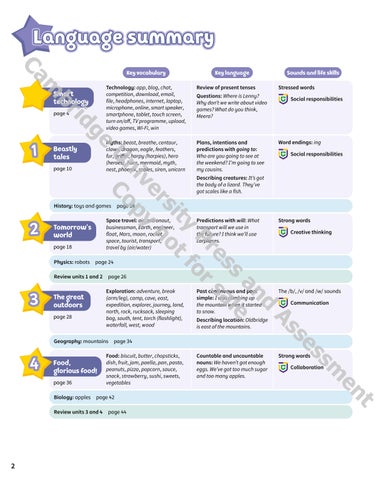
Language summary
Ca
Key vocabulary
m
br
Smart technology
Review of present tenses
Myths: beast, breathe, centaur, claws, dragon, eagle, feathers, fur, griffin, harpy (harpies), hero (heroes), horn, mermaid, myth, nest, phoenix, scales, siren, unicorn
Plans, intentions and predictions with going to: Who are you going to see at the weekend? I’m going to see my cousins.
page 10
Co
History: toys and games
2
page 18 Physics: robots
Stressed words Social responsibilities
Word endings: ing Social responsibilities
Describing creatures: It’s got the body of a lizard. They’ve got scales like a fish.
page 16
Space travel: air, astronaut, businessman, Earth, engineer, float, Mars, moon, rocket, space, tourist, transport, travel by (air/water)
Tomorrow’s world
Questions: Where is Lenny? Why don’t we write about video games? What do you think, Meera?
Sounds and life skills
As d an s le es sa Pr r y fo it t rs no ve y ni p
U
1
Beastly tales
Technology: app, blog, chat, competition, download, email, file, headphones, internet, laptop, microphone, online, smart speaker, smartphone, tablet, touch screen, turn on/off, TV programme, upload, video games, Wi-Fi, win
ge
id
page 4
Key language
Predictions with will: What transport will we use in the future? I think we’ll use carplanes.
Strong words
Past continuous and past simple: I was climbing up the mountain when it started to snow.
The /b/, /v/ and /w/ sounds
Creative thinking
page 24
Review units 1 and 2 page 26
3
Exploration: adventure, break (arm/leg), camp, cave, east, expedition, explorer, journey, land, north, rock, rucksack, sleeping bag, south, tent, torch (flashlight), waterfall, west, wood
The great outdoors page 28
Describing location: Oldbridge is east of the mountains.
Biology: apples
page 42
Strong words
Collaboration
en
page 36
Countable and uncountable nouns: We haven’t got enough eggs. We’ve got too much sugar and too many apples.
m
4
Food: biscuit, butter, chopsticks, dish, fruit, jam, paella, pan, pasta, peanuts, pizza, popcorn, sauce, snack, strawberry, sushi, sweets, vegetables
ss se
Geography: mountains page 34
Food, glorious food!
Communication
t
Review units 3 and 4 page 44
2
m
Ca br
5
Under the sea
Key language
Sea animals: claw, coral reef, crab, jellyfish, lobster, mammal, ocean, octopus, seal, shell, size, squid, turtle
Present perfect with for, since, still: The dolphin’s been on the sand for three hours. It’s been there since nine o’clock. I still haven’t seen a whale.
The /p/, /b/, /d/ and /ð/ sounds
Pronouns: anyone, anything, anywhere; everyone, everything, everywhere; no one, nothing, nowhere; someone, something, somewhere
Intonation in questions
Possibility with may, might: She says she might come. I may wear a skirt.
Connected speech
id
page 46
Key vocabulary
Free time
Hobbies: ballet dancing, beatbox, bike trail, board game, chess, clothes design, mountain bike, play an instrument, puzzles, sew, skateboard, tricks
Collaboration
Co
As d an s le es sa Pr r y fo it t rs no ve y ni p
page 54
Communication
page 52
U
6
ge
Environment: renewable energy
Sounds and life skills
Design: rollercoasters
page 60
Review units 5 and 6 page 62
7
Fashion sense page 64
Fashion: belt, button, coat, decorate, gloves, heavy, jacket, light, nylon, pocket, protect, shorts, thick, thin, tights, umbrella Adjectives: heavy, light, thick, thin
Design: fashion and the environment
8
Around the world page 72
Describing clothes: Tights can be light and thin or thick and heavy.
page 70
Countries and nationalities: Brazil, Brazilian, China, Chinese, France, French, Greece, Greek, India, Indian, Mexico, Mexican, Portugal, Portuguese, Spain, Spanish
Present perfect with just, yet, already: Juan’s already flown a kite. He hasn’t swum with dolphins yet. He’s just gone to school.
Stressed words Critical thinking
page 78
Review units 7 and 8 page 80
Grammar reference: units 1–4 Grammar reference: units 5–8
page 86 page 87
A2 Flyers Exam folder Listening Parts 2 and 3
page 88–95 Reading and Writing Parts 2, 4, 6 and 7
t
page 82 page 83 page 84 page 85
en
Values Units 1 & 2 Living with technology Units 3 & 4 Being safe at home Units 5 & 6 Helping at home Units 7 & 8 Sharing problems
m
ss se
Maths: graphs and charts
Collaboration
Speaking Parts 3 and 4
3
Smart technology
?
What technology do you use at home?
ge
id
br
m
Ca Co
As d an s le es sa Pr r y fo it t rs no ve y ni p
U
1
What’s the competition? Watch and check.
2
Watch again and number the sentences. 1
Where is he? The children have to change their books. The winners can enter the international blog competition. Stella thinks it sounds exciting.
3 Read and choose the right words.
5 There are / is a prize for the best blog. 6 The winners can enter / entering the international blog competition next year. 7 Why don’t / doesn’t we do our first blog post on technology? 8 Stella thinks it sound / sounds exciting.
4
Language: review of present tenses
t
1 What’s the prize for the competition? Why do they want to win it? 2 Have you ever entered a big competition? What did you do?
en
4 Ask and answer.
m
1 Lenny doesn’t / don’t arrive early. 2 Where has / is Lenny? 3 Stella and Lenny have / has to change their books at the library. 4 Lenny is / has got a message from Meera.
ss se
1 We can go to your house after that. 2 Hi, Meera. How are you? 3 We can write the best blog in the country. 4 There’s a new blog competition online. 5 I’ve got a message from Meera.
STUDY
1
Can you remember the last lesson? Watch the language video.
2
2
Read. Then listen and say ‘yes’ or ‘no’. Correct the wrong sentences.
Ca
National Blog Competition
There are two important prizes. The best blog wins new tablets for everyone in your class. The winners can also enter the international blog competition next year.
id
br
m
Write a blog and help your school. It’s open to all schools with students between the ages of 7 and 12. Students must write a blog post every month. The blog post should be interesting and include text and photos.
U
Xxxxxxx
ge
3 Read and answer.
Meera
Y es, great. What kind of technology should we write about?
Meera
Co
Lenny
As d an s le es sa Pr r y fo it t rs no ve y ni p
Stella
i everyone. So … let’s talk about our H first blog post for the competition.
Why don’t we write about video games? Good idea, Lenny!
Stella
Y es, I like that suggestion, but we should also write about other things . I’d like to write about online learning.
Lenny
OK. Shall I write about video games? Then you can write about online learning, Stella. What do you think, Meera? hat sounds good to me. Maybe I can T write about technology at home?
Stella
Y es, I love that idea. OK everyone, no more chatting! Let’s do it! See you at school tomorrow!
m
Lenny
ss se
Meera
1 What are they chatting about? 2 What would Lenny like to write about? 3 Does Meera like Lenny’s suggestion? 4 What does Stella think they should do? 5 Does Stella want to write about online shopping? 6 What’s Meera going to write about? 7 Who wants to start now? 8 When are they going to meet again?
In groups, ask and answer.
1 What do you want to write about? Why? 2 Do your friends want to write about the same thing? Why or why not?
5
Let’s (talk about) … What about …? Why don’t we (write about) …? That sounds good to me. Good idea. I like that idea/suggestion, but we should …
t
4 Imagine you’re going to write a blog post about school.
en
Useful language
Write your blog post: My school. Write 30–40 words. Practice: review of present tenses
5
1 Read the blog. What can technology give us? Find five things. ALL BLOGS
MY BLOG
NEW POST
K id’s Box
Technology is changing our lives a lot, so this is the topic of our first blog post. People use technology every day when they work, study or play.
br
m
Ca
s t r o p e R id
Technology
ge
We all use electronic devices like PCs (personal computers), laptops, tablets and smartphones to connect with people and programmes online. These days most people have Wi-Fi at home, and we use different programmes and apps to go online.
U
Online learning
Technology at home
Playing video games is one of the biggest hobbies for young people today. People can connect with lots of players in different places all over the world to play and chat online.
These days a lot of homes have a smart speaker. This can answer questions about the weather, music or TV programmes and, using Wi-Fi, people can connect it to other devices and ask it to do things. It can make a shopping list, turn the TV on or off, or control the temperature at home. Technology also helps in other ways. People can connect cameras in their house or garden, and watch their pets! Then, when they are not at home, they can watch what their pets are doing and make sure they’re safe.
Co
As d an s le es sa Pr r y fo it t rs no ve y ni p
In some parts of the world children don’t go to school. They learn in an online classroom where they can communicate with their teachers and friends. Students have to turn on their cameras so that the teacher and class can see them, and the computer screen becomes their classroom and whiteboard. They use headphones or speakers to listen, and they talk into a microphone. When they have to do homework, they can send their teacher a file by email or they can upload it in an app.
Video games
E-sports is a kind of competition using video games for teams or single players. Millions of people can watch the competitors playing online and it’s very exciting. For some people, it is their job to play in online competitions and they can earn money. We call these people gamers.
I always send my homework to my teacher through our school app.
2 What kind of technology would you like to have? Why? 6
Vocabulary: technology
t
1 Which of these do you use at home?
en
3 Talk to your partner.
5 People can watch online competitions and it’s very boring. 6 People can’t earn money by playing in video game competitions. 7 Smart speakers can make the beds. 8 With microphones people can see the inside of their houses on their screens.
m
1 Laptops, tablets and plants are electronic devices. 2 In an online classroom, students can communicate with teachers and insects. 3 When they have to do homework, they can send their teacher a postcard by email. 4 E-sports is a kind of meal using video games.
ss se
2 Read again and correct the sentences.
I would like to have a smart speaker at home because I want to ask it lots of questions.
1 Read and complete.
Ca
A smart speaker in the hall And send photos to our friends Headphones and big touch screens Now turn off the Wi-Fi We can use some apps as dictionaries We’ve got tablets in our schoolbags, An electronic smartboard on the wall. There are laptops,
br
m
Headphones and big touch screens .
id
(1)
,
(4)
And go out in the street. You love chatting with all your friends Every time you meet.
ge
Hear the future call!
We’ve got online learning, We use smart technology To find out what words mean,
U
There are robots in our homes now,
As d an s le es sa Pr r y fo it t rs no ve y ni p
(2)
.
(5)
It can answer everything we ask, Hear the future call!
Co
Video things on our phones
.
(3)
We chat on our video games And use programs to connect.
2
3–4
Listen and check. Then do karaoke.
3 Read and complete. app
chat download file internet likes online screen
en
m
ss se
Lenny Last week I got a cool new video game. The program was really big, so it took a long time to (1) download , but it’s brilliant. On Saturday I’m going to play and (2) online with friends from all over the world. Meera I enjoy taking photos and making videos. I share them (3) with a great (4) called CoolChat, which all of my friends use, too. I post my photos there and I sometimes get a lot of (5) ♥. Stella I love connecting to the (6) to get information for my homework. I use my tablet, which has got a (7) touch , so it’s faster for me to work. I’ve finished my project on technology and I’ve saved it in (8) a big . This evening I’m going to upload it for my teacher to read.
t
4
Write about how you use technology. Write 30–40 words. Practice: technology
7
Sou nds and life ski lls Being a good school citizen
Ca 1
m
Watch the video. How do they feel after they read about the competition? Listen and underline the stress in the words in bold. Write the words. 5
id
2
br
Pronunciation focus
ge
MEERA: … let’s write something for this competition and win those new tablets for our class. LENNY: Why don’t we do our first blog on technology? STELLA: Great idea, Lenny! That sounds very exciting!
Ooo
internet
oOo
computer
microphone
oOoo ooOo
Co
6
laptop keyboard
As d an s le es sa Pr r y fo it t rs no ve y ni p
U
3
Oo
Listen and complete. Practise with a partner.
A: What technology do you use every day? B: I use the
for my homework.
A: Have you got a or a B: I’ve got a
,a
?
.
4 Look and write more ideas.
How to be a good school citizen
be kind
en
m
ss se
A good school citizen has to …
t
5 In pairs, make a poster about how to be a good school citizen.
8
Sounds and life skills: stressed words |
social responsibilities
Useful language We can write … We have to … I think it’s important to … OVERMATTER
Diggory Bones
7
Sir Doug Bones! Nice to see you! So … what time’s Diggory’s talk on the Sun Stone?
You’ve got one of the best rooms, Dad. I never have lessons here.
Er, Dad, is your talk ready? Is everything on your laptop?
ge
id
br
m
Ca
Er … hello, Iyam! Er … it’s at half past two, after lunch.
Come on, Dad! It’s ten past one. It’s time for lunch.
Co
Have you got the Sun Stone here in the university, Diggory?
Yes. I can use it to explain ancient maths and technology.
They used this maths system to make their calendar, or Sun Stone.
It’s twenty-five to three.
Can I look under the cloth, son? Can I see the calendar?
The Aztecs used one of the first maths systems, which the ancient Mayas invented.
No, Dad. It’s a big surprise. You have to wait. OK. Let’s go. What’s this? I don’t understand!
What? lyam Greedy!
en
m Surprise, Doctor Bones! We both know there are more secrets in the Sun Stone than maths. You think you’ve got it, but I've got it now. If you want it, come and find me.
t
Press the button, Dad! Show the next photo!
Clap! Clap! Clap!
ss se
Dad! It’s the wrong photo!
Yes … yes, Emily. I’m turning it on now … and I’ve got a copy on my pen drive too.
As d an s le es sa Pr r y fo it t rs no ve y ni p
U
One day, Emily, one day.
1 What time’s Diggory’s talk? What does Diggory have to do to show the next photo? Story: unit language in context
9
1 Beastly tales
?
What stories about animals do you know?
ge
id
br
m
Ca Co
As d an s le es sa Pr r y fo it t rs no ve y ni p
U
1
What’s Stella good at? Watch and check.
2
Watch again and answer the questions.
School play King of the Beasts ACTORS NEEDED
Auditions Wednesday 3.45pm Quarter to four. 1 What time’s the audition going to be? 2 Who’s going to go to the audition? 3 Which part is she going to do in the audition? 5 Which part are they going to give Stella? 4 Who’s going to be King of the Beasts? 6 Are they going to write about the school play?
4 Ask and answer. 1 What did you think of Stella’s acting? 2 Do you like acting? Would you like to be in a school play? 10
Language: plans, intentions and predictions with going to
STUDY
t
is going to be on Wednesday. to be in the play. go to the audition. to be the monkey. to write about? be in the play? going to watch her.
en
a b c d e f g
m
1 Who’s going to 2 The audition 3 Stella’s going to 4 Meera and Lenny are 5 Stella isn’t going 6 Meera and Lenny aren’t going 7 What are they going
ss se
3 Read and match.
I’m going to go to the audition. We aren’t going to choose you. Are you going to be in the play? What’s Stella going to be in the play?
1
1
Can you remember the last lesson? Watch the language video.
2 Choose words from the box to complete the text.
Ca
bird cinema going have
island pets
restaurant
rocks see want
ge
id
br
m
Helen and Robert are (1) to go to going (2) the tomorrow. They’re going to (3) a film called My Family and Other Animals. The film’s from a book by Gerald Durrell and it’s about his life when he was ten years old. In the film, the boy lives on an (4) . He’s got some friends, but a lot of his friends are different (5) . (6) He’s got a called Ulysses, a tortoise called Achilles and lots of spiders. Helen and Robert are going to have a great time because it’s a very funny film.
As d an s le es sa Pr r y fo it t rs no ve y ni p
U
Co
3 Read again and answer. Check with a partner. 1 Where are Helen and Robert going to go? 2 What are they going to see? 3 What’s the film about?
4 How old is Gerald in the book? 5 What pets has Gerald got? 6 Why are Helen and Robert going to enjoy the film?
4 Read and cross out the extra word.
1 We’re are going to go to the theatre tomorrow. 2 We aren’t going to see at The Lion King. 3 I’m going to visit to my grandmother on Sunday.
5
Write questions with ‘going to’.
1 Who are you going to see
at the weekend?
en
m
Who are you going to see at the weekend?
t
6 Ask and answer.
ss se
1 Who / see / weekend? 2 What / do / Monday / after school? 3 play basketball / tomorrow afternoon? 4 Where / go / Friday / after school? 5 What / watch / TV / tomorrow? 6 When / do / your homework?
7
4 What are you to going to see? 5 Where do are you going to sit? 6 She isn’t going to sing on tonight.
I’m going to see my cousins.
Write about what you’re going to do next week. Write 30–40 words. Practice: plans, intentions and predictions with going to
11
1 Read the blog. How many of the beasts are part bird? ALL BLOGS
MY BLOG
NEW POST
K id’s Box
Myths
id
br
m
Ca
s t r o p e R
There are many ancient stories from different countries. Some are about heroes and strange and exciting beasts which aren’t real. These stories are called myths.
ge
Griffins have got the head, wings, front legs and claws of an eagle, and the body and
U
A unicorn is a beautiful white horse with one long horn on its head. It’s got a goat’s feet and beard, and a lion’s tail.
As d an s le es sa Pr r y fo it t rs no ve y ni p
back legs of a lion. They make nests from gold.
Sirens and harpies are both part
Co
A dragon is a beast which has got the body of a lizard, so dragons haven’t got fur like a cat or feathers like a bird; they’ve got scales like a fish. Some dragons have got wings like a bat, and some can breathe fire.
bird, part woman, but they’re different. Sirens live near water. They sing beautifully, but they’re dangerous because people sail their boats onto rocks to listen to them. Harpies can’t sing, but they can fly. They live in nests and steal food from people.
The centaur is part horse, but it’s got the head and top half of a man, and the body and legs of a horse.
Correct the wrong sentences.
2 Can you think of another beast from a story you know? What does it look like? A cyclops is a giant with one eye. It looks like a very big man!
t
Vocabulary: myths
I think griffins are the most interesting because they make nests from gold.
en
12
1 Which of these beasts do you think are the most interesting? Why?
m
1 Griffins make their nests from feathers. 2 A dragon’s got the body of a lizard. 3 A centaur’s got the legs of a goat. 4 A unicorn’s got two horns. 5 Sirens and harpies are part dragon and part woman. 6 Sirens steal people’s food. 7 Harpies live in nests. 8 Mermaids have got a big lizard tail.
3 Talk to your partner.
ss se
2 Read again and say ‘yes’ or ‘no’.
Sometimes people think mermaids are the same as sirens, but mermaids are half woman, half fish. They’ve got beautiful long hair, but they haven’t got legs. They’ve got a fish’s tail with scales.
1
1
Listen and choose the right words.
8
m
Ca
1 The phoenix is a song / myth / game. 2 The phoenix was a beautiful bird / lion / horse. 3 The phoenix lived for five / fifty / five hundred years. 4 The first people to believe in the phoenix were the Egyptians / Romans / Greeks. 5 The phoenix was born in a pond / fire / tree.
2 Read and complete. Order the pictures.
c
id
br
a
ge
clearer do Fleece Greece horse island sea sings song sports told Myths and legends, stories of old, Beastly tales which people (1) . told Adventures and monsters, strange animals too, Heroes who had great things to (2) .
Co
As d an s le es sa Pr r y fo it t rs no ve y ni p
U
b
The Greeks are famous, not just for (3) But also for Jason and the Argonauts. They wrote, in their mythology, Of his adventures across the (4)
,
d
1
e
.
Jason’s bad uncle made him look for the ‘fleece’. Special wool made of gold, so they tell us in (5) . He had a clever teacher, like yours, of course! His teacher was a centaur – half man, half (6) .
3
beast. Answer the questions. 1 What are you going to call it?
I’m going to call it a …
2 What’s your beast going to look like?
It’s going to have a …’s head, …
ss se
3 What colour’s it going to be? 4 Is it going to have feathers, fur or scales? 5 Is it going to have spots or stripes? What else is it going to have on its body?
en
m
.
5 Ask and answer about your
t
This is part of the myth from Ancient Greece . Of Jason and the Golden (11)
Then do karaoke.
4 Invent an amazing mythical
The teacher told him all about the dangerous siren Who could break his boat on rocks round the (7) . She’s half woman, half bird, with feathers and wings. She sounds really beautiful when she (8) . The Argonauts were sailing and before too long . They started to hear the siren’s (9) It sounded lovely, but they didn’t go nearer ’Cos Orpheus’s music was louder and (10)
9–10 Listen and check.
beast in pairs.
6
Draw and write about your beast. Write 30–40 words. Practice: myths
13
Sou nds and life ski lls Supporting your friends
Ca 1
Watch the video. How does Stella feel before, during and after the audition?
m
Pronunciation focus
br
2
11 Listen and write the word
LENNY:
ge
id
endings. Then practise with a partner.
Co
As d an s le es sa Pr r y fo it t rs no ve y ni p
U
ell, I think you’re good at W ! sing STELLA: I’m go to be a famous with that blog writer, start competition! So, what are we going to write about this time? LENNY: Well, not The K of the Beasts! MEERA: … there are some older stories about other really excit beasts.
3
12 Listen and write. Say some more examples.
I think you’re good at Are you
4
to
. in a competition?
13 Listen and number. What other
support can you give?
5 In pairs, do a role play.
What do you worry about? b
Student B Listen to your partner. Give them some support.
Useful language c
Sounds and life skills: word endings: ing |
social responsibilities
t
14
Good luck with … Go for it! You’re good at it! We’re right here with you!
d
en
m
ss se
a
Student A d You are worrie g. in th e about som r. e Tell your partn
Diggory Bones
14
id
br
m
Ca
That beast lyam Greedy’s got the Aztec calendar!
ge
Who’s lyam Greedy, Grandad?
Are you going to explain it to us, son?
Now I understand. It’s 6, 1, 9, 3, 4, 2, 3, 9, 7. Does that mean anything?
He means Quetzalcoatl. He was part bird and part snake and he was the most important god in Aztec mythology.
They look like that maths system to me.
It sounds like a phone number to me. Well, let’s try it. I’m going to put it on loudspeaker.
Plane tickets! Are you going to go to Mexico City, son?
en
m We are now. Come on, Emily! We’ve got a job to do.
t
What does he mean?
Look Dad! There’s an envelope. It’s for you!
ss se
Clap! Clap! Clap!
There are nine numbers. The first one’s a spot with a stripe under it, so that’s six.
Co
Look! A spot means one and a stripe means five … hmmm.
Well done, Dr Bones! I’m a snake and I’ve got feathers, but I can’t fly. Are you going to fly?
We haven’t got the calendar. How am I going to tell What do the museum in these spots Mexico City? and stripes mean, Grandad?
As d an s le es sa Pr r y fo it t rs no ve y ni p
U What? Let me see that!
He’s the worst Kind of pirate. He only looks for ancient treasure to get rich.
1
1 Why is Iyam Greedy a bad pirate? Which god in Aztec mythology was part bird and part snake?
Story: unit language in context
15
How have ou r toy s and games changed? 1
Listen and read. Which toys or games do people still play with today?
15
Ca
Fun and games in
br
m
ancient times id
One of the oldest board games in the world is called Senet and it was very popular in ancient Egypt. Can you believe that people enjoyed playing it more than 4,000 years ago? Some people used a box with 30 squares and counters made of bone, but there were other ways to play it. Some people made their own game by drawing squares in the sand or on paper and using stones as counters, so it was a game for everyone.
Did you know that people in ancient times loved playing with toys and games just like we do today? In fact, many toys and games from the past are similar to modern ones. So how did people have fun a long time ago?
ge
The Ancient Greeks and Romans played games with dice made of bone, wood or stone. The dice had six sides with spots on them to show the numbers, just like dice today. Some very early dice had only four sides, which were in the shape of a triangle. The oldest dice ever are about 5,000 years old!
Co
As d an s le es sa Pr r y fo it t rs no ve y ni p
U
People started playing with yo-yos more than 2,000 years ago. This painting shows a young Greek woman with a yo-yo. They were often made of wood, metal or terracotta, and they had a string attached.
2 Read again and complete the table. Toy/Game (1)
yo-yos
Place
ancient Greece
Time
2,000 years
Materials
(2) (3)
board game
(4)
(5)
bone, or sand, paper and
(8)
and ancient Rome
5,000 years
ss se
(6)
(7)
, metal, , string
bone, wood, stone
m en
3 Which toys or games did you like when you were young? What entertainment is popular today?
I think playing games on a smartphone is really popular today! 16
Language: theand timegames | History: toys
creative thinking
FIND OUT MORE
What are some other games people played in ancient times?
t
I loved playing board games when I was young, but I like video games now.
you win this game? Blog
1
DID YOU KNOW…?
1 Read the review. How do Game on!
Index
ge
id
br
m
Ca
Monopoly is one of the most popular board games in history and more than one billion people in the world have played it! The longes t Monopoly game ever took 70 days!
Cluedo
The game has got a board with a big house on it. Players use dice to move around, and when they are in a room, they can make guesses about the murderer, the weapon, and where the murder happened.You can use logic to work out the correct answers. It’s a game which usually takes between 10 and 60 minutes – not too long and not too short!
Co
As d an s le es sa Pr r y fo it t rs no ve y ni p
U
Cluedo is a classic board game which families have enjoyed since 1949! Everyone is a detective, and the winner is the player who solves the murder of Doctor Black.You need to use logic to discover the name of the murderer, the weapon they used, and the room where the murder happened.
To play Cluedo, you need 3–6 players who are aged 8 or older. This makes it a perfect game for having fun with your family and friends. I think every house should have Cluedo on their games shelf because it’s great fun and it helps you practise your problem-solving skills at the same time.
by Eliana
2 Underline who and which in the review in Activity 1. 3
Learning to write:
In pairs, discuss a game you know how to play. Answer these questions.
How old should they be?
en
How do you win?
How long is it?
m
How many players do you need?
We use who and which to connect two parts of a sentence. Cluedo is a classic board game which families have enjoyed since 1949! The winner is the person who solves the murder.
ss se
How do you play the game?
who and which
Why do you like the game?
t
Ready to write: Go to Activity Book page 16.
Make a board game.
History: toys and games |
Language: the time creative thinking
17
2 Tomorrow’s world
?
How many types of transport do you know?
ge
id
br
m
Ca Co
As d an s le es sa Pr r y fo it t rs no ve y ni p
U
1
What does the rocket do? Watch and check.
2
Watch again and correct the sentences.
4 will / hit? / rocket / the / What 5 another / won’t / rocket / fly / garden. / the / They / in 6 transport / be / of the / future. / will / Rockets / the
1 Lenny thinks rockets are the transport of the future. Do you agree? 2 Do you enjoy doing science experiments? Describe your favourite one. 18
Language: predictions with will
t
4 Ask and answer.
en
1 the / hit / will / rocket / The / window. 2 fly? / Meera’s / Will / rocket 3 stars. / won’t / to / the / rocket / go / Meera’s
We’ll all travel by air. Will it fly? It won’t go very far.
m
3 Read and order the words.
STUDY
ss se
Meera’s making a rocket. 1 Meera’s making a car. 2 Lenny thinks we’ll travel by water. 3 The rocket will swim. 4 The rocket will go to the stars. 5 Meera will get some photos of rockets. 6 Their next blog post will be about the transport of the past.
1
In the future we won’t drive on roads and motorways. We’ll use carplanes, which will fly three metres above the ground. These will carry six people. They won’t have a pilot because a computer will fly them. There’ll be a small round table and six armchairs with cushions inside, like a small living room. There’ll be a robot waiter to give us food and drink. We’ll chat on the internet and watch our favourite videos on big computer screens.
m
Ca
2 Read and say the words.
br
Transport of the future! , not a (2)
.
id
It’ll be a (1)
It’ll pick up kids for school.
ge
There won’t be any normal doors. The sides of the carplane will open by moving slowly down under the floor of the car. There won’t be any maps and we’ll never get lost because carplanes will always know where to go.
It’ll stop for all of us.
As d an s le es sa Pr r y fo it t rs no ve y ni p
U
Transport of the future!
I’ll have a computer on my (3)
So I’ll ride it where I like! Transport of the future! There won’t be (5) or (6)
.
Co
It’ll say, ‘Be careful! (4) on right!’
.
How’ll we go on holiday?
We’ll catch spaceships and spaceplanes. Transport of the future!
1 What transport will we use in the future? 2 How high will carplanes fly? 3 Why won’t a carplane have a pilot? 4 What kind of chairs will there be inside? 5 What will the inside of a carplane look like? 6 Why will it be easy to travel without maps?
5 Do you think these things will happen? Why or why not? In 2075 …
1 people will eat different food. 2 children won’t need to go to school. 3 everyone will have a robot which looks like a person. 4 no one will drive cars or trains. 5 there won’t be any smartphones. 6 people will keep their memories on a microchip in their head. 7 waiters in restaurants will be robots. 8 people will wear different clothes.
We’ll have wings on all our .
(7)
ss se
Where do you think we’ll go? We’ll fly up to the stars.
to the moon.
6 Work in pairs. Talk about what life will be like in 2075.
We’ll leave here very soon!
3
Listen and check. Then do karaoke. 16–17
7
I think we’ll eat different food.
t
When’ll we leave planet Earth?
en
m
Transport of the future! We’ll take a (8)
2
4 Read and answer.
Can you remember the last lesson? Watch the language video.
Really? What kind of food do you think we’ll eat?
Write about your city in 2075. Write 30–40 words. Practice: predictions with will
19
1 Read the blog. What are the three different kinds of space tourists? ALL BLOGS
MY BLOG
NEW POST
K id’s Box
br
m
Ca
s t r o p e R
Our next blog post is about space travel. The first man walked on the moon in 1968, but now engineers are designing rockets which will send astronauts to Mars.
id
Space travel
ge
The most important space agencies in the world are NASA (in the USA), ESA (in Europe) and the Russian, Chinese and Indian space programmes. They build rockets and teach astronauts how to fly them. Rockets take a long time to build and cost a lot of money, so they’re too expensive to use as normal transport.
As d an s le es sa Pr r y fo it t rs no ve y ni p
U
Some businessmen are helping space agencies to build better and cheaper rockets because they are interested in space travel, and they want to send tourists into space and to the moon. Space tourists are people who are not astronauts, but want to visit space. It’s a very expensive adventure! In 2021, a Japanese billionaire businessman paid nearly $35 million to stay on the International Space Station for 12 days. He is called an ‘orbital space tourist’
Co
A new space programme called Artemis is planning different kinds of missions which will help us to explore space. Some of these missions will take people to the moon and to Mars. The astronauts on these missions live on a giant space station called the Gateway, which will stay in space for more than ten years. On the Gateway, astronauts make and recycle air and water so they can live in space for a long time.
2 Would you like to go to Mars? Why or why not? 20
Vocabulary: space travel
t
1 Do you think you’ll ever travel to the moon? Why or why not?
en
3 Talk to your partner.
5 What are businessmen helping space agencies to do? 6 How much did it cost the businessman to travel round Earth? 7 How far from Earth is space? 8 Where will space tourists travel in the future?
m
1 Where are the five most famous space agencies? 2 Name two problems with rockets. 3 Who flies rockets? 4 What will astronauts do while they live on the Gateway?
ss se
2 Read again and answer.
because he travelled around the Earth. ‘Suborbital space tourists’ can go to see Earth from above, but they don’t orbit it. They fly higher than 100 km above Earth, which is where space starts, and for about five minutes they float inside the spaceship. One day, ‘lunar tourists’ will travel outside Earth’s orbit. They’ll travel to the moon and in the future they’ll be able to go to Mars, too.
No, I don’t. Because I haven’t got lots of money! I would like to go to Mars because I love adventures.
2
1 Look at the pictures. Read and order the words. 1
2
br
m
Ca 4
ge
id
3
As d an s le es sa Pr r y fo it t rs no ve y ni p
U Co
1 and make / Engineers / spaceships. / will design 2 in space stations / will stay / Space tourists / for their holidays. 3 on Mars but / will work / not on the sun. / Robots 4 Rockets and / solar energy. / will use / other transport
2
18
Listen and answer. What is the man designing?
3
19
Listen again and write.
4
Write questions with ‘will’. 1 When will you go
into space?
en
t
1 When / go / space? 2 What kind of clothes / wear / space? 3 What kind of food / eat / space? 4 What / take / photo of? 5 Who / go with? 6 What / take / with you?
m
ss se
Name: (1) Robert Surname: (2) Dream job: (3) Age next birthday: (4) Present job: (5) Rocket name: (6)
5 Imagine you are an astronaut. Ask and answer. When will you go into space?
Well, I think I’ll go next year. Practice: space travel
21
Sou nds and life ski lls Choosing a point of view
Ca 1
m
Watch the video. What do Lenny and Stella think about the rocket?
3
id
2
br
Pronunciation focus 20 Listen and underline the
ge
strong words. Then practise with a partner.
LENNY:
Practise with a partner.
A: In the future, we’ll
.
B: And we won’t
.
As d an s le es sa Pr r y fo it t rs no ve y ni p
U
oon there won’t be any buses or cars – S we’ll all travel by air. STELLA: Or we’ll walk. We’ll still have legs! LENNY: Will it fly?
21 Listen and complete.
A: Will we
?
B: I’m not sure.
Co
4
In pairs, think of and write more examples.
Cars will fly.
Transport
Schools
Clothes
In 2100 …
en
m
All roofs will have solar panels. Do you agree?
22
I don’t agree. We won’t … because …
Sounds and life skills: strong words |
creative thinking
In the future, I think we’ll … We won’t … I agree / I don’t agree because …
t
Useful language
5 In a group, discuss your predictions. I agree, I think we will …
Food
ss se
Houses
Free time
Diggory Bones
22
Why did lyam Greedy send us tickets to Mexico City?
The sun, moon and stars were very important to both the Aztecs and the Mayas.
ge
id
br
m
Ca
This is the last call for flight MYTC 155 to Mexico City. Will passengers please go quickly to Gate 6.
2
U
Co
One with months and seasons for their work, and one for their mythology.
Hmm … they watched this big group of stars very carefully.
The Pleiades. The Aztec new year started when they could see these stars in the early morning, before the sun.
But they called them ‘The Market Place’. What a strange name!
We won’t stay in Mexico City tonight, Emily. We must get to Teotihuacan before Greedy.
21 June will be the longest day of the year … that was also very important in Aztec mythology.
It’s 18 June now! Do you think the secret of the Aztec gold’s in their calendar, Dad?
What’s at Teoti … what’s there, Dad?
en
m
ss se
I don’t know, but you should try to sleep now.
Like us, they used them to measure time, but they had two different calendars.
As d an s le es sa Pr r y fo it t rs no ve y ni p
Come on, Emily. That’s our plane. We’ll have to run.
It was the most important Aztec city and there are legends about Aztec gold.
t
Yes, I will. It’ll take about ten hours to get there.
I don’t know, but soon it’s the longest day of the year.
1 What did the Aztecs and the Mayas use to measure time? When did the Aztec new year start?
Story: unit language in context
23
Wh at ca n ro bots do fo r us? 1
23 Listen and read. What kinds of robots are in the photos?
Ca
m
Life with Robots
ge
id
br
Did you know that a robot called Raptor can run 46 km an hour? That’s much faster than the fastest human on Earth! Humans make robots with computer technology and they help us do different kinds of jobs.
Co
In 1961, a factory in the USA used the world’s first industrial robot. It was a robot arm that could pick up hot metal to make cars, which is a dangerous job that’s difficult for humans to do. Robots work faster than people too, so this helps factories to produce more.
At home, a domestic robot makes life easier for humans. These robots can clean, look after your pets, or keep your home safe thanks to a built-in alarm. They can even entertain you! Some robot devices can answer questions, play your favourite music, and search the internet for you!
Humans have used space robots since the 1950s. The first space robot to go all the way to Mars was called Viking. Viking’s job was to take photos of Mars to help us learn more about the planet. Since then, five different robot vehicles, called Rovers, have travelled to Mars too. These robots do lots of research to find out if humans will be able to visit Mars in the future.
As d an s le es sa Pr r y fo it t rs no ve y ni p
U
In hospitals, medical robots help doctors to do important jobs. For example, special machines can perform surgery if the doctor’s hand is too large. And doctors can even do surgery from a distance. They use computers to control robots which perform remote surgery on people who are in a different hospital.
2 Read again and answer.
It tells me the time, and what the weather’s like.
24
Physics: robots |
creative thinking
t
What does it say?
en
We’ve got a robot device at home. I can talk to it and ask it questions.
m
3 Have you ever used a robot device? What can you use it for?
A space robot.
ss se
1 Which robot would you choose to do important research for humans? 2 Which robot would you choose to help with housework? 3 Which robot would you choose to do surgery on someone? 4 Which robot would you choose to do jobs that aren’t safe for humans? 5 Which robot would you choose to take photos of another planet?
FIND OUT MORE The Robobee is one of the smallest robots in the world! What does it look like?
1 Read the instructions. What kind
2
DID YOU KNOW…?
of robot is it? Write.
Ca
Robots can travel very far from home! It took the spacecraft carrying the Perseverance Rover seven months to reach Mars. It had to travel about 480 million km to get the re!
How to make a Materials
br
m
robot
You will need paper, pencils, scissors and craft materials.
id
Instructions
ge
1 Plan your robot. Think about your robot
If something doesn’t work, don’t worry. Try a different way.
4 Test your robot. It will need to land on a planet,
Co
As d an s le es sa Pr r y fo it t rs no ve y ni p
U
and answer these questions: • What will it do? • What will it look like? • How far will it travel? • How will it move in space? (Wings? Solar power?) • What other special things will it have? Will it have wheels, arms, or cameras to take photos?
2 Draw a picture of your robot and label all of the parts. 3 Build your robot. Use any materials you can find. so it will need to be strong. Shake it and check it doesn’t break.
5 Give your robot an exciting name.
Mars Rovers in the past were called Perseverance, Spirit, and Opportunity!
2 Underline the instruction verbs in the instructions in Activity 1. 3
In pairs, discuss ideas for a new robot. Make notes in your notebook.
what it looks like:
Instructions
We use a verb, or Don’t + verb, to give instructions. Plan your robot. If something doesn’t work, don’t worry.
ss se
My Robot
Learning to write:
how it works:
en
m
what it does:
t
Ready to write: Go to Activity Book page 24.
Follow instructions and make a robot. Physics: robots |
creative thinking
25
Units 1 and 2
Ca
1 Read the text. Choose the right words and write them on the lines.
id
br
m
The moon is (1) Earth’s only natural satellite. That around the Earth means that the moon (2) (3) than Earth and once every 27 days. It is (4) diameter is 3,474 km.
ge
21 July 1969, The first visit to the moon was (5) (6) Neil Armstrong, an American astronaut, (7) the first man to walk on the moon. The USA sent rockets with astronauts to the moon over three years but they stopped in 1972 because it was very expensive.
Earth goes more it’s in when is say can works
Earth’s went small its for who was says will work
As d an s le es sa Pr r y fo it t rs no ve y ni p
U
Co
they will Now different space agencies (8) send astronauts to the moon again. The American, the Russian, the Chinese, the Indian and the European space agencies all have plans for missions to the moon. NASA (9) to build a camp at one of the lunar poles. It is doing tests in Antarctica to see how well it (10) . It wants astronauts to visit the moon again so it can plan to fly to Mars!
2
1 2 3 4 5 6 7 8 9 10
Earth is go smaller her on where were saying wants working
24 Listen and colour and write. There is one example.
en
m
ss se
t
26
Review: units 1 and 2
2
3 Play the game. Rocket launch
ge
id
br
m
Ca
Instructions: ● English is the international language of space. USE it or MISS a turn! ● Throw a dice and move round the board. First, collect a rocket, fuel and food on Earth. ● When you have all three, continue to the LAUNCH square and fly to the moon. ● When you reach the LAUNCH square, fly to Mars. How will you help the planet? ● Read and follow all the instructions as you move round the board. Race to the END!
U
Yo wa u fin ter d Go Mar on fo s. thr rwar sp ee d ac es .
t go n’t . ve rgy o ha ene to g r You uch eed luna m ll n he on. t ti ’ You ck to sta ba pace s
As d an s le es sa Pr r y fo it t rs no ve y ni p
t ke oc s r ur ed s. Yo ne air rn. p tu re a ss Mi
You h g ave mo ot an n’t Yo re f y to u’ll n uel. thr ee ow d a6 .
en
m
t
’t ven a h y You ot an od. g o d f e re mo ’ll ne a 1. You row th to
e There ar o aliens. G ee back thr spaces.
Yo go u ha t a ve fue ny n’t m l n . Yo ore thr eed u’ll ow to a6 .
ss se
You r ene sola wo rgy r str rki aig ng. is ht G to o Ma rs.
Co
t ne er ing. t in rk ur o ’t Yo ’t w can cate isn You uni rth. . mm Ea rn co ith a tu w ss Mi
You haven ’t got any more food. You’ll need to throw a 1.
Review: units 1 and 2
27
3 The great outdoors ?
What activities do you like doing in the countryside?
ge
id
br
m
Ca Co
As d an s le es sa Pr r y fo it t rs no ve y ni p
U
1
Where did Lenny break his arm? Watch and check.
2
Watch again and say ‘yes’ or ‘no’. Correct the wrong sentences.
1 Lenny broke his arm last Friday. No. Lenny broke his arm last Saturday. 2 Lenny was jumping when he fell. 3 Lenny was jumping over a rock when he broke his arm. 4 Lenny put his foot in a hole when he was crossing the bridge. I was jumping over a rock when I fell. 5 Lenny was taking his boots off when he fell over. Were you playing when you broke
STUDY
1 What did you think of Lenny’s big adventure? 2 Have you or one of your friends ever broken a bone? What happened? 28
Language: past continuous and past simple
t
4 Ask and answer.
en
1 Lenny and his dad was / were climbing a hill. 2 Lenny was / wasn’t playing when he fell over. 3 They were walking / walks across a bridge when Lenny put his foot in a hole. 4 They wasn’t / weren’t having a picnic in the wood. 5 Lenny didn’t break his arm when he is / was crossing the bridge. 6 He was taking / took his boots off when he fell over.
m
ss se
3 Read and choose the right words.
your arm? No, I wasn’t playing.
1
3
Can you remember the last lesson? Watch the language video.
2 Read and complete.
br
m
Ca
And I had to jump out Go down a waterfall It didn’t make a sound There was nowhere else to go Was racing after me
There was nowhere else to go
What an adventure!
I was sailing on a river, Enjoying it all. Then I saw a boat in front of me
.
(4)
As d an s le es sa Pr r y fo it t rs no ve y ni p
U
(1)
ge
id
I was climbing up the mountain When it started to snow. I hid in a cave.
What an adventure!
Co
I was swimming down a river When I thought I saw a tree. A big crocodile (2)
What an adventure!
I was camping in the jungle. I was sleeping on the ground, When suddenly I felt a snake.
.
. What an adventure! What an adventure!
(5)
I was flying over an island. I was looking all about When my plane coughed and stopped
.
(3)
What an adventure!
3
.
25–26
Listen and check. Then do karaoke.
3 You can read the story when you answer the last question.
My name’s Diggory Bones. I was on a space rocket at 4 o’clock last Saturday afternoon. I was wearing a swimming costume and sunglasses.
Practice: past continuous and past simple
t
2 Fold the paper and pass it to the classmate on your left.
Write the story from the game.
en
1 Listen to your teacher. Write your answer at the top of a piece of paper.
6
m
5 Play the game.
ss se
4 In groups, say what happened next.
29
1 Read the blog. Which journey do you think is the most exciting? Why? ALL BLOGS
MY BLOG
NEW POST
K id’s Box
We always want to find out more about the planet where we live. Explorers travel to new places to learn new things.
br
m
Ca
s t r o p e R id
Explorers
ge
Marco Polo
Co
As d an s le es sa Pr r y fo it t rs no ve y ni p
U
Marco Polo was not the first European to travel east to China, but he is the most famous because of his books. Lots of people have read these, including the explorer Christopher Columbus. Marco left Italy in 1271 and returned 24 years later. When he went to China he travelled mostly over land, but when he came back to Europe, he travelled mostly by sea. He brought back the idea of paper money, which people later copied.
Zara Rutherford
In 2021, Zara Rutherford became the youngest female pilot to fly around the world by herself. She began her journey in Belgium and flew west, and she stopped in 31 countries on five different continents! It took her five months to travel more than 50,000 km in a special plane called a microlight. This is a plane so small a person can push it. Because her plane was so small, she couldn’t carry a lot of things with her, but she had a rucksack, a sleeping bag and a torch or flashlight to see in the dark.
Felicity Aston
Felicity Aston is another famous explorer. She began her adventures in 2000 when she travelled to Antarctica for the first time. She has been on expeditions all around the world, but especially to the North and South Poles. She skied across Antarctica alone in 2012. It took her 59 days to cover 1,744 km, so she had to camp in a tent every night. She was the first woman to do this. She has written books about her adventures and has won a lot of prizes for her work.
t
Vocabulary: exploration
I think Felicity Aston had the most difficult adventure because she skied across Antarctica alone!
en
30
1 Which of these explorers do you think had the most difficult adventure? Why?
m
1 Marco Polo travelled east to Australia. 2 Marco Polo wrote a newspaper about his journey. 3 Zara Rutherford flew around the world with her parents. 4 A rucksack is a bag you can sleep in. 5 A microlight is one of the biggest planes in the world. 6 Felicity Aston began her adventures in 2021. 7 Felicity Aston was the first woman to snowboard across Antarctica. 8 Felicity Aston has designed computer games about her adventures.
3 Talk to your partner.
ss se
2 Read again and correct the sentences.
2 Where would you like to explore? Why? I would like to explore China because I have never been there, and I like Chinese food.
3
1 Read and match. Say the word and the letter. a
b
c
e
d
br
m
Ca torch – d
ge
id
1 It’s something you use to see in the dark. 2 It’s a big bag which you carry on your back. 3 It’s like a small house. You use it when you go camping. 4 It’s something which you sleep in. 5 It’s someone who travels to a new place to learn about it.
U
As d an s le es sa Pr r y fo it t rs no ve y ni p
2 Look at the map and say ‘yes’ or ‘no’. Correct the wrong sentences.
Co
1 Clidditch is north of Ness Lake. 2 Alchester is south of the Deep Sea. 3 Mainwitch is east of the Deep Sea. 4 Hamptonville is north of Deer Wood. 5 Clidditch is south of Littleton. 6 Oldbridge is east of the mountains. 7 The mountains are south of Mainwitch. 8 Littleton is west of Mainwitch.
3 Play the game.
It’s south of Clidditch and west of Oldbridge. Is it Ness Lake? Yes!
Listen. What camping things do you pick up? Where are you?
m
5
27
ss se
4
Write an adventure. Use the map and as many words in the box as you can.
en One day I was walking near the Black Cav es by myself when …
Practice: exploration
t
beach bridge cave grass hill lake mountain plan river rock waterfall
31
Sou nds and life ski lls Imagining possibilities
Ca 1
Watch the video. How did Lenny break his arm?
m
Pronunciation focus
3
28 Listen and read. Underline
br
2
with a partner.
id
the sounds /b/, /v/ or /w/.
29 Listen and write. Practise
on a
ge
STELLA: S o, were you playing when you broke your arm? LENNY: No, I wasn’t playing, Stella, and that wasn’t when I broke my arm. We were in the wood, and we had to cross a really fast river. We were walking across the bridge when I put my foot through a hole and fell again.
over a very fast in a big
As d an s le es sa Pr r y fo it t rs no ve y ni p
U
We were walking
when I broke my arm.
near a beautiful
Co
4 Look at the stories. Read and match. What an adventure!
1
a
I was visiting my friend on her farm. It was my first time on the farm. She has horses and I was so excited because she let me ride her horse!
2 I was in a shopping centre with my mum. She went
b I was climbing up to get
down in a lift, but I don’t like lifts, so I decided to race her, and I ran really fast down the stairs.
kite in the park. My kite was flying really high when it flew into a tall tree.
it when I fell and, yes … I broke my arm!
c It was walking quietly when
ss se
3 It was a very windy day, so I was flying my
I was running down so fast that I couldn’t stop! I fell and broke my arm!
suddenly it started to go fast. I fell off and broke my arm.
m en
5 In pairs, imagine you are Lenny and tell your story. Choose some of these places. at a museum at the funfair 32
Useful language
on a camping holiday
in the classroom
in the park
on a farm
Sounds and life skills: the /b/, /v/ and /w/ sounds |
in the mountains
communication
I was (walking) when I … We were (playing) in the park when I …
t
How did you break your arm?
Diggory Bones
30
The Aztecs built and lived in Tenochtitlan, which is now called Mexico City, but Teotihuacan is much older.
Greedy said, ‘I’m a snake and I’ve got feathers, but I can’t fly.’
ge
id
br
m
Ca
I thought Mexico City was the most important Aztec city, Dad.
3
That’s what Greedy wants us to believe.
As d an s le es sa Pr r y fo it t rs no ve y ni p
U
Of course! The Temple of Quetzalcoatl … It’s near the pyramids in the ancient city of Teotihuacan!
Good morning. I was sitting on the plane next to you yesterday. My name’s Tricker, Richard Tricker.
Co
We’re only 40 km northeast of Mexico City. If I’m wrong, we can easily go back.
I don’t think you’re wrong …
That’s good. Will you take us there today?
This long street goes from north to south. It joins the Pyramid of the Sun and the Pyramid of the Moon.
Well done, Diggory! Now we’re going on an adventure and you’ll need your rucksacks. Here they are.
Hello, lyam. I was expecting to meet you here.
Clap! Clap! Clap!
en
m
ss se
Let’s go over there now.
We’re not …
Good morning, Mr Tricker. Will you join us for breakfast?
Quetzalcoatl … the Aztec god of the world. The snake shows earth and plants, and feathers show the air and sky.
You were talking about the pyramids. I often take tourists there.
t
The Pyramid of the Sun is the highest in the world and its west face is in line with the Pleiades.
1 What was the old name for Mexico City? Which is the highest pyramid in the world? Story: unit language in context
33
Wh at ca n we see in ou r wo rld? 1
Listen and read. Write the headings.
31
br
m
Ca
Cold mountains How are mountains formed? The highest and the longest The young and the old We are mountaineers! What is a mountain? 4 The Himalayas are millions of years old, but they are the youngest mountains on Earth. The Makhonjwas Mountains in South Africa formed about 3.6 billion years ago, and they are older than any other mountain range.
ge
id
1 What is a mountain? A mountain is a landform that stands high above the land around it. There are mountains all over the world. Scientists have even found huge mountains under the sea. We call lots of mountains standing together a mountain range.
U
Mountains are cold because they’re high. Even mountains in hot countries can have snow on the top! But the coldest mountain of all is Denali in Alaska. It’s the highest peak in North America.
As d an s le es sa Pr r y fo it t rs no ve y ni p
2
5
Co
Mountains take millions of years to form. When two plates in the Earth’s crust push together over a very long time, all the rocks slowly build up and up, until they make a mountain!
6
crust
3
The Himalayas started forming 40–50 million years ago. The world’s highest mountain, Mount Everest, is in the Himalayas. Everest is still growing, and gets taller every year. The Himalayas are about 2,600 km long, but the Andes in South America are 7,000 km long, and they’re the longest mountain range in the world.
Read again and complete the table. Mountain Range
Continent
The Alps
1
The Himalayas The Andes
Europe
Length
Age
ss se
2
Lots of people love climbing mountains, and about 4,000 people have already climbed Mount Everest. But other mountains are much harder to climb. K2, also in the Himalayas, is one of the most dangerous mountains to climb because of its shape.
Highest Peak
770 million years
Mont Blanc
2
3
4
6
7
over 50 million years Mount Aconcagua
en
5
m
1,200 km
t
3 Which mountain range would you like to visit? Why? I’d like to visit the Himalayas, because I’d like to see Mount Everest. 34
Geography: mountains |
critical thinking
FIND OUT MORE What’s the name of the highest mountain in your country?
1 Read the profile. Why does the
writer admire Malavath Poorna?
Ca
m
Malavath Poorna
3
DID YOU KNOW…? On Mars, there is a mountain called Olympus Mons which is two and a half times higher than Everest!
ge
id
br
Malavath Poorna is an Indian mountaineer. I admire her because she’s the youngest girl in the world to climb Everest. She was only 13 years old when she reached the top of the world’s highest mountain.
As d an s le es sa Pr r y fo it t rs no ve y ni p
U
She was born in a small Indian village, far away from the Himalayas. She worked hard at school and liked doing sport. One day, she was practising athletics when a teacher saw her talent. He chose her for an Everest expedition. It was a challenge, but she trained for three months to get ready to climb the mountain.
She likes climbing mountains on other continents too, for example Mount Kilimanjaro which is Africa’s highest mountain, and Mount Aconcagua in South America. I really like hiking, so I’d also like to climb a mountain one day. I think that to achieve something special you need to be strong and work hard By Lakshay to succeed.
Co
I think Malavath Poorna is very brave to do something so difficult. But she said she was never scared and wanted to make her family proud.
2 Underline examples of like + ing and would like to + infinitive in the profile in Activity 1.
3
In pairs, discuss someone you admire. Make notes in your notebook.
like + ing and would like to + infinitive
We use like + ing to talk about what we enjoy. We use would like + infinitive to talk about what we want to do. I like climbing. One day, I’d like to climb Ben Nevis, the highest mountain in the UK.
en
m
ss se
Name: Date of Birth: Country: Likes: Achievement: Why I admire them:
Learning to write:
t
Ready to write: Go to Activity Book page 34.
Make a fact file about a landform.
Geography: mountains |
critical thinking
35
4 Food, glorious food! ?
How many different dishes can you cook?
ge
id
br
m
Ca Co
As d an s le es sa Pr r y fo it t rs no ve y ni p
U
1
What four ingredients do you need to make tarte Tatin? Watch and check.
2
Watch again and number the sentences.
3 Read and order the words.
1 What mistakes did the children make? Why did this happen? 2 Are you good at baking? What can you bake?
t
Language: countable and uncountable nouns
4 Ask and answer.
en
36
1
You’ll need enough apples to cover the base. We haven’t got enough eggs. Have we got enough flour? We’ve got too many apples. We’ve got too much sugar.
m
1 got / apples. / a / big bag / Meera’s / of 2 many / They’ve / apples. / too / got 3 a / They’ve / flour. / little / got 4 haven’t / flour. / got / They / enough 5 one / only / got / They’ve / egg. 6 flour or / enough / haven’t / They / eggs. / got
STUDY
ss se
1 We’ve got three kilos of sugar, too. We’ve got too much! 2 Now we haven’t got enough eggs, either. 3 Have we got enough flour? 4 We’ve got too much sugar and too many apples. 5 That’s a kind of apple cake in French. 6 I think we’ve got too many apples.
1
Can you remember the last lesson? Watch the language video.
2
32 Listen and tick (✓) the box.
4
3 Look and correct the sentences.
Ca
1
2
3
4
5
6
1 What does Michael want in his coffee?
c
b
id
br
m
a
ge
✓
b
c
1 There are too many knives. 2 There aren’t enough spoons. 3 There are too many pizzas. 4 There isn’t enough milk. 5 There are too many peas. 6 There isn’t enough strawberry ice cream.
Co
As d an s le es sa Pr r y fo it t rs no ve y ni p
a
U
2 What did Paul put on the table?
4
3 What does Robert want on his pasta?
a
b
c
In pairs, ask and answer ten questions with these words. Write your partner’s answers.
cheese chocolate eggs fish fruit meat pasta pizza salads soup strawberries sweets vegetables
How often do you eat sweets?
4 What did Mary put on the table?
a
b
c
Twice a day. How often do you eat fish?
Three times a week.
ss se
5 Talk to your partner.
b
c
I think you eat too many sweets too, and I …
t
a
en
5 How many pizzas did Emma cook?
m
I think I eat too many sweets. What do you think?
6 With your partner, tell another pair. We think we don’t eat enough fruit because we only eat fruit once a day … Practice: countable and uncountable nouns
37
1 Read the blog. How do you make jam? ALL BLOGS
MY BLOG
NEW POST
K id’s Box
Food
ge
id
br
m
Ca
s t r o p e R
People from different countries eat different kinds of food. Some dishes are famous all over the world.
Popcorn is a healthier snack. The corn seeds make a loud noise in the pan. People ate popcorn over 2,000 years ago. Today people often eat it at the cinema with salt, or with sugar and butter.
As d an s le es sa Pr r y fo it t rs no ve y ni p
U
Sushi is a cold Japanese dish. You can make sushi with rice and fish which isn’t cooked. You eat sushi with chopsticks.
Co
In Italy they eat a lot of pizzas and pasta dishes. There are a lot of different kinds of pasta and sauces. Two of the most famous are spaghetti and macaroni.
Paella is Spanish. It’s a rice dish, and it’s also the name of the pan you use. People make it with chicken or seafood. It’s delicious!
A snack is a small meal or something light to eat between meals. What’s your favourite snack? The doughnut, a small ring or ball of fried dough, is famous all over the world, but it originally came from Germany and the Netherlands.
Correct the wrong sentences.
I have eaten sushi, doughnuts, cookies and popcorn. My favourite is sushi!
t
Vocabulary: food
1 Have you ever eaten any of these kinds of food? Which is your favourite?
en
38
3 Talk to your partner.
m
1 Sushi is made from bread and sauce. 2 You eat sushi with spoons. 3 Paella is the name of a dish and a pan. 4 Doughnuts originally came from France. 5 Peanut butter and jam sandwiches are popular in North America. 6 Jam is made from fruit and peanuts. 7 ‘Cookie’ is another word for ‘biscuit’. 8 People often eat popcorn at the cinema.
Peanut butter and jam sandwiches are popular in the USA. Peanut butter isn’t made from milk. It’s made from peanuts. We cook fruit and sugar at a high temperature to make jam.
ss se
2 Read again and say ‘yes’ or ‘no’.
Do you eat biscuits as a snack? In the USA biscuits are called cookies. Biscuits can have chocolate, dried fruit or jam in them. They have sugar too.
2 What is your favourite snack and when do you eat it? My favourite snack is pears, and I eat one every day.
1 Read and order the pictures. I feel hungry. What can I eat? Cheese and salad. Fish and meat.
4 Read and choose the right words. Last Saturday Katy decided to make spaghetti bolognese, her favourite (1) Italian pasta (2) .
a
m
Ca
First, she put some cold water and into a big pan some (3) to boil. When the water was (4) , she put the spaghetti into it to cook.
b
ge
id
br
Woah, too many biscuits, You know it’s not good. Snack on fruit and vegetables, You know you should.
U
While this was cooking, she made the (5) for it. She (6) some onions with (7) meat and . She added (8) some but she put in (9) !
c
Co
Sushi with chopsticks? Or cereal with a spoon? I eat sushi with my fingers. Let’s eat soon!
As d an s le es sa Pr r y fo it t rs no ve y ni p
Or a big, Italian pizza. Mmm! That’s nice! Ooh, pasta and sauce, Or a bowl of rice.
d
When it was ready she put the spaghetti onto a big plate and put the sauce on top. When she put her (10) into her mouth to taste it, it was too salty and it tasted horrible!
It isn’t time for lunch, I know what we can do. I’m really hungry, Dad! I’ll make a snack for me and you.
33–34 Listen and check.
in the boxes. Play ‘Food bingo’.
biscuits burgers butter chopsticks jam olives pasta pepper rice salt sandwiches sausages snacks
Italian bowl salt cold sauce cooking potatoes jam too much cup
5 Which meal or snack would you like to
t
There’s too much There isn’t enough There are too many There aren’t enough
Spanish dish jam corn sandwich cooked tomatoes salt enough fork
en
3 Write four sentences. Use the words
French plate tea hot snack cooks bananas sugar too many plate
m
Then do karaoke.
1 2 3 4 5 6 7 8 9 10
ss se
e Is there enough peanut butter? There’s enough strawberry jam. Are you going to make a sandwich? Yes, I am. Ooh! Thanks, Dad!
2
4
make? Tell your partner how to make it.
6
Write about your favourite meal or snack. Write 30–40 words. Practice: food
39
Sou nds and life ski lls Exploring food from other cultures
Ca 1
m
Watch the video. How do they feel in the cookery class? 35 Listen and underline the strong words.
id
2
br
Pronunciation focus Then practise with a partner.
ge
LENNY: So, we’ve got too much sugar and too many apples.
U
We don’t have enough flour or eggs.
3
36
As d an s le es sa Pr r y fo it t rs no ve y ni p
What are we going to do?
Listen and write. Say some more examples.
Co
A: We’re having a picnic but … B: We’ve got too many C: And we haven’t got any B: What are we going to do?
and too much !
.
4 Look at the blog post. Do you know these foods? Where is your favourite food from?
My food journey around the world!
One of the great things about travel is the food. Here are some of my favourite dishes … from Morocco, Japan, Turkey and Venezuela!
In a group, discuss food from different countries. Make notes.
en
France
Sounds and life skills: strong words |
Food tarte Tatin
collaboration
Ingredients apples
Useful language So let’s … Where is/are … from? If you want, we can … Cool, why not?
t
Country
40
m
ss se
5
Diggory Bones
37
That’s all, Richard. You can go now. Go on! Leave!
4
Why do you need the Sun Stone, lyam?
ge
id
br
m
Ca
Oh! Too many questions!
Co You Know there are secret caves under the Pyramid of the Sun, don’t you?
I think so. There are pictures of corn on the Sun Stone and on the walls here.
Stop it! Quetzalcoatl gave corn to the Aztecs! The door to the caves is about three km east of …
Don’t move or you’ll go down faster! Emily, get me a big knife!
t
I can’t get out! Help me!
en
m
Don’t jump, Greedy! The ground’s moving!
I think we’ll eat now. That’s interesting! I didn’t know the Aztecs ate gold.
ss se
And insects too.
No!
We both know that corn was their symbol for gold.
And what are we going to find there? Aztec gold?
Yes. Corn was the most important food for the Mayas and the Aztecs.
I knew that they ate chocolate with pepper. Would you like some?
I don’t need it. I need YOU. I’ll tell you where it is when you finish this job for me.
As d an s le es sa Pr r y fo it t rs no ve y ni p
U
What do you want from us? Where’s the Sun Stone?
We’ve only got enough food and water for three days, so you’ll have to work quickly, Diggory …
1 Why will Diggory have to work quickly? Name three things the Aztecs ate. Story: unit language in context
41
Ho w do es fo od get to yo ur ta ble? 1
Listen and read. What weather do apple trees need?
38
m
Ca br
Amazing Apples Where do apples grow?
How do apples grow?
We all know that apples are fruit which grow on trees. They are round, mostly sweet, crunchy and delicious! In fact, apples have been part of our diet for thousands of years, and it’s easy to understand why. We can eat them raw as snacks, and use them to make juice, sauces, desserts and salads. They taste amazing and they’re very healthy, too. Apples are full of vitamins and minerals, and a lot of these vitamins are in the skin, so don’t peel your apples!
Apples grow in a mild climate. This means they need warm summers and cool winters. The first apple trees grew in Central Asia, but now you can find them all over the world, and China is the country that produces the most apples. Farmers plant apple trees in an orchard, which is an area of land where fruit trees grow. Did you know there are 7,500 different types of apples around the world? Do you have a favourite type?
An apple tree grows flowers in the spring and inside each flower there are seeds. When insects pollinate the flowers, the seeds grow into apples. It takes between four and five months for the apples to be ready to eat, so harvest time is usually in late summer or autumn. Some countries even celebrate Apple Day around this time of year.
ge
id
What are apples?
Co
As d an s le es sa Pr r y fo it t rs no ve y ni p
U
The next time you eat an apple, think about where it came from and how it got to you.
Apples float in water – this is because 25% of an apple is air!
Apples really are amazing!
2 Read again and match.
a b c d e
vitamins and minerals mild pollinate an orchard harvest time
f skin g seeds
3 Do apples grow in your country? How often do you eat or cook with apples?
I love baking apple cake with my grandma. 42
Biology: apples |
critical thinking
t
Apples grow here – we have some apple trees in our garden.
en
m
6 New plants can grow from these. 7 To carry pollen between flowers to make seeds grow.
d
ss se
1 A place where fruit trees grow. 2 The part of the apple that gives it its colour. 3 The time of year when fruit is ready to eat. 4 Good things in food that help keep people healthy. 5 Weather that’s not too hot and not too cold.
FIND OUT MORE Why can’t we eat apple seeds?
1 Read the article. Why do
they move apples on water?
Ca
An apple strudel is a famous dessert from Austria. In 2016, a town in Croatia made the longest apple strudel in the world. It was 1,479 metres long, and there wer e 653 kilos of apples in it!
br
m
How do apples get to our table?
4
DID YOU KNOW…?
ge
id
Apples grow in orchards in countries with mild climates. In late summer and autumn, it is time to harvest them. First, fruit pickers pick the apples and put them into wooden boxes which are called crates. Then the fruit pickers put the crates onto lorries and the lorry drivers take them to a sorting and packing building.
Co
As d an s le es sa Pr r y fo it t rs no ve y ni p
U
When they arrive, the apples float into the building on water. The water washes the apples and transports them safely so they aren’t damaged.
Next, the apples pass under a scanner, which checks them for colour, roundness and damage. People use this information to sort the apples into different types. After that, they pack the apples into new crates and store them in big, refrigerated rooms. When they are ready for selling, people check them one last time. They put a sticker on each apple, and pack them by hand. Finally, delivery drivers deliver the crates of apples to the supermarkets in lorries.
2 Underline examples of sequencing words in the article in Activity 1. 3
Where does it come from?
We use words like first, next, then and finally to show how to do something in the correct order. First, the apples are picked. Then the lorry drivers take them to a packing building.
en
What do you need to do before you can eat it?
Sequencing words
m
Which food?
Learning to write:
ss se
In pairs, discuss where your favourite foods come from and what they are made of. Make notes in your notebook.
t
Ready to write: Go to Activity Book page 42.
Write a recipe using apples. Biology: apples |
critical thinking
43
Units 3 and 4 Listen and draw lines. There is one example.
39
Ca
1
Katy
H a r ry
Michael
Richard
Sarah
William
ge
id
br
m
Helen
Co
As d an s le es sa Pr r y fo it t rs no ve y ni p
U 2 Ask and answer.
en
m
It’s …
ss se
What’s the name of the restaurant?
t
44
Review: units 3 and 4
4
3 Play the game. Snakes and ladders
br
m
Ca
Instructions: Throw a dice and move round the board. When you land on a square with words, make a correct sentence. If you are right, go UP the ladder. DON’T go down the snake. If you are wrong, DON’T go up the ladder. Go DOWN the snake.
when we walk in woods we see bird
ge
id
she have picnic when she see bear
Co
As d an s le es sa Pr r y fo it t rs no ve y ni p
U
I make pizza when my sister come in
when he cross bridge my dad fall in river
when he swim in lake kick a rock
when I climb mountain I break leg
it snow when we get to forest
en
m
when we put up tent it start to rain
you have breakfast when I phone
ss se
they sail boat when storm begin
t
I drink milk when Mum arrive when I eat sandwich phone ring
Review: units 3 and 4
45
?
5 Under the sea
What sea animals can you name?
ge
id
br
m
Ca Co
As d an s le es sa Pr r y fo it t rs no ve y ni p
U
1
What have the people found on the beach? Watch and check.
2
Watch again and answer the questions.
For two weeks. 1 Have they talked about the next blog post for two weeks or two days? 2 Have the rescue people been there since ten o’clock or since seven o’clock? 3 What have they done to help the dolphin? 4 Who hasn’t seen a dolphin before? 5 Has the dolphin eaten anything? We still haven’t chosen a topic. 6 How does the dolphin get back into the water? The rescue people have been there since ten o’clock.
STUDY
The dolphin’s been there for about three hours.
1 Why does the dolphin need help? What do the people do to help it? 2 What else can we do to help animals and fish who live in the sea? 46
Language: present perfect with for, since, still
t
4 Ask and answer.
en
a there for two hours. b project for three days. c since half past ten. d a dolphin before. e sand since nine o’clock. f thought of a topic.
m
1 I’ve never seen 2 The rescue people have been 3 The dolphin has been on the 4 The children have been in the kitchen 5 They still haven’t 6 We’ve worked on the
ss se
3 Read and match.
1
5
Can you remember the last lesson? Watch the language video.
2 Read and look at the pictures. Tick (✓) the things he has done.
Ca br
m
1
ge
3
id
✓
2
40–41
9 10
As d an s le es sa Pr r y fo it t rs no ve y ni p
6
8
11
Co
5
7
U
4
3
I’ve been at the beach since half past three. I’ve picked up stones and shells from the sea. I’ve walked in the water and I’ve touched it with my hand. I’ve found rock pools and I’ve played with the sand. I still haven’t seen a dolphin or a whale. I still haven’t ridden in a boat with a sail. I still haven’t caught a fish to eat, Or met a mermaid without any feet. But I’ve sat on my towel, felt the sun on my face And I’ve thought that this is my favourite place. I’ve watched the birds as they’ve flown in the air. I’ve eaten a sandwich, an apple and a pear. I’ve swum with my friends, made castles with my dad. It’s one of the best days that I’ve ever had! We’ve been here for hours, now it’s time to go. I love the beach, that’s all I need to know.
12
Listen and check. Then do karaoke.
4 Ask and answer.
Has he played with the sand?
Has he sailed in a boat?
Yes, he has.
No, he hasn’t.
ss se
5 Look at Michael’s lifeline. Make ten sentences: five with ‘since’ and five with ‘for’. ||||||||||||||||||||||||||||||||||||||||||||||||||||||||||||||||||||||||||||||||||||||||||||||||||||||||||||||||||||||||||||||||||||||||||||||||||||||||||||||||||||||||||||||||||||||||||||||||||||||||||||||||||||||||||||||||||||||||||||||||||||||||||||||||||||||||||||||||||||||||||||||||||||
6
2020 started to learn French
2021 got a racing bike
Draw and write your lifeline.
t
1 Michael / live / in Manchester 2 Michael / study / at Queen Street School 3 Michael / play tennis 4 Michael / study French 5 Michael / have his racing bike
2019 learnt to play tennis
en
2018 started Queen Street School
m
2012 was born in Manchester, England
7 Tell your partner about your lifeline. I’ve lived here since 2014. Practice: present perfect with for, since, still
47
1 Read the blog. How long have jellyfish lived in our seas and oceans? ALL BLOGS
MY BLOG
NEW POST
K id’s Box
br
m
Ca
s t r o p e R
We still haven’t explored our seas and oceans completely, but here are some interesting sea animals of different shapes and sizes.
id
Sea animals
ge
Seals live in the sea and on land, like turtles, but they don’t lay eggs! They are mammals, so they have babies and feed them milk.
As d an s le es sa Pr r y fo it t rs no ve y ni p
U
Coral reefs look like forests, but corals aren’t plants. Each reef is millions of very small animals. The reefs are important because lots of other sea animals live there.
This blue-ringed octopus lives in coral reefs near Australia. It’s very small (6 cm) but it’s very dangerous.
Like crabs, lobsters have a hard shell and two big claws, but their bodies aren’t round.
Like an octopus, a squid has eight ‘legs’. This is a giant squid. They can be 14 m long and they have the biggest eyes in the world.
Co
This giant Japanese spider crab has lived in the sea since the time of the dinosaurs. It’s 4 m across. It has two claws and eight thin legs with white spots.
Jellyfish have been in our seas and oceans for 650 million years. They haven’t got a brain or bones, and they can be from 2.5 cm to 61 m long! They eat small fish and tiny animals called zooplankton.
I think the giant squid is the most exciting because it has the biggest eyes in the world.
2 Have you ever seen any of these sea animals? Which ones and where? I have seen seals on a beach, near my home.
t
Vocabulary: sea animals
1 Which sea animal do you think is the most exciting? Why?
en
48
3 Talk to your partner.
m
1 Which of these sea animals is a mammal? 2 How is a crab different from a lobster? 3 Why are coral reefs important? 4 Which sea animal has lived in the sea since the time of the dinosaurs? 5 Which sea animal can be 61 metres long? 6 Which small sea animal is very dangerous? 7 Which sea animal has the biggest eyes? 8 Name three sea animals that have eight legs.
ss se
2 Read again and answer.
5
1 Correct the sentences.
42
Listen and write a letter in each box.
id
2
br
m
Ca
1 People have eaten lobsters since 2,000 years. 2 Jellyfish lived on Earth for millions of years. 3 People have find giant squid in all the world’s oceans. 4 There have been coral reefs in our oceans since millions of years. 5 Scientists have found 6,000 different kinds of crab, but they still hasn’t found them all. 6 Seals have swim in our seas for 22 million years.
What is each person’s favourite thing at the aquarium?
ge Sarah
Co
a
As d an s le es sa Pr r y fo it t rs no ve y ni p
U Mr Pepper b
e
Helen
Richard
David
b
c
d
f
g
h
Emma
ss se
3 Read the text and write the missing words. Write one word on each line.
en
m
We find coral reefs in warm (1) , usually near land. They are home to lots of water (2) different sea , like lobsters, turtles, octopuses and jellyfish. Lots of beautiful (3) live here too, like the clownfish and the parrotfish. The biggest coral reef (4) the world is The Great Barrier Reef. It is in the sea near Australia. Coral reefs (5) in danger because of dirty water and the things some people do. We need (6) look after our coral reefs.
t
4 Play the game. It’s big and green. It’s got a hard shell.
Is it a turtle?
Yes, it is! Practice: sea animals
49
Sou nds and life ski lls Finding out more
Ca 1
m
Watch the video. How do they feel when they see the news? 43 Listen and complete. Underline the sounds /p/, /b/, /d/ or /ð/.
id
2
br
Pronunciation focus
Hi (1)
mother
people there
, what’s happening (2)
.
As d an s le es sa Pr r y fo it t rs no ve y ni p
MR SHARMA: … they’ve found a (3) on the (4) The rescue (5) have (6) since ten o’clock. They think it’s lost its (7)
there
.
Co
3
?
U
MEERA:
Dad dolphin
ge
beach been
44 Listen and match. Say more sentences with a partner.
puzzle bat dinosaur violin feather
They’ve found a
in the desert. behind a door. on the balcony. in the village. in the bathroom.
4 Read the news article. Match the information to the questions.
Dramatic rescue at Park Drive Beach
Sounds and life skills: the /p/, /b/, /d/ and /ð/ sounds |
communication
What have the rescue people done to help it?
Useful language
What’s happening …? They’ve found … What have the … done to help?
t
50
Student B You were walking on the beach when you saw the dolphin. Answer the questions.
Who found the dolphin?
en
Student A You are a journalist at the beach. Ask questions about the dolphin.
What are the rescue people going to do?
m
5 In pairs, do a role play.
1
ss se
At nine o’clock this morning (1) on Park Drive Beach, (2) a father and his son found a dolphin. Rescue people have been on the beach (3) since ten o’clock this morning. (4) They have moved it onto a blanket and have put water over it. They think the dolphin was looking for its mother. The rescue people have now seen the mother and (5) they are going to take the dolphin out to sea.
Where is the dolphin? Have they been on the beach a long time?
Diggory Bones
45
Quicksand … you should be more careful, Mr Greedy.
I’ve found a torch. Come on! Let’s go and look at the cave.
I’ve known about these caves since 1971 – it was a big story in the news! But will this one take us under the Pyramid of the Sun?
id
br
m
Ca
You’ve pulled these plants and you’ve opened this cave.
5
ge
Quickly!
U
As d an s le es sa Pr r y fo it t rs no ve y ni p
Co
In ancient mythology, this is the place where their gods made the sun, the moon and the universe.
It means that there’s been gold here for hundreds of years.
en
Because gold wasn’t important to the Aztecs. The long, green feathers of the Quetzal bird were their greatest treasure.
OK. We’re at the wrong place. Come on! It’ll soon be the longest day.
t
Good one, Dad!
Richard’s using my mobile to follow us. I’ve given him instructions to destroy this old place if you don’t help me!
m
I haven’t finished. Turtles were also for people like you, Greedy … hard and strong on the outside, but soft and weak on the inside.
Very funny, Bones. Now, why isn’t there any gold?
A turtle shell. The turtle meant both earth and water to …
ss se
Clap! Clap! Clap!
Quetzalcoatl got his long, green feathers here.
I’ll be surprised if there’s gold here.
What does it mean, Dad? You’ve given us another great lesson, Bones.
Wait for me! That Aztec gold’s mine! Mine!
1 How long has Diggory known about the caves? What instructions has Mr Greedy given to Richard?
Story: unit language in context
51
Ho w ca n we ma ke electrici ty? 1
46 Listen and read. Write the types of energy.
Ca br
m
Renewable Energy
For a long time, energy has come from fossil fuels like coal, oil and gas. We use fossil fuels to make electricity for our homes, schools, businesses and transport. But fossil fuels also cause pollution, so they aren’t good for our environment. In fact, we now understand that fossil fuels are dangerous for our planet.
ge
id
Solar energy comes from the sun. If you see solar panels on the roof of a house, you know the house uses solar energy! Solar panels have silicon in them, which is made from sand. When the sun shines on silicon it creates an electric charge. This means solar panels can make electricity.
1
As d an s le es sa Pr r y fo it t rs no ve y ni p
U
Co
But can we get energy from other sources? Yes, of course! Energy is all around us, in sunlight, water and wind. These are natural forms of energy called renewable energy, which means we can keep using them for as long as we need.
Hydro energy comes from water. Flowing water, like in a river, turns large turbines to make electricity. In fact, more than 2,000 years ago, the ancient Egyptians used water to turn big wheels to make flour.
2
More and more countries are starting to get their energy from nature. One day we’ll only use renewable energy, and this will be much healthier for our planet.
We’re already using renewable energy. Maybe you’ve seen wind turbines in the countryside, which create wind energy. When the wind blows strongly, this turns the turbines to make electricity.
3
2 Read again and tick (✓).
2 People can make it on their houses.
✓
✓
Hydro energy (water) ✓
m
3 It uses turbines.
Wind energy
ss se
1 It’s a source of renewable energy.
Solar energy (sun)
en
4 A material made of sand makes electricity. 5 It’s good for the environment.
t
3 Which types of renewable energy could work well in your country? We get lots of sunshine, so solar energy works well in our country. 52
Environment: renewable energy |
collaboration
FIND OUT MORE What is geothermal energy?
1 Read the essay. Does the writer
think tidal energy is a good thing?
m
Ca
The Advantages and Disadvantages of Tidal Energy
5
DID YOU KNOW…?
Iceland gets all its electricity from clean, renewable energy. It uses hydro energy and geothermal energy for electricity and hot water, and even to grow fresh vegetables!
Disadvantages
Tidal energy is a type of hydro energy, which means it uses water. Our seas and oceans have tides, so the water levels go up and down twice a day. This movement of the water turns large turbines under the ocean, and this makes electricity.
On the other hand, a disadvantage of tidal energy is that it’s quite new. This means it’s still very expensive to build the turbines and put them under water.
Advantages
To sum up, I think that tidal energy will be very popular, because it will get cheaper as the technology gets better. Renewable energy is important for the future.
ge
id
br
Introduction
As d an s le es sa Pr r y fo it t rs no ve y ni p
U
Ending
Co
There are lots of reasons why people think tidal energy is a good idea. Firstly, it’s renewable energy so it doesn’t cause pollution. Another reason is we can always make this type of energy because tides don’t stop moving.
The world’s biggest tidal energy turbine is ready to go under water in Scotland!
2 Underline three topic sentences in the essay in Activity 1. 3
In pairs, brainstorm advantages and disadvantages of renewable energy. Make notes in your notebook.
Tidal energy Never ends Expensive
Hydro energy
Learning to write: Topic sentences
Solar energy
Wind energy
en
m
ss se
Renewable energy
We use a topic sentence to introduce a new section of an essay. There are lots of reasons why … On the other hand … To sum up, I think/believe/ agree that …
t
Ready to write: Go to Activity Book page 52.
Make a poster about renewable energy. Environment: renewable energy |
collaboration
53
6 Free time
?
What free-time activities can you do in your town?
ge
id
br
m
Ca Co
As d an s le es sa Pr r y fo it t rs no ve y ni p
U
1
What do they use to play table tennis? Watch and check.
2
Watch again and correct the sentences.
1 Everything’s dry outside. Everything’s wet outside. 2 There’s nothing to do in the playground. 3 They’ve got everything they need to play hockey. 4 Someone else wants to kick the ball. some any 5 They have to go somewhere else to dance. someone anyone 6 Now they’ve got something to sing about.
STUDY
t
Language: pronouns
4 Ask and answer.
en
54
m
1 Everything / Nothing is wet outside. 2 There’s nothing / anything to do in the classroom. 3 There’s everywhere / nowhere to play. 4 They haven’t got everywhere / anywhere to play table tennis. 5 They’ve got everything / nothing they need to play. 6 Does anyone / no one else want to play? 7 Find nowhere / somewhere else to play. 8 Go outside, everyone / no one!
every everyone everything everywhere
ss se
3 Read and choose the right words.
something anything somewhere anywhere
no no one nothing nowhere
1 What did you think of Meera’s game? Would you like to play it? 2 Have you ever invented a game? What were the rules?
1
6
Can you remember the last lesson? Watch the language video.
2 Read and choose the right words.
m
Ca from: alex360@kidsbox.mail
br
Dear Robert
ge
id
Last Saturday my family decided to go (1) somewhere / anywhere different for the day. (2) Something / Someone who works with Dad told him about an exciting new exhibition at the Space Museum. I’d like to be an astronaut when I grow up, so I want to learn (3) everything / nowhere about space. The exhibition was really interesting. There were (4) some / any different spacesuits which we could try on, but we didn’t because there wasn’t enough time and we wanted to go to the space cinema. We saw an old film called Space Jam. It was really funny and (5) nothing / everyone loved it. After the film, we visited the museum shop. We saw models of the Saturn Rocket, but we didn’t buy one because there was (6) no one / anywhere there. Here’s a photo. Have you ever seen it in films?
As d an s le es sa Pr r y fo it t rs no ve y ni p
U
Co
There was too much to see in one day, so we couldn’t see (7) anything / everything. At the end, we were tired and there wasn’t (8) anything / anywhere to sit down, so we went to the restaurant. We had (9) no one / something to drink before the museum closed at half past five. It was a great day out. What about you? Did you do (10) anything / everyone interesting last weekend? All the best Alex
3
47
Listen and write.
Kind of programme: (1) quiz show The two children’s names: (2) and (3) The place: somewhere in the (4) The place: (5) How many questions does the boy ask?
4 Play the game. Say it in ten.
Eva
2 goes swimming more than twice a week.
3 has a hobby different from yours. 4 can ski. 5 likes skating. 6 goes somewhere different from you in their free time.
t
Is it something you play in a sports centre?
1 likes playing table tennis.
Name
en
Yes, it is.
Is it something you play with a ball?
Find someone who …
m
It’s a sport.
Do you like playing table tennis?
ss se
(6)
5 Ask and answer.
No, it isn’t. Practice: pronouns
55
1 Read the blog. How long has Katy had her skateboard? ALL BLOGS
MY BLOG
NEW POST
K id’s Box
br
m
Ca
s t r o p e R
This month we’ve talked to different people about their hobbies.
id
Hobbies
ge
Fahad enjoys clothes design. He makes amazing T-shirts and lots of his friends ask him to make T-shirts for them. He sews and paints the T-shirts.
Co
As d an s le es sa Pr r y fo it t rs no ve y ni p
U
Katy’s had her skateboard for two years and she can do lots of exciting tricks. She goes to the skateboard park to practise jumping with her friends because you should never skateboard near the road.
Emma’s ridden a bike since she was five. She rides her mountain bike everywhere, but she enjoys it best when she and her dad go to a special bike trail. They can cycle up and down hills and through woods.
3 Talk to your partner.
1 Have you tried any of these hobbies? Which ones?
en
Yes, I have tried playing board games and beatboxing.
t
Vocabulary: hobbies
Leon has to be very fit and strong because he is a ballet dancer. He doesn’t just dance, he must learn to jump in different ways and land safely and beautifully. He also has to lift his partner.
m
1 something you can wear 2 something you stand on to ride 3 something you sit on to ride 4 somewhere with a lot of trees 5 somewhere you can go to ride 6 something that people have played for centuries 7 something ballet dancers must learn to do 8 someone who jumps beautifully to dance
Peter loves music, but he doesn’t play an instrument. He uses his mouth to copy the sounds and rhythms of drums. This is called beatboxing.
ss se
2 Read again and find these things.
56
Holly loves doing puzzles and playing board games. She plays chess in the school club and she’s practising for a national competition. People have played chess for more than a thousand years.
2 Which hobby do you think is the most difficult? Why? I think ballet dancing is the most difficult because you have to lift your partner.
6
1 Read and complete.
Ca
beatbox bike chess climb cut design everyone hobbies learn park sing ski something somewhere watch hobbies
to do. . There’s (3)
br
m
Free time, free time. Lots of (1) There’s something for (2)
.
ge
id
You can do anything in your free time. You can learn to skate, you can learn to (4) You can skateboard in a (5) or (6) You can (7) some clothes: draw, (8)
for you.
in the snow. and sew.
U
Co
As d an s le es sa Pr r y fo it t rs no ve y ni p
You can learn to play (9) if that’s what you like. (10) . You can learn to sail or ride a mountain You can learn about music: play it or (11) , (12) Pop, rap or . Enjoy everything.
You can (13) films or act in a play. (14) You can walk in the hills and to find your way. You’ll have (15) to go and something to do. You’ll make new friends who like the same things as you. Chorus
2
48–49
Listen and check. Then do karaoke.
3 Invent another verse. Use these words or your own ideas.
Write more definitions for your partner to guess.
3 Y ou can play this anywhere but you need a board and pieces. People usually sit down when they play this.
t
5
2 This hobby is a type of music, but it isn’t singing. You play music without an instrument. You use your mouth and your body to make the sounds.
en
1 This is something you can do in your free time. You do it with a board which is usually made of wood, and you can do it in a special park.
m
4 Read the definitions. What hobby is it?
ss se
camp cars cook dance golf hockey make mix planes play football / baseball sledge surf swim take photos tennis weigh
It’s som eth ing … Eve ryo ne can … Practice: hobbies
57
Sou nds and life ski lls Imagining and inventing
Ca 1
m
Watch the video. How and why do Lenny’s feelings change? 50 Listen. Which question is more polite?
id
2
br
Pronunciation focus Focus
BOY:
ge
MEERA: Stella, can I please borrow a book? Stella, can I please borrow a book?
51
As d an s le es sa Pr r y fo it t rs no ve y ni p
U
3
Listen and complete. Practise with a partner. Say some more examples.
Co
A: Can I borrow your B: Yes, A: Thank you.
, please? .
4 Read the blog. How many game
ideas are there? Circle what you need.
5
In a group, discuss ways to use old things. Make notes.
table tennis
If you can’t think of anything to do on a rainy day, invent your own games!
Boredom Busters!
New ideas
Choose a game to demonstrate.
en
6 Compare your ideas.
m
Happy inventing. Have fun!
boots
ss se
We used some books for a net and two books for bats to play table tennis! But you can invent your own games! Play boot basketball, for example! Find some old boots and write numbers on them. Then, throw bottle tops into the boots and score points! Or … use your boots for a boot throwing competition outside! How far can you throw them?
books
throwing competition
t Useful language I’ve got an idea! We can use … to … …’s invented a game. 58
Sounds and life skills: intonation in questions |
collaboration
Diggory Bones
52
We have to go somewhere nearer the sea. The Aztecs expected Quetzalcoatl to come back to them by sea.
id
br
m
Ca
ge
That’s right. The arts were very important to the Mayas. There was a special god for the ball game and the arts.
As d an s le es sa Pr r y fo it t rs no ve y ni p
U
Let’s go then! We haven’t got much time.
Who’s Kukulcan, Bones? What’s the connection with corn?
Kukulcan’s the Mayan word for Quetzalcoatl. He was the god who gave them corn, remember?
A corn symbol will take me to a cave of gold. Where are we going?
We’re going to Kukulcan’s pyramid at Chichen Itza. It’ll take two days to get there.
6
Wow! This is where the Mayas played their famous ball game.
Co
It’s his most important temple. It’s called ‘The Castle’. There’ll be corn symbols everywhere …
… and snake symbols. Look! The Pleiades! The Mayas thought they looked like an angry snake’s tail!
Twice a year, you can see the form of a snake on the north stairs.
It’s nothing to laugh about, Mr Greedy.
When someone does something to make the gods angry, the pyramid sounds like a Quetzal bird singing.
en
m
ss se
Up the stairs in March … and down again in September. They knew so much about the sun and light.
Yes, and before the game, didn’t they have music with instruments made of wood and shells?
Look, everyone! Here’s a dance for the gods! I can’t see any caves of gold anywhere.
t
Bah! Rubbish!
Bravo! Another boring lesson from Dr Bones.
Clap! Clap! Clap!
1 How often can you see the form of a snake on the north stairs? When does the pyramid sound like a bird singing?
What’s that noise? Can’t anyone else hear it? Aagh!
Story: unit language in context
59
Wh at ma ke s a fu nfa ir rid e ex cit ing an d safe? Listen and read. Label the photos. 1 53
Ca ALL BLOGS
MY BLOG
NEW POST
br
m
Riding the Rollercoaster
harness loops track train wheels
If you look carefully at a rollercoaster’s wheels, you will see that there are wheels under the track as well as on it, so they lock the train to the track. This means the train can’t fall off.
But how do rollercoasters move? Rollercoasters use gravity, which is the force that pulls everything down to the ground. Rollercoasters always start with a hill. A motor pulls the train up slowly on a long, straight track. After the train reaches the top of the hill, it doesn’t use a motor, and gravity takes control. Gravity pulls the train downwards, and whoosh! The fun starts!
Rollercoasters are designed to be scary, but they are actually very safe. Rollercoaster designers understand how to use gravity to push our bodies safely. Also, everyone on a rollercoaster must wear a harness to hold them into their seat. This is especially important when you think about the world’s fastest rollercoaster in the UAE, which travels at 240 km an hour!
ge
id
Rollercoasters are the most exciting rides at a funfair. They carry you along on a fast train, throwing you around and making you laugh and scream. They’re so much fun!
Co
As d an s le es sa Pr r y fo it t rs no ve y ni p
U
Rollercoasters are fast, with twists and turns, and some have got loops too, which take you upside down for even more scary fun! But how does the train stay on the track?
1
train
2
3
4
5
2 Read again and order the stages of a rollercoaster ride.
ss se
a At the top of the hill, the motor stops moving the train. b When the energy from the hill is finished, the train stops, and the ride is over. c First, a motor makes the train move up a big hill. d The train travels so fast that it can even go around loops! e Gravity pulls the train down the other side of the hill very fast.
60
Design: rollercoasters |
creative thinking
FIND OUT MORE
What’s the longest rollercoaster in the world? Where is it?
t
Me too! Going fast is very exciting!
en
I love rollercoasters because I love going fast!
m
3 Do you like rollercoasters? Why? Where is your favourite rollercoaster?
1
1 Read the story. Does the writer like rollercoasters?
rst
fi My
m
Ca
le l o R
rcoaste
6
DID YOU KNOW…?
r R i de
The American engineer who designed the first steel rollercoasters hated the rides he designed because he was always sick when he rode on them!
ge
id
br
Last summer, I visited my cousins and the most exciting thing we did was go to a fantastic theme park. It was much bigger than a funfair and we rode on lots of great rides, like the scary ghost train and the big wheel. After a while, my cousins asked if I wanted to ride on the rollercoaster. I said yes, but really I felt scared about it. We all sat down and put on our harnesses. Then the little train started moving slowly up a big hill. The noise of the little train moving up the high track made me feel terrified, and I just wanted to get off. When we reached the top, there was a lovely view of the theme park. It looked beautiful! Suddenly, the train dropped down the other side and everyone screamed! It was amazing! We twisted and turned, and even went upside down! Finally, the ride was over, and we were all happy. I rode on the brilliant rollercoaster three more times that day, and now rollercoasters are my favourite rides.
Co
As d an s le es sa Pr r y fo it t rs no ve y ni p
U
2 Underline the adjectives in the story in Activity 1. What difference do they make to the story? I n pairs, describe your favourite rides. Make notes in your notebook. Ride
What does it do?
How do you feel?
Adjectives
ss se
3
Learning to write:
en
m
We use adjectives to make stories more interesting. The rollercoaster was fast and exciting. I felt so happy.
t
Ready to write: Go to Activity Book page 60.
Design a funfair ride.
Design: rollercoasters |
creative thinking
61
Units 5 and 6
m
Ca
1 Read the email and write the missing words. Write one word on each line.
br
Dear Yousef
ge
id
How are you? In your last email you asked me about my so I’m going to tell you about two of (1) hobbies them: chess and my mountain bike.
As d an s le es sa Pr r y fo it t rs no ve y ni p
U
I’ve played chess (2) four years now. I play with my friends at a club at school. We meet twice a Tuesdays and Thursdays. I really week (3) (4) it because you have (5) think a lot and because there’s a lot of action.
Co
My other hobby is (6) my mountain bike up the bike trails near our house with my brother. I’ve included a picture of me on my bike. Tell me about some of your hobbies. Best wishes Joshua
2 Look at the pictures. Tell the story. 1
2
3
5
en
m
ss se
4
t
62
Review: units 5 and 6
6
3 Play the game. Can you make a question?
Ca
Instructions: Throw a dice and move round the board. You must win three verbs in a line:
m
To win a verb, make a correct sentence using the verb in the present perfect tense.
br
I’ve visited Granny twice this week.
id
When you get a verb, cover it with a piece of paper and write your sentence down.
ge
You can land on a square that someone else has won, but you can’t win it too!
post
33
29
28 28
39
32
21 21
22
20
19
dream burn
invite glue
27
23
24
18
12 12
13
9
8
sledge
plant
34
arrive brush study text
17
14
7
email finish rain
paint
score open
35 35
26
25
jump mix
16 16
15
6
race
en
drop
comb
m
10
shop
snow
36
ss se
11
tidy
sail
37 37
As d an s le es sa Pr r y fo it t rs no ve y ni p
30
ski
38
Co
31
dance
U
40
start
t
1
play
2
smile
3 3
4
visit
5
kick
Review: units 5 and 6
63
7 Fashion Sense
?
What clothes do you wear at the weekend?
ge
id
br
m
Ca Co
As d an s le es sa Pr r y fo it t rs no ve y ni p
U
1
Why does Lenny look like a teacher? Watch and check.
2
Watch again and say ‘yes’ or ‘no’. Correct the wrong sentences.
1 There’s going to be a school trip this week. No. There’s going to be a 2 Meera might wear jeans to the disco. school disco this week. 3 Stella’s going to wear her new skirt. 4 Meera thinks Lenny might want to change his trousers. 5 Lenny’s clothes may look better with a jacket. I think it may look better with a jacket. 6 It isn’t cold. Lenny might not need a jacket. You may feel like a rock star. 7 Stella feels like a rock star. I might not need a jacket. 8 They decide to write about films and music for the blog post.
STUDY
Language: possibility with may, might
t
1 What did you think of Lenny’s fashion choices? Did you like any of his clothes? 2 What clothes might you wear to a school disco or party?
en
4 hot / may / a jacket. / be too / It / to wear 5 a shirt. / Lenny / wear / might 6 lot in / They / the disco. / might / dance a
4 Ask and answer.
64
m
1 might / a / Meera / T-shirt. / wear / jeans and 2 jacket? / wear / Who / a / might 3 not / wear / I / a sweater / tonight. / might
ss se
3 Read and order the words.
1
7
Can you remember the last lesson? Watch the language video.
2 Look at the pictures. Read and match.
Ca 1
What are you going to wear to watch the football?
2
Are you going to wear your new trousers to the party?
ge
id
br
m
a I’m sorry, Peter. We may not have time. I’ve got a lot to do this afternoon. b I don’t know. I might wear my coat or I might wear my jacket. c I think I might, or I may wear a skirt. d She says she might come, but she needs to finish her homework first.
Co
As d an s le es sa Pr r y fo it t rs no ve y ni p
U 3
Is Clara going to come to the disco on Friday?
4
Can we go to the park on our way home, please?
3 Practise the conversations with your partner. Write another conversation together. 4
Write questions with ‘might’.
I think I might go next week.
Play the game. What’s in the
en
6
m
bag? Write sentences with ‘may’.
t
1 When might you go to the disco?
When might you go to the disco?
ss se
1 When / go / disco? 2 What clothes / wear / disco? 3 What music / dance to / disco? 4 Who / take / photographs of? 5 Who / go with? 6 What / take / with you?
5 Ask and answer.
It ma y be a sca rf.
Practice: possibility with may, might
65
1 Read the blog. What two things did people do differently a long time ago? ALL BLOGS
MY BLOG
NEW POST
K id’s Box
br
m
Ca
s t r o p e R
Fashions may come and go, but some fashion extras haven’t changed for centuries.
id
Fashion
ge
Buttons hold clothes together and decorate them. Today buttons are made of plastic, metal, glass and shells, but the Ancient Greeks had buttons made of gold.
Men and women have worn belts for about 5,000 years. People first used them to carry things and, much later, to hold their trousers up.
As d an s le es sa Pr r y fo it t rs no ve y ni p
Co
Your grandfather probably wore shorts at school until he was 12! These days we usually wear them for sport and when it’s very hot.
U
Did you know that the first umbrellas protected people from the sun? Now there are big golf umbrellas and small, light umbrellas which we can carry in a handbag.
People usually wear gloves on their hands when it’s cold, but some people use gloves at work, for example fire fighters.
The first pockets were small bags which people wore on their belts. Thieves could take them easily so people put the bags inside their clothes. Then it was difficult to get money out, so in the 18th century people sewed pockets into their clothes.
Women and girls wear tights under their skirts and dresses to cover their legs in cold weather. Tights can be thin and light or thick and heavy. They are usually made of nylon or wool.
ss se
2 Read again and complete.
66
Vocabulary: fashion and adjectives
I prefer jeans and a T-shirt when I want to be comfortable.
t
6 The first pockets were small . 7 People sewed into their clothes 300 years ago. 8 are usually made of nylon or wool.
en
.
1 Which clothes do you prefer when you want to be comfortable?
m
1 The Ancient Greeks had gold buttons . 2 The first umbrellas protected people from the 3 Older boys wore to school 60 years ago. 4 protect our hands. 5 People wear to hold their trousers up.
3 Talk to your partner.
2 Which clothes do you think are the most fashionable? I think jeans are the most fashionable.
7
1 Read and match. a They stop her burning her hands. b He’s wearing a T-shirt and shorts. c They look great with that skirt. d I need a belt! e It isn’t in my pocket! f I might take my umbrella.
br
m
Ca
1 It’s very hot today. 2 My trousers are falling down. 3 Look at those black clouds. 4 I can’t find my money. 5 Hey, I like your striped tights! 6 The cook’s got really big gloves.
ge
id
2 Read and say the words.
.
Turn to the
.
Then do karaoke.
4 Play the game. Who is it? He’s wearing grey shorts.
It might be ‘i’.
No! He’s wearing …
Co
Turn to the
54–55 Listen and check.
As d an s le es sa Pr r y fo it t rs no ve y ni p
U
There’s a great new dance And we do it at school. School disco! School disco!
3
Turn round and round. Dance
and
.
School disco! ,
Long striped Big spotted
.
and And beautiful
.
and
,
and
,
,
and
.
q
The clothes which we love. Chorus School disco!
p
t
and
k
en
,
j
m
Big square
i
ss se
Walking out Like queens and kings. School disco!
g
o
n
,
l
m
h Practice: fashion and adjectives
67
Sou nds and life ski lls Planning together
Ca 1
Come on! Hurry up!
Watch the video. How is Lenny feeling?
m
Pronunciation focus
br
2
Listen and write. Then draw lines for
56
id
connected speech.
Does this
MEERA:
Hmm, you might want to change your shirt …
ge
LENNY: LENNY:
OK! I
it may
As d an s le es sa Pr r y fo it t rs no ve y ni p
Yeah! look better
U
about this?
MEERA:
a jacket …
Listen and complete. Practise with a partner.
57
Co
3
OK?
A: Let’s plan
school disco. What does
B: Let’s put
of balloons.
C: We might want to play music
4
58
think?
.
5 In a group, plan your own school
L ook. Listen and circle.
School disco
disco and make notes.
School disco
Date: Friday 10th May / Thursday 10th May
Date:
Time: 7.00 – 9.00 pm / 6.00 – 8.00 pm
Time:
Theme: sport heroes / famous musicians
Theme:
Decorations: g old and silver / white and
Decorations: Music: Food:
Food: burritos / pizza
Useful language We might want to … How about …? Having orange balloons may be better.
68
Sounds and life skills: connected speech |
collaboration
t
Music: disco / rock ‘n’ roll
en
black balloons
m
Place:
ss se
Place: playground / art room
Diggory Bones
59
You look like you’ve seen an Aztec brave.
id
br
m
Ca
That was a great joke, Dad. Did you see his face?
Quetzalcoatl was also the god of learning. You might learn something from this adventure.
ge
The Mayas designed this to sound like a Quetzal bird when someone clapped.
The braves painted their faces and wore birds’ feathers and animal fur. Everyone who saw them felt … afraid.
And you might be sorry for your joke.
U
As d an s le es sa Pr r y fo it t rs no ve y ni p
We have to move fast. We haven’t got much time.
And the top step makes 365. One for each day of the year, but I think we’ve missed something.
That round building’s where the Mayas watched the sky. We may see something from there.
Co
This is a giant calendar. There are stairs on each face: north, south, east and west, each with 91 steps.
7
If you’re wrong, I’m going to be very unhappy, Bones.
Hmm. The sun’ll be at its highest point soon.
It’s almost 11.28, when the sun’s at its highest. Let’s see what happens now.
Come on! There it is! That picture will open the secret door to the gold.
What?
It might not take us to gold, Mr Greedy.
t
Richard’s following us, remember? No tricks!
en
m
Quickly! We’ve got some bottles of water here. We need to put some into the bowls.
ss se
When these bowls are full of water, they work like mirrors. The Mayas used them to watch the sky better.
1 How many steps are there on each face of the pyramid? What time is the sun at its highest?
Story: unit language in context
69
Wh at ha pp en s to ou r old tra ine rs? 1
Listen and read. Give two examples of eco-friendly trainers.
60
Ca
m
The Journey of Trainers laces, and new technology like air cushions made trainers more comfortable than ever!
Sustainable Trainers
ge
id
br
Trainers, sneakers, tennis shoes, sports shoes, running shoes – whatever you call them, they’re shoes which people wear for sport and fashion. But have you ever looked at your trainers and thought about where they came from? People started wearing trainers about 150 years ago. They were more comfortable than other shoes because they had rubber soles. In the early 1900s, people wore trainers for sport, but by the 1950s young people were wearing trainers for fashion too. Fashion trainers were very popular by the 1980s! New, colourful designs made trainers more popular with young people. Inventions like Velcro instead of
Co
As d an s le es sa Pr r y fo it t rs no ve y ni p
U
Most trainers are made of materials like rubber, plastic or leather, which can take a long time to decompose after we throw them away. This is bad for the environment. Plastic, for example, can take more than 500 years to decompose! Making one pair of trainers also makes about 14 kg of carbon emissions. So, when 24 billion pairs of shoes are made every year, that’s a lot of pollution! To be more eco-friendly, many companies are using new materials for their trainers. In some shops, you can now buy trainers that are made of plant-based materials,
like pineapples, grapes, sugarcane, cotton and mushrooms! These materials decompose more quickly, so they’re much better for the environment. Other companies make trainers
out of recycled products, like plastic bottles, old fishing nets and rubbish from the oceans. One thing is for sure, we love our trainers! So, will sustainable trainers be our shoes of the future?
2 Read again and correct the mistakes. 1 The first trainers had leather soles.
rubber
2 In the 1950s, young people started wearing trainers for sport.
4 Most trainers made of plastic, rubber or leather decompose very quickly.
ss se
3 In the 1980s, some trainers had Velcro instead of air cushions.
5 Eco-friendly companies want to use plastic materials to make sustainable trainers.
Design: fashion and the environment |
social responsibilities
What are the most expensive trainers in the world?
t
FIND OUT MORE
I’ve got different trainers to wear when I’m not playing sport. They’re fashionable! 70
en
I love my trainers because they’ve got air cushions in them, so they’re really comfortable!
m
3 Have you got a favourite pair of trainers? Why do you like them?
7
1 Read the leaflet. Which parts give information? Which parts give advice?
DID YOU KNOW…?
id
br
m
Ca
Shoes didn’t have a right or left foot in the past, both shoes were the same shape! Then in 1892, an American company started making the first trainers with a right and left foo t, and they were a great success!
ge
How to give your trainers a longer life
U
Here are some ideas to make your trainers last longer:
Co
As d an s le es sa Pr r y fo it t rs no ve y ni p
Do you ever think about what happens to your trainers when you throw them away? Did you know that about 90% of your old shoes finish their life as rubbish? The rubbish takes hundreds of years to decompose.
One company has a great way for using old trainers – it recycles them by cutting them up into tiny pieces and using them on sports grounds and running tracks.
• You could make your trainers last longer by taking them off correctly. Always untie the laces and don’t step on the backs. • Don’t wear the same trainers every day – you could wear different ones. • If your trainers are dirty, clean them with an old toothbrush. • If they’re wet, put newspaper inside to dry them. • You could take your trainers to a second-hand shop when you’ve finished with them.
2 Underline examples of could and if in the leaflet in Activity 1. I n pairs, discuss how to give an item of clothing a longer life. Item of clothing
What is it made of?
could and if
We use could and if to make suggestions or give ideas. You could buy clothes made of recycled materials. If your jeans are too small, make them into a bag.
en
m
Ideas for giving it a longer life
Learning to write:
ss se
3
t
Ready to write: Go to Activity Book page 70.
Design a pair of trainers that are good for the environment. Design: fashion and the environment |
social responsibilities
71
8 Around the world
?
Which countries do you want to visit?
ge
id
br
m
Ca Co
As d an s le es sa Pr r y fo it t rs no ve y ni p
U
1
Where are the other winners from? Watch and check.
2
Watch again. Order the sentences.
a interesting things about India. b the new French teacher yet. c left school. d ten euros on a new T-shirt. e to her sister in Japan. f mum about the school trip yet?
Language: present perfect with just, yet, already
1 Have you tidied your bedroom this week? Why or why not? 2 Have you ever won a prize? What was it for?
t
72
4 Ask and answer.
en
1 Have you spoken to your 2 I’ve just spent 3 I haven’t met 4 I’ve just found out some 5 Frank’s already 6 She’s just sent an email
Have you written the article yet? I haven’t saved the article yet. I’ve already found four photos. I’ve just tidied my desk.
m
3 Read and match.
STUDY
ss se
1 They’ve just given the names of the blog competition winners. 2 I’ve just tidied my desk. 3 I’ve started it, but I haven’t finished it yet. 1 4 Have you found any good photos? 5 We’ve just won new tablets for everyone. 6 Have you two written the article on Mexico yet? 7 I haven’t saved the article yet. 8 I’ve already found four good photos.
1
8
Can you remember the last lesson? Watch the language video. been begun bought done packed
Ca
2 Read and complete.
ge
id
br
m
We’ve just finished school, Our holiday’s (1) . begun We’ve (2) our last exam, Now, we’re going to have fun. We’ve just (3) away our books, (4) And we’ve our desks. So we’re all going home. It’s time to have a rest!
played put tidied
U
We’ve (5) in the park, (6) And we’ve to the zoo. We’ve already (7) Some summer clothes too. But we haven’t (8) our suitcase And we’re going to go away To swim in the sea and sleep and play all day.
Co
As d an s le es sa Pr r y fo it t rs no ve y ni p
Yes, it’s holiday time! Time to have a break. Chorus Yes, it’s holiday time and we’re all feeling great!
3
61–62
Listen and check. Then do karaoke.
4 Read and choose the right words. Hi Sarah,
5
Write five things you’ve done. Ask your partner.
I’ve … 1 flown a kite. 4 eaten octopu s. 2 s wum with dolphi ns. 5 drunk mango juice. 3 ridden a horse.
en
t
Emma
6
m
Love
1 I’ve alre ady eat en bre akf ast .
ss se
How are your holidays? I haven’t heard from you (8) for / since / just we arrived here. You must tell me your news!
Put the words in the correct place.
1 (already) I’ve eaten breakfast. 2 (yet) I haven’t done my homework. 3 (yet) Have you spoken to your teacher? 4 (just) We’ve been to the museum. 5 (already) They’ve written the blog post.
How are you? I’ve been in Australia (1) just / for / already a week now, but I haven’t seen a kangaroo (2) since / just / yet!
We’ve (3) just / yet / for left Sydney and we’re driving to the beach. We’ve (4) since / already / yet seen Sydney Harbour Bridge and the Opera House, but we haven’t seen the famous coral reef (5) yet / already / for. We’ll visit it tomorrow. I can’t wait! I’ve (6) yet / since / already taken a hundred photos and we’ve only been here (7) for / just / since five days!
Write the sentences.
7 Tell another partner. Juan’s already flown a kite. He hasn’t swum with dolphins yet. Practice: present perfect with just, yet, already
73
1 Read the blog. In how many countries in the world do people speak Portuguese? ALL BLOGS
MY BLOG
NEW POST
K id’s Box
br
m
Ca
s t r o p e R
Well, this is our last blog post this year. We’ve won the prize to write for the international blog, so today we’re going to tell you about some of the other countries in the competition.
id
Countries
ge
In India they speak more than 24 languages, but Hindi and English are the two most important languages. Indian people love the cinema and in Bollywood they make more films a year than in Hollywood in the USA.
Co
As d an s le es sa Pr r y fo it t rs no ve y ni p
U
Brazil is the fifth biggest country in the world. The people from Brazil are Brazilian, but they speak Portuguese. Apart from in Portugal and Brazil, people speak Portuguese in five other countries.
Mexico is in North America, but Mexican people have spoken Spanish for hundreds of years. More people speak Spanish in Mexico than in Spain. Did you know that modern chewing gum first came from trees in Mexico in the 19th century? More tourists visit France than any other country: about 90 million every year. The French also have the most famous bike race in the world, which is called the Tour de France.
I would like to visit Mexico because I can speak Spanish and I love Mexican food.
t
Vocabulary: countries and nationalities
1 Which of these countries would you like to visit? Why?
en
74
3 Talk to your partner.
m
1 What happens in Bollywood? 2 How many languages do they speak in India? 3 How long have Mexicans spoken Spanish? 4 Which country gets the most visitors? 5 What is the world’s fifth biggest country? 6 What did the Chinese invent? 7 How many Greek islands are there? 8 Which old language gives us modern words?
Greece is not an island, but there are about 2,000 Greek islands. A lot of the words we use today, like ‘mathematics’ and ‘telephone’, come from Greek.
ss se
2 Read again and answer.
China has the biggest population in the world. More than 1.4 billion people live there, and more people speak Chinese as their first language than any other language in the world. The Chinese invented paper money and fireworks.
2 Talk about somewhere nice to visit in your country. Barcelona is a great city to visit because it’s next to the beach and there’s lots to see.
1
63 Listen and tick (✓) the
countries you hear.
Archie Mendes is the cleverest boy in Europe. His mother’s Greek, but his father’s Portuguese, so he speaks both of these languages perfectly. He also speaks English, which he’s spoken since he was three, and French.
Berlin
✓
ge
id
br
m
Ca
India Mexico Italy France Brazil Germany Greece Spain the USA Portugal
64 Listen again and write
Co
the capital cities.
3 Look and answer.
He’s only 14 years old but he’s studied at the Sorbonne University in Paris for two years. He’s just helped some engineers to design an amazing new car which goes on land and on water. He loves travelling and he’s already been to India and Mexico, but he hasn’t been to Brazil yet. He’s had an invitation to visit a friend, so he’s going to go there for his summer holidays.
As d an s le es sa Pr r y fo it t rs no ve y ni p
U
2
8
4 Read and correct the sentences.
He’s just come back from Bollywood, where he helped to make a new film. He likes doing lots of different things in his free time, but his favourite hobby is free running. He’s just made a short video. In it we can see him running through streets and jumping from wall to wall beautifully. He knows he always has to wear special clothes to protect his body when he does this. That’s what makes him the cleverest boy in Europe!
t
1 What is the capital of Spain? 2 Which capital here is the nearest to Rome? 3 Which capital here is the furthest south? 4 Which country is Lisbon the capital of? 5 Which capital here is the furthest east? 6 How many capitals here are north of Paris?
en
m
ss se
1 Archie’s parents are Chinese and Portuguese. 2 Archie speaks Greek, Portuguese, Spanish and French. 3 He’s spoken English since he was five. 4 He’s studied in the capital of Spain for two years. 5 He’s just helped some engineers to design an amazing new boat that goes on land and on water. 6 He’s already been to India but he hasn’t been to Mexico yet. 7 He’s only 14, but he’s already helped to make a car and a TV programme. 8 He’s just made a short video on long jumping. Practice: countries and nationalities
75
Sou nds and life ski lls Understanding responsibilities
Ca 1
Watch the video. How do the girls feel? Why?
m
Pronunciation focus 65 Listen and underline the stressed words. Then practise with a partner.
br
2
ge
id
MEERA: I ’ve already found four good photos, but I need two more. Have you two written the article on Mexico yet? STELLA: I’ve started it, but I haven’t finished it yet. Oh Lenny! I’ve just tidied my desk. Be careful! 66 Listen and write. Underline the stressed words. Say some more examples.
yet?
As d an s le es sa Pr r y fo it t rs no ve y ni p
your it.
it. it yet.
Co
A: Have you B: Yes, I’ve just Yes, I’ve already No, I haven’t
U
3
4 Read the article. What responsibilities does David have on the farm?
My responsibilities … on a farm in Mexico Today we find out about the responsibilities of a farm worker. David, what’s a typical day for you?
Yes. We’ve got sheep, but they aren’t on the farm. I drive to their fields to check they have water. Every week I help the farmer move the sheep to a different field.
Sounds and life skills: stressed words |
critical thinking
journalist
pirate
president
teacher
Useful language
What do you do? What’s a typical day for you? Do you have to …? Do you need to …?
t
76
chef
en
I sometimes help in the summer, but that’s not really my job.
astronaut
m
Do you also pick fruit or grow vegetables?
different jobs and their responsibilities.
ss se
Well, you know farmers need to get up very early to feed the animals. The cows are always hungry! We make sure we order enough food in the winter for them until spring. Every day, we milk the cows and collect the eggs from the chickens.
Do you drive a tractor?
5 In pairs, discuss
Diggory Bones
67
Ca
I’ve just pushed the corn symbol! Why hasn’t the door opened?
Do we, Dad?
About four km west of Chichen Itza there are some caves called Balankanche.
ge
id
br
m
Because you haven’t danced for the gods yet.
Do we have to do a dance?
8
U
As d an s le es sa Pr r y fo it t rs no ve y ni p
Co
The Aztecs and Mayas both used underground rivers to water their fields.
Here we are! There’s a picture of the god of corn and the opening to a cave. Aagh!
My gold!
No. We have to push the right symbol.
But the museum there has been open for about 40 years. No secrets there, Dad!
My gold! My gold!
It isn’t gold, Mr Greedy, but yes, it is treasure. People eat corn all over the world except Antarctica.
They also kept their food underground. There’s enough corn here to start a business!
Don’t you remember? The Aztec name for the Pleiades was ‘The Market Place’.
Yes, and popcorn’s good business. It’s popular in cinemas everywhere! Now let’s go! Now let’s get the Sun Stone back. Phone the museum, son.
Hello there, Diggory! I’ve brought a few friends with me!
en
m
ss se
I’ve made plans for your daughter, Bones. International travel!
My gold! Where is it?
Thanks, Dad! Have you told Interpol yet? They’ve wanted this pair for three years.
1 What has Iyam just done? How have the police found them?
You weren’t the only one with a mobile phone, lyam! They’ve used mine to follow us here too!
Story: unit language in context
t
Thank you, lyam, but I’ve already made plans for all of us.
77
Wh ich co un tri es do peop le vis it mo st? 1
Listen and read. Write ‘table’, ‘pie chart’ and ‘bar graph’.
68
m
Ca id
br
Let’s travel the world!
ge
Do you like travelling? People travel for lots of different reasons, sometimes to other parts of their own country and sometimes even to the other side of the world!
U
When people go on holiday, they usually enjoy going sightseeing, doing outdoor activities and relaxing on the beach. We asked a hundred young people about their favourite holiday activities.
As d an s le es sa Pr r y fo it t rs no ve y ni p
So, what are the most popular countries for people to visit for their holidays?
Top Ten Tourist Destinations in 2019
Visiting museums
Sightseeing
Swimming in the sea Reading
UK
Germany
Thailand
Mexico
Turkey
China
USA
0
Spain
40
Italy
60
France
(millions)
80
20
Top Eight Most Popular Holiday Activities
Co
100
Relaxing on the beach
shopping
Eating out
Outdoor activities
Prices in different countries
When we travel abroad, we usually need to use a different currency. The price of 1.5 litre bottle of water things is different in different countries, cinema ticket too. Some places are more expensive meal in a restaurant than others.
France
,
USA £1.32 £8.79 £11.10
2 Read again and write. 1 The most and least popular tourist destinations. 3 The most and least popular holiday activities.
Mexico 55p £2.67 £4.35
, ,
en
2 The most and least expensive countries to buy water.
China 48p £5.15 £2.33
m
Turkey 16p £2.28 £2.72
ss se
UK 95p £10.00 £13.00
t
3 Which country would you most like to visit and why? I’d love to go to China. There are beautiful places to visit there, and the food is amazing.
78
Maths: graphs and charts |
learning to learn
FIND OUT MORE
How many tourists visit your country each year? What activities do they do?
1 Read the blog post. What tourist
attraction did Joshua visit? What activities did he enjoy?
Ca
ge
id
br
m
A special holiday in Greece
8
DID YOU KNOW…?
The Niagara Falls, which is a waterfall between the USA and Canada, is the most visited tourist attraction in the world. It has about 30 million visitors every year!
Co
As d an s le es sa Pr r y fo it t rs no ve y ni p
U
Last summer my grandparents and I went to Greece on holiday and I had the most amazing time. We stayed in the capital city, Athens, for three days, then we stayed on one of the islands. Greece is a country in southern Eur ope which is famous for its ancient history and its beautiful islands. People live on 227 of the islands, but there are a lot more. The currency is the euro, and the official language is Greek. In sum mer, the weather is hot and dry. In Athens we went sightseeing and visited lots of ancient sites. For me , the most interesting place was the Par thenon, which is almost 2,500 years old! On the island, we went to the beach and went hiking in the mountains. Greek food is delicious, and the best thing I ate was moussaka, which is made of meat and vegetables. It was the greatest holiday ever, and I really want to go back one day! By Joshua
2 Underline the superlatives in the blog post in Activity 1. 3
Learning to write:
I n pairs, discuss a place you have visited. Make notes in your notebook.
Superlatives
We use superlatives to add interesting facts to our writing. The most interesting place was the Parthenon. Athens is the biggest city in Greece.
Facts
(currency, language)
Place
m
Things to see and do
en
Weather
Famous for …
ss se
Food
t
Ready to write: Go to Activity Book page 78.
Research and plan a day trip to your place from Activity 3. Maths: graphs and charts |
learning to learn
79
Units 7 and 8
Ca
1 William is talking to his friend, Sarah. What does Sarah say? Read the conversation and choose the best answer. Write a letter (A–H) for your answer. Hi Sarah, how are you?
B
br
m
William: Sarah: William:
What are you writing in your notebook?
id
ge
1 Sarah: William: When are you going to Mexico?
U
2 Sarah: William: What’s the weather like in Mexico?
Co
As d an s le es sa Pr r y fo it t rs no ve y ni p
3 Sarah: William: They speak Spanish in Mexico. Do you speak Spanish?
4 Sarah: William: Have you been to Mexico before? 5 Sarah: William: You’re so lucky!
A Not yet. I went to Mexico last week. B I’m fine, thanks. C Never. This is the first time. D Tomorrow afternoon. I need to get ready today. E Very much. It’s sunny most days.
2
69
Betty
F It’s a list of all the things I need to take on holiday. I haven’t packed my suitcase yet. G It might be hot. So I’ll have to take lots of T-shirts and shorts. H A little. I want to learn more when I’m there.
Listen and draw lines. There is one example. David
Em ma
H a r ry
Helen
Katy
Michael
en
m
ss se
t
80
Review: units 7 and 8
8
3 Play the game. Ask and answer. Around the world
m
Ca
Instructions: Throw a dice and move round the board. Make a sentence or ask your friend a question. If you make a mistake, miss a turn.
Green: Describe the picture. Orange: Have you ever … ? Yellow: He’s/She’s just …
Have you ever won a prize?
She’s just drunk tea.
ge
id
br
There are four purple plastic buttons.
Key
Co
As d an s le es sa Pr r y fo it t rs no ve y ni p
U en
m
ss se
t Review: units 7 and 8
81
Units 1&2 Values Living with technology
Ca
1 Read and choose ‘yes’ or ‘no’. Are you A, B or C?
m
Do you spend more than three hours a day on social YES media?
YES
id
br
Are mobiles and computers very important to you? NO
ge
Do you chat with people you don’t know?
As d an s le es sa Pr r y fo it t rs no ve y ni p
U
Co
Do you prefer to talk to your friends face to face?
NO
YES
YES
NO
Are your social media accounts private?
Is it a problem for you YES if you can’t connect to the internet for a week?
YES
Do you prefer to play with the computer and not with your friends?
NO
NO
B A good mix You enjoy chatting to your friends on the internet but you also like going out and meeting them in person. You have time for your friends. You know how to make good use of technology and stay safe online.
YES
C Be careful Be careful when sharing information with people that you don’t know. It’s better to have a private account and only chat with your friends. You enjoy spending a lot of time online, but remember that meeting your friends face to face is also great fun. Try to meet them more often.
82
Values: Units 1 & 2 Living with technology |
social responsibilities
t
1 How many hours a day do you spend online? 2 Do you think three hours a day is too much or not enough? 3 How many hours a week do you spend with your friends face to face? 4 Do you ever go to bed late because you’re chatting online? 5 Why can it be dangerous to chat with people that you don’t know?
en
2 Do you agree with your result? Talk to your partner. Ask and answer.
m
ss se
A Social media free It’s good that you like meeting your friends and seeing them face to face, but remember that technology is an important part of everyday life. You should try to use it more often, because it can be very useful for communication.
YES
Do you sometimes go to bed late because you’re chatting on the internet?
NO
NO
Do you enjoy social media? YES NO
YES
Do you think you should be careful when you chat on NO the internet?
NO
YES
YES
NO
NO
Do you think the internet can sometimes be dangerous?
Do you post photos of you and your friends online?
Units 3&4 Values Being safe at home
Ca
1 Look at the picture. What’s wrong? What do you think is going to happen?
m
Talk to your partner.
id
br
Look at ‘f’. She isn’t sitting safely.
Yes, she’s going to fall and hurt her back.
ge
h
b e
Co
As d an s le es sa Pr r y fo it t rs no ve y ni p
U
d
f
a
g
c
70
Listen and check. Say the letter a–h.
m
ss se
2
Values: Units 3 & 4 Being safe at home |
t
om with scis sors. We sho uld n’t wal k aro und the clas sro sch ool bui ldin g. We sho uld wal k, not run , insi de the
en
3 How can you be safe at school? Write five sentences with ‘should’ and ‘shouldn’t’.
social responsibilities
83
Units 5&6 Values Helping at home
Ca
1 Read and answer the questions. 3 What have Fred and Vicky learnt?
br
m
1 Why is Mr Banks often away from home? 2 How do the family work as a team? http://www.davidsreports.co.uk
id
David’s reports
ge
This week I’ve been to visit the Banks family. They all help to do the jobs around the house and to look after Mrs Banks.
As d an s le es sa Pr r y fo it t rs no ve y ni p
U
Co
David: Well, Mr Banks, can you tell us about your family and how you all work together?
Mr Banks: Yes, of course. My son Fred’s 16 and my daughter Vicky’s 13. We’ve worked hard as a family this year because my wife has been very ill. David: Oh, I’m sorry. What do you mean when you say ‘worked hard’?
Mr Banks: Well, during the year I’ve often been away from home. I take my wife to the hospital and I spend a lot of time there. So Fred and Vicky have learnt to do a lot of things: they sometimes do the shopping and when Fred cooks our meals, Vicky cleans the kitchen.
Vicky: Well, actually, I don’t see it as extra work now. It was difficult at first because I felt that I didn’t have enough time to do these jobs, do my homework and meet my friends. Now I’ve learnt to do things better and more quickly, so I have a bit more time. We all work as a team and I feel good because I’m part of it. I’m very lucky to have a brother like Fred. He’s been great.
Listen and say ‘Vicky’, ‘Fred’ or ‘Mr Banks’.
3 Talk to your partner about how you help at home. 1 What do you do to help at home? 84
Values: Units 5 & 6 Helping at home |
2 How can you help more at home?
social responsibilities
t
71
David: Well done, Vicky! How do you feel about doing all these jobs?
en
2
Mr Banks: That’s right. She helps in lots of other ways too. Vicky tidies the house and does the washing.
Fred: Yes, it is a very nice thing to say and I feel good, thanks. I think that before all this I was actually a bit lazy. I didn’t do anything in the house and my parents had to do everything. Now I’m really happy that I’ve learnt to do lots of things for myself and for others. I think we’re both happy to help our parents. The most important thing for us is that Mum is feeling better now.
m
Mr Banks: No. Fred saw the problem and asked me how he could help at home. We spent some Saturdays in
David: That’s great! And did you say that Vicky helps him in the kitchen?
David: That’s a nice thing to hear your sister say. How do you feel about that, Fred?
ss se
David: Not many children know how to cook and clean!
the kitchen and I showed him how to make good meals. Now he’s an excellent cook! Actually, he likes to choose the food himself so he prefers to do the shopping.
Units 7&8 Values Sharing problems
www.reachout-helpline.com
www.reachout-helpline.com
br
m
Ca
1 Read the posts and answer the questions.
id
Reach out – Helpline
ge
Username: TheUnicorn
Topic:
Reach out – Helpline Username: HeretoHelp
Online Bullying
U
Online Bullying
This is very serious. Your sister is very unhappy. If she doesn’t want to go to school, she needs help right now. This situation has lasted long enough and it might get worse. You’ve listened to your sister and this has helped her, but she really needs the advice of a grown-up. You must tell your parents. It might be a good idea for them to speak to your sister’s teachers. We can understand that you may feel that you shouldn’t tell your parents the secret, but it’s really the best way to help your sister.
Co
As d an s le es sa Pr r y fo it t rs no ve y ni p
Last week I found my 11-year-old sister, Kim, crying in her bedroom. She told me that some other children at school have posted some horrible things about her online. She said this isn’t the first time it’s happened and that she’s been worried about it for three weeks. She says the children who are doing it think it’s funny and that it’s only a joke, but she’s very unhappy so she doesn’t want to go to school. She’s asked me not to tell my parents. What should I do?
Topic:
4 What does Kim need? 5 What must TheUnicorn do?
1 Why was Kim crying? 2 How long has she been worried? 3 Do you think it’s funny?
www.reachout-helpline.com
Reach out – Helpline Topic:
Unfriendly Friends
1 Who can RockStar talk to? 2 What should he do?
3 Write a reply to RockStar’s post. Use the words in the box.
t
post. Imagine that you are HeretoHelp.
en
2 Talk to your partner about RockStar’s
6 What’s the problem with RockStar’s old friend? 7 Why does he feel angry and unhappy?
m
An old friend has moved into the house next to mine. We’ve been friends since we were three, but she’s a girl and I’m a boy. She’s very funny and she makes me laugh, but my friends in the basketball team have started to laugh at me because I’m friends with a girl. They call me horrible names and they’ve blocked me on our social media group so I can’t chat with them. I feel very angry and unhappy, but I don’t want to lose any of my friends. Please help me. What should I do?
ss se
Username: RockStar
might should / shouldn’t need to must / mustn’t Values: Units 7 & 8 Sharing problems |
social responsibilities
85
Grammar reference
m
Ca
1
Going to We use going to to talk about plans. Affirmative
Negative
Question
I’m not going to ride a bike.
Am I going to ride a bike?
She’s going to ride a bike.
She isn’t going to ride a bike.
Is she going to ride a bike?
id
br
I’m going to ride a bike.
Will We use will to talk about the future.
As d an s le es sa Pr r y fo it t rs no ve y ni p
U
2
ge
They’re going to ride a bike. They aren’t going to ride a bike. Are they going to ride a bike?
Affirmative
It won’t travel to the moon.
Will it travel to the moon?
We’ll travel to the moon.
We won’t travel to the moon.
Will we travel to the moon?
Past continuous We use the past continuous to describe what was happening in the past. Affirmative
Question
I was working when you arrived.
I wasn’t working when you arrived.
Was I working when you arrived?
He was working when you arrived.
He wasn’t working when you arrived.
Was he working when you arrived?
They were working when you arrived.
They weren’t working when you arrived.
Were they working when you arrived?
Countable and uncountable nouns Countable nouns
Uncountable nouns
We can count them: apples, bananas, carrots
We can’t count them: bread, sugar, water
How many bananas are there?
How much water is there?
There are too many bananas.
There’s too much water.
There aren’t many bananas.
There isn’t much water.
There aren’t enough bananas.
There isn’t enough water.
en
m
t
86
Negative
ss se
4
Question
It’ll travel to the moon.
Co
3
Negative
5
Present perfect and adverbs I still haven’t done my homework. (= But I have to do it soon.)
Ca
She’s been ill since Monday. (= When? A point in time: time, date, day, etc.) They’ve been ill for two days. (= How long? How many minutes, hours, days, weeks, etc.) I’ve never seen a dolphin. (= Not at any time in my life)
Pronouns
ge
6
id
br
m
Have you ever had a fish for a pet? (= At any time in your life)
any
no
every
someone
anyone
no one
everyone
anything
nothing
everything
anywhere
nowhere
everywhere
somewhere
Co
As d an s le es sa Pr r y fo it t rs no ve y ni p
something
U
some
There isn’t anyone at the door. Is there anyone at the door?
There’s no one at the door.
Everyone’s at the door.
I’ve got something to tell you.
I haven’t got anything to tell you. Have you got anything to tell me?
I’ve got nothing to tell you.
I’m going to tell you everything.
They’re going somewhere.
They aren’t going anywhere. Are they going anywhere?
They’re going nowhere.
They’re going everywhere.
Possibility
I may buy the skirt.
ss se
7
There’s someone at the door.
It might rain.
m
I may not buy the skirt. It might not rain.
en
You’ve just sent the email.
You haven’t sent the email yet.
Have you sent the email yet?
She’s already sent the email.
She hasn’t sent the email yet.
Has she sent the email yet?
t
8
Present perfect and adverbs
87
Flyers Listening Part 2
Ca
1
72
Listen and complete the information. Then check with a partner.
br
m
How do you spell that?
ge
id
First name:
Holly
1 Surname: 2 School:
As d an s le es sa Pr r y fo it t rs no ve y ni p
U
3 Date of birth: 26th October 4 Library password:
Co
2
73
interested in
books can help with
Listen and look. There is one example.
A new adventure
1 Visit to:
Castle
2 Age:
years old
A2 Flyers Exam folder: Listening Part 2
t
5 People like: the
en
4 Views of:
m
3 Travel from village: by
ss se
Place opens for the first time: 3rd on September
88
5 I want to join because:
Flyers Listening Part 3 1
isten. Write who the objects belong to. Use the box to help you. L Then listen again and colour.
m
Ca
74
br
Betty Grace Oliver Peter Robert
ge
id
Lost Property Office
As d an s le es sa Pr r y fo it t rs no ve y ni p
U Oliver
Co
2
hat did family and friends give George for his journey? W Listen and write a letter in each box. There is one example.
75
f parents
a
best friend
geography teacher
grandma
c
f
g
uncle
d
h
en
e
m
ss se
b
cousin
t A2 Flyers Exam folder: Listening Part 3
89
Flyers Reading and Writing Part 2
Ca
1 Read the sentences and choose the best answer. Draw lines and match.
m
Then complete each answer in your notebook.
A Oh, she’s happy because…
2 The school bus might not come today because it’s snowing!
B I think it arrives at…
1 Shall we have a picnic in the park tomorrow afternoon?
id
br
ge
3 Why is your grandma laughing?
C Good idea! I’ll bring some popcorn and… D No, he doesn’t like…
5 Should I buy George a drum for his birthday?
E Yes, I’m really excited! It starts at…
6 Are you going to the concert tomorrow night?
F Oh no! We’re going to be…
2
As d an s le es sa Pr r y fo it t rs no ve y ni p
U
4 What time will the train come?
Co
It’s Monday afternoon. Richard is talking to Sophia about her birthday on Saturday. What does Sophia say? Read the text and choose the best answer. Write a letter (A–H) for each answer. You do not need to use all the letters. There is one example. Example Richard: Sophia: Questions
1 Richard: Sophia:
i Sophia. What did you do for H your birthday on Saturday? G
Where did you go?
2 Richard: Is that the one on the top floor of that new skyscraper?
3 Richard:
Was the food good?
I hope you had a birthday cake!
5 Richard: Did you also go to the festival in the park that night? Sophia: 90
A2 Flyers Exam folder: Reading and Writing Part 2
t
Sophia:
en
m
Sophia: 4 Richard:
A We went there after the meal. The music was brilliant. B Of course! We all enjoyed a piece at home earlier. C It was a new place called High Five. D They’re my favourite band. E Yes! I ate a vegetable dish I’ve never tried before. F It wasn’t easy eating with chopsticks. G My parents took me and some friends out to eat. H Yes, the views were amazing!
ss se
Sophia:
Flyers Reading and Writing Part 4
Ca
1 Read and write the correct word.
id
br
m
1 Elephants is amazing animals. are 2 Eating fruit and vegetables all day is healthy. 3 Skyscrapers are taller that trees.
4 Ponds are places who you find frogs. 5 One day people will living on the moon. 6 In the past, people make fires to cook on.
ge
2
U
Read the text. Choose the right words and write them on the lines. Example People
As d an s le es sa Pr r y fo it t rs no ve y ni p
The tent
have
used tents in different environments
1 2 3
Co
for thousands of years.
In the past, people lived in
because they didn’t have houses like we have today. People stay in one place for very long. They took their animals to better places to feed in spring or winter and often walked sell and buy food or important objects. Tents hundreds of kilometres were heavy to carry but easy to make from trees and animal fur. They helped people feel safer at night.
4 5
, donkeys and camels carried explorers’ tents on their long journeys jungles and across deserts to new countries. Tents also kept maps and diaries dry and safe.
6 7 8
Today,
9
Tents are still usually the same shape
ss se
in the past but they are now made of lighter materials. Many people who love walking a lot on holiday can carry them in or under their rucksacks. They are also easier to put up . did it don’t to Early until
can them haven’t for Next through
have their didn’t by Later during
6 7 8 9 10
camp sleep away with quick
camping slept instead to quickly
camped sleeping over as quickest
A2 Flyers Exam folder: Reading and Writing Part 4
t
Example 1 2 3 4 5
en
m
10
is a popular activity for many families and friends at weekends and holiday time. People enjoy outside in a tent and being in the countryside from noisy, busy cities.
91
Flyers Reading and Writing Part 6
Ca
1 Cross out the word that doesn’t belong.
m
1 have … time / fun / hungry / a headache
2 go to … bed / asleep / a hospital / school
br
3 make … friends / a cake / a noise / the doctor’s
id
4 be … Spain / careful / tired / late
ge
5 take … medicine / east / an exam / a bus 6 feel … well / cold / online / excited
has just started a new job and My dad we’ve moved to a new city. I really love our new , so the apartment. It’s on the 20th views are amazing.
Co
2
As d an s le es sa Pr r y fo it t rs no ve y ni p
Read the diary and write the missing words. Write one word on each line.
Example 1
U
2
Right now, my parents
driving me to
my new school. 3
I
them I was feeling worried about
my first day.
Then Mum showed me there were four science lessons a week on the timetable. That made me happy it’s my favourite subject!
4 5
There will
a school skiing trip in winter, which sounds exciting too.
en
m
ss se
I just hope my classmates are friendly!
t
92
A2 Flyers Exam folder: Reading and Writing Part 6
Flyers Reading and Writing Part 7
Ca
1 Look and write four or five words under each picture. Discuss your ideas with a
ge
id
br
m
partner. Then write a sentence for each picture in your notebook.
Co
As d an s le es sa Pr r y fo it t rs no ve y ni p
U
2
Look at the three pictures. Write about this story. Write 20 or more words.
en
m
ss se
t A2 Flyers Exam folder: Reading and Writing Part 7
93
Flyers Speaking Part 3
Ca
1 Look and circle the words. Number the pictures in order.
m
Tell the story with your partner.
br
A scary cave creature
id
bicycle
ge
blanket
river cave
castle
rucksack rock
Co
As d an s le es sa Pr r y fo it t rs no ve y ni p
U wood desert entrance fire beetle
2
gate
torch pocket
sandwich bat
These pictures tell a story. It’s called ‘Lucky Teddy’. Just look at the pictures first. Now you tell the story.
en
Holly
m
David
Holly and her brother, David, are walking along a path next to a river with their mum and their dog. David wants to look at the waterfall.
ss se
Lucky Teddy!
t
94
A2 Flyers Exam folder: Speaking Part 3
Flyers Speaking Part 4
Ca
1 Read the instructions. Play the game. Interview your partner.
ge
id
br
m
Instructions: Roll the dice only once each turn. Go to the section on the game. Answer your partner’s questions. Use the colour key to colour the Tell me square. The winner is the first to answer all the questions and colour all the Tell me squares.
Tell me about your living room.
Co
Do you live in a house or an apartment? How many rooms are there? Who lives with you?
Tell me about your school.
Tell me about a sport you like to do.
As d an s le es sa Pr r y fo it t rs no ve y ni p
U
What do you do in the evenings after school? What time do you get up on Sunday? What are your favourite hobbies?
When is your birthday? What do you like to eat on your birthday? Where do you like to go? Tell me about a special birthday present you’ve had.
Where do you go to school? How do you go to school? What’s your favourite subject?
What’s your favourite time of year? What did you do last summer? How do you like to travel?
Tell me about your favourite shop.
en
m
ss se
Tell me about things you like to do on holiday.
Which places do you like going to in your town? Where can you do sport? What can you do in the park?
Key:
t
green
2
pink
red
blue
orange
purple
Now listen and answer your teacher’s questions. A2 Flyers Exam folder: Speaking Part 4
95
Thanks and Acknowledgements Authors’ thanks
Many thanks to everyone at Cambridge University Press and Assessment for their dedication and hard work, and in particular to:
Ca
Louise Wood for doing such a great job overseeing the level; Liz Wilkie for her hard work and great editorial assistance; freelance editors Melissa Bryant and Stephanie Howard.
m
We would also like to thank all our pupils and colleagues, past, present and future, at Star English academy in Murcia, especially Jim Kelly for his friendship and support throughout the years.
Dedications
Illustration
id
br
For Alison Sharpe for seeing the potential, for Maria Pylas for driving it forward, for Susan Gonzalez for believing in and championing it, and for Liane Grainger for keeping us excellent, steadfast company throughout the whole of our stellar journey. – CN and MT
ge
Ana Sebastian (Bright Agency); Dave Williams (Bright Agency); David Belmont (Beehive); Javier Joaquin (Beehive); Laszlo Veres (Beehive); Moreno Chiacchiera (Beehive); Shahab (Sylvie Poggio Artists).
U
Audio Video
As d an s le es sa Pr r y fo it t rs no ve y ni p
Audio production by Sounds Like Mike Ltd.
Video acknowledgements are in the Teacher Resources on Cambridge One. Blooberry Design
Additional authors
Co
Design and typeset
Rebecca Legros (CLIL); Montse Watkin, (Sounds and Life Skills, Exam folder)
The authors and publishers acknowledge the following sources of copyright material and are grateful for the permissions granted. While every effort has been made, it has not always been possible to identify the sources of all the material used, or to trace all copyright holders. If any omissions are brought to our notice, we will be happy to include the appropriate acknowledgments on reprinting and in the next update to the digital edition, as applicable. Key: U = Unit, R = Review, V = Values, EF = Exam folder
Photography
Plus; © Marco Bottigelli/Moment; Andre Schoenherr/Stone; Mark Garlick/ Science Photo Library; -/AFP; U4: Aleksandr Zubkov/Moment; Burcu Atalay Tankut/Moment; FatManPhotoUK/iStock/Getty Images Plus; udra/iStock/Getty Images Plus; pilipphoto/iStock/Getty Images Plus; Roberto Machado Noa/ Moment; Nirad/iStock/Getty Images Plus; Image Source; Natalya Trofimchuk/ iStock/Getty Images Plus; fcafotodigital/E+; Carlo A/Moment; Milena_Vuckovic/ iStock/Getty Images Plus; GMVozd/E+; Westend61; jointstar/iStock/Getty Images Plus; VvoeVale/iStock/Getty Images Plus; nehopelon/iStock/Getty Images Plus; The Washington Post; MaskaRad/iStock/Getty Images Plus; Anna Reinert/imageBroker; alvarez/E+; Steve Cicero/Photodisc; olgakr/iStock/Getty Images Plus; SiberianArt/iStock/Getty Images Plus; akkachai thothubthai/ iStock/Getty Images Plus; sangidan idan/iStock/Getty Images Plus; U5: Ana Guisado Photography/Moment; Mike Hill/Stone; Catherine Falls Commercial/ Moment; Hugh Threlfall/Moment Mobile; Gabriele Grassl/iStock/Getty Images Plus; nomadimagesuk/iStock/Getty Images Plus; Westend61; Robbie Goodall/ Moment; C’est les photos que j’aime…/Moment; SolStock/E+; LeManna/iStock/ Getty Images Plus; Burazin/The Image Bank; Andrea Gambadoro – Filmmaker and Photographer/Moment; Oleksandr Vakulin/EyeEm; Nattapong Leardprasit/ EyeEm; George Karbus Photography/Image Source; Raimundo Fernandez Diez/ Moment; Hal Beral/Corbis; by wildestanimal/Moment; Portra/DigitalVision; Ron Levine/DigitalVision; tetmc/iStock/Getty Images Plus; Tom Werner/DigitalVision; Jose Luis Pelaez Inc/DigitalVision; Humberto Ramirez/Moment; Andrew Peacock/ Stone; VivianG/iStock/Getty Images Plus; Gabrielle Yap/EyeEm; Reinhard Dirscherl/The Image Bank; Ippei Naoi/Moment; Rajni Singh/EyeEm; Photo taken by Kami (Kuo, Jia-Wei)/Moment; alexander uhrin/iStock/Getty Images Plus; Vijay Talla/EyeEm; Silvia Otte/Stone; Puripatl/iStock/Getty Images Plus; Jeff J Mitchell/ Getty Images News; eugenesergeev/iStock/Getty Images Plus; MrJub/iStock/ Getty Images Plus; FoxysGraphic/iStock/Getty Images Plus; LuisAlvarez/Digital Vision U6: Purdue9394/E+; mediaphotos/iStock/Getty Images Plus; CasarsaGuru/ E+; Robert Niedring/Cavan; Tgordievskaya/iStock/Getty Images Plus; Jupiterimages/Goodshoot; Westend61; Joe McBride/The Image Bank; lovro77/ E+; FamVeld/iStock/Getty Images Plus; shironosov/iStock/Getty Images Plus; Seamind Panadda/EyeEm; brebca/iStock/Getty Images Plus; Wirote Banhachai/ EyeEm; artproem/iStock/Getty Images Plus; DougLemke/iStock/Getty Images Plus; Aneese/iStock/Getty Images Plus; soopareuk/iStock/Getty Images Plus; Nikada/iStock Unreleased; Monty Rakusen/Image Source; DigitalVision; FoxysGraphic/iStock/Getty Images Plus; prospero_design/E+ U7: Yobro10/iStock/ Getty Images Plus; Antonio_Diaz/iStock/Getty Images Plus; Brian Mitchell/ Corbis Documentary; damircudic/E+; Mario Marco/Moment; Weerayut Ranmai/ EyeEm; Ng Sok Lian/EyeEm; Kwanchai Lerttanapunyaporn/EyeEm; MirageC/ Moment; Alicia Llop/Moment; Image Source; Mali Li Lxm/EyeEm; Last Resort/ Photodisc; popovaphoto/iStock/Getty Images Plus; Prasert Krainukul/Moment; olegbreslavtsev/iStock/Getty Images Plus; pearleye/E+; Andrei Naumenka/ iStock/Getty Images Plus; SEAN GLADWELL/Moment; bubaone/DigitalVision Vectors; Maydaymayday/DigitalVision Vectors; smartboy10/DigitalVision Vectors; U8: SDI Productions/E+; kali9/E+; ferrantraite/E+; Pongasn68/iStock/Getty Images Plus; Razvan/iStock Editorial; Mekdet/Moment; lukyeee1976/iStock/Getty Images Plus; luchschen/iStock/Getty Images Plus; janrysavy/E+; Imgorthand/ E+; Tom Werner/DigitalVision; monkeybusinessimages/iStock/Getty Images Plus; Paul Wigfield/EyeEm; Richmatts/E+; SHansche/iStock/Getty Images Plus; isil terzioglu/iStock/Getty Images Plus; Mark Astakhov/iStock/Getty Images Plus; AndyRoland/iStock/Getty Images Plus; Ennessy/iStock/Getty Images Plus; R26: narvikk/E+; R44: kali9/E+; R62: Jon Hicks/Stone; Jupiterimages/ Photos.com\u003e; FG Trade/E+; Tetra Images; Yellow Dog Productions/The Image Bank; Marc Dufresne/E+; monkeybusinessimages/iStock/Getty Images Plus; Ariel Skelley/DigitalVision; R80: FG Trade/E+; Stocktrek Images; ratmaner/ iStock/Getty Images Plus; Shedu/iStock/Getty Images Plus; ttatty/iStock/Getty Images Plus; Sebastian Ramirez Morales/Moment; leitmotif425/iStock/Getty Images Plus; 3djewelry/iStock/Getty Images Plus; wanderluster/E+; Carlos Salsamendi/EyeEm; blackCAT/E+; AleksandarNakic/E+; Ekaterina Pereslavtseva/ EyeEm; Barry Austin/DigitalVision; Chris Tobin/DigitalVision; Noel Hendrickson/ DigitalVision; Jamie Grill/Tetra images; Westend61; Sam Edwards/OJO Images; Jaakko Paarvala/Moment; Alistair Berg/DigitalVision; Caia Image/Collection Mix: Subjects; V82: ConceptCafe/iStock/Getty Images Plus; V84: JGI/Tom Grill/ Tetra images; MoMo Productions/DigitalVision; V85: lushik/DigitalVision Vectors; Anna Erastova/iStock/Getty Images Plus; EF: Johner Images/Johner Images Royalty-Free; Westend61; Oliver Rossi/DigitalVision; David A Land/Tetra images; Tom Merton/OJO Images; eurobanks/iStock/Getty Images Plus; Tim Robberts/ DigitalVision; vav63/iStock/Getty Images Plus; Amphawan Chanunpha/iStock/ Getty Images Plus; benimage/E+; skodonnell/E+; lucentius/E+; phwphr bdinthr phathr/EyeEm; valio84sl/iStock/Getty Images Plus; barisonal/E+; Ganesh Bastola/Moment; Maskot; Inti St Clair/DigitalVision.
en
m
ss se
All photos are sourced from Getty Images. U0: daboost/iStock/Getty Images Plus; Anastassiya Bezhekeneva/Moment; T3 Magazine/Future; JGI/Tom Grill/Tetra images; Daviles/iStock/Getty Images Plus; Lane Oatey/Blue Jean Images; kate_sept2004/E+; PonyWang/E+; Roman Bykhalets/iStock/Getty Images Plus; Lesia_G/iStock/Getty Images Plus; watchara_tongnoi/iStock/Getty Images Plus; Sergio Delle Vedove/EyeEm; SMSka/iStock/Getty Images Plus; Ilyabolotov/iStock/Getty Images Plus; U1: Klaus Vedfelt/DigitalVision; Neurobite/iStock/Getty Images Plus; MistikaS/E+; Keren Su/Photodisc; Helmut Meyer zur Capellen/imageBROKER; PHAS/Universal Images Group; DEA/A. DE GREGORIO/De Agostini; Dallas and John Heaton/ The Image Bank Unreleased; Will \u0026 Deni McIntyre/Corbis Documentary; Image Source/DigitalVision; Thomas Barwick/DigitalVision; Peter Dazeley/The Image Bank; TPopova/iStock/Getty Images Plus; fcw5/iStock/Getty Images Plus; General Photographic Agency/Hulton Archive; stevenallan/iStock Unreleased; WILLSIE/iStock Editorial; ly86/DigitalVision Vectors; Lidiia Moor/iStock/Getty Images Plus; Naddiya/iStock/Getty Images Plus; invincible_bulldog/iStock/ Getty Images Plus; Elen11/iStock/Getty Images Plus; MsMoloko/iStock/Getty Images Plus; seamartini/iStock/Getty Images Plus U2: Pascal Le Segretain/ Getty Images Entertainment; mladn61/E+; artisteer/iStock/Getty Images Plus; RedBarnStudio/E+; Serjio74/iStock/Getty Images Plus; Vladimiroquai/iStock/ Getty Images Plus; Stockbyte; Jonathan Knowles/Stone; dima_zel/iStock/Getty Images Plus; Frank Rossoto Stocktrek/DigitalVision; RichVintage/E+; FatCamera/ E+; dima_zel/iStock/Getty Images Plus; Stocktrek Images; Bloomberg Creative/ Bloomberg Creative Photos; skynesher/E+; gorodenkoff/iStock/Getty Images Plus; Jonathan Kitchen/DigitalVision; Nitat Termmee/Moment; Digital Art/ The Image Bank; Mlenny/E+; egal/iStock/Getty Images Plus; Westend61; katatonia82/iStock/Getty Images Plus; vitalik19111992/iStock/Getty Images Plus; U3: Nastasic/DigitalVision Vectors; Dea Picture Library/De Agostini; Kurt Desplenter/AFP; Felix Cesare/Moment; Alexander Blotnitsky/AFP; Paul Souders/ Cover photography by Tiffany Mumford for Creative Listening. DigitalVision; evemilla/E+; Ryan McVay/Photodisc; herreid/iStock/Getty Images Plus; Engdao Wichitpunya/EyeEm; 4x6/E+; FangXiaNuo/E+; Christoph Wagner/ Commissioned photography by Stephen Noble and Duncan Yeldham for Creative Moment; VectorMine/iStock/Getty Images Plus; gniedzieska/iStock/Getty Images Listening.
t