Language summary
m
Ca br
Welcome to our blog
Key language
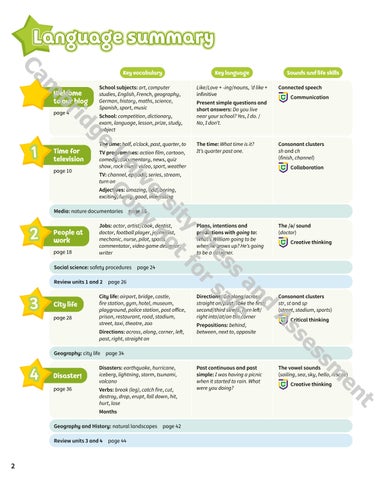
School subjects: art, computer studies, English, French, geography, German, history, maths, science, Spanish, sport, music
Like/Love + -ing/nouns, ’d like + infinitive
School: competition, dictionary, exam, language, lesson, prize, study, subject
Time for television
TV programmes: action film, cartoon, comedy, documentary, news, quiz show, rock music video, sport, weather
Present simple questions and short answers: Do you live near your school? Yes, I do. / No, I don’t.
The time: What time is it? It’s quarter past one.
Sounds and life skills Connected speech Communication
Consonant clusters sh and ch (finish, channel) Collaboration
As d an s le es sa Pr r y fo it t rs no ve y ni p
page 10
The time: half, o’clock, past, quarter, to
U
1
ge
id
page 4
Key vocabulary
TV: channel, episode, series, stream, turn on
Co
Adjectives: amazing, bad, boring, exciting, funny, good, interesting Media: nature documentaries
22
People at work page 18
page 16
Jobs: actor, artist, cook, dentist, doctor, football player, journalist, mechanic, nurse, pilot, sports commentator, video game designer, writer
Social science: safety procedures
Plans, intentions and predictions with going to: What’s William going to be when he grows up? He’s going to be a designer.
The /ə/ sound (doctor)
Directions: Go along/across/ straight on/past, Take the first/ second/third street, Turn left/ right into/at/on the corner
Consonant clusters str, st and sp (street, stadium, sports)
Creative thinking
page 24
Review units 1 and 2 page 26
3
City life page 28
City life: airport, bridge, castle, fire station, gym, hotel, museum, playground, police station, post office, prison, restaurant, road, stadium, street, taxi, theatre, zoo
Geography: city life
Disaster!
Months Geography and History: natural landscapes Review units 3 and 4 page 44
2
page 42
The vowel sounds (sailing, sea, sky, hello, rescue) Creative thinking
t
Verbs: break (leg), catch fire, cut, destroy, drop, erupt, fall down, hit, hurt, lose
Past continuous and past simple: I was having a picnic when it started to rain. What were you doing?
en
page 36
Disasters: earthquake, hurricane, iceberg, lightning, storm, tsunami, volcano
m
44
page 34
Critical thinking
ss se
Directions: across, along, corner, left, past, right, straight on
Prepositions: behind, between, next to, opposite
Ca m
5
br
Material things
id
page 46
Materials: brick, card, fur, glass, gold, grass, leather, man-made, metal, natural, paper, plastic, recycle, rubber, silver, stone, sugar, wood, wool
Describing objects: What’s the school made of? I think it’s made of stone.
Connected speech
Describing sensations: What does it look like? It looks like a cat’s nose.
Sentence stress
Communication
Senses: hear, see, smell, taste, touch Cooking: bowl, cheese, cut, flour, fork, ingredients, knife, mix, olives, onion, oven, pepper, pizza, plate, recipe, salami sausage, salt, spoon, topping page 60
Co
Science: sound waves
Creative thinking
As d an s le es sa Pr r y fo it t rs no ve y ni p
page 54
Sounds and life skills
page 52
U
6
Senses
Key language
ge
Art: sculptures
Key vocabulary
Review units 5 and 6 page 62
7
Natural world page 64
Giving advice: How should we look after our world? People shouldn’t drop their rubbish. They should put it in a bin. I think we should all recycle bottles. Yes, I agree. / No, I don’t agree.
Sentence stress
Sports: athletics, badminton, cycling, golf, ice skating, racing, running, sailing, skiing, sledging, snowboarding, volleyball
Present perfect for life experiences: Have you ever won a prize? Yes, I have. / No, I haven’t. I’ve never won a prize.
Endings /t/, /d / and /id/ (jumped, climbed, decided)
Seasons: spring, summer, autumn, winter
Present perfect for recently completed actions: He’s visited his grandmother this afternoon.
Nature: beetle, bin, butterfly, cleanup, endangered species, extinct, field, ground, habitat, in danger, insect, protect, rubbish, tree Describing species: female, male, spots, spotted, striped, stripes, wing
Geography: endangered species and conservation
8
World of sport page 72
page 70
en
Review units 7 and 8 page 80
m
page 78
Emotional development
ss se
Present perfect for completed actions with present relevance: He hasn’t done his homework. Physical education: aerobic and anaerobic exercise
Social responsibilities
t
Values Units 1 & 2 Respect in the classroom Units 3 & 4 People who help us Units 5 & 6 Tell the truth but don’t hurt Units 7 & 8 Value your friendships
page 82 page 82 page 84 page 85
Grammar reference
pages 86–87
A2 Flyers Exam Folder
pages 88–95
3
Welcome to our blog ?
What do you need for school?
ge
id
br
m
Ca Co
As d an s le es sa Pr r y fo it t rs no ve y ni p
U
1
Who gets an exciting message? Watch and check.
2
Watch again. Order.
4 What’s the competition for? 5 What’s the prize for? 6 What can they write about?
1 What did you think of Meera’s idea for a blog post about their first day at school? 2 Imagine you are writing a blog post for a competition. What would you like to write about?
4
Language: present simple questions and short answers
t
4 Ask and answer.
en
1 What are the children’s names? 2 Why wasn’t Meera online? 3 Where are they?
1
How are things? Are you ready for a new school year? Can we write about sport?
m
3 Answer the questions.
STUDY
ss se
1 Can we write about sport and technology? 2 Let’s meet outside school at four o’clock. 3 Well, it’s our first day back at school, so let’s write about that. 4 Did you have a good holiday? 5 It’s about a new school blog. 6 Are you ready for a new school year?
1
Can you remember the last lesson? Watch the language video.
Ca
2 Read and answer.
br
m
All about us Kid’s Box is an exciting new blog for young people. Meera, Stella and Lenny want to write a post for the blog. They all go to the same school. It’s called ‘City School’. Meera I’m ten. I live near the school, so I walk in every day. I have lunch at school with my friends. I love drawing and taking photos, so I want to put my photos in the blog and write about the natural world.
ge
id
Stella I’m ten. I live in a village outside the town, so I catch a bus to school every morning. I like singing and music and I enjoy playing the piano. I love reading and studying. I’d like to write about music and science in the blog.
Co
As d an s le es sa Pr r y fo it t rs no ve y ni p
U
Lenny I’m eleven years old. I always ride my bike to school. I sometimes have breakfast in the school breakfast club before my classes. I love playing football and basketball. I’m also interested in computers. I’d like to write about sport and technology in the blog.
3
2
Listen and say the name.
Do you live near your school?
No, I don’t.
Meera does.
t
like / sport read / magazines use / internet
en
m
live / near school lunch / home play / musical instrument
5
1 Who lives near the school?
ss se
4 Ask and answer.
1 What’s Kid’s Box? 2 Which school do they go to? 3 What does Meera love doing? 4 How old is Stella? 5 What would Stella like to write about? 6 How does Lenny go to school? 7 Who’s interested in technology? 8 Who’s the oldest, Meera, Stella or Lenny?
Write more questions. Practice: present simple questions and short answers
5
1 Read the blog. What’s their favourite subject? ALL BLOGS
MY BLOG
NEW POST
K id’s Box
For our first blog post, we went round our school to find out more about what we learn.
m
We all study these school subjects: maths, English, science, music, sport, art and computer studies.
Ca
s t r o p e R br
Science is an important subject, so we study it every day. This year we’re learning about plants and the human body.
We study a second language. We can choose French, German or Spanish.
In our geography lessons, we learn about different people and their countries.
We use the dictionaries in the school library to help us to understand new words.
The best subject is history. We love learning about the past!
As d an s le es sa Pr r y fo it t rs no ve y ni p
U
Older students have to study more school subjects and take important exams.
Co
ge
id
Our school
We all agree that the best thing about school at the moment is the blog competition. We all want to win that prize!
5 They study science every day. 6 They are learning about plants and the human body. 7 They learn about different people and their countries. 8 They think history is better than geography.
en
m
t
1 At City School, they all study music. 2 Older students take important exams. 3 They can choose a second language. 4 There are dictionaries in the school library.
ss se
2 Read again and say ‘same’ or ‘different’ for your class.
3 Ask and answer. 1 Which languages can you learn at school? 2 What’s your favourite school subject? 6
Vocabulary: school subjects
I can learn French at my school. My favourite school subject is English.
1
Listen and say the subject.
3
1 A lot of people think the capital of Australia is Sydney, but it isn’t. It’s Canberra. Geography.
2 Read and choose the right words.
Ca
4–5
4 We study plants and the human body in maths / sport / science. 5 We learn about people and countries in geography / computer studies / music. 6 Teachers sometimes find out what we know by giving us subjects / computers / exams.
Read and write. Listen and check. Then do karaoke.
ge
3
id
br
m
1 We study the past in science / geography / history. 2 French, Spanish and German are languages / exams / maths. 3 When we don’t understand a word, we can use a book / a dictionary / art.
U
Co
As d an s le es sa Pr r y fo it t rs no ve y ni p
Because school is cool, it’s where we go From Monday to Friday, I’m sure you know. We study and we play, that’s what we do. We do it in the morning and the afternoon! I really love
(1)
Before lunch we have (4)
,
,
And then (5)
And on Wednesday we do (6)
.
,
That’s a class which is too short!
And I enjoy (2)
.
,
And I like to do (7)
I like to study (3)
too!
My favourite subject in the afternoon.
Spanish, French and Japanese.
,
Lots of words in the (8)
For me to study and to read.
en
t
5
m
With this subject we can learn to talk to people from another country. In this lesson we learn about plants and the human body. When we study this we learn about different countries and people. We use this to learn new words.
ss se
4 Read about the school words. What are they?
Write three more definitions. Ask and answer. With this subject we can learn about numbers and shapes. What is it?
Is it maths?
Yes, it is.
Practice: school subjects
7
Sou nds and life ski lls Chatting with friends
Ca 1
m
Watch the video. Where are the young people and how do they feel? 6
Listen and complete.
id
2
br
Pronunciation focus STELLA: H i, Meera. a good holiday?
ge
have
U
MEERA: Yeah, great, thanks.
As d an s le es sa Pr r y fo it t rs no ve y ni p
STELLA: I didn’t see you online – ?
STELLA: H i, Lenny. things? LENNY:
Co
MEERA: I t’s because we didn’t have any wi-fi, but I can show you the pictures if you want. Oh, look! Here’s Lenny!
Good thanks, Stella. ready for the new school year?
STELLA: Yeah,
3
7
Listen and circle the words that sound connected. Practise with a partner.
1 How are things? 2 Are you happy to be back? 3 Did you have a good summer?
.
4 In pairs, look at the quiz and add more school holiday activities. Find out who …
Extra information
Where?
What rides?
watched a film.
What film?
Who with?
walked in the countryside.
Where?
Who with?
played lots of sports.
What sports?
Who with?
went to a fair.
Did you have a good holiday?
en
m
Who with?
ss se
Where?
travelled by train.
t
5 Find a classmate who did each activity. Ask extra questions.
8
Sounds and life skills: connected speech |
communication
Useful language How are things? Where did you go? Who did you go with?
Diggory Bones
8
ge
id
br
m
Ca
Sauropodus … The biggest dinosaur … This is the last neck bone.
As d an s le es sa Pr r y fo it t rs no ve y ni p
U
Ah! The Rosetta Stone. It helped us to understand ancient languages.
Co
How are your classes going in the School of Archaeology, Diggory?
Fine thanks, Dad.
Hello! Hello! Can you hear me?
Wow! It’s almost 30 metres long!
I’m teaching the history of language. My students are learning about The Rosetta Stone!
I’m also working on The Baloney Stone. It’s an important new computer program.
Hello, Emily.
ss se
No! The Baloney Stone program was on it!
en
m
It’s OK, Dad. It’s my phone.
Aagh!
t
Dad, come quickly! Somebody went into your classroom last night and took your computer!
1 What’s Diggory Bones teaching? What’s The Baloney Stone? Story: unit language in context
9
1 Time for television ?
What kinds of programmes and videos do you watch?
ge
id
br
m
Ca Co
As d an s le es sa Pr r y fo it t rs no ve y ni p
U
1
What TV show do they all want to watch? Watch and check.
2
Watch again. Say ‘yes’ or ‘no’.
1 The children are in the supermarket at the beginning of the story. 2 The football is on TV at ten past four. 3 The girls want to watch a programme called Top Talent. 4 Mr Sharma wants to watch the same programme as them. 5 The golf finishes at twenty to seven. 6 Lenny and Stella have to be home at quarter past six.
No.
4 Ask and answer. 1 Would you like to watch Top Talent? Why? Why not? 2 What do you and your family do when you want to watch different TV programmes? 10
Language: the time
t
at ten past four. at twenty to seven. at twenty past four. at twenty-five past four. at quarter past four. at half past six.
en
a b c d e f
m
1 The children are in the kitchen 2 The football is on 3 Top Talent is on 4 The children arrive in the living room 5 The golf finishes 6 Lenny and Stella have to be home
It’s quarter to four. It’s quarter past four.
ss se
3 Read and match.
STUDY
1
2 Read and label the clock.
ten past
five past twenty-five to quarter to
Ca
o’clock
ten to to
past
quarter past
ge
id
br
m
five to
twenty to
twenty past
U
twenty-five past
As d an s le es sa Pr r y fo it t rs no ve y ni p
half past
Co
wake up get up get dressed go to school
3 What do you do every day? Order.
4
9
1
2
Look at the clocks. Listen and say the letter.
b
c
a
b
c
a
1 I have lunch at quarter to one every day. 3
4
a
b
c
a
b
c
en
I get up at this time on Mondays. What time is it?
Twenty past seven.
t
Write about your day. Write 20–30 words.
clean my teeth go to bed do my homework have breakfast
m
Ask and answer.
1
ss se
a
5 Play the game. 6
1
Can you remember the last lesson? Watch the language video.
No. Twenty to eight. Yes. Practice: the time
11
1 Read the blog. Which programme is on TV at the same time every day? ALL BLOGS
MY BLOG
NEW POST
K id’s Box
br
m
Ca
s t r o p e R
Today’s blog post is about different kinds of TV programmes. You can watch them on TV or stream them to your phone or tablet.
ge
id
TV programmes Lots of people enjoy watching sport on TV. Some of the most popular sports in the world are football, basketball, tennis and golf. What sports are popular in your country?
We watch the weather to find out if it’s sunny, rainy, windy or cloudy. What’s the weather like today?
A quiz is a kind of competition. One person asks others lots of different questions. The winner is the person with the most points.
A documentary is a programme which gives us information about our world. It can be about animals, history or geography.
The news is about things which are happening in the world. It’s on TV at the same time every day.
A comedy is a funny programme which makes us laugh. What’s your favourite comedy?
We watch a series in parts. These parts are called episodes. You can sometimes watch an episode every day.
Co
2 Read again and answer.
1 Which programme can tell us things about animals?
My favourite TV programme is the news. 2 Why do you like it?
t
Vocabulary: TV programmes and adjectives
1 What’s your favourite TV programme?
en
12
3 Ask and answer.
m
2 Which programme can be short or a complete film? 3 Which programme is about things which are happening in the world? 4 Which is one of the most popular sports in the world? 5 Which programme can tell us to take an umbrella with us? 6 Which programme is in episodes? 7 Which programme is a kind of competition? 8 Which programmes are funny?
ss se
As d an s le es sa Pr r y fo it t rs no ve y ni p
U
Cartoons are moving pictures. Children and grown-ups love them. They can be short programmes or complete films. They’re usually funny.
I like learning about what’s happening in the world. 3 What’s it about? It’s about the news around the world.
1
10
Listen and say the programme.
1 Goal.
1
Sport.
Ca
cartoon comedy documentary news quiz show rock music video sport weather
br
m
2 Choose words to talk about the different programmes. amazing
bad
boring exciting
id
ge
I think quiz shows are more interesting than the weather.
U
3
good
interesting
I think rock music videos are the best.
4 Read and complete.
As d an s le es sa Pr r y fo it t rs no ve y ni p
11–12 Listen and complete the
funny
clocks. Listen and check. Then do karaoke.
Co
arrived four news past turned on waited
I don’t like TV, I don’t like it much, But there are some programmes that I sometimes watch. On channel one at , There’s a really good documentary About animals and where they live, What they do and what they eat. And on channel four at , They put on a great cartoon. At one o’clock and then at
,
t
, but I want more.
en
And at
m
But what I like, what I love the best, Are the action films, more than the rest. They’re on at ,
ss se
They show the news and then the weather. They’re not my thing, they’re not for me, But I like the sport at .
Tim and Jen went to the park last Saturday. They ran on the grass, played with a ball and went on four they sat down the swings. At ten to (1) because they were tired. They saw a newspaper on the bench. They opened it at the TV page and looked to see what was on the different channels. Tim wanted to go home and watch Friendly at half (2) four. They went to the bus stop and (3) . The bus didn’t come until quarter past four. They (4) home at twenty-five to the five, ran into the living room and (5) TV. The programme wasn’t Friendly, it was the (6) . They looked at the newspaper again. It was an old one! They showed Friendly on Friday, not on Saturday. Practice: TV programmes and adjectives
13
Sou nds and life ski lls Deciding together
Ca 1
Watch the video. What is the problem and what do they do about it?
m
Pronunciation focus
br
2
13
id
MR SHARMA:
Co
As d an s le es sa Pr r y fo it t rs no ve y ni p
U
STELLA: MR SHARMA:
i, Dad. Can we please change the H channel? We want to watch Top Talent. Oh, I’m sorry, Meera. Not now. The golf’s on – and you know I love golf! What time does it finish, Mr Sharma? Oh, don’t worry. It finishes at twenty to seven!
ge
MEERA:
Listen and underline the sounds sh and ch.
3 Think and complete. Practise with a partner. A: B: A: B:
Can we please change the channel and watch No, I’m sorry. I’m watching . What time does it finish? It finishes at .
?
4 Look at the TV guide. Which two programmes would you like to watch and why?
Channel 1
17.10 Football Crazy Live: Sporting Galaxy v Chester City.
18.30 Insect Investigation: Explore the world of Magical Dragonflies
18.30 American Basketball Special Live: New York v Orlando.
en
19.00 The Curious Chef Shona travels to China to discover new lunch dishes to cook at home.
Sounds and life skills: consonant clusters sh and ch |
t
14
18.00 Shark Show In this documentary, Shark Dave shows us one of the fastest fish on the planet: the shortfin mako.
m
18.30 Film: Starshine Dr Dark has a plan to take away starlight from the universe. Can five young scientists and one spaceship stop him?
SPORT4U Live
the TV programmes and decide what to watch together.
ss se
17.00 Sing Up! In this evening’s semifinal contest, four singers sing their best songs with famous musicians. Vote to see your favourite in next week’s finale!
TV DOC 3
5 In a group, discuss
Useful language Can/Can’t we watch …? What time is it on?
collaboration
KBx3_IN_L5_PB_ U01_p014_x04_i02_
Diggory Bones
14
br
m
Ca
What is The Baloney Stone?
Oh, no!
1 It’s the most important computer program of old languages in the world.
ge
id U
As d an s le es sa Pr r y fo it t rs no ve y ni p I must go now. I’ve got no time to lose. Thank you.
That was the news. Now this is a comedy.
It’s half past nine. Let’s turn on the news.
OK, Dad.
Brutus Grabbe! Of course! The cameraman!
Why’s the TV screen black?
You want The Baloney Stone and I want your secret password, so listen to me carefully …
t
What’s happening?
en
m
ss se
Early this morning somebody took The Baloney Stone from City University.
Co
What can the thief do with this program?
The thief can find the world’s most beautiful treasures.
1 What can the thief do with The Baloney Stone program? What does Brutus Grabbe want?
Story: unit language in context
15
How can we make natu re docu mentaries? 1
Listen and read. Which programme doesn’t show real animals?
15
There are some great nature documentaries coming out this month, so we wanted to hear from some of the people behind the magic. They told us about how new technology brings viewers closer to nature.
ge
id
br
m
Ca
Filming nature
New technology means we can now make really exciting nature documentaries. In Migrations, we used drone cameras to film animals from the air. We film hundreds of animals moving across the land together. In the past, we filmed from a helicopter. Some people still do that, but I think using drones is much better. You can get closer to the animals. In the first episode, I filmed the amazing elephant migration in Botswana.
For Discover the Deep, I went deeper into the ocean than ever before. I filmed some incredible underwater animals we never knew about!
Lucy Hall, Director of Photography
Co
As d an s le es sa Pr r y fo it t rs no ve y ni p
U
I started working as an underwater camera operator 30 years ago. Making documentaries was very different then. My video camera was big and heavy, with batteries that didn’t last long. Unfortunately, there isn’t much light underwater, so the cameras didn’t film very well. Now, the technology is amazing! We use small, low-light cameras and longlife batteries, so we can stay underwater for longer.
Adrian Hems, Camera Operator
Working on How Dinosaurs Lived was so much fun! I create computer animations of animals and make them look real. Dinosaurs are extinct, so we filmed the landscape they once lived in. I created the dinosaurs with computergenerated images (CGI), and we added them to the landscape. The effects are excellent – much better than the ones I used on films in the past. I created some amazing dinosaur fights! Ben Sharp, Special Effects Technician
2 Read again and complete the diagram. Past
small, low-light cameras
16
Creating dinosaurs with special effects must be a lot of fun, so I really want to watch How Dinosaurs Lived!
Language: the documentaries time Media: nature |
critical thinking
FIND OUT MORE
What is the most expensive nature documentary ever made?
t
I’d like to watch Discover the Deep. Filming deep underwater sounds amazing!
en
3 Which programme sounds more interesting to make and why?
m
ss se
big, heavy cameras
Present
1 Read the chat message. Why
did they think the programme was interesting?
Ca
m
12:00
The giant squid is one of the world’s most difficult animals to film because it lives so deep in the ocean. Camera operators first filmed this sea animal in 2012! 60%
Fahad is online
id
br
➞
1
DID YOU KNOW…?
Quinn
ge
Hi Fahad, how are you?
As d an s le es sa Pr r y fo it t rs no ve y ni p
U
Yesterday, I watched an amazing documentary called City Animals. It’s about animals that live in big cities.You can watch it on the Wildlife Channel every Sunday.
Co
Last night’s episode was about foxes in cities. I found it really interesting because there’s a fox that comes into our garden. Look at the photo that I took of it. Isn’t it cute?
Some people are frightened of foxes, but they’re shy animals. In the documentary, they explained that foxes now live among humans in towns because we are destroying their natural habitat. You must watch it because you can learn about some really awesome animals. Next week’s episode is about owls. The photography is incredible, too!
2 Underline the adjectives in the chat message in Activity 1.
In pairs, discuss a nature documentary you know. Write your ideas in your notebook.
We use adjectives to describe things. My video camera was big and heavy. I created some amazing dinosaur fights!
en
m
What’s the name of the documentary?
Adjectives
ss se
3
Learning to write:
What’s it about? Why is it interesting?
t
Ready to write: Go to Activity Book page 16.
Make a presentation about a nature documentary. Media: nature documentaries |
Language: time learningthe to learn
17
2 People at work
?
What jobs do you know?
ge
id
br
m
Ca Co
As d an s le es sa Pr r y fo it t rs no ve y ni p
U
1
Why does everyone have to leave the school? Watch and check.
2
Watch again. Complete the sentences. 1 They’re looking around a
exhibition.
2 Lenny thinks he’s going to be a
.
3 Stella thinks she’s going to be a
.
5 Meera’s going to be a
isn’t going to burn down. . .
18
Language: plans, intentions and predictions with going to
1 What are Stella, Lenny and Meera going to be? Do you think they will be good at those jobs? 2 What do you think you and your friends are going to be? Why?
t
1 write about / What / for our blog post? / are / we / going to 2 going to / a nurse / be / when I’m older. / I’m 3 a doctor. / going to / Meera / be / isn’t 4 The school / isn’t / burn down. / going to 5 win / prize! / We’re / that / going to 6 do / you / What / tomorrow? / are / going to
4 Ask and answer.
en
3 Read and order the words.
m
6 They’re going to write about
I’m going to be a vet. Meera isn’t going to be a hairdresser. What are we going to write about?
ss se
4 Stella hopes the
STUDY
1
Can you remember the last lesson? Watch the language video.
2
16–17
2
Listen and order. Listen again and check. Then do karaoke.
Ca
b They’re going to do their best,
m
a She’s going to help them all,
Then sleep and play.
And work in schools …
Then work all day, Then sleep and play …
ge
id
br
c They’re going to do the job,
d She’s going to show the kids, She’s going to teach good rules.
U
f
As d an s le es sa Pr r y fo it t rs no ve y ni p
e They’re going to do the job,
He’s going to do his best, Then sleep and play …
They’re going to work all day.
Co
g He’s going to do the job, He’s going to work all day.
1
3 Look and say. What are they going to do? a
d
b
c
e
f
1 Where are you going to go after school? 2 Who are you going to see this evening? 3 When are you going to do your homework? 4 What time are you going to go to bed tonight?
6
What are you going to do after school? Write 20–30 words.
Practice: plans, intentions and predictions with going to
t
Write two more questions. Then ask your partner.
en
5
d She’s going to play tennis. e They’re going to watch TV. f He’s going to wake up.
a No, she isn’t going to wash her face. She’s going to brush her teeth.
m
a She’s going to wash her face. b They’re going to go to a music festival. c They’re going to turn on a computer.
ss se
4 Correct the sentences.
19
1 Read the blog. Which three jobs did George Orwell have? ALL BLOGS
MY BLOG
NEW POST
K id’s Box
br
m
Ca
s t r o p e R
In today’s blog post, we’re going to look at some interesting people and their jobs.
id
Interesting jobs
ge
Formula 1 is a car racing competition. It’s a team sport. One of the most important people in the team is the mechanic. Steve Matchett was a Formula 1 mechanic. He had to repair cars during the race. Now Steve works as a sports commentator on TV.
Co
As d an s le es sa Pr r y fo it t rs no ve y ni p
U
José Andrés is a famous cook who was born in Spain. He founded World Central Kitchen, which makes healthy food for people in countries going through difficult times.
George Orwell was an important writer. Two of his most famous novels are called Animal Farm and 1984. He was also a journalist and wrote for different newspapers. Before he started writing, he was a police officer.
Alexia Putellas is a Spanish football player and is one of the best in the world. She has won awards for her skills, including UEFA Women’s Player of the Year Award, the Ballon d’Or Féminin and The Best FIFA Women’s Player.
I think the game designer is the most exciting job because you can design games which you like to play! 2 Which job would you like to have? Why?
t
Vocabularly: jobs
1 Which is the most exciting job? Why?
en
20
3 Ask and answer.
m
1 Who is one of the most important people in a Formula 1 team? 2 What did Steve Matchett repair? 3 What are two of George Orwell’s most famous novels? 4 What was George Orwell’s job before he was a writer? 5 What did the football player win? 6 What did the cook do? 7 Who is a pilot and actor? 8 Which famous video games did Shigeru Miyamoto design? 9 Which two people help people in different countries? 10 How many of these people are on TV?
Shigeru Miyamoto designed the video games Donkey Kong and Super Mario Bros. When he was young, he studied art and wanted to be an artist, but then he discovered Space Invaders and he decided to become a video game designer.
ss se
2 Read again and answer.
Angelina Jolie is a famous actor. Her films include Maleficent and the Kung Fu Panda films. She also works to help people around the world. She loves planes, so she became a pilot, and she still enjoys flying now.
I’d like to be a cook, so that I can taste delicious food all day!
1
18
2
Listen and match. Say the job. 1 Good evening. This is Captain Bird speaking. Welcome aboard flight 241 from Dublin to London.
Ca
c
a
Pilot. That’s ‘e’.
e
m
d
f
id
br
b
1
ge Listen again and choose the right words.
As d an s le es sa Pr r y fo it t rs no ve y ni p
19
U
2
Co
1 The plane is flying to New York / London / Paris. 2 The artist is painting badly / quickly / carefully. 3 The cook is making a chocolate cake / carrot cake / cheesecake. 4 Mr Hamilton can get his car at ten o’clock / half past nine / half past ten. 5 The designer is happy / tired / hungry. 6 The journalist is going to interview a football player / swimmer / basketball player.
3 Play the game. Guess it in ten.
Do you work at the fire station?
No, I don’t.
Do you wear a uniform?
Yes, I do.
4 Read and think. Ask and answer.
What’s William going to be when he grows up?
enjoys drawing and making things. He uses his computer to help him. likes writing and taking photos for her blog. loves playing with cars and repairing things.
loves making cakes and working in the kitchen. loves acting. He’s in the drama club at school.
m
loves drawing and painting.
ss se
William Teresa Katy Richard Robert Helen
He’s going to be a designer.
6
t
1 Who does this job? 2 What’s his/her job? 3 What does he/she do at work? 4 Why do you think it’s interesting?
en
5 Think about someone you know who’s got an interesting job. Answer the questions.
Write about an interesting job. Write 20–30 words. Practice: jobs
21
Sou nds and life ski lls Thinking about the future
Ca 1
m
Watch the video. What jobs would they like to have when they are older? 20
L ook at this … a nurse. That’s an interesting job! I think I’m going to be a nurse when I’m older. Hmm, a nurse? That’s great, Lenny. I think I’m going to be a dentist. A dentist? I thought that you always wanted to be a doctor? Maybe I can be a doctor and a dentist!
ge
LENNY:
Listen and complete. Practise with a partner.
Co
21
As d an s le es sa Pr r y fo it t rs no ve y ni p
U
STELLA: LENNY: STELLA:
3
Listen and underline the jobs. Which job ends with the /ə/ sound?
id
2
br
Pronunciation focus
A: What you going B: I think going A: That’s an interesting job.
be? be a
.
4 Look at the job adverts. What kind of person do you need to be for these jobs?
Chefs wanted!
We are looking for chefs for two new restaurants in Rome.
You must be good at making interesting pizzas and working very hard.
en
Email: sam.cold@WWSC.co.gp
m
Email: Bella@Pizzaperfect.it
You must love snow and mountains! You must be patient and good at talking to people. You must be good at skiing and snowboarding.
ss se
You must be creative and speak Italian.
URGENT! Are you a ski instructor? Come and work at Winter Wonderland Ski Centre.
5 In a group, discuss different jobs and what you need for them.
22
Sounds and life skills: the /ə/ sound |
creative thinking
A chef must be creative. A ski instructor must be good at talking to people.
t
Useful language
Diggory Bones
22
Ca
Who’s Brutus Grabbe?
I studied dinosaurs’ teeth, but I’m not an archaeologist and I’m not a dentist.
Yes, and I’m going to be very rich.
ge
id
br
m
He was a student of mine. He was very clever, but he was … very bad.
2
As d an s le es sa Pr r y fo it t rs no ve y ni p
U
No. You’re a pirate! You only love money.
He’s going to use my program.
Co
If you want The Baloney Stone, meet me at the Old City Library at 10.45 tomorrow.
He isn’t here.
Oh no, he isn’t! We’re going to stop him.
I’m going to get you, Brutus Grabbe!
en
m
ss se
Yoo-hoo! Doctor Bones! I’ve got a letter for you.
Come on, Dad! It’s quarter to eleven. We’ve got a job to do!
t 1 At what time is Diggory going to meet Brutus tomorrow? Why wasn’t Brutus at the library?
Story: unit language in context
23
Ho w ca n we stay safe? 1
23
Listen and read. Why is it important to control fire?
Ca
m
How can we use fire?
br
People learnt how to make fire about a million years ago, and fire can be very useful. We use it for cooking and for heat when we’re cold. It also gives us light.
id
What causes fire?
ge
Did you know fire needs three things: oxygen, fuel and heat? Oxygen is a gas, which is in the air all around us. Some examples of fuel are wood, coal, paper, gas and oil. When fuel gets very hot and mixes with oxygen, this can start a fire.
How can we stop a fire?
As d an s le es sa Pr r y fo it t rs no ve y ni p
U
Taking away the oxygen, fuel or heat means a fire can’t burn any more. Water can put out a fire, but be careful: water can also start a fire if it has contact with electricity. So, never use water to put out a fire close to electrical equipment. Always use a fire blanket to cover the flames instead. This stops the oxygen and puts out the fire. Using fire extinguishers that spray foam is another way to stop the oxygen. A fire stops burning if there is no more fuel, so they sometimes go out on their own.
Co
Not all fires are man-made and a fire can start naturally, like in a forest. It can also start by accident, for example, when cooking at home. It’s important to control fire because it can spread quickly and it’s very dangerous when it gets out of control.
2 Read again and choose the correct options. and . b heat or . b without fuel and . b cooking or b fuel . b quick to spread
c foam
c naturally c heat
.
c a fire extinguisher c very hot
24
Social science: safety procedures |
critical thinking
What are the main causes of house fires?
t
We have a fireplace with a metal grate in front for heating the living room in winter.
FIND OUT MORE
en
We have a BBQ in the garden that my parents use in the summer.
m
3 How do you use fire safely in your daily lives?
ss se
1 Fire burns with a fuel 2 Fires can start a by accident 3 We use fire for a oxygen 4 We can stop a fire with a water 5 Fire is and a easy to control
1 Read the safety leaflet.
How many ‘dos’ and ‘don’ts’ are there?
Ca
Fire fighters have to get dressed in two minutes! The uniform is very heavy and made of special material to protect them from the hea t.
m
Fire safety
2
DID YOU KNOW…?
br
✗ Never play with matches, candles
id
or other things that can start a fire.
ge
✗ Don’t put lots of plugs in
electric sockets.
U
✓ It’s important to have smoke
As d an s le es sa Pr r y fo it t rs no ve y ni p
alarms in your house.
✗ Never play near cookers,
Co
fireplaces or other areas where there is fire.
✓ Make sure you know the
emergency phone number for the fire service.
✗ Never open any doors if there
is fire on the other side.
✓ Go to a window and open it.
Climb out if it’s safe, or wait for help if you are upstairs.
2 Underline the imperatives with
We use imperatives with always and never to show it is very important to do something. Never use water to put out a fire near electrical equipment. Always use a fire blanket to cover the flames.
en
In pairs, discuss where safety advice is important. Write your ideas in your notebook.
Imperatives with always and never
m
3
Learning to write:
ss se
always and never in the safety leaflet in Activity 1.
Always remember the number to call in an emergency!
t
Ready to write: Go to Activity Book page 24.
Make a poster about forest fire safety. Social science: safety procedures |
learning to learn
25
Units 1 and 2
Ca
1 Sarah is talking to her mother, Mrs Smith. Read the conversation and choose the best answer. You do not need to use all the letters.
ge
id
br
m
a Can we go out to the park? b Yes, please. Can I phone Katy to see if she can come? c My favourite comedy’s on at twenty-five past five. d I think it’s about half past eleven. e All right, then. Can I phone Peter? f Thanks, Mum. Can you pass me the phone? g Which ones shall I wear? My sports shoes? h Does Peter like history? Example
As d an s le es sa Pr r y fo it t rs no ve y ni p
U
Sarah: d
Mrs Smith: What time is it, Sarah?
Co
Questions
1 Mrs Smith: What do you want to do? Sarah: 2 Mrs Smith: OK. Put your shoes on. Sarah: 3 Mrs Smith: Yes, the blue ones. Listen, do you want to go with a friend? Sarah:
2 Tell your partner the story. 1
It’s morning. The boy is going to school.
3
5
6
en
m
2
ss se
4
4 Mrs Smith: I think Katy’s studying for an exam this afternoon. Sarah: 5 Mrs Smith: OK. Call him and see if he wants to come too. Sarah: Mrs Smith: Here you are. Tell Peter to bring his bike!
t
3 26
Now write the story. Write 20–30 words.
Review: units 1 and 2
2
4 Play the game. What are you going to do tomorrow?
br
m
Ca
Instructions: Go round the board. Say the time and what you are going to do at that time. Think of a different activity for each time. To keep playing you have to remember the activity which goes with each time. If you cannot remember then go back to START and wait for another turn.
ge
id
That’s quarter to seven. Tomorrow I’m going to wake up at quarter to seven.
That’s nine o’clock. Tomorrow I’m going to wake up at quarter to seven and go to school at nine o’clock.
Co
As d an s le es sa Pr r y fo it t rs no ve y ni p
U en
m
ss se
t Review: units 1 and 2
27
3 City life
?
Which places do you go to in your town or city?
ge
id
br
m
Ca Co
As d an s le es sa Pr r y fo it t rs no ve y ni p
U
1
Why are they going in the wrong direction? Watch and check.
2
Watch again. Choose the right words. 1 They arrive at ten past two / twenty to three. 2 They want information for their blog post / school homework. 3 They decide to visit a bridge / museum first.
4 They start outside a shop / school. 5 They’re lost because of problems with the map / bus. 6 Tower Bridge is behind / across the street.
3 Read and complete the sentences. this road.
2 We don’t go across the river. We turn
right
here.
left
. , then we walk
this park.
.
corner
6 It’s just
the street.
past
1 Why do you think Meera’s dad said ‘no phones’? 2 Do you know how to read a map? Are you good at following directions? Language: directions and prepositions
across along
t
5 Let’s go
4 Ask and answer.
28
straight on
en
4 We need to take the third street on the
m
3 Now we’re at a
STUDY
ss se
1 We have to go
1
3
Can you remember the last lesson? Watch the language video.
2 Look at the map. Read the directions and answer.
Ca
ge
id
br
m
1 Go along the High Street. Take the third street on the left and go across the river. What’s on the right? 2 Go along the High Street and turn right into Blue Street. Turn left into Low Road and then go across Green Street. What’s on the corner, on the left, opposite the music shop? 3 Go along the High Street and take the second street on the left. Walk past the playground. What’s next to it?
Co
As d an s le es sa Pr r y fo it t rs no ve y ni p
U 24
ss se
3
Listen to the directions and answer. 1 Go straight on. Take the second street on the left. What’s at the end of the street?
4 Play the game.
en
m
The river.
Go along the High Street and take the third street on the right. Go across Low Road and it’s next to the music shop.
t
Is it the fruit shop?
5
Yes, it is!
Write the directions to (1) the bank and (2) the gym. Practice: directions and prepositions
29
1 Read the blog. Which is the busiest airport in the UK? ALL BLOGS
MY BLOG
NEW POST
K id’s Box
br
m
Ca
s t r o p e R
London is the capital city of England and the UK. Yesterday we went there and saw lots of interesting places. Here are some of our photos.
ge
id
London
You can post letters or postcards at post offices or in a red post box. They painted the first red post box in London in 1874.
As d an s le es sa Pr r y fo it t rs no ve y ni p
U
New Scotland Yard is one of the most famous police stations in the world. A king of Scotland lived in the first Scotland Yard.
Co
This is the British Museum. There are six million objects here. One of them is The Rosetta Stone.
This is the new Globe Theatre. The first Globe Theatre was famous because William Shakespeare showed his plays there.
This castle is next to Tower Bridge. It’s called the Tower of London. It looks beautiful now but for many years it was a terrible prison. Many people died here.
London is a great city to eat out. There are lots of restaurants and you can eat food from all over the world. There are also lots of hotels to stay in.
London’s got six airports. This is Heathrow. It is the busiest airport in the UK. More than 70 million people use this airport every year!
This is a London taxi. It’s called a black cab. Black-cab drivers have to pass a test to show that they know all the streets in London.
I think London is an exciting city because there’s lots to see and do. 2 Where in London would you like to go? Why? I’d like to go the Globe Theatre to see a play.
t
Vocabulary: city life
1 Do you think London is an exciting city? Why?
en
30
3 Ask and answer.
m
1 A king of England lived in the first Scotland Yard. 2 You can see The Rosetta Stone at the Natural History Museum. 3 Shakespeare showed his films at the Globe Theatre. 4 They painted the first London post box red in 1974. 5 London is a difficult place to eat out. 6 London’s got seven airports. 7 The Tower of London was a post office for many years. 8 London buses are called black cabs.
ss se
2 Read again and correct the sentences.
1
bridge castle museum park
restaurant station
street taxi theatre zoo I took a (9)
I saw Tower (3)
Ca
Theatre, cinema, Restaurant and hotel, Museum, castle, A story to tell.
br
m
And the (4) Walked in the (5) And went to the (6)
ge
id
I went to London, To have a lovely day. To go to a (1) museum
and for a play.
The (2)
3
Listen and complete. Listen and check. Then do karaoke.
25–26
too.
Because it was late. My train was in the (10) It was half past eight.
.
I went to a (7) On the corner of the (8) I sat outside and I had something to eat.
.
.
Co
actor
As d an s le es sa Pr r y fo it t rs no ve y ni p
U 2 Ask and answer.
bus driver cook doctor
fire fighter pilot
Who goes to work in a restaurant or hotel?
police officer teacher
A cook.
3 Look at the map. Ask and answer. Where’s the museum?
It’s between the gym and the library.
en
m
ss se
Can your partner guess?
Go out of the door, turn left, take the second street on your right and walk past ‘Flower’s Restaurant’. What can you see?
Is it the stadium?
t
4 Think of a place you know. Give directions on how to get there from your school.
Yes, it is.
Practice: city life
31
Sou nds and life ski lls Choosing options
Ca 1
m
Watch the video. Where are the young people and how do they feel? 27
Listen. What do the circled words have in common?
ge
id
2
br
Pronunciation focus
STELLA: OK! Let’s have a look at the map! How do we
28
We’re standing outside a shop.
Listen and complete. Say the words. Can you think of more?
As d an s le es sa Pr r y fo it t rs no ve y ni p
LENNY:
3
U
get there?
STELLA: So, we have to go straight along this street .
Co
We don’t go across the river. We turn left here at the sports shop. Let’s go!
s
t
r eet,
aight adium, anish
and, orts,
udy
4 In pairs, discuss the best places to visit in your town/city and why. Complete the table.
Place
Why?
ss se
5 In a group, choose one place to take a visitor to in your town/city.
m
Place
en
Where is it?
Where shall we go? … is the most famous. How do we get there?
What can you do there?
32
Sounds and life skills: consonant clusters st, str and sp |
critical thinking
t
Useful language
How can you get there?
Diggory Bones
29
m
Ca
Which city does he mean?
Of course! The library in Alexandria was the most important library in the ancient world.
It was the wrong library because it was the wrong city.
ge
id
br
What does the letter mean?
3
Co
As d an s le es sa Pr r y fo it t rs no ve y ni p
U
I think he means the city of Alexandria in Egypt.
What are we going to do now?
Outside the city of Alexandria there’s a cave with secret writing on the walls.
Dad, we’re going to Egypt. Can you take us to the airport, please?
We’re going to fly to Egypt.
Yes, son.
And Brutus can use The Baloney Stone to understand the writing!
What’s in the cave, Dad?
… can open the door to mountains of secret treasure!
People say the writing on the wall of the cave …
en
m
ss se
Now let’s get a taxi and find a hotel … Taxi!
t
Brutus Grabbe!
1 Where was the most important library in the ancient world? Who was the taxi driver?
Story: unit language in context
33
Wh at are th e be st mo de s of tra ns po rt? 1
Listen and read. What do the different types of transport have in common?
30
Ca
ge
id
br
m
Want to hang out on the world’s oldest elevated railway? Then you must ride on Wuppertal’s hanging train! It’s a train where the cars ‘hang’ under the tracks. Every year more than 25 million passengers travel on this public transport, which opened in 1901. It’s the easiest way to see this German city because you don’t get stuck in traffic. It’s electric too, so it’s more environmentally friendly than travelling by car or bus.
Are you in a hurry? The Shinkansen in Japan is the fastest high-speed rail system in the world. It uses the newest technology to give thousands of passengers a fast and comfortable ride every day. The Shinkansen’s electric trains use less energy, so they cause less pollution than cars and planes. That’s a great reason to use the country’s high-speed rail network!
Co
As d an s le es sa Pr r y fo it t rs no ve y ni p
U
Travel in the sky! The city of MedellÍn in Colombia is built on lots of hills, so it’s not the easiest place to get around. That’s why they built the cable car system in 2004. Now it’s the most popular form of public transport in the city! It’s a fun way to travel and you get great city views. It doesn’t cause air or noise pollution, so it’s greener than buses and taxis.
2 Read again and complete the table. Germany
Type of transport
Colombia
Japan
hanging train
You don’t get stuck in traffic.
How is it environmentally friendly?
It’s electric.
travel around?
I like to travel around on trains because they’re quicker than buses. 34
Geography: city life |
critical thinking
FIND OUT MORE
What are the most environmentally friendly modes of transport in your country?
t
I think the best way to travel is on a cable car because there are great views.
en
3 Which form of transport is your favourite and why? How do you like to
m
ss se
Advantage for passengers
1 Read the advert. What are the
advantages of using an e-scooter or e-bike?
3
DID YOU KNOW…? 700,000 people in the United States travel by bus each year.
Ca
Public transport is getting greener
m
ge
id
br
Public transport in our city is changing! If you haven’t got a car and the buses or underground trains are too overcrowded, why don’t you use two wheels instead? Our e-scooters and e-bikes are the newest and easiest modes of transport in the city. Just download our app and get moving! You can travel on the road or in cycle lanes at a speed of up to 25 km/h. Our e-scooters and e-bikes are quicker than walking, which means they’re the best choice when you’re in a hurry.
They’re healthier than cars and buses, as they don’t cause air pollution. That must make them the greenest transport option in the city! Don’t forget your helmet!
Co
As d an s le es sa Pr r y fo it t rs no ve y ni p
U
2 Underline the superlatives and circle the comparatives in the advert in Activity 1.
3
In pairs, discuss modes of transport where you live. Write your ideas in your notebook.
Learning to write:
Comparatives and superlatives
en
m
ss se
We use comparatives to talk about two things. They’re healthier than cars and buses. We use superlatives to talk about one thing from a group of the same things. That must make them the greenest transport option in the city!
t
Ready to write:
Design a new, ‘unusual’ mode of transport.
Go to Activity Book page 34. Geography: city life |
learning to learn
35
?
4 Disaster!
What kind of weather do you like or dislike?
ge
id
br
m
Ca Co
As d an s le es sa Pr r y fo it t rs no ve y ni p
U
1
Why did the boat catch fire? Watch and check.
2
Watch again. Order.
STUDY
1
3 Read and match.
a lightning hit the boat. b because they were running away. c when the journalist arrived. d when they were sailing to the island. e so they were looking after him.
36
Language: past continuous and past simple
t
1 How do you think each of the three children felt during the disaster? 2 How do you think they feel now? Why?
en
4 Ask and answer.
m
1 They were getting warm 2 The sky went dark 3 Lenny wasn’t feeling very well 4 When they were walking up the beach 5 They didn’t get a picture of the fire
Were you listening to the weather on the radio? We weren’t listening to the radio. We were listening to music.
ss se
1 At first, it didn’t work! But then he tried again. 2 Why didn’t you go back to the beach? 3 Now we’ve got a new idea for our blog … disasters! 4 We couldn’t leave the island, so Dad had to phone for help! 5 Dad was listening to the radio. They said a storm was coming! 6 We couldn’t take any pictures – we were running away.
1
Can you remember the last lesson? Watch the language video.
2
31–32
Ca
climbing
4
Read and guess. Listen and check. Then do karaoke. eating playing sailing sitting
ge
id
br
m
What were you doing when the storm began? When the lightning hit and the water ran. Where were you when the rain came down? On the mountain, at the beach, in the forest or the town.
skating
swimming walking
I was (1) walking He was (2) We were (3) She was (4) They were (5) He was (6) She was (7) I was (8)
under a tree.
Co
As d an s le es sa Pr r y fo it t rs no ve y ni p
U
up the mountain, over the lake, in the park, a piece of cake. in the river, on the sea, up a wall,
3 What were you doing when it happened? Write three sentences.
dropped my mobile phone
teacher saw me
cut my hand
lightning hit the tree
it started to rain
mother took a photo of me
I was having a picnic when it started to rain.
Yes, I was.
t
5
Were you having a picnic?
en
m
4 Play the game. Guess it in five. What was I doing when it started to rain?
started to feel ill
ss se
hurt my knee
Choose one of your sentences and continue the story. Write 20–30 words. 1 What did you do?
2 What happened next? Practice: past continuous and past simple
37
1 Read the blog. How high was the wall of seawater in Messina? ALL BLOGS
MY BLOG
NEW POST
K id’s Box
br
m
Ca
s t r o p e R
Disasters sometimes happen, as we recently found out. We decided to find out about some famous disasters.
ge
id
Disasters
Co
Hurricanes are very dangerous storms with strong winds. The worst Atlantic hurricane in history was the Great Hurricane in 1780, from 10–16 October.
On 1 November 1755 an earthquake hit Lisbon, in Portugal. The ground moved for ten minutes. The earthquake destroyed most of the buildings in the city.
The Hindenburg was one of the biggest airships ever built. On 6 May 1937, when it was arriving in the USA, it caught fire. People think this happened because lightning hit it during a storm.
As d an s le es sa Pr r y fo it t rs no ve y ni p
U
This ship is called the Titanic. On 14 April 1912 it was sailing across the Atlantic Ocean when it hit an iceberg. They couldn’t see the iceberg because of the fog.
5 The Great Hurricane was in 1870. 6 Krakatoa, the volcano, erupted on 28 August. 7 The Lisbon earthquake was on 1 November 1575. 8 The tsunami was on 28 October 1908.
en
m
1 The Titanic hit an iceberg on 14 July 1912. 2 The Titanic was sailing across the Pacific Ocean. 3 The Hindenburg disaster was on 16 May 1937. 4 The Hindenburg airship was arriving in the UK.
On 28 December 1908, a tsunami hit Messina, in Italy. The enormous wall of seawater was about ten metres high. How high do you think the seawater is in this picture?
ss se
2 Read again and correct the sentences.
When a volcano erupts, it throws hot liquid rock and gases into the air through the hole at the top. When Krakatoa erupted on 26 August 1883, it made the loudest sound ever heard.
1 Which do you think was the worst disaster? Why? I think the earthquake was the worst disaster because the ground moved for ten minutes. 38
Vocabulary: disasters and months
t
3 Ask and answer. 2 What was the worst weather you can remember? What were you doing? I remember a hurricane. I was playing with my brother at home.
1
Ca
Listen and repeat the chant.
34
Listen and say the months.
4
January, February, March, April, May, June, July, August, September, October, November, December.
1 It’s sunny and windy. There are a lot of red apples on the trees …
September.
ge
id
br
m
2
33
As d an s le es sa Pr r y fo it t rs no ve y ni p
U February
July
August
March
April
May
June
September
October
November
December
Co
January
3 Ask and answer.
It’s February.
What can you see?
Some children are reading comics. They’re sitting in their living room next to the fire.
4 Cross out the extra word.
t
Friday 13 March was a terrible day for Jane. What happened? when / go downstairs / put / foot / on / toy car fall down / break / leg ambulance / come / take / to hospital when / nurses / carry / Jane / into hospital / drop now / Jane / in hospital / with / broken leg / and / broken arm
en
Read the notes and write about what happened.
m
5
5 The lightning hit many my car on 19 August. 6 My birthday was in the January. 7 The fire did started on 29 June. 8 In Antarctica there’s a the lot of ice.
ss se
1 What were they to doing on Wednesday 13 November? 2 There was a very bad storm on the 31 May. 3 They couldn’t see because of was the fog. 4 Why was do he running?
When Jane was going downstairs, she put her foot on a toy car. Practice: disasters and months
39
Sou nds and life ski lls Thinking creatively
Ca 1
m
Watch the video. When did the young people feel afraid, excited, sick and worried? 35
Listen and write the circled words in the correct sound column in the table.
ge
id
2
br
Pronunciation focus
REPORTER: Why didn’t you go back to the beach ? Because we were very near the island . So we decided to wait there for the weather to get better.
LENNY:
Y eah, we were walking up the beach to find somewhere safe , when lightning hit the boat and it caught fire !
STELLA:
We couldn’t leave the island, so Dad had to phone for help!
As d an s le es sa Pr r y fo it t rs no ve y ni p
A
Co
3
U
STELLA:
E
I
O
U
sailing
sea
sky
hello
rescue
36
Listen and complete the rhyme with words from Activity 2.
There’s a bad storm with rain and . The ’s on fire and it’s very, very frightening. Here comes the helicopter over the . I hope it’ll my friends and me!
more questions.
40
Sounds and life skills: the vowel sounds |
Why didn’t you … ? Because … ? ?
creative thinking
t
Useful language
Why didn’t you eat your breakfast? Why didn’t you go to the park yesterday? Why didn’t you come to class on time?
en
Are you good at thinking of reasons and excuses for not doing things? Do the quiz and find out.
Why didn’t you Why didn’t you
questions from the quiz. Can you think of interesting reasons?
m
Why didn’t you … ?
5 In pairs, ask and answer
ss se
4 Look at the quiz in the magazine and write
Diggory Bones
37
Ca
Give me The Baloney Stone! You … you …
What’s the date today, Emily?
21 July, why?
ge
id
br
m
That group of stars is called the ‘Canis Major’, which means ‘The big dog’.
4
You can have the stone back when you help me to get what I want.
Co
There’s the cave over there!
Night’s falling and a storm’s coming. It’s going to be very dark!
It’s really hot down here.
Today is the beginning of the Ancient Egyptian year.
As d an s le es sa Pr r y fo it t rs no ve y ni p
U
And the brightest star on the dog’s nose is called ‘Sirius’.
Is it too dangerous for you, Bones?
No … I understand these places better than you, Brutus. I’m not afraid.
In the Ancient Egyptian calendar, Sirius showed the opening of the New Year.
Today, it’s going to show us the ‘opening’ of the secret cave! Aagh! We’re walking near a volcano!
1 What terrible disaster happened in Ancient Alexandria? Why is it going to be very dark?
t
A volcanic eruption destroyed Ancient Alexandria and then a tsunami covered the city with water.
en
m
ss se
When we were looking at the stars, I remembered the terrible disaster.
Run to the light, Emily!
Aagh!
Story: unit language in context
41
Wh ere ca n we fin d vo lca no es? 1
Listen and read. What causes volcanoes?
38
[KBx3_IN_L5_PB_ U04_p042_x01_i03] Have you ever heard of Pompeii? On 24 August in the year 79, nearly 2,000NEW yearsPHOTO ago, a nearby
m
Ca
www.planetwonderswow.com
fic Ring of Fir e
br
ci Pa
volcano called Vesuvius erupted and covered the city of Pompeii in rock and ash.
id
ge
Vesuvius is in Italy, but did you know that there are volcanoes all over the world, and that one of the most active zones is the Pacific Ring of Fire? It’s an area in the Pacific Ocean where there are almost 75% of the Earth’s volcanoes. The movement of tectonic plates also causes earthquakes, and around 90% of these happen in the Pacific Ring of Fire.
They can use this energy to heat houses, make hot water and even make electricity. Many countries, including the United States, Indonesia, Japan, New Zealand and the Philippines, already use geothermal energy.
As d an s le es sa Pr r y fo it t rs no ve y ni p
U
The reason there are so many volcanoes in the Ring of Fire is because of tectonic plates, which are layers of rock just below the Earth’s crust. The places where two plates meet are called plate boundaries, and when the plates move, which they do a lot, mountains and volcanoes form between them. Many of these plates meet at the Ring of Fire, which is why so many volcanoes appear in the area.
Co
One of the positive things that comes from the Pacific Ring of Fire is geothermal energy. Magma is the name of the very hot liquid rock that is deep underground. Around the Pacific Ring of Fire magma is very close to the Earth’s crust, which makes it easier for engineers to use this heat from the ground as a source of green energy.
2
2 Read again and complete the diagram. tectonic plates magma the Earth’s crust plate boundary
There are a lot of volcanoes in my country but they’re all dormant.
FIND OUT MORE
I know about Mount Saint Helens, which is an active volcano in the United States. 42
Geography and History: natural landscapes |
t
Are they active, dormant or extinct? What other volcanoes do you know about?
4
en
3 Are there volcanoes in your country?
m
ss se
3
1
critical thinking
What is the largest volcanic eruption in history?
1 Read the message. What is Iceland famous for?
m
Ca To: Petra
4
DID YOU KNOW…?
The largest volcano in the world is Mauna Loa in Hawaii. At 9,159 metres high, it is bigger than Mount Everest. However, 5,000 metres of that is und erwater!
Subject: Iceland is amazing!
br
ge
id
Hi Petra, During the summer holiday, I visited the amazing island of Iceland. Iceland is a volcanic island in the North Atlantic Ocean, which is famous for its dramatic geography.
As d an s le es sa Pr r y fo it t rs no ve y ni p
U
In Iceland, you can see geysers, which are holes in the ground that blast out jets of water and steam. There are also natural hot springs, huge lava fields and glaciers. In fact, glaciers cover 10% of the island. Sometimes there are volcanic eruptions and I learnt that, back in 2010, a volcano erupted and filled the sky with ash. It meant that all planes in about 20 countries couldn’t take off!
Co
Iceland uses its interesting geography to make electricity. In fact, the island makes electricity by using power from its rivers and waterfalls and heat from the ground, which is very good for the environment. I hope I can go back to Iceland again one day because it is a fantastic place. I’ll tell you more about my trip when I see you! Bye for now, Eric
2 Underline which to give extra information in the message in Activity 1. Learning to write:
Which to give extra information
In pairs, discuss places you know that are famous for their landscape. Write your ideas in your notebook.
en
m
3
ss se
We can use which to give extra information. The reason there are so many volcanoes in the Ring of Fire is because of tectonic plates, which are layers of rock just below the Earth’s crust.
t
Ready to write: Go to Activity Book page 42.
Make a presentation on a volcanic eruption.
Geography and History: natural landscapes |
learning to learn
43
Units 3 and 4
m
Ca
1 Read the letter and write the missing words.
ge
id
br
Dear Aunt Anika, I’m writing to tell you about the great time we had last weekend. I think Mum told you we were going to Manchester on Saturday. Well, we went to the stadium to see a football game, because Manchester United were playing against Liverpool. I really enjoyed it but, sadly, Liverpool didn’t (1) . (2) They 1–0. On Sunday we spent the day exploring the city. We got lost because we didn’t have a (3) . No problem! We asked a police officer for (4) and he showed us where to go. We visited the Lowry Museum which had some interesting paintings by a famous (5) from Manchester, L S Lowry. There is a picture of the museum attached to this email. Hope you like it. Yours, Jamie
Co
As d an s le es sa Pr r y fo it t rs no ve y ni p
U
2
39
Listen and write. There is one example.
2 Where did they go first:
Road
4 Opening times: From 10:00 to
44
Review: units 3 and 4
t
6 Transport home:
en
5 Where they had lunch:
m
3 Address:
ss se
1 Who was he visiting: grandad
4
3 Play the game. Find your way home
br
m
Ca
Instructions: Go round the board following the instructions. When you stop on a picture, spell the word. If it’s right, roll again. If it’s wrong, stop.
You ask a police officer how to get home. Go straight there.
ge
id
You find two tickets to the theatre. Go back to see a play.
U
As d an s le es sa Pr r y fo it t rs no ve y ni p
Turn right and then turn right again.
Co
Go to the end of the street and stop at the bridge.
You need to sleep. Go forward to the hotel.
You’re hungry. Go back to the restaurant.
To go to the restaurant you need to go straight on. Move 3 squares.
Climb over the wall.
You’re lost. Go back to the police station and ask a police officer.
You want to look at the old paintings. Go to the museum.
Go back to the fire station on the corner.
Turn left and move 1 square.
t
Cross over the bridge. Move 3 squares.
en
Go and explore the castle.
m
Go straight on. Move 2 squares.
Turn left and turn left again.
ss se
You missed your plane. Go back to the airport.
You catch a bus. Move 4 squares.
Cross over the river.
Get a taxi to the train station. Review: units 3 and 4
45
5 Material things
?
What can you find in a joke shop?
ge
id
br
m
Ca Co
As d an s le es sa Pr r y fo it t rs no ve y ni p
U
1
What does Stella put her teeth in? Watch and check.
2
Watch again. Say ‘yes’ or ‘no’.
Yes.
STUDY
The eggs are made of white chocolate. The spider isn’t made of fur. What are they made of?
3 Read and choose the right words.
4 The eggs is / are made of white chocolate. 5 The snake is made of rubber / stone. 6 The spider on Stella’s shoulder is / isn’t real.
1 What did you think of Meera and Lenny’s joke with the spider? 2 Look around your classroom. What are things made of? 46
Language: describing objects
t
4 Ask and answer.
en
1 The sweet shop is made on / of brick. 2 The teeth is / are made of sugar. 3 The small black spiders are made / make of fur.
m
ss se
1 The sweet shop is made of brick. 2 The children go to a pet shop. 3 The eggs are made of fur. 4 Meera wants to buy some toys. 5 The teeth are made of sugar. 6 The snakes are made of paper. 7 The spiders are made of rubber. 8 Stella’s afraid of spiders.
1
5
Can you remember the last lesson? Watch the language video. a What’s the school made of?
2 Ask and answer.
Ca a
I think it’s made of stone.
c
d
f
g
h
ge
id
br
m
b
e
Co
40
As d an s le es sa Pr r y fo it t rs no ve y ni p
U
3
Listen and check.
4 Read and match.
1 Is your new schoolbag made of leather?
Yes, it is.
That’s ‘c’.
a
b
c
d
e
ss se
1 This is my favourite hat. I can wear it every day because it changes with the weather. When it’s raining, it’s got two pieces of plastic to cover my ears. c 2 When it’s cold, a special scarf, which is made of fur, comes out to cover my neck. 3 When it’s sunny, my hat protects me from the sun. I’ve got some sunglasses made of special plastic to protect my eyes. 4 These are my favourite shoes. I wear them at the weekend. They are purple. 5 I don’t need to wear socks with my new shoes. They keep me cool in the summer. They’re blue. Look! 6 If I jump or drop the shoes on the floor, they bounce. The shoes can help me to jump very high – up to two metres! This is because they are made of a special rubber called ‘bounce-a-lot’. I’m going to bounce to the park. Goodbye.
f
en
m
t
5 Read again and correct the sentences. 1 The hat changes every day. 2 When it’s raining, it’s got two pieces of plastic to cover his eyes. 3 The sunglasses are made of special rocks.
4 The shoes can help her swim. 5 If you drop the shoes, they dance. 6 The shoes are made of wood. Practice: describing objects
47
1 Read the blog. What’s the most important material? Why? ALL BLOGS
MY BLOG
NEW POST
Materials can be man-made or natural. We make man-made materials in factories. We get natural materials from rocks in the ground, animals or plants. Here are some interesting things made of different materials.
K id’s Box
br
m
Ca
s t r o p e R ge
id
Materials
Card and paper come from trees. Card is stronger than paper. This tower is made of thin card and the bridge is made of paper.
Co
As d an s le es sa Pr r y fo it t rs no ve y ni p
U
Most houses are made of bricks, stone or wood, but Edouard Arsenault used 12,000 glass bottles to build this amazing house.
Gold and silver are precious metals. This car is made of 80 kilograms of gold and 15 kilograms of silver. The tyres aren’t made of metal, but you have to drive it very carefully!
Lots of things are made of plastic. Today we use plastic more than any other material in the world. We must recycle plastic. ‘Recycle’ means use it again in a different form. This bottle of shampoo is made of recycled plastic.
2 Read again and answer.
5 Where do card and paper come from? 6 Where does wool come from? 7 What are the cushion covers made of? 8 What does ‘recycle’ mean?
these materials.
48
Vocabulary: materials
My book is made of paper and card.
t
3 Choose five materials. Tell your partner about things made of
en
1 Where do we make man-made materials? 2 What are most houses made of? 3 How many glass bottles did Arsenault use to build his house? 4 How much gold is in the car?
m
ss se
Most animals have fur, but sheep have wool. We use wool to make fabric for clothes. We can also make things at home from wool. Look at these beautiful cushions. The covers are made of wool.
5
1 Read and choose the right words.
41–42
Listen and order. Listen and check. Then do karaoke.
ge
id
2
br
m
Ca
1 Paper and card are made of wood / leather / metal. 2 Gold comes from animals / the ground / trees. 3 Wood comes from the ground / trees / flowers. 4 Fur comes from trees / sand / animals. 5 Glass is made of leaves / sand / wood. 6 Wool comes from a sheep / cow / bear.
a This table’s made of wood, And that skirt’s made of grass.
f T his box is made of silver, That watch is made of gold.
U
g Everything’s material, Everything we see.
c T his scarf is made of wool, And I wear it when it’s cold.
h Books are made of paper, Their covers are made of card.
Co
As d an s le es sa Pr r y fo it t rs no ve y ni p
b From rocks, plants or animals, Or from a factory.
1
d This chair is made of metal, That bowl is made of glass.
e Some things are made of plastic, Which can be strong and hard.
3 Close your book. What can you remember from the song?
What’s the bowl made of?
It’s made of glass.
wood
metal
glass
plastic
paper
pencil
en
m
ss se
4 Look around your classroom. Find and write two things for each material.
t
5
What are things made of in your classroom? Write 20–30 words.
Practice: materials
49
Sou nds and life ski lls Talking about different ideas
Ca 1
Watch the video. Which shops do they go in?
2
br
m
Pronunciation focus 43
id
Ooh – look at this sweet shop! It’s fantastic! Yeah, and it’s all made of brick. Come on Stella! In a minute!
ge
MEERA: STELLA: LENNY: STELLA:
44 Listen and complete. Practise with a partner.
1 Come
Co
.
2 Look
!
3 Look
4
As d an s le es sa Pr r y fo it t rs no ve y ni p
U
3
Read and listen. What happens to the last sound in the first word in blue?
45
this.
4 You’re
star.
5 I’ve got
great idea.
6
a minute.
Look at the game. Listen to young people playing it and tick (✓) the phrases they use.
The yes/no game
a soft toy car
a toy car
a skateboard
a bicycle
You’re a star! Look at this.
Come on.
Sounds and life skills: connected speech |
Useful language Is it made of …? Has it got …? Do you use it to …?
5 In pairs, play the game. 50
a cup
communication
t
Wait a minute. Nice one!
a drawing book a magnifying glass
en
a tablet
m
ss se
Is it big? Is it long? Is it made of wood? Is it made of paper? Is it made of metal? Has it got legs? Has it got pages? Do you use it to play? Do you use it to learn?
Diggory Bones
46
5
It’s the night when the moon makes the sea move.
br
m
Ca
Aagh!
id
Hold my arm, Emily!
The night of Sirius!
ge Co
As d an s le es sa Pr r y fo it t rs no ve y ni p
U
Here it is! This is the secret message. Stand up, Bones! I need your help!
The Baloney Stone! You were carrying it in your bag! What about the water?
Cleopatra … the Queen of Kings. Of course! The water completely covered her palace.
… And her treasures. There are bowls made of silver and cups made of gold.
The inside of my bag’s made of plastic. Here it is!
Good dog!
Those bowls are made of glass!
ss se
The black dog watches the secret door. Push the sleeping snake next to it.
en
m
I don’t want glass. I want gold!
t
It’s dangerous to joke about Sirius, Brutus. He’s an excellent watchdog.
Don’t touch that, Brutus! Aagh!
1 Where was Brutus carrying The Baloney Stone? Which two materials are the different bowls made of?
Story: unit language in context
51
Wh at ca n yo u ma ke wi th rec yc led mate ria ls?
Ca 1
47
Listen and read. What materials do they use?
m
The Bruges Whale, Belgium
br
Giant Tap, Switzerland
I saw this amazing sculpture in a park in Winterthur. It looks like a tap is magically hanging in the air, but it’s actually a simple illusion. Water from under the ground travels up a pipe, which holds the giant metal tap in place. We can’t see it because the water flows over it when it comes out. Everyone stops to look at it carefully to see how it works. It feels magical, and that’s the idea of art – to create something different that surprises us.
Puppy, Spain
ge
id
This giant whale is made of plastic waste from the Pacific Ocean and when you look closely, you can see that there are thousands of plastic objects, from bins to toilet seats! Two artists created the sculpture to show how much we’re polluting our world. Did you know there’s more plastic in our oceans than whales! Lots of artists are working with recycled materials now, which is important because it connects art with the world around us. I love how creative and interesting this sculpture is.
Co
As d an s le es sa Pr r y fo it t rs no ve y ni p
U
This huge dog sculpture sits outside a museum in Bilbao. It’s very special because it’s completely covered in plants – about 38,000 flowers in total! Metal pipes inside a hidden frame send water to the plants to keep them alive. I love that the sculptor uses nature because it shows that art is always growing and changing. The artist wanted to create something to make people happy, and I think this sculpture really does that.
2 Read again and complete the table. Giant Tap
What is it made of?
recycled
Puppy
metal
(4)
,
(7)
(8)
Water travels up a
and flows out of the tap. It shows that art can (3) us. (2)
The artists collected plastic (5) from the Pacific Ocean. It gives the message that we’re (6) our world.
Water travels through pipes to keep the (9) alive. Art is (10) and (11) .
3 How do the sculptures make you feel and why? What other sculptures do you
t
know about?
This sculpture makes me laugh. I saw a metal sculpture of a bear and a tree in the centre of Madrid. 52
Art: sculptures |
en
m
What is the message?
water
The Bruges Whale
ss se
How was it made?
metal,
(1)
creative thinking
FIND OUT MORE
What is the biggest sculpture in the world?
5
DID YOU KNOW…?
1 Read the review. What message does the artist want to give?
m
Ca
At nearly 55 metres tall and 25 metres wide, the Portrait of Decebalus is the biggest sculpture in Europe!
id
br
I saw some amazing sculptures in Germany last week. They are ‘Domestic towers’ and I liked them because they are actually three sculptures in one.
ge
There are three towers painted brightly and each one is cleverly made with household objects.
There are tyres, boxes, sports equipment, a keyboard and a video camera. There’s even a bike at the top!
U
I love the way the artist skilfully linked all the objects together. It shows we can be creative because we can make something beautiful from everyday objects or rubbish.
Co
As d an s le es sa Pr r y fo it t rs no ve y ni p
The green tower is made of recycled objects you find in gardens, and there’s a plant pot at the centre with a flower growing in it. The blue tower is made of tools, paint pots and other things you might find in your garage.
The red tower is my favourite because each time I look at it, I see something new.
2 Underline the adverbs in the review in Activity 1.
Learning to write:
3
We use adverbs to describe how we do something. It looks like a tap is magically hanging in the air. It’s completely covered in plants.
In pairs, discuss a sculpture or statue that you like. Compare the materials used in each one. Write your ideas in your notebook. Sculpture
Materials
Adverbs
en
m
ss se
t
Ready to write: Go to Activity Book page 52.
Make or draw a sculpture out of recycled materials. Art: sculptures |
learning to learn
53
6 Senses
?
What are the five senses?
ge
id
br
m
Ca Co
As d an s le es sa Pr r y fo it t rs no ve y ni p
U
1
What do they want to make for their next blog post? Watch and check.
2
Watch again. Order.
1
2 feels / like / His / jacket / fur.
4 our / mother / look / Who / like? / does
1 How did the kids explore their senses? Which was your favourite?
Language: describing sensations
t
3 does / taste / What / like? / that / soup
en
1 a / lorry. / sounds / My / car / like
4 Ask and answer. 54
What does it look / feel / taste / smell / sound like? It looks / feels / tastes / smells / sounds like coffee.
m
3 Read and order the words.
STUDY
ss se
1 It smells like Lenny’s socks. 2 What does it feel like? 3 It tastes like pineapple. 4 It sounds like someone’s falling down the stairs. 5 What does this taste like, Lenny? 6 In this week’s science club we’re going to look at the five senses. 7 What does this smell like, Stella? 8 It’s very soft. It feels like fur.
2 Talk about your family. Who do you look like?
1
Can you remember the last lesson? Watch the language video.
2
48
Listen. What does it sound like?
1.
6
It sounds like a car.
ge
id
br
m
Ca As d an s le es sa Pr r y fo it t rs no ve y ni p
U 3 Play the game. What does it sound like?
lay the game with the class. P Make the sounds and guess. Now play the game in groups.
Co
hink of five things which make different sounds. T Write the words on five small pieces of paper. Give your pieces of paper to your teacher. Tick tock tick tock.
It sounds like a clock.
4 Ask and answer. What does it look like? What do you think number 1 looks like?
1
2
3
6
7
So do I.
4
ss se
5
I think it looks like a cat’s nose.
8
en
m
t
5 Ask and answer. What does it feel like? What does number 1 feel like?
It feels soft and furry. Practice: describing sensations
55
1 Read the blog. What ingredients would you put on your pizza? ALL BLOGS
MY BLOG
NEW POST
K id’s Box
br
m
Ca
s t r o p e R
We wanted to learn how to make pizza, so we went to Luigi’s Italian restaurant and spoke to Mario, the cook. Before we started, we washed our hands.
ge
id
Making pizza Then we put tomato, cheese, salami sausage, olives and onion on top of the base. After that we added some black pepper and cooked it in the oven for 15 minutes.
Co
As d an s le es sa Pr r y fo it t rs no ve y ni p
U
First we made the base. The base is made of dough. We put some flour, yeast, salt and water into a bowl and mixed them well. Then we left the dough for an hour so it could grow.
When it was ready, we put the pizza onto a plate. Mario uses special plates in the restaurant. They’re very big and they’re made of wood.
You can eat pizza with your hands, but you need to cut it with a knife first. This one is round but pizzas can also be square.
We had the pizza with salad. We used a big spoon and fork to mix it. Here’s a picture of our delicious meal. It looks good, but it tasted even better!
5 They cooked the pizza in the oven for 25 minutes. 6 The plates are very big and they’re made of glass. 7 Mario used a spoon to cut the pizza. 8 They mixed the salad with a knife and fork.
en
m
3 Talk about your favourite meal. Tell your partner which ingredients you need. My favourite meal is pasta Bolognese. I need pasta, water, tomatoes, meat and onions. 56
Vocabulary: cooking
t
1 Before they started, they washed their feet. 2 Pizza base is made of rubber. 3 They put some flour, yeast, salt and milk into a bowl. 4 They put some black chocolate on top of the pizza.
ss se
2 Read again and correct the sentences.
1
49–50
6
Read and match. Listen and check. Then do karaoke. Now you choose your topping, Tomato, pepper and cheese. You can choose anything, Sausage, onion and meat.
e
m
Ca
My name’s Mario, I’m an Italian cook. If you want to make a pizza, Then listen to me and look.
Cook for 15 minutes, Then put it on a plate. Cut it with a knife and fork, Mmm. Now that tastes great!
ge
id
br
Take salt, yeast, flour and water, Put them in a bowl. Mix them all together, And wait for it to grow. When the base is bigger, Throw it in the air. Use your hands to turn it, Don’t get it in your hair.
a
c
b
As d an s le es sa Pr r y fo it t rs no ve y ni p
U e
d
Co
2
51
3
Read and complete. Write the recipe in your notebook.
Listen and write the words. 1 plate
Ingredients
For the topping:
For the dough: 625 g 8 g yeast
100 g
cut in half
1 big spoon
50 g parmesan
1 small spoon 1 big spoon oregano (herb)
1 small spoon
425 ml warm
1 Mix the yeast with the warm
into a bowl and mix in the warm
and
and yeast.
.
4 While your oven is getting hot (30 minutes), put
on the tray from the oven and put the dough into the tray to make the base.
on the top of the base, then push the
in with your fingers. After that add the
and the herbs .
t
5 Brush some
en
3 Cover with a cloth and leave to grow for two hours. Turn on the oven to 220ºC.
m
and
. Leave for 10 minutes then add the
ss se
Instructions 2 Put the
2 big spoons
6 Cook in the oven for 20 minutes until the focaccia is cooked. Eat it warm. Enjoy!
4
Think about your favourite meal. Write a shopping list of the ingredients. Practice: cooking
57
Sou nds and life ski lls Describing senses and feelings
Ca 1
m
Watch the video. What do they touch, hear, smell and taste?
52
Stella, put your hand in the box. What does it feel like? It’s very soft. It feels like fur. Is it an animal? No, Stella. It’s my toy spider.
ge
MEERA:
53
As d an s le es sa Pr r y fo it t rs no ve y ni p
U
STELLA: LENNY:
3
Listen and underline the stressed words.
id
2
br
Pronunciation focus
Listen and underline the stressed words. How is the meaning different?
Co
1 This is my toy spider.
2 This is my toy spider.
4
54
3 This is my toy spider.
4 This is my toy spider.
Complete the senses poem with the words in the box. Listen and check.
birds light
shower toast toothpaste
Useful language
t
What does it … like? It … like …
en
creative thinking
m
It looks like blue and yellow and white , It sounds like singing in the garden, It smells like in the kitchen, , It feels like a warm It tastes like .
Sounds and life skills: sentence stress |
In pairs, write a senses poem about a season, time of year, time of day or a favourite place.
ss se
Morning
58
5
Diggory Bones
55
The spiders are only the food, Mr Grabbe. Look behind you!
Ca
What’s that? It sounds like an animal.
br
m
I hate spiders!
id
It feels like a spider!
ge
It looks like lots of spiders.
6
Most interesting. A ‘snake bowl’ … a dangerous ancient trap.
A snake!
Aagh!
Co
As d an s le es sa Pr r y fo it t rs no ve y ni p
U The snake’s awake!
Please help me out of here!
Give me the belt!
Ok, I can use my belt to get you out.
Hold on to the end of it.
Now you’re going into the snake bowl.
ss se
I’ve got what I came for.
Emily!
Aagh!
t
The dog is the door, isn’t it, Bones?
en
Let’s go. There’s the door!
m
Aagh!
1 What’s a snake bowl? What does Diggory use to get Brutus out? Story: unit language in context
59
Ho w do we ma ke no ise s? 1
Listen and read. What creates sound?
56
Ca
m
The science of sound
ge
id
br
Sounds are created when objects vibrate. And these vibrations are called sound waves. We can’t see them, but they travel through the air until they reach our ears, and we hear them as sounds. Some sounds can be high but very loud. Did you know that a baby’s cry is louder than the honk of a car horn? However, the loudest sound on Earth is low and loud – it’s the sound of a volcano erupting!
Sound needs to travel through something, like an object or air or water. If there is no air, like in space, there is no sound! Wind is air but it has no sound. It’s the wind blowing against an object that makes the sound.
Co
As d an s le es sa Pr r y fo it t rs no ve y ni p
U
If we shake a tiny bell, it vibrates quickly, so we hear a high ring in our ears. If we hit a large bell, the sound waves are stronger and vibrate more slowly, so we hear a low sound.
Sound travels four times faster through water than air so it can travel further through water. That’s how whales can hear each other even when they are hundreds of kilometres apart!
2 Read again and choose the correct words. 1 Vibrations of sound are called sound
.
a energy
b waves
sound.
a high
b low
3 Slow vibrations make a
sound.
a low
b high
or water. a air
b space
4 Sound needs to travel through something, like 5 Wind makes sound when it blows against 6 In water, sound travels
than in air.
.
ss se
2 Fast vibrations make a
a objects
b air
a faster
b slower
m
3 Close your eyes and listen. What can you hear? What sounds do you like and dislike?
60
Science: sound waves |
critical thinking
What is the maximum speed of sound?
t
I can hear myself breathing. I like it because it relaxes me.
FIND OUT MORE
en
I can hear traffic outside the school. I don’t like it because it’s too noisy.
1
57
Read and listen to the poem. Which sound doesn’t the writer like?
Ca
The largest, and loudest, musical instrument in the world is a pipe organ in a music hall in the USA . It’s got more than 33,000 pipes, and it’s six times louder than a steam-train wh istle!
br
m
Sounds I love to hear
6
DID YOU KNOW…?
id
I love to hear my cat meowing because it means she wants me to cuddle her.
ge
I love to hear the ‘ding-dong’ of the doorbell ringing because it means we have a visitor.
As d an s le es sa Pr r y fo it t rs no ve y ni p
U
I love to hear my friends giggling because it means they are happy and having fun.
Co
I love to hear plates clattering in the kitchen because it means dinner will be ready soon.
I love to hear rain tapping on my window because it makes me feel cosy and safe inside.
But I hate to hear the cars zooming outside because it makes me feel stressed.
2 Underline the sound words in the poem in Activity 1.
Sound words
We use sound words to help the reader hear the sounds you are writing about. If we shake a tiny bell, we hear a high ring. A baby’s cry is louder than the honk of a car horn.
ss se
3
Learning to write:
In pairs, brainstorm sounds that you love and sounds that you hate. Explain why. Complete the table in your notebook.
m
Sounds I love
Sounds I hate
en
t
Ready to write: Go to Activity Book page 60.
Make a poster about your favourite sounds. Science: sound waves |
learning to learn
61
Units 5 and 6
Ca
1 Read the text. Choose the right words from the table and write them on the lines.
M
Find friends
Chat
Profile
br
m
Wall
ge
id
Hi all, our Here are a few lines to tell you about (1) (2) the Cambridge football team. We’re (3) Flyers. We indoor football at the weekends and we play against other teams from towns near ours. There (4) seven of us in the (5) team. We always change players only five can play at a time. (6) week we played against the team from Oldcastle. They played really (7) and they won 4–1. (8) We the first goal but then they scored the next four. We’re going to win our next game though. That’s all for now, Li Wei
Co
58
we
us
2 called
calling
call
3 plays
playing
play
4 is
am
are
5 but
because
so
6 Next
Every
Last
7 well
good
beautiful
8 marked
scored
do
As d an s le es sa Pr r y fo it t rs no ve y ni p
U
2
1 our
Listen and tick (✓) the box.
1 When is David’s birthday?
C
B
C
5 What was his favourite present last year?
A
B
C
6 What would he like to get this year?
en
m
4 Where are they going to go?
A
3 What time is the party?
ss se
A ✓ B
2 What is he going to do on Saturday?
t
A
62
B
Review: units 5 and 6
C
A
B
C
A
B
C
6
3 Play the game. Collect the materials
ge
id
br
m
Ca
Instructions: The winner is the first person to get seven things made of different materials. Roll the dice and move your counter. Say what you can see and what it’s made of. If you’re right, have another turn. If you’re wrong, stop. If you stop on something made of a material which you’ve got, miss a turn.
Co
As d an s le es sa Pr r y fo it t rs no ve y ni p
U
FINISH
en
m
ss se
t
START
Review: units 5 and 6
63
7 Natural world
?
What kinds of nature problems do you know about?
ge
id
br
m
Ca Co
As d an s le es sa Pr r y fo it t rs no ve y ni p
U
1
Why are they picking up rubbish? Watch and check.
2
Watch again. Say ‘yes’ or ‘no’.
3 Read and match.
Language: giving advice
t
1 Why was the woman cleaning the lake? 2 What do you do with your rubbish when you’re outside?
en
a do to help? b our rubbish on the grass. c rubbish into lakes or rivers. d clean up after a picnic in the countryside. e so we should put our hats on. f we should use sun cream.
4 Ask and answer. 64
People should take their rubbish with them. They shouldn’t leave it on the grass. What should we do about this?
m
1 It’s very hot 2 When the sun is strong 3 We shouldn’t leave 4 We should always 5 We shouldn’t throw our 6 What should we
STUDY
ss se
No. 1 They’ve got five days to write their next blog post. 2 Stella thinks they should put some sun cream on. 3 A woman’s taking glass bottles and plastic bags out of the lake. 4 She has to do this every day. 5 People should look for a recycling bin. 6 The kids shouldn’t tell their friends about the problem.
1
7
Can you remember the last lesson? Watch the language video.
2 Read the posts and choose the right words. Who do you agree with? Why?
Ca br
m
How can we help look after our world? There is water all around us – in fact more than 70% of the Earth is water. We (3) should / shouldn’t decide how to use water as carefully as we can, so that in the future we have water to drink, cook and wash our clothes. Everyone (4) should / shouldn’t remember to turn off taps and have short showers instead Pablo, 11 of baths.
We use energy for everything, from computer games to playing the electric guitar, but making it causes pollution. So, you (5) should / shouldn’t remember to turn everything off when you finish playing and save energy. Maria, 12
Did you know that every year we throw away more than a billion tonnes of food? That’s frightening! You (6) should / shouldn’t try to prepare only the food that you need. If you have any food left, Li Jing, 12 you can share it with your friends.
ge
id
Plastic isn’t good for the planet. We (1) should / shouldn’t stop using plastic. It can take 1,000 years to disappear and we are filling the whole Earth with ugly, terrible, dirty plastic. It’s a disaster! We really (2) should / shouldn’t buy plastic bags or plastic bottles. Oliver, 13
Co
As d an s le es sa Pr r y fo it t rs no ve y ni p
U
3 Read the questions and write the name.
1 Who thinks that we can save food and be kind to others? 2 Who thinks that we need a plan for the future? 3 Who thinks that something we use takes a long time to disappear? 4 Who thinks that we need to do something very important after we have fun?
4
59–60
Read and guess. Listen and check. Then do karaoke. clean
You shouldn’t
drop
climb drop go
You should
quickly!
en
t
5
?
You shouldn’t across the field, You should around. You shouldn’t go too near that cow, It can push you to the ground. You should …
m
Should I move or should I Should I that tree? I should do something now. That bear / cow is after me.
put run stop walk
ss se
your rubbish, it in a bin. You should You shouldn’t leave it on the ground, up everything. You should Here comes the bear, here comes the bear! It’s coming for your tea!
jump
How do you think we should look after our world? Write 20–30 words. Practice: giving advice
65
1 Read the blog. Which animal fact is the most interesting for you? ALL BLOGS
MY BLOG
NEW POST
K id’s Box
br
m
Ca
s t r o p e R ge
id
Nature watch
The Lost Ladybug Project asks people to take photos of this beetle, or ladybird, if they see it and post them online. This is the nine-spotted lady beetle. It has four black spots on each wing and one in the middle of its body. It lives in North America and it is an endangered species.
Co
As d an s le es sa Pr r y fo it t rs no ve y ni p
U
There are two special National Parks in Siberia to protect Siberian tigers from people who want to catch them for their beautiful striped fur.
There are more than 15,000 endangered species of animals and birds, and even more species of insects in danger, like butterflies. Let’s take a look at what people are doing to protect them so that they do not become extinct.
Tigers are famous for their stripes. They are an endangered species and we should protect them. When we protect tigers, we protect forests which give people around the world clean air, water, food and materials. Another animal famous for its stripes is the mountain zebra. Thanks to conservation projects, mountain zebras are now safe from extinction.
Did you know that the last day of April every year is Save the Frogs Day? There are educational events in more than 56 countries.
Frogs are in danger all over the world. The frog in the picture is Lehmann’s poison frog. It is found in Colombia. It has red, orange or yellow stripes.
Let’s celebrate beautiful butterflies! Every two years there’s a Butterfly Beauty Festival in Asia from November to March. This helps us to protect the butterflies and learn more about them.
2 Read again and answer.
5 Where does the Lehmann’s poison frog live? 6 Which animal has red, orange or yellow stripes? 7 When is the Butterfly Beauty Festival? 8 Which animal has got white spots on its wings?
1 Which animals would you like to protect? Why? 2 What should we do to protect this animal? Think of a class project. 66
Vocabulary: nature
t
3 Ask and answer.
en
1 How many endangered species are there? 2 How do the special parks in Siberia protect the tigers? 3 When we protect tigers, what else do we protect? 4 Which animal has a spotted body and wings?
m
ss se
Butterflies are beautiful, flying insects. This butterfly is a purple spotted butterfly. It has white spots on its purple wings. Every year millions of butterflies fly to a different place to escape cold weather. This can be dangerous, so we need to protect them.
1 Look at the pictures.
7
Queen Alexandra’s birdwing butterfly.
Describe them to your partner. The female is brown.
Ca
Male
The male is more beautiful than the female.
m 61
Listen. Write words or numbers.
id
br
2
Female
ge
MARY ’S PROJECT Name of butterfly Wings measure (Male) Wings measure (Female) Description (Female) Description (Male)
Co
As d an s le es sa Pr r y fo it t rs no ve y ni p
U
1 Queen Alexandra’s 2 cm 3 cm 4 5
3 Read and complete.
butterflies extinct garden should thousands trees
Help endangered species There are (1)
You can:
thousands
of endangered species in the world. Endangered means there is time to help them before they disappear. They are not (2)
help clean and protect the habitat in your (4) , near your house or on your school ground. plant (5) and flowers (6) where insects like can live. help projects to plant riverbanks with plants which make the ground stronger and give animals a habitat.
. So, what
b
c
d
e
f
Practice: nature
t
a
Yes, I agree.
en
Talk about what you should do.
I think we should recycle all bottles.
m
4 Look at the pictures.
ss se
should we do? We (3) look after our world and ask everyone to help make it a cleaner place for animals and insects to live in. We should make oceans, ponds, streams and the air much cleaner than they are now … and you can help too!
67
Sou nds and life ski lls Taking care of your community
Ca 1
Watch the video. Where are the young people
m
and how do they feel?
62
Listen and underline the stressed words.
id
2
br
Pronunciation focus MEERA:
ge
eople shouldn’t leave their rubbish on the P grass or throw it in the lake. LENNY: So, what should they do with it? PARK RANGER: They should look for a recycling bin or take their rubbish home with them.
As d an s le es sa Pr r y fo it t rs no ve y ni p
U
3 Think and write. Practise with a partner.
.
Co
A: People shouldn’t B: What should they do? A: They should
.
4 Read the flyer. What information does it give?
Community action!
Let’s clean it up! Here’s how to organise your own neighbourhood clean-up.
do a clean-up in Get permission Ask your family for permission to to help you. t adul an your neighbourhood. Ask Decide where
Find friends and family to join the clean-up. The more people, the better! Ask local shops or your bags, local council if they can give you free rubbish gloves or tools.
Say thank you
Thank everyone for their help.
social responsibilities
Let’s do … on … What should/shouldn’t we do? We should/shouldn’t …
t
clean-up and make notes.
Sounds and life skills: sentence stress |
Who should take photos?
Useful language
5 In a group, plan your own neighbourhood
68
Who should we ask for help?
en
res that On the day of the clean-up, take lots of pictu you can share afterwards.
When
m
Take pictures
Where
ss se
Get help
ish. Is Think about where you want to pick up rubb help? there a park or a beach near you that needs
NOT ES: OUR NEIGHBOURHOOD CLEAN-UP
Diggory Bones
63
With two snakes, Brutus! One’s got spots and stripes, but the other hasn’t.
m
Ca
That wasn’t very clever, Brutus.
7
ge
id
br
Run and get help, Dad!
As d an s le es sa Pr r y fo it t rs no ve y ni p
U
I don’t think you should leave your daughter down here with a snake, Bones.
Co
Now, Bones, you should turn on the computer for the instructions to get out of here.
You should move slowly and carefully , Emily. This ladder’s old and it isn’t very strong.
Ok, Dad! Wait for me!
You need the instructions to get out of here, but I don’t!
en
You shouldn’t touch anything, Brutus.
m
t
There are thousands of butterflies!
They’re all orange and black striped with white spots on their wings.
ss se
The famous butterfly room of Queen Hetepheres! Most people thought this was only a story.
They’re the young butterflies! Aagh! Here are Striped their parents insects! to protect them!
1 Why should they climb the ladder slowly and carefully? What do the butterflies look like?
Story: unit language in context
69
Ho w ca n we he lp en da ngered sp ec ies? 1
64 Listen and read. Why are these animals endangered?
Ca
Orangutan
Tur tle
ge
id
br
m
I joined the Tur tle Protection Project two years ago. Tur tles come to our beach each year to lay their eggs, but they are an endangered species. Humans are a big problem because they catch turtles to sell their eggs, meat and shells.
Co
difference.
Humming bird At school, I’m learning about the endangered species in my city, like the hummingbird. This little is bird is in danger because the city new re mo and re growing. There are mo ng losi is rd gbi min buildings, so the hum its habitat. I want to protect hummingbirds because I think we should help . In my protect all endangered species ers flow d garden at home, we plante er wat and we hung some food and s in feeders from the trees. The tree so the garden also provide shelter to that the birds have a safe place now e aus bec py hap I’m ts. build nes den all I see hummingbirds in our gar the time. Alejandro
As d an s le es sa Pr r y fo it t rs no ve y ni p
U
The project teaches people why we should protect turtles, and now people in the community help to look after the beaches and keep the turtles safe. Every year, we save thousands of turtle eggs from danger. Our project really makes a
I volunteer at an orangutan rescue centre near my village. Orangutans are one of the most endangered animals in the world. Humans are destroying their natural habitat by cut ting down the jungle for buildings, roads and farming. Our centre helps orangutans which are in danger. We feed them and help the sick ones get bet ter. It’s like a school, too. We teach them how to sur vive in the wild so that when they’re ready, the orangutans can go back to a safer par t of the jungle. Umar
ca Veroni
2 Read again and complete the table.
Project What is the problem?
Orangutans
Hummingbirds
Turtle Protection Project
orangutan rescue centre
school project
People catch turtles to sell their eggs
They look after the beaches and keep turtles safe.
What are the biggest causes of animal endangerment?
I’d like to help in the orangutan rescue centre because orangutans are my favourite animal. 70
Geography: endangered species and conservation |
social responsibilities
t
FIND OUT MORE
en
I love hummingbirds, so I’d like to help with that project.
m
3 Which of the projects would you like to help with? Why?
ss se
How are people helping?
Turtles
1 Read the student report. How do bees help plants to survive?
Bees are so noisy because they beat their wings about 230 times per second!
m
Ca
Protecting bees
7
DID YOU KNOW…?
br
Why are bees important?
ge
id
they help plants to survive. Bees are so important because ctar from inside a flower, When a bee eats the sugary ne . Pollen is the yellow its hairy legs pick up some pollen bee goes to another plant, powder on flowers. When the it and this pollenates the it rubs some of the pollen onto might disappear. plant. Without bees, some plants
Co
As d an s le es sa Pr r y fo it t rs no ve y ni p
U
Another reason why they are important is that bees How can we help? make honey. Honey is food for the bees in winter, • We should plant flowers in our gardens or on our but humans and other animals enjoy it too! balconies which bees like, and of course, don’t use pesticides. Why are bees endangered? Bees are endangered because farmers use chemicals • We should also buy local honey. When we do this, we help beekeepers in our area. called pesticides on plants to kill the insects which • Lastly, let’s remember to talk about bees and why eat them. Unfortunately, when farmers use these they are so important. chemicals, they also kill bees.
2 Underline the facts with when in the student report in Activity 1.
3
How can we help?
We use when to give facts. When humans cut down trees, we destroy orangutans’ natural habitat. When we provide shelter, we give them a safe place to build nests.
en
m
Why is it important to protect endangered species?
Facts with when
ss se
In pairs, discuss why it is important to protect endangered species and how you can help them. Complete the table in your notebook.
Learning to write:
t
Ready to write:
Create a fact file about an endangered animal.
Go to Activity Book page 70. Geography: endangered species and conservation |
learning to learn
71
8 World of sport
?
Which sports do you like?
ge
id
br
m
Ca Co
As d an s le es sa Pr r y fo it t rs no ve y ni p
U
1
Who wins a prize for the first time? Watch and check.
2
Watch again. Complete the sentences.
STUDY
We’ve done it. He hasn’t lost. Have you ever won a prize? Yes, I have. / No, I haven’t.
.
3 Read and choose the right words.
4 He’s walk / walked along the bench. 5 He haven’t / hasn’t lost. 6 We’ve doing / done it!
1 Do you think Lenny did the right thing? 2 Which is more important, winning or helping your friends?
72
Language: present perfect
t
4 Ask and answer.
en
1 We’re / We’ve going to give the prize to the winners. 2 I’ve ever / never won any prizes! 3 You’ve / You haven’t nearly finished!
m
ss se
1 Today’s the prize day. 2 Good luck in the race, . 3 He’s over the mats. 4 He hasn’t climbed over the 5 He’s lost the . 6 He’s stopped to help a .
1
2 Choose words to talk about the pictures. 1 They’re going to start the race.
m
Ca a
cook
jump
paint start walk wash
They’re starting the race.
They’ve started the race.
b
c
b
c
a
3
a
4
a
5
a
6
a
Co
As d an s le es sa Pr r y fo it t rs no ve y ni p
U
2
ge
id
br
1
8
Can you remember the last lesson? Watch the language video.
b
c
b
c
b
c
b
c
Listen and answer the questions.
1 this / afternoon. / visited / He’s / his / grandmother 2 you / Have / ever / basketball? / played 3 never / ice skating / before. / been / She’s 4 He / his / hasn’t / done / homework. 5 won / first / We’ve / prize! 6 entered / the / Have / they / competition? Practice: present perfect
t
1 What has she done? 2 What have they done? 3 What has he done? 4 What has Michael done? 5 What have they done? 6 What has Robert done?
4 Read and order the words.
en
65
m
ss se
3
73
1 Read the blog. What time of year do people do your favourite sport? ALL BLOGS
MY BLOG
NEW POST
K id’s Box
Ca
s t r o p e R br
m
When we do some sports, we need the right weather.
ge
id
Sports for all seasons
As d an s le es sa Pr r y fo it t rs no ve y ni p
U
We can only do some sports in the winter because we need snow and ice. A lot of people enjoy skiing in the winter holidays. Today a lot of young people like snowboarding, too. Sledging is also very good fun in winter. You can sledge down a hill.
Co
Athletics is a sport which we usually do outside. It’s difficult to do in the cold and rain so, at school, we do athletics in the summer. Lots of people play golf. You play golf in any season of the year, but not when it snows!
There are other sports which you can do in any season. In the UK and Europe, cycling is a very popular sport. A lot of people cycle in spring, autumn and winter, not only in the summer. Some people have racing bikes and enter competitions. The most famous bicycle race is the Tour de France, which is in the summer. The dates for the seasons are different in different parts of the world. In Europe, North America and Asia, spring is from March to June, but in Australia, Africa, India and South America, it is from about September to December.
74
Vocabulary: sports and seasons
t
1 Which sports do you enjoy doing in the summer? Why? 2 Can you practise any of these winter sports where you live? Why?
en
3 Ask and answer.
5 People go sledging in the summer. 6 Spring comes between autumn and winter. 7 Winter comes after summer. 8 The Tour de France is a snowboarding race.
m
1 At school they do athletics in the autumn. 2 It’s easy to do athletics in the cold and rain. 3 You can play golf in the snow. 4 To do winter sports we need fog and rain.
ss se
2 Read again and correct the sentences.
I enjoy playing basketball in the summer because I can play outside. I can go sledging where I live because it snows in the winter.
1
66
2
67-68
8
Listen and write the words. golf Listen and order. Listen and check. Then do karaoke.
ge
id
br
m
Ca U
a Some like playing football, Some like watching it.
Co
As d an s le es sa Pr r y fo it t rs no ve y ni p
b We’ve skated in the park, We’ve made a ball to throw. c We’ve played golf with Grandma, We’ve raced against the clock. d We’ve skied down a mountain, We’ve climbed up a rock,
e We love sport, swimming, sailing, running! We love sport, 1 We love to do it all. f It’s good to move your body, DON’T JUST SIT! g We’ve played badminton and tennis, We’ve sledged in the snow,
3 Read and complete. Answer the questions.
hill mountains skiing sledging snowball snowboard snowboarding
This morning Jane is coming home from her holiday in the (1)
mountains
en
t
1 Where did Jane go on holiday? 2 Who did she go with? 3 What did her parents do every morning? 4 Which of Jane’s brothers went sledging with her? 5 What did they try to play volleyball with? 6 What did they all do on the last day of their holiday?
m
ss se
with her family. She’s had a great time. During the week her mother and father every morning, but Jane and her older brother Frank went (2) went (3) . After lunch Jane and her brothers played in the snow. They tried to play volleyball with a big (4) , but it was very difficult because the snow was too soft. On the last day they all went (5) together. Jane’s parents and brothers kept falling and rolling down the (6) , but Jane was quite good at it. She wants to buy a (7) and go to the mountains again next year.
Practice: sports and seasons
75
Sou nds and life ski lls Working together
Ca 1
m
Watch the video. How does Lenny feel? How does Lenny’s friend feel? 69
Listen and write the words in the correct form.
ge
id
2
br
Pronunciation focus
STELLA:
70
Co
3
As d an s le es sa Pr r y fo it t rs no ve y ni p
U
Yeah! He’s (jump) over the mats and he’s (walk) along the bench, but he hasn’t (climb) over the wall. Come on, Lenny! You’ve nearly (finish)!
Listen to the verbs. Complete the table.
/t/ ending
/d/ ending
decided wanted needed waited
4 Lenny is talking to his friend in the race. Read and match.
a Good idea! b Yes, I think so. c Thank you so much! d Yes, please!
5 In a group, complete the teamwork challenge.
Sounds and life skills: endings /t/, /d/ and /id/ |
emotional development
Useful language Would you like … ? If you … , I can … Let’s …
t
76
en
HOW :
Use classroom materials like paper, card, glue and sticky tape.
m
CHALLENGE: To build a bridge
ss se
1 Hey, are you alright? 2 Would you like some help? 3 OK. If you hold the rope, I can push you up. 4 There you go!
Diggory Bones
71
Now what have you done?
Ca
The butterflies have started to go back to the walls.
8
Wait for me!
ge
id
br
m
I don’t know what’s inside, so stay right behind me. Don’t try to bring anything with you!
U
You should close your mouth, Brutus! Those butterflies are dangerous!
Co
The Ancient Egyptians invented hockey and handball. You should use some of those treasures.
Hmm. They’ve painted sports on these walls … they’re trying to tell us something. The Ancient Egyptians loved sport.
You need more exercise, Brutus.
Right.
My treasure! I’ve lost it all!
You’re the ‘treasure’ now, Brutus!
ss se
Time to go, Dad!
en
m
Thanks, Dad! Brutus hasn’t come up!
t
The Ancient Story of Sirius says you can’t take the treasure and live, Brutus.
I’ve waited for this moment all my life … I’m going to be rich!
When the water comes, swim up to the light.
I got your email, son. The first one you’ve ever sent from a snake bowl, eh?
No! �y gold!
I haven’t touched anything.
As d an s le es sa Pr r y fo it t rs no ve y ni p
This looks like the way out. It’s the first time anyone’s used this door.
1 Which sports did the Ancient Egyptians invent? Where did Diggory send the email from?
Story: unit language in context
77
Ho w do peop le tra in fo r differen t sp or ts? Listen and read. Which sport 1 72
Let ’s get active !
br
m
Ca
should you do with a trainer?
id
Long-distance running
ge
This is a great example of aerobic sport. When you run you need to breathe faster and deeper, so oxygen travels from your lungs to your heart. Then your heart sends oxygen around your body to your muscles, and this gives them energy. If you want to be a long-distance runner, it’s important to train slowly. Every time you train, your heart and lungs get stronger, and this makes you fitter, so you can run further and for longer. Try it, and who knows? One day you might run a marathon!
Weightlifting
Sports and exercise are very healthy hobbies, which people enjoy all over the world. There are so many different types to choose from, but did you know that there are two types of exercise? There’s aerobic exercise, which means ‘with air’ and anaerobic exercise, which means ‘without air’. Let’s find out more.
Hockey Lastly, like most sports, hockey is both aerobic and anaerobic. When a player runs across the field, they use aerobic energy, and when they hit the ball, they use anaerobic energy.
Co
As d an s le es sa Pr r y fo it t rs no ve y ni p
U
This is an anaerobic sport where weightlifters do short, repeated and very difficult exercises for about 90 seconds. There’s no time for oxygen to get to their muscles before the exercise is finished, so their body has to use the energy it already has. This means they must take lots of breaks. Weightlifters use all the muscle groups, which is why their bodies are so strong. If you want to try weightlifting, it’s important to ask a sports teacher for help. If you do an exercise incorrectly, it’s easy to get hurt.
Think about other sports and the types of energy they use. Try a new sport today and comment below! Happy exercising!
2 Read again and choose the correct word. 1 It makes you fitter. 2 It uses oxygen.
aerobic / anaerobic aerobic / anaerobic
4 It is a long exercise.
aerobic / anaerobic
5 It is short exercises.
aerobic / anaerobic
6 It makes your muscles stronger.
aerobic / anaerobic
en
m
aerobic / anaerobic
ss se
3 It uses energy from the body.
3 What sports do you like doing and why?
What is the most popular sport in your country? Is it mostly aerobic or anaerobic?
I exercise every day, and I really like gymnastics because it makes me stronger. 78
Physical education: aerobic and anaerobic exercise |
critical thinking
t
FIND OUT MORE
I like playing cricket because it makes me fit and I can play with my friends at the same time.
8
DID YOU KNOW…?
1 Read the leaflet. Why is
swimming a good hobby?
The fastest time recorded for an athlete to complete a marathon while running backwards is 3:43:39.
ge
id
br
m
Ca
Try swimming
As d an s le es sa Pr r y fo it t rs no ve y ni p
U Co
It’s never too late to try swimming, and there are lots of reasons why it’s an amazing sport. Firstly, water is all around us, so it’s important to know how to be safe in and near water.
Another reason why you should go swimming is that it is very, very healthy. Swimming is an intense aerobic workout. It uses lots of different muscle groups, so it’s a great way to get fitter and stronger. Finally, swimming is a great sport to do both alone and in a team. You can swim alone and take some time to think about your day, and you can make some new friends and enter competitions as a team. It’s so much fun! If you’re a beginner, or maybe you haven’t been swimming for a long time, get back in that pool and enjoy it. It’s such a healthy hobby!
2 Underline words that help organise the writer’s ideas in the leaflet in Activity 1. Learning to write: Organising ideas
t
In pairs, discuss other sports and why they are good. Write your ideas in your notebook.
en
m
3
ss se
We use firstly, first of all, secondly, another reason is, lastly and finally to organise ideas. First of all, football is a great team sport. Lastly, like most sports, hockey is both aerobic and anaerobic.
Ready to write: Go to Activity Book page 78.
Research a sport and make a poster to present to the class.
Physical education: aerobic and anaerobic exercise |
learning to learn
79
Units 7 and 8 The little boy is playing with a red car.
m
Ca
1 Look at the picture. Talk about it in pairs.
It’s a sunny day.
Fred
id
Jo h n
ge
Paul
U
Listen and draw lines. There is one example.
As d an s le es sa Pr r y fo it t rs no ve y ni p
73
Sally Vicky
br 2
Daisy
Jack
are
Co
3 Read the story. Choose the right words and write them on the lines. can clothes dangerous Have kicked quiet sandwiches shouldn’t water
A day at the beach The dangerous birds A lovely swim
80
Review: units 7 and 8
t
Now choose the best name for the story. Tick (✓) one box.
en
m
ss se
I went to the beach with Sam and his dad last weekend. We took a picnic and a ball. We were playing football on the kicked beach when I the ball into the sea! It was (1) ! soon far out in the ‘Can you swim?’ Sam asked. ‘No, I’ve never learnt to swim!’ I answered. ‘Can you swim?’ ‘Yes,’ said Sam, and he started swimming. The waves were huge. Sam’s dad started shouting at him, (2) ‘ you seen the flag? You shouldn’t swim when there is a red flag!’ Sam’s dad swam towards him and pulled him back to the beach. ‘Sorry, Dad,’ Sam said. ‘The sea was (3) !’ ‘Er. Shall we have our picnic, now?’ I said. We went to get our picnic, but it wasn’t there. ‘You (4) leave food on the beach!’ Sam’s dad said. ‘The birds always eat it. Look!’ It was true. We saw lots of big white birds eating our (5) .
8
4 Play the game. What’s the question?
id
br
m
Ca
Instructions: Play in pairs. One player is red and the other is blue. In turns, go round the board. Read the answer and ask the question. If your question is right, score 3 points, if it’s wrong, lose 1 point. Make a note of the points in your notebook.
17
19
18
U
As d an s le es sa Pr r y fo it t rs no ve y ni p 14
15
Co
I’d like the book on history, please.
9
8
It sounds like a dog.
It tastes like cheese.
I always go on the bus.
12 They’re
We went to the park yesterday.
7
He’s 71.
6
5
They taste sour and delicious.
We should recycle them.
4
t
I go to bed at half past nine.
3
en
?
START
2
It feels like hair but it isn’t.
m
The eighth month is August. 1
blue, green and white striped.
ss se
There are five: two maths books and three English books.
13
Because I wanted to ask you about our homework.
11
10
I always brush them three times a day.
FINISH
I’ve won two.
I had lunch with my mum.
16
!
There are 365.
ge
It’s Mr Jones the geography teacher.
20
I had cereal and a glass of milk.
Review: units 7 and 8
81
Units 1&2 Values Respect in the classroom
Ca
1 Look at the picture. What’s wrong? Talk to your friends.
m
Look at ‘a’. What do you think is wrong?
She hasn’t got her book for the lesson.
ge
id
br i
Co
As d an s le es sa Pr r y fo it t rs no ve y ni p
U
f
e
b
h
a
g
d
c
74
Listen and check. Say the letter.
1 He’s worried because he’s late.
82
Values: Units 1 & 2 Respect in the classroom |
social responsibilities
t
1 What should the children do to start their lesson on time? 2 Which of the things in the picture do you never do? 3 Which of the things in the picture do you sometimes do? 4 What should you do to be a better student?
That’s ‘b’.
en
3 Ask and answer.
m
ss se
2
j
Units 3&4 Values People who help us
Ca
1 Read and answer the questions.
id
br
m
1 How did Holly break her leg? 2 Why did she hit her head? 3 Who helped her?
ge
Holly’s heroes
U
Co
As d an s le es sa Pr r y fo it t rs no ve y ni p
It’s a rainy day and there are grey clouds in the sky. Holly’s walking to school. She’s got a history exam. A lot of young people might feel unhappy or worried, but not Holly. Holly’s just happy she can walk to school. Last year Holly was in hospital for four weeks and she had to learn to walk again. We ask Holly about her heroes. So, Holly, can you tell us what happened to you last year?
I was cycling home from my friend’s house after school. It was dark and I didn’t have any lights so I couldn’t see clearly. I was going very quickly down a hill near my block of flats, when suddenly a cat ran across the road in front of me. I tried not to hit it, but I fell off my bike. How terrible! Then what happened?
Well, I can’t remember. I hit my head because I wasn’t wearing a helmet. People told me what happened. I fell badly and broke my leg in two places. How did you get to hospital?
A driver saw me on the ground and stopped his car. He phoned for an ambulance, and they took me to the nearest hospital. I arrived in less than ten minutes.
ss se
Wow! That was fast.
Yes. Thanks to them, the doctors and nurses could work quickly. I had an X-ray and then they had to operate for four hours, but they saved my leg. Then I had to learn to walk again.
en
m
So you’ve got a lot of heroes: the ambulance drivers, and the team of doctors and nurses.
2
75
t
Yes, but also the driver who stopped to call the ambulance. I want to say thank you to everyone who helped me. When I grow up, I want to be a doctor or nurse because I’d like to help other people too.
Listen and say ‘fire fighter’, ‘doctor’, ‘police officer’ or ‘ambulance driver’.
Values: Units 3 & 4 People who help us |
social responsibilities
83
Units 5&6 Values Tell the truth but don’t hurt
Ca
1 Read and choose answers.
m
Your friend’s got a new haircut and you think it looks awful. When he asks you what you think, you say:
4
ge
id
br
1
2
Co
Your mum spent all afternoon making a special dinner, but you don’t like it. What do you do?
a You eat it and ask for more. b You make a horrible face and say you don’t want to eat it. c You tell her that it’s nice, but it’s not your favourite meal. Suggest a meal that she can make more quickly and easily.
3
a You say, ‘Sorry, I can’t. I want to go to the cinema with my friends.’ b You make a horrible face and say, ‘I hate tennis!’ c You smile and say, ‘Thanks very much but I want to go to the cinema with some friends on Saturday. Would you like to come with us?’
As d an s le es sa Pr r y fo it t rs no ve y ni p
U
a ‘It looks terrible. I don’t like it.’ b ‘It’s OK but I prefer the old haircut.’ c ‘It looks amazing! It’s perfect for you.’
A new boy in your class invites you to play tennis on Saturday afternoon. You’d like to go to the cinema with some friends. What do you do?
You’re shopping with a friend who wants to buy a new dress. She tries on a dress that looks awful on her. She asks you what you think. What do you do?
You’ve got a friend who sometimes smells bad after the sports lesson. What’s the best way to help him?
a Make a horrible face and say, ‘You smell bad. Have a shower!’ b Give him a box of shower gel and deodorant for his birthday. c Talk about him with the other students and laugh.
6
Your dad hasn’t got a job. He lost it last year and your parents are worried about money. It’s your birthday soon and you want a big party, but your parents say that you can’t have one this year. What do you do?
a You tell your parents that you understand and it isn’t important. b You get angry and stay in your room all day. c You tell your parents that you understand. You ask your friends to bring some lemonade and crisps to the park, so you can have a small party.
2 Talk about your answers with your partner. Are they the same or different?
t
3 Discuss these questions. 1 Why is it important to tell the truth? 2 What is trust and why is it important? 3 How can we tell our friends and family the truth and not hurt their feelings? 84
Values: Units 5 & 6 Tell the truth but don’t hurt |
en
m
ss se
a You say the dress doesn’t look very nice and you find a different dress for her to try. b You say that the dress looks lovely and tell her to buy it. c You tell her the dress looks horrible and you’re bored with shopping.
5
social responsibilities
Units 7&8 Values Value your friendships
Ca
1 Read the letters and answer the questions.
m
ge
id
br
Dear Betty and Robert, I work really hard at school and I always study a lot for my exams, but I don’t get good marks. Dear Nico, I don’t fail, but I get 5, 6 or sometimes 7 out of When you work hard at sch ool and study for your exams 10. , you are learning things. I’m sor ry tha in s t mark yo u best do the n’t gets a, get Emm the My best friend, good marks that you want. It’s bet ter of os to phot s wo take rk She ha ts. chea rd she an but d ol, scho the learn things than cheat and lea rn ver in y them litt uses le. and e It’s phon not a the book on her mobile good idea for you to do the same as Emma. You should this. t abou ppy unha really I’m s. the exam feel good because you’re passin g your exams. Do your best and don’t worry about Should I do the same as my friend and get other people’s marks. better marks or should I tell the teacher that This situation is difficult. Yo u don’t have to tell the she cheats in exams? Please help me to decide. teacher that your frie nd is cheating. Emma can’t always cheat – one day someone is Yours, going to catch her. Yours, Nico
Co
As d an s le es sa Pr r y fo it t rs no ve y ni p
U
Betty and Robert
1 Does Nico work hard at school? 2 Does he get good marks? 3 How does Emma cheat in the exams? 4 What do Betty and Robert think about cheating? 5 Do they think that Nico should get the same marks as other students?
2 Read the letter. Discuss these questions.
Dear Betty and Robert,
ss se
1 Is Sarah right to be unhappy? Why? 2 What do you think Katya should do? 3 What do you think Sarah should do?
en
m
a group I’m really unhappy because I’ve made a huge mistake with my best friend Sarah. There’s friends be of very popular girls in my class. They’re cool and funny and everyone wants to was with them. They asked me to go out with them last Saturday. I was really excited, but it Sarah’s birthday. my I didn’t go to Sarah’s party and now she’s unhappy with me. Now she doesn’t want to be out going like don’t I friend. I’ve started to see that the popular girls are boring and unkind, and with them. I want to be Sarah’s best friend again. What should I do?
t
Yours, Katya
Values: Units 7 & 8 Value your friendships |
social responsibilities
85
Grammar reference What’s the time? (four) o’clock five to (five)
five past (four)
id
br
m
Ca
1
ten past (four)
ge
ten to (five)
to
past
twenty to (five)
twenty past (four)
Co
twenty-five to (five)
2
quarter past (four)
As d an s le es sa Pr r y fo it t rs no ve y ni p
U
quarter to (five)
twenty-five past (four)
half past (four)
We use going to to talk and write about the future. Affirmative
Negative (n’t = not)
Question
I’m going to work hard.
I’m not going to work hard.
Am I going to work hard?
She’s going to work hard.
She isn’t going to work hard.
Is she going to work hard?
They’re going to work hard. They aren’t going to work hard. Are they going to work hard?
3
right
They looked and listened carefully before they walked across the street.
along
We walked along the street.
You have to walk past the park.
t
past
I turned at the corner.
en
corner
He didn’t turn. He drove straight on to the end of the road.
m
across
straight on
86
They took the second street on the left.
ss se
left
She turned right.
Affirmative I was reading a book.
br
m
Ca
4
We use the past continuous to describe what was happening in the past.
We were reading a book.
We weren’t reading a book.
Were we reading a book?
Negative (n’t = not)
Question
It’s made of metal.
It isn’t made of metal.
Is it made of metal?
They’re made of metal.
They aren’t made of metal.
Are they made of metal?
As d an s le es sa Pr r y fo it t rs no ve y ni p
We use verb + like to describe things.
Co
8
Was I reading a book?
Affirmative
U
7
I wasn’t reading a book.
We use made of to describe materials.
ge
6
Question
id
5
Negative (n’t = not)
Affirmative
Negative (n’t = not)
Question
It sounds like a train.
It doesn’t sound like a train.
Does it sound like a train?
They sound like cats.
They don’t sound like cats.
Do they sound like cats?
We use should to give and ask for help or advice. Affirmative
Negative (n’t = not)
Question
I should tell my teacher.
I shouldn’t tell my teacher.
Should I tell my teacher?
He should tell his teacher.
He shouldn’t tell his teacher.
Should he tell his teacher?
We use the present perfect to talk and write about things we did any time up to now. Negative (n’t = not)
Question
She’s visited London.
She hasn’t visited London.
Has she visited London?
They’ve visited London.
They haven’t visited London.
Have they visited London?
en
m
ss se
Affirmative
t 87
Flyers Listening Part 1
Ca
1
76
Describe the two pictures. Listen and circle A or B.
m
Picture A
Picture B
id
br 1 A B
ge
2 A B
U
As d an s le es sa Pr r y fo it t rs no ve y ni p
3 A B 4 A B
Co
5 A B 6 A B
2
77
Listen and draw lines. There is one example.
Betty
William
George
Sophia
en
m
ss se
t
Holly 88
A2 Flyers Exam folder: Listening Part 1
Richard
Oliver
Flyers Listening Part 4 Listen and draw arrows
Ca
1
78
.
H FINIS
ge
id
br
m
T STAR
Co
As d an s le es sa Pr r y fo it t rs no ve y ni p
U
2
79
Listen and tick (✓) the box. There is one example.
1 What’s George’s favourite subject?
When did Uncle David last see George?
A
B
C
✓
2 Which project is George doing at school now?
B
C
B
C
3 Where did George go on his last school trip?
A
ss se
A
A
B
C
en
m
4 Which instrument is George’s sister learning to play? 5 What job does George want to do in the future?
t
A
B
C
A
B
C
A2 Flyers Exam folder: Listening Part 4
89
Flyers Listening Part 5
Ca
1
80
Talk about the differences. Listen and circle. Then complete the sentences.
1
C
B
C
ge
2
4
A
81
Co
a A
B
C
1 Please paint the sign above the door. 2 My favourite is the one with .
As d an s le es sa Pr r y fo it t rs no ve y ni p
3
U
A
2
id
A
5
B
br
m
A
b B
B
c C
C
3 I prefer going on a .
4 I broke my .
5 My favourite is the one with the .
Listen and colour and write. There is one example.
en
m
ss se
t
90
A2 Flyers Exam folder: Listening Part 5
Flyers Reading and Writing Part 1
m
ambulance
wood
trainers
astronaut
wool
passenger
uniform
pilot
skiing
fridge
pyjamas
ge
Ca
1 Look. Use the code to colour the squares.
golf
platform
airport
cooker
passenger
id
br
rocket
bandage
planet
medicine
glass
swimming
Co
2
oven
As d an s le es sa Pr r y fo it t rs no ve y ni p
U station
Key: clothes = brown space = yellow air travel = blue train travel = purple sport = green hospital = pink kitchen = orange materials = grey
Look and read. Choose the correct words and write them on the lines. There is one example.
a railway
pyjamas
trainers
a platform
stamps
a passenger
a tent
motorways
wool
A2 Flyers Exam folder: Reading and Writing Part 1
t
a bridge
pockets
en
metal
a pilot
m
envelopes
a pilot
ss se
a mechanic
This person flies a plane and usually wears a uniform. 1 People travel in cars along these large roads when they go on long journeys. 2 This is the name for a person who travels on a plane or train, or in a taxi. 3 People walk over this when they want to cross a road or river. 4 You can stay in this when you are camping in the countryside. 5 People usually wear these on their feet when they go running or play a sport. 6 You can find these on coats and jackets. People put things like keys and money into them. 7 This material comes from sheep and people often use it to make sweaters. 8 This person repairs cars and other machines. 9 You walk along this in a station when you get on or off a train. 10 You put letters inside these and write the addresses on the front.
91
Flyers Reading and Writing Part 3
Ca
1 Read and guess the missing word. Is it a verb, singular noun, plural noun, adverb or adjective?
ge
id
br
m
play (verb) 1 My dad’s not going to golf today because it’s windy. He says a storm (noun) is coming. 2 I didn’t like sleeping in a . You can hear a lot of animals at night. 3 There weren’t many on the train so we sat next to the and enjoyed the views. 4 We watched an documentary last night about butterflies that thousands of kilometres every winter. 5 My cousins walking across the bridge when they saw dolphins in . the 6 Yesterday, my sister and I made a cake but we forgot to add sugar! ! It wasn’t very
Co
As d an s le es sa Pr r y fo it t rs no ve y ni p
U
2
Read the story. Choose a word from the box. Write the correct word next to numbers 1–5. There is one example.
competition friendly
already new invitation
filmed time
exciting
date wrote
Last night, when Oliver and Sophia were leaving the cinema, they saw a poster about a music competition . The manager of a famous TV music film. show was looking for a young rock band to be in a (1) They had to send a video to the email address on the poster. Oliver and Sophia were in a band. Oliver played the piano, Sophia was the singer and the two other members, Harry and Emma, played the guitar.
Oliver showed them the poster on his phone at school the next day. “But !” said Harry. “We need to send the video look at the (2) before 17th April. That’s tomorrow!” “Let’s make a video of our new song, ‘Foggy Days’, right now,” said Emma.
m
ss se
the Sophia’s brother borrowed his dad’s camera. He (3) band on the school stage and emailed the video after school. A month later, they found out that their song didn’t win. They were all unhappy, but Emma famous at school!” said, “It doesn’t matter, our band is (4)
(6)
Now choose the best name for the story. Tick (✓) one box. A special music video. Rock band winners!
92
news!” Everyone agreed.
A2 Flyers Exam folder: Reading and Writing Part 3
A song on TV.
t
“Wow!” laughed Oliver. “That’s (5)
en
The next day, a different TV manager phoned Emma. “I’d like to play your song at the beginning of our weather news,” he said, “When it’s foggy, of course!”
Flyers Reading and Writing Part 5
Ca
1 Read and complete so the two sentences have the same meaning. You can use 1, 2, 3 or 4 words.
2
ge
id
br
m
1 Sarah really didn’t like storms because she was scared of lightning. Lightening frightened Sarah. 2 One night, when Yuna was camping with her family, there was a strange sound and she got up. Yuna got up when she heard a . 3 Kito and his family were happy when they put their shopping in the car and drove home. The family went home happily after they had in the car.
As d an s le es sa Pr r y fo it t rs no ve y ni p
U
Look at the picture and read the story. Write some words to complete the sentences about the story. You can use 1, 2, 3 or 4 words.
Co
The students in Class 6A were excited as they woke up on the first morning of their school skiing trip. They all got dressed and hurried to have breakfast as fast as they could. The mountains around the hotel looked amazing. “What time do the skiing classes start?” asked Robert. “It’s going to be so much fun!”
Their teacher, Mrs West, looked worried but smiled and said, “I have some bad news and some good news.” The bad news was that there was no skiing for the first three days because the snow was too deep. But the good news was that a pair of eagles was making their nest between some rocks on the highest mountain. Many people thought this kind of eagle was extinct. “There mustn’t be any activity on the mountains at this time,” Mrs West explained, “but we can do a project about eagles instead.” “We studied extinct animals in our science lessons, and it was really interesting,” said Robert. The students were also happy when they found out that there was ice on a lake behind the hotel so everyone could have ice skating classes for three days. “It was funny when we actually started our skiing classes,” Helen told her mum when she was back home. “We kept falling over all the time because we were watching the eagles flying above us!” skiing trip It was the first day of the students’ . breakfast The students wanted to eat quickly.
A2 Flyers Exam folder: Reading and Writing Part 5
t
1 The students could see outside the hotel. 2 The teacher told them they couldn’t go for several days. 3 She also told them some about eagles. 4 The nests weren’t easy to see because they were high up . 5 The students already knew about from their science classes. 6 The students were pleased they could go on the lake. 7 Many students looked up at the eagles during their skiing classes and a lot.
en
m
Questions
ss se
Examples
93
Flyers Speaking Part 1 1
Ca
Listen and circle the differences in picture 2. Then listen and respond. Complete the sentences about picture 1. 82
m
Picture 1
Picture 2
ge
id
br Co
As d an s le es sa Pr r y fo it t rs no ve y ni p
U In picture 1, …
1 two children are making a fire . 2 a man in the stream is of two butterflies. 3 a girl is the bridge. 4 the boy’s are in a rucksack. 5 there are with a path. 6 a boy is under a tree.
2
83
Listen. Talk about the differences. Listen again to check your answers.
en
m
ss se
t
94
A2 Flyers Exam folder: Speaking Part 1
Flyers Speaking Part 2
ge
id
br
m
Ca
1 Look at the picture. Ask and answer with a partner.
Co
As d an s le es sa Pr r y fo it t rs no ve y ni p
U Where / castle?
Where / mum and daughter go?
How many children / get on bus?
What time?
Who / walk dog?
What old woman / pull?
What girl / read?
Sunny or foggy?
2
Listen. Answer the questions about William’s journey. Then ask questions about Katy’s journey. 84
Katy’s journey Where / going
?
How / travel
bus
How / travel
?
What time / leave
10.30
What time / leave
?
Who / visit
grandmother
Who / visit
?
City / Countryside
the countryside
City / Countryside
?
A2 Flyers Exam folder: Speaking Part 2
t
Westfield
en
Where / going
m
ss se
William’s journey
95
Thanks and Acknowledgements Authors’ thanks
Ca
Many thanks to everyone at Cambridge University Press and Assessment for their dedication and hard work, and in particular to: Louise Wood for doing such a great job overseeing the level; Catriona Brownlee for her dedication and sound editorial judgement; freelance editors Melissa Bryant and Sarah Jane Lewis. We would also like to thank all our pupils and colleagues, past, present and future, at Star English academy in Murcia, especially Jim Kelly for his friendship and support throughout the years.
m
Dedications
Illustration
id
br
For Jim Kelly: Here’s to the next thirty years of our Starship enterprise. – CN To my Murcian family: Adolfo and Isabel, the Peinado sisters and their other halves for always treating me so well, thanks for being there and for making my life in Murcia so much fun. – MT
Audio
ge
Antonio Cuesta; Dave Williams, Ana Sebastian (Bright Agency); David Belmont, Javier Joaquin, Laszlo Veres, Moreno Chiacchiera (Beehive); Shahab (Sylvie Poggio Artists).
Video acknowledgements are in the Teacher Resources on Cambridge One.
Design and typeset Additional authors
Co
Blooberry Design
Rebecca Legros and Robin Thompson (CLIL); Montse Watkin (Sounds and life skills, Exam folder) The authors and publishers acknowledge the following sources of copyright material and are grateful for the permissions granted. While every effort has been made, it has not always been possible to identify the sources of all the material used, or to trace all copyright holders. If any omissions are brought to our notice, we will be happy to include the appropriate acknowledgments on reprinting and in the next update to the digital edition, as applicable. Key: U = Unit, R = Review, V = Values
Photography
All the photos are sourced from Getty Images.
en
m
t
U0: Compassionate Eye Foundation/Martin Barraud/Stone; teekid/E+; mediaphotos/ iStock/Getty Images Plus; Ableimages/DigitalVision; FatCamera/E+; Monty Rakusen/ Image Source; ullstein bild; PhotoMelon/iStock/Getty Images Plus; Martin Barraud/ Stone; iLexx/iStock/Getty Images Plus; AndreaAstes/iStock/Getty Images Plus; Brennan Bucannan/EyeEm; Print Collector/Hulton Archive; allanswart/iStock/Getty Images; Roman Bykhalets/iStock/Getty Images Plus; SMSka/iStock/Getty Images Plus; MsMoloko/iStock/Getty Images Plus; U1: ZargonDesign/E+; metamorworks/ iStock/Getty Images Plus; all images copyright of Jamie Lamb - elusive-images. co.uk/Moment; Dmytro Aksonov/E+; CBS Photo Archive; simonkr/E+; Tony Garcia/ Image Source; Marc Dufresne/E+; pigphoto/iStock/Getty Images Plus; angie marie photography/Moment; EXTREME-PHOTOGRAPHER/iStock/Getty Images Plus; Richard Newstead/Moment; Mark Stevenson/Stocktrek Images; Reinhard Dirscherl/ The Image Bank; Dgwildlife/iStock/Getty Images Plus; FARBAI/iStock/Getty Images Plus; U2: monkeybusinessimages/iStock/Getty Images Plus; FatCamera/iStock/ Getty Images Plus; Mahmud013/E+; Guy Cali/Corbis; Maskot; Erik Isakson/Tetra images; miodrag ignjatovic/E+; AleksandarNakic/E+; David Madison/Stone; adocphotos/Corbis Historical; Aitor Alcalde Colomer/Getty Images Sport; Larry Marano/ Getty Images Entertainment; Kent Nishimura/Los Angeles Times; Bloomberg; filmstudio/E+; sinology/Moment; Lacheev/iStock/Getty Images Plus; Yellow Dog Productions/The Image Bank; Westend61; Somyot Techapuwapat/Moment; Jose A. Bernat Bacete/Moment; PATRICK T. FALLON/AFP; CZQS2000/STS/Photodisc; Peter Dazeley/The Image Bank; Chonticha Vatpongpee/EyeEm; Jose A. Bernat Bacete/ Moment; syntika/iStock/Getty Images Plus; eyewave/iStock/Getty Images Plus; U3: SOPA Images/LightRocket; _ultraforma_/iStock Unreleased; Andrea Pistolesi/ Stone; Sara Amroussi/EyeEm; Sergio Amiti/Moment; aapsky/iStock/Getty Images Plus; Vladislav Zolotov/iStock/Getty Images Plus; BaMa/Photographer’s Choice RF; Cris Cantón/Moment; DANNY HU/Moment; © Allard Schager/Moment; Blake Callahan/Moment; Hiroshi Higuchi/The Image Bank Unreleased; Caroline Purser/ The Image Bank; SERGII IAREMENKO/SCIENCE PHOTO LIBRARY/Science Photo Library; aleksei-veprev/iStock/Getty Images Plus; LisLud/iStock/Getty Images Plus; U4: Aaron Foster/The Image Bank; omgimages/iStock/Getty Images Plus; Jamie Grill/The Image Bank; Design Pics/Ron Nickel; Tempura/E+; Ascent Xmedia/
ss se
As d an s le es sa Pr r y fo it t rs no ve y ni p
Video
U
Audio production by Sounds Like Mike Ltd.
Stone; Imgorthand/E+; Neustockimages/E+; Jeff Greenough/Tetra images; John Parrot/Stocktrek Images; Historical/Corbis Historical; Juanmonino/E+; Westend61; Haje Jan Kamps/EyeEm; shannonstent/E+; Matt Anderson Photography/Moment; MARK GARLICK/SCIENCE PHOTO LIBRARY; RomanKhomlyak/iStock/Getty Images Plus; James L. Amos/Corbis Documentary; Roc Canals/Moment; Anna Sviridenko/iStock/Getty Images Plus; Lucie Kasparova/iStock/Getty Images Plus; U5: StratosGiannikos/iStock/Getty Images Plus; iakovenko/iStock/Getty Images Plus; artefy/iStock/Getty Images Plus; Smith Chetanachan/EyeEm; malerapaso/ iStock/Getty Images Plus; Jena Ardell/Moment; Aleksandr Zubkov/Moment; DonNichols/E+; benedek/E+; Rajanish Kakade/AP; Daniel_M/iStock/Getty Images Plus; AFP; Marina Inoue/Moment; Jamroen Jaiman/EyeEm; J_rg Lcking/EyeEm; ThomasVogel/E+; Nattapol Sritongcom/EyeEm; IlexImage/E+; Jurgita Vaicikeviciene/ EyeEm; Mohamad Faizal Ramli/EyeEm; malerapaso/E+; Wong Sze Fei/EyeEm; WYSIWYG/500px; fotoember/iStock Editorial; Michael Roberts/Moment Unreleased; Education Images/Universal Images Group; Paul Biris/Moment Open; Justin Case/ The Image Bank; noppadon_sangpeam/iStock/Getty Images Plus; ExpressIPhoto/ iStock/Getty Images Plus; Fajar Pramudianto/iStock/Getty Images Plus; U6: Nikola Vukicevic/iStock/Getty Images Plus; Xvision/Moment; Elena Levchenko/ EyeEm; Paolo Cordoni/EyeEm; Richard Sharrocks/Moment; Andrea La Civita/ EyeEm; Westend61; Nitat Termmee/Moment; piranka/E+; Dorling Kindersley/Dorling Kindersley RF; Tom-Kichi/iStock/Getty Images Plus; Peter Cade/Stone; George Karbus Photography/Image Source; John Short/Design Pics; Images By Tang Ming Tung/DigitalVision; REDA\u0026CO/Universal Images Group; SENRYU/iStock/Getty Images Plus; U7: George Pachantouris/Moment; Seamind Panadda/EyeEm; Picture by Tambako the Jaguar/Moment; EcoPic/iStock/Getty Images Plus; Ed Reschke/ Stone; Jasius/Moment; Ceneri/DigitalVision Vectors; Tim Grist Photography/Moment; Jordan Lye/Moment; FotoDuets/iStock/Getty Images Plus; Dimijana/iStock/Getty Images Plus; Voyagerix/iStock/Getty Images Plus; bradleym/E+; elenabs/iStock/ Getty Images Plus; AlexeyBlogoodf/iStock/Getty Images Plus; Ekaterina Bedoeva/ iStock/Getty Images Plus; Dawid Lech/foap; Nataliia Korzina/EyeEm; USO/iStock/ Getty Images Plus; Linda Krueger/500Px Plus; schnuddel/E+; porojnicu/iStock/Getty Images Plus; Trudie Davidson/Moment; U8: DieterMeyrl/E+; Janie Airey/Image Source; sonyae/iStock/Getty Images Plus; mbbirdy/E+; pyotr021/iStock/Getty Images Plus; Imgorthand/E+; Cavan Images; Blend Images - Erik Isakson/Tetra images; SDI Productions/E+; triloks/E+; sot/Photodisc; © Marco Bottigelli/Moment; Westend61/Brand X Pictures; FatCamera/E+; quavondo/E+; cjp/E+; luplupme/ iStock/Getty Images Plus; Kai-Otto Melau/Getty Images Sport; Hirurg/E+; Augustas Cetkauskas/EyeEm; Jason Hosking/Corbis; R12: izusek/iStock/Getty Images Plus; R34: David Goddard/Getty Images News; P A Thompson/The Image Bank; Jose Luis Pelaez Inc/DigitalVision; R56: Nikada/E+; Zoonar RF; DNY59/E+; Peerayot/iStock/ Getty Images Plus; Vasko/E+; AlexandrMoroz/iStock/Getty Images Plus; Nattawut Lakjit/EyeEm; lunglee/iStock/Getty Images Plus; yorkfoto/iStock/Getty Images Plus; Gorlov/iStock/Getty Images Plus; R.Tsubin/Moment; Sjo/E+; Mika Mika/Moment; Alex Savochkin/500px; Suradech14/iStock/Getty Images Plus; Peter Dazeley/The Image Bank; Yevgen Romanenko/Moment; dashu83/iStock/Getty Images Plus; Jamroen Jaiman/EyeEm; Adha Ghazali/EyeEm; Athitat Shinagowin/EyeEm; evemilla/E+; LauriPatterson/iStock/Getty Images Plus; bortonia/E+; Issarawat Tattong/Moment; gdagys/E+; -MG-/E+; zhongyanjiang/iStock/Getty Images Plus; Ociacia/iStock/Getty Images Plus; TanyaRozhnovskaya/iStock/Getty Images Plus; Eskay Lim/EyeEm; koto_feja/iStock/Getty Images Plus; Riddy/iStock/Getty Images Plus; JohnGollop/ iStock/Getty Images Plus; rudchenko/iStock/Getty Images Plus; Jamesmcq24/E+; Sittichai Karimpard/EyeEm; R78: Glowimages; Brockswood/iStock/Getty Images Plus; benimage/E+; subjug/iStock/Getty Images Plus; Cavan Images/iStock/Getty Images Plus; Cimmerian/E+; pagadesign/E+; Tetra Images/Tetra images; Kyrylo Glivin/EyeEm; Caspar Benson/fStop; shunli zhao/Moment; Jose Luis Pelaez Inc/ DigitalVision; artpipi/E+; sound35/iStock/Getty Images Plus; Talaj/iStock/Getty Images Plus; vauvau/iStock/Getty Images Plus; Gannet77/E+; Hill Street Studios/ DigitalVision; Iurii Korolev/iStock/Getty Images Plus; onurdongel/iStock/Getty Images Plus; luoman/E+; powerofforever/iStock/Getty Images Plus; V34: Gary John Norman/DigitalVision; V78: Sam Edwards/OJO Images; FARBAI/iStock/Getty Images Plus; EF: FamVeld/iStock/Getty Images Plus; Nahhan/iStock/Getty Images Plus; Empato/E+; Prasit photo/Moment; jsmith/iStock/Getty Images Plus; CreativeNature_ nl/iStock/Getty Images Plus; Andrew Holt/The Image Bank; Jovo Marjanovic/ EyeEm; MR1805/iStock/Getty Images Plus; Digital Zoo/DigitalVision; Peter Rahm/ EyeEm; Serkan Erol/EyeEm; Sergio Amiti/Moment; Turnervisual/E+; d3sign/Moment; Mike Kemp/Tetra images; © Marco Bottigelli/Moment; Imgorthand/E+; Hanna Shyriaieva/iStock/Getty Images Plus; Kyle Lee/EyeEm.
The following photographs are sourced from other sources/libraries. U1: Pictorial Press Ltd/Alamy Stock Photo; U2: Luciano Cosmo/Shutterstock; U4: Andrea Danti/Shutterstock; U7: Matthijs Kuijpers/Alamy Stock Photo; U8: Ian Middleton/Alamy Stock Photo. Cover photography by Tiffany Mumford for Creative Listening. Commissioned photography by Stephen Noble and Duncan Yeldham for Creative Listening.