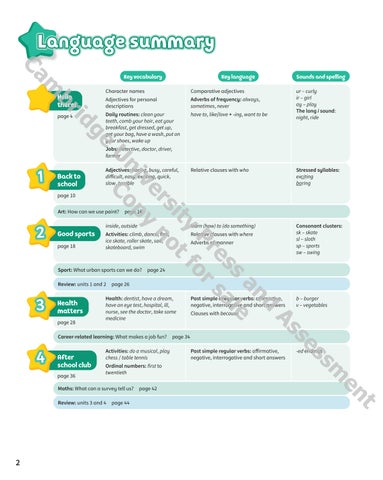
Language summary
Ca
Key vocabulary
m
br
Hello there!
Character names
Comparative adjectives
Adjectives for personal descriptions
Adverbs of frequency: always, sometimes, never
Daily routines: clean your teeth, comb your hair, eat your breakfast, get dressed, get up, get your bag, have a wash, put on your shoes, wake up
have to, like/love + -ing, want to be
Sounds and spelling ur – curly ir – girl ay – play The long i sound: night, ride
ge
id
page 4
Key language
1
Back to school
Adjectives: boring, busy, careful, difficult, easy, exciting, quick, slow, terrible
Relative clauses with who
Stressed syllables: exciting boring
inside, outside
learn (how) to (do something)
Activities: climb, dance, fish, ice skate, roller skate, sail, skateboard, swim
Relative clauses with where
Consonant clusters: sk – skate sl – sloth sp – sports sw – swing
Co
page 10
ss se As d an s le es sa Pr r y fo it t rs no ve y ni p
U
Jobs: detective, doctor, driver, farmer
Art: How can we use paint? page 16
2
Good sports page 18
Adverbs of manner
Sport: What urban sports can we do? page 24 Review: units 1 and 2 page 26
3
Health matters page 28
Health: dentist, have a dream, have an eye test, hospital, ill, nurse, see the doctor, take some medicine
Career-related learning: What makes a job fun?
4
page 36
Activities: do a musical, play chess / table tennis Ordinal numbers: first to twentieth
Maths: What can a survey tell us?
2
Clauses with because
page 34
Past simple regular verbs: affirmative, negative, interrogative and short answers
-ed endings
t
Review: units 3 and 4 page 44
page 42
b – burger v – vegetables
en m
After school club
Past simple irregular verbs: affirmative, negative, interrogative and short answers
Ca
Key vocabulary
m
Exploring: Antarctica, continents, exhibition, expedition, explorer, ice, make a camp, museum, school trip, ship
Exploring our world
br
5
Key language Past simple irregular verbs Clauses with so Comparative adjectives and adverbs
Sounds and spelling ir – circus ur – purple or – world
ge
id
page 46
Geography: How can I stay safe outdoors? page 52
Technology
ou – brought or – sports a – talk
ss se As d an s le es sa Pr r y fo it t rs no ve y ni p
page 54
Past simple irregular verbs
U
6
Technology: app, button, DVD, email, the internet, keyboard, laptop, mobile phone, mouse, screen, text message, turn on, video
Co
Technology: How does technology help us? page 60 Review: units 5 and 6 page 62
7
At the zoo page 64
Animals: bear, bird, blue whale, crocodile, dolphin, elephant, giraffe, kangaroo, lion, lizard, monkey, panda, parrot, rabbit, shark, tiger
Science: How are life cycles different?
8
Let’s party! page 72
Superlative adjectives
Past simple irregular and regular verbs
Prepositions: along, around/round, into, out of
ew – flew ue – blue oo – zoo oo – wood
page 70
Containers: bottle, bowl, box, cup, glass
Expressions of quantity: a bottle/bowl/ box/cup/glass of
Food: cheese, pasta, salad, sandwich, soup, vegetables
want someone to (do something)
Review
Superlative adverbs
Past simple irregular and regular verbs
Literature: How can we write poetry? page 78 Review: units 7 and 8 page 80
Grammar reference Hello there!, units 1–4 Grammar reference units 5–8
page 86 page 87
A1 Movers exam folder
pages 88–95
t
page 82 page 83 page 84 page 85
en m
Values Units 1 & 2 Value others Units 3 & 4 Be kind Units 5 & 6 Be safe Units 7 & 8 Recycle
3
Hel lo there! t here!
ge
id
br
m
Ca Co
ss se As d an s le es sa Pr r y fo it t rs no ve y ni p
U
1
2
Look, think and answer. Listen and check.
1 What does Stella want to be? 2 Who’s a farmer?
3 What’s Simon reading? 4 Who’s riding Suzy’s bike?
2 Listen again. Choose the right words.
Stella’s twelve / twenty / ten. Stella’s ten. Simon’s older than Suzy / Stella / May. Fred is Simon’s father / brother / uncle. Simon wants to be a farmer / detective / dentist. Aunt May’s younger / older / smaller than Suzy.
My dad is older than my mum.
4
Language: revision
LOOK
Stella’s older than Simon. Simon’s younger than Stella.
t
3 Talk about your family.
en m
1 2 3 4 5
1 Read and match.
1–h
a
c
b
e
d
ge
id
br
m
Ca f
g
h
i
Co
ss se As d an s le es sa Pr r y fo it t rs no ve y ni p
U 1 2 3 4 5 6 7 8 9
2
His hair is grey and curly. He’s funny. He’s got short black hair and he’s wearing sunglasses. He’s hungry. She’s got straight grey hair. She’s thirsty. She’s got short brown hair and she’s young. She’s little, but loud. She’s got blonde hair and she isn’t young. She’s quiet. He’s got short straight red hair. He’s happy. She’s got straight blonde hair and she wears glasses. She’s clever. He’s got blonde hair, a beard and a moustache. He smiles a lot. She’s got straight black hair. She’s tired. 3
Listen and say the name. 1 Who smiles a lot?
Uncle Fred.
en m
3 Play the game.
Yes, he has.
Is he younger than Stella? No, he isn’t.
Is he Uncle Fred?
t
Has he got blonde hair?
Yes, he is.
Vocabulary: adjectives Running for personal footerdescriptions
5
1
Read the information and answer. 3 Where does Uncle Fred live? 4 What time does he get up?
m
Ca
1 Where does Aunt May work? 2 What does she like doing?
ge
id
br
Aunt May’s a doctor. She works in a big hospital in the city. She sometimes works during the day and she sometimes has to work at night. She doesn’t like working at the weekend. She likes listening to music and taking photos.
Co
ss se As d an s le es sa Pr r y fo it t rs no ve y ni p
U Uncle Fred’s a farmer. He lives on a farm in the country. He’s got twenty-seven cows and fortythree sheep. He always gets up at five o’clock. Uncle Fred has to work in the morning, the afternoon and the evening. He sometimes works at night too. He loves working on his farm and driving his lorry!
2 Correct the sentences.
Aunt May’s a bus driver. She works in a big school. She never works at night. She likes working at the weekend.
5 6 7 8
Uncle Fred lives in a flat in the city. He’s got forty-three cows. He never gets up at five o’clock. He always works at night.
She always wears a white coat at work. He sometimes works at night. He never gets up at ten o’clock. 6
Language: adverbs of frequency
t
STUDY
en m
1 2 3 4
Aunt May’s a doctor.
1
Read the song and order the pictures. Listen and check. 4
b
m
Ca
a
j
id
br Run to the kitchen, Sit on a chair. Eat your breakfast, Comb your hair.
It’s seven o’clock, Wake up, wake up! You must get up And have a wash.
The morning rap …
ge
The morning rap, We do it every day. The same routine, Now listen and say.
Co
ss se As d an s le es sa Pr r y fo it t rs no ve y ni p
U
i
Come on, come on, It’s time to go. Get dressed, get dressed! Put on your clothes.
h
c
g
It’s seven o’clock …
d
Clean your teeth. No time to lose. Get your bag, Put on your shoes.
Goodbye to Mum, Goodbye to Dad. e My friends are at school, So I’m not sad. The morning rap. The morning rap.
f
5
Sing the song. Do karaoke.
3 Write about your day.
en m
2
t
I wa e up at seven o’cloc . I get dressed after I get up … Vocabulary: daily routines
7
Loc k’s sou nds an d spe llin g 1
Ca
6
Watch the video. Watch again and practise.
ge
id
br
m
2 Write the words in the correct box. Say.
Co
ss se As d an s le es sa Pr r y fo it t rs no ve y ni p
U The girl with curly hair plays all day.
She rides a bike all night. rides
girl
plays
3 Choose and say to make sentences.
The farmer always wakes up early …
The farmer …
The farmer always wakes up early in the morning!
The farmer always …
always sometimes never
wakes up early takes a train rides a bike flies a kite
t
Show what you know c 8
all day all night in the morning in the afternoon in the evening
en m
girl with curly hair farmer dentist detective builder nurse
ly
Sounds and spelling: -ur, -ir, -ay, -i and -igh spellings
g
l
7
Ca 1
Ooohooo! Mr Lock! This is my sister’s son, Peter. He needs your help.
2 Well, there’s a picnic thief in Baker’s Park.
Bah! A picnic thief …
ge
id
br
m
Hello, Peter. Well, I don’t …
Go and play, Peter. Put your food on the blanket. It’s safe with us.
Co
Right here, next to the lake. Every time I play with my friends, somebody takes our picnic.
Let’s go and see!
ss se As d an s le es sa Pr r y fo it t rs no ve y ni p
U
3
No problem, Peter. What’s the matter?
4
Excuse me, Sir. What can you tell me about the picnic thief?
Yeah, where were you at this time yesterday?
Oooh! I was at a picnic. Here in the park.
5
Aha! So, you like picnics.
Lock, I’ve got the picnic thief … or, er, it’s got me! Help!
6
It’s OK, Peter. I’ve got your picnic.
Oh, er, thank you, Mr Key.
en m
t
1 Look at the pictures. Describe what’s happening. In picture 1, Mrs Potts asks Lock and Key for help. Story: unit language in context
9
1 Bac k to sc hoo l Ca
Simon
Alex
Stella
Lenny
id
br
m ge Maths
Co
Art
ss se As d an s le es sa Pr r y fo it t rs no ve y ni p
U
8 1
Meera
Sport
Look, think and answer. Listen and check.
8
1 Where are the children? 2 Which class are Simon and Alex in?
2
3 Who likes Maths? 4 What’s Meera doing?
Listen and match.
9
1 careful 2 boring 3 difficult 4 exciting 5 slow 6 easy 7 busy 8 quick 9 terrible
a
b
f
g
d
h
e
i
2+2=
t
3 Ask and answer. What do you like at school? 10
Vocabulary: adjectives
1
en m
397 + 79 =
c
I like Sport because it’s exciting.
1
1 Read and say the names. a
c
b
e
d
br
m
Ca Jordan Yasmin
ge
id
Daisy
Johnny
Zak
1 This child likes being busy with lots of homework.
5
ss se As d an s le es sa Pr r y fo it t rs no ve y ni p
4
Co
3
U
2
Johnny His hair is straight and black and he’s got glasses. This child loves Art and is careful at painting. He’s got short curly brown hair. The child with straight blonde hair is very brave. She loves reading to her class. This child with glasses thinks Maths is exciting. Her hair is brown and curly. This child with short straight blonde hair thinks Music is difficult.
2 Make sentences and say ‘true’ or ‘false’.
The child with curly hair and glasses thinks Maths is boring.
False.
3 Read and correct the text.
en m
t
My teacher This is Mr Harrison. He’s my Maths teacher. He works in a school in a big city. He’s very sbyu because he’s got a lot of work. There are 28 children in my class. His lessons aren’t wols or grinbo, they’re very ecgitxin. We like his lessons because they’re not ftlcuidfi. It’s yase to learn lots of new things with him. Mr Harrison is very fclareu when he writes, but I’m not!
4 Write about one of your teachers. Vocabulary: adjectives
11
1
Look, think and answer. Listen and check.
10
3 Who’s the Music teacher? 4 Who’s the Art teacher?
m
Ca
1 Where are the Star family? 2 Who’s Mrs Star talking to?
Mr Burke
ge
id
br
Mr Turner
Co
ss se As d an s le es sa Pr r y fo it t rs no ve y ni p
U Mrs Robinson
Miss Flower
Mr Newton
2 Play the game.
Mr Newton.
She’s the woman who’s wearing the long green skirt. He’s the man who’s carrying the lorry.
12
Language: relative clauses with who
t
STUDY
en m
He’s the teacher who’s talking to Mrs Star.
1
1 Read and match.
They’re the boys who are laughing. She’s the girl who’s drinking orange juice. He’s the boy who’s wearing a red sweater. They’re the girls who are wearing blue dresses. She’s the girl who’s skipping. He’s the boy who’s throwing a ball.
a
b
ge
id
br
m
Ca
1 2 3 4 5 6
1–d
c
U
e
f
Co
ss se As d an s le es sa Pr r y fo it t rs no ve y ni p
d
2 Choose a child. Ask and answer.
No, it isn’t.
Is it the boy who’s reading a comic?
3
11
Read and say the letter. Listen and check.
The classroom’s where you learn, The classroom’s where we teach, Lots of exciting things, To do in our school week. b
3 I teach Maths, It’s easy to add, But if it’s wrong, Don’t be sad.
a
1 I teach Sport, It’s quick, not slow, Run, jump and skip, Go, go, go!
12
d
The classroom’s where you learn, The classroom’s where we teach, Lots of exciting things, To do in our school week.
t
4
c
en m
2 I teach English, All I need, Are lots of words, And books to read.
4 I teach Art, We can paint and draw, Careful with the paint, Don’t drop it on the floor!
Sing the song. Do karaoke. Language: relative clauses with who
13
Loc k’s sou nds an d spe llin g 1
Watch the video. Watch again and practise.
Ca
13
ge
id
br
m
2 Circle the stressed syllables. Say.
Co
ss se As d an s le es sa Pr r y fo it t rs no ve y ni p
U Art is easy for elephant, but difficult for snake.
Maths is exciting for snake, but boring for elephant.
3 Say and guess.
He’s doing Maths and it’s difficult.
In Sport, snake is quick, but elephant is slow. The elephant?
difficult
slow
easy ●●
boring amazing
●●●
difficult
14
Sounds and spelling: stressed syllables
●●●
t
●
exciting quick
en m
Show what you know
1 14
On Thursday, we’ve got a lesson on jobs. Can you come to my school to talk about your work, please?
Ca 1
2
id
br
m
Detectives are very important. We help people. We can find people and things.
Oh, yes. We catch people who do naughty things.
ge
No problem, Peter. THURSDAY MORNING
LUNCHTIME Your work is very interesting. Are you very busy?
Oh, yes!
5
Co
3
ss se As d an s le es sa Pr r y fo it t rs no ve y ni p
U
Do you catch bad people?
Well, thank you, Mr Lock and Mr Key. OK, children, it’s lunchtime.
4
OK, Key. I think we’ve got everything now. Let’s go back to the office.
Ooops!
6
I need to stop the ball!
You can’t get it! Gooaaal!
Look! There’s a basketball. Let’s have a quick game!
You’re very naughty!
Is she a detective?
en m
Well! Excuse me!
t 1 What do Lock and Key do at Peter’s school? Say three things. Story: unit language in context
15
Ho w ca n w e use paint? 1
Listen and read. Which artist’s style was new?
m
Ca
15
The Frame is a painting by Frida Kahlo. She was a famous artist from Mexico. She liked to paint ‘self-portraits’ – paintings of herself. Frida looks confident in the painting. She’s got beautiful flowers in her hair. There are also bright colourful flowers and birds around her. They are traditional images from old Mexican stories.
I like the painting because it makes me feel relaxed. It reminds me of a warm, summer morning.
The painting makes me curious about Frida Kahlo and her life in Mexico. I want to learn more about her!
ge
id
br
The Couple is a painting by Georges Seurat, a French artist. He invented a style of painting called ‘pointillism’. The artist uses small dots and dashes of colour to paint a picture. You need to look at the painting from far away to see the image clearly.
Co
ss se As d an s le es sa Pr r y fo it t rs no ve y ni p
U
2 Read again and complete the notes for Frida Kahlo. Artist: Painting: Style:
Georges Seurat
Frida Kahlo
The Couple pointillism
Feeling:
relaxed
prefer? Why?
16
Art: How can we use paint? |
DIDYOUKNOW…?
In ‘drip’ artwork, artists drip paint instead of using a paintbrush.
creative thinking
t
3 Which painting do you
en m
Description: a painting that uses dots and dashes
1
4 Read the description. What do you see when you look at this painting?
Ca
m
A description of ‘Composition in blue, red and yellow’
ge
id
br
This painting is by a Dutch artist called Piet Mondrian. It is ‘abstract’ art. It doesn’t show people or objects. It uses lines, shapes and bright colours to make a picture. In this painting, the artist uses thick black lines to make squares and rectangles. It reminds me of a big colourful window. Some of the shapes are painted blue, red and yellow. They are my favourite colours because they make me feel calm and peaceful. by Samir Ali
Co
ss se As d an s le es sa Pr r y fo it t rs no ve y ni p
U
5 Underline the descriptive adjectives in Activity 4. Learning to write: Ready to write: Descriptive adjectives Go to Activity Book page 16.
There are also bright colourful flowers and birds around her.
6 Ask and answer about the painting. Complete the table. Do you like the painting? Why or why not?
en m
What does it remind you of? How does it make you feel?
t
What is an example of a painting or a style of painting you like? Why?
Make a classroom gallery.
Art: How can we use paint? |
creative thinking
17
2 Good spor ts
ice skate ACTIVITIES INSIDE
Ca
ACTIVITIES OUTSIDE
dance
ge
id
br
m
fish
swim
ss se As d an s le es sa Pr r y fo it t rs no ve y ni p
U roller skate
Co
1
16
Look, think and answer. Listen and check.
1 Who do you think wants to climb? 2 How many water sports can
they do?
2
17
8
climb
sail
skateboard
3 Where can they do water sports? 4 Which activity can they do inside
and outside?
Listen and say the letter.
a
b
e
1 He’s at the ice rink.
He’s learning how to ice skate.
c
f
h
d
g
h
en m
t
3 Ask and answer. 18
Vocabulary: activities
Which activities do you want to do?
I want to dance.
2
1 Read and tick (✓) for you. Ask three friends and answer. Yes, I do.
Do you want to learn to skateboard?
Ca
What do you want to learn to do?
m Name
dance
climb
sail
ice skate
fish
ge
id
br
Me
skateboard
ss se As d an s le es sa Pr r y fo it t rs no ve y ni p
U 2 Write a report. I My teacher My friends
Co
STUDY
want to wants to doesn’t want to want to don’t want to
learn to learn how to
sail. dance. climb. ice skate. skip.
In my class, Daisy and Hugo want to learn how to skateboard, but Jack doesn’t want to learn to skateboard. He wants to learn to dance.
3 Read and write the words. park
ice rink
road
skate park
4 Ask and answer to guess the place.
Is it a place where you can learn how to sail? Yes.
t
A place where you can learn how to roller skate. skate park A place where you can go ice skating. A place where you can learn to ride a bike. A place where you can learn how to sail. A place where you mustn’t skateboard.
en m
1 2 3 4 5
lake
A lake!
Language: learn Running (how)footer to (do something)
19
1
Look, think and answer. Listen and check.
18
3 Where’s Grandpa Star? 4 What’s Suzy doing?
ge
id
br
m
Ca
1 Where’s Mr Star? 2 Who’s climbing?
Co
ss se As d an s le es sa Pr r y fo it t rs no ve y ni p
U badly carefully quickly slowly well
2 Read and choose the right words. 1 2 3 4 5 6 7
They’re running quietly / quickly / slowly. They’re shouting loudly / quietly / carefully. He’s playing badly / loudly / well. They’re reading quietly / loudly / badly. They’re running quickly / well / slowly. She’s playing well / loudly / badly. He’s riding his bike carefully / loudly / quickly.
6
quickly
7
1
5
3
2
en m
4
t
3 Play the game. 20
Language: adverbs of manner
Find the children who are reading quietly.
Number 4.
1
19
1 They’re playing well.
Ca
20
ge
id Co 21
Activity centre, Lots of fun. A place to skate, Sail and run. Activity centre … well, I’m 1 skating Round and round. I’m moving quickly, Over the ground.
I’m 2 easily, Up the wall. I’m going carefully, So I don’t fall. Activity centre, Lots of fun. A place to skate, Sail and run. Activity centre …
ss se As d an s le es sa Pr r y fo it t rs no ve y ni p
U
Activity centre, Lots of fun. A place to skate, Sail and run. Activity centre …
happily, We’re 3 Our boat’s short. We’re going slowly, What a great sport. Activity centre, Lots of fun. A place to skate, Sail and run. Activity centre …
Sing the song. Do karaoke.
en m
3
Yes.
Complete. Listen and check.
br
m
2
2
Listen and say ‘yes’ or ‘no’.
4 Write another verse. Sing. I’m dancing well, Look at me.
Language: adverbs of manner
t
I’m running / dancing / skipping well, Look at me. Doing it slowly / quickly / happily, Can you see?
21
Loc k’s sou nds an d spe llin g 1
Watch the video. Watch again and practise.
Ca
22
br
m
2 Read and complete. Say. Sleepy sloth and super spider are learning sports!
ge
id Co
ss se As d an s le es sa Pr r y fo it t rs no ve y ni p
U Super s p ider owly.
ateboards
eepy
and
oth
ings
ims owly.
3 Look and write the animal. Ask and answer.
Can you skateboard like a sloth?
Yes, look!
swing do sports
ice skate roller skate
I can’t
22
im, but I can
Sounds and spelling: consonant clusters: sk, sl, sp, sw
ateboard!
t
Show what you know
en m
skateboard swim
No, I can’t.
2 2
23
Ca 1
2
br
m
Look, here’s the note. We’ve got a big competition this afternoon!
No problem. We’re coming.
id
‘I’ve got the swimming cup.’ Aha! There are two letters here: T.S.
ge
Hello, this is Baker Street Swimming Club. Please come quickly. Somebody’s got our beautiful swimming cup.
I have to shout loudly because it’s difficult to hear in a swimming pool.
5
4
Co
WALK SLOWLY! DON’T RUN NEAR THE POOL!
ss se As d an s le es sa Pr r y fo it t rs no ve y ni p
U
3
Aha! Look! Here it is. He’s got it. He’s got the swimming cup!
Well, the swimming cup isn’t in the pool!
Let’s go and see Mr Sweep. He’s got some clean towels.
What? Pardon?
𝅘𝅥𝅯𝅘𝅥𝅮
6
Give me that cup!
en m
t
Help me, Coach! Oh! The cup was nice and clean for this afternoon’s competition. Now look at it!
1 Act out the story. What’s your favourite part? Story: unit language in context
23
W hat ur ba n sp or ts ca n w e do? 1
Listen and read. What is important for both sports?
br
m
Ca
24
Skateboarding
Urban sports
ge
id
Skateboarding is a popular sport here in Barcelona. To start, you need a skateboard.
Co
The best thing about skateboarding is that you can do it anywhere. There are special skate parks here, but a lot of people skateboard on the street.
Safety fety
Canada is famous for the sport hockey. The players play in teams and move a small disc (called a ‘puck’) with a long stick. They try to hit the puck into a goal. You have to score goals to win.
ss se As d an s le es sa Pr r y fo it t rs no ve y ni p
U
You stand carefully on the board to ride it. When people skateboard, they do tricks. They jump and turn quickly.
Hockey
! Wear a helmet so you don’t
We have hockey fields here, but kids also play it on the street and you can play it wearing skates.
! Don’t do sport near busy roads.
hurt yourself badly if you fall.
2 Read again and complete. Talk to a friend about another sport you can do in the street. What’s similar?
What’s different?
Skateboarding uses a board and hockey uses a stick.
3 Which sport would
DIDYOUKNOW…?
en m
You mustn’t do it near busy roads.
24
Sport: What urban sports can we do? |
Skateboarding started in California. The idea was to make a sur fboard with wheels for the street!
collaboration
t
you like to do? Why?
2
4 Read the poster. Write the headings. How to play Players Get ready
How to win!
m
Ca
Bottle Bounce
Get ready
ge
id
br
game yyou fun g e is a f Bottle Bounce t You jjust y can playy almost anywhere. c plastic some g a ball and need string, carefully bottles. Tie the bottles g them near g and hang to a string a wall, like the picture.
U
Co
ss se As d an s le es sa Pr r y fo it t rs no ve y ni p
Players y throw the ball directly at the wall. The ball bounces quicklyy off the wall and hits the bottles. It’s a fun game, g but it’s difficult to play well.
y who hits the The player wins. bottles most
You can playy Bottle Bounce Y e with 2–4 players. All you need is enough space and enough bottles!
5 Circle the adverbs in Activity 4. Ready to write:
Go to Activity Book page 24.
Learning to write:
Adverbs They jump and turn quickly. Wear a helmet so you don’t hurt yourself badly if you fall.
6 Read again and complete. Why is
Bottle Bounce a good urban sport? 2
and
en m
1 Between
players can
t
play Bottle Bounce. 2 Players use a to hit some . 3 The ball has to off the wall before . it hits the 4 You can Bottle Bounce almost .
Make a presentation about a sport in a different country.
Sport: What urban sports can we do? |
collaboration
25
Units 1 and 2
Ca
1 Play the game.
Red – Whose is it/are they? Blue – What’s this? Grey – What’s he/she doing?
Co
ss se As d an s le es sa Pr r y fo it t rs no ve y ni p
U
FINISH
ge
id
br
m Instructions
t
Review: units 1 and 2
en m
START 26
2
2 Read the text and choose the best answer. Example
Ca id
br
m
Tony: Hi, Sue. What are you doing? Sue: A I’m playing badminton. B I’m playing baseball. C I’m hitting the ball.
ge
Quiz
ss se As d an s le es sa Pr r y fo it t rs no ve y ni p
U
Questions
Co
1 Tony: Who are you playing with? Sue: A She’s my Aunt Sue. B My brother, Alex. C We’re playing well.
2 Tony: Is he older than you? Sue: A No, he’s my brother. B Yes, he’s holding the ball. C No, he’s a year younger than me.
3 Tony: Are you good at badminton? Sue: A Yes, I’ve got three. B I’m not bad, but Alex is better than me. C No, thank you. 4 Sue: Do you like badminton? Tony: A Yes, it’s my favourite sport. B Yes, please. C Yes, let’s.
2
Which child loves Art and is careful at painting? (p11)
3
Where were Lock and Key on Thursday morning? (p15)
4
Name a painting by Frida Kahlo. (p16)
5
What’s Suzy learning to do? (p20)
6
Name a place where you can learn to climb and sail. (p21)
7
Why does Key go and see Mr Sweep? (p23)
8
Which sport uses a puck? (p24)
t
6 Sue: Shall I start? Tony: A Yes, I want to stop. B No, I want to play. C Yes, good idea.
What does Simon want to be? (p4)
en m
5 Sue: Would you like to play badminton with us? Tony: A I’d like that, thanks. B Yes, I like board games. C No, I don’t.
1
Review: units 1 and 2
27
Hea lt h matters 3 Health br
m
Ca WEDNESDAY
TUESDAY
ge
id
MONDAY
Co
ss se As d an s le es sa Pr r y fo it t rs no ve y ni p
U THURSDAY
FRIDAY
8
was were had drank saw gave
1
25
8
took went
ate
Look, think and answer. Listen and check.
1 What was Simon’s temperature? 3 Why were Simon and his mum at the hospital? 2 Where was Simon on Thursday? 4 When was Simon well again? 26
Listen and say the day.
1 The doctor gave him some medicine.
Wednesday.
en m
2
Last time I was ill, I drank orange juice because I had a cold. 28
Language: past simple irregular verbs
t
3 Talk about the last time you were ill.
3
1 Read and match. a
c
e
f
id
br
m
Ca
b
d
ge ss se As d an s le es sa Pr r y fo it t rs no ve y ni p
U He took some medicine because he had a cold. We ate a lot because we were hungry. She went to bed early because she was ill. I drank a lot because I had a temperature. The doctor gave her some medicine because she had a stomach-ache. They saw the dentist because they had a toothache.
Co
1 2 3 4 5 6
d
2 Read and answer the questions.
Last Monday morning, Sue went to the City Hospital to see the doctor because she had a headache. When she was at the hospital, the doctor gave her an eye test. After her eye test, Sue saw her friend Tom. He was at the hospital because he was ill. He was happy to see Sue. The nurse gave him some medicine. Then he had lunch in bed and he drank orange juice. At one o’clock, Sue was hungry so she went home.
STUDY
t
Why was Sue at the hospital? Because she had a headache. Who had an eye test? Which of Sue’s friends was at the hospital? Why was Tom happy? Who gave Tom some medicine? Why was Tom happy? Where was Tom when he had lunch? Who had an eye test? Who drank orange juice?
en m
1 2 3 4 5 6 7 8
What time was it when Sue went home? Language: clauses with because
29
1
Look, think and answer. Listen and check.
27
3 What was Stella’s job? 4 What was wrong g with the man?
ge
id
br
m
Ca
1 Who’s Stella talking to this morning? 2 Where was Stella in her dream?
Co
ss se As d an s le es sa Pr r y fo it t rs no ve y ni p
U This morning
Last night
2 Read and answer.
1 Did Stella have a nice dream? 2 Did she have a long blue coat? 3 Did she see a woman who had
have ➜ had
do ➜ did
I had a terrible dream. I didn’t have time to stop. How many people did you see? Did she give the man some flowers? Yes, she did. / No, she didn’t.
Language: past simple irregular verbs: negative, interrogative and short answers
t
30
STUDY
en m
a cough? 4 Did she give the man some flowers? 5 Did she see a woman with backache? 6 Did she take a box off the girl’s head?
No, she didn’t. She had a terrible dream.
1
3
Read and say the word. Listen and check.
28
ge
id
br
m
Ca
lemonade ice cream burgers chocolate three water party sausages nurse fruit
Co
ss se As d an s le es sa Pr r y fo it t rs no ve y ni p
U Mummy, Mummy, call the I had a stomach-ache but now it’s worse. What’s the matter?
!
nurse
Yes, I did.
Did you drink
Yes! There was lots to eat and games to play. ?
29
No more chocolate cake for you, my daughter. and a drink of Vegetables,
Sing the song. Do karaoke.
3 Ask and answer about the song.
t
Did she eat ice cream?
!
en m
2
?
and too? Did you have I think I know what’s the matter with you! times a day, Take this medicine When you are better, go out and play!
yesterday?
Did you have a
Yes, I did.
?
Yes, I did.
I don’t know, But please be quick, Don’t be slow.
Did you eat
Did you eat
Yes, she did.
Did she drink orange juice?
No, she didn’t.
Language: past simple irregular verbs: interrogative and short answers
31
Loc k’s sou nds an d spe llin g 1
Watch the video. Watch again and practise.
Ca
30
ge
id
br
m
2 Circle the letter ‘b’ and underline the letter ‘v’. Say.
Co
ss se As d an s le es sa Pr r y fo it t rs no ve y ni p
U ‘Vegetables and rest are best,’ said the vet.
A big bear had a very bad backache and went to see the vet.
3 Write sentences. Say and guess. There’s a boy …
… in the living room with a very big ball!
No, sorry. Try again! a bear a boy
a bird a bat
kitchen
bedroom
living room
a very big ball a burger
some vegetables
en m
a vet
bathroom
some breakfast a TV
t
Show what you know When I’m hungry, I like to eat 32
Sounds and spelling: words with b and v
egetables and
urgers.
3 31
Ca 1
2
So Nick Motors, the car thief, is back in town.
ge
id
br
m
I went to the hospital shop. There was a man there. He had black hair and a big nose. I think it was Nick Motors, the car thief.
Oooops. Sorry I’m late. I went to the hospital to see my Aunt Emma. She’s got a bad cough. I really want to catch Nick Motors this time, Key.
4
Co
3
ss se As d an s le es sa Pr r y fo it t rs no ve y ni p
U
In the hospital? Let’s go there now.
Come on! We need to go inside quickly, before he runs away.
No problem, Lock!
5
There he is! That’s him, Lock!
6
en m
He’s taking our motorbike!
t
No, Key. He’s not Nick Motors. He’s a doctor.
Nick Motors isn’t inside the hospital, Key. He’s outside in the street … and …
1 Who did Key see in the hospital shop? Describe the man. Story: unit language in context
33
n? fun? jobbfu esaajo akes mak hattm W Wha
Ca 11
3232 Listen Listenand andread. read.Which Whichjob jobdo doyou youprefer? prefer?Why? Why?
br
m
Dr Drea eam m jo jobs bs
ge
id
.com .com dblog dblog el@vi el@vi migu migu game videogame I’ma avideo nowI’m andnow e,e,and colleg n natatcolleg Desig d dDesig I studie I studie job ctctjob perfe theperfe it’sthe s so s soit’s game videogame g gvideo playin I loveplayin er.er.I love design design . . create funtotocreate lotofoffun e ea alot they’r cters cters– –they’r chara thechara I designthe me.I design for forme. s. s. game newgame thenew g gthe testin jobis istestin myjob partofofmy bestpart thebest But Butthe
ss se As d an s le es sa Pr r y fo it t rs no ve y ni p
U
Co
tania tania @dan @dan cehal cehal l.blog l.blog I’m I’ma adance dance r rininpop popmusic musicvideo video s.s.I studie I studie d dballet ballet , but , butI like I like dancin dancin g gtotoallallkinds kindsofofmusic music , from , fromclassic classic alaltotopop popand androck. rock. I work I workwith witha ateam teamofofdance dance rs.rs.We Wepracti practi seseand andperfo perfo rm rmthe the dance dance s stogeth togeth er.er.It’sIt’sfun, fun,but butwe’re we’realway alway s stired tiredafter afterwork work .. You Youneed needtotobebefitfittotododomy myjob. job.
com com e.com e e.com e @rac @rac steffi steffi over s sallallover etition etition comp I raceinincomp . I. race driver cardriver racingcar I’m I’ma aracing ng! ng! exciti veryexciti it’svery , but , butit’s erous erous dang canbebedang . It. Itcan world the theworld dd scare feelscare I don’tfeel job.I don’t thisjob. dothis bravetotodo needtotobebebrave You Youneed . When . When years manyyears formany d dfor I traine seseI traine becau I drivebecau when whenI drive car. mycar. I lovemy andI love joband myjob I lovemy free!I love I feelfree! g,g,I feel drivin I’m I’mdrivin
22 Read Readand andwrite write‘designer’, ‘designer’,‘dancer’ ‘dancer’oror‘driver’. ‘driver’. designer designer
33 What Whatmakes makeseach eachjob jobfun? fun? 34 3434
Career-related Career-related learning: learning: What What makes makes a job a job fun? fun?| |
Tru Tru ckckdridri ver verisisone oneofofthe themo mo ststpop pop ula ula r job r job ss ininthe theUn Un ited itedSta Sta tes tes . The . The rereare aremo mo reretha tha nn 3.5 3.5mil mil lion liontru tru ckckdridri ver ver s in s inthe thecou cou ntr ntr y.y. learning learning toto learn learn
t
DI DIDY DYOU OUKN KNOW OW… …??
en m
1 1 You Youcan canwork workand andplay playatatthe thesame sametime. time. It’sa adangerous dangerousjob. job. 2 2 It’s 3 3 You Youneed needtotobebefitfitand andhealthy. healthy. 4 4 You Youhave havetototravel traveltotodifferent differentcountries. countries. 5 5 You Youmustn’t mustn’tbebescared scaredatatwork. work. 6 6 You Youneed needtotouse useyour yourimagination. imagination.
3
4 Read the blog. Say what Joaquín thinks is fun about his dream job.
Ca
www.myblog.com
id
br
m My dream job!
ge
My dream job is a professional musician. I took drum lessons last year. Now I’m a drummer in a band and I sing, too. We’re all friends in my band so it’s fun when we play together. It’s an exciting feeling! I want to play shows all over the world one day. Travelling can be tiring, but I’d love to visit lots of different countries. It sounds like so much fun!
Co
ss se As d an s le es sa Pr r y fo it t rs no ve y ni p
U
joaquin@drumspot.blog
5 Underline the contractions in Activity 4.
Learning to write:
Ready to write:
Contractions I’m a video game designer.
Go to Activity Book page 34.
6 Read and tick (✓) the correct options. Tell a friend about your dream job.
wants to be ✓ a professional musician.
He studied drums
singing
.
wants to travel
all over the world.
hard work
t
He thinks playing music with his friends is exciting He travels
en m
JoaquÍn is
.
Role-play an interview.
Career-related learning: What makes a job fun? |
learning to learn
35
4 Af ter sc hoo l c l u b Ca m
MUS
ICAL
br EXIT
S
EXIT
ge
id ALS
SIC
MU
Co
ss se As d an s le es sa Pr r y fo it t rs no ve y ni p
U
1
33
Look, think and answer. Listen and check.
1 Where did the children go
yesterday afternoon? 2 Which teacher was there?
2
34
3 Who did Stella play chess with? 4 Who wasn’t good at dancing?
STUDY
Listen and say ‘yes’ or ‘no’. 1 The children helped Mr Star.
yesterday? Write.
No.
dance ➜ danced stop ➜ stopped carry ➜ carried
en m
3 What did you do after school
help ➜ helped
t
I went to the library because I wanted to get a book. 36
Language: past simple regular verbs
4
1 Read and match. 1
Ca
a
ge
id
br
m
Pat worked at a school. She was the cook. She cooked all the food in the morning. The children liked eating her pancakes! After school, she helped the children as they skipped, jumped and danced in the playground.
b
2
U
Co
ss se As d an s le es sa Pr r y fo it t rs no ve y ni p
Tod lived in the countryside. He loved sport, and he climbed and sailed every weekend. When it rained, he called his friend, Fred. Tod and Fred went to the After school club, where they played badminton inside.
c
3
Yesterday, David chatted with his friend Sid and invited him to go ice skating. It was very cold so they needed hats and scarves. It started to snow, but Sid ice skated on the lake. David pointed and shouted because Sid wasn’t careful.
2
35
Listen and say ‘a’, ‘b’ or ‘c’. 1 It started to snow.
c
She worked Where did Pat work? at a school. What did Pat cook? When did Pat help the children? Where did Tod live? What did Tod do every weekend?
6 7 8 9
What did Tod and Fred play inside? Who did David chat with? What did they need? Where did Sid skate?
Language: past simple regular verbs: affirmative Running footer and interrogative
t
1 2 3 4 5
en m
3 Read and answer.
37
1
Look, think and answer. Listen and check.
36
3 Who loves climbing? 4 Why must they walk up the stairs?
ge
id
br
m
Ca
1 Which friend are the children visiting? 2 Where is Alex’s flat?
Co
ss se As d an s le es sa Pr r y fo it t rs no ve y ni p
U 8
2 Read and answer.
c
3 Write more questions to ask a friend. 38
Vocabulary: ordinal numbers: first to twentieth
LOOK
first second third fourth fifth
1st 2nd 3rd 4th 5th
t
What’s the third letter of the alphabet? What’s the ninth letter? What’s the twelfth letter? What’s the sixteenth letter? What’s the twentieth letter?
en m
1 2 3 4 5
1
Listen and complete. Sing the song. Do karaoke.
37–38
4
ge
id
br
m
Ca Dancing’s good, dancing’s fine, Come on, children! Dance in line!
ss se As d an s le es sa Pr r y fo it t rs no ve y ni p
U
Dancing is good, dancing is fine, Dancing is great! Come on, children! Dance in line!
Co
, third and fourth, First, a second Dance, dance across the floor. b , sixth, seventh, c Jump, kick, don’t come in late. d , tenth, eleventh, e for your health. Dancing is f
Number five’s g And number ten’s last. He can’t hop and skip, He can’t get past.
,
,
,
Dancing is good, dancing is fine, Dancing is great! Come on, children! Dance in line!
2 Ask and answer. Which team was twentieth last week?
The Goal Monsters.
en m
t
3 Compare this week to last week. Write. This week Heart Club are third, but last week they were first.
Vocabulary: ordinal numbers: first to twentieth
39
Loc k’s sou nds an d spe llin g 1
Watch the video. Watch again and practise.
Ca
39
. Say.
ge
id
br
m
2 Find and draw , T or
Co
ss se As d an s le es sa Pr r y fo it t rs no ve y ni p
U Yesterday, it rained all day. They were bored inside. U They decided to put on their boots and go outside! They T skipped and jumped, danced and skated.
3 Make sentences and say. On Monday, I watched a film.
On Tuesday, I danced with my friend.
On Wednesday, …
en m
Show what you know
Sounds and spelling: -ed endings
called
played
shouted
jumped
helped
decided
rained
skated
t
40
skipped
4 40
Ca
2
1
Hello, Peter. What are you doing here?
Yes, please, Peter. Which show are you doing?
ge
id
br
m
I’ve got two tickets for my school show on Wednesday. Would you like to come?
U
ss se As d an s le es sa Pr r y fo it t rs no ve y ni p
3
We’re doing Peter Pan. Pupils and parents are in it.
4
Co
We’re over there in the fifth row. These are our chairs. Can you go and get us some drinks, Key?
No problem, Lock! Two lemonades.
5
This is great!
Look at him, Key! It’s Nick Motors!
I crossed the sea and sailed to Neverland to catch you, Peter Pan!
6
I know who you are! Oops!
Ow, my beard. That hurts!
Dad, this is Mr Lock. Er, Mr Lock, this is my dad.
en m
t
Come down here! You, you, you … pirate!
1 Who is your favourite person in the story? Why? Story: unit language in context
41
W hat ca n a su rv ey te ll us?
Ca 1
41
Listen and read. What’s the survey about?
br
m What sports and activities are popular?
id
ge
Which sports and activities do you do in your free time? A recent survey in the UK asked students between the ages of 8 and 12 years old the same question! Here are the results:
U
Co
ss se As d an s le es sa Pr r y fo it t rs no ve y ni p
• 45% of children play football – that’s almost half the children in the survey! • Nearly a third of the children do swimming or diving – 30% in total. • A quarter of the children go to a gym to do gymnastics or exercise. • 18% of the children go running. • Only 12% of the children play tennis.
2 Read again and write the percentages. Read and answer. [KBx3_IN_L4_
1 Which sport is the
Popular sports and activities PB_U04_p042_ 45 %
2 Which sport is the
least popular?
35 30 25 20 15 10 5 0
%
%
football
swimming/ diving
gym
running
survey do you do? Tell a friend. Maths: What can a survey tell us? |
critical thinking
%
a quarter of the children do?
tennis
DIDYOUKNOW…? Table tennis player Hend Zaza, from Syria, was the youngest athlete at the Tok yo Olympics. She was just 12 years old !
t
3 Which activities from the
42
3 Which activity do
%
en m
Percentage (%)
50 45 40
most popular?
x03_i01] REALIA BAR GRAPH
4
4 Read the survey results. What is the most popular after school activity?
Ca
What are my classmates’ favourite after school activities?
m
br
I asked 20 students in my class about their favourite after school activities. Here are the results of my survey:
ge
id
• Half the class are members of the sports club. Of those 10 students, 50% play football, more than a quarter play tennis, and the rest go running.
ss se As d an s le es sa Pr r y fo it t rs no ve y ni p
U
• Six students in the class said their favourite after school activity is the games club – that’s almost a third of the class. The most popular game in the club is chess. • The other 20% of the class are members of the drama club.
Co
By Priya
5 Circle the words for these percentages in Activity 4. Write. 50% =
33% =
25% =
Learning to write:
Ready to write:
Percentages in words A quarter of the children go to a gym.
Go to Activity Book page 42.
6 Calculate and complete the results of the survey. Let’s do Maths!
Total number of students: 1 football (5 students)
100 ÷ 20 = 5 x 5 = 25 % =
%
3 running (2 students)
100 ÷ 20 = 5 x
=
%
4 games (6 students)
100 ÷ 20 = 5 x
=
%
5 drama (4 students)
100 ÷ 20 = 5 x
=
%
TOTAL =
%
t
100 ÷ 20 = 5 x
en m
2 tennis (3 students)
Do your own survey and make a poster.
Maths: What can a survey tell us? |
critical thinking
43
Units 3 and 4
Ca
1 Play the game.
m ge
id
br
Instructions
FINISH
U
Co
ss se As d an s le es sa Pr r y fo it t rs no ve y ni p
You helped your parents.
Before you play, decide which actions are good and which are bad. Say the last time you did each action. Good actions: Go forward 2 spaces. Bad actions: Go back 2 spaces.
You didn’t do your homework.
You went to football practice.
You worked quickly and well.
You talked to your friend in class.
You cleaned m. your room.
Review: units 3 and 4
You answered your grandpa’s email.
t
44
You were late for school because you stopped to buy a comic.
en m
START
You carried the shopping for your grandma.
You were g y in naughty class.
2
4
How did Mary go to these places? Listen and write a letter in each box. There is one example. 42
br
m
Ca H
walking
bike
bus
boat
ge
id
train
ss se As d an s le es sa Pr r y fo it t rs no ve y ni p
C
Quiz
B
Co
A
U
car
D
1
Where did Simon go on Thursday? (p28)
2
Who had lunch in bed in hospital? (p29)
3
Who took Lock’s motorbike? (p33)
4
E
5
Who carried the chairs for the After school club? (p36)
6
Why did David point and shout? (p37)
H
en m
G
F
Which job is one of the most popular in the United States? (p34)
at the school show? (p41)
8
t
7 What did Lock and Key drink
What percentage is a half? (p43)
Review: units 3 and 4
45
5 Ex p lori n g o u r world br
m
Ca Simon Star
id
Expedition to Antarctica.
ge
Co
ss se As d an s le es sa Pr r y fo it t rs no ve y ni p
8
U
A famous explorer, Sir Ernest Shackleton, wanted to cross Antarctica. In 1914, he started the expedition, but ice closed around the ship. They took smaller boats and made a camp on the snow. They lost their ship when it went down under the ice and water.
They couldn’t move because the weather was terrible. They caught fish and drank water which they got from snow. Later, they had to eat their dogs. Shackleton and some of his men climbed over mountains of ice, found help and went back for the other men. Everybody came home two years after the start of their expedition. They didn’t cross Antarctica.
1 Look, think and answer. Read and check.
3 Who was Shackleton? 4 How did Shackleton go to Antarctica?
2 Find the past tense of these verbs in the text.
en m
1 Who did Simon show his homework to? 2 Who did Simon write about?
t find catch take go make get can’t lost have to come
3 Was it a good expedition? Why? Why not? 46
Language: past simple irregular verbs
5
1 Read and match. a
c
d
f
g
h
e
ge
id
br
m
Ca
b
U
f
1 Last week, David’s class went to a museum.
ss se As d an s le es sa Pr r y fo it t rs no ve y ni p
2 First, they walked round an exhibition about explorers.
3 They could read explorers’ diaries so it was really exciting.
Co
4 Before lunch, they made a poster about famous explorers.
5 After lunch, they found the museum shop and David got a toy
polar bear for his sister. 6 In the afternoon, they went to an exhibition about sea animals. 7 Before they came home, David took a photograph of his friends. 8 At three o’clock, they caught the bus home.
2
43
Listen and answer.
1 When did David’s
class go to a museum?
3 Make sentences.
They went to a museum last week.
They were hungry so they ate sandwiches.
they couldn’t find the museum.
2 They didn’t take water with them
he got a toy from the shop.
3 The exhibition was really good
they ate sandwiches. they came home late.
5 The children had to wait for the bus
they had a great time.
6 They lost their map
they were thirsty.
Language: clauses with so
t
4 It was his sister’s birthday
so
en m
1 They were hungry
47
1
Look, think and answer. Listen and check.
44
Which explorers are Simon and Alex talking about? What was Cousteau’s ship called? Who did Alex write about? What did Cousteau explore?
br
m
Ca
1 2 3 4
Cousteau
Shackleton
ge
id CALYPSO
Co
ss se As d an s le es sa Pr r y fo it t rs no ve y ni p
U 2 Read and complete.
Alex thinks that Shackleton’s adventures were 1 more difficult 2 Cousteau’s, but Cousteau is 3 famous for his work. Cousteau said we careful with the sea. Stella thinks Simon’s homework was have to be 4 5 interesting 6 hers. Lenny was happy because he did his quickly than Simon and Alex. homework 7
3 Find information and write about one of the explorers.
Cousteau is more famous for his work. Our homework was easier than theirs. Jessica Watson
48
Shackleton sailed more slowly than Cousteau.
Language: comparative adjectives and adverbs
t
STUDY
en m
Karen Darke Matt Rutherford Ed Stafford Jessica Watson
5
1 What do you think? Tell a friend. I think climbing is more dangerous than swimming.
swimming
pop music
classical music
Maths
Art
horses
fish
Co
ss se As d an s le es sa Pr r y fo it t rs no ve y ni p
U
climbing
ge
id
br
m
Ca
boring exciting dangerous beautiful difficult easy
badminton
table tennis
photos
paintings
2 Now write four sentences.
I think badminton is more boring than table tenni s.
3
45
Complete. Listen and check.
trees green mine ours
46
,
Our world is tired, we’re making mistakes, We need our seas, we need our lakes. Our world is weak, we can make it 4 It needs our help. Listen to our song. We must look after its forests and 5 We must look after its rivers and seas. We can make it better, we can make it This is our world, let’s keep it clean.
,
,
6
,
t
4
,
en m
The world isn’t 1 mine The world isn’t yours. The world isn’t 2 The world isn’t hers. It’s ours, ! It’s 3
his strong
Sing the song. Do karaoke. Language: comparative adjectives
49
Loc k’s sou nds an d spe llin g 1
Watch the video. Watch again and practise.
Ca
47
id
br
m
2 Find and underline the sound. Say.
ge
Circus girl in a purple skirt. Turn and surf around the world.
Co
ss se As d an s le es sa Pr r y fo it t rs no ve y ni p
U 3 Play the game.
Circus girl went to the desert. She was very thirsty and dirty!
thirsty dangerous boring slow exciting easy difficult interesting quick dirty
desert
Arctic
mountains
forest
sea
circus
Show what you know My favourite colour in the w
50
Sounds and spelling: -ir, -ur and -or spellings
t
world
en m
lake
ld is p
ple.
5 48
Ca 1
Look here. It says you can explore forests, rivers and beaches. Can we go, Lock? Please!
2
ge
id
br
m
Look, Key! I’ve got information about Nick Motors. He’s on an adventure holiday in the countryside.
OK, Key. But we have to catch Nick Motors!
ss se As d an s le es sa Pr r y fo it t rs no ve y ni p
U He came here yesterday. He caught a bus in the afternoon and had dinner at the Lakeside Restaurant.
4
Co
3
Good! These holidays are more exciting than holidays at the beach.
We can catch him easily, Lock. No problem.
Excuse me. Do you know this man?
Oh yes! I gave him his breakfast this morning.
Hmmm, but he’s not here now.
5 Hello! What are you doing here, Mr Key?
Hello, Miss Rich. We’re at work. We’re trying to catch a thief.
I don’t understand. It says, ‘Look behind you!’
en m
He’s got our bike! I need a holiday.
t
I’ve got a message on my phone!
6
1 What did Nick do at the holiday camp? Say three things. Story: unit language in context
51
Ho w ca n I stay safe outd oo rs?
Ca 1
Listen and read. What are ‘dos and don’ts’?
49
br
m id
Check the weather!
ge
Extreme heat and extreme cold can both be dangerous. Here are some ‘dos and don’ts’ for protecting yourself in hot and cold climates.
U
Co
Without water, our bodies dehydrate. Drink lots of water to stay healthy in hot weather. Don’t eat big meals on a hot day – eat something light, like fruit or a salad, so you don’t feel tired.
Wear warm clothes in cold weather, like a thick jumper, a coat, a scarf and a hat. Use thick socks and waterproof shoes to keep your feet warm and dry.
ss se As d an s le es sa Pr r y fo it t rs no ve y ni p
UV rays from the sun are dangerous and can cause sunburn. Use sun cream to protect your skin.
Don’t go outside with wet hair. It feels cold and uncomfortable.
Eat plenty of vegetables when the weather is cold. This will help to keep your body strong and healthy.
2 Read and complete the table. Dos and don’ts for hot weather
en m
use sun cream
Dos and don’ts for cold weather
Over 50% of your body is water! You need to drink a lot of it to stay health y.
in hot and cold weather?
52
Geography: How can I stay safe outdoors? |
collaboration
t
DIDYOUKNOW…?
3 What activities do you do
4 Read the leaflet. Make a list of things to take on a hiking trip.
br
m
Ca
SAFETY Hiking in TIPS: hot weather
id
Hiking is great fun, especially in the summer. Here are some tips to stay safe:
5
6 Don’t go alone. Stay with your friends so you can look after each other. 7 Don’t forget to take a mobile phone and a map. You don’t want to get lost.
Stay safe and enjoy your hike!
ge
1 Drink lots of water to keep your body hydrated. 2 Wear sun cream to protect your skin from
ss se As d an s le es sa Pr r y fo it t rs no ve y ni p
U
dangerous UV rays. 3 Wear light clothing so that you are comfortable.
Co
4 Use insect repellent to protect yourself from
insect bites. 5 Carry medicine in case you feel ill.
5 Underline the imperatives in Activity 4. Learning to write: Ready to write: Imperatives Wear warm clothes. Don’t eat big meals.
Go to Activity Book page 52.
6 Read the reasons and write the instructions. Dos and don’ts Wear sun cream
Why?
1 To protect your skin from the sun.
en m
2 To be comfortable. 3 To stay hydrated. 4 In case you feel ill.
t
5 So you don’t get lost. 6 To protect from insect bites. 7 So you can look after each other.
Make a safety poster.
Geography: How can I stay safe outdoors? |
collaboration
53
6 Tec h n o logy Ca
the internet
m
email screen
br
app
ge
id keyboard
ss se As d an s le es sa Pr r y fo it t rs no ve y ni p
U mouse
DVD
Co
button
laptop
1
50
Look, think and answer. Listen and check.
1 What’s Stella talking about? 2 Who wants to learn about computers?
2
51
3 Who knows about computers? 4 Who’s thinking about shopping?
1 screen
b
c
e
f
a
d
screen – c
en m
Listen and repeat. Say the letter.
t
3 What technology do you use at home? 54
Vocabulary: technology
1
52
Listen and match.
6
1–e
d Contacts
3
6
9
-
2
5
8
0
1
br
m
4
Title Track
7
Back
#
Ca
a
ge
id
e
b
U
Grandpa needs a new mobile, (No, I don’t!) With a music app. (A what?) It’s got songs and 1 video clips, And he can learn to rap. (I can learn to WHAT?)
f
T
W
T
F
S
2
3
4
5
7
8
9
10
11
12
13
14
15
16
17
18
19
20
21
22
23
24
25
26
27
28
29
30
31
ss se As d an s le es sa Pr r y fo it t rs no ve y ni p
1
6
Fishing with Peter
Grandpa needs a new mobile, (No, I don’t!) So he can 2 text his friends. (I can talk to my friends!) He can take lots of 3 photos, And play 4 games at weekends. (I go fishing at weekends!)
8
M
18
Co
c
May S
g
Grandpa! (I’ve got a DVD player at home!) Grandpa! (I’ve got a nice camera!) Grandpa! (And my old mobile phone works perfectly well!) Grandpa needs a new mobile. (A new mobile phone!)
Grandpa needs a new mobile, (No, I don’t!) So he can 5 plan his day. (I’ve got a pen and paper!) He can listen to lots of 6 songs, And 7 phone or even play. (I haven’t got time to play! I’ve got a radio! I’ve got a nice camera! My old mobile phone works perfectly well! Hmph!)
2
53
Sing the song. Do karaoke.
No, he hasn’t.
Can you use a computer?
Yes, I can.
t
Has your grandpa got a mobile phone?
en m
3 Ask and answer.
computer TV camera the internet mobile phone email e-book laptop app Vocabulary: technology
55
1
Look, think and answer. Listen and check.
54
1 Where did Grandma and Grandpa
m
Ca
go yesterday? 2 What did they get?
3 What’s their laptop called? 4 What problem have they got?
Yesterday
Today
id
br
LATEST MODELS
ge
BEST PRICES
Co
ss se As d an s le es sa Pr r y fo it t rs no ve y ni p
U
KBX4 K
2 Read and circle.
Grandma and Grandpa went shopping yesterday. They 1 bought / thought a laptop. They chose a KBX4 because Grandma 2 put / read about it and the man in the shop 3 chose / thought it was better than the others. The man 4 brought / knew it home later. He took it out of the box, 5 put / bought it on the table and 6 read / said goodbye. He thought they 7 chose / brought the KBX4 because they 8 knew / said about computers!
you went to the shops.
56
Language: past simple irregular verbs
choose ➜ chose buy ➜ bought bring ➜ brought know ➜ knew
put ➜ put read ➜ read say ➜ said think ➜ thought
t
Last time I went to the shops, I bought a book.
STUDY
en m
3 Talk about the last time
1
55
6
Listen and correct the actions.
1 At seven o’clock, John got dressed.
id
br
m
Ca
Jim’s got a new computer game called Kid City. The people in his game do different things every day. Look at what they did yesterday. No. At seven o’clock, John got up.
ge
Yesterday
1
2
4
Jack
ss se As d an s le es sa Pr r y fo it t rs no ve y ni p
U
John
3
John
Co
Mary
5
6
Peter
9
Sue Sue
7
Mary
8
Mary
Jack
10
11
Mary
Peter
12
Peter
2 Ask and answer.
What time did Mary get dressed?
She got dressed at eight o’clock.
en m
3 Write sentences about your day yesterday. Tell a friend.
t
I got up at seven o’clock yesterday. Language: past simple irregular verbs
57
Loc k’s sou nds an d spe llin g 1
Watch the video. Watch again and practise.
Ca
56
m
2 Find and draw ●● , ● or
. Say.
br
●●
●
Yesterday at four, they walked to the sea shore.
ge
id Co
ss se As d an s le es sa Pr r y fo it t rs no ve y ni p
U They brought a ball and did some sports. And then they walked some more!
3 Choose, ask and answer.
What did you do yesterday at ten?
I talked to my grandma.
walk to (a place) talk to (someone) buy (something) catch (the bus) call (someone) do sports play with a ball Yesterday at …
en m
58
Sounds and spelling: -ou, -or and -a spellings
t
Show what you know
6 57
Ca 1
The money was for my ‘Save the Sea Society’. Here’s the DVD of the inside of the boat.
2 What can we do for you, Miss Rich?
ge
id
br
m
I need your help!
A man came onto my boat and took all the money. You must catch him!
Let’s look at it.
U
Oooops!
ss se As d an s le es sa Pr r y fo it t rs no ve y ni p
No problem, Miss Rich!
3
4
Co
I had the money in a bag ready to put into the bank. It was on the table.
Here’s the man now.
5
So Nick Motors is more than a car thief!
Well, cars are more difficult to take than money.
It’s Nick Motors!
6
Hey! Motors wrote an email. We can read it!
Noooo! He’s got our boat, too!
Oh! Aagh!
Bye bye, boys! The water’s lovely! Have a nice swim!
en m
Er, Lock, I think you need to look out to sea!
t
1 Look at the pictures. Describe what’s happening. In picture 1, Lock and Key are having a video call. Story: unit language in context
59
y he lp us? lo gy Ho w do es tech no log
Ca 1
58
Listen and read. How can technology help the environment?
id
br
m ge
In the past, people only used telephones to make phone calls. Today, we’ve got smartphones. They’re more like small computers. We can use them to make calls, play games, send text messages and videos, take photos, and send emails.
Co
ss se As d an s le es sa Pr r y fo it t rs no ve y ni p
U
People printed everything in the past – books, magazines and newspapers – and everyone read on paper. Now, a lot of people read news stories on the internet and buy e-books – electronic books that you read on a screen. It helps the environment because we use less paper.
People listened to music on ‘personal stereos’ in the past. They were cassette players with headphones that people carried with them in the street. Now, people listen to music on their smartphones.
2 Read again and complete the diagram. Past
Present
Both
Read on paper
Use phones to make calls
Use phones to play games, take photos and send messages
en m
t
3 Do you prefer old or new technology? Why? 60
Technology: How does technology help us? |
DIDYOUKNOW…? The first mobile phones were big and heavy to carry. critical thinking
6
4 Read the biography. Name three amazing inventions.
Ca
m
George Devol was born in 1912. He was an American inventor.
id
br
In 1954, he invented the first robot. He called it ‘Unimate’. It was a robotic arm that moved things.
ge
He heard the word ‘robot’ in a play when he was nine years old. That was 33 years before he made his robot arm.
ss se As d an s le es sa Pr r y fo it t rs no ve y ni p
U
In the 1940s, he invented other things, too, including an automatic door that opened when people walked near it, and a machine that cooked hot dogs. George Devol died in 2011. He was 99 years old.
Co
5 Underline the regular past tense verbs in Activity 4. Circle the irregular past tense verbs.
Learning to write:
Ready to write:
Past tense verbs People printed everything in the past. Everybody read on paper.
Go to Activity Book page 60.
6 Complete the timeline. Talk about your favourite invention.
en m
born
invented automatic door & hot dog machine
died
t
1912
1921
1954
Interview your family about technology in the past.
Technology: How does technology help us? |
critical thinking
61
Units 5 and 6
Ca
1 Play the game. What did they do yesterday?
m
Roll the dice and move around the board. Say what each person did yesterday. If your sentence is correct, stay where you are. If your sentence is wrong, go back to where you were.
ge
id
1 2 3 4
br
Instructions
31
30
16
15
34
35
36
37
38
39
29
28
27
26
25
24
17
18
19
20
21
22
23
14
13 3
12
11
10
9
8
1
2
3
4
5
6
7
FI N
Co
IS
H
33
ss se As d an s le es sa Pr r y fo it t rs no ve y ni p
U
32
ST AR T Review: units 5 and 6
t
62
en m
Hello!
2 Read the story and complete the sentences. Use 1, 2 or 3 words.
6
ge
id
br
m
Ca Co
ss se As d an s le es sa Pr r y fo it t rs no ve y ni p
U Quiz
Shopping trip
Last Wednesday, Alex went shopping with his mother, Pat. They went to town by bus and had a burger in a café before they went to the shops. Alex’s mum wanted to buy a new bike for his younger sister, Jill. It was her birthday on Friday. The name of the toy shop was ‘Pete’s Toys’. They bought Jill a new red bike and took it home on the bus. 1 Alex and
his
mother
went
How did Shackleton and his men lose their ship? (p46)
2
What did David get for his sister? (p47)
3
Where did Nick Motors have dinner? (p51)
4
Name three things to do to stay safe in hot weather. (p52)
5
Which computer did Grandma and Grandpa buy? (p56)
6
What time did Mary catch the bus yesterday? (p57)
7
What did Nick Motors write? (p59)
8
Name an invention that helps the environment. (p60)
shopping last Wednesday. 2 They ate
in a café.
3 Jill is Alex’s
.
4 They bought Jill
. 5 On Friday, it was
.
7 They went home
.
Review: units 5 and 6
t
6 Jill’s bike was
birthday.
en m
1
63
7 At t he zoo
ge
id
br
m
Ca Co
ss se As d an s le es sa Pr r y fo it t rs no ve y ni p
U
1
59
Look, think and answer. Listen and check.
1 What are Lenny and Stella doing? 2 Who’s asking the questions?
2
60
3 What’s the quiz about? 4 Who do you think is winning?
Listen and say ‘yes’ or ‘no’.
1 Lenny thinks the most
No.
STUDY
quick ➜ the quickest
3 Talk about your family.
My sister’s the best at Maths. 64
Language: superlative adjectives
exciting ➜ the most exciting
beautiful ➜ the most beautiful good ➜ the best
t
My dad’s the quickest at walking.
big ➜ the biggest
en m
exciting animal is the giraffe.
7
1 Read and correct the sentences.
br
m
Ca
Fred’s blog
ge
id
Animals l are one off the h most interesting things to watch and study. A lot of people think that elephants are the biggest animals in the world, but the biggest animals are blue whales. They’re the longest, biggest and the loudest of all animals. They’re louder than planes.
The cleverest animals are humans – that’s us! Some people think that monkeys are the second cleverest, but they aren’t. Dolphins are cleverer than monkeys.
Co
ss se As d an s le es sa Pr r y fo it t rs no ve y ni p
U
One of the smallest animals in the world is a lizard.
1 2 3 4 5 6
It’s between one and two centimetres long. The quickest animal is a bird which can fly at more than 300 kilometres an hour.
My favourite animals are tigers. I think they’re the most exciting and the most beautiful animals.
Kangaroos are the biggest animals. Blue whales are the biggest animals. Bears are the loudest animals. One of the smallest animals in the world is a rabbit. The quickest animal is a lizard. Monkeys are the second cleverest animals. Fred thinks pandas are the most exciting animals.
2 What do you think? Talk to a friend and write. I think the shark is the most dangerous.
beautiful exciting boring clever ugly dangerous
I think the shark is the cleverest.
en m
t
I thin the rabbit is the most boring animal. Language: superlative adjectives
65
1
Look, think and answer. Listen and check.
61
Ca
1 Where did the children go? 2 Who did Suzy give her picture to?
3 What animals did they feed? 4 Which animal did Simon like the best?
id
br
m
a
f
ge
e
U
ss se As d an s le es sa Pr r y fo it t rs no ve y ni p
g
c
Co
b
d
drew came drove saw swam slept went flew bought sat caught ate ran fed
LOOK out of
2
around/ round
into
62
along
Listen and say the letter.
3 Can you remember?
What did he buy? It caught a fly.
He bought a toy parrot. He didn’t buy an ice cream.
66
Language: past simple irregular verbs
t
STUDY
Ask and answer. What did the lizard catch?
a
en m
1 Mr Star drove the children to the zoo.
1
63
2
7
Listen and do the actions. Listen and sing. Do karaoke.
64–65
Ca
The monkeys ate, ate, ate, The children drew, drew, drew, The lions slept, slept, slept, At the zoo, zoo, zoo.
The elephants drank, drank, drank, The parrots flew, flew, flew, The dolphins swam, swam, swam, At the zoo, zoo, zoo.
What did you do, What did you do, What did you do, When you saw, saw, saw them At the zoo, zoo, zoo?
ge
id
br
m
The elephants drank, drank, drank, The parrots flew, flew, flew, The dolphins swam, swam, swam, At the zoo, zoo, zoo.
ss se As d an s le es sa Pr r y fo it t rs no ve y ni p
U
What did you do, What did you do, What did you do, When you saw, saw, saw them At the zoo, zoo, zoo?
Co
When you saw, saw, saw them At the zoo, zoo, zoo?
The monkeys ate, ate, ate, The children drew, drew, drew, The lions slept, slept, slept, At the zoo, zoo, zoo.
3 Write another verse for the song.
,
smiled
, ,
,
smile dance jump laugh climb hop
Language: past simple irregular and regular verbs
t
, ,
smiled
en m
The crocodiles smiled , The giraffes , The tigers , At the zoo, zoo, zoo.
67
Loc k’s sou nds an d spe llin g 1
Watch the video. Watch again and practise.
Ca
66
ge
id
br
m
2 Find and underline the sounds. Say.
Co
ss se As d an s le es sa Pr r y fo it t rs no ve y ni p
U Yesterday, they flew to the new rescue zoo to see the baboon.
He swam in the pool and stood on one foot.
He stole a balloon and hid in the wood.
3 Look and find the differences. Say. b
a
68
Sounds and spelling: -ew, -ue and -oo spellings
Show what you know good
stood
baboon
zoo
flew
foot
blue
wood
t
In picture b, there’s a blue bear in the tree.
en m
In picture a, there’s a brown bear in the tree.
7 67
Ca 1
2
Nick Motors, now you’re the most wanted man in town.
Lock here.
Ooops! Aagh! Ouch! Come on, Key. It’s not the best time to play with Miss Rich’s dog. We’ve got a job to do!
ge
id
br
m
Excuse me.
3
Co
A man just took one of our lorries from outside the snake house.
What’s the problem, Sir?
Noo pproblem, N robblleem ro m, Lo Lock Lock. ck. ck Er, EEr r, go goodbye, oodby od dby b e, M Miss isss is No problem, Lock. Er, Rich. R Ri chh. goodbye, Miss Rich.
ss se As d an s le es sa Pr r y fo it t rs no ve y ni p
U RING!
4
Mr Lock, I’m phoning from the City Zoo. Please come quickly. We need your help.
5
Yes! That’s him! He rode into the zoo on that motorbike, and he drove out of it in our lorry!
Was this the man?
6
My motorbike! My motorbike!
We can catch this thief and get the lorry for you.
8
Nice cat! Oooh, Mummy!
en m
Hee, hee, hee! Ha, ha, ha!
ROAR! SNARL!
t
Oh! The thief’s got the biggest problem! There was a tiger inside the lorry!
7
1 Why do you think Nick Motors is the most wanted man in town? Story: unit language in context
69
Ho w are life cy cle s diffe re nt?
Ca
1 Look at the timeline. Which animals have the shortest and the longest lifespans?
br
m ge
id
ss se As d an s le es sa Pr r y fo it t rs no ve y ni p
68
Greenland shark: 200–400 years
Listen and read. Label the diagram.
ANIMAL
Co
2
tiger: 25 years
U
mayfly: 1 day
elephant: 70 years
mouse: 1 year
LIFE CYCLES Different animals have different lifespans. A mayfly lives for just one day, but some sharks can live for over 200 years!
1
egg
2
4
Giant tortoises live on the Galápagos Islands in the Pacific Ocean. They can live for a very long time. The oldest giant tortoises are over 180 years old! First, the mother tortoise lays an egg. When a baby tortoise is born, it’s called a hatchling. They grow for a few years and become a juvenile or child. Then they grow for another 25 to 40 years and become an adult.
70
Science: How are life cycles different? |
t
human life cycle? How long is each stage? Think and say.
en m
3 What are the stages in a
3
DIDYOUKNOW…? Giant tor toises can sleep for 16 hou rs a
critical thinking
day!
7
4 Read the report on Greenland sharks. Underline three amazing facts.
Ca
The amazing Greenland shark
m
id
br
The Greenland shark is a fish. It lives in the Arctic Ocean, which is very cold. It has one of the longest lifespans – it can live for 400 years!
ge
The Greenland shark is huge. Some are over six metres long and weigh 1 ,000 kilograms! It’s the largest fish in the Arctic Ocean and it swims very slowly.
ss se As d an s le es sa Pr r y fo it t rs no ve y ni p
U
Co
The Greenland shark eats meat, but it doesn’t need to hunt. That’s because it can eat dead fish and seals! If you catch a Greenland shark, do not eat it. Its meat is poisonous!
5 Circle the exclamation marks in Activity 4. Ready to write:
Go to Activity Book page 70.
Learning to write:
Exclamation marks A mayfly lives for just one day!
6 How long is the human lifespan? What can you do to live longer? Talk to a friend and write.
en m
t
The human lifespan is about years. Ideas to keep healthy and live a long life: 1 Eat lots of fruit and vegetables. 2 3 4
Do a presentation on the life cycle of an animal.
Science: How are life cycles different? |
critical thinking
71
8 Let’s par ty ! Ca m
box
cup
id
br soup
ge ss se As d an s le es sa Pr r y fo it t rs no ve y ni p
U cheese
bottle
vegetables
Co
sandwich
salad
bowl
glass
pasta
1
69
Look, think and answer. Listen and check.
1 Whose birthday is it today? 2 What are the grown-ups doing?
2
70
3 What kind of sandwiches are there? 4 Who’s thirsty?
Listen and say the letter.
1 A bowl of salad.
a
b
c
d
f
g
h
en m
e
b
t
3 What do you like to eat at parties? 72
Language: expressions of quantity
1
71
8
Listen and say the letter.
1 Can you take these dirty cups to the kitchen, please, children?
Ca a
b
She wants them to take the cups to the kitchen.
c
He wants him to pass the bowl of salad.
e
They want her to open the bottle of lemonade.
f
He wants them to put the glasses on the table.
ge
id
br
m
He wants her to make a cheese sandwich.
b
U
d
Co
ss se As d an s le es sa Pr r y fo it t rs no ve y ni p
She wants him to hold the glass.
2 Read and correct the sentences.
Paul wants his mum and dad to help him. He wants Vicky to make a bowl of salad. He wants her to make some tomato soup. Paul wants Jack to take a plate of pancakes to the table. He wants him to make a cup of coffee for their aunt and uncle.
Language: wantRunning someonefooter to (do something)
t
1 2 3 4 5
en m
Paul’s a teenager and today he’s at home with his younger brother and sister. He wants to make lunch for his mum and dad. He wants his brother and sister to help him. He wants Vicky to make a bowl of noodles and then he wants her to make some tomato sauce. He wants Jack to take a plate of sandwiches and a bottle of lemonade to the table. After lunch, he wants him to make a cup of coffee for their parents. Paul wants to sit down and watch TV with a glass of juice. His brother and sister aren’t happy, they’re angry. They want Paul to help them.
73
1
Look, think and answer. Listen and check.
72
3 Who’s last? 4 Who’s walking?
ge
id
br
m
Ca
1 What are the children doing? 2 Who’s first?
Co
ss se As d an s le es sa Pr r y fo it t rs no ve y ni p
U
2
73
Listen and say the name.
Alex.
Suzy’s jumping the most slowly. 74
Language: superlative adverbs
slowly ➜ the most slowly well ➜ the best badly ➜ the worst
t
3 Describe the picture.
quickly ➜ the most quickly
en m
1 He’s jumping the most quickly.
STUDY
8
1 Look and find the differences. Say. In picture b, the clown’s drinking a milkshake.
Ca a
b
ge
id
br
m Co
ss se As d an s le es sa Pr r y fo it t rs no ve y ni p
U
2
74
Complete the song. Listen and check. made ate wore said drank
danced
gave
was
We had soup, we had pasta, We had salads and cheese. We all wanted more, ‘please’. We all 1 said 2 presents, We . And cards which we 3 4 fancy dress, We 5 and we played … We
75
, .
Now the party’s over, Now it’s time to fly. See you soon, goodbye.
t
3
The drinks we 7 The food we 8 The party was good, The party was great. We gave presents …
en m
The party was good, great. The party 6 And now it’s time to fly. The party was good, The party was great. We’ll see you soon, goodbye.
Sing the song. Do karaoke. Language: past simple irregular and regular verbs
75
Loc k’s sou nds an d spe llin g 1
Watch the video. Watch again and practise.
Ca
76
br
m
2 Find and count the sounds. Say.
ge
id
The girl with curly hair skated while a very big bear waited.
ss se As d an s le es sa Pr r y fo it t rs no ve y ni p
U
A sloth with a spoon swam in the pool with a baboon. They did sports, rode bikes, and had good fun all night.
Co
They danced, played and walked, ate noodles and talked.
3 Describe and guess.
She rode a bike quickly. Yesterday
Circus girl!
en m
t
76
Sounds and spelling: review
8 77
Ca
2
1
Here, nice cat. Have a bag of parrot food! Mmmm!
br
m
Let’s go, Key! We have to work more carefully this time. We can’t make any more mistakes.
ge
id
Eeek! No problem, Lock!
No? How about a nice box of … fruit?
4
Look, there it is! The lorry’s over there!
Co
Here’s a bottle of water …
ss se As d an s le es sa Pr r y fo it t rs no ve y ni p
U
3
ROAR!
ROAR!
Oh, yes. Now we’ve got him!
5
We’ve got you now, Nick. The police are coming to get you!
Nice work, men. You caught Nick Motors for us!
No problem!
t
Well, we had a little help.
en m
Oh, yes please. Take me away from the tiger. Thank you! You’re my heroes!
6
1 Look back at the Lock and Key stories. Which is your favourite? Why? Story: unit language in context
77
Ho w ca n w e w rite po et ry?
Ca 1
78
Listen and read. Which poem talks about food?
br
m Grange School News
id
Poetry competition
ge
Thank you to everyone who sent us their poems for the school poetry competition. We asked you to write a rhyming poem or an acrostic poem about celebrations. Here are this year’s competition winners!
b CAKE Congratulations for today! Are you feeling happy? Kind words and hugs from all your friends. Eat some cake and celebrate!
ss se As d an s le es sa Pr r y fo it t rs no ve y ni p
U
a Street party
Co
Watch the people as they sing, And dance under the dragon’s wing. A street party to mark the day, A brand new year the Chinese way.
2 Read and match the poems with their descriptions. 1
2
A rhyming poem uses words with the same sound – like ‘fun’ and ‘sun’, or ‘bread’ and ‘red’ – at the end of each line. Sometimes the first two lines rhyme, and then the next two lines rhyme with a different sound. Sometimes the first and third lines, or the second and fourth lines rhyme.
poem? Why?
78
Literature: How can we write poetry? |
Poems can be long or short. The Scottish poet George MacDonal d wrote a poem with only two words : ‘Come home’. creative thinking
t
DIDYOUKNOW…?
3 Which is your favourite
en m
An acrostic is a poem where the first letter of each line spells a word. It’s called a ‘topic word’ because the topic of the poem is always connected to the word. Acrostic poems don’t need to rhyme.
8
4 Read the poem. What is it about?
Ca
br
m
Summer is my favourite time, Under the bright sun.
id
ge
Nice weather all day long. New plans for holiday fun.
U
Co
ss se As d an s le es sa Pr r y fo it t rs no ve y ni p
Young, free and happy!
5 Circle the rhyming words in Activity 4. Learning to write: Ready to write: Rhyming words
Watch the people as they sing, And dance under the dragon’s wing.
Go to Activity Book page 78.
6 Write the topic word from the poem. Complete the mind map with words related to the topic. beach
en m
S
t Make a class anthology of poems.
Literature: How can we write poetry? |
creative thinking
79
Units 7 and 8
Instructions 1 Play in groups
Ca
of three or four. 2 Move and answer the questions. You only have 30 seconds. ● Right answer: stay. ● Wrong answer: go back one space. p
1 Play the game. 19
br
What’s the past of ‘drive’?
Say five ‘technology’ words.
ge
id
What’s the opposite of ‘outside’?
20
ss se As d FINISH an s le es sa Pr r y fo it t rs no ve y ni p
m
18
16
15
Say five ‘transport’ words.
10
11
Say five ‘job’ words.
9
What’s the oppo opposite of ‘ ‘into’?
13
Which is the tallest animal?
Say five ‘school’ words.
7
6
How much is fiftyeight pluss thirteen?
What’s the past of ‘think’?
2
Say five ‘food’ words..
3
Name five animals you can see at the zoo.
W What’s the o opposite of t? ‘dirtiest’?
4
What’s the fifteenth fifteent t letter of the alphabe alphabet?
e Say five ‘clothes’ words.
t
Which animal lives in Antarctica?
5
en m
START
1
Review: units 7 and 8
What kind of animals can fly?
12
What’s the past of ‘choose’?
8
14
What’s the past of know ? ‘know’?
Co
How much is fortythree plus eighteen?
80
U
17
Peter got up and got ready. He was sad. He wanted to play football outside, but the weather was terrible …
2 Tell the story. 2
3
5
6
Co
ss se As d an s le es sa Pr r y fo it t rs no ve y ni p
U
4
ge
id
br
m
Ca
1
8
3 Now write the story.
sad. He wanted to play Peter got up and got ready. He wa s s terrible. football outside, but the weather wa
Quiz
Which is the loudest of all animals? (p65)
5
What does Paul want Jack to take to the table? (p73)
2
Who drove the children to the zoo? (p66)
6
Who jumped the most slowly in the sack race? (p74)
3
What did Nick Motors take from the zoo? (p69)
7
Which three things did Nick Motors want to give the tiger? (p77)
4
Which animal has a life cycle of one day? (p70)
8
What type of poem has a topic word? (p78)
en m
1
t Review: units 7 and 8
81
Units 1&2 Values Value others
Ca
1 Look at the photos. What’s happening? Why?
m
b
ge
id
br
a
ss se As d an s le es sa Pr r y fo it t rs no ve y ni p
U
c
d
Co
2
79
Listen and say the letter.
3 Read and complete.
our teacher. them a letter. and smile at them. they help us. say thank you. give them a picture.
4 When do you say thank you? 82
Values: units 1 & 2 Value others |
social responsibilities
t
We say thank you to people when … We can give someone a present to … When people help us, we can say thank you … When we enjoy a school lesson, we can say thank you to … When we want to say thank you to people, we can … To say thank you to someone, we can sometimes write …
they help us.
en m
1 2 3 4 5 6
We say thank you to people when …
Units 3&4 Values Be kind
Ca 1
80
m
We can give our seat to older people on the bus. It’s bad to help younger children with a problem. We can ask old people to carry our bags. We can help our family to water the plants.
ge
1
id
br
1 2 3 4
Read and think. Say ‘yes’ or ‘no’. Listen and check.
2
Co
ss se As d an s le es sa Pr r y fo it t rs no ve y ni p
U
3
4
2 Read and match.
1 If we see old people on a bus
a carry it for them.
or train, we can … 2 If we see a small child with a problem, we can … 3 If we see an older person with a shopping bag, we can … 4 We can help our parents when we see something …
b is difficult for them.
en m
c try to help them.
t
d stand up and give them our seat.
3 How do you help other people? Values: units 3 & 4 Be kind |
social responsibilities
83
Units 5&6 Values Be safe
Ca 1
81
Read and think. Say ‘yes’ or ‘no’. Listen and check.
m
You can play near busy roads. You can cross the road between cars. You must stop, look and listen before you cross the road. You must wear a helmet when you ride a bike.
ge
id
br
1 2 3 4
1
2
Co
ss se As d an s le es sa Pr r y fo it t rs no ve y ni p
U
3
4
2 Read and complete.
use it to cross the road. can’t see you. busy roads. ride a bike. before you cross the road.
3 How do you stay safe? 84
Values: units 5 & 6 Be safe |
social responsibilities
ride a bike.
t
Remember to put on a helmet when you … Don’t stand between cars when you cross the road. Drivers … Don’t play next to … Remember to stop, look and listen … When there is a zebra crossing, always …
en m
1 2 3 4 5
Remember to put on a helmet when you …
Units 7&8 Values Recycle
Ca 1
82
m
We must put plastic and paper into special bins. We mustn’t recycle glass. We can make things from old clothes. We mustn’t recycle clothes.
ge
1
id
br
1 2 3 4
Read and think. Say ‘yes’ or ‘no’. Listen and check.
2
Co
ss se As d an s le es sa Pr r y fo it t rs no ve y ni p
U
3
4
2 Read and match.
from old clothes. into the right recycling bins. before you recycle them. can sometimes recycle them.
t
and cans … 4 We can make new things …
a b c d
en m
1 When we can’t reuse things, we … 2 Make plastic bottles smaller … 3 Always put paper, glass, plastic
3 What do you recycle? Values: units 7 & 8 Recycle |
social responsibilities
85
Grammar reference
br
m
Ca
Grandpa Star’s older than Mr Star. The dog’s bigger than the cat. Uncle Fred’s funnier than Aunt May.
ge
id
She always has to work at the weekend. He sometimes has to get up at five o’clock. He never has to do his homework on Saturday. He’s / She’s the teacher who’s wearing a red sweater. They’re the girls who are skipping.
2
What do you / they want to learn to do? What do you / they want to learn how to do? What does he / she want to learn to do?
I / We / They want to learn to paint. I / We / They don’t want to learn how to roller skate. He / She wants to learn to dance. He / She doesn’t want to learn how to ride a horse.
What’s the Activity Centre?
It’s a place where you can learn to swim.
quick → quickly loud → loudly
They’re running quickly. He’s shouting loudly.
I / You / He / She / It / We / They
had / didn’t have lunch at school.
Did you see the dentist last year? Did he / she eat chocolate cake?
Yes, I did. / No, I didn’t. Yes, he / she did. / No, he / she didn’t.
How many ice creams did you eat?
I ate two ice creams. / I didn’t eat an ice cream. she had a headache. I was hot. they were hungry.
because
What did Alex need? Where did she live? Who did Mr Burke stop? What did Simon carry?
Alex needed a hat and a scarf. She lived in a big town. Mr Burke stopped Simon. Simon carried the boxes.
Grammar reference: Hello there!, units 1, 2, 3 and 4
t
Her mum gave her medicine I had a drink They ate a sandwich
en m
86
ss se As d an s le es sa Pr r y fo it t rs no ve y ni p
4
Co
3
U
1
Ca
They were hungry It was cold I couldn’t find my map
so
they ate an apple. they had a hot drink. I got lost.
br
m
5
ge
id
interesting → more interesting This film is more interesting than that one. She is more famous than him. famous → more famous Maths is more difficult than English. difficult → more difficult
7
What did you buy? Where did he put the mouse? What did they think? What did she know?
Co
6
My bike goes more slowly than yours. He rides his bike more carefully than her.
ss se As d an s le es sa Pr r y fo it t rs no ve y ni p
U
slowly → more slowly carefully → more carefully
I bought / didn’t buy a new laptop. He put / didn’t put it on the table. They thought / didn’t think the internet was slow. She knew / didn’t know the song on the radio.
quick → quicker → the quickest It’s the quickest lizard in the world. beautiful → more beautiful → the most beautiful Whales are the most beautiful animals. good → better → the best I think rabbits are the best pets. What did you eat? What did he / she see? Where did they / we swim?
8
a bottle of lemonade a bowl of salad I / You / We / They He / She
I ate / didn’t eat the cake. He / She saw / didn’t see a dolphin. They / We swam / didn’t swim in the sea.
a box of eggs a cup of tea
want wants
a glass of juice
me / you / her / him / us / them
to wash the dishes. to open the door.
en m
slowly → more slowly → the most slowly The woman’s walking the most slowly. carefully → more carefully → the most carefully The boys are riding the most carefully.
t Grammar reference: units 5, 6, 7 and 8
87
Movers Listening
Ca 1
Read and write your ideas. Listen, write and check.
83
m
Welcome to
ge
id
br
City Club!
Our ideas
Answers the library
Club is opposite: Get there by:
ss se As d an s le es sa Pr r y fo it t rs no ve y ni p
U
Number of activities: Activity on Sunday:
Co
2
84
Club closed on:
Club shop sells:
Listen and write. There is one example.
New class: 1 Name of sports club:
climbing
A new class
2 The bus stop is next to: 3 Number of walls:
4 Activity on Wednesday: 5 Must bring:
en m
t
88
A1 Movers Exam folder: Listening Part 2
Movers Listening
Ca 1
Listen and circle. Use the code.
85
Answer = orange
Distractor = purple
m
id
br
1 What’s Paul’s favourite hobby?
ge
2 Where does Lucy go riding?
U
3 What sport does Mr Brown teach after school?
ss se As d an s le es sa Pr r y fo it t rs no ve y ni p
Co
4 Whose guitar is it?
5 Where are Charlie and his family going at the weekend?
2
Jack is telling his aunt about the new activities his friends are doing. What activities are they doing? 86
Listen and write a letter in each box. There is one example. Sally
Jack
Suzy
Fred
Jim
B
C
D
F
G
H
A1 Movers Exam folder: Listening Part 3
t
E
Vicky
en m
A
F
89
Movers Reading and Writing
Ca
1 Read. Find and colour the answers.
m
ge
id
br
1 I love dolphins. 2 What’s the weather like? 3 Fred’s at the bus station. 4 Clare is in bed with a temperature. 5 Would you like a sandwich? They’re mine.
Yes, please.
It’s wet.
It was OK.
Yes, lots.
Oh, dear!
ss se As d an s le es sa Pr r y fo it t rs no ve y ni p
I can’t today.
So do I!
Read the text and choose the best answer. Example
Co
2
U
No, he isn’t.
How beautiful!
6 Whose roller skates are those? 7 Were there many children at the picnic? 8 Did you like the film? 9 There was a rainbow this morning. 10 Let’s go to the pool!
Peter: Hi, Lily. You weren’t in class this morning. Lily: A Yes, I am. B I was sick. C No, I don’t.
Questions
1 Peter: What’s the matter? Have you got a cold? Lily: A No, I don’t want one. B Yes, I’m fine now, thank you. C No, I’ve got an earache.
90
A1 Movers Exam folder: Reading and Writing Part 2
6 Peter: Let’s go to the cinema when you’re better. Lily: A It’s the best! B That’s a good idea! C It was OK!
t
3 Peter: Is your doctor called Mrs Glass? She’s very nice. Lily: A Yes, that’s OK. B Yes, that’s right. C Yes, she’s very well.
5 Peter: I can show you what we did in class today. Lily: A I’d love some. B I didn’t see it. C I’d like that, thanks.
en m
2 Peter: Did you see a doctor? Lily: A I’m going now. B No, I’m not better. C It’s at 11 o’clock.
4 Peter: Shall I come and visit you at home after the doctor’s? Lily: A Yes, please. B No, it isn’t my address. C Yes, it’s here.
Movers Reading and Writing
Ca
1 Read and complete. Tick (✓) the best title.
m
pancakes scarf white family dog temperature
road
br
ge
id
Jack’s mum woke him up on Sunday morning. She wanted Jack to take the dog for a walk because she had a temperature and was sick. Jack looked out of his window. There was snow on the . He wanted to stay in bed! Jack got dressed and put on his (2) . (1) He walked very slowly to the park. He didn’t like cold weather. The park was very different with snow. . It was quiet and (3)
U
2
Co
Cold weather
ss se As d an s le es sa Pr r y fo it t rs no ve y ni p
Behind some trees, a girl waved at him. It was his school friend, Vicky. She was with her . ‘Hi, Jack,’ she said. ‘We’re having a breakfast picnic in the snow!’ Jack had some (4) to eat and drank some hot tea. Now he wasn’t cold. ‘What are you doing in the (5) !’ park at this time?’ asked Vicky. ‘Oh, no!’ laughed Jack, ‘I didn’t bring my (6) Dogs love parks
Breakfast in the park
Read the story. Choose a word from the box. Write the correct word next to numbers 1–5. There is one example. school Julia’s classmates were happy. It was the last day of before the holidays. Their teacher, Miss White, invited all the families to watch the children play and sing in their . The children wore black trousers and jackets. They all had (2) (1) ‘Wow! You are all pop stars!’ Miss White told them when she saw them.
.
Julia was sad. Her grandmother couldn’t come to the school because she was in (3) ‘I know,’ said Julia’s friend, Jordan. ‘I can video the band and put it on the school (4) Then your grandma can watch it on a tablet.’ ‘That’s a great idea, Jordan,’ said Miss White.
. .
Some children sang and some played the guitar. Julia and Jordan played the piano. After school, Julia went to the hospital with her parents. They showed the video to Julia’s grandmother and her . ‘I think you’re better now,’ said Julia and everyone laughed. grandmother started to (5) (6) Now choose the best name for the story. Tick (✓) one box.
running
hospital
Pop stars visit the hospital
A video for Grandma Everyone can sing! doctor
band
sunglasses
kitchen
website
A1 Movers Exam folder: Reading and Writing Part 3
t
sing
en m
school
91
Movers Reading and Writing
Ca
1 Choose and circle 9 words. Play Bingo!
m id
br
2
fly drive countryside enjoy phone visit present surprise travel meet beach breakfast
ge
Look at the pictures and read the story. Write some words to complete the sentences about the story. You can use 1, 2 or 3 words. Grandpa’s birthday surprise!
Co
ss se As d an s le es sa Pr r y fo it t rs no ve y ni p
U
On Saturday, Ben’s grandpa phoned. ‘Come and visit,’ he said. ‘It’s my birthday on Sunday!’ Mum and Ben drove to Grandpa’s house on Sunday morning. Grandpa lived near a farm and Ben loved looking at all the animals in the fields. Ben and his mum sang ‘Happy Birthday’ when he opened the door and Mum made pancakes for breakfast. Grandpa was a little sad he didn’t get a present, but he enjoyed the pancakes. Examples birthday Grandpa phoned Ben to talk about his On Sunday morning, Ben and his mum visited his Questions 1 Grandpa had for breakfast. 2 Ben and his mum didn’t give Grandpa a
. grandpa
.
.
‘What’s the matter with Grandpa?’ Ben asked his mum. ‘I think he wants a birthday surprise!’ ‘Oh!’ said Ben. ‘How about driving to the beach? It’s different from the countryside. We can buy a cake and have a picnic on the sand next to the sea.’ Mum liked the idea, but Grandpa didn’t like travelling in a car and there weren’t any shops at the beach to buy food. He wasn’t enjoying his birthday. 3 Ben and his mum decided to take Grandpa to the , but Grandpa didn’t enjoy it. 4 They went by 5 They couldn’t have a picnic because the beach didn’t have
.
.
en m
6 Mum took Ben and Grandpa to an 7 Everyone loved flying in the
92
A1 Movers Exam folder: Reading and Writing Part 5
to meet her friend. .
t
Then Mum had an idea. ‘Let’s go,’ she said. ‘I’ve got a friend I want you to meet!’ Mum’s friend gave flying lessons at a small airport near the beach. A man in a green jacket and hat came to say hello. He had a helicopter and took them all for a ride in it. ‘What a surprise!’ said Grandpa. ‘This is the best birthday present!’ Ben and Mum enjoyed it, too.
Movers Reading and Writing
Ca
1 Look, read and correct.
m id
br
hungry Example: The clown is thirsty.
ge
1 The clown is drinking lemonade.
2
ss se As d an s le es sa Pr r y fo it t rs no ve y ni p
U
2 The pirate has got a moustache.
Co
Look and read and write.
Examples
ice cream Three girls with curly hair are eating . two How many children are sitting on the floor? Complete the sentences.
Answer the questions.
t
3 What’s the woman doing? 4 Where is the black cat?
. .
en m
1 The boy next to the piano is playing a 2 The girl with the orange hat has got a
Now write two sentences about the picture. 5 6
A1 Movers Exam folder: Reading and Writing Part 6
93
Movers Speaking
Ca 1
Listen and write ‘1’ or ‘2’.
87
m A
B
1
ge
id
br 2
C
D
Co
2
ss se As d an s le es sa Pr r y fo it t rs no ve y ni p
U
E
F
Look. Circle the one that is different and say why. Example
1
2
en m
94
A1 Movers Exam folder: Speaking Part 3
t
3
Movers Speaking
Ca 1
Unscramble and write the questions. Listen and number.
88
m
A
ge
id
br
school you do after ? Where go
B
do What do ? sports you
Co
you weekend What do ? last did
ss se As d an s le es sa Pr r y fo it t rs no ve y ni p
U
C
D
E
parties at What eat you ? do
F
lives you Who ? with
your What hobbies are ?
A Where do you go after school? B
en m
C D
1
E
t
F
2
Now interview a friend.
A1 Movers Exam folder: Speaking Part 4
95
Thanks and Acknowledgements Authors’ thanks
Corbis; Ihor Bulyhin/iStock/Getty Images Plus; Julie Toy/Stone; Seamind Panadda/EyeEm; Rubberball/Mike Kemp/Brand X Pictures; Studio Paggy; Vukasin Ormanovic/EyeEm; Jose Luis Pelaez Inc/DigitalVision; dblight/ iStock/Getty Images Plus; Nick David/DigitalVision; Peter Dazeley/ Liane Grainger and Lynn Townsend for supervising the whole project and Photodisc; JGI; Juana Mari Moya/Moment; Anna Erastova/iStock/Getty guiding us calmly through the storms. Images Plus; Kolopach/iStock/Getty Images Plus; Tatyana Vladimirova/ iStock/Getty Images Plus; U7: bikec/E+; 1001slide/E+; Lysandra Cook/ Eve Conway for her astute observations and great editorial judgement. Moment; mallardg500/Moment; Kyrin Geisser/EyeEm; by wildestanimal/ Thanks for all the hard work and great result. Moment; Mike Hill/Stone; Don White/E+; John W Banagan/Photodisc; We would also like to thank all our pupils and colleagues, past, present James Warwick/The Image Bank; Andrea Edwards/EyeEm; Kathrin and future, at Star English academy in Murcia, especially Jim Kelly for his Raedel/EyeEm; Brian Mckay Photographyy/Moment; Bruno Guerreiro/ friendship and support throughout the years. Moment; dottedhippo/iStock/Getty Images Plus; Paul Starosta/Stone; Somedaygood/iStock/Getty Images Plus; R. Andrew Odum/Photodisc; Dedications cinoby/E+; vectorwin/iStock/Getty Images Plus; hakule/E+; Dorling For Teresa and Giuseppe Vincenti, for their wholehearted support and Kindersley; hakule/iStock/Getty Images Plus; Anna Erastova/iStock/Getty encouragement, with much love and thanks. – CN Images Plus; U8: Christine Müller/EyeEm; wiratgasem/Moment; Mint To my great friends from the Levante: to Javi, Maria José and Laura, and Images/Mint Images RF; clubfoto/iStock/Getty Images Plus; Alexandra to Jim Kelly. It’s always a pleasure to spend time with good friends. – MT Lorenz/iStock/Getty Images Plus; Santiaga/iStock/Getty Images Plus; Piotr Marcinski/EyeEm; lenazap/E+; Westend61; Yutthana Chumkhot/ The authors and publishers acknowledge the following sources of EyeEm; Ultima_Gaina/iStock Editorial; tatyana_tomsickova/iStock/Getty copyright material and are grateful for the permissions granted. While Images Plus; Lane Oatey/Blue Jean Images; Jupiterimages/Stockbyte; every effort has been made, it has not always been possible to identify Nerthuz/iStock/Getty Images Plus; Avalon/Universal Images Group; the sources of all the material used, or to trace all copyright holders. If Yevgen Romanenko/Moment; milanfoto/iStock/Getty Images Plus; Preto_ any omissions are brought to our notice, we will be happy to include the perola/iStock/Getty Images Plus; Mutlu Kurtbas/E+; Tomekbudujedomek/ appropriate acknowledgements on reprinting and in the next update to Moment; macroworld/E+; Sohel Parvez Haque/EyeEm; Jeffrey Coolidge/ the digital edition, as applicable. Stone; tatyana_tomsickova/iStock/Getty Images Plus; Lane Oatey/ Blue Jean Images; Anna Erastova/iStock/Getty Images Plus; Kolopach/ Key: U = Unit iStock/Getty Images Plus; kostenkodesign/iStock/Getty Images Plus; V01: Drazen_/E+; PeopleImages/iStock/Getty Images Plus; kirin_photo/ Photography iStock/Getty Images Plus; Mix and Match Studio/500px; V02: izusek/E+; The following photos are sourced from Getty Images. MachineHeadz/iStock/Getty Images Plus; Jupiterimages/Goodshoot; V03: kilukilu/iStock/Getty Images Plus; Imgorthand/E+; Nick Dolding/ U0: Anna Erastova/iStock/Getty Images Plus; U1: Nickbeer/iStock/ Photodisc; Kittkavin Kao Ien/EyeEm; Jake Wyman/The Image Bank; Getty Images Plus; clubfoto/iStock/Getty Images Plus; SW Productions/ Photodisc; Halfpoint/iStock/Getty Images Plus; Geber86/E+; Westend61; V04: Kasipat Phonlamai/EyeEm; marugod83/iStock/Getty Images Plus; SelectStock/Vetta; EMT: Anna Erastova/iStock/Getty Images Plus; Halfpoint/iStock/Getty Images Plus; Comstock/Stockbyte; Adene 8213erika/iStock/Getty Images Plus; Picnote/iStock/Getty Images Plus. Sanchez/E+; Prostock-Studio/iStock/Getty Images Plus; Johner Images; PeopleImages/iStock/Getty Images Plus; Maskot; Cavan Images; Thomas The following photos are sourced from other libraries. Barwick/DigitalVision; Aleksandr Zubkov/Moment; enjoynz/DigitalVision U1: Art Heritage/Alamy Stock Photo; U6: ELOY ALONSO/REUTERS/Alamy Vectors; LuckyTD/iStock/Getty Images Plus; Cyndi Monaghan/Moment; Stock Photo; V01: Yuganov Konstantin/Shutterstock; V04: Air Images/ U2: vernonwiley/E+; Sally Anscombe/Moment; SerrNovik/iStock/Getty Shutterstock. Images Plus; Stuart Ashley/DigitalVision; monkeybusinessimages/ Many thanks to everyone at Cambridge University Press for their dedication and hard work, and in particular to:
ge
id
br
m
Ca
Co
ss se As d an s le es sa Pr r y fo it t rs no ve y ni p
U
Commissioned photography by Copy cat and Trevor Clifford Photography.
Illustrations
Blooberry Design; Scott Brown (The Bright Agency); Antonio Cuesta (Direct artist); Diego Diaz (Beehive); Carol Herring (The Bright Agency); Marek Jagucki (Direct artist); Michael McCabe (Beehive); Pronk Media Inc; Leo Trinidad (The Bright Agency). Cover Illustration by Pronk Media Inc.
Audio
Audio production by Creative Listening.
Video
en m
Video acknowledgements are in the Teacher Resources on Cambridge One
Design and typeset Blooberry Design
Additional authors Katy Kelly: Lock’s Sounds and Spelling. Rebecca Legros: CLIL. Montse Watkin: Exam folder.
Freelance editor Emma Ramirez
t
iStock/Getty Images Plus; Daisy-Daisy/iStock/Getty Images Plus; Marc Romanelli; noblige/iStock/Getty Images Plus; Sino Images/500px Asia; Alistair Berg/DigitalVision; FatCamera/iStock/Getty Images Plus; robertprzybysz/iStock/Getty Images Plus; Westend61; ISMODE/iStock/ Getty Images Plus; Yukobo/iStock/Getty Images Plus; Kolopach/iStock/ Getty Images Plus; Bigmouse108/iStock/Getty Images Plus; KanKhem/ iStock/Getty Images Plus; Anna Erastova/iStock/Getty Images Plus; Westend61; U3: baona/iStock/Getty Images Plus; alphaspirit/iStock/ Getty Images Plus; wilpunt/E+; Westend61; DiMaggio/Kalish/The Image Bank; Werner Dieterich; Valerie Loiseleux/iStock/Getty Images Plus; pijama61/DigitalVision Vectors; Anna Erastova/iStock/Getty Images Plus; santima.studio/iStock/Getty Images Plus; U4: Westend61; Alex Potemkin/E+; Ilona Nagy/Moment; Daly and Newton/The Image Bank; BunnyHollywood/E+; Sollina Images; Stephen Simpson/Stone; andresr/ E+; BraunS/E+; FatCamera/E+; vgajic/E+; Motortion/iStock/Getty Images Plus; DGLimages/iStock/Getty Images Plus; Anna Erastova/iStock/Getty Images Plus; Lawkeeper/iStock/Getty Images Plus; U5: Mike Hill/stone; Digital Vision; Moussa81/iStock/Getty Images Plus; ozgurcankaya/E+; DaniloAndjus/E+; AlesVeluscek/E+; Westend61; dejan Jekic/iStock/Getty Images Plus; Cavan Images; Richard Hutchings/Corbis Documentary; Anna Erastova/iStock/Getty Images Plus; Anastasia Vintovkina/iStock/ Getty Images Plus; MicrovOne/iStock/Getty Images Plus; U6: Yuichiro Chino/Moment; solarisimages/iStock/Getty Images Plus; bamlou/ DigitalVision Vectors; Kwanchai Lerttanapunyaporn/EyeEm; juststock/ iStock/Getty Images Plus; mbortolino/E+; skegbydave/E+; Jose Luis Pelaez Inc/DigitalVision; TonyBaggett/iStock/Getty Images Plus; jayk7/Moment; 3alexd/iStock/Getty Images Plus; MoMo Productions/ DigitalVision; Kraig Scarbinsky/DigitalVision; imtmphoto/iStock/Getty Images Plus; Kkolosov/iStock/Getty Images Plus; Larissa Veronesi/ Moment; Image Source; skynesher/E+; George Doyle/Stockbyte; Fuse/