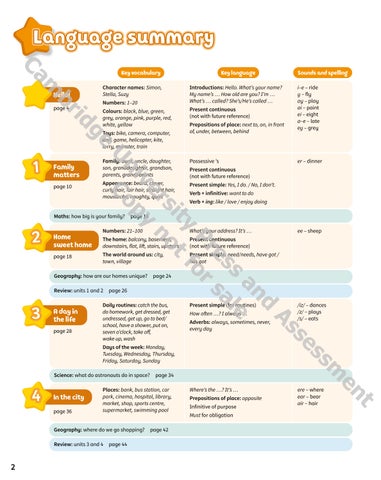
Language summary
Ca
Key vocabulary
m
Character names: Simon, Stella, Suzy
Hello!
br
Numbers: 1–20
page 4
Toys: bike, camera, computer, doll, game, helicopter, kite, lorry, monster, train
ge
id
Colours: black, blue, green, grey, orange, pink, purple, red, white, yellow
page 18
Prepositions of place: next to, on, in front of, under, between, behind
Appearance: beard, clever, curly hair, fair hair, straight hair, moustache, naughty, quiet
Present simple: Yes, I do. / No, I don’t.
i–e – ride y – fly ay – play ai – paint ei – eight a–e – late ey – grey
er – dinner
As d an s le es sa Pr r y fo it t rs no ve y ni p
2
Present continuous (not with future reference)
Possessive ’s
Maths: how big is your family?
Home sweet home
Sounds and spelling
Introductions: Hello. What’s your name? My name’s … How old are you? I’m … What’s … called? She’s/He’s called …
Family: aunt, uncle, daughter, son, granddaughter, grandson, parents, grandparents
Co
page 10
U
1
Family matters
Key language
Present continuous (not with future reference)
Verb + infinitive: want to do
Verb + ing: like / love / enjoy doing
page 16
Numbers: 21–100
What’s your address? It’s …
The home: balcony, basement, downstairs, flat, lift, stairs, upstairs
Present continuous (not with future reference)
The world around us: city, town, village
Present simple: need/needs, have got / has got
Geography: how are our homes unique?
ee – sheep
page 24
Review: units 1 and 2 page 26
3
A day in the life page 28
Present simple (for routines) How often …? I always …
Adverbs: always, sometimes, never, every day
Days of the week: Monday, Tuesday, Wednesday, Thursday, Friday, Saturday, Sunday
Places: bank, bus station, car park, cinema, hospital, library, market, shop, sports centre, supermarket, swimming pool
Geography: where do we go shopping? Review: units 3 and 4 page 44
2
page 42
Where’s the …? It’s … Prepositions of place: opposite Infinitive of purpose Must for obligation
ere – where ear – bear air – hair
t
page 36
page 34
en
4
In the city
m
Science: what do astronauts do in space?
/iz/ – dances /z/ – plays /s/ – eats
ss se
Daily routines: catch the bus, do homework, get dressed, get undressed, get up, go to bed/ school, have a shower, put on, seven o’clock, take off, wake up, wash
Ca
Key vocabulary Illness: a backache, a cold, a cough, an earache, a headache, a stomach-ache, a temperature, a toothache
m
Fit and well
br
5
page 46
ge
id
Sports and leisure: climb, dance, hop, jump, run, skip, swim
Science: what remedies do we use?
What’s the matter? I’ve got … Present simple: hurt/hurts, have got/has got
/z/ – she’s /v/ – they’ve
Must and mustn’t for obligation
The world around us: field, forest, grass, lake, leaf, picnic, plant, river, rock, waterfall
Shall for offers
r – river
Present continuous (not with future reference)
As d an s le es sa Pr r y fo it t rs no ve y ni p
page 54
Sounds and spelling
page 52
U
6
In the countryside
Key language
Co
Adjectives: bad, cold, fat, hot, hungry, loud, quiet, strong, thin, thirsty, tired, weak
Geography: why do we live in different places?
page 60
Review: units 5 and 6 page 62
7
World of animals page 64
Animals: bat, bear, dolphin, jellyfish, kangaroo, lion, panda, parrot, penguin, shark, whale
Science: how do animals stay safe?
8
Weather report page 72
Comparative adjectives: better, bigger, cleaner, dirtier, longer, quicker, worse Present continuous (not with future reference)
f – flying ff – giraffe gh – cough ph – dolphin
page 70
Weather: cloudy, cold, dry, hot, rainbow, raining, rainy, snowing, snowy, sunny, windy
What’s the weather like? It’s …
Past simple: was/wasn’t, were/weren’t
Review of sounds: y, ee, r, s, ff, ere, air, es, ear, ai, f
Clothes: coat, hat, gloves, scarf, sweater, swim shorts, T-shirt
Music: what does nature sound like?
page 78
ss se
Review: units 7 and 8 page 80
page 82 page 83 page 84 page 85
en
m
Values Units 1 & 2 Give and share Units 3 & 4 Love your city Units 5 & 6 Fair play Units 7 & 8 Help the world
A1 Movers Exam folder Listening Parts 1, 4 and 5
pages 88–95 Reading and Writing Parts 1 and 4
t
Grammar reference units 0–3 page 86 Grammar reference units 4–8 page 87 Speaking Parts 1 and 2
3
Hel lo!
ge
id
br
m
Ca Co
As d an s le es sa Pr r y fo it t rs no ve y ni p
U
8
DETEC T BOX IVE
Simon
1 a
2
Hello. I’m five. I’ve got a big dog. She’s black and white and she’s called Dotty.
nine.
LOOK
My favourite comic’s called ‘Lock and Key’.
t
Vocabulary: character names | Language: introductions
My name’s Zak. I’m
en
What’s your name? How old are you? Have you got a brother or a sister? What’s your favourite toy called?
Hi. I’m eight. I like reading comics. My favourite comic’s called ‘Lock and Key’.
m
My name’s …
c
ss se
What’s your name?
4
b
Ask and answer. Write.
1 2 3 4
Suzy
Read and say the name. Listen and check.
Hello. I’m nine. I’ve got a brother and a sister. This is my favourite computer game. It’s called ‘Brainbox’.
2
Stella
1
3
Listen and say the number and the colour.
H-E-L-M-E-T
Helmet. That’s number 18 and it’s pink and green.
Ca br
m
11
id
15
18
ge U
20
Co
As d an s le es sa Pr r y fo it t rs no ve y ni p
17
12
14
13
16
19
2 Play the game.
Bike. That’s number 17 and it’s purple.
Vocabulary: numbers, colours and toys | Language: prepositions of place
t
It’s on the table, next to the books. It’s on the box, next to the ball. It’s on the floor, in front of the train. It’s under the table. It’s on the floor, between the helicopter and the monster. It’s behind the bike.
en
1 2 3 4 5 6
Computer.
m
3 Read and answer.
ss se
B-I-K-E
5
1
Read and match the names.
m
Ca br
a
Meera – c
Simon and Stella are in the playground with their friends, Alex , Lenny and Meera , and their sister Suzy. Meera’s sitting next to Stella and Simon’s talking to Lenny. Alex is behind them.
ge
id
c
As d an s le es sa Pr r y fo it t rs no ve y ni p
U
b
Co
8
2
4
CTIVE DETEO B X
Listen. Who is it?
She’s drinking orange juice.
That’s Meera.
She’s reading.
What’s Meera drinking? What’s Simon doing? What’s Alex kicking? What’s Stella reading?
STUDY
6
What’s Suzy doing?
What is Suzy doing?
She’s jumping.
She is jumping.
Language: prepositions of place and present continuous
t
5 6 7 8
en
What’s Stella doing? What’s Alex doing? What’s Lenny eating? What’s Suzy doing?
m
1 2 3 4
ss se
3 Answer the questions.
1
5
Listen and say the name.
Ca id
br
m
I’ve got an old bike And I’m riding it. He’s got a big kite And he’s flying it. She’s got a small car And she’s driving it. We’ve got toys!
Oh no!
ge
Max
As d an s le es sa Pr r y fo it t rs no ve y ni p
U
I’ve got a fat doll And it’s talking. He’s got a robot And it’s walking. She’s got a new ball And it’s bouncing. We’ve got toys!
Anna
Co Paul
Fred
Vicky
I’m happy.
Yasmin
Listen and sing. Do karaoke.
en
6
m
ss se
2
1 Yasmin’s holding a fat doll. 2 Fred’s an old bike. 3 Max is a big kite.
t
3 Read and complete. 4 Vicky’s 5 Anna’s 6 Paul’s
a small car. a new ball. with a robot.
Language: present continuous
7
Loc k’s sou nds an d spe llin g
Ca
1
7
Watch the video. Watch again and practise.
ge
id
br
m
2 Find the sounds and draw a circle or a triangle. Say.
Co
As d an s le es sa Pr r y fo it t rs no ve y ni p
U The spiders ride, fly and drive from nine to five. They play and paint from eight to late.
3 Work in pairs. Play, ask and answer. Can you ride a bike? No, I can’t.
What are you doing?
1 ride a bike?
2 eating
3 white bike
4 swim?
8 reading
7 sing?
6 grey train
5 drinking
14 cake
The
8
12 jumping
13 nine spiders
Show what you know
paints a
Sounds and spelling: i–e, y, ay, ai, ei, a–e, ey
kite.
t
10 pink kite
11 play football?
en
m
ss se
9 play the piano?
What have you got?
8
Hello. This is the Lock and Key Detective Agency. Sorry we can’t answer the phone at the moment. Please leave a message.
2 Please help me! I’m in the house next to your agency. I can’t find Clarence!
ge
id
br
m
Ca
1
Argh! Oops! Hello, hello. This is Key. Can I help you?
Co
5
As d an s le es sa Pr r y fo it t rs no ve y ni p
U
3
Oh! Please find Clarence. He’s a big fat cat. He’s got long white fur and blue eyes. He hasn’t got a tail.
Come on, Key. What are we looking for?
en
m
ss se
Get the Detective Box, Key. We’ve got work to do!
6
4
t We’re looking for a big white cat, Lock. No problem!
1 Describe the pictures in pairs. Story: unit language in context
9
1 Fami ly matters Ca id
br
m
grandparents
uncle
parents
ge U
Grandma
As d an s le es sa Pr r y fo it t rs no ve y ni p
=
Co Stella
daughter/granddaughter 9
Grandpa
aunt
Uncle Fred Mrs Star
1
=
Mr Star Aunt May
Simon
son/grandson
Vocabulary: family
Who’s Stella’s uncle? Who’s Suzy’s aunt?
t
Choose and describe. Write.
LOOK
en
Uncle Fred. Who’s Stella’s uncle? Who’s Suzy’s aunt? Who are Simon’s grandparents? Who are Mrs Star’s daughters? Who’s Mr Star’s son? Who’s Grandpa Star’s grandson?
3 Has Stella got a brother? 4 How many sisters has she got?
m
10
daughter/granddaughter
ss se
2 Ask and answer.
3
Suzy
Look, think and answer. Listen and check.
1 Is Stella at school? 2 Who’s on the poster?
1 2 3 4 5 6
My family tree.
My aunt is tall. She’s got black hair.
1
10
1
Listen and say the letter. He’s taking a photo of his son.
Letter e.
br
m
Ca b
ge
id
a
As d an s le es sa Pr r y fo it t rs no ve y ni p
U c
Co d
Listen and complete.
Suzy’s sitting next to her …
Stella!
He’s taking a photo.
t
Who’s playing a game with her aunt?
en
STUDY
3 Ask and answer.
… mum.
m
11
ss se
2
e
She’s painting. They’re reading. Language: present continuous
11
1 Look and say the name. 3 Who likes reading? 4 Who doesn’t like having a bath?
ge
id
br
m
Ca
1 Who likes riding bikes? 2 Who likes painting?
Co
As d an s le es sa Pr r y fo it t rs no ve y ni p
U
2
Read and check.
Language: present simple
LOOK
Simon enjoys riding his bike. Simon wants to ride his bike.
t
12
Simon doesn’t enjoy riding his bike. Stella enjoys reading about science. Simon doesn’t wear a helmet. Suzy wants to wash her doll. Dotty likes having a bath. Grandma enjoys painting.
en
1 2 3 4 5 6
No.
m
3 Say ‘yes’ or ‘no’.
ss se
Hi! I’m Aunt May. Look at everyone in the garden! Stella’s reading. She enjoys reading about science. She’s clever and she wants to be a doctor. Simon’s wearing his helmet because he’s riding his bike. He’s with his Uncle Fred. They love riding bikes. Suzy wants to wash her dog. Dotty’s naughty. She doesn’t like having a bath. Grandpa’s laughing and he’s giving Suzy a towel. Suzy needs a towel! Grandma’s quiet. She enjoys painting. She’s painting a beautiful picture of her granddaughter, Stella.
1
12
Read and complete with a name. Listen and check. Aunt May’s a doctor, She’s got straight black hair. 1 Uncle Fred ’s a farmer, His beard is short and fair.
br
m
Ca
2
is quiet, She wants to paint all day. 3 is funny, And his curly hair is grey.
ge
id
4
U
As d an s le es sa Pr r y fo it t rs no ve y ni p
can be naughty, He loves ‘Lock and Key’. ’s clever, His sister 5 And she doesn’t like TV.
Co
2 3
13
1
6
isn’t quiet, But she’s very small. Here’s our family, We really love them all. We really love them all.
Listen and sing. Do karaoke.
Draw your family tree. Talk about your family.
STUDY
my
He’s
daughter. sister.
t
my
mother’s grandmother’s father’s grandfather’s
en
She’s
uncle. grandfather.
m
He’s
aunt. grandmother.
ss se
She’s
son. brother.
Vocabulary: appearance | Language: possessive ’s
13
Loc k’s sou nds an d spe llin g 1
14
Watch the video. Watch again and practise.
Ca
ge
id
br
m
2 Find and underline the er sounds.
Co
As d an s le es sa Pr r y fo it t rs no ve y ni p
U Bread, butter, burgers – what’s for dinner? Father, mother, brother and sister love making dinner.
3 Work in pairs. Describe and say ‘yes’ or ‘no’. The mother is holding a flower.
No, the mother is eating a burger.
en
m
ss se
14
Sounds and spelling: er
? It’s a
.
t
What’s for
Show what you know
1 15
Hmmm, that’s the pet thief. He’s got straight black hair, a black beard and a moustache.
Yes, and he’s wearing a big dirty hat and an old jacket. We can find him, no problem!
ge
id
br
m
Ca
1
I want to find that pet thief. Let’s look in the park.
Co
Where are you going, Lock?
As d an s le es sa Pr r y fo it t rs no ve y ni p
U
2
3
Look! There’s the pet thief… and he’s got Clarence!
Yes, I can see his dirty hat and old jacket. Let’s get him!
There you are Clarence! Naughty cat!
4
I’m Mr Key, from Lock and Key Detective Agency. We’re looking for the pet thief.
5
I’m not a pet thief!
That’s right, Key. She hasn’t got a beard or a moustache. Give her the cat.
en
m
ss se
What are you doing? Give me my cat! Who are you?
t
No problem, Lock.
1 Are Lock and Key good detectives? Why? Why not? Story: unit language in context
15
Ho w bi g is yo ur fa m ily? 16 Listen and read. How many cousins has Sofia got?
How many have you got?
br
m
Ca
1
ge
id
My name’s Sofia. This is my family. There are 11 people in my family. That’s me in the middle with my dad, my mum, my brother Felipe, and Baby Elias. On the left, you can see Uncle Victor, Grandma and Aunt Fernanda. On the right, you can see my adult cousins Raquel and Raul, and Raul’s wife, Alicia. How old am I? Eight years old
Co
How tall is Uncle Victor? 183 cm
As d an s le es sa Pr r y fo it t rs no ve y ni p
U
How long is Dad’s moustache? 5 cm
How tall is Grandma? 163 cm How old is Felipe? Seven years old
How long is Baby Elias’s foot? 6 cm
How long is Mum’s foot? 24 cm
2 Use Sofia’s poster to answer the questions.
8 1 How many adults are there? 2 How many children are there? 3 Uncle Victor is 183 cm tall. Grandma is 163 cm tall. What’s the difference?
I count my coloured pencils. I share sweets with my friends. 16
Maths: measuring |
critical thinking
DIDYOUKNOW…?
Counting is the oldest form of maths. Humans have been counting for 35,000 years!
t
3 When do you use maths in real life? Think and say.
en
m
ss se
cm 4 How many fingers and toes have Felipe, Sofia and Elias got in total? fingers and toes 5 How many feet are there in the family? feet 6 Sofia’s family are going to a restaurant. Four people can sit at each table. How many tables do they need? tables
4
17
a 15
12
Ca
>
2
=
3
c 16
19
d 10
10 =
20
8
=
17
3
2
=
6
ge
e 25
id
br
m
b 6
f
1
Look at the chart. Listen and write the symbol. Maths function Addition Subtraction Multiplication Division
Symbol + x ÷ = > <
Words plus minus times divided by equals is greater than is less than
U
Co
How tall am I?
As d an s le es sa Pr r y fo it t rs no ve y ni p
5 Guess and measure. Complete the table. Guess!
Measure!
cm
cm
cm
cm
cm
cm
How wide is my English book?
cm
cm
How long is my hair?
cm
cm
How long is my foot? How wide is my hand?
6
Name
Age
Ready to write:
Go to Activity Book page 16.
ss se
Survey and measure your classmates. Complete the table in your notebook. Make greater/less than sentences.
How tall … ?
145 cm
en
m
t
Jackie is 12. Megan is 11.
185 cm
85 cm
Make a family numbers poster.
12 is greater than 11. 12 > 11. Maths: measuring |
critical thinking
17
2 Hom e sw eet hom e m
Ca upstairs
br
lift
id
balcony
ge
stairs
downstairs
As d an s le es sa Pr r y fo it t rs no ve y ni p
U basement
Co A house in the village
1
18
Look, think and answer. Listen and check.
1 What buildings can you see? 2 What’s in the room under the house?
2
3 Where’s the flat? 4 Has the flat got a garden?
Describe your house or flat. Then write.
city. My house is in the y. It ha s got a balcon
Listen and say the letter. c
d
e
Letter d.
f
g
en
b
A basement
m
a
19
ss se
My house is in the village. It has got a kitchen downstairs.
3
A flat in the town
t
18
Vocabulary: the home and the world around us
1
20
Listen and order.
2
1–c
b Home is home … , In a city or a village, In a house or a flat. Home is home! It’s where it’s at.
Ca
a
ge
id
br
m
Upstairs, downstairs, One floor or two. We live here, What about you?
Co
As d an s le es sa Pr r y fo it t rs no ve y ni p
U c We’ve got a basement Under the floor. It’s got brown stairs And a purple door.
21
Listen and sing. Do karaoke.
3 Spot the difference.
I’ve got a lift, It goes up and down. From my balcony, I can see the town.
ss se
2
d
This home’s got a balcony.
en
m
t
This home hasn’t got a balcony. Language: have got / has got
19
1
Look, read and match.
1–f
Meera moves to a new flat
b
c
e
f
ge
id
br
m
Ca
a
d
Co
4
Today Meera and her family are moving. Two workers are carr ying the wardrobe to the lorr y.
2
3
As d an s le es sa Pr r y fo it t rs no ve y ni p
U
1
Meera’s helping. She’s taking a lamp upstairs. She’s smiling because she can go in the lift.
5
Her new address is 14 Park Road. It’s a flat. It’s amazing!
Now they are sitting on the wardrobe. They’re having a break. They need a drink.
ss se
Meera and her dad are helping the cleaner to clean the flat.
6
The workers can’t take the big wardrobe in the small lift. They need to carr y it up the stairs. It’s difficult to carr y.
2 Write some words to complete the sentences about the story.
Language: present continuous
t
20
Meera and her family are moving today. The workers can’t put the wardrobe in . Meera, her dad and the cleaner her amazing new flat. Meera’s carrying a in the lift. The workers need to carry upstairs because the lift is very small. The workers are because they are hot, tired and thirsty.
en
1 2 3 4 5 6
m
You can use 1, 2 or 3 words.
1
22
12
2
Listen and say. 14
15
16
17
18
19 100
br
m
Ca
13
20
30
40
50
60
70
80
90
23
ge
id 2
Listen and write the names. Say. May lives at number 72.
U Co
As d an s le es sa Pr r y fo it t rs no ve y ni p
That’s pink.
May
3 Ask and answer.
ss se
It’s number 23.
en
It’s 72 Station Road.
Vocabulary: numbers: twelve to a hundred
t
4 Talk about where you live. What’s your address?
thirteen – thirty fourteen – forty fifteen – fifty sixteen – sixty seventeen – seventy eighteen – eighty nineteen – ninety a hundred
m
What number’s the yellow door?
LOOK
21
Loc k’s sou nds an d spe llin g 1
24
Watch the video. Watch again and practise.
Ca
ge
id
br
m
2 Look and find. Read and underline the sounds.
As d an s le es sa Pr r y fo it t rs no ve y ni p
U Co
See the street where we meet. Bees at number three and sheep at number thirteen. Green trees in between.
The house is number 13. My number 13 is blue.
3 Work in pairs. Write and say. Listen and complete.
13 14 15 30 40 50
en
m
ss se
22
Sounds and spelling: ee
bees in the
.
t
There are
Show what you know
2 25
Lovely house, Mrs Potts. It’s very old.
2
It lives under the stairs in the basement. It comes upstairs at night.
Oh, I don’t think so, Mrs Potts. There are no monsters.
ge
id
br
m
Ca
1
Can you go downstairs and look in the basement for me?
Co
3
As d an s le es sa Pr r y fo it t rs no ve y ni p
U
I think it’s got a monster.
Of course we can.
Er, yes… No problem, Mrs Potts.
5
I’m not happy about this, Lock. I don’t like it.
4
6
No, it’s got a cat … called Clarence.
ss se
There you are, Clarence. You naughty cat!
Aagghhh!
The house hasn’t got a monster, Mrs Potts.
t
It’s a monster!
en
m
YOWL!
1 What does Mrs Potts think about the monster? Say two things. Story: unit language in context
23
Ho w are ou r ho m es un iq ue? 26
Listen and read. Which is your favourite home? Why?
m
Ca
1
3
1
ge
id
br
2
This cave home is in Turkey. It’s very old!
U
Co
4
As d an s le es sa Pr r y fo it t rs no ve y ni p
These cabins in Norway are on stilts, so they don’t get wet.
These flats in Singapore have got colourful spiral staircases.
Can you imagine living on a traditional Indian houseboat? This house can float!
5
This tree house in the USA has got a rope bridge.
2 Write the words from Activity 1 to complete the chart. Types of homes cabin
Features
It’s very cold / hot. 24
Geography: different types of home |
critical thinking
DIDYOUKNOW…?
Some cave homes are more than 2,000 years old!
t
It’s in a city with shops and transport.
en
of the homes in Activity 1? Think and say.
m
ss se 3 What are the advantages and disadvantages
2
4 Read the description of Bethany’s dream bedroom. Which parts do you like the most?
Ca
m
My dream bedroom
ge
id
br
In my dream bedroom, there’s a big bed. I can jump on it! I’ve got a lot of toys. There’s a slide too. It’s fast! The walls of my dream bedroom are blue. It’s my favourite colour! There’s a spiral staircase too. At the top, there’s a special bed for my pet cat.
Co
As d an s le es sa Pr r y fo it t rs no ve y ni p
U
5 Underline the contractions in Activity 4.
Learning to write:
Ready to write:
Go to Activity Book page 24.
6 You are designing your own
m
ss se
dream bedroom. Which colours and what things do you want? Think and say.
Contractions A contraction is a short form of two or more words. All contractions have an apostrophe (’). there is ➞ there’s it is ➞ it’s I have ➞ I’ve
en
wa l l
t
Design your own dream bedroom. Geography: different types of home |
creative thinking
25
Units 1 and 2 56
m
Ca
1 Play the game. 54
53
52
51
50
45
46
47
48
49
40
39
38
37
36
id
br
H FINIS
55
44
ge
43
29
30
31
32
33
34
35
28
27
26
25
24
23
22
15
16
17
18
19
20
21
14
13
12
11
10
9
8
1
2
3
4
5
6
Review: units 1 and 2
t
26
en
Lifts – Go up Stairs – Go down Pictures – Spell the words. If it’s right, roll again. If it’s wrong, stop.
7
m
Instructions
ss se
T STAR
As d an s le es sa Pr r y fo it t rs no ve y ni p
41
Co
U
42
2 Look, read and answer. What are the men doing? What’s the woman doing? Which room are the family in? What’s the boy reading? What’s the girl carrying?
ge
id
br
m
Ca
1 2 3 4 5
3 Look at the pictures. Say which
Quiz
As d an s le es sa Pr r y fo it t rs no ve y ni p
U
is different.
Picture d is different. She’s got short hair.
Co
a
b
1
a
b
2
b
c
c
d
d
d
3
1
What’s Stella’s uncle’s name? (p10)
2
What are Stella and her aunt doing? (p11)
3
What does Simon’s grandmother love doing? (p12)
4
Where can you find a basement? (p19)
5
What are the workers carrying to Meera’s new flat? (p20)
6
Say these numbers: 30 – 16 – 13 – 50 (p22)
7
Does Key want to look for Mrs Potts’ monster? (p23)
8
Why do some cabins have stilts? (p24)
a
b
c
d
en
m
ss se
a
c
t
4
Review: units 1 and 2
27
3 A day i n t he l ife a
c 8
id
br
m
Ca
b
ge
d
f
e
27
Co
1
As d an s le es sa Pr r y fo it t rs no ve y ni p
U g
Listen and say the letter. Match.
catch the bus get up
do homework get dressed go to bed have a shower wash wake up a take off
Vocabulary: daily routines
the actions.
LOOK She wakes up at seven o’clock.
At eight o’clock she catches the bus.
t
28
28 Listen and do
en
7
and leggings. After school Stella does her . She washes her before dinner. She and takes off her T-shirt and leggings. Stella goes to bed nine o’clock.
3
m
wakes up 1 Stella at seven o’clock every day. 2 Before breakfast she . 3 Then she gets dressed and puts on her
get undressed put on
ss se
2 Read and complete.
4 5 6
i
h
1
29
Listen and match.
a
b
id
br
m ge
I catch the bus to take me to school … I do my homework on the way … 2 Oooh yes, every day.
d
Co f
2
30
I wash my hands … 5 Before I have my dinner … I get undressed and I go to bed … 6 Oooh yes, oooh yes, Oooh yes, every day, every day, every day.
Listen and sing. Do karaoke.
3 Answer the questions.
before after
t
What do you do before breakfast?
What do you do
breakfast? lunch? dinner? school? bedtime?
en
4 Ask and answer.
STUDY
m
What time does he get dressed? What time does he do his homework? What time does he start school? What time does he go out to play? What time does he go to bed?
He gets dressed at seven o’clock.
ss se
1 2 3 4 5
Lessons start and I see my teacher … 3 Eleven o’clock and we’re out to play … 4 Oooh yes, every day.
As d an s le es sa Pr r y fo it t rs no ve y ni p
U
e
1–b I wake up in the morning, I get up for breakfast, I have a shower and I get dressed … 1 Oooh yes, every day.
Ca c
3
I have a shower. Language: present simple
29
1
31
Say the chant. Ask and answer.
What do you do on Mondays? I go swimming.
br
m
Ca Monday
Tuesday
Wednesday
Thursday
Saturday/ Sunday
Friday
ge
id Listen and say the day.
32
a
As d an s le es sa Pr r y fo it t rs no ve y ni p
U
2
b
c
Co
3
33
Listen again. Choose the right words.
sometimes ✓ never ✗
m
She sometimes plays football in the park.
en
on Mondays. 3 Simon sometimes / never goes swimming on Wednesdays. 4 Simon always / never plays in the park on Sundays.
always ✓✓✓
ss se
1 Simon always / never plays in the park on Mondays. 2 Simon always / sometimes does his homework
STUDY
1 Simon never plays in the park on Mondays. 30
Vocabulary: days of the week | Language: adverbs
They never go to school on Sundays.
t
He always wakes up at seven o’clock.
3
1 Look, read and complete. 1
br
m
Ca
James Flunk is a music teacher. always At school he 1 plays the piano but he 2 plays the piano in his holidays.
id
✓✓✓
ge
2
Every Saturday morning James takes his son for his swimming lesson, but James 6 goes swimming.
Co
3
✓✓✓
2
34
5
✓ 6
As d an s le es sa Pr r y fo it t rs no ve y ni p
U ✗
James loves playing tennis, so he 3 plays on 4 Wednesdays. He plays football with his daughter Jane, too. She 5 scores a goal.
4
✗
7
He sometimes takes his family to the mountains on Sundays. They 7 sing songs in the car.
✓
Listen and say ‘yes’ or ‘no’.
3 Look and make sentences.
I never ride my bike on Wednesdays.
on Saturdays on Wednesdays after school in the morning
en
m
ss se
Use the words in the boxes.
always sometimes never
t Language: adverbs
31
Loc k’s sou nds an d spe llin g 1
35
Watch the video. Watch again and practise.
Ca
ge
id
br
m
2 Find and underline or circle the /iz/, /z/, and /s/ sounds.
Co
As d an s le es sa Pr r y fo it t rs no ve y ni p
U Owl dances at night and plays by the moon, He catches his food and eats before noon.
3 Work in pairs. Write and say.
fly dance get up go to bed have a shower wake up wash hands eat brush teeth and hair sing do homework
ss se
after lunch
before bed
in the morning
at night
after breakfast
after dinner
before bed
before dinner
fruit at night.
t
Sounds and spelling: /iz/, /s/, /z/
and
en
The bat
Show what you know
m
before breakfast
has a shower
32
The bee flies to the flowers after breakfast.
3 36
Good morning. I’m Johnny Talkalot. On today’s show we’ve got the detectives, Lock and Key, to tell us about their work. We all know detectives work a lot and get up before you and me.
2
Mr Key, this is Johnny Talkalot. It’s nine o’clock! Where are you? You aren’t in the detective agency.
ge
id
br
m
Ca
1
As d an s le es sa Pr r y fo it t rs no ve y ni p
U
Oh no, we never get up before ten o’clock.
Everybody knows detectives are very clever.
5
Yes, sometimes we follow people. We’re very quiet so they never know we’re behind them.
4
Co
3
6
en
YEEOWW! My nose!
m
ss se
So, girls and boys, what do you think? Do these detectives work a lot? Are they quiet? And are they very clever?
t
1 Ask and answer the questions in picture 6. Story: unit language in context
33
W hat do astron auts do in sp ace? 37
Listen and say. Who is Sally? Where does she live?
ge
id
br
m
Ca
1
Co
As d an s le es sa Pr r y fo it t rs no ve y ni p
U Everything floats in space – even our food!
2
37
Listen again and tick the true sentences.
1 There are other astronauts on the Space Station. 2 Sally works on the Space Station.
4 A robot cleaner does the tidying up. 5 Sally watches films in her free time.
I have breakfast, too. My food doesn’t float. 34
Science: astronauts in space |
learning to learn
DIDYOUKNOW…?
There are no showers on the Space Station, but there are toilets!
t
similar or different? Think and say.
en
3 Think about the astronaut’s day. How is your day
m
ss se
3 Sally wears a spacesuit.
3
4 Read Sally’s blog. What is special about today? www.myspaceblog.com
br
m
Ca 24 June
id
ge
Today is my first spacewalk. I’m so excited!
As d an s le es sa Pr r y fo it t rs no ve y ni p
U
I get up at six o’clock and I have a wash.
Co
At half past six, I have breakfast. Eggs and bread! Yum!
Then, I put on my spacesuit. Another astronaut helps me and it takes a long time.
Now it’s nine o’clock. The doors open and I go outside. Wow! I’ve got an amazing view of Earth!
5 Underline the times in Activity 4. Ready to write:
Times six o’clock half past six seven o’clock
Go to Activity Book page 34.
en
m
Prepare for an interview with an astronaut. What questions do you want to ask?
ss se
6
Learning to write:
t
1D o you sleep in a bed? 2
Role-play an interview with an astronaut. Science: astronauts in space |
communication
35
4 I n t he city m
Ca
1
SCHOOL
8
2 3
ge
id
br
TO MAWN P
4
6
5
U Co
As d an s le es sa Pr r y fo it t rs no ve y ni p
7
8
1 What are they looking at? Why? 2
38 Listen. Find Meera’s flat.
Match and write the number in the box.
bank
What’s opposite the cinema?
The bus station.
en
m
3 Ask and answer.
ss se
bus station cinema sports centre supermarket library market 1 swimming pool
t
8
8
in front of 36
behind E
next to
CTIV Vocabulary: places D|ETBELanguage: prepositions of place OX
between
opposite
1
39
4
Look at the picture. Listen and answer. Where’s the park?
It’s in front of the swimming pool.
ge
id
br
m
Ca Co
As d an s le es sa Pr r y fo it t rs no ve y ni p
U 2 Ask and answer.
Where’s the bin?
It’s in front of the hotel.
3 Read and complete with words from the picture in Activity 1. This is a picture of my town. Look at the 1 swimming pool opposite the park.
I sometimes go there to swim with Stella. We always take our swimsuits and towels
ss se
to buy our food. It’s between the bank and the
with us. We go to the 2
. Where do my parents go to get money? They go to the 4
3
? I go there to catch the bus to school. Where do I love
Can you see the 5
to see a film. The cinema’s my
40
t
4
.
en
favourite place in the town. When my grandparents come to town, they stay in
m
going on Saturdays? I love going to the 6 the 7
.
Listen and answer.
Where do you go to see a film?
I go to the cinema to see a film. Language: prepositions of place and infinitive of purpose
37
1
41
Look, think and answer. Listen and check. 3 What book has Lenny got? 4 What time is it?
ge
id
br
m
Ca
1 Where are the children? 2 Which children are happy?
Co
As d an s le es sa Pr r y fo it t rs no ve y ni p
U
2
42
Listen and say ‘yes’ or ‘no’.
When do you go to the library?
Language: must for obligation
STUDY Simon must be quiet in the library. They must catch the bus. She must do her homework.
t
38
When do you go to the library? What do you enjoy reading? When do you read? Do your family read? Why do you read?
en
1 2 3 4 5
I go to the library on Saturdays.
m
ss se
3 Ask and answer.
1
43
Read and match. Listen and check. Must I make my bed, Dad? Must I wear a skirt, Dad? Must I go to school, Dad? Must I do my homework, Dad? Must I clean my shoes, Dad? Can I play in the park, Dad?
ge
id
br
m
Ca a
1 2 3 4 5 6
4
1–d
Yes, you must. Yes, you must. Yes, you must. Yes, you must. Yes, you must. Yes, you can!
c
b
Co
As d an s le es sa Pr r y fo it t rs no ve y ni p
U e
d
44
Listen and sing. Do karaoke.
en
m
ss se
2
f
make the bed clean your room clean your shoes help in the kitchen wash the car help Mum and Dad
t
3 Ask and answer. What must you do at home?
I must clean my room. Language: must for obligation
39
Loc k’s sou nds an d spe llin g 1
45
Watch the video. Watch again and practise.
Ca
ge
id
br
m
2 Find and circle the sounds. Say.
Co
As d an s le es sa Pr r y fo it t rs no ve y ni p
U Where’s the bear with purple hair? He’s over there, on the chair!
3 Draw lines. Then ask, answer and draw. Where’s the small bear?
The small bear is in the bank.
en
m
ss se
40
Sounds and spelling: ere, ear, air
with yellow
.
t
There’s a small
Show what you know
4 46
2
Lock and Key are looking for work on the computer.
Ca
1
Hmm, Lottie Cash, the bank robber. We can find her.
ge
id
br
m
I need some money. I must go to the bank.
As d an s le es sa Pr r y fo it t rs no ve y ni p
U No problem, Lock!
Co
3
Today is a lovely day for shopping in the city.
4
It’s her! It’s Lottie Cash, the bank robber! She’s going to the bank now.
We must stop her! We need to get there before her.
Come on then, let’s go. I love shopping.
5
6
Lottie who?
Stand up, Key. You and I need to talk!
en
m
ss se
Give me that money, Lottie Cash!
What? Not you again, Mr Key!
t
Don’t touch her money!
No problem, Lock!
1 Where must Mrs Potts go? Why? Where must Lock and Key go? Why? Story: unit language in context
41
W he re do w e go sh op pi ng ? 47
Listen and read. Which shop is interesting to you? Why?
m
Ca
1
id
br
Brooklyn Superhero Supply Company New York City, USA
ge
As d an s le es sa Pr r y fo it t rs no ve y ni p
U
Candylawa
Are you a superhero? Do you want to be one? This shop has got superhero costumes, such as masks and capes. You can also buy fun toys and science kits to make things! You can build a robot or write a secret message with invisible ink.
Riyadh, Saudi Arabia
Co
Do you like sweets? Candylawa has got it all: sweets, cakes and popcorn. After buying some treats, you can buy nice gifts, such as T-shirts and animal toys. There’s also a café for visitors.
2 Read and match. Then write. Brooklyn Superhero Supply Company a in Saudi Arabia c costumes d a café e sweet treats
do you buy there? Think and say. I like craft shops.
42
Geography: shopping |
I buy paint and crayons.
critical thinking
DIDYOUKNOW…?
Clothes and shoes are the most popular items for online shopping.
OVERMATTER AT END OF UNIT
t
3 What shops do you like? What
en
m
Candylawa
ss se
b in the USA
What do both shops sell?
4
4 Why are these shops different? Read and match.
Ca
1
Moving books
2
ge
id
br
m
Imagine a van that drives around and sells books! You can buy books in a field or in the car park. Books about space, storybooks, notebooks… you can find them all here!
Coconut delight
3
e a nd Thirsty? Com elicious drink some d r. coconut wate us You can find . ch a by the be
C + M ice cre am
Can you hear th e The ice cream va music? n is coming!! It drives to your street or your school and you can buy yummy ice crea m.
Co
As d an s le es sa Pr r y fo it t rs no ve y ni p
U 5 Underline the nouns in Activity 4. Learning to write:
m
6 Imagine you want to open
ss se
Nouns A noun is a word for a person, place or thing.
Go to Activity Book page 42.
t
Ready to write:
en
a shop. What do you sell? Think and say.
Role-play a conversation at your shop.
Geography: shopping |
critical thinking
43
Units 3 and 4
br
m
Ca
1 Play the game.
ge
id
START
go to the bus station
go to the hospital
Co
As d an s le es sa Pr r y fo it t rs no ve y ni p
U go to the library
go to the market
go to the funfair
FINISH
en
go to the cinema
m
go to the sports centre
ss se
go to the supermarket
t
44
Review: units 3 and 4
2
48 Listen and choose the
Quiz
correct picture.
Ca
1 What does Jack do on Saturday afternoons?
a
c
b
br
m ge
id
✓
1
What time does Stella catch the bus to school? (p28)
2
What does James Flunk do every Saturday morning? (p31)
3
Do Lock and Key get up before ten o’clock? (p33)
2 What time does Daisy come home
from school?
U b
c
Co
As d an s le es sa Pr r y fo it t rs no ve y ni p
a
4
Where does Sally work? (p34)
5
On Meera’s map, what’s opposite the market? (p36)
6
Where do you go to see a film? (p37)
7
Where’s the bear with the purple hair? (p40)
8
Why must Mrs Potts and her friend go to the bank? (p41)
3 What does Paul do after dinner?
a
b
c
4 Where does Vicky catch the bus?
a
b
c
a
b
c
en
m
ss se
5 Where’s John going?
t Review: units 3 and 4
45
5 Fit an d w el l
ge
id
br
m
Ca Co
As d an s le es sa Pr r y fo it t rs no ve y ni p
U a temperature a cold a cough a headache a toothache a stomach-ache
1
49 Look, think and answer. Listen and check.
1 Where are Stella and Simon? 2 Who’s the doctor?
2 What’s the matter? Act it out.
3 Is Stella hot? 4 Is Simon ill?
What’s the matter?
She’s got a temperature.
3 46
50 Listen and do the actions.
Vocabulary: illness | Language: have got and has got
I’ve got a stomach-ache.
t
He’s got a cough.
en
What’s the matter?
m
STUDY
ss se
He’s got a cough/stomach-ache.
1
51
5
Listen and say the letter.
a
c
d
f
g
h
ge
id
e
br
m
Ca
b
As d an s le es sa Pr r y fo it t rs no ve y ni p
U 2 Make sentences. Say the letter.
Co
He’s She’s They’ve
got
a toothache. a backache. a stomach-ache. a headache.
an earache. a temperature. a cold. a cough.
She’s got an earache. d
3 Read and say ‘yes’ or ‘no’.
Simon mustn’t eat sweets or chocolate today because he says he’s got a stomach-ache. Do you think he’s got a stomach-ache or do you think he’s OK?
m
ss se
Poor Stella! Her head hurts and she’s very hot. She’s got a temperature. She isn’t very well because she’s got a cough and a bad cold. She must stay in bed and drink lots of water and orange juice. She’s sad because she wants to go to school but she can’t.
4 She must drink lots of orange juice. 5 Simon says he’s got a toothache. 6 He must eat sweets and chocolate today.
en
1 Stella’s back hurts. 2 She’s got a temperature. 3 She must stay in bed.
t
4 Work in pairs. Say and guess. My stomach hurts.
You’ve got a stomach-ache. Language: have got and has got
47
1
Look, think and answer. Listen and check.
52
3 What’s the matter with Stella? 4 Can she go to school?
ge
id
br
m
Ca
1 Where’s Stella? 2 Who’s Mrs Star talking to?
Co
As d an s le es sa Pr r y fo it t rs no ve y ni p
U
2
Make more sentences. Stella must stay in bed. Stella mustn’t get up. 53
ss se
3
Listen and say ‘must’ or ‘mustn’t’.
must 48
Language: must and mustn’t for obligation
You must stay in bed. She mustn’t go out.
t
When you’ve got a headache you … go to bed.
STUDY
en
mustn’t
m
When you’ve got a cough you … go out.
5
1 Read the story. Look at the pictures. Write the correct word next to numbers 1–6.
id
br
m
Ca
It’s Tuesday and Paul’s at home. He can’t go to 1 school because he’s ill. He’s got a temperature. He mustn’t get up. He must stay in bed. He’s got a2 and a cold. His 3 says he mustn’t run or play. He must 4 and drink a lot. Paul always has a 5 lesson on Tuesdays but he can’t go today. He isn’t sad because he can listen to ! music in 6
swimming
cough
bed
ge 54
Co
2
As d an s le es sa Pr r y fo it t rs no ve y ni p
U school
sleep
doctor
Listen and move.
Move, move, move. To be fit and well. Come on move your body …
skip
swim
climb
Dance, dance, dance. Don’t stop until you drop. Come on, you know it’s fun.
ss se
hop
jump
Let’s have a good time. Run, swim and climb. Move, move, move. Move your body.
3
55
dance
Let’s have a good time …
t
run
en
m
Dance, dance, dance. Hop, skip and jump. Come on, you know it’s fun.
Listen and sing. Do karaoke. Vocabulary: sports and leisure
49
Loc k’s sou nds an d spe llin g 56
2
Listen and write.
Watch the video. Watch again and practise.
ge
id
br
m
Ca
1
Co
As d an s le es sa Pr r y fo it t rs no ve y ni p
U He’s got a cold and he’s feeling ill – poor farmer Bill! The sheep ate all the cake – now they’ve got a stomach-ache!
3 Work in pairs. Describe and say. She’s got a toothache.
She mustn’t eat sweets.
en
m
ss se
50
got a cough and
Sounds and spelling: /z/, /v/
’
got a cold.
t
’
Show what you know
5 57
Ca
1
2
This is my beautiful painting.
ge
id
br
m
I’m having a big party and I need some detectives to look after my beautiful painting, ‘The Toothache’.
U
Ooh, there are a lot of cakes!
Co
3
As d an s le es sa Pr r y fo it t rs no ve y ni p
No problem, Miss Rich.
There’s a lemon cake, a chocolate cake, an apple cake and a carrot cake.
4
Er … , I can’t choose. Oooh … Which cake?
I’d like a lemon cake, please. Which cake would you like, Key?
Would you like a cake, Sir?
5 Look. I’ve got an apple cake,
Hmm, what’s the matter Key?
I’ve got some chocolate cake and now I’ve got a stomach-ache, too.
en
m
ss se
I’ve got a carrot cake, I’ve got a lemon cake and I’ve got a chocolate cake.
6
… and I haven’t got my beautiful painting!
t
Oh, Key. That’s not good for you.
1 How many cakes does Key have? Which cakes are they? Story: unit language in context
51
W hat re m ed ie s do w e use? 58 Listen and read. Do you use any of these remedies?
Do you think they work?
m
Ca
1
ge
id
br
What do you do when you’re ill? Here are some common home remedies!
Essential oils – essential oils come from plants, too. You can use essential oils on your skin for headaches and muscle aches. But be careful! One or two drops is enough.
As d an s le es sa Pr r y fo it t rs no ve y ni p
U Herbal tea – hot tea is a popular remedy. Herbal teas come from different parts of plants. Have you got a sore throat or stomach-ache? These teas can help you.
Co
!
Soup – have you got a cold or the flu? Chicken soup is a famous food remedy. In some countries, lizard soup is popular!
REMEMBER! Water’s always good for you !
2 Look and suggest a remedy from the text. Write your answer on the lines.
1
2
4
3
Take vitamin C.
Stay in bed.
Put ice on it. 52
Science: remedies and illnesses |
learning to learn
DIDYOUKNOW…? Most remedies come from plants – about 70%!
t
advice can you think of? Think and say.
en
3 What other home remedies or health
m
ss se
essential oils
5
4 Read the leaflet. What is the problem? How can you treat it? Hiccup facts Hiccups can happen when you’re cold or when you eat too fast. Hiccups come from muscle movements. They cause you to make a “hiccup” noise. You can’t control the hiccups.
ge
id
br
m
Ca
Help! I’ve got the hiccups!
As d an s le es sa Pr r y fo it t rs no ve y ni p
U How to treat the hiccups
Co
✓ Hold your breath and count to ten. ✓ Eat a spoon of honey or sugar.
✗ Don’t worry. Hiccups usually stop after a few minutes.
5 U nderline the imperative verbs in Activity 4. Learning to write:
Ready to write:
Imperatives Count to ten. Don’t worry.
6
Go to Activity Book page 52.
Do
Don’t
m
Illness
ss se
In pairs, give examples of other illnesses. Complete the table in your notebook.
en
toothache
t
Make a class book of remedies. Science: remedies and illnesses |
collaboration
53
6 I n t he co u ntry side m
Ca id
br
leaf/leaves picnic
ge
field
plant
As d an s le es sa Pr r y fo it t rs no ve y ni p
U
waterfall
grass
Co lake
1
59
river
Look, think and answer. Listen and check.
1 Where do they want to go? 2 Does Mr Star want to play tennis?
2
60
forest
rock
3 What does Simon want to do? 4 What does Stella want to do?
Listen and say the letter.
g
d
h
i
e
j
en
f
c
m
b
Letter e.
ss se
a
Forest
t
3 Ask and answer.
What do you want to do in the countryside? I want to have a picnic and swim in the river.
54
Vocabulary: the world around us
6
1 Read and complete.
Ca
A picnic without bread
ge
id
br
m
Charlie and his sister Lily enjoy having picnics in the countryside. Today they’re having a picnic in the forest with their grandmother.
Co
As d an s le es sa Pr r y fo it t rs no ve y ni p
U
Charlie and his grandmother are sitting on a blanket. They’re putting the picnic on it. After lunch, Charlie wants to do his homework. He must look at the plants and draw their leaves. Charlie looks sad because the bread’s very old and they can’t eat it for lunch … Lily’s standing next to the lake! She looks happy because she’s throwing bread to the ducks. It isn’t the bread for the ducks, it’s the new bread for their picnic. The ducks are eating the family’s lunch!
Today Charlie and Lily are Today Charlie and Lily are eating lunch in … eating lunch in the forest. … wants to draw the plants and their leaves. Charlie doesn’t like his bread because … Lily isn’t sitting … with her brother and grandmother. She’s giving the new bread to … The ducks are having … for lunch!
2 Complete the story.
2
in the countryside. Today they are in the 4
are putting the
food on the 5
. Charlie’s looking at the bread because it’s 6
they can’t 7
it. Next to the 8
It’s the nice new bread for the family’s 10
, so
, Lily’s throwing bread to the 9
t
with their grandmother. Charlie and 3
en
Charlie and Lily like going for 1 picnics
countryside picnics old blanket grandmother his very lake eat picnic ducks
m
Use words from the box.
ss se
1 2 3 4 5 6
.
! Language: present continuous
55
1
61
Look, think and say the name. Listen and check. 3 … wants some food. 4 … isn’t happy with her drawing.
Ca
1 … puts the table under a tree. 2 … helps Simon.
br
m
thin
ge
id
fat weak
U
As d an s le es sa Pr r y fo it t rs no ve y ni p
quiet
tired
Co hungry
loud
strong
thirsty
ss se
bad
hot
en
m
cold
62
Close your books. Listen and answer.
3 Mime and guess. 56
Are you thirsty?
Vocabulary: adjectives | Language: Shall I …?
Yes, I am.
LOOK Shall I help you with the blanket? Yes, please.
t
2
1
6
Read and complete. Listen and check.
63
bad hair long quiet tall thin
Ca
br
m
People, people here or there. People, people everywhere. Different colours, different skin. Bodies that are fat, bodies that are
ge
id
Some are weak, some are strong, With hair that’s short or hair that’s Straight, curly, dark or fair. Different people, different 3
1
2
Co
3
64
. .
.
People, different people, different. Hungry, thirsty, happy or sad, Young or old, good or 4 People are big, people are small. People are short, people are 5
.
As d an s le es sa Pr r y fo it t rs no ve y ni p
U
2
thin
.
People, different people, different. Funny, naughty, angry or tired, Clever, beautiful, loud or 6 People, people here or there. People, people everywhere.
.
Listen and sing. Do karaoke.
65 Listen and write. Match the words and the pictures.
1 A-N-G-R-Y
d
c
b
f
g
t
e
en
m
ss se
a
Angry – d
Vocabulary: adjectives
57
Loc k’s sou nds an d spe llin g 1
66
Watch the video. Watch again and practise.
ge
id
br
m
Ca Co
As d an s le es sa Pr r y fo it t rs no ve y ni p
U In the forest, parrots sit on the grass by the river. They watch their bread and grapes so crocodiles can’t steal their dinner!
2
Listen and write.
3 Look, ask and answer. What’s the big crocodile doing?
It’s sitting by the river.
en
m
ss se
58
Sounds and spelling: r
is swimming in the
.
t
The
Show what you know
6 67
Let’s go to the countryside for a picnic, Key.
2 Yes, Key. Please go and ask her.
id
br
m
Ca
1
ge
Shall we ask Mrs Potts, too?
3
4
Co
Shall I take a photo of you, Mrs Potts? Go and stand in front of our car.
As d an s le es sa Pr r y fo it t rs no ve y ni p
U
Great idea, Lock!
Are you hungry, Lock? Shall I go to the river and catch some fish to eat?
No, thank you, Mr Key. I can take one of the lake.
5
Well, I can’t get you food or a blanket and I can’t help you … No problem, I can go for a long walk up the mountain. Yes, Key!
en
t
Good idea!
m
No, thank you. It’s hot. I don’t need a blanket.
6
ss se
Are you cold, Mrs Potts? Shall I put this blanket on you?
Don’t be silly, Key. We’ve got a big picnic.
1 Describe the pictures. What are they doing? Story: unit language in context
59
W hy do we liv e in diffe re nt place s?
Ca
1
68
Listen and read. Which place do you prefer? Why? Countryside: Arg entina
ge
id
br
m
City: Singapore
As d an s le es sa Pr r y fo it t rs no ve y ni p
U Co
live Hi! I’m Tara. I’m a teenager and I e it’s in Singapore. I love my cit y becaus live I rea lly big and there’s lots to do. dow on the 36th floor and from my win k. I can see shops and the skate par a The cit y is great, but I think there’s t tha lot of traffi c and poll uti on, and isn’t good for us.
Hello, I‘m Emilio. I live in the countryside in Ar gentina because my dad‘s a farm wor ker. My mum‘s E nglish and she‘s a write r. I like my life in the countryside because it‘s quiet and we‘ve got a big garden with apple trees. I love natu re, but sometim es it‘s a bit boring because I don‘t meet many people and it‘s difficult to make friends. All my fr iends live far aw ay!
2 Read and put a tick in the correct column.
City
Countryside ✓
1 People have got more space to live.
ss se
2 The air isn’t clean. 3 There’s less noise.
4 There’s more public transport.
3 What are the advantages
It’s very noisy.
60
Disadvantage!
Geography: the city and the countryside |
DIDYOUKNOW…?
Most people in the world live in towns and cities – about 60%!
critical thinking
t
and disadvantages of living in the city? Think and say.
en
m
5 People can enjoy nature more.
6
4 Read the emails. Underline the advantages of each place in green and the disadvantages in blue.
Ca
ge
id
br
m
Dear Metin, I’m Ruby, and I’m from Australia. I live in the Outback in a small town called Kemble Creek. I love living in the countryside because I like riding horses. My horse is called Zara and she loves it when we ride out to visit my aunt. I don’t see my friends a lot because they live far away. Please write soon! Ruby
Co
As d an s le es sa Pr r y fo it t rs no ve y ni p
U
Hi Ruby, I’m Metin. I’m a teenager and I live in Istanbul. It’s a huge city with lots to do. I go skateboarding in the park with my friends every day. I live with my sister, Defne, and my mum. My mum is a builder! I love the city, but there’s a lot of pollution. I don’t like that! Take care, Metin
5 Circle the capital letters in names and places in Activity 4. Learning to write: Ready to write: Capitalisation I’m Leo. I live in New York.
Go to Activity Book page 65.
en
m
In pairs, say advantages and disadvantages of the place where you live. Complete the table in your notebook.
ss se
6
t
I live in Advantages of living here
Disadvantages of living here
Do an interview on life in the city or the countryside.
Geography: the city and the countryside |
communication
61
Units 5 and 6
id
br
m
Ca
1 Play the game.
3
2
You mustn’t swim in the lake. Go back 2.
ge
1
5 You can cross the bridge. Go forward 2.
13
11
There’s a forest. You must miss a turn.
You must throw a six and throw again to climb the mountain and continue.
17
16
9
8
It’s dark. You must go forward 1.
18
25
20 You want to go home. Throw again.
24 You can see the car. Go forward 1.
23
22
21
t
You take a photo of a waterfall. Go back 3.
19
You can’t find your hat. Go back 2.
en
Review: units 5 and 6
7
m
62
Your feet are wet. Go back 2.
ss se
26 26
H S I N I F
6
10
You can walk in this field. Go forward 2.
14
15
Co
12
As d an s le es sa Pr r y fo it t rs no ve y ni p
U
T R A ST
4
In picture 1, there are five bananas. In picture 2, there are four bananas.
2 Find eight more differences.
6
2
1
ge
id
br
m
Ca As d an s le es sa Pr r y fo it t rs no ve y ni p
U Quiz
Co
3 Choose the right words. Say.
chocolate
a field
2
What’s the matter with Paul? (p49)
3
What’s Miss Rich’s beautiful painting called? (p51)
4
What are Lily and her family doing in the forest? (p55)
5
Is Suzy hungry or thirsty? (p56)
6
Where do Lock and Key want to go for a picnic? (p 59)
7
What’s an advantage of living in the city? (p60)
8
Where does Ruby live? (p61)
a river a temperature
a headache a blanket
en
m
Review: units 5 and 6
t
Cows and sheep sometimes live here. A field. Fish can swim here. Charlie’s got a toothache. He mustn’t eat this. This is when your head hurts. You have this when you aren’t well and you’re very hot. 6 You put this on your bed when you’re cold. 1 2 3 4 5
Why must Stella go to bed? (p46)
ss se
a picnic
1
63
7 World of an i ma l s m
Ca bear
id
br ge
lion kangaroo
As d an s le es sa Pr r y fo it t rs no ve y ni p
U
dolphin
panda
whale
bat
shark
Co
parrot
1
jellyfish
69 Look, think and answer. Listen and check.
1 What are Simon and Stella doing? 2 Which animals are strong?
3 Which animal does Stella like? 4 Which animals talk a lot?
2 Ask and answer.
Where do they live?
I like pandas.
2 3 4 5
Bears eat fish, fruit, plants and . Kangaroos eat . Lions are strong and they a lot. Bats sleep in the day and get their food at
t
Vocabulary: animals
1 Dolphins, jellyfish, whales and sharks live in sea the .
en
70 Complete with the words in the box. Listen and check.
night sleep sea leaves meat
64
They live in the forests and mountains in China.
m
3
ss se
Which animals do you like?
.
7
1 Read and match. a
c
d
e
g
h
i
j
ge
id
f
br
m
Ca
b
As d an s le es sa Pr r y fo it t rs no ve y ni p
U 1 This huge grey animal lives in the
Co
sea. It’s got a very big mouth and a lot of teeth. It can sometimes eat people. e
2 This grey animal lives in the sea. It’s
got a long nose and small teeth. It’s very clever and it likes playing.
3 This big brown animal lives in
Australia. It’s got two long, strong legs and two short, thin arms. It can jump.
4 This animal can fly. It eats fruit.
It can be red, green and blue and it’s very loud.
5 This big animal is grey, brown or
white. It’s big and it can stand on two legs. It eats fish, meat, fruit and plants. It sleeps when it’s cold.
6 This black and white bird can swim,
but it can’t fly. It lives in very cold water and it eats fish.
2 Play the game.
It’s a dolphin.
3 Read and complete with the words in the box.
t
This 1 huge blue or 2 animal lives in the 3 It likes very 4 water. It 5 a lot of small sea 6 7 and plants. It’s very long.
en
eats cold sometimes huge grey sea animals
m
ss se
This animal has got a long nose and small teeth.
.
Vocabulary: animals
65
1
71
Look and answer. Listen and check. 3 Can bats carry trees? 4 Are elephants strong?
ge
id
br
m
Ca
1 Who’s doing a project on animals? 2 Which two animals are they looking at?
Co
As d an s le es sa Pr r y fo it t rs no ve y ni p
U Read and say ‘yes’ or ‘no’.
big + g + er – bigger dirty - y + ier – dirtier Irregular: good – better bad – worse
t
Language: comparative adjectives
clean + er – cleaner
en
66
Regular:
m
Whales are bigger than penguins. Dolphins are longer than whales. Lions are quicker than pandas. Bats are dirtier than elephants. Jellyfish are better at climbing than pandas. 6 Sharks are worse at swimming than kangaroos. 1 2 3 4 5
STUDY
ss se
2 What do you think?
1
7
Listen and complete. Sing the song.
72
bigger see me hiding snake smaller can than I’m sitting, I’m sitting. What can I see? a monkey I can 7 and it’s naughtier than 8
bigger
1
id
br
m
Ca
I’m walking, I’m walking. What can I see? I can see a lion and it’s than me.
ge
I’m swimming, I’m swimming. What can I see? I 2 and it’s uglier 3
.
U
see a shark
As d an s le es sa Pr r y fo it t rs no ve y ni p
me.
Co
I’m standing, I’m standing. What can I see? I can see a 4 and it’s thinner than me. I’m hiding, I’m 5 What can I see? I can see a bat and it’s 6
2
73
.
than me.
Listen and sing. Do karaoke.
long big
en
m
quiet strong weak
ss se
3 Make sentences. Use the words in the boxes.
The cat’s weaker than the lion.
t
fat slow
bad/good at jumping
Language: comparative adjectives and present continuous
67
Loc k’s sou nds an d spe llin g 1
74
Watch the video. Watch again and practise.
Ca
ge
id
br
m
2 Find and underline the sounds.
Co
As d an s le es sa Pr r y fo it t rs no ve y ni p
U The giraffe laughs when the frog coughs, and the dolphin takes funny photographs!
3 Work in pairs. Look and say.
dolphin elephant giraffe frog
coughing laughing taking a photo flying
1
boat forest sea desert tree
2
3
Number 2!
t
Show what you know The 68
takes a
Sounds and spelling: f, ff, gh, ph
of the
en
m
ss se In the sea, there’s a dolphin with a phone.
.
7 75
2
Ca
1
It’s Thursday morning. Lock and Key are in their office. It’s hot. They’re tired and thirsty.
ge
id
br
m
I need a cold drink. Shall we stop?
U
Yes, let’s go to that new café in town.
Co
3
As d an s le es sa Pr r y fo it t rs no ve y ni p
Hmm… Robin Motors, the car thief.
Don’t look, Key, but Robin Motors is sitting at the table next to us.
4
No, that man’s uglier than Robin Motors. His nose is bigger and his hair’s longer.
Be quiet Key. He can hear you, and he’s looking at us.
5
6
But he isn’t Robin Motors!
en
m
ss se
That’s not him, Lock. He’s the wrong man. Robin Motors is thinner and taller than him.
t
Oh yes he is, and … HE’S TAKING OUR CAR! Sssh, Key! Everybody can hear you!
1 Why does Key think the man isn’t Robin Motors? Say 5 things. Story: unit language in context
69
Ho w do an im al s stay safe? Listen and read. Which animal is bad for birds?
76
m
Ca
1
Hummingbirds are very small. They’ve got bright colours. They can fly very fast, so other animals can’t catch them.
ge
id
br
Grasshoppers are green, yellow and brown. They use camouflage, so animals can’t see them in the grass. They can jump with their big legs to escape from other animals.
As d an s le es sa Pr r y fo it t rs no ve y ni p
U
Sea turtles are green, brown or black. They live in the sea. They can swim. They’ve got hard shells, so other animals can’t eat them.
Co
Monarch butterflies have got orange and black wings. They can fly. They’re poisonous to birds.
2 Read again and complete the chart. animal grasshoppers
green, yellow and
How do they stay safe?
1
use camouflage. They can jump.
orange and
They’re 4
3
hummingbirds
bright colours
sea turtles
green, brown or black They’ve got hard 6
They can fly very 5
70
t
DIDYOUKNOW…? A grasshopper!
Science: animals staying safe |
learning to learn
.
en
3 Work in pairs. Say and guess. It’s got big legs.
.
m
2
to birds.
ss se
monarch
colours
Octopuses can change colour to have better camouflage.
4 R ead the description of the imaginary animal. What can you
7
say about the animal?
m
Ca ge
id
br
This is a ‘hippoctopus.’ It’s part hippo, part octopus. It lives in the sea. It’s pink and orange. It’s got big teeth to scare away sharks.
As d an s le es sa Pr r y fo it t rs no ve y ni p
U
Co
It eats starfish. It can swim fast.
5 Circle the adjectives in Activity 4. Learning to write: Adjectives It is pink and orange. It’s got bright colours.
Ready to write:
Go to Activity Book page 70.
6 C ombine two animals and
It’s an elephant and a giraffe. It has giraffe legs.
en
m
It’s part zebra, part parrot. It’s a zebrot! It’s got the colourful wings of a parrot.
Eleraffe
ss se
invent a name. What features has it got?
t
Write a fact file for an imaginary animal.
Science: animals staying safe |
creative thinking
71
8 Weather repor t Dear Meera, We’re on holiday in the countryside. It’s windy and we can fly our kites. It’s very wet too. It’s raining now. It rains every day here! Simon and Stella
ge
id
br
m
Ca
Dear Simon, h. I’m on holiday at the beac y It’s hot and sunny! It’s ver dry here because it isn’t raining. Look at me in my swim shorts! Lenny
Co
As d an s le es sa Pr r y fo it t rs no ve y ni p
U Dear Grandma and Grandpa, es We’re on holiday at the lak I t bu y ud with Dotty. It’s clo lly can see a rainbow! It’s rea beautiful. Suzy
Dear Stella, I’m on holiday in the mountains. It’s brilliant! It’s cold and there’s lots of snow. Look at my snowman! Meera
1 Ask and answer. Look and check. 1 Who’s got a pet? 2 Where’s Meera on holiday?
3 Who’s on holiday in the countryside? 4 Where’s Lenny on holiday?
It’s windy.
Listen and say ‘yes’ or ‘no’. 2
3
4
5
6
en
1
77
Simon and Stella!
m
3
ss se
2 Look and say the name.
t
72
Vocabulary: weather
1
78
Listen and match.
8
1 – snowing
1
m
Ca snowing
raining
sunny
rainbow
cloudy
ge
id
br
windy
1
U As d an s le es sa Pr r y fo it t rs no ve y ni p
2
4
Co
3
6
5
2
79
1 2 3 4 5 6
Listen and complete.
It’s in the mountains. In the forest it’s . It’s on the island. It’s and at the lake. At the beach it’s very . You can see a near the fields.
ss se
3 Ask and answer.
b
c
d
e
en
a
It’s windy.
m
What’s the weather like at the beach?
t Language: What’s the weather like? It’s (windy).
73
1
Look, think and answer. Listen and check.
80
Ca
1 Who’s Alex talking to? 2 Who’s Alex with?
3 Where’s Alex today? 4 Is the weather cold today?
ge
id
br
m
yesterday
Co
As d an s le es sa Pr r y fo it t rs no ve y ni p
U 81
Listen and say ‘yesterday’ or ‘today’.
74
Language: past simple – was and were
They were out yesterday. It’s hot and sunny today. They are at home today.
t
I was at the sports centre.
It was wet and windy yesterday.
en
Where were you yesterday evening?
STUDY
m
3 Ask and answer.
ss se
2
today
1
8
Read and complete. Listen and check.
82
coat cold hat scarf snow sweater windy
ge
id
br
m
Ca
, coat, sweater and scarf, It was cold and in the park, cold and windy … It was grey and cloudy, There wasn’t any sun, There weren’t many children, it wasn’t much fun. Hat, , sweater and scarf, It was and windy in the park, cold and windy … There wasn’t a rainbow, There wasn’t any ,
As d an s le es sa Pr r y fo it t rs no ve y ni p
U Co
Grandpa and I were ready to go. Hat, coat, sweater and , It was cold and windy in the park, cold and windy … Back at home, It was much better, With a hot drink, and my big red . , coat, sweater and scarf, It was cold and in the park, cold and windy … Windy in the park …
2
Listen and sing. Do karaoke.
83
ss se
3 Make sentences.
It was cold and windy. His gloves were grey and his scarf was blue.
It was hot and sunny. He was in a T-shirt and swim shorts.
1
2
3
a
b
c
en
m
sunny rainy snowy dry wet hot cold swim shorts T-shirt gloves coat scarf
t Vocabulary: clothes
75
Loc k’s sou nds an d spe llin g 1
84
Ca
Listen and write.
ge
id
br
m
2
Watch the video. Watch again and practise.
Co
As d an s le es sa Pr r y fo it t rs no ve y ni p
U In the sunny sky, bees dance and parrots fly. A giraffe’s over there sitting on a red chair. He watches the bear paint frogs with no hair.
3 Work in pairs. Say and guess.
I was in a T-shirt. I was next to a jellyfish in the sea. You were at the beach. It was sunny and dry!
en
m
ss se
The
76
paints
Sounds and spelling: y, ee, r, s, ff, ere, air, es, ear, ai, f
on a
day.
t
Show what you know
8 85
Ca
1
Are you cold, Lock? No problem. We can go in the car.
ge
id
br
m
Key! The police have got Robin Motors! Let’s go to the police station to ask him some questions.
2
U
But we haven’t got a car now … and it’s raining!
4
Co
3
As d an s le es sa Pr r y fo it t rs no ve y ni p
I don’t think it was him, Lock.
So, Mr Motors. Where were you last Thursday morning?
You were in Baker Street at eleven o’clock last Thursday morning.
No, I wasn’t.
Thursday morning? At what time?
5
At eleven o’clock.
6
That was my brother, Nick Motors.
1 Work in pairs. Describe the pictures.
I was right! It wasn’t Robin Motors!
t
No, Mr Lock … He was here at the police station.
en
m
ss se
YOU WERE IN MY CAR LAST THURSDAY MORNING!
Oh yes you were.
In picture 1, Lock’s happy. Story: unit language in context
77
W hat do es natu re so un d lik e? Listen. What do the instruments sound like?
86
animals birds
m
Ca
1
c
b
d
ge
id
br
a
rain thunder
Read and match. Listen and write ‘wind’ or ‘percussion’.
Co
b
87
As d an s le es sa Pr r y fo it t rs no ve y ni p
U
2
Instrument: rain stick
Family of instruments:
percu ssion
Country: Chile Sounds like: rain
Instrument: vuvuzela
Family of instruments:
Country: South Africa
Sounds like: elephants
Instrument: thunder drum
Family of instruments:
Instrument: didgeridoo
Family of instruments:
Country: Indonesia
Sounds like: thunder
Country: Australia
Sounds like: Australian
birds
78
Music: sounds in nature |
learning to learn
A sea organ is a musical instrument that you don’t need to play. Waves make the music.
t
South Africa.
DIDYOUKNOW…?
en
What country is the vuvuzela from?
m
ss se
3 Work in pairs. Ask and answer.
8
4 R ead the invitation. What is the event? What do you need to know about it?
br
m
Ca
You’re invited!
ge
id
Come to our nature sounds concert! You can hear musical instruments that sound like thunder and rain. Make your own instruments, too! Time:: 4 pm Time
Co
Place: Kyle’s garden
5 Underline the key information with the correct colours. What? Where? When?
6
RSVP: Please message us on 0786547112 to let us know you’re coming. See you on Saturday!
As d an s le es sa Pr r y fo it t rs no ve y ni p
U
Date:: Saturday, 14th May Date
Kyle and friends
Learning to write: Key information What? Where? When?
In groups, list musical instruments you have or can make. Who’s going to play each instrument? Name
Instrument
en
m
ss se
t
Ready to write: Go to Activity Book page 78.
Plan a musical event and make a poster. Music: sounds in nature |
collaboration
79
Instructions
Units 7 and 8
1 Play in pairs. 2 Choose: weather and clothes animals in town in the countryside 3 Write the topic and the 7 words in your notebook.
ge
id
br
m
Ca
1 Play the game.
10
8
9
7
6
U
5
3
Co
12
4
As d an s le es sa Pr r y fo it t rs no ve y ni p
11
13
2
14
1
START
15
28
27
16
25
18
80
Review: units 7 and 8
22
21
20
t
23
en
19
24
m
17
ss se
26
2
8
88 Listen and draw lines. There is one example.
Daisy
Anna
Beth
br
m
Ca b
e
a c
ge
id
d
Co
As d an s le es sa Pr r y fo it t rs no ve y ni p
U
f
Quiz
Jack
f
Abdul
Zak
5
What was the weather like at the park and what was Grandpa wearing? (p 75)
2
This bird can swim but it can’t fly. What is it? (p 65)
6
Say all the different sounds on page 76.
3
Where do Lock and Key go for a cold drink? (p 69)
7
Where was Robin Motors last Thursday morning? (p 77)
4
Where was Meera on holiday? (p 72)
8
What instrument is played by the waves in the sea? (p 78)
en
m
ss se
1
Which 3 animals are in the sea? (p 64)
t
Review: units 7 and 8
81
Units 1&2 Values Give and share
Ca 1
Look and complete. Listen and check.
The boys’ clothes are too . Ana can eat the they planted. The children are painting the . The children are putting into the boxes.
ge
id
br
m
1 2 3 4
89
1
2
Co
As d an s le es sa Pr r y fo it t rs no ve y ni p
U
3
4
2 Read and correct.
82
Values: units 1 & 2 Give and share |
social responsibilities
t
I share a computer with my brother.
en
3 Think and discuss. What do you share?
m
They share toys with other people. The children are planting flowers in the community garden. The children are painting the wall red. The children are putting the food in the cupboard. The boys want to keep their clothes. One person eats the food from the community garden.
ss se
1 2 3 4 5 6
Units 3&4 Values Love your city
Ca 1
Look and think. Say ‘yes’ or ‘no’. Listen and check.
In the street, it’s OK to throw rubbish on the ground. It’s OK to park your car next to a ‘No parking’ sign. On the train, it’s OK not to give your seat to an elderly person who needs to sit down. In a park, it’s OK to play football next to the flowers.
ge
id
br
m
1 2 3 4
90
Co
As d an s le es sa Pr r y fo it t rs no ve y ni p
U 2 Read and match.
… sit in seats that are for elderly people. … and trees in the park. … rubbish in the bin. … town clean and beautiful. … the no parking sign. … in the car park.
en
3 Think and discuss. What can you do to help your town?
t
a b c d e f
m
Don’t break flowers … You can put your … You can park … On trains and buses don’t … Don’t park next to … You can help to make your …
ss se
1 2 3 4 5 6
1–b
I can have a picnic in the park and put my rubbish in the bin. Values: units 3 & 4 Love your city |
social responsibilities
83
Units 5&6 Values Fair play
Ca 1
Look, read and match. Listen and check.
You mustn’t be angry when you don’t win. In sport you must help other players. In sport it is good to learn new skills. When you play sport you need to know the rules.
ge
id
br
m
1 2 3 4
91
Co
As d an s le es sa Pr r y fo it t rs no ve y ni p
U 2 Read and correct.
84
Values: units 5 & 6 Fair play |
social responsibilities
t
I think it’s important to play, because I can learn new things.
en
3 Think and discuss. Is it important to play or to win? Why?
m
We mustn’t be friendly to the other players. You must never follow the rules of the game. When we play sport it’s always important to win. Don’t help other players. It isn’t important to enjoy playing sport. We must be angry when we don’t win.
ss se
1 2 3 4 5 6
Units 7&8 Values Help the world
Ca 1
Look and think. Say ‘yes’ or ‘no’. Listen and check.
If you live near your school you can sometimes walk there. When you clean your teeth you can turn the water off. You mustn’t take bags with you when you go shopping. You never need to turn computers or televisions off.
ge
id
br
m
1 2 3 4
92
1
2
Co
As d an s le es sa Pr r y fo it t rs no ve y ni p
U
3
4
2 Read and match.
… you can walk there. … turn off the water. … when you go out of the room. … you aren’t using it. … when you go shopping. … a bus or ride a bike.
en
3 Think and discuss. What can you do to help the world?
t
a b c d e f
m
Turn off the computer when … Don’t always use the car, catch … When you clean your teeth, … Take bags with you … Turn off the light … When you live near your school, …
ss se
1 2 3 4 5 6
1–d
I walk or ride my bike to school. Values: units 7 & 8 Help the world |
social responsibilities
85
Grammar reference
id
br
m
Ca
The doll is next to the ball. The book is on the floor. The bike is in front of the table. The helicopter is under the table. The game is between the doll and the camera. The kite is behind the bike. I’m riding my bike. She’s reading. He’s flying a kite. They’re playing hockey.
ge
What are you doing? What’s Daisy doing? What’s Peter doing? What are Paul and Jane doing?
As d an s le es sa Pr r y fo it t rs no ve y ni p
U
Yes, he is. No, he isn’t.
Is Pete flying a kite?
I He/She
like / love / enjoy don’t like / love / enjoy likes / loves / enjoys doesn’t like / love / enjoy
riding my bike. reading about science.
I He/She
want wants
to ride my bike. to read about science.
Do you like taking photos? Do you want to take a photo? Does he/she enjoy playing football? Does he/she want to play football?
Yes, I do. No, I don’t. Yes, he/she does. No, he/she doesn’t.
Has your house got a basement?
My house hasn’t got a basement. My house has got three bedrooms.
I never / sometimes / always play in the park. I play in the park every day. He/She never / sometimes / always plays in the park. He/She plays in the park every day.
t
Grammar reference: Hello, units 1, 2 and 3
I have breakfast. He/She has breakfast.
en
What do you do before school? What does he/she do before school? How often do you play in the park? How often does he/she play in the park?
86
He’s Stella’s brother. She’s Stella’s sister. They’re Stella’s grandparents.
m
3
Who’s Simon? Who’s Suzy? Who are Grandma and Grandpa Star?
ss se
2
Co
1
You go to the sports centre to play basketball.
Must I / Simon / Suzy go to school?
Yes, you / he / she must.
5
What’s the matter?
I’ve / You’ve / He’s / She’s / We’ve / They’ve got a headache. My head hurts.
ge
id
br
Where do you go to play basketball?
m
Ca
4
He must stay in bed. He mustn’t go to the park. We must be quiet in the library. We mustn’t eat in the library.
U
I’m hungry. I’m cold.
7
weak → weaker thin → thinner naughty → naughtier good → better bad → worse
Co
8
Shall I make breakfast? Shall I close the window?
As d an s le es sa Pr r y fo it t rs no ve y ni p
6
Parrots are weaker than bears. Dolphins are thinner than whales. Monkeys are naughtier than lions. Sharks are better at swimming than elephants. Pandas are worse at jumping than kangaroos.
What’s the weather like? I / He / She / It You / We / They
It’s sunny.
was / wasn’t were / weren’t
at the park yesterday. at the beach yesterday.
Where were you / they on Saturday? Where was he / she / it on Sunday?
was / wasn’t was / wasn’t were / weren’t
cold and windy yesterday. a lot of snow yesterday. a lot of children yesterday.
en
m
ss se
It There There
t Grammar reference: units 4, 5, 6, 7 and 8
87
Movers Listening
Ca
1
93
Describe the pictures. Listen. Circle the correct picture. There is one example.
1
b
c
b
c
ge
a
id
br
m
a
2
3
Co
a 4
2
94
As d an s le es sa Pr r y fo it t rs no ve y ni p
U a
b
c
b
c
Listen and draw lines. There is one example. Clare
Jack
Jim
Fred
en
m
ss se
t
Charlie
88
A1 Movers Exam folder: Listening Part 1
Sally
Julia
Movers Listening Listen. Draw the missing information. There is one example.
Ca
1
95
2
4
3
ge
id
br
m
1
As d an s le es sa Pr r y fo it t rs no ve y ni p
U
2
Listen and tick (✓) the box. There is one example.
96
Co
Example What is the story about?
A
✓
B
1 What is the matter with Clare today?
C
2 What is Zoe’s brother doing?
B
B
C
3 Who is Paul’s science teacher?
C
B
5 What time must Jane get up?
C
en
m
4 Where were Charlie’s socks?
A
ss se
A
A
t
A
B
C
A
B
C
A1 Movers Exam folder: Listening Part 4
89
Movers Listening
m
Ca
1 Colour each thing a different colour. Talk to your partner. What’s different? Tick (✓).
id
br
The flower in front of the tree is yellow.
Mine too!
ge
97
As d an s le es sa Pr r y fo it t rs no ve y ni p
2
Co
blanket
U
No, my flower is pink. Let’s tick!
towel
flower
one bird
one cloud
sandwich
Listen and colour and write. There is one example.
en
m
ss se
t
90
A1 Movers Exam folder: Listening Part 5
Movers Reading and Writing
Ca
1 Read. Cross out the word. There is one example. 2
3
ge
id
br
m
1
Chickens often live here. a farm
a park
5
Co
4
As d an s le es sa Pr r y fo it t rs no ve y ni p
U a whale
You go up and down these when you’re inside a house.
a market
6
People can go here to buy food. You sometimes see this when it’s rainy and sunny. It’s a busy place with lots of people, buses and cars.
a farm 7
a rainbow 8
a cinema
9
People go here to see a film. Children play and have fun here.
breakfast
en
A1 Movers Exam folder: Reading and Writing Part 1
t
2 Write a definition for the two missing words.
m
a city
ss se
stairs
91
3
ook and read. Choose the correct words and write them on the lines. L There is one example.
br
m
Ca a forest
ge
id
a station
Co
As d an s le es sa Pr r y fo it t rs no ve y ni p
U a basement
grass
a village
a lift
This is a quiet place to live in the countryside.
92
A1 Movers Exam folder: Reading and Writing Part 1
t
1 People often go here when they aren’t well. 2 This is on top of your house to keep it warm and dry. 3 People wait here to catch a train. 4 This machine takes you up and down a tall building. 5 This grows in fields and sheep love to eat it.
a village
en
Questions
a hospital
m
Example
ss se
a roof
Movers Reading and Writing
Ca
1 Read and match. Draw the lines. There is one example.
ge
id
br
m
1 Penguins can’t fly 2 Kangaroos 3 Plants need the sun 4 I drink water 5 An island 6 Pandas are black
jump. white. water all around it. they can swim. water to grow. I’m thirsty.
U
ead the text. Choose the right words and write them on the lines. R There is one example.
Co
As d an s le es sa Pr r y fo it t rs no ve y ni p
2
and has got but because and can
Kangaroos
1 many 2 hop 3 is
but
a
a lot of
hops are
hopping was
en
m
Kangaroos are different from other animals because . They they cannot run or walk. They (2) one of the only animals in the world (3) that moves around in this way.
Example: then because
ss se
because It isn’t easy to see kangaroos (example): they only live in a country called Australia. They eat grass, water. but they don’t need (1)
4 swim
swam
swimming
Did you know that when kangaroos stand up, they are than a person? (5)
5 tall
taller
more tall
A1 Movers Exam folder: Reading and Writing Part 4
t
Their two strong legs, huge feet and long tail help them very well. jump. They can also (4)
93
Movers Speaking
ge
id
br
m
Ca
1 Look. Find the differences. Complete the sentences. There is one example.
As d an s le es sa Pr r y fo it t rs no ve y ni p
U Example: The bed is pink in this picture, but in this one it’s
Co
1 In this picture the girl has got brown hair, but here she has . 2 The jacket is red, but this one’s 3 Here you can see a dolphin, but here there’s a 4 There’s a cupboard behind the door, but here there’s a 5 Here the girl is holding a book, but here she’s got
2
orange
.
.
.
.
.
Look. Find the differences. Talk about the pictures.
en
m
ss se
t
94
A1 Movers Exam folder: Speaking Part 1
Movers Speaking
Ca
1 Look. Tell the story with your partner. Read and number. There is one example.
m
A dolphin helps
2
3
4
ge
id
br
1
As d an s le es sa Pr r y fo it t rs no ve y ni p
U Example: The girl is crying.
3
The girl is sitting on her dad’s shoulders.
A dolphin has got the ball.
The boy can’t get the ball.
The children are playing with a ball.
Dad is taking a photo.
Mum is eating a sandwich.
The family are watching the dolphin.
Co
The family are driving to the beach.
2
98
Look and listen. Then continue the story. Picnic time by the river
1
en
m
4
ss se
3
2
t A1 Movers Exam folder: Speaking Part 2
95
Thanks and Acknowledgements
ge
id
br
m
Ca
Authors’ thanks The authors and publishers acknowledge the following sources of copyright material and are grateful for the permissions granted. While every effort has been made, it has not always been possible to identify the sources of all the material used, or to trace all copyright holders. If any omissions are brought to our notice, we will be happy to include the appropriate acknowledgments on reprinting and in the next update to the digital edition, as applicable. Key: U = Unit, R = Review, V= Values General Many thanks to everyone at Cambridge University Press and Assessment for their dedication and hard work, and in particular to: Liane Grainger and Lynn Townsend for supervising the whole project and guiding us calmly through the storms; Zara HutchinsonGoncalves for her energy, enthusiasm and expertise. Thanks for doing such a great job. We would also like to thank all our pupils and colleagues, past, present and future, at Star English academy in Murcia, especially Jim Kelly for his friendship and support throughout the years. For the women who were my pillars of strength when I most needed it: Milagros Marin, Sara de Alba, Elia Navarro and Maricarmen Balsalobre. – CN To Pablo and Carlota. This one’s for you. Kid’s Box’s biggest fans. – MT
Co
As d an s le es sa Pr r y fo it t rs no ve y ni p
U
Photography
EyeEm; Freder/E+; Martin Harvey/DigitalVision; amar pixler/500px Prime; Savushkin/E+; Claude LeTien/Moment; milehightraveler/E+; Steven Greenfield/500px; Trey Thomas/500px Prime; Glowimages; Stuart Westmorland/Corbis Documentary; jez_bennett/iStock/Getty Images Plus; U8: Marco Bottigelli/Moment; Danica Jovanov/iStock/ Getty Images Plus; spanteldotru/E+; Bobbushphoto/iStock/Getty Images Plus; Os Tartarouchos/Moment; Peter Zelei Images/Moment; standret/iStock/Getty Images Plus; Thanapol Kuptanisakorn/EyeEm; Westend61; Moof/Image Source; George Doyle/Stockbyte; Andrea Evangelo-Giamou/EyeEm; ManoAfrica/E+; Trịnh Ngọc Đại/500Px Plus; Paul Souders/Stone; Rodrigo Echevarria/EyeEm; Ed Reschke/Stone; Pablo Perdomo/Moment; Peter Yates/500px; lindsay_imagery/E+; Lelia Valduga/Moment; gradyreese/E+; R12: Oscar Martín/Moment; Image Source; Michael Blann/Stone; studiocasper/E+; JGI/Tom Grill; fotoVoyager/iStock/Getty Images Plus; Working In Media/iStock/ Getty Images Plus; allanswart/iStock/Getty Images Plus; alabn/ iStock/Getty Images Plus; John Lawson, Belhaven/Moment Open; Westend61; Kevin Brine/iStock/Getty Images Plus; Simon McGill/ Moment; scibak/E+; Pgiam/iStock/Getty Images Plus; Thomas M. Scheer/EyeEm; Emma Kim/Image Source; Image Source/Steve Prezant; Nastia11/iStock/Getty Images Plus; Morsa Images/DigitalVision; Roy Cheung/500px Prime; imaginima/iStock/Getty Images Plus; John Keeble/Moment; Nikola Ilic/E+; Maskot; monkeybusinessimages/ iStock/Getty Images Plus; manley099/E+; DonNichols/E+; Wa Nity Canthra/EyeEm; Chiradech/iStock/Getty Images Plus; tiler84/iStock/ Getty Images Plus; ManuelVelasco/E+; Sydney James/DigitalVision; R34: swetta/E+; baona/E+; Csondy/E+; shilh/iStock/Getty Images Plus; Barry Winiker/Photodisc; Glasshouse Images/The Image Bank Unreleased; Brian Keith Lorraine/Moment; photography by p. lubas/ Moment; R78: Freder/iStock/Getty Images Plus; kertlis/E+; Colin Horn/Moment; sizsus/iStock/Getty Images Plus; GlobalP/iStock/ Getty Images Plus; SEAN GLADWELL/Moment; anderm/iStock/Getty Images Plus; JulyKat/iStock/Getty Images Plus; apple2499/iStock/ Getty Images Plus; mikroman6/Moment; Chris McLoughlin/Moment; KEHAN CHEN/Moment; Image Source; borchee/E+; Vivien.x.Li/Moment; swetta/E+; AlesVeluscek/E+; Daniel Rogers-Bromley/EyeEm; sebastianjulian/iStock/Getty Images Plus; GK Hart/Vikki Hart/DigitalVision; TanyaRozhnovskaya/iStock/Getty Images Plus; hadynyah/E+; Peter Gabriels/EyeEm; NYS444/iStock/Getty Images Plus; Photos by R A Kearton/Moment; WAS_/iStock/Getty Images Plus; shilh/iStock/Getty Images Plus; V12: Jakovo/iStock/Getty Images Plus; fstop123/E+; SolStock/E+; Hill Street Studios/DigitalVision; fanjianhua/Moment; V34: nature/iStock/Getty Images Plus; Patricia Marroquin/Moment; simon2579/DigitalVision Vectors; Carmen Martínez Torrón/Moment; V56: Comstock/Stockbyte; Productions/E+; Syldavia/iStock/Getty Images Plus; Lorado/E+; V78: Sasi Ponchaisang/EyeEm; Ronnie Kaufman/DigitalVision; SDI Productions/E+; lolostock/iStock/Getty Images Plus.
Illustrations
Antonio Cuesta (direct); Marek Jagucki (direct); Carol Herring, Leo Trinidad (Bright); Michael McCabe, Diego Diaz, Gustavo Berardo, Ilias Arahovitis (Beehive); Pronk Media Inc. Cover illustration by Pronk Media Inc. Audio production by Creative Listening.
Video acknowledgements are in the Teacher Resources on Cambridge One.
en
Video
m
Audio
ss se
Design and typeset Blooberry Design
Additional authors
Katy Kelly: Lock’s Sounds and spelling Rebecca Legros: maths, geography, science and music sections Monste Watkin: Exam Folders
Freelance editor Wendy Cherry
t
All the photos are sourced from Getty Images. U0: chuckcollier/E+; U1: Morsa Images/E+; Ariel Skelley/DigitalVision; JGI/Jamie Grill; U2: Rosemary Calvert/Photodisc; Nazar Abbas Photography/Moment; Daniel Bosma/Moment; Canetti/iStock/Getty Images Plus; alabn/iStock/Getty Images Plus; Julien McRoberts; VectorPocket/iStock/Getty Images Plus; Francesco Riccardo Iacomino/Moment; photography by Sanchai Loongroong/Moment; ManuelVelasco/E+; Alex Levine/500px; Sydney James/DigitalVision; bombuscreative/DigitalVision Vectors; Cavan Images; U3: DigiPub/ Moment; Jieophoto/iStock/Getty Images Plus; Wa Nity Canthra/EyeEm; Irina Cheremisinova/iStock/Getty Images Plus; Pakhnyushchyy/iStock/ Getty Images Plus; asikkk/iStock/Getty Images Plus; Kyryl Gorlov/ iStock/Getty Images Plus; Ninel Roshchina/iStock/Getty Images Plus; Lumi Images/Sveinn Baldvinsson; Jonathan Knowles/Stone; Matthias Kulka/The Image Bank; Stocktrek Images; McIninch/iStock/Getty Images Plus; U4: d3sign/Moment; Iryna Veklich/Moment; RichVintage/ E+; Colors Hunter – Chasseur de Couleurs/Moment Open; M_a_y_a/ E+; D. Sharon Pruitt Pink Sherbet Photography/Moment; Karen M. Romanko/Photodisc; Kei Uesugi/Stone; RBB/Moment; joSon/Stone; U5: Yoshiyoshi Hirokawa/DigitalVision; Tom Le Goff/Photodisc; stefanamer/ iStock/Getty Images Plus; parinyabinsuk/iStock/Getty Images Plus; Weerameth Weerachotewong/EyeEm ; AaronAmat/iStock/ Getty Images Plus; sdominick/iStock/Getty Images Plus; Photodjo/ iStock/Getty Images Plus; yourstockbank/iStock/Getty Images Plus; LittleBee80/iStock/Getty Images Plus; vitapix/iStock/Getty Images Plus; Khosrork/iStock/Getty Images Plus; Suriya Silsaksom/EyeEm; Virojt Changyencham/Moment; Mint Images/Mint Images RF; clubfoto/ iStock/Getty Images Plus; alkir/iStock/Getty Images Plus; SCIENCE PHOTO LIBRARY/Science Photo Library; Kiyoshi Hijiki/Moment; Jena Ardell/Moment; kuritafsheen/RooM; Anjelika Gretskaia/Moment; paci77/DigitalVision Vectors; LPETTET/DigitalVision Vectors; MIXA; Iryna Veklich/Moment; Burke/Triolo Productions/The Image Bank; BSIP; vitapix/E+; Jose Luis Pelaez Inc/DigitalVision; Kwanchai Chai-Udom/ EyeEm; Science Photo Library; Rob Lewine; Raimund Koch/The Image Bank; fcafotodigital/E+; U6: Mint Images/Mint Images RF; yongyuan/ E+; Images By Tang Ming Tung/Stone; JohnnyGreig/E+; gahsoon/ E+; U7: IronHeart/Moment; Mike Hill/Stone; Simon McGill/Moment; Nimit Virdi/500px; Glowimages; Image Source; Lazareva/iStock/Getty Images Plus; Rüdiger Katterwe/EyeEm; USO/iStock/Getty Images Plus; Raimund Linke/The Image Bank; Gerard Soury/The Image Bank; JAH/ iStock/Getty Images Plus; Fotosearch; SKapl/iStock/Getty Images Plus; SunRay BRI Cattery RU/iStock/Getty Images Plus; Nerthuz/ iStock/Getty Images Plus; texcroc/E+; Hung_Chung_Chih/iStock/ Getty Images Plus; goldhafen/E+; spxChrome/E+; Jonathan Fromager/