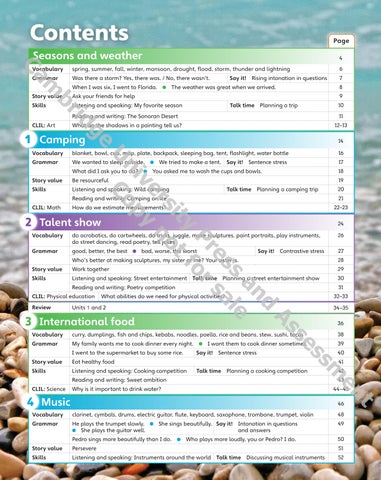
Contents
Page
Seasons and weather
4
Ca
Vocabulary
spring, summer, fall, winter, monsoon, drought, flood, storm, thunder and lightning
Grammar
Was there a storm? Yes, there was. / No, there wasn’t. When I was six, I went to Florida.
Say it! Rising intonation in questions
m
The weather was great when we arrived.
Story value
Ask your friends for help
Skills
Listening and speaking: My favorite season
7 8 9
br
Talk time Planning a trip
10
Reading and writing: The Sonoran Desert
11
What do the shadows in a painting tell us?
12–13
ge
id
CLIL: Art
6
Camping
14
blanket, bowl, cup, map, plate, backpack, sleeping bag, tent, flashlight, water bottle
16
Grammar
We wanted to sleep outside.
Say it! Sentence stress
17
se As d an s le es sa Pr r y fo it t rs no ve y ni p U Co
Vocabulary
What did I ask you to do?
We tried to make a tent.
You asked me to wash the cups and bowls.
Story value
Be resourceful
Skills
Listening and speaking: Wild camping
CLIL: Math
Talk time Planning a camping trip
18 19 20
Reading and writing: Camping on ice
21
How do we estimate measurements?
22–23
2 Talent show Vocabulary
do acrobatics, do cartwheels, do tricks, juggle, make sculptures, paint portraits, play instruments, do street dancing, read poetry, tell jokes
Grammar
good, better, the best
Say it! Contrastive stress
bad, worse, the worst
24 26 27
Who’s better at making sculptures, my sister or me? Your sister is.
28
Story value
Work together
29
Skills
Listening and speaking: Street entertainment Talk time Planning a street entertainment show
30
Reading and writing: Poetry competition CLIL: Physical education Review
What abilities do we need for physical activities?
Units 1 and 2
3 International food
31 32–33 34–35 36
Vocabulary
curry, dumplings, fish and chips, kebabs, noodles, paella, rice and beans, stew, sushi, tacos
38
Grammar
My family wants me to cook dinner every night.
39
I want them to cook dinner sometimes.
Story value
Eat healthy food
Skills
Listening and speaking: Cooking competition
41
Talk time Planning a cooking competition
Reading and writing: Sweet ambition
42
43
en
CLIL: Science
40
m ss
Say it! Sentence stress
I went to the supermarket to buy some rice.
Why is it important to drink water?
44–45 46
Vocabulary
clarinet, cymbals, drums, electric guitar, flute, keyboard, saxophone, trombone, trumpet, violin
Grammar
He plays the trumpet slowly. She plays the guitar well.
Story value
Persevere
Skills
Listening and speaking: Instruments around the world
She sings beautifully. Say it! Intonation in questions and answers
Pedro sings more beautifully than I do.
Who plays more loudly, you or Pedro? I do.
48 49 50 51
Talk time Discussing musical instruments
52
t
4 Music
Page
4 Music (continued)
46
Reading and writing: The Vegetable Orchestra
53
How do string instruments make high and low sounds?
54–55
Review
Units 3 and 4
56–57
Ca
CLIL: Music
5 Now and then
58
m
dictionary, e-book, email, encyclopedia, letter, magazine, newspaper, online game, text message, website
Grammar
People could buy books in 1980.
Vocabulary
br
They couldn’t buy e-books. Say it! Sentence stress
61
Could you play online games when you were young? Yes, I could. / No, I couldn’t.
Protect your friends
63
ge
Skills
62
id
Story value
60
Talk time Discussing forms of communication
Listening and speaking: A history of communication technology
64 65 66–67
se As d an s le es sa Pr r y fo it t rs no ve y ni p U Co
Reading and writing: Virtual learning
CLIL: History What do primary sources tell us about life in the past?
6 The environment Vocabulary
aluminum, cardboard, electricity, gas, glass, paper, plastic, solar power, water, wind power
Grammar
We should use wind and solar power. We shouldn’t use a lot of electricity.
Say it! Shwa+r
68 70 71
What should we do to reduce waste? We should use less paper.
72
Story value
Reuse and recycle
73
Skills
Listening and speaking: Eco-homes
Talk time Designing an eco-friendly home
Reading and writing: A flip-flop safari
74 75
CLIL: Science What happens to our old glass bottles?
76–77
Review
78–79
Units 5 and 6
7 Space Vocabulary
astronaut, Earth, Mars, planets, space laboratory, space station, spacecraft, spacesuit, stars, the Moon
Grammar
They’re going to travel.
Story value
Think logically
Skills
Listening and speaking: Astronaut training
They aren’t going to see their families.
What are you going to do?
Say it! going to
Are you going to travel in a spacecraft? Yes, we are. / No, we aren’t. Talk time Discussing space travel
Reading and writing: Is life possible on Mars? CLIL: Science How are the planets different?
Story value
Share success with your friends
Skills
Listening and speaking: Sonia’s dance show
The costume that I made.
My friend who lives on
Say it! Sentence stress and intonation
Is that your friend who lives in Spain?
86 87 88–89
92
93
94 95
Talk time Choosing a story to act out
Reading and writing: Fantastic floats
Chants
85
96 97
overmatter
98–99 100–101 102–103
t
The town where we had our parade. my street.
Units 7 and 8
84
en
clown, costume, dancer, dragon, fireworks, float, amusement park, mask, musician, pirate
Grammar
Review
83
90
Vocabulary
CLIL: Science How do fireworks work?
82
m ss
8 Celebrations
80
Seasons and weather ge id br m Ca
en m ss
se As d an s le es sa Pr r y fo it t rs no ve y ni p U Co
t
4
ge id br m
Ca
en m ss
se As d an s le es sa Pr r y fo it t rs no ve y ni p U Co
t
5
1
0.01
2
0.02
Listen and look. Listen and repeat. Then match.
Ca
3
2
ge
id
br
m se As d an s le es sa Pr r y fo it t rs no ve y ni p U Co 5
4
6
8
7
0.03
Listen and say yes or no. Then ask and answer.
t
Is the weather in the spring cold and snowy?
4 6 Vocabulary
en
3
m ss
a fall b drought c flood d monsoon e spring f storm g summer h thunder and lightning i winter
No!
Is the weather today usual for the season? Ask and answer. ➞ Workbook page 4
Seasons and weather
5
Read and listen. Then match.
0.04
Ca
Where did you go on summer vacation? I visited my pen pal in India. It was the monsoon season, and there was a lot of rain. We played soccer in the rain. It was fun! Luis
2
ge
id
br
m
I went to stay with my cousins in Colombia. It was hot and sunny. We went to the beach, and we went bodyboarding. It was great. Josh
a
I stayed with my mom’s friends in Bali. It was very windy, but there weren’t any storms or rain. We went to a kite festival. It was fantastic. Nicola c
b
se As d an s le es sa Pr r y fo it t rs no ve y ni p U Co
6
3
Match the questions and answers. 2 3 4 5
Where did Josh go on summer vacation? What did Josh do there? What was the weather like in India? Was there a storm in Bali? Did the children enjoy their vacation?
7
a b c d e
Ask and answer.
I went to Spain.
Focus! Focus! Focus! What was the weather like? It was hot and sunny. ! Was there a storm?
m ss
Where did you go on summer vacation?
He went bodyboarding. No, there wasn’t. He went to Colombia. Yes, they did. It was rainy.
en
Yes, there was. / No, there wasn’t.
8
0.05
0.06
t
Say it! Does the end of the question go up or down? Listen and repeat.
Was there a storm? Did you enjoy your vacation? Grammar Pronunciation
!
➞ Workbook page 5
ammar fun Gr
7
9
0.07
What are they talking about? Listen and choose. a a drought b a storm c a monsoon
Ca
10
0.07
Listen again and practice.
Carla Alex
ge
id
br
m
Alex: What’s your scariest memory, Carla? Carla: When I was six, I went to Florida on vacation. Alex: In the United States? That sounds great! Carla: Well, wait and see. The weather was great when we arrived, but then there was a bad storm. Alex: Oh, no! Carla: It was really windy, and it rained and rained. Then there was a flood in our hotel. Alex: How awful! Carla: Yes! We had to leave our hotel by boat. It was really scary. Alex: Poor you.
se As d an s le es sa Pr r y fo it t rs no ve y ni p U Co
11
Focus! Focus! Focus! When I was six, I went to Florida. ! The weather was great when we arrived.
R ead and match. Then make sentences that are true for you.
Memories
1 When we went on vacation, 2 I met my best friend
3 When we got our new puppy, 4 My brother Rufus was born
5 When we moved to our new house, a when she came to my school.
m ss
b it ate my mom’s new shoe. c I found a big snake in our yard.
en
d when I was five. e we saw turtles on the beach.
t
When we went on vacation, I went windsurfing on a lake.
12
Go to page 02. Listen and repeat the chant.
ammar fun Gr
!
8
0.08
Grammar
➞ Workbook page 6
13
Read and listen.
0.09
2
3
Sofia! When did you get here?
m
Ca Hi, Ruby. What’s the surprise?
br OK!
I want to enter a computer game competition here.
Her game is called The Lost City of Emoclew.
7
Hi, Jack. I arrived on Saturday.
Come in and see.
se As d an s le es sa Pr r y fo it t rs no ve y ni p U Co
4
ge
id
Hi, Jack. Come to the den. I have a surprise for you!
6
5
The game is on an island. You go there and then …
The game isn’t finished. Can you help me with it?
Of course!
8
Oh, dear! There’s a lot of lightning.
en
m ss
Whoa! Did you hear that thunder?
t
It’s a storm. Let’s go back to the house. ➞ Workbook page 7
Let’s stay here. Value: Ask your friends for help
9
Skills: Listening and speaking Let’s start!
What’s your favorite season? Why?
Ca 14
0.10
Who’s speaking? Listen and say the names.
ge
id
br
m Stacie
Palin
Elise
0.10
Listen again and complete the sentences.
2 3 4 5
Elise is from . Palin’s favorite season is . likes going to summer camp. Stacie went on a lake last summer. Luca skiing.
Plan a trip with a friend.
Good idea. What’s the weather like in … then? OK. Can we … ?
10 Skills Functional language
I’d like to go to …
t
Where would you like to go next summer?
en
0.11
m ss
16
se As d an s le es sa Pr r y fo it t rs no ve y ni p U Co
15
Luca
It’s …
Yes, and we can … ➞ Workbook page 8
Seasons and weather
Skills: Reading and writing Look
below!
Where did Joe go on his school trip?
Ca 17
0.12
Read and listen.
ge
id
br
m t
➞ Workbook page
Think about a class trip. Where did you go? What season was it? What was the weather like? What did you do?
en
2 3 4 5 6
The Sonoran Desert is in Brazil. It isn’t a big desert. The desert is very hot in winter. The sand dunes are very high. It never rains in the Sonoran Desert. Flowers can grow in the spring in the Sonoran Desert.
Your turn!
m ss
se As d an s le es sa Pr r y fo it t rs no ve y ni p U Co
18
Read again and say true or false.
Now write about it in your notebook.
Skills 11
What do the
ge id br m
en m ss
se As d an s le es sa Pr r y fo it t rs no ve y ni p U Co
t
12
tell us?
Ca
shadows in a painting
Seasons and weather
1
0.13
Listen and repeat. 2
3
id
br
m
Ca ge
shadow
2
Watch the video. 0.14
se As d an s le es sa Pr r y fo it t rs no ve y ni p U Co
3
light from the side
light from above
Read and listen.
Artists use shadows to show different seasons and times of day. To show summer, artists often paint short shadows. This is because the Sun is high in the sky in summer, and when the light comes from above, it makes short shadows. In winter, the Sun is lower in the sky. The light comes from the side and makes longer shadows. Artists also paint long shadows to show the morning or the evening and short shadows to show midday. The shadows in paintings can also tell us where the Sun is in the sky. When the shadows are on the right of the objects, the Sun is on the left. When the shadows are in front, the Sun is behind.
4 Answer the questions.
CLIL: Art
expla
in
discuss
results
ew
revi
research co nd uc t
t
➞ Workbook page 0
WEATHER RIIM EEX PEER MEEN XP NT T
en
5 Which season would you like to paint?
O OU UR R
m ss
What’s different about shadows in summer paintings and in winter paintings? 2 Why do we see long shadows in winter paintings? 3 Are shadows shorter in the morning or at midday? 4 Look at the painting on page 12. Where is the Sun?
Shadows aren’t just black. They’re darker in the center and lighter on the outside.
13
ge id br m
Ca
en m ss
se As d an s le es sa Pr r y fo it t rs no ve y ni p U Co
t
14
Camping
ge id br m
Ca
en m ss
se As d an s le es sa Pr r y fo it t rs no ve y ni p U Co
t
15
1
1.01
2
1.02
Listen and look. Listen and repeat. Then match.
Ca
2
ge
id
br
m 3
5
4
se As d an s le es sa Pr r y fo it t rs no ve y ni p U Co
6
8
7
0
m ss
a blanket b bowl c cup d map e plate f backpack g sleeping bag h tent i flashlight j water bottle
Listen and guess the words. Then practice with a friend. You stay in this when you’re camping.
4 16 Vocabulary
t
1.03
en
3
A tent!
What do you need when you go camping? Ask and answer. ➞ Workbook page 2
Unit
5
1.04
Read and listen.
Ca ge
id
br
m
I had a strange weekend. I went camping with my family because we wanted to sleep outside, but my dad forgot to take the tent! We tried to make a tent with a blanket, but it wasn’t very good. We were cold. We needed to make a fire, but we didn’t have any firewood. Then it started to rain, and our sleeping bags got wet. We had to come home. We still want to sleep outside someday. Zoe
se As d an s le es sa Pr r y fo it t rs no ve y ni p U Co Focus!! Focus
We wanted to sleep outside. My dad forgot to take the tent. We tried to make a tent.
6
Read, complete, and order the sentences.
want/sleep try/make start/rain need/make forget/take have/go a b c d e
They a tent with a blanket because they Their sleeping bags got wet because it . They a fire because they were cold. Zoe’s family was excited because they in a tent. They home because they got wet.
7
their tent.
Make true and false sentences about yourself. Then talk to a friend. I forgot to brush my teeth this morning.
8
1.05
1.06
t
Say it!
False!
en
this morning. after school today. on Saturday. yesterday. last week.
m ss
I forgot I want I need I tried I had
Which words sound the strongest? Listen and repeat.
We wanted to sleep in a tent. We needed to make a fire. Grammar Pronunciation
!
➞ Workbook page 3
ammar fun Gr
17
9
1.07
Emma
What does Pedro have to do? Listen and choose. a put up the tent b wash the cups and bowls c cook the dinner
Ca 10
1.07
Listen again and practice.
Pedro
ge
id
br
m
Teacher: OK, everyone, come and help me, please. Emma: Yes, of course. What do we have to do? Teacher: Emma, put up the tent, please. And Pedro … Yes? Pedro: Teacher: Please wash the cups and bowls. Pedro: Aww! Can I put up the tent? Teacher: No, Pedro. I asked Emma to put up the tent. Pedro: Can I help cook the dinner? Teacher: No, Pedro. What did I ask you to do? Pedro: You asked me to wash the cups and bowls.
se As d an s le es sa Pr r y fo it t rs no ve y ni p U Co
11
Whisper an instruction to a friend. Then mime and guess. cook dinner
wash the cups
look for the flashlight
What did she ask me to do?
pass me a blanket
She asked you to carry the backpack.
Go to page 02. Listen and repeat the chant.
ammar fun Gr
!
18
1.08
turn off the flashlight
t
Please carry the backpack.
find the map
en
put up the tent
carry the backpack
m ss
carry the water bottle
12
Focus! Focus! Focus! What did I ask you to do? You asked me to wash ! the cups and bowls.
Grammar
➞ Workbook page 4
13
1.09
3
2
Read and listen.
Unit Emoclew! We’re in my game!
Do you want to find Emoclew? Here’s the first thin g you must do. Find a paper to show you the way. Some smart ants ca n help today.
Where are we?
ge
id
br
m
Ca
It looks like an island.
Wow!
What’s that noise?
se As d an s le es sa Pr r y fo it t rs no ve y ni p U Co 5
4
Smart ants? Look! They’re trying to show us something.
6
It’s a map.
Of course! A paper to show us the way!
We should camp here tonight.
So where’s the lost city?
6
7
8
We don’t have tents.
It’s really far away, and it’s getting dark.
Put the map and the tablet into the backpack.
What was that?!
en
m ss t
We can make some with blankets. ➞ Workbook page 5
Good idea. Value: Be resourceful 19
Skills: Listening and speaking Let’s start!
Do you like camping? Why or why not?
Ca 14
1.10
Where do Rosie and Tilly want to go camping? Listen and say the letter.
m a
b
ge
id
br se As d an s le es sa Pr r y fo it t rs no ve y ni p U Co Wake up to mountain views.
c
Sleep like a bird.
15
1.10
1.11
Does Tilly like mountains? Is the tree tent in a campsite? Can you go hiking in the national park? Are there showers close to the tent on the ocean? What do Rosie and Tilly need to take with them?
Plan a camping trip with a friend. Yes, great! Let’s go to …
Who should we go with?
Why don’t we go with … ?
OK. Let’s take …
20 Skills Functional language
t
Should we go camping?
en
16
Listen again and answer the questions.
m ss
2 3 4 5
Watch for dolphins at night.
Yes, and I’ll take … ➞ Workbook page 6
Unit
Skills: Reading and writing Look
What does Ben Taylor do?
below!
Ca 17
1.12
Read and listen.
m
id
br
Camping on ice
ge
Ben Taylor makes movies about animals. We asked him to describe his favorite movie-making experience.
se As d an s le es sa Pr r y fo it t rs no ve y ni p U Co
“Last November, I had to make a movie about emperor penguins in Antarctica. I stayed on a boat, but one night I camped outside. It was very cold. I had to have a very warm sleeping bag and a special tent, but I didn’t need to take a flashlight. November is early summer in Antarctica, and it doesn’t get dark. Antarctica isn’t quiet at night. You can hear the wind, and sometimes you can hear noisy penguins. You can hear the ice, too! Ice makes a strange sound when it moves.
When I woke up the next morning, there was a family of emperor penguins near my tent. I filmed them for two hours. It was so exciting I forgot to have breakfast!”
➞ Workbook page 7
t
2 3 4 5 6
Ben went to Antarctica in January. He had to make a movie about elephant seals. He camped on the ice for seven nights. He had to take a sleeping bag and a flashlight. November is a winter month in Antarctica. He was bored by the penguins.
Imagine you make movies about animals. What animals would you like to make a movie about? What do they do?
en
Read again and correct the sentences.
m ss
18
Your turn!
Now write about it in your notebook. Skills 21
ge id br m
Ca
How do we estimate measurements?
en m ss
se As d an s le es sa Pr r y fo it t rs no ve y ni p U Co
t
22
Unit
1
1.13
Listen and repeat. How long?
How much?
How heavy? 3
ge
id
br
m
Ca
2
meter = 00 centimeters
3
liter = ,000 milliliters
se As d an s le es sa Pr r y fo it t rs no ve y ni p U Co
2
kilogram = ,000 grams
Watch the video. 1.14
Read and listen.
In math we use the sign ≈ when we estimate a number.
How long is your sleeping bag? How heavy is your backpack? How much water is there in your water bottle? When we don’t know and we can’t measure something, we have to guess, or estimate, measurements. To help us estimate, we can think about other objects we know. For example, Alice knows her tent is 4 kg. Her backpack feels a bit heavier. Alice estimates that her backpack is about 5 kg. When we’re estimating, we use words like it’s about … or it’s more than … , but less than … . For example: The tent is about 250 cm long. Or: The tent is more than 2 m long, but less than 3 m long.
4 Answer the questions.
➞ Workbook page 8
CLIL: Math
rm brainsto decid e
agree
list
t
how tall or how heavy your friends are?
ON I T I D E EXP
en
5 Which is more difficult to estimate,
IG
m ss
What units of measurement do we use to find out how long something is? 2 How many centimeters are there in 3 meters? 3 Why do we sometimes have to estimate measurements? 4 What words do we use when we estimate?
O UR B
vote find ou
t 23
ge id br m
Ca
2 Talent show
en m ss
se As d an s le es sa Pr r y fo it t rs no ve y ni p U Co
t
24
ge id br m
Ca
en m ss
se As d an s le es sa Pr r y fo it t rs no ve y ni p U Co
t
25
1
2.01
2
2.02
Listen and look. Listen and repeat. Then match.
Ca ge
id
br
m
2
3
5
4
se As d an s le es sa Pr r y fo it t rs no ve y ni p U Co 6
8
7
0
m ss
a do acrobatics b do cartwheels c do tricks d juggle e make sculptures f paint portraits g play instruments h do street dancing i read poetry j tell jokes
Listen and answer the questions. Then ask and answer. Who’s good at reading poetry?
4 26 Vocabulary
t
2.03
en
3
The girl in picture 0.
What are you good at? Ask and answer. ➞ Workbook page 20
Unit 2
5
2.04
Read, listen, and look.
ge
id
br
m
Ca
Paul, Zoe, and Jake are all good at street dancing. Paul is the best at street dancing. Zoe is better than Jake at street dancing, but she’s worse than Paul. Jake is the worst at street dancing, but he’s still good at it!
6
Zoe
Jake
se As d an s le es sa Pr r y fo it t rs no ve y ni p U Co
Paul
Focus! Focus! Focus!better the best good bad worse the worst !
Read and say the names. Then make more sentences. Lily
Juggling Doing cartwheels
7
1st 2nd
Max
2nd 3rd
Ava
3rd 4th
Oscar
4th 1st
2 3
4 5 6
he’s better than Oscar at juggling, S but she’s worse than Max. He’s the worst at juggling. He’s better than Ava at doing cartwheels, but he’s worse than Lily. She’s the best at juggling. She’s worse than Max at doing cartwheels. He’s better than Ava at doing cartwheels, but he’s worse than her at juggling.
Complete the riddle about a friend. Then ask the class to guess.
, but I’m worse than him/her at I’m better than my friend at . My friend is the best in the class at .
2.05
2.06
Which word sounds the strongest? Listen and repeat.
Oscar isn’t the best at juggling. Oscar isn’t the best at juggling. Oscar isn’t the best at juggling.
(Lily is the best at juggling.) (He’s the worst at juggling.) (He’s the best at doing cartwheels.)
Grammar Pronunciation
ammar fun Gr
!
➞ Workbook page 2
t
8
en
m ss
Say it!
27
9
2.07
What did Alex make at the beach? Listen and choose. a a sandcastle b a sand portrait c a sand sculpture
Ca
10
2.07
Listen again and practice.
ge
id
br
m
Emma: What did you do on the weekend, Alex? Alex: I went to the beach with my family. We had a sand sculpture competition. Look! Emma: Cool! Who’s the best at making sand sculptures in your family? Alex: I am, I think. Look, it’s a crocodile. Emma: Really? And this is my sister’s. Alex: Emma: Oh, yes! Alex: Who’s better at making sculptures, my sister or me? Emma: Sorry, Alex. Your sister is.
se As d an s le es sa Pr r y fo it t rs no ve y ni p U Co
11
Focus! Focus! Focus! Who’s the best at making sculptures? I am. ! Who’s better at making
sculptures, my sister or me? Your sister is.
Choose the words. Then ask and answer.
better best worse worst
Who’s the b at making sculptures in your family?
2 Who’s b at speaking English, your mom or your dad?
3 Who’s w at juggling, you or your best friend?
at telling jokes
5 Who’s the b in your class?
at swimming
6 Who’s the w in your family?
at cooking
Who’s w at singing, you or your best friend?
en
7
m ss
4 Who’s the w in your family?
12
Go to page 02. Listen and repeat the chant.
ammar fun Gr
!
28
2.08
t
8 Who’s b at using a computer, you or your dad?
Grammar
➞ Workbook page 22
13
2.09
Read and listen.
Footprints?
3
Unit 2
2
Ca
id
br
m
Follow the footprint s to a canoe. Inside it is your sec ond clue. North, south, east, or west. This item always kn ows where’s best.
ge
Yes, look! Let’s follow them.
se As d an s le es sa Pr r y fo it t rs no ve y ni p U Co You go in front, Sofia. You’re the best at reading the map.
5
4
They’re very big footprints.
I can paddle.
6
Slow down, Jack!
I can’t! Which way do we go?
Here’s the canoe! It’s a compass. Of course! North, south, east, and west!
7
You take the compass, Ruby.
North. Go left!
8
We need to land over there.
m ss
Good job, all of us.
en
Good job, Jack.
t
Yes, but be careful of the hippos!
➞ Workbook page 23
Value: Work together
29
Skills: Listening and speaking Let’s start!
What type of street entertainment can you see in your country?
Ca 14
2.10
Which entertainers do Lia and Juan see? Listen and say the letters.
m
c
b
a
ge
id
br se As d an s le es sa Pr r y fo it t rs no ve y ni p U Co
Watch some acrobats. d
Find a 3-D picture. e
Try some juggling.
15
2.10
2.11
Listen again and match.
The children say hello to … The children decide to follow … The children give money to … Juan is better than Lia at … Lia is better than Juan at …
a b c d e
the puppet. juggling. the statue. dancing. the 3-D artist.
Plan a street entertainment show with your friends. I can …
Great! And how about … ?
OK. … is the best at …
What can … do?
30 Skills Functional language
t
I can … What can you do?
en
16
Talk to a statue.
m ss
2 3 4 5
Meet a giant puppet.
Why doesn’t he/she … ?
➞ Workbook page 24
Unit 2
Skills: Reading and writing Look
below!
What type of competition did Paola enter?
Ca 17
2.12
Read and listen.
m
id
br
Talent (by Paola) But what can I be good at? I’ll ask my mom and dad, “Am I good at anything, Can I really be that bad?”
My sister’s good at painting, She paints pictures of our town. My brother’s great at telling jokes, He’s the family clown.
“Don’t be silly,” says my mom. “Your talent’s easy to see. You’re the best at writing, You write great poetry!”
My mom is the best singer, And she plays the guitar, too. And my dad is the best at cooking, He makes a great barbecue.
So now I feel quite happy, And what I know is this, We all have a talent, Just find out what yours is!
ge
Everyone’s good at something, In my family. They all have a lot of talent, Everyone but me!
t
➞ Workbook page 25
Think about your family. Is your family similar to or different from Paola’s family? What are they good at? What are you good at?
en
2 3 4 5 6
Who’s the funniest in Paola’s family? Who’s the best writer? Who’s the best at music? Who makes very good food? What does Paola like to write? Who’s very good at art?
m ss
se As d an s le es sa Pr r y fo it t rs no ve y ni p U Co
18 Read again and answer the questions.
Your turn!
Now write about it in your notebook.
Skills 31
What abilities do we need for
ge id br m
Ca
en m ss
se As d an s le es sa Pr r y fo it t rs no ve y ni p U Co
t
32
physical activities?
Unit 2
1
2.13
Listen and repeat. 2
4
3
3
strength
balance
stamina
se As d an s le es sa Pr r y fo it t rs no ve y ni p U Co
2
ge
id
br
m
Ca speed
Watch the video.
2.14
Read and listen.
Can you run, skate, or ride your bike fast? For these activities you need speed because you need to move your body very quickly. Are you good at rock climbing? You need strength for this activity because you must have strong arms and legs to climb. Can you stand on one leg without falling down? For this you need balance. Street dancers need good balance when they move on one leg or one arm. Do you think you can run in a marathon? It isn’t easy because we need to use our muscles for a long time. To run in a marathon, we need stamina.
speed, strength, balance, or stamina?
➞ Workbook page 26
CLIL: Physical education
PROGRAM
balance
speed
stamina strength
t
5 What would you like to have, better
EXERCISE
en
When do we need speed? 2 Why is it difficult to run in a marathon? 3 Which is more important when you do a cartwheel, stamina or balance? 4 Look at the picture on page 32. What abilities does the snowboarder need?
OUR BALANCED
m ss
4 Answer the questions.
Flamingos can balance on one leg when they sleep.
create comple te 33
Review Units and 2 Ca
1
2.15
Read, listen, and choose the words.
m
ge
id
br
Last fall/winter, I visited my friend Brad in New York. When I arrive/arrived, there was a snowstorm/drought. I was surprised because Brad asked me/us to go camping/ swimming! But we didn’t camp/swim outside in the snow/monsoon. We spent the night in a museum! We had/forgot to take sleeping bags/tents, a water bottle/ flashlight, and a camera.
se As d an s le es sa Pr r y fo it t rs no ve y ni p U Co
When the museum closes/closed, we explored in the dark with our flashlights/ cameras. Then we watched a movie, and we slept under a shark/whale! Well, we had/ tried to sleep, but we were too excited. We told jokes/painted portraits, and we did some cartwheels/tricks. Brad was the best/worst at telling jokes/ doing cartwheels. We laughed a lot. In the morning, we had breakfast, and then we went home to bed! George
2
Think of a visit to a friend. Ask and answer.
4 34
Where did you go? Where did you sleep?
t
Who did you visit? What season was it?
en
2 3 4 5 6
Which season was it when George went to New York? What was the weather like when George arrived? Where did they go camping? Did they need to take tents? Was George the best at telling jokes? Were they tired in the morning?
m ss
3
Read again and answer the questions.
Write about your visit in your notebook. ➞ Workbook pages 28–2
5
P lay the game.
24
23
Ca id
br
18
ge
When I was ,I went to on vacation.
Go back to 14.
flood / Was / fall? / last / a / there
is the in our class at doing cartwheels.
yesterday? / weather / was / the / like / What
Go to 21.
Name f ive activities you can do on vacation.
Who / at / is / best / painting / the / your / in / family?
Go back to 11.
11
Name six things you take when you go camping.
7
12
is than me at juggling.
Name four weather words.
6
5
your parents / to do / ask / What / last night? / did / you
Go back to 2.
Go to 10.
2
3
summer? / go / Where / last / you / did
This morning, I forgot to
4
.
Name four seasons.
en t
Start here!
13
m ss
1
20
14
10
9
8
19
15
Go to 17.
Name f ive activities you are good at.
se As d an s le es sa Pr r y fo it t rs no ve y ni p U Co
16
21
This morning, my teacher asked . me to
Go back to 19.
m 17
22
Green
Yellow
Blue
Make a question and answer it.
Make a true sentence.
How many words can you remember?
35
ge id br m
Ca
3 International food
en m ss
se As d an s le es sa Pr r y fo it t rs no ve y ni p U Co
t
36
ge id br m
Ca
en m ss
se As d an s le es sa Pr r y fo it t rs no ve y ni p U Co
t
37
1
3.01
2
3.02
Listen and look. Listen and repeat. Then match.
Ca
2
ge
id
br
m 3
5
4
se As d an s le es sa Pr r y fo it t rs no ve y ni p U Co
6
8
7
0
m ss
a curry b dumplings c fish and chips d kebabs e noodles f paella g rice and beans h stew i sushi j tacos
Listen and suggest dishes. Then practice with a friend. I like fish and potatoes. I don’t like rice.
4 38 Vocabulary
t
3.03
en
3
Why don’t you try fish and chips?
Which of these dishes would you like to try? Ask and answer. ➞ Workbook page 30
Unit 3
5
3.04
Read and listen.
Ca br
m
I’m learning to cook international food with my Saturday club. Now my family wants me to cook dinner every night, and they usually want me to make different things.
ge
id
Yesterday evening, my mom wanted me to make rice and beans, my dad wanted me to make pasta, and my sister wanted me to make sushi. What can I do? I want them to cook dinner for me sometimes!
se As d an s le es sa Pr r y fo it t rs no ve y ni p U Co
Andy
Focus!! Focus
My family wants me to Focus! cook dinner every night. I want them to cook ! me sometimes. dinner for
6
Read and match. Then choose the words. She wants her/him to read a story.
a
b
c
d
e
f
2 They want him/her to play soccer.
3 They want him/her to buy fish and chips. 4 She wants him/them to make noodles for dinner. 5 He wants you/her to try some dumplings.
Think of three things you want people to do after school.
I want Sally to come to my house.
t
I want my mom to make stew for dinner.
en
7
m ss
6 He wants her/them to go to bed.
I want my brother to clean my room.
8
3.05
Go to page 02. Listen and repeat the chant. Grammar
!
➞ Workbook page 3
ammar fun Gr
39
9
3.06
What did Carla make? Listen and choose. a paella b kebabs c tacos
Ca
10
3.06
Listen again and practice.
ge
id
br
m
Pedro: Hi, Carla. Where were you this morning? Carla: I went to the supermarket to buy some rice. Pedro: Some rice? Why did you buy rice? Carla: I bought some rice to make paella. I had chicken and vegetables, but I didn’t have any rice. The paella’s for you, Pedro. Happy birthday! Pedro: Thanks, Carla. I love paella. Carla: I know!
se As d an s le es sa Pr r y fo it t rs no ve y ni p U Co
Focus! Focus! I went to the supermarket Focus! to buy some rice. ! I bought some rice to make
11
C hoose and make sentences. How many true sentences can you make?
a paella.
the supermarket the market the park a restaurant a store the sports center the movie theater buy have eat play do go ride watch Yesterday, I went to the sports center to do karate. On Saturday, my mom and dad went to a restaurant to have dinner.
en
m ss
12
3.07
3.08
t
Say it! Which words sound the strongest? Listen and repeat.
I went to the market to buy some rice. I bought some rice to make paella. !
40
ammar fun Gr
Grammar Pronunciation
➞ Workbook page 32
13
3.09
Unit 3
3
Read and listen. 2
We need another nest!
Ca
The clue must be an egg.
m
Now it’s time for yo u to look for a clue that you can cook. In a nest is a tasty treat, but someone else wa nts to eat.
Good. I’m hungry.
We can’t take a bird’s eggs.
ge
id
br
Yes! Animals don’t want us to take their eggs.
se As d an s le es sa Pr r y fo it t rs no ve y ni p U Co 5
4
This is our egg!
6
It smells delicious!
What was that?
Where were you?
There are some onions, too. We can make an omelette.
I went to find more vegetables. Look! Peas!
7
Good idea!
8
I think it’s a yeti!
en
m ss Phew! We’re safe.
t
Yes, but we left the map and compass.
Run!
➞ Workbook page 33
Value: Eat healthy food
41
Skills: Listening and speaking Let’s start!
Can you cook? Would you like to enter a cooking competition?
Ca 14
3.10
How does Jake make his dish? Listen and order the pictures.
m
c
b
ge
id
br
a
15
f
3.10
Listen again and complete the sentences.
2 3 4 5
Jake learned to cook when he was His works in a restaurant. He made for the competition. His surprise ingredient was . You eat the curry with .
3.11
.
Plan a cooking competition with your friends. What would you like to cook?
42 Skills Functional language
You eat it for …
t
When do you eat it?
You need …
en
Great! What do you need for … ?
I’d like to cook …
m ss
16
se As d an s le es sa Pr r y fo it t rs no ve y ni p U Co e
d
➞ Workbook page 34
Unit 3
Skills: Reading and writing Look
below!
What does Talia like making?
Ca 17
3.12
Read and listen.
m
br
Sweet ambition
ge
id
My name is Talia Asp, and I’m from Bergen, in Norway. I want to be a gingerbread artist when I’m older because I like art and I love cooking. Gingerbread is a type of cookie. It’s good for art because you can cut it into different shapes.
se As d an s le es sa Pr r y fo it t rs no ve y ni p U Co
I like making gingerbread houses the most. They’re like a puzzle. You cut the gingerbread into pieces and bake them in the oven. Then you put the pieces together and decorate the house with candy. My mom wanted me to make this house for her birthday.
My town, Bergen, is famous for its gingerbread art. Every December, we make the biggest gingerbread town in the world. There are houses, trains, boats, and cars. This year, my class made a gingerbread boat. Come and visit someday!
➞ Workbook page 35
t
6
Design some gingerbread art. What does it look like? How many pieces of gingerbread do you need? Who’s it for?
en
2 3 4 5
Where is Talia from? Does she like cooking? What kind of food is gingerbread? What does Talia enjoy making the most? What can you see in Bergen’s gingerbread town? What did Talia’s class make?
Your turn!
m ss
18 Read again and answer the questions.
Now write about it in your notebook.
Skills 43
Why is it important to
ge id br m
Ca
drink water?
en m ss
se As d an s le es sa Pr r y fo it t rs no ve y ni p U Co
t
44 Vocabulary
Unit 3
1
3.13
Listen and repeat. 3
2
4
5
3
blood
brain
skin
perspiration
se As d an s le es sa Pr r y fo it t rs no ve y ni p U Co
2
ge
id
br
m
Ca humans
Watch the video. 3.14
Read and listen.
Frogs don’t drink. Water goes into their bodies through their skin.
All plants, animals, and humans need water to live. That’s because our bodies need water for nearly everything they do. Our blood needs water to move around the body. Our stomachs need water to digest food. More than 70% of our brains are water, so drinking water helps us think better.
When we do sports and when it’s hot, we lose water through our skin. This body water is called perspiration. We put water into our bodies when we drink and eat. When we lose more water than we put into our bodies, we feel tired and we sometimes have a headache. That’s why it’s important to drink 6–8 glasses of water a day.
FOOD
INFOGRAPH draf t
more water?
CLIL: Science
t
5 When do you think you should drink
en
Why does our blood need water? 2 How much of our brain is water? 3 From which part of our body do we lose water when it’s hot? 4 What happens when we don’t drink much water?
design international e compar lar u p po
IC
m ss
4 Answer the questions.
➞ Workbook page 36
OUR
ask and answer 45
ge id br m
Ca
4 Music
en m ss
se As d an s le es sa Pr r y fo it t rs no ve y ni p U Co
t
46
ge id br m
Ca
en m ss
se As d an s le es sa Pr r y fo it t rs no ve y ni p U Co
t
47
1
4.01
2
4.02
Listen and look. Listen and repeat. Then match.
Ca
2
ge
id
br
m 3
5
4
se As d an s le es sa Pr r y fo it t rs no ve y ni p U Co 6
7
8
0
m ss
a clarinet b cymbals c drums d electric guitar e flute f keyboard g saxophone h trombone i trumpet j violin
4.03
What are these?
4 48 Vocabulary
t
Listen and guess the instruments. Then mime and guess.
en
3
They’re drums. Picture seven.
Which instruments would you like to learn? Ask and answer. ➞ Workbook page 38
Unit 4
5
4.04
Read, listen, and say the names.
ge
id
br
m
Ca 6
7
se As d an s le es sa Pr r y fo it t rs no ve y ni p U Co
Sam
Elisa
Read and say true or false. 2 3 4 5
Jasmine plays the guitar badly. Jasmine sings well. Sam can’t play the trumpet quickly. Elisa likes playing the cymbals. Elisa doesn’t play the keyboard quietly.
4.05
Listen and choose the words.
Focus!! Focus
He plays the trumpet slowly. She sings beautifully. She plays the guitar well.
en
m ss
2 3 4 5
She’s playing the violin quickly/slowly. He’s singing well/badly. She’s playing the flute loudly/quietly. He’s playing the electric guitar loudly/quietly. She’s playing the clarinet badly/beautifully.
Jasmine
8
4.06
4.07
t
Say it!
Do the ends of the question and answer go up or down? Listen and repeat.
Do you play the violin well? No, I play it badly. Grammar Pronunciation
!
➞ Workbook page 3
ammar fun Gr
49
9
4.08
How does Emma play the electric guitar? Listen and choose. a badly b loudly c quietly
Ca 10
4.08
Listen again and practice.
m
ge
id
br
Carla: Hi, Emma. What are you doing? Emma: I’m going to band practice. Carla: Cool! What instrument do you play? Emma: I’m learning to play the electric guitar, and I sometimes sing. Carla: Are you good at singing? Emma: Not really. Pedro sings more beautifully than I do, but I play the guitar better than he does. Carla: Who plays more loudly, you or Pedro? Emma: I do, of course!
se As d an s le es sa Pr r y fo it t rs no ve y ni p U Co
11
Focus! Focus! Focus! Pedro sings more beautifully than I do. ! I play the guitar better
Answer the questions with a friend. Then tell the class.
than he does. Who plays more loudly, you or Pedro? I do.
1 Who sings more beautifully, you or your friend? 2 Who plays an instrument better? 3 Who sings more loudly? 4 Who reads more quickly?
5 Who speaks more quietly? 6 Who eats more slowly?
m ss
7 Who laughs more loudly? 8 Who writes more beautifully?
en t
Max sings more loudly than I do, but I sing more beautifully. I read more slowly than Anna does.
12
Go to page 02. Listen and repeat the chant.
ammar fun Gr
!
50
4.09
Grammar
➞ Workbook page 40
13
4.10
3
Read and listen.
2
Here are the map and compass.
4
Unit 4
Cool! A present!
m
Ca
Oh, no! The yeti!
Look, he has a present.
Shh, let’s go quietly. We don’t want the yeti to hear us.
ge
id
br
The fourth clue is a present and a musical in strument. Listen carefully to a new friend , then play the tu ne to the end.
se As d an s le es sa Pr r y fo it t rs no ve y ni p U Co
5
I think he’s the new friend.
7
6
That doesn’t sound right.
Um, thank you.
Wow! An ocarina!
I think you have to copy the tune.
Listen carefully to the yeti. Then play the tune slowly.
What’s happening?!
8
en
m ss
Now play it again more quickly. ➞ Workbook page 4
t
Yes, that’s right!
Whoa! Value: Persevere
51
Skills: Listening and speaking Let’s start!
What traditional instruments do you have in your country?
Ca 14
4.11
Listen and match the instruments to the countries.
m
2
3
ge
id
br 4
se As d an s le es sa Pr r y fo it t rs no ve y ni p U Co
erhu
5
bongos
a South Africa
15
4.11
b Cuba
c Scotland
bagpipes
d China
e Greece
Listen again and choose the words.
People sometimes/never play the erhu in rock bands. People usually play the vuvuzela loudly/quietly. All/Some bouzoukis have eight strings. People usually play bongos with their hands/sticks. Bagpipes are easy/difficult to play.
Decide which instrument you would like to play.
How do you play the … ?
You play it like a …
Do you think it’s easy or difficult?
52 Skills Functional language
I’d like to play the …
t
Which instrument would you like to play?
en
4.12
bouzouki
m ss
2 3 4 5
16
vuvuzela
I think it’s … ➞ Workbook page 42
Unit 4
Skills: Reading and writing Look
What are these instruments made from?
below!
Ca 17
4.13
R ead and listen.
br
m id
The Vegetable Orchestra
ge
We eat vegetables every day, but what else can we do with vegetables?
se As d an s le es sa Pr r y fo it t rs no ve y ni p U Co
In Austria, there is a vegetable orchestra. They make all their own instruments – trumpets, drums, violins, clarinets – and they make them all from vegetables.
The orchestra plays concerts all over the world. Before each concert, the musicians go to the market and buy fresh vegetables. Then they make their instruments slowly and carefully. It takes about three hours because they have to make more than forty instruments for each concert. They love inventing new instruments with different vegetables from around the world.
People always enjoy listening to the Vegetable Orchestra, and after each concert, they enjoy a bowl of vegetable soup! The orchestra’s cook makes it from unused vegetables. It’s delicious!
Read again and correct the sentences.
➞ Workbook page 43
t
6
Design an unusual instrument. What is it made from? What does it sound like? How do you play it?
en
2 3 4 5
The Vegetable Orchestra is from Russia. They make all their instruments from fruit. They buy their vegetables at the supermarket. The musicians make their instruments quickly. They need more than twenty instruments for each concert. People enjoy noodles after the concert.
m ss
18
Your turn!
Now write about it in your notebook.
Skills 53
ge id br m
Ca
How do string instruments make high and low sounds?
en m ss
se As d an s le es sa Pr r y fo it t rs no ve y ni p U Co
t
54
Unit 4
1
4.14
Listen and repeat. 2
3
id
br
m
Ca ge
vibrate
2
thick string
thin string
Watch the video. 4.15
se As d an s le es sa Pr r y fo it t rs no ve y ni p U Co
3
make tighter
Read and listen.
When we play a guitar or another string instrument, we make the strings vibrate. When a string vibrates quickly, it makes a high sound. When it vibrates slowly, it makes a low sound. The pitch is how high or low the sound is. How can we change the pitch? There are three ways. • We can make the string tighter. Tight strings vibrate faster, so they make a higher pitch. • We can make the string shorter because shorter strings vibrate faster, too. • We can use thick and thin strings. Thick strings vibrate slowly and make a low sound. Thin strings vibrate quickly and make a high sound.
4 Answer the questions.
➞ Workbook page 44
CLIL: Music
O SCRIPT E D I V agree ord er
research
out
think ab organiz e
t
Do they have a high or a low pitch?
R MUSIC
en
5 What sounds do you hear every day?
OU
m ss
What word describes how high or low sounds are? 2 What do we hear when something vibrates slowly? 3 Which makes a higher sound, a long string or a short string? 4 Which makes a lower sound, a thick string or a thin string?
When a sound has a very high pitch, sometimes we can’t hear it but dogs can.
ac t out 55
Review Units 3 and 4 Ca
1
4.16
Read, listen, and choose the words.
m
id
br
I’m in the school orchestra/band with my friend Sally. Sally plays the flute/ drums, and I play the clarinet/trumpet. My family wanted me to learn the flute/electric guitar, but I love playing the trumpet loudly/quietly!
ge
Last year, our band/orchestra went to Moscow to enter a music/cooking competition. It was fun, but it was hard work, too. Our teacher wanted us/me to learn some very difficult recipes/music.
se As d an s le es sa Pr r y fo it t rs no ve y ni p U Co
The competition was on the first/last evening of our stay. We played badly/well, but another orchestra/band played more beautifully/quietly than we did. We/They won the competition, and we/they came second. After the competition, we went to a restaurant/café to have dinner. Sally had fish and chips/noodles, but I chose curry/stew because I wanted to try it. It was delicious! Maria
2
Read again and say true or false.
Think of a competition you entered. Ask and answer.
t
What type of competition was it? Where was it? What did you do to prepare? Did you win?
en
3
m ss
2 3 4 5 6
Maria’s family wanted her to learn the trumpet. Maria enjoys playing her trumpet loudly. They entered a cooking competition in Moscow. Maria’s orchestra came second in the competition. They had dinner in a hotel. Maria wanted to try dumplings.
4 Write about the competition in your notebook. 56
➞ Workbook pages 46–47
5
P lay the game.
Ca
Start here! 3
4
m
2
splugmind
ge
id
br
tenciral
You go to the supermarket to buy some sushi. Miss a turn.
8
se As d an s le es sa Pr r y fo it t rs no ve y ni p U Co
5
lodsone 6
7
6
5
You want your friend to practice the piano. Go back to the restaurant.
You don’t want the other band to arrive earlier than you. Go to 18.
You ate the sushi very quickly, and you’re still hungry. Go back to the supermarket.
satoc
7
lambycs
You don’t have your electric guitar. Go back to the market to buy another one.
20
bekbas
8
You go to the restaurant to have curry, and you eat very slowly. Miss a turn.
hoxpasneo
6
4
t
Answer the questions.
Green Purple
Your friends want you to try rice and beans. Go back to the café.
You stop at the market to buy an old trumpet. Miss a turn.
en
smurd
Green
0
2
m ss
3 You can only play the old trumpet very quietly and badly. Go back to the market.
Someone is singing beautifully. Go to the café to listen. Miss a turn.
Purple
Make true sentences using these words. Find the word. Follow the instruction.
57
ge id br m
Ca
5 Now and then
en m ss
se As d an s le es sa Pr r y fo it t rs no ve y ni p U Co
t
58
ge id br m
Ca
en m ss
se As d an s le es sa Pr r y fo it t rs no ve y ni p U Co
t
59
1 2
5.01
5.02
Listen and look. Listen and repeat. Then match.
Ca
2
ge
id
br
m 3
5
4
se As d an s le es sa Pr r y fo it t rs no ve y ni p U Co
6
8
7
0
m ss
a dictionary b e-book c email d encyclopedia e letter f magazine g newspaper h online game i text message j website
5.03
You read this on an e-reader.
4 60 Vocabulary
t
Listen and guess the words. Then practice with a friend.
en
3
An e-book!
What information technology do you use? Ask and answer. ➞ Workbook page 48
Unit 5
5
5.04
Read and listen.
Ca
m
Life in 1980
br
Sally Rogers was born in 1980. How was life different then?
ge
id
Most people didn’t have a computer at home in 1980. They couldn’t use the Internet or websites. They watched the news on TV or they bought newspapers, magazines, or books. They couldn’t buy e-books. People could call or send letters to their friends, but they couldn’t send emails. Now we can send emails to friends all over the world.
se As d an s le es sa Pr r y fo it t rs no ve y ni p U Co
6
What could people do before 2 3 4 5
80? Read and choose.
People could/couldn’t use websites. They could/couldn’t buy books. They could/couldn’t send letters. They could/couldn’t buy encyclopedias. They could/couldn’t use the Internet.
7
Focus! Focus! People Focus!could buy books in 80. ! They couldn’t buy e-books.
Read and find the mistakes in Sally’s to-do list. February 8, 1989
en
5.05
5.06
t
Say it! 8
People couldn’t buy e-books in 8 !
m ss
Ask Dad for an e-book for my birthday. Send Grandma an email. Ask Mom to buy my favorite magazine. Use the Internet to do my science project. Check Jane’s website.
Which words sound the strongest? Listen and repeat.
People could read books. They couldn’t send emails. Grammar Pronunciation
!
➞ Workbook page 4
ammar fun Gr
61
9
5.07
What is Alex doing? Listen and choose. a watching television b reading a book c playing an online game
Ca 10
5.07
Listen again and practice.
ge
id
br
m
Grandpa: What are you doing, Alex? Alex: I’m playing online chess with Pedro. Grandpa: Online chess? Can you play online chess, Grandpa? Alex: Grandpa: No, I can’t. I’m not good at using computers. Alex: Could you play online games when you were young? Grandpa: No, I couldn’t. There weren’t any computers then. Alex: Could you watch television? Grandpa: Yes, I could. We had a television, but it was black and white. Focus!! Focus Alex: Could you read books? Grandpa: Yes, of course, Alex. I’m not that old! Focus! Could you play online games
se As d an s le es sa Pr r y fo it t rs no ve y ni p U Co
11
Make questions. Then ask and answer.
play online games cook read e-books
use the Internet
use a dictionary
m ss
play a musical instrument
speak English
Yes, I could.
Go to page 03. Listen and repeat the chant.
ammar fun Gr
!
62
Could you swim when you were 7?
t
No, I couldn’t.
en
Could you use the Internet when you were 1?
5.08
swim
write your name
send text messages
12
when you were young? ! Yes, I could. / No, I couldn’t.
Grammar
➞ Workbook page 50
13
5.09
3
Read and listen.
Unit 5
2
Something you send … An email? A text message?
The fifth clue is some thing you send to give your news to a friend. Pick this up an it with you on your jou d take rney to Emoclew.
Great! We need to climb this mountain to get to Emoclew.
Be careful, Ruby. It’s dangerous.
ge
id
br
m
Ca
Wow! We’re in the mountains!
se As d an s le es sa Pr r y fo it t rs no ve y ni p U Co
4
5
6
Are you OK, Ruby? Yes.
Whoa!
Phew! Thank you.
7
Let’s follow the yeti into the cave.
8
Look, a letter.
Don’t sit down, Jack!
We need to take it with us.
t
Something you send to give news to a friend.
en
m ss
Phew!
The address is in Emoclew.
It’s a snake! ➞ Workbook page 5
Value: Protect your friends
63
Skills: Listening and speaking Let’s start!
How do you communicate with your friends?
Ca 14
5.10
When were these forms of communication invented? Listen and match.
m a
c
b
ge
id
br se As d an s le es sa Pr r y fo it t rs no ve y ni p U Co
smoke signals d
the World Wide Web
telegram
e
telephone
1800 BCE
15
5.10
5.11
1876
1990–1991
Listen again and answer the questions.
Which is the oldest form of communication? Could people send letters in the post in 600 BCE? Could people send telegrams more quickly or more slowly than letters? What did Alexander Graham Bell invent? Is communication easier or more difficult with the Internet?
Talk about forms of communication with a friend.
Which do you use the most? What do you use it for?
64 Skills Functional language
I use …
t
Which forms of communication do you use?
en
16
1844
m ss
2 3 4 5
600 BCE
letters
I use … the most. I use it for … ➞ Workbook page 52
Unit 5
Skills: Reading and writing Look
Where does Kim work?
below!
Ca 17
5.12
Read and listen.
m id
br
Virtual learning
ge
Pilar is learning Chinese. But she isn’t studying it at school. She has lessons with a virtual teacher at home. We asked her some questions. Is your virtual teacher a real person? Yes, of course. Her name is Kim, and she lives in China. She’s called a virtual teacher because she teaches me online. I download activities from a website. Then I email my work to Kim, and she checks it. Can you talk to each other? Yes, we use a video chat tool. We have conversation classes, and I ask her questions. Where does Kim work? She works at home, in a café, and even on vacation! She just needs a computer and the Internet. Do you like virtual learning? Yes, it’s fun. I live in Spain, but I have lessons in China!
2 3
6
➞ Workbook page 53
Think about technology you have in your school. What do you use it for? What technology would you like to have? Would you like to have a virtual teacher?
t
5
Your turn!
en
4
Pilar is studying Chinese at . A virtual teacher teaches . Pilar downloads work from a , and it to Kim. Pilar and Kim use a video chat tool to . Kim uses a and the for her work. Pilar thinks virtual learning is .
m ss
se As d an s le es sa Pr r y fo it t rs no ve y ni p U Co
18 Read again and complete the sentences.
Now write about it in your notebook.
Skills 65
ge id br m
Ca
What do primary sources tell us about life in the past?
en m ss
se As d an s le es sa Pr r y fo it t rs no ve y ni p U Co
t
66
Unit 5
1
5.13
Listen and repeat. 3
2
4
ge
id
br
m
Ca tools
3
board game
jewelry
se As d an s le es sa Pr r y fo it t rs no ve y ni p U Co
2
statue
Watch the video.
5.14
Read and listen.
A primary source is something old that tells us about life in the past. It can be an old tool, a statue, some jewelry, or a board game that people had in the past. History books that we read in school are not primary sources. This is because the writers of school books didn’t live at the time they are writing about. We can learn about the past by asking questions about primary sources. We can ask: What did people use this tool for? Who made this statue and why did they make it? What is this jewelry made of? How did people play this board game? When we can answer these questions, we learn about life in the past.
4 Answer the questions.
➞ Workbook page 54
CLIL: History
exp
lain
list
life
te
important s ec t j b o
ra deco
t
about the primary sources above?
E L U C A PS
en
5 What questions would you like to ask
ME
I T R U O
m ss
What is a primary source? 2 What are examples of primary sources? 3 Why is a textbook about history not a primary source? 4 Why should we ask questions about primary sources?
We know that the Egyptian alphabet had about 700 hieroglyphs because of primary sources.
67
ge id br m
Ca
6 The environment
en m ss
se As d an s le es sa Pr r y fo it t rs no ve y ni p U Co
t
68
ge id br m
Ca
en m ss
se As d an s le es sa Pr r y fo it t rs no ve y ni p U Co
t
69
1
6.01
2
6.02
Listen and look. Listen and repeat. Then match.
Ca
2
ge
id
br
m 3
5
4
se As d an s le es sa Pr r y fo it t rs no ve y ni p U Co 6
8
7
0
m ss
a aluminum b cardboard c electricity d gas e glass f paper g plastic h solar power i water j wind power
Listen and say good or bad for the environment. Then practice. We use solar power in our house.
4 70 Vocabulary
t
6.03
en
3
Good for the environment.
What do you do for the environment at home? Ask and answer. ➞ Workbook page 56
Unit 6
5
6.04
Read and listen.
id
br
m
Ca
✓
✗
ge
We should use wind and solar power.
icity and gas. We shouldn’t use a lot of electr
and aluminum.
se As d an s le es sa Pr r y fo it t rs no ve y ni p U Co
We should recycle paper, glass,
We shouldn’t throw away all our trash.
We should take showers instead of baths.
water. We shouldn’t use a lot of
We should give old toys to younger children.
We shouldn’t throw away old toys.
6
Read and say should or shouldn’t. We We We We We
2 3 4 5
7
reuse plastic bags. use a lot of gas. turn off televisions and computers at night. throw away glass bottles. recycle cardboard.
Think of more ideas to help the environment.
We should walk or ride a bike.
We should make art from trash!
6.06
t
6.05
en
Say it! 8
We should use wind and solar power. We shouldn’t use a lot of electricity.
m ss
We shouldn’t always go to school by car.
Focus!! Focus
How do we say the green parts of these words? Listen and repeat.
paper water
solar computer Grammar Pronunciation
power hour ammar fun Gr
!
➞ Workbook page 57
circus forget
71
9
6.07
What do they want to make more eco-friendly? Listen and choose. a Pedro’s house b Carla’s house c their school
Ca 10
6.07
Listen again and practice.
m
ge
id
br
Teacher: OK, class. It’s Environment Day today. Let’s think about our school. What should we do to make our school more eco-friendly? We shouldn’t waste energy. We should save it. Carla: And we should reduce waste. Pedro: Teacher: Good idea. What should we do to reduce waste, Pedro? Pedro: We should use less paper. Teacher: How can we do that? Carla: Do less homework? Teacher: Carla!
se As d an s le es sa Pr r y fo it t rs no ve y ni p U Co
Focus! Focus! Focus! What should we do to reduce waste? ! We should use less
11
paper.
Match the questions and answers. Then ask and answer.
1 ? We should use solar power in the summer. ? 2 We should collect rainwater to use on our yards. ? 3 We should write on both sides of paper. 4
? We should plant new trees.
We should turn off the TV at night.
Go to page 03. Listen and repeat the chant.
ammar fun Gr
!
72
6.08
What should we do to save energy?
t
12
What should we do to save forests? What should we do to save energy? What should we do to save water? What should we do to save paper? What should we do to reduce waste?
en
a b c d e
m ss
? 5 We should recycle or reuse our trash.
Grammar
➞ Workbook page 58
13
6.09
3
Read and listen.
Now we go east.
2
Ca
Look at all this trash!
m
br
The sixth clue is the stron gest bird, but you should help it – it’s hurt. Rescue it from a rop e trap, and find a shortcut on the map.
id
People shouldn’t leave it here.
ge
That’s straight ahead. Come on.
Look, it’s an eagle. The strongest bird! It’s stuck. We should help it.
se As d an s le es sa Pr r y fo it t rs no ve y ni p U Co
4
No, let’s take it with us.
5
6
It’s a rope bridge.
Good job, Jack.
Let’s follow it.
It’s a shortcut across the mountains.
7
Wait, Jack! The bridge is broken.
8
Look, we can reuse this rope.
OK. Let’s cross carefully.
en
m ss t
Let’s fix it.
Good idea! ➞ Workbook page 5
Value: Reuse and recycle
73
Skills: Listening and speaking Let’s start!
Do you live in an eco-friendly home?
Ca 14
6.10
Which eco-home do the Smith family want to visit? Listen and say the letter.
m a
ge
id
br
b
15
6.10
16
6.11
d
Listen again and correct the sentences.
Each flat in Bosco Verticale has vegetables on its balcony. The grass on the grass roof house helps keep the house warm. The house on the wind farm is expensive. The house with solar panels is in the city. The girl thinks the house with solar panels is the most beautiful.
Design an eco-friendly home with a friend.
Let’s use …
OK. What energy should we use?
Good idea.
What special features should we add?
74 Skills Functional language
t
Should we design a … ?
en
m ss
2 3 4 5
se As d an s le es sa Pr r y fo it t rs no ve y ni p U Co
c
Let’s add …
➞ Workbook page 60
Unit 6
Skills: Reading and writing Look
below!
What is this animal made from?
Ca 17
6.12
Read and listen.
m ge
id
br
A flip-flop safari The company Ocean Sole, in Kenya, East Africa, makes beautiful toys and sculptures of animals. They make colorful elephants, giraffes, lions, rhinos, dolphins, sharks, turtles, and a lot more.
se As d an s le es sa Pr r y fo it t rs no ve y ni p U Co
But there’s something very special about these animals. They’re made from old flip-flops! Every year, people find thousands of old rubber flip-flops on the beaches in East Africa. They make the beaches and oceans dirty, and they are dangerous for fish and sea animals.
Ocean Sole workers collect the flip-flops and clean them. Then they recycle the rubber and plastic from the flip-flops and make the toys and sculptures. They sell their animals in zoos, aquariums, and stores all over the world. Ocean Sole helps clean the beaches and gives jobs to local people, too. Would you like to go on a flip-flop safari?
Read again and answer the questions.
➞ Workbook page 6
t
6
Design a piece of recycled art. What is it made from? What does it look like? Is it a sculpture or a toy?
en
2 3 4 5
Which country is Ocean Sole from? What do they make sculptures of? What do they use to make their sculptures? Why are flip-flops a problem for the beaches? What does Ocean Sole do with the flip-flops before they make sculptures? What do they do with the sculptures?
Your turn!
m ss
18
Now write about it in your notebook.
Skills 75
What happens to our old
ge id br m
Ca
en m ss
se As d an s le es sa Pr r y fo it t rs no ve y ni p U Co
t
76
glass bottles?
Unit 6
1
6.13
Listen and repeat. 2
3
4
ge
id
br
m
Ca 2 3
furnace
sand
melt
se As d an s le es sa Pr r y fo it t rs no ve y ni p U Co
machine
Watch the video. 6.14
Recycling one glass bottle saves enough energy to power a TV for 20 minutes.
Read and listen.
When we finish using our glass bottles, we put them in a recycling bin. A big truck takes the bottles to a recycling center. The people at the recycling center sort the glass by color.
A big machine breaks the glass into small pieces. Another machine mixes the pieces of glass with sand. They put the glass and sand in a special oven called a “furnace”. The furnace is very hot. The mixed glass and sand melt and become liquid. When the glass is liquid, they can change its shape to make new bottles. They send the new bottles to factories so they can use them again. Recycling glass uses less energy than making new glass, so it’s better for the environment.
tal
ly
SURVEY
from recycled glass?
CLIL: Science
out find
re co m
m
en
d
5 Which objects would you like to make
t en m take care ss
Where should we put our old glass bottles? 2 What do they mix the pieces of glass with? 3 Why does the glass melt? 4 Why is recycling glass good for the environment?
ts resul
HELPING THE ENVIRONMENT
4 Answer the questions.
➞ Workbook page 62
OUR
conclude
77
Review Units 5 and 6 Ca
1
6.15
Read, listen, and choose the words.
m
ge
id
br
Last spring, there was a bad storm near my town. We didn’t have any electricity/gas for a week. We had wind power/gas and water/paper, but things were difficult without gas/electricity.
Oscar
2
Read again and answer the questions.
Why didn’t Oscar have any electricity? Why couldn’t his mother work? What couldn’t Oscar do without electricity? What did he use to do his homework? What did he do with his friend? What does Oscar want to buy?
en
m ss
2 3 4 5 6
Imagine you had no electricity last week. Ask and answer.
t
3
se As d an s le es sa Pr r y fo it t rs no ve y ni p U Co
Mom could/couldn’t work because she could/couldn’t use her computer or send emails/letters. I was bored because I couldn’t/shouldn’t watch television or play chess/online games with my friends, and I could/couldn’t do my homework. I needed to use the Internet/a website because I had to do a project on communication/aluminum. Mom said I should/shouldn’t use an encyclopedia/dictionary for my project. I finished that quickly, but I was still bored! So I visited my friend, and we read an interesting magazine/newspaper. We read about a new plastic/solar laptop. It doesn’t need gas/electricity because it uses solar/wind power. I told Mom we should/shouldn’t buy one!
What couldn’t you do? What did you do instead? How did you feel?
4 Write about what you did without electricity in your notebook. 78
➞ Workbook pages 64–65
5
P lay the game.
Ca
people the Internet in 1960?
buy e-books / 1970
br
m
recycle / trash
Start here!
ge
id What do to forests?
use / a lot / gas
se As d an s le es sa Pr r y fo it t rs no ve y ni p U Co paper and cardboard
What do to paper?
we
send emails / 1950
people
clothes
cut down / a lot / trees
aluminum
plastic
your grandparents newspapers they were young?
glass
collect rainwater / plants
What do to waste?
we
use dictionaries / 1990
en
m ss
online games in 1980?
we
t
Yellow
Blue
Complete the questions and answer them.
Make true sentences using these words.
79
ge id br m
Ca
7 Space
en m ss
se As d an s le es sa Pr r y fo it t rs no ve y ni p U Co
t
80
ge id br m
Ca
en m ss
se As d an s le es sa Pr r y fo it t rs no ve y ni p U Co
t
81
1
7.01
2
7.02
Listen and look. Listen and repeat. Then match.
Ca
2
ge
id
br
m 3
5
4
se As d an s le es sa Pr r y fo it t rs no ve y ni p U Co
6
8
7
0
m ss
a astronaut b Earth c Mars d planets e space laboratory f space station g spacecraft h spacesuit i stars j the Moon
Listen and guess the words. Then practice with a friend. These are big, round things in space. They move around the Sun.
4 82 Vocabulary
t
7.03
en
3
Planets!
Would you like to be an astronaut? Ask and answer. ➞ Workbook page 66
Unit 7
5
7.04
Read and listen.
ge
id
br
m
Ca
The astronauts in this spacecraft are ready for their next mission. They’re going to travel to the International Space Station. They’re going to live and work on the space station for six months. They aren’t going to see their families for a long time!
They’re going to work in a space laboratory.
se As d an s le es sa Pr r y fo it t rs no ve y ni p U Co They’re going to eat space food.
6
Read and say true or false. 2 3 4 5
They’re going to fix the outside of the space station.
The astronauts are going to visit Mars. They’re going to live in the space station for half a year. They aren’t going to work outside. They aren’t going to eat normal food. They are going to see our planet.
7
They’re going to look at Earth from space.
Focus! Focus! Focus!going to travel. They’re They aren’t going to ! see their families.
Make sentences about a friend. Then check.
when you’re older next weekend after school for your birthday
No, I’m not. I’m going to be a doctor.
Yes, I am. You’re right!
en
You’re going to play soccer after school.
m ss
You’re going to be an astronaut when you’re older.
8
7.05
7.06
t
Say it! How do we say going to in these sentences? Listen and repeat.
They’re going to go into space.
Grammar Pronunciation
ammar fun Gr
!
➞ Workbook page 67
They aren’t going to see the Moon. 83
9
7.07
What are they talking about? Listen and choose. a a space camp b space travel c a space station
Ca
10
7.07
Listen again and practice.
ge
id
br
m
Emma: I’m going to go to a space camp next week. I’m going to stay for five nights. Space camp?! What are you going to do there? Alex: Emma: We’re going to learn about space missions. Alex: Are you going to travel in a spacecraft? Emma: No, we aren’t. Don’t be silly. But we are going to fly a spacecraft in the Focus!! Focus simulator, and we’re going to explore Focus! What are you going to do? a real spacecraft. Are you going to travel in a ! Are you going to meet astronauts? Alex: spacecraft? Emma: Yes, we are. Yes, we are. / No, we aren’t. Wow! Can I come, too? Alex:
se As d an s le es sa Pr r y fo it t rs no ve y ni p U Co
11
Imagine you’re at space camp. Choose three activities you’re going to do and compare with your friends.
SPACE CAMP
en
What are you going to do at space camp?
m ss
Explore a real spacecraft. Build a model spacecraft. Climb the Mars climbing wall. Sit on a zero gravity chair. Learn about the history of space travel. Eat space food. Go on a moon walk. Wear a real spacesuit. Watch Earth from space in a 3-D movie. Fly a spacecraft in the simulator. Meet astronauts.
I’m going to climb the Mars climbing wall.
t
Are you going to eat space food?
12
Go to page 03. Listen and repeat the chant.
ammar fun Gr
!
84
7.08
No, I’m not. I’m going to go on a moon walk.
Grammar
➞ Workbook page 68
3
13
7.09
Unit 7
Read and listen. 2
I don’t understand. The map says Emoclew is here.
OK. Where’s the brightest star?
ge
id
br
m
Ca
Find the brightest star you can see. Under this sta there’s a tree. Look un r der the tree for your final clue. It’s something round and blue.
Yes, but Emoclew is a lost city, remember?
se As d an s le es sa Pr r y fo it t rs no ve y ni p U Co
5
4
There!
6
Wow!
We need to look under it.
So that’s the tree. Come on!
7
It’s a wheel!
8
Let’s guess. There are seven letters.
What’s the password, Sofia?
m ss
Guess the password and all of you can enter the city of Emoclew.
It starts with W.
en t
I don’t know. My game wasn’t finished, remember? ➞ Workbook page 6
Value: Think logically
85
Skills: Listening and speaking Let’s start!
What training do you think astronauts need?
Ca 14
7.10
What training do astronauts need? Listen and say the letters.
m
c
b
ge
id
br
a
se As d an s le es sa Pr r y fo it t rs no ve y ni p U Co e
d
15
7.10
16
7.11
All astronauts have to speak Russian/English. Astronauts learn to fly a spacecraft to the International Space Station/Moon. Astronauts practice floating in zero gravity in aircraft/spacecraft. Astronauts practice space walks underwater/in a simulator. Astronauts have to exercise every day/week.
Talk about space travel with a friend. How do you feel about space travel?
What would you like to do in space?
86 Skills Functional language
I think it’s … Yes, I would. / No, I wouldn’t.
t
Would you like to travel to … ?
en
m ss
2 3 4 5
Listen again and choose the words.
I’d like to …
➞ Workbook page 70
Unit 7
Skills: Reading and writing Look
below!
What is this robot doing?
Ca 17
7.12
Read and listen.
br
m ge
id
Is life possible on Mars?
se As d an s le es sa Pr r y fo it t rs no ve y ni p U Co
Pictures from space show that Mars is a cold, dry, and rocky planet. Scientists at NASA want to discover if life is or was possible on Mars. They’re searching for water and signs of life. But they aren’t sending astronauts to Mars. They’re using robots.
The Curiosity rover landed on Mars on August 6, 2012. It’s a robotic laboratory. The rover has seventeen special cameras and lots of other tools. It explores Mars, and it collects rock and soil samples. It can break rocks with a laser, and it collects samples with a special arm. Then it uses computers to study the samples, and it sends information back to Earth. From this information, scientists know there was once water on Mars. Do you think the rover is going to find signs of life?
t
➞ Workbook page 7
Design a space robot. What is it going to look like? Which planet is it going to explore? What is it going to find out?
en
2 3 4 5 6
What is the planet Mars like? What are scientists looking for on Mars? When did the Curiosity rover land on Mars? What does it collect and study? What does it use computers for? What do scientists now know about Mars?
Your turn!
m ss
18
Read again and answer the questions.
Now write about it in your notebook.
Skills 87
ge id br m
Ca
How are the planets different?
en m ss
se As d an s le es sa Pr r y fo it t rs no ve y ni p U Co
t
88
Unit 7
1
7.13
Listen and repeat. 2
3
ge
id
br
m
Ca solar system
3
se As d an s le es sa Pr r y fo it t rs no ve y ni p U Co
2
reflect
orbit
Watch the video. 7.14
Mercury is the nearest planet to the Sun, but Venus is the hottest.
Read and listen.
The eight planets in our solar system all orbit the Sun, but they’re not all the same. The four planets closest to the Sun are made of rock and metal. The other planets are made of gas. The smallest planet is Mercury, and the biggest planet is Jupiter. Jupiter is bigger than all of the other planets put together! When we look at the night sky, Venus is brighter than the other planets. This is because its thick clouds reflect the light from the Sun and because it’s the closest planet to Earth. Some planets have a moon. Moons orbit their planet. Some planets have more than one moon. Jupiter has 63 moons! How many moons does Earth have?
re
learn more about?
CLIL: Science
planets
fac ts order prese
t
5 Which planet would you like to
explo
en
What do the planets move around in space? 2 Which planet is bigger, Earth or Mercury? 3 Look at the picture on page 88. Which planet is Jupiter? 4 Do all the planets have a moon?
➞ Workbook page 72
solar system
m ss
4 Answer the questions.
JOURNEY R U O I NTO SPACE
nt 89
ge id br m
Ca
8 Celebrations
en m ss
se As d an s le es sa Pr r y fo it t rs no ve y ni p U Co
t
90
ge id br m
Ca
en m ss
se As d an s le es sa Pr r y fo it t rs no ve y ni p U Co
t
91
1
8.01
2
8.02
Listen and look. Listen and repeat. Then match.
Ca
2
ge
id
br
m 3
5
4
se As d an s le es sa Pr r y fo it t rs no ve y ni p U Co 7
6
8
0
Listen and say yes or no. Then ask and answer. Does a musician play an instrument?
4 92 Vocabulary
t
8.03
en
3
m ss
a clown b costume c dancer d dragon e fireworks f float g amusement park h mask i musician j pirate
Yes!
What’s your favorite celebration? Ask and answer. ➞ Workbook page 74
Unit 8
5
8.04
Read and listen.
Focus!!Our weekend Focus
My town carnival
Ca
2
The town where we had our parade. The costume that I made. My friend who lives on my street.
ge
id
br
m This is me in the costume that I made.
This is the town where we had our parade.
se As d an s le es sa Pr r y fo it t rs no ve y ni p U Co
3
4
This is my friend who lives on my street.
Focus!
These are my cousins who gave us some candy.
6 Read and match to make sentences about the photographs. Then say the photograph number.
It’s a girl … 2 It’s a drum … 3 They’re people … 4 It’s a street …
a b c d
that a boy played in the carnival. where they watched ! the parade. who dressed up as a clown. who danced in the parade.
It’s a girl who dressed up as a clown.
Choose and make sentences. Then ask a friend to guess. a friend who a place where a thing that
It’s a thing that we use to write.
A pen!
t
8.05
Miguel!
en
8
He’s a friend who has a big dog.
m ss
7
Photograph two.
Go to page 03. Listen and repeat the chant. Grammar
!
➞ Workbook page 75
ammar fun Gr
93
9
8.06
Where did Alex have his birthday? Listen and choose. a Italy b the United Kingdom c Spain
Ca 10
8.06
Listen again and practice.
ge
id
br
m
Carla: What did you do for your birthday, Alex? Alex: I visited my friend Luis. Carla: Luis? Is that your friend who lives in Spain? Alex: Yes. I went to Madrid, and we went to an Focus!! Focus amusement park. I took some great photographs – look! Focus! Is that your friend who Carla: Wow! That ride looks scary! lives in Spain? ! Is this the place where Alex: Yes, it went really high, but it was great. you had your party? Carla: Is this the place where you had your party? Alex: No, Carla. That’s the Royal Palace!
se As d an s le es sa Pr r y fo it t rs no ve y ni p U Co
11
Read about Carla’s birthday party and say the missing words. Then choose a photograph and ask and answer.
The cake we ate at my party.
The place I had my party.
My friend dressed up as a pirate.
The clown told us some jokes.
The present my best friend gave me.
Yes, it is.
12
8.07
8.08
t
Say it!
Which words sound the strongest? Do the ends of the question and answer go up or down? Listen and repeat.
Is this your friend who lives in Spain? ammar fun Gr
!
94
No, it isn’t.
en
Is it the place where she had her party?
m ss
Is it a place?
The yard we played some games.
Grammar Pronunciation
No, it’s my cousin. ➞ Workbook page 76
2
13
8.09
Unit 8
Read and listen.
I know! It’s Welcome! Emoclew backwards!
id
br
m
Ca Wow!
ge
It’s a yeti city!
Good job, Ruby.
It’s the street name that’s on the envelope.
7
8
Welcome home all of you. Thank you for finding Emoclew. The game is finished. Now your mission is to enter the competition!
The door is open!
Look at your game, Sofia. It’s finished.
en
m ss
Look! I still have the letter.
Here we are, number 3.
Wait! Emoh Og!
Look! They’re going to have a party.
We’re back in the den!
5
4
They’re happy to see our yeti!
6
se As d an s le es sa Pr r y fo it t rs no ve y ni p U Co
3
t
Good job, Sofia. Your game was the best. You can enter the competition.
This is for my friends, too. They helped me win.
We can enter. It’s our game now. ➞ Workbook page 77
Value: Share success with your friends
95
Skills: Listening and speaking Let’s start!
Do you like watching dance shows or plays? Why or why not?
Ca 14
8.10
Which child is Sonia? Listen and say the letter.
ge
id
br
m se As d an s le es sa Pr r y fo it t rs no ve y ni p U Co
a
c
b
d
15
8.10
8.11
Choose a story to act out with your friends. Let’s act out the story of …
OK. I’ll be … Who do you want to be? Great! Should we make … ?
96 Skills Functional language
t
What story should we act out?
en
16
Sonia’s club is going to sing in a competition. They’re going to dance the story of Alice in Wonderland. There are five children who are going to play Alice. Sonia made her costume. Sonia’s going to be the character who’s wearing a big hat.
m ss
2 3 4 5
Listen and say true or false.
I’ll be …
Yes, and let’s make …
➞ Workbook page 78
Unit 8
Skills: Reading and writing Look
below!
What is this float made from?
Ca 17
8.12
Read and listen.
id
br
m ge
The Flower Parade in Zundert, the Netherlands, takes place in September. It’s famous for its floats, which are made of flowers. You can see fantastic animals, people, buildings, motorcycles, and even astronauts. Who makes these works of art?
se As d an s le es sa Pr r y fo it t rs no ve y ni p U Co
Every year, there is a float competition at the parade. Twenty villages enter the competition, and each village makes one float. Most people in the village help make their float. The younger people build it out of wire, papier-mâché, and cardboard, and the older people grow thousands of flowers for it. They all work on the float for three months during the summer. Then, three days before the parade, everyone decorates the float with the flowers. It’s hard work, but the people from the village enjoy working together. They make friends and have fun, and sometimes their float wins the competition!
Read again and correct the sentences.
t
➞ Workbook page 7
Design a float. What is it going to look like? What are you going to make it from? Which celebration is it for?
en
2 3 4 5 6
You can see the Flower Parade in October. The costumes are made of flowers. Thirty villages enter a float competition. The younger people grow the flowers. Each float needs hundreds of flowers. The people from the village don’t like working on their float.
Your turn!
m ss
18
Now write about it in your notebook.
Skills 97
How do fireworks work?
ge id br m
Ca
en m ss
se As d an s le es sa Pr r y fo it t rs no ve y ni p U Co [AW 98a]
t
98
Unit 8
1
8.13
Listen and repeat. 2
3
4
ge
id
br
m
Ca gunpowder
2
explode
metal salt
Watch the video. 8.14
se As d an s le es sa Pr r y fo it t rs no ve y ni p U Co
3
fuse
Read and listen.
Fireworks have gunpowder inside them, and they also have a fuse. When someone lights the fuse of a firework, gas from the gunpowder pushes the firework up into the air. When the firework is in the air, the gunpowder explodes and usually makes a loud sound. Fireworks have metal salts inside them, too. The metal salts explode with the gunpowder. Different types of metal salts make different colors when they burn. Lithium makes a red light, copper makes a green light, and sodium makes a yellow light. Some fireworks have many different metal salts, so they make lots of different colors when the gunpowder explodes.
4 Answer the questions.
O UR
F-YEAR O D N E FESTIVAL ate r
b cele
aid
m ss
charity
ac tivities compare prese n
en t
t
What’s inside fireworks? 2 What happens when someone lights the fuse of a firework? 3 What makes the beautiful colors in fireworks? 4 Why do some fireworks make many different colors?
Fireworks were invented more than 2,000 years ago in China.
5 When was the last time you saw fireworks? What were they like?
➞ Workbook page 80
CLIL: Science
99
Review Units 7 and 8 Ca
1
8.15
Read, listen, and choose the words.
m
ge
id
br
My name is Lucia, and I like writing stories/making costumes and drawing pictures/masks. Someday, I’m going to be a writer who/which writes books for children. At the moment, I’m writing a story about a dragon/astronaut. Her name’s Daisy, and she’s a space pirate/clown.
se As d an s le es sa Pr r y fo it t rs no ve y ni p U Co
Daisy travels to the Moon/Mars to look for treasure, but she doesn’t travel in a plane/spacecraft. She flies into space in a special spacesuit/planet.
Daisy has a map who/that shows that the treasure is in a cave on the Moon/Mars, but she doesn’t find any treasure. She finds an underground city which/where there are lots of friendly Moon dragons/pirates. They’re building a float/laboratory for their Moon Parade/space station, and they ask Daisy to help them.
My story isn’t finished, but at the end, I think Daisy is/isn’t going to stay on the Moon/Mars. She’s going to decide that new friends are/aren’t more important than treasure!
2
Read again and match.
is in a Moon cave. who’s called Daisy. with her new friends. some Moon dragons. treasure on the Moon. build a float.
Think of a story character. Ask and answer.
en
3
a b c d e f
m ss
2 3 4 5 6
Lucia’s story is about a dragon … Daisy wants to find … Daisy thinks the treasure … Daisy makes friends with … Daisy helps the Moon dragons … Daisy is going to stay …
4
100
t
What’s his or her name? What’s he or she like? What’s he or she going to do?
Write about your story character in your notebook.
➞ Workbook pages 82–83
5
Finish!
P lay the game. 20
Ca
8
Are these / yesterday? / you / bought / that / the fireworks
m
You can’t remember the password. Miss a turn!
id
br
7
Name four things you can recycle.
ge
is A part of a costume you wear on your face.
6 Name five things you can read.
5
4
3
A space
is a place astronauts live in space.
se As d an s le es sa Pr r y fo it t rs no ve y ni p U Co
go to / Are you / next weekend? / a party / going to
The rope bridge is broken. Miss a turn!
2
the space laboratory / Is that / works? / where / your uncle
0
6
is the planet we all live. 8
Name five international food dishes.
7
6
costumes? / Is this / who / your aunt / makes
An
is a person
are people play music in a carnival or concert.
Name four seasons.
3
2
are you / What / going / after school? / to do
4
You find a canoe! Go to 5!
en
travels into space.
5
You have dinner with a yeti. Miss a turn!
m ss
Start
You get lost in the snow. Go back to 7.
Name five musical instruments.
t
Green Say the missing words. Green
Orange
Make a question.
Purple
How many words can you remember?
Answer the questions.
101
Chants Welcome (page 8)
12
Ca
0.08
Listen and repeat the chant.
br
m
When I was five, I went to school. Yes, I went to school when I was five. When I went to school, I met my best friend, And she’s still my best friend now.
1.08
Content to be provided after unit opener photos are chosen.
Listen and repeat the chant.
ge
12
(page 8)
id
Unit
Unit 2 (page 28) 2.08
Listen and repeat the chant.
Who’s better at juggling, you or your friend? I’m better at juggling. I’m better than my friend. Who’s the best at cooking in your family? My dad’s the best at cooking. He’s the best in the family.
Unit 3 (page 3 )
8
3.05
102
I play the cymbals loudly, And I play the trumpet well, But my friend plays the cymbals more loudly than me, And he plays the trumpet better, too.
t
I play the violin well, And I sing beautifully, But my friend plays the violin better than me, And she sings more beautifully, too.
en
Listen and repeat the chant.
What do you want me to do? I want you to pick up my shoe. What does she want you to do? She wants me to pick up her shoe. What did she want him to do? She wanted him to pick up her shoe!
m ss
Unit 4 (page 50) 4.09
Who’s worse at singing, you or your friend? I’m worse at singing. I’m worse than my friend. Who’s the worst at swimming in your family? My brother’s the worst at swimming. He’s the worst in the family.
Listen and repeat the chant.
What do you want me to do? I want you to make some stew. What does he want you to do? He wants me to make some stew. What did he want her to do? He wanted her to make some stew!
12
Can you put up the tent, please? Can you put up the tent? What did he ask you to do? He asked me to put up the tent!
se As d an s le es sa Pr r y fo it t rs no ve y ni p U Co
Can you look for the flashlight, please? Can you look for the flashlight? What did he ask you to do? He asked me to look for the flashlight!
12
When I was ten, my friend moved. Yes, she moved when I was ten. When she moved, we both felt sad. But we’re still best friends now.
Unit 5 (page 62) 5.08
Listen and repeat the chant. Could you send emails when you were young? No, I couldn’t. No, I couldn’t. I couldn’t send emails when I was young. We didn’t have a computer.
id
br
m
Ca
12
Could you read books when you were young? Yes, I could. Yes, I could. I could read books when I was young. I had a lot of books!
6.08
Listen and repeat the chant.
se As d an s le es sa Pr r y fo it t rs no ve y ni p U Co
12
ge
Unit 6 (page 72)
What should we do to help our school For Environment Day, for Environment Day? We should save energy and reduce waste For Environment Day, for Environment Day!
Unit 7 (page 84)
12
7.08
Listen and repeat the chant.
Where are you going to go this weekend? I’m going to go to a space camp. What are you going to do there? I’m going to eat space food. Are you going to eat fish and chips? No, I’m not. I’m going to eat space food.
Unit 8 (page 3)
8
8.05
What should we do to reduce waste For Environment Day, for Environment Day? We should recycle trash and use less paper For Environment Day, for Environment Day!
What are you going to do after school? I’m going to visit my friends. What are you going to do with them? We’re going to go to the movie theater. Are you going to watch a movie? Yes, we are. We’re going to go to the movie theater.
Listen and repeat the chant.
These are the friends who I met yesterday. This is the fair where we stayed all day. This is the ride that flew up in the air. And this is the prize that I won at the fair.
en
m ss
t
This is the party that we had in our town. This is my brother who dressed up as a clown. These are the fireworks that made pretty lights. This is the hall where we danced all night.
103
Acknowledgments Many thanks to everyone in the excellent team at Cambridge University Press & Assessment in Spain, the UK, and India. The authors and publishers would like to thank the following contributors:
ge
id
br
m
Ca
Blooberry Design: concept design, cover design, book design Hyphen: publishing management, page make-up Ann Thomson: art direction Gareth Boden: commissioned photography Jon Barlow: commissioned photography Ian Harker: class audio recording John Marshall Media: “Grammar fun” recordings Robert Lee, Dib Dib Dub Studios: song and chant composition Vince Cross: theme tune composition James Richardson: arrangement of theme tune Phaebus: “CLIL” video production Kiki Foster: “Look!” video production Bill Smith Group: “Grammar fun” and story animations Sounds Like Mike Ltd: “Grammar Fun” video production
Key: U = Unit. Photography
Front cover Photography
Front Cover photo by Tetiana Shevelenko/iStock/Getty Images Plus.
Illustrations
Graham Kennedy; Mark Duffin; Marcus Cutler (Sylvie Poggio); Pablo Gallego (Beehive Illustration).
en
m ss t
The following photos are sourced from Getty Images: U0: Lorraine Johnson/Dorling Kindersley; Matthias Kulka/The Image Bank; Niwat Thumma/EyeEm; Laurell,Philip/Johner Images; artpartner-images/The Image Bank; Studio- Annika/iStock/Getty Images Plus; Blend Images - REB Images/ Tetra images; Michael Hall/The Image Bank; NARINDER NANU/Contributor/ AFP; SamuelBrownNG/iStock/Getty Images Plus; SteveMason/Photodisc; Darrin Klimek/Photodisc; Fotografie Luise Boettcher/Moment Open; drferry/iStock/Getty Images Plus; U1: Pauline St. Denis/Corbis/VCG; C Squared Studios/Photodisc; FredFroese/E+; Jan Zammit/Moment; DieterMeyrl/E+; Mister Jo/Moment; WestLight/iStock/Getty Images Plus; MadamLead/iStock/Getty Images Plus; U2: Goads Agency/E+; Noah Clayton/Tetra images; Jose Luis Pelaez Inc/DigitalVision; Tom Werner/DigitalVision; VALENTINA PETROVA/Stringer/AFP; Hans Bjurling/ Johner Images; Denise Crew/Tetra images; DGLimages/iStock/Getty Images Plus; Gargolas/iStock Unreleased; Marin Tomas/Moment Open; Sportstock/ E+; Westend61; Anadolu Agency /Anadolu Agency; U3: BURCU ATALAY TANKUT/Moment; DigiPub/Moment; Alexander Spatari/Moment; Fabrice Leroy/ FOAP/foap; SDI Productions/E+; hxiStock; Chris Stein/DigitalVision; MARIT HOMMEDAL/AFP; Westend61; Scott Barbour; U4: Reggie Casagrande/The Image Bank; Westend61; Thomas Northcut/Photodisc; Brooke Slezak/Photodisc; Kim Thoa Vo/EyeEm; maxoidos/iStock/Getty Images Plus; tatniz/iStock/Getty Images Plus; Jose Luis Pelaez Inc/DigitalVision; wildpixel/iStock/Getty Images Plus; Jose Amaral Jr/Moment; tepic/iStock/Getty Images Plus; wildpixel/iStock/Getty Images Plus; PATRICK BERNARD/AFP; Photos by Bradley Wells/Moment; U5: Евгения Матвеец/Moment; Jules Frazier/Photodisc; Supawat Bursuk/EyeEm; slobo/E+; Bloomberg/Bloomberg; arturbo/E+; Jose Luis Pelaez Inc/DigitalVision; Charles McQuillan/Getty Images Entertainment; JaniceRichard/E+; Lane Oatey/blue jean images; markgoddard/iStock/Getty Images Plus; Christophel Fine Art/Universal Images Group; DEA /A. JEMOLO/De Agost; DEA PICTURE LIBRARY/De Agostini; U6: mphillips007/E+; Janine Lamontagne/E+; George Doyle/Stockbyte; Alistair Berg/Stone; MirageC/Moment; benedek/E+; Zoonar/P.Jilek; Jose Luis Pelaez Inc/DigitalVision; nyxmedia/iStock/GettyImages Plus; anela/iStock Editorial / Getty Images Plus; Nisangha/iStock/Getty Images Plus; SIMON MAINA/AEP; christopherhall/iStock/Getty ImagesPlus; Cylonphoto/iStocK/Getty Images Plus; Monty Rakusen/DigitalVision; U7: adventtr/E+; PierreOlivierClementMantion/ iStock/Getty Images Plus; FatCamera/E+; Sciepro/Science Photo Library; Colin Anderson Productions pty ltd/Stone; Anadolu Agency; GABRIEL BOUYS/AFP; Marc Ward/Stocktrek Images/Stocktrek Images; scibak/E+; NASA/Handout; Zenobillis/iStock/Getty Images Plus; Matthias Kulka/The Image Bank; MR1805/ iStock/Getty Images Plus; Stocktrek/DigitalVision; NASA/Getty Images News; Richard T. Nowitz/The Image Bank; PetrBonek/iStock/Getty Images Plus; Stringer/AFP; MAXIM MARMUR/AFP; U8: fotostorm/E+; Jonathan Kantor/ DigitalVision; MCCAIG/E+; Creative Crop/Photodisc; skynesher/E+; ImpossiAble/
104
The following photos are sourced from other libraries: U0: suns07butterfly/Shutterstock; Peter Wey/Shutterstock; Max Sudakov/ Shutterstock; scubaluna/Shutterstock; Botond Horvath/Shutterstock; Weeraphon Suriwongsa/Shutterstock; Pictureguy/Shutterstock; Mihai Simonia/Shutterstock; Design Pics Inc/Alamy; U1: Elenamiv/Shutterstock; trekandshoot/Shutterstock; Sergiy Zavgorodny/Shutterstock; Richard Peterson/Shutterstock; zirconicusso/ Shutterstock; Lifestyle Travel Photo/Shutterstock; Anton Starikov/Shutterstock; Africa Studio/Shutterstock; Tyler Olson/Shutterstock; Chris Turner/Shutterstock; Hurst Photo/Shutterstock; WorldFoto/Alamy; fStop Images GmbH/Alamy; Zute Lightfoot/Alamy; Cavan Images/Alamy; WorldFoto/Alamy; U2: OLeksiiTooz/ Shutterstock; wavebreakmedia/Shutterstock; alexkatkov/Shutterstock; Tatyana Vyc/Shutterstock; Stephen Coburn/Shutterstock; Anneka/Shutterstock; Tetra Images,LLC/Alamy Stock Photo; Artamonov Yury/Shutterstock; Brad Wynnyk/Alamy Stock Photo; glenda/Shutterstock; MAHATHIR MOHD YASIN/Shutterstock; Jan Sandvik Editorial/Alamy; Sheldon Levis/Alamy; Scott Hortop Travel/Alamy; Michael Kemp/Alamy; dotshock/Shutterstock; Maridav/ Shutterstock; Nano Calvo/Alamy; U3: maodoltee/Shutterstock; bundit jonwises/ Shutterstock; Joop Hoek/Shutterstock; efesan/Alamy; MaraZe/Shutterstock; Venus Angel/Shutterstock; Natalia Mylova/Shutterstock; Traditional Mexican tacos/Shutterstock; JIANG HONGYAN/Shutterstock; bonchan/Shutterstock; Janet Faye Hastings/Shutterstock; Rafaela Delli Paoli/Alamy; Cavan Images/Alamy; sianc/Shutterstock; Vitalinka/Shutterstock; Dmitry Lobanov/Shutterstock; ap_i/ Shutterstock; Ethan Vasquez/Alamy U4: Robynrg/Shutterstock; Vereshchagin Dmitry/Shutterstock; MIGUEL GARCIA SAAVEDRA/Shutterstock; ayzek/ Shutterstock; Venus Angel/Shutterstock; CapturePB/Shutterstock; Computer Earth/Shutterstock; Dario Sabljak/Shutterstock; Mircea Pavel/Shutterstock; nikkytok/Shutterstock; Svyatoslava Vladzimirska/Shutterstock; Zina Seletskaya/ Shutterstock; DNF Style/Shutterstock; gkphotography/Alamy; Greatstock/Alamy; Vespasian/Alamy; Monkey Business Images/Shutterstock U5: amana images inc./ Alamy Stock Photo; Giamka/Shutterstock; Art Directors & TRIP/Alamy Stock Photo; Design Pics/Alamy Stock Photo; Elly Godfroy/Alamy Stock Photo; Denys Prykhodov/Shutterstock; Daily Mail/REX Shutterstock; Image Source/Alamy Stock Photo; Lanmas/Alamy Stock Photo; Science Photo Library/Alamy Stock Photo; The Protected Art Archive/Alamy Stock Photo; Alfio Scisetti/Alamy Stock Photo; Rob Marmion/Shutterstock; agefotostock/Alamy Stock Photo U6: majeczka/ Shutterstock; Smileus/Shutterstock; ppart/Shutterstock; kurbanov/Shutterstock; Ari N/Shutterstock; Zerbor/Shutterstock; andersphoto/Shutterstock; marco varrone/Alamy; pryzmat/Shutterstock; chaoss/Shutterstock; Allison Herreid/ Shutterstock; atm2003/Shutterstock; Allison Herreid/Shutterstock; Kristoffer Tripplaar/Alamy; imageBROKER.com GmbH & Co.KG/Alamy; Monkey Business Images/Shutterstock; U7: Traveller Martin/Shutterstock; Albert Barr/Shutterstock; Universal Images Group North America LLC/Alamy; amana images inc./Alamy; Visions of America, LLC/Alamy; Stocktrek Images, Inc./Alamy; Northfoto/ Shutterstock; NASA Photo/Alamy; NG Images/Alamy; Stocktrek Images, Inc./ Alamy; Maciej Es/Shutterstock; Bill Heinsohn/Alamy; U8: Luciano de la Rosa/ Shutterstock; solarseven/Shutterstock; Heritage Image Partnership Ltd/Alamy Stock Photo; Kekyalyaynen/Shutterstock; Image Source/Alamy; ThreeRivers11/ Shutterstock; Lisa F. Young/Shutterstock; criben/Shutterstock; Gerda Beekers/ Shutterstock; areeya_ann/Shutterstock; Adam J/Shutterstock; Mohammed Anwarul Kabir Choudhury/Alamy; Renata Apanaviciene/Shutterstock.
se As d an s le es sa Pr r y fo it t rs no ve y ni p U Co
The authors and publishers acknowledge the following sources of copyright material and are grateful for the permissions granted. While every effort has been made, it has not always been possible to identify the sources of all the material used, or to trace all copyright holders. If any omissions are brought to our notice, we will be happy to include the appropriate acknowledgments on reprinting and in the next update to the digital edition, as applicable.
Moment; Nednapa/iStock/Getty Images Plus; c-photo/iStock/Getty Images Plus; dbstockphoto/iStock Editorial/Getty Images Plus; valentinrussanov/iStock Unreleased; Stuart Westmorland/Corbis Documentary; Peter Muller/Image Source; MUNIR UZ ZAMAN/AFP; P. Eoche/Stockbyte Unreleased; imv/iStock/ Getty Images Plus; Pirotehnik/iStock/Getty Images Plus; SWInsider/iStock Unreleased; JamesBrey/E+.