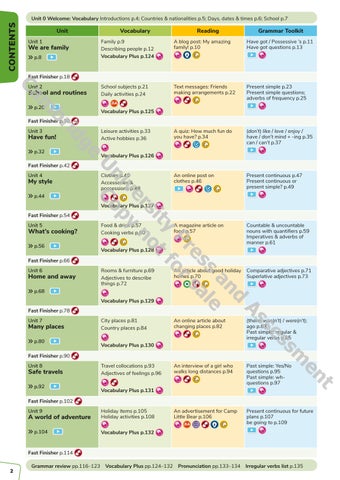
Unit
Vocabulary
Unit 1
Reading
Grammar Toolkit
Family p.9 Describing people p.12 Vocabulary Plus p.124
A blog post: My amazing family! p.10
Have got / Possessive ’s p.11 Have got questions p.13
School and routines
School subjects p.21 Daily activities p.24
Text messages: Friends making arrangements p.22
Present simple p.23 Present simple questions; adverbs of frequency p.25
m
CONTENTS
Unit 0 Welcome: Vocabulary Introductions p.4; Countries & nationalities p.5; Days, dates & times p.6; School p.7
Vocabulary Plus p.125 A quiz: How much fun do you have? p.34
(don’t) like / love / enjoy / have / don’t mind + -ing p.35 can / can’t p.37
An online post on clothes p.46
Present continuous p.47 Present continuous or present simple? p.49
We are family p.8 Fast Finisher p.18
Ca
Unit 2
p.20
br
Fast Finisher p.30
Have fun!
Leisure activities p.33 Active hobbies p.36
p.32
ge
id
Unit 3
Clothes p.45 Accessories & possessions p.48
My style
Co
p.44
As d an s le es s a Pr r y fo it t rs no ve py
ni
Unit 4
U
Fast Finisher p.42
Vocabulary Plus p.126
Vocabulary Plus p.127
Fast Finisher p.54 Unit 5
What’s cooking? p.56 Fast Finisher p.66 Unit 6
Home and away p.68
Food & drink p.57 Cooking verbs p.60
A magazine article on food p.57
Countable & uncountable nouns with quantifiers p.59 Imperatives & adverbs of manner p.61
An article about good holiday homes p.70
Comparative adjectives p.71 Superlative adjectives p.73
An online article about changing places p.82
(there) was(n’t) / were(n’t); ago p.83 Past simple: regular & irregular verbs p.85
An interview of a girl who walks long distances p.94
Past simple: Yes/No questions p.95 Past simple: whquestions p.97
An advertisement for Camp Little Bear p.106
Present continuous for future plans p.107 be going to p.109
Vocabulary Plus p.128
Rooms & furniture p.69 Adjectives to describe things p.72 Vocabulary Plus p.129
Fast Finisher p.78 Unit 7
Vocabulary Plus p.130
Fast Finisher p.90
Safe travels
Vocabulary Plus p.131
t
p.92
Travel collocations p.93 Adjectives of feelings p.96
en
Unit 8
m
ss
p.80
City places p.81 Country places p.84
se
Many places
Fast Finisher p.102 Unit 9
A world of adventure p.104
Holiday items p.105 Holiday activities p.108 Vocabulary Plus p.132
Fast Finisher p.114 2
Grammar review pp.116–123
Vocabulary Plus pp.124–132
Pronunciation pp.133–134
Irregular verbs list p.135
Grammar Question words p.4; Subject & object pronouns & possessive adjectives, this, that, these, those p.6
Listening
Speaking
A description of a family photo p.12
Writing
Meeting new people p.14
Culture/CLIL
An informal email p.15
Culture: Mixing cultures pp.16–17 Learning situation: Design and present a poster about family celebration from another country p.17
An email to make a polite request p.27
CLIL: Maths pp.28–29 Learning situation: Present a survey on a topic of your choice p.29
An online profile p.39
Culture: Hobbies pp.40–41 Learning situation: Research & create a fact file about an unusual hobby p.41
A description of a picture p.51
CLIL: Environmental studies pp.52–53 Learning situation: Design & present a way to recycle something into clothes or an accessory p.53
Pronunciation p.133 How to sound interested Mediation Including others in a conversation p.19 Asking for information p.26
Ca
A radio interview p.23
m
Pronunciation p.133 /ʤ/ vs. /ʒ/
br
Review Units 1–2 p.31
Making suggestions p.38
ge
id
A conversation about favourite activities p.36
Pronunciation p.133 can vs. can’t
Shopping for clothes p.50
As d an s le es s a Pr r y fo it t rs no ve py
ni
An interview about what people wear or carry p.48
U
Mediation Being a good conversation partner p.43
Co
Pronunciation p.133 /ɜː/ vs. /ɑː/
Review Units 3–4 p.55 A podcast about making cheese p.60
Ordering food & drinks p.62
A description of your favourite dish p.63
Pronunciation p.133–134 /ʧ/ vs. /ʃ/
Culture: Healthy breakfasts pp.64–65 Learning situation: Design a healthy menu for a café or restaurant p.65
Mediation Checking that you understand how to do something p.67 A presentation: things we collect p.72
Expressing preference p.74
A description of your favourite room p.75
CLIL: Technology pp.76–77 Learning situation: Create and design an advert for a sustainable hotel p.77
A blog post p.87
Culture: World Folktales pp.88–89 Learning situation: Research & perform a folktale. p.89
A short story p.99
CLIL: History pp.100–101 Learning situation: Research & record an interview with someone from history about a famous journey p.101
An invitation to a friend p.111
Culture: Voluntourism pp.112–113 Learning situation: Design a website for a voluntourism trip
Pronunciation p.134 /b/ vs. /v/ Review Units 5–6 p.79
Apologising p.86
se
Three friends talking about their summer holidays p.84
ss
Pronunciation p.134 /t/, /d/ and /Ιd/;
Telling an anecdote p.98
t
Pronunciation p.134 /d/ vs. /θ/
en
A podcast about travelling teens p.96
m
Mediation Explaining your opinions p.91
Review Units 7–8 p.103 A conversation about holiday plans p.108
Talking about fun plans p.110 Pronunciation p.134 /s/ consonant clusters at the beginning of words
Mediation Asking for help p.115 Competencies:
C1
C2
C3
C4
C5
C6
C7
C8
3
e m o c Wel
0
UNIT
m
Ca
Complete the conversation with the words in the box. Then listen and check. name is
Nice
This is
ge
Hi
id
1
br
Introductions
meet
What’s Nice to 4 … you, too. 5 … my friend, Amy.
Hi!
Co
As d an s le es s a Pr r y fo it t rs no ve py
ni
U
Hello. 1 What’s your name?
6
…!
My 2 … Tyrone.
… to meet you, Tyrone. My name is Carolina. 3
2
It’s nice to meet you, Amy.
Copy and complete the sentences with the correct form of the verb be. My school is near my house.
7
Where … Jack from?
2
The students … in the classroom.
8
Who … your favourite singer?
3
Brian and I … in the basketball team.
9
… Andrea and Jamie in the park?
4
I … not very tall.
10 Why … it so cold today?
5
She … a very famous actor in Australia.
6
… you from the US?
11
Whose books … these?
ss
How / Who old is your friend?
2
How / Why do you like your friend?
3
When / What time do you get up in the morning?
4
How / Why do you get to school?
5
Where’s / What’s your favourite colour?
6
Who / What is your favourite sportsperson?
7
Where / What do you go on holiday?
8
Who / When are you happy?
Workbook p.3
questions in Ex 1.
t
1
2 PAIRWORK Ask and answer the
en
4
Select the correct word.
m
Question words
1
se
1
How old is your friend? My friend Kate is 12 years old. Why do you like Kate?
0 Countries and nationalities
1
Copy and match the countries 1–8 with the nationalities A–H. Spain
A Japanese
2
Australia
B
American
3
Brazil
C
British
4
China
D German
5
Japan
E
Chinese
6
Germany
F
Australian
7
the UK
G Brazilian
8
the USA
H Spanish
m
Ca
1
id
br
2
Complete the nationalities and the countries. Then listen and check.
ge
1
2
3
Co
As d an s le es s a Pr r y fo it t rs no ve py
ni
U Lara is Br… . She’s from … . 4
Tim is Br… . He’s from the … .
5
Hannah is Am… . She’s from the … .
Select A or B to complete the sentences. Then listen and check. B
Australian
2
Altan is ... .
A Turkey
B
Turkish
3
Isabel is ... .
A Peru
B
Peruvian
4
Declan is from ... .
A Ireland
B
Irish
5
Omari is from ... .
A Egypt
B
Egyptian
6
Yua is ... .
A Japan
B
Japanese
t
A Australia
en
Meaghan is from ... .
m
1
Damien is Fr… . He’s from … .
ss
3
6
se
Ming is Ch… . He’s from … .
Gabi is Sp… . She’s from … .
4 PAIRWORK Choose a country and nationality. Ask and answer. Where are you from? I’m from Mexico. I’m Mexican.
Workbook p.5
5
Subject and object pronouns and possessive adjectives, this, that, these, those
1
Copy and complete the table with the correct pronoun or possessive adjective. we
him
your
her
2
m
Ca
Subject
Possessive
My friends love English.
me
my
They love English.
…
They love it.
1
…
you
3
…
his
she
her
5
…
us
our
…
their
br
he
id
ge
7
U
… are my friends.
A That
B
Those
2
Leo is in my class. I sit with … .
A he
B
him
3
… is your pencil case.
A This
B
These
4
Daniela is with … family.
A she
B
her
5
Mr Grey is … teacher.
A me
B
my
6
Jess is my friend. … is very cool.
A She
B
Her
7
… are my brothers, Sam and Zak.
A These
B
This
8
My sister is with … friends.
A she
B
her
Co
As d an s le es s a Pr r y fo it t rs no ve py
ni
1
Copy and write the months in the correct order.
January
December
July
February
March
August
May
April
October
June
November
2
M … … day
6
F … … day
3
T … … … day
7
Sa … … … day
4
We … … … … day
t
Th … … … day
en
5
m
S u n day
ss
1
se
September
Copy and write the days of the week.
3
Listen and write the dates in your notebook. Then match the dates with the events A–E. 1
23 April 1564
A Mozart is born.
2
20 July ...
B
Shakespeare is born.
3
24 May ...
C
4
... January 1756
Neil Armstrong is the first person to walk on the moon.
5
... April 1912
D The Titanic sinks. E
6
…
Select A or B to complete the sentences.
Days, dates and times
2
them
Object
I
they
1
you
4
6
2
me
Workbook p.4
Queen Victoria is born.
Dates are written differently in British and American English, e.g.
6 October 2022
06/10/22
October 6, 2022
10/06/22
0 4
Copy the form, listen and complete. Name: 1 Jamie Wilson
Address: 4 … Pine Avenue
Age: 2 … years old
Phone: 5 …–946–2593
Ca
Sara’s birthd ay
Email: jwilson6 …@fastmail.net
Birthday: 3 … …
m
Paulo's birthday
br
5 PAIRWORK Ask and answer about birthdays.
id
When is your birthday?
ge
My birthday is on the 11 December.
Times are said differently in British and American English, e.g.
2
past three in the afternoon.
She sometimes finishes football practice at half past two in the afternoon.
B
15:15
half past (two)
a quarter past
(two) thirty
a quarter after
Co
4
A She finishes class at a quarter
As d an s le es s a Pr r y fo it t rs no ve py
3
09:00 14:30 07:45
ni
1
U
6 Copy the sentences and match them with the times.
She starts class at nine o’clock in the morning.
C
D She starts class at a quarter to eight in the morning.
School
1
Listen and write the things in the schoolbag.
Some things have different names in British and American English, e.g.
rubber eraser
coloured pencils
a green notebook
a blue pen
a grey calculator
a red pencil sharpener
a yellow pen
black scissors
eat open
put
talk
en
Complete the sentences with words from the box. Then listen and check.
m
2
a pencil
ss
se
a rubber
work
t
1
2
… your hand up.
3
… your book.
Don’t … during the test.
4
5
… together.
Don’t … in the classroom.
Workbook p.5
37 7
1
e r a e W y l i m fa
UNIT
Unit aims Talking about family and appearance Using have got and possessive ’s Understanding a blog post and a podcast Meeting and introducing new people Writing an informal email Learning about surveys and bar graphs
m
Ca
Learning Situation Design and present a poster about family celebration from another country.
id
br Grammar on the go
ge
Culture
Co
As d an s le es s a Pr r y fo it t rs no ve py
ni
U m
ss
se
2
8
Watch the video and answer. 1
Has Nora got a big family?
2
Where do Aunt Kayla and her daughter live?
3
Who does Nora video call every month?
Get on it!
t
to you? How often do you talk to them?
en
1 How important are friends and family
VOCABULARY 1
1
Family
Copy and complete Andy’s family tree with the words in the box. Then listen and check. brother
cousin dad
Grandma
Grandad
mum
sister
Uncle
Grandad Sam
Grandma Regina
2
… Adam
Grandma Beatrice
ge
id
br
1
p.124
m
Ca
Vocabulary Plus
Aunt
Co
… Bruno
4
my 7 … Lucas
2
As d an s le es s a Pr r y fo it t rs no ve py
ni
U
3
… Olivia
Uncle Matt
my 5 … Theresa
my 6 … Fred
my little 8 … Maria
me (Andy)
my big 9 … Isaac
Look again at the family tree. Select the words to complete the sentences. Then listen to Uncle Matt and check.
3
Matt hasn’t got any brothers / sisters.
4
Theresa and Maria / Olivia are Matt’s sisters.
5
Theresa has got two sons and one grandson / daughter.
6
Olivia has got one son / granddaughter.
PAIRWORK How many family words describe you? Make a list. Then talk to a partner.
4
GROUP WORK Make three family word puzzles and test your classmates. My dad’s brother’s daughter is my ... Cousin!
t
3
daughter granddaughter sister cousin
en
Matt is Sam and Regina’s son / daughter.
m
2
ss
Sam and Regina are Matt’s parents / grandparents.
se
1
Words are sometimes used differently in British and American English, e.g.
My family are … My family is ...
Finished? p.18
Workbook p.6
9
READING 1 Read the blog post quickly. What is special about Raquel’s family?
Raquel
m
Ca ge
id
br Co
As d an s le es s a Pr r y fo it t rs no ve py
ni
U
My amazing family! This is a picture of my mum’s big, beautiful family. That’s me in the middle with my grandma and my grandad – he’s the one with the black cowboy hat. My dad’s got a white cowboy hat. The woman next to him with the beautiful smile is my mum. She’s with my little sister, Gabriela. All the other children and teenagers in the photo are my cousins. I’ve got 20 cousins! That’s because my mum’s got four sisters and five brothers, but not all my aunts and uncles are in this photo. My grandparents’ names are Fred and Luisa. They’ve got 22 grandchildren: 12 granddaughters and ten grandsons. What’s life like in a large family? There are many cool things. My cousins’ houses are near so there is always someone to play with. We share everything – our toys, our clothes and sometimes even our food. We always have great parties at Aunt Bea’s house. She’s the one next to my grandad. Dinner is a little noisy. And the children sometimes get angry at each other, but we always talk and quickly forget all about it.
2
Read the blog post again. Match 1–5 with A–E. 1
Raquel’s dad
A have got 22 grandchildren.
2
Raquel’s grandparents
3
Raquel’s sister
4
The children
5
Raquel’s mum
B
are Raquel’s cousins.
C
is next to Raquel’s mum.
D has got many brothers and sisters. E
3 Read the blog post again. Copy
and complete the table with things that are good and not so good about big families. Big families
is with her mum.
4 Key Competencies 1
AIRWORK Think about what is good and P not so good about small families. Copy and complete the table. Then talk to your partner.
noisy
m
always someone to play with
ss
se
Small families
Yes, but we haven’t got a big brother or sister to help us with our homework. 2
10
Workbook p.10
ould you prefer to be part of a big family W or a small family?
t
en It’s good there is no noise when we want to do our homework.
GRAMMAR T 1
OLKIT
1
Have got / Possessive ’s
Select the correct words from the box to complete the comments on Raquel’s post. has got
haven’t got
hasn’t got
Wow! 20 cousins. That’s amazing! My family is very small. I 3 … any brothers or sisters. It’s just me and my parents in my house. My dad is like me. He 4 … any brothers or sisters but my mum’s got one sister. We go on trips with her and my two cousins in the summer holidays. I like our small family!
ge
id
br
Welsh_Will123
Your family sounds cool, Raquel. I 1 have got a big family too – lots of aunts and uncles and 15 cousins! I don’t see them very much because they live in different countries. My mum 2 … one cousin. His name is Simon and he lives in our town. We see him at the weekend.
p.116
m
Ca
Jen_2011
Grammar review
have got
GRAMMAR ON THE GO
U
VIDEO
ni
I/you/we/they
My dad has got / ’s got a white cowboy hat.
Co
As d an s le es s a Pr r y fo it t rs no ve py
I have got / ’ve got 20 cousins.
he/she/it
We have not got / haven’t got a big house.
2
My mum has not got / hasn’t got a sister.
Look at the picture. Copy and complete the sentences with the correct form of have got.
I’m Natalia. I 1have got a little brother.
I 2 … any sisters. We 3 … a pet dog,
COMMON ERRORS
My mum is got a blue car.
My mum has got a blue car.
called Charlie. Charlie 4 … a brown head
and a white body. We 5 … a pet cat.
My brother and I 6 … blonde hair but my dad 7 … blonde hair. His hair is brown.
Copy and complete the sentences using the word in brackets and ’s or s’.
se
3
My uncle’s name is Robert. (uncle)
4
My … pet cat is called Sniff. (cousins)
2
My … garden is very beautiful. (grandparents)
5
My … house is near our house. (aunt)
3
My … bedroom is next to my bedroom. (brother)
m
Plural My grandparents’ names
Aunt Bea’s house
My cousins’ houses
t
My mum’s big, beautiful family
en
Singular
ss
1
4
PAIRWORK Write five facts about your family using have got and ’s or s’. Then tell a partner. How many sentences can they remember? I’ve got five cousins. They’re Aunt Isabela’s children – three boys and two girls.
OK, you’ve got five cousins …
Finished? p.18
Workbook p.7
37 11
LISTENING AND VOCABULARY 1
Describing people
Match the words in the box to the pictures. beard
blonde
brown freckles
1
glasses
grey
long
moustache
red
short
tall wavy
3
m
Ca
2
ge
id
br U
GROUP WORK Describe the people in the pictures. Use words from Ex 1.
Co
As d an s le es s a Pr r y fo it t rs no ve py
ni
2
long
3
He’s got short hair.
Listen to Tom talk about a family photo. Which photo does he talk about? 1
2
5
Tom’s dad is tall.
2
In the photo, Tom is 12.
6
3
Tom’s sister is Claire.
Tom likes the photo because it’s the summer holiday.
4
Tom’s mum has got short hair now.
12
t
Tom’s family are at his grandparents’ house.
Draw a picture of your favourite family photo and show it to your partner. Can they describe your family members? That’s right!
GROUP WORK Write a description of yourself. Pass your description around the class. Can you guess whose description you have?
Finished? p.18
Workbook p.8
en
1
Your dad is tall and he’s got blonde hair.
6
m
5
Listen again. Are the sentences T (true) or F (false)?
ss
se
4
GRAMMAR T 1
OLKIT
Copy and complete the questions and short answers with have/haven’t or has/hasn’t. Q: Have you got a bike?
A: Yes, I … .
2
Q: … Sarah got a blue pen?
A: No, she … .
3
Q: … your parents got brown hair?
A: No, they … .
4
Q: … we got maths class today?
A: Yes, we … .
Ca
Has Hannah got red hair?
Yes, she has. No, she hasn’t.
COMMON ERRORS Yes, I have got. Yes, Iʼve.
id
br
Yes, they have. No, they haven’t.
p.116
m he/she/it
Have they got freckles?
Grammar review
1
I/you/we/they
Look at the image of Hannah and her dad, Rob. Write short answers to the questions.
Yes, I have.
ge
2
1
Have got questions
Co
As d an s le es s a Pr r y fo it t rs no ve py
ni
U 1
Has Rob got blonde hair?
3
Has Hannah got wavy hair?
2
Have Rob and Hannah got glasses?
4
Has Rob got a beard?
3 1
se
Write short questions with have/has got. Write short answers that are true for you. you / wavy hair
ss
Have you got wavy hair? Yes, I have. your mum / red hair
4
you / brothers and sisters
5
your parents / glasses
6
you / a lot of cousins
7
your grandparents / grey hair
t
3
en
your dad / a beard
m
4
2
PAIRWORK Ask questions about your classmates. Give short answers. Has Maria got short hair? No, she hasn’t.
Finished? p.18
Workbook p.9
13
SPEAKING
Meeting new people
1 Look at the pictures. Which sentences do you think describe the situation?
A Maya, Peter and Leo are on a video call. B
Maya, Peter and Leo are using a laptop for homework.
C
Maya and Peter are friends.
Maya and Leo
Ca
D Peter is Maya’s brother.
Read the conversation. Check your answers to Ex 1.
m
2
br
Peter Hi, Maya! How are you?
Maya Hey, Peter! Not bad! I miss everyone, but I love my new school.
Who’s this?
id
Leo
ge
Maya My friend. Sorry, Peter! This is my brother. Peter Hello! My name is Peter. What’s yours?
Hi, Peter! I’m Leo, Maya’s amazing brother.
Leo
U
Peter Nice to meet you, Leo!
How do you know Maya?
ni
Leo
Maya Peter is in my football team. You’ve got some geography homework, right?
As d an s le es s a Pr r y fo it t rs no ve py
OK. I have to run, Peter. See you soon!
Leo
Co
Peter OK, bye!
Peter
Maya Sorry about that. Leo tries to listen to my conversations. But how are you?
Peter Fine, thanks! Don’t worry, my sister is the same. But tell me about your new school.
What classes have you got tomorrow?
Maya Well, my first class tomorrow is maths.
3
Select the correct headings for the phrases. Listen and check. A
Introducing yourself and others
B
Saying goodbye
C
Greeting someone
4
Read and select the correct response. Then listen and check.
1
A Hey, Sam! B OK, bye!
C Not bad!
2
2
3
A Who’s this? B My name is Alex. What’s yours? C Nice to meet you!
This is my brother. Nice to meet you. How do you know Maya? 3
...
I have to run … OK, bye! See you soon!
This is my friend, Marcus.
5
How do you know Marcus? A I have to run. B We go to the same school. C Sorry about that.
5 GROUP WORK Role play a new conversation with your own ideas.
14
t
Pronunciation
4
en
p.133
My name is Peter. What’s yours?
m
A This is Carlos. B Hi, Lucia! I’m Carlos. C See you soon!
...
Hi/Hey, Peter! I’m Leo.
My name is Lucia. What’s yours?
ss
Hello! Hi!
se
...
I have to run.
A Hi, Anna, how are you? B Nice to meet you! C OK, bye!
USEFUL LANGUAGE 1
Hello!
Hi, Carlos! How are you? Hey, Mary! Not bad!
WRITING
1
An informal email
1 Read Jose’s email quickly. What is he writing about?
2 Read the email. Which four sentences are true?
JS
A Jose’s dad is from Barcelona.
Jose’s got a pet dog.
C
Jose’s got cousins in Madrid.
Ca
B
To: Sam Evans Subject: New pen pal
D Jose’s got a pet cat.
Hi Sam,
m E
Jose’s got a younger brother.
F
Jose’s got an older sister.
My name is Jose and I’m happy you are my pen pal. I’m 13 and I live in Madrid, Spain – near the Santiago Bernabéu stadium. I love Real Madrid Football Club.
id
br
3
From: Jose Sanchez
Copy and complete the Useful language with examples from Jose’s email. Listen and check.
ge
My flat is big. I’ve got a cool bedroom. It’s next to my sister’s bedroom. My sister is 14. Her name is Paula and she’s very nice. She’s got long black hair.
U
Our mum is called Marta and our dad is called Luis. My dad is from Barcelona and my mum is from Argentina. We’ve also got a pet cat called Simba. He’s the best!
ni
USEFUL LANGUAGE
Exclamations
I’ve got a lot of family in Madrid – my grandparents, aunts and uncles and six cousins.
Hey, 1 Hi Sam,
It’s great!
What about you? Tell me about your family.
How are you?
Co
Questions
As d an s le es s a Pr r y fo it t rs no ve py
Greetings
What 2 …
He’s 3 …
Write soon, Jose
Saying goodbye Bye, 4 …
4 Imagine you want to write an email to a new pen pal. Write notes using the ideas in the box or your own ideas. my age
my name
Paragraph 1: my name, Paragraph 2: ...
where I live
my family
my pets
my school
my friends
Paragraph 3: ...
Paragraph 4: ...
5 Now write your email. Use your notes from Ex 4 to help you. Remember to:
Say goodbye.
t
en
6 Key Competencies
m
Use expressions from the Useful language box.
ss
Organise your text into paragraphs.
se
Use a greeting.
1
PAIRWORK Look at your partner’s email.
Has it got four paragraphs and some of the Useful language?
2 How can your partner improve their email? 3
ow can you use your partner’s ideas to H improve your email?
Workbook p.11
15
CULTURE
Mixing cultures
CULTURE VIDEO
Central High School NEWS | CALENDAR | BLOG | SCHOOL LIFE
Ca
m
One School, Many Cultures In London, there are people from all over the world. This is why it’s such an interesting city.
br
Central High School has got students with families from many different countries. Three students tell us about their culture and what their identity is.
ge
id Mikey
U
My mum’s Chinese and my dad’s English. We visit China every year to see my grandparents. We celebrate Chinese New Year in China Town, London and I speak Chinese at home.
ni
My mum doesn’t cook Chinese food. She prefers things like pasta and pizza! What’s my
Co
As d an s le es s a Pr r y fo it t rs no ve py
identity? I’m Chinese like my mum, and I’m British like my dad and my friends.
1
Watch the video. What does it say about globalisation? A People have got more money in other countries now.
2
B
Cultures around the world are more similar than before.
C
People travel a lot more now than in the past.
GROUP WORK Can you think of examples of globalisation in your country? We watch a lot of American TV shows.
3 GROUP WORK Look at the pictures. Where in the world do you think these cultural events come from? 1
2
3
m
ss
se
Carnival
New Year
t
4 Read the blog quickly and check your answers to Ex 3.
en
Diwali
5 Read the blog. Who talks about each event? 6 Match the blue words in the blog with a definition.
16
1
With a very strong taste.
4
To do something special for an important day.
2
A special party that happens every year.
5
People from the same place share this.
3
Special clothes which make you look like someone else.
6
Who a person is.
1 Pia My parents are from India and I’ve got aunts, uncles and cousins there. When we visit them, they say I’m very British. But when I’m home, I feel Indian! We speak Hindi at home, we
Ca
celebrate the festival of Diwali and we eat Indian food. I love curry. But we also love British things like fish and chips and Arsenal FC!
m br
Abigay
id
My dad’s Jamaican and my mum’s from Manchester. All my family live in England but we
ge
go to Jamaica every summer on holiday. I love Jamaica. The beaches are beautiful. My dad cooks Jamaican food, like Jerk chicken. It’s very spicy! And we go to the Carnival every year. It’s the best – people play Caribbean music and wear amazing costumes! My dad says his
As d an s le es s a Pr r y fo it t rs no ve py
ni
U
identity is Jamaican but I’m a mix. My home is in Britain and my heart is in Jamaica!
Co
7 Read the blog again. Copy the table and tick the correct students. Who …
Mikey
Pia
Sustainable Development
Abigay
1 eats food from their parents’ country? 2 has got a parent from England?
Do you know people from other countries? How can you meet people from different countries and learn more about their culture? What kind of problems could people solve by working together?
3 has got family in other countries? 4 likes to eat British food?
GOAL 17 PARTNERSHIP FOR THE GOALS There are a lot of problems in the world. To solve them people from different countries and different cultures need to work together.
5 speaks a different language at home?
Activity card: Transformation
DISCUSS
M
ED
IATION
ON
N M
t
IO AT
MINI PROJECT
ME D
3
2
en
step
m
I
Present your findings to the class.
IATION
M
4
ss
step
ED
DIAT I
EXTEND
1
ME
Design and present a poster about family celebration from another country.
Think of three things that are really important in your culture. What other cultures are there in your school, town TION What do andIA country? ED you know about these cultures? What are their languages, step foods and festivals? PLAN
se
step
Go to the LEARNING SITUATION
Choose one of these cultures and do some research to find out more about it. If you know anyone from this culture, talk to them.
SHARE
17
UNIT 1: FAST FINISHER Mark is Amy’s brother. Amy and Mark’s mum is called Iris. Jackie is Mark’s daughter. George is Jackie’s grandad. Harry is George’s grandson. Sasha is Harry’s sister. Sasha and Harry’s aunt is called Susan. Jackie is Tom and Amy’s niece.
1 Read the sentences to find the people’s names.
Ca m
1
…
2
…
ge
id
br U
…
4
…
5
Amy
6
…
Co
As d an s le es s a Pr r y fo it t rs no ve py
ni
3
7
…
8
…
9
…
2 Write the words in the correct order to make sentences. 1
teacher / my / got / hair / sister’s / has / red
My sister’s teacher has got red hair. 2
friends’ / are / tall / my / parents
3
hasn’t / dad / a / Lily’s / beard / got
4
Sam’s / got / freckles / hasn’t / sister
5
a / my / friend / got / black / grandparents’ / moustache / has
you / a big family ✓ your friends / their bags ✓
3
Sarah / a calculator ✗
4
Amy’s dad / a moustache ✓
5
your dad / glasses ✗
6
we / English homework ✗
Videos
4 Use the words in the box to write five
descriptions of people in Amy’s family. beard
18
blonde
glasses
grey
wavy
Games
Digital Practice
Learning Situation: Culture Project
Unit 1 Worksheets
t
2
Interactive eBook
en
Q: Have you got a big family? A: Yes, I have.
m
1
DIGITAL T OLKIT
ss
have got. Write positive (✓) or negative (✗) short answers to the questions.
se
3 Use the words to write questions with
MEDIATION
1
Including others in a conversation
1 PAIRWORK Imagine you’re at a party with people you don’t know. How do you feel? Why? bored shy
happy
nervous
friendly
2 What can the people at the party do to include you in their conversation? Find the good ideas. D talk only about themselves
Ca
A ask you to join them B
introduce themselves and ask your name
C
stop talking and wait for you to say something
E
ask questions about you
m
3
br
Listen to three people at a party. What activities and hobbies do they talk about?
4
Come and join us.
S
2
What about you, … ?
…
3
What do you think of … ?
…
4
Why’s that?
…
5
Tell me/us about …
ni
U
5
ge
1
id
Listen again. Select R (Rory) or S (Stephanie).
…
Co
1
As d an s le es s a Pr r y fo it t rs no ve py
Copy and complete the conversations with the phrases from Ex 4. Then listen and check.
Tell me about your family.
Well, there’s me, my mum and dad, and I’ve got two sisters.
2
I love playing video games. … … , Andy?
6 GROUP WORK Work in groups of
I prefer watching films.
3
three. Imagine you’re at a party. Role play a conversation.
Students A and B are friends. You’re talking about school. You see Student C alone. Invite them to join you and include them in
I don’t know many people here.
your conversation.
Nice to meet you.
Thank you.
ss
I’m Rita, and this is my friend, Sue …
m
4
7 GROUP WORK Change roles
t
I don’t really like team sports.
and do the role play again.
en
I’m in the basketball team, but I want to change to tennis. …?
5
Hi there. Come and join us.
se
Well, … . This is my friend Sally, and I’m Tom.
MEDIATION TIPS Introductions in English
… the new Contest of Crowns film?
Don’t worry! Remember to use the phrases ‘This is my …’ and ‘That is …’.
It’s amazing! I want to see it again.
Take your time and use your hands to help you.
19
2
UNIT
m
Ca
l o o h Sc and nes i t u o r
id
br Grammar Gym
For Real
ge
Grammar Gym
Unit aims Talking about school subjects and daily activities Using the present simple and adverbs of frequency Understanding a mobile phone chat and an interview Asking for and giving information about a school club Writing an email to make a polite request Learning about surveys and bar graphs Learning Situation Present a survey on a topic of your choice.
CLIL
Co
As d an s le es s a Pr r y fo it t rs no ve py
ni
U 1
What is Eddie’s favourite subject?
2
Which class is hard for Eddie?
3
When does Eddie play basketball?
Get on it!
t
20
Watch the video and answer.
en
2
m
photograph are doing. What things do you like doing at school?
ss
se
1 Describe what the people in the
VOCABULARY 1
2
School subjects
Match the words with the pictures. Then listen and check. art
biology
chemistry
1
geography
French
2
PE
history
3
IT
maths physics
Vocabulary Plus
music
4
m
p.125
Ca br id
biology
6
ge
5
7
Co 9
2
10
11
Select the correct subjects to complete the sentences. We study numbers in maths .
2
We learn to draw and paint in … .
3
We study plants and animals in … .
4
We learn to play sport in … .
5
We study people who lived many years ago in … .
6
We learn about computers in … .
7
We study how things move in … .
math
gym class
4 Key Competencies 1
W hich words are similar to the words chemical and physical?
2
ook carefully at word parts. They L can help you to guess and remember the meaning of words. In the word geography, -graphy means ‘to write about’. What do you think geo- means?
3
hich subjects have similar names in W your language?
I like ... because ...
Finished? p.30
t
en
I like IT because I’m good at using computers ...
PE
m
ROUP WORK Which subjects do you G find interesting? Why? Compare your choices with a partner.
maths
ss
1
Some things have different names in British and American English, e.g.
se
3
As d an s le es s a Pr r y fo it t rs no ve py
ni
U
8
Workbook p.14
21
READING 1 Read the messages quickly. What are the friends planning?
2
Copy the table and complete it with school subjects from the messages. Then listen and check.
10.45
Ca
ANISHA Hey, guys! How are you? What classes have you got before lunch?
m
SERGEI Maths. I’m not good at maths, but it’s kind of fun.
Subjects Anisha Sergei
br
ge
id
BETH Chemistry. It’s my favourite class. The experiments are really cool. I really like science!
Beth
BETH Hey, are you all free after school?
music favourite friends fun homework after same 1
Sergei thinks maths is fun .
2
Chemistry is Beth’s … class.
3
The French teacher gives a lot of … .
4
Anisha wants to eat lunch with her … .
5
They’ve all got lunch at the … time.
6
Beth wants to meet her friends … school.
7
Anisha is free after her … lesson.
4 Key Competencies 1
AIRWORK How do you communicate P with your friends at school? What do you talk about? We talk between classes.
We send texts about our plans.
se
SERGEI I’ve got French homework, but I could do it after dinner.
2 Do you have friends that go to other
o you prefer communicating by text D or by talking on the phone? Why?
Sustainable Development
GOAL 4 QUALITY EDUCATION FOR ALL There are many more children in school now than in the past. Make a list of the most important reasons for going to school. Which is the most important reason and why? Activity card: Values
22
Workbook p.18
t
en
ANISHA I’m free then.
3
m
BETH Are you busy after your music lesson? At 4.15? We could go to the café?
schools or that live in other cities? How do you communicate with them?
ss
ANISHA I’ve got music lessons on Thursdays.
SERGEI Cool, me too.
has got 6 … ; likes 7 …
As d an s le es s a Pr r y fo it t rs no ve py
ni
Co
ANISHA Me too! Great! We’ve all got lunch at the same time. Do you want to sit together?
2.31
homework; not good at 5 …
complete the sentences.
U
SERGEI Same here.
has got 3 … before lunch and 4 …
3 Select the correct words from the box to
ANISHA I’ve got French. I like French, but we get lots of homework. What time is your lunch?
BETH At one o’clock.
has got 1 French and 2 … lessons
GRAMMAR T 1
OLKIT
2
Present simple
Select the correct words from the box to complete the blog post. don’t understand
helps
paint
prefers
Ca
Grammar review
doesn’t like
My favourite subject at school is
p.117
m
art. I 1 paint big pictures with a lot
of colour and I also make things.
br
My brother 2 … art because he
thinks he isn’t good at it. He 3 …
id
physics and maths because he
ge
loves numbers. Sometimes, I 4 … my maths homework and my brother 5 … me.
ni
U We get lots of homework. They go to school. You don’t like science.
2
As d an s le es s a Pr r y fo it t rs no ve py
Co
I/you/we/they
GRAMMAR GYM
VIDEO
he/she/it
George listens to the teacher. Holly misses her class.
Ms James doesn’t teach French.
Select the correct words to make true sentences for you. 1
I eat / don’t eat lunch with my friends at school.
2
I do / don’t do homework after school every day.
3
I like / don’t like subjects like maths and science.
4
My friends and I study / don’t study together.
3
He like science and maths.
He likes science and maths.
Copy the sentences and complete them with the correct form of the words in brackets. You … (not like) French because it’s difficult.
You don’t like French because it’s difficult. We … (play) sport in PE class.
4
Maria … (write) in her notebook.
5
My chemistry teacher … (not give) a lot of homework.
6
My friends … (sit) together in history class.
PAIRWORK Write three true sentences and two false sentences about yourself. Use the present simple in all the sentences. Share your sentences with your partner. Which of your partner’s sentences are true and which are false?
t
en
My brother … (not walk) to school with me in the morning.
3
m
2
ss
se
1
4
COMMON ERRORS
I watch TV every day after school. That’s true!
Finished? p.30
Workbook p.15
23 37
LISTENING AND VOCABULARY 1
Daily activities
What do you do first every day? Copy the phrases in the correct order.
A
B
C
D
m
Ca get up
F
G
have dinner H
ge
id
E
go to bed
br
go to school
have lunch
have a shower
Co
2
As d an s le es s a Pr r y fo it t rs no ve py
ni
U have breakfast
Copy the table and complete it with the activities from Ex 1. go
to bed …
get
… …
Listen to the radio interview. How is Emma’s day similar to yours? How is it different?
4
Listen to the interview again. Are the sentences T (true) or F (false)?
3
Emma goes to school with her brother.
4
Emma has lunch at home.
5
She does farm work after school.
6
She doesn’t have a lot of free time.
7
Emma goes to bed at 10.30.
I have got a shower. I have a shower.
5
PAIRWORK Imagine you are a guest on a radio show. Complete the interview. Then role play with a partner.
Presenter Welcome to the show! Tell us
about your daily life. What time do you get up?
Hi! I always get up at … . Then I …
You
Presenter What do you have for breakfast? You
…
Presenter Do you have lunch at school? You
…
Presenter What do you do when you get home? You
…
Presenter And do you go to bed early? You
…
Presenter Thanks for talking to us today!
24
Finished? p.30
Workbook p.16
t
She has a shower after breakfast.
I have breakfast.
en
2
I have got breakfast.
… … … …
m
Emma gets up early every day.
I have got a big family.
ss
1
COMMON ERRORS
se
3
have
get home
GRAMMAR T 1
OLKIT
2
Present simple questions; adverbs of frequency
Listen to the conversation. Match questions 1–4 with answers A–D. Do you like football?
2
Do you want to watch the game at my house tonight?
3
What time does your family have dinner?
4
What time does your dad make dinner?
Ca
Grammar review
1
A We usually have dinner at 8.30. B
Yes, I do. He starts around 5.00 or 5.30.
GRAMMAR
GYM
br
D Sure!
VIDEO
id
he/she/it
Do you have breakfast at home?
Does Rob have a shower every morning?
U
When do you get up at the weekend?
Where does Lisa have lunch?
As d an s le es s a Pr r y fo it t rs no ve py
ni
Wh- questions
I/you/we/they
ge
Yes/No
pp. 117–118
m C
Co
I always eat breakfast with my little brother.
COMMON ERRORS
I am often at my friends’ houses at the weekend.
2
You get up early every day?
Put the words in the correct order to make questions. 1
Do you get up early every day?
A: lunch? / have / for / you / do / What
What do you have for lunch?
B: I always have salad for lunch. 2
A: at the weekend? / early / Do / get up / you B: No, I never get up early at the weekend.
3
A: time? / free / When / have / you / do
B: I rarely have free time. I play lots of sport! 4
A: have dinner / your friend / Does / at your house / every day?
B: Not every day. He sometimes has dinner at my house on Saturday. A: your grandma or grandad / you? / see / When / does
se
5
B: My grandad usually sees me on Fridays.
ss
3
Select the correct words from the box to complete the sentences. There are two extra words. after
never
usually
We use … to say we do something 0 percent of the time.
2
We use … to say we do something most of the time.
3
We put the adverb … the subject.
0% never
25% rarely
50% sometimes
75% usually
100% always
t
1
en
4
sometimes
m
always
PAIRWORK Ask and answer the questions from Ex 2 so they are true for you. Write three new questions to ask. What do you have for lunch? I usually have ... I sometimes have ... Finished? p.30
Workbook p.17
25
SPEAKING
Asking for information
FOR REAL VIDEO
1 Look at the picture and read.
What is the conversation about?
5
How often does the art club meet?
Select the correct words from the box to complete the conversation. Then listen and check. what any
Ca m
1
wait what time
where
What time is the meeting?
br
It’s at 5 o’clock.
id
2
ge
We meet twice a week.
Can I ask you about the maths club? Sure. … do you want to know?
Co
Listen and select the correct answer. A The club meets in the library. B
The club meets in the gym.
C
The club meets in Room 102.
3
Listen to the conversation again. Are the sentences T (true) or F (false)? 1
The club meets every Tuesday and Thursday.
2
The club meets at 4 o’clock.
3
Room 102 is across from the library.
4
Sarah knows where to get the paint set.
5
Sarah and seven other students are in the art club.
… can I find a camera?
They’ve got a few at the photography club.
6 PAIRWORK Choose one of the clubs
and role play a conversation asking for information.
NEW HIP-HOP DANCE CLUB
Do you like music and dancing? Join us now! All ages welcome. First session: May Where: Gym When: Fridays at 4.30 Contact: Mr Mendez
t
Pronunciation
5
Asking for information Can I ask you about ... ? Wait, is that … ? How often do/does ... ? What time … ?
Where can I find … ? How many … ?
Giving information What do you want to know? Any other questions?
26
No, thank you.
en
USEFUL LANGUAGE
… other questions?
m
p.133
Can I ask you about the art teacher?
4
ss
Listen and read the Useful language. Choose one phrase and write one more question for Carl in your notebook.
Yes, it is.
se
4
… , is that next to the library?
As d an s le es s a Pr r y fo it t rs no ve py
ni
U
2
3
IT CLUB
Do you love computers, video games and robots? You can use the school equipment. We are waiting for you! Where: IT Room When: Wednesday and Thursday at 6.00 Contact: Bea Adams
WRITING
2
An email to make a polite request
1 Read Ethan’s email to his teacher. What club does he want to join?
2 Read Ethan’s email again and write the order of the paragraphs.
Ending
Greeting
Request
Ca
Questions about club
1
Dear Mr Clarke,
2
I’m writing to ask if there’s still time to sign up for the drama club. I love to act, and the club looks really fun! Unfortunately, I’m busy on Wednesday – I have a dentist appointment at 4.00. Can I meet with you later this week, please?
3
I’ve got a lot of questions about the drama club. For example, what is your next play? Do members of the drama club choose the plays?
m
3 Read the email again. Answer the questions. Why does Ethan want to join the club?
2
What plans has Ethan got on Wednesday?
3
When does Ethan want to meet with his teacher?
4
Who helps Ethan with maths?
ge
4
id
br
1
Copy the Useful language and complete it with the words in the box. Listen and check.
U
I’ve got a meeting with Mrs Rojas at 3.30 tomorrow to prepare for my maths test. I am free at any other time and any day this week. Please let me know what day and time I can come and speak to you.
Co
As d an s le es s a Pr r y fo it t rs no ve py
ni
Best wishes, Hey, Can I …, please? How are you doing? Write soon.
USEFUL LANGUAGE Writing an email to … A teacher (formal language):
A friend (informal language):
Dear Mr/Mrs/Ms ...,
3
I’m writing to ask …
Hi!
1
Can I ... , please?
4
Ethan Brown
…
See you later.
…
Bye, 5
Many thanks,
…
Many thanks, 2
4
…
5 Write an email to your teacher about an after-school club or sports team that you want to join.
Ask any questions you may have.
t
en
Use formal language from the Useful language box.
m
Make your request clear.
ss
Write a formal greeting and ending.
se
Remember to:
6 PAIRWORK Compare your email with your
partner’s. What’s the same? What’s different? We both ask a question about when the club meets. I ask about the French club. You ask about the music club.
Workbook p.19
27
CLIL
Maths
CLIL VIDEO
St John’s School
Opinion | Weekly Survey | Sports | Multimedia | Editor’s Pick
m
Ca
Year 7’s daily routines
br
by Juan Smith
ge
id
7 Oct.
St John’s School students have similar routines during the week but not at the weekend. We have some interesting answers from 60 Year-7 students. Keep reading to find out what they do! On weekdays, 40 students always get up early to have a shower before school. The other 20 do it before going to bed the night before. That way, they only need to get dressed in the morning – smart move! They can sleep 15 to 20 more minutes before they have breakfast. All students usually get home around 5 o’clock. Fifty-two of them always do their homework and then have dinner with their families. Fifty students usually study every day and – wait for it – go to bed early! Now we know why Year-7 students always get good grades.
Co
As d an s le es s a Pr r y fo it t rs no ve py
ni
U
survey in the video. Select the correct words to complete the sentences.
A a list of questions you ask people
C
a magazine article.
2
Watch the video. 2
How many people do each activity? Complete the table.
…
have dinner
…
play sport
18
watch TV
11
go to bed early
14
go to bed late
…
Six people go / don’t go to bed early.
Daily activities survey
20 18 16 14
12 10 8 6 4 2
Activities
4 Read the article quickly. Which two daily activities are the most common?
28
t
have lunch
5
en
17
Eleven people don’t watch TV / watch TV.
m
have breakfast
Eighteen / Two people don’t play sport.
4
ss
Number of people
3
se
Activity
All / No people have lunch and dinner.
Have breakfast
How many people answer the survey?
Number of people
1
2
Go to bed late
a presentation.
Seventeen / Seven people always have breakfast.
Go to bed early
B
1
Watch TV
to get information.
Play sport
A survey is:
3 Look at the bar graph. It shows the results of the
Have dinner
Select the correct answer.
Have lunch
1
2
m
Ca
Weekends are different for all of them. Twenty-five visit their grandparents, 15 go out with their cousins or friends, and 20 prefer to stay home, usually with their families. Twelve of those who stay home watch TV shows, and eight prefer films. What’s your daily routine? Send us an email about it at weeklysurvey@stjohnsschool.org Next week, don’t miss year eight’s results!
id
br
7
ge
Read the article. What are the survey results?
ni
How many students:
I get up at 7.30. Do you get up early?
U
Weekdays
Tell each other how you spend your day.
get up early?
2
don’t have a shower in the morning? …
3
get home at 5 o’clock?
4
have dinner with family?
…
5
study every day?
…
Co
Weekends How many students:
No, I usually get up at 9 o’clock. Then, I ...
…
As d an s le es s a Pr r y fo it t rs no ve py
1
…
6
visit their grandparents?
7
go out with cousins or friends?
…
8
watch films?
…
Sustainable Development
GOAL 4 QUALITY EDUCATION FOR ALL Good education is very important for the future of our society. In many parts of the world very few children stay at school to the age of 18.
…
Why is a good routine so important for students? In groups, think of the reasons why children don’t complete their education in some parts of the world.
6 PAIRWORK Draw a bar graph to show
Activity card: Knowledge
the results of the survey. Then compare with another pair’s graph.
DISCUSS
1
t
ON
N M
M
IATION
IO AT
PLAN
en
ME D
3
2
m
step
step
M
I
Present your survey to the class. Are your classmates’ surveys similar? Can you use their ideas to improve your survey?
DIAT I
4
ss
step
IATION
ME
EXTEND
ED
se
Present a survey on a topic of your choice.
Are your classmates’ routines like the ones in the text? What information do you IATION about your want ED to know classmates’ routines?
MINI PROJECT
step
Go to the LEARNING SITUATION
ED
5
Decide what questions you want to ask your classmates about their routine. Write your survey.
SHARE
29
UNIT 2: FAST FINISHER 1 Select the correct school subjects from the box to complete the sentences. art biology
chemistry
geography
PE
history IT
maths
music
physics
One of the things we learn about in physics is electricity.
2
We learn about capital cities in … lessons.
3
I love … because I’m interested in computers.
4
I’m good with numbers, so I love … .
5
In … we wear special glasses to protect our eyes when we do experiments.
6
… is my favourite lesson because I’m good at painting.
7
We learn how plants grow in … .
8
Our teacher usually brings her guitar to … lessons.
9
We play football or basketball in … .
m
Ca
1
ge
id
br
10 … is not my favourite subject because I think the past is boring.
go to bed
go to school have a shower
ni
get home
U
2 Select the correct phrases from the box to complete the sentences. have breakfast have dinner
I have a shower every morning before school. In the summer I use cold water.
2
I … in the evening with my family. My dad usually makes it.
3
I … in the morning with my sister. We eat toast and drink juice.
4
I … at 10 o’clock during the week and later at the weekend.
5
I … with my brother. We usually get the bus.
6
I … at about 5 o’clock. I do my homework and then watch TV.
Co
As d an s le es s a Pr r y fo it t rs no ve py
1
3 Put the words in the correct order to make sentences. 1
DIGITAL T OLKIT Interactive eBook
usually / have / at / my / lunch / school / sisters / .
My sisters usually have lunch at school. 2
subjects / do / at / what / study / you / school / ?
3
you / do / PE / like / ?
4
o’clock / my / 5 / gets / always / home / dad / at
5
do / when / you / history / do / homework / your / ?
6
o’clock / 1 / at / lunch / have / usually / I / ?
Videos
Games
Digital Practice
Learning Situation: CLIL Project
Unit 2 Worksheets
m
ss
se t
en
30
2
REVIEW 1 PAIRWORK Imagine you’re one of the people in a family picture. Ask and answer questions.
5 PAIRWORK Look at the posters and read the roles. Role play a conversation. Then change roles and repeat.
Ca
Art Club
m
Do you love painting and drawing?
br
Join us in Classroom 306
Student A
ge
id
every Wednesday
Student B
and Thursday at 16.30.
We have all the materia
ls you need.
Let’s get creative!
ni
As d an s le es s a Pr r y fo it t rs no ve py
Co
Select how you feel talking about family. I feel …
very confident. It’s easy for me.
confident, but I want more practice.
B
OK, but I need more practice.
C
3 Make a sentence with a word or phrase
Student A You know everything about City High School clubs. You want to help a new student choose the best club for them. Student B You’re a new student at City High School. You want to join a club. You like sport and art, but you’re often busy after school.
from each box. Can your partner guess if it’s true or false?
Can I ask you about school clubs?
always usually sometimes never every day every weekend
1
2
3
4
5
6 = I feel confident doing this.
6
m
your daily routines? Select a number and explain your choice. Self-assessment 5
6
confident in using English. Try it for two weeks!
t
en
4 PAIRWORK How do you feel talking about
4
Self-assessment
7 Choose one of these ways to become more
OK, it’s false. Your turn!
3
conversation like the one in Ex 5? Select a number and explain your choice.
1 = I need to practise more.
That’s false. You don’t go shopping every day!
2
6 How confident do you feel having a
ss
I go shopping every day.
Sure, what are you interested in?
se
go to school get up have breakfast have lunch have dinner go to bed play sport watch a film chat online go shopping read a book listen to music
1
MAIN GYM
PLEASE BRING WHITE SHORTS, A WHITE T-SHIRT AND GOOD TRAINERS.
That’s my sister. She’s 10 years old.
A
17.30–19.00
U
Who’s that girl?
2
MONDAY AND WEDNESDAY
BEGINNERS WELCOME!
•
Greet your friends and ask them how they are in English every day.
•
Download a language app and practise new words.
•
Write text messages to your friends and reply to their messages in English.
1 = I need more time to practise. 6 = I feel very confident doing this. 31
3
e v a H fun!
UNIT
Unit aims Talking about hobbies and leisure activities Using (don’t) like / love / hate / enjoy / don’t mind with -ing verbs Using can/can’t for ability Understanding a quiz and a conversation Making and responding to suggestions Writing an online profile Learning Situation Research and create a fact file about an unusual hobby.
m
Ca
Learning about unusual hobbies around the world
id
br Culture
ge
Grammar on the go
Co
As d an s le es s a Pr r y fo it t rs no ve py
ni
U ss
se m
1 Look at the photo and talk about your
2
32
Watch the video and answer. 1
What is Lenny deciding?
2
Why does Lenny want a new hobby?
3
Which of the hobbies can you do inside? Which do you do outside?
Get on it!
t
en
hobbies. What new hobbies would you like to try?
VOCABULARY 1
3
Leisure activities
Listen and number the leisure activities A–J. B
Vocabulary Plus
A
C
br
… songs
… films
F
G
E
p.126
m
Ca D
hang out with friends
ge
id ni
U … online
… pictures
… things
As d an s le es s a Pr r y fo it t rs no ve py
H
… to music
I
J
Co … video games
2
… shopping
… a book
Select the correct words from the box to complete the leisure activities in Ex 1. Then listen and check. chat draw
3
go
hang
listen
make
play
read
sing
watch
Put the words in the correct order to make sentences. 1
usually / I / shopping / at the weekend / go
I usually go shopping at the weekend.
sister / makes / My / things / in the evening
4
with friends / They / often / on Saturday / hang out
4
ss
draws / in his bedroom / He / pictures
3
se
2
m
Copy and complete the questions. Then ask and answer with a partner.
en
Do you prefer … watching films or playing … ?
2
chatting online or hanging … friends?
3
singing … or listening to music?
4
drawing … or making things?
5
reading books or going … ?
t
5
1
Play a game. Mime activities for your classmates to guess. Listening to music!
That’s it!
Finished? p.42
Workbook p.22
33
READING 1 Look at the text. What type of text is it? What is it about?
HOW MUCH FUN DO YOU HAVE
Now, check your answers:
Ca
5 points for each ‘I agree!’ 3 points for each ‘I’m not sure.’ 1 point for each ‘I disagree!’
m
Are you a quiet person? Or are you the life of the party? Take our quiz and discover how to have more fun!
What is your score?
id
br 1
6 I feel calm watching a film.
It’s important for me to be active. I’m not sure.
I disagree!
ge
I agree!
2 I don’t mind being alone. I’m not sure.
I disagree!
I’m not sure.
Co
I agree!
I’m not sure.
5 I really like being in nature. I agree!
I’m not sure.
I’m not sure.
I disagree!
8 I like drawing and making things.
I disagree!
4 I love playing video games.
I disagree!
I agree!
I’m not sure.
I disagree!
21–35 points: You usually know how to have fun, but you hate being alone. Why not try new hobbies when your friends aren’t available?
As d an s le es s a Pr r y fo it t rs no ve py
I agree!
I agree!
ni
3 I like trying new activities.
I’m not sure.
7 I have some favourite hobbies.
U
I agree!
I agree!
10–20 points: You often feel bored. Maybe you have too much free time. That’s OK. Get some fresh air or chat with a friend online.
9 I read books and articles for fun.
I disagree!
I agree!
I’m not sure.
I disagree!
10 I listen to music every day.
I disagree!
I agree!
I’m not sure.
I disagree!
36–50 points: You feel comfortable being alone, but you also have fun in lots of different situations. Your friends love hanging out with you.
Sustainable Development
GOAL 3 GOOD HEALTH AND WELL-BEING
Mental health is very important. When people have good mental health, they feel happy and they don’t feel very worried or stressed.
What can we do to improve our mental health? Make a list of your ideas. Activity card: Innovation
… : I have a different opinion.
3
… : the number of points in a test or quiz
4
the life of the … : a fun person
5
… : when people have time to be with you
3 Read the quiz again. Select the main idea. A It’s good to like different types of activities.
34
B
Lots of people like reading.
C
It’s important to have lots of friends.
Workbook p.26
1
AIRWORK Which activities do you P prefer to do alone? Which do you prefer to do with friends?
2
hy is it important to try new W activities?
3
o you think it’s important that D your friends share your interests and hobbies?
t
2
5 Key Competencies
en
I agree : I have the same opinion.
What type of person are you? Take the quiz to find out.
m
1
4
favorite
ss
Read the quiz from a teen magazine. Then match words from the quiz with the correct definition.
favourite
se
2
Words often have different spellings in British and American English, e.g.
GRAMMAR T 1
OLKIT
3
(don’t) like / love / enjoy / hate / don’t mind + -ing
Select the correct phrases from the box to write sentences about Katy and her brother. Then listen and check. Grammar review
playing video games chatting online watching films listening to music playing sport They both love chatting online .
2
Katy hates … .
3
She enjoys … .
4
She likes … .
5
Katy’s brother doesn’t mind … .
6
They both love … .
id
br
p.118
m
Ca
1
We don’t mind reading books.
ge
I like hanging out with friends. We enjoy playing video games.
They hate singing.
Co
As d an s le es s a Pr r y fo it t rs no ve py
ni
U
Dan loves going shopping.
Lucy doesn’t like chatting online.
2
Look at the pictures. Are the sentences T (true) or F (false)? Correct the false sentences. 1
COMMON ERRORS
2
They like go shopping.
They like going shopping.
A He doesn’t like going to the park.
se
1
B She likes hanging out with her brother. A They don’t mind helping their mum in the kitchen.
ss
2
B They hate eating vegetables.
m
C They enjoy eating meat.
PAIRWORK In your notebook, write sentences that are true for you. Use the words in the box and the ideas in the brackets. Ask and answer. don’t mind
don’t like
1
(read) …
2
(clean my room) …
3
(go to bed late) …
4
(wake up early) …
5
(chat with friends online) …
hate
like
t
love
en
3
enjoy
Do you like reading? I don’t mind reading, but I love ...
Finished? p.42
Workbook p.23
37 35
LISTENING AND VOCABULARY 1
Active hobbies
Put the letters in the correct order to make words. Match the words with the pictures A–H. Then listen and check.
A
C
D
F
G
H
m
Ca
B
ge
id
br
E
ni
U 2
go for a … (kalw)
3
ride a … (eibk)
4
go … (kagiaynk)
5
… (eandc)
As d an s le es s a Pr r y fo it t rs no ve py
play volleyball (lbayllevol)
Co
2
1
6
go … (kinhig)
7
go … (mwnsgimi)
8
go … (bediatsongkar)
PAIRWORK Copy the table and complete it with words from Ex 1. Then add other activities you know. play
5
Copy and complete the spidergrams. Then listen and check.
…
go
basketball
… camp
…
3
GROUP WORK Which activities do you like/love/hate doing? Why? Which activities do you want to try?
… camp
swimming
…
ss
Really? I like kayaking.
… camp
GROUP WORK Choose the summer camp you want to go to. Agree on five activities to do there. Share your ideas with the class. I like playing basketball. Me too! Let’s include it in our sport camp.
36
Finished? p.42
Workbook p.24
t
6
en
skateboarding
m
Listen to the conversation. What are they interested in? Which camp does the boy want to go to?
se
I hate kayaking because the water is always very cold!
4
…
GRAMMAR T 1
OLKIT
3
can/can’t
1
What can Marcelo do?
2
What can’t Marcelo do?
Ca
GRAMMAR ON THE GO VIDEO
You’re invited to Matt’s party!
I/you/he/she/it/we/they
Where: Matt’s garden When: Saturday at 12 pm
br
2
Marcelo I want to come, but I can’t swim. It’s a pool party, right?
Can they play volleyball?
ge
?
Hannah can’t swim.
id
-
I can ride a bike.
Matt Yes, it’s a pool party, but don’t worry if you can’t swim. We have games, too. Can you play table tennis?
speak French
skateboard
As d an s le es s a Pr r y fo it t rs no ve py
ride a bike
ni
U
Make questions with the verbs in the box. Then ask and answer with a partner. swim
p.118
m +
Grammar review
Read the invitation. Answer the questions. Then compare with a partner.
Co
Marcelo Yes, I can! That sounds great!
Can you swim?
No, I can’t.
3
Look at the pictures. Use the words in the box to make sentences with can or can’t. draw
dance
play basketball
They can play basketball. 1
2
skateboard
COMMON ERRORS
I can riding a bike.
sing
I can ride a bike.
3
4
5
drive / can / a / you / car / ?
5
play / guitar / the / you / can / ?
2
stand / one / leg / can / on / you / ?
6
fast / can / run / very / you / ?
3
speak / tourist / English / a / with / you / can / ?
t
4
en
you / can / ten / French / count / in / to / ?
Can you count to ten in French?
m
Put the words in the correct order to make questions. 1
5
ss
se
4
PAIRWORK Ask and answer the questions in Ex 4. Can you count to ten in French? No, I can’t. I can count to three in French!
Finished? p.42
Workbook p.25
37
SPEAKING 1
Making suggestions
Look at the pictures. What activities are they doing? A
B
C
m
Ca br
2
Listen to the conversation. Which activity do they choose?
id
3
Listen again and match 1–5 with A–E.
ge
Tom loves
A listen to music.
2
Alex doesn’t want to go kayaking
B
are boring.
3
Alex and Tom always
C
kayaking.
4
Alex thinks films
D video game.
5
Alex has a new
ni
E
because it’s cold.
As d an s le es s a Pr r y fo it t rs no ve py
4
U
1
Co
Read the Useful language. Copy the table and complete it with the correct phrases. Listen and check.
USEFUL LANGUAGE Do you want to …? Let’s … Hmm. I’m not sure … Sure!
Responding to suggestions
…
Hmm. I’m not sure ...
…
… …
OK! That sounds good.
5
Making suggestions
…
Put the sentences in the correct order to make two conversations. Then listen and check. A Let’s go hiking.
B
Hmm. I’m not sure. I don’t want to stay inside. Sure! That sounds good.
OK! I love hiking.
Do you want to watch a film?
Sure. What do you want to do?
OK. Let’s go for a walk.
Pronunciation
t
PAIRWORK Look at the activities in the box
and think of other activities you want to do.
2 Write notes to prepare two conversations 3
en
6 Key Competencies 1
First suggestion: dance
making and responding to suggestions.
Response: no, can’t dance
Role play your conversations.
Second suggestion: play basketball
go shopping
38
m
p.133
1 Do you want to hang out?
ss
se
Do you want to hang out?
play basketball
go swimming dance
Response: yes, can play basketball
WRITING
3
An online profile
1 Look at the pictures and read the online profile. What is Becca writing about?
m
Ca br
ge
id
About me: My name is Becca. I live in Brighton, in the UK. I’m 12 years old. I’ve got a big sister, Emma. She is the star of our school’s volleyball team. She’s my best friend.
2
As d an s le es s a Pr r y fo it t rs no ve py
ni
U
My hobbies: My hobbies are singing and dancing. I want to be a famous singer when I grow up! I think it’s cool to be in a band with my friends. It’s exciting to sing and dance together in school shows. Band practice is always fun, too. My friend Andy plays the guitar, and sometimes he does funny dances to make us laugh. I don’t like playing sport. I think most sports are boring. But, I like watching my sister play volleyball. She’s amazing!
Co
Read the Useful language and complete it with adjectives from Becca’s profile. Listen and check.
USEFUL LANGUAGE Adjectives of opinion positive
amazing, fantastic, 1 … , exciting, fun, funny, interesting
negative
2
… , difficult, terrible
3 Read Becca’s profile again. Select the correct answer. 1
What does Becca do in paragraph 1? A writes about her hobbies
B introduces herself and her sister C introduces her family 2
What does Becca do in paragraph 2?
4 Write about two hobbies you like and two you don’t like. Use the Useful language or your own ideas.
I love riding my bike because it’s exciting to go fast.
5 Write an online profile about you and the hobbies you like and don’t like. Use your sentences from Ex 4 to help you.
B writes about her school
A singing C singing, dancing, playing volleyball
Which hobby doesn’t Becca like? A dancing B watching volleyball C playing sport
5
Write about hobbies you like and don’t like. Use the Useful language.
t
4
Introduce yourself (name, age, etc.).
en
B singing and dancing
Organise your profile into paragraphs.
m
What are Becca’s hobbies?
ss
C describes her daily life 3
Remember to:
se
A writes about her hobbies
Read your profile and correct any mistakes.
How many adjectives of opinion does Becca use in her profile? A five B seven C six Workbook p.27
39
CULTURE
Hobbies
CULTURE VIDEO
Around the world! search...
Ca
ANIMALS | PLACES | PHOTO CONTEST | BREAKING | VIDEOS | SHOP | SUBSCRIBE |
m
Fantastic hobbies!
br
ge
id
Most people enjoy simple hobbies like cooking, dancing or colouring. Some others don’t. Three students from different parts of the world talk about unusual hobbies in their country. Read what they say!
U
Co
As d an s le es s a Pr r y fo it t rs no ve py
ni
Nan, Thailand Soap carving is a popular hobby in Thailand. My aunt loves making different shapes out of soap. She makes beautiful things like flowers. She has a small shop in town. Her soap carvings are very popular! I don’t know how to do soap carving, but I want to learn. My aunt says she can teach me.
1
Watch the video. Match the hobby with the correct country. 1
stone skimming
2
yarn bombing
3
fruit carving
Some things have different names in British and American English, e.g.
A the US B
Thailand
C
Scotland
wool yarn
2 PAIRWORK Look at the hobbies. What do you think people do in each one? Which hobby was in the video? 1
2
3
m
ss
se
bikejoring
yarn bombing
4
Read the article again. Which student does the hobby they describe?
5 Match the blue words in the article with the correct definition.
40
1
cutting an object to make a shape
4
you use this for washing
2
to say something very loudly
5
3
wool people use to make clothes
you have this if you’re very good at something
t
3 Read the article quickly and check your answers to Ex 2. Which ones did you get right?
en
soap carving
3
m
Ca br
Jenna, the US I think a cool and popular hobby in the US is yarn bombing. You cover things with yarn to make art. You can cover anything if you ask first – from trees to doors and even bikes! I love yarn bombing. People in my town think I have a talent and they love what I do. I want to be an artist one day.
ge
id
Adam, the UK An unusual hobby in the UK is bikejoring. It’s a sport where you ride a bike and a dog pulls you along. You shout words to tell the dog where to go. My friend Mark likes doing this. He sometimes wins races with his dog, Aldo. He says it’s really fun but I’m not sure. I think it’s a strange hobby.
As d an s le es s a Pr r y fo it t rs no ve py
ni
U
Co
6 Read the article again. Write T (true) or F (false). 1
Soap carving is a popular hobby in China.
2
Nan’s aunt sells soap carvings.
3
In bikejoring, the dog decides where to go.
4
Adam thinks bikejoring is strange.
5
You have to ask before you yarn bomb something.
6
People in Jenna’s town don’t like yarn bombing.
Sustainable Development
GOAL 3 GOOD HEALTH AND WELL-BEING
Hobbies are very important for our mental health. When we do something we love, we feel happy and we don’t think about our problems.
7 GROUP WORK Decide which hobby you would like to try and why.
What activities do you do when you feel unhappy? What new hobbies would you like to try?
I think bikejoring sounds really fun.
Activity card: Values
Me too, but I’d like to try yarn bombing.
DISCUSS
M
IATION
ON
N M
ED
IO AT
t
ME D
3
MINI PROJECT
step
PLAN
en
I
Present your research to the class. Listen to your classmates’ presentations. Which is the most unusual and interesting hobby?
2
M
4
m
step
IATION
DIAT I
EXTEND
ED
ss
1
ME
Research and create a fact file about an unusual hobby.
Do you have any interesting hobbies? Do you know anyone else who has interesting hobbies? do they do? IOWhat DIATthings N do you need EWhat to do these hobbies? Where can you step do them?
se
step
Go to the LEARNING SITUATION
Do some research about a hobby and find out the most important information about it.
SHARE
41
UNIT 3: FAST FINISHER 1
Write the letters in the correct order to make leisure activities. 1
hctileanno
chat online
5
cistrwdpauer
… …
2
sdmaivgyalpoee
… … …
6
osgnisgns
… …
3
akbaodeor
… … …
7
mshaeitgnk
… …
4
aiclwhftsm
… …
8
igosgophpn
… …
Ca
2 Look at the pictures and write sentences. Use like, don’t like, love, hate, enjoy and don’t mind.
m 1
2
3
ge
id
br U ni
They like swimming.
5
6
Co
As d an s le es s a Pr r y fo it t rs no ve py
4
3 Select the correct phrases from the box to complete the conversation.
Do you like playing tennis? Let’s stay home and watch films. I can’t skateboard. No, I can’t play tennis, but I like watching it. OK, what do you want to do? What do you want to do this afternoon?
Neymar
1
Marco
That’s boring!
Neymar
2
Marco
Let’s go skateboarding.
Neymar
3
Marco
I can teach you!
Neymar
No, thanks. 4 …
Marco
Yes, I love it. Can you play?
Neymar
5
Marco
Is there a game today?
Neymar
Yes, it starts in 30 minutes.
Marco
OK!
Let’s stay home and watch films. …
Learning Situation: Culture Project
Unit 3 Worksheets
t
Games & Spin the Wheel
en
Videos
Digital Practice
m
…
Interactive eBook
ss
…
DIGITAL T OLKIT
se
42
Marco
MEDIATION
3
Being a good conversation partner
1 Imagine you are having a conversation
with a friend. Choose the good advice. A Look at your phone. B
Show you’re interested.
C
Ask about the other person.
Ca
D Show when you agree. E
Only talk about yourself.
m
2
br
Listen to Holly and Lucy. Select what they talk about.
A school clubs
their friends
school subjects
D their hobbies
ge
3
id
B
C
ni
U
Read the Useful language. Then listen again and write who says phrases A–I. Write Holly or Lucy.
USEFUL LANGUAGE
6
As d an s le es s a Pr r y fo it t rs no ve py
Read Holly and Lucy’s conversation and select the best response. Then listen and check.
A Oh yeah? Holly B
Really? …
C
Wow! …
Co
Why do we use the phrases?
1
B
2
…
D That’s amazing! … E
Oh, no! …
F
I know, right? …
Lucy
2 3
3
…
4
4
…
4 Why do we use the Useful language?
6
to show we’re interested
C
to show we’re surprised
D to show we agree
That’s amazing! / Oh, no!
Holly We’ve got a lot of homework for
maths.
I know, right? / And you?
Holly There’s a new music club at school. Lucy
What about you? / Really?
7 PAIRWORK Continue the conversations
m
below with a partner. Use the Useful language in Ex 3.
Listen and repeat. 1
t
What do you do in your free time?
en
MEDIATION TIPS
Holly Look at my new computer!
ss
B
Oh, no! / What about you?
se
A to ask about the other person
5
I’ve got a test tomorrow.
Lucy
Match A–D with 1–4 in Ex 3.
What about you? / Oh yeah?
Holly I can’t hang out with you.
Lucy
5
Me neither. / Me too!
Holly It’s my birthday on Saturday.
Lucy
H Me too! …
What about you? …
Holly I don’t bring my phone to school.
Lucy
G Me neither. … I
1
Lots of things. For example ...
Conversations in English Body language is important too! Show you are interested, show you are surprised, show when you agree or disagree.
2
Tell me about your family. Well, I’ve got ...
43
Unit aims
4
My style
UNIT
Talking about clothes and accessories Using the present continuous Knowing when to use the present simple instead of the present continuous Understanding short online posts and audio interviews Asking for help in shops
m
Ca
Writing a description of a picture Learning about fashion waste and the environment Learning Situation Design and present a way to recycle something into clothes or an accessory.
id
br For Real
CLIL
ge
Grammar Gym
ni
U 1 Describe the clothes the girl is
Co
As d an s le es s a Pr r y fo it t rs no ve py
wearing in the photo. What are your favourite clothes?
2
Watch the video and answer. 1
What does Alicia like wearing?
2
What does Alicia usually wear to school?
3
Who goes shopping for clothes?
Get on it!
m
ss
se t
en
44
VOCABULARY 1
4
Clothes
Listen to Ana and match letters A–E with the pictures. a dark yellow 3 …
a pretty 5 …
…
…
Vocabulary Plus
a light pink 1 top
…
m
p.127
Ca ge
id
br a long pink 2 …
blue-and-white 4 …
U
a green 10 …
As d an s le es s a Pr r y fo it t rs no ve py
ni
a cosy grey 7 …
…
Co
…
blue-and-green 8 …
blue 11 …
bright yellow 9 …
2
white 6 …
fun, colourful 12 …
Match the words in the box with the items of clothing 1–12. Then listen and check.
4 Key Competencies 1
Ex 2 into groups. Some words can go in more than one group. Cold weather
ss
Hot weather T-shirt
se
dress hoodie jumper trousers jeans sandals T-shirt shorts skirt socks trainers top
PAIRWORK Put the clothes words in
jumper
pants
sneakers
sweater
AIRWORK What do you wear at P the weekend? Do you wear different clothes during the week? I wear jeans and a hoodie at the weekend.
I wear a dress during the week.
Different tops
On your feet
t
trainers
en
3
trousers
m
Some things have different names in British and American English, e.g.
2 Do you enjoy shopping for new
clothes? Why / Why not?
3
o you think people’s clothes can tell D us a lot about them?
Finished? p.54
Workbook p.30
45
READING 1 Read the online posts quickly. What does David want to find out? Hi! My name’s David and I love clothes. Today, I’m walking on the beach, and I’m wearing a red hoodie and jeans. I’m not wearing my sandals or socks, because I want to feel the sand between my toes. How about you?
Ca m
I’m Liam and this is my sister Zoe. We’re visiting our grandma this afternoon. We’re wearing warm jumpers because the weather is a little cool today. We’re both wearing dark blue jumpers.
br
ge
id
I’m Ariana. I usually wear dresses and skirts, but I’m not wearing a dress or a skirt today. I’m skateboarding, so I’m wearing a grey-and-white striped top, black trousers, and my favourite pink-and-grey trainers. I try to buy most of my clothes from secondhand shops.
ni
U
Hi! My name is Andrea. I’m waiting for my friends in the park. It’s the weekend, so I’m wearing a dark red top and grey shorts. These clothes are comfortable in hot weather.
football
As d an s le es s a Pr r y fo it t rs no ve py
I’m Mary. My teammates and I are playing football. I think our football uniforms are really cool. We each have two uniforms. Today, we’re wearing grey-and-white T-shirts, black shorts and green socks.
Some things have different names in British and American English, e.g.
Co
soccer
2
Read the online posts again. Copy the table and complete it with words from the posts. Clothes David Liam and Zoe
Activity
a hoodie, no 1 sandals or socks
walking on the 2 …
…
visiting their grandma
3
Andrea
a top and 5 …
Mary
a T-shirt
skateboarding
1
David is swimming at the beach.
…
2
David is wearing sandals.
…
3
Liam and Zoe are wearing warm clothes to see their grandma.
…
4
David and Andrea are wearing hoodies.
…
5
Mary and Ariana are both wearing black trousers.
…
6
Ariana’s favourite trainers are pink and black.
…
7
Mary’s socks and T-shirt are the same colour.
…
waiting for 6 … playing 7 …
4 Key Competencies
CONSUMPTION AND PRODUCTION
3
It is very important that we are more careful about our consumption habits to reduce waste and harm to the environment. Shopping in secondhand shops is an example of responsible consumption.
hy is it good for the planet to buy W secondhand clothes?
4
lan what to wear for these situations. P Then share your ideas with the class.
Make a list of other examples of responsible consumption. Which of these do you already do? Which could you start doing? Activity card: Transformation
46
secondhand shops?
Workbook p.34
• a school graduation • a birthday party • a day at the funfair
t
GOAL 12 RESPONSIBLE
2 Do you ever buy clothes from
en
Sustainable Development
GROUP WORK Do you have any clothes like the clothes in the posts?
m
1
ss
her favourite 4 …
T (true) or F (false)?
se
Ariana
3 Read the posts again. Are the sentences
GRAMMAR T 1
OLKIT
Look at the underlined verbs in David’s post on page 46. Find similar verbs in the other posts and copy them in your notebook.
GYM
VIDEO
you/we/they
he/she/it
You are/’re going.
He is/’s waiting.
-
I am/’m not playing.
We are/’re not sitting.
She is/’s not talking.
Am I listening?
Are they studying?
Is it raining?
m
br
p.119
I am/’m walking.
Ca
+
?
id
Match questions 1–5 with answers A–E. Is he listening to music?
A Yes, I am. My sister is coming.
2
Who is having lunch with you?
B
They’re making funny faces.
COMMON ERRORS
C
Yes, he is. He’s listening to his favourite band.
I wearing a dress.
ge
1
U
Are you waiting for someone?
4
Why are you laughing?
5
What are you watching on TV?
I am wearing a dress.
D My cousin. She’s staying with
my family this week.
E
I’m watching a news report about the environment.
Co
As d an s le es s a Pr r y fo it t rs no ve py
ni
3
3
4
GRAMMAR Grammar review
I
2
4
Present continuous
Complete the sentences with the present continuous form of the verb in brackets. 1
I am playing (play +) football in the park now.
2
My mum … (go -) to work by bus today.
3
… Simon … (practise) the piano at the moment?
4
What … you … (do) now, Fran?
5
My parents … (eat +) lunch together now.
6
We … (watch -) a film on TV.
Look at the pictures. Write an affirmative statement (+), a negative statement (-) and a question (?) for each picture with the phrases in the box. Then compare with a partner. play video games dance
wear a hoodie listen to music play the guitar sing eat breakfast watch TV laugh
m
ss
se t
en
+ They’re playing video games. - They’re not listening to music. ? Is she wearing a hoodie?
5
PAIRWORK Imagine it’s Sunday afternoon. Say three things you are doing. Ask and answer questions.
I’m watching TV. I’m watching TV too! What are you watching?
Finished? p.54
Workbook p.31
37 47
LISTENING AND VOCABULARY 1
Accessories and possessions
Look and select the correct words. Then listen and check.
1
2
3
4
m
Ca 6
watch / scarf 7
bag / gloves 8
ge
id
5
headphones / cap
br
gloves / glasses
bag / gloves
Co
2
As d an s le es s a Pr r y fo it t rs no ve py
ni
U headphones / cap
scarf / watch
Listen to the interviews. Select the correct answer. A A reporter is interviewing people for a TV show. B
A student is interviewing people for a class project.
C
A teacher is interviewing students at school.
3
Listen again. Copy and complete the notes.
cell phone
Alex lucky 4 … , a 5 … and a 6 …
m
4
Listen again. Answer the questions in your notebook. Write M (Mandy), E (Ed) or A (Alex). Who always wears glasses?
2
Who wears the same clothes every day?
3
Who plays football?
4
Who doesn’t use a mobile at school?
5
Who wears a birthday present?
GROUP WORK Interview three classmates. What accessories do they always have with them?
t
1
en
5
phone and 2 …
mobile phone
ss
1
Ed glasses and a gym 3 …
Some things have different names in British and American English, e.g.
se
Mandy
cap / mobile phone
What accessories do you always have with you? I always carry a gym bag.
48
Finished? p.54
Workbook p.32
GRAMMAR T 1
OLKIT
4
Present continuous or present simple?
Grammar review
Read Ed’s message. Select the correct response from his football coach. A Hi, Ed! Thanks for your message. I’m giving
everyone their new uniforms. See you soon! Hi, Ed! Thanks for your message. I give everyone their new uniforms. See you soon!
B
3.45 COACH ROD
id
br
…
ge
Ed
p.119
m
Ca
Hi, Coach Rod! Sorry I’m late to football practice! I’m getting new glasses at the doctor’s office. My mum is paying for them now. We are nearly there. See you soon!
Rod
ni
U Present simple (facts, habits and routines)
Present continuous (things happening now)
As d an s le es s a Pr r y fo it t rs no ve py
Rachel’s speaking to her friends at the moment. Are you having lunch now? We aren’t studying in the library now.
Co
A lot of people speak English. Do you have breakfast with your family every day? We don’t study French at school.
2
Read the sentences. Select N (happening now) or A (always true). 1
Ed is getting new glasses.
4
2
Ed’s mum is paying for his new glasses.
Coach Rod works with young football players.
5
Coach Rod is giving the team their new uniforms.
3
3
Complete the questions with the present simple or the present continuous form of the verbs in brackets. Then listen and check. 1
When do you go shopping? (go)
2
… any good TV shows? (watch)
3
What … doing in your free time? (like)
4
What book … at the moment? (read)
5
… recycling your clothes? (like)
Iʼm having piano lessons on Fridays.
I have piano lessons on Fridays.
m
ss
GROUP WORK Ask and answer the questions in Ex 3.
COMMON ERRORS
se
4
Ed plays football in a team.
Finished? p.54
t
I usually go shopping at the end of the year. The shops always have great sales!
en
When do you go shopping?
Workbook p.33
49
SPEAKING
Shopping for clothes
FOR REAL VIDEO
Alex, do you like this blue shirt?
Excuse me. Can you help us, please?
m
Ca Sorry. I’m shopping, too!
id
br
Yes, but I’m looking for a white shirt.
1
Select the correct words or phrases from the box to complete the conversation. Then listen and check.
What are they doing?
2
Why are they laughing?
looking one How much Great like Excuse me don’t like
U
1
2
4
ge
Look at the pictures and read. Then listen and check.
Co
As d an s le es s a Pr r y fo it t rs no ve py
ni
Who says it? Listen and select A (Alex), M (Mum) or S (shop assistant). 1
Do you have it in a different size?
2
I need trousers and trainers too, please.
3
Sorry, we don’t sell trainers.
4
Do you have a dark blue pair?
5
It’s 24.99.
3
Customer 1 Excuse me . Can you help me, please?
I’m 2 … for a new hoodie.
Shop assistant OK. Well, here’s one.
Do you like it?
Customer I like it, but I 3 … the colour. Do you
have 4 … in red or blue, in a large?
Shop assistant Yes, we do. We have both colours
in a large.
Look at the Useful language and match 1–5 with A–E. Then listen and check.
Customer I … the red one, thank you. 6 … is it?
1
saying what you need
Customer 7 … , thank you.
2
asking for help
3
asking about colour
4
asking about price
5
asking about size
5
Shop assistant It’s 39.99.
5 Key Competencies 1
p.133
Do you have a blue one / pair?
D Do you have this … in a large / small / medium / different size?
Pronunciation
How much is it / are they?
Words often have different spellings in British and American English, e.g.
colour color
50
2 How does your language change when
you talk to people in a shop?
3
hat other situations do you use W different language in?
t
E
en
C
• winter clothes • a present for your friend’s birthday • clothes for school
m
I’m / We’re looking for …
ss
Imagine you need to buy:
A Excuse me. Can you help me / us, please? B
in a shop. Choose one of the options below or use your own ideas.
se
USEFUL LANGUAGE
PAIRWORK Role play a conversation
WRITING
4
A description of a picture
1 Read the messages in the chat. Who is in the picture? Select the correct answer.
GRANDMA’S BIRTHDAY
A Anna, her dad, her brother and her grandparents
11.15
B
Anna, her parents, her brother and her grandparents
C
Anna, her parents, her sister and her grandparents
Ca
2 Match A–C with 1–3 in the messages.
ANNA
Hey, Grandpa. I’m sending you a picture. What do you think?
m
A I’m taking the picture!
In the picture, you can see everyone is smiling.
C
And you can see the beautiful cake at the bottom.
br
B
id
3 Read the messages again. Are the statements T (true) or F (false)?
ge
Anna sends a picture to her grandmother.
2
Anna is writing about her birthday.
3
Anna describes who is in the picture.
ni
U
4
1
Co
As d an s le es s a Pr r y fo it t rs no ve py
Complete the phrases in the Useful language. Use words from the messages in Ex 1 and the sentences in Ex 2. Listen and check.
USEFUL LANGUAGE I’m sending you a picture of … ,
In the 1 picture , you can see … , 2
… the left,
On the … , 3
At the 4 … ,
At the bottom, … (I’m) wearing …
5 Think of a picture of you with friends or family. Write notes about the picture. At the top: … At the bottom: … On the left: … On the right: …
GRANDPA
It’s Grandma’s birthday party! Thank you, Anna! Grandma looks so happy.
describing the picture.
Say what you can see in it. Say what people are doing/wearing. Use expressions from the Useful language box.
t
Say why you’re sending the picture.
en
Remember to:
GRANDPA
I love Carmelo’s Restaurant. At the top, you can see the lovely decorations they’ve got. 2 Strawberry and cream. Delicious ...
m
6 Use your notes from Ex 5 to write a message
ANNA
He has a new pair now. They’re On the right, you bright red. can see me, Mum and Dad. We are all singing happy birthday.
ss
We’re wearing: …
GRANDPA
Oh, yes. Mike is wearing his old glasses in the picture.
se
We’re (smiling/laughing/singing …): …
ANNA
Yes, she does! l Grandma looks beautiful with her favourite scarf for her special day. On the left, you can see you and Mike.
GRANDPA
But … where is your brother Olly? OLLY
3
Workbook p.35
51
CLIL
Environmental studies
CLIL VIDEO
Fast fashion: m
Ca
What can we do?
br ge
id
We use the term fast fashion to talk about the latest fashion at low prices. People buy these clothes often because they don’t cost very much. Sometimes they only wear things one or two times before throwing them away.
ni
U Co
As d an s le es s a Pr r y fo it t rs no ve py
Fast fashion, however, causes problems for the environment. Clothes factories use a lot of water, often in countries where people haven’t got enough clean water to drink. They send polluted water back into the environment, too. This makes the rivers and seas dangerous for plants and animals to live in. Fast fashion also uses a lot of plastic – plastic bags in factories and shops, and even plastic in many clothes! When we throw these clothes away, they stay in the ground for a very long time. They also leave very small pieces of plastic called microplastics in the water when we wash them.
1
Watch the video. W hich of the ideas A–D does it mention? Discuss questions 1 and 2 with a partner. A What is fast fashion?
What are the problems with fast fashion?
D What can we do to help?
Why do people buy fast fashion?
1
How often do you buy clothes?
2
Do you think the clothes that you buy are fast fashion? Why / Why not?
Look at the title of the article and the pictures. What is it about? Read the article and check your answer to Ex 2.
52
1
to make something new from something that people don’t want any more
2
the air, land and water where people, animals and plants live
3
places where you can buy things that are not new
4
dirty and not safe for people, plants and animals
5
to pay to use something for a short time instead of buying it
6
buildings where people use machines to make things in large numbers
t
4 Read the article again. Match the blue words in the article with the correct definition.
en
3
m
ss
B
se
2
C
4 Here are some ways you can help: Find out what clothes are made from before you buy them. Look for words like acrylic, nylon or polyester – these are types of plastic.
Ca
Recycle clothes you don’t wear any more instead of throwing them away.
m
Make fun and useful items from old clothes. For example, use a pair of jeans to make a small bag.
br
Share clothes with your family or friends.
ge
id
When you have a party, rent your dress or suit. This is a fun way to wear a new look without hurting the environment. Shop at secondhand shops. You can find great prices!
As d an s le es s a Pr r y fo it t rs no ve py
ni
U 5 Read the article again. Are the statements T (true)
Co
or F (false)? Rewrite the false statements to make them true. 1
Fast fashion is cheap to buy.
2
Clothing factories make a lot of clean water.
3
Some clothes have plastic in them.
4
Nylon clothes can leave plastic in the water when we wash them.
5
Renting clothes is bad for the environment.
6
Shopping at secondhand shops is always expensive.
Sustainable Development
GOAL 12 SUSTAINABLE
CONSUMPTION AND PRODUCTION
We need to work towards a more sustainable future. This involves wasting less food, not using fossil fuels and recycling a lot more. This is especially important in the developed world. Do you consume in a sustainable way? How could you improve? Activity card: Innovation
DISCUSS
M
IATION
ON
N M
ED
Decide on some of the things that you often throw away and think of some possible different uses for them.
t
IO AT
PLAN
en
ME D
3
2
m
step
step
ss
I
Present your ideas to the class. Which of the different ideas do you like most?
IATION
M
4
se
step
ED
DIAT I
EXTEND
1
ME
Design and present a way to recycle something into clothes or an accessory.
Do you throw away a lot of things in your house? Can you think of any IATION uses ED for these things?
step
MINI PROJECT
Go to the LEARNING SITUATION
SHARE
53
UNIT 4: FAST FINISHER 1 Put the letters in the correct order to make words about clothes and accessories. Then write them in the correct groups.
rewrite the post in your notebook with the correct form of the verbs.
Jamie
m
Ca
T-risht dalnass sneaj triks hosse cossk dohieo pto sriaetnr eurjpm seutorrs thross
3 Read the text and find the errors. Then
br
torso
ge
id
T-shirt
U
legs
As d an s le es s a Pr r y fo it t rs no ve py
ni Co feet
My name is Jamie, and this is a picture of me and my friend Jake. We lives next door to each other. In this picture, I wear a yellow-and-white striped top and green shorts. Jake isn’t wearing a green top and white shorts. He smiling at the camera. Jake always wear the same top. We are riding our bikes every day because we loves it. You likes riding bikes?
2 Look at the pictures in the messages and find the words. 1
I’m looking for my
b ... ... .
2
My
3
Is it the big one? I put my favourite
h ... ... ... ... ... ... ... ... ... are there!
Interactive eBook
5
But I have your
g ... ... ... ... ... ... !
Videos
Games
forget my 7
8
I’m buying a pair of
g ... ... ... ... ... .
Too late, I’m on my way! I almost forgot my
54
s ... ... ... ... .
m ... ... ... ... ... p ... ... ... ... .
Unit 4 Worksheets
t
Hurry up, I’m freezing! Don’t
Learning Situation: CLIL Project
en
w ... ... ... ... either!
m
I can’t find my
ss
4
6
Digital Practice
se
c ... ... in there!
DIGITAL T OLKIT
4
REVIEW 1 PAIRWORK Look at the picture. Write as
many words as you can to describe what you see.
2 Imagine you receive this message from a friend. How do you feel about replying in English?
Ca
I feel ready. Letʼs go!
m
Hi, what are you doing right now? I’m listening to music and getting ready for Harry’s birthday party. I don’t know what to wear. What do you usually wear to parties?
I think I can do it. It’s OK if I make some mistakes.
br
I want to practise more before trying.
id
ge
3 Write your reply to the message (30–40 words). Then swap with a partner. Find one thing your partner did well.
•
Find one thing your partner can practise more.
U
•
ni
4 Imagine that you’ve got plans to play sport in the park with your friend today but it’s raining.
Co
As d an s le es s a Pr r y fo it t rs no ve py
Read the roles below and role play the conversation. Then change roles and repeat.
Student A You want to stay at home and do some different activities there. Think of some ideas and suggest them to your partner. Student B You want to go into town and do something there. Think of some ideas and suggest them to your partner.
Do you want to come to my house and play video games?
Hmm, Iʼm not so sure.
and explain your choice. Self-assessment 2
3
4
5
6
6 = I feel very confident doing this.
t
are the most useful? Choose the letters.
en
6 Look at these ways to become more confident in using English. Which do you think
m
1
1 = I need more time to practise.
ss
se
5 PAIRWORK How do you feel having a conversation like the one in Ex 4? Select a number
A Invent and practise conversations with a friend. B
Write example conversations and practise them alone.
C
Write messages to your friends in English and reply to their messages.
D Study the Useful language in Units 3 and 4 and test your memory regularly.
7 Choose one of the ideas from Ex 6 and try it for the next two weeks. Then do Ex 2 and 5 again. Do you feel more confident?
55
5
s ’ t a h W ? g n i cook
UNIT
m
Ca
Talking about food and drinks Using countable and uncountable nouns with quantifiers Giving instructions with adverbs of manner Understanding a magazine article and a recipe on a podcast Ordering food and drinks Describing your favourite dish Learning about international breakfasts Learning Situation Design a healthy menu for a café or restaurant.
id
br Culture
ge
Grammar on the go
Unit aims
Co
As d an s le es s a Pr r y fo it t rs no ve py
ni
U What types of food do Maria’s family eat?
2
What does Maria put on the pizza?
3
What does she make while the pizza is cooking?
t
1
en
56
Watch the video and answer.
m
2
ss
they are making. Do you like cooking?
se
1 Look at the photo and discuss what food
Get on it!
VOCABULARY 1
5
Food and drink
Match the words with the pictures. Then listen and check. onion
1
fish pasta
cheese
2
coffee
3
5
6
10
11
12
m
p.128
Ca
4
Vocabulary Plus
chicken
br
cheese
tomato
rice
bread
tea
egg
id 8
9
ge
7
garlic
Select the word that does not belong.
Co
3
As d an s le es s a Pr r y fo it t rs no ve py
ni
U
2 1
pasta | rice | tea
2
chicken | onion | tomato
3
bread | fish | pasta
4
coffee | tea | garlic
5
egg | chicken | rice
6
onion | garlic | cheese
Look at the pictures. Make a shopping list for each meal with words from Ex 1.
List 1
chicken …
4
Write a shopping list for a meal you like to eat.
5 Key Competencies
se
1
What’s on your shopping list?
m
ss
AIRWORK Share your shopping list and P guess what your partner likes to eat.
t
en
Bread, cheese and tomatoes. Do you know what I like to eat? Cheese and tomato sandwiches! 2
hat are the most popular foods from W your country/region?
3
Are these foods popular in other countries?
Finished? p.66
Workbook p.38
57
READING 1
Look at the magazine article and pictures. Which food would you like to eat?
Delicious food
Ca
from around the world
m
Jellied eels, the UK
Haggis, Scotland
Haggis is a famous Scottish dish. To make it, you need sheep meat, onion, salt and oats, a type of cereal. People eat it with potatoes and a yellow vegetable called swede.
ge
id
br
Eels are fish that live in the River Thames in London. After cooking the eels, wait until they’re cold. Then they turn into jelly. Not many people eat this dish now.
Durian fruit, Southeast Asia
Ostrich eggs, South Africa
Hold your nose! Durian has a very strong smell. A lot of people hate it, but some people love its unusual flavour. In some countries, people make biscuits and ice cream with durian.
As d an s le es s a Pr r y fo it t rs no ve py
ni
U
An ostrich can be more than two metres tall. People eat ostrich eggs in many African countries, especially South Africa. One ostrich egg is the same size as 20 chicken eggs!
Co
Ant eggs, Mexico
Tuna eyes, Japan
You can find ant eggs, or escamoles, in expensive restaurants in Mexico. There are a lot of recipes for escamoles. Some people cook them with onion and chilli. You can add ant eggs to salad or bread.
2
Tuna eyes are a popular snack in Japan. Tuna are very big fish. Their eyes are the size of tennis balls! They’re very good for you.
Read the article. Match the foods 1–6 with the facts A–F. 1
jellied eels
2
durian fruit
3
ant eggs
4
haggis
5
ostrich eggs
6
tuna eyes
A has sheep meat, onions and oats B
are the size of tennis balls
C
are popular in many countries
D has a very strong smell E
are a cold food
F
also have a Spanish name
a soft food
2
a type of cereal
6
a very small meal
3
an insect
7
the taste of a food or drink
4
the name of a fish
8
a vegetable
Why do you like them? I like sushi.
5 Key Competencies 1
ROUP WORK Do you prefer to G eat food from your country or from other countries?
2
hich other country’s food do you W like the most?
Why do you like it? I like it because fish and rice are healthy foods.
58
Workbook p.42
t
4 PAIRWORK What unusual foods do you like?
en
5
m
a type of large bird
ss
1
se
3 Match the blue words in the article with the correct definition.
GRAMMAR T 1
OLKIT
5
Countable and uncountable nouns with quantifiers
Copy the table and complete it with the foods from the box. juice
eggs cheese
countable
onions
tomatoes
Grammar review
milk
uncountable
Ca
milk
m
p.120
GRAMMAR
br
ON THE GO VIDEO
id
Countable nouns
MESSAGES
Uncountable nouns
ge
There are a few tomatoes.
Dad Hi! Do we need anything from the supermarket? Look in the fridge.
There’s a little pasta.
U
There isn’t much cheese.
There are a lot of eggs.
There’s a lot of bread.
There isn’t much milk. And there’s only a little juice. Can you buy some?
As d an s le es s a Pr r y fo it t rs no ve py
ni
There aren’t many onions.
Sure. Are there any eggs? Is there any cheese?
Co
There are some apples.
There aren’t any grapes.
There is some coffee. There isn’t any juice.
There are a few eggs. There’s a lot of cheese.
COMMON ERRORS We have got much milk.
We have got a lot of milk.
OK. Are there any onions?
There are a lot of onions. Oh! There aren’t many tomatoes.
We haven’t got much milk.
OK, great. See you at home!
We haven’t got a lot of milk.
2
Select the correct words to complete the conversation. Then listen and check. some
a lot of a
Chloe
That’s true – there’s 2 … bread! Here’s 3 … tomato, too.
Ben
There isn’t 4 … chicken. What can we use instead of chicken?
Chloe
hat about cheese sandwiches? There’s a 5 … cheese W in the fridge.
Ben
That sounds good!
t
Hmm. We can make 1 some sandwiches with all this bread.
en
I’m hungry. What do we have to eat?
Ben
m
Chloe
ss
3
much
se
little
PAIRWORK Role play the conversation in Ex 2. Then change the underlined words with your own ideas. I’m hungry. What do we have to eat? Hmm. We can make some fruit salad with all this fruit. That’s true. There are a lot of bananas! Finished? p.66
Workbook p.39
37 59
LISTENING AND VOCABULARY 1
Cooking verbs
Select the correct words from the box to complete the sentences. Then listen and check. Add
Bake
Boil
Cut
1
Fry
Grill Mix
Roast
2
3
4
m
Ca id
br … biscuits.
Cut the garlic.
… some salt.
ge
5
6
7
… some burgers. 8
Co
2
As d an s le es s a Pr r y fo it t rs no ve py
ni
U … water.
… the chicken.
… some eggs.
… the ingredients.
What do we do with these foods? Select words from Ex 1. 1
cheese cut, add, grill
2
egg …
3
fish …
4
cake …
3
5
tomato …
6
sugar …
7
milk …
8
meat …
Look at the pictures. What do you think Clara and her grandma are making? Listen to the podcast and check.
salt
A Add the vinegar.
Put the hard bits into a bowl. Make the milk come out.
B
Put the cheese in cold water.
F
C
Put the cheese in the hot milk.
G Put milk into a pot.
t
D Add salt to the milk.
5
PAIRWORK Think of a food you make at home. Describe the steps for your partner to guess the food. Boil the pasta. Then add some cheese. Are you making macaroni and cheese? That’s right!
60
Finished? p.66
en
E
m
Listen again. Copy the steps in the correct order.
ss
4
milk
se
vinegar
Workbook p.40
GRAMMAR T 1
OLKIT
Read the smoothie recipe. Copy the verbs and the adverbs of manner in your notebook.
METHOD:
Grammar review
Affirmative
5
Imperatives and adverbs of manner
1. Cut the strawberries and banana carefully.
Negative
2. Mash the fruit. Don’t add any sugar.
Ca
Cut the vegetables.
3. Slowly add the orange juice. Don’t forget the ice cream!
Don’t boil the water.
pp.120–121
m
Irregular
id
br
Regular
I cook badly.
My dad sings well.
ge
Lucia speaks slowly.
U
Select the correct words to complete the sentences.
ni
2
Dave runs fast.
We need / don’t need to write the subject in imperative sentences.
2
We use the imperative to give facts and opinions / instructions, orders and advice.
COMMON ERRORS
3
Adverbs of manner describe how / why we do something.
No forget to wash the strawberries.
Co
3
Look at the pictures. Complete the rules with the affirmative (+) or negative (-) form of the verbs in the box. ride
bring
wash
1
3
… your hands well.
4
… your room quickly.
se
… your bike.
ss
4
Don’t forget to wash the strawberries.
clean 2
Don’t bring your dog.
… (walk ✓) … (slow) in the corridor.
3
… (talk ✗) too … (loud) in the classroom.
… (read ✗) the instructions in your book too … (quick). … (check ✓) your homework … (careful).
6
Always … (tidy ✓) your desk … (good) at the end of class.
t
2
4 5
en
Please work (work ✓) quietly (quiet) in the library.
m
Complete the school rules and advice with the imperative form of the verb. Use the adjective to make an adverb. 1
5
As d an s le es s a Pr r y fo it t rs no ve py
1
PAIRWORK Think of a place or an activity and write three rules or instructions. Can your partner guess what it is? Run fast. Kick the ball hard. Don’t use your hands. You’re playing football!
Finished? p.66
Workbook p.41
61
SPEAKING
Ordering food and drinks
1 Look at the picture. Where are they? What are they doing?
2
Listen to two conversations. What do they order?
Ca
The woman orders an egg and cheese sandwich, a cup of … and a bottle of … .
1
m id
br
The man orders a bowl of … con carne, a … and a bottle of … .
ge
2
ni
U
3
Co
As d an s le es s a Pr r y fo it t rs no ve py
Read and listen to the Useful language. Which of the phrases A–J did you hear in Ex 2? Listen to the conversations again and check.
USEFUL LANGUAGE A What can I get you? B
I’d like …
C
Anything to drink?
D I think I’ll have … E
Would you like any/some … with that?
F
Words often have different spellings in British and American English, e.g.
How often do you …?
G And I’ll also have … H Anything else? I
That’s [cost].
J
That’s my favourite.
chilli chili
4 Select the correct responses for the questions. 1
Anything to drink?
A I think I’ll have the fish. 2
C That’s 3.50.
B Here you go.
C I’d like a bowl of chilli con carne.
Anything else? A That’s 15.99.
m en
p.133–134
B Thank you.
ss
5 PAIRWORK Role play a conversation ordering food and drinks. What can I get you? I’d like the pasta, please. Would you like some cheese with that?
t
Pronunciation
C I’d like a cup of tea.
se
62
B Yes, please.
What can I get you? A I’d like a sandwich, please.
4
C I’d like some tea, please.
Would you like any milk with that? A And I’ll also have some milk.
3
B What can I get you?
WRITING
5
A description of your favourite dish
1 Look at the pictures and read the food blog.
HTTPS://WWW.ADAMSFOODBLOG.COM/HOME
Which dish is Adam describing? A Chicken bowl B
Cheese sandwiches
C
Chicken and rice soup
m
Ca br id
Welcome to my blog. Let’s play a game! I describe my favourite dish, and you guess what it is.
ge
I love burgers and cake. Who doesn’t? But it’s important to eat some healthy meals, too. Well, my favourite meal is delicious and healthy. Everyone in my family likes it! We often have it at the weekend for lunch. Here’s the recipe:
U ni
• First, grill some chicken.
2 Read the blog again. Copy and complete the sentences.
As d an s le es s a Pr r y fo it t rs no ve py
1
Adam wants to play a game with his readers.
2
He wants you to guess his … dish.
3
To make Adam’s dish, first you … the chicken.
4
… , Adam tells you to cut onions, tomatoes and peppers.
5
Then, you need to … the chicken into small pieces.
6
… , mix all the ingredients.
• Then, put the chicken on a plate and cut it into small pieces.
Co
3
• Next, carefully cut some onions, tomatoes and peppers.
Read the Useful language and Adam’s recipe. Match 1–3 with A–C. Listen and check.
USEFUL LANGUAGE Next, … Then, …
3
Finally, …
B
We use this for the last step.
C
This word introduces the first step.
So, what’s my favourite dish? Post a comment below!
5 Key Competencies 1
I love biscuits but they’re not very healthy.
You can bake biscuits with no sugar.
Organise your recipe into three or four steps.
t
the recipe.
Say why you like this dish and when you eat it.
en
That doesn’t sound very nice. How about using honey?
4 Describe your favourite dish. Then write Remember to:
ROUP WORK Talk about foods you G like to eat that are not very good for you. Think about how you can make them healthy.
m
2
A These words introduce what comes after the first step.
Enjoy! And don’t forget to share with your family and friends.
ss
First, …
• Finally, mix it all in a large bowl.
se
1
• Add cheese if you like it. You can also add some salt and garlic for extra flavour.
2
hink of other ways you could be T healthier. Don’t forget that every solution can have advantages and disadvantages.
3
ut your ideas in order of P importance for good health.
Use sequencing words.
Workbook p.43
63
CULTURE
Healthy breakfasts
CULTURE VIDEO
Starting the day
People often say that breakfast is the most important meal of the day. I decided to find out about how different cultures around the world start their day.
around the world
Ca
m
Vietnam: Pho
ge
id
br
Pho is a delicious clear soup that people in Vietnam eat for breakfast (and lunch and dinner!). Its ingredients usually include noodles, which provide energy, meat, which helps us grow strong and tall, and different greens and vegetables which provide lots of vitamins and minerals. There are a lot of different pho recipes but they all have two things in common: they’re delicious and very good for you!
In Malaysia, they have a delicious breakfast dish called nasi lemak. It contains rice, nuts and vegetables, which provide strength and energy. It also usually contains an egg, which is a great breakfast food because it makes us feel full. You can eat your nasi lemak at home, or you can wrap it up in a banana leaf and take it with you!
Co
As d an s le es s a Pr r y fo it t rs no ve py
ni
U
1
Malaysia: Nasi Lemak
Watch the video. Copy the table and complete it with the words in the box. sweets
chicken
Healthy
ice cream
fizzy drinks
vegetables yoghurt
Not so healthy
Some things have different names in British and American English, e.g.
sweets
sweets
fizzy drink
candy
soda
se
Then quickly read the article to check.
4 PAIRWORK Which of the
m
3 Read the article again. Copy and complete the fact file.
ss
2 Look at the pictures of the different breakfasts. What ingredients do you think they contain?
Ingredients Pho Nasi lemak Open sandwiches Yoghurt
64
Why it is a good breakfast food
t
en
breakfasts from the article would you prefer to eat? What is your favourite food to eat for breakfast?
5 Scandinavia: Open sandwiches
m
Ca
The Scandinavian countries of Norway, Denmark and Sweden have a lot of sea. So, it’s no surprise that they eat a lot of fish there! Fish is full of vitamins and minerals and helps us to grow strong and tall. At breakfast time, they eat it on toast with different greens and cheese. It’s a strong flavour to have so early in the day but it’s really tasty, too.
br id
Greece: Yoghurt
ge
Greek yoghurt is a very simple and delicious way to start the day and it’s very good for you! Yoghurt is full of calcium which helps our teeth and bones grow and stay strong. You can eat it with some honey or fruit.
As d an s le es s a Pr r y fo it t rs no ve py
ni
U Co
Words often have different spellings in British and American English, e.g.
flavour
yoghurt
flavor
yogurt
Sustainable Development
GOAL 3 GOOD HEALTH AND WELL-BEING
5 Read the article again. Are the sentences T (true) or F (false)? 1
Noodles are healthy foods because they give us energy.
2
Some pho recipes aren’t healthy.
3
Rice, nuts and vegetables make us strong.
4
Toast has lots of vitamins and minerals in it.
5
Calcium gives us healthy bones.
6
Honey is good for our teeth.
There are lots of different things that we can do to live healthier, safer lives. One important example is making sure we eat the right amount of healthy food. What other things can we do in our daily lives to make sure that our lives are safe and healthy? Do you do all of these things? Activity card: Values
DISCUSS
M
IATION
ON
N M
ED
IO AT
t
ME D
3
PLAN
MINI PROJECT
step
2
en
I
Present the different foods to the class. Which of your classmates’ dishes sounded the most interesting?
step
M
4
m
step
IATION
DIAT I
EXTEND
ED
ss
1
ME
Design a healthy menu for a café or restaurant.
Talk about the different things that you like to eat for breakfast. Do youTknow any things I ON DIApeople eat for Ethat breakfast in other parts of the world?
se
step
Go to the LEARNING SITUATION
Research some other things that people eat for breakfast in other parts of the world. Choose the ones you think sound the best.
SHARE
65
UNIT 5: FAST FINISHER 1
Name the foods in the pictures. Listen and check.
1
3
4
5
7
8
9
10
Ca
2
m
pasta
ge
id
br
6
U
ni
2 Put the letters in the correct order to make rfy
4
2
tuc
5
3
dad
recipe. Include words from the boxes. a little a few not much not many not any a lot of some
Co
1
3 Think about a dish you like and write the
As d an s le es s a Pr r y fo it t rs no ve py
cooking verbs and complete the recipe. Use one verb twice. rigll xim
slowly
carefully
quickly
well
4 Find the mistakes in the sentences and correct them.
• 4 … the sausages and 5 … them to the eggs. • Finally, put the eggs and sausages into the pan with the vegetables and 6 … everything together. • When the omelette is cooked – enjoy it!
66
Can I have a few cheese on my pasta, please?
4
There are rice for dinner today.
5
No mix the ingredients together now.
6
Do the exercise careful.
DIGITAL T OLKIT Interactive eBook
Digital Practice
Videos
Learning Situation: Culture Project
t
• Break three eggs into a bowl.
3
en
• Then, put the vegetables in a pan with some oil and 3 … them for ten minutes.
Don’t eat so quick, Hannah!
m
• Next, take a knife and carefully 2 … an onion, a red pepper and a green pepper.
2
ss
• First, 1 grill two sausages.
I eat much bread for breakfast every day.
se
HOW TO MAKE A SAUSAGE OMELETTE
1
Games
Unit 5 Worksheets
MEDIATION
5
Checking that you understand how to do something
1 Imagine a friend tells you how to cook
something. What is the best way to check that you understand the instructions? Choose the correct answer. A Ask the friend to tell you the instructions
Ca
one more time.
B
Repeat the instructions and ask your friend if they’re correct.
m C
Repeat the instructions to yourself when you’re alone.
br
garlic
fish
id
2 Look at the pictures. What do you need
ge
to make doughnuts? Share your ideas with a partner.
3
ni
U
Annabel and Patrick are talking in the kitchen. What are they saying? Listen and choose the correct answer. A Annabel doesn’t know how to make
As d an s le es s a Pr r y fo it t rs no ve py
doughnuts.
Patrick is telling Annabel how to make doughnuts.
C
Patrick wants to check that he understands the instructions.
4
Co
B
sugar
butter
eggs
milk
Listen again. Which phrases do you hear? A Let me check that I understand. B
OK, so I …
C
First, I …
D Then what do I do? E
You mean … ?
F
That’s right, isn’t it?
G What do I do next? H Is that all?
Match 1–5 with A–E to make conversations. Then listen and check. B
You put it in the oven.
3
You leave it to cool down.
C
No, there’s one more thing.
4
Is that all?
D No, first you grill the onions.
5
Then what do I do?
E
Yes, into very small pieces.
favourite meal. Listen to your partner’s instructions. Use the phrases in Ex 4 to check that you understand.
MEDIATION TIPS
t
6 PAIRWORK Explain how to make your
en
A You mean I wait until it’s cold?
Then, I grill the eggs. That’s right, isn’t it?
m
OK, so I cut the tomatoes.
2
ss
1
se
5
Talking about food in English. It isn’t always easy to describe food. If you don’t know the exact translation, you can start with ‘It’s a savoury dish’ (e.g. pasta, pizza and dumplings) or ‘It’s sweet’ (e.g. cakes, biscuits and ice cream).
67
6
UNIT
m
Ca
e m o H and y a w a
Unit aims Talking about homes and furniture Using adjectives to describe and compare things Understanding an article and a talk Expressing preference Writing a description of a favourite room Learning about smart homes Learning Situation Create and design an advert for a sustainable hotel.
id
br Grammar Gym
For Real
ge
Grammar on the go
CLIL
Co
As d an s le es s a Pr r y fo it t rs no ve py
ni
U m
ss
se
2
68
Watch the video and answer. 1
Where does Alfie live?
2
Where does he do his homework?
3
What is his favourite thing about where he lives?
Get on it!
t
room? What do you do in your room?
en
1 How is the girl’s room different from your
VOCABULARY 1
6
Rooms and furniture
Match the rooms with the pictures. Then listen and check. dining room
kitchen
living room
1
Vocabulary Plus
bedroom
2
p.129
m
Ca A
br
C
ge
id
B
living room
4
F
Co
D
As d an s le es s a Pr r y fo it t rs no ve py
ni
U
3
G
H
E
2
Listen again. Match the words with pictures A–H in Ex 1. bed
H
chair
…
3
desk
…
shelves
…
sofa
…
sink
…
table
…
Match words from Ex 1–2 with the correct definitions. 1
furniture where one person can sit
5
a good place to study
chair
6
a place to put clothes and shoes
2
a room where people cook
7
a place to put books and photos
3
a place to wash your hands
8
furniture where two or more people can sit
4
furniture with four legs where people eat
What rooms are in the pictures? Talk about the things you can see there.
m
ss
se
4
wardrobe …
t
en
This is a bedroom. There’s a desk ...
Finished? p.78
Workbook p.46
69
READING 1 Look at the pictures. Which place do you think the writer likes most? Why? willseestheworld.com
Will sees the world
Ca
I’m Will Wander, and I travel a lot with my family! Here are three of our favourite holiday homes.
m
Outdoors House You can rent this holiday home for a week or a weekend. It’s comfortable and not very expensive. There is a dining area outside and the bedroom has a balcony where you can sit and enjoy the view of the beautiful swimming pool. When it’s hot, jump in the pool and go for a swim.
ge
id
br
READ MORE »
Co
As d an s le es s a Pr r y fo it t rs no ve py
ni
U
Island House This place is incredible! It’s a large, modern house on a quiet island. The bedroom’s got a big bed and an open view of the sea. The living room is very comfortable, too. It’s got lots of sofas and chairs. It is the perfect place to relax. However, this place is very, very expensive. It’s much more expensive than the Outdoors House, so we don’t usually stay here. READ MORE »
House in the Trees This is my favourite place! It’s a treehouse in the middle of a forest. There isn’t a lot of furniture, only a bed and a table, and there’s no kitchen. When we stay here, we eat breakfast and dinner with other families in another building. It’s fun to make new friends. The House in the Trees is smaller than the Island House but it’s even more beautiful. You can listen to the birds here. Even in the rain, it’s fantastic! READ MORE »
2
Read the article. What is it about?
Some things have different names in British and American English, e.g.
A How much a holiday costs B
How to choose a place for a holiday
C
Suggesting some good holiday homes
holiday
Not so good
nothing
Island House
large, quiet and modern, has a nice 4 … of the sea
very 5 …
House in the Trees
beautiful, even in the 6 …
small, no 7 …
Workbook p.50
holiday home? Why?
I want to stay in the treehouse. I like nature. Your favourite is the treehouse because it’s in the forest, right? 2 Do you think it is important to visit
different places on holiday?
hat can we learn when we visit W new places?
t
Outdoors House
PAIRWORK Which is your favourite
en
1
comfortable, not 1 expensive , bedroom has a 2 … , the 3 … is nice to look at
3
70
m
Good
4 Key Competencies
ss
complete the table.
se
vacation
3 Read the article again. Copy and
GRAMMAR T 1
OLKIT
6
Comparative adjectives
Read the conversation. Write the simple form of the underlined adjectives in your notebook. Grammar review
Ca
And her kitchen is 3more modern and 4nicer than our kitchen. Aunt Jo loves to cook. Don’t tell Mum, but she’s a 5better cook, too!
ge
id
br
GRAMMAR ON THE GO
ni
U
Irregular adjectives
The House in the Trees is smaller than the Island House. The views here are prettier than at home.
It’s more expensive than the Outdoors House. It’s even more beautiful.
This hotel is better than that hotel. This location is worse than the island.
As d an s le es s a Pr r y fo it t rs no ve py
Long adjectives
This trip is less interesting than usual.
-
2
Copy the sentences and complete them with the comparative form of the adjectives.
COMMON ERRORS
1
ʻTreehouseʼ is a longer (long) word than ʻviewʼ.
2
Doing my homework is … (difficult) than cleaning my room.
Spain is more bigger than Portugal.
3
The beach is … (exciting) than my garden.
4
The new school playground is … (good) than the old playground.
5
A lemon tastes … (bad) than an orange.
3
Make sentences with comparative adjectives. Use more (+) and less (-) when needed. This film / boring / the last one … . (+)
3
This actor / funny / that actor … .
4
Beaches / pretty / cities … .
5
History / interesting / biology … . (-)
en
2
m
Costa Rica / small / Mexico Costa Rica is smaller than Mexico .
ss
1
Spain is bigger than Portugal.
se
PAIRWORK Compare things in your life. Use the adjectives in the box or your own ideas. easy
difficult
beautiful
clean
t
4
VIDEO
Short adjectives
Co
+
p.121
m
These pictures of Aunt Jo’s house are amazing! Her house is 1smaller than our house, but her garden is 2bigger and prettier. I love her pool!
cool
Maths is easier than geography. No! I think geography is easier than maths.
Finished? p.78
Workbook p.47
37 71
LISTENING AND VOCABULARY 1
Accessories and possessions
Match the words in the box with the pictures. Then listen and check. cheap messy
modern
1
pretty
special
unusual
valuable
old
3
4
6
7
8
m
Ca
2
br unusual
id
5
ge Co
As d an s le es s a Pr r y fo it t rs no ve py
ni
U
2
Copy the sentences and complete them with words from Ex 1. 1
The new library is very unusual. It looks like a boat!
2
I can’t find anything in this wardrobe. It’s too … !
3
These headphones are really … . They only cost 9.99!
4
Thank you for the flowers! They are very … .
5
My favourite thing is my grandpa’s … hat. It’s very … to me.
6
She works in a(n) … office with a gym downstairs.
3
Listen to Sam’s presentation. What do Sam and his family collect? Match 1–4 with A–D. 1
Sam’s dad
2
Sam’s sister A
3
Sam’s mum
4
Sam
B
C
D
The oldest radio is from 1928 / 1938.
2
Sam’s dad keeps his old radios on a shelf / in the wardrobe.
3
The shell / rock is five hundred years old.
4
Most sea glass is white or green / red or blue.
5
Sam’s parents / friends give him T-shirts for his birthday.
6
Sam’s favourite T-shirt has a picture of an animal / a film.
GROUP WORK What do you collect? Why? Where do you keep your special things? I collect postcards so I can remember places. I keep them in a box.
72
Finished? p.78
Workbook p.48
t
1
en
5
Listen again. Select the correct words.
m
ss
se
4
GRAMMAR T 1
OLKIT
6
Superlative adjectives
PAIRWORK Read the quiz and answer the questions. Compare your answers. Grammar review
WORLD TRIVIA QUIZ TEST WHAT YOU KNOW!
Ca
1 The smallest country in the world is … B Monaco.
2
C Malta.
p.122
m
A Vatican City.
The largest country in the world is …
br
B Canada.
A Canada.
B Russia.
A China.
C Russia. Saint Peter’s Square, Vatican City
C Antarctica.
ge
id
3 The coldest place in the world is …
Answers: 1 A, 2 C, 3 C
VIDEO
Irregular adjectives
The most interesting school subject is biology.
Saturday is the best day of the week. The worst weather is in January and February.
As d an s le es s a Pr r y fo it t rs no ve py
Co
This is the least difficult subject for me.
-
2
Long adjectives
ni
Fred is the tallest person in the class.
+
GRAMMAR GYM
U
Short adjectives
Winter in Moscow, Russia
Finish the sentences with your own ideas. Share with a partner. 1
The most difficult part about English is …
2
The best reason to play a sport is …
3
The worst part of cooking is …
4
The least enjoyable part of my week is ...
COMMON ERRORS
The kitchen is the bigger room in the house. The kitchen is the biggest room in the house.
The most difficult part about English is the pronunciation! For me, the most difficult part is writing.
Use the superlative form of the adjectives in the box to write the opposite idea of each sentence. expensive
short
Answer the questions in your notebook with your own ideas.
1
What’s the most boring sport?
ss
boring
4
se
3
The most boring sport is tennis.
small
Who’s the best actor in your country?
He’s the tallest person in the group.
3
What’s the best film?
He’s the shortest person in the group.
4
What’s the most difficult language to learn?
2
It’s the most exciting video game.
5
What’s the best city to live in?
3
It’s the cheapest hotel.
6
What’s the least interesting TV show?
4
It’s the biggest car.
7
What’s your least favourite month of the year?
1
t
en
5
m
2
GROUP WORK Ask and answer the questions in Ex 4 in groups of three. Do you have the same ideas? No! I think golf is the most boring sport.
Finished? p.78
Workbook p.49
73
SPEAKING
Expressing preference
FOR REAL VIDEO
m
Ca id
br 1
3
Copy the Useful language to your notebook and use the words in the box to complete it. Listen and check.
ge
Look at the pictures. What are Miguel and his dad doing? Select the correct answer. Then listen and check. A working on Miguel’s school project C
choosing where they want to live
ni
thinking about their holiday
Co
1
Miguel likes that the hotel is on the beach.
2
… likes that the house is cheaper.
3
… likes that the hotel has a pool.
4
… likes that the hotel rooms are bigger.
5
… likes that they can walk to the beach.
That’s my 1 favourite place to be.
I 2 … both.
I think this/that one is 3 … because it’s near the beach.
I 4 … I like the house better. I 5 … the hotel.
4 PAIRWORK Which do you prefer? Use the
Some things have different names in British and American English, e.g.
movie
like
USEFUL LANGUAGE
Listen again. What do they like? Write Miguel or Dad in your notebook.
film
guess favourite
As d an s le es s a Pr r y fo it t rs no ve py
2
better prefer
U
B
Useful language. 1
Dogs or cats?
2
Pizza or salad?
3
Books or films?
I think dogs are better because you can take them for a walk. I prefer cats.
5 Key Competencies 1
PAIRWORK Which room do you prefer? Why? Compare
p.134
modern
pretty
special
messy
unusual valuable
Pronunciation
I prefer room A because it’s more modern. Room B has more unusual furniture, so I guess I like it more than room A. 2 Imagine your dream holiday destination. Look up adjectives
to describe it. You can make your English more interesting by using a learner’s dictionary to find new words.
3
74
Compare your new vocabulary with another pair.
B
t
en
old
m
cheap
ss
with your partner. Use the Useful language and the adjectives in the box or find a new adjective in a dictionary.
se
A
WRITING 1
6
A description of your favourite room
Look at the pictures and read the online message. Select Anna’s favourite room. Listen and check. A the living room
the bedroom
C
the kitchen
Ca
B
m
USEFUL LANGUAGE
quite
br
Intensifiers with adjectives too
so
ge
id
really
very
2 Read Anna’s message again. Select the
sentences that describe her favourite room.
U
It has a bed and a pretty blanket.
2
Her family play games here.
3
It has an unusual chair.
4
It’s the biggest room in her house.
5
It’s too small.
6
Sometimes this room is messy.
Co
As d an s le es s a Pr r y fo it t rs no ve py
ni
1
3 Read the Useful language box. Copy the sentences and complete them with the correct modifiers. 1
… means ‘a little’.
2
Really , … and … mean ‘a lot’.
3
… has a negative meaning.
4 Think about your favourite room at home
Tell us about your home. What’s your favourite room?
or school. Write three sentences about it.
My bedroom is really special.
5 Write an online message describing your
Use intensifiers and adjectives. Use comparatives and superlatives.
Our kitchen is a bit too small but it’s my favourite room! There’s only room for a table and four chairs. We play board games and tell stories here. And every weekend, we try a new recipe for dinner. The kitchen is so messy when we cook together! But we have lots of fun.
Workbook p.51
t
Say what you like about it.
en
Write about the things in the room.
My bedroom is beautiful. My bed’s got a pretty blanket. I love my unusual chair. It’s quite colourful. There’s also a wardrobe and a nice desk. I use my desk to do my homework. I spend a lot of time in my room.
m
Remember to:
ss
6 Read your description to the class.
se
favourite room. Use your sentences in Ex 4 to help you.
ANNA W
Our living room is very nice. It’s the biggest room in our house. It’s got a really big window with a view of the park. There’s also a big sofa and a chair. And on family film night, we watch films on our huge TV.
75
CLIL
Technology
CLIL VIDEO
m
Ca
Houses of the Future ge
id
br
U
Co
As d an s le es s a Pr r y fo it t rs no ve py
ni
The houses of the future are here and they’re called smart homes. In smart homes, different machines around the house connect and communicate with each other to make our lives easier, safer and more sustainable.
Smart homes can keep us healthy and safe. They can use sensors to tell us if there is a fire or if a stranger enters the house. They can help us to stay healthy by keeping the house clean so there are no dangerous bacteria inside. And they can make sure that we sleep well by controlling the light and temperature through the night.
1
Watch the video. Match the places in the box with the homes. Africa and Middle East Mongolia
yurt
3
Bedouin tent
an article: a text in a magazine or newspaper
C
an advertisement: text with pictures to give information about something you can buy
3 Read the text. Match the blue words in the text with the correct definition.
76
1
something that makes electricity from sunlight
2
a person we don’t know
3
technology that keeps a building warm
4
easy and useful
5
computer programs that can do tasks without humans
6
very small living things that sometimes make us ill
7
machines that collect information
t
B
en
A a blog: a website where the writer writes about their ideas and experiences
m
Look at the text and pictures. Select the correct text type.
ss
houseboat
2
se
2
1
United Kingdom
6
Ca
They’re much better for the environment than traditional houses. They can use energy from the sun with smart solar panels to make electricity; and when it rains, they can collect water for the toilet, washing machine and garden. Artificial intelligence can control the electricity we use so we don’t use more than necessary.
m
Finally, smart homes are more convenient places to live. If it’s cold, we can use a smartphone to turn on the heating or close the windows. If it’s dark, we can turn the lights on with our voice. And if there’s no milk in the fridge, the fridge can send us a message to get some from the supermarket.
id
br
ge
But some people aren’t happy about smart homes. They think smart homes will collect information about our lives so that companies can make more money from us. What do you think about the homes of the future?
Co
As d an s le es s a Pr r y fo it t rs no ve py
ni
U
4 Read the text again. Are the sentences T (true) or F (false)? 1
Smart homes stop people entering the house.
2
They use rainwater to make energy.
3
Smart homes use more electricity than normal homes.
4
We can give instructions to smart homes by speaking.
5
Smart homes can tell us what food we need to buy.
6
Some people don’t like smart homes because they are very expensive.
Sustainable Development
GOAL 7 AFFORDABLE AND CLEAN ENERGY
One of the biggest causes of climate change is the use of fossil fuels as a source of energy. It is very important that we use less fossil fuels and that we use cleaner energy sources. How can you use less energy in your daily life? What examples of clean energy sources do you know? Make a list.
5 PAIRWORK Would you like to live in a smart home? Why / Why not?
Activity card: Innovation
DISCUSS
M
IATION
ON
N M
ED
IO AT
t
ME D
3
MINI PROJECT
step
PLAN
en
I
Present your ideas to the rest of the class, explaining the benefits of your design.
2
M
4
m
step
IATION
DIAT I
EXTEND
ED
ss
1
ME
Create and design an advert for a sustainable hotel.
Which of the different smart home technologies would you like in your home? What other home TION technology do DIAknow about? How Eyou does it make life easier / safer / more step sustainable?
se
step
Go to the LEARNING SITUATION
Work together to plan a living space that uses this technology.
SHARE
77
UNIT 6: FAST FINISHER 1 Put the letters in the correct order to make furniture words. Copy the table and complete it with the words. Some words can go in more than one room. 1
deb
2
sked
3
foas
4
bleat
5
slevesh
6
skin
7
rarwodeb
8
rachi
living room
bedroom
kitchen
dining room
m
Ca
bed
br
id
2 Copy and complete the acrostic.
1
Find the hidden word.
2
ge
relating to the present, not the past
2
costing very little money
3
different in an interesting way
4
good or important
5
nice to look at
3
Co
3 Look at the pictures. Write four sentences to compare the houses.
4 5
As d an s le es s a Pr r y fo it t rs no ve py
ni
U
1
4 Write sentences using the superlative form of the adjectives and your own ideas. 1
good singer
Adele is the best singer.
2
funny show
3
interesting class
4
bad film
5
beautiful country
DIGITAL T OLKIT Interactive eBook
Learning Situation: CLIL Project
Unit 6 Worksheets
t
en
Games & Spin the Wheel
m
ss
se
Videos
Digital Practice
78
6
REVIEW 1 PAIRWORK Role play ordering food and drinks on the telephone. Use the menu.
2 Which sentence best describes how you feel ordering food and drinks?
A I can do this. I want to try it for real!
Ca
Planet Tasty menu
m
Pizza
br
Cheese and tomato............................ 6.50 Sausage and onion.............................. 7.50
id
Pasta
ge
Pasta with garlic and cheese............. 7.50 Pasta with chicken............................... 9.95
U
Other
Cheeseburger and chips.................... 7.65
ni
Fish and salad....................................... 8.45
Co
Vegetable soup.................................... 4.50 Drinks
I want to practise more before I do it for real.
C
I think I need to practise a lot more.
3 Read the poster. Use the questions to
write a description of your dream home for the magazine.
North Hill School Student Magazine We want to know about your dream home. 1. Where is it? (in the mountains, by the beach, on an island …)
As d an s le es s a Pr r y fo it t rs no ve py
Chilli con carne..................................... 7.65
B
2. How many rooms does it have?
3. What is the best room? What does it have in it? 4. What is special about your dream home?
Fizzy drinks.............................................. 2.50 Sweet tea.............................................. 1.50
My dream home is …
Orange juice......................................... 2.50
Send us your descriptions (40-50 words). We will print the most interesting ones!
4 PAIRWORK How do you feel describing
homes? Select the number that is true for you. Then compare your answer with a partner and say why.
1
6
1 = I need more time to practise.
6 = I feel very confident doing this.
Number 2, because I’m not very confident talking about rooms. I need to practise more.
5 Choose one of these ways to become
t
Yes, please. I’d like ...
5
en
Hello, Planet Tasty. Can I take your order?
4
m
Student B You are planning a party for yourself and three friends. One friend doesn’t eat meat. Choose the food and drinks you want to order from the menu. Phone Planet Tasty and say your order.
3
ss
Student A You work at a café called Planet Tasty. Answer the phone and write down the order.
2
se
Self-assessment
more confident in using English. Try it for two weeks! 1
With a friend, find an online menu in English. Role play ordering food and drinks from it.
2
Put English labels on things in your room to help you to remember the words.
3
Download a flashcard app. Make flashcards for new words. 79
7
y n a M s e c a l p
UNIT
Unit aims Talking about places in the city, town and country Using the past simple of be, and regular and irregular verbs with ago Understanding an article and a conversation between friends Apologising
m
Ca
Writing a blog post Learning about folktales Learning Situation Research and perform a folktale.
id
br Grammar Gym
Culture
ge
Grammar Gym
Co
As d an s le es s a Pr r y fo it t rs no ve py
ni
U 2
Why is Blake’s city famous?
3
What does Blake love about his city?
Get on it!
t
Which city do you see in the video?
en
1
m
80
Watch the video and answer.
ss
2
se
1 Describe what you see in the picture.
VOCABULARY 1
7
City places
Listen and number the places in the city. C
D
E
G
H
I
J
m
p.130
Ca
B
Vocabulary Plus
A
1
ge
id
br
F
ni
U movie theater
2
shopping centre
the underground / the metro / the Tube (in London)
city center
mall
the subway / the metro
Match the words from the box with the pictures in Ex 1. Then listen again and check. market bus station
3
cinema
museum
park
street
square
stadium
underground
zoo
Copy the sentences and complete them with words from Ex 2. 1
We often go to the cinema on Saturday to watch a film.
2
Be careful of the traffic when you ride your bike in the … .
3
You must not touch the pictures in an art … .
4
Don’t leave food or bottles on the grass after a picnic in the … . Put them in the rubbish bin!
5
I don’t like travelling on the … . I prefer the bus.
6
You can take photos of the lions and elephants at the … , but you must not give them food to eat.
PAIRWORK Where do you like going in your town or city? Do you like the same places as your partner?
m
ss
se
4
city centre
Co
cinema
As d an s le es s a Pr r y fo it t rs no ve py
Some things have different names or spellings in British and American English, e.g.
t
en
I like going to the café on the square. They make a great omelette. Where do you like to go? I like going to the stadium to watch a good football game.
Finished? p.90
Workbook p.54
81
READING 1
Look at the pictures. Which two places can you see? Venice Tokyo Berlin Singapore Dubai
Changing places
Ca
Places change all the time, but some places change more than others. Singapore and Venice are two very interesting places in the world, but they are also very different.
m
In 1824, there were10,683 people in Singapore. The houses were only two or three floors high and there weren’t many shops. There were markets instead. Today, Singapore is big and modern. Most of the 5,600,000 Singaporeans live in flats in very tall buildings. Some buildings have got 60 floors! People can buy things from lots of other countries at the shopping centres. There is a metro and a park with 18 ‘supertrees’. The trees are 50 metres tall and have got beautiful lights at night. But Singapore’s also got places from the past. You can walk down the old streets and see buildings from a long time ago. Singapore is a great place to visit and an exciting place to live.
ge
id
br
2
As d an s le es s a Pr r y fo it t rs no ve py
ni
U
Today, the city of Venice looks the same as 600 years ago. Paintings of Venice in an art museum look like postcards of the city today! In old paintings, you can see wooden boats on the canals between the buildings, and you can still see them today. In 1500, there were 100,000 Venetians in Venice. The population of the city is now 55,000. There aren’t many jobs or places to study in Venice, so young people have to move to other cities. But 13 million people visit Venice every year. Venice is beautiful to see but it is a very crowded place to live.
Co
Read the article. Match 1–6 with A–F. 1
In 1824, the population of Singapore
A was 100,000.
2
Today, most Singaporeans live
B
was 10,683.
3
It’s exciting to live
C
but it is too crowded to live there.
4
There are 13 million
5
In 1500, the population of Venice
E
in Singapore.
6
Venice is a beautiful place to visit,
F
tourists in Venice every year.
3 Complete the sentences with Venice or Singapore.
2
In … , there are boats between the buildings.
3
… has got old streets and modern buildings, too.
4
In the past, people in … bought food and clothes at the market.
5
In … , people can buy things from different places in the world.
6
… looks like a painting in an art museum.
1
sk and answer about your town or A city. What is old/new? What do you like / don’t you like? Why?
Do you like the old museum in the city centre? Yes, I love it. I often go there at the weekend.
ss
Most of the people in Singapore live in tall buildings.
4 Key Competencies
se
1
D in flats.
Wow. What about the new metro?
m
It’s nice and clean, but I don’t like it. It’s too busy. I see.
AND INNOVATION
2
Do you prefer old cities or modern cities?
The cities we live in are changing all the time because of changes in technology, the environment and the economy.
3
rite down some advantages and W disadvantages of each.
How is your town different now from the past? What caused these changes? What changes do you think you will see in the future? Activity card: Innovation
82
Workbook p.58
t
GOAL 9 INDUSTRY, INFRASTRUCTURE
en
Sustainable Development
GRAMMAR T 1
OLKIT
7
(there) was(n’t) / were(n’t); ago
50 years ago there was/were
Now there is/are
Ca
…
…
2
school computers
…
…
3
a football stadium
…
…
4
a cinema
…
…
5
two museums
…
…
ge
id
br
p.122
a school
m
1
Grammar review
Listen to Jimmy and his grandad. Which sentences are T (true) and which are F (false)? Copy and complete the table.
GRAMMAR GYM
VIDEO
U
+
-
There was a museum here ten years ago.
There wasn’t a cinema in this town 50 years ago.
There (plural)
There were more parks in the town in the past.
There weren’t any shopping centres in this town before.
I/he/she/it
I was a lot shorter five years ago.
Helen wasn’t in this class last year.
You/we/they
We were at home yesterday.
They weren’t at school last week.
As d an s le es s a Pr r y fo it t rs no ve py
Co
2
ni
There (singular)
Look at the table in Ex 1 and write three sentences in your notebook about 50 years ago and now. Then compare with a partner.
COMMON ERRORS
There was two museums 50 years ago.
There was a school 50 years ago.
There were two museums 50 years ago. You was a student 50 years ago.
That’s true. And there is a school now.
You were a student 50 years ago.
But there weren’t school computers 50 years ago.
Find the mistakes in the sentences and write the correct sentences in your notebook. There was a lot of people in the stadium yesterday.
3
You wasn’t in my class three years ago.
4
There were only one school in this town in the past.
5
Toby was here yesterday ago.
4
I wasn’t at the bus station one hour ago. I was in class.
en
2
m
I was six years old ago five years.
PAIRWORK Read your sentences from Ex 4. Change them so they are true for you.
ss
1
5
se
3
1
t
Use the words in brackets to rewrite the sentences about the past. She is at the bus station. (one hour ago)
She was at the bus station one hour ago. 2
I am a student. (three years ago)
3
We are on holiday in Italy. (last summer)
4
You are at my birthday party. (one week ago)
5
There isn’t a zoo in the town. (ten years ago)
Finished? p.90
Workbook p.55
37 83
LISTENING AND VOCABULARY 1
Country places
Match the words with the pictures. Then listen and check. farm
forest
island
sea
river
village lake 3
4
7
8
m
Ca
2
ge
1
mountain
id
br sea
5
6
Co
As d an s le es s a Pr r y fo it t rs no ve py
ni
U
2
Listen to three friends talking about their summer holidays. What do they say? Select the correct answer. A They all went on holiday together. B
They all had a lot of fun.
sea
C
One person was bored.
ocean
3
Copy the sentences and complete them with Juan, Lina or James.
Juan and his cousins went to the beach
2
… rode a horse.
3
… enjoyed spending time with animals.
4
… went to the mountains on holiday.
5
… can cook pasta and pizza.
6
… ’s grandparents don’t live near a city.
every day.
Finished? p.90
Workbook p.56
t
84
en
I sometimes go to the sea with my family. We swim every day and eat lots of ice cream.
m
PAIRWORK Do you ever spend time in the country? Where do you go? What do you do there?
ss
1
se
4
Some things have different names in British and American English, e.g.
GRAMMAR T 1
OLKIT
7
Past simple: regular and irregular verbs
Read the posts. Which holiday do you like most? Why? Grammar review
I had my best holiday in Portugal. I stayed at my uncle’s house. We listened to great music at night, but I didn’t feel tired. The food was delicious! I ate fish every day.
Ca
I loved my holiday in the city! I shopped every day and went to a lot of museums. I saw
br
GRAMMAR
GYM
id
VIDEO
Regular verbs
Irregular verbs
ge
+
I stayed home last summer. We cooked pasta.
We went to my grandparents’ house. I got up early every day.
-
Tom didn’t stay at school late yesterday. You didn’t cook dinner at the weekend.
They didn’t go away. Maria didn’t get up on time.
Co
As d an s le es s a Pr r y fo it t rs no ve py
ni
U
2
p.123
m
some great pictures in the art museum. I went to bed late and didn’t wake up early.
Read about Aaron’s holiday. In your notebook, write the past simple of the verbs in brackets. Last summer, my family and I 1 … (travel) to a small town by the sea. We 2 … (not stay) in a hotel because my aunt and uncle live there, so we 3 … (spend) the week with them. We 4 … (not do) very much. We 5 … (relax) and we 6 … (swim) in the sea every day. I 7 … (try) some new food. I 8 … (not like) all of it, but some of it 9 … (be) very nice.
3
Match the pictures 1–3 with the activities A–F. Then write sentences to describe the pictures.
COMMON ERRORS
I studyed English at the weekend.
A go hiking 1
B
not swim in the lake
C
almost miss her bus
D watch a basketball
E
wait for hours at a bus station
F
not see their favourite player
game
They had fun on Sunday!
Their Friday night was OK.
We played cricket yesterday.
3
m
ss
2
We plaied cricket yesterday.
se
1
I studied English at the weekend.
t
4
en
They went hiking. They didn’t …
She had a terrible day yesterday!
Think about a good or bad day you had. Write one thing you did and one thing you didn’t do. Then compare with a partner.
I played video games on Saturday with my friend. I didn’t win, but it was fun. I played video games on Saturday with my friend.
That sounds fun!
Finished? p.90
Workbook p.57
85
SPEAKING
Apologising
1 Look at the pictures. Have you apologised for anything in the last week? 1
2
m
Ca not paying attention in class
id
br
breaking something valuable
3
4
ge Co
As d an s le es s a Pr r y fo it t rs no ve py
ni
U losing your friend’s headphones
I apologised for breaking my dad’s tablet.
forgetting to buy carrots for dinner
I apologised for waking up my baby brother.
2
Listen to the conversation. What does Karen apologise for? Select the correct answer in Ex 1.
3
Listen again. Are the sentences T (true) or F (false)? 1
Karen forgot to buy lettuce.
4
Karen got bread.
2
There aren’t enough carrots.
5
Karen and her mum are cooking fish for dinner.
3
Karen forgot to buy oil.
4
Copy the Useful language to your notebook and complete it. Listen and check.
… all right.
It’s … .
5
Well, … mind.
2
What did the other person say?
Oh, … . I forgot.
6
… problem.
3
How did you solve the problem?
2 3
1
I forgot your sister’s name! I’m …
2
Did you remember to bring my jacket?
3
You didn’t clean up your room. I forgot your sister’s name! I’m so sorry.
What did your teacher say? She said it was OK, but she was still unhappy.
What did you do next? I stayed after school and finished it.
t
Use the Useful language.
en
5 PAIRWORK Practise apologising and responding.
I forgot to do my homework. I apologised to my teacher.
m
I’m so sorry!
ss
Pronunciation
ROUP WORK Talk about a time G you apologised for something. What did you say?
4
1
That’s all right. Her name is Judy.
86
1
se
p.134
USEFUL LANGUAGE
6 Key Competencies
WRITING
7
A blog post
1 Read the blog post. Which picture shows what Anthony did on his day out?
AR
18 June, posted at 7.00 pm
by Anthony Reynolds
Ca
My day at the zoo
m 1
When I was younger, I went to the zoo a lot. It was my favourite place to go. … this one time when I went there with my grandmother and sister. We were by the giraffes and the
br 2
zookeeper was there. Then one giraffe walked very close to us!
id
At first, 3 … scared. But the zookeeper said the giraffe was friendly. He got some food from his pocket and
ge
put his hand out. The giraffe moved its head down and looked me in the eye! It ate the food, and then it put its tongue out and licked my face! It was so funny. I felt very happy. We even took a picture of the giraffe. 4
… , we got some ice cream at the zoo’s café. That was a fantastic day. We 5 … !
ni
U 2
3
Co
As d an s le es s a Pr r y fo it t rs no ve py
1
Read More
2
Listen to the Useful language. Which phrases can you use to complete the blog post in Ex 1?
USEFUL LANGUAGE Describing a day out
It went very well!
I remember this one time …
I/We had a wonderful time!
Finally, I/we …
1
Where did Anthony go?
to the zoo
Who were you with?
3
What happened?
4
When did it happen?
5
How did you feel?
5 Write your blog post. Use your notes from Ex 4 to help you.
Remember to: Use the Useful language.
Use adjectives to describe how you felt.
2
When did he go there?
Use the past simple form of the verbs.
3
Who did he go with?
Check your grammar and spelling.
4
What happened?
5
How did Anthony feel?
Workbook p.59
t
answers to the questions in your notebook.
2
en
3 Read the blog post again and write the
Where were you?
m
It was my/our favourite …
1
ss
At first, I felt …
out. Think about your answers to these questions and make notes.
se
When I was younger,
4 Plan your own blog post about a fun day
87
CULTURE
World Folktales
CULTURE VIDEO
AMY’S BLOG
ABOUT ME | POST OF THE WEEK | RECENT COMMENTS | OLDER POSTS
m Ca
Folktales from around the world
br ge
id
Last week, I learned about folktales from around the world. There were some very interesting stories.
A The little rabbits
Co
ss se As d an s le es sa Pr r y fo it t rs no ve y ni p
U
1
Long ago, three little rabbits lived with their mother in a forest in China. One day, Mama Rabbit left them alone to get carrots. She told them not to open the door until she got back. After a while, a wolf knocked on the door. He wanted to eat the little rabbits! He talked and sang like Mama Rabbit. The little rabbits looked through the window and saw the wolf. They remembered what Mama Rabbit said and didn’t open the door.
Watch the video. Select the correct words to complete the sentences. 1
Folktales are / aren’t true stories.
2
The earliest folktales are hundreds / thousands of years old.
3
Folktales were first of all spoken / written down in books.
4
Many folktales have a positive / negative lesson.
2 Look at the titles of the folktales in Amy’s blog post. What do you think they’re about? 3
Read Amy’s blog post. What is the positive lesson of each story? Match 1–3 with A–C. We should thank people who help us.
2
Listen to the advice of people you trust.
3
To live a happy life, it’s important to like yourself.
4 Read the blog post again and choose one of the folktales. Copy the table and complete it with notes about the folktale.
t
en
m
1
Who? When? Where? What happened? Positive lesson
88
three little rabbits, Mama Rabbit, wolf
7 B The king with horse’s ears
Ca
A long time ago, a king was born in Ireland with horse’s ears. He didn’t want anyone to know his secret, so he wore a special crown to cover his large ears. Once a year he ordered a different man to cut his hair and these men always disappeared. People were afraid, and nobody wanted to cut his hair. One year, the man who cut the king’s hair asked him to let him go. The man promised not to say a word about the secret. The king trusted him and let him go. Many years later, the king was tired of keeping his secret. He stood up and took off his crown in front of everyone. People were surprised, but they didn’t laugh at the king. Instead, they started to clap.
m
C Maushop, the good giant
ge
id
br
Maushop was a great giant who was taller than a mountain. He lived with the Wampanoag people on an island in North America many years ago. He took care of them and helped them to survive for many years. But they never thanked the giant and always asked for more. One day, the giant decided to teach them a lesson. He became a great white whale and swam out into the sea. The Wampanoag people didn’t see him again.
Co
As d an s le es s a Pr r y fo it t rs no ve py
ni
U
Sustainable Development
GOAL 6 PEACE, JUSTICE AND STRONG INSTITUTIONS In many parts of the world, life is becoming more dangerous for people because of problems like war and climate change. At the same time, young people can’t make change in the world because they have very little political power.
Why is it important to know what is happening in the world and to take part in politics? How can we express what change we want to see in the world? Activity card: Values
DISCUSS
M
IATION
ON
N M
ED
IO AT
t
ME D
3
MINI PROJECT
step
2
M
I
Work together to turn your folktale into a performance with different classmates playing different characters.
DIAT I
4
en
step
IATION
ME
EXTEND
ED
m
Research and perform a folktale.
ss
1
Go to the LEARNING SITUATION
Do you know any other folktales from your country? Do you know any others from other countries? Who are the I ON IATcharacters main in the ED stories? What happens in them? What positive lessons step PLAN do they teach?
se
step
Research other folktales and choose one that you want to perform with classmates.
SHARE
89
UNIT 7: FAST FINISHER 1
Match the descriptions with places in a city. In this place you can …
walk and look at trees.
5
see paintings and other interesting things.
park
6
look at animals.
2
get on an underground train.
7
drive a car or ride your bicycle.
3
watch a live sports game.
8
watch a film.
4
go shopping.
1
Ca
m
2 Find eight places and write them in your notebook. Then match the words with their meanings. 1
a very large area of salt water
6
a large area of water with land all around it
2 3
a large area of trees
7
a piece of land with water all around it
a very big hill, sometimes with snow on the top
8
a place in the country that is smaller than a town
4
a long area of water that goes into the sea
5
an area used for growing food and keeping animals
ge
id
br
sea
ni
U V
N
Z
V
I
L
L
A
G
E
As d an s le es s a Pr r y fo it t rs no ve py Y
C
Y
W
F
D
E
R
V
M
I
O
U
I
V
K
F
I
U
O
I
S
L
F
O
R
E
S
T
U
M
O
Z
G
U
F
L
L
H
N
O
S
E
A
N
Z
A
A
O
T
R
H
A
F
P
A
K
N
V
A
I
P
S
A
W
U
E
D
K
I
B
B
C
R
V
L
D
K
J
N
P
V
H
M
R
I
V
E
R
Co
B
Digital Practice
It 2 … (be) so much fun! We 3 … (have) a great time. were a lot of great shops, but we 5 … (not buy) much because everything 6 … (cost) a lot of money. On
Videos
Learning Situation: Culture Project
the second day there was a storm, so we 7 … (not leave) the hotel until the afternoon. Then we went to Central Park and had a picnic. It 8 … (not rain) again. I 9 … (take) a lot of photos! We 10 … (be) all very tired when we got home. I really want to go back next year.
90
Games
Unit 7 Worksheets
t
On the first day, we 4 … (walk) around the city. There
en
went (go) to New York for a few days.
Interactive eBook
m
Last week we
1
DIGITAL T OLKIT
ss
write the past simple of the verbs in brackets to complete it.
se
3 Read the blog post. In your notebook,
MEDIATION
7
Explaining your opinions
1 PAIRWORK Do you agree or disagree with the sentences A–C? Why?
A Teenagers can’t teach older people. B
Life in the country is better than life in the city.
C
Teenagers are too young to have mobile phones.
Ca
I agree that teenagers can’t teach older people, because older people know more about most things.
m br
Listen to Marcus and Ariana talk about sentence A in Ex 1. Do they agree with it?
ge
id
2
I disagree. In my opinion ...
3
U
Listen again. Answer the questions with M (Marcus), A (Ariana) or B (both). Who gives an opinion?
2
Who gives a reason to support their opinion?
3
Who gives an example of what they mean?
Co
As d an s le es s a Pr r y fo it t rs no ve py
ni
1
4 Match the steps 1–3 from the Mediation Tips box with the comments A–C.
A That’s because people often use apps to show only the good side of their lives. This can affect the way we see others. Teenagers don’t always understand that some things on social media aren’t true.
B For example, a lot of my friends want to look like famous people. The problem is, they don’t understand that most of the photos or videos they see online don’t show how these people really look.
MEDIATION TIPS
Opinions in English
Step 1 – say your opinion clearly
Step 2 – explain why you have that opinion
phrases
I think / don’t think
Explain why
Give an example
Online friends aren’t real friends.
•
Modern cities are more interesting than old cities.
7 PAIRWORK Compare your answers to
t
Give an opinion
•
en
That’s because In my opinion For example I think / don’t think The reason for that is Here’s an example
Write notes using steps 1–3 from the Mediation Tips box.
m
phrases in the box.
6 Read the sentences below. Do you agree?
ss
5 Copy the table and complete it with the
Step 3 – give an example of what you mean
se
C I think it’s important to learn more about social media at school, especially about apps for posting and sharing photos.
Ex 6. Use your notes and the phrases from Ex 5. I agree that online friends aren’t real friends. I think ... That’s because ... For example, ...
91
Unit aims
Safe ls trave
8
UNIT
Talking about travel and using adjectives to describe how you feel Asking past simple questions Understanding two interviews about travelling Telling an anecdote Writing a short story
m
Ca
Learning about a famous journey in history Learning Situation Research and record an interview with someone from history about a famous journey.
id
br CLIL
ge
For Real
Co
As d an s le es s a Pr r y fo it t rs no ve py
ni
U Where did Mia travel?
2
What transport did Mia use?
3
Where would she like to travel when she’s older?
t
1
en
92
Watch the video and answer.
m
2
ss
you think he is going. How do you like to travel?
se
1 Look at the picture and say where
Get on it!
VOCABULARY 1
8
Travel collocations
Select the correct travel words to complete the phrases. Then listen and check. a bus
1
to the airport
on foot
2
a hotel
a ticket
3
your luggage
a plane
4
a tour
Vocabulary Plus
a boat
a train
5
m
p.131
Ca A
br
go to the airport
get/take …
id
6
7
get/take … 8
buy …
get/take …
9
10
ge stay at …
go …
carry …
get/take …
As d an s le es s a Pr r y fo it t rs no ve py
2
ni
get/take …
U
A
Co
Copy the sentences and complete them with travel words from Ex 1. 1
Maria went to the airport at 7 this morning and took a … to Barcelona.
2
We live near our school, so we always go on … .
3
A: What’s the quickest way to travel from London to Cambridge? B: Get the … . I think it’s quicker than the bus.
4
For their summer holiday they often … at the Milton Hotel.
5
Mark took a … to Ireland across the Irish Sea.
6
You don’t need to go to the station, you can buy a … online.
7
When you visit Peru, take a … of Machu Picchu. It’s amazing!
3
GROUP WORK Work in groups. What transport did you use today? What transport do you use on holiday? I came to school on foot today.
ss
se
On holiday, my family takes a train.
4 Key Competencies
2
over the words in Ex 1 and see if you can C remember them all.
3
iscuss different ways for learning new D vocabulary.
en
PAIRWORK Take turns to say three words
m
1
t
from Ex 1. Your partner writes three sentences using the words. Using new words in sentences can help you to remember them.
Finished? p.102
Workbook p.62
93
READING 1 Look at the pictures. Where did Marina go? How did she travel? OLDPORT GAZETTE
OLDPORT GIRL WALKS LONG DISTANCES
m
Ca ge
id
br
At the Oldport Gazette, we love to interview the people of Oldport and share their special stories with you. Thirteen-year-old Marina Flores is a secondary school student who likes to walk very long distances.
Co
2
walk for
you learn
Marina usually walks alone / with her family.
2
Marina took a tour / carried her luggage for ten days.
3
It was easy / difficult to walk in the desert.
4
She was always tired / hungry after hiking in the desert.
5
The thing she enjoyed most of all was the food / seeing the animals.
Workbook p.66
Activity card: Values
4 Key Competencies 1
W hat do you like doing when you travel? I like visiting museums. I enjoy learning about history.
Really? I like looking at clothes and fashion. 2 Which country do you want to visit?
Why?
3
hat can we learn when we visit W new countries?
t
1
What healthy hobbies do you have? Compare your answers with your partner. What else could you do to be healthier?
en
words to complete the sentences.
Walking is a very healthy hobby. It makes our bones and muscles stronger and improves the health of our hearts. It also makes us happier and more relaxed.
m
3 Read the interview again. Select the correct
GOAL 3 GOOD HEALTH AND WELL-BEING
ss
old is stay in
Sustainable Development
se
Read the interview. Select the correct phrases to complete the questions. Then listen and check. to walk
94
Marina I learned about the history, the people and the food of the country. We visited some historic sites and we ate lots of delicious food. We were always hungry after our hikes. I really enjoyed the chicken that we cooked on the fire. My little brother loved the trip too and he wasn’t even tired. Gazette Oh? How 5 … your brother? Marina He’s nine. Gazette What was the best thing about the trip? Marina Seeing camels in the desert. They are very funny animals!
As d an s le es s a Pr r y fo it t rs no ve py
ni
U
Gazette Did you like 1 to walk long distances when you were younger, Marina? Marina Yes! My parents took me and my brother camping when we were little, and we always walked in the forests and mountains. As we got older, the walks got longer. Gazette Did you 2 … this country for your last trip? Marina No! I went with my family to Jordan, in the Middle East. We travelled to the desert and it took a long time to get there. Gazette How did you travel there? Marina First, we took a plane to Amman, then we went by bus to a small town, and finally we went on foot. Gazette Did you 3 … many days? Marina Not really. We hiked for ten days. We took a tour, so we didn’t carry our luggage. We only walked 12 kilometres a day. There were tent camps ready for us at night. It was an easy hike, but the sun was very hot! Gazette What did 4 … on the trip?
GRAMMAR T 1
OLKIT
8
Past simple: Yes/No questions
Read the article from the Oldport Gazette. Select the correct words from the box to complete the questions. want
did
Grammar review
were
take
p.122
m
Ca
Last week, we learned about Marina’s trip. She walked over 120 kilometres in the desert with her family! Our readers loved her story. Read some of their questions and Marina’s answers.
ge
id
br
Gazette Did you 1 take a lot of bags? Marina No, I didn’t. Just one. Gazette 2 … you make new friends on your trip? Marina Yes, I did! Gazette 3 … you worried about the weather? Marina Yes, I was. It was very hot. Gazette Were you ready to come home? Or did you 4 … to stay longer in Jordan? Marina No, I wasn’t. I wanted to stay longer.
Co
As d an s le es s a Pr r y fo it t rs no ve py
ni
U
Questions
Short answers
be
Was the train late yesterday? Were you in France last summer?
Yes, it was. No, I wasn’t.
Other verbs
Did you get the bus to school? Did they stay at the same hotel?
Yes, I did. No, they didn’t.
2
Look at the pictures. Put the words in the correct order to make questions about the trips. 1
sleep / tent? / in the / dog / the / Did
Did the dog sleep in the tent? 2
night? / Were / at / cold / they
3
they / hiking? / go / Did
4
alone? / he / travel / Did
5
wait / Did / time? / long / he / a
B
Picture A
3
Did they go with other people? A: + Yes, they did.
4
Q: a good time
Q: a bus to the airport A: -
en
Q: bored at the airport A: -
t
2
Q: other people
m
1
Picture B
ss
Write two more questions about each picture in Ex 2. Use the ideas below. Write short positive (+) or negative (-) answers.
se
3
A
A: +
4
AIRWORK Imagine you went on the trip in P picture A or B. Ask and answer questions about the trip. Did the dog sleep in the tent? No, he didn’t! He slept outside the tent.
COMMON ERRORS Do you travelled by bus? Did you travel by bus?
Finished? p.102
Workbook p.63
37 95
LISTENING AND VOCABULARY 1
Adjectives of feeling
Match the pictures 1–8 with the sentences A–H. Then listen and check.
1
3
4
6
7
8
m
Ca
2
ge
id
br
5
D
As d an s le es s a Pr r y fo it t rs no ve py
ni
U Co
A The little cat is afraid. It doesn’t like the big dog. B
Maddy is angry with her sister because she used her phone without asking first.
C
Jack is bored. Let’s ask him to play a game with us.
D The team are excited. They won the game! E
Jane is worried. She forgot to do her homework.
F
Lindsey is happy. She’s with all her friends.
G George is hungry. He didn’t have time to eat breakfast this morning. H The baby is tired. She wants to go to sleep.
2
Listen to the podcast. Answer yes or no. 1
Is Luke one of Eva’s classmates?
2
Did he go to China?
3
Is Luke’s mother from Indonesia?
4
Did Luke take three planes?
5
Did he watch the film on the plane?
6
Was he happy about the food in Indonesia?
Luke and his mum were … to see their family.
3
Luke was … on the plane.
4
Luke was too … to read.
5
Luke’s mum was … about the food.
PAIRWORK Take turns to say an adjective from Ex 1. What makes you feel that way? afraid
96
Finished? p.102
I feel afraid when I talk in front of the class. I don’t want to say something wrong.
Workbook p.64
t
2
en
Eva is excited to have Luke on her podcast.
m
1
ss
4
Complete the sentences with adjectives from Ex 1. Then listen and check.
se
3
yes
GRAMMAR T 1
OLKIT
Select the correct questions A–E to complete the conversation. Which Super kayak is it?
C
When did Michelle tell you?
EVA 1 E Was it good?
Ca
D Why did he cancel?
Michelle’s dad cancelled.
How was your kayaking trip?
E
br
was I/he/ she/it … ?
Who What When Where Why How Which (thing)
ge
id were you/ we/they … ?
did
He had to go to work.
I talk to? they do? he leave? she go? we stay? you get there? they like?
3… She told me yesterday. That’s a shame. 4 ... A film called Super kayak.
As d an s le es s a Pr r y fo it t rs no ve py
ni
U
Who What When Where Why How Which (thing)
Oh, no! I’m sorry. 2 …
Other verbs
COMMON ERRORS
... Super kayak 1 or Super kayak 2?
Co
5
Wich one do you like?
The first one. Do you want to come and watch it now?
Which one do you like?
2
Read the sentences. In your notebook, complete the questions with the past simple form of the verbs in brackets. 1
Why did they … a party? (have)
2
What food … they … ? (eat)
3
Where … they? (be)
4
Who … they … ? (invite)
5
What … they … ? (sing)
6
How … the party? (be)
7
Which food … they … the most? (like)
se
3
Put the words in the correct order to make questions. home? / Where / your / was / first
4
first day / feel / of school? / did / How / you / your / on
Where was your first home?
ss
1 2
learn / ride / to / a bicycle? / When / you / did
5
film / see / What / last week? / you / did
3
favourite / was / as a child? / TV show / What / your
6
to school / How / today? / did / travel / you
m en
PAIRWORK Ask and answer the questions from Ex 3.
t
4
p.123
m
To be
Grammar review
11.55
A What film did you download yesterday? B
8
Past simple: wh- questions
Where was your first home? It was in Extremadura. Where was yours?
Finished? p.102
Workbook p.65
97
SPEAKING 1
Telling an anecdote
Look at the pictures and listen. Which picture matches what Ryan says? Why?
A
FOR REAL VIDEO
5
Complete the anecdote with words from the Useful language box. Then listen and check. A: 1 Guess what happened! B: What happened?
Ca
A: Well, I wanted to surprise my friend on
her birthday.
m
B: That’s nice.
br
A: I bought her a cake. Then I got a bus to
her house.
id
B: Was she happy? A: No, she wasn’t.
ge
B:
B
2
… ? Why not?
A: She wasn’t home! She was on holiday – B: Oh, no! 3 … ? A: Well, I was hungry. So, I … ate the cake. 4 … I took a bus back home.
Co
As d an s le es s a Pr r y fo it t rs no ve py
ni
U
in Italy!
B: You ate your friend’s cake? 5 … terrible! A: Not really! It was a small cake. And I can buy
her another cake – a bigger one.
2 Ryan is telling Sue an anecdote. What is an anecdote? Select the correct letter. A a secret B
a true, funny story
C
an apology
3
They missed … and … . They forgot … .
p.134 Pronunciation
did you do?
hat was funny, interesting or unusual W about it?
•
Use the Useful language.
•
Use adjectives to describe how you felt. Guess what happened!
What happened?
USEFUL LANGUAGE Guess what happened!
What 2 …
…
So 3 …
Oh, no!
That sounds [adjective].
Wow.
And then I/we …
1
t
98
Really?
•
en
then …
What happened?
m
Listen to the Useful language and complete it with the words in the box.
•
ss
4
your partner. First, write notes to prepare.
se
Listen to Ryan’s anecdote again. What did they miss? What did they forget? Copy and complete the sentences.
6 PAIRWORK Imagine an anecdote and tell
My dog ate my homework!
WRITING
8
A short story
1 Look at the pictures. Write a title for the
story. Then read the story and share your title with the class. My title is ‘A new friend’.
m
Ca
That’s great. Mine is ‘An unusual holiday’.
2
id
br
Read the story again. Complete it with phrases from the Useful language box. Listen and check.
ge
USEFUL LANGUAGE Telling a story
Finally,
Next,
Rafael didn’t have any plans for his summer holiday
As d an s le es s a Pr r y fo it t rs no ve py
ni
Then,
After that,
U
At first,
Co
3 Read the story again. Select the correct words to complete the sentences.
that year. He stayed home and played video games almost every day. He felt bored because he didn’t have any friends to hang out with. His friend Luis
1
Rafael’s friends were on holiday / at school.
was in the mountains, and his friend Juliana was on
2
Rafael bought bread / vegetables for his mum.
her grandparents’ farm.
One day, Rafael’s mum asked him to go to the
3
He went to the market by bus / on foot.
market to buy some carrots and tomatoes.
4
At first, he was afraid of / angry at the horse.
1
In the end, he loved / didn’t like his holiday.
didn’t have anything more exciting to do. He walked
5
4 Key Competencies 1
2
I magine you are a writer. Plan a story about a time when something ended up better than expected. Make notes about:
tomatoes. 2 … , he started to walk back home. Suddenly, he heard a lot of noise and people started running. After that, he saw a big horse behind him.
3
… , a man explained that it was his horse. The man
was worried because he couldn’t stop the horse. Rafael was afraid, but he slowly gave the horse some carrots. The horse started eating the carrots and it was all OK.
• what happened first
4
• what happened next
to learn to ride a horse. Rafael was very excited
• the ending
about that. The rest of his holiday was amazing.
m t
en
Use your notes to write your story.
… , the man thanked Rafael. He asked if he wanted
ss
3
to the town square and bought the carrots and
se
• people in the story
At first , he wasn’t very happy about it, but he
Remember to: Write a title for your story. Organise your story in 3–4 parts. Use the words from the Useful language box. Use adjectives to say how people feel.
Workbook p.67
99
CLIL
Famous journeys from history
CLIL VIDEO
History time
Ca
Apollo 13: An amazing journey
m
This week, we interviewed Alice Miller, my classmate. In history class, Alice talked about great journeys around the world. But there was one we wanted to know more about: Apollo 13.
ge
id
br
arthur alice
Why were you interested in Apollo 13?
U
I love space! I was surprised when I first read about Apollo 11 and Neil Armstrong. He was the first person on the moon. Then I heard about Apollo 13 and I was excited to learn more.
arthur
When did the Apollo 13 journey start?
ni
alice
As d an s le es s a Pr r y fo it t rs no ve py
It began on 11 April, 1970. But the astronauts trained for a long time before that – over 1,000 hours!
Who were the astronauts on Apollo 13?
alice
Jim Lovell, Fred Haise and John Swigert.
Co
arthur
1
2
Watch the video. Match the events 1–3 with the dates A–C. 1
Apollo 11 landed on the moon and returned safely to Earth. C
A 1914
2
Ernest Shackleton and his team tried to cross Antarctica.
B
1953
3
The first explorers who climbed to the top of Mount Everest were Edmund Hillary and his team.
C
1969
Read the interview quickly. Where did Apollo 13 try to go? When?
3
Read the interview again. Copy the chart and complete it with the events from the box. Put them in the correct order.
2
Neil Armstrong was the first …
3
Jim Lovell, Fred Haise and John Swigert were the …
4
Apollo 13 never …
5 Everything went well on the first day.
Millions of people watched the landing because …
6
Apollo 13 was important because the astronauts …
Mission control in Houston helped the astronauts.
6
7
t
5
en
3
2
m
100
Alice wanted to learn about Apollo 13 because she loves space.
The astronauts landed safely in the Pacific Ocean. There was a problem with the spacecraft. The astronauts repaired the spacecraft. The journey began on 11 April, 1970.
The astronauts trained for over 1,000 hours to go to the moon.
4
1
ss
1
and complete the sentences.
se
• • • •
4 Read the interview again. Copy
8 arthur
What happened during the trip?
alice
Well, everything was OK at first. But two days after, the astronauts heard a loud noise. An oxygen tank exploded. They needed to do something – and fast!
arthur
Oh, wow! Did they get to the moon?
Ca
alice No, they didn’t. They needed to return safely to Earth. arthur
What happened next?
m alice
br
Well, they talked to mission control in Houston. They helped the astronauts and told them what to do. The astronauts followed the instructions and repaired the spacecraft so they could get home.
Did the astronauts make it home OK?
alice
Yes, they did. They landed in the Pacific Ocean. Millions of people around the world watched it on TV – they were worried about the astronauts.
arthur
What a journey! But they never made it to the moon, right? So why was Apollo 13 important?
alice
Because there was a terrible situation, but the astronauts found a solution. They went round the moon without landing and returned safely to Earth.
ge
id
arthur
Co
As d an s le es s a Pr r y fo it t rs no ve py
ni
U
Sustainable Development
5 GROUP WORK Imagine you were
an astronaut on Apollo 13. Answer the questions.
GOAL 9 INDUSTRY, INNOVATION AND INFRASTRUCTURE
1
How did you feel when the journey started?
2
What did you do to help solve the problem?
3
How did you feel when you got home safe? I was scared.
The Apollo space missions were part of the amazing technological progress of the 20th century. This progress improved the living conditions of billions of people around the world. However, a lot of it was very unsustainable and is causing huge problems with the natural environment. What examples of sustainable technology can you think of? Do you use any in your daily life?
I tried to keep everyone calm.
Activity card: Knowledge
DISCUSS
M
IATION
ON
N M
ED
IO AT
PLAN
t
2
MINI PROJECT
ME D
3
step
en
step
m
I
Explain to the rest of the class what you have learned from your research. Imagine the experiences of the travellers in each case and how they felt during their journeys.
IATION
M
4
ED
Do you know about any other famous journeys from history? Who were the travellers? Where were they from? DIATIO N EWhere did they go? What happened during the journey?
ss
step
1
DIAT I
EXTEND
step
ME
Research and record an interview with someone from history about a famous journey.
se
Go to the LEARNING SITUATION
Work in groups of three or four to choose one journey to focus on and do some research about it.
SHARE
101
UNIT 8: FAST FINISHER 1
Select the correct words to complete the sentences. 1
You need to buy a ticket before you can travel. A buy
2
B take
Why did you … the bus to Chicago? A buy
B get
A go
B stay
br
A carried
5
C take
We … a tour and saw parts of the old city.
m
4
C carry
Did you … at a hotel when you visited Paris?
Ca
3
C carry
B went
C took
Can you help me … my luggage? B carry
C stay
id
A go
2
3
A
B
C
N
O
O
7
8
9
10
11
12
13
E
F
G
H
I
J
K
L
M
P
R
S
T
U
V
W
X
Y
Z
D
Q
5
As d an s le es s a Pr r y fo it t rs no ve py
B
6
5
4
E
D
Co
2
5
ni
1
2
4
U
1
ge
2 Use the table to find the feelings words. Then write about when you feel like this.
R
I feel bored when I have a lot of homework at the weekend. 2
5
11
3
3
8
8
1
4
7
9
5
5
1
1
7
6
8
1
3
9
7
5
7
5
12
5
4
5
12
3
12
4
DIGITAL T OLKIT Interactive eBook
Videos
3 Write questions and answers to complete 1
you / go / to London last weekend? ✓
the weather / good? ✗
you / travel / by plane? ✓
4
you / take / a tour of the city? ✓
5
you / enjoy it? ✗
6
the tour bus / crowded? ✗
7
you / bored ✓
t
102
3
en
Q: Was the weather good? A: No, it wasn’t.
m
2
Unit 8 Worksheets
ss
Q: Did you go to London last weekend? A: Yes, I did.
Games
Learning Situation: CLIL Project
se
the conversation.
Digital Practice
8
REVIEW 1 Read Matthew’s email. Think of a town or city
11.30
you visited and write an email with your answers in your notebook. Write 40–50 words.
From: matthew2012@email.com Subject: Help with school project Hi! Can you help me? I’m doing a project at school about the best towns and cities to visit. Tell me about a town or city you visited. Where is it? What places can you visit there? What did you see and do there? Why should people visit it? Thanks! Matthew
2 PAIRWORK How do you feel talking about places
m
Ca
in the city, town and country? Select the number that is true for you. Then compare your answer with a partner and say why. Self-assessment 2
3
br
1
4
5
6
id
1 = I need more time to practise.
ge
6 = I feel very confident doing this.
3 Choose one of these ways to become more
U
confident in using English. Then try it!
Write a tourist guide of your town or city. Include descriptions, pictures and maps.
•
Use an online map to look at places in an Englishspeaking city. Copy any signs you see and find out what they mean.
•
Change the language on your computer to English for the day.
•
Make a poster with rules to help your family use social media.
Write notes about what happened and how you felt.
Co
As d an s le es s a Pr r y fo it t rs no ve py
ni
•
5 Look at the pictures. Imagine an anecdote.
4 Imagine a family holiday. Answer the questions with a partner. 1
Where did you go on holiday?
2
What places did you visit?
3
What activities did you do?
4
What did you enjoy the most?
5
Was there something you didn’t enjoy very much?
6 Share your anecdote with a partner. Then answer the questions.
se
How are your anecdotes similar?
2
How are they different?
3
What was funny, unusual or interesting about your anecdote?
m
ss
1
an anecdote.
an anecdote.
B
I need to plan my ideas and write some notes.
C
I need to write all the words and practise first.
t
A I don’t need to plan my ideas to tell
en
7 Select how you feel about telling
103
9
f o d l r o Aw e r u t n adve
UNIT
Unit aims Talking about holidays and sports activities Using the present continuous to talk about plans Using be going to to talk about intentions Using will to talk about predictions
Ca
Understanding an ad and conversations about holidays Talking about fun plans
m
Writing an invitation Learning about voluntourism
id
br
Learning Situation Design a website for a voluntourism trip.
Grammar Gym
ge
Culture
ni
U As d an s le es s a Pr r y fo it t rs no ve py
1 Look at the picture and discuss what
Co
they are doing. Which new activities would you like to try on holiday?
2
Watch the video and answer. 1
Where did Daniel camp?
2
What activities did he do?
3
How did he see the forest?
Get on it!
m
ss
se t
en
104
VOCABULARY 1
9
Holiday items
Listen to the conversation. Select the things Olivia and her family need for their holiday. Vocabulary Plus
first-aid kit
insect repellent
sunscreen
swimsuit
swimming trunks
sunglasses
ge
id
br
cool box
p.132
m
Ca tent
ni
U Put the letters in the correct order to make words from Ex 1. 1
He’s got a cool box (lcoo xbo) full of cold water for the picnic this afternoon.
2
It’s sunny, so he’s wearing a T-shirt and … (sgasulsens).
3
Most people sleep in a … (ntte) when they go camping.
4
I always put … (cienst nelerlept) on my arms when there are a lot of bugs.
5
She can’t go swimming because she hasn’t got her … (wiustsim)!
3
Select the correct words from Ex 1 to complete the sentences. 1
When people travel, they carry their things in a suitcase .
2
A … can help you to see in the dark.
3
You can put food and drinks in a … to keep them cool.
4
Daniel is wearing his … . He’s ready to jump in the lake!
5
A … is useful for small accidents on holiday.
6
On a hot day, you need to put … on your face before you go outside.
se
4
Co
2
suitcase
As d an s le es s a Pr r y fo it t rs no ve py
torch
PAIRWORK Look at the pictures and talk about what you need to take on these day trips.
m
ss t
en
a bike ride
a beach barbecue
a picnic in the park
You need a first-aid kit for a bike ride. Yes, and insect repellent.
Finished? p.114
Workbook p.70
105
READING 1
Look at the ad and select the correct answer.
Learn how to put up a tent and find food in the forest. These outdoor classes are happening at our Forest Centre, so remember to bring your insect repellent! At the end of the course, you cook a meal on a fire. These are great skills to learn!
The ad gives information about: A a new school in town. B
activities for the summer holiday.
C
after-school clubs.
Ca
m
Camp
LITTLE BEAR
Camping 101
Photography Camp
Tech Camp
Learn how to take the best photos. You practise in the Learning Centre and the Forest Centre, taking photos of people and nature. At the end, you show your photos at an art show.
ge
id
br
This course is for the tech lovers! You’ll learn to take your computer skills to the next level. There are introductions to things like 3D printing, programming and web design, and there are even classes in video game design. Campers can choose to focus on what they really want to.
Cooking Camp
Speak a foreign language with confidence! We organise different language programmes every summer for students of Italian, French and German. You’ll have classes in the morning and organised activities and trips every afternoon. Our camps are for students of all abilities – from beginner to advanced.
Students put on a chef hat on Day 1 and don’t take it off until the end of the course. You learn how to cook lots of delicious dishes in the Kitchen Centre. From pizza to cake, get busy mixing, grilling and baking. At the end, you can join a cooking competition, just like on TV!
Co
As d an s le es s a Pr r y fo it t rs no ve py
ni
U Welcome to Camp Little Bear! We’re planning some great new courses for you this summer! Read about our favourite ones and decide which one is for you.
Language Camps
You can find more information on our website. Call us today – all questions welcome!
2
Read the ad. Select the correct courses to complete the sentences. You learn how to take pictures of trees and flowers at Photography Camp .
2
You learn how to find food and cook it outside at …
3
You learn to do new things on the computer at …
4
You can take part in a competition at …
5
Students with or without experience can join the …
se
1
1
Charlie knows a
2
but he wants to learn more about art.
106
Alfonso prefers
to learn how
not to be outside.
to take great
He likes to try
pictures of the
different foods.
places she visit.
2
Which camp do you like most? Why?
3
What are the advantages of going to a summer camp?
Workbook p.74
3
nature and wants
Charlie can go to Photography Camp because he will learn about another form of art.
t
lot about sport
Magda loves
en
AIRWORK Which camp do you think is best for each of these students? Why? P Which camp is the best for you? Share with the class.
1
m
ss
3 Key Competencies
GRAMMAR T 1
OLKIT
9
Present continuous for future plans
Listen to the conversation. Which sentences do you hear? My favourite band is playing here now.
3
They’re visiting at the moment.
4
They’re visiting in June.
5
After here, they’re playing in Rockton-on-Sea.
6
Today, they’re playing in Eastly.
Grammar review
My favourite band is coming here this summer.
2
-
We’re not visiting friends …
?
What are you doing … ?
ge
tomorrow next week this summer
COMMON ERRORS Next week I visit my friend. Next week I’m visiting my friend.
U
As d an s le es s a Pr r y fo it t rs no ve py
ni
Read the sentences in Ex 1 again. Which ones are about the future? Read Jack’s plans for this weekend. Write sentences about the activities.
Co
3
I’m going on holiday …
id
2
Time expressions
br
+
Plans
p.123
m
Ca
1
Jack is meeting his cousins at the airport on Saturday at 10.15 am.
SAT
10.15 am 1.00 pm 4.00 pm
SUN
10.00 am 12.00 pm 5.00 pm
Meet cousins at the airport
Lunch in town with the family
Take Layla to football practice
Breakfast with cousins at Eggs and Go
Layla’s football game Party at home
m
ss
se t
en
4
PAIRWORK Share your plans for this weekend and ask questions to find out more about your partner’s plans. This Saturday, my family are watching a game at the stadium!
Wow! Which team is playing?
Finished? p.114
Workbook p.71
107 37
LISTENING AND VOCABULARY 1
Holiday activities
Match the activities with the pictures. Then listen and check. diving
fishing
hang gliding
1
horse riding
rock climbing
2
sightseeing
skiing whitewater rafting
3
4
m
Ca id
br go hang gliding
ge
go …
5
6
go …
go …
7
8
Co
As d an s le es s a Pr r y fo it t rs no ve py
ni
U go …
2
go …
go …
What activity did they do? Select the correct words from Ex 1 to complete the sentences. 1
We had fish for dinner yesterday. My dad and I went fishing.
2
I was so close to the sky. It was amazing! I went … .
3
At the end, all their clothes were wet. They went … .
4
There was a lot of snow on the mountain. She went … .
5
He swam with the fish. He went … .
6
We saw the old city from the top of the bus. We went … .
3
Listen to the conversations. What are Fran and David going to do? Copy and complete the sentences. David is going to go … .
Are the sentences T (true), F (false) or DS (doesn’t say)? Listen and check. She is leaving next month.
3
She has family in New Zealand.
4
David is visiting his aunt and uncle in Colorado.
5
They are going to go swimming in a lake.
6
David and his uncle are going to go climbing.
PAIRWORK Do you prefer Fran’s or David’s holiday? Why?
Finished? p.114
Workbook p.72
Some things have different names in British and American English, e.g.
horse riding horseback riding
t
2
en
Fran is going to New Zealand with her family.
m
1
I prefer David’s holiday. I love fishing.
108
David
ss
4
Fran
se
Fran is going to go … .
5
go …
GRAMMAR T 1
OLKIT
I’m going to study for 20 minutes every day. It won’t be difficult because I enjoy studying.
Hi, friends! When we talked about our intentions for next year, we found out we all want the same thing. We’re going to learn to speak English better! What are you going to do to make it happen? Will it be difficult for you? I want some ideas!
My friend and I are going to watch one English film every week. It’ll be fun! My brother says he’s going to make friends with someone from the US to practise his English. I like his idea! I’m going to do the same thing.
br
p.123
m
Ca
Grammar review
Read the social media post and comments. Which idea do you think is the best? Share with a partner.
id
My English teacher is going to suggest new English songs every week. I’m going to listen to English music for two hours every week!
ge
GRAMMAR GYM
VIDEO
will/won’t for predictions
ni
U
be going to for future intentions
+
They are going to go swimming.
-
He’s not going to go skiing.
It won’t be difficult.
?
Are we going to go fishing?
Will it be difficult for you?
It’ll / It will be fun.
As d an s le es s a Pr r y fo it t rs no ve py
Co
2
9
be going to
COMMON ERRORS
We going to go sightseeing.
We’re going to go sightseeing.
Copy the sentences and complete them with the correct form of the verb in brackets. A: What 1 are you going to do (do) next summer? B: My family and I 2 … (go) camping. I can’t wait!
A: That sounds like fun! 3 … you … (sleep) in a tent?
B: Yes, we are. And we 4 … (take) lots of photos of unusual birds. A: 5 … you … (use) your phone to take photos?
B: Yes, I am. My mum 6 … (take) a camera. She says it takes better photos.
My dad 7 … (go) fishing while we watch the birds.
A: Cool! I’m going to take diving lessons.
3
How?
I’m going to buy a skateboard. 2 I’m going to practise every day. 3 I’m going to watch videos to get better. 1
PAIRWORK Share your ideas with a partner. What are you going to do?
t
Intention: I’m going to learn to skateboard.
5
en
Think about your intentions for next year. Make a list of your ideas. Use the example to help you.
m
4
I think it’ll be scary. It won’t be easy.
ss
Hang gliding will be a great experience.
se
PAIRWORK Think about trying a new activity. Predict what it will be like.
I’m going to learn to skateboard. It will be fun! How are you going to do that? Well, first I’m going to ...
Finished? p.114
Workbook p.73
109
SPEAKING 1
Talking about fun plans
Look at the pictures and listen to the conversation. Write the activities that Mike and Carla plan to do in your notebook.
m
Ca ge
id
br 2
U
Listen again. Select the correct words to complete the sentences. Mike is going fishing with his dad / mum this weekend.
2
Carla is going rock climbing / whitewater rafting this weekend.
3
Carla is going to do an activity for the third / first time this weekend.
4
Mike is going to take skiing / diving lessons.
5
When she’s older, Carla is going to go hang gliding / whitewater rafting.
6
Mike can’t go hang gliding because he’s too young / old.
As d an s le es s a Pr r y fo it t rs no ve py
Co
3
ni
1
Read the Useful language. Copy the phrases we use to talk about fun plans. Then listen again and check.
USEFUL LANGUAGE
Are you excited?
4 Copy and complete the conversations with
I’m really excited.
the Useful language and your own ideas. Then role play with a partner. 1
B:
…
A:
Yes, I’m really excited. …
Are you OK?
B:
…
Oh, wow!
A:
…
B:
Oh, wow! …
A:
…
B:
I’m so happy for you!
That sounds amazing!
I’m so happy for you! Can you help me?
m
5 Key Competencies PAIRWORK Talk about your future plans. Use the ideas below or your own ideas.
•
something you are going to learn
•
a hobby you are going to try
•
a place you are going to visit
•
something in your daily routine you are going to change
2
Are you good at planning things before you do them?
3
When was the last time you did something new? Did you enjoy it?
Next year, I’m going to learn to play the piano. How about you? That’s great! I’m going to get up earlier on Sundays to exercise. It’ll be a good way to keep fit.
t
1
en
Pronunciation
I’m going to go diving in Greece!
ss
110
I‘m so sorry!
A:
se
p.134
2
That’s great!
WRITING 1
9
An invitation to a friend
ook at the pictures and read the emails. L Select the correct subject. A My last summer holiday B
Let’s go to the island!
C
A city tour
Ca
2
JS
m
Read the Useful language. Select the correct phrases to complete the emails. Listen and check.
br
USEFUL LANGUAGE
id
I/We’d like to invite you …
ge
Would you like to come?
Please let me know if you can come.
U
Thank you for your invitation. Sorry, I can’t …
Hi, Meg, How are you? My family are going on a trip to Freshwater Island in June, and 1 we’d like to invite you to come with us. 2 … ? We can go sightseeing on the first day. The island is beautiful, and there are some very cool places to visit, like the old castle and the museum. We are planning some really exciting activities, too. We’re going to go diving in the sea. The water is so clean and warm at this time of the year. We’re also going to go horse riding on the beach. I’m sending you pictures from last year. You don’t need to bring a lot of things. We have insect repellent, a first-aid kit and tents. Just don’t forget your swimsuit and sunglasses! 3
….
As d an s le es s a Pr r y fo it t rs no ve py
ni
I’d love to come.
From: Lisa Chu To: Meg Thomas Subject: …
Co
That sounds really good, but …
Love, Lisa
3 Read the emails again. Who wrote the information, Lisa or Meg? 1
Lisa’s family are travelling to an island.
2
… likes the plans for a trip to the island.
3
… can’t accept her friend’s invitation.
4
… is going to have fun in the sea.
5
… is going to visit family in June.
6
… is sending pictures with her email.
4 Imagine you want to invite a friend on a family trip. First, write notes.
JS
Hi, Lisa! 4
• What activities are you going to do?
t
en
your partner on the trip. Use your notes from Ex 4 to help you. Then reply to your partner’s email.
Love, Meg
m
5 PAIRWORK Write an email inviting
When are you going to travel to the island again? I’d love to come next time.
ss
• What do you need to take?
… come this time.
se
• Where are you going?
….
Your plans for the trip sound really great, but I’m going to visit my grandmother in June.
5
• When and where is the trip?
From: Meg Thomas To: Lisa Chu Subject: Your invitation
Remember to: Write a greeting and an ending. Use the Useful language. Say where you are going, and when and what you are going to do. Say if you accept the invitation or not, and why. Workbook p.75
111
CULTURE
Voluntourism
+44-020-7946-436
CULTURE VIDEO
contact@volunteeringtheworld.org
Volunteering the World
Ca
Volunteer & Travel
The pros and cons
About us
The pros (+)
Do you want to help people around the world? Tell us what you’re interested in and where you want to go. We can help you with your voluntourism plans!
• Helping a community
About voluntourism
• Meeting new friends
This is a great way to help people and learn about another culture. There are also programmes to help the environment and animals. You choose where to travel and who to help!
The cons (-)
m
What you need to know about voluntourism
ge
id
br
U
ni
Our job
Co
1
• Spending too much time as a tourist and not enough time as a volunteer • Working on something that you can’t finish • Taking jobs away from those who live in the area
As d an s le es s a Pr r y fo it t rs no ve py
We make voluntourism a wonderful experience for everyone. We help you with your travel plans, and we also make sure you help the community that you’re travelling to.
• Learning about another culture
Watch the video. Which sentences describe voluntourism? Voluntourism … 1
means to be both a tourist and a volunteer on the same trip.
2
is only for adults.
3
has only positive reasons for doing it.
4
helps you to learn about other cultures.
5
can last a few weeks or many months.
6
is good for both the volunteer and the community.
7
includes free trips for the volunteer.
Words often have different spellings in British and American English, e.g.
2 Look at the pictures on the website. What work do you think people do in the two voluntourism projects?
3
travelling
Read the website about voluntourism. Then copy and complete the online form with the missing information.
traveling
se
Volunteering the World C
A helping others.
Volunteer to
1
spending all day as a tourist.
Thailand
7
…
help elephants
8
…
2–4 weeks
9
…
For how long
2
What you do
Volunteer: 3 … Free time: 4 …
Volunteer: 10 … Free time: 11 …
With an adult: 5 … Without an adult: 6 …
With an adult: 12 … Without an adult: 13 …
Your age
t
Country
112
D learning from others.
travelling round the world.
E
en
B
sleeping all day.
m
ss
1 Voluntourism is right for you if you enjoy …
9 Planning your next adventure? Choose here! Thailand
m
Ca
Help elephants in Thailand! Volunteers help to wash and feed rescued elephants. You can choose to stay from two to four weeks. All volunteers need to be at least 18 years old if they’re travelling alone or 12 if they’re with an adult. In your free time, you can go diving. The beaches in Thailand are beautiful!
id
Ghana
br
For more information, including prices, please contact us using this link: AnElephantAFriend
ge
Ghana needs volunteers to help to build schools for girls. You can choose to stay from one to six months. Travelling alone? All volunteers need to be at least 18 years old. Travelling with an adult? You need to be 13 years old. Learn building skills from local professionals while you help the community. In your free time, you can go sightseeing! Visit the many cultural sites or markets in the area.
ni
U
Co
As d an s le es s a Pr r y fo it t rs no ve py
For more information, including prices, please contact us using this link: YouBuild
4 GROUP WORK Talk about the pros and cons of
Sustainable Development
voluntourism. What can we do about the cons? I think voluntourism is a good idea only if we want to help others.
GOAL 5 GENDER EQUALITY
In many parts of the world, girls and women don’t have the same opportunities as boys and men. They can’t go to school or they can’t get the same jobs. This is called gender inequality.
Right. And it’s important to choose companies that give jobs to local people.
Do you think gender inequality exists in your country? Why / Why not? How can we all fight against gender inequality?
5 PAIRWORK Which voluntourism project do you prefer? Why?
Activity card: Transformation
Helping elephants, because I love animals.
DISCUSS
ON
N M
M
IATION
IO AT
ED
ME D
SHARE
t
3
MINI PROJECT
step
2
M
I
Discuss your research in groups. Think about what information is most important for tourists to know when they visit your website.
DIAT I
4
en
step
IATION
ME
EXTEND
ED
m
Design a website for a voluntourism trip.
ss
1
Go to the LEARNING SITUATION
Think of other interesting voluntourism activities like the ones on the website. Where in the world can you do these IATIONHow do they activities? ED help people? What other interesting activities can tourists do in step PLAN these countries?
se
step
Do some research into the activities and attractions that tourists can find in different countries in the world and choose some that you think are interesting for tourists.
113
UNIT 9: FAST FINISHER 1
Put the letters in the correct order to make holiday words. A cutsaies
suitcase
E
nett
…
stince pentreell …
B
mistiwus
…
F
C
runceness
…
G strif-ida tik
…
…
H ocol xbo
…
D hrtco
Ca 2
Look at the images and find the activities. Match the activities with their definitions.
m
climbing
whitewater rafting
swimming horse riding
br A
skiing
hang gliding C
B
ge
id Co
As d an s le es s a Pr r y fo it t rs no ve py
ni
U D
E
Sitting on a horse and guiding it as it moves. ...
2
Going up mountains, rocks or cliffs using your hands and feet. ...
3
Riding in a special boat down a river with strong water. ...
4
Moving through water by using your arms and legs. ...
5
Sliding over snow on long, flat pieces attached to your feet. ...
6
Flying through the air with wings, which you control by moving your body. ...
We’re go hiking this summer.
We’re going hiking this summer. He taking his dog camping with him.
4
Were watching a film this afternoon.
5
I’m going study harder this year.
6
Where are they to go diving?
7
She going to try hang gliding in the summer.
8
This summer will amazing.
9
It will rains tomorrow.
Videos
Games & Spin the Wheel
Learning Situation: Culture Project
Unit 9 Worksheets
t
What time you are leaving?
3
Digital Practice
en
2
Interactive eBook
m
1
DIGITAL T OLKIT
ss
correct sentences in your notebook.
se
1
3 Find the mistake in each sentence. Write the
114
F
MEDIATION
9
Asking for help
1 Look at the picture. What type of shop is it? What do you think the customer is doing?
What does the customer buy? Listen to the conversation and select the items.
1
2
m
Ca
2
id
br 4
5
ge
3
As d an s le es s a Pr r y fo it t rs no ve py
ni
U
3
Co
Listen again. Select the phrases the customer uses to explain what he wants. 1
It’s/They’re a kind of …
2
It’s/They’re like …
3 4
It’s/They’re long/short/round/square/black/ white, etc.
You use it/them when/at …
6
It’s/They’re made of …
7
I need it/them to …
8
It/They show(s)/has/have …
It’s/They’re (a bit) bigger/smaller than …
4 PAIRWORK Play a guessing game.
Tell your partner about the travel items using the phrases from Ex 3. Can they guess what they are? 1
5
2
5 PAIRWORK Role play a conversation in a shop. Take turns.
Student A You’re the customer. You want three of the items in Ex 4 but you don’t know what they’re called. Student B You work at the shop. Hello, how can I help you?
I’m looking for ...
se
4
6 PAIRWORK Work with a different partner.
ss
3
m
Think of two other items you need to take on a trip. Role play a conversation with your partner like the one in Ex 5.
6
t
5
en
MEDIATION TIPS Talking in English
It’s easy to feel confused talking to someone in English. Ask the person to repeat the question, Can you repeat that, please? and use phrases like Let me see … and Just a moment … so you can think about what to say next.
115
GRAMMAR REVIEW
Have got
Possessive ’s
GRAMMAR ON THE GO VIDEO
Affirmative
The Saxon genitive is a construction used in the English language to express possession and relationships between people.
I / You / We / They (’ve) have got a brother.
Possessor – singular
Possessors – plural regular
We use have got to:
Kate’s book
the students’ classroom
• express possession;
Possessors – plural
Possessors – plural irregular
Jim and Jack’s mother
the women’s book
m
Ca
He / She / It has (’s) got a brother.
br
We’ve got a new computer at home.
• express family relations and friendships;
• If the possessor is a singular noun, the Saxon genitive is formed by adding the apostrophe ’ and -s after the name.
id
She’s got a brother.
ge
• describe people’s physical appearance; My dad’s got brown hair.
I’ve got a sister. She’s got a bike.
Negative
I / You / We / They (haven’t) have not got a brother.
Negative sentences with the verb have got follow the following structure: Subject
have / has
negative
got
compl.
We
have
not
got
a dog.
The contracted negative forms of have got are haven’t got and hasn’t got. I haven’t got a phone.
Full form
Contracted form
Sing.
There is
There’s
Pl.
There are
• The expression there is (there’s) is usually followed by the indefinite article a / an. There’s a pen on the desk.
• The expression there are can be followed by: • the partitive article some + plural noun;
Have I / You / We / They got a brother?
• a number + plural noun.
There are four chairs in the kitchen.
en
Negative
m
ss
There are some chairs in the kitchen.
Has he / she / it got a brother?
Full form
Contracted form
Sing.
There is not
There isn’t
a door.
Pl.
There are not
There aren’t
any doors.
t
Have they got skateboards?
two chairs.
• We use there is and there are to say that something exists or that something is in a place.
Interrogative and short answers
Interrogative sentences with have got are formed by placing have / has before the subject and got after the subject.
a chair.
se
Have got
There is / there are Affirmative
He / She / It (hasn’t) has not got a brother.
I have not got a phone
• If there are two or more possessors, the Saxon genitive is formed by adding the apostrophe ’ and the -s after the last possessor. • If the possessor is an irregular plural noun, the Saxon genitive is formed by adding the apostrophe ’ and the -s after the name.
Co
Have got
• If the possessor is a regular plural noun ending in -s, the Saxon genitive is formed by adding the apostrophe ’ after the name.
As d an s le es s a Pr r y fo it t rs no ve py
I have got a sister. She has got a bike.
ni
U
The contracted forms of have got and has got are ’ve got and ’s got. The apostrophe shows that letters have been left out.
• The whole negative form of there is and there are is constructed by adding not. There is not a phone on the desk. There are not two dogs in the garden.
116
GRAMMAR REVIEW • The contracted negative form of there is and there are is constructed by adding -n’t. There isn’t a dog on the sofa. There aren’t any pencils on the desk.
Interrogative and short answers
Ca
Interrogative form Is there
a poster?
Pl.
Are there
any posters?
m
Sing.
Interrogative form
Short answers Affirmative
Negative
Do I / you / we / they start?
Yes, you / I / we / they do.
No, I / you / we / they don’t.
Does he /she / it start?
Yes, he /she / it does.
No, he /she / it doesn’t.
br
• Do / Does is placed before the subject. The verb in the base form follows the subject. Do they go to the cinema? Does James read books after dinner?
id
Short answers
Negative
Sing.
Yes, there is.
No, there isn’t.
Pl.
Yes, there are.
No, there aren’t.
ge
Affirmative
ni
U
Co
Is there a lamp in the living room? Are there any books on your desk?
Affirmative Subject
Verb
I / You / We / They
swim
He / She / It
swims
GRAMMAR
‘Do you like comics?’ ‘No, I don’t.’ ‘Does Lucy listen to rap music?’ ‘Yes, she does.’ ‘No, she doesn’t.’
Present simple Spelling rules
• When using the third person singular in the present simple, it is necessary to pay attention to the final letters of the base form of the verb.
GYM VIDEO
compl.
every day. every day.
• The affirmative form of verbs in the present simple is the same for all people except for the third person singular (he, she, it), for which -s or -es is added to the base form of the verb. • The present simple is used to talk about: Habits: I go to judo on Wednesdays.
Daily routines: I have lunch at 12.30.
Permanent situations: I live in the centre.
• If the verb in the base form ends with -o, -ch, -sh, -ss or -x, then -es is added: do does, watch watches, brush brushes, miss misses, fix fixes • If the verb in the base form ends with a consonant + -y, then the -y becomes an -i and you add -es: tidy tidies, fly flies
• Remember that if the verb ends with a vowel + -y, follow the basic rule and simply add -s. stay stays, play plays
Adverbs of frequency
GRAMMAR GYM VIDEO
se
Times: School starts at 8.00.
• Short affirmative answers in the present simple are formed with Yes, + subject personal pronoun + do / does. Short negative answers are formed with No, + subject personal pronoun + don’t / doesn’t.
As d an s le es s a Pr r y fo it t rs no ve py
• The question form of there is and there are is formed by putting the verb be before there.
Present simple
Interrogative and short answers
ss
The adverbs of frequency always, usually, often, sometimes and never are used to say how often something happens.
Negative I / You / We / They don’t speak.
He / She / It does not speak.
He / She / It doesn’t speak.
• Negative sentences in the present simple are formed by putting do not or does not before the verb in the base form. Do not (don’t) is used for all persons excluding the third person singular (he, she, it), for which we use does not (doesn’t). In the contracted form, the letter o in not is replaced by the apostrophe.
• Adverbs of frequency are found after the verb be. I’m never late.
• Remember that the adverb of frequency never must be used with the affirmative form of the verb.
t
I / You / We / They do not speak.
I usually watch films in the evening.
en
Contracted form
m
• Adverbs of frequency are found before the action verbs.
Full form
I’m never at home on Sundays. And not: I’m not never at home on Sundays.
You don’t play volleyball. Sam does not / doesn’t work at the hospital. 117
GRAMMAR REVIEW
Don’t mind / (don’t) like / enjoy / love / hate + -ing We use the -ing form with the verbs (don’t) like, enjoy, love, hate, don’t mind.
Ca
Verb + -ing love, don’t like, don’t mind, hate
He / She / It
loves, likes, doesn’t mind, doesn’t like
m
I / You / We / They
id
br
hanging out with friends. watching films. reading.
Add -ing
eating
go
going
1 Remove -e
wake
waking
2 Add -ing
have
having
Verbs that end in vowel + consonant
1 Add a second consonant
get
Co
getting
run
running
Can
Affirmative form
Negative form
I / you / he / she / it / we / they can start.
I / you / he / she / it / we / they cannot start.
Full form
ON THE GO VIDEO
Contracted form
I am playing.
I’m playing.
You are playing.
You’re playing.
He / She / It is playing.
He / She / It’s playing.
We are playing.
We’re playing.
You are playing.
You’re playing.
They are playing.
They’re playing.
• to talk about actions that take place at the time of speaking or writing; The teacher is talking to the students. • to describe actions you see in an image. The boy in the photo is playing football.
• Verbs in the present continuous are often accompanied by expressions of time, such as at the moment, now, today, right now.
I want an ice cream. And not: I’m wanting an ice cream.
Negative
Contracted form
Full form
Contracted form
I / you / he / she / it / we / they can’t start.
I am not playing.
I’m not playing.
You / We / They are not playing.
You / We / They aren’t playing.
He / She / It is not playing.
He / She / It isn’t playing.
• Can is a modal verb and has the following characteristics:
• It’s always followed by the base form of the verb.
• The verb can is used to express skills.
Interrogative and short answers • In questions, can precedes the subject. Can he cook? • Short affirmative answers are formed with Yes, + subject personal pronoun + can. Short negative answers are formed with No, + subject personal pronoun + can’t. ‘Can she ride a bike?’ ‘Yes, she can.’ ‘No, she can’t.’
Interrogative form
Short answers Affirmative
Negative
Am I playing?
Yes, you are.
No, you aren’t.
Are you playing?
Yes, I am.
No, I’m not.
Is he / she / it playing?
Yes, he / she / it is.
No, he / she / it isn’t.
Are we playing?
Yes, you are.
No, you aren’t.
Are you playing?
Yes, we are.
No, we aren’t.
Are they playing?
Yes, they are.
No, they aren’t.
t
Lucy can play the piano. They can’t play tennis.
Interrogative and short answers
en
• The negative form of can is usually cannot, abbreviated to can’t.
m
• It’s followed by not in negative phrases.
They aren’t playing football at the moment.
ss
• It remains unchanged for all people.
• Negative sentences in the present continuous are formed by adding not to the verb be. After not, we add the -ing form. We usually use the contracted form.
se
• In the third person singular (he, she, it) we don’t add -s.
118
Full form
• Some verbs, such as be, want, like, love, hate, prefer, do not use the present continuous.
GRAMMAR
Affirmative and negative
GYM VIDEO
Affirmative
As d an s le es s a Pr r y fo it t rs no ve py
ni
Verbs that end in consonant + -e
2 Add -ing
GRAMMAR
• The present continuous is used:
eat
U
Most verbs
ge
Spelling of -ing forms
Present continuous
GRAMMAR REVIEW • Questions in the present continuous are formed by putting the verb be at the beginning of the sentence followed by the subject and the -ing form.
Some / Any Singular
Plural
+
There’s a chair.
There are some chairs.
–
There isn’t a chair.
There aren’t any chairs.
?
Is there a chair?
Are there any chairs?
Are they listening to the lesson?
Ca
• Short answers in the present continuous are formed with Yes, or No, followed by the subject and the verb be. The contracted form can be used only in short negative answers.
m
‘Are you reading a book?’ ‘No, I’m not.’
br
Present simple vs. Present continuous
id
The present simple is used for habitual actions, while the present continuous is used for actions that are taking place at the time of speaking.
ge
He often gets up late. / He’s getting up at the moment. The present simple refers to permanent actions, while the present continuous refers to temporary actions.
U
Jane lives in Rome. / Jane is living in London now.
at the moment, now, this evening, this weekend, today, tonight
always, usually, often, sometimes, hardly ever, never, every day, once / twice a week, on Saturdays, at the weekend
Articles Indefinite article
Definite article
a / an
the
• We use a or an to talk about something that we haven’t mentioned before and when we don’t talk about a particular thing or person. • a is used in front of words that:
• In negative and interrogative sentences we use any. There aren’t any trees in the garden. Are there any trees in the garden?
A lot of / lots of / (a) few / (a) little / (not) many / (not) much Affirmative form
Uncountable nouns
Large quantities
There are many / a lot of / lots of eggs.
We’ve got a lot of / lots of time.
Small quantities
There are a few / few eggs.
We’ve got a little / little time.
• In affirmative sentences, many and a lot of or lots of are used to talk about abundant quantities. Many can only be used with plural countable nouns. • A lot of / lots of can be used with both plural countable nouns and uncountable nouns. Mary reads many / lots of / a lot of magazines.
• For small quantities, we use (a) few / (a) little followed by the plural countable nouns. With uncountable nouns we use a little and little. Keith has got few comic books and a few magazines. Keith had little time and was a little annoyed.
a bike, a computer, a big animal a unit, a university, a uniform • begin with a vowel (a, e, i, o, u);
Negative form
Look!
Don’t look!
• In English, the imperative has only one form.
• begin with the mute h.
Countable and uncountable nouns
GRAMMAR ON THE GO VIDEO
Countable nouns are nouns that have singular and plural forms. two oranges
t
Go! Don’t go!
an hour
en
an animal, an exercise
Affirmative form
m
• an is used in front of words that:
Imperative
ss
• begin with the vowel u pronounced /juː/.
three dogs, an orange
Countable nouns
se
• begin with a consonant;
a dog
There are some trees in the garden.
Present continuous
Co
Present simple
• Some is used in affirmative sentences.
As d an s le es s a Pr r y fo it t rs no ve py
ni
There are time expressions that can help us to identify the two forms:
• Some and any are used to indicate quantities that are not countable.
• Personal subject pronouns are not used with the imperative. Finish your homework! And not: You finish your homework! • The affirmative imperative is the same as the base form of the verb.
Uncountable nouns are nouns that do not have a plural form. rice rices, water waters 119
GRAMMAR REVIEW Infinitive
Imperative
walk
Walk!
Comparative adjectives
Ca
• The negative imperative is formed by putting don’t in front of the base form of the verb. It is used to prohibit someone from doing something. Don’t speak Spanish!
m
• The imperative is used to give orders, advice or instructions.
br
Stand up. Look at page 12. Don’t play football here!
GRAMMAR GYM VIDEO
Form
With short adjectives, the comparative is formed with the adjective + -er. We never use more with the short adjective + -er. With adjectives with two or more syllables, the comparative is formed with more + adjective. The second term of the comparison, if present, is introduced with than.
id
calm calmer (than) expensive more expensive (than)
ge
Adverbs of manner You did the exercise quickly. Speak slowly.
ni
U
Adverbs of manner describe the way in which an action is performed.
quietly
Co
quiet
When forming adverbs, the following spelling rules must be taken into account. Regular adverbs: careful
carefully, loud
loudly, slow
Adjectives ending in -le: comfortable
comfortably, terrible
Adjectives ending in -y: happy
happily, lucky
luckily
Irregular adverbs: early hard
early, fast hard, late
fast, good late
Position of adverbs
slowly
terribly
well,
Short adjectives: + -er
old
older
Short adjectives ending in -e: + -r
safe
safer
big;
bigger;
thin
thinner
shallow;
shallower;
clever
cleverer
Adjectives ending in a consonant + -y: -y + -ier
pretty
prettier
Adjectives with two or more syllables: more + adjective
intelligent
more intelligent
good;
better;
bad;
worse;
far;
farther / further;
many
more
Short adjectives ending in consonant + vowel + consonant: double consonant + -er Adjectives with two syllables, ending in -er or -ow: + -er
Irregular adjectives
Use
He drives his car carefully. She can speak quickly.
I’m younger than my best friend.
We make a comparison where one thing is less than another with less + adjective (+ than).
t
This house is less expensive than the one we saw yesterday.
en
Unfortunately, Wanda broke her toe.
Less + adjective
m
You can get there easily, you know. When telling a story, the adverb of manner can be inserted at the beginning of the sentence:
The comparative form is used to make a comparison between two things.
ss
Adverbs of manner are used to describe the way in which an action is carried out. In general, adverbs of manner are inserted immediately after the verb (except if you are telling a story) but not between the verb and its direct object.
se
Adverbs come after the object of the sentence or after the verb (if there is no object). They are never inserted between the verb and the object.
Use
120
Comparative
As d an s le es s a Pr r y fo it t rs no ve py
Adverbs are formed from adjectives:
Adjective
GRAMMAR REVIEW
Superlative adjectives
The least + adjective
GRAMMAR ON THE GO VIDEO
For all adjectives, the superlative form of less is created with the least + adjective.
Form
Ca
The relative superlative of adjectives is formed by adding -est at the end of short adjectives and most before adjectives with two or more syllables.
cheap (the) cheapest quiet (the) quietest expensive (the) most expensive
That is the least expensive house on the street.
Past simple be
GRAMMAR GYM VIDEO
Affirmative form
m
br
The relative superlative is almost always preceded by the definite article the.
I
was were
He / She / It
was
You / We / They
were
Spelling rules for comparatives and superlatives
Negative form
ge
id
You
For the formation of the superlative, some spelling rules must be followed. In addition, there are a number of irregular adjectives that completely change form.
late.
I
was not / wasn’t
-y + -ier / -iest
You
were not / weren’t
Adjectives ending in -e
+ -r / -st
He / She / It
was not / wasn’t
Adjectives ending in vowel + consonant
Co
You / We / They
were not / weren’t
Some adjectives with two syllables
late.
As d an s le es s a Pr r y fo it t rs no ve py
Most adjectives with two syllables
ni
Adjectives ending in -y
U
+ -er / -est
Regular adjectives
double the final consonant more / most +
Interrogative form Was
I
have two forms, -er / -est and more / most
Were
you
Was
he / she / it
Were
we / you / they
Comparative
Superlative
small
smaller
(the) smallest
happy
happier
(the) happiest
nice
nicer
(the) nicest
big
bigger
(the) biggest
expensive
more expensive
(the) most expensive
clever
cleverer / more clever
(the) cleverest / (the) most clever
Short answers
Yes, I was. Yes, you were. Yes, he / she / it was. Yes, you / we / they were.
No, I wasn’t. No, you weren’t. No, he / she / it wasn’t. No, you / we / they weren’t.
ss
Form and use
se
Regular adjectives
late?
Regular adjectives
Comparative
Superlative
good
better
(the) best
bad
worse
(the) worst
In questions, the subject and the verb swap position:
far
further / farther
(the) furthest / (the) farthest
David was at the party. Was David at the party?
t
My car is the fastest on the market.
en
The relative superlative is used to compare three or more objects.
m
Use
The past simple of the verb be is was for the first person and the third person singular (I; he, she, it) and were for all the others.
In the negative form, not is added to the verb be. He wasn’t at school today. The past simple of the verb be is used for states or conditions in the past. We can use there was / were to talk about people or things in the past. There was a black box on the table. There weren’t many people in the street.
121
GRAMMAR REVIEW
Past simple regular verbs
Past simple irregular verbs
GRAMMAR GYM VIDEO
Affirmative form liked it.
Ca
Negative form
m
did not / didn’t
like it.
br
Interrogative form
I / you / he / she / it / we / you / they
did not / didn’t
find it.
Interrogative form
id
I / you / he / she / it / we / you / they
like it?
Did
find it?
I / you / he / she / it / you / we / they
ge
Short answers Yes, I / you / he / she / it / we / you / they did.
No, I / you / he / she / it / we / you / they didn’t.
No, I / you / he / she / it / we / you / they didn’t.
Form
As d an s le es s a Pr r y fo it t rs no ve py
ni
U
Yes, I / you / he / she / it / we / you / they did.
Form
The past simple of irregular verbs may be completely different from the base form of the verb.
play
have
played; visit
Co
The past simple of regular verbs is formed by adding -ed to the base form of the verb. visited
The form is the same for all subjects. It is necessary to remember some spelling rules: Verbs ending in -e: Verbs ending in -y:
Verbs ending in vowel + consonant:
live
lived;
arrive
arrived
marry
married;
try
tried
stop
stopped;
travel
travelled;
regret
regretted
We studied together all day. Where did you go last night? The past simple is used when referring to a past period of time that is concluded. He played football for six months. How did you spend your summer holidays?
The rule for creating the negative form is the same as for regular verbs: auxiliary did not (didn’t) + base form of the verb. I / You / He / She / It / You / We / They didn’t win. There are some recurring patterns in the formation of the past simple of irregular verbs. • Many verbs keep the same consonants in the past simple and only change the main vowel sound, although the change in the spelling may be more complex: Base form
Past simple
Base form
Past simple
become begin choose come drink find get give know
became began chose came drank found got gave knew
meet run sing sit speak take win write
met ran sang sat spoke took won wrote
• Other verbs form the past simple with -aught / -ought.
t
The past simple is used to indicate actions and situations concluded in the past.
I / You / He / She / It / You / We / They had fun yesterday.
en
Use
The form is the same for all subjects.
m
Only the negative form can be contracted.
swam
ss
Yes, I did. / No, I didn’t.
had; swim
se
The interrogative form of the past simple is formed with the auxiliary did. The negative form of the past simple is formed with did not / didn’t. The form is the same for all subjects. Did and did not are followed by the base form of the verb. Short answers in the past simple are also formed using the auxiliary did / didn’t:
122
found it.
I / you / he / she / it / we / you / they Negative form
I / you / he / she / it / we / you / they
Short answers
GYM VIDEO
Affirmative form
I / you / he / she / it / we / you / they
Did
GRAMMAR
Base form
Past simple
Base form
Past simple
bring buy catch
brought bought caught
fight teach think
fought taught thought
GRAMMAR REVIEW • Still others form the past simple with a final -t:
Negative form
Base form
Past simple
I
am not / ’m not
build, feel, keep, lose, mean
built, felt, kept, lost, meant
You
are not / aren’t
He / She / It
is not / isn’t
We / You / They
are not / aren’t
Ca
• Finally, other verbs form the past simple with a final -d, based on past simple. Past simple
Interrogative form
have, hear, sell, tell, say
had, hear, sell, tell, say
Am
I
Are
you
Is
he / she / it
Are
you / we / they
m
Base form
br
ge
id
Wh- questions
going to leave.
going to leave?
are these people?
What
are you drinking?
Short answers
Which
color do you prefer?
Yes, I am.
No, I’m not.
When
does the next bus leave?
Yes, you are.
No, you aren’t.
Where
do you live?
How
old is your sister.
Co
As d an s le es s a Pr r y fo it t rs no ve py
ni
U
Who
Present continuous for plans
We can use the present continuous to talk about plans for the future. When we use the present continuous to talk about the future, we usually use future time expressions. I’m going to the museum tomorrow. Are you coming with us next week? I’m not studying this evening.
(not)
doing
You’re
(not)
studying
He’s She’s It’s
(not)
eating
We’re They’re
(not)
planning
Form and use
Be going to is formed with be + going to + the base form of the verb. We use this form to talk about future intentions and projects.
I’m going to study hard for my exams. I really want to pass. Are you going to go on holiday this year?
Future predictions: will / won’t
a school project this weekend. tonight.
dinner at home this week.
any trips this year.
GRAMMAR
+
I’ll teach you survival skills.
–
You won’t be near any shops. Will you be a winner?
?
Yes, you will. / No, you won’t. What will you eat?
Form and use
We use will / won’t (will not) to make predictions about the future. We use will in affirmative sentences with all subjects: Jackie will come with us to the park.
Affirmative form I
am / ’m
You
are / ’re
He / She / It
is / ’s
We / You / They
are / ’re
going to leave.
t
GYM VIDEO
I / You / He / She / It / We / They
en
Future intentions: be going to
No, you / we / they aren’t.
m
I’m
Yes, we / you / they are.
ss
Verb + -ing
No, he / she / it isn’t.
se
-
Yes, he / she / it is.
We use won’t in negative sentences with all subjects: I won’t go out this evening. We make questions using will + subject: Will the weather be good tomorrow? The short form of will is ’ll. We’ll have lots of fun at the party.
123
1
U N IT
VOCABULARY PLUS 1
Family
Match the words from the box with the images below. Then listen and check. children
divorced
engaged
married
relatives single
Ca
1
twins
2
m ge
id
br ni
U
children
3
4
5
As d an s le es s a Pr r y fo it t rs no ve py
Co 6
7
ss
se
2
124
stepbrother
stepfather
1
He is married to your mum. He’s your stepfather.
2
Your dad and her mum are married. She’s your … .
3
Your dad is this person’s dad, too. He’s your … .
4
She is married to your dad. She’s your … .
5
Your mum is this person’s mum, too. She’s your … .
6
Your mum and his dad are married. He’s your … .
stepmother
PAIRWORK Talk about your family. Use words from Ex 1–2.
Student's Book Unit 1 p.9
stepsister
t
3
half-sister
en
half-brother
m
Select the correct words from the box to complete the sentences. Then listen and check.
2
U N IT
VOCABULARY PLUS 1
After-school activities
Match the activities from the box with the images below. Then listen and check. do athletics do coding do debating do drama do gymnastics do street dance go to choir play an instrument play board games play chess play cricket play hockey
Ca
2
m
1
3
ge
id
br ni
U
do coding 4
5
6
As d an s le es s a Pr r y fo it t rs no ve py
Co
7
9
10
11
12
2
Write sentences about the activities in Ex 1 that are true for you.
m
ss
se
8
t
en
1
I play board games ...
2
I don’t play cricket ...
Student's Book Unit 2 p.21
125
3
U N IT
VOCABULARY PLUS 1
Leisure activities
Match the activities from the box with the images below. Then listen and check. go roller skating cook a meal go to a school club go to the park go to town have football training go to the cinema meet friends sing karaoke text friends
m
Ca
1
2
3
ge
id
br U ni
meet friends 5
6
7
Co
As d an s le es s a Pr r y fo it t rs no ve py
4
8
9
10
m
ss
se Copy the table and complete it with the activities from Ex 1 so that they are true for you.
With family
With friends
go to town
3
Choose one of the groups of activities in Ex 2 and write about them.
On Saturdays, I go to town with my mum …
126
Student's Book Unit 3 p.33
t
My activities
en
2
Alone
4
U N IT
VOCABULARY PLUS 1
Clothes and accessories
Match the words in the box with the images below. Then listen and check. boots nightdress necklace hat raincoat pyjamas leggings belt shirt slippers suit tie evening dress tracksuit tights hoodie
Ca
2
m
1
4
7
8
leggings
ge
id
br
3
U
5
6
As d an s le es s a Pr r y fo it t rs no ve py
ni Co 10
11
12
13
14
15
16
2
Put the words from Ex 1 in the correct group.
m
ss
se
9
5
At work: … In summer: …
2
At home: …
6
3
For training: …
7
In winter: …
4
For reading: …
8
On formal occasions: …
t
In bed: pyjamas
en
1
3 Choose five items from Ex 1 and write true sentences about you. Think about where or when you wear these items.
I wear my hat in summer. Student's Book Unit 4 p.45
127
5
U N IT
VOCABULARY PLUS 1
Food and drink
Match the foods in the box with the images below. Then listen and check. burger
cake
cocoa
Ca 1
crab
crisps
hot dog
ice cream
2
pizza
prawn
steak water
3
4
m ge
id
br pizza
U
5
6
7
As d an s le es s a Pr r y fo it t rs no ve py
ni Co
8
9
2
Match the foods with a word in the box below. protein
sweet vegetables
… : biscuits, cake
6
… : fish, meat
3
… : milk, cheese
7
… : blueberries, oranges
4
… : carrots, peas
2
boring
healthy horrible
nice salty
spicy
sweet
6
Fruit is … .
Crisps are … .
7
Chocolate is … .
Meat is … .
8
Eggs are … .
4
Cakes are … .
9
Spanish food is … .
5
Cocoa is … .
1
Ice cream is sweet.
2 3
Student's Book Unit 5 p.57
tasty
vegan
t
Copy the sentences and complete them with the words in the box.
en
… : hot dog, crisps
carbohydrate: bread, rice
m
5
1
bitter
128
fruit junk food
ss
3
dairy
11
se
carbohydrate
10
6
U N IT
VOCABULARY PLUS 1
Parts of a house
Match the parts of the house with the numbers in the image below. Then listen and check. … ceiling
… shutters
1 roof
… bidet
… wall
… bath
… front door
… toilet
Ca
… floor
… window
… balcony … shower
m
… light
br
1
ge
id 2
ni
U As d an s le es s a Pr r y fo it t rs no ve py
Co 10
7
6
5
9
4
3
11
8
12
13
2
1
TOILET
2
9
…A…H
3
……OO…
10 W … … … … W
4
R……F
11 B … … C … … Y
5
W………
12 … … D … T
6
…E…L…N…
13 … R … … T … O … …
7
L………T
en
…HO………
m
S……TT……S
ss
8
se
PAIRWORK With a partner, ask and answer the questions.
t
3
Complete the missing letters to find the words from Ex 1.
1
What colour is your front door?
6
What colour are the shutters?
2
Are there two toilets in your house?
7
What colour are the floors?
3
Has your flat / house got a balcony?
8
Is there a bath and a shower in your bathroom?
4
What colour are the walls in your bedroom?
9
Are there two windows in your bedroom?
5
Has your house got big windows?
10
What colour is the ceiling in your living room?
Student's Book Unit 6 p.69
129
7
U N IT
VOCABULARY PLUS 1
Places in town
Match the places in the box with the images below. Then listen and check. shopping centre café bowling alley marina playground skatepark ice-cream parlour town hall swimming pool
Ca
2
m
1
3
ge
id
br ni
U
marina
5
6
Co
As d an s le es s a Pr r y fo it t rs no ve py
4
7
8
9
ss
se
2
A pool
… ice-cream
B
centre
3
… shopping
C
alley
4
… town
D parlour
5
… swimming
E
park
6
… skate
F
hall
Which of the places in Ex 1 are there in your town? When do you go there?
There’s an ice-cream parlour in the town square. I often go there in the summer.
130
Student's Book Unit 7 p.81
t
C bowling
2
en
1
m
3
Match the words 1–6 with the words A–F to make places in town. Then listen and check.
8
U N IT
VOCABULARY PLUS 1
Green travel
Match the words in the box with the images below. Then listen and check. bike lane
car sharing charging station city bike share system docking station electric car electric scooter park-and-ride pedestrian zone
Ca
2
m
1
3
ge
id
br docking station
ni
U
4
5
6
As d an s le es s a Pr r y fo it t rs no ve py
Co
7
9
Read the sentences and choose the word in Ex 1 that describes what the people need.
se
2
8
The Smiths want green transport for all the family.
2
Jack’s 13. He usually walks to school, but he wants to get there quickly.
3
Alan, Dee and Chris live in the same area and they work in the same building.
4
Mrs Jones needs to travel to the city centre but she wants to drive home when she returns.
5
Ellie and her friends are 18. They’re on a holiday in Barcelona and they want to explore the city.
6
Max wants to explore Berlin. He likes walking and he also wants to stop for food and drinks. He doesn’t want to be near traffic.
7
Ellen drove her electric car for six hours today, and she wants to drive it again tomorrow.
8
Bob works in the city centre. He doesn’t want to drive or use public transport to get to his job. He’s got a bike.
9
The Williams family rode electric bikes while they were visiting London. Now they have to return the bikes.
m
ss
1
t
en
Student's Book Unit 8 p.93
131
9
U N IT
VOCABULARY PLUS 1
Sports and abilities
Match the activities in the box with the images below. Then listen and check. do archery do fencing do judo go ice skating go sailing go snowboarding go windsurfing play badminton play baseball play table tennis
m
Ca
1
2
3
ge
id
br ni
U
go windsurfing 4
5
6
7
As d an s le es s a Pr r y fo it t rs no ve py
Co 8
9
10
Copy the table and complete it with the activities from Ex 1. Sports for two people
Team sports
en
Individual sports
m
ss
se
2
do judo
t
3 PAIRWORK Tell your partner which of the activities in Ex 1 you want to do and why.
I want to do fencing. Because it’s interesting!
132
Student's Book Unit 9 p.105
Why?
PRONUNCIATION
UNIT 1
4 Practise saying the conversations in Ex 3.
1
UNIT 3
How to sound interested Listen. Who sounds interested? Number the pictures 1 and 2.
can vs. can’t
Ca
1
Listen. Do you hear can or can’t? Select the correct word.
m br interested
not interested
id
2
ge
Listen. Is the speaker I (interested) or NI (not interested)?
I
1
Listen and repeat. 1
ni
U
3
can’t
4
can
can’t
2
can
can’t
5
can
can’t
3
can
can’t
6
can
can’t
2
Listen and repeat. I can swim. I can’t sing.
3 PAIRWORK Say two activities you can do. Say two activities you can’t do.
As d an s le es s a Pr r y fo it t rs no ve py I can dance.
Co
My mum speaks three languages.
Oh, really?
4 Practise the conversations in Ex 3. Remember to show if you are interested or not.
Listen and repeat. /ʤ/
language
age
/ʒ/
measure
television
UNIT 4
geography
division /ʒ/
2
gym
3
job
4
usual
learn
third
large
party
hard
Listen. Select the sound you hear.
1
dark
/ɜː/ /ɑː/
3
smart /ɜː/ /ɑː/
2
skirt
/ɜː/ /ɑː/
4
girl
3
Do you have this shirt in a medium size?
No, but we have it in a large size.
4 Practise saying the conversation in Ex 3.
m
UNIT 5
t
No, I just stay after school on Mondays.
en
Do you usually stay after school?
/ɜː/ /ɑː/
Listen and repeat.
What’s your decision? I’m going to join the art club.
2
shirt
/ɑː/
ss
Read the conversations. Copy and complete the table with words from the conversations. Then listen and check.
/ɜː/
se
1
Listen and repeat.
2
Listen. Select the sound you hear.
1
I can’t play football.
I can’t run very fast.
1
/ʤ/ vs. /ʒ/
3
I can play the piano.
/ɜː/ vs. /ɑː/
UNIT 2
2
can
That’s nice.
My sister is really funny.
2
1
1
/ʧ/ vs. /ʃ/
1
Listen and repeat. /ʧ/
cheese
chicken
chilli
chat
/ʃ/
shirt
shorts
shoes
shop
Words with /ʤ/ sound Words with /ʒ/ sound
133
PRONUNCIATION 2
Listen. Select the sound you hear. 1
3
words in the box. Practise the -ed endings.
/ʧ/ Listen and repeat.
1
finished rained wanted jumped boiled needed
Would you like some chilli?
Would you like to go shopping?
br
id
Listen and repeat. boring
bed
/v/
valuable
very
ball
video
view
Co
3
/b/
Listen and repeat.
then
there
they
that
/θ/
think
maths
birthday
something
2
boy
Listen. Select the sound you hear. 1
Listen and repeat. /ð/
Listen. Select the sound you hear. 1
/ð/
As d an s le es s a Pr r y fo it t rs no ve py
/b/
ni
U
/b/ vs. /v/
/ð/ vs. /θ/
1
ge
UNIT 6
3
Listen and repeat the conversation. Then practise with a partner. They went to see something at the theatre for their brother’s birthday. That sounds better than this maths homework!
What are you doing in your bedroom?
I’m playing video games. Has your room got a good view?
Yes, it’s beautiful.
UNIT 7
1
liked
mixed
/d/
apologised
called
grilled
opened
/Ιd/
waited
posted
invited
rented
skiing
sleep snow swim
2
Listen and select the /s/ sounds you hear. sp
sm
sl
sn
sn
sk
1
st
sk
2
sm
sn
6
3
sl
sw
7
4
st
sp
5
3
Listen and write the missing words. Then listen and repeat the sentences.
/d/
1
Jenna is wearing a blue skirt and a white top.
Listen and repeat.
2
There’s a lot of … on the mountain now.
3
We’re going to the bus … at 2.00.
4
It’s a hot day. We should go … .
5
Let’s do something … next summer.
6
I love the … of the sea.
I had a good weekend. I danced at a party on Saturday. I visited my grandparents on Sunday. We played board games. What did you do?
On Saturday, I baked a cake. On Sunday, I listened to music and texted my friends.
t
Listen. Select the ending sound you hear.
small
en
walked
steak
m
clicked
Listen and repeat.
sport
ss
/t/
1
134
/s/ consonant clusters at the beginning of words
Listen and repeat.
2 3
UNIT 9
se
/t/, /d/ and /Ιd/; pronunciation of -ed endings
1
I wanted to go to the park.
UNIT 8
Yes. I need to buy a pair of shorts.
2
It rained yesterday.
No, thank you. I’d like some chicken.
m
Ca 2
1
4 Work in pairs. Make sentences using the
IRREGULAR VERBS LIST Past simple
Past participle
Infinitive
Past simple
Past participle
be
was / were
been
know
knew
known
beat
beat
beaten
leave
left
left
become
became
become
lose
lost
lost
begin
began
begun
make
made
made
break
broke
broken
meet
met
met
bring
brought
brought
pay
paid
paid
built
built
put
put
put
bought
bought
read
read
read
m
Ca
Infinitive
caught
caught
ride
rode
ridden
choose
chose
chosen
ring
rang
rung
come
came
come
ran
run
cost
cost
ni
run
cost
say
said
said
cut
cut
cut
see
saw
seen
do
did
done
sell
sold
sold
draw
drew
drawn
send
sent
sent
drink
drank
drunk
show
showed
shown
drive
drove
driven
shut
shut
shut
eat
ate
eaten
sing
sang
sung
fall
fell
fallen
sit
sat
sat
feel
felt
felt
sleep
slept
slept
fight
fought
fought
speak
spoke
spoken
find
found
found
spend
spent
spent
fly
flew
flown
stand
stood
stood
forget
forgot
forgotten
swim
swam
swum
get
got
got
take
took
give
gave
given
teach
taught
taught
go
went
gone
tell
told
told
grow
grew
grown
think
thought
thought
have
had
had
throw
threw
thrown
hear
heard
heard
understand
understood
understood
hide
hid
hidden
wake
woke
woken
hit
hit
hit
wear
wore
worn
hold
held
held
win
won
won
keep
kept
kept
write
wrote
written
U
catch
ge
buy
id
br
build
As d an s le es s a Pr r y fo it t rs no ve py
Co
se m
ss
taken
t
en 135
ACKNOWLEDGEMENTS The authors and publishers acknowledge the following sources of copyright material and are grateful for the permissions granted. While every effort has been made, it has not always been possible to identify the sources of all the material used, or to trace all copyright holders. If any omissions are brought to our notice, we will be happy to include the appropriate acknowledgements on reprinting and in the next update to the digital edition, as applicable.
m
Ca
The authors and editors would like to thank all the teachers who have contributed to the development of the course, in particular: Megan McNeil, Lucía Puente, Begoña García, Isabel López Villa, Irene Díaz, Teresa Gil, Consuelo Pértega Andía, Lourdes Machi Alapont, Maite Senent & Lourdes Tomás, María Jesús (Susa) Bayod, Adoración (Dori) Villarreal, Miguel Jason & Julià Pearson, Maria Isabel Huerta, Óscar Díaz, María del Carmen Elvira Bernabéu, Rosa Mª Bermejo, Sergio Juan Gomez, Celina Torrado Outeda, Natalia Gutierrez Rodriguez, Manuel Conde Pereira. Key: U = Unit.
br
Photography
All the photographs are sourced from Getty Images.
ge
id
U0: EnisAksoy/DigitalVisionVectors; kali9/E+; kali9/E+; JakeOlimb/DigitalVisionVectors; yogysic/ DigitalVisionVectors; Lisa5201/E+; PeterPencil/ DigitalVisionVectors; DaveGKelly/Moment; PeterPencil/ DigitalVisionVectors; Westend61; PeterPencil/ DigitalVisionVectors; MoMoProductions/DigitalVision; PeterPencil/DigitalVisionVectors; harpazo_hope/Moment; PeterPencil/DigitalVisionVectors; StígurMárKarlsson/ Heimsmyndir/E+; PeterPencil/DigitalVisionVectors; PeterPencil/DigitalVisionVectors; YevgenRomanenko/ Moment; TimGristPhotography/Moment; RutchapongMoolvai/EyeEm; deepblue4you/E+; KhuruchonChanthanyakorn/EyeEm; SunsiriMeeleesawasdi/ EyeEm; ImageSource/ConnectImages; kyoshino/E+; t_ kimura/E+; PhotoandCo/TheImageBankRF; CavanImages/ Cavan; Yulia.M/Moment; SDIProductions/E+; RobinOlimb/ DigitalVisionVectors; U1: fstop123/E+; FGTrade/E+; NossaProductions/TheImageBank; FGTrade/E+; FGTrade/E+; FGTrade/E+; Juanmonino/E+; Drazen_/E+; FGTrade/E+; MorsaImages/DigitalVision; Giselleflissak/E+; JoseLuisPelaezInc/DigitalVision; CelsoMolloPhotography/ MomentOpen; FGTrade/E+; HillStreetStudios/DigitalVision; HillStreetStudios/DigitalVision; bounward/ DigitalVisionVectors; CoffeeAndMilk/E+; Studio-Pro/ DigitalVisionVectors; RebeccaNelson/Photodisc; Studio-Pro/ DigitalVisionVectors; MichaelBrian/TheImageBank; Westend61/Westend61; IanRossPettigrew/Moment; CowlickCreative/E+; MorsaImages/DigitalVision; OlgaSmolina/Moment; MoMoProductions/DigitalVision; RafaelBen-Ari/Photodisc; SDIProductions/E+; zeljkosantrac/ E+; CourtneyHale/E+; Strauss/Curtis/TheImageBank; GrantFaint/TheImageBank; CharlesBowman/Photodisc; wellsie82/Moment; GCShutter/E+; DeepakSethi/E+; JoseLuisPelaezInc/DigitalVision; Willowpix/E+; Willowpix/ E+; NickDolding/Stone; EzraBailey/TheImageBank; MorsaImages/DigitalVision; HalfpointImages/Moment; JoseLuisPelaezInc/DigitalVision; JohnerImages/ JohnerImagesRoyalty-Free; JamieGarbutt/DigitalVision; CaiaImage/CollectionMix:Subjects; U2: FatCamera/E+; PatrickJ.Endres/CorbisDocumentary; TetraImages/ Tetraimages; DidierV.V./500pxPrime; BakiBG/E+; DNY59/ E+; ©SantiagoUrquijo/Moment; BuenaVistaImages/Stone; AnnaEfetova/Moment; izusek/E+; COROIMAGE/Moment; sot/Photodisc; CavanImages; mixetto/E+; Global_Pics/E+; bortonia/DigitalVisionVectors; SolStock/E+; martin-dm/E+; TetraImages/Tetraimages; DaliborDespotovic/Moment; BURCUATALAYTANKUT/Moment; fstop123/E+; TetraImages/BrandXPictures; ShannonFagan/ TheImageBank; PeterMuller/ImageSource; MontyRakusen/ ImageSource; Maskot; Burke/TrioloProductions/ TheImageBank; SDIProductions/E+; HillStreetStudios/ DigitalVision; HillStreetStudios/DigitalVision; SEANGLADWELL/Moment; JoseLuisPelaezInc/DigitalVision; DougalWaters/DigitalVision; JasminMerdan/Moment; FatCamera/E+; BobThomas/TheImageBank; ThomasBarwick/DigitalVision; U3: SiriStafford/ TheImageBank; KlausVedfelt/DigitalVision; mixetto/E+; kali9/E+; CavanImages; Branimir76/E+; Global_Pics/E+; Sladic/E+; OJOImages; fstop123/E+; RichardBailey/ Photodisc; KlausVedfelt/DigitalVision; StudioCP/ ImageSource; ilyast/DigitalVisionVectors; Juanmonino/E+; Flashpop/Stone; calvindexter/DigitalVisionVectors; 101dalmatians/E+; Imgorthand/E+; SolStock/E+; GENUMEKITA/Moment; Imgorthand/E+; kate_sept2004/E+; BFC/AscentXmedia/Photodisc; SeanJustice/TheImageBank; andresr/E+; Westend61; JimCraigmyle/Stone; EdDeAndrade/EyeEm; PeterPencil/DigitalVisionVectors; EdwinTan/E+; Westend61; Maskot; Westend61/ Westend61; Pixel_Pig/E+; Thinkstock/Stockbyte; SamanthaMitchell/Corbis/VCG; Westend61; gradyreese/E+; gradyreese/E+; Fuse/Corbis; thepurpledoor/Moment; DimitrinaLavchieva/Shutterstock; TrudieDavidson/Moment; wenjinchen/DigitalVisionVectors; Welcometobuymyphotos/ Moment; GrangerWootz/Tetraimages; CarolYepes/Moment; PeterCade/Stone; Jupiterimages/TheImageBank; EzraBailey/ Stone; ChrisRyan/OJOImages; RgStudio/E+; XavierLorenzo/ Moment; SDIProductions/E+; U4: EdwinTan/E+; Stockbyte; KlausVedfelt/Photodisc; LauraOlivas/Moment; SueBarr/ ImageSource;PeterCade/Stone; FGTrade/E+; YinYang/E+; NorbertSchaefer/Corbis; RichVintage/E+; Portra/E+; CarolYepes/Moment; HinterhausProductions/DigitalVision; VioletaStoimenova/E+; AnnaBlazhuk/Moment; JuliaDombrovskaia/EyeEm; clu/E+; AtitPhetmuangtong/ EyeEm; RussellMonk/Photodisc; AnanJaemsubpaisan/ EyeEm; DrewMyers/Corbis; boonchaiwedmakawand/ Moment; RebeccaNelson/DigitalVision; xavierarnau/E+; EternityinanInstant/DigitalVision; xavierarnau/E+;
DigitalVisionVectors; ThomasNorthcut/Photodisc; Difydave/ E+; PeterDazeley/TheImageBank; CSquaredStudios/ Photodisc; CreativeCrop/Photodisc; SuparatMalipoom/ EyeEm; StephenSimpson/Stone; vm/E+; PamelaJoeMcFarlane/E+; Imgorthand/E+; PeopleImages/E+; CavanImages; izusek/E+; PeterCarruthers/E+; SamiSert/E+; Westend61; damircudic/E+; AlanPowdrill/Stone; Imgorthand/E+; ChrisWhitehead/ImageSource; BillRoss/ TheImageBank; Cravetiger/Moment; HenrikTrygg/ CorbisDocumentary; JasonEdwards/TheImageBank; JacobsStockPhotographyLtd/DigitalVision; SamEdwards/ OJOImages; mountainberryphoto/E+; DanielMilchev/ TheImageBank; Solskin/DigitalVision; HalfpointImages/ Moment; MirageC/Moment; Kira/RooM; DavidMadison/ Stone; ArielSkelley/DigitalVision; ThomasBarwick/ DigitalVision; GiovaniCordioli/MomentOpen; PeterCade/ Photodisc; AnthonyLee/OJOImages; Dimitris66/ DigitalVisionVectors; calvindexter/DigitalVisionVectors; PatcharapornMuepae/EyeEm; BartoszHadyniak/E+; BirdofPrey/E+;RyanMcVay/DigitalVision; RyanMcVay; AndrewMerry/Moment; Westend61; NoahClayton/ Tetraimages; vgajic/E+; RianasariDamayanti/EyeEm; Portra/ E+; pfb1/E+; AndyCrawford/DorlingKindersleyRF; AnnaBlazhuk/Moment; ChuanchaiPundej/EyeEm; Comstock/ Stockbyte; CSquaredStudios/Photodisc; LewRobertson/ Corbis; PeterDazeley/Photodisc; SeanLocke/EyeEm; benimage/E+; Stockbyte; EM:CatherineDelahaye/Stone; RichLegg/E+; IntiStClair/Tetraimages; JoseLuisPelaezInc/ DigitalVision; PMImages/DigitalVision; MorsaImages/Stone; ozgurdonmaz/E+; Maskot; HillStreetStudios/DigitalVision; AugustasCetkauskas/iStock/GettyImagesPlus; Hispanolistic/ E+; DimitriOtis/Stone; JoseLuisPelaezInc/DigitalVision; MamiGibbs/Moment; South_agency/E+; MayurKakade/ Moment; isitsharp/E+; YellowDogProductions/ TheImageBank; M_a_y_a/E+; kali9/E+; FGTradeLatin/E+; Eva-Katalin/E+; Corbis/VCG/Corbis; RealPeopleGroup/E+; BenPipePhotography/ImageSource; SolStock/E+; benedek/ iStock/GettyImagesPlus; thianchaisitthikongsak/Moment; MariaMoroz/iStock/GettyImagesPlus; ImageSource/ ImageSource; rubberball/RubberballProductions; MirageC/ Moment; bak_fotography/E+; ShanaNovak/Photodisc; yellowsarah/E+; yrabota/iStock/GettyImagesPlus; Yastrebinsky/iStock/GettyImagesPlus; ESh/iStock/ GettyImagesPlus; Iuliia_Syrotina_28/iStock/ GettyImagesPlus; pornchaisamrhubsuk/iStock/ GettyImagesPlus; inbj/iStock/GettyImagesPlus; terex/iStock/ GettyImagesPlus; Srinophan69/Moment; penguenstok/E+; RyanMcVay/Photodisc; Cabezonication/iStock/ GettyImagesPlus; AntoniuRosu/500px; AlasdairJames/E+; malerapaso/E+; kedsanee/E+; HuwJones/TheImageBank; LewRobertson/Stone; IridentaFlorescu/500px; Westend61/ Westend61; Magone/iStock/GettyImagesPlus; DustyPixel/ E+; francotollardo/Moment; PatrickDonovan/TheImageBank; RonandPattyThomas/E+; Pgiam/iStock/GettyImagesPlus; miljko/E+; tarasov_vl/iStock/GettyImagesPlus; TonyCFrench/ Photolibrary; RichardCummins/LonelyPlanetImages; andresr/E+; PrapassPulsub/Moment; PeterDazeley/ TheImageBank; NikolaStojadinovic/E+; OliverRossi/ DigitalVision; RichardNewstead/Moment; pixdeluxe/E+; william87/iStock/GettyImagesPlus; Teamjackson/ iStockEditorial; koiguo/Moment; vm/E+; aywan88/iStock/ GettyImagesPlus; Svetlanka777/iStock/GettyImagesPlus; photosaint/iStock/GettyImagesPlus; Grafissimo/E+; Moussa81/iStock/GettyImagesPlus; ultramarinfoto/E+; pepifoto/iStock/GettyImagesPlus; wihteorchid/E+; Capchure/Moment; msonick/DigitalVisionVectors.
Co
As d an s le es s a Pr r y fo it t rs no ve py
ni
U
FatCamera/E+; DigitalVision./Photodisc; lechatnoir/E+; lechatnoir/E+; StellaKalinina/Tetraimages; PeterPencil/ DigitalVisionVectors; calvindexter/DigitalVisionVectors; bortonia/DigitalVisionVectors; calvindexter/ DigitalVisionVectors; calvindexter/DigitalVisionVectors; PiyaSarutnuwat/EyeEm; claudio.arnese/E+; NicholasEveleigh/Stockbyte;RenateHoffmann/EyeEm; filo/ DigitalVisionVectors; kathykonkle/DigitalVisionVectors; DavidGoh/DigitalVisionVectors; bounward/ DigitalVisionVectors; bortonia/DigitalVisionVectors; bortonia/DigitalVisionVectors; bortonia/DigitalVisionVectors; bortonia/DigitalVisionVectors; JakeOlimb/ DigitalVisionVectors; Fuse/Corbis;PeterPencil/ DigitalVisionVectors; YasserChalid/Moment; bortonia/ DigitalVisionVectors; GuidoCozzi/AtlantidePhototravel/ CorbisDocumentary; seksanMongkhonkhamsao/Moment; U5: zeljkosantrac/E+; gaffera/E+; mariusFM77/E+; YevgenRomanenko/Moment; MartinPoole/TheImageBank; milanfoto/E+; VisitRoemvanitch/EyeEm; MartinPoole/ TheImageBank; HassaniBelkacem/500px/500PxPlus; macida/E+; deepblue4you/E+; A-S-L/E+; AnthiaCumming/ E+; Fotosearch; Alina555/E+; LauriPatterson/E+; AlexOrtega/EyeEm; boblin/E+; JamesBraund/DigitalVision; TimMacpherson/Stone; simonlong/Moment; GianfrancoVivi/ Moment; lucentius/E+; JamesWarwick/TheImageBank; BrunoGuerreiro/Moment; SDIProductions/E+; LucyLambriex/ Moment; ZeroCreatives/ImageSource; AnVr/E+; ZeroCreatives/ImageSource; DenisePanyik-Dale/Moment; Capelle.r/Moment; KingaKrzeminska/Moment; Ol'gaEfimova/ EyeEm; ErikaStraesser/EyeEm/EyeEmPremium; FGTrade/E+; annickvanderscheldenphotography/Moment; MarenCaruso/ DigitalVision; MirageC/Moment; BanuPatel/FOAP/foap; MarioMarco/Moment; onebluelight/E+; RyanMcVay/ Photodisc; VachiraphanPhangphan/EyeEm; andresr/E+; Westend61-MareenFischinger/BrandXPictures; HalfpointImages/Moment; izusek/E+; Westend61; KseniyaOvchinnikova/Moment; YuliaNaumenko/Moment; MEDITERRANEAN/E+; JohnerImages/JohnerImagesRoyaltyFree; DavidMalan/Stone; AlexanderSpatari/Moment; JordanLye/Moment; EvaKongshavn/Moment; wilatlakvillette/ Moment; R.Tsubin/Moment; YoannJEZEQUELPhotography/ Moment; RiccardoBotta/EyeEm; Nenov/Moment; Fotosearch; YevgenRomanenko/Moment; RobertoMachadoNoa/Moment; TheerasakPiam-On/EyeEm; AleksandarReba/EyeEm; ValentynSemenov/EyeEm; BrianMacdonald/Photodisc; ImageSource/ConnectImages; PeterDazeley/TheImageBank; SciencePhotoLibrary; barleyman/Moment; RolandMagnusson/EyeEm; goldhafen/E+; U6: svetikd/E+; mgstudyo/E+; VladimirGodnik/fStop; MintImages/ HelenNorman/MintImagesRF; CarlinaTeteris/Moment; gerenme/E+; AndreasvonEinsiedel/CorbisDocumentary; JasminMerdan/Moment; AlanScheinPhotography/ TheImageBank; BillOxford/E+; LoretaMedoniene/EyeEm; FGTrade/E+; TahreerPhotography/Moment; DomingoLeiva/ Moment; ilbusca/DigitalVisionVectors; InverseCoupleImages/ Moment; SolStock/E+; NelleG/E+; RosemaryCalvert/ Photodisc; ROMAOSLO/E+; milan2099/E+; JodieGriggs/ DigitalVision; ThitikornSuksao/EyeEm; SiedePreis/ Photographer'sChoiceRF; JamieGrill/Tetraimages; PeterUnger/Stone; ElenaLiseykina/Moment; PATSTOCK/ Moment; FGTrade/E+; ondacaracolaphotography/Moment; MelanieMaya/E+; imaginima/E+; AndreasvonEinsiedel/ CorbisDocumentary; onurdongel/E+; AndreasvonEinsiedel/ CorbisDocumentary; JohnKeeble/Moment; RickGomez/ TheImageBank; Viaframe/Stone; RgStudio/E+; acilo/E+; IsraelSebastian/Moment; PerryMastrovito/Stockbyte; RobertDaly/OJOImages; Juanmonino/E+; kcline/E+; Caziopeia/E+; JoseLuisPelaezInc/DigitalVision; U7: RudiVonBriel/Photodisc; SolStock/E+; bojanstory/E+; kali9/ E+; MarioGuti/E+; GonzaloAzumendi/Stone; greenicetea/E+; DmytroAksonov/E+; RandyFaris/Corbis/VCG; EnriqueDà az/7cero/Moment; LinkaAOdom/DigitalVision; DejanMarjanovic/E+; sengchyeteo/MomentOpen; DNY59/ E+; CamilleTokerud/Stone; LaylandMasuda/Moment; MennoBoermans/AuroraOpen; joedanielprice/Moment; SimonSkafar/E+; MatteoColombo/DigitalVision; Schon/ Moment; Maskot; RicardoLima/Moment; ColinAndersonProductionsptyltd/DigitalVision; Westend61/ Westend61; WillieB.Thomas/DigitalVision; HalfpointImages/ Moment; JordanSiemens/Stone; simonkr/E+; MatthiasRitzmann/Corbis; ImageSource; MarcoVDM/E+; AndreasKuehn/DigitalVision; ArtMarie/E+; IlariaCadamuro/ EyeEm; IarbãPrinPãr/500px/500PxPlus; GavinSheehan/ EyeEm; filo/DigitalVisionVectors; FrancescoCartafotografo/ Moment; FineArtPhotographic/Stone; YevhenBorysov/ Moment; mikroman6/Moment; CSAImages/Vetta; VieriuAdrian/Moment; JDawnInk/DigitalVisionVectors; PeterMason/Photodisc; U8: Gpointstudio/ImageSource; PeterMuller/ImageSource; SergeyKucherov/Moment; ThomasWinz/TheImageBank; HinterhausProductions/Stone; AaronFoster/TheImageBank; BrigitteBlättler/ MomentOpen; RobertDaly/OJOImages; ImageSource/ DigitalVision; PeterDazeley/TheImageBank; MStudioImages/ E+; BRIANMITCHELL/CorbisDocumentary; JacobKupferman/ Moment; JamesWoodson/DigitalVision; JacobKupferman/ Moment; mixetto/E+; Ascent/PKSMediaInc./Stone; Tempura/ E+; kali9/E+; Pai-ShihLee/Moment; RichardHutchings/ CorbisDocumentary; ElvaEtienne/Moment; junku/Moment; Juanmonino/E+; Imgorthand/E+; KlausVedfelt/DigitalVision; TaraMoore/DigitalVision; calvindexter/DigitalVisionVectors; SolStock/E+; GuillermoSpelucin/Moment; PhotoAlto/ ThierryFoulon/BrandXPictures; Symphonie/TheImageBank; BrianHagiwara/TheImageBank; BrettDevaux/EyeEm; JavierZayasPhotography/Moment; DianeCaudill/EyeEm; StocktrekImages; CHRISTOPHBURGSTEDT/ SCIENCEPHOTOLIBRARY/SciencePhotoLibrary; StocktrekImages; PamelaJoeMcFarlane/E+; LeoPatrizi/E+; Westend61; Imgorthand/E+; Tomekbudujedomek/Moment; ClarissaLeahy/DigitalVision; CavanImages; U9: JamesBraund/Stone; BluemoonStock/Stockbyte; tap10/E+; Comstock/Stockbyte; lleerogers/E+; Jobalou/
U0-U9 (Sustainable Development Logo): The content of this publication has not been approved by the United Nations and does not reflect the views of the United Nations or its officials or Member States. United Nations Sustainable Development Goals web site: https://www.un.org/ sustainabledevelopment/ Cover design by Chefer.
Illustration
se
Moreno Chiacchera.
Video Stills
Grammar Gym: Animation video stills produced by QBS.
ss
Grammar on the go: Video stills are sourced from Learn English with Cambridge YouTube channel. Culture, Content and Language Integrated Learning, and Get on it!: Video stills are sourced from Getty Images.
m
For Real: Video stills are sourced from LADAFILM courtesy of Loescher Editore.
Audio Audio produced by John Marshall Media.
Typeset Typesetting by Hyphen SA.
Editorial and Project Management Editorial and Project Management by Hyphen SA.
Additional Authors Ashleigh Martinez; Bastian Harris; David McKeegan; Dan Vincent; Jennifer McAliney; Joep van der Werff; Michael Smith.
t
en
136
The following icon is sourced from other Sources: