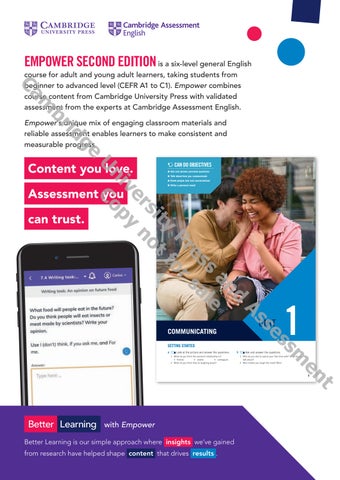
EMPOWER SECOND EDITION is a six-level general English
m Ca
course for adult and young adult learners, taking students from beginner to advanced level (CEFR A1 to C1). Empower combines course content from Cambridge University Press with validated assessment from the experts at Cambridge Assessment English.
br
id
Empower’s unique mix of engaging classroom materials and reliable assessment enables learners to make consistent and measurable progress.
ge
CAN DO OBJECTIVES ■ Ask and answer personal questions
As d an s le es sa Pr r y fo it t rs no ve y ni p
U
Content you love.
■ Talk about how you communicate
■ Greet people and end conversations
can trust.
Co
Assessment you
■ Write a personal email
Look at the picture and answer the questions. 1 What do you think the women’s relationship is? • friends • sisters • colleagues 2 What do you think they’re laughing about?
b
sm
GETTING STARTED a
1
s se
UNIT
COMMUNICATING
Ask and answer the questions.
1 Who do you like to spend your free time with? What do you talk about? 2 Who makes you laugh the most? Why?
en 7
t
with Empower Better Learning is our simple approach where insights we’ve gained from research have helped shape content that drives results .
Learner engagement Content that informs and motivates
1
Content
Results
Sustained motivation is key to successful language learning and skills development.
Clear learning goals, thoughtprovoking images, texts and speaking activities, plus video content to arouse curiosity.
Content that surprises, entertains and provokes an emotional response, helping teachers to deliver motivating and memorable lessons.
m Ca
Insights
br
1A
id
DO YOU PLAY ANY SPORTS?
1
4 GRAMMAR Question forms
3
Question forms Simple past: be Common adjectives Family; Years and dates
a Complete the tables with the questions in the box.
ge
Where did you meet? Are you married? Who do you know at this party? Why were you late? Do you like the music? Is she your sister?
a
Questions with the verb be
Look at pictures 1–3 and answer the questions.
c
01.02 Complete the sentences with the adjectives the speakers used in the listening. Then listen and check.
all right 1 2 3 4 5
awful
strange
delicious
perfect
boring
day for a birthday party. It’s a(n) The pizza is . It’s , but the music is a bit . It’s a(n) film. It’s a really story.
Which adjectives are negative? Which adjective means ‘OK’?
Now go to Vocabulary Focus 1A on p. 134.
3 READING a
Talk to a partner. Answer the questions together. 1 Where do you usually meet new people? 2 Do you usually start conversations or wait for others to speak? 3 What’s the first question you usually ask someone?
b Read the first paragraph of Small Talk. Who is the article for? What problem does it help with? questions below.
d
Is it difficult to think of what to talk about? Don’t worry. You don’t need to talk about yourself; ask the right questions and you can make the other person talk.
What do you do? How’s the food? Do you play any sports? Where did you buy them?
Read the article again with a partner. Do you both agree with the advice?
When you feel more relaxed, ask personal questions about relationships and home life: Where did you grow up? Are you married? Do you have any children? 5
Holidays are always a good topic if the conversation slows down:
Do you have any holiday plans? Where did you go on your last holiday?
You can ask about work and studies anytime:
Auxiliary verb
Subject
What do you think of the party? 1 2 Say something positive and follow it with a question:
Do
know
at this party?
like
the music?
1 In questions with the verb be, which word is first: be or the subject? 2 In questions with other main verbs, what kind of word goes before the subject?
c d
Now go to Grammar Focus 1A on p. 144.
Pronunciation Listen to the questions in the tables in 4a. Underline the stressed words. 01.07
e Put the words in the correct order to make questions. 1 2 3 4 5 6
But be careful – sometimes people don’t want to talk about work at a party!
f
do / like / what kind of music / you ? do / what / your parents / do ? grow up / did / you / in this area ? are / you / how old ? have / you / do / any hobbies ? speak / any other languages / you / do ? 01.08
g
There are also some topics that are never a good idea to talk about:
Main verb meet?
b Look at the two tables in 4a and answer questions 1 and 2.
6 or Where do you study?
When you start a conversation with a new person, ask about the situation you’re in and the people who are there:
This music’s great. Do you know what it is? The match was great last night. Do you watch football? I really like your shoes. 3
c Read the article. Complete gaps 1–8 with the How do you know Ana? How much do you earn? Do you live near here? How much rent do you pay?
SMALL TALK
Do you have problems when you meet people for the first time?
b Which of the adjectives in 2a are positive?
c
Are
Question word
Co
01.01 Listen again. Which speakers are not enjoying their conversations? Why?
Adjective, noun, etc. late?
Where
2 VOCABULARY Common adjectives a
Subject
Questions with other main verbs
2
• their interests • education
Verb be
As d an s le es sa Pr r y fo it t rs no ve y ni p
01.01 Listen to conversations 1–3. What do the people talk about? Write the numbers of the conversations. 1, 2, 3 • the party • work
• people they know • money • where they live
Question word Why
U
b
Listen and check. Underline the stressed words.
Ask and answer the questions in 4e.
5 SPEAKING
a Write down six questions that you would like to ask other
people in the class. You can use questions from this lesson or write your own. Think about:
Money – people usually think talking about money is rude. So unless you know people very well, don’t ask:
• home • relationships • education
• work • interests • people you know
• the weekend • travel • something else
Then ask personal questions about interests and hobbies to show you are interested:
7 or
Did you see the film? What was it like? Which ones? 4 What was the last song you listened to? What kind of music is that?
Politics and religion – you don’t want to start an argument!
Do you live near here?
No, I live 20 km away.
Age – never guess anyone’s age. They won’t be happy if you get it wrong!
Oh, how do you get here?
I drive.
Personalised and relevant
Results Personal responses make learning more memorable and inclusive, with all students participating in spontaneous spoken interaction.
There are so many adjectives to describe such a wonderful series, but in my opinion it’s very reliable, practical, and modern. Zenaide Brianez, Director of Studies, Instituto da Língua Inglesa, Brazil
t
Personalisation tasks in every unit make the target language more meaningful to the individual learner.
9
en
Content
Work in small groups. Ask the other students the questions you wrote in 5a. Then ask for more information.
sm
Insights Language learners benefit from frequent opportunities to personalise their responses.
b
8
s se
2
G G V V
1 SPEAKING AND LISTENING
1 What event are the people at? 2 Do you think each pair are meeting for the first time? Why / Why not?
8
UNIT 1
Learn to ask answer personal talk and about your family andquestions family history
Measurable progress 1
Assessment you can trust Content
Results
Tests developed and validated by Cambridge Assessment English, the world leaders in language assessment, to ensure they are accurate and meaningful.
End-of-unit tests, mid- and endof-course competency tests and personalised CEFR test report forms provide reliable information on progress with language skills.
Teachers can see learners’ progress at a glance, and learners can see measurable progress, which leads to greater motivation.
m Ca
Insights
id
br
ge Co
As d an s le es sa Pr r y fo it t rs no ve y ni p
U
Results of an impact study showing % improvement of Reading levels, based on global Empower students’ scores over one year.
We started using the tests provided with Empower and our students started showing better results from this point until now.
s se
Evidence of impact
t
2
en
sm
Kristina Ivanova, Director of Foreign Language Training Centre, ITMO University, Saint Petersburg, Russia
Insights
Content
Results
Schools and colleges need to show that they are evaluating the effectiveness of their language programmes.
Empower impact studies have been carried out in various countries, including Russia, Brazil, Turkey and the UK, to provide evidence of positive impact and progress.
Colleges and universities have demonstrated a significant improvement in language level between the mid- and end-of-course tests, as well as a high level of teacher satisfaction with Empower.
Manageable learning 1
Mobile friendly Content
Results
Learners expect online content to be mobile friendly but also flexible and easy to use on any digital device.
Empower provides easy access to Digital Workbook content that works on any device and includes practice activities with audio.
Digital Workbook content is easy to access anywhere, and produces meaningful and actionable data so teachers can track their students’ progress and adapt their lesson accordingly.
m Ca
Insights
id
br
ge U Co
As d an s le es sa Pr r y fo it t rs no ve y ni p
I had been studying English for 10 years before university, and I didn’t succeed. But now with Empower I know my level of English has changed.
Nikita, Empower Student, ITMO University, Saint Petersburg, Russia
2
Corpus-informed Insights
Content
sm
s se
Corpora can provide valuable information about the language items learners are able to learn successfully at each CEFR level.
Results Learners are presented with the target language they are able to incorporate and use at the right point in their learning journey. They are not overwhelmed with unrealistic learning expectations.
t
en
Two powerful resources – Cambridge Corpus and English Profile – informed the development of the Empower course syllabus and the writing of the materials.
Rich in practice 1 Language in use
Content
Results
It is essential that learners are offered frequent and manageable opportunities to practise the language they have been focusing on.
Throughout the Empower Student’s Book, learners are offered a wide variety of practice activities, plenty of controlled practice and frequent opportunities for communicative spoken practice.
Meaningful practice makes new language more memorable and leads to more efficient progress in language acquisition.
m Ca
Insights
id
br
ge
1B
I’M REALLY INTO SOCIAL MEDIA
1 READING AND LISTENING
• send birthday cards to friends • write a blog • send postcards from abroad • write letters by hand • make plans with friends by email • cancel plans by text or direct message • call friends to invite them somewhere
Julie
c Read the article and check your answers to 1b. Answer the questions. 1 Why does Julie think her friend will cancel? 2 What does social media help Jin remember? 3 Why is Marc writing a blog? 4 Why does Gabriel prefer communicating through pictures?
Listen to four speakers. Match them with the topics they talk about. 01.09
e
f
Tara Magda Chris Mike
a blogs, calls and writing b relationships and texts c important days and Facebook d plans and texts
Which ideas do you agree with? • It’s rude to cancel by text. • It’s all right to end a relationship by text. • Social media is the perfect place to say ‘Congratulations!’ • I love to get postcards and letters.
‘I engage with my
10
Present simple and present continuous
a Look at these sentences. Which are present simple? Which are
1 Which adverbs make another word stronger?
present continuous? Complete the headings.
2 Which adverbs make another word less strong?
present 1 I like to put all my photos on my blog. 2 When I plan something, I send a text. present 3 I’m waiting for her text. 4 She’s writing a blog so we know what she’s doing.
b Look at the sentences and complete 1–4 with the frequency adverbs.
I usually just send a text. I hardly ever get cards or presents from friends. I almost always cancel plans by text. My daughter rarely calls me. 100% always
Jin
1
3
‘Instagram means I don’t anything.’
‘I’d prefer a phone call to .’ a I absolutely hate it when friends cancel by text. It’s so rude. My friend Sara and I planned to go to the cinema tonight. But I’m pretty sure she’ll cancel – she usually does. I’m waiting for her text now.
I’m really into Instagram. It’s especially useful for birthdays, that kind of thing. When I check my Instagram feed, I can see who’s celebrating, so I never forget. And I can just write a message on their post. And when people have big news – maybe a new baby or something – you can write a comment straight away.
‘Writing a blog is a lot easier than .’ sending
I’m studying in New York, away from my family. And while I’m here, I’m writing a blog so my friends and family at home know my news. I particularly like to put all my photos on there because people leave comments. Most of my friends use social media, but I prefer writing a blog. It’s fairly easy to do, and it’s quicker than writing 50 separate emails.
Marc
01.09 Listen again. Is each speaker happy or unhappy about the use of technology? Why / Why not?
Answer the questions.
Co
I don’t. I write ‘Happy birthday’ on Instagram instead.
line in ‘quotation marks’ under each photo. What do you think the missing words are?
1 2 3 4
a Look at the highlighted adverbs in the article.
FAST AND THE FURIOUS
Communication is quick and easy with digital technology. But is it making us lazy? Should some things be more personal?
b Read the introduction to the article and the
d
V Adverbs
3 GRAMMAR
2 VOCABULARY Adverbs
As d an s le es sa Pr r y fo it t rs no ve y ni p
How do you communicate? Do you a do these things with your friends and family? If not, what do you do instead?
I always send birthday cards.
G Present simple and present continuous
U
THE
UNIT 1 Learn to talk about how you communicate
Gabriel
on Instagram.’
I don’t keep in touch with a lot of close friends, but I do have a lot of followers on Instagram. I post photos and videos every day. I’m an artist, so sometimes I include my new art and talk about where people can see my art in person. My followers comment on my posts, and sometimes they come to one of my art shows. It’s great to meet them in person, but I’m shy, so I prefer to communicate through pictures!
normally 2 often sometimes 4 never
b Match sentences 1–4 with these uses of the present simple and present continuous.
We use the present simple to talk about … . • habits and routines • feelings and permanent situations
We use the present continuous to talk about … . • actions right now • temporary actions around now
c
0%
c
Pronunciation Look at the words in the table. Do the letters in bold make long or short vowel sounds? Complete the Listen and check. Repeat headings. table the words. 01.10
vowels
vowels
rarely really write photos usually
d
01.11
cancel especially particularly blog sometimes
Now go to Grammar Focus 1B on p. 144.
4 SPEAKING
Ask and answer the questions. Give reasons for your answers.
How often do you … ? • send a text to your boss or teacher to say you are ill • share important news on social media • read English-language websites • send an e-card instead of a real card • buy presents for people online • start conversations with new people • write emails in English • video call friends and relatives • send video by text
Listen and repeat the sentences.
1 My friend always cancels plans. 2 I particularly enjoy getting letters. 3 I think social media is fun. 4 I hardly ever write postcards. 5 I usually text my friends. 6 I’m really into blogs. 7 I sometimes text my mum photos. 8 I rarely see my family at weekends.
e
How often do you read English-language websites?
How often do you send e-cards?
Hi Sara, Are we still on for the film tonight?
Hi Julie, Not sure. I’ll let you know soon.
sm
Insights
11
s se
Progress with language learning often requires work outside of the classroom, and different teaching models require different approaches.
Empower is available with a print workbook, online practice, documentary-style videos that expose learners to real-world English, plus additional resources with extra ideas and fun activities.
Results This choice of additional resources helps teachers to find the most effective ways to motivate their students both inside and outside the classroom.
t
Content
en
Elena Pro, Teacher, EOI de San Fernando de Henares, Spain
Never. I absolutely hate them!
Change the sentences in 2d so they are true for you. Then compare your sentences with a partner.
2 Beyond the classroom There are plenty of opportunities for personalisation.
Not very often, but I’m planning a holiday in London …
Unit overview Unit Opener Getting started page – Clear learning objectives to give an immediate sense of purpose.
m Ca
Lessons A and B
Digital Workbook (online, mobile): Grammar and Vocabulary
id
br
Grammar and Vocabulary – Input and practice of core grammar and vocabulary, plus a mix of skills.
ge
Lesson C
Digital Workbook (online, mobile): Listening and Speaking
As d an s le es sa Pr r y fo it t rs no ve y ni p
U
Everyday English – Functional language in common, everyday situations.
Unit Progress Test
Co
Lesson D
Integrated Skills – Practice of all four skills, with a special emphasis on writing.
Digital Workbook (online, mobile): Reading and Writing
Review
Extra practice of grammar, vocabulary and pronunciation. Also a ‘Review your progress’ section for students to reflect on the unit.
Mid- / End-of-course test
Digital Workbook (online, mobile)
en
Workbook (printed)
sm
Further practice is available for outside of the class with these components.
s se
Additional practice
t
Components Resources – Available on cambridgeone.org • Audio • Video • Unit Progress Tests (Print) • Unit Progress Tests (Online)
• Mid- and end-of-course assessment (Print) • Mid- and end-of-course assessment (Online)
• Digital Workbook (Online) • Photocopiable Grammar, Vocabulary and Pronunciation worksheets
CONTENTS Lesson and objective
Vocabulary
Pronunciation
Unit 1 Communicating Getting started Talk about spending time with friends 1A Ask and answer personal questions Question forms
Grammar
Common adjectives
1B
Adverbs
Syllables and word stress Sentence stress Long and short vowels
Talk about how you communicate
m Ca 1C
Greet people and end conversations
1D
Write a personal email
Present simple and present continuous
Sentence stress
Review and extension More practice
br
Tourism
-ed endings
2B
Describe travel problems
Past continuous
Travel collocations
2C
Ask for information in a public place
Sentence stress Vowel sounds Connected speech
2D
Write a travel blog
id
Past simple
ge
As d an s le es sa Pr r y fo it t rs no ve y ni p WORDPOWER off
Co
Unit 3 Money Getting started Talk about the future of cash 3A Talk about money and Present perfect or shopping experiences past simple 3B Talk about living with less Present perfect with already and yet 3C Talk to people in shops Write an update email
Review and extension More practice
Write and reply to an invitation
Review and extension More practice Unit 5 Work
Money and shopping make / do / give collocations
Sound and spelling: /dʒ/ and /j/ Sentence stress
Clothes and appearance Adjectives: places
Sound and spelling: going to
Sound and spelling: want and won’t Sentence stress
Making social arrangements
WORDPOWER look
must / have to / can
Work
Word stress
Talk about the future of work
will and might for predictions
Jobs
Sound and spelling: /ʃ/
5C
Make offers and suggestions
5D
Write a job application
Stressed/unstressed modals: vowel sounds
Review and extension More practice
WORDPOWER job and work
Imperative; should
6B
Describe extreme experiences
Uses of to + infinitive
6C
Ask for and give advice
6D
Write an email giving advice
t
Unit 6 Problems and advice Getting started Talk about being afraid 6A Give advice for common problems
Making offers and suggestions
en
Talk about what people do at work
5B
sm
5A
s se
Getting started Talk about exciting and dangerous jobs
2
Talking to people in shops; Paying at the till
WORDPOWER just
Unit 4 Social life Getting started Talk about celebrations and food 4A Talk about your plans for celebrations Present continuous and be going to 4B Plan a day out in a city will / won’t / would / shall 4C Make social arrangements
Review and extension More practice
Asking for information in a public place
U
Review and extension More practice
4D
Greeting people; Ending conversations
WORDPOWER like
Unit 2 Travel and tourism Getting started Talk about holiday photos 2A Talk about past holidays
3D
Everyday English
Verbs with dependent Sound and spelling: /uː/ and /ʊ/ prepositions -ed / -ing adjectives -ed endings Word stress Main stress
WORDPOWER Verb + to
Asking for and giving advice
Contents
Reading
Speaking
Writing
Three conversations at a party
Article: Small Talk
Getting to know each other
Personal questions
Four monologues about technology and communication Meeting an old friend
Article: The Fast and the Furious
Ways of communicating
Sentences about communicating
Conversation: keeping in touch
Three personal emails
Meeting people and ending conversations; Showing interest Keeping in touch
m Ca
Listening
Unit Progress Test Personal email Correcting mistakes
id
br Audio diary: Yes Man Changed My Life
At the train station
ge
Monologue: a bad flight
Diary article: Yes Man Changed My Life Two news stories about travel problems
U
Conversation: travelling to Australia
Travel blog
Radio programme: Ways of Life Shopping for a present
Questionnaire: Sales Season – Can You Say No? Article: Get Happy – Give Your Money Away!
Four monologues: supporting charity
Email: update on raising money for charity
Interview: May Ball Audio blog: Indian wedding Conversation: Mike and Harry in Tokyo
Article: Life in Numbers
Planning to meet: birthday dinner
Unit Progress Test Travel blog Linking words
As d an s le es sa Pr r y fo it t rs no ve y ni p
Co
Radio report: stories from a sales day
Types of holiday; A holiday you enjoyed Retelling a news story; Travel problems Asking for information in a public place; Asking for more information Making travel plans
Money and shopping experiences Living with less
Talking to people in shops; Changing your mind Charities
Future plans; Preparations for special occasions Tokyo highlights; Planning a day out in a city Making plans Making time to think
Notes about living with less
Unit Progress Test
Update email Paragraphing
Notes on a city you know well
Unit Progress Test
Two emails: invitations
Three monologues: cool jobs
Infographic: The Coolest Jobs
Job qualities and requirements
Workplace rules
Three interviews: at a career fair
Article: Planning a Safe Future Career
Finding a job; The future world of work
Predictions: finding a job / world of work
Unit Progress Test
Email: job application
Summer and part-time jobs
Job application Organising an email
Article: How to Deal with Life’s Little Problems Article: Sharks Saved My Life (Part 1)
Common problems and possible solutions; Advice for a common problem Advice for people who are always late Emotional experiences; Stories about Notes about a dramatic event dramatic events Showing sympathy; Asking for and Unit Progress Test giving advice Giving advice Message giving advice; Linking: ordering ideas and giving examples
t
en
Conversation: part-time jobs
Reassurance; Offers and suggestions
sm
Leaving work early
An invitation Writing and replying
s se
Three monologues: socialising
Two interviews: Sharks Saved My Life (Part 2) / Skydiving accident Advising a friend Three monologues: problems
Wiki: advice for learners of English
3
Lesson and objective
Grammar
Vocabulary
Unit 7 Changes Getting started Talk about different generations 7A Talk about life-changing events Comparatives and superlatives Describe health and lifestyle changes used to
Health collocations
7C
Talk to the doctor
Health problems and treatments
Sound and spelling: used to / didn’t use to Intonation for asking questions
m Ca
WORDPOWER change
br
Unit 8 Culture Getting started Talk about street art 8A Talk about art, music and literature
8D
Write a book review
id
8C
Talk about sports and leisure activities Apologise; Make and accept excuses
The passive: present simple and past simple Present perfect with for and since
Art, music, and literature
Intonation for continuing or finishing
Describe actions and feelings
9C
Make telephone calls
9D
Write a personal profile
First conditional
Co
9B
Review and extension More practice
WORDPOWER by
Verb patterns
Degree subjects; Education collocations Verbs followed by to + infinitive / verb + -ing
Word groups
Main stress: contrastive
Calling people you don’t know; Calling people you know
WORDPOWER Multi-word verbs with put
Unit 10 Values Getting started Talk about seeing a crime 10A Talk about moral dilemmas
Second conditional
Multi-word verbs
Sentence stress: vowel sounds
10B Describe problems with goods and services
Quantifiers; too / not enough
Noun formation
Word stress Sound and spelling: verbs and nouns Sentence stress
10C Return goods and make complaints 10D Write an apology email Review and extension More practice
Returning goods and making complaints
WORDPOWER Multi-word verbs with on
Word stress: compound nouns
11B Talk about discoveries
Word stress: adverbials
Articles
Adverbials: luck and chance
Sound and spelling: /ɔː/ and /ɜː/
Unit 12 Characters Getting started Talk about animals and people 12A Tell a story Past perfect
Animals
12B Talk about family relationships
Personality adjectives
Reported speech
t
WORDPOWER Preposition + noun
12C Agree and disagree in discussions
Sound and spelling: /ʌ/, /ɔː/ and /əʊ/ Sentence stress: that Main stress: contrastive
12D Write a short story Review and extension More practice
WORDPOWER age Vocabulary Focus
Asking for and giving directions in a building
en
Review and extension More practice
sm
11C Ask for and give directions in a building 11D Write a post expressing an opinion
s se
Unit 11 Discovery and invention Getting started Talk about unusual technology 11A Explain what technology does Defining relative clauses Compound nouns
Communication Plus p. 127
Apologising; Making and accepting excuses
As d an s le es sa Pr r y fo it t rs no ve y ni p
U
Unit 9 Achievements Getting started Talk about achievements 9A Talk about future possibilities
Word stress
Sports and leisure activities
ge
Review and extension More practice
4
Describing symptoms; Showing concern and relief; Doctors’ questions
Write a blog about an achievement
Review and extension More practice
8B
Everyday English
get collocations
7B
7D
Pronunciation
p. 134
Grammar Focus
p. 144
Agreeing and disagreeing
Contents Listening
Reading
Speaking
Two radio monologues: One Minute Inspiration: Steven Adams; Selena Gomez
Quotes: life changes
Comparing yourself in the past and now; Vocabulary definitions Life-changing events
Article: Health: 1970s and Today
Changes in lifestyle and health
At the doctor’s office
Describing symptoms; Showing concern and relief; Responding to questions
m Ca
Three monologues: making a change
br
Blog: changes / achievements Linking: ordering events
Article: Six of the Best, Biggest, and Most Popular
Art, music and literature
Sentences about art and music
A famous person you admire; Sports and activities Apologising; Making and accepting excuses Books and reading
Sentences about yourself; Notes about sports and activities
ge
Four book reviews
Calling people on the phone
Article: Unusual Degrees
Co
Radio interview: shyness
Conversation: online courses
Radio news: illegal downloading Radio news: Complaints around the World Returning goods to a shop
Unit Progress Test Book review Positive and negative comments; Linking: although, however
As d an s le es sa Pr r y fo it t rs no ve y ni p
U Five monologues: study habits
Unit Progress Test
Making positive changes
id
Three monologues: book reviews
Sentences about changes in health
Blog: Living to Change
Radio programme: Superfans Accepting an apology
Writing
Article: The Not-So-Easy Lives of Celebrities
Two student profiles
Article: The Biggest Complainers in Europe
Three emails: apologies
Podcast: From Fiction to Fact
Article: Science Fiction through the Years Article: Lucky Discoveries
Radio news: Willie the Parrot
Article: Jambo’s Story
Three monologues: sibling rivalry
Article: Brothers and Sisters: The Facts
Dishonest behaviour; Honesty quiz
Unreal situations
When would you complain?
Returning goods and making complaints; Sounding polite Rude behaviour
Definitions; Describing inventions Unexpected events; Discoveries and inventions Asking for and giving directions in a building; Checking information Useful/important inventions
Unit Progress Test
An apology email Formal and informal language
Unexpected events
Unit Progress Test
A post for a website Giving opinions; Expressing results and reasons
t
Four opinion posts: important inventions
Personal profile Avoiding repetition
en
Radio call-in: inventions of the future
Advantages and disadvantages of online learning
Unit Progress Test
sm
Lost in a building
Real possibilities; Future plans
s se
Three monologues: rudeness
University degrees; Future possibilities Shyness; Celebrity problems; Actions and feelings Calling people on the phone; Dealing with problems on the phone
A difference of opinion Radio report: Hurricane Harvey
Article: Houston’s Storm Bakers
Phonemic symbols and irregular verbs
p. 168
Experiences with animals; Animal life-savers Memorable things people say; Family personalities; Sibling relationships Agreeing and disagreeing
Animals causing problems
Dangerous weather
A story Linkers: past time
Things people have said to you
Unit Progress Test
5
m Ca
id br
ge
Co
As d an s le es sa Pr r y fo it t rs no ve y ni p U
This page is intentionally left blank.
t
en
sm
s se
6
CAN DO OBJECTIVES ■ Ask and answer personal questions ■ Talk about how you communicate ■ Greet people and end conversations ■ Write a personal email
m Ca id
br ge Co
As d an s le es sa Pr r y fo it t rs no ve y ni p
U
1
GETTING STARTED a
Look at the picture and answer the questions. 1 What do you think the women’s relationship is? • friends • sisters • colleagues 2 What do you think they’re laughing about?
b
t
en
COMMUNICATING
sm
s se
UNIT
Ask and answer the questions. 1 Who do you like to spend your free time with? What do you talk about? 2 Who makes you laugh the most? Why?
7
1A
DO YOU PLAY ANY SPORTS?
Learn to ask answer personal talk and about your family andquestions family history 1
G G V V
Question forms Simple past: be Common adjectives Family; Years and dates
1 SPEAKING AND LISTENING a
m Ca
Look at pictures 1–3 and answer the questions.
1 What event are the people at? 2 Do you think each pair are meeting for the first time? Why / Why not?
br
b
Listen to conversations 1–3. What do the people talk about? Write the numbers of the conversations. 1, 2, 3 • the party • work 01.01
id
• their interests • education
ge
• people they know • money • where they live
U
c
2
As d an s le es sa Pr r y fo it t rs no ve y ni p
01.01 Listen again. Which speakers are not enjoying their conversations? Why?
a
Co
2 VOCABULARY Common adjectives
Complete the sentences with the adjectives the speakers used in the listening. Then listen and check. 01.02
all right 1 2 3 4 5
awful
strange
delicious perfect
boring
day for a birthday party. It’s a(n) The pizza is . It’s , but the music is a bit . It’s a(n) film. It’s a really story.
b Which of the adjectives in 2a are positive? Which adjectives are negative? Which adjective means ‘OK’?
c
Now go to Vocabulary Focus 1A on p. 134.
a
Talk to a partner. Answer the questions together.
article for? What problem does it help with?
questions below.
How do you know Ana? How much do you earn? Do you live near here? How much rent do you pay?
d
8
What do you do? How’s the food? Do you play any sports? Where did you buy them?
Read the article again with a partner. Do you both agree with the advice?
What do you think of the party? 1 2 Say something positive and follow it with a question:
This music’s great. Do you know what it is? The match was great last night. Do you watch football? I really like your shoes. 3
Then ask personal questions about interests and hobbies to show you are interested: Did you see the film? What was it like? Which ones? 4 What was the last song you listened to? What kind of music is that?
t
c Read the article. Complete gaps 1–8 with the
When you start a conversation with a new person, ask about the situation you’re in and the people who are there:
en
b Read the first paragraph of Small Talk. Who is the
Is it difficult to think of what to talk about? Don’t worry. You don’t need to talk about yourself; ask the right questions and you can make the other person talk.
sm
1 Where do you usually meet new people? 2 Do you usually start conversations or wait for others to speak? 3 What’s the first question you usually ask someone?
Do you have problems when you meet people for the first time?
s se
3 READING
SMALL TALK
UNIT 1 4 GRAMMAR Question forms
3
a Complete the tables with the questions in the box. Where did you meet? Are you married? Who do you know at this party? Why were you late? Do you like the music? Is she your sister?
m Ca
Questions with the verb be
Question word
Verb be
Subject
Why
late?
br
Are
id
Questions with other main verbs
Question word
ge
Subject
Main verb meet? know
at this party?
like
the music?
As d an s le es sa Pr r y fo it t rs no ve y ni p
Do
b Look at the two tables in 4a and answer questions 1 and 2.
Co
Where did you grow up? Are you married? Do you have any children? 5
Auxiliary verb
Where
U
When you feel more relaxed, ask personal questions about relationships and home life:
Holidays are always a good topic if the conversation slows down:
Do you have any holiday plans? Where did you go on your last holiday?
You can ask about work and studies anytime: 6 or Where do you study?
Adjective, noun, etc.
1 In questions with the verb be, which word is first: be or the subject? 2 In questions with other main verbs, what kind of word goes before the subject?
c d
1 2 3 4 5 6
f
do / like / what kind of music / you ? do / what / your parents / do ? grow up / did / you / in this area ? are / you / how old ? have / you / do / any hobbies ? speak / any other languages / you / do ? 01.08
Listen and check. Underline the stressed words.
s se
g
Ask and answer the questions in 4e.
sm
5 SPEAKING
a Write down six questions that you would like to ask other
b
• work • interests • people you know
• the weekend • travel • something else
t
• home • relationships • education
en
people in the class. You can use questions from this lesson or write your own. Think about:
Money – people usually think talking about money is rude. So unless you know people very well, don’t ask: 7 or
01.07 Pronunciation Listen to the questions in the tables in 4a. Underline the stressed words.
e Put the words in the correct order to make questions.
But be careful – sometimes people don’t want to talk about work at a party!
There are also some topics that are never a good idea to talk about:
Now go to Grammar Focus 1A on p. 144.
Work in small groups. Ask the other students the questions you wrote in 5a. Then ask for more information.
8 Politics and religion – you don’t want to start an argument!
Do you live near here?
No, I live 20 km away.
Age – never guess anyone’s age. They won’t be happy if you get it wrong!
Oh, how do you get here?
I drive.
9
1B
I’M REALLY INTO SOCIAL MEDIA
1 READING AND LISTENING How do you communicate? Do you do these things with your friends and family? If not, what do you do instead?
m Ca
a
send birthday cards to friends write a blog send postcards from abroad write letters by hand make plans with friends by email cancel plans by text or direct message call friends to invite them somewhere
id
ge
V Adverbs
THE
FAST AND THE FURIOUS
As d an s le es sa Pr r y fo it t rs no ve y ni p
I don’t. I write ‘Happy birthday’ on Instagram instead.
Julie
Co
‘Instagram means I don’t anything.’
b Read the introduction to the article and the line in ‘quotation marks’ under each photo. What do you think the missing words are?
c Read the article and check your answers to 1b. Answer the questions. 1 2 3 4
d
Why does Julie think her friend will cancel? What does social media help Jin remember? Why is Marc writing a blog? Why does Gabriel prefer communicating through pictures?
Listen to four speakers. Match them with the topics they talk about. 01.09
e
Listen again. Is each speaker happy or unhappy about the use of technology? Why / Why not? 01.09
I absolutely hate it when friends cancel by text. It’s so rude. My friend Sara and I planned to go to the cinema tonight. But I’m pretty sure she’ll cancel – she usually does. I’m waiting for her text now.
Marc
t
• It’s rude to cancel by text. • It’s all right to end a relationship by text. • Social media is the perfect place to say ‘Congratulations!’ • I love to get postcards and letters.
10
I’m studying in New York, away from my family. And while I’m here, I’m writing a blog so my friends and family at home know my news. I particularly like to put all my photos on there because people leave comments. Most of my friends use social media, but I prefer writing a blog. It’s fairly easy to do, and it’s quicker than writing 50 separate emails.
en
Which ideas do you agree with?
‘I engage with my
‘Writing a blog is a lot easier than .’ sending
sm
f
Tara a blogs, calls and writing Magda b relationships and texts Chris c important days and Mike Facebook d plans and texts
‘I’d prefer a phone call to .’ a
I’m really into Instagram. It’s especially useful for birthdays, that kind of thing. When I check my Instagram feed, I can see who’s celebrating, so I never forget. And I can just write a message on their post. And when people have big news – maybe a new baby or something – you can write a comment straight away.
s se
1 2 3 4
Jin
U
I always send birthday cards.
G Present simple and present continuous
Communication is quick and easy with digital technology. But is it making us lazy? Should some things be more personal?
br
• • • • • • •
Learn to talk about how you communicate
Gabriel
on Instagram.’
I don’t keep in touch with a lot of close friends, but I do have a lot of followers on Instagram. I post photos and videos every day. I’m an artist, so sometimes I include my new art and talk about where people can see my art in person. My followers comment on my posts, and sometimes they come to one of my art shows. It’s great to meet them in person, but I’m shy, so I prefer to communicate through pictures!
UNIT 1 3 GRAMMAR
2 VOCABULARY Adverbs
Present simple and present continuous
a Look at the highlighted adverbs in the article. Answer the questions.
1 Which adverbs make another word stronger? 2 Which adverbs make another word less strong?
a Look at these sentences. Which are present simple? Which are present continuous? Complete the headings. present 1 I like to put all my photos on my blog. 2 When I plan something, I send a text.
m Ca
b Look at the sentences and complete 1–4
present 3 I’m waiting for her text. 4 She’s writing a blog so we know what she’s doing.
with the frequency adverbs.
b Match sentences 1–4 with these uses of the present simple and present continuous.
id
br
I usually just send a text. I hardly ever get cards or presents from friends. I almost always cancel plans by text. My daughter rarely calls me. 100% always
ge
1
normally 2 often sometimes 4 never
As d an s le es sa Pr r y fo it t rs no ve y ni p
Pronunciation Look at the words in the table. Do the letters in bold make long or short vowel sounds? Complete the table headings. Listen and check. Repeat the words. vowels rarely really write photos usually
d
01.11
vowels
cancel especially particularly blog sometimes
Listen and repeat the sentences.
A sk and answer the questions. Give reasons for your answers.
How often do you … ? • send a text to your boss or teacher to say you are ill • share important news on social media • read English-language websites • send an e-card instead of a real card • buy presents for people online • start conversations with new people • write emails in English • video call friends and relatives • send video by text How often do you read English-language websites?
How often do you send e-cards?
Not very often, but I’m planning a holiday in London …
Never. I absolutely hate them!
t
en
Change the sentences in 2d so they are true for you. Then compare your sentences with a partner.
4 SPEAKING
sm
My friend always cancels plans. I particularly enjoy getting letters. I think social media is fun. I hardly ever write postcards. I usually text my friends. I’m really into blogs. I sometimes text my mum photos. I rarely see my family at weekends.
Now go to Grammar Focus 1B on p. 144.
s se
1 2 3 4 5 6 7 8
e
c
Co
0% 01.10
We use the present continuous to talk about … . • actions right now • temporary actions around now
U
3
c
We use the present simple to talk about … . • habits and routines • feelings and permanent situations
Hi Sara, Are we still on for the film tonight? Hi Julie, Not sure. I’ll let you know soon.
11
1C
Learn to write an email Learn to greet peoplewith andtravel end advice W conversations Paragraph writing
EVERYDAY ENGLISH
P Sentence stress
It was really nice to meet you
2 USEFUL LANGUAGE Greeting people
1 LISTENING
m Ca
a In your country, what do you
a
normally say and do when you …
br
• first meet somebody new? • meet someone you know well? We shake hands and say …
id
We hug and kiss.
S Showing interest
ge
b Look at the photographs. Do you
think the people in each photo know each other well? Why?
01.15 Complete the sentences from Part 1 with the words in the box. Listen and check your answers.
meet you
no see
1 Long time 2 How 3 Great
? !
to see you
by the way
!
are you
these days ?
4 Where are you living 5 My name’s Mark, . 6 Nice to
.
b Look at the phrases in 2a. Which can you use to speak to … ? 1 someone you know 2 someone you are meeting for the first time
U
c
Co
d Work in pairs. Take turns saying the phrases in 2a and replying.
As d an s le es sa Pr r y fo it t rs no ve y ni p
01.16 Listen and note down some possible replies to the phrases in 2a. Do you know any different ways to reply to each phrase in 2a?
3 CONVERSATION SKILLS Showing interest
a
01.17 Listen and complete the conversations from Part 1 with the adjectives in the box.
fantastic
lovely
good
nice
1 Long time no see! How are you? I’m great. What a surprise! Great to see you. 2 We live on Compton Road. Oh – how !
3 Mark’s my husband! Husband – wow! That’s
news.
s se
4 Would you both like to come? Yeah, that sounds . Brilliant! Let’s go.
b Look at the conversations in 3a. Do the highlighted phrases give
d
Watch or listen again. Are sentences 1–5 true (T) or false (F)? Correct the false sentences. 01.14
1 2 3 4 5
12
The last time Rachel and Annie saw each other was six years ago. Annie lives a long way from the town centre. Rachel and Mark got married a year ago. Annie has a boyfriend. Rachel, Mark and Annie decide to go to a restaurant together.
c What kind of word completes each phrase 1–4? Choose the correct form from the box.
adjective + noun adjective
t
Watch or listen to Part 1 and check your answers to 1b. 01.14
en
c
sm
information or show interest?
! 1 What a + 3 That sounds +
.
2 How + 4 That’s +
! + news.
d Work in pairs. Take turns to tell your partner about yourself. Reply using the phrases in 3c.
Tell your partner: • where you live • something you did at the weekend • some news • what job you do / what you are studying these days
UNIT 1 4 PRONUNCIATION Sentence stress
6 USEFUL LANGUAGE Ending conversations
a
a
01.18 Listen to the sentences. Notice the words with stressed syllables.
1 2 3 4 5
m Ca
I think it was about six years ago! I live on Hampton Street. My name’s Mark, by the way. Mark’s my husband! I’m going to the café down the street now... ...to meet Leo, my boyfriend.
to somebody you have just met?
have stressed syllables – grammar words or words that give information?
c Put the sentences in the correct order to make a
br
conversation.
id
B A
ge
a
We really must . It was really nice to you. It was great to you again, Annie. Yeah! We must soon. hello to Dan for me!
b Which phrase in 6a do you use when you say goodbye
b Look at the sentences in 4a. Which words
5 LISTENING
01.20 Listen and complete the phrases for ending a conversation.
Look at the picture from Part 2. Who is the fourth person at the café? Does he know Rachel and Mark?
Co
As d an s le es sa Pr r y fo it t rs no ve y ni p
U
A A A B B
Oh, that’s fine. It was great to see you. Not far from here. Look, I’m sorry, but I really must go. I’m late for a meeting. 1 Dan, is that you? Yeah! I think I last saw you at John’s wedding. How are you? You, too! I’ll give you a call! I’m fine. And you? Where are you living these days? Hi Sarah! Long time no see!
7 SPEAKING
a
Communication 1C Work in pairs. Student A: Go to 7b below. Student B: Go to p. 130.
Student A b Read card 1. Think about what you want to say. c Start the conversation with Student B. Use your own name.
b
c
What do you think they will talk about in the café? In pairs, think of three things. Then watch or listen to Part 2. Were you right? 01.19
01.19
questions.
Watch or listen again. Answer the
d Now look at card 2. Listen to Student B and reply. Use your own name.
2
You meet a colleague for the first time. • say who you are • give some information: • your office is in building C • your own idea • listen to what your new colleague says and respond • say goodbye
t
en
sm
Do Rachel and Mark have plans for next week? What job does Rachel do? Who helps Rachel at the shop? What does Annie say about her job? What does Mark do? What is Annie doing at the weekend? Why do Rachel and Mark leave? What suggestion does Annie make before they leave?
You are walking down the street and you see your friend. • say hello • give your news: • you’ve got a new job • your own idea • listen to your friend’s news and respond • say goodbye
s se
1 2 3 4 5 6 7 8
1
UNIT PROGRESS TEST CHECK YOUR PROGRESS You can now do the Unit Progress Test.
13
1D
SKILLS FOR WRITING
Learn to write a personal email W Correcting mistakes
I’m sending you some photos
1 SPEAKING AND LISTENING
2 READING
a
a Simon is a student from England. Look
m Ca
Read messages 1–3 and answer the questions.
at his pictures from Salamanca, in Spain. What do you think he is doing there?
1 What do the highlighted phrases mean? 2 Do you ever send or receive these kinds of messages? Who to/from? Why? 1
2
3 Did you get my last text?
Are you OK? We haven’t heard from you for a long time.
SEND
SEND
id
br
I can’t seem to get in touch with you. Call me!
SEND
ge
b
Listen to Nina and Chris talking about keeping in touch with friends and family. Who is better at keeping in touch: Nina or Chris? 01.21
01.21
friend Blake younger sister Mika
uncle and aunt
c Who does Simon write to about these subjects? • • • • •
the weather what he does in the evenings the family he is staying with learning to speak Spanish the other students
As d an s le es sa Pr r y fo it t rs no ve y ni p
Listen again and answer the questions.
Why doesn’t Nina send many emails? Why does Chris call his mother so often? How often does Nina call her parents? When does Nina prefer to tell her friends her news? When does Chris send photos by email?
Co
1 2 3 4 5
in 2a. Which email is to his … ?
U
c
b Read the emails and check your ideas
d How often do you keep in touch with friends
and family? Circle the correct adverb for you. always often sometimes rarely
d
Answer the questions about Simon’s emails.
1 What does he say about speaking Spanish? 2 Why do you think he says different things about this to each person?
Think about: 1 a family member who lives in a different place 2 a friend you don’t see very often. Which of these do you do with each person? Write the first letter of their name. • talk on the phone or make a video call • send emails or texts • send pictures, video or links • hardly ever keep in touch • meet for a chat
Work in pairs. Talk about your answers to 1d.
f
t
I sometimes send photos to my sister Jane. They’re usually pictures of …
I send my friend Alex links to interesting articles.
Which of these opinions do you agree with? 1 ‘It’s nice to see photos of what your friends are doing.’ 2 ‘You don’t have to keep in touch with people all the time.’ 3 ‘If your parents worry a lot, you should call them.’
14
en
I often keep in touch with my family. I enjoy sending …
sm
I rarely keep in touch with people. I never have time to …
s se
e
UNIT 1
1
m Ca
Hope you’re both well and are enjoying the summer. I’m in Salamanca, in Spain. This is a photo I took of the old centre. It’s a beautiful old city, as you can see – and really big! It has an incredible mix of old, historical places and new, trendy areas. As you know, I’m learning Spanish at the moment. I’m taking a two-month Spanish course here, so my Spanish is slowly improving. The classes are very good, and we also watch Spanish films. It’s pretty hot here, but it’s nice and cool in the evenings. Love to all, Simon
2
br
id
How’s it going? Are you having a good time in Berlin? Here are some photos of my group on the Spanish course. We’re all from different countries, so we usually speak English when we’re together – not very good for my Spanish! Anyway, I’m having a great time here, and the time’s going much too quickly. There are a lot of good cafés here, and we usually all go out at night together. What’s Berlin like? Send me some photos! See you back at college next month. Simon
ge
Correcting mistakes
a Look at the pairs of sentences A–D. Which pair has mistakes in … ? grammar spelling
punctuation capital letters
A 1 Hope youre both well and are enjoying the summer 2 Are you having a good time in Berlin, B 1 i’m in salamanca, in spain. 2 the classes are very good, and we also watch spanish films. C 1 I having a great time here, and the time going much too quickly. 2 She speak English quite good, but we are usually speaking Spanish together. D 1 Her are some fotos of my group on the Spanish corse. 2 We’re all from diferent countrys, so we usually speak English.
As d an s le es sa Pr r y fo it t rs no ve y ni p
U
3
3 WRITING SKILLS
b Match the rules with mistakes in five of the
Co
I’m sending you some photos of the family I’m staying with in Salamanca. They’ve got a daughter the same age as you (her name’s Blanca). She speaks English quite well, but we usually speak Spanish together. She introduced me to some of her friends, and I speak Spanish with them, too … some of the time, not always! How’s your job in the supermarket? Hope you’re not working too hard and are saving a lot of money! See you next week. Love, Simon xx
sentences in 3a (A1–D2). 1
2 3 4 5
The present continuous is formed be + verb + -ing. When we leave out a letter, we write an apostrophe (’). We use the present simple to talk about habits. If a word ends in -y, we change it to -ies in the plural. Place names start with a capital letter.
c Correct all of the mistakes in the sentences
in 3a. Check your answers in Simon’s emails.
4 WRITING
a Write an email to a friend or family member that you don’t see very often. Write about:
sm
s se
• how you are • what’s new for you (the place you’re living or the people you’re spending time with) • what you’re doing these days.
b Work in pairs. Exchange emails and read • punctuation marks P • capital letters L
t
• grammar G • spelling Sp
en
your partner’s email. Circle their mistakes and write these letters at the end of the line.
c Work in pairs. Correct the mistakes in your emails together.
d Read other students’ emails. Which email is the most interesting? Why?
15
UNIT 1
3 WORDPOWER like
Review and extension 1 GRAMMAR
m Ca
a Put the words in the correct order to make questions.
id
ge
b
night / did / go / out / you / last ? where / you / last / weekend / go / did ? kinds of / like / you / what / do / TV programmes ? do / this school / know / who / at / you ? you / how / play / sport / often / do ? you / do / what / at weekends / do / usually ? tired / you / are / today ?
br
1 2 3 4 5 6 7
Ask and answer the questions in 1a.
c Complete the conversation with the present simple or
U
present continuous forms of the verbs.
Co
2 VOCABULARY
a Complete the sentences with the correct adjectives.
Yes, that would be great. And Italy! Me, too. Yes, this style’s popular at the moment. I thought it was all right, but my friend hated it.
b Match the expressions in bold from 3a with meanings a–d. a b
what was your opinion of similar to
c
if you want
d
for example
c Complete the sentences with the words in bold from 3a.
1 A Is your university different from others in your country? B No, it’s most of the others. 2 A We can meet tomorrow . B OK – come to my flat for a coffee. 3 A Do you want me to bring something to the dinner party? B Yes. Bring something sweet, some ice cream. 4 A We went to that new restaurant yesterday. B it ?
• saying people or things are similar John looks like his brother – they’re both tall with black hair. I think this new song sounds like all their other stuff. • saying what you think will happen It looks like it might rain – it’s very cloudy. • giving your opinion about what you heard or read I spoke to Sara yesterday. It sounds like she had a really good holiday.
Complete the sentences with the correct forms of look like or sound like.
1 2 3 4
It their first song. I really like it! Sam invited Tom to the party, so it he’ll come. You don’t your sister. She’s very tall. That was the last bus. It we’ll have to walk.
REVIEW YOUR PROGRESS
How well did you do in this unit? Write 3, 2 or 1 for each objective. 3 = very well 2 = well 1 = not so well
I CAN … ask and answer personal questions talk about how I communicate greet people and end conversations write a personal email.
t
Which sentences in 2b are true for you?
Look at the examples.
en
1 I absolutely / fairly love football. 2 My parents live abroad. I rarely / always see them. 3 I think American films are absolutely / quite good, but I don’t love them. 4 I usually / particularly go for a run once or twice a week. 5 I really / fairly hate rock music. 6 I love all sports, but tennis is especially / usually good.
d We often use like with the verbs look and sound.
sm
b Choose the correct answers.
16
a b c d
I’ve got a jacket like yours. What was the film like? I enjoy visiting countries with a lot of history, like Greece. We can go for a walk later if you like.
s se
1 The film was a t at the beginning, but I didn’t like the ending. 2 We ate some really d s food at the party. 3 They’ve got a nice house, but they live in a really u y part of town. 4 It was a l y day, so we decided to go to the beach. 5 I bought a g s new dress to wear to my friend’s wedding. 6 He listens to really s e music – I don’t know any of the bands. 7 This summer, the weather here was h e – it rained all the time. 8 This is a p t day for a walk in the park – it’s so warm and sunny.
c
1 2 3 4
As d an s le es sa Pr r y fo it t rs no ve y ni p
JACKIE Hi, Mum. MUM Oh, hi, Jackie. Nice of you to call. You 1 (not call) very often! JACKIE Oh, come on, Mum! I 2 (work) really hard at university at the moment. I never 3 (have) time to call! And I 4 (send) you emails all the time. MUM I 5 (like) to talk to you and hear your voice, that’s all. Your sister 6 (call) me every weekend. JACKIE Well, we 7 (talk) now, but the world 8 (change), Mum! Some of my friends never 9 (call) home. They just 10 (email) or send a text. MUM I preferred how things were in the past.
a Match sentences 1–4 with replies a–d.
CAN DO OBJECTIVES ■ Talk about past holidays ■ Describe travel problems ■ Ask for information in a public place ■ Write a travel blog
m Ca id
br ge Co
As d an s le es sa Pr r y fo it t rs no ve y ni p
U
2
GETTING STARTED a
Look at the picture and answer the questions. 1 Who is the girl? What is she doing? 2 How do you think she feels? Why? 3 Do you think the photo was her idea? Why / Why not?
b
t
en
TRAVEL AND TOURISM
sm
s se
UNIT
Ask and answer the questions. 1 Would you like to take a photo like this on holiday? Why / Why not? 2 What is the funniest or most unusual photo you have taken on holiday? Where were you? How did you feel? Did anything go wrong?
17
2A
Learn to talk about past holidays
WE HAD AN ADVENTURE
G Past simple V Tourism
YES MAN
1 READING AND LISTENING a
CHANGED MY
m Ca
Ask and answer the questions.
LIFE
1 Where do you like to go on holiday? 2 Do you like to try new things on holiday? What? 3 Can you think of any kind of holiday you wouldn’t enjoy?
b Read Yes Man Changed My Life and answer the questions.
br
b y Ri c h a r d C o l l i ns
1 What is Danny Wallace’s book Yes Man about? 2 What did Richard do after he read Yes Man?
id
Yes Man is the best book I’ve ever read. It’s the true story of a year in the life of author Danny Wallace. Before Danny Wallace became the ‘Yes Man’, his life was boring and he felt old. So he decided to make things more exciting. He started saying ‘yes’to every question people asked him. And he did it for a whole year. From the day he started, it completely changed his life, and he had all kinds of adventures. It’s a fantastic story. When I finished the book, I wanted to change my life like Danny Wallace. So I took a holiday from work and became a ‘Yes Man’ for a week. This is what happened.
ge
c Read Day 1 and Day 2 and then answer the questions.
Co
As d an s le es sa Pr r y fo it t rs no ve y ni p
U
Day 1 1 Why did Richard go into the travel agent’s? 2 What holiday did he book? 3 Did he book the kind of holiday he usually likes? Day 2 1 Why did Richard go to the beach? 2 What did he buy at the beach? 3 What is he going to do on day three? How does he feel about it?
d
Would you like to try water skiing? Do you think Richard will enjoy it?
e
Listen to Richard describing day 3. Are sentences 1–5 true (T) or false (F)? Correct the false sentences. 02.01
1 2 3 4 5
f
The class began with a lesson before they went out to sea. Richard felt fine when they went out on the boat. He found it difficult to stand up on the water skis. He hated water skiing. When he got back to the hotel, he went to bed.
c Complete the sentences with the past simple forms of the verbs in brackets.
1 2 3 4 5 6
Can you think of a time when you were surprised you enjoyed something?
2 GRAMMAR Past simple: positive the article.
3 LISTENING
a
Which of the activities in 2c do you think Richard enjoyed? Tell a partner. Listen and check.
b
02.02 Listen again. What is Richard’s last question? Do you think he will say yes or no? Why?
c
t
You can find a list of irregular verbs on p. 168.
en
How do the other verbs change?
02.02
sm
become feel decide start ask do change have want get see sleep go arrive give
b Which verbs in 2a end in -ed in the past tense?
as a waiter for a day, for no money. (work) a day fishing with five Greek fishermen. (spend) at a beach party until six in the morning. (stay) a dancing competition. (win) the same boat trip three times. (take) swimming at midnight. (go)
s se
a Underline the past simple forms of these verbs in
I I I I I I
Ask and answer the questions. 1 Do you ever say ‘yes’ when you don’t want to? When? 2 Would you like to be a ‘Yes Man’ for a week? Why / Why not?
18
UNIT 2 I started on Saturday morning. At 10 am, I got my first question. I saw a poster in the window of a travel agent’s. It said, ‘Tired?’ (Yes – I slept badly the night before, so I was tired.) Under this, it said, ‘Do you need a holiday?’ (Yes, definitely.) So I went in. The travel agent asked, me where I wanted to go. But before I could answer, she said, ‘Somewhere hot?’ I don’t like hot weather, but I said, ‘Yes.’ ‘A beach holiday? Maybe in Greece?’ I don’t like the beach. I prefer cities. But I said, ‘Yes.’ ‘What kind of accommodation? A hotel? Or a … ’ I hate hotels, but before she could continue, I said,‘Yes.’ Five minutes later, everything was ready. My flight was the next day.
DAY
1
m Ca
id
br
DAY
Co
4 GRAMMAR
Past simple: negative and questions
a Complete the sentences with the words in the box. didn’t
change need decide start
did
weren’t
play ask want
played asked wanted
b Complete the rule with two sounds.
We pronounce -ed endings with an extra syllable /ɪd/ after and only.
c
6 VOCABULARY Tourism
a
What useful holiday items can you see on these pages? What else do people usually take?
b
Now go to Vocabulary Focus 2A on p. 134.
7 SPEAKING
a Think of a holiday you enjoyed. Think about your answers to these questions.
b
t
1 Which sentences include the verb be ? 2 How do we make negatives and questions … ? • with the verb be • with other verbs
en
questions about the past simple.
When did you go? Where did you go? Was it your first time? How long did you go for? Who did you go with? What kind of accommodation did you stay in? Did you do any sightseeing? Who did you meet? Did you bring back any souvenirs?
sm
• • • • • • • • •
b Look at the sentences in 4a and answer the
Now go to Grammar Focus 2A on p. 146.
02.06 Which of the verbs + -ed in the box have the extra /ɪd/ syllable? Listen and check.
waited included arrived looked watched shouted smiled stopped ended believed
very good. 1 Some of my experiences 2 I like the mosquitoes that bit me. 3 you have a good week? 4 What your favourite thing?
c
changed needed decided started
s se
was
02.05 Listen and tick (✓) the verbs that have an extra syllable when we add -ed.
As d an s le es sa Pr r y fo it t rs no ve y ni p
U
2
a
ge
I arrived at my hotel on the island of Zante at lunchtime. It was very, very hot. I just wanted to check in and unpack my suitcase, but the receptionist said, ‘We have a minibus to the beach in ten minutes. Do you want to go?’ You know the answer I gave her. It was about 40°C at the beach. Luckily, I brought suntan lotion. A man came towards me: ‘Sunglasses? Do you want sunglasses?’ I had some in my bag, but I said, ‘Yes.’ Five minutes later, another man came: ‘Beautiful hat, sir?’ I tried not to look at him. Three hours later, I had two pairs of sunglasses, three hats, a watch and a woman’s necklace. It was difficult to carry all my new things back to the minibus. I decided: no trips tomorrow, just rest. When I got back, the receptionist asked, ‘Did you like the beach?’ I didn’t, but I said, ‘Yes.’ ‘Oh, there’s a water skiing course tomorrow. Do you want me to book a place for you?’ I can’t swim very well, and I don’t like the sea. I wanted to cry …
5 PRONUNCIATION -ed endings
Tell your partner about your holiday. Listen to your partner and ask questions.
19
2B
EVERYONE WAS WAITING FOR ME
Learn to describe travel problems G Past continuous V Travel collocations
1 VOCABULARY Travel collocations Look at the list of ways to travel. Which do you prefer? Why?
m Ca
a
• car • plane
• bus • coach
• train • on foot
Look at the travel problems in the pictures. Which situation do you dislike the most?
c
Now go to Vocabulary Focus 2B on p. 135.
id
br
b
U
Look at the picture and the headline. What do you think happened?
Co
As d an s le es sa Pr r y fo it t rs no ve y ni p
a
ge
2 LISTENING
WOMAN ANGRY
c
02.11 Listen again. What does the woman say about … ?
d
20
her journey to the airport boarding the plane what the flight attendant said what happened when she was in the toilet how she feels now about what happened
Do you believe the woman’s story? Why? / Why not?
t
• • • • •
en
02.11 Listen to the woman describing her experience. Were your ideas in 2a correct?
sm
b
s se
AFTER FLIGHT IN TOILET
UNIT 2 3 GRAMMAR Past continuous
4 READING AND SPEAKING
a
a
02.12 Listen and complete the sentences with past continuous verbs.
Read the headlines and look at the pictures. What do you think happened to the travellers?
1 It when I left the house. 2 When I boarded the plane, all the other passengers for me. 3 I my book when one of the flight attendants spoke to me. 4 I on the toilet when the turbulence started.
DID YOU MEAN
m Ca
CAPRI? SWEDISH TOURISTS MISS THEIR DESTINATION BY
br
b Underline the past simple verbs in sentences 1–4 in 3a.
id
600 KM
c Look at the sentences in 3a again and answer
ge
the questions.
As d an s le es sa Pr r y fo it t rs no ve y ni p
U
1 Which action started first in every sentence: past simple or past continuous? 2 Think about when and why the past continuous action stopped in each sentence. Write the sentence numbers (1–4).
Co
The past continuous action … . stopped because of the past simple action stopped some time after the past simple action
d
Now go to Grammar Focus 2B on p. 146.
e
02.14 Pronunciation Listen to the sentences. Notice which syllables are stressed.
1 It was raining. 2 It wasn’t raining. 3 Was it raining?
f
g
4 We were driving fast. 5 We weren’t driving fast. 6 Were we driving fast?
02.14 Listen to the sentences in 3e again. Do the vowel sounds in was and were sound the same in all the sentences?
COACH PASSENGERS ASKED TO
GET OUT AND PUSH b
Communication 2B Student A: Go to p. 127. Student B: Go to p. 128.
c
02.15 Listen to five more sentences. Do you hear was, wasn’t, were or weren’t in each?
or past simple forms of the verbs in brackets.
about your answers to these questions.
• What went wrong? • What happened in the end?
Work in small groups. Tell the group about your journey. When I was travelling to Florida, we waited for ten hours in the airport. Then they sent us to a hotel.
t
f
en
• Where were you going? • How were you travelling?
g What did you do?
Which journey do you think was worse for the travellers?
e Think of a time you experienced travel problems. Think
Have you had any experiences that were similar to the ones in 3h? I lost my passport when we were moving house.
Two Swedish tourists were on holiday in Italy. They ...
sm
i
d
Where were they going? How were they travelling? What was the problem? Who helped solve the problem? How? What happened in the end?
s se
• • • • •
h Complete the sentences with the past continuous 1 The train (leave) the station when I (realise) I was on the wrong train. 2 When I (travel) around Australia, I (lose) my passport. 3 I (run) for the bus when my bag (open) and all my things _____ (fall) out. 4 I (drive) to a family wedding when my GPS (stop) working. 5 Someone (steal) my bag when I (stand) in the queue for a ticket.
Tell your partner your story. Use the questions to help you.
Was it free?
Who in your group has had the worst experience on … ? • a plane • a train • a bus
21
2C
EVERYDAY ENGLISH
P Connected speech
What time’s the next train?
S Asking for more information
2 USEFUL LANGUAGE Asking for information in
1 LISTENING
m Ca a
Learn to write email with travel Learn to askanfor information in advice place writing W a public Paragraph
What kind of information do people ask for in these places? Think of two kinds of information for each place.
a public place
a
• train stations • tourist offices • airports
1 2 3 4 5 6
id
br
Look at the picture. Where is Annie? What information do you think she is asking for?
c
Watch or listen to Part 1 and check your ideas in 1b.
ge
b
b
a b c d e f
What time’s How often Could you tell me where How much Can I Where can I 02.18
is a ticket? pay by card? the ticket office is? the next train? do the trains leave? buy a magazine?
Listen and complete the questions the assistant asks.
1 Yes, how 2 Is there
help you? I can help you with?
Co
As d an s le es sa Pr r y fo it t rs no ve y ni p
U
02.16
02.17 Match 1–6 with a–f to make questions from Annie’s conversation. Then listen and check.
c Complete the dialogue with words from the box. what time where can I can I how much could you tell me
A B A B A B A B A B
d
where the museum is, please? Hi, 1 Yes, it’s not far. It’s by the river. Look on the map – here. I see. And 2 does it open? From 8 am till 4 pm. 3 is a ticket? For adults, it’s £14. 4 buy a ticket? I can sell you a ticket here, or you can buy one at the museum. Oh, I’ll buy one here. 5 pay by card? Of course – that’s no problem. 02.19
Listen and check. Practise the dialogue.
3 PRONUNCIATION Connected speech 02.20
s se
a
Listen to the questions and look at the letters in bold.
sm
• Where can I buy a magazine? • How much is a ticket?
1 Underline the correct word to complete the rule.
2 What sound exactly do the letters in bold in each question make?
1 When does the next train to Birmingham leave?
b Underline the letters and spaces where there isn’t a pause. 1 Is anyone sitting here? 2 Could I sit next to you? 3 What are you reading?
c d
02.21
t
Watch or listen to Part 1 again. Answer the questions. 02.16
2 How often do the trains leave? 3 Which platform does the Birmingham train leave from? 4 Which day will Annie come back? 5 How much is Annie’s ticket? 6 What does Annie want to get from the newsagent’s?
22
en
d
There is / isn’t a pause between words when a consonant sound comes before a vowel sound.
4 Do you want a drink? 5 Where do you get off? 6 Can I have your email address?
Listen and check.
In pairs, ask the questions in 3b and answer with your own ideas.
UNIT 2 5 LISTENING
4 CONVERSATION SKILLS
Asking for more information
a
Look at the picture from Part 2. Why do you think Annie runs back to the assistant?
b
02.23 Watch or listen to Part 2 and check your ideas. What mistake did Annie make? What is her last question?
Sorry, just one more thing. ANNIE ASSISTANT Yes, of course. ANNIE Could you tell me where the ticket office is?
c
Have you ever made a silly mistake like Annie? What happened?
ASSISTANT Is there anything else I can help you with? ANNIE Actually, there is one more thing. Where can I buy a magazine?
6 SPEAKING
a Look at the underlined phrases. Do the phrases show that the speaker wants to … ? 1 end the conversation 2 ask something else
m Ca
Listen to the phrases and repeat.
ge
c
02.22
id
br
b
B
Communication 2C Student A: Go to 6b below. Student B: Go to p.128.
Student A b Look at Card 1. Think about what you want to ask. 1
You need to book a train ticket. – first train to Manchester / in the morning? • • how often / trains to Manchester? • £ two adult tickets? • pay by card? • where / leave luggage? • where / the waiting room?
Co
As d an s le es sa Pr r y fo it t rs no ve y ni p
A
U
Work in pairs. Student A: you are a tourist officer. Student B: you are a tourist in town. Use the dialogue below, and ask two more questions.
a
c Listen to Student B and reply. Find out the information you need.
d Now look at Card 2. Start the conversation with Student B. Say ‘How can I help you?’
2
d
Swap roles. Do the dialogue again.
You are a tourist guide in Warwick. • castle is in the centre of town • opening hours 10 am–6 pm • prices: adult £30.60, child £25.80 • buy tickets at the castle or online • tours every hour • visitors can bring food, but many places to buy food
s se
UNIT PROGRESS TEST
t
en
You can now do the Unit Progress Test.
sm
CHECK YOUR PROGRESS
23
2D
SKILLS FOR WRITING
This city is different, but very friendly
1 SPEAKING AND LISTENING
b
Look at the photos of Sydney, Australia. Discuss the questions.
m Ca
a
id
br
1 What can you see in the photos? 2 What do the photos tell you about Sydney? 3 What other things do you know about Sydney and Australia? 4 Have you been there? Would you like to go? Why / Why not?
c
Lucila, from Peru, is going on a six-month work trip to Australia. Listen to her video call to her friend Katie, who lives there. Choose which of the topics, a or b, they discuss. 02.24
02.24
Listen again and underline the correct answers.
1 Katie will meet Lucila at five / after six o’clock. 2 They will meet at the airport / train station. 3 When Katie arrived in Sydney, she was too tired to enjoy / excited by the view. 4 Katie’s home town is similar to / different from Sydney. 5 Katie lives in a part of Sydney that is next to a harbour / has a lot of things to do. 6 Lucila will stay with Katie for her whole trip / a short time.
Co
As d an s le es sa Pr r y fo it t rs no ve y ni p
U
For Designer Remove black frame and improve overall design of realia, e.g., brighter colors, more interesting header.
b
W Linking: and / but / so / because / when
1 Lucila’s arrival: a passport control b transport 2 Sydney: a the sea b the parks
ge
a
Learn to write a travel blog
d
Imagine you are making plans to go on a work trip to another country for six months. Ask and answer the questions. 1 Where are you going to go? Why? 2 What do you hope to see and do? 3 What jobs do you plan to do while you are there?
2 READING
a Read Lucila’s blog about arriving in Sydney. Tick (✓) the topics she writes about.
er flight to Sydney h public transport Katie’s job a famous building in Sydney
fresh food Katie’s accommodation Katie’s neighbourhood wildlife
b Read the text again. What does Lucila say about the
e
t
en
sm
s se
topics you ticked in 2a?
c
d
24
UNIT 2
My TRIP to OZ!
Pacific Ocean
TUESDAY, NOVEMBER 7
WEDNESDAY, NOVEMBER 8
I’ve arrived, and it’s amazing! It was a long flight, but I slept most of the way, so I’m not tired. Katie was right – the view from the plane was spectacular! Sydney just looks so different from anywhere else I have been. When I got off the plane, the first thing I noticed was how organised everything is. There are signs everywhere that tell you where to go and what to do. There are a lot of rules about bringing food into Australia. You can’t bring in fresh fruit or anything like that because it could have diseases that are dangerous for plants in Australia. It was really easy to find the train and get to the city centre. Katie was waiting for me at Central Station – it was wonderful to see her again. We took a train to Newtown, where she lives. The transport system here seems really efficient. Katie lives in a lovely old-style house with two other housemates, Louise and Michaela. They were very friendly and welcoming. And they don’t mind if I stay until I find my own place to live. We all had a lovely dinner together, but after that I felt very tired. In fact, I’m finding it difficult to keep my eyes open and write this, so I’ll finish now – more tomorrow.
Katie didn’t have to go to work today, so we spent the day together. In the morning, we went for a walk around her neighbourhood, Newtown. It’s really cool – a lot of the shops and houses there are more than a hundred years old. There are so many interesting cafés and places to Sydney eat. Some of them are quite expensive, but most of them are really cheap. Newtown is also famous for its street art. In the afternoon, Katie took me to a part of central Sydney called The Rocks. It’s a really attractive part of Sydney because it’s right on the harbour. From there, we walked around to the Opera House, which is next to Sydney Harbour Bridge. On a sunny day like today, the Opera House is beautiful and it’s like no other building I know. Then we went to the Royal Botanic Garden and sat down for a while because I was feeling tired. The plants and the trees here are unusual – different from those in Peru. And the birds! Here in Australia they’re very colourful, but they’re so noisy! It’s very warm here already, so tomorrow we think we’ll go to Bondi Beach for a swim. Can’t wait!
3 WRITING SKILLS Linking words
c Put but, when, so, or because where you see
SYDNEY – FIRST EVENING
SYDNEY – MY FIRST FULL DAY!
m Ca
id
br
ge
Co
As d an s le es sa Pr r y fo it t rs no ve y ni p
U
a Read the sentences and answer the questions about the linking words in bold.
1 I slept most of the way, so I’m not tired. 2 When I got off the plane, the first thing I noticed was how organised everything is. 3 They were very friendly and welcoming. 4 Some of them are quite expensive, but most of them are really cheap. 5 You can’t bring in fresh fruit or anything like that because it could have diseases.
Which linking word do we use to … ?
Lucila’s blog.
a You’re going to write a blog. Choose one of the topics. • a holiday experience • your first day doing something new (for example, starting a new class or job) • a new place you visited recently
b Make notes. Think about: • • • •
t
en
b Find and underline more examples of linking words in
4 WRITING
sm
say two things happen at the same time add a similar idea add a different idea give the reason for something give the result of something
1 We were very tired, we went straight to bed. 2 we got to the hotel, I unpacked. 3 It was the middle of the night, the streets were completely empty. 4 The restaurant looked small and cheap, the food was amazing. 5 We gave the waiter $20 the service was excellent. 6 We ran into a shopping centre the storm began. 7 We went to the National Museum we wanted to understand more about the country’s history. 8 We tried to check in, we were very early and the desk was closed.
s se
a b c d e
in
the sentences.
where you were how you felt what you saw and did who you talked to.
c Write your blog. Use some linking words from Ex 3a. d Work in pairs. Read your partner’s blog. Do they use linking words? Is it similar to your blog?
25
UNIT 2
3 WORDPOWER off
Review and extension
a Match the general meanings of off (a–c) with the groups of sentences (1–3). a
1 GRAMMAR
b
c
m Ca
a Complete the sentences with the past simple forms of the verbs in the box. ask
learn
meet
need
not spend
wear 1 OK, I’m off. My train leaves in ten minutes. The traffic lights turned green and they drove off. The plane took off half an hour early.
br
2 The airline has 20% off tickets to New York. He fell off the chair and hurt his back. Can you cut off a piece of that cheese for me? Why don’t you take off your coat? It’s not cold here.
U
I
a lot of money because everything was very cheap. the bus driver for directions. to change my ticket before I got on the train. the bus home because I didn’t have any money. his new shirt to the party. you any interesting people on holiday? how to surf when I lived in Cornwall.
ge
We She I I He
id
1 2 3 4 5 6 7
not take
3
b Match sentences 1–8 with replies a–h.
Co
I had a terrible journey. I 1walked / was walking to the train station and it started raining. And then the train was twenty minutes late. When it 2came / was coming, I 3found / was finding a seat by the window. Some girls 4played / were playing music on their phones, but it was great music, so that was OK. I 5read / was reading my book when the train 6arrived / was arriving at the next station. Two people got on, and a man 7sat / was sitting down next to me. He started talking loudly on his phone. He 8told / was telling someone about his new car, his job – everything! He was still talking when the train 9got / was getting into the station.
2 VOCABULARY
1 2 3 4 5 6 7 8 a b c d e f g h
a Match clues 1–5 to the words.
suntan lotion map backpack foreign currency guidebook sunglasses passport suitcase
You wear or use these two things when it’s sunny. This is money from another country. These two things give you ideas of where to go. You usually need this to travel internationally. You pack clothes in these two things when you go away.
c
There’s 10% off if you buy today. Is that your phone? What happened to it? Why is it so cold in here? When are you off? Can I try some of that sausage? Can you turn off the radio, please? We took off an hour late. So, do you know who hit your car?
It fell off the table. Of course. I’ll cut off a piece for you. Great! I’ll take two, please. In five minutes. What time did you land? No, they drove off before I saw them. No. I’m listening to it. The heating’s off.
Work in pairs. Cover a–h in 3b and try to remember the replies.
sm
s se
1 2 3 4 5
I tried to call him, but his phone was off. I was tired, so I turned off the TV and went to bed.
As d an s le es sa Pr r y fo it t rs no ve y ni p
b Choose the correct verb forms.
b Complete the sentences with the verbs in the box.
the world next year. We hope to You need to a visa if you want to visit China. You will have time to some sightseeing later. You need to trains in Frankfurt for Berlin. We want to for the weekend later this month. We for Scotland at seven tomorrow. We need to of our hotel before 10 am.
How well did you do in this unit? Write 3, 2 or 1 for each objective. 3 = very well 2 = well 1 = not so well
t
1 2 3 4 5 6 7
REVIEW YOUR PROGRESS
en
change check out do get go away set off travel around
I CAN … talk about past holidays describe travel problems ask for information in a public place write a travel blog.
26
CAN DO OBJECTIVES ■ Talk about money and shopping experiences ■ Talk about living with less ■ Talk to people in shops ■ Write an update email
m Ca id
br ge Co
As d an s le es sa Pr r y fo it t rs no ve y ni p
U
3
GETTING STARTED a
Look at the picture and answer the questions. 1 What is happening in the picture? 2 How do you think the woman feels? 3 What do you think she will do next?
b
t
en
MONEY
sm
s se
UNIT
Ask and answer the questions. 1 How often do you use cash these days? Do you use cash more or less than you did five years ago? Why? 2 Do you think people will stop using cash in the future? Why / Why not?
27
3A
Learn to talk about money and shopping experiences
I’VE NEVER SEEN CROWDS LIKE THIS
G Present perfect or past simple V Money and shopping
SALES MADNESS AROUND THE WORLD!
1 VOCABULARY Money and shopping In your country, what three things do people spend the most money on? Why?
m Ca
a
Every year in late November, shoppers in the USA rush to shops and jump online for the Black Friday sales. Now Black Friday madness is spreading all around the world.
id
br
In my country, families spend a lot of money on food because they like eating well.
In 2010, Amazon introduced Black Friday to online shoppers in the UK. Stores and shops were quick to copy Amazon and now Black Friday is the biggest shopping day in the UK – bigger than Boxing Day (26 December), the traditional sales day in the UK. Shoppers sometimes fight to get a bargain and stores have to call the police.
ge
Everyone thinks it’s important to have a nice car – people spend a lot of money on that.
In China there are also November sales like Black Friday, called ‘Singles Day’ – a day that is aimed at young people who aren’t married. In 2009, the Chinese online shop Alibaba turned Singles Day into a huge online sale. It is now bigger than Black Friday with sales of more than $30 billion dollars.
U
b Complete the questions with the nouns in the
box. Notice the verbs in bold that they go with.
As d an s le es sa Pr r y fo it t rs no ve y ni p
discount bargain money sale loan
c Read the questionnaire and choose the answers (a, b or c) that are true for you.
Co
from family or 1 How likely are you to borrow friends to buy something expensive? Why? 2 How easy is it for young people in your country to get a from a bank to buy something expensive? 3 Is it fair that some shops offer customers a small (10–20%) to encourage them to shop there? Why / Why not? 4 Do you save up for a big so you can buy a lot of things at a cheap price? Why / Why not? 5 How does it make you feel when you find a really good in the sales?
c
Work in pairs. Ask and answer the questions.
d
Now go to Vocabulary Focus 3A on p. 136.
SALES SEASON
C A N Y O U S A Y ‘ N O’
?
Do our questionnaire. Can you say ‘no’ to a bargain? 1 Where are you most likely to buy something that is in the sales? a both in a shop and online c online only b in a shop only 2 Who makes you want to buy a sales item? a famous people on social media b the company that makes the product – you know they’re good c family or friends
3 What makes you want to buy a certain product? a It looks good. c It has a good discount price. b It is high quality.
2 READING AND SPEAKING
s se
5 How are you likely to pay for things you buy in the sales? a credit card only c cash only b a mix of cash and credit card
6 If you can’t afford to buy a great bargain in the sales, do you … ? a borrow money from a bank b borrow money from family c save money and hope for more bargains next year
Work in pairs. Ask and answer the questions. 1 When do shops have sales in your country? When is the biggest sales season? 2 What kinds of products do people buy in the sales?
b Read the text about sales around the world and
d
Compare your answers with your partner’s. Are they similar?
e
Look at the results on p. 129. Do you agree with the description of yourself? Why / Why not?
answer the questions.
1 Is it similar in your country? 2 What information surprises you?
28
t
a
en
sm
4 What are you likely to buy in the sales? a anything you see that you like b a mix of things you planned and didn’t plan to buy c only things you planned to buy
UNIT 3 3 LISTENING a
03.02 Listen to shop assistants Mike and Kathie talk to a radio journalist, Janie. Who did these things? Write Mike (M) or Kathie (K).
1 2 3
worked on sales day for the first time. talked to people who were disappointed. helped someone who said they weren’t feeling well.
m Ca b
03.02
Mike
Listen again. Are the sentences true (T) or
false (F)?
e
br
1 Mike’s day was much busier than in other years. 2 The guy who waited all night bought two expensive T-shirts. 3 Kathie put some sale items in the old lady’s shopping basket. 4 Kathie helped the old lady get to the electronics department. 5 The man who wanted jeans queued at the wrong door.
you ever to the sales when there were big crowds? (go) Where you ? (go) 2 you ever anything unusual in an online sale? (buy) What you ? (buy) 3 you ever up money for the sales? (save) How much you ? (save)
ge
U
As d an s le es sa Pr r y fo it t rs no ve y ni p
Work in pairs. Ask and answer the questions.
Co
1 What do you think Mike and Kathie said to … ? a the guy who wanted a T-shirt b the old lady c the guy who wanted jeans 2 Do people do strange things during sales in your country? Think of a story you heard or make one up. Tell your partner. Can you guess if your partner’s story is real or not?
4 GRAMMAR Present perfect or past simple a
f
Work in pairs. Ask and answer the questions.
5 SPEAKING
a
done each thing in the grid. Ask more questions.
opened met worked (x2) started known
on sales days three times before. I’ve This morning, just before we the doors … I’ve never someone to do that. I’ve never on a sales day before. She’s probably the cleverest customer I’ve ever He queuing at about midnight last night.
.
b Which of the sentences in 4a are past simple? Which are present perfect?
present perfect
ask for a discount when shopping
buy clothes online that are the wrong size
find a really good bargain
lend money to a friend
borrow money from someone in your family
spend a whole day shopping
buy something you already own
buy something that you couldn’t really afford
take an item back to a shop
buy something online from another country
spend more money than you planned to spend
4a. Complete the rules with the time expressions from the sentences.
d
Now go to Grammar Focus 3A on p. 148.
What did you want to buy?
c
Yes, I have. It was two years ago.
t
We can use the present perfect to talk about past experiences in our whole lives, not at a particular time. We often use adverbs like , and . We use the past simple to talk about a particular time in the past. We often use time phrases like and .
Have you ever queued for the sales all night?
en
c Underline the time expressions in the sentences in
sm
past simple
queue for the sales all night
s se
1 2 3 4 5 6
You are going to find out about other students’ money and shopping experiences. What questions can you ask with ‘Have you ever ... ?’
b Walk around the class and find someone who has
Complete the sentences with the verbs in the box. Listen and check your answers. 03.03
03.05 Complete the questions with present perfect and past simple forms of the verbs in brackets. Listen and check.
1
id
c
Kathie
A tablet computer that cost just £80. It was a really good bargain.
What was the most interesting or unusual story you heard?
29
3B
I’VE ALREADY GIVEN £25 TO CHARITY
Learn to talk about living with less G Present perfect with already and yet V make / do / give collocations
1 READING a
m Ca
Work in pairs. Ask and answer the questions.
id
br
1 Does money make people happy? Why / Why not? 2 Can having a lot of money be a problem for some people? How? 3 If you give some money away, how can it help you, as well as the person or organisation you give it to? 4 What are some different ways to give money away in your country? What other things do people give away?
ge
b Read the article. What does it say about question 3?
U
Afterwards, all 50 volunteers did the same task in a laboratory. Researchers asked them to think of a person they would like to give money to. Then they had to choose how much money, from £3 to £20, they wanted to give. While the volunteers thought about this, researchers studied their brain activity using an MRI machine.
As d an s le es sa Pr r y fo it t rs no ve y ni p
GET HAPPY –
Co
GIVE YOUR MONEY AWAY!
The results showed two things. First, the 25 volunteers who gave their money away during the four weeks were more generous and chose larger amounts of money in the laboratory task. Second, those same people were much happier than the people who previously spent the money on themselves. How did researchers know they were happy? When they studied the results of the MRI scans, they could see that the parts of the brain linked to being generous are also linked to being happy – and those parts of the brain were more active in the 25 people who gave their money away. ‘OK,’ I hear you say. ‘That’s great in theory, but does it work in the real world?’ In the Swiss experiment, researchers told the volunteers they had to give money away. But what if you want to do this in your daily life? Can you really make yourself happy by giving? The answer is ‘yes,’ but it’s important that you follow some simple rules.
30
What did the two groups of volunteers in the Swiss experiment do with their 25 francs? What did the volunteers have to decide in the laboratory? What happened while they were doing this? How did researchers know that one group was happier? How can you begin to learn to be more generous? What are two examples of changing your habits to save money and give it away?
t
Learning to give money away is all about changing the way you behave. It’s about living with less and being more generous. And research now tells us this will make you happy.
c Read the article again and answer the questions. 1 2 3 4 5 6
en
Research tells us that if you give money away, you will feel much happier. In an experiment in Switzerland, researchers gave 50 volunteers 25 Swiss francs (about £20) each week for four weeks. Half the people spent the money on themselves and made a note of how they spent the money. But researchers asked the other half to spend the money on another person.
Or perhaps you’re the kind of person who does a lot of online shopping. So rather than looking at websites for shops, try looking at websites for charities. Which one do you think is important? Donate the money you were going to spend on a new T-shirt (that you probably don’t need).
sm
‘Money can’t buy you happiness’? Well, what if it could? Not by making it or spending it, but by giving it away.
s se
You know the old saying,
First of all, don’t start by giving away a lot of money. Give a pound to a homeless person or make a small donation to a charity. Maybe give just £5 from your wages, or try to change your habits so you save money to give away. To give an example, stop buying lunch at a café every day and take a packed lunch to work or school. You can then give your lunch money to charity.
d
Does the article make you feel differently about giving your money away? Why / Why not? Who would you give money to?
UNIT 3 2 VOCABULARY
4 GRAMMAR
a Look at the examples from the article. Notice the bold
a Complete the sentences with the past participle form
make / do / give collocations
words that go with the underlined verbs. Underline one more example each of collocations with give, make and do in the last three paragraphs of the article.
m Ca
1 If you give money away, you will feel much happier. 2 They made a note of how they spent the money. 3 All 50 volunteers did the same task in a laboratory.
Complete the collocations with the correct form of make, do or give. Listen and check. 03.06
br
b
of the verbs in brackets.
1 I’ve already 2 I haven’t yet. (find) 3 Have you
b
Listen and check. Which tense is used?
Use to say something is complete, often earlier than we expected. Use not + this time. Use
to say something is not complete at to ask if something is complete at this time.
d
Now go to Grammar Focus 3B on p. 148.
e
03.10 Pronunciation Listen to how the following words spelled with j and y are pronounced. Then listen again and repeat.
Co
As d an s le es sa Pr r y fo it t rs no ve y ni p
U
Look at the collocations in 2a and 2b. Which of these things did you do in the last year? Which would you like to do?
3 LISTENING
your car yet? (sell)
with already and yet.
ge
c
03.08
away my tablet. (give) anyone who wants my desktop computer
c Look at the sentences in 4a. Then complete the rules
id
1 When I joined the charity organisation, I a lot of friends. 2 I called the charity shop yesterday and a woman me directions to get there. 3 I’m going to some volunteer work for a charity. 4 Last week, my cousin me good advice on charities to donate money to. 5 His volunteer work was cleaning disabled people’s houses, and he a good job. 6 I didn’t have any cash, so I a payment by credit card to the charity.
Present perfect with already and yet
/dʒ/ /j/
f
just yet
join young
enjoy you
03.11 Put the adverbs in brackets in the correct places in the sentences. Then listen and check.
1 I emailed some information about our charity. Have you had a chance to read it? (yet) 2 I don’t need my old DVDs. I’ve given them away. (already) 3 I haven’t stopped using my car. Public transport isn’t very good in this city. (yet) 4 I sold my car last week and I’ve bought a bike. (already) 5 Have you decided which books to give away? (yet)
Daniel
g
Write two present perfect sentences about yourself, one with already and the other with yet. Tell your partner your sentences. Ask each other questions about them.
a Make notes on these questions. a
b
Listen again and make more notes about these three points.
c
What other changes might Daniel make if he wants to live with less?
03.07
1 What things do you rea
to live with less
lly need in your life? Wh y do you need them? important? Why are th ey less important? 3 What things can you give to another person? Who can you give them to? 4 What habits can you change to spend less mo ney? 5 What can you do wit h the money you save? 2 What things are less
b
t
1 Reason for living with less: Daniel felt bored / annoyed / confused. 2 Things given away: IT equipment / furniture / clothes 3 Lifestyle changes: free time activities / food / transport
Checklist for trying
en
03.07 Listen to the radio programme Ways of Life. Daniel calls in and talks about his experience of living with less. Choose the correct words or phrases in italics to complete the notes.
sm
s se
5 SPEAKING
Work in small groups. Discuss the questions. Do you think you can live with less? Why / Why not?
31
3C
Learn to write an email with travel advice to talk towriting people in shops W LearnParagraph
EVERYDAY ENGLISH
P Sentence stress
Do you have anything cheaper?
S Changing your mind
1 LISTENING
m Ca a
Do you enjoy going shopping? Which of these things do you like shopping for? Why? • food
•
gifts
•
clothes
br id
I like shopping for clothes. It’s fun.
Look at the pictures of Mark and Rachel shopping. What do you think they are shopping for? Watch or listen to Part 1 and check your
As d an s le es sa Pr r y fo it t rs no ve y ni p
03.12
ideas.
In pairs, look at the products 1–4. Answer the questions.
Co
d
I hate it. I think it’s really boring, but I like buying books.
U
c
books
ge
b
•
1 What do you think each product is used for? 2 Would you buy any of the products for someone you know? 3 Would you like to receive any of them as a present?
e f
03.13
3
4
Watch or listen again. Answer the
questions.
Why does Mark think ‘Football in a tin’ is a good present? Why does Rachel disagree about the ‘Football in a tin’? Why doesn’t Mark like the weather station? Why does Mark decide not to buy the book money bank?
Work in pairs. What do you think of the present they chose? Do you think Leo will like it?
Talking to people in shops
03.14 Complete the phrases from Part 2 with the words in the box. Then listen and check.
you? Can I We’re for a present for a friend. Are you looking for in particular? What of thing does he like? What does it ? Do you have anything ? Could you us something else? We’ll it.
b Answer the questions about the phrases in 2a.
1 Which phrases did the shop assistant say? 2 Which phrase explains why they are in the shop? 3 Which phrases mean they want to see another product? 4 Which phrase asks for information about a product? 5 Which phrase means ‘We want to buy this one’?
t
1 2 3 4 5 6 7 8
looking
en
anything sort cheaper take do help show
sm
a
s se
2 USEFUL LANGUAGE
32
2
03.13 Watch or listen to Part 2. Which of the products in the pictures do they buy?
1 2 3 4
g
1
UNIT 3 3 PRONUNCIATION
5 CONVERSATION SKILLS Changing your mind
Sentence stress
a
a Look at the underlined phrases in the sentences. Do the two
1 This looks perfect. 2 We’re only here for Leo.
Listen again. Answer the questions. 03.15
id
br
1 How many syllables does each sentence have? 2 How many stressed syllables does each sentence have? 3 Do we say the unstressed syllables in sentence 2 quickly or slowly?
present
Paying at the till
I’d like a coffee.
OK.
On second thoughts, I’d prefer a cup of tea.
Fine.
6 SPEAKING
Communication 3C Work in groups of three. Students A and B: You are buying a present – go to p.129. Student C: You are a shop assistant – go to p.127.
03.17 Watch or listen to Part 3. What does Mark change his mind about?
b
03.17 Watch or listen again. Complete the questions with the words in the box.
sm
put your receipt enter your you like next, please
s se
a
? to pay? card in,
t
en
c
a coffee – a cup of tea take the bus – get a taxi a sandwich – a salad go for a drive – go for a walk watch TV – put some music on a first-class ticket – a normal ticket
money
4 USEFUL LANGUAGE
1 Who’s 2 How would 3 Can you please? 4 Can you 5 Here’s your
1 2 3 4 5 6
As d an s le es sa Pr r y fo it t rs no ve y ni p first one
Co
1 I’d like look different one. 2 Can you show again? 3 I’m looking brother. 4 Do you have this different size? 5 It’ll cost fix.
U
Listen and complete the sentences. The missing words are all unstressed. 03.16
Work in pairs. Take turns to change your mind. Start with I’d like.
ge
c
On second thoughts, I really think we should get something sporty. Actually, I think I’ll put it on my credit card.
b
m Ca b
phrases mean the same or are they different?
Listen to the sentences. Notice the stress. 03.15
PIN, please? .
Practise the conversation from Part 3. Take turns to be the shop assistant and the customer (Mark).
UNIT PROGRESS TEST CHECK YOUR PROGRESS You can now do the Unit Progress Test.
33
3D
SKILLS FOR WRITING
Learn to write an update email
We’ve successfully raised £500
W Paragraphing
1 LISTENING AND SPEAKING
m Ca
a
Look at the names of the charities. What do you know about the charities? What do they do? Match the charities with the sentences.
id
br
This charity … . 1 protects animals and the environment 2 protects cultural and natural places around the world 3 helps people in poorer countries
ge
What other large charities do you know? What do they do?
Oxfam
Work in pairs. How do people raise money for charity? Add ideas to the list. – collect money in the street – sponsor someone to do a sports event (e.g., run a marathon) – make and sell food (e.g., cakes at work or school)
Co
As d an s le es sa Pr r y fo it t rs no ve y ni p
U
b
c
Listen to four people talking about giving money to charity. Which charity, if any, do they support? 03.18
1 Shona
d
2 Jack
3 Jessica
4 William
03.18 Listen again. Why do/don’t the people in 1c support a charity? How do they help? Listen and make notes.
e Work on your own. Make notes on these questions. 1 What charity do you prefer to give money to? Why? 2 Have you ever raised money for charity? What did you do? Who gave you money?
UNESCO
Work in small groups. Talk about your answers to 1e.
t
en
sm
s se
Greenpeace
f
34
UNIT 3 2 READING
3 WRITING SKILLS Paragraphing
a Anita and her team at work support UNESCO. Read
a Match the descriptions with paragraphs a–d in
Anita’s email. Why is she sending the email? Tick the correct reasons. to say thank you to apologise to tell people how much money they have raised to tell people about how the team raised money to tell people about what UNESCO does to ask people for money
m Ca
1 2 3 4 5 6
br
ge
b
id
a
Hello everyone, We’d like to thank everyone for their help over the past few months raising money for UNESCO. We’ve successfully raised £500. Most of you know one of the ways we raised money because you bought our cakes every Wednesday! But we’d just like to let you know about the different things we did. We also sold our old books, DVDs and clothes online. And every Friday, we each paid £1 to wear casual clothes to work. UNESCO uses the money to protect important cultural and natural places around the world. This includes places like the ancient pyramids in Teotihuacan in Mexico, Grand Canyon National Park in the USA, the Galápagos Islands in Ecuador and the ancient city of Pompeii in Italy. These places teach us about our cultures and the cultures of other people around the world. And learning about these cultures helps us to understand each other a little better. Thanks again for all your help. Please look out for our next event. Anita Webb (and team) Human Resources Manager
Co
d
1 2 3 4
closing the email the introduction how the team raised money information about UNESCO
b What information does Anita include in the
introduction? What does she mention in the closing paragraph?
c Put the paragraphs below in the correct order to make an email.
Oxfam will use the money on projects around the world to help people have happier and healthier lives. Last year, they helped 13.5 million people. A small amount of money can make a big change. For example, just £15 can give free healthcare to a mother and her baby.
As d an s le es sa Pr r y fo it t rs no ve y ni p
U
c
Anita’s email.
Many of you have bought tickets to our ‘Quiz and Pizza’ nights. Others gave their unwanted clothes to the very successful ‘Clothes Market’ in March. We really hope you enjoyed these events. Your money and time will help Oxfam to continue their important work. Would you like to help us raise more money for Oxfam? Just email me and I’ll tell you what we’re planning next. Thanks again for all your help. This email is to say a big ‘Thank you!’ to everyone who has helped us to raise money for Oxfam over the last few months. We have now raised £750.
4 WRITING
s se
a Choose one of these emails to write.
sm
1 Write about a real experience of raising money for charity. Write to the people who gave you money to thank them. Tell them about how much money you raised, how you raised the money and about the charity.
b Plan the email. Use four paragraphs. What
t
en
2 You and some friends have raised £1,000 for a charity at work/school. Write to everyone who helped you to say thank you. Tell them about how much money you raised, how you raised the money and about the charity.
information will you put in each paragraph?
c Write the email. b Read the email again and answer the questions. 1 How did the team raise £500? 2 How will UNESCO spend the money? 3 Why is UNESCO’s work important?
d Swap emails with a partner. Read your partner’s email. Are there four paragraphs in the email? What information is in each paragraph?
35
UNIT 3
3 Wordpower just
Review and extension
a Look at the different meanings of just in 1–4.
Read the example sentences. Match the meanings of just in sentences a–d with meanings 1–4.
1 = a short time ago I’ve just got home from work. I need a rest! 2 = only He doesn’t understand money. He’s just a child. 3 = almost not I ran to the station, and I just caught my train. 4 = soon Hang on! I’m just arriving at the station now.
1 GRAMMAR
m Ca
a Put the words in the correct order to make questions. you / bought / ever / have / something you didn’t need ? given / you / a stranger / have / ever / money / to ? ever / to / a very expensive restaurant / have / you / been ? ever / driven / you / an expensive car / have ? lost / ever / you / money / have / on the street ?
br
1 2 3 4 5
id
a b c d
b
Ask and answer the questions in 1a.
ge
c Complete the text with the present perfect forms of the verbs in the box. have
help
b Match sentences 1–5 with replies a–e.
U
do
raise
run
spend
d Put the adverbs in brackets in the correct places. A Have you spoken to John? (yet) B Yes, he’s called me. (already) A Have you asked him about the party? (yet) B Yes, he’s bought the food. (already) A Great. I haven’t been to the shops. (yet) B Have you decided what music to play? (yet) A Yes, I’ve made a list. (already)
something
volunteer
a b c d e
A new laptop. I want to buy one in the sales. Sorry, no. I just spent it on my electricity bill. I got a loan! No, you won’t pay me back! Yes, there was a special offer.
REVIEW YOUR PROGRESS
How well did you do in this unit? Write 3, 2 or 1 for each objective. 3 = very well 2 = well 1 = not so well
t
Can you lend me ten euros? How did you afford your new car? What are you saving up for? Did you get a discount on your new bike? Have you got the money you owe me?
Work in pairs. Make sentences about your life with the expressions in 3b.
en
1 2 3 4 5
d
sm
about my essay. My teacher gave me good I gave the woman to the tourist office. I want to do some work for a charity this summer. He made a of the charity’s phone number. I always try to do fun at the weekend.
b Match questions 1–5 with answers a–e.
36
Yes, they’re £19.95. I checked. Yes – we got home just in time! That’s good. We need to leave in five minutes. Really? It was just over two hours when I went. Of course – they’re twins!
s se
1 2 3 4 5
advice note
a b c d e
1 Michelle leaves home at 8 am and arrives at work at 8:25. It takes her half an hour to get there. 2 Steven looks his brother – they’re both tall and they both have black hair. 3 I usually arrive when I get a train or plane. I never arrive early! 4 My electricity bill is always €80. This time it’s €86.75. 5 The new university building is ready – we’ll have our classes there next month.
a Complete the sentences with the words in the box. directions
She looks just like her sister. I think the books cost just under £20. The flight is three hours long. I’ve just about finished my work. Look at that rain.
c Complete the sentences with expressions from 3b.
Practise the exchange in 1d.
2 VOCABULARY
1 2 3 4 5
As d an s le es sa Pr r y fo it t rs no ve y ni p
Co
a lot of My colleague Andrea is really generous. She 1 work for charity. She 2 two marathons, and from that she 3 a lot of money for different charities. She 4 some time in foreign countries – she went to India to help build a school. At work, she 5 me a lot when I 6 problems.
e
The tickets cost just a few dollars. I’m just finishing this email – I’ll be ready in one minute. Sorry, he’s just left – he was here a minute ago. You can just see the sea from my window, but it’s very far away.
I CAN … talk about money and shopping experiences talk about living with less talk to people in shops write an update email.
CAN DO OBJECTIVES ■ Talk about your plans for celebrations ■ Plan a day out in a city ■ Make social plans ■ Write and reply to an invitation
m Ca id
br ge Co
As d an s le es sa Pr r y fo it t rs no ve y ni p
U
4
GETTING STARTED a
Look at the picture and answer the questions. 1 What are the people doing? What are they carrying? How do you think they feel? 2 What activities do you think they’ll do on this day?
b
t
en
SOCIAL LIFE
sm
s se
UNIT
Think of a celebration you know that involves food. Tell your partner about it. You could talk about: • types of food • special traditions • activities people do
37
4A
I’M GOING TO THE HAIRDRESSER’S TOMORROW
1 VOCABULARY Clothes and appearance Look at the pictures on these pages. Answer the questions with a partner.
m Ca
a
b
id
talking about the present or the future? 1 2 3 4
in 3a. Answer the questions with present continuous or be going to. 1 Which sentences are about future plans with other people? 2 Which future plans are just ideas, not already arranged?
We’re going to stay the whole night – until they serve breakfast! This year, one of my favourite DJs is playing. They’re going to make a special cream from turmeric. I’m not going to see Monisha until the ceremony begins. I’m meeting the others at 7 pm so we can start queuing. My friends are arriving early tomorrow to help me get ready.
Co
c 1 2 3 4 5 6 7 8
As d an s le es sa Pr r y fo it t rs no ve y ni p
04.03 Work in pairs. Read sentences 1–6. Do you think Marta (M) or Craig (C) is speaking? Listen and check.
04.03
c
Now go to Grammar Focus 4A on p. 150.
d
04.05 Pronunciation Listen to five speakers. Does each speaker say going to or gonna?
e Answer questions 1 and 2 for each future time in the box.
Listen again and answer the questions.
Why does the college organise the May Ball? What does Marta say about her dress? Why is Marta going to stay at home on Saturday? What happens at the end of the May Ball? What are Craig’s guests going to do with the special cream? When do the wedding day celebrations start and finish? How does Craig describe the clothes he’s going to wear? What happens at the beginning of the wedding day?
Ask and answer the questions.
today this week this weekend this summer this month next year
1 What are your plans? Who are they with? 2 Have you arranged anything yet?
f
Tell your partner about your plans.
I’m travelling to Brazil this summer.
When are you going?
s se
1 What’s the biggest party you’ve ever been to? 2 What’s the best wedding you’ve ever been to?
Craig at his Indian wedding
t
en
sm
Marta at the University of Cambridge May Ball
My friends are arriving early tomorrow. I’m not going to leave the house on Saturday. We’re going to stay the whole night. A beautician is doing our make-up.
b Look at the verb forms in bold in the sentences
Look at the pictures of Marta and Craig below. What events are they at? What are they doing in the pictures?
1 2 3 4 5 6
d
a Read the sentences. Are Craig and Marta
U
b
ge
a
V Clothes and appearance
Present continuous and be going to
Now go to Vocabulary Focus 4A on p. 136.
2 LISTENING
G Present continuous and be going to
3 GRAMMAR
br
1 What clothes and accessories can you see? 2 Would you like to wear any of the clothes? 3 Are there any clothes that you would never wear? Why?
Learn to talk about your plans for celebrations
38
UNIT 4
LIFE in NUMBERS
LATIN AMERICA
m Ca VIETNAM
Becoming an adult is a very special day for girls in Latin America, and it happens on their fifteenth birthday – the quinceañera.
br
1
id
Imagine sharing your birthday with the whole country! That’s exactly what happens every year in Vietnam. The Vietnamese don’t celebrate on the day they were born. Instead, everyone gets one year older on the same day – Tet, or Vietnamese New Year’s Day. People don’t give birthday presents, but children receive red envelopes with money inside. Children greet older people with the phrase, ‘Long life of 100 years!’
ge
In some places, such as parts of Mexico, the father or another relative gives the girl a doll or teddy bear as her last toy before becoming a woman. In other countries, the birthday girl, or quinceañera, gives a candle to each of the fifteen most important people in her life.
20
In Japan, everyone has a day off to celebrate the world’s biggest twentieth birthday party.
Your 100th birthday is an important day in any country, but it’s even more special in the UK – you get a card from the Royal Family! You don’t need to apply - someone will get in touch around six weeks before the big day. Each card contains a personal greeting – when twins reach 100 years old together, each one gets a slightly different message. The oldest person to receive a royal birthday card lived to 115 years old.
As d an s le es sa Pr r y fo it t rs no ve y ni p
a
JAPAN
The second Monday of January every year is Coming of Age Day, or Seijin no Hi – the day all twenty-year-old Japanese become adults.
Co
4 READING
U
Tet is the biggest celebration of the year in Vietnam – and it can last for a week. Everyone takes to the streets to make as much noise as they can, and there are fireworks and lion dances.
Then there is a meal and dancing. The quinceañera’s first dance is always with her father. They practise for weeks before the big day.
THE UK
15
Men wear suits and women dress in beautiful kimonos, which they often have to rent or borrow because they’re so expensive. A ceremony is held in the local government office, and afterwards the new adults can party with their friends and family.
d
Work in pairs. Answer the questions.
1 Which celebration in the article did you find the most interesting? Why? 2 What other celebrations are important in your country? Which is your favourite? • work/school/university events • weddings • birthdays • local festivals • national holidays and New Year’s Eve • family celebrations
Ask and answer the questions.
sm
s se
1 Do you celebrate your birthday? What do you do? 2 Do people in your country celebrate any specific ages? Which ones?
b Read the article. What do the numbers
100
5 SPEAKING
1
a Work on your own. Write down three events you are going to
15
20 100
questions.
For which celebration do people … ? 1 wear clothes they can’t afford to buy 2 not need to request something 3 both give and receive something 4 have a party that goes on for several days 5 receive a toy 6 not go to work or university, so they can celebrate
b
t
go to in the future. Use the list in 4d for ideas. 1 my best friend’s wedding in August 2 21st September – grandfather’s 80th birthday
c Read the article again and answer the
en
refer to? (Sometimes there is more than one possible answer.)
Now work in a small group. Ask each person questions. Try to guess the three events they are going to. (You can’t ask What is the event?) It’s in August.
When is the event happening?
Who are you going with?
I’m going with my friend.
What are you going to wear?
39
4B
SHALL WE GO TO THE MARKET?
Learn to plan a day out in a city G will / won’t / shall V Adjectives: places
TOKYO
1 LISTENING a
m Ca
Ask and answer the questions.
1 What do you know about Tokyo? Have you ever been there? Would you like to go? Why / Why not? 2 Look at places 1–5 in Tokyo Highlights. Which would you like to visit?
1 Go to the top of Tokyo Skytree for a great view of the city
br
b
HIGHLIGHTS
Mike is visiting his friend Harry in Tokyo for one day. Listen and answer the questions. 04.06
id
c
04.06
Do you think they chose good places to visit? Did they choose any places you would not like to visit?
2 GRAMMAR
will / won’t / shall
a
As d an s le es sa Pr r y fo it t rs no ve y ni p
Why do they decide not to go to the Imperial Palace? How does Harry describe the noodle restaurant? What happens at Yoyogi Park? Why is Akihabara a good place for Mike’s shopping? Where will they do karaoke? Why does Harry want to go to the market in the early morning?
Co
d
Listen again and answer the questions.
U
1 2 3 4 5 6
ge
1 Which places in Tokyo Highlights do they decide to visit? 2 Which three other places do they decide to visit?
04.07 Listen to the sentences. Complete the sentences with the words in the box.
’ll
won’t (x2) shall (x2)
e
shall. Write the numbers.
40
Now go to Grammar Focus 4B on p. 150.
g h
We want to / won’t come back next year. They want to / won’t stay in the same hotel again. I want to / won’t go for a walk in the park. They want to / won’t see the market. You want to / won’t find a table at that restaurant. I want to / won’t take you to see the castle. 04.11
t
1 2 3 4 5 6
We use will and won’t to: make promises make decisions while we are speaking.
d
04.11 Listen to the sentences. Choose the correct answers.
en
f
sm
future? What are the full forms of ’ll and won’t?
We use shall to: make offers make suggestions.
04.10 Pronunciation Listen to the sentences. Is the vowel in bold pronounced /ɒ/ or /əʊ/?
1 I want to visit the museum. 2 We won’t have time to see everything.
b Are Mike and Harry talking about the present or the c Match the sentences in 2a with the uses of will and
s se
go to Disneyland then! 1 So we 2 we start with something to eat? 3 M I want to look for a new camera. H I take you to Akihabara, then. 4 Don’t worry – you miss your flight! 5 I come to your hotel in about an hour?
Listen again and repeat.
Communication 4B Work in pairs. Student A: Go to p. 128. Student B: Go to p. 130.
UNIT 4
m Ca
2 Enjoy a day out at Tokyo Disneyland
3 Walk around beautiful Yoyogi Park
id
br ge Co
As d an s le es sa Pr r y fo it t rs no ve y ni p
U 4 Visit Kokyo – the Imperial Palace
3 LISTENING a
Listen to Mike and Harry’s conversation. What was Mike’s favourite part of the day?
b
Listen to the last part of the conversation. What is the problem? What does Harry suggest?
c
Would you stay another day? Why / Why not?
d
Are there any cities in another country that you would like to visit? Is there any city you would like to live in? Which?
04.12
04.13
the highlighted adjectives? Choose the adjectives in the box. empty
Listen and check. Underline the stressed syllables.
d
04.14
Listen again. Repeat the words.
e
Work in a small group. Think about places you all know. Can you think of one place for each adjective in 3b? There’s an outdoor swimming pool near the river.
ugly
5 SPEAKING
a Your partner is going to visit you for one day in a city you know well. Make notes on:
• places to visit • where to eat • what to do at night.
b
Student A: Describe the places to your partner. Student B: Choose which places you want to visit. Agree on a plan for the day. Then swap roles.
Shall we go to an art gallery first?
b Match the opposite adjectives. modern high indoor magnificent narrow noisy
a b c d e f
peaceful wide ancient outdoor low ordinary
c
OK – I’ll take you to the National Film Museum. It’s huge. I don’t really like That sounds good. art galleries.
t
1 The palace is nice, but it’s so crowded. 2 It’s a huge park, and it’s always really nice. 3 Everyone goes to look at the pretty flowers.
1 2 3 4 5 6
The market in the town centre is really noisy.
en
tiny
04.14
sm
a Look at the sentences. What are the opposites of
c
s se
4 VOCABULARY Adjectives: places
5 Go shopping in Akihabara
Describe each day out to the class. Vote for the day out you like the most.
41
4C
Learn to write an email with travel advice to make social W LearnParagraph writing arrangements
EVERYDAY ENGLISH
P Sentence stress
Are you doing anything on Wednesday?
S Making time to think
1 LISTENING Do you make arrangements with people by phone? What kind of things do you arrange?
b
Watch or listen to Part 1. Why does Annie call Rachel?
m Ca
a
br 04.15
questions.
Why can’t Rachel come on Wednesday? What is she doing on Thursday? Which day do they agree to have the meal? What time do they decide? What does Annie want Rachel to bring?
ge
2 USEFUL LANGUAGE
As d an s le es sa Pr r y fo it t rs no ve y ni p
U
1 2 3 4 5
Watch or listen again. Answer the
id
c
04.15
Co
Making arrangements
a Look at the phrases. Which phrases are
for inviting? Which are for responding to invitations? Write inviting (I) or responding (R).
1 2 3 4 5 6 7 8
Would you like to come round for a meal? Are you doing anything on Wednesday? We can’t do Wednesday. How about Thursday? Is that OK for you? This week’s really busy for us. What are you doing on Monday? What time shall we come round? Would you like us to bring anything?
04.16 Listen to how Rachel and Annie replied to each question. Make notes. What different replies could you give?
c
Complete the gaps with words from the box. Listen and check. 04.17
A
B A
d
anything tomorrow? to come round for a coffee? I3 tomorrow. 4 the weekend? 5 for you? No, the weekend’s really 6 for me. What 7 on Monday next week? Nothing – I’m free. What time 8 come round? Any time in the morning.
Work in pairs. Practise the conversation in 2c. Change the details. Are you doing anything on Friday? Would you like to go to the cinema?
42
the phrases Rachel uses to give herself time to think.
2
I can’t do Friday.
1 Oh, that sounds nice. I’ll just check. No, we can’t do Wednesday. Sorry. 2 Thursday … hang on a minute … no, sorry. 3 Just a moment … Nothing! We can do Monday.
b c
04.18
Listen and repeat the phrases in 3a.
Work in pairs. Take turns to make an invitation. Check your phone/diary before you reply. Use the phrases in 3a. Do you want to come to the cinema on Saturday?
Saturday … hang on a minute … yes, that would be great!
t
A
a Look at the examples from Part 1. Underline
en
B
1
Making time to think
sm
how about shall I are you doing (x2) is that OK would you like can’t do busy
3 CONVERSATION SKILLS
s se
b
UNIT 4
m Ca id
br 04.19
Watch or listen again. Answer the
questions.
6 SPEAKING a
Student A b You want to invite Student B for dinner one evening.
Look at your diary. Complete your diary with plans for three evenings. Decide what you want Student B to bring to the dinner.
1 Why does Mark want to go for a run tomorrow? 2 What does Rachel find out about Leo? 3 What do Mark and Leo arrange to do and when?
c
Wednesday
Ask and answer the questions.
1 Do people in your country usually open their presents when the giver is there? Why / Why not? 2 Do you ever receive presents you don’t like? 3 Do you think you are good at choosing presents for people?
Thursday
Friday
5 PRONUNCIATION Sentence stress a
Listen to two sentences from Part 1. Answer the questions. 04.20
Saturday
Need gues ts to bring
Sunday
1 Which word is stressed more – can or can’t? 2 Is the vowel in can’t long or short? 04.21
Listen to the sentences. Complete the
rule.
c
Call and invite Student B to dinner. Arrange an evening for dinner. Try to arrange it this week. If you can’t, arrange it for next week. Tell Student B what to bring.
t
en
I don’t really like sport. I can’t stand football. You really didn’t need to.
:
sm
b
s se
We can do Monday. We can’t do Wednesday.
Communication 4C Work in pairs. Student A: Go to 6b below. Student B: Go to p.130.
As d an s le es sa Pr r y fo it t rs no ve y ni p
04.19 Look at the pictures. Where are they? Do you think Leo likes his present? Watch or listen to Part 2 and check your ideas.
Co
b
U
a
ge
4 LISTENING
Negative auxiliary forms are sometimes / always stressed.
c
04.22
1 2 3 4 5 6
Listen and repeat.
I can’t do next week. We don’t have time. I won’t be late. I could see you tomorrow. We didn’t go to the party. We can come at six o’clock.
UNIT PROGRESS TEST CHECK YOUR PROGRESS You can now do the Unit Progress Test.
43
4D
SKILLS FOR WRITING Are you free on Saturday?
Learn to write and reply to an invitation W Inviting and replying
1 SPEAKING AND LISTENING How often do you do the things on this list? Who do you do them with?
m Ca
a
id
br
• have a party • go out for coffee or a meal • go out and do something (e.g., see a film) • do sport (e.g., go swimming or play football) • invite people for a meal at your home • go for a walk
ge
Which of the activities in 1a do you do to … ?
c
celebrate a birthday celebrate the end of the school year meet new friends spend time with old friends spend time with colleagues
04.23 Listen to three people. What is each person going to do this weekend?
1 Susanna 2 Barbara 3 Sven
d
Co
• • • • •
As d an s le es sa Pr r y fo it t rs no ve y ni p
U
b
04.23 Listen again and answer the questions.
Susanna 1 Why doesn’t Susanna like parties at home? 2 Where is she going to celebrate her 21st birthday? 3 What is she going to wear?
2 READING
a Barbara sent emails inviting people to her barbecue. Read the emails and answer the questions.
1 Has Barbara seen Isabella recently? 2 When is the barbecue? 3 What do Isabella and Bill need to bring to the barbecue?
b Who do you think Barbara sees more often? How do you know?
Hi Isabella,
Barbara 4 Why doesn’t Barbara like cooking for people at home? 5 Why does she prefer cooking things together? 6 What’s Barbara going to make for the barbecue on Saturday?
Which person are you most similar to? Why?
Best wishes, Barbara
t
e
It would be lovely to see you and have a chance to chat.
Hi Bill, How are things? I hope the cycling trip went well – you had good weather for it! Are you doing anything on Saturday evening? We’re having a barbecue and inviting a few people. Can you come? It’d be great to see you! Everyone is bringing something. We’ll make some salads, but could you bring some meat for the barbecue? Love,
44
en
Sven 7 What does Sven say people do at parties? 8 What does he prefer to do with friends? Why? 9 What is he going to do at the lake?
sm
s se
How are you? We haven’t seen you for ages! Hope you’re well and are enjoying your new job. This is just to say that we’re having a barbecue at the weekend. Are you free on Saturday, and if so, would you like to come? People are going to arrive around eight o’clock. Everyone’s bringing something for the barbecue. Do you think you could bring something?
Barbara
UNIT 4 3 WRITING SKILLS Inviting and replying a Look at the emails in 2a again and complete the chart. Type of phrase
Email to Isabella 1 How are you?
Asks if they are free
2 Are you
Invites them
3
Says she wants to see them
4 It
m Ca
Asks how the other person is
Email to Bill 5 How
on Saturday? to come?
6 Are you 7
to see you.
? on Saturday? come?
8 It’d
to see you!
b Read the replies to Barbara’s emails. Which is from Isabella and which is from Bill?
id
br
How do you know? Who is coming to Barbara’s barbecue?
ge
Co
c Underline the phrases in the replies that each person uses to: 1 2 3 4 5
Hi Barbara, Yes, we had a great time, but my legs still hurt! I’m really sorry. The barbecue sounds great, but I’m afraid I can’t come. Thanks for asking. I’d love to, but I’m staying with my sister at the weekend. See you soon anyway. Hope you have a nice time! Take care,
As d an s le es sa Pr r y fo it t rs no ve y ni p
U
Hi Barbara, Nice to hear from you. Yes, I’m fine, but I’m very busy. The job’s great, but I have to work very long hours. Thanks for inviting me on Saturday. I’m free that evening, and I’d love to come. Is it OK if I bring my daughter, Stephanie? We don’t eat meat, but we’ll bring some vegetables for the barbecue. I’m looking forward to seeing you and catching up. All the best,
say thank you say yes to an invitation say no to an invitation give a reason talk about the next time they’ll meet.
d Correct the mistakes in each of the sentences. Use the emails in this lesson to help you. 1 2 3 4 5
You like to come to my birthday party? Thanks that you invited me to your wedding. It’s afraid I can’t go to the cinema with you. I love to come, but I’m busy that weekend. I’m looking forward to see you tomorrow.
4 WRITING
a Work in pairs. You are organising an activity this ask them how they are invite them to come say where and when the event is tell them what they need to bring
en
sm
• • • •
s se
weekend. Write an invitation to another pair of students. Include these points:
b Swap invitations with another pair. Write a reply
t
to the invitation. Include these points:
• say thank you • decide if you can go (If you can’t go, give a reason.) • add a comment or a question
c Give your reply back to the other pair. Look at
their invitations and replies. Have they included these points? • said clearly where and when the event is • used the correct language for the invitation • used the correct language to reply to the invitation
45
UNIT 4
3 WORDPOWER look
Review and extension
a Match the words in bold 1–4 with definitions a–d.
1 GRAMMAR
m Ca
a Complete the sentences with the correct forms of be going to and the verbs in the box. buy
travel
meet
not take
watch
br
a film soon. I They around South America this summer. Gina and Sean on holiday by the sea next summer. I an English exam this year. She something from the shops after work. We some friends for lunch tomorrow.
1 We’re really looking forward 2 I didn’t know the address, so I looked it up online. to our holiday in Florida.
ge
id
1 2 3 4 5 6
go
U
b Complete the conversation with the present continuous
ss se As d an s le es sa Pr r y fo it t rs no ve y ni p
forms of the verbs in brackets.
Co
A 1 (you / do) anything this Saturday? B I2 (go) to my sister’s in the evening. She 3 (have) a party. I 4 (not do) anything in the afternoon. A Great! I 5 (have) a barbecue. Do you want to come? Tina and Matt 6 (come). B Sounds good! Do you want me to bring anything? A Well, I 7 (make) vegetarian food. Is that OK? B Yes, that’s great.
c
3 He doesn’t look very well – maybe he’s got a cold. a b c d
Practise the conversation in 1b.
d Complete the text messages with will, won’t or shall.
visit a place and see the things in it appear, seem feel happy and excited about a future event try to find information in a book or on a computer
b Choose the correct answers. 1 2 3 4 5 6
Hi! I’m almost at the cinema. 1 (I / get) the tickets when I arrive. 2 (I / get) you something to eat or drink? Try to be on time …
(I / have) a lemonade, please. 4 Hi. 3 (I / eat) something later. 5 (we / go) for a coffee after the film? I promise 6 (I / be) late!
4 I was only in the city for an hour, so I didn’t have time to look around.
c
I’m really looking up / forward to the weekend. I always look up / out a film online before I see it. I spend too much time looking at / to social media. I always look for / to special offers when I go shopping. I look / look like tired when I don’t get much sleep. I love looking around / up clothes shops.
Work in pairs. Which of the sentences in 3b are true for you?
Send
2 VOCABULARY
1
3 4 5
6
b 46
tights bracelet earrings tie scarf high heels sandals sweatshirt top tracksuit
Talk about the clothes and accessories you are wearing.
How well did you do in this unit? Write 3, 2 or 1 for each objective. 3 = very well 2 = well 1 = not so well
t
2
REVIEW YOUR PROGRESS
en
body? Write the correct numbers.
m
a Where do these clothes and accessories go on the
I CAN … talk about plans for celebrations plan a day out in a city make social arrangements write and reply to an invitation.
CAN DO OBJECTIVES ■ Talk about what people do at work ■ Talk about the future of work ■ Make offers and suggestions ■ Write a job application
m Ca id
br ge Co
As d an s le es sa Pr r y fo it t rs no ve y ni p
U
5
GETTING STARTED a
Look at the picture and answer the questions. 1 What is the man’s job? 2 How safe do you think he is? Why? 3 How do you think the man feels about his work? Why?
b
t
en
WORK
sm
s se
UNIT
Ask and answer the questions. 1 How would you feel about doing this man’s job? 2 What kinds of jobs would you find ... ? • exciting • scary • dangerous
47
5A
Learn to talk about what your family peopleand do family at workhistory
I HAVE TO WORK LONG HOURS
G must Simple / have past:tobe/ can Work Years and dates V Family;
1 VOCABULARY Work
b
Work in pairs. Talk about a job you would like to do and a job you would not like to do. Explain your answers.
m Ca
a
b
c Read the job descriptions in the article and match them to the jobs in bold in 2a.
br
Make a list of as many jobs as you can in one minute.
c Look at the lists of jobs you made in 1a and 1b.
id
What kind of person is good for this job?
Works long hours: Needs several years of training: Deals with people every day: Often works on a team:
Now go to Vocabulary Focus 5A on p. 137.
A
Co
2 READING
This job is for someone who is good at tasting and smelling food and giving a clear opinion.
What are their qualifications or training?
Are there any negative things about this job?
What do they do?
None – companies will probably give you training when you start the job.
They try a lot of food to understand differences in the taste. They decide if it is good or bad quality, but they don’t usually swallow the food.
They sometimes taste some really bad food!
A degree in art or design is necessary, and it’s also a good idea to understand some computer programming language.
They create characters, stories and situations. They work together with computer programmers and other developers. Teamwork is important.
It’s difficult to find a job because lots of people want to do this. Sometimes people work for a few months with no pay before they are offered a job.
None – your boss will explain the things you’ll be doing.
They make sure everything is always ready for the owners. They often do gardening and fix things that are broken.
It can be very lonely, so it’s good for someone who likes to spend a lot of time alone.
None – but companies may give you training in the kinds of things you need to do.
You spend the day resting or sleeping while the company changes the conditions of the room – they make it hot or cold or they change the light. Then you write a review.
It’s not really a permanent job, and there’s only work when companies or hotels want you.
As d an s le es sa Pr r y fo it t rs no ve y ni p
U
1 2 3 4
ge
Match them to the categories below. Compare with your partner.
d
What do you think people with these jobs do every day?
a Read the introduction to The Coolest Jobs and match the jobs 1–4 in bold to the photos.
COOLEST JOBS
the
a
b
Greg was once a scientist. Now he’s a 3chocolate taster. d
48
Alisha was once an IT worker. Now she’s a 4 video game designer.
t
Ethan was once a lawyer. Now he’s a 2bed tester.
en
D
This job is good for someone who likes a very relaxed life. If you don’t like getting up in the morning, this is the job for you!
Megan was once an accountant and a banker. Now she’s a 1private island caretaker.
sm
C
This is a good job for an independent person – someone who likes to be outside and loves the sea.
s se
c
The job website Job Hunter asked people what they thought were the coolest jobs – the kind of jobs that don’t seem like work at all because they’re a lot of fun! Meet some of the people who do these jobs:
B
Someone who is creative, has a good imagination, and is good at drawing is good for this job.
UNIT 5 d Read the article again and answer the questions.
1 Which job would be good for someone who has experience in these jobs? a a gardener b a chef
4 GRAMMAR must / have to / can a Look at the sentences. Match the underlined words with the meanings.
c a furniture salesperson d a cartoonist
1 You have to have good exam results and a good degree. 2 You don’t have to do the same thing every day. 3 My students can’t have a lesson if they’re not wearing a helmet.
2 Which jobs are these sentences about? Sometimes more than one job is correct. You don’t get any training. You decide if something is good or not. You will work with a lot of people. You will have a lot of free time.
m Ca
a b c d
br
e
Which of these cool jobs would you like to do? Which wouldn’t you like to do? Why?
id
a
ge
3 LISTENING
= this is not necessary = this is not allowed or not possible = this is necessary
b Compare rules from two workplaces. Notice who is speaking. Complete the rules below.
Designers mustn’t make copies of their artwork and remove them from the office. boss to designer
You can’t make a copy of your artwork and take it away from the office. designer to colleague
Co
As d an s le es sa Pr r y fo it t rs no ve y ni p
U
05.03 Listen to Alisha, Jason and Megan. Why did they change jobs?
a b c
Architects must wear helmets at all times.
safety officer to architect
You always have to wear a helmet when you’re on site. architect to colleague
If the speaker is in charge, they use: to say that something is necessary to say that something is not allowed or not possible.
c
Now go to Grammar Focus 5A on p. 152.
d
What do you have to do if you work in these places? What can’t you do?
• office • restaurant • bank • school In a school, you can’t leave children on their own.
Yes, and you have to be on time.
e Write rules for the people who work in each place in 4d.
05.03
Listen again and make notes on:
1 the speakers’ qualifications for their jobs 2 why they like their jobs.
a
Choose five of the jobs from the list. Think of three advantages and three disadvantages for each job. • scientist • lawyer • accountant • electrician • IT worker • engineer • nurse • pilot • police officer • receptionist • secretary • teacher
t
Work in pairs. What would be a cool job for you? Talk about one of the jobs in the lesson or another job you think is cool.
en
c
5 SPEAKING
sm
b
Use must and mustn’t. Teachers mustn’t leave children on their own. Teachers must be on time.
s se
Jason
b
Which job do you think is the hardest? Which job is the most interesting? Receptionists don’t have to have a university degree, and they can find a job quite easily.
But they have to deal with people, and they don’t earn a good salary.
49
5B
I MIGHT GET A JOB TODAY!
Learn to talk about the future of work G will and might for predictions V Jobs
1 SPEAKING a
m Ca
What can you do if you need a job? Where can you go? Who can you speak to?
b Match the worries 1–3 with the situations in the pictures. I’ll say something stupid on my first day. I won’t find a job I’ll enjoy. They’ll ask me really difficult questions.
id
br
1 2 3
a looking for a job
b having a job interview
ge As d an s le es sa Pr r y fo it t rs no ve y ni p
U Co
c starting a new job
c
Have you ever had any of the worries in 1b? Tell a partner.
3 GRAMMAR
2 LISTENING a
Listen to three people talking about finding work. Where are they? Who is the most positive about finding work? Who is the least positive? 05.07
will and might for predictions
a Look at the sentences in 2b again. Then
underline the correct word to complete the rule about will and might.
Sara
Kate
Read the predictions each speaker makes. Listen again. What reasons do they give for each prediction? 05.07
c 50
Have you ever been to a careers fair? What was it like?
Now go to Grammar Focus 5B on p. 152.
c Write a positive response to each worry in
1b. Then compare with other students. Whose responses are the most positive? I won’t find a job ➔ You might find something I’ll enjoy. really interesting.
t
Sara 1 It won’t be easy to find a job I’ll enjoy. 2 I don’t think I’ll get an interview. Marco 3 I’m sure I’ll make some really useful contacts. 4 I might get a job today! Kate 5 I might not get my perfect job. 6 I’m sure I’ll find some kind of work.
b
en
b
Marco
sm
s se
We use will and might to make predictions about the future. Will and won’t are more / less sure than might and might not.
d
Communication 5B If your partner has a job, go to p. 129. If your partner does not have a job, go to p. 128.
4 VOCABULARY Jobs a
Find the jobs in the photos on the page. builder shop assistant
computer programmer taxi driver carer
Do you know anyone who does one of these jobs? Now go to Vocabulary Focus 5B on p. 137.
c
05.11 Pronunciation Listen to the words. How does the speaker say the consonant sound /ʃ/ in the part of the words in bold?
m Ca
b
br
musician
id
d
politician shop assistant
ge
05.12 Listen to the words. Which words have the /ʃ/ sound? Underline the letters.
Choose your future career carefully – experts are predicting big changes in the jobs we’ll do in the next 10 to 20 years. Some jobs might disappear, but others will become more important. The Internet is having a big effect. People already choose to do a lot of their shopping online, so there won’t be as many shops, and there won’t be many jobs for shop assistants. Bank clerks and other bank employees might also lose their jobs, as people may stop using cash altogether. Another job that might disappear is taxi drivers. In the future, it will become normal to travel in cars without a driver, including taxis. Also, there may not be as many jobs for builders as there are today. Soon, 3D printers will make complete parts of buildings in just a few hours, and they might one day make whole buildings.
a
As d an s le es sa Pr r y fo it t rs no ve y ni p
U
qualification question information machine experience change
PLANNING A SAFE FUTURE CAREER
UNIT 5
e Practise saying the words in 4c and 4d.
a
Co
5 READING
SO WHICH JOBS ARE SAFE?
Look at the jobs in the photos. Answer the questions with a partner.
1 Which jobs do you think might disappear in the future? 2 Which jobs do you think there will be more of in the future?
b Now read the article and check your ideas in 5a. c Read the article again and look at the things
below. What will happen to jobs in the future because of these things? • • • •
online shopping paying without cash driverless cars 3D printers
a
■ Robot specialists – We will use robots for many everyday jobs, but they will need a team of human workers to support them – designers, developers, programmers and salespeople. ■ Solar and wind power engineers – Over the next 20 years, it will become more important to use clean energy. There are now 10 million jobs in this area, but by 2050 it might be 30 million.
c
And of course, we will still need actors and musicians to entertain us, lawyers to argue and politicians to make the big decisions.
e
t
en
1 3D printers will make parts of buildings or whole buildings. 2 We will stop using coal and oil for energy. 3 There won’t be many shops. 4 There won’t be any huge offices. People will mostly work from home. 5 Companies will pay the bosses less and other staff more. 6 A normal work week will have four days, not five.
■ Carers – People will live longer, and we’ll need carers to look after us in our old age.
sm
Work in small groups. Look at the predictions. Do you think these things will happen in your lifetime? Why / Why not?
b
s se
6 SPEAKING
• using renewable energy • living longer • using robots
■ Computer programmers – A hundred years ago, there were none, but now there are a lot of them. And there will be even more in the future because almost all jobs will need computers.
d
b Work alone. Write three new predictions. c
Read your predictions to your group. Do they agree?
51
5C
EVERYDAY ENGLISH
I’ll finish things here, if you want
Learn to make offers and suggestions P Stressed/unstressed modals: vowel sounds S Reassurance
1 LISTENING When was the last time someone asked you for help? Who was it? What did they ask?
b
Look at the picture of Rachel and read the text message. How is she feeling? Who is the text from? What’s the problem?
m Ca
a
br 05.13
Watch or listen to Part 1. Answer the questions.
What does Tina think Rachel should do for Annie? What does Tina offer to do? Why is Rachel worried about leaving early? How are they going to deal with the problem?
ge
U
1 2 3 4
What would you do in Rachel’s situation? Would you call Annie or go and see her? Why?
As d an s le es sa Pr r y fo it t rs no ve y ni p
d
id
c
a
05.13
1 2 3 4 a b c d
Co
2 CONVERSATION SKILLS Reassurance
Watch or listen again. Match the sentences with the responses.
But I can’t leave you here on your own. We’ve still got so much to do. It means you won’t be able to leave early today. OK, well if you’re sure. Never mind. Of course. It’s no problem. I’ll be fine! Don’t worry about it. Oh, it doesn’t matter.
b
05.14 Why do you think Tina uses the expressions in bold in a–d? Listen and repeat the phrases.
c
In pairs, look at situations 1–6. Take turns to apologise for the problems. Respond with expressions a–d in 2a.
t
en
sm
You can’t help your partner this weekend. You lost your partner’s book. You have to cancel the dinner party. You don’t have the money you owe your partner. You can’t come to the cinema tonight. You’re going to be late for the party. Oh, it doesn’t matter. I’m really sorry, but I can’t help you this weekend. I have to work.
s se
1 2 3 4 5 6
3 LISTENING 05.15 Watch or listen to Part 2. Which jobs will Tina do before she goes home?
52
1 2 3 4 5 6
finish off the flowers start the order for Mrs Thompson start the order for the birthday party put the alarm on take out the rubbish take the order for the wedding
UNIT 5 6 SPEAKING
4 USEFUL LANGUAGE
Offers and suggestions
a
Listen and complete the sentences.
05.16
5 6
• book meeting room • arrange hotel for guest from advertising company • book taxis for colleagues from other office
•
id
•
ge
8 9
•
br
7
b Look at the sentences in 4a again. Mark them offer (O) or suggestion (S).
A surprise birthday party for a friend
U
Work in pairs. What offers and suggestions could you make in situations 1–4? Use the phrases and your own ideas.
As d an s le es sa Pr r y fo it t rs no ve y ni p
c
Co
• buy food and drink • make and send invitations • book somewhere for the party
I’ll … Why don’t I / you … ? Shall I … ? Would you like me to … ? Maybe you should … How about … ? Do you want me to … ?
1 It’s raining. Your friend has to walk to the station, but doesn’t have an umbrella. 2 Your colleague has to write a report for her boss before the end of the day. There’s not enough time. 3 Your friend wants to go for a meal. You don’t like the restaurant he suggests. 4 You see a tourist. She’s lost her bag and doesn’t have any money. Why don’t I drive you to the station?
Work in groups of four. Choose one of the two events to organise.
A work meeting
finish things here, if you want. you tell me what we still need to do? Why I finish off those flowers? me to prepare some of the Would you orders for tomorrow? start with that order for Mrs Thompson. You start on the order for that big Maybe you birthday party. to take out the rubbish Do you want when I leave? taking her some flowers? How I deal with this? Why
m Ca
1 2 3 4
a
• • •
b
Work with a partner in your group. Look at the list of things to do for the event you chose. Add three more things.
c
Work in your group again. Now you have to organise the event. Make offers and suggestions to decide which person in your group will do which job.
How about getting a taxi?
Listen to the phrases from 4a. Are the highlighted modal verbs stressed? 05.17
UNIT PROGRESS TEST
t
1 Shall I finish off those flowers? 2 Would you like me to prepare some of the orders for tomorrow? 3 You could start with that order for Mrs Thompson. 4 Maybe you should start on the order for that big birthday party.
b
Sure. How about going to the supermarket?
en
a
Would you like me to buy the food?
OK, why don’t you call a hotel?
sm
Stressed/unstressed modals: vowel sounds
s se
Shall I book a meeting room?
5 PRONUNCIATION
CHECK YOUR PROGRESS You can now do the Unit Progress Test.
05.17 Listen again. Which vowel sound do you hear in each of the modal verbs?
c Practise saying the sentences in 5a. 53
5D
SKILLS FOR WRITING I am writing to apply for a job
Cuba Coffee Company
a
Learn to write a job application W Organising an email
m Ca
OWLS
The University Bookshop Part-time jobs for students
b
We’re looking for students to work parttime in our on-campus café. No experience necessary – we’ll provide all the training you need to become an amazing barista!
Shop assistants and general helpers are needed. Good pay and benefits … and big discounts on the books you buy!
id
br
Send your CV to: cubacoffee@blinknet.com
Babysitters required
owlsjobs@xyzmail.com d
Get a job as an
EVENTS ASSISTANT
ge
c
Email the bookshop at:
Good with kids? Work as a babysitter for university staff. Great pay – earn up to £10 an hour!
U
Help out with dances, concerts, plays and social events on campus. You can earn good money …
and you get to see the events for free!
As d an s le es sa Pr r y fo it t rs no ve y ni p
Contact Veronica at:
To apply, contact John at:
veronicaparks@mymail.net (students only)
Co
1 SPEAKING AND LISTENING
2 READING
a
Have you ever had a summer job or a part-time job? What was it? Did you enjoy it?
Read Penny’s job application. Are sentences 1–4 true (T ) or false (F)? Correct the false sentences.
b
Look at the online job adverts. Where can you do these jobs? Who can apply for them?
C
Which jobs in the adverts could these sentences describe? Sometimes more than one answer is possible.
1 2 3 4
1 2 3 4 5 6
You need to work fast at busy times. You may have a chance to do some studying. You may have to work late in the evenings. You can earn extra money from tips. You can pay less for things you buy. It’s a good way to meet people.
Work in pairs. Answer the questions about the jobs.
Listen to two students, Penny and John, talking about jobs on campus. Answer the questions. 05.18
f
05.18
1 2 3 4 5
Listen again and choose the correct answers.
John has / hasn’t worked in the café before. John likes / doesn’t like working in a team. John makes £20 in tips every day / on some days. Penny has / hasn’t worked in a café before. Penny is / isn’t going to apply for the job.
3 I am a second-year student at this university, and I am available to work from next term. 4 A job at your café would be an exciting opportunity for me to learn new skills, and I would really love to be part of your team. I’m a very quick learner, and I am sure I’ll be successful in your training programme. I already have a lot of experience working in a team and helping customers in my job at Owls university bookshop, where I worked last term. I am sure my experience of working in a busy bookshop will be very useful for this job. 5 I attach a copy of my CV, with details of my past employment.
6 Could you please send me information about the pay and working hours and also more details about your training programme? 7 I look forward to hearing from you. Yours faithfully, Penny Longwell
t
1 Which job in the adverts are they talking about? 2 Do they like the jobs they’ve had? Why / Why not?
2 I am writing to apply for the job of barista at the Cuba Coffee Company, which you advertised online.
en
e
1 Dear Sir/Madam,
sm
1 Which job would you most like to do? Why? 2 Which job would you least like to do? Why? 3 Which job would you do best? Why?
She tells them she has worked in cafés before. She saw the ad in the campus magazine. She can start work immediately. She wants to know how much she will earn.
s se
d
54
jdownes@listmail.net
UNIT 5 3 WRITING SKILLS Organising an email
4 WRITING A job application
a Penny’s email in 2 has seven parts. What does each
a Read the adverts on Jobsearch.com. Choose one and
part of the letter do?
m Ca
says why she’s writing asks for more information about the job describes documents she’s sending with the email opens the email closes the email says why she wants the job and describes her experience says what she’s doing now and when she can work
br
b Look at sentences 1–5. Which ones are about … ? • what you are doing now • past jobs • skills
• • • • • • •
open the email say why you are writing say what you are doing now say why you want the job describe documents you are sending ask for more information close the email
b Work in groups. Read the applications together.
Which student would you give each job to? Why?
I am good at working in a team. I have experience of working in a restaurant. I am currently working as a shop assistant in a bookshop. I am studying engineering in Madrid. I speak fluent English.
id
ge
1 2 3 4 5
write an email applying for the job. Include these parts:
Jobsearch.com
U
c What are the missing prepositions? Complete
I am writing to apply the job barista. I am a second-year student this university. I have a lot experience working I look forward hearing from you.
Co
1 2 3 4
Home New Jobs Advice
As d an s le es sa Pr r y fo it t rs no ve y ni p
the sentences.
Use your English … and your local knowledge!
a team.
d Put the parts of the email below in the correct order.
Get a summer job as a guide for English-speaking tourists to your town. You will need: • a good level of English • knowledge of your local town or area. VIEW JOB
Work with children and have a holiday
I attach a copy of my CV.
I look forward to hearing from you. Yours faithfully,
VIEW JOB
Part-time receptionist
I am writing to apply for the job of shop assistant.
Dear Sir/Madam,
We’re a small hotel and many of our guests are from the UK and other countries. We’re looking for a part-time receptionist to work evenings and some weekends. No experience is necessary, but you will need to be able to speak and write English. Contact: interhoteljobs@xyzmail.com VIEW JOB
t
en
I would like to work for your company because it would be a good opportunity for me to improve my communication skills. I have three years’ experience in sales.
sm
s se
I am currently working as a shop assistant in a clothes shop.
We’re looking for people to work at an international summer camp for children aged 7–12. You will help organise activities and trips and speak English with the children. We prefer someone with experience working with children.
Could you please send me more information about the working hours?
55
UNIT 5
3 WORDPOWER job and work
Review and extension
a Look at the sentences. Which word (job or work) is countable? Which is uncountable? 1 I have a really interesting job. 2 I’m looking for work at the moment.
1 GRAMMAR
b Match the uses of work and job 1–4 with the
a Choose the correct answers.
m Ca
meanings a–d.
1 2 3 4
br
1 Employees mustn’t use their computers to send personal emails. ‘We use our computers to send personal emails.’ a have to b don’t have to c can’t 2 Employees can leave the building at lunch time. ‘We stay in the building at lunch.’ a must b don’t have to c can’t 3 Employees use social media. ‘We can’t use social media at work.’ a mustn’t b must c don’t have to 4 make local phone calls on company phones. ‘We don’t have to use our own phones to make local calls.’ a can b can’t c must 5 wear identification. ‘We have to wear identification.’ a can b mustn’t c must
id
a b c d
ge
Co
It won’t be difficult for me to find a job. I think I’ll finish university next year. I might work for a bank one day. I’ll find a good job in the USA. I might not find a job I like in my home town.
a I am. Let’s go jogging this afternoon instead. b I don’t know. Maybe there’s a problem with the Internet. c Definitely. I feel much better.
d Complete the sentences with work or job. 1 I’m painting my flat at the moment. It’s a lot of hard . 2 I’m starting a new soon. 3 My phone doesn’t when I’m inside this building. 4 I’ve got an important to do at home this weekend. 5 I leave early on Fridays. 6 The education system in my country doesn’t well. 7 I know a lot of people who are trying to find . 8 I can’t out with weights because I’ve hurt my shoulder.
Which of the sentences in 1b are true for you?
2 VOCABULARY
a Choose the best jobs for each person 1–7. accountant carer hairdresser journalist politician vet
56
a b c d e
In my job, I have to work My job’s interesting because I have to make I don’t have a boss because I’m I enjoy being in my office. We’re lucky that we have I’m tired at the end of the day because I deal with self-employed. very long hours. a nice working environment. important decisions every day. lots of serious problems.
Compare your sentences in 3e with another student.
REVIEW YOUR PROGRESS
How well did you do in this unit? Write 3, 2 or 1 for each objective. 3 = very well 2 = well 1 = not so well
I CAN … talk about what people do at work talk about my future career make offers and suggestions write a job application.
t
c Match the sentence halves.
f
I can’t work out … I would like to get a job … Two jobs I need to do this week are … … makes me happy at work. I need do some hard work … … doesn’t work very well.
en
I really like working with animals. I enjoy helping older people. I want to tell people what’s happening in the world. I’m good with numbers. I like meeting people and helping them look good. I want to make my country a better place. I enjoy working with computers.
Which jobs would you like and not like in 2a? 1 2 3 4 5
1 2 3 4 5 6
IT worker
sm
b
e Complete these sentences with your own ideas.
s se
1 2 3 4 5 6 7
Why isn’t my email working on this computer? Is the medicine from the doctor working? I can’t work out this morning. Are you free later?
As d an s le es sa Pr r y fo it t rs no ve y ni p
1 2 3
a completely sure b fairly sure c not sure
c
when you use lots of energy to do something the activity or activities you do for your job activities you have to do, often without getting money the place where you work
c Match sentences 1–3 with replies a–c.
U
b Match sentences 1–5 with meanings a–c. 1 2 3 4 5
Most gardeners feel their work is important and useful. We spend most of our time at work. I’ve got a lot of jobs to do at home this weekend. I enjoy my course, but it’s hard work.
CAN DO OBJECTIVES ■ Give advice for common problems ■ Describe extreme experiences ■ Ask for and give advice ■ Write an email giving advice
m Ca id
br ge Co
As d an s le es sa Pr r y fo it t rs no ve y ni p
U
6
GETTING STARTED a
Look at the picture and answer the questions. 1 What is the man doing? 2 How do you think he is feeling?
b Write down three words or phrases to describe his feelings before, during and after this experience.
c
t
en
PROBLEMS AND ADVICE
sm
s se
UNIT
Ask and answer the questions. 1 2 3 4
How does the picture make you feel? Why do you think some people are afraid of heights? What are some other things people are often afraid of? What can people do to stop feeling afraid of these things?
57
6A
YOU SHOULD HAVE A BREAK
1 READING Look at the problems in the pictures. Does anyone you know have any of these problems? How would you handle them? Tell a partner.
m Ca
a
Learn to give advice for common problems G Imperative; should V Verbs with dependent prepositions
br
HOW TO DEAL WITH LIFE’S LITTLE PROBLEMS
b Read the advice. Which four
id
problems in the pictures is it for? Complete headings 1–4.
ge
You don’t have any money, you never finish anything you start, your house is dirty, you can’t find a good job and your whole life is terrible. Well, maybe it’s not that bad! If you’d like to improve things, we can help. Here are our top ways to deal with some of life’s little problems.
c Read the advice again. What is
3 • breaks • rewards 4 • screens • milk
d
e
Co
2 • rules • a pile
As d an s le es sa Pr r y fo it t rs no ve y ni p
1 • music • 15 minutes
U
the advice about these things? Make notes.
I’m addicted to my phone.
I can’t concentrate on my work.
Cover the article. Use your notes. Try to remember the advice in the article.
My home is a mess.
Do you think the advice in each paragraph is useful? Why / Why not?
I don’t sleep well.
s se
2 GRAMMAR Imperative; should answers in the article.
b Match the sentences in 2a with the rules. To give advice, we use: infinitive don’t + infinitive subject + should + infinitive subject + shouldn’t + infinitive
c 58
Now go to Grammar Focus 6A on p. 154.
You shouldn’t use your mobile phone before you go to sleep.
e
Listen to the sentences. Do the letters in bold have the long vowel sound /uː/ or the short vowel sound /ʊ/? 06.04
1 2 3 4 5
You shouldn’t use your computer all day. Look for new ways of doing exercise. Find a good time of day to study. Choose the healthiest food. Read a book before you go to sleep.
f Practise saying the sentences in 2e.
t
Turn on the TV or to music while you clean. You should to drink less coffee and eat less fast food, too. You shouldn’t for hours without a break. Don’t devices with bright screens before you go to sleep.
06.03 Pronunciation Listen to the sentence. Is the vowel sound /uː/ or /ʊ/ in the words shouldn’t and use?
en
1 2 3 4
d
sm
a Complete the sentences with the correct verbs. Check your
I have too much work to do.
UNIT 6 3 VOCABULARY
Verbs with dependent prepositions
a Complete the sentences with the correct prepositions from the box.
I don’t have enough money.
at
m Ca
1 2 3 4 5 6
I’m always late.
br id
b
ge U
every day? What is a problem you have to deal Do you listen music while you clean? How often do you look your phone? What stops you from concentrating your work? Do you think your work or school at weekends? Who can you talk to problems at school or work?
Work in pairs. Ask and answer the questions in 3a.
1
Don’t borrow money
2
Only spend money
3
Don’t pay
4
You should wait
5
You should ask
6
Talk
7
You should think
8
Eat a good breakfast, so you arrive
a for the sales to buy expensive things. b for friends’ meals when you go out. c on things you really need. d from friends, because it creates problems. e of ways to save energy. f for a few days off. g at work or school full of energy. h to a doctor about how you feel.
06.05 Listen and check your answers in 3c. Which two problems is the advice for?
e Cover the second half of the sentences in 3c. Try to remember the advice.
4 SPEAKING
a
Communication 6A Student A: Go to p. 129. Student B: Go to p. 130.
b
Work in pairs. Choose one of the problems and write some advice.
t
c
I feel really stressed before exams. I’m not creative enough at work. I don’t laugh very often. I never finish anything I start. I always lose important things.
en
• • • • •
sm
First, think about your body. Exercising regularly will help you to fall asleep more easily. You should try to drink less coffee, and eat less fast food, too. These bad habits keep you awake. Don’t use devices with bright screens (for example, your mobile phone) before you go to sleep. They make your brain think that it is daytime instead of night time. Read a book and drink a cup of warm milk or herbal tea in the evening. Then you’ll feel ready for sleep.
d
s se
The machine we use so much for work – our computer – is the same machine we often use to have fun. So control how you use your computer. If your problem is that you check your email every five minutes, you can get apps that stop the Internet from working for a period of time you choose. Use this time to focus on your work. But you shouldn’t work for hours without a break. Work for half an hour and then take a five-minute break. Rewards are really important, too. Have a snack or get some fresh air every hour or so.
4
on
As d an s le es sa Pr r y fo it t rs no ve y ni p
Co
It’s important to give yourself rules. When you go out with friends, decide how many times you will look at your phone – maybe only two or three times in an evening. Ask your friends about how they feel. If they have the same problem as you, put all of your phones together in a pile out of the way. That way, no one can look at their phone, and you can all enjoy each other’s company.
3
to
two problems.
Learn to enjoy cleaning and tidying. People who enjoy this usually have clean homes. Turn on the TV or listen to music while you clean. Start by cleaning every day, but only for 15 minutes. When the 15 minutes are finished, you should stop. Don’t worry if things aren’t perfectly clean. Do a little bit of cleaning every day, and in a week your place will look great.
2
with
c Match the sentence halves to make advice for
I feel tired all the time.
1
about (x2)
Work in small groups. Present the problems and your advice. Whose advice is the most useful for you?
59
6B
I WAS VERY FRIGHTENED
Learn to describe extreme experiences G Uses of to + infinitive V -ed / -ing adjectives
1 VOCABULARY -ed / -ing adjectives
with a partner.
Look at the pictures on these pages. How do you think the people are feeling? Make a list of words.
1 Why did Caroline go to Egypt? 2 Why did she ask the instructor how deep the water was? 3 How did she feel when they got to the reef? Why? 4 Why didn’t Caroline go back up to the surface of the water fast?
m Ca
a
d Read the article again. Answer the questions
b Read the sentences and answer the questions.
br
Johan’s day at the beach was very relaxing. After a day at the beach, Johan was completely relaxed.
id
a Which adjective describes how he feels? b Which adjective describes the thing that makes him feel like that?
ge
c
Now go to Vocabulary Focus 6B on p. 138.
U
2 READING AND LISTENING
What do you think happened next? How do you think sharks saved Caroline’s life?
f
Listen to the rest of the story and check your ideas in 2e. 06.08
06.08
Listen again and answer the questions.
As d an s le es sa Pr r y fo it t rs no ve y ni p
g
Have you tried scuba diving? Would you like to? How do you think you would feel if you saw a shark?
b
Match the words with pictures a–f. Use the words to describe the scene.
Co
a
scuba diver the surface
e
shark breathe
1 What happened after Caroline saw the sharks? 2 How did Caroline feel when she was back on the fishing boat? 3 How has the experience changed Caroline?
h
Ask and answer the questions.
1 Were you surprised by anything in the story? 2 Do you think you would feel the same way as Caroline if this happened to you?
reef air
c Read Sharks Saved My Life. Which sentence is true about Caroline’s experience in Egypt?
1 She went scuba diving to deal with her fear of sharks. 2 She was afraid because she went scuba diving in very deep water. 3 She got lost when she was scuba diving.
SHARKS S A V E D
L I F E
b
t
en
sm
I jumped in and followed my instructor. When we got down to the reef, I looked at my diving watch to see how deep we were. I was shocked to see we were at 40 metres! I was scared, and I was breathing very quickly. I thought to myself, ‘Don’t use all your air. Breathe slowly.’ But I was really frightened, and I couldn’t slow my breathing down. I was really worried about my air. How much did I need? Did I have enough? I remember looking up at the light. I felt terrified, and I just wanted to go back up to the surface fast. But I knew that if you go up too fast, you can get ‘the bends’ and die in terrible pain. I was thinking, ‘Don’t go up. You’ll die.’ But my heart was saying, ‘Go up! Go up!’ I looked for my instructor. But I couldn’t get his attention.
s se
60
I started scuba diving because I was interested in sharks. I learned how to dive in England, but English waters were very disappointing. So I decided to try the Red Sea in Egypt. The diving there was much more interesting. I saw so many beautiful fish, including sharks. After a few days, my instructor suggested a trip to the Shaab Shagra reef to swim with the sharks there. We went out in an old fishing boat, and I asked the instructor, ‘How deep is the water?’ ‘Not deep. Only 30 metres,’ he said. I thought, ‘Good, I can do that, but I can’t go below 30 metres.’ I didn’t have any experience of deep diving, and I knew that below 30 metres people often feel strange. Some people suddenly feel very happy. Other people get confused, and they don’t know which way is up or down.
M Y
c
a
UNIT 6 3 GRAMMAR Uses of to + infinitive a Look at the sentences. Complete
the sentences with the words in the box. to see
to get
. I didn’t really know what I just wanted out of the water. I was happy alive. I looked at my diving watch how deep we were.
m Ca
1 2 3 4
to do to be
b
06.09
Listen and check.
br
c Match the sentences in 3a with the rules.
id
4 LISTENING a
06.09 Pronunciation Listen to the sentences from 3a again. Which part of the infinitive is stressed: to or the verb?
You are going to hear about another experience. Look at the words in the box. What do you think happened?
U
d
after adjectives after question words
ge
We use to + infinitive: to give a reason after certain verbs
As d an s le es sa Pr r y fo it t rs no ve y ni p
parachute 6,000 metres wind (n.) get stuck hang free (v.) pull along lucky
e Look at the article in 2c again. Underline another example for each use of the infinitive in 3c.
Co
f
b
06.11 Listen to the interview and check your ideas in 4a.
c
06.11 Look at the interviewer’s questions below. Listen again and make notes on Aaron’s answers.
Now go to Grammar Focus 6B on p. 154.
g Choose one topic to talk about in each pair of topics 1–4 below. Think about what you will say about …
1 2 3 4 5 6
1 • an interesting place you’ve visited. Why did you go there? (to …) • an important course you’ve done. Why did you do it? (to …)
2 • a time when you decided to do something, but then changed your mind. What was it? • a time when you tried to do something difficult. What happened?
h
What happened to you? How did it happen? What went wrong? How did you feel? Did the others help you? Did that experience stop you from jumping?
3 • a time when you didn’t know what to do or where to go. What did you do? • a problem that you didn’t know how to deal with. What happened?
d
4 • someone you were surprised to see somewhere. Who was it? Where did you see the person? • some information you were shocked to hear. What was it?
5 SPEAKING
Work in pairs. Talk about your ideas in 3g.
a
Tell Aaron’s story with a partner. Use your notes to help you.
e
talked about in 5a. Use the questions to help you. • • • • •
What was the person’s situation at the time? What exactly was the experience? How did the person feel? What did other people do? How did the experience change the person?
c
t
d
b Prepare some notes about one experience you
en
f
had a dangerous or frightening experience had a lucky experience learned something from a difficult situation changed a lot because of an experience had an experience that made them very happy.
sm
• • • • •
s se
Do you know of a person who has had an experience like the situations in this lesson? Try to think of a time when someone:
Work in new pairs. Tell your partner about the experience. Choose the best story to tell to the whole class.
61
6C
Learn to write an email with travel advice to ask forwriting and give advice W LearnParagraph
EVERYDAY ENGLISH
P Main stress
What do you think I should do?
1 LISTENING
S Showing sympathy
3 LISTENING
m Ca
When you have a problem, who do you prefer to talk to about it?
b
Look at the picture. Annie is telling Rachel about some bad news. What do you think the news might be?
a
c
Watch or listen to Part 1 and check your ideas.
id
06.12
06.14 Watch or listen to Part 2. What advice does Rachel give about … ?
1 2 3 4
br
a
Annie’s boss Annie’s colleagues Mark changing jobs
ge
06.14 Watch or listen again. Which piece of advice in 3a does Annie disagree with? Why?
c
Which of Rachel’s pieces of advice do you think is most useful? What else could Annie do?
As d an s le es sa Pr r y fo it t rs no ve y ni p
U
b
4 PRONUNCIATION Main stress
Co
a
Listen to the sentences. Underline the word in each sentence that Rachel stresses the most. 06.15
1 2 3 4 5
Did you ask when you’re going to lose your job? Maybe there’ll be other jobs there. You work in marketing, right? Mark works in marketing, too. Changing jobs could be a good thing.
b Why does Rachel stress the words you
underlined in 4a? Choose the best answer. 1 to show more sympathy 2 none of the other words are important 3 the underlined words are the most important
2 CONVERSATION SKILLS
Showing sympathy
a
4 I’m really sorry to hear that. 5 That’s a shame.
Would you use them in a similar situation or in a less serious situation?
d
06.13
Work in pairs. Take turns to give bad news. Respond with the best phrases from 2a. • • • • •
62
Listen and repeat the phrases in 2a.
your best friend forgot your birthday you broke your leg playing football you missed your train and waited two hours for the next one you spent hours preparing dinner and then burnt the food someone stole your phone and money when you were on holiday
1 A We’re meeting at 4 pm. B I know. But I don’t know where!
2 A I’m really busy at work at the moment. B You work in a bank, right? 3 A I used to work for IBM. B Really? I used to work for IBM, too!
4 A I don’t think it’s a good time to change jobs. B I’m not sure. I think there are lots of interesting jobs out there.
t
c
Practise the dialogues with a partner. Stress the underlined words.
en
b Look at the two phrases in 2a that Rachel didn’t use.
Listen to 4a 1–5 again and repeat.
sm
1 How awful. 2 That’s terrible. 3 What a pity.
d
06.15
s se
06.12 Which of the phrases did Rachel use to show she feels sorry for Annie? Watch or listen again and check.
c
UNIT 6 7 SPEAKING
5 USEFUL LANGUAGE
Asking for and giving advice
a
a You are going to tell your partner about something bad that
happened to you. Read the cards 1–4 and choose a problem. Think about what you want to say.
Listen and complete the
06.16
phrases.
1
Someone stole your bag in a café. • What was in the bag? • What were you doing when the person stole it? • Who do you think stole it? • How did you feel? • What problems will you now have without your bag?
2
You failed an important exam. • What was the exam? • Why was it important? • Did you think you would pass? • Who else will be upset that you failed?
3
You had an argument with your best friend. • Do you normally argue with your best friend? • What was the argument about? • How did it start? • Do you want to contact your friend again?
m Ca
Asking for advice 1 do you think I should do? 2 Do you I should speak to him about it?
id
br
Giving advice 3 get all the details first. 4 I think you speak to your boss again. 5 I think it’s a to ask. 6 I worry too much.
b Look at Annie’s responses to Rachel’s
As d an s le es sa Pr r y fo it t rs no ve y ni p
c
I don’t think that’s a good idea. I suppose so. I don’t think I should do that. You’re right.
U
1 2 3 4
ge
advice. Which phrases show that Annie doesn’t agree with the advice?
Co
06.17 Listen and repeat the phrases in 5a and 5b.
d Complete the dialogue. Then practise the dialogue with a partner.
b c d
Your boss said your work wasn’t good enough. • What work was it? • What did your boss say exactly? • How did you feel? • Do you think this will create problems for you in the future?
Student A: Tell your partner about what happened. Student B: Show sympathy and give Student A some advice. Now swap roles.
Did your partner show sympathy? Was their advice helpful?
sm
s se
A I just heard I didn’t get that job. I’m really disappointed. What do you 1 I should do? B I’m really sorry to 2 that. But I wouldn’t 3 too much – you’ll find something soon. A I4 so. But I’m surprised. I thought the interview went very well. B Well then, I think you 5 write to the company. 6 them for some information about your interview. A I don’t think 7 ’s a good idea. They won’t want to give me information like that. B I think it’s a good 8 to ask. I’ve done that before and the information can be really useful. A You’re 9 . I’ll send them an email tomorrow.
4
a
Ask and answer the questions. 1 What other reasons could there be for Leo’s behaviour? 2 Do you think Annie is right to worry?
t
06.18 Annie is worried about Leo. Watch or listen to Part 3 and answer the questions.
1 Why is Annie worried about Leo? 2 What explanation does Rachel give?
b
en
6 LISTENING
UNIT PROGRESS TEST CHECK YOUR PROGRESS You can now do the Unit Progress Test.
63
6D
SKILLS FOR WRITING
Learn to write an email giving advice
I often worry about tests and exams
W Linking: ordering ideas and giving examples
1 LISTENING AND SPEAKING
m Ca
a Are these situations connected to work or study? Write work (W), study (S ) or both (B ).
doing exams or tests doing a presentation managing other people making business decisions learning to communicate in a foreign language reading all the books on a reading list
id
br
1 2 3 4 5 6
Bob
c
Listen to Chloe, Bob and Marisa talking about problems with work and study. Complete the first row of the table.
ge
What problems do people sometimes have in the situations in 1a?
As d an s le es sa Pr r y fo it t rs no ve y ni p
U
06.19
Chloe
What are the details of the problem? How do they feel?
What advice have they had from friends or family?
d e
06.19
Bob
Marisa
Co
What’s the main problem?
Marisa
Listen again and complete the table.
What advice would you give to Chloe, Bob and Marisa?
2 READING
a Eliza teaches English. She has a
b Read Eliza’s reply on p. 65. How
c Read the text again. Are sentences
Eliza
t
1 Eliza always felt relaxed about speaking Turkish. 2 Eliza thinks language learners should try not to make mistakes. says Sevim should use English 3 Eliza with the students in her class. 4 Sevim can pay extra to go to a chat group at the study centre. 5 Eliza thinks you can practise speaking on the Internet.
Dear Eliza, I think my reading and listening are all right for my level, but I’m worried about my speaking. I don’t feel very relaxed when I speak English, and I want to improve. Do you have any ideas? Thank you, Sevim
en
1–5 true (T) or false (F)? Correct the false sentences.
Monday 12:21 p.m.
sm
many suggestions does Eliza make?
Sevim
s se
wiki for her class, where students can write and ask for advice. Read Sevim’s message. What does Sevim want help with?
64
Chloe
b
UNIT 6 3 WRITING SKILLS Linking: ordering ideas and giving examples a Eliza uses words and phrases to order information in her reply. Notice the underlined example. First of all, don’t worry about making mistakes.
Underline three more words in the message that order Eliza’s ideas.
b Read the advice on studying vocabulary for an exam. Add words and to order the information.
m Ca
phrases where you see
id
br
you can study vocabulary lists at the back of the course book. There are also some practice exercises there to help you. you should test yourself on the words you have studied. For example, you can try writing down all the words you can remember about a particular topic. you can work with another student and test each other. If you both speak the same language, you can translate words from your language into English. it’s a good idea to try and think about the words you’ve learned and use them in a conversation the same day. This is a very active way of studying vocabulary.
ge
U
complete the sentences.
As d an s le es sa Pr r y fo it t rs no ve y ni p
c Read the text in 2b again. Notice the highlighted expressions Eliza uses to give examples. Cover the text and
Co
1 , it’s a good idea to use only English in class. 2 You can join a conversation group, the chat groups in the study centre. 3 , there are a lot of websites where you can find speaking partners from all around the world.
d Match the sentence halves. 1 2 3
You can download apps to help you study. For There are a lot of ways to practise listening, such It’s easy to get extra reading practice. For
Eliza Hi Sevim,
a as podcasts and online videos. b instance, there are a lot of books and magazines in the study centre. c example, I use the Cambridge Advanced Learner’s Dictionary on my phone.
Monday 2:08 p.m.
4 WRITING
a Work in pairs. Read the ideas for Sevim
Thanks for your message. I’m glad that you wrote to me for ideas.
about how to improve her writing. Add three more ideas to the list.
I remember when I was learning Turkish, I felt embarrassed about speaking. I could remember a lot of words and I knew grammar rules, but speaking was difficult. I now feel a lot more relaxed about speaking, so here are some ideas that I’ve taken from my own experience.
• plan your ideas before you write
•
en
•
sm
•
s se
First of all, don’t worry about making mistakes. Other people will still understand you, and they probably won’t notice your mistakes. Secondly, remember that the only way to learn to speak a language is by speaking it. Use every chance you get to speak. For example , it’s a good idea to use only English in class and not speak to other students in Turkish. You should also try practising the new vocabulary and grammar we learn in class by repeating it at home.
• ask another student to check your grammar
b Work in pairs. Write a message giving
I hope this helps you, and please feel free to talk to me after class next week.
c Work in groups of four. Read the other
Best wishes, Eliza
t
Next, you should think about extra speaking practice outside the classroom. You can join a conversation group, such as the chat groups in the study centre. They are free to join. Finally, you can also practise speaking online. For instance , there are a lot of websites where you can find speaking partners from all around the world.
advice to Sevim. Make sure you order your ideas clearly and give examples. pair’s message to Sevim. Does it contain similar ideas to your message? Are the ideas ordered clearly? Are there examples?
65
UNIT 6
3 WORDPOWER Verb + to
Review and extension
a Match sentences 1–2 with replies a–b.
1 GRAMMAR
m Ca
a Complete the exchanges with should or shouldn’t.
id
br
1 A I can’t sleep. B You drink coffee in the afternoon. 2 A My desk is messy. B I think you tidy it at the end of every day. 3 A I’m addicted to TV. B You watch more than two hours a day. 4 A I don’t have time to exercise. B You try to walk for ten minutes every day. 5 A I don’t have much money. B I don’t think you buy so many clothes. 6 A I don’t know many people where I live. B I think you join a club or a sports team.
ge
Co
1 Don’t drink coffee in the afternoon.
c Complete the sentences with the correct forms of the do
drive
find
go
Ask and answer the questions in 1c.
2 VOCABULARY verbs in the box.
borrow
concentrate
deal
spend
66
1 You have to pay a lot of money to the government when you start a new business. 2 She wrote to the newspaper to tell them what happened. 3 I sold my car to my brother-in-law. 4 I always read to my children before they go to sleep. 5 She described the building to her friend, but he couldn’t find it. 6 She brought flowers to her mother to say she was sorry.
I felt so relaxed / relaxing during my holiday. The news was really shocked / shocking. I needed to rest after my tired / tiring day. I had a really amazing / amazed time in the city. It’s very annoyed / annoying when you have to queue. I was embarrassed / embarrassing when I fell down.
Talk about when the situations in 2b have been true for you.
Communicating
Giving
explain to
lend to
d Where does to come in the sentences? Tick the correct answer.
1 2
before the object of the verb after the direct object and before the indirect object
e Put to in the correct places in the sentences. 1 They sold their house some friends from another country. 2 When Steve described his holiday his friends, they were amazed. 3 Please bring something to drink the party. 4 I read the joke my friend because it was funny. 5 Tara lent an umbrella her neighbour because it was raining. 6 Did you write the letter the bank like I told you? 7 I explained the problem the company, but they didn’t help me. 8 I paid the money for my course the school last week.
f Write five sentences about your life using the verbs + to from the chart in 3c.
REVIEW YOUR PROGRESS
t
c
combinations to the table.
en
on my work. Sometimes I find it hard to What time did you at the airport? She the waiter for the bill. We a car from a friend for the day. They too much money on food last month. I with a lot of different people in my job.
b Choose the correct answers. 1 2 3 4 5 6
c Look at the sentences. Add the verb + to
sm
1 2 3 4 5 6
ask
giving? Which is a way of communicating?
s se
a Complete the sentences with the correct forms of the arrive
I think you should stop lending money to your friends. I think you should explain the problem to your boss.
b Which verb + to combination in bold in 3a is a way of
learn meet
1 Do you think people in your country more exercise? should 2 Is it difficult parking where you live? 3 Do you need to the shops today? 4 Do you think everyone should a foreign language? 5 Is it easy new people where you live? 6 Do you know how ?
d
a b
As d an s le es sa Pr r y fo it t rs no ve y ni p
U
b Change the advice in 1a into imperatives.
verbs in the box.
2 I can’t afford to go to the cinema tonight.
1 My chair at work isn’t very comfortable.
How well did you do in this unit? Write 3, 2 or 1 for each objective. 3 = very well 2 = well 1 = not so well
I CAN … give advice for common problems describe extreme experiences ask for and give advice write an email giving advice.
CAN DO OBJECTIVES ■ Talk about life-changing events ■ Describe health and lifestyle changes ■ Talk to the doctor ■ Write a blog about an achievement
m Ca id
br ge Co
As d an s le es sa Pr r y fo it t rs no ve y ni p
U
7
GETTING STARTED a
Look at the picture and answer the questions. 1 Who are the two people? What are they doing? 2 How do you think each of them is feeling? Who is having more fun? Why?
b
t
en
CHANGES
sm
s se
UNIT
Ask and answer the questions. 1 Think of a time you learned from someone with experience. Who did you learn from? What did you learn? 2 What can younger people teach older generations?
67
7A
I’M THE HAPPIEST I’VE EVER BEEN
Learn to talk about life-changing events G Comparatives and superlatives V get collocations
1 READING
b Read the quotes. Which person a–f is talking about these life events?
br
setting goals the body getting older how nature can tell you how to live life a healthy lifestyle taking advantage of what life offers you becoming a parent
id
‘
’
ge
1 2 3 4 5 6
Michelle Obama
I can’t say this enough – the food that you put into your bodies can actually help you get better grades. And it can also affect your performance in sports and other activities, too. You see, when you give your body the best possible fuel, you have more energy, you’re stronger, you think more quickly.
Look at the pictures. Which of the people are famous in your country? What do you know about them?
m Ca
a
a
U
c Read the quotes again. Which quotes b
1 the way the person lives their life 2 some kind of change in the person’s life
Co
d
Chris Hemsworth
As d an s le es sa Pr r y fo it t rs no ve y ni p
talk about the following?
Which quotes do you like the most? Why?
‘
I almost feel more anxious lately about, ‘Here’s your opportunity, now you’ve got to make something of it.’
’
2 GRAMMAR Comparatives and superlatives a Complete the table with the highlighted
comparative and superlative forms from the quotes.
Comparative
Examples
Superlative
Examples
short adjectives
adj. + -er
shorter
the adj. + -est
the kindest 2 the
adjectives ending in y
adj. – -y + -ier funnier healthier
the adj. – -y + -iest
the silliest 3 the
long adjectives
more + adj.
more important
the most + adj.
the most interesting 5 the
regular adverbs
more + adv.
more easily
the most + adv.
the most carefully the most politely
1
4
6
a I haven’t changed. I’m equally fit now. b I’ve changed. I’m less fit now.
Now go to Grammar Focus 7A on p. 156.
d Complete the sentences with the correct forms of the adjectives and adverbs in brackets.
e f
68
My life is I’m the I learn I’m not as 07.02
than it was five years ago. (good) I’ve ever been. (confident) than when I was younger. (slowly) as I was a year ago. (busy)
5 6 7 8
This is the town I’ve ever lived in. (large) My home is these days. (tidy) I work now than I did five years ago. (hard) I speak English than I did a year ago. (good)
Listen and check. Practise the sentences.
Are the sentences in 2d true for you? Why? My life is better than it was five years ago.
Why?
’
Well, I have my own flat, but I still see my friends and family all the time.
t
1 2 3 4
I get back twice a year and sometimes I see the chimps, and sometimes I don’t … I’m not as fit as I was, so if they’re way up at the top of the mountain, it’s difficult.
en
c
I am not as fit as I was. I am as fit as I was.
‘
sm
1 2
Jane Goodall
s se
b Read Jane Goodall’s quote again. Match sentences 1–2 with the meanings a–b.
c
UNIT 7 e
‘
Dwayne ‘The Rock’ Johnson
My goal was never to be the loudest or the craziest. It was to be the most entertaining.
’
m Ca d
‘
Beyoncé
br
Motherhood has changed everything for me, of course. I’m a lot braver , and I’m more secure. I feel like you see things a bit differently after you give birth, and my biggest job is to protect her.
’
id
Read about two famous people. Do you know anything about them? How do you think their lives were different before they became famous?
‘
Pink
The willow is my favourite tree. I grew up near one. It’s the most flexible tree in nature, and nothing can break it.
’
4 VOCABULARY get collocations a
Complete the sentences with the correct forms of the phrases in the box. Listen and check. 07.04
As d an s le es sa Pr r y fo it t rs no ve y ni p
U
a
ge
3 LISTENING
f
get support get paid
Steven Adams
get divorced get work get an offer
1 Selena Gomez’s parents _____________ when she was five years old. 2 Selena’s mother found it hard to _____________ as an actress. 3 Selena _____________ from her mother at the beginning of her career. 4 In June 2012, Steven _____________ of a place from the Pittsburgh Panthers. 5 He _____________ more than $20 million a year.
Co
Born: 20 July, 1993, Rotorua, New Zealand. Steven Adams is a professional basketball player and is the first New Zealander to be selected for the National Basketball Association (NBA) in the USA. He is 2.11 metres tall and plays for Oklahoma City Thunder.
b Now go to Vocabulary Focus 7A on p. 139.
Selena Gomez
Born: 22 July, 1992, Grand Prairie, Texas, USA Selena Gomez is an American singer and actress. She has starred in a TV series and a number of films. As a singer, she has had top-ten hit songs and has sold millions of albums.
Listen again and write Steven (SA), Selena (SG) or both (B). 07.03
d
He/She was happy as a small child. He/She couldn’t afford healthy food. He/She got help from his/her family. He/She had problems after a sad event. He/She stopped going to school. He/She didn’t become famous easily. He/She moved to a new city. He/She is not only interested in money.
Ask and answer the questions. 1 What do you think is the most important thing that helped Steven and Selena during their difficult times? Why? 2 What other people do you know about who had a difficult start in life but became successful?
b
Work in pairs. Tell your partner about the person you chose. When she was 20, my mother got a place at university in London. She met my father …
t
1 2 3 4 5 6 7 8
be born
en
c
important and interesting life events in order on the timeline. Use expressions with get and any other events you like.
sm
07.03 Listen to the stories of the two people. Who do you think had the most difficult time when they were young? Why?
a Think of a person you know and put their most
s se
b
5 SPEAKING
c
Ask and answer the questions. Look at the life events in the box. get a place at university get engaged get married have children get rich get a job get old 1 Which of the life events have you experienced? When do you think you will experience the other events? 2 Which life events do you think change people the most? How do people change?
69
7B
Learn to describe health and lifestyle changes
I DIDN’T USE TO EAT HEALTHY FOOD
G used to V Health collocations
m Ca id
br ge Co
a
As d an s le es sa Pr r y fo it t rs no ve y ni p
U 1 READING
Look at the photographs from the 1970s. How do you think daily life was different back then? Think about the following categories. • • • •
lives of men, women and children food and drink medicine and healthcare healthy living and exercise
b Read sentences 1–4 about the 1970s. Do you think they are true (T) or false (F)? Compare your answers with your partner. In the 1970s, ...
people didn’t worry so much about the food they ate. people didn’t live as long as they do today. people spent more time at the gym. people didn’t spend time in front of computers.
d Read the article again. Answer the questions.
Food and drink
People didn’t use to worry so much about the food they ate. Back then, people used to eat a lot more red meat. However, since then we’ve learned that too much red meat can be bad for your health. In the UK, people used to prefer white bread, but sales of white bread have dropped by 75% and British people now prefer wholemeal bread. In general, British people now eat a healthy diet, but they still love chips!
Healthcare
Red meat consumption (beef)
1970s = 34 kg per year Today = 23.5 kg per year
People in the UK didn’t use to live as long as they do today. Advances in drugs Average age at death and technology have helped people to live longer lives. For example, drugs such as statins, which lower cholesterol in the blood, mean that fewer people suffer from heart disease. In hospitals, there are now MRI machines that can 1970s = 73 years see inside a person’s body. This means Today = 78 years doctors can have a better understanding of health problems. One area that has become worse is allergies. These days more people are allergic to various foods than they were in the 1970s. One possible reason for this is a lack of Vitamin D because we spend less time in the sun.
t
70
People are often shocked by the unhealthy lifestyles shown in TV programmes and films from the 1970s. But are we really any healthier than we were 50 years ago?
en
1 Why is eating too much red meat a problem? 2 What is a change in eating habits in the UK? 3 What two improvements in medical treatment have helped people to live longer? 4 What health problem has not improved since the 1970s? 5 Why has exercise and fitness become popular since the 1970s? 6 What is different now about people’s everyday activity? 7 In what ways can computer use be bad for our health? 8 What can we now use to find out if we are getting enough exercise?
TODAY
sm
c Read the article. Check your answers to 1b.
and
s se
1 2 3 4
Health: 1970s
UNIT 7 2 VOCABULARY Health collocations a Work in pairs. Look at the highlighted phrases. Which do you think are about the following topics? Some can go in more than one category. 1 food 2 exercise
b
id
br ge c
Which of the ideas in 2b are common in your country? Do you think people are generally healthy in your country? Why / Why not?
As d an s le es sa Pr r y fo it t rs no ve y ni p
U Co
It was in the 1970s that Overweight adults people began (% of population) doing exercise regularly. In the beginning, there weren’t many fitness 1970s = 15% centres, but the Today = 40% number grew because people decided they wanted to keep in shape and get fit. Since then, gyms and fitness centres have become more popular and more than 10 million British people go regularly to a gym. However, in general, they are less active in their normal day-to-day lives than they were in the 1970s. For example, more people own a car, so they do a lot less walking. These days people go to a gym because they need to include a fitness programme into their comfortable lifestyles.
a Look at the sentences about the 1970s. Are these things the same or different today?
People used to eat a lot more red meat. People used to prefer white bread.
People didn’t use to worry so much about the food they ate. People in the UK didn’t use to live as long as they do today.
b Look at the sentences in 3a again and complete the rules. To talk about something that was different in the past, we use The negative is + infinitive.
c
+ infinitive.
Pronunciation Listen to the sentences in 3a. Notice the pronunciation of used to. Does the pronunciation change in negative sentences? 07.08
d
Now go to Grammar Focus 7B on p. 156.
e Complete the sentences with used to and the verbs in the box. walk
not be
not eat
to school every day. When I was a child, I When I was a teenager, my parents I was lazy. I allergic to seafood, but now I am. People in my country a lot of fast food, but they do now. I more time outdoors than I do now. Healthcare in my country better than it is now.
t
f
spend
en
1 2 3 4 5 6
be think
sm
There is no doubt that developments in technology have helped improve healthcare. However, they have also had a negative effect on people’s health. In the 1970s people didn’t use to spend time in front of a computer, but now they do. This means they are sitting for long periods of time and they don’t get enough exercise. Too much computer use can also mean people have problems with their neck, shoulders and back because they don’t sit properly. The blue light from computer screens can cause lack of sleep, so people suffer from stress. But it’s also worth remembering that people can go online to watch and follow fitness workouts, most smartphones have health apps and many people wear fitness trackers that allow them to check they’re getting enough exercise.
3 GRAMMAR used to
s se
Technology
Complete the sentences with phrases from the article. Then listen and check. 07.07
1 I have problems walking upstairs these days – I really need to _____________. 2 I often have sleeping problems – the next day the _____________ makes me feel exhausted. 3 In my family we have a low-cholesterol diet – I don’t think we’ll ever _____________. 4 When I joined my gym, I got _____________ from a trainer. 5 They all work 10 to 12 hours a day and they all_____________. 6 We _____________ to nuts and eggs – we get ill if we eat them. 7 I _____________, but sometimes I eat food that’s bad for me – like chips or chocolate. 8 He stayed inside all summer and suffered from _____________. 9 I don’t want to put on weight, so I walk to work each day to _____________
m Ca Exercise
3 health problems
Change the sentences in 3e so they are true for you. Compare your answers with a partner.
4 SPEAKING Communication 7B Work in pairs. Go to p. 133.
71
7C
Learn to write an email with travel advice LearnParagraph to talk towriting the doctor W
EVERYDAY ENGLISH
P Intonation for asking questions
It hurts all the time
S Showing concern and relief
1 VOCABULARY At the doctor’s
m Ca
3 USEFUL LANGUAGE
a
Describing symptoms
Look at the health problems in the box. Which have you had in the last six months?
a
What do people in your country do for each of the health problems in 1a? Choose ideas from the list and add more of your own ideas.
b
c
Watch or listen to Part 1. Answer the
d
When do people get the symptoms in 3a and 3c? Talk about your ideas with a partner. People feel sick when they eat bad food.
Some people feel sick on car journeys.
Ask and answer the questions.
1 Do you ever suffer from the same health problem as Leo? 2 What causes it? 3 What treatments would you recommend?
4 LISTENING
a
stay in bed do the things you normally do stay in the same position for a long time do some exercise take pills for the pain
en
sm
b
s se
07.12 Which treatments do you think the doctor will suggest for Leo? Put a ✓ or a ✗. Then watch or listen to Part 2 and check your ideas.
1 2 3 4 5
Leo is going to the gym a lot at the moment. Leo sits down a lot for his job. Leo isn’t taking anything for the pain. Leo has to take two pills every two hours. Leo shouldn’t take more than 24 pills in a day. Leo might need to see the doctor again in a week.
t
07.12 Watch or listen again. Are sentences 1–6 true (T) or false (F)? Correct the false sentences.
1 2 3 4 5 6
72
Listen again and repeat.
when I walk uncomfortable concentrate arm run terrible itchy sick
Watch or listen to Part 1 again. What other information does the doctor get from Leo about his back problem? Compare your notes with a partner. 07.10
07.11
words in the box below.
1 Why has Leo gone to the doctor? 2 When did the problem start?
b
hurts. . . . .
c Make eight more phrases with 1–5 in 3a and the
Co
07.10
questions.
My It’s very I can’t It hurts I feel
As d an s le es sa Pr r y fo it t rs no ve y ni p
U
get a prescription from a doctor take pills or other medicine have some tests go to the hospital go to the chemist’s have an operation put on cream
2 LISTENING a
1 2 3 4 5
ge
• • • • • • •
Complete the phrases with the words in the box. Then listen and check. 07.11
exhausted all the time back painful get to sleep
id
b
br
backache a cold a temperature a broken leg a serious stomach ache the flu a rash
UNIT 7 5 CONVERSATION SKILLS
7 PRONUNCIATION
a Look at the underlined phrases in the conversations.
a
Showing concern and relief
Intonation for asking questions
Which phrases show that Leo is … ? 1 happy with what the doctor says 2 worried about what the doctor says
1 2 3 4
m Ca Doctor Leo
I don’t think it’s anything to worry about. Phew. That’s good to hear.
Doctor But you shouldn’t stay in bed – that’s not going to help. Leo Oh dear. Really?
br
the answer to? Complete the rule.
• In questions where the speaker doesn’t know the answer, the voice usually goes up / down. • In questions where the speaker knows the answer, the voice usually goes up / down.
id
ge
c
Work in pairs. Take turns to say the sentences. Respond using the phrases in 5a.
c Listen to the questions in 7a again and repeat.
As d an s le es sa Pr r y fo it t rs no ve y ni p
U
07.13 Listen to the phrases in 5a. How do we pronounce phew? Repeat the phrases.
Co
Student A 1 I don’t think it’s serious. 2 I think you’ll need to see another doctor. 3 You should feel better in 48 hours.
8 SPEAKING
a
Student B 1 I need you to take a few tests. 2 Your foot’s definitely not broken. 3 I think it’s just a cold, not the flu.
6 USEFUL LANGUAGE
Doctors’ questions
a
Work in pairs. Student A: You are a doctor. Listen to your partner’s health problem and give advice. Student B: Choose a health problem from the pictures and explain the problem to your partner. Give details.
Match the doctor’s questions with Leo’s answers. Then listen and check. 07.14
1 2 3 4 5 6 7
So, what’s the problem? When did this problem start? Where does it hurt? Can I have a look? Do you do any exercise? Are you taking anything for the pain? Do you have any allergies?
I have a stomach ache.
I see …
Yesterday. After dinner. But it happens quite often.
t
b
When did this start?
en
Listen to the doctor’s questions. Choose the best answer (a or b) for each question.
What’s the problem?
sm
About three or four days ago. Here. This area. Yes, I’ve taken some aspirin. No, I don’t think so. Sure. Well, I usually go to the gym, but I haven’t been recently. Well, my back hurts.
s se
a b c d e f g
b
So, what’s the problem? When did this problem start? Where does it hurt? Can I have a look?
b Which question in 7a does the doctor already know
Doctor I really don’t think it’s anything to worry about. Leo What a relief!
b
Listen to the questions. Does the doctor’s voice go up ( ) or down ( ) at the end of each question? 07.16
Swap roles. Student A: Choose a new health problem.
07.15
1 a 2 a 3 a 4 a 5 a 6 a 7 a
Yes, I’ve taken some tablets. b My leg hurts. No, not often. b Yes, of course. I go running. b I work in an office. Not much. b I can’t eat fish. I feel tired all the time. b No, nothing. All day. b About a week ago. It hurts a lot. b Here – under my arm.
UNIT PROGRESS TEST CHECK YOUR PROGRESS You can now do the Unit Progress Test.
73
7D
SKILLS FOR WRITING
After that, I decided to make a change
1 LISTENING AND SPEAKING
• education • bad habits
br
• diet • exercise
b
Jeff
W Linking: ordering events
Silvia
Lucas
What kinds of things do people sometimes want to change about themselves? Think of one example for each area.
m Ca
a
Learn to write a blog about an achievement
• money • relationships
Listen to Jeff, Silvia and Lucas. What change did each person try to make? Were they successful? 07.17
id
07.17
ge
c
Listen again. Complete the table.
How did the problem happen?
Lucas
Co
What did they change?
Silvia
As d an s le es sa Pr r y fo it t rs no ve y ni p
U
What was their problem?
Jeff
What was the result of the change?
d Think of something you would like to change in your life. Make notes about the questions. 1 2 3 4
e
What is the change? Why do you want to make the change? How could you make the change? What do you hope the result will be?
Work in pairs. Talk about the changes you would like to make. I think I should eat less fast food.
2 READING
How often do you eat it?
Living to Change blog. Read the blog and answer the questions.
1 2 3
Sam felt much fitter just after he gave up smoking. He started exercising before he stopped smoking. He chose running because he liked it when he was younger. 4 He found it difficult to run when he started. 5 When he hurt his foot, he was happy to have a break from running. 6 He now thinks he might enter a race.
74
To begin with I had to give up smoking, which wasn’t too difficult. But then I started eating too much fast food instead and I wasn’t doing any exercise. I could breathe a bit more easily but I still found it difficult to walk upstairs or run for a bus.
2
After that I thought I really have to do some exercise. When I was at secondary school I used to enjoy running so I thought that would be an easy way for me to get fit. 3 At first I could only run for about thirty seconds and then I had to walk. It was terrible. So that’s how I got started – I went for walks and every
t
false (F)? Correct the false sentences.
1
en
b Are these sentences about Sam true (T) or
About three years ago I used to smoke and I didn’t do much exercise. I was really unfit and I didn’t feel very good about myself, so I decided to make a change.
sm
1 What was Sam like before he made a change? 2 What kind of exercise did he start doing? 3 What was the result?
TALKING ABOUT HOW YOU GOT EVEN BETTER!
s se
a Sam wrote about a change he made for the
LIVING to CHANGE
UNIT 7 d Complete the text with the time linkers in the box.
3 WRITING SKILLS
Use each linker once.
Linking: ordering events
after that soon in the end at first to begin with after a while then
a Complete the rules with the words in the box. Use the highlighted words in Sam’s blog to help you. to begin with after that at first after a while soon then in the end
m Ca
br
To show the order of events we use … or to talk about the first thing that happened. or or or to mean next. for the final action, event or result.
id
b Which word or phrase in 3a means … ?
ge
1 after a short time 2 after a longer time period
c Complete the text with the words and phrases in 3a.
2
4 5 6
, I got headaches and really missed it. (This is the first thing that happened.) , I started drinking just one cup a day. (This is what happened next.) , the headaches stopped. (This is what happened a short time later.) , I started drinking green tea during the day. (This is what happened after a longer period of time.) , I forgot to make coffee in the morning one day. (This is what happened next.) , I realised I didn’t need coffee at all. (This is the last thing that happened.)
Co
3
Home | News | Articles | Contact us
, I started with very easy exercises, like 3 putting my head underwater. I felt a bit stupid. But my , teacher made it fun and we laughed a lot. 4 I found it easy to put my head underwater. Learning how to breathe out underwater was difficult, , it got easier and I and it took a long time. 5 , I learned how to swim. made good progress. 6 I’m not a great swimmer, but I’m not afraid of the water like I used to be. And I’m a lot more careful near the river now!
log in
4 WRITING
a You are going to write an article for the Living to
Change blog. Think about a difficult change you made or something difficult you tried to do. Choose one of these topics or your own idea. • health • education • work
• money • bad habits • relationships
s se
few days I made the walk a bit longer. 4After a while I began feeling fitter and that’s when I started to run and walk. But 5 then, one day I fell over and hurt my foot when I was running and I had to stop for about two weeks. I was surprised how much I missed it!
b Make notes on your ideas. Use questions 1–5 to help you.
What did you want to do? How did you start? Did your plan change? What was difficult? What was easy? Did anything you didn’t expect happen? What happened in the end? How do you feel about it?
t
en
1 2 3 4 5
sm
However, when I started again, it was much easier than I thought. 6 Soon I found I didn’t need to walk any more and I found I could run further and further. 7In the end I was able to go for a 10 kilometre run without problems. I feel so much better and I’m now planning to run a marathon next year. And instead of spending all my money on cigarettes and fast food, I spend money on going out or buying things.
, I hated getting into the water at the 1 swimming pool. My teacher told me to take a shower before getting in, so I was already wet. This was a good , I found it easier to get into the water. idea. 2
As d an s le es sa Pr r y fo it t rs no ve y ni p
1
U
I stopped drinking coffee.
About a year ago, I was walking near a river and I slipped and fell in. I couldn’t swim and I was really frightened. I was lucky because a friend was there and she helped me. So I decided that I needed to learn to swim.
c Use your notes to write an article about the change you made. Use time linkers to show the order of events.
d Work in pairs. Read each other’s articles. Did you write about similar topics? Did your partner use time linkers?
75
UNIT 7
3 WORDPOWER change
Review and extension
a Is change a verb or a noun in sentences 1–8? Write noun (N) or verb (V ).
1 2
1 GRAMMAR
3
m Ca
a Complete the sentences using the comparative and
4 5 6
superlative forms of the words.
id
br
1 Top speed: Kawasa 130 km/h, Shumika 140 km/h, TTR 150 km/h The Shumika is faster than the Kawasa, but the TTR is the fastest. (fast) 2 Room price: Grand Hotel €130, Hotel Central €200, Hotel Europe €260 The Hotel Central is the Grand Hotel, but the Hotel Europe is . (expensive) 3 Speakers: Soundgood ***, MusicPro ****, iListen ***** The MusicPro is the Soundgood, but the iListen is . (good) 4 Number of fans in the USA: New York Yankees 24 million, Chicago Cubs 18 million, Pittsburgh Pirates 4 million The Chicago Cubs are the Yankees, but the Pittsburgh Pirates are . (popular)
7
ge
b Match the words in bold in 3a with meanings a–g.
As d an s le es sa Pr r y fo it t rs no ve y ni p
U
Verbs a get off a train, bus or plane and get on a different one b put different clothes on c exchange money for different notes or coins d make a different decision
Co
Nouns e because you want a new experience f coins g the money a shop assistant returns to you
b Complete the text with the correct form of used to and the verbs in the box. plan
not be
buy
not open
c Complete the sentences with the words or phrases in
not have
the box.
see
change trains change my mind change into keep some change the right change for a change change some money
any big supermarkets in my Thirty years ago, we 1 town. There were some small shops, and I 2 everything there. I liked it because I always 3 people I knew, so it was very friendly. But it wasn’t perfect – there 4 a lot of different products. And the shops 5 on Sunday or late in the evening, so I 6 my week carefully.
2 VOCABULARY
a place in touch
on well paid
to know
I go running twice a week to keep I’m healthy now, but I used to be I prefer to exercise than go I don’t like cats because I’m When I study a lot, I often put on
a b c d e
overweight. on a diet. fit. weight. allergic to them.
REVIEW YOUR PROGRESS
How well did you do in this unit? Write 3, 2 or 1 for each objective. 3 = very well 2 = well 1 = not so well
I CAN … talk about life-changing events describe health and lifestyle changes talk to the doctor
76
write a blog about an achievement.
t
1 2 3 4 5
Which of the sentences in 3c are true for you?
en
b Match the sentence halves.
d
sm
with an old friend this week. I’m going to get I get much more now than in my old job. I’d like to get at a university in a different city. When I was younger, I wasn’t very close to my parents, but now we get . 5 I got most of my close friends when I was in school. 1 2 3 4
s se
1 I always in my pocket. 2 I usually comfortable clothes when I get home in the evening. 3 I have to on my way home. 4 I usually go to the mountains, but this year I’m going on a beach holiday . 5 I think it’s better to before you go abroad. 6 I don’t often after I’ve made a decision. 7 When I buy things, I always check that the shop assistant gives me .
a Complete the sentences with the words or phrases in the box.
I just want to change into something more comfortable. I have a difficult journey to work – I have to change trains twice and take a bus. You’ve given me the wrong change – I gave you $10, not $5. I’ve changed my mind – I’m going to stay in tonight. I always keep some change in the car to pay for parking. We usually go shopping on Saturdays, but we’re playing football for a change. Before my trip to Mexico, I changed some euros into pesos.
CAN DO OBJECTIVES ■ Talk about art, music and literature ■ Talk about sports and leisure activities ■ Apologise; Make and accept excuses ■ Write a book review
m Ca id
br ge Co
As d an s le es sa Pr r y fo it t rs no ve y ni p
U
8
GETTING STARTED a
Look at the picture and answer the questions. 1 Where do you think this was painted? 2 What do you think this painting means? 3 Do you think this is art or graffiti? Why?
b
t
en
CULTURE
sm
s se
UNIT
Ask and answer the questions. 1 What is your opinion of street art? 2 Where are the best places to see art in your city or country?
77
8A
THE PHOTO WAS TAKEN 90 YEARS AGO
Learn to talk about art, your music and literature Learn to talk about family and family history G The passive: present simple and past simple G Simple past: be V Art, music and literature V Family; Years and dates
1 VOCABULARY Art, music and literature
m Ca
a Match pictures 1–8 with the words below.
br
architecture classical music a photograph a painting
a novel a poem an album a sculpture
b
Look at the words in 1a again. Underline the stressed syllable. Then listen and check.
c
Which kinds of art, music or literature are you interested in? Why do you like them?
08.01
id
ge
SIX of the BEST, BIGGEST and MOST POPULAR
As d an s le es sa Pr r y fo it t rs no ve y ni p
a
U
2 READING
1
Co
Look at the pictures and titles in the article. Which of these things do you know about? Which of them have you read, seen or listened to? Do you like them? Why / Why not?
Read about some of the most iconic books, music, art, and buildings of all time.
b Read the article. Which things do the comments
describe? Sometimes there is more than one answer. 1 2 3 4 5 6
‘You can have an expensive dinner and enjoy the view.’ ‘It looks natural, but it was planned.’ ‘It took some time to become popular.’ ‘It disappeared for two years.’ ‘It changed the way people think.’ ‘People enjoy dancing to it.’
c Read the article again. Are the sentences true (T) or false (F)?
most interesting? Why?
78
When Beethoven was alive, his Fifth Symphony wasn’t his most popular piece of music, but now most people recognise the famous four-note introduction. These opening notes are sometimes used by other musicians to make electro dance, hip-hop, rock and roll and disco music.
LA GIOCONDA Leonardo da Vinci’s painting La Gioconda (it is called the Mona Lisa in English-speaking countries) was not always as famous as it is today. It only became really well known when it was stolen from the Louvre in Paris in 1911. It was taken by Vincenzo Peruggia, an Italian who wanted to return it to Italy. The painting was found two years later, and it is now kept under tight security.
t
e Which of the things in the article do you think is the
Beethoven’s FIFTH SYMPHONY
en
Work with a partner. Look at the highlighted words in the article. What do they mean?
3
2
sm
d
Since2 70s pop group ABBA released the album Gold: Greatest Hits in 1992, it has sold over 30 million copies, which makes it one of the most popular albums of all time. Their hit single from 1976 ‘Dancing Queen’ is still played everywhere, and many other bands have made their own versions of it.
s se
1 Mona Lisa is the English name for the painting La Gioconda. 2 The start of Beethoven’s Fifth Symphony is well known today. 3 Harper Lee wrote several more novels after To Kill a Mockingbird. 4 There’s a restaurant at the top of the Burj Khalifa. 5 The photo Lunch Atop a Skyscraper is by a well-known photographer. 6 ABBA’s song Dancing Queen is no longer popular now.
ABBA Greatest Hits
4
UNIT 8 3 GRAMMAR The passive: present
simple and past simple
a Look at the sentences and answer the questions. ACTIVE Harper Lee wrote To Kill a Mockingbird in 1957. PASSIVE To Kill a Mockingbird was written by Harper Lee in 1957.
m Ca
5
br
1 Is the information in the active and passive sentences the same or different? 2 Which sentence is about the book? Which sentence is about the writer? 3 How does the verb change in the passive? What are the two parts of the verb form? b p +p
Lunch Atop a SKYSCRAPER
id
ge
This iconic photo shows 11 construction workers having lunch and chatting 260 metres above Manhattan during the construction of the Rockefeller Center in New York in 1932. No one knows exactly who took the photo, nor even who the men in the photo are. In fact, the photo was set up by the photographer, who planned to use it in advertisements for the new skyscrapers.
b Now go to Grammar Focus 8A on p. 158. c Underline five more examples of the passive in the article. (There are 12 in total.)
U
d Complete the sentences using the correct form
As d an s le es sa Pr r y fo it t rs no ve y ni p
of the verb be and the past participle forms of the verbs in the box.
6
Co
build paint sell play publish write take enjoy
around 1 The songs on Gold: Greatest Hits 45 years ago, but they are still popular now. 2 When Beethoven’s Fifth Symphony for the first time, the audience didn’t like it very much. 3 Postcards of the Mona Lisa in the museum shop at the Louvre. 4 The Burj Khalifa between 2004 and 2010. 5 Today, Harper Lee’s novel To Kill a Mockingbird by readers all over the world. 6 The photo Lunch Atop a Skyscraper in 1932. 7 Harper Lee’s second book 55 years after her first. 8 La Gioconda by Leonardo da Vinci.
To Kill a Mockingbird by Harper Lee This novel examines the subject of racism in the southern states of the USA through the eyes of a young girl. It is one of the most influential books of all time. To Kill a Mockingbird was written by Harper Lee in 1957. After it was published in 1960, Harper Lee didn’t publish any other books until Go Set a Watchman in 2015. Part of the reason that To Kill a Mockingbird has become so well known is that it is read in schools all over the world. It was also made into a film.
7
e Write down the name of two things you know
4 SPEAKING
a Complete the sentences so they are true for you.
t
The Burj Khalifa in Dubai is 829 metres high, making it the tallest building in the world. It also has the most floors (163), the world’s highest restaurant (on the 122nd floor) and the world’s highest nightclub (on the 144th floor). Building the Burj Khalifa took six years: they started building it in 2004 and it was finished in 2010, at a cost of $1.5 billion.
8
en
THE BURJ KHALIFA, Dubai
sm
s se
about, such as books, buildings, music or paintings. For each one, write a sentence using a passive verb from 3d or from the article. It was built in 1750. It is sung by Beyoncé. Read your sentences out without naming the things you chose. Can other people guess them?
My favourite album is … A painting I like is … The best book I’ve ever read was … A TV series / film I’ve seen more than once is … A song I sometimes sing is … A poem I studied at school was … A sculpture/building which is famous in my country is …
b
Talk about your answers to 4a in small groups.
79
8B
Learn to talk about sports and leisure activities
I’VE BEEN A FAN FOR 20 YEARS
G Present perfect with for and since V Sports and leisure activities
1 LISTENING Who do you think is an interesting sportsperson? What do you know about this person? Why are they interesting?
m Ca
a
b Read the Fact Files about two successful football players. Do you know them?
br
Fact File
Fact File
SAM KERR
id
ANDY ROBERTSON
ge
■ Professional football player
Co
■ Captain of the Scotland national team
As d an s le es sa Pr r y fo it t rs no ve y ni p
U
■ Born 1994
■ Winner of the UEFA Champions League and English Premier League with Liverpool
■ Born 1993 ■ Professional football player ■ Captain of the Australian women’s national team ■ Winner of the Cup of Nations 2019
c
08.03 Listen to Michael, a contestant on the radio competition ‘Superfans’, and answer the questions.
e
1 What does Michael know about Andy Robertson? 2 Does he get his question correct?
d
1 What does Kelly know about Sam Kerr? 2 Does she get her question correct?
f
Michael (fan) Football fan for 1 In local team for 2 Andy Robertson (football player) Playing style: 3 , gets up and down 4 , 5 determined Background: started career in 6 , had no 7 , worked hard, got dream move Activities outside football: a lot of 8 work 9 Competition question: big fan of Celtic / Liverpool as a boy
t
en
sm
Kelly (fan) Played football at 1 Big football fan since 2 Sam Kerr (football player) Playing style: scores lots of goals; she’s really 3 , exciting to 4 5 Personality: a person, helps 6 7 talks about and 8 Background: started playing football when she was 9 Competition question: her mother played 10 football/volleyball/basketball
g 80
08.04 Listen again. Complete the notes and underline the correct answer to the competition question.
s se
08.03 Listen again. Complete the notes and underline the correct answer to the competition question.
08.04 Listen to Kelly, another contestant on ‘Superfans’, and answer the questions.
Think of a famous person you know a lot about. Tell your partner some facts about the person.
UNIT 8 2 GRAMMAR Present perfect with
for and since
4 SPEAKING a You are going to talk about sports and leisure activities. Make notes about 1–4 first.
a Look at a sentence Michael said. Is he still in the
1 A sport or activity you do. • when you do it • who you do it with • why you like it
team now?
I’ve played with my local team for about ten years now.
b Complete the rule with the words present and past.
m Ca
2 A sport you are a fan of. • why you like it • how long you’ve been a fan • any teams or players you like
We can use the present perfect to talk about something that started in the and continues in the .
br
c Look at two more sentences from the listening.
3 A sport or activity you’ve tried, but you didn’t like. • when you tried it • why you didn’t like it
Choose the correct words. Then complete the rules.
id
1 I’ve been a fan for / since about 20 years. 2 I’ve only been a really big fan for / since 2019.
ge
4 A sport you hate watching. • why you don’t like it • when you started hating it
d
Work in small groups. Compare your interests and experiences. Which person in your group are you most similar to?
Co
Now go to Grammar Focus 8B on p. 158.
e Complete the sentences with the past participles of
the verbs in brackets and a time phrase with for or since. Write four true sentences and two false ones. 1 2 3 4 5 6
f
b
As d an s le es sa Pr r y fo it t rs no ve y ni p
U
With the present perfect: to say the time period, • we use e.g., ten minutes, three years to say when something started, • we use e.g., yesterday, a year ago.
I’ve I’ve I’ve I’ve I’ve I’ve
(live) in my house/flat … (be) a student here … (have) my phone … (know) … (want) … (own) my …
I’ve been a tennis fan since I saw Rafael Nadal win his first French Open.
Yoga is very dull. I tried it once and I fell asleep.
But I love yoga. It’s relaxing. Maybe you went to a bad class.
I love tennis, too.
Read your sentences to a partner. Can your partner guess which two sentences are false?
3 VOCABULARY Sports and leisure activities a Look at the pictures on the page. Which sports and Have you ever tried any of the sports in the pictures? Would you like to?
c
Now go to Vocabulary Focus 8B on p. 139.
t
en
sm
b
s se
leisure activities can you see? Make a list.
81
8C
Learn to apologise; Make and accept excuses
EVERYDAY ENGLISH
P Intonation for continuing or finishing
I’m really sorry I haven’t called
1 LISTENING
m Ca a
Do your friends sometimes do any of these things?
br
• not call you back • visit unexpectedly • not reply to text messages or emails
08.07 Look at the pictures. What do you think is happening? Watch or listen to Part 1 and check your ideas.
ge
b
id
If yes, does it annoy you? Do they do anything else that annoys you?
08.07
As d an s le es sa Pr r y fo it t rs no ve y ni p
What excuse does Leo give first for not calling? Is Annie happy with Leo’s first excuse? What does she ask him? What excuse does Leo give next? What did Annie think the problem was? Why does Leo say he was working so much? Does Annie think this was a good idea?
Co
1 2 3 4 5 6
Watch or listen again. Answer the questions.
U
c
d
Work in pairs. Answer the questions.
1 When was the last time you apologised to someone? What happened? 2 Do you think it’s necessary to apologise if … ? • you’re ten minutes late when you meet someone • you don’t reply to someone’s text message the same day
• you forget someone’s birthday • you have to cancel because you’re ill
2 USEFUL LANGUAGE Apologies and excuses a
08.08
Listen and complete the sentences from
Part 1. I’m I I I I I No,
I haven’t called you. call or send you a message. to call you, but I couldn’t find my mobile. to make you worry. to call you after I went to the doctor. work that much. no excuse.
08.08
Listen and repeat the phrases in 2a.
d Complete the excuses with words from 2a. 1 I phone. 2 I 3 I asked me. 4 I 5 I
82
going to text you, but I didn’t have my to tell you, but I forgot. work at the weekend, because my boss to be so rude. come to your party, because I was ill.
g
08.09
.
Listen and repeat the phrases in 2e.
Work in pairs. Take turns to apologise for the situations and to give an excuse. Respond and accept your partner’s apologies. Use ideas from the boxes or your own ideas. Situations • being late for a meeting • not answering an email • forgetting to pay back some money Excuses • lots of traffic • very busy
• didn’t get paid • missed the bus/train
t
c
f
It doesn’t . Well, it’s not your Don’t about it. No really, it’s .
en
1 apologising 2 giving an excuse
1 2 3 4
sm
b In which of the phrases in 2a is Leo … ?
08.09 Complete the phrases Annie uses to accept Leo’s apologies. Then listen and check.
s se
1 2 3 4 5 6 7
e
UNIT 8
m Ca id
br ge
3 PRONUNCIATION Intonation for
continuing or finishing
08.10 Listen to two sentences. Does the voice in the underlined parts (1–4) go down then up ( ) or down ( )?
a
I was going to call you, but my phone was dead. 1 2
‘You still haven’t given me the report I asked you to do.’
Co
When a speaker wants to show that they have something more to say, their voice often goes down then up / down. When a speaker wants to show the information they’re giving has finished, their voice often goes down then up / down.
c
Listen to four sentences. Do you think each speaker has finished or has something more to say? 08.11
I didn’t see John I won’t have time tomorrow I was going to tell you what happened I didn’t call her
‘Why didn’t you get a ticket before you got on?’
‘You forgot to buy milk again.’
‘Do you know you can’t park here?’
What excuses could you give for each situation in 5a?
c
Swap partners. Take turns saying the sentences from 5a to your partner. Apologise and give an excuse. Whose excuses are better?
You still haven’t given me the report I asked you to do.
Suggestion 1: Leo’s response: Suggestion 2: Leo’s response: Suggestion 3: Leo’s response:
c
t
08.12 Watch or listen again. What are the three other suggestions Annie makes? Why doesn’t Leo like them?
That’s OK. It’s not your fault. But I need it this week.
en
b
I’m sorry. I was at a meeting all morning. I just didn’t have time.
sm
08.12 Watch or listen to Part 2. What does Leo agree to do?
‘There’s a queue here!’
b
4 LISTENING a
‘You can’t sit here unless you order something.’
s se
1 2 3 4
‘You were driving 70 km an hour. The speed limit is 50 km an hour.’
‘I’m at the café. Where are you? Is everything OK?’
I meant to call you, but I had to work a lot. 3 4
b Complete the rule.
Work in pairs. Look at the sentences. Who might say each one?
As d an s le es sa Pr r y fo it t rs no ve y ni p
U
a
5 SPEAKING
UNIT PROGRESS TEST CHECK YOUR PROGRESS You can now do the Unit Progress Test.
What do you think of Annie’s suggestions? Can you think of anything else to suggest?
83
8D
SKILLS FOR WRITING I couldn’t put the book down
1 LISTENING AND SPEAKING
W Positive and negative comments; although, however
a
Look at the book covers. What do you think the stories are about?
m Ca
a
Learn to write an online book review
b Read the summaries of the stories and 1
br
match them with the book covers. Are they similar to your ideas in 1a?
id
One winter evening in Budapest, John Taylor sees a man who looks exactly like himself. But then the man runs away. Why? Over the next year, he discovers that the man has something very important to tell him. A man in Florida is out in his fishing boat, and a hurricane is coming. His daughter must tell him before it’s too late. In Scotland, a woman is murdered. A man has just escaped from prison, and the police think he is the murderer … but is he?
ge
Co
c
As d an s le es sa Pr r y fo it t rs no ve y ni p
3
U
2
08.13 Listen to three people talking about the books. Answer the questions.
1 Who has finished the book and who is still reading? 2 What do they think about the stories?
d
b
c
08.13 Listen again and answer the questions.
How I Met Myself 1 How does John Taylor first meet the other man? 2 What does he decide to do?
you remember. What happens in the story? Make notes about:
f
84
the characters the kind of story it is what happens / the main points what you think / thought about it.
Work in small groups. Talk about your book and say if you liked it. Have any other students read it? Would they like to read it now?
t
• • • •
en
e Think of a book you are reading or a book
sm
A Puzzle for Logan 5 Why do the police think the prisoner is the murderer? 6 What does Inspector Logan try to do?
s se
Eye of the Storm 3 Did everything in this story happen in real life? 4 What does the girl do to try to save her father’s life?
UNIT 8 2 READING
3 WRITING SKILLS Positive and
a Read the online reviews. Match them with the books in the pictures.
b
The first reviewer gave the book three stars (= quite good). How many stars do you think the other reviewers gave?
m Ca H OME
N E WS
R E V I E WS
REG IS TER
id
br
R E V I E WS 1 EDUARDO
ge
Co
2 KATIE
This is a wonderful story, although it’s also very sad at the end. At first, you can’t guess who the other man is, so you want to keep reading. The two men are both very interesting characters, and they are described well. I definitely recommend it!
3 TINA
a Look at the highlighted phrases in the book reviews. Are they positive or negative? Make two lists.
b Look at the examples and answer the questions. The characters are really interesting and realistic. However, the story is quite hard to follow. The characters are really interesting and realistic, although the story is quite hard to follow. 1 Do the words however and although … ? a connect similar ideas b contrast two different ideas 2 Which word … ? a begins a new sentence b connects two ideas in the same sentence
c Underline four examples of however and although
As d an s le es sa Pr r y fo it t rs no ve y ni p
U
This book is quite exciting. Even after the first few pages, you want to know who killed the woman, and you don’t know until the end. It’s well written, and the characters are really interesting and realistic. However, the story is quite hard to follow because there are so many different people, so I didn’t enjoy it as much as I expected.
negative comments; Linking: although, however
e Look at the two sentences in comments 1–4.
Connect the two sentences in each comment using however or although. There is more than one possible answer. 1 I can recommend the book. It’s difficult to read. 2 The story is a bit boring. The characters are interesting. 3 It’s an exciting story. It’s not the best story I’ve ever read. 4 It’s fiction. It’s based on a true story.
4 WRITING
a Think of a book you’ve read. (Use the one you
chose in 1e or a different one.) You’re going to write a review of the book. Answer the questions. 1 What are the good and bad points? Think about: • the characters • the story the descriptions • 2 What phrases in 3a can you use to describe the story? 3 How can you use however or although to connect your ideas?
en
b Use your ideas in 4a to write a review of the book and give a star rating (1–5).
t
I really enjoyed this book. It was interesting to read and it describes Edinburgh very well, so you can really imagine what the city and the people are like. Although the story is quite complicated, you should keep going because the ending is very surprising. You can’t guess who killed the woman until the very last page. I couldn’t put the book down until I got to the end! I can recommend it.
1 only in the middle 2 at the beginning or in the middle
sm
4 WOO-JIN
d Where can although come in the sentence?
s se
This book is OK, but it’s not brilliant. The story is quite interesting, and it’s easy to read. However, it’s not very exciting because you know from the start that the girl and her friend will save the girl’s father from the storm, and they will all live happily ever after. I also thought the characters were a bit dull. In real life, people are not good and kind all of the time!
in the reviews.
c Work in pairs. Read your partner’s review. Check their work. Does it do all these things? Tick (✓) each box. tell you about the characters give a description of the story use however and although correctly
d Read other students’ reviews. Choose a book you would like to read and tell the class why.
85
UNIT 8
3 WORDPOWER by
Review and extension
a Match the sentences that use by 1–4 with the meanings a–d.
1 GRAMMAR
m Ca
a Complete the text with present simple or past simple passive forms of the verbs in the box.
record direct draw put write do use
br
ge
Co
Do you like animated films? Why / Why not?
c Complete the sentences with the active or passive forms of the verbs in brackets.
1 2 3 4
This sculpture in 1870. (create) He some very famous photographs. (take) The film on a true story. (base) Ash Johansen the film while he was still a student. (direct) 5 The author the story in a single day while he was on holiday. (write) 6 The car by a company in Milan. (design)
Are you going to read your speech from a card? Can I borrow a pen? I didn’t understand your text message. Can you recommend a good Italian restaurant here? Can I put this jacket in the washing machine?
a b c d e
There are a few, but I think Leonardo’s is by far the best. No, I’m going to learn it by heart. Yes, of course. Oh, by the way, did you speak to Silvia? No, you need to wash it by hand. Sorry, it was for someone else. I sent it to you by mistake.
talking about something different?
d Match the other phrases in bold in 3b with the meanings 1–4.
1 2 3 4
f
novels architecture
Which of the sentences in 2a are true for you?
c Complete the names of the sports and leisure activities. sn g wi s
b
g s g d
g
5 6 7 8
j s g y
g h
REVIEW YOUR PROGRESS
How well did you do in this unit? Write 3, 2 or 1 for each objective. 3 = very well 2 = well 1 = not so well
I CAN … talk about art, music and literature talk about sports and leisure activities apologise and make and accept excuses write a book review.
t
b
• know by heart • do by hand • often do by mistake
en
in an art gallery near where I live. There’s a famous Stephen King is a great author. I love all his . I like to listen to by Mozart. I can still remember a I wrote when I was a child. I don’t really like the in my town.
What is something you … ?
sm
sculpture classical music
s se
poem
without wanting to without using a machine much more than anything else so you can remember it without reading
e Complete the sentences with expressions from 3b.
We live here since 2014. She’s studied English since two years. I’ve had my job from 2018. They’re been football fans all their lives. We’ve been married for 2012. I loved their music since I saw them at a concert.
a Complete the sentences with the words in the box.
86
1 2 3 4 5
1 Hello! Are you enjoying the party? My name’s Mark, . 2 I’m sorry, I turned on the washing machine and now I can’t stop it. 3 This form doesn’t work on the computer, so I’ll have to complete it . 4 I think that is the best film at the cinema right now. 5 When I was at school, we learned poems and repeated them to the class.
2 VOCABULARY
1 2 3 4
near or next to using created or written not later than
c Which phrase in bold in 3b do we use to start
d Correct the mistakes in these sentences.
1 2 3 4 5
a b c d
As d an s le es sa Pr r y fo it t rs no ve y ni p
U
b
1 2 3 4 5 6
Have you heard the new song by Drake? Can I pay by credit card? You need to bring the car back by eight o’clock. He was standing by the window looking at the rain.
b Match questions 1–5 with replies a–e.
id
Studio Ghibli is one of the most famous animation studios in the world. Between 1985 and 2014, it produced over 20 animated (or cartoon) films. Most of the films 1 by Hayao Miyazaki and Isao Takahata. Ghibli is famous for using traditional animation methods. Most modern animation 2 using computers. However, at Ghibli, every frame (or picture) 3 by hand. There are thousands of frames in a film! First, a script (or story) 4 , and this 5 to create a storyboard. Then, artists draw the scenes. Speaking parts 6 as well as music. Finally, all the pieces 7 together by the director. It’s a long process!
1 2 3 4
CAN DO OBJECTIVES ■ Talk about future possibilities ■ Describe actions and feelings ■ Make telephone calls ■ Write a personal profile
m Ca id
br ge Co
As d an s le es sa Pr r y fo it t rs no ve y ni p
U
9
GETTING STARTED a
Look at the picture and answer the questions. 1 Why is the man celebrating? 2 How does he feel now? How do you think he felt before the game? 3 How do you think he will remember this achievement when he is older? Why?
b
t
en
ACHIEVEMENTS
sm
s se
UNIT
Ask and answer the questions. 1 Think of an achievement in your life. It could be in sport, education, work or your personal life. Tell your partner about it. How did you feel? 2 What is something you would like to achieve in the next five years? Ten years?
87 87
IF I DON’T PASS THIS EXAM, I WON’T BE VERY HAPPY
9A
Learn to talk about future possibilities G First conditional V Degree subjects; Education collocations
1
2
3
1 VOCABULARY Degree subjects Ask and answer the questions.
m Ca
a
1 Do most people in your country go to university? What are three popular degree subjects? 2 Is it important to go to university? Why / Why not?
5
br
b
4
Look at the pictures. Match the university degree subjects with the pictures. Listen and check. 09.01
id
6
8
As d an s le es sa Pr r y fo it t rs no ve y ni p
Are the subjects in 1b common degrees in your country? Why do you think people study each subject?
Co
2 READING AND SPEAKING a
7
U
c
drama medicine psychology engineering business management
ge
law art education
Read the introduction and look at the names of the degrees in the article. Which degrees have you heard of before? What exactly do you think students learn in each of the degrees?
b Read the article and check your ideas in 2a. Underline the words which tell you what the students study.
UNUSUAL
DEGREES
Work in pairs. Ask and answer the questions.
1 Which jobs do you think people can do with the degrees in the article? What kind of companies could they work for? Could they be self-employed? 2 Which degree in the article do you think would be the most useful in your country? Which would be the least useful? 3 Which degree would be the most fun or interesting for you? Which would you do well at?
Are you thinking about going to university? Do you think mathematics, physics and history sound boring? Well, there are a lot of unusual degrees that you might not know about. Here are some of our favourites.
Citrus Studies
t
en
Yes, you can do a degree in oranges, lemons and limes! Students learn how to grow citrus fruits, which includes a lot of chemistry and biology. You’ll get really healthy from all that fresh fruit!
sm
Students learn about football and business, society and the media. They also study sports injuries and coaching. You don’t need to play football to apply – there won’t be any footballs in the exam room.
d
Discuss the meaning of any new words you underlined in the article with a partner.
s se
Football Studies
c
Toy Design Not ready to grow up yet? Then maybe you’d like to learn how to design toys for children. But don’t think it will be easy just because you see the word ‘toy’. Students on this course study child psychology, 3D design and mechanical engineering.
88
Bakery Science Eating cake or biscuits is probably something you do for fun. But for students on this course, it’s part of studying. Students learn about chemistry and how to manage production. There is a bakery at the university, so students can practise what they’re learning.
UNIT 9 3 VOCABULARY
Education collocations
5 GRAMMAR First conditional a
a Look at the words and phrases. Tick (✓)
1 2 3 4 5
the expressions that refer to positive study habits or their results. fail your exams take notes hand an essay in late
m Ca
pass your exams get low marks revise
b
1 Are the students talking about the present or the future? 2 Are the events possible or certain to happen? 3 What tense are the verbs in the if clause? Complete the rule.
id
br
09.03 Listen to five students talking about their studies. Which speakers have good study habits? Which have bad study habits?
bad habits
U
c d
has just finished all their exams is worried about an exam has to make an important decision is finding it difficult to complete a piece of work knows what subject they want to study at university
Which students in 4a are the most similar to you when you study?
e
If it rains this weekend, // I’ll stay at home. If I don’t study hard, // I might not pass the exam. If I see you after class, // I’ll give you the book. If I wake up at 10 am tomorrow, // I’ll be in trouble at work. If I have enough money next year, // I’m going to buy a new car. 09.06
Listen again and repeat.
the sentences so they are true for you.
Work in pairs. Student A: Read a sentence from 5d. Student B: Ask an if question. How many exchanges can you make? If it rains this weekend, I’m going to watch TV at home.
What if there aren’t any good programmes?
6 SPEAKING that you have. Think about:
Work in small groups. Tell the group your plans. Listen to the other students’ plans and ask if questions. Next week, I’m going to have a job interview in Madrid.
t
b
• hobbies • travel
en
If you like using your hands, then a degree in ceramics might be for you. Students learn how to produce all kinds of ceramics – from fine art to dinner plates. They don’t write any essays – all their marks are for exhibitions of their work.
sm
a Think about your own future. Write down four important plans • jobs • relationships
Ceramics
If there aren’t any good programmes, I’ll probably …
s se
You might think that students who do this degree just listen to pop music all day. But that’s not true. Pop music involves the science of sound, production, and engineering. Students get lectures from some really important people in the music industry.
Pronunciation Listen to the sentences. Notice the pause (//) between the two parts of the sentences. 09.06
f Look at the sentences in 5d again. Change the second half of g
Popular Music
Now go to Grammar Focus 9A on p. 160.
1 2 3 4 5
Co
5
We use if + subject + _____ to talk about a possible future situation. We use a future form to talk about the result of this situation.
As d an s le es sa Pr r y fo it t rs no ve y ni p
Listen again. Which speaker … ? Write the letters of the speakers, A–E. 09.03
1 2 3 4
c
ge
b
If I , I’m going to have a big party! If I soon, I’ll miss the deadline. I might fail the year if she me more time. If the questions too hard, I might be OK. I’m sure I’ll get the marks I need if I hard.
complete the rules.
Now go to Vocabulary Focus 9A on p. 140.
good habits
Listen to the sentences and complete the missing words.
b Look at the sentences in 5a. Answer the questions and
4 LISTENING
a
09.04
Will you move to Madrid if you get the job?
89
9B
Learn to describe actions and feelings
I MANAGED TO STOP FEELING SHY
G Verb patterns V Verbs followed by to + infinitive / verb + -ing
1 SPEAKING AND LISTENING
2 READING
a
a
m Ca
Which of these situations do you find easy? Which do you feel shy in?
Is it easy being a celebrity? Why / Why not? What kinds of problems do celebrities have?
b Work in pairs. Student A: Read about the three
br
celebrities on this page. Student B: Read about the three celebrities on p. 91. Which problems from the list below did they have?
id
• family disagreements • language problems • shyness with women
ge U
2 speaking to a stranger on a train or bus
Tell your partner about the three celebrities you read about.
THE NOT-SO-EASY LIVES OF
Co
As d an s le es sa Pr r y fo it t rs no ve y ni p
1 speaking to people you don’t know at a party
c
• shyness with strangers • bullying • being away from home
CELEBRITIES JENNIFER LAWRENCE
3 talking in front of a big group of people
b
4 asking a stranger for directions
Read the sentences about shy people. Do you think they are true (T) or false (F)?
d
Listen again. What does Dr Lamb say about … ? 09.07
e
90
when shyness becomes a problem why technology may cause shyness the worries shy people have how she helps shy people
What do you think of Dr Lamb’s advice? What do you do if you feel shy or nervous?
t
1 2 3 4
en
09.07 Listen to an interview about shyness with Dr Lamb on a news programme. Check your answers to 1b.
sm
c
ASHLEIGH BARTY
At the age of 15, Ashleigh Barty toured the world playing tennis. But she didn’t like touring at all and she missed being with her family. She decided to give up playing tennis and live at home in Australia, where she started playing cricket. She really enjoyed playing a team sport with her friends. She says that she began to feel like a normal teenager, but she also reached a high level in the sport and played in national events. In 2017, she started playing tennis again and has now become a world champion player.
s se
1 More people are shy now than in the past. 2 Shy people are not interested in talking to other people. 3 Technology like the Internet can help shy people. 4 Shy people often have negative ideas about the future.
The actress Jennifer Lawrence seems like a strong woman, and growing up, she needed to be. When she was a child, she was often bullied. During elementary school, for instance, she changed schools a lot. Every time she did, there were students who were unkind to her. Other children also bullied her because she dressed differently. Lawrence thinks this experience has made her stronger and because of it she has managed to survive in the film business. Her advice is to pay no attention to bullies ‘because you come across people like that throughout your life.’
SALMA HAYEK When Mexican actress Salma Hayek moved to America, she couldn’t speak English. She also has dyslexia, so she found reading and writing difficult. But Salma refused to give up. She learnt to speak English quickly, and in less than a year, she was in her first English-language film. She says, ‘Some people read really fast, but you’ll ask them questions about the script and they’ll forget. I take a long time to read a script, but I read it only once.’
UNIT 9 d Cover the article. Can you remember who these sentences are about? 1 2 3 4
a Look at the sentences below. What verb form follows the underlined verbs?
1 He decided to leave to study acting. 2 He didn’t stop playing.
b Look at the table and the highlighted words in the article. Complete the table with the verbs.
m Ca
This person became famous at a very young age. This person went to university to do a degree in business. This person left home at an early age. This person had a hard time whenever they changed schools. 5 This person learned to speak English quickly. 6 This person avoids meeting other artists.
3 GRAMMAR Verb patterns
Read the text again and check.
e
Answer the questions in pairs.
Who does Lady Gaga feel shy around? Does Salma Hayek think it’s better to read a script quickly? How did bullying help Jennifer Lawrence’s career? Why did Ashleigh Barty feel good when she took a break from tennis? 5 How did Ed Sheeran first become well-known? 6 What did Benicio Del Toro’s father want him to do?
id
br
1 2 3 4
ge
U
f
Verbs followed by verb + -ing
decide
stop
Now go to Grammar Focus 9B on p. 160.
4 VOCABULARY Verbs followed by to +
infinitive / verb + -ing
a Find five more verbs in the article that are followed by verb + -ing. Add them to the table in 3b.
As d an s le es sa Pr r y fo it t rs no ve y ni p
Who do you think had the most difficult problem to deal with? Do you admire any of the celebrities? Why / Why not?
c
Verbs followed by to + infinitive
Work in pairs. What do the verbs in 4a mean?
You might think that the rich and famous have easy lives. But many had serious problems before they became successful.
c
Now go to Vocabulary Focus 9B on p. 141.
ED SHEERAN
a Choose five topics from the list below. Think of an idea
Co
b
English singer Ed Sheeran is popular all over the world, but he worked hard to get where he is today. He always knew he wanted to be a musician, and at 14 he packed a few clothes and his guitar, left home and went to London. At first, he had no money and slept in parks, but he didn’t stop playing. He released songs on YouTube videos and gradually reached a wider and wider audience. Although he is so well-known, he’s still a very shy person, and says he doesn’t enjoy having conversations at parties, especially with women.
for each one. Write key words in each of the boxes, for example: • something you’ve arranged to do soon
visit parents
• • • • • • • • • •
b
t
Oscar winner Benicio Del Toro came from a family of lawyers. His father wanted him to become a lawyer, too. He went to university to do a degree in business, but before he finished, he decided to leave to study acting. But Del Toro doesn’t regret not finishing university. His dad thought he should go to law school part-time and work on his acting the rest of the time. ‘I couldn’t do that. I had made up my mind to become an actor.’
en
BENICIO DEL TORO
sm
Lady Gaga is famous for her unusual clothes and amazing performances. But she says she’s actually very shy, and she avoids meeting other artists. She says, ‘I might not be shy with people that I know, but with people that I don’t know, I am very shy.’
something you regret doing when you were younger something you promised to do but didn’t something difficult you managed to do recently something you’re avoiding doing at the moment something you forgot to do that was very important a place you would recommend visiting in your town or city something you enjoy doing when you have some free time something that you miss doing something you have given up doing something you don’t enjoy doing
s se
LADY GAGA
5 SPEAKING
Work in pairs. Try to guess your partner’s ideas from their key words. Use the words in bold in 5a to ask questions. Are you avoiding visiting your parents? No. Of course I’m not avoiding visiting my parents. I love visiting them.
Did you forget to visit your parents? Yes, I did. We had plans, but I forgot.
91
9C
Learn to write an email with travel advice to make telephone calls W LearnParagraph writing
EVERYDAY ENGLISH
P Main stress: contrastive
Who’s calling, please?
S Dealing with problems on the phone
1 LISTENING
m Ca a
Ask and answer the questions.
id
br
1 How often do you use the phone to talk to friends and family? How long are your calls? 2 When do you speak to people you don’t know on the phone? 3 Have you ever spoken English on the phone? Who did you speak to? Did you have any problems? 4 Do you ever find speaking on the phone difficult? When? 09.10 Watch or listen to Part 1. Who is Annie trying to call? Is she going to call again later? 09.10
Watch or listen again. Answer the
questions.
Why can’t Annie speak to Mark? What does Annie ask Mark’s colleague to do? What does Mark’s colleague offer to do? What two pieces of information does Mark’s colleague ask for?
Co
1 2 3 4
As d an s le es sa Pr r y fo it t rs no ve y ni p
U
c
ge
b
3 LISTENING
a
09.12 Watch or listen to Part 2. When do Annie and Mark arrange to meet?
b
2 USEFUL LANGUAGE
Phoning people you don’t know
a
09.11 Complete the sentences with the words in the box. Then listen and check.
available back calling got there possible put speaking take
4 USEFUL LANGUAGE
Phoning people you know
a
1 2 3 4 5 6
b
d 92
to say that you will connect the call to say that someone else is busy to ask for the caller’s name to suggest a future call
Work in groups of three. You are a caller, a receptionist and a colleague. Use the expressions in 2a to have a conversation like the one in Part 1.
c
Hi, Annie? Hi, Mark here. Is now a ? Sorry, can I back? I’ve go. Speak soon. Bye.
Correct five mistakes in the conversation. Listen and check. 09.14
A B A B A B A B A
c Which sentence in 2a do you use ... ?
Listen and complete the sentences.
Oh hi, are you Bernice? Yes? It’s Andrea here. Oh, hi. Is now a free time? Well, I’m a bit busy. Can I call you? Sure. Call me back when you’re free. Is everything OK? Yeah, fine. But I’ve to go. Speak you soon. OK, bye.
Practise the conversation in 4b with a partner. Use your own names.
t
1 you are calling 2 you have received a call
1 2 3 4
09.13
en
b Which sentences in 2a do you use if … ?
1 How is Annie feeling about her work situation? 2 What has Annie done about her work problems since she talked to Rachel? 3 Why does Mark suggest Annie comes to the office? 4 Why does Rachel want to speak to Mark?
sm
to speak to Mark Riley? Is it I’ll just you through. Is Mark ? I’m afraid he’s not . Can I a message? Who’s , please? This is Annie Morton . Shall I ask him to call you ? Has he your number?
Watch or listen again. Answer the questions.
s se
1 2 3 4 5 6 7 8 9
09.12
UNIT 9 6 PRONUNCIATION Main stress: contrastive a
09.16 Listen to the exchange. Which of the underlined words is emphasised most strongly?
Mark Sorry, was that three thirty tomorrow? Annie No, two thirty.
m Ca
b Why does Annie say the time differently? Choose the best answer.
1 because she doesn’t understand what Mark said 2 because she is correcting what Mark said
br
c Work in pairs. Complete the questions about your partner. If you don’t know, guess.
id
Were you born in ? (place) Is your birthday in ? (month) Do you live in ? (place) Do you come to class by ? (transport) Do you have a phone? (make of mobile phone, e.g., Samsung) 6 Do you prefer to listen to ? (type of music)
ge
1 2 3 4 5
As d an s le es sa Pr r y fo it t rs no ve y ni p
U d
Co
Ask and answer the questions in 6c. Correct any mistakes your partner makes about you.
Were you born in Madrid?
No, I was born in Valencia.
7 SPEAKING
a
5 CONVERSATION SKILLS
Dealing with problems on the phone
Listen and complete the exchanges. 09.15
Caller 1 Call reception and ask for Mr Taylor. 2 Call your friend to arrange a trip to the cinema. 3 Call your friend about the trip next week. 4 Call Mr Colson’s office. Ask him to call you back.
Person receiving the call 1 Mr Taylor isn’t in. Take a message. 2 You’d prefer to go to a restaurant. There’s someone at the door. 3 You’re very busy and you can’t hear very well. 4 Answer your colleague Mr Colson’s phone. Take a message.
5a. Which phrase do you use … ?
to say that you didn’t hear what someone said to check that you heard what someone said correctly
Swap roles and have a conversation for a different situation in 7a.
t
b Look at the completed exchanges in
b
en
Annie How about two thirty tomorrow? Mark Sorry, 2 three thirty tomorrow? Annie No, two thirty.
I’m afraid he’s not in …
sm
Hello. Is it possible to speak to Mr Taylor?
Mark Rachel explained you’re looking for a new job. Annie Sorry, Mark, 1 .
s se
a
Work in pairs. Choose one of the situations and have a telephone conversation.
UNIT PROGRESS TEST CHECK YOUR PROGRESS You can now do the Unit Progress Test.
93
9D
SKILLS FOR WRITING
Learn to write a personal profile
Online learning is new to me
W Avoiding repetition
1 LISTENING AND SPEAKING Look at the different ways of learning and answer the questions.
m Ca
a
reading about a topic listening to someone explain group work online or with an app
br
• • • •
• in a classroom with a teacher • one-to-one with a teacher • studying on your own
Welcome Visitor Home
Teach
Learn
Community
id
1 What different ways have you experienced? 2 Are there any other ways you can think of? 3 Which ways do you prefer?
ge
09.17 Listen to Claudia and Roberta talking about online learning. Who is worried about online learning? Why?
c
Listen again. Are the sentences true (T) or false (F)? Correct the false sentences.
Co
Claudia’s going to do an online course next year. Roberta prefers learning in a classroom. Roberta likes to choose when she studies. Roberta couldn’t meet her teachers during her online course. Roberta liked reading the students’ online profiles. Claudia needs to have excellent IT skills for the course. Claudia must do the introduction course very soon.
Make a list of good and bad points for studying in class with a teacher and studying online. in class with a teacher
good points
e
As d an s le es sa Pr r y fo it t rs no ve y ni p
09.17
1 2 3 4 5 6 7
d
U
b
bad points
online
good points
bad points
Work in small groups. Talk about your ideas. Decide which kind of studying you prefer and tell the group.
a Claudia decided to do the online learning introduction
degree subjects languages reason for doing the online course work / free time
94
Gonzalo
I’m really looking forward to learning about online courses. 3They’re completely new to me. I don’t think my IT skills are very good, so this course might be a good way to improve 4them.
What do you do when you’re not studying?
t
Claudia
How do you feel about this course?
en
b Read the profiles again. Make notes and complete the table.
Hello, everyone. My name’s Claudia and I’m doing a psychology degree here in Birmingham. 1It’s a great course, and I’m really enjoying it, although it’s hard work. I’ve just finished my second year, so I’ve got 2one left – the hardest one! I was born in Italy, but I came to live in England when I was about eight years old. I speak English and Italian, but I’m better at writing in English than in Italian.
sm
course. Read her profile and the profile of another student, Gonzalo. What do Claudia and Gonzalo have in common?
Tell us about yourself …
s se
2 READING
Claudia Mancini
I have a part-time job in a restaurant. I work there one night a week and all day on Saturday. 5 This means I don’t have a lot of time for myself, but that’s OK. It’s not forever.
UNIT 9 3 WRITING SKILLS Avoiding repetition a Look at the sentences. How is the second sentence different from the sentence in Claudia’s profile? Underline the different words.
m Ca Resources
My name’s Claudia and I’m doing a psychology degree here in Birmingham. My psychology course is a great course, and I’m really enjoying the course, although the course is hard work.
News
Contact us
Why didn’t Claudia use the second sentence above?
b We use different pronouns to avoid repeating information.
id
br
Notice the highlighted words in the profiles. Find and underline the information the pronouns replace.
c Look at these sentences from Gonzalo’s profile. What is
ge
the difference between the pronouns it and one?
As d an s le es sa Pr r y fo it t rs no ve y ni p
U
I work as the manager of a gym, and that’s why I want to get a degree in business management. Someday I’d like to own it, or one that is similar.
d Read Muneera’s profile and change the highlighted
Co
Gonzalo Lopez
Tell us about yourself …
Hi, everyone. I’m Gonzalo and I come from Mexico. Next year, I really want to start working on a business degree. I’ve already got one in sports science. I did it here in Mexico City, but 6it was in English, not in Spanish. I’m sure you’ve already guessed that I can speak Spanish as well as English – 7it’s my first language, after all.
How do you feel about this course?
Hello, everyone. My name’s Muneera. 1Muneera’s an Arabic name, and 2Muneera means ‘brilliant.’ I have a degree in international studies, which I did in English. Arabic is my first language, but I can speak and write English well. I live in Kuwait with my family – my father, my mother and my two brothers. 3My family all work in my father’s electronics store.
How do you feel about this course?
I’m looking forward to this course, and I hope 4this course will help me to study online more easily. 5Studying online is something I find very difficult.
What do you do when you’re not studying? In my free time, I like seeing my friends. I often go to the cinema with 6my friends. One of 7my friends, Aaminah, is also taking this course, so you’ll meet 8Aaminah here, too!
4 WRITING
a Write a student profile about yourself for an online
English language course. Use the same headings as the students on this page. Make notes.
t
en
I work as the manager of a gym, and that’s why I want to get a degree in business management. Someday I’d like to own it, or 9one that is similar. In my free time, I watch sports. I’ll watch any sport and I’ll try anything, but my favourite sport is football. I also have a girlfriend, Janina. Luckily, she likes football, too, so I can watch matches with 10her!
Tell us about yourself …
sm
What do you do when you’re not studying?
Muneera Farzath
s se
If I pass this online introduction course and an English test, then I’ll get a place at the business school. I’m excited about being in Mexico while studying with people in the UK. 8It’s really cool.
words to pronouns.
• Tell us about yourself … • How do you feel about this course? • What do you do when you’re not studying?
b Write your student profile. Make sure you use pronouns to avoid repeating information.
c Work in pairs. Exchange profiles. Check that your partner has used pronouns to avoid repetition.
95
UNIT 9
3 WORDPOWER Multi-word verbs with put
Review and extension
a Match sentences 1–6 with the replies a–f. 1 2 3 4 5 6
1 GRAMMAR
m Ca
a Choose the correct answers. 1 If I study / will study hard, I think I’ll pass my exams. 2 I go / ’m going to go on holiday later in the year if my boss lets me. 3 If I don’t / won’t go to the lesson, I might miss something. 4 I might get a pay rise if I work / ’ll work hard this year. 5 I might buy / buy tickets for the concert next week if I have enough money. 6 If I won’t / can’t find a job in my country, I’ll move abroad.
I think you put them down there, next to your books. I put them away in my notebook after I finished studying. OK – but put it back in my bag once you’re finished. Yes. I’m waiting for them to put me through to the right person. e I just want to put on my coat. It’s always cold in that big room. f No, she put it off until next week – she’s too busy at the moment. a b c d
id
br
ge
b Complete the conversation between a careers adviser
A B A
b Match the multi-word verbs with put in 3a with the meanings.
As d an s le es sa Pr r y fo it t rs no ve y ni p
B
So have you thought about what to do after your course? I’ve decided 1to leave / leaving education and find a job. OK, and what kind of job do you want 2to do / doing ? I’m not sure, but I need to start 3to think / thinking about it! Well, let’s think about the work environment. Imagine 4 to work / working in an office – does that sound good? Not really. I really love 5to be / being outside. And I don’t like 6to use / using computers. OK, I’d like you to go away and make a list of outdoor jobs you could do. Then we can arrange 7to talk / talking again. All right, I’ll come back next week. Great. And don’t forget 8to bring / bringing the list!
1 2 3 4 5
Co
A B A B A
U
and a student with the best answers.
c
6
1 My mum puts her things down and then can’t find them! 2 After I do the washing, I my clean clothes ______ in the wardrobe. 3 I my work until I really need to do it. 4 Most receptionists you to the right person when you call. 5 I my favourite clothes at weekends. 6 I things when I’ve finished using them.
a Write the names of the degree subjects.
d
revise
take
into a good university, you’ll find a good job. If you It’s important to notes when you’re in the lesson. It’s embarrassing to an exam. It’s difficult to good marks without studying. It’s a bad idea not to until the evening before you have an exam. 6 If you work late, the teacher should give you zero. 1 2 3 4 5
c 96
Do you disagree with any of the sentences in 2b?
How well did you do in this unit? Write 3, 2 or 1 for each objective. 3 = very well 2 = well 1 = not so well
I CAN … talk about future possibilities describe actions and feelings make telephone calls write a personal profile.
t
hand in
REVIEW YOUR PROGRESS
en
get (x2)
sm
y
b Complete the sentences with the verbs in the box. fail
Work in pairs. Which of the sentences in 3c are true for you?
s se
1 I’m learning to become an actor. d a 2 When I finish, I’m going to work as a teacher. e n 3 I’m going to study this so I can become a doctor. m e 4 I want to be a manager at a big company one day. b sm t 5 I’m learning to design roads and bridges. e g 6 I study how the brain works. p
decide to do something later than you planned start to wear put something in the place where you usually keep it put an object on the floor or on top of something connect someone on the telephone to the person they want to speak to return something to the place it was before
c Complete the sentences with expressions with put.
Practise the conversation in 1b.
2 VOCABULARY
Where are your chemistry notes? Have you seen my glasses? Don’t you have a meeting with your teacher today? Come on – the exam starts in 20 minutes. Can I borrow your dictionary? Are you still on the phone?
CAN DO OBJECTIVES ■ Talk about moral dilemmas ■ Describe problems with goods
and services ■ Return goods and make complaints ■ Write an apology email
m Ca id
br ge Co
As d an s le es sa Pr r y fo it t rs no ve y ni p
U
10
t
en
sm
s se
VALUES
UNIT
GETTING STARTED a
Describe what is happening in the picture. Do you c Ask and answer the questions. think the man is breaking the law? Why / Why not? 1 Imagine you looked out of your window and saw this
b
What do you think happens next? Think of three ideas.
happening. What would you do? 2 Would your answer be the same if ... ? • it was at night • you were abroad • you knew the man • you were out with friends Explain your answers.
97
1
10A
WOULD YOU DO THE RIGHT THING?
Learn to talk about moral dilemmas G Second conditional V Multi-word verbs
2
3
m Ca id
br ge U
1 SPEAKING
4
driving too fast on the motorway parking your car illegally taking printer paper from work to use at home taking a towel from a hotel illegally downloading a film from the Internet
Co
a b c d e
As d an s le es sa Pr r y fo it t rs no ve y ni p
a Match the activities to pictures 1–5.
b
Work in pairs. Which of the things in the pictures do you think is the worst thing to do? Put the activities in order from 1 (worst) to 5 (least bad).
c
Do people in your country often do these things? Which ones?
2 LISTENING
Read the extract about downloading books without paying. Do you agree with Philip Pullman?
b
10.01 Listen to a podcast about downloading books for free. Would each speaker download a book without paying? Write Yes or No.
d
Which speakers 1–4 do you disagree with? Which speakers do you feel similar to?
Philip Pullman, the author of the famous His Dark Materials book series, says that downloading books illegally is ‘the very opposite of freedom of speech’ because it makes it harder for writers to earn money from their work. He says this harms both writers and readers, because if writers can’t make money from writing, then the number of books available will go down.
t
Listen again. What reason does each speaker give for their answers in 2b? 10.01
en
98
c
Downloading without paying is wrong, says author Philip Pullman
sm
Speaker 1 Speaker 2 Speaker 3 Speaker 4
s se
a
5
UNIT 10 3 GRAMMAR Second conditional
4 VOCABULARY Multi-word verbs
a
a
10.02 Complete the sentences from the listening with a verb. Listen and check.
1 I’d try to download it for free if I really to read it. 2 If it in the library, you could get it for free anyway. 3 If I it for my studies, I’d look for a site where I could download it. 4 I’d download it without paying if I . 5 If I in a bookshop and I a book I liked, I wouldn’t steal it. 6 Well, if it available and I really to read it, I might download it as an ebook.
What’s happening in each picture below? Choose the best thing to do next in each situation. • carry on driving • stop and look at the damage
m Ca
id
br
ge
b Look at the sentences in 3a. Choose
the correct option, a or b, to complete the sentences.
Co
As d an s le es sa Pr r y fo it t rs no ve y ni p
U
1 We use the second conditional to talk about … . a a real future situation b an imagined present or future situation 2 The verb form that follows if is … . a a present tense b a past tense 3 The highlighted verbs in 3a are … . a would + infinitive b had + infinitive
c
Now go to Grammar Focus 10A on p. 162.
d
10.04 Pronunciation Listen to the sentences. Notice how the vowel sounds in bold are pronounced.
1 2 3 4 5
e
• look after a lost cat • not do anything
Can you finish this tonight?
Would you download it without paying? Yes, I would. No, I wouldn’t. I wouldn’t steal it. Why would you pay?
Listen again and answer the questions about the sentences in 3d. 10.04
• put off your plans • say no
b Look at the multi-word verbs in bold. Match them with the dictionary definitions.
Now go to Vocabulary Focus 10A on p. 142.
5 SPEAKING
2 If it wasn’t so expensive, … 3 … if I practised.
g
Compare your sentences with your partner’s. If it wasn’t against the rules, I’d play my music at work. Why?
t
c
music at work.
en
each sentence.
protect something or someone, and provide the things they need decide or arrange to do something at a later time continue doing something give something to someone in a position of authority
sm
1 2 3 4
f Think of two different ideas to complete 1 If it wasn’t against the rules, … I’d listen to
s se
1 Do you hear the /l/ or is it silent? 2 When is would (or wouldn’t) unstressed? Tick (✓) one. questions negatives short answers 3 When would is unstressed, is it pronounced … ? /wʊd/ /wəd/
• hand in lost money to the police station • look for the person who dropped it
It helps me concentrate!
a
Ask and answer the questions. 1 Do you always tell the truth? Why / Why not? 2 Who is the most honest person you know? Why did you choose that person?
b
Communication 10A How honest is your partner? Do the quiz to find out. Student A: Go to p. 131. Student B: Go to p. 132.
99
I’M TOO EMBARRASSED TO COMPLAIN
10B
Learn to describe problems with goods and services G Quantifiers; too / not enough V Noun formation
1 READING AND SPEAKING
2 GRAMMAR Quantifiers; too / not enough
a
a Look at the complaints and answer the questions.
m Ca
In your country, is it OK to complain in a shop? What do people complain about?
The service is not good enough. Thirty-one percent are too embarrassed to complain. There aren’t enough shop assistants. The queue isn’t moving quickly enough. There are too many people in the pool. There’s too much salt on my food.
b What are these people complaining about? Match the complaints 1–4 with the words in the box.
br
service
2 Do we put enough before or after … ? a adjectives b adverbs c nouns
As d an s le es sa Pr r y fo it t rs no ve y ni p
Have you had any similar problems to those in 1b recently?
Co
Read the first sentence of the article below. Does the information surprise you?
e Read the text quickly and underline: 1 2 3 4
the top four nations of complainers in Europe the survey questions what British people complain about most the maximum time British people are happy to queue 5 the most common reason not to complain.
f
1 Which of the underlined words say something is … ? a more than the right amount b less than the right amount
The pizza is much cheaper in the other restaurant. I bought this watch last week, and it’s already broken. I ordered the rug two weeks ago, but it hasn’t arrived yet. I’ve been in this queue for 20 minutes now – they’re so slow.
U
d
delivery
ge
c
price
id
1 2 3 4
quality
Read the text again. Are there any things that people in your country wouldn’t complain about but British people do? Why / Why not?
The
3 Which word do we use after too with … ? a countable nouns b uncountable nouns
b
c Choose the correct options to complete the complaints. 1 2 3 4 5 6
d
The water was too much / too cold. There were too much / too many children running around. The room wasn’t warm enough / enough warm. There was too / too much noise, so we couldn’t hear everything. There weren’t enough seats / seats enough for everyone. We didn’t stop for long enough / enough long in each place.
What do you think the situation was for each complaint in 2c?
in EUROPE
The most common reason British shoppers give for a complaint is that the service is not good enough. If there aren’t enough shop assistants or the queue isn’t moving quickly enough, the British get angry. The British love a well-organised queue. When asked how long they queue before they get annoyed, they said more than five minutes was too long. Poor-quality products, rude staff and delivery problems are also common reasons. Seventysix percent of British shoppers feel, ‘If customers don’t complain, companies can’t improve.’
Why do some choose not to complain? For the few British people who don’t complain, 42% don’t have time, 37% feel it doesn’t help and 31% feel too embarrassed.
100
t
What do the British complain about?
en
In the survey, shoppers across Europe were asked how often, why and when they complain. Shoppers who don’t complain were asked why not.
sm
A recent survey has found that British people complain more than the people of any other European nation. Ninety-six percent of British people said that they would complain if they received poor service in a shop. The top four complaining nations also included Germany, Italy and Sweden.
s se
ST IGPLGAE BM INERS
CO
Now go to Grammar Focus 10B on p. 162.
TOP TEN 1 UK 2 Sweden 3 Australia 4 Canada 5 USA 6 Brazil 7 Argentina 8 South Africa 9 France 10 Venezuela
COMPLAINTS
around the WORLD
m Ca
A recent survey has revealed the countries where people like to complain the most. The survey asked 30,000 people in 30 different countries the question, ‘Have you made a complaint in the last 12 months?’
br
At the top of the list was the UK, with Sweden second and Australia third. At the bottom of the list were Saudi Arabia, China and Poland.
4 VOCABULARY Noun formation
id
3 LISTENING
ge
a
Look at the results of an international survey above. Where is your country on the list? If it’s not there, where on the list do you think it would be?
a Complete the table with words from this lesson. Verb
U
choice
complain deliver
Listen to a radio programme about the survey. Answer the questions. 10.07
explanation
Co
1 What two countries are the guests from? 2 Are the guests surprised by the survey results?
c
10.07
d
Is your country similar to the guests’ countries?
e
Work in pairs. Complete the sentences to make seven good pieces of advice.
c
10.09 Listen again. Notice when the vowel sound changes, for example, choose /uː/ choice /ɔɪ/. Then listen again and repeat.
d Complete the sentences with words from 4a. 1 2 3 4
Do you have a good c of shops where you live? When was the last time you made a c in a shop? Why did the product break? What was the company’s e ? Have you ever bought something online that was different from the d when it arrived? 5 Have you ever had a problem with the d of something you bought? 6 What’s the worst d you’ve ever made when buying something?
e
Ask and answer the questions in 4d.
5 SPEAKING
Ask and answer the questions. Who is the biggest complainer?
t
1 Which advice from the listening would work in your country? Which advice wouldn’t? Why? 2 Is there any different advice you would give to a visitor to your country if they wanted to complain about something?
10.09 Pronunciation Listen to the words in 4a. Underline the stressed syllable in each word.
en
Ask and answer the questions.
b
sm
Now listen to an interview with an expert on complaining. Is his advice the same as yours? 10.08
queue
s se
1 Don’t wait to complain. Do it the problem happens. 2 Be polite: Choose your words carefully, and don’t . 3 Be clear: Give a good of the problem. 4 Give the company a time limit. Say you want a within ten days. 5 Don’t be afraid to go to the top: Speak to the , or write to the of the company. 6 Email is usually the best way to complain: You can the problem in detail and avoid getting too . 7 Tell them how you . Say how the problem spoiled your .
g
decide describe enjoy
Listen again. Answer the questions.
1 What two reasons does the first guest give for why people in her country complain more these days? 2 What does the second guest say are two advantages of buying things online in his country?
f
Noun
As d an s le es sa Pr r y fo it t rs no ve y ni p
b
UNIT 10
BOTTOM TEN 30 Saudi Arabia 29 China 28 Poland 27 Russia 26 Turkey 25 Spain 24 Egypt 23 Thailand 22 Indonesia 21 Japan
1 Would you complain if … ? • your bill at a restaurant was a bit too high • you booked a hotel room with one large bed, but you got a room with two single beds • you ordered a pizza, but they delivered the wrong one • you ordered something online and it arrived a week late • you couldn’t hear a film in the cinema because other people were too noisy 2 How would you complain in each situation? What would you say?
101
10C
EVERYDAY ENGLISH
Can I exchange it for something else?
m Ca
What reasons can you think of for returning each of these things to a shop?
a
br
id
highlighted words with the definitions.
ge
For customers who wish to return goods to this shop
U
We will give a refund or exchange your goods for products of equal value if: i) you bought the goods less than 14 days ago
As d an s le es sa Pr r y fo it t rs no ve y ni p
Complaining Could I speak to the manager, please? I’d like to make a complaint. I’ve been here for [a very long time]. Your sales assistant hasn’t been very helpful. This isn’t what I ordered. It doesn’t work.
Co
ii) you have a receipt.
10.10 Look at the phrases. Which of the phrases did you hear in Part 1? Watch or listen again and check. Tick (✓) the phrases.
Returning something to a shop Could you help me, please? I’d like to return this clock, please. It doesn’t fit. I’ve changed my mind. It was a present, but [I’ve already got one]. I’d like a refund. Can I exchange it for something else?
b Look at the notice in a shop. Match the
Thank you for shopping with us.
a piece of paper that shows how much you paid for something 2 to change a product you bought for a different one 3 money given to you when you return something to a shop 4 things that are sold in a shop
d
Watch or listen to Part 1. What does Leo want to return? Why? Why isn’t it possible?
Look at the phrases you didn’t tick in 2a. What shopping situations could you use them in?
c
10.11 Now look at the phrases that shop assistants use. Complete them with the missing words. Listen and check.
refund
1 2 3 4 5 6
receipt replace
sorry
right away
it for something? Would you like to Do you have a ? I’m terribly … I’ll ask someone to look at that for you I’ll it immediately. I’ll give you a full .
exchange
.
d Complete the conversations with words from 2a and 2c. Where are the people in each conversation?
I’d like to make 1 . What’s the problem? This phone doesn’t 2 . It’s completely dead. I’m 3 sorry. I’ll ask someone to 4 right away.
that for you
3 A B A B
–
Excuse me? Yes, sir? We’ve been 7 for an hour, but we haven’t ordered yet. I’m terribly sorry, sir, but we’re extremely busy. We’ll be with you as soon as we can. A Right. Could I speak to the 8 , please?
102
e
Work in pairs. Practise the conversations in 2d.
t
2 A I’d like to exchange these jeans please. They don’t 5 they’re too small. B OK. Do you have a 6 ? A Yes, here you are.
en
1 A B A B
sm
Are the rules in 1b the same as shops in your country? Do all shops in your country have the same rules? Explain any differences.
b
s se
c
10.10
S Sounding polite
Returning goods and making complaints
• a pair of jeans • a fitness tracker • a sandwich • a present you’ve received
1
P Sentence stress
2 USEFUL LANGUAGE
1 LISTENING a
Learn to write an email Learn to return goodswith andtravel advice complaints W makeParagraph writing
UNIT 10 5 CONVERSATION SKILLS
Sounding polite
a Look at the pairs of sentences. Which sentence in each pair is more polite? Which did Leo use? 1 a It’s a bit ugly. 2 a It’s not very adult. b It’s ugly. b It’s childish.
m Ca
b Choose the correct words to complete the rules.
br
To describe a problem more politely, we use: • not very / a bit + negative adjective • not very / a bit + opposite positive adjective
id
c Write two ways to say each adjective more
a
politely.
ge
3 LISTENING
1 2 3 4
b
10.12
1 What three questions does the manager ask Leo? ? • What ? • Is there anything ? • Why do you 2 What reasons does Leo give for returning the clock? 3 Why does the manager agree to let Leo return the clock? 4 What does Leo decide to do in the end? 5 What reason does he give for his decision?
c
d
Watch or listen again. Answer the
Co
questions.
What was the last thing you returned to a shop? Why did you return it?
a
10.13
in 4a.
Listen again and repeat the questions
b
Swap roles. Choose a different thing to complain about and deal with the complaint. Could you help me, please?
Of course. What seems to be the problem?
This food isn’t very hot …
t
question words (e.g., why, what) auxiliary verbs (e.g., do, be, can, could) pronouns (e.g., I, you) main verbs (e.g., help, speak)
Student B: deal with Student A’s complaint.
en
are not normally stressed in questions?
c
• where you are • what the problem is • what you want
sm
b Look at your answers in 4a. Which kinds of word
Work in pairs. Student A: you are a customer. Choose something to complain about. Use ideas from this lesson or your own ideas. Think about:
s se
Do you have a receipt? Could you help me, please? Could I speak to the manager, please? Why do you want a refund? What would you like to exchange it for? How can I help ?
The waiter was a bit rude.
6 SPEAKING
10.13 Listen to the questions. Which of the highlighted words are stressed?
1 2 3 4 5 6
Work in pairs. Think of things you could complain about using the phrases in 5c. Make sentences. This seat isn’t very clean.
4 PRONUNCIATION Sentence stress a
, not very , a bit , a bit , not very
As d an s le es sa Pr r y fo it t rs no ve y ni p
U
10.12 Leo is going to speak to the manager about his clock. Do you think he will get a refund? Why / Why not? Watch or listen to Part 2 and check.
dirty: a bit slow: not very rude: not very cold: a bit
UNIT PROGRESS TEST CHECK YOUR PROGRESS You can now do the Unit Progress Test.
103
10D
SKILLS FOR WRITING
Learn to write an apology email
We’re really sorry we missed it
Tim
W Formal and informal language
Rebecca
Vicki
m Ca id
br ge Co
As d an s le es sa Pr r y fo it t rs no ve y ni p
U 1 LISTENING AND SPEAKING
2 READING
a What would you do in these situations? Read and
a Read the three apology emails. Which email is
make notes.
1 You invite a lot of people to a party and ask them to reply to your invitation. However, some people don’t reply. 2 You go into a shop, and the two shop assistants continue having a private conversation and don’t offer you any help.
b
10.14 Listen to Tim, Vicki and Rebecca. Match each person with a situation in 1a. Who talks about a different situation? What is it? 10.14
e Think of an experience you had where you felt someone’s
behaviour was rude. Make notes. Use the questions to help. • When? • Who? • Where? • What was the result?
f 104
• What happened?
Tell a partner about your experience.
1 What is each person apologising for? 2 What offer or suggestion does each person make?
c What are the relationships between the writer of each email and the person they are writing to? Which relationship is the most formal?
a
Hi Jack and Brenda, A quick message to say we’re really sorry we had to leave early last Saturday. The dinner was terrific and we had a great time. It’s a shame the woman looking after the kids felt unwell and we had to go home. You must come over to our house for dinner. We’ll be in touch soon. All the best, Don
t
What did Tim want to ask the shop assistants? What did he do when the shop assistants didn’t help him? What would Vicki do if she was the manager of a company? What does she say she won’t do in the future? Why did Rebecca want people to reply to her invitation? Why did she feel embarrassed at her party?
b Read the emails and answer the questions.
en
1 2 3 4 5 6
Listen again and answer the questions.
customer service work a social situation
sm
d
1 2 3
s se
c
Compare your ideas in 1a with a partner.
about … ?
UNIT 10 3 WRITING SKILLS Formal and informal language a Look at the phrases from the emails in 2a. Match 1–4 with a–d below.
m Ca
Informal language
Semi-formal
More formal
1
Hi Jack and Brenda,
Dear Celia,
Dear Mrs Palmer,
2
A quick message to say …
I’m writing to let you know …
We are writing to …
3
We’re really sorry …
I’m very sorry to ...
We are writing to apologise …
4
All the best, Don
Best wishes, Katie
Yours sincerely, Keith Hughes
reason for writing b
sign off c
a
greeting d
apology
br
b Look at the examples in the table. Which type of
id
email does not use contractions? Why?
ge
c Make this email between two close friends more informal. Use the examples in 3a to help you.
Co
As d an s le es sa Pr r y fo it t rs no ve y ni p
U
b
Dear Mrs Palmer, Thank you for your email of 22 May about the delivery problem you had. We are writing to apologise about the long delivery time you experienced. Recently, we have had a few problems and we are working hard to reduce these times for our customers. We hope you will shop with us again, so we are offering you a 10% discount on the next book you buy from us. This is our way of saying sorry about the problems you have had. Yours sincerely, Keith Hughes Customer Service Manager
Dear Mark, I hope you are well. I am writing you a quick message to say we got the invitation to your party. We apologise, but we cannot come. We are going to a wedding that day. We will be in touch soon. Yours sincerely, Paul
d Look at the first paragraph of each apology email in 2a. How do the writers organise their ideas? 1 apologise, then explain 2 explain, then apologise
Do they apologise and explain in the same sentence or in two separate sentences?
4 WRITING
a You are going to write an informal email of apology.
s se
Write to Rebecca in 1a or use your own idea. Make notes using these ideas.
c
b Write the email. Use informal language.
en
sm
c Read other students’ emails. Is the correct kind of
language used? Would you feel better if you received this apology?
t
Dear Celia, I’m writing to let you know that we need to rearrange tomorrow’s meeting. I’m very sorry about that. Unfortunately, Garry has just asked me to prepare a report on the staff we have here in our London office – he says it’s urgent. Could we meet next Monday afternoon instead? I’m very sorry to put our meeting off, but I have to finish this report by the end of the day tomorrow. Let me know if next Monday afternoon is possible for you. Best wishes, Katie
• Think about how you can say you’re sorry. • Think of an explanation for what you did. • Make an offer or a suggestion to make things better.
105
UNIT 10
3 WORDPOWER Multi-word verbs with on
Review and extension
a Read the sentences. Which of the expressions in bold are about … ?
• continuing to do something • wearing something
1 GRAMMAR
1 2 3 4 5 6
m Ca
a Complete the conversation with the correct forms of the verbs in brackets.
b Read the definitions of the ‘continuing’ expressions. Complete the sentences with the best verbs.
id
br
A There was an interesting story in the newspaper yesterday. A man found £10,000 in a bag on the train and he gave it to the police. B He sounds very honest. What 1 you (do) if you 2 (be) in the same situation? A Well, I think if it 3 (be) a lot of money, I 4 (keep) it! B But if someone 5 (see) you take it, you 6 (get) 7 into trouble. And if you (hand) it in, I think the owner 8 (give) you some money to thank you. A Maybe, but the newspaper said the owner of the bag wanted to take the man out for dinner. B Only dinner? I 9 (expect) more than that if I 10 (give back) a bag full of money!
carry on, go on: contin ue to do keep on: contin ue to do, often somet hing annoyi ng get on with: contin ue work or activit ies you need to do
ge
Co
As d an s le es sa Pr r y fo it t rs no ve y ni p
U
b
Practise the conversation in 1a.
c Choose the correct answers.
1 I can’t work here. There’s too much / many noise. 2 It’s not warm enough / enough warm to sit outside. 3 We had a few / a bit of time before our flight to look round the duty-free shop. 4 It was a great concert – there were too many / a lot of fans in the crowd. 5 We don’t have money enough / enough money to buy it. 6 They don’t have many / much kinds of bread in this shop.
2 VOCABULARY a Choose the correct answers.
1 2 3
verbs in the box.
a you do this in the morning or when you feel cold b this is when you continue to wear clothes longer than normal c you usually do this in a clothes shop
d Match the sentence halves.
after my bag while I get some coffee? Can you I was sorry to hear that Sara and Michael have up. I don’t really like going out this evening. He got offered a great job, but he it down. Mrs Robson isn’t here at the moment, but I can on a message. 6 This is fun. Why don’t you in? 7 I asked him to be quiet, but he on talking. 8 round for coffee tomorrow if you’ve got time.
e
1 2 3 4 5
I always try on I want to carry on I have to get on with I usually keep my shoes on In winter, I usually put on
a b c d e
studying English next year. when I go to someone’s house. clothes before I buy them. a hat and scarf when I go out. some really important work tomorrow.
Which of the sentences in 3d are true for you?
REVIEW YOUR PROGRESS
How well did you do in this unit? Write 3, 2 or 1 for each objective. 3 = very well 2 = well 1 = not so well
I CAN … talk about moral dilemmas describe problems with goods and services return goods and make complaints write an apology email.
t
break carry come feel look pass join turn
try on clothes put on clothes keep clothes on
en
c Complete the sentences with the correct forms of the
106
meanings a–c.
There isn’t much choice / choose in the shops in my town. I never complain / complaint in shops. I’m not very good at making a quick decide / decision. I don’t believe the descriptions / describes of products. I really enjoy / enjoyment going shopping.
Which of the sentences in 2a are true for you?
1 2 3 4 5
c Match the ‘wearing’ expressions 1–3 with the
sm
b
1 My phone on switching off. It’s really annoying. 2 I’m going home now. I have to on with my revision. 3 My father on working until he was 80.
s se
1 2 3 4 5
He was really tired, but he carried on jogging. Louise really needs to get on with her essay tonight. It was sunny, so he put on his sunglasses. I don’t know if I can go on living in this flat. I tried on the trousers, but they weren’t very comfortable. It was cold inside, so he kept his coat on.
CAN DO OBJECTIVES ■ Explain what technology does ■ Talk about discoveries ■ Ask for and give directions in a building ■ Write a post expressing an opinion
m Ca id
br ge Co
As d an s le es sa Pr r y fo it t rs no ve y ni p
U
11
t
en
sm
s se
DISCOVERY AND INVENTION
UNIT
GETTING STARTED a
Look at the picture and answer the questions. 1 What is on these people’s heads? What do you think they are for? 2 Which kinds of people might use this technology? Why? 3 Would you like to try this technology? Why / Why not?
b
Ask and answer the questions. 1 What is the most interesting or unusual piece of technology you have seen or used? What did it do? How useful was it? 2 What modern problem would you like technology to be able to solve? How might this technology work?
107
11A
IT’S A ROBOT THAT LOOKS LIKE A HUMAN
Learn to explain what technology does G Defining relative clauses V Compound nouns
1 VOCABULARY Compound nouns
2 READING AND LISTENING
a
a Read the summaries of three science-fiction stories. For
m Ca
Ask and answer the questions.
each one, complete the information in the table.
Robur the Conqueror
br
1 Do you prefer watching TV, going to the cinema or reading books? Why? 2 What kinds of TV programmes, films or books do you like? Why do you like them? 3 Think of a book you know that has been made into a film. Do you think it’s better to read the book first or watch the film first? Explain your answer.
ge
fiction. Which two items form a compound noun (noun + noun)?
U
1 science 2 romantic 3 crime
4 historical
5 literary
Main character
book TV film sound action
a film b shop c track d poster e series
Co
1 2 3 4 5
d Look at the first word in each compound noun. Is it singular or plural?
e
Robur 2049
Time setting
b Read the summaries again. Which sentence matches each summary? Write Robur the Conqueror (R), Star Trek (S) or Blade Runner 2049 (B).
1 2 3 4 5 6
People want to discover new worlds. The main character is a kind of policeman. The main character wants to show he has the best machine. A character has to find people that are like him. A character takes some people on a trip around the world. The characters are often in danger.
As d an s le es sa Pr r y fo it t rs no ve y ni p
c Match the words 1–5 with the words a–e to make compound nouns.
Blade Runner 2049
1966
Created
id
b All of the words below can go together with the word
Star Trek
Now go to Vocabulary Focus 11A on p. 142.
c Some of the imaginary inventions in these stories are
things we have now. Which four of these inventions were predicted in the stories? 1 2 3 4
3D printers mobile phones jet planes contactless payment
5 6 7 8
helicopters wireless headphones drone adverts driverless cars
SCIENCE FICTION through the YEARS t
en
108
Star Trek started as a TV series in 1966 and lasted for three years. The series is set in the 23rd century. It tells the story of Captain James T. Kirk and his crew on the starship USS Enterprise as they explore space and travel to different planets. Together, they face danger and have many strange adventures. The starship Enterprise had a lot of futuristic inventions that seemed amazing in the 1960s. For example, there was a machine called a ‘replicator’, which could make food and small objects very quickly, and another called a ‘communicator’, which let the crew talk to each other directly when they were away from the starship. Since the 1960s, many different Star Trek TV series and films have been made.
sm
Written in 1886 and set at the end of the 19th century, this novel is not as well known as Verne’s other books, such as Around the World in Eighty Days. The title character, Robur, is an inventor who has built a new kind of heavier-thanair flying machine with propellers. His invention, the Albatross, is more powerful than traditional lighter-than-air airships and can move quickly through the sky. Angry that people doubt him, Robur kidnaps three members of a flying club and takes them on a trip around the world in the Albatross to show them what a great machine it is. However, the club members set fire to the Albatross and escape. They think that Robur is dead and his invention has been destroyed. When they return home, they build their own airship. On its first flight, it flies too high and drops out of the sky. Robur arrives in his rebuilt Albatross and saves the crew. Everyone agrees that he is the master of the air.
Star Trek
s se
Robur the Conqueror by Jules Verne
UNIT 11 d
e
11.02 Listen to the podcast From Fiction to Fact. Which of these inventions do the people talk about? Did you have the same answers?
the rules.
In defining relative clauses, use: or to describe people • or to describe things • to describe places. •
11.02 Listen again. Are the sentences true (T) or false (F)? Correct the false sentences.
Robur’s Albatross moves easily in a similar way to a helicopter. Igor Sikorsky designed the first helicopter in Russia. After the first Star Trek TV series, they only made Star Trek films. Many Star Trek fans prefer the first TV series to the films. The Blade Runner films are set in the future, but they make us think about our lives today. 6 The Blade Runner films show a future world that is tidy and well organised.
m Ca
1 2 3 4 5
c Complete the sentences with who, which, that or where.
1 Robots are machines do human jobs. 2 Detectives are police officers solve difficult crimes. 3 Earth is the planet we all live. 4 Flying taxis will be small planes _____ are like driverless cars. 5 Cyborgs are people ____ have some robot body parts.
br
Work in pairs. Ask and answer the questions.
id
f
b Look at the underlined words in 3a. Complete
ge
1 Which of the four inventions do you think is the most useful? Which do you think is the most enjoyable? 2 What other kinds of inventions have you seen in science-fiction books or films? Have they become real yet? If not, do you think they will become real in the future?
d
describing?
As d an s le es sa Pr r y fo it t rs no ve y ni p
U
e Look at the sentences. What are A and B
3 GRAMMAR Defining relative clauses
A It’s a person who gives you medicine when you’re not feeling well.
person
Co
a Complete the examples with the words in the box. Notice the underlined words.
machines world
stories
B It’s a thing that is very comfortable. You sleep on it.
inventor
which have excited readers for more than a hundred years 1 2 that would go on to become reality 3 a(n) who has built a new kind of heavier-than-air flying machine 4 a(n) that looks like a human being, but is part robot 5 a future where everything is clean and perfect
Blade Runner 2049
Now go to Grammar Focus 11A on p. 164.
Communication 11A Work in pairs. Student A: Go to p. 131. Student B: Go to p. 133.
4 SPEAKING
a
Have you started using any new technology recently? What is it? Why did you get it?
b
Look at the inventions in the pictures. What do you think they are for? Compare your ideas with a partner.
c Check with your teacher. How many did you get right?
t
en
sm
s se
This was the second Blade Runner film – the first came out in 1982. Both films are based on a short story written by Philip K. Dick in 1968. The main character in Blade Runner 2049 is K, played by Ryan Gosling. K is a ‘replicant’ – a person that looks like a human being, but is part robot. K works for the Los Angeles Police Department as a ‘blade runner’ – a replicant whose job is to track down other replicants that are out of control. In the film, K discovers an important secret that is a danger to society, and he has to find a replicant child to hide the secret. The films show what Los Angeles might look like in the future, with a crowded, high-tech environment, flying cars and images of products shown in the sky. It also questions whether human memory is more important than digital memory.
f
109
11B
I THINK THEY DISCOVERED IT BY CHANCE
m Ca
Look at the pictures and match headlines 1–3 to the stories. Which story are you most interested in reading? Why?
V Adverbials: luck and chance
5,000-year-old body found in the Alps
2
Farmers uncover ancient army in the fields
1 Who made the discovery? 2 What were they doing when they made the discovery? 3 What exactly was the invention/discovery?
c Read the stories again and answer the questions. 1 How did Percy LeBaron Spencer test his machine? 2 Why weren’t the police careful with Ötzi’s body? What damage did they do? 3 Why don’t archaeologists know exactly how many terracotta soldiers there are?
id
br
1
ge
3
G Articles
b Now read the stories and answer the questions for each story.
1 READING a
Learn to talk about discoveries
Ask and answer the questions. 1 Which discovery do you think was the luckiest? 2 How important do you think each of the discoveries was? Put them in order from 1 to 3, where 1 is the most important. Give reasons. 3 What important discoveries can you think of from your lifetime?
As d an s le es sa Pr r y fo it t rs no ve y ni p
U
Scientist discovers how to cook food in seconds
d
Co
Lucky Discoveries
Some of our most important discoveries happen when we aren’t expecting them at all … In 1991, two German tourists, Helmut and Erika Simon, were hiking in the mountains in Italy, near the border with Austria. They were coming back down the mountain when one of them saw something in the ice. As they got closer, they realised that they were looking at a man’s body. They reported the body and carried on hiking.
When the police arrived the next day, they tried to get the body out of the ice. Everyone thought that it was the body of an unlucky mountain climber, and they weren’t very careful. They accidentally tore the clothes and also broke one arm. But when scientists studied the body, they were shocked. Amazingly , the body was 5,000 years old. He was quickly given the name Ötzi the Iceman. Ötzi is one of the oldest, most complete human bodies ever found.
Spencer realised the microwaves from the radar were heating the food. Next, he made a metal box and sent microwaves into it through a hole. When he put some food in the box, it cooked. This was the first microwave oven – invented totally by chance .
110
Archaeologists now believe that there are around 6,000 soldiers and their horses in the terracotta army, but most of them are still buried underground. All of the soldiers look different. Some are tall, some are short, and they all have different clothes and faces. Archaeologists think 700,000 people helped to make them.
t
Percy LeBaron Spencer, an engineer, was working on radar for the army. One day, he was walking past a machine when the chocolate bar in his pocket melted. He was curious, so he did a test. He put a small bowl of popcorn in front of the machine. As expected , a minute later the popcorn started popping and jumping out of the bowl.
en
sm
s se
In 1974, local farmers were digging in Xi’an, a city in China. They were looking for water, but instead they found a life-size soldier made out of terracotta. Fortunately , the farmers stopped digging before they damaged anything, and soon archaeologists arrived to look at the area. Surprisingly , there was not just one but thousands of clay soldiers. They were made around 2,200 years ago, and they were buried on purpose – together with the body of the first emperor of China.
UNIT 11 2 GRAMMAR Articles a Read the sentences and the rules for articles.
e Work in pairs. Answer the questions about the story in 2c.
Match the rules with examples 1–8.
1 2 3 4 5
1
He put a small bowl of popcorn in front of the machine... a minute later, 2 the popcorn started popping and jumping out of 3the bowl. In 1974, some local farmers were digging in 4Xi’an, a city in 5China ... Fortunately, 6the farmers stopped digging ...
m Ca 7
Archaeologists think 700,000 people helped to make 8the terracotta army.
f
Cover the story and try to tell it with a partner. Use the prompts to help you.
ge
Now go to Grammar Focus 11B on p. 164.
c Complete the text with a/an, the or Ø (no article).
U
• • • •
motorcycle restaurant owner luckily new species
3 VOCABULARY
Adverbials: luck and chance
a Work in pairs. Look at the highlighted
Co
As d an s le es sa Pr r y fo it t rs no ve y ni p
New Species of Lizard Discovered on Menu
small village restaurant box of lizards biologist plane
• • • •
id
b
Use no article before plural nouns to talk generally. Use no article before most countries and place names. Use a/an the first time you talk about something. Use the if you have already mentioned something. Use the when there is only one of something in the world.
br
a b c d e
Who discovered the lizards? Why did he take pictures of the lizards? How did Grismer travel to Vietnam? What happened while Grismer was travelling? Where did Grismer find the lizards in the end?
words and phrases in the four stories on these pages. What do they mean?
b Add the opposite words and phrases from the stories to the table.
In 2010, Ngo Van Tri, of 1 Vietnam Academy of Science and Technology, was at 2 small village restaurant. While he was eating, he saw 3 box of lizards on 4 cooking bench. He thought they looked unusual, so he sent some pictures to 5 biologist in America, L. Lee Grismer.
c
unfortunately
3 4
on purpose
5 6
as expected
11.06 Listen to the words and phrases. Underline the stressed syllables.
luckily fortunately accidentally by chance unfortunately surprisingly amazingly on purpose as expected
d Write about three occasions when something
s se
unexpected happened to you. Use three of the new words and phrases. I lost my house keys last week. Luckily, my neighbour had an extra key.
Compare your sentences with other students in the class. Whose are the most interesting?
t
en
e
sm
When Grismer saw 6 pictures, he was sure 7 lizards were special. He wanted to be 8 scientist to 9 10 make discovery, so he got on plane to 11 12 Vietnam. Then he rode on motorbike for eight hours to get from 13 airport to 14 restaurant. But, unfortunately , while he was travelling, 15 restaurant owner cooked 16 lizards and served them to his customers. When Grismer arrived, they were all gone. Luckily , 17 nearby restaurant also had the same kind of lizard on their menu. The species of lizard was new to scientists – but not to the Vietnamese villagers!
1 2
d
11.05
Listen and check.
4 SPEAKING Communication 11B Student A: Go to p. 131. Student B: Go to p. 133.
111
11C
Learn to write email travel advice Learn to askanfor and with give directions in a building W Paragraph writing
EVERYDAY ENGLISH
P Sound and spelling: /ɜː/ and /ɔː/
It’s straight ahead
S Checking information
3 CONVERSATION SKILLS
1 LISTENING
Checking information
m Ca a
Ask and answer the questions.
What does Annie do to make sure she’s understood the directions? Watch or listen to Part 2 and check your ideas.
b
11.11 Read and listen to the three exchanges. Look at the underlined phrases 1–4. Which phrases do we use … ?
ge
c
11.07 Annie goes to visit Mark at his office. Why does she get lost? Watch or listen to Part 1 and find out.
id
b
a
br
1 Have you ever got lost? When was the last time it happened? 2 Do you like to ask for directions or do you prefer to use maps? 3 Have you ever got lost in a building?
11.07 Watch or listen to Part 1 again. Complete the directions the receptionist gives to Annie.
It’s on the 1 floor. Go 2 the stairs and turn 3 . Go through 4 5 the and turn . Then go 6 the corridor and it’s the 7 door on the 8 .
As d an s le es sa Pr r y fo it t rs no ve y ni p
U
• to check information by repeating it • to show we understand R First, go up the stairs to the first floor and turn left. A 1So go up the stairs to the first floor and turn left.
Co
2 USEFUL LANGUAGE Asking for and giving
directions in a building
a
11.08 What phrase does Annie use to ask for directions? Complete the question with the words in the box. Then listen and check.
is
tell
you
can
me
where the reception
Excuse me,
b
d
e
c
Go through that door. Then go up the stairs to the second floor.
f
i
Work in pairs. Student A: Write three directions for the building you are in and read each one to your partner. Student B: Listen and repeat the information to check it’s correct. Use the phrases in 3b. Then swap roles.
That’s right.
j
So I go through that door, then I go up the stairs to the second floor?
en
h
c
sm
g
4 So can I just check? Go up the stairs and A turn right … R No, turn left.
s se
b
A 2 Sorry, the fourth office? R No, the first. A 3 Right, I think I’ve got that.
?
11.09 Match the phrases with the pictures. Listen and check. Repeat the phrases.
a
11.10
11.12 Watch or listen to Part 3. What does Mark think about Annie getting a job at his company?
e
Would you give Annie a job at your company? Why / Why not?
t
d
1 2 3 4 5
It’s over there, by the trees. It’s on the second floor. It’s straight ahead. Go through the door. Go down the corridor.
6 7 8 9 10
Turn left. Go down the stairs. It’s the third door on the left. Take the lift to the third floor. Go round the corner.
c Cover the phrases and try to remember the directions for each picture.
112
UNIT 11 4 PRONUNCIATION
Sound and spelling: /ɜː/ and /ɔː/
a
11.13 Listen to the vowel sounds in bold. Then listen and repeat.
/ɜː/ the first office /ɔː/ the fourth office
m Ca
b Look at sentences 1–5. Which of the words in italics have the /ɜː/ sound?
id
ge
c
The third / fourth floor. On Tuesday / Thursday evening. It’s office number thirty / forty. It’s hard to walk / work there. There’s a board / bird in the meeting room.
br
1 2 3 4 5
Listen to the sentences in 4b. Circle the words you hear. Listen again and repeat. 11.14
As d an s le es sa Pr r y fo it t rs no ve y ni p
U
5 SPEAKING
Co
Look at the building. Take turns to ask for directions to different places. Give your directions from the entrance. Follow your partner’s directions. Are they correct?
11
13
14
15
12
8
9
1
2
10
3
4
UNIT PROGRESS TEST CHECK YOUR PROGRESS
t
10 Meeting room 2 / Sales and Marketing 11 Snacks and drinks machine 12 Buildings and maintenance 13 Lift – Second Floor 14 Administration 15 Director’s suite
en
Reception Meeting room 1 Staff lounge Lift – Ground Floor Gents toilets Ladies toilets HR / Finance IT Lift – First Floor
7
sm
1 2 3 4 5 6 7 8 9
6
s se
5
You can now do the Unit Progress Test.
113
11D
SKILLS FOR WRITING
Learn to write a post giving an opinion
In my opinion, it’s because of the Internet
W Giving opinions; Expressing results and reasons
¡Hola! Cómo estás?
1 LISTENING AND SPEAKING Look at the pictures of ideas for inventions. What do you think the inventions are?
b
11.15 Listen to people talking about the inventions. Complete the first row of the table.
m Ca
a
Hello! How are you?
br
c
11.15
Listen again and complete the table.
id
Amir
Uta
Pierre
ge
What’s the invention?
As d an s le es sa Pr r y fo it t rs no ve y ni p
Do they think it will happen?
U
Why is it important / useful?
questions. Make notes.
Co
d Think about each invention and answer the 1 Is it a good idea? Why / Why not? 2 Can you think of any other ways to solve the same problems?
e
Work in small groups. Talk about the inventions and compare your answers.
2 READING
1
a People were asked the question, What is the most
I think the most important invention is the Internet. The ‘World Wide Web’ was invented in 1989 by Tim Berners-Lee and now we all use it in our daily lives. The Internet has changed our lives so much already and it will continue to change our lives in the future. We still have schools, post offices, newspapers, cinemas and shopping centres, but not for long. All these things will change as a result of the Internet. For example, we may stop using shops or offices as we will do everything from home. Choose any part of the way we live today and it will be completely different in the future – because of the Internet.
important invention of the last 2,000 years? Read the posts and write the names of the inventions.
b Match the inventions 1–4 with their results a–d.
1 Which of the four inventions was the earliest? Which was the latest? 2 In what way might schools, offices, etc., change as a result of the Internet? 3 How did the invention of paper change communication? 4 How would the world be different without numbers? 5 How do reading glasses make a difference to the writer of the fourth post?
114
2
Eva Sorensen
Like | Reply | Send Mark a message
Around 100 CE, the Chinese invented paper, and by 600 CE paper was used all over Asia. As a result of this, people were able to write down information, keep it and send it over long distances. Paper completely changed the way people communicated, as previously people wrote on clay or stone, which was heavy and broke easily. Later there were printed books and then, in our time, the Internet, but it all started with the invention of paper. So it seems to me that paper is a really important invention, perhaps one of the most important ever. Comment added at 11:16
Like | Reply | Send Eva a message
t
c Read the posts again and answer the questions.
Comment added at 12:35
en
Result a Older people can continue to work and learn. b All the different sciences could develop. c Everyday life will change completely. d People could record and send information.
sm
s se
Invention 1 2 3 4
Mark Turner
UNIT 11 e Which two words or phrases from examples
3 WRITING SKILLS
1–4 in 3c can complete each sentence?
Giving opinions; Expressing results and reasons
1 _______ they can use email, most people have stopped sending letters by post. 2 _______ cheap air travel, people are able to visit countries anywhere in the world. 3 Most people now have mobile phones. ________ this, they can now keep in touch wherever they are.
a Look at the example and underline the phrase which shows the
writer is giving an opinion. Then underline four more phrases for giving opinions in posts 2–4.
m Ca
I think the most important invention is the Internet.
b Look at the sentences. Correct the phrases for giving opinions.
the telephone. Make sentences using:
From my view, the most important invention is the wheel. According to my opinion, the steam engine changed the world the most. I belief the car is a very important invention. It seems like me that the jet engine has made the biggest difference.
• a phrase for giving your opinion • words/phrases from 3c to connect a cause with a result.
id
br
1 2 3 4
f Look at these notes about the invention of
c Each example 1–4 below describes a change. What is the cause
The telephone: most important invention / 19th century talk to people in other places we can communicate more quickly
ge
or reason for each change? What is the result?
Co
As d an s le es sa Pr r y fo it t rs no ve y ni p
U
1 Because of the invention of numbers, science could develop. 2 Around 100 CE, the Chinese invented paper. As a result of this, people could send messages over long distances. 3 We may stop using shops and offices, as we can now do everything online at home. 4 Because they had reading glasses, people could stay active in old age.
d Look at the words and phrases in bold in 3c. Which … ?
• are followed by a noun / noun phrase / pronoun and a comma • connect two clauses in the same sentence
Home 3
Forum
Useful links
Tomas Valnek
Contact us
g Write one more sentence about the telephone using your own ideas.
4 WRITING
a
Choose one of these inventions to write about or use your own idea. • cars • photography
• planes • boats
• glass • TV
Think about the questions below and make notes. Walk around the class and collect ideas from other students.
• • • •
Why is the invention important? What good or bad results has it had? How was life different before? What other things have changed because of it?
b Write a post for the website. Remember to explain results and reasons using as, because, because of and as a result of.
s se
I believe the most important invention is the Hindu-Arabic number system, which was invented around the sixth century in India. It spread throughout the Middle East and was finally brought to Europe in the 13th century. People could add numbers together easily for the first time. Because of this system, science could develop. Numbers are essential to almost all aspects of life, and without this invention, there might be no science, engineering or computers.
c Read another student’s post and respond
Haruki Okuzawa
• agree or disagree and say why • add another idea.
d Look at the response you received. Have they … ?
t
In my opinion, the most important invention has been reading glasses. Reading glasses were invented in Italy around 1280 and they changed the world. Because they had reading glasses, people could read, stay active and work, even in old age. In my view, that’s really important, especially as I’m over 60 myself. I can still do a lot of things because of my reading glasses. I don’t know where I would be without them.
Comment added at 10:47
to it. You can:
en
4
Like | Reply | Send Tomas a message
sm
Comment added at 10:55
• agreed or disagreed with your comment • used phrases to give opinions • used the correct language to connect reasons and results
Like | Reply | Send Haruki a message
115
UNIT 11
3 WORDPOWER Preposition + noun
Review and extension
a Match the phrases 1–7 with their meanings a–g. 1 2 3 4 5 6 7
1 GRAMMAR
m Ca
a Write sentences with relative clauses. Add be and a relative pronoun.
He / the man / invented the colour TV. These / the mobile phones / work under water. That / the machine / makes the screens for the computers. This / the place / they found the statue. These / the people / discovered the ancient city. This / the shop / they sell that delicious bread.
id
ge
b Complete the conversation with a/an or the.
Co
Practise the conversation in 1b.
2 VOCABULARY
b
available to buy having strong romantic feelings not by chance, because it was planned at the expected time without planning it working, but in a different place before something happens
Which of the sentences in 3a are true for you?
c We sometimes use a preposition without an article
As d an s le es sa Pr r y fo it t rs no ve y ni p
U
A I saw 1 brilliant film last week. B Oh, yeah? Why was 2 film so good? A It was 3 great story. I think it’s probably 4 best crime film I’ve ever seen. It’s about 5 group of criminals in 6 USA. They want to steal 7 painting from 8 gallery. B It sounds good. I saw 9 good film last week, too. 10 story’s simple, but 11 actors are great. And it’s got 12 amazing ending.
c
a b c d e f g
br
1 2 3 4 5 6
People who go abroad on business are lucky. Buses and trains where I live usually arrive on time. There are a lot of houses for sale on my street. I once met an old friend by chance when I was abroad. You should book a hotel in advance if you visit my city. I sometimes broke things on purpose when I was a child. You can always tell if two people are in love.
before a place name. This means ‘in a particular place for the usual reason’. He’s at home. NOT He’s at the home.
Match the sentences 1–4 with the pictures a–d.
1 2 3 4
Mara’s at work. She’s an accountant. My brother’s at university. He studies science. My daughter’s not at school today. She’s on a class trip. The police found the stolen painting in his house. Now he’s in prison.
a
b
c
d
a Choose two words in the box to make a compound noun for each definition 1–8.
bag bottle cash kitchen knife lights machine office road rock shopping signs star street ticket top
116
REVIEW YOUR PROGRESS
How well did you do in this unit? Write 3, 2 or 1 for each objective. 3 = very well 2 = well 1 = not so well
I CAN … explain what technology does talk about discoveries ask for and give directions in a building write a post expressing an opinion.
t
1 I accidentally / luckily broke your mug – I’m really sorry. 2 We thought our product was probably too expensive, and as expected / on purpose, it wasn’t successful. 3 The money was found by chance / unfortunately by an old man while he was looking for a book. 4 They wanted to build a house there, but amazingly / luckily someone told them about the plan to build an airport. 5 A You did that on purpose / as expected ! B No, it was just an accident! 6 They thought it was a modern painting. Surprisingly / By chance, after some tests, they found that it was much older.
in sentences 1–4 in 3c. Write a sentence about somebody you know (of) who is in each place.
en
b Choose the correct answers.
d Underline the preposition + noun combinations
sm
You get money from this when the banks are closed. This is a famous musician. People go here to pay for a journey on a train or a concert. These tell you what to do when you’re driving your car. These help you see when you’re driving in the dark. You put the things you buy in a supermarket into this. You use this to cut things when you’re making food. Please put this back on when you’ve finished drinking.
s se
1 2 3 4 5 6 7 8
CAN DO OBJECTIVES ■ Tell a story ■ Talk about family relationships ■ Agree and disagree in discussions ■ Write a short story
m Ca id
br ge Co
As d an s le es sa Pr r y fo it t rs no ve y ni p
U
12
t
en
CHARACTERS
sm
s se
UNIT
GETTING STARTED a
Look at the picture and answer the questions. 1 What kind of animal is this? What kind of place is it in? 2 What is the woman’s job? Do you think she enjoys it? Why? 3 Would you enjoy this job? Why / Why not?
b
Ask and answer the questions. 1 Do you think some animals have personalities? Explain your answer. 2 How can people help animals? How can animals help people?
117
I HAD ALWAYS THOUGHT THEY WERE DANGEROUS
12A
1 VOCABULARY Animals
mosquito gorilla parrot bee
3
Which of the animals in the pictures … ?
ge
c
U
Jambo’s Story
I saw a whale when I was in Sri Lanka.
As d an s le es sa Pr r y fo it t rs no ve y ni p
have you seen have you touched would you like to see and why would you be scared to be close to and why
In 1986, a video of a frightening event involving a gorilla and a boy was watched by millions of people around the world. The video, which is still popular on the Internet today, changed people’s opinions of gorillas forever.
Co
1 2 3 4
I’m not frightened of most spiders, but this one probably bites.
2 READING
What do you know about gorillas? Do you think they are dangerous?
b Read the introduction to Jambo’s Story and answer the questions. 1 What was the video about? 2 Why was it important?
What do you think Jambo did when Levan started to cry?
Go to 3 to find out.
Go to 6 to find out.
People had always 2 Jambo! thought that gorillas were
dangerous animals, but the video changed their minds. Journalists named Jambo ‘the Gentle Giant’, and soon letters, cards and even boxes of bananas arrived for him at the zoo. Jambo died in 1992, but a statue at the zoo reminds the world of this wonderful animal.
Go to 2e and answer the questions.
down between Levan and the other gorillas. When he saw that a young gorilla had come too close, Jambo stood up and did not let him pass. His message to the other gorillas was clear: ‘Don’t touch him!’ Jambo pulled gently at Levan’s clothes and after a while Levan opened his eyes and started to cry.
father tried to climb down into 5 Levan’s the enclosure to rescue the boy, but he
was stopped by the other zoo visitors. Slowly, the gorillas came closer to Levan. A large crowd of people had come to see what was happening. Everyone was screaming and shouting. They were scared that the gorillas might seriously hurt the boy.
Jambo, a 200 kg male gorilla, got to Levan first.
What do you think Jambo did? Go to 4 to find out.
ran away and his gorilla the father turned back, 6 Jambo 3 When family followed him. Some time Levan had disappeared. The boy
had fallen off the wall, into the gorilla area. The shocked parents looked down and saw that their son was lying on the ground, about four metres below them. He wasn’t moving. What do you think the father did next? Go to 5 to find out.
t
Ask and answer the questions. 1 Why do you think Jambo protected the boy? 2 Have you changed your opinion of gorillas after reading the story? 3 Would you like to watch the video of what happened?
What do you think happened
next?
Zoo. When the family arrived, they went to see the gorillas straight away. The father noticed that the children were too small to see the animals, so he picked up his five-year-old son, Levan, and put him on top of the enclosure wall. Then he turned round to pick up his other son.
en
each section and answer the questions together. Follow the instructions.
moved carefully around Levan. 4 Jambo He softly stroked his back. Then he sat
sm
d Work in pairs. Start at square 1. Read
31 August, 1986, a couple took 1On their two young sons to Jersey
s se
Look at the words from the story in the box. What do you think happened between the gorilla and the boy? Tell a partner. five-year-old boy rescue enclosure wall disappear scream seriously hurt stroke (v.) zookeeper alive hero
118
5
1
12.01 Listen and check your answers. Practise saying the words in 1a.
e
4
2
b
c
V Animals
id
br
whale spider tiger camel
a
G Past perfect
In pairs, match pictures 1–8 with the names of the animals below.
m Ca
a
Learn to tell a story
later, zookeepers rescued Levan from the enclosure. He had broken several bones in the fall and had seriously hurt his head, but he was alive. A man had filmed everything, and millions of people around the world watched the video on the news. The zookeepers became heroes and so did … Who else do you think became a hero?
Go to 2 to find out.
6
UNIT 12 g
What kinds of animals do you think caused problems 1–5? 1 2 3 4 5
When I woke up, I had a red and itchy spot on my skin … This morning I found a dead mouse on the kitchen floor … I suddenly felt a pain in my arm … There was hair all over my new coat … Suddenly, she screamed …
m Ca
h Complete sentences 1–5 in 3g using because + past perfect.
i
8
br 7
Have you ever had any bad experiences with animals? What happened?
id
4 SPEAKING AND LISTENING
ge
a
3 GRAMMAR Past perfect
Work in pairs. Look at the pictures. Put them in order to make a story.
U
a Look at the verbs in bold in the sentences. Which
As d an s le es sa Pr r y fo it t rs no ve y ni p
action happened first? Write 1 (first) or 2 (second) after each of the verbs.
Co
1 When the father turned back (__), Levan had disappeared (__). 2 Zookeepers rescued (__) Levan from the enclosure. He had broken (__) several bones.
b Look at the sentences in 3a again. Complete the rule with the words in the box. simple
perfect
participle
We use the past to make it clear that something happened before a past action. We form the past perfect with had + past .
c Read Jambo’s Story again and underline more examples of the past perfect.
Now go to Grammar Focus 12A on p. 166.
e
12.03 Pronunciation Look at the vowels in bold in the past participles in the box. Put the words in the correct column in the table. Then listen and check.
s se
d
drunk
/ɔː/ brought
/əʊ/
en
/ʌ/
sm
brought chosen drunk become bought caught flown thought swum stolen thrown won
chosen
t
f
Practise saying the sentences with the correct vowel sounds. Then listen and check. 12.04
1 2 3 4 5 6
He’d never thought of getting a pet. Had you ever swum with whales before? The camel had thrown him off before it started to run. A mosquito had flown into the room in the night! I went to the zoo because I’d won a free ticket. After three hours, I still hadn’t caught a fish.
b c d
12.05
Listen to the story. Check your answers to 4a.
Tell the story of Willie the parrot. Use the pictures to help you. Do you know any stories about … ? • animals helping or saving humans • humans helping or saving animals
119
12B
HE SAID I WAS SELFISH!
Learn to talk about family relationships G Reported speech V Personality adjectives
2 GRAMMAR Reported speech
a
When you were a child, did you get on well with other children? What about with your brothers and sisters?
a Look at these examples of reported speech from
b
Look at the pictures below. What do you think is happening in each picture?
c
Listen and match stories 1–3 to the pictures. Were you right about what was happening?
m Ca
1 LISTENING
the stories. What did the people actually say? Match 1–7 with a–g.
br
1 I said that she could ride one of the horses. 2 I told my mum that my sister had tried to ride a cow and I had saved her. 3 My brother said that he wasn’t feeling very well. 4 I told my brother that I was going to make grass soup. 5 I told him that I had drunk some. 6 My dad told them that he was very proud of my sister. 7 I said that I had just finished reading the books.
12.06
id
ge
As d an s le es sa Pr r y fo it t rs no ve y ni p
U Co
a b c d e f g
‘I’m not feeling very well.’ ‘I’m very proud of your sister.’ ‘I’m going to make grass soup.’ ‘You can ride one of the horses.’ ‘She tried to ride a cow and I saved her.’ ‘I’ve just finished reading these books.’ ‘I’ve drunk some.’
b Look at the highlighted verbs in 2a. How do the
verbs change when we report what someone said in the past? Complete the rules.
d
12.06 Listen again. Are the sentences true (T) or false (F)? Correct the false sentences.
Claire 1 Claire told her sister that the cows were horses. 2 Claire found it funny when her sister jumped on the cow. 3 Claire’s sister went back home on her own. 4 Claire told her mum the truth about what had happened.
1 I 2 I
d e
him that I had drunk some. that I had drunk some.
Now go to Grammar Focus 12B on p. 166. Pronunciation Listen to how that is pronounced in the following two exchanges. What difference do you notice? Do you think they both have the same meaning? 12.08
A Hi, Chris. Jane wants to know where her diary is. B I haven’t got it. I told her 1that yesterday.
t
120
Complete the sentences with said or told.
en
Answer the questions in small groups. 1 Which story did you like best? Why? 2 Did you do anything like this when you were a child?
c Look at the reported speech in 2a again.
sm
Tanya 1 Tanya couldn’t read as well as her sister. 2 Tanya hated her father saying nice things about her sister. 3 Tanya’s father asked her to read aloud to the visitors. 4 Tanya knew the stories in the books.
➢ past simple ➢ ➢ ➢ ➢ ➢
s se
Jeremy 1 Jeremy wanted to do something nice for his brother. 2 Jeremy’s brother thought the soup looked good. 3 Jeremy drank some of the soup first. 4 Jeremy’s brother was ill after eating the soup.
e
present simple present continuous present perfect past simple am/is/are going to can
A Hi, Chris. Jane wants to know where her diary is. B Yeah, I’ve just seen her. I told her 2that I hadn’t got it.
UNIT 12 f
3 VOCABULARY Personality adjectives
12.09 Report the sentences 1–6. Then listen and check your answers.
1 2 3 4 5 6
a
‘You can’t read my diary.’ I told her … ‘I’m going to tell Dad.’ She said … ‘I’m not talking to you.’ I told him … ‘I don’t want to play with you.’ She said … ‘It’s not fair!’ He told me … ‘You broke my toy!’ I said that he ...
b
Now go to Vocabulary Focus 12B on p. 143.
m Ca
4 READING AND SPEAKING
g Practise saying the reported sentences in 2f. h
Write down the names of four family members. What kind of people are they? Tell your partner one thing about each person.
a
Ask and answer the questions. 1 Which people in your family are you closest to? Why? 2 Does anyone in your family have a strong personality? What are they like?
Do you remember anyone saying any of the things in 2f to you?
br
id
My sister always said it wasn’t fair when I won games.
ge
I’m very close to my younger sister. We tell each other everything.
My father is very easygoing, and he has a very loud laugh.
i Can you remember any other things people Work in pairs. Complete Brothers and Sisters: The Facts with words in the box. There are different possible answers.
As d an s le es sa Pr r y fo it t rs no ve y ni p
j
b
something a teacher said to you something someone told you to frighten you something that made you feel good something that wasn’t true.
are more sociable play together live to over 100 years old get on with women fight do activities possessions earns a higher salary do better at school talk
Co
• • • •
U
have said to you? Make notes on:
Tell a partner about your answers in 2i.
c
Communication 12B Go to p. 132.
BROTHERS and SISTERS THE FACTS
2. Children who are of a similar age
less.
s se
between brothers and sisters 1. 80% ofarefights about possessions .
and get
sm
Children with no brothers and sisters 6. better jobs.
oldest child in a family is normally more intelligent 7. The and usually than younger brothers and sisters.
When sisters are together, they prefer to 4. rather than do anything else.
Younger brothers and sisters 8. become adults.
brothers, or brothers and sisters, are 5. When together, they prefer to .
with older sisters find it easier to 9. Boys they are adults.
when they
t
en
who are more than three years apart in 3. Children age less.
when
brothers and sisters have more allergies, 10. Older but more of them .
121
12C
Learn to write an email with travel advice
EVERYDAY ENGLISH
W LearnParagraph writing to agree and disagree
in discussions
I’m pretty sure it’s Japanese
P Main stress: contrastive
1 LISTENING
m Ca
2 USEFUL LANGUAGE
a
Agreeing and disagreeing
Ask and answer the questions.
Look at these phrases. Which of the phrases do Mark and Leo use? Watch or listen again to Part 1 and tick (✓) phrases you hear. 12.11
That’s true. I’m afraid … Exactly. I don’t think so. I’m sorry, but …
id
b
a
br
1 What kind of things do you normally talk about with your friends? 2 Do you ever argue? What do you argue about? 3 Do you like quizzes? Do you ever argue about general knowledge and facts?
ge
With a partner, discuss the quiz questions below. Do you agree on the answers? 1 Look at these car companies. What country is each one from? a a a a a a a a a a
German Korean Chinese French German American Japanese Chinese Korean Chinese
b b b b b b b b b b
Chinese Japanese Korean Korean Japanese Japanese Korean German Japanese Japanese
b Look at all the phrases in 2a and answer the questions.
ss se As d an s le es sa Pr r y fo it t rs no ve y ni p
Co
Geely is … Honda is … Hyundai is … Kia is … Mazda is … Mitsubishi is … Nissan is … Saic is … Suzuki is … Toyota is …
U
1 2 3 4 5 6 7 8 9 10
1 2 3 4
d
Watch or listen to Part 1. Which companies from b do Leo and Mark talk about? Do they agree on the answers? What do they start arguing about? 12.11
12.13 Listen and repeat the phrases from 2a. There are sometimes some extra words.
d
Complete these conversations with the expressions from 2a. Then listen and check.
e
12.14
1 A Rock music is the best kind of music. B I’m not that. Classical music is more relaxing. 2 A Basketball is the most interesting sport. B true. It’s so fast and exciting. 3 A Beach holidays are boring. B You’re right. I prefer to stay in big cities. 4 A English food is boring. B Oh, . It’s much more interesting than it used to be! 5 A It’s a bad idea to listen to music when you study. B I’m , but I think it helps you concentrate.
12.11 Watch or listen again. Who agrees with the statements below, only Mark (M) or both Leo and Mark (B)?
1 2 3
Which phrases show we agree? Which phrases show we disagree? Which phrases show we very strongly agree? Which phrase shows we very strongly disagree?
c
2 Check your answers at the bottom of page 122.
c
You’re absolutely right. Definitely. That’s right. Oh, please. I’m not sure about that.
Nissan cars are made in South Korea. Toyota is the biggest car company in Japan. Mazda is a larger company than Suzuki.
12.12 Watch or listen to Part 2. What does Mark do to end the argument? Do you know who is right?
en
m
e Complete the sentences with your own ideas.
f
is the best artist ever. is really boring. is an amazing singer. is a great film. is a really relaxing place. is a very funny person.
t
1 2 3 4 5 6
Compare your sentences with your partner. Use phrases from 2a to agree or disagree.
Answers to Exercise 1b (quiz) 1b 2b 3b 4b 5b 6b 7a 8a 9b 10b
122
UNIT 12
m Ca id
br ge Co
As d an s le es sa Pr r y fo it t rs no ve y ni p
U 3 PRONUNCIATION
Main stress: contrastive
a
4 SPEAKING
a Think about these opinions. Which do you
agree with? Think of reasons why you agree or disagree. Make notes.
Listen to Leo and Mark talking about Nissan. Notice how the underlined words have extra stress. 12.15
• • • • • •
Leo Nissan’s a Japanese company. Mark Er, it’s actually a Korean company. Leo No, it’s Japanese.
b Complete the rule.
To show that we disagree with someone, we put extra / less stress on the information we think is different.
c
Practise the exchange in 3a using these ideas. Coffee’s really bad for you. (good for you) Business management is an easy subject. (difficult) The best way to travel is by plane. (by train) Tennis is a really boring sport. (exciting) The shops in this area are excellent. (terrible)
d
What’s your real opinion about each idea in 3c? Tell your partner. Do you agree?
I’m sorry, but I think they’re fun. It’s interesting to read about other people’s lives.
t
No, it’s bad for you.
Oh please. They’re silly. I don’t care about celebrities.
en
Er, it’s actually good for you.
I think celebrity magazines are fun to read.
sm
Coffee’s really bad for you.
Work in pairs. Compare your ideas. How many opinions do you agree about?
s se
1 2 3 4 5
b
Money makes people happy. Celebrity magazines are fun to read. Italian food is the best in the world. There should be no speed limits on motorways. Children should stay at school until 5 pm. Video calls are better than normal phone calls.
UNIT PROGRESS TEST CHECK YOUR PROGRESS You can now do the Unit Progress Test.
123
12D
SKILLS FOR WRITING
Learn to write a short story
A few hours later, they started baking again
W Linkers: past time
1 SPEAKING AND LISTENING a
m Ca
b
c
c
id
br ge
a
Work in groups. Discuss the questions.
Co
wind rain floods damage buildings electricity trees cars rescue
b Read the Fact File about Hurricane Harvey, a big
storm that caused a lot of damage. Which of your ideas from 1a does it mention?
FACT FILE: d
12.16
Listen again and answer the questions.
Report 1 1 What is Stevie’s job? 2 Where is she? 3 Why can’t she rescue people?
As d an s le es sa Pr r y fo it t rs no ve y ni p
U
1 What kinds of bad or dangerous weather do you know? Make a list. What is the worst or most dangerous weather you have experienced? 2 Look at the photos of a hurricane. Which countries have problems with hurricanes? 3 Why are hurricanes dangerous? Make a list of ideas. Use the photos and the words below to help you.
d
Report 2 4 Where is Jennifer? Why? 5 Are they able to rescue people? 6 What was the street like this morning? What’s it like now?
2 READING
a Look at the pictures and the heading of the article on
p. 125. What do you think the news story will be about?
HURRICANE HARVEY ■ Hurricane Harvey passed over
t
en
200 km an hour, and there was heavy rain for four days. Around 60 cm of rain fell in the first 24 hours.
sm
■ In the area around Houston, Texas, the winds reached
s se
the Caribbean and the Yucatán peninsula in Mexico as a strong storm. Then it moved north and became a Category 4 hurricane. It crossed the coast of Texas in the USA in August 2017.
■ Thirty-nine thousand people had to leave their
homes, and 204,000 homes were damaged. One million cars were destroyed. In total, the damage cost around $125 billion.
b Read the story quickly. Were your ideas correct? c Read the story again and make notes about what
c 124
Listen to two news reports about Hurricane Harvey. Which pictures a–d does each report go with? 12.16
happened at these times: Saturday morning, Saturday evening, Saturday night, Sunday, Sunday night, Monday morning.
UNIT 12
Houston’s Storm Bakers:
A True Story of Bravery and Baking
E
m Ca
veryone knew the storm was coming. ‘Hurricane Harvey’, the reporters called it. For the people of Houston, Texas, it was a busy day and an anxious one. They all remembered what had happened when Hurricane Katrina had hit New Orleans 12 years earlier. Nowhere was it busier than at El Bolillo, a popular city-centre Mexican bakery. On that Saturday morning, everyone wanted to stock up on bread, and by midday they had sold out. The bakers closed up shop and went home, thinking their day’s work was done.
people would be hungry, so they decided that if they couldn’t help their own families, at least they could help the neighbourhood by getting plenty of bread ready. And so they worked all day and all night, taking turns to sleep on sacks of flour between the ovens. The water rose almost to the door of the bakery, but it never came inside, so the electricity didn’t stop working.
The four trapped bakers had nothing to do except watch as the rain and the flood waters got higher. After a while, they decided that the best way to pass the time was just to keep on working. They knew that after the storm,
As the bakers knew that people were short of food in the city, especially bread, they decided to load up their cars and deliver it all free of charge to grateful volunteers and flood victims.
3 WRITING SKILLS Linkers: past time
d Correct the mistakes with the linkers in the sentences.
id
br
A few hours later, though, four of the bakers decided to go back and start baking again. Later that night, when they tried to go home, they found they were trapped because the streets were flooded. The next day, the flood waters were even higher, so they still couldn’t leave the bakery.
On Sunday, the owner of the bakery tried to rescue the workers, but the police turned him back – they said it was still too dangerous. When he finally reached the bakery the following morning, he could hardly believe his eyes. The shelves were piled high with fresh Mexican bread of all kinds – bolillos, kolaches and pan dulce, a kind of sweet bread, and one of their most popular products. Altogether, they produced an incredible 4,000 loaves of bread, and used about 2,000 kilos of flour.
ge
Co
As d an s le es sa Pr r y fo it t rs no ve y ni p
U
a Add the correct words to complete the time linkers in the sentences from the story. Then check your answers in the story. a while
later
midday
morning next day
that night
1 to show when something happened • the following day • later that night 2 to show the length of time between two events • a few hours later • after a while
Which words and phrases below could you use instead of the highlighted words? Write 1 or 2. 2 five minutes evening a short time
many years about a month morning
week a few days a week
• • • •
were in a dangerous situation experienced very bad weather had a lucky escape were worried about something that turned out to be OK.
Think about the questions below and make notes. • • • •
What happened? How did you/they feel? What did you/they do? What happened in the end?
b Using your notes, write your story.
t
c We can use time expressions in two ways:
or people you know. It could be a time when you or they:
en
meaning as next?
a Think of a story about something that happened to you
sm
b Look at the linkers again. Which word has the same
4 WRITING
s se
1 Everyone wanted to stock up on bread, and by they had sold everything. 2 A few hours , though, four of the bakers decided to go back and start baking again. 3 Later , when they tried to go home, they found they were trapped. 4 The , the flood waters were even higher, so they still couldn’t leave the bakery. 5 After , they decided that the best way to pass the time was just to keep on working. 6 When he finally reached the bakery the following , he could hardly believe his eyes.
1 She left university. About two years after, she got a job. 2 I sent an email applying for the job. Week later, I had an interview. 3 He bought a new car. Later morning, he crashed it. 4 I went to bed early. Following the morning, I went for a walk. 5 I started watching a film, but after the while I fell asleep.
c Look through your story. See if you can add time linkers, like those in 3a, to connect the events in your story.
d Work in groups. Read your story to the other students and answer any questions.
e Choose one story from your group. Tell it to the whole class.
125
UNIT 12
3 WORDPOWER age
Review and extension
a Look at the sentences. Which is about … ? children who are almost the same age children who are different ages 1 Children who are more than three years apart in age play together less. 2 Children who are about the same age fight less.
1 GRAMMAR
m Ca
a Which action in the sentences happened first? Write 1 or 2. 1
b Match the expressions 1–4 with the definitions a–d.
I’d written the I arrived late for my flight because wrong time in my diary. the police The man had run away by the time got there. When I saw the questions in the exam, I realised I’d revised the wrong things. some of the It had snowed during the night and roads were closed. I’d worked so hard the day before. I was tired because
br
2
1
3
id
3
2
ge
4 5
4
b Choose the correct answers. A
1
c Complete the sentences with the phrases in the box.
Co
Did you read / Had you read the story about the man who was almost attacked by a shark yesterday? B No, what 2happened / had happened? A He was swimming and he 3saw / had seen a dolphin next to him. Then suddenly, the dolphin 4hit / had hit a shark. The swimmer 5didn’t see / hadn’t seen the shark before the dolphin hit it! B That’s incredible. Well, I 6read / had read another nice animal story. There was a goat that 7took care of / had taken care of a farmer for five days. The farmer 8fell / had fallen over and he couldn’t walk or get help.
c Report the statements. 1 2 3 4 5 6 7
r a
4 t g 5 m 6 p r
d
r q
o
Work in pairs. Use each of the phrases in 3c to describe someone you know.
sm
1 w le 2 sp 3 g r
t
person in 1–8.
Jo really makes me laugh. Manfred only thinks about himself. Jill always tells the truth. Shin Li always gets worried about little things. If Ben says he’ll do something, he always does it. Steve often loses or breaks things. Jack always gets me great presents. Daniela never makes stupid decisions.
REVIEW YOUR PROGRESS
How well did you do in this unit? Write 3, 2 or 1 for each objective. 3 = very well 2 = well 1 = not so well
I CAN … tell a story talk about family relationships agree and disagree in discussions write a short story.
t
anxious careless funny generous honest reliable selfish sensible
en
b Choose an adjective in the box to describe each
126
1 John looks much older than Martin, but surprisingly they’re . 2 Mozart started to write music – he was only five years old. 3 , I never used a computer for homework. I wrote everything by hand. 4 I had a lot of fun when I was 21 – it’s great to be in your . 5 My brother and I are only two years , so we played together all the time when we were little. 6 My grandparents are still really active – I think that’s important in . 7 The person I spoke to was , maybe a year younger or older than me. 8 Don’t say to her that she’s – she thinks 45 is still very young.
s se
a Complete the animal words.
1 2 3 4 5 6 7 8
about my age apart in age at an early age at your age early twenties middle-aged about the same age old age
‘We can’t leave the party.’ He said … ‘Marc has moved to a new flat.’ She told me … ‘I’m seeing Sarah later.’ He said … ‘I’ll help you with the shopping.’ She said … ‘Michele has got a great new job.’ He told me … ‘I’m going to get a new car.’ He said … ‘I don’t like the hotel.’ She told me …
2 VOCABULARY
a similar age to me younger than expected, during childhood when someone is over 70 the age you are now
As d an s le es sa Pr r y fo it t rs no ve y ni p
U
a b c d
At your age, I was studying a lot, not going out all the time. I learned to swim at an early age. I was only about three years old. She’s about my age, I think, because we were at university at the same time. It isn’t always easy to learn new things in old age.
COMMUNICATION PLUS 2B
a You are a shop assistant. Look at the photos of your
a Read Did You Mean Capri? and answer the questions.
m Ca
3C STUDENT C products and read the descriptions.
Large rubber duck £8.99 – Fun gift: children – Floats in the bath – Makes a noise when you press it
Where were they going? How were they travelling? What was the problem? Who helped solve the problem? How? What happened in the end?
id
br
1 2 3 4 5
STUDENT A
ge
DID YOU MEAN
Modern spice rack £25.99 – Perfect gift: cooks, food lovers – 10 jars, quality herbs and spices – Fixes to wall or free-standing
As d an s le es sa Pr r y fo it t rs no ve y ni p
U
CAPRI?
Co
SWEDISH TOURISTS MISS THEIR DESTINATION BY
Coloured pencils £4.99 – Great gift: artists – 36 bright colours – Colour in books or draw your own pictures
Scented candles £9.99 – Colourful gift for the home – Three scents: vanilla, rose, pine – Creates a perfect atmosphere
The Swedish couple were travelling around Italy and wanted to go to Capri. Capri is an island in the south of the country, famous for its beautiful coastline and a popular tourist destination. The couple put their destination into their car’s GPS, but they made a spelling mistake. They accidentally typed CARPI instead of CAPRI. There is a real place named Carpi in Italy, but it is a small town in the north of the country. The couple followed the GPS directions. Although they were travelling to an island, it didn’t worry them that they didn’t cross a bridge, take a boat, or see the water. When they arrived in Carpi, they went to the tourist office. They asked for directions to the Blue Grotto, a famous sea cave in Capri. But, of course, the tourist official didn’t understand. He thought they wanted to go to a restaurant called the Blue Grotto.
sm
When the official realised that the couple thought they were in Capri, he explained their mistake. The couple got back into their car and started driving south. The official said, ‘They were surprised but not angry.’
t
en
Animal slippers £19.99 one pair SALE £29.99 for two pairs – Fun gift: men, women, children – Various designs
Two Swedish tourists on holiday in Italy got a surprise after a spelling mistake on their GPS took them 600 kilometres from their destination.
s se
Classic clock £49.99 – Stylish gift: married couple – Traditional design – Batteries included
600 KM
b
Now go back to p. 21.
b Students A and B are customers in your shop.
Listen to their questions and describe some of your products. Ask your customers to pay for the product when they have chosen.
c
Now swap roles. Go to p. 129.
127
4B STUDENT A a Read the sentences to Student B. Listen to their reply. 1 2 3 4 5
My flight arrives at 5 pm. I’d like to buy some clothes. I don’t understand the menu. I don’t like crowds. I’d love to see some art.
m Ca
b Listen to Student B’s sentences. Choose the correct
COACH PASSENGERS ASKED TO
GET OUT AND PUSH
reply.
I’ll take you to the airport soon. Shall we visit the castle? Shall I come and pick you up? I’ll take you to a nice park. I’ll find a good place to eat nearby.
A group of coach passengers got some unexpected exercise when their coach broke down and the driver asked them to get out and push. The driver asked his 25 passengers for help after the 11:15 am coach from Heathrow Airport to Norwich broke down while it was turning a corner. A 77-year-old passenger, who was travelling back from a holiday in Italy with his wife, said, ‘We heard an awful noise … and the driver could not get the coach to move.’ The coach was stopping other cars from using the road, so ten passengers got out and tried to push the coach, which weighed 14 tonnes.* The passenger said, ‘It was an amazing sight … Luckily, there were lots of strong young men and women on board.’ A car stopped to help and pulled the coach along with a rope while the people pushed it 200 metres to the coach station. The passengers then waited over an hour with their luggage for another coach to arrive so they could complete their journey. The coach company says the coach driver was wrong to ask his passengers to help, and that they will give him training immediately.
id
br
• • • • •
ge
c
Now go back to p. 40.
As d an s le es sa Pr r y fo it t rs no ve y ni p
U
2C STUDENT B
a Read card 1. Think about what Student A will ask you. You are a platform attendant at a UK train station. • first train to Manchester at 7:10 am • trains every hour • prices: adult £45, student £32 • passengers can only use tickets on the train booked • no lockers in UK train stations • waiting room is near the station entrance
Co
1
b Start the conversation with Student A. Say, ‘How can I help you?’
* 14 tonnes = 14,000 kg
b
Now go back to p. 21.
5B
I F YOUR PARTNER DOESN’T HAVE A JOB …
c Now look at card 2. Listen to Student A and reply. Find out the information you need.
2
a Ask your partner about the job they would like to have in the future.
You want to visit Warwick Castle. • where / castle? open? • • cost / adult and child tickets? • where / buy tickets? • how often / tours? • bring a picnic?
b Then swap roles and answer your partner’s
and answer the questions. 1 2 3 4 5
128
Where were they going? How were they travelling? What was the problem? Who helped solve the problem? How? What happened in the end?
c
Now go back to p. 50.
t
questions. Give more information if you can.
a Read Coach Passengers Asked to Get Out and Push
en
sm
s se
2B STUDENT B
Do you think … ? • it’ll be easy to find work • you’ll earn a good salary when you start • you’ll need to speak English at work • there’ll be a lot of other people who want this job • you’ll work for a company or be self-employed • you’ll move to another place for work • you’ll use your education
Communication Plus 3C STUDENTS A AND B
5B
a You want to buy a present for a friend. Choose someone
a Ask your partner about their future in their job.
you both know.
IF YOUR PARTNER HAS A JOB …
Do you think … ? • you’ll work longer hours • you’ll earn more money • you’ll need new skills • you’ll go to more meetings • you’ll travel abroad for work • you’ll need to speak English at work • you’ll become a boss
b Student C is a shop assistant. Ask about the products in the shop. Choose the best product for your friend and buy it.
m Ca br
b Then swap roles and answer your partner’s questions. Give more information if you can.
id ge
c
Now go back to p. 50.
6A
STUDENT A
As d an s le es sa Pr r y fo it t rs no ve y ni p
U
a Read the advice for people who are always late.
Co
No one wants to be the person who always arrives last. Here’s some advice to help you get there on time, whatever the occasion.
Imagine the worst. Don’t think that everything will go perfectly and you will arrive at a place in the shortest time possible. I’m always late. Leave earlier than you need to. Then, when you can’t find a parking place or there’s a long queue, it won’t make you late.
s se
Tell people how much time you have. When someone starts talking to you and you don’t have much time, say, ‘I only have five minutes.’ Then, after five minutes, make sure you leave. Say, ‘I’m sorry, but I have to go.’ Nobody will think you are rude. Find things to do while you wait. Some people are always late because they hate waiting for other people. If this is you, take something to do while you are waiting. Don’t try to do ‘just one more thing’ before you leave for an appointment.
c Now swap roles. Student B: You are the shop assistant – go to p. 127. Student A: Stay on this page.
sm
3A
RESULTS
Mostly c: You are a non-spender. You don’t like spending, and you only do it when you really have to. Now go back to p. 28.
b Cover the article. Tell Student B about the advice.
t
Mostly b: You are a smart spender. You spend money, but you do it carefully. You find all the sales. But you don’t buy things that you don’t need!
en
Mostly a: You are a big spender. You spend a lot of money without thinking. Maybe you need to start to plan your spending a bit better.
c Listen to Student B’s advice for the same problem. d Answer the questions with Student B. 1 Which piece of advice is the most useful? 2 Do you know anyone who needs this advice?
e
Now go back to p. 59.
129
4C
STUDENT B
4B
a Student A is going to invite you to dinner.
Complete your diary with plans for three evenings.
a Listen to Student A’s sentences. Choose the correct reply. • • • • •
Wednesday
m Ca
Thursday
1 2 3 4 5
br id
Saturday
ge U
Offer to bring something.
c
Now go back to p. 40.
6A
STUDENT B
a Read the advice for people who are always late.
Co
STUDENT B
No one wants to be the person who always arrives last. Here’s some advice to help you get there on time, whatever the occasion.
a Read card 1. Think about what you want to say.
b Listen to Student A and reply. Use your own name. 1
Make a list of everything you need to do the day before an important event. Do you need to wear smart clothes? Buy a gift? Find out train times? Then do all the jobs on your list so you’ll be ready to go the next day.
You are walking down the street and you see your friend. • Say hello. • Listen to your friend’s news and respond. • Give your news: • You moved to a new flat last week. • your own idea • Say goodbye.
I’m always late.
Do only the things you need to do. Use your time carefully before an appointment. Don’t try to be perfect. Think about each action. Do you really need to print that document? If it’s not necessary, don’t do it.
c Now look at card 2. Start the conversation with Student A. Use your own name.
s se
2
My hotel doesn’t have a restaurant. I’d like to go for a walk. My flight leaves in three hours. I’m interested in history. There’s a long queue for taxis.
As d an s le es sa Pr r y fo it t rs no ve y ni p
b Answer Student A’s call. Plan an evening for dinner.
1C
Shall I read it for you in English? Shall we go to a gallery? OK – so we won’t go to the market. I’ll meet you at the airport. Shall we go to a shopping centre?
b Read the sentences to Student A. Listen to their reply.
Friday
Sunday
STUDENT B
Think about how other people feel. Being late tells other people, ‘My time is more important than yours.’ People who are often late don’t usually understand how rude it is. Remember this and you will have another reason to arrive on time.
t
en
sm
You meet a new colleague for the first time. • Say who you are. • Listen to what they say and respond. • Give some information: • You work in IT. • your own idea • Say goodbye.
d
Now go back to p. 13.
b Listen to Student A’s advice about the same problem. c Cover the article. Tell Student A about the advice. d Answer the questions with Student A. 1 Which piece of advice is the most useful? 2 Do you know anyone who needs this advice?
e 130
Now go back to p. 59.
Communication Plus 11B STUDENT A
10A STUDENT A
a Read the stories about three accidental discoveries.
a Take turns asking and answering questions with
Answer the questions.
1 Who made each discovery? 2 What exactly was the discovery? 3 How did they make the discovery?
m Ca
id
br
1 Car keys were invented by an American businessman, Louis Spencer, in 1912. Until then, cars didn’t have keys because there weren’t many of them and cars couldn’t travel very far. But one day, Spencer had some important papers that he wanted to leave in his car. He had the idea for the car key.
ge
2 Matches were invented by John Walker, a pharmacist in England, in 1826. He was trying to find a way to start fires quickly. He didn’t make much money from his idea – he wanted to share it with everyone because he already had enough money.
Co
b Use your dictionary to check new words. You may have to explain words to your partner.
c One of the three stories is not true. Tell them to your partner, then talk about them and decide which one is not true.
d When you have decided which story in each set
is not true, check your answers at the bottom of p. 132.
Maybe. I’d tell them if they were young.
1 If a shop assistant gave you a £20 note instead of a £10 note, would you tell them? Yes 0, Maybe 3, No 4 2 If someone had food in their teeth, would you tell them? Yes 0, Maybe 1, No 3 3 If you found a wallet with £1,000 and an ID card in it, would you hand it in at a police station? Yes 0, Maybe 1, No 4
5 If you dropped your friend’s sandwich on the kitchen floor and they didn’t see, would you throw it away and make a new one? Yes 0, Maybe 2, No 3 6 If someone lent you something you really liked and then forgot about it, would you give it back anyway? Yes 0, Maybe 1, No 3 7 If your friend was upset and wanted to come round, but you were really tired, would you tell them you were busy? Yes 3, Maybe 2, No 0 8 Would you tell a friend if you didn’t like their new hairstyle? Yes 0, Maybe 1, No 2
sm
b Add up Student B’s score and check the results on p. 133. Does your partner agree with their result?
t
en
scientist album laptop novel pilot visa hotel bank account Greece Chris Hemsworth
4 If you got a present you didn’t like, would you wrap it up and give it to someone else? Yes 2, Maybe 1, No 0
s se
Look at the list. Take turns describing the words to Student B, but do not say the words. How many words can you describe in two minutes?
It’s a thing that … It’s a place where … It’s a person who …
If a shop assistant gave you a £20 note instead of £10, would you tell them?
As d an s le es sa Pr r y fo it t rs no ve y ni p
U
3 Saccharin was invented by accident in 1878 by Constantin Fahlberg, a pharmacist in the United States. He was eating some bread at home, but it tasted sweeter than normal. He realised that he had some chemicals on his hands from his day at work. The chemicals were making the bread taste sweet. At work the next day, he started working on saccharin.
11A STUDENT A
Student B. Underline their answers below. If you answer maybe, you must explain your answer.
N ow go back to p. 109.
131
12B ANSWERS
10A STUDENT B
a Read the facts. Did you complete them correctly?
a Take turns asking and answering questions with
m Ca
BROTHERS and SISTERS THE FACTS
Student A. Underline their answers below. If you answer maybe, you must explain your answer. If a friend cooked dinner for you and you didn’t like it, would you eat it?
Maybe. I’d eat it if it were something really expensive.
br
between brothers and sisters 1. 80% ofarefights about possessions.
id
2. Children who are about the same age fight less. who are more than three years apart 3. Children in age play together less.
ge
2 If you were at a cash machine and the person in front of you forgot to take their cash, would you run after them? Yes 0, Maybe 2, No 4
As d an s le es sa Pr r y fo it t rs no ve y ni p
U
4.
When sisters are together, they prefer to talk rather than do anything else.
1 If a friend cooked dinner for you and you didn’t like it, would you eat it? Yes 2, Maybe 1, No 0
brothers, or brothers and sisters, are 5. When together, they prefer to do activities.
Co
with no brothers and sisters do 6. Children better at school and get better jobs.
oldest child in a family is normally more 7. The intelligent and usually earns a higher salary than younger brothers and sisters.
brothers and sisters are more sociable 8. Younger when they become adults.
with older sisters find it easier to get on with 9. Boys women when they are adults. brothers and sisters have more allergies, 10. Older but more of them live to over 100 years old!
3 If you wanted to see a film that didn’t come out at the cinema in your country for three months, would you download it? Yes 3, Maybe 2, No 0 4 If you were looking after a friend’s pet fish and it died, would you replace it before they came back? Yes 2, Maybe 1, No 0 5 If you hit a parked car and no one saw you, would you keep on driving? Yes 4, Maybe 3, No 0 6 If you saw a job advertisement that was perfect for your friend, but you also wanted to apply, would you pass on the information? Yes 0, Maybe 1, No 3 7 If you spilt some water on someone’s mobile phone, would you tell them? Yes 0, Maybe 1, No 3
are true? Use examples from your own family or other people you know.
does your class agree with?
en
sm
c As a class, vote on each fact. How many of the facts
8 If your friend offered you a free ticket to a concert, but you were working that day, would you tell your boss you were ill and go along? Yes 4, Maybe 2, No 0
s se
b Work in pairs. Talk about the facts. Do you think they
b Add up Student A’s score and check the results on
Student A: Story 1 is not true. Student B: Story 3 is not true.
132
p. 133. Does your partner agree with the result?
t
11B ANSWERS
Communication Plus 7B
HEALTH QUIZ
11B STUDENT B
a Do the quiz. Choose the answers that are true for you. Add up your score.
a Read the stories about three accidental discoveries. Answer the questions.
Are you healthier than you used to be?
1 Who made each discovery? 2 What exactly was the discovery? 3 How did they make the discovery?
m Ca
1 I used to do more sport and exercise in the past. a Agree (–1) b Not sure (0) c Disagree (+1) 2 I used to have a healthier diet. a Agree (–1) b Not sure (0)
c Disagree (+1)
br
3 I eat less red meat today than I used to. a Agree (+1) b Not sure (0) c Disagree (–1)
id
ge
4 I go to the doctor more than I used to. a Agree (+1) b Not sure (0) c Disagree (–1) 5 I used to sleep more than I do now. a Agree (–1) b Not sure (0)
c Disagree (+1)
U
2 Velcro was invented by George De Mestral, a Swiss engineer, in 1941. One day, after a day’s walk in the Alps with his dog, he noticed that there were lots of seeds in his dog’s fur. The seeds were difficult to remove, and he looked at them using a microscope to see what was happening. From this, he had the idea for Velcro.
As d an s le es sa Pr r y fo it t rs no ve y ni p
6 I used to get ill more often than I do these days. a Agree (+1) b Not sure (0) c Disagree (–1)
1 Coca-Cola was invented by John Pemberton, a pharmacist in the USA. He was trying to make a medicine for headaches. For the first eight years, the drink was only sold in chemists’ as a medicine, not in normal shops as a soft drink.
Co
Scores Below 0: You used to be healthier in the past than you are now. 0: You are just as healthy today as you were in the past. More than 0: You are healthier today than you used to be.
b Compare your results with your partner. Whose health
has changed the most? What are the most important differences in your health between now and the past?
3 Exercise bikes were invented by the Austrian cyclist Hans Weger in 1854. He was trying to fix a problem with his bike, so he put the back wheel between two piles of books to look at what was happening. Then he realised that a bike like this would be perfect for exercise at home. The exercise bike was invented.
b Use your dictionary to check new words. You may have to explain words to your partner.
c One of the three stories is not true. Tell them to your
10A RESULTS
0–5 points: You tell the truth to people even if they don’t want to hear it. You may be the most honest person around, but you’re not always the most popular.
true, check your answers at the bottom of p. 132.
11A STUDENT B
Look at the list. Take turns describing the words to Student A, but do not say the words. How many words can you describe in two minutes?
sm
14–25 points: You don’t always do what other people think is the right thing. Watch out – you might cause problems for yourself one day!
d When you have decided which story in each set is not
s se
6–13 points: You care about other people, and you don’t want to upset them with the truth. Sometimes life is easier for people who aren’t 100% honest. You’re not hurting anyone else – that’s the important thing.
partner, then talk about them and decide which one is not true.
It’s a thing that … It’s a place where … It’s a person who …
t
en
dentist airport freezer mobile phone plumber luggage fiction Japan To Kill a Mockingbird tourist
N ow go back to p. 109.
133
VOCABULARY FOCUS What a silly game!
1
2
1A Common adjectives 01.03 Listen to the conversations and look at the pictures. Underline the adjectives.
m Ca
a
Perhaps he had a serious problem.
b Look at these adjectives and answer the questions. Use the conversations in a to help you.
Don’t be boring! Join in.
br
id
delicious /dɪlɪʃəs/ ugly /ʌgli/ serious /sɪəriəs/ rude /ruːd/ all right /ɔːlraɪt/ silly /sɪli/ boring /bɔːrɪŋ/ strange /streɪndʒ/
The food here is delicious.
3
ge
Which adjectives mean … ? 1 OK 5 the food is good 2 not normal 6 not serious 3 not beautiful 7 bad (for a problem) 4 not polite 8 not interesting
It’s very rude to arrive so late.
4
5 The weather’s awful today.
As d an s le es sa Pr r y fo it t rs no ve y ni p
U
The weather’s lovely today!
c Now look at these adjectives.
Yes. The fruit salad is gorgeous!
Co
gorgeous /gɔːdʒəs/ horrible /hɒrɪbəl/ lovely /lʌvli/ amazing /əmeɪzɪŋ/ awful /ɔːfəl/ perfect /pɜːfekt/ Which adjectives mean … ? • very nice/good • very bad
d
6
Yes, but the music’s all right.
2A Tourism
The room looks amazing.
It’s a strange band to have at a wedding.
c
sm
1 We went away on holiday for three weeks. 2 We needed to get a from the embassy before we travelled. 3 We also exchanged some at the bank. 4 We booked all of our online. 5 When we arrived, we checked into our luxury and unpacked our . 6 We did some . The castles and gardens were gorgeous! 7 We bought for our friends and family. 8 The second week, we checked out of our hotel and stayed in a . It was cheap and friendly. 9 The third week, we stayed on a by the beach. 10 We had a great and we didn’t want to come home.
4
5
6
7
8
t
3
en
Which of the items in a do you always take on holiday? 2
02.08 Complete the travel phrases with the words in the box. Listen and check.
holiday sightseeing visa campsite souvenirs money accommodation hotel hostel adventure luggage
passport suitcase sunglasses suntan lotion
1
I think the carpet’s a bit ugly.
s se
Match the holiday items with the pictures. Listen and check. Repeat the words. 02.07
backpack foreign currency guidebook map
b
7
It’s a perfect day for a BBQ.
Listen to the adjectives in b and c. How many syllables are there in each word? Underline the stressed syllable in each word. 01.04
e Practise the conversations with a partner. f Now go back to p. 8.
a
Yes, it’s horrible outside.
d e 134
Work in pairs. Think of your last holiday. Which of the things in c did you do? Tell your partner. Now go back to p. 19.
Vocabulary Focus 2B Travel collocations a
02.09 Listen to sentences 1–8 and look at the journey on the map. Match the words in bold with their definitions (a–h).
We travelled around Europe last year. We set off in June. We took off late but … … we landed on time in Berlin. We hitchhiked across Germany. A kind man gave us a lift to Frankfurt. We boarded a train to Paris. We changed at Strasbourg. We got to Paris at seven-thirty.
m Ca
1 2 3 4 5 6 7 8 9
br
id
a get on a bus/train/plane b get off one bus/train/plane and get on a different bus/train/plane c drive another person to their destination d leave an airport by plane e stand by the road and ask for free rides f arrive at a place g arrive at an airport by plane h visit many different places in a large area i start a journey
ge
Co
Cover the sentences in a and use the map to retell the story.
c Match the travel problems with the pictures. 1 2 3 4 5 6 7 8 9 10
f
They missed their train. My car broke down on the motorway. There was a lot of turbulence /ˈtɜːbjʊləns/ during the flight. I had an accident on the drive to work. The traffic jam went on for miles down the road. There was something wrong with the plane. There was a strike, so there were no buses. We got lost in the city centre. There was a long queue /kjuː/ at the ticket office. There was a delay at the station. 02.10
c
d
e
f
g
h
i
j
Listen and check. Then listen and repeat.
Cover the sentences in c and try to remember them. Use the pictures to help you. Ask and answer the questions.
t
Now go back to p. 20.
en
g
sm
1 Which of the problems in the pictures have you had on journeys this year? 2 Is there a country you’d like to travel around? 3 When was the last time a friend or family member gave you a lift? 4 How do you feel when a plane takes off and lands? 5 What is your least favourite way to travel? Why?
s se
d e
b
As d an s le es sa Pr r y fo it t rs no ve y ni p
U
b
a
135
3A Money and shopping a
1
Carol now owed Fay £700, so she got a loan for £1,000 from the bank. Fay offered to lend her some money, so she borrowed £100. Carol saw some shoes she loved, but she didn’t have any cash. One day, Carol and Fay went shopping in the sales. She paid back the £700 (and spent the rest on shoes). Carol had a problem. She spent a lot of money on shoes.
4
m Ca
03.01 Match each sentence with a picture to tell two stories. Listen and check.
Carol
2
3
5
6
8
9
id
br
When Brian got home, he found a special offer online. Brian was saving up for a camera. He saw a great camera, but it cost £499. He asked the shop assistant for a discount, but she said no. So he got the camera for £399! He was very happy! Brian couldn’t afford it. He only had £400 in his bank account.
ge
b
U
Cover the sentences and use the words in the box to tell the stories.
7
Brian
As d an s le es sa Pr r y fo it t rs no ve y ni p
Carol spend money on the sales cash lend borrow /ˈbɒrəʊ/ owe /əʊ/ get a loan /ləʊn/ pay back
Co
Brian save up for cost afford /əˈfɔːd/ bank account /əˈkaʊnt/ discount /ˈdɪskaʊnt/ special offer
c
Now go back to p. 28.
10
4A Clothes and appearance a
Read the lists of words. Which words do you already know? Underclothes: socks, underwear /ˈʌndəweə/, tights /taɪts/
Footwear: trainers, boots, flat shoes, high heels, sandals /ˈsændəlz/
Accessories: necklace, sunglasses, belt, scarf, handbag, bracelet /ˈbreɪslət/, earrings /ˈɪərɪŋz/, tie /taɪ/, gloves /ɡlʌvz/
11
c
names of all the things in the pictures?
e Match the sentence halves.
6
7
8
9
10
11
f
Listen and check your answers to e.
g
Work in pairs. Ask and answer the questions.
04.02
• When was the last time you wanted to look your best? • What did you wear? Did you get a new outfit? • Did you have a shave / go to the hairdresser’s / go to the beautician’s?
12
h 136
a new outfit for the party. something nice. to the hairdresser’s this afternoon. a shave before he goes to his job interview. my best because all my family are coming. to the beautician’s.
t
5
a b c d e f
en
4
sm
3
I need a haircut, so I’m going I’m going to go shopping and get I want to look He should have It’s an expensive restaurant, so please wear She has very long nails, so she often goes
s se
1 2 3 4 5 6
b Write the correct word from a next to each picture. 2
04.01 Listen and check your answers in b. Repeat the words.
d Cover the words. Can you remember the
Clothing: jumper, suit, raincoat, top, tracksuit /ˈtræksuːt/, sweatshirt /ˈswetʃɜːt/, shorts
1
12
Now go back to p. 38.
Vocabulary Focus 5A Work a
05.01
1 2 3 4 5
Match the jobs with the pictures. Listen and check.
gardener /ˈgɑːdnə/ hairdresser /ˈheədresə/ plumber /ˈplʌmə/ scientist /ˈsaɪəntɪst/ lawyer /ˈlɔɪə/
m Ca a
6 7 8 9
accountant /əˈkaʊntənt/ electrician /ɪlekˈtrɪʃən/ banker /ˈbæŋkə/ IT worker (We usually say I work in IT, not I’m an IT worker.)
b
Xx
c
br
xxXx
05.02 Choose the correct verbs to complete the sentences. Then listen and check. Repeat the sentences.
1 They
id ge
a nice working environment. /ɪnˈvaɪrənmənt/ a lot of skills. long hours. weekends. in a team.
3 You
several years of training. good qualifications. /kwɒlɪfɪˈkeɪʃənz/ a university degree. /juːnɪˈvɜːsɪti dɪgˌriː/
4 I
serious problems. people every day.
5 I
a good salary. /ˈsæləri/
6 I
self-employed. /ɪmˈplɔɪd/
7 I
important decisions. /dɪˈsɪʒənz/
As d an s le es sa Pr r y fo it t rs no ve y ni p
Co h
have
2 I f
U
g
xXx
am deal with earn have make need work
e
d
Xxx
gardener
c
b
05.01 Listen to the words in a. Which syllables are stressed? Add 2–8 to the chart.
i
d
Name one job for each description in c.
Plumbers have a lot of skills.
e
5B Jobs
Now go back to p. 48.
a
b
c
d
e
g
h
i
j
k
l
a Match the jobs with the pictures.
c
Which of these jobs are popular in your country? Which would you like to do?
d
t
05.10 Listen and check. Repeat the words.
en
b
f
sm
4 5 6 7 8 9 10 11 12
shop assistant /ˈʃɒp əsɪstənt/ taxi driver /ˈtæksɪ ˌdraɪvə/ computer programmer /kəmˌpjuːtə ˈprəʊɡræmə/ actor /ˈæktə/ musician /mjuːˈzɪʃən/ politician /pɒlɪˈtɪʃən/ builder /ˈbɪldə/ journalist /ˈdʒɜːnəlɪst/ architect /ˈɑːkɪtekt/ designer /dɪˈzaɪnə/ vet /vet/ carer /ˈkeərə/
s se
1 2 3
Now go back to p. 51.
137
6B -ed and -ing adjectives a
06.06
Look at the pictures. Complete the sentences with the pairs of words. Listen and check.
m Ca
id
br
annoying / annoyed 1 a Magda was by the music from the neighbour’s flat. b The music from the neighbour’s flat was really .
disappointing / disappointed 2 a Will’s birthday present was very . b Will was very by his present.
confusing / confused 3 a Andreas was very the road signs. b The road signs were really .
by
ge Co
As d an s le es sa Pr r y fo it t rs no ve y ni p
U tiring / tired 4 a Sara was day at work. b Sara had a really at work.
after a long
day
surprising / surprised 8 a Anita was to get the news from her sister. b Anita got some news from her sister.
shocking / shocked 9 a The price of the meal was . b They were when they got the bill for the meal.
06.07 Listen to the -ed adjectives. How many syllables are there? Then listen again and repeat.
c
annoyed /əˈnɔɪd/ disappointed /dɪsəˈpɔɪntɪd/ embarrassed /ɪmˈbærəst/ frightened /ˈfraɪtənd/
d Write a sentence about each situation in c using an -ed or an -ing adjective. My new phone is very confusing.
surprised /səˈpraɪzd/ tired /taɪəd/
138
t
confused /kənˈfjuːzd/
en
You can’t understand the instructions for your new phone. You are walking alone in a forest at night. You hear some very bad news that you can’t believe is true. You’ve just broken a box of eggs in the supermarket. You have an important meeting. Your boss has forgotten to tell you where it is. 6 You’ve just run 10 km. 7 The weather on holiday was terrible every day. 8 You suddenly get a big pay rise.
excited /ɪkˈsaɪtɪd/
shocked /ʃɒkt/
Talk to a partner. Which word(s) could describe your feelings in these situations? 1 2 3 4 5
amazed /əˈmeɪzd/
interested /ˈɪntrəstɪd/
. by the
sm
b
amazing / amazed 6 a The fireworks looked b Everyone was fireworks.
s se
embarrassing / embarrassed 7 a Liza was by her boyfriend’s dancing. b Liza’s boyfriend’s dancing was .
frightening / frightened 5 a Mehmet thought the animals were . b Mehmet was of the animals.
e f
Compare your sentences with a partner. Are they similar? Now go back to p. 60.
Vocabulary Focus 7A get collocations a
c
Complete the sentences with the phrases in the box. Then listen and check. 07.05
07.06 Complete Ted’s story with the phrases in the box. Use the correct form of get. Listen and check.
get to know get engaged get together get a place get divorced get in touch
get better get a job get paid get on well get ill get an offer
at university. While he was there, Ted studied hard at school and 1 he 2 Sylvia, another student on his course. They didn’t see each other after university, but one day Ted saw Sylvia’s photo in a newspaper and decided to 3 with her again. They soon 4 and were a very happy couple. Just six months later, they decided they wanted to spend their lives together, so they 5 . But the story didn’t end well. Only a year after the wedding, they 6 .
m Ca
as a designer. A I would love to 1 But for now I’ll take any work. B You could work as a waiter until you 2 from a design company.
br
A I have a terrible cold at the moment. It’s strange – I hardly ever 3 . B Oh dear. I hope you 4 soon.
id
d Work in pairs. Write your own definitions for these phrases.
A How’s the new job? B It’s great. I really 5 with my new colleagues. But I don’t 6 for the first month, so I can’t afford to go out for a while.
ge
get divorced get together get on well get engaged get in touch get to know
b
e Check your definitions in a dictionary or with your teacher.
U
Practise the conversations in a with a partner.
Were you right?
As d an s le es sa Pr r y fo it t rs no ve y ni p f
Now go back to p. 69.
Co
8B Sports and leisure activities
a Match the sports and activities with the pictures. a
b
f
g
k
l
c
d
e
h
i
j
m
n
o
Listen and check. Underline the stressed syllable of each word in a. Then listen and repeat.
6 7 8 9 10
rock climbing /klaɪmɪŋ/ gymnastics /dʒɪmnæstɪks/ (scuba) diving /(skuːbə) daɪvɪŋ/ yoga /jəʊgə/ jogging /dʒɒgɪŋ/
08.06
Use the sports and leisure activities in a or your own ideas. • relaxing • exciting • tiring
sports in a: play, do or go?
We usually use go with -ing forms: go surfing / skateboarding We use do with other activities: do yoga / athletics
windsurfing /wɪndsɜːfɪŋ/ athletics /æθletɪks/ ice hockey /aɪs hɒki/ squash /skwɒʃ/ ice skating /aɪs skeɪtɪŋ/
d Write one sport or activity for each adjective.
c Read the note below. Which verb do we use with the We usually use the verb play with sports that use a ball: play volleyball / squash
11 12 13 14 15
t
b
snowboarding /snəʊbɔːdɪŋ/ golf /gɒlf/ volleyball /vɒlibɔːl/ skateboarding /skeɪtbɔːdɪŋ/
en
b surfing /sɜːfɪŋ/
sm
s se
1 2 3 4 5
e f
• boring • frightening • fun
Work in pairs. Compare your answers to d. Now go back to p. 81.
139
9A Education collocations a Match phrases 1–7 in bold with definitions a–g. fail an exam
a get a place at university
2
hand in an essay
b study on a three- or four-year course at university
3
get into university
c give a finished essay to a teacher
4
do a degree in maths
d review class material for an exam
5
revise for an exam
e not pass an exam
6
take notes
f receive a high mark in an exam or for an essay
7
get good marks
g write down main ideas
m Ca
1
br
b Choose the correct words to complete the text.
id ge U
Co
As d an s le es sa Pr r y fo it t rs no ve y ni p
My brother was always the ambitious one in the family, and he really wanted to 1get into / get onto university. His dream was to 2 make / do a degree in physics because he wanted to become a scientist. He studied hard at school, and he managed to 3 get / go a place at a top university – St Andrews!
University was hard, but he enjoyed it. He had to 4take / write a lot of essays, but he was a good student. He always 5did / took a lot of notes during his classes, and he only 6handed / put an essay in late once because he had a broken leg and was in hospital! Because of his hard work, he 7got / made good marks for all his courses, and he never 8failed / lost an exam. He was an A+ student. And what about me? Well, that’s a different story …
09.02 Listen and check. c d Complete the sentences with the words below.
notes mark degree university essay place exam
Now go back to p. 89.
t
en
sm
e
in business management. She’s doing a He handed in his late because he was ill. I need to revise for my next week. She got a very good for her essay: A+. I took a lot of during the lecture. You can read them if you want. She’s very intelligent. She got a at Harvard Business School. He got into last year. He’s studying history.
s se
1 2 3 4 5 6 7
140
Vocabulary Focus 9B Verbs followed by to + infinitive / verb + -ing a Match sentences 1–12 with the things the people said.
m Ca
1 She refused to discuss the matter. 2 They arranged to meet in the evening. 3 He forgot to go to the supermarket. 4 He recommended ordering the cake. 5 He imagined being somewhere warmer. 6 She missed living by the sea. 7 He really disliked travelling by train. 8 The shop seemed to be closed. 9 They agreed to change tables. 10 She managed to make the sauce. 11 He regretted wearing a suit. 12 She avoids eating spicy food.
id
br
‘OK, so see you tomorrow evening at 7 pm.’ ‘Making the sauce was really difficult, but it tastes all right.’ ‘I didn’t remember to go to the supermarket. Sorry. I was really busy.’ ‘You should try the cake. It’s delicious.’ ‘I loved living by the sea. I used to go swimming every morning.’ ‘Sorry, I’m not going to talk about this. I’ve made my decision.’ ‘I hate trains. They’re so noisy.’ ‘I’d love to be on the beach in Greece right now. The sun, the water …’ ‘It looks like the shop’s closed.’ ‘I look so silly in this suit!’ ‘OK, let’s move to that table over there.’ ‘No, thanks. I don’t eat curry. It gives me a bad stomach.’
b Complete the table with the verbs in bold from a.
ge
Verbs followed by to + infinitive
refuse
Verbs followed by verb + -ing
Co
As d an s le es sa Pr r y fo it t rs no ve y ni p
U
c
09.09 Listen to the sentences in a 1–12. Underline the stressed syllable in the words in bold. Practice saying the sentences.
d Complete the sentences using the verbs in the table in b.
t
en
sm
e
s se
1 This computer is terrible. Buying it was a big mistake! He buying the computer. 2 I hate taking exams. I get so nervous! He really taking exams. 3 Oh, no! It’s my mother’s birthday. I haven’t sent her a card. He to send his mother a birthday card. 4 It would be wonderful to live in Paris! I could eat great food every day! He living in Paris. 5 No, I won’t pay more money. She to pay more money. 6 OK, so let’s talk tomorrow. I’ll call you. They to talk on the phone. 7 I try not to leave work at 5 pm. The traffic is terrible. She leaving work at 5 pm. 8 You should read this book on Italy. It’s great. He reading a book on Italy. 9 I want to play with my cat, but he’s at my parents’ house. She playing with her cat. 10 Fine with me, I’m happy to share a dessert. They to share one dessert between them. 11 I finished my essay just in time to hand it in. She to finish her work on time. 12 You look upset. Are you OK? She to be upset.
Now go back to p. 91.
141
10A Multi-word verbs a Read the sentences. Which multi-word verbs
b Complete the sentences with the correct forms of the multi-word verbs in a.
in the box can replace the words in bold?
1 2 3 4 5
My friend for dinner last night. I cooked her spaghetti. She’s ill, so we the party until she gets better. Can you my new number to Bob? It’s 07806 540 234. Mike and I were together for a year, but we two months ago. Tom started singing a song, and then we all . It was quite noisy! 6 Somebody my wallet to the police. 7 She the job offer because the pay was too low. 8 ‘Do you pizza tonight?’ ‘Yes, that sounds good.’ 9 I’m my niece this evening. She’s only seven years old. 10 We were all tired and wanted to stop, but our teacher told us to running.
passed on put off carried on came round looked after handed in broke up turned down joined in felt like
m Ca
1 I asked him to be quiet, but he just continued talking. 2 It was a really sunny day, and he wanted an ice-cream. 3 She came to my house to ask for some advice. 4 I cared for my friend’s cat while he was on holiday. 5 They used to go out with each other, but they ended their relationship. 6 He said no to the invitation because he had too much work. 7 The game looked like fun, so I did it with them. 8 They delayed the meeting because Bob was ill. 9 I took the keys I found to the receptionist.
id
br
ge
Tip Multi-word verbs have different kinds of grammar. Some transitive multi-word verbs (hand in, pass on, put off) can be separated by an object:
U
We put off the match. ✓ We put the match off. ✓
As d an s le es sa Pr r y fo it t rs no ve y ni p
Co
10 He told her the message as soon as he saw her.
11A Compound nouns
If the object of these multi-word verbs is a pronoun, they must be separated: I handed it in. ✓ I handed in it. ✗
Other multi-word verbs (feel like, look after) can never be separated: He felt like an ice-cream. ✓ He felt an ice-cream like. ✗
c
Now go back to p. 99.
b
a Write the compound nouns. Use the words in the sentences to help you.
1 A shop that sells shoes is a shoe shop . 2 A book with addresses in it is an . 3 A shelf you put books on is a . 4 An office where you buy tickets is a . 5 A ring you put keys on is a . 6 A programme on TV is a . 7 Lights on a street to help you see when it’s dark are 8 A sign by the road is a . 9 A machine you can get cash from is a . 10 Fiction that describes a new kind of science is .
11.01 Listen to the compound nouns in a. Underline the main stressed syllable. Answer the questions.
1 Which word in compound nouns is normally stressed? 2 Which compound noun is stressed differently from the others?
.
c Practise saying the compound nouns in a. d Make compound nouns with one word from box A followed by one word from box B. How many can you make?
Tip
e Complete the questions using a compound noun
from d. More than one compound noun may be correct.
t
• When a compound noun is used for many years, it sometimes becomes one word, not two. For example, Cambridge Advanced Learner’s Dictionary says: streetlights ✓ NOT street lights ✗ But not all compounds can be joined together. road sign ✓ NOT roadsign ✗ Check the punctuation in a recent dictionary to be sure.
B knife top park door bag climbing star screen cup centre game(s)
1 2 3 4 5 6
f g 142
en
• The first word in a compound noun is normally singular: a books shop ✗ a bookshop ✓ This is also true if the compound noun is plural: There are three tickets offices in the station. ✗ There are three ticket offices in the station. ✓
sm
s se
A mountain TV bread coffee shopping city kitchen video tea rock car bottle
Do you like playing ? How long do you spend looking at a Have you ever gone ? Would you like to be a ? Who is your favourite ? What is your favourite ?
Ask and answer the questions in e. Now go back to p. 108.
every day?
Vocabulary Focus 12B Personality adjectives a Read the sentences and match the people who are opposites. a My sister Yasmin hardly ever worries about anything – I’d love to be as easygoing as she is. b Rea is so selfish – she only thinks about what she wants, never other people. c Rosa is a very sociable person – she’s always out with friends or at parties. d Jon’s a really fun person and I always have a good time when I see him.
Sara’s so serious – she doesn’t laugh much and she never makes jokes. Maria always pays for me and helps me with stuff. She’s really generous. Andrew is always so anxious – he worries about everything. Mai-Li is very shy and doesn’t like meeting new people.
1 2
m Ca
3 4
id
br ge
1
2
Co
As d an s le es sa Pr r y fo it t rs no ve y ni p
U
3
4
b Complete the sentences with the words in the box.
c
generous sensible funny strict creative careless confident honest patient fair reliable
anxious /æŋkʃəs/ careless /keələs/ confident /kɒnfɪdənt/ creative /krieɪtɪv/ easygoing /iːziɡəʊɪŋ/ fair /feə/
fun /fʌn/ funny /fʌni/ generous /dʒenərəs/ honest /ɒnɪst/ patient /peɪʃənt/ reliable /rɪlaɪəbəl/
selfish /selfɪʃ/ sensible /sensɪbəl/ shy /ʃaɪ/ sociable /səʊʃəbəl/ strict /strɪkt/
d Which of the adjectives in c are negative? e Ask and answer the questions.
s se
1 Which of the adjectives do you think describe your personality? 2 Which qualities would you like to have (but don’t)? I think I’m sociable and easygoing.
t
Now go back to p. 121.
I’d like to be more patient.
en
f
sm
1 People who make good decisions and don’t do silly things are . 2 People who know they are good at certain things are . 3 People who always keep their promises, arrive on time, etc., are . 4 People who make a lot of rules for children are . 5 People who make mistakes because they are not careful are . 6 People who don’t get angry when something takes a long time are . 7 People who give a lot to other people are . 8 People who treat everyone equally are . 9 People who are good at thinking of new ideas are . 10 People who always tell the truth are . 11 People who make other people laugh are .
Listen to the adjectives. Underline the stressed syllable in the words with more than one syllable. The first has been done for you. Practice saying the words. 12.10
Tip Fun and funny have different meanings. She’s funny. = She makes you laugh. She’s fun. = She isn’t serious or boring.
143
GRAMMAR FOCUS 1A Question forms
m Ca
Questions with be In questions with be, the verb be goes before the subject. We don’t add an auxiliary verb.
Questions with other main verbs In questions with other verbs, we add an auxiliary verb to form questions. The auxiliary verb goes before the subject.
01.05
01.06
be
Subject
How
’s
the food?
–
was
the party
like yesterday?
Are
you
a teacher?
–
Were
they
late?
ge
–
id
What
br
Question word
Auxiliary verb
Subject
Main verb
Where
do
you
live?
–
What time
did
they
arrive
at the party?
–
Does
the film
have
a happy ending?
–
Did
you
make
the food?
In questions with do or did, the main verb is in the infinitive: Does she live here? NOT Does she lives here? Did you come by taxi? NOT Did you came by taxi? Modal verbs like can are also auxiliary verbs: What can you see?
Co
As d an s le es sa Pr r y fo it t rs no ve y ni p
U
Tip When we want to ask for a description or an opinion, we can use: How … with the verb be be like A What was the film like? A How was your holiday? B Fantastic! B It was all right.
Question word
Wh- questions start with a question word: Who, What, Where, When, Why, Which, Whose, How, How much, How many, What time, What colour, What kind of car, etc.
1B Present simple and present continuous Present simple We use the present simple to describe: • routines and habits: I send a lot of emails. • situations which are generally true or stay the same for a long time: He doesn’t work very hard. We use adverbs of frequency with the present simple: I always / sometimes / rarely / never write letters. I write letters once / ten times a week / year.
We live next door.
He lives here.
–
I don’t work here.
She doesn’t work here.
Y/N?
Do your friends write emails? Yes, they do. / No, they don’t.
Does your sister write a blog? Yes, she does. / No, she doesn’t.
Tip Some verbs, which describe feelings and states, are not usually used in continuous tenses: be like love hate prefer know understand remember forget want own need I need a new computer. NOT I’m needing a new computer. He doesn’t understand you. NOT He isn’t understanding you. 01.13
I
He / She / It
You / We / They
+
I’m watching TV.
She’s helping.
We’re working hard.
–
I’m not feeling well.
It isn’t raining.
They aren’t sleeping.
Y/N?
Am I looking all right? Yes, I am. / No, I’m not.
Is he working late? Yes, he is. / No, he isn’t.
Are they enjoying the party? Yes, they are. / No, they aren’t.
watching
saying
Most verbs sleep watch
144
say
+ -ing sleeping
Stressed vowel + one consonant (not w, x, y) stop run get
2× consonant + -ing stopping running getting
Consonant + -e live make have
– -e and + -ing living making
having
Tip Is not and are not can be contracted two different ways: is not = isn’t = ’s not are not = aren’t = ’re not
t
SPELLING: verb + -ing
en
We often use these time expressions with the present continuous: I’m working at a supermarket right now / these days / at the moment / today / this summer etc.
He / She / It
sm
Present continuous We use the present continuous to describe: • actions right now, at the moment of speaking: He isn’t cooking dinner. He’s watching TV. • temporary actions around the present time: They’re travelling around Asia this year.
I / You / We / They
+
s se
The verb be doesn’t have the same form as other verbs: I am a student. They are not here. Is she always friendly? Yes, she is.
01.12
Grammar Focus 1A Question forms a Underline the main verb in each question. 1 2 3 4
5 6 7 8
Where do you live? How are you today? Did you see the football match yesterday? Who do you know at this party?
d Correct the mistake in each question. What did you do last weekend? What kind of food do you like? What’s the food like? Can I sit here?
1 A B 2 A B 3 A B 4 A B 5 A B 6 A B 7 A B 8 A B
m Ca
b Look at the questions in a again. Tick (✓) the questions which have an auxiliary verb.
c Add the word at the end of each line to make correct questions. do
br
1 What kind of books you usually read? 2 You watch the Olympics on TV?
did
3 What the food like in India?
was
4 You go to the gym?
do
What kind of books do you usually read?
id
ge
6 It cold today?
Now go to back to p. 9.
is
did
Co
7 Where they go on holiday? 8 I late?
e
does
As d an s le es sa Pr r y fo it t rs no ve y ni p
U
5 How much she earn?
Why do want you to go home? Because I’m tired. What did you meet at the party? Rashid and Fran. How much your car was? I paid £800. Which did you see film? The new James Bond film. Who key is this? Mine. How many people you did invite? About 20. Was the film like? It was pretty good. What kind music do you like? I like dance music.
am
1B Present simple and present continuous
a Choose the best ending for each sentence from each pair. Write the number in the box.
I work in a bank, … I’m working in a café, …
2 a b
She drives to work every day, … 1 so she can’t answer the phone. She’s driving right now, … 2 so she spends a lot on petrol.
3 a b
I write to my parents … I’m writing to my parents …
1 because their phone’s broken. 2 once a month.
4 a b
We aren’t eating there … We don’t eat there …
1 today because it’s full. 2 because the food is awful.
simple or present continuous. A What 1 are you doing (you / do)?
1 but I don’t enjoy it. 2 but it’s only a summer job.
B 2 (I / check) Instagram. A Really? But you checked it about 20 minutes ago. How often 3 (you / check) your account? B Well, 4 (I / usually check) my account once a day. But today’s different. 5 (my sister / travel) around Africa at the moment, and I’m worried about her. 6 (she / usually send) me a message two or three times a day, but the last time she wrote was a week ago. A Maybe 7 (she / travel) right now, and she can’t use the Internet. 8 (she / go) on safari? B No, I don’t think so. 9 (she / not like) the country. 10 (she / prefer) cities. Oh … look! Here’s a message from her. You were right! 11 (she / drive) through the Masai Mara National Park right now. A Where’s that? B 12 (it / be) in Kenya. 13 (there / be) a lot of wild animals there. A Cool … that’s amazing. So why 14 (she / spend) her time on Instagram?
sm
s se
1 a b
c Complete the conversation with the present
b Choose the correct answer.
t
en
1 I eat / I’m eating my lunch now. Can you wait? 2 Look at that man! He doesn’t wear / isn’t wearing any shoes. 3 She usually goes / She’s usually going to the cinema on Tuesday nights. 4 I study / I’m studying hard because I have an exam next week. 5 Some of my friends look / are looking at their phones every five minutes. 6 My grandparents hardly ever visit / are hardly ever visiting us because they live in Australia. 7 We want to finish the project tonight, so we work / we’re working late. 8 Is your brother liking / Does your brother like video games?
d
Now go to back to p. 11.
145
2A Past simple We use the past simple to talk about completed actions and situations in the past. I went to Greece last summer. It was amazing. I didn’t want to leave. Where did you stay?
To form negative statements and questions, we use the auxiliary verb did. I / You / We / They / He / She / It –
I didn’t go there.
Y/N?
Did you have fun? Yes, I did. / No, I didn’t.
m Ca
The form of the past simple is the same for all persons.
br
02.03 In positive statements, regular verbs have -ed endings: I decided yesterday. We played volleyball on the beach.
id
However, many common verbs are irregular: go ➔ I went there last year. have ➔ We had a lot of fun. see ➔ She saw the Taj Mahal.
ge
There is a list of irregular verbs on p. 168.
I / He / She / It
You / We / They
+
The weather was great.
The shops were near the beach.
–
I wasn’t very happy.
We weren’t tired.
Y/N?
Was your tour guide good? Yes, she was. / No, she wasn’t.
Were you late for your flight? Yes, we were. / No, we weren’t.
We often use these time expressions with the past simple: I visited Los Angeles last week/year. two days ago. when I was a child. They come at the beginning or the end of a sentence: When I finished school, I went to university. I went to Greece two years ago.
Co
As d an s le es sa Pr r y fo it t rs no ve y ni p
U 2B Past continuous
02.04 Be doesn’t have the same form as other verbs:
Use the past continuous with the past simple:
showed
+ -d lived
Stressed vowel + consonant (not w, x, y) stop plan prefer
2× consonant and + -ed stopped planned preferred
Consonant -y marry study
– -y, + -ied married studied tried worried
try worry
hated
agreed
loved
Tip
We often use the past continuous to describe the situation at the beginning of a story. In 2015, we were travelling across Mexico. John was driving too fast down the motorway. read book take off
Past
break down
Past
t
drive to work
Now
en
146
watched
Ending in -e live hate agree love
• to describe a longer action that stopped suddenly because something else happened: When I was driving to work, my car broke down. We can use when to connect the two parts of a sentence: When my car broke down, I was driving to work. My car broke down when I was driving to work.
+ -ed played
show
sm
• to describe long and short actions together: I was reading my book when the plane took off.
Most verbs play watch
s se
We use the past continuous to describe something in progress at a particular time in the past. In 2016, I was living in Poland. At 11 o’clock, he was waiting by the fountain. When they arrived, I was cooking dinner.
SPELLING: verb + -ed
Now
02.13
I / He / She / It
You / We / They
+
I was driving to work.
You were standing on the platform.
–
He wasn’t listening.
We weren’t watching.
Y/N?
Was she waiting for you? Yes, she was. / No, she wasn’t.
Were they travelling by train? Yes, they were. / No, they weren’t.
Grammar Focus 2A Past simple a Write the past simple forms of the verbs. Some of them are irregular. 1 2 3 4 5
ask buy dance enjoy find
6 7 8 9 10
forget know learn hurry meet
11 12 13 14 15
c Dan asked Lisa about her
holiday. Write Dan’s questions in the past simple.
offer prefer relax say wear
1 D why / your plane / be / late
Why was your plane late?
m Ca
b Last week, Dan’s holiday was very good. Lisa’s was very bad. Complete
2
each sentence with the positive or negative form of the verb at the beginning of the line.
3
LISA
br
DAN
arrive
2 My bags
at the airport.
My terrible holiday
POSTCA
My plane was late. My bags
at the airport. 5
The people at the hotel very nice.
eat
4 I
the local food. It was great!
I
the local food. It was awful.
rain
5 It
.
It
every day.
6
As d an s le es sa Pr r y fo it t rs no ve y ni p
U
3 The people at the hotel be very nice.
I a lot of money. It was so expensive!
speak 7 I
to a lot of people.
I
to anybody.
have
a good time.
I
a good time.
Co
spend 6 I a lot of money. It was so cheap! 8 I
4
RD
1 My plane wasn’t late.
ge
be
POSTCA RD
id
My fantastic holiday
L I think there was a problem with the engine. D when / your bags / arrive ? L On the last day of my holiday. D what / you / wear? ? L I bought some new clothes. D the people / be / friendly ? L No, they were rude. D what / weather / be / like ? L It rained every day. D what / kind of food / you / eat ? L Nothing special. D you / have / a good time ? L No!
7
d
2B Past continuous
a Complete the sentences with the past continuous forms of the verbs.
c Use the past continuous and the past simple of the verbs in brackets to complete the sentences about each picture.
1
When I down the street, I ten dollars. (walk, find)
2
It
when she the house. (rain, leave)
s se
1 A year ago, (I / live) with my parents. 2 At nine last night, (we / sleep). 3 A What (you / do) at midnight on New Year’s Eve? B We (watch) the celebrations on TV. 4 (she / not study) when I got home; (she / talk) to her friends online. 5 A (Most people / not wear) suits for the job interview. B What (they / wear)?
b Choose the best form for each verb. There is one past 3
When you me, I (call, cook)
en
sm
simple verb and one past continuous verb in each sentence.
dinner.
t
1 The doorbell rang / was ringing when I watched / was watching a film. 2 She walked / was walking down the street when she saw / was seeing her friend. 3 He left / was leaving his job when he studied / was studying for his exams. 4 I did / was doing some cleaning when I heard / was hearing the news on the radio. 5 We felt / were feeling tired when we got / were getting home. 6 l didn’t visit / wasn’t visiting Cancún when I worked / was working in Mexico. 7 I wasn’t looking / didn’t look when I crashed / was crashing my bicycle into a tree.
Now go back to p. 19.
4
d
They quietly when the teacher back. (not work, come)
Now go back to p. 21.
147
3A Present perfect or past simple We use the present perfect to talk about past experiences when we don’t specify when they happened. The present perfect refers to the whole past, not a particular time.
Regular past participles end in -ed, e.g., I have worked … Many past participles are irregular, e.g., I have bought … The past simple and the past participle are often different, e.g., I drove; I’ve driven. See p. 168 for a list of irregular verbs.
m Ca
Tip The verb go in the present perfect We use been instead of gone for a past experience: I’ve been to China. (= I went there and came back home.)
br id
We use gone to say where other people are now: She’s gone to China. (= she’s there now.)
ge
run marathon
born
I / You / We / They have + past participle
Now
He / She / It has + past participle
I’ve given a stranger a lift.
–
We haven’t done any charity work.
Y/N?
Have you ever helped a stranger? Yes, I have. / No, I haven’t.
He’s given a stranger a lift.
Co
+
We can also use once / twice / three times, etc. at the end of a sentence to say how many times we have had an experience.
As d an s le es sa Pr r y fo it t rs no ve y ni p
03.04
my life
U
Past
We often use ever and never with the present perfect to talk about our whole life experience. Ever and never come before the past participle in the sentence.
He hasn’t done any charity work.
Has she ever helped a stranger? Yes, she has. / No, she hasn’t.
A I’ve never visited Thailand. Have you ever been there? B Yes, I have. I’ve been there three times.
Present perfect for experiences in general
When we ask or talk about specific past times, we use the past simple . A When was the last time you went? B Two years ago, I flew to Phuket.
Past simple for specific events
3B Present perfect with already and yet
03.09 We can use the present perfect with the adverbs already and yet to show how a recent past event relates to the present.
148
t
Don’t use a past time expression (e.g., five minutes ago, last week) with the present perfect. Use the past simple to talk about the time when something happened: I’ve already seen this film. I saw it last week. NOT I’ve already seen this movie last week.
Yet comes at the end of the sentence. A You haven’t set the table for dinner yet. B Well, have you cooked dinner yet? I’m hungry!
en
Tip
Use the present perfect with yet: • in a negative statement to show that something is not complete I haven’t sold my laptop yet. • in a question to ask if something is complete. Have you sold your car yet?
sm
Already usually comes before the past participle. We also use already in present perfect questions to show surprise. Have you already done all your work? Has Lucas already cleaned his room?
s se
The present perfect with already in positive statements shows that something is complete, often before we expected. The party was only last week, but Martha has already written all her thank-you notes!
Grammar Focus 3A Present perfect or past simple a Write the past participles of the verbs. 1 2 3 4 5
bought
buy do drive give make
6 7 8 9 10
lend ride save see sell
c Correct the mistakes in these 11 12 13 14 15
sentences.
smile spend take want write
1 Have you ever climb a mountain?
Have you ever climbed a mountain? 2 I never saw that film.
m Ca
3 Did you ever been to Canada?
b Complete the sentences with the present perfect forms of the verbs in brackets. Use contractions where they are natural. 1 I ’ve never given (never / give) money to charity.
4 Where have you been on holiday last year?
br
2 A (you / ever / sell) anything on eBay? B Yes, I have. Several times. 3 She (live) in a lot of different countries. 4 I know that restaurant – we (eat) there before. The food’s excellent. 5 I (never / sing) in front of a large group of people – and I never want to! 6 A (he / ever / cook) for more than ten people? B No, he hasn’t. What about you? 7 She (help) me several times – she’s very kind. 8 My car (never / break) down, and it’s more than ten years old. 9 How many times (the children / see) this film? 10 We (never / try) this, so it’ll be a new experience.
5 She broken her leg two times.
id
ge
6 I’ve worked in a hospital a long time ago.
U
7 In your life, how many times did you move to a new home?
Co
As d an s le es sa Pr r y fo it t rs no ve y ni p
8 When we went to London, we’ve visited Kew Gardens.
d
Now go back to p. 29.
3B Present perfect with already and yet a Match the questions and answers. 1 g Would you like some food? 2 3 4 5 6 7 8
Did you like the film? Has Junko called yet? Where’s Liza? Would you like to go for a walk? Can you email Marc about the meeting? Have you written your essay yet? What did you think of the report?
c Look at Jeff’s list of things to do. Write
sentences about what he has already done (✓) and what he hasn’t done yet. Use already / yet and the present perfect. He hasn’t gone shopping yet. 1
2 3 4 5 6 7 8 9 10
b Put the words in the correct order to make sentences or questions. 1 they / have / us / yet / paid ?
s se
a No, I haven’t heard from her yet. b I’ve already emailed him. c I don’t know. She went out an hour ago, and she hasn’t come back yet. d I’m afraid I haven’t read it yet. e No, thanks. I’ve already been out. f We haven’t seen it yet. g No, thanks. I’ve already had lunch. h Yes, I’ve already given it to our teacher!
Jeff To Do – Wednesday
sm
Have they paid us yet? 2 already / I’ve / money / all / spent / my .
1 go shopping 2 pay Mark back 3 buy paper for the printer ✓ 4 check my emails ✓ 5 ask Dad for some money 6 write to Daniel ✓ 7 finish writing my project ✓ 8 clean the flat 9 take out rubbish 10 have a haircut ✓
4 shops / I / yet / haven’t / to / the / been . 5 raining / yet / started / it / hasn’t . 6 he / yet / any / has / money / saved ?
d
t
en
3 arrived / our visitors / have / already .
Now go back to p. 31.
149
4A Present continuous and be going to be going to Be going to + infinitive tells people about a plan or intention – when you have already decided to do something in the future.
m Ca
We’re going to get married next year. (We have decided this, but we haven’t booked anything yet.) After the exams, we’re going to celebrate. (But we don’t know exactly where or what time.) 04.04 be going to + infinitive
I
He / She / It
You / We / They
+
I’m going to watch TV.
She’s going to help.
We’re going to work hard.
–
I’m getting married next week. (We have arranged and paid for everything.) I’m meeting Mary at the library tomorrow. (We have arranged a time and place for the meeting.)
I’m not going to play.
It’s not going to arrive today.
They’re not going to sleep.
Y/N?
Am I going to pick him up? Yes, I am. / No, I’m not.
Is he going to work late? Yes, he is. / No, he isn’t.
Are they going to bring anything? Yes, they are. / No, they aren’t.
id
br
Present continuous The present continuous is more natural to talk about arrangements – when you have agreed on something with other people or you have already spent money.
ge
As d an s le es sa Pr r y fo it t rs no ve y ni p
U
Tip
Co
When we use the present continuous with a future meaning, we usually mention the time (e.g., tomorrow, next week). We don’t need to mention the time with be going to: She’s leaving tomorrow. (future arrangement) She’s leaving. (right now) She’s going to leave. (future plan)
We use both the present continuous and be going to + infinitive to talk about future plans – things we have decided to do in the future. In most situations, both forms are possible. I’m taking an English exam next year. ✓ I’m going to take an English exam next year. ✓
(For the form of the present continuous, see Grammar reference 1B.)
4B will / won’t / shall
We use will to show we are deciding something while we are speaking: A Would you like tea or coffee? B Er … I’ll have tea, please. This is often to make offers and promises: A Oh, no – I’ve left my money at home! B Don’t worry – I’ll pay. A Can I tell you a secret? B Of course. I promise I won’t tell anyone else.
04.08
I / You / We / They / He / She / It
+
I’ll pay for dinner.
–
We won’t be late.
Y/N?
Will you help me? Yes, I will. / No I won’t.
We use shall in questions to make offers and suggestions: Shall I get the bill? (= I’m offering to get it.) Shall we go to the cinema this weekend? (= I’m suggesting this.)
I / You / We / They / He / She / It
04.09
Shall I pay for dinner? Shall we leave soon? What shall I wear?
t
en
Short forms: will = ’ll, will not = won’t
sm
s se
We can make a request with will: Will you take a photo? Will you give me a lift to the cinema tomorrow?
We can also use shall to ask for a suggestion: A What shall we do this evening? We often reply to these questions with Let’s + infinitive: B Let’s go to a nice restaurant.
150
Will and shall are modal auxiliary verbs. They are the same for all persons.
Grammar Focus 4A Present continuous and be going to a Complete the sentences with the correct forms of the present
d Choose the most natural sentence to follow
continuous, using the verbs in brackets. 1 My parents are buying (buy) me a computer for my birthday.
m Ca
2 He 3 4 ‘ 5 ‘When 6 7
sentences a and b in each pair.
1 a I’m going to have a party. b I’m having a party. 1 It’s this Saturday. Do you want to come? 2 I don’t know how many people to invite. What do you think?
(study) French next year. (I / not walk) home tonight. (you / wear) a suit to the interview?’ ‘No, .’ (your sister / move) to Italy?’ ‘In about two weeks.’ (we / go) to the cinema after work. (I / not come) into the office on Friday morning because (I / go) to the doctor.
br
2 a They’re going to arrive in the afternoon. b They’re arriving in the afternoon. 1 They’re not sure what time yet. 2 They’ve arranged for a taxi to meet them at the station.
b Look at the sentences in a again. What arrangements do you
id
think the people have made for each plan? 1 The parents have already ordered the computer.
3 a
ge
Are we going to play tennis on Saturday? b Are we playing tennis on Saturday? 1 Yes, I’ve booked the court for two o’clock. 2 Yes, what time do you want to play?
c Megan and Anna are planning a party. Complete the conversation with the correct form of be going to.
U
A So, how’s the party planning going? M Well, we’ve made a list of what we need to do. And I 1’m going to invite (invite) everybody by text today. A What 2 (you / do) about music? M I3 (not play) my music. We 4 Gary to deal with that. He’s a DJ, you know! But 5 (we / write) a list of our favourites for him. A Great. 6 (there / be) a lot of food? M Yes, quite a lot. Rachael loves cooking, so 7 the food the day before the party. A Cool … M But 8 (she / not pay) for it all! We 9 her back for the ingredients. A So what 10 (I / do)? M 11 (you / clean) the house! A Oh, fantastic … I get all the best jobs …
As d an s le es sa Pr r y fo it t rs no ve y ni p
4 a She’s going to study all day tomorrow. b She’s studying all day tomorrow. 1 She’s got an exam next week, and she wants to pass. 2 She’s got classes from 9 am to 6 pm.
(ask)
Co
4B will / won’t / shall
(she / make)
(pay)
a Look at the sentences. Is each sentence a promise (P), an offer (O), a decision (D), or a suggestion (S)?
e
c Complete the conversation with will or shall and the correct form of the verbs in brackets. A 1 Shall we go (we / go ) out to dinner tonight?
Shall I get some milk from the shop? Shall we go for a walk? I’ll drive you to the station if you like. I think I’ll have spaghetti. Don’t worry. I’ll call you later. Let’s go to the beach. I won’t be late for the meeting. Shall we have chicken for dinner?
B Uh … well, I haven’t got much money. 2 (I / cook) something for you at my flat? A Don’t worry. 3 (I / pay) for the meal. B Really? Thank you! That sounds great. Where 4 (we / eat)? A Let’s go for Italian food. 5 (I / book) a table? B No, it’s OK. 6 (I / do) it. I know a good place near here. 7 (I / call) them now. A OK. Can you call me after you make the booking? I’d like to know what time we’re going to meet. B Yes, 8 (I / call) you later. I promise 9 (I / forget). A Great. Talk to you later then. Bye.
en
sm
b Choose the correct word in italics to complete the sentence.
t
1 A I need to go to the station. B I’ll / I shall call a taxi for you. 2 A This document is secret. B Don’t worry – I won’t / shall not show it to anyone. 3 A This box is really heavy! B Shall / Will I help you to carry it? 4 A Those shoes are in the sale. They’re only £30. B Great! I’ll / I shall take them. 5 A Shall / Will we go out tonight? B Good idea. Let’s go to the cinema. 6 A I’m working late tonight. Will / Shall you cook dinner? B Of course.
Now go back to p. 38.
s se
1 2 3 4 5 6 7 8
5 a I’m going to fly from Dublin to Berlin. b I’m flying from Dublin to Berlin. 1 Which airline do you recommend? 2 My plane leaves at 8 am.
d
Now go back to p. 40.
151
5A must / have to / can Necessary, a rule
Not allowed, a rule
Visitors must wash their hands. We have to wash our hands.
You mustn’t eat in the classroom. We can’t eat here.
Allowed
Not necessary
m Ca You can eat outside.
You don’t have to wear a uniform.
Must and have to have very similar meanings.
id
br
Must is often used in written rules: All employees must wash their hands.
ge
People in authority use must when they are speaking, for example, teachers, doctors, etc.: You must turn off your phone. We use have to when we say what is necessary. It is very common in spoken English: Doctors have to work very long hours. I have to leave for work at 7:00 am
05.04 have to + infinitive
U
I / You / We / They
He / She / It
As d an s le es sa Pr r y fo it t rs no ve y ni p
Co
Mustn’t and don’t have to have very different meanings.
Mustn’t means something is not allowed – it is important not to do something: Students mustn’t talk during exams. You mustn’t eat in here.
Can’t is similar to mustn’t. It means not allowed / not possible: You can’t eat here. Doctors can’t relax for very long.
We have to work hard.
She has to leave early today.
–
They don’t have to play.
He doesn’t have to work.
Y/N?
Do nurses have to have a degree? Yes, they do. / No, they don’t.
Does he have to wear a uniform? Yes, he does. / No, he doesn’t.
Can and must are modal auxiliary verbs. They are the same for all persons. 05.05 must + infinitive
Don’t have to means something is unnecessary: Teachers don’t have to wear a uniform. He doesn’t have to work because he’s rich.
Can means something is allowed: You can take a one-hour lunch break. You can borrow up to five books from the library.
+
05.06 can + infinitive
I / You / We / They / He / She / It
+
You must arrive on time.
–
Teachers mustn’t be late.
Questions with must are rarely used in modern English.
I / You / We / They / He / She / It
+
You can leave work early today.
–
The children can’t go outside alone.
Y/N?
Can I eat here? Yes, you can. / No, you can’t.
Tip
mustn’t = must not
05.09
Will and might are modal auxiliary verbs. They are the same for all persons.
I think you’ll get the job. I think he might get the job
–
I don’t think I’ll get the job.
Y/N?
Do you think we’ll get the job? I think so. / I don’t think so.
I / You / We / They / He / She / It +
You’ll get the job. You might get the job.
–
He won’t get the job. He might not get the job.
Short forms: will = ’ll, will not = won’t
Do you think we might get the job? We might. / We might not. We can also use I’m sure … before predictions with will: I’m sure I’ll say something silly.
t
+
en
I / You / We / They / He / She / It
Might shows we are less sure: They might ask difficult questions. I might not get the job.
05.08
152
We usually use phrases like I think … , I don’t think …, and Do you think … ? to introduce predictions when we speak.
sm
We use will and might to make predictions about what we expect to happen in the future. Will shows that we are very sure: I’ll say something silly. They won’t give me the job.
s se
5B will and might for predictions
Grammar Focus 5A must / have to / can a Flavia works in a call centre. Read her office rules.
Complete Flavia’s description of her work with have to, can or can’t and the words in brackets.
b Choose the correct option. 1 2 3 4
Visitors mustn’t / don’t have to eat in the building. It’s a relaxed office – you mustn’t / don’t have to wear a tie. I start at 10 am, so I mustn’t / don’t have to get up early. Employees mustn’t / don’t have to park in the customer car park. It is for customers only. 5 If there is a fire, you mustn’t / don’t have to use the lift. You must use the stairs.
Office Rules • Employees must wear a uniform at all times.
m Ca
• Employees mustn’t check emails during working hours. • You mustn’t talk to other employees during working hours. • You must answer the phone within five seconds. • Employees must always be polite to customers.
c Complete the sentences with one of the expressions
br
in the box. Use each expression once. can
id
I’m telling you, Jo, it’s a terrible place to work! The customers can’t see you, but we still 1 have to wear a uniform all the time. You 2 (wear) your normal clothes. I3 (check) my emails – it’s not allowed – and I4 (speak) to my colleagues during the day! Fortunately, we 5 (talk) to each other during our breaks! When the phone rings, we 6 (answer) it very quickly – within five seconds. And we always 7 (be) polite to customers, but they’re often incredibly rude to us! I really 8 (find) a new job!
can’t doesn’t have to
has to
must mustn’t
ge
eat or drink at our desks. We have 1 In my office, we to go to the canteen. 2 My job’s really nice. I start work when I want and finish when I want. 3 She works from home, so she drive to work. 4 Warning! Dangerous work area. Visitors enter without permission. 5 Important! You keep your visitor card with you at all times. 6. He travel a lot for his job. Sometimes he goes to three or four countries in a month.
Co
As d an s le es sa Pr r y fo it t rs no ve y ni p
U
d
Now go back to p. 49.
5B will and might for predictions
a Duncan is planning to move to China for a year.
Look at his predictions and complete his sentences with will / won’t or might / might not. 100% sure learn about China meet new people try new things
50% sure ??? learn to speak Chinese? travel around China? stay more than a year?
Bad
difficult language not much money no friends
tiring job? miss family? not like food?
1 2 3 4 5 6 7 8
She thinks she might to go to Spain for her holiday. Which sights do you think you visit? I sure the restaurant will be busy. I’m sure it won’t raining today – the sky’s blue. Do you think you might buying a new computer? I’m sure I might change jobs next year. He might not to arrive on time. The traffic’s bad. I won’t think I pass my exam.
c Write questions using will and the words in brackets.
t
en
1 A Are you sure (you / enjoy) it? B Yes, I’m sure I will. 2 A Do you think (she / leave)? B She might. 3 A How much do you think (it / cost)? B About fifty pounds. 4 A When do you think (they / tell) us? B I don’t know. 5 A Are you sure (we / finish) on time? B No. We might not. 6 A Do you think (I / get) an interview? B I think so!
sm
’ll learn a lot about China. 1 I’m sure I 2 They have different food in China, and I like it. 3 I’m sure Chinese be really difficult, but I learn to speak it a little. 4 I have any friends at first, but I meet new people. 5 My job be tiring, and I have much money! 6 I try new things, and I travel around the country. 7 I want to stay more than a year, but I miss my family.
Sometimes there is more than one possible answer.
s se
Good
b Correct the mistakes in the sentences below.
d In which questions in c can you replace will with might?
e
Now go back to p. 50.
153
6A Imperative; should We use the imperative and should to give advice – to tell other people what we think is the best or the right thing to do. 06.02 should Should is less strong than the imperative. It shows that what we are saying is advice, not an instruction.
We can use it to give… • advice: Try to get a good night’s sleep. Don’t stay up late. instructions: • Don’t turn right! Turn left! Come here!
Should is a modal auxiliary verb. It is the same for all persons.
m Ca
06.01 Imperative The imperative is stronger than should. It tells somebody exactly what to do.
• warnings: Be careful!
id
br
ge
The imperative is the infinitive of the verb with no subject. For negative imperatives, use don’t + infinitive:
I / You / We / They / He / She / It +
You should get up early.
–
Children shouldn’t eat a lot of sweets.
Y/N?
Should I stop eating sweets? Yes, you should. / No, you shouldn’t.
As d an s le es sa Pr r y fo it t rs no ve y ni p
U
We often use phrases like I think …, I don’t think …, and Do you think … ? to introduce advice with should: I think / I don’t think you should go to bed. A Do you think I should say I’m sorry? B Yes, I think so. / No, I don’t think so.
Tip
Co
Adding I think … or I don’t think … before should is more polite because it shows you are talking about opinion, not fact.
6B Uses of to + infinitive
The infinitive is the dictionary form of the verb (go, swim, be, have, etc.). We use to + infinitive (to go, to swim, to be, etc.) in many different patterns. The negative is not + to + infinitive (not to go, not to swim, not to be, etc.).
06.10
1 Infinitive of purpose Use to + infinitive to give a reason: A Why did you go to Egypt? B To see the sharks. I looked in the mirror to check my hair. Read a book to relax.
3 adjective + to + infinitive Many adjectives can be followed by to + infinitive: I was surprised to get the job. It’s important not to forget people’s names at work. 4 verb + question word + to + infinitive Some verbs can be followed by a question word + to + infinitive: I forgot what to do. I don’t know who to ask. Can you tell me where to go? I can’t decide what to wear.
Some of the verbs that follow this pattern are ask, decide, explain, forget, know, show, tell and understand.
154
t
en
sm
s se
2 verb + to + infinitive When two verbs go together in a sentence, certain verbs are followed by to + infinitive: I wanted to visit Australia. I decided not to go home. Some of the verbs that follow this pattern are choose, decide, want, would like, try, promise, expect, remember, forget, need, plan, learn and offer.
Grammar Focus 6A Imperative; should b Tony’s friend Andy is giving him advice. Complete
Tony gets up late every morning and has to get ready for work very quickly. He doesn’t have breakfast – he just drinks a cup of strong coffee. He drives to work – it’s only about two kilometres, but the traffic is terrible. He checks his messages while he’s waiting. At work, he drinks coffee all day and he doesn’t stop for lunch – he eats pizza at his desk. When he gets home after work, he watches TV until about 1 am Then the next day, he does the same all over again.
Andy’s advice with the imperative form of the verbs in the box. Be careful – two verbs need to be negative.
m Ca
drink eat get go set spend start wake
id
br
T I’m always tired these days. What should I do? Start the day with a good A That’s easy. 1 breakfast. 2 about half an hour on breakfast – it’s really important. T Half an hour? I don’t have time in the morning. A So 3 up earlier. 4 your alarm for six thirty. And then 5 back to sleep – 6 out of bed right away. T Six thirty? Are you joking? A No, I’m serious. Get up early, 7 breakfast and 8 so much coffee. It’s bad for you.
ge
As d an s le es sa Pr r y fo it t rs no ve y ni p
U Co
c Correct one mistake in each sentence. 1 2 3 4 5 6 7
a Read about Tony’s normal daily routine. Write advice for him using should / shouldn’t and the words in brackets. 1 (get up earlier)
He should get up earlier. 2 (have breakfast) 3 (drink less coffee) 4 (drive to work)
5 (use his phone in the car) 6 (stop for lunch)
7 (eat at his desk)
d
Everybody should to bring warm clothes. How much money I should take? Don’t to be late for the party! He shoulds be more careful. Not spend so much money on the Internet. You don’t should check your email every five minutes. What you think I should do to get fit?
Now go back to p. 58.
8 (go to bed earlier)
6B Uses of to + infinitive
a Match the sentence halves 1–7 with the endings a–g. e It’s dangerous
c Use the verbs in the box to complete the sentences with an positive or negative to + infinitive.
to get some sleep. to buy some food. to visit Paris! to apply for the job. to text and drive. to do some exercise. not to pass her exam.
read
b Complete the sentences with the correct question word + to + infinitive.
1 2 3 4 5 6 7
d
wear
receive
go
arrive
I bought this book to read about sharks. It’s expensive in restaurants every day. I was annoyed a reply to my email. It’s rude when she’s talking. We promise anything. I don’t know what to the wedding. You should leave now on time. I decided to the party. I was too tired.
t
which to buy what to watch where to go how to use what to do how to get who to speak to
listen
en
1 2 3 4 5 6 7 8
eat break
sm
They went to the gym He drove to the shops It will be great I’m going to bed She was disappointed She emailed the company
a b c d e f g
s se
1 2 3 4 5 6 7
Now go back to p. 61.
I don’t know what to do about my problem. Can you show me this computer? I can’t decide for my holiday. Do you know to the station? I’m not sure on TV tonight. I like both these dresses. I can’t decide . Can you tell me about getting a refund?
155
7A Comparatives and superlatives 07.01
We use comparative adjectives and adverbs to compare two things or actions, usually with than: John’s more interesting than Michael. He’s richer than he was. She drives more carefully than all my friends.
m Ca
We use superlative adjectives and adverbs to talk about extremes, usually with the: He’s the worst guitar player in the world! Who can run the furthest? He played the best I’ve ever seen him play.
br
id
Less/least is the opposite of more/most. We can use them with all adjectives and adverbs: I’m less happy than I was. She drives less slowly than me. It was the least interesting meeting ever!
ge
One syllable
rich ➔ richer, the richest big ➔ bigger, the biggest
Ending in -y
easy ➔ easier, the easiest friendly ➔ friendlier, the friendliest
Two or more syllables
careful ➔ more careful, the most careful interesting ➔ more interesting, the most interesting
Irregular adjectives
good ➔ better, the best bad ➔ worse, the worst far ➔ further, the furthest quiet ➔ quieter, the quietest bored / tired ➔ more / the most bored / tired
As d an s le es sa Pr r y fo it t rs no ve y ni p
U
We can use as … as to show that two things are equal: He’s as tall as me. She drives as carefully as me.
Adjectives
Co
We can use not as … as to mean less than: He isn’t as clever as me. (= He is less clever than me. I am cleverer than him.) She doesn’t drive as carefully as me. (= She drives less carefully than me. I drive more carefully than her.) We often use comparatives or as … as to compare the past with the present: He’s much better than he was. He’s not as bad as last time.
Adverbs
One syllable
hard ➔ harder, the hardest late ➔ later, the latest
Two or more syllables
often ➔ more often, the most often carefully ➔ more carefully, the most carefully
Irregular adverbs
well ➔ better, the best badly ➔ worse, the worst far ➔ further, the furthest early ➔ earlier, the earliest
We often use superlatives with ever and the present perfect: This is the best meal I’ve ever eaten. It was the least interesting book I’ve ever read.
7B used to
07.09
I / You / We / They / He / She / It I used to hate tomatoes.
–
She didn’t use to wear high heels.
Y/N?
Did you use to be good at sport? Yes, I did. / No, I didn’t.
There is no present form of used to. Use the present simple. I play tennis three times a week. NOT I use to play tennis three times a week.
156
Tip
Used to and the past simple We can usually use the past simple to talk about these situations/habits, if we make it clear that we are talking about a particular period of past time: He was in good shape when he was younger. When I was a student, I went running three times a week. It’s natural to use a mixture of used to and the past simple when we write or speak about long-term past situations: In the 1950s, people didn’t use to drive to work – most people walked or cycled.
t
+
en
sm
s se
We use used to + infinitive to talk about past situations and habits which have now changed. Used to tells us something was different in the past. I used to be very thin. (= I was thin in the past, but I’m not thin now.) He didn’t use to go to the gym. (= He didn’t go to the gym in the past, but now he goes to the gym.) Used to has the same form for all persons.
Grammar Focus 7A Comparatives and superlatives a Complete the sentences about three brothers: Alex, Eric, and Jack.
m Ca br
Alex is good at tennis, but ... Alex is very fit, but … Alex has travelled very far, but … Alex is very friendly, but … Alex drives carefully, but … Alex works fast, but … Alex is fashionable, but …
id
ge
better Eric is Eric is Eric has travelled Eric is Eric
than Alex. than Alex. Alex. Alex. . . .
U
1 2 3 4 5 6 7
the best Jack is Jack is Jack has travelled Jack Jack Jack Jack
tennis player. . . . . . .
As d an s le es sa Pr r y fo it t rs no ve y ni p
b Look at each group of sentences. Which sentence (a, b, or c) has a different meaning?
Co
3 a It’s the most boring book I’ve ever read. 2 a Her English is better than mine. 1 a I run faster than him. b It’s the least interesting book I’ve ever read. b Her English isn’t as good as mine. b He doesn’t run as fast as me. c She doesn’t speak English as well as me. c I’ve never read a more interesting book. c I run as fast as him.
c Correct the mistakes in the sentences. 1 2 3 4
d
5 6 7 8
He drives worse as me. This is best film I’ve ever seen. She isn’t friendly as her sister. I’m a good runner, but Tom’s the faster in the school.
Now go back to p. 68.
7B used to
The weather is not as cold than it was. The island was the more beautiful place I’ve ever visited. This book is least interesting than the last one. I don’t speak French as well that she does.
a All of the sentences about the past are false. Change them so that they are true.
b Rewrite the sentences. Change the underlined verbs from the past simple to used to.
c Look at the pictures of Mary and Jeff ten years ago
and today. Write sentences about how they have changed. Use used to / didn’t use to and the words in brackets.
1 I ate a lot of chocolate when I was younger.
I used to eat a lot of chocolate when I was younger. 2 3 4 5 6 7 8
People wrote a lot of letters in the days before email. Where did you live when you were a child? She was a manager before she stopped working. Did your parents read you stories when you were young? I didn’t like vegetables when I was a child. Were you a good student at school? We weren’t as fit as we are today.
1 2 3 4 5 6
d
t
en
sm
s se
500 years ago … 1 People used to work in IT. People didn’t use to work in IT. 2 People didn’t use to work on farms. 3 People used to live as long as they do now. 4 Children’s education used to be free. 5 Cities didn’t use to be smaller than today. 6 People didn’t use to travel by horse. 7 People used to use microwaves to cook food.
(Mary / have long hair) (Jeff / be thinner) (Jeff / wear suits) (They / look after the garden) (They / ride a motorbike) (They / own a car)
Now go back to p. 71.
157
8A The passive: present simple and past simple Active: Most verbs in English are active – the doer of the verb comes before the verb. Francis Ford Coppola made The Godfather in 1972. He also made … (We are talking about the person.)
We form the passive with be + past participle, where be shows the tense of the verb, e.g., present simple. 08.02
Present simple
Past simple
+
I am chosen for the school football team every year.
Three Godfather films were made altogether.
The Godfather was made in 1972 by Francis Ford Coppola. It was filmed in … (We are talking about the movie.)
–
This car isn’t sold in the USA or Canada.
The Harry Potter books weren’t written for adults.
We use passive verb forms when the main thing we are talking about is the object of the verb.
Y/N?
Am I invited to your party? Yes, you are. / No, you’re not.
Was The Hobbit written for children? Yes, it was. / No, it wasn’t.
m Ca
Passive: In the passive, the object comes before the verb.
id
br
ge
Some common uses of the passive are: • when the doer isn’t important: This house was built in the 1960s. (It doesn’t matter who built it – the date is more interesting.) Thousands of copies of Gold: Greatest Hits are sold every year. (It doesn’t matter who sells them.)
(See p. 168 for a list of irregular past participles.)
As d an s le es sa Pr r y fo it t rs no ve y ni p
U
We use by to introduce the doer after the verb: The Godfather was directed by Francis Ford Coppola. This house was built by my grandfather.
Co
• when we don’t know who did something: The picture was stolen last night. (We don’t know who stole it.) This photo was taken in Barcelona. (I don’t remember who took it.)
8B Present perfect with for and since
We can use the present perfect with for and since to describe a situation that started in the past and continues now. In positive statements, we use the present perfect with for and since with particular verbs which describe things that are often true for a long time: live, work, know, have, be, like, love, hate, enjoy, own, etc. 08.05
We use since to say when something started: I’ve had this T-shirt since 2017.
2017
Now
Now
We often use How long …? questions with the present perfect to ask about a period of time: A How long have you lived here? B Since I was a child. / For about ten years.
t
en
know him
158
• Don’t use the present simple to talk about periods of time up to now. Use the present perfect instead: How long have you known each other? NOT How long do you know each other? • Don’t use the present perfect for periods of time that are finished. Use the past simple (with for, from … to) instead: I lived there for two years / from 2016 to 2018. NOT I’ve lived there from 2016 to 2018.
sm
We use for to describe the length of time: I’ve known him for a few days. (I met him a few days ago.)
a few days
We can also use always or all my/your life: I’ve always hated cheese. / I’ve hated cheese all my life.
s se
We often use a verb in the past simple after since: I’ve loved tennis since I was a child. (I was a child when I started liking tennis, and I still like it now.)
Past
Tip
Tip
have T-shirt Past
Remember, we form the present perfect with have + past participle.
Grammar Focus 8A The passive: present simple and past simple a Rewrite these sentences in the passive using
the highlighted words as the subject of the sentence. Don’t include the doer.
b Rewrite these sentences in the passive. Include the doer in the new sentence.
1 Frank Gehry designed The Guggenheim, Bilbao .
The Guggenheim, Bilbao was designed by Frank Gehry.
1 Somebody wrote the story 200 years ago.
The story was written 200 years ago.
2 Marilyn Monroe wore Chanel No. 5 perfume .
2 A company made my car in Germany.
m Ca
3 Every year, 3 million people visit the Taj Mahal .
3 Bookshops don’t sell that book in your country. 4 A fire destroyed many parts of London in 1666.
4 People eat sushi all over the world.
br
5 Clyde Tombaugh discovered Pluto in 1930.
id
5 In the UK, DJs play the number 1 song on the radio every hour.
c Put the words in the correct order to make questions in the passive.
ge
6 Somebody broke a window during the night.
1 made / was / the / where / film
7 The journalist didn’t describe India very well in the article.
Where was the film made?
U
2 was / the book / written / when
As d an s le es sa Pr r y fo it t rs no ve y ni p
3 made / cheese / is / how
4 your bike / was / when / stolen
Co
5 the statue / was / in France / made
6 who / her wedding dress / was / designed by
d
Now go back to p. 79.
8B Present perfect with for and since a Write for or since. since
c Complete the questions in the present perfect.
7 8 9 10 11 12
July 1,000 years yesterday months ten days I last saw you
b Rewrite the sentences with the present perfect and
(he / be) a football fan?
d Complete the sentences. Use the past simple or the present perfect.
I’ve worked here since January.
I work here. I live here. He holds the record. She owns that car. They are married. I don’t listen to pop music. We are not friends. I don’t have a TV in my home. He doesn’t eat meat.
(we / have) our
three months. the last Olympics. 2018. two days. a long time. we had a fight. a few years. New Year’s Day.
1 2 3 When 4 How long 5 6 7 8
e
(she / work) here for ten months. (she / start) work last July. (you / buy) your car? (you / have) this car? (we / not see) him since last summer. (we / not see) him in October. (I / love) animals when I was a child. (I / love) animals all my life.
t
1 2 3 4 5 6 7 8 9
(you / study) English? (she / live) in this area? (Mr Bell / teach) at
en
for or since.
1 How long 2 How long 3 How long this school? 4 How long passports? 5 How long
sm
last week a week a long time last weekend five minutes I was a child
s se
1 2 3 4 5 6
Now go back to p. 81.
159
9A First conditional We use the first conditional to talk about a possible future situation and the result of that situation: (possible future situation) If the weather is good this weekend, (result) we’ll go to the park. (possible future situation) If I pass this exam, (result) I’ll be very happy. There are two clauses in a conditional sentence: the if clause and the main clause. The if clause can go before or after the main clause.
m Ca
If I pass my exams, I’ll get into university. if clause main clause
if I pass my exams, if clause
I’ll get into university main clause
To talk about a possible future situation, use the present simple in the if clause.
id
br
Tip Never use will / might in an if clause. If I go to New York … NOT If I will go to New York …
09.05
Tip
U
Statements
ge
To talk about the result of the situation, use a suitable future form, e.g., will, might, be going to or present continuous.
Co
Questions and short answers
What will you do if you pass? If she doesn’t work hard, what will happen? If you don’t get into university, will you look for a job? Yes, I will. / No, I won’t. Are his parents going to buy him a car if he works hard? Yes, they are. / No, they’re not.
9B Verb patterns 09.08
Some verbs are often followed by another verb. The two most common patterns are: • verb + to + infinitive: • verb + verb + -ing: I hope to see you soon. I don’t mind reading about famous people.
Both
describe discuss enjoy finish not mind stop keep think of
begin start continue prefer* like* love* hate*
Tip
*I love going to parties. ✓ I love to go to parties. ✓ But remember, after would like / love / hate / prefer, you must always use to + infinitive: I would love to come to the party. NOT I would love coming to the party.
When a verb comes after a preposition (e.g., on, by, from, about), it is always in the -ing form: You shouldn’t worry about talking to strangers. I’m thinking of studying history.
t
en
Tip We can make negatives with either the first verb or the second verb. This sometimes changes the meaning: I didn’t choose to go to the party. (I went to the party, but only because I had to.) I chose not to go to the party. (I didn’t go to the party.)
verb + verb + -ing
choose decide want would like promise expect need plan learn offer hope
sm
To make a negative on the second verb in both verb patterns, not goes before the verb: I decided not to go to the party. I hate not going to work.
verb + to + infinitive
s se
Sometimes both forms are possible with no change in meaning: He started talking. / He started to talk. I prefer talking to my friends. / I prefer to talk to my friends.
160
• The word order in the if clause doesn’t change in questions. What will you do if it rains? NOT What will you do if does it rain? • We can make short questions with What if … ?: What if it rains?
As d an s le es sa Pr r y fo it t rs no ve y ni p
I’ll get a good degree if I work hard this year. If he works hard, he won’t fail. If they don’t work hard this year, they won’t get a good degree. Her teacher might ask her to repeat the year if she doesn’t work hard.
Grammar Focus 9A First conditional c Complete the conversations with the correct
a Match the sentence halves.
forms of the verbs in brackets. Use will/’ll or the present simple. All the sentences are about the future.
1 g If you study hard, … 2 If you don’t take a coat, … 3 You won’t be late … 4 It’ll be hard to get a good job … 5 If you drive too fast, … 6 If I get a place at medical school, … 7 He’s going to travel around the world … 8 We might go to the beach tomorrow …
m Ca
A I just bought an old car for £500. B What 1 (you / do) if 2 (it / break) down? A 3 (I / ask) for my money back. C If 4
(it / be) sunny tomorrow, (I / take) the children to the park. D That’s nice. If 6 (I / have) time, 7 (I / make) a picnic for you. C Great, thanks! But, if 8 (you / not do), don’t worry, 9 (we / be) OK.
if you don’t go to university. if he has enough money. you’ll get cold. I’m going to become a doctor. if you leave now. if the weather is nice. you’ll get good marks. you might have an accident.
5
id
br
ge
a b c d e f g h
E
11
U
F Just push him off. E If 12 13
1 If you pay / will pay the bill, I pay / I’ll pay you back next week. 2 If I don’t / won’t do some exercise, I / I’ll put on weight. 3 She isn’t going to / doesn’t catch her plane if she doesn’t / isn’t going to leave soon. 4 What do / will you do if there is / there’ll be a traffic jam? 5 If we like / might like the hotel, we might stay / stay a few more days. 6 They won’t / don’t enjoy the journey if they won’t / don’t get a seat. 7 Are you going to / Do you cook if I get / might get home late?
a Choose the correct option.
(I / push) him off, (he / jump) back up again.
F I’ll put him outside.
Co
9B Verb patterns
(I / not finish) this essay tonight if (the cat / not get) off my laptop.
As d an s le es sa Pr r y fo it t rs no ve y ni p
b Choose the correct options. All the sentences are about the future.
10
c Complete the sentences with the correct forms of the verbs. 1 2 3 4 5 6 7 8
I don’t expect the exam. (pass) She promised late. (not be) We don’t mind up early. (get) I enjoy on a uniform every morning. (not put) They learned English very quickly. (speak) He couldn’t concentrate on his work. (do) Which cities are you planning ? (visit) Did he choose in the match? (not play)
sm
d Complete the text with the verbs in the box.
hates hated started discussed didn’t expect thinks of preferred continued needed
t
in these sentences. Remember, after some verbs both verb forms are possible.
en
b Cross out the verb forms that are NOT possible
1 He began to act / acting when he was a child. 2 He chose not to do / not doing his homework. 3 He worries about making / to make mistakes. 4 I prefer not to be / not being late. 5 Do you mind to start / starting without me? 6 We’re thinking of to become / becoming vegetarians. 7 The children continued to be / being noisy. 8 I like to cook / cooking for other people. 9 Would you like to have / having dinner with me? 10 We hate to think / thinking about money when we’re on holiday.
Now go back to p. 89.
s se
1 They want to leave / leaving. 2 I enjoy to play / playing basketball. 3 Do you mind to work / working late? 4 We discussed to start / starting a business. 5 We hope to visit / visiting you soon. 6 Why did you choose to live / living in the city? 7 Please stop to talk / talking now and open your book. 8 They’ve offered to help / helping us. 9 We really need to go / going very soon. 10 You should plan to save / saving more money.
d
hates My friend says he 1 speaking in public. He told me that when he 2 getting up in front of a crowd, he feels terrified. I’m very surprised. I thought I knew everything about my friend, and I 3 to hear this. He said that he 4 feeling embarrassed around big groups of people when he was about 11 years old. He 5 standing up in front of the class at school, and 6 to feel this way as an adult when he 7 to speak at meetings at work. We 8 getting professional help for his problem, but he said he 9 talking to friends about it.
e
Now go back to p. 91.
161
10A Second conditional 10.03
Statements
m Ca
If she crashed my car, I’d be very angry. He wouldn’t stop to help if he saw an accident. If you didn’t have a job, you couldn’t pay the rent. Hollywood wouldn’t stop making films if people didn’t go to the cinema. I’d give more money to charity if I were rich. Questions and short answers
br
id
We use the second conditional when we imagine a situation in the present or future. The situation is unreal, unlikely or impossible.
ge
Tip • When we talk about impossible present situations with be, we usually use If I/he/she were, not If I/he/she was: If I were taller, I’d be better at basketball.
As d an s le es sa Pr r y fo it t rs no ve y ni p
U
We describe the unreal situation in the if clause. We talk about the result of that situation in the main clause. (unlikely future situation) If I stole from work, (result) I’d feel bad. (result) I’d take a holiday from work (impossible present situation) if I had more money.
What would you do if you lost your job? If you didn’t know the answers, would you cheat? Yes, I would. / No, I wouldn’t. Would you buy your child a motorbike? Yes, I would. / No, I wouldn’t.
Co
Use the past simple (and/or past continuous) in the if clause. We can use would + infinitive or could + infinitive to talk about the result. If it was raining and I saw a hitchhiker, I’d stop. I could go on more holidays if I had more money. (could = it would be possible)
• We can also use the second conditional to give advice with the phrase If I were you (NOT If I was you): If I were you, I wouldn’t park there. (I’m imagining the situation where I’m you.)
10B Quantifiers; too / not enough
Quantifiers We use quantifiers before countable and uncountable nouns to describe the amount of something. Countable nouns are things that we can count: one book, five books. Uncountable nouns are things that we don’t usually count: water NOT one water, five waters. 10.05
Countable
10.06
Uncountable
More than the right amount
Less than the right amount
C
There are too many people.
There aren’t enough people.
U
I eat too much cheese.
There isn’t enough cheese.
There are a lot of books.
No particular quantity
There are some books.
Small quantity
There are a few books. There aren’t many books.
There’s a bit of water. There isn’t much water.
Zero quantity
There are no books. There aren’t any books.
There’s no water. There isn’t any water.
Adverbs
Question
Are there any books? How many books are there?
Is there any water? How much water is there?
very We use very before adjectives and adverbs. There is an important difference between very and too: It’s too small. / He’s driving too slowly. (= I’m complaining about problems.) It’s very small. / He’s driving very slowly. (= I’m describing situations, not complaining.) We use very much with verbs: I like it very much. NOT I very like it.
There’s a lot of water.
Adjectives
He talks too much.
He doesn’t talk enough.
It’s too hot.
It isn’t hot enough.
She eats too quickly.
She doesn’t eat quickly enough.
t
en
Be careful with the nouns money, fruit, and furniture. They’re all uncountable in English. We can say five euros, ten apples, and six chairs, but NOT five moneys, ten fruits, and six furnitures.
Verbs
sm
There’s some water.
Nouns
s se
Large quantity
Tip
162
too / not enough We use too to say something is more than the right amount: There are too many people. There’s too much noise. We use not enough to say something is less than the right amount: There isn’t enough food for everyone.
Grammar Focus 10A Second conditional a Match the sentence halves.
c Complete the conversation with the
e If you saw a celebrity in the street, Would you help a stranger with their bags If I didn’t like my job, If I saw an accident, I could sell my motorbike What would you do I failed my exams, Could she deal with the stress
m Ca
1 2 3 4 5 6 7 8
a I’d look for a new one. b if you were lost? c my father would be disappointed. d if she were a nurse? e would you try to talk to them? f if we needed some money. g I’d try to help. h if you were in a hurry?
If I would be / were rich, I’d give / I gave up work. The film would be / was better if it wasn’t / wouldn’t be three hours long. If I’d have / I had time, I’d read / I read more books. What would / did you do if you’d see / you saw a snake in your room? If you wouldn’t / didn’t buy coffee every day, you’d save / you saved a lot of money. I wouldn’t / didn’t spend time with him if I wouldn’t / didn’t like him! If you would find / found a lost phone, would you / did you keep it?
id
ge
A If 1 (I / be) you, 2 (I / not eat) those grapes. B It’s a supermarket. Nobody cares. If 3 (I / not eat) them, 4 (they / throw) them away. A What 5 (you / do) if 6 (a shop assistant / see) you? B 7 (I / promise) to pay for them at the till. A What if 8 (they / not believe) you and 9 (they / call) the police? 10 (you / go) to prison for stealing grapes! B You’re being very silly! If 11 (the police / come), 12 (they / not send) me to prison. But 13 (it / be) embarrassing.
As d an s le es sa Pr r y fo it t rs no ve y ni p
U
1 2 3 4 5 6 7
br
b Choose the correct verb forms in each sentence.
second conditional forms of the verbs in brackets.
d
Now go back to p. 99.
Co
10B Quantifiers; too / not enough a Choose the best quantifier to complete each sentence.
d Write a sentence about each picture using the words in brackets and too / not enough.
1 Hurry up! We don’t have time! a some b no c much d many 2 Just chips, please. I’m not very hungry. a a few b any c a bit of d much 3 Can I have milk in my coffee, please? Not much. a a few b no c a lot of d a bit of 4 You don’t need to take money with you. I’ll pay for everything. a any b no c a few d many 5 When I moved here, I had friends. But now I have a lot. a a bit of b much c no d any 6 I bought books last week, but I haven’t read them yet. a any b no c much d some
1 (people / on the beach)
3 (she / tall / to reach the shelf)
4 (waiter / spoke / quickly)
5 (service / here / slow)
6 (Sorry, I / have / money)
t
en
There aren’t much people here in the winter. We saw a lot of lorries on the motorway. Are there any empty seats in the cinema? A bit of the vegetables were not enough soft. I’d like a bit of bread with my soup. I love too hot weather. I don’t earn enough money. Was the test too much difficult?
sm
s se
b Tick (✓) the sentences that are correct. 1 2 3 4 5 6 7 8
2 (soup / hot)
c Correct the mistakes you found in the sentences in b.
e
Now go back to p. 100.
163
11A Defining relative clauses
m Ca
We use defining relative clauses to define a noun. A relative clause explains what kind of thing, or which particular thing, we are talking about. The film is about an android. ✗ (not specific enough – you don’t know which film) The film that is on TV tonight is about an android. ✓ (more specific – you know which film I’m talking about) A vet is a doctor. ✗ (not enough information for a clear definition) A vet is a doctor that looks after animals. ✓ (more specific – you know what kind of doctor)
br
id
To add a defining relative clause after a noun, we use a relative pronoun (e.g., who, which, that) or a relative adverb (e.g., where).
ge
11.03
Co
As d an s le es sa Pr r y fo it t rs no ve y ni p
U
Use who or that when the noun is a person: It’s about a man who/that travels through time. Use which or that when the noun is a thing: There’s an art gallery which/that stays open 24 hours a day. Use where when the noun is a place: The Matrix is about a world where computers control everything.
Who, which, where and that replace other words in the clause: It’s about a person he who travels through time. There’s an art gallery it that stays open 24 hours a day. The Matrix is about a world where computers control everything there.
11B Articles Things in general Ø = no article C
Singular Plural
Ø scientists Ø chocolate
U 11.04
Specific things first mention
know which one
a man, an egg
the man, the egg
some scientists
the scientists
some chocolate
the chocolate
We don’t use articles for the names of most places, including countries (e.g., Vietnam, China, Austria) or cities (e.g., Vienna, X’ian, New Orleans) and other places (e.g., Mount Everest, Lake Winnipeg). But there are exceptions: the USA, the UK, the Alps, the Nile, the Golden Gate Bridge.
Tip There are some phrases where you can’t change the articles. You just have to learn the phrase: by accident / by chance / on purpose; in bed / at home / at work; by car / by plane / on foot
t
164
en
We don’t use an article for plural and uncountable nouns. We often use words like some, any, much, many, etc., or a number: He put some popcorn in a bowl. They found 8,000 soldiers. When we talk about specific things that we have already mentioned, we usually use the: The popcorn popped. The soldiers were all different.
sm
When we talk about specific things for the first time, we usually use a/an for singular nouns: I met a scientist. She was wearing a white coat. We found an underground cave.
s se
When we talk about plural or uncountable things in general, we usually use no article: Ø Tourists sometimes have Ø accidents when they are climbing Ø mountains.
We sometimes use the when we mention a specific thing for the first time: • with a defining relative clause: The film that I saw last night was amazing. • with a superlative adjective: Usain Bolt is the fastest runner in the world. • when there is only one of something: He was the only / the first foreigner in the village. The sun was low in the sky. • when we expect the reader/listener to know what we are talking about: Where’s the car? (= my/your/our car) He got a taxi from the airport to the hotel. (= the airport that he arrived at, the hotel he was staying at) They saw a man in the ice. (= the ice on the mountain)
Grammar Focus 11A Defining relative clauses a Write the correct word – who, which, that, or where – to complete
c Correct one mistake in each
the sentences.
sentence.
A dictionary is a book contains words and definitions. An architect is someone designs buildings. That’s the cinema they show films at midnight. She’s the girl lives next door. What do you call a machine cuts paper? The restaurant we met was very quiet. The shop sold nice cards has closed down. The chef works on Fridays isn’t here today.
1 The actor he played the doctor was very good. 2 Where are the shoes what were under the stairs? 3 Is there a shop which I can buy a sandwich near here? 4 A smoke alarm is a device tells you when there is a fire. 5 A man who fixed my dishwasher says he knows you. 6 Our wedding pictures were saved on the laptop it broke.
m Ca
1 2 3 4 5 6 7 8
The car who / which / where / that won the race was a Ferrari. The area who / which / where / that he lives is very nice. I have a friend who / which / where / that loves science fiction. That’s the office who / which / where / that I used to work. I read about some scientists who / which / where / that are studying time travel. The film’s about a planet who / which / where / that it’s dark all the time. He made the discovery who / which / where / that won the Nobel Prize.
id
ge
Now go back to p. 109.
As d an s le es sa Pr r y fo it t rs no ve y ni p
11B Articles
Co
a For each noun, decide which article (a, an, the or Ø) is NOT possible. Cross out one wrong article. 1 2 3 4 5 6 7 8 9 10
d
U
1 2 3 4 5 6 7
br
b Cross out the relative pronouns that are NOT possible.
A / Ø / The books are expensive. We went to a / Ø / the shop. They come from Ø / the India. A / Ø / The tourists often used to come here. An / Ø / The ice is dangerous – you can fall down easily. We found it by a / Ø chance. They made a / Ø / the clothes in that factory. I need to go to an / Ø / the airport. She’s at Ø / the work right now. An / Ø / The Indian food is delicious.
b Decide if the underlined words are the same thing or
c Complete the story with the correct articles: a, an, the or Ø.
In 1738, some engineers near 1 0 Naples in 2 Italy wanted to build 3 palace for 4 king of Naples, so they started digging 5 hole.
two different things. Write S or D.
1 He didn’t find the book that he was looking for. But he found a really interesting book in the cupboard. D
3 Two climbers were going up a mountain. Far ahead, they could see somebody on top of the mountain.
wall under the ground. 7 wall had 8 They found 6 beautiful paintings on it. After more digging, they found 9 whole city.
en
sm
4 He took a photograph of his son and entered it in a competition. He was very surprised to see the picture on TV.
s se
2 He put some popcorn into a bowl and it popped. Then he put some chocolate into a bowl and it melted.
t
5 I saw a girl at the station. She looked like the girl who lives next door, but she has black hair. 6 A I sent you a message about school. Did you get it? B No, I don’t think so. Maybe you sent the message to somebody else. 10
city was Pompeii, which was destroyed by 11 nearly 2,000 years ago. The discovery showed 12 exactly how 13 people lived 2,000 years ago.
d
volcano world
Now go back to p. 111.
165
12A Past perfect We form the past perfect with had/hadn’t + past participle. The form is the same for all subjects. 12.02
I / You / We / They / He / She / It
m Ca
I had / I’d left before he arrived.
-
He hadn’t arrived when I left.
Y/N?
Had you seen him? Yes, we had. / No, we hadn’t.
br
(See p. 168 for a list of irregular past participles.)
id
The past perfect is often used with the past simple. The two clauses are often joined with when, because, so or by the time.
ge
When + past simple, past perfect When I got home, my goldfish had disappeared.
U
Past simple, because + past perfect I was late because my car had broken down.
get home
disappear
+
As d an s le es sa Pr r y fo it t rs no ve y ni p
Past
Now
Co
We use the past perfect to describe an event in a time period that leads up to another past event or time period. We use the past simple to describe the more recent event or time period: By 2016, I had left London and had moved to Cambridge. (I did this before 2016.) I got a job … (I did this in 2016.)
12B Reported speech
Past perfect, so + past simple We’d never been to a concert before, so we were very excited. By the time + past perfect, past simple By the time the class had finished, we were all tired. By the time + past simple, past perfect By the time she called, her sister had gone home.
When we talk about what someone said in the past, we often use reported speech: I don’t know what happened. (direct speech) ➔ She said she didn’t know what had happened. (reported speech)
We change the verb forms in the reported words by shifting them back one tense. Direct speech
Reported speech
12.07
➔
past simple
I don’t like this book.
➔
He said he didn’t like the book.
can
➔
could
You can start eating.
➔
He said we could start eating.
will
➔
would
She’ll be angry.
➔
I told him she’d be angry.
present continuous
➔
past continuous
I’m watching TV.
➔
He said he was watching TV.
am/is/are going to
➔
was/were going to
I’m not going to sleep.
➔
He said he wasn’t going to sleep.
past simple
➔
past perfect
I saw you break it.
➔
She said she’d seen me break it.
present perfect
➔
past perfect
I’ve never been to London.
➔
I told them I’d never been to London.
t
Don’t forget to change the pronouns (e.g., I, you, she) and possessives (e.g., my, her, your) in reported speech, depending on who you are talking to. ‘I like your shirt!’ she said. ➔ She said she liked my shirt.
en
present simple
Tip
166
sm
s se
We usually use the verbs say and tell in the past simple. After tell, you must include the person who was spoken to: My sister said (that) … My sister told me (that) … We can also include that before the reported words – however, it’s not necessary.
Grammar Focus 12A Past perfect a Complete the text with the past perfect form of the verbs in brackets.
b Match the sentence halves.
m Ca id
br
a b c d e f
everybody else had already finished. I saw that I’d received over 200! because they hadn’t listened to the instructions. because we’d forgotten to leave the light on. that I’d drawn when I was a child. the programme had already started.
Yesterday, I found some old pictures … When I checked my emails after my holiday, … By the time I started my meal, … The flat was dark when we got home … They didn’t know what to do …
U
one past perfect form of the verbs in brackets. 1 Nobody came (come) to the meeting because Jed had forgotten (forget) to send the invitations.
As d an s le es sa Pr r y fo it t rs no ve y ni p
2 Sofía (arrive) late because her bus (break) down. 3 My parents (not go) to Rome before, so they (be) really excited. 4 Fred (not do) his homework when the teacher (ask) for it. 5 By the time I (find) the website, they (sell) all the tickets. 6 The kitchen (be) very messy because I (not have) time to clean up. 7 I (never fly) before, so I (feel) very nervous . 8 (the match / finish) when you (get) there?
Co
taff at a supermarket were surprised to find a tiger in their shop on Monday morning. The tiger 1 had gone (go) into the supermarket because it was hungry. It 2 (break) the door to get in, but the alarm 3 (not go) off because the shop manager 4 (forget) to turn it on. The tiger 5 (make) a terrible mess in the shop. It 6 (find) the meat section, and it 7 (eat) a lot of the meat from the fridges. The police gave the tiger some more meat with a drug in it. When the tiger 8 (finish) eating the drugged meat, it fell asleep. Then the police took the tiger back to the zoo. The tiger 9 (escape) from the zoo the previous night after a zoo worker 10 (leave) a cage open.
12B Reported speech
f When she turned on the TV, …
c Complete the sentences with one past simple and
ge
S
1 2 3 4 5 6
d
Now go back to p. 119.
a Choose the correct option in the reported speech on the right.
t
en
He said he could / would swim 12 km. She said he wouldn’t going / wasn’t going to go to the party. They said they were / would call him when they got / get there. They said they’d seen / they’ve seen him steal the laptop. She said she’ll go / she’d go and get the car from the garage. We told them / said them we would like / liked flying. They said we will come / could come to the party. I said I went / had been to Melbourne a few times.
sm
‘I can swim 12 km.’ ‘He’s not going to go to the party.’ ‘We’ll call you when we get there.’ ‘We saw him steal the laptop.’ ‘I’ll go and get the car from the garage.’ ‘We like flying.’ ‘You can come to the party.’ ‘I have been to Melbourne a few times.’
s se
1 2 3 4 5 6 7 8
b Complete the reported sentences with the correct pronouns and possessive adjectives. 1 2 3 4 5 6
c
‘I don’t want to see you tonight.’ She told me she didn’t want to see me tonight. ‘All of my friends are going to the cinema.’ He said all of friends were going to the cinema. ‘You can’t go out until you finish your homework.’ He told us couldn’t go out until finished ‘I left my book on the train.’ She told me had left book on the train. ‘You’ll catch colds if you don’t wear your coats.’ I said they would catch colds if didn’t wear ‘You can’t tell me what I can and can’t do!’ I told my parents couldn’t tell what couldn’t do.
homework. coats. could and
Now go back to p. 120.
167
Phonemic symbols Vowel sounds Short
Long
m Ca
/ə/ teacher /ɪ/ chip
/æ/ man /i/ happy
/ʊ/ put /e/ men
/ɒ/ got /ʌ/ but
/ɜ:/ shirt
/ɑː/ part
/uː/ who
/ɔː/ walk
/iː/ cheap
Diphthongs (two vowel sounds) /ɪə/ near
/ʊə/ tour
/ɔɪ/ boy
/aɪ/ fine
/eɪ/ late
/əʊ/ coat
/aʊ/ now
id
br
/eə/ hair
Consonants
/f/ face /ʃ/ shoe
/v/ very /ʒ/ television
/g/ go /h/ hot
/θ/ think /l/ late
/ð/ the /r/ red
/tʃ/ chair /w/ went
/dʒ/ job /j/ yes
Past participle been
wake /weɪk/ wear /weə/ win write /raɪt/
Past simple lent let lost made met paid /peɪd/ put read /red/ rode /rəʊd/ rang ran sat said /sed/ saw /sɔː/ sold /səʊld/ sent set sang slept spoke /spəʊk/ spent stood /stʊd/ stole /stəʊl/ swam /swæm/ took /tʊk/ taught /tɔːt/ told /təʊld/ thought /θɔːt/ threw /θruː/ understood /ʌndəˈstʊd/ woke /wəʊk/ wore /wɔː/ won wrote /rəʊt/
Past participle lent let lost made met paid /peɪd/ put read /red/ ridden /ˈrɪdən/ rung run sat said /sed/ seen sold /səʊld/ sent set sung slept spoken /ˈspəʊkən/ spent stood /stʊd/ stolen /ˈstəʊlən/ swum /swʌm/ taken /ˈteɪkən/ taught /tɔːt/ told /təʊld/ thought /θɔːt/ thrown /θrəʊn/ understood /ʌndəˈstʊd/ woken /ˈwəʊkən/ worn /wɔːn/ won written /ˈrɪtən/
t
become begun blown /bləʊn/ broken /ˈbrəʊkən/ brought /brɔːt/ built /bɪlt/ bought /bɔːt/ caught /kɔːt/ chosen /ˈtʃəʊzən/ come cost cut dealt /delt/ done /dʌn/ drawn /drɔːn/ drunk driven /ˈdrɪvən/ eaten /ˈiːtən/ fallen felt found /faʊnd/ flown /fləʊn/ forgotten got given /ˈgɪvən/ gone /gɒn/ grown /grəʊn/ had /hæd/ heard /hɜːd/ hit held kept known /nəʊn/ left
Infinitive lend let lose /luːz/ make meet pay /peɪ/ put read /riːd/ ride /raɪd/ ring run sit say /seɪ/ see sell send set sing sleep speak /spiːk/ spend stand steal /stiːl/ swim /swɪm/ take /teɪk/ teach /tiːtʃ/ tell think throw /θrəʊ/ understand
en
Past simple was /wɒz/ / were /wɜː/ became began blew /bluː/ broke /brəʊk/ brought /brɔːt/ built /bɪlt/ bought /bɔːt/ caught /kɔːt/ chose /tʃəʊz/ came cost cut dealt /delt/ did drew /druː/ drank drove /drəʊv/ ate /et/ fell felt found /faʊnd/ flew /fluː/ forgot got gave /ɡeɪv/ went grew /ɡruː/ had /hæd/ heard /hɜːd/ hit held kept knew /njuː/ left
sm
168
/k/ cold /ŋ/ sing
s se
become begin blow break /breɪk/ bring /brɪŋ/ build /bɪld/ buy /baɪ/ catch /kætʃ/ choose /tʃuːz/ come cost cut deal /dɪəl/ do draw /drɔː/ drink drive /draɪv/ eat /iːt/ fall feel find /faɪnd/ fly /flaɪ/ forget get give /gɪv/ go grow /grəʊ/ have /hæv/ hear /hɪə/ hit hold /həʊld/ keep know /nəʊ/ leave /liːv/
Co
Infinitive
/d/ dog /n/ now
As d an s le es sa Pr r y fo it t rs no ve y ni p
Irregular verbs be
/t/ time /m/ me
U
/b/ book /z/ zoo
ge
/p/ picnic /s/ sea
Acknowledgements The authors and publishers acknowledge the following sources of copyright material and are grateful for the permissions granted. While every effort has been made, it has not always been possible to identify the sources of all the material used, or to trace all copyright holders. If any omissions are brought to our notice, we will be happy to include the appropriate acknowledgements on reprinting and in the next update to the digital edition, as applicable. Key U = Unit, C = Communication, V = Vocabulary.
m Ca
id
br
Text U2: Book cover from Yes Man by Danny Wallace, published by Ebury Press. Reproduced by permission of The Random House Group Ltd. Copyright © 2003; Solo Syndication for text adapted from ‘Passengers on broken-down National Express coach get out and push it to bus depot’, Mail Online, 26/10/2007. Copyright © 2007 MailOnline. All rights reserved. Distributed by Solo Syndication; U3: Text adapted from ‘Have you ever stopped to help a stranger or been helped by a stranger?’ (Webb, G), 24/10/2012. Reproduced with kind permission of Gretchen Webb; U6: Guardian News & Media Ltd for text adapted from ‘Experience: Sharks saved my life’ by Caroline Spence, The Guardian, 26/09/2009. Copyright © 2009 Guardian News & Media Ltd 2009; U7: Smithsonian Magazine for the text from ‘Interview: Jane Goodall on the Future of Plants and Chimps’ by Joseph Stromberg, Smithsonian Magazine, 21/02/2013. Copyright © 2013 Smithsonian Institution. Reprinted with permission from Smithsonian Enterprises. All rights reserved.; Text from ‘Oprah Interview Nelson Mandela’. Reproduced with kind permission of the Nelson Mandela Foundation; U8: Book cover of Cambridge English Readers Level 3: A Puzzle for Logan (MacAndrew,R), © Cambridge University Press, reproduced with permission, photograph by Paul Gardiner, courtesy of Film Edinburgh (formerly Edinburgh Film Focus); Book cover of Cambridge English Readers Level 3: Eye of the Storm (Loader,M), © Cambridge University Press; Book cover of Cambridge English Readers Level 3: How I Met Myself (Hill, D.A.), © Cambridge University Press.
ge
Co
As d an s le es sa Pr r y fo it t rs no ve y ni p
U
Images Entertainment; VCG/Visual China Group; Amy Sussman/Staff/ Getty Images Entertainment; H. Armstrong Roberts/Retrofile RF; Dennis P Hallinan/UNIC NA/Archive Photos; Lambert/Archive Photos; Tom Kelley Archive/Retrofile RF; AzmanJaka/E+; Portra/E+; Wavebreakmedia/iStock/Getty Images Plus; Jetta Productions Inc/ DigitalVision; U8: Jim Dyson/Getty Images News; ERIC FEFERBERG/AFP; Bettmann/Bettmann; Gijsbert Hanekroot/Redferns; Carol Yepes/ Moment; Gary Hershorn/Corbis News; Tim Graham/Getty Images News; Jan Kruger/Getty Images Sport; David Aliaga/MB Media/Getty Images Sport; Quality Sport Images/Getty Images Sport; Tottenham Hotspur FC/Tottenham Hotspur FC; lzf/iStock/Getty Images Plus; Nisa and Ulli Maier Photography/Moment; Bigjohn36/iStock/ Getty Images Plus; Val Thoermer/EyeEm/EyeEm; PeopleImages/ E+; Vm/E+; Lacheev/iStock/Getty Images Plus; Aldo Murillo/iStock/ Getty Images Plus; Tim Robberts/DigitalVision; Jerome Tisne/The Image Bank; Portra/E+; U9: Tim Warner/Getty Images Sport; Vera Anderson/WireImage; Stephane Cardinale/Corbis Entertainment; Steve Granitz/WireImage; Frederick M. Brown/Stringer/Getty Images Entertainment; Mike Marsland/WireImage; Paul Archuleta/Stringer/ FilmMagic; Caiaimage; Luis Alvarez/DigitalVision; DragonImages/ iStock/Getty Images Plus; Monkeybusinessimages/iStock/Getty Images Plus; Ishii Koji/DigitalVision; Russell Monk/The Image Bank; U10: Andrew_Howe/E+; Maskot/Maskot; Jeffbergen/E+; Mapodile/E+; Mint Images/Mint Images RF; U11: Pierre Perrin/Sygma; Photo 12/ Universal Images Group; The State/Tribune News Service; Stephane Cardinale/Corbis Entertainment; Grassetto/iStock/Getty Images Plus; Katya_Havok/iStock/Getty Images Plus; Picturegarden/The Image Bank/Getty Images Plus; AFP; Danny Lehman/The Image Bank; Bjdlzx/iStock/Getty Images Plus; Yarochkins/iStock/Getty Images Plus; YakobchukOlena/iStock/Getty Images Plus; U12: Antagain/iStock/ Getty Images Plus; Dorling Kindersley; Okea/iStock/Getty Images Plus; PrinPrince/iStock/Getty Images Plus; Antagain/iStock/Getty Images Plus; Dieter Schaefer/Moment Open; Make_Video_Company/iStock/ Getty Images Plus; Ibrahim Suha Derbent/The Image Bank/Getty Images Plus; M Swiet Productions/Moment; Caiaimage; FG Trade/E+; Warren Faidley/The Image Bank; Win McNamee/Getty Images News; The Washington Post; C: Photoevent/E+; Fcafotodigital/iStock/Getty Images Plus; Nv Dèn Buy Xariy Sirichay/EyeEm; Roberto Machado Noa/LightRocket; KempMartin/iStock/Getty Images Plus; Thomas Northcut/Photodisc; Ivosevicv/iStock/Getty Images Plus; Katya_Havok/ iStock/Getty Images Plus; V: Anterovium/iStock/Getty Images Plus; Orchidpoet/E+; Pavel Skopich/EyeEm; Badahos/iStock/Getty Images Plus; Andrey Nikitin/iStock/Getty Images Plus; Istanbulimage/E+; Tatniz/iStock/Getty Images Plus; Popovaphoto/iStock/Getty Images Plus; ProArtWork/E+; Adisa/iStock/Getty Images Plus; Cjp/E+; Stevica Mrdja/EyeEm; Arthur S. Aubry/Photodisc; Watchara Piriyaputtanapun/ Moment; AleksandarNakic/E+; Samotrebizan/iStock/Getty Images Plus; Heide Benser/The Image Bank; Baranozdemir/E+; GlobalStock/ E+; Bambu Productions/The Image Bank/Getty Images Plus; Izusek/ E+; Mangostock/iStock/Getty Images Plus; Ngampol Thongsai/iStock/ Getty Images Plus; Dougal Waters/DigitalVision; David Buffington/ Photodisc; Jupiterimages/PHOTOS.com/Getty Images Plus; Fuse/Corbis; Don Mason; DreamPictures; Hero Images; Scyther5/iStock/Getty Images Plus; Technotr/E+; Nisa and Ulli Maier Photography/Moment; NurPhoto; Val Thoermer/EyeEm; WebSubstance/iStock/Getty Images Plus; Slingshot/Stone; Lzf/iStock/ Getty Images Plus; Puckons/iStock/Getty Images Plus; Vm/E+; PhotoTalk/E+; Aaron Black/The Image Bank; Skynesher/E+; Georgette Douwma/Stone; Bigjohn36/iStock/Getty Images Plus; Pgiam/iStock/Getty Images Plus.
t
en
sm
s se
Photographs The following photographs are sourced from Getty Images: U1: Matthias Ritzmann/Corbis; Rowan Jordan/E+; Xavierarnau/iStock/ Getty Images Plus; Joseph Visaggi/EyeEm; Panic_attack/iStock/ Getty Images Plus; Eric Audras/ONOKY; Richard Drury/DigitalVision; Sirinarth Mekvorawuth/EyeEm; ©fitopardo.com/Moment; FatCamera/ E+; Andresr/E+; PNC/DigitalVision; U2: Mike Kemp/In Pictures; Seb Oliver/Cultura; Nldazuu/RooM; lucamato/iStock Editorial/Getty Images Plus; Levi Bianco/Moment; Jeff Greenberg/Universal Images Group; DavorLovincic/iStock/Getty Images Plus; DaniloAndjus/E+; Massimo Borchi/Atlantide Phototravel/The Image Bank; Xavierarnau/ E+; Julien Viry/iStock Editorial/Getty Images Plus; Rmbarricarte/iStock/ Getty Images Plus; Christine Wehrmeier/Moment; Viktorcvetkovic/E+; U3: Prasit photo/Moment; NurPhoto; Maskot; Filadendron/E+; Jose Luis Pelaez Inc/DigitalVision; Jozef Polc/500px Plus; SDI Productions/ E+; Hispanolistic/E+; Kali/9E+; Laflor/E+; Chasing Light - Photography by James Stone james-stone.com/Moment; Starcevic/E+; JayBoivin/ iStock/Getty Images Plus; U4: Philippe Bourseiller/Photolibrary/ Getty Images Plus; Simonlong/Moment; Stone; Joshua Hawley/iStock Editorial/Getty Images Plus; WPA Pool/Getty Images News; Vladimir zakharov/Moment; Yoshikazu tsuno/AFP; Simonlong/The Image Bank; Tomohiro Ohsumi/Getty Images Entertainment; Yongyuan Dai/E+; Manjik/iStock Editorial/Getty Images Plus; SensorSpot/E+; Bojan89/ iStock/Getty Images Plus; Mni Raks Bud Da/EyeEm; Mykola Sosiukin/ EyeEm; Kali9/E+; Westend61; SolStock/E+; Imtmphoto/iStock/Getty Images Plus; Thomas Barwick/DigitalVision; U5: B.S.P.I./The Image Bank; Poramesstock/iStock/Getty Images Plus; Christian Ender/The Image Bank/Getty Images Plus; Georgijevic/E+; Daniela Ebert/EyeEm; Thomas Barwick/DigitalVision; Xavierarnau/E+; Hill Street Studios/ DigitalVision; LL28/E+; Mangostock/iStock/Getty Images Plus; Bambu Productions/The Image Bank/Getty Images Plus; Izusek/E+; Don Mason; Ngampol Thongsai/iStock/Getty Images Plus; Eva-Katalin/E+; Nick David/Stone; FatCamera/iStock/Getty Images Plus; U6: Muslian/ iStock Editorial/Getty Images Plus; EmirMemedovski/E+; 10’000 Hours/DigitalVision; Peter Dazeley/The Image Bank; Bymuratdeniz/E+; JGI/Jamie Grill; Demaerre/iStock/Getty Images Plus; Ivosevicv/iStock/ Getty Images Plus; Deagreez/iStock/Getty Images Plus; Inusuke/iStock/ Getty Images Plus; Brent Durand/Moment; Thomas Kline/Design Pics; Bo Tornvig/Photographer’s Choice/Getty Images Plus; Graiki/Moment Open; Emir Memedovski/E+; MangoStar_Studio/iStock/Getty Images Plus; Terry Vine/DigitalVision; Westend61; Drazen_/E+; U7: Steve Smith; Marla Aufmuth/Getty Images Entertainment; Steve Granitz/ WireImage; Penelope Breese/Hulton Archive; Allen Berezovsky/Getty Images Entertainment; Samir Hussein/WireImage; Gary Miller/Getty
The following photographs are sourced from other sources/libraries: U2, C: Copyright © Albanpix. Reproduced with kind permission; U4: Geoffrey Robinson/Shutterstock; U8: RTRO/Alamy Stock Photo; Lebrecht Music & Arts; U12: Suzi Eszterhas/Minden Pictures/FLPA. Cover photography by Creative Frame Studio/Moment/Getty Images. Commissioned photography by Gareth Boden. Commissioned video stills by Rob Maidment and Sharp Focus Productions: U1–12.
169
Illustrations QBS Learning; Mark Bird; Mark Duffin; Sean KJA; Jo Goodberry; Dusan Lakicevic; Carrie May; Jerome Mireault; Roger Penwill; Gavin Reece; Gregory Roberts; Martin Sanders; Sean Sims; Marie-Eve Tremblay. Audio production by Leon Chambers and by Creative Listening. Typeset by QBS Learning.
m Ca
Corpus Development of this publication has made use of the Cambridge English Corpus (CEC). The CEC is a computer database of contemporary spoken and written English, which currently stands at over one billion words. It includes British English, American English, and other varieties of English. It also includes the Cambridge Learner Corpus, developed in collaboration with the University of Cambridge ESOL Examinations. Cambridge University Press has built up the CEC to provide evidence about language use that helps us to produce better language teaching materials.
English Profile This product is informed by English Vocabulary Profile, built as part of English Profile, a collaborative program designed to enhance the learning, teaching, and assessment of English worldwide. Its main funding partners are Cambridge University Press and Cambridge Assessment English, and its aim is to create a ‘profile’ for English, linked to the Common European Framework of Reference for Languages (CEFR). English Profile outcomes, such as the English Vocabulary Profile, will provide detailed information about the language that learners can be expected to demonstrate at each CEFR level, offering a clear benchmark for learners’ proficiency. For more information, please visit www.englishprofile.org.
id
br
CALD The Cambridge Advanced Learner’s Dictionary is the world’s most widely used dictionary for learners of English. Including all the words and phrases that learners are likely to come across, it also has easy-tounderstand definitions and example sentences to show how the word is used in context. The Cambridge Advanced Learner’s Dictionary is available online at dictionary.cambridge.org.
ge Co
As d an s le es sa Pr r y fo it t rs no ve y ni p
U t
en
sm
s se
170