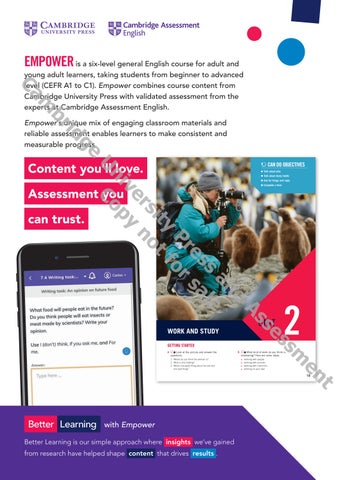
EMPOWER is a six-level general English course for adult and
m Ca
young adult learners, taking students from beginner to advanced level (CEFR A1 to C1). Empower combines course content from Cambridge University Press with validated assessment from the experts at Cambridge Assessment English.
br
ge
id
Empower’s unique mix of engaging classroom materials and reliable assessment enables learners to make consistent and measurable progress.
Content you’ll love.
U
CAN DO OBJECTIVES ■ Talk about jobs
ss se As d an s le es sa Pr r y fo it t rs no ve y ni p ■ Talk about study habits
■ Ask for things and reply ■ Complete a form
can trust.
Co
Assessment you
UNIT
WORK AND STUDY GETTING STARTED a
What kind of work do you think is interesting? Here are some ideas:
• • • •
working with people working with animals working with machines working on your own
en
1 Where do you think the woman is? 2 What is she holding? 3 What’s one good thing about her job and one bad thing?
b
m
Look at the picture and answer the questions.
2
19 19
t
with Empower Better Learning is our simple approach where insights we’ve gained from research have helped shape content that drives results .
Learner engagement Content that informs and motivates
1
Content
Results
Sustained motivation is key to successful language learning and skills development.
Clear learning goals, thoughtprovoking images, texts and speaking activities, plus video content to arouse curiosity.
Content that surprises, entertains and provokes an emotional response, helping teachers to deliver motivating and memorable lessons.
m Ca
Insights
br
UNIT 2
id
2A SHE LOVES HER JOB
G Present simple: positive and negative V Jobs
Look at the pictures. Answer the questions.
c Choose the correct answers. 1 2 3 4 5
Most people like / don’t like alligators. Gabby Scampone likes / doesn’t like alligators. Alligators like / don’t like people swimming near them. It is / is not dangerous to give alligators food. Gabby has one job / two jobs.
e
Talk about the questions.
1 Would you like Gabby’s job? Why / Why not? 2 What other unusual jobs do you know?
Co
GATOR GIRL Gabby Scampone with an alligator
b
c
7 8 9
dentist pilot engineer
c
d
cleaner photographer taxi driver
02.01 Pronunciation Listen to the words and underline the stressed syllable.
engineer
photographer
dentist
Complete the sentences with jobs from 2a. Talk about your answers. 1 2 3 4
d
A(n) A(n) A(n) The pay for a(n)
has a dangerous job. has an easy job. has an exciting job. isn’t very good.
Present simple: positive and negative
a
Gabby doesn’t always work at the park. She also has a second job: she catches wild alligators. If a wild alligator goes near a person’s house, Gabby and some other people catch it. They take the alligators back to the park. Her parents and friends think she’s crazy, but she really enjoys the job. Gabby thinks many people don’t understand alligators very well, but that alligators are smart and amazing animals. And so far she still has all of her fingers!
I / we / you / they
+ Tourists alligators. Her parents – They Alligators
she’s crazy.
too close to them. people.
always Gabby at the park.
two lists: positive and negative forms.
c
Now go to Grammar Focus 2A on p. 140.
d Underline the verbs in sentences 1–2.
4 SPEAKING
1 She loves her job. 2 She catches wild alligators.
e
Pronunciation Which verb in 3d has an extra syllable when we add the letter -s? Listen and check. 02.05
a Think about your job or the job of someone you know. Write four sentences about the job: two positive (+) and two negative (–). Use the verbs in the box.
f Underline the correct answers.
work drive have like study speak go start leave know
1 After the sounds /z/, /s/, /dʒ/ (spelled j), /ʃ/ (spelled sh) and /tʃ/ (spelled ch), we add / don’t add an extra syllable. 2 We add / don’t add an extra syllable after other sounds.
02.06 Listen to these verbs. Tick (✓) the verbs that have an extra syllable.
eats listens uses
teaches stops watches
Communication 2A Student A: Go to p. 130. Student B: Go to p. 133.
+ I start work at 7:00 in the morning. – I don’t drive to work.
b
Tell your partner your sentences. Can they guess the job?
c Tell other students about your partner’s job. Can they guess it?
She starts work at …
21
Zenaide Brianez, Director of Studies, Instituto da Língua Inglesa, Brazil
t
There are so many adjectives to describe such a wonderful series, but in my opinion it’s very reliable, practical and modern.
en
Personal responses make learning more memorable and inclusive, with all students participating in spontaneous spoken interaction.
i
m ss
Results
he / she / it
She at Everglades Holiday Park. She wild alligators.
to look at the
se
Content Personalisation tasks in every unit make the target language more meaningful to the individual learner.
h
b Underline more present simple verbs in the text in 1b. Make
h
Insights
g
Look at the sentences from 1b and complete them with the verbs from the box. Listen and check. 02.03
works finishes drives
Language learners benefit from frequent opportunities to personalise their responses.
f
catches come doesn’t don’t (x2) go attack think work works
g
2 Personalised and relevant
e
Now go to Vocabulary Focus 2A on p. 163 for more jobs vocabulary.
3 GRAMMAR
verglades Holiday Park is an animal park in the USA. It’s in Florida. It has birds, fish and … alligators! Many tourists visit the park every year. They come to look at the alligators. Most people think alligators are interesting, but they don’t really like them, and they don’t go too close to them! Gabby Scampone is different. She lives in Florida, and she works at the park. She loves her job – and she also loves alligators. In her work, she teaches visitors about alligators. She tells visitors that alligators are not always dangerous animals. Usually, alligators don’t attack people, but they don’t like it when people swim in the water near them. Also, if people give food to alligators, sometimes the alligators get too close, and that can be dangerous.
20
4 5 6
nurse shop assistant police officer
police officer
work is interesting.
E
b
a Match words 1–9 with pictures a–i.
d Read the article again. Find two reasons why Gabby’s
b Read the article and check your answers.
a
As d an s le es sa Pr r y fo it t rs no ve y ni p
U
1 Where is this woman? a in a park c by a river b at home 2 Do you think ... ? a she’s a tourist b she works here 3 What do you know about alligators?
2 VOCABULARY Jobs 1 2 3
ge
1 READING a
Learn to talk about jobs
10
EVIDENCE OF ACHIEVEMENT Measurable progress COMPETENCY TESTS
1
Assessment you can trust
How did students perform in the Competency Tests?
Insights
Content
Results
As this assessment measures improvement between the mid-course and end-of-course points, this improvement is in line with the learning goal of improving by a whole CEFR level across one whole level of the Empower course.
their performance between the mid-course and end-of-course skills-based competency tests.
End-of-unit tests, mid- and endTeachers can see learners’ of-course competency tests, and progress at a glance, and 10% of learners were on courses without Online personalised CEFR test report learners can see measurable Workbooks. These learners tended to have forms provide reliable informationlower mean gains,progress, which suggesting that the Online leads to Workbooks were contributing to learning gains. on progress with language skills. greater motivation.
m Ca
Tests developed and validated by Cambridge Assessment English, the world leaders in language assessment, to ensure they are accurate and meaningful.
The average learner tended to improve by ten points, which represents half of a CEFR band as measured by the Empower assessments.
id
br
All global Empower users
ge
100 90 80
U
70
As d an s le es sa Pr r y fo it t rs no ve y ni p
60 50 40
Co
Results of an impact study showing % improvement of Reading levels, based on global Empower students’ scores over one year.
30 20 10 0
A1
A2
B1
B1+
B2
C1
A1
A2
Listening
Mid-course test
B1
B1+
B2
C1
Reading
A1
A2
B1
B1+
B2
C1
Writing
End-of-course test
Average score for listening, reading, and writing in the mid-course test and end-of-course test. Based on global students’ scores from August 2016 to July 2017.
We started using the tests provided with Empower and our students started showing better results from this point until now.
se
Evidence of impact
t
2
en
m ss
Kristina Ivanova, Director of Foreign Language Training Centre, ITMO University, Saint Petersburg, Russia
Insights
Content
Results
Schools and colleges need to show that they are evaluating the effectiveness of their language programmes.
Empower (British English) impact studies have been carried out in various countries, including Russia, Brazil, Turkey and the UK, to provide evidence of positive impact and progress.
Colleges and universities have demonstrated a significant improvement in language level between the mid- and end-of-course tests, as well as a high level of teacher satisfaction with Empower.
Manageable learning 1
Mobile friendly Content
Results
Learners expect online content to be mobile friendly but also flexible and easy to use on any digital device.
Empower provides easy access to Cambridge One: Digital Workbook content that works on any device and includes practice activities with audio.
Cambridge One: Digital Workbook content is easy to access anywhere and produces meaningful and actionable data so teachers can track their students’ progress and adapt their lesson accordingly.
m Ca
Insights
ge
id
br
U Co
ss se As d an s le es sa Pr r y fo it t rs no ve y ni p
I had been studying English for ten years before university, and I didn’t succeed. But now with Empower I know my level of English has changed.
Nikita, Empower Student, ITMO University, Saint Petersburg, Russia
2
Corpus-informed Insights
Corpora can provide valuable information about the language items learners are able to learn successfully at each CEFR level.
m
Content
Results Learners are presented with the target language they are able to incorporate and use at the right point in their learning journey. They are not overwhelmed with unrealistic learning expectations.
t
en
Two powerful resources – Cambridge Corpus and English Profile – informed the development of the Empower course syllabus and the writing of the materials.
Rich in practice 1 Language in use
Content
Results
It is essential that learners are offered frequent and manageable opportunities to practise the language they have been focusing on.
Throughout the Empower Student’s Book, learners are offered a wide variety of practice activities, plenty of controlled practice and frequent opportunities for communicative spoken practice.
Meaningful practice makes new language more memorable and leads to more efficient progress in language acquisition.
m Ca
Insights
id
br
ge
2B
DO YOU WORRY ABOUT EXAMS?
CHAT
Ask and answer the questions.
match them with pictures a–c.
1 Do you have a break in the middle of your English lesson? 2 Do you have a timetable for your study routine? 3 Do you take notes when you read something
2
3
I think it helps to have a good study routine. I make a study timetable and that helps me to pass my exams. I always plan a lot of breaks and have a cup of tea and something small to eat. I don’t want to get tired when I study! But the breaks are only short – about five or ten minutes. Then I go back to studying hard for one or two hours. Good marks come from a lot of hard work!
e
asks Tania.
Does she study more before an exam?
02.07 Jack talks to Tania about her study habits. Listen and tick (✓) the things they talk about.
a
places to study hours of study
1 2
Look at the questions in 5b. How are they different? Why?
exams free time
3 4
02.07 Listen again. Complete the information about b Tania’s studies.
• When? • Where?
• Part-time or full-time student? • Hours a week?
e
Now go to Grammar Focus 2B on p. 140.
f
02.12 Put the questions in the correct order. Listen and check.
1 a week / do you study / hours / how many ? 2 study grammar / or vocabulary / do you ? 3 you / when / study / do ? 4 study / do / where / you ?
4 VOCABULARY Time
a Match the times that Tania talks about with the clocks. 1 Usually at half past eight … 2 … last night at a quarter past eleven.
REPLY
BOOKWORM8
d Read the question Jack
3 LISTENING
REPLY
CAT LOVER5
• Hours a week? • When? • Where?
Tania and Jack
REPLY
I agree – exams and tests are really, really hard. In my study breaks I play with my pet cat. Some people say that animals stop stress and relax people. I think it’s true, well, for me it is! Everybody needs a cat to help them study!
f
b
a
about studying.
g d
to past o’clock half
h
1 four
2
i
j
c
past four
3 (a) quarter
four
4 (a) quarter
five
b
Ask and answer your question in 6a.
c
Do you have any new ideas about studying now? Natalia studies very early in the morning because she isn’t very tired. I think it’s a good idea, but I prefer to sleep!
Now go to Vocabulary Focus 2B on p. 164 for more practice with time vocabulary.
m ss
Insights
23
se
2 Beyond the classroom
Progress with language learning often requires work outside of the classroom, and different teaching models require different approaches.
Empower is available with a print workbook, online practice and documentary-style videos that expose learners to real-world English, plus additional resources with extra ideas and fun activities.
Results This choice of additional resources helps teachers to find the most effective ways to motivate their students both inside and outside the classroom.
t
Content
en
Elena Pro, Teacher, EOI de San Fernando de Henares, Spain
02.12 Pronunciation Notice the pronunciation of do you in each question. Can you hear both words clearly?
6 SPEAKING
b Complete the sentences with the words in the box.
Ask and answer the questions in 2a.
There are plenty of opportunities for personalisation.
g
a Look at the questions in 5f. Write another question
3 notes 4 a test
22
Jack asks Tania about her daughter, Ellie. Listen and complete the information about Ellie’s studies. 02.10
c
Yeah, I hate tests. They’re really difficult and I can’t always remember everything. I need to study every day and take a lot of notes. It’s not easy, but it helps to listen to R&B music – really loud! It helps me think.
get good pass bad take fail
c
… you study engineering? … they like tests?
Co
1–7. Match them with pictures d–j below.
1 an exam 2 marks
b Complete the questions with one word.
SOUL BOY2
a Look at the underlined words in questions
1–4. You can use some of the words more than once.
Archives
Hi guys! I have a big exam on Friday. It’s really hard to study. I read my study notes for an hour and then I watch really bad TV programmes! What about you? Do you worry about exams? MIMI23 What are your study habits?
1
b Match the words in the box with
Articles
Exam stress!
1 Which study habits are ... ? • funny • useful 2 Put the study habits in the order you want to try them from 1 (really want to try) to 3 (don’t want
in English? 4 Do you get good marks in English tests? 5 How many weeks is a term at your school? 6 Do you have an exam at the end of the year? 7 Do you and your friends enjoy your studies?
Forums
b
a
Read the comments again and answer the questions with a partner.
2 VOCABULARY Studying
1 You study full-time or part-time? 2 Do you study full-time or part-time? 3 Study you full-time or part-time?
c
b Read comments 1–3 in the online chat and
to try).
Home
02.09 Look at the questions. Which is correct? Listen and check.
a
V Studying; Time
As d an s le es sa Pr r y fo it t rs no ve y ni p
1 Are you good at exams? 2 Do you worry about exams and tests? 3 Do you study a lot for an exam or test?
c
G Present simple: questions and short answers
U
1 READING a
UNIT 2 5 GRAMMAR Present simple: questions
Learn to talk about study habits
Unit overview Unit Opener Getting started page – Clear learning objectives to give an immediate sense of purpose.
m Ca
Cambridge One: Digital Workbook (online, mobile): Grammar and Vocabulary
Lessons A and B
id
br
Grammar and Vocabulary – Input and practice of core grammar and vocabulary, plus a mix of skills.
Cambridge One: Digital Workbook (online, mobile): Listening and Speaking
ge
Lesson C
As d an s le es sa Pr r y fo it t rs no ve y ni p
U
Everyday English – Functional language in common, everyday situations.
Unit Progress Test
Co
Lesson D
Integrated Skills – Practice of all four skills, with a special emphasis on writing.
Cambridge One: Digital Workbook (online, mobile): Reading and Writing
Review
Extra practice of grammar, vocabulary and pronunciation. Also a ‘Review your progress’ section for students to reflect on the unit.
Mid- / End-of-course test
Cambridge One: Digital Workbook (online, mobile)
en
Workbook (print)
m ss
Further practice is available for outside of the class with these components.
se
Additional practice
t
Components Resources – Available on cambridgeone.org • Audio • Video • Unit Progress Tests (print) • Unit Progress Tests (online)
• Mid- and end-of-course assessment (print) • Mid- and end-of-course assessment (online)
• Cambridge One: Digital Workbook (online) • Photocopiable Grammar, Vocabulary and Pronunciation worksheets
CONTENTS Lesson and objective
Grammar
Vocabulary
Welcome!
Possessive adjectives; Question words; a / an; Regular plural forms
Numbers; The alphabet; Noticing word stress Colours; Classroom objects and instructions
Unit 1 People Getting started Talk about meeting people from other countries 1A Talk about where you’re from be: positive and negative
m Ca 1B
Talk about people you know
1C
Ask for and give information
1D
Write an online profile
be: questions and short answers
br
ge
id
Review and extension More practice Unit 2 Work and study Getting started Talk about what kind of work you find interesting 2A Talk about jobs Present simple: positive and negative 2B Talk about study habits Present simple: questions and short answers 2C Ask for things and reply
Co
Review and extension More practice Unit 3 Daily life Getting started Talk about what you do every day 3A Talk about routines Position of adverbs of frequency 3B Talk about technology in your life have got 3C
Make arrangements
3D
Write an informal invitation
Syllables and word stress Sound and spelling: /k/; Sound and spelling: long and short o Intonation for checking; Consonant clusters
Jobs Studying; Time
Word stress; -s endings do you Sound and spelling: ou
Asking for things and replying
WORDPOWER work
Time expressions; Common verbs Technology
Sentence stress; Sound and spelling: /aɪ/ and /eɪ/ Word stress; Main stress and intonation Main stress; Thinking about what you want to say
Review and extension More practice WORDPOWER Prepositions of time Unit 4 Food Getting started Talk about eating with your family 4A Talk about the food you want Countable and uncountable Food Sound and spelling: ea; nouns; a / an, some, any Sound and spelling: /k/ and /g/ 4B Talk about the food you eat Quantifiers: much, many, Cooking every day a lot (of) 4C Arrive at and order a meal in a Word groups restaurant 4D
Write a blog post about something you know how to do Review and extension More practice Unit 5 Places Getting started Talk about what a good home is 5A Talk about towns there is / there are
Places in a city
5B
Furniture
WORDPOWER like
there’s; Sound and spelling: /b/ and /p/ Sound and spelling: vowels before r Sentence stress
Family; Years and dates Past simple: irregular verbs
Write a life story
Review and extension More practice
2
t
6D
WORDPOWER Prepositions of place
Asking for and giving directions
en
5D
Write a description of your neighbourhood Review and extension More practice Unit 6 Family Getting started Talk about a family you know 6A Talk about your family and your Past simple: be family history 6B Talk about past activities and Past simple: positive hobbies 6C Leave a voicemail message and ask for someone on the phone
Arriving at a restaurant; Ordering a meal in a restaurant
m ss
Possessive pronouns and possessive ’s
Making arrangements
se
5C
Describe rooms and furniture in your home Ask for and give directions
Asking for and giving information
As d an s le es sa Pr r y fo it t rs no ve y ni p
Complete a form
Everyday English Saying hello and introducing people; Spelling words
WORDPOWER from
U
2D
Countries and nationalities Adjectives
Pronunciation
WORDPOWER go
Sound and spelling: /ʌ/; Sentence stress -ed endings; Sound and spelling: ea Sound and spelling: a
Leaving a voicemail message
Contents
Listening
Reading
Writing
Saying hello and introducing people
Names and addresses
A conversation about where you’re from
Where you’re from
Sentences about you
People you know
Notes about people you know
m Ca
Speaking
Five conversations
A conversation about people you know At the gym reception
Social media posts about people you know
First day of an English class
Online profiles
Asking for and giving information; Checking understanding Using social media
id
br An article about Gabby Scampone Jobs
ge
A survey about study habits
An online forum about study habits
Three conversations about gadgets
Co
A conversation about family routines
Making arrangements to go out
An article about an unusual workplace An interview about using the Internet
A monologue about someone’s family
Two informal emails
A conversation about buying food
An article about world markets
A conversation about cooking
A factfile about Albert Adrià; Two personal emails
At a restaurant Four monologues about cooking
A cooking blog
Questions about study habits
Unit Progress Test A form; Spelling
Daily routines; Spending time with your family; Routines you share with others Technology in your life Making arrangements; Thinking about what you want to say Plan a party
Buying food; The food you like and don’t like Cooking programmes; Cooking; The food you eat Arriving at a restaurant; Ordering a meal in a restaurant; Changing what you say Cooking; A good cook you know; Cooking for others
A dialogue; Notes about routines you share with other people Sentences about gadgets you’ve got; Questions about gadgets you’ve got
Unit Progress Test
An informal email invitation; Inviting and replying
Questions about food
Unit Progress Test
A blog post about something you know how to do; Making the order clear
Questions and sentences about what there is in a town Sentences about your home
A website about neighbourhoods around the world
Giving and following directions; Checking what other people say What makes a good neighbourhood; Your neighbourhood
A description of your neighbourhood; Linking ideas with and, but and so
Your family
Notes about your family
Steve Jobs; What you did at different times; A childhood hobby Leaving a voicemail message; Asking for someone on the phone; Asking someone to wait Important years in your life
Notes about a childhood hobby
m ss
An advertisement
Places you like; Describing a picture of a town; What there is in a town Your home and furniture
On the street
Unit Progress Test
t
en
Three monologues about neighbourhoods
Sentences about jobs
se
An article about an unusual town A conversation about a new home
An online profile; Capital letters and punctuation
As d an s le es sa Pr r y fo it t rs no ve y ni p
U
Ordering in a café; Asking for help Three monologues about studying A competition entry form English; A teacher addressing her class
Studying; Study habits Asking for things and replying; Reacting to news Studying English
Unit Progress Test
A conversation about a family tree A conversation about childhood hobbies On the phone
An article about Steve Jobs
A monologue about someone’s life story
A life story
Unit Progress Test A life story about someone in your family; Linking ideas in the past
3
Lesson and objective
Grammar
Unit 7 Trips Getting started Talk about where you’d like to travel to 7A Talk about past trips Past simple: negative and questions 7B Talk about what you like and dislike love / like / don’t mind / about transport hate + verb + -ing 7C
Say excuse me and I’m sorry
7D
Write an email about yourself
Vocabulary
Pronunciation
Everyday English
Transport
did you; Sound and spelling: /ɔː/ Transport adjectives Word stress Intonation for saying excuse me; Emphasising what we say
m Ca
WORDPOWER get
Sport and exercise
Can, can’t, could and couldn’t; Sound and spelling: /uː/ and /ʊ/
8B
Talk about the body and getting fit
Parts of the body; Appearance
8C
Talk about health and how you feel
have to; Word stress Joining words
8D
Write an article
have to / don’t have to
ge
id
br
Review and extension More practice Unit 8 Fit and healthy Getting started Talk about sport and exercise 8A Talk about past and present abilities; can / can’t, could / Talk about sport and exercise couldn’t for ability
Shop for clothes
9D
Write a thank-you email
WORDPOWER tell / say
Shopping; Money and prices Clothes
Co
9C
Review and extension More practice Unit 10 Communication Getting started Talk about how you use your smartphone 10A Compare and talk about things Comparative adjectives you have 10B Talk about languages Superlative adjectives 10C Ask for help 10D Write a post expressing an opinion
Talking about health and how you feel
As d an s le es sa Pr r y fo it t rs no ve y ni p
U
Review and extension More practice Unit 9 Clothes and shopping Getting started Talk about shopping in your town or city 9A Say where you are and what Present continuous you’re doing 9B Talk about the clothes you wear Present simple or present at different times continuous
Saying excuse me and I’m sorry
Word stress in compound nouns; Sentence stress Sound and spelling: o; Syllables Joining words
WORDPOWER time
IT collocations
Sentence stress
High numbers
Word stress; Main stress Main stress and intonation
Sentence stress; Sound and spelling: /ɜː/
11B Talk about events you’ve been to
Syllables
Music
Main stress and intonation
11D Write a review
Geography
12B Give advice about travelling
should / shouldn’t
Travel collocations
12C Use language for travel and tourism
Syllables and word stress; Sentence stress should / shouldn’t Intonation for showing surprise; Consonant clusters
t
be going to
WORDPOWER Multi-word verbs
en
Review and extension More practice Unit 12 Travel Getting started Talk about photographs 12A Talk about holiday plans
Asking for and expressing opinions
m ss
11C Ask for and express opinions about things you’ve seen
Asking for help
se
Review and extension More practice WORDPOWER most Unit 11 Entertainment Getting started Talk about films and TV programmes you enjoyed when you were a child 11A Ask and answer about Present perfect Irregular past entertainment experiences participles Present perfect or past simple
Choosing clothes; Paying for clothes
Checking in at a hotel; Asking for tourist information
12D Write an email with travel advice Review and extension More practice Phonemic symbols and Irregular verbs p. 129
4
WORDPOWER take Communication Plus p. 130
Grammar Focus p. 138
Vocabulary Focus p. 162
Contents Listening
Reading
Speaking
Writing
A conversation about travelling
Three stories about holidays
A trip around your country
Notes about a trip around your country
A conversation about transport in Moscow
A webpage about city transport around the world; Four reviews of transport systems
Metros and express buses you know; Disagreeing about transport; Transport you use Saying excuse me and I’m sorry; Showing interest Homestay families; English-speaking countries you’d like to visit
Notes about transport
Famous sporting events and people; Running and exercise; Present and past abilities Getting fit; The things people have to do; Yoga; Parts of the body Health and how you feel; Expressing sympathy Free-time activities in your country; Your free-time activities
Sentences about present and past abilities
On the train Two online profiles; An email from Ahmed
A podcast about training for a marathon
An article about Paralympian Jonnie Peacock
Two monologues about exercise
An article about High Intensity Interval Training
m Ca
A conversation about choosing a homestay family
ge
id
br
At the gym
A conversation about a free-time activity
An email about a company blog; A blog article about a free-time activity
Unit Progress Test An email about yourself; Linking ideas with after, when and while
Sentences and notes about what people have to do
Unit Progress Test An article; Linking ideas with however; Adverbs of manner
As d an s le es sa Pr r y fo it t rs no ve y ni p
U Co
Four phone conversations about meeting Two phone conversations about what Two posts about living abroad; people are wearing Text messages about what people are doing Shopping for clothes Four monologues about giving presents
Two thank-you emails
A conversation about phones
An online discussion about headphones and earbuds A blog about languages
A radio programme about languages Asking for help
Four text messages; Six posts on an online discussion board
A conversation about a magazine quiz
Three fact files about actors; A magazine quiz about actors; An article about actors An article about Budapest
Two conversations about holidays
A web page about holidays
Two monologues about things people An article about living in a like when travelling different country A prize holiday A conversation about a planned holiday
An email with travel advice; An email asking for travel advice
A thank-you email; Writing formal and informal emails
Notes about two similar things
Unit Progress Test
A post expressing an opinion; Linking ideas with also, too and as well
Questions about films, TV programmes and books
Budapest; Kinds of music; Notes about entertainment events in your Entertainment events in your town or city town or city Going out in the evening; Unit Progress Test Asking for and expressing opinions; Responding to an opinion Films A film review; Structuring a review
Natural places; Important things when on holiday; Holiday plans Living in a different country; Travelling and holidays; Giving advice about travelling Checking in at a hotel; Asking for tourist information; Showing surprise Planning holidays; Porto
t
Three film reviews
Popular films, TV programmes and books
Unit Progress Test
en
A conversation about a film
Headphones and earbuds; Phones; Comparing two similar things Languages; Blogs and language websites; High numbers Asking for help; Checking instructions Sending messages; Social media posts
Notes about what someone you know is wearing
m ss
A conversation about music in Budapest A night out
Choosing clothes; Paying for clothes; Saying something nice The presents you like to get; Giving presents and thanking people for them
Sentences about what you are doing
se
Three monologues about text messages
Meeting friends in town; Saying where you are and what you’re doing Shopping; Festivals in your country; Clothes
Unit Progress Test An email with travel advice; Paragraph writing
5
G Possessive adjectives; Question words; a /an; Regular plural forms
WELCOME!
V Numbers; The alphabet; Colours; Classroom objects and instructions
a
c
b
m Ca ge
id
br 1 FIRST CONVERSATIONS
Listen to five short conversations. Match them with
pictures a–e.
As d an s le es sa Pr r y fo it t rs no ve y ni p
00.02–00.06
U
a
d
Co
b 00.02–00.06 Listen again. Who says these sentences? Match them with pictures a–e. 1 b Nice to meet you.
2 3 4 5 6
How are you? What’s your name and address? How do you spell that? Can we pay, please? Is that your flat?
2 SAYING HELLO
a Read Conversation 1. Put the sentences in the correct order. Hello. Nice to meet you. I’m Pierre. Hello, Pierre. Nice to meet you. Hello. I’m Tony, and this is my wife, Joanna. 00.02
b
Listen and check your answer.
In pairs, say hello and say your name.
d 00.03 Read Conversation 2 and complete the sentences. Listen and check your answers.
Listen to Conversation 3. Complete the bill. 00.04
How much do they pay? €
NO.
COFFEE
(2)
€
ICE CREAM (2)
€
Total
b 00.07 Listen and circle the numbers you hear. Then say all the numbers.
13 15 16 17 12
e
c Choose the correct answer. are you? , thanks. And you? .
Meet other students. Have a conversation with two or three people in the class.
25 = twenty and five / twenty-five 61 = sixty-one / one and sixty 110 = a hundred ten / a hundred and ten
d Read the numbers aloud. Then say the next three numbers. 1, 2, 3, 4, … 10, 20, 30, … 15, 25, 35, …
6
31, 33, 35, … 50, 100, 150, …
t
A Hi, Nick. 1 B I’m 2 A I’m OK, 3
how
en
thanks
€
THANK YOU
30 50 60 70 20 fine
PRICE
m ss
In groups of four, say hello. Say your name and introduce your partner.
a
ITEM
se
c
3 NUMBERS
Welcome!
e
d Say these colours and spell the words.
m Ca
e
Write two words you know in English. Say the word and ask your partner to spell it.
f 00.05 Listen to Conversation 4 and complete the
br
name and address.
id
Contacts Edit
ge
Mike K King’s Road A
Work in pairs. Student A, tell Student B: • your first and last name • your address
Co
As d an s le es sa Pr r y fo it t rs no ve y ni p
U
g
Student B, ask Student A to spell their name and address. Write the information down. Then swap roles. How do you spell your … ?
5 POSSESSIVE ADJECTIVES
a 00.06 Read and listen to Conversation 5. Underline the correct answer.
4 THE ALPHABET
a 00.08 Listen to the letters of the alphabet and say them.
A This is a nice photo. This is my / your wife and his / her brother. B Oh, yes. Is that our / your flat? A Yes, that’s our / their flat in London. B Mmm, it’s very nice.
b Complete the table.
Test a partner. Student A, point to a letter. Student B, say the letter.
This is my flat.
Do you live here?
Is this your flat?
He lives here.
This is
flat.
She lives here.
This is
flat.
We live here.
This is
flat.
They live here.
This is
flat.
t
c
I live here.
en
1 the same long sound as see /iː/ 2 the same long sound as day /eɪ/ 3 the same short sound as egg /e/
m ss
b Pronunciation Which letters have … ?
se
our their her his
c Complete the sentences with a word from the table in 5b. 1 2 3 4
This is my brother. name is George. Jenny and Phil are old friends, and that’s car. That’s a good photo of you. And is that daughter? In this photo, we’re on holiday with friends Sue and Bill. 5 I know that girl in the photo. What’s name?
7
a
6 CLASSROOM OBJECTS b c
d
m Ca
e
id
br f
ge
g
h i
U
j
As d an s le es sa Pr r y fo it t rs no ve y ni p
Co
a Match objects 1–10 with a–j in the picture. 1 2 3 4 5
b
a notebook a dictionary a projector a question a pen
f Look at how words change in the plural. Complete the rules.
6 a cupboard 7 a desk 8 a whiteboard 9 an answer 10 a coursebook
00.09 Pronunciation Notice the stressed syllable in the words in 6a. Listen, then practise saying the words.
Singular ➔ Plural
Rule
a pen ➔ pens
Most words add
a baby ➔ babies
Change a final -y to .
a glass ➔ glasses
If a word ends in -s, -x, -sh or -ch, we add .
c When do we usually use an? Choose the correct answer. a before a, e, i, o, u
b before other letters
d Write a or an next to each word. 2
7 CLASSROOM INSTRUCTIONS
a
3
00.10 Listen and follow the instructions you hear. Then listen again. Which verbs do you hear each time?
open close
4
apple 5
egg
baby
8
box
ice cream
ask questions to guess the word.
8
No.
1 2 3 4 5
work
Underline the correct words. Listen and check.
What’s / Who’s this? An apple or an orange? When’s / Where’s Tokyo? How / What do you say this word? Who’s / When’s the president? When’s / What’s your English lesson?
c Match questions 1–4 with answers a–d.
e Choose one of the words from 6a or 6d. Other students Is it big?
00.11
ask
t
7
6
b
read turn to write
en
glass
camera
look at
m ss
book
and add
se
1
in the plural.
Is it white?
1 2 3 4
What’s ‘amigo’ in English? How do you spell ‘night’? What’s a ‘ferry’? How do you say this word?
a It’s a boat for cars and people. b ‘Pee-pl’. c Friend. d N-I-G-H-T.
d Write a question like questions 1–4 in 7c. Then ask No.
other students your question.
CAN DO OBJECTIVES ■ Talk about where you’re from ■ Talk about people you know ■ Ask for and give information ■ Write an online profile
m Ca ge
id
br Co
As d an s le es sa Pr r y fo it t rs no ve y ni p
U
1
GETTING STARTED a
Look at the picture and answer the questions. 1 What different countries are the people from? 2 Why are they together? • for a sports game • for a party • for a music concert 3 How do they feel? Here are some ideas: a bored c good e sad b excited d happy f tired
b
t
en
PEOPLE
m ss
se
UNIT
When do you meet people from other countries? Here are some more ideas: • • • • •
on holiday on a language course never at work at parties
99
1A
I’M FROM FRANCE
1 LISTENING AND READING Look at pictures a–f and answer the questions.
m Ca
a
01.01 Listen and check. Practise saying the countries.
Thomas and Lena are at the World Cup. Listen and tick (✓) the three things they talk about. 01.02
4 5
a city TV
Co
football countries food
G be: positive and negative V Countries and nationalities
d
01.02
Listen again. Complete the conversation.
THOMAS Hi there! My name’s Thomas. What’s your 1 ? LENA I’m Lena. THOMAS Hi, Lena! Where are you 2 ? Russia? LENA Yeah, you’re right! I’m Russian. I’m from St Petersburg. THOMAS Oh, yes! It’s a really beautiful city. LENA Yes, I think so too. So, 3 are you from, Thomas? THOMAS Me? I’m from 4 . I’m French. LENA Oh, the French team’s really good! THOMAS Of course! We’re 5 !
e Are sentences 1–4 true (T ) or false (F )? Correct the false sentences. 1 2 3 4
Thomas and Lena are friends. Lena is from Russia. Thomas likes St Petersburg. Lena says the football team from France is very bad.
As d an s le es sa Pr r y fo it t rs no ve y ni p
U
1 2 3
a
ge
c
id
br
1 What sport do all the people like? 2 Match countries 1–6 with pictures a–f. 1 4 Brazil Japan 2 5 Spain Russia 3 6 Germany France
b
Learn to talk about where you’re from
f Underline the two nationalities in the conversation in 1d.
b
e
t
en
m ss
se
d
10
UNIT 1 2 VOCABULARY
3 GRAMMAR
a Thomas says:
a
Countries and nationalities
be: positive and negative
I’m from France. I’m French. 01.03 Find other pairs of countries and nationalities in the box below. Listen and check.
m Ca
Ru | ssia Bra | zil | i | an Spa | nish Ja | pan Ru | ssian Ger | many Ja | pan | ese Ger | man Bra | zil Spain
b
the rule.
d Make sentences about the people below with the
U
words in 2a.
1 Lena: She’s Russian . She’s from 2 The people in pictures a–f: They’re They’re from .
As d an s le es sa Pr r y fo it t rs no ve y ni p
c
. .
To make am, is and are negative, we add We often use contractions for the verb: it is not = it isn’t they are not = they aren’t I am not = I’m not
Look at the conversation in 1d again. Complete the question. Then ask your partner. are you from?
f
1 It’s a town near Paris. It isn’t very big. 2 They’re all in the hotel. They aren’t here. 3 I’m from France. I’m not from Paris.
Co
e
Thomas is / isn’t from Paris. Lena’s friends are / aren’t Russian. Her friends are / aren’t at the match. It’s / It isn’t 8:00.
c Look at the pairs of sentences and complete
Listen again and repeat.
ge
01.03
01.06 Underline the correct answers. Listen again and check.
1 2 3 4
Pronunciation Notice how many syllables each word has. Underline the stressed syllable in each word in the box in 2a. 01.03
id
c
a their football teams b the town where Thomas is from
br
b
01.06 Listen to the next part of the conversation between Thomas and Lena. What do they talk about?
I’m from I’m
.
The match isn’t on yet. Her friends aren’t at the match.
.
.
d Complete the table with the correct forms of the verb be.
Positive (+)
Now go to Vocabulary Focus 1A on p. 162 for more countries and nationalities.
Negative (–)
I I’m from St Petersburg. He a really good player. She They say they They tired.
e
French. from Moscow. at the match.
Now go to Grammar Focus 1A on p. 138.
f Thomas and Lena talk more in the café. Add the verb be to make correct sentences.
3 Russia not very hot in April. 4 My friends really interesting and fun.
m ss
Lena says:
se
Thomas says: 1 My brother at university in Madrid. 2 My mother and father not here.
g Write two positive and two negative sentences
about you with the verb be. Make two of them false.
4 SPEAKING a
Communication 1A Student A: Go to p. 130. Student B: Go to p. 133.
b
Work in small groups. Tell other students:
t
f
Read your sentences to a partner and say if your partner’s sentences are true or false.
en
h
• your name • your home town • your country and nationality
11
1B
SHE’S A LOVELY PERSON
Learn to talk about people you know G be: questions and short answers V Adjectives
1 READING Look at pictures a–d. Where do you think the people are?
m Ca
a
c Who do you think says sentences 1–4? 1 2 3 4
b Read the texts and match them with
br
pictures a–d. Are your ideas in 1a correct?
d
‘I have four classes every day.’ ‘It’s fun to travel with friends.’ ‘My family members live in different places.’ ‘She speaks two languages – Spanish and Portuguese.’
Who would you like to meet: Suzi, James, Alex or Saddah? Why?
ge
id b
Co
As d an s le es sa Pr r y fo it t rs no ve y ni p
U
a
c
Suzi
This is me in Rio de Janeiro with my friend Claudia. She lives in Brazil, but she’s from Spain. She’s a lovely person – very warm and kind. view Suzi’s photos
se
James
leave Suzi a message
leave James a message
In this photo I’m on holiday with my friend Tom. He’s a fantastic friend and he’s very cool. He’s a great person to be on holiday with. view Alex’s photos
leave Alex a message
Saddah This is my colleague Maram. We’re teachers and we work together in a school. She’s quiet, but she’s really friendly. She’s also very popular with her students. view Saddah’s photos
12
leave Saddah a message
t
Alex d
en
view James’s photos
m ss
In this photo I’m chatting with my cousin, Eric. He lives in Sydney. He’s Australian, but I’m from England – Eric’s mother and my father are brother and sister. Eric is a really pleasant guy and he’s a brilliant doctor. He’s well known in his part of Sydney.
UNIT 1 2 VOCABULARY
4 GRAMMAR be: questions and short answers
Adjectives
a
a Look at the sentence. The underlined
01.13 Complete the answers with the words in the box. Listen and check.
words are adjectives. Are they about Rio de Janeiro or Claudia?
aren’t
She’s a lovely person – very warm and kind.
1 2 3 4
m Ca
b Underline nine more adjectives in the texts. Then put them in the correct blanks. 1 very good:
,
,
, 2 nice: lovely, warm, kind
br
id
Are you Australian? you Brazilian? he/she Turkish? they Italian?
ge
c d
Co
cold car cheap kitchen like coffee quick back key know come make school cat
e
Yes, I am . Yes, we are. Yes, he/she Yes, they
. .
No, I’m not. No, we aren’t. No, he/she . No, they .
Now go to Grammar Focus 1B on p. 138.
My aunt Sophia’s fantastic – she’s a very warm and friendly woman.
b
01.12 Listen again. Complete the profiles with adjectives 4–6.
very
just good friends.
5 SPEAKING
a Write down words about friends, family and famous people you
know from other countries. Camilla – British, cool, popular Gabriel – Mexican, quiet, kind
b
Talk about the people you know. Look at the conversations in 4d to help you.
t
en
Name Roman Nationality 1 Personality 4
m ss
01.12 Listen to the conversations. Complete the nationalities (1–3) on the profiles below.
American. They 6
se
a
01.15 Complete the conversations. Use contractions ’s, ’re and isn’t if possible. Listen and check. A My friend Tony 1 ’s English. He 2 very kind.
A My friends, Joe and Mel, 5 warm and friendly. B 7 they married? A No, they 8 . They 9
My best friend Joe’s a cool guy.
Now go to Vocabulary Focus 1B on p. 163 for more adjectives.
3 LISTENING
Short answers
B 3 he from London? A Yes, he 4 .
Talk about people you know. Use adjectives from 2b. My friend Emma’s very friendly and very popular.
. She’s from Spain. . . . They’re from Mexico.
No, she Yes, he Yes, they No, they
As d an s le es sa Pr r y fo it t rs no ve y ni p
U
Underline the /k/ sound in these words. Which two words do not have /k/?
d
Is she Italian? Is he from Poland? Are they married? Are they Spanish?
Questions (?)
c Pronunciation Three words in the texts have kind cool quiet
are
b Complete the table with the correct forms of the verb be.
,
3 famous: 4 he/she doesn’t talk much: 5 people like him/her:
the /k/ sound:
isn’t is
Names Diego and Mia Nationality 2 Personality 5
Name Laura Nationality 3 Personality 6
13
1 C
Learn to write an email with travel advice to ask forwriting and give information W LearnParagraph
EVERYDAY ENGLISH
S Checking understanding
What’s your surname?
P Consonant clusters
1 LISTENING
m Ca a b
01.16
Watch or listen to Part 1. Choose the correct answer.
br
a finish something a do an exercise class a in the office
b do some exercise. b go for a run. b at the gym.
01.17 Watch or listen to Part 2 again. Are the sentences true (T ) or false (F )? Correct the false sentences.
1 The class starts at 7:20. 2 Ten people can go to the fitness class. 3 The class is in Studio 2.
ge
id
1 Dan wants to: 2 Leo wants to: 3 Martina is:
c
d
Look at the pictures of Dan and Leo. Use personality adjectives from p. 12 to describe them.
Leo talks to the gym receptionist. Watch or listen to Part 2. What does Leo want to do? Choose the correct answer. 01.17
U
Co
As d an s le es sa Pr r y fo it t rs no ve y ni p
a join the gym b book a fitness class c pay for a fitness class.
2 USEFUL LANGUAGE
Leo
d
Asking for and giving information
a Who says sentences 1–7 at a gym: the receptionist (R) or a visitor (V)? 1 2 3 4 5 6 7
b
What time’s the next class? And what’s your address? How can I help? Thanks for your help. Can you spell that, please? And where’s the class? What’s your surname? 01.18
a b c d e f g
Match 1–7 with a–g. Listen and check.
c Underline the correct answers.
e
Hello. How can I 1 you? I’d 2 to do a computer course. No problem. When’s the first lesson? It’s tomorrow at eight o’clock. And 3 the lesson? It’s here in Room 5. Great. Can I book a place? Certainly. 4 your surname? Moore. Can you 5 that, please? M–O–O–R–E. Thank you. Enjoy the class.
In pairs, practise the conversation in 2d. Use your own surname. Take turns being A and B.
t
en
m ss
se
1 It’s in ten past four / Room 6. 2 It’s at eight o’clock / Studio 4.
01.19 A is a receptionist and B wants information. Complete the conversation. Look at 2a and 2b to help you. Listen and check.
A B A B A B A B A B A B A
Seymour. You’re welcome. S–E–Y–M–O–U–R. It’s at twenty past seven. It’s in Studio 1. I’d like to do a fitness class. 18 New Street.
Dan
14
UNIT 1
m Ca ge
id
br 5 PRONUNCIATION
Consonant clusters
Watch or listen to Part 3. Leo talks to Martina at the gym. Answer the questions. 01.20
Co
a
As d an s le es sa Pr r y fo it t rs no ve y ni p
U 3 LISTENING
a
1 Who is Martina? 2 What does she say about Dan? a He’s very busy. b He’s a bit lazy.
b
eight o’clock /t/ /kl/ /k/
What is a good time to go to the gym? • before work / school • after work / school
b
• at lunchtime • never
01.23 Listen to the words below. How many consonant sounds do the letters in bold have?
three six eighty
4 CONVERSATION SKILLS
c
Checking understanding
a Complete the mini-conversations with the words in the box. so that’s sorry
01.22 Listen to the time. Notice how the consonant clusters in bold are pronounced.
1 seven o’clock (7:00) 4 three forty (3:40) 2 six ten (6:10) 5 six thirty (6:30) 6 twelve twenty (12:20) 3 eight twenty (8:20)
6 SPEAKING
ommunication 1C Student A: Go to C p. 131. Student B: Go to p. 133.
en
b Which expression in 4a means:
m ss
a
SONIA It’s in Studio 1. 2 LEO 7:20 in Studio 1?
se
SONIA It’s at twenty past seven. 1 ? LEO SONIA 7:20.
01.24 Practise saying these times. Listen and repeat.
1 I’m not sure and I want to check. 2 I don’t understand. Can you say that again?
Pronunciation Listen to what Leo says in 4a. Does the intonation go up or down on 1 and 2?
d
Work in pairs. Use the dialogue map to practise checking understanding. Take turns being A and B.
t
c
01.21
A
B
UNIT PROGRESS TEST CHECK YOUR PROGRESS You can now do the Unit Progress Test.
15
1D
SKILLS FOR WRITING
Learn to write an online profile
I’m Carla and I’m from Italy
W Capital letters and punctuation
1 SPEAKING AND LISTENING a
KATE MARKS
m Ca
Ask and answer the questions.
Teacher, International College
1 Do you use social media? 2 Do you have an online profile? 3 Which of the following information is on it?
Lives in London, UK
• where you live • your job • things you like
About Kate
id
br
• your name • your age • your nationality
Age: -
Friends: 132
VIEW
Photos
VIEW
ge
b Look at Kate and Carla’s profiles and complete the table with yes (✓), no (✗) or don’t know (DK).
Kate
DK
Carla
✓
from London
Italian
a teacher
CARLA DI MAMBRO
a student
Student,
University of Milan
As d an s le es sa Pr r y fo it t rs no ve y ni p
20 years old
U
Age: 20 Lives in Milan
Co
c
She’s …
From Varese, Italy
The people in the picture are on an English course. Listen and answer the questions. 01.25
About Carla
1 Is this the first or the last day of the course? 2 What city are they in?
d
01.25
Listen again. Complete the table.
Name
Country
Kate and Mike
UK
Carla
Italy
Masato Carmen Orhan Marisa
e
One other thing we know
They’re
.
She’s a
.
English is
She’s a
for his work.
of IT.
His
is in London.
Her
is in London.
Friends: 189
VIEW
Photos
VIEW
Work in groups of five or six. It’s your first day at International College. Student A: You’re the teacher. The others: You’re one of the students in the picture. Say who you are and add one more thing. I’m Masato. My home town is Kyoto.
t
en
m ss
se
16
UNIT 1 2 READING a Read Kate and Carla’s profiles for the new course. Underline any new information.
m Ca
I’m Carla Di Mambro. I’m Italian. I’m from Varese, but I study marketing at the University of Milan. It’s my first time in London and I’m very happy to be here. Are other people new to London? I like running, swimming and yoga.
I like languages, music and films.
id
br
I’m Kate Marks. I’m from Wigan. It’s a small town near Manchester in England. I live in London and I’m a teacher at International College. I’m married and I have two small children: a boy and a girl.
< Back
ge
< Back
Capital letters and punctuation
1 2 3 4 5 6 7 8 9
Co
a Look at the profiles in 2a. Tick (✓) the words that have capital letters.
4 WRITING
As d an s le es sa Pr r y fo it t rs no ve y ni p
U
3 WRITING SKILLS
first names of people last names of people names of companies, schools, universities names of countries and nationalities names of sports names of towns or cities all nouns all words at the start of a sentence the word I
a Write a profile about yourself. Use the profiles in 2a to help you. Give this information: • • • • •
your name your nationality your home town your job what you like
b Swap profiles with another student and check the capital letters and punctuation.
Update Your Profile
b I’m = I am. What are the full forms of these contractions? 1 it’s 2 she’s 3 you’re
I’m
4 isn’t 5 aren’t
c Correct the words. Add an apostrophe (’) to each word.
Upload File Take a Photo
I like
d Look at the commas (,) and full stops (.) in the online profiles. Which do we use … ?
t
en
a at the end of a sentence b after words in a list
m ss
4 hes 5 were 6 theyre
se
1 Im 2 arent 3 isnt
Add Photo
e Correct the sentences. Add capital letters and punctuation (. , ’ ?).
i live in paris its amazing ➔ I live in Paris. It’s amazing. 1 im from shanghai its a big city in china 2 i like basketball old cars and jazz 3 im a french teacher in australia 4 this isnt my first time in london 5 are all the teachers from britain
Save
17
UNIT 1
3 WORDPOWER from
Review and extension
a Match sentences 1–4 with pictures a–d. 1 2 3 4
1 VOCABULARY
m Ca
a Complete the sentences with the correct nationality word. Vera’s from Rio de Janeiro. She’s Pedro’s from Madrid. He’s . Kurt and Erika are from Berlin. They’re Ellen’s from Melbourne. She’s Claude and Sabine are from Paris. They’re Takashi’s from Tokyo. He’s .
a
b
c
d
. . . .
id
br
1 2 3 4 5 6
Is the flight from Hong Kong here? I’m not American. I’m from Canada. The shops are open from 9:00 am to 6:00 pm. My house is about five kilometres from the city centre.
ge
b Complete the text about Vera with the correct adjective.
2 GRAMMAR
Co
a Complete the text with the correct form of the verb be. Use contractions where possible.
Hi. I 1 Paolo and I 2 from Sydney, Australia. 3 I a university student. I 4 really lucky because I live near my sister Barbara. She 5 an English teacher, and she 6 very popular with her students. She 7 very kind and friendly. We 8 Australian, but our parents 9 from Italy. They 10 doctors.
b Write questions for the answers. Use the word in italics to start your question. 1 2 3 4 5
Are … ? Is … ? Are … ? What’s … ? Where … ?
No, I’m not. I’m Brazilian. Yes, she’s very kind. No, they aren’t. They’re from Germany. My name’s Abdulaziz. I’m from Venezuela.
Yes No Yes No No
c Match sentences 1–4 with rules a–d in 3b. 1 2 3 4
Our lunch break is from 12:30 to 1:30. Our hotel’s about five kilometres from the airport. The train from Paris is now at platform two. I’m from Argentina.
d Add from in the correct place in these sentences. 1 This postcard is New Zealand. 2 Breakfast is seven o’clock to ten o’clock every morning. 3 The bank’s only 200 metres here.
e Put the phrases in the correct order to make sentences.
1 from / Denmark / I’m 2 open from / the supermarket’s / 7:30 am to 9:30 pm 3 my place is / from school / two kilometres
f Are the sentences in 3e true for you? Change them to make them true.
I’m not from Denmark. I’m from Australia.
A B A B A B A B
e 18
Hello. What’s 1 name? I’m Juan. 2 you from Mexico? Yes,3 from Jalisco. And that woman over there. Is 4 your sister? No, she 5 . She’s a student at my school. OK. And 6 she from? She’s Italian. 7 from Venice.
Practise the conversation in 2d with a partner and use your own personal information.
REVIEW YOUR PROGRESS
How well did you do in this unit? Write 3, 2 or 1 for each objective. 3 = very well 2 = well 1 = not so well
I CAN ... talk about where I’m from talk about people I know ask for and give information write an online profile.
t
en
d Complete the conversation with one word in each
blank. A contraction (I’m, you’re, he’s) is one word.
m ss
you Turkish? she your sister? they friendly? you both from the USA? he well known?
We use from to talk about: a times b a starting place c our country or city d how far away something is
se
c Write questions and short answers. 1 2 3 4 5
b Match examples 1–4 in 3a with rules a–d.
As d an s le es sa Pr r y fo it t rs no ve y ni p
U
Vera’s family members are all 1f c. Her mother’s 2 w m and 3k d, and her father is very 4n e. He’s a 5b______t doctor. Her sister Pia is 6q t, but she’s very 7f y.
CAN DO OBJECTIVES ■ Talk about jobs ■ Talk about study habits ■ Ask for things and reply ■ Complete a form
m Ca ge
id
br Co
As d an s le es sa Pr r y fo it t rs no ve y ni p
U
2
GETTING STARTED a
Look at the picture and answer the questions. 1 Where do you think the woman is? 2 What is she holding? 3 What’s one good thing about her job and one bad thing?
b
t
en
WORK AND STUDY
m ss
se
UNIT
What kind of work do you think is interesting? Here are some ideas: • • • •
working with people working with animals working with machines working on your own
19 19
2A
Learn to talk about jobs
SHE LOVES HER JOB
G Present simple: positive and negative V Jobs
1 READING Look at the pictures. Answer the questions.
m Ca
a
1 2 3 4 5
id
br
1 Where is this woman? a in a park c by a river b at home 2 Do you think ... ? a she’s a tourist b she works here 3 What do you know about alligators?
c Choose the correct answers.
ge
b Read the article and check your answers.
Most people like / don’t like alligators. Gabby Scampone likes / doesn’t like alligators. Alligators like / don’t like people swimming near them. It is / is not dangerous to give alligators food. Gabby has one job / two jobs.
d Read the article again. Find two reasons why Gabby’s work is interesting.
e
Talk about the questions.
U
1 Would you like Gabby’s job? Why / Why not? 2 What other unusual jobs do you know?
Co
As d an s le es sa Pr r y fo it t rs no ve y ni p
GATOR GIRL
Gabby Scampone with an alligator
E
verglades Holiday Park is an animal park in the USA. It’s in Florida. It has birds, fish and … alligators! Many tourists visit the park every year. They come to look at the alligators. Most people think alligators are interesting, but they don’t really like them, and they don’t go too close to them! Gabby Scampone is different. She lives in Florida, and she works at the park. She loves her job – and she also loves alligators. In her work, she teaches visitors about alligators. She tells visitors that alligators are not always dangerous animals. Usually, alligators don’t attack people, but they don’t like it when people swim in the water near them. Also, if people give food to alligators, sometimes the alligators get too close, and that can be dangerous.
t
en
m ss
se
Gabby doesn’t always work at the park. She also has a second job: she catches wild alligators. If a wild alligator goes near a person’s house, Gabby and some other people catch it. They take the alligators back to the park. Her parents and friends think she’s crazy, but she really enjoys the job. Gabby thinks many people don’t understand alligators very well, but that alligators are smart and amazing animals. And so far she still has all of her fingers!
20
UNIT 2 2 VOCABULARY Jobs
a
b
c
d
e
f
a Match words 1–9 with pictures a–i. 1 2 3
b
cleaner photographer taxi driver
m Ca
engineer
photographer dentist
Complete the sentences with jobs from 2a. Talk about your answers.
br
A(n) A(n) A(n) The pay for a(n)
has a dangerous job. has an easy job. has an exciting job. isn’t very good.
ge
id
1 2 3 4
d
7 8 9
dentist pilot engineer
02.01 Pronunciation Listen to the words and underline the stressed syllable.
police officer
c
4 5 6
nurse shop assistant police officer
Now go to Vocabulary Focus 2A on p. 163 for more jobs vocabulary.
As d an s le es sa Pr r y fo it t rs no ve y ni p
U
3 GRAMMAR
Present simple: positive and negative
h
Look at the sentences from 1b and complete them with the verbs from the box. Listen and check. 02.03
Co
a
g
catches come doesn’t don’t (x2) go attack think work works
I / we / you / they + Tourists alligators. Her parents – They Alligators
he / she / it
i
she’s crazy.
She at Everglades Holiday Park. She wild alligators.
too close to them. people.
always Gabby at the park.
to look at the
b Underline more present simple verbs in the text in 1b. Make two lists: positive and negative forms.
c
Now go to Grammar Focus 2A on p. 140.
d Underline the verbs in sentences 1–2.
Pronunciation Which verb in 3d has an extra syllable when we add the letter -s? Listen and check. 02.05
a Think about your job or the job of someone
m ss
e
4 SPEAKING
you know. Write four sentences about the job: two positive (+) and two negative (–). Use the verbs in the box.
Listen to these verbs. Tick (✓) the verbs that have an extra syllable.
h
+ I start work at 7:00 in the morning. – I don’t drive to work.
02.06
works finishes drives
eats listens uses
teaches stops watches
Communication 2A Student A: Go to p. 130. Student B: Go to p. 133.
t
work drive have like study speak go start leave know
1 After the sounds /z/, /s/, /dʒ/ (spelled j), /ʃ/ (spelled sh) and /tʃ/ (spelled ch), we add / don’t add an extra syllable. 2 We add / don’t add an extra syllable after other sounds.
en
f Underline the correct answers.
g
se
1 She loves her job. 2 She catches wild alligators.
b
Tell your partner your sentences. Can they guess the job?
c Tell other students about your partner’s job. Can they guess it?
She starts work at …
21
2B
DO YOU WORRY ABOUT EXAMS?
Learn to talk about study habits G Present simple: questions and short answers V Studying; Time
1 READING a
CH AT
Home
Forums
Articles
Archives
m Ca
Ask and answer the questions.
1 Are you good at exams? 2 Do you worry about exams and tests? 3 Do you study a lot for an exam or test?
br
b Read comments 1–3 in the online chat and match them with pictures a–c.
id
Read the comments again and answer the questions with a partner.
Exam stress!
Hi guys! I have a big exam on Friday. It’s really hard to study. I read my study notes for an hour and then I watch really bad TV programmes! What about you? Do you worry about exams? What are your study habits? MIMI23
As d an s le es sa Pr r y fo it t rs no ve y ni p
U
1 Which study habits are ... ? • useful • funny 2 Put the study habits in the order you want to try them from 1 (really want to try) to 3 (don’t want to try).
1
Yeah, I hate tests. They’re really difficult and I can’t always remember everything. I need to study every day and take a lot of notes. It’s not easy, but it helps to listen to R&B music – really loud! It helps me think.
Co
2 VOCABULARY Studying
SOUL BOY2
a Look at the underlined words in questions 1–7. Match them with pictures d–j below.
1 Do you have a break in the middle of your English lesson? 2 Do you have a timetable for your study routine? 3 Do you take notes when you read something in English? 4 Do you get good marks in English tests? 5 How many weeks is a term at your school? 6 Do you have an exam at the end of the year? 7 Do you and your friends enjoy your studies?
1–4. You can use some of the words more than once.
CAT LOVER5
bad
I think it helps to have a good study routine. I make a study timetable and that helps me to pass my exams. I always plan a lot of breaks and have a cup of tea and something small to eat. I don’t want to get tired when I study! But the breaks are only short – about five or ten minutes. Then I go back to studying hard for one or two hours. Good marks come from a lot of hard work!
3
f
e
3 notes 4 a test
Ask and answer the questions in 2a. h
i
j
t
g
en
d
REPLY
m ss
c
BOOKWORM8
take fail
1 an exam 2 marks
REPLY
se
good pass
REPLY
I agree – exams and tests are really, really hard. In my study breaks I play with my pet cat. Some people say that animals stop stress and relax people. I think it’s true, well, for me it is! Everybody needs a cat to help them study!
2
b Match the words in the box with
get
c
b
ge
c
a
22
UNIT 2 5 GRAMMAR Present simple: questions a
02.09 Look at the questions. Which is correct? Listen and check.
1 You study full-time or part-time? 2 Do you study full-time or part-time? 3 Study you full-time or part-time?
m Ca
b Complete the questions with one word.
… you study engineering? … they like tests?
br
c
ge
id
d Read the question Jack asks Tania.
Does she study more before an exam?
Jack talks to Tania about her study habits. Listen and tick (✓) the things they talk about. 02.07
1 2
b
Tania and Jack
Co
a
• Hours a week? • When? • Where?
As d an s le es sa Pr r y fo it t rs no ve y ni p
U 3 LISTENING
02.10 Jack asks Tania about her daughter, Ellie. Listen and complete the information about Ellie’s studies.
places to study hours of study
3 4
Listen again. Complete the information about Tania’s studies. 02.07
• Part-time or full-time student? • Hours a week?
4 VOCABULARY Time
• When? • Where?
a Match the times that Tania talks about with the clocks. 1 Usually at half past eight … 2 … last night at a quarter past eleven. a
Look at the questions in 5b. How are they different? Why?
exams free time
b
e
Now go to Grammar Focus 2B on p. 140.
f
Put the questions in the correct order. Listen and check. 02.12
1 2 3 4
g
a week / do you study / hours / how many ? study grammar / or vocabulary / do you ? you / when / study / do ? study / do / where / you ?
02.12 Pronunciation Notice the pronunciation of do you in each question. Can you hear both words clearly?
se
6 SPEAKING
a Look at the questions in 5f. Write another question b Complete the sentences with the words in the box. past
o’clock
2
c
past four
3 (a) quarter
four
4 (a) quarter
five
Ask and answer your question in 6a.
c
Do you have any new ideas about studying now? Natalia studies very early in the morning because she isn’t very tired. I think it’s a good idea, but I prefer to sleep!
t
1 four
half
b
en
to
m ss
about studying.
Now go to Vocabulary Focus 2B on p. 164 for more practice with time vocabulary.
23
2C
EVERYDAY ENGLISH
Learn to write an email with travel advice Learn to ask for things and reply W
I’d like a latte
Paragraph writing S Reacting to news
P Sound and spelling: ou
a
1 LISTENING
m Ca a
Look at picture a. Dan and Leo are in a cafeteria. Do you think they’re: 1 at the airport 2 at work 3 in a shopping centre?
br
b
02.13
id
c
Watch or listen to Part 1 and check your answer in 1a.
Work in pairs. Choose the correct answers.
ge
1 Dan orders a small / large tea, a small / large latte and one croissant / two croissants. 2 It costs £3.60 / £4.60. 3 Dan asks Leo to pass the milk / sugar.
As d an s le es sa Pr r y fo it t rs no ve y ni p
Watch or listen to Part 1 again and check your answers
in 1c.
02.14 Watch or listen to Part 2. Annie wants to do an online course. What’s her problem? Choose one answer.
Co
e
02.13
U
d
b
She can’t decide … . a which course to do b how much to pay c when to start
f
Watch or listen to Part 2 again. Are the sentences true (T ) or false (F )? Correct the false sentences. 02.14
1 Annie asks Dan for help. 2 Dan’s free tonight.
g
3 Annie isn’t free on Friday. 4 Annie’s happy about dinner.
Where do you usually meet friends and family? • in your home • in their home
2 USEFUL LANGUAGE
• in a café • in a different place
Asking for things and replying
them: Dan (D) or Annie (A)?
a b c d
c
24
Certainly. Small or large? Sorry, I have another meeting in five minutes. Sure, no problem. Sorry, we’re not at home tonight.
In pairs, take turns asking for things and replying. Use the phrases from 2a and 2b.
t
02.13–02.14 Watch or listen to Parts 1 and 2 again and check. Match a–d with 1–4 in 2a.
en
b
Can I have a tea and a latte, please? Could I come to your place tonight? Could we chat about it now? I’d like some help.
m ss
1 2 3 4
c
se
a Look at these ways to ask for things. Who says
UNIT 2
a
3 CONVERSATION SKILLS
Reacting to news
a
02.16 Complete the mini-conversations with words in the box. Listen and check your answers.
m Ca
problem pity b
LEO DAN
Sorry, we’re not at home tonight. DAN ANNIE Oh, that’s a 2 .
br
b Read the mini-conversations in 3a again.
id
Which phrase means … ?
ge
c
Sorry, I have another meeting in five minutes. . We can do it later. OK, no 1
1 ‘It’s not important.’ 2 ‘I’m not happy about it.’
U
c Match a–d with 1 or 2 in 3b.
As d an s le es sa Pr r y fo it t rs no ve y ni p
Co
a b c d
Never mind. I’m sorry about that. It doesn’t matter. What a shame.
4 PRONUNCIATION
Sound and spelling: ou
a
d
Listen to three short conversations. Where are they? Match them with pictures a–c.
e
02.15 Complete the sentences from the conversations in 2d. Listen again and check your answers.
02.15
1 2 3
02.17
in bold.
Listen to the sound of the letters ou
1 colour 2 an online course 3 house
Do the letters in 1–3 have different sounds?
b
some water, please? a chicken sandwich, please. you this afternoon?
02.18 Do these words sound like 1, 2 or 3 in 4a? Listen and check. Listen again and repeat. out 3 four neighbour
sound
Use expressions from 2a and 2b.
B
1
5 SPEAKING a
m ss
A
se
about
f Look at the situations. What can A and B say?
en
Communication 2C Student A: Go to p. 130. Student B: Go to p. 133.
2
t
3
4
UNIT PROGRESS TEST CHECK YOUR PROGRESS
g
Work in pairs. Use the dialogue maps to ask for things and reply. Take turns being A and B.
You can now do the Unit Progress Test.
25
2D
SKILLS FOR WRITING
Learn to complete a form W Spelling
I need English for my job
1 SPEAKING AND LISTENING
2 READING
a
a Look at the information about Daniela. Complete Part 1
m Ca
Why do you want to study English?
02.19 Listen to three International College students talk about where they’re from and their reasons for studying English. Underline the correct answers.
br
b
of the form. Can you remember her nationality?
• to study something in English • a different reason
• to get a good job • to meet new friends • for travel and tourism
From: EIC Student Care To: danielar@supermail.com
id
Dear Daniela
ge
We’re looking forward to welcoming you to International College on 6th July.
I’m from Acapulco / Mexico City and I need English for my job / studies.
1
2
As d an s le es sa Pr r y fo it t rs no ve y ni p
U
You will be in class P1 and your teacher will be Kate Marks. We hope …
Co
I’m from Riyadh / Jeddah and I need English for my job / studies. Said
I’m from Krakow / Warsaw and I need English for my job / studies.
INTERNATIONAL COLLEGE COMPET
Daniela
Part 1
First name:
3
Needs to improve
Part 2
Why is English important for
you? I work as a(n) 1 in Mexico City. I love my job except for the 2 ! Every day they speak to me and ask me for inform ation. I can’t understan d them and it is difficult for me to answer. English is impo rtant for me because it helps me do my 3 well.
Listen again. Answer the questions.
1 Can students who don’t go to International College enter the competition? 2 Is it OK to use a computer for the entry form? 3 Where can students get entry forms?
26
English is OK for my lev el. But and understanding is still very difficult for me. I really want to sta y an extra month at yo ur school and improve my listen ing. 4
b Read Part 2 of Daniela’s form. Complete it. c
02.21
answers.
Listen to Daniela again and check your
t
02.20
e in your English?
I think my speaking in
en
02.20 Listen to Kate talk about a competition at International College. What can you win?
What do you want to improv
m ss
se
Talk about the questions with other students. 1 What do you need to improve in English? 2 Why is this important for you?
f
07 48 22 29 45 76
Course start date:
Justyna
e
male
Your class:
Said
d
female
Email address:
grammar the lessons the teacher reading and writing listening the timetable
Daniela
Ro me ro
Gender:
Mobile (UK):
02.19 Listen again and complete the table with the words in the box.
Likes at the college
Last name:
Nationality:
Justyna
c
ITION ENTRY FORM
UNIT 2 3 WRITING SKILLS Spelling a Read Daniela’s first draft of her entry form. Cover
p. 26. Look at the example spelling problem. Find eight more spelling problems.
b Tick (✓) when it’s important to have correct spelling. 1 2 3 4
m Ca
a first draft of a text a final draft of a text a text other people read a text only you read
br
c Find and correct a spelling mistake in each sentence.
I really love swimming in the see. Can you please right your name on the form? I don’t no the answer to this question. Can you speak up? I can’t here you. Where can I bye bread?
ge
id
1 2 3 4 5
INTERNATIONAL COLLEGE COMPET
ITION ENTRY FORM
Part 2 Why is English important for
you?
I work as a trafic traffic police offiser in Mexic o City. I love my job except for the too rists! Every day they spe ak to me and ask me for informashion. I can’t understand the m and it is dificult for me to anser. English is important for me bec os it helps me do my job well.
What do you want to improv
e in your English?
I think my speaking in English is OK for my lev el. I also find reading and writing qui te easy. But listning and understanding is still very hard for me . I really want to stay an extra month at your scool and improv e my listening.
U
d In what way are the incorrect and correct words in
As d an s le es sa Pr r y fo it t rs no ve y ni p
3c the same?
Co
4 WRITING
a Complete the form with your information.
b Use your ideas in 1d to write answers to the questions in Part 2.
c Swap forms with another student. Are your ideas in Part 2 the same?
INTERNATIONAL COLLEGE COMPET
ITION ENTRY FORM
Part 1 First name:
Gender:
male
Mobile (UK):
en
Email address:
m ss
female
Nationality:
se
Last name:
Your class now:
t
Course start date:
Part 2 Why is English important for
you?
What do you want to improv
e in your English?
27
UNIT 2
3 WORDPOWER work
Review and extension 1 GRAMMAR
m Ca
a Complete the text with the correct form of the verb in
a Match sentences 1–3 with pictures a–c. 1 I work in a hospital. 2 I work for Larkin Computers. 3 I work as a receptionist. a
c
b
brackets.
ge
id
br
I’m a university student, but I 1 (work) in a clothes shop every weekend. On Saturday I 2 (start) work at 9:00 am, but on Sunday I 3 (not start) until 11:00 am. My sister’s a nurse, so she 4 (not have) a normal timetable. She sometimes 5 (work) all night, but she 6 (not like) it. My parents are both teachers, so they 7 (work) from Monday to Friday.
b Write possible questions for the answers. A What A Do A Do A When A Does
? B I’m a receptionist. ? B No, I don’t. I work in a hospital. ? B Yes, I do. It’s great. ? B I start at 9 o’clock in the morning. ? B Yes, he does. My husband is a teacher. ? B He works in a local school. ? B Yes, he does. He loves it.
Co
6 A Where 7 A Does
c
Practise the conversation in 1b with a partner. Then answer about your own life.
2 VOCABULARY
a Put the letters in brackets in the correct order to complete the job. 1 2 3 4 5 6
n d p e c p
with 1–3.
1 the job I do 2 the place of work 3 the company
As d an s le es sa Pr r y fo it t rs no ve y ni p
U
1 2 3 4 5
b Look at the phrases in bold in 3a. Match them
e (s r u) t (t e i s n) t (l o i) r (n n i e g e) r (e e n a l) r (o o h e h p r a t g)
I start work at 8:00 am each day. She leaves work at about 6:00 pm. I can’t talk to you now – I’m at work. I’m an actor, but I’m out of work at the moment. They go to work very early in the morning.
d Which work phrase in 3c do we use when … ? a we don’t have a job b we are at the place we work
e Put the word in brackets in the correct place in the sentence. 1 2 3 4 5 6
He works a nurse at night. (as) We all work at 6:00 pm. (start) She’d like a job because now she’s of work. (out) She’s a photographer and works The Times. (for) When I’m work, I have no free time. (at) We both work a large office in the city centre. (in)
f Write four sentences about people you know. Use work in different ways.
My brother works in a shoe shop in the city centre.
a b c d e
a break soon because I’m tired. important exams. notes on a piece of paper. term test next week. marks in tests.
REVIEW YOUR PROGRESS
How well did you do in this unit? Write 3, 2 or 1 for each objective. 3 = very well 2 = well 1 = not so well
I CAN ... talk about jobs talk about study habits ask for things and reply
28
complete a form.
t
Read the text and take I’m not worried because I usually get good I hope we have He is worried because he often fails I need to study for the end-of-
en
c Match 1–5 with a–e to complete the sentences. 1 2 3 4 5
m ss
10:15 – (a) quarter past ten or ten fifteen 1 11:30 3 6:00 5 2:40 2 12:45 4 8:15 6 5:20
1 2 3 4 5
se
b Write the times in words.
c Is work a verb or a noun in sentences 1–5?
CAN DO OBJECTIVES ■ Talk about routines ■ Talk about technology in your life ■ Make arrangements ■ Write an informal invitation
m Ca ge
id
br Co
As d an s le es sa Pr r y fo it t rs no ve y ni p
U
3
GETTING STARTED a
Look at the picture and answer the questions. 1 What country do you think this is? Why? 2 What time is it: morning or evening? Why? 3 Where do these people go when they get off the train? 4 What are their jobs?
b
t
en
DAILY LIFE
m ss
se
UNIT
In pairs, ask and answer the questions. 1 What things do you do every day? • take a bus or train • buy a cup of coffee • check social media • go for a walk 2 What do you do on a train or bus? • read • talk to other passengers listen to music • • use your phone
29 29
3A
SHE OFTEN GOES TO AN ENGLISH LESSON
m Ca br
ora is 24 and she works in the marketing department of N a large media company in Oslo.
She works hard, but her company wants her to take breaks during the day, so she goes to lessons and sometimes plays with animals.
id ge
Nora gets up every weekday at 6:15 am. She eats breakfast and then she leaves for work at 7:00 am. She usually arrives at work at about 8:15 am – the journey takes more than an hour and the trains are always crowded.
At about 10:15 or 10:30, Nora usually takes a break. She often goes to an English lesson, but she sometimes goes to a knitting lesson. The company pays for these lessons. At 12:30, she has lunch with her colleagues. Most people at the company bring lunch – called a ‘matpakke’. It is usually a sandwich with fish or cheese. In the afternoon, Nora always takes another break at about 3:00 pm. She goes to the pet floor of her office building. The company has cats, dogs and rabbits that workers can play with on their breaks. Nora feeds the rabbits, and she often takes one of the dogs for a walk. The pet floor is Nora’s favourite part of the office.
As d an s le es sa Pr r y fo it t rs no ve y ni p
U
From 8:30 am until 9:00 am, Nora reads her emails and talks to her colleagues. Then everyone in her department gets together for a short meeting. The manager tells everyone any important information, and workers can ask questions. Nora thinks it’s a nice way to start the day – with everyone together.
Co
Look at the pictures of an office in Oslo and answer the questions. What do you think? 1 What kind of company is it? 2 What job do the people do? 3 Is their work life easy or hard?
a Look at this sentence from the article. The adverb of frequency is underlined.
She usually arrives at work at about 8.15 am.
Underline more adverbs of frequency in the article.
sometimes usually
What are the good things about Nora’s work life?
100%
c
Now go to Grammar Focus 3A on p. 142.
d
Talk about the questions.
t
1 Nora has her breakfast on the train to work. 2 Her journey to work takes a long time. 3 Early in the morning, Nora goes to a meeting with her colleagues. 4 During her morning break, she goes to a knitting lesson and then an English lesson. 5 Nora likes the pet floor in her office building. 6 Nora always goes home at 5:30 pm.
sometimes 0%
1 What do you always do in the morning? 2 What do you usually do in the afternoon? 3 What do you sometimes do in the evening? I always get up at 6 o’clock.
en
True (T ) or false (F )? Correct the false sentences.
always
m ss
1 Is her work life easy or hard? 2 What is unusual about her work life?
never often
se
b Put the adverbs of frequency in the correct place on the time line.
answer the questions.
c Read the article again. Are the sentences
Nora never leaves the office before 5:30 pm. She often has dinner with her colleagues at the company restaurant. The meal doesn’t cost a lot of money. She goes home at 7:30 pm.
2 GRAMMAR Position of adverbs of frequency
b Read the article about Nora and
30
V Time expressions; Common verbs
Or Not?
1 READING
d
G Position of adverbs of frequency
A Regular Off ice Job –
?
a
Learn to talk about routines
I often play tennis in the afternoon.
UNIT 3 3 LISTENING a
c
Ask and answer the questions. 1 Do you spend a lot of time with your family? Why / Why not? 2 What do you like doing with your family?
b
03.02 Listen again. Complete the timetable with the correct activity from the box.
Spanish lesson band practice work late volleyball training
Listen to Martin and Katherine. Answer the questions. 03.02
d
m Ca
1 Do they talk about their jobs or free time? 2 What does Martin want the family to do?
Talk about the questions. 1 Is your family routine like the Lawsons’ or is it different? 2 In your country, do families spend a lot of time together? What do they do?
br
ge
id
The Lawson Family’s Week
Martin
Liz
Pete
Tuesday
Thursday Friday
Co
Wednesday
As d an s le es sa Pr r y fo it t rs no ve y ni p
U
Monday
Katherine
4 VOCABULARY Time expressions a
03.03 Complete the sentences. Listen and check.
twice
a
every
once
5 SPEAKING
a Think of a group of people you know well. Think of things you do together every day, week or year. Make notes. My parents – have a cup of tea every morning Rob and Andy – usually go on holiday every June My classmates – study English three times a week
MARTIN How often does she go? KATHERINE Twice a week, on Monday and Thursday.
d Which words do we usually stress? Choose the correct answer.
a Important words like time expressions and verbs. b Less important words.
t
03.04 Pronunciation Listen to the question and answer. Notice the stressed words.
ow go to Vocabulary Focus 3A on p. 165 for common N verbs.
en
We put time expressions before the verb / at the end of a sentence.
f
you and your family do / how often do / things together? a week / about once. you do / what do? we usually / to a restaurant / go for a picnic or. do that at / do you / the weekend? but we sometimes / yes, every Sunday / go to the cinema. do anything else / do you? away for a weekend / a year we go / well, about twice. with your family / a nice time / it sounds like you have.
m ss
the rule.
c
A B A B A B A B A
a week. a week,
b Underline the correct answer to complete
03.05 Put the words in each sentence in the correct order to make a conversation. Listen and check.
se
1 I go to my Spanish lesson 2 She goes to volleyball training on Monday and Thursday. 3 He has band practice three times week. 4 I work late Tuesday.
e
b
Talk about what you do with the people you know well and how often. Look at the conversation in 4e to help you.
31
3B
IMAGINE YOU HAVEN’T GOT THE INTERNET
Learn to talk about technology in your life G have got V Technology
2 VOCABULARY Technology
a How do you use the Internet? Tick (✓) the things you
a Match the words in the box with pictures 1–10.
m Ca
1 READING sometimes do. Tick (✓✓) the things you do every day.
computer smartphone tablet smartwatch speaker keyboard printer headphones camera laptop 1
2
3
4
5
6
7
8
9
10
Talk about your answers with other students.
id
b
post pictures play games buy things download music
br
find information talk to friends send emails watch films or TV
ge
c Read the first part of the blog post.
As d an s le es sa Pr r y fo it t rs no ve y ni p
U
1 Is it about … ? a using the Internet more b using the Internet less 2 What is unusual about the Walker family this month?
d Read the interview and answer the questions.
Co
1 Which of the activities (a–f) does Alfie do more without the Internet? d doing things with his father a reading e chatting with friends b going out f watching TV c shopping 2 What activities are now more difficult for Alfie and his parents?
e
Talk about the questions.
1 Would you like to live without the Internet? Why / Why not? 2 What do you think is good and bad about the Internet?
TechBlog
b
Pronunciation Listen and repeat the words in 2a. Underline the stressed syllable in each word. 03.08
c What are the people talking about? There is sometimes more than one answer. 1 2 3 4 5
I talk to my friends on it. I use it to write emails. I use these when I listen to music. I often print out maps, so it’s very useful. I use it on the train.
HOME REVIEWS FORUMS DOWNLOADS LOGIN SEARCH
32
What about your parents?
It’s not easy for them either! My mum usually does her shopping online, but now she goes to the supermarket every weekend. My dad likes to read the news online, but now he hasn’t got the Internet, so he usually buys a newspaper. The good thing is, he doesn’t do any work at home now, so he’s got more free time and he plays chess with me.
t
Here at TechBlog we asked the Walker family in Birmingham, England, to live without the Internet for a whole month. Read our interview with Alfie Walker, 17, about what it’s like to go offline.
Yes, it’s really different! We usually get our TV through the Internet, so now I don’t watch TV. And I usually go online to find information. But now we haven’t got the Internet, so I go to the library and do my homework there.
en
How long could you live like that? A day? A week maybe, if you’re on holiday? A month?
Alfie, is your life different without the Internet?
m ss
These days, we all use the Internet – for everything. It’s on our computers, our smartphones … it’s everywhere. But imagine you haven’t got the Internet. So you can’t send emails, you can’t post photos and you can’t go online to get information.
se
This month on TechBlog
THE INTERVIEW
What about friends? That is a big problem. If I’m not on social media, I have no idea what my friends are doing. But I think life is good without the Internet. I can’t chat online now, so now I go out and see my friends and we do things together. But one month without the Internet is enough. I can’t wait to get back online again!
UNIT 3 b Underline the forms of have got in 1–6 in 4a.
3 LISTENING
Does I’ve got mean ... ?
a I am b I have c I get
c Complete the table. I / We / You / They
He / She
+
I
She
Listen to Don, Bella and Chris’s answers. Match the people with the questions.
–
I got a PC, but I´ve got a laptop.
He got his phone with him. It’s at home.
1 Have you got a computer? 2 Have you got a smartphone? 3 Have you got a digital camera?
?
you got a computer at home? Yes, I have. / No, I haven’t.
she got a new camera? Yes, she has. / No, she hasn’t.
Don
Bella
Chris
m Ca a
03.10
id
br
b
03.09
ge
Listen to the conversations and complete the table.
Gadgets
1 2
Chris
1 2
03.10
Listen again and check.
4 GRAMMAR have got
got a new phone.
Pronunciation Listen to the sentence. The main stress is on camera, the last important word. 03.11
I’ve got a digital camera.
e
03.12 Listen to sentences 1–3. Underline the main stress.
As d an s le es sa Pr r y fo it t rs no ve y ni p
Bella
Co
1
U
c
Don
Do they often use them?
d
got her old phone.
1 They’ve got a computer. 2 He’s got a smartphone. 3 She’s got a new laptop.
f
03.12
down
g
Listen again. Does the intonation go up on the main stress?
Now go to Grammar Focus 3B on p. 142.
h Write sentences that are true for you. Use have got or haven’t got and the words and phrases in the box.
a Look at the sentences. Which are from the Reading text (R) and which are from the Listening (L)?
a laptop a camera a car a smartwatch a tablet a lot of online friends friends in another country
1 2 3 4 5 6
I’ve got a smartphone.
I’ve got my daughter’s phone. He’s got more free time. She’s got a new phone. Imagine you haven’t got the Internet. Now he hasn’t got the Internet. Have you got a digital camera?
i Write three have got questions with words and phrases in 4h. Have you got a smartphone?
5 SPEAKING
a Put the words in the correct order to make questions. is / it / how old ? where / they / do / live ? like one / would / you ?
Work with a partner. Ask and answer your questions in 4i. Then ask some of the questions from 5a to find out more.
Yes, I have.
INTERNET FACT FILE • The average teenager spends about nine hours a day online. • Every minute, more than 500 hours of video are uploaded to YouTube.
c
t
What kind is it?
Have you got a laptop?
en
b
4 5 6
m ss
1 use it / how often / you / do ? 2 you / do / like it ? 3 it / is / what kind ?
se
The Walker family
or
It’s a ...
Work in new pairs. Tell a new partner what you know about other students. Onur’s got a tablet. It’s one year old and he uses it every day.
33
3C
EVERYDAY ENGLISH
P Main stress
m Ca
2 USEFUL LANGUAGE
Making arrangements
Ask and answer the questions.
a Match beginnings 1–6 with endings a–f. 1 2 3 4 5 6
id
br
1 How often do you watch TV? 2 Are there programmes you watch every week? 3 Do you have a favourite TV programme? Who do you watch it with?
b
S Thinking about what you want to say
How about next Wednesday?
1 LISTENING a
Learn to write an email with travel advice to make arrangements W Learn Paragraph writing
ge
03.14 Watch or listen to Part 1. Do Martina, Annie and Dan all like the same TV programme?
Why How Are you That’d That’s a I’d
a b c d e f
be great. free next Friday? don’t we try it? love to. about next Wednesday? good idea.
Which sentences do we use to say yes to suggestions?
As d an s le es sa Pr r y fo it t rs no ve y ni p
U
b Which questions in 2a do we use to make suggestions? c Martina says no to an idea. Underline the phrase that means no.
Co
MARTINA I’m sorry, I can’t. I need to work late next Wednesday.
d
Put the conversation in the correct order. Listen and check. 03.16
B I’m sorry, I can’t. I’m away this weekend. A 1 Why don’t we go to the cinema? B Yes, Monday’s fine. A How about this Saturday? A Are you free on Monday? B The cinema? That’s a good idea.
c
Watch or listen to Part 1 again. Are the sentences true (T ) or false (F )? Correct the false sentences. 03.14
e
Practise the conversation in 2d. Then have similar conversations using your own ideas.
1 The programme Annie wants to watch is Best Cook. 2 Martina and Dan don’t see this programme very often. 3 Annie loves everything to do with eating.
Answer the questions. Watch or listen to Part 2 again and check your answers. 03.15
Which day does Martina work late? Which day do they decide to go out? Who does Dan want to ask to dinner? How does Annie feel about Dan’s idea?
03.17 Listen to the sentences. Notice the main stress in each sentence.
1 That’d be great. 2 That’s a good idea. 3 I’d love to.
b Choose the correct answer. The words in 3a that have the main stress are … . a short and loud b long c long and loud
c
03.18
Listen to the sentences. Underline the main
stress. 1 We’d love to. 2 That’d be good.
d 34
3 That’s a lovely idea. 4 That’d be fantastic.
Practise the sentences in 3c.
t
1 2 3 4
a
en
e
3 PRONUNCIATION Main stress
m ss
03.15 Watch or listen to Part 2. What do they plan to do?
se
d
Why don’t we go for a picnic?
UNIT 3 4 CONVERSATION SKILLS
Thinking about what you want to say
a Look at the underlined phrases in the
conversation. Choose the correct answer below.
m Ca
ANNIE How about next Wednesday? MARTINA Mm, maybe. Let me see. I’m sorry, I can’t. I need to work late next Wednesday. ANNIE Are you free next Friday? MARTINA Mm, possibly. Friday’s fine. Dan? DAN Friday? Sure, I’d love to.
br
ge
id
Martina uses the underlined phrases because they … . a have an important meaning in the conversation b give her time to think
b
Pronunciation Listen and notice how Mm is pronounced. Do you have short words or sounds like this in your language?
c
In pairs, ask and answer the questions. Think about your answer before you reply.
03.19
a
ommunication 3C Student A: Look at the C information below. Student B: Go to p. 132. Conversation 1. Read your first card. Think about what you want to say. Then start the conversation with Student B. 1
You want to have a picnic on Saturday morning with Student B. Decide the following and invite Student B. • where to have the picnic • what time • what you’d like to do/eat
b Conversation 2. Now look at your second card. Listen to Student B and reply.
2
You aren’t free next Friday after work/school because you have an exercise class at the gym. You’d like to go out on Saturday night.
c Tell other students about arrangements in each role
As d an s le es sa Pr r y fo it t rs no ve y ni p
U
Are you free this weekend? Do you want to have a coffee after the lesson? Would you like to go to the cinema tomorrow? Why don’t we do our homework together?
Co
1 2 3 4
5 SPEAKING
play.
UNIT PROGRESS TEST
CHECK YOUR PROGRESS
You can now do the Unit Progress Test.
t
en
m ss
se 35
3D
SKILLS FOR WRITING
Learn to write an informal invitation
Can you join us?
W Inviting and replying
1 SPEAKING AND LISTENING Ask and answer the questions.
m Ca
a
Emrah from Turkey talks about his family. Listen and number the countries where he’s got family in the order you hear them. 03.20
From: EBoztepe12@supermail.com To: M_Boztepe@supermail.com
Hi Mustafa, 1
How are you? Hope the family’s well.
2
In September it’s our family party again and we all plan to meet in Izmir as usual. 3We’re there from Friday 14th to Sunday 16th September. 4Would you like to come? I hope so, as I’d love to see you. 5Mert (you know, my friend from school) says he’s got a bedroom free so you can stay at his house. 6Please let me know if you would like to join us. I hope you can come!
As d an s le es sa Pr r y fo it t rs no ve y ni p
c
Italy Sweden Turkey
U
England France Germany
ge
id
b
br
1 Have you got family or friends in other countries or in other places in your country? 2 Where are they? 3 What do they do? 4 How often do you see them?
Family party
03.20 Listen again. Correct the mistakes in the text below.
Co
Emrah comes from a large family and 1they all live in Izmir in Turkey. 2He hasn’t got any brothers or sisters. His family keep in contact by Skype, and every 3ten years they all meet in 4London. They stay 5in a large hotel and they have a big 6meal. This 7is only for people in the family – they 8don’t invite friends.
Love, Emrah
1 They live in many different countries.
2 READING
a Read Emrah’s emails to his brother and sister. Why does he email them?
b Complete the information about the family party. • Place • Date
From: EBoztepe12@supermail.com To: Ayda99@email.com
Hi Ayda, 1
How are things? Hope you like your new job.
2
In September it’s our family party again and we all plan to meet in Izmir as usual. 3We’re there from Friday 14th to Sunday 16th September. 4Can you join us? I hope you can, as it would be great to see you. 5Melis (you know, my friend from school) says she’s got a bedroom free so you can stay at her house. 6Please let me know if you can come. Hope you can make it! Love, Emrah
t
en
m ss
se
Izmir
• How many days? • Where to stay?
Family party
36
UNIT 3 3 WRITING SKILLS Inviting and replying a Read Emrah’s email to Ayda again. In which of sentences 1–6 does he … ? a 4 invite Ayda
ask how she is ask her to reply give the reason for his message talk about where to stay give details of dates
From: Ayda99@email.com To: EBoztepe12@supermail.com
Hi Emrah,
m Ca
b c d e f
Re: Family party
Great to hear from you and thanks for the invitation. I’d love to come but I’m afraid I can’t. I’ve got a business trip to Los Angeles that weekend, and I can’t change it.
b Compare sentences 1–6 in Emrah’s emails to Mustafa and Ayda on p. 36. Underline phrases that are different.
br
Hope you all have a great time, and hope to see you soon. Keep in touch!
Can you come? Can you join? Can you join us? Can you to join us? Would you like come? Would you like to come? Would you like to join us?
ge
Love, Ayda
g Underline phrases in the emails from Mustafa and Ayda that mean … .
U
1 I want to come 2 I can’t come 3 Have a good time
As d an s le es sa Pr r y fo it t rs no ve y ni p
1 2 3 4 5 6 7
id
c Tick (✓) the correct questions to invite people.
Co
d Put the words in the correct order. Add question marks (?) and full stops (.). 1 2 3 4 5 6
things / are / how you / see / to / be / it / would / great hope / it / can / you / make to / I’d / you / love / see are / you / how I / can / come / you / hope
e Which sentences and questions in 3d mean the same?
f Read the emails from Mustafa and Ayda. Can they come?
4 WRITING AND SPEAKING
a Plan a party or other event. Write notes. • Where?
b
•
When?
• Why?
• Who?
Talk about your plan with other students.
My party is at the Grand Hotel.
It’s for my brother’s birthday.
It’s at 7 pm on Saturday.
c Write an invitation to your event to another student in your class. Use the emails on p. 36 to help you.
Re: Family party
Hi Emrah,
information. Does it include the information in 4a?
e Write a reply to the invitation. Use the emails in 3f
se
From: M_Boztepe@supermail.com To: EBoztepe12@supermail.com
d Swap invitations with another student and check the
m ss
to help you. Give your reply back to the student who invited you.
en
It’s good to hear from you and many thanks for the invitation. Yes, I’d love to come. I’m really looking forward to it. Please tell Mert I’d love to stay with him if he’s got a free room. See you soon.
t
Love, Mustafa Emrah
37
UNIT 3
3 WORDPOWER Prepositions of time
Review and extension
a Match sentences 1–5 with pictures a–e. 1 He relaxes outside in the summer. 2 He works all the time – in the morning, in the evening, sometimes even at night. 3 He gets up at 6 am, but he finishes work at 1 pm. 4 He works on weekday mornings, but on Sunday he gets up late. 5 In January he works at a ski resort.
1 GRAMMAR
m Ca
a Put the frequency adverbs in the correct place in the sentences.
a
He gets up at about 10 or 11. (often) He goes to bed before 2:00 am. (never) He studies all night. (sometimes) He has black coffee and toast for breakfast. (usually) He is away for a week or more. (often) His windows are closed, even in summer. (always)
b
id
ge
d
b Complete the text with the correct forms of have got or haven’t got.
b Answer the questions.
1 Do we use at, in or on with a–f? a times b days c months d parts of days (morning, afternoon) e seasons (summer, winter) f the words the weekend and night
I’m a school teacher, so I 5 much money, but I 6 a lot of free time in the holidays. Every summer I travel to a different country and I 7 friends all over the world.
c Make the notes into questions with have got or has got.
d
2 How many examples of a–e can you find in 3a?
you – a car? Have you got a car? No, I haven’t. your neighbours – children? your flat or house – a garden? you – TV in your bedroom? someone in your family – a smartwatch? you – a lot of free time?
c Add at, in or on in the correct place in these
sentences. Some sentences may need more than one word. 1 I always get up 6:30 the morning weekdays. 2 It’s usually cold here the winter, and it often snows January. 3 Are you free the weekend? I’ve got tickets for a concert Saturday. It starts 7:30 pm.
Ask and answer the questions in 1c.
2 VOCABULARY
d When do you usually do these things? Write sentences.
e
go shopping drink coffee or tea clean your flat or house cook meals
Ask and answer questions about when you usually do the things in 3d.
1
2
3
4
5
6
7
8
9
10
How well did you do in this unit? Write 3, 2 or 1 for each objective. 3 = very well 2 = well 1 = not so well
I CAN ... talk about routines talk about technology in my life make arrangements write an informal invitation.
t
REVIEW YOUR PROGRESS
b Write the names of the objects.
38
5 6 7 8
en
She calls on Tuesday and Sunday. twice a week There are English courses in March, May and October. We go on holiday in June and in January. There’s a boat on Monday, Wednesday and Saturday. I check my emails before I start work and in the evening. Her mother phones on Monday, Tuesday, Wednesday and Thursday.
get up go to bed have lunch go on holiday
m ss se
1 2 3 4
a Change the words in italics into a time expression. 1 2 3 4 5 6
e
As d an s le es sa Pr r y fo it t rs no ve y ni p U Co
My brother and I are very different. He and his wife 1 good jobs and they 2 a large house near London. Their house 3 a big garden with a swimming pool. They both work ten hours a day, so they 4 any free time and they never go on holiday.
1 2 3 4 5 6
c
br
1 2 3 4 5 6
CAN DO OBJECTIVES ■ Talk about the food you want ■ Talk about the food you eat every day ■ Arrive at and order a meal in a
restaurant ■ Write a blog post about something you
know how to do
m Ca ge
id
br Co
As d an s le es sa Pr r y fo it t rs no ve y ni p
U
4
GETTING STARTED a
Look at the picture and answer the questions. 1 Do you think these people are friends or family? 2 What meal is this – breakfast, lunch or dinner? 3 Is it the beginning, middle or end of the meal?
b
t
en
FOOD
m ss
se
UNIT
In pairs, ask and answer the questions. 1 How often do you eat together as a family? 2 What do you usually have for … ? • breakfast • lunch • dinner 3 What things do you talk about when you eat together?
39 39
4A
TRY SOME INTERESTING FOOD
1 READING Look at the pictures of places to buy food. Which one would you like to visit? Why?
b Read the article and match 1–3 with pictures a–c.
br
c Read the sentences. Where is each person?
ge
id
SAM I love these pickled vegetables – they’re great! MAISIE I really only need a snack, but look at all the food I can buy! SARAH Now I know a new way to cook these potatoes.
U
Talk about the questions.
Countable and uncountable nouns
a Look at the four nouns from the article. Which two have plural endings? fruit vegetables
tomatoes cheese
b Complete the rule. We can’t count some nouns (they are uncountable nouns). We always / never add -s or -es.
c Look at the table. Add food nouns from the article. Countable nouns (You can say 1, 2, 3 vegetables.)
Uncountable nouns (You can’t say 1, 2, 3 fruits.)
vegetables, tomatoes
fruit, cheese
Co
1 Are there any markets in your town? What do they sell? 2 Where do you prefer shopping for food: at a market or a supermarket? Why? a
V Food
As d an s le es sa Pr r y fo it t rs no ve y ni p
d
G Countable and uncountable nouns; a / an, some, any
2 GRAMMAR
m Ca
a
Learn to talk about the food you want
WORLD MARKETS
Markets can be the best places to see the daily life of a city and to eat some fantastic local food. Today, read about different markets around the world.
b
1
C O OK AS YO U SH OP
2
A TAST E OF S ÃO PAU L O
3
K YOTO’ S K I TC H E N
m ss
se
If you want to buy food and learn how to cook it at the same time, go to the Union Square Greenmarket in New York. It’s open four days a week and it has about 250,000 customers. Farmers from all over New York State sell food there. You can find different kinds of fruit and vegetables, such as potatoes, carrots, mushrooms and tomatoes. The farmers show the best ways to cook the food and you can even try the dishes they make for free!
t
en
The Municipal Market of São Paulo, Brazil is so large that people call it Mercadão (or big market). You can find almost any kind of food here, including fruit and vegetables, pasta, fresh meat, excellent cheese, spices, bread, chocolate and more. Both tourists and locals like to shop and eat in this beautiful and historic building. You can try some of São Paulo’s most famous food items here, such as the local sandwiches or pastries. There’s something for everyone in the Mercadão!
c
40
One of the best places to try Japanese food is in Kyoto, Japan. There you can find Nishiki Market. It’s famous for its traditional Japanese food. It is over 700 years old and its nickname is ‘Kyoto’s kitchen’. Most of the foods at Nishiki Market are local foods, so they come from Kyoto. The best chefs in Kyoto buy their ingredients here because the food is amazing! At Nishiki Market, you can try local foods such as tofu, pickled vegetables, grilled fish and sweets.
UNIT 4 3 VOCABULARY Food
4
3
a Match the food words with
1
pictures 1–10.
2 8
beans lemons chicken mushrooms onions lamb pears steak carrots grapes
7
5
m Ca
6
b Underline the different word in 1–3.
10
9
Why is it different?
c
id
br
1 lemon pear carrot grape 2 bean lamb onion mushroom 3 steak chicken grape lamb
Pronunciation Answer the questions. Then listen and check. 04.01
ge
a
U
1 What is the same about the spelling of these words? • steak • bean • pear 2 Which word above has the same sound as these words? green /iː/ hair /eə/ make /eɪ/
5 GRAMMAR a / an, some, any
some
What sound do the letters in bold have in the words in the box? Add the words to the sound groups below. Listen and check. 04.02
a/an any (x2)
As d an s le es sa Pr r y fo it t rs no ve y ni p
d
04.07 Complete the sentences with the words in the box. Listen and check.
Co
1 2 3 4
eat where these eight rain green wear day fair
Sound 1 /eɪ/
Sound 2 /iː/
Sound 3 /eə/
steak
bean
pear
b Complete the chart with a, an, some and any. Countable a
+
e
Talk about the food you like and don’t like.
f
ow go to Vocabulary Focus 4A on p. 166 for N more food vocabulary.
4 LISTENING a
–/?
cheese
04.09
SARAH Hello, I’d like 1 2
se
m ss
t
en
04.06 Listen again. Tick (✓) the food on the shopping list that Tom and Milly need.
6 SPEAKING a
fish
lemon and onion, please.
STALLHOLDER Just one? SARAH Yes, and I’d like 3 potatoes, too. STALLHOLDER Is this bag OK? SARAH Yes, fine. Have you got 4 small tomatoes? STALLHOLDER I’m sorry, but I haven’t got 5 small tomatoes. SARAH OK, the big ones there are fine. Also I’d like 6 cheese. STALLHOLDER I’m sorry, I don’t sell cheese. Try that guy over there.
Listen to Tom and Milly’s conversation and answer the questions.
Vegetables: carrots an onion tomatoes mushrooms
onion onions
Complete the conversation with a/an, some or any. Listen and check.
04.06
steak
fruit
d
Ask and answer the questions.
Meat: chicken
potato potatoes
Now go to Grammar Focus 4A on p. 144.
1 Does Milly want to cook? 2 Who doesn’t want to go to the supermarket at the weekend – Tom or Milly? 3 Where do they decide to buy food – at the supermarket or farmers’ market? 4 Who says they can pay – Tom or Milly?
c
Uncountable
c
1 Do you like cooking? 2 How often do you (or does someone in your family) buy food to cook?
b
potatoes. mushrooms? onion and a chicken. money.
We’ve got Have we got And I need I haven’t got
Communication 4A Student A: Go to p. 130. Student B: Go to p. 133.
potatoes
41
4B
HOW MUCH CHOCOLATE?
Learn to talk about the food you eat every day G Quantifiers: much, many, a lot (of) V Cooking
1 READING a
Introducing… Albert Adrià
m Ca
Answer the questions with other students.
id
br
1 Do you have any famous TV programmes about cooking in your country? 2 Do you like the food they make on those programmes? Why / Why not? 3 Do you know the chef in the picture? 4 Read the information about Albert Adrià. Would you like to try his food? Why / Why not?
ge
b Read Josh’s email to his father. Answer the questions.
As d an s le es sa Pr r y fo it t rs no ve y ni p
U
1 Who lives in Barcelona – Josh or his dad? 2 Which restaurant does Josh want to go to? 3 Why does Josh want to go to this restaurant?
c Read his dad’s reply. Does he want to go to Tickets?
Co
d Read his dad’s email again. What does he think about these things? Underline the correct answers.
1 Albert Adrià’s food: boring / different 2 His wife’s food: normal / strange 3 The restaurant: expensive for him / expensive for Josh
e
Talk about the questions.
1 Do you like going to restaurants with your family? Or do you prefer to eat at home? Why / Why not? 2 Do you like trying new food? Why / Why not?
Who is Albert Adrià?
A famous chef and film director, Albert Adrià has written several cookbooks and owns a group of restaurants in Barcelona called elBarri – including the very popular Tickets restaurant.
What’s he famous for?
visit From: Josh1994@supermail.com To: MrBLJohnson@supermail.com
Hi Dad,
From: MrBLJohnson@supermail.com To: Josh1994@supermail.com
t
Thanks for the invitation to Tickets. I know about that guy Albert Adrià from TV. His food is interesting and it’s certainly pretty unusual. But really I’m happy to go to a normal restaurant and have something simple like fried chicken with boiled potatoes or roasted vegetables, like your mum makes at home. Or I’m also fine with a tin of soup at your flat. It’s a nice idea to go to the restaurant, but it will be expensive for you. You don’t need to do anything special for me. Dad
42
en
Hi Josh,
m ss
Josh
Re: visit
se
When you come to Barcelona next week, I want to take you out to dinner. Would you like to go to Albert Adrià’s restaurant Tickets? It looks fun and I can pay! Do you remember my friend Pete? Well, he goes to Tickets every time his parents are in town. He always has the lettuce tacos and he says they’re amazing! And his mum says the smoked eel is great, too. I really want to take you there!
Albert makes creative dishes, such as spicy tuna with cherries and an orange salad with olive juice. You can try making his mussels with tomato sauce – the recipe is in his cookbook Tapas – Tickets Cuisine!
UNIT 4 2 VOCABULARY Cooking
4 GRAMMAR Quantifiers: much,
many, a lot (of )
a Read the cooking instructions 1–5 and match them with the pictures a–e.
a
a
c
b
d
e
04.13 Complete the sentences with the correct words in the box. Listen and check.
much
m Ca
U
c
Now go to Grammar Focus 4B on p. 144.
d
Complete the conversation. Then put the conversation in order. Listen and check.
As d an s le es sa Pr r y fo it t rs no ve y ni p
grilled
baked
Co
roast
d
add -ed add -d changes -y to -ied ends with the sound /t/
1 – about five or six pieces. A a lot. Really? That’s 2 About four or five. And what about drinks? How 3 cups of coffee do you have a day? A 1 fruit do you eat a day? How 4
boiled
e
Talk about the questions.
1 Which kinds of cooking do you think are healthy? Which do you think are unhealthy? 2 Choose two kinds of food. What is your favourite way to cook that food?
e
Do you eat much fish?
Three times cooked chips Coffee and chocolate sauce
How much rice do you eat a week?
b
Ask your questions and write down your partner’s answers.
c
Go to Communication 4B on p. 131 and read about food that is healthy to eat every day. Look at your partner’s answers and decide if your partner eats in a healthy way.
t
en
Listen again. Underline the correct food words in the instructions for Olivia and Harry. 04.12
What fruit do you like?
m ss
How many pieces of bread do you eat a day?
Listen to Olivia and Harry talk about recipes. Tick (✓) which two recipes they choose.
1 Olivia needs potatoes / chips and cream / butter. 2 She needs to boil / roast the ingredients. 3 Harry needs honey / sugar, coffee beans / black coffee and milk chocolate / dark chocolate. 4 He needs to grill / boil the ingredients.
c
they eat.
04.12
Ultimate mashed potato Cheese-on-toast ice cream
b
a Write questions to ask your partner about the food
se
a
Do you think that Speaker B in 4d is healthy or unhealthy? Why?
5 SPEAKING
Now go to Vocabulary Focus 4B on p. 166 for containers vocabulary.
3 LISTENING
04.16
B A B A
c Complete the examples with adjectives in 2b. • • • •
.
1 A How much butter does Olivia need? B A lot / Quite a lot / A little / Not much. 2 A How many beans does Harry need? B A lot / Quite a lot / A few / Not many. 3 I need a lot of / quite a lot of potatoes and chocolate.
ge fried
of butter. chocolate? Only grams of butter?
them with countable (C) or uncountable (U ) nouns or both (B)?
Adjective
boil
a little
b Look at the phrases in italics in 1–3. Can you use
04.10 Complete the table. Use verbs from 2a and adjectives from Josh’s dad’s email. Listen and check.
Verb
many
1 That’s 2 How 3 How
id
b
Fry the onions in a little oil. Put water and rice in a pan and boil for 12 minutes. Grill the chicken for 10 minutes untiI it’s brown. Put some oil on the lamb and roast it in the oven. Bake the bread in a hot oven for 30 minutes.
br
1 2 3 4 5
a lot
Which recipe would you like to make?
43
4C
EVERYDAY ENGLISH
S Changing what you say
Do we need a reservation?
1 LISTENING
P Word groups
3 LISTENING
m Ca a
Learn to write an email travel advice Learn to arrive at andwith order a meal W in a restaurant Paragraph writing
a Read the restaurant menu. Read what the friends say
Ask and answer the questions.
about food in picture b. What do you think they choose for their main course?
Work in pairs. Look at picture a. Why do you think the restaurant is empty? Choose an answer.
id
b
br
1 How often do you go to a restaurant? 2 What kind of restaurant do you like? 3 Do people eat out a lot in your country?
Martina Annie
b
ge
c
Co
Leo
Watch or listen to Part 2.
Do you sometimes find it difficult to choose at a restaurant? Why / Why not?
As d an s le es sa Pr r y fo it t rs no ve y ni p
U Annie
04.19
1 Which of your answers in 3a are correct? Change the wrong answers. 2 Who can’t decide what they want to have?
1 The restaurant isn’t open. 2 People think the waiter isn’t very nice. 3 It’s very early. a
Dan Leo
Martina
•Starters• ken salad Smoked chic salad Mixed bean mon sauce Fried fish in le m soup Fresh mushroo
Dan
•
c
Watch or listen to Part 1 and check your answers in 1b.
d
04.17 Watch or listen to Part 1 again. Are the sentences true (T ) or false (F )? Correct the false sentences.
04.17
•Main course
•
e tomato sauc Spaghetti with e table pi Egg and vege ast potatoes Lamb with ro curry Thai chicken
1 They have a reservation for four people. 2 They want a table by the door. 3 Annie finds it difficult to choose a table.
b
I think I want to eat meat tonight.
se
2 USEFUL LANGUAGE
Arriving at a restaurant
m ss
a Read the sentences. Who is the waiter – A or B? No problem. Can we have a table by the window? Good evening. Do you have a reservation? Yes, of course. This way, please. No, we don’t. We’d like a table for four.
04.18 Put the sentences in 2a in the correct order. Listen and check your answers.
c
Practise the conversation with a partner.
d
Change what B says in 2a. Use the sentences below. 1 We’d like a table outside. 2 Yes, we have a reservation for two people. The name’s Morton. But we’re twenty minutes late.
44
t
b
en
A B A A B
I really like Asian food.
UNIT 4 4 USEFUL LANGUAGE
5 PRONUNCIATION Word groups
Ordering a meal in a restaurant
a
a Complete the conversations from Part 2 with the words in the box. have
then with
I’ll
like
m Ca
1 For my starter I’d like raw fish. 2 And I’ll have vegetable pie for my main course. 3 I’d like chicken salad for my starter.
Write where you hear the start of a new word group. Listen and check.
that?
d
6 CONVERSATION SKILLS
Co
I have I’d like
3 4
I’d want I’ll have
Changing what you say
a Look at the two sentences from the conversation.
Put the words in the correct order to make sentences. Listen and check. 04.20
In pairs, practise saying the order in 5c.
As d an s le es sa Pr r y fo it t rs no ve y ni p
U
Would you like rice 5 Yes, please.
04.22
For my starter I’ll have mushroom soup. And then I’d like chicken curry for my main course. And I’ll have some rice with my curry.
order food in a restaurant.
c
c
And for your starter, sir? I’ll 3 chicken salad. Chicken salad. 4 lamb with roast potatoes.
b Tick (✓) the two phrases we use when we want to 1 2
04.21 Listen again. Notice the main stress in each word group.
ge
WAITER LEO
b
id
br
What would you like for your starter? WAITER the mushroom soup, MARTINA I’d 1 please. WAITER And for your main course? 2 MARTINA have the lamb with roast potatoes.
WAITER DAN WAITER DAN
04.21 Listen to the sentences. In each sentence there are two or more word groups. Write where you hear the start of a new word group.
Underline the phrases Annie uses when she wants to change what she wants to say.
1 salad / my / bean / I’d / starter / for / like 2 course / I’ll / my / spaghetti / for / have / main 3 I’d / rice / chicken / like / with / curry
1 ANNIE What about the one on the right? DAN If you prefer … ANNIE Maybe not. The one on the left is fine … 2 ANNIE OK, for a starter I’ll have the fish. No, wait. I’ll have chicken salad.
b
The only meat I eat is fish or chicken.
04.23
Complete the sentences. Listen and
check.
1 I’ll have mushroom soup. Maybe . I’d like the chicken salad. 2 I’d like spaghetti, I think. No, . I’ll have the vegetable pie.
a
m ss
7 SPEAKING
se
I love Italian food, but everything on the menu looks good!
en
Work in groups of three or four. Use the menu on p. 44. Write one more starter and one more main course.
b You are at a restaurant. Take turns to be the waiter
t
and the customer. Order a meal from the menu. Use phrases from 4a to help you. Practise changing what you say when you order.
UNIT PROGRESS TEST CHECK YOUR PROGRESS You can now do the Unit Progress Test.
45
4D
SKILLS FOR WRITING
W Making the order clear
Next, decide on your menu
1 SPEAKING AND LISTENING
a
b
c
d
Ask and answer the questions.
m Ca
a
Learn to write a blog post about something you know how to do
ge
Name
Talks about
Jake
himself / his wife
Rosie
a good / bad cook
picture a / b / c / d
herself / her husband
a good / bad cook
picture a / b / c / d
Johanna
herself / her father
a good / bad cook
picture a / b / c / d
Toby
himself / his mother
a good / bad cook
picture a / b / c / d
Co
04.24
As d an s le es sa Pr r y fo it t rs no ve y ni p
U
c
04.24 Four people talk about cooking. Listen and underline the correct answers.
id
b
br
1 Which of the dishes in pictures a–d would you like to eat? 2 Can you make any dishes like these? 3 Who does most of the cooking in your house: you or another person? Why?
Listen again. Answer the questions.
1 Who always wants to eat more? 2 Who can only make one thing? 3 Who doesn’t understand how you can make a really good dish from only a few things? 4 Who enjoys their own food?
d Think of someone you know who is a good cook. Make notes.
• Who? • Why? • What dishes?
e
Ask and answer about the good cook you know.
a Read the blog description. Who is it for? a people who know how to cook very well b people who want to learn how to cook
JAKE COOKS!
Hi everyone, and welcome to my cooking blog.
My father – he’s a great cook.
en
m ss
se
Who do you know who is a good cook?
t
Why is your father a good cook? He can cook many different things. What does he make? He makes fantastic chicken salad.
46
2 READING
I’m not a good cook, but I want to improve. I just want to learn how to cook simple dishes and eat well. I don’t want to cook difficult things and I don’t want to be a famous chef. In this blog, I want to tell you about the help I get from my family and friends, and the things I try out. So if you want to be a better cook, but not a chef, then maybe I can help you!
UNIT 4 b Read the blog post below. What does Jake talk about? a the food he eats b planning a dinner
c Read the blog post again. Are the sentences true (T ) or false (F )? Correct the false sentences.
m Ca
1 Jake hopes the blog can help other people plan dinner for friends. 2 It’s not a good idea to invite a lot of people for dinner. 3 It’s always fun to try a new dish because friends can tell you if it’s good or not. 4 Choose the night of the dinner and then tell your friends. 5 It helps to do all the cooking before your friends come.
br
d
c Read the recipe for a bean salad. Only sentences 1 and 5 are in the correct order. Put the other sentences in the correct order. 1 Cook the beans in hot water with a little salt. Add salt and pepper and mix everything together. Put lemon and oil on the warm beans – not too much. Leave the beans until they are warm.
5 Place the bean salad in a nice bowl and serve to your guests.
d Add the words in the box to the sentences in 3c. first
ge
id
Do you prefer making meals for other people or going to someone’s home for a meal? Why?
after that
next
then finally
First, cook the beans in hot water …
4 WRITING
a In Jake’s blog post, the words first and next help make
a Plan a blog post about something you know how
U
3 WRITING SKILLS Making the order clear
Co
b Answer the questions.
to do.
As d an s le es sa Pr r y fo it t rs no ve y ni p
the order clear. Underline two more phrases in the blog post that also make the order clear.
1 Which two phrases can we change with then? 2 What punctuation do we use after these phrases?
• What are good ideas to improve? • What’s a good order to do things?
b Write your blog post. Use My food – shared! to help you.
c Swap blog posts with another student and check to see if the order is clear.
JAKE COOKS!
My food – shared!
Added at 12:47 today
Do you like the idea of cooking dinner for friends? Here are my ideas for planning a dinner for friends – I hope you find them useful …
t
en
After that, decide on your menu. Only choose food that you know how to prepare. Don’t choose new and difficult dishes – it’s just too hard. Your friends know that you are not a chef and your house is not a restaurant!
m ss
Next, call or text to invite your friends and agree on a night that’s good for everyone.
se
First, think about how many people you want to invite. Don’t invite too many – I think four people is a good number.
Finally, on the day of the dinner, you need a lot of time to prepare everything – the food and the table. (The weekend is good because you have all day to prepare.) If everything is ready before your guests arrive, you can enjoy the dinner much more. Cooking for friends can be easy and fun. I hope it is for you!
47
UNIT 4
3 WORDPOWER like
Review and extension
a Read the three conversations.
Which one matches the picture? 1 A What kind of fruit do you like? B I like most kinds of fruit, but not bananas. 2 A What vegetables would you like? B I’d like potatoes and carrots, please. 3 A We want to have a party. Would you like to join us? B Yes, thanks. I’d love to.
1 GRAMMAR
m Ca
a Correct the words (1–10) that are wrong.
id
br
There’s a very good market near my home. I always go there to buy 1food. Some stalls sell 2vegetable and 3fruits. I usually buy 4potato and 5onions there because they’re very cheap. At my favourite stall, a woman sells 6butters, 7cream and 8egg from her own farm. There is also a building where they sell 9 fishes and 10meat.
b Look at the questions in 3a. Which question … ? 1 is about what B wants now 2 invites B to go somewhere 3 is about what B likes in general (not just now)
ge
b Underline the correct answers.
Co
c Choose the correct answers.
c Match a–c with 1–3 in 3b. a I don’t like The Voice. I think it’s a terrible programme. b Would you like to come to my birthday party? c I’d like two lemons, please.
As d an s le es sa Pr r y fo it t rs no ve y ni p
U
1 Have we got an / any onions? 2 How much / many coffee do you drink? 3 How much / many bananas would you like? 4 Can you buy a / some spaghetti? 5 Is there any / many milk in the fridge? 6 How a lot of / much money have you got?
d Match the words in bold in 1–4 with meanings a–d. 1 What’s it like to live without the Internet? 2 They haven’t got a computer. I couldn’t live like that. 3 I eat a lot of fruit, like apples, pears, melons and bananas. 4 She’s 20 and she studies Russian, just like me.
1 I haven’t got money, but I can buy a cup of coffee. a some b many c much 2 There aren’t bananas. Let’s buy some more. a much b many c some 3 The party’s going to be great – people want to come. a much b a lot of c any 4 He’s got good books about food and cooking. a some b much c any
2 VOCABULARY
a the same as b how is it
e Write a question or a sentence with like for each situation.
pear chicken grape cheese grilled lamb potato boiled carrot yoghurt kinds of meat vegetables kinds of fruit things that come from milk ways of cooking food
f
Ask and answer the questions in 3e with a partner.
m ss
1 2 3 4 5
se
1 Invite a friend to the cinema on Friday. 2 You’re in a shop. Ask for some apples. 3 You’re a waiter or waitress in a café. A customer says ‘A coffee, please’. 4 Someone is a guest in your home. You want to know what to cook for him/her. 5 At a party, someone says he/she lives in New York. Ask him/her about the city.
a Match the words in the box with 1–5. Then add one more word to each group.
c for example d in that way
unusual (or impossible) (✗)? grilled chicken ✓ roasted butter ✗ boiled egg grilled rice fried fish
6 7 8 9
fried grapes roasted chicken fried mushrooms boiled potatoes
REVIEW YOUR PROGRESS
How well did you do in this unit? Write 3, 2 or 1 for each objective. 3 = very well 2 = well 1 = not so well
I CAN ... talk about the food I want talk about the food I eat every day arrive at and order a meal in a restaurant write a blog post about something I know how to do.
48
t
1 2 3 4 5
en
b Look at 1–9. Which are normal (✓) and which are
CAN DO OBJECTIVES ■ Talk about towns ■ Describe rooms and furniture
in your home ■ Ask for and give directions ■ Write a description of your
neighbourhood
m Ca ge
id
br Co
As d an s le es sa Pr r y fo it t rs no ve y ni p
U
5
GETTING STARTED a
Talk about the picture. Which ideas do you think are true? 1 2 3 4 5
A family lives here. People go here for a quiet weekend. Wild animals live inside. You can stay here on holiday. People use it when it rains a lot and the river is high.
b
t
en
PLACES
m ss
se
UNIT
In pairs, ask and answer the questions. 1 Why is this a good place for a home? 2 Why is it a bad place? 3 What is a ‘good home’? Here are some ideas: • It’s in a quiet place. • It’s got lots of rooms. • It’s got a garden. • It’s expensive. It’s in the city centre. • It’s modern. •
49 49
5A
THERE AREN’T ANY PARKS OR SQUARES
Learn to talk about towns G there is / there are V Places in a city
1 READING Look at the pictures of Whittier, Alaska. How do you think the town is unusual?
m Ca
a
c Can you do these things in Whittier? 1 2 3 4 5 6
b Read the article and check your answer.
br
ge
id
UNUSUAL TOWNS U
Whittier, Alaska
d
go to work by bus sit outside in a café go shopping go for a walk in July go for a walk in January drive into Whittier at 3:00 in the morning
Talk about the questions. 1 Would you like to visit Whittier? Why / Why not? 2 Would you like to live there? Why / Why not?
Co
As d an s le es sa Pr r y fo it t rs no ve y ni p
Do you want to go to the supermarket? In most towns you walk down a street, or maybe you go by bus. Do you need to go to work? In most places, you probably take a bus or go by car. But in Whittier, you never go outside when you do these things. That’s because almost the whole town is in one huge building with fourteen floors. In this one building, there are shops, there’s a church, there’s a police station and there’s even a hospital. There are also many flats for the people who live there, and there are offices where people work, all under one roof. Only 220 people live in Whittier, so there isn’t a college or university in the town, but there’s one school for all the children. And of course everything is inside, so there aren’t any parks or squares, and there aren’t any street cafés like in other towns.
So why is it like that? Well, Whittier is on the coast of Alaska, and the weather is terrible most of the year. In summer it often rains, and there’s a lot of snow in winter (about seven metres), and also very strong winds. So people in Whittier are happy to stay inside most of the time.
t
en
m ss
Do people like living there? Yes, they do! As one man from Whittier says: ‘It’s safe here, it’s quiet, and people are friendly. And there are beautiful mountains and forests all around. I love it here!’
se
It isn’t easy to get to and from Whittier because there isn’t a normal road. The only way to get there on land is through a long tunnel. It’s 3 km long, and it’s very narrow, so cars can only go through it once every hour. And the tunnel closes at 10:30 pm. After that, you have to stay the night in Whittier and leave in the morning.
50
UNIT 5 Vienna
m Ca
2 VOCABULARY Places in a city
f
05.04
1 When do the speakers use there’s? a in questions c in sentences b in short answers 2 Does the word there have: a a long vowel sound b a short vowel sound?
a Underline 12 words in the article for places in a town or city. Which are ... ?
2 outside
br
1 buildings or in buildings
Now go to Vocabulary Focus 5A on p. 164.
c
Work with other students. Write words for more places in a city. Think of:
id
b
ge
g
U
• places to go in the evening • things to see • places to relax in the daytime
4 SPEAKING
Talk about three places you like in your town or city.
a
Co
3 GRAMMAR there is / there are
there’s, there are, there isn’t or there aren’t. any parks or squares. a church. much to do around Whittier. offices where people work.
b Complete the table with forms of there is or there are. +
–
There ’s a police station. There
a few shops.
There
a normal road.
There
any street cafés.
c Match questions 1–4 about Whittier with answers a–d.
shops and markets things to see buses and trains restaurants and cafés parks famous buildings bridges
e
Short answers
a good hotel in the town?
Yes, there
any good restaurants?
Yes,
. .
Go to Grammar Focus 5A on p. 146.
t
Is there a …? Are there any …? Can I …? Where can I …?
en
Pair A: You are visitors to a town or city. Write questions to ask about the things in the box.
d Complete the table with forms of there is or there are. Yes/No questions
Work in groups of four: Pair A and Pair B.
m ss
3 Are there any parks in the town? 4 Are there mountains near the town?
b
se
a Yes, there are. They’re very beautiful. b Yes, there is. It goes through a tunnel. c No, there isn’t, but there’s a school. d No, there aren’t. The town is inside a building.
1 Is there a road to Whittier? 2 Is there a university?
05.05 Tom asks his friend, Sofia, about visiting Vienna, her home town. Complete the conversation with the correct form of there is or there are. Listen and check your answers.
TOM Is Vienna a good place to visit? SOFIA Oh, it’s a fantastic city to visit. 1 lots of interesting old buildings and 2 some beautiful palaces. 3 TOM any good restaurants? SOFIA Yes, 4 , and the street food is good, too. TOM What about coffee shops? 5 any good coffee shops? SOFIA Oh yes, 6 lots of good coffee shops. The coffee’s very good in Vienna. TOM And what about family activities? 7 a beach in Vienna? SOFIA No, 8 a beach, but 9 lots of parks and the famous big wheel!
a Complete the sentences from the article with 1 2 3 4
Communication 5A Student A: Go to p. 131. Student B: Go to p. 132.
As d an s le es sa Pr r y fo it t rs no ve y ni p
d
Pronunciation Listen to the sentences.
Pair B: Think about a town or city that you know well. Make notes about the things in the box. No, there No,
The city is great to visit because … and … There’s a famous … It’s called … There are a lot of …
. .
c
Use the conversation in 4a and your notes in 4b to have a conversation. Pair A: Ask about the town. Pair B: Answer the questions about the town.
51
5B
WHOSE WARDROBE IS THAT?
1 VOCABULARY Furniture
G Possessive pronouns and possessive ’s V Furniture
d
05.06 Pronunciation Listen to the pronunciation of the letters in bold. Are the sounds long or short?
Ask and answer the questions.
1 am 2 curtains
m Ca
a
Learn to describe rooms and furniture in your home
1 Do you live in a house or a flat? 2 How old is your home? 3 Where can you buy furniture in your country?
1 What letter is in the spelling of all the long sounds in 1d? 2 Can you hear this letter in the examples? 3 Match far, her and door with three words with the same long sound in 1d.
I always buy furniture online.
ge
b Read the advertisement for a furniture shop. Who is the shop for?
5 cut 6 bad
e Answer the questions.
id
br
My flat is very old.
3 wardrobe 4 armchair
f Look at the room you are in now. Write a list of the furniture in it.
U
a people who like expensive furniture b people who don’t want to spend too much money on furniture
g
As d an s le es sa Pr r y fo it t rs no ve y ni p
Compare your list with a partner.
c Match the words in the box with pictures 1–12.
What have you got?
Co
mirror washing machine bookcase curtains sink bedside table armchair wardrobe lamp chest of drawers cooker sofa
FURNITURE
I’ve got ...
NEW FLAT? Have you got all the furniture you need?
C I T Y
We sell new and second-hand furniture: • beds • chairs • sofas • wardrobes • bookcases • chests of drawers …
From classic to crazy – we’ve got all the furniture you need.
It’s all good quality at a low price
3
4
5
7
8
9
10
11
6
FURNITURE C I
T Y
t
52
12
en
m ss
2
se
1
Buy online or in store
UNIT 5 2 LISTENING a
c Look at the sentences and answer the questions.
Ask and answer the questions.
Whose mirror is that? a It’s my mirror. b It’s mine. 1 Do we need to repeat mirror in the answer? 2 Which answer is better?
1 Which is your favourite room in your home? 2 Do you have a favourite piece of furniture?
b
Jim’s sister, Ruth, comes to visit him in his new flat. Listen to their conversation. Which rooms does Jim show Ruth? 05.07
m Ca
a the kitchen b the living room
the box.
c the bathroom d the bedroom
yours 1 2 3 4 5
Listen again and write down the furniture they talk about in each room. 05.07
Room 1 Room 2
ge
id
br
c
d Complete the sentences with the words in hers mine
It’s my bed. It’s your lamp. It’s her sofa. It’s their mirror. It’s his chair.
his ➔ ➔ ➔ ➔ ➔
theirs . . . . .
It’s It’s It’s It’s It’s
e
Now go to Grammar Focus 5B on p. 146.
3 GRAMMAR
f
05.12 Read about Jean-Paul’s flat. Complete the text with the words in the box. Listen and check your answers.
U
d What does Ruth think about the furniture in Jim’s flat?
a
As d an s le es sa Pr r y fo it t rs no ve y ni p
Possessive pronouns and possessive ’s
05.08 Complete the conversation with words from the box. Listen and check your answers.
Co
sister’s parents’ mine (x3) mother’s hers yours
your Mum and Dad David’s mine yours of David Mum and Dad’s RUTH JIM RUTH JIM RUTH JIM
I love that armchair. Yes, it’s quite … interesting. Is it 1 ? No, it’s 2 . He’s my flatmate. I love it. That mirror over there. Is that 3 Well, yes, but really it’s 4 now.
?
4 SPEAKING
b Tick (✓) the correct sentences. 1 2 3 4 5 6
– I live in a flat with seven rooms. It’s not 1 it’s my 2 . In my bedroom, there’s a really big bookcase that I love. It’s my 3 , but she doesn’t live at home now, so I don’t think it’s 4 any more – it’s 5 now. My father’s got a study with a beautiful old desk. It’s really my 6 , but Dad always says to Mum, ‘It’s not 7 now, it’s 8 .’
It’s the flat of Jim. It’s Jims flat. It’s Jim’s flat. It’s my parent’s flat. It’s the flat of my parents. It’s my parents’ flat.
a Write four sentences about your home, the
furniture in it, and whose furniture it is. Look at Jean-Paul’s words in 3f to help you.
Read your sentences to a partner. Listen to your partner’s sentences and try to remember the information.
c
Tell your partner what you remember about their home. Who can remember the most?
The lamp in your bedroom is your brother’s.
Jim and Ruth
No, there are two large sofas.
t
Jim’s flatmate, David
en
In the living room there’s a very large sofa.
m ss
se
b
Yes, that’s right.
53
5C
Learn to write an email with travel advice Learn how to ask for and give directions
EVERYDAY ENGLISH
W
Paragraph writing S Checking what other people say P Sentence stress
Is there a bank near here?
1 LISTENING
m Ca a
Answer the questions about pictures a and b.
id
b
br
1 Where do you think Dan and Leo want to go? Say why. a shopping c the gym b a meeting d lunch 2 There’s a problem. What do you think it is?
Watch or listen to Part 1 and check your answers in 1a. 05.13
ge
05.13 Watch or listen to Part 1 again. Choose the correct answer.
1 The street name on Leo’s phone is … . a Bedford Street b Park Road 2 Leo says South Street is … . a off Park Road b off North Street 3 Dan doesn’t want to be … . a too early b late a
U
2 CONVERSATION SKILLS
c
Checking what other people say
As d an s le es sa Pr r y fo it t rs no ve y ni p
a
05.14 Look at the sentences from Part 1 and answer the questions.
Are you sure it’s here? I think so.
DAN LEO
Are you certain? Yes.
Co
DAN LEO
1 Are the questions still correct if we swap the two words in bold? 2 Why does Dan ask the questions? Choose the correct answer. a He agrees with Leo. b He wants to check something with Leo.
3 LISTENING a
When you’re lost, what do you usually do? Choose one idea.
c
Watch or listen to Part 2 again. Are the sentences true (T ) or false (F )? Correct the false sentences. 05.15
d
Work in pairs. Look at picture c. Dan and Leo find a bank, but there’s another problem. What do you think it is?
e
05.16 Watch or listen to Part 3. Answer the questions.
1 Do they find the right bank? 2 Does the woman they talk to know where South Street is?
t
1 Dan and Leo want to find a bank that is on the corner of Park Road and South Street. 2 The man on the street says there’s a bank 150 metres away.
en
05.15 Watch or listen to Part 2. Do Dan and Leo have the same idea as you in 3a?
m ss
b
c
se
1 Look again for the correct street on your phone. 2 Continue along the street and look for the correct street. 3 Ask someone for help to find the correct street.
54
b
UNIT 5 f
Watch or listen to Part 3 again. Follow the woman’s directions. Write South Street in the correct place on the map. 05.16
m Ca ge
id
br 4 USEFUL LANGUAGE
5 PRONUNCIATION
Asking for and giving directions
As d an s le es sa Pr r y fo it t rs no ve y ni p
U
Sentence stress
a Complete the questions with the words in the box. where
there
1 Is 2 Can you 3 4
how
Co
tell
a
Go straight on and turn right at the corner. Go along King Street until you come to Park Road, then turn left. Go straight on for about fifty metres. The park is on your right.
a bank near here? us how to get to South Street? do I get to Park Road? can I find a supermarket?
b Choose the correct answer.
b Look at the phrases for giving directions. Change the words
When we give directions, we stress … . 1 only the verbs and nouns 2 the words for direction and place 3 the little words that join ideas
in bold for the words in the box. a supermarket
on
left
a
1 Go straight along the road. 2 The bank is on your right. 3 Go straight on until you come to Park Road.
c
c Match the directions with maps a–b. 1 Turn right at the metro station. 2 Turn right into Park Road.
b
go (x3)
turn (x2)
get can
come
In pairs, practise the conversation in 4d. Take turns being A and B.
Communication 5C Student A: Go to p. 131. Student B: Go to p. 132.
t
e
a
en
you tell me A Excuse me, 1 how to 2 to the park? B Yes, 3 straight on and 4 right at the corner. A Is that right into King Street? B Yes, and 5 along King Street until you 6 to Park Road, then 7 left. A Left into Park Road? B Yes, and 8 straight on for about 50 metres. The park is on your right. A Thank you very much.
6 SPEAKING
m ss
Complete the conversation with the words in the box. Listen and check. 05.17
In pairs, take turns asking for and giving directions like the conversation in 4d. Use phrases from 4, the map in 3f and give directions to different places.
se
d
05.18 Read and listen to B’s directions in 4d. Notice the stressed words.
UNIT PROGRESS TEST CHECK YOUR PROGRESS You can now do the Unit Progress Test.
55
5D
SKILLS FOR WRITING
Learn to write a description of your neighbourhood
It isn’t very exciting, but it’s a nice place to live
W Linking ideas with and, but and so
2 READING
a What makes a good neighbourhood? Tick (✓)
a Read the blog description and answer the questions.
m Ca
1 SPEAKING AND LISTENING four ideas.
b
Talk about your ideas in 1a.
id
Antonella, Keith and Jia talk about what they think makes a good neighbourhood. Listen and answer the questions. 05.19
ge
c
a lot of cafés and restaurants a cinema a sports centre a museum
br
a lot of shops a football stadium no shops or cafés a supermarket
U
Co Antonella
b Read In my neighbourhood. Do Anita and Blanca live in the same kind of neighbourhood?
c Underline the correct answers. 1 2 3 4 5
Anita / Blanca lives close to the city centre. Anita / Blanca likes a neighbourhood that isn’t noisy. Anita / Blanca can often go shopping. It’s easy for Anita / Blanca to eat in a restaurant. There’s a place where Anita / Blanca can get some exercise near her home.
As d an s le es sa Pr r y fo it t rs no ve y ni p
1 Who likes a neighbourhood that is … ? a new b busy c quiet 2 Who do you agree with?
1 What can you read about on this website? 2 What does the website want you to do?
AROUND T HE WORL D
ONLINE
TRAVEL THE WORLD WITHOUT LEAVING HOME!
Keith
Jia
d
05.19 Listen again. Write the places in the box next to the people who talk about them.
1 Antonella 2 Keith 3 Jia
56
Yes, there are lots. There’s a really good café near my house.
t
Are there any shops in your neighbourhood?
en
Ask and answer questions about your neighbourhood.
m ss
CLICK HERE TO ENTER A DIFFERENT WORLD.
Who likes their neighbourhood? Who doesn’t?
e
And we want you to write about your neighbourhood. Tell us all about it and what you think of it.
se
houses restaurants shopping mall clubs shops cafés museum cinema park
Read about different neighbourhoods from around the world. You can learn about real life in lots of different countries by looking at photos and reading about where people live – these are places tourists never go to!
UNIT 5 b Look at the sentences in 3a and complete
3 WRITING SKILLS
Linking ideas with and, but and so
a Underline one word in each sentence below that links two ideas.
m Ca
1 There are a lot of good restaurants in my neighbourhood and my flat’s opposite a really good Thai restaurant, Siam Café. 2 My neighbourhood isn’t very exciting, but it’s a nice place to live. 3 There aren’t any restaurants or bars in the area, so it’s nice and quiet.
so
and
but
1 We use when we want to add an extra idea. 2 We use when we want to add a different idea. 3 We use when we want to add an idea that is the result of the first idea.
c Read the blog post again. Underline
br
sentences that contain linking words.
id
d Put the linking words in the correct place in
ge
IN MY NEIGHBOURHOOD
the sentences.
1 My neighbourhood’s in the centre of town there are a lot of different shops near my house. (and) 2 I live near the university there are a lot of interesting shops in my neighbourhood. (so) 3 My neighbourhood’s quite busy during the day it’s nice and quiet at night. (but) 4 My house is near a park there’s a small river with a bridge in the park. (and) 5 My neighbourhood is very friendly it’s a nice place to live sometimes it’s noisy in the evening. (so, but) 6 There’s a popular café in my neighbourhood I don’t like coffee I never go there. (but, so)
Co
As d an s le es sa Pr r y fo it t rs no ve y ni p
U
My neighbourhood’s about two kilometres from the centre of town. It’s easy for me to get into the city centre, but everything I need is in my neighbourhood, so I don’t go into the centre very often. It’s near the City Museum and there are some beautiful old buildings here, so it’s an interesting part of the city. There are lots of good restaurants in my neighbourhood and my flat’s opposite a really good Thai restaurant, Siam Café. I love their food and it’s cheap, so I eat there often.
Anita
the rules with the words in the box.
a Plan a description of your neighbourhood. Write notes. • where • near
• what • adjectives
b Write about your neighbourhood. Use
the blog post about Anita’s and Blanca’s neighbourhoods and your notes in 4a to help you. Use and, but and so.
c Swap descriptions with another student and
se
check the linking words.
d Read about other students’ neighbourhoods.
m ss
Which one is most different from yours?
t
en
My neighbourhood’s about eight kilometres from the city centre, but there’s a metro train station near my house, so it’s easy to get there. There aren’t any restaurants or bars in the area, so it’s nice and quiet. About a kilometre away, there’s a big shopping centre with a lot of shops. Opposite it, there’s a park and a sports centre. I go there three times a week to use the gym. My neighbourhood isn’t very exciting, but it’s a nice place to live.
4 WRITING
Blanca 57
UNIT 5
3 WORDPOWER Prepositions of place
Review and extension
a Match cafés 1–6 with a–f on the map below. 1 Alpha Café A busy student café on Newton Street, next to the Rex Cinema. Cheap, but usually full.
1 GRAMMAR
2 Café Uno On the corner of Newton Street and Green
a Complete the conversation with the correct form of
3 Café Express. A small café just in front of the train
Street. Good coffee and great cakes, but expensive.
m Ca
station.
there is or there are.
4 La Roma. A small café on Green Street, between the
MARCEL Can you tell me about your free room? 1 LANDLADY a bed, two armchairs and a big window. 2 MARCEL a desk? LANDLADY No, 3 , but 4 a small table. 5 MARCEL And a shower? LANDLADY No, but 6 a bathroom on the same floor. MARCEL I see. And 7 other students in the house? LANDLADY Yes. 8 four other students.
market and the library. They have good pasta dishes.
br
5 Shane’s. At the end of Newton Street, opposite the station. Popular with mothers and young children.
id
6 Café Casablanca. A Moroccan café with a nice garden. It’s in a small street behind the Rex Cinema.
ge
U
b Change the words in italics to make them shorter. B No, it isn’t 2my bag.
As d an s le es sa Pr r y fo it t rs no ve y ni p
Use mine, yours, his, etc. A Is this bag 1your bag? yours
Co
A Look, I think this is Theresa’s phone. B I know it isn’t 3our phone, so maybe it’s 4her phone. Let’s ask her.
b Look at the underlined examples in 3a. Words like
A Whose car is that? B It’s 5my brother’s car. And the motorbike’s 6 his motorbike, too.
on and next to are prepositions of place that tell us where something is. Underline more prepositions of place in 3a.
A I think that’s my book. B No, this book’s 7my book. I don’t know where 8 your book is.
2 VOCABULARY
c Add one more word to make the sentences correct. 1 2 3 4
a Underline the correct words.
d
Work in pairs. Choose four numbers on the map below. Take turns describing and guessing where they are. Use prepositions of place.
m ss
se
1 They live in a big flat / river near the city centre. 2 It costs a lot to stay in this bridge / hotel. 3 There are a lot of good restaurants / parks in the main river / square. 4 Let’s go to the flat / park. We can play football. 5 There’s only one square / bridge over the river. 6 The train gets in to the park / station at 6:30.
The cinema is on King Street, next the supermarket. There’s a cash machine the end of Green Street. I’ll meet you in front the bank on Newton Street. There’s a new bookshop the corner of New Street.
b Complete the sentences with things you find in a room. . of d . .
.
REVIEW YOUR PROGRESS
How well did you do in this unit? Write 3, 2 or 1 for each objective. 3 = very well 2 = well 1 = not so well
I CAN ... talk about towns describe rooms and furniture in my home ask for and give directions
58
write a description of my neighbourhood.
t
Look in the m . Your face is dirty. I just want to wash my hands in the s You can put your clean clothes in the c I’m tired. I’ll lie on the s for a bit. Put your dirty clothes in the w m Don’t touch the c . It’s hot! I always keep a book on my b t
en
1 2 3 4 5 6 7
CAN DO OBJECTIVES ■ Talk about your family and your
family history ■ Talk about past activities and hobbies ■ Leave a voicemail message and ask
for someone on the phone ■ Write a life story
m Ca ge
id
br Co
As d an s le es sa Pr r y fo it t rs no ve y ni p
U
6
GETTING STARTED a
Look at the picture and answer the questions. 1 Who do you think the people in this family are? Use family words you know, like ‘mother’ and ‘sister’. 2 Do you think they all live together in one house? 3 Choose someone in the photo. Write two questions to ask them.
b
t
en
FAMILY
m ss
se
UNIT
Talk about a family you know well – not your own family. 1 How many people are there in the family? Who are they? 2 Who do you know the best in the family? Why?
59 59
6A
THEY WERE MARRIED IN 1968
m Ca
br
06.01 Listen to Part 1. Greg talks about his family. Tick (✓) the people he talks about.
sister granddaughter brother grandson
ge
id
aunt grandparents uncle grandchildren
grandmother cousin grandfather parents
Listen again and check your answers in 1c. Whose parents were born in Italy?
e
Pronunciation Listen to the letters in bold. Tick (✓) the words that have the same sound as but /ʌ /. uncle aunt
a
06.03 Put the life events in the correct order on the timeline. Listen again and check your answers.
1 2 3 4 5
got married grandfather was born grandmother retired from her job photographer took the picture grandmother was born
grandmother
grandson
1943
1968
1945
1969
MATTEO
LUCIA
NATHAN
SALLY
SIMONE
ALESSIO
MARY
se
ALICE
Draw your own family tree. Show it to your partner and talk about how many people there are.
2 LISTENING
Co
cousin
‘Alice is my aunt.’ Greg, Ella, Rick ‘Simone’s our uncle.’ ‘Ella’s our granddaughter.’ ‘Rick, Ella and Greg are our cousins.’ ‘We’ve got three grandchildren.’
As d an s le es sa Pr r y fo it t rs no ve y ni p
d
06.02
g
U
c Choose words in 1b to complete Greg’s family tree. 06.01
V Family; Years and dates
1 2 3 4 5
Talk about your parents, brothers or sisters. Think about:
• their names • what they do • adjectives about them
b
G Past simple: be
f Look at the family tree again. Who can say these sentences?
1 VOCABULARY Family a
Learn to talk about your family and your family history
Father
Mother
2010
MICHAEL
GREG
Me!
60
ELLA
t
OLIVIA
en
m ss
HUGO
RICK
UNIT 6 f
Pronunciation Listen to the sentences. If was or were are stressed, underline them. 06.06
1 2 3 4
She was a doctor. They were at school together. When was she born? Was she a doctor? Yes, she was.
g Complete the rules with are or aren’t.
m Ca
1
In positive sentences and questions, was and were stressed. 2 In short answers, was and were stressed.
br id
h Complete the questions with the correct past forms of the verb be.
ge
1 Where 2 Who 3 What 4
U Co
As d an s le es sa Pr r y fo it t rs no ve y ni p
i
Nathan and Sally
Ask and answer the questions in 3h.
4 VOCABULARY Years and dates
a
3 GRAMMAR Past simple: be
Greg’s grandparents are / aren’t still alive. His grandmother is / isn’t a doctor now. His grandmother was / wasn’t a doctor. His grandparents were / weren’t at the same school. They were / weren’t friends at school.
b Choose the correct answers to complete the rules. 1 We use was / were to talk about ... 2 To make a negative sentence, we add ...
a now a ’nt
b
b the past b n’t
– I wasn’t ill. He a teacher. He was a doctor.
We were at school together. They friends at university.
No, we in the same class. In 1967, they married.
A What about your grandfather? 1 B Yes, he 2 . A 3 B No, they 4 A When 5 B She 6
e
1918 1989
2011 2001
Go to Vocabulary Focus 6A on p. 165.
5 SPEAKING tree in 1g.
• When were they born? • Where do they live?
• How old are they? • What do they do?
a Make notes about the people in your family
b
Ask and answer questions about your family trees.
t
Listen again and complete the conversation. Which words are repeated in the question and answer? 06.04
c
1930 1913
en
d
ill. a doctor.
2002 2012
m ss
I was She
06.08 Listen and tick (✓) the years you hear. Then practise saying them.
se
c Complete the chart with was, were, wasn’t or weren’t. +
06.07 In Part 2, Greg talks about years and dates. Listen and answer the questions.
1 How do we say 1945? a one thousand nine hundred and forty-five b nineteen forty-five c both a and b are correct 2 How do we say 2010? a two thousand and ten b twenty ten c both a and b are correct 3 What do we add to 16 when we say 16 July ?
a Underline the correct words. 1 2 3 4 5
you born? your first teacher? your first school called? yesterday a good day for you?
he a doctor, too?
they in the same class? . she born? born in 1945, I think.
Now go to Grammar Focus 6A on p. 148.
61
6B
Learn to talk about past activities and hobbies
I PLAYED ANYTHING AND EVERYTHING
G Past simple: positive V Past simple: irregular verbs
1 READING
c Read the article and check your answer in 1b.
a
d Put the events from Steve Jobs’ life in the
m Ca
Ask and answer the questions.
1 Who’s the man in the pictures? 2 What do you know about his company? 3 What do you know about his family life?
br
b
The article is called His Family Secret. What do you think the secret is? Talk about the ideas and choose one.
id
His grandfather got married four times. He had a secret sister. His father was a famous actor. He never met his brother.
ge
1 2 3 4
correct order.
a b c d e f g h
Steve started a new hobby: electronics. His sister Mona was born. Steve became friends with Steve Wozniak. Steve’s birth parents couldn’t keep him. Steve met his sister. Clara and Paul Jobs became Steve’s parents. The two Steves became very rich. Apple Computers began.
U
FAMILY SECRET Co
As d an s le es sa Pr r y fo it t rs no ve y ni p
HIS
His name is famous around the world and every day millions of people use the products he made – our phones, computers, laptops, tablets and smartwatches. We all think we know his story from magazines, newspapers and the Internet, but how much do we really know about him? Steve Jobs was born in San Francisco in 1955. His birth parents were university students. They decided not to keep their son and Steve was adopted by Clara and Paul Jobs.
t
en
m ss
Two years after that, Steve found out about his sister for the first time. After he was adopted, his birth parents had another child, Mona, who became a famous writer. This amazing brother and sister were close friends until he died in 2011. People will continue to remember Steve when they see or use an Apple product.
se
The Jobs family lived in Mountain View, California. This area is now known as Silicon Valley, where there are a lot of big technology companies. Steve’s hobby as a child was electronics. He made simple computers with his father at the family home. He met Steve Wozniak when he was at school. They both loved electronics and became good friends. In 1976, they started Apple Computers in Steve’s parents’ garage. They worked hard, and four years later the company was worth $1.2 billion.
62
UNIT 6 2 GRAMMAR Past simple: positive
4 VOCABULARY
Past simple: irregular verbs
a Underline the past simple form of verbs 1–5 in the text.
a Hannah and Charlie use the past simple irregular
work start live decide love
verbs in the box in their conversation. Match them with 1–9. went spent got made told came bought cost ate
m Ca
1 2 3 4 5
b Complete the rule. .
Pronunciation Listen to the infinitive and the past simple form of the verbs in 1a. Which two verbs have an extra syllable in the past? 06.11
b
Now go to Vocabulary Focus 6B on p. 165.
c
Use the verbs go, eat, buy, make and get to talk about things you did:
ge
id
c
or
br
To form the past simple of regular verbs add
• last night • yesterday • last week • last year
d Complete the rule with two sounds.
U
a
Practise saying these past simple forms. Which have an extra syllable? Listen and check your answers. • looked • hated
• waited • wanted
Co
e
5 SPEAKING
As d an s le es sa Pr r y fo it t rs no ve y ni p
-ed endings have an extra syllable /ɪd/ only after and . 06.12
• arrived • remembered
1 have 2 find 3 make 4 become
Now go to Grammar Focus 6B on p. 148.
listen
have
start
you were a child. Make notes. Read Becky’s example in 5a to help you. Think about:
Tick (✓) the hobbies you had when you were a child. taking photos playing the guitar
c
06.14 Listen again and complete the notes about Hannah and Charlie.
Charlie
basketball
cakes
Talk with a partner about your childhood hobby. Start the conversation with this question. What was your hobby when you were a child?
t
Hannah
c
en
Listen to Hannah and Charlie. What were their childhood hobbies? 06.14
m ss
b
se
• what you did • how your parents helped you
Can you think of other hobbies?
hobby details
like
b Think of a hobby you had when
a Steve Jobs’ hobby when he was a child was electronics. reading drawing pictures
buy
When I was young, my hobby was playing the piano. I only 1 jazz, not modern or classical music. My parents 2 me a piano when I was eight years old, and I 3 lessons then. They 4 a lot of jazz CDs and I always 5 to them. They were happy for me to play jazz. I 6 jazz piano all the time. I still play the piano now and jazz is my favourite music.
Secret. Are these verbs regular or irregular?
3 LISTENING
06.18 Read about Becky’s hobby. Complete the text with the past simple form of the verbs in the box. Listen and check your answers.
play
• finished • needed
f Underline the past simple form of verbs 1–4 in His Family
g
7 make 8 get 9 come
4 go 5 cost 6 spend
1 buy 2 eat 3 tell
parents’ problem now Charlie
63
6C
Learn to write an email with travel advice Learn to leave a voicemail message and someone on the phone W ask for Paragraph writing
EVERYDAY ENGLISH
S Asking someone to wait
Can you call me back?
P Sound and spelling: a
1 LISTENING
m Ca
a
If you phone a friend and there’s no answer, what do you usually do? Say why.
ge
id
br
• leave a message • send them a text • call again later 06.19 Watch or listen to Part 1. Which two people leave messages?
c
Watch or listen to Part 1 again. Are the sentences true (T ) or false (F )? Correct the false sentences.
U
b
06.19
Co
As d an s le es sa Pr r y fo it t rs no ve y ni p
1 Annie tells Dan to only call her on her mobile. 2 Dan tells Annie where he is.
2 USEFUL LANGUAGE
Leaving a voicemail message
a Which sentences do Dan (D) or Annie (A) say? Which are on their voicemail (V )? 1 2 3 4 5 6
Please leave a message after the tone. Can you call me back? Could you call me back? You can call me on my work number or my mobile. I’m not here right now. Hi, Dan – it’s Annie.
b
Watch or listen to Part 1 again and check your answers in 2a.
c
Complete the voicemail message and the caller’s message with the words in the box. Listen and check.
06.19
06.20
message
it’s
call
se
this
here back
Caller Hi, 4 Pam. Could you call me 5 ? You can 6 me at work.
d
Work in pairs. Use the dialogue map to leave a message. Take turns being A and B. A
64
B
t
en
m ss
Voicemail Hello, 1 is Alex. Sorry, I’m not 2 just now. Please leave a 3 and I’ll call you later.
UNIT 6 3 LISTENING a
6 PRONUNCIATION
Sound and spelling: a
06.21 Put events a–e in the order they happened. Watch or listen to Part 2 and check your answers.
a
m Ca
a Annie chats to Leo. b 1 Dan goes to make coffee. c Leo answers the phone. d Dan brings some coffee. e Dan talks to Annie.
b
b Answer the questions.
br
1 What do Leo and Annie talk about? a how they are b the weather c work 2 How does Leo feel?
id
ge
c
Asking for someone on the phone
U
b
Is Dan 1here / there? He’s not 2here / there just now. Can he call me 3again / back? He’ll be 4back / there soon.
Co
ANNIE LEO ANNIE LEO
A
a
B
thanks
call
message
later
What sound do the letters in bold have in the words in the box? Add them to the sound groups in 6a. Listen and check. Listen and repeat. 06.23
Work in pairs. Cover the table in 6a. Student A: Say a word from 6b. Student B: Say a word that has the same sound. Then swap roles.
the box.
b ? He’ll be
a4
.
Communication 6C Student A: Go to p. 131. Student B: Go to p. 132. Student C: Go to p. 130.
t
en
It’s Annie. Oh, good. 3
a2
m ss
LEO Can you 1 back soon. ANNIE Sure.
Listen and complete the phone conversation.
se
a Complete the conversation with the words in minute (x2)
06.24
NICK Hello? MELANIE Hi, Nick. 7 Melanie. NICK Hi, Melanie! MELANIE Sue says you 8 . NICK Yes, that’s right. Do you want to meet on Friday? We can go for a meal. MELANIE Yes, I’d love to.
Asking someone to wait
LEO DAN
Sound 4 /eɪ/
SUE Hello, Sue Parker. NICK Hi, Sue. 1 Nick. Is Melanie there, please? SUE No, sorry. She’s not 2 just now. She’s at her Spanish class. Do you want to leave a 3 ? NICK No, it’s OK. Can she call me 4 ? SUE OK, I’ll tell her. NICK Thanks. She can 5 me on my mobile. SUE OK. … Just a 6 . I need to find a pen to write the number. NICK It’s OK, she knows my number.
5 CONVERSATION SKILLS
wait
Sound 3 /ɪ/
7 SPEAKING
Work in pairs. Use the dialogue map to ask for someone. Take turns being A and B.
just
Sound 2 /ɔː/
As d an s le es sa Pr r y fo it t rs no ve y ni p
06.21 Look at Annie’s questions and Leo’s answers. Underline the correct words. Then watch or listen to Part 2 again and check your answers.
Sound 1 /æ/
talk village wait tall back luggage voicemail same small table black
4 USEFUL LANGUAGE a
06.22 Listen to the sound of the letter a in the words below.
b What does a minute mean in the conversation?
a exactly one minute b a short time
c
Practise the conversation in 4b again. Use expressions in 5a.
UNIT PROGRESS TEST CHECK YOUR PROGRESS You can now do the Unit Progress Test.
65
6D
SKILLS FOR WRITING
Learn to write a life story
Five months later, we got married
W Linking ideas in the past
1 LISTENING AND SPEAKING
m Ca
a Choose two important years in your life.
Make notes about what happened in each year. 1999 – started school
Tell your partner what happened in your two important years.
c
06.25 The years below were important in Eva’s life. What do you think happened? Match the phrases with the years. Listen and check.
d
06.25
1 2 3 4
2005
2014
Co
1992
As d an s le es sa Pr r y fo it t rs no ve y ni p
got a job as a teacher went to live in the UK moved to Germany was born met her husband
U
1 2 3 4 5
ge
id
br
b
2017
Eva
Underline the correct answers. Listen again and check.
She was born in a small / large town in Sicily. She went to the UK alone / with her parents. She taught young children / teenagers. She went to Germany to get a job / to be near Niko.
Noto, Sicily
2019
e
Write two more important years in your life. Tell your partner the years. Guess what happened in your partner’s years.
t
en
m ss
se
66
2015
2 READING
UNIT 6
a Look at the timeline. Put sentences a–f about Okan in the correct order.
2013
1998
2005
m Ca
2016
br
2002
ge
id
1991
3 WRITING SKILLS Linking ideas in the past
2019
U
a Complete sentence 2 so that it means the same as 1.
As d an s le es sa Pr r y fo it t rs no ve y ni p
1 In 2002, we moved to Istanbul, and I went to school there. 2 I was 11, we moved to Istanbul, and I went to school there.
Co
b Complete the sentences with in or when.
1 I left school I was 18. 2 2010, I went to university in Istanbul. 3 I was in the UK, I worked as an engineer.
Okan Now
a When I was 11, we moved to Istanbul and I went to school there.
Which word (in or when) do we use … ? a with years b in longer sentences
b After university, I met Carolina and we got married a few months later.
c Complete the sentences that are true for you.
Write when you did each thing using in or when. 1 2 3 4 5 6 7
c A year later, I went to university in Istanbul and studied engineering.
I started school … I left school … I went to university … I met my wife / husband / friend … I got my first job … I first went on a plane … I got my first phone / computer …
d I was born in 1991 in Ankara, Turkey. e Then in 2016, I got a job as an engineer in the UK.
d Complete sentence 2 so that it means the same as 1.
f I left school in 2009 and I got a job in a bank.
se
1 I left school in 2009. In 2010, I went to university. 2 I left school in 2009. A year , I went to university.
expression + later.
1 I left university in 2014. In 2015, I met Carolina. 2 I met Carolina in January 2015. In June 2015, we got married. 3 We got married in June 2015. In June 2019, we had our first child.
family. Use later in the second sentence. I came to the UK in January 2018. Three months later, I found a job.
Read aloud your sentences, but stop after the word later. Can your partner guess how they end? I came to the UK in January 2018. Three months later, …
a Think about someone in your family. Draw a timeline like Okan’s and add notes.
t
f Write two sentences in the past about you or someone in your
4 WRITING AND SPEAKING
en
m ss
e Change the underlined expressions using a time
g
1
b Write a life story from your notes using he or she. Don’t write the name of the person or say what your relationship to the person is.
c
Swap life stories with another student and guess who the people are.
d Read your partner’s life story again. Check ... you bought a flat?
how ideas are linked in the past.
67
UNIT 6
3 WORDPOWER go
Review and extension
a Read the conversation and answer the questions. SARAH I need to 1go home now. VIV I can drive you. SARAH No, no. I can 2go by bus. VIV Are you sure? SARAH Yes, I need to 3go shopping on the way home. The supermarket is next to the bus stop. VIV Do you want to 4go for a swim later on? SARAH Yes, that’d be nice. VIV And after that, we could 5go out to a restaurant. SARAH Sounds like a good idea.
1 GRAMMAR
m Ca
a Complete the conversation with the correct form of the verb be. Use contractions if possible.
ge
id
br
ANNA Hi, Jenny. How 1 you? JENNY I 2 fine, thanks. ANNA 3 you at the meeting yesterday? JENNY Yes, I 4 , but it 5 very useful. ANNA What about Phil? 6 he at the meeting? JENNY No, he 7 . He 8 ill at home. ANNA Oh dear, the poor guy. 9 he OK today? JENNY Yes, I think so. He 10 here today.
1 Who’s got a car? 2 What plans do Sarah and Viv have for later on?
b Match the phrases in bold in 3a with meanings a–e. a b c d e
of the verbs in brackets.
As d an s le es sa Pr r y fo it t rs no ve y ni p
U
b Complete the text with the correct past simple form
Co
When I 1 (be) a child, I 2 (want) to be a truck 3 driver. I (love) big trucks and I 4 (have) a lot of toy trucks. But when I 5 (be) about twelve years old, I6 (decide) that trucks were boring. After school, I7 (study) business at university, but I 8 (find) that boring, too. Now I’m a chef and I love it.
c Match 1–5 with a–e to make more phrases with go. 1 2 3 4 5
c Complete the sentences with the present simple or the past simple form of the verbs in brackets.
1 Last night we (stay) home and my husband (cook) an amazing dinner. 2 I (go) away with my family last weekend. We (have) a really nice time together. 3 My sister (play) volleyball on Tuesday nights. She usually (get) home at about 7:30 pm, but tonight she (get) back at 8:15 pm. 4 My brother and I (spend) a lot of time together when we (be) children, but now we almost never (see) each other.
go to go for go go out go by
train to the cinema a party skiing a run
d Correct the mistakes in the sentences. 1 2 3 4 5
They want to go to home now. I need to go for shopping in town this afternoon. I’d like to go the cinema this evening. He usually goes to work for bus. Would you like to go a coffee?
e Write sentences about your life using phrases with go. 1 every day / usually / go home
Every day I usually go home at 5:30 pm.
eighty-two 4 22/4/2008 5 31/8/2020 6 9/1/2012
REVIEW YOUR PROGRESS
How well did you do in this unit? Write 3, 2 or 1 for each objective. 3 = very well 2 = well 1 = not so well
I CAN ... talk about my family and my family history talk about past activities and hobbies leave a voicemail message and ask for someone on the phone write a life story.
t
25/12/1982 – t he twenty-fifth of December, nineteen
Tell a partner your sentences in 3e. How similar are you?
en
b Write the dates in words.
f
m ss
Peter and Barbara are my father’s parents, so they are my 1 . I’m very close to my 2 Barbara, and to my 3 Peter, too. My father has only one sister, Helen, and she married Jonathan. My mother doesn’t have any brothers or sisters, so Helen is my only 4 and Jonathan is my only 5 . They have three children, so I have three 6 .
se
a Complete the text with the correct family words.
68
a b c d e
2 each week / go shopping 3 sometimes / go for a walk / in 4 this evening / would like / go out to
2 VOCABULARY
1 19/10/2014 2 12/6/1985 3 3/9/1990
travel by leave and return to where I live buy some things leave home and do something fun do an activity
CAN DO OBJECTIVES ■ Talk about past trips ■ Talk about what you like and dislike
about transport ■ Say excuse me and I’m sorry ■ Write an email about yourself
m Ca ge
id
br Co
As d an s le es sa Pr r y fo it t rs no ve y ni p
U
7
GETTING STARTED a
Look at the picture and answer the questions. 1 These people are on a trip. What country do you think they’re in? Why? 2 Who are the people in the photo: friends or family? 3 What do you think the people talk about? • directions • the weather • personal information • shopping • their families • something else
b
t
en
TRIPS
m ss
se
UNIT
In pairs, ask and answer the questions. 1 Where would you like to travel to? 2 Would you like to travel by … ? • car • boat • plane • something else 3 What would you like to see and do there?
69 69
7A
THE FERRY DIDN’T ARRIVE
Learn to talk about past trips G Past simple: negative and questions V Transport
1 READING Look at the pictures of the three holiday spots. Which countries do you think they are in? Which would you like to go to? Why?
m Ca
a
c Read the stories again. Who do you think said each sentence after their trip: Jessica (J), Ethan (E) or Kayla (K)? 1 2 3 4 5 6
b Read the blog post and match the stories with
ge
id
br
pictures 1–3 to find out where they are.
d
It’s not a good idea to buy something cheap. You often see more with your own transport. It’s a good idea to look for transport information online. It was quite cold on the water. You sometimes meet interesting people on holiday. If you’re wearing nice clothes, maybe take a taxi.
Which story did you like most? Why?
U
As d an s le es sa Pr r y fo it t rs no ve y ni p
TRAVELBLOG 1
Co
Every holiday is a story … tell us about yours!
How to miss the perfect moment ...
I don’t really like selfie sticks, but they’re useful on holiday. I was in Alaska on holiday with three friends from university. They all had selfie sticks and I decided to buy one, too. But I didn’t want to spend a lot of money, so I got a cheap one. The four of us went on a kayak trip to see Valdez Glacier. There we were – on the water, each person in their kayak – it was a great day. I wanted a memory of this perfect moment, so I put my phone on the selfie stick and … Well, I didn’t buy a very good selfie stick and my phone fell off. Into the water! I felt so stupid. My friends tried not to laugh, but it was funny and in the end I laughed too. –Ethan
3
t
2
en
m ss
70
It was our last day in Pattaya and my friends and I wanted to go to a beach on Koh Larn island. The receptionist at the hotel gave us a ferry timetable. We went to the pier, and there was another tourist – Lars, a guy from Denmark. He wanted to go to Koh Larn, too. We waited and we waited, but the ferry didn’t arrive. So Lars checked an app and found out that you can catch a speedboat and get there in 15 minutes. We left the pier with Lars and got on a speedboat. It was a really exciting journey and so fast – much better than the ferry! We all had so much fun together that day. And, by the way, Lars is now my husband. –Jessica
Before we went on our holiday to Rome, some friends told us that there’s a lot of traffic. They said a good way to get around the city is by scooter. So when my husband and I went to Rome, we didn’t use public transport – we rented two Vespas, the famous Italian scooter. They were great to ride – we got around the city really easily. On the second evening, we decided to go to a nice restaurant for dinner. I put on some nice clothes and make-up – I chose a very red lipstick. But I didn’t know about the insects. You see, when you wear lipstick on a scooter, flies and mosquitoes stick to your lips. When we got to the restaurant, my lips were covered with them. My husband thought it was very funny. I didn’t wear make-up on the scooter again – just very cool sunglasses. –Kayla
se
Sometimes it’s good to do something different …
Make-up danger ...
UNIT 7 2 VOCABULARY Transport
b 1 2 3 4 5 6
a Match the words in the box with pictures 1–9. aeroplane (plane) scooter speedboat tram coach cruise ship helicopter bus ferry train 1
2
m Ca
c
a
id 6
8
Co
9
b
To make questions in the past simple, we use: + subject + infinitive
c
07.05 Pronunciation Listen to the questions in 5a again. Notice the pronunciation of did you in each question. Can you hear both words clearly?
d
Now go to Grammar Focus 7A on p. 150.
e
Kayla told a friend about her trip to Italy. Complete the conversation using the verbs in brackets. Listen and check.
Now go to Vocabulary Focus 7A on p. 167.
3 GRAMMAR Past simple: negative
b Look at the sentences in 3a and complete the rule.
a Imagine you went on a trip around your country last year. Write notes:
c Underline more examples of the past simple negative in Jessica’s and Kayla’s posts.
4 LISTENING a
Carly and Scott talk about the blog stories and tell another story. Listen and answer the questions. 07.04
1 Which blog story did they like? 2 Who tells a story – Carly or Scott? 3 Is the story about transport or food?
• places visited • what you liked most
b
Work in pairs. Have a conversation like the one in 5e. Ask and answer questions about your holiday.
c
Work in groups. Tell each other about your partner’s holiday.
t
• your opinion of the holiday • transport used
en
To make the past simple negative, we use: + the base form
6 SPEAKING
m ss
se
a Complete the sentences from Ethan’s blog. want to spend a lot of money. a very good selfie stick.
07.07
MIKE How 1 (be) your trip to Italy? KAYLA It 2 (be) amazing – incredible! MIKE How many cities 3 you (visit)? KAYLA We 4 (go) to four: Rome, Florence, Siena and Venice. MIKE How 5 you (travel) around Italy? KAYLA We 6 (take) trains, and in Tuscany we 7 (hire) a car for three days. MIKE What 8 you (enjoy) most? KAYLA The art and the architecture were great, but I 9 (love) the food the most. It was delicious!
do people often use to go on holiday do people normally use to get to work or school are unusual for people to use in your country do you normally use
1 I 2 I didn’t
you go last year? you travel there? you choose?
b Look at the questions in 5a and complete the rule.
Which kinds of transport … ? • • • •
c
10
Complete the questions from Carly and Scott’s conversation. Listen and check. 07.05
As d an s le es sa Pr r y fo it t rs no ve y ni p
U
7
When was a stranger kind to you or someone you know? Tell your partner.
1 2 How 3 What
ge
5
Carly went to Mexico City / Juarez. She went with a friend / two friends. They didn’t understand the waiter / menu. They used pocket / smartphone dictionaries. The man ordered food / drinks for the women. The man left then paid / paid then left.
5 GRAMMAR Past simple: questions
4
br
3
07.04 Listen again. Underline the correct answers.
71
7B
I LIKE THE STATIONS
G love / like / don’t mind / hate + verb + -ing V Transport adjectives
d Underline two things in the article that surprise you.
1 READING
Tell a partner.
Which cities do you know that have a metro or express buses?
m Ca
a
Learn to talk about what you like and dislike about transport
e Read From the locals and answer the questions. • Which transport do you think each post is about? • Which words tell you the answer? • Who likes public transport? Who doesn’t?
b Read the article. Match the cities with pictures 1–3.
br
c Read the article again. Which city’s transport system … ?
ge
id
1 is more than 150 years old 2 is less than 20 years old 3 has good views of the city
f
4 has interesting stations 5 doesn’t use trains 6 do you think is the best
In pairs, ask and answer the questions. • Do you use public transport? Is it fast? • What is the best way to get around where you live?
Fast City Transport ... Around The World
Co
As d an s le es sa Pr r y fo it t rs no ve y ni p
U
CityTripper.com London The London Underground – the ‘Tube’– was the first underground (or metro) system in the world. It opened in 1863. It now has 270 stations, and you can go nearly everywhere in London. It’s not cheap, and the trains are often full, but it’s unusual because it’s very deep under the ground (50 metres in some places). One station, Hampstead, has 320 steps! 1
Cape Town If you visit Cape Town, there isn’t
a metro, but you can go on an express bus system called MyCiTi. It opened in 2010, and there are now 36 routes through the city. The buses travel above ground along main roads. They have special lanes and bus stops, so the city traffic isn’t a problem. The buses are very fast, and they’re a great way to see the city. They’re also very easy to use. You just put money onto a travel card and tap in when you get on the bus! 2
Moscow If you visit Moscow, go on the Moscow Metro. It opened in 1935, and the stations are very beautiful, with statues and lamps. Eight million people use it every day, so it can get very crowded. There are police at the stations so it’s very safe, even at night. It’s also very cheap – you can get across the city for 30 rubles. People on the trains are very polite. They always give their seat to an old person or to anyone with a baby. 3
t
en
m ss
se
From the locals
72
Sergei ‘A good way to get around’
Antonia ‘So easy!’
Joanna ‘Not much fun’
Most of my friends drive in the city, but I always take the metro. The trains are good and it’s a fast and comfortable way to get around. And I like the stations – they look like palaces!
I use it to go to work every day and I love it. The buses come every few minutes, so I don’t wait at all. They’re clean and they’re comfortable, too. And it’s a safe way to travel when the roads are busy – I can leave my car at home!
I don’t really enjoy it. I have to walk up and down over 300 steps because the stations are so deep. In the mornings, the trains are often full and it’s uncomfortable.
UNIT 7 2 VOCABULARY
3 GRAMMAR AND LISTENING
a Find the opposite adjectives in the texts.
a
Transport adjectives
Write them in the table. fast
love / like / don’t mind / hate + verb + -ing When you go to meet a friend, do you usually … ?
• go by car • use public transport • cycle • walk
slow
b
dangerous
Svetlana and Alex live in Moscow and meet in the city centre. Listen and complete the table. 07.10
m Ca empty
She came by … Svetlana
comfortable
Alex
expensive dirty
c
id
br
07.10
the stations are …
U
Pronunciation Listen to the words and underline the stressed syllable in each word. 07.09
driving is …
As d an s le es sa Pr r y fo it t rs no ve y ni p
d
Alex’s / Her car is …
Co
d
comfortable dangerous expensive
e
With a partner, take turns being A and B.
I don’t agree. I think they’re quite cheap.
07.11 Can you remember what Svetlana and Alex said? Complete the sentences with love, like, don’t mind, don’t like or hate. Then listen and check.
1 2 3 4 5 6
A Make a sentence about transport with an adjective from 2a. B Say you don’t agree and use the opposite adjective.
The buses in this town are very expensive.
Alex thinks
the metro is …
c Which of the adjectives are positive? Which are negative?
Listen again. Complete the notes.
Svetlana thinks
Pronunciation Listen and check your answers. Practise saying the words. 07.08
ge
b
The journey took …
SVETLANA I going on the metro. ALEX I using the metro. SVETLANA I the stations. ALEX I driving in Moscow. SVETLANA I sitting in traffic. ALEX I it, it’s not too bad.
e Which verb in 3d means … ? 1 I like it a lot. 2 I don’t like it at all. 3 It’s OK.
f
Now go to Grammar Focus 7B on p. 150.
m ss
se
4 SPEAKING
a Tick (✓) three kinds of transport that you use. bus boat
train taxi
metro plane
speedboat tram
scooter coach
en
b Write notes about the transport you ticked. Use adjectives
Bill ‘Good, but expensive’ It’s a fast way to get around such a big city, but it’s pretty expensive when you use it every day. It’s the only fast way to go to work. Sometimes I take a bus and it takes an hour, but on the underground you’re there in 15 minutes.
c
t
from 2a and verbs from 3d. bus – hate, crowded, slow, dirty
Tell your partner about your ideas from 4b. How similar are you? I hate going on buses. They’re always crowded …
73
7C
Learn to say excuse me and I’m sorry
EVERYDAY ENGLISH
S Showing interest
Excuse me, please
P Emphasising what we say
1
1 LISTENING
m Ca a
Ask and answer the questions.
id
Answer the questions about picture 1.
ge
b
Do you like going away for the weekend? Where do you like going? What do you like doing there? Do you like going alone or with family and friends?
br
1 2 3 4
d
Co
c
2 USEFUL LANGUAGE
As d an s le es sa Pr r y fo it t rs no ve y ni p
U
1 Where’s Annie? 2 What do you think happened with Annie and the woman? 3 What do you think … ? a Annie says b the woman says 07.13 Watch or listen to Part 1 and check your answers in 1b.
Answer the questions about picture 2.
1 Where are Annie and Leo? 2 How do you think Annie and Leo feel? Why? 3 What do you think happens next? a Leo gets off the train. b Leo gives Annie his seat. c Leo helps Annie put her bag on the shelf.
Saying excuse me and I’m sorry
a Match 1–2 with meanings a–b. 1 Excuse me, please. 2 Excuse me, but …
b
a She wants to say there’s a problem. b She wants to ask someone to move.
Pronunciation Listen to 1 and 2 in 2a. Notice how the intonation goes down in 1 but goes down and then up in 2. 07.15
c Look at 1 and 2 in 2a. What do you say when … ? a you want to tell your teacher you don’t understand something b you want to leave the room but another student is in front of the door
d Very, really and so can all be added to the expression I’m sorry. Do you say the words before or after sorry?
2
e
07.16
Match 1–5 with a–e. Listen and check. a b c d e
I’m so sorry I walked into you. I’m really sorry I’m late. I’m sorry I didn’t answer your call. I’m sorry I didn’t come. I’m very sorry I broke your cup.
I didn’t feel well. I was in a meeting . I missed my bus. My hands were wet. I didn’t see you.
m ss
se
1 2 3 4 5
I’m sorry I took your seat.
f Tick (✓) the correct replies when people say they’re sorry.
e
Watch or listen to Part 2 and check your answers in 1d.
f
Watch or listen to Part 2 again. Underline the correct answers.
Put sentences a–f in order to make two short conversations. Listen and check. 07.17
07.14
d A Don’t worry. The seat numbers are hard to read. e B Oh dear. I’m very sorry. I thought this was number 35. f 1 A Excuse me, but I think this is my seat.
h
In pairs, practise the two conversations in 2g.
552143
74
Excuse me, please. It doesn’t matter. Don’t worry.
a A No problem. They all look the same. b 1 A Excuse me, but I think that’s my coat. c B Is it? I’m so sorry. I took the wrong one.
07.14
1 Annie / Leo booked a seat. 2 Annie / Leo didn’t check the seat numbers. 3 Annie / Leo takes a different seat.
4 5 6
t
g
That’s all right. That’s OK. No problem.
en
1 2 3
2-PART RET Saturday 28th
F
OFF-PEAK
UNIT 7
Emphasising what we say
a
a
07.18 Listen to the sentences in 2e. Notice the stress on the underlined words.
1 2 3 4 5
Work in pairs. Use the dialogue map to make a conversation in a café. Take turns being A and B. A
B
I’m so sorry I walked into you. I’m really sorry I’m late. I’m sorry I didn’t answer. I’m sorry I didn’t come. I’m very sorry I broke your cup.
m Ca
br
best answer.
c
ge
id
1 We don’t want the other person to hear sorry clearly. 2 We want to sound more sorry. 3 We want to speak loudly.
Practise saying the sentences in 3a.
Showing interest
Co
a
Watch or listen to Part 3. Are the sentences true (T ) or false (F )? Correct the false sentences. 07.19
b
In pairs, practise conversations like the one in 5a but with different reasons for being late. Take turns being A and B.
As d an s le es sa Pr r y fo it t rs no ve y ni p
U 4 CONVERSATION SKILLS
1 Annie and Leo are both on their way to Bristol. 2 Annie is visiting a friend in Bristol. 3 Leo went to university in Reading.
UNIT PROGRESS TEST
CHECK YOUR PROGRESS
You can now do the Unit Progress Test.
b Look at these parts of the conversation from Part 3. Two words aren’t correct. Replace them with the words in the box. Great! Really?
ANNIE Are you on your way to Bristol? LEO No, Reading. I went to university there. ANNIE Right.
Listen again and check your answers.
c Why do they say Great and Really?
07.20 Pronunciation Listen to the sound of the letters in bold and answer the questions.
t
d
en
1 to say something is true 2 to show they are interested
m ss
07.19
se
ANNIE My mum lives there. I go to see her every month. Oh. LEO
Great! Really? 1 Do the letters make the same sound in both words? 2 Are the sounds long or short?
5
2-PART Saturda
RETUR
y 28th
OFF-P
N
Februa
EAK
ry
55214
February
b Why are so, very and really stressed? Choose the
2
52142 552143
TURN
K
5 SPEAKING
3 PRONUNCIATION
75
7D
SKILLS FOR WRITING It really is hard to choose
Learn to write an email about yourself W Linking ideas with after, when and while
1 SPEAKING AND LISTENING You want to stay with a homestay family. What kind of family would you like to stay with? Tick (✓) three ideas and tell a partner.
m Ca
a
5 6 7 8
lives near a bus/train station lives in the city centre has wi-fi has no TV
Read the profiles of two Sydney homestay families. Which family would you like to stay with? Why?
ge
id
b
quiet and friendly friendly and fun with young children with no children
br
1 2 3 4
07.21 Ahmed talks to his friend Finn about which family to stay with in Sydney. Does Finn tell Ahmed which family to choose?
d
07.21 Listen again. Tick (✓) the activities that are true for Ahmed.
e
Co
1 2 3 4 5 6 7 8
As d an s le es sa Pr r y fo it t rs no ve y ni p
U
c
HOMESTAY FAMILY PROFILES
enjoys gardening likes watching sport likes listening to pop music wants to play rugby loves going to the beach wants to study a lot likes playing football wants to have fun
Which family is good for Ahmed? Why?
I think the Philips family is good because they like doing sport.
NAME
Peter and Sharon Conway
CHILDREN
live away from home
PETS
Sam, our old cat
LIKES
gardening, going for walks, watching all sports
LOCATION near city centre – you can
walk to school
t
en
m ss
se NAME
Joe and Annie Philips
CHILDREN
Kate (8), Ben (5) and Jacob (3)
PETS
no pets
LIKES swimming, surfing, going to
the cinema, listening to pop music LOCATION
76
near a train station
UNIT 7 2 READING
3 WRITING SKILLS
Linking ideas with after, when and while
a Ahmed decided to stay with the Conways.
Read his email to them. Tick (✓) the main reason he writes to them.
Ahmed’s email.
to ask about their house to tell them about all the sports he likes to tell them about himself to explain how much he wants to study
m Ca
1 2 3 4
a Underline the word in each sentence that’s different from
b Read the email again. Number the
b Look at the sentences in 3a and complete the rules with the
information in the order you find it.
words in the box.
his hobbies his home town
after
id
br
his future plans his family’s jobs
1 Thank you for offering to be my homestay family while I’m in Sydney. 2 I want to become a marine biologist when I finish university. 3 I’m looking forward to meeting you after I arrive. 4 When I’m in Sydney, I really want to study hard.
ge
1 We use when and to connect two activities that happen at the same time. 2 We use when and to connect two activities that happen at different times. 3 If the linking word is at the of the sentence, we use a comma ( , ) between the two parts.
Subject: Homestay
As d an s le es sa Pr r y fo it t rs no ve y ni p
U
Dear Mr and Mrs Conway, My name is Ahmed Al Mansouri and I come from Dubai in the United Arab Emirates. Thank you for offering to be my homestay family when I’m in Sydney. I am 23 years old and study biology at university. I live with my family in Dubai. My father is a businessman and my mother is a doctor. I’ve got one brother and one sister. They’re university students too. In my free time, I like playing football (I think you say ‘soccer’ in Australia!) and meeting my friends. I like watching different kinds of sports with them. While I’m in Sydney, I really want to study hard and improve my English because I want to become a marine biologist after I finish university. I’d really like to work in a country like Australia. I’m looking forward to meeting you when I arrive.
c Underline the correct words. There is more than one possible answer.
Co
1 After / When / While I finish my English class, I’d like to go to Canada for a holiday. 2 I’d like to go skiing in the mountains after / when / while I’m on holiday. 3 I often play basketball with my colleagues after / when / while I finish work. 4 After / When / While I watch a game of football, I usually want to play a game myself. 5 My English improved after / when / while I was in Sydney.
4 SPEAKING AND WRITING
a Make a list of English-speaking countries you know. b
Which country in 4a would you like to visit? Why? I’d like to go to …
They say the people are friendly.
c Plan an email about yourself to a homestay family in that country. Write notes about:
• your age • free-time activities • study / job • family • what you’d like to do in that country Start the letter with Dear Say thank you Say who you are Talk about study / work / free time Talk about your family Say what you want to do in the country Include I’m looking forward ... Finish the letter with Best wishes, Use after, when and while to link your ideas
e
Swap emails with another student and check the ideas in 4d.
t
d Write your email. Tick (✓) each box.
en
m ss
Dubai
I like warm places.
se
Best wishes, Ahmed
beginning while
77
UNIT 7
3 WORDPOWER get
Review and extension
a Match questions 1–5 with answers a–e. 1 Is Bella still single? 2 What’s the best way to get to the city centre? 3 Have a good journey. 4 Do you want milk in your coffee? 5 How’s Susie?
1 GRAMMAR
m Ca
a Complete the text with the past simple positive or negative form of the verbs in brackets. Paul 1
(call) a taxi, but it 2 (come), so he (take) a bus to the airport. The plane 4 (be) late, so he 5 (wait) for three hours at the airport. The weather 6 (be) bad, so the plane 7 (land) in a different city. He 8 (arrive) at his hotel at 10 pm. The receptionist 9 (ask) him, ‘Good journey?’ ‘No, I 10 (have) a good journey. It was terrible.’ 3
b Match the word get in a–e in 3a with meanings 1–5 below.
1 become 2 receive
ge
id
br
b Write questions about a trip to Mumbai to match the
I travelled by Air India from London. Yes, I had a very nice time. I stayed in a hotel by the sea. I only stayed a week. Then I went to Delhi. Yes, it was about 35°.
Co
c
How? a good time? Where? How long? hot?
The next morning, Richard agot another email from the woman named Blanca. It said, b ‘Get $3,000 from your bank, put it in a black bag, and then cget the bus to Morton Street. When you dget there, walk towards the post office and leave the bag on the steps. Do as I say or things could eget very bad for you.’ Richard knew this wasn’t a joke – in fact, it was very serious.
I went there last November.
When did you go there? 2 3 4 5 6
Work in pairs. Choose a place you’ve visited and ask and answer the questions in 1b. Ask more questions.
d Write sentences about what Clare likes doing. Use the words in the box and a verb + -ing. loves likes
doesn’t mind
1 What do you think happened next? 2 Match the word get in the story (a–e) to meanings 1–5 in 3b.
d Match the phrases in the box with a similar phrase in 1–5 below.
doesn’t like
hates
Clare loves eating Chinese food.
get a phone call get a taxi get an email get old get better get to the airport get a glass of water get the train get to school
‘I never listen to Mozart.’ ‘I sometimes take the metro. It’s OK, but it’s not great.’ ‘I don’t want to watch the football – it’s boring.’ ‘I speak good French – it’s a nice language.’
1 get angry 2 get a letter 3 get the bus
1 ‘Chinese food is fantastic!’ 2 3 4 5
se
i ry ter
ter
sentences are correct.
1 The bus was almost full. There were only three people on it. empty 2 I don’t like the metro because the stations are so clean. 3 I couldn’t sleep on the train. It was so comfortable. 4 The new train to the airport is very slow – only 15 minutes. 5 He’s a very safe driver. He never looks in the mirror. 6 $100 for a ten-minute journey! That’s very cheap!
Tell a partner your sentences in 3e. How similar are you?
REVIEW YOUR PROGRESS
How well did you do in this unit? Write 3, 2 or 1 for each objective. 3 = very well 2 = well 1 = not so well
I CAN ... talk about past trips talk about what I like and dislike about transport say excuse me and I’m sorry write an email about myself.
t
b Change the adjectives into their opposites so that the
f
en
4 h 5 f 6 sc
m ss
from 3d. I never get a taxi to the airport.
a Complete the transport words. 1 bu s 2 tr i 3 sh
4 get to work 5 get your coat
e Write four sentences about your life. Use phrases
2 VOCABULARY
78
5 take or bring
As d an s le es sa Pr r y fo it t rs no ve y ni p
1 When?
3 travel on 4 arrive
c Read the story and answer the questions.
U
answers.
a Thanks. I’ll call you when I get home. b Yes, please. Could you get some from the fridge? c She’s fine. I got an email from her last night. d No. She got married last year. e You can get the bus.
CAN DO OBJECTIVES ■ Talk about past and present abilities ■ Talk about sport and exercise ■ Talk about the body and getting fit ■ Talk about health and how you feel ■ Write an article
m Ca ge
id
br Co
As d an s le es sa Pr r y fo it t rs no ve y ni p
U
8
GETTING STARTED a
Look at the picture and answer the questions. 1 2 3 4
What country do you think these men are in? What sport do you think this is? Is the game for fun or for a competition? Who do you think took this photo? Why?
t
en
FIT AND HEALTHY
m ss
se
UNIT
b What other sports and exercise would these men like? Make a list.
c
In pairs, share your list. Have you got any of the same sports and exercise?
79 79
8A
Learn to talk about past and present abilities Learn to talk about sport and exercise
THEY CAN DO THINGS MOST PEOPLE CAN’T
G
can / can’t, could / couldn’t for ability
V
Sport and exercise
2 GRAMMAR can / can’t, could / couldn’t for ability
a
Ask and answer the questions.
a Complete the sentences from the article. Check your answers.
1 What famous sport events do you know? 2 Which sportspeople do you like? Why? 3 Look at the man in the pictures and answer the questions. a What sport does he do? b Where’s he from? c Where is he in the pictures? d What would you like to know about him? Write two questions.
1 He run around with the other children any more. 2 Only 18 months after he lost his leg, he run, swim and play football again. 3 Some of the athletes in the Paralympics walk. 4 But in their sports, they do things that most people . 5 you run that fast?
m Ca
1 READING
ge
id
br
b Complete the rules with the words in the box.
b Read the article and check your answers.
past
question present
U
Does it answer your questions?
As d an s le es sa Pr r y fo it t rs no ve y ni p
1 To talk about ability, we use can/can’t for the and could/couldn’t for the . 2 To make a , we change You can … to Can you … ?
c Read the article again. Answer the questions.
Co
1 What was his life like until he was five? 2 How did his life change when he was five? 3 Why were his doctors, friends and parents surprised? 4 What does the text say about some of the Paralympic athletes? 5 Why is Jonnie famous?
c Look at the question. Which two answers are correct? Can you run that fast? a Yes, I do. b Yes, I can.
d
d Underline the parts of the article that surprise you. Tell a partner.
e
Are there any famous Paralympic athletes from your country?
c No, I can’t.
d No, I don’t.
Pronunciation Listen to the sentences in 2a and answer the questions. 08.01
1 One word has a long sound. Which is it? a can b can’t c could d couldn’t 2 Can you hear an /l/ sound in could and couldn’t?
e
Now go to Grammar Focus 8A on p. 152.
Jonnie Peacock CHAMPION RUNNER
W
80
CAN YOU RUN THAT FAST?
t
In 2010, Jonnie started to practise a lot. He wanted to go to the London 2012 Paralympics, the Olympic Games for disabled athletes. Some of the athletes in the Paralympics can’t walk, and some can’t see at all or can’t see very well. But in their sports, they can do things that most people can’t. Jonnie Peacock won a gold medal at the London 2012 Paralympic Games when he was only 19 years old. He ran the 100 metres in a time of 10.90 seconds! He won another gold medal at the 2016 Paralympic Games in Rio de Janeiro, Brazil, with an even faster time of 10.81 seconds! He still enjoys dancing as well. In 2017, Jonnie was the first amputee paralympian to compete on the TV show Strictly Come Dancing.
en
Then the doctors gave him a new, artificial leg. He could walk again, but he wanted to do more than that, so he started dancing and doing other sports. His doctors, his friends and his parents were all surprised that he could do so much. Only 18 months after he lost his leg, he could run, swim and play football again, but running was his best sport.
m ss
se
hen Jonnie Peacock was five, he was like most boys from his home town of Cambridge, England – he loved to play sports. Then suddenly his life changed when he became very sick with meningitis. Jonnie’s parents took him to hospital and he nearly died. The doctors saved his life, but they couldn’t save his right leg. He couldn’t run around with the other children any more, and he couldn’t play football, his favourite sport. In fact, he couldn’t do any sports at all.
UNIT 8 b
3 LISTENING a
Talk to other students. Try to find a student who … . 1 2 3 4
Now go to Vocabulary Focus 8A on p. 167 for sport and exercise collocations.
c Read the sentences. Put them in order from good (1) to bad (4).
often goes running never goes running once ran in a marathon or a half-marathon exercises once a week or more
m Ca
a b c d
b Read the information about the podcast. What is your answer to the question in the title?
d
FOCUS ON SPORT
Ask and answer questions about the activities in 4a. Can you ski?
id
br
IS RUNNING GOOD FOR YOU?
Write sentences about ... .
As d an s le es sa Pr r y fo it t rs no ve y ni p
• one thing you can do well
I can …
• one thing you can’t do at all, but you’d like to learn
Co 1 is good for you 2 is not good for you
d
08.03
I could …
LISTEN
• one thing you couldn’t do very well as a child
I couldn’t …
b
Ask other students if they can or could do the same things.
Don’t __________. At the start, run ___________. ________ a lot of ______. When you run, you ________. Listen ___________________. If you feel tired, _______. If your foot hurts, ______. __________!
Could you swim well when you were a child?
Can you dance the samba?
Listen again. Complete the notes below.
Rule No. 1: Rule No. 2: Rule No. 3: Rule No. 4:
No, I can’t! Can you?
c
Quite well, yes.
Who can or could do the same things? Who would like to do the same things? Sachiko and I can do yoga quite well.
In groups, talk about other ways you know to stay fit. How many can you list?
Mia and I would like to learn to snowboard.
m ss
se
e
I can’t …
• one thing you could do well when you were a child
Listen to the podcast. What does Jayne think ... ? 08.03
I can’t ski at all.
a Think about sports or other free-time activities.
U
c
Yes, I can ski very well.
5 SPEAKING
ge
This weekend, more than 40,000 people are running in the London marathon. But is running good for you? And how far is it safe to run? We talk to sports trainer Jayne Freeman.
I can play baseball quite well. I can’t play baseball very well. I can play baseball really well. I can’t play baseball at all.
4 VOCABULARY Sport and exercise
en
a Match the words in the box with the pictures 1–6.
1
2
3
t
do yoga play badminton ride a bike dance ice-skate ski
4
5
6
81
8B
Learn to talk about the body and getting fit
HOW EASY IS IT TO GET FIT?
G have to / don’t have to V Parts of the body; Appearance
1 READING
2 GRAMMAR have to / don’t have to
a
a Complete the sentences from the text with the words in
m Ca
Ask and answer the questions.
the box. Use some words more than once.
1 What do you think are good ways of getting fit? 2 What exercise do you do? 3 Would you like to do more or less exercise? Why?
have
1 You 2 You 3 What do you
br
b Read the first paragraph of the article. Answer the questions in the article.
id
What do you think the new type of exercise is? Read the rest of the article to find out. Were you correct?
Underline the correct answers.
U
a In sentence 1, you need to / don’t need to run as fast as you can. b In sentence 2, you need to / don’t need to spend hours in the gym. c Sentence 3 asks what you need to / don’t need to do.
d Complete the HIIT fact sheet.
As d an s le es sa Pr r y fo it t rs no ve y ni p
e
run as fast as you can. spend hours and hours in the gym. do?
b Sentences a–c talk about the sentences in 2a.
ge
c
don’t to
Talk about the questions.
Co
1 Would you like to try HIIT? Why / Why not? 2 Do you think it works? Why / Why not?
HIIT: GET FIT IN FIVE! THE ROUTINE warm up
seconds of intense exercise
HOW LONG?
GOOD FOR:
Time:
Getting fit, preventing diabetes and
5
ONLY
a day
rest
Repeat times
disease
MINUTES OF EXERCISE A DAY… AND YOU CAN GET FIT!
m ss
se
HOW EASY IS IT TO GET FIT? Do you think it’s difficult to do enough exercise? Is having enough time to exercise a problem? Think you know the answers to these questions? Well, think again because a new type of exercise is here and it could change your life.
WHAT DO YOU HAVE TO DO? Let’s take the example of running – you begin with a short warm-up, then you have to run as fast as you can for 20 to 30 seconds and then rest. You repeat the routine twice and that’s all you have to do! SO HOW DOES HIIT WORK? No one is sure of the answer to this question. However, some sports scientists in Canada, Norway and the UK think that when we exercise intensely, we use more muscles than we do with normal exercise. This helps us get fit, which could also help prevent problems like diabetes and heart disease.
82
t
en
WHAT IS IT? This new, popular form of exercise is called High Intensity Interval Training (HIIT) and it means you don’t have to spend hours and hours in the gym. A few minutes a day doing intense exercise is all you need. You can choose to do floor exercises, run or cycle.
UNIT 8 c
Pronunciation Listen to sentences 1 and 2 in 2a and answer the questions. 08.06
c
1 How does the speaker say v in have: /v/ or /f/? 2 How does the speaker say to – is it stressed or unstressed?
d
1 2 3 4 5 6
Now go to Grammar Focus 8B on p. 152.
e Work on your own. Think about things you have to do
m Ca
in your life. Write four sentences. Think about: • daily routine
• work
• study
• family
• pets
I have to take our family dog for a walk every morning.
f
Listen again. Are the sentences true (T ) or false (F )? Correct the false sentences. 08.08
4 VOCABULARY Parts of the body a Match the words in the box with the parts of the body in the picture.
br
Tell a partner about things you have to do. Ask more questions.
leg back foot head neck stomach arm hand finger toe
id
ge
I have to clean my flat every weekend.
Stella thinks yoga is good for everyone. Her favourite yoga exercise is easy to do. She practised doing this exercise for a long time. Mariana thinks beginner yoga is easy. She has to think carefully when she does yoga. She doesn’t like the end of each yoga lesson.
Do you have to clean all the rooms?
1 2
U a
Look at pictures a and b and answer the questions with a partner.
1 What kind of exercise is this? 2 Do you think it’s easy or difficult?
b
4
5
Co
a
As d an s le es sa Pr r y fo it t rs no ve y ni p
3 LISTENING
3
6
7
b
8
Listen to Stella and then Mariana talk about exercise. Match the speakers with pictures a and b. 08.08
10
b
‘
1 Which parts of the body can you break? 2 Which parts of the body often give people problems?
c
Now go to Vocabulary Focus 8B on p. 168 for appearance vocabulary.
5 SPEAKING
a Look at activities 1–5 and choose one. Think of
things people have to do and have to have if they want to do this activity. Make notes. go running every day have strong legs
b
climb a mountain swim a long way dance for 24 hours cycle across the country
t
2 3 4 5
en
1 run a marathon
m
’
Talk about the questions.
ss se
So, if you think you haven’t got time to get fit, it’s not true. You only need a few minutes a day with HIIT. So why not try it?
9
Tell your partner what people have to do to get ready for your activity and what they have to have. Don’t tell them You have to go running what your activity every day and you have is. Can your to have strong legs. partner guess?
83
8C
EVERYDAY ENGLISH
Learn to write an email with travel advice Learn to talk about health and how you feel W
I feel a bit tired
a
Paragraph writing Expressing sympathy S P Joining words
b
m Ca ge
id
br Co
As d an s le es sa Pr r y fo it t rs no ve y ni p
U 1 LISTENING a
Answer the questions about the pictures. 1 2 3 4
b
Talking about health and how you feel
a Complete the mini-conversations. Use the words and phrases in the box.
the matter feel well look well
MARTINA Are you 1 DAN I think so.
08.11 Watch or listen to Part 1. What does Martina tell Dan to do?
MARTINA You don’t 2 DAN Yes, I 3
. .
MARTINA What’s 4 ? DAN I’m not sure. I don’t 5
b
08.11–08.12 Watch or listen to Parts 1 and 2 again and check your answers in 2a.
I feel tired. I’ve got a headache. My back hurts.
Which of the words in the box can you use instead of the words in bold?
d
arm
In pairs, take turns asking about health and saying how you feel. Use the phrases from 2a and 2c.
t
c Look at some ways to say how you feel.
stomach ache a cold sick hungry ill foot toothache a temperature
84
.
en
1 What’s Dan’s problem? a He’s got a headache. b His back hurts. c He needs to eat some food. d He’s got a temperature. 2 What do you think Dan wants to do? a go to the aerobics class with Leo b go home with Martina c go on the running machine again
?
m ss
Watch or listen to Part 2 and answer the questions. 08.12
feel a bit tired all right
se
c
Where are Dan and Leo? How do you think Dan feels? Which picture do you think is last? Imagine the conversation in picture b.
2 USEFUL LANGUAGE
c
d
m Ca
4 PRONUNCIATION Joining words
br
e
UNIT 8
a
id
08.14 Listen to the sounds of the letters in bold in these sentences. Then read the sentence below and underline the correct words.
ge
1 Come and sit down. 2 I feel a bit tired.
As d an s le es sa Pr r y fo it t rs no ve y ni p
U
The sound joins / doesn’t join onto the next word, and there’s a / no pause.
b
In pairs, take turns saying the sentences in 4a and giving a reply.
Co 3 CONVERSATION SKILLS
Expressing sympathy
a Complete what Martina says with the words in the box.
poor thing dear DAN MARTINA
a
Communication 8C Student A: Look at the information below. Student B: Go to p. 134.
1
b Conversation 2. Now look at your second card. Think about
m ss
what you want to say. Then listen to Student B and reply.
2
You’re not feeling very well. You’ve got stomach ache and your eyes hurt. You don’t feel hungry. When Student B asks you, tell him/her what’s the matter.
en
1 I feel sorry for you. 2 I don’t feel sorry for you.
Student B doesn’t look well. Ask him/her what’s the matter. When he/she tells you, show sympathy using expressions like Oh dear! or Poor you. Then ask if he/she has a temperature. Tell him/her what to do, e.g. See a doctor. Go to bed.
se
b What do Martina’s phrases in 3a mean?
In pairs, take turns saying these sentences and giving sympathy using phrases from 3a. 1 I’ve got a cold. 2 I’m so tired. 3 My back hurts.
4 I feel really ill. 5 I lost all my money. 6 No one loves me.
t
08.13 Listen to the phrases in 3a. Answer the questions.
1 Which word has the main stress in each phrase? a the first word b the last word 2 Does the intonation go up or down at the end?
d
OK, thank you.
5 SPEAKING
. What’s the matter?
MARTINA So nothing to eat all day? DAN I … well … um … no. It was a busy day. 3 MARTINA you. Well, I’m not surprised you don’t feel well.
c
Come and sit down.
Conversation 1. Read your first card. Think about what you want to say. Then start the conversation with Student B.
Actually, I feel awful. . Come and sit down. Oh 1
MARTINA You poor 2 I’m not sure. DAN
3 You don’t look well. 4 Good to see you.
UNIT PROGRESS TEST CHECK YOUR PROGRESS You can now do the Unit Progress Test.
85
8D
SKILLS FOR WRITING
Learn to write an article W Linking ideas with however; Adverbs of manner
However, I improved quickly
1 SPEAKING AND LISTENING a
m Ca
Ask and answer the questions.
ge
id
br
1 Which of these free-time activities are popular in your country? Which aren’t popular in your country? Why not? • playing chess • playing video games • going dancing • looking for interesting insects • cycling • hiking 2 What other activities are popular in your country?
Co
As d an s le es sa Pr r y fo it t rs no ve y ni p
U b Read the email Andy and Gina get at work and answer the questions.
Our staff blog
1 What’s the problem with the company blog? a There’s too much information. b It’s a bit boring. 2 What kind of information can staff put in their articles? a information about their free time b information about their day at work
c
From: The management team To: All staff
08.15 Andy talks to Gina about his free-time activity. Listen and answer the questions.
1 Which activity in 1a does Andy talk about? 2 Does he want to write an article about it? 08.15
Listen again. Match 1–6 with a–f.
a b c d e f
he bought a bike. a car hit him. he goes cycling. he rode in the hills for two days. have to be careful in traffic. a friend invited him for a bike ride.
e Think of something you do in your free time. Make notes. Use the questions to help you. 1 2 3 4
f
When did you start doing this activity? What’s something important you did when you started? What do you normally do? What is something interesting you did recently?
Ask and answer questions about your activities. I bought a chess set two months ago. I found a very unusual stamp last month.
86
t
A year ago, … Two weeks after his first bike ride, … A couple of months ago, … Last weekend, … Almost every day, … You always …
en
1 2 3 4 5 6
m ss
d
se
We want to try to make the company blog more interesting. We would like to find out more about you – the people who work for this company. We’d love to hear about what you do in your free time. Write a short article and send it to us with a photo so we can put it on the blog.
Was it expensive?
Where is the stamp from?
UNIT 8 2 READING
3 WRITING SKILLS
a Read Dylan’s article for the company blog.
Tick (✓) what’s the same about Dylan’s and Andy’s activities. they do their free-time activities outdoors they do their free-time activities every day they get fit doing their free-time activities they hurt their feet recently
m Ca
1 2 3 4
b Read the article again. Are the sentences true (T ) or false (F )? Correct the false sentences.
Three years ago, Dylan was lonely. He liked the idea of hiking immediately. Hiking was a little difficult at first. He met his wife on a hike. It’s very difficult to learn how to go hiking.
OUR STAFF:
ge
id
br
1 2 3 4 5
T
by D ylan Jones
Co
Walking my way to love
a Notice the underlined word that links the ideas in two sentences together.
I didn’t say yes immediately because it didn’t sound very interesting. However, I decided it could be good exercise for me, so I went along.
Is the idea in the second sentence surprising after reading the idea in the first sentence?
b Underline three more sentences in Dylan’s article linked by however. What punctuation do we use after this word?
c Match the sentences. Link each pair with however. 1 I can only do very simple exercises. 2 I started doing yoga about six years ago. 3 I fell off my bike and hurt my leg.
As d an s le es sa Pr r y fo it t rs no ve y ni p
U
working hard, playing hard
Linking ideas with however; adverbs of manner
hree years ago, I started working for this company. I didn’t know anyone in the area, so I decided to do some exercise to meet new people. However, I was quite unfit. I tried doing different kinds of sports, but I did them all badly. I found an answer to all my problems by going for a walk.
A colleague of mine invited me to go on a hike in the mountains. I didn’t say yes immediately because it didn’t sound very interesting. However, I decided it could be good exercise for me, so I went along. This was the beginning of my love of hiking.
a I didn’t stop cycling. b I can’t do the difficult positions. c I feel really fit.
d Notice the underlined adverb of manner in the
sentence. Does it tell us what Dylan did or how he did it? I tried doing different kinds of sports, but I did them all badly.
e Circle the adverbs in Dylan’s article that go with these verbs.
1 walk (x2) 2 improve
At first, I had to walk slowly because I wasn’t very fit. However, I improved quickly and now I can walk pretty fast for hours. I began to feel so much better. While I was on a hike with a group of people one weekend, I met Marina. She’s now my wife. We go hiking once or twice a month and we love it.
f We make most adverbs of manner by adding -ly to
You don’t have to do anything special to start hiking. You only have to know how to walk and most people can do that. However, you have to buy special boots so you don’t hurt your feet. Hiking is a great way to enjoy our beautiful country. And you never know – perhaps you can find true love too!
4 WRITING
an adjective.
clear + -ly = clearly
Which adverb in Dylan’s article is different?
se
your ideas in 1e. Think of:
• an interesting way to begin your article • something you have to or don’t have to do with your hobby
b Write your article. Use adverbs of manner.
c Swap articles with another student and check that:
t
en
m ss
a Plan an article about your free-time activity. Use
the beginning is interesting there’s useful information about the hobby the article uses adverbs of manner
Me on a hike!
87
UNIT 8
3 WORDPOWER tell / say
Review and extension
a Match sentences 1–3 with pictures a–c. 1 My grandmother told us stories when we were children. 2 What did you say to me? I didn’t hear you. 3 Say hello to your parents when you get there.
1 VOCABULARY
a
c
b
m Ca
a Complete the sentences with the words in the box. yoga
dance
cycling
badminton
baseball
ski
b Notice the words in bold in the sentences in 3a. Complete the phrases with say or tell.
ge
id
br
. 1 When I went to the USA, I learnt to play I wasn’t very good at it because I could never hit the ball. 2 On my last winter holiday, I went to the mountains and learnt how to . It was great fun. 3 At weekends, my favourite form of exercise is to go in the country. 4 I often meet my friend for a game of . We always play indoors. 5 I’d like to join a class and learn the waltz and the tango. It’s a fun way to keep fit and make friends. 6 The strange thing about is that you have to stay in the same position for a long time.
1 2
Co
As d an s le es sa Pr r y fo it t rs no ve y ni p
U
c Complete the sentences with to if it’s necessary. 1 2 3 4 5
b Complete the words for parts of the body. 1
2
hello / goodbye / thank you / sorry a story / the truth / a joke
3
She told me she doesn’t feel well. They said me that they come from Argentina. I’m sure he told the truth. We said thank you them when we left. Can you tell me the time, please?
d Complete the sentences with the words in the box. truth
1 h 2 a 3 l
and n ,h ,f
2 GRAMMAR
and f and t
1 2 3 4 5 6
story
? Could you please tell the children a bedtime My wife told she likes living here. I don’t think that’s right. He didn’t tell us the . I just want to say for a lovely dinner last night. Please say to Julia for not going to her party. Yesterday I told to arrive on time, but you’re half an hour late.
1 2 3 4
f
When I was a child, told me stories about ... The last person I said sorry to was because ... I always say thank you to ... ... tells really funny/bad jokes.
Tell a partner your ideas from 3e.
REVIEW YOUR PROGRESS
How well did you do in this unit? Write 3, 2 or 1 for each objective. 3 = very well 2 = well 1 = not so well
I CAN ... talk about past and present abilities talk about sport and exercise talk about the body and getting fit talk about health and how I feel write an article.
t
en
88
1 If you want to go running, you buy comfortable running shoes. 2 You go to the gym every day – three times a week is enough. 3 I use the same machines every time I go to the gym? 4 You take a small towel with you when you go to the gym. 5 He be careful on his bike. Last year he had a bad accident.
me
m ss
have to.
thanks
se
b Complete the sentences with the correct form of
sorry
e Complete the sentences with your own ideas.
a Complete the text with can, can’t, could or couldn’t.
In my family we love playing sport. I 1 play badminton well, and my sister 2 ski well. When we were children, we 3 both play football very well, but we’re both a bit too slow now. The only sport I 4 do is swimming. I didn’t learn to swim. My sister did and she 5 swim very fast – 50 metres in about 40 seconds. We also tried to learn musical instruments. I studied the guitar, but I 6 play well at all. I was always too busy playing sport.
you
CAN DO OBJECTIVES ■ Say where you are and what you’re doing ■ Talk about the clothes you wear at
different times ■ Shop for clothes ■ Write a thank-you email
m Ca ge
id
br Co
As d an s le es sa Pr r y fo it t rs no ve y ni p
U
9
GETTING STARTED a
Look at the picture and answer the questions. 1 What are the boys doing? 2 What do these boys talk about? What questions do they ask? 3 Do you think these boys enjoy shopping?
b
t
en
CLOTHES AND SHOPPING
m ss
se
UNIT
Where’s the best place to go shopping in your town or city for … ? • food • clothes • a present for someone
89 89
9A
WE AREN’T BUYING ANYTHING
Learn to say where you are and what you’re doing G Present continuous V Shopping; Money and prices
1 VOCABULARY Shopping a Match pictures 1–6 with the words in the box.
m Ca
d Where can these people go in the shopping centre?
a chemist a department store a fast food restaurant a bookshop a clothes shop a café
br
1 2 3 4 5 6 7
Which of these shops is your favourite? Why?
id
b Look at the map of the shopping centre. Match the words
ge
with a–f in the map.
e
stairs entrance car park bus stop information desk cash machine (or ATM)
Now go to Vocabulary Focus 9A on p. 169.
U
09.01 Pronunciation Listen to the words. Which word is stressed: the first word or the second word?
• car park • cash machine
• department store • bus stop
Co
• clothes shop • information desk
As d an s le es sa Pr r y fo it t rs no ve y ni p
c
‘My son needs new jeans.’ ‘Let’s get a new sofa.’ ‘I want something to read on the train.’ ‘I’ve got a headache. I need some medicine.’ ‘Can you take the shopping to the car?’ ‘Are you hungry? I need to eat!’ ‘I haven’t got any money.’
3
2
1
e
a
1st Floor
c
i
d
se
b
$
6
f
t
90
P
en
4
m ss
CINEMA
5
UNIT 9 2 LISTENING
3 GRAMMAR Present continuous
a
a
When you meet friends in town, what do you usually do? Here are some ideas: • go shopping • go to the cinema
1 2 3 4
• go to a café • go for a walk
b A group of friends want to go to the cinema
m Ca
together. Look at the shopping centre. Where is a good place to meet?
c
id
talk
wait
read
park
drink
ge
Positive (+)
Negative (–) a magazine. on the phone.
I’m not We aren’t He isn’t She isn’t
As d an s le es sa Pr r y fo it t rs no ve y ni p
U
I’m We’re He’s She’s
Co
Conversation 3 3 Amy is in the clothes shop / in the department store. 4 Sandeep is at the information desk / at the cash machine.
Look at the pictures and answer the questions with a partner.
1 Why do you think Simon is looking at his watch? 2 How do you think Susie feels? Why?
f
I’m standing by the entrance. I’m just getting some cash. No, we aren’t buying anything. No, I’m just buying that new book.
c Complete the tables with the correct form of the verbs in the box.
09.04 Listen to the next two phone conversations. Underline the correct answers.
coffee. at the entrance.
Yes/No questions (?) Are you Is he/she
d
09.07
the car?
Pronunciation Listen to the sentences and notice the
stress.
1 I’m standing by the entrance. 2 We’re waiting for you. 3 We aren’t buying anything.
Listen to Conversation 4 and check your answers. 09.05
a b c d
We use be + verb + -ing to talk about … . a now b all the time
Conversation 2 1 Simon is in the bookshop / in the café. 2 Susie is at the bus stop / in the car park.
e
Where are you? Are you having a coffee? Where are you waiting for us? Are you buying furniture?
b Choose the correct words to complete the rule.
09.03
br
d
Listen to Conversation 1. Where does Simon want to meet Susie? What do you think will happen?
09.06 Match the questions and the answers from the conversations. Listen and check your answers.
4 Are you having a coffee? 5 Where are you waiting for us?
When is the word are stressed? Choose the correct answer.
a in positive sentences b in negative sentences
e
Simon
c in Yes/No questions d in Wh- questions
Now go to Grammar Focus 9A on p. 154.
f Work on your own.
Listen to your partner’s sentences. Guess where he/she is. I’m eating a burger.
t
en
Are you in a fast food restaurant?
m ss
g
se
1 Think of three places in your town or city, but don’t tell your partner. 2 Write a sentence to say what you are doing in each place.
Susie
4 SPEAKING a
Communication 9A Student A: Go to p. 134. Student B: Go to p. 136.
91
9B
EVERYONE’S DANCING IN THE STREETS
1 READING Talk about when you go shopping for clothes, food and other things.
m Ca
a
• before work/class • at night
Learn to talk about the clothes you wear at different times G Present simple or present continuous V Clothes
Friends Abroad
• at lunchtime • at the weekend
LUCAS
Message posted: 18:36 Send Lucas a message
Hi everyone! I’m really enjoying life here in Shanghai. My new job is quite busy, but my colleagues are very friendly and they all speak English to me. In my free time, I sometimes study Mandarin and relax. I often go shopping because this is a popular ‘hobby’ here. I usually meet friends at a shopping centre. At the moment, it’s Chinese New Year here. My friends told me there’s a great street party this evening – I really want to go.
br
b Lucas is from France and Diana is from
ge
id
the UK. Read the social media posts and answer the questions. Write Lucas (L), Diana (D) or both (B).
U
Who writes about … ? a studying c work b small shops d shopping centres
As d an s le es sa Pr r y fo it t rs no ve y ni p
c Read the posts again. Are the sentences true (T ) or false (F )? Correct the false sentences.
d Read the messages below. Which one is Lucas’s and which one is Diana’s?
e
Message posted: 12:23 Send Diana a message
Hello to all my friends. I love it here in Venice! It’s so beautiful – even in the winter. I have to spend a lot of time on my art history classes, but at the weekends I get some free time. I usually walk around and look at the old buildings, or when it’s cold, I go to museums. There are so many interesting little shops here too – it’s great. It’s very different from going to a shopping centre. This week it’s Carnevale and the whole city is like one big party. Yesterday my friends invited me to a big party in a piazza (that’s Italian for a town square). It’s tonight and I have to wear a long dress and mask. I need to go shopping!
Lucas only speaks Mandarin at work. The Chinese people he knows like shopping. Lucas would like to go to a party. Diana doesn’t like Venice in the winter. She likes the shops in Venice. It’s very quiet in Venice at the moment.
Co
1 2 3 4 5 6
DIANA
Talk about the questions.
1 Which festival would you like to go to? Why? 2 Do you have festivals like these in your country? What do people do?
92
Everyone’s dancing in the streets and having a great time. We’re all wearing amazing clothes – I’m even wearing a dress!
t
2
en
m ss
se
1 We’re all out in the street. We’re watching a big, beautiful dragon go by. And everyone’s wearing red – even me!
UNIT 9 2 GRAMMAR
b
Present simple or present continuous
Listen again and tick (✓) the clothes words
09.10
you hear.
a Read the sentences from Lucas’s online post and message. Match them with meaning a or b. 1 I usually meet friends at a shopping centre. 2 We’re watching a big, beautiful dragon.
shoes boots
m Ca
a Lucas’s normal routine b Happening to Lucas now
trousers
socks
scarf
b Complete the rule with the correct tense. present continuous present simple
br
shirt
to talk about things we to talk about things that
ge
id
1 We use the usually do. 2 We use the happen right now.
U
c Underline more examples of the present simple
dress
earrings jeans
gloves
and present continuous in Diana’s online post and message. Now go to Grammar Focus 9B on p. 154.
Co
e
As d an s le es sa Pr r y fo it t rs no ve y ni p
d
raincoat
09.09 Complete the conversation with the correct form of the verbs in brackets. Listen and check.
LUCAS Hello? JOHANNES Hi, Lucas! Are you busy? LUCAS Hi! Yes, I 1 (get) ready to go out to a street party. JOHANNES Oh, sorry. I can call back. LUCAS OK, thanks. I usually 2 (not go) out much during the week, but it’s New Year. JOHANNES Of course. LUCAS Sorry, Johannes. My friends 3 (arrive). I have to go now. We can speak later.
c Pronunciation The words in the table all have the letter o but have a different sound. Write shoe in the correct column.
d
3 LISTENING & VOCABULARY Clothes a
Sound 2 /uː/ Sound 3 /ʌ/
Sound 4 /əʊ/
sock
boot
coat
09.11 Write these words in the table in 3c. Listen and check your answers.
come coffee shoe know group box phone two
e
glove
mother
Now go to Vocabulary Focus 9B on p. 168.
m ss
4 SPEAKING
a Think of someone in your family or a friend that you
en
saw earlier today. What’s this person wearing today? What colour are their clothes? Write notes.
b
Tell your partner what this person is wearing.
t
1 Tina thinks that Lucas doesn’t like … . a parties b wearing red c going out at night 2 Pete thinks that Diana doesn’t like … . a going out for dinner b being in photos c wearing dresses
Sound 1 /ɒ/
se
Tina read Lucas’s message and called him. Pete read Diana’s message and called her. Listen to the conversations. Why are Tina and Pete surprised? 09.10
jumper
Today my friend Louise is wearing dark blue jeans with brown boots. My brother’s at work today. He’s wearing black trousers and an orange shirt. He’s also wearing black shoes.
93
9C
EVERYDAY ENGLISH
m Ca
a Match 1–4 with a–d.
1 How often do you buy clothes? 2 Which sentence a–c describes you best? a I love buying clothes. I buy something new every week. b I only buy clothes if I really need them. c I don’t often buy clothes, but I like looking round clothes shops.
1 2 3 4
id
br
b
ge
b
Watch or listen to Part 1. Who wants to buy clothes: Dan, Annie or both?
c
Co
Dan’s meeting Martina to go to a concert. He wants to wear new clothes as a surprise. Annie says she’ll meet Dan at 5 pm. She isn’t very happy about it.
d
a b c d
In trousers? 32. Oh, I don’t know. Something dark? A shirt and trousers. OK. Excuse me, where are the fitting rooms?
09.16 Watch or listen to Part 2 again and check your answers in 2a.
In pairs, practise saying the questions and answers in 2a.
Do you ever ask friends or family to help you buy clothes? Who do you ask and why?
Take turns helping your partner choose clothes.
A You want a jacket. B You want a pair of jeans.
3 LISTENING
a
09.17 Watch or listen to Part 3 and answer the questions.
1 Does Annie like the clothes Dan tries on? 2 What does Annie think about the last set of clothes Dan comes out in?
Watch or listen to Part 2 and answer the questions. 09.16
1 What clothes does Dan want to buy? 2 What size does Dan wear? 3 Do you think Dan enjoys shopping?
e
d
Change three incorrect things in the text below. Watch or listen to Part 1 again to check your answers. 09.15
What are you looking for? What size are you? What colour would you like? Why don’t you try them on?
As d an s le es sa Pr r y fo it t rs no ve y ni p
U
c
P Joining words
2 USEFUL LANGUAGE Choosing clothes
Ask and answer the questions.
09.15
S Saying something nice
It looks really good on you
1 LISTENING a
Learn to shop for clothes
b
Watch or listen to Part 3 again and complete Dan’s receipt. 09.17
NORMAN’S FOR CLOTHES
ITEM
NO.
SHOES TROUSERS
1 1
SHIRT
1
Total
PRICE £ £39.99 £25.99 £
N
THANK YOU
t
en
m ss
se
94
UNIT 9 6 PRONUNCIATION Joining words
4 USEFUL LANGUAGE
Paying for clothes
a
a
09.18 Listen and correct a mistake in each sentence.
1 2 3 4 5
m Ca
1 I take them. 2 How much they are? 3 Can I pay with card?
b Read this conversation in a clothes shop.
br
In 1–4, the consonant sound moves to the start of the next word:
Can I 1 you? Yes, how 2 are these sunglasses? They’re £29.99. OK, I’ll 3 them. Can I pay by credit 4 ? No, sorry, only cash. But there’s a cash machine just over there. B OK, thanks. I’ll be right back.
1 2 3 4
ge
id
Can I ➔ Ca ni size are ➔ si zare them on ➔ the mon much are ➔ mu chare
In 5, we add the sound /r/ to join the words: 5 are over ➔ are rover
U
In pairs, practise the conversation in 4b, but with different clothes. Take turns being A and B.
c
In pairs, take turns saying the sentences in 6a and giving a reply. Try to link the words in bold.
Co
As d an s le es sa Pr r y fo it t rs no ve y ni p
c
Can I help you? What size are you? Can I try them on? How much are they? The fitting rooms are over there.
b Notice how the words in bold in 6a are joined.
Add one word in each gap.
A B A B A
09.19 Listen to the sentences. Notice the words in bold. Is there a pause between them?
Can I help you?
5 CONVERSATION SKILLS
Saying something nice
a Read what Annie says. Add a verb to both sentences.
1 That 2 It
great. really good on you.
7 SPEAKING
a Look at this dialogue map. Make notes about what you want to say.
b Which sentence could we use … ?
Shop assistant
a about anything we see b only about something someone’s wearing
c
Say something nice about what your partner’s wearing.
I like your glasses. They look really good on you.
Yes, I’m looking for a coat.
Customer
Thanks!
m ss
se Work in pairs. Use the dialogue map and your notes in 7a to make a conversation in a clothes shop. Take turns being the shop assistant and customer.
c
In pairs, practise conversations like the one in 7a but with different clothes. Take turns being the shop assistant and customer.
t
en
b
UNIT PROGRESS TEST CHECK YOUR PROGRESS You can now do the Unit Progress Test.
95
9D
SKILLS FOR WRITING
Learn to write a thank-you email
Thank you for the nice present
W Writing formal and informal emails
m Ca ge
id
br Co
As d an s le es sa Pr r y fo it t rs no ve y ni p
U 1 LISTENING AND SPEAKING a
Look at the picture and answer the questions with a partner.
c
1 What kinds of presents do you like to get? 2 What kinds don’t you like? Why?
b
Bob’s children
3 They don’t get expensive presents.
5 They go out for a meal on birthdays.
d
We buy small presents for the children.
I usually buy my husband a book or a record.
4
Leila
1 Who do you give presents to? • a child in your family • someone you visit • grandparents • someone who is ill in hospital • a colleague
2 How do you thank people for presents? • write an email • send a text • write a letter • a phone call
t
96
Fernanda
Talk about the questions.
en
We don’t buy presents.
m ss
I always give my girlfriend an expensive birthday present.
3
4 She loves expensive presents.
Bob
2
Axel
2 He likes to read.
se
1
1 They always buy their own presents.
What kinds of presents do you give your family and friends? Do you think you are more like Axel, Bob, Fernanda or Leila? Listen and check. 09.20
09.20 Who are these sentences about? Listen again to check.
UNIT 9 2 READING
3 WRITING SKILLS
Writing formal and informal emails
a It was Axel’s 30th birthday last week and Molly gave
him a present. Complete 1–5 in his thank-you email with sentences a–e.
a Sentences 1–4 all say thank you. Add one word to each sentence to make it correct.
To: mol@worldwide.net
m Ca
you 1
Thank for the nice present.
1 Subject: 2
3
2
I’d just like to say thank you very for the beautiful flowers.
ge
id
5
br
4
a Hi Molly, b Love, Axel c Thanks very much for the cinema tickets. They’re a really great present! d Birthday present e There’s a film I want to see, so I’ll use them this weekend.
3
Thanks so for the chocolates. They’re delicious!
As d an s le es sa Pr r y fo it t rs no ve y ni p
U
4
Co
b Read the email in 2a again. Answer the questions. 1 Who is Molly? a Axel’s sister b a colleague 2 How do you know?
c Read Molly’s email to Mr Lewis and answer the questions.
1 Who is Mr Lewis? a someone she worked with
Thank you the socks. They’re a lovely colour.
b Which sentence in 3a is more formal than the others?
c Which of these phrases can you use in an email to
someone you know well (1) or to someone you don’t know well (2)?
b a friend
Beginning Hello, Mrs Finch. Hi there! Hi Marie, Dear Mr Parker,
2 Why did he give her a present? a It’s her birthday. b She’s leaving the company.
d Read Molly’s email again. Answer the questions.
chocola tes
b Plan a thank-you email for the present. Think about: • how to begin the email • how to end the email • what to say about the present.
c Write your email. Use the email in 2a to help you. d
t
Molly
in the class. Write the word on a piece of paper, then give them the ‘present’.
en
Dear Mr Lewis, I just want to say thank you very much for the book you gave me on my last day. It’s a very nice present. I really enjoyed working for you and I wish you all the best. Regards, Molly
a Think of a present for someone
m ss
Subject: Thank you
4 WRITING
se
1 How is her email different from Axel’s email in 2a? Think about: • how she begins • how she ends • how she says thank you 2 Why do you think it’s different?
Ending Love, Thanks, Best wishes, Regards, See you,
Swap emails with another student and check: the beginning the sentence saying thank you the ending
e Write another email to someone you don’t know well. What’s different about it?
97
UNIT 9
b Write the correct clothes word under each picture. 1
2
3
4
5
6
Review and extension 1 GRAMMAR
m Ca
a Write questions and answers for the people in the picture.
id
br
3 2
4
1
ge
5
3 WORDPOWER time
6
a Look at the phrases in bold in sentences 1–5. Match the phrases with meanings a–e.
You can save time by shopping online. It takes time to learn a second language. I’d like to work less so I can spend time with my family. How do you find time to take care of four children and work? She always wastes time playing computer games when she really needs to study.
a b c d e
have time together with people do things in a short amount of time use time badly you need a lot of time have enough time
Co
As d an s le es sa Pr r y fo it t rs no ve y ni p
U 1 What’s he doing?
1 2 3 4 5
He’s listening to music.
b Complete the conversation with the correct form of the present continuous or present simple.
that you can change with spare and good. 1 A B 2 A B
See you later. I’m on my way to the cinema. OK. Have a nice time. What do you like doing in your free time? I really love reading.
c Complete the sentences with your own ideas. 1 2 3 4 5
d
It takes time to … I save time by … I can never find the time to … I had a good time when I … I sometimes waste time when I …
m ss
2 VOCABULARY
b Read the conversations. Underline the adjectives
se
SHARON Hi Jason. How are you? What 1 (do)? JASON Right now I 2 (cook) dinner. SHARON Really? But you never 3 (cook). JASON Well, I’m a bit bored with the meals at the school cafeteria. I 4 (make) spaghetti with tomato sauce. SHARON Great. Usually when I 5 (make) it, I6 (put) in a lot of pepper. JASON Pepper? OK, I 7 (add) it now. SHARON But not too much. Jason? Jason? What’s that noise? Are you there? JASON Sorry, I dropped the phone. I 8 (try) to cook and talk to you at the same time.
Tell a partner your sentences in 3c. How similar are you?
centre is it? 1 2 3 4 5 6
Not feeling too well? We can help! Come to us when you want something new to wear! Feeling hungry? Try our cheeseburgers! Read the best new books! We have 20 kinds of tea! We have everything for your home!
REVIEW YOUR PROGRESS
How well did you do in this unit? Write 3, 2 or 1 for each objective. 3 = very well 2 = well 1 = not so well
I CAN ... say where I am and what I’m doing talk about the clothes I wear at different times shop for clothes
98
write a thank-you email.
t
en
a Read the sentences. Which place in a shopping
CAN DO OBJECTIVES ■ Compare and talk about things you have ■ Talk about languages ■ Ask for help ■ Write a post expressing an opinion
m Ca ge
id
br Co
As d an s le es sa Pr r y fo it t rs no ve y ni p
U
10
t
en
COMMUNICATION
m ss
se
UNIT
GETTING STARTED a
Look at the picture and answer the questions. 1 2 3 4
Who do you think these people are? Where are they? Who are the children talking to? What are the man and woman thinking? What happened before this picture? What happens later?
b
Which sentences are true for you? 1 2 3 4
I always have my phone with me. If someone calls me, I always talk to them. I never call people during meals. I have my phone beside me when I sleep.
99 99
THEY’RE MORE COMFORTABLE THAN EARBUDS
10A 1 READING a
m Ca
Ask and answer the questions.
1 Where do you listen to music and/or podcasts? 2 How do you listen?
b Read the posts about using headphones or cost sound quality size where to use them
ge
id
1 2 3 4
br
earbuds. Who talks about ... ?
c Read the posts again. Answer the questions.
U
d
G
Comparative adjectives
V
IT collocations
Lifestyle Chat How do you like listening to music? Over-ear headphones or earbuds? Tell us which you prefer, and don’t forget to vote! Alyssa Yesterday Earbuds are better than headphones. They are nice and small and they fit in my pocket. Headphones are too big! Pedro Yesterday Well, yeah, headphones are bigger than earbuds, but headphones aren’t that big. Mine fold up and go in my bag, no problem!
As d an s le es sa Pr r y fo it t rs no ve y ni p
How does Alyssa carry her earbuds? How does Pedro carry his headphones? Why does Kentaro feel OK about spending money? Why doesn’t Emily want to spend a lot of money? Where does Monica use her earbuds? How does Nils carry his headphones? Why does Monica say the sound on headphones is clear? 8 What problem has Nils got with earbuds?
Co
1 2 3 4 5 6 7
Learn to compare and talk about things you have
Ask and answer the questions.
1 Do you prefer earbuds or headphones? Why? 2 What problems can you have when you use earbuds or headphones?
headphones
Kentaro Yesterday Most headphones are more expensive than earbuds, but I don’t mind paying more for good sound. Emily Yesterday I do mind! I lose things all the time. If you’re like me, it’s better to buy something that’s cheaper! Monica Yesterday Because they’re smaller and lighter, you can use earbuds anywhere. I go to the gym and I always take my earbuds with me. Headphones aren’t very comfortable if you’re working out! Nils Yesterday Some people say you can only use headphones at home, but I take mine everywhere – around town, when I’m travelling. They’re more comfortable than earbuds, and my headphones come with a case – that makes them easy to carry.
m ss
se
Kentaro 6 minutes ago Headphones – absolutely. There’s no question!
earbuds
en
Monica 5 minutes ago Well, I find the sound is clearer on headphones because they cover your ears. But if you buy a really good pair of earbuds – well, the sound is quite good.
t
Nils 2 minutes ago I’ve got really small ears, so earbuds always fall out! If you want comfort and great sound quality, then headphones are definitely better. Alyssa 1 minute ago They’re smaller, cheaper, easier to use and the sound quality is fine. I vote for earbuds – a winner for me in all categories.
100
UNIT 10 2 GRAMMAR Comparative adjectives
b
a Underline the comparative adjectives in each
1 2 3 4
sentence. Then circle the correct words to complete the rule. Earbuds are better than headphones. Headphones are bigger than earbuds. Most headphones are more expensive than earbuds. They’re smaller, cheaper, easier to use.
m Ca
1 2 3 4
The adjectives tell us how earbuds and headphones are the same / different.
br
b Underline more examples of comparative adjectives
id
ge
Smartphones
c
a Complete the phrases from the conversation with the correct verbs. Listen and check your answers. 1 g_ online
a My new headphones are more comfortable ones I had. b Some headphones are cheaper earbuds.
the old
e
Pronunciation Listen again. Is the missing word in 2d stressed or not?
f
Now go to Grammar Focus 10A on p. 156.
g
ommunication 10A Student A: Go to p. 134. C Student B: Go to p. 137.
b Match verbs 1–6 with nouns a–f. Sometimes more than one answer is possible. 1 2 3 4 5 6
c
download click on visit log into save charge
a b c d e f
a website a document a file a phone a link a computer
Ask and answer questions using the phrases in 4a and 4b. How often do you check your emails?
What kind of websites do you visit?
10.03 Listen to Ruby talk to her father, Greg. Answer the questions.
5 SPEAKING
a Choose idea 1 or 2.
1 something new you have compared to something old you had (e.g. smartphone / your first mobile phone) 2 two things that you use and are similar (e.g. desktop computer / laptop)
b Make notes about the two things.
bigger, easier to carry around, … • What can you do with each thing?
c Ruby
1 What does Greg want to change? 2 Does Ruby agree with him?
t
go online, take photos, …
en
• Is one better than the other? How?
Greg
Do you use social media at work?
m ss
a
3 m_ _ _ calls
se
3 LISTENING
2 c_ _ _ _ my emails
As d an s le es sa Pr r y fo it t rs no ve y ni p
10.01 Complete the sentences. Listen and check your answers.
10.01
Do you and people in your family still have a landline? Why / Why not?
4 VOCABULARY IT collocations
Co
d
bad
Landline phones
U
1 Short adjectives (e.g. small) add hard ➔ 2 Adjectives that end in -y (e.g. easy) change y to and add happy ➔ 3 Write before long adjectives (e.g. expensive) interesting ➔ interesting 4 Some adjectives are irregular (e.g. good, bad) good ➔ bad ➔ worse
they cost more you can forget to charge them good in emergencies, like a storm you can do many things with them
good
in the posts.
c Complete the rules about comparative adjectives.
Listen again and put notes 1–4 in the correct place in the table. 10.03
Talk about the two things. Ask each other questions. Are you happy with your new smartphone?
Which do you think is better, your computer or your laptop?
101
WHAT’S THE MOST BEAUTIFUL LANGUAGE IN THE WORLD?
10B
Learn to talk about languages G Superlative adjectives V High numbers
1 LISTENING
2 GRAMMAR Superlative adjectives
a
a
m Ca
Ask and answer the questions.
br
1 Which languages can you speak? 2 Which languages would you like to learn? 3 Look at the languages in the box. Where do people speak these languages? Greek
Italian
id
Arabic
Spanish
10.04 Listen to Professor Ryan Hunter talking about languages on the radio. Tick (✓) the languages in 1a that he talks about.
Co
1 He thinks it’s a very beautiful language. 2 It’s a difficult language for English speakers, but not for Mandarin Chinese speakers. 3 Many people think it’s very easy. 4 Over 900 million people speak it.
d
10.04
1 2 3 4
e
biggest
hardest
b Read the sentences below and put the languages in order (1 = very easy, 4 = very difficult).
For me, French is easier than Japanese. But people say that Spanish is the easiest language in the world and Basque is the most difficult.
c Think about your own language. What number do you think it is (1 = very easy, 4 = very difficult)?
d Look at the sentences in 2a. Then complete the rules and the examples.
1 Short adjectives (e.g. hard) add small ➔ 2 Write before long adjectives (e.g. musical) expensive ➔ 3 Some adjectives are irregular (e.g. good, bad) good ➔ the bad ➔ the worst
Listen again and answer the questions.
What was the first language Professor Hunter learned? How many languages can he speak? Where do people speak Basque? How much of the world’s population speak Mandarin Chinese?
Choose one thing Professor Hunter said which you think is ... . a interesting b surprising
musical
As d an s le es sa Pr r y fo it t rs no ve y ni p
Match sentences 1–4 with the languages Professor Hunter talks about. Listen and check your answers. 10.04
easiest
teacher at my 1 Signora Monti was the school. 2 Italian is the most language I know. 3 The language to learn is Basque. 4 Spanish is the language to learn. 5 China has the population in the world.
Japanese
Portuguese
U
c
best
French
ge
Turkish Mandarin Chinese
b
English
10.05 Complete the sentences with the words in the box. Listen and check your answers.
Now go to Grammar Focus 10B on p. 156.
f
Pronunciation Listen to these phrases. Notice how the words are stressed. 10.07
se
e
g
m ss
the biggest the easiest the hardest
What’s the most beautiful language in the world? What’s the most useful language to speak? What’s the most difficult language in the world?
h
Professor Hunter
102
Ask and answer the questions in 2g with other students.
t
en
10.08 Pronunciation Listen to these questions. Where’s the main stress: on most or on the adjective?
UNIT 10 3 READING a
Linguablog
Ask and answer the questions. 1 Do you read any blogs online? What are they about? 2 Do you use any language websites? 3 What do you think this blog is about?
b Read the blog post and check your answer to
m Ca
question 3 in 3a.
FACTS OF
c Complete the blog post with the superlative forms of
THE WEEK
the adjectives in the box.
br
One Journalist Harold Williams was one of 1 language learners ever. He spoke 58 different languages.
difficult (x2) fast heavy big long popular short expensive good
id
Two Fran Capo of New York is
ge
d Read the blog post again. Who or what are these
2
talker in the world. She can say 603 words in 54 seconds.
people talking about?
Three The Quechua language,
As d an s le es sa Pr r y fo it t rs no ve y ni p
from South America, has over 8 million speakers. It is 3 indigenous language that people still speak in the Americas today.
Four With over 600,000 words, the Oxford
Co
e
‘He could speak to people from many different countries.’ ‘It’s a very popular indigenous language.’ ‘It takes a long time to learn the alphabet.’ ‘I’d love to have this book, but it costs too much.’ ‘She speaks too quickly! I can’t understand her.’ ‘I can say the words, but I never know how to write them correctly.’
U
1 2 3 4 5 6
English Dictionary is one of the world’s 4 dictionaries. It costs almost £1,000. Is this 5 dictionary in the world? It’s certainly 6 – it has 20 books and weighs 62 kilograms!
Talk about the questions.
1 Which fact do you think is the most interesting? Why? 2 Do you know any other language facts?
Five Rotokas, a language in the Solomon Islands,
4 VOCABULARY High numbers
only has 12 letters, so it has 7 alphabet in the world. Khmer, the language of Cambodia, has 8 alphabet. It has 74 letters.
a Find these numbers in 1c and the blog post. What do
Six Many people say English
they refer to?
nine hundred million six hundred and three six hundred thousand
b
Now go to Vocabulary Focus 10B on p. 169 for more high numbers.
se
c
is 9 language for spelling. Some of 10 words to spell are neighbour, foreign and awkward.
Write down a high number for your partner to say.
m ss
5 SPEAKING
en
a Complete the questions with the superlative forms of the adjectives.
t
What or who is ... ? 1 _____ (nice) word you know in English 2 _____ (beautiful) word in your language 3 _____ (good) language learner you know 4 _____ (long) word you can think of in your language 5 _____ (hard) word to pronounce in English 6 _____ (difficult) word to spell in your language 7 _____ (interesting) book you’ve got
b
Ask and answer the questions in 5a with other students. I think the nicest word in English is elbow. I like the sound of it.
Who is the best language learner you know?
103
10C
Learn to write an email with travel advice Learn to ask for help
EVERYDAY ENGLISH
W
There’s something I don’t know how to do
Paragraph writing S Checking instructions
P Main stress and intonation
1 LISTENING
m Ca a
Ask and answer the questions.
10.10 Annie needs help with her tablet. Watch or listen to Part 1 and answer the questions.
U
b
ge
id
br
1 Are you good at learning how to use new things? Why / Why not? 2 You have a problem with something that you can’t fix. What do you do? Why? a Read the instructions. b Ask someone in your family or a friend for help. c Take it to a shop for help. d Watch a video about it on the Internet.
10.10 Watch or listen to Part 1 again and answer the questions.
Co
c
As d an s le es sa Pr r y fo it t rs no ve y ni p
1 Who does Annie want to help her at first? 2 Who can help her in the end?
1 Why can’t Dan help Annie? 2 What do Annie and Leo decide to do?
2 USEFUL LANGUAGE
Asking for help
a
Look at the different ways to ask for help. Which ones does Annie use? Listen and check your answers. 10.11
1 2 3 4
b
Could you help me? Can you help me? Would you mind showing me? Do you mind showing me?
answers. One answer is correct for both questions. 1 Could you help me? 2 Do you mind helping me? a No problem. b Yes, of course. c No, not at all.
104
Do you mind showing me?
b What kind of word has the main stress when we ask for help?
c d
Listen again. Does the intonation go up
10.11
down
?
or
In pairs, practise saying the sentences in 2b and 3a.
e Think of a small problem you have with studying
English. Think of a question to ask your partner for help.
f
Take turns practising asking for help and agreeing to help each other. Use questions from 2a and 2b. I don’t understand this word. Would you mind explaining it to me?
No problem.
t
c Match the questions with the correct
10.11 Listen for the question below and notice the main stress.
en
Can you explain that? Would you mind tell me? Do you mind explaining it to me? Could you showing me? Would you mind helping me?
a
m ss
1 2 3 4 5
Main stress and intonation
se
Tick (✓) the correct sentences. Correct the wrong sentences. Listen and check your answers. 10.12
3 PRONUNCIATION
UNIT 10 4 LISTENING a
b
10.13 Annie and Leo have lunch together. Watch or listen to Part 2 and answer the questions.
1 What is Annie having problems with on her tablet? 2 Does Leo help her with the problem?
Watch or listen to Part 2 again. Leo tells Annie to do these things. Put them in the correct order. 10.13
a b c d
Open a new screen. Touch this button. Get into the email. Touch the ‘Yes’ box.
m Ca ge
id
br Co
As d an s le es sa Pr r y fo it t rs no ve y ni p
U 5 CONVERSATION SKILLS
Checking instructions
a Look at the sentences from the conversation. Who says them: Annie (A) or Leo (L)?
1 So first I touch this button? 2 And it takes me to a new screen. Like this? 3 And I touch ‘Yes’. Is that right?
b Why does Annie ask these questions?
6 SPEAKING
a
Communication 10C Student A: Look at the information below. Student B: Go to p. 136. Conversation 1. Read your first card.Think about what you want to say. Then start the conversation with Student B.
1
a She wants to be sure she understands the instructions. b She wants Leo to repeat the instructions.
c Look at the words in bold in 5a. Which expression does Annie use when she’s doing something?
In pairs, take turns practising giving and checking instructions. Use the instructions in 5d and these phrases. There is no correct answer.
2
Student B bought a new mouse for his/her computer, but it isn’t working. When he/she asks for help, explain how the mouse works. Here are the instructions: • Turn on the mouse and wait for the green light. • Double click on the mouse. • Wait ten seconds and click again. The mouse is working now.
So first Is that right? Like this? Touch the word ‘Open’ here.
So first I touch the word ‘Open’?
t
en
e
And next go to a new screen. And in the end save the photos here. Touch the word ‘Open’ here.
Think about what you want to say. Then listen to Student B and reply.
m ss
a b c
b Conversation 2. Now look at your second card.
se
d Put the instructions in the correct order.
You bought a new phone, but you can’t receive text messages on it. Ask Student B for help. Check the instructions he/she gives you.
UNIT PROGRESS TEST CHECK YOUR PROGRESS You can now do the Unit Progress Test.
105
10D
SKILLS FOR WRITING
Learn to write a post expressing an opinion W Linking ideas with also, too and as well
My friends send really funny texts
1 SPEAKING AND LISTENING Ask and answer the questions.
a
m Ca
a
Take-off not till 7:30, so home later than I thought. Maybe around 10. I’ll text again when we land. xx
id
br
1 Do you send messages on your phone and on social media? 2 If you do, when do you send them? • on holiday • when you’re travelling • at work • when you go out Why do you send them? 3 If not, why not? How do you contact people?
ge
c
b Match messages a–d with pictures 1–4. Where c
Listen again and complete the table.
10.14
Sends texts to Speaker 1 Speaker 2 Speaker 3
e
Hungry! Anything for dinner? Train gets in 6:35. See you in a bit ;-)
Delivered
10.14 Listen to three people talking about text messages. Which of texts a–d do you think they sent?
Co
d
Here’s a pic of our first meal in Italy!
As d an s le es sa Pr r y fo it t rs no ve y ni p
U
are the people and what are they doing?
b
Prefers to
Why?
Which speaker’s opinion is most similar to yours? In what way?
1
We’re by the Where are you? Can’t see you.
d
fountain.
2
m ss
se
3
4
t
en
106
UNIT 10 2 READING
3 WRITING SKILLS
Linking ideas with also, too and as well
a Read the posts on the online discussion board.
Tick (✓) who sometimes gets annoyed by people who use their phones. Genji Meepe
MadMax AdamB
Lars2 Rainbows
a Look at the sentences and answer the question. LARS2 Sometimes that’s annoying, but I can also understand why people do it. MEEPE I’ve also got a friend like that. RAINBOWS Messaging is useful if you want to meet a friend. Also, my friends send really funny texts.
m Ca
b Read the posts again. Who thinks these things? 2
1
It can be fun to send texts to friends.
4
br
I don’t know anyone without a smartphone.
People shouldn’t send texts when they’re eating with other people.
Where does the word also come in each sentence? Underline the correct answer. 1 before / after an auxiliary verb (be, can …) 2 before / after a main verb (get, send, live …) 3 at the beginning / end of a new sentence.
5
I don’t like people who post photos in the middle of a conversation.
ge
id
It’s rude not to look at someone when they’re talking to you.
3
b Look at the sentences below and underline
words or phrases that mean the same as also. Then answer the question.
As d an s le es sa Pr r y fo it t rs no ve y ni p
are negative?
U
c Underline all the adjectives in the posts. Which three
1 ADAMB Yes, my sister does that too. 2 MADMAX Some people post on social media in the middle of a conversation as well.
d Look at the posts again and find ... .
Co
1 two ways to agree 2 one way to disagree
Things I hate! Genji
I hate it when people look at their phone when they’re talking to you. If you’re talking to somebody, they should look at you, not at their phone. It’s the worst thing you can do if you’re with someone. I have a friend who does that.
Meepe
Yes, I agree. I’ve also got a friend like that. You’re talking to him and he starts scrolling on his phone! It’s so annoying.
MadMax
c Add also, too or as well to these sentences. 1 I’ve got a new PC and I have a new laptop. 2 We had satnav in the car and we took a street map. 3 She works for a mobile phone company and she knows a lot about computers. 4 Tablets are very light to carry. They have a large screen so they are easy to read.
4 WRITING AND SPEAKING
a Plan a post about something that annoys you. Use these ideas or your own. Write notes. • another form of technology (not phones) • people’s bad habits • an activity you hate doing
se
b Write your post. Use the ones on the discussion board to help you. Give your post to another student.
m ss
Yes, you’re right, it’s really rude. Some people post photos on social media in the middle of a conversation as well. I hate that.
Where do they come in the sentence: at the beginning, in the middle or at the end?
AdamB
Sometimes that’s annoying, but I can also understand why people do it. Sometimes I want to send an important text before I forget about it. Everyone has a smartphone these days. We all use our phones for everything!
and try to add a sentence with also, too or as well. Then pass your post to the next student.
d Check the linking words in other students’
t
Lars2
c Agree or disagree with another student’s post,
en
Yes, my sister does that too. We’re having dinner and she starts sending texts to all her friends. I text my friends a lot too, but I try to put my phone down during dinner.
posts. Did they use also, too and as well correctly?
e
Compare posts. Which do you think is the most interesting? Why?
Rainbows
I don’t agree with you, Genji. I don’t mind when my friends are on their phones. Messaging is useful if you want to meet a friend. Also, my friends send really funny texts, so we laugh a lot.
107
UNIT 10
3 WORDPOWER most
Review and extension
a Read the text and answer the questions. 1 Which four languages does the family speak? 2 Which language does the writer prefer speaking? Which does her mother prefer speaking? Why?
1 GRAMMAR
One family – four languages
m Ca
a Complete the conversation with the comparative
My mother is Mexican, my father is from Germany, we spent ten years in England and now we live in Italy. So we speak four languages in our family! 1 Most of the people we know here are Italian, so when people come to our house, we speak Italian 2most of the time, but 3most of them understand English too, so we sometimes speak English and Italian together. I like speaking English 4most of all because I was at school in London, and also because it’s an international language and 5most people speak it. But with my parents, I usually speak Spanish or German. My mother always prefers to speak Spanish with us – she says it’s 6 the most beautiful language in the world.
forms of the adjectives in brackets.
Plexus Micra
ge
id
br
Alba Pro
b Look at the phrases with most in the text in 3a.
Co
As d an s le es sa Pr r y fo it t rs no ve y ni p
U
NEIL Which laptop is 1 better (good)? ASSISTANT Well, the Alba is 2 (powerful) than the Plexus – it has 16 gigabytes of RAM. It also has a 3 (big) screen. But it’s 4 (expensive) than the Plexus – it’s £1,000 more. NEIL Which one is 5 (heavy)? The Alba? ASSISTANT Yes. The Plexus is 6 (light) and 7 (thin) than the Alba. So the Plexus is a 8 (practical) laptop if you’re travelling. And it’s a little 9 (fast) than the Alba, too.
Which of phrases 1–6 mean ... ? a more than all the others b nearly all (or about 70–80%)
c Look at the phrases most of the people and most people in the text. Which is about … ?
b Complete the questions with one word from each box.
a people in general b a particular group of people
Use the superlative form of the adjectives. long
big
footballer
expensive
hot
good
country hotel room
d Complete the sentences with the words in the box. people of the way
river place
at a friend’s flat, then I went home. 1 I spent most 2 Most in the USA speak English, but there are also more than 40 million Spanish speakers. 3 It’s a lovely walk. You go along a river most . 4 I’m nearly 70, and most don’t work now.
e Write two sentences about your life. Choose two phrases.
most of the time most of my friends
m ss
f
most of all most days
se
in the world? 1 A What’s a B Death Valley in California. The highest temperature was 56°C. 2 A What’s b in Africa? B The Nile. It’s 6,695 kilometres long. 3 A What’s c in the world? B One in the Palms Hotel in Las Vegas. It costs $100,000 for one night. 4 A Who’s d ever? B Many people say it’s Pelé from Brazil. He scored over 1,000 goals and won the World Cup three times. 5 A What’s e in the world? B That’s easy – Russia. It’s 17 million km2.
of the evening of my friends
Tell a partner your sentences and ask and answer questions. How similar are you?
a Underline the correct words. 1 Don’t forget to click on / save the document when you close it. You don’t want to lose it. 2 He visits / goes online for hours every evening. He just goes from one document / website to the next. 3 How can I log into / click on your computer? I want to visit / check my emails. 4 Click on / Visit this link to download the file / computer.
108
3 256 4 1,500
How well did you do in this unit? Write 3, 2 or 1 for each objective. 3 = very well 2 = well 1 = not so well
I CAN ... compare and talk about things I have talk about languages
b Write the numbers as words. 1 50,000,000 2 2,003
REVIEW YOUR PROGRESS
5 200,000 6 2,655
ask for help write a post expressing an opinion.
t
en
2 VOCABULARY
CAN DO OBJECTIVES ■ Ask and answer about entertainment
experiences ■ Talk about events you’ve been to ■ Ask for and express opinions about
things you’ve seen ■ Write a review
m Ca ge
id
br Co
As d an s le es sa Pr r y fo it t rs no ve y ni p
U
11
t
en
ENTERTAINMENT
m ss
se
UNIT
GETTING STARTED a
Look at the picture and answer the questions. 1 What do you think these people are watching? Here are some ideas: • a concert • a music video • a film • homemade videos
2 What do you like to watch with your friends? Do you like the same things?
b
Talk about films or TV programmes you enjoyed when you were a child. Say why.
109 109
11A
I’VE HEARD SHE’S A GOOD ACTOR
m Ca
Look at the pictures of the three actors. What do you think they have in common?
id
br
a They went to the same school. b They all lived in Australia. c They were models before they became actors. d They also work as film directors.
ge
Read the quiz questions about the actors. Guess the answers.
Co
d Read the article and find out the answers to the quiz.
e
Talk about the questions. 1 Who do you think is the most interesting actor? Why? 2 Do you know any other famous Australian actors?
THE QUIZ
FACT FILE: MIA WASIKOWSKA
Born Childhood Lives
1989 Canberra, Australia Australia & Poland Sydney
t
en
Which actor: … ? 1 has been in a make-up advertisement 2 can dance well 3 likes to use her camera a lot 4 can ice-skate well 5 has worked for a charity 6 learned to swing on a circus trapeze
1990 Dalby, Australia Australia Los Angeles
m ss
Rose, Mia and Margot have also done some interesting and unusual things that you might not know about. Try our quiz. Can you guess which actor has done these things?
FACT FILE: MARGOT ROBBIE
Born Childhood Lives
se
Is Hollywood all they have in common?
110
Rose Byrne, Mia Wasikowska and Margot Robbie are three famous actors who work in Hollywood, and they have many things in common. All three come from Australia and before they went to Hollywood, their first acting jobs were in Australian TV dramas and soap operas. They’ve acted in some very popular films. Rose was in Bridesmaids and the X-Men and Peter Rabbit film series. Mia was in Jane Eyre and Alice Through the Looking Glass. Margot was in The Legend of Tarzan; I, Tonya and Mary Queen of Scots. All three women have won awards in the USA and Australia for their acting. They have also done some interesting and unusual things outside the film industry. Rose has worked for UNICEF in Australia. She’s also a model and has been in TV advertisements for the make-up company Max Factor. Margot was in the film The Legend of Tarzan. Before she started making that film, she learned to swing on a circus trapeze. She also learned to ice-skate in order to play Tonya Harding in the film I, Tonya. Mia studied dance at school and has directed some short films. Now she really loves taking photos and won a national prize in Australia for one of her photos. Rose, Mia and Margot are not just three amazing actors, they are three amazing people.
As d an s le es sa Pr r y fo it t rs no ve y ni p
U
c
V Irregular past participles
International Film Stars
b Read the fact files. Find the answer to 1a.
G Present perfect
FILM International
1 READING a
Learn to ask and answer about entertainment experiences
FACT FILE: ROSE BYRNE
Born Childhood Lives
1979 Sydney, Australia Australia New York
UNIT 11 2 GRAMMAR Present perfect: positive
5 GRAMMAR Present perfect:
negative and questions
a Complete the sentences. Check your answers in the article. 1 They 2 Rose 3 Mia
a
in some very popular films. for UNICEF in Australia. some short films.
b Do we know when in the past the actors did these things?
ever
m Ca
c Complete the rule with the correct verb. I / you / we / they + he / she / it +
(’ve)
br
and after.
id
ge
U
1 Did they both guess all the correct answers? 2 Tick (✓) the films they talk about: Bridesmaids I, Tonya Mary Queen of Scots
d e f
X-Men Jane Eyre The Legend of Tarzan
Co
11.01 Listen again. Tick (✓) if they’ve seen a film this actor is in. Then write the letter (a–f) of the film in 3a they’ve seen her in.
Rose Byrne Maggie
c
Mia Wasikowska
d
Now go to Grammar Focus 11A on p. 158.
e
11.07 Complete the conversation with the present perfect form of the verbs in brackets. Listen and check your answers.
Margot Robbie
A 1 (you/see) the film Crazy Rich Asians? B Yes, I have – it’s so funny. What about you? A I2 (read) the book, but I 3 (not see) 4 the film. (you/read) the book? B No, I haven’t, but I want to. I 5 (hear) that there are three books. A That’s right. B 6 (they/make) films of the other books? A I’m not sure. I’ll check online.
✓b
Stephen
c What did Maggie and Stephen think about the actors in the films they’ve seen?
4 VOCABULARY Irregular past participles a
11.02 Complete the sentences from the conversation with the words in the box. Listen and check your answers.
seen (x2)
any of Mia Wasikowska’s films. she’s a good actor. the book, I but haven’t the film.
Do the verbs end in -ed? Go to Vocabulary Focus 11A on p. 170.
and books. Write six questions about these things. Look at the questions in 5e to help you.
b
Ask other students your questions from 6a. Have you watched Doctor Who on TV?
en
b
a Think of some popular films, TV programmes
m ss
1 I’ve never 2 I’ve 3 I’ve
read
6 SPEAKING
se
heard
11.05 Pronunciation Listen again to the sentences in 5a. Do we stress have or the past participle?
As d an s le es sa Pr r y fo it t rs no ve y ni p
a b c
b
1 When we use not, ever and never, they come have in the present perfect. 2 When we make a question in the present perfect, have comes the subject.
Maggie and Stephen answer the magazine quiz about the actors. Listen and answer the questions. 11.01
seen
b Complete the rules with the words before
3 LISTENING a
never
any of her films. 1 I haven’t 2 I’ve seen any of Mia Wasikowska’s films. 3 Have you seen any of her films?
+ past participle (e.g. worked)
(’s)
11.05 Complete the sentences from the conversation with the words in the box. Listen and check your answers.
t
No, I haven’t. Is it a good programme?
Yes, I like it.
111
11B
I BET YOU’VE NEVER BEEN TO THE OPERA
1 READING
G Present perfect or past simple V Music
a
Look at pictures a–e. What kinds of music do they show?
m Ca
a
Learn to talk about events you’ve been to
b Look at Budapest: City of Music. Do you
br
think it is about ... ?
id
1 famous Hungarian bands 2 places to hear music 3 good places to eat out in Budapest
ge
Read the article and check your ideas.
c Read the article again. Match pictures a–e d Read the article again and answer the
Co
questions. More than one answer may be possible.
1 Where can you hear typical Hungarian music and have a meal? 2 Which is a big event which you can go to every year? 3 Where can you go to hear famous international orchestras? 4 Where can you listen to music while you look at the river?
e
b
BUDAPEST
CITY OF MUSIC
As d an s le es sa Pr r y fo it t rs no ve y ni p
U
with the places in the article.
You’re in Budapest. Choose one place you’d like to go to, and one place you wouldn’t like to go to. Why / Why not?
Budapest has beautiful buildings and great food, but did you know it’s also a great city for music? Whatever kind of music you like, you can find it somewhere – it’s a city of restaurants, cafés, clubs and music venues. Here are some of the places to go …
GO TO A CLASSICAL CONCERT
If you like classical music, go to the National Concert Hall. It’s in a beautiful modern building right by the River Danube, which has a theatre and a museum as well as a concert hall. Top orchestras from all over the world play here and you can also see world-class operas and jazz concerts.
GO TO THE SZIGET FESTIVAL
Every August, Budapest has one of the best rock and pop music festivals in Europe. It’s on an island in the river, close to the city centre! You can hear all kinds of pop and rock music here, as well as jazz and world music. It could be a chance to see your favourite rock star close up!
MUSIC IN THE RUINS
MUSIC ON THE RIVER
112
OR GO FOR SOMETHING MORE TRADITIONAL ...
It’s easy to find restaurants in Budapest where you can listen to Hungarian folk music while you eat. Try the small streets in Óbuda, the old part of Budapest. They’re not cheap, but the food’s usually good and if you give the musicians some money, they will even play your favourite Hungarian song!
t
c
en
Another great venue in Budapest is the A38 Ship. It’s an old ship where they have concerts and dance music. If it gets too hot inside, you can go out on the deck and look at the river!
d
m ss
se
In an old part of the city, you can find ruined buildings which are now great places to hear live music. Try Szimpla Kert, which has a nice garden to sit in. They serve food and they often have live music so you can hear local bands and singers.
UNIT 11 2 VOCABULARY Music a
11.08
4 GRAMMAR
Present perfect or past simple
Underline words in the text for:
1 kinds of music: classical … 2 people who play music or sing: an orchestra, … 3 places where you go to hear music: a concert hall, ...
a
m Ca
Listen and check your answers.
b
11.09 Pronunciation Listen to these words again. Circle the number of syllables. Underline the stressed syllable in each word.
2 2 2
id
br
singer 1 musician 1 classical 1
orchestra 1 festival 1
3 3 3
2 3 2 3
c
Listen to five pieces of music. What kinds of music are they?
d
Which kinds of music do you often listen to? Which kinds do you never listen to?
As d an s le es sa Pr r y fo it t rs no ve y ni p
Co
1 Szimpla Kert 2 3
b What places do you mean?
c
Now go to Grammar Focus 11B on p. 158.
d
Put the conversation in the correct order. Listen and check your answers.
When?
11.14
A Who did you go with? A Did you enjoy it? A 1 Have you ever been to a music festival? A Where was it? B It was in Novi Sad, in Serbia – the EXIT festival. B I went with a group of friends from university. B Yes, we all had a great time. B Yes, I have. I went to one last summer.
Complete the table about Alana. Listen and check your answers. Where?
2 Have you ever been to Szimpla Kert?
1 Which two tenses do the speakers use? a present simple c present continuous b past simple d present perfect 2 Which tense do we use … ? a if we don’t say when something happened b if we say when something happened 3 Which tense do we use with … ? a ever and never b time expressions (last weekend, a month ago)
U
b
11.11 Max and Alana are students in Budapest. Listen to their conversation about Budapest: City of Music. How many places do they talk about? Which places have they been to? 11.11
a Yes, I have actually. I went there last year.
b Answer the questions about 4a.
ge
a
1 Have you ever been to these places?
c Yes, I went there two weeks 3 I bet you’ve never been ago.They had a really good to a concert at the National band. Concert Hall.
11.10
3 LISTENING
11.12 Match the questions with the answers. Listen and check your answers.
Did she like it?
e
Practise the conversation in 4d.
5 SPEAKING
a Think of two things you’ve seen or places you’ve
se
e
been to in your town or city. Here are some ideas:
b Think of two things you haven’t seen or places you
t
en
Take notes. City Theatre – Macbeth football stadium – Rihanna concert
m ss
• a concert or music event • a film or play • a theatre, cinema or club
haven’t been to, but would like to. Write notes.
c
Ask other students about the things and places in 5a and 5b. Ask for more information. Have you been to Mombo’s?
Who did you go with?
When did you go there?
Was it good?
113
11C
Learn to ask for and express opinions about things you’ve seen
EVERYDAY ENGLISH
S Responding to an opinion
I thought they were quite good
P Main stress and intonation
1
m Ca ge
id
br Co
As d an s le es sa Pr r y fo it t rs no ve y ni p
U
2
1 LISTENING a
2 USEFUL LANGUAGE
c
Watch or listen to Part 1 and check your answers in 1b. Then choose the correct answers below.
Dan and Martina are in the taxi. Watch or listen to Part 2 and answer the questions. 11.16
In pairs, practise the mini-conversation in 2a.
c Now look at these ways to express an opinion. Match opinions 1–3 with reasons a–c.
1 I really liked the first band. 2 I didn’t like the first band very much. 3 I didn’t like the first band at all.
Read the sentences and write M (Martina), D (Dan) or B (both). Watch or listen again to check your answers.
a I thought they were terrible. b I thought the singer was great. c I thought they played quite well, but their songs were boring.
11.16
3 the first band was good 4 Atlantis are a good band 5 Atlantis were too loud
t
1 Where have they been? 2 Do they have the same opinion about what they saw?
Who thinks … ? 1 the concert was good 2 not all the bands were good
114
b
Did you enjoy it? How about you? I really liked it. So what did you think of it? Yeah, it was a good concert.
en
e
a b c d e
11.15
1 Dan and Martina are going out / on their way home. 2 Their address is 50 Windsor Road / 15 Windsor Road.
11.17 Listen and put the conversation in the correct order.
m ss
Look at pictures 1 and 2. Write what you think Dan’s saying.
a
se
b
d
Asking for and expressing opinions
Ask and answer the questions.
1 When you go out in the evening, do you ... ? • drive • walk • take a bus • take a taxi • other 2 When was the last time you took a taxi? Where did you go?
UNIT 11 3
5 PRONUNCIATION
Main stress and intonation
a
11.19 Listen to these replies. Notice that both words are stressed in each one.
1 Do you?
m Ca
b
3 Me neither. 4 Me too.
Listen again and answer the questions.
1 Does the intonation go up or down at the end of each reply? 2 In 1 and 2, do you think the speaker sounds … ? a angry b surprised c happy
br
c
ge
id 3 LISTENING
11.19
2 Did you?
d
Listen again and repeat.
In pairs, take turns responding to these opinions. You can agree or disagree. 1 I thought the concert was boring. 2 I didn’t enjoy the concert. You did? I thought it 3 I think the band play very was really good. interesting music. 4 I thought the concert was too long. 5 I think she’s a fantastic singer.
What do you think’s happening in picture 3? How does Martina feel? Watch or listen to Part 3 to check.
As d an s le es sa Pr r y fo it t rs no ve y ni p
U
11.18
11.19
Co
4 CONVERSATION SKILLS
Responding to an opinion
a Read the mini-conversations. Which replies mean … ? a I agree
6 LISTENING
a
b I don’t really agree
Look at picture 4. Answer the questions with a partner.
1 Where do you think Dan and Martina are now? 2 What do you think Dan says?
1 MARTINA I didn’t like all the bands. DAN No, me neither.
4
2 MARTINA I really liked it, how about you? DAN Yeah, me too.
3 MARTINA I thought they were quite good. DAN Did you? 4 DAN Really great music. MARTINA Do you think so?
b Complete the table with do or did.
Watch or listen to Part 4 and check your answers in 6a. 11.20
A I think they’re good. B Do you?
A I thought they were good. B 1 you?
7 SPEAKING
A Their music is interesting. B 2 you think so?
A The concert was boring. B Did you think so?
a
In pairs, practise the mini-conversations in 4b. Take turns being A and B.
Communication 11C Student A: Go to p. 134. Student B: Go to p. 136.
t
Past
en
Present
m ss
c
b
se
5 MARTINA They were too loud. DAN Yeah, maybe.
UNIT PROGRESS TEST CHECK YOUR PROGRESS You can now do the Unit Progress Test.
115
11D
Learn to write a review
SKILLS FOR WRITING
W Structuring a review
It was an interesting film
1 SPEAKING AND LISTENING
3 WRITING SKILLS Structuring a review
a
a Read Ashley’s and Oscar’s reviews again. Write the numbers
m Ca
Ask and answer the questions.
1 Have you seen any of the films on these pages? 2 Have you ever watched a film more than once?
Melissa and John talk about a film. Listen and answer the questions. 11.21
br
b
id
1 What film are they talking about? 2 Did John like it? Did Melissa like it?
When did you see the film? Did you like it? Do you recommend it? Who wrote or directed it? What is the film about?
b Read Anna’s review again. Does it answer the questions
1 2 3 4
c Look at some comments about different films.
in the same order?
Which questions in 3a do they answer?
As d an s le es sa Pr r y fo it t rs no ve y ni p
U
thinks James Bond films are always the same thinks James Bond films are just for fun thinks the special effects were good is going to see the film again
Co
d Choose a film you’ve seen and a film you haven’t seen. Write notes. Think of … . • why you liked or didn’t like the film • why you’d like to see the other film
e
b c d e f
Listen again. Write John (J) or Melissa (M). Who … ? 11.21
ge
c
of the sentences that answer the questions below. a 4 Who are the actors and are they good?
1 2 3 4 5 6 7
Talk about the two films from 1d.
I loved it! I heard it was good, so I went to see it at the weekend. I thought the story was quite interesting. Emma Stone is brilliant. It’s by Korean director Bong Joon-ho. Don’t go to see it. It’s terrible! The film is about a boy who grows up in a small town in the desert.
1 Have other students seen them? 2 What did they think of them?
2 READING
a Ashley watched the film Roma.
Read her review. Is it positive or negative?
b Read Ashley’s review again and answer the questions.
se
1 How many times has she watched the film? 2 What are two things she says about Alfonso Cuarón? 3 What are two things she says about Yalitza Aparicio?
it positive or negative?
‘I thought it was an interesting and very beautiful film. So try to see it if you can.’
d Read Oscar’s review again and answer the questions.
e Anna also watched Roma. Read her review. Is it positive or negative?
f Read Anna’s review again and answer the questions.
1 Where did she watch it? 2 What new information does she give about the film?
116
Ashley I saw Roma at the cinema last year and then I watched it again on Netflix. 2So I’ve watched it twice now, and it was even better the second time. 3It’s by the Mexican director Alfonso Cuarón, and it’s based on his own childhood growing up in Mexico City. 4All the actors are excellent, but I liked Yalitza Aparicio the best. She was completely unknown when Cuarón gave her the part, but she’s great. 5She plays the role of a maid who works for a middle-class family, and the film is the story of her relationship with the parents and the children of the family. 6I thought it was an interesting and very beautiful film. So try to see it if you can. 1
t
1 Why did he watch it? 2 What are the good and bad things he says about the film?
en
m ss
c Oscar also watched Roma. Read his review. Is
UNIT 11 d Look at the reviews again. How are sentences 1–3 different from the ones in the reviews?
m Ca
1 I watched Roma on Netflix a few weeks ago. A friend recommended Roma, and we usually like the same films, so I decided to watch Roma. 2 I liked Yalitza Aparicio the best. Yalitza Aparicio was completely unknown when Cuarón gave Yalitza Aparicio the part, but Yalitza Aparicio is great. 3 So I didn’t think the film was a great film, but maybe it’s OK to watch the film if you have nothing better to do.
e
4 WRITING AND SPEAKING a Plan a review of a film you’ve seen. Write notes using the questions in 3a and the comments in 3c to help you.
b Write your review. Use Ashley, Oscar and Anna’s reviews to help you.
c Swap reviews with another student and check.
Does your partner’s review answer the questions in 3a?
Answer the questions with a partner.
d
Read other students’ reviews. Which film would you like to see?
ge
id
br
1 How many times did the three people write the name of the film in their reviews? 2 What words did they use in place of the name of the film?
Co
As d an s le es sa Pr r y fo it t rs no ve y ni p
U Anna I watched Roma at a friend’s house last week. 2I thought it was a very interesting film, but it was also very sad and the ending made me cry. 3The film is by the Mexican director Alfonso Cuarón, and it’s in black and white. 4The film is about a family in Mexico City and their life with their maid, who comes from a village. 5The acting is very good, especially the actors who play the maid and the mother. 6I can recommend this film, but only watch it if you enjoy sad films! 1
t
Oscar I watched Roma on Netflix a few weeks ago. 2A friend recommended it, and we usually like the same films, so I decided to watch it, but I was disappointed. 3Alfonso Cuarón, who also made the film Gravity, wrote and directed it. 4The acting was good (Marina de Tavira is great in the role of the mother), but I found the story a bit boring. 5The film is about a family and their maid. All the characters in the film just do ordinary things and nothing exciting happens. 6So I didn’t think it was a great film, but maybe it’s OK to watch it if you have nothing better to do. 1
en
m ss
se ‘A very interesting film, but it was also very sad.’
‘OK to watch it if you have nothing to do one evening.’
117
UNIT 11
3 WORDPOWER Multi-word verbs
Review and extension
a Match 1–6 with a–f to make conversations.
1 VOCABULARY
m Ca
a Underline the correct words.
ge
id
br
1 I don’t like classic / classical music. 2 He likes rock / rocker music like Coldplay. 3 After years of playing the violin, he finally got a job with an orchestral / orchestra. 4 In my opinion, Taylor Swift is the most famous popular / pop music singer in the world. 5 Bill only plays his guitar on the street for money. But listen to him – he’s a very good musician / musical. 6 Would you like to come and see Così fan tutte? It’s a very famous opera / operatic by Mozart.
1 2 3 4 5 6
1 2 3 4 5 6 7
multi-word verb from 3a.
1 She never wants to things in the shop and often gets the wrong size. 2 You need this form at the airport. Can you your details here? 3 I’ve always lived in Toronto. I here. 4 She finally me this morning and told me she was away all last week. 5 Why don’t you and read your book? 6 My brother last night and brought a cake for my birthday.
I / be to South Africa twice. She / meet a lot of famous actors. you / see the latest James Bond film? He / not / work in an office before. We / never / win the lottery. they / read all the Harry Potter books? I / not / hear a lot of jazz music.
b Tick (✓) the correct sentences. Change the verb form in the sentences that are not correct.
Work in pairs. Ask and answer the questions.
1 2 3 4 5 6
How often do friends or family come over to your place? Do you sometimes forget to call people back? Where did you grow up? Do you usually try on clothes before you buy them? What was the last form you had to fill out? Do you sometimes lie down during the day?
m ss
We’ve been to Brazil only once. He’s read a book in English last week. I never saw a Star Wars film. They’ve won a pop music competition two years ago. I saw three films last weekend. She’s never been to Argentina. I didn’t read a book by Stephen King.
d
se
1 2 3 4 5 6 7
return a phone call put on clothes to check that the size is right complete take a rest on a sofa or bed visit a person’s home go from being a child to an adult
c Complete the sentences with the correct form of a
a Write sentences and questions with the correct form of the present perfect.
Yes, I think I need to lie down for a while. Well, I was born in Manchester, but I grew up here. That’s OK. I can call you back this afternoon. Well, would you like to come over for dinner? Thank you. Now can you fill this form out, please? Could I try it on?
As d an s le es sa Pr r y fo it t rs no ve y ni p
Co
5 read 6 see 7 win 8 write
2 GRAMMAR
a b c d e f
meanings 1–6.
U
be do go hear
Sorry, Mike, I have a meeting now. Here’s my photo ID. Are you from London? Here’s a very nice shirt in blue. You’re looking a little tired. I have nothing to do this evening.
b Match the multi-word verbs in bold in 3a with
b Write the past participle of the verbs. 1 2 3 4
1 2 3 4 5 6
perfect or past simple form of the verbs in brackets.
A 1 (you/be) to Australia? B No, I haven’t, but I 2 (be) to New Zealand. A Have you? I 3 (never/be) there, but I would love to go. B We 4 (go) about four years ago in the summer. A How long 5 (you/stay)? B About three weeks, but it 6 (not be) long enough. I 7 (do) a bungee jump when I 8 (be) there. 9 (you/ever/try) anything like that? A No. I’m too afraid!
REVIEW YOUR PROGRESS
How well did you do in this unit? Write 3, 2 or 1 for each objective. 3 = very well 2 = well 1 = not so well
I CAN ... ask and answer about entertainment experiences talk about events I’ve been to ask for and express opinions about things I’ve seen
118
write a review.
t
en
c Complete the conversation with the correct present
CAN DO OBJECTIVES ■ Talk about holiday plans ■ Give advice about travelling ■ Use language for travel and tourism ■ Write an email with travel advice
m Ca ge
id
br Co
As d an s le es sa Pr r y fo it t rs no ve y ni p
U
12
t
en
TRAVEL
m ss
se
UNIT
GETTING STARTED a
Look at the picture and answer the questions. 1 Where do you think this man is on holiday? Why? 2 What other things has he planned to do there? 3 Who do you think took this picture?
b
In pairs, ask and answer the questions. 1 Do you take photos of friends and family on holiday or other special days? 2 What other things do you take photos of? 3 What do you do with your photos after you’ve taken them? 4 What’s your favourite photograph?
119 119
12A
WHAT ARE YOU GOING TO DO?
a
b
Learn to talk about holiday plans G be going to V Geography
d
e
h
i
j
m Ca
c
br g
f
ge
id As d an s le es sa Pr r y fo it t rs no ve y ni p
U 1 VOCABULARY Geography 1 2 3 4 5
b
c
6 desert 7 lake 8 glacier 9 rainforest 10 river
Pronunciation Listen and check your answers in 1a. Then answer the questions. 12.01
1 Which two words have only one syllable? 2 Which syllable is stressed in all the other words?
WORK AROUND THE WORLD
Work in pairs. Look at pictures a–j and answer the questions.
What are Work Around the World holidays?
1 Which places would you like to live near? 2 Have you been to any of these places? 3 Which place would you like to go to on holiday? Why?
They’re holidays where you work for a few hours every day and you get your accommodation and food for free.
Now go to Vocabulary Focus 12A on p. 170.
What’s important for you when you’re on holiday? Why?
b Read the web page. Which ideas in 2a can you do on Work Around the World holidays?
c Read the web page again. What is a good job for someone who likes … ? • swimming and dancing • drawing • outdoor sports
120
all hotel in the Summer work in a sm Åland Islands, Finland. and taking Jobs include cleaning reservations. love cycling and Great for people who kayaking.
1
t
• understand a new culture • try a new sport • eat local food
Because it’s fun, you help other people and you also make a lot of interesting new friends. Here are some examples of great Work Around the World holidays.
en
• nothing – just relax • meet new people • do a lot of sightseeing
Why go on a Work Around the World holiday?
m ss
2 READING a
Talk about the questions.
1 Would you like to do one of these jobs? Why / Why not? 2 Order the three jobs from hard work (1) to not very hard work (3). Say why.
se
d
island mountain forest waterfall beach
Co
a Match words 1–10 with pictures a–j.
d
UNIT 12 3 LISTENING
4 GRAMMAR be going to
a
a
b
12.03 Listen to two conversations about holiday plans. Which Work Around the World holidays are Emily and Chloe interested in?
Listen again to the two conversations. Answer the questions. 12.03
1 I’m 2 I’m
br
words to complete the rule.
We use be + going to + infinitive when we want to describe a future plan / a present action.
c
id
Conversation 2 1 Why does Chloe want to leave her job? 2 What does she like about the job she is interested in? 3 Does Frank think it’s a good job for Chloe?
U
Talk about the questions.
d
(find out) more about it. (not go) to university next year. (do)?
12.05 Pronunciation Listen to the sentences in 4c again. How is going to often pronounced? Which is stressed: going or the main verb?
Co
As d an s le es sa Pr r y fo it t rs no ve y ni p
1 Do you think it’s a good idea for Emily and Chloe to do a Work Around the World holiday? Why / Why not? 2 What are the good things and the bad things about going on one of these holidays?
Complete the sentences with the correct forms of be going to and the verbs in brackets. Listen and check your answers. 12.05
+ I – I ? What
ge
c
to email and ask about it. to leave this job.
b Look at the sentences in 4a. Underline the correct
m Ca
Conversation 1 1 Why doesn’t Emily want to go to university? 2 What does she like about the job she is interested in? 3 Why doesn’t Zoe want her to go?
12.04 Complete the sentences from the conversations. Listen and check your answers.
e
Now go to Grammar Focus 12A on p. 160.
f
12.07 Complete the conversation with be going to and the verbs in brackets. Listen and check your answers.
2
A Mexican family is looking for a young person to work in their home in Acapulco on the Pacific Coast.
5 SPEAKING
a
Talk about which of the three working holidays you would like to do.
b
ommunication 12A Student A: Go to p. 135. C Student B: Go to p. 137.
en
m ss
se
Jobs include taking care of children and teaching English. Great for people who love cycling and dancing.
A I1 (spend) six months travelling and working next year. B Great. Where are you 2 (go)? A I3 (travel) around South Africa. B What jobs 4 (do)? A Cleaning, cooking, working in restaurants – things like that. I5 (not do) anything difficult. B And what about after your trip? A I6 (look) for a job at home.
Jobs include helping in the local shop and cleaning. Close to amazing scenery: rainforest, mountains and glaciers.
t
Come and live in an artists’ town on the South Island of New Zealand.
3 121
12B
YOU SHOULD LIVE LIKE THE LOCAL PEOPLE
G should / shouldn’t V Travel collocations
c Read the sentences. Who do you think wrote each one: Tom (T),
1 READING
Oliver and Kirsten (OK) or Maya (M)?
Ask and answer the questions.
1 2 3 4 5
m Ca
a
Learn to give advice about travelling
Would you like to live in a different country? Why / Why not? If yes, which country would you choose?
br
b Read the article and name the people in pictures 1–4.
d
Saw some beautiful fish yesterday. Fantastic! We’ve got a job taking photos for a local newspaper. I think they liked the music I played last night. I’m going to work on the island of Koh Tao – the sea is so clear there. We’re going to find a local school for our daughter next week.
id
Would you like to go travelling and never stop? Why / Why not?
ge
Why not go travelling ... and never stop?
As d an s le es sa Pr r y fo it t rs no ve y ni p
U
Co
In 2010, Tom sold everything, packed a small bag and left his home in London to travel abroad. He was 30. Ten years and 15 countries later, he’s still travelling and he says he’s never going to go back home. Last year he arrived in Portugal. To earn money, Tom works as an English teacher. He’s also a DJ in some local nightclubs.
1
TOM SAYS: You can use English in most places, but you should try to learn the local language, too.
4
t
122
2
en
MAYA SAYS: It’s a big, wide world out there. I don’t want to spend my life in just one place.
m ss
se
Like many students, Maya finished university in her home town of Athens, Greece and decided to have a long holiday. She stayed in cheap hotels and with friends in different countries. Five years later, she is still enjoying that holiday. When she was in Australia, she learned how to dive. She loved it and she decided to do a course and learn to teach other people how to dive. Now she works all over the world teaching tourists to dive.
UNIT 12
VOCABULARY Travel collocations
b Choose the correct answer to complete the rules.
a Match pairs of verbs 1–6 with a word or phrase in the
1 You should means ... . a you have to do it b it’s a good idea 2 After should and shouldn’t we use ... . a to + infinitive b infinitive without to
2
box. Use the texts in 1b to help you. a hotel
a bag
home
abroad
holiday
4 plan a / go on 5 book / stay in 6 pack / unpack
m Ca
1 make / change 2 travel / live 3 stay at / go back
b
plans
br
12.08 Six people talk about travelling and holidays. Complete the sentences with verbs in 2a. Listen and check your answers.
c
d
Now go to Grammar Focus 12B on p. 160.
e Read the advice about living abroad. Change the verbs in blue by adding should or shouldn’t.
id
WOULD YOU LIKE TO LIVE ABROAD?
ge
TAKE OUR ADVICE!
Co
As d an s le es sa Pr r y fo it t rs no ve y ni p
U
1 Don’t stay at home all the time. Go out and meet people. You shouldn’t stay at home all the time. You should … 2 Try to visit a new place every weekend. Don’t wait until the last few weeks of your stay. 3 Read about the country before you go there. 4 Don’t get angry when things go wrong. 5 Remember that things work differently in other countries.
Which speakers in 2b do you agree with? Why / Why not?
3 GRAMMAR should / shouldn’t
a Look at the sentences. Underline the correct words. Then check in the texts.
Pronunciation Listen to sentences 2 and 3 in 3a.
1 Is there an /l/ sound in should and shouldn’t ? 2 Is the vowel long or short?
1 I always my holidays carefully. I read about the place before I go there. 2 I don’t want to abroad. It’s better to go on holiday in my own country. 3 I never a hotel. I want to see my room before I decide to stay there. 4 I usually my bags about an hour before I go on holiday. I hate doing it! 5 After a week away, I’m always happy to home and see my family again. 6 When I’m on holiday, I never plans. I just see what happens when I get there.
c
12.09
4 LISTENING AND SPEAKING
a What do you think these people mean?
1 You should / shouldn’t try to learn the local language, too. 2 You should / shouldn’t forget your family back home. 3 You should / shouldn’t live like the local people.
I’m quite a sporty person.
I’m not really a city person.
I’m a beach person.
What about you and other students? Are you the same?
b
noise beaches music the countryside
big cities dancing
m ss
c
12.11 Listen to Tom and Maya. Check your answers in 4b.
d
Tom and Maya are going to visit your country. Talk about where they should and shouldn’t go, what they should do, and why.
t
en
OLIVER SAYS: I love meeting new people, but you shouldn’t forget your family back home. I call my mum every week. KIRSTEN SAYS: You should live like the local people and try to make friends with people from the country.
the sea cafés sport shopping
se
3
Oliver and Kirsten Foster left the UK in 2013. In three years, they travelled to Mexico, Peru, the USA, Thailand, China, Dubai and Germany before arriving at their latest home in Egypt in 2016. They’re both photographers, so they can work anywhere in the world. They’ve now got a three-year-old daughter, Liona, so they have to make plans more carefully. But they don’t want to change their lives. Next year they are going to live in Ecuador and then South Africa.
Quickly read the information again about Tom and Maya. Which things below do you think Tom likes and which do you think Maya likes? Why? Write T (Tom) or M (Maya).
You should go to the city centre. There are a lot of good cafés.
You shouldn’t go to the National Museum. It’s very boring!
e
Work with a student you don’t know very well. Find out what they like and don’t like doing on holiday.
f
Give your partner some advice about what to do and what not to do in a city you know.
123
12C
Learn to write an email with travel advice languagewriting for travel and tourism W LearnParagraph
EVERYDAY ENGLISH
S Showing surprise
Is breakfast included?
P Consonant clusters
1 LISTENING
m Ca a
Ask and answer the questions.
id
br
1 When you go on holiday, where do you usually stay? Choose one or more places. • hotel • hostel • camping in a tent • flat / house • with friends • another place 2 Why do you like staying in this / these place(s)?
b
12.12
ge
Watch or listen to Part 1 and answer the questions.
1 Who has won a competition? 2 Can Dan and Martina use the prize?
U
c
As d an s le es sa Pr r y fo it t rs no ve y ni p
12.12 Watch or listen to Part 1 again. Complete the email. Put a word or number in each gap.
Dear 1 Congratulations! You have won a weekend for 2 people in the city of 3 . All your travel and hotel expenses are included in the prize.
You can only use your prize on the weekend of
Co
4
5
July. Enjoy!
2 CONVERSATION SKILLS Showing surprise a Look at the conversation. Underline the two
d
ways that Dan shows surprise. MARTINA DAN MARTINA DAN
I’ve won a competition! Have you? Fantastic! What’s the prize? A weekend for two in Bath … Really? That’s great.
e Think of two surprising things.
b Which question in 2a can you use to reply to any news? c
Match 1–4 with a–d. Listen and check your answers. 12.13
I’m getting married. I really like grammar. I went to New York for the weekend. I’ve eaten an insect.
12.14 Watch or listen to Part 2 again. Complete the guest information card.
IMPERIAL HOTEL
. ber is Your room num in r breakfast Please join us fo from the dining ro3 om . 2 to time is Your checkout 4 . 1
Enjoy your
124
stay.
t
b
12.14 Who do you think Dan and Martina gave the prize to? Watch or listen to Part 2 and check.
me to the
In pairs, take turns telling each other your surprising things and showing surprise. Use expressions from 2a and 2c.
en
a
W
co el
Do you? Have you? Are you? Did you?
f
m ss
3 LISTENING
a b c d
They don’t have to be true! Make notes.
se
1 2 3 4
12.13 Pronunciation Listen again. Does the intonation in a–d in 2c go up a little or a lot?
UNIT 12 6 LISTENING
4 USEFUL LANGUAGE
Checking in at a hotel
a
a Below are useful expressions for hotel guests.
12.18 Watch or listen to Part 3. Complete the information on city bus tours.
Bath City
Which two expressions did Annie use?
1 I’ve got a reservation for a double room for two nights. 2 Is there a car park? 3 Is breakfast included? 4 Is there wi-fi in the room? 5 What time is checkout? 6 Is there a safe in the room?
m Ca
BUS TOURS Leaves from 1 Price 2
br
Buy tickets at 3 Pay by cash or 4
id
b Which four questions in 4a do we use to ask about things hotels can offer?
ge
c
Complete the conversation between a guest and a hotel receptionist with sentences from 4a. Listen and check your answers. 12.15
U
b
After the bus tour Annie goes to a museum. What do you think happens next?
c
Watch or listen to Part 4 and check your answer to 6b. Then answer the questions.
As d an s le es sa Pr r y fo it t rs no ve y ni p
RECEPTIONIST Hello, how can I help you? GUEST Hello. I 1 . RECEPTIONIST A double room? Your name, please? GUEST Morton. RECEPTIONIST Thank you. So, that’s two nights? GUEST Yes. Is 2 ? RECEPTIONIST Yes, it’s from 6:30 am until 9:30 am in the dining room. GUEST Is 3 ? RECEPTIONIST Yes, there is. GUEST And what 4 ? RECEPTIONIST It’s 11 o’clock on the day you leave.
1 Did Dan and Martina tell Annie their plan? 2 Why do you think they did / didn’t?
Co
5 PRONUNCIATION
7 USEFUL LANGUAGE
Asking for tourist information
a
1 Can you use all the questions in 7a? 2 Which one(s) do you have to change? 3 Write a new question for the example(s) you need to change.
8 SPEAKING a
Communication 12C Student A: Go to p. 135. Student B: Go to p. 137.
t
In pairs, practise conversations like the one in 4c. Use your own name and change some of the questions about things in the hotel. Take turns being the receptionist and guest.
Work in pairs. Use your answers in 7b to make a conversation at the Tourist Information Office about visiting a museum. Take turns being the tourist and an assistant who works in the office.
en
c
We’re away next weekend. I’d like some tourist information. The kitchen is on your left. Can I buy two tickets, please?
c
m ss
1 2 3 4
for a ticket? a ticket, please. help me? I can go on? a ticket here?
se
12.17 Listen to these sentences below. Underline consonant clusters with /t/.
a b c d e
Office to ask about an interesting museum to visit. Answer the questions.
1 I’ve got a reservation for a double room for two nights. 2 So, that’s two nights? 3 Is breakfast included? 4 It’s from 6:30 am until 9:30 am.
b
Can you Is there a city bus tour How much is it Can I buy I’ll have
b You are on holiday and go to a Tourist Information
Listen to these sentences. Notice how the consonant clusters with /t/ in bold are pronounced. 12.16
Match 1–5 with a–e to complete the questions. Listen and check your answers. 12.20
1 2 3 4 5
Consonant clusters
a
12.19
UNIT PROGRESS TEST CHECK YOUR PROGRESS You can now do the Unit Progress Test.
125
12D
SKILLS FOR WRITING
Learn to write an email with travel advice
You should explore the River Douro
W Paragraph writing
1 SPEAKING AND LISTENING How much do you plan your holidays before you leave? Choose an answer and say why.
c
m Ca
a
1 2 3 4 5
br
1 I like to plan everything as much as possible so I know what I’m going to do. 2 I plan my travel and accommodation, but nothing else. 3 I only buy tickets. I organise everything else when I arrive.
Look at the pictures of places in Porto and answer the questions.
ge
id
b
1 What do you know about Porto and Portugal? 2 What can you see in the pictures?
12.21 Fred tells Louise about a holiday he’s planned. Listen and underline the correct answers.
d
Fred booked his holiday online / at a travel agency. He’s going to go to Porto for a weekend / week. He’s going to stay in a hostel / hotel. He’s going to go at the end of this / next month. Louise / Fred has a friend named Fabiana in Porto.
You want to visit Porto. What questions could you ask Fabiana? What should I see in Porto?
Lisbon
Co
Portugal
As d an s le es sa Pr r y fo it t rs no ve y ni p
U Porto
t
en
m ss
se
126
UNIT 12 b Read Fabiana’s email again and complete the table.
2 READING a Fred sent Fabiana an email. Read Fabiana’s reply. What doesn’t she talk about?
Place to visit
Reason to visit
Aliados & Bolhão
cool shops & 1 and 2
River Douro
beautiful 3
Afurada
interesting history and 5
a places to visit b the hostel c the weather
buildings on both 4
m Ca
Re: Porto Hi, Fred, 1
ge
id
br
Thanks for your email. 2I’m really happy to help you plan your holiday in Porto. 3I’ve been here for two years now, and I just love it. 4I’m sure you’re going to have a great time here. 5You asked me about the three top tourist things to do in Porto, so here are some ideas. 6First, you should visit my favourite part of the city: Aliados & Bolhão. 7It’s a mix of cool shops, amazing buildings and cafés. You can visit the Lello bookshop – it’s really popular with Harry Potter fans like you! 8And secondly, you should explore the River Douro – there are beautiful walks on both sides. 9 Finally, the third place you should go to is the tiny village of Afurada – it’s just down the river. 10Catch a ferry and stay for an afternoon. 11It’s really lovely, with wonderful fish restaurants, and there’s a lot of interesting history and culture you can learn about. 12 But you can also spend time just walking around the centre of Porto. 13You said you were going to come at the end of next month. 14It’s autumn then and it’s not too hot or too cold, so it’s really nice doing things outdoors. 15It’s a city with so much to see and do – I’m sure you’re going to love it! 16I hope these ideas help you. 17Let’s meet and get a cup of coffee when you come.
Co
Fabiana
a Read Fabiana’s email again. Make four paragraphs. Paragraph 1 answers Fred and talks about Porto in general: Sentences 1 to Paragraph 2 talks about things to do: Sentences to 12 Paragraph 3 talks about the weather: Sentences 13 to Paragraph 4 finishes the message: Sentences to
b Look at Paragraph 2. Underline three linking words that order the information.
As d an s le es sa Pr r y fo it t rs no ve y ni p
U
Best wishes,
3 WRITING SKILLS Paragraph writing
c Read the email from Alice to you and answer the questions.
1 What is she going to do? 2 What does she want to know?
Hi
Hi there, 1 My name is Alice, and I’m going to visit your home town soon. 2A friend told me that you can give me useful information, so I have some questions if that’s OK. 3 I would like to do some sightseeing. Alice 4 What are some interesting things to 5 see? I’d also like to do some kind of sports activity. 6 What are some interesting things to do? 7I hope you can help me! Kind regards, Alice
se
4 WRITING
• answer both her questions • use paragraphs for different parts of your message • use linking words to order your ideas
t
en
a Plan an email to Alice.
m ss
d Make three paragraphs in Alice’s email in 3c.
b Write your email. Use Fabiana’s email to help you. c Swap emails with another student and check. Are the paragraphs clear? Are there good ideas of things to see and do? Are there linking words to order ideas?
127
UNIT 12
3 WORDPOWER take
Review and extension
a Match sentences 1–6 with pictures a–f. What do you think the people are talking about? 1 2 3 4 5 6
1 GRAMMAR
m Ca
a Complete the sentences with the correct form of be going to and a verb from the box. travel
move
wear
c
b
have
d
id
br
1 He’s 30 next week. He a big party. 2 When we’re older, we to a cottage in the country. 3 I my new suit and a tie for my interview. 4 She’s got two months’ holiday before she starts university, so she around Europe with a friend.
a
You can take the number 23. Please take care! It will only take five minutes. Then you take the first left. Let me take your suitcase for you. Take one three times a day before meals.
ge
e f
U
b Write the conversation using the prompts with the correct form of be going to.
As d an s le es sa Pr r y fo it t rs no ve y ni p
PAULINA 1What / you / do after university?
What are you going to do after university?
a b c d e f
Co
NATALIA 2I / go to New York. PAULINA New York? Sounds great. 3What / you / do there? NATALIA Well, my brother lives there. PAULINA Oh, right. 4you / stay / with / him? NATALIA Yes. He says 5he / find / me / a job. PAULINA Oh, really? 6How long / you / stay? NATALIA Just a month. But 7I not / book my flight back. Who knows? If I find a good job, I may stay longer!
b Match the sentences in 3a with the uses of take in a–f.
c Read the travel advice to people going to Kenya in East
12.22
phrase in the box.
a taxi the first left hours my medicine my laptop care
It’s very hot in Kenya, so 1 stay in the sun for too long and 2 drink a lot of water. 3 buy bottled water and 4 drink water from lakes or rivers.
2 VOCABULARY
to finish my 1 I’ve got two essays to write. It will homework. 2 There aren’t any buses. Why don’t we ? 3 Have a lovely holiday and . 4 Go straight until you come to a supermarket, then 5 I’ll carry the bags, but could you ? 6 Oh, it’s six o’clock. Time to .
try to learn a few
Ask and answer the questions in 2b.
e
Practise your conversations in 3d.
REVIEW YOUR PROGRESS
How well did you do in this unit? Write 3, 2 or 1 for each objective. 3 = very well 2 = well 1 = not so well
I CAN ... talk about holiday plans give advice about travelling use language for travel and tourism write an email with travel advice.
128
t
c
you / abroad / lived / ever / have ? you / planned / your next holiday / have ? in a hotel / last / stay / you / did / when ? always / you / your own bags / pack / do / for a holiday ? this weekend / you / at home / are / staying ?
conversation using examples of both uses.
en
1 2 3 4 5
d Choose two of the uses of take in 3b. Write a short
m ss
b Put the words in the correct order to make questions.
.
se
a Underline the correct words.
1 We went to a Greek island / mountain. We just sat on the forest / beach and swam in the sea. It was very relaxing. 2 I went across the Gobi Desert / Lake on a camel. 3 I watched birds in the Brazilian desert / rainforest. 4 The Iguazu Falls are big waterfalls / mountains between Argentina and Brazil. 5 I climbed rivers / mountains in Norway and we crossed a glacier / beach. It was very cold on the ice.
Listen to the conversations and check.
c Complete the sentences with take and a word or
Africa. Complete the text with you should or you shouldn’t.
Most people speak English, but 5 words of Swahili, the local language.
to give street directions to talk about time to tell someone to be careful to talk about using transport to talk about medicine to talk about carrying something
Phonemic symbols Vowel sounds Short /ə/ breakfast
/æ/ man
/ʊ/ put
/ɒ/ got
/ɪ/ chip
/ɑː/ part
/uː/ who
/ɔː/ walk
/iː/ cheap
/i/ happy
/e/ men
/ʌ/ shut
Long
m Ca
/ɜː/ shirt
Diphthongs (two vowel sounds)
br /ɪə/ near
ge
Consonants
/b/ book /ð/ the /n/ now
/f/ face /tʃ/ chair /s/ sing
/aɪ/ nine
/eɪ/ eight
/əʊ/ window
/aʊ/ now
/v/ very /dʒ/ job /h/ hot
/t/ time /s/ sea /l/ late
/d/ dog /z/ zoo /r/ red
/k/ cold /ʃ/ shoe /w/ went
/g/ go /ʒ/ television /j/ yes
Co
Irregular verbs
/ɔɪ/ boy
As d an s le es sa Pr r y fo it t rs no ve y ni p
U
/p/ picnic /θ/ think /m/ me
/ʊə/ tour
id
/eə/ hair
Infinitive
Past simple
be
was / were
become
became
begin
began
break
broke
bring
brought
buy
bought
catch
caught
choose
chose
come
came
cost
cost
cut
cut
do
did
drink
drank drove ate
Infinitive
Past simple
Past participle
lose
lost
lost
become
make
made
made
begun
meet
met
met
broken
pay
paid
paid
brought
put
put
put
bought
read
read
read
caught
ride
rode
ridden
chosen
ring
rang
rung
come
run
ran
run
cost
say
said
said
cut
see
saw
seen
done
sell
sold
sold
drunk
send
sent
sent
driven
sing
sang
eaten
sit
sat
sung
se
drive eat
Past participle
been
fell
fallen
sleep
slept
felt
felt
speak
spoke
find
found
found
spell
spelled / spelt
slept
fly
flew
flown
spend
spent
m ss
fall feel
sat
forget
forgot
forgotten
stand
stood
stood
get
got
got
swim
swam
swum
spoken
spelled / spelt
gave
given
take
took
taken
went
gone
teach
taught
taught
grow
grew
grown
tell
told
told
have
had
had
think
thought
thought
hear
heard
heard
throw
threw
thrown
hold
held
held
understand
understood
understood
know
knew
known
wear
wore
worn
learn
learned / learnt
learned / learnt
win
won
won
leave
left
left
write
wrote
written
t
give go
en
spent
129
COMMUNICATION PLUS 1A
STUDENT A
4A
a Read this social media profile. Answer Student B’s
m Ca
questions about Robert.
Hi! My name’s Robert. I’m from Nice. It’s a lovely city by the sea in the south of France. I’m a student at Manchester University in the UK.
STUDENT A
a Conversation 1. Look at the picture. Answer Student B’s questions about what’s on your stall. Look at the examples.
br
b Ask Student B your questions. Write their answers.
ge
c
Lora
What’s her name? What’s her nationality? What’s her home town? Where is she now?
id
1 2 3 4
As d an s le es sa Pr r y fo it t rs no ve y ni p
2A STUDENT A
U
Now go back to p. 11.
a Read about the job. Complete the sentences with Shop assistant 1 She 2 She 3 She she 4 She 5 People 6 She
Co
the correct forms of the verbs.
(start) work at 8:00 am. (not work) on Sunday. (like) her job because (meet) people. (not wear) a uniform. (buy) things from her. (work) in a small shop in the city centre.
b Read your sentences out loud. Student B tries to
Have you got any apples on your stall?
I’d like some cheese, please. I’m sorry, I haven’t got any cheese.
Yes, I have.
b Conversation 2. You want to buy food to cook dinner. You visit Student B’s market stall. Ask about the things in the box. Look at the examples.
guess the job after each sentence.
c Listen to Student B’s sentences and guess the job. d Now go back to p. 21. 6C STUDENT C
lamb eggs one lemon fruit tomatoes mushrooms cheese pears vegetables bread one onion apples Have you got any eggs on your stall?
a Conversation 1. Read your first card. Then listen to
• You return home. Student B has a message for you from Student A. • Call Student A back. Have a conversation.
the conversation with Student B.
about what you want to say. Then call Student B.
130
you want to say. Then start the conversation with Student B.
1
• Student B calls and you answer the phone. • He/She wants to speak to Student A, who isn’t there. Take a message. • Student A returns. Give him/her Student B’s message.
c Conversation 3. Now look at your third card. Think 3
a Conversation 1. Read your first card. Think about what
• Think of a reason to call Student B. • You call Student B, but he/she isn’t there. Leave a message with Student A. • Student B calls you back. Have a conversation.
You’re at Student B’s home for the weekend. You’d like to do the following things: • have something to eat • use your friend’s computer • watch TV
b Conversation 2. Now look at your second card. Listen to Student B and reply.
2
Student B’s at your home for the weekend. You’re good friends, but you don’t like it when other people use your things, especially your new phone.
t
2
STUDENT A
en
b Conversation 2. Now look at your second card. Start
2C
m ss
1
se
Student B and reply.
I’d like some mushrooms, please.
Communication Plus b Conversation 2. Now look at your second card.
5A STUDENT A
Listen to Student B and reply.
a Look at your picture. Student B has a similar picture. Ask
2
and answer questions to find six differences.
m Ca
6C STUDENT A a Conversation 1. Read your first card. Think about
br
what you want to say. Then call Student C.
1
ge
id
b Conversation 2. Now look at your second card. Listen to Student C and reply.
2
Co
• You return home. Student C has a message for you from Student B. • Call Student B back. Have a conversation.
c Conversation 3. Now look at your third card. Start
a Conversation 1. Read your first card. Think about what
the conversation with Student C.
you want to say. Then start the conversation with Student B.
1
• Think of a reason to call Student C. • You call Student C but he/she isn’t there. Leave a message with Student B. • Student C calls you back. Have a conversation.
As d an s le es sa Pr r y fo it t rs no ve y ni p
Now go back to p. 51.
1C STUDENT A
Yes, there is. / No, there isn’t.
U
Is there a park in your picture?
b
You’re a receptionist in a language school. Here’s some information about an English course: • Time: 6:20 pm next Tuesday • Place: Room 12 • To sign a student up, you need the student’s name.
3
You want to ask about beginner guitar lessons. Talk to the receptionist at the music school. • Say what you would like to do. • Ask when the first lesson is. • Ask where the lesson is. • Sign up for lessons.
• Student C calls and you answer the phone. • He/She wants to speak to Student B, who isn’t there. Take a message. • Student B returns. Give him/her Student C’s message.
4B SPEAKING 5c
Healthy food
You’re at the station with your friend, Student B. The map on your phone isn’t clear. You need to go to: • the supermarket • Dash Café Student B’s map is clear. Ask him/her how to get to these places. Someone told you Dash Café is in James Street, but you’re not sure.
b Conversation 2. Now look at your second card. Think
t
en
m ss
1
se
5C STUDENT A
Every day you can eat these food quantities: rice or pasta – 2 cups bread – 4 pieces fruit – 2 pieces vegetables – 5 pieces meat/fish – 1 piece cheese – 2 pieces
about what you want to say. Then listen to Student B and reply.
2
a Conversation 1. Read your first card. Think about what you want to say. Then start the conversation with Student B.
You’re at the station with your friend, Student B. The map on his/her phone isn’t clear. You want to go to: • the art gallery • Food Art Restaurant Use your map to tell Student B how to get there. A lot of people think that Food Art Restaurant is on the corner of Sutton Place and West Street, but that isn’t correct.
131
c Conversation 3. Now look at your third card. Listen to
5C STUDENT B
Student A and reply.
3
• You return home. Student A has a message for you from Student C. • Call Student C back. Have a conversation.
m Ca
3C STUDENT B a Conversation 1. Read your first card. Listen to Student A and reply.
id
br
1
a Conversation 1. Read your first card. Think about what
You aren’t free this Saturday because you work at the weekends. You’d like to go out to the cinema on Friday.
b Conversation 2. Now look at your second card.
Think about what you want to say. Then start the conversation with Student A.
1
2
ge
you want to say. Then listen to Student A and reply.
Co
b Conversation 2. Now look at your second card.
Think about what you want to say. Then start the conversation with Student A.
2
You’re at the station with your friend, Student A. The map on your phone isn’t clear. You want to go to: • the art gallery • Food Art Restaurant Student A’s map is clear. Ask him/her how to get to these places. Someone told you that Food Art Restaurant is on the corner of Sutton Place and West Street, but you’re not sure.
6C STUDENT B
You want to meet Student A for coffee. You think next Friday after work/school is a good time. Decide the following and invite Student A: • where to have coffee • what time • something to do after
As d an s le es sa Pr r y fo it t rs no ve y ni p
U
You’re at the station with your friend, Student A. The map on his/her phone isn’t clear. You need to go to: • the supermarket • Dash Café Use your map to tell Student A how to get there. A lot of people think that Dash Café is in James Street, but that isn’t correct.
c
Now go back to 5c on p. 35.
5A STUDENT B
a Look at your picture. Student A has a similar picture. Ask and answer questions to find six differences.
a Conversation 1. Read your first card. Start the conversation with Student A.
• Student A calls and you answer the phone. • He/She wants to speak to Student C, who isn’t there. Take a message. • Student C returns. Give him/her Student A’s message.
b Conversation 2. Now look at your second card. Think 2
132
• Think of a reason to call Student A. • You call Student A, but he/she isn’t there. Leave a message with Student C. • Student A calls you back. Have a conversation.
b
Now go back to p. 51.
t
about what you want to say. Then call Student A.
Yes, there is. / No, there isn’t.
en
Is there a bridge in your picture?
m ss
se
1
Communication Plus 1A STUDENT B
4A STUDENT B
a Read this social media profile. Answer Student A’s
a Conversation 1. You want to buy food to cook dinner.
questions about Lora.
You visit Student A’s market stall. Ask about the things in the box. Look at the examples.
Hi, my name’s Lora. I’m from Berlin, Germany, but now I’m in England with my family. I’m a teacher in London.
steak one lemon beans fruit tomatoes mushrooms cheese pears vegetables bread one onion apples
m Ca
b Ask Student A your questions. Write their answers.
c
Robert
What’s his name? What’s his nationality? What’s his home town? Where is he now?
I’d like some pears, please.
b Conversation 2. Look at the picture. Answer Student
br
1 2 3 4
Have you got any apples on your stall?
A’s questions about what’s on your stall. Look at the examples.
id
Now go back to p. 11.
ge
2A STUDENT B
U
a Read about the job. Complete the sentences with the correct forms of the verbs.
As d an s le es sa Pr r y fo it t rs no ve y ni p
Co
Nurse 1 He sometimes (work) at night. 2 He (not make) a lot of money. 3 He (wear) a uniform at work. 4 He (like) his job because he (help) people. 5 He (give) people medicine. 6 He (work) in a big hospital in the city centre.
b Listen to Student A’s sentences and guess the job. c Read your sentences out loud. Student A tries to
Have you got any eggs on your stall?
guess the job after each sentence.
d
Now go back to p. 21.
1C STUDENT B
I’d like some mushrooms, please.
a Conversation 1. Read your first card. Think about what you want to say. Listen to Student A and reply.
2C STUDENT B
a Conversation 1. Read your first card. Think about what you want to say. Listen to Student A and reply.
1
You want to ask about English classes. Talk to the receptionist at the language school. • Say what you would like to do. • Ask when the first class is. • Ask where the class is. • Sign up for the class.
b Conversation 2. Now look at your second card.
t
2
Student A’s at your home for the weekend. You’re good friends, but you don’t like it when other people use your things, especially your computer.
en
b Conversation 2. Now look at your second card.
Think about what you want to say. Then start the conversation with Student A.
m ss
You’re a receptionist at a music school. Here is some information about beginner guitar lessons: • Time: 6:30 pm next Thursday • Place: Room 2 • To sign a student up, you need the student’s full name.
I’m sorry, I haven’t got any mushrooms.
se
1
Yes, I do.
Think about what you want to say. Then start the conversation with Student A.
2
You’re at Student A’s home for the weekend. You’d like to do the following things: • have something to drink • use your friend’s phone • have a shower
133
9A STUDENT A a Look at your picture for two minutes. What are the people doing? Make notes. Charles
Ken
Sophie
Sue
Mary
m Ca
Paul
br
Ian
ge
id Is Ken drinking coffee in your picture?
Yes, he is. / No, he isn’t. He’s …
Co
11C STUDENT A
As d an s le es sa Pr r y fo it t rs no ve y ni p
U
b Student B has a similar picture. Ask and answer questions to find five differences.
a Conversation 1. Read your first card. Think about what you want to say. Then listen to Student B and reply about the concert.
1
Think about what you want to say. Then start a conversation about your meal with Student B.
You went with Student B to Al Dente, an Italian restaurant, last weekend. You didn’t like it. You had fish, but it wasn’t very good and it was expensive. You thought the waiters were unfriendly.
1
b Look at the picture of your
new smartphone. Compare your phone with Student B’s. Now go back to p. 101. My phone is bigger than yours.
Think about what you want to say. Then start the conversation with Student A.
2
Student A doesn’t look well. Ask him/her what’s the matter. When he/she tells you, show sympathy using expressions like Oh dear! or Poor you. Then ask if he/she feels hungry. Tell him/her what to do, e.g. See a doctor. Take some medicine. Have some soup.
t
How long is your smartphone? How wide is your smartphone? How big is the screen? How much does it weigh?
b Conversation 2. Now look at your second card.
en
smartphone. You can use these questions:
You’re not feeling very well. You’re very tired and your back hurts. You haven’t got a temperature. When Student A asks you, tell him/her what’s the matter.
m ss
a Ask Student B about his/her
134
you want to say. Then listen to Student A and reply.
se
10A STUDENT A
c
a Conversation 1. Read your first card. Think about what
You went with Student B to a concert last night. You thought the band were really good. You like their music and you thought the singer was good.
b Conversation 2. Now look at your second card.
2
8C STUDENT B
Communication Plus 12A STUDENT A
12C STUDENT A
a You’re going to go on a working holiday. Look at
a Conversation 1. Read your first card. Think about what
your plans. Notes
+
28 Nov 15:46
1
m Ca
WHERE: Australia and Pacific islands WHY: see beautiful beaches, visit the desert in Australia HOW LONG: three months POSSIBLE JOBS: hotels and restaurants BEFORE TRIP: look online for jobs AFTER TRIP: study at university
you want to say. Then start the conversation with Student B.
id
br
ge
b Student B is planning his/her own working holiday.
Write questions you can ask him/her about the trip. Use 4f on p. 121 to help you.
U
c Have a conversation with Student B about his/her d Listen to Student B’s questions about your holiday e
Co
and reply.
Now go back to p. 121.
Ask about this tourist information: • interesting local markets near the hotel
b Conversation 2. Now look at your second card. Then listen to Student B and reply.
2
You’re a hotel receptionist. Check the guest’s name and let him/her know they have a reservation. Here is other information you need: • checkout: 10:30 am • safe in the room • free box of chocolates in the room
As d an s le es sa Pr r y fo it t rs no ve y ni p
holiday.
You’re a guest at a hotel. You’ve got a reservation for a double room for two nights. Check with the receptionist about: • the breakfast time • wi-fi in the room
Some important tourist information about Central Park: • on the same street as the hotel • only half a kilometre away from the hotel • large and beautiful park
t
en
m ss
se 135
10C STUDENT B
11C STUDENT B
a Conversation 1. Read your first card. Think about what
a Conversation 1. Read your first card. Think about
you want to say. Then listen to Student A and reply.
1
m Ca
Student A bought a new phone, but he/she can’t receive any text messages on it. When he/she asks for help, explain how it works. Here are the instructions: • Touch the box that says Messages. • Wait for a blue screen. • Touch the box that says Receive. It can receive messages now.
br
b Conversation 2. Now look at your second card.
You bought a new mouse for your computer, but it isn’t working. Ask Student A for help. Check the instructions he/she gives you.
ge
2
id
Think about what you want to say. Then start the conversation with Student A.
what you want to say. Start a conversation about the concert with Student A.
1
You went with Student A to a concert last night. You didn’t like the band very much. You thought they played badly and the music was boring.
b Conversation 2. Now look at your second card. Think
about what you want to say. Then listen to Student A and reply about your meal.
2
You went with Student A to Al Dente, an Italian restaurant, last weekend. You liked it. You had a very good pizza and you thought the food was delicious and not too expensive.
As d an s le es sa Pr r y fo it t rs no ve y ni p
U 9A STUDENT B
Co
a Look at your picture for two minutes. What are the people doing? Make notes.
Paul
Charles
Ken
Mary
Sue
Ian
Sophie
Is Ken eating a sandwich in your picture?
Yes, he is. / No, he isn’t. He’s …
t
en
m ss
questions to find five differences.
se
b Student A has a similar picture. Ask and answer
136
Communication Plus 10A STUDENT B
12C STUDENT B
a Ask Student A about his/her
a Conversation 1. Read your first card. Then listen to
smartphone. You can use these questions:
Student A and reply.
1
m Ca
How long is your smartphone? How wide is your smartphone? How big is the screen? How much does it weigh?
b Look at the picture of your
Some important tourist information about a local market: • in a car park opposite the hotel • biggest market in town • clothes, paintings, old furniture
new smartphone. Compare your phone with Student A’s.
br
c
Now go back to p. 101.
ge
id
My screen is wider than yours.
12A STUDENT B
Notes
b Conversation 2. Now look at your second card.
Think about what you want to say. Then start the conversation with Student A.
2
You’re a guest at a hotel. You’ve got a reservation for a single room for three nights. Check with the receptionist about: • checkout time • safe in the room
As d an s le es sa Pr r y fo it t rs no ve y ni p
U
a You’re going to go on a working holiday. Look at your plans.
You’re a hotel receptionist. Check the guest’s name and let him/her know they have a reservation. Here is other information you need: • breakfast 7−9:30 am • free wi-fi in the room • free dinner at the hotel tomorrow night
+
18 Dec 15:46
Co
WHERE: Central America WHY: see rainforests, old Maya and Aztec buildings HOW LONG: four months POSSIBLE JOBS: looking after children, tour guide BEFORE TRIP: send emails to friends AFTER TRIP: find a new job
Ask about this tourist information: • nice parks and gardens to visit near the hotel
b Student A is planning his/her own working holiday.
Write questions you can ask him/her about the trip. Use 4f on p. 121 to help you.
c Listen to Student A’s questions about your holiday and reply.
d Have a conversation with Student A about his/her holiday.
e
Now go back to p. 121.
t
en
m ss
se 137
GRAMMAR FOCUS 1A be: positive and negative
m Ca
01.07
Positive (+)
Contraction
I am a student.
I’m a student.
You are a good cook.
You’re a good cook.
He is my friend.
He’s my friend.
She is Spanish.
She’s Spanish.
It is sunny. We are sisters.
Hi! No, I’m not at home. We’re on holiday in Seattle. It’s a beautiful city, but it isn’t very warm.
ge
id
br
Full form
It’s sunny. We’re sisters.
As d an s le es sa Pr r y fo it t rs no ve y ni p
Negative (-)
They’re from Japan.
U
They are from Japan.
Contraction
I am not a student.
I’m not a student.
You are not a good cook. He is not my friend.
Co
Full form
You aren’t a good cook.
He isn’t my friend.
She is not Spanish.
She isn’t Spanish.
It is not sunny.
It isn’t sunny.
We are not sisters.
We aren’t sisters.
They are not from Japan.
They aren’t from Japan.
Remember to use the verb be to give information with a noun, adjective, preposition or adverb. My name’s Hamid. (NOT My name Hamid.) My teacher is nice. (NOT My teacher nice.) I’m from China. (NOT I from China.) We are here. (NOT We here.) Always use a noun or a pronoun before positive and negative be: He’s my teacher. (NOT Is my teacher.) They’re Spanish. (NOT Are Spanish.)
Tip
you is the same when we talk to one person or two or more people. You’re a good cook. = one person You’re good cooks. = two or more people
We use contractions to help us speak quickly. In contractions, the apostrophe (’) shows a letter is missing: You are not old. ➔ You aren’t old. There are two different contractions for is not and are not. is not ➔ isn’t / ’s not He isn’t = He’s not are not ➔ aren’t / ’re not We aren’t = We’re not
Tip
1B be: questions and short answers
01.14
Yes/No questions
Short answers
I
Am I
late?
Yes, No,
I am. I’m not.
you / we / they
Are you
ready?
Yes, No,
you are. you aren’t.
cold?
Yes, No,
it is. it isn’t.
he / she / it
138
Is it
In Wh- questions, we use a question word before be. Where are you from? What is your name?
Tip With positive short answers, we don’t use contractions: Yes, I am. Yes, he is. Yes, we are. (NOT Yes, I’m. Yes, he’s. Yes, we’re.)
Tip We can use the contraction of is with question words: What is your name? ➔ What’s your name? Where is he from? ➔ Where’s he from?
t
In questions with the verb be, we change the word order: They are Turkish. ➔ Are they Turkish? Our teacher is from Rome. ➔ Is our teacher from Rome?
en
m ss
se
We can use ’s after one name, but we don’t use ’re after two names: Tom is my friend. ➔ Tom’s my friend. Tom and Jo are my friends. (NOT Tom and Jo’re my friends.)
Grammar Focus 1A be: positive and negative a Write the correct form of be (am/is /are) in these sentences.
negative (–) form of be. Use contractions if possible. ’re 1 We (+) at a concert. isn’t 2 She (–) Japanese.
are We very happy. My father a taxi driver. My parents not old. Carl and Michael brothers. I not a good driver. She at work today. Cambridge not a big city. Our cats hungry.
3 I (+) from Mexico City. 4 He (–) at home. 5 It (+) a big hotel. 6 Lena and Thomas (–) friends. 7 My city (+) very beautiful. 8 Hi, my name (+) Michael. 9 My parents (–) at the match. 10 You (+) very nice.
m Ca
1 2 3 4 5 6 7 8
c Complete the sentences with the correct positive (+) or
br
b Write the sentence again with positive and negative
id
contractions. More than one negative contraction may be possible.
1 Spanish ➔ French She isn’t Spanish. She’s French. She’s Spanish. 2 a doctor ➔ a student He’s a doctor. 3 brothers ➔ friends They’re my brothers. 4 London ➔ Bangkok We’re from London. 5 good cook ➔ very bad cook I’m a good cook.
4 They are at a party.
ge
1 She is Brazilian.
d Write the correct sentences.
She’s Brazilian. She isn’t Brazilian.
5 I am tired.
3 We are from Ankara.
As d an s le es sa Pr r y fo it t rs no ve y ni p
U
2 It is a beautiful city.
6 You are right.
Co
e
Now go back to p. 11.
1B be: questions and short answers
a Put the words in the correct order to make questions. 1 2 3 4 5 6 7 8
her / what / name / ’s ? from / are / you / where ? American / are / you ? she / popular / is ? names / are / what / your ? friends / you / are ? is / cold / it / very ? from / he / is / France ?
c Complete the conversations with the correct form of be. Use contractions if possible. 1 A Hi, I ’m Manuel.
What’s her name?
B Hi, Manuel. Where you from? A I from Lima, Peru.
2 A B A B
b Match questions 1–7 with short answers a–g.
3 A Excuse me, where you from? B We from Japan. We here for the World Cup.
No, he isn’t. No, they aren’t. No, you aren’t. Yes, she is. No, I’m not. Yes, we are. Yes, it is.
4 A Hi, my name Alice, and this my sister, Marta. B Hi, Alice. Hi, Marta. you from England? A No, we . We American. We from New York. B Oh really? My cousins from New York.
d
Now go back to p. 13.
t
en
a b c d e f g
m ss
Is she Italian? Are you teachers? Are Robert and Helen here today? Is it a beautiful city? Am I late? Is he on holiday? Are you from England?
his name?
se
1 d 2 3 4 5 6 7
See that footballer? What He Timo Werner. Where he from? He from Germany.
139
2A Present simple: positive and negative SPELLING: verb + -s
We use the present simple to talk about things that are generally true in daily life: • habits and routines I drive to work every morning. My sister doesn’t eat breakfast. • facts and feelings They have a fast car. The children don’t like coffee.
m Ca 02.04
+
–
I
work.
We don’t
work.
he / she / it
She
works.
It doesn’t
work.
start ➔ starts work ➔ works play ➔ plays
verb ends in consonant + -y ➔ change -y to -i then add -es
try ➔ tries study ➔ studies
verb ends in -sh, -ch, -x, -ss ➔ add -es
wash ➔ washes catch ➔ catches
Tip Don’t add -s to the verb in negative sentences: He doesn’t work hard. (NOT He doesn’t works hard.)
ge
id
br
I / you / we / they
most verbs ➔ add -s
As d an s le es sa Pr r y fo it t rs no ve y ni p
U Co
It’s not fair. I work really hard, but I don’t make much money. He doesn’t work hard at all, and he makes millions.
2B Present simple: questions and short answers
02.11
About 12. No, I don’t. I usually fall asleep in the middle of my exams.
Short answers
I / you / we / they
Do you
study?
he / she / it
Does she
work?
Yes, No,
she does. she doesn’t.
Where
do you
work?
he / she / it
Where
does she
work?
Don’t add -s to the verb in questions: Does he work hard? (NOT Does he works hard? )
t
I / you / we / they
Tip
140
I do. I don’t.
en
Wh- questions
Yes, No,
m ss
Wow! So do you always get good marks?
Yes /No questions
se
How many hours a day do you study?
Grammar Focus 2A Present simple: positive and negative a Write the -s form of each verb. 1 2 3 4 5
flies
fly finish relax buy want
c Complete the sentences with the correct
present simple form of the verbs in brackets. doesn’t like 1 Allan (not like) his job.
6 miss 7 say 8 teach 9 worry 10 watch
m Ca
2 3 4 5 6 7
b Complete the sentences with the correct present simple form of the verbs in brackets. The verbs are all positive. work 1 I (work) in an office. I (start) work at
br
9 o’clock. 2 Lisa
7
e
study I studies every evening. Eva don’t work in a hospital. My brother gos to university. Tom haves a very big house. We no like this book. I am love animals. Now go back to p. 21.
Co
As d an s le es sa Pr r y fo it t rs no ve y ni p
6
U
5
1 2 3 4 5 6
ge
4
(not drive) fast. (not cook) at home. (not have) a car. (not worry) about work. (not go) to my house. (not do) the housework.
d Correct one mistake in each sentence.
id
3
(finish) school at 5 o’clock every day. She (do) her homework on the bus. Phil (go) to work by train. The train (leave) at 8:35 am. Marta (watch) TV in the evening. She (try) to go to bed before 11:00 pm. My parents (get) up very early. My father (make) their breakfast. My brother (have) a fast car. He (love) it. We (study) English after work. We (enjoy) our classes.
My parents I She We The bus You
2B Present simple: questions and short answers a Put the words in order to complete the questions. 1 like / she / does
Does she like 2 you / do / go 3 want / does / he 4 where / you / play / do 5 they / what / do / wear
c Use the words in brackets to write complete present
this class?
simple questions. do you live 1 A Where
shopping at weekends?
2
a new computer?
3
football?
4
5
to school? 6 they / lunch / what time / do / have
doesn’t.
7
d
Now go back to p. 23.
t
en
do 1 What you do in your free time? 2 Anne study hard for exams? 3 Yes, she . She studies very hard. 4 students at your school have a lot of exams? 5 No, they . They just have one big exam at the end of the year. 6 Where you study? 7 Patrick listen to music while he studies? 8 No, he . He prefers to study quietly.
m ss
b Complete the sentences with do, does, don’t or
se
6
?
? (you / live) B I live in Adelaide. A What ? (she / study) B French and Italian. A What time ? (the shop / open) B At 10:00 am. A What for lunch? (you / want) B I want a sandwich. A Where ? (the bus / go) B The bus goes to the city centre. A How many times a week ? (you / go to the gym) B We go to the gym every day. A How many hours a day ? (they / work) B They work seven hours a day.
141
3A Position of adverbs of frequency In negatives, the adverbs go between don’t/doesn’t and the main verb. I don’t usually get up early.
We often use adverbs of frequency with the present simple. Adverbs of frequency tell us how often something happens.
Sometimes, usually and often can go before the verb or at the beginning or end of a sentence. Sometimes we go dancing on Saturdays. My brother cooks for me often.
always usually
m Ca
We can ask questions with How often: How often do you come here? How often is the bus late?
often
sometimes
never 0%
br
03.01
100%
id
ge
Adverbs of frequency go after the verb be. I’m never late. She isn’t always happy. Are they usually at home?
Statements with the verb be
Questions
I’m sometimes late for work. I’m always tired.
How often do you go to the cinema? When do you usually see your friends?
Statements with other verbs I often play tennis in the morning. I usually go shopping in the afternoon. I never do any sport in the evening.
Co
ss se As d an s le es sa Pr r y fo it t rs no ve y ni p
U
Adverbs of frequency usually go before other main verbs. I always arrive at 8:45 am. I never call my friends. I always text them.
I often play tennis in the morning.
3B have got 03.13
I usually go shopping in the afternoon.
I never do any sport in the evening. I’m always tired.
+
have got means have. I’ve got a new phone. = I have a new phone. It hasn’t got a camera. = It doesn’t have a camera. We can use have got to talk about possessions, appearance and work: We haven’t got a big house. I’ve got blue eyes. He’s got a lot of homework this week.
I / you / we / they have got
I’ve
got a car.
They haven’t
got a car.
he / she / it has got
She’s
got a car.
He hasn’t
got a car.
Tip
The full form of ’ve is have. The full form of ’s is has.
Yes/No questions
Short answers
I / you / we / they have got
Have you
got a car?
Yes, No,
I have. I haven’t.
he / she / it has got
Has she
got a car?
Yes, No,
she has. she hasn’t.
t
en
m
We don’t use have got for actions: I have a shower before work. NOT I have got a shower before work. I always have breakfast with my family. NOT I always have got breakfast with my family.
–
I’ve got a great new phone. It’s only 5cm long. It’s got an excellent camera, and all the latest apps. It’s got a great satnav, so I never get lost.
142
Have you got it with you?
No, it’s at home.
Grammar Focus 3A Position of adverbs of frequency a Put the adverbs in brackets in the correct places in each sentence. Use them in the order given. never
c Put the words in the correct order to make questions. 1 often / how / cinema / do / you / to / go / the ?
How often do you go to the cinema?
1 I miss a visit to my parents at weekends – I go and see them. (never, always)
2 to work / do / walk / you / usually ? 3 always / are / tired / you / why ?
m Ca
2 I’m late for work, but my boss gets angry. (sometimes, never)
4 you / where / usually / at weekends / go / do ?
3 He comes here for coffee at 10 o’clock – he’s late. (usually, never)
5 football / do / how / they / play / often ?
br
6 often / is / late / for work / he ?
ge
id
4 We have lunch together and talk. It’s good to see him. (often, always) 5 They’re away on holiday – they’re at home. (never, always)
7 me / you / never / do / write / to / why ?
d
Now go back to p. 30.
As d an s le es sa Pr r y fo it t rs no ve y ni p
U
b Write sentences using the information in the table and adverbs of frequency. always = ✓✓✓✓✓, never = ✗ ✗ ✗ ✗ ✗ Monday
Tuesday
Wednesday
✓
✓
✗
✓
✓
My parents / eat in a restaurant
✗
✓
✓
✗
✗
I / play tennis
✓
✗
✓
✗
✓
✗
✗
✗
✗
✗
✓
✓
✓
✓
✓
Paul / have breakfast
Co
Natasha / late for work
We / watch TV in the evening 1 2 3
Paul usually has breakfast.
3B have got
a Correct one mistake in each sentence. 1 Have she got a laptop?
c Complete the conversations with the correct form of have got. Use the words in brackets to help you. TOM 1 Have you got (you) a laptop?
EMILY No, we 2 . But we 3 a tablet. TOM Oh cool! We 4 a tablet, but I really want one. EMILY Yes, it’s great. It 5 the Internet, a digital camera, everything. 6 TOM (you) lots of good games on your computer? EMILY Yes, we 7 . But I never play games. My brother plays games all the time. He 8 lots of video games.
2 Do you have got 4G on your phone?
se
4 They got a TV but they haven’t got a tablet.
m ss
5 My brother haven’t got a digital camera. 6 My parents haven’t a printer.
en
b Use the words to write questions and short answers.
(your parents)? LEO What car 9 ROB They 10 (not) a car. They don’t need a car. My mum 11 a bike – she rides to work every day. LEO What about your dad? 12 (he) a bike? ROB No, he 13 . He travels by bus.
t
1 you / a fast car
Have you got a fast car? No, I haven’t 2 your grandparents / a digital camera Yes, 3 your mum / a smartwatch No, 4 your teacher / blue eyes No, he 5 your dad / a satnav Yes, 6 you / a lot of homework No,
Friday
4 5
Has she got a laptop? 3 We not got a car.
Thursday
d
Now go back to p. 33.
143
4A Countable and uncountable nouns: a / an, some / any Countable and uncountable nouns
some / any
We can count some things (e.g. one lemon, eight grapes). These things (e.g. lemon, grape) are countable nouns. They can be singular (e.g. lemon) or plural (e.g. lemons). We can’t count some things (e.g. cheese NOT one cheese; pasta NOT two pastas). These things (e.g. cheese, pasta) are uncountable nouns. They can only be singular (e.g. cheese), not plural (cheeses).
m Ca
We use some/any with plural and uncountable nouns. We use some/any when we do not need to say the exact amount. We use some in positive sentences: I’d like some potatoes. We use any in negative sentences and questions: We haven’t got any potatoes. Have you got any potatoes?
br
a / an
04.08
ge
id
We use a/an with singular nouns. a/an means one. We can’t use them with plurals or uncountable nouns. We use a before a consonant sound: a lemon, a potato We use an before a vowel sound (a, e, i, o, u): an onion, an egg
singular
a/an I’ve got a lemon. I don’t need an onion.
plural
some/any We’d like some grapes. We don’t want any potatoes.
Countable
some/any They’ve got some pasta. Do you want any cheese?
Uncountable
As d an s le es sa Pr r y fo it t rs no ve y ni p
U
These common nouns are uncountable:
Co
Hello. Have you got any fruit?
money music hair furniture fruit water cheese butter bread rice meat chicken = meat fish = meat
4B Quantifiers: much, many, a lot of How much? / How many?
a lot of / much / many
We use How much? / How many? to ask about quantities. 04.14
We use How many? with countable nouns: How many eggs have we got? We use How much? with uncountable nouns: How much milk have we got? When we ask about a price, we can just ask How much? How much does it cost? Large and small quantities 04.15
Countable
Zero quantity
144
quite a lot of I eat quite a lot of pasta.
a few I eat a few grapes every evening.
a little I’ve got a little pasta.
not many We haven’t got many grapes.
not much I haven’t got much pasta.
a / an Would you like a grape?
–
not any We haven’t got any grapes.
not any I haven’t got any pasta.
t
One
quite a lot of I eat quite a lot of grapes.
en
Small quantity
a lot of I cook a lot of pasta.
Only use a lot of before a noun (e.g. chocolate) or a pronoun (e.g. it ). Use a lot at the end of a sentence. I eat a lot of chocolate. I eat a lot of it. I eat a lot. (NOT I eat a lot of.)
m ss
Medium quantity
a lot of I buy a lot of grapes.
Tip
se
Large quantity
Uncountable
We use a lot of / much / many to talk about large quantities. We use a lot of in positive sentences: I need a lot of potatoes. We often use much/many in negative sentences and questions: We haven’t got many potatoes. I don’t eat much chocolate. Have you got many potatoes? Do you eat much chocolate?
I don’t eat much chocolate – just a little after every meal.
Grammar Focus 4A Countable and uncountable nouns: a / an, some / any a Are these countable (C) or uncountable (U) nouns? 1 2 3 4 5
bread carrot cheese chocolate fruit
U
c Correct one mistake in each sentence.
6 furniture 7 lemon 8 money 9 egg 10 meat
1 I haven’t got some tomatoes.
I haven’t got any tomatoes. 2 He hasn’t got furnitures. 3 Have you got any moneys?
m Ca
b Complete the conversation between a customer and a
4 I’d like a onion and a carrot, please.
shop assistant with a, an, some or any. any CUSTOMER Hello, have you got 1
ge
id
br
5 fruit? SHOP ASSISTANT Yes, of course. This is 2 shop 6 and I sell fruit. CUSTOMER Oh, good. I’d like 3 grapes, please. 7 SHOP ASSISTANT Ah, sorry, we haven’t got 4 grapes. CUSTOMER Really? OK, I’d like 5 orange. 8 SHOP ASSISTANT Just one? CUSTOMER Yes, please, and 6 lemon. SHOP ASSISTANT Um ... no, sorry, we don’t have 7 d lemons. But we’ve got 8 lovely bananas. CUSTOMER But I don’t want 9 bananas. Well, that’s all then, thank you. SHOP ASSISTANT OK, so one orange. That’s 50 cents, please. CUSTOMER Oh, no! Sorry, I haven’t got 10 money.
We need a cheese. I don’t want some meat. She’s got long hairs. Do you want any apple?
Co
As d an s le es sa Pr r y fo it t rs no ve y ni p
U
Now go back to p. 41.
4B Quantifiers: much, many, a lot of a Complete the sentences about the pictures.
1 We’ve got apples.
a lot of
b Complete the questions with much or many. 1 2 3 4 5 6 7 8
4 We’ve got a
lemons.
How How How How How How How How
many
carrots do you want? money has she got? do those grapes cost? tomatoes do you want? cheese do we need? apples have you got? do postcards cost? salt do you eat?
c Underline the correct answers.
3 We’ve got quite pasta.
Now go back to p. 43.
t
d
en
butter.
m ss
5 We haven’t got
I don’t eat many / much chocolate. How many / much butter do we need? How many / much onions do you want? I just need a few / a little salt. She hasn’t got many / much money. He eats quite a lot of / a lot vegetables. Do you drink many / much coffee? We have a few / a little good restaurants in my town.
se
2 We’ve only got a milk.
1 2 3 4 5 6 7 8
6 That’s sugar!
145
5A there is / there are
m Ca
We use there is / there are to say that something exists in a place. We often use there is / there are with a/an, some and any. We use some and any with uncountable nouns and plural nouns. We use some in positive sentences and any in negative sentences and questions.
05.03
+ Singular There’s Plural
a river.
There isn’t
a theatre.
There are some restaurants.
There aren’t
any cafés.
Yes /No questions
Short answers
Singular
Is there
a square?
Yes, No,
there is. there isn’t.
Plural
Are there
any shops?
Yes, No,
there are. there aren’t.
br
What’s a concert hall?
Wh- questions Countable
How many
people
are there?
Uncountable
How much
pasta
is there?
ge
id
Hello. Is there a concert hall near here?
Tip Use There’s (NOT There are) to talk about a list of singular things: There’s a book, a phone and a laptop on the table.
Co
As d an s le es sa Pr r y fo it t rs no ve y ni p
U
Um, no, there isn’t.
–
5B Possessive pronouns and possessive ’s Possessive pronouns 05.09
Subject
Possessive adjective
Possessive pronoun
I
my Those are my shoes.
you
your These are your pens.
he
his This is his shirt.
she
her That’s her bag.
it
its Those are its wheels.
we
our They’re our cats.
ours They’re ours.
they
their They aren’t their cats.
theirs They aren’t theirs.
mine Those are mine.
yours These are yours.
his This is his.
hers That’s hers.
–
146
Other uses of ’s
t
• Be careful with it’s (= it is / it has) and its (= possessive adjective). • Be careful with who’s (= who is / who has) and whose.
We add an apostrophe (’) + s to a singular noun or a name to show possession: My sister has a car. It’s my sister’s car. If a plural noun already ends in -s, we just add an apostrophe after the -s: My grandparents have a house. It’s my grandparents’ house.
en
Tip
m ss
We use possessive adjectives (e.g. my, your) before nouns: Is this your hat? We use possessive pronouns (e.g. mine, yours) in the place of a possessive adjective and a noun: Is this yours? We can ask about possession with the word whose: Whose hat is this? / Whose is this hat?
05.11
se
05.10
Possessive ’s
• We also use ’s as a contraction of is or has got: He’s (= He is) very lucky. He’s got (= He has got) four brothers.
Grammar Focus 5A there is / there are a Write sentences about a small town using the information in the table. ✗
parks
four
cafés
six
schools
not many
stadium
✗
river
✓ (one)
a lot
bridges
two
m Ca
airport
shops
the information in the table in a. Is there an airport in the town? No, there isn’t. 1 How many 2 3 4 5 6 7 8
There isn’t an airport.
br
How many How many
c Write sentences about the things in the table in a that are true for your town. There isn’t an airport. 1 There aren’t a lot of cafés. 2
ge
id
1 2 3 4 5 6 7 8
b Write questions and short answers about the town, using
As d an s le es sa Pr r y fo it t rs no ve y ni p
U
3 4 5 6 7 8
Co
d
Now go back to p. 51.
5B Possessive pronouns and possessive ’s
b Underline the correct words.
a Complete the sentences with the correct possessive pronouns.
4 It’s his hat.
1 It’s my pen.
It’s
mine
1 2 3 4 5 6 7 8
.
It’s
.
5 It’s our car.
2 They’re her shoes.
Excuse me. Is this your / yours? Its / It’s a very interesting book. Our / Ours flat is quite small. That’s my parent’s / parents’ room. Don’t touch that lamp – it’s my / mine ! Whose / Who’s book is this? Anita’s / Anitas house is in the city centre. What colour are your / yours curtains?
c Underline the ’s in the conversation. Write P (possessive) or C (contraction). Then write the full form of the contractions. P
.
ALEXIS Hello. I think I know you. You’re in my brother’s class
.
at school. NADIA What’s your brother’s name?
6 He’s your dog.
ALEXIS Paul.
m ss
3 It’s their ball.
It’s
se
They’re
NADIA Paul? Yeah, he’s in my class. So, you’re Paul’s sister.
It’s
.
He’s
en
ALEXIS T hat’s right. Well, in fact, Paul’s got two sisters.
NADIA O h, yes, I remember. My name’s Nadia. What’s your
.
ALEXIS I’m Alexis.
t
name? NADIA Hi, Alexis. It’s nice to meet you.
d
Now go back to p. 53.
147
6A Past simple: be We use was/were to talk about the past. Was/were are the past forms of am/is /are. We often use past time expressions with was/were, e.g. yesterday, last year, in 2012. 06.05
m Ca
+
–
I was
at home yesterday.
He wasn’t
at home yesterday.
you / we / they
They were
at home yesterday.
We weren’t
at home yesterday.
ge
id
br
I / he / she / it
Yes /No questions
Short answers
I / he / she / it
Was she
at home yesterday?
Yes, No,
she was. she wasn’t.
you / we / they
Were you
at home yesterday?
Yes, No,
we were. we weren’t.
Where
was he
yesterday?
you / we / they
Where
were you
yesterday?
Co
As d an s le es sa Pr r y fo it t rs no ve y ni p
U
Wh- questions I / he / she / it
We can also use there was / there were: There was a computer on the table. There were some chairs in the garden.
My grandparents were at school together, but they weren’t friends then.
6B Past simple: positive Past simple
We use the past simple to describe completed actions in the past. We often use past time expressions with the past simple, e.g. yesterday, last week, when I was a child. 06.13
Past simple verbs are the same for all persons: I / you / we / they / he / she / it. I worked. She worked. They worked. You went. He went. We went. Some verbs are regular. We add -ed to make the past simple: work ➔ worked help ➔ helped Some verbs are irregular, and you will need to learn their past forms: meet ➔ met buy ➔ bought There is a list of irregular verbs on p. 129.
most verbs ➔ add -ed
live ➔ lived die ➔ died
verb ends in consonant + -y ➔ change -y to -i then add -ed
try ➔ tried cry ➔ cried
verb ends in one vowel (a, e, i, o, u) and one consonant (g, n, t, etc.) ➔ double the consonant and add -ed
stop ➔ stopped plan ➔ planned
never double the consonants w, x or y ➔ add -ed only
show ➔ showed play ➔ played
t
148
start ➔ started watch ➔ watched
en
verb ends in -e ➔ add -d
m ss
SPELLING: regular verbs
se
I arrived last night. I bought a new car last week. I often visited my grandmother when I was a child. I sometimes went to the theatre when I lived in London. I liked sweets a lot when I was young. I had a lot of friends at school.
Regular and irregular verbs
Grammar Focus 6A Past simple: be a Underline the correct word.
questions.
I was / were on holiday last week. Where were / was you born? Wasn’t / Weren’t there any eggs in the fridge? I wasn’t / weren’t at school yesterday. I was ill in bed. There were / was a lot of people in the queue. Why was / were your friends late? Was / Were there a laptop on the desk? When was / were your children born?
1 born / you / where / were ?
Where were you born? 2 good / film / was / the ? 3 a lot of / there / party / were / people / at / the ?
m Ca
1 2 3 4 5 6 7 8
c Put the words in the correct order to make
4 grandmother’s / was / name / your / what ? 5 school / at / were / yesterday / you ?
My father was a manager. 1 My father’s a manager. 2 They aren’t friends. 3 A Is your grandfather rich? B No, he isn’t.
6 was / your hotel / a pool / at / there ?
ge
id
br
b Rewrite the sentences so that they are about the past.
d
Now go back to p. 61.
Co
As d an s le es sa Pr r y fo it t rs no ve y ni p
U
4 We’re at school together. 5 It’s a beautiful day. 6 My teacher’s name’s Miss Smith. 7 She isn’t at home. 8 There are 20 people in my class. 9 I’m not tired. 10 A Are you happy? B Yes, I am.
6B Past simple: positive
a Write regular (R) or irregular (I) next to each verb. Use the list on p. 129 to help you.
1 arrive 2 become 3 buy 4 come 5 cook 6 decide 7 enjoy 8 find 9 finish 10 go
c Complete the sentences with the past simple forms of the verbs in brackets.
had 1 When I was a child, we an old computer. (have) 2 They good friends in 1996, and they stayed friends for many years. (become) 3 I lost my phone for about a week, but then I it under my bed! (find) 4 She me an amazing story about Steve Jobs. (tell) 5 It was a very difficult game, but in the end we . (win) 6 My uncle was a famous writer. He books for children. (write) 7 I my first computer in 1995. (buy) 8 I for a walk yesterday. (go) 9 When I home, I checked my emails. (get)
11 have 12 like 13 plan 14 play 15 spend 16 tell 17 try 18 win 19 work 20 write
b Write the past simple forms of the regular verbs in a.
m ss
se
Be careful with spelling! arrived
d Correct one spelling mistake in each sentence. 1 He plaied volleyball when he was young.
played
2 I buyed a new bed yesterday, and it cost £450.
t
3 I really liket the concert on Saturday.
en
1 2 3 4 5 6 7 8 9 10
4 She eated a piece of cake with her coffee. 5 They gotten an email about the new course. 6 We dicide to stay at home last weekend.
e
Now go back to p. 63.
149
7A Past simple: negative and questions 07.06
+
–
I I
Yes /No questions
Short answers
I / he / she / it / you / we / they
Did they Did they
Yes, No,
m Ca
I / he / she / it / you / we / they
enjoy the trip. take the train.
they did. they didn’t.
Wh- questions did you
Where
go?
id
Tip
He didn’t He didn’t
enjoy the trip? take the train?
br
I / he / she / it / you / we / they
enjoyed the trip. took the train.
ge
Remember, don’t change the main verb in questions and negatives: I didn’t enjoy it. (NOT I didn’t enjoyed it.) Did you enjoy it? (NOT Did you enjoyed it?)
Co
As d an s le es sa Pr r y fo it t rs no ve y ni p
U 7B love / like / don’t mind / hate + verb + -ing 07.12
SPELLING: verb + -ing
I love driving! I like driving.
I don’t mind driving. I don’t like driving. I hate driving!
After like, love, hate and don’t mind, we can use a noun or a verb + -ing. I love my car. I love driving.
most verbs ➔ add -ing
watch ➔ watching go ➔ going see ➔ seeing
verb ends in consonant (g, n, t, etc.) + -e ➔ take away the -e then add -ing
drive ➔ driving use ➔ using
verb ends in one vowel (a, e, i, o, u) and one consonant (g, n, t, etc.) ➔ double the consonant and add -ing
run ➔ running sit ➔ sitting
never double the consonants w, x or y ➔ add -ing only
know ➔ knowing play ➔ playing
t
en
m ss
se
I don’t mind taking the metro. I like being with other people.
150
Grammar Focus 7A Past simple: negative and questions a Complete the sentences with the past simple forms of the verbs in brackets. didn’t travel 1 We
c Complete the questions and answers. Did go 1 A you Eastern Europe? did B Yes, I . 2 A you your journey in Turkey? B No, I . 3 A he B No, he . 4 A they B Yes, they .
(not travel) by plane to Denmark – we
m Ca
took trains. 2 I (not take) an umbrella today, so I got wet. 3 Marion and Neil (not want) a big wedding. 4 He (not answer) the telephone because he was busy. 5 When I was a child, I (not like) chocolate. 6 We (not see) any wild animals when we went to Egypt. 7 She (not get) back home on time, so I was really worried.
(start)
(enjoy) his trip? (travel) by train?
id
br
d Write the questions to complete the conversation. A
b Change the positive past simple verbs to negative verb
1
How did you travel?
ge
(how) B We travelled by train. A 2 (how much) B The trip cost £750. A 3 (how many) B We visited five countries. A 4 (where) B We stayed in hotels. A 5 (when) B We arrived home yesterday.
forms in these sentences. 1 We went by tram.
U
We didn’t go by tram.
2 They travelled across the country.
As d an s le es sa Pr r y fo it t rs no ve y ni p
3 We had a good time.
Co
4 The tickets cost a lot of money. 5 She visited China.
(go) through
6 They stayed in hotels.
7 The people spoke English, so I understood them.
e
Now go back to p. 71.
7B love / like / don’t mind / hate + verb + -ing a Write the -ing form of the verbs. wait drive walk get fly relax be have
waiting
that are true for you.
9 speak 10 sit 11 stand 12 stay 13 run 14 try 15 use 16 agree
1 wait for buses / / 2 sit in traffic /
cook
get pizza
doesn’t like eating in restaurants.
d
/
3 play video games / / /
/
4 fly in aeroplanes / / /
/
5 cook dinner / /
/
/
t
Lisa
/
/
en
try new food
Jamie
1 Jamie He
/
m ss
b Write sentences about Jamie and Lisa. eat in restaurants
/
I don’t mind waiting for buses.
se
1 2 3 4 5 6 7 8
c Circle the correct symbols and write sentences
Now go back to p. 73.
2 Lisa She
151
8A can / can’t, could / couldn’t for ability We use can/can’t to talk about present abilities: I can read English, but I can’t speak it. We use could/couldn’t to talk about past abilities: When I was young, I could dance, but I couldn’t sing. 08.02
m Ca
+
I / he / she / it / you / we / they
Present
I can
run fast.
They can’t
run fast.
Past
He could
run fast.
We couldn’t
run fast.
br
Present
id
I / he / she / it / you / we / they
Past
Yes /No questions
Short answers
Can you
run fast?
Yes, No,
I can. I can’t.
Could you
run fast?
Yes, No,
I could. I couldn’t.
ge U
Tip
Tip
–
The full form of can’t is cannot.
There is no -s on can for he / she / it : He can swim. (NOT He cans swim.)
Well, when I was a boy, I could run quite fast, but ...
Co
As d an s le es sa Pr r y fo it t rs no ve y ni p
How fast can you run?
8B have to / don’t have to
–
I
have to work hard.
I don’t
have to work hard.
he / she / it
She
has to work hard.
He doesn’t
have to work hard.
Yes /No questions
152
Short answers
I / you / we / they
Do you
have to work hard?
Yes, No,
I do. I don’t.
he / she / it
Does he
have to work hard?
Yes, No,
he does. he doesn’t.
t
I / you / we / they
en
+
Sometimes, you means everybody or people generally. A Do you have to be fit to run a marathon? (= Do people have to be fit … ?) B Yes, you do. (NOT Yes, I do.)
m ss
08.07
Tip
se
We use have to + infinitive to talk about things we need to do: I have to drink a lot of water when I go running. She has to get up at six every day. We can use have to to talk about rules: We have to take off our shoes before we go inside. We have to get to school by nine. Don’t have to means we don’t need to do something. I don’t have to pay for my lunch at work. (My lunch is free.) Our teacher doesn’t have to wear a suit. (There is no rule.)
Grammar Focus 8A can / can’t, could / couldn’t for ability a Complete the sentences with
can/can’t, could/couldn’t. can 1 I play the guitar. 2
can/can’t do now.
m Ca
I want to learn the drums next. I drive last year, but I passed my test six weeks ago! She cook really well. Her food is always great. He isn’t on the football team, because he run very fast. When I was in school, I do maths. But now I’m much better. My husband speak French, Spanish and Portuguese. It’s useful when we travel! I climb trees when I was a child, but I’m too old now.
b Write sentences about what Rob could/couldn’t do in the past and what he
3 4
ge
swim 1,000 metres ✗
swim 1,000 metres ✓
cook a meal ✗
cook a meal ✓
ride a bike ✓
ride a bike ✗
run 25 km ✗
run 25 km ✓
speak Spanish ✗
speak Spanish ✓
c Find and correct a mistake in each sentence. 1 2 3 4 5 6 7
I don’t can play the guitar. I can’t play the guitar. She cans speak four languages. How fast you can swim? I could ran very fast when I was a child. I didn’t could understand what he said. A Does he can cook? B Yes, he can. A Could he walk before his accident? B Yes, he did.
Co
As d an s le es sa Pr r y fo it t rs no ve y ni p
U
7
id
6
Now
1 Rob couldn’t swim 1,000 metres when he was a boy. He can swim 1,000 metres now. 2 3 4 5
br
5
When he was a boy
d
Now go to p. 81.
8B have to / don’t have to
a Match questions 1–8 with answers a–h. 1 d 2 3 4 5 6 7 8
Do we have to take our shoes off? How much do you have to pay for a ticket? Do you have to be a member to use the swimming pool? Does she have to walk home? Do you have to walk the dog every day? Do you have to help in the kitchen? I want to stay at home. Why do I have to go for a walk? What time do you have to leave for work?
a b c d e f g h
a short answer.
activity and write sentences that are true for you. 1 I / study for three hours every evening ✓ I have to study for three hours every evening. 2 I / cook dinner every night ✗ I don’t have to cook dinner every night.
t
4 My teacher / help me with grammar
en
3 I / do a lot of homework
m ss
you have to work 1 In a kitchen, (you / work) very carefully. 2 A (you / buy) any new clothes for your new job? B Yes, . 3 (I / not / pay) rent right now, because I’m living with my parents. 4 I usually wear jeans and a T-shirt, but at work (I / wear) a suit. 5 A What (we / do) before we start the game? B I don’t know. Read the instructions. 6 A Do (I / give) them a present? B No, . But it’s a nice idea. 7 My son would like to see this film. How old (he / be)? 8 To get fit, I think (you / walk) for at least half an hour a day.
c Put a tick (✓) or a cross X (✗) next to each
se
b Complete the sentences with the correct form of have to or
Because you have to stay fit. No, I don’t. My parents do everything. Yes, I do. Every day. No, you don’t. You can keep them on. At eight o’clock. Nothing. It’s free. No, you don’t. It’s open to everybody. No, she doesn’t. She’s got enough money for a taxi.
5 My best friend / sometimes / wait for me 6 My father / go to work at eight o’clock
d
Now go back to p. 83.
153
9A Present continuous We use the present continuous to describe an activity now or at the moment of speaking. The activity started in the past and will finish in the future. 09.08
+ I
– waiting.
I’m not
waiting.
You’re
waiting.
We aren’t
waiting.
he / she / it
He’s
waiting.
It isn’t
waiting.
m Ca
I’m
you / we / they
br
Full forms: am waiting, are waiting, is waiting; am not waiting, are not waiting, is not waiting Short answers
Am I
Yes, No,
you are. you aren’t.
Yes, No,
I am. I’m not.
Yes, No,
he is. he isn’t.
I
waiting?
you / we / they
Are you
waiting?
he / she / it
Is he
U
ge
id
Yes /No questions
waiting?
Why
am I
you / we / they
Where
he / she / it
Who
Co
As d an s le es sa Pr r y fo it t rs no ve y ni p
Wh- questions I
waiting?
talk to you
are you
waiting?
is he
waiting for?
Past
Now
Future
9B Present simple or present continuous
The present simple is about things that are normally true. We use it to describe habits, routines, facts and feelings: I usually wear trousers. He loves cars. The present continuous is about now. We use it to describe what is happening now / today / this week etc.: Today I’m wearing a dress. I’m studying hard this week.
There are some verbs which we don’t usually use in the present continuous: like love hate not mind want know need understand remember forget
Tip
We don’t use have in continuous form for possession. We use have / has got: I’ve got a new car. (NOT I’m having a new car.) She’s got red hair. (NOT She’s having red hair.) We can use have for actions in continuous sentences: We’re having dinner right now. I’m not having fun.
I want to go home. (NOT I’m wanting to go home.)
Me tomorrow
Me the day after tomorrow
t
en
m ss
Me yesterday
I usually wear trousers ... but today I'm wearing a dress!
se
Me the day before yesterday
Past
154
Now
Future
Grammar Focus 9A Present continuous a Write about the pictures using the present continuous.
b Complete the conversations using the present continuous and the verbs in brackets. Use short answers where possible. are 1 A Who you waiting (wait) for? ’m waiting (wait) for you. B I
m Ca
2 A Why she B I don’t know. Maybe she 3 A you B No, I 4 A Where they B They 5 A your brother B No, he . He
he / drink / coffee I / do / a grammar exercise 1 He’s drinking coffee. 4
br
(stand)? (not stand). They’re sitting at a table. (play) football today? (play) basketball.
continuous forms of the words in brackets. A What 1 are you doing (you / do)?
ge
B A
she / not / wear / shoes 5
U
2
(feel) happy. (sleep)? .
c Complete the telephone conversation using the present
id they / talk
(smile)?
(I / shop) in the city centre. Where are you? (We / look) for a parking space. 4 (we / drive) past the museum. Really? 5 (I / stand) outside the museum right now! I can’t see you. What 6 (you / wear)? 7 (I / wear) a red T-shirt. OK, I can see you now, but 8 (we / not stop). The traffic is too busy! 3
Co
As d an s le es sa Pr r y fo it t rs no ve y ni p
B A B A
2
he / not / ride / a horse they / play / tennis 3 6
d
Now go back to p. 91.
9B Present simple or present continuous
a Choose the correct words to complete the sentences. 1 2 3 4
write sentences.
She usually / today wears black clothes. She’s wearing bright colours usually / today. They never / are not visit museums. They don’t like them. My parents aren’t at home. They’re visiting a museum sometimes / this morning. Wow! Look! Tom dances / ’s dancing! He doesn’t usually dance. I enjoy / ’m enjoying the party. Thanks for inviting me! I always watch football at weekends / at the moment. We don’t go out now / often.
1 wear bright colours
2 feel happy
✗
now ✓
✗
usually ✓
✗
now ✓
✗
3 listen to music when I study usually ✓
✗
now ✓
✗
in brackets. Use the present simple or the present continuous. 1 A What are you doing (you / do)?
4 wear a watch
m ss
b Complete the conversations with the correct form of the verbs
usually ✓
✗
now ✓
5 use a computer when I study usually ✓
✗
now ✓
✗
✗
now ✓
✗
t
6 study in my bedroom usually ✓
d
✗
en
B (we / get) ready to go out. Would you like to come with us? A Not really, no. (I / watch) a film. It’s really good. 2 A What’s that noise? B Sorry, it’s my friend Harry. (he / sing). A Wow! He’s quite good. B Yes, (he / sing) in a band every weekend. (They / often / play) concerts. 3 A (you / play) that video game again? B No, . (I / try) to sell my guitar on the Internet. A Really? Why (you / do) that?
usually ✓
I usually wear bright colours. I’m not wearing bright colours now.
se
5 6 7 8
c Choose the options that are true for you and
Now go back to p. 93.
155
10A Comparative adjectives 10.02
We use a comparative adjective + than to compare two or more things, people, etc. My new smartphone is bigger than my old one. My phone is more expensive than my sister’s. My tablet is heavier than my phone. Your laptop is better than mine. End in -y
Two or more syllables
adjective + -er
adjective – -y + -ier
more + adjective
heavy easy pretty
useful ➔ more useful expensive ➔ more expensive difficult ➔ more difficult
m Ca
One syllable old cheap light
older cheaper lighter
➔ ➔ ➔
heavier easier prettier
br
Tip
➔ ➔ ➔
id
good and bad are irregular: good ➔ better bad ➔ worse
ge
SPELLING: adjective + -er most adjectives ➔ add -er
adjective ends in consonant + -y ➔ change -y to -i then add -er
large ➔ larger nice ➔ nicer
As d an s le es sa Pr r y fo it t rs no ve y ni p
U
adjective ends in -e ➔ add -r
short ➔ shorter clean ➔ cleaner
dry ➔ drier easy ➔ easier
Co
adjective ends in one vowel (a, e, i, o, u) and one consonant (g, n, t, etc.) ➔ double the consonant and add -er
hot ➔ hotter thin ➔ thinner
Life is easier with new technology.
10B Superlative adjectives
We use the superlative form of adjectives to talk about extremes. We usually use the before superlatives. 10.06
We don’t use the with words like my, your, etc. She’s my best friend. (NOT She’s my the best friend.)
The most useful language is English. The easiest language is Spanish. What’s the hardest language in the world? The best language practice is speaking. One syllable
End in -y
Two or more syllables
the + adjective + -est
the + adjective – -y + -iest
the most + adjective
➔ the oldest ➔ the cheapest ➔ the lightest
heavy easy pretty
➔ the heaviest ➔ the easiest ➔ the prettiest
useful ➔ the most useful expensive ➔ the most expensive difficult ➔ the most difficult
Tip good and bad are irregular: good ➔ the best bad ➔ the worst
SPELLING: adjective + -est short ➔ shortest clean ➔ cleanest
adjective ends in -e ➔ add -st
large ➔ largest nice ➔ nicest
adjective ends in consonant + -y ➔ change -y to -i then add -est
dry ➔ driest easy ➔ easiest
adjective ends in one vowel (a, e, i, o, u) and one consonant (g, n, t, etc.) ➔ double the consonant and add -est
hot ➔ hottest thin ➔ thinnest
t
most adjectives ➔ add -est
en
m ss
se
old cheap light
156
Tip
Grammar Focus 10A Comparative adjectives a Write the comparative form of the adjectives. angrier
11 modern 12 noisy 13 old 14 popular 15 sad 16 strange 17 strong 18 thin 19 wet 20 wide
m Ca
1 angry 2 bad 3 clean 4 cold 5 comfortable 6 crowded 7 fast 8 fat 9 good 10 interesting
c Correct one mistake in each sentence. 1 She quicker than me. She always finishes first. 2 The book is good than the film. 3 My marks are always worser than yours. 4 This dress is prettyer than that one.
br
5 The English weather is weter than the weather in Spain. 6 Their family is more big than mine.
b Write sentences using the present simple of be and
7 My new teacher is most interesting than my old teacher. 8 Is your Internet faster mine?
id
comparative adjectives.
ge
1 my new phone / cheap / my old phone
My new phone is cheaper than my old phone. 2 the film / interesting / the book
d
Now go back to p. 101.
U
3 her children / noisy / my children
Co
5 Dubai / modern / Dublin
As d an s le es sa Pr r y fo it t rs no ve y ni p
4 she / a good cook / my dad
6 this hotel / comfortable / the last hotel 7 my friends / fit / me
10B Superlative adjectives
a Write the superlative form of the adjectives. 1 2 3 4 5 6 7
clean fit funny dry pretty bad friendly
the cleanest
b Complete the sentences using the
superlative form of the adjectives in brackets. the longest 1 One of (long) words in
8 good 9 big 10 nice 11 safe 12 exciting 13 tiring 14 hot
2
4 Yes, a little.
5
8
English is not the most beautiful language in the world. Some people say it’s not the easiest. But when you’re lost, it’s probably the most useful.
c
t
7
en
6
m ss
Excuse me? I’m lost. Do you speak English?
se
3
English is floccinaucinihilipilification. But I don’t know what it means! (short) words in English are a and I. In spoken English, one of (popular) words is I – because we think we’re (interesting) topic in the world! (useful) noun in English is time. We use it all the time! (fast) way to learn a language is to go and live in a different country. Some people think (important) thing for language learners is speaking. I think (good) way to improve your English is to learn a lot of words – I try to learn ten new words every day. When you’re reading in English, (bad) thing you can do is check all the words in a dictionary. It takes too long and it’s not much fun!
Now go back to p. 102.
157
11A Present perfect see the film my life Born
Now
m Ca
We use the present perfect to talk about past actions in a time period which starts in the past and continues now, for example: today, this week, this year, your lifetime. I’ve seen that film four times (in my life). I haven’t had any coffee today. Have you been to the gym this week?
br
We make the present perfect from the verb have + the past participle of the main verb.
ge
id
For regular verbs, the past participle is the same as the past form: I walked to work yesterday. I’ve walked to work three times this week.
11.06
+ I’ve
he / she / it
He’s
Co
I / you / we / they
–
Yes /No questions I / you / we / they he / she / it
Short answers
Have you
seen the film?
Yes, No,
I have. I haven’t.
Has he
seen the film?
Yes, No,
he has. he hasn’t.
Tip
As d an s le es sa Pr r y fo it t rs no ve y ni p
U
For irregular verbs, the past participle is usually different. You have to learn the different forms. (See page 129 for a list of irregular verbs.) I drove to work yesterday. I’ve driven to work three times this week.
We often use the present perfect to talk about experiences: I’ve seen the film once. (in my lifetime) She’s met him three times. (in her lifetime) When we ask a question about experiences, we often use the word ever. Have you ever read this book? = Have you read this book in your lifetime? We use never with the present perfect to say there is no experience. I’ve never read her book. = I haven’t read her book in my lifetime.
seen the film 400 times.
The past participle of go is gone. But we often use the past participle of be (been) instead of gone. I’ve been to France. (= I’m not there now.) Claire’s gone to Scotland. (= she’s still there now.)
seen the film 400 times.
I / you / we / they
They haven’t
seen the film.
he / she / it
She hasn’t
seen the film.
11B Present perfect or past simple We use the present perfect to talk about the past experiences in our life, but we don’t say when exactly. I’ve been to Buenos Aires. (We don’t know when.)
A I’ve been there, too. I went there last year. B Really? Which cities did you visit?
Focus: a visit last year Tense: past simple
go to Argentina Last year
Now
t
en
m ss
We often start a conversation by asking about or describing an event using the present perfect, and then change to the past simple to ask about or describe the details of the event.
Focus: my/your life Tense: present perfect
se
We use the past simple to say when something happened (e.g. last year, yesterday, in 2012). I went to the theatre last week. (NOT I’ve been to the theatre last week.)
11.13
A Have you ever been to Argentina? B Yes, I have. I’ve been there three times.
158
Grammar Focus 11A Present perfect a Write the irregular past participles. Use the list on p. 129 to help you. seen 1 see
6 7 8 9 10
write swim have bring
m Ca
2 3 4 5
c Complete the conversations with present perfect verb forms of the words in brackets. 1 Have you ever seen A B Yes, favourite film. A Really? 2 A B Yes, A Wow! B Yes,
do drive ride run be
b Complete the sentences with the present
br
perfect forms of the verbs in brackets. read 1 I have (read) this book twice.
d
(I / never / see) it. (you / ever / meet) a famous person? (I / meet) Bill Gates. (he / visit) Cambridge? (he / be) here many times.
Now go back to p. 111.
ge
id
2 We (visit) this museum three times this year. 3 He (not borrow) my car today. 4 We (never eat) at that restaurant. 5 I (walk) down this street many times. 6 She (play) for England in three Olympic Games. 7 They (not do) the housework this week. 8 This country (have) five big storms this winter.
(you / ever / see) Star Wars? (I / see) it many times. It’s my
Co
As d an s le es sa Pr r y fo it t rs no ve y ni p
U
I’ve watched my favourite film 400 times.
11B Present perfect or past simple a Underline the correct words. 1 2 3 4 5
Have you been / Did you go out last night? I’ve never seen / I never saw an opera. We went / We’ve been to a rock concert on Saturday. Have you ever danced / Did you ever dance the tango? She’s a fantastic actor, but she never won / she’s never won an Oscar. 6 We’ve visited / We visited the theatre when we were in Budapest last year. 7 I didn’t eat / ’ve never eaten sheep’s milk cheese in my life. 8 Did he win / Has he won the 100m at the Olympic Games?
c Complete the conversation using the correct
present perfect or past simple form of the verbs in brackets. A 1 Have you ever been (you / ever / go) to a
jazz club? B Yes, I 2
B A
Yes, we were. Yes, we did. No, I haven’t. No, they didn’t. Yes, it was. No, they haven’t. No, she didn’t. Yes, she has.
B
t
en
a b c d e f g h
m ss
Did she go out? Have you ever been to Chile? Was it a good concert? Has she been in any bad films? Were you tired when you got home? Did they help you? Have they ever visited Tokyo? Did you have a good time?
se
A
b Match questions 1–8 with short answers a–h. 1 g 2 3 4 5 6 7 8
. (I / go) to a few. My favourite is Jazz Cellar. 4 (I / go) there hundreds of times. Yes, I think 5 (I / go) there, too. 6 (I / go) there last year. 7 (you / like) it? Yes, I 8 . 9 (it / be) great. There 10 (be) a brilliant singer – her name 11 (be) Erica something. Erica Sousa. 12 (I / see) her a few times. She’s amazing. In fact, 13 (she / play) a concert there last week. 14 (you / go) to that concert? No, I 15 . 16 (I / want) to go, but I had a meeting at work, and 17 (I / finish) late. 3
A B
d
Now go back to p. 113.
159
12A be going to We use be going to when we have a plan for the future: 12.06
+
– I’m not
going to work in an office.
I’m
you / we / they
They’re
going to travel the world next year.
You aren’t
going to work in an office.
he / she / it
She’s
going to travel the world next year.
He isn’t
going to work in an office.
m Ca
I
going to travel the world next year.
br
Yes /No questions
Short answers
id
I
Am I
going to travel next year?
Yes, No,
you are. you aren’t.
ge
Are you
going to travel next year?
Yes, No,
I am. I’m not.
he / she / it
Is he
going to travel next year?
Yes, No,
he is. he isn’t.
Wh- questions
As d an s le es sa Pr r y fo it t rs no ve y ni p
U
you / we / they
Who
am I
you / we / they
Where
are you
going to go?
he / she / it
What
’s he
going to see?
I’m not going to stay in this job much longer. I’m going to travel the world.
going to travel with?
Co
I
travel the world
Now
12B should / shouldn’t
Future
We use should to give advice. You should learn the local language. (= It’s a good idea.) 12.10
+ I / he / she / it / you / we / they
I / he / she / it / you / we / they
–
I should
go.
They shouldn’t
Yes /No questions
Short answers
Should she
Yes, No,
go?
I / he / she / it / you / we / they
When
should we
go?
she should. she shouldn’t.
Tip
We use the infinitive without to after should. You should take sun cream with you. (NOT You should to take …)
t
en
m ss
se
Wh- questions
go.
160
Grammar Focus 12A be going to a Match questions 1–8 with answers a–h. e Where are you going to stay? Are they going to visit us? When are you going to clean your room? Is he going to get a job? Who are they going to meet? Are you going to leave your job? What are you going to take with you? How long is he going to be away?
m Ca
1 2 3 4 5 6 7 8
a Not much. Just a few clothes. b No, he isn’t. He’s going to travel around the world first. c Some of their friends. d No, I’m not. I’m just going to take a long holiday. e In a hotel. f About six months. g Tomorrow – I promise. h No, they aren’t. They don’t have time.
(travel) to South America. (get) married next year. (do) a lot of sightseeing on holiday this summer. (not / stay) in hotels this year. (buy) a new house in the country. (go) to the cinema tonight. Do you want to come with me? (not / go) to university after he leaves school. (not / visit) big cities when we go to France. (stay) in small towns.
ge
Now go back to p. 121.
Co
As d an s le es sa Pr r y fo it t rs no ve y ni p
U
c
’m going to travel I My sister We They My parents I He We We
id
1 2 3 4 5 6 7 8 9
br
b Complete the sentences using the correct form of be going to and the verb in brackets.
12B should / shouldn’t
a Complete the sentences with the verb in brackets and should or shouldn’t.
c Read the conversation and find six mistakes with should.
1 A He feels tired all the time. should go B He (go) to the doctor. 2 You (drink) a lot of water when you run. 3 You (bring) a lot of books. We’re only going for three days. 4 You (drive) all night. Stop and get some sleep. 5 It’s going to be cold, so you (take) some warm clothes. 6 The children (come) into the house – it’s getting dark. 7 We (pay) for the meal. The food was terrible. 8 I (say) sorry to him. I broke his cup.
se
A I’m going to Thailand next month. Have you ever been there? B Yes, I have. A Where should I staying? B You should look for a hotel when you arrive. You don’t should book before you go. A Really? I should go to Bangkok? B You should to go to Bangkok for a few days, but you shouldn’t stay long. You should visit an island. A What do I should do on an island? B Do you want to relax? A Yes. B You should go swimming every day. You should eat at restaurants on the beach. And you should leave your mobile phone at home! A Should I take anything with me? B Just some money. You should not to worry about money on holiday!
1 money / much / take / should / I / how ?
How much money should I take? 2 museum / we / go / a / should / to ?
d Correct the mistakes with should in c.
3 clothes / should / what / wear / I ? 4 I / later / come / should / back ? 5 we / local / the / should / eat / food ? 6 we / should / time / arrive / what ?
e
Where should I stay?
t
1 2 3 4 5 6
en
m ss
b Put the words in the correct order to make questions.
Now go back to p. 123.
7 we / where / stay / should ? 8 for / should / ask / who / we / advice ?
161
VOCABULARY FOCUS 1A Countries and nationalities Look at the map below. Write the correct number next to each country in the table. Listen and check. 01.04
m Ca
a
Nationality
A (-ian) Argentina /ɑːdʒənˈtiːnə/ Australia /ɒsˈtreɪliə/ Canada /ˈkænədə/ Colombia /kəˈlɒmbiə/ Iran /ɪˈrɑːn/ Italy /ˈɪtəli/ Nigeria /naɪˈdʒɪəriə/ Russia /ˈrʌʃə/
Argentinian /ɑːdʒənˈtɪniən/ Australian /ɒsˈtreɪliən/ Canadian /kəˈneɪdiən/ Colombian /kəˈlɒmbiən/ Iranian /ɪˈreɪniən/ Italian /ɪˈtæliən/ Nigerian /naɪˈdʒɪəriən/ Russian /ˈrʌʃən/
Country
ge
id
br
Country
Mexican /ˈmeksɪkən/ South African /saʊθ ˈæfrɪkən/ American /əˈmerɪkən/
Co
b
C (-ish) Ireland /ˈaɪələnd/ Poland /ˈpəʊlənd/ Turkey /ˈtɜːki/ (the) UK /juːˈkeɪ/ Britain /ˈbrɪtən/
Irish /ˈaɪərɪʃ/ Polish /ˈpəʊlɪʃ/ Turkish /ˈtɜːkɪʃ/ British /ˈbrɪtɪʃ/
D (-ese) China /ˈtʃaɪnə/
Chinese /tʃaɪˈniːz/
E (-i) Pakistan /pɑːkɪsˈtɑːn/
Pakistani /pɑːkɪsˈtɑːni/
F (other) New Zealand /njuː ˈziːlənd/ Saudi Arabia / saʊdi əˈreɪbiə/ ˈ Thailand /ˈtaɪlænd/
(a) New Zealander /njuː ˈziːləndə/ Saudi /ˈsaʊdi/ Thai /taɪ/
As d an s le es sa Pr r y fo it t rs no ve y ni p
U
B (-an) Mexico /ˈmeksɪkəʊ/ South Africa /saʊθ ˈæfrɪkə/ (the) USA /juːesˈeɪ/
Nationality
Talk about five countries you want to visit. I’d like to visit China because I want to see the Great Wall of China.
b
a
c
c Match the parts of the world 1–6 with a–f on the map.
1 North America 2 Middle East and Asia 3 Central and South America
d
4 Africa 5 Europe 6 Oceania
Underline the different country in each group below. Say why.
162
h
4 Iraqi 5 Japanese 6 French
I’m from South America.
Pronunciation Listen to the nationalities in the table. Underline the stressed syllable in each word. 01.05
A 2 syllables
Brit ish, Chi nese, Tur kish
B 3 syllables
Mex i can, Ja pa nese, Bra zil ian
C 4 syllables
Aus tral i an, Pa ki sta ni, I tal i an
Student A: choose a new country and a nationality. Tell your partner the part of the world. Then answer his/her questions. Student B: ask questions to guess your partner’s new country and nationality. Change roles and repeat. Are you from Brazil?
No, I’m not. Are you from Colombia? Yes, I’m Colombian.
i
Now go back to p. 11.
t
1 Brazilian 2 Spanish 3 German
1 In A and in C, which word has a different stress pattern? 2 In B, do the words have the same or a different stress pattern?
en
nationality below to a group.
Look at the nationalities in f again and answer the questions. Listen again and check. 01.05
m ss
e Look at groups A–F in a. Match each
g
f
se
1 France, Italy, Greece, Poland, China, Germany, Ireland 2 Thailand, Saudi Arabia, Brazil, Iran 3 the USA, Russia, the UK, Australia, Canada 4 Argentina, Mexico, Colombia, Spain
f
e
d
Vocabulary Focus 1B Adjectives a
01.08 Listen to these sentences. Do the adjectives in bold mean ‘very good’ or ‘not very good’?
1 This wet and cold weather is terrible. 2 I like our new teacher – she’s wonderful. 3 My new phone does so many new things – it’s amazing. 4 This colour isn’t very nice – it’s horrible.
m Ca b
Listen to these sentences. Make pairs of opposites with the adjectives in bold. 01.09
id
br
1 My computer’s quite old now. I need to buy a new one. 2 I don’t think he’s got a lot of money – he’s quite poor. 3 Their new house is finished now and it’s very modern. 4 He buys anything he wants, so I think he’s rich.
c
ge
01.10 Pronunciation Is the pronunciation of o in these words long (/ɔː/) or short (/ɒ/)? Listen and check.
d
01.11 Is the pronunciation of o in these words long or short? Listen and check. Listen again and repeat.
4 short 5 holiday 6 door
1 coffee 2 often 3 more
e Think of things you’ve got. Write notes. Do you have anything that’s … ? • wonderful • amazing • terrible
f g
• horrible • old • modern
Tell a partner about your things using your notes in e. Now go back to p. 13.
2A Jobs
02.02 Match the jobs in the box with pictures 1–9. Listen and check. Listen again and repeat.
Co
a
As d an s le es sa Pr r y fo it t rs no ve y ni p
U
1 modern 2 poor 3 horrible
businessman /ˈbɪznɪsmən/ businesswoman /ˈbɪznɪswʊmən/ receptionist /rɪˈsepʃənɪst/ manager /ˈmænɪdʒə/ chef /ʃef/ actor /ˈæktə/ tour guide /ˈtʊə gaɪd/ farmer /ˈfɑːmə/ secretary /ˈsekrətəri/ mechanic /məˈkænɪk/ 1
2
6
3
4
7
8
5
9
c d
I work in a hospital and look after people. I work outside and enjoy showing people my beautiful city. I sometimes work in a theatre and I sometimes make films. I drive people from one place to another. I work in a kitchen and cook amazing food.
f g h i j
t
a b c d e
en
m ss
se b Look at the jobs on p. 21 and in a. Read the sentences and write the correct job.
I help people if they have a problem with their teeth. I help people if they have a problem with their car. I fly people from one country to another. I am the first person people meet when they come to our hotel. I work outside, in the countryside.
Talk about three jobs you would like to do and three jobs you wouldn’t like to do. Say why. Now go back to p. 21.
163
NUMBERS 2B Time a
02.08 Match the sentences (1–9) with the times (a–i). Listen and check.
It’s (a) quarter past four. or It’s four fifteen. It’s half past four. or It’s four thirty. It’s (a) quarter to five. or It’s four forty-five. It’s twenty past four. or It’s four twenty. It’s ten to five. or It’s four fifty. It’s five past four. or It’s four oh five. It’s twenty-five to five. or It’s four thirty-five. It’s four minutes to five. or It’s four fifty-six. It’s seven minutes past four. or It’s four oh seven.
m Ca
1 2 3 4 5 6 7 8 9
id
br
g g
h h
i
partner to say your times.
Now go back to p. 23.
As d an s le es sa Pr r y fo it t rs no ve y ni p
4
ff
e
Match the places in the box with pictures 1–6. There are two extra words. Listen and check.
post office /ˈpəʊst ˈɒfɪs/ concert hall /ˈkɒnsət ˈhɔːl/ 1
d d
Co
05.01
c
U
5A Places in a city a
b b
b Write down five different times in numbers. Ask your c
ge PLACES
a
sports centre /ˈspɔːts ˈsentə/ theatre /ˈθɪətə/ police station /pəˈliːs ˈsteɪʃən/ stadium /ˈsteɪdiəm/ bridge /brɪdʒ/ park /pɑːk/
2
3
5
6
164
You go there to watch a football match. This is a nice place to sit with trees and grass and flowers. When you want to send a postcard, you go to this place. You walk on this from one side of a river to the other side. You can see a play in this place. If someone steals from you, you go to this place. This is an open area in the centre of a town. You can listen to classical music in this place. When you want to do some exercise, you go to this place.
sounds in bold weak or strong? Listen again and repeat.
building bridge park post office
d
In pairs, ask and answer the questions. 1 Which of the places in b does / doesn’t your city have? 2 Which does / doesn’t your city need?
e
Now go back to p. 51.
t
a b c d e f g h i
c 05.02 Pronunciation Listen to the words. Are the
en
on p. 51.
m ss
se
b Match the definitions with the places in a and
Vocabulary Focus
VERBS
c
3A Common verbs a
03.06
1
How I won / lost the lottery 2 One day, I went into town and did / made some shopping. Then, on 3 the way home, I brought / bought a lottery ticket from a small shop by the bus stop. It had the number of my birthday: 24 11 1969. 4 5 A beautiful woman spent / sold it to me. When she gave / took it to me, she smiled and said, ‘Good luck. I hope you win.’ I smiled back. 6 A few days later, I opened the newspaper and gave / read the winning 7 number: 2-4-1 ... That was the moment I decided / found out. My 8 life completely changed and I became / came rich. I immediately 9 10 thought / told of the woman in the shop. I cost / cut some fresh flowers from my garden and went back to the shop to give them to her. ‘Is the woman who was here on Saturday in today?’ I asked. ‘I’ve got some flowers for her.’ But she wasn’t there, and I never saw her again.
Match 1–7 with a–g. Listen and check.
How much are the bananas? Do you drink coffee in the morning? Can I help you paint the kitchen? Where’s your passport? Do you know where I can buy an English newspaper? 6 The film starts at 8:15 so let’s meet outside at 8:00. 7 Do you want to go for a walk this evening?
id br
m
Ca
1 2 3 4 5
ge
I think they sell them in the shop at the station. They’re very cheap. They only cost €2 a kilo. No, I just want to stay at home and watch TV. OK. I’ll try to be on time but I don’t finish work till 7:30. e Yes, please! But I can’t decide what colour: blue or green. f Sometimes, but I prefer tea. g I don’t know. I can’t find it. It isn’t in my bag. a b c d
Read the story and underline the correct verbs. Listen and check. 06.17
d
Cover the text in c and practise telling the story from the pictures. Read it again to check.
se As d an s le es sa Pr r y fo it t rs no ve y ni p
U
Co
b 03.07 Pronunciation Listen to the sounds in
bold in these words and answer the questions. Listen again and repeat.
buy find decide try stay
1 Which word has a different sound? 2 Are the two different sounds long or short?
c In pairs ask and answer the questions.
1 What do you prefer to drink in the morning? 2 Think of a small shop near your home. What do they sell? What do you buy there? 3 How much do these things cost in your country? a an ice cream b a cup of coffee c a loaf of bread 4 You decide to meet friends in town. Where do you meet? 5 Where do you usually stay on holiday?
d
Now go back to p. 31.
a
6A Years and dates
a
b
the
9 become 10 cut 11 sell
The next meeting’s on twelfth of April. 12 April Our party’s on Saturday the twenty-one of February. We were in Canada in twenty oh seven. Next Saturday’s the seventh July. I was at university until one thousand nine hundred and ninety-eight. I’d like to reserve a single room for December two.
t
1 2 3 4 5 6
en
b
bring win lose find
Complete the sentences with in or on. Listen and
c Correct the dates. Then write them in number form.
brought won lost found did cut read thought sold became gave 5 6 7 8
06.10
check.
1 We were in Australia 2012. 2 My birthday’s the nineteenth of June. 3 Our next holiday’s May.
Match the past simple forms in the box with 1–11. Listen and check.
do read give think
06.09 Put the months in the correct order. Listen and check. Listen again and repeat.
June /dʒuːn/ September /sepˈtembə/ April /ˈeɪprəl/ November /nəʊˈvembə/ January /ˈdʒænjʊri/ August /ˈɔːgəst/ February /ˈfebruəri/ December /dɪˈsembə/ May /meɪ/ March /mɑːtʃ/ October /ɒkˈtəʊbə/ July /dʒʊlˈaɪ/
06.15
1 2 3 4
Now go back to p. 63.
m ss
6B Past simple: irregular verbs
e
d Think of two people in your family and two friends. Write down their names.
06.16 Pronunciation Listen to these sentences. Do the letters in bold sound the same or different? Why?
e
• I read a newspaper every day. • I read a wonderful book last month.
f
Tell a partner the birthdays of the four people. Can they match the birthdays with the names? Now go back to p. 61.
165
FOOD AND CONTAINERS 4A Food a
04.03
Match pictures 1–10 with definitions a–j. Listen and check.
m Ca 1 garlic /ˈgɑːlɪk/
2 salad /ˈsæləd/
3 burger /ˈbɜːgə/
4 melon /ˈmelən/
6 yoghurt /ˈjɒgət/
7 jam /dʒæm/
4B Containers
br
a Match phrases 1–6 with pictures a–f
id
below.
ge
8 cola /ˈkəʊlə/
5 cereal /ˈsɪəriəl/
9 crisps /krɪsps/
1 2 3 4 5 6
10 curry /ˈkʌri/
U
Co
As d an s le es sa Pr r y fo it t rs no ve y ni p
a People often eat it in India, with rice or naan bread. b It’s a large fruit which grows in hot countries. It’s yellow, orange or green. c It’s a quick, cheap meal: meat and salad inside bread, sometimes with cheese. d It’s uncooked vegetables mixed together that you can have with a meal. It’s good for you! e It’s like onion and you can use it for cooking. f It’s made from milk. People often have it for breakfast. g It’s sweet and it’s made from fruit. You can put it on bread. h They’re made from potatoes and usually come in small bags. They aren’t very good for you! i It’s a drink, a bit like lemonade but it’s brown. j Many people eat it for breakfast with milk.
a jar /dʒɑː/ of honey a bag /bæg/ of potatoes a can /kæn/ (or tin /tɪn/) of tomatoes a bottle /ˈbɒtl/ of water a bar /bɑː/ of chocolate a packet /ˈpækɪt/ of biscuits
b
b
a
Pronunciation Listen to the sounds in bold in these words. Listen again and repeat. /k/ cola crisps curry /g/ garlic burger yoghurt 04.04
c
04.05
1 a could 2 a cold
3 a class 4 a back
b glass b bag
m ss
c Change the words in italics using phrases in a. Is more than one answer possible?
1 What kind of meat do you want: c n, s k or l b? 2 Let’s have a s d. We’ve got tomatoes, o ns, c ts, green b ns and m ms. 3 My wife has c l and milk for breakfast, but I like y t with fruit and then a piece of bread with butter and j m. 4 We’ve got a lot of fruit: apples, p rs, g pes and a m n. 5 Of course he’s not fit. He always eats c ps and drinks c a between meals.
things you eat or drink nearly every day things you eat or drink at least once a week things you don’t often eat or drink things you never eat or drink
Now go back to p. 41.
d e
4 5 6
Write a shopping list. Use the words in a to help you. Tell a partner. Now go back to p. 43.
t
166
1 a bottle of oil 2 3
Look at all the words in a and e. Talk about: • • • •
g
Yesterday I went shopping and 1 2 3 bought some oil, some jam, some 4 5 spaghetti, some chocolate, some tuna 6 and some apples.
en
f
04.11 Pronunciation Listen to the phrases in a. Which words are stressed? Listen again and repeat.
1 the nouns 3 the preposition of 2 the article a
Say a word from c for your partner to point to.
e Complete the sentences. Use words from a and p. 41.
f
se
d
b good b gold
e
c
b
Which words do you hear, a or b?
d
Vocabulary Focus
COLLOCATIONS 7A Transport collocations
8A Sport and exercise collocations
a 07.01 Read and listen to the text. Match pictures
a Match the activities in the box with pictures 1–11.
1–6 with phrases in bold a–f. 1
running golf judo sailing football snowboarding volleyball exercises fishing rugby tennis
2
m Ca br
3
1
2
3
4
id
5
ge
4
6
7
6
ss se As d an s le es sa Pr r y fo it t rs no ve y ni p
U
5
8
9
11
10
Co a
Erik works in the city centre and he takes the train to work b every morning. He gets on the train at Kings Park Station, c near his home. Then he changes trains at Central Station in d the city centre and he gets off the train at Riverside Station, near his office. He usually gets to Kings Park Station at 8:00, e so he can catch the train at 8:05, but sometimes he’s a few f minutes late and he misses the train. Then he has to wait for the next train.
b
07.02
b Write the activities in a in the correct column in the table. go
running
golf
judo
1 2 3
d
e
Are the sounds in bold in these words long (L) or short (S)? Listen and check. 5 food 6 blue
Which activities in a do people do in your country? Choose a sentence which is true for each activity. a b c d
g
3 pool 4 put
t
f
judo
08.05
1 full 2 good
1 When was the last time … ? • you caught a bus or train at the last minute • you missed a bus or train • you changed trains 2 How do you get from here to your home? What kinds of transport can you take? Where do you get on and off?
Now go back to p. 71.
08.04 Pronunciation Listen to the sounds in bold in these words. Are they long (L) or short (S)?
football
bought got saw took 1 Which verbs have the same sound as caught /ɔː/? 2 Is it a long or short sound?
In pairs, ask and answer the questions.
when we talk about sports, games and music. when we talk about activities that end with -ing. when we talk about other activities.
en
the question. Listen and check.
c Complete the rules with go, play or do. We use …
m
c 07.03 Pronunciation Look at these verbs and answer
e
do
Underline the correct verbs. Listen and check.
1 There were no buses, so I decided to take / get on a taxi. 2 It’s nearly 10:30. Leave now or you’ll catch / miss the bus. 3 Excuse me. I want to go to the City Museum. Where do I take off / get off the bus? 4 The concert finished at 9:30, so we just caught / changed the last tram. 5 The train was expensive, so we take / took a coach. 6 Quick! Let’s get on / off the bus and find a seat! It leaves in a few minutes!
d
play
It’s very popular. Some people do it, but not many. It’s very unusual. You can’t do this in my country.
Some people go snowboarding, but not many.
Now go back to p. 81.
167
APPEARANCE AND CLOTHES 8B Appearance
9B Clothes
a Match sentences 1–4 with four of the pictures a–h.
a
He’s got short straight dark hair. She’s got long straight dark hair. He’s got short curly dark hair. She’s got long straight fair hair.
m Ca
1 2 3 4
a
c
b
a
b
c
d
e
f
g
h
d
g
f
h
id
br
e
09.12 Read and listen to the text. Match the words in bold 1–8 with pictures a–h. Listen and check.
ge
b Notice the order of the adjectives in a. Which adjective always comes first?
08.09 Write sentences about the other four people’s hair in a. Listen and check.
As d an s le es sa Pr r y fo it t rs no ve y ni p
U
c
1
She looked lovely. She wore a red skirt /skɜːt/ and a • 2 white shirt and she had a blue and yellow necklace /ˈnekləs/. 3 It was a hot day, so he decided to wear a T-shirt /ˈtiːʃɜːt/, • 4 5 shorts /ʃɔːts/ and trainers /ˈtreɪnəz/ without socks. 6 7 I never wear jewellery /ˈdʒuːəlri/ – just a watch /wɒtʃ/, • 8 of course, and my ring /rɪŋ/.
d Write a sentence about your hair and one about a partner’s hair.
Co
e
Student A: choose a picture in a. Student B: ask questions to guess your partner’s picture. Change roles and repeat. Has he got long hair?
Is it a man or a woman? A man.
b
jewellery
c
No.
Is it picture f?
Yes.
d
Student A: look at Picture 1 for one minute. Student B: look at Picture 2 for one minute. Try to remember everything the people are wearing. They are all words from a or p. 93. Cover the picture and say what you remember. 2
1
en
He looks very fit. He’s getting quite fat. She’s looking much too thin. She was a very pretty girl. She’s a very attractive woman. He’s very good-looking.
t
g 08.10 Pronunciation Listen to these adjectives
and underline the stressed syllable. Listen again and repeat. prett y a ttrac tive good-look ing
h
Talk about famous people who are: • thin • attractive • good-looking • fit
i 168
Now go back to p. 83.
5 comfortable
m ss
a b c d e f
3 chocolate 4 camera
se
People always look at her. You can see he does a lot of sport. Here’s a photo of her at the age of five. He always looks great in photos. He should get more exercise. I don’t think she eats enough.
Cross out the letters you don’t hear in these words. Listen and check. 09.14
1 vegetable 2 interesting
f Match sentences 1–6 with a–f. 1 2 3 4 5 6
09.13 Pronunciation Listen to this word. Which letter don’t you hear?
e
Now go back to p. 93.
Vocabulary Focus 9A Money and prices a
09.02
Tick (✓) the correct way of saying each price: a or b. Listen and check. Listen again and repeat. b five pounds and twenty b four pounds fifty b sixty p b seven euros forty b quarter euros b twenty-eight dollars b seventy cents b fifteen and half dollars
m Ca
1 £25 a twenty-five pounds 2 £4.50 a four fifty pounds 3 60p a point six pounds 4 €7.40 a forty cents and seven euros 5 €0.25 a twenty-five cents 6 $28 a eight and twenty dollars 7 70¢ a seven oh cents 8 $15.50 a fifteen dollars fifty
b
ge
£2.70 $120 €4.30 85p
id
c
br
Take turns saying these prices.
1 2 3 4
5 6 7 8
9 €55.90 10 £9.99
$4.75 $0.60 £10.10 €49.95
Now go to p. 91.
As d an s le es sa Pr r y fo it t rs no ve y ni p
U
10B High numbers
a Match phrases 1–10 with numbers a–j.
Co
1 a/one hundred thousand 2 one million three hundred thousand 3 one hundred and twenty 4 a/one million 5 one thousand one hundred 6 one hundred thousand two hundred 7 one hundred and thirty thousand 8 one thousand one hundred and thirty 9 five million six hundred thousand 10 a/one thousand and three a b c d
b
120 1,003 1,100 100,000
e f g h
i 1,130 j 130,000
100,200 1,000,000 1,300,000 5,600,000
Look at these phrases. Add and to four more phrases (sometimes twice). Listen and check. Listen again and repeat. and 10.09
• 20,000 and 20,999 • 1,000,000 and 1,499,999
t
• 600 and 699 • 3,001 and 3,010
en
c Write down a number between:
m ss
340 = three hundred forty 2,002 = two thousand two 45,800 = forty-five thousand eight hundred 381,245 = three hundred eighty-one thousand two hundred forty-five 2,000,670 = two million six hundred seventy 15,680,430 = fifteen million six hundred eighty thousand four hundred thirty
se
1 2 3 4 5 6
d Ask a partner to say your numbers. e
Now go back to p. 103.
169
c 11.04 Pronunciation Listen to the sound in bold in
11A Irregular past participles a
Look at these past participles. What are their infinitive forms? Listen and check. 11.03
m Ca
broken /ˈbrəʊkən/ read /red/ been /biːn/ caught /kɔːt/ written /ˈrɪtən/ seen /siːn/ had /hæd/ eaten /ˈiːtən/ bought /bɔːt/ heard /hɜːd/ flown /fləʊn/ forgotten /fəˈgɒtən/ fallen /ˈfɔːlən/ grown /grəʊn/
heard /ɜː/. Which of these words have the same sound as heard? Listen and check. girl hear learn nurse German work year
d
In pairs, ask and answer the questions in b.
e
Now go back to p. 111.
b Complete the questions with past participles from a. a fish? an email in English? octopus? in a helicopter? to Paris? flowers for someone? your own phone number? an English newspaper? an elephant? South African music? your leg? breakfast in bed? down the stairs? vegetables?
ge
id
br
1 Have you ever 2 Have you ever 3 Have you ever 4 Have you ever 5 Have you ever 6 Have you ever 7 Have you ever 8 Have you ever 9 Have you ever 10 Have you ever 11 Have you ever 12 Have you ever 13 Have you ever 14 Have you ever
Co
As d an s le es sa Pr r y fo it t rs no ve y ni p
U
12A Geography
a Read the emails. Notice the words in bold and write them in the pictures.
a The
We have a holiday house that we go to at the weekend. It’s on the coast /kəʊst/, but behind us is a jungle /ˈdʒʌŋgl/ with lots of very green trees. Next to the house is a small hill /hɪl/. You can walk to the top and the view is wonderful. b
c
b 12.02 Pronunciation Listen to the words in a. Which words have more than one syllable?
c
Underline the different word in each group below. Say why. 1 lake, river, field, waterfall 2 forest, hill, wood, jungle, rainforest 3 island, mountain, coast, beach
d
Think of the countryside in your country. Talk about what there is and there isn’t.
e
f
170
t
We live outside the city in the countryside /ˈkʌntrɪsaɪd/. There are fields /fiːldz/ all around the house and in the distance there is a small wood /wʊd/. I like walking there. It’s so quiet – I love it.
Now go back to p. 120.
en
e
d The
m ss
se
In my country, there are many hills, but there’s no desert. We’ve only got two lakes, but there are about seven or eight rivers.