LEVEL 2: Scope and Sequence 1
Big Question: What is in my neighborhood? Vocabulary
Grammar
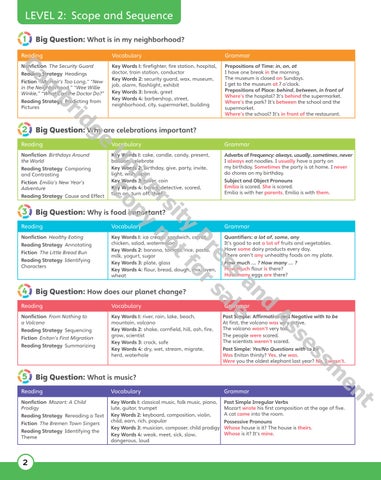
Nonfiction The Security Guard
Key Words 1: firefighter, fire station, hospital, doctor, train station, conductor Key Words 2: security guard, wax, museum, job, alarm, flashlight, exhibit Key Words 3: break, greet Key Words 4: barbershop, street, neighborhood, city, supermarket, building
Prepositions of Time: in, on, at I have one break in the morning. The museum is closed on Sundays. I get to the museum at 7 o’clock. Prepositions of Place: behind, between, in front of Where’s the hospital? It’s behind the supermarket. Where’s the park? It’s between the school and the supermarket. Where’s the school? It’s in front of the restaurant.
Ca
Reading Reading Strategy Headings
m
Fiction “My Hair’s Too Long,” “New in the Neighborhood,” “Wee Willie Winkie,” “What Can the Doctor Do?”
Big Question: Why are celebrations important?
Reading
ge
2
id
br
Reading Strategy Predicting from Pictures
Adverbs of Frequency: always, usually, sometimes, never I always eat noodles. I usually have a party on my birthday. Sometimes the party is at home. I never do chores on my birthday.
Co
Reading Strategy Cause and Effect
3
Key Words 1: cake, candle, candy, present, balloon, celebrate Key Words 2: birthday, give, party, invite, light, wish, open Key Words 3: cover, coin Key Words 4: bored, detective, scared, turn on, turn off, thief
As d an s le es sa Pr r y fo it t rs no ve y ni p
Reading Strategy Comparing and Contrasting Fiction Emilia’s New Year’s Adventure
Grammar
U
Nonfiction Birthdays Around the World
Vocabulary
Subject and Object Pronouns Emilia is scared. She is scared. Emilia is with her parents. Emilia is with them.
Big Question: Why is food important?
Reading
Vocabulary
Grammar
Nonfiction Healthy Eating
Key Words 1: ice cream, sandwich, carrot, chicken, salad, watermelon Key Words 2: banana, tomato, rice, pasta, milk, yogurt, sugar Key Words 3: plate, glass Key Words 4: flour, bread, dough, mix, oven, wheat
Quantifiers: a lot of, some, any It’s good to eat a lot of fruits and vegetables. Have some dairy products every day. There aren’t any unhealthy foods on my plate.
Reading Strategy Annotating Fiction The Little Bread Bun Reading Strategy Identifying Characters
4
How much … ? How many … ? How much flour is there? How many eggs are there?
Big Question: How does our planet change? Vocabulary
Grammar
Nonfiction From Nothing to a Volcano
Key Words 1: river, rain, lake, beach, mountain, volcano Key Words 2: shake, cornfield, hill, ash, fire, grow, scientist Key Words 3: crack, safe Key Words 4: dry, wet, stream, migrate, herd, waterhole
Past Simple: Affirmative and Negative with to be At first, the volcano was very active. The volcano wasn’t very tall. The people were scared. The scientists weren’t scared.
Reading Strategy Sequencing Fiction Enitan’s First Migration Reading Strategy Summarizing
Past Simple: Yes/No Questions with to be Was Enitan thirsty? Yes, she was. Were you the oldest elephant last year? No, I wasn’t.
Big Question: What is music?
en
m
5
ss se
Reading
Vocabulary
Grammar
Nonfiction Mozart: A Child Prodigy
Key Words 1: classical music, folk music, piano, lute, guitar, trumpet Key Words 2: keyboard, composition, violin, child, earn, rich, popular Key Words 3: musician, composer, child prodigy Key Words 4: weak, meet, sick, slow, dangerous, loud
Past Simple Irregular Verbs Mozart wrote his first composition at the age of five. A cat came into the room.
Reading Strategy Rereading a Text Fiction The Bremen Town Singers Reading Strategy Identifying the Theme
2
Possessive Pronouns Whose house is it? The house is theirs. Whose is it? It’s mine.
t
Reading